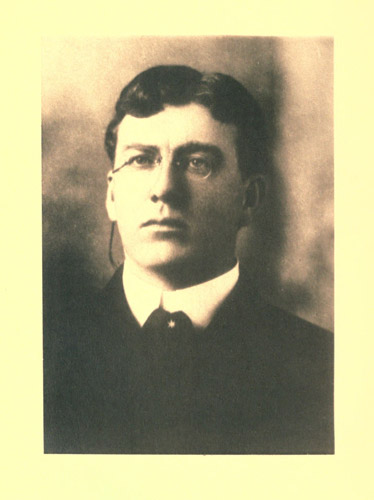
Speaker: Professor Josiah Royce, Harvard University
(Hall 6, September 20, 10 a. m.)
[Josiah Royce, Professor of History
of Philosophy, Harvard University, since 1892. b. Grass Valley, Nevada
County, California, November 20, 1855. A.B. University of California,
1875; Ph.D. Johns Hopkins 1878; LL.D. University of Aberdeen, Scotland;
LL.D. Johns Hopkins. Instructor in English Literature and Logic,
University of California, 1878-82. Instructor and Assistant Professor,
Harvard University, 1882-92. Author of Religious Aspect of
Philosophy; History of California; The Feud of Oakfield
Creek; The Spirit of Modern Philosophy; Studies of Good
and Evil; The World and the Individual; Gifford
Lectures; and numerous other works and memoirs.]
I shall not attempt, in this address, either to justify or
to criticise the name, normative science, under which the doctrines
which constitute this division are grouped. It is enough for my purpose
to recognize at the outset that I am required, by the plans of this
Congress, to explain what scientific interests seem to me to be common
to the work of the philosophers and of the mathematicians. The task is
one which makes severe demands upon the indulgence of the listener, and
upon the expository powers of the speaker, but it is a task for which
the present age has well prepared the way. The spirit which Descartes
and Leibnitz illustrated seems likely soon to become, in a new and
higher sense, prominent in science. The mathematicians are becoming more
and more philosophical. The philosophers, in the near future, will
become, I believe, more and more mathematical. It is my office to
indicate, as well as the brief time and my poor powers may permit, why
this ought to be so.
To this end I shall first point out what is that most general
community of interest which unites all the sciences that belong to our
division. Then I shall indicate what type of recent and special
scientific work most obviously bears upon the tasks of all of us alike.
Thirdly, I shall state some results and problems to which this type of
scientific work has given rise, and shall try to show what promise we
have of an early increase of insight regarding our common interests.
I
The most general community of interest which unites the various
scientific activities that belong to our division is this: We are all
concerned with what may be called ideal truth, as distinct from physical
truth. Some of us also have a strong interest in physical truth; but
none of us lack a notable and scientific concern for the realm of ideas,
viewed as ideas.
Let me explain what I mean by these terms. Whoever studies physical
truth (taking that term in its most general sense) seeks to observe, to
collate, and, in the end, to control, facts which he regards as external
to his own thought. But instead of thus looking mainly without, it is
possible for a man chiefly to take account, let us say, of the
consequences of his own hypothetical assumptions—assumptions which
may possess but a very remote relation to the physical world. Or again,
it is possible for such a student to be mainly devoted to reflecting
upon the formal validity of his own inferences, or upon the meaning of
his own presuppositions, or upon the value and the interrelation of
human ideals. Any such scientific work, reflective, considerate
principally of the thinker's own constructions and purposes, or of the
constructions and purposes of humanity in general, is a pursuit of ideal
truth. The searcher who is mainly devoted to the inquiry into what he
regards as external facts, is indeed active; but his activity is moulded
by an order of existence which he conceives as complete apart from his
activity. He is thoughtful; but a power not himself assigns to him the
problems about which he thinks. He is guided by ideals; but his
principal ideal takes the form of an acceptance of the world as it is,
independently of his ideals. His dealings are with nature. His aim is
the conquest of a foreign realm. But the student of what may be called,
in general terms, ideal truth, while he is devoted as his fellow, the
observer of outer nature, to the general purpose of being faithful to
the verity as he finds it, is still aware that his own way of finding,
or his own creative activity as an inventor of hypotheses, or his own
powers of inference, or his conscious ideals, constitute in the main the
object into which he is inquiring, and so form an essential aspect of
the sort of verity which he is endeavoring to discover. The guide, then,
of such a student is, in a peculiar sense, his own reason. His goal is
the comprehension of his own meaning, the conscious and thoughtful
conquest of himself. His great enemy is not the mystery of outer nature,
but the imperfection of his reflective powers. He is, indeed, as
unwilling as is any scientific worker to trust private caprices. He
feels as little as does the observer of outer facts, that he is merely
noting down, as they pass, the chance products of his arbitrary fantasy.
For him, as for any scientific student, truth is indeed objective; and
the standards to which he conforms are eternal. But his method is that
of an inner considerateness rather than of a curiosity about external
phenomena. His objective world is at the same time an essentially ideal
world, and the eternal verity in whose light he seeks to live has,
throughout his undertakings, a peculiarly intimate relation to the
purposes of his own constructive will.
One may then sum up the difference of attitude which is here in
question by saying that, while the student of outer nature is explicitly
conforming his plans of action, his ideas, his ideals, to an order of
truth which he takes to be foreign to himself—the student of the
other sort of truth, here especially in question, is attempting to
understand his own plans of action, that is, to develop his ideas, or to
define his ideals, or else to do both these things.
Now it is not hard to see that this search for some sort of ideal
truth is indeed characteristic of every one of the investigations which
have been grouped together in our division of the normative sciences.
Pure mathematics shares in common with philosophy this type of
scientific interest in ideal, as distinct from physical or phenomenal
truth. There is, to be sure, a marked contrast between the ways in which
the mathematician and the philosopher approach, select, and elaborate
their respective sorts of problems. But there is also a close relation
between the two types of investigation in question. Let us next consider
both the contrast and the analogy in some of their other most general
features.
Pure mathematics is concerned with the investigation of the logical
consequences of certain exactly stateable postulates or
hypotheses—such, for instance, as the postulates upon which
arithmetic and analysis are founded, or such as the postulates that lie
at the basis of any type of geometry. For the pure mathematician, the
truth of these hypotheses or postulates depends, not upon the fact that
physical nature contains phenomena answering to the postulates, but
solely upon the fact that the mathematician is able, with rational
consistency, to state these assumed first principles, and to develop
their consequences. Dedekind, in his famous essay, "Was Sind und Was
Sollen die Zahlen," called the whole numbers "freie Schöpfungen des
Menschlichen Geistes;" and, in fact, we need not enter into any
discussion of the psychology of our number concept in order to be able
to assert that, however we men first came by our conception of the whole
numbers, for the mathematician the theory of numerical truth must appear
simply as the logical development of the consequences of a few
fundamental first principles, such as those which Dedekind himself, or
Peano, or other recent writers upon this topic, have, in various forms,
stated. A similar formal freedom marks the development of any other
theory in the realm of pure mathematics. Pure geometry, from the modern
point of view, is neither a doctrine forced upon the human mind by the
constitution of any primal form of intuition, nor yet a branch of
physical science, limited to describing the spatial arrangement of
phenomena in the external world. Pure geometry is the theory of the
consequences of certain postulates which the geometer is at liberty
consistently to make; so that there are as many types of geometry as
there are consistent systems of postulates of that generic type of which
the geometer takes account. As is also now well known, it has long been
impossible to define pure mathematics as the science of quantity, or to
limit the range of the exactly stateable hypotheses or postulates with
which the mathematician deals to the world of those objects which,
ideally speaking, can be viewed as measurable. For the ideally defined
measurable objects are by no means the only ones whose properties can be
stated in the form of exact postulates or hypotheses; and the possible
range of pure mathematics, if taken in the abstract, and viewed apart
from any question as to the value of given lines of research, appears to
be identical with the whole realm of the consequences of exactly
stateable ideal hypotheses of every type.
One limitation must, however, be mentioned, to which the assertion
just made is, in practice, obviously subject. And this is, indeed, a
momentous limitation. The exactly stated ideal hypotheses whose
consequences the mathematician develops must possess, as is sometimes
said, sufficient intrinsic importance to be worthy of scientific
treatment. They must not be trivial hypotheses. The mathematician is
not, like the solver of chess problems, merely displaying his skill in
dealing with the arbitrary fictions of an ideal game. His truth is,
indeed, ideal; his world is, indeed, treated by his science as if this
world were the creation of his postulates a "freie Schöpfung." But he
does not thus create for mere sport. On the contrary, he reports a
significant order of truth. As a fact, the ideal systems of the pure
mathematician are customarily defined with an obvious, even though often
highly abstract and remote, relation to the structure of our ordinary
empirical world. Thus the various algebras which have been actually
developed have, in the main, definite relations to the structure of the
space world of our physical experience. The different systems of ideal
geometry, even in all their ideality, still cluster, so to speak, about
the suggestions which our daily experience of space and of matter give
us. Yet I suppose that no mathematician would be disposed, at the
present time, to accept any brief definition of the degree of closeness
or remoteness of relation to ordinary experience which shall serve to
distinguish a trivial from a genuinely significant branch of
mathematical theory. In general, a mathematician who is devoted to the
theory of functions, or to group theory, appears to spend little time in
attempting to show why the development of the consequences of his
postulates is a significant enterprise. The concrete mathematical
interest of his inquiry sustains him in his labors, and wins for him the
sympathy of his fellows. To the questions, "Why consider the ideal
structure of just this system of object at all?" "Why study various
sorts of numbers, or the properties of functions, or of groups, or the
system of points in projective geometry?"—the pure mathematician
in general, cares to reply only, that the topic of his special
investigation appears to him to possess sufficient mathematical
interest. The freedom of his science thus justifies his enterprise. Yet,
as I just pointed out, this freedom is never mere caprice. This ideal
interest is not without a general relation to the concerns even of
common sense. In brief, as it seems at once fair to say, the pure
mathematician is working under the influence of more or less clearly
conscious philosophical motives. He does not usually attempt to define
what distinguishes a significant from a trivial system of postulates, or
what constitutes a problem worth attacking from the point of view of
pure mathematics. But he practically recognizes such a distinction
between the trivial and the significant regions of the world of ideal
truth, and since philosophy is concerned with the significance of ideas,
this recognition brings the mathematician near in spirit to the
philosopher.
Such, then, is the position of the pure mathematician. What, by way
of contrast, is that of the philosopher? We may reply that to state the
formal consequences of exact assumptions is one thing; to reflect upon
the mutual relations, and the whole significance of such assumptions,
does indeed involve other interests; and these other interests are the
ones which directly carry us over to the realm of philosophy. If the
theory of numbers belongs to pure mathematics, the study of the place of
the number concept in the system of human ideas belongs to philosophy.
Like the mathematician, the philosopher deals directly with a realm of
ideal truth. But to unify our knowledge, to comprehend its sources, its
meaning, and its relations to the whole of human life, these aims
constitute the proper goal of the philosopher. In order, however, to
accomplish his aims, the philosopher must, indeed, take account of the
results of the special physical science; but he must also turn from the
world of outer phenomena to an ideal world. For the unity of things is
never, for us mortals, anything that we find given in our experience.
You cannot see the unity of knowledge; you cannot describe it as a
phenomenon. It is for us now, an ideal. And precisely so, the meaning of
things, the relation of knowledge to life, the significance of our
ideals, their bearing upon one another—these are never, for us
men, phenomenally present data. Hence the philosopher, however much he
ought, as indeed he ought, to take account of phenomena, and of the
results of the special physical sciences, is quite as deeply interested
in his own way, as the mathematician is interested in his way, in the
consideration of an ideal realm. Only, unlike the mathematician, the
philosopher does not first abstract from the empirical suggestions upon
which his exact ideas are actually based, and then content himself
merely with developing the logical consequences of these ideas. On the
contrary, his main interest is not in any idea or fact in so far as it
is viewed by itself, but rather in the interrelations, in the common
significance, in the unity, of all fundamental ideas, and in their
relations both to the phenomenal facts and to life! On the whole, he,
therefore, neither consents, like the student of a special science of
experience, to seek his freedom solely through conformity to the
phenomena which are to be described; nor is he content, like the pure
mathematician, to win his truth solely through the exact definition of
the formal consequences of his freely defined hypotheses. He is making
an effort to discover the sense and the unity of the business of his own
life.
It is no part of my purpose to attempt to show here how this general
philosophical interest differentiates into the various interests of
metaphysics, of the philosophy of religion, of ethics, of æsthetics, of
logic. Enough—I have tried to illustrate how, while both the
philosopher and the mathematician have an interest in the meaning of
ideas rather than in the description of external facts, still there is a
contrast which does, indeed, keep their work in large measure asunder,
namely, the contrast due to the fact that the mathematician is directly
concerned with developing the consequences of certain freely assumed
systems of postulates or hypotheses; while the philosopher is interested
in the significance, in the unity, and in the relation to life, of all
the fundamental ideals and postulates of the human mind.
Yet not even thus do we sufficiently state how closely related the
two tasks are. For this very contrast, as we have also suggested, is,
even within its own limits, no final or perfectly sharp contrast. There
is a deep analogy between the two tasks. For the mathematician, as we
have just seen, is not evenly interested in developing the consequences
of any and every system of freely assumed postulates. He is no mere
solver of arbitrary ideal puzzles in general. His systems of postulates
are so chosen as to be not trivial, but significant. They are,
therefore, in fact, but abstractly defined aspects of the very system of
eternal truth whose expression is the universe. In this sense the
mathematician is as genuinely interested as is the philosopher in the
significant use of his scientific freedom. On the other hand, the
philosopher, in reflecting upon the significance and the unity of
fundamental ideas, can only do so with success in case he makes due
inquiry into the logical consequences of given ideas. And this he can
accomplish only if, upon occasion, he employs the exact methods of the
mathematician, and develops his systems of ideal truth with the
precision of which only mathematical research is capable. As a fact,
then, the mathematician and the philosopher deal with ideal truth in
ways which are not only contrasted, but profoundly interconnected. The
mathematician, in so far as he consciously distinguishes significant
from trivial problems, and ideal systems, is a philosopher. The
philosopher, in so far as he seeks exactness of logical method, in his
reflection, must meanwhile aim to be, within his own limits, a
mathematician. He, indeed, will not in future, like Spinoza, seek to
reduce philosophy to the mere development, in mathematical form, of the
consequences of certain arbitrary hypotheses. He will distinguish
between a reflection upon the unity of the system of truth and an
abstract development of this or that selected aspect of the system. But
he will see more and more that, in so far as he undertakes to be exact,
he must aim to become, in his own way, and with due regard to his own
purposes, mathematical; and thus the union of mathematical and
philosophical inquiries, in the future, will tend to become closer and
closer.
II
So far, then, I have dwelt upon extremely general considerations
relating to the unity and the contrast of mathematical and philosophical
inquiries. I can well conceive, however, that the individual worker in
any one of the numerous branches of investigation which are represented
by the body of students whom I am privileged to address, may at this
point mentally interpose the objection that all these considerations
are, indeed, far too general to be of practical interest to any of us.
Of course, all we who study these so-called normative sciences are,
indeed, interested in ideas, for their own sakes—in ideas so
distinct from, although of course also somehow related to, phenomena. Of
course, some of us are rather devoted to the development of the
consequences of exactly stated ideal hypotheses, and others to
reflecting as we can upon what certain ideas and ideals are good for,
and upon what the unity is of all ideas and ideals. Of course, if we are
wise enough to do so, we have much to learn from one another. But, you
will say, the assertion of all these things is a commonplace. The
expression of the desire for further mutual coöperation is a pious wish.
You will insist upon asking further: "Is there just now any concrete
instance in a modern type of research which furnishes results such as
are of interest to all of us? Are we actually doing any productive work
in common? Are the philosophers contributing anything to human knowledge
which has a genuine bearing upon the interests of mathematical science?
Are the mathematicians contributing anything to philosophy?"
These questions are perfectly fair. Moreover, as it happens, they can
be distinctly answered in the affirmative. The present age is one of a
rapid advance in the actual unification of the fields of investigation
which are included within the scope of this present division. What
little time remains to me must be devoted to indicating, as well as I
can, in what sense this is true. I shall have still to deal in very
broad generalities. I shall try to make these generalities definite
enough to be not wholly unfruitful.
We have already emphasized one question which may be said to
interest, in a very direct way, both the mathematician and the
philosopher. The ideal postulates, whose consequences mathematical
science undertakes to develop, must be, we have said, significant
postulates, involving ideas whose exact definition and exposition repay
the labor of scientific scrutiny. Number, space, continuity, functional
correspondence or dependence, group-structure—these are examples
of such significant ideas; the postulates or ideal assumptions upon
which the theory of such ideas depends are significant postulates, and
are not the mere conventions of an arbitrary game. But now what
constitutes the significance of an idea, or of an abstract mathematical
theory? What gives an idea a worthy place in the whole scheme of human
ideas? Is it the possibility of finding a physical application for a
mathematical theory which for us decides what is the value of the
theory? No, the theory of functions, the theory of numbers, group
theory, have a significance which no mathematician would consent to
measure in terms of the present applicability or non-applicability of
these theories in physical science? In vain, then, does one attempt to
use the test of applied mathematics as the main criticism of the value
of a theory of pure mathematics. The value of an idea, for the sciences
which constitute our division, is dependent upon the place which this
idea occupies in the whole organized scheme or system of human ideas.
The idea of number, for instance, familiar as its applications are, does
not derive its main value from the fact that eggs and dollars and
star-clusters can be counted, but rather from the fact that the idea of
numbers has those relations to other fundamental ideas which recent
logical theory has made prominent—relations, for instance, to the
concept of order, to the theory of classes or collections of objects
viewed in general, and to the metaphysical concept of the self.
Relations of this sort, which the discussions of the number concept by
Dedekind, Cantor, Peano, and Russell have recently brought to
light—such relations, I say, constitute what truly justified Gauss
in calling the theory of numbers a "divine science." As against such
deeper relations, the countless applications of the number concept in
ordinary life, and in science, are, from the truly philosophical point
of view, of comparatively small moment. What we want, in the work of our
division of the sciences, is to bring to light the unity of truth,
either, as in mathematics, by developing systems of truth which are
significant by virtue of their actual relations to this unity, or, as in
philosophy, by explicitly seeking the central idea about which all the
many ideas cluster.
Now, an ancient and fundamental problem for the philosophers is that
which has been called the problem of the categories. This problem of the
categories is simply the more formal aspect of the whole philosophical
problem just defined. The philosopher aims to comprehend the unity of
the system of human ideas and ideals. Well, then, what are the primal
ideas? Upon what group of concepts do the other concepts of human
science logically depend? About what central interests is the system of
human ideals clustered? In ancient thought Aristotle already approached
this problem in one way. Kant, in the eighteenth century, dealt with it
in another. We students of philosophy are accustomed to regret what we
call the excessive formalism of Kant, to lament that Kant was so much
the slave of his own relatively superficial and accidental table of
categories, and that he made the treatment of every sort of
philosophical problem turn upon his own schematism. Yet we cannot doubt
that Kant was right in maintaining that philosophy needs, for the
successful development of every one of its departments, a well-devised
and substantially complete system of categories. Our objection to Kant's
over-confidence in the virtues of his own schematism is due to the fact
that we do not now accept his table of categories as an adequate view of
the fundamental concepts. The efforts of philosophers since Kant have
been repeatedly devoted to the task of replacing his scheme of
categories by a more adequate one. I am far from regarding these purely
philosophical efforts made since Kant as fruitless, but they have
remained, so far, very incomplete, and they have been held back from
their due fullness of success by the lack of a sufficiently careful
survey and analysis of the processes of thought as these have come to be
embodied in the living sciences. Such concepts as number, quantity,
space, time, cause, continuity, have been dealt with by the pure
philosophers far too summarily and superficially. A more thoroughgoing
analysis has been needed. But now, in comparatively recent times, there
has developed a region of inquiry which one may call by the general name
of modern logic. To the constitution of this new region of inquiry men
have principally contributed who began as mathematicians, but who, in
the course of their work, have been led to become more and more
philosophers. Of late, however, various philosophers, who were
originally in no sense mathematicians, becoming aware of the importance
of the new type of research, are in their turn attempting both to
assimilate and to supplement the undertakings which were begun from the
mathematical side. As a result, the logical problem of the categories
has to-day become almost equally a problem for the logicians of
mathematics and for those students of philosophy who take any serious
interest in exactness of method in their own branch of work. The result
of this actual coöperation of men from both sides is that, as I think,
we are to-day, for the first time, in sight of what is still, as I
freely admit, a somewhat distant goal, namely, the relatively complete
rational analysis and tabulation of the fundamental categories of human
thought. That the student of ethics is as much interested in such an
investigation as is the metaphysician, that the philosopher of religion
needs a well-completed table of categories quite as much as does the
pure logician, every competent student of such topics ought to admit.
And that the enterprise in question keenly interests the mathematicians
is shown by the prominent part which some of them have taken in the
researches in question. Here, then, is the type of recent scientific
work whose results most obviously bear upon the tasks of all of us
alike.
A catalogue of the names of the workers in this wide field of modern
logic would be out of place here. Yet one must, indeed, indicate what
lines of research are especially in question. From the purely
mathematical side, the investigations of the type to which I now refer
may be viewed (somewhat arbitrarily) as beginning with that famous
examination into one of the postulates of Euclid's geometry which gave
rise to the so-called non-Euclidean geometry. The question here
originally at issue was one of a comparatively limited scope, namely,
the question whether Euclid's parallel-line postulate was a logical
consequence of the other geometrical principles. But the investigation
rapidly develops into a general study of the foundations of
geometry—a study to which contributions are still almost
constantly appearing. Somewhat independently of this line of inquiry
there grew up, during the latter half of the nineteenth century, that
reëxamination of the bases of arithmetic and analysis which is
associated with the names of Dedekind, Weierstrass, and George Cantor.
At the present time, the labors of a number of other inquirers (amongst
whom we may mention the school of Peano and Pieri in Italy, and men such
as Poincaré and Couturat in France, Hilbert in Germany, Bertrand Russell
and Whitehead in England, and an energetic group of our American
mathematicians—men such as Professor Moore, Professor Halsted, Dr.
Huntington, Dr. Veblen, and a considerable number of others) have been
added to the earlier researches. The result is that we have recently
come for the first time to be able to see, with some completeness, what
the assumed first principles of pure mathematics actually are. As was to
be expected, these principles are capable of more than one formulation,
according as they are approached from one side or from another. As was
also to be expected, the entire edifice of pure mathematics, so far as
it has yet been erected, actually rests upon a very few fundamental
concepts and postulates, however you may formulate them. What was not
observed, however, by the earlier, and especially by the philosophical,
students of the categories, is the form which these postulates tend to
assume when they are rigidly analyzed.
This form depends upon the precise definition and classification of
certain types of relations. The whole of geometry, for instance,
including metrical geometry, can be developed from a set of postulates
which demand the existence of points that stand in certain ordinal
relationships. The ordinal relationships can be reduced, according as
the series of points considered is open or closed, either to the
well-known relationship in which three points stand when one is between
the other two upon a right line, or else to the ordinal relationship in
which four points stand when they are separated by pairs; and these two
ordinal relationships, by means of various logical devices, can be
regarded as variations of a single fundamental form. Cayley and Klein
founded the logical theory of geometry here in question. Russell, and in
another way Dr. Veblen, have given it its most recent expressions. In
the same way, the theory of whole numbers can be reduced to sets of
principles which demand the existence of certain ideal objects in
certain simple ordinal relations. Dedekind and Peano have worked out
such ordinal theories of the number concept. In another development of
the theory of the cardinal whole numbers, which Russell and Whitehead
have worked out, ordinal concepts are introduced only secondarily, and
the theory depends upon the fundamental relation of the equivalence or
nonequivalence of collections of objects. But here also a certain simple
type of relation determines the definitions and the development of the
whole theory.
Two results follow from such a fashion of logically analyzing the
first principles of mathematical science. In the first place, as just
pointed out, we learn how few and simple are the conceptions and
postulates upon which the actual edifice of exact science rests.
Pure mathematics, we have said, is free to assume what it chooses. Yet
the assumptions whose presence as the foundation principles of the
actually existent pure mathematics an exhaustive examination thus
reveals, show by their fewness that the ideal freedom of the
mathematician to assume and to construct what he pleases, is indeed, in
practice, a very decidedly limited freedom. The limitation is, as we
have already seen, a limitation which has to do with the essential
significance of the fundamental concepts in question. And so the result
of this analysis of the bases of the actually developed and significant
branches of mathematics, constitutes a sort of empirical revelation of
what categories the exact sciences have practically found to be of such
significance as to be worthy of exhaustive treatment. Thus the
instinctive sense for significant truth, which has all along been
guiding the development of mathematics, comes at least to a clear and
philosophical consciousness. And meanwhile the essential categories of
thought are seen in a new light.
The second result still more directly concerns a philosophical logic.
It is this: Since the few types of relations which this sort of analysis
reveals as the fundamental ones in exact science are of such importance,
the logic of the present day is especially required to face the
questions: What is the nature of our concept of relations? What
are the various possible types of relations? Upon what does the variety
of these types depend? What unity lies beneath the variety?
As a fact, logic, in its modern forms, namely, first that symbolic
logic which Boole first formulated, which Mr. Charles S. Peirce and his
pupils have in this country already so highly developed, and which
Schroeder in Germany, Peano's school in Italy, and a number of recent
English writers have so effectively furthered—and secondly, the
logic of scientific method, which is now so actively pursued, in France,
in Germany, and in the English-speaking countries—this whole
movement in modern logic, as I hold, is rapidly approaching new
solutions of the problem of the fundamental nature and the logic of
relations. The problem is one in which we are all equally
interested. To De Morgan in England, in an earlier generation, and, in
our time, to Charles Peirce in this country, very important stages in
the growth of these problems are due. Russell, in his work on the
Principles of Mathematics has very lately undertaken to sum up
the results of the logic of relations, as thus far developed, and to add
his own interpretations. Yet I think that Russell has failed to get as
near to the foundations of the theory of relations as the present state
of the discussion permits. For Russell has failed to take account of
what I hold to be the most fundamentally important generalization yet
reached in the general theory of relations. This is the generalization
set forth as early as 1890, by Mr. A. B. Kempe, of London, in a pair of
wonderful but too much neglected, papers, entitled, respectively, The
Theory of Mathematical Form, and The Analogy between the Logical
Theory of Classes and the Geometrical Theory of Points. A mere hint
first as to the more precise formulation of the problem at issue, and
then later as to Kempe's special contribution to that problem, may be in
order here, despite the impossibility of any adequate statement.
III
The two most obviously and universally important kinds of relations
known to the exact sciences, as these sciences at present exist, are:
(1) The relations of the type of equality or equivalence; and (2) the
relations of the type of before and after, or greater and less. The
first of these two classes of relations, namely, the class represented,
although by no means exhausted, by the various relations actually
called, in different branches of science by the one name equality, this
class I say, might well be named, as I myself have proposed, the
leveling relations. A collection of objects between any two of which
some one relation of this type holds, may be said to be a collection
whose members, in some defined sense or other, are on the same level.
The second of these two classes of relations, namely, those of the type
of before and after, or greater and less—this class of relations,
I say, consists of what are nowadays often called the serial relations.
And a collection of objects such that, if any pair of these objects be
chosen, a determinate one of this pair stands to the other one of the
same pair in some determinate relation of this second type, and in a
relation which remains constant for all the pairs that can be thus
formed out of the members of this collection—any such collection,
I say, constitutes a one-dimensional open series. Thus, in case of a
file of men, if you choose any pair of men belonging to the file, a
determinate one of them is, in the file, before the other. In the number
series, of any two numbers, a determinate one is greater than the other.
Wherever such a state of affairs exists, one has a series.
Now these two classes of relations, the leveling relations and the
serial relations, agree with one another, and differ from one another in
very momentous ways. They agree with one another in that both the
leveling and the serial relations are what is technically called
transitive; that is, both classes conform to what Professor James
has called the law of "skipped intermediaries." Thus, if A is
equal to B, and B is equal to C, it follows that
A is equal to C. If A is before B, and
B is before C, then A is before C. And this
property, which enables you in your reasonings about these relations to
skip middle terms, and so to perform some operation of elimination, is
the property which is meant when one calls relations of this type
transitive. But, on the other hand, these two classes of relations
differ from each other in that the leveling relations are, while
the serial relations are not, symmetrical or reciprocal. Thus, if
A is equal to B, B is equal to A. But if
X is greater than Y, then Y is not greater than
X, but less than X. So the leveling relations are
symmetrical transitive relations. But the serial relations are
transitive relations which are not symmetrical.
All this is now well known. It is notable, however, that nearly all
the processes of our exact sciences, as at present developed, can be
said to be essentially such as lead either to the placing of sets or
classes of objects on the same level, by means of the use of symmetrical
transitive relations, or else to the arranging of objects in orderly
rows or series, by means of the use of transitive relations which are
not symmetrical. This holds also of all the applications of the exact
sciences. Whatever else you do in science (or, for that matter, in art),
you always lead, in the end, either to the arranging of objects, or of
ideas, or of acts, or of movements, in rows or series, or else to the
placing of objects or ideas of some sort on the same level, by virtue of
some equivalence, or of some invariant character. Thus numbers,
functions, lines in geometry, give you examples of serial relations.
Equations in mathematics are classic instances of leveling relations.
So, of course, are invariants. Thus, again, the whole modern theory of
energy consists of two parts, one of which has to do with levels of
energy, in so far as the quantity of energy of a closed system remains
invariant through all the transformations of the system, while the other
part has to do with the irreversible serial order of the transformations
of energy themselves, which follow a set of unsymmetrical relations, in
so far as energy tends to fall from higher to lower levels of intensity
within the same system.
The entire conceivable universe then, and all of our present exact
science, can be viewed, if you choose, as a collection of objects or of
ideas that, whatever other types of relations may exist, are at least
largely characterized either by the leveling relations, or by the serial
relations, or by complexes of both sorts of relations. Here, then, we
are plainly dealing with very fundamental categories. The "between"
relations of geometry can of course be defined, if you choose, in terms
of transitive relations that are not symmetrical. There are, to be sure,
some other relations present in exact science, but the two types, the
serial and leveling relations, are especially notable.
So far the modern logicians have for some time been in substantial
agreement. Russell's brilliant book is a development of the logic of
mathematics very largely in terms of the two types of relations which,
in my own way, I have just characterized; although Russell gives due
regard, of course, to certain other types of relations.
But hereupon the question arises, "Are these two types of relations
what Russell holds them to be, namely, ultimate and irreducible logical
facts, unanalyzable categories—mere data for the thinker?" Or can we reduce
them still further, and thus simplify yet again our view of the
categories?
Here is where Kempe's generalization begins to come into sight. These
two categories, in at least one very fundamental realm of exact thought,
can be reduced to one. There is, namely, a world of ideal objects which
especially interest the logician. It is the world of a totality of
possible logical classes, or again, it is the ideal world,
equivalent in formal structure to the foregoing, but composed of a
totality of possible statements, or thirdly, it is the world,
equivalent once more, in formal structure, to the foregoing, but
consisting of a totality of possible acts of will, of possible
decisions. When we proceed to consider the relational structure of such
a world, taken merely in the abstract as such a structure, a relation
comes into sight which at once appears to be peculiarly general in its
nature. It is the so-called illative relation, the relation which
obtains between two classes when one is subsumed under the other, or
between two statements, or two decisions, when one implies or entails
the other. This relation is transitive, but may be either symmetrical or
not symmetrical; so that, according as it is symmetrical or not, it may
be used either to establish levels or to generate series. In the order
system of the logician's world, the relational structure is thus, in any
case, a highly general and fundamental one.
But this is not all. In this the logician's world of classes, or of
statements, or of decisions, there is also another relation observable.
This is the relation of exclusion or mutual opposition. This is a purely
symmetrical or reciprocal relation. It has two forms—obverse or
contradictory opposition, that is, negation proper, and contrary
opposition. But both these forms are purely symmetrical. And by proper
devices each of them can be stated in terms of the other, or reduced to
the other. And further, as Kempe incidentally shows, and as Mrs. Ladd
Franklin has also substantially shown in her important theory of the
syllogism, it is possible to state every proposition, or complex of
propositions involving the illative relation, in terms of this purely
symmetrical relation of opposition. Hence, so far as mere relational
form is concerned, the illative relation itself may be wholly reduced to
the symmetrical relation of opposition. This is our first result as to
the relational structure of the realm of pure logic, that is, the realm
of classes, of statements, or of decisions.
It follows that, in describing the logician's world of possible
classes or of possible decisions, all unsymmetrical, and so all
serial, relations can be stated solely in terms of symmetrical
relations, and can be entirely reduced to such relations. Moreover,
as Kempe has also very prettily shown, the relation of opposition, in
its two forms, just mentioned, need not be interpreted as obtaining
merely between pairs of objects. It may and does obtain between triads,
tetrads, n-ads of logical entities; and so all that is true of
the relations of logical classes may consequently be stated merely by
ascribing certain perfectly symmetrical and homogeneous predicates to
pairs, triads, tetrads, n-ads of logical objects. The essential contrast
between symmetrical and unsymmetrical relations thus, in this ideal
realm of the logician, simply vanishes. The categories of the logician's
world of classes, of statements, or of decisions, are marvelously
simple. All the relations present may be viewed as variations of the
mere conception of opposition as distinct from non-opposition.
All this holds, of course, so far, merely for the logician's world of
classes or of decisions. There, at least, all serial order can actually
be derived from wholly symmetrical relations. But Kempe now very
beautifully shows (and here lies his great and original contribution to
our topic)—he shows, I say, that the ordinal relations of
geometry, as well as of the number system, can all be regarded as indistinguishable from
mere variations of those relations which, in pure logic, one finds to
be the symmetrical relations obtaining within pairs or triads of classes
or of statements. The formal identity of the geometrical relation
called "between" with a purely logical relation which one can define as
existing or as not existing amongst the members of a given triad of
logical classes, or of logical statements, is shown by Kempe in a
fashion that I cannot here attempt to expound. But Kempe's result thus
enables one, as I believe, to simplify the theory of relations far
beyond the point which Russell in his brilliant book has reached. For
Kempe's triadic relation in question can be stated, in what he calls its
obverse form, in perfectly symmetrical terms. And he proves very exactly
that the resulting logical relation is precisely identical, in all its
properties, with the fundamental ordinal relation of geometry.
Thus the order-systems of geometry and analysis appear simply as
special cases of the more general order-system of pure logic. The whole,
both of analysis and of geometry, can be regarded as a description of
certain selected groups of entities, which are chosen, according to
special rules, from a single ideal world. This general and inclusive
ideal world consists simply of all the objects which can stand to one
another in those symmetrical relations wherein the pure logician finds
various statements, or various decisions inevitably standing. "Let
me," says in substance Kempe, "choose from the logician's ideal world of
classes or decisions, what entities I will; and I will show you a
collection of objects that are in their relational structure, precisely
identical with the points of a geometer's space of n dimensions."
In other words, all of the geometer's figures and relations can be
precisely pictured by the relational structure of a selected system of
classes or of statements, whose relations are wholly and explicitly
logical relations, such as opposition, and whose relations may all be
regarded, accordingly, as reducible to a single type of purely
symmetrical relation.
Thus, for all exact science, and not merely for the logician's
special realm, the contrast between symmetrical and unsymmetrical
relations proves to be, after all, superficial and derived. The purely
logical categories, such as opposition, and such as hold within the
calculus of statements, are, apparently, the basal categories of all the
exact science that has yet been developed. Series and levels are
relational structures that, sharply as they are contrasted, can be
derived from a single root.
I have restated Kempe's generalization in my own way. I think it the
most promising step towards new light as to the categories that we have
made for some generations.
In the field of modern logic, I say, then, work is doing which is
rapidly tending towards the unification of the tasks of our entire
division. For this problem of the categories, in all its abstractness,
is still a common problem for all of us. Do you ask, however, what such
researches can do to furnish more special aid to the workers in
metaphysics, in the philosophy of religion, in ethics, or in æsthetics,
beyond merely helping towards the formulation of a table of
categories—then I reply that we are already not without evidence
that such general researches, abstract though they may seem, are bearing
fruits which have much more than a merely special interest. Apart from
its most general problems, that analysis of mathematical concepts to
which I have referred has in any case revealed numerous unexpected
connections between departments of thought which had seemed to be very
widely sundered. One instance of such a connection I myself have
elsewhere discussed at length, in its general metaphysical bearings. I
refer to the logical identity which Dedekind first pointed out between
the mathematical concept of the ordinal number of series and the
philosophical concept of the formal structure of an ideally completed
self. I have maintained that this formal identity throws light upon
problems which have as genuine an interest for the student of the
philosophy of religion as for the logician of arithmetic. In the same
connection it may be remarked that, as Couturat and Russell, amongst
other writers, have very clearly and beautifully shown, the argument of
the Kantian mathematical antinomies needs to be explicitly and totally
revised in the light of Cantor's modern theory of infinite collections.
To pass at once to another, and a very different instance: The modern
mathematical conceptions of what is called group theory have already
received very wide and significant applications, and promise to bring
into unity regions of research which, until recently, appeared to have
little or nothing to do with one another. Quite lately, however, there
are signs that group theory will soon prove to be of importance for the
definition of some of the fundamental concepts of that most refractory
branch of philosophical inquiry, æsthetics. Dr. Emch, in an important
paper in the Monist, called attention, some time since, to the
symmetry groups to which certain æsthetically pleasing forms belong, and
endeavored to point out the empirical relations between these groups and
the æsthetic effects in question. The grounds for such a connection
between the groups in question and the observed æsthetic effects,
seemed, in the paper of Dr. Emch to be left largely in the dark. But
certain papers recently published in the country by Miss Ethel Puffer,
bearing upon the psychology of the beautiful (although the author has
approached the subject without being in the least consciously
influenced, as I understand, by the conceptions of the mathematical
group theory), still actually lead, if I correctly grasp the writer's
meaning, to the doctrine that the æsthetic object, viewed as a
psychological whole, must possess a structure closely, if not precisely,
equivalent to the ideal structure of what the mathematician calls a
group. I myself have no authority regarding æsthetic concepts, and speak
subject to correction. But the unexpected, and in case of Miss Puffer's
research, quite unintended, appearance of group theory in recent
æsthetic analysis is to me an impressive instance of the use of
relatively new mathematical conceptions in philosophical regions which
seem, at first sight, very remote from mathematics.
That both the group concept and the concept of the self just
suggested are sure to have also a wide application in the ethics of the
future, I am myself well convinced. In fact, no branch of philosophy is
without close relations to all such studies of fundamental
categories.
These are but hints and examples. They suffice, I hope,
to show that the workers in this division have deep common interests,
and will do well, in future, to study the arts of coöperation, and to
regard one another's progress with a watchful and cordial sympathy. In a
word: Our common problem is the theory of the categories. That problem
can be solved only by the coöperation of the mathematicians and of the
philosophers.
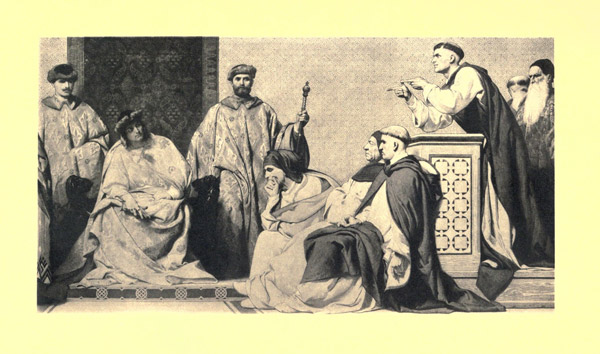
THE UNIVERSITY OF PARIS IN THE THIRTEENTH
CENTURY
Hand-painted Photogravure from a Painting
by Otto Knille. Reproduced
from a Photograph of the Painting by
permission of the
Berlin Photograph Co.
This famous painting is now in the University of
Berlin. Thomas Aquinas, one of the greatest of the scholastic
philosophers, surnamed the "Angelic Doctor," is delivering a learned
discourse before King Louis IX. To the right of the King stands
Joinville, the French chronicler. The Dominican monk with his hand to
his face is Guillaume de Saint Amour, and Vincent de Beauvais, and
another Dominican are seated with their backs to the platform desk from
which Thomas Aquinas is making his animated address. The picture is
thoroughly characteristic of a University disputation at the close of
the Middle Ages.
(Hall 6, September 20, 11.15 a. m.)
| Chairman: | Professor Borden P. Bowne,
Boston University. |
| Speakers: | Professor George H. Howison,
University of California. |
| Professor George T.
Ladd, Yale University. |
In opening the Department of Philosophy, the Chairman, Professor
Borden P. Bowne, LL.D., of Boston University, made an interesting
address on the Philosophical Outlook. Professor Bowne said in part:—
I congratulate the members of the Philosophical Section on the
improved outlook in philosophy. In the generation just passed,
philosophy was somewhat at a discount. The great and rapid development
of physical science and invention, together with the profound changes in
biological thought, produced for a time a kind of chaos. New facts were
showered upon us in great abundance, and we had no adequate
philosophical preparation for dealing with them. Such a condition is
always disturbing. The old mental equilibrium is overthrown and
readjustment is a slow process. Besides, the shallow sense philosophy of
that time readily lent itself to mechanical and materialistic
interpretations, and for a while it seemed as if all the higher faiths
of humanity were permanently discredited. All this has passed away.
Philosophical criticism began its work and the naïve dogmatism of
materialistic naturalism was soon disposed of. It quickly appeared that
our trouble was not due to the new facts, but to the superficial
philosophy by which they had been interpreted. Now that we have a better
philosophy, we have come to live in perfect peace with the facts once
thought disturbing, and even to welcome them as valuable additions to
knowledge....
The brief naturalistic episode was not without instruction for us. It
showed conclusively the great practical importance of philosophy. Had we
had thirty years ago the current philosophical insight, the great
development of the physical and biological sciences would have made no
disturbance whatever. But being interpreted by a crude scheme of
thought, it produced somewhat of a storm. Philosophy may not contribute
much of positive value, but it certainly has an important negative
function in the way of suppressing pretentious dogmatism and fictitious
knowledge, which often lead men astray. It is these things which produce
conflicts of science and religion or which find in evolution the solvent
of all mysteries and the source of all knowledge.
Concerning the partition of territory between science and philosophy,
there are two distinct questions respecting the facts of experience.
First, we need to know the facts in their temporal and spatial order,
and the way they hang together in a system of law. To get this knowledge
is the function of science, and in this work science has inalienable
rights and a most important practical function. This work cannot be done
by speculation nor interfered with by authority of any kind. It is not
surprising, then, that scientists in their sense of contact with reality
should be indignant with, or feel contempt for, any who seek to limit or
proscribe their research. But supposing this work all done, there
remains another question respecting the causality and interpretation of
the facts. This question belongs to philosophy. Science describes and
registers the facts with their temporal and spatial laws; philosophy
studies their causality and significance. And while the scientist justly
ignores the philosopher who interferes with his inquiries, so the
philosopher may justly reproach the scientist who fails to see that the
scientific question does not touch the philosophic one....
In the field of metaphysics proper I note a strong tendency toward
personal idealism, or as it might be called, Personalism; that is, the
doctrine that substantial reality can be conceived only under the
personal form and that all else is phenomenal. This is quite distinct
from the traditional idealisms of mere conceptionism. It holds the
essential fact to be a community of persons with a Supreme Person at
their head while the phenomenal world is only expression and means of
communication. And to this view we are led by the failure of
philosophizing on the impersonal plane, which is sure to lose itself in
contradiction and impossibility. Under the form of mechanical
naturalism, with its tendencies to materialism and atheism,
impersonalism has once more been judged and found wanting. We are not
likely to have a recurrence of this view unless there be a return to
philosophical barbarism. But impersonalism at the opposite pole in the
form of abstract categories of being, causality, unity, identity,
continuity, sufficient reason, etc., is equally untenable. Criticism
shows that these categories when abstractly and impersonally taken
cancel themselves. On the impersonal plane we can never reach unity from
plurality, or plurality from unity; and we can never find change in
identity, or identity in change. Continuity in time becomes mere
succession without the notion of potentiality, and this in turn is
empty. Existence itself is dispersed into nothingness through the
infinite divisibility of space and time, while the law of the sufficient
reason loses itself in barren tautology and the infinite regress. The
necessary logical equivalence of cause and effect in any impersonal
scheme makes all real explanation and progress impossible, and shuts us
up to an unintelligible oscillation between potentiality and actuality,
to which there is no corresponding thought....
Philosophy is still militant and has much work before it, but the
omens are auspicious, the problems are better understood, and we are
coming to a synthesis of the results of past generations of thinking
which will be a very distinct progress. Philosophy has already done good
service, and never better than in recent times, by destroying pretended
knowledge and making room for the higher faiths of humanity. It has also
done good service in helping these faiths to better rational form, and
thus securing them against the defilements of superstition and the
cavilings of hostile critics. With all its aberrations and shortcomings,
philosophy deserves well of humanity.
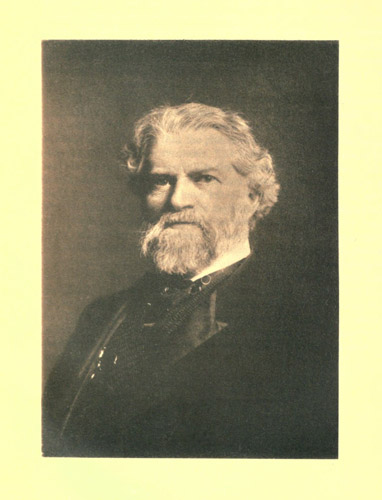
[George Holmes Howison, Mills Professor of Intellectual and
Moral Philosophy and Civil Polity, University of California. b.
Montgomery County, Maryland, 1834. A.B. Marietta College, 1852; M.A.
1855; LL.D. ibid. 1883. Post-graduate, Lane Theological Seminary,
University of Berlin, and Oxford. Headmaster High School, Salem, Mass.,
1862-64; Assistant Professor of Mathematics, Washington University, St.
Louis, 1864-66; Tileston Professor of Political Economy, ibid.
1866-69; Professor of Logic and the Philosophy of Science, Massachusetts
Institute of Technology, 1871-79; Lecturer on Ethics, Harvard
University, 1879-80; Lecturer on Logic and Speculative
Philosophy, University of Michigan, 1883-84. Member and vice-president
St. Louis Philosophical Society; member California Historical Society;
American Historical Association; American Association for the
Advancement of Science; National Geographic Society, etc. Author
of Treatise on Analytic Geometry, 1869; The Limits of
Evolution, 1901, 2d edition, 1904; joint author and editor of The
Conception of God, 1897, etc. Editor Philosophical
Publications of University of California; American Editorial
Representative Hibbert Journal, London.]
The duty has been assigned me, honored colleagues, of
addressing you on the Fundamental Conceptions and the Methods of our
common pursuit—philosophy. In endeavoring to deal with the subject
in a way not unworthy of its depth and its extent, I have found it
impossible to bring the essential material within less compass than
would occupy, in reading, at least four times the period granted by our
programme. I have therefore complied with the rule of the Congress which
directs that, if a more extended writing be left with the authorities
for publication, the reading must be restricted to such a portion of it
as will not exceed the allotted time. I will accordingly read to you,
first, a brief summary of my entire discussion, by way of introduction,
and then an excerpt from the larger document, which may serve for a
specimen, as our scholastic predecessors used to say, of the
whole inquiry I have carried out. The impression will, of course, be
fragmentary, and I must ask beforehand for your most benevolent
allowances, to prevent a judgment too unfavorable.
The discussion naturally falls into two main parts: the first dealing
with the Fundamental Conceptions; and the second, with the Methods.
In the former, after presenting the conception of philosophy itself,
as the consideration of things in the light of the whole, I take
up the involved Fundamental Concepts in the following order:—
| I. | Whole and Part; |
| II. | Subject and Object
(Knowing and Being, Mind and Matter; Dualism, Materialism,
Idealism); |
| III. | Reality and Appearance
(Noumenon and Phenomenon); |
| IV. | Cause and Effect
(Ground and Consequence; Causal System); |
| V. | One and Many (Number
System; Monism and Pluralism); |
| VI. | Time and Space (their
relation to Number; their Origin and Real Meaning); |
| VII. | Unconditioned and
Conditioned (Soul, World, God; their Reinterpretation in terms of
Pluralism); |
| VIII. | The True, the
Beautiful, the Good (their relation to the question between Monism and
Pluralism). |
These are successively dealt with as they rise one
out of the other in the process of interpreting them and applying them
in the actual creation of philosophy, as this goes on in the historic
schools. The theoretic progress of philosophy is in this way explained
by them, in its movement from natural dualism, or realism, through the
successive forms of monism, materialistic, agnostic, and idealistic,
until it reaches the issue, now coming so strongly forward within the
school of idealism, between the adherents of monism and those of
pluralism.
The importance of the Fundamental Concepts is shown to increase as we
pass along the list, till on reaching Cause and Effect, and entering
upon its full interpretation into the complete System of Causes, we
arrive at the very significant conception of the Reciprocity of First Causes, and through it come to
the Primacy of Final Cause, and the
derivative position of the other forms of cause, Material, Formal,
Efficient. The philosophic strength of idealism, but especially of
idealistic pluralism, comes into clear light as the result of this stage
of the inquiry. But it appears yet more decidedly when One and Many,
Time and Space, and their interrelations, are subjected to analysis. So
the discussion next passes to the higher conceptions, Soul, World, God,
by the pathway of the correlation Unconditioned and Conditioned, and its
kindred contrasts Absolute and Relative, Necessary and Contingent,
Infinite and Finite, corroborating and reinforcing the import of
idealism, and, still more decidedly, that of its plural form. Finally,
the strong and favorable bearing of this last on the dissolution of
agnosticism and the habilitation of the ideals, the True, the Beautiful,
and the Good, in a heightened meaning, is brought out.
This carries the inquiry to the second part of it, that of the
Philosophical Methods. Here I recount these in a series of six: the
Dogmatic, the Skeptical, the Critical, the Pragmatic, the Genetic, the
Dialectic. These, I show, in spite of the tendency of the earlier
members in the series to over-emphasis, all have their place and
function in the development of a complete philosophy, and in fact form
an ascending series in methodic effectiveness, all that precede the last
being taken up into the comprehensive Critical Rationalism of the last.
Methodology thus passes upward, over the ascending and widening roadways
of (1) Intuition and Deduction; (2) Experience and Induction; (3)
Intuition and Experience adjusted by Critical Limits; (4) Skepticism
reinforced and made quasi-affirmative by Desire and Will; (5)
Empiricism enlarged by substitution of cosmic and psychic history for
subjective consciousness; (6) Enlightened return to a Rationalism
critically established by the inclusion of the preceding elements, and
by the sifting and the grading of the Fundamental Concepts through their
behavior when tested by the effort to make them universal. In this way,
the methods fall into a System, the organic principle of which is this
principle of Dialectic, which proves itself alone able to establish
necessary truths; that is, truths indeed,—judgments
that are seen to exclude their opposites, because, in the attempt to
substitute the opposite, the place of it is still filled by the judgment
which it aims to dislodge.
And now, with your favoring leave, I will read the excerpt from my
larger text.
The task to which, in an especial sense, the cultivators of
philosophy are summoned by the plans of the present Congress of Arts and
Science, is certainly such as to stir an ambition to achieve it. At the
same time, it tempers eagerness by its vast difficulty, and the
apprehension lest this may prove insuperable. The task, the officers of
the Congress tell us, is no less than to promote the unification of all
human knowledge. It requires, then, the reduction of the enormous detail
in our present miscellany of sciences and arts, which to a general
glance, or even to a more intimate view, presents a confusion of
differences that seems overwhelming, to a system nevertheless clearly
harmonious,—founded, that is to say, upon universal principles
which control all differences by explaining them, and which therefore,
in the last resort, themselves flow lucidly from a single supreme
principle. Simply to state this meaning of the task set us, is enough to
awaken the doubt of its practicability.
This doubt, we are bound to confess, has more and more impressed
itself upon the general mind, the farther this has advanced in the
experience of scientific discovery. The very increase in the
multiplicity and complexity of facts and their causal groupings
increases the feeling that at the root of things there is "a final
inexplicability"—total reality seems, more and more, too vast, too
profound, for us to grasp or to fathom. And yet, strangely enough, this
increasing sense of mysterious vastness has not in the least prevented
the modern mind from more and more asserting, with a steadily increasing
insistence, the essential and unchangeable unity of that whole of things
which to our ordinary experience, and even to all our sciences, appears
such an endless and impenetrable complex of differences,—yes, of
contradictions. In fact, this assertion of the unity of all things,
under the favorite name of the Unity of Nature, is the pet dogma of
modern science; or, rather, to speak with right accuracy, it is the
stock-in-trade of a philosophy of science, current among many of
the leaders of modern science; for every such assertion, covering, as it
tacitly and unavoidably does, a view about the absolute whole, is an
assertion belonging to the province of philosophy, before whose tribunal
it must come for the assessment of its value. The presuppositions of all
the special sciences, and, above all, this presupposition of the Unity
and Uniformity of Nature, common to all of them, must thus come back for
justification and requisite definition to philosophy—that
uppermost and all-inclusive form of cognition which addresses itself to
the whole as whole. In their common assertion of the Unity of Nature,
the exponents of modern science come unawares out of their own province
into quite another and a higher; and in doing so they show how unawares
they come, by presenting in most instances the curious spectacle of
proclaiming at once their increasing belief in the unity of things, and
their increasing disbelief in its penetrability by our
intelligence:—
In's Innere der Natur,
Dringt kein erschaffner Geist,
is their chosen poet's expression of their philosophic mood. Curious
we have the right to call this state of the scientific mind, because it
is to critical reflection so certainly self-contradictory. How can there
be a real unity belonging to what is inscrutable?—what evidence of
unity can there be, except in intelligible and explanatory
continuity?
But, at all events, this very mood of agnostic self-contradiction,
into which the development of the sciences casts such a multitude of
minds, brings them,—brings all of us,—as already indicated,
into that court of philosophy where alone such issues lawfully belong,
and where alone they can be adjudicated. If the unification of the
sciences can be made out to be real by making out its sole sufficient
condition, namely, that there is a genuine, and not a merely nominal,
unity in the whole of reality itself,—a unity that explains
because it is itself, not simply intelligible, but the only completely
intelligible of things,—this desirable result must be the work of
philosophy. However difficult the task may be, it is rightly put upon us
who belong to the Department listed first among the twenty-four in the
programme of this representative Congress.
I cannot but express my own satisfaction, as a member of this
Department, nor fail to extend my congratulations to you who are my
colleagues in it, that the Congress, in its programme, takes openly the
affirmative on this question of the possible unification of knowledge.
The Congress has thus declared beforehand for the practicability of the
task it sets. It has even declared for its not distant accomplishment;
indeed, not impossibly, its accomplishment through the transactions of
the Congress itself; and it indicates, by no uncertain signs, the
leading, the determining part that philosophy must have in the
achievement. In fact, the authorities of the Congress themselves suggest
a solution of their own for their problem. In their programme we see a
renewed Hierarchy of the Sciences, and at the summit of this appears now
again, after so long a period of humiliating obscuration, the figure of
Philosophy, raised anew to that supremacy, as Queen of the Sciences,
which had been hers from the days of Plato to those of Copernicus, but
which she began to lose when modern physical and historical research
entered upon its course of sudden development, and which, until
recently, she has continued more and more to lose as the sciences have
advanced in their career of discoveries,—ever more unexpected,
more astonishing, yet more convincing and more helpful to the welfare of
mankind. May this sign of her recovered empire not fail! If we rejoice
at the token, the Congress has made it our part to see that the title is
vindicated. It is ours to show this normative function of philosophy,
this power to reign as the unifying discipline in the entire realm of
our possible knowledge; to show it by showing that the very nature of
philosophy—its elemental concepts and its directing ideals, its
methods taken in their systematic succession—is such as must
result in a view of universal reality that will supply the principle at
once giving rise to all the sciences and connecting them all into one
harmonious whole.
Such, and so grave, my honored colleagues, is the duty assigned to
this hour. Sincerely can I say, Would it had fallen to stronger hands
than mine! But since to mine it has been committed, I will undertake it
in no disheartened spirit; rather, in that temper of animated hope in
which the whole Congress has been conceived and planned. And I draw
encouragement from the place, and its associations, where we are
assembled—from its historic connections not only with the external
expansion of our country, but with its growth in culture, and especially
with its growth in the cultivation of philosophy. For your speaker, at
least, can never forget that here in St. Louis, the metropolis of the
region by which our national domain was in the Louisiana Purchase so
enlarged,—here was the centre of a movement in philosophic study
that has proved to be of national import. It is fitting that we all,
here to-day, near to the scene itself, commemorate the public service
done by our present National Commissioner of Education and his group of
enthusiastic associates, in beginning here, in the middle years of the
preceding century, those studies of Kant and his great idealistic
successors that unexpectedly became the nucleus of a wider and more
penetrating study of philosophy in all parts of our country. It is with
quickened memories belonging to the spot where, more than
five-and-thirty years ago, it was my happy fortune to take some part
with Dr. Harris and his companions, that I begin the task assigned me.
The undertaking seems less hopeless when I can here recall the names and
the congenial labors of Harris, of Davidson, of Brockmeyer, of Snider,
of Watters, of Jones,—half of them now gone from life. They
"builded better than they knew;" and, humbly as they may themselves have
estimated their ingenuous efforts to gain acquaintance with the greatest
thoughts, history will not fail to take note of what they did, as
marking one of the turning-points in the culture of our nation. The
publication of the Journal of Speculative Philosophy, granting
all the subtractions claimed by its critics on the score of defects (of
which its conductors were perhaps only too sensible), was an influence
that told in all our circles of philosophical study, and thence in the
whole of our social as well as our academic life.
* * * * *
[Here I enter upon the discussion of the subject proper, beginning,
as above indicated, with the Fundamental Conceptions. Having followed
these through the contrasts Whole and Part, Subject and Object, Reality
and Appearance (or Noumenon and Phenomenon), and developed the bearing
of these on the procedure of thought from the dualism of natural realism
to materialism and thence to idealism, with the issue now coming on, in
this last, between monism and pluralism, I strike into the contrast
Cause and Effect, and, noting its unfolding into the more comprehensive
form of Ground and Consequence, go on thence as follows:]
* * * * *
It is plain that the contrast Ground and Consequence will enable us
to state the new issue with closer precision and pertinence than Reality
and Appearance, Noumenon and Phenomenon, can supply; while, at the same
time, Ground and Consequence exhibits Cause and Effect as presenting a
contrast that only fulfills what Noumenon and Phenomenon foretold and
strove towards; in fact, what was more remotely, but not less surely,
also indicated by Whole and Part, Knowing and Being, Subject and Object.
For in penetrating to the coherent meaning of these conceptions, the
philosophic movement, as we saw, advanced steadily to the fuller and
fuller translating of each of them into the reality that unifies by
explanation, instead of pretending to explain by merely unifying;
and this, of course, will now be put forward explicitly, in the
clarified category of Cause and Effect, transfigured from a physical
into a purely logical relation. What idealism now says, in terms of
this, is that the Cause (or, as we now read it, the Ground) of all that
exists is the Subject; is Mind, the intelligently Self-conscious; and
that all things else, the mere objects, material things, are its
Consequence, its Outcome,—in that sense its Effect. And what the
new pluralistic idealism says, is that the assemblage of individual
minds—intelligence being essentially personal and individual,
and never merely universal and collective—is the true total Cause
of all, and that every mind thus belongs to the order of First Causes;
nevertheless, that part, and the most significant part, of the nature of
every mind, essential to its personality and its reason, is its
recognition of other minds in the very act of its own
self-definition. That is to say, a mind by its spontaneous nature as
intelligence, by its intrinsic rational or logical genius, puts itself
as member of a system of minds; all minds are put by each other
as Ends—completely standard and sacred Objects, as much parts of
the system of true Causes as each is, in its capacity of Subject; and we
have a noumenal Reality that is properly to be described as the eternal
Federal Republic of Spirits.
Consequently, the relation of Cause and Effect now expands and
heightens into a system of the Reciprocity of First
Causes; causes, that is, which, while all coefficients in the
existence and explanation of that natural world of experience which
forms their passive effect, their objects of mere perception, are
themselves related only in the higher way of Final Causes—that is,
Defining-Bases and Ends—of each other, making them the logical
Complements, and the Objects of conduct, all for each, and each for all.
Hence, the system of causation undergoes a signal transformation, and
proves to be organized by Final Cause as its basis and root, instead of
by Efficient Cause, or Originating Ground, as the earlier stages of
thinking had always assumed.
The causal relation between the absolute or primary realities being
purely Final, or Defining and Purposive; that is to say, the uncoercive
influence of recognition and ideality; all the other forms of cause, as
grouped by Aristotle,—Material, Formal, and Efficient,—are
seen to be the derivatives of Final Cause, as being supplied by the
action of the minds that, as absolute or underived realities, exist only
in the relation of mutual Complements and Ends. Accordingly, Efficient
Cause operates only from minds, as noumena, to matter, as their
phenomenon, their presented contents of experience; or, in a secondary
and derivative sense, from one phenomenon to another, or from one group
of phenomena to another group, these playing the part of transmitters,
or (as some logicians would say) Instrumental Causes, or Means. Cause,
as Material, is hence defined as the elementary phenomenon, and the
combinations of this; and therefore, strictly taken, is merely Effect
(or Outcome) of the self-active consciousness, whose spontaneous forms
of conception and perception become the Formal Cause that organizes the
sum of phenomena into cosmic harmony or unity.
Here, accordingly, comes into view the further and in some respects
deeper conceptual pair, Many and One. The history of philosophic thought
proves that this antithesis is darkly obscure and deeply ambiguous; for
about it have centred a large part of the conflicts of doctrine. This
pair has already been used, implicitly, in exhibiting the development of
the preceding group, Cause and Effect; and in so using it we have
supplied ourselves with a partial clarification of it, and with one
possible solution of its ambiguity. We have seen, namely, how our strong
natural persuasion that philosophy guided by the fundamental concept
Cause must become the search for the One amid the wilderness of the
Many, and that this search cannot be satisfied and ended except in an
all-inclusive Unit, in which the Many is embraced as the integral and
originated parts, completely determined, subjected, and controlled, may
give way to another and less oppressive conception of unity; a
conception of it as the harmony among many free and independent primary
realities, a harmony founded on their intelligent and reasonable mutual
recognition. This conception casts at least some clearing light
upon the long and dreary disputes over the Many and the One; for it
exposes, plainly, the main source of them. They have arisen out of two
chief ambiguities,—the ambiguity of the concept One, and the
ambiguity of the concept Cause in its supreme meaning. The normal
contrast between the One and the Many is a clear and simple contrast:
the One is the single unit, and the Many is the repetition of the unit,
or is the collection of the several units. But if we go on to suppose
that there is a collection or sum of all possible units, and call this
the Whole, then, since there can be no second such, we call it also
"one" (or the One, by way of preëminence), overlooking the fact that it
differs from the simple one, or unit, in genere; that it is in
fact not a unit at all, not an elementary member of a series, but the
annulment of all series; that our name "one" has profoundly changed its
meaning, and now stands for the Sole, the Only. Thus, by our
forgetfulness of differences, we fall into deep water, and, with the
confused illusions of the drowning, dream of the One and All as the
single punctum originationis of all things, the Source and
Begetter of the very units of which it is in reality only the resultant
and the derivative. Or, from another point of view, and in another mood,
we rightly enough take the One to mean the coherent, the intelligible,
the consistent, the harmonious; and putting the Many, on the misleading
hint of its contrast to the unit, in antithesis to this One of harmony,
we fall into the belief that the Many cannot be harmonious, is
intrinsically a cluster of repulsions or of collisions, incapable of
giving rise to accord; indeed, essentially hostile to it. So, as accord
is the aim and the essence of our reason, we are caught in the snare of
monism, pluralism having apparently become the equivalent of chaos, and
thus the bête noir of rational metaphysics. Nay, in the opposed
camp itself, some of the most ardent adherents of pluralism, the
liveliest of wit, the most exuberant in literary resources, are the
abjectest believers in the hopeless disjunction and capriciousness of
the plural, and hold there is a rift in the texture of reality that no
intelligence, "even though you dub it 'the Absolute,'" can mend or reach
across. Yet surely there is nothing in the Many, as a sum of units, the
least at war with the One as a system of harmony. On the contrary, even
in the pure form of the Number Series, the Many is impossible except on
the principle of harmony,—the units can be collected and summed
(that is, constitute the Many), only if they cohere in a community of
intrinsic kindred. Consequently the whole question of the chaotic or the
harmonic nature of a plural world turns on the nature of the genus which
we find characteristic of the absolutely (i. e., the
unreservedly) real, and which is to be taken as the common denomination
enabling us to count them and to sum them. When minds are seen to be
necessarily the primary realities, but also necessarily federal
as well as individual, the illusion about the essential disjunction and
non-coherence of the plurally real dissolves away, and a primordial
world of manifold persons is seen to involve no fundamental or hopeless
anarchy of individualism, irreducible in caprice, but an indwelling
principle of harmony, rather, that from the springs of individual being
intends the control and composure of all the disorders that mark the
world of experiential appearance, and so must tend perpetually to effect
this.
The other main source of our confusions over the Many and the One is
the variety of meaning hidden in the concept Cause, and our propensity
to take its most obvious but least significant sense for its supreme
intent. Closest at hand, in experience, is our productive causation of
changes in our sense-world, and hence most obvious is that reading of
Cause which takes it as the producer of changes and, with a deeper
comprehension of it, of the inalterable linkage between changes, whereby
one follows regularly and surely upon another. Thus what we have in
philosophy agreed to call Efficient Cause comes to be mistaken for the
profoundest and the supreme form of cause, and all the other modes of
cause, the Material (or Stuff), the Form (or Conception), and the End
(or Purpose), its consequent and derivative auxiliaries. Under the
influence of this strong impression, we either assume total reality to
be One Whole, all-embracing and all-producing of its manifold modes, or
else view it as a duality, consisting of One Creator and his manifold
creatures. So it has come about that metaphysics has hitherto been
chiefly a contention between pantheism and monotheism, or, as the latter
should for greater accuracy be called, monarchotheism; and, it must be
acknowledged, this struggle has been attended by a continued (though not
continual) decline of this later dualistic theory before the steadfast
front and unyielding advance of the older monism. Thus persistent has
been the assumption that harmony can only be assured by the unity given
in some single productive causation: the only serious uncertainty has
been about the most rational way of conceiving the operation of this
Sole Cause; and this doubt has thus far, on the whole, declined in favor
of the Elder Oriental or monistic conception, as against the Hebraic
conception of extraneous creation by fiat. The frankly confessed mystery
of the latter, its open appeal to miracle, places it at a fatal
disadvantage with the Elder Orientalism, when the appeal is to reason
and intelligibility. It is therefore no occasion for wonder that,
especially since the rise of the scientific doctrine of Evolution, with
its postulate of a universal unity, self-varying yet self-fulfilling,
even the leaders of theology are more and more falling into the monistic
line and swelling the ever-growing ranks of pantheism. If it be asked
here, And why not?—where is the harm of
it?—is not the whole question simply of what is true?
the answer is, The mortal harm of the destruction of personality,
which lives or dies with the preservation or destruction of individual
responsibility; while the completer truth is, that there are other and
profounder (or, if you please, higher) truths than this of explanation
by Efficient Cause. In fact, there is a higher conception of Cause
itself than this of production, or efficiency; for, of course, as we
well might say, that alone can be the supreme conception of Cause which
can subsist between absolute or unreserved realities, and such must
exclude their production or their necessitating control by others. So
that we ought long since to have realized that Final Cause, the
recognized presence to each other as unconditioned realities, or
Defining Auxiliaries and Ends, is the sole causal relation that can hold
among primary realities; though among such it can hold, and in
fact must.
For the absolute reality of personal intelligences, at once
individual and universally recognizant of others, is called for by other
conceptions fundamental to philosophy. These other fundamental concepts
can no more be counted out or ignored than those we have hitherto
considered; and when we take them up, we shall see how vastly more
significant they are. They alone will prove supreme, truly organizing,
normative; they alone can introduce gradation in truths, for they alone
introduce the judgment of worth, of valuation; they alone can give us
counsels of perfection, for they alone rise from those elements in our
being which deal with ideals and with veritable Ideas. So let us proceed
to them.
* * * * *
Our path into their presence, however, is through another pair, not
so plainly antithetic as those we have thus far considered. This pair
that I now mean is Time and Space, which, though not obviously
antinomic, yet owes its existence, as can now be shown, to that
profoundest of concept-contrasts which we earlier considered under the
head of Subject and Object, when the Object takes on its only adequate
form of Other Subject. But in passing from the contrast One and Many
towards its rational transformation into the moral society of Mind and
Companion Minds, we break into this pair of Time and Space, and must
make our way through it by taking in its full meaning.
Time and Space play an enormous part in all our empirical thinking,
our actual use of thought in our sense-perceptive life. And no wonder;
for, in coöperation, they form the postulate and condition of all our
possible sensuous consciousness. Only on them as backgrounds can thought
take on the peculiar clearness of an image or a picture; only on the
screens which they supply can we literally depict an object. And
this clarity of outline and boundary is so dear to our ordinary
consciousness, that we are prone to say there is no sufficient, no real
clearness, unless we can clarify by the bounds either of place or of
date, or of both. In this mood, we are led to deny the reality and
validity of thought altogether, when it cannot be defined in the metes
and bounds afforded by Time or by Space: that which has no date nor
place, we say,—no extent and no duration,—cannot be real; it
is but a pseudo-thought, a pretense and a delusion. Here is the
extremely plausible foundation of the philosophy known as sensationism,
the refined or second-thought form of materialism, in which it begins
its euthanasia into idealism.
Without delaying here to criticise this, let us notice the part that
Time and Space play in reference to the conceptual pair we last
considered, the One and the Many; for not otherwise shall we find our
way beyond them to the still more fundamental conceptions which we are
now aiming to reach. Indeed, it is through our surface-apprehension of
the pair One and Many, as this illumines experience, that we most
naturally come at the pair Time and Space; so that these are at first
taken for mere generalizations and abstractions, the purely nominal
representatives of the actual distinctions between the members of the
Many by our sense
perception of this from that, of here from there, of now from
then. It is not till our reflective attention is fixed on the fact that
there and here, now and then, are
peculiar distinctions, wholly different from other contrasts of
this with that,—which may be made in all sorts of ways, by
difference of quality, or of quantity, or of relations quite other than
place and date,—it is not till we realize this peculiar
character of the Time-contrast and the Space-contrast, that we see these
singular differential qualia cannot be derived from others, not
even from the contrast One and Many, but are independent, are themselves
underived and spontaneous utterances of our intelligent, our percipient
nature. But when Kant first helped mankind to the realization of this
spontaneous (or a priori) character of this pair of perceptive
conditions, or Sense-Forms, he fell into the persuasion, and led the
philosophic world into it, that though Time and Space are not
derivatives of the One and the Many read as the numerical aspect of our
perceptive experiences, yet there is between the two pairs a
connection of dependence as intimate as that first supposed, but in
exactly the opposite sense; namely, that the One and the Many are
conditioned by Time and Space, or, when it comes to the last resort, are
at any rate completely dependent upon Time. By a series of units, this
view means, we really understand a set of items discriminated and
related either as points or as instants: in the last analysis, as
instants: that is, it is impossible to apprehend a unit, or to count and
sum units, unless the unit is taken as an instant, and the units as so
many instants. Numbers, Kant holds, are no doubt pure (or quite
unsensuous) percepts,—discerned particulars,—therefore
spontaneous products of the mind a priori, but made possible only
by the primary pure percept Time, or, again, through the mediation of
this, by the conjoined pure percept Space; so that the numbers, in their
own pure character, are simply the instants in their series. As the
instants, and therefore the numbers, are pure
percepts,—particulars discerned without the help of
sense,—so pure percepts, in a primal and comprehensive sense,
argues Kant, must their conditioning postulates Time and Space be, to
supply the "element," or "medium," that will render such pure percepts
possible.
This doctrine of Kant's is certainly plausible; indeed, it is
impressively so; and it has taken a vast hold in the world of science,
and has reinforced the popular belief in the unreality of thought apart
from Time and Space; an unreality which it is an essential part of
Kant's system to establish critically. But as a graver result, it has
certainly tended to discredit the belief in personal identity as an
abiding and immutable reality, enthroned over the mutations of things in
Time and Space; since all that is in these is numbered and is mutable,
and is rather many than one, yet nothing is believed real except as it
falls under them, at any rate under Time. And with this decline of the
belief in a changeless self, has declined, almost as rapidly and
extensively, the belief in immortality. Or, rather, the permanence and
the identity of the person has faded into a question regarded as
unanswerable; though none the less does this agnostic state of belief
tend to take personality, in any responsible sense of the word, out of
the region of practical concern. With what is unknowable, even if
existing, we can have no active traffic; 't is for our conduct as if it
were not.
So it behooves us to search if this prevalent view about the relation
of One and Many to Time and Space is trustworthy and exact. What place
and function in philosophy must Space and Time be given?—for they
certainly have a place and function; they certainly are among the
inexpugnable conceptions with which thought has to concern itself when
it undertakes to gain a view of the whole. But it may be easy to give
them a larger place and function than belong to them by right. Is it
true, then, that the One and the Many—that the system of Numbers,
in short—are unthinkable except as in Space and Time, or, at any
rate, in Time? Or, to put the question more exactly, as well as more
gravely and more pertinently, Are Space and Time the true principia
individui, and is Time preëminently the ultimate principium
individuationis? Is there accordingly no individuality, and no
society, no associative assemblage, except in the fleeting world of
phenomena, dated and placed? Simply to ask the question, and thus bring
out the full drift of this Kantian doctrine, is almost to expose the
absurdity of it. Such a doctrine, though it may be wisely refusing to
confound personality, true individuality, with the mere logical
singular; nay, worse, with a limited and special illustration of the
singular, the one here or the one there, the one
now or the one then; nevertheless, by confining
numerability to things material and sensible, makes personal identity
something unmeaning or impossible, and destroys part of the foundation
for the relations of moral responsibility. Though the vital trait of the
person, his genuine individuality, doubtless lies, not in his being
exactly numerable, but in his being aboriginal and originative; in a
word, in his self-activity, in his being a centre of autonomous social
recognition; yet exactly numerable he indeed is, and must be, not
confusable with any other, else his professed autonomy, his claim of
rights and his sense of duty, can have no significance, must vanish in
the universal confusion belonging to the indefinite. Nor, on the other
hand, is it at all true that a number has to be a point or an instant,
nor that things when numbered and counted are implicitly pinned upon
points or, at all events, upon instants. It may well enough be the fact
that in our empirical use of number we have to employ Time, or even
Space, but it is a gaping non sequitur to conclude that we
therefore can count nothing but the placed and the dated. Certainly we
count whenever we distinguish,—by whatever means, on
whatever ground. To think is, in general, at least to "distinguish the
things that differ;" but this will not avail except we keep account of
the differences; hence the One and the Many lie in the very bosom of
intelligence, and this fundamental and spontaneous contrast can not only
rive Time and Space into expressions of it, in instants and in points,
but travels with thought from its start to its goal, and as organic
factor in mathematical science does indeed, as Plato in the
Republic said, deal with absolute being, if yet dreamwise; so
that One and Many, and Many as the sum of the ones, makes part of the
measure of that primally real world which the world of minds alone can
be. If the contrast One and Many can pass the bounds of the merely
phenomenal, by passing the temporal and the spatial; if it applies to
universal being, to the noumenal as well as to the phenomenal; then the
absolutely real world, so far as concerns this essential condition, can
be a world of genuine individuals, identifiable, free, abiding,
responsible, and there can be a real moral order; if not, then there can
be no such moral world, and the deeper thought-conceptions to which we
now approach must be regarded, at the best, as fair illusions, bare
ideals, which the serious devotee of truth must shun, except in such
moments of vacancy and leisure as he may venture to surrender, at
intervals, to purely hedonic uses. But if the One and the Many are not
dependent on Time and Space, their universal validity is possible; and
it has already been shown that they are not so dependent, are not thus
restricted.
And now it remains to show their actual universality, by exhibiting
their place in the structure of the absolutely real; since nobody calls
in question their pertinence to the world of phenomena. But their
noumenal applicability follows from their essential implication with all
and every difference: no difference, no distinction, that does not carry
counting; and this is quite as true as that there can be no counting
without difference. The One and the Many thus root in Identity and
Difference, pass up into fuller expression in Universal and Particular,
hold forward into Cause and Effect, attain their commanding presentation
in the Reciprocity of First Causes, and so keep record of the contrast
between Necessity and Contingency. In short, they are founded in, and in
their turn help (indispensably) to express, all the
categories,—Quality, Quantity, Relation, Modality. Nor do they
suffer arrest there; they hold in the ideals, the True, the Beautiful,
the Good, and in the primary Ideas, the Self, the World, and God. For
all of these differ, however close their logical linkage may be; and in
so far as they differ, each of them is a counted unit, and so they are
many. And, most profoundly of all, One and Many take footing in absolute
reality so soon as we realize that nothing short of intelligent being
can be primordially real, underived, and truly causal, and that
intelligence is, by its idea, at once an I-thinking and a
universal recognizant outlook upon others that think I.
Hence Number, so far from being the derivative of Time and Space,
founds, at the bottom, in the self-definition and social recognition of
intelligent beings, and so finds a priori a valid expression in
Time and in Space, as well as in every other primitive and spontaneous
form in which intelligence utters itself. The Pythagorean doctrine of
the rank of Number in the scale of realities is only one remove from the
truth: though the numbers are indeed not the Prime Beings, they do enter
into the essential nature of the Prime Beings; are, so to speak, the
organ of their definite reality and identity, and for that reason go
forward into the entire defining procedure by which these intelligences
organize their world of experiences. And the popular impression that
Time and Space are derivatives from Number, is in one aspect the truth,
rather than the doctrine of Kant is; for though they are not mere
generalizations and abstractions from numbered dates and durations,
places and extents, they do exist as relating-principles which minds
simply put, as the conditions of perceptive experiences;
which by the nature of intelligence they must number in order to have
and to master; while Number itself, the contrast of One and Many, enters
into the very being of minds, and therefore still holds in Time and in
Space, which are the organs, or media, not of the whole being of
the mind, but only of that region of it constituted by
sensation,—the material, the disjunct, the empirical. Besides, the
logical priority of Number is implied in the fact that minds in putting
Time and Space a priori must count them as two, since they
discriminate them with complete clearness, so that it is impossible to
work up Space out of Time (as Berkeley and Stuart Mill so adroitly, but
so vainly, attempted to do), or Time out of Space (as Hegel, with so
little adroitness and such patent failure, attempted to do). No; there
Time and Space stand, fixed and inconfusable, incapable of mutual
transmutation, and thus the ground of an abiding difference between the
inner or psychic sense-world and the outer or physical, between the
subjective and the (sensibly) objective. By means of them, the world of
minds discerns and bounds securely between the privacy of each and the
publicity, the life "out of doors," which is common to all; between the
cohering isolation of the individual and the communicating action of the
society. Indeed, as from this attained point of view we can now clearly
see, the real ground of the difference between Time and Space, and hence
between subjective perception and the objective existence of physical
things, is in the fact that a mind, in being such,—in its
very act of self-definition,—correlates itself with a
society of minds, and so, to fulfill its nature, in so far as
this includes a world of experiences, must form its experience socially
as well as privately, and hence will put forth a condition of sensuous
communication, as well as a condition of inner sensation. Thus the
dualization of the sense-world into inner and outer, psychic and
physical, subjective and objective, rests at last on the intrinsically
social nature of conscious being; rests on the twofold structure,
logically dichotomous, of the self-defining act; and we get the
explanation, from the nature of intelligence as such, why the
Sense-Forms are necessarily two, and only two. It is no accident that we
experience all things sensible in Time or in Space, or in both together;
it is the natural expression of our primally intelligent being,
concerned as that is, directly and only, with our self and its logically
necessary complement, the other selves; and so the natural order, in its
two discriminated but complemental portions, the inner and the outer, is
founded in that moral order which is given in the fundamental act of our
intelligence. It is this resting of Space upon our veritable Objects,
the Other Subjects, that imparts to it its externalizing quality, so
that things in it are referred to the testing of all minds, not to ours
only, and are reckoned external because measured by that which is alone
indeed other than we.
In this way we may burst the restricting limit which so much of
philosophy, and so much more of ordinary opinion, has drawn about our
mental powers in view of this contrast Time and Space, especially with
reference to the One and the Many, and to the persuasion that plural
distinctions, at any rate, cannot belong in the region of absolute
reality. Ordinary opinion either inclines to support a philosophy that
is skeptical of either Unity or Plurality being pertinent beyond Time
and Space, and thus to hold by agnosticism, or, if it affects
affirmative metaphysics, tends to prefer monism to pluralism, when the
number-category is carried up into immutable regions: to represent the
absolutely real as One, somehow seems less contradictory of the "fitness
of things" than to represent it as Many; moreover, carrying the Many
into that supreme region, by implying the belonging there of mortals
such as we, seems shocking to customary piety, and full of extravagant
presumption. Still, nothing short of this can really satisfy our deep
demand for a moral order, a personal responsibility, nay, an adequate
logical fulfillment of our conception of a self as an
intelligence; while the clarification which a rational pluralism
supplies for such ingrained puzzles in the theory of knowledge as that
of the source and finality of the contrast Time and Space, to mention no
others, should afford a strong corroborative evidence in its behalf.
And, as already said, this view enables us to pass the limit which Time
and Space are so often supposed to put, hopelessly, upon our concepts of
the ideal grade, the springs of all our aspiration. To these, then, we
may now pass.
* * * * *
We reach them through the doorways of the Necessary vs. the
Contingent, the Unconditioned vs. the Conditioned, the Infinite
vs. the Finite, the Absolute vs. the Relative; and we
recognize them as our profoundest foundation-concepts, alone deserving,
as Kant so pertinently said, the name of Ideas,—the Soul, the World, and God.
Associated with them are what we may call our three Forms of the
Ideal,—the True, the Beautiful, the Good. These Ideas and their
affiliated ideals have the highest directive and settling function in
the organization of philosophy; they determine its schools and its
history, by forming the centre of all its controlling problems; they
prescribe its great subdivisions, breaking it up into Metaphysics,
Æsthetics, and Ethics, and Metaphysics, again, into Psychology
Cosmology, and Ontology,—or Theology in the classic sense, which,
in the modern sense, becomes the Philosophy of Religion; they call into
existence, as essential preparatory and auxiliary disciplines, Logic and
the Theory of Knowledge, or Epistemology. They thus provide the true
distinctions between philosophy and the sciences of experience, and
present these sciences as the carrying out, upon experiential details,
of the methodological principles which philosophy alone can supply;
hence they lead us to view all the sciences as in fact the applied
branches, the completing organs of philosophy, instead of its hostile
competitors.
As for the controlling questions which they start, these are such as
follow: Are the ideals but bare ideals, serving only to cast "a light
that never was, on land or sea?"—are the Ideas only bare ideas,
without any objective being of their own, without any footing in the
real, serving only to enhance the dull facts of experience with auroral
illusions? The philosophic thinker answers affirmatively, or with
complete skeptical dubiety, or with a convinced and uplifting negative,
according to his less or greater penetration into the real meaning of
these deepest concepts, and depending on his view into the nature and
thought-effect of the Necessary and the Contingent, the Unconditioned
and the Conditioned, the Infinite and the Finite, the Absolute and the
Relative.
And what, now, are the accurate, the adequate meanings of the three
Ideas?—what does our profoundest thought intend by the
Soul, by the World, by God? We know how Kant construed them, in
consequence of the course by which he came critically (as he supposed)
upon them,—as respectively the paramount Subject of experiences;
the paramount Object of experiences, or the Causal Unity of the possible
series of sensible objects; and the complete Totality of Conditions for
experience and its objects, itself therefore the Unconditioned. It is
worth our notice, that especially by his construing the idea of God in
this way, thus rehabilitating the classical and scholastic conception of
God as the Sum of all Realities, he laid the foundation for that very
transfiguration of mysticism, that idealistic monism, which he himself
repudiated, but which his three noted successors in their several ways
so ardently accepted, and which has since so pervaded the philosophic
world. But suppose Kant's alleged critical analysis of the three Ideas
and their logical basis is in fact far from critical, far from "exactly
discriminative,"—and I believe there is the clearest warrant for
declaring that it is,—then the assumed "undeniable critical basis"
for idealistic monism will be dislodged, and it will be open to us to
interpret the Ideas with accuracy and consistency—an
interpretation which may prove to establish, not at all any monism, but
a rational pluralism. And this will also reveal to us, I think, that our
prevalent construing of the Unconditioned and the Conditioned, the
Necessary and the Contingent, the Infinite and the Finite, the Absolute
and the Relative, suffers from an equal inaccuracy of analysis, and
precisely for this reason gives a plausible but in fact untrustworthy
support to the monistic interpretation of God, and Soul, and World; or,
as Hegel and his chief adherents prefer to name them, God, Mind, and
Nature. If the Kantian analysis stands, then it seems to follow, clearly
enough, that God is the Inclusive Unit which at once embraces Mind and
Nature, Soul and World, expresses itself in them, and imparts to them
their meaning; and the plain dictate then is, that Kant's personal
prejudice, and the personal prejudices of others like him, in favor of a
transcendent God, must give way to that conception of the Divine, as
immanent and inclusive, which is alone consistent with its being indeed
the Totality of Conditions,—the Necessary Postulate, and the
Sufficient Reason, for both Subject and Object.
But will Kant's analysis stand? Have we not here another of his few
but fatal slips,—like his doctrine of the dependence of Number
upon Time and Space, and its consequent subjection to them? It surely
seems so. If the veritable postulate of categorical syllogizing be, as
Kant thinks it is, merely the Subject, the self as experiencer of
presented phenomena, in contrast to the Object, the causally united sum
of possible phenomena; and if the true postulate of conditional
syllogizing is this cosmic Object, as contrasted with the correlate
Subject, then it would seem we cannot avoid certain pertinent questions.
Is such a postulate Subject any fit and adequate account of the whole
Self, of the Soul?—is there not a vital difference between this
subject-self and the Self as Person?—does not Kant himself imply
so, in his doctrine of the primacy of the Practical Reason? Again: Is
not the World, as explained in Kant's analysis, and as afterwards made
by him the solution of the Cosmological Antinomies, simply the
supplemental factor necessarily correlate to the subjective aspect of
the conscious life, and reduced from its uncritical rôle of
thing-in-itself to the intelligible subordination required by Kant's
theory of Transcendental Idealism?—and can this be any adequate
account of the Idea that is to stand in sufficing contrast to the whole
Self, the Person?—what less than the Society of Persons can meet
the World-Idea for that? Further: If with Kant we take the World to mean
no more than this object-factor in self-consciousness, must not the
Soul, the total Self, from which, according to Kant's Transcendental
Idealism, both Space and Time issue, supplying the basis for the
immutable contrast between the experiencing subject and the really
experienced objects,—must not this whole Self be the real
meaning of the "Totality of Conditions, itself unconditioned," which
comes into view as simply the postulate of disjunctive syllogizing? How
in the world can disjunctive syllogizing, the confessed act of the
I-thinking intelligence, really postulate anything as Totality of
Conditions, in any other sense than the total of conditions for such
syllogizing?—namely, the conditioning I that organizes and
does the reasoning? There is surely no warrant for calling this total,
which simply transcends and conditions the subject and the object of
sensible experiences, by any loftier name than that which Kant had
already given it in the Deduction of the Categories, when he designated
it the "originally synthetic unity of apperception
(self-consciousness)," or "the I-thinking (das ich-denke)
that must accompany all my mental presentations,"—that is to say,
the whole Self, or thinking Person, idealistically interpreted. The use
of the name God in this connection, where Kant is in fact only seeking
the roots of the three orders of the syllogism when reasoning has by
supposition been restricted to the subject-matter of experience, is
assuredly without warrant; yes, without excuse. In fact, it is because
Kant sees that the third Idea, as reached through his analysis, is
intrinsically immanent,—resident in the self that syllogizes
disjunctively, and, because so resident, incapable of passing the bounds
of possible experience,—while he also sees that the idea of God
should mean a Being transcendent of every other thinker, himself a
distinct individual consciousness, though not an empirically limited
one,—it is, I say, precisely because he sees all this, that he
pronounces the Idea, though named with the name of God, utterly without
pertinence to indicate God's existence, and so enters upon that part of
his Transcendental Dialectic which is, in chief, directed to exposing
the transcendental illusion involved in the celebrated Ontological
Proof. Consistently, Kant in this famous analytic of the syllogism
should be talking, not of the Soul, the World, and God, but of the
Subject (as uniting-principle of its sense-perceptions), the
Object (as uniting-principle of all possible sense-percepts), and
the Self (the whole I presiding over experience in both its
aspects, as these are discriminated in Time and Space). By what rational
title—even granting for the sake of argument that they are the
genuine postulates of categorical and of conditional
syllogizing—can this Subject and this Object, these correlate
factors in the Self, rank as Ideas with the Idea of their conditioning
Whole—the Self, that in its still unaltered identity fulfills, in
Practical Reason, the high rôle of Person? If this no more than
meets the standard of Idea, how can they meet it? How can two
somethings, neither of which is the Totality of Conditions, and both of
which are therefore in fact conditioned, deserve the same title with
that which is intrinsically the Totality of Conditions, and, as such,
unconditioned? To call the conditioned and the unconditioned alike Ideas
is a confounding of dignities that Pure Reason should not tolerate,
whether the procedure be read as a leveling down or a leveling up.
Distributing the titles conferred by Pure Reason in this democratic
fashion reminds us too much, unhappily for Kant, of the Cartesian
performances with Substance; whereby God, mind, and matter became alike
"substances," though only God could in truth be said to "require nothing
for his existence save himself," while mind and matter, though
absolutely dependent on God, and derivative from him, were still to be
called substances in the "modified" and Pickwickian sense of being
underived from each other.
But if Kant's naming his third syllogistic postulate the Idea of God
is inconsequent upon his analysis; or if, when the analysis is made
consequent by taking the third Idea to mean the whole Self, the first
and second postulates sink in conceptual rank, so that they cannot with
any pertinence be called Ideas, unless we are willing to keep the same
name when its meaning must be changed in genere,—a
procedure that can only encumber philosophy instead of clearing its
way,—these difficulties do not close the account; we shall find
other curious things in this noted passage, upon which part of the
characteristic outcome of Kant's philosophizing so much depends. Besides
the misnaming of the third Idea, we have already had to question, in
view of the path by which he reaches it, the fitness of his calling the
first by the title of the Soul; and likewise, though for other and
higher reasons, of his calling the second by the name of the World. In
fact, it comes home to us that all of the Ideas are, in one way or
another, misnomers; Kant's whole procedure with them, in fine, has
already appeared inexact, inconsistent, and therefore uncritical. But
now we shall become aware of certain other inconsistencies. In coming to
the Subject, as the postulate of categorical syllogizing, Kant, you
remember, does so by the path of the relation Subject and Predicate,
arguing that the chain of categorical prosyllogisms has for its limiting
concept and logical motor the notion of an absolute subject that cannot
be a predicate; and as no subject of a judgment can of itself give
assurance of fulfilling this condition, he concludes this motor-limit of
judgment-subjects to be identical with the Subject as thinker, upon
whom, at the last, all judgments depend, and who, therefore, and who
alone, can never be a predicate merely. In similar fashion, he finds as
the motor-limit of the series of conditional prosyllogisms, which is
governed by the relation Cause and Effect, the notion of an absolute
cause—a cause, that is, incapable of being an effect; and this, as
undiscoverable in the chain of phenomenal causes, which are all in turn
effects, he concludes is a pure Idea, the reason's native conception of
a necessary linkage among all changes in Space, or of a Cosmic Unity
among physical phenomena. In both conceptions, then, whether of the
unity of the Subject or of the World, we seem to have a case of the
unconditioned, as each, surely, is a totality of conditions: the one,
for all possible syllogisms by Subject and Predicate; the other, for all
possible syllogisms from Cause and Effect. Until it can be shown that
the syllogisms of the first sort and the syllogisms of the second are
both conditioned by the system of disjunctive syllogisms, so that the
Idea alleged to be the totality of conditions for this system becomes
the conditioning principle for both the others, there appears to be no
ground for contrasting the totality of conditions presented in it with
those presented in the others, as if it were the absolute Totality of
all Conditions, while the two others are only "relative
totalities,"—which would be as much as to say they were only
pseudo-totalities, both being conditioned instead of being
unconditioned. But there seems to be no evidence, not even an
indication, that disjunctive reasoning conditions categorical or
conditional—that it constitutes the whole kingdom, in which the
other two orders of reasoning form dependent provinces, or that for
final validation these must appeal to the disjunctive series and the
Idea that controls it. On the contrary, any such relation seems
disproved by the fact that the three types of syllogism apply alike in
all subject-matter, psychic or physical, subjective or objective,
concerning the Self or concerning the World,—yes, concerning other
Selves or even concerning God; whereas, if the relation were a fact, it
would require that only disjunctive reasoning can deal with the
Unconditioned, and that conditional must confine itself to cosmic
material, while categorical pertains only to the things of inner
sense.
Such considerations cannot but shake our confidence in the
inquisition to which Kant has submitted the Ideas of Reason, both as
regards what they really mean and how they are to be correlated. At all
events, the analysis of logical procedure and connection on which his
account of them is based is full of the confusions and oversights that
have now been pointed out, and justifies us in saying that his case is
not established. Hence we are not bound to follow when his three
successors, or their later adherents, proceed in acceptance of his
results, and advance into various forms of idealism, all of the monistic
type, as if the general relation between the three Ideas had been
demonstrably settled by Kant in the monist sense, despite his not
knowing this, and that all we have to do is to disregard his recorded
protests, and render his results consistent, and our idealism
"absolute," by casting out from his doctrine the distinction between the
Theoretical and the Practical Reason, with the "primacy" of the latter,
through making an end of his assumed world of Dinge an sich, or
"things in themselves." This movement, I repeat, we are not bound to
follow: a rectification of view as to the meaning of the three Ideas
becomes possible as soon as we are freed from Kant's entangled method of
discovering and defining them; and when this rectification is effected,
we shall find that the question between monism and rational or harmonic
pluralism is at least open, to say no more. Nay, we are not to forget
that by the results of our analysis of the concepts One and Many, Time
and Space, and the real relation between them, plural metaphysics has
already won a precedence in this contest.
[George Trumbull Ladd, Professor of Philosophy, Yale
University. b. January 19, 1842, Painesville, Ohio. B.A. Western Reserve
College, 1864; B.D. Andover Theological Seminary, 1869; D.D. Western
Reserve, 1879; M.A. Yale, 1881; LL.D. Western Reserve, 1895; LL.D.
Princeton, 1896. Decorated with the 3d Degree of the Order of the Rising
Sun of Japan, 1899; Pastor, Edinburg, Ohio, 1869-71; ibid.,
Milwaukee, Wis., 1871-79; Professor of Philosophy, Bowdoin College,
1879-81; ibid., Yale University, 1881—; Lecturer,
Harvard, Tokio, Bombay, etc., 1885—, Member American Psychological
Association, American Society of Naturalists, American Philosophical
Association, American Oriental Society, Imperial Educational Society of
Japan, Connecticut Academy. Author of Elements of
Physiological Psychology; Philosophy of Knowledge;
Philosophy of Mind; A Theory of Reality; and many other
noted scientific works and papers.]
The history of man's critical and reflective thought upon
the more ultimate problems of nature and of his own life has, indeed,
its period of quickened progress, relative stagnation, and apparent
decline. Great thinkers are born and die, "schools of philosophy,"
so-called, arise, flourish, and become discredited; and tendencies of
various characteristics mark the national or more general Zeitgeist of
the particular centuries. And always, a certain deep undercurrent, or
powerful stream of the rational evolution of humanity, flows silently
onward. But these periods of philosophical development do not correspond
to those which have been marked off for man by the rhythmic motion of
the heavenly bodies, or by himself for purposes of greater convenience
in practical affairs. The proposal, therefore, to treat any century of
philosophical development as though it could be taken out of, and
considered apart from, this constant unfolding of man's rational life
is, of necessity, doomed to failure. And, indeed, the nineteenth century
is no exception to the general truth.
There is, however, one important and historical fact which makes more
definite, and more feasible, the attempt to present in outline the
history of the philosophical development of the nineteenth century. This
fact is the death of Immanuel Kant, February 12, 1804. In a very unusual
way this event marks the close of the development of philosophy in the
eighteenth century. In a yet more unusual way the same event defines the
beginning of the philosophical development of the nineteenth century.
The proposal is, therefore, not artificial, but in accordance with the
truth of history, if we consider the problems, movements, results, and
present condition of this development, so far as the fulfillment of our
general purpose is concerned, in the light of the critical philosophy of
Kant. This purpose may then be further defined in the following way: to
trace the history of the evolution of critical and reflective thought
over the more ultimate problems of Nature and of human life, in the
Western World during the last hundred years, and from the standpoint of
the conclusions, both negative and positive, which are best embodied in
the works of the philosopher of Königsberg. This purpose we shall try to
fulfill in these four divisions of our theme: (1) A statement of the
problems of philosophy as they were given over to the nineteenth century
by the Kantian Critique; (2) a brief description of the lines of
movement along which the attempts at the improved solution of these
problems have proceeded, and of the principal influences contributing to
these attempts; (3) a summary of the principal results of these
movements—the items, so to say, of progress in philosophy which
may be credited to the last century; and finally, (4) a survey of the
present state of these problems as they are now to be handed down by the
nineteenth to the twentieth century. Truly an immensely difficult, if
not an impossible task, is involved in this purpose!
I. The problems which the critical philosophy undertook definitively
to solve may be divided into three classes. The first is the
epistemological problem, or the problem offered by human
knowledge—its essential nature, its fixed limitations, if such
there be, and its ontological validity. It was this problem which Kant
brought to the front in such a manner that certain subsequent writers on
philosophy have claimed it to be, not only the primary and most
important branch of philosophical discipline, but to comprise the
sum-total of what human reflection and critical thought can successfully
compass. "We call philosophy self-knowledge," says one of these writers.
"The theory of knowledge is the true prima philosophia," says
another. Kant himself regarded it as the most imperative demand of
reason to establish a science that shall "determine a priori the
possibility, the principles, and the extent of all cognitions." The
burden of the epistemological problem has pressed heavily upon the
thought of the nineteenth century; the different attitudes toward this
problem, and its different alleged solutions, have been most influential
factors in determining the philosophical discussions, divisions,
schools, and permanent or transitory achievements of the century.
In the epistemological problem as offered by the Kantian philosophy
of cognition there is involved the subordinate but highly important
question as to the proper method of philosophy. Is the method of
criticism, as that method was employed in the three Critiques of Kant,
the exclusive, the sole appropriate and productive way of advancing
human philosophical thought? I do not think that the experience of the
nineteenth century warrants an affirmative answer to this question of
method. This experience has certainly, however, resulted in
demonstrating the need of a more thorough, consistent, and fundamental
use of the critical method than that in which it was employed by Kant.
And this improved use of the critical method has induced a more profound
study of the psychology of cognition, and of the historical development
of philosophy in the branch of epistemology. More especially, however,
it has led to the reinstatement of the value-judgments, as means of
cognition, in their right relations of harmony with the judgments of
fact and of law.
The second of the greater problems which the critical philosophy of
the eighteenth handed on to the nineteenth century is the ontological
problem. This problem, even far more than the epistemological, has
excited the intensest interest, and called for the profoundest thought,
of reflective minds during the last hundred years. This problem engages
in the inquiry as to what Reality is; for to define philosophy from the
ontological point of view renders it "the rational science of reality;"
or, at least, "the science of the supreme and most important realities."
In spite of the fact that the period immediately following the
conclusion of the Kantian criticism was the age when the people were
singing
"Da die Metaphysik vor Kurzem unbeerbt
abging,
Werden die Dinge an sich jetzo sub hasta
verkauft,"
the cultivation of the ontological problem, and the growth of
systematic metaphysics in the nineteenth century, had never previously
been surpassed. In spite of, or rather because of, the fact that Kant
left the ancient body of metaphysics so dismembered and discredited, and
his own ontological structure, in such hopeless confusion, all the
several buildings both of Idealism and of Realism either rose quickly or
were erected upon the foundations made bare by the critical
philosophy.
But especially unsatisfactory to the thought of the first quarter of
the nineteenth century was the Kantian position with reference to the
problem in which, after all, both the few who cultivate philosophy and
the multitude who share in its fruits are always most truly interested;
and this is the ethico-religious problem. In the judgment of the
generation which followed him, Kant had achieved for those who accepted
his points of view, his method of philosophizing, and his results, much
greater success in "removing knowledge" than in "finding room for
faith." For he seemed to have left the positive truths of Ethics so
involved in the negative positions of his critique of knowledge as
greatly to endanger them; and to have entangled the conceptions of
religion with those of morality in a manner to throw doubt upon them
both.
The breach between the human cognitive faculties and the ontological
doctrines and conceptions on which morality and religion had been
supposed to rest firmly, the elaborately argued distrust and skepticism
which had been aimed against the ability of human reason to reach
reality, and the consequent danger which threatened the most precious
judgments of worth and the ontological value of ethical and æsthetical
sentiments, could not remain unnoticed, or fail to promote ceaseless and
earnest efforts to heal it. The hitherto accepted solutions of the
problems of cognition, of being, and of man's ethico-religious
experience, could not survive the critical philosophy. But the solutions
which the critical philosophy itself offered could not fail to excite
opposition and to stimulate further criticism. Moreover, certain factors
in human nature, certain interests in human social life, and certain
needs of humanity, not fully recognized and indeed scarcely noticed by
criticism, could not fail to revive and to enforce their ancient,
perennial, and valid claims.
In a word, Kant left the main problems of philosophy involved in
numerous contradictions. The result of his penetrating but excessive
analysis was unwarrantably to contrast sense with understanding; to
divide reason as constitutive from reason as regulative; to divorce the
moral law from our concrete experience of the results of good and bad
conduct, true morality from many of the noblest desires and sentiments,
and to set in opposition phenomena and noumena, order and freedom,
knowledge and faith, science and religion. Now the highest aim of
philosophy is reconciliation. What wonder, then, that the beginning of
the last century felt the stimulus of the unreconciled condition of the
problems of philosophy at the end of the preceding century! The
greatest, most stimulating inheritance of the philosophy of the
nineteenth century from the philosophy of the eighteenth century was the
"post-Kantian problems."
II. The lines of the movement of philosophical thought and the
principal contributory influences which belong to the nineteenth century
may be roughly divided into two classes; namely, (1) those which tended
in the direction of carrying to the utmost extreme the negative and
destructive criticism of Kant, and (2) those which, either mainly
favoring or mainly antagonizing the conclusions of the Kantian
criticism, endeavored to place the positive answer to all three of these
great problems of philosophy upon more comprehensive, scientifically
defensible, and permanently sure foundations. The one class so far
completed the attempt to remove the knowledge at which philosophy aims
as, by the end of the first half of the century, to have left no
rational ground for any kind of faith. The other class had not, even by
the end of the second half of the century, as yet agreed upon any one
scheme for harmonizing the various theories of knowledge, of reality,
and of the ground of morality and religion. There appeared,
however,—especially during the last two decades of the
century,—certain signs of convergence upon positions, to occupy
which is favorable for agreement upon such a scheme, and which now
promise a new constructive era for philosophy. The terminus of the
destructive movement has been reached in our present-day positivism and
philosophical skepticism. For this movement there would appear to be no
more beyond in the same direction. The terminus of the other movement
can only be somewhat dimly descried. It may perhaps be predicted with a
reasonable degree of confidence as some form of ontological Idealism (if
we may use such a phrase) that shall be at once more thoroughly grounded
in man's total experience, as interpreted by modern science, and also
more satisfactory to human ethical, æsthetical, and religious ideals,
than any form of systematic philosophy has hitherto been. But to say
even this much is perhaps unduly to anticipate.
If we attempt to fathom and estimate the force of the various streams
of influence which have shaped the history of the philosophical
development of the nineteenth century, I think there can be no doubt
that the profoundest and the most powerful is the one influence which
must be recognized and reckoned with in all the centuries. This
influence is humanity's undying interest in its moral, civil, and
religious ideals, and in the civil and religious institutions which give
a faithful but temporary expression to these ideals. In the long run,
every fragmentary or systematic attempt at the solution of the problem
of philosophy must sustain the test of an ability to contribute
something of value to the realization of these ideals. The test which
the past century has proposed for its own thinkers, and for its various
schools of philosophy, is by far the severest which has ever been
proposed. For the most part unostentatiously and in large measure
silently, the thoughtful few and the comparatively thoughtless multitude
have been contributing, either destructively or constructively, to the
effort at satisfaction for the rising spiritual life of man. And if in
some vague but impressive manner we speak of this thirst for spiritual
satisfaction as characteristic of any period of human history, we may
say, I believe, that it has been peculiarly characteristic and
especially powerful as an influence during the last hundred years. The
opinions, sentiments, and ideals which shape the development of the
institutions of the church and state, and the freer activities of the
same opinions, sentiments, and ideals, have been in this century, as
they have been in every century, the principal factors in determining
the character of its philosophical development.
But a more definite and visible kind of influence has constantly
proceeded from the centres of the higher education. The
universities—especially of Germany, next, perhaps of Scotland, but
also of England and the United States, and even in less degree of France
and Italy—have both fostered and shaped the evolution of critical
and reflective thought, and of its product as philosophy. In Germany
during the eighteenth century the greater universities had been
emancipating themselves from the stricter forms of political and court
favoritism and of ecclesiastical protection and control. This
emancipation had already operated at the beginning of the nineteenth
century, and it continued more and more to operate throughout this
century, for participation in that free thought whose spirit is
absolutely essential to the flourishing of true philosophy. All the
other colleges and universities can scarcely repay the debt which modern
philosophy owes to the universities of Germany. The institutions of the
higher education which are moulded after this spirit, and which have a
generous share of this spirit, have everywhere been schools of
thought as well as schools of learning and research. Without the
increasing numbers and growing encouragement of such centres for the
cultivation of the discipline of critical and reflective thinking, it is
difficult to conjecture how much the philosophical development of the
nineteenth century would have lost. Libertas docendi and
Academische Freiheit—without these philosophy has one of
its wings fatally wounded or severely clipped.
Not all the philosophy of the last century, however, was born and
developed in academical centres and under academical influences. In
Germany, Great Britain, and France, the various so-called "Academies" or
other unacademical associations of men of scientific interests and
attainments—notably, the Berlin Academy, which has been called
"the seat of an anti-scholastic popular philosophy"—were during
the first half of the nineteenth century contributing by their
conspicuous failures as well as by their less conspicuous successes,
important factors to the constructive new thought of the latter half of
the nineteenth century. In general, although these men decried system
and were themselves inadequately prepared to treat the problems of
philosophy, whether from the historical or the speculative and critical
point of view, they cannot be wholly neglected in estimating its
development. Clever reasoning, and witty and epigrammatic writing on
scientific or other allied subjects, cannot indeed be called
philosophy in the stricter meaning of the word. But this
so-called "popular philosophy" has greatly helped in a way to free
thought from its too close bondage to scholastic tradition. And even the
despite of philosophy, and sneering references to its "barrenness,"
which formerly characterized the meetings and the writings of this class
of its critics, but which now are happily much less frequent, have been
on the whole both a valuable check and a stimulus to her devotees. He
would be too narrow and sour a disciple of scholastic metaphysics and
systematic philosophy, who, because of the levity or scorning of
"outsiders," should refuse them all credit. Indeed, the lesson of the
close of the nineteenth century may well enough be the motto for the
beginning of the twentieth century: In philosophy—since to
philosophize is natural and inevitable for all rational
beings—there really are no outsiders.
In this connection it is most interesting to notice how men of the
type just referred to, were at the end of the eighteenth century found
grouped around such thinkers as Mendelssohn, Lessing, F.
Nicolai,—representing a somewhat decided reaction from the French
realism to the German idealism. The work of the Academicians in the
criticism of Kant was carried forward by Jacobi, who, at the time of his
death, was the pensioned president of the Academy at Munich. Some of
these same critics of the Kantian philosophy showed a rather decided
preference for the "commonsense" philosophy of the Scottish School.
But both inside and outside of the Universities and Academies the
scientific spirit and acquisitions of the nineteenth century have most
profoundly, and on the whole favorably, affected the development of its
philosophy. In the wider meaning of the word, "science,"—the
meaning, namely, in which science =
Wissenschaft,—philosophy aims to be scientific; and science
can never be indifferent to philosophy. In their common aim at a
rational and unitary system of principles, which shall explain and give
its due significance to the totality of human experience, science and
philosophy can never remain long in antagonism; they ought never even
temporarily to be divided in interests, or in the spirit which leads
each generously to recognize the importance of the other. The early part
of the last century was, indeed, too much under the influence of that
almost exclusively speculative Natur-philosophie, of which
Schelling and Hegel were the most prominent exponents. On the other
hand, the conception of nature as a vast interconnected and unitary
system of a rational order, unfolding itself in accordance with
teleological principles,—however manifold and obscure,—is a
noble conception and not destined to pass away.
On the continent—at least in France, where it had attained its
highest development—the scientific spirit was, at the close of the
eighteenth century, on the whole opposed to systematization. The impulse
to both science and philosophy during both the eighteenth and the
nineteenth centuries, over the entire continent of Europe, was chiefly
due to the epoch-making work of that greatest of all titles in the
modern scientific development of the Western World, the Principia
of Newton. In mathematics and the physical sciences, during the early
third or half of the last century, Great Britain also has a roll of
distinguished names which compares most favorably with that of either
France or Germany. But in England, France, and the United States, during
the whole century, science has lacked the breadth and philosophic spirit
which it had in Germany during the first three quarters of this period.
During all that time the German man of science was, as a rule, a
scholar, an investigator, a teacher, and a philosopher. Science
and philosophy thrived better, however, in Scotland than elsewhere
outside of Germany, so far as their relations in interdependence were
concerned. Into the Scottish universities Playfair introduced some of
the continental suggestions toward the end of the eighteenth century, so
that there was less of exclusiveness and unfriendly rivalry between
science and philosophy; and both profited thereby. In the United States,
during the first half or more of the century, so dominant were the
theological and practical interests and influences that there was little
free development of either science or philosophy,—if we interpret
the one as the equivalent of Wissenschaft and understand the
other in the stricter meaning of the word.
The history of the development of the scientific spirit and of the
achievements of the particular sciences is not the theme of this paper.
To trace in detail, or even in its large outlines, the reciprocal
influence of science and philosophy during the past hundred years, would
itself require far more than the space allotted to me. It must suffice
to say that the various advances in the efforts of the particular
sciences to enlarge and to define the conceptions and principles
employed to portray the Being of the World in its totality, have
somewhat steadily grown more and more completely metaphysical, and more
and more of positive importance for the reconstruction of systematic
philosophy. The latter has not simply been disciplined by science,
compelled to improve its method, and to examine all its previous claims.
But philosophy has also been greatly enriched by science with respect to
its material awaiting synthesis, and it has been not a little profited
by the unsuccessful attempts of the current scientific theories to give
themselves a truly satisfactory account of that Ultimate Reality which,
to understand the better, is no unworthy aim of their combined
efforts.
During the nineteenth century science has seen many important
additions to that Ideal of Nature and her processes, to form which in a
unitary and harmonizing but comprehensive way is the philosophical goal
of science. The gross mechanical conception of nature which prevailed in
the earlier part of the eighteenth century has long since been
abandoned, as quite inadequate to our experience with her facts, forces,
and laws. The kinetic view, which began with Huygens, Euler, and Ampère,
and which was so amplified by Lord Kelvin and Clerk-Maxwell in England,
and by Helmholtz and others in Germany, on account of its success in
explaining the phenomena of light, of gases, etc., very naturally led to
the attempt to develop a kinetic theory, a doctrine of energetics, which
should explain all phenomena. But the conception of "that which moves,"
the experience of important and persistent qualitative
differentiae, and the need of assuming ends and purposes served
by the movement, are troublesome obstacles in the way of giving such a
completeness to this theory of the Being of the World. Yet again the
amazing success which the theory of evolution has shown in explaining
the phenomena with which the various biological sciences concern
themselves, has lent favor during the latter half of the century to the
vitalistic and genetic view of nature. For all our most elaborate and
advanced kinetic theories seem utterly to fail us as explanatory when
we, through the higher powers of the microscope, stand wondering and
face to face with the evolution of a single living cell. But from such a
view of the essential Being of the World as evolution suggests to the
psycho-physical theory of nature is not an impassable gulf. And thus,
under its growing wealth of knowledge, science may be leading up to an
Ideal of the Ultimate Reality, in which philosophy will gratefully and
gladly coincide. At any rate, the modern conception of nature and the
modern conception of God are not so far apart from each other, as either
of these conceptions is now removed from the conceptions covered by the
same terms, some centuries gone by.
There is one of the positive sciences, however, with which the
development of philosophy during the last century has been particularly
allied. This science is psychology. To speak of its history is not the
theme of this paper. But it should be noted in passing how the
development of psychology has brought into connection with the physical
and biological sciences the development of philosophy. This union,
whether it be for better or for worse,—and, on the whole, I
believe it to be for better rather than for worse,—has been in a
very special way the result of the last century. In tracing its details
we should have to speak of the dependence of certain branches of
psychology on physiology, and upon Sir Charles Bell's discovery of the
difference between the sensory and the motor nerves. This discovery was
the contribution of the beginning of the century to an entire line of
discoveries, which have ended at the close of the century with putting
the localization of cerebral function upon a firm experimental basis. Of
scarcely less importance has been the cellular theory as applied (1838)
by Matthias Schleiden, a pupil of Fries in philosophy, to plants, and by
Theodor Schwann about the same time to animal organisms. To these must
be added the researches of Johannes Müller (1801-1858), the great
biologist, a listener to Hegel's lectures, whose law of specific
energies brings him into connection with psychology and, through
psychology, to philosophy. Even more true is this of Helmholtz, whose
Lehre von den Tonempfindungen (1862) and Physiologische
Optik (1867) placed him in even closer, though still mediate,
relations to philosophy. But perhaps especially Gustav Theodor Fechner
(1801-1887), whose researches in psycho-physics laid the foundations of
whatever, either as psychology or as philosophy, goes under this name;
and whether the doctrine have reference to the relation of man's mind
and body, or to the wider relations of spirit and matter.
In my judgment it cannot be affirmed that the attempts of the latter
half of the nineteenth century to develop an experimental science of
psychology in independence of philosophical criticism and metaphysical
assumption, or the claims of this science to have thrown any wholly new
light upon the statement, or upon the solution of philosophical
problems, have been largely successful. But certain more definitely
psychological questions have been to a commendable degree better
analyzed and elucidated; the new experimental methods, where confined
within their legitimate sphere, have been amply justified; and certain
quasi-metaphysical views respecting the nature of the human mind,
and even, if you will, the nature of the Spirit in general—have
been placed in a more favorable and scientifically engaging attitude
toward speculative philosophy. This seems to me to be especially true
with respect to two problems in which both empirical psychology and
philosophy have a common and profound interest. These are (1) the
complex synthesis of mental functions involved in every act of true
cognition, together with the bearing which the psychology of cognition
has upon epistemological problems; and (2) the yet more complex and
profound analysis, from the psychological point of view, of what it is
to be a self-conscious and self-determining Will, a true Self, together
with the bearing which the psychology of selfhood has upon all the
problems of ethics, æsthetics, and religion.
The more obvious and easily traceable influences which have operated
to incite and direct the philosophical development of the nineteenth
century are, of course, dependent upon the teachings and writings of
philosophers, and the schools of philosophy which they have founded. To
speak of these influences even in outline would be to write a manual of
the history of philosophy during that hundred of years, which has been
of all others by far the most fruitful in material results, whatever
estimate may be put upon the separate or combined values of the
individual thinkers and their so-called schools. No fewer than seven or
eight relatively independent or partially antagonistic movements, which
may be traced back either directly or more indirectly to the critical
philosophy, and to the form in which the problems of philosophy were
left by Kant, sprung up during the century. In Germany chiefly, there
arose the Faith-philosophy, the Romantic School, and Rational Idealism;
in France, Eclecticism and Positivism (if, indeed, the latter can be
called a philosophy); in Scotland, a naïve and crude form of
Realism, which served well for the time as an antagonist of a skeptical
idealism, but which itself contributed to an improved form of Idealism;
and in the United States, or rather in New England, a peculiar kind of
Transcendentalism of the sentimental type. But all these movements of
thought, and others lying somewhere midway between, in a pair composed
of any two, together with a steadfast remainder of almost every sort of
Dogmatism, and all degrees and kinds of Skepticism, have been intermixed
and contending with one another, in all these countries. Such has been
the varied, undefinable, and yet intensely stimulating and interesting
character of the development of systematic and scholastic philosophy,
during the nineteenth century.
The early opposition to Kant in Germany was, in the main, twofold:—both to his
peculiar extreme analysis with its philosophical conclusions, and also
to all systematic as distinguished from a more popular and literary form
of philosophizing. Toward the close of the eighteenth century a group of
men had been writing upon philosophical questions in a spirit and method
quite foreign to that held in respect by the critical philosophy. It is
not wholly without significance that Lessing, whose aim had been to use
common sense and literary skill in clearing up obscure ideas and
improving and illumining the life of man, died in the very year of the
appearance of Kant's Kritik der reinen Vernunft. Of this class of
men an historian dealing with this period has said, "There is hardly one
who does not quote somewhere or other Pope's saying, 'The proper study
of mankind is man.'" To this class belong Hamann (1730-1788), the
inspirer of Herder and Jacobi. The former, who was essentially a poet
and a friend of Goethe, controverted Kant with regard to his doctrine of
reason, his antithesis between the individual and the race, and his
schism between things as empirically known and the known unity in the
Ground of their being and becoming. Herder's path to truth was highly
colored with flowers of rhetoric; but the promise was that he would lead
men back to the heavenly city. Jacobi, too, with due allowance made for
the injury wrought by his divorce of the two philosophies,—that of
faith and that of science,—and his excessive estimate of the
value-judgments which repose in the mist of a feeling-faith, added
something of worth by way of exposing the barrenness of the Kantian
doctrine of an unknowable "Thing-in-itself."
From men like Fr. Schlegel (1772-1829), whose valid protest against
the sharp separation of speculative philosophy from the æsthetical,
social, and ethical life, assumed the "standpoint of irony," little real
result in the discovery of truth could be expected. But Schleiermacher
(1768-1834), in spite of that mixture of unfused elements which has made
his philosophy "a rendezvous for the most diverse systems," contributed
valuable factors to the century's philosophical development, both of a
negative and of a positive character. This thinker was peculiarly
fortunate in the enrichment of the conception of experience as
warranting a justifiable confidence in the ontological value of ethical,
æsthetical, and religious sentiment and ideas; but he was most
unfortunate in reviving and perpetuating the unjustifiable Kantian
distinction between cognition and faith in the field of experience. On
the whole, therefore, the Faith-philosophy and the Romantic School can
easily be said to have contributed more than a negative and modifying
influence to the development of the philosophy of the nineteenth
century. Its more modern revival toward the close of the same century,
and its continued hold upon certain minds of the present day, are
evidences of the positive but partial truth which its tenets, however
vaguely and unsystematically, continue to maintain in an æsthetically
and practically attractive way.
The admirers of Kant strove earnestly and with varied success to
remedy the defects of his system. Among the earlier, less celebrated and
yet important members of this group, were K. G. Reinhold (1758-1823),
and Maimon (died, 1800). The former, like Descartes, in that he was
educated by the Jesuits, began the attempt, after rejecting some of the
arbitrary distinctions of Kant and his barren and self-contradictory
"Thing-in-itself," to unify the critical philosophy by reducing it to
some one principle. The latter really transcended Kant in his
philosophical skepticism, and anticipated the Hamiltonian form of the
so-called principle of relativity. Fries (1773-1843), and Hermes
(1775-1831)—the latter of whom saw in empirical psychology the
only true propædeutic to philosophy—should be mentioned in this
connection. In the same group was another, both mathematician and
philosopher, who strove more successfully than others of this group to
accept the critical standpoint of Kant and yet to transcend his negative
conclusions with regard to a theory of knowledge. I refer to Bolzano
(Prague, 1781-1848), who stands in the same line of succession with
Fries and Hermes, and whose works on the Science of Religion (4
vols. 1834) and his Science of Knowledge (4 vols. 1837) are
noteworthy contributions to epistemological doctrine. In the latter we
have developed at great length the important thought that the illative
character of propositional judgments implies an objective relation; and
that in all truths the subject-idea must be objective. In the work on
religion there is found as thoroughly dispassionate and rational a
defense of Catholic doctrine as exists anywhere in philosophical
literature. The limited influence of these works, due in part to their
bulk and their technical character, is on the whole, I think, sincerely
to be regretted.
It was, however, chiefly that remarkable series of philosophers which
may be grouped under the rubric of a "rational Idealism," who filled so
full and made so rich the philosophical life of Germany during the first
half of the last century; whose philosophical thoughts and systems have
spread over the entire Western World, and who are most potent influences
in shaping the development of philosophy down to the present hour. Of
these we need do little more than that we can do—mention their
names. At their head, in time, stands Fichte, who—although Kant is
reported to have complained of this disciple because he lied about him
so much—really divined a truth which seems to be hovering in the
clouds above the master's head, but which, if the critical philosophy
truly meant to teach it, needed helpful deliverance in order to appear
in perfectly clear light. Fichte, although he divined this truth, did
not, however, free it from internal confusion and self-contradiction. It
is his truth, nevertheless, that in the Self, as a self-positing
and self-determining activity, must somehow be found the Ground of all
experience and of all Reality.
The important note which Schelling sounded was the demand that
philosophy should recognize "Nature" as belonging to the sphere of
Reality, and as requiring a measure of reflective thought which should
in some sort put it on equal terms with the Ego, for the construction of
our conception of the Being of the World. To Schelling it seemed
impossible to deduce, as Fichte had done, all the rich concrete
development of the world of things from the subjective needs and
constitutional forms of functioning which belong to the finite Self.
And, indeed, the doctrine which limits the origin, existence, and value
of all that is known about this sphere of experience to these needs, and
which finds the sufficient account of all experience with nature in
these forms of functioning, must always seem inadequate and even
grotesque in the sight of the natural sciences. Both Nature and Spirit,
thought Schelling, must be allowed to claim actual existence and equally
real value; while at the same time philosophy must reconcile the seeming
opposition of their claims and unite them in an harmonious and
self-explanatory way. In some common substratum, in which, to adopt
Hegel's sarcastic criticism, as in the darkness of the night "all cows
are black,"—that is in the Absolute, as an Identical Basis of
Differences,—the reconciliation was to be accomplished.
But the constructive idealistic movement, in which Fichte and
Schelling bore so important a part, could not be satisfied with the
positions reached by either of these two philosophers. Neither the
physical and psychological sciences, nor the speculative interests of
religion, ethics, art, and social life, permitted this movement to stop
at this point. In all the subsequent developments of philosophy during
the first half or three quarters of the nineteenth century, undoubtedly
the influence of Hegel was greatest of all individual thinkers. His
motif and plan are revealed in his letter of November 2, 1800, to
Schelling, namely, to transform what had hitherto been an ideal into a
thoroughly elaborate system. And in spite of his obvious obscurities of
thought and style, there is real ground for his claim to be the champion
of the common consciousness. It is undoubtedly in Hegel's
Phänomenologie des Geistes (1807), that the distinctive features
of the philosophy of the first half of the last century most clearly
define themselves. The forces of reflection now abandon the abstract
analytic method and positions of the Kantian Critique, and concentrate
themselves upon the study of man's spiritual life as an historical
evolution, in a more concrete, face-to-face manner. Two important and,
in the main, valid assumptions underlie and guide this reflective study:
(1) The Ultimate Reality, or principle of all realities, is Mind or
Spirit, which is to be recognized and known in its essence, not by
analysis into its formal elements (the categories), but as a living
development; (2) those formal elements, or categories to which Kant gave
validity merely as constitutional forms of the functioning of the human
understanding, represent, the rather, the essential structure of
Reality.
In spite of these true thoughts, fault was justly found by the
particular sciences with both the speculative method of Hegel, which
consists in the smooth, harmonious, and systematic arrangement of
conceptions in logical or ideal relations to one another; and also with
the result, which reduces the Being of the World to terms of thought and
dialectical processes merely, and neglects or overlooks the other
aspects of racial experience. Therefore, the idealistic movement could
not remain satisfied with the Hegelian dialectic. Especially did both
the religious and the philosophical party revolt against the important
thought underlying Hegel's philosophy of religion; namely, that "the
more philosophy approximates to a complete development, the more it
exhibits the same need, the same interest, and the same content, as
religion itself." This, as they interpreted it, meant the absorption of
religion in philosophy.
Next after Hegel, among the great names of this period, stand the
names of Herbart and Schopenhauer. The former contributes in an
important way to the proper conception of the task and the method of
philosophy, and influences greatly the development of psychology, both
as a science that is pedagogic to philosophy, and as laying the basis
for pedagogical principles and practice. But Herbart commits again the
ancient fallacy, under the spell of which so much of the Kantian
criticism was bound; and which identifies contradictions that belong to
the imperfect or illusory conceptions of individual thinkers with
insoluble antinomies inherent in reason itself. In spite of the little
worth and misleading character of his view of perception, and the quite
complete inadequacy of the method by which, at a single leap, he reaches
the one all-explanatory principle of his philosophy, Schopenhauer made a
most important contribution to the reflective thought of the century. It
is true, as Kuno Fischer has said, that it seems to have occurred to
Schopenhauer only twenty-five years after he had propounded his theory,
that will, as it appears in consciousness, is as truly phenomenal as is
intellect. It is also true that his theory of knowledge and his
conception of Reality, as measured by their power to satisfy and explain
our total experience, are inflicted with irreconcilable contradictions.
Neither can we accord firm confidence or high praise to the "Way of
Salvation" which somehow Will can attain to follow by æsthetic
contemplation and ascetic self-denial. Yet the philosophy of
Schopenhauer rightly insists upon our Idealistic construction of Reality
having regard to aspects of experience which his predecessors had quite
too much neglected; and even its spiteful and exaggerated reminders of
the facts which contradict the tendency of all Idealism to construct a
smooth, regular, and altogether pleasing conception of the Being of the
World, have been of great benefit to the development of the latter half
of the nineteenth century.
In estimating the thoughts and the products of modern Idealism we
ought not to forget the larger multitude of thoughtful men, both in
Germany and elsewhere, who have contributed toward shaping the course of
reflection in the attempt to answer the problems which the critical
philosophy left to the nineteenth century. It is a singular comment upon
the caprices of fame that, in philosophy as in science, politics, and
art, some of those who have really reasoned most soundly and acutely, if
not also effectively upon these problems, are little known even by name
in the history of the philosophical development of the century. Among
the earlier members of this group, did space permit, we should wish to
mention Berger, Solger, Steffens, and others, who strove to reconcile
the positions of a subjective idealism with a realistic but pantheistic
conception of the Being of the World. There are others, who like Weisse,
I. H. Fichte, C. P. Fischer, and Braniss, more or less bitterly or
moderately and reasonably, opposed the method and the conclusions of the
Hegelian dialectic. Still another group earned for themselves the
supposedly opprobrious but decidedly vague title of "Dualists," by
rejecting what they conceived to be the pantheism of Hegel. Still
others, like Fries and Beneke and their successors, strove to parallel
philosophy with the particular sciences by grounding it in an empirical
but scientific psychology; and thus they instituted a line of closely
connected development, to which reference has already been made.
Hegel himself believed that he had permanently effected that
reconciliation of the orthodox creed with the cognition of Ultimate
Reality at which his dialectic aimed. In all such attempts at
reconciliation three great questions are chiefly concerned: (1) the
Being of God; (2) the nature of man; (3) the actual and the ideally
satisfactory relations between the two. But, as might have been
expected, a period of wild, irregular, and confused contention met the
attempt to establish this claim. In this conflict of more or less noisy
and popular as well as of thoughtful and scholastic philosophy,
Hegelians of various degrees of fidelity, anti-Hegelians of various
degrees of hostility, and ultra-Hegelians of various degrees of
eccentricity, all took a valiant and conspicuous part. We cannot follow
its history; but we can learn its lesson. Polemical philosophy, as
distinguished from quiet, reflective, and critical but constructive
philosophy involves a most uneconomical use of mental force. Yet out of
this period of conflict, and in a measure as its result, there came a
period of improved relations between science and philosophy and between
philosophy and theology, which was the dawn, toward the close of the
nineteenth century, of that better illumined day into the middle of
which we hope that we are proceeding.
Before leaving this idealistic movement in Germany, and elsewhere as
influenced largely by German philosophy, one other name deserves
mention. This name is that of Lotze, who combined elements from many
previous thinkers with those derived from his own studies and
thoughts,—the conceptions of mechanism as applied to physical
existences and to psychical life, with the search for some monistic
Principle that shall satisfy the æsthetical and ethical, as well as the
scientific demands of the human mind. This variety of interests and of
culture led to the result of his making important contributions to
psychology, logic, metaphysics, and æsthetics. If we find his system of
thinking—as I think we must—lacking in certain important
elements of consistency and obscured in places by doubts as to his real
meaning, this does not prevent us from assigning to Lotze a position
which, for versatility of interests, genial quality of reflection and
criticism, suggestiveness of thought and charm of style, is second to no
other in the history of nineteenth century philosophical
development.
In France and in England the first quarter of the last century was
far from being productive of great thinkers or great thoughts in the
sphere of philosophy. De Biran (1766-1824), in several important
respects the forerunner of modern psychology, after revolting from his
earlier complacent acceptance of the vagaries of Condillac and Cabanis,
made the discovery that the "immediate consciousness of self-activity is
the primitive and fundamental principle of human cognition." Meantime it
was only a little group of Academicians who were being introduced, in a
somewhat superficial way, to the thoughts of the Scottish and the German
idealistic Schools by Royer-Collard, Jouffroy, Cousin, and others. A
more independent and characteristic movement was that inaugurated by
Auguste Comte (1798-1857), who, having felt the marked influence of
Saint-Simon when he was only a boy of twenty, in a letter to his friend
Valat, in the year 1824, declares: "I shall devote my whole life and all
my powers to the founding of positive philosophy." In spite of the
impossibility of harmonizing with this point of view the vague and
mystical elements which characterize the later thought of Comte, or with
its carrying into effect the not altogether intelligent recognition of
the synthetic activity of the mind (tout se réduit toujours à
lier) and certain hints as to "first principles;" and in spite of
the small positive contribution to philosophy which Comtism could claim
to have made; it has in a way represented the value of two ideas. These
are (1) the necessity for philosophy of studying the actual historical
forces which have been at work and which are displayed in the facts of
history; and (2) the determination not to go by mere unsupported
speculation beyond experience in order to discover knowable Reality.
There is, however, a kind of subtle irony in the fact that the word
"Positivism" should have come to stand so largely for negative
conclusions, in the very spheres of philosophy, morals, and religion
where affirmative conclusions are so much desired and sought.
That philosophy in Great Britain was in a nearly complete condition
of decadence during the first half or three quarters of the nineteenth
century was the combined testimony of writers from such different points
of view as Carlyle, Sir William Hamilton, and John Stuart Mill. And yet
these very names are also witnesses to the fact that this decadence was
not quite complete. In the first quarter of the century Coleridge,
although he had failed, on account of weakness both of mind and of
character, in his attempt to reconcile religion to the thought of his
own age, on the basis of the Kantian distinction between reason and the
intellect, had sowed certain seed-thoughts which became fertile in the
soil of minds more vigorous, logical, and practical than his own. This
was, perhaps, especially true in America, where inquirers after truth
were seeking for something more satisfactory than the French skepticism
of the revolutionary and following period. Carlyle's mocking sarcasm was
also not without wholesome effect.
But it was Sir William Hamilton and John Stuart Mill whose thoughts
exercised a more powerful formative influence over the minds of the
younger men. The one was the flower of the Scottish Realism, the other
of the movement started by Bentham and the elder Mill.
That the Scottish Realism should end by such a combination with the
skepticism of the critical philosophy as is implied in Hamilton's law of
the relativity of all knowledge, is one of the most curious and
interesting turns in the history of modern philosophy. And when this law
was so interpreted by Dean Mansel in its application to the fundamental
cognitions of religion as to lay the foundations upon which the most
imposing structure of agnosticism was built by Herbert Spencer, surely
the entire swing around the circle, from Kant to Kant again, has been
made complete. The attempt of Hamilton failed, as every similar attempt
must always fail. Neither speculative philosophy nor religious faith is
satisfied with an abstract conception, about the correlate of which in
Reality nothing is known or ever can be known. But every important
attempt of this sort serves the double purpose of stimulating other
efforts to reconstruct the answer to the problem of philosophy, on a
basis of positive experience of an enlarged type; and also of acting as
a real, if only temporary practical support to certain value-judgments
which the faiths of morality, art, and religion both implicate and, in a
measure, validate.
The influence of John Stuart Mill, as it was exerted not only in his
conduct of life while a servant of the East India Company, but also in
his writings on Logic, Politics, and Philosophy, was, on the whole, a
valuable contribution to his generation. In the additions which he made
to the Utilitarianism of Bentham we have done, I believe, all that ever
can be done in defense of this principle of ethics. And his posthumous
confessions of faith in the ontological value of certain great
conceptions of religion are the more valuable because of the nature of
the man, and of the experience which is their source. Perhaps the most
permanent contribution which Mill made to the development of philosophy
proper, outside of the sphere of logic, ethics, and politics, was his
vigorous polemical criticism of Hamilton's claim for the necessity of
faith in an "Unconditioned" whose conception is "only a fasciculus of
negations of the Conditioned in its opposite extremes, and bound
together merely by the aid of language and their common character of
incomprehensibility."
The history of the development of philosophy in America during the
nineteenth century, as during the preceding century, has been
characterized in the main by three principal tendencies. These may be
called the theological, the social, and the eclectic. From the beginning
down to the present time the religious influence and the interest in
political and social problems have been dominant. And yet withal, the
student of these problems in the atmosphere of this country likes, in a
way, to do his own thinking and to make his own choices of the thoughts
that seem to him true and best fitted for the best form of life. In
spite of the fact that the different streams of European thought have
flowed in upon us somewhat freely, there has been comparatively little
either of the adherence to schools of European philosophy or of the
attempt to develop a national school. Doubtless the influence of English
and Scottish thinking upon the academical circles of America was
greatest for more than one hundred and fifty years after the gift in
1714 by Governor Yale of a copy of Locke's Essay to the college which
bore his name,—and especially upon the reflections and published
works of Jonathan Edwards touching the fundamental problems of
epistemology, ethics, and religion. During the early part of this
century these views awakened antagonism from such writers as Dana,
Whedon, Hazard, Nathaniel Taylor, Jeremiah Day, Henry P. Tappan, and
other opponents of the Edwardean theology, and also from such advocates
of so-called "free-thinking," as had derived their motifs and
their views from English deistical writers like Shaftesbury, or from the
skepticism of Hume.
A more definite philosophical movement, however, which had
established itself somewhat firmly in scholastic centres by the year
1825, and which maintained itself for more than half a century, went
back to the arrival in this country of John Witherspoon, in 1768, to be
the president of Princeton, bringing with him a library of three hundred
books. It was the appeal of the Scottish School to the "plain man's
consciousness" and to so-called "common sense," which was relied upon to
controvert all forms of philosophy which seemed to threaten the
foundations of religion and of the ethics of politics and sociology. But
even during this period, which was characterized by relatively little
independent thinking in scholastic circles, a more pronounced
productivity was shown by such writers as Francis Wayland, and others;
but, perhaps, especially by Laurens P. Hickok, whose works on psychology
and cosmology deserve especial recognition: while in psychology, as
related to philosophical problems, the principal names of this period
are undoubtedly the presidents of Yale and Princeton,—Noah Porter
and James McCosh,—both of whom (but especially the former) had
their views modified by the more scientific psychology of Europe and the
profounder thinking of Germany.
It was Germany's influence, however, both directly and indirectly
through Coleridge and a few other English writers, that caused a ferment
of impressions and ideas which, in their effort to work themselves
clear, resulted in what is known as New England "Transcendentalism." In
America this movement can scarcely be called definitely philosophical;
much less can it be said to have resulted in a system, or even in a
school, of philosophy. It must also be said to have been "inspired but
not borrowed" from abroad. Its principal, if not sole, literary survival
is to be found in the works of Emerson. As expounded by him, it is not
precisely Pantheism—certainly not a consistent and critical
development of the pantheistic theory of the Being of the World; it is,
rather, a vague, poetical, and pantheistical Idealism of a decidedly
mystical type.
The introduction of German philosophy proper, in its nature form, and
essential being, to the few interested seriously in critical and
reflective thinking upon the ultimate problems of nature and of human
life, began with the founding of the Journal of Speculative
Philosophy, in 1867, under the direction of William T. Harris, then
Superintendent of Schools in this city.
With the work of Darwin, and his predecessors and successors, there
began a mighty movement of thought which, although it is primarily
scientific and more definitely available in biological science, has
already exercised, and is doubtless destined to exercise in the future,
an enormous influence upon philosophy. Indeed, we are already in the
midst of the preliminary confusions and contentions, but most fruitful
considerations and discoveries belonging to a so-called philosophy of
evolution.
This development has, in the sphere of systematic philosophy, reached
its highest expression in the voluminous works produced through the
latter half of the nineteenth century by Mr. Herbert Spencer, whose
recent death seems to mark the close of the period we have under
consideration. The metaphysical assumptions and ontological value of the
system of Spencer, as he wished it to be understood and interpreted,
have perhaps, though not unnaturally, been quite too much submerged in
the more obvious expressions of its agnostic positivism. In its
psychology, however, the assumption of "some underlying substance in
contrast to all changing forms," distinguishes it from a pure positivism
in a very radical way. But more especially in philosophy, the
metaphysical postulate of a mysterious Unity of Force that somehow
manages to reveal itself, and the law of its operations, to the
developed cognition of the nineteenth century philosopher, however much
it seems to involve the system in internal contradictions, certainly
forbids that we should identify it with the positivism of Auguste Comte.
In our judgment, however, it is in his ethical good sense and integrity
of judgment,—a good sense and integrity which commits to ethics
rather than to sociology the task of determining the highest type of
human life,—and in basing the conditions for the prevalence and
the development of the highest type of life upon ethical principles and
upon the adherence to ethical ideas, that Herbert Spencer will be found
most clearly entitled to a lasting honor.
III. The third number of our difficult tasks is to summarize the
principal results, to inventory the net profits, as it were, of the
development of philosophy during the nineteenth century. This task is
made the more difficult by the heterogeneous nature and as yet
unclassified condition of the development. With the quickening and
diversifying of all kinds and means of intercourse, there has come the
breaking down of national
schools and idiosyncrasies of method and of thought. In philosophy,
Germany, France, Great Britain, and indeed, Italy, have come to
intermingle their streams of influence; and from all these countries
these streams have been flowing in upon America. In psychology,
especially, as well as in all the other sciences, but also to some
degree in philosophy, returning streams of influence from America have,
during the last decade or two, been felt in Europe itself.
It must also be admitted that the attempts at a reconstruction of
systematic philosophy which have followed the rapid disintegration of
the Hegelian system, and the enormous accumulations of new material due
to the extension of historical studies and of the particular
sciences,—including especially the so-called "new
psychology,"—have not as yet been fruitful of large results. In
philosophy, as in art, politics, and even scientific theory, the spirit
and the opportunity of the time are more favorable to the gathering of
material and to the projecting of a bewildering variety of new opinions,
or old opinions put forth under new names, than to that candid, patient,
and prolonged reflection and balancing of judgment which a worthy
system-building inexorably requires. The age of breaking up the old,
without assimilating the new, has not yet passed away. And whatever is
new, startling, large, even monstrous, has in many quarters the seeming
preference, in philosophy's building as in other architecture. To the
confusion which reigns even in scholastic circles, contributions have
been arriving from the outside, from philosophers like Nietzsche, and
from men great in literature like Tolstoi. Nor has the matter been
helped by the more recent extreme developments of positivism and
skepticism, which often enough, without any consciousness of their
origin and without the respect for morality and religion which Kant
always evinced, really go back to the critical philosophy.
In spite of all this, however, the last two decades or more have
shown certain hopeful tendencies and notable achievements, looking
toward the reconstruction of systematic philosophy. In this attempt to
bring order out of confusion, to enable calm, prolonged, and reflective
thinking to build into its structure the riches of the new material
which the evolution of the race has secured, a place of honor ought to
be given to France, where so much has been done of late to blend with
clearness of style and independence of thought that calm reflective and
critical judgment which looks all sides of human experience
sympathetically but bravely in the face. In psychology Ribot, and in
philosophy, Fouillée, Renouvier, Secrétan, and others, deserve grateful
recognition. No friend of philosophy can, I think, fail to recognize the
probable benefits to be derived from that movement with which such names
as Mach and Ostwald in Germany are connected, and which is sounding the
call to the men of science to clear up the really distressing obscurity
and confusion which has so long clung to their fundamental conceptions;
and to examine anew the significance of their assumptions, with a view
to the construction of a new and improved doctrine of the Being of the
World. And if to these names we add those of the numerous distinguished
investigators of psychology as pedagogic to philosophy, and, in
philosophy, of Deussen, Eucken, von Hartmann, Riehl, Wundt, and others,
we may well affirm that new light will continue to break forth from that
country which so powerfully aroused the whole Western World at the end
of the eighteenth and beginning of the nineteenth centuries. In Great
Britain the name and works of Thomas Hill Green have influenced the
attempts at a reconstruction of systematic philosophy in a manner to
satisfy at one and the same time both the facts and laws of science and
the æsthetical, ethical, and religious ideals of the age, in a very
considerable degree. And in this attempt, both as it expresses itself in
theoretical psychology and in the various branches of philosophical
discipline, writers like Bradley, Fraser, Flint, Hodgson, Seth, Stout,
Ward, and others, have taken a conspicuous part. Nor are there wanting
in Holland, Italy, and even in Sweden and Russia, thinkers equally
worthy of recognition, and recognized, in however limited and unworthy
fashion, in their own land. The names of those in America who have
labored most faithfully, and succeeded best, in this enormous task of
reconstructing philosophy in a systematic way, and upon a basis of
history and of modern science, I do not need to mention; they are known,
or they surely ought to be known, to us all.
In attempting to summarize the gains of philosophy during the last
hundred years, we should remind ourselves that progress in philosophy
does not consist in the final settlement, and so in the "solving" of any
of its great problems. Indeed, the relations of philosophy to its
grounds in experience, and the nature of its method and of its ideal,
are such that its progress can never be expected to put an end to
itself. But the content of the total experience of humanity has been
greatly enriched during the last century; and the critical and
reflective thought of trained minds has been led toward a more profound
and comprehensive theory of Reality, and toward a doctrine of values
that shall be more available for the improvement of man's political,
social, and religious life.
In view of this truth respecting the limitations of systematic
philosophy, I think we may hold that certain negative results, which are
customarily adduced as unfavorable to the claims of philosophical
progress, are really signs of improvement during the latter half of the
nineteenth century. One is an increased spirit of reserve and caution,
and an increased modesty of claims. This result is perhaps significant
of riper wisdom and more trustworthy maturity. Kant believed himself to
have established for philosophy a system of apodeictic conclusions,
which were as completely forever to have displaced the old dogmatism as
Copernicus had displaced the Ptolemaic astronomy. But the steady
pressure of historical and scientific studies has made it increasingly
difficult for any sane thinker to claim for any system of thinking such
demonstrable validity. May we not hope that the students of the
particular sciences, to whom philosophy owes so much of its enforced
sanity and sane modesty, will themselves soon share freely of the
philosophic spirit with regard to their own metaphysics and ethical and
religious standpoints, touching the Ultimate Reality? Even when the
recoil from the overweening self-satisfaction and crass complacency of
the earlier part of the last century takes the form of melancholy, or of
acute sadness, or even of a mild despair of philosophy, I am not sure
that the last state of that man is not better than the first.
In connection with this improvement in spirit, we may also note an
improvement in the method of philosophy. The purely speculative method,
with its intensely interesting but indefensible disregard of concrete
facts, and of the conclusions of the particular sciences, is no longer
in favor even among the most ardent devotees and advocates of the
superiority of philosophy to those sciences. At the same time,
philosophy may quite properly continue to maintain its position of
independent critic, as well as of docile pupil, toward the particular
sciences.
In the same connection must be mentioned the hopeful fact that the
last two or three decades have shown a decided improvement in the
relations of philosophy toward the positive sciences. There are plain
signs of late that the attitude of antagonism, or of neglect, which
prevailed so largely during the second and third quarters of the
nineteenth century, is to be replaced by one of friendship and mutual
helpfulness. And, indeed, science and philosophy cannot long or greatly
flourish without reciprocal aid, if by science we mean a true
Wissenschaft and if we also mean to base philosophy upon our
total experience. For science and philosophy are really engaged upon the
same task,—to understand and to appreciate the totality of
man's experience. They, therefore, have essential and
permanent relations of dependence for material, for inspiration and
correction, and for other forms of helpfulness. While, then, their
respective spheres have been more clearly delimited during the last
century, their interdependence has been more forcefully exhibited. Both
of them have been developing a systematic exposition of the universe.
Both of them desire to enlarge and deepen the conception of the Being of
the World, as made known to the totality of human experience, in its
Unity of nature and significance. We cannot believe that the end of the
nineteenth century would sustain the charge which Fontenelle made in the
closing years of the seventeenth century: "L'Académie des Sciences ne
prend la nature que par petites parcelles." Science itself now bids
us regard the Universe as a dynamical Unity, teleologically conceived,
because in a process of evolution under the control of immanent ideas.
Philosophy assumes the same point of view, rather at the beginning than
at the end of defining its purpose; and so feels a certain glad leap at
its heart-strings, and an impulse to hold out the hand to science, when
it hears such an utterance as that of Poincaré: Ce n'est pas le
méchanisme le vrai, le seul but; c'est l'unité.
Shall we not say, then, that this double-faced but wholly true lesson
has been learned: namely, that the so-called philosophy of nature has no
sound foundation and no safeguard against vagaries of every sort, unless
it follows the lead of the positive sciences of nature; but that the
sciences themselves can never afford a full satisfaction to the
legitimate aspirations of human reason unless they, too, contribute to
the philosophy of nature—writ large and conceived of as a
real-ideal Unity.
That nature, as known and knowable by man, is a great artist, and
that man's æsthetical consciousness may be trusted as having a certain
ontological value, is the postulate properly derived from the
considerations advanced in the latest, and in some respects the most
satisfactory, of the three Critiques of Kant. The ideal way of looking
at natural phenomena which so delighted the mind of Goethe has now been
placed on broad and sound foundations by the fruitful industries of many
workmen,—such as Karl Ernst von Baer and Charles
Darwin,—whose morphological and evolutionary conceptions of the
universe have transformed the current conceptions of cosmic processes.
But the world of physical and natural phenomena has thereby been
rendered not less, but more, of a Cosmos, an orderly totality.
In addition to these more general but somewhat vague evaluations of
the progress of philosophy during the nineteenth century, we are
certainly called upon to face the question whether, after all, any
advance has been made toward the more satisfactory solution of the
definite problems which the Kantian criticism left unsolved. To this
question I believe an affirmative answer may be given in accordance with
the facts of history. It will be remembered that the first of these
problems was the epistemological. Certainly no little improvement has
been made in the psychology of cognition. We can no longer repeat the
mistakes of Kant, either with respect to the uncritical assumptions he
makes regarding the origin of knowledge in the so-called "faculties" of
the human mind or regarding the analysis of those faculties and their
interdependent relations. It is not the Scottish philosophy alone which
has led to the conclusion that, in the word of the late Professor
Adamson, "What are called acts or states of consciousness are not
rightly conceived of as having for their objects their own modes of
existence as ways in which a subject is modified." And in the larger
manner both science and philosophy, in their negations and their
affirmations, and even in their points of view, have better grounds for
the faith of human reason in its power progressively to master the
knowledge of Reality than was the case a hundred years ago. Nor has the
skepticism of the same era, whether by shallow scoffing at repeated
failures, or by pious sighs over the limitations of human reason, or by
critical analysis of the cognitive faculties "according to
well-established principles," succeeded in limiting our speculative
pretensions to the sphere of possible experience,—in the Kantian
meaning both of "principles" and of "experience." But what both science
and philosophy are compelled to agree upon as a common underlying
principle is this: The proof of the most fundamental presuppositions, as
well as of the latest more scientifically established conclusions, of
both science and philosophy, is the assistance they afford in the
satisfactory explanation of the totality of racial experience.
In the evolution of the ontological problem, as compared with the
form in which it was left by the critical philosophy, the past century
has also made some notable advances. To deny this would be to discredit
the development of human knowledge so far as to say that we know no more
about what nature is, and man is, than was known a hundred years ago. To
say this, however, would not be to speak truth of fact. And here we may
not unnaturally grow somewhat impatient with that metaphysical fallacy
which places an impassable gulf between Reality and Experience. No
reality is, of course, cognizable or believable by man which does not
somehow show its presence in his total experience. But no growth of
experience is possible without involving increase of knowledge
representing Reality. For Reality is no absent and dead, or statical,
Ding-an-Sich. Cognition itself is a commerce of realities. And are there
not plain signs that the more thoughtful men of science are becoming
less averse to the recognition of the truth of ontological philosophy;
namely, that the deeper meaning of their own studies is grasped only
when they recognize that they are ever face to face with what they call
Energy and we call Will, and with what they call laws and we call Mind
as significant of the progressive realization of immanent ideas. This
Ultimate Reality is so profound that neither science nor philosophy will
ever sound all its depths, and so comprehensive as more than to justify
all the categories of both.
Probably, on the whole, there has been less progress made toward a
satisfactory solution of the problems offered by the value-judgments of
ethics and religion, in the form in which these problems were left by
the critical philosophy. The century has illustrated the truth of
Falckenberg's statement: "In periods which have given birth to a
skeptical philosophy, one never looks in vain for the complementary
phenomenon of mysticism." Twice during the century the so-called
"faith-philosophy," or philosophy of feeling, has been borne to the
front, to raise a bulwark against the advancing hosts of
agnostics—occasioned in the first period by the negations of the
Kantian criticism, and in the second by the positive conclusions of the
physical and biological sciences. This form of protesting against the
neglect or disparagement of important factors which belong to man's
æsthetical, ethical, and religious experience, is reasonable and must be
heard. But the extravagances with which these neglected factors have
been posited and appraised, to the neglect of the more definitively
scientific and strictly logical, is to be deplored. The great work
before the philosophy of the present age is the reconciliation of the
historical and scientific conceptions of the Universe with the
legitimate sentiments and ideals of art, morality, and religion. But
surely neither rationalism nor "faith-philosophy" is justified in
pouring out the living child with the muddy water of the bath.
IV. The attempt to survey the present situation of philosophy, and to
predict its immediate future, is embarrassed by the fact that we are all
immersed in it, are a part of its spirit and present form. But if
nearness has its embarrassments, it has also its benefits. Those who are
amidst the tides of life may know better, in a way, how these tides are
tending and what is their present strength, than do those who survey
them from distant, cool, and exalted heights. "Für jeden einzelnen
bildet der Vater und der Sohn eine greifbare Kette von Lebensereignungen
und Erfahrungen." The very intensely vital and formative but
unformed condition of systematic philosophy—its protoplasmic
character—contains promises of a new life. If we may believe the
view of Hegel that the systematizing of the thought of any age marks the
time when the peculiar living thought of that age is passing into a
period of decay, we may certainly claim for our present age the prospect
of a prolonged vitality.
The nineteenth century has left us with a vast widening of the
horizon,—outward into space, backward in time, inward toward the
secrets of life, and downward into the depths of Reality. With this
there has been an increase in the profundity of the conviction of the
spiritual unity of the race. In the consideration of all of its problems
in the immediate future and in the coming century—so far as we can
see forward into this century—philosophy will have to reckon with
certain marked characteristics of the human spirit which form at the
same time inspiring stimuli and limiting conditions of its endeavors and
achievements. Chief among these are the greater and more firmly
established principles of the positive sciences, and the prevalence of
the historical spirit and method in the investigation of all manner of
problems. These influences have given shape to the conception which,
although it is as yet by no means in its final or even in thoroughly
self-consistent form, is destined powerfully to affect our philosophical
as well as our scientific theories. This conception is that of
Development. But philosophy, considered as the product of critical and
reflective thinking over the more ultimate problems of nature and of
human life, is itself a development. And it is now, more than ever
before, a development interdependently connected with all the other
great developments.
Philosophy, in order to adapt itself to the spirit of the age, must
welcome and cultivate the freest critical inquiry into its own methods
and results, and must cheerfully submit itself to the demand for
evidences which has its roots in the common and essential experience of
the race. Moreover, the growth of the spirit of democracy, which, on the
one hand, is distinctly unfavorable to any system of philosophy whose
tenets and formulas seem to have only an academic validity or a merely
esoteric value, and which, on the other hand, requires for its
satisfaction a more tenable, helpful, and universally applicable theory
of life and reality, cannot fail, in my judgment, to influence favorably
the development of philosophy. In the union of the speculative and the
practical; in the harmonizing of the interests of the positive sciences,
with their judgments of fact and law, and the interests of art,
morality, and religion, with their value-judgments and ideals; in the
synthesis of the truths of Realism and Idealism, as they have existed
hitherto and now exist in separateness or antagonism; in a union that is
not accomplished by a shallow eclecticism, but by a sincere attempt to
base philosophy upon the totality of human experience;—in such a
union as this must we look for the real progress of philosophy in the
coming century.
Just now there seem to be two somewhat heterogeneous and not
altogether well-defined tendencies toward the reconstruction of
systematic philosophy, both of which are powerful and represent real
truths conquered by ages of intellectual industry and conflict. These
two, however, need to be internally harmonized, in order to obtain a
satisfactory statement of the development of the last century. They may
be called the evolutionary and the idealistic. The one tendency lays
emphasis on mechanism, the other on spirit. Yet it is most interesting
to notice how many of the early workmen in the investigation of the
principle of the conservation and correlation of energy took their point
of departure from distinctly teleological and spiritual conceptions. "I
was led," said Colding,—to take an extreme case,—at the
Natural Science Congress at Innsbruck, 1869, "to the idea of the
constancy of national forces by the religious conception of life." And
even Moleschott, in his Autobiography, posthumously published,
declares: "I myself was well aware that the whole conception might be
converted; for since all matter is a bearer of force, endowed with force
or penetrated with spirit, it would be just as correct to call it a
spiritualistic conception." On the other hand, the modern, better
instructed Idealism is much inclined, both from the psychological and
from the more purely philosophical points of view, to regard with duly
profound respect all the facts and laws of that mechanism of Reality,
which certainly is not merely the dependent construction of the human
mind functioning according to a constitution that excludes it from
Reality, but is rather the ever increasingly more trustworthy revealer
of Reality. This tendency to a union of the claims of both Realism and
Idealism is profoundly influencing the solution of each one of these
problems which the Kantian criticism left to the philosophy of the
nineteenth century. In respect of the epistemological problem,
philosophy—as I have already said—is not likely again to
repeat the mistakes either of Kant or of the dogmatism which his
criticism so effectually overthrew. It was a wise remark of the
physician Johann Benjamin Erhard, in a letter dated May 19, 1794, à
propos of Fichte: "The philosophy which proceeds from a
single fundamental principle, and pretends to deduce everything
from it, is and always will remain a piece of artificial sophistry: only
that philosophy which ascends to the highest principle and
exhibits everything else in perfect harmony with it, is the true one."
This at least ought—one would say—to have been made clear by
the century of discussion over the epistemological problem, since Kant.
You cannot deduce the Idea from the Reality, or the Reality from
the Idea. The problem of knowledge is not, as Fichte held in the form of
a fundamental assumption, an alternative of this sort. The Idea
and Reality are, the rather already there, and to be recognized
as in a living unity, in every cognitive experience. Psychology is
constantly adding something toward the problem of cognition as a problem
in synthesis; and is then in a way contributing to the better scientific
understanding of the philosophical postulate which is the confidence of
human reason in its ability, by the harmonious use of all its powers,
progressively to reach a better and fuller knowledge of Reality.
The ontological problem will necessarily always remain the unsolved,
in the sense of the very incompletely solved problem of philosophy. But
as long as human experience develops, and as long as philosophy bestows
upon experience the earnest and candid efforts of reflecting minds, the
solution of the ontological problem will be approached, but never fully
reached. That Being of the World which Kant, in the negative and
critical part of his work, left as an X, unknown and unknowable, the
last century has filled with a new and far richer content than it ever
had before. Especially has this century changed the conception of the
Unity of the Universe in such manner that it can never return again to
its ancient form. On the one hand, this Unity cannot be made
comprehensible in terms of any one scientific or philosophical principle
or law. Science and philosophy are both moving farther and farther away
from the hope of comprehending the variety and infinite manifoldness of
the Absolute in terms of any one side or aspect of man's complex
experience. But, on the other hand, the confidence in this essential
Unity is not diminished, but is the rather confirmed. As humanity itself
develops, as the Selfhood of man grows in the experience of the world
which is its own environment, and of the world within which it is its
own true Self, humanity may reasonably hope to win an increased, and
increasingly valid, cognition of the Being of the World as the Absolute
Self.
Closely connected, and in a way essentially identical with the
ontological problem, is that of the origin, validity, and rational value
of the ideas of humanity. May it not be said that the nineteenth century
transfers to the twentieth an increased interest in and a heightened
appreciation of the so-called practical problems of philosophy. Science
and philosophy certainly ought to combine—and are they not ready
to combine?—in the effort to secure a more nearly satisfactory
understanding and solution of the problems afforded by the æsthetical,
ethical, and religious sentiments and ideals of the race. To philosophy
this combination means that it shall be more fruitful than ever before
in promoting the uplift and betterment of mankind. The fulfillment of
the practical mission of philosophy involves the application of its
conceptions and principles to education, politics, morals, as a matter
of law and of custom, and to religion as matter both of rational faith
and of the conduct of life.
How, then, can this brief and imperfect sketch of the outline of the
development of philosophy in the nineteenth century better come to a
close than by words of encouragement and of exhortation as well. There
are, in my judgment, the plainest signs that the somewhat too
destructive and even nihilistic tendencies of the second and third
quarters of the nineteenth century have reached their limit; that the
strife of science and philosophy, and of both with religion, is
lessening, and is being rapidly displaced by the spirit of mutual
fairness and reciprocal helpfulness; and that reasonable hopes of a new
and a splendid era of reconstruction in philosophy may be entertained.
For I cannot agree with the dictum of a recent writer on the
subject, that "the sciences are coming less and less to admit of a
synthesis, and not at all of a synthetic philosopher."
On the contrary, I hold that, with an increased confidence in the
capacity of human reason to discover and validate the most secret and
profound, as well as the most comprehensive, of truths, philosophy may
well put aside some of its shyness and hesitancy, and may resume more of
that audacity of imagination, sustained by ontological convictions,
which characterized its work during the first half of the nineteenth
century. And if the latter half of the twentieth century does for the
constructions of the first half of the same century, what the latter
half of the nineteenth century did for the first half of that century,
this new criticism will only be to illustrate the way in which the human
spirit makes every form of its progress.
Therefore, a summons of all helpers, in critical but fraternal
spirit, to this work of reconstruction, for which two generations of
enormous advance in the positive sciences has gathered new material, and
for the better accomplishment of which both the successes and the
failures of the philosophy of the nineteenth century have prepared the
men of the twentieth century, is the winsome and imperative voice of the
hour.
(Hall 6, September 21, 10 a. m.)
| Chairman: | Professor A. C. Armstrong,
Wesleyan University. |
| Speakers: | Professor A. E. Taylor, McGill
University, Montreal. |
| Professor Alexander T.
Ormond, Princeton University. |
| Secretary: | Professor A. O. Lovejoy,
Washington University. |
The Chairman of the Section, Professor A. C. Armstrong, of
Wesleyan University, in opening the meeting referred to the continued
vitality of metaphysics as shown by its repeated revivals after the many
destructive attacks upon it in the later modern times: he congratulated
the Section on the fact that the principal speakers were scholars who
had made notable contributions to metaphysical theory.
[Alfred Edward Taylor, Frothingham Professor of Philosophy,
McGill University, Montreal, Canada. b. Oundle, England, December 22,
1869. M.A. Oxford. Fellow, Merton College, Oxford, 1891-98, 1902-;
Lecturer in Greek and Philosophy, Owens College, Manchester, 1896-1903;
Assistant Examiner to University of Wales, 1899-1903; Green Moral
Philosophy Prizeman, Oxford, 1899; Frothingham Professor of Philosophy,
McGill University, 1903-; Member Philosophical Society, Owens College,
American Philosophical Association. Author of The Problem of
Conduct; Elements of Metaphysics.]
When we seek to determine the place of metaphysics in the
general scheme of human knowledge, we are at once confronted by an
initial difficulty of some magnitude. There seems, in fact, to be no one
universally accepted definition of our study, and even no very general
consensus among its votaries as to the problems with which the
metaphysician ought to concern himself. This difficulty, serious as it
is, does not, however, justify the suspicion that our science is, like
alchemy or astrology, an illusion, and its high-sounding title a mere
"idol of the market-place," one of those nomina rerum quae non
sunt against which the Chancellor Bacon has so eloquently warned
mankind. If it is hard to determine precisely the scope of metaphysics,
it is no less difficult to do the same thing for the undoubtedly
legitimate sciences of logic and mathematics. And in all three cases the
absence of definition merely shows that we are dealing with branches of
knowledge which are, so to say, still in the making. It is not until the
first principles of science are already firmly laid beyond the
possibility of cavil that we must look for general agreement as to its
boundary lines, though excellent work may be done, long before this
point has been reached, in the establishment of individual principles
and deduction of consequences from them. To revert to the parallel cases
I have just cited, many mathematical principles of the highest
importance are formulated in the Elements of Euclid, and many
logical principles in the Organon of Aristotle; yet it is only in
our own time that it has become possible to offer a general definition
either of logic or of mathematics, and even now it would probably be
true to say that the majority of logicians and mathematicians trouble
themselves very little about the precise definition of their respective
studies.
The state of our science then compels me to begin this address with a
more or less arbitrary, because provisional, definition of the term
metaphysics, for which I claim no more than that it may serve to
indicate with approximate accuracy the class of problems which I shall
have in view in my subsequent use of the word. By metaphysics, then, I
propose to understand the inquiry which used formerly to be known as
ontology, that is, the investigation into the general character which
belongs to real Being as such, the science, in Aristotelian phraseology,
of ὄντα ᾗ ὄντα. Or, if the term "real"
be objected against as ambiguous, I would suggest as an alternative
account the statement that metaphysics is the inquiry into the general
character by which the content of true assertions is
distinguished from that of false assertions. The two definitions
here offered will, I think, be found equivalent when it is borne in mind
that what the second of them speaks of is exclusively the content
which is asserted as true in a true proposition, not the process of true
assertion, which, like all other processes in the highest cerebral
centres, falls under the consideration of the vastly different sciences
of psychology and cerebral physiology. Of the two equivalent forms of
statement, the former has perhaps the advantage of making it most clear
that it is ultimately upon the objective distinction between the reality
and the unreality of that which is asserted for truth, and not upon any
psychological peculiarity in the process of assertion itself that the
distinction between true and untrue rests, while the second may be
useful in guarding against misconceptions that might be suggested by too
narrow an interpretation of the term "reality," such as, e. g.,
the identification of the "real" with what is revealed by sensuous
perception.
From the acceptance of such a definition two important consequences
would follow. (1) The first is that metaphysics is at once sharply
discriminated from any study of the psychical process of
knowledge, if indeed, there can be any such study distinct from the
psychology of conception and belief, which is clearly not itself the
science we have in view. For the psychological laws of the formation of
concepts and beliefs are exemplified equally in the discovery and
propagation of truth and of error. And thus it is in vain to look to
them for any explanation of the difference between the two. Nor does the
otherwise promising extension of Darwinian conceptions of the "struggle
for existence" and the "survival of the fittest" to the field of
opinions and convictions appear to affect this conclusion. Such
considerations may indeed assist us to understand how true convictions
in virtue of their "usefulness" gradually come to be established and
extended, but they require to presume the truth of these convictions as
an antecedent condition of their "usefulness" and consequent
establishment. I should infer, then, that it is a mistake in principle
to seek to replace ontology by a "theory of knowledge," and should even
be inclined to question the very possibility of such a theory as
distinct from metaphysics on the one hand and empirical psychology on
the other. (2) The second consequence is of even greater importance. The
inquiry into the general character by which the contents of true
assertions are discriminated from the contents of false assertions must
be carefully distinguished from any investigation into the truth or
falsehood of special assertions. To ask how in the end truth differs
from falsehood is to raise an entirely different problem from that
created by asking whether a given statement is to be regarded as true or
false. The distinction becomes particularly important when we have to
deal with what Locke would call assertions of "real existence," i.
e., assertions as to the occurrence of particular events in the
temporal order. All such assertions depend, in part at least, upon the
admission of what we may style "empirical" evidence, the immediate
unanalyzed witness of simple apprehension to the occurrence of an
alleged matter of fact. Thus it would follow from our proposed
conception of metaphysics that metaphysics is in principle incapable
either of establishing or refuting any assertion as to the details of
our immediate experience of empirical fact, though it may have important
bearings upon any theory of the general nature of true Being which we
may seek to found upon our alleged experiences. In a word, if our
conception be the correct one, the functions of a science of metaphysics
in respect of our knowledge of the temporal sequence of events psychical
and physical must be purely critical, never constructive,—a point
to which I shall presently have to recur.
One more general reflection, and we may pass to the consideration of
the relation of metaphysics to the various already organized branches of human
knowledge more in detail. The admission that there is, or may be, such a
study as we have described, seems of itself to involve the recognition
that definite knowledge about the character of what really "is," is
attainable, and thus to commit us to a position of sharp opposition both
to consistent and thorough-going agnosticism and also to the latent
agnosticism of Kantian and neo-Kantian "critical philosophy." In
recognizing ontology as a legitimate investigation, we revert in
principle to the "dogmatist" position common, e. g., to Plato, to
Spinoza and to Leibniz, that there is genuine truth which can be known,
and that this genuine truth is not confined to statements about the
process of knowing itself. In fact, the "critical" view that the only
certain truth is truth about the process of knowing seems to be
inherently self-contradictory. For the knowledge that such a proposition
as, e. g., "I know only the laws of my own apprehending
activity," is true, would itself be knowledge not about the process of
knowing but about the content known. Thus metaphysics, conceived as the
science of the general character which distinguishes truth from
falsehood, presupposes throughout all knowledge the presence of what we
may call a "transcendent object," that is, a content which is never
identical with the process by which it is apprehended, though it may no
doubt be maintained that the two, the process and its content, if
distinct, are yet not ultimately separable. That they are in point of
fact not ultimately separable would seem to be the doctrine which, under
various forms of statement, is common to and characteristic of all the
"idealistic" systems of metaphysics. So much then in defense of a
metaphysical point of view which seems to be closely akin to that of Mr.
Bradley and of Professor Royce, to mention only two names of
contemporary philosophers, and which might, I think, for the purpose of
putting it in sharp opposition to the "neo-Kantian" view, not unfairly
be called, if it is held to need a name, "neo-Leibnizian."
In passing on to discuss in brief the nature of the boundary lines
which divide metaphysics from other branches of study, it seems
necessary to start with a clear distinction between the "pure" or
"formal" and the "applied" or "empirical" sciences, the more so as in
the loose current employment of language the name "science" is
frequently given exclusively to the latter. In every-day life, when we
are told that a certain person is a "man of science," or as the
detestable jargon of our time likes to say, a "scientist," we expect to
find that he is, e. g., a geologist, a chemist, a biologist, or
an electrician. We should be a little surprised to find on inquiry that
our "man of science" was a pure mathematician, and probably more than a
little to learn that he was a formal logician. The distinction between
the pure and the empirical sciences may be roughly indicated by saying
that the latter class comprises all those sciences which yield
information about the particular details of the temporal order of events
physical and psychical, whereas the pure sciences deal solely with the
general characteristics either of all truths, or of all truths of some
well-defined class. More exactly we may say that the marks by which an
empirical is distinguished from a pure science are two. (1) The
empirical sciences one and all imply the presence among their premises
of empirical propositions, that is, propositions which assert the actual
occurrence of some temporal fact, and depend upon the witness of
immediate apprehension, either in the form of sense perception or in that of what
is commonly called self-consciousness. In the vague language made
current by Kant, they involve an appeal to some form of unanalyzed
"intuition." The pure sciences, on the other hand, contain no empirical
propositions either among their premises or their conclusions. The
principles which form their premises are self-evidently true
propositions, containing no reference to the actual occurrence of any
event in the temporal order, and thus involving no appeal to any form of
"intuition." And the conclusions established in a pure science are all
rigidly logical deductions from such self-evident premises. That the
universality of this distinction is still often overlooked even by
professed writers on scientific method seems explicable by two simple
considerations. On the one hand, it is easy to overlook the important
distinction between a principle which is self-evident, that is, which
cannot be denied without explicit falsehood, and a proposition affirmed
on the warrant of the senses, because, though its denial cannot be seen
to be obviously false, the senses appear on each fresh appeal to
substantiate the assertion. Thus the Euclidean postulate about parallels
was long falsely supposed to possess exactly the same kind of
self-evidence as the dictum de omni and the principle of identity
which are part of the foundations of all logic. And further Kant,
writing under the influence of this very confusion, has given wide
popularity to the view that the best known of the pure sciences, that of
mathematics, depends upon the admission of empirical premises in the
form of an appeal to intuition of the kind just described. Fortunately
the recent developments of arithmetic at the hands of such men as
Weierstrass, Cantor, and Dedekind seem to have definitely refuted the
Kantian view as far as general arithmetic, the pure science of number,
is concerned, by proving that one and all of its propositions are
analytic in the strict sense of the word, that is, that they are
capable of rigid deduction from self-evident premises, so that, in what
regards arithmetic, we may say with Schröder that the famous Kantian
question "how are synthetic judgments a priori possible?" is now
known to be meaningless. As regards geometry, the case appears to a
non-mathematician like myself more doubtful. Those who hold with
Schröder that geometry essentially involves, as Kant thought it did, an
appeal to principles not self-evident and dependent upon an appeal to
sensuous "intuition," are logically bound to conclude with him that
geometry is an "empirical," or as W. K. Clifford called it, a "physical"
science, different in no way from mechanics except in the relative
paucity of the empirical premises presupposed, and to class it with the
applied sciences. On the other hand, if Mr. Bertrand Russell should be
successful in his promised demonstration that all the principles of
geometry are deducible from a few premises which include nothing of the
nature of an appeal to sensuous diagrams, geometry too would take its
place among the pure sciences, but only on condition of our recognizing
that its truths, like those of arithmetic, are one and all, as Leibniz
held, strictly analytical. Thus we obtain as a first distinction between
the pure and the empirical sciences the principle that the propositions
of the former class are all analytical, those of the latter all
synthetic. It is not the least of the services which France is now
rendering to the study of philosophy that we are at last being placed by
the labors of M. Couturat in a position to appreciate at their full
worth the views of the first and greatest of German philosophers on this
distinction, and to understand how marvelously they have been confirmed
by the subsequent history of mathematics and of logic.
(2) A consequence of this distinction is that only the pure or formal
sciences can be matter of rigid logical demonstration. Since the
empirical or applied sciences one and all contain empirical premises,
i. e., premises which we admit as true only because they have
always appeared to be confirmed by the appeal to "intuition," and not
because the denial of them can be shown to lead to falsehood, the
conclusions to which they conduct us must one and all depend, in part at
least, upon induction from actual observation of particular temporal
sequences. This is as much as to say that all propositions in the
applied sciences involve somewhere in the course of the reasoning by
which they are established the appeal to the calculus of Probabilities,
which is our one method of eliciting general results from the statistics
supplied by observation or experiment. That this is the case with the
more concrete among such applied sciences has long been universally
acknowledged. That it is no less true of sciences of such wide range as
mechanics may be said, I think, to have been definitely established in
our own day by the work of such eminent physicists as Kirchhoff and
Mach. In fact, the recent developments of the science of pure number, to
which reference has been made in a preceding paragraph, combined with
the creation of the "descriptive" theory of mechanics, may fairly be
said to have finally vindicated the distinction drawn by Leibniz long
ago between the truths of reason and the truths of empirical fact, a
distinction which the Kantian trend of philosophical speculation tended
during the greater part of the nineteenth century to obscure, while it
was absolutely ignored by the empiricist opponents of metaphysics both
in England and in Germany. The philosophical consequences of a revival
of the distinction are, I conceive, of far-reaching importance. On the
one side, recognition of the empirical and contingent character of all
general propositions established by induction appears absolutely fatal
to the current mechanistic conception of the universe as a realm of
purposeless sequences unequivocally determined by unalterable "laws of
nature," a result which has in recent years been admirably illustrated
for the English-speaking world by Professor Ward's well-known Gifford
lectures on "Naturalism and Agnosticism." Laws of physical nature, on
the empiristic view of applied science, can mean no more than observed
regularities, obtained by the application of the doctrine of
chances,—regularities which we are indeed justified in accepting
with confidence as the basis for calculation of the future course of
temporal sequence, but which we have no logical warrant for treating as
ultimate truths about the final constitution of things. Thus, for
example, take the common assumption that our physical environment is
composed of a multitude of particles each in every respect the exact
counterpart of every other. Reflection upon the nature of the evidence
by which this conclusion, if supported at all, has to be supported,
should convince us that at most all that the statement ought to mean is
that individual differences between the elementary constituents of the
physical world need not be allowed for in devising practical formulae
for the intelligent anticipation of events. When the proposition is put
forward as an absolute truth and treated as a reason for denying the
ultimate spirituality of the world, we are well within our rights in
declining the consequence on the logical ground that conclusions from an
empirical premise must in their own nature be themselves empirical and
contingent.
On the other hand, the extreme empiricism which treats all knowledge
whatsoever as merely relative to the total psychical state of the
knower, and therefore in the end problematic, must, I apprehend, go down
before any serious investigation into the nature of the analytic truths
of arithmetic, a consequence which seems to be of some relevance in
connection with the philosophic view popularly known as Pragmatism. Thus
I should look to the coming regeneration of metaphysics, of which there
are so many signs at the moment, on the one hand, for emphatic
insistence on the right, e. g., of physics and biology and
psychology to be treated as purely empirical sciences, and as such freed
from the last vestiges of any domination by metaphysical presuppositions
and foregone conclusions, and on the other, for an equally salutary
purgation of formal studies like logic and arithmetic from the taint of
corruption by the irrelevant intrusion of considerations of empirical
psychology.
We cannot too persistently bear in mind that there is, corresponding
to the logical distinction between the analytic and the synthetic
proposition, a deep and broad general difference between the wants of
our nature ministered to by the formal and the applied sciences
respectively. The formal sciences, incapable of adding anything to our
detailed knowledge of the course of events, as we have seen, enlighten
us solely as to the general laws of interconnection by which all
conceivable systems of true assertions are permeated and bound together.
In a different connection it would be interesting to develop further the
reflection that the necessity of appealing to such formal principles in
all reasoning about empirical matters of fact contains the explanation
of the famous Platonic assertion that the "Idea of Good" or supreme
principle of organization and order in the universe, is itself not an
existent, but something ἔτι
ἐπέκεινα τῆς οὐσίας, "transcending even existence," and the very
similar declaration of Hegel that the question whether "God"—in
the sense of such a supreme principle—exists is frivolous,
inasmuch as existence (Dasein) is a category entirely inadequate
to express the Divine nature. For my present purpose it is enough to
remark that the need to which the formal sciences minister is the demand
for that purely speculative satisfaction which arises from insight into
the order of interconnection between the various truths which compose
the totality of true knowledge. Hence it seems a mistake to say, as some
theorists have done, that were we born with a complete knowledge of the
course of temporal sequences throughout the universe, and a faultless
memory, we should have no need of logic or metaphysics, or in fact of
inference. For even a mind already in possession of all true
propositions concerning the course of events, would still lack one of
the requisites for complete intellectual satisfaction unless it were
also aware, not only of the individual truths, but of the order of their
interdependence. What Aristotle said long ago with reference to a
particular instance may be equally said universally of all our empirical
knowledge; "even if we stood on the moon and saw the earth intercepting
the light of the sun, we should still have to ask for the reason
why." The purposes ministered to by the empirical sciences, on
the other hand, always include some reference to the actual manipulation
in advance by human agency of the stream of events. We study mechanics,
for instance, not merely that we may perceive the interdependence of
truths, but that we may learn how to maintain a system of bodies in
equilibrium, or how to move masses in a given direction with a given
momentum. Hence it is true of applied science, though untrue of science
as a whole, that it would become useless if the whole past and future
course of events were from the first familiar to us. And, incidentally
it may be observed, it is for the same reason untrue of inference,
though true of inductive inference, that it is essentially a passage
from the known to the unknown.
In dealing with the relation of metaphysics to the formal sciences
generally, the great difficulty which confronts us is that of
determining exactly the boundaries which separate one from another.
Among such pure sciences we have by universal admission to include at
least two, pure formal logic and pure mathematics, as distinguished from
the special applications of logic and mathematics to an empirical
material. Whether we ought also to recognize ethics and æsthetics, in
the sense of the general determination of the nature of the good and the
beautiful, as non-empirical sciences, seems to be a more difficult
question. It seems clear, for instance, that ethical discussions, such
as bulk so largely in our contemporary literature, as to what is the
right course of conduct under various conditions, are concerned
throughout with an empirical material, namely, the existing
peculiarities of human nature as we find it, and must therefore be
regarded as capable only of an empirical and therefore problematic
solution. Accordingly I was at one time myself tempted to regard ethics
as a purely empirical science, and even published a lengthy treatise in
defense of that point of view and in opposition to the whole Kantian
conception of the possibility of a constructive Metaphysik der
Sitten. It seems, however, possible to hold that in the question
"What do we mean by good?" as distinguished from the question "What in
particular is it right to do?" there is no more of a reference to the
empirical facts of human psychology than in the question "What do we
mean by truth?" and that there must therefore be a non-empirical answer
to the problem. The same would of course hold equally true of the
question "What is beauty?" If there are, however, such a pure
science of ethics and again of æsthetics, it must at least be allowed
that for the most part these sciences are still undiscovered, and that
the ethical and æsthetical results hitherto established are in the main
of an empirical nature, and this must be my excuse for confining the
remarks of the next two paragraphs to the two great pure sciences of
which the general principles may be taken to be now in large measure
known.
That metaphysics and logic should sometimes have been absolutely
identified, as for instance by Hegel, will not surprise us when we
consider how hard it becomes on the view here defended to draw any hard
and fast boundary line between them. For metaphysics, according to this
conception of its scope, deals with the formulation of the self-evident
principles implied, in there being such a thing as truth and the
deductions which these principles warrant us in drawing. Thus it might
be fairly said to be the supreme science of order, and it would
not be hard to show that all the special questions commonly included in
its range, as to the nature of space, time, causation, continuity, and
so forth, are all branches of the general question, how many types of
order among concepts are there, and what is their nature. A completed
metaphysics would thus appear as the realization of Plato's splendid
conception of dialectic as the ultimate reduction of the contents of
knowledge to order by their continuous deduction from a supreme
principle (or, we may add, principles). Now such a view seems to make it
almost impossible to draw any ultimate distinction between logic and
metaphysics. For logic is strictly the science of the mutual implication
of propositions, as we see as soon as we carefully exclude from it all
psychological accretions. In the question what are the conditions under
which one proposition or group of propositions imply another, we exhaust
the whole scope of logic pure and proper, as distinguished from its
various empirical applications. This is the important point which is so
commonly forgotten when logic is defined as being in some way a study of
"psychical processes," or when the reference to the presence of "minds"
in which propositions exist, is intended into logical science. We cannot
too strongly insist that for logic the question so constantly raised in
a multitude of text-books, what processes actually take place when we
pass from the assertion of the premises to the assertion of the
conclusion, is an irrelevant one, and that the only logical problem
raised by inference is whether the assertion of the premises as true
warrants the further assertion of the conclusion, supposing it to
be made. (At the risk of a little digression I cannot help pointing out
that the confusion between a logical and a psychological problem is
committed whenever we attempt, as is so often done, to make the
self-evidence of a principle identical with our psychological inability
to believe the contradictory. From the strictly logical point of view,
all that is to be said about the two sides of such an ultimate
contradiction is that the one is true and the other is false. Whether it
is or is not possible, as a matter of psychical fact for me to affirm
with equal conviction, both sides of a contradiction, knowing that I am
doing so, is a question of empirical psychology which is possibly
insoluble, and at any rate seems not to have received from the
psychologists the attention it deserves. But the logician, so far as I
can see, has no interest as a logician in its solution. For him it would
still be the case even though all mankind should actually and
consciously affirm both sides of a given contradiction, that one of the
affirmations would be true, and the other untrue.) Logic thus seems to
become either the whole or an integral part of the science of order, and
there remain only two possible ways of distinguishing it from
metaphysics. It might be suggested that logical order, the order of
implication between truths, is only one species of a wider genus, order
in general by the side, for example, of spatial, temporal, and numerical
order, and thus that logic is one subordinate branch of the wider
science of metaphysics. Such a view, of course, implies that there are a
plurality of ultimately independent forms of order irreducible to a
single type. Whether this is the case, I must confess myself at present
incompetent to decide, though the signal success with which the
principles of number have already been deduced from the fundamental
definitions and axioms of symbolic logic, and number itself defined, as
by Mr. Russell, in terms of the purely logical concept of
class-relation, seems to afford some presumption to the contrary. Or it
may be held that the difference is purely one of the degree of
completeness with which the inquiry into order is pursued. Thus the
ordinary symbolic logic of what Schröder has called the "identical
calculus," or "calculus of domains," consists of a series of deductions
from the fundamental concepts of class and number, identical equality,
totality or the "logical 1," zero or the null-class, and the three
principles of identity, subsumption, and negation. The moment you cease
to accept these data in their totality as the given material for your
science, and to inquire into their mutual coherence, by asking for
instance whether any one of them could be denied, and yet a body of
consistent results deduced from the rest, your inquiry, it might be
said, becomes metaphysics. So, again, the discussion of the well-known
contradictions which arise when we try to apply these principles in
their entirety and without modification to classes of classes instead of
classes of individuals, or of the problem raised by Peano and Russell,
whether the assertions "Socrates is a man" and "the Greeks are men"
affirm the same or a different relation between their subject and
predicate (which seems indeed to be the same question differently
stated), would generally be allowed to be metaphysical. And the same
thing seems to be equally true of the introduction of time relations into the
interpretation of our symbols for predication employed by Boole in his
treatment of hypotheticals, and subsequently adopted by his successors
as the foundation of the "calculus of equivalent statements."
However we may decide such questions, we seem at least driven by
their existence to the recognition of two important conclusions. (1) The
relation between logical and metaphysical problems is so close that you
cannot in consistency deny the possibility of a science of metaphysics
unless you are prepared with the absolute skeptic to go the length of
denying the possibility of logic also, and reducing the first principles
of inference to the level of formulae which have happened hitherto to
prove useful but are, for all we know, just as likely to fail us in
future application as not. (Any appeal to the doctrine of chances would
be out of place here, as that doctrine is itself based on the very
principles at stake.) (2) The existence of fundamental problems of this
kind which remained almost or wholly unsuspected until revealed in our
own time by the creation of a science of symbolic logic should console
us if ever we are tempted to suspect that metaphysics is at any rate a
science in which all the main constructive work has already been
accomplished by the great thinkers of the past. To me it appears, on the
contrary, that the recent enormous developments in the purely formal
sciences of logic and mathematics, with the host of fundamental problems
they open up, give promise of an approaching era of fresh speculative
construction which bids fair to be no less rich in results than any of
the great "golden" periods in the past history of our science. Indeed,
but that I would avoid the slightest suspicion of a desire to advertise
personal friends, I fancy I might even venture to name some of those to
whom we may reasonably look for the work to be done.
Of the relation of metaphysics to pure mathematics it would be
impertinent for any but a trained mathematician to say very much. I must
therefore be content to point out that the same difficulty in drawing
boundary lines meets us here as in the case of logic. Not so long ago
this difficulty might have been ignored, as it still is by too many
writers on the philosophy of science. Until recently mathematics would
have been thought to be adequately defined as the science of numerical
and quantitative relations, and adequately distinguished from
metaphysics by the non-quantitative and non-numerical character of the
latter, though it would probably have been admitted that the problem of
the definition of quantity and number themselves is a metaphysical one.
But in the present state of our knowledge such an account seems doubly
unsatisfactory. On the one hand, we have to recognize the existence of
branches of mathematics, such as the so-called descriptive geometry,
which are neither quantitative nor numerical, and, on the other,
quantity as distinct from number appears to play no part in mathematical
science, while number itself, thanks to the labors of such men as Cantor
and Dedekind, seems, as I have said before, to be known now to be only a
special type of order in a series. Thus there appears to be ground for
regarding serial order as the fundamental category of mathematics, and
we are thrown back once more upon the difficult task of deciding how
many ultimately irreducible types of order there may be before we can
undertake any precise discrimination between mathematical and
metaphysical science. However we may regard the problem, it is at least
certain that the recent researches of mathematicians into the meaning of
such concepts as continuity and infinity have, besides opening up new
metaphysical problems, done much to transfigure the familiar ones, as
all readers of Professor Royce must be aware. For instance I imagine all
of us here present, even the youngest, were brought up on the
Aristotelian doctrine that there is and can be no such thing as an
actually existing infinite collection, but which of us would care to
defend that time-honored position to-day? Similarly with continuity all
of us were probably once on a time instructed that whereas "quantity" is
continuous, number is essentially "discrete," and is indeed the typical
instance of what we mean by the non-continuous. To-day we know that it
is in the number series
that we have our one certain and familiar instance of a perfect
continuum. Still a third illustration of the transforming light which is
thrown upon old standing metaphysical puzzles by the increasing formal
development of mathematics may be found in the difficulties attendant
upon the conception of the "infinitely little," once regarded as the
logical foundation of the so-called Differential Calculus. With the
demonstration, which maybe found in Mr. Russell's important work, that
"infinitesimal," unlike "infinite," is a purely relative term, and that
there are no infinitesimal real numbers, the supposed logical
significance of the concept seems simply to disappear. Instances of this
kind could easily be multiplied almost indefinitely, but those already
cited should be sufficient to show how important are the metaphysical
results which may be anticipated from contemporary mathematical
research, and how grave a mistake it would be to regard existing
metaphysical construction, e. g., that of the Hegelian system, as
adequate in principle to the present state of our organized knowledge.
In fact, all the materials for a new Kategorienlehre, which may
be to the knowledge of our day what Hegel's Logic was to that of
eighty years ago, appear to lie ready to hand when it may please
Providence to send us the metaphysician who knows how to avail himself
of them. The proof, given since this address was delivered, by E.
Zermelo, that every assemblage can be well ordered, is an even more
startling illustration of the remarks in the text.
It remains to say something of the relation of metaphysical
speculation to the various sciences which make use of empirical
premises. On this topic I maybe allowed to be all the more brief, as I
have quite recently expressed my views at fair length in an extended
treatise (Elements of Metaphysics, Bks. 3 and 4), and have
nothing of consequence to add to what has been there said. The empirical
sciences, as previously defined, appear to fall into two main classes,
distinguished by a difference which corresponds to that often taken in
the past as the criterion by which science is to be separated from
philosophy. We may study the facts of temporal sequence either with a
view to the actual control of future sequences or with a view to
detecting under the sequence some coherent purpose. It is in the former
way that we deal with facts in mechanics, for instance, or in chemistry,
in the latter that we treat them when we study history for the purpose
of gaining insight into national aims and character. We may, if we
please, with Professor Royce, distinguish the two attitudes toward fact
as the attitude respectively of description and of appreciation or
evaluation. Now as regards the descriptive sciences, the position to
which, as I believe, metaphysicians are more and more tending is that
here metaphysics has, strictly speaking, no right at all to interfere.
Just because of the absence from metaphysics itself of all empirical
premises, it can be no business of the metaphysician to determine what
the course of events will be or to prescribe to the sciences what
methods and hypotheses they shall employ in the work of such
determination. Within these sciences any and every hypothesis is
sufficiently justified, whatever its nature, so long as it enables us
more efficiently than any other to perform the actual task of
calculation and prediction. And it was owing to neglect of this caution
that the Naturphilosophie of the early nineteenth century
speedily fell into a disrepute fully merited by its ignorant
presumption. As regards the physical sciences, the metaphysician has
indeed by this time probably learned his lesson. We are not likely
to-day to repeat the mistake of supposing that it is for us as
metaphysicians to dictate what shall be the physicist's or chemist's
definition of matter or mass or elementary substance or energy, or how
he shall formulate the laws of motion or of chemical composition. Here,
at any rate, we can see that the metaphysician's work is done when his
analysis has made it clear that we are dealing with no self-evident
truths such as the laws of number, but with inductive, and therefore
problematic and provisional results of empirical assumptions as to the
course of facts, assumptions made not because of their inherent
necessity, but because of their practical utility for the special task
of calculation. It is only when such empirical assumptions are treated
as self-evident axioms, in fact when mechanical science gives itself out
as a mechanistic philosophy, that the metaphysician obtains a right to
speak, and then only for the purpose of showing by analysis that the
presence of the empirical postulates which is characteristic of the
natural sciences of itself excludes their erection into a philosophy of
first principles.
What is important in this connection is that we should recognize
quite clearly that psychology stands in this respect on precisely the
same logical footing as physics or chemistry. It is tempting to suppose
that in psychology, at any rate, we are dealing throughout with absolute
certainties, realities which "consciousness" apprehends just as they are
without any of that artificial selection and construction which, as we
are beginning to see, is imposed upon the study of physical nature by
the limitations of our purpose of submitting the course of events to
calculation and manipulation. And it is a natural consequence of this
point of view to infer that since psychology deals directly with
realities, it must be taken as the foundation of the metaphysical
constructions which aim at understanding the general character of the
real as such. The consequence, indeed, disappears at once if the views
maintained in this address as to the intimate relation of metaphysics
and logic, and the radical expulsion from logic of all discussion of
mental processes as such, be admitted. But it is still important to note
that the premises from which the conclusion in question was drawn are
themselves false. We must never allow ourselves to forget that, as the
ever-increasing domination of psychology by the highly artificial
methods of observation and experiment introduced by Fechner and Wundt is
daily making more apparent, psychology itself, like physics, deals not
directly with the concrete realities of individual experience, but with
an abstract selected from that experience, or rather a set of artificial
symbols only partially corresponding with the realities symbolized, and
devised for the special object of submitting the realm of mental
sequences to mathematical calculation. We might, in fact, have based
this inference upon the single reflection that every psychological "law"
is obtained, like physical laws, by the statistical method of
elimination of individual peculiarities, and the taking of an average
from an extended series of measurements. For this very reason, no
psychological law can possibly describe the unique realities of
individual experience. We have in psychology, as in the physical
sciences, the duty of suspecting exact correspondence between the
single case and the general "law" to be of itself proof of error
somewhere in the course of our computation. These views, which I suppose
I learned in the first instance from Mr. F. H. Bradley's paper called
A Defence of Phenomenalism in Psychology, may now, I think, be
taken as finally established beyond doubt by the exhaustive analysis of
Professor Münsterberg's Grundzüge der Psychologie. They possess
the double advantage of freeing the psychologist once for all from any
interference by the metaphysician in the prosecution of his proper
study, and delivering metaphysics from the danger of having assumptions
whose sole justification lies in their utility for the purpose of
statistical computation thrust upon it as self-evident principles. For
their full discussion I may perhaps be allowed to refer to the first
three chapters of the concluding book of my Elements of
Metaphysics.
When we turn to the sciences which aim at the appreciation or
evaluation of empirical fact, the case seems rather different. It may
fairly be regarded as incumbent on the metaphysician to consider how far
the general conception he has formed of the character of reality can be
substantiated and filled in by our empirical knowledge of the actual
course of temporal sequence. And thus the way seems to lie open to the
construction of what may fairly be called a Philosophy of Nature and
History. For instance, a metaphysician who has rightly or wrongly
convinced himself that the universe can only be coherently conceived as
a society of souls or wills may reasonably go on to ask what views seem
best in accord with our knowledge of human character and animal
intelligence as to the varying degrees of organized intelligence
manifested by the members of such a hierarchy of souls, and the nature
and amount of mutual intercourse between them. And again, he may fairly
ask what general way of conceiving what we loosely call the inanimate
world would at once be true to fundamental metaphysical principles and
free from disagreement with the actual state of our physical hypotheses.
Only he will need to bear in mind that since conclusions on these points
involve appeal to the present results of the inductive sciences, and
thus to purely empirical postulates, any views he may adopt must of
necessity share in the problematic and provisional character of the
empirical sciences themselves, and can have no claim to be regarded as
definitely demonstrated in respect of their details. I will here only
indicate very briefly two lines of inquiry to which these reflections
appear applicable. The growth of evolutionary science, with the new
light it has thrown upon the processes by which useful variations may be
established without the need for presupposing conscious preëxisting
design, naturally gives rise to the question whether such unconscious
factors are of themselves sufficient to account for the actual course of
development so far as it can be traced, or whether the actual history of
the world offers instances of results which, so far as we can see, can
only have issued from deliberate design. And thus we seem justified in
regarding the problem of the presence of ends in Nature as an
intelligible and legitimate one for the philosophy of the future. I
would only suggest that such an inquiry must be prosecuted throughout by
the same empirical methods, and with the same consciousness of the
provisional character of any conclusions we may reach which would be
recognized as in place if we were called on to decide whether some
peculiar characteristic of an animal group or some singular social
practice in a recently discovered tribe does or does not indicate
definite purpose on the part of breeders or legislators.
The same remarks, in my opinion, apply to the familiar problems of
Natural Theology relative to the existence and activity of such
non-human intelligences as are commonly understood by the names "God" or
"gods." Hume and Kant, as it seems to me, have definitely shown between
them that the old-fashioned attempts to demonstrate from self-evident
principles the existence of a supreme personal intelligence as a
condition of the very being of truth all involve unavoidable logical
paralogisms. I should myself, indeed, be prepared to go further, and to
say that the conception of a single personality as the ground of truth
and reality can be demonstrated to involve contradiction, but this I
know is a question upon which some philosophers for whom I entertain the
profoundest respect hold a contrary opinion. The more modest question,
however, whether the actual course of human history affords probable
ground for believing in the activity of one or more non-human
personalities as agents in the development of our species I cannot but
think a perfectly proper subject for empirical investigation, if only it
be borne in mind that any conclusion upon such a point is inevitably
affected by the provisional character of our information as to empirical
facts themselves, and can claim in consequence nothing more than a
certain grade of probability. With this proviso, I cannot but regard the
question as to the existence of a God or of gods as one upon which we
may reasonably hope for greater certainty as our knowledge of the
empirical facts of the world's history increases. And I should be
inclined only to object to any attempt to foreclose examination by
forcing a conclusion either in the theistic or in the atheistic sense on
alleged grounds of a priori metaphysics. In a word, I would
maintain not only with Kant that the "physico-theological" argument is
specially deserving of our regard, but with Boole that it is with it
that Natural Theology must stand or fall.
NOTE ON EXTENSION AND INTENSION OF
TERMS
Among the numerous difficulties which beset the teaching of the
elements of formal logic to beginners, one of the earliest is that of
deciding whether all names shall be considered to have meaning both in
extension and intension. As we all know, the problem arises in
connection with two classes of names, (1) proper names of individuals,
(2) abstract terms. I should like to indicate what seems to me the true
solution of the difficulty, though I do not remember to have seen it
advocated anywhere in just the form I should prefer.
(1) As to proper names. It seems clear that those who regard the true
proper name as a meaningless label are nearer the truth than those who
assert with Jevons that a proper name has for its intension all the
predicates which can be truly ascribed to the object named. As has often
been observed, it is a sufficient proof that, for example, John does not
mean "a human being of the male sex," to note that he who names
his daughter, his dog, or his canoe John, makes no false assertion,
though he may commit a solecism. So far the followers of Mill seem to
have a satisfactory answer to Jevons, when they say, for example, that
he confuses the intension of a term with its accidental or acquired
associations. (So, again, we can see that Socrates cannot mean
"the wisest of the Greek philosophers," by considering that I may
perfectly well understand the statement "there goes Socrates" without
being aware that Socrates is wise or a Greek or a philosopher.) And if
we objected that no proper name actually in use is ever without some
associations which in part determine its meaning by restricting its
applicability, it would be a valid rejoinder that in pure logic we have
to consider not the actual usages of language, but those that would
prevail in an ideal language purged of all elements of irrelevancy. In
such an ideal scientific language, it might be said, the proper name
would be reduced to the level of a mere mark serviceable for
identification, but conveying no implication whatever as to the special
nature of the thing identified. Thus it would be indifferent what
mark we attach to any particular individual, just as in mathematics it
is indifferent what alphabetical symbol we appropriate to stand for a
given class or number. I think, however, that even in such an ideal
scientific language the proper name would have a certain intension. In
the first place, the use of proper name seems to inform us that the
thing named is not unique, is not the only member of a class. To a
monotheist, for instance, the name "God" is no true proper name, nor can
he consistently give a proper name to his Deity. It is only where one
member of a class has to be distinguished from others that the bestowal
of a proper name has a meaning. And, further, to give a thing a proper
name seems to imply that the thing is itself not a class. In logic we
have, of course, occasion to form the concept of classes which have
other classes for their individual members. But the classes which
compose such classes of classes could not themselves be identified by
means of proper names. Thus the employment of a proper name seems to
indicate that the thing named is not the only member of its class, and
further that it is not itself a class of individuals. Beyond this it
seems to be a mere question of linguistic convention what information
the use of a proper name shall convey. Hence it ought to be said, not
that the proper name has no intension, but that it represents a limiting
case in which intension is at a minimum.
(2) As to abstract terms. Ought we to say, with so many English
formal logicians, that an abstract term is always singular and
non-intensional? The case for asserting that such terms are all
singular, I own, seems unanswerable. For it is clear that if the name of
an attribute or relation is equally the name of another attribute or
relation, it is ambiguous and thus not properly one term at all. To say,
for example, that whiteness means two or more distinct qualities seems
to amount to saying that it has no one definite meaning. Of course, it
is true that milk is white, paper is white, and snow is white, and yet
the color-tones of the three are distinct. But what we assert here is,
not that there are different whitenesses, but only that there are
different degrees of approximation to a single ideal standard or type of
whiteness. It is just because the whiteness we have in view is one and
not many that we can intelligibly assert, for example, that newly fallen
snow is whiter than any paper. All the instances produced by Mill
to show that abstract terms may be general seem to me either to involve
confusion between difference of kind and difference in degree of
approximation to type, or else to depend upon treating as abstract a
term which is really concrete. Thus when we say red, blue, green, are
different kinds of color, surely what we mean is different kinds of
colored surface. Quà colored, they are not different; I mean just as
much and no more when I say "a red thing is colored," or "has color," as
when I say "a green thing is colored." If Mill were right, the
proposition "red is a color" ought to mean exactly the same as "red is
red." Or, to put it in another way, it would become impossible to form
in thought any concept of a single class of colored things.
But need we infer because abstract terms are singular that therefore
they have no intension and are mere meaningless marks? Commonly as this
inference is made, it seems to me clearly mistaken. It seems, in fact,
to rest upon the vague and ill-defined principle that an attribute can
have no attributes of its own. That it is false is shown, I think, by
the simple reflection that scientific definitions are one and all
statements as to the meaning of abstract names of attributes and
relations. For example, the definition of a circle is a statement as to
the meaning of circularity, the legal definition of responsible persons
a statement as to the meaning of the abstraction "responsibility," and
so on. (We only evade the point if we argue that abstract terms when
used as the subjects of propositions are really being employed
concretely. For "cruelty is odious," for instance, does not merely mean
that cruel acts are odious acts, but that they are odious because
they are cruel.) In fact, the doctrine that abstract terms have no
intension would seem, if thought out, to lead to the view that there are
only classes of individuals, but no classes of classes. Thus to say
"cruel acts are odious because cruel" implies, not only that I can form
the concept of a class of cruel acts, but also that of classes of odious
acts of which the class of cruel acts in its turn is a member. And to
admit as much as this is to admit that the class of cruel acts,
considered as a member of the class of odious acts, shares the common
predicate of odiousness with the other classes of acts composing the
higher class. Hence the true account of abstract terms seems to me to be
that we have in them another limiting case, a case in which the
extension and the intension are coincident. Incidentally, by
illustrating the ambiguity of the principle that attributes have no
attributes of their own, our discussion seems to indicate the advantage
of taking the purely extensional view is opposed to the predicative view
of the import of propositions as the basis of an elementary treatment of
logical doctrine.
[Alexander Thomas Ormond, McCosh Professor of Philosophy,
Princeton University, since 1897. b. 1847, Punxsutawney, Pennsylvania.
Mental Science Fellow, Princeton, 1877-78; Post-grad. Bonn and Berlin,
1884-85; Ph.D. Princeton, 1880; A.B. ibid. 1877; LL.D. Miami,
1899. Professor of Philosophy and History, University of Minnesota,
1880-83; Professor of Mental Science and Logic, Princeton University,
1883-97. Member American Philosophical Association, American
Psychological Association.]
I
THE PRELIMINARY QUESTION
The living problems of any science arise out of two sources: (1) out
of what men may think of it, in view of its nature and claims, and (2)
the problems that at any period are vital to it, and in the solution of
which it realizes the purpose of its existence. Now if we distinguish
the body of the sciences which deal with aspects of the world's
phenomena—and here I would include both the psychic and the
physical—from metaphysics, which professes to go behind the
phenomenon and determine the world in terms of its inner, and,
therefore, ultimate reality, it may be truly said of the body of
the sciences that they are in a position to disregard in a great measure
questions that arise out of the first source, inasmuch as the data from
which they make their departure are obvious to common observation. Our
world is all around us, and its phenomena either press upon us or are
patent to our observation. Lying thus within the field of observation,
it does not occur to the average mind to question either the legitimacy
or the possibility of that effort of reflection which is devoted to
their investigation and interpretation. Metaphysics, however, enjoys no
such immunity as this, but its claims are liable to be met with
skepticism or denial at the outset, and this is due partly to the nature
of its initial claims, and partly to the fact that its real data are
less open to observation than are those of the sciences. I say partly to
the nature of the initial claims of metaphysics, for it is
characteristic of metaphysics that it refuses to regard the distinction
between phenomena and ground or inner nature, on which the sciences
rest, as final, and is committed from the outset to the claim that the
real is in its inner nature one and to be interpreted in the light of,
or in terms of, its inner unity; whereas, science has so indoctrinated
the modern mind with the supposition that only the outer movements of
things are open to knowledge, while their inner and real nature must
forever remain inaccessible to our powers; I say that the modern mind
has been so imbued with this pretension as to have almost completely
forgotten the fact that the distinction of phenomenon and ground is one
of science's own making. Neither the plain man nor the cultured man, if
he happens not to be tinctured with science, finds his world a duality.
The things he deals with are the realities, and it is only when his
naïve realism begins to break down before the complex demands of his
growing life, that the thought occurs to him that his world may be more
complex than he has dreamed. It is clear, then, that the distinction of
our world into phenomena and ground, on which science so largely rests,
is a first product of reflection, and not a fact of observation at
all.
If this be the case, it may be possible and even necessary for
reflection at some stage to transcend this distinction. At least, there
can be no reason except an arbitrary one for taking this first step of
reflection to be a finality. And there would be the same justification
for a second step that would transcend this dualism, as for the initial
step out of which the distinction arose; provided, it should be found
that the initial distinction does not supply an adequate basis for a
rational interpretation of the world that can be taken as final. Now, it
is precisely because the dualistic distinction of the sciences does fail
in this regard, that a further demand for a reflective transformation of
the data arises. Let us bear in mind that the data of the sciences are
not the simple facts of observation, but rather those facts transformed
by an act of reflection by virtue of which they become phenomena
distinguished from a more fundamental nature on which they depend and
which itself is not open to observation. The real data of science are
found only when the world of observation has been thus transformed by an
act of reflection. If then at some stage in our effort to interpret our
world it should become clear that the sciences of phenomena, whatever
value their results may possess, are not giving us an interpretation in
terms that can be taken as final, and that in order to ground such an
interpretation a further transformation of our data becomes necessary, I
do not see why any of the sciences should feel that they have cause to
demur. In truth, it is out of just such a situation as this that the
metaphysical interpretation arises (as I propose very briefly here to
show), a situation that supplies a genuine demand in the light of which
the effort of metaphysics to understand its world seems to possess as
high a claim to legitimacy as that of the sciences of phenomena. Let us
take our stand with the plain man or the child, within the world of
unmodified observation. The things of observation, in this world, are
the realities, and at first we may suppose have undergone little
reflective transformation. The first reflective effort to change this
world in any way will, no doubt, be an effort to number or
count the things that present themselves to observation, and out
of this effort will arise the transformation of the world that results
from considering it under the concepts and categories of number. In
short, to mathematical reflection of this simple sort, the things of
observation will resolve themselves into a plurality of countable
things, which the numbering reflection becoming explicit in its ordinal
and cardinal moments will translate into a system that will be regarded
as a whole made up of the sum of its parts. The very first step, then,
in the reflective transformation of things resolves them into a dual
system, the world conceived as a cardinal whole that is made up of its
ordinal parts, and exactly equal to them. This mathematical conception
is moreover purely quantitative; involving the exact and stable
equivalence of its parts or units and that of the sum of the parts with
the whole. Now it is with this purely quantitative transformation that
mathematics and the mathematical sciences begin. We may ask, then, why
should there be any other than mathematical science,[1] and what ground can non-mathematical
science point to as substantiating its claims? I confess I can see no
other final reason than this, that mathematical science does not meet
the whole demand we feel obliged to make on our world. If mathematics
were asked to vindicate itself, it no doubt would do so by claiming that
things present quantitative aspects on which it founds its procedure. In
like manner non-mathematical, or, as we may call it, physical or natural
science, will seek to substantiate its claims by pointing to certain
ultra-quantitative or qualitative aspects of things. It is true that, so
far as things are merely numerable, they are purely quantitative;
but mathematics abstracts from the content and character of its units
and aggregates, which may and do change, so that a relation of stable
equivalence is not maintained among them. In fact, the basis of these
sciences is found in the tendency of things to be always changing and
becoming different from what they were before. The problem of these
sciences is how to ground a rational scheme of knowledge in connection
with a fickle world like that of qualitative change. It is here that
reflection finds its problem, and noticing that the tendency of this
world of change is for a to pass into b and thus to lose
its own identity, the act of reflection that rationalizes the situation
is one that connects a and b by relating them to a common
ground x of which they stand as successive manifestations or
symbols. X thus supplies the thread of identity that binds the
two changes a and b into a relation to which the name
causation may be applied. And just as quantitative equivalence is the
principle of relationship among the parts of the simple mathematical
world, so here in the world of the dynamic or natural sciences, the
principle of relation is natural causation.[2] We find, then, that the
non-mathematical sciences rest on a basis that is constituted by a
second act of reflection; one that translates our world into a
system of phenomena causally inter-related and connected with their
underlying grounds.
We have now reached a point where it will be possible in a few
sentences to indicate the rise of the metaphysical reflection and the
ground on which it rests. If we consider both the mathematical and the
physical ways of looking at things, we will find that they possess this
feature in common,—they are purely external, having nothing to say
respecting the inner and, therefore, real nature of the
things with which they deal. Or, if we concede the latest claims of some
of the physical speculators and agree that the aim of physics is an
ultimate physical explanation of reality, it will still be true that the
whole standpoint of this explanation will be external. Let me explain
briefly what I mean substantially by the term external as I use
it here. Every interpretation of a world is a function of some knowing
consciousness, and consequently of some knowing self. This is too
obvious to need proof. A system will be external to such a knower
just to the extent that the knower finds it dominated and determined by
categories that are different from those of its own determination. A
world physically interpreted is one that is brought completely under the
rubrics of physics and mathematics; whose movements yield themselves
completely, therefore, to a mechanical calculus that gives rise to
purely descriptive formulæ; or to the control of a dynamic
principle; that of natural causation, by virtue of which everything is
determined without thought of its own, by the impulse of another, which
impulse itself is not directly traceable to any thought or purpose. Now,
the occasion for the metaphysical reflection arises when this situation
that brings us face to face, with, nay, makes us part and parcel of, an
alien system of things, becomes intolerable, and the knower begins to
demand a closer kinship with his world. The knower finds the categories
of his own central and characteristic activity in experience. Here he is
conscious of being an agent going out in forms of activity for the
realization of his world. The determining categories of the activity he
is most fully conscious of, are interest, idea, prevision, purpose, and
that selective activity which goes to its termination in some achieved
end. The metaphysical interpretation arises out of the demand that the
world shall be brought into bonds of kinship with the knower. And this
is effected by generalizing the categories of consciousness and applying
them as principles of interpretation to the world. The act of reflection
on which the metaphysical interpretation proceeds is one, then, in which
the world of science is further transformed by bringing the inner nature
of things out of its isolation and translating the world-movements into
process the terms of which are no longer phenomena and hidden
ground, but rather inception and realization, or, more specifically,
Idea and Reality. And the point to be noted here is the
fact that these metaphysical categories are led up to positivity by an
act of reflection that has for its guiding aim an interpretation of the
world that will be more ultimately satisfactory to the knower than that
of the physical or natural sciences; while negatively, it is led up to
by the refusal of the knowing consciousness to rest in a world alien to
its own nature and in which it is subordinated to the physical and made
a mere epiphenomenon.
II
QUESTIONS OF POINT OF VIEW, PRINCIPLE AND
METHOD OF METAPHYSICS
It is clear from what has been said that the metaphysical
interpretation proceeds on a presupposition radically different from
that of mathematical and physical science. The presumption of these
sciences is that the world is physical, that the physical categories
supply the norms of reality, and that consciousness and the psychic, in
general, are subordinate and phenomenal to the physical. On the
contrary, metaphysics arises out of a revolt from these presumptions
toward the opposite presumption, namely, that consciousness itself is
the great reality, and that the norms of an ultimate interpretation
of things are to be sought in its categories. This is the great
transformation that conditions the possibility and value of all
metaphysics. It is the Copernican revolution which the mind must pass
through, a revolution in which matter and the physical world yields the
primacy to mind; a revolution in which consciousness becomes central,
its categories and analogies supplying the principles of final
world-interpretation. Let us consider then, in the light of this great
Copernican revolution, the questions of the point of view,
principle, and method of metaphysics. And here the utmost
brevity must be observed. If consciousness be the great reality, then
its own central activity, that effort by which it realizes its world,
will determine for us the point of view or departure of which we
are in quest. This will be inner rather than outer; it
will be motived by interest, will shape itself into
interest-directed effort. This effort will be cognitive; dominated by an
idea which will be an anticipation of the goal of the
effort. It will, therefore, become directive, selective,
and will stand as the end or aim of the completed effort.
The whole movement will thus take the form, genetically, of a developing
purpose informed by an idea, or teleologically, of a
purpose going on to its fulfillment in some aim which is
also its motive. Now, metaphysics determines its point of view in
the following reasoning: if in consciousness we find the type of the
inner nature of things, then the point of view for the interpretation of
this inner nature will be to seek by generalizing the standpoint of
consciously determined effort and asserting that this is the true point
of view from which the meaning of the world is to be sought.
Having determined the metaphysical point of view, the next question
of vital importance is that of its principle. And we may cut
matters short here by saying at once that the principle we are seeking
is that of sufficient reason, and we may say that a reason will
be sufficient when it adequately expresses the world-view or concept
under which an investigation is being prosecuted. Let us suppose that
this world-view is that of simple mathematics, the principle of
sufficient reason here will be that of quantitative equivalence
of parts; or, from the standpoint of the whole, that of infinite
divisibility. Whereas, if we take the world of the
ultra-mathematical science, which is determined by the notion of
phenomena depending on underlying ground, we will find that the
sufficient reason in this sphere takes the form of adequate cause or
condition. The determining condition or causes of any physical
phenomenon supply, from that point of view, the ratio sufficiens
of its existence. We have seen that the sufficiency of a reason in the
above cases has been determined in view of that notion which defines the
kind of world the investigation is dealing with. Let us apply this
insight to the problem of the principle of metaphysics, and we will soon
conclude that no reason can be metaphysically sufficient that does not
satisfy the requirements of a world conceived under the notion of
inception and realization; or, more specifically,
idea and reality. In short, the reason of
metaphysics will refuse to regard its world as a mechanism that is
devoid of thought and intention; that lacks, in short, the motives of
internal determination and movement, and will in all cases insist that
an explanation or interpretation can be metaphysically adequate only
when its ultimate reference is to an idea that is in the process of
purposive fulfillment. Such an explanation we call
teleological or rational, rather than merely mechanical,
and such a principle is alone adequate to embody the ratio
sufficiens of metaphysics.
Having determined the point of view and principle of metaphysics, the
question of metaphysical method will be divested of some of its
greatest difficulties. It will be clear to any one who reflects that the
very first problem in regard to the method of metaphysics will be that
of its starting-point and the kind of results it is to look for. And
little can be accomplished here until it has been settled that
consciousness is to have the primacy, and that its prerogative is to
supply both standpoint and principle of the investigation. We have gone
a long way toward mastering our method when we have settled these
points: (1) that the metaphysical world is a world of consciousness; (2)
that the conscious form of effort rather than the mechanical is the
species of activity or movement with which we have to deal; and, (3)
that the world it is seeking to interpret is ultimately one of
idea and reality in which the processes take the
purposive form. In view of this, the important steps of method
(and we use the term method here in the most fundamental sense) will be
(1) the question of the form of metaphysical activity or agency
as contrasted with that of the physical sciences. This may be brought
out in the contrast of the two terms finality and mere
efficiency, in which by mere efficiency is meant an agency that is
presumed to be thoughtless and purposeless, and consequently without
foresight. All this is embodied in the term force or
physical energy, and less explicitly in that of natural
causation. Contrasted with this, finality is a term that
involves the forward impulse of idea, prevision, and
purpose. Anything that is capable of any sort of foretaste
has in it a principle of prevision, selection, choice, and purpose. The
impulse that motives and runs it, that also stands out as the end
of its fulfillment, is a foretaste, an Ahnung, an anticipation,
and the whole process or movement, as well as every part of it, will
take on this character. (2) The second question of method will be that
of the nature of this category of which finality is the form.
What is its content, pure idea or pure will, or a synthesis that
includes both? We have here the three alternatives of pure
rationalism, voluntarism, and a doctrine hard to characterize
in a single word; that rests on a synthesis of the norms of both
rationalism and voluntarism. Without debating these alternatives, I
propose here briefly to characterize the synthetic concept as
supplying what I conceive to be the most satisfactory doctrine. The
principle of pure rationalism is one of insight but is lacking in
practical energy, whereas, that of voluntarism supplies practical
energy, but is lacking in insight. Pure voluntarism is blind,
while pure rationalism is powerless. But the synthesis of
idea and will, provided we go a step further (as I think
we must) and presuppose also a germ of feeling as
interest, supplies both insight and energy. So that
the spring out of which our world is to arise may be described as either
the idea informed with purposive energy, or purpose or will
informed and guided by the idea. It makes no difference which form
of conception we use. In either case if we include feeling as interest
we are able to conceive movements originating in some species of
apprehension, taking the dynamic form of purpose, and motived and
selected, so to speak, by interest; and in describing such activity we
are simply describing these normal movements of consciousness with which
our experience makes us most familiar. (3) The third question of method
involves the relation or correlation of the metaphysical interpretation
with that of the natural or physical science. Two points are fundamental
here. In the first place, it must be borne in mind that it is the same
world with which the plain man, the man of science, and the
metaphysician are concerned. We cannot partition off the external world
to the plain man, the atoms and ethers to the man of science, leaving
the metaphysician in exclusive and solitary possession of the world of
consciousness. It is the same world for all. The metaphysician cannot
shift the physical world, with its oceans and icebergs, its vast
planetary systems and milky ways, on to the shoulders of the physicist.
This is the metaphysician's own recalcitrant world, which will doubtless
task all his resources to explain. In the second place, though it
is the same world that is clamoring for interpretation, it is a world
that passes through successive transformations, in order to adapt itself
to progressive modes of interpretation. The plain man is called to pass
through a species of Copernican revolution that subordinates the
phenomenon to its ground, before he can become a man of science. In
turn, the man of science must go through the Copernican process, and
learn to subordinate his atoms and ethers to consciousness before he can
become a metaphysician. And it is this transformation that marks one of
the most fundamental steps in the method of metaphysics. The world must
experience this transformation, and it must become habitual to the
thinker to subordinate the physical to the mental before the
metaphysical point of view can be other than foreign to him. If, then,
it be the same content with which the sciences and metaphysics are
called on to deal, it is clear that we have on our hands another problem
on the answer to which the fate of metaphysics vitally depends; the
question of the correlation of its method with that of the
sciences so that it may stand vindicated as the final interpretation of
things.
III
QUESTION OF THE CORRELATION OF METAPHYSICS
WITH THE SCIENCES
We have reached two conclusions that are vital here: (1) that the
metaphysical way of looking at the world involves a transformation of
the world of physical science; (2) that it is the same world that lies
open to both science and metaphysics. Out of this arises the problem of
the correlation of the two views; the two interpretations of the
world. If science be right in conceiving the world under such categories
as quantity and natural causation; if science be right in seeking a
mechanical explanation of phenomena (that is, one that excludes
prevision, purpose, and aim); and if metaphysics be right in refusing to
accept this explanation as final and in insisting that the principle of
ultimate interpretation is teleological, that it falls under the
categories of prevision, purpose, and aim; then it is clear that the
problem of correlation is on our hands. In dealing with this problem, it
will be convenient to separate it into two questions: (1) that of the
fact; (2) that of its rationale. The fact of the correlation is a thing
of common experience. We have but to consider the way in which this
Congress of Science has been brought about in order to have an
exhibition of the method of correlation. Originating first in the sphere
of thought and purpose, the design has been actualized through the
operation of mechanical agencies which it has somehow contributed to
liberate. On the scale of individual experience we have the classic
instance of the arm moving through space in obedience to a hidden will.
There can be no question as to the fact and the great difficulty of
metaphysics does not arise in the task of generalizing the fact and
conceiving the world as a system of thought-purposes working out into
forms of the actual through mechanical agencies. This generalization
somehow lies at the foundation of all metaphysical faith, and, this
being the case, the real task here, aside from the profounder question
of the rationale, is that of exhibiting the actual points of
correlation; those points in the various stages of the sciences from
physics to ethics and religion, at which the last category or result of
science is found to hold as its immediate implication some first term of
the more ultimate construction of metaphysics. The working out of this
task is of the utmost importance, inasmuch as it makes clear to both the
man of science and the metaphysician the intrinsic necessity of the
correlation. It is a task analogous to the Kantian deduction of the
categories.
IV
QUESTIONS OF THE ULTIMATE NATURE OF
REALITY
We come, then, to the question of the rationale of this correlation,
and it is clear here that we are dealing with a phase of the problem of
the ultimate nature of reality. For the question of the correlation now
is how it is possible that our thoughts should affect things so that
they move in response; how mind influences body or the reverse, how,
when we will, the arm moves through space. And without going into
details of discussion here, let us say at once, that whatever the
situation may be for any science,—and it may be that some form of
dualism is a necessary presupposition of science,—for
metaphysics it is clear that no dualism of substances or orders can be
regarded as final. The life of metaphysics depends on finding the one
for the many; the one that when found will also ground the many. If,
then, the phenomenon of mind and body presents the appearance of
a correspondence of two different and, so far as can be determined,
mutually exclusive agencies, the problem of metaphysics is the reduction
of these agencies to one species. Here we come upon the issue between
materialism and immaterialism. But inasmuch as the notion of metaphysics
itself seems to exclude materialism, the vital alternative is that of
immaterialism. Again, if psycho-physics presents as its basal category a
parallelism between two orders of phenomena, psychic and
physical, it is the business of metaphysics to seek the explanation of
this dualism in some more ultimate and unitary conception. Now, since
the very notion of metaphysics again excludes the physical alternative
from the category of finality, we are left with the psychic term as the
one that, by virtue of the fact that it embodies a form of
conscious activity, promises to be most fruitful for metaphysics.
From one point of view, then, we have reduced our world to
immaterialism; from another, to some form or analogue of the psychic.
Now it is not necessary here to carry the inquiry further in this
direction. For what metaphysics is interested in, specially, is the fact
that the world must be reduced to one kind of being and one type of
agency. If this be done, it is clear that the dualism of body and
mind and the parallel orders of psycho-physics cannot be
regarded as final, but must take their places as phenomena that are
relative and reducible to a more fundamental unity. The metaphysician
will say that the arm moves through space in response to the will, and
that everywhere the correlation between mechanical and teleological
agency takes place because in the last analysis there is only one
type of agency; an agency that finds its initiative in interest,
thought, purpose, design, and thus works out its results in the fields
of space and mechanical activities.
Furthermore, on the question to which these considerations lead up;
that of the ultimate interpretation we are to put on the reality of the
world, the issue is not so indeterminate as it might seem from some
points of view. Taking it that the very notion of metaphysics excludes
the material and the physical as ultimate types of the real, we are left
with the notions of the immaterial and the psychic; and while the former
is indefinite, it is a fact that in the psychic and especially in the
form of it which man realizes in his own experience, he finds an
intelligible type and the only one that is available to him for the
definition of the immaterial. He has his choice, then, either to regard
the world as absolutely opaque, showing nothing but its
phenomenal dress which ceases to have any meaning; or to apply to the
world's inner nature the intelligible types and analogies of his own
form of being. That this is the alternative that is embodied in the
existence of metaphysics is clearly demonstrated by the fact that the
metaphysical interpretation embodies itself in the categories of
reason, design, purpose, and aim. Whatever
difficulties we may encounter, then, in the use and application
of the psychic analogy in determining the nature of the real, it
is clear that its employment is inevitable and indispensable. Let us,
then, employ the term rational to that characterization of the
nature of things which to metaphysics is thus inevitable and
indispensable. The world must in the last analysis be rational in
its constitution, and its agencies and forms of being must be construed
as rational in their type.
And here we come upon the last question in this field, that of the
ultimate being of the world. We have already concluded that the
real is in the last analysis rational. But we have not answered
the question whether there shall be one rational or many. Now it has
become clear that with metaphysics unity is a cardinal interest;
that, therefore, the world must be one in thought,
purpose, aim. And it is on this insight that the
metaphysical doctrine of the absolute rests. There must be
one being whose thought and purpose are all-inclusive, in order
that the world may be one and that it may have meaning as a whole. But
the world presents itself as a plurality of finite existents
which our metaphysics requires us to reduce in the last analysis to the
psychic type. What of this plurality of psychic existents? It is on this
basis that metaphysics constructs its doctrine of individuality.
Allowing for latitude of opinion here, the trend of metaphysical
reflection sets strongly toward a doctrine of reality that grounds the
world in an Absolute whose all-comprehending thought and purpose utters
or realizes itself in the plurality of finite individuals that
constitutes the world; the degree of reality that shall be ascribed to
the plurality of individuals being a point in debate, giving rise to the
contemporary form of the issue between idealism and realism. Allowing
for minor differences, however, there is among metaphysicians a fair
degree of assent to the doctrine that in order to be completely rational
the world of individual plurality must be regarded as implying an
Absolute, which, whether it is to be conceived as an individual
or not, is the author and bearer of the thought and design of the world
as a whole.
V
QUESTIONS OF METAPHYSICAL KNOWLEDGE AND
ULTIMATE CRITERIA OF TRUTH
We have only time to speak very briefly, in conclusion, of two vital
problems in metaphysics: (1) that of the nature and limits of
metaphysical knowledge; (2) that of the ultimate criteria of truth. In
regard to the question of knowledge, we may either identify thought
with reality, or we may regard thought as wholly inadequate to
represent the real; in one case we will be gnostic, in the
other agnostic. Now whatever may be urged in favor of the gnostic
alternative, it remains true that our thought, in order to follow
along intelligible lines, must be guided by the categories and analogies
of our own experience. This fixes a limit, so that the thought of man is
never in a position to grasp the real completely. Again, whatever may be
urged in behalf of the agnostic alternative, it is to be borne in mind
that our experience does supply us with intelligible types and
categories; and that under the impulse of the infinite and
absolute, or the transcendent, to which our thought responds (to
put it no stronger), a dialectical activity arises; on the one hand, the
application of the experience-analogies to determine the real; on the
other, the incessant removal of limits by the impulse of transcendence
(as we may call it). Thus arises a movement of approximation
which while it never completely compasses its goal, yet proceeds along
intelligent lines; constitutes the mind's effort to know; and results in
an approximating series of intelligible and relatively adequate
conceptions. Metaphysically, we are ever approximating to ultimate
knowledge; though it can never be said that we have attained it. The
type of metaphysical knowledge cannot be characterized, therefore, as
either gnostic or agnostic.
As to the question of ultimate criteria, it is clear that we
are here touching one of the living issues of our present-day thought.
Shall the judgment of truth, on which certitude must found, exclude
practical considerations of value, or shall the consideration of value
have weight in the balance of certitude? On this issue we have at the
opposite extremes (1) the pure rationalist who insists on the
rigid exclusion from the epistemological scale of every consideration
except that of pure logic. The truth of a thing, he urges, is always a
purely logical consideration. On the other hand, we have (2) the pure
pragmatist, who insists on the "will to believe" as a
legitimate datum or factor in the determination of certitude. The
pragmatic platform has two planks: (1) the ontological—we
select our world that we call real at the behest of our interests; (2)
the ethical—in such a world practical interest has the
right of way in determining what we are to accept as true as well as
what we are to choose as good. It is my purpose in thus outlining the
extremes of doctrine to close with a suggestion or two toward less
ultra-conclusions. It is a sufficient criticism on the pure
rationalist's position to point out the fact that his separation of
practical and theoretic interests is a pure fiction that is never
realized anywhere. The motives of science and the motives of practice
are so blended that interest in the conclusion always enters as a factor
in the process. A conclusion reached by the pure rationalist's method
would be one that would only interest the pure rationalist in so far as
he could divest himself of all motives except the bare love of fact for
its own sake. The pure pragmatist is, I think, still more
vulnerable. He must, to start with, be a pure subjective idealist,
otherwise he would find his world at many points recalcitrant to his
ontology. Furthermore, the mere will to believe is arbitrary and
involves the suppression of reason. In order that the will to believe
may work real conviction, the point believed must at least amount
to a postulate of the practical reason; it must become somehow evident
that the refusal to believe would create a situation that would be
theoretically unsound or irrational; as, for instance, if we assume that
the immortality of the soul is a real postulate of practical
reason, it must be so because the negative of it would involve the
irrationality of our world; and therefore a degree of theoretic
imperfection or confusion. Personally I believe the lines here converge
in such a way that the ideal of truth will always be found to have
practical value; and conversely, as to practical ideals, that a
sound practical postulate will have weight in the theoretic scales. And
it is doubtless true, as Professor Royce urges in his presidential
address on The Eternal and The Practical, that all judgments must
find their final warrant at the Court of the Eternal where, so far as we
can see, the theoretical and practical coalesce into one.
At the close of the work of this Section and upon the invitation of
Dr. Armstrong, a number of distinguished members in attendance joined
freely in the discussion, to the great pleasure of the many specialists
who were present. Among those participating were Professor Boltzmann of
Vienna, Professor Hoeffding of Copenhagen, Professor Calkins of
Wellesley, and Professor French of the University of Nebraska, to whom
replies were made by the principal speakers, Messrs. Taylor and
Ormond.
SHORT PAPERS
A short paper was contributed to the work of the Section
by Professor W. P. Montague of Columbia University, on the "Physical
Reality of Secondary Qualities." The speaker said that from the
beginning of modern philosophy there has existed a strong tendency among
all schools of thought—monists of the idealistic or materialistic
types, as well as outspoken dualists—to treat the distinction
between primary and secondary qualities as coincident, so far as it
goes, with the distinction between physical and psychical. Colors,
sounds, odors, etc., are regarded as purely subjective or mental in
their nature, and as having no true membership in the physical order;
while correlatively all special forms and relations have been in their
turn extruded from the field of the psychical. Let it be noted that
introspection offers little or nothing in support of this view. There is
nothing, for example, about the color red that would make it appear more
distinctively psychical or subjective than a figure or a motion. The
perception of a square or a triangle is not a square or triangular
perception; but neither is the perception of red or blue a red or blue
perception. Now with the affective or emotional contents of experience
the case is quite different.
A feeling of pain is a painful feeling, a consciousness of anger is
an angry consciousness. Pains are more and less painful, according as we
are more and less aware of them. With feelings and volitions esse
is indeed percipi. Colors and other secondary qualities, however,
do not seem thus to increase or diminish in their reality concomitantly
with our perceptions of them. Red is red, neither more nor less,
regardless of the amount to which we attend to it. And yet it remains
true that, notwithstanding this seeming objectivity, the secondary
qualities have long been contrasted with the primary, and classed along
with the affective and volitional states as purely subjective facts. It
has always seemed curious that a view so important as this in its
consequences, and so radically at variance, not only with Pre-Cartesian
philosophy, but also with our instinctive beliefs, should have won its
way to the position of an accepted dogma; and the purpose of this paper
was first to examine the grounds upon which this belief rests, and
second to show that the problem of the independent reality of the
physical world and the problem of the relation of physical and psychical
appear in a clearer and more hopeful light when disentangled from the
quite different problem of the relation of primary and secondary
qualities.
There were two reasons why the older or Pre-Cartesian view of this
question should give place to the modern doctrine. First, because of the
rediscovery of the idea of mechanism, without which predictive science
had been virtually impossible. The second reason for reducing the
secondary qualities to a merely subjective status lay in the fact that
they are much more dependent than the primary qualities upon the bodily
organism of the one who perceives them. In closing Professor Montague
said:—
"I wish in closing to point out two consequences of the view which I
have been opposing. First, the present paradoxical status of the eternal
world; second, the equally paradoxical status of the relation of that
world to the world of mind. Berkeley was the first thinker clearly to
perceive the unsubstantial nature of a world made up solely of primary
qualities. Indeed, in the last analysis, a world of primary qualities,
and nothing else, is a world of relations without terms, a geometrical
fiction, the objective (or, for that matter, the subjective) existence
of which the idealist would be right in denying. In Biology we have
abandoned obscurantist methods, and no longer attribute the distinctive
vital functions of growth and reproduction to a vital force or vital
substance, but solely to the peculiar configuration of the material
elements of a cell. Why may we not in psychology with equal propriety
attribute the distinctively psychical functions of subjectivity or
consciousness, not to the action of a hyper-psychical soul-substance,
nor to the presence of a transcendental ego, but simply to that peculiar
configuration of sensory elements which constitutes a what we call
psychosis?"
(Hall 1, September 21, 3 p. m.)
| Chairman: | Professor Thomas C. Hall, Union
Theological Seminary, N. Y. |
| Speakers: | Professor Otto Pfleiderer,
University of Berlin. |
| Professor Ernst
Troeltsch, University of Heidelberg. |
| Secretary: | Dr. W. P. Montague, Columbia
University. |
[D. Otto Pfleiderer, Professor of Theology, University of
Berlin since 1875. b. September 1, 1839, Stetten, Würtemberg.
Grad. Tübingen, 1857-61. Post-grad. ibid. 1864-68.
City Professor, Heilbronn, 1868-69; Superintendent, Jena, 1869-70;
Professor of Theology, Jena, 1870-75. Author of Religion and
its Essential Characteristics; Religious Philosophy upon
Historical Foundation; and many other works and papers on
Theology.]
In order to answer this question, we need to consider a
preliminary question, namely, whether religion can be regarded as the
object of scientific knowledge in the same manner as other processes of
the intellectual life of the race, such as law, history, and art. It is
well known that this question has not always received an affirmative
answer, and indeed it can never be answered in the affirmative so long
as the position is maintained that the only religion is that of the
Christian Church, whose doctrines and teachings rest upon an immediate
divine revelation, and that these must be accepted by men in blind
belief. Under the position of an authoritative ecclesiastical faith
there can indeed exist a theoretical consideration of the doctrines of
faith, as it was the case with the scholastic theology of the Middle
Ages, which with great earnestness sought to harmonize faith and
knowledge; nevertheless, no one of the present day would give to the
scholastic theology the name of science with the modern meaning of the
term science. The scholastic theology used great formal acuteness and
skill in the work of defining and defending ecclesiastical traditions,
still there was lacking that which for us is the essential condition of
scientific knowledge, the free examination of tradition according to the
laws of human thought and the analogy of the general experience of
humanity. The great hindrance to the progress of the knowledge of
religion was the accepted position that the truth of the ecclesiastical
doctrines was beyond human reason and outside of human examination,
since their truth rested upon an immediate divine revelation. Whether
this supernatural authority was ascribed to the Church or the Bible
makes very little difference, for in either case the assumption of such
an authority is a hindrance to the free examination of that which claims
to be the divine revealed truth.
But is this assumption really justifiable in the nature of the case?
Do the doctrines of the Church rest upon a supernatural divine
revelation? So soon as this question was really earnestly considered,
and the thinking mind could not always avoid the consideration, then
there was revealed the inadequacy of the assumption. Two ways of
examination led to a common critical result, the philosophical analysis
of the religious consciousness and the historical comparison of various
religions. The first to enter upon these ways and at the same time to
become the founder of the modern science of religion was the keen Scotch
thinker David Hume. Truly the thought of Hume was still a one-sided,
disorganizing skepticism; even as his theory of knowledge disturbed the
truth of all our previous commonsense opinions and conceptions, so also
his philosophy of religion sought to demonstrate that all religion
cannot be proved and is full of doubt, and that the origin of religion
was neither to be found in divine revelation nor in the reason of man,
but in the passions of the heart and in the illusions of imagination. As
unsatisfactory as this result was, nevertheless it gave an important
advance to the rational study of religion in two directions, in that of
religion being an experience of the inner life of the soul and in that
of religion being a fact of human history.
Kant added the positive criticism of reason to the negative
skepticism of Hume; that is, Kant showed that the human intellect moved
independently in the formation of theoretical and practical judgments,
and that the various materials of thought, desire, and feelings were
regulated by the intellect according to innate original ideas of the
true and good and beautiful. Thus as a natural result there came the
conception that the doctrines of belief arose not as complete truths,
given by divine revelation, but, like every other form of conscious
knowledge, these came to us through the activity of our own mind, and
that therefore these doctrines cannot be regarded as of absolute
authority for all time, but that we are to seek to understand their
origin in historical and psychical motives. So far as one looked at the
ceremonial forms of positive religion, these motives indeed were found
according to Kant in irrational conceptions, but as far as the essence
of religion was concerned they were rather found to be rooted in the
moral nature of man. This is the consciousness of obligation of the
practical reason or of the conscience, which raises man to a faith in
the moral government of the world, in immortality and God. With the
reduction of religion from all external forms, doctrines, and ceremonies
and the finding of the real essence of religion in the human mind and
spirit, the way was opened to a knowledge of religion free from all
external authority. Those philosophers who came after Kant followed
essentially this course, though here and there they may separate in
their opinions according to their thought of the psychological function
of religion. When Kant had emphasized the close connection between
religion and the moral obligation, then came Schleiermacher, who
emphasized the feeling of our dependence upon the Eternal, and who
sought to find the explanation of all religious thoughts and conceptions
in the many relations of the feeling to religious experience. Hegel on
the other hand sought the truth of religion in the thought of the
absolute spirit as found in the finite spirit. Thus Hegel made religion
a sort of popular philosophy.
At present all agree that all sides of the soul-life have part in
religion; now one side may be the more prominent, now another, according
to the peculiarity of certain religions or the individual temperaments.
The philosophy of religion has, in common with scientific psychology,
the question of the relation of feeling to the intellect and the will,
and as yet there may be many views of this question. Altogether the
philosophy of religion is looking for important solutions to many of its
problems from the realm of the present scientific psychology.
Experiences, such as religious conversions, appear under this point of
view as ethical changes in which the aim of a personal life is changed
from a carnal and selfish end to that of a spiritual and altruistic
purpose. These are extraordinary and seemingly supernatural processes;
nevertheless in them there can still be found a certain development of
the soul-life according to law. Modern psychology especially has thrown
light upon the abnormal conditions of consciousness which have so often
been made manifest in the religious experience of all times. That which
religious history records concerning inspiration, visions, ecstasy, and
revelation, we now classify with the well-known appearances of
hypnotism, the induction of conceptions and motives of the will through
foreign suggestion or through self-suggestion, of the division of
consciousness in different egos, and in the union of several
consciousnesses into one common mediumistic fusion of thought and will.
The explanation of these experiences may not yet be satisfactory, but
nevertheless we do not doubt the possibility of a future explanation
from the general laws controlling the life of the soul. The fact that we
can through psychological experiments produce such abnormal conditions
of consciousness justifies us in taking the position, that certain
psychical laws are at the foundation of these conditions which in their
kind are as natural and regular in their functions as the physical laws
which we observe in physical experiments. These solutions which modern
psychology so far has given, and hopes still further to give, are of
great importance to the philosophy of religion. They are an indorsement
of the general principle which one hundred years ago had been advanced
by critical speculation, namely, that in all experiences of the
religious life the same principles which control the human mind in all
other intellectual and emotional fields shall hold sway. Nothing
therefore should hinder us in scientific research from following the
well-defined maxims of thought, and unreservedly applying the same
methods of scientific analysis in theology as is done generally in the
other sciences.
The claim of the Church to infallibility and divine inspiration of
its dogmas is weakened under this view of the work of the philosophy of
religion. Prophetical inspiration and ecstasy, which usually were
thought to be supernatural revelations, are now declared by the present
psychology to come under the category of other analogous experiences,
such as the action of mental powers which, under definite conditions of
individual gifts and on historical occasions, have manifested themselves
in extraordinary forms of consciousness. However, these enthusiastic
forms of prophetical consciousness cannot be accepted for a higher form
of knowledge or even as of divine origin and as an infallible
proclamation of the truth; on the contrary, these forms are to be judged
as pathological appearances, which may be more harmful than beneficent
for the ethical value of the prophetical intuition. At least, it has
come to pass that all forms of revelation must come under the
examination of a psychological analysis and of an analogical judgment.
Hence their traditional nimbus of unique, supernatural, and absolute
authority is for all time destroyed.
We are carried to the same result by the comparative study of the
history of religions. The study shows us that the Christian Church, with
its dogma of the divine inspiration of the Bible, does not stand alone;
that before and after Christianity other religions made exactly the same
claims for their sacred scriptures. By the pious Brahman the Veda is
regarded as infallible and eternal; he believes the hymns of the old
seers were not composed by the seers themselves, but were taken from an
original copy in heaven. The Buddhist sees in the sayings of his sacred
book "Dhammapadam" the exact inheritance of the infallible words of his
omniscient teacher Buddha. For the confessor of Ahuramazda the
Zendavesta contains the scriptural revelation of the good spirit unto
the prophet Zarathustra; according to the rabbis the laws revealed unto
Moses on Mount Sinai were even before the creation of the world the
object of the observation of God; for the faithful Mohammedan the Koran
is the copy of an ever-present original in heaven, the contents of which
were dictated word for word to Mohammed by the angel Gabriel. Whoever
ponders the similar claims of all these religions for the infallibility
of their sacred books, to him it becomes difficult to hold the dogma of
the Christian Church concerning the inspiration and infallibility of the
Bible as alone true and the similar dogmas of other religions as being
false. Rather he will accept the view that in all these examples there
are found the same motives of the religious mind, that here is given an
expression to the same need common to all seeking for an absolute and
abiding basis for their faith.
The study of the comparison of religions has discovered in religions
other than that of Christianity many very striking parallels to many
narratives and teachings of the Bible. It may be well to recall very
briefly some of the important points. Owing to the fact that the
Assyrian cuneiform writings have now been deciphered, there has been
found a story of the creation which has many characteristics in common
with those of the Bible. There is found a story of a flood, which in its
very details can be regarded as the forerunner of the story of the flood
in the Bible. There have been found Assyrian penitential psalms, which,
in consciousness of guilt and in earnestness of prayer for forgiveness,
can well be compared with many psalms of the Bible. Recently the Code of
the Assyrian King Hammurabi, who reigned two thousand three hundred
years before Christ, has been discovered. The similarity of this Code
with many of the early Mosaic Laws has called general attention to this
fact. In the Persian religion there are found teachings of the Kingdom
of God, of the good spirits who surround the throne of God, of the
Spirit hostile to God and of an army of his demons, of the judgment of
each soul after death, of a heaven with eternal light and of the dark
abyss of hell, of the future struggle of the multitudes of good and bad
spirits and the victory over the bad through a divine hero and saviour,
of the general resurrection of the dead, of the awful destruction of the
world and the creation of a new and better world,—teachings which
are also found in the later Jewish theology and apocalypse, so that the
acceptance of a dependence of Jewish upon corresponding Persian teaching
can hardly be avoided. Also Grecian influence is observed in later
Jewish literature, in proverbs, in the wisdom of Solomon and the Son of
Sirach; especially in the Alexandrian Jewish theology are found Platonic
thoughts of an eternal, ideal world, of the heavenly home of the soul,
and the Stoic conception of a world-ruling divine Logos.
It is from this source that the Logos to which Philo had already
ascribed the meaning of the Son of God and the Bringer of a divine
revelation crossed over into Christian theology and became the
foundation of the dogma of the Church concerning the person of Christ.
Of still greater importance than even all this was the opening of the
Indian and especially the Buddhistic religious writings. In these we
have, five hundred years before Christianity, the revelation of
redemptive religion, resting upon the ethical foundation of the
abnegation of self and the withdrawal from the world. In the centre of
this religion is Gautama Buddha, the ideal teacher of redeeming truth,
whose human life was adorned by the faith of his followers with a crown
of wonderful legends; from an abode in heaven, out of mercy to the
world, he descended into the world, conceived and born of a virgin
mother, greeted and entertained by heavenly spirits, recognized
beforehand by a pious seer as the future redeemer of the world; as a
youth he manifested a wisdom beyond that of his teachers. Then after the
reception of an illuminating revelation, he victoriously overcomes the
temptation of the devil, who would cause him to become faithless to his
call to redemption. Then he begins to preach of the coming of the
Kingdom of Justice, and sends forth his disciples, two by two, as
messengers of his gospel to all people. Although he declares that it is
not his calling to perform miracles, nevertheless the legends indeed
tell how many sick were healed, how with the contents of a small basket
hundreds were fed, how possessed of all knowledge he reveals hidden
things; how overcoming the limitations of space and time, swaying in the
air, being transfigured in a heavenly light, he reveals himself to his
disciples just before his death. And at last, in the faith of his
followers, having passed from the position of a human teacher to that of
an eternal heavenly spirit and lord of the world, he is exalted as the
object of prayer and reverence, to many millions of the human race in
Southern and Eastern Asia.
It is hardly possible that the knowledge of this parallel from India
to the New Testament, and of the Babylonian and Persian parallel to the
Old Testament, can be without influence upon the religious thought of
Christian people. Although we may be ever so much convinced concerning
the essential superiority of our religion over all other religions,
nevertheless the dogmatic contrast between absolute truth on the one
side and complete falsity on the other can no more be maintained. In
place of this view there must enter the view of a relative grade of
differences between the higher and lower stages of development. No
longer can we see in other religions only mistakes and fiction, but
under the husk of their legends many precious kernels of truth must be
seen, expressions of inner religious feelings and of noble ethical
sentiments. One should therefore accept the position not to object to
the same discrimination between husk and kernel in the matter of one's
own religion, and to recognize in its inherited traditions and dogmas
legendary elements, the explanation of which is to be found in psychical
motives and in historical surroundings, even as they are found in the
corresponding parts of religions other than the Christian religion.
Therefore the historical comparison of religions takes us away from an
absolute dogmatic positivism to a relative evolutionary manner of study,
placing all religions without exception under the laws of time
progression and under the causal connection of the law of cause and
effect. The isolation of religion therefore is no more. It is regarded
as being a part of other human historical affairs, and must yield to the
test of a thorough unhindered research. The value of the Christian
religion can never suffer in the view of a reasonable man, when it is
not accepted in blind faith, but as the result of discriminating
comparison.
As the evolutionary philosophy of religion uses the method of science
without exception in the case of all historical religions, so also it
does not shrink from taking up the question of the beginning of
religion, but believes that here also is found the key in the
analytical, critical, and comparative method. And here is found the
assistance of the comparative study of languages, ethnology, and
paleontology.
The celebrated Sanscrit scholar, Max Müller, sought in the
comparative study of mythology to prove the etymological relation of
many of the Grecian gods and heroes with those of the mythology of India
and to trace the common origin of all these mythical beings and legends
in the personification of the movements of the heavenly bodies, the
thunder and lightning, the tempest and the rain. All mythical belief in
gods of the Indo-Germanic peoples seems to have arisen out of a poetical
view and dramatic personification of the powers of nature. Suggestive as
this hypothesis is, it is not by any means sufficient to give us a
complete explanation of the subject. In fact, others have shown that
primitive religion does not altogether consist in mythical conceptions,
but mainly in reverential actions, sacrifices, sacraments, vows, and
other similar cults, which have very little to do with the atmospherical
powers of nature, but rather with the social life of primitive people.
And when once the sight was clearly directed to the social meaning of
the religious rites, it was then observed that even the earliest legends
concerning the gods were connected far more closely with the habits and
customs of early society than with the facts of nature. Tyler's
celebrated book concerning "Primitive Civilization" is written from this
standpoint, an epoch-making book, showing the original close connection
of religion with the entire civilization of humanity, with the views of
life and death, the social customs, the forms of law, their strivings in
art and science; a book with a large amount of information, brought
together from observation on all sides. In this channel are found all
the researches which to-day are classified under the name of Folklore;
seeking to gather the still existing characteristic customs and forms,
legends, stories, and sayings, in order to compose these and to discover
the survivals of earliest religion, poetry, and civilization of
humanity. The gain of this study pursued with so great diligence is not
to be underrated. These studies show that all that, which at one time
existed as faith in the spirit of humanity, possessed within its very
nature the strongest power of continuance, so that in new and strange
conditions and in other forms it continued to remain. Under all changes
and progress of history there is still found an unbroken connection of
constant development.
As important, however, as the possession of a general knowledge of
historical forms of development is to the philosophy of religion,
nevertheless the possession of this knowledge is not wholly a
fulfillment of the purpose of the philosophy of religion. To understand
a development means not merely to know how one thing follows as the
result of the other, but also to understand the law which lies at the
foundation of all empirical changes and at the same time controls the
end of the development. If this principle holds good in the
understanding of the development in the processes of nature, much more
does the principle hold good in understanding the processes of
intellectual development of humanity, which have for us not only a
theoretical, but at the same time an eminently practical interest. The
philosopher of religion sees in religious history not merely the coming
together of similar forms, but an advance from the lowest stage of
childlike ignorance to an ever purer and richer realization of the idea
of religion, a divinely ordained progress for the education of humanity
from the slavery of nature to the freedom of the spirit. The question
now arises: where do we find the principle and law of this ever-rising
development? Where do we find the measure of judgment for the relative
value of religious appearances? It is clear that the general principle
of the complete development cannot be found in a single fact which is
only one of the many manifestations of the general principle, and it is
just as clear that the absolute norm of judgment is not found in a
single fact always relative, presenting to us the object of judgment and
therefore being impossible to stand as the norm of judgment. Therefore
the principle of religious development and the norm of its judgment can
only be found in the inner being of the spirit of humanity, namely, in
the necessary striving of the mind into an harmonious arrangement of all
our conceptions, or the idea of the truth, and into the complete order
of all our purposes, or the idea of the good. These ideas unite in the
highest unity, in the Idea of God. Therefore the consciousness of God is
the revelation of the original innate longing of reason after complete
unity as a principle of universal harmony and consistence in all our
thinking and willing. Hence, in the first place, arises the result that
the development of the consciousness of God in the history of religion
is always dependent upon the existing conditions of the two united
sides, the theoretical perception of the truth and the moral standard of
life. In the second place the result arises that the judgment of the
value of all appearances in the history of religion depends as to
whether and how far these appearances agree with the idea of the true
and the good, and correspond with the demands of reason and conscience.
That science which is engaged with the idea of the good we name Ethics;
that which is engaged with the last principles of the perception of
truth, using the expression of Aristotle, we may name Metaphysics, or
following Plato—Dialectic. Recognizing then in the idea of God the
synthesis of the idea of the true and the good, the philosophy of
religion is closely related with both, Ethics and Metaphysics.
At present the relation of religion to morality is an object of much
controversy. There are many who hold that morality without religion is
not only possible but also very desirable; since they are of the opinion
that moral strength is weakened, the will is without freedom, and its
motives corrupted on account of religious conceptions. On the other
hand, the Church, considering the experience of history, finds that
religion has ever proved itself to be the strongest and most necessary
aid to morality. In this contest the philosophy of religion occupies the
position of a judge who is called upon to adjust the relative rights of
the parties. The philosophy of religion brings to light the historical
fact that from the very beginnings of human civilization, social life
and morality were closely connected with religious conceptions and
usages, and indeed always so interchangeable in their influence that the
position of social civilization on the one side corresponded with the
position of religious civilization on the other, just as the water-level
in two communicating pipes. Therefore it follows that it is unjust and
not historical to blame religion on account of the defects of a national
and temporal morality; for these defects of morality, with the
corresponding errors of religion, find a common ground in a low stage of
development of the entire civilization of the people of the time and
age. Further, it becomes the task of the philosophy of religion to
examine whether this correspondence of religion and morality, recognized
in history, is also found in the very nature of morality and religion.
This question in the main is answered without doubt in the affirmative,
for it is clear that the religious feeling of dependence upon one
all-ruling power is well adapted not only to make keen the moral
consciousness of obligation and to deepen the feeling of responsibility,
but also to endow moral courage with power and to strengthen the hope of
the solution of moral purposes. The clearer religious faith comprehends
the relation of man to God, so much the more will that faith prove
itself as a strong motive and a great incentive of the moral life. Such
a conception will not make the moral will unfree but truly free, not in
the sense of a selfish choice, but in the sense of a love that serves,
knowing itself as an instrument of the divine will, who binds us all
into a social organism, the kingdom of God. And, on the other hand, the
more ideal the moral view of life, the higher and greater its aims, the
more it recognizes its great task to care for the welfare not only of
the individual but of all, to coöperate in the welfare and development
of all forms of society, the more earnestly the moral mind will need a
sincere faith that this is God's world, that above all the changes of
time an eternal will is on the throne, whose all-wise guidance causes
everything to be for the best unto those who love him.
A like middle position of arbitration falls to the philosophy of
religion in the matter of the relation of religion to science. The first
demand of science is freedom of thought, according to its own logical
laws, and its fundamental assumption is the possibility of the knowledge
of the world on the basis of the unchangeable laws of all existence and
events. With this fundamental demand science places itself in opposition
to the formal character of ecclesiastical doctrine so far as the
doctrine claims infallible authority resting upon a divine revelation.
And the fundamental assumption of the regular law of the course of the
world is in opposition to the contents of ecclesiastical doctrine
concerning the miraculous interposition in the course of nature and of
history. To the superficial observer there appears therefore to exist an
irreconcilable conflict between science and religion. Here is the work
of the philosophy of religion, to take away the appearance of an
irreconcilable opposition between science and religion, in that the
philosophy of religion teaches first of all to distinguish between the
essence of religion and the ecclesiastical doctrines of a certain
religion, and to comprehend the historical origin of these doctrines in
the forms of thought of past times. To this purpose the method of
psychological analysis and of historical comparison mentioned above is
of service. When, then, by this critical process religion is traced to
its real essence in the emotional consciousness of God, to which the
dogmatic doctrines stand as secondary products and varied symbols, then
it remains to show that between the essence of religion and that which
science demands and presupposes, there exists not conflict but harmony.
When the idea of God is recognized as the synthesis of the ideas of the
true and the good, so then must all truth as sought by science, even as
the highest good, which the system of ethics places as the purpose of
all action—these must be recognized as the revelation of God in
his eternal reason and goodness. The laws of our rational thinking then
cannot be in conflict with divine revelation in history, and the laws of
the natural order of the world can no more stand in conflict with the
world-governing Omnipotence; but both, the laws of our thinking and
those of the real world, reveal themselves as the harmonious revelations
of the creative reason of God, which, according to Plato's fitting word,
is the efficient ground of being as well as of knowing. It is therefore
not merely a demand of religious belief that there is real truth in our
God-consciousness, that there should be an activity and revelation of
God himself in the human mind; it is also in the same manner a demand of
science considering its last principles, that the world, in order to be
known by us as a rational, regulated order, must have for its principle
an eternal creative reason. Long ago the old master of thinking,
Aristotle, recognized this fact clearly, when he said that order in the
world without a principle of order could be as little thinkable as the
order of an army without a commanding general.
But while it is true that science, as the ground of the possibility
of its knowledge of the truth, must presuppose the same general
principle of intellectual knowledge which religion has as the object of
its practical belief, then by principle the apprehension is excluded
that any possible progress on the part of science in its knowledge of
the world can ever destroy religion. We are rather the more justified in
the hope that all true knowledge of science will be a help to religion,
and will serve as the means of purifying religion from the dross of
superstition.
Truly it can easily be shown that a divine government of the world
breaking through, and now and then suspending the regular order of
nature through miraculous intervention, would not be more majestic, but
far more limited and human, than such a government which reveals itself
as everywhere and always the same in and through its own ordained laws
in the world. And again, that a revelation prescribing secret and
incomprehensible doctrines and rites, demanding from humanity a blind
faith, would far less be in harmony with the guiding wisdom and love of
God, and far less could work for the intellectual liberty and perfection
of humanity, than such a revelation which is working in and through the
reason and conscience of humanity, and is realizing its purpose in the
progressive development of our intellectual and moral capacities and
powers. When therefore science raises critical misgivings against the
supernatural and irrational doctrines of positive religion, then the
real and rightly understood interests of religion are not harmed but
rather advanced; for this criticism serves religion in helping it to
become free from the unintellectual inheritance of its early days, in
helping religion to consider its true intellectual and moral essence,
and to bring to a full display all the blessed powers which are
concealed within its nature, to press through the narrow walls of an
ecclesiasticism out into the full life of humanity, and to work as
leaven for the ennoblement of humanity. Not in conflict with science and
moral culture, but only in harmony with these, can religion come nearer
to the attainment of its ideal, which consists in the worship of God in
spirit and in truth. Even though they may not be conscious of their
purpose, but nevertheless in fact all honest work of science and all the
endeavors of social and ethical humanity have part in the attainment of
this ideal.
It is the work of the philosophy of religion to make clear that all
work of the thinking and striving spirit of humanity, in its deepest
meaning, is a work in the kingdom of God, as service to God, who is
truth and goodness. It is the work of the philosophy of religion to
explain various misunderstandings, to bring together opposing sides, and
so to prepare the way for a more harmonious coöperation of all, and for
an always hopeful progress of all on the road to the high aims of a
humanity fraternally united in the divine spirit.
(Translated from the German by Dr. J. H. Woods,
Harvard University.)
[Ernst Troeltsch, Professor of Systematic Theology, University
of Heidelberg, since 1894. b. February 17 1865, Augsburg, Bavaria.
Doctor of Theology. Professor University of Bonn, 1892-94. Author
of John Gerhard and Melanchthon; Richard Rubbe; The
Scientific Attitude and its Demands on Theology; The Absoluteness
of Christianity, and of the History of Religion; Political Ethics
and Christianity; The Historic Element in Kant's Religious
Philosophy.]
The philosophy of religion of to-day is philosophy of
religion so far only, and in such a sense, as this word means science of
religion or philosophy with reference to religion. The science of
religion of former days was first dogmatic theology, deriving its dogmas
from the Bible and from Church tradition, expounding them apologetically
with the metaphysical speculation of the later period of antiquity, and
regarding the non-Christian religions as sinful derangements and obscure
fragments of the primitive revelation. This lasted sixteen centuries,
and is confined to-day to strictly ecclesiastical circles. Next, science
of religion became natural theology, which proved the existence of God
by the nature of thought and by the constitution of reality, and also
the immortality of the soul by the concept of the soul and by moral
demands, thus constructing natural or rational dogmas and putting these
dogmas into more or less friendly relations with traditional
Christianity. This lasted about two centuries, and is to-day of the not
strictly ecclesiastical or pietistic circles, which still wish to hold
fast to religion. Both kinds of science of religion exist no longer for
the strict science. The first was, in reality, supernaturalistic
dogmatics, the second was, in reality, a substitution of philosophy for
religion. The first was demolished by the criticism of miracles in the
eighteenth century, the second by the criticism of knowledge in the
nineteenth century, which, in its turn, rests upon Hume and Kant.
The science of religion of to-day keeps in touch with that which
without doubt factually exists and is an object of actual experience,
the subjective religious consciousness. The distrust of
ecclesiastical and rationalistic dogmas has made, in the thought of the
present, every other treatment impossible. So the spirit of empiricism
has here as at other points completely prevailed. But empiricism in this
field means psychological analysis. This analysis is pursued by the
present to the widest extent: on the one side by anthropologists and
archæologists, who investigate the life of the soul in primitive peoples
and thus indicate the particular function and condition of religion in
these states; on the other side, by the modern experimental
psychologists and psychological empiricists, who, by self-observation,
and especially by the collection of observations by others and of
personal testimony, study religion, and then, from the point of view of
the concepts of experimental psychology, examine the main phenomena thus
found.
Now, such an empirical psychology of religion has been constructed
with considerable success. In this German literature, it is true, has
coöperated to a slight degree only. The German theologians have held to
the older statements of the psychology of Kant, of Schleiermacher, of
Hegel, and of Fries, alone, which, in principle, were on the right path,
but which combined the purely psychological with metaphysical and
epistemological problems to such a degree that it was impossible to
reach a really unprejudiced attitude. German psychologists remain,
furthermore, under the spell of psycho-physiology and of quantitative
statements of measure, and have, consequently, not liked to advance into
this field, which is inaccessible to such statements. More productive
than the German psychology for this subject is the French, which has
attacked the complex facts far more courageously. Here, however, under
the predominance of positivism, there prevails, on the whole, the
tendency to regard religion, in its essence, anthropologically or
medically and pathologically in connection with bodily conditions. This
is the confusion of conditions and origins with the essence of the thing
itself, which can be determined only by the thing, and is, by no means,
bound exclusively to these conditions. Notwithstanding, the works of
Marillier, Murisier, and Flournoy have considerably aided the problem.
More impartially than all of these, the English and American psychology
has investigated our subject. Here we have a masterpiece in the Gifford
Lectures of William James, which collects into a single reservoir
similar investigations such as have been carried on by Coe and Starbuck.
There is here no tendency to a mechanism of consciousness, or to the
dogma of the causal and necessary structure of consciousness. And to
just this is due the freshness and impartiality of the analyses which
James gives out of his enviable knowledge of characteristic cases. James
rightly emphasizes the endlessly different intensity of religious
experiences, and the great number of points of view and of judgments
which thereby results. He also rightly emphasizes the connection of this
different intensity with irreducible typical constitutions of the soul's
life, with the optimistic and the melancholy disposition; hence there
arise constantly, even within the same religion, essentially different
types of religiousness. Limiting himself, then, to the most intense
experiences, he decides that the characteristic of religious states is
the sense of presence of the divine, which one might perhaps describe in
other terms, but which still continues the specifically divine, with the
opposed emotional effects of a solemn sense of contrast and of
enthusiastic exaltation. He pictures these senses of presence, and
illustrates them by visionary and hallucinatory representations of the
abstract. With this are connected impulsive and inhibitive conditions
for the appearance of these senses of presence and of reality,
descriptions of the effects upon the emotional life and action, and,
above all, the analysis of the event usually called conversion, in which
the religious experience out of subconscious antecedents becomes, in
various ways, the centre of the soul's life. All this is description,
but it is based upon a mass of examples and explained by general
psychological categories which, by the occurrence of the religious event
only, receive a thoroughly specific coloring. It is a description after
the manner of Kirchhoff's mechanics; permanent and similar types, and,
likewise, similar conditions for their relations to the rest of the
soul's life are sought out everywhere, without maintaining to have
proven at the same time, in this way, an intellectual necessity for the
connection. But the characteristic peculiarity of religious phenomena is
thus conceived as in no other previous analysis.
All this is still, however, nothing more than psychologic. For the
science of religion it accomplishes nothing more than the psychological
determination of the peculiarity of the phenomenon, of its environment,
its relations and consequences. It is evident that the phenomenon occurs
in an indefinite number of varieties; and the chosen point of departure,
in unusual and excessive cases, frequently diffuses over religion itself
the character of the bizarre and abnormal. Consequently nothing whatever
is said about the amount of truth or of reality in these cases. This, by
the very principles of such a psychology, is impossible. It analyzes,
produces types and categories, points out comparatively constant
connections and interactions. But this cannot be the last word for the
science of religion. It demands, above all, empirical knowledge of the
phenomenon; but it demands this only in order, on the basis of this
knowledge, to be able to answer the question of the amount of truth. But
this leads to an entirely different problem, that of the theory of
knowledge, which has its own conditions of solution. It is
impossible to stop at a merely empirical psychology. The question is not
merely of given facts, but of the amount of knowledge in these facts.
But pure empiricism will not succeed in answering this question. The
question with regard to the amount of truth is always a question of
validity. The question with regard to validity can, however, be decided
only by logical and by general, conceptual investigations. Thus we pass
over from the ground of empiricism to that of rationalism, and the
question is, what the theory of knowledge or rationalism signifies for
the science of religion.
Such a synthesis of the rational and irrational, of the psychological
and the theory of knowledge, is the main problem raised by the teaching
of Kant, and the significance of Kant is that he clearly and once for
all raised the problem in this way. He had the same strong mind for the
empirical and actual as for the rational and conceptual elements of
human knowledge, and constructed science as a balance between the two.
(He destroyed forever the a priori speculative rationalism of the
necessary ideas of thought, and the analytical deductions from them,
which undertakes to call reality out of the necessity of thought as
such. He restricted regressive rationalism to metaphysical hypotheses
and probabilities, the evidence for which rests upon the inevitability
of the logical operations which leads to them, which, however, apply
general concepts without reference to experience, and therefore become
empty, and thus afford no real knowledge.) On the other hand, he
proclaimed the formal, immanent rationalism of experience, in attempting
to unite Hume's truth with the truth of Leibnitz and of Plato. In this
way he succeeded in grasping the great problem of thought by the root,
and in putting attempts at solutions on the right basis. So it is not a
mere national custom of German philosophizing, if we take our bearings,
for the most part, from this greatest of German thinkers, but it is,
absolutely, the most fruitful and keenest way of putting the problem. It
is true, the solutions which Kant made, and which are closely connected
with the classical mechanics of that time, with the undeveloped
condition of the psychology of that time, and with the incompleteness of
historical thinking then just beginning, have been, meantime, more than
once given up again. A simple return to him is therefore impossible. But
the problem was put by him in a fundamental way, and his solutions need
nothing more than modification and completion.
Now all this is especially true in the case of the science of
religion. Here also Kant took the same course, which seemed to me right
for the theoretical knowledge of the natural sciences and for
anthropology. In practical philosophy also, to which he rightly counts
philosophy of religion, he seeks laws of the practical reason analogous
to the laws of theoretical reason, axioms of the ethical, æsthetic, and
religious consciousness which are already contained a priori in
the elementary appearances in these fields, and, in application to
concrete reality, produce just these activities of the reason. Here also
one should grasp reason only as contained in life itself, the a
priori law itself already effective in the diversity of the
appearances should make one's self clear-sighted and so competent for a
criticism of the stream of the soul's appearances. Seizing upon itself
in the practical reality, the practical reason criticises the
psychological complex, rejects as illusion and error that which cannot
be comprehended in an a priori law, selects that part of the same
which needs basis and centre and requires only clearness with regard to
itself, clears the way for revelations of a life consciousness of its
own legality and becomes capable of the development of critically
purified experience.
If this is, in principle, valid, the Kantian thought, in the further
detail, is maintained in principle only and as a whole. The elaboration
itself will have to be quite different from that of his own. Even by
Kant himself, on this very point, the synthesis of empiricism and
rationalism is far from being elaborated with the necessary rigor and
consistency. And to-day we have a quite differently developed psychology
of religion, in contrast with which that presupposed by Kant is bare and
thin. Finally, there remain in the whole method of the critical system
unsolved problems; by failure to solve these, or by too hasty solution,
science of religion, especially, is affected.
To make clear the present condition of the problem, one ought, above
all, to indicate the modifications to which the Kantian theory of
religion must submit,—must submit, especially, by reason of a more
delicate psychology, such as we have, with remarkable richness, in James
and the American psychologists connected with him. There are four
points with regard to this question.
The first is the question of the relation of psychology and theory of
knowledge in the very establishment of the laws of the theory of
knowledge. Are not the search for and discovery of the laws of the
theory of knowledge themselves possible only by way of psychological
ascertainment of facts, itself then a psychological undertaking and
consequently dependent upon all its conditions? It is the much discussed
question of the circle which itself lies at the outset of the critical
system. The answer to this is that this circle lies in the very being of
all knowledge, and must therefore be resolutely committed. It signifies
nothing more than the presupposition of all thought, the trust in a
reason which establishes itself only by making use of itself. The
unmistakable elements of the logical assert themselves as logical in
distinction from the psychological, and from this point on reason must
be trusted in all its confusions and entanglements to recognize itself
within the psychological. It is the courage of thought, as Hegel says,
which may presuppose that the self-knowledge of reason may trust itself,
presuppose that reason is contained within the psychological; or it is
the ethical and teleological presupposition of all thought, as Lotze
says, which believes in knowledge and the validity of its laws for the
sake of a connected meaning for reality, and which, therefore, trusts to
recognize itself out of the psychological mass. The establishment,
therefore, of the laws of the theory of knowledge is not itself a
psychological analysis, but a knowledge of self by the logical by virtue
of which it extricates itself out of the psychological mass. Theory of
knowledge, like every rationalism, includes, it is true, very real
presuppositions with regard to the significant, rational, and
teleologically connective character of reality, and without this
presupposition it is untenable; in it lies its root. It is insight of
former days, the importance of which, however, must constantly be
emphasized anew, that discusses the validity of the rational as opposed
to the merely empirical. But still more important than this thesis are
several inferences which are given with it.
The establishment of the laws of consciousness, in which we produce
experience, is a selection of the laws out of experience itself, a
knowledge of itself by the reason contained in the very experience by
way of the analysis which extracts it. It is then an endless task,
completed by constantly renewed attacks, and always only approximately
solvable. The complete separation of the merely psychological and actual
and of the logical and necessary will never be completely accomplished,
but will always be open to doubt; one can only attempt always to limit
more vigorously the field of what is doubtful. And with this something
further is connected.
The inexhaustible production of life becomes constantly, in the
latent amount of reason, richer than the analysis discerns, or, in other
words, the laws which are brought into the light of logic will always be
less the amount of reason not brought into consciousness, and conscious
logic will always be obliged to correct itself and enrich itself out of
the unartificial logical operations arising in contact with the object.
So a finished system of a priori principles, but this system will
always be in growth, will be obliged unceasingly to correct itself, and
to contain open spaces.
Finally, and above all, in case of this separation, there remains
within the psychologically conditioned appearance, a residuum, which is
either not conceived, but is later reduced to law and thereby a
conceived phenomenon, or which never can be so, and is therefore
illusion and error. If the psychological and the theoretical for
knowledge are to be separated, then that can occur, not merely to show
that both must always be together, and form real experience only when
together, but there must also be a rejection of that which is merely
psychological and not rational since it is illusion and error. The
distinction between the apparent and the real was the point of departure
which made the whole theory necessary, and, accordingly, the merely
psychological must remain appearance and error side by side with that
which is psychological and, at the same time, theoretical for knowledge.
There always remains in consciousness a residuum of the inconceivable,
that is, inconceivable since it is illusion and error. This amounts to
saying that reality is never fully rational, but is engaged in a
struggle between the rational and anti-rational. The anti-rational or
irrational, in the sense of psychological illusion and error, belongs
also to the real, and strives against the rational. The true and
rational reality to be attained by thought is always in conjunction with
the untrue reality, the psychological, that containing illusion and
error.
All this signifies that the rationalism of the theory of knowledge
must be conditional, partly owing to the corrective and enriching
fecundation by primitive and naïve thought, partly owing to never quite
separable admixture of illusion and error. So, long ago, the system of
categorical forms, as Kant constructed it for theoretical and practical
reason, began to change, and can never again acquire the rigidity which
Kant's rationalism intended to give it forevermore. And thus the
critical system's rational reality of law produced by reason always
contains below itself and beside itself the merely psychological reality
of the factual, to which also illusion and error belong,—a reality
which can never be rationalized, but only set aside. This, too, is also
true for the philosophy of religion: the rational reduction of the
psychological facts of religion to the general laws of consciousness
which prevail among them is a task constantly to be resumed anew by the
study of reality, and follows the movements of primitive religion in
order to find there first the rational basis; the reduction is, however,
always approximate, can comprehend the main points only, and must leave
much open, the rational ground for which is not or not yet evident;
finally it has unceasingly to reckon with the irrational as illusion and
error, which attaches to the rational, and yet is not explainable by it.
The two realities, which the critical system must recognize at its very
foundation, continue in strife with each other, and this strife as the
strife of divine truth with human illusion is for the science of
religion of still more importance.
The second correction of the Kantian teaching is only a further
consequence from this state of things. If the attitude of psychology and
theory of knowledge requires a strict separation, it requires it only
for the purpose of more correct relation. The laws of the theory of
knowledge are separated from the merely psychological actuality, but
still can be produced only out of it. Thus, as a matter of fact,
psychological analysis is always the presupposition for the correct
conception of all these laws. Psychology is the entrance gate to theory
of knowledge. This is true for theoretical logic as well as for the
practical logic of the moral, the æsthetical, and the religious. But
just at this point the present, on the basis of its psychological
investigation, presses far beyond the original form of the Kantian
teaching. This is not the place to describe this, more closely, with
reference to the first of the subjects just mentioned. But it is
important to insist that this is especially true with respect to the
Kantian doctrine of religion. The Kantian doctrine of religion is
founded on the moral and religious psychology of Deism, which had made
the connection, frequent in experience, of moral feelings with religious
emotion the sole basis of the philosophy of religion, and had, in the
manner of the psychology of the eighteenth century, immediately changed
this connection into intellectual reflections, in accord with which the
moral law demands its originator and guarantee. Kant accepted this
psychology of religion without proof and built upon it his main law of
the religious consciousness, in accordance with which a synthetic
judgment a priori is operative in religion (arising in the moral
experience of freedom), which requires that the world be regarded as
subject to the purposes of freedom. It is, however, extremely one-sided,
to give religion its place just between the elements, and a rather
violent translation of the religious constitution into reflection. The
error of this psychology of religion had been discovered and corrected
already by Schleiermacher. But Schleiermacher, for his part too, also
failed to deny himself an altogether too sudden metaphysical
interpretation of the religious a priori which he had
demonstrated, since he not only described the a priori judgment
of things, from the point of view of absolute dependence upon God, as a
vague feeling, but raised this feeling, by reason of the supposed lack
of difference, in it, between thought and will, reason and being, to a
world-principle, and interpreted the idea of God contained in this
feeling in the terms of his Spinozism, the lack of difference between
God and Nature within the Absolute. A real theory of knowledge of
religion must keep itself much more independent of all metaphysical
presuppositions and inferences, and must admit that the essence of the
religious a priori is extorted from a thoroughly impartial
psychological analysis. And this is always the place where works, such
as those of James, come into play. Religion as a special category or
form of psychical constitution, the result of a more or less vague
presence of the divine in the soul, the feeling of presence and reality
with reference to the superhuman or infinite, that is without any doubt
a much more correct point of departure for the analysis of the rational
a priori of religion, and it remains to make this new psychology
fruitful for the theory of knowledge of religion. That will be one of
the chief tasks of the future.
The third change relates to the distinction of the empirical and
intelligible Ego, which Kant connected closely, almost indissolubly with
his main epistemological thought of the formal rationalisms immanent in
experience. Kant rationalized the whole outer and inner experience, by
means of a priori laws, into a totality, conforming to law,
appearing in intuitive forms of space and time, causally and necessarily
rigidly connected. The freedom autonomously determining itself out of
the logical idea, and contrasting itself with the psychological stream,
produces out of the confused psycholican reality this scientific
formation of the true reality. The product of thought, however, swallows
its own maker. For the same acts of freedom, which autonomously produced
the formation of the reality of law, remain themselves in the temporal
sequence of psychical events, and, therefore, themselves, with that
formation, lapse into the sequence which is under mechanical law. The
intelligible Ego creates the world of law, and finds itself therein,
with its activity, as empirical Ego, that is, as product of the great
world-mechanism and of its causal sequence. It is an intolerable,
violent contradiction, and it is no solution of this contradiction to
refer the empirical Ego to appearance, and the intelligible Ego to
actuality existing in itself, if the operations of the intelligible Ego,
also a constituent part of what takes place in the soul, occur in time
and so relapse irrecoverably into phenomenality and its mechanism. All
the ingenuity of modern interpretation of Kant has not succeeded in
making this circle more tolerable, all shifting of one and the same
thing to different points of view has only enriched scientific
terminology with masterpieces of parenthetical caution, but not removed
the objection that two different points of view do not, as a matter of
fact, exist side by side, but conflict within the same object.
This circle is especially intolerable for the psychology of religion
and its application to the theory of knowledge. The psychology of
religion certainly shows us that the deeper feeling of all religion is
not a product of the mechanical sequence, but an effect of the
supersensuous itself as it is felt there; it believes that it arises in
the intelligible Ego by way of some kind of connection with the
supersensuous world. This, however, becomes completely impossible for
the Kantian theory of the empirical Ego, and all distinctions of a
double point of view in no wise change the fact that these points of
view are mutually absolutely exclusive. Here we have the results of
psychology which the expression of religious emotion confirms, in that
religion can be causally reduced to nothing else, totally opposed to the
consequences of such a theory of knowledge. Kant had himself often
enough practically felt this, and spoke then of freedom as an experience
of communion with the supersensuous as a possible but unprovable affair,
while all that, in case of a strict adherence to the phenomenality of
time and of the theory of the empirical Ego, which is a consequence of
it, is completely impossible. Nothing can be of any assistance here
except a decisive renunciation of those epistemological positions which
contradict the results of psychology, and which are themselves only
doctrinaire consequences from other positions. Nothing else is possible
but the modification of the phenomenality of time, in such a way that by
no means everything which belongs to time belongs also as a matter of
course to phenomenality, but that the autonomous rational acts which
occur in the time series of consciousness possess their own intelligible
time-form. At the same time the concept of causality closely connected
with the concept of time is to be modified so that there should be not
only an immanent and phenomenal causal connection, but also a regular
interaction between phenomenal and intelligible, psychological and
rational, conscious reality. At the same time the conclusion is also
given up, that the Ego submits unconditionally and directly to
phenomenality and to causal necessity, while the same Ego, once more, in
the same way, as a whole, from another point of view, is subordinate to
freedom and autonomy, that is, self-constitutive through ideas. The two
Egos must lie not side by side, but in and over one another. It must be
possible that, within the phenomenal Ego by a creative act of the
intelligible Ego in it, the personality should be formed and developed
as a realization of the autonomous reason, so that the intelligible
issues from the phenomenal, the rational from the psychological, the
former elaborates and shapes the latter, and between both a relation of
regular interaction, but not of causal constraint, takes place. This
rather deep, incisive modification is, in its turn, an approach of the
Kantian teaching to empiricism, but still at the same time, in the
destruction and subordination of the phenomenal and intelligible world,
in the emphasis upon the single personality issuing from the act of
reason, an adherence to rationalism. But since the distinction and the
interrelation between the rational and the empirical forms the point of
departure for the critical system, and this point of departure requires
at the same time the moulding and shaping of the empirical by the
rational and the rejection of the psychological appearance; a mere
parallelism is altogether impossible, but an interrelation is included,
and a task set for the effort and labor which constantly makes the
rational penetrate the empirical. At the very outset we have the
exclusion of the parallelism and the assertion of the interrelation. The
interrelation, by its very nature, asserts the interruption of the
causal necessity and the penetration of autonomous reason in this
sequence, without being itself produced by this sequence, although it
can be stimulated and helped or inhibited and weakened by it. Thus, in
such a case as this, the irrational is recognized by the side of and in
the rational. In this case the irrational of the event without causal
compulsion by some antecedent, or of the self-determination by the
autonomous idea alone, is the irrational of freedom. It is the
irrational of the creative procedure which constitutes the idea out of
itself and produces the consequences of the reason out of the
constituted idea. But this irrational plays everywhere in the whole life
of the soul an essential part, and is not less than decisive in the case
of religion, which must be quite different from what it is if it did not
have the right to maintain that which it declares to be true of itself,
namely, that it is an act of freedom and a gift of grace, an effect of
the supersensuous permeating the natural phenomenal life of the soul and
an act of free devotion the natural motivation.
The fourth problem arises, when we examine the rational law of the
religious nature or of the having of religion which lies in the being
and organization of the reason. The having of religion may be
demonstrated as a law of the normal consciousness from the immanent
feeling of necessity and obligation which properly belongs to religion,
and from its organic place in the economy of consciousness, which
receives its concentration and its relation to an objective world-reason
only from religion. But precisely because religion is reduced to this,
it is clear that this is only a reduction which abstracts from the
empirical actuality just as the categories of pure reason do. This
abstraction, then, should under no circumstances itself be regarded as
the real religion. It is only the rational a priori of the
psychical appearances, but not the replacement of appearances by the
truth free from confusion. The psychical reality in which alone the
truth is effective should never be forgotten out of regard for the
truth. This is, however, the fact in the Kantian theory of religion in
two directions.
It is always noticeable that the a priori of the practical
reason is treated by Kant quite differently from the theoretical. In
case of the latter the main idea of the synthesis, immanent in
experience, of rationalism and empiricism, is retained, and the a
priori of the pure forms of intuition and of the pure categories is
nothing without the contents of concrete reality which become shaped in
it. It may be very difficult actually to grasp the coöperation of the
a priori and the empirical in the single case, and Kant's theory
of the categories may have to be entirely reshaped and approximated to
a priori hypotheses requiring verification, but the principle
itself is always the disposition of the real and genuine problem of all
knowledge. In case of the practical a priori Kant did, it is
true, firmly emphasize the formal character of the ethical, æsthetical,
and religious law, but, in doing this, does not lose quite out of sight
the psychical reality. They appear not as empty forms which attain to
their reality only when filled with the concrete ethical tasks, the
artistic creations, and the religious states, but as abstract truths of
reason, which have to take the place of the intricacies of usual
consciousness. At this point one has always been right in feeling a
relapse on the part of Kant into the abstract, analytical, conceptual,
rationalism, and for this very reason Kant's statements about these
things are of great sublimity and rigor of principle, but scanty in
content. It is more important in case also of this a priori of
the practical reason to keep in mind that it is a purely formal a
priori and in reality must constantly be in relation with the
psychical content, in order to give this content the firm core of the
real and the principle of the critical regulation of self. So the a
priori of morals is not to be represented abstractly merely by
itself, but it is to be conceived in its relation to all the tasks which
we feel as obligatory, and it extends itself from that point outwards
over the total expanse of the activity of reason. Likewise the a
priori of art is not to be denoted in the abstract idea of the unity
of freedom and necessity, but to be shown in the whole expanse which is
present to the soul as artistic form or conception. Thus, in especial
degree, religion is not to be reduced to the belief of reason in a moral
world-order, and simply contrasted with all supposed religion of any
other kind, but the religious a priori should only serve in order
to establish the essential in the empirical appearance, but without
stripping off this appearance altogether, and from this point of the
essential to correct the intricacies and narrowness, the errors and
false combinations of the psychical situation. Kant, by his original
thought of the a priori, was urged in different ways to such a
view, and construed epistemologically the empirical psychological
religion as imaginary illustrations of the a priori. But that is
occasional only and does not dominate Kant's real view of religion. This
is and still remains only a translation of the usual moral and
theological rationalism from the formula of Locke and Wolff into the
formula of the critical philosophy.
The same revision occurs in quite a different direction. If religion
is an a priori of reason, it is, once for all, established
together with reason, and all religion is everywhere and always
religious in the same proposition as it is in any way realized.
Schleiermacher expressly stated this in his development of the Kantian
theory, and, in so far as the practical reason is always penetrated with
freedom, and consequently religion itself is established with the act of
moral freedom, this was also asserted by Kant himself. Such an
assertion, however, contradicts every psychological observation
whatsoever. It is true such observation can prove that religious
emotions adjust themselves easily to all activities of reason, but it
must sharply distinguish what is nothing more than the religiousness of
vague feeling of supersensual regulations, which usually are joined with
art and morals, from real and characteristic religiousness, in which,
each single time, a purely personal relation of presence to the
supersensuous takes place. But this whole problem signifies nothing else
than the actualizing of the religious a priori, which actualizing
always occurs in quite specific and, in spite of all difference,
essentially similar psychical experiences and states. This problem of
the actualizing of the religious a priori and of its connection
with concrete individual psychical phenomena, Kant completely overlooked
in his abstract concept of religion, or rather, deliberately ignored,
because, as he wrote to Jacobi, he saw all the dangers of mysticism
lurking in it. This fear was justified; for, as a matter of fact, all
the specific occurrences of mysticism, from conversion, prayer, and
contemplation to enthusiasm, vision, and ecstasy, do lurk in it. But
without this mysticism there is no real religion, and the psychology of
religion shows most clearly how the real pulse of religion beats in the
mystical experiences. A religion without it is only a preliminary step,
or a reverberation of real and actual religion. Moreover, the states are
easily conceived in a theory of knowledge, if one sees in them the
actualizing of the religious a priori, the production of actual
religion in the fusion of the rational law with the concrete individual
psychical fact. The mysticism recognized as essential by the psychology
of religion must find its place in the theory of knowledge, and it finds
it as the psychological actualizing of the religious a priori, in
which alone that interlacing of the necessary, the rational, the
conformable to law, and the factual occurs, which characterizes real
religion. The dangers of such a mysticism, which are recognized a
thousandfold in experience, cannot be dispelled altogether by the
displacement of mysticism, for that would mean to displace religion
itself. It would be the same, if one should try to avoid the dangers of
illusion and error, by keeping to the pure categories alone, and ceasing
to employ them in the actual thinking of experience. Rather, they can be
dispelled only in that the actualizing of the rational a priori
is recognized in the mystical occurrences, and thus the intricacies and
one-sidedness of the mere psychological stream of religiousness be
avoided. The psychological reality of religion must always remember the
rational substance of religion, and always bring religion as central in
the system of consciousness into fruitful and adjusted contact with the
total life of the reason. Thus the psychological reality corrects and
purifies itself out of its own a priori, without, however,
destroying itself; or rather, the actual religion in the psychical
category of the mystical occurrences will subside to a more or less
degree. Thus we have the irrational prevailing here in its third form,
which like the two others was contained in the very outset of the
critical system, in the form of the once-occurring, factual, and
individual, which, of course, has a rational basis or a rational element
in itself, but is besides a pure fact and reality. Just this is the
excellence of the rationalism immanent in experience (the critical
system), that it makes room for this feature beside the general and
conceptual rationality. It did not make room for it to the extent really
required, and it especially left no space for it in its abstract
philosophy of religion. This space must again be opened by the theory of
the actualizing of the religious a priori, and there again lies
another improvement of the critical system under the influence of modern
psychology.
If we summarize all this, we have a quantity of concessions by the
formal epistemological rationalism to the irrationality of the
psychological facts and a repeated breaking down of the over-rigorous
Kantian rationalism. Contrariwise, however, the pure psychological
investigation is also compelled to withdraw from the unlimited quantity
and the absolute irrationality of the multifarious (and of the confusion
of appearance and truth) to a rational criterium, which can be found in
the rational a priori of the reason only, and in the organic
position of this a priori in the system of consciousness in
general. By this rationalism alone may the true validity of religion be
founded, and by this alone the uncultivated psychical life may be
critically regulated. Religion will be conceived in its concrete
vitality and not mutilated; it will constantly be brought out of the
jumble of its distortions, blendings, one-sidedness, narrowness, and
exuberance back again to its original content, and to its organic
relations to the totality of the life of reason, to the scientific moral
and artistic accomplishments. That is everything that science can do for
it, but is not this service great enough and indispensable enough to
justify the work of such a science? We do not stop with nothing more
than "varieties of religious experience" which is the result of James's
method; but neither do we stop with nothing more than a rational idea of
religion, which overpowers experience, as was still so in the case of
Kant. But we must learn how intimately to combine the empirical and
psychological with the critical and normative. The ideas of Hume and of
Leibnitz must once more be brought into relation with the continuations
of Kant's work, and the combination of the Anglo-Saxon sense for reality
with the German spirit of speculation is still the task for the new
century as well as for the century past.
SHORT PAPERS
A short paper was contributed to this Section by Professor
Alexander T. Ormond, of Princeton University, on "Some Roots and Factors
of Religion." The speaker said that religion, like everything else
human, has its rise in man's experience. It has also doubtless had a
history that will present the outlines of a development, if but the
course of that development can be traced. "But in the case of religion
our theory of development will be largely qualified by our judgment as
to its origin; while, regarding origin itself, we have to depend on
hypotheses constructed from our more or less imperfect acquaintance with
the races, and especially the savage races, of the present. The
primitive pre-religious man is a construction from present data, and
will always remain more or less hypothetical. This will partially
explain, and at the same time partially excuse, what we will agree is
the unsatisfactory character of the anthropological theories as accounts
of the origin of religion. But there are other reasons for this partial
failure that are less excusable. One of these is the rather singular
failure of the leading anthropologists, in dealing with the origin of
religion, to distinguish between fundamental and merely tributary
causes. For instance, if we suppose that man has in some way come into
possession of a germ of religiousness, many things will become genuine
tributaries to its development that when urged as explanations of the
germ itself would be obviously futile. There must be a cause for the
pretty general failure to note this distinction which is vital to
religious theory, and I am convinced that the principal cause is a
certain lack of psychological insight and of philosophical grasp in
dealing with the problem of the first data and primary roots of religion
in man's nature.
"In the first place, it is needful in dealing with the religion of
the hypothetical man that we should have some idea of what constitutes
religion in the actual man. Now, back of all the outward manifestations
of religion, will stand the religious consciousness of the man and the
community, and it will be this that will determine the idea of religion
in its most essential form. The developed idea of religion, therefore,
arising out of this germinal impression, would take the form of a sense
(we may now call it concept) of relatedness to some being akin to
man himself, and yet transcending him in some real though undetermined
respects. Anything short of this would, I think, leave religion in some
respects unaccounted for; while anything more would perhaps exclude some
genuine manifestations of religion.
"If the idea of religion arises out of an impression, then it
will not be possible to deny to it an intellectual root. I make this
statement with some diffidence, because if I do not misinterpret them,
some recent psychologists have practically denied the intellectual root
in their doctrine that religion can have no original intellectual
content. If I am not further misled, however, these writers would admit
that a content is achieved by the symbolic use of experience. This is
perhaps all I need argue for here; since our epistemology is teaching us
that the distinction between symbolism and perception is only that
between the direct and the indirect; while here it is clear that its use
in developing the significance of the religious impression would have
all the directness and, therefore, all the cogency of an immediate
inference.
"Let us now restore the intellectual and emotional elements of
religion to their place in a synthesis; we will then have a concrete
religious experience out of which may be analyzed at least two
fundamental factors. The first of these is what we may call the
personal factor in religion. We are treading in the footsteps of
the anthropologists when we find among the most undeveloped savages a
tendency to personify the objects of their worship. When it comes to the
question of determining the rôle that this personalizing tendency has
actually played in the development of religion, the anthropologists
divide into two camps, one of these, led by Max Müller, regarding it as
a symbolic interpretation put upon the impression of some great natural
or cosmic object or phenomenon; while others, including Herbert Spencer
and Mr. Tylor, prefer to seek the originals of religion in ancestral
dream-images and ghostly apparitions. These writers thus start with
completely anthropomorphic terms, and their problem is to
de-anthropomorphize the elements to the extent necessary to constitute
them data of religion. The second factor standing over against the
personal, as its opposite, is that of transcendence. By transcendence I
mean that deifying, infinitating process that is ever working contra to
the anthropomorphic influence in the sphere of religious conceptions.
The School of Spencer regard this as the only legitimate tendency in
religion. We do not argue this point here, but agree that it is as
legitimate and real a factor as that of personality. The root of this
factor, if our diagnosis of the idea of religion be correct, is to be
sought in the original impression of religion, and it no doubt has its
origin in man's feeling-reaction from that impression. We have pointed
to submission as one of the religious emotions. Now submission rests on
some deeper feeling-attitude, which some have translated into the
feeling or sense of dependence. This, however, is not adequate, since
men have the sense of social dependence on finite beings, and we have it
with reference to the floor we are standing on. Rather, it seems to me,
we must translate it into the stronger and more unconditional feeling of
helplessness. One real ground of our religious consciousness is the
sense or feeling of helplessness toward God; the sense that we have no
standing in being as against the Deity. This radical feeling utters
itself in every note of the religious scale, from the lowest
superstitious terror to the highest mystical self-annihilation.
"These two factors, the forces of personalization and transcendence,
are inseparable. They constitute the terms of a dialectic within the
religious consciousness, by virtue of which in one phase our religious
conceptions are becoming ever more adequate and satisfying, while from
another point of view their insufficiency grows more and more apparent.
And, on the broader field of religious history, they embody themselves
in a law of tendency, which Spencer has only half-expressed, by virtue
of which the objects of religion are on one hand becoming ever more
intelligible; on the other, ever more transcendent of our
conceptions."
* * * * *
A short paper was read by Professor F. C. French, Professor of
Philosophy in the University of Nebraska, on "The Bearing of Certain
Aspects of the Newer Psychology on the Philosophy of Religion." The
speaker said in part:
"The relation of science to religion has received, to be sure, much
study, but to most minds hitherto this has meant the relation of only
the physical sciences to religion. The older psychology was largely
speculative and metaphysical in character. There were, of course, some
who employed the empirical method in psychology, but they were so far
from comprehending the full scope of mental phenomena that, at best,
their work gave the promise of a science rather than a science
itself.
"It is not the
fact that the newer psychology takes account of the physiological
conditions of mental life; it is not the fact that the subject is now
pursued in laboratories with instruments of precision, that gives it its
full standing as a science: it is much more the fact that the psychology
of to-day has found a place in the natural system of mental things for
those strange and relatively unusual phenomena of consciousness which to
the scientifically minded seemed totally unreal and to the superstitious
manifestations of the supernatural....
"In showing that the abnormal can be explained in terms of the
normal, psychology does now for the phenomena of mind what the physical
sciences have long done for the phenomena of nature....
"Psychology as a science postulates the reign of natural law in the
subjective sphere just as rigorously as physics postulates the reign of
law in the objective sphere....
"It is not in the unusual and the abnormal that the reflective mind
is to see God. It is not through gaps in nature that we are to get
glimpses of the supernatural. Rather is it in the very nature of nature,
rational, harmonious, law-conforming, subject to scientific
interpretation, that we have the best evidence that the world is made
mind-wise, that it is the work of an intelligent mind, that there is a
rational spirit at the care of the universe.
"For science the transcendent does not enter into the perceptual
realm external or internal. It is, indeed, hard for the religious mind
to admit this fact in all its fullness. Until it does, however, religion
must always stand more or less in fear of science. Once give up the
perceptual, in all its bearings, to science, and religion will find that
it has lost a weak support only to gain a stronger one. Ultimately, I
believe, we shall find that the full acceptance of science in the mental
domain as well as in the physical will strengthen the rational grounds
of theistic belief."
(Hall 6, September 22, 10 a. m.)
| Chairman: | Professor George M. Duncan, Yale
University. |
| Speakers: | Professor William A. Hammond,
Cornell University. |
| Professor Fredrick J.
E. Woodbridge, Columbia University. |
| Secretary: | Dr. W. H. Sheldon, Columbia
University. |
The Chairman of this Section, Professor George M. Duncan,
Professor of Logic and Mathematics at Yale University, in introducing
the speakers spoke briefly of the scope and importance of the subject
assigned to the Section; expressed, on behalf of those in attendance,
regret at the inability of Professor Wilhelm Windelband to be present
and take part in the work of the Section, as had been expected;
congratulated the Section on the papers to be presented and the speakers
who were to present them; and announced the final programme of the
Section.
[William Alexander Hammond, Assistant Professor of Ancient and
Medieval Philosophy and Æsthetics, Cornell University. b. May 20, 1861,
New Athens, Ohio. A.B. Harvard, 1885; Ph.D. Leipzig, 1891. Lecturer on
Classics, King's College, Windsor, N. S., 1885-88; Secretary of the
University Faculty, Cornell; Member American Psychological Association,
American Philosophical Association. Author of The Characters
of Theophrastus, translated with Introduction; Aristotle's
Psychology, translated with Introduction.]
In 1787, in the preface to the second edition of the
Kr. d. r. V., Kant wrote the following words: "That logic, from
the earliest times, has followed that secure method" (namely, the secure
method of a science witnessed by the unanimity of its workers and the
stability of its results) "may be seen from the fact that since
Aristotle it has not had to retrace a single step, unless we choose to
consider as improvements the removal of some unnecessary subtleties, or
the clearer definition of its matter, both of which refer to the
elegance rather than to the solidity of the science. It is remarkable,
also, that to the present day, it has not been able to make one step in
advance, so that to all appearances it may be considered as completed
and perfect. If some modern philosophers thought to enlarge it, by
introducing psychological chapters on the different faculties of
knowledge (faculty of imagination, wit, etc.), or metaphysical
chapters on the origin of knowledge or different degrees of certainty
according to the difference of objects (idealism, skepticism, etc.), or,
lastly, anthropological chapters on prejudices, their causes and
remedies, this could only arise from their ignorance of the peculiar
nature of logical science. We do not enlarge, but we only disfigure the
sciences, if we allow their respective limits to be confounded; and the
limits of logic are definitely fixed by the fact that it is a science
which has nothing to do but fully to exhibit and strictly to prove the
formal rules of all thought (whether it be a priori or empirical,
whatever be its origin or its object, and whatever be the impediments,
accidental or natural, which it has to encounter in the human
mind)."—[Translated by Max Müller.] Scarcely more than half a
century after the publication of this statement of Kant's, John Stuart
Mill (Introduction to System of Logic) wrote: "There is as great
diversity among authors in the modes which they have adopted of defining
logic, as in their treatment of the details of it. This is what might
naturally be expected on any subject on which writers have availed
themselves of the same language as a means of delivering different
ideas.... This diversity is not so much an evil to be complained of, as
an inevitable, and in some degree a proper result of the imperfect state
of those sciences" (that is, of logic, jurisprudence, and ethics). "It
is not to be expected that there should be agreement about the
definition of anything, until there is agreement about the thing
itself." This remarkable disparity of opinion is due partly to the
changes in the treatment of logic from Kant to Mill, and partly to the
fact that both statements are extreme. That the science of logic was
"completed and perfect" in the time of Kant could only with any degree
of accuracy be said of the treatment of syllogistic proof or the
deductive logic of Aristotle. That the diversity was so great as
pictured by Mill is not historically exact, but could be said only of
the new epistemological and psychological treatment of logic and not of
the traditional formal logic. The confusion in logic is no doubt largely
due to disagreement in the delimitation of its proper territory and to
the consequent variety of opinions as to its relations to other
disciplines. The rise of inductive logic, coincident with the rise and
growth of physical science and empiricism, forced the consideration of
the question as to the relation of formal thought to reality, and the
consequent entanglement of logic in a triple alliance of logic,
psychology, and metaphysics. How logic can maintain friendly relations
with both of these and yet avoid endangering its territorial integrity
has not been made clear by logicians or psychologists or metaphysicians,
and that, too, in spite of persistent attempts justly to settle the
issue as to their respective spheres of influence. Until modern logic
definitely settles the question of its aims and legitimate problems, it
is difficult to see how any agreement can be reached as to its relation
to the other disciplines. The situation as it confronts one in the
discussion of the relations of logic to allied subjects may be analyzed
as follows:
1. The relation of logic as science to logic as
art.
2. The relation of logic to psychology.
3. The relation of logic to metaphysics.
The development of nineteenth century logic has made an answer to the
last two of the foregoing problems exceedingly difficult. Indeed, one
may say that the evolution of modern epistemology has had a centrifugal
influence on logic, and instead of growth towards unity of conception we
have a chaos of diverse and discordant theories. The apple of discord
has been the theory of knowledge. A score of years ago when Adamson
wrote his admirable article in the Encyclopædia Britannica
(article "Logic," 1882), he found the conditions much the same as I now
find them. "Looking to the chaotic state of logical text-books at the
present time, one would be inclined to say that there does not exist
anywhere a recognized currently received body of speculations to which
the title logic can be unambiguously assigned, and that we must
therefore resign the hope of attaining by any empirical consideration of
the received doctrine a precise determination of the nature and limits
of logical theory." I do not, however, take quite so despondent a view
of the logical chaos as the late Professor Adamson; rather, I believe
with Professor Stratton (Psy. Rev. vol. III) that something is to
be gained for unity and consistency by more exact delimitation of the
subject-matter of the philosophical disciplines and their
interrelations, which precision, if secured, would assist in bringing
into clear relief the real problems of the several departments of
inquiry, and facilitate the proper classification of the disciplines
themselves.
The attempt to delimit the spheres of the disciplines, to state their
interrelations and classify them, was made early in the history of
philosophy, at the very beginning of the development of logic as a
science by Aristotle. In Plato's philosophy, logic is not separated from
epistemology and metaphysics. The key to his metaphysics is given
essentially in his theory of the reality of the concept, which offers an
interesting analogy to the position of logic in modern idealism. Before
Plato there was no formulation of logical theory, and in his dialogues
it is only contained in solution. The nearest approach to any
formulation is to be found in an applied logic set forth in the precepts
and rules of the rhetoricians and sophists. Properly speaking, Aristotle
made the first attempt to define the subject of logic and to determine
its relations to the other sciences. In a certain sense logic for
Aristotle is not a science at all. For science is concerned with some
ens, some branch of reality, while logic is concerned with the
methodology of knowing, with the formal processes of thought whereby an
ens or a reality is ascertained and appropriated to knowledge. In
the sense of a method whereby all scientific knowledge is secured, logic
is a propædeutic to the sciences. In the idealism of the Eleatics and
Plato, thought and being are ultimately identical, and the laws of
thought are the laws of being. In Aristotle's conception, while the
processes of thought furnish a knowledge of reality or being, their
formal operation constitutes the technique of investigation, and their
systematic explanation and description constitute logic. Logic and
metaphysics are distinguished as the science of being and the doctrine
of the thought processes
whereby being is known. Logic is the doctrine of the organon of science,
and when applied is the organon of science. The logic of Aristotle is
not a purely formal logic. He is not interested in the merely schematic
character of the thought
processes, but in their function as mediators of apodictic truth.
He begins with the assumption that in the conjunction and disjunction of
correctly formed judgments the conjunction or disjunction of reality is
mirrored. Aristotle does not here examine into the powers of the mind as
a whole; that is done, though fragmentarily, in the De Anima and
Parva Naturalia, where the mental powers are regarded as phases
of the processes of nature without reference to normation; but in his
logic he inquires only into those forms and laws of thinking which
mediate proof. Scientific proof, in his conception, is furnished in the
form of the syllogism, whose component elements are terms and
propositions. In the little tract On Interpretation (i. e.
on the judgment as interpreter of thought), if it is genuine, the
proposition is considered in its logical bearing. The treatise on the
Categories, which discusses the nature of the most general terms,
forms a connecting link between logic and metaphysics. The categories
are the most general concepts or universal modes under which we have
knowledge of the world. They are not simply logical relations; they are
existential forms, being not only the modes under which thought regards
being, but the modes under which being exists. Aristotle's theory of the
methodology of science is intimately connected with his view of
knowledge. Scientific knowledge in his opinion refers to the essence of
things; for example, to those universal aspects of reality which are
given in particulars, but which remain self-identical amidst the
variation and passing of particulars. The universal, however, is known
only through and after particulars. There is no such thing as innate
knowledge or Platonic reminiscence. Knowledge, if not entirely
empirical, has its basis in empirical reality. Causes are known only
through effects. The universals have no existence apart from things,
although they exist realiter in things. Empirical knowledge of
particulars must, therefore, precede in time the conceptual or
scientific knowledge of universals. In the evolution of scientific
knowledge in the individual mind, the body of particulars or of
sense-experience is to its conceptual transformation as potentiality is
to actuality, matter to form, the completed end of the former being
realized in the latter. Only in the sense of this power to transform and
conceptualize, does the mind have knowledge within itself. The genetic
content is experiential; the developed concept, judgment, or inference
is in form noëtic. Knowledge is, therefore, not a mere
"precipitate of experience," nor is Aristotle a complete empiricist. The
conceptual form of knowledge is not immediately given in things
experienced, but is a product of noëtic discrimination and combination.
Of a sensible object as such there is no concept; the object of a
concept is the generic essence of a thing; and the concept itself is the
thought of this generic essence. The individual is generalized; every
concept does or can embrace several individuals. It is an "aggregate of
distinguishing marks," and is expressed in a definition. The concept as
such is neither true nor false. Truth first arises in the form of a
judgment or proposition, wherein a subject is coupled with a predicate,
and something is said about something. A judgment is true when the
thought (whose inward process is the judgment and the expression in
vocal symbols is the proposition) regards as conjoined or divided that
which is conjoined or divided in actuality; in other words, when the
thought is congruous with the real. While Aristotle does not ignore
induction as a scientific method, (how could he when he regards the
self-subsistent individual as the only real?) yet he says that, as a
method, it labors under the defect of being only proximate; a complete
induction from all particulars is not possible, and therefore
cannot furnish demonstration. Only the deductive process proceeding
syllogistically from the universal (or essential truth) to the
particular is scientifically cogent or apodictic. Consequently Aristotle
developed the science of logic mainly as a syllogistic technique or
instrument of demonstration. From this brief sketch of Aristotle's
logical views it will be seen that the epistemological and metaphysical
relations of logic which involve its greatest difficulty and cause the
greatest diversity in its modern exponents, were present in undeveloped
form to the mind of the first logician. It would require a mighty
optimism to suppose that this difficulty and diversity, which has
increased rather than diminished in the progress of historical
philosophy, should suddenly be made to vanish by some magic of
restatement of subject-matter, or theoretical delimitation of the
discipline. As Fichte said of philosophy, "The sort of a philosophy that
a man has, depends on the kind of man he is;" so one might almost say of
logic, "The sort of logic that a man has, depends on the kind of
philosopher he is." If the blight of discord is ever removed from
epistemology, we may expect agreement as to the relations of logic to
metaphysics. Meanwhile logic has the great body of scientific results
deposited in the physical sciences on which to build and test, with some
assurance, its doctrine of methodology; and as philosophy moves forward
persistently to the final solution of its problems, logic may justly
expect to be a beneficiary in its established theories.
After Aristotle's death logic lapsed into a formalism more and more
removed from any vital connection with reality and oblivious to the
profound epistemological and methodological questions that Aristotle had
at least raised. In the Middle Ages it became a highly developed
exercise in inference applied to the traditional dogmas of theology and
science as premises, with mainly apologetic or polemical functions. Its
chief importance is found in its application to the problem of realism
and nominalism, the question as to the nature of universals. At the
height of scholasticism realism gained its victory by syllogistically
showing the congruity of its premises with certain fundamental dogmas of
the Church, especially with the dogma of the unity and reality of the
Godhead. The heretical conclusion involved in nominalism is equivalent
(the accepted dogma of the Church being axiomatic) to reductio ad
absurdum. A use of logic such as this, tending to conserve rather
than to increase the body of knowledge, was bound to meet with attack on
the awakening of post-renaissance interest in the physical world, and
the acquirement of a body of truth to which the scholastic formal logic
had no relation. The anti-scholastic movement in logic was inaugurated
by Francis Bacon, who sought in his Novum Organum to give science
a real content through the application of induction to experience and
the discovery of universal truths from particular instances. The
syllogism is rejected as a scientific instrument, because it does not
lead to principles, but proceeds only from principles, and
is therefore not useful for discovery. It permits at most only
refinements on knowledge already possessed, but cannot be regarded as
creative or productive. The Baconian theory of induction regarded the
accumulation of facts and the derivation of general principles and laws
from them as the true and fruitful method of science. In England this
empirical view of logic has been altogether dominant, and the most
illustrious English exponents of logical theory, Herschel, Whewell, and
Mill, have stood on that ground. Since the introduction of German
idealism in the last half century a new logic has grown up whose chief
business is with the theory of knowledge.
Kant's departure in logic is based on an epistemological examination
of the nature of judgment, and on the answer to his own question, "How
are synthetic judgments a priori possible?" The a priori
elements in knowledge make knowledge of the real nature of things
impossible. Human knowledge extends to the phenomenal world, which is
seen under the a priori forms of the understanding. Logic for
Kant is the science of the formal and necessary laws of thought, apart
from any reference to objects. Pure or universal logic aims to
understand the forms of thought without regard to metaphysical or
psychological relations, and this position of Kant is the historical
beginning of the subjective formal logic.
In the metaphysical logic of Hegel, which rests on a panlogistic
basis, being and thought, form and content, are identical. Logical
necessity is the measure and criterion of objective reality. The body of
reality is developed through the dialectic self-movement of the idea. In
such an idealistic monism, formal and real logic are by the metaphysical
postulate coincident.
Schleiermacher in his dialectic regards logic from the standpoint of
epistemological realism, in which the real deliverances of the senses
are conceptually transformed by the spontaneous activity of reason. This
spirit of realism is similar to that of Aristotle, in which the
one-sided a priori view of knowledge is controverted. Space and
time are forms of the existence of things, and not merely a
priori forms of knowing. Logic he divides into dialectic and
technical logic. The former regards the idea of knowledge as such; the
formal or technical regards knowledge in the process of becoming or the
idea of knowledge in motion. The forms of this process are induction and
deduction. The Hegelian theory of the generation of knowledge out of the
processes of pure thought is emphatically rejected.
Lotze, who is undoubtedly one of the most influential and fruitful
writers on logic in the last century, attempts to bring logic into
closer relations with contemporary science, and is an antagonist of
one-sided formal logics. For him logic falls into the three parts of (1)
pure logic or the logic of thought; (2) applied logic or the logic of
investigation; (3) the logic of knowledge or methodology; and this
classification of the matter and problems of logic has had an important
influence on subsequent treatises on the discipline. His logic is
formal, as he describes it himself, in the sense of setting forth the
modes of the operation of thought and its logical structure; it is real
in the sense that these forms are dependent on the nature of things and
not something independently given in the mind. While he aims to maintain
the distinct separation of logic and metaphysics, he says (in the
discussion of the relations between formal and real logical meaning) the
question of meaning naturally raises a metaphysical problem: "Ich thue
besser der Metaphysik die weitere Erörterung dieses wichtigen Punktes zu
überlassen." (Log. 2d ed. p. 571.) How could it be otherwise when
his whole view of the relations and validity of knowledge is inseparable
from his realism or teleological idealism, as he himself characterizes
his own standpoint?
Drobisch, a follower of Herbart, is one of the most thoroughgoing
formalists in modern logical theory. He attempts to maintain strictly
the distinction between thought and knowledge. Logic is the science of
thought. He holds that there may be formal truth, for example, logically
valid truth, which is materially false. Logic, in other words, is purely
formal; material truth is matter for metaphysics or science. Drobisch
holds, therefore, that the falsity of the judgment expressed in the
premise from which a formally correct syllogism may be deduced, is not
subject-matter for logic. The sphere of logic is limited to the region
of inference and forms of procedure, his view of the nature and function
of logic being determined largely by the bias of his mathematical
standpoint. The congruity of thought with itself, judgments,
conclusions, analyses, etc., is the sole logical truth, as against
Trendelenburg, who took the Aristotelian position that logical truth is
the "agreement of thought with the object of thought."
Sigwart looks at logic mainly from the standpoint of the technology
of science, in which, however, he discovers the implications of a
teleological metaphysic. Between the processes of consciousness and
external changes he finds a causal relation and not parallelism.
Inasmuch as thought sometimes misses its aim, as is shown by the fact
that error and dispute exist, there is need of a discipline whose
purpose is to show us how to attain and establish truth and avoid error.
This is the practical aim of logic, as distinguished from the
psychological treatment of thought, where the distinction between true
and false has no more place than the distinction between good and bad.
Logic presupposes the impulse to discover truth, and it therefore sets
forth the criteria of true thinking, and endeavors to describe those
normative operations whose aim is validity of judgment. Consequently
logic falls into the two parts of (1) critical, (2) technical, the
former having meaning only in reference to the latter; the main value of
logic is to be sought in its function as art. "Methodology, therefore,
which is generally made to take a subordinate place, should be regarded
as the special, final, and chief aim of our science." (Logic,
vol. i, p. 21, Eng. Tr.) As an art, logic undertakes to determine under
what conditions and prescriptions judgments are valid, but does not
undertake to pass upon the validity of the content of given judgments.
Its prescriptions have regard only to formal correctness and not to the
material truth of results. Logic is, therefore, a formal discipline. Its
business is with the due procedure of thought, and it attempts to show
no more than how we may advance in the reasoning process in such way
that each step is valid and necessary. If logic were to tell us
what to think or give us the content of thought, it would be
commensurate with the whole of science. Sigwart, however, does not mean
by formal thought independence of content, for it is not possible to
disregard the particular manner in which the materials and content of
thought are delivered through sensation and formed into ideas. Further,
logic having for its chief business the methodology of science, the
development of knowledge from empirical data, it ought to include a
theory of knowledge, but it should not so far depart from its subjective
limits as to include within its province the discussion of metaphysical
implications or a theory of being. For this reason, Sigwart relegates to
a postscript his discussion of teleology, but he gives an elaborate
treatment of epistemology extending through vol. i and develops his account of methodology in vol.
ii. The question regarding the relation
between necessity, the element in which logical thought moves, and
freedom, the postulate of the will, carries one beyond the confines of
logic and is, in his opinion, the profoundest problem of metaphysics,
whose function is to deal with the ultimate relation between "subject
and object, the world and the individual, and this is not only basal for
logic and all science, but is the crown and end of them all."
Wundt's psychological and methodological treatment of logic stands
midway between the purely formal treatises on the one hand, and the
metaphysical treatises on the other hand. The general standpoint of
Wundt is similar to that of Sigwart, in that he discovers the function
of logic in the exposition of the formation and methods of scientific
knowledge; for example, in epistemology and methodology. Logic must
conform to the conditions under which scientific inquiry is actually
carried on; the forms of thought, therefore, cannot be separate from or
indifferent to the content of knowledge; for it is a fundamental
principle of science that its particular methods are determined by the
nature of its particular subject-matter. Scientific logic must reject
the theory that identifies thought and being (Hegel) and the theory of
parallelism between thought and reality (Schleiermacher, Trendelenburg,
and Ueberweg), in which the ultimate identity of the two is only
concealed. Both of these theories base logic on a metaphysics, which
makes it necessary to construe the real in terms of thought, and logic,
so divorced from empirical reality, is powerless to explain the methods
of scientific procedure. One cannot, however, avoid the acceptance of
thought as a competent organ for the interpretation of reality, unless
one abandons all question of validity and accepts agnosticism or
skepticism. This interpretative power of thought or congruity with
reality is translated by metaphysical logic into identity. Metaphysical
logic concerns itself fundamentally with the content of knowledge, not
with its evidential or formal logical aspects, but with being and the
laws of being. It is the business of metaphysics to construct its
notions and theories of reality out of the deliverances of the special
sciences and inferences derived therefrom. The aim of metaphysics is the
development of a world-view free from internal contradictions, a view
that shall unite all particular and plural knowledges into a whole.
Logic stands in more intimate relation to the special sciences, for here
the relations are reciprocal and immediate; for example, from actual
scientific procedure logic abstracts its general laws and results, and
these in turn it delivers to the sciences as their formulated
methodology. In the history of science the winning of knowledge precedes
the formulation of the rules employed, that is, precedes any scientific
methodology. Logic, as methodology, is not an a priori
construction, but has its genesis in the growth of science itself and in
the discovery of those tests and criteria of truth which are found to
possess an actual heuristic or evidential value. It is not practicable
to separate epistemology and logic, for such concepts as causality,
analogy, validity, etc., are fundamental in logical method, and yet they
belong to the territory of epistemology, are epistemological in nature,
as one may indeed say of all the general laws of thought. A formal logic
that is merely propædeutic, a logic that aims to free itself from the
quarrels of epistemology, is scientifically useless. Its norms are
valueless, in so far as they can only teach the arrangement of knowledge
already possessed, and teach nothing as to how to secure it or test its
real validity. While formal logic aims to put itself outside of
philosophy, metaphysical logic would usurp the place of philosophy.
Formal logic is inadequate, because it neither shows how the laws of
thought originate, why they are valid, nor in what sense they are
applicable to concrete investigation. Wundt, therefore, develops a logic
which one may call epistemological methodological, and which stands
between the extremes of formal logic and metaphysical logic. The laws of
logic must be derived from the processes of psychic experience and the
procedure of the sciences. "Logic therefore needs," as he says,
"epistemology for its foundation and the doctrine of methods for its
completion."
Lipps takes the view outright that logic is a branch of psychology;
Husserl in his latest book goes to the other extreme of a purely formal
and technical logic, and devotes almost his entire first volume to the
complete sundering of psychology and logic.
Bradley bases his logic on the theory of the judgment. The logical
judgment is entirely different from the psychological. The logical
judgment is a qualification of reality by means of an idea. The
predicate is an adjective or attribute which in the judgment is ascribed
to reality. The aim of truth is to qualify reality by general notions.
But inasmuch as reality is individual and self-existent, whereas truth
is universal, truth and reality are not coincident. Bradley's
metaphysical solution of the disparity between thought and reality is
put forward in his theory of the unitary Absolute, whose concrete
content is the totality of experience. But as thought is not the whole
of experience, judgments cannot compass the whole of reality. Bosanquet
objects to this, and maintains that reality must not be regarded as an
ideal construction. The real world is the world to which our concepts
and judgments refer. In the former we have a world of isolated
individuals of definite content; in the latter, we have a world of
definitely systematized and organized content. Under the title of the
Morphology of Knowledge Bosanquet considers the evolution of judgment
and inference in their varied forms. "Logic starts from the individual
mind, as that within which we have the actual facts of intelligence,
which we are attempting to interpret into a system" (Logic, vol.
i, p. 247). The real world for every individual is his world.
"The work of intellectually constituting that totality which we call the
real world is the work of knowledge. The work of analyzing the process
of this constitution or determination is the work of logic, which might
be described ... as the reflection of knowledge upon itself"
(Logic, vol. i, p. 3). "The relation of logic to truth consists
in examining the characteristics by which the various phases of the one
intellectual function are fitted for their place in the intellectual
totality which constitutes knowledge" (ibid.). The real world is
the intelligible world; reality is something to which we attain by a
constructive process. We have here a type of logic which is essentially
a metaphysic. Indeed, Bosanquet says in the course of his first volume:
"I entertain no doubt that in content logic is one with metaphysics, and
differs, if at all, simply in mode of treatment—in tracing the
evolution of knowledge in the light of its value and import, instead of
attempting to summarize its value and import apart from the details of
its evolution" (Logic, vol. i, 247).
Dewey (Studies in Logical Theory, p. 5) describes the
essential function of logic as the inquiry into the relations of thought
as such to reality as such. Although such an inquiry may involve the
investigation of psychological processes and of the concrete methods of
science and verification, a description and analysis of the forms of
thought, conception, judgment, and inference, yet its concern with these
is subordinate to its main concern, namely, the relation of "thought at
large to reality at large." Logic is not reflection on thought, either
on its nature as such or on its forms, but on its relations to the real.
In Dewey's philosophy, logical theory is a description of thought as a
mode of adaptation to its own conditions, and validity is judged in
terms of the efficiency of thought in the solution of its own problems
and difficulties. The problem of logic is more than epistemological.
Wherever there is striving there are obstacles; and wherever there is
thinking there is a "material-in-question." Dewey's logic is a theory of
reflective experience regarded functionally, or a pragmatic view of the
discipline. This logic of experience aims to evaluate the significance
of social research, psychology, fine and industrial art, and religious
aspiration in the form of scientific statement, and to accomplish for
social values in general what the physical sciences have done for the
physical world. In Dewey's teleological pragmatic logic the judgment is
essentially instrumental, the whole of thinking is functional, and the
meaning of things is identical with valid meaning (Studies in Logical
Theory, cf. pp. 48, 82, 128). The real world is not a self-existent
world outside of knowledge, but simply the totality of experience; and
experience is a complex of strains, tensions, checks, and attitudes. The
function of logic is the redintegration of this experience. "Thinking is
adaptation to an end through the adjustment of particular
objective contents" (ibid. p. 81). Logic here becomes a large
part, if not the whole, of a metaphysics of experience; its nature and
function are entirely determined by the theory of reality.
In this brief and fragmentary résumé are exhibited certain
characteristic movements in the development of logical theory, the
construction put upon its subject-matter and its relation to other
disciplines. The résumé has had in view only the making of the
diversity of opinion on these questions historically salient. There are
three distinct types of logic noticed here: (1) formal, whose concern is
merely with the structural aspect of inferential thought, and its
validity in terms of internal congruity; (2) metaphysical logic whose
concern is with the functional aspect of thought, its validity in terms
of objective reference, and its relation to reality; (3) epistemological
and methodological logic, whose concern is with the genesis, nature, and
laws of logical thinking as forms of scientific knowledge, and with
their technological application to the sciences as methodology. I am not
at present concerned with a criticism of these various viewpoints,
excepting in so far as they affect the problem of the interrelationship
of logic and the allied disciplines.
For my present purpose I reject the extreme metaphysical and formal
positions, and assume that logic is a discipline whose business is to
describe and systematize the formal processes of inferential thought and
to apply them as practical principles to the body of real knowledge.
I wish now to take up seriatim the several questions touching
the various relations of logic enumerated above, and first of all the
question of the relation of logic as science to logic as art.
I. Logic as science and logic as art.
It seems true that the founder of logic, Aristotle, regarded logic
not as a science, but rather as propædeutic to science, and not as an
end in itself, but rather technically and heuristically as an
instrument. In other words, logic was conceived by him rather in its
application or as an art, than as a science, and so it continued to be
regarded until the close of the Middle Ages, being characterized indeed
as the ars artium; for even the logica docens of the
Scholastics was merely the formulation of that body of precepts which
are of practical service in the syllogistic arrangement of premises, and
the Port Royal Logic aims to furnish l'art de penser. This
technical aspect of the science has clung to it down to the present day,
and is no doubt a legitimate description of a part of its function. But
no one would now say that logic is an art; rather it is a body of
theory which may be technically applied. Mill, in his examination of Sir
William Hamilton's Philosophy (p. 391), says of logic that it "is the
art of thinking, which means of correct thinking, and the science of the
conditions of correct thinking," and indeed, he goes so far as to say
(System of Logic, Introd. § 7): "The extension of logic as a
science is determined by its necessities as an art." Strictly speaking,
logic as a science is purely theoretical, for the function of science as
such is merely to know. It is an organized system of knowledge, namely,
an organized system of the principles and conditions of correct
thinking. But because correct thinking is an art, it does not follow
that a knowledge of the methods and conditions of correct thinking is
art, which would be a glaring case of μετάβασις εἰς ἄλλο γένος. The art-bearings of the science
are given in the normative character of its subject-matter. As a science
logic is descriptive and explanatory, that is, it describes and
formulates the norms of valid thought, although as science it is not
normative, save in the sense that the principles formulated in it may be
normatively or regulatively applied, in which case they become precepts.
What is principle in science becomes precept in application, and it is
only when technically applied that principles assume a mandatory
character. Validity is not created by logic. Logic merely investigates
and states the conditions and criteria of validity, being in this
reference a science of evidence. In the very fact, however, that logic
is normative in the sense of describing and explaining the norms of
correct thinking, its practical or applied character is given. Its
principles as known are science; its principles as applied are art.
There is, therefore, no reason to sunder these two things or to call
logic an art merely or a science merely; for it is both when regarded
from different viewpoints, although one must insist on the fact that the
rules for practical guidance are, so far as the science is concerned,
quite ab extra. Logic, ethics, and æsthetics are all commonly
(and rightly) called normative disciplines: they are all concerned with
values and standards; logic with validity and evidence, or values for
cognition; ethics with motives and moral quality in conduct, or values
for volition; æsthetics with the standards of beauty, or values for
appreciation and feeling. Yet none of them is or can be merely
normative, or indeed as science normative at all; if that were so, they
would not be bodies of organized knowledge, but bodies of rules. They
might be well-arranged codes of legislation on conduct, fine art, and
evidence, but not sciences. Strictly regarded, it is the descriptive and
explanatory aspect of logic that constitutes its scientific character,
while it is the specific normative aspect that constitutes its logical
character. Values, whether ethical or logical, without an examination
and formulation of their ground, relations, origin, and interconnection,
would be merely rules of thumb, popular phrases, or pastoral precepts.
The actual methodology of the sciences or applied logic is logic as
art.
II. Relation of logic to psychology.
The differentiation of logic and psychology in such way as to be of
practical value in the discussion of the disciplines has always been a
difficult matter. John Stuart Mill was disposed to merge logic in
psychology, and Hobhouse, his latest notable apologete, draws no fixed
distinction between psychology and logic, merely saying that they have
different centres of interest, and that their provinces overlap. Lipps,
in his Grundzüge der Logik (p. 2), goes the length of saying that
"Logic is a psychological discipline, as certainly as knowledge occurs
only in the Psyche, and thought, which is developed in knowledge, is a
psychical event." Now, if we were to take such extreme ground as this,
their ethics, æsthetics, and pure mathematics would become at once
branches of psychology and not coördinate disciplines with it, for
volitions, the feelings of appreciation, and the reasoning of pure
mathematics are psychical events. Such a theory plainly carries us too
far and would involve us in confusion. That the demarcation between the
two disciplines is not a chasmic cleavage, but a line, and that, too, an
historically shifting line, is apparent from the foregoing historical
résumé.
The four main phases of logical theory include: (1) the concept
(although some logicians begin with the judgment as temporally prior in
the evolution of language), (2) judgment, (3) inference, (4) the
methodology of the sciences. The entire concern of logic is, indeed,
with psychical processes, but with psychical processes regarded from a
specific standpoint, a standpoint different from that of psychology. In
the first place psychology in a certain sense is much wider than logic,
being concerned with the whole of psychosis as such, including the
feelings and will and the entire structure of cognition, whereas logic
is concerned with the particular cognitive processes enumerated above
(concept, judgment, inference), and that, too, merely from the point of
view of validity and the grounds of validity. In another sense
psychology is narrower than logic, being concerned purely with the
description and explanation of a particular field of phenomena, whereas
logic is concerned with the procedure of all the sciences and is
practically related to them as their formulated method. The compass and
aims of the two disciplines are different; for while psychology is in
different references both wider and narrower than logic, it is also
different in the problems it sets itself, its aim being to describe and
explain the phenomena of mind in the spirit of empirical science,
whereas the aim of logic is only to explain and establish the laws of
evidence and standards of validity. Logic is, therefore, selective and
particular in the treatment of mental phenomena, whereas psychology is
universal, that is, it covers the entire range of mental processes as a
phenomenalistic science; logic dealing with definite elements as a
normative science. By this it is not meant that the territory of
judgment and inference should be delivered from the psychologist into
the care of the logician; through such a division of labor both
disciplines would suffer. The two disciplines handle to some extent the
same subjects, so far as names are concerned; but the essence of the
logical problem is not touched by psychology, and should not be mixed up
with it, to the confusion and detriment of both disciplines. The field
of psychology, as we have said, is the whole of psychical phenomena; the
aim of individual psychology in the investigation of its field is: (1)
to give a genetic account of cognition, feeling, and will, or whatever
be the elements into which consciousness is analyzed; (2) to explain
their interconnections causally; (3) as a chemistry of mental life to
analyze its complexes into their simplest elements; (4) to explain the
totality structurally (or functionally) out of the elements; (5) to
carry on its investigation and set forth its results as a purely
empirical science; (6) psychology makes no attempt to evaluate the
processes of mind either in terms of false and true, or good and bad.
From this description of the field and function of psychology, based on
the expressions of its modern exponents, it will be found impossible to
shelter logic under it as a subordinate discipline. If one were to
enlarge the scope of psychology to mean rational psychology, in the
sense which Professor Howison advocates (Psychological Review,
vol. iii, p. 652), such a subordination might be possible, but it would
entail the loss of all that the new psychology has gained by the sharper
delimitation of its sphere and problems, and would carry us back to the
position of Mill, who appears to identify psychology with philosophy at
large and with metaphysics.
In contradistinction to the aims of psychology as described in the
foregoing, the sphere and problems of logic may be summarily
characterized as follows: (1) All concepts and judgments are
psychological complexes and processes and may be genetically and
structurally described; that is the business of psychology. They also
have a meaning value, or objective reference, that is, they may be
correct or incorrect, congruous or incongruous with reality. The
meaning, aspect of thought, or its content as truth is the business of
logic. This subject-matter is got by regarding a single aspect in the
total psychological complex. (2) Its aim is not to describe factual
thought or the whole of thought, or the natural processes of thought,
but only certain ideals of thinking, namely, the norms of correct
thinking. Its object is not a datum, but an ideal. (3) While psychology
is concerned with the natural history of reasoning, logic is concerned
with the warrants of inferential reasoning. In the terminology of
Hamilton it is the nomology of discursive thought. To use an often
employed analogy, psychology is the physics of thought, logic an ethics
of thought. (4) Logic implies an epistemology or theory of cognition in
so far as epistemology discusses the concept and judgment and their
relations to the real world, and here is to be found its closest
connection with psychology. A purely formal logic, which is concerned
merely with the internal order of knowledge and does not undertake to
show how the laws of thought originate, why they hold good as the
measures of evidence, or in what way they are applicable to concrete
reality, would be as barren as scholasticism. (5) While logic thus goes
back to epistemology for its bases and for the theoretical determination
of the interrelation of knowledge and truth, it goes forward in its
application to the practical service of the sciences as their
methodology. Apart of its subject-matter is therefore the actual
procedure of the sciences, which it attempts to organize into systematic
statements as principles and formulæ. This body of rules given
implicitly or explicitly in the workings and structure of the special
sciences, consisting in classification, analysis, experiment, induction,
deduction, nomenclature, etc., logic regards as a concrete deposit of
inferential experience. It abstracts these principles from the content
and method of the sciences, describes and explains them, erects them
into a systematic methodology, and so creates the practical branch of
real logic. Formal logic, therefore, according to the foregoing account,
would embrace the questions of the internal congruity and
self-consistency of thought and the schematic arrangement of judgments
to insure formally valid conclusions; real logic would embrace the
epistemological questions of how knowledge is related to reality, and
how it is built up out of experience, on the one hand, and the
methodological procedure of science, on the other. The importance of
mathematical logic seems to be mainly in the facilitation of logical
expression through symbols. It is rather with the machinery of the
science than with its content and real problem that the logical
algorithm or calculus is concerned. In these condensed paragraphs
sufficient has been said, I think, to show that logic and psychology
should be regarded as coördinate disciplines; for their aims and
subject-matter differ too widely to subordinate the former under the
latter without confusion to both.
I wish now to add a brief note on the relation of logic to another
discipline.
III. Relation of logic to metaphysics.
As currently expounded, logic either abuts immediately on the
territory of metaphysics at certain points or is entirely absorbed in it
as an integral part of the metaphysical subject-matter. I regard the
former view as not only the more tenable theoretically, but as
practically advantageous for working purposes, and necessary for an
intelligible classification of the philosophical disciplines. The
business of metaphysics, as I understand it, is with the nature of
reality; logic is concerned with the nature of validity, or with the
relations of the elements of thought within themselves
(self-consistency) and with the relations of thought to its object (real
truth), but not with the nature of the objective world or reality as
such. Further, metaphysics is concerned with the unification of the
totality of knowledge in the form of a scientific cosmology; logic is
concerned merely with the inferential and methodological processes
whereby this result is reached. The former is a science of content; the
latter is a science of procedure and relations. Now, inasmuch as
procedure and relations apply to some reality and differ with different
forms of reality, logic necessitates in its implications a theory of
being, but such implications are in no wise to be identified with its
subject-matter or with its own proper problems. Their consideration
falls within the sphere of metaphysics or a broadly conceived
epistemology, whose business it is to solve the ultimate questions of
subject and object, thought and thing, mind and matter, that are implied
and pointed to rather than formulated by logic. Inasmuch as the logical
judgment says something about something, the scientific impulse drives
us to investigate what the latter something ultimately is; but this is
not necessary for logic, nor is it one of logic's legitimate problems,
any more than it is the proper business of the physicist to investigate
the mental implications of his scientific judgments and hypotheses or
the ultimate nature of the theorizing and perceiving mind, or of
causality to his world of matter and motion, although a general
scientific interest may drive him to seek a solution of these ultimate
metaphysical problems. Scientifically the end of logic and of every
discipline is in itself; it is a territorial unity, and its government
is administered with a unitary aim. Logic is purely a science of
evidential values, not a science of content (in the meaning of
particular reality, as in the special sciences, or of ultimate reality,
as in metaphysics); its sole aim and purpose, as I conceive it, is to
formulate the laws and grounds of evidence, the principles of method,
and the conditions and forms of inferential thinking. When it has done
this, it has, as a single science, done its whole work. When one looks
at the present tendencies of logical theory, one is inclined to believe
that the discipline is in danger of becoming an
"Allerleiwissenschaft," whose vast undefined territory is the
land of "Weissnichtwo." The strict delimitation of the field and
problems of science is demanded in the interest of a serviceable
division of scientific labor and in the interest of an intelligible
classification of the accumulated products of research.
[Frederick J. E. Woodbridge, Johnsonian Professor of
Philosophy in Columbia University, New York, N. Y., since 1902. b.
Windsor, Ontario, Canada, March 26, 1867. A.B. Amherst College, 1889;
Union Theological Seminary, 1892; A.M. 1898, LL.D. 1903, Amherst
College. Post-grad. Berlin University. Instructor in Philosophy,
University of Minnesota, 1894-95; Professor of Philosophy and head of
department, 1895-1902. Member of American Association for the
Advancement of Science, American Philosophical Association, American
Psychological
Association. Editor of the Journal of Philosophy,
Psychology and Scientific Methods.]
Current tendencies in logical theory make a determination
of the field of logic fundamental to any statement of the general
problems of the science. In view of this fact, I propose in this paper
to attempt such a determination by a general discussion of the relation
of logic to mathematics, psychology, and biology, especially noting in
connection with biology the tendency known as pragmatism. In conclusion,
I shall indicate what the resulting general problems appear to be.
I
There may appear, at first, little to distinguish mathematics in its
most abstract, formal, and symbolic type from logic. Indeed, mathematics
as the universal method of all knowledge has been the ideal of many
philosophers, and its right to be such has been claimed of late with
renewed force. The recent notable advances in the science have done much
to make this claim plausible. A logician, a non-mathematical one, might
be tempted to say that, in so far as mathematics is the method of
thought in general, it has ceased to be mathematics; but, I suppose, one
ought not to quarrel too much with a definition, but should let
mathematics mean knowledge simply, if the mathematicians wish it. I
shall not, therefore, enter the controversy regarding the proper limits
of mathematical inquiry. I wish to note, however, a tendency in the
identification of logic and mathematics which seems to me to be
inconsistent with the real significance of knowledge. I refer to the
exaltation of the freedom of thought in the construction of conceptions,
definitions, and hypotheses.
The assertion that mathematics is a "pure" science is often taken to
mean that it is in no way dependent on experience in the construction of
its basal concepts. The space with which geometry deals may be Euclidean
or not, as we please; it may be the real space of experience or not; the
properties of it and the conclusions reached about it may hold in the
real world or they may not; for the mind is free to construct its
conception and definition of space in accordance with its own aims.
Whether geometry is to be ultimately a science of this type must be
left, I suppose, for the mathematicians to decide. A logician may
suggest, however, that the propriety of calling all these conceptions
"space" is not as clear as it ought to be. Still further, there seems to
underlie all arbitrary spaces, as their foundation, a good deal of the
solid material of empirical knowledge, gained by human beings through
contact with an environing world, the environing character of which
seems to be quite independent of the freedom of their thought. However
that may be, it is evident, I think, that the generalization of the
principle involved in this idea of the freedom of thought in framing its
conception of space, would, if extended to logic, give us a science of
knowledge which would have no necessary relation to the real things of
experience, although these are the things with which all concrete
knowledge is most evidently concerned. It would inform us about the
conclusions which necessarily follow from accepted conceptions, but it
could not inform us in any way about the real truth of these
conclusions. It would, thus, always leave a gap between our knowledge
and its objects which logic itself would be quite impotent to close.
Truth would thus become an entirely extra-logical matter. So far as the
science of knowledge is concerned, it would be an accident if knowledge
fitted the world to which it refers. Such a conception of the science of
knowledge is not the property of a few mathematicians exclusively,
although they have, perhaps, done more than others to give it its
present revived vitality. It is the classic doctrine that logic is the
science of thought as thought, meaning thereby thought in independence
of any specific object whatever.
In regard to this doctrine, I would not even admit that such a
science of knowledge is possible. You cannot, by a process of
generalization or free construction, rid thought of connection with
objects; and there is no such thing as a general content or as
content-in-general. Generalization simply reduces the richness of
content and, consequently, of implication. It deals with concrete
subject-matter as much and as directly as if the content were individual
and specialized. "Things equal to the same thing are equal to each
other," is a truth, not about thought, but about things. The conclusions
about a fourth dimension follow, not from the fact that we have thought
of one, but from the conception about it which we have framed. Neither
generalization nor free construction can reveal the operations of
thought in transcendental independence.
It may be urged, however, that nothing of this sort was ever claimed.
The bondage of thought to content must be admitted, but generalization
and free construction, just because they give us the power to vary
conditions as we please, give us thinking in a relative independence of
content, and thus show us how thought operates irrespective of, although
not independent of, its content. The binomial theorem operates
irrespective of the values substituted for its symbols. But I can find
no gain in this restatement of the position. It is true, in a sense,
that we may determine the way thought operates irrespective of any
specific content by the processes of generalization and free
construction; but it is important to know in what sense. Can we claim
that such irrespective operation means that we have discovered certain
logical constants, which now stand out as the distinctive tools of
thought? Or does it rather mean that this process of varying the content
of thought as we please reveals certain real constants, certain ultimate
characters of reality, which no amount of generalization or free
construction can possibly alter? The second alternative seems to me to
be the correct one. Whether it is or not may be left here undecided.
What I wish to emphasize is the fact that the decision is one of the
things of vital interest for logic, and properly belongs in that
science. Clearly, we can never know the significance of ultimate
constants for our thinking until we know what their real character is.
To determine that character we must most certainly pass out of the realm
of generalization and free construction; logic must become other than
simply mathematical or symbolic.
There is another sense in which the determination of the operations
of thought irrespective of its specific content is interpreted in
connection with the exaltation of generalization and free construction.
Knowledge, it is said, is solely a matter of implication, and logic,
therefore, is the science of implication simply. If this is so, it would
appear possible to develop the whole doctrine of implication by the use
of symbols, and thus free the doctrine from dependence on the question
as to how far these symbols are themselves related to the real things of
the world. If, for instance, a implies b, then, if
a is true, b is true, and this quite irrespective of the
real truth of a or b. It is to be urged, however, in
opposition to this view, that knowledge is concerned ultimately only
with the real truth of a and b, and that the implication
is of no significance whatever apart from this truth. There is no virtue
in the mere implication. Still further, the supposition that there can
be a doctrine of implication, simply, seems to be based on a
misconception. For even so-called formal implication gets its
significance only on the supposed truth of the terms with which it
deals. We suppose that a does imply b, and that
a is true. In other words, we can state this law of
implication only as we first have valid instances of it given in
specific, concrete cases. The law is a generalization and nothing more.
The formal statement gives only an apparent freedom from experience.
Moreover, there is no reason for saying that a implies b
unless it does so either really or by supposition. If a really
implies b, then the implication is clearly not a matter of
thinking it; and to suppose the implication is to feign a reality, the
implications of which are equally free from the processes by which they
are thought. Ultimately, therefore, logic must take account of real
implications. We cannot avoid this through the use of a symbolism which
virtually implies them. Implication can have a logical character only
because it has first a metaphysical one.
The supposition underlying the conception of logic I have been
examining is, itself, open to doubt and seriously questioned. That
supposition was the so-called freedom of thought. The argument has
already shown that there is certainly a very definite limit to this
freedom, even when logic is conceived in a very abstract and formal way.
The processes of knowledge are bound up with their contents, and have
their character largely determined thereby. When, moreover, we view
knowledge in its genesis, when we take into consideration the
contributions which psychology and biology have made to our general view
of what knowledge is, we seem forced to conclude that the conceptions
which we frame are very far from being our own free creations. They
have, on the contrary, been laboriously worked out through the same
processes of successful adaptation which have resulted in other
products. Knowledge has grown up in connection with the unfolding
processes of reality, and has, by no means, freely played over its
surface. That is why even the most abstract of all mathematics is yet
grounded in the evolution of human experience.
In the remaining parts of this paper, I shall discuss further the
claims of psychology and biology. The conclusion I would draw here is
that the field of logic cannot be restricted to a realm where the
operations of thought are supposed to move freely, independent or
irrespective of their contents and the objects of a real world; and that
mathematics, instead of giving us any support for the supposition that
it can, carries us, by the processes of symbolization and formal
implication, to recognize that logic must ultimately find its field
where implications are real, independent of the processes by which they
are thought, and irrespective of the conceptions we choose to frame.
II
The processes involved in the acquisition and systematization of
knowledge may, undoubtedly, be regarded as mental processes and fall
thus within the province of psychology. It may be claimed, therefore,
that every logical process is also a psychological one. The important
question is, however, is it nothing more? Do its logical and
psychological characters simply coincide? Or, to put the question in
still another form, as a psychological process simply, does it also
serve as a logical one? The answers to these questions can be determined
only by first noting what psychology can say about it as a mental
process.
In the first place, psychology can analyze it, and so determine its
elements and their connections. It can thus distinguish it from all
other mental processes by pointing out its unique elements or their
unique and characteristic connection. No one will deny that a judgment
is different from an emotion, or that an act of reasoning is different
from a volition; and no one will claim that these differences are
entirely beyond the psychologist's power to ascertain accurately and
precisely. Still further, it appears possible for him to determine with
the same accuracy and precision the distinction in content and
connection between processes which are true and those which are false.
For, as mental processes, it is natural to suppose that they contain
distinct differences of character which are ascertainable. The states of
mind called belief, certainty, conviction, correctness, truth, are thus,
doubtless, all distinguishable as mental states. It may be admitted,
therefore, that there can be a thoroughgoing psychology of logical
processes.
Yet it is quite evident to me that the characterization of a mental
process as logical is not a psychological characterization. In fact, I
think it may be claimed that the characterization of any mental process
in a specific way, say as an emotion, is extra-psychological. Judgments
and inferences are, in short, not judgments and inferences because they
admit of psychological analysis and explanation, any more than space is
space because the perception of it can be worked out by genetic
psychology. In other words, knowledge is first knowledge, and
only later a set of processes for psychological analysis. That is why,
as it seems to me, all psychological logicians, from Locke to our own
day, have signally failed in dealing with the problem of knowledge. The
attempt to construct knowledge out of mental states, the relations
between ideas, and the relation of ideas to things, has been, as I read
the history, decidedly without profit. Confusion and divergent opinion
have resulted instead of agreement and confidence. On precisely the same
psychological foundation, we have such divergent views of knowledge as
idealism, phenomenalism, and agnosticism, with many other strange
mixtures of logic, psychology, and metaphysics. The lesson of these
perplexing theories seems to be that logic, as logic, must be divorced
from psychology.
It is also of importance to note, in this connection, that the
determination of a process as mental and as thus falling within the
domain of psychology strictly, has by no means been worked out to the
general satisfaction of psychologists themselves. Recent literature
abounds in elaborate discussion of the distinction between what is a
mental fact and what not, with a prevailing tendency to draw the
remarkable conclusion that all facts are somehow mental or experienced
facts. The situation would be worse for psychology than it is, if that
vigorous science had not learned from other sciences the valuable knack
of isolating concrete problems and attacking them directly, without the
burden of previous logical or metaphysical speculation. Thus knowledge,
which is the peculiar province of logic, is increased, while we wait for
the acceptable definition of a mental fact. But definitions, be it
remembered, are themselves logical matters. Indeed, some psychologists
have gone so far as to claim that the distinction of a fact as mental is
a purely logical distinction. This is significant as indicating that the
time has not yet come for the identification of logic and
psychology.
In refreshingly sharp contrast to the vagueness and uncertainty which
beset the definition of a mental fact are the palpable concreteness and
definiteness of knowledge itself. Every science, even history and
philosophy, are instances of it. What constitutes a knowledge ought to
be as definite and precise a question as could be asked. That logic has
made no more progress than it has in the answer to it appears to be due
to the fact that it has not sufficiently grasped the significance of its
own simplicity. Knowledge has been the important business of thinking
man, and he ought to be able to tell what he does in order to know, as
readily as he tells what he does in order to build a house. And that is
why the Aristotelian logic has held its own so long. In that logic, "the
master of them that know" simply rehearsed the way he had systematized
his own stores of knowledge. Naturally we, so far as we have followed
his methods, have had practically nothing to add. In our efforts to
improve on him, we have too often left the right way and followed the
impossible method inaugurated by Locke. Had we examined with greater
persistence our own methods of making science, we should have profited
more. The introduction of psychology, instead of helping the situation,
only confuses it.
Let it be granted, however, in spite of the vagueness of what is
meant by a mental fact, that logical processes are also mental
processes. This fact has, as I have already suggested, an important
bearing on their genesis, and sets very definite limits to the freedom
of thought in creating. It is not, however, as mental processes that
they have the value of knowledge. A mental process which is knowledge
purports to be connected with something other than itself, something
which may not be a mental process at all. This connection should be
investigated, but the investigation of it belongs, not to psychology,
but to logic.
I am well aware that this conclusion runs counter to some
metaphysical doctrines, and especially to idealism in all its forms,
with the epistemologies based thereon. It is, of course, impossible here
to defend my position by an elaborate analysis of these metaphysical
systems. But I will say this. I am in entire agreement with idealism in
its claim that questions of knowledge and of the nature of reality
cannot ultimately be separated, because we can know reality only as we
know it. But the general question as to how we know reality can still be
raised. By this I do not mean the question, how is it possible for us to
have knowledge at all, or how it is possible for reality to be known at
all, but how, as a matter of fact, we actually do know it? That we
really do know it, I would most emphatically claim. Still further, I
would claim that what we know about it is determined, not by the fact
that we can know in general, but by the way reality, as distinct from
our knowledge, has determined. These ways appear to me to be
ascertainable, and form, thus, undoubtedly, a section of metaphysics.
But the metaphysics will naturally be realistic rather than
idealistic.
III
Just as logical processes may be regarded as, at the same time,
psychological processes, so they may be regarded, with equal right, as
vital processes, coming thus under the categories of evolution. The
tendency so to regard them is very marked at the present day, especially
in France and in this country. In France, the movement has perhaps
received the clearer definition. In America the union of logic and
biology is complicated—and at times even lost sight of—by
emphasis on the idea of evolution generally. It is not my intention to
trace the history of this movement, but I should like to call attention
to its historic motive in order to get it in a clear light.
That the theory of evolution, even Darwinism itself, has radically
transformed our historical, scientific, and philosophical methods, is
quite evident. Add to this the influence of the Hegelian philosophy,
with its own doctrine of development, and one finds the causes of the
rather striking unanimity which is discoverable in many ways between
Hegelian idealists, on the one hand, and philosophers of evolution of
Spencer's type, on the other. Although two men would, perhaps, not
appear more radically different at first sight than Hegel and Spencer, I
am inclined to believe that we shall come to recognize more and more in
them an identity of philosophical conception. The pragmatism of the day
is a striking confirmation of this opinion, for it is often the
expression of Hegelian ideas in Darwinian and Spencerian terminology.
The claims of idealism and of evolutionary science and philosophy have
thus sought reconciliation. Logic has been, naturally, the last of the
sciences to yield to evolutionary and genetic treatment. It could not
escape long, especially when the idea of evolution had been so
successful in its handling of ethics. If morality can be brought under
the categories of evolution, why not thinking also? In answer to that
question we have the theory that thinking is an adaptation, judgment is
instrumental. But I would not leave the impression that this is true of
pragmatism alone, or that it has been developed only through pragmatic
tendencies. It is naturally the result also of the extension of
biological philosophy. In the biological conception of logic, we have,
then, an interesting coincidence in the results of tendencies differing
widely in their genesis.
It would be hazardous to deny, without any qualifications, the
importance of genetic considerations. Indeed, the fact that evolution in
the hands of a thinker like Huxley, for instance, should make
consciousness and thinking apparently useless epiphenomena, in a
developing world, has seemed like a most contradictory evolutionary
philosophy. It was difficult to make consciousness a real function in
development so long as it was regarded as only cognitive in character.
Evolutionary philosophy, coupled with physics, had built up a sort of
closed system with which consciousness could not interfere, but which it
could know, and know with all the assurance of a traditional logic. If,
however, we were to be consistent evolutionists, we could not abide by
such a remarkable result. The whole process of thinking must be brought
within evolution, so that knowledge, even the knowledge of the
evolutionary hypothesis itself, must appear as an instance of
adaptation. In order to do this, however, consciousness must not be
conceived as only cognitive. Judgment, the core of logical processes,
must be regarded as an instrument and as a mode of adaptation.
The desire for completeness and consistency in an evolutionary
philosophy is not the only thing which makes the denial of genetic
considerations hazardous. Strictly biological considerations furnish
reasons of equal weight for caution. For instance, one will hardly deny
that the whole sensory apparatus is a striking instance of adaptation.
Our perceptions of the world would thus appear to be determined by this
adaptation, to be instances of adjustment. They might conceivably have
been different, and in the case of many other creatures, the perceptions
of the world are undoubtedly different. All our logical processes,
referring ultimately as they do to our perceptions, would thus appear
finally to depend on the adaptation exhibited in the development of our
sensory apparatus. So-called laws of thought would seem to be but
abstract statements or formulations of the results of this adjustment.
It would be absurd to suppose that a man thinks in a sense radically
different from that in which he digests, or a flower blossoms, or that
two and two are four in a sense radically different from that in which a
flower has a given number of petals. Thinking, like digesting and
blossoming, is an effect, a product, possibly a structure.
I am not at all interested in denying the force of these
considerations. They have, to my mind, the greatest importance, and due
weight has, as yet, not been given to them. To one at all committed to a
unitary and evolutionary view of the world, it must indeed seem strange
if thinking itself should not be the result of evolution, or that, in
thinking, parts of the world had not become adjusted in a new way. But
while I am ready to admit this, I am by no means ready to admit some of
the conclusions for logic and metaphysics which are often drawn from the
admission. Just because thought, as a product of evolution, is
functional and judgment instrumental, it by no means follows that logic
is but a branch of biology, or that knowledge of the world is but a
temporary adjustment, which, as knowledge, might have been radically
different. In these conclusions, often drawn with Protagorean assurance,
two considerations of crucial importance seem to be overlooked, first,
that adaptation is itself metaphysical in character, and secondly, that
while knowledge may be functional and judgment instrumental, the
character of the functioning has the character of knowledge, which sets
it off sharply from all other functions.
It seems strange to me that the admission that knowledge is a matter
of adaptation, and thus a relative matter, should, in these days, be
regarded as in any way destroying the claims of knowledge to
metaphysical certainty. Yet, somehow, the opinion widely prevails that
the doctrine of relativity necessarily involves the surrender of
anything like absolute truth. "All our knowledge is relative, and,
therefore, only partial, incomplete, and but practically trustworthy,"
is a statement repeatedly made. The fact that, if our development had
been different, our knowledge would have been different, is taken to
involve the conclusion that our knowledge cannot possibly disclose the
real constitution of things, that it is essentially conditional, that it
is only a mental device for getting results, that any other system of
knowledge which would get results equally well would be equally true; in
short, that there can be no such thing as metaphysical or
epistemological truth. These conclusions do indeed seem strange, and
especially strange on the basis of evolution. For while the evolutionary
process might, conceivably, have been different, its results are, in any
case, the results of the process. They are not arbitrary. We might have
digested without stomachs, but the fact that we use stomachs in this
important process ought not to free us from metaphysical respect for the
organ. As M. Rey suggests, in the Revue Philosophique for June,
1904, a creature without the sense of smell would have no geometry, but
that does not make geometry essentially hypothetical, a mere mental
construction; for we have geometry because of the working out of
nature's laws. Indeed, instead of issuing in a relativistic metaphysics
of knowledge, the doctrine of relativity should issue in the recognition
of the finality of knowledge in every case of ascertainably complete
adaptation. In other words, adaptation is itself metaphysical in
character. Adjustment is always adjustment between things, and yields
only what it does yield. The things or elements get into the state which
is their adjustment, and this adjustment purports to be their actual and
unequivocal ordering in relation to one another. Different conditions
might have produced a different ordering, but, again, this ordering
would be equally actual and unequivocal, equally the one ordering
to issue from them. To suppose or admit that the course of events might
have been and might be different is not at all to suppose or admit that
it was or is different; it is, rather, to suppose and admit that we have
real knowledge of what that course really was and is. This seems to be
very obvious.
Yet the evolutionist often thinks that he is not a metaphysician,
even when he brings all his conceptions systematically under the
conception of evolution. This must be due to some temporary lack of
clearness. If evolution is not a metaphysical doctrine when extended to
apply to all science, all morality, all logic, in short, all things,
then it is quite meaningless for evolutionists to pronounce a
metaphysical sentence on logical processes. But if evolution is a
metaphysics, then its sentence is metaphysical, and in every case of
adjustment or adaptation we have a revelation of the nature of reality
in a definite and unequivocal form. This conclusion applies to logical
processes as well as to others. The recognition that they are vital
processes can, therefore, have little significance for these processes
in their distinctive character as logical. They are like all other vital
processes in that they are vital and subject to evolution. They are
unlike all others in that thought is unlike digestion or breathing. To
regard logical processes as vital processes does not in any way,
therefore, invalidate them as logical processes or make it superfluous
to consider their claim to give us real knowledge of a real world.
Indeed, it makes such a consideration more necessary and important.
A second consideration overlooked by the Protagorean tendencies of
the day is that judgment, even if it is instrumental, purports to give
us knowledge, that is, it claims to reveal what is independent of the
judging process. Perhaps I ought not to say that this consideration is
overlooked, but rather that it is denied significance. It is even denied
to be essential to judgment. It is claimed that, instead of revealing
anything independent of the judging process, judgment is just the
adjustment and no more. It is a reorganization of experience, an attempt
at control. All this looks to me like a misstatement of the facts.
Judgment claims to be no such thing. It does not function as such
a thing. When I make any judgment, even the simplest, I may make it as
the result of tension, because of a demand for reorganization, in order
to secure control of experience; but the judgment means for me
something quite different. It means decidedly and unequivocally that in
reality, apart from the judging process, things exist and operate just
as the judgment declares. If it is claimed that this meaning is
illusory, I eagerly desire to know on what solid ground its illusoriness
can be established. When the conclusion was reached that gravitation
varies directly as the mass and inversely as the square of the distance,
it was doubtless reached in an evolutionary and pragmatic way; but it
claimed to disclose a fact which prevailed before the conclusion was
reached, and in spite of the conclusion. Knowledge has been born of the
travail of living, but it has been born as knowledge.
When the knowledge character of judgment is insisted on, it seems
almost incredible that any one would think of denying or overlooking it.
Indeed, current discussions are far from clear on the subject.
Pragmatists are constantly denying that they hold the conclusions that
their critics almost unanimously draw. There is, therefore, a good deal
of confusion of thought yet to be dispelled. Yet there seems to be
current a pronounced determination to banish the epistemological problem
from logic. This is, to my mind, suspicious, even when epistemology is
defined in a way which most epistemologists would not approve. It is
suspicious just because we must always ask eventually that most
epistemological and metaphysical question: "Is knowledge true?" To
answer, it is true when it functions in a way to satisfy the needs which
generated its activity, is, no doubt, correct, but it is by no means
adequate. The same answer can be made to the inquiry after the
efficiency of any vital process whatever, and is, therefore, not
distinctive. We have still to inquire into the specific character of the
needs which originate judgments and of the consequent satisfaction. Just
here is where the uniqueness of the logical problem is disclosed. With
conscious beings, the success of the things they do has become
increasingly dependent on their ability to discover what takes place in
independence of the knowing process. That is the need which generates
judgment. The satisfaction is, of course, the attainment of the
discovery. Now to make the judgment itself and not the consequent action
the instrumental factor seems to me to misstate the facts of the case.
Nothing is clearer than that there is no necessity for knowledge to
issue in adjustment. And it is clear to me that increased control of
experience, while resulting from knowledge, does not give to it its
character. Omniscience could idly view the transformations of reality
and yet remain omniscient. Knowledge works, but it is not, therefore,
knowledge.
These considerations have peculiar force when applied to that branch
of knowledge which is knowledge itself. Is the biological account of
knowledge correct? That question we must evidently ask, especially when
we are urged to accept the account. Can we, to put the question in its
most general form, accept as an adequate account of the logical process
a theory which is bound up with some other specific department of human
knowledge? It seems to me that we cannot. Here we must be
epistemologists and metaphysicians, or give up the problem entirely.
This by no means involves the attempt to conceive pure thought set over
against pure reality—the kind of epistemology and metaphysics
justly ridiculed by the pragmatist—for knowledge, as already
stated, is given to us in concrete instances. How knowledge in general
is possible is, therefore, as useless and meaningless a question as how
reality in general is possible. The knowledge is given as a fact of
life, and what we have to determine is not its non-logical antecedents
or its practical consequences, but its constitution as knowledge and its
validity. It may be admitted that the question of validity is settled
pragmatically. No knowledge is true unless it yields results which can
be verified, unless it can issue in increased control of
experience. But I insist again that that fact is not sufficient for an
account of what knowledge claims to be. It claims to issue in control
because it is true in independence of the control. And it is just this
assurance that is needed to distinguish knowledge from what is not
knowledge. It is the necessity of exhibiting this assurance which makes
it impossible to subordinate logical problems, and forces us at last to
questions of epistemology and metaphysics.
As I am interested here primarily in determining the field of logic,
it is somewhat outside my province to consider the details of logical
theory. Yet the point just raised is of so much importance in connection
with the main question that I venture the following general
considerations. This is, perhaps, the more necessary because the
pragmatic doctrine finds in the concession made regarding the test of
validity one of its strongest defenses.
Of course a judgment is not true simply because it is a judgment. It
may be false. The only way to settle its validity is to discover whether
experience actually provides what the judgment promises, that is,
whether the conclusions drawn from it really enable us to control
experience. No mere speculation will yield the desired result, no matter
with how much formal validity the conclusions may be drawn. That merely
formal validity is not the essential thing, I have pointed out in
discussing the relation of logic to mathematics. The test of truth is
pragmatic. It is apparent, therefore, that the formal validity does not
determine the actual validity. What is this but the statement that the
process of judgment is not itself the determining factor in its real
validity? It is, in short, only valid judgments that can really give us
control of experience. The implications taken up in the judgment must,
therefore, be real implications which, as such, have nothing to do with
the judging process, and which, most certainly, are not brought about by
it. And what is this but the claim that judgment as such is never
instrumental? In other words, a judgment which effected its own content
would only by the merest accident function as valid knowledge. We have
valid knowledge, then, only when the implications of the judgment are
found to be independent of the judging process. We have knowledge only
at the risk of error. The pragmatic test of validity, instead of proving
the instrumental character of judgment, would thus appear to prove just
the reverse.
Valid knowledge has, therefore, for its content a system of real, not
judged or hypothetical implications. The central problem of logic which
results from this fact is not how a knowledge of real implications is
then possible, but what are the ascertainable types of real
implications. But, it may be urged, we need some criterion to determine
what a real implication is. I venture to reply that we need none, if by
such is meant anything else than the facts with which we are dealing. I
need no other criterion than the circle to determine whether its
diameters are really equal. And, in general, I need no other criterion
than the facts dealt with to determine whether they really imply what I
judge them to imply. Logic appears to me to be really as simple as this.
Yet there can be profound problems involved in the working out of this
simple procedure. There is the problem already stated of the most
general types of real implication, or, in other words, the time-honored
doctrine of categories. Whether there are categories or basal types of
existence seems to me to be ascertainable. When ascertained, it is also
possible to discover the types of inference or implication which they
afford. This is by no means the whole of logic, but it appears to me to
be its central problem.
These considerations will, I hope, throw light on the statement that
while knowledge works, it is not therefore knowledge. It works because
its content existed before its discovery by the knowledge process, and
because its content was not effected or brought about by that process.
Judgment was the instrument of its discovery, not the instrument which
fashioned it. While, therefore, willing to admit that logical processes
are vital processes, I am not willing to admit that the problem of logic
is radically changed thereby in its formulation or solution, for the
vital processes in question have the unique character of knowledge, the
content of which is what it claims to be, a system of real implications
which existed prior to its discovery.
In the psychological and biological tendencies in logic, there is,
however, I think, a distinct gain for logical theory. The insistence
that logical processes are both mental and vital has done much to take
them out of the transcendental aloofness from reality in which they have
often been placed, especially since Kant. So long as thought and object
were so separated that they could never be brought together, and so long
as logical processes were conceived wholly in terms of ideas set over
against objects, there was no hope of escape from the realm of pure
hypothesis and conjecture. Locke's axiom that "the mind, in all its
thoughts and reasonings, hath no other immediate object but its own
ideas," an axiom which Kant did so much to sanctify, and which has been
the basal principle of the greater part of modern logic and metaphysics,
is most certainly subversive of logical theory. The transition from
ideas to anything else is rendered impossible by it. Now it is just this
axiom which the biological tendencies in logic have done so much to
destroy. They have insisted, with the greatest right, that logical
processes are not set over against their content as idea against object,
as appearance against reality, but are processes of reality itself. Just
as reality can and does function in a physical or a physiological way,
so also it functions in a logical way. The state we call knowledge
becomes, thus, as much a part of the system of things as the state we
call chemical combination. The problem how thought can know anything
becomes, therefore, as irrelevant as the problem how elements can
combine at all. The recognition of this is a great gain, and the promise
of it most fruitful for both logic and metaphysics.
But, as I have tried to point out, all this surrendering of pure
thought as opposed to pure reality, does not at all necessitate our
regarding judgment as a process which makes reality different from what
it was before. Of course there is one difference, namely, the logical
one; for reality prior to logical processes is unknown. As a result of
these processes it becomes known. These processes are, therefore,
responsible for a known as distinct from an unknown reality. But what is
the transformation which reality undergoes in becoming known? When it
becomes known that water seeks its own level, what change has taken
place in the water? It would appear that we must answer, none. The water
which seeks its own level has not been transformed into ideas or even
into a human experience. It appears to remain, as water, precisely what
it was before. The transformation which takes place, takes place in the
one who knows, a transformation from ignorance to knowledge. Psychology
and biology can afford us the natural history of this transformation,
but they cannot inform us in the least as to why it should have its
specific character. That is given and not deduced. The attempts to
deduce it have, without exception, been futile. That is why we are
forced to take it as ultimate in the same way we take as ultimate the
specific character of any definite transformation. To my mind, there is
needed a fuller and more cordial recognition of this fact. The
conditions under which we, as individuals, know are certainly
discoverable, just as much as the conditions under which we breathe or
digest. And what happens to things when we know them is also as
discoverable as what happens to them when we breathe them or digest
them.
But here the idealist may interpose that we can never know what
happens to things when we know them, because we can never know them
before they become known. I suppose I ought to wrestle with this
objection. It is an obvious one, but, to my mind, it is without force.
The objection, if pursued, can carry us only in a circle. The problem of
knowledge is still on our hands, and every logician of whatever school,
the offerer of this objection also, has, nevertheless, attempted to show
what the transformation is that thought works, for all admit that it
works some. Are we, therefore, engaged in a hopeless task? Or have we
failed to grasp the significance of our problem? I think the latter. We
fail to recognize that, in one way or other, we do solve the problem,
and that our attempts to solve it show quite clearly that the objection
under consideration is without force. Take, for instance, any concrete
case of knowledge, the water seeking its own level, again. Follow the
process of knowledge to the fullest extent, we never find a single
problem which is not solvable by reference to the concrete things with
which we are dealing, nor a single solution which is not forced upon us
by these things rather than by the fact that we deal with them. The
transformation wrought is thus discovered, in the progress of knowledge
itself, to be wrought solely in the inquiring individual, and wrought by
repeated contact with the things with which he deals. In other words,
all knowledge discloses the fact that its content is not created by
itself, but by the things with which it is concerned.
It is quite possible, therefore, that knowledge should be what we
call transcendent and yet not involve us in a transcendental logic. That
we should be able to know without altering the things we know is no more
and no less remarkable and mysterious than that we should be able to
digest by altering the things we digest. In other words, the fact that
digestion alters the things is no reason that knowledge should alter
them, even if we admit that logical processes are vital and subject to
evolution. Indeed, if evolution teaches us anything on this point, it is
that knowledge processes are real just as they exist, as real as growth
and digestion, and must have their character described in accordance
with what they are. The recognition that knowledge can be transcendent
and yet its processes vital seems to throw light on the difficulty
evolution has encountered in accounting for consciousness and knowledge.
All the reactions of the individual seem to be expressible in terms of
chemistry and physics without calling in consciousness as an operating
factor. What is this but the recognition of its transcendence,
especially when the conditions of conscious activity are quite likely
expressible in chemical and physical terms? While, therefore, biological
considerations result in the great gain of giving concrete reality to
the processes of knowledge, the gain is lost, if knowledge itself is
denied the transcendence which it so evidently discloses.
IV
The argument advanced in this discussion has had the aim of
emphasizing the fact that in knowledge we have actually given, as
content, reality as it is in independence of the act of knowing, that
the real world is self-existent, independent of the judgments we make
about it. This fact has been emphasized in order to confine the field of
logic to the field of knowledge as thus understood. In the course of the
argument, I have occasionally indicated what some of the resulting
problems of logic are. These I wish now to state in a somewhat more
systematic way.
The basal problem of logic becomes, undoubtedly, the metaphysics of
knowledge, the determination of the nature of knowledge and its relation
to reality. It is quite evident that this is just the problem which the
current tendencies criticised have sought, not to solve, but to avoid or
set aside. Their motives for so doing have been mainly the difficulties
which have arisen from the Kantian philosophy in its development into
transcendentalism, and the desire to extend the category of evolution to
embrace the whole of reality, knowledge included. I confess to feeling
the force of these motives as strongly as any advocate of the criticised
opinions. But I do not see my way clear to satisfying them by denying or
explaining away the evident character of knowledge itself. It appears
far better to admit that a metaphysics of knowledge is as yet hopeless,
rather than so to transform knowledge as to get rid of the problem; for
we must ultimately ask after the truth of the transformation. But I am
far from believing that a metaphysics of knowledge is hopeless. The
biological tendencies themselves seem to furnish us with much material
for at least the beginnings of one. Reality known is to be set over
against reality unknown or independent of knowledge, not as image to
original, idea to thing, phenomena to noumena, appearance to reality;
but reality as known is a new stage in the development of reality
itself. It is not an external mind which knows reality by means of its
own ideas, but reality itself becomes known through its own expanding
and readjusting processes. So far I am in entire agreement with the
tendencies I have criticised. But what change is effected by this
expansion and readjustment? I can find no other answer than this simple
one: the change to knowledge. And by this I mean to assert unequivocally
that the addition of knowledge to a reality hitherto without it is
simply an addition to it and not a transformation of it. Such a view may
appear to make knowledge a wholly useless addition, but I see no
inherent necessity in such a conclusion. Nor do I see any inherent
necessity of supposing that knowledge must be a useful addition. Yet I
would not be so foolish as to deny the usefulness of knowledge. We have,
of course, the most palpable evidences of its use. As we examine them, I
think we find, without exception, that knowledge is useful just in
proportion as we find that reality is not transformed by being known. If
it really were transformed in that process, could anything else than
confusion result from the multitude of knowing individuals?
To me, therefore, the metaphysics of the situation resolves itself
into the realistic position that a developing reality develops, under
ascertainable conditions, into a known reality without undergoing any
other transformation, and that this new stage marks an advance in the
efficiency of reality in its adaptations. My confidence steadily grows
that this whole process can be scientifically worked out. It is
impossible here to justify my confidence in detail, and I must leave the
matter with the following suggestion. The point from which knowledge
starts and to which it ultimately returns is always some portion of
reality where there is consciousness, the things, namely, which, we are
wont to say, are in consciousness. These things are not ideas
representing other things outside of consciousness, but real things,
which, by being in consciousness, have the capacity of representing
each other, of standing for or implying each other. Knowledge is
not the creation of these implications, but their successful
systematization. It will be found, I think, that this general statement
is true of every concrete case of knowledge which we possess. Its
detailed working out would be a metaphysics of knowledge, an
epistemology.
Since knowledge is the successful systematization of the implications
which are disclosed in things by virtue of consciousness, a second
logical problem of fundamental importance is the determination of the
most general types of implication with the categories which underlie
them. The execution of this problem would naturally involve, as
subsidiary, the greater part of formal and symbolic logic. Indeed, vital
doctrines of the syllogism, of definition, of formal inference, of the
calculus of classes and propositions, of the logic of relations, appear
to be bound up ultimately with a doctrine of categories; for it is only
a recognition of basal types of existence with their implications that
can save these doctrines from mere formalism. These types of existence
or categories are not to be regarded as free creations or as the
contributions of the mind to experience. There is no deduction of them
possible. They must be discovered in the actual progress of knowledge
itself, and I see no reason to suppose that their number is necessarily
fixed, or that we should necessarily be in possession of all of them. It
is requisite, however, that in every case categories should be incapable
of reduction to each other.
A doctrine of categories seems to me to be of the greatest importance
in the systematization of knowledge, for no problem of relation is even
stateable correctly before the type of existence to which its terms
belong has been first determined. I submit one illustration to reinforce
this general statement, namely, the relation of mind to body. If mind
and body belong to the same type of existence, we have one set of
problems on our hands; but if they do not, we have an entirely different
set. Yet volumes of discussion written on this subject have abounded in
confusion, simply because they have regarded mind and body as belonging
to radically different types of existence and yet related in terms of
the type to which one of them belongs. The doctrine of parallelism is,
perhaps, the epitome of this confusion.
The doctrine of categories will involve not only the greater part of
formal and symbolic logic, but will undoubtedly carry the logician into
the doctrine of method. Here it is to be hoped that recent tendencies
will result in effectively breaking down the artificial distinctions
which have prevailed between deduction and induction. Differences in
method do not result from differences in points of departure, or between
the universal and the particular, but from the categories, again, which
give the method direction and aim, and result in different types of
synthesis. In this direction, the logician may hope for an approximately
correct classification of the various departments of knowledge. Such a
classification is, perhaps, the ideal of logical theory.
(Hall 6, September 22, 3 p. m.)
| Chairman: | Professor James E. Creighton,
Cornell University. |
| Speakers: | Professor Wilhelm Ostwald,
University of Leipzig. |
| Professor Benno
Erdmann, University of Bonn. |
| Secretary: | Dr. R. B. Perry, Harvard
University. |
(Translated from the German by Dr. R. M. Yerkes,
Harvard University)
[Wilhelm Ostwald, Professor of Physical Chemistry, University
of Leipzig, since 1887. b. September 2, 1853, Riga, Russia. Grad.
Candidate Chemistry, 1877; Master Chemistry, 1878; Doctor Chemistry,
Dorpat. Dr. Hon. Halle and Cambridge; Privy Councilor; Assistant,
Dorpat, 1875-81; Regular Professor, Riga 1881-87. Member various learned
and scientific societies. Author of Manual of General
Chemistry; Electro Chemistry; Foundation of Inorganic
Chemistry; Lectures on Philosophy of Nature; Artist's
Letters; Essays and Lectures; and many other noted works and
papers on Chemistry and Philosophy.]
One of the few points on which the philosophy of to-day is
united is the knowledge that the only thing completely certain and
undoubted for each one is the content of his own consciousness; and here
the certainty is to be ascribed not to the content of consciousness in
general, but only to the momentary content.
This momentary content we divide into two large groups, which we
refer to the inner and outer world. If we call any kind of content of
consciousness an experience, then we ascribe to the outer world such
experiences as arise without the activity of our will and cannot be
called forth by its activity alone. Such experiences never arise without
the activity of certain parts of our body, which we call sense organs.
In other words, the outer world is that which reaches our consciousness
through the senses.
On the other hand, we ascribe to our inner world all experiences
which arise without the immediate assistance of a sense organ. Here,
first of all, belong all experiences which we call remembering and
thinking. An exact and complete differentiation of the two territories
is not intended here, for our purpose does not demand that this task be
undertaken. For this purpose the general orientation in which every one
recognizes familiar facts of his consciousness is sufficient.
Each experience has the characteristic of uniqueness. None of us
doubts that the expression of the poet "Everything is only repeated in
life" is really just the opposite of the truth, and that in fact nothing
is repeated in life. But to express such a judgment we must be in
position to compare different experiences with each other, and this
possibility rests upon a fundamental phenomenon of our consciousness,
memory. Memory alone enables us to put various experiences in relation
to each other, so that the question as to their likeness or difference
can be asked.
We find the simpler relations here in the inner experiences. A
certain thought, such as twice two is four, I can bring up in my
consciousness as often as I wish, and in addition to the content of the
thought I experience the further consciousness that I have already had
this thought before, that it is familiar to me.
A similar but somewhat more complex phenomenon appears in the
experiences in which the outer world takes part. After I have eaten an
apple, I can repeat the experience in two ways. First, as an inner
experience, I can remember that I have eaten the apple and by an effort
of my will I can re-create in myself, although with diminished strength
and intensity, a part of the former experience—the part which
belonged to my inner world. Another part, the sense impression which
belonged to that experience, I cannot re-create by an effort of my will,
but I must again eat an apple in order to have a similar experience of
this sort. This is a complete repetition of the experience to which the
external world also contributes. Such a repetition does not depend
altogether on my own powers, for it is necessary that I have an apple,
that is, that certain conditions which are independent of me and belong
to the outer world be fulfilled.
Whether the outer world takes part in the repetition of an experience
or not has no influence upon the possibility of the content of
consciousness which we call memory. From this it follows that this
content depends upon the inner experience alone, and that we remember an
external event only by means of its inner constituents. The mere
repetition of corresponding sense impressions is not sufficient for
this, for we can see the same person repeatedly without recognizing him,
if the inner accompanying phenomena were so insignificant, as a result
of lack of interest, that their repetition does not produce the content
of consciousness known as memory. If we see him quite frequently, the
frequent repetition of the external impression finally causes the memory
of the corresponding inner experience.
From this it results that for the "memory"-reaction a certain
intensity of the inner experience is necessary. This threshold can be
attained either at once or by continued repetition. The repetitions are
the more effective the more rapidly they follow each other. From this we
may conclude that the memory-value of an experience, or its capacity for
calling forth the "memory"-reaction by repetition, decreases with the
lapse of time. Further, we must consider the fact mentioned above, that
an experience is never exactly repeated, and that therefore the
"memory"-reaction occurs even where there is only resemblance or partial
agreement in place of complete agreement. Here, too, there are different
degrees; memory takes place more easily the more perfectly the two
experiences agree, and vice versa.
If we look at these phenomena from the physiological side, we may say
we have two kinds of apparatus or organs, one of which does not depend
upon our will, whereas the other does. The former are the sense organs.
The latter constitutes the organ of thought. Only the activities of the
latter constitute our experiences or the content of our
consciousness.
The activities of the former may call forth the corresponding
processes of the latter, but this is not always necessary. Our sense
organs can be influenced without our "noticing" it, that is, without the
thinking apparatus being involved. An especially important reaction of
the thinking apparatus is memory, that is, the consciousness that an
experience which we have just had possesses more or less agreement with
former experiences. With reference to the organ of thought, it is the
expression of the general physiological fact that every process
influences the organ in such a way that it has a different relation to
the repetition of this process, from the first time, and moreover that
the repetition is rendered easier. This influence decreases with
time.
It is chiefly upon these phenomena that experience rests. Experience
results from the fact that all events consist of a complete series of
simultaneous and successive components. When a connection between some
of those parts has become familiar to us by the repetition of similar
occurrences (for instance, the succession of day and night), we do not
feel such an occurrence as something completely new, but as something
partially familiar, and the single parts or phases of it do not surprise
us, but rather we anticipate their coming or expect them. From
expectation to prediction is only a short step, and so experience
enables us to prophesy the future from the past and present.
Now this is also the road to science: for science is nothing but
systematized experience, that is, experience reduced to its simplest and
clearest forms. Its purposes to predict from a part of a phenomenon
which is known another part which is not yet known. Here it may be a
question of spatial as well as of temporal phenomena. Thus the
scientific zoölogist knows how to "determine," that is, to tell, from
the skull of an animal, the nature of the other parts of the animal to
which the skull belongs; likewise the astronomer is able to indicate the
future, situation of a planet from a few observations of its present
situation; and the more exact the first observations were, the more
distant the future for which he can predict. All such scientific
predictions are limited, therefore, with reference to their number and
their accuracy. If the skull shown to the zoölogist is that of a
chicken, then he will probably be able to indicate the general
characteristics of chickens, and also perhaps whether the chicken had a
top-knot or not; but not its color, and only uncertainly its age and its
size. Both facts, the possibility of prediction and its limitation in
content and amount, are an expression for the two fundamental facts,
that among our experiences there is similarity, but not complete
agreement.
The foregoing considerations deserve to be discussed and extended in
several directions. First, the objection will be made that a chicken or
a planet is not an experience; we call them rather by the most general
name of thing. But our knowledge of the chicken begins with the
experiencing of certain visual impressions, to which are added, perhaps,
certain impressions of hearing and touch. The sight impressions (to
discuss these first) by no means completely agree. We see the chicken
large or small, according to the distance; and according to its position
and movement its outline is very different. As we have seen, however,
these differences are continually grading into one other and do not
reach beyond certain limits; we neglect to observe them and rest
contented with the fact that certain other peculiarities (legs, wings,
eyes, bill, comb, etc.) remain and do not change. The constant
properties we group together as a thing, and the changing ones we call
the states of this thing. Among the changing properties, we distinguish
further those which depend upon us (for example, the distance) and those
upon which we have no immediate influence (for instance, the position or
motion): the first is called the subjective changeable part of our
experience, while the second is called the objective mutability of the
thing.
This omission of both the subjectively and objectively changeable
portion of the experience in connection with the retention of the
constant portion and the gathering together of the latter into a unity
is one of the most important operations which we perform with our
experiences. We call it the process of abstraction, and its product, the
permanent unity, we call a concept. Plainly this procedure contains
arbitrary as well as necessary factors. Arbitrary or accidental is the
circumstance that quite different phases of a given experience come to
consciousness according to our attention, the amount of practice we have
had, indeed according to our whole intellectual nature. We may overlook
constant factors and attend to changeable ones. The objective factors,
however, become necessary as soon as we have noticed them; after we have
seen that the chicken is black, it is not in our power to see it red.
Accordingly, in general, our knowledge of that which agrees must be less
than it actually could be, since we have not been able to observe every
agreement, and our concept is always poorer in constituents at any given
time than it might be. To seek out such elements of concepts as have
been overlooked, and to prove that they are necessary factors of the
corresponding experiences, is one of the never-ending tasks of science.
The other case, namely, that elements have been received in the concept
which do not prove to be constant, also happens, and leads to another
task. One can then leave that element out of the concept, if further
experiences show that the other elements are found in them, or one can
form a new concept which contains the former elements, leaving out those
that have been recognized as unessential. For a long time the white
color belonged to the concept swan. When the Dutch black swans became
known, it was possible either to drop the element white from the concept
swan (as actually happened), or to make a new concept for the bird which
is similar to the swan but black. Which choice is made in a given case
is largely arbitrary, and is determined by considerations of
expediency.
Into the formation of concepts, therefore, two factors are operative,
an objective empirical factor, and a subjective or purposive factor. The
fitness of a concept is seen in relation to its purpose, which we shall
now consider.
The purpose of a concept is its use for prediction. The old logic set
up the syllogism as the type of thought-activity, and its simplest
example is the well-known
All men are mortal,
Caius is a man,
Therefore Caius is mortal.
In general, the scheme runs
To the concept M belongs the element B,
C belongs under the concept M,
Therefore the element B is found in C.
One can say that this method of reasoning is in regular use even to
this day. It must be added, however, that this use is of a quite
different nature from that of the ancients. Whereas formerly the setting
up of the first proposition or the major premise was considered the most
important thing, and the establishment of the second proposition or
minor premise was thought to be a rather trifling matter, now the
relation is reversed. The major premise contains the description of a
concept, the minor makes the assertion that a certain thing belongs
under this concept. What right exists for such an assertion? The most
palpable reply would be, since all the elements of the concept M
(including B) are found in C, C belongs under the concept M. Such a
conclusion would indeed be binding, but at the same time quite
worthless, for it only repeats the minor premise. Actually the method of
reasoning is essentially different, for the minor premise is not
obtained by showing that all the elements of the concept M are found in
C, but only some of them. The conclusion is not necessary, but only
probable, and the whole process of reasoning runs: Certain elements are
frequently found together, therefore they are united in the concept M.
Certain of these elements are recognized in the thing C, therefore
probably the other elements of the concept M will be found in C.
The old logic, also, was familiar with this kind of conclusion. It
was branded, however, as the worst of all, by the name of incomplete
induction, since the absolute certainty demanded of the syllogism did
not belong to its results. One must admit, however, that the whole of
modern science makes use of no other form of reasoning than incomplete
induction, for it alone admits of a prediction, that is, an indication
of relations which have not been immediately observed.
How does science get along with the defective certainty of this
process of reasoning? The answer is, that the probability of the
conclusion can run through all degrees from mere conjecture to the
maximum probability, which is practically indistinguishable from
certainty. The probability is the greater the more frequently an
incomplete induction of this kind has proven correct in later
experience. Accordingly we have at our command a number of expressions
which in their simplest and most general form have the appearance: If an
element A is met within a thing, then the element B is also found in it
(in spatial or temporal relationship).
If the relation is temporal, this general statement is known by some
such name as the law of causality. If it is spatial, one talks of the
idea (in the Platonic sense), or the type of the thing, of substance,
etc.
From the considerations here presented we get an easy answer to many
questions which are frequently discussed in very different senses.
First, the question concerning the general validity of the law of
causality. All attempts to prove such a validity have failed, and there
has remained only the indication that without this law we should feel an
unbearable uncertainty in reference to the world. From this, however, we
see very plainly that here it is merely a question of expediency. From
the continuous flux of our experiences we hunt out those groups which
can always be found again, in order to be able to conclude that if the
element A is given, the element B will be present. We do not find this
relationship as "given," but we put it into our experiences, in that we
consider the parts which correspond to the relationship as belonging
together.
The very same thing may be said of spatial complexes. Such factors as
are always, or at any rate often, found together are taken by us as
"belonging together," and out of them a concept is formed which embraces
these factors. A question as to the why has here, as with the temporal
complexes, no definite meaning. There are countless things that happen
together once to which we pay no attention because they happen only once
or but seldom. The knowledge of the fact that such a single concurrence
exists amounts to nothing, since from the presence of one factor it does
not lead to a conclusion as to the presence of another, and therefore
does not make possible prediction. Of all the possible, and even actual
combinations, only those interest us which are repeated, and this
arbitrary but expedient selection produces the impression that the world
consists only of combinations that can be repeated; that, in other
words, the law of causality or of the type is a general one. However
general or limited application those laws have, is more a question of
our skill in finding the constant combinations among those that are
present than a question of objective natural fact.
Thus we see the development and pursuit of all sciences going on in
such a way that on the one hand more and more constant combinations are
discovered, and on the other hand more inclusive relations of this kind
are found out, by means of which elements are united with each other
which before no one had even tried to bring together. So sciences are
increasing both in the sense of an increasing complication and in an
increasing unification.
If we consider from this standpoint the development and procedure of
the various sciences, we find a rational division of the sum total of
science in the question as to the scope and multiplicity of the
combinations or groups treated of in them. These two properties are in a
certain sense antithetical. The simpler a complex is, that is, the fewer
elements brought together in it, the more frequently it is met with, and
vice versa. One can therefore arrange all the sciences in such a
way that one begins with the least multiplicity and the greatest scope,
and ends with the greatest multiplicity and the least scope. The first
science will be the most general, and will therefore contain the most
general and therefore the most barren concepts; the last will contain
the most specific and therefore the richest.
What are these limiting concepts? The most general is the concept of
thing, that is, any piece of experience, seized arbitrarily from
the flux of our experiences, which can be repeated. The most specific
and richest is the concept of human intercourse. Between the
science of things and the science of human intercourse, all the other
sciences are found arranged in regular gradation. If one follows out the
scheme the following outline results:
| 1. | Theory of order. | ⎫ |
| 2. | Theory of numbers, or
arithmetic. | ⎬ | Mathematics. |
| 3. | Theory of time. | ⎪ |
| 4. | Theory of space, or
geometry. | ⎭ |
| 5. | Mechanics. | ⎫ |
| 6. | Physics. | ⎬ | Energetics. |
| 7. | Chemistry. | ⎭ |
| 8. | Physiology. | ⎫ |
| 9. | Psychology. | ⎬ | Biology. |
| 10. | Sociology. | ⎭ |
This table is arbitrary in so far as the grades assumed can be
increased or diminished according to need. For example, mechanics and
physics could be taken together; or between physics and chemistry,
physical chemistry could be inserted. Likewise between physiology and
psychology, anthropology might find a place; or the first five sciences
might be united under mathematics. How one makes these divisions is
entirely a practical question, which will be answered at any time in
accordance with the purposes of division; and dispute concerning the
matter is almost useless.
I should like, however, to call attention to the three great groups
of mathematics, energetics, and biology (in the wider sense). They
represent the decisive regulative thought which humanity has evolved,
contributed up to this time, toward the scientific mastery of its
experiences. Arrangement is the fundamental thought of mathematics. From
mechanics to chemistry the concept of energy is the most important; and
for the last three sciences it is the concept of life. Mathematics,
energetics, and biology, therefore, embrace the totality of the
sciences.
Before we enter upon the closer consideration of these sciences, it
will be well to anticipate another objection which can be raised on the
basis of the following fact. Besides the sciences named (and those which
lie between them) there are many others, as geology, history, medicine,
philology, which we find difficulty in arranging in the above scheme,
which must, however, be taken into consideration in some way or other.
They are often characterized by the fact that they stand in relation
with several of the sciences named, but even more by the following
circumstance. Their task is not, as is true of the pure sciences above
named, the discovery of general relationships, but they relate rather to
existing complex objects whose origin, scope, extent, etc., in short,
whose temporal and spatial relationships they have to discover or to
"explain." For this purpose they make use of relations which are placed
at their disposal by the first-named pure sciences. These sciences,
therefore, had better be called applied sciences. However, in this
connection we should not think only or even chiefly of technical
applications; rather the expression is used to indicate that the
reciprocal relations of the parts of an object are to be called to mind
by the application of the general rules found in pure science.
While in such a task the abstraction process of pure science is not
applicable (for the omission of certain parts and the concentration upon
others which is characteristic of these is excluded by the nature of the
task), yet in a given case usually the necessity of bringing in various
pure sciences for the purpose of explanation is evident.
Astronomy is one of these applied sciences. Primarily it rests upon
mechanics, and in its instrumental portion, upon optics; in its present
development on the spectroscopic side, however, it borrows considerably
of chemistry. In like manner history is applied sociology and
psychology. Medicine makes use of all the sciences before mentioned, up
to psychology, etc.
It is important to get clearly in mind the nature of these sciences,
since, on account of their compound nature, they resist arrangement
amongst the pure sciences, while, on account of their practical
significance, they still demand consideration. The latter fact gives
them also a sort of arbitrary or accidental character, since their
development is largely conditioned by the special needs of the time.
Their number, speaking in general, is very large, since each pure
science may be turned into an applied science in various ways; and since
in addition we have combinations of two, three, or more sciences.
Moreover, the method of procedure in the applied sciences is
fundamentally different from that in the pure sciences. In the first it
is a question of the greatest possible analysis of a single given
complex into its scientifically comprehensible parts; while pure
science, on the other hand, considers many complexes together in order
to separate out from them their common element, but expressly disclaims
the complete analysis of a single complex.
In scientific work, as it appears in practice, pure and applied
science are by no means sharply separated. On the one hand the
auxiliaries of investigations, such as apparatus, books, etc., demand of
the pure investigator knowledge and application in applied science; and,
on the other hand, the applied scientist is frequently unable to
accomplish his task unless he himself becomes for the time being a pure
investigator and ascertains or discovers the missing general
relationships which he needs for his task. A separation and
differentiation of the two forms of science was necessary, however,
since the method and the aim of each present essential differences.
In order to consider the method of procedure of pure science more
carefully, let us turn back to the table on pages 339, 340, and attend
to the single sciences separately. The theory of arrangement was
mentioned first, although this place is usually assigned to mathematics.
However, mathematics has to do with the concepts of number and magnitude
as fundamentals, while the theory of arrangement does not make use of
these. Here the fundamental concept is rather the thing or object of
which nothing more is demanded or considered than that it is a fragment
of our experience which can be isolated and will remain so. It must not
be an arbitrary combination; such a thing would have only momentary
duration, and the task of science, to learn the unknown from the given,
could not find application. Rather must this element have such a nature
that it can be characterized and recognized again, that is, it must
already have a conceptual nature. Therefore only parts of our experience
which can be repeated (which alone can be objects of science) can be
characterized as things or objects. But in saying this we have said all
that was demanded of them. In other respects they may be just as
different as is conceivable.
If the question is asked, What can be said scientifically about
indefinite things of this sort? it is especially the relations of
arrangement and association which yield an answer. If we call any
definite combination of such things a group, we can arrange such a group
in different ways, that is, we can determine for each thing the relation
in which it is to stand to the neighboring thing. From every such
arrangement result not only the relationships indicated, but a great
number of new ones, and it appears that when the first relationships are
given the others always follow in like manner. This, however, is the
type of the scientific proposition or natural law (page 335). From the
presence of certain relations of arrangement we can deduce the presence
of others which we have not yet demonstrated.
To illustrate this fact by an example, let us think of the things
arranged in a simple row, while we choose one thing as a first member
and associate another with it as following it; with the latter another
is associated, etc. Thereby the position of each thing in the row is
determined only in relation to the immediately preceding thing.
Nevertheless, the position of every member in the whole row, and
therefore its relation to every other member, is determined by this.
This is seen in a number of special laws. If we differentiate former and
latter members we can formulate the proposition, among others, if B is a
later member with reference to A, and C with reference to B, then C is
also a later member with reference to A.
The correctness and validity of this proposition seems to us beyond
all doubt. But this is only a result of the fact that we are able to
demonstrate it very easily in countless single cases, and have so
demonstrated it. We know only cases which correspond to the proposition,
and have never experienced a contradictory case. To call such a
proposition, however, a necessity of thinking, does not appear to me
correct. For the expression necessity of thinking can only rest upon the
fact that every time the proposition is thought, that is, every time one
remembers its demonstration, its confirmation always arises. But every
sort of false proposition is also thinkable. An undeniable proof of this
is the fact that so much which is false is actually thought. But to base
the proof for the correctness of a proposition upon the impossibility of
thinking its opposite is an impossible undertaking, because every sort
of nonsense can be thought: where the proof was thought to have been
given, there has always been a confusion of thought and intuition, proof
or inspection.
With this one proposition of course the theory of order is not
exhausted, for here it is not a question of the development of this
theory, but of an example of the nature of the problems of science. Of
the further questions we shall briefly discuss the problem of
association.
If we have two groups A and B given, one can associate with every
member of A one of B; that is, we determine that certain operations
which can be carried on with the members of A are also to be carried on
with those of B. Now we can begin by simply carrying out the
association, member for member. Then we shall have one of three results:
A will be exhausted while there are still members of B left, or B will
be exhausted first, or finally A and B will be exhausted at the same
time. In the first case we call A poorer than B; in the second B poorer
than A; in the third both quantities are alike.
Here for the first time we come upon the scientific concept of
equality, which calls for discussion. There can be no question of a
complete identity of the two groups which have been denominated equal,
for we have made the assumption that the members of both groups can be
of any nature whatever. They can then be as different as possible,
considered singly, but they are alike as groups. However I may arrange
the members of A, I can make a similar arrangement of the members of B,
since every member of A has one of B associated with it; and with
reference to the property of arrangement there is no difference to be
observed between A and B. If, however, A is poorer or richer than B,
this possibility ceases, for then one of the groups has members to which
none of the members in the other group corresponds; so that the
operations carried out with these members cannot be carried out with
those of the other group.
Equality in the scientific sense, therefore, means equivalence, or
the possibility of substitution in quite definite operations or for
quite definite relations. Beyond this the things which are called like
may show any differences whatever. The general scientific process of
abstraction is again easily seen in this special case.
On the basis of the definitions just given, we can establish further
propositions. If group A equals B, and B equals C, then A also equals C.
The proof of this is that we can relate every member of A to a
corresponding member of B and by hypothesis no member will be left. Then
C is arranged with reference to B, and here also no member is left. By
this process every member of A, through the connecting link of a member
of B, is associated with a member of C, and this association is
preserved even if we cut out the group B. Therefore A and C are equal.
The same process of reasoning can be carried out for any number of
groups.
Likewise it can be demonstrated that if A is poorer than B and B
poorer than C, then A is also poorer than C. For in the association of B
with A some members of B are left over by hypothesis, and likewise some
members of C are left over if one associates C with B. Therefore in the
association of C with A, not only those members are left over which
could not be associated with B, but also those members of C which extend
beyond B. This proposition can be extended to any number of groups, and
permits the arrangement of a number of different groups in a simple
series by beginning with the poorest and choosing each following so that
it is richer than the preceding but poorer than the following. From the
proposition just established, it follows that every group is so arranged
with reference to all other groups that it is richer than all the
preceding and poorer than all the following.[3]
In this derivation of scientific proposition or laws of the simplest
kinds, the process of derivation and the nature of the result becomes
particularly clear. We arrive at such a proposition by performing an
operation and expressing the result of it. This expression enables us to
avoid the repetition of the operation in the future, since in accordance
with the law we can indicate the result immediately. Thus an
abbreviation and therefore, a facilitation of the problem is attained
which is the more considerable the larger the number of operations
saved.
If we have a number of equal groups, we know by the process of
association that all of the operations with reference to arrangement
which we can perform with one of them can be performed with all the
others. It is sufficient, therefore, to determine the properties of
arrangement of one of these groups in order to know forthwith the
properties of all the others. This is an extremely important
proposition, which is continually employed for the most various
purposes. All speaking, writing, and reading rests upon the association
of thoughts with sounds and symbols, and by arranging the signs in
accordance with our thoughts we bring it to pass that our hearers or
readers think like thoughts in like order. In a similar fashion we make
use of various systems of formulæ in the different sciences, especially
in the simpler sciences; and these formulæ we correlate with phenomena
and use in place of the phenomena themselves, and can therefore derive
from them certain characteristics of phenomena without being compelled
to use the latter. The force of this process appears very strikingly in
astronomy where, by the use of definite formulæ associated with the
different heavenly bodies, we can foretell the future positions of these
bodies with a high degree of approximation.
From the theory of order we come to the theory of number or
arithmetic by the systematic arrangement or development of an operation
just indicated (page 343). We can arrange any number of groups in such a
way that a richer always follows a poorer. But the complex obtained in
this manner is always accidental with reference to the number and the
richness of its members. A regular and complete structure of all
possible groups is evidently obtained only if we start from a group of
one member or from a simple thing, and by the addition of one member at
a time make further groups out of those that we have. Thus we obtain
different groups arranged according to an increasing richness, and since
we have advanced one member at a time, that is, made the smallest step
which is possible, we are certain that we have left out no possible
group which is poorer than the richest to which the operation has been
carried.
This whole process is familiar; it gives the series of the positive
whole numbers, that is, the cardinal numbers. It is to be noted that the
concept of quantity has not yet been considered; what we have gained is
the concept of number. The single things or members in this number are
quite arbitrary, and especially they do not need to be alike in any
manner. Every number forms a group-type, and arithmetic or the science
of numbers has the task of investigating the properties of these
different types with reference to their division and combination. If
this is done in general form, without attention to the special amount of
the number, the corresponding science is called algebra. On the other
hand, by the application of formal rules of formation, the number system
has had one extension after another beyond the territory of its original
validity. Thus counting backward led to zero and to the negative
numbers; the inversion of involution to the imaginary numbers. For the
group-type of the positive whole numbers is the simplest but by no means
the only possible one, and for the purpose of representing other
manifolds than those which are met with in experience, these new types
have proved themselves very useful.
At the same time the number series gives us an extremely useful type
of arrangement. In the process of arising it is already ordered, and we
make use of it for the purpose of arranging other groups. Thus, we are
accustomed to furnish the pages in a book, the seats in a theatre, and
countless other groups which we wish to make use of in any kind of order
with the signs of the number series, and thereby we make the tacit
assumption that the use of that corresponding group shall take place in
the same order as the natural numbers follow each other. The ordinal
numbers arising therefrom do not represent quantities, nor do they
represent the only possible type of arrangement, but they are again the
simplest of all. We come to the concept of magnitude only in the theory
of time and space. The theory of time has not been developed as a
special science; on the contrary, what we have to say about time first
appears in mechanics. Meantime we can present the fundamental concepts,
which arise in this connection, with reference to such well-known
characteristics of time that the lack of a special science of time is no
disadvantage.
The first and most important characteristic of time (and of space,
too) is that it is a continuous manifold; that is, every portion of time
chosen can be divided at any place whatever. In the number series this
is not the case; it can be divided only between the single numbers. The
series one to ten has only nine places of division and no more. A
minute, or a second, on the other hand, has an unlimited number of
places of division. In other words, there is nothing in the lapse of any
time which hinders us from separating or distinguishing in thought at
any given instant the time which has elapsed till then from the
following time. It is just the same with space, except that time is a
simple manifold and space a threefold, continuous manifold.
Nevertheless, when we measure them, we are accustomed to indicate
times and spaces with numbers. If we first examine, for example, the
process of measuring a length, it consists in our applying to the
distance to be measured a length conceived as unchangeable, the unit of
measure, until we have passed over the distance. The number of these
applications gives us the measure or magnitude of the distance. The
result is that by the indication of arbitrarily chosen points upon the
continuous distance, we place upon it an artificial discontinuity which
enables us to associate it with the discontinuous number series.
A still further assumption, however, belongs to the concept of
measuring, namely, that the parts of the distance cut off by the unit
used as a measure be equal, and it is taken for granted that this
requirement will be fulfilled to whatever place the unit of measure is
shifted. As may be seen, this is a definition of equality carried
further than the former, for one cannot actually replace a part of the
distance by another in order to convince one's self that it has not
changed. Just as little can one assert or prove that the unit of measure
in changing its place in space remains of the same length; we can only
say that such distances as are determined by the unit of measure in
different places are declared or defined as equal. Actually, for our
eye, the unit of measure becomes smaller in perspective the farther away
from it we find ourselves.
From this example we see again the great contribution which
arbitrariness or free choice has made to all our structure of science.
We could develop a geometry in which distances which seem subjectively
equal to our eye are called equal, and upon this assumption we would be
able to develop a self-consistent system or science. Such a geometry,
however, would have an extremely complex and impractical structure for
objective purposes (as, for example, land measurement), and so we strive
to develop a science as free as possible from subjective factors.
Historically, we have before us a process of this sort in the astronomy
of Ptolemy and that of Copernicus. The former corresponded to the
subjective appearances in the assumption that all heavenly bodies
revolved around the earth, but proved to be very complicated when
confronted with the task of mastering these movements with figures. The
latter gave up the subjective standpoint of the observer, who looked
upon himself as the centre, and attained a tremendous simplification by
placing the centre of revolution in the sun.
A few words are to be said here about the application of arithmetic
and algebra to geometry. It is well known that under definite
assumptions (coördinates), geometrical figures can be represented by
means of algebraic formulæ, so that the geometrical properties of the
figure can be deduced from the arithmetical properties of the formulæ,
and vice versa. The question must be asked how such a close and
univocal relationship is possible between things of such different
nature. The answer is, that here is an especially clear case of
association. The manifold of numbers is much greater than that of
surface or space, for while the latter are determined by two or three
independent measurements, one can have any number of independent number
series working together. Therefore the manifold of numbers is
arbitrarily limited to two or three independent series, and in so far
determines their mutual relations (by means of the laws of cosine) that
there results a manifold, corresponding to the spatial, which can be
completely associated with the spatial manifold. Then we have two
manifolds of the same manifold character, and all characteristics of
arrangement and size of the one find their likeness in the other.
This again characterizes an extremely important scientific procedure
which consists, namely, in constructing a formal manifold for the
content of experience of a certain field, to which one attributes the
same manifold character which the former possesses. Every science
reaches by this means a sort of formal language of corresponding
completeness, which depends upon how accurately the manifold character
of the object is recognized and how judiciously the formulæ have been
chosen. While in arithmetic and algebra this task has been performed
fairly well (though by no means absolutely perfectly), the chemical
formulæ, for instance, express only a relatively small part of the
manifold to be represented; and in biology as far as sociology, scarcely
the first attempts have been made in the accomplishment of this
task.
Language especially serves as such a universal manifold to represent
the manifolds of experience. As a result of its development from a time
of less culture, it has by no means sufficient regularity and
completeness to accomplish its purpose adequately and conveniently.
Rather, it is just as unsystematic as the events in the lives of single
peoples have been, and the necessity of expressing the endlessly
different particulars of daily life has only allowed it to develop so
that the correspondence between word and concept is kept rather
indefinite and changeable, according to need within somewhat wide
limits. Thus all work in those sciences which must make vital use of
these means, as especially psychology and sociology, or philosophy in
general, is made extremely difficult by the ceaseless struggle with the
indefiniteness and ambiguity of language. An improvement of this
condition can be effected only by introducing signs in place of words
for the representation of concepts, as the progress of science allows
it, and equipping these signs with the manifold which from experience
belongs to the concept.
An intermediate position in this respect is taken by the sciences
which were indicated above as parts of energetics. In this realm there
is added to the concepts order, number, size, space, and time, a new
concept, that of energy, which finds application to every single
phenomenon in this whole field, just as do those more general concepts.
This is due to the fact that a certain quantity, which is known to us
most familiarly as mechanical work, on account of its qualitative
transformability and quantitative constancy, can be shown to be a
constituent of every physical phenomenon, that is, every phenomenon
which belongs to the field of mechanics, physics, and chemistry. In
other words, one can perfectly characterize every physical event by
indicating what amounts and kinds of energy have been present in it and
into what energies they have been transformed. Accordingly, it is
logical to designate the so-called physical phenomena as
energetical.
That such a conception is possible is now generally admitted. On the
other hand, its expediency is frequently questioned, and there is at
present so much the more reason for this because a thorough presentation
of the physical sciences in the energetical sense has not yet been made.
If one applies to this question the criterion of the scientific system
given above, the completeness of the correspondence between the
representing manifold and that to be represented, there is no doubt that
all previous systematizations in the form of hypotheses which have been
tried in these sciences are defective in this respect. Formerly, for the
purpose of representing experiences, manifolds whose character
corresponded to the character of the manifold to be represented only in
certain salient points without consideration of any rigid agreement,
indeed, even without definite question as to such an agreement, have
been employed.
The energetical conception admits of that definiteness of
representation which the condition of science demands and renders
possible. For each special manifold character of the field a special
kind of energy presents itself: science has long distinguished
mechanical, electric, thermal, chemical, etc., energies. All of these
different kinds hold together by the law of transformation with the
maintenance of the quantitative amount, and in so far are united. On the
other hand, it has been possible to fix upon the corresponding
energetical expression for every empirically discovered manifold. As a
future system of united energetics, we have then a table of possible
manifolds of which energy is capable. In this we must keep in mind the
fact that, in accordance with the law of the conservation, energy is a
necessarily positive quantity which also is furnished with the property
of unlimited possibility of addition; therefore, every particular kind
of energy must have this character.
The very small manifold which seems to lack this condition is much
widened by the fact that every kind of energy can be separated into two
factors, which are only subject to the limitation that their product,
the energy, fulfills the conditions mentioned while they themselves are
much freer. For example, one factor of a kind of enemy can become
negative as well as positive; it is only necessary that at the same time
the other factor should become negative, viz., positive.
Thus it seems possible to make a table of all possible forms of
energy, by attributing all thinkable manifold characteristics to the
factors of the energy and then combining them by pairs and cutting out
those products which do not fulfill the above-mentioned conditions. For
a number of years I have tried from time to time to carry out this
programme, but I have not yet got far enough to justify publication of
the results obtained.
If we turn to the biological sciences, in them the phenomenon of life
appears to us as new. If we stick to the observed facts, keeping
ourselves free from all hypotheses, we observe as the general
characteristics of the phenomena of life the continuous stream of energy
which courses through a relatively constant structure. Change of
substance is only a part, although a very important part, of this
stream. Especially in plants we can observe at first hand the great
importance of energy in its most incorporeal form, the sun's rays. Along
with this, self-preservation and development and reproduction, the
begetting of offspring of like nature, are characteristic. All of these
properties must be present in order that an organism may come into
existence; they must also be present if the reflecting man is to be able
by repeated experience to form a concept of any definite organism,
whether of a lion or of a mushroom. Other organisms are met with which
do not fulfill these conditions; on account of their rarity, however,
they do not lead to a species concept, but are excluded from scientific
consideration (except for special purposes) as deformities or
monsters.
While organisms usually work with kinds of energy which we know well
from the inorganic world, organs are found in the higher forms which
without doubt cause or assist transfers of energy, but we cannot yet say
definitely what particular kind of energy is active in them. These
organs are called nerves, and their function is regularly that, after
certain forms of energy have acted upon one end of them, they should act
at the other end and release the energies stored up there which then act
in their special manner. That energetical transformations also take
place in the nerve during the process of nervous transmission can be
looked upon as demonstrated. We shall thus be justified in speaking of a
nerve energy, while leaving it undecided whether there is here an energy
of a particular kind, or perhaps chemical energy, or finally a
combination of several energies.
While these processes can be shown objectively by the stimulation of
the nerve and its corresponding releasing reaction in the end apparatus
(for instance, a muscle), we find in ourselves, connected with certain
nervous processes, a phenomenon of a new sort which we call
self-consciousness. From the agreement of our reactions with those of
other people we conclude with scientific probability that they also have
self-consciousness; and we are justified in making the same conclusion
with regard to some higher animals. How far down something similar to
this is present cannot be determined by the means at hand, since the
analogy of organization and of behavior diminishes very quickly; but the
line is probably not very long, in view of the great leap from man to
animal. Moreover, there are many reasons for the view that the gray
cortical substance in the brain, with its characteristic pyramidal cell,
is the anatomical substratum of this kind of nervous activity.
The study of the processes of self-consciousness constitutes the
chief task of psychology. To this science belong those fields which are
generally allotted to philosophy, especially logic and epistemology,
while æsthetics, and still more ethics, are to be reckoned with the
social sciences.
The latter have to do with living beings in so far as they can be
united in groups with common functions. Here in place of the individual
mind appears a collective mind, which owing to the adjustment of the
differences of the members of society shows simpler conditions than
that. From this comes especially the task of the historical sciences.
The happenings in the world accessible to us are conditioned partly by
physical, partly by psychological factors, and both show a temporal
mutability in one direction. Thus arises on the one hand a history of
heaven and earth, on the other hand a history of organisms up to
man.
All history has primarily the task of fixing past events through the
effects which have remained from them. Where such are not accessible,
only analogy is left, a very doubtful means for gaining a conception of
those events. But it must be kept in mind that an event which has left
no evident traces has no sort of interest for us, for our interest is
directly proportional to the amount of change which that event has
caused in what we have before us. The task of historical science is just
as little exhausted, however, with the fixing of former events as, for
instance, the task of physics with the establishment of a single fact,
as the temperature of a given place at a given time. Rather the
individual facts must serve to bring out the general characteristics of
the collective mind, and the much discussed historical laws are laws of collective
psychology. Just as physical and chemical laws are deduced in order with
their help to predict the course of future physical events (to be called
forth either experimentally or technically), so should the historical
laws contribute to the formation and control of social and political
development. We see that the great statesmen of all time have eagerly
studied history for this purpose, and from that we derive the assurance
that there are historical laws in spite of the objections of numerous
scholars.
After this brief survey, if we look back over the road we have come,
we observe the following general facts. In every case the development of
a science consists in the formation of concepts by certain abstractions
from experience, and setting of these concepts in relation with each
other so that a systematical control of certain sides of our experience
is made possible. These relations, according to their generality and
reliability, are called rules or laws. A law is the more important the
more it definitely expresses concerning the greatest possible number of
things, and the more accurately, therefore, it enables us to predict the
future. Every law rests upon an incomplete induction, and is therefore
subject to modification by experience. From this there results a double
process in the development of science.
First, the actual conditions are investigated to find out whether,
besides those already known, new rules or laws, that is, constant
relations between individual peculiarities, cannot be discovered between
them. This is the inductive process, and the induction is always an
incomplete one on account of the limitlessness of all possible
experience.
Immediately the relationship found inductively is applied to cases
which have not yet been investigated. Especially such cases are
investigated as result from a combination of several inductive laws. If
these are perfectly certain, and the combination is also properly made,
the result has claim to unconditional validity. This is the limit which
all sciences are striving to reach. It has almost been reached in the
simpler sciences: in mathematics and in certain parts of mechanics. This
is called the deductive process.
In the actual working of every science the two methods of
investigation are continually changing. The best means of finding new
successful inductions is in the making of a deduction on a very
insufficient basis, perhaps, and subsequently testing it in experience.
Sometimes the elements of his deductions do not come into the
investigator's consciousness; in such cases we speak of scientific
instinct. On the other hand we have much evidence from great
mathematicians that they were accustomed to find their general laws by
the method of induction, by trying and considering single cases; and
that the deductive derivation from other known laws is an independent
operation which sometimes does not succeed until much later. Indeed
there is to-day a number of mathematical propositions which have not yet
reached the second stage and therefore have at present a purely
inductive empirical character. The proportion of such laws in science
increases very quickly with the rise in the scale (page 339).
Another peculiarity which may be mentioned here is that in the scale
all previous sciences have the character of applied sciences (page 341)
with reference to those which follow, since they are everywhere
necessary in the technique of the latter, yet do not serve to increase
their own field but are merely auxiliaries to the latter.
If we ask finally what influence upon the shaping of the future such
investigations as those which have been sketched in outline above can
have, the following can be said. Up till now it has been considered a
completely uncontrollable event whether and where a great and
influential man of science has developed. It is obvious that such a man
is among the most costly treasures which a people (and, indeed,
humanity) can possess. The conscious and regular breeding of such
rarities has not been considered possible. While this is still the case
for the very exceptional genius, we see in the countries of the older
civilization, especially in Germany at present, a system of education in
vogue in the universities by which a regular harvest of young scientific
men is gained who not only have a mastery of knowledge handed down, but
also of the technique of discovery. Thereby the growth of science is
made certain and regular, and its pursuit is raised to a higher plane.
These results were formerly attained chiefly by empirically and
oftentimes by accidental processes. It is a task of scientific theory to
make this activity also regular and systematic, so that success is no
more dependent solely upon a special capacity for the founding of a
"school" but can also be attained by less original minds. By the mastery
of methods the way to considerably higher performances than he could
otherwise attain will be open for the exceptionally gifted.
(Translated from the German by Professor Walter T.
Marvin, Western Reserve University)
[Benno Erdmann, Professor of Philosophy, University of Bonn,
since 1898. b. October 5, 1851, Glogau in Schlesien, Germany. Ph.D.;
Privy Councilor. Academical Lecturer, Berlin, 1876- ; Special Professor,
Kiel, 1878-79; Regular Professor, ibid. 1879-84; ibid.
Breslau, 1884-90; ibid. Halle, 1890-98. Member various scientific
and learned societies. Author of The Axioms of Geometry;
Kant's Criticism; Logic; Psychological Researches on
Reading (together with Prof. Ramon Dodge); The Psychology of the
Child and the School; Historical Researches an Kant's
Prolegomena, and many other works and papers in Philosophy.]
We have learned to regard the real, which we endeavor to
apprehend scientifically in universally valid judgments, as a whole that
is connected continuously in time and in space and by causation, and
that is accordingly continuously self-evolving. This continuity of
connection has the following result, namely, every attempt to classify
the sum total of the sciences on the basis of the difference of their
objects leads merely to representative types, that is, to species which
glide into one another. We find no gaps by means of which we can
separate sharply physics and chemistry, botany and zoölogy, political
and economic history and the histories of art and religion, or, again,
history, philology, and the study of the prehistoric.
As are the objects, so also are the methods of science. They are
separable one from another only through a division into representative
types; for the variety of these methods is dependent upon the variety of
the objects of our knowledge, and is, at the same time, determined by
the difference between the manifold forms of our thought, itself a part
of the real, with its elements also gliding into One another.[4]
The threads which join the general methodology of scientific thought
with neighboring fields of knowledge run in two main directions. In the
one direction they make up a closely packed cable, whereas in the other
their course diverges into all the dimensions of scientific thought.
That is to say, first, methodology has its roots in logic, in the
narrower sense, namely, in the science of the elementary forms of our
thought which enter into the make-up of all scientific methods.
Secondly, methodology has its source in the methods themselves which
actually, and therefore technically, develop in the various fields of
our knowledge out of the problems peculiar to those fields.
It is the office of scientific thought to interpret validly the
objects that are presented to us in outer and inner perception, and that
can be derived from both these sources. We accomplish this
interpretation entirely through judgments and combinations of judgments
of manifold sorts. The concepts, which the older logic regarded as the
true elementary forms of our thinking, are only certain selected types
of judgment, such stereotyped judgments as those which make up
definitions and classifications, and which appear independent and
fundamental because their subject-matter, that is, their intension or
extension, is connected through the act of naming with certain words.
Scientific methods, then, are the ways and means by which our thought
can accomplish and set forth, in accordance with its ideal, this
universally valid interpretation.
There belongs, accordingly, to methodology a list of problems which
we can divide, to be sure only in abstracto, into three separate
groups. First, methodology has to analyze the methods which have been
technically developed in the different fields of knowledge into the
elementary forms of our thinking from which they have been built up.
Next to this work of analyzing, there comes a second task which
may be called a normative one; for it follows that we must set
forth and deduce systematically from their sources the nature of these
manifold elements, their resulting connection, and their validity. To
these two offices must be added a third that we may call a
potiori a synthetic one; for finally we must reconstruct out
of the elements of our thinking, as revealed by analysis, the methods
belonging to the different fields of knowledge and also determine their
different scope and validity.
The beginning of another conception of the office of methodology can
be found in those thoughts which have become significant, especially in
Leibnitz's fragments and drafts of a calculus ratiocinator or a
spécieuse générale. The foregoing discussion has set aside all
hope that these beginnings and their recent development may give, of the
possibility of constructing the manifold possible methods a
priori, that is, before or independent of experience. However, it
remains entirely undecided, as it should in this our preliminary account
of the office of general methodology, whether or not all methods of our
scientific thought will prove to be ultimately but branches of one and
the same universal method, a thought contained in the undertakings just
referred to. Although modern empiricism, affiliated as it is with
natural science, tends to answer this question in the affirmative even
more definitely and dogmatically than any type of the older rationalism,
still the question is one that can be decided only in the course of
methodological research.
The conception of a methodology of scientific thought can be said to
be almost as old as scientific thought itself; for it is already
contained essentially, though undifferentiated, in the Socratic
challenge of knowledge. None the less, the history of methodology, as
the history of every other science, went through the course of which
Kant has given a classical description. "No one attempts to construct a
science unless he can base it on some idea; but in the elaboration of it
the schema, nay, even the definition which he gives in the beginning of
his science, corresponds very seldom to his idea, which, like a germ,
lies hidden in the reason, and all the parts of which are still
enveloped and hardly distinguishable even under microscopical
observation."[5]
We are indebted to the Greek, and especially to the
Platonic-Aristotelian philosophy for important contributions to the
understanding of the deductive method of mathematical thought. It was
precisely this trend of philosophic endeavor which, though furnishing
for the most part the foundation of methodological doctrine well on into
the seventeenth century, offered no means of differentiating the methods
that are authoritative for our knowledge of facts. What Socrates was
perhaps the first to call "induction," is essentially different, as
regards its source and aim, from the inductive methods that direct our
research in natural and mental science. For it is into these two fields
that we have to divide the totality of the sciences of facts, the
material sciences, let us call them, in opposition to the formal or
mathematical sciences,—that is, if we are to do justice to the
difference between sense and self perception, or "outer" and "inner" perception.
Two closely connected forces especially led astray the methodological
opinions regarding the material sciences till the end of the eighteenth
century, and in part until the beginning of the nineteenth century. We
refer, in the first place, to that direction of thought which gives us
the right to characterize the Platonic-Aristotelian philosophy as a
"concept philosophy;" namely, the circumstance that Aristotelian logic
caused the "concept" to be set before the "judgment." In short, we refer
to that tendency in thought which directs the attention not to the
permanent in the world's occurrences, the uniform connections of events,
but rather to the seemingly permanent in the things, their essential
attributes or essences. Thus the concept philosophy, as a result of its
tendency to hypostasize, finds in the abstract general concepts of
things, the ideas, the eternal absolute reality that constitutes the
foundation of things and is contained in them beside the accidental and
changing properties.[6] Here we have at
once the second force which inspired the ancient methodology. These
ideas, like the fundamentally real, constitute that which ultimately
alone acts in all the coming into existence and the going out of
existence of the manifold things. In the Aristotelian theory of
causation, this thought is made a principle; and we formulate only what
is contained in it, when we say that, according to it, the efficient and
at the same time final causes can be deduced through mere analysis from
the essential content of the effects; that, in fact, the possible
effects of every cause can be deduced from the content of its
definition. The conceptual determination of the causal relation, and
with it in principle the sum total of the methods in the material
sciences, becomes a logical, analytical, and deductive one. These
sciences remain entirely independent of the particular content of
experience as this broadens, and so do also the methods under
discussion.
As a consequence, every essential difference between mathematical
thought and the science of causes is done away with in favor of a
rationalistic construction of the methods of material science.
Accordingly, throughout the seventeenth century, the ideal of all
scientific method becomes, not the inductive method that founded the new
epoch of the science of to-day, but the deductive mathematical method
applied to natural scientific research. The flourish of trumpets with
which Francis Bacon hailed the onslaught of the inductive methods in the
natural science of the time, helped in no way; for he failed to remodel
the traditional, Aristotelian-Scholastic conception of cause, and,
accordingly, failed to understand both the problem of induction and the
meaning of the inductive methods of the day.[7] Descartes, Hobbes, Spinoza, and
related thinkers develop their mathesis universalis after the
pattern of geometrical thinking. Leibnitz tries to adapt his
spécieuse générale to the thought of mathematical analysis. The
old methodological conviction gains its clear-cut expression in
Spinoza's doctrine: "Aliquid efficitur ab aliqua re" means
"aliquid sequitur ex ejus definitione."
The logically straight path is seldom the one taken in the course of
the history of thought. The new formulation and solution of problems
influence us first through their evident significance and consequences,
not through the traditional presuppositions upon which they are founded.
Thus, in the middle of the seventeenth century, when insight into the
precise difference between mental and physical events gave rise to
pressing need for its definite formulation, no question arose concerning
the dogmatic presupposition of a purely logical (analytisch)
relationship between cause and effect; but, on the contrary, this
presupposition was then for the first time brought clearly before
consciousness. It was necessary to take the roundabout way through
occasionalism and the preëstablished harmony, including the latter's
retreat to the omnipotence of God, before it was possible to miss the
question of the validity of the presupposition that the connection
between cause and effect is analytic and rational.
Among the leading thinkers of the period this problem was recognized
as the cardinal problem of contemporaneous philosophy. It is further
evidence how thoroughly established this problem must have been among
the more deeply conceived problems of the time in the middle of the
eighteenth century, that Hume and Kant were forced to face it, led on,
seemingly independently of each other, and surely from quite different
presuppositions and along entirely different ways. The historical
evolution of that which from the beginning has seemed to philosophy the
solving of her true problem has come to pass in a way not essentially
different from that of the historical evolution in all other departments
of human knowledge. Thus, in the last third of the seventeenth century,
Newton and Leibnitz succeeded in setting forth the elements of the
infinitesimal calculus; and, in the fifth decade of the nineteenth
century, Robert Mayer, Helmholtz, and perhaps Joule, formulated the law
of the conservation of energy. In one essential respect Hume and Kant
are agreed in the solution of the new, and hence contemporaneously
misunderstood, problem. Both realized that the connection between the
various causes and effects is not a rational analytic, but an empirical
synthetic one. However, the difference in their presuppositions as well
as method caused this common result to make its appearance in very
different light and surroundings. In Hume's empiricism the connection
between cause and effect appears as the mere empirical result of
association; whereas in Kant's rationalism this general relation between
cause and effect becomes the fundamental condition of all possible
experience, and is, as a consequence, independent of all experience. It
rests, as a means of connecting our ideas, upon an inborn uniformity of
our thought.
Thus the way was opened for a fundamental separation of the inductive
material scientific from the deductive mathematical method. For Hume
mathematics becomes the science of the relations of ideas, as opposed to
the sciences of facts. For Kant philosophical knowledge is the knowledge
of the reason arising from concepts, whereas the mathematical is that
arising from the construction of concepts. The former, therefore,
studies the particular only in the universal; the latter, the universal
in the particular, nay, rather in the individual.
Both solutions of the new problem which in the eighteenth century
supplant the old and seemingly self-evident presupposition, appear
accordingly embedded in the opposition between the rationalistic and
empiristic interpretation of the origin and validity of our knowledge,
the same opposition that from antiquity runs through the historical
development of philosophy in ever new digressions.
Even to-day the question regarding the meaning and the validity of
the causal connection stands between these contrary directions of
epistemological research; and the ways leading to its answer separate
more sharply than ever before. It is therefore more pressing in our day
than it was in earlier times to find a basis upon which we may build
further epistemologically and therefore methodologically. The purpose of
the present paper is to seek such a basis for the different methods
employed in the sciences of facts.
* * * * *
As has already been said, the contents of our consciousness, which
are given us immediately in outer and inner perception, constitute the
raw material of the sciences of facts. From these various facts of
perception we derive the judgments through which we predict, guide, and
shape our future perception in the course of possible experience. These
judgments exist in the form of reproductive ideational processes, which,
if logically explicit, become inductive inferences in the broader
sense. These inferences may be said to be of two sorts, though
fundamentally only two sides of one and the same process of thought;
they are in part analogical inferences and in part inductive
inferences in the narrower sense. The former infers from the
particular in a present perception, which in previous perceptions was
uniformly connected with other particular contents of perception, to
a particular that resembles those other contents of perception.
In short, they are inferences from a particular to a particular. After
the manner of such inferences we logically formulate, for example, the
reproductive processes, whose conclusions run: "This man whom I see
before me, is attentive, feels pain, will die;" "this meteor will prove
to have a chemical composition similar to known meteors, and also to
have corresponding changes on its surface as the result of its rapid
passage through our atmosphere." The inductive inferences in the
narrower sense argue, on the contrary, from the perceptions of a series
of uniform phenomena to a universal, which includes the given and
likewise all possible cases, in which a member of the particular content
of the earlier perceptions is presupposed as given. In short, they are
conclusions from a particular to a universal that is more extensive than
the sum of the given particulars. For example: "All men have minds, will
die;" "all meteoric stones will prove to have this chemical composition
and those changes of surface."
There is no controversy regarding the inner similarity of both these
types of inference or regarding their outward structure; or, again,
regarding their outward difference from the deductive inferences, which
proceed not from a particular to a particular or general, but from a
general to a particular.
There is, however, difference of opinion regarding their inner
structure and their inner relation to the deductive inferences. Both
questions depend upon the decision regarding the meaning and validity of
the causal relation. The contending parties are recruited essentially
from the positions of traditional empiricism and rationalism and from
their modern offshoots.
We maintain first of all:
1. The presupposition of all inductive inferences, from now on
to be taken in their more general sense, is, that the contents of
perception are given to us uniformly in repeated perceptions,
that is, in uniform components and uniform relations.
2. The condition of the validity of the inductive inferences
lies in the thoughts that the same causes will be present in the
unobserved realities as in the observed ones, and that these same
causes will bring forth the same effects.
3. The conclusions of all inductive inferences have, logically
speaking, purely problematic validity, that is, their
contradictory opposite remains equally thinkable. They are, accurately
expressed, merely hypotheses, whose validity needs verification
through future experience.
The first-mentioned presupposition of inductive inference must
not be misunderstood. The paradox that nothing really repeats itself,
that each stage in nature's process comes but once, is just as much and
just as little justified as the assertion, everything has already
existed. It does not deny the fact that we can discriminate in the
contents of our perceptions the uniformities of their components and
relations, in short, that similar elements are present in these ever new
complexes. This fact makes it possible that our manifold perceptions
combine to make up one continuous experience. Even our paradox
presupposes that the different contents of our perceptions are
comparable with one another, and reveal accordingly some sort of common
nature. All this is not only a matter of course for empiricism, which
founds the whole constitution of our knowledge upon habits, but must
also be granted by every rationalistic interpretation of the structure
of knowledge. Every one that is well informed knows that what we
ordinarily refer to as facts already includes a theory regarding them.
Kant judges in this matter precisely as Hume did before him and Stuart
Mill after him. "If cinnabar were sometimes red and sometimes black,
sometimes light and sometimes heavy, if a man could be changed now into
this, now into another animal shape, if on the longest day the fields
were sometimes covered with fruit, sometimes with ice and snow, the
faculty of my empirical imagination would never be in a position, when
representing red color, to think of heavy cinnabar."[8]
The assumption that in recurring perceptions similar elements of
content, as well as of relation, are given, is a necessary condition of
the possibility of experience itself, and accordingly of all those
processes of thought which lead us, under the guidance of previous
perceptions, from the contents of one given perception to the contents
of possible perceptions.
A tradition from Hume down has accustomed us to associate the
relation of cause and effect not so much with the uniformity of
coexistence as with the uniformity of sequence. Let us for the present
keep to this tradition. Its first corollary is that the relation of
cause and effect is to be sought in the uninterrupted flow and
connection of events and changes. The cause becomes the uniformly
preceding event, the constant antecedens, the effect the
uniformly following, the constant consequens, in the course of
the changes that are presented to consciousness as a result of foregoing
changes in our sensorium.
According to this tradition that we have taken as our point of
departure, the uniformity of the sequence of events is a necessary
presupposition of the relation between cause and effect. This uniformity
is given us as an element of our experience; for we actually find
uniform successions in the course of the changing contents of
perception. Further, as all our perceptions are in the first instance
sense perceptions, we may
call them the sensory presupposition of the possibility of the causal
relation.
In this presupposition, however, there is much more involved than the
name just chosen would indicate. The uniformity of sequence lies, as we
saw, not in the contents of perception as such, which are immediately
given to us. It arises rather through the fact that, in the course of
repeated perceptions, we apprehend through abstraction the uniformities
of their temporal relation. Moreover, there lie in the repeated
perceptions not only uniformities of sequence, but also uniformities of
the qualitative content of the successive events themselves, and these
uniformities also must be apprehended through abstraction. Thus these
uniform contents of perception make up series of the following form:
a1 → b1
a2 → b2
" "
" "
" "
an → bn
The presupposition of the possibility of the causal relations
includes, therefore, more than mere perceptive elements. It involves the
relation of different, if you will, of peculiar contents of perception,
by virtue of which we recognize a2 →
b2 ... an →
bn as events that resemble one another and the event
a1 → b1 qualitatively as well
as in their sequence. There are accordingly involved in our
presupposition reproductive elements which indicate the action of
memory. In order that I may in the act of perceiving
a3 → b3 apprehend the
uniformity of this present content with that of a2
→ b2 and a1 →
b1, these earlier perceptions must in some way,
perhaps through memory,[9] be revived with
the present perception.
In this reproduction there is still a further element, which can be
separated, to be sure only in abstracto, from the one just
pointed out. The present revived content, even if it is given in memory
as an independent mental state, is essentially different from the
original perception. It differs in all the modifications in which the
memory of lightning and thunder could differ from the perception of
their successive occurrence, or, again, the memory of a pain and the
resulting disturbance of attention could differ from the corresponding
original experience. However, as memory, the revived experience presents
itself as a picture of that which has been previously perceived.
Especially is this the case in memory properly so called, where the
peculiar space and time relations individualize the revived experience.
If we give to this identifying element in the associative process a
logical expression, we shall have to say that there is involved in
revival, and especially in memory, an awareness that the present ideas
recall the same content that was previously given us in perception. To
be sure, the revival of the content of previous perceptions does not
have to produce ideas, let alone memories. Rapid, transitory, or
habitual revivals, stimulated by associative processes, can remain
unconscious, that is, they need not appear as ideas or states of
consciousness. Stimulation takes place, but consciousness does not
arise, provided we mean by the term "consciousness" the genus of our
thoughts, feelings, and volitions. None the less it must not be
forgotten that this awareness of the essential identity of the present
revived content with that of the previous perception can be brought
about in every such case of reproduction. How all this takes place is
not our present problem.
We can apply to this second element in the reproductive process,
which we have found to be essential to the causal relation, a Kantian
term, "Recognition." This term, however, is to be taken only in the
sense called for by the foregoing statements; for the rationalistic
presuppositions and consequences which mark Kant's "Synthesis of
Recognition" are far removed from the present line of thought.
We may, then, sum up our results as follows: In the presupposition of
a uniform sequence of events, which we have accepted from tradition as
the necessary condition of the possibility of the causal relation, there
lies the thought that the contents of perception given us through
repeated sense stimulation are related to one another through a
reproductive recognition.
The assumption of such reproductive recognition is not justified
merely in the cases so far considered. It is already necessary in the
course of the individual perceptions a and b, and hence in
the apprehension of an occurrence. It makes the sequence itself in which
a and b are joined possible; for in order to apprehend
b as following upon a, in case the perception of a
has not persisted in its original form, a must be as far revived
and recognized upon b's entrance into the field of perception as
it has itself passed out of that field. Otherwise, instead of b
following upon a and being related to a, there would be
only the relationless change from a to b. This holds
generally and not merely in the cases where the perception of a
has disappeared before that of b begins, for example, in the case
of lightning and thunder, or where it has in part disappeared, for
example, in the throwing of a stone.
We have represented a as an event or change, in order that
uniform sequences of events may alone come into consideration as the
presupposition of the causal relation. But every event has its course in
time, and is accordingly divisible into many, ultimately into infinitely
many, shorter events. Now if b comes only an infinitely short
interval later than a, and by hypothesis it must come later than
a, then a corresponding part of a must have disappeared by
the time b appears. But the infinitesimal part of a perception is
just as much out of all consideration as would be an infinitely long
perception; all which only goes to show that we have to substitute
intervals of finite length in place of this purely conceptual analysis
of a continuous time interval. This leaves the foregoing discussion as
it stands. If b follows a after a perceptible finite
interval, then the flow or development of a by the time of
b's appearance must have covered a course corresponding to that
interval; and all this is true even though the earlier stages of
a remain unchanged throughout the interval preceding b's
appearance. The present instant of flow is distinct from the one that
has passed, even though it takes place in precisely the same way. The
former, not the latter, gives the basis of relation which is here
required, and therefore the former must be reproduced and recognized.
This thought also is included in the foregoing summary of what critical
analysis shows to be involved in the presupposition of a uniform
sequence.
In all this we have already abandoned the field of mere perception
which gave us the point of departure for our analysis of uniform
sequence. We may call the changing course of perception only in the
narrower meaning the sensory presupposition of the causal relation. In
order that these changing contents of perception may be known as like
one another, as following one another, and as following one another
uniformly, they must be related to one another through a recognitive
reproduction.
Our critical analysis of uniform sequence is, however, not yet
complete. To relate to one another the contents of two ideas always
requires a process at once of identifying and of differentiating, which
makes these contents members of the relation, and which accordingly
presupposes that our attention has been directed to each of the two
members as well as to the relation itself—in the present case, to
the sequence. Here we come to another essential point. We should apply
the name "thought" to every ideational process in which attention is
directed to the elements of the mental content and which leads us to
identify with one another, or to differentiate from one another, the
members of this content.[10] The act of
relating, which knows two events as similar, as following one another,
indeed, as following one another uniformly, is therefore so far from
being a sensation that it must be claimed to be an act of thinking. The
uniformity of sequence of a and b is therefore an act of
relating on the part of our thought, so far as this becomes possible
solely through the fact that we at one and the same time identify with
one another and differentiate from one another a as cause and
b as effect. We say "at one and the same time," because the terms
identifying and differentiating are correlatives which denote two
different and opposing sides of one and the same ideational process
viewed logically. Accordingly, there is here on need of emphasizing that
the act of relating, which enables us to think a as cause and
b as effect, is an act of thought also, because it presupposes on
our part an act of naming which raises it to being a component of our
formulated and discursive thought. We therefore think a as cause
and b as effect in that we apprehend the former as uniform
antecedens and the latter as uniform consequens.
* * * * *
Have we not the right, after the foregoing analysis, to interpret the
uniform sequence of events solely as the necessary presupposition
of the causal relation? Is it not at the same time the adequate
presupposition? Yes, is it not the causal relation itself? As we know,
empiricism since Hume has answered the last question in the affirmative,
and rationalism since Kant has answered it in the negative.
We, too, have seemingly followed in our discussion the course of
empiricism. At least, I find nothing in that discussion which a
consistent empiricist might not be willing to concede; that is, if he is
ready to set aside the psychological investigation of the actual
processes which we here presuppose and make room for a critical analysis
of the content of the relation of cause and effect.[11] However, the decision of the
question, whether or not empiricism can determine exhaustively the
content that we think in the causal relation, depends upon other
considerations than those which we have until now been called upon to
undertake. We have so far only made clear what every critical analysis
of the causal relation has to concede to empiricism. In reality the
empiristic hypothesis is inadequate. To be sure, the proof of this
inadequacy is not to be taken from the obvious argument which Reid
raised against the empiricism of Hume, and which compelled Stuart Mill
in his criticism of that attack[12] to abandon his empiristic position
at this point. No doubt the conclusion to which we also have come for
the time being, goes much too far, the conclusion that the cause is
nothing but the uniform antecedens and the effect merely the
uniform consequens. Were it true, as we have hitherto assumed,
that every uniformly preceding event is to be regarded as cause and
every uniformly following event as effect, then day must be looked upon
as cause of night and night as cause of day.
Empiricism can, however, meet this objection without giving up its
position; in fact, it can employ the objection as an argument in its
favor; for this objection affects only the manifestly imperfect
formulation of the doctrine, not the essential arguments.
It should have been pointed out again and again in the foregoing
exposition that only in the first indiscriminating view of things may we
regard the events given us in perception as the basis of our concepts of
cause and effect. All these events are intricately mixed, those that are
given in self perception as well as those given in sense perception. The
events of both groups flow along continuously. Consequently, as regards
time, they permit a division into parts, which division proceeds, not
indeed for our perception, but for our scientific thought, in short,
conceptually, into infinity. The events of sense perception permit also
conceptually of infinite division in their spatial relations.
It is sufficient for our present purpose, if we turn our attention to
the question of divisibility in time. This fact of divisibility shows
that the events of our perception, which alone we have until now brought
under consideration, must be regarded as systems of events. We are
therefore called upon to apportion the causal relations among the
members of these systems. Only for the indiscriminating view of our
practical Weltanschauung is the perceived event a the
cause of the perceived event b. The more exact analysis of our
theoretical apprehension of the world compels us to dissect the events
a and b into the parts aα,
aβ, aγ—bα,
bβ, bγ, and, where occasion calls
for it, to continue the same process in turn for these and further
components. We have accordingly to relate those parts to one another as
causes and effects which, from the present standpoint of analysis,
follow one another uniformly and immediately, viz., follow one
another so that from this standpoint no other intervening event must be
presupposed. In this way we come to have a well-ordered
experience. The dispositions to such experience which reveal
themselves within the field of practical thought taught man long before
the beginning of scientific methods not to connect causally day and
night with one another, but the rising and setting of the sun with day
and night. The theoretical analysis, indeed, goes farther. It teaches
that in what is here summed up as rising of the sun and yonder as day,
there lie again intricate elements requiring special attention, in our
own day extending perhaps to the lines of thought contained in the
electro-dynamic theory of light and of electrons. Still the ways of
thought remain the same, on all the levels of penetrating analysis. We
have throughout to relate to one another as cause and effect those
events which, in a well-ordered experience, must be regarded as
following one another immediately. The cause is then the
immediate uniform antecedens, the effect the
immediate uniform consequens. Otherwise stated, the
perceived events that we are accustomed, from the standpoint of the
practical Weltanschauung, to regard as causes and effects, e.
g., lightning and thunder, from the theoretical apprehension of the
world prove to be infinitely involved collections of events, whose
elements must be related to one another as causes and effects in as far
as they can be regarded as following one another immediately. No
exception is formed by expressions of our rough way of viewing and
describing which lead us without hesitation to regard as cause one out
of the very many causes of an event, and this, too, not necessarily the
immediate uniformly preceding event. All this lies rather in the nature
of such a hasty view.
The present limitation of uniform sequence to cases of immediate
sequence sets aside, then, the objection from which we started, in that
it adopts as its own the essential point in question.
Moreover, the way that leads us to this necessary limitation goes
farther: it leads to a strengthening of the empiristic position. It
brings us to a point where we see that the most advanced analysis of
intricate systems of events immediately given to us in perception as
real nowhere reveals more than the simple fact of uniform sequence.
Again where we come to regard the intervals between the events that
follow one another immediately as very short, there the uniformity of
the time relation makes, it would seem, the events for us merely causes
and effects; and as often as we have occasion to proceed to the smaller
time differences of a higher order, the same process repeats itself; for
we dissect the events that make up our point of departure into ever more
complex systems of component events, and the coarser relations of
uniform sequence into ever finer immediate ones. Nowhere, seemingly, do
we get beyond the field of events in uniform sequence, which finally
have their foundation in the facts of perception from which they are
drawn. Thus there follows from this conceptual refinement of the point
of departure only the truth that nothing connects the events as causes
and effects except the immediate uniformity of sequence.
None the less, we have to think the empiristic doctrine to the
bottom, if we desire to determine whether or not the hypothesis which it
offers is really sufficient to enable us to deduce the causal relation.
For this purpose let us remind ourselves that the question at issue is,
whether or not this relation is merely a temporal connection of events
that are given to us in perception or that can be derived from the data
of perception.
Besides, let us grant that this relation is as thoroughly valid for
the content of our experience as empiricism has always, and rationalism
nearly always, maintained. We presuppose, therefore, as granted, that
every event is to be regarded as cause, and hence, in the opposite time
relation, as effect, mental events that are given to us in self
perception no less than the physical whose source is our sense
perception. In other words, we assume that the totality of events in our
possible experience presents a closed system of causal series, that is,
that every member within each of the contemporary series is connected
with the subsequent ones, as well as with the subsequent members of all
the other series, backward and forward as cause and effect; and
therefore, finally, that every member of every series stands in causal
relationship with every member of every other series. We do not then,
for the present purpose, burden ourselves with the hypothesis which was
touched upon above, that this connection is to be thought of as a
continuous one, namely, that other members can be inserted ad
infinitum between any two members of the series.
We maintain at the same time that there is no justification for
separating from one another the concepts, causality and interaction.
This separation is only to be justified through the metaphysical
hypothesis that reality consists in a multitude of independently
existing substances inherently subject to change, and that their mutual
interconnection is conditioned by a common dependence upon a first
infinite cause.[13] Every
connection between cause and effect is mutual, if we assume with Newton
that to every action there is an equal opposing reaction.
In that we bring the totality of knowable reality, as far as it is
analyzable into events, under the causal relation, we may regard the
statement that every event requires us to seek among uniformly preceding
events for the sufficient causes of its own reality, namely, the
general causal law, as the principle of all material sciences. For
all individual instances of conformity to law which we can discover in
the course of experience are from this point of view only special cases
of the general universal conformity to law which we have just
formulated.
For the empiristic interpretation, the (general) causal law is only
the highest genus of the individual cases of empirically synthetic
relations of uniform sequence. Starting from these presuppositions, it
cannot be other than a generalization from experience, that is, a
carrying over of observed relations of uniform, or, as we may now also
say, constant sequence to those which have not been or cannot be objects
of observation, as well as to those which we expect to appear in the
future. Psychologically regarded, it is merely the most general
expression of an expectation, conditioned through associative
reproduction, of uniform sequence. It is, therefore,—to bring
Hume's doctrine to a conclusion that the father of modern empiricism
himself did not draw,—a species of temporal contiguity.
The general validity which we ascribe to the causal law is
accordingly a merely empirical one. It can never attain apodeictic or
even assertorical validity, but purely that type of problematic validity
which we may call "real" in contradistinction to the other type of
problematic validity attained in judgments of objective as well as of
subjective and hypothetical possibility.[14] No possible progress of experience
can win for the empiristically interpreted causal law any other than
this real problematic validity; for experience can never become complete
a parte post, nor has it ever been complete a parte ante.
The causal law is valid assertorically only in so far as it sums up,
purely in the way of an inventory, the preceding experiences. We call
such assumptions, drawn from well-ordered experience and of inductive
origin, "hypotheses," whether they rest upon generalizing inductive
inferences in the narrower sense, or upon specializing inferences from
analogy. They, and at the same time the empiristically interpreted
causal law, are not hypotheses in the sense in which Newton rightly
rejected all formation of hypotheses,[15] but are such as are necessarily
part of all methods in the sciences of facts in so far as the paths of
research lead out beyond the content given immediately in perception to
objects of only possible experience.
The assertion of Stuart Mill, in opposition to this conclusion, that
the cause must be thought of as the "invariable antecedent" and,
correspondingly, the effect is the "invariable consequent,"[16] does all honor to the genius of the
thinker; but it agrees by no means with the empiristic presuppositions
which serve as the basis for his conclusions. For, starting from these
presuppositions, the "invariable sequence" can only mean one that is
uniform and constant according to past experience, and that we
henceforth carry over to not yet observed events as far as these prove
in conformity with it, and in this way verify the anticipation contained
in our general assertion. The same holds of the assertion through which
Mill endeavors to meet the above-mentioned objection of Reid, namely,
that the unchanging sequence must at the same time be demonstrably an
"unconditional" one. The language in which experience speaks to us knows
the term "the unconditioned" as little as the term "the unchangeable,"
even though this have, as Mill explains, the meaning that the effect
"will be, whatever supposition we may make in regard to all other
things," or that the sequence will "be subject to no other than negative
conditions." For in these determinations there does not lie exclusively,
according to Mill, a probable prediction of the future. "It is
necessary to our using the word cause, that we should believe not
only that the antecedent always has been followed by the
consequent, but that as long as the present constitution of things
endures, it always will be so." Likewise, Mill, the man of
research, not the empiristic logician, asserts that there belongs to the
causal law, besides this generality referring to all possible events of
uniform sequence, also an "undoubted assurance;" although he could have
here referred to a casual remark of Hume.[17] Such an undoubted assurance, "that
for every event ... there is a law to be found, if we only know where to
find it," evidently does not know of a knowledge referred exclusively to
experience.
Hence, if the causal law is, as empiricism to be consistent must
maintain, only a general hypothesis which is necessarily subject to
verification as experience progresses, then it is not impossible that in
the course of experience events will appear that are not preceded or
followed uniformly by others, and that accordingly cannot be regarded as
causes or effects. According to this interpretation of the causal law,
such exceptional events, whether in individual or in repeated cases of
perception, must be just as possible as those which in the course of
preceding experience have proved themselves to be members of series of
constant sequence. On the basis of previous experience, we should only
have the right to say that such exceptional cases are less probable; and
we might from the same ground expect that, if they could be surely
determined, they would only have to be regarded as exceptions to the
rule and not, possibly, as signs of a misunderstood universal
non-uniformity of occurrence. No one wants to maintain an empirical
necessity, that is, a statement that so comprehends a present experience
or an hypothesis developed on the basis of present experience that its
contradictory is rationally impossible. An event preceded by no other
immediately and uniformly as cause would, according to traditional
usage, arise out of nothing. An event that was followed immediately and
constantly by no other would accordingly be an event that remained
without effect, and, did it pass away, it must disappear into nothing.
The old thought, well known in its scholastic formulation, ex nihilo
nihil fit, in nihilum nihil potest reverti, is only another
expression for the causal law as we have interpreted it above. The
contradictories to each of the clauses of the thought just formulated,
that something can arise out of nothing and pass into nothing, remain
therefore, as a consequence of empiricism, an improbable thought, to be
sure, but none the less a thought to which a real possibility must be
ascribed.
It was in all probability this that Stuart Mill wished to convey in
the much-debated passage: "I am convinced that anyone accustomed to
abstraction and analysis, who will fairly exert his faculties for the
purpose, will, when his imagination has once learnt to entertain the
notion, find no difficulty in conceiving that in some one, for instance,
of the many firmaments into which sidereal astronomy now divides the
universe, events may succeed one another at random without any fixed
law; nor can anything in our experience, or in our mental nature,
constitute a sufficient, or indeed any, reason for believing that this
is nowhere the case." For Mill immediately calls our attention to the
following: "Were we to suppose (what it is perfectly possible to
imagine) that the present order of the universe were brought to an end,
and that a chaos succeeded in which there was no fixed succession of
events, and the past gave no assurance of the future; if a human being
were miraculously kept alive to witness this change, he surely would
soon cease to believe in any uniformity, the uniformity itself no longer
existing."[18]
We can throw light from another side upon the thought that lies in
this outcome of the empiristic interpretation of the causal law. If we
still desire to give the name "effect" to an event that is preceded
uniformly by no other, and that we therefore have to regard as arising
out of nothing, then we must say that it is the effect of itself, that
is, its cause lies in its own reality, in short, that it is causa
sui. Therefore the assumption that a causa sui has just as
much real possibility as have the causes of our experience which are
followed uniformly by another event, is a necessary consequence of the
empiristic view of causation. This much only remains sure, there is
nothing contained in our previous experience that in any way assures us
of the validity of this possible theory.
The empiristic doctrine of causation requires, however, still further
conclusions. Our scientific, no less than our practical thought has
always been accustomed to regard the relation between cause and effect
not as a matter of mere sequence, not therefore as a mere formal
temporal one. Rather it has always, in both forms of our thought, stood
for a real relation, that is, for a relation of dynamic
dependence of effect upon cause. Accordingly, the effect arises
out of the cause, is engendered through it, or brought
forth by it.
The historical development of this dynamic conception of cause is
well known. The old anthropopathic interpretation, which interpolates
anthropomorphic and yet superhuman intervention between the events that
follow one another uniformly, has maintained itself on into the modern
metaphysical hypotheses. It remains standing wherever God is assumed as
the first cause for the interaction between parts of reality. It is made
obscure, but not eliminated, when, in other conceptions of the world,
impersonal nature, fate, necessity, the absolute identity, or an
abstraction related to these, appears in the place of God. On the other
hand, it comes out clearly wherever these two tendencies of thought
unite themselves in an anthropopathic pantheism. That is, it rests only
upon a difference in strength between the governing religious and
scientific interests, whether or not the All-One which unfolds itself in
the interconnection and content of reality is thought of more as the
immanent God, or more as substance. Finally, we do not change our
position, if the absolute, self-active being (in all these theories a
first cause is presupposed as causa sui) is degraded to a
non-intellectual will.
However, the dynamic interpretation of cause has not remained
confined to the field of these general speculations, just because it
commanded that field so early. There is a second branch, likewise early
evolved from the stem of the anthropopathic interpretation, the doctrine
that the causal relations of dependence are effected through "forces."
These forces adhere to, or dwell in, the ultimate physical elements
which are thought of as masses. Again, as spiritual forces they belong
to the "soul," which in turn is thought of as a substance. In the modern
contrast between attractive and repulsive forces, there lies a remnant
of the Empedoklean opposition between Love and Hate. In the various old
and new hylozoistic tendencies, the concepts of force and its correlate,
mass, are eclectically united. In consistent materialism as well as
spiritualism, and in the abstract dynamism of energetics, the one member
is robbed of its independence or even rejected in favor of the other.[19]
It is evident in what light all these dynamic conceptions appear,
when looked at from the standpoint of consistent extreme empiricism.
These "forces," to consider here only this one of the dynamic
hypotheses, help to explain nothing. The physical forces, or those which
give rise to movement, are evidently not given to us as contents of
sense perception, and at the most they can be deduced as non-sensuous
foundations, not as contents of possible sense perception. The often and
variously expressed belief that self perception reveals to us here what
our senses leave hidden has proved itself to be in all its forms a
delusion. The forces whose existence we assume have then an intuitable
content only in so far as they get it through the uniformities present
in repeated perceptions, which uniformities are to be "explained"
through them. But right here their assumption proves itself to be not
only superfluous but even misleading; for it makes us believe that we
have offered an explanation, whereas in reality we have simply
duplicated the given by means of a fiction, quite after the fashion of
the Platonic doctrine of ideas. This endeavor to give the formal
temporal relations between events, which we interpret as causes and
effects, a dynamic real substructure, shows itself thus to be worthless
in its contributions to our thought. The same holds true of every other
dynamic hypothesis. The critique called forth by these contributions
establishes therefore only the validity of the empiristic
interpretation.
If, however, we have once come so far, we may not hold ourselves back
from the final step. Empiricism has long ago taken this step, and the
most consistent among its modern German representatives has aroused anew
the impulses that make it necessary. Indeed, if we start from the
empiristic presuppositions, we must recognize that there lies not only
in the assumption of forces, but even in the habit of speaking of causes
and effects, "a clear trace of fetishism." We are not then surprised
when the statement is made: The natural science of the future, and
accordingly science in general, will, it is to be hoped, set aside these
concepts also on account of their formal obscurity. For, so it is
explained, repetitions of like cases in which a is always
connected with b, namely, in which like results are found under
like circumstances, in short, the essence of the connection of cause and
effect, exists only in the abstraction that is necessary to enable us to
repicture the facts. In nature itself there are no causes and effects.
Die Natur ist nur einmal da.
It is, again, Stuart Mill, the man of research, not the empiricist,
that opposes this conclusion, and indeed opposes it in the form that
Auguste Comte had given it in connection with thoughts that can be read
into Hume's doctrine. Comte's "objection to the word cause is a
mere matter of nomenclature, in which, as a matter of nomenclature, I
consider him to be entirely wrong.... By rejecting this form of
expression, M. Comte leaves himself without any term for marking a
distinction which, however incorrectly expressed, is not only real, but
is one of the fundamental distinctions in science."[20]
For my own part, the right seems to be on the side of Comte and his
recent followers in showing the old nomenclature to be worn out, if
viewed from the standpoint of empiricism. If the relation between cause
and effect consists alone in the uniformity of sequence which is
hypothetically warranted by experience, then it can be only misleading
to employ words for the members of this purely formal relation that
necessarily have a strong tang of real dynamic dependence. In fact, they
give the connection in question a peculiarity that, according to
consistent empiricism, it does not possess. The question at issue in the
empiristically interpreted causal relation is a formal functional one,
which is not essentially different, as Ernst Mach incidentally
acknowledges, from the interdependence of the sides and angles of a
triangle.
Here two extremes meet. Spinoza, the most consistent of the dogmatic
rationalists, finds himself compelled in his formulation of the analytic
interpretation of the causal relation handed down to him to transform it
into a mathematical one. Mach, the most consistent of recent German
empiricists, finds himself compelled to recognize that the empirically
synthetic relation between cause and effect includes no other form of
dependence than that which is present in the functional mathematical
relations. (In Germany empiricism steeped in natural science has
supplanted the naïve materialism saturated with natural science.) That
the mathematical relations must likewise be subjected to a purely
empirical interpretation, which even Hume denied them, is a matter of
course.
However, this agreement of two opposing views is no proof that
empiricism is on the right road. The empiristic conclusions to which we
have given our attention do not succeed in defining adequately the
specific nature of the causal relation; on the contrary, they compel us
to deny such a relation. Thus they cast aside the concept that we have
endeavored to define, that is, the judgment in which we have to
comprehend whatever is peculiar to the causal connection. But one does
not untie a knot by denying that it exists.
It follows from this self-destruction of the empiristic causal
hypothesis that an additional element of thought must be contained in
the relation of cause and effect besides the elements of reproductive
recognition and those of identification and discrimination, all of which
are involved in the abstract comprehension of uniform sequence. The
characteristics of the causal connection revealed by our previous
analysis constitute the necessary and perhaps adequate conditions for
combining the several factual perceptions into the abstract registering
idea of uniform sequence. We may, therefore, expect to find that the
element sought for lies in the tendency to extend the demand for causal
connections over the entire field of possible experience; and perhaps we
may at the same time arrive at the condition which led Hume and Mill to
recognize the complete universality of the causal law in spite of the
exclusively empirical content that they had ascribed to it. In this
further analysis also we have to draw from the nature of our thought
itself the means of guiding our investigation.
In the first place, all thought has a formal necessity which reveals
itself in the general causal law no less than in every individual
thought process, that is, in every valid judgment. The meaning of this
formal necessity of thought is easily determined. If we presuppose, for
example, that I recognize a surface which lies before me as green, then
the perception judgment, "This surface is green," that is, the
apprehension of the present perceptive content in the fundamental form
of discursive thought, repeats with predicative necessity that which is
presented to me in the content of perception. The necessity of thought
contained in this perception judgment, as mutatis mutandis in
every affirmative judgment meeting the logical conditions, is
recognizable through the fact that the contradictory judgment, "This
surface is not green," is impossible for our thought under the
presupposition of the given content of perception and of our
nomenclature. It contradicts itself. I can express the contradictory
proposition, for instance, in order to deceive; but I cannot really pass
the judgment that is contained in it. It lies in the very nature of our
thought that the predicate of an assertive judgment call contain only
whatever belongs as an element of some sort (characteristic, attribute,
state, relation) to the subject content in the wider sense. The same
formal necessity of thought, to give a further instance, is present in
the thought process of mediate syllogistic predication. The conclusion
follows necessarily from the premises, for example, the judgment, "All
bodies are divisible," from the propositions, "All bodies are extended,"
and, "Whatever is extended is divisible."
These elementary remarks are not superfluous; for they make clear
that the casually expressed assertion of modern natural scientific
empiricism, declaring in effect that there is no such thing as necessity
of thought, goes altogether too far. Such necessity can have an
admissible meaning only in so far as it denotes that in predicting or
recounting the content of possible experience every hypothesis is
possible for thought. Of course it is, but that is not the subject under
discussion.
The recognition of the formal necessity of thought that must be
presupposed helps us to define our present question; for it needs no
proof that this formal necessity of thought, being valid for every
affirmative judgment, is valid also for each particular induction, and
again for the general causal law. If in the course of our perceptions we
meet uniform sequences, then the judgment, "These sequences are
uniform," comprehends the common content of many judgments with formal
necessity of thought. Empiricism, too, does not seriously doubt that the
hypothesis of a general functional, even though only temporal, relation
between cause and effect is deduced as an expectation of possible
experience with necessity from our real experience. It questions only
the doctrine that the relation between the events regarded as cause and
effect has any other than a purely empirical import. The reality of an
event that is preceded and followed uniformly by no other remains for
this view, as we have seen, a possibility of thought.
In opposition to empiricism, we now formulate the thesis to be
established: Wherever two events a and b are known to
follow one another uniformly and immediately, there we must require with
formal necessity that some element in the preceding a be thought
of as fundamental, which will determine sufficiently b's
appearance or make that appearance necessary. The necessity of the
relation between the events regarded as cause and effect is, therefore,
the question at issue.
We must keep in mind from the very start that less is asserted in
this formulation than we are apt to read into it. It states merely that
something in a must be thought of as fundamental, which makes
b necessary. On the other hand, it says nothing as to what this
fundamental something is, or how it is constituted. It leaves entirely
undecided whether or not this something that our thought must
necessarily postulate is a possible content of perception or can become
such, accordingly whether or not it can become an object of our
knowledge, or whether or not it lies beyond the bounds of all our
possible experience and hence all our possible knowledge. It contains
nothing whatsoever that tells us how the determination of b takes
place through a. The word "fundamental" is intended to express
all this absence of determination.
Thus we hope to show a necessity of thought peculiar to the relation
between cause and effect. This is the same as saying that our proof will
establish the logical impossibility of the contradictory assertion; for
the logical impossibility of the contradictory assertion is the only
criterion of logical necessity. Thus the proof that we seek can be given
only indirectly. In the course of this proof, we can disregard the
immediacy of the constant sequence and confine our attention to the
uniformity of the sequence, not only for the sake of brevity, but also
because, as we have seen, we have the right to speak of near and remote
causes. We may then proceed as follows.
If there is not something fundamental in a constant antecedent event
a, which determines necessarily the constant subsequent
appearance of one and the same b,—that is, if there is
nothing fundamental which makes this appearance necessary,—then we
must assume that also c or d ..., in short, any event you
will, we dare not say "follows upon," but appears after a in
irregular alternation with b. This assumption, however, is
impossible for our thought, because it is in contradiction with our
experience, on the basis of which our causal thought has been developed.
Therefore the assumption of a something that is fundamental in a,
and that determines sufficiently and necessarily the appearance of
b, is a necessity for our thought.
The assertion of this logical impossibility
(Denkunmöglichkeit) will at once appear thoroughly paradoxical.
The reader, merely recalling the results of the empiristic
interpretation given above, will immediately say: "The assumption that a
b does not follow constantly upon an a, but that sometimes
b, sometimes c, sometimes d ... irregularly
appears, is in contradiction only with all our previous experience, but
it is not on this account a logical impossibility. It is merely
improbable." The reader will appeal especially to the discussion of
Stuart Mill, already quoted, in which Mill pictures in concreto
such an improbable logical impossibility, and therefore at the same time
establishes it in fact. Again, the reader may bring forward the words in
which Helmholtz introduces intellectual beings of only two dimensions.
"By the much misused expression, 'to be able to imagine to one's self,'
or, 'to think how something happens,' I understand (and I do not see how
anybody can understand anything else thereby without robbing the
expression of all meaning) that one can picture to one's self the series
of sense impressions which one would have if such a thing actually took
place in an individual case."[21]
Nevertheless, pertinent as are these and similar objections, they are
not able to stand the test. We ask: "Is in fact a world, or even a
portion of our world, possible for thought that displays through an
absolutely irregular alternation of events a chaos in the full sense; or
is the attempt to picture such a chaos only a mere play of words to
which not even our imagination, not to mention our thought, can give a
possible meaning?"
Perhaps we shall reach a conclusion by the easiest way, if we subject
Mill's description to a test. If we reduce it to the several
propositions it contains, we get the following: (1) Every one is able to
picture to himself in his imagination a reality in which events follow
one another without rule, that is, so that after an event a now
b appears, now c, etc., in complete irregularity. (2) The
idea of such a chaos accordingly contradicts neither the nature of our
mind nor our experience. (3) Neither the former nor the latter gives us
sufficient reason to believe that such an irregular alternation does not
actually exist somewhere in the observable world. (4) If such a chaos
should be presented to us as fact, that is, if we were in a position to
outlive such an alternation, then the belief in the uniformity of time
relations would soon cease.
Every one would subscribe to the last of these four theses,
immediately upon such a chaos being admitted to be a possibility of
thought; that is, he would unless he shared the rationalistic conviction
that our thought constitutes an activity absolutely independent of all
experience. We must simply accept this conclusion on the ground of the
previous discussion and of a point still to be brought forward.
If we grant this conclusion, however, then it follows, on the ground
of our previous demonstration of the reproductive and recognitive, as
well as thought elements involved in the uniform sequence, that the
irregularity in the appearance of the events, assumed in such a chaos,
can bring about an absolutely relationless alternation of impressions
for the subject that we should presuppose to be doing the perceiving. If
we still wish to call it perception, it would remain only a perception
in which no component of its content could be related to the others, a
perception, therefore, in which not even the synthesis of the several
perception contents could be apprehended as such. That is, every
combination of the different perception contents, by which they become
components of one and the same perception, presupposes, as we have seen,
those reproductive and recognitive acts in revival which are possible
only where uniformities of succession (and of coexistence) exist. Again,
every act of attention involved in identifying and discriminating, which
likewise we have seen to be possible only if we presuppose uniformities
in the given contents of perception, must necessarily disappear when we
presuppose the chaotic content; and yet they remain essential to the
very idea of such a chaos. A relationless chaos is after all nothing
else than a system of relations thought of without relations! That the
same contradiction obtains also in the mere mental picturing of a
manifold of chaotic impressions needs no discussion; for the productive
imagination as well as the reproductive is no less dependent than is our
perceptive knowledge upon the reproductive recognition and upon the
processes of identifying and discriminating.
Thus the mental image of a chaos could be formed only through an
extended process of ideation, which itself presupposes as active in it
all that must be denied through the very nature of the image. A
relationless knowledge, a relationless abstraction, a relationless
reproduction or recognition, a relationless identification or
discrimination, in short, a relationless thought, are, as phrases, one
and all mere contradictions. We cannot picture "through our relating
thought," to use Helmholtz's expression, nor even in our imagination,
the sense impressions that we should have if our thought were
relationless, that is, were nullified in its very components and
presuppositions. In the case of Helmholtz's two dimensional beings, the
question at issue was not regarding the setting aside of the conditions
of our thought and the substituting conditions contradictory to them,
but regarding the setting aside of a part of the content of our sense
intuition, meanwhile retaining the conditions and forms peculiar to our
thought. In this case, therefore, we have a permissible fiction, whereas
in Mill's chaos we have an unthinkable thought.
Again, the sense impressions that must be presupposed in an
inherently relationless chaos have no possible relation to the world of
our perception, whose components are universally related to each other
through the uniformities of their coexistences and sequences.
Accordingly, the remark with which Helmholtz concludes the passage above
quoted holds, mutatis mutandis, here also. "If there is no sense
impression known that stands in relation to an event which has never
been observed (by us), as would be the case for us were there a motion
toward a fourth dimension, and for those two dimensional beings were
there a motion toward our third dimension; then it follows that such an
'idea' is impossible, as much so as that a man completely blind from
childhood should be able to 'imagine' the colors, if we could give him
too a conceptual description of them."
Hence the first of the theses in which we summed up Stuart Mill's
assumptions must be rejected. With it go also the second and third. In
this case we need not answer the question: In how far do these theses
correspond to Mill's own statements regarding the absolute surety and
universality of the causal law?
We have now found what we sought, in order to establish as a valid
assertion the seeming paradox in the proof of the necessity that we
ascribe to the relation between cause and effect. We have proved that
the assumption of a completely irregular and therefore relationless
alternation of impressions contradicts not only our experience, but even
the conditions of our thought; for these presuppose the uniformities of
the impressions, and consequently our ability to relate them, all which
was eliminated from our hypothetical chaos. Hence we have also
established that a necessary relation is implied in the thought of a
constant sequence of events, which makes the uniformly following
b really dependent upon the uniformly preceding a.
* * * * *
From still another side, we can make clear the necessity asserted in
the relation of cause and effect. We found that the connection between
each definite cause and its effect is an empirically synthetic one and
has as its warrant merely experience. We saw further that the necessity
inherent in the causal connection contains merely the demand that there
shall be something fundamental in the constantly preceding a
which makes the appearance of b necessary; not, however, that it
informs us what this efficacy really is, and hence also not that it
informs us how this efficacy brings about its effect. Finally, we had to
urge that every induction, the most general no less than the most
particular, depends upon the presupposition that the same causes will be
given in the reality not yet observed as in that already observed. This
expectation is warranted by no necessity of thought, not even by that
involved in the relation of cause and effect; for this relation begins
for future experience only when the presupposition that the same causes
will be found in it is assumed as fulfilled.[22] This expectation is then dependent
solely upon previous experience, whose servants we are, whose lords we
can never be. Therefore, every induction is an hypothesis requiring the
verification of a broader experience, since, in its work of widening and
completing our knowledge, it leads us beyond the given experience to a
possible one. In this respect we can call all inductive thought
empirical, that is, thought that begins with experience, is directed to
experience, and in its results is referred to experience. The office of
this progressing empirical thought is accordingly to form hypotheses
from which the data of perception can be regressively deduced, and by
means of which they can be exhibited as cases of known relations of our
well-ordered experience, and thus can be explained.
The way of forming hypotheses can be divided logically into different
sections which can readily be made clear by an example. The police
magistrate finds a human corpse under circumstances that eliminate the
possibility of accident, natural death, or suicide; in short, that
indicate an act of violence on the part of another man. The general
hypothesis that he has here to do with a crime against life forms the
guide of his investigation. The result of the circumstantial evidence,
which we presuppose as necessary, furnishes then a special hypothesis as
following from the general hypothesis.
It is clear that this division holds for all cases of forming
hypotheses. A general hypothesis serves every special hypothesis as a
heuristic principle. In the former we comprehend the causal explanation
indicated immediately by the facts revealed to our perception in the
special case. It contains, as we might also express it, the genus to the
specific limitations of the more exact investigation. But each of these
general hypotheses is a modification of the most general form of
building hypotheses, which we have already come to know as the condition
of the validity of all inductive inferences, that is, as the condition
for the necessity of their deduction, and, consequently, as the
condition for the thought that like causes will be given in the reality
not yet observed as in that already observed. We have further noticed
that in this most general form of building hypotheses there lie two
distinct and different valid assumptions: beside the empirical statement
that like causes will be given, which gives the inductive conclusion the
hypothetical form, there stands the judgment that like causes bring
forth like effects, a corollary of the causal law. The real dependence
of the effect upon the cause, presupposed by this second proposition and
the underlying causal law, is not, as was the other assumption, an
hypothesis, but a necessary requirement or postulate of our
thought. Its necessity arises out of our thought, because our experience
reveals uniformity in the sequence of events. From this point of view,
therefore, the causal law appears as a postulate of our thought,
grounded upon the uniformity in the sequence of events. It underlies
every special case of constructing hypotheses as well as the expectation
that like causes will be given in the reality not yet observed.
Mill's logic of induction contains the same fault as that already
present in Hume's psychological theory of cause. Hume makes merely the
causal law itself responsible for our inductive inferences, and
accordingly (as Mill likewise wrongly assumes) for our inferences in
general. But we recognize how rightly Mill came to assert, in
contradiction to his empiristic presuppositions, that the causal law
offers "an undoubted assurance of an invariable, universal, and
unconditional," that is, necessary, sequence of events, from which no
seeming irregularity of occurrence and no gap in our experience can lead
us astray, as long as experience offers uniformities of sequence.
Rationalism is thus in the right, when it regards the necessary
connection as an essential characteristic of the relation between cause
and effect, that is, recognizes in it a relation of real dependence. At
this point Kant and Schopenhauer have had a profounder insight than Hume
and Stuart Mill. Especially am I glad to be in agreement with Lotze on a
point which he reached by a different route and from essentially
different presuppositions. Lotze distinguishes in pure logic between
postulates, hypotheses, and fictions. He does not refer the term
"postulate" exclusively to the causal law which governs our entire
empirical thought in its formation of hypotheses, but gives the term a
wider meaning. "Postulates" are only corollaries from the inductive
fundamental form of all hypothesis construction, and correspond
essentially to what we have called general or heuristic hypotheses. His
determination of the validity of these postulates, however, implies the
position to be assigned to the causal law and therefore not to those
heuristic hypotheses. "The postulate is not an assumption that we can
make or refrain from making, or, again, in whose place we can substitute
another. It is rather an (absolutely) necessary assumption without which
the content of the view at issue would contradict the laws of our
thought."[23]
Still the decision that we have reached is not on this account in
favor of rationalism, as this is represented for instance by Kant and
his successors down to our own time, and professed by Lotze in the
passage quoted, when he speaks of an absolute necessity for thought. We
found that the causal law requires a necessary connection between events
given us in constant sequence. It is not, however, on that account a law
of our thought or of a "pure understanding" which would be absolutely
independent of all experience. When we take into consideration the
evolution of the organic world of which we are members, then we must say
that our intellect, that is, our ideation and with it our sense
perception, has evolved in us in accordance with the influences to which
we have been subjected. The common elements in the different contents of
perception which have arisen out of other psychical elements, seemingly
first in the brute world, are not only an occasion, but also an
efficient cause, for the evolution of our processes of reproduction, in
which our memory and imagination as well as our knowledge and thought,
psychologically considered, come to pass. The causal law, which the
critical analysis of the material scientific methods shows to be a fundamental condition
of empirical thought, in its requirement that the events stand as causes
and effects in necessary connection, or real dependence, comprehends
these uniform contents of perception only in the way peculiar to our
thought.
Doubtless our thought gives a connection to experience through this
its requirement which experience of itself could not offer. The
necessary connection of effect with cause, or the real dependence of the
former upon the latter, is not a component of possible perception. This
requirement of our thought does not, however, become thereby independent
of the perceptive elements in the presuppositions involved in the
uniformity of sequence. The a priori in the sense of "innate
ideas," denoting either these themselves or an absolutely a
priori conformity to law that underlies them, for instance, our
"spontaneity," presupposes in principle that our "soul" is an
independently existing substance in the traditional metaphysical sense
down to the time of Locke. Kant's rationalistic successors, for the most
part, lost sight of the fact that Kant had retained these old
metaphysical assumptions in his interpretation of the transcendental
conditions of empirical interaction and in his cosmological doctrine of
freedom. The common root of the sensibility and of the understanding as
the higher faculty of knowledge remains for Kant the substantial force
of the soul, which expresses itself (just as in Leibnitz) as vis
passiva and vis activa. The modern doctrine of evolution has
entirely removed the foundation from this rationalism which had been
undermined ever since Locke's criticism of the traditional concept of
substance.
To refer again briefly to a second point in which the foregoing
results differ from the Kantian rationalism as well as from empiricism
since Hume: The postulate of a necessary connection between cause and
effect, as we have seen, in no way implies the consequence that the
several inductions lose the character of hypotheses. This does not
follow merely from the fact that all inductions besides the causal law
include the hypothetical thought that the same causes will be given in
the reality not yet observed as appear in that already observed. The
hypothetical character of all inductive inferences is rather revealed
through the circumstance that in the causal postulate absolutely nothing
is contained regarding what the efficacy in the causes is, and
how this efficacy arises.
* * * * *
Only such consequences of the foregoing interpretation of the causal
law and of its position as one of the bases of all scientific
construction of hypotheses may be pointed out, in conclusion, as will
help to make easier the understanding of the interpretation itself.
The requirement of a necessary connection, or dependence, is added by
our thought to the reproductive and recognitive presuppositions that are
contained in the uniformity of the sequence of events. If this necessary
connection be taken objectively, then it reveals as its correlate the
requirement of a real dependence of effect upon cause. We come not only
upon often and variously used rationalistic thoughts, but also upon old
and unchangeable components of all empirical scientific thought, when we
give the name "force" to the efficacy that underlies causes. The old
postulate of a dynamic intermediary between the events that follow one
another constantly retains for us, therefore, its proper meaning. We
admit without hesitation that the word "force" suggests fetishism more
than do the words "cause" and "effect;" but we do not see how this can
to any degree be used as a counter-argument. All words that were coined
in the olden time to express thoughts of the practical
Weltanschauung have an archaic tang. Likewise all of our science
and the greater part of our nomenclature have arisen out of the sphere
of thought contained in the practical Weltanschauung, which
centred early in fetishism and related thoughts. If, then, we try to
free our scientific terminology from such words, we must seek refuge in
the Utopia of a lingua universalis, in short, we must endeavor to
speak a language which would make science a secret of the few. Or will
any one seriously maintain that a thought which belongs to an ancient
sphere of mental life must be false for the very reason that it is
ancient?
In any case, it is fitting that we define more closely the sense in
which we are to regard forces as the dynamic intermediaries of uniform
occurrence. Force cannot be given as a content of perception either
through our senses or through our consciousness of self; in the case of
the former, not in our kinesthetic sensations, in the case of the
latter, not in our consciousness of volition. Volition would not include
a consciousness of force, even though we were justified in regarding it
as a simple primitive psychosis, and were not compelled rather to regard
it as an intricate collection of feelings and sensations as far as these
elementary forms of consciousness are connected in thought with the
phenomena of reaction. Again, forces cannot be taken as objects that are
derived as possible perceptions or after the analogy of possible
perceptions. The postulate of our thought through which these forces are
derived from the facts of the uniform sequence of events, reveals them
as limiting notions (Grenzbegriffe), as specializations of the
necessary connection between cause and effect, or of the real dependence
of the former upon the latter; for the manner of their causal
intermediation is in no way given, rather they can be thought of only as
underlying our perceptions. They are then in fact qualitates
occultae; but they are such only because the concept of quality is
taken from the contents of our sense and self perception, which of
course do not contain the necessary connection required by our thought.
Whoever, therefore, requires from the introduction of forces new
contents of perception, for instance, new and fuller mechanical
pictures, expects the impossible.
The contempt with which the assumption of forces meets, on the part
of those who make this demand, is accordingly easily understood, and
still more easily is it understood, if one takes into consideration what
confusion of concepts has arisen through the use of the term "force" and
what obstacles the assumption of forces has put in the way of the
material sciences. It must be frankly admitted that this concept delayed
for centuries both in the natural and moral sciences the necessary
analysis of the complicated phenomena forming our data. Under the
influence of the "concept philosophy" it caused, over and over again,
the setting aside of the problems of this analytical empirical thought
as soon as their solution had been begun. This misuse cannot but make
suspicious from the very start every new form of maintaining that forces
underlie causation.
However, misuse proves as little here against a proper use as it does
in other cases. Moreover, the scruples that we found arising from the
standpoint of empiricism against the assumption of forces are not to the
point. In assuming a dynamic intermediary between cause and effect, we
are not doubling the problems whose solution is incumbent upon the
sciences of facts, and still less is it true that our assumption must
lead to a logical circle. That is, a comparison with the ideas of the
old concept philosophy, which even in the Aristotelian doctrine contain
such a duplication, is not to the point. Those ideas are hypostasized
abstractions which are taken from the uniformly coexisting
characteristics of objects. Forces, on the other hand, are the
imperceivable relations of dependence which we must presuppose between
events that follow one another uniformly, if the uniformity of this
sequence is to become for us either thinkable or conceivable. The
problems of material scientific research are not doubled by this
presupposition of a real dynamic dependence, because it introduces an
element not contained in the data of perception which give these
problems their point of departure. This presupposition does not renew
the thought of an analytic rational connection between cause and effect
which the concept philosophy involves; on the contrary, it remains true
to the principle made practical by Hume and Kant, that the real
connection between causes and their effects is determinable only through
experience, that is, empirically and synthetically through the actual
indication of the events of uniform sequence. How these forces are
constituted and work, we cannot know, since our knowledge is confined to
the material of perception from which as a basis presentation has
developed into thought. The insight that we have won from the limiting
notion of force helps us rather to avoid the misuse which has been made
of the concept of force. A fatal circle first arises, when we use the
unknowable forces and not the knowable events for the purpose of
explanation, that is, when we cut off short the empirical analysis which
leads ad infinitum. To explain does not mean to deduce the known
from the unknown, but the particular from the general. It was therefore
no arbitrary judgment, but an impulse conditioned by the very nature of
our experience and of our thought, that made man early regard the causal
connection as a dynamic one, even though his conception was of course
indistinct and mixed with confusing additions.
The concept of force remains indispensable also for natural
scientific thought. It is involved with the causal law in every attempt
to form an hypothesis, and accordingly it is already present in every
description of facts which goes by means of memory or abstraction beyond
the immediately given content of present perception. In introducing it
we have in mind, moreover, that the foundations of every possible
interpretation of nature possess a dynamic character, just because all
empirical thought, in this field as well, is subordinate to the causal
law. This must be admitted by any one who assumes as indispensable aids
of natural science the mechanical figures through which we reduce the
events of sense perception to the motion of mass particles, that is,
through which we associate these events with the elements of our visual
and tactual perception. All formulations of the concept of mass, even
when they are made so formal as in the definition given by Heinrich
Hertz, indicate dynamic interpretations. Whether the impelling forces
are to be thought of in particular as forces acting at a distance or as
forces acting through collision depends upon the answer to the question
whether we have to assume the dynamic mass particles as filling space
discontinuously or continuously. The dynamic basis of our interpretation
of nature will be seen at once by any one who is of the opinion that we
can make the connection of events intelligible without the aid of
mechanical figures, for instance, in terms of energy.
Thus it results that we interpret the events following one another
immediately and uniformly as causes and effects, by presupposing as
fundamental to them forces that are the necessary means of their
uniformity of connection. What we call "laws" are the judgments in which
we formulate these causal connections.
A second and a third consequence need only be mentioned here. The
hypothesis that interprets the mutual connection of psychical and
physical vital phenomena as causal one is as old as it is natural. It is
natural, because even simple observations assure us that the mental
content of perception follows uniformly the instigating physical
stimulus and the muscular movement the instigating mental content which
we apprehend as will. We know, however, that the physical events which,
in raising the biological problem, we have to set beside the psychical,
do not take place in the periphery of our nervous system and in our
muscles, but in the central nervous system. But we must assume, in
accordance with all the psycho-physiological data which at the present
time are at our disposal, that these events in our central nervous
system do not follow the corresponding psychical events, but that both
series have their course simultaneously. We have here, therefore,
instead of the real relation of dependence involved in constant
sequence, a real dependence of the simultaneity or correlative series of
events. This would not, of course, as should be at once remarked, tell
as such against a causal connection between the two separate causal
series. But the contested parallelistic interpretation of this
dependence is made far more probable through other grounds. These are in
part corollaries of the law of the conservation of energy, rightly
interpreted, and in part epistemological considerations. Still it is not
advisable to burden methodological study, for instance, the theory of
induction, with these remote problems; and on that account it is better
for our present investigation to subordinate the psychological
interdependences, to the causal ones in the narrower sense.
The final consequence, too, that forces itself upon our attention is
close at hand in the preceding discussion. The tradition prevailing
since Hume, together with its inherent opposition to the interpretation
of causal connection given by the concept philosophy, permitted us to
make the uniform sequences of events the basis of our discussion. In so
doing, however, our attention had to be called repeatedly to one
reservation. In fact, only a moment ago, in alluding to the
psychological interdependences, we had to emphasize the uniform
sequence. Elsewhere the arguments depended upon the
uniformity that characterizes this sequence; and rightly, for the
reduction of the causal relation to the fundamental relation of the
sequence of events is merely a convenient one and not the only possible
one. As soon as we regard the causal connection, along with the opposed
and equal reaction, as an interconnection, then cause and effect become,
is a matter of principle, simultaneous. The separation of interaction
from causation is not justifiable.
In other ways also we can so transform every causal relation that
cause and effect must be regarded as simultaneous. Every stage, for
instance, of the warming of a stone by the heat of the sun, or of the
treaty conferences of two states, presents an effect that is
simultaneous with the totality of the acting causes. The analysis of a
cause that was at first grasped as a whole into the multiplicity of its
constituent causes and the comprehension of the constituent causes into
a whole, which then presents itself as the effect, is a necessary
condition of such a type of investigation. This conception, which is
present already in Hobbes, but especially in Herbart's "method of
relations," deserves preference always where the purpose in view is not
the shortest possible argumentation but the most exact analysis.
If we turn our attention to this way of viewing the
problem,—not, however, in the form of Herbart's speculative
method,—we shall find that the results which we have gained will
in no respect be altered. We do, however, get a view beyond. From it we
can find the way to subordinate not only the uniform sequence of events,
but also the persistent characteristics and states with their mutual
relations, under the extended causal law. In so doing, we do not fall
back again into the intellectual world of the concept philosophy. We
come only to regard the persisting coexistences—in the
physical field, the bodies, in the psychical, the subjects of
consciousness—as systems or modes of activity. The thoughts to
which such a doctrine leads are accordingly not new or unheard of. The
substances have always been regarded as sources of modes of activity. We
have here merely new modifications of thoughts that have been variously
developed, not only from the side of empiricism, but also from that of
rationalism. They carry with them methodologically the implication that
it is possible to grasp the totality of reality, as far as it reveals
uniformities, as a causally connected whole, as a cosmos. They give the
research of the special sciences the conceptual bases for the wider
prospects that the sciences of facts have through hard labor won for
themselves. The subject of consciousness is unitary as far as the
processes of memory extend, but it is not simple. On the contrary, it is
most intricately put together out of psychical complexes, themselves
intricate and out of their relations; all of which impress upon us,
psychologically and, in their mechanical correlates, physiologically, an
ever-recurring need for further empirical analysis. Among the mechanical
images of physical reality that form the foundation of our
interpretation of nature, there can finally be but one that meets all
the requirements of a general hypothesis of the continuity of kinetic
connections. With this must be universally coördinated the persistent
properties or sensible modes of action belonging to bodies. The
mechanical constitution of the compound bodies, no matter at what stage
of combination and formation, must be derivable from the mechanical
constitution of the elements of this combination. Thus our causal
thought compels us to trace back the persistent coexistences of the
so-called elements to combinations whose analysis, as yet hardly begun,
leads us on likewise to indefinitely manifold problems.
Epistemologically we come finally to a universal phenomenological
dynamism as the fundamental basis of all theoretical interpretation of
the world, at least fundamental for our scientific thought, and we are
here concerned with no other.
In the original book, ten blank pages follow the last text entry.
In the chronological order of proceedings for September 24, there is
no listing for Hall 9 at 3 p.m.
Footnotes were numbered sequentially and moved to the end of the
paper in which they occur.
Punctuation has been standardized.
The remaining changes are indicated by dotted lines under the text.
Scroll the mouse over the word and the original text will appear.