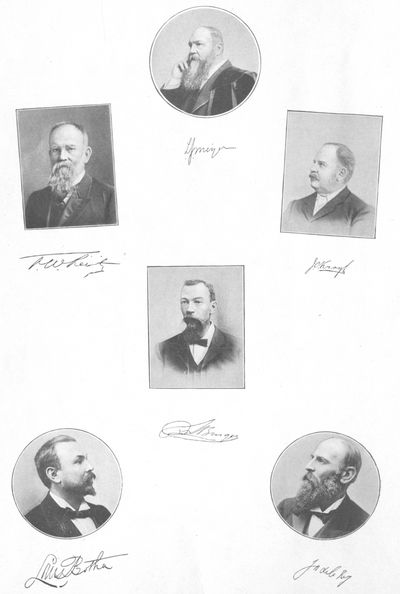
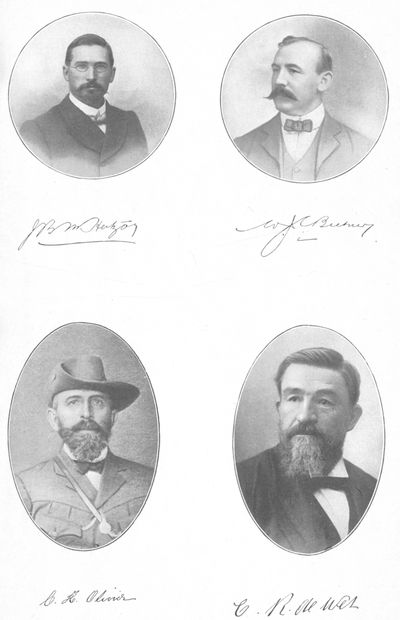
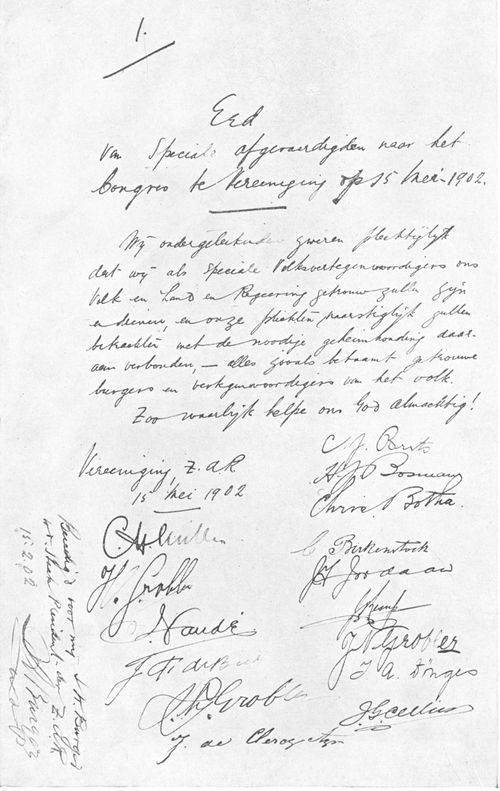
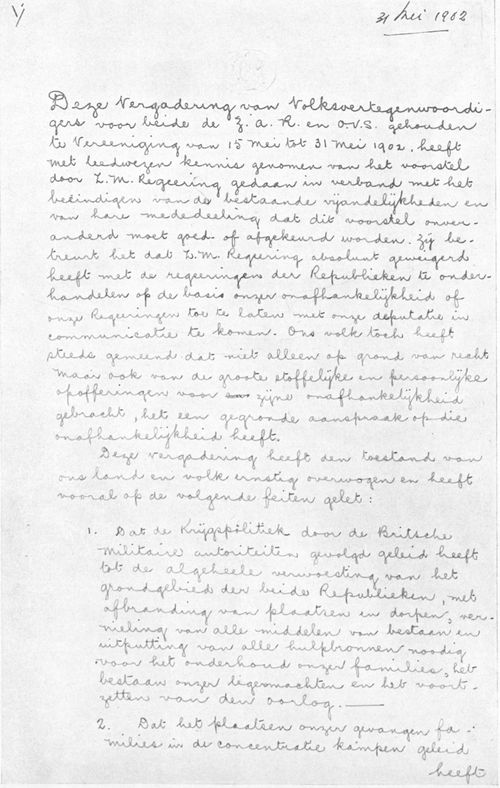
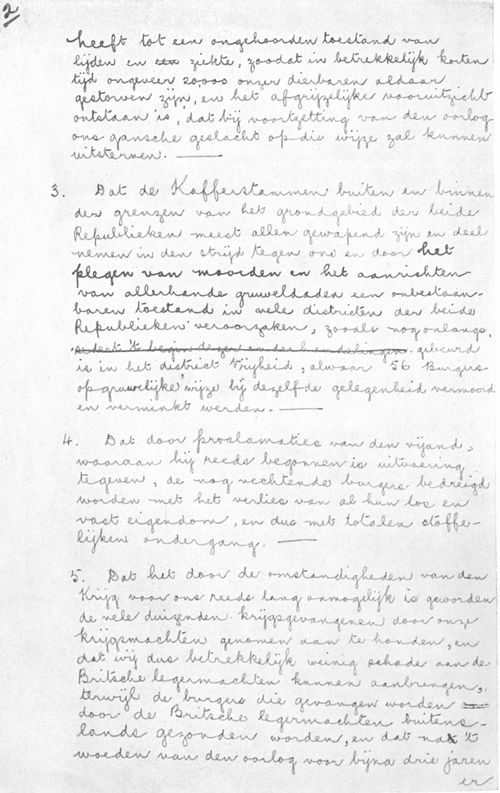
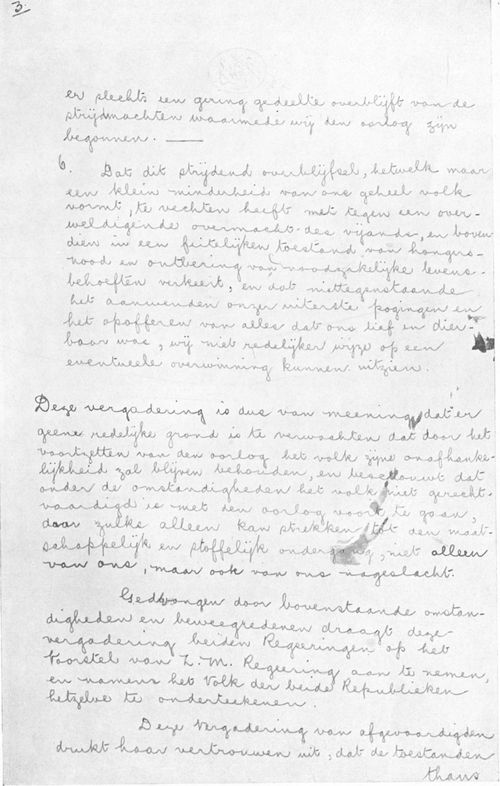
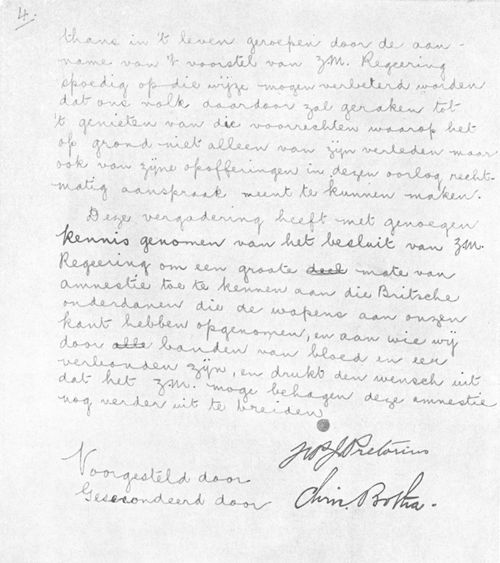
In response to wishes very generally expressed, an English translation of
"De Vredesonderhandelingen tusschen Boer en Brit in Zuid Afrika" (The
Peace Negotiations between Boer and Briton in South Africa) is now placed
before the Public.
Though the greatest care has been taken to ensure that the translation
conveys to the reader exactly what the Dutch original contains, the latter
remains the official record, from the Boer side, of the Peace
Negotiations. The translator accepts all responsibility for the English
translation.
In anticipation of any critical remarks that may be made, it is only due
to state that the addition to the English translation of a few facsimiles
of original documents and the few verbal improvements are by no means due
to a desire to differentiate between the publications in the two
languages, but are merely the improvements which, as every author knows,
suggests themselves and are rendered possible by the publication of a
later edition.
The Reader will not always find the translation of the speeches in
idiomatic English, but it may be pointed out that in most cases that
defect is due to the translator having aimed at preserving, as far as
possible the stamp of originality as it exists in the original.
Pretoria,
September, 1911.[Back to Contents]
Preliminary Correspondence.
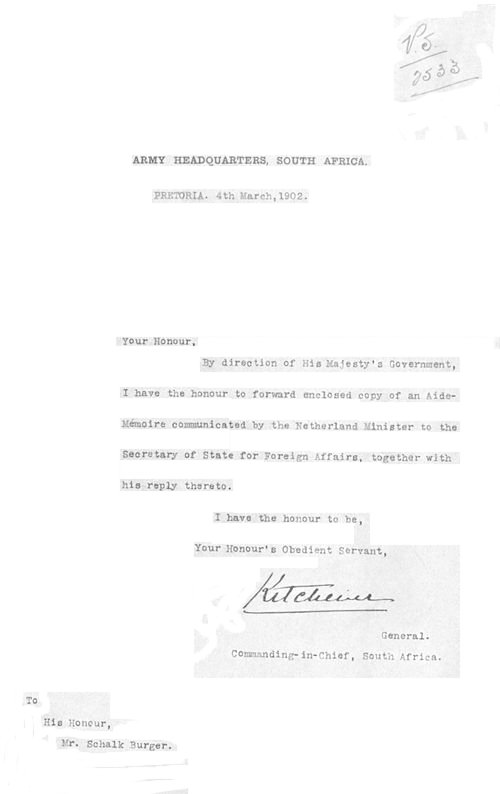
Army Headquarters, South Africa.
Pretoria,
March 4, 1902.
Your Honour,
By direction of His Majesty's Government, I have the honour to
forward enclosed copy of an Aide-Mémoire communicated by the
Netherlands Minister to the Secretary of State for Foreign
Affairs, together with his reply thereto.
I have the honour to be,
Your Honour's obedient servant,
Kitchener, General,
Commanding-in-Chief, South Africa.
To His Honour, Mr. Schalk Burger.
Aide-Mémoire communicated by the Netherlands Minister, January 25, 1902:—
1. It is the opinion of the Government of Her Majesty the Queen that the
exceptional circumstances in which one of the belligerent
parties in South Africa is situated, which prevents it from placing itself
in communication with the other party by direct means, constitutes one of
the causes for the continuance of this war, which continuously without
interruption or termination harasses that country, and which is the cause
of so much misery.
2. The circumstances are indeed exceptional, where one of the belligerent
parties is entirely enclosed and isolated from the rest of the world; and
where the representatives of the Boers in Europe are precluded from all
communication with their Generals. This state of affairs has called into
existence the difficulty that those in authority, who ought to negotiate
in the interests of the Boers, are divided in two, and deprived of all
means of deliberating with each other. It is plain that the Boer Delegates
in Europe can do nothing because they are not acquainted with the
condition of affairs in Africa, and that the Boers, who are under arms,
must refrain from taking the initiative because they are not informed on
the condition of affairs in Europe.
3. Further, the Delegates in Europe are tied by their credentials, which
were issued in March, 1900, and which bind them so closely to the
independence of the Republics, that they would not be warranted even to
accept the restoration of the status quo ante bellum, if the method (of
settling) the differences, which might arise, was not at the same time
arranged.
4. These circumstances cause the question to arise whether an offer of
good services could not be made by a neutral Power with the object of at
least making it possible to open the way to negotiation, which could
otherwise not be begun.
5. For these reasons it would be of importance to know whether it would be
agreeable to the Government of His Britannic Majesty to make use of the
good services of a neutral Power, if these good services would confine
themselves to the task of bringing the negotiators appointed by both
parties into communication with each other.
6. Perhaps the Government of Her Majesty the Queen could be
considered as indicated to fulfil this task, because the Delegates of the
Boers are on Netherland's ground and are accredited only to this
Government.
7. If the Government of His Britannic Majesty concurs with this idea,
there would be ground for the Government of Her Majesty the Queen to
approach the Delegates of the Boers with the question whether they would
undertake to proceed to Africa with the object of conferring with the
heads of the Boers there, to return to Europe, after staying a limited
time (say a fortnight), invested with authority making provision for every
possible event, and giving them power to conclude a Treaty of Peace, which
would be inviolably binding on the Boers in Europe as well as on the Boers
in Africa.
8. In case of an answer in the affirmative, it would be necessary for the
Government of His Britannic Majesty to give the Government of the
Netherlands three safe-conducts, allowing the Boer Delegates to proceed
free to South Africa, to remain there free for the stipulated time, and to
return free to Europe. Further, it would be necessary that the British
Government allow the use of a telegraphic code to indicate the place where
the said Delegates could meet the Leaders of the Boers.
9. After their return the Government of Her Majesty the Queen would place
them in communication with the Plenipotentiaries designated for that
purpose by the Government of His Britannic Majesty, and voluntarily
undertake to place at the disposal of these gentlemen all that is
necessary for their meeting.
10. The Government of Her Majesty would then consider its task as
completed.
11. It is very clear that, in spite of everything, the negotiations thus
commenced might lead to nothing; but the possibility of the contrary is by
no means excluded; and under the circumstances it appears to be desirable
to try to open negotiations in the hope that they will bear fruit. And
with the difficulty in view which exists for all belligerent parties to
take the first step in this direction, it might be useful that a
third party undertook to do so, and offered itself as mediator.
Confidential.
The Marquis of Lansdowne to Baron Gericke.
Foreign Office,
January 29, 1902.
Sir,
You were good enough to lay before me on the 29th instant a
communication from the Netherlands Government, in which it was
proposed that, with the object of bringing the war to an end, His
Majesty's Government might grant a safe conduct to the Boer
Delegates now in Holland for the purpose of enabling them to
confer with the Boer Leaders in South Africa. It is suggested
that after the conference the Delegates might return to Europe
with power to conclude a Treaty of Peace with this country, and
the Netherlands Government intimate, in this event, they might at
a later stage be instrumental in placing the Boer
Plenipotentiaries in relation with the Plenipotentiaries who
might be appointed by His Majesty's Government.
The Netherlands Government intimate that if this project commends
itself to His Majesty's Government, they will inquire of the
Delegates whether they are prepared to make the suggested visit
to South Africa.
It may therefore be inferred that the communication which I
received from you was made on the responsibility of the
Netherlands Government alone, and without authority from the Boer
Delegates or Leaders. His Majesty's Government have given it
their best consideration, and whilst they entirely appreciate the
motives of humanity which have led the Netherlands Government to
make this proposal, they feel that they must adhere to the
decision adopted and publicly announced by them some
months after the commencement of hostilities by the Boers, that
it is not their intention to accept the intervention of any
foreign Power in the South African war.
Should the Boer Delegates themselves desire to lay a request for
safe conduct before His Majesty's Government, there is no reason
why they should not do so. But His Majesty's Government are
obviously not in a position to express an opinion on any such
application until they have received it, and are aware of its
precise nature and the grounds on which the request is made.
I may, however, point out that it is not at present clear to His
Majesty's Government that the Delegates retain any influence over
the Representatives of the Boers in South Africa or have any
voice in their councils. They are stated by the Netherlands
Government to have no letters of credence or instructions later
in date than March, 1900. His Majesty's Government had, on the
other hand, understood that all powers of Government, including
those of negotiation, were now completely vested in Mr. Steyn for
the Boers in the Orange River Colony, and Mr. Schalk Burger for
those in the Transvaal.
If this be so, it is evident that the quickest and most
satisfactory means of arranging a settlement would be by direct
communication between the Leaders of the Boer forces in South
Africa and the Commander-in-Chief of His Majesty's forces, who
has already been instructed to forward immediately any offers he
may receive for the consideration of His Majesty's Government.
In these circumstances His Majesty's Government have decided
that, if the Boer Leaders should desire to enter into
negotiations for the purpose of bringing the war to an end, these
negotiations must take place not in Europe, but in South Africa.
It should, moreover, be borne in mind that, if the Boer Delegates
are to occupy time in visiting South Africa, in consulting with
the Boer Leaders in the field, and in returning to Europe for the
purpose of making known the result of their errand, a period
of at least three months would elapse, during which
hostilities would be prolonged, and much human suffering, perhaps
needlessly, occasioned.
I have, &c.,
(Signed) Lansdowne.
To this letter Acting-President Schalk W. Burger, with the advice and
consent of the Executive Council, replied as follows:—
To His Excellency Lord Kitchener, Commander-in-Chief of the
British Troops, Pretoria.
Government Lager,
In the Veld, S.A.R.,
March 10, 1902.
Your Excellency,
I have the honour to acknowledge the receipt of Your Excellency's
letter dated the 4th inst., and to thank you for the transmission
of the therein enclosed Confidential Memoranda exchanged between
the Netherlands Minister and the Marquis of Lansdowne.
With reference to this communication, I have to say that I am
desirous and prepared to make peace proposals, but, in order to
be able to decide upon the terms thereof, it is indispensable
that I should meet His Honour President Steyn, to enable us to
make a proposal jointly, and, to expedite matters, I therefore
respectfully request Your Excellency to give me and the Members
of my Government a safe conduct through Your Excellency's lines
to His Honour President Steyn and back.
I have the honour to be,
Your Excellency's obedient servant,
S. W. Burger,
Acting State President.
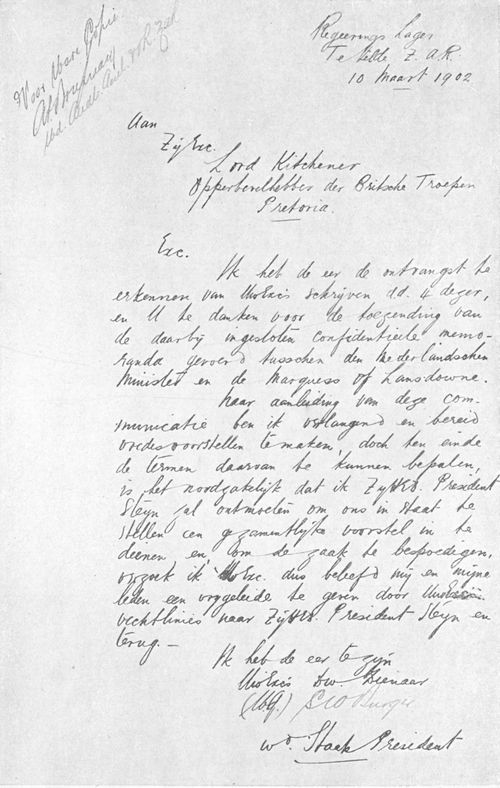
Facsimile of the copy of the reply from the Government of
the South African Republic to Lord Kitchener's letter dated 4th March,
1902.
In reply to this letter Acting State President Burger received
the following communication:—
Pretoria,
March 13, 1902.
Your Honour,
I beg to acknowledge the receipt of Your Honour's letter of the
10th March, and to inform Your Honour that I shall be pleased to
allow the safe conduct you ask for.
I shall be obliged if Your Honour would inform me of the number
you propose to bring with you, and that you will send in to
Balmoral a day in advance, so that an officer whom I shall
designate for the purpose may meet Your Honour and see that all
proper arrangements are made for your reception.
I shall order my troops immediately to withdraw from the
neighbourhood in which Your Honour now is, and inform them of the
safe conduct that is hereby given to Your Honour.
I have the honour to be,
Your Honour's obedient servant,
Kitchener, General,
Commanding-in-Chief South Africa.
To His Honour, Mr. S. W. Burger.
Before making use of the opportunity thus obtained of meeting President
Steyn, the Government of the South African Republic considered it
necessary to ascertain where President Steyn with his Government was, so
that he might be informed that the Transvaal Government, under safe
conduct from Lord Kitchener, was en route to meet him and his
Government. In the following letter Acting-President Burger requested Lord
Kitchener to transmit the following telegram to President Steyn:—
To His Excellency Lord Kitchener, Commander-in-Chief of the
British Troops, Pretoria.
Government Lager,
In the Veld, S.A.R.,
March 17, 1902.
Your Excellency,
I have the honour to acknowledge the receipt of Your Excellency's
letter of the 13th inst.
I thank Your Excellency for consenting to our travelling through
Your Excellency's lines, and also for the order given to your
troops to immediately withdraw from the neighbourhood where I at
present am, and for the notice given them of the safe conduct
extended to us.
In order to obviate delay I respectfully request Your Excellency
to transmit the enclosed telegram to President Steyn, and to put
me in possession of His Honour's reply thereto, on receipt of
which I shall immediately inform Your Excellency a day in
advance, as requested by you, of the time when we shall arrive at
Balmoral.
Pending the receipt of Your Excellency's reply we shall remain at
Roodepoort, near Rhenosterkop.
I have the honour to be,
Your Excellency's obedient servant,
S. W. Burger,
Acting State President.
Telegram.
From S. W. Burger,
Acting State President,
Rhenosterkop, distr. Pretoria.
To His Honour President Steyn,
In the Veld.
With reference to confidential Memoranda exchanged between the
Netherlands Minister and Lord Lansdowne, which correspondence
was kindly sent to me by His Excellency Lord Kitchener,
I with the members of my Government, wish to proceed to meet you.
For that purpose a safe conduct has been granted to us by Lord
Kitchener. Be so good as to inform me as soon as possible where
and when such meeting can take place.
To this the following reply was received by Acting-President Burger:—
Army Headquarters, South Africa.
Pretoria,
March 18, 1902.
Your Honour,
I am placed in some difficulty by the receipt of Your Honour's
dispatch enclosing a telegram which you request me to forward to
His Honour Mr. Steyn.
Owing to recent military operations in the country South of the
Vaal and East of the Railway, His Honour Mr. Steyn, with a
following estimated at about Thirty Burghers, has left that
district, and was last reported travelling in the vicinity of
Bothaville. It is therefore not easy for me to communicate with
him, especially as he does not at present make a prolonged stay
in any one part of the country. For this reason I venture to
suggest, for Your Honour's consideration, that it might save
time, if you came now to Balmoral, where a special train would be
placed at Your Honour's disposal. You might then travel to the
neighbourhood of Kroonstad, where my Officers would give you
every assistance to go out and meet His Honour Mr. Steyn,
according to the latest information.
It will be understood that the safe conduct I had the pleasure of
forwarding to Your Honour was for a definite purpose of passing
my lines to meet Mr. Steyn, and will have to be renewed
if any delay takes place in taking advantage of it.
I have the honour to be,
Your Honour's obedient servant,
Kitchener, General,
Commanding-in-Chief, South Africa.
His Honour Mr. Schalk Burger.
The Transvaal Government then wrote to Lord Kitchener as follows:—
To His Excellency Lord Kitchener, Commander-in-Chief of the
British Troops, Pretoria.
Roodepoort, Near Rhenosterkop,
Dist. Pretoria, S.A.R.,
March 20, 1902.
Your Excellency,
I acknowledge the receipt of Your Excellency's communication
dated the 18th inst., and have the honour to inform you in reply
that we shall arrive at Balmoral on Saturday morning the 22nd
inst., at 10 o'clock, to avail ourselves of Your Excellency's
kind offer to allow us to travel to Kroonstad by rail, and to
assist us from there to meet His Honour President Steyn.
I shall be accompanied to Kroonstad by five gentlemen, four white
attendants, and one native servant. Furthermore we shall be
escorted to Balmoral by some men who will take our vehicles and
horses back from there.
I also wish to inform Your Excellency that my guard is still
here, where it will remain until our return.
I have the honour to be,
Your Excellency's obedient servant,
S. W. Burger,
Acting State President.
At this stage of the negotiations an express messenger was
despatched to Commandant General Louis Botha, who was then in the
South-Eastern districts of the South African Republic, to acquaint him
with the decision of the Government, and with the correspondence with Lord
Kitchener (of which copies were sent to him). Unfortunately, as it
appeared later, the despatch rider did not reach General Botha.
On the morning of March 22nd, 1902, at ten o'clock the Members of the
Executive Council, consisting of Acting State President S. W. Burger,
State Secretary F. W. Reitz, and Messrs. L. J. Meyer and J. C. Krogh,
arrived at Balmoral Station. The Executive Council was also accompanied by
Mr. L. J. Jacobsz, Assistant State Attorney, and Mr. D. van Velden,
Secretary of the Executive Council (the latter had arrived at Balmoral the
previous day with the despatch of March 20th, 1902.)
When they approached the Station, Captain Marker, A.D.C. to Lord
Kitchener, Major Leggett, who was connected with the Imperial Military
Railways, and Captain Baird of the Intelligence Department, rode out to
meet them. At 12 o'clock they left by special train for Kroonstad. There
was an hour's delay at Pretoria while another train was being prepared.
During this delay the Executive Council paid a visit to Lord Kitchener at
his request. After that the journey was continued, and Kroonstad reached
in the night.
On the following morning two despatch riders, Robberts and Hattingh, who
had been brought with the Executive Council for that purpose, were sent
out to find President Steyn. They took with them the following letter with
annexures, consisting of copies of the letter of Lord Kitchener, dated
March 4th, 1902, and the above-mentioned correspondence between the
Netherlands and British Governments, which had been forwarded to Acting
President Burger.
His Honour M. T. Steyn, State President, O.F.S., in
the Veld.
Kroonstad,
March 24, 1902.
Your Honour,
Herewith I send you copies of correspondence which has passed
between us and Lord Kitchener, as a result of which I, with the
Members of the Executive Council, have proceeded hither with the
object of meeting Your Honour.
We learn that Lord Kitchener has sent, or that he intended to
send, the same correspondence to Your Honour, but did not know
where to find you. His opinion was, that you were somewhere to
the west of the railway. I have therefore obtained a copy of the
communication intended for Your Honour and send this also
herewith.
We shall wait here until we learn where and when we can meet Your
Honour.
Will you let us have this information as soon as possible and by
the shortest way.
I have the honour to be,
Your Honour's obedient servant,
S. W. Burger,
Acting State President.
The despatch riders reached President Steyn on March 26th, and handed him
the correspondence. The President thereupon immediately sent a despatch to
General de Wet—who was at the moment on his way to General
Badenhorst—summoning him to attend the proposed meeting, and replied to
the Transvaal Government as follows:—
To His Honour S. W. Burger, Acting State President of
the S.A. Republic, Kroonstad.
President's Lager,
In the Veld,
March 28, 1902.
Your Honour,
I have the honour to acknowledge the receipt of Your Honour's
despatch of the 24th inst., enclosing correspondence between Your
Honour and His Excellency Lord Kitchener.
As I have been suffering from my eyes for six or seven weeks, and
since, as you know, almost all our doctors have been captured or
have left us, I was obliged to proceed to General de la Rey in
order to place myself here under the medical treatment of Dr. von
Rennenkampff.
I am still under that treatment and am therefore obliged to meet
Your Honour in the South African Republic.
I am prepared to meet Your Honour in the neighbourhood of
Klerksdorp or Potchefstroom, on any farm in that neighbourhood
which His Excellency Lord Kitchener may consider most suitable,
or even in one of those towns, if desirable. When fixing the
place of meeting, I wish to leave it to Your Honour to obtain a
guarantee from His Excellency Lord Kitchener for me and my
Government, with the necessary attendants, that we shall be
allowed quietly and unhindered to continue our work there for a
definite time, as well as a safe-conduct to proceed unhindered to
the place of meeting and to return thence unhindered.
I have the honour to be,
Your Honour's obedient servant,
M. T. Steyn,
State President, O.F.S.
On receipt of the above letter the Government addressed the
following communication to Lord Kitchener:—
To His Excellency Lord Kitchener, Commander-in-Chief of the
British Troops, Pretoria.
Kroonstad,
March 31, 1902.
Your Excellency,
Herewith I have the honour to send you copy of the letter this
day received by me from President Steyn.
With reference thereto I request your Excellency to be so good as
to furnish President Steyn with the safe-conduct desired by him,
and further to inform us as well as His Honour where, in your
opinion, the intended meeting can take place. Possibly
Potchefstroom would be the most suitable place therefor.
As His Honour the Commandant-General and General de la Rey are
both members of the Executive Council, I request Your Excellency
kindly to send them the enclosed message, and also to furnish
each of them with a safe-conduct to and from the place of
meeting.
I further take the liberty of requesting you to forward the
enclosed letter to President Steyn.
I have the honour to be,
Your Excellency's obedient servant,
S. W. Burger,
Acting State President.
The above-mentioned message to General Botha and to General de la Rey read
as follows:—
| From |
To |
Acting State President,
S.A.R. |
(1) Commandant General Louis Botha.
(2) General de la Rey. |
With reference to confidential memoranda exchanged between the
Netherlands Minister and Lord Lansdowne, which was sent to us by
His Excellency Lord Kitchener, we have come under a safe conduct
to meet President Steyn. This meeting will take place in
a locality to be decided upon by Lord Kitchener. As we
consider your presence necessary there, we have requested His
Excellency to furnish you also with a safe-conduct thither and
back.
Be so good as to come without delay on receipt hereof.
S. W. Burger,
Acting State President.
Kroonstad,
March 31, 1902.
The letter to President Steyn referred to above was as follows:—
To His Honour President Steyn.
Kroonstad,
March 31, 1902.
Your Honour,
Acknowledging the receipt of Your Honour's letter of the 28th
inst., I have, in pursuance of the desire therein expressed by
you, requested Lord Kitchener to furnish you with a safe-conduct
to such place as may be considered most suitable by His
Excellency for the proposed meeting between us.
I have the honour to be,
Your Honour's obedient servant,
S. W. Burger,
Acting State President, S.A.R.
On April 1st, 1902, Lord Kitchener wrote as follows to Acting State
President Burger:
Army Headquarters, South Africa.
Pretoria,
April 1, 1902.
Your Honour,
The letters and safe-conducts Your Honour has requested me to
send out to Mr. Steyn, Commandant General L. Botha, and General
de la Rey will be forwarded at once. I consider
Klerksdorp would be the best place for your meeting with these
gentlemen.
I have the honour to be,
Your Honour's obedient servant,
Kitchener, General,
Commanding-in-Chief, South Africa.
To His Honour Mr. S. W. Burger.
The following letter was forwarded by Lord Kitchener to President Steyn:—
Army Headquarters, South Africa.
Pretoria,
April 1, 1902.
Your Honour,
At the request of His Honour Mr. S. W. Burger, I beg to forward
the enclosed letter, and at the same time to provide you with
this a safe-conduct for Your Honour and your Executive to come to
Klerksdorp and to return thence after your meeting with Mr.
Burger and the Transvaal Government.
I have the honour to be,
Your Honour's obedient servant,
Kitchener, General,
Commanding-in-chief, South Africa.
His Honour Mr. M. T. Steyn.
President Steyn then addressed the following letter to Acting President
Burger:—
To His Honour the Acting State President, S.A.R., S. W. Burger,
Klerksdorp.
President's Lager,
In the Veld,
April 7, 1902.
Your Honour,
I have the honour to acknowledge the receipt of Your Honour's
letter, d.d. March 31st, 1902, with the safe-conduct
from Lord Kitchener, to whom I have replied direct.
I hope to be at Klerksdorp on Wednesday, the 9th inst., if not
prevented, with General de la Rey and my Executive Council.
I have the honour to be,
Your Honour's obedient servant,
M. T. Steyn,
State President, O.F.S.[Back to Contents]
Proceedings at Klerksdorp.
On April 6th the Government of the South African Republic left Kroonstad
by rail, and arrived at Klerksdorp the next day, where they received the
letter from President Steyn, mentioned above, as well as the following
from General de la Rey:—
In the Veld,
April 7, 1902.
His Honour The Acting State President, S.A.R., Klerksdorp.
Your Honour,
I have the honour to acknowledge the receipt of Your Honour's
telegram forwarded to me by His Excellency Lord Kitchener. I
leave to-day with His Honour President Steyn for Klerksdorp, and
hope, D.V., to arrive there on Wednesday next.
I have the honour to be, &c.,
J. H. de la Rey,
Asst. Commandant General.
On the evening of April 7th Commandant General L. Botha also arrived at
Klerksdorp.
President Steyn, accompanied by his Executive Council and by General de la
Rey, left the farm Weltevreden on April 7th, and arrived at Klerksdorp at
12 o'clock on April 9th.
The British authorities gave accommodation to the Free State
Government in the Old Town, while the Transvaal Government was
accommodated in the New Town.
The first meeting between the two Governments took place on Wednesday
afternoon, April 9th, at three o'clock, in a large tent which had been
pitched for that purpose some little distance out of the town.
There were present, representing the South African Republic:—
- The Acting State President, S. W. Burger.
- The State Secretary, F. W. Reitz.
- The Commandant General, Louis Botha.
- General de la Rey.
- Mr. L. J. Meyer.
- Mr. J. C. Krogh.
Also Mr. L. J. Jacobsz, Asst. State Attorney; Mr. N. J. de Wet, Military
Secretary of the Commandant General; Mr. I. S. Ferrerra, Military
Secretary of General de la Rey, and Mr. D. van Velden, Secretary of the
Executive Council.
Representing the Orange Free State:—
- President M. T. Steyn.
- Chief Commandant C. R. de Wet.
- General J. B. M. Hertzog.
- General C. H. Olivier.
- Acting Government Secretary W. J. C. Brebner.
Further: Revd. J. D. Kestell, Acting Secretary of the Executive Council,
and Mr. B. J. du Plessis, Private Secretary to President Steyn.
The Acting State President of the South African Republic was elected
Chairman.
After the meeting had been opened with prayer, the Chairman spoke as
follows:—
As you are aware, we have for some time been desirous of meeting
one another. The correspondence between the Netherlands Minister and Lord
Lansdowne was sent us by Lord Kitchener, under instructions from his
Government. I consider the transmission by the British Government of this
correspondence as an invitation from England to the two Republics to
discuss the question of peace. Having placed this interpretation upon
England's action, I requested a safe-conduct from Lord Kitchener, in order
to be enabled to meet the President and Government of the Orange Free
State. These circumstances suggested to us that the opportune time to meet
one another had arrived. When we see another Government trying to do
something for us, I think that we ought to make use thereof. It was
impossible for us to meet the Free State Government in another way, and
though it was hard for us to make use of the enemy, our cause is of too
great importance for us to consider that. I regret that we had to remain
at Kroonstad for such a long time. This was certainly not desirable.
Faithful, however, to our compact, we can do nothing without the Orange
Free State. I considered that it was time for us, the Leaders of the
People, to meet each other and discuss matters fully, with our eyes fixed
on God. We must face our condition as it really is. Our object is to make
a proposal for the restoration of peace. The terms of such a proposal must
be discussed by us. If we had not availed ourselves of this opportunity, I
would not have been able to justify my actions to the People. I believe
all will agree with me that it has become necessary for us to take such a
step.
The Meeting then desired to have a brief review from the three Generals of
the conditions in their respective districts.
The Commandant General of the South African Republic said, that after the
fight at Bakenlaagte the enemy proceeded against him with eighteen
columns. Almost all the cattle in his District was taken. By the building
of block houses the space on the High Veld was limited very much. The
lines of block houses were only about three or four hours' ride from each
other. He had to leave the High Veld to try to lead the enemy
away, and proceeded to the Vryheid district. He explained how the block
house lines on the High Veld ran. In the course of their last operations
the enemy captured about 1,000 men on the High Veld, of which the half
were good men. The speaker then enumerated the numerical strength of his
commandos. He had eight commandos under him, numbering 5,200 men. Food, he
said further, was scarce. There was hardly a sheep to be seen in his
division, and in one district, which he mentioned, there were only 20 head
of cattle. In some other districts conditions were more favourable, and
they could not complain of want. There were no mealies whatever, except
what was standing in the fields. The question of horses also caused
anxiety. Four hundred of his men went on foot. He concluded by bringing to
the notice of the Governments the fact that Zulus had been armed against
him. The Swazies, with the exception of a small number, were well
disposed. On the whole the spirit of the burghers was good. Only here and
there could dejection be discerned.
Chief Commandant de Wet said that innumerable hostile forces had
continually operated against him during the last eight or ten months. He,
with his Government, were so surrounded by the enemy in the North-eastern
districts of the Free State, that they had to fight their way out. Seven
hundred burghers were then captured, but among them there were many
grey-beards, boys, and other men not capable of serving, so that the
number of serviceable burghers captured was not more than 250. As regards
cattle, if one compared the present condition with that before the war,
you would have to say, "There are no cattle." However, there were
sufficient for the burghers and families. In the Western and South-western
portions of the Free State almost all the burghers laid down their arms
when the great forces of the enemy marched through there for the first
time. The Commandos there were consequently very weak. They had enough
corn in those districts for a full year. Cattle, however, were so scarce
that bulls and rams were slaughtered. From the division where
General Brand commanded, the enemy at an earlier stage of the war removed
all cattle, but now they had large herds again and sufficient corn to last
for a year. In the South-eastern portion of the Free State matters were
much the same as in the South-western. In the districts of Boshof and
Hoopstad there were many sheep and cattle, and there was no want of
mealies. The numerical strength in the entire State amounted to 5,000 men,
and there were many burghers in the Cape Colony. The spirit of all the
burghers was splendid.
General de la Rey informed the meeting that he still had 2,000 men under
arms. By means of a line of block houses the enemy had divided the Western
districts, and thus made matters difficult for him. Zeerust and Rustenburg
were still intact. The approach to his food-districts was also hampered by
block houses, much to his detriment. There were between 1,800 and 2,000
men who fought. There were also others who had no horses. These he
concealed, and if a burgher fell or was wounded, one of them was brought
out to take his place. The burghers were also destitute of the necessary
clothes. Mealies were still abundant, and they had a fair number of
cattle, but at the present moment the British had all the mealie and
Kaffir-corn fields in their possession, and if they should cut these
fields off by a block house line, his food would be in their hands. With
reference to the Cape Colony, he had about 1,800 men there, and General de
Wet about 600. He saw a chance of still continuing the war.
The Members of the Transvaal Government then reported that they had met
General Kritzinger at Kroonstad. He had received permission from the
British to see President Steyn, and he had greatly regretted that the
President had not been there. With regard to the Cape Colony he had not
given a hopeful prospect to the Transvaal delegates. He stated that the
entire force there amounted to from 1,800 to 2,000 men. There was a great
want of horses, and the enemy made it impossible for the commandos
to get them, as not only horses and mules, but also donkeys were
taken possession of by the enemy. He also said that many Colonists had
laid down their arms.
To this President Steyn and General de Wet replied that at the time when
General Kritzinger made the above statements he was not competent to
express an opinion on the state of affairs in the Cape Colony from
personal observation, because after his rather protracted visit to the
Free State he had barely returned to the Cape Colony when he was captured
at Hanover, badly wounded.
The Meeting then proceeded to the discussion of the question whether they
would request a personal interview with Lord Kitchener, or make him a
proposal in writing.
President Steyn said that, as far as he was concerned, there was only one
condition upon which he could make peace, and that was: Independence. His
opinion was still the same as a year ago, and he saw nothing to make him
change. It was plain to him that the enemy continually climbed down from
the position they had taken up. If the enemy did not wish the Republics to
remain independent, the struggle must continue. This was what the burghers
also desired. Rather than make terms with the British he would submit
unconditionally to them for ever.
State Secretary Reitz said that to make terms and to give up the country
were two distinct matters. They should try to grasp the position in which
England stood. If England consented to the existence of the independence
of the Republics, she would be done for. For that reason it was probable
that England would not lend her ear to the two Republican Governments if
independence was immediately insisted upon. The question therefore was
whether terms could not be offered. The Republics were the weaker party,
and therefore they could make the offer. That would also be proof that
they were prepared to make peace. They should make a proposal of some kind
or other. The making of such a proposal did not signify that thereby their
independence was sacrificed, but that the question of
independence was not for the time being under discussion.
President Steyn was of opinion that the enemy should be compelled to state
what terms they were prepared to give.
Mr. Krogh thought that a conference with the British should first be
requested, but no proposals made for the present.
General de la Rey said that the Republics should make a proposal for the
restoration of peace, especially after what the Netherlands Government had
done. It could not be expected that the British would now make a peace
proposal.
The Acting State President of the South African Republic said the war had
done away with the Status quo ante bellum. Other proposals should
therefore be made. The question was: what proposals? If Lord Kitchener
agreed to a conference with them, he would ask: what do you propose? In
his opinion the two Governments should ask and concede as much as it was
in their power to do. To retain their independence, they should concede
something. It was better for them to make a proposal first. If the enemy
made the first proposal it would be much more difficult for them (the
Boers) to get some point or other conceded, than to obtain the alteration
of a proposal made from the Republican side. The matter should be
considered from all sides, and its seriousness, especially, should not be
lost sight of. If no change came, many of the burghers, forced by sheer
necessity, would go over to the enemy. Amongst the people there were
always the courageous and the disheartened. And the two elements were
still amongst them. A burgher who was with them to-day went to lay down
his arms to-morrow. The cause became weaker day by day. Every man who was
lost was gone, and his place could not be filled up. The question was
whether it was better to continue until the people were exterminated, man,
woman and child, than to try to come to terms. Or, on the other hand, to
continue until they obtained what they wanted, only to find that the
people were extirpated. For whose benefit would the struggle then have
been carried on? It should seriously be considered whether the
decision taken last year should be adhered to, or whether an attempt
should be made to obtain for the people what was possible to obtain. If
they must surrender unconditionally, the time should be fixed for doing
so, and not delayed till all were captured or killed. They should not be
lead away too much by their feelings. If he acted emotionally he would
say, "Continue." But they should use their heads.
After this the meeting adjourned to the following morning.
Thursday, April 10, 1902.
The meeting was resumed. General L. J. Meyer was the first speaker. He
said that if anyone intended to continue the struggle he would stand by
him, but they should first consider how great the responsibility was that
rested on the two Republican Governments. The principal matter that should
be taken into consideration was what is to the advantage of the people.
Unless a miracle occurred nothing could save the people. He knew what
their condition was as regarded food and ammunition. Their cause—whatever
might be said—had not improved since June, 1901, but had gone backward.
They should not shut their eyes to facts. The rebellion in the Cape Colony
was, after all, feeble, and the cause was not progressing there. Would it
not be possible to conclude a federal union with the two Colonies? An
offensive and defensive treaty? Friendship in trade? If all attempts in
these directions came to nothing, could they not be satisfied with an
"encumbered independence"? and if England did not want this, and refused
to concede anything, the time would have arrived for the matter to be laid
before the people.
Chief Commandant de Wet said he did not wish to boast when he said that
the enemy had concentrated their greatest forces against him, and that he
had at his disposal the smallest forces; but as far as he was
concerned there could be no mention of the surrender of their
independence. Their cause had progressed since last June. The places of
the burghers whom they lost in the Republics were filled by recruits in
the Cape Colony. He had sufficient food, clothes, and ammunition for more
than a year. Before he conceded an iota of their independence he would
allow himself to be banished for ever.
State Secretary Reitz asked whether they should not discuss some questions
first. Should they not, for example: (1) Request an armistice; (2) Try to
get into communication with their Deputation; (3) Make proposals in which
the following points were raised: (a) Customs Convention; (b) Postal
Union; (c) The Franchise; (d) Their Foreign Affairs; (e) Amnesty for
Colonial Burghers; (f) Their relation to other Powers; (g) The
Paramount Power of England, and (4) In order that they did not at once
repulse the British by using the word "Independence," would it not be
better to use another word instead, for instance, "Self-government"?
General Hertzog said that the Constitution of the Republics did not permit
the Governments to meddle with the independence. That was most severely
punishable under Roman-Dutch law. The Governments could not part with the
independence of the Republics without authority from the people. They
should request a conference with Lord Kitchener on the basis of their
independence. All they heard was from British sources, and they therefore
did not know what the true condition of affairs was. What assurance had
they that England was not willing to give them their independence, if she
could retain the Cape Colony?
General de la Rey also thought that they should demand their independence.
They should concede only what was forced from them.
General Hertzog, seconded by General Olivier, then submitted a draft
resolution to the meeting, which was referred to a committee consisting of
the two Presidents, the State Secretary, and General Hertzog.
After an adjournment the committee handed in a draft resolution,
which was accepted and dispatched to Lord Kitchener.
The resolution read as follows:—
Resolution passed at Klerksdorp by the Governments of the South African
Republic and the Orange Free State.
"The Governments of the South African Republic and the Orange Free State
having met with reference to the transmission to them of the
correspondence which passed in Europe between the Government of His
Majesty the King of England and the Government of Her Majesty the Queen of
the Netherlands concerning the desirability of giving the Governments of
these Republics an opportunity of communicating with their
plenipotentiaries in Europe, who still continue to enjoy the confidence of
both the Republics;
"Considering the spirit of reconciliation (rapprochement) which is
apparent on the part of the Government of His Britannic Majesty, as well
as to the desire therein expressed by Lord Lansdowne on behalf of his
Government to cause this struggle to come to an end;
"Are of opinion that this is a suitable time to again show their
willingness to do all in their power to terminate this war; and
"Consequently resolve to make certain proposals to Lord Kitchener as
representing the Government of His Britannic Majesty, which can serve as a
basis for further negotiations with the object of establishing the desired
peace;
"It is further the view of both these Governments that in order to
accelerate the attainment of the desired object, and to prevent
misunderstandings as much as possible, His Excellency Lord Kitchener be
requested to meet the two Republican Governments personally, at a time and
place to be appointed by him, in order to enable them to submit to him
direct peace proposals, which they are prepared to make, in order thus by
means of direct discussion and conference with him immediately
to solve all questions which may arise, and thereby to ensure that this
meeting shall bear the desired fruit."
This resolution was forwarded to Lord Kitchener under covering letter
signed by the two Presidents.
In the afternoon, after a general discussion, the same Committee was
appointed to make a draft of the points which could be conceded to the
British.
The meeting adjourned till the following morning.
April 11, 1902.
On meeting again the following morning, the Committee submitted the
following document:—
"Proceeding from the basis that they do not recognise the annexation, the
two Governments are prepared to conclude peace by conceding the following
matters:—
- 1. The concluding of a perpetual Treaty of friendship and peace,
including:—
- (a) Arrangements relative to a Customs Convention.
- (b) Post, Telegraph and Railway Union,
- (c) Fixing of the Franchise.
- 2. Dismantling of all State Forts.
- 3. Arbitration in all future differences between the contracting
parties, an equal number of arbitrators to be appointed by each
party from their subjects, with an umpire to be chosen by both
parties.
- 4. Equal educational rights for both the English and Dutch
languages.
- 5. Mutual amnesty.
Mr. Krogh asked whether the following could not be included in the
proposal:—"The conclusion of an offensive and defensive Treaty with
England."
President Steyn remarked that if they themselves offered to
conclude an offensive and defensive treaty with England, they would
thereby alienate all other nations from them. England would use such
proposal to kill all the sympathy other nations had for them.
The meeting did not consider it advisable to add anything to the proposal,
and accepted it as submitted by the Committee.
Mr. L. J. Jacobsz inquired whether, although it was plain that the
Governments were not competent to decide on questions touching the
independence of the Republics, they could not raise the point. If England
did not accept the proposal of the Republican Governments, and the matter
had to be laid before the people, it would be well if those Governments
knew what England was prepared to give instead of the independence. The
question should be thoroughly taken into serious consideration by their
Governments, because, in his opinion, matters had not improved, but become
worse since June, 1901.
General Hertzog was of opinion that the Republican outlook had improved
during the past year. As proof thereof he pointed to the good spirit that
prevailed amongst the burghers. They were determined to persevere. He also
pointed to the engagements that had taken place since June, 1901. Then it
had also been said that the cause was hopeless, and that no engagement of
any importance could still be fought. He also showed that they knew
nothing of the real condition of the enemy. The Republics being so shut
off made that impossible. They should bear in mind that the enemy also had
a hard time of it. England could not continue indefinitely to enlist
soldiers and to borrow money. He was not yet prepared to surrender his
independence.
Commandant General Botha said that they could not take it amiss in one
another if there was no unanimity of views. They had gathered together
confidentially, and should treat one another open-heartedly. There was
nothing that urged him personally to terminate the struggle. He could flee
about as well as anyone else, but when he considered the circumstances, he
was bound to say, "We are becoming weaker." They were being
forced out of those parts of the country which were the best for them, and
to which they had clung most tenaciously. He wished to prove from facts
that they had become weaker. In the Northern and South-eastern parts of
the Republic they had 9,570 men a year ago. Now they had there only 5,200
men, a reduction thus of 4,370 men. At their meeting on June 20th last
year he had said that they should throw the responsibility of the
continuance of the war more upon the people. They should then have said
plainly that only faith and perseverance could save them, and that there
was no other means of salvation. However, the majority of them had taken
another view. What he then specially relied upon was the Cape Colony, on
the strength of the reports that they received from there. Their reports
were to the effect that 2,000 burghers had risen in the Cape Colony. Now,
according to the statements of Generals de Wet and de la Rey, there were
about 600 of his (General Botha's) burghers and of the Free State burghers
together in the Cape Colony; altogether there were about 2,600 burghers
under arms there. There has therefore been no further rising during the
past year. He was firmly convinced that they could expect nothing from the
rebellion in the Cape Colony. The time for a big rising there was past. It
appeared that their men were scattered over that Colony in small groups,
and effected nothing. They had to live on those people who were well
disposed towards them (the Boers), and the result was that those people
were treated very harshly by the enemy, and would be compelled later to
assist the latter to drive those groups of rebels out of the country.
Already many Colonists had been hanged. Their cause was often compared to
that of the American Colonists, but it was not clear to him how that
comparison could be made. The enemy (the British) had about 40,000 men in
America, and America had more than one million inhabitants. She also had
the support of France, and a means of importing supplies. They (the Boers)
had no such means of importing what was necessary, and there was
no proper communication with the outside world. The forces of the enemy in
the country were much greater than the entire male population of the two
Republics. Their population had now been reduced to 15,000 or 16,000 men.
Had they grounds for saying that they with 15,000 men could achieve what
50,000 burghers could not do? They were becoming so weak that he was
afraid that they would afterwards no longer be considered a party that had
to be reckoned with. It was not impossible that they would afterwards be
declared rebels, and then a mutual murdering would take place. He did not
think that it could be expected of him to co-operate towards that end.
They could not speak of "right," because they knew from sad experience
that the stronger party did just what it wanted to. Their people were too
good to allow matters to proceed so far. Scheepers was already under the
sod, and whom must they shoot for him? Not an ordinary soldier, but an
officer, for only officers were equal to their burghers. If the enemy
continued to capture burghers as they had done during the last year, then
they would within a short time become too weak to effect anything. They
had indeed during the last year had such successful engagements that they
could hardly account for it themselves, but it was also equally true that
the best part of their country was being made uninhabitable for their
commandos. In the High Veld there was no more food for their people. They
could not bring food there either, because if wagons with provisions were
sent thither the enemy captured the greater part of them. He had already
informed his Government and General de la Rey that he would be obliged to
give up certain portions of the country, and they would have to discuss
whither the commandos of those parts had to go.
How must this war end? Must they wait until everyone had been captured? or
should they, for the sake of their people, adopt another course? His
Government, his officers, and he himself, could say: "Let the enemy carry
out their proclamations concerning us. We have nothing more to
lose. We have fought for nothing else than our country, and wish to have
that back or nothing else. Banish us, banish the Government." But then,
what about the People? The People could not be banished. Was there now not
still a chance to save something for the People? He considered this point
worthy of consideration. For their Leaders he thought it would be easier
to continue till they died a manly death, or till they were banished to
far-off islands, than to submit to the yoke of the enemy; but they had a
duty towards the People.
The State Secretary thought it would be best for the People themselves to
elect persons to make their views clear to the Government.
At this juncture a telegram was received from Lord Kitchener stating that
he was prepared to have a personal interview with the two Republican
Governments, and requesting them to come to Pretoria that same evening.[Back to Contents]
First Negotiations at Pretoria.
Early the next morning, Saturday, April 12th, 1902, the two Republican
Governments, travelling in separate trains, arrived at Pretoria, and at
nine o'clock a meeting with Lord Kitchener took place in his house.
Lord Kitchener expressed the desire that they should first confer
informally, and that the Secretaries should withdraw.
The Secretaries then left the chamber, and therefore the discussion that
ensued between Lord Kitchener and the Governments cannot be communicated
officially.
However, we publish the following report, embracing what took place at the
interview on April 12th, 1902, with Lord Kitchener, and at the interview
with Lord Kitchener and Lord Milner on April 14th and following days,
which was taken down by the Rev. J. D. Kestell immediately afterwards, as
communicated to him by General Hertzog. The report was immediately revised
by President Steyn and by the Government Secretary, Mr. W. J. C. Brebner.
This report can therefore be considered as secondary evidence of great
value.
After a few everyday observations, President Steyn remarked that Lord
Kitchener might begin.
Thereupon Lord Kitchener began. He spoke in the tone of a person who had a
grievance. He wished, he said, to say something concerning what he had
been reported as having said in February, 1901, when he negotiated with
General Louis Botha. In connection with those negotiations, he declared
that he had been misrepresented, wrong motives having been
imputed to him. It had been said, for instance, that he had aimed at the
destruction of the Boers. He could, however, assure them that no such
thing had ever been his intention. Those who said so grossly
misrepresented him. (Whether what he said was aimed at General Botha,
nobody can say—he mentioned no names. He spoke, however, in the tone of a
person who considered that he had been unfairly treated.) "But," he
suddenly said, "that is past. I only say this because no official minutes
are being kept, everything must take place here informally and in a
friendly manner ... I understand that you have something to propose. You
can do so now."
Acting President S. W. Burger then introduced the question. He said that
both the Governments had drawn up a proposal at Klerksdorp, and then
proceeded to read the proposal, article by article.
(State-Secretary F. W. Reitz acted as interpreter between the two
parties.)
Then President Steyn spoke. He thanked Lord Kitchener for the readiness
with which he had consented to meet the Governments, and assured him that
they were earnestly desirous that the war should cease. He also wished, he
said, to make an explanation, and this was with respect to a
misunderstanding which the British Government was apparently labouring
under in regard to the position of the Deputation in Europe in relation to
the Leaders of the burghers in South Africa. From the correspondence of
Lord Lansdowne with the Netherlands Government, it seemed as if the
Government of His Britannic Majesty were in doubt as to whether the
Deputation in Europe still represented the Boers in the field. That they
still represented the Boers President Steyn declared was most certainly
the case. They still enjoyed the fullest confidence of both Governments.
Coming to the matter at issue, the President said that the Governments and
the People were very desirous that Peace should be restored. But the Peace
that was to be restored should be a lasting one, and that was
the reason for the proposals being of the nature submitted by the
Governments. They had come there to attain no other object than that for
which the People had fought until this moment.
Here Lord Kitchener interrupted President Steyn with a question which
seemed to express great astonishment. He drew up his shoulders, threw his
head forward to one side, and asked, "Must I understand from what you say
that you wish to retain your Independence?"
President Steyn: Yes, the people must not be reduced to such a condition
as to lose their self-respect, and be placed in such a position that they
will feel themselves humiliated in the eyes of the British.
Lord Kitchener: But that could not be; it is impossible for a people that
has fought as the Boers have done to lose their self-respect; and it is
just as impossible for Englishmen to regard them with contempt. What I
would advise you is, that you submit to the British flag, and now take
advantage of the opportunity to obtain the best terms as regards
self-government and other matters.
President Steyn: I would like to know from Your Excellency what sort of
self-government it would be? Would it be like that of the Cape Colony?
Lord Kitchener: Yes, precisely so.
President Steyn: I thank Your Excellency. I put the question merely for
information.
Lord Kitchener then proceeded to say that one should bear in mind the case
of the British Colonies. "The Colonies," he said, "were proud of their own
nationality. If anyone, for instance, asked a Colonist in Australia
whether he was an Englishman, then his answer would be, 'No, I am an
Australian.' And yet such a man felt himself to be one with the British
nation, and was proud to call himself a British subject."
President Steyn then said that this comparison would not hold. In the case
of British Colonies one had to do with communities which from
the beginning had grown up under the British flag, with all the
limitations attached thereto. These Colonies had not possessed anything
which they had had to surrender, and having had nothing to lose they could
have nothing to complain of. In the case of the Boers it was quite
different. The Africanders in the two Republics were an independent
people. And if that independence were taken away from them they would
immediately feel themselves humiliated, and a grievance would arise which
would necessarily lead to a situation similar to that now existing in
Ireland, which situation was mainly due to the fact that Ireland was a
conquered country.
Lord Kitchener replied that Ireland could not serve as a parallel, seeing
that it had never had self-government.
To this President Steyn replied that the Irish had self-government, and
that in a measure that had never yet been granted to any Colony, seeing
that they were represented in the Imperial Parliament. Their power also in
this respect was so great that the Irish vote, under a strong man like
Parnell, could turn the scale in a Parliamentary question one way or
another.
Lord Kitchener then said that he was himself an Irishman, and therefore
better able to judge in regard to Irish affairs. He proceeded to say that
what was contemplated by the British Government was self-government for
the Boers, preceded by military rule for a certain period; that this
military rule as a preliminary measure was indispensable at the
commencement of Peace for the establishment and maintenance of law and
order; that as soon as this period had elapsed self-government would be
substituted for it, and that then the Boers could annul any measure or law
made by the military authorities. He remarked, however, that he felt sure
that much that was good would be introduced by the military government,
which they would not desire afterwards to rescind. But the People would
have it in their power to decide in every case.
A desultory discussion followed now, and Lord Kitchener urged
that the Governments should make a proposal in accordance with what he had
suggested; and both the Presidents replied that the Governments, according
to the constitutions of the Republics, were not qualified to make any
proposals whereby the Independence of the Republics would be touched.
When Lord Kitchener saw that he could make no progress he moved about
impatiently in his chair, and said, again with the same gesture as before:
that if the Governments wished he would telegraph their proposal to his
Government, but he could surmise—he did not know officially what they
would do in England—what he said was merely his own opinion—but he could
surmise what the answer would be.
The Presidents then expressed their desire that Lord Kitchener should
transmit the proposal that had been made by them; but the latter thought
that it was not desirable to communicate it in the form in which it had
been laid before him. He thought it could be drafted in a more acceptable
form. Thereupon he took a pencil and roughly drafted the preamble of a
cablegram. He read it aloud, and asked whether anybody wished to make any
remark upon it, in order to make the cablegram still more acceptable, and
whether they wished to appoint anyone for this purpose. Mr. Reitz was
nominated, and the preamble of Lord Kitchener, with the points of the
proposal (modified, as will be observed), was thus drawn up, approved of
by all, and, on the adjournment of the meeting, transmitted to the British
Government.
The telegram read as follows:—
From Lord Kitchener To Secretary of State.
Pretoria,
April 12, 1902.
"... The Boer Representatives wish to lay before His Majesty's
Government that they have an earnest desire for peace, and that
they have consequently decided to ask the British Government to
end hostilities and to enter into an agreement of peace
with them. They are prepared to enter into an agreement by which,
in their opinion, all future wars between them and the British
Government in South Africa will be prevented. They consider this
object may be attained by providing for the following points:—
- 1. Franchise.
- 2. Equal rights for Dutch and English languages in
educational matters.
- 3. Customs Union.
- 4. Dismantling of all forts in Transvaal and Free State.
- 5. Post, Telegraph, and Railway Union.
- 6. Arbitration in case of future differences, and only
subjects of the parties to be the arbitrators.
- 7. Mutual amnesty.
... But if these terms are not satisfactory, they desire to know
what terms the British Government would give them in order to
secure the end they all desire."
After this conversation with Lord Kitchener the two Republican Governments
consulted with each other, and agreed that when they again met the
representative of the British Government they would very clearly declare
their standpoint, namely, that in the matter of Independence it was the
People alone that could constitutionally decide.
Early on Monday morning, April 14th, Lord Kitchener sent to the members of
both Governments a copy of the following cablegram which he had received
from his Government. He also stated that Lord Milner would take part with
him in the conference.
The cablegram was as follows:—
From Secretary of State To Lord Kitchener.
London,
April 13, 1902.
"... His Majesty's Government sincerely share the earnest desire
of the Boer Representatives, and hope that the present
negotiations may lead to that result. But they have already
stated in the clearest terms, and must repeat, that they cannot
entertain any proposals which are based on the continued
Independence of the former Republics which have been formally
annexed to the British Crown. It would be well for you and Milner
to interview Boer Representatives and explain this. You should
encourage them to put forward fresh proposals, excluding
Independence, which we shall be glad to receive."
At ten o'clock the members of the two Republican Governments again
assembled in Lord Kitchener's house.
Lord Milner entered the room after the members of the Governments had
assembled, and was introduced to them by Lord Kitchener. He (Lord Milner)
greeted the Presidents as "Mr. Steyn and Mr. Burger." But later, during
the conference, he addressed each (was it inadvertently?) as "President."
Before the conference was continued, Lord Milner spoke a few words. He
also wished to remove erroneous impressions. He declared that it had been
alleged that he was not well disposed towards the Boers. That was
incorrect. He could give the assurance that he wished to promote the
interest of the Boers; and that he, like themselves, desired peace.
Thereupon Lord Kitchener laid on the table the cablegram, dated April
13th, from the British Government. Without entering into discussion on it,
the President pointed out that it was impossible for the Republican
Governments to act in accordance with the desire of the British
Government, seeing that, as had already been said on Saturday, they were
not qualified to discuss the question of Independence before having
consulted the People.
Lord Milner: May I ask if the prisoners-of-war will also be consulted?
President Steyn: Your Excellency surely cannot be in earnest in putting
this question?
Lord Milner (in a tone of annoyance): Yes, certainly.
President Steyn: How can the prisoners-of-war be consulted?—they
are civilly dead. To mention one practical difficulty: suppose
the prisoners should decide that the war should be continued, and the
burghers on commando that it should not—what then?—
Lord Kitchener and Lord Milner, seeing the absurdity of it, laughed aloud.
They quite agreed with President Steyn, and admitted that the difficulty
raised by him was to the point.
Lord Kitchener, however, wished to draw attention to the word "excluding"
in the answer of the British Government. He put it that the words
"excluding Independence" rendered a discussion, as to Dependence or
Independence, superfluous. The question should now be discussed as if
Independence were finally excluded; and assuming this, such proposals
should be made as it was thought would be acceptable as well for the Boers
as for the British Government.
President Steyn then pointed out again that it was beyond the power of the
Government to do so. They had no right to make a proposal that even
assumed the exclusion of Independence.
Lord Kitchener and Lord Milner here again agreed with the President. Both
said at the same time, "We agree—we agree."
Meanwhile it had been urged several times that Lord Kitchener should
request his Government to make such proposals as might be regarded as some
measure of compensation, and which could, as such, be laid before the
People, in case the question of surrendering their Independence were laid
before them. This looked as if the Republican Governments were convinced
that their cause was hopeless, and as if they, not being competent to
sacrifice the independence, only waited for the decision of the people on
that point. The fact, however, is that the members of the Governments
never thought of such a thing, and that they were convinced that if they
consulted the People, the People to a man would say: "We want to retain
our Independence, and if England does not agree to that, we shall go on
with the war."
The Representatives of the British Government would not,
however, be persuaded that their Government should make any proposals, and
after much discussion Lord Milner said that it appeared to him that they
had come to a "dead-lock."
"It seems so to me too," said Lord Kitchener, "and that is just what I
wish to avoid. Would the gentlemen not," he continued, "first consult
about this privately? If so, Lord Milner and I can retire from the room
for a while, and the result of your deliberations can, when you are ready,
be communicated to me."
It was then agreed to adjourn till three o'clock in the afternoon.
At three o'clock they again met the Representatives of the British
Government.
President Steyn then began by saying (in the spirit of the resolution that
had been taken), that the Republican Governments, having taken the reply
of the British Government into consideration, had concluded that they
could make no proposal on the basis therein suggested; but as they were
desirous of seeing Peace restored, they requested (1) that one of their
delegates [in Europe] should obtain a safe-conduct to come hither, and
that, if it were deemed inadvisable to allow him to return, he might
remain somewhere in South Africa, on parole, till the war was over; (2)
that an armistice should be agreed upon in order to enable the Republican
Governments to consult the People regarding the question of Independence.
Lord Kitchener said, "This comes as a surprise on us!"
The question as to allowing a member of the Deputation to come over was
now left unanswered. It had already been discussed in the forenoon, and
then Lord Kitchener had said, that it concerned a military question
regarding which he himself had to decide, and that he could not grant the
request, because it would be an exceptional mode of proceeding to which he
could not consent.
As to an armistice, he now also at first said nothing; but after some
moments' reflection he said, as if the thought had just occurred to him,
that it seemed better for him to ask his Government to make
proposals which could be regarded as compensation to the Boers for the
surrender of their Independence.[1] What he suggested was, of course,
immediately accepted, and the following cablegram, drafted in accordance
therewith, was sent by him to his Government:—
From Lord Kitchener To Secretary of State.
Pretoria.
April 14, 1902.
"A difficulty has arisen in getting on with proceedings. The
Representatives state that constitutionally they have no power to
discuss terms based on the surrender of Independence, inasmuch as
only the burghers can agree to such a basis, therefore if they
were to propose terms it would put them in a false position with
regard to their people. If, however, His Majesty's Government
could state the terms that, subsequent to a relinquishment of
Independence, they would be prepared to grant, the
Representatives, after asking for the necessary explanations,
without any expression of approval or disapproval, would submit
such conditions to their people."
On the following (Thursday) morning, April 17th, Lord Kitchener requested
the members of the Republican Governments to meet him again, and laid
before them the following cablegram which he had received the previous
day:—
From Secretary of State To Lord Kitchener.
London,
April 16, 1902.
"We have received with considerable surprise the message from the
Boer leaders contained in your telegram. The meeting has
been arranged at their request, and they must have been
aware of our repeated declarations that we could not entertain
any proposals based on the renewed Independence of the two South
African States. We were therefore entitled to assume that the
Boer Representatives had relinquished the idea of Independence
and would propose terms of surrender for the forces still in the
field. They now state they are constitutionally incompetent to
discuss terms which do not include a restoration of Independence,
but ask us to inform them what conditions would be granted if,
after submitting the matter to their followers, they were to
relinquish the demand for Independence.
"This does not seem to us a satisfactory method of proceeding, or
one best adapted to secure at the earliest moment a cessation of
the hostilities which have involved the loss of so much life and
treasure. We are, however, as we have been from the first,
anxious to spare the effusion of further blood and to hasten the
restoration of peace and prosperity to the countries afflicted by
the war, and you and Lord Milner are authorised to refer the Boer
leaders to the offer[2] made by you to General Botha more than
twelve months ago, and to inform them that although subsequently
great reduction in the strength of the forces opposed to us and
the additional sacrifices thrown upon us by the refusal of that
offer would justify us in proposing far more onerous terms, we
are still prepared, in the hope of a permanent peace and
reconciliation, to accept a general surrender on the lines of
that offer, but with such modifications in details as may be
mutually agreed upon."
The conference was not long. The Governments left the room to consult with
one another. They resolved again to ask Lord Kitchener that a member of
the Deputation should be allowed to come over to them, and that an
armistice should be agreed upon, to enable them to consult the people.
On returning they submitted to Lord Kitchener and to Lord Milner
as their reply the following resolution, which they had taken at their
private conference:—
"The Governments, considering that the People have hitherto fought, and
sacrificed everything for their Independence, and that they
constitutionally have not the power to make any proposals affecting the
Independence, and since the British Government now ask for other proposals
from them, which they cannot make without having previously consulted the
People, they propose that an armistice be agreed upon to enable them to do
so. At the same time they request that a member of the Deputation in
Europe should be allowed to come over to see them."
Lord Kitchener, without hesitation, replied that considering the matter
from a military point of view he could by no means allow one or more of
the members of the Deputation to come to South Africa. He asked, why that
should be done, as there was really nothing happening in Europe that could
help the Boers. This, he said, the Governments could see for themselves
from the newspapers. He could also give them the assurance of it on his
word of honour. Lord Kitchener also gave his decision with regard to an
armistice. He could not grant it; but said he was willing to do what he
could. He was prepared to give the Governments every possible opportunity
and assistance to enable them to obtain the views of the people, by means
of delegates, as requested by them. For that purpose he would give the
Generals the use of the railway and telegraph. They could go to the
people, and call them together to meetings where they could ascertain what
the burghers thought on the matter in question, and elect delegates.
The Republican Governments then decided to lay the whole matter before
their people, who would elect delegates, to decide as to the continuance
or otherwise of the war, and to instruct their Governments in accordance
with the decision to be taken by them.
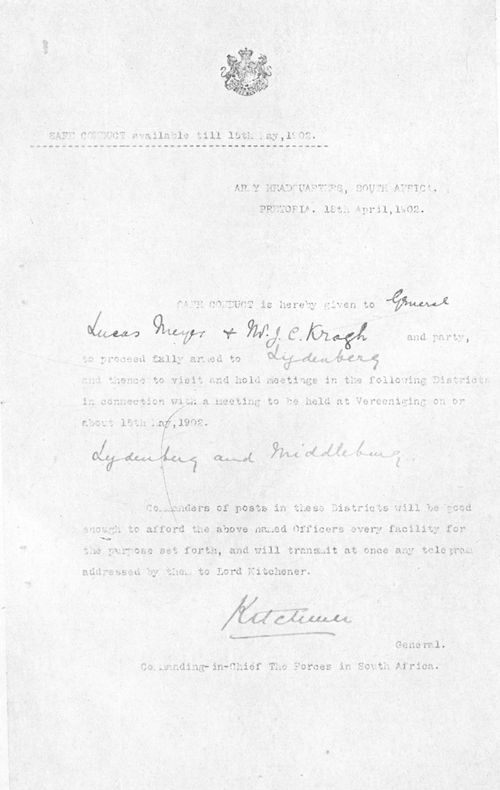
Facsimile of Safe-Conduct granted to Members of the
Republican Governments by Lord Kitchener.
It was decided that the South African Republic and the Orange Free State
should each elect thirty delegates. This division was adopted irrespective
of the number of burghers in the field in the respective
Republics, because each Republic was considered as a separate Power.
A meeting then took place between Lord Kitchener and Generals Botha, de
Wet, and de la Rey, at which it was decided where the various meetings
would be held in the two Republics for the purpose of electing delegates.
Lord Kitchener also undertook not to operate in the vicinity of the places
where the various meetings would be held during the time of the meeting,
and further that he would attack no commandos of which the Chief Officer
might be elected as a delegate, provided the persons who conducted the
meetings notified him of the election of such Officer.
It was further decided that the Delegates would meet at Vereeniging on
Thursday, May 15th, 1902. A promise was also given that the Government
Camps would not be attacked until the meeting began at Vereeniging on May
15th.
In the Orange Free State, Chief Commandant de Wet and General Hertzog
conducted the meetings, at which the elections took place. In the South
African Republic these meetings were conducted as follows:—On the High
Veld by the Commandant General; in the Western districts by the Acting
State President and General J. H. de la Rey; in the North-eastern
districts by General L. J. Meyer and Mr. J. C. Krogh; and in the districts
of Zoutpansberg and Waterberg by State Secretary Reitz, the Assistant
State Attorney L. J. Jacobsz, and General C. F. Beyers.
The districts were represented as much as possible in proportion to the
numerical strength of the various commandos.
Each of the Leaders who conducted the meetings was supplied with a
résumé of the negotiations as set forth above, as well as with a copy of
the Peace proposals made by Lord Kitchener to General Botha in March, 1901
(known as the "Middelburg Proposals"), which documents were read out to
the burghers at each meeting.[Back to Contents]
Vereeniging.
On the morning of Thursday, May 15th, 1902, the members of both the
Governments and all the delegates had arrived at Vereeniging, and business
was at once proceeded with.
Tents, &c., had been pitched there by Lord Kitchener for their
accommodation during the deliberations. In the middle of this camp stood a
large tent, which could easily accommodate the sixty representatives, and
the members of the Republican Governments. On the one side were the tents
for the Government and delegates of the Orange Free State, and on the
other side for the Government and delegates of the South African Republic.
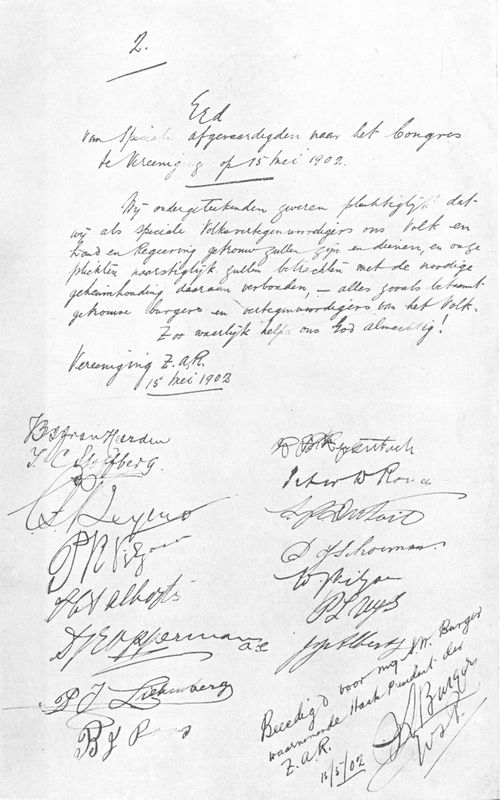
Facsimile of the Oath subscribed to at Vereeniging by the
Delegates of the South African Republic.
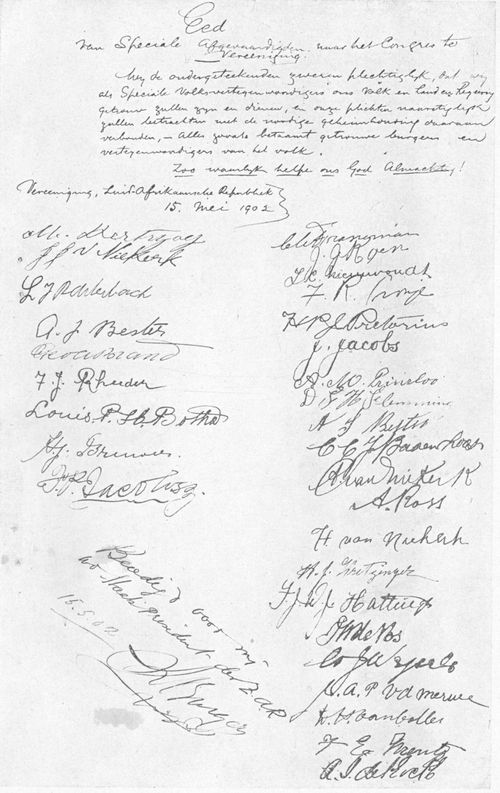
Facsimile of the Oath subscribed to at Vereeniging by the
delegates of the Orange Free State.
The following delegates represented the South African Republic:—
| Name. |
Commando Represented. |
| 1—General H. A. Alberts |
Heidelberg. |
| 2—Commandant J. J. Alberts |
Standerton and Wakkerstroom, south-west of the Natal Railway. |
| 3—Commandant J. F. de Beer |
Bloemhof. |
| 4—General C. J. Brits |
Standerton. |
| 5—Acting Landrost H. J. Bosman |
Wakkerstroom. |
| 6—General Chris. Botha |
Swazieland, and portion of State Artillery under Captain von Wichman. |
| 7—C. Birkenstock |
Vryheid. |
| 8—Assistant-Commandant General C. F. Beyers |
Waterberg. |
| 9—Field-Cornet B. H. Breytenbach |
Utrecht. |
| 10—J. de Clercq |
Middelburg (south of railway). |
| 11—General J. G. Cilliers |
Lichtenburg. |
| 12—Field-Cornet T. A. Dönges |
Heidelberg (town) and Corps Capts. Hindon and McKenny. |
| 13—Commandant H. S. Grobler |
Bethel. |
| 14—J. L. Grobler |
Carolina. |
| 15—General J. N. H. Grobler |
Ermelo. |
| 16—Field-Cornet B. J. van Heerden |
Rustenburg. |
| 17—Captain J. F. Jordaan |
Vryheid Corps and First Scouting Corps. |
| 18—General J. Kemp |
Krugersdorp. |
| 19—General P. J. Liebenberg |
Potchefstroom. |
| 20—General C. H. Muller |
Boksburg and Middleburg (north of railway). |
| 21—J. Naudé |
Pretoria (town) and detached Commando under General de la Rey. |
| 22—Commandant D. J. E. Opperman |
Pretoria (south of railway). |
| 23—Field-Cornet P. D. Roux |
Marico. |
| 24—Commandant D. J. Schoeman |
Lydenburg. |
| 25—Landrost Stoffberg |
Zoutpansberg. |
| 26—General S. P. Du Toit |
Wolmaransstad. |
| 27—Commandant P. L. Uys |
Pretoria (north of railway). |
| 28—Commandant W. J. Viljoen |
Johannesburg. |
| 29—P. R. Viljoen |
Heidelberg. |
| 30—Field-Cornet B. Roos |
Piet Retief. |
The following delegates represented the Orange Free State:—
| 1—Assistant-Chief Commandant G. C. F. Badenhorst |
Boshof, Hoopstad (west), Bloemfontein, Winburg, and Kroonstad. |
| 2—Commandant A. J. Bester |
Bethlehem. |
| 3—Commandant A. J. Bester |
Bloemfontein. |
| 4—Commandant L. P. H. Botha |
Harrismith. |
| 5—Assistant-Chief Commandant G. A. Brand |
Bethulie, Caledon River, Rouxville, Wepener, and Bloemfontein (east). |
| 6—Commandant H. J. Bruwer |
Bethlehem. |
| 7—Commandant D. H. van Coller |
Heilbron. |
| 8—Commandant F. R. Cronje |
Winburg. |
| 9—Commandant D. F. H. Flemming |
Hoopstad. |
| 10—Assistant-Chief Commandant C. C. Froneman |
Winburg and Ladybrand. |
| 11—Assistant-Chief Commandant F. J. W. J. Hattingh |
Kroonstad (east) and Heilbron. |
| 12—Commandant J. A. M. Hertzog |
Philippolis. |
| 13—Commandant J. N. Jacobs |
Boshof. |
| 14—Commandant F. P. Jacobsz |
Harrismith. |
| 15—Commandant A. J. de Kock |
Vrede. |
| 16—Commandant J. J. Koen |
Ladybrand. |
| 17—Field-Cornet H. J. Kritzinger |
Kroonstad. |
| 18—Commandant F. E. Mentz |
Heilbron. |
| 19—Commandant J. A. P. van der Merwe |
Heilbron. |
| 20—Commandant C. A. van Niekerk |
Kroonstad. |
| 21—Commandant H. van Niekerk |
President Steyn's Guard. |
| 22—Commandant J. J. van Niekerk |
Ficksburg. |
| 23—Assistant-Chief Commandant T. K. Nieuwoudt |
Philippolis, Fauresmith, Jacobsdal, and portion Bloemfontein. |
| 24—Commandant H. P. J. Pretorius |
Jacobsdal. |
| 25—Assistant-Chief Commandant A. M. Prinsloo |
Bethlehem and Ficksburg. |
| 26—Commandant L. J. Rautenbach |
Bethlehem. |
| 27—Commandant F. J. Rheeder |
Rouxville. |
| 38—Commandant A. Ross |
Vrede. |
| 29—Commandant P. W. de Vos |
Kroonstad. |
| 30—Assistant-Chief Commandant W. J. Wessels |
Harrismith and Vrede. |
At the request of the Government of the South African Republic, and with
the assistance of Lord Kitchener, General J. C. Smuts, the State Attorney,
had also come from the Cape Colony to assist his Government as legal
adviser.
At eleven o'clock all the delegates met in the large tent and took and
subscribed to the following oath before the Acting State President of the
South African Republic:—
Oath.
"We the undersigned swear solemnly that we, as special
representatives of the people, will be faithful to our people and
country and Government, and serve them faithfully, and that we
will diligently perform our duties with the necessary secrecy, as
behoves faithful burghers and representatives of the people. So
help us God Almighty.
"Vereeniging, South African Republic, May 15th, 1902."
After a few matters concerning the conduct of the meeting had
been settled, a discussion arose on the question whether the
representatives had come with definite instructions from their electors or
whether they should decide here for the people according to circumstances.
President Steyn, Chief Commandant de Wet, and General de la Rey thought
that the delegates had definite instructions.
Commandant-General Botha said that before they separated at Pretoria the
understanding was that the delegates should decide here at Vereeniging. It
could not be expected that the people could give them definite
instructions, because they were not fully acquainted with the
circumstances all over the country. Here the delegates should ascertain
from the Governments and from their fellow-delegates what the condition
was in both the Republics and in the Cape Colony, and then, taking
everything into account, come to a decision.
General Meyer was also of opinion that the delegates could not be tied.
Suppose, for instance, that the Governments could retain the independence
of the Republics by surrendering a portion of their territory, then those
delegates who had a definite instruction to vote only for independence
could not vote for such a surrender, because that would not be the
maintenance of their full independence. And then at the elections the
leaders had also told the people that the Governments could not
communicate everything to them, but that they would do so to the delegates
here.
President Steyn remarked that the meeting stood before an accomplished
fact, from which they could not get away, because as far as he knew the
most of the delegates had definite instructions how to vote.
General de la Rey said that if they still had hopes of retaining their
independence, it was a good thing that the delegates had definite
instructions, because these instructions were in the most cases to retain
independence. This the enemy knew, and therefore the Republican
Governments had so much more power.
Acting State President Burger thought that the matter was fraught
with danger on both sides. If, for instance, the majority of the
representatives had been instructed to vote for terms, this would hamper
the Governments very much if the enemy came to know about it. On the other
hand, if it was decided here to continue the war, it would be said that
the leaders kept the people in the field. Where he had been, the people
had unanimously decided to give up everything, but not the independence.
However, they were now together to get a general view of their whole
position, and each one should then decide as he thought proper, unto which
decision the minority must bow.
General Hertzog said that he had acted as General Botha had done. Where he
had conducted elections the burghers had left everything in the hands of
their representatives. These should know how to justify to their electors
the vote which they would cast.
General Botha asked what the delegates came to do? On the basis of their
independence the British did not wish to negotiate. The representatives
should thus decide whether the people could continue with the struggle, or
whether they should come to terms with the enemy. The people themselves
could not take a proper resolution because they were not properly
informed.
General Hertzog said that this was a legal matter. It was a legal
principle that a delegate could not be considered a mere mouthpiece of his
constituents, but that in matters of a public nature he was virtually a
plenipotentiary. The delegates could thus form their opinions according to
what they learnt here, provided they adhere to what was the spirit of the
people, and provided they are convinced from the facts laid before them,
that if those facts were known to the people, the people would have
instructed them to vote as they did.
General Smuts concurred fully with the opinion of General Hertzog.
As appeared from the disposition of the delegates, they acted in
the spirit of this legal opinion.
The Acting State President acted as temporary Chairman, and caused the
meeting to elect a permanent Chairman.
The following gentlemen were nominated as candidates:—General Beyers, J.
de Clercq, General Brand, General Froneman, and General Wessels.
General Beyers was elected Chairman with 19 votes, while the others
obtained 13, 11, 10, and 6 votes respectively.
After a short address, the Chairman adjourned the meeting till the
afternoon.
In the afternoon the meeting was opened with prayer by the Rev. J. D.
Kestell.
Acting State President S. W. Burger then addressed the meeting as
follows:—We are here under peculiar circumstances. Many who commenced
this struggle with us are no longer with us. The war has claimed its
victims, and many who were highly esteemed by us have fallen or have been
captured, or, alas, have become unfaithful. We have only reached the foot
of the mountain, and everything now depends upon you as representatives of
the people. Here we shall have to decide whether, under the circumstances,
we can or must continue the war. We may not deny that our position is very
critical and gloomy. Let us conduct ourselves as behoves comrades who have
a common cause at heart. We shall have to say much about the future.
Opinions will be widely divergent, and therefore it is important that we
bear with one another and be not afraid to express our opinions in a manly
way. You know what gave occasion for this meeting. A copy of the
correspondence between the Netherlands and British Governments was sent to
us by Lord Kitchener under instructions from his Government. When the
Government of the South African Republic received this correspondence they
thought it should be considered as an invitation to negotiate.
They also considered that the opportunity should be availed of to discuss
matters with the Orange Free State, and requested Lord Kitchener to enable
them to meet the Government of that Republic to consider the advisability
of making peace proposals to Britain. We met and discussed the matter at
Klerksdorp. Then we negotiated with Lord Kitchener and Lord Milner, and
the outcome of it all was the document (with the correspondence between
the two Governments and the British Government attached), which was
submitted to all the commandos. We felt that we had no power to decide
with reference to the question of independence, and that it was only in
our power to conclude a peace by which the independence would be
maintained. As to the independence, only the people could decide. And for
that purpose you are here. We, the members of the Governments, are here to
give you advice and explanation. As you know, the enemy will not hear of
letting us retain our independence, but they are willing to negotiate for
terms on the basis of the relinquishment of our independence. If we
consider all we have sacrificed and suffered, and for what we have
sacrificed and suffered, it is very hard for us to think of giving up our
independence, but we are not here to consult our hearts but our heads. You
must now give an account of the condition of our country and of our women
and children. You must determine whether, after all the sacrifices that we
have made, we are prepared to make further sacrifices. If we have no
prospects, we cannot proceed and allow our people to be further
exterminated. It will be hard after all that we have done to surrender our
independence, but we must consult our heads. The Governments will do
nothing without the people, and it is for you now to consider all the
circumstances and decide, and if you, for instance, arrive at the
conclusion that we have resorted to our last expedient, will it be right
to continue? Let each one frankly express his opinion. As far as I am
concerned, I do not flinch yet. But I wish to know what the people say. A
year ago the Governments decided never to give up the
independence, but to continue the struggle until we could do so no longer,
and then to surrender unconditionally; but if we become convinced that our
strength and resources are exhausted we should consider whether we should
not still try to do something for our people. Or shall we continue until
all the leaders and many burghers are banished or killed? By a frank
expression of opinion we shall be enabled to decide what course to pursue.
Here I must draw your attention to a difficulty that has arisen. Some of
you have received definite instructions from the people from which it
appears you consider you cannot deviate. Others have received authority to
act according to circumstances. Now I believe that this need not cause a
difference; in any case let it not cause a split among us. We must be
unanimous here, and if we are, then the people will also be unanimous. If
we are divided here, what will the people be?
At this juncture a letter was read, written five months before by the
Deputation in Europe, and safely brought out by a person whose name was
not mentioned. The letter contained much, and maintained, among other
things, that in Europe the Boer cause was then more favourable than ever
before.
The Chairman now gave the Generals and Delegates an opportunity of laying
before the meeting the general condition in their respective divisions.
Commandant General Botha said: In the Utrecht district there are not
sufficient mealies to support the commandos long, and then there could be
no question of supplying the horses with mealies. There was still a
considerable number of slaughter cattle. In Swazieland there was no grain,
nor was there any in Wakkerstroom, so that the commandos could not exist
there for another month. In Ermelo and Carolina there was still sufficient
corn to exist on for some little time, say two or three months, and
sufficient slaughter-cattle for the winter, if the cattle and sheep
belonging to the burghers were indiscriminately taken. Most of
the grain belonged to the Kaffirs. What had been sown was too near the
enemy, otherwise they would have provisions for a considerable time still.
In Bethal, Standerton, and Middelburg there was no corn whatever, and they
could still hold out for one month at the utmost. The Heidelberg and
Pretoria commandos have no corn to live on. In the neighbourhood of
Boksburg and Springs there was a considerable quantity of mealies—the old
mealie-cobs of last year—but the commandos have been squeezed out from
those parts by the blockhouses. They had absolutely no slaughter-cattle.
In a great area there was no living animal except horses, and when he was
with the men a few days ago, three days had passed since they had had
meat. All that Middelburg (south-east of the railway) possessed of
slaughter-cattle was 36 goats. Wakkerstroom also was entirely without
slaughter-cattle. The condition on the High Veld as regards horses was
very bad. The burghers were hard pressed by the enemy, and many were
unmounted. The horses were now so weak that the commandos could not
undertake a long journey. The Kaffir question became daily more serious.
Shortly before his departure for Vereeniging 56 burghers were murdered in
Vryheid by Kaffirs who came from the English lines. All the Kaffirs in the
South-eastern portion of the Republic were more or less under arms, and
this had an unfavourable influence on the spirit of the burghers.
Furthermore they had a considerable number of families who were in a most
lamentable condition. The entire High Veld was divided up by the lines of
blockhouses, and the commandos were so cornered that they had continually
to cross these lines of the railway, and then a fortnight often passed
before the husbands could return to attend to their families. It had
happened that women had to flee to Kaffirs to be helped by them. Many were
attacked and raped by the Kaffirs. Truly the condition of these women was
the saddest thing with which he had had to do in this war.
Coming to the numerical strength of the burghers, they had in
the field in the South African Republic 10,816 men, of which 3,296 were
unmounted, leaving thus only 7,520 men who were available for use. Since
last June their numbers had been diminished by 6,084 men. The most of
these had been captured, but the number included the surrenders and
killed. They still had about 2,540 families. What their condition was he
had already described, and what the difficulties were to support them, the
delegates could imagine themselves. Summoning up all in one word the
Commandant General concluded by saying that the greatest difficulties lay
in the questions concerning horses and food, and the maintenance of the
families.
Chief Commandant de Wet said that he would leave it to the delegates who
were officers to give an account of the conditions obtaining in their
respective districts. They came from far and near, and knew what the
condition of matters was. He could, however, inform the meeting that the
number of burghers in the Orange Free State was 6,100, of which about 400
were not serviceable. The Basutos were as well disposed towards the Boers
as ever before.
General de la Rey said that he did not know exactly what was expected of
him, and that it was the duty of the delegates to give an account of the
condition of affairs. He could say this, however, that food was scarce in
his division a year ago, and that was so still, but no one had suffered
hunger yet. If a burgher had no food he had to fetch it from the enemy. He
also thought it would be better to leave it to the delegates to give an
account of the conditions in their respective divisions.
General Beyers said, I shall be brief. As regards food, we obtain supplies
from the hostile Kaffirs, who are all, with the exception of one tribe, in
rebellion against us. In Waterberg all the Kaffirs are sitting on the
fence, and are in a way still well disposed, so that we cannot take
anything from them, but must purchase what we want. What we require in
Zoutpansberg we take. The Kaffirs fire on us, but then we shoot back. It
is our good fortune that there is no co-operation between the
Kaffirs in Zoutpansberg, otherwise they could make matters difficult for
us. When the British forces are operating against us the Kaffirs are very
troublesome, because the English use the Kaffirs. The greatest
difficulties with which we have to cope are: fever, horse-sickness, and
the Kaffirs. Food we have in abundance. I think there is sufficient food
in the Zoutpansberg district to support the burghers of the South African
Republic and of the Orange Free State for a year. The British, however,
are buying up much grain there now at 10s. a bag and removing it.
General Muller remarked that everything was scarce with him, but that the
burghers had never suffered hunger yet. He had cattle for two months
still, if he slaughtered everything. His great difficulty was in
connection with the families when the Kaffirs were rebellious. If
provisions became scarce he intended to obtain these from the Kaffirs. In
his opinion he could still hold out to the end of the winter.
General Froneman (Winburg and Ladybrand) had no reason to complain. They
had sufficient food still. There were many women and children in his
division, altogether about 80 families, who had to be supported. The
Kaffirs were particularly peaceable, and always prepared to assist in
supplying them with clothing out of Basutoland. When he ran short of
cattle he took some again from the enemy. He saw his way clear to continue
the struggle for another year.
Commandant Hattingh (Kroonstad) informed the meeting that he still had
much cattle, sheep and grain, sufficient for a year. The district of
Heilbron had been entirely depleted of provisions, but he had supplied
them again from the Bethlehem district.
Commandant Badenhorst (portion Bloemfontein, Boshof and Kroonstad) stated
that in his districts there were still thousands of cattle and sheep, and
therefore he could hold out for another year. The farmers had cattle on
their farms, and then there was always a chance of capturing from the
enemy. On one occasion he captured 1,500 cattle from the enemy,
and he also saw a chance of obtaining cattle by this means for other
parts. Hundreds of cattle and thousands of sheep could still be spared in
his district for other districts. Grain was not so plentiful as it had
been the previous year, but they could still raise so much that they could
even supply others.
General Nieuwoudt (S.W. and S. portions of O.F.S.) said that during the
last seven months the enemy had destroyed everything in his districts. The
Fauresmith district had been totally devastated. No cattle had been left
there. There were only about 70 bags of grain left, but they still managed
to live well. He had found out that even when they had nothing they
managed to get along. His horses were now in excellent condition. If they
could sow he saw a chance of raising food for another year. In his
division there were only about three women.
General Prinsloo (Ficksburg and Bethlehem) stated that he would not be
speaking the truth if he said that there was no food, in his division. He
had no cause for complaint yet on that score. Latterly many forces of the
enemy had operated against him, and all the cattle had been removed from
the Southern Ward, but in the other Wards there was still much cattle.
They could help other districts from there. Unfortunately, however, cattle
could not be moved from those Wards on account of the blockhouses.
Further, he thought that the Lord would provide for them. Recently one of
his Commandants had discovered what he might call a gold mine, in which
there were 150 bags of mealies.
General Brand (Rouxville, &c.) said that the enemy had overrun his
districts very much, built blockhouses, removed cattle, and destroyed
grain. Portions of his division had been totally ruined. Everything had
been removed, and not even a sheep was left. It frequently happened that
for two or three days they were without food, but then they fortunately
captured some food again. There were only nine women in his division. He
had the means to continue for another year.
General Wessels (Vrede, Harrismith, and Frankfort) informed the
meeting that the Khakis had latterly dealt fearfully with him. They moved
up and down in his division, and he thought that nothing would be left,
but he always found food still. It was a marvel to him that sheep, cattle
and grain were still to be found there. Even if the enemy removed all the
cattle he saw a chance of maintaining the struggle on the grain that would
be left, and he knew for certain that he would be able to capture much
cattle from the enemy. Only recently he had brought 300 head of cattle
from Natal, and they had also discovered a cave containing 300 bags of
mealies. As regards slaughter-cattle, he thought he had enough to last
them for another three months.
Commandant van Niekerk (Vredefort) had to admit that his district had been
entirely devastated, and that he had been forced out of it, so that they
could neither plough nor sow. However, in Hoopstad and Kroonstad they had
sown 35 bags of grain. The enemy had built blockhouses right through the
middle of his division. There was no cattle, but he had captured 1,000
sheep and 52 head of cattle, and thought that in some way or other he
would still manage to obtain food for another year.
Commandant van der Merwe said that matters with him were much the same as
in the districts of Commandant van Niekerk. Everything was scarce, but
they had not yet suffered hunger.
General J. C. Smuts related how his expedition to the Cape Colony had
originated, and how it had been carried out. Last year, he said, it was
the opinion of President Kruger and of their Deputation in Europe that
there was good hope for their cause from the Cape Colony. On that ground
and also on the reports that they received from there, it was decided to
send General de la Rey thither to assume the supreme command as soon as
the Cape was strong enough to be considered a third party in the struggle.
Later, however, they came to the conclusion that it would be best to act
more cautiously, that General de la Rey could hardly be missed in the
Western Transvaal, that he (General Smuts) should go with a
small commando to ascertain what the possibilities in the Cape Colony
were. "I went," he continued, "with 300 men, while 100 men followed me,
but 100 men I had to leave behind with General Kritzinger because their
horses were too poor. We had a very difficult journey, certainly the most
difficult that I and my people ever experienced. I went through the whole
of the Cape Colony. I proceeded to Grahamstown, then to Graaff Reinet, and
down to the coast again. With a few exceptions I met all the commandos in
the Cape Colony. I questioned the leaders and thus came to be well
informed on everything. Commandant Kritzinger did not follow me according
to agreement, and as I saw that there was a danger of disorder arising I
took everything under my command. I found that there were about 1,400 or
1,500 men under arms, and not 3,000 as had been reported. To obtain the
exact numbers, however, was almost impossible. Commandant Lotter was
captured with his whole commando of 100 men. I have now been in the Cape
Colony for about a year, and the number that joined us in that time was
about 1,400. The number of men under arms had thus been doubled, and but
for the losses there would now have been 3,000 men. There are now about
2,600 men under my command, but then there is another division sent in by
General de la Rey under General de Villiers in Griqualand West, about 700
strong, and another in Bechuanaland under Commandant van der Merwe. There
are thus about 3,300 men operating in the Cape Colony, and this does not
include the men under Myburgh, Wessels, and van Reenen, of whom I know
nothing.
The question now is: What help can be expected from the Cape Colony for
our cause? There will be no general rising in the Cape. We had very good
expectations, and thought that it would not be difficult to cause a
general rising there. The people are very enthusiastic—more so than with
us; but they have peculiar difficulties. The first is with reference to
horses. The British have taken all the horses that could be used, and shot
the useless ones. There is, therefore, a great scarcity of
horses in the Cape Colony. And, further, it is extraordinarily difficult
for the Colonist to rise if he has to fight on foot with the knowledge
that if he is captured he will have to undergo heavy punishment. Unmounted
men cannot fight in the Cape Colony. You can operate only with mounted
commandos, and as we have no horses we cannot accept a tenth of those who
are willing to join us. On account of this deficiency of horses, we cannot
expect a general rising. Another great difficulty is the absence of grass.
The veld over the entire Cape Colony is overgrown with bushes (scrub).
There is no grass as in the Republics. Where you have no forage,
therefore, the horses cannot exist. Where I have been latterly there is
wheat, and I fed my horses on that, but now the wheat is becoming scarce,
and there is no prospect of obtaining any more on account of the
proclamations of the British, which prohibit all sowing. We have, indeed,
issued a counter proclamation, but that has not helped. The question of
horses and forage is thus a great stumbling-block for our cause in the
Cape. In my opinion, the small commandos in the Cape Colony have done
their best. Three British camps were lately taken by them.
The question now arose whether commandos from the Republics could proceed
to the Cape Colony, and whether there was an opening for them there.—Yes,
there was an opening, but the difficulty was how to get there. More of our
commandos from the Republics would be able to exist in the Cape Colony if
food became too scarce here, but the great trouble was how to get there.
The British have now about 50,000 English and Dutch Africanders under
arms.—These conditions have led me to the conclusion that there will be
no general rising in the Cape Colony, and that the continuance of the war
will depend more on the Republics than upon the Cape Colony."
The meeting was then adjourned till the evening.
On re-assembling, the first speaker was Commandant P. L. Uys (district Pretoria), who said that in his
commando there were only 153 mounted men; the other 128 burghers were
unmounted. There were still about 2,000 head of cattle, and grain enough
to last them for a month. All the Kaffirs in his district were hostile,
with the exception of the captain Matello. In the portion of Middelburg
under him there were 26 mounted men and 38 burghers on foot.
Commandant H. S. Grobler (Bethal) stated that during all the summer he had
had no rest. He still had a commando of 150 men, but no food, and he could
trek nowhere, because his horses were too poor. Only recently he had to
break through a cordon (kraal), and managed to get through with only 153
men, while 63 were captured. The Bethal district had been devastated from
the one end to the other. There was no food left for his commandos, nor
for the 300 women and children, who were in a pitiable condition. They
were not only without the necessaries of life, but also exposed to danger
from the Kaffirs, who had already raped some of the women, which drove
some of them to take refuge in the blockhouses.
General Chris. Botha remarked that he represented Swazieland. With regard
to provisions, the supply of mealies was almost exhausted. They lived on
what they could get from the Kaffirs as a favour. There were no more women
with them. His commando of 113 men was still in the Piet Retief district.
They had no grain, and had to proceed from one Kaffir-kraal to another to
purchase food, which required money. However, they still managed to live.
In this way he had helped the Transvaal for two and a half years, and now
that he heard that there was food in the Orange Free State he would
proceed thither and help them for two and a half years. In the Piet Retief
district they had grain for about two months, but no cattle, and they had
to live on what they could capture from the enemy. There were 65 families
still there, and it was hard to provide for them. Their position was very
critical.
Mr. Birkenstock (Vryheid) said that he would go more fully into a
few points relating to his district than the Commandant General had been
able to do in his general review. In Vryheid during the last six or eight
months they had been much harassed by large forces, and the district had
been completely devastated. The presence of the families caused the
greatest difficulties. Latterly the British refused to receive any more
families. They were also continually in danger from Kaffirs, who were
decidedly hostile to them. Horses and corn were scarce. But yet, as far as
grain was concerned, they would manage, if the enemy did not again make
incursions into that district. Recently in the early morning, before
daybreak, a Kaffir commando had attacked a Boer commando consisting of 70
men, of whom they had killed 56. The families in that district had said to
him: "You must make peace in any case," and he felt it his duty to inform
the meeting of this.
General Alberts (Heidelberg) said that for the last twelve months they had
had no rest in his district. During the past year they had not been able
to plough and sow at all, and a commando could no longer exist there.
Three times had they been enclosed in a cordon (kraal), but had
fortunately always managed to get out. They had no slaughter-cattle
themselves, but had received some from Commandant Roos, of the Orange Free
State. His horses were in a most deplorable condition.
Landrost Bosman (Wakkerstroom) informed the meeting how matters stood in
the Wakkerstroom district. They were dependent upon the Kaffirs for grain;
in fact, for everything except meat. They bartered meat from the Kaffirs
for mealies. But this year there were scarcely any mealies, and what there
were had been badly spoilt by the enemy. With the supply they had, they
would be able to manage for another two months, and out of this the
families with them would also have to be supported. The supply of
slaughter-cattle was also running short, and the horses were in such a
poor condition that they could not be used against the enemy for
a fortnight. It would perhaps become necessary for the commando to leave
the district, and then the great question arose: What would become of the
families there?
Mr. de Clercq (Middelburg) regretted that he had not the privilege of
several members of the meeting of being able to present a rosy report. The
portion of Middelburg which he represented was entirely exhausted. They
had indeed some grain left, but that would last them for only a short
time. They had no slaughter-cattle whatever. With the horses they still
had, they could not operate. They were in too poor condition to enable the
commando to escape if it became necessary to get out of the way of the
enemy. The condition of the burghers was disheartening. If they should
have to leave their district it was very doubtful whether they would reach
their destination, on account of the condition their horses were in. There
were only about 100 burghers left out of 500. They also had about 50
families with them, and these were in a miserable plight. The district
would have to be abandoned, and then came the question: What would become
of these families? Even now they were very badly provided for. Some women
wished to proceed on foot to the British, but he had advised them not to
do so until the result of these negotiations were known.
Commandant D. J. Schoeman (Lydenburg) said that until recently they had
about 800 head of cattle, but these had all been removed now by the enemy.
There was no grain at all. As they had no more food for the men, what
would become of the families if the struggle was to be continued?
Commandant D. J. Opperman (Pretoria, South of the railway) gave an account
of how matters were situated in that part of the district represented by
him. His remarks were to the same effect as those of Commandant Alberts
(see above).
General Liebenberg (Potchefstroom) spoke about the commandos of
Potchefstroom under his command. During the past eight or nine months
blockhouses had been established in his division, and he had
only a narrow space of about twelve miles wide where he could exist. A
considerable amount of corn had been sown, but their fields had recently
fallen into the hands of the enemy, and now everything had been destroyed,
burnt, and trampled down by the horses. They had still 93 families. Some
women from the Orange Free State had been placed on the boundary between
the districts of Lichtenburg and Potchefstroom by the British. These were
in a most deplorable condition, and were almost dying from misery. These
women had informed him that unless matters improved they would proceed to
Klerksdorp on foot. He had advised them to wait until after the completion
of the negotiations. His commando consisted of 400 mounted men and about
100 dismounted. He would be able to continue the struggle for some little
time yet, and then he would have to seek salvation elsewhere.
General du Toit (Wolmaransstad) informed the meeting that provisions were
very scarce with him, and that they had 500 families to support. The
horses were in a very poor condition, but by making détours he could
always manage to get out of tight corners. His commando was not large—it
consisted of only about 450 mounted men—and the cattle they had were in
good condition, but grain was scarce.
Commandant de Beer (Bloemhof) stated that he had 444 mounted men and about
165 unmounted burghers. Grain was not plentiful in his district, nor
cattle, but Bloemhof had never had much cattle. The families with them
were not yet suffering very much from scarcity of provisions, and he
thought he would be able to continue the struggle for another year.
General Kemp said that he had under his command portions of the commandos
of Krugersdorp and Rustenburg, and portions of the commandos of Pretoria
and Johannesburg. In the Krugersdorp district they could not sow any more,
and the majority of the cattle had been taken from them. And yet they were
not suffering from want. Indeed, he thought they should never be
in want if they had such a large commissariat upon which they could draw,
namely, the Zoutpansberg district, where General Beyers was in command. He
took from the Kaffirs what he required, but what he took was not the
property of the natives, but what they had stolen from the burghers. He
could hold out for two years longer.
Chief Commandant de Wet asked why those commandos in the eastern portions
of the Transvaal could not do the same as those under command of General
Kemp, and re-take their property from the Kaffirs?
General Botha replied that the native tribes with which General Kemp had
to do could not even remotely be compared with the tribes with which they
had to deal in the south-east. There the natives were in contact with the
British. Whatever they looted from the Boers they handed over to the
British, who sold the loot. If cattle were therefore taken from the
Kaffirs in the south-eastern districts, they would be taking cattle the
lawful property of the natives. Besides this, he had to point out that the
Zulu was an entirely different kind of native from the Kaffir with whom
General Kemp had to do. The Zulus were much stronger, and, further, the
Republic had an agreement with the Swazies that they (the Boers) would not
trek into their country with a commando to fight against them. They had to
govern themselves as long as the war lasted. Most of the cattle of the
Swazies also had been moved to behind the Lebombo mountains and to
Zambaansland, and were therefore beyond the reach of the commandos.
General Chris. Botha also declared that no cattle belonging to the
burghers in the eastern parts of the Transvaal were in possession of the
natives.
Mr. J. L. Grobler (Carolina) next related how matters stood in his
district. They had always had cattle and grain, but the British had cut
off the best part of their fields by means of blockhouses. What they had
now sown would stand them in good stead if nothing happened to
prevent them reaping. The Kaffirs were not well disposed. He thought they
could still hold out for seven or eight months, if nothing unforeseen
occurred. They still had 300 horses for the burghers, but they were weak,
and there were a good many burghers for whom they had no mounts.
Mr. Naudé said that he was delegated by a portion of the Pretoria commando
and by the detached commando under General Kemp. They sowed and reaped as
usual. Fortunately he had no women and children to deal with. His
commandos had no large supply of cattle, but yet there was no want.
After this the meeting was closed with prayer, and adjourned to the
following morning.
Friday, May 16th, 1902.
The delegates met again shortly after nine o'clock.
The meeting was opened with prayer by the Rev. J. D. Kestell.
General Chris. Botha asked whether it was not desirable to attempt to get
into communication with the Deputation in Europe.
After some discussion on this matter, the following two proposals were
made:—
I. Assistant Chief Commandant Froneman, seconded by Commandant Flemming:—
"That the Republican Governments be instructed to thank the
Governments of His Majesty the King of England and of Her Majesty
the Queen of the Netherlands, through Lord Kitchener, for
interesting themselves in connection with the opening up of peace
negotiations, as appears from the correspondence between the said
Governments, and to express their regret that His Majesty's
Government did not accept the proposal of Her Majesty's
Government to place their representatives in Europe, who still
enjoy their full confidence, in a position to come to the
Republics, and also that Lord Kitchener has refused a similar
request made by our Governments."
II. Acting Landdrost H. J. Bosman, seconded by Commandant J. N.
Grobler:—
"The Representatives of the people here assembled resolve to
record their regret that the request of their Governments to meet
one or more of the members of their Deputation had been refused
by Lord Kitchener, and instruct their Governments to try to send
the Deputation a cablegram informing them that a meeting is now
taking place to discuss the possibility of bringing about peace,
and further to instruct their Governments to thank the Government
of Her Majesty the Queen of the Netherlands for interceding in
the interests of peace."
On being put to the vote, the first proposal was carried by 36 votes to
23.
The Chairman now laid before the meeting for discussion the document which
had been drawn up by the Republican Governments relative to the
negotiations in March and April last, and which had been read to all the
commandos at the election of delegates.
Mr. P. R. Viljoen (Heidelberg) then addressed the meeting. He laid stress
on the great seriousness of the matter before the delegates. The ground
whereon they stood, he said, was holy ground. And, indeed, it was so when
they considered how it had been soaked with the tears and the blood of
their fathers and of so many others in the present struggle. It was
extremely hard for him even to think of relinquishing the independence
after all the blood and tears that had been shed, and all the hardships
that had already been endured, but from the information given them
yesterday it was a matter they had to look in the face. It had been
plainly shown that if they wished to continue the war they would be
obliged to abandon some ten districts. By doing so they would be more
concentrated, and that was exactly what the enemy wanted, for then they
would be able to concentrate all their forces against the Republican
commandos. According to what had been reported in this meeting,
matters appeared to be going comparatively well in the Orange Free State.
Here in the Transvaal, however, they were differently situated. The
outlook was very dark, and it appeared to him that they should try to end
the war. If there was a chance of retaining the independence then they
could still continue, and they would be willing to undergo the bitterest
suffering. But the question was whether there was any prospect of their
retaining their independence. They knew nothing of how matters stood in
Europe. The report from the Deputation that had been laid before the
meeting was six months old. If there were any events in Europe in their
favour it would have come to their knowledge by this time. It was plain
that they should try to obtain peace in an honourable way. But how? They
should still try to retain their independence, and for that purpose it
would be as well if they instructed the Governments to ascertain once more
what the British Government would give if they (the Boers) relinquished
their independence, and that they should know this before they took a
final decision. He did not see much chance to continue the war. Though it
was bitter for him to have had to speak as he had done, he had felt that
it was his duty to do so.
Mr. de Clercq (Middelburg) said he held the same opinion as the last
speaker. They were confronted with great difficulties. The question was
whether they should or should not continue the war. It was necessary to
look into the future, and if they did so they must ask themselves what
would be the consequences of a continuance of the war, and what the
consequences would be if they terminated the struggle now. He drew the
attention of the meeting to the fact that they had at present about 15,000
men against 250,000 of the enemy. They should also consider what had been
said about the scarcity of food and horses and the other difficulties. All
these matters made it difficult to prosecute the struggle, and before he
could decide in favour thereof it would have to be shown him that the
continuance of the war would mean the retention of their
independence, and if that could be done, he was prepared to make still
further sacrifices. But if there was no probability of retaining their
independence, and if by the continuance of the struggle all would
ultimately only be killed or captured, could there be a more lamentable
termination? He considered that the most sensible course was to save what
could still be saved. Their national existence should not be sacrificed.
Who knew what was still to fall to the lot of their people in the future?
But if everything was eradicated, they would cease to exist as a people.
Was it a good thing that they should allow a people that had struggled as
the Africander people had done to share such a fate?
Commandant Rheeder (Rouxville) said that though the circumstances were
dark, yet there were some rays of light. If, however, they gave up their
independence, where then could they look for a ray of light? He was
prepared to give his last drop of blood for his country. It had been asked
whether they should continue until they were eventually annihilated. But
he would ask: Should they not continue until they were all delivered?
There were three things possible: deliverance, annihilation, or surrender
to the enemy. The retention of their independence must take the first
place. They should fight on until they were dead, captured, or delivered.
General Kemp (Krugersdorp) remarked that the matter was most serious. It
was beyond doubt that to a certain extent their circumstances were dark.
But when they commenced the war the chances were not on their side. They
should continue. If they considered what the war had already cost them,
how much blood had been shed, they could not give up the struggle. As far
as he was concerned he wished to continue until he was dead or saved. They
should not look at the dark side only. In some districts food was indeed
scarce, but they could still find food everywhere. Those districts where
they were threatened with famine they should give up. So many had been
captured or killed, but that gave him so much the more courage.
Because the struggle had cost them so much it could not be given up. If
once they were vanquished, it was all over with the Africander people, and
all chance of a revival would be gone for ever. Why should they not
continue to place their trust in God? They had no right to distrust the
God Who had helped them hitherto.
Mr. Breytenbach (Utrecht) thought that they should not brag. All this tall
talk did not help them. They should consider each other's feelings. He
also had received an instruction from the burghers whom he represented,
and that instruction was that if he could adduce proofs after this meeting
that they were able to continue the war, then Utrecht would continue to
fight; but if he could not do that, Utrecht would fight no longer. And he
could not. They should take a note of what had been said here yesterday.
There were ten districts in the Transvaal that could not keep up the
struggle any longer. Could they give up these districts? They should not
consult their hearts only, but also their heads, and what did his head
tell him? That they could not continue the war. If they decided that the
struggle must go on, they should be able to carry out that decision as
they had done from the beginning. But they could not. It had been said
that they should trust the Lord, but they could not enter into the decrees
of Providence. They could to some extent understand what God's answer to
their prayers had been. With the Mauser and with Prayer they had commenced
the war, and what had God's answer to those prayers been? He had led them
on ways on which they had not expected to be led. If they continued now,
they would, in his opinion, be dealing a death blow to the nation. They
had seen that ten districts could not keep up the struggle any longer;
should they now say: "We must continue and leave those districts to their
lot?" Would it be right to let those districts, with the men, women and
children who were still in them be lost? No; they should try to save what
could still be saved.
General P. Liebenberg (Klerksdorp) concurred in the views of Mr.
Viljoen and Mr. de Clercq. If they could secure their independence he
would gladly pay for it with his blood. The future appeared dark to him.
They should keep their eyes on God, but also use their brains, and
consider where their present course was leading them to. The commission he
had received from those whom he represented was: "Secure our independence
if it is in any way possible, but be careful and see to it that our
national existence be not destroyed." If they could not do otherwise they
should save what could still be saved, and obtain peace on the best terms.
Commandant P. L. Uys (Pretoria) spoke as follows: Comrades, we are faced
with a most serious matter. If we continue the struggle I must leave my
district, and hand over the families there a prey to the Kaffirs, because
the British will not receive them. My mounted men I can always save, but
if I did so what would become of the unmounted men, and what of the women
and children? And under these circumstances it is a question whether all
the mounted men would follow me. It now rests with the delegates and no
longer with the Governments to decide this matter. Never yet have I
experienced a day like this, on which I am called to such a great task.
This is no time to criticise each other. We cannot blame one another, but
must bear with one another. The Bible has been quoted here, but if we do
this we must not omit the text in which reference is made to the King who
ought to consider whether he was competent to proceed with 10,000 men
against him who was marching on him with 20,000 men. A further
consideration is, what will become of the widows and orphans if we do not
come to terms, and thus no longer remain their natural protectors? Oh, we
must open our eyes and observe that God's hand is stretched forth against
us, and not continue to add to the number of widows and orphans.
General J. N. H. Grobler (Ermelo) spoke in the same strain.
The meeting was then adjourned until the afternoon.
On resuming in the afternoon, a letter was read from General
Malan, who was operating in the Cape Colony, and also one from General
Kritzinger. General Malan reported on his operations, and General
Kritzinger advised that the struggle be given up.
General S. P. du Toit was the next speaker, and said: The matter before us
is so serious that I hardly know how to discuss it. We must bear with one
another and remember that we stand here as responsible people. I have been
delegated to this meeting by a portion of the people who have suffered
heavily, and I have a definite instruction. The people wish to retain
their independence, but if that is impossible, then I am instructed to do
the best I can. The state of matters in my division is, indeed, not so bad
as to oblige us to give up the struggle, but the question is not only what
must I do with a view to the condition in my district alone, but I must
also take into consideration how other districts are situated. We must be
specially on our guard against disunion. What will the future be if a
portion of this meeting decides to make peace and another portion to
continue the war? What will be the position of those who return to
continue the war? Should we not rather all co-operate to obtain from the
enemy what we can, and try to retain a portion of our independence? The
eyes of the enemy are upon us, and what will be the effect if we are
divided? We must consider whether we should not approach the enemy with
proposals, and in that way enter into negotiations with them. If we cannot
prosecute the war we must see what terms we can get. Let us, above all,
guard against internal disunion. If we as one man can decide to continue
the war I shall support the resolution, but if we cannot be unanimous I am
in favour of conceding more to the British than what our Governments have
already offered. I mean we should do what we can to restore peace, and I
would like to add that I am greatly disappointed in regard to the course
matters have taken in the Cape Colony. It appears to me that the situation
was not properly represented to us from there, but I am glad
that we are now well informed.
Mr. F. W. Reitz, State Secretary of the South African Republic, said: The
future of our country depends upon this opportunity. It is known what the
Governments have already done, and the question I put myself now is
whether there is still something that can be offered to the enemy
consistent with the retention of our independence, and I think there is.
Should we not offer the British the Witwatersrand and Swazieland? We can
also sacrifice our foreign policy and say "We desire to have no foreign
policy, but only our internal independence." We can then become a
protectorate of England. What have we got in the Witwatersrand? After the
Franco-Prussian war France surrendered Alsace and Lorraine to Germany to
retain her independence. What has the wealth from Johannesburg done for
us? That money has only injured the noble character of our people. This is
common knowledge. And the cause of this war originated in Johannesburg. I
could adduce more arguments, but let me only say that the money obtained
from there was to our detriment. It would now tend to our advantage to be
rid of Johannesburg. We shall then have heard the last of Liquor-jews and
other matters. I do not grudge England that inheritance. And then what
have we in Swazieland? Our object was to get nearer the sea, but I do not
believe that even from that point of view it has now any more value for
us. We have had more loss than gain from Swazieland. As regards a
protectorate, what does that mean? It means that England undertakes the
obligation to defend the country against foreign attacks. And with
reference to our foreign policy, only difficulties have originated out of
that for us. Washington said that his country must have no foreign policy,
and his country became strong enough to say that other Powers must not
interfere with America.
General Muller (Boksburg) agreed with State Secretary Reitz. If they made
a proposal in the terms suggested by Mr. Reitz they would also
prove to the world that they were not fighting for gold or for honour, but
only to be free. His burghers were prepared to surrender the Witwatersrand
and Swazieland, but nothing of their independence. Rather than do that
they would fight to the finish.
Field Cornet Roux (Marico) said: My instruction is that I can concede
much, but we must retain our independence. I stand or fall by that.
Landrost Stofberg (Zoutpansberg) said: Disunion must not even be mentioned
with us. We must strive to be unanimous. I make this remark with reference
to what General du Toit said. Zoutpansberg has said to me: "Our
independence we will not surrender. We are prepared to concede much, but
not that." If we can satisfy the British in some way or other and retain
our independence, I will support such a course. Some of the burghers are
of opinion that the Gold Fields can be surrendered for a time, and others
point out that gold was the cause of the war. The gold has indeed injured
us all, and I agree that we can give up the Gold Fields. What has the gold
done for us? You may say: "It has enriched us." Yes, but it has been much
more of a stumbling block. If there had been no Johannesburg, there would
also never have been a war. Is it not better for us to be a poor but
independent people than rich and a subject nation? The gold is only a
temptation, and has a pernicious moral influence on our national
character. Let the Gold Fields be given up. We shall in any case retain
the Johannesburg market.
Commandant Mentz (Heilbron) I must ask the indulgence of the meeting, as I
regret that I am not able to present such a rosy report as my fellow
delegates from the Free State. From ten to fifteen columns are trekking
about in my district, devastating everything. There is but little grain,
but my greatest trouble is the families who are still with us. We have 200
families, and how and on what must they live? Some months ago I had 200
burghers. Now I have only 80. If we must continue the war I with
my men can leave my district, but what must I then do with my 200
families? My instruction was: "Do not surrender the independence," but
more than half the burghers who gave me this instruction have been
captured, and subsequently others have asked me to try to arrive at a
satisfactory arrangement, and to act according to circumstances. I am at
one with the proposal of State Secretary Reitz. Let us even give up a
portion of our country if we can thereby retain our independence. I
recollect when I was still a child the late President Jan Brand saying:
"Give up the Diamond Fields! You will profit more from them than England;
you plough and sow and farm." This we can do now, too.
Commandant Fleming (Hoopstad) said that Hoopstad had been considerably
devastated, and few cattle had been left, but there were still other
cattle with which they had escaped. Matters in his district were not in
such a state that they could not continue the war. There was also
sufficient game for them to live on. The burghers had said to him: "We
have sacrificed wives and children, fathers and mothers, brothers and
sisters, money and blood, and if we must now surrender our independence
too, we give up everything, and rather than do that we will fight to the
finish." However, he had to admit that the burghers were not acquainted
with the conditions in other parts of the country and in the Transvaal,
and now that he knew what these conditions were he could support the
proposal of State Secretary Reitz to give up a portion of the country to
save the independence. They should, if possible, make an end to the war
out of sympathy with the poor families who suffered so grievously from the
enemy and from the Kaffirs.
Acting State President Burger spoke as follows: The Governments must
receive an instruction from the delegates after they have heard and
considered everything. We should now make a fresh proposal to the British
and see what will come of it. If our proposals are rejected then we stand
exactly where we were before. If any one of you is attached to
his independence, I am too, and I shall very seriously consider the matter
before I surrender it. If any one of you has sacrificed everything and is
prepared to sacrifice still more I am prepared to do so too. Some say: "We
must retain our independence or continue to fight. We can continue the
struggle for another six months or nine months or a year." But supposing
we did that, what would we gain thereby? Only this, that the enemy would
be stronger and we weaker. If I take everything into consideration I must
say it appears to me impossible to prosecute the war any longer. We can,
indeed, proceed and say: "Let come what will," but who of us can declare
to-day with an upright and clear conscience that we can continue the
struggle with any chance of success? God works miracles, but who can
assure me that He will do so in our case? It is argued that European
complications may arise, but that is a mere hope without foundation. We
must view the matter from all sides, and there is this other point to
which I wish to draw your attention. In a wonderful way the Lord has
hitherto preserved and spared us, and kept us standing, so that we are
still acknowledged as a party, and can speak and negotiate for our people.
Now we should ask ourselves whether this is not the last chance we shall
have of being able to do so. If this opportunity is allowed to pass, I
fear all chances will for ever be gone for us to negotiate as a party for
the entire people. Commandant Rheeders said that we must fight till we are
dead, captured, or saved. That would be manly and would redound to the
honour of ourselves and of our descendants; but must we act from lust of
glory? Would that be sensible and right towards our people? Can we let the
people be annihilated for the sake of honour and fame for ourselves? If I
sacrifice my person for my people it would bring me true honour, but not
otherwise. If after discussion and consideration we become convinced that
we can only continue the war for a little while longer, it is our duty to
make an end to it now. What would further unnecessary torture avail us?
Have we not now arrived at that stage when we should pray: "Thy
will be done"? and then when we feel what His will is, surrender ourselves
to it? That is a prayer of faith, and one must be prepared to abide by His
will. We have already effected supernatural things at which the world
stands amazed. Shall we now allow a people, who have sacrificed even women
and children, to be exterminated? If we do not arrive at a proper peace
now, then when the last shot shall have been fired, and the war terminates
in another way, what will become of our women and children and of our
prisoners of war? We shall have rejected the proposals of the British
Government, and what right will we have to intercede for these unfortunate
people? We must think seriously over this. If we see that we have no
ground for hope upon which we can continue the war, then we must now try
to get for our people the best that can be got. We were proud and despised
the enemy, and is it not perhaps God's will to humble us and cast down the
pride in us by allowing us to be oppressed by the English people? The time
will come when we shall again exist as a people. If you decide to proceed
with the war, I shall stand or fall with your decision, although I would
not approve of it. I think we should draft a proper peace proposal, in
which we concede as much as possible, in order to retain our independence.
If England refuses to accept our proposals we can consider further what
course to pursue. Reference has been made to the confiscation of farms,
but there can be no confiscation, as long as we are in possession of the
whole country. However, if we have to abandon ten districts of the
Transvaal, and some in the Orange Free State, then, according to legal
advice, those confiscation Proclamations could be carried into effect, and
where would we then stand? I say it would be criminal of us to continue
the struggle till everything is destroyed and everyone dead if we are now
convinced that it is a hopeless struggle. Our people do not deserve to be
annihilated.
After this the following proposal was handed in by General Kemp,
seconded by Mr. Naudé, which was unanimously adopted:—
"In order to expedite the business this meeting resolves to appoint
General J. C. Smuts and General Hertzog as a committee to draft a
resolution in consultation with the two State Presidents, and submit same
to the meeting to-morrow."
The meeting was then adjourned until the evening at 7.30 o'clock.
After a short service conducted during the adjournment by the Rev. J. D.
Kestell, the meeting re-assembled at 7.30 p.m.
General Celliers (Lichtenburg) reported as follows: Circumstances in my
district are favourable. We have abundant provisions and our horses are
good. The burghers are also well organised. But I wish to take into
account the circumstances in which the other districts are situated. My
burghers are just at present a little fiery, and say: "Stand firm for the
independence." But when they said that, they were not acquainted with the
circumstances elsewhere, and the question is: To what extent can the other
districts who are worse off than we are, co-operate with us? Well, the
other districts say that, if the war is continued they cannot join in
maintaining the struggle. I wish to act on the lines that will be best for
my people and for the future. Now, what would be best—to say we shall
fight to the finish, or to approach the enemy with a proposal, the
acceptance of which will preserve us as a people? A further question is:
Are we as leaders of the people justified in making further sacrifices?
Personally, I must reply: "Yes, certainly, because we commenced with our
trust in God, Who has preserved us miraculously hitherto." It was painful
to me to hear a comrade say to-day that God's hand was against us. As far
as I am concerned I say we must proceed, but as it appears that all of us
are not able to keep up the struggle, we must jointly try to pursue a
course by which we can in some measure retain our independence. If we give
that up, what can we offer instead to the women and children who
have suffered so grievously?
General Froneman (Winburg and Ladybrand) spoke as follows: I have not much
to say, but it appears to me that matters in my division are viewed too
favourably. The condition is not so rosy there as might be deduced from
what has been said here. I am, however, tied by an instruction. In a word,
my burghers have said to me: "We wish to hear of nothing else but the
retention of our independence, and that intact." They do not wish to
trample on the blood that has already been shed, but to persevere until
deliverance comes. I sympathise with the comrades from those divisions
where matters are so serious, but our deliverance is from the Lord. It
grieves me to observe a doubt amongst some of us whether God is indeed
with us. I would only ask: Has there ever been a greater miracle than
this, that we have been able hitherto to maintain the struggle against
such overwhelming odds? What has maintained us to this moment? It is the
faith of those who in privacy prayed God to ward off the war, and who when
they saw that such was not God's will, but that He ordained that there
should be war, trusted in Him, and fought bravely. The Lord has indeed
hitherto helped us. The enemy cut us off entirely from the outside world,
and yet these two small Republics have been enabled to maintain the
struggle. Is that not a marvel? I should like to hear what Generals Botha,
de Wet, and de la Rey have to say, for they can throw much light on the
subject for us.
Commandant General Botha said: I am glad to have this opportunity of
expressing my views. It has been observed that we must not be divided, but
when I consider the information that has been given us here, then there
cannot but be a difference of opinion, because in those divisions where
the circumstances are favourable the delegates cannot flinch at anything.
They must declare that they will maintain the struggle for our
independence. If the delegates from those divisions, where they
cannot hold out any longer, differ from the others with reference to the
possibility of continuing the war, we must not ascribe that to
indifference or cowardice or slackness, but to facts which have wrought a
sincere conviction in them. Where I differ from one or other of you, I do
so simply on facts. If I should maintain silence as to the true state of
affairs, and matters went wrong later on, I, as Head, could be accused of
having suppressed facts. Difference of opinion, however, need not cause
any division. We have commenced this war together and prosecuted it with
unanimity. There should, therefore, be no mention of discord. It is my
duty and the duty of everyone to bow to the decision of the majority. Even
though I may differ in opinion, the decision of the majority is my
decision.
Some of the speakers have said that they, as delegates, are tied by the
instructions received from their burghers, notwithstanding the legal
advice given us here, that such an instruction is not binding. If we
should adhere to an instruction given to us by a portion of the people,
that was not acquainted with the position of affairs over the whole
country, then we should not be acting honestly towards that people in
general. We stand here before the question whether our people shall die a
national death, or whether they shall live, and I am of opinion that no
one can judge as to what course we should pursue unless the facts as to
the true conditions obtaining over the entire country are laid before him,
and only in this meeting will these facts come before us. Let us therefore
not say that we are tied by an instruction.
On the great question before us, I would first ask: How are we now
situated? For more than two and a half years we have fought for our just
rights, and what do we see if we take a retrospective view? Are we making
progress, or are we gradually going down the precipice? I have been in
correspondence with my officers in all parts of the country, and have
received information from them as to the condition of affairs, but I must
tell you that from all that information there is nothing to show
me that our cause is progressing, not even by the smallest stride. Instead
of the large fighting force we had last year, we have now only 10,000 men.
In the course of the last year we have lost 6,000 men either through death
or capture.
When I consider our decline during the past ten months, I must say that
the enemy has in that time learnt to fight better against us, and to do
our people more damage. Ten months ago there was not a single blockhouse
in my division; now lines of blockhouses intersect the entire division.
You can cross these lines only at night, and then only with difficulty.
The whole division is cut up into large areas. We are now obliged to split
up our forces into small groups, so that the enemy may not be able to
ascertain where the commando really is. Through being so intersected by
these lines of blockhouses, which we cannot cross by daylight, we run a
great risk of being captured, and, indeed, many burghers are captured.
It has been remarked that we can still obtain provisions here and there.
Meat is almost our only food now, and everyone knows what it means to
cross a blockhouse line with cattle. Latterly the commandos have been
supporting themselves principally on cattle looted from the enemy, but
recently the enemy has sent almost all their loot cattle down to Natal.
The cattle, for instance, that was at Ladysmith has been removed to
Estcourt, so that there is now very little opportunity for looting. To a
large extent also we have lived on cattle purchased from the Kaffirs, but
the enemy has now removed even the Kaffirs with their cattle. The danger
is that these districts, forced thereto by hunger, will later be obliged
to say, that however bitter, they must conclude peace on any terms. We
have tried to obtain cattle from other districts, but that has been proved
to be no longer possible. Our position has thus in this respect become
much worse. The blockhouses are not the only cause of this, but the
decline is also to be attributed to the weakening of our horses, which are
driven about so by the overwhelming force of the enemy, that
they are in a very poor condition and weak, the more so because we have no
more forage for them.
They are so poor that it is difficult, almost impossible, to travel any
distance with them. Another reason is also, that most of the burghers have
now only one horse which must always do service, so that there is no
chance to let it have a proper rest. It has been suggested that those
commandos that can no longer exist in their own districts should proceed
to other parts of the country, but I may say that the majority of our
horses are not able to cover a long distance. If that is attempted many
burghers will be captured on account of their horses giving up.
I always heard that the Cape Colony is waiting for a suitable opportunity
to rise in great numbers, but according to information now obtained by me
from General Smuts, I am convinced that the cause is hopeless there.
General Smuts also says, after having seen our horses, that it is
absolutely impossible for us to reach the Cape Colony, as our idea was. We
cannot, therefore, rely on the Cape Colony any more. Our cause has been a
failure there. Colonials are also so harshly treated that they have not
the chance or desire to rise. There are not many Colonists under arms, and
it appears to me that lately there are more Africanders against us, than
fighting for us.
In the beginning of the war I hoped and believed that the other European
Powers would not allow one Power to become master of the Goldfields. But
we cherished a false hope. In the letters received from our Deputation
last year they wrote us, that we should not hope for intervention, because
there was for the time being no prospect of it. From the correspondence
between the British and Netherlands Governments it appears that our
Deputation was accredited only to the Netherlands Government, and
therefore that Government alone was in a position to take upon itself to
procure the termination of the war. The Deputation was
accredited by both Republics to all the European Powers. It appears,
however, that only to the Netherlands Government did they hand in their
credentials. This fact has a particularly great significance for me. It
proves that they were advised not to present their credentials to other
Powers. We know that the Deputation would have left no stone unturned to
help us, but after they have been in Europe for two years they had had to
inform us that they had obtained no help for us, and further, that they
could hold out no prospect of help. We must therefore cherish no hope
whatever of help from Europe. And it is apparent that if no nation came to
our assistance when the enemy introduced a new principle into warfare,
namely, to remove women and children by force, crowd them in camps, and
let them die in thousands, then we need not ever expect any help from
other nations. Their inaction makes me think that they do not care what
becomes of us, even though we all die. They ought to have known that if
the British were tacitly allowed to introduce such a new principle into
warfare, that principle would establish a precedent. We have only the
sympathy of the European Powers, and that sympathy threatens to smother
us, and there the matter remains.
I now come to another matter which lies very near to the heart of each one
of us, namely, our families. If this meeting should decide to continue the
war, then some provision or other must be made for them. We shall have to
decide what to do with them. When I think over this matter my mind is at a
standstill. Their condition is most pitiable, and they are exposed to all
kinds of danger. I have lately tried to send them in to the British, but
without success, because the British would not receive them. The position
has now become such that I am beginning to think that the fathers of these
families must accompany them into the British lines, because then the
enemy receives them. But even this suggestion offers a great difficulty,
namely this, that we have with us many wives of prisoners-of-war, and what
can we do with them? Where could we find men to "hands up" with them?
These families are in a terrible condition, and something must
be done for them.
It has been said that we must fight "to the bitter end," but no one tells
us where that bitter end is. Is it there where everyone lies in his grave
or is banished? In my opinion we must not consider the time when everyone
lies in his grave as the "bitter end." If we do so, and act upon that
view, we become the cause of the death of our people. Is the bitter end
not there, where the people have struggled till they can struggle no more?
Personally, there is nothing that hinders me to prosecute the war still
further. My family is well provided for. I have good horses, and when I
consider what the enemy has done, then I say: "Rather die than surrender,"
and that is also my inclination. But I must not regard myself, but my
people and the other men who must fight.
I assure you that our position is serious, and when I lay matters bare to
you, I do not do so to discourage you, but to give you a clear insight
into them, as it is my duty to do, because you must take a very important
decision here. I have always thought that when matters came to such a pass
with us, that we were driven by hunger to surrender we should, before
going under, and while we were still a nation, accept terms. We cannot
wait until our numbers are reduced to a few thousand men and then try to
negotiate. It would then be too late. If we wish to negotiate, now is the
time. If the Lord God wills it, then, however bitter, we must come to
terms. We cannot simply go on blindly and say that we trust in God.
Miracles can happen, but it is not for me or for you to say what God's
will is with us, or that the Lord will allow us to retain our
independence. If we proceed, it will be a bitter cup for us to see that
the one commando after the other is forced to surrender. Our
responsibility will only be the greater if we go on and ultimately yet
lose. We hear continually of the death of this one or that one, and it is
asked who will care for the widows if we make peace now? But does not this
question remain if we prosecute the war?
If we have to give up eleven districts—and that means the half
of the South African Republic—then as far as I can see the war must end
disastrously for our people. If a great victory is gained over us we shall
not be able to stand it. All will immediately be over with us. There is a
military reason why we have been able to carry on such a great war for
such a long time against such overwhelming forces, and that is, because we
have commandos in each district, which compels the British to divide their
forces. But if we abandon eleven districts, as we shall have to do
shortly, that will mean the concentration of our forces, which will give
the enemy an opportunity of concentrating their troops against us, and the
consequences thereof will be fatal for us.
In only one portion of our country, namely, in Zoutpansberg, is there
still food, but how do we obtain our provisions there? It must be taken,
and thereby we create more enemies. Our safety in Zoutpansberg lay in
this: that hitherto the Kaffirs were divided, but if the enemy were to
pour into that district the Kaffirs will join them against us. I therefore
foresee danger for our commandos if they proceed to Zoutpansberg.
I feel that our people have defended themselves and have fought better
than any people in the world. Our little nation has already sacrificed
proportionately more in this struggle than any other nation known in
history, and I should regret it bitterly if this people should be
destroyed, or have to fight till all are dead or captured, and the
independence lost. If we become convinced that it is impossible for us to
proceed, that it is impossible for us to retain our independence, then we
must inform the people to that effect, and they can then decide what they
wish to do. By continuing blindly we shall certainly fall. During the last
year more than 20,000 women and children died in the concentration camps,
and their suffering there was terrible. Then there are also some of our
own people, who have taken up arms against us, and if matters go on as at
present there will shortly be more Africanders fighting against us than
for us.
The question now is: What must we do? There are only a few
courses open to us. If we can retain our independence by the surrender of
a portion of our territory, then, however hard it may be, let us do so.
The State Secretary has made a few suggestions in this respect, and
however detrimental it may be to us to have a Government within a
Government in the country, it would nevertheless be better than to lose
everything, for humanly speaking it is impossible for us to retain our
independence by force of arms. Swazieland is a great country, and yet it
is of no value to us, and we can well give it up. And let us also
surrender the Witwatersrand—that cancer in our country—if we can save
ourselves thereby. If by these means we do not succeed in our object it is
for you to say whether the war must still be continued or not. The
conditions show me plainly that we are going backward. In the Orange Free
State we have only 6,000 men under arms, and in the South African Republic
only 10,000. Compare these with the numbers with which we commenced. Are
we not going down the precipice? Let us not co-operate to that end. Let us
rather do what we can to save our people if we must lose our independence.
If we must give up the struggle, are we then to say to the enemy: "We have
fought for our independence only, and since we cannot get that, here we
are, do with us as you please." That we can do for ourselves as leaders,
but we cannot say that for our people. We must interpose for our people.
We must try to get for them what we can, because they are absolutely
ruined, and if we make no terms we place them unconditionally in the hands
of their bitterest enemies. Would that be desirable? If we cannot retain
our independence, let us try to get responsible Government. Then we will
be governed by leaders from amongst ourselves who can keep their hands
over the heads of the people. Let us also try to secure the rights of our
language, the Dutch language. You know how long it took before the rights
of that language were in a measure acknowledged in the Cape Colony. Shall
we not try to get those rights acknowledged here now we have the chance?
Let us stand firm for these two points, and for the payment of
all direct debts, as is done in the Cape Colony and Natal. We need not
trouble ourselves about smaller matters for they are of such a nature that
a Government must attend to them in the interests of the people.
Some argue that we must accept no terms, because we would thereby bind
ourselves for the future, but that we should go over into a condition of
passive resistance. But can we do that? It is a fact that when the war
ceases there will be famine in the country, and what will be easier for
the British Government than to supply the people with food on condition
that the men take the oath of allegiance? Therefore I think that it is
much better for us, the leaders, to try and stipulate certain terms for
our people. Should we not now co-operate to that end, or should we wait
until we are entirely overpowered and then have to wait some thirty years
before we can be on our legs again. In my opinion there can be no question
of unconditional surrender. You cannot say that you will accept no terms.
We may not say: "Do with us what you please." If we do that, then our
children will be a standing protest against us. Let us respect each
other's opinions. I cannot, and may not, on account of your opinions,
suspect anyone here to-night, who hitherto in spite of all hardship and
bitterness, has faithfully stood under arms, of being afraid. Only by
standing firmly together and taking one another by the hand can we
extricate ourselves from the deep abyss in which we now stand. Believe me,
it is bitter for me to have to speak as I do, and if you can remove my
difficulties I shall be sincerely thankful.
General de la Rey said: I shall be brief and only touch upon a few points.
You can understand that after the success that has crowned our arms
lately, I have a definite instruction from the burghers in my division to
stand by our independence. And they have grounds for such an instruction.
The burghers have, indeed, lost over 300 men from deaths and captures, but
they have performed deeds of heroism. I do not say this to boast, but to
make the position of myself and of my fellow delegates clear to you.
These victories have naturally had a particularly good effect on
the burghers and also upon the enemy. I do not wish to convey that these
victories have such an effect upon the enemy that they will cause the
scales in this struggle to turn in our favour, but I say it to show that
no one can take it amiss in the burghers if they give such instructions as
they have done.
However, since my arrival, and since I have learnt how matters are
situated in other districts, I feel the difficulties that are brought
forward against the continuance of the war. Under my command I have also
districts, such as Potchefstroom and Krugersdorp, where the burghers
cannot maintain the struggle, but they have the opportunity there of
withdrawing to other parts where they can exist. I have always been of
opinion that I may not lay down my arms as long as I have any food, even
though that food consists of nothing else but mealies. But it appears to
me that certain districts will be compelled by hunger to surrender.
Therefore I am pleased that leaders speak openly here, and do not
arrogantly say: "We can still continue," and then, when we return, lay
down their arms, and put everything upon the shoulders of only some of us.
Referring to intervention, I may say that the Commandant General and other
members of the Government know what my views have always been on that
matter. I was certain of it that there would never be any intervention for
us, and said so before the war. If Britain becomes the owner of the
Republics, then South Africa would be owned partly by Germany and partly
by England. If Britain becomes the owner of a portion, then the German
possession was guaranteed. That would not be the case if the Republics won
the struggle. The German possessions would then also be in danger. Will
German statesmen therefore intervene to check England to their own
detriment? We need not, therefore, give intervention even a thought.
There is another point. It is argued that we must fight to the bitter end.
The Commandant General has asked whether that bitter end has
arrived. I think each one must decide that for himself. It must be borne
in mind that everything—cattle, goods, money, man, woman and child—has
been sacrificed. In my division many people go almost naked. There are men
and women who wear nothing more than plain skins on the naked body. Is
this not the bitter end? Only the fighting burghers are supplied with the
necessary clothing, which they take from the enemy. Therefore I think that
the time for negotiating has now arrived. If this opportunity is not
availed of, the door will be closed. England will never again allow us to
meet in this way, or give us an opportunity to conclude an agreement.
The question is: How shall we negotiate? I hardly know how to proceed. It
is the duty of this meeting to instruct the two Governments, and I advise
you to be sensible. If we cannot obtain what we desire I am prepared to
fight to the finish, whatever that may be.
The proposals made by the State Secretary and supported by the Commandant
General, namely, to surrender the Gold Fields, I cannot favour, and for
two reasons. The first is because I am convinced that even though we
should offer the Gold Fields, the British will refuse to accept them,
because by doing so they would prove to the whole world that they only
wanted the Gold Fields. The second reason is that we would be parting with
our biggest source of revenue, and how shall we materially rescue the
people from the impoverished circumstances in which we now find ourselves?
How shall we pay our debts? I think we should try to obtain other and
better terms.
Chief Commandant de Wet addressed the meeting as follows: I intended to
say nothing on this great matter, because my opinions on it are no secret.
I still have the same opinion which I had when the war threatened us. In
the Orange Free State you find the same critical conditions that existed
in the South African Republic. There are nine districts which were
entirely abandoned by us for a time, but which were later on again
occupied by the burghers. The only food there was some corn
which had been hidden. Meat had to be taken from the enemy.
I deeply respect the feelings of Commandant General Botha, although I
differ from him and others, who are of opinion that we must stop the war.
I believe what has been said about the general misery in so many districts
of the South African Republic and about the difficulty in keeping up the
struggle there, but you must not take it amiss in me if I point out that
that unfortunate correspondence between our two Governments which fell
into the hands of the British at Reitz, painted the conditions in more or
less the same colours as those in which they are now represented. That was
a year ago. I wish, however, to accept what has been said as true. Still
the Free State does not wish to give up the war. I wish to speak openly,
and let no one consider it as a reproach when I say that this is really a
Transvaal war. I say this in a friendly and brotherly spirit, because, for
me, the waters of the Vaal River never existed. I always was an advocate
of closer union. There are unfaithful burghers amongst us, too, unfaithful
to the Compact between the two Republics, but I cling to that Compact, and
say that the entire war is our common cause.
What is now the mood prevailing amongst the burghers of the Orange Free
State? The meetings held there were attended by 6,000 burghers. I myself
was present at various meetings at which altogether 5,000 attended, while
General Hertzog met the remaining 1,000. At these meetings a voice as of
thunder was given for the independence. The resolution was: "Continue. We
have always been prepared to sacrifice everything for our independence,
and are still prepared to do so." Not a single man spoke differently.
There is thus only one course open to me. We must see what can be done for
those parts of the country which are helpless. I do not wish to be the man
to say what must be done, but I shall do everything I can to help. It
would be very hard for me if we have to adopt the suggestion of General
Botha to send men into the enemy's lines with their families. But we
must continue the war. Let us consider what our numbers were
when we commenced. Let us assume that there were 60,000 burghers able to
bear arms. We knew that England had an army of about 750,000 men. Of this
she has sent about 250,000 here, namely, one-third. And experience teaches
that she cannot send out much more than a third. Have we not also still
got about a third of our fighting force?
I am also prepared to give up something for the sake of retaining our
independence, but with reference to the suggestion of offering the Gold
Fields, I agree with General de la Rey on that point. We can have no other
Government, no English Colony, in the midst of our country. That will
cause friction. It is said that the Gold Fields have been a curse and a
cancer for us. Well, they need not remain a curse. And then, how shall we
materially rescue our people without the Gold Fields? Swazieland is not of
much importance. That we can give up.
The war is a matter of faith. If I had not been able to do so in faith, I
would never have taken up arms. Let us again renew our covenant with God.
If we fix our eyes on the past we have more ground for our faith than I
ever expected, and we have ground to continue in faith. The entire war has
been a miracle, and without faith it would have been childish to commence
the war. We must not think of intervention. That there has been no
intervention is a proof that God does not will it, because through this
war he wishes to form us into a people. Our help and our deliverance must
come from Him alone, and then we shall not become proud. I cannot see into
the future, but this I know, that behind me it is light. What lies before
me I do not know. There it is dark, but we must go on trusting God, and
then, when victory comes, we shall not be proud.
With reference to the Cape Colony, I may say that I am also disappointed,
not with the reports from there, but because there has been no general
rising. People who sent us information have not kept their word. We must
accept the report of General Smuts, and he says we must not
depend upon the Cape Colony; but he does not say that our cause is
declining there. The Cape Colony has been of great assistance to us,
because it compelled the enemy to withdraw about 50,000 troops from the
Republics.
I feel for the poor families who are suffering so grievously, and also for
our burghers in the camps. I think anxiously of their misery, but I have
nothing to do with facts. The entire war is a matter of faith. I have to
do with a fact only when I have to remove it.
I must still make this one remark, that if we surrender, as vanquished, we
shall be able to depend on small mercy from England. We shall then in any
case have dug the grave of our independence. Well, then, what is the
difference between going into our graves in reality, and digging the grave
for our national existence?
Mr. C. Birkenstock (Vryheid) said: We must be careful how we deal with the
Gold Fields. Our country is dreadfully impoverished, and I fail to see how
we can give up that source of income.
The meeting was then adjourned, after prayer, to the following day.
Saturday, May 17th, 1902.
At the request of the Chairman the meeting was opened with prayer by Chief
Commandant de Wet at 9.30 o'clock.
A private report from Mr. Schmorderer, who had brought the despatch from
Europe from the deputation, was read, after which
Landdrost Bosman (Wakkerstroom) said: We do not know what the future will
bring us, but we can gauge the future by the past. The commando, of the
district which I represent, namely, Wakkerstroom, had 600 men a year ago.
Now that number has been reduced by more than 300. Then, we had more than
sufficient horses. Everyone could simply catch a horse, and Vryheid got
more than 400 horses from us. Now there are burghers of
Wakkerstroom who have no horses, and it is impossible for them to obtain
one. With regard to food, there were then 3,000 to 4,000 bags of mealies;
now we have barely 300 to 400, and these are scarcely within our reach. If
matters have proceeded thus in the course of a year, what will be our
position twelve months hence? What will then become of the burghers who
have no horses? We must also consider the condition of our families. They
have no clothing. That, however, is not of great consequence. The
principal matter is the want of food. More than one woman has been obliged
to live for weeks on fruit alone. I myself have lived for days simply on
mealie-pap (porridge). We must obtain mealies from the Kaffirs by using
nice words. When the enemy operates in the district we must leave the
families to the mercy of the British and the armed Kaffirs. If we supply
them with provisions, the enemy simply removes those provisions, and they
are left without a morsel of food. If we decide to continue the war some
provision must be made for these families. Their husbands declare that if
peace is not made now there is no other course open to them than to go
over to the enemy, for they cannot any longer look on to see their
families dying of hunger or being murdered.
Then we must also keep in view the condition of the families in the hands
of the enemy. They have submitted to much anguish and suffering, but
always in the belief that we had good hopes of deliverance. If they knew
how matters were situated with us they would adopt other views. More than
2,000 women and children die per month in the camps, and if we prosecute
the struggle without hope, we become accessory to their death.
The Kaffir question is also a serious matter.
Of intervention there is no hope. Some time ago I thought that we would
get help from the British people, but that nation becomes more and more
indifferent under all the occurrences of the war, and it appears to me
that their Government will be able to prosecute the war to the finish.
What will now be the result if we decide to continue the
struggle? We have seen how England has during the past year weakened us
more and more; we have seen how many burghers have become unfaithful and
strengthened the enemy. If it were not for those unfaithful people out of
our midst we would never have had such a hard time of it. If we go on we
shall ever become weaker and weaker, and ultimately dwindle away. What
shall we then have gained by continuing the struggle? To-day we are still
in a position to obtain something from the enemy, and to stipulate for
assistance for our ruined people, who cannot get on their legs again
without help. The burghers are prepared to proceed and to suffer still
more if there is any ground upon which we can continue the war. If we have
no well-founded grounds then I must warn this meeting that we shall lose
many Wakkerstroom burghers. We have this opportunity for negotiating, and
now is the time that we can still obtain something from the enemy. We
shall never have this opportunity again. If it is clear to us that our
independence is lost then we have still our people to consider. If we
simply dwindle away, our people will sink and become of no account.
The matter has also been considered from a religious point of view. I am
not ashamed to confess that I also serve God, but God has given us reason,
and if we see that, humanly speaking, there is no prospect of our
deliverance, we cannot expect that God will simply grant us our desire. If
we desire to have our independence for the honour of God, He will let us
retain it, but I fear that we desire it more for ourselves, more for our
own honour, than for the honour of God. Unless some other light is thrown
on the matter, I fear it will be wrong of us to continue the struggle.
Reference is made to the blood that has been shed and to the sacrifices
that have been made; but what about the women and children who will still
have to give up their lives if we now continue, and yet ultimately have to
give the matter up as hopeless? The persons who are still living are of
more importance to me than those who have already given their
lives. I say we may not proceed unless we can give ourselves and our
people good reasons for doing so.
At this stage the Committee appointed to draft a resolution handed in
their draft. It was read, and after some discussion, adopted.
The draft resolution was as follows:—
"This meeting of representatives of the people from both Republics, having
considered the correspondence and the negotiations that passed between the
Governments of both Republics and His Excellency Lord Kitchener on behalf
of the British Government;
"Having heard the information supplied by the delegates from the various
parts of both Republics;
"Having heard the latest reports from their Representatives in Europe;
"Considering the fact that the British Government has refused to conclude
peace, on the basis of their independence, and has refused to accept the
proposals of their Governments made on that basis; yet, in spite of the
above-mentioned refusal of the British Government, this meeting
nevertheless desires to comply with the ardent wishes of the people to
retain their independence, for which so many material and personal
sacrifices have been made;
"Resolves, on behalf of the people of both Republics, to authorise the
Governments to conclude peace on the following basis, to wit: The
retention of a limited independence with the offer, in addition to what
has already been offered by the Governments in their negotiations, dated
April 15th, 1902, of:—
- (a) Surrender of all foreign relations and embassies;
- (b) acceptance of the protectorate of Great Britain;
- (c) surrender of portions of the territory of the South
African Republic;
- (d) the conclusion of a defensive treaty with Great Britain
with reference to South Africa."
During the discussion of this draft resolution the Governments
were clearly given to understand that the portions of the territory which
they could surrender were those already mentioned, namely, the Gold Fields
and Swazieland.
The question was put whether the South African Republic alone should have
to pay for the retention of independence, as these areas formed a portion
of that territory.
To this Mr. de Clercq (Middelburg) replied "Yes, and if I could secure the
independence of the Orange Free State with all I possess, I would do so."
Other Transvaal delegates spoke in the same sense, indicating that the
sacrifices made by the Free State during the war were most highly
appreciated by them.
General Froneman thanked the Transvaal delegates on behalf of the Free
State, remarking that there could be no further mention of the two States
having divergent interests.
With reference to the resolution, General de la Rey declared that he was
opposed to the surrender of Johannesburg.
Commandant Ross (Vrede) remarked: "I am surprised that the meeting takes
such a resolution. What the people demand is total independence, and we
can do nothing else but comply with that demand. Otherwise we act in a
childish way. My commando is prepared to do everything to secure peace
provided they retain their independence. If we part with that we cease to
be a people."
Commandant J. J. van Niekerk (Ficksburg) declared that the meeting could
not even think of surrendering their independence.
General H. A. Alberts (Heidelberg) said: I have a free hand to act
according to circumstances. We shall be committing suicide if we continue
the war without any hope and without any prospect of attaining our object,
and not only suicide, but a murder also of women and children. If I could
to-day purchase the independence of the Free State with all that I still
possess, even with my life, I would do it with pleasure, but we cannot do
what is impossible.
General P. R. Viljoen (Heidelberg) agreed with what General
Alberts had said, and was of opinion that they had to reckon with facts.
The meeting was now adjourned to two o'clock in the afternoon.
The meeting resumed at two o'clock p.m.
After some discussion, the following proposal, made by General Brand and
seconded by Mr. de Kock, was carried with the dissentient vote of General
Kemp:—
"This meeting of representatives of the people of both the Republics
resolve to instruct the two Governments to appoint a Commission with
instructions to negotiate with His Excellency Lord Kitchener on behalf of
His Britannic Majesty's Government on any subject in order to try to
arrive at a satisfactory peace, and to submit their attempts through the
two Governments to this meeting for approval."
After this the meeting was closed with prayer.
In pursuance of the above-mentioned resolution the two Governments
appointed the following gentlemen as a Commission to negotiate with Lord
Kitchener:—
- Commandant General Louis Botha.
- Chief Commandant C. R. de Wet.
- General J. H. de la Rey.
- General J. C. Smuts.
- General J. B. M. Hertzog.[Back to Contents]
Further Negotiations at Pretoria.
Conference between the Commission appointed to represent the meeting of
Delegates at Vereeniging, and Lord Kitchener and Lord Milner.
Lord Kitchener was informed that the Meeting representing the two
Republics had delegated Commandant General Louis Botha, Chief Commandant
C. R. de Wet, General J. H. de la Rey, General J. C. Smuts, and General J.
B. M. Hertzog to confer with the representatives of the British
Government, and in the afternoon of Saturday, May 17, the Governments
received a reply from Lord Kitchener that he and Lord Milner, on behalf of
the British Government, were prepared to meet the Commission, who were
requested to proceed to Pretoria immediately for that purpose.
The Commission left Vereeniging that same evening for Pretoria, where they
arrived at 8 o'clock p.m. They were accommodated in "Park zicht," the
residence of Mr. Carl Rood, corner of Maré and van der Walt Streets.
On Monday morning, May 19, 1902, the Commission assembled early and wrote
the following letter to be submitted to Lord Kitchener and Lord Milner,
and in which the wishes of the peoples' Representatives were expressed:—
To their Excellencies Lord Kitchener and Lord Milner,
Pretoria.
Pretoria, May 19, 1902.
Your Excellencies,
With the object of finally terminating the existing hostilities,
we have the honour, by virtue of the authority from the
Governments of both the Republics, to propose the
following points as a basis of negotiations, in addition to the
points already offered during the negotiations in April last:—
(a) We are prepared to give up our independence as far as
foreign relations are concerned;
(b) We wish to retain internal self-government under British
supervision;
(c) We are prepared to give up a portion of our territory.
If Your Excellencies are prepared to negotiate on this basis, the
above-mentioned points can be more fully set forth.
We have the honour to be,
Your Excellencies' obedient servants,
Louis Botha,
C. R. de Wet,
J. H. de la Rey,
J. B. M. Hertzog,
J. C. Smuts.
Minutes of Conference held at Pretoria on Monday, May 19, and following
days between Lord Kitchener and Lord Milner, representing the British
Government, and Commandant-General Louis Botha, Chief Commandant C. R. de
Wet, General J. H. de la Rey, General J. B. M. Hertzog, and General J.
C. Smuts, representing the Meeting of the People's Delegates assembled at
Vereeniging on May 15, 1902.
Mr. Advocate N. J. de Wet acted as interpreter, and as secretaries: for
the British Representatives, Mr. O. Walrond, and for the Commission
representing the Republics, the Rev. J. D. Kestell and Mr. D. E. van
Velden.
The Commission met the British Representatives in Lord Kitchener's house
at 10 a.m. After the parties had taken their seats, General Botha said: To
begin with, I wish to say that although the negotiations have occupied a
longer time than we expected, I nevertheless wish to give Your
Excellencies the assurance of our good faith, and that everything is done
seriously with the object of concluding the desired peace.
Further, I wish to say that everything we agree upon here must be
submitted to the Representatives of our People for approval.
Thereupon the British Representatives said that they would like to hear
what proposals the Commission had to make, and the letter (see page 98)
written by the Committee was read.
Lord Milner: On account of the wide difference between this proposal and
that made by His Majesty's Government when we separated, I must say that I
foresee no hope for good results from negotiation on this basis. I think
that Lord Kitchener shares my view.
Lord Kitchener: We can take these proposals into consideration, but I
cannot see how we can bring them into accord with those of His Majesty's
Government.
General Botha: If you take up that attitude, we would like to have a final
answer from you on our proposal.
Lord Milner: Do you wish your proposal to be referred to His Majesty's
Government?
General Botha: Yes, unless you have authority to give a final reply.
Lord Milner: I am convinced that your proposal will not be accepted, and
if you wish to make another proposal, it will injure you to refer this
proposal to His Majesty's Government.
General Botha: If you have authority to reject our proposed basis, we
would like to see you do so.
Lord Milner: I have no hesitation to take upon myself to reject your
proposals. The instructions received by me and Lord Kitchener are so clear
on this point.
General Botha: Must I then understand that when Lord Salisbury said some
time ago that this war was not waged with a view to obtaining territory he
did not mean it?
Lord Kitchener: There is now no question of territory, as the
annexation stands.
General Botha: I fail to see that our proposal is in conflict with the
annexation.
Lord Milner: I do not recollect the exact words of Lord Salisbury, but it
is true that Lord Salisbury said that his Government did not commence the
war with the object of obtaining territory, but in the course of the war
circumstances developed in such a manner that no other course was open
than to annex the Republics, and my Government have expressed their fixed
intention not to go back on their decision.
General Hertzog: I would like to know what is really the difference
between the basis now laid down by us and that laid down by His Majesty's
Government in the negotiations last year? I do not mean so much in detail
as in general principle.
Lord Kitchener: Does your proposal assume that the Boers become British
citizens?
General Smuts: I do not see that our proposal is necessarily in conflict
with the proposal of last year. Our proposal only makes provision as
regards the government.
Lord Milner then read out the following clause from the terms offered last
year (the Middelburg proposals, March 7, 1901)[3]: "At the earliest
possible date military administration will cease and be replaced by civil
administration in the form of a crown colony government. In each of the
new colonies there shall be at first a Governor and Executive Council
consisting of the principal officials, with a Legislative Council
consisting of a certain number of official members, to whom will be added
a nominated non-official element. But it is the desire of His Majesty's
Government, as soon as circumstances permit, to introduce a representative
element and ultimately to extend to the new colonies the privilege of
self-government." "It may be," he remarked, "that I do not quite
understand your proposal; but it appears to me to differ from the scheme
here set forth not only in details but also in principle."
General Hertzog: I fully agree with you that it can be taken to differ in
principle, but a principle that is found to vary even from principles
adopted in Colonies of the same State. In other words, you find that one
principle was conceded to one colony, while another principle was applied
to another colony, and yet they belong to the same Empire.
Lord Milner: Absolutely. There are different principles in different
colonies, but it appears to me that the principle laid down in your
proposal differs from that laid down by His Majesty's Government.
General Hertzog: I believe that I express the opinion of the entire
Commission when I say that we desire to have peace, and the remarks I have
made were intended to show that I consider that if we mutually really wish
to arrive at peace, we must not attach too much value to theoretical
differences as long as the practical object be attained. For instance, in
the various colonies now constituting the United States of America, there
were different principles for different colonies. Now the principle laid
down in our proposal does not differ so much from your proposal that a
practical difference would be created thereby, as would be the case if
negotiations were confined strictly to your basis. I suppose that
England's position towards South Africa is to arrive at a certain result
with us, and that that result will now be equally well attained through
our proposal as through the Middelburg proposals. And therefore I ask you
whether the difference is so great that an entirely new situation will be
created whereby England would not attain the object she has in view?
Lord Milner: We compare two different matters. Here in the Middelburg
proposals there are a number of definite proposals, which go into a great
mass of details. I do not say that these details are perfect or are
perfectly expressed. And I understand that it is entirely within
the authority of Lord Kitchener and myself to confer further with you with
reference to details, with the object of explaining anything that might be
doubtful, and perhaps to make alterations which would not fundamentally
affect the scheme. If you say that your proposals are not in conflict with
the Middelburg proposals, there is no reason why you should not put your
proposal aside and discuss the Middelburg proposals, which are definite.
General Hertzog: I entirely admit that you are entitled to say that there
is a fundamental difference between our proposals; but whether for the
purpose for which we are together here that difference is of such a nature
that if we are mutually inclined to make peace, we shall not arrive at
something that would satisfy us both, and, further, that if we negotiated
on the basis proposed by us, the same result would not be attained as by
negotiating on the Middelburg proposals, I cannot see.
Lord Milner: I understand that you grant that there is a fundamental
difference between the two bases. Well, then I consider that we are not
authorised to negotiate on a basis differing from that laid down in the
last despatch from H.M. Government, and also differing from that contained
in the Middelburg proposals. I may say that in their last message H.M.
Government went as far as they possibly could to meet you. The whole
spirit of the cablegram was to that effect.
Chief Commandant de Wet: You must understand that if I speak I do not do
so as a lawyer. (Lord Kitchener, laughing: "It's the same case with me.")
I fully agree with what General Botha and General Hertzog have said with
reference to our being in earnest to establish peace; but to be brief I
must say I did not understand that His Excellency Lord Milner could have
intended, as I also view the matter, that we went to the people with the
Middelburg proposals with the idea of returning with those proposals.
Lord Milner: If I have given that impression it is not quite
what I mean. But I think that you went to the people with the last message
from His Majesty's Government in your minds, and it was clear from that
message that His Majesty's Government were not prepared to take any terms
into consideration which differed widely from the principle laid down in
the Middelburg proposals.
Chief Commandant de Wet: So I understand the matter, too, and therefore we
have come with a proposal that does not differ so much from those
proposals.
General Smuts: I had thought that the vital principle for your Government
was to get the independence out of the way. And here the independence of
the two Republics, as far as foreign relations are concerned, is given
away. I therefore thought that possibly the two parties would come to an
arrangement on that basis. I did not think that the Middelburg terms were
essential for the establishment of peace.
Lord Milner: Not in details, but in general principles. If the British
Government has laid down a basis, and you have had weeks to consider the
matter, it will never do that you simply set it aside. Lord Kitchener has
given you considerable time to consult the people; and now you come back
and without even referring to the Middelburg proposals, you set aside
those terms or that basis, and propose entirely different terms, and say:
"Let us negotiate on them." I do not think that I and Lord Kitchener ought
to do it; but if he takes another view the British Government can be asked
whether they are prepared to set aside all the previous discussions and to
commence now on a new basis.
Chief Commandant de Wet: We naturally cannot prevent Lord Kitchener from
putting any question he pleases to his Government, but at the same time it
is our request that you cable our request to the British Government.
General Botha: I cannot see that we have come here with a new basis,
because in consequence of the negotiations during last April you were
instructed by the British Government to encourage us to put
forward new proposals. Our proposal stands in direct connection with that
desire.
Lord Milner: I did my best to get new proposals from you. But you would
not make them. You forced the British Government to make proposals.
General Botha: I am of opinion that both parties should co-operate.
Lord Kitchener: You were asked to put forward proposals, but you refused,
and now after the British Government has made proposals you come forward
with a proposal.
General de la Rey: I think it was in consequence of the correspondence
between the Netherlands and British Governments that we made our
proposals. That correspondence was the commencement of the negotiations.
Chief Commandant de Wet: If we had had to make new proposals in April we
would not have been able to put forward a proposal so reasonable and
advantageous to the British Government as we do now, because unless the
people consented we would have had to insist on retaining our entire
independence.
Lord Milner: I wish to remind you of what has taken place, and I do not do
so to put you in the wrong, but to make the position clear, for these
matters are very plain. You came and made a certain proposal. The British
Government gave a clear reply—they refused to accept it. The reply was
entirely straightforward and quite intelligible; and at the same time the
British Government said: "We are desirous of peace; will you make other
proposals?" You said: "No, we have no authority to do so without
consulting the people." We admitted that argument. Then you said: "Let the
British Government make proposals." The British Government did so, and
they are equally entitled to an answer. What is the position you place
Lord Kitchener and me in? You return with an entirely new proposal and say
nothing of ours. This is not a reasonable treatment of the British
Government, and we ought not to take your proposal into consideration.
General Hertzog: I have attempted to point out that our reply
really cannot be taken as no reply to the proposals of the British
Government, because the great question raised in the correspondence last
April between us and the British Government turned on the independence,
and now after having consulted the people we come and say: "We are
prepared to abandon the independence, and we define to what extent." And
now, as General Smuts has said, that is exactly the basis that we lay down
here in our proposal.
Lord Milner: You say you abandon the independence as far as foreign
relations are concerned?
General Hertzog: Yes, but you must understand that this is only a basis,
which we shall more fully specify later.
General Smuts: The independence is abandoned as far as foreign relations
are concerned, and with reference to the internal government, that is
placed under the supervision of the British Government, so that the effect
of these two clauses is: That the independence is abandoned and that the
two Republics cannot after that be considered as sovereign States.
Lord Milner: I understand very well that they would not then be sovereign
States, but my mind is not clear enough to be able to say what they would
virtually be.
Lord Kitchener: They would be a new kind of "International Animal."
General Smuts: As history teaches us, it has happened before that
questions were solved by compromises. And this draft proposal is as near
as we can come to colonial government.
Lord Kitchener: Do you accept the annexations?
General Smuts: Not formally, but I do not understand that this proposal
would be in conflict with the annexation proclamations.
Lord Kitchener: I fear that my mind is not clear enough to understand
this. There will have to be two Governments in one State. And
how do you propose that the government should be carried on?
General Smuts: A fuller explanation would have to be given to the word
supervision; and I thought that this was exactly the point which could
be further discussed, and on which we could negotiate.
Lord Milner: I shall certainly not depart from a clear basis to accept a
vague basis.
Lord Kitchener: I feel convinced that your proposal could never be carried
out in the practical government of a country.
Chief Commandant de Wet: I am also of opinion that our proposal is not
developed, just as little as the Middelburg proposals. This was clearly
intimated by Lord Kitchener and Lord Milner when those proposals were
made; and they were only considered as a basis on which we could
negotiate, so that the matter could be set going. We naturally cannot bind
the British Government to accept our explanations; but it is in any case a
basis.
Lord Milner: I am very anxious that these discussions should not end in
smoke, and would not allow any formal point to stand in the way; but to
depart from the definite proposals of Middelburg (March 7th, 1901) to a
thing like this, and to begin discussions anew thereon on something that
is very vague, will certainly land us in difficulties. I believe that we
are entitled to hold you to the Middelburg proposals, which we can modify
as far as details are concerned.
General Botha: Perhaps it will be well that you first reply to our
proposal.
Chief Commandant de Wet: I understand that unless Your Excellencies are
prepared to give a final answer to our proposals it would not be
unreasonable of us to request that you first submit them to your
Government.
General Botha: We have come here with the earnest desire to conclude
peace, and I think that if our proposal is developed Boer and Briton will
be able to live here side by side; and I assume that it is the
desire of both parties not to suppress one race. We wish to conclude a
peace, with which both parties are satisfied, and which will be permanent
in South Africa.
Lord Milner: Our object is the same.
Lord Kitchener: Your proposal will cause important alterations in our
proposals, to which we, in my opinion, cannot agree.
General Botha: I think that especially because a proposal has been made
from your side you must give a decided answer to our proposal.
Lord Kitchener and Lord Milner: Then alter your proposal into ours.
Lord Milner: I do not believe that the British Government is prepared to
go further to meet you than they have gone in their last proposals. In
their opinion they went far on the way to peace, further than the views of
the British public.
Lord Kitchener: The difference between our proposals, appears to me, to be
too wide.
General Botha: We always remain under the supervision of the British
Government.
Lord Kitchener: Will you then consider yourselves as British subjects?
"Supervision" is a new word, and "Suzerainty" has given us too much
trouble.
General Hertzog: The idea is not so new. There are, indeed, various kinds
of States which all belong to the British Empire, Basutoland, for
instance.
Lord Milner: There are various kinds, but this is a new kind.
General Hertzog: I trust Your Excellencies will understand us. We came
here not to lose a minute of time. We have been to the people. We know
what the people want and what the spirit prevailing amongst them is. If we
therefore hand in a proposal we have to take two matters into
consideration: (1) A proposal that will meet the British Government in a
reasonable manner; and (2) A proposal which we have reasonable ground for
believing our people will accept. For these reasons we have submitted
a proposal, and now we are in the disadvantageous position that
we are here before Your Excellencies, who have not full authority to
decide finally.
Lord Kitchener: We are in the same position as you.
General Hertzog: We suggest something which we know to be in accordance
with the spirit of our people, but it is impossible for us to do something
that is contrary to that spirit.
Lord Milner: Must we understand that the Middelburg proposals are not in
the spirit of what your people wish?
General Smuts: No answer has yet been given thereon. The only resolution
taken by the meeting of representatives is that which we have submitted
here.
Lord Kitchener: Are you prepared to drop your proposal and to hand in
another nearer to the Middelburg proposals? We must try to find a middle
way. If we are here to try to arrive at something, let us try to get
something that we can discuss. Shall we make a new proposal?
General Smuts: If there is a final answer to our proposal, then we can
take into consideration the question of putting forward a new one.
Lord Milner: I believe the fact that you have refused to entertain the
proposals from the British Government does not justify us to deal with
your proposal. No, let us say that your reply is contained therein.
General Smuts: I understand the position as follows: The British
Government has rejected our proposals, and at the same they point to the
old basis but without precluding us from making new proposals.
Lord Milner: The entire difference between you and me is that I read the
letter of March 7th, 1901, as being the extreme concession that the
British Government could make, not so much to bind us to every clause and
sentence of the proposals contained therein, but as an indication of how
far they were prepared generally to go. Your reply now is no reply.
Lord Kitchener read out his telegram, dated "April 14th, 1902: A
difficulty has arisen in getting on with the proceedings. The
representatives state that constitutionally they have no power to discuss
terms based on the surrender of independence, inasmuch as only the
burghers can agree to such a basis; therefore, if they were to propose
terms, it would put them in a false position with regard to their people.
If, however, His Majesty's Government could state the terms that
subsequent to relinquishment of independence, they would be prepared to
grant, the representatives, after asking for the necessary explanations,
without any expression of approval or disapproval, would submit such
conditions to their people." He continued: "You have evidently not adhered
to what you undertook in this telegram."
Chief Commandant de Wet: If it was the intention that we should give an
answer only to the basis given us in the British proposals, it would not
have been necessary for the people to come to Vereeniging. But yet we have
virtually come with something which in the proper sense of the word is
almost similar to the Middelburg proposals, and which meets the British
Government as far as possible.
General Botha: I do not see why we should so insist on our proposal. If it
is not to the satisfaction of Your Excellencies, if it is not acceptable,
give us a definite reply.
Lord Milner: We want to have a reply to the proposal made by us.
General Smuts: I do not understand that a proposal was made by the British
Government. A certain basis only was laid down, and no formal answer is
therefore necessary.
Lord Milner: Our proposals are six times as definite as yours, and I am of
opinion that the British Government are entitled to know whether your
people are inclined to come to terms on the general lines of their
proposals.
Lord Kitchener: This is an entirely new proposal. How would it be if you
went back to the people and asked them whether they would not accept our
proposals?
General Smuts: You must understand that the Middelburg proposals,
with all that took place here in April, was read out to the people. Their
reply was neither yes nor no, but the election of delegates. These
delegates have given no reply yet. They are still considering the matter,
and to save time they have delegated us to see whether we could not come
to an agreement.
Lord Milner: We are deviating from the agreement. Tell us what alterations
you desire, and then lay our proposals before your people.
Lord Kitchener: If you agree that your proposal is not in conflict with
the annexation, then we have done something.
General Smuts: Is it your opinion that our proposal must be set aside?
Lord Kitchener: Yes, certainly. It is impossible for us to act on it.
Lord Milner: We cannot take your proposal into consideration. We can send
it to England, but it will certainly contribute to injure the
negotiations. This is my personal opinion, which, of course, you need not
accept. We can only say that this is all the reply that we can get out of
you.
Lord Kitchener: It will be better to draft a new document in which we note
what is important and what not, and omit the unimportant.
General Smuts: But Point 3 of our proposal has not even been touched upon.
We are prepared to give up a portion of our territory.
Lord Milner: That would be inconsistent with the annexation of the whole.
If the whole is annexed by us, how can you part with a portion of it?
General Smuts: The portion we gave up would then become a crown colony.
The rest would be governed as proposed here.
Lord Milner: You mean that one portion would become a British Colony of
the ordinary type, and the other portion a Protected Republic?
Lord Kitchener: Two forms of government in the same country
would cause great friction. Our proposals are too divergent. From a
military point of view, the two forms of government could not exist. We
would be at war again in a year's time.
The meeting then adjourned until the afternoon.
During the adjournment the Republican Commission discussed the situation
and sent General Smuts to talk over a few matters with Lord Kitchener and
Lord Milner.
The Conference resumed at 4 o'clock.
Lord Milner: In consequence of an informal conversation between General
Smuts and ourselves, Lord Kitchener and I have drafted a document, which
indicates the form in which we think the only agreement which can be
entered into must be worded. This is a draft document which we think the
Governments can subscribe to. Our idea is that after it has been
considered here, it can be submitted to the burghers, and you can ask
them: "Do you agree to our signing it?"
The document read as follows:
"The undersigned Leaders of the Burgher forces in the Field, accepting on
behalf of themselves and the said Burghers the Annexations notified in
Lord Roberts' Proclamations, dated respectively, the 24th day of May in
the year of our Lord 1900, and No. 15 dated the 1st day of September in
the year of our Lord 1900, and accepting as a result thereof their
position as British Citizens, agree forthwith to lay down their arms,
handing over all Guns, Rifles, and Munitions of war in their possession or
under their control, and to desist from any further resistance to the
Authority of His Majesty King Edward VII. or his successors.
"They take this course on the faith of the Assurances of His Majesty's
Government that they and the Burghers surrendering with them will not be
deprived of their personal freedom or their property, and that the future
action of His Majesty's Government in dealing with the results
of the war will be in accordance with the declaration set forth below.
"It is clearly understood that all Burghers, now Prisoners of war, must,
in order to participate in the benefits of the aforesaid Assurances,
signify their acceptance of the position as British Citizens."
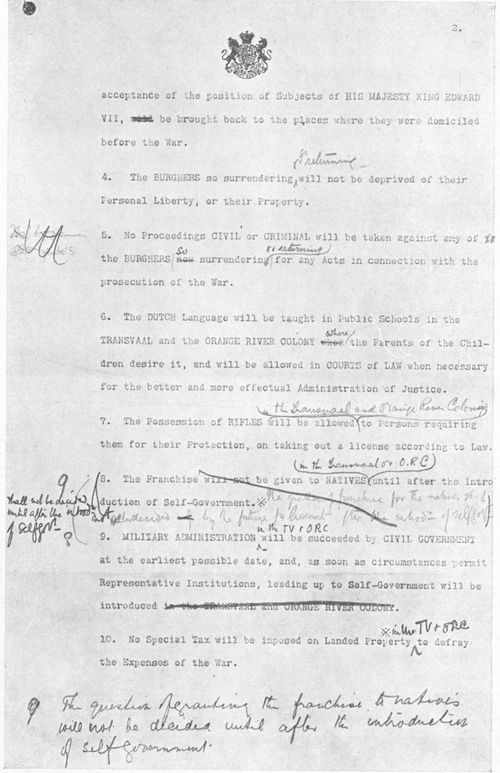
Facsimile of a page of the Peace Proposals as submitted by
the British Representatives, and amended by the Boer Representatives. The
alterations are in the handwriting of Generals Smuts and Hertzog.
* These are by General Smuts.
General Botha: Must we understand that our proposal has now been entirely
rejected?
Lord Milner and Lord Kitchener: Yes.
General Botha: Then I must understand that you are going to adhere to the
Middelburg proposals only?
Lord Kitchener: No, we can alter them.
Lord Milner: This draft document was originally drawn up to be attached to
the Middelburg proposals; but instead of the Middelburg proposals, this
document has now been substituted to enable us to cast those proposals in
another form.
General Smuts: If, then, the idea is to alter the Middelburg proposals,
would it not be best to do so now and to attach them to this document?
Lord Milner: What takes the place of the Middelburg proposals must be
attached to this document as a schedule, and we must jointly work out the
schedule.
General Smuts: I think it would be better if you alter the proposal
yourselves and then submit it to us for consideration, so that we can
consider what we shall do with it.
Lord Kitchener: I am of opinion that a sub-committee out of yourselves
should be appointed to do that.
Lord Milner: My idea is that the schedule can be drafted by two or three
of us, to be then considered by us as a whole.
General Smuts: We would like to consider first whether we shall assist.
Lord Milner: I am willing to draft it with you or to let you draw it up
alone, but on the ground of my experience I do not wish to do it alone.
General Smuts: If we sign this document, would not the effect of
it be that we leaders would make ourselves responsible for the burghers
laying down their arms?
Lord Milner: Yes, if the arms are not laid down, everything is a failure.
Lord Kitchener: I do not think so. If all do not lay down their arms, the
signatories cannot help it. There will always be some dissatisfied ones.
General Smuts: The document does not say so.
Lord Kitchener: You can draft it differently.
General de la Rey: Then there will be no peace, for a portion of the
burghers will remain to continue the war.
Lord Milner: If the meeting of Representatives agrees to your signing this
document, then it certainly means that the burghers as a body agree to it.
And those who do not agree to it—I do not know what I shall call
them—"outlaws." We cannot suppose such a thing.
General Botha: That is why we want a peace that will be honourable for
both parties. And as I understand this document, we are now going further;
we are not only giving up our independence, but every burgher is bound
hand and foot. And where is, then, the honourable peace for us? If we make
peace we must do so as people who must live and die here. We must not
conclude a peace that is offensive to the feelings of one party. I wish to
do everything that is in my power to attain that object, but it appears to
me that this document demands too much, because, if I understand aright,
we must give up the independence, everyone must lay down his arms, and the
leaders must, in addition, sign a promise.
Lord Milner: All that we want is that those persons must live together in
peace as British citizens. If we do not attain that, I do not know what we
shall get.
Lord Kitchener: I believe that the Commandant General does not realise
what the schedule contains. We say therein what we shall give.
Perhaps it will be best if the schedule comes first, and then you will see
that an honourable peace is proposed.
General Botha: Set the document forth more fully.
Lord Kitchener and Lord Milner: You must help us. We do not know what the
burghers desire.
Chief Commandant de Wet: To sign this document will place us in the
position which the Commandant General has described in plain words.
General de la Rey: We cannot form an opinion about a thing that has not
been worked out. I have no objection to the appointment of a sub-committee
from our midst to assist.
General Botha: I also have no objection, for I clearly understand that no
one is bound.
Lord Kitchener: No, no one is bound.
General de la Rey: We also wish to have the matter at an end, and to know
what we have before us.
Chief Commandant de Wet: I wish it to be plainly understood that I see no
chance to accept a body of which I have here only seen the head. This
appears to me to be an unsurmountable difficulty. Holding this opinion, it
would not be honest of me to remain silent; it would not be honest to Your
Excellencies.
Lord Kitchener: I think it would be better that General de Wet first saw
the entire document before he gives his opinion.
It was then agreed that General Hertzog and General Smuts would act as a
sub-committee to make a complete draft with Lord Kitchener and Lord
Milner, advised by Sir Richard Solomon.
The meeting then adjourned.
Wednesday, May 21, 1902.
The Conference was resumed.
Lord Milner submitted the document which had been drawn up during the
adjournment with the assistance of the sub-committee.
The names of the members of the two Republican Governments were
now filled in.
The document given hereunder was telegraphed to the British Government,
the last paragraph of Clause II, which deals with the Government notes,
the receipts and the sum of £3,000,000, having been added during the
Conference between all the representatives of both parties on the terms
drafted by the sub-committee. (See page 125.)
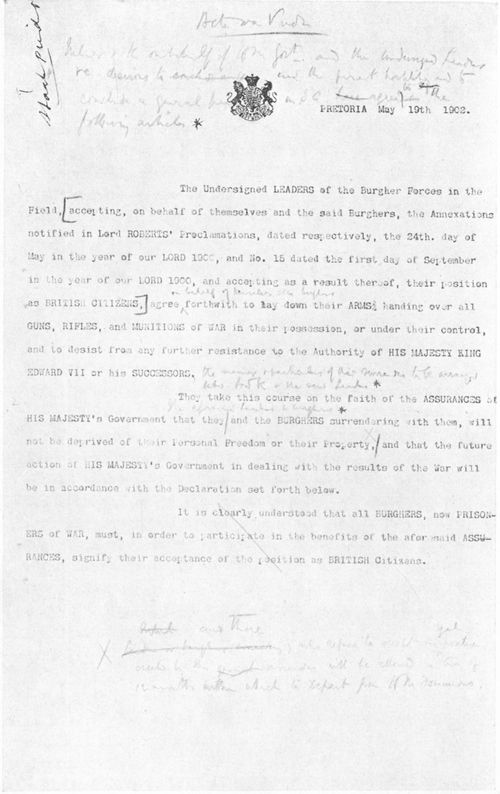
Facsimile of a page of the Peace Proposals as submitted by
the British and amended by the Boer Representatives. The alterations are
in the handwriting of General Smuts and Mr. Advocate N. J. de Wet.
* These are by General Smuts.
The document was read out in English and Dutch, and was as follows:—
General Lord Kitchener of Khartoum,
Commanding in Chief,
and
His Excellency Lord Milner,
High Commissioner,
on behalf of the British Government,
and
Messrs. S. W. Burger, F. W. Reitz, Louis Botha, J. H. de La Rey,
L. J. Meyer, and J. C. Krogh,
acting as the Government of the South African Republic,
and
Messrs. M. T. Steyn, W. J. C. Brebner, C. R. de Wet, J. B. M.
Hertzog, and C. Olivier,
acting as the Government of the Orange Free State,
on behalf of their respective Burghers,
Desirous to terminate the present hostilities, agree on the
following articles:—
1. The Burgher Forces in the Field will forthwith lay down their
Arms, handing over all Guns, Rifles, and Munitions of War in
their possession or under their control, and desist from any
further resistance to the Authority of His Majesty King Edward
VII., whom they recognise as their lawful Sovereign.
The manner and details of this surrender will be arranged
between Lord Kitchener and Commandant General Botha,
Assistant Commandant-General de la Rey, and Chief Commandant de
Wet.
2. Burghers in the Field outside the limits of the Transvaal or
Orange River Colony, on surrendering, will be brought back to
their homes.
3. All Prisoners of War, at present outside of South Africa, who
are Burghers, will, on their declaring their acceptance of the
position of Subjects of His Majesty King Edward VII., be brought
back to the places where they were domiciled before the War.
4. The Burghers so surrendering or returning will not be deprived
of their personal liberty or their property.
5. No Proceedings, Civil or Criminal, will be taken against any
of the Burghers so surrendering or returning for any Acts in
connection with the prosecution of the War.
6. The Dutch language will be taught in public schools in the
Transvaal and the Orange River Colony where the Parents of the
Children desire it, and will be allowed in Courts of Law when
necessary for the better and more effectual Administration of
Justice.
7. The Possession of Rifles will be allowed in the Transvaal and
Orange River Colony to persons requiring them for their
Protection, on taking out a licence according to Law.
8. Military Administration in the Transvaal and Orange River
Colony will at the earliest possible date be succeeded by Civil
Government, and, as soon as circumstances permit, Representative
Institutions, leading up to Self-Government, will be introduced.
9. The question of granting the Franchise to natives will not be
decided until after the Introduction of Self-Government.
10. No Special Tax will be imposed on Landed Property in the
Transvaal and Orange River Colony to defray the Expenses of the
War.
11. A Judicial Commission will be appointed to which Government
Notes issued under Law No. 1 of 1900 of the South
African Republic may be presented within six months.
All such notes as are found to have been duly issued in the terms
of that law, and for which the persons presenting them have given
valuable consideration, will be paid, but without interest.
All receipts given by the Officers in the Field of the late
Republics, or under their orders, may likewise be presented to
the said Commission within six months, and if found to have been
given bona fide for goods used by the Burgher Forces in the
Field, will be paid out to the persons to whom they were
originally given. The sum payable in respect of the said
Government Notes and Receipts shall not exceed £3,000,000
sterling, and if the total amount of such Notes and Receipts
approved by the Commission is more than that sum, there shall be
a pro rata diminution. Facilities will be afforded the
Prisoners of War to present their Government Notes and Receipts
within the six months aforesaid.
12. As soon as conditions permit, a Commission, on which the
local inhabitants will be represented, will be appointed in each
district of the Transvaal and Orange River Colony, under the
Presidency of a Magistrate or other Official, for the purpose of
assisting the restoration of the people to their homes, and
supplying those who, owing to war losses, are unable to provide
for themselves with food, shelter, and the necessary amount of
seed, stock, implements, &c., indispensable to the resumption of
their normal occupations. Funds for this purpose will be advanced
by Government free of interest and repayable over a period of
years.
Lord Milner: If we agree, it is the English document that will be
telegraphed to England, and it is that document upon which His Majesty's
Government will decide and which will be signed.
General Botha: Will a Dutch translation not be attached to it?
Lord Milner: I have no objection that a Dutch translation be
annexed. Well, that is the document that we are prepared to submit to the
British Government.
General Botha: There are a few points I wish to talk about. The first is
with reference to receipts given by our officers. I would like to have
them added to the paragraph referring to the Government notes. These
receipts were given on instructions issued by our Government for the
purchase of cattle or grain or necessaries, for the support of our
commandos, and the chief officers now here, as well as all other officers,
have acted in accordance with these instructions and issued receipts. For
this reason, I make this request. Some of these receipts were discharged
in full, and others in part, in Government notes, but many were not paid
at all. I do not think that the amount is large, but it will strengthen
our hands by enabling us honourably to terminate this matter, because our
honour is in so far concerned that we have signed these receipts. It will
be a great point for us if we can meet the delegates, most of whom are
officers, and inform them that they have been protected in this matter.
Lord Kitchener: I understand that General Botha does not refer to
commandeer, or requisition notes, but only to actual receipts given on the
Treasury.
Lord Milner: I do not see the difference between these receipts and
commandeer notes. The willingness of people to sell goods does not in my
opinion make any difference in a legal document.
Lord Kitchener: I think that it does make a difference if it is an order
on the Treasury or a requisition note. I should limit this to receipts on
the Treasury, issued in accordance with the law, which allowed that a
certain sum could be spent.
Chief Commandant de Wet: In the Free State no resolution was taken fixing
the amount that could be spent.
Lord Kitchener: Do you mean that this is an undefined amount, or that it
falls under the amount fixed by the Volksraad?
General Smuts: The Volksraad authorised the Government to issue notes to
a certain amount, which was done. Apart from this law, the
officers in the field had the right to make purchases on behalf of the
commandos and to grant receipts therefor.
Lord Milner: I see no difference between these receipts and requisition
notes, and, besides, it is for an unlimited amount.
General Smuts: These receipts were issued under an entirely different law.
They were not paid out of the credit voted by the Volksraad.
Chief Commandant de Wet: I wish it to be plainly understood that I fully
agree with what has been said by the Commandant General, that the honour
of every officer is affected by these documents. And if Your Excellencies
agree, you give us a powerful weapon with which we can return to the
Delegates.
Lord Milner: The proposal is, in fact, that the British Government must
pay all the money borrowed by the Republics to fight them.
Chief Commandant de Wet: But we were an honourable party in the fight, and
if we cease to be a party, it is only reasonable that we are met on this
matter.
General Botha: Must I understand from your attitude that we must hand over
everything, and that you must walk off with the assets of our country,
which amount to millions and millions, and take no responsibility on
yourselves for the debts? We are acknowledged by you as a belligerent
party, and, therefore, we have the more right to expect that if you walk
off with the assets of the country, you must also take upon yourselves the
responsibility for the debts; if the British Government attains its great
object, then a minor matter like this ought not to stand in the way. We do
not come here to haggle at little things, but to contend for something
that is an actual difficulty, and you must agree that if we tell you
something here, we really mean it. And if we wish to make peace, every one
must not draw his own line, but we must take each other by the hand. Now
we say that this matter stands in our way. We personally have not signed
so many receipts, but the inferior officers who have signed the most
mainly constitute the meeting at Vereeniging. In some cases
special persons were appointed entrusted with this work.
Lord Milner: We do not take over the assets of the country without its
liabilities. We take over all the debts which the country had before the
war, and we have even agreed to take over a debt—a lawful debt—in the
shape of notes, the contracting of which we are aware was necessary only
on account of the war, and therefore we already pay a share of the
expenses incurred to fight us. I thought that this was a very great
concession, and when I agreed to put it down, I said that I thought, and I
still think so, that the British Government would take exception to it,
although I hope that they will not do so. But to go further than that and
to ask that we shall pay not only a debt incurred for the purposes of the
war, but every debt incurred by every officer of both armies for the
purpose of fighting us, is in my opinion a very extreme proposal. In reply
to what General Botha has said, I must say that the Commission appear to
think that we have no one behind us whose feelings and prejudices (if you
wish it) we must consider. If this will cause you difficulty with your
burghers, the proposal now made will, I am sure, cause the British
Government the greatest difficulties with the people whose feelings they
must consider.
Chief Commandant de Wet: I would like to explain the position of the
Orange Free State. In the Transvaal a law was passed authorising the
Government to issue £1,000,000 in notes. In the Orange Free State this was
not done, because the Government had the right to pay with receipts, and
we thought that a receipt was as good and lawful as the notes. And
therefore these matters have the same importance for me.
General Botha: I don't think that we should be so technical, especially
not in your case, because our being together here is with the object of
causing hostilities which involve great expenditure of money every month,
to cease, and our meeting can have the result of speedily putting an end
to these costs. And therefore, by accepting our proposal and
paying the receipts, you will greatly reduce your expenses. It will be
much cheaper to terminate the war by co-operation than to let the
negotiations be broken off; and therefore I think that we must accede to
points which stand in the way.
Chief Commandant de Wet: I can give His Excellency Lord Milner the
assurance that the idea always lived with the people that, even if
everything was lost, they would still, after the war, receive the money in
payment of the receipts. And therefore if this is not conceded I cannot
conceive what the result will be. I fear that result, and hope that you
will try to obviate it.
General Botha: It cannot be a particularly large amount; but we do not
know how much it is.
Chief Commandant de Wet: You can well imagine that our expenditure was as
a drop in a bucket compared with yours. And if I am not mistaken, the
Orange Free State had three-quarters of a million pounds when we commenced
the war; and the expenditure by means of receipts began after that amount
was exhausted. Your Excellencies must therefore admit that these receipts
impose upon us the same obligation towards creditors as any other debt
would have done.
General Botha: You have already many of our notes in your possession. In
one place, for instance, 50,000 were hidden and found by you.
General Smuts: I have already privately used the argument with Lord Milner
that what we are now contending for has in principle already been conceded
by Lord Kitchener. In the Middelburg proposals the payment of the
Government notes was refused, but it was laid down that receipts to the
value of £1,000,000 would be paid out, and if this should now be withdrawn
it would certainly be a deviation from the Middelburg proposals. The
payment of notes is something lawful, and stands on another footing; and I
cannot understand how the payment thereof could have been refused in the
Middelburg proposals, and therefore an agreement to pay them now
is reasonable. But with reference to receipts, the payment of them was
partially acceded to, and now it is withdrawn. I think that when we have
arrived at such a stage in the negotiations as we have now, then a point
such as this, which was as good as agreed upon, must no longer be a
stumbling-block to a final agreement. I believe that this amount is small.
I was with General de la Rey for one year in command of the half of the
South African Republic. Accounts were kept of all receipts, and where the
books are no longer in our possession they are in your possession. The
issue of these receipts took place in proper order and under proper
regulations, and books thereof were kept. As far as I have been able to go
into the matter the amount of receipts is really small. And although Lord
Milner recoils from the payment of an enormous amount which may be
presented for payment if our proposal be accepted, yet I personally think
that the fear is vain, and that the amount will prove to be much less than
you probably think.
Lord Milner: I do not think it is so much a question of the amount. This
payment of Government notes and requisition notes is, in my opinion, very
reprehensible. I believe that in this respect I feel what the great
majority of the British people feels, that it would rather expend a large
sum after the war to improve the condition of the people that has fought
against them, than pay a smaller amount towards the expenses incurred in
fighting them. Whether this be right or wrong, it is a strong feeling with
which you must reckon. We do not wish to pay the accounts of both parties,
and the clause in the Middelburg proposals with reference thereto was, in
my opinion, always one of the bad ones in that document. If something of
this kind must be done, then I think that the payment of the Government
notes is not so bad as the payment of the requisition notes. I put the
point with reference to the payment of notes in this draft proposal,
because I thought that if a choice had to be made between the payment of
the one or the other, you would consider it better that the Government
notes were paid. If it is considered better to go back to the
Middelburg proposals on this point, then, however much I object to it, I
would agree, if Lord Kitchener agrees.
General Smuts: I fear that we cannot agree to that, because we consider
the Government notes indisputable.
General Hertzog: I do not think that Your Excellency represents the matter
fairly when you say, for instance, that you do not wish to pay the
accounts of both parties. There is one matter with reference to the Orange
Free State which we must specially note. We have contracted no loans and
we have issued no Government notes. The notes we used were South African
Republic notes, of which some were sent to the Orange Free State also. Our
(Orange Free State) law is based on the principle that in case of war, all
cost could be met by commandeering notes. This was acted on in the Orange
Free State, and receipts in the usual form or in the shape of requisition
notes were given. If we take this into consideration, and at the same time
also the fact that we have always acted, and still act, as a party which
is a lawful belligerent party, then we come and only say: from our side we
give all that we possess, and ask the other party to acknowledge only that
which if we had concluded a loan would in any case, in the shape of a
public loan, have fallen on the British Government, which takes over
everything from us. Lord Milner will thus understand that from our point
of view it is of as much importance for us to obtain payment of these
receipts as it will be for the South African Republic to obtain the taking
over by the British Government of the liability of a loan concluded before
the war. But I can even go further and give Lord Milner the assurance that
if we had also concluded a loan before the war, we could never have acted
so economically as we have done by using receipts. That was also actually
the reason why the Orange Free State never wished to conclude a loan
beforehand, because now we have purchased only what was absolutely
necessary for the day and for the circumstances. So that really Lord
Milner will have to admit that we stand in the same position in
respect to those who now hold receipts as we would have stood to any other
creditor that we may have had before the war. I have already informally
pointed this out to Lord Milner, and can now only express my agreement
with what the Commandant General has said that this difficulty is almost
insurmountable.
Lord Milner: We can refer this to our Government; but your proposal is
entirely in conflict with the Middelburg proposals, because in them it was
absolutely refused to take over all State debts.
Lord Kitchener: I wish that we could know the amount.
General de la Rey: I issued Government notes to the value of between
£20,000 and £40,000; but to what amount receipts were issued I cannot say.
Lord Milner: There is really a compromise possible, namely, to allow these
notes and receipts to be presented, and to introduce again the limit of
£1,000,000.
Lord Kitchener: Would that meet your difficulty?
General Botha: No.
Lord Kitchener: Would £2,000,000 or £3,000,000 meet you? We want to have a
limit, so as to know what to do.
Chief Commandant de Wet: It is impossible to fix an amount.
Lord Kitchener: If you could fix a limit it would clear up the matter.
Chief Commandant de Wet: With that I fully agree. I appreciate your
standpoint, but it is an absolute impossibility to name the amount. Let us
withdraw for a moment to discuss this point.
The meeting then adjourned and met again at 2.30 o'clock.
Chief Commandant de Wet: We have agreed to fix an amount of £3,000,000 for
Government notes and receipts, which can be reduced pro rata if this
amount is not sufficient. We have drafted a clause to submit to you.
General Smuts read the draft, which is embodied in the last
paragraph of Clause 11 of the draft agreement. (See p. 117.)
In reply to Lord Kitchener:
Chief Commandant de Wet said: The prisoners-of-war on the various islands
who hold such notes ought also to have the opportunity for presenting
them.
Lord Milner: What is your next point? We now understand what your views
are on this matter.
General Botha: Must I understand that we pass from this point?
Lord Milner: That document contains your views which we now know.
General Botha: We must know what we must say to our delegates.
Lord Kitchener: Is that the only point or will other points be raised?
General Botha: There is another point with reference to the protection of
debtors. This is a serious, a vital question for us.
Lord Milner: There must be a good understanding between us.... Let
everything be embodied in one document.
General Smuts: Most of the debts incurred before the war will be payable
at the conclusion of the war. And, if the debtors cannot pay, we are
afraid it will be ruination for a large proportion of the population. And
we would like to see that steps are taken to prevent this. If Lord Milner
intends to take such steps we should like to be informed what they are.
Lord Milner: I think it would be better if you made a proposal on this
point.
General Smuts: Our proposal generally would be: that all interest which
became payable during the war be added to the principal sum, and that the
payment of the principal be put off until twelve months after the
conclusion of the war.
Lord Kitchener: Is it necessary to have this as a proposal?
General Smuts: If the Government is prepared to meet this
difficulty it is unnecessary to make a formal clause of it in the draft
agreement.
Lord Milner: According to my view our Government makes certain promises in
this document, and I am of opinion that all promises to which reference
will later on be made must be embodied herein. Any matter on which it is
desired to bind the Government must be in this document and not outside
it. I will not say that I want further clauses, but above all I wish to
prevent misunderstanding.
General Smuts: In that case we are prepared to propose a clause to meet
this difficulty.
General Botha: We raise this point so that early measures may be taken if
we come to an understanding. If a great portion of the population become
subjects of His Majesty, it is to the interest of everyone, especially of
the Government, to see that these people are not ruined. They will be
thrown on the Government, who will have to care for them. If we do not
take any steps now then speculators who have bought up debts will demand
payment immediately after peace is concluded; and as soon as the courts of
law are open they can sue the debtors, and we want to guard against that.
Lord Milner: I agree with the Commandant General that this is the view
which I take of the matter, and that as soon as these people become
subjects of His Majesty they must be cared for. But I think it is neither
necessary nor advisable to lay down in all particulars the way in which
His Majesty's Government must care for these people. I think that there is
perhaps an idea—perhaps a natural idea—that because we have fought the
burghers therefore when peace is concluded there will be a feeling of
enmity towards them. The contrary, however, is the truth. From the moment
hostilities cease our desire would naturally be to try to gain the
confidence of the burghers, and to attend to the interests of the people.
But if we must bind ourselves beforehand with reference to the manner with
which we shall deal with all sorts of complicated legal
questions, this will certainly lead to misunderstanding. Naturally if a
certain amount of confidence is not reposed in us, that we shall try to be
a just government, and try to keep the balance even between the various
classes of His Majesty's subjects, then all I can say is this: Put in
writing all that you can possibly think of, and let us submit it to His
Majesty's Government and see what they think of it.
Chief Commandant de Wet: I hope it will not be presumed that we sit here
to bind the hands of His Majesty's Government. Sufficient other points
will continually crop up by means of which the Government can gain the
confidence of the population. But with reference to the financial
condition of the burghers who have been entirely ruined, we feel ourselves
obliged to make some arrangement which will be a weapon in our hand when
we return to the delegates.
General Botha: I do not quite understand Lord Milner. I did not understand
from Chamberlain's telegram that we should make new proposals to bind your
hands. I understood that proposals should be made with the object and the
wish to secure peace.
Lord Kitchener: I do not think it quite necessary to embody this proposal
in the document. It concerns a very complicated legal question, as to what
the rights of creditors and debtors will be, and what the law in the
Transvaal precisely is on this subject. I think that everyone may feel
assured that the interests of the Boers will be protected equally well by
the Government in every possible way, whether this point is actually
stipulated or whether it is left over to the Government with the
recommendation of this Commission to take the matter into serious
consideration. I think that my suggestion is a better way of dealing with
such a complicated question. Let the attention of the Government rather be
drawn to it. I may be wrong, but as far as I know this will be an
intricate question for lawyers, and it would take a long time to state it
clearly. It is the desire of us all that you should go to the
meeting of your delegates so equipped that you will be able to come to a
decision; and I would therefore suggest that you be satisfied that the
matter has been brought before us, and entered on the minutes of the
meeting. That is, I believe, as far as it is necessary for you to go. The
matter can then be taken into serious consideration, not only here, but
also in England. And you can be perfectly assured that your interests will
be considered in every possible way.
General de la Rey: I think that the matter has been sufficiently brought
to the notice of Your Excellencies, and that it need not be embodied in
the draft contract, because by doing so one might possibly be infringing
on legal principles.
Chief Commandant de Wet: I proceed from this standpoint: There are two
parties, and the one ceases entirely to exist, and it is thus natural that
that party cannot allow such a vital question to pass by unobserved. And
therefore I cannot approve of it that the matter be not inserted in the
draft contract. It will not be necessary to bind the Military Government
that exists at present and will continue to exist after the war.
Lord Kitchener: But this question will have to be dealt with by the civil
Government. It is a matter for lawyers, and will have to be submitted to
them and demand much consideration.
General Botha: If hostilities are terminated now a burgher can be sued for
debt incurred before the war. I prefer this request, because our law lays
down that no burgher can be sued until sixty days after the conclusion of
peace.
Lord Kitchener: You may rest fully assured that when the war is over every
burgher will have the absolute right to have his position taken into
consideration on all points, and that his interests will be protected by
the Government just as much, I believe, under the new as under the old
régime.
General Botha: I understand that quite well; but the possibility exists
that syndicates may be formed to buy up all debts, and the
people be ruined before a single burgher is in a position to earn
something or to establish his position.
Lord Kitchener: I quite agree with the Commandant General, and he does
right to raise this question. But I do not believe that the draft contract
is the place in which to bring the question forward. When there is peace,
it is the duty of everyone to draw the attention of the Government to what
is necessary to help the people. But to imagine difficulties now, and to
try to put them right, appears to me to be an endless matter, for which
this document is not intended.
Chief Commandant de Wet: I understand that this is something that must be
settled by a proclamation, but I want to have as many weapons as possible
in my hand when I go back to the Delegates; and one of the first questions
which they will put is: "What guarantees have we that we shall not be
ruined by our creditors?" And what objection is there that a draft
proclamation be given to us to take to Vereeniging, which will be
promulgated as soon as peace is concluded?
Lord Kitchener: But this will be something apart from this agreement.
Chief Commandant de Wet: Yes.
Lord Milner: What is the good of it then?
Chief Commandant de Wet: It is such a vital question for us that it cannot
be taken amiss in us if we insist upon it, because we must give up
everything.
Lord Kitchener: Of course no one takes it amiss in you.
Lord Milner: But I must point out without taking it amiss in anyone that
the effect of what you propose would be that another clause would have to
be embodied in the draft contract undertaking to promulgate such a
proclamation.
Lord Kitchener: I believe that if the Delegates received the assurance
that the Government will take this matter into consideration in the
interests of their subjects, whom they must protect, that this will be
sufficient for them. There will be no written obligation, but
only an obligation that the matter will be considered. It is not advisable
to press this matter with the Government, after it has been brought before
them. The opinions of the burghers will be brought before Lord Milner in
other ways also.
Chief Commandant de Wet: There are many other small points which we could
take up, which it would, however, not be desirable to do, but we are now
speaking of a vital question.
Lord Kitchener: This is one of those questions which, if brought to the
attention of the Government, cannot be set aside. And you may inform the
burghers that their interests will be protected as much as possible. I
think that this ought to be sufficient for you on such a complicated
matter. What is spoken here is being taken down, and the minutes will be
considered not only here, but also in England. Are you satisfied with
that?
General Botha: As far as I am personally concerned, yes.
Chief Commandant de Wet: So am I.
Lord Milner: I hope it is understood that if the matter is left here,
there is no obligation on my Government to deal with the matter in a
particular way.
Lord Kitchener: But there is a pledge that the matter will be properly
considered.
Lord Milner: Yes, of course, if we are going to put an understanding on
record. Solemnly I think it is necessary that we understand that this
document contains everything concerning which there is anything in the
form of a "pledge."
Lord Kitchener: There is thus a "pledge" that this point which you have
raised will be considered in your interest.
General Smuts: Now the question with reference to the payment of receipts
still remains.
Lord Kitchener: That will be referred to the British Government. As
regards the amount, that is an essential point, but I am of opinion that
the amount is high. I would like to know whether it is understood now that
we are agreed on all these draft proposals with your amendment? And that
there are not any other matters? Because they will have to be
telegraphed to England.
Chief Commandant de Wet: We have no other matters.
Lord Milner: The proposed telegram which I wish to transmit reads as
follows: "The Commission is prepared to submit the following document to
the meeting of representatives of their Burghers (if it is approved of by
His Majesty's Government), and to ask that meeting for a 'yes' or 'no'
vote." Is that good?
Chief Commandant de Wet: Yes, naturally, except that I cannot say that
that document is approved of by me; but I will abide by what the Delegates
do.
General Hertzog: I would not like it to be understood that we will use our
influence with the Delegates.
Lord Milner: I think that that is quite understood. I do not understand
that this binds the members of the Commission with reference to the
opinion which they may express before the Burghers. It only binds them to
lay this document before the people, if the British Government approves of
it. The telegram which I have just read, and propose to send, makes this
clear. I further wish to say that we have departed very much from the
Middelburg proposals, and I believe it is fully understood that the
Middelburg proposals are absolutely dead, and if this document is agreed
to and signed, there can then be no attempt to explain this document or
the terms thereof by anything in the Middelburg proposals.
The meeting then adjourned.
Wednesday, May 28, 1902.
The Commission again met Lord Milner and Lord Kitchener at 11 a.m. to hear
the reply of the British Government to the draft proposal submitted to
them by their Lordships.
Lord Milner read the following Memorandum: "In reply to our last telegram
drafted at our last meeting with the consent of the Commission,
and of which they have received a copy, the following message has been
received from His Majesty's Government: 'His Majesty's Government approves
of submitting to the Meeting for a "yes" or "no" vote the document drafted
by the Committee, and transmitted to the Secretary of State for War by
Lord Kitchener on May 21, with the following alterations[4]:
General Lord Kitchener of Khartoum,
Commanding-in-Chief,
and
His Excellency Lord Milner,
High Commissioner,
on behalf of the British Government,
and
Messrs. S. W. Burger, F. W. Reitz, Louis Botha, J. H. de La
Rey, L. J. Meyer, and J. C. Krogh,
acting as the Government of the South African Republic,
and
Messrs. M. T. Steyn, W. J. C. Brebner, C. R. de Wet, J. B. M.
Hertzog, and C. Olivier,
acting as the Government of the Orange Free State
on behalf of their respective Burghers,
desirous to terminate the present hostilities, agree on the following
Articles:—
1. The Burgher Forces in the Field will forthwith lay down their Arms,
handing over all Guns, Rifles, and Munitions of War, in their possession
or under their control, and desist from any further resistance to the
Authority of His Majesty King Edward VII., whom they recognise as their
lawful Sovereign.
The manner and details of this Surrender will be arranged between Lord
Kitchener and Commandant-General Botha, Assistant Commandant-General de la
Rey, and Chief Commandant de Wet.
2. Burghers in the Field outside the limits of the Transvaal and
Orange River Colony, and all Prisoners of War at present outside South
Africa, who are Burghers, will, on duly declaring their acceptance of the
position of subjects of His Majesty King Edward VII. be gradually brought
back to their homes as soon as transport can be provided and their means
of subsistence ensured.
3. The Burghers so surrendering or so returning will not be deprived of
their personal liberty or their property.
4. No Proceedings, Civil or Criminal, will be taken against any of the
Burghers so surrendering or so returning for any Acts in connection with
the prosecution of the War. The benefit of the Clause will not extend to
certain Acts contrary to the usages of War which have been notified by the
Commander-in-Chief to the Boer Generals, and which shall be tried by Court
Martial immediately after the close of hostilities.
5. The Dutch language will be taught in Public Schools in the Transvaal
and the Orange River Colony, where the Parents of the Children desire it,
and will be allowed in Courts of Law when necessary for the better and
more effectual Administration of Justice.
6. The Possession of Rifles will be allowed in the Transvaal and Orange
River Colony to persons requiring them for their protection, on taking out
a licence according to Law.
7. Military Administration in the Transvaal and Orange River Colony will
at the earliest possible date be succeeded by Civil Government, and, as
soon as circumstances permit, Representative Institutions, leading up to
Self-Government, will be introduced.
8. The question of granting the Franchise to natives will not be decided
until after the introduction of Self-Government.
9. No Special Tax will be imposed on landed Property in the Transvaal and
Orange River Colony to defray the Expenses of War.
10. As soon as conditions permit, a Commission, on which the
local inhabitants will be represented, will be appointed in each District
of the Transvaal and Orange River Colony, under the Presidency of a
Magistrate or other official, for the purpose of assisting the restoration
of the people to their homes and supplying those who, owing to war losses,
are unable to provide for themselves, with food, shelter, and the
necessary amount of seed, stock, implements, &c., indispensable to the
resumption of their normal occupations.
His Majesty's Government will place at the disposal of these Commissions a
sum of three million pounds sterling for the above purposes, and will
allow all notes, issued under Law No. 1 of 1900 of the Government of the
South African Republic, and all receipts, given by the officers in the
field of the late Republics or under their orders, to be presented to a
Judicial Commission, which will be appointed by the Government, and if
such notes and receipts are found by this Commission to have been duly
issued in return for valuable consideration, they will be received by the
first-named Commissions as evidence of War losses suffered by the persons
to whom they were originally given. In addition to the above-named free
grant of three million pounds, His Majesty's Government will be prepared
to make advances as loans for the same purposes, free of interest for two
years, and afterwards repayable over a period of years with 3 per cent.
interest. No foreigner or rebel will be entitled to the benefit of this
Clause."
Lord Milner: In submitting this communication to the Commission, we are
instructed to add that if this opportunity of concluding an honourable
peace is not availed of within a time to be fixed by us, the Conference
will be considered at an end, and that His Majesty's Government will not
in any way be bound by the present terms. In order that there may be no
misunderstanding with reference to these terms, I have made a copy of the
document and of Lord Kitchener's telegram, with the additions
and alterations made by His Majesty's Government with a memorandum of what
I have now said.
A discussion followed over the time that would be required to consider the
matter at Vereeniging, and it was agreed that General Botha would propose
a time-limit before the Committee left Pretoria that day.
This was done later on, and the time was fixed for Saturday evening, May
31, 1902, at the latest.
General Botha asked whether there would be any objection to the Delegates
deleting some clause or other from the proposal now submitted by the
British Government?
Lord Milner: There can be no alteration. There must simply be a reply of
"yes" or "no."
General Botha thought that they had the right to alter one or more of the
clauses, because the burghers in the field had the right to surrender
unconditionally.
Lord Milner said that the burghers could naturally do so. But the document
from the British Government could not be altered.
The Colonial Rebels.
Privately, much discussion had already taken place in the interests of the
Colonials who had fought on the Republican side, and an informal
conversation now followed on this subject.
Lord Milner communicated what the British Government intended to do with
these Colonists, which intention appears from the following document which
he read:—
"His Majesty's Government must place it on record that the treatment of
Cape and Natal Colonials who have been in Rebellion, and who now
surrender, will, if they return to their Colonies, be determined by the
Colonial Governments and in accordance with the Laws of the Colonies, and
that any British Subjects who have joined the Enemy will be liable to
trial under the Law of that part of the British Empire to which they
belong.
"His Majesty's Government are informed by the Cape Government
that the following are their views as to the terms which should be granted
to British Subjects of the Cape Colony who are now in the Field or who
have surrendered or have been captured since April 12, 1901. With regard
to Rank and File, that they should all upon surrender after giving up
their Arms sign a document before the Resident Magistrate of the District
in which surrender takes place acknowledging themselves guilty of High
Treason, and that the Punishment to be awarded to them, provided they
shall not have been guilty of Murder or other acts contrary to the usages
of Civilised Warfare, should be that they shall not be entitled for life
to be registered as Voters or to vote at any Parliamentary, Divisional
Council, or Municipal Election.
"With reference to Justices of the Peace, and Field Cornets of the Cape
Colony and all other persons holding an Official Position under the
Government of the Cape Colony, or who may occupy the Position of
Commandant of Rebel or Burgher Forces, they should be tried for High
Treason before the ordinary Court of the Country or such special Courts as
may be hereafter constituted by Law, the Punishments for their Offence to
be left to the discretion of the Court, with this proviso, that in no case
shall the penalty of Death be inflicted.
"The Natal Government are of opinion that Rebels should be dealt with
according to the Law of the Colony."
The Conference then broke up. The secretaries, assisted by Advocates N. J.
de Wet and Igns. S. Ferreira immediately commenced with the task of making
copies and translations of the proposals of the British Government for the
use of the Meeting of the Delegates at Vereeniging. This work occupied
them till the evening.
At 9 o'clock p.m. the Commission left for Vereeniging by special train.[Back to Contents]
Vereeniging and Peace.
Minutes
of the meeting of the Special Delegates at Vereeniging,
South African Republic, on Thursday, May 29, 1902,
and following days.
The Meeting commenced at 9 a.m., and, at the request of the Chairman, was
opened with Prayer by the Rev. J. D. Kestell.
Having declared the Meeting open, the Chairman requested the Commission,
which had been delegated to negotiate with Lord Kitchener and Lord Milner,
to report on what they had done.
The acting State President S. W. Burger, on rising to do so, first
requested the Secretary of the Meeting (Mr. D. E. van Velden) to read the
following report of the Commission:—
Pretoria, May 28, 1902.
To the Governments of the Orange Free State and South African
Republic.
Gentlemen,
In accordance with the instructions received by us from the two
Governments, we proceeded to Pretoria to negotiate with the
British Representatives on the question of peace, and have the
honour to report as follows:—
Our meetings with the British Authorities lasted from Monday, May
19, till Wednesday, May 28, and the delay was principally due to
the long time required for cable correspondence with the British
Government.
At first we made a proposal[5] in which we tried to
establish a restricted independence by the surrender of a portion
of our territory as a basis of negotiation. Lord Kitchener and
Lord Milner, however, decidedly refused to negotiate on that
basis, and informed us that if that proposal were cabled to the
British Government, it would be detrimental to the negotiations.
At the same time we were informed that, as had already been
intimated to both Governments, the British Government were
prepared to negotiate only on the basis of the Middelburg
proposals, subject to alterations as to details.
In order to prepare this proposal in a final form, Lord Milner
requested the assistance of some members of our Committee, to
which we acceded, with the understanding that the assistance of
these members of the Commission would be rendered without
prejudice.
As the result of the labours of this Sub-Committee, Lord Milner
submitted a draft proposal, in which we insisted in the
incorporation of a new clause, which was embodied therein (Clause
No. 11). The draft proposal which is attached to
this[6] was then cabled to the British Government, and was
altered by them and communicated to us in a final form. This
final proposal is attached hereto.[7]
We were informed on behalf of the British Government that this
proposal could not be further altered, but must be accepted or
rejected in its entirety by the Delegates of both Republics. At
the same time, we were informed that this acceptance or rejection
must take place within a definite time.
We thereupon informed Lord Kitchener that this final decision
would be communicated to him by next Saturday evening at the
latest.
During the formal negotiations some informal discussions also
took place with reference to the British subjects in the Cape
Colony and Natal who had fought on our side. As the result of
these informal discussions, we received a communication
from the British Government which we attach hereto.[8]
We have, &c.,
(Signed)
Louis Botha,
C. R. de Wet,
J. H. de la Rey,
J. B. M. Hertzog,
J. C. Smuts.
Acting President S. W. Burger said: If some point or other in the
documents that have just been read to you is not clear, one or other of
the members of the Commission will give the necessary explanations. You
will observe that the Commission tried to negotiate more or less in the
spirit of this meeting. The Representatives of the British Government
declared that they could not negotiate on any other basis than the
surrender of the independence. We have now before us a document upon which
the British Government thinks peace can be concluded. The question before
us now is: how must we set to work? I think there are three courses open
to us upon which we must decide before Saturday evening. The three courses
are:—
(1) To continue the struggle. Is this possible for us under the
circumstances in which we find ourselves; what are the prospects; and what
will the consequences be? This we must consider.
(2) Accept the proposal of the British Government and conclude peace
thereon.
(3) Surrender unconditionally.
On these questions the Meeting must now decide.
On the proposal of General S. P. du Toit, seconded by Commandant Mentz, it
was resolved that minutes of the discussions be kept as briefly as
possible, and also that all proposals and resolutions be recorded.
Mr. J. de Clercq (Middelburg): I would like to have some
elucidation of Clause 2. Whom does it include?
General Smuts: The words are: "in the veld." It is thus plain that other
persons are not included in it.
Mr. de Clercq: What, then, becomes of persons who have been banished?
General Smuts: Clause 3 provides for persons who, according to the
British, have been banished.
Commandant Jacobsz: Clause 2 deals with "burghers." I should like to know
whether officers are also included.
General Smuts: "Burghers" includes officers also. "Rebels" is the term in
contra-distinction to "burghers."
General S. P. du Toit: In clause 4, I read: "The benefit of this clause
will not extend to certain acts." May I know what acts are here referred
to?
General Botha: As communicated by Lord Kitchener to the Commission, three
persons are excluded from the benefit of Clause 4 of the peace proposals.
They are namely: Mr. van Aswegen for the shooting of Captain Mears; Mr.
Cilliers for the shooting of Capt. Boyle; and a certain Muller for the
alleged murder of a certain Rademeyer in the district of Vrede. These
three persons will have to stand their trial on the conclusion of peace.
Chief Commandant de Wet: Lord Kitchener arranged this matter informally
with General Botha without reference to me, as I think he should have
done, because two of the cases mentioned are of Free Staters. It is not
down in black and white, that the three persons mentioned will be the only
exceptions, and if more exceptions are made later I do not wish to be held
responsible.
General Botha: I should like further to explain this matter. This point in
Clause 4 was raised by the British representatives. Lord Kitchener asked
to see me personally and informally, and at the suggestion of General de
la Rey I went to him. Lord Kitchener then informed me that certain three
alleged murders in the course of the war had attracted much attention in
England, and that the British Government, on account of the
feelings of the English people, did not see their way open to leave these
three cases untried. The three cases already mentioned here were then
communicated to me by Lord Kitchener. On a later occasion I took General
Smuts with me, and Lord Kitchener repeated in the presence of both of us
that only these three persons would be excluded from the benefit of Clause
4.
General Hertzog: I am quite prepared to accept Lord Kitchener's word given
to Generals Botha and Smuts.
General Brand: Why are the names of these cases not inserted in the peace
proposal?
General Hertzog: They could not be inserted because as laid down by the
British Government it could not be altered.
General de la Rey: Only the three persons mentioned are excluded from the
benefit of Clause 4, and because we were afraid that there might be more
cases General Botha went and satisfied himself.
Chief Commandant de Wet: I did not wish to remain silent on this point,
because there was only the word of Lord Kitchener and no other guarantee
that other persons will not be prosecuted. I, of course, entirely believe
what Generals Botha and Smuts have stated.
General Hertzog: I am fully satisfied on this point.
Mr. C. Birkenstock (Vryheid) asked with reference to Clause 1 whether
having regard to the large number of Kaffirs in many districts it would
not be dangerous for the burghers to part with all their arms.
General Botha replied that the Commission had seen Lord Kitchener
informally on this point, and pointed out this danger to him, and he had
then agreed that in the districts on the boundaries where there were many
Kaffirs, the landed proprietors and their sons could retain their arms
under a licence, and that if there was a laying down of arms, he would
send persons immediately to return the arms to these landed proprietors
under a licence.
General de la Rey: On this point I spoke out freely to Lord
Kitchener. I said that I would never agree that burghers in the frontier
districts should be entirely disarmed, and thus made lower than the
Kaffirs. Lord Kitchener then said that he would take the arms from landed
proprietors with one hand and return them immediately with the other.
Mr. Birkenstock: Clause 2 says: "The prisoners of war will gradually be
brought back to their homes." Has a time been fixed, or will it be done in
the course of years? I have heard that the British have an objection to
sending back 30,000 persons.
General Smuts: The Committee tried to get a time fixed within which all
prisoners of war must be brought back, but the British had a great
objection to binding themselves, because it would depend upon the number
of transport ships they would be able to obtain to convey the 30,000
prisoners of war back, and also because it would not be advisable on
account of the scarcity of food in the two Republics to bring back so many
people at once.
The meeting then adjourned till two o'clock in the afternoon, when the
proceedings were resumed.
Mr. L. Jacobsz: Does Clause 2 provide for the return of the deputation and
other persons in Europe?
General Smuts: The members of our deputation and other burghers in Europe,
if they wish to return, also fall under this Clause.
Mr. Birkenstock: What property is referred to in Clause 3?
General Smuts: The word "property" includes every form of property.
Commandant van Niekerk (Kroonstad): What course will be pursued with
reference to the farms which have been sold?
Mr. J. L. Grobler (Carolina): How many farms have been sold?
General Smuts: Twenty farms, as stated unofficially.
Mr. J. L. Grobler: Where?
General Smuts: In the Orange Free State.
General Hertzog: The Commission spoke informally to Lord Milner about the
farms which have already been sold or confiscated by the British. He
replied that they could not be returned to the former owners, but that the
purchase-price would be refunded to them. About twenty farms had been thus
sold, all situate in the Orange Free State.
Landdrost Stofberg: Does Clause 5 signify that the medium of instruction
will be Dutch?
General Smuts: There is nothing against it in this Clause. According to
this Clause the Dutch language will be taught, but it is not stipulated
that Dutch will be the medium of instruction. My own impression is that
the language in the schools will be English, but if the parents desire it,
Dutch.
Landdrost Stofberg: It means therefore that the language medium will be
English, but that Dutch will also be allowed.
General Hertzog: Lord Milner declared that he wanted only one language in
South Africa, and that was English. English will be the medium.
Landdrost Stofberg: A foreign language therefore?
General du Toit: What will be the Constitution of the Civil Government?
General Botha: It will be that of a Crown Colony.
General Kemp: Is no time fixed within which Civil Government must be
introduced?
General Botha: No.
General du Toit: In Clause 9 mention is made of war taxes. Will there be
no other taxes?
General Botha: The British Government says that they will not defray their
expenses out of a tax on the farms.
Commandant Alberts: No war tax—therefore there will be other taxes?
General Smuts: Yes, certainly, but they will be imposed on all
inhabitants.
Mr. P. R. Viljoen: If anyone has a Government note or receipt
must he prove how he obtained it?
General Smuts: Clause 10 is directed against speculators who have bought
up notes.
Commandant Jacobsz: What course will be pursued in cases where notes have
passed from hand to hand?
General Botha: The Clause is directed only against speculators.
Mr. Birkenstock: Do the words: "to assist those who are not able to assist
themselves," mean that widows, orphans and maimed will be assisted?
General Botha: Yes.
Mr. Birkenstock: A pension, for instance?
General Botha: No pension.
Commandant Flemming: Was nothing said about receipts issued by the British
themselves?
General de Wet: Lord Kitchener said that they would not be paid out till
after the war, but not to speculators.
Commandant Flemming: There is therefore hope for British receipts?
General de Wet: Yes.
Mr. Naudé: Is a man a burgher who became such after the commencement of
the war?
Advocate L. J. Jacobsz: No one is a burgher who became such after the war
had begun.
Mr. Birkenstock asked a question with reference to creditors.
General Botha: In reply to Mr. Birkenstock I may say that we discussed
that question formally, but the British representatives would not bind
themselves with reference to the new Government's future policy, but asked
us to trust that new Government to protect debtors.
General du Toit: Does Natal hold another view regarding the rebels?
General de Wet: Yes.
General du Toit: If the rebels remain outside the boundaries of their
Colonies will they then be free?
General Smuts: Yes, if they remain outside the Cape Colony and Natal.
Commandant Opperman: Will their property be confiscated?
General Smuts: In the Cape Colony there is no law providing for
confiscation.
General Botha: Lord Kitchener said to me that at the coronation of the
King he would recommend a general amnesty.
The Chairman at this stage asked the meeting to confine itself to the
following questions:—
- (1) Whether it would accept the document at present before them.
- (2) Whether it would decide to continue the war.
- (3) Or, whether it would decide to surrender unconditionally.
Mr. J. de Clercq (Middelburg) said: I have already expressed my opinion on
the question as to whether we shall continue the war. If we cannot
proceed, then the question is whether we shall accept the proposals of the
British Government, or whether we shall surrender unconditionally. It
cannot be denied that these proposals are not so good as we wished, but
the question is whether in the circumstances we can get anything better.
If we surrender unconditionally and return to the burghers and they ask
us: "What have you obtained for us on surrendering?" and we reply: "We
have done nothing except surrendering you and ourselves unconditionally to
the enemy," then we shall be in difficulties, and how shall we be able to
justify ourselves? The burghers expect that we shall obtain the best terms
possible for them, and I say that it is a greater honour for a people to
negotiate than to surrender themselves unconditionally. If we get terms we
shall be better able to satisfy the people than if we can only
inform them that we have handed them over to the mercy of the enemy. I do
not believe that anyone will be able to convince me that unconditional
surrender will be better for the burghers. Unless I can be convinced of
the contrary, I think it will be best to accept the proposal of the
British Government.
General Nieuwoudt: I think that the matter is now plain, and propose that
we immediately proceed to vote whether we shall continue the war or not.
If the majority is not in favour of continuing the struggle, then we can
discuss the question whether we shall accept terms or surrender ourselves
unconditionally.
This proposal was seconded by General Froneman.
Mr. C. Birkenstock: We must not act with undue haste in this important
matter. Every Republican knows what the sentiment of freedom is, for which
everything has already been sacrificed, and therefore it is not so easy to
approve of, or to reject, a document such as the one now before us. I
cannot agree with General Nieuwoudt that we should immediately decide as
to whether we shall or shall not continue the war. We must consider the
question of our independence as something sacred. We should consider
whether we can continue the war, or whether we cannot continue it, and
whether by proceeding we can obtain better terms. Are we now able to
continue the war? Are there not at least two or three districts that
cannot proceed with the struggle? Co-operation is the all-important matter
for us. To think that a portion of the country can continue the war alone
is certainly wrong. Let us calmly consider whether our strength and
resources are such that we can maintain the struggle for a year. If we
cannot do so, let us rather accept terms, for half a loaf is better than
no bread. With my heart I cannot part with our independence, and it is
hard for me to make our people so unhappy, but for the sake of the people
and of the widows and orphans we must make the best we can of the matter.
Commandant Jacobsz also could not agree with the proposal of
General Nieuwoudt, because the matter was far too weighty to be disposed
of so hastily.
Mr. P. R. Viljoen (Heidelberg): The document that lies before us is
painful. We are so tied up by it, so "knee-haltered," that it appears to
me that we shall never get loose again. But I must admit that if we
continue the war we may later be hobbled instead of "knee-haltered." I
have already been informed that all my properties have been confiscated.
If this had happened to my properties only I would not mention it, but I
fear there are more people whose properties are threatened in the same
way. I think we must instruct the Governments to conclude peace on the
best terms.
General S. P. du Toit (Wolmaransstad): We are passing through critical
moments. We must respect each other's opinion because everyone thinks that
he has grounds for his views, and here especially it is expected that
everyone will express his opinion honestly and freely. If that is done we
shall be able to decide what course to pursue. We must not be over-hasty,
because we are on the eve of a most important decision, and if a delegate
declares that he is not able to prosecute the war any further we must not
consider him cowardly or unfaithful. His Honour the Acting State President
S. W. Burger, said: There are three questions before us, but I think that
we must for the present put aside the question of unconditional surrender,
and only discuss the document before us or the continuance of the war.
When I left my commandos it was my opinion, and that of my burghers, that
unless we retain our independence we must continue to fight, and my
instructions were to that effect. But my burghers gave me those
instructions because they were not acquainted with the true conditions of
the country, as I have learnt them here now. We received but few reliable
reports from other parts. We fixed our eyes on God and on the leading
commandos in the Eastern portions of the country. If the burghers had
known that those leading commandos cannot continue the war they would
have thought differently. We cannot deny that there are
commandos which, if the war must proceed, must take some great step or
other. We always expect that when it comes to voting the minority must
submit to the majority. This is the general principle, and also the best
in times of peace. But we are here under other circumstances. If it were
decided here by a majority of say, twenty, to continue the war, then I
ask: why do the others vote in the minority? Is it because they are
afraid, or tired out, or do not wish to co-operate? No; it is because they
cannot proceed any further. And can the majority then go on alone? No,
they are too weak for that. If we cannot all continue to co-operate, it
means that we cannot continue with the struggle. And therefore I say that
here to-day the majority must bow to the minority. We must speak out
freely, for no one of us here stands now under the orders of General Botha
or of General de la Rey. Everyone stands here with his own vote, and is
himself responsible. I am of opinion that if we continue the war our
people will die a national death, and also run a great risk of dying a
moral death. On what grounds can we hope to prosecute the war to a
successful issue? If such grounds can be pointed out to me, I shall very
willingly decide to go on manfully, but as far as I can see there is no
hope for us. I feel that we cannot continue, and if I had to continue now
I would do so in a very disheartened manner. If I return to my commando
and inform them that the British proposal has been rejected, they will ask
me on what grounds have we done so, and what reasons have we for hoping
for better results. Then I must be able to state our grounds, and I cannot
say that I have read this or that in a cutting from a newspaper, or that
the opinion or this one or that one is so or so, or that there is hope
that war will break out in Europe. If I were to do that they will say:
"You have built on sand." I do not see my way open to do that, and if it
were done, what I fear with heart and soul will come to pass, namely, that
small parties of burghers will make terms for themselves with the
enemy, and surrender, and where shall we then stand? Almost all
the burghers of some districts have already been captured, and our
position becomes daily worse, and it depends upon us whether our people
will be preserved, or whether we shall later be so reduced that there will
be an unconditional surrender. What will then become of us and of our
officers? Will they not be banished? I am not thinking of myself. If I
knew that by being banished I could save my people, I, and many with me,
would willingly sacrifice ourselves. It is plain to me that if we decide
to continue, unconditional surrender will follow of itself, and the Lord
preserve us from that. Our people will then simply die as such, because
there will be no one to help them. I will never lay down my arms if the
majority decides to prosecute the struggle. No. I will occupy myself
somewhere, and operate here or there with other Generals. But we cannot
take such a decision unless we have good grounds. Mention is made of
faith. Yes, and we had faith, but in my opinion faith must have its
grounds. When Abraham went to sacrifice Isaac he knew that, even if Isaac
were killed, God's promise would nevertheless be carried out. If we
believe that God will ultimately deliver us, we must use our brains.
I do not see a chance of continuing the war, but must associate myself
with those who say: "I have done what I could for my people and myself,
and now I can do no more." I see no other course open to us than to accept
the proposal before us.
Commandant Rheeder (Rouxville): The British refuse to allow our Deputation
to come out to see us. Many ask on what grounds we can continue the war,
and to them I reply that this refusal is one of the grounds, because, on
the face of it, it is obvious that something good is brewing for us. Let
us take everything into consideration. If we accept these terms we have a
dismal future. And what can we expect from the coming generation, who
cannot now understand what is being done? Later they will read that there
were still so many burghers in the field, and that the conditions were
such and such, and then they will read that a free people
surrendered. If the next generation should say: "There were so many
burghers in the field, and yet we are not free; where is our country?" we
shall have to reply: "We laid down our arms when we should have fought."
We shall have to say that we did that because our faith deserted us,
because we feared the enemy's strength. I think that we have better
prospects now of good results from the continuance of our struggle than
when we commenced. When we are forced as a People to lay down our arms,
then I shall be satisfied to bow to the will of the Lord, but I cannot be
satisfied to proceed to surrender as a divided people. Our families are
prepared to suffer for another year to retain our freedom, and how shall
we meet them if we now make peace on these terms? Our State President is
so indispensable to us, and now the Lord lays His hand upon him, but this
trial is a proof to me that the Lord is still with us. If a commando
cannot remain in its district, it can go somewhere else where it can
exist. We must not give up the struggle until we get back our
independence.
Acting State President S. W. Burger remarked: Commandant Rheeder says that
we must go on with the struggle, but he has not pointed out the way to us,
nor mentioned any ground upon which we can continue.
Commandant Rheeder: The time for surrender is past. If we wished to
surrender, we should have done so while the burghers still had all their
possessions. Now they have nothing more, but we have still space enough,
and, therefore, we must fight until we have our country back.
Commandant P. L. Uijs (Pretoria): So much is said about our Deputation and
about what they have perhaps done for us or can still do, but we must
remember that they are in continuous communication with the Netherlands
Government, and I am convinced that the correspondence between the
Netherlands Minister and Lord Lansdowne was sent to our Government with
the cognisance of the Deputation. I think that we must banish from our
minds the hope of obtaining any benefit through the mediation of
our Deputation. The correspondence in question between the Netherlands and
British Governments probably took place with their co-operation.
The Meeting was adjourned till 7.15 that evening.
At 7.15 the Meeting resumed, and was opened with Prayer.
Commandant Cronje (Winburg) said: I only wish to say a few words. It has
been rightly stated that we are passing through a serious stage—in my
opinion the most important stage—in the history of the South African
people. The Delegates represent the South African people, and we must now
decide for that people. It is asked: "What are our prospects?" but I ask,
"What were our prospects when we commenced the war? Were there grounds
then?" It was indeed believed that right was might, and trust was put in
God. And God helped us. If we want grounds, we must look back. When the
enemy entered our country, everything was dark and gloomy. There was a
time when more than 4,000 men surrendered. They said: "Our struggle is
hopeless." Those who would not surrender with the 4,000, but continued the
struggle, were called mad. Two years ago the difficulty was raised that
there was no more food. A year ago the same difficulty was raised, with
the addition that the enemy was too strong, and that we would have to give
in. And yet the fight was continued. We, as representatives of a free
people, must not act hastily to repent a few days later of a step we have
taken and upon which we cannot go back. I never had hopes of intervention,
and it was never said by the Government or by the Generals that they had
hopes of intervention. I have always said that we must put our trust in
God. When I return from here I shall be able to say to my burghers that
the ground upon which we are going on with the struggle still is: Trust in
God. We have no right to give up the struggle now. In some parts of the
Free State, also, there was no food, and yet deliverance was
always at hand. We have sent our Deputation to Europe, and President
Kruger is there now, too. I ask: "Have we, then, no more faith in them?"
If they find that there is no chance for help for us in Europe, will they
not inform us to that effect soon enough? I ask you, who would acquaint us
thereof sooner than they? And we must note that the enemy will not allow
us to have any communication with our Deputation, or that one of the
members should come out here. It is said that by continuing the struggle
we shall exterminate our people, but I say that by accepting this proposal
we shall utterly destroy our people. We have nothing more to lose now, but
everything to gain. We may be able to retain our independence yet, which
is so dear to us. In the verbal message from our Deputation they say we
must not treat with the enemy without giving them notice. And when
President Kruger left, it was his request also that we should not
negotiate without his cognisance. I say we have no right to conclude peace
on this basis. By doing so we shall deliver a death-blow to the Africander
race. I think that there is something brewing in Europe. Five years ago
there was an Armenian question, and it took five years before the Powers
stepped in and made them conclude peace. I wish to ask you not to take a
step which you may regret later. Let us ponder before we part with our
freedom. I must also point out that our comrades in the Cape Colony are
not safeguarded by the terms offered. They will have to leave their
country, and they have lost all they have. Those who remain with us will
have to be supported by the British, their enemies. Then the farms of some
burghers have been sold, for which they will receive nothing. With
reference to the £3,000,000 offered for compensation, that is not even
sufficient to cover a fifth or even a tenth part of our losses. For these
and many other reasons the British proposals are quite unacceptable to me,
and we cannot and may not do anything else but vigorously continue the
struggle.
General Froneman (Ladybrand): What I wish to say breathes the
same spirit as the words of the last speaker. My country is dear to me,
and I cannot think of parting with it. An answer is insisted upon to the
question: "What grounds have we for continuing the war?" But I ask in
turn: "What grounds had we when we commenced the war?" I have taken part
in the struggle since it began, and have never had more grounds for
continuing it than now. My division was also entirely exhausted, but the
Lord has made provision again. I was present when 4,000 burghers gave up
the struggle in despair, and I was also present at the surrender of
General Cronje, and all I can say is that we commenced the war with prayer
and with faith in God. We have suffered, but it was the Lord Who allowed
this war to come over us. We prayed that the war might be warded off, but
God disposed otherwise. One of our Generals has rightly said that the Lord
would reveal Himself only after all human resources have been exhausted.
Although we only number hundreds where the enemy has millions, we must
nevertheless stand firm in our trust in God. If we accept this proposal,
our name as "Republicans" is lost for ever and always. We, two small
Republics, are offering resistance only to defend the possession which we
have received from our forefathers, and I can never think of giving up our
dearly bought rights. Even if I were the only one, I would never give my
vote for that. I have consulted my burghers and also their wives, and they
said to me: "Bring us peace." I then asked what kind of peace they
desired, and their reply was that our independence was not to be
sacrificed. I thus have a clear instruction, and before I can part with
our independence, I shall first have to return to my burghers to consult
them.
Field Cornet B. H. Breytenbach (Utrecht) said: On the question whether the
war must be continued a reply of "yes" or "no" must be given. The general
condition of our country has been laid before us by the Delegates, and the
Meeting now stands before the stubborn fact that the war cannot be
continued. Hitherto not one of the facts which indicate that we cannot
prosecute the war has been removed or controverted. The facts
still stand, and I thus ask on what grounds can we decide to go on with
the war? I am not going to proceed blindly or in the dark. We, as
responsible persons, cannot step blindly over facts. If we are going to
continue, we must have good grounds for believing that the future will
bring us light. If not, my instruction is to vote for a settlement for
peace. It would, in my opinion, be criminal of me to vote for the
continuance of the war, if our circumstances remain as laid before us
here. Our attention is directed to the grounds we had when we commenced
the war, and we are asked what our hopes and prospects were then. I say,
whatever they may have been, what have we gained? We must now declare that
there is no progress in our cause. On the contrary, are we not gradually
going backwards? I say "Yes," and we may not go on unless the facts and
difficulties laid before this meeting are removed. It is plain that at
least 11, and perhaps 14, commandos cannot continue the struggle, and if
we decide to continue, it speaks for itself what the consequences will be.
What will it profit us to resolve to go on if we have no people to fight?
Who can take the people by the throat and say to them: "Do this or
that"?—especially if we ourselves see the true state of affairs. If we
decide to continue, the war will in any case cease of itself in the course
of a few months, and the end will be far more fatal and pitiful than if we
make peace now.
Commandant W. J. Viljoen (Witwatersrand): Some are in favour of continuing
the war, others are against it. I do not stand here with a ready-made
opinion, but with a mind that is open to be convinced by facts. Those who
are for peace have given facts and grounds upon which they base their
opinions. The others only speak of faith. A year ago we decided to
continue the war on faith, and now, having fought for another year, we are
convinced that we must make peace. If it is desired to proceed, the way
must be indicated and the grounds stated which can convince us that we act
wisely. Otherwise we must make peace now.
General de la Rey: It is my custom to speak briefly. I do not use
three words where one is sufficient. I went to meet the people with
definite instructions neither to approve of nor to reject what might be
said at the meetings, and I have adhered to them. There are now here 8
representatives from my districts, with one from the Cape Colony, and they
represent almost the half of the South African Republic. I need not say
anything about the spirit of my burghers, but everyone can understand that
after the recent victories they are courageous, as all the Delegates can
testify.
With reference to our cause, I do not wish to shut my ears and eyes to
facts. If there is deliverance for the Africander people, then I am with
them, and if a grave must be dug for that people, then I go into it with
them. You can talk and decide here as you choose, but I tell you that this
meeting is the end of the war. But the end may come in an honourable or in
a dishonourable way. If we decide to continue the war without grounds
before us, the end will be a dishonourable one.
You speak of faith. What is faith? Faith is: "Lord, Thy will be
done—not my will to be the victor." I must kill my will, and I must act
and think as He directs and leads me. That is what I understand by the
faith in which God's children must live.
There are three courses open to us this evening, and one of these must be
chosen by the Delegates. Which course must be chosen? You may accept the
proposal of the British, or you may decide on unconditional surrender. If
you do the latter, know, then, that the matter is not disposed of, for
then the question arises: "What will become of our people?" After those
people have fought so faithfully, after all the sacrifices they have made,
to hand them over now unconditionally into the hands of the enemy? That
must not be! Do consider clearly where the decision you may take will lead
you to. If it was desired to surrender unconditionally, the time for that
would have been while the people still had all their possessions with
which they could help themselves, but not now that the people
have been deprived of everything. There is not one in a hundred who can
help himself now. It is therefore hard for me to think of unconditional
surrender.
There is another course which can be followed: to go on with the struggle.
But I am convinced that if we do that, one district after the other will
lay down their arms—will have to lay down their arms—and the war will
thus terminate in a dishonourable manner. If you can indicate a way to me,
or show me grounds upon which we can hope for good results, I am prepared
to go and fight again.
I have a responsibility, a very great responsibility, resting upon me. The
proposal before us, the terms which the British wish to grant us, are not
of great value, but yet they stipulate a few things. The prisoners of war
must be brought back, the Government must provide the families with food
and other necessaries, until they can care for themselves. The terms also
provide that many hundreds will not be considered as criminals and be
convicted as such. If any one can say: "We can go on," I and my officers
can do so, but I shall never allow such words to pass over my lips,
because I may not decide for one part of the country only. I must consider
our condition as a whole. We have had some successful encounters, but I
put myself the question: "What have I actually effected by these
victories?" Since they have been fought, the enemy has sent down about
40,000 mounted troops against me, which have deprived me of all my cattle.
During the last three months I have lost more than 600 men, killed,
wounded, or captured. It is plain to me that the enemy wish to attain
their object at whatever cost.
Many speak of hope from the Deputation in Europe. About a year ago the
Deputation wrote us that they expected our deliverance only from our own
perseverance, and now a year later we must not continue saying that we
have hope from the Deputation, who themselves had no hope of intervention.
If they have not been able to do anything in two years, they
will never be able to effect anything.
When I speak thus you must not think that I do so from cowardice, because
I can assure you that I fear no man or power in the whole world. Neither
do I wish to take it amiss in anyone here who thinks or speaks
differently. There are some who have come with a definite instruction to
hold out for independence only. But I am now well informed on the
condition of affairs over the whole country, and I challenge any Delegate
to go with me on a platform before the people. I am convinced that, out of
the three courses open to us, the people will approve of the course which
I am going to choose, because I shall prove to them that in following that
course I have done or obtained something for them at the last moment. And
is that not better than to say to the people: "You must continue fighting,
but the future is dark and without hope, and I cannot point out to you
even a small ray of light"? By deciding differently, we shall force our
people who were so faithful to become "handsuppers," and in that way the
war will come to a dishonourable end. Therefore, Delegates, reflect on
what you are about to do.
Landdrost Bosman (Wakkerstroom): I am thankful that General de la Rey has
spoken out so frankly. It will give more than one of us light on what we
have to decide. As several speakers have already remarked, the matter
before us is very important and difficult, because not only does the
future of our people rest upon us, but that future depends upon what we
shall decide.
I must say frankly that I am against the continuance of the war, and my
reasons are briefly these: It is stated that we did not commence the war
with the hope of intervention, but with faith in the Lord. I cannot quite
agree with that, and I say that we did begin the war with the hope of
intervention, and now we find that that hope will not be realised. If we
did not cherish that hope, why did we send the Deputation to Europe? And
why, while we were still in Natal, was it stated in war reports that the
Deputation were doing good work? That was said to encourage the
Burghers. Many took up arms in that hope. Who was the cause of that hope
originating amongst the people I do not know, but many Volksraad members
spoke as if our independence had been guaranteed by European Powers. The
truth of what I say was proved when the meetings to elect delegates for
this meeting were held. I was present at several of those meetings, and at
each one of them the burghers insisted that we should try to get into
communication with our Deputation. Why should they have done that if there
was no hope of intervention? That hope dwindled away when we noticed that
there was no ground for it. It is thus plain that we did not commence the
war with faith in God alone. A further proof of this is that we hoped and
expected much from what our comrades in the Cape Colony would accomplish.
That hope has also vanished, now that General Smuts has declared that we
must not expect much from the Cape Colony, and that there will be no
general rising there.
Another reason why I am in favour of peace is because our commandos have
been much weakened. From 50,000 men our number has fallen to 15,000, and
that number is fast decreasing. Another reason is the scarcity of
foodstuffs. Last year this scarcity was also spoken of, but that was
nonsense. Now it is only too true. You can now ride from Vereeniging to
Piet Relief, and only here and there will you come across a few cattle. I
may say that you will see scarcely any cattle. Then we must think of the
suffering of the women and children still with us, and especially of those
in the Concentration Camps.
If we decide to continue, many of the 15,000 men still under arms will be
lost to us, and our numbers will decrease month by month. Many say we may
not so trample on the blood already shed as to make peace by surrendering
our independence, but that for the sake of that blood we must continue the
struggle. This is a serious matter, and I hope that I shall never be
guilty of trampling on such costly blood. But there is something more
costly than the blood which has already been shed, and about
which we can do nothing now, and that is the blood of burghers and of
women and children which will still have to be shed if we decide to
continue. And that blood will be given for a cause, which, so far as human
beings can see, is hopeless. That is a much more serious matter to me. If
we continue the war, we become the cause of still more widows and orphans
who will have no one to care for them.
I did not intend to speak on the religious side of the question, but it
has been touched upon, and for that reason I also wish to say something
upon it. It is difficult for us to find out what course God wishes us to
pursue in this matter. We do not know whether it is God's decree that we
must retain our independence or not. It may be God's will that we should
give it up. What we know for certain is that God desires us to do right.
Everyone who does right is on the right road. There is no doubt about
that. I am convinced that if I vote for the continuance of the struggle
under the existing circumstances, and in that way cause more suffering,
then I am not on the right road, and thus not on God's way. On the other
hand, when I see no hope or prospect of prosecuting the war with good
results, and I vote for giving up the struggle, then I am on the right
road, and thus also on God's road.
There is another course open to us—namely, unconditional surrender—but I
cannot vote for that. If we do that, then one of the first things that the
enemy will do after the restoration of peace will be to represent to our
people that their leaders did not do what they could have done, and I am
of opinion that thereby mistrust and suspicion will be raised in the minds
of many of our burghers. Therefore, after all that we have suffered and
done, I think that, however hard it may be, we can now do nothing else but
choose what is best and most acceptable to us. Our feelings and love for
our country and people rise up against that, but if we allow ourselves to
be led by our feelings, and by our love, without using our
reason, we shall find ourselves on the wrong road. Everything will work
together for our good.
I conclude by warning all that we can only too easily mistake a
will-o'-the-wisp for a star, and that we should thus decide very honestly
and carefully.
Commandant H. S. Grobler (Bethel): There are three courses open to us, and
if ever an important choice had to be made, it is now. As far as I am
concerned, I must say that it is in my opinion impossible for us to
continue the war. My district must be abandoned, and if I, as an officer,
cannot state other reasons to my burghers upon which we can go on, how can
I expect them to continue? There are about 12 districts in the South
African Republic which must be evacuated if the war is to go on. That
means that we shall have to resort to our furthermost boundaries and leave
the enemy in possession of the heart of our country. But by fleeing about
we shall not be able to retain our independence. We must fight for that.
It is asked what prospects we had when we commenced the war, and it is
answered: Faith. Yes, we must have faith, but the means must be there too.
Then we had burghers, cannon, food, and war material, but now we lack all
those means. It appears to me that the time for fighting is past, and that
we must think about the people. I am a born son of the soil, and have once
before fought for my independence, so that it is very hard for me now to
think of giving it up; but with the facts before us, I shall have to vote
for the acceptance of the British proposals. Our families are in a
pitiable condition, and the enemy uses those families to force us to
surrender. The burghers who have sent us to this meeting are in an equally
pitiable condition. What will it avail us to resolve to continue the
struggle if the burghers cannot hold out any longer? We must also not lose
sight of the fact that, by accepting this proposal, we get our prisoners
of war back. What would otherwise become of them? And we burghers in the
field are threatened with the sale of our properties, which
hangs as a sword over our heads. If that threat were carried into
execution, what would become of us? Further, our burghers and families in
the Concentration Camps are dying a moral death. These are all facts which
force me to accept the proposal before us. If we can prosecute the war
vigorously and with a chance of success, I shall be the first to say: let
us do so for the sake of our burghers, our families, and ourselves.
Commandant van Niekerk (Ficksburg): It is impossible for me to vote for
the acceptance of this proposal. The last word of my burghers to me was:
"Do not part with our independence; we are prepared to die for that," and
that is our opinion still. Grounds are asked for the continuance of the
struggle, and it is difficult for me to state such grounds, but I can
point out that there is a difference between this proposal and the
Middelburg proposal of a year ago, and that is a proof to me that the
enemy is now more prepared to meet us, and the longer we hold out, the
better terms we shall get, until we obtain what we want. Let us thus not
be too hurried, but stand firm as men and hold on. I am convinced that if
we hold out for our independence we shall soon be in a better position,
and that the enemy will again approach us for the purpose of opening
negotiations.
General J. G. Cilliers (Lichtenburg): I have already informed the meeting
what my instructions were from the burghers with reference to our
independence. Naturally, I do not feel myself bound by those instructions,
because I am here to make the best of the circumstances for my people, and
I am sure that I have the confidence of my burghers.
The other evening it was asked whether we are justified in continuing the
struggle. I then answered: Yes, if we considered the justness of our
cause, we are indeed justified. But when we consider our cause further and
take our general position into consideration, then the question arises
whether we are not perpetrating a murder on our people if we continue the
war. The position in both the Republics has been made clear to
us, and that condition is very pitiful. As far as my district and burghers
are concerned, we with some other districts are still in a position to
continue the war, but must I not consider the situation in other
districts? And shall we accuse those men who have up till now stood
faithfully with us of cowardice because they cannot go on any longer? No,
we may not do that. I, of course, long for peace with the retention of our
independence, but we cannot get that, and nobody can get that for us. We
have delegated a Commission who enjoy our fullest confidence, and they
have tried to get all that they possibly could from the British
Government, and there lie the terms now upon which we can conclude peace.
Who of us is in a position to-night to say we can continue the struggle
and thereby obtain something better for our people than these terms now
before us? It is thought that the Deputation are doing good work because
the enemy will not allow us to get into communication with them, but the
last we heard from our Deputation was to the effect that our salvation lay
in our having to fight to the utmost, and till our last cartridge has been
fired. If, now, we were to go so far as to sacrifice the last man and to
fire our last cartridge, what have we then? Is such a message from the
Deputation encouraging to you? To me it is by no means encouraging.
Further, some argue about Faith, and it is said that we commenced the war
in faith. To that I wish to say that we must not believe one thing and not
the other. We must not believe that if we persevere we shall obtain the
victory. We must also believe that it is possibly God's will that we must
for a time bow to the power of the enemy. Our Commission to the
Representatives of the British Government have done their best to obtain
as much as possible for the people, and I see no other way than to accept
the proposal before us. It is indeed true that the voices of our families
call to us: "Do not give up the struggle on our account." But they also
say: "Do not go on if the future becomes dark to you." If my burghers had
known what I know now they would have given me a different
instruction. Must we demand more sacrifices from the burghers and families
if we see no light for the future? However hard it may be, we cannot fight
against impossibilities. We must only consider what is best for our people
and take care that we give no one the opportunity to say: "You could have
saved us, but you have left us in the lurch." Just because our cause is
dark and difficult, we must use our minds and keep only the welfare of our
people in view. I can only agree to accept the proposals that lie before
us.
Chief Commandant de Wet then said: I feel myself compelled to express my
feelings too. The last speaker declared that the last word we had from our
Deputation was that we must fight till the last man was dead and the last
cartridge fired. I must say that I never heard of such a message. What I
know is that the Deputation let us know last year that they saw no hope of
intervention, but that we should hold out till the last means of
resistance had been exhausted. But I did not understand from that that we
must continue till the last man was dead and the last cartridge fired.
I wish to express my feelings briefly but candidly, and I must go back to
the beginning of the war. I must say that when we began the war I had not
so much hope of intervention as now. In saying this, I do not wish to
intimate that I now have hope of intervention, but that we did not then
know whether we had the slightest sympathy in England or in Europe. And
now we have found out that we have indeed sympathy, and although no one
intervenes on our behalf, our cause is nevertheless strongly supported, so
that even English newspapers give reports of "pro-Boer" meetings over the
whole world. This information we obtain from Europe through a man sent
hither by the Deputation, and I have no reason to say or to think that our
informant is not trust-worthy. He brought the last letter from the
Deputation, and thus certainly enjoys their confidence. This man is
acquainted with public feeling in Europe towards the two Republics, and
informs us that our cause is daily gaining ground in Europe and
even in England. The question may now be asked: Why have the Deputation
not sent us a report on these conditions? The reason is clear as daylight
to me. We sent the Deputation to seek help for us. They went to ascertain
from the other Powers what could be done for us, and thus came to know
what the policy of those Powers was. Will they now be able to lay bare
that policy to us? No, certainly not, because there is a great danger that
their letters will fall into the hands of the enemy. Even though the
Members of the Deputation were here themselves, I doubt whether they would
be free to explain to us the future policy of the European Powers. It is
therefore significant to me that the Deputation is silent, and this should
not discourage, but rather encourage us.
If there is any man who feels the pitiful condition of our country, then I
am that man. And I believe every word that has been said here about the
conditions in the various divisions. It is asked: What prospect have we of
continuing the fight with success? To reply to that I must go back to the
beginning of the war, and ask what hope and prospects had we then? My
reply is: Only Faith, nothing more. And that Faith we still have. How weak
we were in comparison with that Power, our enemy, with its three-quarters
of a million of soldiers, of which it has sent some 250,000 to fight us!
How could we have entered into such a struggle if we had not done so in
Faith? We could only speculate on help from Natal and the Cape Colony.
Some said that Natal and the Cape Colony would stand by us, but now we
miss the persons who said that. They are lost to us, but we have not lost
them on the battlefield, for they sit amongst the enemy, and many of them
are even in arms against us. However, I never built on that help, although
I hoped from what history teaches us that we should not stand alone to
defend our rights by force of arms.
I feel why some, taking into consideration our position, seek
for tangible grounds upon which we can justify a continuance of the
struggle; but then the question arises again: What tangible grounds had we
when we began? Has the way become darker or lighter to us? It is still all
Faith, and we know what a small people can by Faith triumph over the most
powerful enemy. And if we, a small people, overcome by Faith, we shall not
be the only people that has done so. Those who say that the struggle must
be given up want tangible grounds from us for the continuance of it, but
what grounds had we at the commencement? Has it become darker now? On the
contrary, the history of the last 22 months has given me strength. A year
ago General Botha wrote to me, and correctly too, that the scarcity of
ammunition gave him anxiety. We also had that anxiety, because our
ammunition was exhausted as well. There was a time when I feared and
trembled when a burgher came to me with an empty bandolier and asked me
for ammunition. But what happened? Since September last ammunition in
large and small quantities has miraculously poured in, so that, to use an
expression of the late General Joubert's, I was agreeably surprised (Ik
met een blijde schaamte moest staan). And what happened with ammunition
occurred also with horses. We always obtained a supply from the enemy. I
do not take it amiss in those who want grounds for our Faith. I have
mentioned some grounds, but those are only a thousandth part of what might
be mentioned. I may add this further reason. The enemy has approached us.
I agree that this proposal is an improvement on the Middelburg proposal of
last year. The enemy have made further advances. How have they not
approached us since the commencement of the war, when they forced
themselves into our country? When our Governments negotiated with Lord
Salisbury at the beginning of the war in April, 1900, the British
Government would hear of nothing but unconditional surrender. To-day
England is negotiating with us. Before we accept this proposal, let us
once more take up this struggle, and do our duty—do what our
hands find to do, and I have no doubt that the enemy will afterwards
approach us again with more favourable proposals, if they do not leave us
our entire independence. The Deputation said to us: "Persevere," but I do
not think that they can lay bare to us on what grounds this advice was
based. Remember, too, that in the first (Boer) war the South African
Republic stood alone against the powerful England, without any assistance.
There were wavering ones then also—the so-called loyalists. It was then
also a struggle in Faith only, and what was the result? They fought in
Faith only and won. Is our Faith, then, going to be so much weaker than
that of our forefathers?
It is asked: What about our families? Certainly we must care for them, but
only as far, and as well, as we can. More we cannot do. It has been said
that we must let the men lay down their arms to save the families, but it
is a hard matter to say to a Boer: "Take your family, go to the enemy, and
lay down your arms." However, we could do that rather than to see an
entire people fall.
We can learn much from the history of America. It has been said that our
circumstances cannot be compared with those of the Americans, and yet a
comparison is not out of place. Even the powerful England had to give in
to them. It may be said that America is much larger than the two
Republics, but we are not bound to the territories of the two Republics.
The Orange Free State offers many difficulties on account of her
situation. The railway passes through the entire country, and on the
borders we have the Basutos, a powerful nation. We have no Bushveld like
the South African Republic, and have thus to find our way through the
British forces.
The matter is a very grave one for us, but we cannot part with our arms.
Everything else is of minor importance to me, but if we give up our arms
we are no longer men. Let us persevere. Three or six or twelve months
hence or later, a time may dawn when we may be able to do
everything with our arms. But if we give up our arms and such a time
dawns, we shall all stand as women.
Now, I wish to ask you: Why has Lord Kitchener refused to allow our
deputation to come out? And why did he say that we could see from the
papers that there was nothing brewing in Europe? Which papers, however,
did he refer to? The Star, The Cape Times, The Natal Witness, and
other Jingo papers, which, you must moreover bear in mind, are all
censored. If we can accept his word that the deputation can bring us no
favourable news it would have been to the interest of England to let the
deputation come out, or to allow all newspapers through. But there is no
question of allowing certain European and even certain English newspapers
through. If we therefore give up the struggle now, we do so in the dark.
We do not know what is going on in the outside world. We cannot say that
the enemy are making their terms more and more onerous, because that is
not so. They are conceding.
Considering all this, and also the fact that the tension in England can be
looked upon as an indirect intervention, I believe that we should continue
with the bitter struggle. By standing manfully we shall get our just
rights. When the time arrives that we cannot go on any further, we can
again open negotiations. Let us keep up this bitter struggle and say as
one man: We persevere—it does not matter how long—but until we obtain
the establishment of our independence!
General C. F. Beyers (Waterberg) said: The matter presents itself to me
thus: Which must I follow: my conscience or my reason? To that I have only
one reply—I must follow my conscience, because if I fall, and I have
followed my reason and not my conscience, I do not know whither I go. But
if I follow my conscience I am at any time prepared for my death. History,
as you all know, tells us about many men who have been martyrs, and who
have been burnt for the sake of their faith, but it seems to me
that only in books do we read of such great things, and that they do not
occur any more in our time. I respect everyone's opinion on our great
cause, which is most important and serious, but we must not forget to
observe how much welfare and salvation was born out of all the great
sufferings of the heroes of old, although when the martyrs died it seemed
as if everything was lost with them. But observe how much welfare and
salvation arose from the circumstance that those men laid down their lives
for what they considered right. Are we not convinced that our cause is
right? If we did not have this conviction at the beginning of the war we
would not have taken up arms. Then we were all prepared to give our lives
for our cause, but now that the hour of death has arrived we recoil. I
cannot express myself differently.
Our national existence is spoken of, but the Lord will care for that. That
is not a matter for us. Our cause was right, and will remain right, and
might shall not triumph over right. For that reason I wish to persevere in
the struggle. I wish to see that right triumphs, even though that triumph
is realised only after my death.
It is said that we shall never get such an opportunity again for
negotiating. General de Wet has touched upon this matter, and I agree with
him, and others, that we shall always be able to negotiate again. This is
proved by what has already taken place, and I may further point out that
there was a time when General Botha wished to see Lord Roberts, and when
the latter replied that it was not necessary. And now the British are
negotiating with us; in fact, they opened up these negotiations.
I am open to conviction, but if I had to vote how I should be able to vote
only for the continuance of the war. Facts are stated, but none of the
difficulties mentioned are to my mind insurmountable. The difficulty about
the women and families we can surmount. Similarly the difficulty about
food, horses, ammunition, &c. But there is one matter that troubles me,
and that is the spirit that seems to be animating our people. From the
speeches it appears that there is a large portion of our people
who will go over to the enemy, and surrender; and when such a spirit
animates the burghers it is impossible to take them by the neck and say:
Go and fight. What I want is that if the majority decide to continue the
war, that decision must be taken with enthusiasm. The great danger,
however, that I foresee is that such a decision will lack enthusiasm. I
will even go so far as to say that some of our brothers in the Free State,
although they declare that it is a matter of faith, and in spite of what
General de Wet and others may say, are also animated by a spirit which
will drive them to go over to the enemy, however good and brave they may
be.
General de la Rey challenges anyone to come on a platform with him and to
put the true condition of the country before the people and to induce them
to reject this proposal of the enemy. That is so. The spirit of which I
speak is infectious, and if burghers on Commando learn that the spirit of
their fellow-burghers elsewhere is in favour of giving up the struggle,
many will become disheartened. When once a spirit gets hold of a people it
works marvels, and this fact we must take into consideration. I know it
will be of no use to continue the war if everybody around me lays down his
arms. It would be ridiculous for me to go on. We must be very sensible in
this matter, and have no disunion. You know repentance always comes too
late.
I repeat, my conscience is Number 1 with me, and as long as that remains
so I must vote against this proposal.
After Prayer the meeting was adjourned to the following day.
Friday, May 30th, 1902.
At nine o'clock the meeting resumed after a Prayer by the Rev. J. D.
Kestell.
Acting State President S. W. Burger said: Before we begin I consider it my
duty to inform the Delegates and the members of both Governments, that
President Steyn had to tender his resignation as President of the
Orange Free State yesterday, on account of illness, and that he was forced
to give the enemy his parole to enable him to obtain medical treatment.
General de Wet has been appointed in his place as Acting State President,
and, on behalf of the members of my Government, on behalf of you all, and
on behalf of myself, I wish to assure him of our deep sympathy, and to
express our heartfelt regret at the loss of a man who has hitherto been
the support and the rock of our good cause. His retirement is a great loss
to us all.
Chief Commandant de Wet thanked the Acting State President of the South
African Republic for his sympathetic references, and assured the meeting
that as far as his poor powers enabled him he would do everything in his
power for the Africanders.
Mr. J. Naudé (Detached Commando under General Kemp) desired some
information about the rebels, and an explanation of the document in which
the British set forth how they would treat the rebels, if their peace
proposals were accepted.
General Smuts furnished the desired information.
Mr. Naudé further asked whether it rested with the Delegates to decide to
surrender the independence, or whether they could only carry out their
instructions.
General Botha replied, that from the documents before the meeting it was
very clear in the opinion of the Governments, as expressed to Lord
Kitchener and to Lord Milner at their first meeting, that only the people
or their special Delegates had the power to decide on the independence.
They had gone to the people, and the people were now represented by the
Delegates here in this meeting.
Mr. Naudé said: I thus understand that, when the members of the
Governments left Pretoria to have the special Delegates elected they knew
that the persons elected would have to decide whether the independence
would have to be given up or not. I find myself now in a difficulty, and I
must say that some Delegates have (by an oversight, perhaps) been misled.
I have been chosen with a definite instruction, and with all
respect for the explanation of our legal advisers, who say that we can
speak and act here according to circumstances, I must say that I have come
here with a definite instruction from my burghers to instruct the
Governments not to sacrifice the independence. Further, the burghers gave
the Government the right to negotiate, but then it was to be stipulated in
the negotiations that they could retain their arms, that the rights of the
Dutch language should be guaranteed, which rights are of such great
significance to the people, and a means by which they could again become a
people. But in the terms offered these questions are entirely ignored. I
also notice that provision is made for those burghers who have property,
but very little provision is made for the poor man. And the burghers whom
I represent are not rich. They are not landowners. Three million pounds
are indeed offered, but how much is that among so many? Nor is it
stipulated that the Government notes which have been issued must be paid,
so that the poor will get very little. I cannot therefore vote for the
acceptance of the proposals before us.
As regards our prospects, I wish to bring to your recollection the address
which the Commandant General delivered to the burghers at the Warmbaths
towards the end of 1900. The situation was very gloomy then. He said: "We
have nothing more to lose and everything to gain. Let us thus go on." No
ground for perseverance were then given or asked. And to say now that we
are not going a step further without grounds and facts before us is in
conflict with what we have hitherto done. We have seen how in the past
relief was always at hand. When Pretoria fell the outlook was darker than
now, but there was then a spirit which animated the people. There was
faith and a trust that we must persevere. And there is no one now who has
been put to shame because he maintained the struggle. I can state no
definite grounds upon which we can build, but when I consider the past, I
can say to my burghers that we can still continue the struggle, and we
will do that too. There is nothing more for us to lose, whereas we have
the opportunity of persevering with our arms in our hands till
better days dawn.
General de la Rey: I must remark that I never misled anyone at any
meeting. Every document that was handed to me by the Government I caused
to be read out at every meeting, and on that the people had to decide. The
last speaker asks whether the responsibility rests on him to-day to decide
on the question of independence. My answer is: "Yes, and not only on him,
but on every one of you." The responsibility rests upon you generally. You
do not represent a certain village or district, but the whole country, and
it is the duty of everyone to decide according to the general condition of
circumstances all over the country.
Mr. Naudé: I am not indifferent in this matter, and I do not wish to shirk
my responsibility; on the contrary, I will gladly bear it. But I am not
here in the same position as a member of the Volksraad, who is entrusted
to deal with all matters. I have a definite commission to submit the views
of my burghers, and do not feel myself justified to take upon myself the
responsibility of deciding upon the surrender of our independence.
General Hertzog: Although I am not a delegate, I wish to state which
course I would pursue if I were one. The Delegate is here for the people,
and what he should ask himself is: Suppose that that portion of the people
which has delegated me was fully acquainted with the situation in both
Republics, how would that portion decide? That appears to me to be the
point upon which the Delegates must decide.
As regards the great question before us, I wish to be fair and view it as
clearly as possible from both sides. The one party says: "Stop the war,"
and they continually ask on what grounds can the struggle be continued?
But I think it is for you, who say: "Stop the war," to state your grounds.
Those who wish to go on say: "We are at war; show us why we are to stop."
It is also asked what prospects have we if we go on. This would have been
a very good question when we commenced the war. It is argued: We
have grown weaker. On that I ask: "Has the enemy not grown weaker too?"
That is clearly the case, especially financially. England has already
spent over 200 million pounds, and she can spend another 100 million. Yes,
if the people wish it. But how long will the people wish it? Have we not
the right to assume that England is already in difficulties financially?
No one who is acquainted with English history can do otherwise than feel
the significance of an imposition of a tax on wheat. That is not done
unless matters are serious. In 1831 there was a revolution over this tax.
It presses very severely on the people, and the people are beginning to
feel that they are incurring debt for which they will have to suffer
later.
With reference to the Deputation it is said: "They have been away two
years now, and have effected nothing yet; how can we still hope that they
will be able to effect something for our good?" But I say just because
they have already been two years in Europe, we are nearer the time when a
great war must break out. It is a known fact that the nations are arming
themselves more and more and building ships of war, which is all done in
preparation for the day when war will break out in Europe. A year ago the
Deputation sent us a telegram which amounted to this: "Keep on." Why will
the enemy not allow us to hear from our Deputation? It would have taken
the members of the Deputation only a fortnight to come out and be with us.
It is said that it would constitute an irregular military procedure. But
is this meeting not also an irregular military procedure? I am thus forced
to the conclusion that there is something behind this refusal. We know who
the three members of the Deputation are. Mr. Fischer is a man who fought
against the war up to the last. He even went to the South African Republic
for that object. So is Mr. Wessels. They are both men in whom you can
place your full confidence; and have all their interests, and large
interests, in this country. Mr. Wolmarans I do not know personally, but it
is generally known that he is a man upon whom you can depend. I
am convinced of it, that these men will give the fullest attention to our
interests. If they saw that we were being ruined by holding out, they
would inform us to that effect. But they let us continue. What their
reasons are for doing so I do not know, but I depend upon them.
I am open to conviction, and if I can be convinced that our struggle is
hopeless, I shall side with those who wish to give it up. There is another
aspect to the question; but let me first say that it grieves me that on
every public meeting the question of religion is touched upon. It is
continually said that this or that is God's finger. Now, although I also
have my belief, I say that neither you nor I know in the least what is the
finger of God! God has given each one of us reason and a conscience, and
if these lead us we need not follow anything else.
I must further say that we are undeniably in a pitiful condition. Food is
scarce. We are exhausted, but still we all live. Almost all our horses
have been taken, so that what we require we have to take from the enemy.
Thousands of our people are prisoners-of-war. We have some thousands of
our own people, who are in arms against us. Our women and children have
been cooped up for almost two years in the Concentration Camps, where they
die by thousands. Not only do they die, but they are exposed to
destructive moral influences. The Kaffirs are armed against us, and only
recently 56 burghers were murdered by Kaffirs. Truly, our prospects are
not bright. In how far all this must weigh with the Delegates, I leave to
you. As far as I am concerned, I must confess that all these things have
made a tremendous impression on me. No one with a heart can feel
differently. I shall always respect Commandant General Botha, because he
has proved to have a heart that feels all these matters, and because he
has had the courage to lay before his people and before us with great
honesty precisely how matters stand.
We are here under exceptional circumstances. Awful wars have already been
fought, but I do not believe that a war has ever been waged in
which the people have proportionally suffered so much and sacrificed so
much as our people have done in this war. In the American War of
Independence the people did not suffer a third of what we have suffered.
But all this has not yet turned the scales as far as I am concerned. We
consider all these matters, but we must consider particularly what awaits
us if we give up our country. What will our future be? Will there then be
such satisfaction in the Orange Free State and in the South African
Republic that we shall be able to say: We will await the day of
deliverance from God's hand? If I knew that there would be a rising in a
few years, I would rather fight on till I am dead. If I conclude peace I
want a lasting peace.
There is a matter that weighs more heavily with me than all this, and that
is the holding of this meeting. I regret from the bottom of my heart that
it ever took place. This meeting gives us a death blow. I also experienced
hard times, when my burghers surrendered in hundreds, but I always found
comfort in the thought that I was not fighting alone, and I knew that when
I had a hard time of it, my comrades in the struggle elsewhere had an easy
time. However, I do not wish to blame anyone for the holding of this
meeting, because I am convinced that everything was done with the best
intentions. Now, what has been the result of this meeting? The Commandant
General has had to express his views, and expose the situation, and this
has had the effect of disheartening some of our burghers. If we now decide
to continue, hundreds and thousands will go over to the enemy who would
otherwise have remained with us. I would have suggested that the
discouraged ones leave us, but now those who were not discouraged have
also become so.
Although all these facts have made me dubious, I am not yet convinced that
we should stop the war. If I were a delegate, I should say: "Go on,"
because I think that if we are in doubt we should lay down this as an
axiom: "Proceed on the road we are on." In the proposal before
us we get nothing at all of what we have the right to lay claim to.
General L. J. Meyer (Member of the S.A.R. Government) said: According to
General Hertzog, the persons who went to the various commandos to have
delegates elected explained the situation of the country to the people.
But that was not done. We said to the burghers: "You must elect someone
whom you can trust as a delegate to the meeting at Vereeniging. To him the
situation of the country as a whole will be laid bare, and then he must
act according to circumstances."
Now I want to express my views also. The question of independence is so
dear to every Africander that this word can hardly be spoken. Our
condition, however, has now become such that we must express our opinions
on this matter. I am well acquainted with the condition of the commandos
north of the Eastern Railway to the other side of the Sabi River, and I
can assure you that every commando finds it very difficult to obtain food.
All officers complain that clothing, horses, and food are scarce. All
burghers long for peace, if they can retain their flag and their Mauser,
but after the accounts which have been given us here, every responsible
person must feel that a great portion, if not the half, of the South
African Republic is not able to continue the war. Now if half of the South
African Republic must be abandoned, the burghers must move from there to
the other districts, and it is clear that those districts which still have
food have only barely sufficient for their own commandos. What will happen
if the burghers from the other parts of the Transvaal resort to those
districts also?
Our burghers have done what almost no other nation has ever done. Our
bitterest enemies acknowledge this. Then we still have to contend with the
large hordes of Kaffirs who go about to murder and plunder. The people
expect from us that we will save what can still be saved. Everyone takes
the matter up seriously, and it is so serious that if we pass an
ill-considered resolution we shall exterminate the Africander people. It
has rightly been remarked that everything is dark. If I was sure what to
do I would be very glad. The Lord, however, has given us reason, and in my
opinion we have now got to such a stage that we must do what we can to
keep the head of the Africander people above water, so that later on they
can develop again.
The position of our families is a very tender point with me. They are
dying out in the Concentration Camps, and must submit to much misery. We
have already sacrificed much blood, and if we had hopes and ground for a
favourable result we could sacrifice still more. My blood, which is no
better than the blood of so many others that has been shed, can also be
shed, but my conscience tells me that we may not allow one more man to be
shot, if there is no hope for us.
If we were to decide now to go on, we should never get the opportunity to
negotiate again. The end would be that we should all be dead or captured
or shall have surrendered to the enemy. It is asked what will future
generations say, if they read that we decided to make peace and to give up
our independence? My reply is: We do not fight for name and honour, but
for our people. What will future generations say, if we do not save what
can still be saved? They will say that we fought bravely, but without
wisdom.
With reference to the terms offered, I must say that I expected more. The
three millions are nothing, but yet there is a promise that our people
will later have a vote again, and be allowed to govern themselves, and
further—God will help us. Some are of opinion that we must show our
manliness by continuing the struggle. It may, however, be more manly to
conclude peace. In the Volksraad I was in favour of granting the
franchise, after a five years' residence, but that proposal was rejected
by twenty-one votes to seven, and three of those seven persons are now
here with us. We did not vote as we did because we were afraid, but
because we did not wish to drench the soil with blood, and we
knew that England sought cause for war. Shall we now continue to shed
blood?
Before Lord Roberts entered Pretoria the Government considered whether the
time had not arrived to put an end to the war. That was, of course, a
secret. But the Orange Free State would not agree, and I am convinced that
we would have obtained better terms then than now. The people were then
not so ruined and exterminated. The Government in its wisdom decided to
continue the war. A year later the two Governments met each other again at
Waterval, in the Standerton district. It was again resolved to go on with
the war. Later we again suggested that we should make peace proposals to
the British. President Steyn agreed, but no agreement had yet been arrived
at with reference to the time and conditions, and the enemy operated
against us with such great forces that we could not make any progress in
the matter. Now, as far as human judgment goes, there is no chance for us
to continue the war. There is no hope of intervention, for the big Powers
do not make war so easily. We have now come to such a pass that we must
save the seedling, otherwise I fear it is all over with the Africander
people. It is argued that we must go on because so many have already given
their lives for their country, but everyone must admit that unless a
miracle is worked, we shall not get the enemy out of our country by force
of arms. We have taught the British how to wage war. Our own people are
with them, and show them how to trek in the night, and where the footpaths
are.
Much reference is made to the American War of Independence, but this war
cannot be compared to that one. The enemy had only 40,000 troops in
America, whereas they have 240,000 here. And then Americans a large
country, and had harbours through which to import, and had in addition the
assistance of France. I am convinced that our struggle cannot be
maintained.
Commandant van Niekerk (Kroonstad): With reference to the Cape
Colonists, I wish to say that we expected much help from them, and they
did assist us largely. Must we now jump out of the door and leave them in
the lurch? Many of them have already been banished, some shot, and others
hanged. It is sad to think of laying down our arms. The promise that
landed proprietors can retain their arms is more of a comfort than a
reality. If I consider everything I must say—let us rather offer passive
resistance, but concede nothing.
General Botha was the next speaker. He first explained his attitude at the
various meetings of the people, and said that he had caused them to elect
Delegates with power to act. He continued: When the war began, we had
about 60,000 burghers, and we further relied upon help from the Cape
Colony. We expected that that Colony would not allow her railways to be
used to convey troops to fight against us. I also hoped that the Powers
would interfere, but they were silent spectators of how Britain waged war
against us, and how she introduced all kinds of new methods into that
warfare—methods contrary to international law. Further, we had provisions
in abundance, and commandos could be supported for weeks in the same
place. However, matters have now so changed that a man must consider
himself fortunate if his family is away. It is argued that to save the
families still with us, the husbands of such families can surrender with
their families. The husbands, however, of most are unfortunately already
in the hands of the enemy. Whom can I send to care for those whose natural
protectors are already prisoners of war? These families are thus thrown
upon us, and we must care for them. As long as we had plenty of food, the
enemy gladly received our families into their Camps, but now that they are
in want, and they (the enemy) can do something for them, their kindness
has come to an end. What shall we now do with these families? That is the
great difficulty.
It is stated that we do not rely on help through the medium of the
Deputation in Europe, but when the enemy refuses to let the
Members of the Deputation come out to see us, it is at once said that that
is a proof that the Deputation are doing something to our advantage.
Reliance is thus placed upon the Deputation, because they can only tell us
that there is hope of intervention. The Deputation have already been in
Europe for more than two years, and our State President is there too, and
up to this day the Deputation have not yet succeeded in getting itself
acknowledged by any other Power than the Netherlands Government. They were
accredited by us to all the Powers, but it appears that they did not
consider it advisable to hand in their credentials to any Power except to
Holland, naturally because they were given to understand that they would
not be acknowledged. Now, if a Power refuses to acknowledge our
Deputation, what help can we as a nation expect from such a Power? There
is another point. Before President Kruger left us we received letters from
the Deputation, from which it clearly appeared that they could do nothing
for us, and in which they informed us that they would return and land in
Delagoa Bay. The Government, however, in consultation with President
Steyn, who was with us then, decided to ask the Deputation not to return,
even though they could effect nothing, because, if they came back, it
would be a death blow to our people, who were always still expecting
something good from the efforts of the Deputation. I say these things, so
that the people may not be misled. In my opinion, we have nothing else
than the sympathy of the European nations, and than that we shall get
nothing else, but that will not save us. A year ago we were in
communication with the Deputation, and all they could then tell us was
that we should persevere, on the ground of all the personal and material
sacrifices which had already been made, until all means of resistance were
exhausted. Well, we have done that, and it is very plain to me that there
is no hope of any help from the Deputation. But I wish to go further. We
know that there is one friendly Power, and that it wishes to help us as
much as possible. That Power is the Netherlands Government. What did
the Netherlands Minister write to the British Government on the
1st of January, 1902? He wrote as follows:—
"The Government of her Majesty the Queen is of opinion that the
exceptional circumstances, in which one of the belligerent parties in
South Africa is situated, and which prevents it from putting itself into
communication with the other party by direct means, constitutes one of the
causes of the prolongation of the war, which continuously, without
interruption or termination, harasses that country, and is the cause of so
much misery."
Thus wrote the Power in Europe who is best disposed towards us, a few
months ago; and in that same letter they suggested that our Deputation
should come out here with the object of meeting the leaders of the people,
in order to bring about peace. It was certainly never the intention that
peace would be concluded on the basis of the independence of the
Republics. Can we thus cherish any hopes of assistance from European
nations? I am convinced that we can arrive at a decision in this matter
without worrying ourselves for a moment with the idea that we shall obtain
help elsewhere. A war in Europe is, of course, possible, but the war we
are engaged in has opened the eyes of all the Powers, so that every
European Government now avoids war as much as possible. I will even go so
far as to say that it is in the interest of more than one Power that this
war continues.
A great difficulty is also the unfaithfulness of our own burghers, and
much injury is done us by those who lay down their arms. A year ago we
took a resolution at Waterval, in the Standerton district, to continue the
war vigorously. We kept it up for a year, and fought and sacrificed. What
have we gained by it? I say we are now so broken up and weakened that if
matters go on like this a little longer we shall no more be able to assert
ourselves as a party. It is maintained that this proposal goes further
than the proposal made to us at Middelburg in March, 1901, but I do not
think that that argument is correct, because we did not negotiate on that
proposal. We simply replied that we could not negotiate on the
basis proposed. If we had negotiated then we might perhaps have obtained
better terms than now. But even granted that the present proposals are
more favourable, what have we not sacrificed for such improvement? Twenty
thousand women and children have been laid in their graves in the
Concentration Camps. Almost the half of our burghers are prisoners of war;
we have had to bury hundreds of our comrades. When I review the past year,
I must say that we have lost ground tremendously. We can only gauge the
future by the past. We now stand face to face with the fact that we shall
have to abandon a large tract of our country, and I do not see any chance
of retaining our independence in that way. We commenced with 60,000 men,
and now we have only 15,000 in the field. Our Information-bureau in
Pretoria informs me that the enemy has already 31,400 of our burghers as
prisoners of war, and that 600 have already died in the prisoner-of-war
camps. Three thousand eight hundred of our burghers have fallen during the
war. Is it not a serious matter that so many fell in the course of two and
a half years? What must not the sufferings of our women and children in
the Concentration Camps have been at the death of so many of their number?
The question is asked, and rightly too: What about the Cape Colonists who
have thrown in their lot with us? I have always said that if we lose our
independence it will be our first and foremost duty to care for them
because they have got into trouble through us. I was always prepared to
say: "Banish me, but give terms to the Cape Colonists." And now there is a
chance for us to-day to save those comrades. Would it therefore be
advisable to miss that chance, and simply to say that we must persevere in
the struggle? I say it is not advisable. The other members of our
Commission and I did our best at Pretoria for those Colonists. Let us now
take what we can get. If we decide to continue, it would only be honest to
these Colonists to say that they must stop fighting and accept these
terms. A few thousand men become free with the temporary loss of
the franchise. If we can get no better terms for them they cannot blame
us, nor will they do so if the facts are put before them.
I am referred to what I said about a year ago at the Warmbaths, but let me
remind you that, when I spoke there, the commando of that division was
2,000 men strong. What is the situation there to-day? The commando
consists of only 480 men. I said then that the war must continue till
famine stared us in the face. Now I do not stand here to dishearten
anyone, but I must acquaint you fully with all circumstances, and I tell
you that there are districts in our country where famine truly and
actually stares the commandos in the face, and many of the Delegates can
testify to this. Our great strength always lay in this, that we could keep
a commando, however small, in each district, which compelled the enemy to
divide its enormous armies over the entire country. But if we must give up
portions of our country we must trek to other parts; in other words, we
must concentrate, and therein lies great danger for us, because that will
enable the enemy to concentrate their large forces against us, and our
fall will speedily follow. Some say we can go to the Cape Colony. I also
know something about that. Chief Commandant de Wet could not get into the
Cape Colony in good times with good horses and with a large force. How
shall we get there, now that winter is approaching and our horses are so
poor that we can only ride at a walk, and the distance for most of us is
so much further? I tell you we shall not get there. On the way there, most
of the commandos will dwindle away.
The question is asked: "What will the future bring us if we surrender?"
Well, that is a most vital question, and for every Africander who has done
his duty, surrender is a terribly bitter cup. But we must take the
situation as it is, and, however bitter, we must choose the better of two
bad roads. It is maintained that we must persevere, but unless we can do
so for ten or twelve years, I do not see any grounds for hoping that we
shall be able to retain our independence, and I do not see any
chance whatever of keeping up the struggle so long. What chance have we of
persevering so long? If in two years' time we have been reduced from
60,000 men to a fourth of that number, to what number shall we have sunk
in another two years? A hopeless perseverance may also later bring us to a
forced surrender, which will be very fatal to us. Let us use our reason,
and not stand in relation to each other as two parties. Let us try to find
a common way. I shall remain in the field as long as fighting goes on.
Personally, I have no objection to persevere.
It is further asked: What will become of our widows and orphans if we make
peace? But I in turn ask: Who will care for them if we are later forced to
surrender? Even though we conclude peace now we remain in existence as a
people, though under the British flag, and if we in surrendering stand by
each other we can, after the surrender, also stand by each other, and
devise means to assist the widows and orphans. If, on the other hand, we
entirely cease to exist, we can do nothing more. We cannot, for instance,
even send people to Europe to seek financial help to build up the fortunes
of our people again.
There are three ways open to us, and I shall submit to the decision of the
majority, but I shall feel it keenly if we are not unanimous in our
decision. I must say I can see no salvation for us in the continuance of
the war, but only the extermination of our people. The other two ways are:
Surrender with, and surrender without conditions.
I always held the opinion that when the day dawned that we could not
maintain the struggle any longer, it would be best to stop without making
any terms, and to say to the enemy: "Here we are. We cannot go on any
longer. Banish the leaders, deal with the people as you wish; we refuse to
submit." But the question is whether we can to-day adopt that course and
act accordingly. I think we cannot. Our people have been totally ruined,
and will therefore be entirely exposed to the mercy of the
enemy. They must be financially assisted, and if the enemy do so they can
stipulate what they like and demand an oath to their taste from every one
they help. The enemy will then also be able to carry out all their
proclamations, and so destroy our national existence. They can banish all
the leaders, and further, they can refuse to let the prisoners of war
return until such time as it suits them. In these terms the return of all
prisoners of war is at least stipulated, and all the enemy's proclamations
against our persons and property nullified. I am thus of opinion that it
will be better for us to accept these terms than to surrender
unconditionally. Our cup is bitter, but do not let us make it more bitter
still. If we are convinced that our cause is hopeless, it is a question
whether we have the right to allow one more burgher to be shot. Our object
must be to act in the interest of our people.
General Hertzog remarked that in his opinion the extract from the letter
from the Netherlands Government to Lord Lansdowne read by General Botha
had not been well translated. Instead of "... the war which raged in the
country without object or termination," the translation should be: "...
the war, which without interruption or termination rages in that
country," and that this made a difference.
The meeting was adjourned till two o'clock that afternoon.
At two o'clock the meeting resumed.
General Muller (Boksburg) said: The burghers suspect something from Lord
Kitchener's refusal to allow the Deputation to come out, and have
instructed me to try and come into communication with the Deputation. Some
of my burghers commissioned me to stand for our independence, but others
gave me a free hand, to act according to circumstances, and, if there was
no other course, to accept the best possible terms. I have always pointed
my burghers to the Lord, and told them that as we were at present situated
it was impossible for us to succeed in the struggle in our own strength
and by means of our own arms, but that we should trust in God,
and that He would help us in His own way and in His own fashion. If I now
return to my burghers and inform them that I have not been in
communication with the Deputation, and that the proposal before us has
been accepted, there will be awful dissension—I cannot think of
surrender. It will be a painful matter for me, if I must vote for making
peace on these terms, but, taking into consideration what I have heard
here about the situation in the other districts and from the Commandant
General, it will be difficult for me to go and continue the fight alone,
although I and my burghers are still prepared to go on. They also have a
hard time of it, and all necessaries are scarce, but provision is always
forthcoming. If we cannot agree with reference to the terms before us, I
can suggest only one course, and that is, that we all together make a
compact with the Lord. Then we shall have something to stand on, which we
can make clear to the people. We commenced the war with faith in the Lord.
Where then shall we stand with regard to Him if our faith now forsakes us?
I wish to say, further, that the three million pounds, which the enemy
offers, will go only to the burghers who have remained in the field, and
to the prisoners of war. What will become of all the other thousands of
poor in the country? I represent some of the poorest in the land. They
have lost everything in the war, and no provision is made for them. With
the instructions I have and according to the dictates of my conscience I
do not know whether I can vote for this proposal.
Commandant de Kock (Vrede) pointed out that the 30 Free State Delegates
represented 5,000 or 6,000 burghers, and the 30 Transvaal Delegates
10,000, and General Smuts' 3,000 burghers of the Cape Colony, and asked
what the position would be if the 30 Free Staters, who represented a
minority, decided to continue the war? Would those representing the
majority have to submit?
The Chairman replied that although the Free State Delegates represented a
smaller number of burghers, the Free State had an equal vote with the
Transvaal in this matter.
General J. C. Smuts spoke as follows: Hitherto I have not taken
part in the discussion, although my views are not unknown to my
Government. We have arrived at a dark stage in the development of the war,
and our cause is all the darker and more painful to me because I, as a
member of the Government of the South African Republic, was one of the
persons who entered into the war with England. A man may, however, not
shrink from the consequences of his acts, and on an occasion like this, we
must restrain all private feelings, and decide only and exclusively with a
view to the permanent interests of the Africander people. These are great
moments for us, perhaps the last time when we meet as a free people, and a
free Government. Let us thus rise to the magnitude of the opportunity and
arrive at a decision for which the future Africander generation will bless
and not curse us. The great danger before this meeting is, that it will
come to a decision from a purely military point of view. Almost all the
representatives here are officers who do not know fear, who have never
been afraid, nor will ever become afraid of the overwhelming strength of
the enemy, and who are prepared to give their last drop of blood for their
country and their people. Now, if we view the matter merely from a
military standpoint, if we consider it only as a military matter, then I
must admit that we can still go on with the struggle. We are still an
unvanquished military force. We have still 18,000 men in the field,
veterans, with whom you can do almost any work. We can thus push our
cause, from a military point of view, still further. But we are not here
as an army, but as a people; we have not only a military question, but
also a national matter to deal with. No one here represents his own
commando. Everyone here represents the Africander people, and not only
that portion which is still in the field, but also those who are already
under the sod and those who will live after we have gone. We represent,
not only ourselves, but also the thousands who are dead, and have made the
last sacrifice for their people, the prisoners of war scattered all over
the world, and the women and children who are dying out by
thousands in the Concentration Camps of the enemy; we represent the blood
and the tears of an entire nation.
They all call upon us, from the prisoner-of-war camps, from the
Concentration Camps, from the grave, from the field, and from the womb of
the future, to decide wisely and to avoid all measures which may lead to
the decadence and extermination of the Africander people, and thus
frustrate the objects for which they made all their sacrifices. Hitherto
we have not continued the struggle aimlessly. We did not fight merely to
be shot. We commenced the struggle, and continued it to this moment,
because we wished to maintain our independence, and were prepared to
sacrifice everything for it. But we may not sacrifice the Africander
people for that independence. As soon as we are convinced that, humanly
speaking, there is no reasonable chance to retain our independence as
Republics, it clearly becomes our duty to stop the struggle in order that
we may not perhaps sacrifice our people and our future for a mere idea,
which cannot be realised. What reasonable chance is there still to retain
our independence? We have now fought for almost three years without a
break. Without deceiving ourselves we can say that we have exerted all our
powers and employed every means to further our cause. We have given
thousands of lives, we have sacrificed all our earthly goods; our
cherished country is one continuous desert; more than 20,000 women and
children have already died in the Concentration Camps of the enemy. Has
all this brought us nearer to our independence? On the contrary, we are
getting ever further from it, and the longer we continue, the greater will
be the gap between us and the object for which we have fought. The manner
in which the enemy has carried on this war and still carries it on has
reduced us to a condition of exhaustion which will ultimately make the
continuance of the war a physical impossibility. If no deliverance comes
from elsewhere, we must certainly succumb. When a year ago I, on behalf of
my Government, communicated our condition to His Honour
President Kruger in Europe, he expressed the opinion that, with a view to
the situation in the Cape Colony, and to the feelings of the European
peoples, we should continue with the struggle till the last means of
resistance was exhausted. With reference to foreign politics, I only wish
to direct your attention to the indisputable facts. (The speaker here
discussed fully the political developments in America and of the principal
European Powers during the last two years, and then proceeded.) For us the
foreign situation is and remains that we enjoy much sympathy, for which we
are, of course, heartily thankful. That is all we get, nor shall we
receive anything more for many years. Europe will sympathise with us till
the last Boer hero lies in his last resting-place, till the last Boer
woman has gone to her grave with a broken heart, till our entire nation
shall have been sacrificed on the altar of history and of humanity.
With reference to the situation in the Cape Colony, I have stated fully on
a former occasion what that is. We have made mistakes, and the Cape Colony
was perhaps not ripe for these events. In any case we cannot expect any
general rising there. The 3,000 men who have joined us are heroes, whom we
cannot sufficiently honour, for having sacrificed their all for us, but
they will not regain our independence.
We have now for twelve months acted on the advice of President Kruger, and
have tried both the means indicated by him, and in both cases we have
become convinced that, if we still wish to fight, we have only ourselves
to depend upon.
The facts laid before this meeting by the Delegates from both the
Republics convince me that it will be a crime for us to continue this
struggle without the assurance of help from elsewhere. Our country has
already been ruined to its foundations, and by our continuance, without
any reasonable prospect of success, we shall hopelessly ruin our people
also.
Now the enemy approaches us with a proposal which, however unacceptable,
is coupled with the promise of amnesty for the Colonial comrades
who have joined us. I fear that the day will come when we shall no more be
able to rescue the so-called rebels, and then they will have just grounds
to reproach us that we have sacrificed their interests also for our
already hopeless cause. And I am afraid that the rejection of the proposal
of the British Government will cause us to lose much sympathy abroad and
greatly weaken our position.
Comrades, we decided to stand to the bitter end. Let us now, like men,
admit that that end has come for us, come in a more bitter shape than we
ever thought. For each one of us death would have been a sweeter and a
more welcome end than the step which we shall now have to take. But we bow
to God's will. The future is dark, but we shall not relinquish courage and
our hope and our faith in God. No one will ever convince me that the
unparalleled sacrifices laid on the altar of Freedom by the Africander
people will be vain and futile. The war of freedom of South Africa has
been fought, not only for the Boers, but for the entire people of South
Africa. The result of that struggle we leave in God's hand. Perhaps it is
His will to lead the people of South Africa through defeat and
humiliation, yea, even through the valley of the shadow of death, to a
better future and a brighter day.
Commandant A. J. Bester (Bloemfontein) said: I have been delegated by a
commando of 800 men, and although General de Wet clearly explained our
position to them, these 800 men declared that they would not submit to
England. My commando has been taking part in the war since the
commencement, and we have sacrificed everything already that was dear to
us, all for our national existence and independence. Eight months ago my
commando was in very bad circumstances. We were badly supplied with horses
and clothing, but now we are furnished with all we want, almost as well as
when we commenced the war. Every burgher has at least two horses, and some
have five, and they are all full of courage. Where they get the courage
from is a riddle to me, because dark days have passed over them.
Arguments with reference to our circumstances are piled up, but I
must point out that we did not commence with arguments. In 1880 the South
African Republic dared to rise against the powerful England. The view then
taken was that the Africander, who had settled here, and who had shed his
blood for his country, had a just claim to this country, and by the London
Convention the enemy had acknowledged that right, that claim. Now the
enemy has broken that Convention, and we took up arms in the hope that
right would triumph. The war was forced upon the South African Republic
and her confederate, the Orange Free State, and why? For the sake of the
franchise? No, but for the gold of Johannesburg. That is what England
wished to have, just as formerly she wanted the diamond fields of
Kimberley and scooped them in.
We commenced the war knowing that London alone had about 5,600,000
inhabitants, and we barely 200,000, but we relied on the justness of our
cause, and on the firm conviction that a just cause could never be put
down. The facts which have been summed up against the continuance of the
war cannot be reasoned away, but neither can the fact be reasoned away
that for two years and eight months we had pitted against us the greatest
Power, with unheard-of forces, with Kaffirs and with even our own people
against us, and yet they cannot exterminate us. And how does the enemy
fare? A force or 500 or even of 1,000 men dare not trek out, or 200
burghers make mincemeat of them. We have already performed such deeds that
they cannot be otherwise described than as miracles. We must only be
unanimous. I stand or fall with my freedom.
Mr. C. Birkenstock asked whether the proposal of the British could not be
accepted under protest.
General J. C. Smuts replied that the meeting could authorise the
Governments to sign the proposal under certain conditions.
Commandant A. J. Bester was of opinion that it was not necessary
to discuss the matter further, and proposed that the discussion be closed.
His proposal received no seconder.
Commandant J. E. Mentz (Heilbron) said: I represent the Vechtkop division
of the Heilbron district. I believe there is nothing else for us to
discuss than the questions: Shall we continue the war, or shall we accept
the terms before us? In my opinion, unconditional surrender is out of the
question, and I must say that after my experiences, and taking into
consideration the general condition in which, according to the
communications made to us here, we are in, I do not see a chance of going
on further with the struggle. The conditions in Heilbron, Kroonstad, and
parts of Vrede and Bloemfontein are most pitiable. Not five cattle have
remained over in these districts for the families to slaughter. In my
division, there are between 200 and 300 women and children, and the
husbands of most of them are prisoners-of-war. Many are widows, whose
husbands have sacrificed their lives, and now they are helpless. If the
war must continue I shall have to leave my district; but will it be right
and honest of me to leave the families there to the mercy of the enemy?
There is, indeed, a chance of getting cattle through the block house lines
of the enemy, but in about half a day the cattle are retaken from us. I
can assure you that when I left my commando they had nothing to live on
except a little mealies. Our horses are also poor, and we have no forage
for them. Since March the enemy has continually been surrounding us, and
we have been very much harassed. We are beginning to be so hard pressed
that we are obliged even by day to break through the cordon which the
enemy draws round us. A week before I came here I had to fight my way
twice through a cordon, and 40 of my burghers, whose horses were poor,
were captured.
I was surprised to learn that our Deputation wished to return, because we
were always hoping that they would be able to do something for
us. I am afraid that if we do not accept these terms we shall crumble away
bit by bit. I see no other prospect for us if we continue the struggle,
and fear that the longer we continue the worse we shall fare.
General J. Kemp (Krugersdorp) spoke as follows: Although I have already
expressed my opinion, I wish to do so again. This is a grave moment for
every Africander, because if we take a wrong step, it can have fatal
consequences for our people. As far as my division is concerned, I still
see a chance of going on with the struggle, and the instruction of my
burghers was: "Stand for the independence." In spite of the legal opinion
given here, I must ask: Where shall I stand, if I vote for this proposal,
and my burghers do not approve of it, since they gave me a definite
instruction? The document before us is so vague and unintelligible, that
it will enable the enemy to suppress us altogether. The three millions for
payment of Government Notes and receipts will not cover a third of the
amounts owing. I say that the enemy will make the payment of these three
millions so troublesome that the poor will see very little or nothing of
it. The Dutch language will be allowed where the parents of the children
desire it, but what does that avail against the declaration of Lord
Milner, that he wants only one language in South Africa? It is plain that
it is intended to entirely suppress and Anglicise the whole Africanderdom.
We have struggled so long for our independence, and although our situation
is difficult and dark we may not give up the fight. Two years ago
everything was just as dark. If we accept these terms, our people will go
under entirely, while by continuing we may still be able to right matters.
If we stand together we are invincible; if we accept these terms, then all
our suffering and struggling and sacrifices will have been in vain. I must
carry out my instruction and stand for our independence.
Acting State President S. W. Burger said: I intended not to say a single
word more on this question, because I have already expressed my opinion,
but in these grave moments there are a few points I wish to put
forward. There are in this meeting two parties, as it were, and that is to
be regretted. We must stand together as one man, one in heart, one in
opinion, and with only one object in view—the future salvation and
welfare of our people.
I notice that most of those speakers who plead for the continuance of the
war are still young men, and it is perhaps the first time that they have
had to decide on such a weighty matter. I ask you: Can we under the
existing circumstances prosecute the war? And to that I must reply that,
according to my views, based on what I have seen, on what I have heard
here, on what I have experienced myself, there is no reasonable
possibility for us to prosecute the war with the expectation that the
result will be favourable to us. We are referred to the war of 1880-1881,
but that cannot be compared with the present struggle. I took part in it
from beginning to end. We were then a small people, and we triumphed—yes,
but not with our arms. There were other circumstances, which gave us the
victory. President Brand, of our sister State, who remained neutral,
assisted us, and Gladstone in England stood by us, and did us justice.
There were then better men in England than now. It was not by the sword
that we gained the victory.
It is argued that we have carried on the struggle for more than two years,
and that we can still go on. But if we observe with what we commenced, and
how we are situate now, it must be seen that we are going to certain ruin,
as has already been explained. If I take into consideration the means we
had and our numerical strength when we commenced, and our present
condition, then I can cherish no hope of gaining the victory. Every man we
lose makes the enemy stronger, and the troops against us have not been
reduced, but increased, since Lord Roberts entered Pretoria, and the enemy
is being taught by us, and by our people who fight for them, how to carry
on war against us. I do not even wish to mention all the Kaffirs which the
enemy have on their side and who help them. If you do not see
facts it is impossible for me and others to open your eyes to them.
It is stated that we commenced the war with faith and trust in God, but is
that quite correct? Let each one ask himself whether he had such faith and
trust only. Was there not also a spirit of self-confidence, of trust in
our own arms, and our efficiency to handle those arms? Was there not also
a contempt of our great enemy? There was also a spirit of war amongst the
people without considering what war could bring us. Only victory and not
defeat was thought of. No one may deny this. But the question is, what
must we do now? I do not think much of the document that lies before us.
What is offered us in it does not urge me to make peace. On me, as acting
Head of the Transvaal, there rests a great responsibility, especially
towards all those who with me have hitherto tried to do their duty to
their country and people, and if I am convinced that by the continuance of
the war we dig a grave for our people for ever and aye, can I then vote
for the continuance of it? Am I not called upon to guard the interests of
that people committed to my guidance by my reason? I say it is my holy
duty to stop this struggle now that it has become hopeless, and not to
allow one more man to be shot, and not to allow the innocent, helpless
women and children to remain any longer in their misery in the
plague-stricken Concentration Camps. We are now called upon to sacrifice
our freedom, just as Abraham was called upon to sacrifice his son; and
faith is to walk on the path on which we are led, however dark it may be.
If we decide to continue, two facts stare us in the face. The one is, that
many burghers will be compelled to lay down their arms, and the other,
that we shall have to abandon parts of the South African Republic, as well
as of the Orange Free State. Is that progress? If parts of the country are
abandoned by us, they, of course, fall entirely into the hands of the
enemy, who will certainly make use of that circumstance.
It is asked whether we shall not later on get an opportunity
again for negotiating if we desire to do so. I say: No. We must not lose
sight of the position in which the enemy stands towards us, and their
power. If we separate now without making peace, the enemy will never again
acknowledge us as a party, and a later opportunity for negotiation will in
my opinion be out of the question. This is probably our last meeting. The
time for unconditional surrender is past, and in reply to the question,
What will become of our people if we accept these terms? I say: "There
remains a root, and that root will again sprout up as a child, and the
time will arrive when we shall again have the right to speak in the
government of our country. Let us thus preserve the root, because, if that
is eradicated, it is all over with us. Chop off a tree, and it will sprout
again; but root it out, and it is no more. And surely our people have not
deserved to be rooted out.
Other speakers have clearly pointed out what the continuance of the war
will bring us. Those who are in favour of its prosecution speak only of
hope. But on what do they build that hope? On our arms? No one says that.
On intervention? No, every one declares he does not believe in that. Upon
what, then, is the hope founded? Speaking of intervention, I wish to say
that I do not believe or expect that any Power will help us. My experience
is that the Powers make use of the difficulty in which England is situated
in South Africa to settle all their outstanding questions with that
country. They profit by this war, and will therefore not lift a finger for
us.
There are men among you who will not hear of giving up the struggle. But
they follow the dictates of their hearts, and not of their heads. However
painful it is, I must say, with the facts before us, we must give up the
fight.
I very much regret that, since the Orange Free State, our confederate,
threw in her lot with us, the Transvaal should to-day exhibit the greater
weakness, and is obliged to say that she cannot go on any more, while many
of our Free State comrades still wish to maintain the struggle.
But you must know that the enemy have latterly specially applied
themselves to subjugate the Transvaal first, and for that purpose have
concentrated all their forces upon us. However painful it is to me, my
reason tells me that we cannot go on any further, but that it is better to
bow to a foreign flag and to save our people, than to continue and to
allow our people to be entirely exterminated."
Mr. L. J. Jacobsz (Acting State Attorney of the South African Republic)
said: I have not yet expressed an opinion, because I am not a fighting
burgher. I have, indeed, suffered great privations and been in great
danger, but I consider that as nothing compared to what others have
suffered. I also maintained silence from fear that my views might make a
wrong impression on others, and in that way prejudice our cause, while
those who do the actual fighting know what they can still effect.
I have heard all the discussions, but I have heard nothing that has made
me change the opinion which I have long held and which I expressed at
Klerksdorp, viz., that we cannot continue the struggle any longer. My
opinions have been voiced by our military leaders. We have heard the
opinions of Generals de la Rey, Louis Botha, and J. C. Smuts, and also of
some of the Free State Delegates, and I fail to see how it will be
possible for us, if we should decide to continue and return to our
burghers, not to convey to them the impression made on us by these
opinions. And if these opinions become known, what will the result be?
Dissatisfaction and paralysis will at once follow, with the result that
the burghers will not be able to prosecute the struggle any further. Those
opinions are based on facts, and will undoubtedly dissipate the courage
which so many still had. We all know what the condition of our country is.
The country cannot support the commandos any longer. This has been proved.
And, further, what is the condition of our women and children? We have
officially been informed that over 20,000 have already died, and
there is another more important matter, viz., the immorality in the
Concentration Camps, about which we hear from various sources. This is the
worst cancer which can attack a people. Our female sex stands under the
influence of the enemy, and is beginning to deviate from the morals of
their and our forefathers, and that deviation touches the root of our
national existence. No one can argue that away.
If we were more or less certain that by perseverance we should succeed in
our object, then let us persevere and defy all privations and dangers.
Many of us have hoped for and built on intervention, but personally I see
no ground for such hope.
I have great sympathy for men like Commandant Bester, who do not even
think of laying down their arms, but we stand face to face with facts, and
we must not proceed with our head against the wall. It is argued that we
must have faith, but faith must have grounds, and what grounds have we? We
cannot compare our people to the Israelites of old. Israel had definite
promises. General de Wet has attempted to adduce some grounds, but they
were, in my opinion, not satisfactory or sufficient.
The idea of accepting terms from the enemy never occurred to our
Government at first, and an unconditional surrender is what will be
agreeable to our feelings, but what our reason dissuades us from. For the
sake of our people, we must take what we can get in order to help them,
even though the three millions is so trifling and the terms before us so
disappointing. The Commission delegated by us did what they could, and all
the members have our perfect confidence. Our people are longing for peace,
and if they know that we did our best, they will be satisfied.
I want to add further that I am of the same opinion as Advocates Hertzog
and Smuts with reference to the difficulty of some of the Delegates, that
they have a definite instruction, and must vote accordingly.
Commandant J. J. Alberts (Standerton) spoke more or less in the
strain of his former speech. He was in favour of terminating the war by
sacrificing some territory, but if that was impossible, the war should in
any case be concluded.
General de Wet was of opinion, with a view to the limited time within
which the Meeting had to decide, that, if possible, proposals should be
submitted to the Meeting.
General G. A. Brand held the same view.
Field Cornet D. J. E. Opperman (Pretoria) said: I have no definite
instruction from my burghers, except that I must make the best of the
situation when we have considered all the circumstances. It is well that
in this important matter we have men of different opinions, which they
express, because in that way we become well posted on all matters, and are
thus enabled to arrive at a good decision.
Unconditional surrender we can put out of our minds, because, in my
opinion, we have gone too far for that. It is as difficult for me to
decide to continue the war as to accept these terms before us. Before I
came here I was of opinion that we should continue the struggle because we
have already experienced too many hardships and too much bitterness to
have to give up our country to the enemy after all. My burghers will stand
by me if I tell them that we must go on, but if they are informed of the
condition of affairs over the entire country as we know them now, then I
do not believe that they will follow me or any officer in maintaining the
fight. My great difficulty is the condition of the families with us.
Formerly, when we still had food in abundance, the enemy gladly took the
families into their Concentration Camps, but now that they know that our
supply of food is almost entirely exhausted, they refuse to receive any
more families, in order to force us to surrender on account of their fatal
condition. All provisions with which we supply them are looted by the
enemy, who leave them deprived of everything. My conscience will therefore
not allow me to say that we must continue the war, because that will mean
that the families will have to die of hunger. We men can make
some arrangement to help ourselves, for we can move about from one place
to another to look for food, and if it came to a push, we could take
provisions from the enemy; but the women and children are helpless
victims. According to the dictates of my conscience, therefore, I must
vote for the acceptance of these terms before us in order to save our
families, but I shall record my vote only under protest and with
notification that I give it thus for the said reasons.
On the motion of Field Cornet B. J. Van Heerden, seconded by Field Cornet
B. J. Roos, it was unanimously resolved to close the discussion, after
which the Meeting was closed with Prayer till the following morning.
Saturday, May 31st, 1902.
At 9.30 o'clock in the morning the Meeting was opened with Prayer.
The following two proposals were handed in:—
(1) By General Nieuwoudt, seconded by General Brand:—
"This Meeting of special Delegates from both the Republics having
considered the proposal by His Britannic Majesty's Government for the
restoration of peace, and considering—
"(a) The wishes and the instructions of the Burghers in the Field;
"(b) That they do not feel themselves justified to conclude a peace on
the basis laid down by His Majesty's Government before having been placed
in communication with the Delegates of the Republics at present in Europe,
Resolves—
"That they cannot accept the proposal of His Majesty's Government, and
instructs the Governments to communicate this Resolution to His Britannic
Majesty's Government through their Representatives here."
(2) By General P. R. Viljoen, seconded by General H. A. Alberts:—
"That this Meeting resolves to accept the Proposal of the British
Government."
State Secretary F. W. Reitz now addressed the Meeting, and said: I
consider it a duty to myself, as State Secretary and as burgher, to my
nation, and to posterity, to say that if this Meeting decides to conclude
the war and to accept the British terms, they will have to make provision
for the signing thereof, because I shall affix my signature to no document
by which our independence is relinquished. But I must also say that if
this Meeting does not see its way clear to go on with the war, they ought
not to accept any terms from the enemy, but should simply say: "Here we
are, here are our people. We cannot continue the war any further; take
us." I do not wish to hurt anybody's feelings. On the contrary, I have the
greatest respect for the feelings of those brave men here who have fought
so well and so faithfully for their country and people, but I consider
that it would be wrong of us to make terms with England.
The Chairman remarked that the State Secretary was out of order.
General P. R. Viljoen said: I have prayed that God may grant that I shall
not trample on the precious blood that has been shed, on the blood of my
own son, but after all that I have heard here I have become convinced that
we must terminate this war. I have tabled a proposal from which the future
generations can see that we are obliged and forced to sacrifice our
independence. I only trust that we shall be unanimous in our resolution.
General de Wet said: The time is too short to admit of further discussion
on these proposals, and we must arrive at a decision. I propose that we
appoint a committee, consisting of Advocates Smuts and Hertzog, to draft a
proposal embodying the views of this Meeting. I do not say what the
proposal must embrace. Let us then adjourn for an hour, and let the
Delegates of the South African Republic and of the Orange Free State meet
each other separately, in order to try to come to unanimity. We must
arrive at a unanimous decision, because that will be of
incalculable value to us for the future.
General Botha: I think we must adopt General de Wet's suggestion. We have
fought and suffered together; let us now decide together. In this matter
we can and must devise means to be unanimous.
General de Wet's proposal was unanimously adopted by the Meeting, and the
Orange Free State Delegates withdrew to the tent of General de Wet, while
those of the South African Republic remained in the tent in which the
meeting was held.
Fully an hour later all the Delegates met again, and the following
resolution drafted by Generals Hertzog and Smuts was read:—
"This Meeting of Representatives of the people of both the South African
Republic and the Orange Free State, held at Vereeniging from May 15 to 31,
1902, has with regret taken cognisance of the proposal made by His
Majesty's Government relative to the termination of the existing
hostilities, and of its communication that this proposal must be accepted
or rejected without alteration. It deplores the fact that His Majesty's
Government has absolutely refused to negotiate with the Governments of the
Republics on the basis of their independence, or to permit their
Governments to communicate with their Deputation. Our People have, indeed,
always been of opinion that not only on the ground of Right, but also of
the great material and personal sacrifices made for their independence,
they had a well-founded claim to that Independence.
"This Meeting has seriously weighed the condition of their Country and
People, and has specially noted the following facts:—
"1. That the Military policy followed by the British Military Authorities
has led to the entire devastation of the territory of both the Republics
with the burning of farms and villages, the destruction of all means of
subsistence, and the exhaustion of all sources necessary for the
support of our families, for the existence of our troops, and for the
continuation of the war.
"2. That the placing of our captured families in the Concentration Camps
has led to an unheard-of condition of suffering and disease, so that in a
comparatively short time about 20,000 of our dear ones have perished in
those camps, and the horrible prospect has arisen that by the continuance
of the war our entire race may in that way die out.
"3. That the Kaffir tribes within and without the boundaries of the
territory of both Republics have almost all been armed, and have taken
part in the struggle against us, and, by perpetrating murders and
committing all kinds of atrocities, have brought about an impossible state
of affairs in many districts of both the Republics, as has only been
recently proved in the Vrijheid district, where on a single occasion 56
burghers were murdered and mutilated in an awful manner.
"4. That by the proclamations of the enemy to which they have already
begun to give effect the burghers who are still fighting are menaced with
the loss of all their movable and immovable property, and thus with entire
material ruin.
"5. That through the circumstances of the war it has long ago become
impossible for us to retain the many thousands of prisoners of war taken
by our forces, and that we can thus do comparatively little damage to the
British Forces while the burghers who are captured by the British are sent
out of the country, and that after the war has been raging for almost
three years there remains only an insignificant portion of the fighting
force with which we commenced the war.
"6. That this struggling remnant, which constitutes only a small minority
of our entire people, has to fight against overwhelming odds of the enemy,
and is, moreover, practically in a state of famine and privation, wanting
even the indispensable necessaries of life, and that in spite of the
application of our utmost endeavours and the sacrifice of all that was
dear and precious to us, we cannot reasonably expect ultimate victory.
"This Meeting is therefore of opinion that there is no reasonable
ground to expect that by carrying on the war the People will be able to
retain their independence, and considers that, under the circumstances,
the People are not justified in proceeding with the war, since such can
only tend to the social and material ruin, not only of ourselves, but also
of our posterity.
"Forced by the above-mentioned circumstances and motives, this Meeting
instructs both Governments to accept the proposal of His Majesty's
Government, and to sign the same on behalf of the People of both the
Republics.
"This Meeting of Delegates expresses the belief that the conditions thus
created by the acceptance of the proposal of His Majesty's Government may
speedily be so ameliorated that our People will thereby attain the
enjoyment of those privileges to which they consider they can justly lay
claim, on the ground not only of their past history, but also of their
sacrifices in this war.
"This Meeting has noted with satisfaction the decision of His Majesty's
Government to grant a large measure of amnesty to those British subjects
who took up arms on our side, and to whom we are bound by ties of blood
and honour, and expresses the wish that it may please His Majesty to
extend this amnesty still further."
This proposal was moved by Commandant H. P. J. Pretorius (Jacobsdal), and
seconded by General Chris. Botha.
General Nieuwoudt withdrew his proposal, which was, however, immediately
adopted by General C. C. J. Badenhorst (Boshof), and seconded by Commander
A. Bester (Bloemfontein).
The Meeting then adjourned till two o'clock.
At two o'clock the Meeting was resumed.
The proposal of Commandant H. P. J. Pretorius, seconded by General Chris.
Botha, was then put to the vote.
The voting was as follows:—
- For.
-
- H. A. Alberts.
- A. J. Bester (Bethlehem).
- L. P. H. Botha.
- G. A. Brand.
- H. J. Bruwer.
- J. F. de Beer.
- C. J. Brits.
- H. J. Bosman.
- Chris. Botha.
- C. Birkenstock.
- C. F. Beyers.
- B. H. Breytenbach.
- F. R. Cronje.
- D. H. van Coller.
- J. de Clercq.
- J. G. Cilliers.
- T. A. Dönges.
- C. C. Froneman.
- D. F. H. Flemming.
- H. S. Grobler.
- J. L. Grobler.
- J. N. H. Grobler.
- F. J. W. J. Hattingh.
- J. A. M. Hertzog.
- B. J. van Heerden.
- J. N. Jacobs.
- F. P. Jacobsz.
- J. F. Jordaan.
- J. J. Koen.
- H. J. Kritzinger.
- A. J. de Kock.
- P. J. Liebenberg.
- J. A. P. Van der Merwe.
- F. E. Mentz.
- C. H. Muller.
- T. K. Nieuwoudt.
- H. van Niekerk.
- J. J. van Niekerk.
- D. J. E. Opperman.
- A. M. Prinsloo.
- H. P. J. Pretorius.
- A. Ross.
- L. J. Rautenbach.
- P. D. Roux.
- F. J. Rheeder.
- B. Roos.
- D. J. Schoeman.
- T. Stofberg.
- S. P. du Toit.
- P. L. Uijs.
- W. J. Viljoen.
- P. W. de Vos.
- W. J. Wessels.
- P. R. Viljoen.
- Against.
-
- J. J. Alberts (S.A.R.).
- J. Kemp (S.A.R.).
- J. Naudé (S.A.R.).
- A. J. Bester (Bloemfontein), (O.F.S.).
- C. C. J. Badenhorst (O.F.S.).
- C. A. van Niekerk (O.F.S.).
By 54 votes to 6 the proposal was adopted.
When this resolution had been passed there were not many tearless eyes in
the tent.
Acting President S. W. Burger then addressed the following words to the
Meeting: We stand here at the graveside of the two Republics. Much remains
for us to do, even though we cannot do what lies before us in the official
positions which we have hitherto occupied. Let us not withdraw our hands
from doing what is our duty. Let us pray God to guide us and to direct us
how to keep our people together. We must also be inclined to forgive and
to forget when we meet our brothers. We may not cast off that portion of
our people who were unfaithful. With these words I wish officially to bid
farewell to you, our respected Commandant General, General de Wet, Members
of both Executive Councils, and Delegates.
With this the last meeting of the two Republics terminated. It was closed
with Prayer.
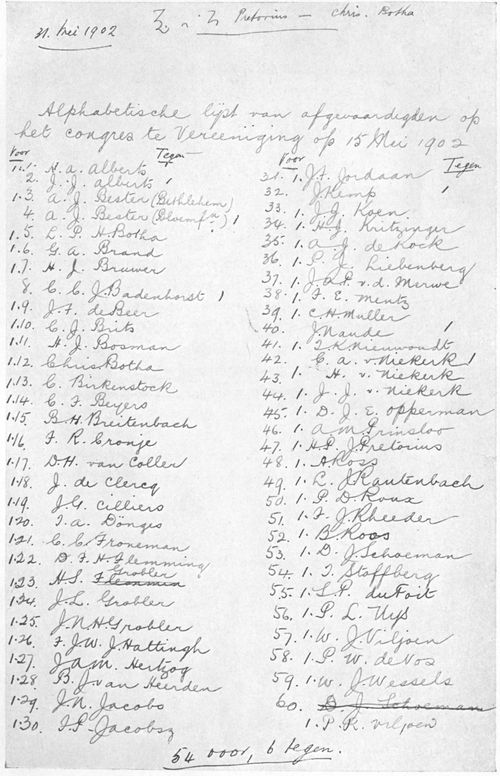
Facsimile of the document on which the voting on the
proposal by Commandant H. P. J. Pretorius, seconded by General Chris.
Botha, was recorded.
The Secretary, Mr. D. E. van Velden, was then instructed to
request Lord Kitchener's representatives in the camp—namely, Captain P.
J. Marker and Major Henderson—to come to the tent in which the meeting
was held in order that the decision of the Meeting might be communicated
to them.
They speedily arrived, and under a death-like silence General Botha
informed them that the Meeting had accepted the peace proposals of the
British Government.
Immediately afterwards the British Authorities made the necessary
arrangements for the conveyance by rail to Pretoria of the members of both
Republican Governments to sign the Treaty of Peace in accordance with the
instruction of the Meeting.
That night, shortly before 11 o'clock, the said Governments duly arrived
at Pretoria.
On arrival at the Railway Station they were conveyed in great haste to the
residence of Mr. George Heys in Maré Street, which was occupied by Lord
Kitchener, and served as the Army Headquarters in South Africa.
For a few moments the members of the two Republican Governments, who were
accompanied by the two Secretaries, Rev. J. D. Kestell and Mr. D. E. van
Velden, were left alone in the spacious dining-room, as they wished to
read the resolution of the Delegates once more in order to satisfy
themselves that it was correct.
When this had been done, Lord Kitchener and Lord Milner entered.
The two Representatives of the British Government sat at the head of the
table next to each other at the south side of the apartment. On the left
of Lord Milner sat Acting President S. W. Burger, State Secretary F. W.
Reitz, Commandant General Louis Botha, General J. H. de la Rey, Mr. J. C.
Krogh, and General L. J. Meyer. On Lord Kitchener's right sat Acting
President C. R. de Wet, General C. H. Olivier, General J. B. M. Hertzog,
and Acting Government Secretary Mr. W. J. C. Brebner.
The Peace Treaty had been typed in quadruple on parchment. One copy was
intended for the King of England, one for Lord Kitchener, one to
be preserved in the Archives in Pretoria, and one in the Archives in
Bloemfontein.
There was perfect silence when Acting President S. W. Burger took up the
pen.
It was five minutes past eleven on May 31, 1902.
Acting President Burger signed. After him the members of the Government of
the South African Republic. Then Acting President de Wet and the Members
of the Orange Free State Government. Lord Kitchener followed, and last of
all Lord Milner signed.
Before signing State Secretary Reitz rose in his seat, pen in hand, and
stated that he signed only in his official capacity, and not as F. W.
Reitz.
President Steyn was not there. Physical prostration due to his serious
illness prevented him from doing what he had always said he would never
do, viz., put his hand on paper to sign away the Independence of his
People.
The document was signed.
Everything was silent in the apartment where so much had taken place.
For a few moments everyone sat still.
As the members of the Governments of the now late Republics stood up, as
men stupefied, to leave the apartment, Lord Kitchener rose, and, going up
to each of them, offered his hand, saying, "We are good friends now."
They then left the apartment and proceeded to the adjoining house (the
residence of Mr. Carl Rood), which had been placed at their disposal.
After the resolution of the meeting had been communicated to the British
Representatives, the Delegates met again, when the following proposal by
Commandant Jacobsz, seconded by General Muller, was unanimously
adopted:—
"This meeting of Delegates, considering the pressing
necessity to collect means to provide for the wants of the
suffering women and children, widows and orphans, and other
necessitous persons who have been reduced to a state of indigency
by the war,
"And considering the desirability of appointing a Head Committee,
whose duty it shall be to take the necessary steps to make
provision herein and to decide finally about the Administration
and application of the means to be collected,
"Resolves to appoint Messrs. M. T. Steijn, S. W. Burger, L.
Botha, C. R. de Wet, J. H. de la Rey, Rev. A. P. Kriel, and Rev.
J. D. Kestell (Secretary), a Head Committee, to make all such
further arrangements for carrying out the said objects as may
appear desirable and practical to them, and especially to add new
members to their number, to appoint Sub-Committees and an
Executive Committee, which is authorised to draw up Statutes and
amend the same whenever necessary."
It was further proposed by Commandant Jacobsz, seconded by General Muller,
and carried by the meeting:—
"This meeting further resolves to delegate General C. R. de Wet, General
Louis Botha, and General J. H. de la Rey, of the said Head Committee, to
proceed to Europe to collect the said funds."[Back to Contents]
The Middelburg Proposals.
Pretoria, March 7, 1901.
Your Honour,
With reference to your conversation at Middelburg on February 28, I have
the honour to inform you that, in the event of a general and complete
cessation of hostilities, and the surrender of all rifles, ammunition,
cannon, and other munitions of war in the hands of the burghers, or in
Government depôts or elsewhere, His Majesty's Government is prepared to
adopt the following measures:—
His Majesty's Government will at once grant an amnesty in the Transvaal
and Orange River Colony for all bona fide acts of war committed during
the recent hostilities. British Subjects belonging to Natal and Cape
Colony, while they will not be compelled to return to those Colonies,
will, if they do so, be liable to be dealt with by the laws of those
Colonies specially passed to meet the circumstances arising out of the
present war. As you are doubtless aware, the special law in the Cape
Colony has greatly mitigated the ordinary penalties for High Treason in
the present case.
All prisoners of war now in St. Helena, Ceylon, or elsewhere, being
burghers or Colonists, will, on the completion of the surrender, be
brought back to their country as quickly as arrangements can be made for
their transport.
At the earliest practicable date military administration will
cease, and will be replaced by civil administration in the form of Crown
Colony Government. There will, therefore, be, in the first instance, in
each of the new Colonies, a Governor and an Executive Council, composed of
the principal officials, with a Legislative Council consisting of a
certain number of official members to whom a nominated unofficial element
will be added. But it is the desire of His Majesty's Government, as soon
as circumstances permit, to introduce a representative element, and
ultimately to concede to the new Colonies the privilege of
self-government. Moreover, on the cessation of hostilities, a High Court
will be established in each of the new Colonies to administrate the laws
of the land, and this Court will be independent of the Executive.
Church property, public trusts, and orphan funds will be respected. Both
the English and Dutch languages will be used and taught in public schools
when the parents of the children desire it, and allowed in Courts of Law.
As regards the debts of the late Republican Governments, His Majesty's
Government cannot undertake any liability. It is, however, prepared, as an
act of grace, to set aside a sum not exceeding one million pounds sterling
to repay inhabitants of the Transvaal and Orange River Colony for goods
requisitioned from them by the Republican Governments, or subsequent to
annexation, by Commandants in the field being in a position to inforce
such requisitions. But such claims will have to be established to the
satisfaction of a Judge or Judicial Commission, appointed by the
Government, to investigate and assess them, and, if exceeding in the
aggregate one million pounds, they will be liable to reduction pro rata.
I also beg to inform your Honour that the new Government will take into
immediate consideration the possibility of assisting by loan the occupants
of farms, who will take the oath of allegiance, to repair any injuries
sustained by destruction of buildings or loss of stock during the war, and
that no special war tax will be imposed upon farms to defray the
expense of the war.
When Burghers require the protection of firearms, such will be allowed to
them by licence, and on due registration, provided they take the oath of
allegiance. Licences will also be issued for sporting rifles, guns, &c.,
but military firearms will only be allowed for purposes of protection.
As regards the extension of the franchise to Kaffirs in the Transvaal and
Orange River Colony, it is not the intention of His Majesty's Government
to give such franchise before representative Government is granted to
those Colonies, and if then given it will be so limited as to secure the
just predominance of the white race. The legal position of coloured
persons will, however, be similar to that which they hold in the Cape
Colony.
In conclusion, I must inform your Honour that, if the terms now offered
are not accepted after a reasonable delay for consideration, they must be
regarded as cancelled.
I have, &c.,
Kitchener, General,
Commander-in-Chief, British Forces,
South Africa.
To his Honour Commandant-General Louis Botha.[Back to Contents]
Footnote 1: What the Republican Governments had repeatedly requested.[Back to Main Text]
Footnote 2: For the Middelburg Proposals, see p. 210.[Back to Main Text]
Footnote 3: See Appendix, p. 210.[Back to Main Text]
Footnote 4: Compare the first document, page 116, with what follows
here.[Back to Main Text]
Footnote 5: See p. 98.[Back to Main Text]
Footnote 6: See p. 116.[Back to Main Text]
Footnote 7: See p. 133.[Back to Main Text]
Footnote 8: See p. 136.[Back to Main Text]