THE OPENING OF THE CONFLICT. — THE NAVIES OF THE CONTESTANTS. — DIX'S
FAMOUS DESPATCH. — THE RIVER GUNBOATS.
 he
story of the naval operations of the civil war is a record of
wonderful energy and inventive skill in improvising and building
war-vessels, vigilance and courage in handling them, and desperate
bravery and dash displayed by officers and seamen in the great
engagements in which vessels of either side took part. Yet of the
immense body of literature dealing with the war, the greater part is
given to telling the story of the great armies of the North and South.
The details of the great land battles are familiar to many who have
but a vague idea of the service done by the "blue jackets" of the
North, and the daring deeds performed by the navies of both sides.
he
story of the naval operations of the civil war is a record of
wonderful energy and inventive skill in improvising and building
war-vessels, vigilance and courage in handling them, and desperate
bravery and dash displayed by officers and seamen in the great
engagements in which vessels of either side took part. Yet of the
immense body of literature dealing with the war, the greater part is
given to telling the story of the great armies of the North and South.
The details of the great land battles are familiar to many who have
but a vague idea of the service done by the "blue jackets" of the
North, and the daring deeds performed by the navies of both sides.
When the first mutterings of the storm of war began to be heard, the
United States Government had at its disposal sixty-nine
vessels-of-war, of which twenty-seven were laid up for repairs, or,
sailors would say, "out of commission." Of the forty-two vessels in
commission, twenty-six were absent on missions to the East
Indies, the African coast, and other distant quarters of the globe.
Long months must elapse before the most hasty orders could reach them.
Many were sailing-vessels, and must consume many months of precious
time before they could reach the shores of the United States. Indeed,
though on the inauguration of President Lincoln on March 4, 1861, all
these vessels were immediately recalled, not one arrived before the
middle of June, and many were delayed until late in the following
winter. Of the vessels at home, many were old-fashioned
sailing-frigates; beautiful with their towering masts and clouds of
snowy canvas, but almost useless in that day when steam had become
known as the only means of propelling vessels-of-war.
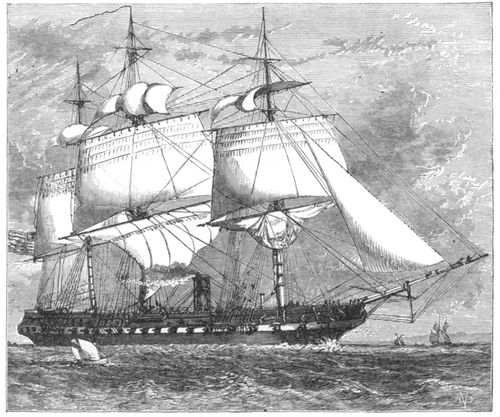
The "Hartford," Farragut's Flagship.
In officers and men the navy was almost as deficient as in vessels. A
long peace had filled the lists of officers with old men
past that age in which may be expected the alertness and energy that
must be possessed by Jack afloat. The lower grades were filled by
boyish officers from the Naval Academy, who had never seen a gun fired
in anger. The service was becoming rusty from long idleness.
Such was the condition of the navy of the United States when Abraham
Lincoln was made President. Four years later the navy of the United
States consisted of six hundred and seventy-one vessels. No nation of
the world had such a naval power. The stern lessons of the great war
had taught shipbuilders that wooden ships were a thing of the past.
The little "Monitor" had by one afternoon's battle proved to all the
sovereigns of Europe that their massive ships were useless. And all
this had been done by a people grappling in deadly strife with an
enemy in their very dwellings. The world's history contains no more
wonderful story of energy and invention.
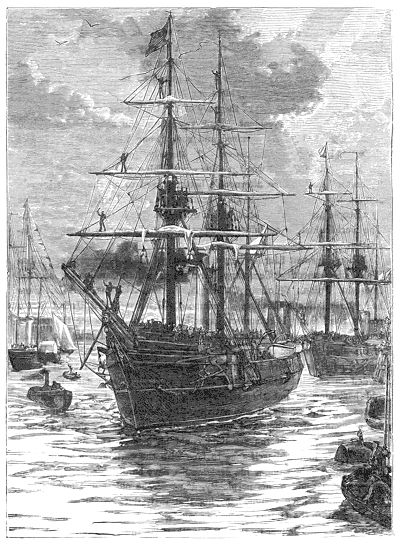
Departure of a Naval Expedition from Port Royal.
When President Lincoln began his term of office, he appointed Gideon
Welles of Connecticut Secretary of the Navy. South Carolina had
seceded from the Union. Mississippi, Georgia, Florida, Alabama, and
Louisiana had followed South Carolina. Anderson, with a handful of
United States troops, was holding Fort Sumter, expecting every minute
to see the puff of smoke from the distant casement of Fort Moultrie,
and hear the shriek of the shell that should announce the opening of
the attack. At Washington, politicians were intriguing. The loyalty of
no man could be regarded as certain. Officers of the army and navy
were daily resigning, and hastening to put themselves under the
command of their various States. In the South all was activity. In the
North the popular desire for a compromise hampered the authorities so
that no decided stand against the spread of the rebellion could be
made. The new Secretary of the Navy found himself face to face with
the certainty of a long and bloody war, yet had under his command a
navy hardly adequate for times of peace. To add to his perplexity,
many of the oldest and most skilful officers in the navy resigned,
saying that their duty to their States was greater than to the United
States as a whole. A few revenue officers even went so far as to
deliver to the State authorities the vessels of which they were in
command. One commander, a Georgian, bringing his ship back from
foreign waters, hesitated long whether to take it to the navy-yard at
New York, or to deliver it to the Southern leaders. He
finally decided to obey orders, and the ship remained with the United
States. Some days afterward the commander told his lieutenant of his
hesitation. "We all saw it," said the younger officer; "and had you
turned the ship's prow towards Charleston, you would have been
instantly put in irons."
The surrender of another naval vessel called forth that famous
despatch from John A. Dix that will ever be linked with his name. The
United States revenue cutter "McClelland" was lying at New Orleans,
under the command of Capt. Breshwood. The revenue service is distinct
from the regular navy, and is under the general command of the
Secretary of the Treasury. John A. Dix, then Secretary of the
Treasury, suspected that Capt. Breshwood was about to surrender his
vessel to the Confederates, and sent an agent to order him to take the
vessel to New York. Breshwood refused, and instantly Dix sent the
despatch: "Tell Lieut. Caldwell to arrest Capt. Breshwood, assume
command of the cutter, and obey the order through you. If Capt.
Breshwood, after arrest, undertakes to interfere with the command of
the cutter, tell Lieut. Caldwell to consider him as a mutineer, and
treat him accordingly. If any man attempts to haul down the American
flag, shoot him on the spot." This despatch was intercepted by the
Confederates, and the cutter was surrendered. But Dix's determined
words reverberated through the North, and thrilled all hearts with the
hope that the time for delay was past, and that the growing rebellion
would be put down with a firm hand.
So at the opening of the war we find the North with a navy consisting
of but a few old-fashioned ships, few sailors, officers everywhere
resigning, and a general feeling of distrust of brother officers in
all grades.
The condition of the South as regards the navy was even worse. The
Southern States had never done any great amount of ship-building. The
people were almost all engaged in farming. The crops of cotton and
sugar that they raised were shipped in vessels built in Maine, and
manned by sailors from the seafaring villages of New England. At the
time the war broke out, there was hardly a shipyard in the confines of
the Confederacy. A few vessels were gained by the treachery of United
States officers. The capture of the Norfolk navy-yard brought them
large quantities of naval stores, and by wonderful activity a few
vessels were built for service on inland sounds and rivers. But at no
time could the Confederacy have been said to have a navy;
and, keeping this fact in view, the record the Confederates made with
two or three vessels is most wonderful. In war-vessels for service on
that wonderful network of rivers that make up the waterways of the
Mississippi Valley, the South was not so deficient as in ships of the
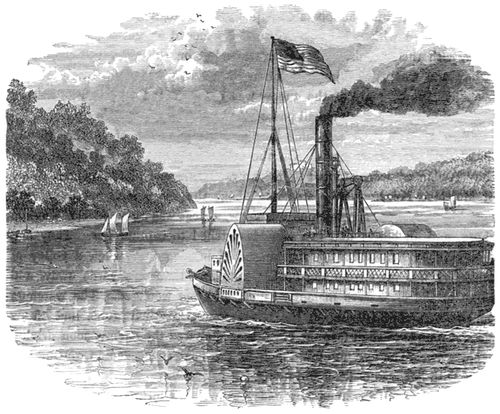
seagoing class. The long, crescent-shaped levee at New Orleans is
lined throughout certain seasons of the year by towering
river-steamers which ply up and down the Mississippi and connecting
streams, taking from the plantations huge loads of cotton, sugar, and
rice, and carrying to the planters those supplies which can only be
furnished by the markets of a great city. The appearance of one of
these towering river transports as she comes sailing down the turbid
stream of the great Father of Waters, laden to the water's edge with
brown bales of cotton, and emitting from her lofty, red crowned
smoke-stacks dense clouds of pitchy black smoke, is most wonderful.
Unlike ocean-steamers, the river-steamer carries her load upon her
deck. Built to penetrate far towards the head-waters of rivers and
bayous that in summer become mere shallow ditches, these steamers have
a very light draught. Many of them, whose tiers of white cabins tower
sixty or seventy feet into the air, have but three feet of hull
beneath the river's surface. The first deck, when the vessel is but
lightly loaded, stands perhaps two feet out of water. Above this,
carried on rows of posts twenty feet high, comes the first cabin. All
between is open to the air on either side; so that, as one of the huge
river-monsters passes at night, the watcher on the bank can see the
stalwart, black, half-naked bodies of the negro stokers, bending
before the glowing furnace doors, and throwing in the soft coal, that
issues in clouds of smoke from the towering chimneys seventy feet
above. The lights in three rows of cabin windows glow; and the
unceasing beat of the paddle-wheels mingles with the monotonous puff
of the steam from the escape-pipes, and the occasional bursts of music
from the open cabin doors. One who for the first time looks on one of
these leviathans of the Mississippi, pursuing its stately course at
night, does not wonder at the frightened negro, who, seeing for the
first time a night-steamboat, rushed madly from the river's bank,
crying that the angel Gabriel had come to blow the last trump.
When these boats have taken on their full load of cotton, they present
a very different appearance. Then all the open space beneath the
cabins is filled by a mass of cotton-bales. The hull is so
sunken in the water that the lowest tier of cotton-bales is lapped by
the little waves that ruffle the surface of the river. The stokers and
furnaces are hid from view, and the cabins appear to be floating on
one huge cotton bale. Generally a great wooden stern-wheel propels
this strange craft, adding to the grotesqueness of the sight.
It may readily be understood, that vessels of this class, in which
strength was subordinated to lightness, and economy to gingerbread
decoration, seemed to be but poor materials for vessels-of-war. The
tremendous recoil of a rifled cannon fired from one of those airy
decks, meant to stand no ruder shock than the vibration caused by
dancing pleasure-parties, would shake the whole frail structure to
pieces. Yet the ingenuity born of necessity, and the energy awakened
by the immediate prospect of war, led the Confederate engineers to
convert some of these pleasure-palaces into the most terrible engines
of destruction chronicled in the annals of war. The first step was to
sweep off all the towering superstructure of decks, cabins, and
saloons; tear away all the fanciful mouldings, the decorated
staterooms, and carved and gilded stairways. This left a long, shallow
hull, with a powerful engine in the centre, and great paddle-wheels
towering on either side; the whole so light that the soldiers of
Grant's army, when they first saw one, stoutly averred that "those
boats could run on a heavy dew." The hull was then thinly plated with
iron, and the prow lengthened, and made massive, until it formed the
terrible "ram," fallen into disuse since the days of the Greek
galleys, to be taken up again by naval architects in the nineteenth
century. Then on the deck was built a pent-house of oak and iron, with
sloping sides just high enough to cover the engine. The two towering
smoke-stacks, the pride of the old river-steamers, were cut down to
squat pipes protruding a foot or two above the strange structure. In
the sides were embrasures, from which, when open, peered the iron
muzzles of the dogs of war, ready to show their teeth and spit fire
and iron at the enemy. This was the most powerful type of the river
gunboat, and with them the Confederacy was fairly well provided;
though it was not long before the war department of the United States
was well supplied with similar ships. It was these iron-clad gunboats
that used to rouse the anger of the doughty Admiral Farragut, who
persisted in declaring them cowardly engines of destruction, and
predicted that as they came into use, the race of brave
fighting jack-tars would disappear. On one occasion the admiral was
ploughing his way up the Mississippi above New Orleans, in one of
Commodore Bailey's river iron-clads. The batteries of the enemy on
either hand were pounding away at the ascending ships, hurling huge
bolts of iron against their mailed sides, with a thunder that was
deafening, and a shock that made the stricken ships reel. The admiral
stood in the gunroom of one of the iron-clads, watching the men
working the guns, in an atmosphere reeking with the smoke of the
powder. A look of manifest disapproval was on his face. Suddenly an
unusually well-directed shot struck a weak point in the armor, and,
bursting through, killed two men near the admiral's position. He
looked for a moment on the ghastly spectacle, then turning to an
officer said, "You may stay here in your iron-clad room if you wish:
as for me, I feel safer on deck." And on deck he went, and stayed
there while the fleet passed through the hail of shot and shell.
The scarcity of iron in the Southern States prevented the naval
authorities of the newly organized Confederacy from equipping a very
large fleet of iron-clads. At the outbreak of the war, the Tredegar
Iron Works at Richmond was the only place in the South where iron
plates of a size suitable for plating vessels could be rolled. The
demand was of course far in excess of the facilities of the factory,
and many were the make-shifts that shipbuilders were forced to. Some
vessels were plated only about the centre, so as to protect the boiler
and engines. Others bore such a thin coat of iron that they were
derisively called "tin-clads" by the sailors, who insisted that a
Yankee can-opener was all that was necessary to rip the vessel up.
Sometimes, when even a little iron was unattainable, bales of cotton
were piled up around the sides, like breastworks, for the protection
of men and engines. The vessel which captured the United States ship
"Harriet Lane," at Galveston, was thus provided; and the defence
proved very valuable. One great objection to the cotton-bale bulwarks
was the very inflammable nature of the material, since a red-hot shot
from the enemy, or a bit of blazing wadding from a gun, would set it
smouldering with a dense black smoke that drove the men from their
guns until the bales could be thrown overboard; thus extinguishing the
fire, but exposing the men to the fire of the enemy.
One of the most striking features of the war of secession was the
manner in which private citizens hastened to contribute
towards the public defence. This was so no less in naval than in
military circles. Perhaps the greatest gift ever made by a citizen to
his Government was the gift by "Commodore" Vanderbilt to the United
States of a magnificently equipped ship-of-war, which was named "The
Vanderbilt" in honor of her donor, and did efficient service in
maintaining the blockade on the Atlantic coast. Mr. James Gordon
Bennett, the present owner of the "New-York Herald," put his yacht at
the service of the Government, and was himself commissioned a
lieutenant in the revenue service.[Back to Contents]
FORT SUMTER BOMBARDED. — ATTEMPT OF THE "STAR OF THE WEST" TO
RE-ENFORCE ANDERSON. — THE NAVAL EXPEDITION TO FORT SUMTER. — THE RESCUE
OF THE FRIGATE "CONSTITUTION." — BURNING THE NORFOLK NAVY-YARD.
Fort Moultrie.
he
first purely warlike event of the civil war was the bombardment
and capture of Fort Sumter in Charleston Harbor, by the troops of the
State of South Carolina. At the time when it first became evident that
civil war was inevitable, Fort Sumter was vacant. The only United
States troops stationed at Charleston were two companies of artillery
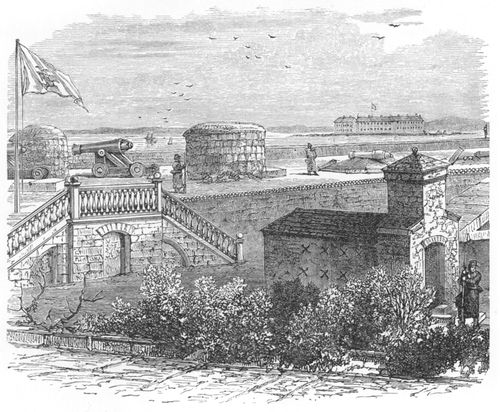
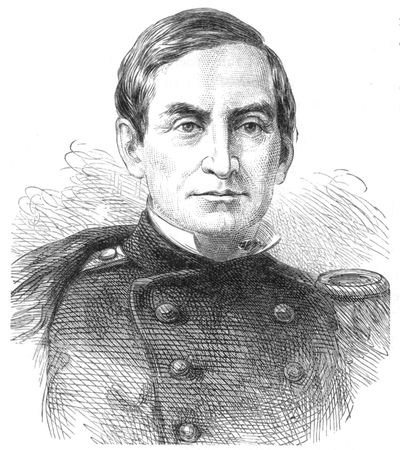
under Major Robert Anderson. The fortifications of Charleston Harbor
consisted of Fort Moultrie on the main land (in which Anderson's
command was stationed), Fort Pinckney, and Fort Sumter standing
massive and alone in the centre of the harbor. Anderson, with his
handful of troops in the most vulnerable of the three forts, saw day
by day the secession sentiment growing stronger. Almost daily some of
the privileges of the soldiery were cut off; such as the right of
passing through the city, and the right to buy supplies in the public
markets. Daily could be heard the drum and the tread of the newly
organized bodies of State soldiers. Anderson saw that his position was
a weak one, but could get no orders from headquarters. Finally he
decided to assume the responsibility of evacuating Fort Moultrie and
occupying Fort Sumter. To-day it hardly seems as though he could have
thought of doing otherwise, but at that time it was a grave
responsibility for a man to assume. The whole voice of the North was
for compromise, and it was his part to commit the first overt act of
war. But he was nobly upheld in his decision by his Northern brethren.
Having decided, he lost no time in carrying his plan into effect. His
little corps of troops was drawn up at midnight on the parade, and for
the first time informed of the contemplated movement. The guns of Fort
Moultrie were hurriedly knocked from their trunnions, and spiked; the
gun-carriages were piled in great heaps, and fired; and every thing
that might in any way be used against the United States Government was
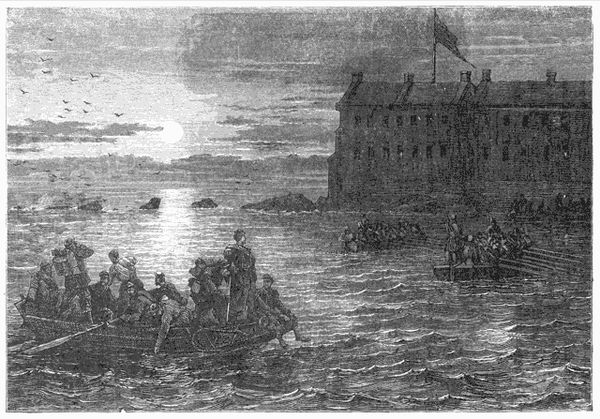
destroyed. Then the work of evacuation was begun. A small fleet of
row-boats carried the troops to the entrance of the great, sullen
fort, standing alone in the middle of the harbor, and made frequent
trips bringing supplies and ammunition from the deserted fortress. All
was done silently: the oars were muffled, and the commands
of the officers were whispered, that no tidings should be told of the
movement under way. Before sunrise all was completed; and when the
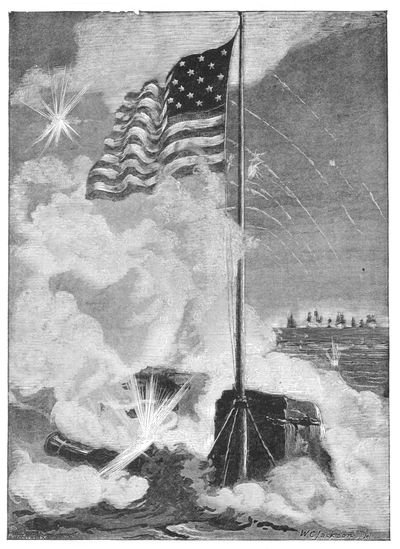
rays of the rising sun fell upon the stars and stripes floating from
the flagstaff of Sumter, the people of Charleston turned their eyes
from the starry flag to the clouds of smoke arising from Fortress
Moultrie, and comprehended that the war had begun. Newspaper
correspondents and agents of the Federal Government, and the Southern
leaders, rushed for the telegraph-wires; and the news soon sped over
the country, that Sumter was occupied. The South Carolinians at once
began to build earthworks on all points bearing on the fort, and were
evidently preparing to drive Anderson and his troops out. Anderson
promptly telegraphed to Washington for supplies and re-enforcements,
and expressed his intention of staying as long as the walls stood. The
Government was dilatory, but finally concluded to re-enforce the fort,
and to that end secured the steamer "Star of the West," and began the
work of provisioning her for the voyage. It was decided that she
should carry no guns: that would look too much like war; and
accordingly, on the 8th of January, this helpless vessel set out to
the aid of the beleaguered garrison of Fort Sumter. The news was at
once telegraphed to Charleston; and the gunners in the Confederate
trenches shotted their guns, and awaited the appearance of the
steamer. She hove into sight on the morning of the 12th, and when
within range was notified, by a shot across her bows, that she was
expected to stop. This signal being disregarded, the firing began in
earnest; and the shot and shell fell thick about the ship, which kept
pluckily on her course. But it was useless to persist. One shot struck
the steamer near the bows, others whizzed through her rigging, and
finally her captain saw a tug putting out from the land, towing a
schooner crowded with armed men to cut off the "Star's" retreat. He
gave the command "Hard a port." The ship's head swung round, and she
steamed away, leaving the garrison to their fate. An old gunner who
stood in a casemate of Fort Sumter, with the lanyard of a shotted gun
in his hand, tells the story of how he begged Major Anderson to let
him fire on the rebel batteries. "Not yet; be patient," was the
response. When the shells began to fall thick about the steamer, he
again asked permission to retaliate, but met the same response. Then
when he saw the white splinters fly from the bow, where the enemies'
shell had struck, he cried, "Now, surely, we can return
that!" but still the answer was, "Be patient." When the "Star of the
West," confessing defeat, turned and fled from the harbor, Anderson
turned and walked away, curtly saying there was no need to fire then,
but to save the load for the necessity that was coming.
Anderson's Command occupying Fort Sumter.
Major Robert Anderson.
The first naval operation of the war was the expedition fitted out to
relieve Fort Sumter. In itself, this expedition was but an
insignificant affair, ending in failure; but as the first warlike
action on the part of the United States Government, it attracted the
greatest attention throughout the nation. In preparing the vessels for
sea, great care was taken to keep their destination secret, so that no
warning should reach the Confederates, who were lying in their
batteries about Sumter, awaiting the first offensive action of the
United States authorities to begin shelling the fortress. While the
squadron was fitting out, it was generally supposed that it was
intended to carry troops and munitions of war to Fort Pickens in
Pensacola Harbor, which was invested by the Confederates. When the
fleet finally sailed, each commander carried sealed orders, upon
opening which he first found that the expedition was bound for
Charleston Harbor. Notwithstanding all this secrecy, the destination
of the fleet was telegraphed to the Confederates almost as soon as the
last vessel dropped past Sandy Hook; and the fire from the
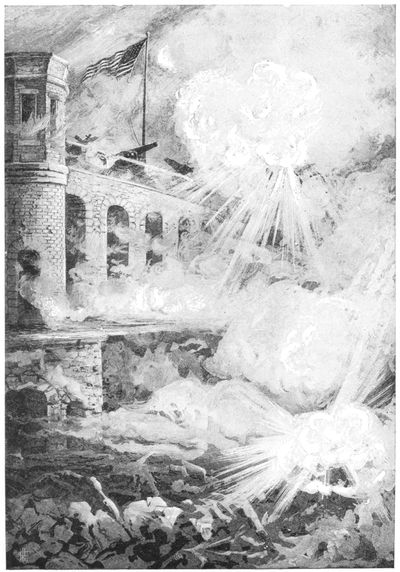
circle of batteries about the doomed fort in Charleston Harbor began
immediately. When the fleet arrived at its destination, the
bombardment was well under way. To attempt to land troops or stores
under the withering fire concentrated upon the fort, would have been
madness. The only vessel of sufficient strength to engage the
batteries, the "Pawnee," had been separated from the fleet by a gale a
few nights before, and had not yet arrived. Sadly the sailors gave up
the attempt, and, beating up and down outside the harbor bar, awaited
the inevitable end of the unequal conflict. When, finally, after a
heroic resistance of several days, Major Anderson and his little band,
worn with constant vigilance and labor, destitute of provisions, and
exposed to a constant hail of iron missiles from without and a raging
fire within, agreed to capitulate, the United States steamship
"Baltic," of the Fort Sumter expedition, took him on board and bore
him safely to New York. The main purpose of the expedition had failed,
it is true; but the Government had made its first decisive move, and
public sympathy and confidence were excited.
Fort Sumter under Fire.
The preparations for the coming struggle were now being pressed
forward on every hand. An incident which occurred soon after the fall
of Sumter awakened the greatest enthusiasm throughout the North. The
United States frigate "Constitution" was lying at Annapolis, where she
was being used by the authorities of the naval academy there for a
school-ship. Although the State of Maryland had not seceded from the
Union, yet secessionists were to be found in great numbers in all
parts of the State. A number of them determined to seize the ship.
Besides being a war-vessel of considerable strength, the
"Constitution"—or "Old Ironsides," as she was affectionately
called—was famous for her many exploits, and dear to the hearts of
Americans for her long service under the stars and stripes. "If we can
but capture the vessel, and turn her guns against the Union," thought
the conspirators, "we will strike a heavy blow at the Northern
sympathizers." And, indeed, it would have been a heavy blow to the
nation had they captured the old frigate that did such service under
Preble in the war with Tripoli; and that in the War of 1812 forced the
British to strike their colors, and gave to the United States navy an
equal place on the high seas with any nation of the world. The plans
of the conspirators were well laid. The ship was manned by but twenty
men, and lay above a bar, over which she could only be carried by the
aid of a steam-tug. Fortunately the officers and crew were
all loyal. For four days and four nights they watched the preparations
being made on shore for their capture. Mysterious signals flashed from
the surrounding hills. Armed bodies of men were seen drilling on the
shore. All seemed to tend toward certain capture. Yet with no chance
of escape the brave men kept vigilant guard, with guns shotted and
always primed.
Near Annapolis was stationed the Eighth Massachusetts Infantry, with
Gen. Butler in command. News was carried to the general of the
perilous position of the "Constitution," and he at once determined to
hasten to her relief. Just as the crew of the old frigate had
abandoned all hope, the steamer "Maryland" entered the harbor, her
guards and decks crowded with the men of the Eighth Massachusetts.
Quickly the "Constitution" was prepared for sailing. Her anchors were
slipped, all useless weight cast overboard, and, with the "Maryland"
as tug, the stately frigate passed slowly over the bar, and out of the
grasp of the conspirators.
The "Constitution" was not the only United States vessel that the
Confederates were planning to seize. Soon after she escaped from their
hands, an event occurred by which a vast quantity of naval stores, and
the mutilated but still valuable hulls of some of the most powerful
war-vessels in the United States navy, fell into their hands. The
United States navy-yard at Norfolk was one of the most valuable of all
the governmental possessions. In the great yard was government
property amounting to more than twenty millions of dollars.
Machine-shops, foundries, dwellings for officers, and a massive
granite dry-dock made it one of the most complete navy-yards in the
world. An enormous quantity of cannon, cannon-balls, powder, and
small-arms packed the huge storehouses. In the magnificent harbor were
lying some of the most formidable vessels of the United States navy,
including the steam frigate "Merrimac," of which we shall hear much
hereafter. Small wonder was it, that the people of Virginia, about to
secede from the Union, looked with covetous eyes upon this vast stock
of munitions of war lying apparently within their grasp. It did not
take long for them to persuade themselves that they were right in
seizing it; and, once decided, their movements were vigorous and open.
Of their ability to capture the yard, and gain possession of all the
property there, they felt no doubt. The first thing to be done was to
entrap the ships so that they should be unable to get out of the
harbor. Accordingly, on the 16th of April, three large
stone-vessels were sunk directly in the channel, apparently barring
the exit of the frigates most effectually. Indeed, so confident of
success were the plotters, that in a despatch to Richmond, announcing
the successful sinking of the stone-ships, they said, "Thus have we
secured for Virginia three of the best ships of the navy." But later
events showed, that, in boasting so proudly, the Virginians were
committing the old error of counting chickens before they were
hatched.
The condition of affairs within the navy-yard now seemed desperate.
There appeared to be no chance of getting the vessels beyond the
obstructions. The militia of Virginia was rapidly gathering in the
town. Among the naval officers on the ships great dissension existed,
as many were Southerners, about to resign their posts in the United
States service to enter the service of their States. These men would,
of course, give no active aid to any movement for the salvation of the
United States property in the yard. Any assistance must come from the
outside; the beleaguered could but passively await the course of
events.
At seven o'clock on the night of April 21, the United States steamer
"Pawnee," which had been lying under the guns of Fortress Monroe,
hoisted anchor, and headed up the bay, on an errand of destruction. It
was too late to save the navy-yard with its precious stores. The only
thing to be done was to burn, break, and destroy every thing that
might be of service to an enemy. The decks of the "Pawnee" were black
with men,—soldiers to guard the gates, and complete the work of
destruction within the yard; blue-jacketed tars to do what might be
done to drag the entrapped vessels from the snare set them by the
Virginians. It was a bright moon-light night. The massive hull of the
ship-of-war, black in the cold, white rays of the moon, passed rapidly
up the Elizabeth River. The sunken wrecks were reached, and
successfully avoided; and about nine o'clock the "Pawnee" steamed into
the anchorage of the navy-yard, to be greeted with cheers from the
tars of the "Cumberland" and "Pennsylvania," who expected her arrival.
The townspeople seeing the war-vessel, with ports thrown open, and
black muzzles of the guns protruding, took to their houses, fearing
she would open fire on the town. Quickly the "Pawnee" steamed to her
moorings. The marines were hurriedly disembarked, and hastened to
guard the entrances to the navy-yard. Howitzers were planted so as to
rake every street leading to the yard. Thus secure against attack, the
work of the night began. Nearly two thousand willing hands
were set hard at work, cannon were dismounted and spiked, rifles and
muskets dashed to pieces; great quantities of combustibles were piled
up in the mammoth buildings, ready to be fired at a given signal. In
the mean time, the blue-jackets were not idle. It was quickly decided,
that, of all the magnificent vessels anchored in the harbor, the
"Cumberland" was the only one that could be towed past the
obstructions in the river. All hands were set to work removing every
thing of value from the doomed vessels to the "Cumberland." Gunpowder
and combustibles were then arranged so as to completely destroy the
vessels when ignited. When the moon went down at twelve o'clock, the
preparations were complete. All the men were then taken on board the
"Cumberland" and "Pawnee," save a few who were left to fire the
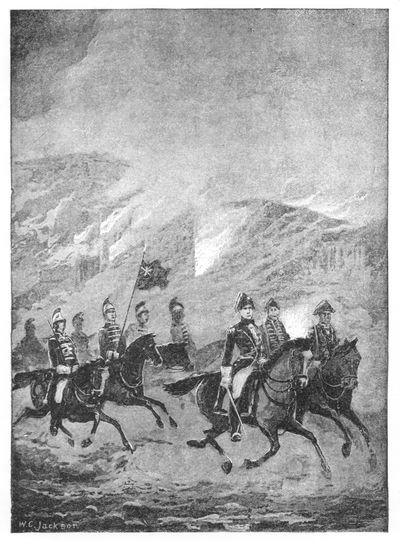
trains. As the two vessels started from the moorings, the barracks
were fired, the lurid light casting a fearful gleam upon the crowded
yards and shrouds of the towering frigate. A little way out in the
stream a rocket was sent up from the "Pawnee." This was the signal for
the firing of the trains. The scene that followed is thus described by
an eye-witness:—
"The rocket sped high in air, paused a second, and burst in showers of
many colored lights; and, as it did so, the well-set trains at the
ship-houses, and on the decks of the fated vessels left behind, went
off as if lit simultaneously by the rocket. One of the ship-houses
contained the old 'New York,' a ship thirty years on the stocks, and
yet unfinished; the other was vacant. But both houses, and the old
'New York,' burned like tinder. The vessels fired were the
'Pennsylvania,' the 'Merrimac,' the 'Germantown,' the 'Plymouth,' the
'Raritan,' the 'Columbia,' and the 'Dolphin.' The old 'Delaware' and
'Columbus," worn-out and disabled seventy-fours, were scuttled, and
sunk at the upper docks on Friday.
"I need not try to picture the scene of the grand conflagration that
now burst like the day of judgment on the startled citizens of
Norfolk, Portsmouth, and all the surrounding country. Any one who has
seen a ship burn, and knows how like a fiery serpent the flame leaps
from pitchy deck to smoking shrouds, and writhes to their very top
around the masts that stand like martyrs doomed, can form some idea of
the wonderful display that followed. It was not thirty minutes from
the time the trains were fired, till the conflagration roared like a
hurricane, and the flames from land and water swayed and
met and mingled together, and darted high, and fell, and leaped up
again, and by their very motion showed their sympathy with the
crackling, crashing war of destruction beneath.
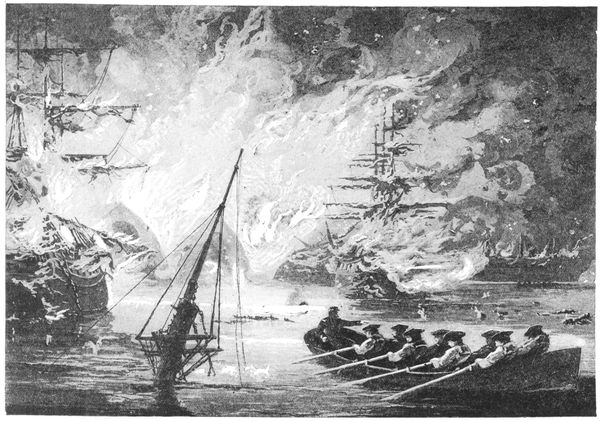
Destruction of Norfolk Navy-Yard.
"But in all this magnificent scene the old ship 'Pennsylvania' was the
centre-piece. She was a very giant in death, as she had been in life.
She was a sea of flame; and when the iron had entered her soul, and
her bowels were consuming, then did she spout forth from every
porthole of every deck torrents and cataracts of fire, that to the
mind of Milton would have represented her a frigate of hell pouring
out unending broadsides of infernal fire. Several of her guns were
left loaded, but not shotted; and as the fire reached them they sent
out on the startled morning air minute-guns of fearful peal, that
added greatly to the alarm that the light of the fire had spread
through the country round about. The 'Pennsylvania' burned like a
volcano for five hours and a half before her mainmast fell. I stood
watching the proud but perishing old leviathan as this emblem of her
majesty was about to come down. At precisely half-past nine o'clock
the tall tree that stood in her centre tottered and fell, and crushed
deep into her burning sides."
During this fearful scene the people of the little town, and the
Virginia militia-men who had been summoned to take possession of the
navy-yard, were no idle spectators. Hardly had the "Pawnee" steamed
out into the stream, when the great gates were battered down, and
crowds of men rushed in, eager to save whatever arms were uninjured.
Throughout the fire they worked like beavers, and succeeded in saving
a large quantity of munitions of war to be used by the Confederacy.
The ships that had been fired all burned to the water's edge. One was
raised, and re-appeared as the formidable "Merrimac" that at one time
threatened the destruction of the whole Union navy.
A great amount of valuable property was saved for the Virginians by
the coolness of a young boy, the son of one of the citizens of the
town. This lad was within the gates of the navy-yard when the troops
from the ships rushed in, and closed and barricaded them against the
townspeople. He was frightened, and hid himself behind a quantity of
boards and rubbish, and lay there a silent and immensely frightened
spectator of the work of destruction. An officer passed near him
directing the movements of two sailors, who were laying a train of
gunpowder to an immense pile of explosives and combustibles
in the huge granite dry-dock. The train passed over a broad board; and
the boy, hardly knowing what he did, drew away this board, leaving a
gap of eight inches in the train. When all the trains were fired, this
was of course stopped at the gap; and the dry-dock was saved, and
still remains in the Norfolk Navy Yard.[Back to Contents]

DIFFICULTIES OF THE CONFEDERATES IN GETTING A NAVY. — EXPLOIT OF THE
"FRENCH LADY." — NAVAL SKIRMISHING ON THE POTOMAC. — THE CRUISE OF THE
"SUMTER."
he
disparity of maritime importance between the North and the South,
and the consequent difficulties to be overcome by the latter in
getting a navy, have been already alluded to. As it has been stated,
in river-steamers and ponderous rams the South was fairly well
supplied; but what was really needed were ocean-going ships, to break
the rigid blockade that was slowly starving the Confederacy into
submission,—swift cruisers to prey on the commerce of the enemy, and
powerful line-of-battle ships, which, by successfully coping with the
vessels of the United States on the high seas, should secure for the
Confederacy recognition, and possibly assistance, from the great
powers of Europe. But how to get these without shipyards,
shipbuilders, or seamen, was a task that baffled the ingenuity of the
best minds in the South. Immediately upon the organization of the
Confederate cabinet, an agent was sent to England to negotiate for
vessels and guns. But, though this agent was a man of wonderful
resources and great diplomacy, he found an almost insuperable obstacle
in the universally recognized law of nations, to the effect that no
neutral nation shall sell vessels or munitions of war to belligerents.
It is true that this agent, Capt. Bulloch, did succeed in securing
three ships,—the "Florida," the "Shenandoah," and the
celebrated "Alabama;" but to do so cost an immense amount of diplomacy
and the sacrificing of the strength of the vessels to the necessity
which existed for making them appear to be merchantmen. To build an
iron-clad in a foreign port, was out of the question; and consequently
ships so obtained were forced to fly from any well-equipped
war-vessel, and only venture to attack unarmed merchantmen.
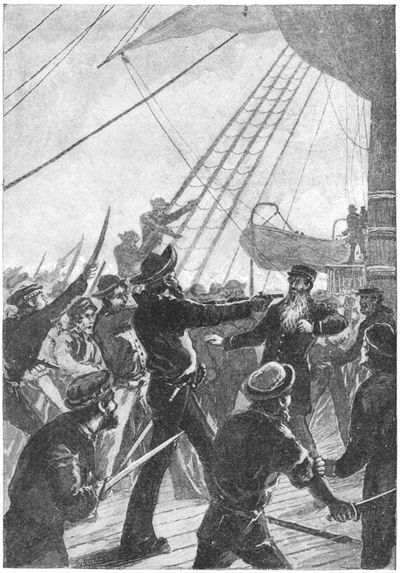
The "French Lady."
The United States vessels which were delivered into the hands of the
Confederates by their officers were mainly small revenue cutters, of
little use in naval warfare and soon given up or destroyed. Not a
single ship of this class made any record of distinguished service for
the Confederacy. Several merchant-vessels were captured by the
Confederates, who concocted the most ingenious plans to secure
success. One bright July morning the steamer "St. Nicholas" was lying
at her dock in Baltimore, with steam up, and all prepared for her
regular trip down the Chesapeake. Quite a large number of passengers
had bought tickets, and lounged about the decks, waiting for the
voyage to begin. Among the passengers were a number of mechanics, with
tools in their hands, going down the bay in search of work. Shortly
before the signal to cast off was given, a carriage was driven down
the wharf, and a lady, heavily veiled, alighted, assisted by two
gentlemen. The gentlemen stated that she was a French lady, and in
ill-health. Accordingly she was at once assigned a stateroom, to which
she retired. Soon after, the vessel cast off and headed down the bay.
When fairly out of the harbor, the stateroom door opened, and instead
of the frail, heavily veiled widow who went in, out strode a
black-whiskered man, armed to the teeth. He had no trouble now in
speaking English, and at once demanded the surrender of the ship. The
honest mechanics dropped their tools, and, drawing concealed weapons,
rallied around their leader. They had found the work they started out
to seek. The ship was captured, and a new privateer was ready to prey
on Northern merchant-ships. Once in the hands of the conspirators, the
vessel was run into a little port where the passengers were landed,
and a hundred and fifty more Confederates taken aboard. Under the
command of Capt. Thomas (the "French lady"), the vessel proceeded to
Fredericksburg, where she, and three brigs captured on the way, were
delivered to the Confederate leaders. This adventure so favorably
terminated, Thomas, with his officers, started back to
Baltimore, to lay plans for the capture of some other unsuspecting
craft. But fortune, which had thus far favored him, deserted him at
last. On the vessel upon which the conspirators took passage were two
police-officers of Baltimore. One of these officers recognized Thomas,
and quietly laid plans for his capture. In the harbor at Baltimore
stands Fort McHenry. Under its frowning casemates the ships of the
United States could lie without fear of attack from the thousands of
discontented men who made of Baltimore a secession city. The captain
of the "Mary Washington" was ordered by Lieut. Carmichael, the officer
of police, to bring the ship into the anchorage, under the guns of the
fort. This soon came to the ears of Thomas, who with his men rallied
on the deck, and, with revolvers drawn, seemed prepared to make a
desperate resistance. They were soon convinced that the officers had
ample power behind them, and therefore submitted. On arriving at the
fort, a company of soldiers was sent aboard the boat, and the
prisoners were marched ashore. But Thomas was not to be found. Search
was made in all parts of the boat, without avail; and the officers had
decided that he had jumped overboard, with the desperate intention of
swimming ashore. Just as they were about to give up the search, a
noise was heard that seemed to come from a bureau in the ladies'
cabin. Search was made, and there, coiled up in a narrow
bureau-drawer, lay the leader of the band. He had been there two
hours, and was helpless from cramp and exhaustion. He was placed in a
cell at Fort Lafayette; but later, having been given the privilege of
walking about the fort, managed to escape by making floats of empty
tomato-cans, and with their aid swimming almost two miles. He was
afterwards recaptured, and remained a prisoner until released by
reason of an exchange of prisoners between the North and South. Soon
after his capture, the Federal authorities at Baltimore learned that
plans had been made to capture other passenger steamers in the same
way; but the ringleader being locked up, there was no difficulty in
defeating the plans of the band.
During the first few weeks of the war, before active hostilities had
fairly commenced, events of this nature were of almost daily
occurrence. On the Potomac particularly, small cruisers were in
continual danger of being captured, and put into commission under the
Confederate flag. A trading schooner loaded with garden-produce,
dropping lazily down the river to the bay, would suddenly be boarded
by four or five armed men, her crew driven below, and the
vessel run into some convenient port on the Virginia shore, to
re-appear in a day or two with a small rifled cannon mounted on the
forecastle, and a crew thirsting to capture more vessels for the
Confederacy. On one occasion a party of congressmen from Washington
started down the Potomac for an excursion to Hampton Roads. Their
vessel was a small tug, which carried a bow-gun carefully screened
from observation by tarpaulin. A short distance down the river, a boat
with a howitzer was seen putting out into the stream, and shaping its
course directly across the bows of the tug. As the two boats drew
nearer together, a demand came from the smaller that the tug should be
surrendered "to the State of Virginia." Apparently yielding, the
captain of the tug slowed up his vessel, and waited for his assailants
to come alongside, which they did until suddenly confronted with the
muzzle of a cannon, trained directly on their boat, and a loud voice
demanding that they surrender at once, which they accordingly did, and
were taken to Washington by their triumphant captors. Many such
trivial events are chronicled by the newspapers of the time. The
advantage gained by either side was small, and the only effect was to
keep the war sentiment at fever-heat.
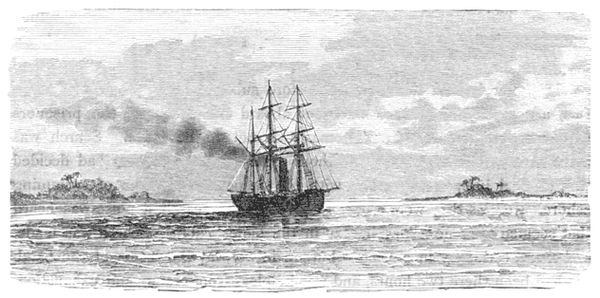
Blockading the Mouth of the Mississippi.
The first regularly commissioned man-of-war of the Confederate States
was the "Sumter," an old passenger steamer remodelled so as to carry
five guns. This vessel, though only registering five hundred tons, and
smaller than many a steam-yacht of to-day, roamed over the
high seas at will for more than a year, burning and destroying the
merchant-vessels of the North, and avoiding easily any conflicts with
the Northern men-of-war. Her exploits made the owners of American
merchant-vessels tremble for their property; and the United States
authorities made the most desperate attempts to capture her, but in
vain. In his journal of Dec. 3, 1861, Capt. Semmes of the "Sumter"
writes with the greatest satisfaction: "The enemy has done us the
honor to send in pursuit of us the 'Powhattan,' the 'Niagara,' the
'Iroquois,' the 'Keystone State,' and the 'San Jacinto.'" Any one of
these vessels could have blown the 'Sumter' out of water with one
broadside, but the cunning and skill of her commander enabled her to
escape them all.
It was on the 1st of June, 1861, that the "Sumter" cast loose from the
levee at New Orleans, and started down the Mississippi on her way to
the open sea. For two months workmen had been busy fitting her for the
new part she was to play. The long rows of cabins on the upper deck
were torn down; and a heavy eight-inch shell-gun, mounted on a pivot
between the fore and mainmasts, and the grinning muzzles of four
twenty-four-pounder howitzers peeping from the ports, told of her
warlike character. The great levee of the Crescent City was crowded
with people that day. Now and again the roll of the drum, or the
stirring notes of "Dixie," would be heard, as some volunteer company
marched down to the river to witness the departure of the entire
Confederate navy. Slowly the vessel dropped down the river, and,
rounding the English turn, boomed out with her great gun a parting
salute to the city she was never more to see. Ten miles from the mouth
of the river she stopped; for anchored off the bar below lay the
powerful United States steamer "Brooklyn," with three other
men-of-war, each more than a match for the infant navy of the
Confederacy. Eleven days the "Sumter" lay tugging at her anchors in
the muddy current of the great river, but at last the time of action
arrived. The news came that the "Brooklyn" had started in chase of a
vessel, and the mouth of the river was clear. Quickly the "Sumter" got
under way, and with all steam up made for the channel over the bar.
She was still six miles from the bar when the "Brooklyn" caught sight
of her, and abandoning her first chase strove desperately to head her
off. It was a time of intense excitement. Each vessel was about
equally distant from the bar for which each was steaming at
the highest possible speed. For the "Sumter," it was escape or die. It
was too late to fly up the river to the sheltering guns of Fort St.
Philip. Should the "Brooklyn" get within range, the "Sumter" was
doomed. The "Brooklyn" was the faster vessel of the two, but had the
wind in her teeth; while the "Sumter" had the advantage of wind and
current. At length the pass was reached, and the "Sumter" dashed over
the bar, and out on the smooth blue water of the Gulf of Mexico, well
ahead of her powerful foe. The "Brooklyn" quickly rounded to, and a
quick puff of smoke from amidships told the crew of the flying vessel
that the terrible pivot-gun of their enemy had sent a warning message
after them. But there was but a second of suspense, when a great jet
of water springing from the surface of the gulf told that the bolt had
fallen short. The "Brooklyn" then quickly crowded on all sail, and
started in hot pursuit, but after four hours abandoned the chase, put
up her helm, and started sullenly back for the river's mouth; while
the tars of the "Sumter" crowded shrouds and bulwarks, and cheered
heartily for the navy of the young Confederacy.
The "Sumter" was now fairly embarked on her career. The open sea was
her territory, and all ships floating the stars and stripes at the
masthead were to be her prey. She was not a strong vessel; and her
orders were to avoid any battles with the powerful ships of the
"Yankee" navy, but to seize and destroy all merchantmen that should
come in her way. Her first purpose was to capture these vessels, and
by selling them in neutral ports profit by the prize. But the neutral
nations soon refused to admit all rebel prizes to their ports; and, as
all the ports of the Confederacy were closed by the blockade, nothing
was left but to burn the vessels when captured. Many a floating
bonfire marked the way of the little "Sumter," and great was the
consternation among the ship-owners of the North.
When four days out, the "Sumter" captured her first prize. She was a
fine ship, the "Golden Rocket" of Maine, six hundred and ninety tons.
With the United States flag fluttering at the peak, she came sailing
proudly towards her unsuspected enemy, from whose peak the red flag of
England was displayed as a snare. When the two vessels came within a
mile of each other, the wondering crew of the merchantman saw the
English flag come tumbling down, while a ball of bunting rose quickly
to the peak of the mysterious stranger, and catching the
breeze floated out, showing a strange flag,—the stars and bars of the
Confederacy. At the same minute a puff of smoke from the "Long Tom"
amidships was followed by a solid shot ricochetting along the water
before the dismayed merchantman, and conveying a forcible, but not at
all polite, invitation to stop. The situation dawned on the astonished
skipper of the ship,—he was in the hands of "the Rebels;" and with a
sigh he brought his vessel up into the wind, and awaited the outcome
of the adventure. And bad enough the outcome was for him; for Capt.
Semmes, unwilling to spare a crew to man the prize, determined to set
her on fire. It was about sunset when the first boat put off from the
"Sumter" to visit the captured ship. The two vessels were lying a
hundred yards apart, rising and falling in unison on the slow rolling
swells of the tropic seas. The day was bright and warm, and in the
west the sun was slowly sinking to the meeting line of sky and ocean.
All was quiet and peaceful, as only a summer afternoon in Southern
seas can be. Yet in the midst of all that peace and quiet, a scene in
the great drama of war was being enacted. Nature was peaceful, man
violent.
For a time nothing was heard save the measured thump of the oars in
the rowlocks, as the boats plied to and fro between the two ships,
transporting the captured crew to the "Sumter." Finally the last trip
was made, and the boat hoisted to the davits. Then all eyes were
turned toward the "Golden Rocket." She lay almost motionless, a dark
mass on the black ocean. The sun had long since sunk beneath the
horizon; and the darkness of the night was only relieved by the
brilliancy of the stars, which in those latitudes shine with wondrous
brightness. Soon the watches on the "Sumter" caught a hasty breath. A
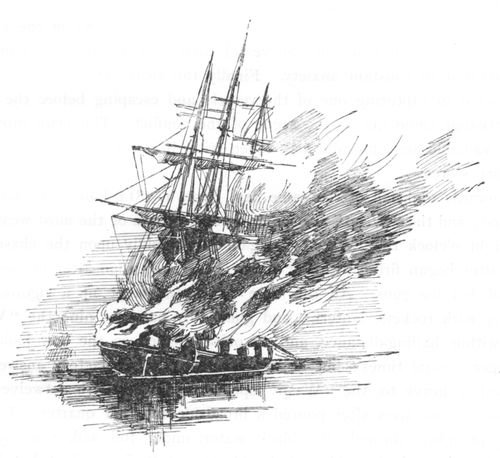
faint gleam was seen about the companionway of the "Rocket." Another
instant, and with a roar and crackle, a great mass of flame shot up
from the hatch, as from the crater of a volcano. Instantly the
well-tarred rigging caught, and the flame ran up the shrouds as a
ladder of fire, and the whole ship was a towering mass of flame. The
little band of men on the "Sumter" looked on the terrific scene with
bated breath. Though they fully believed in the justice of their
cause, they could not look on the destruction they had wrought without
feelings of sadness. It was their first act of war. One of the
officers of the "Sumter" writes: "Few, few on board can forget the
spectacle,—a ship set fire to at sea. It would seem that man was
almost warring with his Maker. Her helpless condition, the
red flames licking the rigging as they climbed aloft, the sparks and
pieces of burning rope taken off by the wind, and flying miles to
leeward, the ghastly glare thrown upon the dark sea as far as the eye
could reach, and then the deathlike stillness of the scene,—all these
combined to place the "Golden Rocket" on the tablet of our memories
forever." But it was not long before the crew of the "Sumter" could
fire a vessel, and sail away indifferently, with hardly a glance at
their terrible handiwork.
The "Sumter" continued on her cruise, with varying fortunes. Sometimes
weeks would pass with no prizes to relieve the tedium of the long
voyage. Occasionally she would run into a neutral port for coal or
water, but most of the time was spent on the open sea. The crew were
kept actively employed with drills and exercises; while the officers,
yawning over their books or games, longed for the welcome cry from the
masthead, "Sail ho!" In September the "Sumter" captured a brig, the
"Joseph Park;" and the boarding officer, on examining the log-book,
found an entry made by her captain on the day of leaving Pernambuco:
"We have a tight, fast vessel, and we don't care for Jeff Davis." The
unlucky captain had holloaed long before he was out of the wood.
The "Joseph Park" was the last prize the tars of the "Sumter" had the
pleasure of "looting" for many days. Up and down the tropic seas the
cruiser travelled, loitering about the paths of ocean commerce to no
avail. Often enough the long-drawn hail of the lookout in the
cross-trees, "Sail ho-o-o-o!" would bring the jackies tumbling up from
the forecastle, and set the officers peering anxiously through their
telescopes. But the sails so sighted proved to be English, French,
Spanish, any thing but American; and life aboard the "Sumter" became
as dull as a fisher's where fish are not to be found. In September
Capt. Semmes ran his vessel into a Martinique harbor, to make some
needed repairs, and give the sailors a run ashore. Here they were
blockaded for some time by the United States frigate "Iroquois," but
finally escaped through the cunning of Semmes. Lying in the harbor
near the "Sumter" were two Yankee schooners, whose captains arranged
with the commander of the "Iroquois" to signal him if the "Sumter"
should leave the harbor. If on passing the bar she headed south, a
single red light should gleam at the masthead of the schooner; should
her course lie northward, two lights would be displayed. Semmes, lying
at anchor in the bay, and chafing over his captivity,
determined to break away. He had noticed the frequent communications
between the schooners and the man-of-war, and suspected that his
course would be spied out. Nevertheless, he determined to dare all,
and one black night slipped his cables, and with all lights out, and
running-gear muffled, glided swiftly out of the harbor. In the
distance he could see the lights of the "Iroquois," as she steamed
slowly up and down in the offing, like a sentry on guard. Up in the
cross-trees of the "Sumter" sat a sharp-eyed old quarter-master, with
orders not to mind the "Iroquois," but to keep a close watch on the
suspected schooners. Soon a light gleamed from the maintop of each.
Semmes's suspicions grew. "They have signalled our course," said he:
"we'll double." The ship's head was quickly brought about, and headed
south; then all turned to watch the movements of the "Iroquois." She
had headed northward, and was exerting every power to catch the flying
vessel supposed to be just ahead. Satisfied with having so
successfully humbugged the enemy, the "Sumter" proceeded leisurely on
her course to the southward, leaving the "Iroquois" steaming furiously
in the opposite direction. "I do think, however," writes Capt Semmes
in his log-book, "that a tough old quarter-master, and a grizzled
boatswain's mate, who had clean shaven their heads in preparation for
a desperate fight, were mightily disgusted."
The subsequent career of the "Sumter" was uneventful. She captured but
few more vessels; and in January of the next year ran into the harbor
at Gibraltar, where she was blockaded by a powerful United States
frigate, and finally sold as being worn out. She had been in
commission a little over a year, and in that time had captured
eighteen vessels, burned seven, and released two on a heavy ransom to
be paid to the Confederate Government at the end of the war. It is
needless to say these ransoms were never paid. Capt. Semmes, with his
crew, proceeded to England, and took command of a mysterious ship,
"No. 290," just built at Liverpool, which soon appeared on the high
seas as the dreaded "Alabama."[Back to Contents]
THE POTOMAC FLOTILLA. — CAPTURE OF ALEXANDRIA. — ACTIONS AT MATTHIAS
POINT. — BOMBARDMENT OF THE HATTERAS FORTS.
 n
petty skirmishes and in general inactivity the forces of both
contestants idled away the five months following the fall of Fort
Sumter. The defeat of the Union armies at Bull Run had checked active
operations along the Potomac. On either side of the river the hostile
armies were drilling constantly to bring the raw recruits down to the
efficiency of trained soldiers. Four hundred thousand men lay in
hostile camps within sight of each other. From the national Capitol at
Washington the stars and bars of the Confederate flag could be seen
floating over the camp at Arlington. Occasionally the quiet would be
broken by the crack of a rifle, as some straggler, on one side or the
other, took a casual shot at the sentry pacing on the other side of
the broad stream. Sometimes a battery would come driving down to the
shore, select an advantageous spot, and begin an afternoon's target
practice at the hostile camp; but the damage done was immaterial, and
after wasting much powder and shot the recruits would limber up their
guns and return to their camp. It would have been easy, at almost any
time, for either army to have crossed the Potomac and invaded the
territory of the enemy; but each hung back in apparent dread of taking
the first decisive step. Abraham Lincoln at this time
illustrated the existing condition of affairs, by one of those stories
which have made him celebrated as a raconteur. A number of
politicians, calling at the White House, spoke of the apparent
inactivity of the army authorities, and demanded that some decisive
move should be made; some powerful preparations to beat back the enemy
should he attempt to cross the Potomac. "Gentlemen," said Lincoln,
with the twinkle in his eye that always foretold a story, "when I was
a boy I saw an incident which I have always recollected, and which
seems to me to resemble very much the attitude now assumed by the
parties in this impending war. My father owned a dog,—a particularly
vicious, aggressive, and pugnacious bull-terrier,—one of these
fellows with heavy, short necks, and red, squinting eyes, that seem
ever to be on the lookout for a fight. Next door to us lived a
neighbor who likewise rejoiced in the possession of a canine of
appearance and habits of mind similar to our pet. From the date of
their first meeting these dogs had been deadly enemies, and had
growled and yelped at each other through the picket-fence separating
the two yards, until we were forced to keep at least one dog chained
continually. The strained relations between the dogs became a matter
of general interest, and speculations were rife among the neighbors as
to the probable outcome of a hostile meeting. Those were the times
when a lively dog-fight would draw the merchant from his counter, and
the blacksmith from his anvil; and it is even on record that an
honorable judge once hurriedly adjourned his court at the premonitory
sounds of snarling in the court-house square. Well, the knowledge that
two dogs, pining for a fight, were being forcibly restrained, was too
much to be borne by the people of the village; and a plot was
concocted for bringing about a fight. One night two pickets were
surreptitiously removed from the fence, leaving an opening of ample
size to permit a dog to pass. In the morning our dog was sunning
himself in the yard, when the neighbor's dog rushed to his
side of the fence, and made remarks not to be borne by any
self-respecting canine. Then began the usual performance of snarls and
barks, and baring of white teeth, as the dogs made frantic efforts to
get at each other. The neighbors assembled in a crowd, and the knowing
ones predicted a lively time when those two dogs found the hole in the
fence. Down the line of the fence the two curs walked, their eyes
glaring, their jaws snapping, their tongues out, and dropping foam.
The racket was tremendous. At each place where the pickets were a
little spread, they redoubled their efforts to clinch. They approached
the opening. The interest of the spectators redoubled. Now they
reached the spot; sprung at each other; their jaws touched,—and each,
dropping his tail, slunk away to his kennel. Gentlemen, the attitude
of these armies reminds me of that dog-fight."
n
petty skirmishes and in general inactivity the forces of both
contestants idled away the five months following the fall of Fort
Sumter. The defeat of the Union armies at Bull Run had checked active
operations along the Potomac. On either side of the river the hostile
armies were drilling constantly to bring the raw recruits down to the
efficiency of trained soldiers. Four hundred thousand men lay in
hostile camps within sight of each other. From the national Capitol at
Washington the stars and bars of the Confederate flag could be seen
floating over the camp at Arlington. Occasionally the quiet would be
broken by the crack of a rifle, as some straggler, on one side or the
other, took a casual shot at the sentry pacing on the other side of
the broad stream. Sometimes a battery would come driving down to the
shore, select an advantageous spot, and begin an afternoon's target
practice at the hostile camp; but the damage done was immaterial, and
after wasting much powder and shot the recruits would limber up their
guns and return to their camp. It would have been easy, at almost any
time, for either army to have crossed the Potomac and invaded the
territory of the enemy; but each hung back in apparent dread of taking
the first decisive step. Abraham Lincoln at this time
illustrated the existing condition of affairs, by one of those stories
which have made him celebrated as a raconteur. A number of
politicians, calling at the White House, spoke of the apparent
inactivity of the army authorities, and demanded that some decisive
move should be made; some powerful preparations to beat back the enemy
should he attempt to cross the Potomac. "Gentlemen," said Lincoln,
with the twinkle in his eye that always foretold a story, "when I was
a boy I saw an incident which I have always recollected, and which
seems to me to resemble very much the attitude now assumed by the
parties in this impending war. My father owned a dog,—a particularly
vicious, aggressive, and pugnacious bull-terrier,—one of these
fellows with heavy, short necks, and red, squinting eyes, that seem
ever to be on the lookout for a fight. Next door to us lived a
neighbor who likewise rejoiced in the possession of a canine of
appearance and habits of mind similar to our pet. From the date of
their first meeting these dogs had been deadly enemies, and had
growled and yelped at each other through the picket-fence separating
the two yards, until we were forced to keep at least one dog chained
continually. The strained relations between the dogs became a matter
of general interest, and speculations were rife among the neighbors as
to the probable outcome of a hostile meeting. Those were the times
when a lively dog-fight would draw the merchant from his counter, and
the blacksmith from his anvil; and it is even on record that an
honorable judge once hurriedly adjourned his court at the premonitory
sounds of snarling in the court-house square. Well, the knowledge that
two dogs, pining for a fight, were being forcibly restrained, was too
much to be borne by the people of the village; and a plot was
concocted for bringing about a fight. One night two pickets were
surreptitiously removed from the fence, leaving an opening of ample
size to permit a dog to pass. In the morning our dog was sunning
himself in the yard, when the neighbor's dog rushed to his
side of the fence, and made remarks not to be borne by any
self-respecting canine. Then began the usual performance of snarls and
barks, and baring of white teeth, as the dogs made frantic efforts to
get at each other. The neighbors assembled in a crowd, and the knowing
ones predicted a lively time when those two dogs found the hole in the
fence. Down the line of the fence the two curs walked, their eyes
glaring, their jaws snapping, their tongues out, and dropping foam.
The racket was tremendous. At each place where the pickets were a
little spread, they redoubled their efforts to clinch. They approached
the opening. The interest of the spectators redoubled. Now they
reached the spot; sprung at each other; their jaws touched,—and each,
dropping his tail, slunk away to his kennel. Gentlemen, the attitude
of these armies reminds me of that dog-fight."
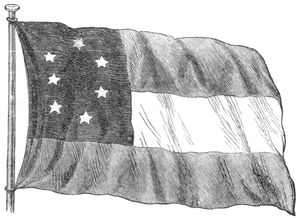
Flag of the Confederacy.
While the armies of the two contestants were thus idly resting upon
their arms, the navy was obliged to discharge duties, which, while
they brought some danger, did not gain glory for either officers or
men. The joys of Washington society were not for the naval officers.
The applicant for promotion, who, when asked by an examiner, "Where is
the post of a colonel when his regiment is drawn up for battle?"
responded promptly, "In Washington," had been serving in the army, and
not with the naval corps. Besides the duties of the officers detailed
upon the blockading service, there remained to the navy the arduous
task of patrolling the Potomac River, and preventing as far as
possible communication between the shores.
This work, as may be readily understood, demanded the most untiring
vigilance and the most unflagging energy. The shores on each side of
the Potomac are indented with bays and tributary streams in which a
sloop or large row-boat can easily be concealed during the day. At
night it was impossible to prevent boats laden with contraband goods,
or conveying the bearers of secret despatches, slipping across the
river from the northern side, and running into the concealment
afforded by the irregularity of the Virginia shore-line. Even at this
early period of the war, the vigorous blockade of the Confederate
seaports had created a great lack of many necessaries in the Southern
States. Particularly did the lack of quinine afflict the people of
those malarial sections comprised within the limits of the South
Atlantic and Gulf States. So great was the demand for this
drug, that the enormous sums offered for it led many a speculative
druggist north of Mason and Dixon's line to invest his all in quinine,
and try to run it through the Potomac blockade. Of course, as the
traffic was carried on in small boats, it was impossible to break it
up altogether; though by the efforts of the navy it was almost
destroyed.
Briefly stated, the duties of the Potomac flotilla may be said to have
been to patrol the river from Washington to its mouth, to inspect both
sides daily if possible, and to observe whether any preparations for
batteries were being made at any point, and watch for any transports
with troops or provisions, and convoy them to Washington. The flotilla
consisted of small vessels, lightly armed; the "Pawnee," the heaviest
of the fleet, being a sloop of less than thirteen hundred tons, with a
battery of fifteen guns, none of long range. Clearly such an armada as
this could be of but little avail against the earthworks which the
Virginians were busily erecting on every commanding bluff.
Toward the later part of May, 1861, the Federal Government determined
to send troops across the river and occupy the city of Alexandria. The
"Pawnee" had for some days been lying off the town, completely
covering it with her batteries. She had held this position without
making any offensive movement; as her commander understood, that, even
should he compel the town to surrender, he had not the men necessary
for holding the position. On the morning of the 24th, Commander Rowan
saw two steamers coming down the river, laden with Federal troops. He
at once sent a boat ashore, and demanded the surrender of the city,
which was immediately evacuated by the Virginian troops. When the army
of occupation landed, it proved to be Ellsworth's famous Zouave
Regiment, made up largely of the firemen and "Bowery boys" of New York
City. Ellsworth, while marching through the streets at the head of his
command, saw a Confederate flag floating from a mast on top of a
dwelling. With two of his men he proceeded to enter the house, go on
the roof, and tear down the flag. As he came down the stairs, a man
carrying a gun stepped from a doorway, and demanded what he did there.
"This is my trophy," cried Ellsworth, flourishing the bit of striped
bunting. "And you are mine," responded the man, quickly bringing his
gun up, and discharging it full into Ellsworth's breast. The two
Zouaves, maddened at the death of their commander, shot the slayer
through the brain, and plunged their bayonets into his body
before he fell. Ellsworth's death created the greatest excitement in
the North, as it was almost the first blood shed in the war. While the
capture of Alexandria was in itself no great achievement, it was of
importance as the first move of the Northern armies into Virginia.
Had the efforts of the navy towards keeping the Potomac clear of
hostile batteries been supplemented by a co-operating land force, an
immense advantage would have been gained at the very outset. As it
was, all that could be done was to temporarily check the exertions of
the enemy. A battery silenced by the guns from the ships in the
daytime could be, and usually was, repaired during the night, and
remained a constant menace to the transports going to or from
Washington. Under such circumstances, the work of the Potomac flotilla
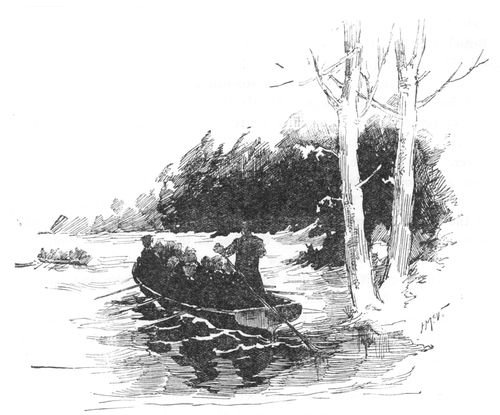
could only be fatiguing and discouraging. Much of it had to be
performed in row-boats; and the crews of the various vessels were kept
rowing up and down the banks of the river, making midnight excursions
up creeks to examine suspected localities, and lying in wait for
smugglers, and the mail-carriers and spies of the enemy. They were in
continual danger of being opened upon by masked batteries and
concealed sharp-shooters. The "prize money," the hope of which cheers
up the man-o'-wars-man in his dreariest hours, amounted to nothing;
for their prizes were small row-boats and worthless river-craft. The
few engagements with the enemies' batteries brought little glory or
success. In one battle on the 29th of May, 1861, a flotilla,
consisting of the "Thomas Freeborn" (a paddle-wheel steamer, carrying
three guns), the "Anacostia," and the "Resolute" (a little craft of
ninety tons and two guns), engaged the batteries at Aquia Creek, and
pounded away with their pygmy guns for two hours, without doing any
visible damage. Two days later the bombardment was renewed, and two of
the vessels were slightly damaged. A more serious event occurred at
Matthias Point in the latter part of June. Matthias Point was one of
the chief lurking-places of the Confederate guerrillas, who, concealed
in the dense undergrowth along the banks of the Potomac, could pour a
destructive fire into any vessels that passed. Commander J. H. Ward of
the "Freeborn" planned to break up this ambush, sending a landing
party to cut away the trees and undergrowth. The landing party,
commanded by Lieut. Chaplin, was to be covered by the guns of the
"Freeborn" and "Reliance." It was late in the afternoon when they
pushed off for the shore. All seemed quiet; and the bursting
of the shells, which were occasionally dropped into the woods, seemed
to have driven the enemy away. Hardly, however, had the sailors begun
the work of hewing down the undergrowth, when from all quarters a hot
fire was begun, driving them to their boats in a rout. The decks of
the two vessels were swept by the storm of lead. Commander Ward, while
sighting the bow-gun of the "Freeborn," was struck in the abdomen by a
bullet, and died in a few minutes. On the shore the sailors were
hurrying into the boats and pushing off to avoid capture. Lieut.
Chaplin acted with great bravery, and succeeded in getting all his men
away, with their muskets. The last man left on the shore was unable to
swim; and Chaplin, taking him on his shoulders, bore him safely to the
boat. Though the fire of the enemy was concentrated on the two,
neither was hurt, although a minie-ball passed through the
lieutenant's cap.
Two months later this same locality was the scene of another bloody
disaster to the Union arms. On the 16th of August the "Resolute" and
the "Reliance" were ordered to make a reconnoissance of the
neighborhood of Matthias Point. After steaming about the shore for
some time, and noticing nothing of a suspicious character, a boat was
seen on the Virginia shore, and an officer and five men despatched to
capture her. They had just reached her, and were in the act of making
fast, when a volley of musketry was fired from the bushes not more
than five yards away, and three of the crew were instantly killed, and
one wounded. The watchers on the war-vessels, lying in the river,
sprang to their guns, and threw several rounds of shell into the cover
that sheltered the enemy, soon driving them away. The two uninjured
men in the boat succeeded in getting her away with her load of dead
and dying.
It is easy to understand how exasperating, how infuriating, such
service as this must have been to the officers and men of the navy.
For a man to risk his life in the heat and excitement of a battle, is
as nothing to the feeling that one may be at any time caught in a
death-trap, and slaughtered in cold blood.
Naval Patrol on the Potomac.
A more successful expedition was organized in October, by Lieut.
Harrill of the steamer "Union." He had been informed that a large
schooner was lying in Quantico Creek, and that the Confederates were
massing a number of troops there for the purpose of crossing the
river. He at once determined to destroy the schooner. Accordingly he
manned three boats at half-past two in the morning, and in
the darkness proceeded, with muffled oars, toward the mouth of the
creek. Here some difficulty was experienced, as the entrance is narrow
and obstructed by sandbars; but working energetically, and in perfect
silence, the sailors overcame all obstacles. Once in the creek, they
pulled rapidly along within pistol-shot of the shore, until the tall
masts of the schooner could be descried in the darkness. One sentry
was on guard, who fled wildly as he saw the mysterious boat emerge
from the darkness of the night. The grappling-irons were thrown
aboard, and the jackies swarmed nimbly up the sides, and began the
work of destruction. A huge pile of combustibles was made in the
cabin, and hastily set on fire. The flames spread rapidly; and, though
they insured the destruction of the schooner, they also lighted up the
creek, showing the boats with the sailors bending to their oars to
escape the storm of bullets that they knew must follow. The
glare of the burning schooner, the reflection of the flames on the
water, the flash of the rifles from the shores made a wild picture.
Occasionally a flash from the river was followed by a deep boom, as a
heavy shot left the muzzle of a cannon on the steamers. But through it
all, the men escaped; and the projected invasion of the Confederates
was abandoned, owing to the loss of their schooner.
All through the war this untiring patrol of the Potomac was continued.
Among miasmatic vapors and clouds of noxious insects on mud-flats, in
narrow channels whose densely wooded banks might conceal legions of
hostile sharp-shooters, the river navy kept up its work. Earning but
little glory, though in the midst of constant peril, the officers and
men kept up their work, and contributed not a little to the final
outcome of the great conflict.
All this time the officers of the naval vessels, riding at anchor in
Hampton Roads, were chafing under the enforced idleness. Even the
occasional artillery duels with which their army brethren whiled away
the time were denied to the wistful blue-jackets. Beyond an occasional
chase, generally useless, after a fleet blockade-runner, the sailors
had absolutely no employment. At last, however, the opportunity came.
The first great naval expedition of the war was set under way.
From Cape Henry, at the mouth of the James River, the coast of
Virginia and North Carolina sweeps grandly out to the eastward, like a
mammoth bow, with its lower end at Beaufort, two hundred miles south.
Along this coast-line the great surges of mighty ocean, rolling with
unbroken course from the far-off shore of Europe, trip and fall with
unceasing roar upon an almost uninterrupted beach of snowy sand, a
hundred and more miles long. Near the southern end of this expanse of
sand stands a lighthouse, towering solitary above the surrounding
plain of sea and sand. No inviting beacon giving notice to the weary
marines of safe haven is this steady light that pierces the darkness
night after night. It tells of treacherous shoals and roaring
breakers; of the loss of many a good ship, whose ribs, half buried in
the drifting sand, lie rotting in the salt air; of skies ever
treacherous, and waters ever turbulent. It is the light of Hatteras.
Some twenty miles below Cape Hatteras light occurs the first great
opening in the stretch of sand that extends south from Cape
Henry. Once he has passed through this opening; the mariner finds
himself in the most peaceful waters. The great surges of the Atlantic
spend themselves on the sandy fringe outside, while within are the
quiet waters of Pamlico and Albemarle Sounds, dotted with fertile
islands, and bordering a coast rich in harbors. The wary
blockade-runner, eluding the watchfulness of the United States
blockaders cruising outside, had but to pass the portals of Hatteras
Inlet, to unload at his leisure his precious cargo, and load up with
the cotton which grew in great abundance on the islands and fertile
shores of the sound.
Recognizing the importance of this harbor, the Confederates had early
in the war fortified the point north of Hatteras Inlet. Shortly after
the fall of Fort Sumter, a Yankee skipper, Daniel Campbell,
incautiously running his schooner the "Lydia Francis" too near the
stormy cape, was wrecked, and sought shelter among the people at the
inlet. When, some days after, he proposed to leave, he was astounded
to find that he had been delivered from the sea only to fall a prey to
the fortunes of war. He was kept a prisoner for three months; and on
his release, going directly to Fortress Monroe, he proved that he had
kept his eyes open to some purpose. He reported to flag-officer
Stringham that the Confederates had two batteries,—one of ten, the
other of five guns,—known as Fort Hatteras and Fort Clark. With these
two forts the Confederates claimed that they could control the
entrance to Albemarle Sound.
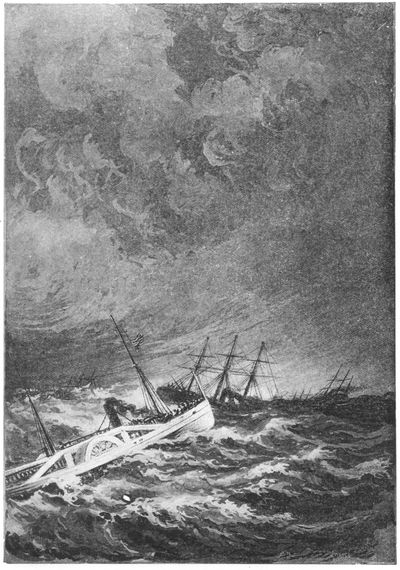
The Fleet off Hatteras.
As soon as this information was received, an expedition for the
destruction of these forts was organized. It was necessarily chiefly
naval, although a land force under Gen. Butler went with the fleet. On
Aug. 25, 1861, Hampton Roads presented a scene of the greatest
activity. The fleet seemed to have awakened from a long sleep. Every
vessel was being hastily prepared for sailing. Two transports, the
"George Peabody" and the "Adelaide," were crowded with the soldiers of
Gen. Butler's command. From the mainmast of the flagship "Minnesota"
waved the signal-flags, changing constantly as different orders were
sent to the commanders of the other warships. At two o'clock three
balls of bunting were run up to the truck, and catching the breeze
were blown out into flags, giving the order, "Get under way at once."
From the surrounding men-of-war came the shrill pipe of the
boatswains' whistle, and the steady tramp of the men at
the capstan bars as they dragged the anchors to the cat-heads. The
nimble blue-jackets, climbing about the shrouds and yards, soon had
the snowy clouds of canvas set. The wind was fresh; and with bands
playing, and cheers of blue-jackets and soldiers, the stately squadron
sailed down the bay.
But none on board, save the superior officers, knew whither the fleet
was bound. Hardly were they fairly on the Atlantic, when the course
was shaped to the southward, and that much was settled. But whether
New Orleans, Charleston, or Beaufort was the point to be attacked, the
sailors did not know.
The squadron which sailed from Hampton Roads consisted of the
war-vessels "Minnesota," "Wabash," "Pawnee," "Monticello," and
"Harriet Lane;" the transports "George Peabody" and "Adelaide;" and
the tug "Fanny." Soon after rounding Cape Henry, the vessels became
separated; and when the other vessels reached Hatteras, on the 27th,
the "Minnesota" and "Wabash" were nowhere to be seen. As these were
the most powerful frigates of the fleet, great fears were felt for the
success of the expedition; but at last they appeared on the horizon. A
place for landing was selected, and the vessels withdrew into the
offing to spend the night. It was determined to begin the attack early
the next day.
The morning dawned clear, with a calm sea. At four o'clock the men
were summoned to breakfast. At seven the operation of landing the
troops was begun. All the surf-boats, barges, and lifeboats in the
fleet were put to the work. The great war-vessels moved into position,
and prepared to cover with a terrific fire the landing of the troops.
The first shot was fired by the "Wabash," and the cannonading was at
once taken up by the rest of the fleet. The vessels were placed so
that a whole broadside could be discharged at once. Thousands of
pounds of iron balls were thrown into the forts. Under cover of the
cannonading, the disembarkation of the troops began.
But the opposition of the enemy was not the only difficulty to be met.
During the time consumed in getting ready to land, heavy banks of
clouds had been crawling up from the horizon, and the soft wind of
morning had grown into a steady blow. Cape Hatteras was true to its
reputation. On the shelving beach, where the troops must land, the
great rollers were breaking in torrents of foam. The first lifeboats
that attempted the landing were swamped, and the soldiers reached the
land wet and chilled through. The surf-boats were stove in.
The barges, which had been relied upon to land men in large numbers,
proved unmanageable, and were towed away by the "Harriet Lane." When
the attempt to land the troops was given up, it was found that but
three hundred and twenty men had been landed. This was too small a
party to storm the forts, and the issue of the battle depended upon
the great guns of the navy.
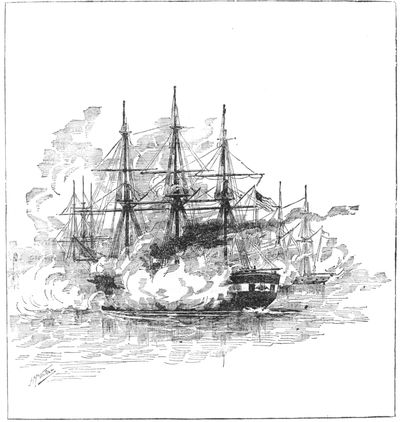
Attack on the Hatteras Forts.
By this time the gunners on the ships had calculated the exact range,
and were firing with fearful effect. Broadside followed broadside,
with the regularity of machinery. It was war without its
horrors for the blue-jackets, since bad marksmanship or poor powder
prevented the Confederate gunners doing any damage. On the gun-deck of
the superb frigate "Minnesota," the jackies were working their guns as
coolly as though they were on drill. The operations of loading and
firing were gone through with like clock-work. The officers could
watch the course of the shells until they struck, and instruct the
men, without undergoing any danger.
But in the forts the scene was one of terror. As soon as the gunners
of the fleet had secured the range, the shells began crashing into the
fort, bewildering the untried soldiers, and driving them from their
guns. A shell falling in the fort, and bursting, would sweep clean a
space thirty feet square. It was madness to try to work the guns. All
sought refuge in the bomb proofs, and an occasional shot was all that
showed the presence of any defenders in the forts. Soon the
Confederates decided to abandon Fort Clark, the smaller of the two,
and mass their forces in Fort Hatteras. As a ruse, to check the
bombardment of the ships, the flags on both forts were hauled down.
This was, of course, taken as a token of surrender; and as the
cannonading stopped, and the clouds of gray gunpowder-smoke lifted,
the shrouds of the bombarding squadron were filled with men, and cheer
upon cheer rang out in honor of the victory. Soon the troops occupied
the deserted battery, and the "Monticello" was ordered into the inlet
to take possession of Fort Hatteras. She had proceeded only a little
way, however, when suddenly a heavy fire was opened upon her from the
fort, and at the same time a large body of re-enforcements was seen
approaching from the south. The gunners came down from the shrouds,
stopped cheering, and began their work again. For a time the
"Monticello" was in a dangerous position. In a narrow and unknown
channel, she was forced to retreat slowly, under heavy fire from the
fort, being hit eight times. The heavy fire of the other vessels,
however, soon drove the Confederate gunners from their guns. The
sailors worked untiringly, and seemed enraged by the deceit practised
by the enemy. One man, while sponging out a gun, preparatory to
reloading it, dropped his sponge overboard. Quick as thought he
vaulted the gunwale, and re-appeared on the surface of the water
swimming for the sponge. Recovering it, he in a few moments crawled
dripping through a porthole, to report respectfully to the captain of
the gun: "Just come aboard, sir."
The fort abandoned by the Confederates had been occupied by
the troops that had been landed; and, under cover of the furious
bombardment, the work of landing was vigorously prosecuted. Night
came, and with it a gale so heavy that the vessels had to desert their
stations, and withdraw into the offing. When the morning broke,
however, the sea had calmed sufficiently to allow the gunners to again
set about their terrible work.
The second day's firing was even more accurate than that of the first;
and the gray-coats were soon compelled to retire to the bomb-proofs,
and abandon all attempt to return the fire of the ships. Soon three
shells in rapid succession burst close to the magazine of the fort,
telling plainly to the affrighted defenders that nothing was left for
them but surrender. A white flag was raised, and Commodore Barron went
off to the fleet to formally surrender the forts and the eight hundred
men of his command. When the terms were concluded, the defeated
soldier turned to flag-officer Stringham, and asked if the loss of
life on the ships had been very large. "Not a man has been injured,"
was the response. "Wonderful!" exclaimed the questioner. "No one could
have imagined that this position could have been captured without
sacrificing thousands of men." But so it was. Without the loss of a
man, had fallen a most important post, together with cannon,
provisions, and nearly seven hundred men.[Back to Contents]

THE "TRENT" AFFAIR. — OPERATIONS IN ALBEMARLE AND PAMLICO
SOUNDS. — DESTRUCTION OF THE CONFEDERATE FLEET.
 arly
in the war an event occurred which for a time seemed likely to
bring England to the aid of the Confederates. The Confederate
Government had appointed as diplomatic commissioners to England two
gentlemen, Messrs. Mason and Slidell. They had escaped from Mobile on
a fleet blockade-runner, and reached Havana, where they remained a
week waiting for the regular English packet to convey them to
Liverpool. While in Havana they were lavishly entertained by the
colony of Confederate sympathizers there; and feeling perfectly safe,
now that they were outside the jurisdiction of the United States, they
made no attempt to conceal their official character, and boasted of
the errand upon which they were sent.
arly
in the war an event occurred which for a time seemed likely to
bring England to the aid of the Confederates. The Confederate
Government had appointed as diplomatic commissioners to England two
gentlemen, Messrs. Mason and Slidell. They had escaped from Mobile on
a fleet blockade-runner, and reached Havana, where they remained a
week waiting for the regular English packet to convey them to
Liverpool. While in Havana they were lavishly entertained by the
colony of Confederate sympathizers there; and feeling perfectly safe,
now that they were outside the jurisdiction of the United States, they
made no attempt to conceal their official character, and boasted of
the errand upon which they were sent.
The United States frigate "San Jacinto," which was one of the many
vessels kept rushing about the high seas in search of the privateer
"Sumter," happened to be in the harbor of Havana at this time. She was
commanded by Capt. Wilkes, an officer who had made an exhaustive study
of international law, particularly as bearing upon the right of a
war-vessel to search a vessel belonging to a neutral nation. Capt.
Wilkes, knowing that by capturing the Confederate commissioners, he
could win for himself the applause of the entire North,
determined to make the attempt. By a study of his books bearing on
international law, he managed to convince himself that he was
justified in stopping the British steamer, and taking from it by force
the bodies of Messrs. Mason and Slidell. Accordingly he set sail from
the harbor of Havana, and cruised up and down at a distance of more
than a marine league from the coast, awaiting the appearance of the
vessel. Five days after the "San Jacinto's" departure, the
commissioners set sail in the British mail-steamer "Trent." She was
intercepted in the Bahama Channel by the "San Jacinto." When the
man-of-war fired a blank cartridge as a signal to heave to, the
commander of the "Trent" ran the British flag to the peak, and
continued, feeling secure under the emblem of neutrality. Then came a
more peremptory summons in the shape of a solid shot across the bows;
and, as the incredulous captain of the "Trent" still continued his
course, a six-inch shell was dropped within about one hundred feet of
his vessel. Then he stopped. A boat put off from the "San Jacinto,"
and made for the "Trent." Up the side of the merchant-vessel clambered
a spruce lieutenant, and demanded the immediate surrender of the two
commissioners. The captain protested, pointed to the flag with the
cross of St. George waving above his head, and invoked the power of
her Britannic majesty,—all to no avail. The two commissioners had
retired to their cabins, and refused to come out without being
compelled by actual force. The boat was sent back to the "San
Jacinto," and soon returned with a file of marines, who were drawn up
with their muskets on the deck of the "Trent." Every British ship
which carries mails carries a regularly commissioned officer of the
navy, who is responsible for them. This officer on the "Trent" was
somewhat of a martinet, and his protests at this violation of the
rights of a neutral vessel were very vigorous. When the first gun was
fired, he rushed below, and soon re-appeared in all the resplendent
glory of gold lace and brass buttons which go to make up a naval
uniform. He danced about the deck in an ecstasy of rage, and made the
most fearful threats of the wrath of the British people. The
passengers too became excited, and protested loudly. Every thing
possible was done by the people of the "Trent" to put themselves on
record as formally protesting. Nevertheless, the commissioners were
taken away, carried to New York, and from there sent into confinement
at Fort Warren.
When the news of this great achievement became known, Wilkes
was made the lion of the hour. Unthinking people met and passed
resolutions of commendation. He was tendered banquets by cities. He
was elected a member of learned societies in all parts of the country,
and was generally eulogized. Even the Secretary of the Navy, who
should have recognized the grave troubles likely to grow out of this
violation of the principles of neutrality, wrote a letter to Capt.
Wilkes, warmly indorsing his course, and only regretting that he had
not captured the steamer as well as the two commissioners.
But fortunately we had wiser heads in the other executive departments
of the government. President Lincoln and Secretary Seward quickly
disavowed the responsibility for Wilkes's action. Letters were written
to the United States minister in England, Charles Francis Adams,
alluding to the proceeding as one for which Capt. Wilkes as an
individual was alone responsible. And well it was that this attitude
was taken: for hardly had the news reached England, when with one
voice the people cried for war. Sympathizing with the South as they
undoubtedly did, it needed but this insult to the British flag to
rouse the war spirit of the nation. Transports loaded with troops were
immediately ordered to Canada; the reserves were called out; the
ordnance factories were set running day and night; while the press of
the nation, and the British minister at Washington, demanded the
immediate release of the captives, and a full apology from the United
States.
The matter was conducted on this side with the utmost diplomacy. We
were undoubtedly in the wrong, and the only thing was to come out with
as little sacrifice of national dignity as possible. The long time
necessary for letters to pass between this country and England was an
important factor in calming the people. Minister Adams said, that, had
the Atlantic cable then been in operation, nothing could have
prevented a war. In the end the demands of Great Britain were acceded
to, and the commissioners proceeded on their way. The last note of the
diplomatic correspondence was a courteous letter from President
Lincoln to the British minister, offering to allow the British troops
en route for Canada to land at Portland, Me., and thus avoid the
long winter's march through New Brunswick. The peaceful settlement of
the affair chagrined the Confederates not a little, as they had hoped
to gain Great Britain as a powerful ally in their fight against the
United States.
Soon after the capture of the forts at Hatteras Inlet, the
authorities of the Union again turned their attention in that
direction, with the result of sending the Burnside expedition to
Albemarle Sound.
The coast of North Carolina is honeycombed with rivers, inlets, and
lagoons, which open into the two broad sounds known as Pamlico and
Albemarle, and which are protected from the turbulence of the Atlantic
by the long ridge of sand which terminates at Cape Hatteras. While the
capture of the Hatteras forts had given the Union authorities control
of Hatteras Inlet, the chief entrance to the sounds, yet the long,
narrow island was broken by other lesser inlets of a size sufficient
to permit the passage of light-draught steamers. The Confederates had
quite a fleet of swift, light vessels of insignificant armament, often
only a single gun, with which they occasionally made a descent upon
some coaster or merchantman, running close inshore, and dragged her in
as a prize. With these swift steamers, too, they effectually
controlled all navigation of the sounds. But the greatest advantage
that they derived from their control of the sounds was the vast
facilities given them for constructing, at their leisure, powerful
iron-clads in some of the North Carolina shipyards; then sending them
to reduce the Hatteras forts, and so out into the Atlantic to fight
for the destruction of the blockade. All these conditions were clear
to the authorities of the Union; and therefore, in the early part of
January, 1862, a joint military and naval expedition was fitted out
for operation against the Confederate works and steamers in these
inland waters. It was in the early days of the war; and the flotilla
was one of those heterogeneous collections of remodelled
excursion-steamers, tugs, ferry-boats, and even canal-boats, which at
that time was dignified with the title of "the fleet." In fitting out
this expedition two very conflicting requirements were followed. In
the most favorable circumstances, the channel at Hatteras Inlet is
seldom over seven and a half feet: consequently the vessels must be of
light draught. But the Confederate steamers in the sounds carried
heavy rifled cannon, and the armament of the forts on Roanoke Island
was of the heaviest: therefore, the vessels must carry heavy guns to
be able to cope with the enemy. This attempt to put a heavy armament
on the gun-deck made the vessels roll so heavily as to be almost
unseaworthy.
Shores of Albemarle Sound.
In addition to the armed vessels belonging to the navy, a number of
transports accompanied the expedition, bearing the army corps under
the command of Gen. Burnside; and the whole number of
craft finally assembled for the subjugation of the North Carolina
sounds was one hundred and twenty. This heterogeneous assemblage of
vessels was sent on a voyage in the dead of winter, down a dangerous
coast, to one of the stormiest points known to the mariner. Hatteras
was true to its reputation; and, when the squadron reached the inlet,
a furious north-easter was blowing, sending the gray clouds scudding
across the sky, and making the heavy rollers break on the beach and
the bar in a way that foretold certain destruction, should any hardy
pilot attempt to run his ship into the narrow and crooked inlet.
Outside there was no safe anchorage, and the situation of the entire
squadron was most precarious. Several serious mishaps occurred before
the vessels got into the small and altogether insufficient harbor
between the seaward bar and the "bulkhead" or inner bar. The first
vessel to come to grief was one of the canal-boats laden with hay,
oats, and other stores. She was without any motive power, being towed
by a steam-tug, and, getting into the trough of the sea, rolled and
sheered so that she could not be towed. The heavy rolling started her
seams, and it was soon evident that she was sinking. With the greatest
caution a boat was lowered from one of the steamers, and put off to
rescue the crew of the foundering craft. Laboriously the sailors
worked their way through the tossing sea to the lee side of the
"Grape-shot," and after much difficulty succeeded in taking off all on
board, and the return trip was commenced. All went well until the boat
came under the lee of the steamer, and the men were about to clamber
up the sides. Suddenly an immense sea lifted the vessel high in the
air; and in an instant the boat was swamped, and the men were
struggling in the icy water. All were ultimately saved, but it was
with the greatest difficulty. The "Grape-shot," left to her fate, went
ashore some fourteen miles above Hatteras. Her cargo served some
practical use, after all; for some horses from the wreck of the
"Pocahontas" managed to reach the shore, and kept themselves alive by
munching the water-soaked hay and oats.
The "Pocahontas" was one of the steamers chartered by the war
department as a horse transport. Her actions during this gale furnish
a fair illustration of the manner in which the Government was often
deluded into purchasing almost valueless ships. She started with the
Burnside expedition from Hampton Roads, freighted with one hundred
and thirteen horses. As soon as the gale off Hatteras came
on, she began to show signs of unseaworthiness. First the boilers gave
way, loosened from their places by the heavy rolling of the ship. All
progress had to be stopped until they were patched up. Then down fell
the grates, extinguishing the fires. Then the steering-gear was
broken; and, getting into the trough of the sea, she rolled until her
smokestack broke its moorings and fell over. Finally she sprung a leak
and was run ashore. The crew were all saved, but for a long time their
chances for life seemed small indeed. Ninety of the horses were lost,
some having been thrown overboard ten miles from the land. Others were
left tied in their stalls, to perish when the ship went to pieces in
the breakers. Those that were thrown overboard near the beach swam
ashore through breakers in which no boat nor man could live, and,
finding the waste and wreckage from the cargo of the "Grape-shot,"
lived for days on the hay and oats, soaked with sea-water though they
were.
For two days this gale continued. The outlook for the fleet seemed
hopeless. The inner bar of the harbor was absolutely impassable.
Between the outer bar and the inner were packed seventy vessels. This
space, though called a harbor, was almost unsheltered. Crowded with
vessels as it was, it made an anchorage only less dangerous than that
outside. Although the vessels were anchored, bow and stern, the
violence of the sea was such that they frequently crashed into each
other, breaking bulwarks, spars, and wheel-houses, and tearing away
standing-rigging. A schooner breaking from its anchorage went tossing
and twirling through the fleet, crashing into vessel after vessel,
until finally, getting foul of a small steamer, dragged it from its
moorings; and the two began a waltz in the crowded harbor, to the
great detriment of the surrounding craft. At last the two runaways
went aground on a shoal, and pounded away there until every seam was
open, and the holds filled with water.
A strange mishap was that which befell the gunboat "Zouave." She was
riding safely at anchor, remote from other ships, taking the seas
nobly, and apparently in no possible danger. Her crew occupied
themselves in going to the assistance of those in the distressed
vessels, feeling that their own was perfectly safe. But during the
night, the tide being out, the vessel was driven against one of the
flukes of her own anchor; and as each wave lifted her up and dropped
her heavily on the sharp iron, a hole was stove in her
bottom, sinking her so quickly that the crew took to the boats, saving
nothing.
But the most serious disaster was the total wreck of the "City of New
York," a large transport, with a cargo of ordnance stores valued at
two hundred thousand dollars. Unable to enter the inlet, she tried to
ride out the gale outside. The tremendous sea, and the wind blowing
furiously on shore, caused her to drag her anchors; and those on board
saw certain death staring them in the face, as hour by hour the ship
drifted nearer and nearer to the tumbling mass of mighty breakers,
that with an unceasing roar, and white foam gleaming like the teeth of
an enraged lion, broke heavily on the sand. She struck on Monday
afternoon, and soon swung around, broadside to the sea, so as to be
helpless and at the mercy of the breakers. Every wave broke over her
decks. The condition of her crew was frightful. In the dead of winter,
the wind keen as a razor, and the waves of icy coldness, the body soon
became benumbed; and it was with the greatest effort that the men
could cling to the rigging. So great was the fury of the wind and
waves, that no assistance could be given her. For a boat to venture
into that seething caldron of breakers would have been throwing away
lives. So the crew of the doomed ship were left to save themselves as
best they might. The night passed away, and Tuesday morning saw the
gale still blowing with unabated force. Hoping to lessen the strain on
the hull, they cut away the foremast. In falling, it tore away the
pipes, and the vessel became a perfect wreck. Numbed with cold, and
faint for lack of food, the crew lashed themselves to the bulwarks and
rigging; and so, drenched by the icy spray, and chilled through by the
wind, they spent another fearful night. The next day the fury of the
storm seemed to have somewhat abated. The sea was still running high,
and breaking over the almost unrecognizable hulk stranded on the
beach. With the aid of a glass, sailors on the other ships could see
the inanimate forms of the crew lashed to the rigging. It was
determined to make a vigorous attempt to save them. The first boat
sent out on the errand of mercy was watched eagerly from all the
vessels. Now it would be seen raised high on the top of some
tremendous wave, then, plunging into the trough, it would be lost from
the view of the anxious watchers. All went well until the boat reached
the outermost line of the breakers, when suddenly a towering wave,
rushing resistlessly along, broke directly over the stern, swamping
the boat, and drowning seven of the crew. Again the last
hope seemed lost to the exhausted men on the wreck. But later in the
day, the sea having gone down somewhat, a steam-tug succeeded in
reaching the wreck and rescuing the crew. The second engineer was the
last man to leave the ship. He remained lashed to the mast until all
were taken on the tug. Then, climbing to the top-mast, he cut down the
flag that had waved during those two wild days and nights, and bore it
safely away.
After this gale died away, the work of getting the squadron over the
inner bar was begun. It was a tremendous task. Many of the ships drew
too much water for the shallow channel, and it was necessary to remove
large parts of their cargoes. The bar, which is known as Buckhead
Shoal, was an expanse of quicksand a mile wide, with a tortuous
channel ever changing with the shifting sands. Many of the ships
stranded, and the tugs were constantly busy in towing them off.
Scarcely would one be safely afloat, than another would "bring up all
standing" on some new shoal. Two weeks elapsed before all the vessels
were safe within the landlocked sound. They were none too soon; for
hardly had the last vessel crossed the bar, than the black gathering
clouds, the murky, tossing sea, and the foaming billows breaking on
the bar, foretold another of the storms for which Cape Hatteras is
famed. Through the storm a queer-looking craft was seen approaching
the fleet. It was found to be a boat-load of escaping slaves, who had
put to sea at random, feeling sure of finding "de Yankees" somewhere.
From these men much valuable information was obtained.
Up to this time no one in the fleet, excepting the superior officers,
was informed as to the exact destination of the expedition. Now as the
signal to get under way blew out from the foremast of the flagship,
and as the prow of the leading vessel was turned to the northward, all
knew, and all cried, "Roanoke Island." This island was heavily
fortified by the Confederates, and from its position was a point of
considerable strategic importance. It guards the entrance to Pamlico
Sound from Albemarle Sound, and into Pamlico Sound open great bays and
rivers that penetrate far into the interior of Virginia and North
Carolina. On this island the Confederates had erected three forts of
formidable strength. These forts commanded the channel through which
the vessels would have to pass; and to make the task doubly dangerous,
the channel was obstructed with sharpened piles and sunken
hulks, so as to be apparently impassable. Beyond the obstructions was
the Confederate fleet, which, though insignificant compared with the
attacking squadron, was formidable in connection with the forts. It
was the task of the invaders to capture these forts, and destroy the
fleet.
It was on Feb. 5 that the squadron prepared to leave its moorings at
Hatteras Inlet. It was an imposing spectacle. The flagship
"Philadelphia" led the naval squadron, which advanced with the
precision of a body of troops. Behind, with less regularity, came the
army transports. About one hundred vessels were in the three columns
that moved over the placid waters of the sound toward the forts. It
was five in the afternoon of a short February day that the fleet came
in sight of the forts. Signals were made for the squadron to form in a
circle about the flagship. The early darkness of winter had fallen
upon the scene. The waters of the sound were smooth as a mill-pond.
From the white cottages on the shore gleamed lights, and brilliant
signal-lanterns hung in the rigging of the ships. Through the fleet
pulled swift gigs bearing the commanders of the different vessels.
The morning dawned dark and rainy. At first it was thought that the
fog and mist would prevent the bombardment, but all doubt was put at
an end by the signal, "Prepare for action," from the flagship. The
drums beat to quarters, and soon the guns were manned by sailors
stripped to the waist. The magazines were opened; and the surgeons
cleared away the cock-pits, and spread out their glistening
instruments ready for their work.
The fleet got under way, and stood up the channel almost to the point
where the obstructions were planted. Beyond these were the gunboats of
the enemy. The cannonade was begun without loss of time. A portion of
the fleet began a vigorous fire upon the Confederate gunboats, while
the others attacked the forts. The gunboats were soon driven away, and
then the forts received the entire fire. The water was calm, and the
aim of the gunners was admirable. The forts could hardly respond to
the fire, since the great shells, plunging by hundreds into the
trenches, drove the men from their guns into the bomb-proof casemates.
The officers of the ships could watch with their glasses the effect of
every shell, and by their directions the aim of the gunners was made
nearly perfect.
While the bombarding was going on, Gen. Burnside set about
landing his troops near the southern end of the island. The first boat
was fired upon by soldiers concealed in the woods. The "Delaware"
instantly pitched a few shells into the woods from which the firing
proceeded, and in a few minutes the enemy could be seen running out
like rats from a burning granary. The landing then went on unimpeded.
The boats were unable to get up to the bank, owing to shoal water; and
the soldiers were obliged to wade ashore in the icy water, waist-deep,
and sinking a foot more in the soft mud of the bottom.
The bombardment was continued for some hours after nightfall. A night
bombardment is a stirring scene. The passionate and spiteful glare of
the cannon-flashes; the unceasing roar of the explosions; the demoniac
shriek of the shells in the air, followed by their explosion with a
lightning flash, and crash like thunder; the volumes of gray smoke
rising upon the dark air,—make up a wonderful and memorable sight.
In the morning the bombardment was recommenced, and the work of
landing troops went on. Eight gunboats were sent to tear away the
obstructions in the channel; and there beneath the guns of the enemy's
fleet, and the frowning cannon of the forts, the sailors worked with
axe and ketch until the barricade was broken, and the eight ships
passed to the sound above the forts. In the mean time, the troops on
the island began the march against the forts. There were few paths,
and they groped their way through woods and undergrowth, wading
through morasses, and tearing their way through tangled thickets to
get at the enemy's front. The advance was slow, but steady, until the
open field before the forts was reached; then a change was ordered,
led by the famous Hawkins Zouaves, who rushed madly upon the fort,
shouting their war cry of Zou, zou, zou! Like a resistless flood the
attackers poured over the earthworks, and the frightened defenders
fled. Before five o'clock the entire island was in the hands of the
troops, and the fleet had passed the barricade. During the bombardment
the vessels sustained severe injuries. An act of heroism which made
the hero celebrated was that of John Davis, gunner's mate on board the
"Valley City." A shell entered the magazine of that ship, and
exploded, setting the woodwork on fire. An open barrel of gunpowder
stood in the midst of the flames, with sparks dropping about it. At
any moment an explosion might occur which would shatter the vessel to
fragments. Men shrank back, expecting every moment to be
their last. With wonderful presence of mind Davis threw himself across
the open end of the barrel, and with his body covered the dangerous
explosive until the fire was put out.
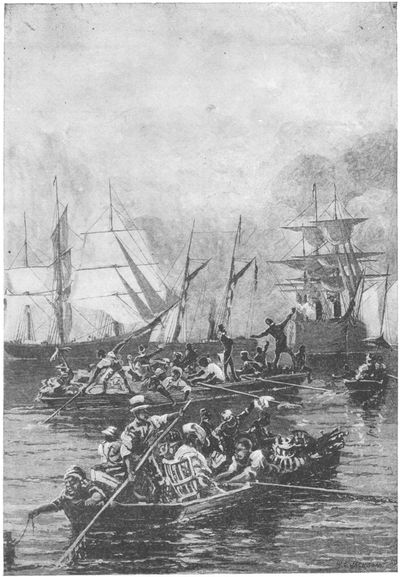
Contrabands escaping to Fleet.
As soon as the stars and stripes were hoisted on the flagstaffs of the
forts, the Confederate fleet, which had been maintaining a desultory
fire, fled up the sound, after setting fire to one schooner which had
become hopelessly crippled in the battle. She blazed away far on into
the night, and finally, when the flames reached her magazine, blew up
with a tremendous report, seeming like a final involuntary salute paid
by the defeated enemy to the prowess of the Union arms. When quiet
finally settled down upon the scene, and Gen. Burnside and Commander
Goldsborough counted up their gains, they found that six forts,
twenty-five hundred prisoners, and forty-two great guns had fallen
into the hands of the victors. The Union loss was forty killed and two
hundred wounded.
The next day was Sunday. It was considered highly important that the
success of the day before should be vigorously followed up; and an
expedition of fourteen vessels, under Capt. Rowan, was ordered to
follow the retreating Confederate fleet and destroy it. The flying
squadron was chased as far as Elizabeth City on the Pasquotauk River.
Here night overtook the pursuers; and they came to anchor at the mouth
of the stream, effectually cutting off all hope of retreat. The
Confederates in the vessels lying off the town passed an anxious
night. Outnumbered two to one by the pursuing vessels, they saw no
hope of a successful resistance. With a courage which in view of the
facts seems to be almost foolhardy, they determined to stick to their
ships, and fight to the death. The feelings of the inhabitants of the
town were hardly less gloomy. So thoroughly impregnable had they
considered the forts at Roanoke Island, that they had made absolutely
no preparations for defence; and now they found their homes upon the
eve of capture. The victorious army had not yet had an opportunity to
show the merciful way in which the inhabitants of captured cities were
treated throughout the war; and the good people of Elizabeth City may
be excused for fearing, that, with the destruction of their fleet,
they were to be delivered into the merciless hands of a lawless enemy.
Morning dawned bright and clear. With the greatest deliberation the
preparations for action were made on the attacking vessels. It was
discovered, that, owing to the continuous firing during the
Roanoke Island engagement, but twenty rounds of ammunition per gun
were left to each vessel. It was accordingly ordered that no
long-distance firing should be done; but each vessel should dash at
the enemy, run him down if possible, and then board and fight it out,
hand to hand. Early in the morning the fleet started up the river. The
enemy's fleet was soon sighted, lying behind the guns of a small
battery on Cobb's Point. When within long range, battery and vessels
opened a tremendous fire with eighty-pound rifles. The approach of the
squadron continued until when within three-quarters of a mile the
signal was flung out from the mast of the flagship, "Dash at the
enemy." Then full speed was put on, and firing commenced from
bow-guns. The Confederates became totally demoralized. The battery was
abandoned when the first vessel poured her broadside into it as she
passed. Before the enemy's fleet was reached, many of his vessels were
fired and abandoned. The United States steamship "Perry" struck the
"Sea-Bird" amidships, sinking her so quickly that the crew had scarce
time to escape. The crew of the "Delaware" boarded the "Fanny,"
sabering and shooting her defenders until they fled over the side into
the water. The victory was complete and overwhelming. Three or four of
the victorious vessels at once proceeded to the town, where they found
the enemy in full retreat and compelling the inhabitants to set fire
to their houses. This was quickly stopped, and the invaders became the
protectors of the conquered people.
The power of the Confederates in this part of the country being so
effectually destroyed, the navy was divided into small detachments and
sent cruising up the lagoons and rivers opening into the North
Carolina sounds, merely to show the people the power of the United
States Government, and to urge them to cease their resistance to its
authority. Three vessels were sent to Edenton. As they came abreast of
the village, a company of mounted artillery precipitately fled. A
detachment of marines sent ashore found a number of cannon which they
destroyed, and a nearly completed schooner to which they set fire.
Other small places were visited, generally without any opposition
being encountered.
A somewhat larger force was sent to a small town named Winton, as it
had been rumored that a force of Union men were there disputing the
authority of the Confederate Government, and the navy wished to go to
their assistance. The "Delaware" and "Hudson," in advance of
the squadron, came within sight of the landing and warehouses of
Winton about four in the afternoon. The town itself was hidden from
the view of the vessels by a high bluff. It was a clear, quiet
afternoon, and all seemed peaceful. The long wharf, running out into
the stream, was deserted by all save a negro woman, who, roused from
her occupation of fishing, gazed inquisitively at the strange vessels.
The place looked like a commercial port going to seed on account of
the blockade. The two vessels proceeded on their way unmolested,
ranging past the wharf, and apprehending no danger. Suddenly from the
woods on the bluff a terrific fire was poured upon the vessels. The
negress, having served her end as a decoy, fled hastily to shelter.
The bluffs seemed to be held by two batteries of light artillery and a
considerable force of armed men. Fortunately the aim of the artillery
men was bad, and the vessels sustained no severe damage. Still, they
were in a precarious position. The "Delaware" was too near to bring
her battery to bear, and was obliged to turn slowly in the narrow
channel. The "Perry," more fortunately situated, opened at once on the
enemy with shrapnel. But the contest was unequal, and the two vessels
were forced to retreat down the river about seven miles, there to
await the remainder of the squadron.
Two days after, the flotilla began the advance up the river, shelling
the town as they ascended. Once opposite the town, the troops were
landed, and the Hawkins Zouaves soon had possession of the bluff and
town. Knapsacks, ammunition, and muskets in considerable quantity fell
into the hands of the victors; and, after burning the barracks of the
enemy, the squadron returned to the base of operations at Roanoke
Island.[Back to Contents]
REDUCTION OF NEWBERN. — EXPLOITS OF LIEUT. CUSHING. — DESTRUCTION OF THE
RAM "ALBEMARLE."
 fter
the destruction of the Confederate flotilla at Elizabeth City,
and the affair at Winton, the Union fleet remained quietly at anchor
off Roanoke Island, or made short excursions up the little rivers
emptying into the sounds. Over a month passed in comparative inaction,
as the ships were awaiting supplies and particularly ammunition. When
finally the transports from New York arrived, and the magazines of the
war-vessels were filled with shot and shell and gunpowder, they again
turned their attention to the enemy. The victories already won had
almost driven the Confederates from that part of North Carolina which
borders on the sounds. Roanoke Island, Elizabeth City, Edenton, and
Plymouth had one after the other yielded to the persuasive eloquence
of the ship's cannon, and there was left to the Confederates only one
fort,—Newbern, on the River Neuse. As a city Newbern is
insignificant; but as a military post it was of a good deal of
importance, and the Confederates had made active preparations for its
defence.
fter
the destruction of the Confederate flotilla at Elizabeth City,
and the affair at Winton, the Union fleet remained quietly at anchor
off Roanoke Island, or made short excursions up the little rivers
emptying into the sounds. Over a month passed in comparative inaction,
as the ships were awaiting supplies and particularly ammunition. When
finally the transports from New York arrived, and the magazines of the
war-vessels were filled with shot and shell and gunpowder, they again
turned their attention to the enemy. The victories already won had
almost driven the Confederates from that part of North Carolina which
borders on the sounds. Roanoke Island, Elizabeth City, Edenton, and
Plymouth had one after the other yielded to the persuasive eloquence
of the ship's cannon, and there was left to the Confederates only one
fort,—Newbern, on the River Neuse. As a city Newbern is
insignificant; but as a military post it was of a good deal of
importance, and the Confederates had made active preparations for its
defence.
It was on the 12th of March, 1862, that Commander Rowan started from
Hatteras Inlet with a flotilla of thirteen vessels, and army
transports bearing three thousand men. The long column steamed down
the placid waters of Pamlico Sound, and, turning into the
Neuse River, anchored about fifteen miles below the city. Although the
night before the battle, and within sight of the white steeples of the
menaced city, all was quiet and peaceful. The banks of the broad
stream were densely wooded, and from them could be heard at times the
cry of the whip-poor-will, or the hoot of the night-owl. The vessels
were anchored far out in the middle of the stream, so as to avoid the
deadly bullets of any lurking sharp-shooters. The lookouts kept a
close watch for floating torpedoes; while the sailors off duty spun
their yarns in the forecastle, and bet pipes and tobacco on the result
of the coming battle. The jolly tars of the Burnside expedition had
hardly yet learned that war was a serious matter. They had met with
but little serious resistance, had captured powerful forts without
losing a man, had chased and destroyed the Confederate fleet without
any serious damage to their own, and felt, accordingly, that war was a
game in which it was their part always to win, and the part of the
enemy to run away. Certainly the fight at Newbern did nothing to
dispel this idea.
When morning broke, the shrill piping of the boatswain's whistle
brought the crew to their places on deck. Breakfast was served, and
leisurely eaten; for it is one of the established theories of the
navy, that sailors can't fight on empty stomachs. Breakfast over, the
work of landing the troops was begun. The point chosen was a broad
beach fringed with woods near the anchorage of the vessels. Before
landing the troops, the ships threw a few shells into the woods, to
make certain that they concealed no ambuscade, as in the disastrous
affair at Matthias Point. After two dozen shells had burst, mowing
down trees, and driving out frightened animals in plenty, but no
sharp-shooters, the long-boats put off from the transports bearing the
soldiers for the land attack. As soon as six or seven hundred were
landed, they formed in column, and moved rapidly up the beach. The
others followed as rapidly as they could be put on shore. The gunboats
steamed slowly up the river, keeping abreast of the troops, and
throwing shells into the woods ahead of the attacking column. Had any
Confederates prepared to resist the march, they must have been driven
out of the forest before the Federals came within musket-range. Not an
atom of resistance was made. The plans of the invaders seemed
irresistible. About half-past four in the afternoon, a puff of smoke
rose from the river-bank far ahead of the leading vessel, and in a few
seconds a heavy shell plunged into the water a hundred yards
ahead of the flotilla. The enemy was getting awake to the situation.
The gunboats soon returned the fire, and the cannonading was continued
at long range, without damage to either side, until sundown, when the
troops went into camp, and the vessels chose an anchorage near by.
At daylight the next morning, the advance was resumed. The day was so
foggy that the usual signals between the vessels could not be seen,
and orders from the flagship had to be carried by boat. The fleet
proceeded up the river; and, when the fog lifted, the ramparts of Fort
Dixie—the one that had fired on them the night before—were visible.
A vigorous bombardment was at once begun; but the fort failed to
reply, and a storming-party sent ashore found it empty. Hoisting the
stars and stripes above the deserted bastions, the ships went on. Soon
they reached Fort Ellis. Here the firing was sharp on both sides. The
fort was a powerful earthwork, well armed with rifles ranging from
thirty-two to eighty pounders. The Confederates did but little damage
with their guns; their aim being bad for want of practice, and their
powder of poor quality. Still, they fought on with great courage until
a shell from the "Delaware" burst in the magazine, firing the powder
there, and hurling the fort, with large numbers of its brave
defenders, high in the air. This ended the fight with Fort Ellis, and
the fleet continued its way up the river.
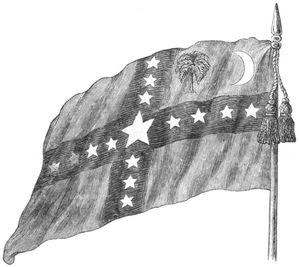
Flag of South Carolina.
Shortly after passing Fort Ellis, two rows of obstructions were met in
the channel. The lower barrier was composed of a series of piles
driven into the river-bottom, and cut off below the water; back of
these came a row of pointed and iron tipped piles pointing down stream
at such an angle as to be likely to pierce the hull of any vessel that
should run upon them. Entwined about these piles was a cable
connecting with thirty powerful torpedoes. That any vessel could
pierce such a barrier seems almost incredible; yet all the vessels of
the flotilla passed, and but two were seriously injured. One of the
sharp iron piles drove through the bottom of the "Barney," sending the
crew to the pumps, and the carpenter down into the hold with his
felt-covered plugs. But her damages were quickly repaired, and she
went on with the rest of the fleet. Right under the guns of Fort
Thompson the second line of obstructions was encountered. It consisted
of a line of sunken vessels closely massed, and a cheval-de-frise of
stakes and logs, that blocked the entire river, save a small
passage close in shore under the guns of the battery. Here was more
hard work for the sailors; but they managed to creep through, and
ranging up in line, broadside to Fort Thompson, they opened a vigorous
cannonade upon that work. The condition of the garrison of the fort
was desperate. The troops that had marched up the beach abreast of the
vessels began a vigorous attack on the landward face of the fort,
while the vessels in the river kept up a vigorous fire on the
water-front. Soon the gunners of the fort were called away from the
river-front to meet the hot assault of the soldiers on the land; and,
as the conflict grew close, the ships ceased firing, lest their shell
should mow down foe and friend alike. Leaving the enemy to the
attention of the soldiery, the ships proceeded up the river past two
deserted forts that gave no answer to vigorous shelling. Just as the
last vessel was passing Fort Thompson, the attacking troops, with a
cheer, rushed upon the ramparts; and in a minute the stars and stripes
were fluttering from the flagstaff. This was the last resistance
encountered, and at two P.M. the victors were in full possession of
the city. The war ships sped up the river after three Confederate
steamers that were endeavoring to escape, and soon captured them. One
was run ashore and burned, while the other two were added to the
conquering fleet. As a last resort, the flying enemy sent down a huge
fire-raft, in the hope of burning some of the Union vessels; but this
was stopped by the piers of a railroad bridge, and, burning that,
effectually cut off Newbern's communication with the world. During the
entire two days' engagement, the navy did not lose a man on the ships.
Two of a small landing-party were killed, and eleven, wounded; while
of the soldiers there were killed eighty-eight, and wounded three
hundred and fifty-two. This victory gave to the United States
the entire control of the North Carolina sounds and
tributary navigable waters.
For years after this, the sounds were occupied by a small squadron of
the United States navy, mainly blockading cruisers. It was during
these three years of occupation that Lieut. W. B. Cushing performed
those wonderfully daring deeds that made him a name and fame apart
from all other war-records. These feats so particularly belong to
Cushing's record, rather than to the history of any years of the war,
that they may well be considered together here. The wonderful
exhibitions of daring by which this young officer earned his promotion
to the rank of a commander, while still hardly more than a boy, were
the ascent of New River Inlet in the steamer "Ellis," for the purpose
of destroying the enemy's salt-works, and a blockade-runner at New
Topsail Inlet; and finally, the great achievement of his life, the
destruction of the ram "Albemarle" in the Roanoke River.
Lieut. Cushing entered the navy during the first year of the civil
war, being himself at that time but nineteen years old. A comrade who
served with him at the time of the destruction of the "Albemarle"
describes him as about six feet high, very slender, with a smooth
face, and dark wavy hair. Immediately upon his joining the navy, he
was assigned to duty with the blockading squadron on the Atlantic
coast. He distinguished himself during the first year of the war, at a
time when the opportunities of the service were not very brilliant, by
unfailing vigilance, and soon won for himself the honor of a command.
In November, 1862, he was put in command of the steamer "Ellis," and
ordered to preserve the blockade of New River Inlet on the North
Carolina coast, not far from the favorite port of the
blockade-runners, Wilmington. The duties of a blockading man-of-war
are monotonous, at best. Lying at anchor off the mouth of the
blockaded harbor, or steaming slowly up and down for days together,
the crew grow discontented; and the officers are at their wits' end to
devise constant occupation to dispel the turbulence which idleness
always arouses among sailors. Inaction is the great enemy of
discipline on board ship, and it is for this reason that the metal and
trimmings aboard a man-of-war are so continually being polished. A big
brass pivot-gun amidships will keep three or four jackies polishing an
hour or two every day; and petty officers have been known to go around
secretly, and deface some of the snowy woodwork or gleaming brass,
when it seemed that surfaces to be polished were becoming
exhausted. It is no unusual thing to set a gang of sailors to work
rubbing away with polish on the flukes of the great anchors, merely to
give them work. But while this sort of occupation may drive dull care
away from the heart of Jack, his officers are not so easily
entertained; and the dull routine of blockading duty at an
unfrequented port is most wearisome to adventurous spirits.
Particularly was this the case with Lieut. Cushing, and he was
constantly upon the lookout for some perilous adventure. One day late
in November, information was brought to him that the enemy had
established large salt-works at Jacksonville, thirty-five miles up the
river. Even thus early in the war, the vigorous blockade was beginning
to tell upon the supplies of the Confederates; and one of the articles
of which the Southern armies were in the greatest need was salt. The
distress caused by the lack of it was great. Many of the soldiers were
in the habit of sprinkling gunpowder upon their food to give it a
flavor approaching that of salt. In olden days, particularly in the
British navy about the end of the eighteenth century, it was the
custom for the captains to issue to their crews, before going into
battle, large cups of grog with gunpowder stirred in. It was believed
that this mixture made the men fight more desperately. But this theory
of the doughty sea-dogs of past generations no longer finds any
support, and doubtless the soldiers of the Confederacy felt they could
fight better upon salt than on their enforced seasoning of gunpowder.
At Manassas Junction, when the Confederate army by a rapid movement
captured a large provision train, the rush of the soldiers for two or
three cars laden with salt was so great that a strong guard had to be
stationed to beat back pilferers, and secure a proper division of the
much-prized seasoning.
The officers of the Union navy were well informed of this scarcity of
salt throughout the South, and accordingly made it a point to destroy
all salt-works along the coast. The officers of the Gulf squadron were
constantly employed in raiding establishments of this character, of
which there were numbers along the coast of Louisiana, Alabama, and
Mississippi. Cushing, on hearing of the existence of salt-works in the
district over which he stood guard, determined to destroy them. But to
do this was a matter of no small peril. Jacksonville was thirty-five
miles up a small stream, in the heart of a country teeming with
Confederate troops and their guerrilla sympathizers. The densely
wooded shores could conceal sharp-shooters, who could easily
pick off every man stationed on the steamer's deck. At any point of
the entire distance a masked battery might be stationed, that could
blow the invading craft out of water, and leave none of her crew
uncaptured to tell the tale. Nevertheless, the intrepid young
commander determined to make the attempt. His vessel was a small
steamer, mounting one heavy gun amidships and two smaller cannon on
each side. Without any mishap the "Ellis" and her crew reached the
town about noon. On the way up the river a dense column of black smoke
appeared ahead, rising above the forest. All thought that the
Confederates, hearing of their approach, had evacuated the town,
firing it as they retreated. All possible steam was put on, and the
little gunboat dashed up the river in the hope of saving some of the
property of the inhabitants. But, on rounding an abrupt curve in the
river, the mystery was solved by the appearance of a fine schooner,
loaded with cotton and turpentine, and drifting helplessly, a mass of
crackling flames, down the stream. She was clearly a blockade-runner,
freighted with the chief products of the country, and had been waiting
a chance to slip out past the blockader, and run for some friendly
port. Cushing's bold move up the river had entrapped her neatly, and
her owners had fired her and fled. The fire was a magnificent sight.
The inflammable cargo, the tarry ropes and cordage, fed the flames,
which leaped from hull to main-truck. The cotton burned sullenly,
giving forth immense clouds of dense, black smoke. To save her was
hopeless, and the "Ellis" kept out of the way of the flying
fire-brands and continued on. The expected salt-works were not found,
however; and the only trophies to be obtained at the town were about
twenty-five stand of arms and two schooners, evidently
blockade-runners. The post-office was also visited, and a large mail
captured and removed, in the hope of finding therein some valuable
information regarding the movements of the enemy. The town itself was
one of the sleepy little Southern villages, with wide streets,
grass-grown and lined with live-oaks. Children, and boys too young to
have been drafted into the Southern army, followed the sailors and
marines curiously as they strolled up and down the silent streets. The
war had robbed the little city of its men; the blockade had robbed it
of its little coasting-trade. Such an air of quiet and desolation hung
about the place, that the inhabitants probably welcomed the advent of
even the hostile sailors as being something to break the
monotony. After a stoppage of an hour and a half, the "Ellis" started
down the river. The quiet of the upward voyage had dispelled any
thoughts of danger, but about five o'clock suspicions were re-awakened
by the sight of a small encampment on the bank. A few shells thrown
over the tents quickly sent the campers scurrying into the woods; and,
as the camps seemed to have no artillery, the "Ellis" continued
without further hostilities. A short distance down the stream the
Confederates opened upon them with two guns mounted on a lofty bluff.
Cushing, ever ready for a skirmish, stopped his engine, and cleared
away the big pivot-gun for action. The battle-flag was hoisted at the
fore, and the crew, with three cheers, set about the work. About an
hour of artillery practice followed, when, the enemy being driven from
his guns, the "Ellis" proceeded on her way. It was now growing dark,
and the tide was rapidly falling. The two pilots on the steamer agreed
that daylight and high tide were necessary to get the vessel safely
out of the river. With great reluctance Cushing ordered the anchor to
be let fall, and proceeded to make preparations for the night. On both
banks of the river could be seen the flash of lanterns, proving that
the Confederates were aware of the steamer's presence, and were
contemplating an attack. To resist such an attack if made in force
during the night, seemed almost hopeless; yet the sailors went
cheerfully about the work of preparation, getting out cutlasses and
revolvers, and putting up the boarding-nettings over the sides. In
watchful anxiety the hours wore away. No sound escaped the vigilant
ear of the men on duty. But the enemy evidently had abandoned the
attack, and when morning broke none were to be seen. With light
hearts, and feeling that the worst was past, the little party
continued their way, only to find that the worst was yet to come. Soon
after daylight, the pilot, mistaking the channel, ran the ship so
solidly aground that there was clearly no hope of extricating her. All
this time she had been towing one of the captured schooners; and
Cushing, with quick decisiveness, ordered that every thing should be
removed from the "Ellis" to the schooner. This was quickly done,
leaving nothing but the great pivot-gun aboard.
But even when so greatly lightened, the ship would not float, and
Cushing saw that all was lost. As a final expedient he sent a boat's
crew back after the cannon that the enemy had abandoned the day
before, intending to construct a land-battery with them, and
so keep his ship. But the Confederates had already removed the guns,
so this forlorn hope failed. Orders were then given for the crew to
take the schooner, and drop down the river for a mile or two. The
young captain expressed his intention of remaining aboard his craft,
and asked for six volunteers to help him fight the pivot-gun. They
were quickly found; and, while the remainder of the crew dropped down
the river in the schooner, the devoted little band calmly awaited the
beginning of the attack. They did not have long to wait. Soon a cannon
boomed from the bank, and a heavy shell whizzed over their heads. Then
another, from another direction, and a third, and a fourth, each from
a distinct battery. They were hopeless odds, yet Cushing and his
command fought on until the gunners, getting the range, dropped shot
after shot into the doomed vessel. Then fire broke out in three or
four places. This was too much; and the seven daring men took to a
small boat, and rowed to the schooner. First, however, they loaded the
long gun, and turned it on the enemy, in order, as Cushing said, "that
she might fight for herself when we could do so no longer." Once in
the schooner, they sailed rapidly down the river; and just as they
reached the sound a deep boom announced that the fire had reached the
magazine, and the "Ellis" was blown into a million pieces. Daring as
this adventure was, Cushing was much distressed at its termination;
and in his official report he asks for a general court of inquiry, to
determine whether he had properly upheld the honor of the nation's
flag.
Another daring expedition was undertaken by Cushing when in command of
the "Monticello." This was in February, 1864. He was cruising off Cape
Fear River. At Smithville, a small town some distance up the river,
was a Confederate army-post. Cushing's plan was to proceed up the
river in row-boats, burn any vessels that might be at the dock,
capture the commanding officers, and escape before the enemy could
recover from the surprise. It was a rash and rather useless
expedition, but Cushing successfully carried it out. With two boats
and twenty men, he went quietly past the guns of the fort, concealed
by the blackness of a cloudy night, ascended the river to the town,
and landed directly in front of the hotel. A high bank concealed the
party from view, and lying in ambush here they managed to capture some
negroes, from whom the desired information was obtained. Then with two
officers and a seaman, Cushing walked from the deck to Gen.
Herbert's headquarters in so open a manner as to disarm suspicion.
Entering the house they met an engineer officer, who tried to raise an
alarm, but was quickly captured and gagged. The adjutant-general,
never dreaming that any enemy could be so near him, supposed it was a
mutiny, and fled hastily, half dressed, to the woods, not even calling
out the garrison. Cushing then with his speechless prisoner walked
calmly back before the long barracks that sheltered a thousand hostile
soldiers, and within a few yards of the sentry on the wharf. Only when
the affrighted adjutant-general returned from his hasty trip to the
woods did the Confederates know that an enemy had been in their midst.
Then there was great excitement, arresting of sentries, calling out of
guards, and signalling to the fort that hostile boats were in the
harbor. But all too late. Cushing's coolness, courage, dash, and
invincible luck had carried him scot-free through another dare-devil
adventure.
From the "Monticello" Cushing made yet another dangerous excursion
into the enemy's country. On this occasion he had a more adequate
purpose for his perilous errand. It was believed that the Confederate
ram "Raleigh" was in the Cape Fear River above the town of Smithville,
the scene of the last adventure. Cushing obtained permission from his
superior officer to ascend the river, and try to blow up the ram with
a torpedo. On the night of the 23d of June he started, taking with him
Jones and Howarth, the officers who had been with him in the previous
trip, and fifteen men. The night was pitchy dark, and all went well as
they passed the fort and the little town of Smithville. Fifteen miles
from the river's mouth, they saw the moon suddenly break through the
clouds; and the surface of the river suddenly became bright, revealing
to the sentries on shore the Yankee boat fifteen miles within
Confederate territory. Quickly the boats turned about, and headed down
the river; but this was a mere feint, as Cushing doubled as soon as he
reached the shadow of the opposite bank, and continued his course into
the hostile territory. Toward morning, when within about seven miles
of Wilmington, a very stronghold of the Confederates, he landed, and
hid his boat in a neighboring swamp. The men lay in hiding all day;
and, just as they were about to start out again, they captured two
boats with a Wilmington fishing-party. During the second night Cushing
crept cautiously up to within three miles of Wilmington, closely
examining the defences of the town and the obstructions in
the river. At daybreak he rowed up one of the creeks until he found
the road between Fort Fisher and Wilmington. Here he crouched by a
hedge until a mounted mail-carrier came by from the fort. The soldier
was captured and dismounted, vastly astonished at the sight of a
blue-jacket in that region. Presently, along came the carrier from the
town, on the way to the fort. He too was astonished at the sight, but
flung back a scornful answer to the demand that he surrender, and
galloped hastily away. In an instant Cushing was on the back of the
captured horse, and after him; but the fugitive was too well mounted,
and escaped. Matters were now becoming very serious. The runaway would
doubtless give the alarm everywhere. Immediate flight was imperative.
The men had been away from the boat for some hours, and were famished.
Food must be had. But how to get it? Cushing's solution of the problem
was characteristic. Having captured some other prisoners, he learned
that a store was to be found about two miles off. A prisoner about
Howarth's size was ordered to strip, and Howarth put on his clothing.
The change from the trim blue uniform of a Yankee naval officer to the
slouchy jeans jumper and overalls of a North Carolina "cracker" was
somewhat amusing, but the disguise was complete. Mounting the captured
horse, Howarth rode off in the character of a "poor-white" farmer come
in to do his marketing. He chatted freely with the people he met along
the road, and securing his provision, returned to the boat without
arousing the least suspicion. Snugly ensconced in the thick bushes,
the party then proceeded to sup, and after the meal amused themselves
in cutting telegraph-wires, and at dark returned to the boat. This was
the third night in the river, and Cushing prepared to return.
Embarking with his prisoners, he pulled up to the "Raleigh," and found
that she would not need his attentions, as she was already a total
wreck. Then he began the descent of the river. When a little way down
the prisoners were set adrift, with neither sails nor oars in order
that they might not report the occurrence too soon. The blue-jackets
continued their pull down the river. Just as they reached the mouth
the moon shone out, and a quick hail came from a guard-boat. Cushing
made no answer, but in a low voice urged his men on, intending to
attack the enemy. But in an instant more three boats came out of the
shadow, and at the same instant five appeared on the other side. One
opening seemed left for the beleaguered boat to dash through. At it
they went, but a schooner filled with troops suddenly
appeared blockading this last exit. It looked as though all was up,
and those in the boat saw before them the cheerful prospect of
execution as spies. But Cushing's pluck and self-possession, which had
never yet failed, still stood by him. He resorted to strategy, and,
like the hunted fox, threw his pursuers off the track by doubling. He
made a dash so rapid and determined towards the western bar, that all
the boats of the enemy rushed to block that point. For an instant his
own was in the shadow of a cloud. In that instant he had turned, and
headed at full speed for New Inlet. His men were as cool as he. With a
few vigorous pulls the boat shot out into the breakers where the enemy
dared not follow it, and soon after the cutter was hoisted to the
davits of the "Monticello," uninjured, after a stay of three nights in
the heart of the enemy's country.
It was near the end of the great war that Cushing performed the
greatest feat of daring of his adventurous career; and, as on the
previous occasions, the scene of the exploit was in the waters
tributary to the North Carolina sounds. Early in the spring of 1863 it
became evident to the officers of the Union squadron in the sounds,
that the Confederates were making arrangements to drive the Yankee
ships from those waters, and to re-open the coasting-trade to the
people of North Carolina. The chief source of alarm to the fleet was a
heavy iron-clad which was reported to be building on the Roanoke River
above Plymouth. Full descriptions of this vessel were in the hands of
the Union officers; and they saw clearly that, should she be
completed, no vessel of the sound squadron, nor perhaps the entire
navy, would be able to do battle against her successfully. The river
was too shallow for the war-vessels to go up to the point where the
ram was being built, and the channel at Hatteras Inlet was not deep
enough for iron-clads to be brought in to compete with the enemy when
finished. The naval authorities repeatedly urged the army to send an
expedition to burn the boat; but Major-Gen. Foster, in command of the
department of North Carolina, declared it was of no importance, as the
Confederates would never put it to any use. Time showed a very
different state of affairs. In April, 1864, the ram was completed, and
named the "Albemarle." Her first work was to co-operate with ten
thousand Confederate troops in the recapture of Plymouth, which was
accomplished with very little difficulty. Lieut. Flusser was at
Plymouth with four small gunboats, and remained bravely at
his post as he saw the powerful ram bearing down upon him. It was
half-past three in the morning, and the chill, gray dawn was just
breaking over the earth. Above the river hung a mist, through which
the great body of the ram could be seen coming doggedly down to the
conflict. The "Miami" and "Southfield" were lashed together; and, at
the order of Commander Flusser, they started to meet the iron-clad,
firing quickly and with good aim. The "Albemarle" came on silently,
disdaining to fire a gun. With a crash she struck the "Miami" a
glancing blow on the port-bow, gouging off two great planks. Sliding
past the wounded craft, she plunged into the "Southfield," crushing
completely through her side, so that she began to settle at once. The
lashings between the gunboats parted, and the "Southfield" sank
rapidly, carrying part of her crew with her. As the "Albemarle"
crashed into the two vessels, she fired her bow-gun several times,
killing and wounding many of the Union sailors, and killing Lieut.
Flusser. When she turned and made a second dash for the "Miami," the
latter fled down the stream, knowing that to dare the power of the
enemy was mere madness. The "Albemarle" steamed back to Plymouth, and
by her aid the town was easily recaptured by the Confederates.
The squadron in the sounds was now in a state of the greatest anxiety.
At any moment the impregnable monster might descend the river and
destroy the frail wooden gunboats at her leisure. Preparations were
made for a desperate battle when the time should come. Captains were
instructed to bring their ships to close quarters with the enemy and
to endeavor to throw powder or shells down her smokestack. Every
possible means by which a wooden steamer might cope with an iron-clad
was provided.
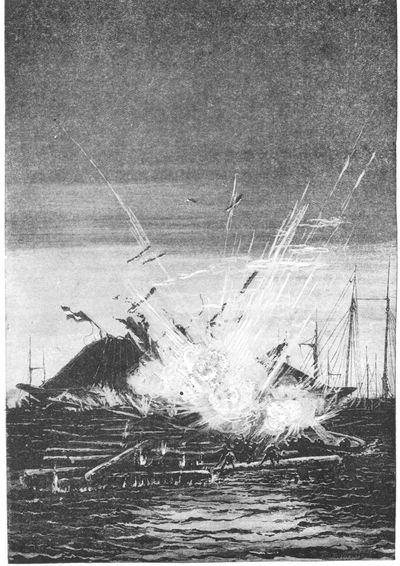
Destruction of the "Albemarle."
On the 5th of May the ram put in an appearance, steaming down the
river. Deliberately she approached within easy range, then let fly a
shot at the "Mattabesett" which knocked her launch to pieces and
wounded several men. The "Mattabesett" ran up to within one hundred
and fifty yards of the "Albemarle," and gave her a broadside of solid
shot from nine-inch Dahlgrens and one hundred-pounder rifles. When
these shot struck a sloping place on the ram's armor, they glanced
off. Those that struck full on the plating simply crumbled to pieces,
leaving no dent to tell of the blow. One beautifully aimed shot struck
the muzzle of one of the cannon on the ram and broke it.
The gun was used throughout the fight, however, as the "Albemarle"
carried but two and could not spare one of them. The "Sassacus"
followed in line of battle. She delivered her broadside in passing.
The ram rushed madly at her, but was evaded by good steering. Then the
"Sassacus" in turn rushed at the ram at full speed, thinking to run
her down. She struck amidships at right angles, and with the crash of
the collision came a hundred-pound shot from the ram, that passed
through the wooden ship from end to end. Still the engines of the
"Sassacus" were kept going, in the hope of pushing the "Albemarle"
beneath the water. The iron-clad careened slowly, the water washed
over her after-deck; the crew of the "Sassacus," far out on the bow,
tried vainly to drop shells and packages of powder down the ram's
smoking chimneys. It was a moment of intense excitement. But the ram
was too much for her assailant. Recovering from the shock of the
collision, she slowly swung around until her bow-gun could be brought
to bear on her tormentor, when she let fly a ponderous bolt. It
crashed through the side of the steamer and plunged into her boiler.
In an instant hot, scalding steam filled the engine-room and spread
over the whole ship. Cries of agony arose on every side. Twenty-one of
the crew were terribly scalded. Nothing remained but retreat; and the
"Sassacus" steamed away from her enemy, after making one of the
bravest fights in naval history. In the mean time the other gunboats
were pounding away at the ram. The "Miami" was trying in vain to get
an opportunity to discharge a large torpedo. Two other vessels were
spreading nets about the great ship, trying to foul the propeller. The
action continued until dark, when the ram withdrew, uninjured and
without losing a man. She had fought alone for three hours against six
ships, and had seriously damaged every one of her adversaries. It must
also be remembered that she carried but two guns.
The "Albemarle" lay for a long time idle at her moorings in Roanoke
River, feeling sure that at her own pleasure she could go into the
sounds, and complete the destruction of the fleet. Lieut. Cushing,
then twenty-one years old, begged permission to attempt to destroy
her. The authority was gladly granted by the navy department, and
Cushing began making his plans for the adventure. His first plan was
to take a squad of men, with two steam-launches, up the Roanoke, and
blow the ram up by means of a torpedo. The launches were
sent from New York, but one was swamped while crossing Delaware Bay.
Cushing, however, was not the man to be balked by an accident: so,
cutting down his force one-half, he prepared for the start. Thirteen
officers and men made up the little party which seemed bound to
certain death. The spirit which animated the blue-jackets during the
war may be imagined from the fact that many sailors tried to purchase
the privilege of going on this perilous expedition, by offering their
month's pay to those who had been selected. To understand what a
forlorn hope the little boat-load of men were cherishing, we must
understand what were the defences of the "Albemarle." She lay at a
broad wharf, on which was encamped a large guard of soldiers as well
as her crew. Above and below her, great fires were kept burning on the
shores, to prevent any boat approaching unseen. She was surrounded by
a boom, or "water-fence," of floating logs, about thirty feet from her
hull, to keep off any torpedo-boats. From the mouth of the Roanoke to
her moorings was about eight miles; the shores being lined on either
side by pickets, and a large picket-station being established in
mid-stream about one mile below Plymouth.
To attempt to penetrate this network of defences seemed to be
foolhardy. Yet Cushing's record for dash and courage, and his
enthusiasm, inspired his comrades with confidence; and they set out
feeling certain of success. On the night of the 27th of October, the
daring band, in their pygmy steamer, steamed rapidly up the river. No
word was spoken aboard. The machinery was oiled until it ran
noiselessly; and not a light shone from the little craft, save when
the furnace-door was hastily opened to fire up. The Confederate
sentries on the bank saw nothing of the party; and, even when they
passed the picket schooners near the wreck of the "Southfield," they
were unchallenged, although they could see the schooners, and hear the
voices of the men, not more than twenty yards away. Not until they
came into the fitful glare of the firelight were they seen, and then
quick hails came from the sentries on the wharf and the "Albemarle's"
decks. But the light on the shore aided the adventurers by showing
them the position of the ram. They dashed up alongside, amid a shower
of bullets that seemed to fill the air. On the decks of the ram all
was confusion, the alarm rattles were sprung, the bell rung violently.
The launch running alongside came into contact with the row of logs,
and sheered off to make a dash over it. Cushing, who on
these dangerous expeditions was like a schoolboy on a holiday,
answered with ridicule all hails. "Go ashore for your lives,"
"Surrender yourselves, or I shall sink you," he cried, as the gunners
on the ram trained a heavy gun on the little launch. Now she was
headed straight for the ram, and had a run of thirty yards before
striking the boom. She reached, and dashed over. Cushing, standing in
the stern, held in one hand the tiller ropes, in the other the lanyard
of the torpedo. He looked up, saw the muzzle of a heavy gun trained
directly on his boat: one convulsive pull of the rope, and with a roar
the torpedo exploded under the hull of the "Albemarle," just as a
hundred-pound shot crashed through the bottom of his boat. In a second
the launch had disappeared; her crew were struggling in the waves, or
lying dead beneath them, and the "Albemarle" with a mortal wound was
sinking to the bottom.
Cushing swam to the middle of the river, and headed down stream. Most
of his companions were killed, captured, or drowned. In the middle of
the stream he met Woodman, who had followed him on previous
expeditions. Woodman was almost exhausted. Cushing supported him as
long as he was able, but was forced to leave him, and the sailor sank
to the bottom. The young lieutenant floated down the river until at
last he reached the shore, exhausted and faint from a wound in his
wrist. He lay half covered with water in a swamp until daylight. While
there he heard two Confederate officers who passed say that the
"Albemarle" was a total wreck. That news gave him new energy, and he
set about getting safely away. Through the thick undergrowth of the
swamp he crawled for some hours, until he found a negro who gave him
shelter and food. Then he plunged again into the swamp, and walked on
until he captured a skiff from a Rebel picket; and with this he safely
reached the fleet,—the only one of the thirteen who set out two days
before. So ended the most wonderful adventure of the war.[Back to Contents]

THE BLOCKADE-RUNNERS. — NASSAU AND WILMINGTON. — WORK OF THE CRUISERS.
 hile
it is undeniably true that the naval battles of the civil war
were in many cases unimportant as compared with the gigantic
operations of the mighty armies in Virginia and Tennessee, yet there
was one service performed by the navy, alone and unaided, which
probably, more than any thing else, led to the final subjugation of
the South. This was the blockade.
hile
it is undeniably true that the naval battles of the civil war
were in many cases unimportant as compared with the gigantic
operations of the mighty armies in Virginia and Tennessee, yet there
was one service performed by the navy, alone and unaided, which
probably, more than any thing else, led to the final subjugation of
the South. This was the blockade.
To fully appreciate what a terrible weapon the blockade is when
energetically pursued, one need only look at the condition of the
South during the latter years of the war. Medicines were almost
unattainable for love or money. Salt was more carefully hoarded than
silver. Woollen goods for clothing were not to be had. Nothing that
could not be produced by the people of the revolted States could be
obtained at their markets. Their whole territory was in a state of
siege, surrounded by a barrier only a little less unrelenting than the
iron circle the Germans drew around besieged Paris.
Almost the first war measure of Abraham Lincoln was to declare the
ports of the Confederacy in a state of blockade. At first this seemed
a rash proclamation, and one which could not be sustained by the force
at the command of the Federals. It is a rule of warfare, that
"blockades, to be binding, must be effective;" that is, it
is not lawful for a nation with a small fleet to declare an enemy's
coast in a state of blockade, and then capture such trading-vessels as
may happen to run in the way of its cruisers. The nation must have a
large enough fleet to station vessels before each of the principal
harbors of the enemy, and to maintain a constant and vigilant patrol
up and down his coast. If this cannot be done, the blockade is called
a "paper blockade," and merchantmen are justified in attempting to
evade it. An instance of a "paper blockade" occurred during the early
months of the civil war, which will illustrate this point. Wilmington,
N.C., was throughout the war one of the favorite ports for
blockade-runners. From its situation, the many entrances to its
harbor, and other natural advantages, it was the most difficult of all
the Southern ports to keep guarded. With the rest of the Confederate
ports, Wilmington was declared blockaded; but it was long after,
before a suitable blockading-fleet was stationed there. In July, 1861,
the British brig "Herald" left Wilmington without molestation. When
two days out, she ran across a United States man-of-war, that promptly
captured her. The courts, however, decided that a port so little
guarded as Wilmington was at that time could not be legally called
blockaded, and the brig was therefore released.
But it did not take many months for the energetic men of the Navy
Department to get together such a fleet of boats of all kinds as to
enable them to effectually seal all the ports of the Confederacy. A
blockading vessel need not be of great strength or powerful armament.
All that is necessary is that she should be swift, and carry a gun
heavy enough to overawe any merchantman that might attempt to run the
blockade. And as such vessels were easy to improvise out of tug-boats,
ferry-boats, yachts, and other small craft, it came about that by the
last of 1861, the people of the seaport towns of the South, looking
seaward from their deserted wharves, could see two or three Federal
cruisers lying anchored off the outer bar, just out of reach of the
guns of shore-batteries. It was a service of no little danger for the
blue-jackets. The enemy were ever on the alert to break the blockade
by destroying the ships with torpedoes. Iron-clad rams were built on
the banks of the rivers, and sent down to sink and destroy the vessels
whose watchfulness meant starvation to the Confederacy. The
"Albemarle" and the "Merrimac" were notable instances of this
course of attack. But the greatest danger which the sailors
had to encounter was the peril of being wrecked by the furious storms
which continually ravage the Atlantic coast. The sailor loves the open
sea in a blow; but until the civil war, no captain had ever dared to
lie tugging at his cables within a mile or two of a lee shore, with a
stiff north-easter lashing the sea into fury. In the blockading
service of our great naval war, the war of 1812, the method in vogue
was to keep a few vessels cruising up and down the coast; and, when it
came on to blow, these ships would put out into the open sea and scud
for some other point. But in '61 we had hundreds of vessels stationed
along the enemy's coast; and where a ship was stationed, there she
stayed, to meet the fury of the wind and waves by putting out more
anchors, and riding out at her cables storms that would have blown the
blockader of 1812 hundreds of miles from her post.
In the earlier years of the war the blockade-runners were nearly all
sailing-vessels, schooners, and brigs, that were easily captured. But
when the supplies of the South became exhausted, and the merchants of
England began building ships especially for this purpose, the duty of
the blockading squadron became exciting and often very profitable. The
business assumed such proportions that half the shipyards in England
were engaged in turning out fast steamers to engage in it. At first it
was the custom to send goods in regular ocean-steamers from England to
the blockaded port; but this was soon abandoned, as the risk of
capture on the long run across the Atlantic was too great. Not until
the plan was adopted of shipping the goods to some neutral port along
our coast, and there transferring the cargo to some small, swift
vessel, and making the run into the Confederate port in a few hours,
did the business of blockade-running become very extensive. Goods
shipped for a neutral point were in no danger of being captured by our
cruisers, and therefore the danger of the long trans-Atlantic passage
was done away with.
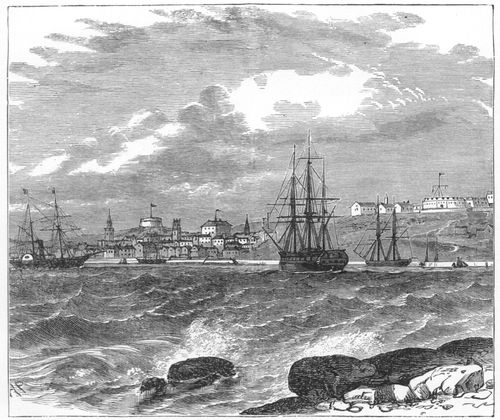
Nassau: The Haunt of the Blockade-Runners.
Of these neutral points which served as way-stations for the
blockade-runners, there were four on or near our coast,—the Bermuda
Islands, which lie about seven hundred miles east of Charleston;
Nassau, which is off the coast of Florida, and a little more than five
hundred miles southeast of Charleston; Havana; and the little Mexican
town of Matamoras on the Rio Grande, opposite Brownsville, Texas. The
Bermudas were to some extent used, but their distance from
the coast made them inconvenient as compared with Nassau or Matamoras.
Their chief trade was with Wilmington, which became a favorite port
during the latter years of the war. Havana was popular for a time, and
at first sight would appear to be admirably placed for a
blockade-runners' rendezvous. But, though the coast of Florida was but
one hundred miles distant, it was surrounded by dangerous reefs, its
harbors were bad and far apart, and there were no railroads in the
southern part of the State to transport the contraband goods after
they were landed. Besides, Key West, the naval station of the Union
forces in the South, was unpleasantly near, and the gulf blockade was
maintained with more rigor than that on the Atlantic coast. Matamoras
was peculiarly well situated for a blockade-running point.
It is on the Mexican side of the Rio Grande River, about forty miles
above its mouth. Goods once landed could be shipped in barges and
lighters across the river in absolute safety, since heavy batteries
prevented the cruisers of the gulf-squadron from entering the river.
As a result of this trade, Matamoras became a thriving place. Hundreds
of vessels lay in its harbor, where now it is unusual to see five at a
time. For four years its streets were crowded with heavy freight vans,
while stores and hotels reaped a rich harvest from the sailors of the
vessels engaged in the contraband traffic. Now it is as quiet and
sleepy a little town as can be found in all the drowsy land of Mexico.
But the true paradise of the blockade-runners was Nassau, the chief
port of the Bahama Islands, and a colony of Great Britain. Here all
the conditions necessary to successfully evade the blockade were to be
found. The flag that waved over the island was that of a nation
powerful enough to protect its citizens, and to enforce the laws
relative to neutrality. Furthermore, Great Britain was undoubtedly in
sympathy with the Confederates; and so far from prohibiting the
efforts of her citizens to keep up trade with the blockaded ports, she
encouraged and aided them in every way in her power. And aside from
her mere sympathy with the struggles of the young Confederacy, England
had a most powerful incentive to break down the blockade. In
Manchester the huge cotton-mills, employing thousands of hands, were
shut down for lack of cotton, and the mill-hands were starving for
lack of work; while shut up in the blockaded ports of the South were
tons upon tons of the fleecy staple, that, once in England, would be
worth its weight in gold. It was small wonder that the merchants of
England set to work deliberately to fit out blockade-runners, that
they might again get their mills running, and their people fed.
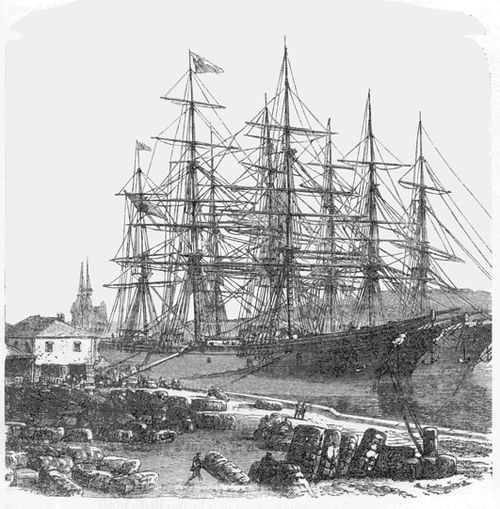
Cotton Ships at Nassau.
The years of the war were lively times for the little town of Nassau.
Hardly had the proclamation of President Lincoln announcing the
blockade of all Confederate ports been issued, when at a bound Nassau
became prominent as the point of all most suitable for a
blockade-runners' rendezvous. Its harbor and the surrounding waters
were deep enough for merchant-vessels, but too shallow to allow much
cruising about by warships of heavy armament. It was within a few
hours' running of three Confederate ports, and it was protected by the
flag of Great Britain. Early in the war the Confederates established a
consulate in the little town, and the Stars and Stripes and
the Stars and Bars waved within a few rods of each other. Then great
shipping-houses of Liverpool sent over agents, and established branch
houses. Great warehouses and wharves were built Soon great ocean ships
and steamers began unloading their cargoes at these wharves. Then
swift, rakish schooners began to drop into the harbor, and after
discharging heavy loads of cotton would take on cargoes of English
goods, and slip out at nightfall to begin the stealthy dash past the
watching gunboats. As the war went on, and the profits of the trade
increased with its dangers, a new style of craft began to
appear in the little harbor. These were the Clyde built
blockade-runners, on which the workmen of the Clyde shipyards had been
laboring day and night to get them ready before the war should end.
They were long, low, piratical looking craft, with two smoke-stacks
raking aft, and with one or two masts for showing signals, for they
never hoisted a sail. Two huge paddle-boxes towered above the deck
amidships, the wheels being of enormous size. No structure of any kind
encumbered the deck. Even the steersman stood unsheltered at a wheel
in the bow. They were painted dark gray, and at night could slip
unseen along the water within a stone's-throw of the most watchful
lookout on a man-of-war. They burned great quantities of a kind of
coal that gave out no smoke, and when steaming at night not a light
was allowed on board. Many of these strange craft can be seen now
along the levees at New Orleans, or at the wharves in Mobile, where
they are used as excursion-steamers or for tug-boats. They were always
the merest shells, fitted only for carrying freight, as not many
passengers were to be found who desired to be taken into the
Confederate territory. Occasionally, however, some soldier of fortune
from abroad would drift from Nassau, and thence to the mainland, to
join the armies of the Confederacy. The Confederate agents on the
island were always on the lookout for such adventurers, and were ever
ready to aid them. Sometimes, too, returning agents of the Confederacy
from Europe would make the run through the blockading-fleet; so that
the blockade-runners were seldom without two or three passengers, poor
though their accommodations might be. For the voyage from Nassau to
Wilmington, three hundred dollars passage money was charged, or more
than fifty cents a mile. To guard against treachery, passage could
only be obtained through the Confederate consul, who carefully
investigated the proofs of each applicant's identity before issuing to
him a ticket.
When the blockade-runner had taken her cargo and passengers aboard,
and was prepared for her voyage, every one in the little town came
down to the docks to see her start. It was a populace strongly
Southern in feeling that filled the streets of Nassau, and nothing but
good wishes were to be heard on every side. Perhaps from a house on
the hillside, over which floated the Stars and Stripes, the United
States consul might be watching through a spyglass the movements of
the steamer, and wishing in his heart that she might fall in
with some Yankee cruiser; but nevertheless, under his very eyes, the
audacious racer slips out, and starts on her stealthy voyage. On
leaving the harbor, a quick run of fifteen or twenty miles would be
taken along the coast, to try the machinery. Great care would be taken
to keep within British waters, lest some watchful gunboat should seize
the prize thus early in her career. When every thing proved in good
working trim, the little vessel's prow would be turned northward, and
the perilous voyage begun. For the first day, little danger was to be
expected, and the voyage was generally so timed that the outer line of
blockaders would be reached just after nightfall. A soldier going to
enlist in one of the Confederate cavalry regiments thus tells the
story of his evasion of the blockade.
"After a favorable voyage we reached the desired point off Wilmington
at the proper time. A brief stoppage was made, when soon the final
preparations were completed for running the gauntlet of the Federal
blockaders, who would become visible shortly, as we approached nearer
shore. All the lights in the steamer were extinguished, and all
passengers ordered below, only the officers and crew being permitted
to remain on deck. The furnaces were replenished with carefully
selected coal, which would give the greatest amount of heat and the
least smoke. The last orders were given, and every man was at his
appointed place. Presently the boilers hissed, and the paddle-wheels
began to revolve faster and faster, as the fleet little steamer rose
higher and higher in the water from the immense force of the rapid
strokes; she actually felt like a horse gathering himself up under you
for a great leap. After a little while, the few faint sounds from the
deck which we could hitherto faintly catch in the cabin ceased
altogether, and there was the stillness of death except for the sounds
necessarily made by the movements of the machinery. Then we realized
that we were running for our lives past the line of cruisers, and that
at any moment a big shell might come crashing through our cabin,
disagreeably lighting up the darkness in which we were sitting. Our
suspense was prolonged for some minutes longer, when the speed was
slackened, and finally we stopped altogether. Even then we did not
know whether we were safely through the lines, or whether we had been
brought to under the guns of a hostile ship, for we could distinguish
nothing whatever through the portholes. However, we were soon released
from the cabin, and walked on deck, to find ourselves safely
through the blockade. In the offing could be descried several of the
now harmless blockaders, and near at hand lay the coast of North
Carolina. Soon the gray dawn was succeeded by a brilliant, lovely
sunrise, which lighted up cheerfully the low-lying shores and
earthworks bristling with artillery, while from a fort near by floated
the Southern Cross, the symbol of the glorious cause for which we had
come to fight."
When the blockade-runner, after safely running the gauntlet of the
warships, steamed leisurely up to the wharves of the blockaded town,
every one rushed to the docks to greet her. Her captain and crew
became at once people of great importance. They were beset on every
side for news of the great world outside. The papers that they brought
in were bought eagerly by the people, hungering for tidings of
something else than the interminable war. The sailors of the steamer,
on being paid off, rambled about the streets of the city, spending
their money royally, and followed by a train of admiring hangers-on.
The earnings of the sailors in case of a successful voyage were
immense. A thousand dollars for the four or five days' trip was
nothing unusual for common seamen, while the captain often received
eight or nine thousand. But the risk of capture, with the confiscation
of all property, and some months' imprisonment in a Federal fortress,
rather marred the attractiveness of the nefarious trade. The profits
of a successful voyage to the owner of the ship and cargo were
enormous. One of the steamers, specially built for the trade, at large
cost, has been known to pay for herself fully in one voyage. Indeed,
the profits must have been huge to induce merchants to take the risk
of absolutely losing a ship and cargo worth half a million of dollars.
It is certain, too, that throughout the war the number of vessels
captured, while trying to run the blockade, was far in excess of those
that succeeded. Up to the end of 1863 the Federal Secretary of the
Navy reported 1,045 vessels captured, classified as follows:
schooners, 547; steamers, 179; sloops, 117; brigs, 30; barks, 26;
ships, 15; yachts and boats, 117. Of course, most of these were small,
coastwise vessels. Even among the steamers captured, there were but
few of the fleet-going, English-built craft.
There was no small amount of smuggling carried on between the ports of
the North and the blockaded ports. The patriotism of the Northern
merchant was not always so great as to prevent his embarking in the
traffic which he saw enriching his English competitor. Many
of the schooners captured started from Northern ports and worked their
way along the coast until that chain of inlets, sounds, and bayous was
reached, which borders the coast south of Chesapeake Bay. Once inside
the bar, the smuggler could run at his leisure for any of the little
towns that stood on the banks of the rivers of Virginia and North
Carolina. The chase of one of these little vessels was a dreary duty
to the officers of the blockading-ships. The fugitives were fast
clippers of the models that made Maine shipbuilders famous, until the
inauguration of steam-navigation made a gracefully modelled hull
immaterial as compared with powerful machinery. Even when the great,
lumbering warship had overhauled the flying schooner so as to bring a
gun to bear on her, the little boat might suddenly dash into some
inlet or up a river, where the man-of-war, with her heavy draught,
could not hope to follow. And if captured, the prize was worth but
little, and the prize-money, that cheers the sailors' hearts, was but
small. But the chase and capture of one of the swift Clyde-built
steamers was a different matter. Perhaps a lookout in the maintop of a
cruiser, steaming idly about the Atlantic, between Nassau and
Wilmington, would spy, far off on the horizon, a black speck, moving
swiftly along the ocean. No curling smoke would tell of the
blockade-runner's presence, and nothing could be seen until the hull
of the steamer itself was perceptible. With the quick hail of the
lookout, the man-of-war would head for the prize, and start in hot
pursuit. Certain it is that the smuggler started to fly before the
watchful lookout on the cruiser caught sight of her. The towering
masts and capacious funnels of the man-of-war, with the cloud of black
smoke from her furnaces, made her a conspicuous object at distances
from which the smuggler would be invisible. With the blockade-runners
the rule was to avoid any sail, no matter how innocent it might seem;
and the appearance of a cloud of smoke on the horizon was the signal
for an immediate change of course, and a flight for safety. When the
chase began in this way, the cruiser had but little chance of making a
capture, for the superior speed of the merchant-vessel would quickly
carry her out of sight. Sometimes, however, a favorable wind would
enable the pursuer to use her sails, and then the chase would become
exciting. With a cloud of canvas set, the man-of-war would gradually
overhaul the flying vessel; and when within range, the great bow-gun
would be cleared, and with a roar a shell would be sent
flying after the prize. All hands would watch its course anxiously.
Generally it fell short. Then another and another messenger would be
sent to the enemy, which seldom struck the mark, for gunnery on a
rough sea is a difficult art. But the blockade-runner can't stand
being used for target-practice long. The cool head of her captain
begins to deliberate upon means of getting out of range. Mere running
before the wind won't do it: so he makes a long detour, and doubles on
his course, heading directly into the teeth of the breeze. Now the
cruiser is at a disadvantage. Her sail-power gone, she stands no
chance of capturing her game. Her shells begin to fall far short of
the smuggler, and soon she ceases firing altogether; and the
blockade-runner, driven hundreds of miles out of her course, but safe
for the time, goes on her way rejoicing.
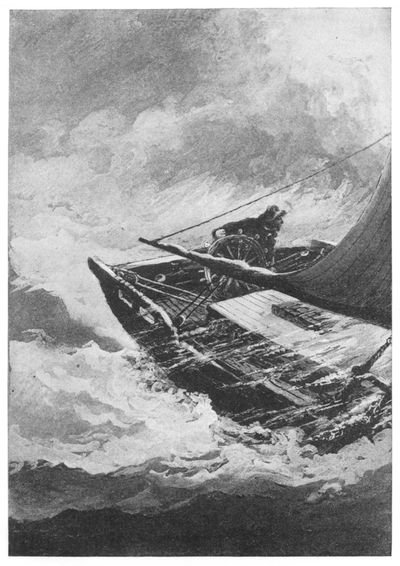
Blockade-Runner in North Carolina Sounds.
One of the most brilliant captures of the war was that of the
blockade-runner "Young Republic," by the United States gunboat "Grand
Gulf." The "Young Republic" succeeded in evading the watchfulness of
the blockading-squadron about the mouth of the Cape Fear River, and
under cover of the night ran in safely to the anchorage under the guns
of the Confederate forts. The baffled blockaders saw her moving slowly
up the river, while the cannon of the forts on either side thundered
out salutes to the daring vessel that brought precious supplies to the
Confederacy. But the blockading-squadron, though defeated for the
time, determined to wait and catch her when she came out. Accordingly
the "Grand Gulf," one of the fastest of the United States vessels, was
stationed at the mouth of the river, with orders to watch for the
"Young Republic." A week passed, and there was no sign of her. At
last, one bright day, the lookout in the tops saw the mast and funnel
of a steamer moving along above the forest which lined the river's
bank. Soon the hull of the vessel came into view; and with a rattle of
hawse-chains, her anchors were let fall, and she swung to beneath the
protecting guns of the fort. It was clear that she was going to wait
there until a dark or foggy night gave her a good chance to slip past
the gunboat that watched the river's mouth as a cat watches the mouth
of a mouse-hole. With their marine glasses the officers on the gunboat
could see the decks of the "Young Republic" piled high with brown
bales of cotton, worth immense sums of money. They thought of the huge
value of the prize, and the grand distribution of prize-money, and
determined to use every effort to make a capture. Strategy
was determined upon, and it was decided to give the blockade-runner
the chance to get out of the river that she was awaiting. Accordingly
the gunboat steamed away up the coast a few miles, leaving the mouth
of the river clear. When hidden by a projecting headland, she stopped
and waited for the blockade-runner to come out. The stokers were kept
hard at work making the great fires roar, until the steam-gauge showed
the highest pressure the boilers could bear. The sailors got out
additional sails, clewed up cordage and rigging, and put the ship in
order for a fast run. When enough time had elapsed, she steamed out to
see if the "Young Republic" had taken the bait. Officers and crew
crowded forward to catch the first sight around the headland. The
great man-of-war sped through the water. The headland was rounded, and
a cheer went up from the crowd of jackies; for there, in the offing,
was the blockade-runner, gliding through the water like a dolphin, and
steaming for dear life to Nassau. Then the chase began in earnest. The
"Young Republic" was one of those long, sharp steamers built on the
Clyde expressly for running the blockade. Her crew knew that a long
holiday in port, with plenty of money, would follow a successful
cruise; and they worked untiringly to keep up the fires, and set every
sail so that it would draw. On the cruiser the jackies saw visions of
a prize worth a million and a half of dollars; and the thought of so
much prize-money to spend, or to send home, spurred them on. For
several hours the chase seemed likely to be a long, stern one; but
then the freshening wind filled the sails of the gunboat, and she
began to overhaul the fugitive. When within a mile or two, she began
firing great shells with her pivot-gun. Then the flying
blockade-runner began to show signs of fear; and with a good glass the
crew could be seen throwing over bale after bale of the precious
cotton, to lighten the vessel. In the last thirty miles of the chase
the sea was fairly covered with cotton-bales. More than three hundred
were passed floating in the water; and the jackies gnashed their
teeth, and growled gruffly, at the sight of so much wealth slipping
through their fingers. On the high paddle-wheel box of the
blockade-runner, the captain could be seen coolly directing his crew,
and now and again turning to take a look through his glass at the
pursuer. As the chase continued, the certainty of capture became more
and more evident. Then the fugitives began throwing overboard or
destroying every thing of value: furniture, silver-ware,
chronometers, the fittings of the cabin, every thing that could
benefit their captors, the chagrined blockade-runners destroyed. The
officers of the gunboat saw that if they wished to gain any thing by
their capture, they must make haste. At the risk of an explosion, more
steam was crowded on; and the gunboat was soon alongside the "Young
Republic," and in a position to give her an enormous broadside. The
blockade-runner saw that he was caught and must submit. For lack of a
white flag, a pillow-case was run up to the masthead, and the beating
of the great wheels stopped. The davits amidships of the "Grand Gulf"
are swung out, and a boat's crew, with a lieutenant and dapper
midshipman, climb in. A quick order, "Let fall there," and the boat
drops into the water, and is headed for the prize. Another moment, and
the stars and stripes supplant the pillow-case waving from the
masthead of the "Young Republic." An officer who went into the
boiler-room found that the captured crew had planned to blow up the
vessel by tying down the safety-valve, so that an enormous pressure of
steam strained the boilers almost to bursting. A quick blow of a
hatchet, and that danger was done away with. Then, with a prize-crew
on board, the "Young Republic" started on her voyage to New York;
while the "Grand Gulf" returned to Wilmington to hunt for fresh game.
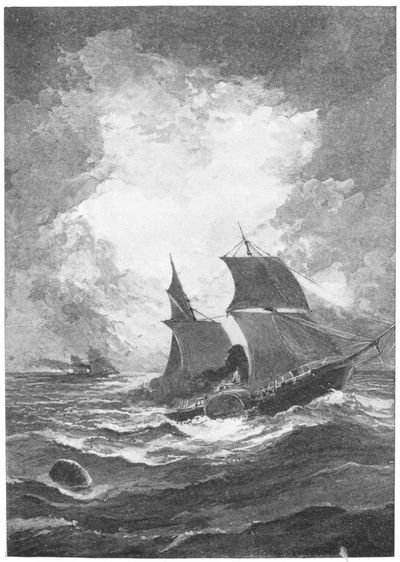
Pursuing a Blockade-Runner.
A curious capture was that of the British schooner "Francis," which
was running between Nassau and the coast of Florida. On her last trip
she was nearing the coast, when she fell in with a fishing-smack, and
was warned that a Federal gunboat was not far away. Still she kept on
her course until sundown, when the breeze went down, and she lay
becalmed. The gunboat had been steaming into inlets and lagoons all
day, and had not sighted the schooner. When night came on, she steamed
out into the open sea, within a quarter of a mile of the
blockade-runner, and, putting out all lights, lay to for the night.
Those on the schooner could see the gunboat, but the lookout on the
cruiser did not see the blockade-runner. Soon a heavy fog came up, and
entirely hid the vessels from each other. The blockade-runners could
only hope that a breeze might spring up, and enable them to escape.
But now a curious thing occurred. It almost seems as if two vessels on
the ocean exercise a magnetic attraction for each other so often do
collisions occur where there seems room for all the navies of the
world to pass in review. So it was this night. The anxious
men on the schooner soon found that the two vessels were drifting
together, and they were absolutely powerless to prevent it. At
midnight, though they could see nothing, they could hear the men on
the gunboat talking. Two hours after, the schooner nestled gently up
by the side of the gunboat; and a slight jar gave its crew their first
intimation that a prize was there, simply waiting to be taken. All
they had to do was to climb over the railing. This was promptly done,
and the disgusted blockade-runners were sent below as prisoners. Half
an hour later came a breeze that would have carried them safely to
port.
The gray sea-fogs played many scurvy tricks with the
blockading-fleets, often letting the runners in right under the
muzzles of the great guns. It was far easier to spy out a vessel in
the darkest night than in the thick gray fog that enveloped all
objects like a blanket. One of the strangest of all the pranks played
by the fog occurred in December, 1863, in Charleston Harbor. A wary
blockade-runner was creeping out of the harbor, within easy range of
the great guns of the fleet, and all hands were trembling, lest at any
minute should come the flash of a gun, and shriek of a shell, bearing
a peremptory command to heave to. Suddenly the flash came, and was
followed by the bang! bang! of great guns from all quarters of the
fleet. But the fire seemed pointed in another direction; and the
runner made the best of her way out to sea, thinking that some less
fortunate vessel, trying to come in on the other side of the fleet,
had been captured or blown out of the water. It turned out that a
small fog-bank had taken the form of a gray steamer moving swiftly
over the water, and had been fiercely cannonaded by the whole Federal
fleet. This occurrence gave the Confederates an idea; and they began
sending out dummies to engage the fleet, while the true
blockade-runners would slip out unobserved in the excitement. One
night as the tide was running out with great force, an old hulk was
cut adrift from a wharf, and drifted down rapidly upon the Federal
fleet. It was just after the exploits of the "Merrimac" had made
Confederate rams famous, and the naval officers were a little nervous.
The hulk drifted quite into the midst of the fleet before being
observed; and when she was hailed she bore down on the largest of the
men-of-war as though she were a powerful ram, steered by a commander
of desperate bravery. The great gunboat's deck rang with the bo's'n's
whistle, as the crew were piped to repel boarders, and to their
quarters at the guns. A fierce fire was poured on the
hostile craft, that came on sullenly, as if scorning to make reply.
One by one the other vessels of the fleet drew near, and concentrated
their fire on the wretched lumber schooner. It was too much for her;
and she gave up the unequal combat, and sank to the bottom. For days
after, the gallant tars of the squadron blockading Charleston rejoiced
in the destruction of a "Rebel ram;" but none of them knew, that,
while they were engaged in the desperate contest, two great
blockade-runners, heavily laden with cotton, had slipped out of the
harbor, and were well under way for Nassau.
Stories of adventure and of desperate pluck and dash abound in the
records of the blockade. Both among the officers of the
blockading-fleets, and the commanders of the runners, were found great
courage and fine seamanship. One fact is particularly noticeable to
the student of the blockade: an English captain running the blockade
would never dare the dangers that a Confederate would brave without a
tremor. A Confederate captain would rush his ship through the hostile
fleet, and stick to her until she sunk; while an Englishman would run
his ship ashore, and take to the woods. The cases of the "Hattie,"
commanded by H. S. Lebby, a Confederate, and the "Princess Royal," a
fine, staunch, iron steamer, with an English commander and crew, are
typical. The "Hattie" was the last runner to enter or leave Charleston
Harbor. She was a small, swift steamer; but she made more successful
trips than any other runner. Men living in Charleston to-day, who were
interested in the work of this little vessel during the war, say that
her cargoes were worth at least fifty millions of dollars. She had
numerous narrow escapes, but was never captured. Her reputation was
such that the Confederate authorities selected her as the vessel to
bring in army supplies and ammunition, and at least three battles were
fought with ammunition brought in her hold. Her last entrance to
Charleston was one night in February, 1865. Eighteen Federal vessels
lay anchored off the harbor, and for a runner to venture in seemed
madness. But the captain of the "Hattie" was used to taking desperate
chances, and he proposed to enter that harbor. The ship had been
freshly painted a blue-white, and as she drifted along the water, with
all lights out, looked like a bank of mist. She was within two hundred
yards of the outer row of blockaders before her presence was detected.
Suddenly fire was opened on her from the nearest gunboat, and
in an instant the air was full of rockets announcing her
presence. The little vessel had no means of retaliation: all there was
for her to do was to dash through the fire and make for the city.
Steam was crowded on; and she flew up the channel, running the
gauntlet of the fleet, and escaping almost untouched. Then came the
real peril. Just below Fort Sumter were two barges anchored in the
channel, and filled with armed men. Past these she dashed, her great
speed saving her from boarding; but she received the fire of both
boats, which wounded several of her crew, and cut off the fingers of
the pilot's hand resting on the wheel. This danger past, there was one
more to be met. A large monitor lay anchored up the harbor, and the
"Hattie" was running so close to her that the commands of the officers
in the turret could be clearly heard. One after the other the two
great guns were fired, both shots missing; and the "Hattie," safely
past the gauntlet, sailed up to the dock in triumph. But by that time
it was clear that the last days of the war were near at hand, and
accordingly the work of unloading and reloading the vessel for her
outward trip was pressed with the greatest vigor. All the time she lay
at her dock, Charleston was being vigorously bombarded by the Federal
men-of-war lying outside the harbor. The bay fairly swarmed with
blockading cruisers; yet a week later the little steamer slipped out
through a fleet of twenty-six cruisers without being hailed, and
carried her cotton safely to market. When the news of Lee's surrender
was received, she was lying safe at her dock in Nassau.
The "Princess Royal," to which we have alluded, was a large iron screw
steamer, freighted with drugs, army supplies, guns, and two engines
and boilers for two iron-clads in Charleston Harbor,—a most valuable
and important cargo for the Confederates. She made the run from Nassau
to a point near the coast without adventure, and in the early gray of
the morning was stealing up the coast towards the harbor, when a
blockader caught sight of her, and started in pursuit. The later began
firing when a mile and a half away; and, though there was hardly a
chance of the shots taking effect, the cannonade gave the captain of
the runner the cold shakes. His boat was one of the fastest on the
ocean, and he needed only to put on steam to escape all the blockaders
on the coast. But he was a thorough paced coward; and, thinking only
of his own safety, he headed the craft for the beach, and with his
crew fled into the woods. The valuable ship and her cargo fell into
the hands of the Federals.
Sometimes runners were captured through apparently the most
trivial accidents. One ship, heavily laden with army supplies, and
carrying a large number of passengers, was running through the
blockading-fleet, and seemed sure of escape. All lights were out, the
passengers were in the cabin, not a word was to be heard on deck, even
the commands of the officers being delivered in whispers. Suddenly a
prolonged cock-crow rent the air, and, with the silence of every thing
surrounding, sounded like a clarion peal from a trumpet. The
deck-hands rushed for a box of poultry on the deck, and dragged out
bird after bird, wringing their necks. The true offender was almost
the last to be caught, and avenged the deaths of his brothers by
crowing vigorously all the time. The noise was enough to alarm the
blockaders; and in a moment the hail, "Surrender, or we'll blow you
out of water!" brought the unlucky runner to a standstill,—a
prisoner. The "Southern Cross" narrowly escaped capture on account of
the stupidity of an Irish deck-hand, whose craving for tobacco proved
too strong for his discretion. The ship was steaming slyly by two
cruisers, and in the darkness would have escaped unseen, when the
deck-hand, who had been without a smoke as long as he could stand it,
lit a match and puffed away at his pipe. The tiny flame was enough for
the cruisers, and they began a spirited cannonade. The "Southern
Cross" ran for her life. The shooting was guess-work, but the gunners
on the cruisers showed all the proverbial Yankee skill at guessing.
The first ball carried away the roof of the pilot-house, and the
second ripped away the railing along the deck for thirty feet. But the
captain was plucky, and made a run for it. He was forced to pass
within a hundred feet of one of the cruisers; and as he saw the
muzzles of the great guns bearing on his ship, he heard the command,
"Heave to, or I'll sink you." But he took his chances, and escaped
with only the damage caused by a solid shot crashing through the hull.
One of the strangest experiences of all was that of the captain of a
blockade-runner putting in to Wilmington one bitter cold night, when
the snow was blowing in clouds, and the fingers of the men at the
wheel and the sailors on watch were frostbitten. The runner had
reached the harbor safely; but there in channel lay a blockader in
such a position that any ship coming in must pass within a hundred
feet of her. The Confederate had a light-draught vessel, and tried to
squeeze through. When he passed the gunboat, only twelve
feet of space separated the two vessels; and he saw a lookout, with
his arms on the rail, looking right at the passing vessel. The
Confederate expected an immediate alarm, but it did not come.
Wondering at the cause, but happy in his luck, he sped on, and gained
the harbor safely. Some days after, he learned that the lookout was a
dead man, frozen at his post of duty.
It will readily be understood that the inducements offered to
blockade-runners must have been immense to persuade men to run such
risks. The officers and sailors made money easily, and spent it
royally when they reached Nassau. "I never expect to see such flush
times again in my life," said a blockade-running captain, speaking of
Nassau. "Money was as plentiful as dirt. I have seen a man toss up a
twenty-dollar gold piece on "heads or tails," and it would be followed
by a score of the yellow boys in five seconds. There were times when
the bank-vaults could not hold all the gold, and the coins were dumped
down by the bushel, and guarded by soldiers. Men wagered, gambled,
drank, and seemed crazy to get rid of their money. I once saw two
captains bet five hundred dollars each on the length of a certain
porch. Again I saw a wager of eight hundred dollars a side as to how
many would be at the dinner-table of a certain hotel. The Confederates
were paying the English big prices for goods, but multiplying the
figures by five, seven, and ten as soon as the goods were landed in
Charleston. Ten dollars invested in quinine in Nassau would bring from
four hundred to six hundred dollars in Charleston. A pair of
four-dollar boots would bring from fourteen to sixteen dollars; a
two-dollar hat would bring eight dollars, and so on through all the
list of goods brought in. Every successful captain might have made a
fortune in a year; but it is not believed that five out of the whole
number had a thousand dollars on hand when the war closed. It was come
easy, go easy."[Back to Contents]
DUPONT'S EXPEDITION TO HILTON HEAD AND PORT ROYAL. — THE FIERY CIRCLE.
he
great joint naval and military expedition, which in August, 1861,
had reduced the forts at Hatteras Inlet, and, continuing its progress,
had, by successive victories, brought Roanoke Island, Newbern,
Elizabeth City, and the Sounds of Pamlico and Albemarle under the sway
of the Federal Government, was but the first of a series of
expeditions intended to drive the Confederates from the Atlantic
seaboard, and secure for the United States vessels safe harbors and
coaling stations in the bays and inlets along the South Atlantic
coast. The proper maintenance of the blockade made it necessary that
the seaboard should be in the hands of the Federals. For a blockader
off Charleston or Wilmington to be forced to return to Hampton Roads
to coal or to make repairs, would entail the loss of weeks, perhaps
months, of valuable time. Besides, the sounds and inlets with which
that irregular coast is honeycombed were of great use to the
Confederates, who could construct at their leisure great rams like the
"Merrimac" or "Albemarle," and hurl them against the fleet with the
hope of breaking the blockade. Such opportunities were eagerly seized
by the Confederates whenever offered; and in many cases the defeating
of their purposes seems almost providential, so great was
the seeming disparity between the attacking ram and the forces which
finally repulsed it.
In reviewing the part of the navy in the civil war, we find that it
acted like a great iron band, ever drawing closer and closer about the
Confederacy, forcing the Southern armies from one point after another,
until at last the whole coast was in the hands of the Unionists, and
the Confederates were driven into the interior, there to be dealt with
by the Northern armies. One is reminded of that iron chamber in Poe's
story, which day by day grows smaller and smaller, until the wretched
prisoner within is forced into the pit yawning in the centre. So,
during the war, the Confederates lost Hatteras Inlet, Roanoke Island,
Hilton Head, Fernandina, Mobile, New Orleans, and Galveston
comparatively early in the struggle. Wilmington, behind the almost
impregnable bastions of Fort Fisher, and Charleston, surrounded by a
cordon of defensive forts, remained the last strongholds of the
Confederacy on the Atlantic coast, until the final downfall of the
great uprising.
Shortly after the capture of the Hatteras Forts, the navy department
saw the need of a harbor and base of naval operations farther south.
Charleston, with its powerful defences, was deemed impregnable at that
time; and elaborate descriptions of the Southern coast were prepared,
setting forth the advantages and disadvantages of available Southern
ports. Fernandina, Brunswick, Port Royal, and Bull's Bay, were duly
considered; and, while the Navy Department was debating which point to
seize, Admiral Dupont was diligently fitting out an expedition to be
in readiness to attack any that should be determined upon. Up to the
last moment it was thought that Fernandina would be selected. But
finally, with the advice of Gen. Sherman, it was determined to make
the attempt to wrest Port Royal from the Confederates.
Port Royal is the general name given to a broad body of water formed
by the confluence of the Broad and Beaufort Rivers, and opening into
the Atlantic Ocean on the South Carolina coast, about midway between
Charleston and Savannah. No more beautiful region is to be found in
the world. Far enough south to escape the rigors of the northern
winters, and far enough north to be free from the enervating heat of
the tropics; honeycombed by broad, salt-water lagoons, giving moisture
and mildness to the air,—the country about Port Royal is like a great
garden; and even to-day, ravaged though it was by the storms
of war, it shows many traces of its former beauty. It is in this
region that are found the famous Sea Islands, on which grows cotton so
much more fleecy and fine of fibre than the product of the interior,
that it is known the world over as Sea Island cotton, and sells at the
highest price in the markets of England. In '61 the islands bore the
great hospitable manor-houses of the Southern planters; broad of rooms
and wide of piazzas, and always open for the entertainment of
travellers, were they friends or strangers. The planters living there
were among the wealthiest in the South, at a time when all planters
were wealthy. They numbered their slaves by thousands. Standing on the
broad piazza of one of these Southern homes, one could see the rows of
rough huts that made up the negro quarters, and hear faintly the sound
of the banjo and rude negro melodies, mingling with the music of piano
or harp within the parlor of the mansion-house. Refined by education
and travel, the planters of the region about Port Royal made up a
courtly society, until war burst upon them, and reduced their estates
to wildernesses, and themselves to beggary.
At the head of the Beaufort River stood the little town of Beaufort.
Before the war this was a thriving place; its magnificent harbor made
it easily accessible for the largest merchant-ships, and the richly
productive country round about furnished heavy cargoes of the fleecy
staple that gave to the South the name of the "cotton kingdom." On
Saturdays and holidays the broad streets of Beaufort would be crowded
with carriages and horsemen from the neighboring plantations. The
planters, in broad-brimmed hats and suits of snowy linen, thronged the
broad piazzas of the hotel, or grouped together in the shade of the
spreading trees that lined the streets, discussing the cotton crops
and prices. Now all is changed. Beaufort is a sleepy little village,
with no sign of trade, domestic or foreign; and the country round
about, once dotted with handsome plantation homes, now seems a very
wilderness, save where Northerners have erected for themselves winter
homes on the Sea Islands.
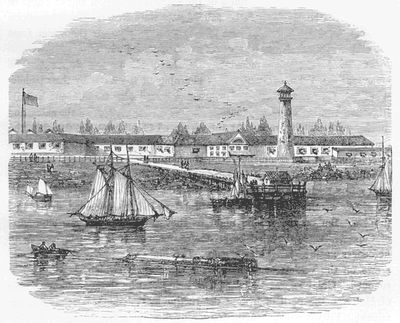
Fortress Monroe.
It was late in October, 1861, when the final determination to attack
the forts at Port Royal was reached. For weeks before, the squadron
lying at Hampton Roads had been making preparations for a great naval
movement, and all the newspapers of the North were filled with wise
speculations as to its objective point. Reporters, correspondents, and
editors were alike baffled in their efforts to secure accurate
information; and even the commanders of the men-of-war were
ignorant of their destination. But it seems that the Confederates were
warned by some of their sympathizers in Washington, and the
destination of the fleet was better known south of Mason and Dixon's
line than in the North. On Tuesday, Oct. 29, the squadron was all
ready for the voyage. It was by far the most powerful fleet ever
gathered under the flag of the United States. Twenty-five vessels
laden with coal had sailed the day before. On the placid waters of the
bay, under the frowning walls of Fortress Monroe, floated fifty
men-of-war and transports. The day was clear, and the breeze brisk,
and the hearts of the jolly jack-tars bounded within them as they
thought of escaping from the long inactivity of a season in port.
Long-boats bearing despatches rowed from ship to ship; hucksters from
the shore came off in dories, dingies, and all variety of queer craft,
to drive a farewell bargain with the sailors. The transport vessels
were crowded with soldiers in the gay uniforms of militia commands.
(It was early in the war then, and they had not learned that
a man could fight as well in dingy rags.) The "Wabash" was flagship,
and aboard her was Admiral DuPont. When she made the signal for
getting under way, all was bustle and animation on all the other
vessels of the fleet, and on all sides could be heard the noise of
preparation for the start. The boatswains piped away cheerily; and a
steady tramp, tramp, from the deck of each ship, and the clicking of
the capstan catches, told that the anchors were coming up. Soon from
the black funnels of the steamers clouds of smoke began to pour, and
in the rigging of the sail frigates were crowds of nimble sailors. The
commands "All ready! Let fall!" rang sharply over the water from the
ships. Broad sheets of snowy canvas appeared where before were but
ropes and spars, and in a moment the whole squadron was under way. The
steamers led off briskly, with much churning of the water by their
paddle-wheels and "brazen-fins;" after them followed the magnificent
sailing frigates, with sail set,—lofty masses of canvas towering
toward the skies, and moving with stately grace. At the very head of
all went the flagship, the grand old "Wabash," with the flag of
Admiral DuPont floating from the fore. None of the commanders knew
whither they were bound. All were to follow the flagship, and in event
of separation to refer to sealed orders with which each was provided.
For the first day all went well. The promise of fair weather given by
the beautiful day of starting seemed about to be fulfilled. But on the
second night, as they came near the terrible region of Cape Hatteras,
the wind began to freshen, and continued increasing in fierceness
until it fairly blew a gale. The night was pitchy dark, and the crews
on the vessels could hardly see the craft by which they were
surrounded. Great as was the danger of being cast on the treacherous
shoals of Hatteras, the peril of instant destruction by collision was
even more imminent. Fifty vessels, heavily freighted with human lives,
were pitching and tossing within a few rods of each other, and within
a few miles of a lee shore. It seemed that the destruction of a large
number of the vessels was unavoidable; and the sailors may be
pardoned, if, remembering the mishaps of the Burnside expedition, they
conceived Hatteras to be tenanted by an evil spirit, determined to
prevent the invasion of Confederate territory. To add to the danger,
the Confederates had extinguished the warning light at the Cape, and
the navigators of the fleet had nothing to guide them in their course.
When morning came, the fleet was pretty well scattered, although
still many vessels were near enough together to be in no
small danger. The transport "Winfield Scott," which carried four
hundred and fifty soldiers, besides a large crew, was observed to be
rolling heavily, and flying signals of distress. From the decks of the
"Bienville," the nearest steamer, the officers with their glasses
could see the crew of the distressed vessel working like beavers,
throwing overboard every thing of weight to lighten the ship.
Notwithstanding all their efforts, she was clearly water-logged, and
sunk so low in the water that wave after wave broke over her decks,
every now and then sweeping a man away to sure death in the raging
sea. It seemed folly to attempt to launch lifeboats in such a furious
sea, but the captain of the "Bienville" determined to make the attempt
to save the men on the doomed "Winfield Scott." The crew was piped to
quarters, and the captain asked for volunteers to go to the rescue.
Man after man stepped forward, until enough had been secured to man
three boats with ten men each. Carefully the boats were dropped into
the sea, and man after man swung into them; then they put off and
started for the sinking ship. But while these preparations were being
made, the two ships had been drifting closer and closer together. Soon
it was seen that a collision was inevitable. Fortunately the boats
were broadside on, so that the cutting effect of a blow from the bow
was avoided. They were presently so near each other that the men began
jumping from the deck of the "Winfield Scot" upon that of the
"Bienville." The leap, though a perilous one, was made in safety by
over thirty men. Suddenly a great wave lifted the ships up and dashed
them together. Three poor wretches, just about to jump, were caught
between the vessels and crushed to death. A few sharp cries of agony,
and all was over; and the vessels, drifting apart, let their bodies,
crushed beyond recognition, fall into the water. By this time the
small boats, with their determined crews on board, had succeeded in
getting around to the lee side of the sinking ship, and the work of
getting the soldiers and sailors over the side was begun. By the most
strenuous efforts all were saved, and the "Bienville" steamed away,
leaving the "Winfield Scott" to her fate.
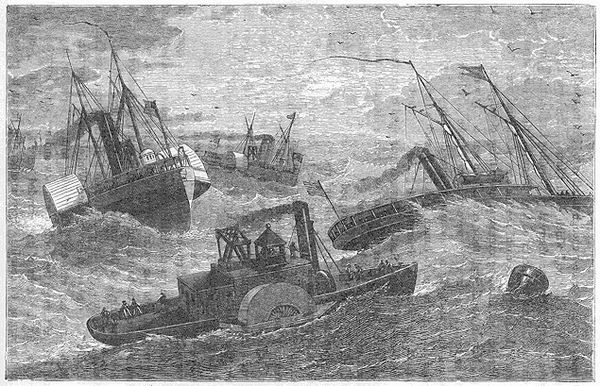
Du Pont's Expedition off Cape Hatteras.
Night came on, with the gale blowing with still greater fury. The wind
shrieked through the cordage, and now and again a great wave would
sweep across the decks of the crowded vessels, making the men hang on
to the rigging for dear life. Soon another ship began to go to pieces.
The "Governor," which had been steaming along near the "Wabash"
since the time of leaving Hampton Roads, had become
separated from her consort during the gale of the first day. On the
second night, those aboard her perceived that she was showing signs of
weakness, and was likely to go down with all on board unless aid could
be obtained. Not a sail, however, was in sight; and every wave seemed
about to overwhelm or dash to pieces the frail craft. She labored
heavily in the furious sea. By and by the strain on her timbers was
such that the port hog-brace broke in two places, weakening the vessel
so that her fate was apparent to all. Soldiers and sailors worked away
with a frantic energy born by the fear of death, and succeeded in
bracing up the timbers, so as to avoid, for a time, the breaking-up.
Soon after, a heavy roll of the vessel broke the smokestack, and it
was pitched overboard. Luckily it broke some three feet above the
deck, so that the fires could still be kept up. Then the steam-pipe
burst; and with this accident the fate of all on board seemed sealed,
for they no longer could keep the vessel's head to the waves, and the
great seas came rolling over her, sweeping her decks of every thing
movable. They began sending up rockets, and, after some time of
anxious waiting, saw an answering signal; so that, through the
remainder of that fearful night, the men on the doomed ship felt that,
whatever might occur, they had friends at hand. The night was spent in
toil at the pumps; and in the morning a faint cheer went up as two
vessels were seen, ready to lend assistance. A signal of distress,
quickly hoisted, was answered from the nearer, which proved to be the
"Isaac P. Smith." The "Smith" sent off a boat and made fast a hawser
to the wreck, and took her in tow; but in a few minutes the hawser
parted. It became clear that the men must be taken off the sinking
ship; but how to do it, was the question. By this time a second ship,
the "Young Rover," had arrived to assist in the rescue. A second cable
was put aboard; but this, too, parted. Hope seemed lost, when the
lookout reported a third ship, the frigate "Sabine," coming to the
rescue. The "Sabine" came to anchor, and sent a hawser aboard the
sinking "Governor." Then the hawser was gradually taken in until the
two ships lay close together, stern to stern. Spars were rigged over
the stern of the frigate, and some thirty men swung over the seething
waters to safety. Then the two vessels came together with a crash, and
about forty men sprang from the sinking ship to the deck of the
frigate. But the damage done by the collision was so great that it was
deemed prudent to slack up the hawser and let the "Governor" drop
astern again. Those on board busied themselves throwing
overboard all things movable, with the intention of lightening the
vessel. After some hours of suspense, the work of getting the men off
the sinking craft was recommenced, and boats were sent to their
assistance. The sea was running too high for them to approach close to
the steamer's guards, so they lay off some feet, and the soldiers
jumped into them. It was a perilous leap, with the boats pitching one
way, and the ship another, and a raging sea of tossing waters between;
but it was made bravely by every man, and but seven or eight were
lost. Soon after the last man left the "Governor," she lurched to one
side and sank, carrying with her the arms and ammunition of the troops
she was transporting.
It was on Monday morning, Nov. 4, that the flagship "Wabash" cast
anchor off Port Royal. In the offing were a few more sail headed for
the same point, and during the day some twenty-five vessels of the
scattered squadron came up. For the next day ships were constantly
arriving, and by Tuesday night the whole squadron lay safely anchored
in the broad harbor.
The defences which the Confederates had erected upon Hilton Head, a
lofty bluff overlooking the harbor, were powerfully designed
earthworks, poorly armed and manned. The forts were two in number,
placed on a commanding elevation, and might have been made impregnable
had the Confederates taken advantage of the warning sent them by their
spies in Washington. Fort Walker had fourteen guns which could bear on
an attacking fleet, and Fort Beauregard had twenty. When the fight
began, the gunners found that most of their ammunition was either too
large or too small for the guns. To support the forts in their fight,
was a wretched little fleet of tugs and schooners, mounting a gun or
two each, but absolutely powerless before the smallest of Du Pont's
ships-of-war. Indeed, when the battle began, the Union navy gave its
undivided attention to the forts, and did not even give battle to
Tatnall's mosquito fleet.
Thursday morning dawned bright and mild as a morning in June. The
shores of the beautiful bay were covered with woods, out of which rung
the clear notes of Southern song-birds. The scene from the ships was
one of the most charming imaginable. The placid bay, the luxuriant
shores, the ocean showing across the low-lying ridge of white sand,
the forts frowning from the steep headland, the fleet of majestic
frigates mustered for the attack, and in the distance the flotilla of
defenceless transports, safely out of range, their decks and
rigging crowded with fifteen thousand men—all this presented a
panorama of life and beauty which few eyes have ever beheld.
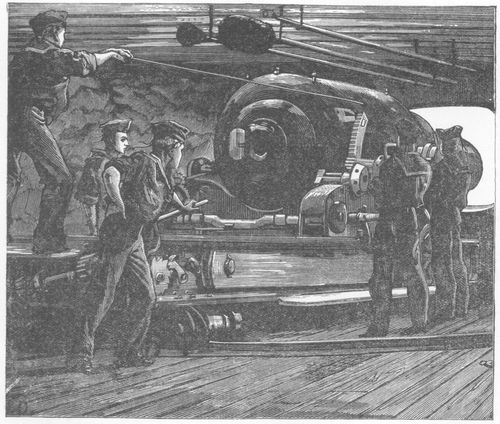
The Opening Gun.
Du Pont, in the majestic "Wabash," moved down the bay, and, as he came
in range of Fort Walker, sent a shell shrieking from a bow-gun, as
signal that the action was begun. The old frigate moved on slowly,
making play with the bow-guns until abreast of the fort, when with a
crash she let fly her whole broadside. On she went for a few yards,
then turning in a grand circle came back, giving the other broadside
to the forts as she passed. The other ships fell in behind; and round
and round before the forts the fiery circle revolved, spitting out
fire and ponderous iron bolts, and making the peaceful shores of the
bay tremble with the deep reverberations of the cannon.
The Confederates, for their part, went into the action with
the utmost coolness. They had been assured that their position was
impregnable, and had been cautioned to be deliberate and determined in
their defence. For a time their artillery service was admirable. But
soon they found certain discouraging features about the affair. Their
guns were too light to have any effect on the fleet, and their powder
was of such bad quality that many of their shots fell short. Two great
guns dismounted themselves, seriously injuring the men who were
handling them, and the very first broadside from the fleet dismounted
several more. Then it was found that the shells for the great Parrott
guns were too large, and that the shells from other cannon failed to
explode, owing to defective fuses. Soon the fleet found a point of
fire from which it could enfilade the forts, and thereafter a perfect
hail of shell and grape-shot fell in the trenches. One shell disabled
eleven men. A solid shot struck a gun thought to be perfectly
protected, and hurled it, with the men serving it, over the parapet.
Every twenty minutes a gun was dismounted in Fort Walker, and at the
end of the conflict Fort Beauregard had but nine serviceable guns.
For about four hours there was no cessation of fire on the part of the
fleet. Round and round the circle the vessels steamed, giving one fort
a broadside on the way up, and the other a broadside on the way down.
The bombs rose from them in a majestic sweep through the air, and
plunged into the fort, exploding with a roar equal to that of a
cannon. One ship was commanded by Capt. Drayton, who rained shot and
shell mercilessly against the forts, although one of them was in
command of his own brother.
At half-past one Fort Walker was found untenable, and the work of
abandoning it was begun. The evacuation was completed in great haste,
many valuables were left behind, and not even the guns were spiked.
Still the entire garrison escaped to mainland, although the Federals
had three thousand troops who might have made them all prisoners. Not
long thereafter, Fort Beauregard also yielded to fate, and the day was
won by the Federals.
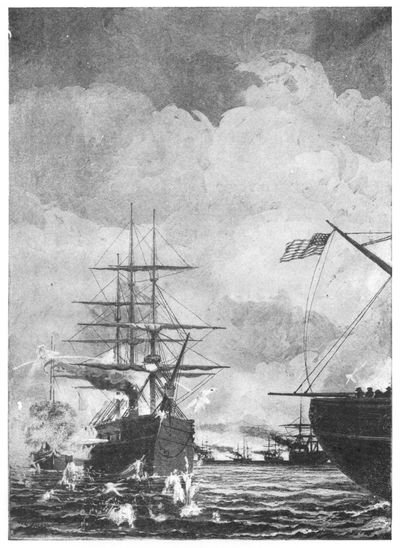
The Fight at Hilton Head.
The landing of the troops was at once begun. Thirty large boats bore a
Connecticut regiment of one thousand men to the beach. Their bright,
fresh uniforms, their muskets glittering in the sun, and their
regular, swaying stride as they marched up the sandy beach to the
martial strains of the regimental band, made a striking
picture. They clambered over the ramparts, and in a few moments the
stars and stripes floated from the staff which had but lately upheld
the flag of the young Confederacy. Within the forts, all was carnage
and confusion: dismounted cannon, surrounded by the dead bodies of the
gunners, heaps of shells, and fragments of woodwork, were piled about
the parade-ground and in the trenches. The story of the terrific
bombardment was graphically told by those horrible evidences of death
and destruction. And well might the scene be a horrible one. For over
five hours, fifty shot a minute had been discharged at the forts, and
most of them did execution. When one recollects that each shot of the
great guns cost eight dollars, we get a vivid idea of the money spent
in war.
Immediately upon the capture of Hilton Head, the victors began making
it a great naval and military station. Great storehouses were built,
wharves constructed, and vast intrenchments thrown up for the defence
of the spot. The slaves, escaping from the neighboring plantations,
came in droves, begging to be allowed to work; but they received but a
cold welcome, for they were still looked upon as property, and the
officers did not wish to be charged with enticing them away from their
masters.
The news of the occupation of Hilton Head by the Northern armies
caused the greatest consternation in the cities of Charleston and
Savannah, From both places people fled into the interior, expecting an
immediate advance of the Union troops. But the armies were set to
digging, not to marching, and soon the affrighted citizens returned to
their homes. Port Royal was held by the Northern forces until the end
of the war, and proved of great value for the proper maintenance of
the blockade. Its greatest disadvantage was its unhealthiness. Of
fifteen thousand men landed there in November, five thousand were on
the sick-list within a month.[Back to Contents]
THE FIRST IRON-CLAD VESSELS IN HISTORY. — THE "MERRIMAC" SINKS THE
"CUMBERLAND," AND DESTROYS THE "CONGRESS." — DUEL BETWEEN THE "MONITOR"
AND "MERRIMAC."
t
will be remembered that when the Union forces, alarmed by the
threatening attitude of the inhabitants of Norfolk and the vicinity,
fled from the Norfolk navy-yard, leaving every thing there in flames,
they left behind them a fine United States frigate, "Merrimac," a ship
of thirty-five hundred tons, carrying forty guns. The departing
Federals did their work of destruction fairly well; for the great ship
was burnt to the upper edge of her copper sheathing, and sank to the
bottom of the river. Three or four months after the occupation of the
Norfolk navy-yard by the Confederates, Lieut. George M. Brooke, an
ex-officer of the United States navy, who had resigned that he might
follow the fortunes of his State, while looking at the hulk lying in
the river-channel, was suddenly inspired with the thought that she
might be raised and converted into a formidable vessel-of-war. He
carefully matured his plans, and after due consideration proposed to
the Confederate secretary of the navy, that the "Merrimac" be raised
and converted into an iron-clad. His plans were approved, and orders
were given that they should be carried out. The "Merrimac," as
originally built, was one of the grand old types of war-vessels. Her
solid oak sides rose high above the water, and were pierced by a long
row of gaping portholes. Her masts towered high in the air;
and when her great sails were set, her hull seemed crushed beneath so
vast an expanse of canvas. When she had been remodelled, her entire
appearance was changed. She had no longer the appearance of a ship,
but seemed like a house afloat; and tradition says that the old salt
on the "Cumberland," who first sighted her, reported gravely to the
officer of the deck, "Quaker meetin'-house floating down the bay,
sir."
When the hulk had been raised and placed in the dry-dock, the first
thing done was to cut it down to the level of the berth-deck; that is,
to the level of the deck below the gun-deck in the old rig. Then both
ends of the ship were decked over for a distance of seventy feet;
while the midship section was covered by a sort of roof, or
pent-house, one hundred and seventy feet long, and extending about
seven feet above the gun-deck. This roof was of pitch pine and oak,
twenty-four inches thick, and covered with iron plates two inches
thick. The upper part of the roof, being flat, was railed in, making a
kind of promenade deck. In the great chamber formed by this roof were
mounted ten guns, two of which, the bow and stern guns, were
seven-inch rifles, and fairly powerful guns for those days. A strange
feature of this ship, and one that was not discovered until she was
launched, was that the weight of the iron-plating and the heavy guns
she carried sunk her so deep in the water that the low deck forward
and aft of the gunroom was always under water; so much so that the
commander of another ship in the Confederate navy writes that he was
obliged always to give the "Merrimac" a wide berth, lest he should run
his ship on some part of the ram which lay unseen beneath the surface
of the water. Powerful as this ship was, she had some serious defects.
The greatest of these were her engines. They were the same that had
been in her as a United States vessel, and had been condemned by a
naval board as very defective. Naturally several weeks under water had
not improved them; but the Confederates could not be particular about
machinery just then, and the old engines were left in the new ram. It
was quickly found that they could not be depended upon more than six
hours at a time; and one of the ship's officers, in writing years
afterwards, remarks, "A more ill-contrived or unreliable pair of
engines could only have been found in some vessels of the United
States navy." The second faulty feature about the "Merrimac" was that
her rudder and propeller were entirely unprotected. The ram which was
so much dreaded, and which made the "Merrimac" a forerunner
of a new class of war-vessels, was of cast-iron, projecting four feet,
and so badly secured that it was loosened in ramming the "Cumberland,"
and started a bad leak in the Confederate ship.
When this formidable vessel was completed, she was christened by her
new owners the "Virginia;" but the name of the old United States
frigate of which she was built stuck to her, and she has ever since
been known as the "Merrimac," and so we shall speak of her in this
narrative. She received as commander Commodore Franklin Buchanan, an
ex-Union officer of ability and daring, to whom the cadets of the
naval academy at Annapolis owe the beautiful situation of the academy,
and many of its admirable features; for he it was, who, in 1845, under
a commission from Mr. Bancroft, Secretary of the Navy, organized and
located the naval academy, and launched that institution upon its
successful career. Of officers the "Merrimac" had no lack, and good
ones they were; but in her crew she was lamentably deficient. Most of
the crew was made up of men from the army, who knew nothing of
seamanship, but who could at any rate fire a gun. A few good sailors
were obtained from those who escaped to Norfolk after the destruction
of the Confederate flotilla at Elizabeth City by Capt. Rowan's
squadron. They had but little chance for drills and exercise on the
new ship, for up to the very hour of sailing she was crowded with
workmen getting her ready for the task of breaking down the Yankee
blockade. When she finally set out to do battle for the South, she was
a new and untried ship: not a gun had been fired, and hardly a
revolution of her engines had been made. And so she started down the
river on her trial trip, but intending, nevertheless, to do battle
with the strongest ships of the United States navy. Accompanying her
were four small Confederate gunboats,—the "Beaufort," the "Yorktown,"
the "Jamestown," and the "Teaser." Soon rounding out into Hampton
Roads, the little squadron caught sight of the Northern fleet at
anchor, and made for them. An officer on the "Congress" thus tells the
story of the events that followed:—
"The 8th of March was a fine mild day, such as is common in Southern
Virginia during the early spring; and every one on board our ship was
enjoying the weather, and pleasing himself with the prospect of going
North in a day or two at farthest, and being relieved from the
monotony of a blockade at anchor. Some of us were pacing the
poop, basking in the sun, and watching the gulls, which here, as all
over the world, wherever a man-of-war is anchored, manage to find out
when it is dinnertime, appearing regularly when the mess-tins are
being washed, and the cooks are taking the buckets of broken victuals
to the head to throw overboard. Then they chatter and scream, and
fight for the remnants as they drift astern, until all is consumed,
when they betake themselves to fresh fields out of sight until we pipe
to dinner again.
"One bell had struck some time, when the attention of the
quarter-master on watch was drawn to an unusual appearance against the
fringe of woods away over in the Norfolk Channel. After gazing
intently some time, he approached the officer of the deck, and
presenting him the glass said,'I believe that thing is a-comin' down
at last, sir.'
"Sure enough! There was a huge black roof, with a smokestack emerging
from it, creeping down towards Sewall's Point. Three or four
satellites, in the shape of small steamers and tugs, surrounded and
preceded her. Owing to the intervening land, they could not be seen
from Hampton Roads until some time after we had made them out; but,
when they did show themselves clear of the point, there was a great
stir among the shipping. But they turned up into the James River
channel instead of down toward the fort, approaching our anchorage
with ominous silence and deliberation.
"The officers were by this time all gathered on the poop, looking at
the strange craft, and hazarding all sorts of conjectures about her;
and when it was plain that she was coming to attack us, or to force
the passage, we beat to quarters, the "Cumberland's" drum answering
ours.
"By a little after four bells, or two o'clock, the strange monster was
close enough for us to make out her plating and ports; and we tried
her with a solid shot from one of our stern-guns, the projectile
glancing off her forward casemate like a drop of water from a duck's
back. This opened our eyes. Instantly she threw aside the screen from
one of her forward ports, and answered us with grape, killing and
wounding quite a number. She then passed us, receiving our broadside
and giving one in return, at a distance of less than two hundred
yards. Our shot had apparently no effect upon her, but the result of
her broadside on our ship was simply terrible. One of her shells
dismounted an eight-inch gun, and either killed or wounded
every one of the gun's crew, while the slaughter at the other guns was
fearful. There were comparatively few wounded, the fragments of the
huge shells she threw killing outright as a general thing. Our clean
and handsome gun-deck was in an instant changed into a slaughter-pen,
with lopped-off legs and arms, and bleeding, blackened bodies,
scattered about by the shells; while blood and brains actually dripped
from the beams. One poor fellow had his chest transfixed by a splinter
of oak as thick as the wrist; but the shell-wounds were even worse.
The quarter-master, who had first discovered the approach of the
iron-clad,—an old man-of-war's man, named John Leroy,—was taken
below with both legs off. The gallant fellow died in a few minutes,
but cheered and exhorted the men to stand by the ship, almost with his
last breath. The 'Merrimac' had, in the mean time, passed up stream;
and our poor fellows, thinking she had had enough of it, and was for
getting away, actually began to cheer. For many of them it was the
last cheer they were ever to give. We soon saw what her object was;
for standing up abreast of the bow of the 'Cumberland,' and putting
her helm aport, she ran her ram right into that vessel. The gallant
frigate kept up her splendid and deliberate, but ineffectual, fire,
until she filled and sank, which she did in a very few minutes. A
small freight-steamer of the quarter-master's department, and some
tugs and boats from the camp-wharf, put off to rescue the survivors,
who were forced to jump overboard. In spite of shot from the
Confederate gunboats, one of which pierced the boiler of the
freight-boat, they succeeded in saving the greater number of those who
were in the water. Seeing the fate of the 'Cumberland,' which sank in
very deep water, we set our topsails and jib, and slipped the chains,
under a sharp fire from the gunboats, which killed and wounded many.
With the help of the sails, and the tug 'Zouave,' the ship was now run
on the flats which make off from Newport News Point. Here the vessel
keeled over as the tide continued to fall, leaving us only two guns
which could be fought,—those in the stern ports. Two large
steam-frigates and a sailing-frigate, towed by tugs, had started up
from Hampton Roads to our assistance. They all got aground before they
had achieved half the distance; and it was fortunate that they did so,
for they would probably have met the fate of the 'Cumberland,' in
which case the lives of the twelve or thirteen hundred men comprising
their crews would have been uselessly jeopardized.
"After the 'Merrimac' had sunk the 'Cumberland,' she came
down the channel and attacked us again. Taking up a position about one
hundred and fifty yards astern of us, she deliberately raked us with
eighty-pounder shell; while the steamers we had so long kept up the
river, and those which had come out with the iron-clad from Norfolk,
all concentrated the fire of their small rifled guns upon us. At this
time we lost two officers, both elderly men. One was an acting master,
who was killed on the quarter-deck by a small rifle-bolt which struck
him between the shoulders, and went right through him. The other was
our old coast pilot, who was mortally wounded by a fragment of shell.
We kept up as strong a fire as we could from our two stern-guns; but
the men were repeatedly swept away from them, and at last both pieces
were disabled, one having the muzzle knocked off, and the other being
dismounted. Rifles and carbines were also used by some of our people
to try to pick off the 'Merrimac's' crew when her ports were opened to
fire, but of course the effect of the small-arms was not apparent to
us.
"It is useless to attempt to describe the condition of our decks by
this time. No one who has not seen it can appreciate the effect of
such a fire in a confined space. Men were being killed and maimed
every minute, those faring best whose duty kept them on the spar deck.
Just before our stern-guns were disabled, there were repeated calls
for powder from them; and, none appearing, I took a look on the
berth-deck to learn the cause. After my eyes had become a little
accustomed to the darkness, and the sharp smoke from burning oak, I
saw that the line of cooks and wardroom servants stationed to pass
full boxes had been raked by a shell, and the whole of them either
killed or wounded,—a sufficient reason why there was a delay with the
powder. (I may mention here that the officer who commanded our powder
division was a brother of the captain of the 'Merrimac.') The shells
searched the vessel everywhere. A man previously wounded was killed in
the cock-pit where he had been taken for surgical aid. The deck of the
cock-pit had to be kept sluiced with water from the pumps, to
extinguish the fire from the shells, although dreadfully wounded men
were lying on this deck, and the water was icy cold; but the
shell-room hatch opened out of the cock-pit, and fire must be kept out
of there at all hazards, or the whole of us would go into the air
together. In the wardroom and steerage, the bulkheads were all knocked
down by the shells, and by the axemen making way for the
hose, forming a scene of perfect ruin and desolation. Clothing, books,
glass, china, photographs, chairs, bedding, and tables were all mixed
in one confused heap. Some time before this, our commanding officer, a
fine young man, had been instantly killed by a fragment of shell which
struck him in the chest. His watch, and one of his shoulder-straps
(the other being gone), were afterwards sent safely to his father, a
veteran naval officer.
"We had now borne this fire for nearly an hour, and there was no
prospect of assistance from any quarter, while we were being
slaughtered without being able to return a shot. Seeing this, the
officer who had succeeded to the command of the ship, upon
consultation with our former captain (who was on board as a guest),
ordered our flag to be struck. It is not a pleasant thing to have to
strike your flag; but I did not see then, and do not see now, what
else we were to do.
"A boat now boarded us with an officer from the 'Merrimac,' who said
he would take charge of the ship. He did nothing, however, but gaze
about a little, and pick up a carbine and cutlass,—I presume as
trophies. One of the small gunboats then came alongside, and the
officer from the 'Merrimac' left. The commander of the gunboat said
that we must get out of the ship at once, as he had orders to burn
her. Some of our people went on board of his craft as prisoners, but
not many. As her upper deck was about even with our main-deck ports,
our surgeon stepped out of one, and told the commanding officer that
we had some dreadfully wounded men, and that we must have time to
collect them, and place them on board his vessel, and, moreover, that
our ship was on fire with no possibility of saving her. The reply was,
'You must make haste: those scoundrels on shore are firing at me now.'
In fact, the rifle-balls were 'pinging' about very briskly, scarring
the rusty black sides of the poor old frigate; for the Twentieth
Indiana Regiment had come down from the camp to the point, and opened
fire on the gunboat as she lay alongside of us. Our doctor having no
desire to be killed, especially by our own people, jumped back into
the port, just as the steamer, finding it too hot, shoved off and left
us. As soon as she did so, they all opened upon us again; although we
had a white flag flying to show we were out of action, and we
certainly could not be held responsible for the action of the regiment
on shore. After ten or fifteen minutes, however, they all withdrew,
and went down the channel, to bestow their attentions upon
the frigate 'Minnesota' which was hard aground. Fortunately the
'Merrimac' drew too much water to come near the 'Minnesota' at that
stage of tide, and the small-fry were soon driven off by the latter
ship's battery. Night now approaching, the whole Rebel flotilla
withdrew, and proceeded up the Norfolk Channel.
"Although relieved from the pressure of actual battle, we still had
the unpleasant consciousness that the fire was making progress in the
vicinity of our after-magazine; and we felt as I suppose men would
feel who are walking in the crater of a volcano on the verge of
eruption. Fortunately for us, the 'Merrimac' and her consorts had not
fired much at our upper works and spars, the principal damage being
inflicted upon our lower decks. We had, therefore, the launch and
first cutter,—large boats,—which, with a little stuffing of
shot-holes, were fit to carry us the short distance between our ship
and the shore. The yard and stay-tackles were got up, and the boats
put into the water, as soon as possible; the fire gaining, and the sun
going down, in the mean time.
"By successive boatloads the survivors were all landed; the launch
being brought up under the bill port, and the wounded, in cots,
lowered into her by a whip from the fore yard, which was braced up for
the purpose. This boat was nearly filled with water on her last trip,
being a good deal damaged; obliging some of the officers, who had
stayed until the last, to jump overboard into the icy cold water, and
lean their hands on the gunwale, so as to relieve the boat of a part
of their weight. She grounded in water about waist-deep; and the
soldiers from the camp waded out and assisted our men in bearing on
shore, and to the log hospital of the Twentieth Indiana, those who
were in cots. We had managed to get the body of our gallant young
commander on shore in one of the cots, as a wounded man. The mass of
the men were so 'gallied,' to use a sailor phrase, by the time the
action was over, what with enduring so severe a fire without being
able to respond, and also with the knowledge that an explosion of the
magazine might occur at any time, that I doubt whether they could have
been induced to bring off a man whom they knew to be dead. The
officers repeatedly went about the decks looking for wounded men; and
I firmly believe that all who were alive were brought off. Our poor
old ship, deserted by all but the dead, burned till about midnight,
when she blew up."
The final destruction of the "Congress" must have been a most
imposing spectacle. A member of the Confederate army, who was
stationed in one of the batteries near the scene of action, thus
describes it: "Night had come, mild and calm, refulgent with all the
beauty of Southern skies in early spring. The moon, in her second
quarter, was just rising over the rippling waters; but her silvery
light was soon paled by the conflagration of the 'Congress,' whose
lurid glare was reflected in the river. The burning frigate four miles
away seemed very much nearer. As the flames crept up the rigging,
every mast, spar, and rope glittered against the dark sky in dazzling
lines of fire. The hull, aground upon the shoal, was plainly visible;
and upon its black surface each porthole seemed the mouth of a fiery
furnace. For hours the flames raged, with hardly a perceptible change
in the wondrous picture. At irregular intervals, loaded guns and
shells, exploding as the flames reached them, sent forth their deep
reverberations, re-echoed over and over from every headland of the
bay. The masts and rigging were still standing, apparently intact,
when about two o'clock in the morning a monstrous sheet of flame rose
from the vessel to an immense height. The ship was rent in twain by
the tremendous flash. Blazing fragments seemed to fill the air; and,
after a long interval, a deep, deafening report announced the
explosion of the ship's powder-magazine. When the blinding glare had
subsided, I supposed that every vestige of the vessel would have
disappeared; but apparently all the force of the explosion had been
upward. The rigging had vanished entirely, but the hull seemed hardly
shattered; the only apparent change in it was that in two or three
places, two or three of the portholes had been blown into one great
gap. It continued to burn until the brightness of its blaze was
effaced by the morning sun."
In the great drama of the first day's fight at Hampton Roads, the
heroic part was played by the frigate "Cumberland." On the morning of
that fateful 8th of March, she was swinging idly at her moorings, her
boats floating at the boom, and her men lounging about the deck, never
dreaming of the impending disaster. It was wash-day, and from the
lower rigging of the ship hung garments drying in the sun. About noon
the lookout saw a cloud of smoke, apparently coming down the river
from Norfolk, and at once notified the officer of the deck. It was
surmised that it might be the new and mysterious iron-clad "Merrimac,"
about which many rumors were current, but few facts known. Quickly the
ship was set in trim for action, and the men sent to
quarters. All the stern preparations for battle were made—the guns
all shotted, the men in position, the magazines opened; shot, shell,
cartridges, all in place; the powder-boys at their stations; swords,
pistols, boarding-pikes, in the racks. Down in the cock-pit the
surgeons spread out upon their tables the gleaming instruments, which
made brave men shudder with the thought of what a few minutes would
bring.
The sailors prepared for the fight gayly, never doubting for a moment
that victory would be on their side. So paltry had been the resistance
that the Confederates had heretofore been able to oppose to the
Northern arms, by sea, that the blue-jackets felt that they had only
to open a fight in order to win it. The officers were more serious.
Rumors had reached them that the "Merrimac" was a most powerful
vessel, destined to annihilate the navy of the North; and they looked
on this first battle with the monster with many misgivings. Their
fears were somewhat lessened by an article printed in the Norfolk
papers, a few days previous, denouncing the "Merrimac" as a bungling
bit of work, absolutely unseaworthy, and unable to stand against the
powerful vessels of the North. As it turned out, however, this article
was published as a ruse to deceive the Northern authorities.
The iron ship came steaming sullenly down the bay. The "Congress" was
the first ship in range, and a puff of smoke from the "Merrimac's"
bow-gun warned the crew of the frigate that danger was coming. All
held their breath an instant, until, with a clatter and whiz, a storm
of grape-shot rattled against her sides, and whistled through the
rigging. Then came a sigh of relief that it was no worse. When the
enemy was within a quarter of a mile, the "Congress" let fly her whole
broadside, and the crew crowded the ports to see the result. The great
iron shot rattled off the mailed sides of the monster, like hailstones
from a roof. Then came the return fire; and the "Congress" was riddled
with shells, and her decks ran with blood. The "Merrimac" passed
sullenly on.
Now it was the turn of the "Cumberland." Her officers and crew had
seen the results of the fire of the "Congress," and, with sinking
hearts, felt how hopeless was their own position. There was no chance
for escape, for no wind filled the sails of the frigate. She lay
helpless, awaiting the attack of the iron battery that bore down upon
her, without firing a shot or opening a port. At a little past two the
mailed frigate had approached the "Cumberland" within grape-shot
distance. Fire was opened upon her with the heaviest guns;
and officers and men watched breathlessly the course of their shot,
and cried aloud with rage, or groaned in despair, as they saw them
fall harmlessly from the iron ship. Still they had no thought of
surrender. The fire of the "Cumberland" was received silently by the
"Merrimac;" and she came straight on, her sharp prow cutting viciously
through the water, and pointed straight for her victim. A second
broadside, at point-blank range, had no effect on her. One solid shot
was seen to strike her armored sides, and, glancing upward, fly high
into the air, as a baseball glances from the bat of the batsman; then,
falling, it struck the roof of the pilot-house, and fell harmlessly
into the sea. In another instant the iron ram crashed into the side of
the "Cumberland," cutting through oaken timbers, decks, and cabins. At
the same time all the guns that could be brought to bear on the
Northern frigate were discharged; and shells crashed through her
timbers, and exploded upon her decks, piling splinters, guns,
gun-carriages, and men in one confused wreck. Had not the engines of
the ram been reversed just before striking the frigate, her headway
would have carried her clear to the opposite side of the doomed ship,
and the "Cumberland," in sinking, would have carried her destroyer to
the bottom with her. As it was, the "Merrimac," with a powerful
wrench, drew out of the wreck she had made, loosening her iron prow,
and springing a serious leak in the operation. She drew off a short
distance, paused to examine the work she had done, and then, as if
satisfied, started to complete the destruction of the "Congress."
And well might the men of the "Merrimac" be satisfied with their
hour's work. The "Cumberland" was a hopeless wreck, rapidly sinking.
Her decks were bloodstained, and covered with dead men, and scattered
arms and legs, torn off by the exploding shells. And yet her brave
crew stuck to their guns, and fought with cool valor, and without a
vestige of confusion. They had had but a few moments to prepare for
action; and the long rows of clothes, drying in the rigging, told how
peaceful had been their occupation before the "Merrimac" appeared upon
the scene. Yet now that the storm of battle had burst, and its issue
was clearly against them, these men stood to their guns, although they
could feel the deck sinking beneath them. Every man was at his post;
and even when the waters were pouring in on the gun-deck, the guns
were loaded and fired. Indeed, the last shot was fired from a gun half
buried in the waves. Then the grand old frigate settled down
to the bottom, carrying half her crew with her, but keeping the stars
and stripes still floating at the fore.
The destruction of the "Cumberland" being completed, the "Merrimac"
steamed over to the "Congress." This frigate fought well and
valorously, but was soon pounded into a helpless condition by the
shells of the "Merrimac," as shown by the story of her officer,
already quoted. When a white flag, floating at her peak, told of
surrender, the "Merrimac" left her to the attention of the smaller
vessels in the Confederate flotilla, and set out to find further
victims. But by this time the remainder of the Federal fleet had taken
alarm, and fled into a safe position under the shelter of the Federal
batteries on shore. The "Minnesota" only had been unfortunate in her
attempted flight, and was aground on a bar near the scene of the
fight. But now only two hours of daylight remained, and the tide was
low, and still on the ebb. The heavy iron frigate could not get within
effective distance of the "Minnesota," her crew were weary with a
day's fighting, and so she turned away and headed up the river for
Norfolk.
In taking account of injuries on the ram that night, it was found that
the injured numbered twenty-one; many of whom had been shot while
alongside the surrendered "Congress." Not an atom of damage was done
to the interior of the vessel, and her armor showed hardly a trace of
the terrible test through which it had passed. But nothing outside had
escaped: the muzzles of two guns had been shot off; the ram was
wrenched away in withdrawing from the "Cumberland;" one anchor, the
smokestack, steam-pipe, railings, flagstaff, boat-davitts—all were
swept away as though a huge mowing-machine had passed over the deck.
But, so far as her fighting qualities were concerned, the "Merrimac"
was as powerful as when she started out from Norfolk on that bright
spring morning.
It can easily be understood that the news of the engagement caused the
most intense excitement throughout this country, and indeed throughout
the whole world. In the South, all was rejoicing over this signal
success of the Confederate ship. Bells were rung, and jubilees held,
in all the Southern cities. An officer of the "Merrimac," who was
despatched post-haste to Richmond with reports of the engagement, was
met at every station by excited crowds, who demanded that he tell the
story of the fight over and over again. At last the starving people of
the Confederacy saw the way clear for the sweeping away of the
remorseless blockade.
In the North, the excitement was that of fear. The people of
seaboard cities imagined every moment the irresistible iron ship
steaming into their harbors, and mowing down their buildings with her
terrible shells. The Secretary of War said, at a hastily called
cabinet meeting in Washington: "The 'Merrimac' will change the whole
character of the war: she will destroy every naval vessel; she will
lay all the seaboard cities under contribution. Not unlikely we may
have a shell or cannon-ball from one of her guns, in the White House,
before we leave this room."
In this excited state, wild with joy, or harassed with fear, the whole
country went to sleep that March night, little dreaming that the
morrow would change the whole face of the naval situation, and that
even then a little untried vessel was steaming, unheralded, toward
Hampton Roads, there to meet the dreaded "Merrimac," and save the
remnants of the Federal fleet. Then no one knew of the "Monitor;" but
twenty-four hours later her name, and that of her inventor Ericsson,
were household words in all the States of the Union and the
Confederacy.
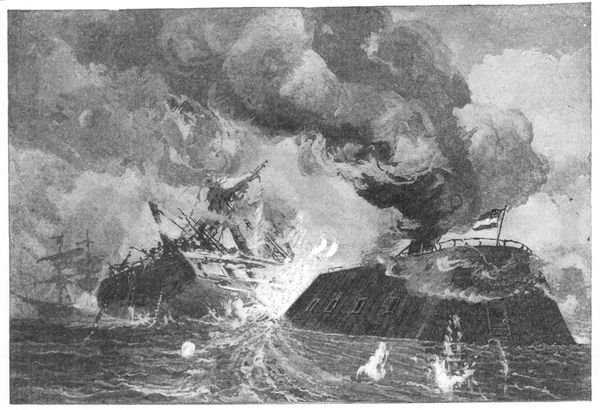
"Merrimac" and "Cumberland."
Capt. John Ericsson was a Swedish engineer, residing in this country,
who had won a name for himself by inventing the screw-propeller as a
means of propulsion for steamships. He and a Connecticut capitalist,
C. S. Bushnell by name, had ever since the opening of the war been
trying to induce the Government to build some iron-clads after a
pattern designed by Ericsson, and which afterwards became known as the
"monitor" pattern. Their labors at Washington met with little success.
After a long explanation of the plan before the wise authorities of
the Naval Board, Capt. Ericsson was calmly dismissed with the remark,
"It resembles nothing in the heavens above, or the earth beneath, or
the waters under the earth. You can take it home, and worship it
without violating any Commandment." Finally, however, leave was
obtained to build a monitor for the Government, provided the builders
would take all financial risks in case it proved a failure. So, with
this grudging permission, the work of building the warship that was
destined to save the Federal navy was begun. Work was prosecuted night
and day, and in one hundred days the vessel was ready for launching.
Great was the discussion over her. Distinguished engineers predicted
that she would never float; and many attended the launch expecting to
see the vessel plunge from the ways to the bottom of the river, like a
turtle from a log. So general was this opinion, that boats were
in readiness to rescue her passengers if she went down.
But Capt. Ericsson's plans were well laid. The great vessel glided
with a graceful dip into the river, and floated at her cables
buoyantly. She was a strange-looking craft. All that was to be seen of
her above water was a low deck about a foot above the water, bearing
in the centre a large round iron turret pierced with two great
portholes. Besides the turret, the smooth surface of the deck was
broken by two other elevations,—a small iron pilot-house forward,
made of iron plates about ten inches thick, and with iron gratings in
front; aft of the turret was a low smokestack. Beneath the water-line
this vessel had some strange features. The upper part of her hull,
forming the deck, projected beyond her hull proper about four feet on
every side. This projection was known as the "overhang," and was
designed as a protection against rams. It was made of white oak and
iron, and was impenetrable by any cannon of that day; although now,
when steel rifled cannon are built that will send a ball through
twenty inches of wrought iron, the original "Monitor" would be a very
weak vessel.
The turret in this little vessel, which held the two guns that she
mounted, was so arranged as to revolve on a central pivot, thus
enabling the gunners to keep their guns continually pointed at the
enemy, whatever might be the position of the vessel. When the time for
the first battle actually arrived, it was found that the turret would
not revolve properly; but in later ships of the same class this
trouble was avoided.
It was at two o'clock on the morning after the day on which the
"Merrimac" had wrought such havoc among the ships of the North, that
this queer-looking little vessel steamed into Hampton Roads. As the
gray dawn began to break, she passed under the quarter of the
"Minnesota," and cast anchor. The tars on the great frigate looked
curiously at the strange craft, and wondered if that insignificant
"cheese-box on a raft" was going to do battle with the dreaded
"Merrimac." Small hopes had they that their noble frigate would be
saved by any such pygmy warship.
In the mean time, the men of the "Merrimac" up at Norfolk were working
energetically to prepare her for the destruction of the rest of the
Union ships. Her ram was tightened in its place, her steering
apparatus overhauled, and some changes made, and her rickety engine
was patched up. At daybreak all was bustle as the ram prepared to move
down on the Union fleet. But just as she was about to start,
her officers saw the queer craft lying by the "Minnesota," which they
at once knew to be the Ericsson "Monitor." Her appearance was not very
terrible; but, nevertheless, the Confederates felt that she had
appeared at a most inopportune moment for them. Still they raised
anchor, and started down the bay to meet their mysterious enemy.
It was Sunday morning, and the sun rose in a cloudless blue sky. A
light breeze stirred the surface of the water, and played lazily with
the long streaming pennants of the men-of-war. The batteries on both
sides of the bay were crowded with men waiting for the great naval
battle of the day. Up at Norfolk a gay holiday party was embarking on
steam-tugs, to accompany the Confederate ship and witness the total
destruction of the Union fleet. No thought of defeat ever entered the
minds of the proud believers in the new iron-clad of the Confederacy.
At the first sign of life on board the "Merrimac," the "Monitor" began
her preparations for the battle. In fifteen minutes she was in battle
trim. The iron hatches were closed, the dead-light covers put on, and
obstructions removed from the main deck, so as to present a smooth
surface only twenty-four inches above the water, unbroken, save by the
turret and pilot-house. In the pilot-house was Lieut. Worden, who was
to command the "Monitor" in this her first battle.
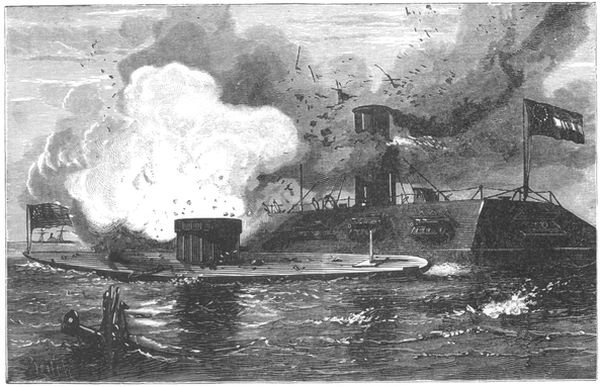
Battle of the "Monitor" and "Merrimac."
Leisurely the "Merrimac" came down the bay, followed by her attendant
tugs; and, as she came within range, she opened fire on the
"Minnesota," which was still aground. The frigate responded with a
mighty broadside, which, however, rattled off the mailed sides of the
ram like so many peas. Clearly, every thing depended upon the
"Monitor;" and that little craft steamed boldly out from behind the
"Minnesota," and sent two huge iron balls, weighing one hundred and
seventy pounds each, against the side of the "Merrimac." The shot
produced no effect beyond showing the men of the "Merrimac" that they
had met a foeman worthy of their steel. The "Merrimac" slowed up her
engines, as though to survey the strange antagonist thus braving her
power. The "Monitor" soon came up, and a cautious fight began; each
vessel sailing round the other, advancing, backing, making quick
dashes here and there, like two pugilists sparring for an opening. The
two shots of the "Monitor" would come banging one after the other
against the "Merrimac's" armor, like the "one, two" of a skilled
boxer. In this dancing battle the "Monitor" had an
enormous advantage, on account of her size, greater speed, and the way
in which she answered her helm. The "Merrimac" was like a huge hawk
being chased and baited by a little sparrow. Her heavy broadsides
found nothing to hit in the almost submerged hull of the "Monitor."
When a ball struck the turret, it glanced off, unless striking fair in
the centre, when it fell in fragments, doing no greater damage than to
dent the iron plates, and sometimes knocking down the men at the guns
inside. The first manœuvre tried by the "Merrimac" was to run down
her little antagonist; and she did strike her with a force that dented
the iron overhang of the "Monitor," and clashed the men in the
"Merrimac" to the deck, with blood streaming from their nostrils. For
a moment it seemed as though the "Monitor" must go under; but
gradually the terrible ram glanced off, and the little vessel,
righting, sent again her terrible two shots at her enemy. In the
action of the day before, shot and shell had beaten against the sides
of the ram so rapidly that one could not count the concussions. Now it
was a series of tremendous blows about a minute apart; and, if the men
had not been working away at their guns, they could have heard the oak
timbers splintering behind the iron plating. At a critical moment in
the fight the "Merrimac" ran aground; and the "Monitor" steamed around
her several times, seeking for weak places in which to plant a shot
Once Worden dashed at his adversary's screw, hoping to disable it, but
missed by perhaps two feet. Two shots from the "Monitor" struck the
muzzles of two cannon protruding from the portholes of the "Merrimac,"
and broke them off, throwing huge splinters of iron among the gunners
inside. And so the battle continued until about noon: gun answered gun
with thunderous reports, that echoed back from the batteries on shore
in rolling reverberations. The pleasure-seeking tugs from Norfolk had
scuttled back again out of the way of the great cannon-balls that were
skipping along the water in every direction. Neither of the combatants
had received any serious injury. On board the "Monitor" the only hurt
was received by a gunner, who was leaning against the iron wall of the
turret just as a shot struck outside; he was carried below, disabled.
But at last one lucky shot fired from one of the disabled guns of the
"Merrimac" ended this gigantic contest; sending each contestant to her
moorings, without an actual victory for either side. This shot struck
full and fair against the gratings of the pilot-house, through which
Lieut. Worden was looking as he directed the course of his
ship. The concussion knocked him senseless. Flakes of iron and powder
were driven into his eyes and face, blinding him completely for the
time. He fell back from the wheel, and the "Monitor" was left for a
moment without her guiding spirit. All was confusion; but in a few
moments Worden recovered, and gave the order to sheer off. The
"Monitor" then drew away, while Worden was moved to the cabin, and the
second officer sent to his station in the turret. Lying on a sofa in
the cabin, his eyes bandaged, and the horror of life-long blindness
upon him, Worden asked faintly, "Have I saved the
'Minnesota'?"—"Yes," answered the surgeon. "Then," said he, "I die
happy."
While these scenes were transpiring on the "Monitor," the "Merrimac"
lay quietly awaiting her return. The Confederate officers say that she
waited an hour, and then, concluding that the "Monitor" had abandoned
the fight, withdrew to Norfolk. The Northern officers and historians
say that the "Merrimac" was in full retreat when the decisive shot was
fired. It is hard to decide, from such conflicting statements, to
which side the victory belonged. Certain it is, that not a man on the
"Merrimac" was injured, and that all damages she sustained in the
fight were remedied before sunrise the next day. Later, as we shall
see, she challenged the Union fleet to a new battle, without response.
But with all these facts in view, it must be borne in mind that the
purpose of the "Merrimac," that bright March Sunday, was to destroy
the frigate "Minnesota:" in that purpose she was foiled by the
"Monitor," and to that extent at least the "Monitor" was the victor.
Lieut. Worden, after the fight, went directly to Washington. President
Lincoln was at a cabinet meeting when he heard of Worden's arrival in
the city, and hastily rising said, "Gentlemen, I must go to that
fellow." Worden was lying on a sofa, his head swathed in bandages,
when the President entered. "Mr. President," said he, "you do me great
honor by this visit."—"Sir," replied Mr. Lincoln, while the tears ran
down his cheeks, "I am the one who is honored in this interview."
Among his crew Worden was very much beloved. The following letter,
sent him while on a bed of pain, is all the more touching for the rude
form in which their affection for their commander is expressed:—
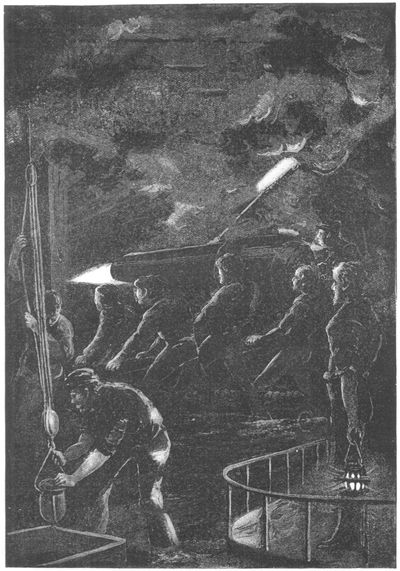
Handling a Gun.
TO CAPTAIN WORDEN.
Hampton Roads, April 24, 1862.
United States Monitor.
To Our Dear and Honored Captain.
Dear Sir,—These few lines is from your own crew of the
Monitor, with their kindest Love to you their Honored Captain,
hoping to God that they will have the pleasure of welcoming you
back to us again soon, for we are all ready able and willing to
meet Death or any thing else, only give us back our Captain
again. Dear Captain, we have got your Pilot-house fixed and all
ready for you when you get well again; and we all sincerely hope
that soon we will have the pleasure of welcoming you back to
it.... We are waiting very patiently to engage our Antagonist if
we could only get a chance to do so. The last time she came out
we all thought we would have the Pleasure of sinking her. But we
all got disappointed, for we did not fire one shot, and the
Norfolk papers says we are cowards in the Monitor—and all we
want is a chance to show them where it lies with you for our
Captain. We can teach them who is cowards. But there is a great
deal that we would like to write to you but we think you will
soon be with us again yourself. But we all join in with our
kindest love to you, hoping that God will restore you to us again
and hoping that your sufferings is at an end now, and we are all
so glad to hear that your eyesight will be spaired to you again.
We would wish to write more to you if we have your kind
Permission to do so but at present we all conclude by tendering
to you our kindest Love and affection, to our Dear and Honored
Captain.
We remain untill Death your Affectionate Crew
THE MONITOR BOYS.
The "Merrimac," after being repaired and altered to some extent,
sailed down the bay on the 11th of April, for the purpose, as her
officers said, of meeting the "Monitor" again. She steamed into the
Roads, and exchanged a few shots with the Union batteries at the
rip-raps; but the "Monitor," and other Union vessels, remained below
Fortress Monroe, in Chesapeake Bay, out of the reach of the
Confederate vessel. Again, a few days later, the "Merrimac" went to
Hampton Roads, and tried to lure the "Monitor" to battle; but again
the challenge passed unanswered. It is probable that the Federal naval
authorities did not care to imperil the only vessel that stood between
them and destruction, out of mere bravado. Had the "Monitor" come out,
an attempt would have been made to carry her by boarding.
The crew of the "Merrimac" were prepared for the attack; and four
gunboats accompanying her were crowded with men, divided into squads,
each with its specified duty. Some were to try and wedge the turret,
some were to cover the pilot-house and all the openings with
tarpaulin, others were to try to throw shells and gunpowder down the
smokestack. But all these preparations proved useless, as the
"Monitor" still remained quietly at her anchorage. On May 8 a third
trip was made by the "Merrimac." When she came down the bay, she found
the Union fleet, including the "Monitor," hard at work shelling the
Confederate batteries at Sewall's Point. As she came towards them,
they ceased their cannonade, and retired again to the shelter of
Fortress Monroe. The "Merrimac" steamed up and down the Roads for some
hours; and finally Commodore Tatnall, in deep disgust, gave the order,
"Mr. Jones, fire a gun to windward, and take the ship back to her
buoy."
Back to Norfolk she went, never again to leave that harbor. On the 9th
of May the officers of the "Merrimac" noticed that the Confederate
flag was no longer floating over the shore-batteries. A reconnoissance
proved that the land forces had abandoned Norfolk, and it was
necessary to get the ship away before the Union troops arrived and
hemmed her in. Her pilots declared that if the ship was lightened they
could take her up the James River; and accordingly all hands threw
overboard ballast and trappings, until she was lightened three feet.
Then the pilots claimed that with the prevalent wind they could not
handle her. It was now useless to try to run her through the Union
fleet, for the lightening process had exposed three feet of her
unarmed hull to the fire of the enemy. It was accordingly determined
that she should be destroyed. She was run ashore on Craney Island, and
trains of powder laid all over her, and fired. Every gun was loaded,
and the doors of the magazine were left open. Her crew then started on
the march for the interior. It was just in the gray of the morning
that a rumbling of the earth was felt, followed by a shock that made
all stagger. A column of smoke and flame shot into the air; huge
cannon were hurled high above the tree-tops, discharging in mid-air.
One shot fell in the woods some distance ahead of the marching crew,
and all knew that it marked the end of the mighty "Merrimac."[Back to Contents]
THE NAVY IN THE INLAND WATERS. — THE MISSISSIPPI SQUADRON. — SWEEPING
THE TENNESSEE RIVER.
e
will now leave for a time the blue-water sailors, whose battles,
triumphs, and defeats we have been considering, and look at the work
done by the tars of both North and South on the great waterways which
cut up the central portion of the United States, known as the Valley
of the Mississippi. It was in this section that the navy of the North
did some of its most effective work against the Confederacy, and it
was there that the sailor boys of the South did many deeds of the most
desperate valor. There is much of romance about service on the blue
ocean which is not to be found in routine duty along the yellow muddy
streams that flowed through the territory claimed by King Cotton. The
high, tapering masts, the yards squared and gracefully proportioned,
the rigging taut, and with each rope in its place, of an
ocean-frigate, are not seen in the squat, box-like gunboats that
dashed by the batteries at Vicksburg, or hurled shot and shell at each
other in the affair at Memphis. But Farragut, stanch old sea-dog as he
was, did much of his grandest fighting on the turbid waters of the
Mississippi; and the work of the great fleet at Port Royal was fully
equalled by Porter's mortar-boats below New Orleans.
Let us follow the fortunes of the Union fleet on their
cruises about the great rivers of the interior, and first discover
what the work was that they set out to perform.
The rivers making up the Mississippi system flow for the greater part
of their length through the States that had joined the new
Confederacy. The northern Confederate battle-line was along the south
bank of the Ohio River, and there they had erected batteries that
controlled the passage of that river. South of the mouth of the Ohio,
every river was lined with Confederate batteries, and bore on its
placid bosom fleets of Confederate gunboats. At Columbus on the
Mississippi, not far south of the mouth of the Ohio, were strong
batteries over which floated the stars and bars of the Confederacy.
Farther down was Island Number 10, bearing one of the most powerful
fortifications the world has ever seen. Then came Fort Pillow,
guarding the city of Memphis; then at Vicksburg frowned earthworks,
bastions, and escarpments that rivalled Gibraltar for impregnability.
Lower down were fortifications at Grand Gulf, Port Hudson, and Baton
Rouge. Fort Henry guarded the Tennessee River, and Fort Donelson the
Cumberland, and both of these rivers were very important as waterways
for the transportation of supplies to the Union armies marching into
Tennessee. It was absolutely necessary that all these fortifications
should be swept away, and the rivers opened for navigation down to the
Gulf of Mexico. It was necessary that the work should be done from
above; for the forts below New Orleans were thought to be impassible,
and Farragut's passage of them late in the war made all the world ring
with his name.
It became evident, very early in the war, that no great progress could
be made in the task of crushing the powerful insurrection until
telling blows had been struck at the Confederate control of the inland
waterways. When the attention of the war department was turned in that
direction, they found but little to encourage them in the prospect.
Along the thousands of miles of the banks of the Mississippi and its
tributaries, there was not one gun mounted belonging to the United
States, not one earthwork over which floated the starry flag of the
Union. The Confederate positions on this great chain of waterways
were, as we have seen, of great strength. To attack them, the armies
of the North must first fight their way through whole States populated
by enemies. Obviously, the war department alone could not
complete so gigantic a task, and the services of the navy were called
into requisition. So energetically did the navy department prosecute
its task, that, by the end of the war, over one hundred Federal
war-vessels floated on those streams, on which, three years before, no
craft dared sail under the American flag. It was a strange navy in
looks, but in actions it showed itself worthy of the service in which
it was enlisted.
Many of the steamers built for the river marine were wooden gunboats,
hastily remodelled from the hulks of old craft. They were seldom
plated with iron, and their machinery was feebly protected by coal
bunkers, while their oaken sides were barely thick enough to stop a
musket-ball. But the true iron-clad war-vessel made its appearance on
the rivers even before it was to be seen in the ocean squadrons.
It was as early in the war as July, 1861, that the
quarter-master-general advertised for bids for the construction of
iron-clad gunboats for service on the Mississippi and tributary
rivers. The contract was given to James B. Eads, an engineer, who
during the war performed much valuable service for the United States
Government, and who in later years has made himself a world-wide fame
by the construction of the jetties at the mouth of the Mississippi
River, by which the bar at the mouth of the great stream is swept away
by the mighty rush of the pent-up waters. Mr. Eads was instructed to
build seven iron-clad gunboats with all possible expedition. They were
to be plated two and a half inches thick, and, though of six hundred
tons burden, were not to draw more than six feet of water. They were
to carry thirteen heavy guns each.
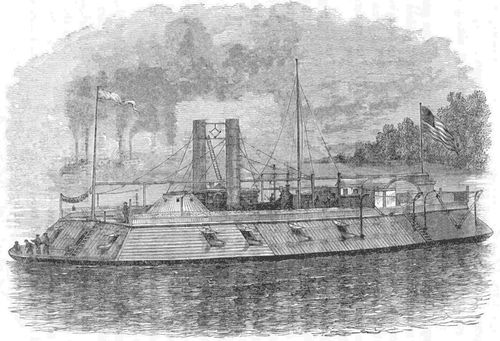
A River-Gunboat.
These river-gunboats, like the little "Monitor," had none of the grace
and grandeur of the old style of sailing-frigate, in which Paul Jones
fought so well for his country. The tapering masts of the mighty
frigate, the spidery cordage by which the blue-jackets climbed to
loosen the snowy sheets of canvas—these gave way in the gunboat to a
single slender flagstaff for signalling, and two towering smoke-stacks
anchored to the deck by heavy iron cables, and belching forth the
black smoke from roaring fires of pitch-pine or soft coal. Instead of
the gracefully curved black sides, with two rows of ports, from which
peeped the muzzles of great cannon, the gunboat's sides above water
sloped like the roof of a house, and huge iron shutters hid the cannon
from view. Inside, all was dark and stuffy, making
battle-lanterns necessary even in daylight fights. The broad white
gun-deck, scrubbed to a gleaming white by hollystone and limejuice, on
which the salt-water sailors gathered for their mess or drill, was
replaced by a cramped room, with the roof hardly high enough to let
the jolly tars skylark beneath without banging their skulls against
some projecting beam. Truly it may be said, that, if the great civil
war made naval architecture more powerful, it also robbed
the war-vessels of all their beauty.
It is hard to appreciate now the immense difficulty experienced in
getting those first seven river-gunboats built by the appointed time.
The war had just begun, and a people accustomed to peace had not yet
found out that those not actually at the seat of war could continue
their usual course of life unmolested. Rolling-mills, machine-shops,
founderies, saw-mills, and shipyards were all idle. Working-men were
enlisting, or going to the Far West, away from the storm of war that
was expected to sweep up the Mississippi Valley. The timber for the
ships was still standing in the forests. The engines that were to
drive the vessels against the enemy were yet to be built. Capt. Eads's
contract called for the completion of the seven vessels in sixty-five
days, and he went at his work with a will. His success showed that not
all the great services done for a nation in time of war come from the
army or navy. Within two weeks four thousand men were at work getting
the gunboats ready. Some were in Michigan felling timber, some in the
founderies and machine-shops of Pittsburg, and others in the shipyards
at St. Louis, where the hulls of the vessels were on the stocks. Day
and night, weekdays and Sundays, the work went on; and in forty-five
days the first vessel was completed, and christened the "St. Louis."
The others followed within the appointed time. Before the autumn of
1861, the river navy of the United States numbered nearly a score of
vessels, while nearly forty mortar-boats were in process of
construction. Of this flotilla, Capt. A. H. Foote, an able naval
officer, was put in command, and directed to co-operate with the land
forces in all movements.
The first service to which the gunboats were assigned was mainly
reconnoitring expeditions before the front of the advancing Union
armies. They were stationed at the junction of the Ohio and
Mississippi Rivers; and the country about Cairo was occupied by a
large body of Union troops under the command of Gen. Grant, then a
young officer little known. The opening fight of the river campaign
was little more than a skirmish; but it proved the superiority of the
gunboats over a land-force for the purpose of opening the river. One
bright day in September, the "Lexington" and "Conestoga" were ordered
to proceed down the river eight or ten miles, and dislodge a
Confederate battery that had taken a position on Lucas
Point. The two vessels steamed cautiously down the stream, without
encountering any resistance until within easy range of the battery,
when the Confederates opened with sixteen cannon. The shot and shells
fell all about the vessels; but neither was hit, showing that the
Confederate gunners were not yet used to firing at a moving mark. But
the fire of the gunboats was admirably directed; the shells falling
among the Confederates, dismounting the guns, and driving the gunners
from their pieces. It was too hot a spot for any man to hold; and a
cavalry corps quickly attached their horses to the guns, and drew them
down the river to the shelter of the Confederate works at Columbus.
Then the defeated party sent up the gunboat "Yankee" to attack the two
victors, but this vessel was quickly disposed of. She opened fire at
long range, but without success. The first shot from the "Conestoga"
struck the water a few feet from the "Yankee," and, ricochetting,
plunged into her hull. The discomfited vessel immediately put about,
and started down stream, followed by a heavy fire from the two
Northern ships. Just as she was passing out of range, an eight-inch
shell from the "Lexington" struck her starboard wheel-house, and
shattered the paddle-wheel, totally disabling the vessel, so that she
drifted sidelong to her anchorage like a wounded duck.
On the return of the Northern vessels up the river, they first
encountered the form of warfare that proved the most perilous for the
sailors of the river navy. Confederate sharp-shooters lined the banks,
perched in the trees, or hidden in the long, marshy grass; and any
unwary tar who showed his head above the bulwarks was made a target
for several long rifles in the hands of practised shots.
The next active service performed by the gunboats was at the battle of
Belmont, directly opposite the Confederate batteries at Columbus. The
Union troops, landing in force, had driven the Confederates from their
camp, and were engaged in securing the spoils, when the gunners at
Columbus, seeing that the camp was in the hands of the enemy, turned
their heavy guns on it, and soon drove out the Yankees. The
Confederates had rallied in the woods, and now came pouring out, in
the hope of cutting off the Union retreat to the boats. On all sides
the dark gray columns could be seen marching out of the woods, and
pouring down upon the retreating army of the North. Batteries were
wheeling into position, and staff-officers in travelling carriages
were dashing to and fro carrying orders. It seemed a black
day for the three or four thousand Unionists who were making for their
transports with all possible speed. But now was the time for the
gunboats to take a hand in the fight. Three of them dropped into
position, and began a deadly fire upon the Confederate line. The huge
shells ploughed their way through whole platoons of men. Bursting,
they would mow down soldiers like saplings before a cyclone. One shell
exploded directly beneath an officer's carriage, and threw horses,
carriage, and men high in the air. The Confederates hastened to get
their field-batteries into position, and replied to the deadly fire
from the ships, but to no avail. Their light artillery was of no
effect upon the plated sides of the gunboats, and they saw their
cannon dismounted or shattered by the solid shot from the big guns of
the iron-clads. They fought bravely, but the conflict was unequal. It
was sheer madness for any body of men, with muskets and light
artillery, to stand against the fire of the gunboats. The gunboats
saved the day. The retreat of the Union army was unchecked; and,
covered by the war-vessels, the transports returned safely to Cairo.
On the Tennessee River, near the northern boundary of Tennessee, the
Confederates had thrown up certain earthworks to which they gave the
name of Fort Henry. This, with Fort Donelson, situated near by, formed
the principal Confederate strongholds in Tennessee. Gen. Grant
determined to strike a heavy blow by capturing these two forts; and
Commodore Foote, with his seven gunboats, was ordered to co-operate
with the land-forces in the expedition. They started from Cairo on
Feb. 2, 1862. When a few miles below the fort, the troops were landed
and ordered to proceed up the back country, and attack the fort in the
rear, while Foote should engage it from the river with his gunboats.
While the troops were being landed, Gen. Grant boarded the "Essex,"
and went up the river to get a view of the fort they were about to
attack. Had it been completed in accordance with the plans of the
engineers, it would have been most formidable. Time, however, had been
short, and the earthworks were far from being completed. There were
many points on the river or on the opposite bank, from which a
well-directed artillery fire would make them untenable. The
Confederate commander, Gen. Tilghman, fully appreciated this fact,
and, at the approach of the gunboats, had sent four-fifths of his
garrison across the country to Fort Donelson, being determined to
sacrifice as few men as possible in the defence of so
untenable a position. While Grant and Foote were examining the works
through their field-glasses, the sullen boom of a great gun came over
the waters, and a heavy rifled shot crashed through the stateroom of
Capt. Porter on the "Essex." The two commanders concluded that the
Confederate gunners, though new to war, understood something of
artillery practice; and the "Essex" was accordingly taken down the
river, out of range.
The following night was chill and rainy; and the Union forces,
bivouacking on shore, grumbled loudly over their discomforts. The
morning dawned dark; but soon the sun came out, and the preparations
for battle were begun. The troops were first despatched on their
cross-country march; and, as they departed, Commodore Foote remarked
coolly, that his gunboats would have reduced the fort before the land
forces came within five miles of it. This proved to be the fact.
The gunboats formed in line of battle, and advanced up the river. The
four iron-clads led, steaming abreast. About a mile in the rear, came
the three wooden vessels. The fort was soon in range; but both parties
seemed anxious for a determined conflict, and no shot was fired on
either side as the gunboats came sullenly on. How different must have
been the feelings of the two combatants! Tilghman, with his handful of
men, hardly able to work eight of the eleven guns mounted in his fort,
and knowing that his defeat was a mere question of time; Foote, with
his iron-clads and supporting gunboats, his seventy-two guns, and his
knowledge that six thousand men were marching upon the rear of the
Confederate works. On the one side, all was absolute certainty of
defeat; on the other, calm confidence of victory.
When the flotilla was within a third of a mile of the fort, the fire
began. The gunners on the ships could see the muzzles of the
Confederate guns, the piles of shells and cannon-balls, and the men at
their work. The firing on both sides was deliberate and deadly. The
Confederates were new to the work, but they proved themselves good
marksmen. The first shot was fired from the shore, and, missing the
"Essex" by but a few feet, plumped into the water, so near the next
ship in line as to throw water over her decks. Within five minutes,
the "Essex" and the "Cincinnati" were both hit. The armor of the
gunboats proved no match for the shots of the Confederates, and in
many cases it was penetrated. In some instances, shells, entering
through the portholes, did deadly damage.
On the shore, the shells from the gunboats were doing
terrible work. Banks of solid earth, eight feet thick, were blown away
by the terrible explosions. One, bursting in front of a ten-inch
columbiad, filled that powerful gun with mud almost to the muzzle,
disabling it for the remainder of the fight. A shot from the "Essex"
struck the muzzle of a great gun, ripped off a splinter of iron three
feet long, and crushed a gunner to pulp. The gun was just about to be
fired, and burst, killing or wounding every man of the crew. At the
same moment a shell crashed through the side of the "Essex," killing
men right and left: took off the head of a sailor standing by Capt.
Porter, wounded the captain, and plunged into the boiler. In an
instant the ship was filled with scalding steam. The men in the
pilot-house were suffocated. Twenty men and officers were killed or
scalded. The ship was disabled, and drifted out of the fight. While
withdrawing, she received two more shots, making twenty in all that
had fallen to her share in this hot engagement. But by this time the
fort was very thoroughly knocked to pieces. The big twenty-four
pounder was dismounted, and five of its crew killed. Gun after gun was
keeled over, and man after man carried bleeding to the bomb-proofs,
until Gen. Tilghman himself dropped coat and sword, and pulled away at
a gun by the side of his soldiers. Receiving ten shots while they
could only fire one, this little band held out for two long hours; and
only when the crew of the last remaining piece threw themselves
exhausted on the ground, did the flag come fluttering down. Gen.
Tilghman went to the fleet and surrendered the fort to Commodore
Foote, and Grant's army came up more than an hour after the battle was
over. To the navy belongs the honor of taking Fort Henry, while to
Gen. Tilghman and his plucky soldiers belongs the honor of making one
of the most desperate fights under the most unfavorable circumstances
recorded in the history of the civil war.
The fall of Fort Henry opened the way for the Union advance to Fort
Donelson, and marked the first step of the United States Government
toward regaining control of the Mississippi. It broke the northern
battle-line of the Confederacy, and never again was that line
re-established.
With Fort Henry fallen, and Gen. Tilghman and his little garrison
prisoners on the Union gunboats, Grant's soldier-boys and Foote's
blue-jackets began active preparations for continuing the conquest of
Tennessee by the capture of Fort Donelson. No time was lost. The very
night that the stars and stripes were first hoisted over the
bastion of Fort Henry saw three of Foote's gunboats steaming up the
river on a reconnoitring expedition. Before them the Confederates fled
in every direction. After several hours' advance, they came to a heavy
railroad-bridge spanning the river, and effectually preventing further
progress. Beyond the bridge were several Confederate steamers, black
with men, and heavily laden with valuable military stores. With all
steam on, they were dashing up stream, and rapidly leaving the
gunboats behind. Enraged at seeing such valuable prizes slipping
through their hands, the Union gunners sent shell after shell
shrieking after the flying boats, but to no avail. A party was hastily
landed for the purpose of swinging the draw of the bridge, but found
the machinery broken, and the ways on which the bridge swung twisted
and bent out of shape. An hour's hard work with axes and crowbars, and
the draw was swung far enough to let pass the "Conestoga" and the
"Lexington." They dashed forward like greyhounds slipped from the
leash; and, after several hours' hard steaming, a smoke over the
tree-tops told that the Confederate fugitives were not far ahead. Soon
a bend in the river was passed; and there, within easy range, were two
of the flying steamers. A commotion was visible on board, and boat
after boat was seen to put off, and make for the shore; on reaching
which the crews immediately plunged into the woods, and were out of
sight before the gunboats could get within range. Soon light blue
smoke curling from the windows of the steamers told that they had been
fired; and as the last boats left each vessel, she ceased her onward
course, and drifted, abandoned and helpless, down the stream. When
within about a thousand yards of the two gunboats, the deserted
steamers blew up with such force, that, even at that great distance,
the glass was shattered in the "Conestoga," and her woodwork seriously
damaged.
The two gunboats leisurely continued their excursion into the heart of
the enemy's country. Little or no danger was to be feared. At that
time, the Confederates had not learned to plant torpedoes in their
rivers, to blow the enemy's vessels into fragments. There was no
artillery stationed in that section to check their progress, and the
only resistance found was an occasional rifle-shot from some concealed
sharp-shooter in the bushes on the shore. On the 7th of February the
gunboats reached Cerro Gordo, Tenn.; and here they made a valuable
capture. The Confederates had been at work for weeks
converting the steamer "Eastport" into an iron-clad ram; and, as the
Union vessels came up, they found her almost completed, and absolutely
without defence. Besides the new vessel, there was in the shipyard a
large quantity of lumber and ship-timber, which was of the greatest
value to the builders of the river navy. The two gunboats promptly
captured all this property; and waiting until the "Tyler," which had
been detained at the drawbridge, came up, they left her in charge, and
continued their raid into the enemy's country. Little incident
occurred until they reached the head of navigation of the river, where
they found all the Confederate vessels which had been flying before
them for two days. These were burned, and the two gunboats started
back down the river, stopping for the "Eastport" on the way. The
captured vessel was afterwards completed, and served the cause of the
Union for two years, when she was blown up on the Red River.
When the raiding expedition reached Cairo, the officers found Foote
getting his squadron together for the attack on Fort Donelson. This
fortification was one strongly relied upon by the Confederates for the
maintenance of their northern line of battle. It was on the bank of
the Cumberland River, nearly opposite the site of Fort Henry on the
Tennessee. A garrison of at least fifteen thousand men manned the
works, and were commanded by no less than three generals; and the fact
that there were three generals in command had much to do with the
fall of the fort. Its strength was rather on its river-front. Here the
river winds about between abrupt hillsides, and on the front of one of
these hills stood Fort Donelson. The water-batteries were made up of
heavy guns, so mounted as to command the river for miles. On the
landward side were heavy earthworks, abatis, and sharp pointed
chevaux-de-frise.
Against this fortification marched Grant with an army of eighteen
thousand men, and Foote with his flotilla of gunboats. The Sunday
before the start, Foote, who was a descendant of the old Puritans, and
ever as ready to pray as to fight, attended church in a little
meeting-house at Cairo. The clergyman did not appear on time; and the
congregation waited, until many, growing weary, were leaving the
church. Then the bluff old sailor rose in his pew, and, marching to
the pulpit, delivered a stirring sermon, offering thanks for the
victories of the Union arms, and imploring divine aid in the coming
struggles. The next day he was on his way to hurl shot and
shell at the men in the trenches of Fort Donelson.
While the capture of Fort Henry was a feather in the caps of the
sailor-boys of the North, Fort Donelson must be credited to the valor
of the soldiers. Against the heavy wall of the water-batteries, the
guns of Foote's little flotilla pounded away in vain, while the heavy
shells from the Confederate cannon did dreadful work on the thinly
armored gunboats. It was on the 13th of April that the assault was
opened by the "Carondelet." This vessel had reached the scene of
action before the rest of the flotilla, and by order of the army
commander tested the strength of the fort by a day's cannonade. She
stationed herself about a mile from the batteries, at a spot where she
would be somewhat protected by a jutting point, and began a deliberate
cannonade with her bow-guns. One hundred and thirty shots went
whizzing from her batteries against the front of the Confederate
batteries, without doing any serious damage. Then came an iron ball
weighing one hundred and twenty pounds, fired from a heavy gun, which
burst through one of her portholes, and scattered men bleeding and
mangled in every direction over the gun-deck. She withdrew a short
distance for repairs, but soon returned, and continued the fire the
remainder of the day. When evening fell, she had sent one hundred and
eighty shells at the fort, with the result of killing one man. This
was not promising.
The next day the attack was taken up by all the gunboats. The distance
chosen this time was four hundred yards, and the fight was kept up
most stubbornly. It was St. Valentine's Day; and as the swarthy
sailors, stripped to the waist, begrimed with powder, and stained with
blood, rammed huge iron balls down the muzzles of the guns, they said
with grim pleasantry, "There's a valentine for the gray-coats." And
right speedily did the gray-coats return the gift. Shot and shell from
the batteries came in volleys against the sides of the gunboats. In
the fort the condition of affairs was not serious. The shells chiefly
fell in the soft earth of the hilltop above, and embedded themselves
harmlessly in the mud. One of the gunners after the fight said: "We
were more bothered by flying mud than any thing else. A shell bursting
up there would throw out great clots of clay, that blocked up the
touch-holes of our guns, spoiled the priming of our shells, and
plastered up the faces of our men. Of course, now and then a
bit of shell would knock some poor fellow over; but, though we were
all green hands at war, we expected to see lots more blood and carnage
than the Yankee gunboats dealt out to us."
The gunboats, however, had put themselves in a hot place. Twenty heavy
guns on the hillside high above were hurling solid shot down on the
little fleet. The sailors stuck to their work well; and though the
vessels were in a fair way of being riddled, they succeeded in driving
the enemy from his lower battery. But the upper battery was
impregnable; and the gunners there, having got the correct range, were
shooting with unpleasant precision. Two of the vessels were disabled
by being struck in the steering-chains. On the "Carondelet" a piece
burst, hurling its crew bleeding on the deck. No vessel escaped with
less than twenty wounds, while the flagship was hit fifty-nine times.
Commodore Foote was wounded in the foot by a heavy splinter; a wound
from which he never fully recovered, and which for some years debarred
him from service afloat.
That afternoon's bombardment showed clearly that Fort Donelson could
never be taken by the navy. When Foote ordered his gunboats to cease
firing and drop back out of position, the Confederates swarmed back
into the lower battery that they had abandoned; and, after a few
hours' work, the fort was as strong as before the fight. It was the
first case in the history of the war in which the navy had failed to
reduce the fortifications against which it had been ordered. The
Hatteras forts, the works at Roanoke Island and at Hilton Head, Fort
Henry—all had fallen before the cannon of the Union sailors; and
Foote may well be pardoned if he yielded to Gen. Grant with great
reluctance the honor of reducing Fort Donelson. For two days Grant's
army invested the fort, and kept up a constant cannonade; then the
defenders, despairing of escape, and seeing no use of further
prolonging the defence, surrendered.
The capture of Fort Donelson was an important success for the Union
arms. In addition to the large number of prisoners, and the great
quantity of munitions of war captured, the destruction of the fort
left the Cumberland River open to the passage of the Union gunboats,
and the Confederate battle-line was moved back yet another point. But
now was to come a most heroic test of the power of the river-navy and
the army of the North.
Some sixty miles below Cairo, the rushing, tawny current of the mighty
Mississippi turns suddenly northward, sweeping back,
apparently, toward its source, in a great bend eight or ten miles
long. At the point where the swift current sweeps around the bend, is
a low-lying island, about a mile long and half a mile wide. This is
known as Island No. 10; and at the opening of the war, it was supposed
to hold the key to the navigation of the Mississippi River. Here the
Confederates had thrown up powerful earthworks, the heavy guns in
which effectually commanded the river, both up and down stream. The
works were protected against a land bombardment by the fact that the
only tenable bit of land, New Madrid, was held by Confederate troops.
The shores of the Mississippi about Island No. 10 present the
dreariest appearance imaginable. The Missouri shore is low and swampy.
In 1811 an earthquake-shock rent the land asunder. Great tracts were
sunk beneath the water-level of the river. Trees were thrown down, and
lie rotting in the black and miasmatic water. Other portions of the
land were thrown up, rugged, and covered with rank vegetation, making
hills that serve only as places of refuge for water-moccasons and
other noxious reptiles. Around this dreary waste of mud and water, the
river rushes in an abrupt bend, making a peninsula ten miles long and
three wide. Below this peninsula is New Madrid, a little village in
the least settled part of Missouri; here the Confederates had
established an army-post, and thrown up strong intrenchments. It was
not, however, upon the intrenchments that they relied, but rather upon
the impassable morasses by which they were surrounded on every side.
In New Madrid were posted five or six thousand men; a small fleet of
Confederate gunboats lay in the stream off the village; and higher up
the river was Island No. 10, with its frowning bastions and rows of
heavy siege-guns, prepared to beat back all advances of the Union
troops.
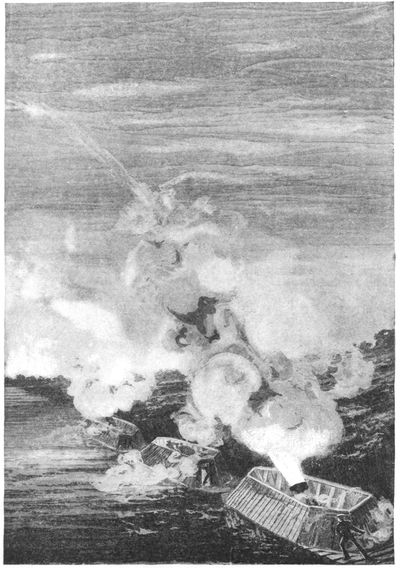
Mortar Boats at Island No. 10.
In planning for the attack of this stronghold, the first difficulty
found by Commodore Foote lay in the fact that his gunboats were above
the batteries. In fighting down stream in that manner, the ships must
be kept at long range: for, should a shot from the enemy injure the
engine or boiler of a gunboat, the vessel is doomed; for the rapid
current will rush her down under the enemy's guns, and her capture is
certain. But the peril of running the batteries so as to carry on the
fight from below seemed too great to be ventured upon; and besides,
even with Island No. 10 passed, there would still be the batteries of
New Madrid to cope with, and the gunboats of the
Confederates to take the ships in the rear. So it was determined that
the navy should begin a bombardment of the Confederate works, while
the army under Gen. Pope should attend to New Madrid. Accordingly, on
March 15, the whiz of a rifled shell from the flagship "Benton"
announced to the Confederates that the North wanted the Mississippi
opened for travel.
In this engagement use was made for the first time of a new style of
vessel known as mortar-boats, which in later conflicts on the rivers
did great service. These boats were simple floats, heavily built, and
calculated to stand the most terrible shocks. On the float was raised
a sort of sheet-iron fort or wall, about five feet high; and in the
centre stood one thirteen-inch mortar. The mortar is the earliest of
all forms of cannon, and was in use in Europe in 1435. Its name is
derived from its resemblance to an ordinary druggist's mortar. The
great thirteen-inch mortars used in the civil war weighed seventeen
thousand pounds, and threw a shell thirteen inches in diameter. These
shells were so heavy that it took two men to bring them up to the
cannon's mouth. In the river-service, the mortar-boats were moored to
the bank, and a derrick was set up in such a position that the shells
could be hoisted up, and let fall into the yawning iron pot below.
Foote had fourteen of these monsters pounding away at the
Confederates, and the roar was deafening.
A correspondent of the "Chicago Times," who was with the fleet at the
time of the bombardment, thus describes the manner of using these
immense cannon: "The operation of firing the mortars, which was
conducted when we were near by, is rather stunning. The charge is from
fifteen to twenty-two pounds. The shell weighs two hundred and thirty
pounds. For a familiar illustration, it is about the size of a large
soup-plate. So your readers may imagine, when they sit down to dinner,
the emotions they would experience if they happened to see a ball of
iron of those dimensions coming toward them at the rate of a thousand
miles a minute. The boat is moored alongside the shore, so as to
withstand the shock firmly, and the men go ashore when the mortar is
fired. A pull of the string does the work, and the whole vicinity is
shaken with the concussion. The report is deafening, and the most
enthusiastic person gets enough of it with two or three discharges.
There is no sound from the shell at this point of observation, and no
indication to mark the course it is taking; but in a few
seconds the attentive observer with a good glass will see the cloud of
smoke that follows its explosion, and then the report comes back with
a dull boom. If it has done execution, the enemy may be seen carrying
off their killed and wounded."
And so from mortar-boats and gunboats, the iron hail was poured upon
the little island, but without effect. When Foote with his flotilla
first opened fire, he thought that the Confederate works would be
swept away in a day or two. His ordnance was the heaviest ever seen on
the Mississippi, and in number his guns were enough to have battered
down a mountain. But his days grew to weeks, and still the flag of the
Confederacy floated above Island No. 10. The men on the mortar-boats
were giving way under the tremendous shocks of the explosions. Many
were rendered deaf for days at a time. The jar of the explosions
brought to the surface of the river hundreds of old logs and roots
that had lain rotting in the soft ooze of the bottom. When all the
mortars were engaged, the surface of the river was covered with foam
and bubbles; and men by the thousand went about with their ears
stuffed with tow, to protect them against the sound. Yet, after weeks
of such firing, Gen. Beauregard telegraphed to Richmond, that the
Yankees had "thrown three thousand shells, and burned fifty tons of
gunpowder," without injuring his batteries in the least.
The Confederates remained passive in their trenches. They had no guns
that would carry far enough to reply to Foote's mortars, and they did
not wish to waste powder. It was galling to stand fire without
replying; but, fortunately for them, the fire was not very deadly, and
but few were injured. When, however, a shell did fall within the
works, it made work enough to repair damages, as by its explosion a
hole as large as a small house would be torn in the ground. But for
every one that fell within the batteries, twenty fell outside. Some
strange freaks are recorded of the shells. One fell on a cannon,
around which eight or ten men were lying. The gun-carriage was blown
to pieces, but not a man was hurt. Another fell full on the head of a
man who was walking about distributing rations, and not so much as a
button from his uniform was ever found.
But while the navy was thus playing at bowls with great guns, the army
had marched through the interior, captured New Madrid, and obtained a
foothold below Island No. 10. Thus the Confederates were surrounded;
and the very impassability of the land, that had been an
advantage to them, now told against them, for it cut off all hope of
re-enforcements. Gen. Pope's position was such that he could not get
at the island, nor secure a commanding position, without aid from the
navy. He begged Foote to try to run the batteries; but the commodore
replied, that the risk was greater than the prospective gain, and
continued his cannonade. Then a new idea was broached. By cutting a
canal through the bayous, swamps, and woods of the peninsula, the
lighter vessels could be taken by the fort without risk, and Foote
would then dare the dangers of a dash by in the gunboats. Every one
said that such a canal was impossible; but the men of the North were
given to doing impossible things in those days, and while Foote's
mortar-boats continued their thunder, fifteen hundred men were set to
work cutting a way through the noisome swamps. A channel forty feet
wide must be made. First gangs of men with axes and saws, working in
three feet of water, went ahead, cutting down the rank vegetation. As
fast as a little space was cleared, a small steamer went in, and with
dredge and steam-capstan hauled out the obstructions. In some places
the surveyed channel was so filled with drift-wood, fallen trees, and
tangled roots, that the labor of a thousand men for a day seemed to
make no impression. When the canal was pretty well blocked out, the
levee was cut; and the rush of the waters from the great river
undermined trees, and piled up new obstacles for the steamers to tow
away. Amid the foulest vapors the men worked, and more than a thousand
were sent to the hospital with chills and fever, and rheumatism. The
most venomous snakes lurked in the dark recesses of the swamp; on
cypress-stumps or floating logs the deadly water-moccason lay
stretched out, ready to bite without warning. Wherever there was a bit
of dry ground, the workers were sure to hear the rattle of the
rattlesnake. Sometimes whole nests of these reptiles would be
uncovered.
The work was continued day and night. When the failing daylight ceased
to make its way through the thickly intwined branches of trees and
climbing vines, great torches would be lighted, and by their fitful
glare the soldiers and sailors worked on in the water and mud. The
light glared from the furnaces of the steamers, lighting up the
half-naked forms of the stokers. Now and then some dry vine or tree
would catch a spark from a torch, and in an instant would be
transformed into a pillar of fire. After eight days of work the canal
was finished, and was found to be of sufficient depth for
the passage of the transports. And now Commodore Foote saw that the
time had come when he must attempt to run his gunboats past the forts,
be the danger what it might.
On April 1, Foote ordered a reconnoissance of the batteries, and this
order evoked one of the most daring deeds in the history of the war.
The night was pitchy dark, and heavy clouds were driven across the sky
by a strong, damp wind, that told of a coming storm. In five boats a
party of fifty sailors and fifty soldiers put off from the fleet,
prepared to go down and beard the Confederate lion in his den. Hardly
had they started on their perilous expedition, when the rain began
falling in sheets, and now and again flashes of lightning made the
dark shores visible for an instant, then the black night hid every
thing again from view. It was midnight, and the fierceness of the wind
added to the terror of the moment. On the banks, the great
forest-trees were bending and groaning before the blast, while the
broad surface of the river was lashed into foaming billows. Under
cover of the darkness the little band passed rapidly down the river;
past the shore-batteries and past the Confederate picket-boats, they
sped unseen. When they were within a few feet of the shore, a flash of
lightning revealed them for just an instant to the sentries. Then all
was black, save for the quick flashes of the sentries' guns as they
gave the alarm and fell back. The Federals landed rapidly, and drove
the confused Confederates from the battery. Then began the work of
spiking the guns. Every fifth man carried a number of rat-tail files,
which were to be driven into the vents of the cannon, and then broken
off. While the raiders were engaged in this work, the Confederates
rallied, and soon drove back the blue-jackets to their boats, with a
slight loss in killed and captured. How many guns they had disabled,
it is hard to say. In the excitement and glory of successful
adventure, the reports were much exaggerated. Histories of that date
depict the men as calmly spiking every gun, and then retiring
deliberately. One writer claims that only one gun was spiked. However,
testimony from Confederates on duty in the batteries goes to show that
four guns were totally disabled. But the true value of the adventure
to the Union forces was the dash and valor it disclosed, and the
encouragement the people received from its success.
The next day after this successful exploit, a gunboat, the
"Carondelet," was made ready to try the dash past the batteries of
Island No. 10. Again the weather was favorable to the plans
of the Federals, for the night was as dark and wild as the one before.
The day had been clear, and the night opened with so bright a moon
that for a time it was thought that the project would have to be
abandoned; but toward ten o'clock a heavy thunder-storm came up, and
soon the black sky, the wildly waving tree-tops, and the sheets of
rain scudding across the river, gave promise of a suitable night.
All day the sailors on the "Carondelet" had been working busily,
getting their vessel in trim for the trip. Heavy planks were laid
along the deck, to ward off plunging shot. Chain cables were coiled
about all weak points, cord-wood was piled around the boilers, and the
pilot-house was wrapped round and about with heavy hawsers. On the
side toward the battery was tied a large barge, piled high with
cotton-bales. When the time for starting drew nigh, all lights were
extinguished. The guns were run in, and the ports closed. The sailors,
heavily armed, were sent to their stations. Muskets, revolvers, and
sabres were in the racks. Down in the boiler-room the stokers were
throwing coal upon the roaring fires; and in the engine-room the
engineer stood with his hand on the throttle, waiting for the signal
to get under way.
Towards eleven o'clock the time seemed propitious for starting. The
storm was at its height, and the roll of the thunder would drown the
beat of the steamer's paddles. The word was given; and the
"Carondelet," with her two protecting barges, passed out of sight of
the flotilla, and down towards the cannon of the enemy. For the first
half-mile all went well. The vessel sped along silently and unseen.
The men on the gun-deck, unable to see about, sat breathlessly,
expecting that at any moment a cannon-ball might come crashing through
the side into their midst. Suddenly from the towering smoke-stacks,
burst out sheets of flame five feet high, caused by the burning soot
inside, and lighting up the river all about. Quickly extinguished,
they quickly broke out again; and now from the camp of the alarmed
enemy came the roll of the drum, and the ringing notes of the bugle
sounding the alarm. A gunboat was bearing down on the works, and the
Confederates sprang to their guns with a will. The men on the
"Carondelet" knew what to expect, and soon it came. Five signal
rockets rushed up into the sky, and in an instant thereafter came the
roar of a great gun from one of the batteries. Then all joined in, and
the din became terrible. With volley after volley the
Confederates hurled cannon-balls, shells, musket, and even
pistol-bullets at the flying ship, that could only be seen an instant
at a time by the fitful flashes of the lightning. On the "Carondelet"
all was still as death. The men knew the deadly peril they were in,
and realized how impossible it was for them to make any fight. In the
black night, threading the crooked and ever-changing channel of the
Mississippi River, it was impossible to go more than half-speed. In
the bow men were stationed casting the lead, and calling out the
soundings to the brave old Capt. Hoel, who stood on the upper deck
unprotected from the storm of bullets, and repeated the soundings to
Capt. Walker. So through the darkness, through the storm of shot and
shell, the "Carondelet" kept on her way. Past the land-batteries, past
the rows of cannon on the island, and past the formidable floating
battery, she swept uninjured. Heavy and continuous as was the fire of
the Confederates, it was mainly without aim. The hay-barge was hit
three times, but not a scar was on the gunboat when she stopped before
the water-front of New Madrid after twenty minutes' run through that
dreadful fire.
And now the roar of the great guns had died away, and the men on the
vessels of the flotilla up the river were all anxiety to know what had
been the fate of their gallant comrades on the "Carondelet." All the
time the battle raged, the decks of the ships at anchor were crowded
with sailors looking eagerly down the river, and trying to make out by
the blinding flashes of the cannon the dark form of a gunboat speeding
by the hostile camp. Now all is silent; the roar of battle is over,
the flash of gunpowder no more lights up the night. But what has
become of the gallant men who braved that tempest of steel and iron?
Are they floating down the troubled waters beneath the wreck of their
vessel? It was a moment of suspense. After a few minutes' silence,
there comes through the strangely quiet air the deep boom of a heavy
gun. It had been agreed, that, if the "Carondelet" made the passage of
the batteries safely, she should fire six heavy guns. The old tars on
the decks say softly to themselves, "One." Then comes another, and a
third, and still more, until suddenly a ringing cheer goes up from the
flotilla, louder than the thunder itself. Men dance for joy; grizzled
tars fall into each other's arms, sing, shout, cry. An answering
salute goes booming back, rockets scud up into the clouds; and
Commodore Foote, with a heart too full for talking, goes down into his
cabin to be alone.
That night's work by the "Carondelet" terminated Confederate
domain on Island No. 10. The next night another gunboat came down, and
the two set to work carrying the troops across the river, protecting
artillerymen engaged in erecting batteries, and generally completing
the investment of the island. In two days every loop-hole of escape
for the Confederates is closed,—gunboats above and below them,
batteries peering down from every bluff, and regiments of infantry,
all prepared to move upon the works. They made one or two ineffectual
but plucky attempts to ward off capture. One private soldier swam
ashore, skulked past the Union pickets, and made his way to one of the
Union mortar-boats. He succeeded in getting to the mortar, and
successfully spiked it, thus terminating its usefulness. A second
Confederate succeeded in reaching the deck of the mortar-boat, but
while making his way across the deck tripped and fell. The rat-tail
file he was carrying was driven into his side, making a wound from
which he died in two hours. A third man, reckless of life, set out in
a canoe to blow up a gunboat. He carried with him a fifty-pound keg of
gunpowder, which he proposed to strap on the rudder-post of the
vessel. He succeeded in getting under the stern of the vessel; but the
gleam of his lighted match alarmed the sentry, who fired, hitting him
in the shoulder. The Confederate went overboard, and managed to get
ashore; while his keg of powder, with the fuse lighted, went drifting
down stream. Soon it exploded, throwing up an immense column of water,
and showing that it would have sent the stoutest vessel to the bottom
had it been properly placed.
But such struggles as these could not long avert the impending
disaster. The Confederates were hemmed in on every side. It was true
that they had a strong position, and could make a desperate
resistance; but they were separated from their friends, and their
final downfall was but a question of time. Appreciating this fact,
they surrendered two days after the "Carondelet" had passed the
batteries; and Foote made his second step (this time one of sixty
miles) toward the conquest of the Mississippi.
To-day nothing remains of the once extensive island, save a small
sand-bank in the middle of the great river. The rushing current of the
Father of Waters has done its work, and Island No. 10 is now a mere
tradition.[Back to Contents]
FAMOUS CONFEDERATE PRIVATEERS. — THE "ALABAMA," THE "SHENANDOAH," THE
"NASHVILLE."
 et
us now desert, for a time, the progress of the Union forces down
the Mississippi River, and turn our attention toward the true home of
the sailors,—the blue waters of the ocean. We have heard much, from
many sources, of the exploits of the Confederate commerce-destroyers,
privateers, or, as the Union authorities and the historians of the war
period loved to call them, the "Rebel pirates." In the course of this
narrative we have already dealt with the career of the "Sumter," one
of the earliest of these vessels. A glance at the career of the most
famous of all the Confederate cruisers, the "Alabama," will be
interesting.
et
us now desert, for a time, the progress of the Union forces down
the Mississippi River, and turn our attention toward the true home of
the sailors,—the blue waters of the ocean. We have heard much, from
many sources, of the exploits of the Confederate commerce-destroyers,
privateers, or, as the Union authorities and the historians of the war
period loved to call them, the "Rebel pirates." In the course of this
narrative we have already dealt with the career of the "Sumter," one
of the earliest of these vessels. A glance at the career of the most
famous of all the Confederate cruisers, the "Alabama," will be
interesting.
This vessel was built in England, ostensibly as a merchant-vessel,
although her heavy decks and sides, and her small hatchways, might
have warned the English officials that she was intended for purposes
of war. Before she was finished, however, the customs-house people
began to suspect her character; and goaded on by the frequent
complaints of the United States minister, that a war-vessel was being
built for the Confederates, they determined to seize her. But
customs-house officials do things slowly; and, while they were getting
ready for the seizure, Capt. Semmes, who had taken command
of the new ship, duped them, and got his vessel safely out of English
waters. Private detectives and long-shore customs officers had been
visiting the ship daily on visits of examination; but, by the aid of
champagne and jolly good-fellowship, their inexperienced eyes were
easily blinded to the manifest preparations for a warlike cruise. But
finally came a retired naval officer who was not to be humbugged. A
sailor on board thus tells the story of his visit: "He was evidently a
naval officer, alert and resolute, and soon silenced the officer's
explanations. He looked at the hatchways, shot-racks, and magazines;
and, surveying the hammock-hooks on the berth-deck, said, 'You'll have
a large crew for a merchant-steamer.' We had taken on board some heavy
oak plank, that lay on the main deck; the officer remarked that they
were for anchor-stocks, and was shortly answered, 'Wouldn't make bad
gun-platforms, sir,' which, indeed, was just what they were intended
for. With a 'Good-morning, sir,' our visitor mounted the side and was
gone." This visit alarmed the Confederates; and immediate preparations
were made to run the ship, which still went by the name of the "No.
290," out of the British waters the next day. To disarm suspicion, a
large party of ladies and gentlemen were invited aboard; and the ship
started down the Mersey, ostensibly on her trial trip, with the sounds
of music and popping corks ringing from her decks. But peaceful and
merry as the start seemed, it was the beginning of a voyage that was
destined to bring ruin to hundreds of American merchants, and leave
many a good United States vessel a smoking ruin on the breast of the
ocean. When she was a short distance down the river, two tugs were
seen putting off from the shore; and in a moment the astonished guests
were requested to leave the ship, and betake themselves homeward in
the tugs. It is unnecessary to follow the voyage of the "No. 290" to
Nassau, and detail the way in which cannon, ammunition, and naval
stores were sent out from Portsmouth in a second vessel, and
transferred to her just outside of Nassau. It is enough to say that on
a bright, clear Sunday morning, in the latter part of August, 1862,
Capt. Rafael Semmes, late of the Confederate cruiser "Sumter," a
gentleman of middle height, wearing a uniform of gray and gold, his
dark mustache waxed to such sharp points that one would think him a
Frenchman rather than a Southerner, stood on the quarter-deck of the
"No. 290," with his crew mustered before him, reading out his
commission from Jefferson Davis, as commander of the
Confederate States' steam-sloop "Alabama." As he read, an old
master's-mate, standing at the peak-halyards, begins pulling at the
ropes. The British ensign, carried through the ship's anonymous days,
comes fluttering down, and in its place runs up the white naval ensign
of the Confederacy, with the starry Southern cross in the red field of
the corner. Then the reading is ended. Boom! goes the starboard
forecastle-gun. The band bursts forth with the stirring notes of
Dixie; and the sailors, after three ringing cheers, crowd forward to
wait for further developments. Soon the sailors are summoned aft
again, and Capt. Semmes addresses them. He tells them that, as the
"Alabama" is to be a ship-of-war, they are released from their
shipping contracts, but are invited to ship under the new plan. He
briefly details the purpose of the cruise. The "Alabama" is to be a
bird of passage, flitting from port to port, and hovering about the
highways of travel, to lie in wait for the merchant-vessels of the
North. Armed vessels she will avoid as much as possible, confining her
warfare to the helpless merchantmen. It is hardly a glorious
programme, but it seems to bear the promise of prize-money; and before
the day is over Capt. Semmes has shipped a crew of eighty men, and
with these the "Alabama" begins her cruise. The remainder of the
sailors are sent ashore, and the "Alabama" starts off under sail, in
search of her first capture.
Let us look for a moment at this vessel, perhaps the most famous of
all cruisers. She was a fast screw-steamer, of a little more than a
thousand tons' burden. Her screw was so arranged that it could be
hoisted out of the water; and, as the saving of coal was a matter of
necessity, the "Alabama" did most of her cruising under sail. Her hull
was of wood, with no iron plating, and her battery consisted of but
eight light guns: two facts which made it necessary that she should
avoid any conflicts with the powerful ships of the United States navy.
Her lines were beautifully fine; and, as she sped swiftly through the
water, Capt. Semmes felt that his vessel could escape the Northern
cruisers as easily as she could overhaul the lumbering merchantmen.
The crew was a turbulent one, picked up in the streets of Liverpool,
and made up of men of all nationalities. Terrific rows would arise in
the forecastle, and differences between the sailors were often settled
by square stand-up fights. The petty officers seldom interfered; one
old boatswain remarking, when he heard the noise of blows in
the forecastle, "Blast them, let 'em slug one another's heads off; it
will keep 'em out of mischief." And it generally did, for the
combatants were usually fast friends the next day.
As soon as the new ship was cleaned up, and put in order, drill began.
The men were all green; and hard, steady work at the guns, and with
the cutlasses, was necessary to fit them for service. The decks
resounded with "right," "left," "head protect," "right overcut." The
men were slow in learning; but the officers were Southerners, devoted
to their cause, and were tireless in getting the crew into shape.
After several days of cruising and drill, a vessel was sighted which
was unmistakably American. One of the sailors tells the story of her
capture graphically. "On the morning of the 5th of September the cry
of 'ship ahoy!' from the masthead brought all hands on deck. Sure
enough, about two miles to the leeward of us was a fine barque, at
once pronounced a 'spouter' (whaler), and an American. In order to
save coal,—of which very essential article we had about three hundred
tons aboard,—we never used our screw unless absolutely necessary. We
were on the starboard tack, and with the fresh breeze soon came
alongside. We had the American flag set, and the chase showed the
stars and stripes. A gun was fired; and, as we came within hail, we
gave the order, 'Back your mainsail; I'll send a boat on board of
you.'
"'Cutter away,' and the boat came down from the davits, and we pulled
for our first prize. It soon became a vain thing, and tiresome; but
this our first essay was a novelty, and we made the stretches buckle
with our impatience to get aboard. The bowman hooked on to the chains,
and we went up the side like cats. When we got aft, the captain asked
in a dazed sort of manner, 'Why—why—what does this mean?' The
master, Fullam, replied, 'You are prize to the Confederate steamer
"Alabama," Capt. Semmes commanding. I'll trouble you for your papers.'
Now, this man had been four years out, and had no doubt heard of the
trouble at home; but he couldn't realize this, and he stared, and
said, 'Confederate government—Alabama—why, that's a State,' and then
was sternly told to get his papers. We were ordered to put the crew in
irons, and they, too, seemed utterly dumbfounded; and one poor fellow
said to me, 'Must I lose all my clothes?' I answered, 'Yes,' but
advised him to put on all he could, and if he had any money to slip it
in his boot. 'Money! I h'aint seen a dollar for three years; but I'm
obliged to ye all the same.'"
Then, after searching the vessel for valuables, the captives
were taken back to the "Alabama," while one boat's-crew remained
behind to fire the vessel.
"She was loaded with oil," writes sailor Haywood; "and, when it
caught, a high column of dense black smoke poured out of the
hatchways, and spread in vast involutions to the leeward. Soon the red
forked flames began to climb her masts, and her spars glowed with
light; with a crash her mainmast fell, carrying the foremast with it,
and sending a shower of sparks high in the air; her stout sides seemed
to burst open; and what was a stately ship was now a blackened hulk,
the rising sea breaking in white-caps over it, and at last, with a
surge and wallow, sinking out of sight." Alone, by one of the
lee-ports, the ruined American captain stood, looking sadly upon the
end of all his long four years' labor. For this he had borne the icy
hardships of the Arctic seas. The long, dreary four years of
separation from wife and home had been lightened by the thought, that
by a prosperous voyage he might bring home enough money to stay always
in the little shingled cottage in the narrow street of some New
England fishing-village; but now all that was over. When he should
arrive home he would be penniless, with nothing but the clothes on his
back, and all because of a war of the very existence of which he knew
nothing. It was hard to bear, but war brings nothing but affliction.
After this capture, the "Alabama" had a lively season for several
weeks, capturing often two or three vessels a day. Generally they met
with no resistance; but occasionally the blood of some old sea-dog
would boil, and he would do the best in his power to injure his
captors. A story of one such incident was thus told by one of the
"Alabama's" crew:—
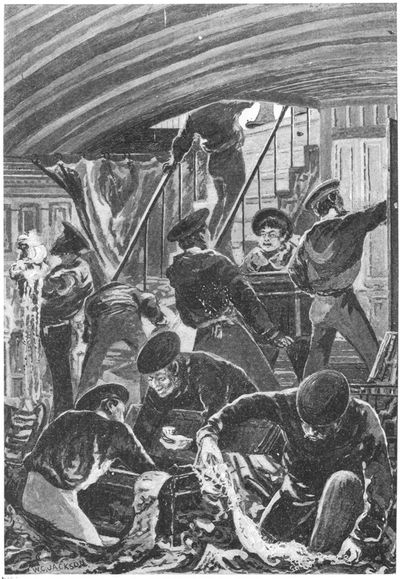
Looting a Prize.
"When we ran around in search of whalers, we came upon a Yankee
skipper who didn't know what surrender meant. We were just well to the
west of the stormy cape, when one morning after breakfast we raised a
whaler. He was headed up the coast, and about noon we overhauled him.
He paid no attention to the first shot, and it was only when the
second one hulled him that he came into the wind. It was then seen
that he had fifteen or sixteen men aboard, and that all were armed
with muskets, and meant to defend the ship. The lieutenant was sent
off with his boat; but no sooner was he within fair musket-range, than
the whaler opened on him, killing one man, and wounding two, at the
first volley. The officer pushed ahead, and demanded a
surrender; but he got another volley, and the reply that the whaler
'would go to the bottom before he would surrender to a Rebel!'
"The boat was recalled, and our gunners were instructed to hull the
whaler with solid shot. We approached him within rifle-range, and
opened fire. Every one of the balls plumped through his side at and
above the water-line, and he answered with his muskets, severely
wounding two men. He was repeatedly hailed to surrender, but in reply
he encouraged his men to maintain their fire. We soon had the sea
pouring into his starboard side through a dozen holes; and when it was
seen that he would soon go down, we ceased firing, and again demanded
his surrender. I can remember just how he looked as he sprang upon the
rail,—tall, gaunt, hair flying, and eyes blazing,—and shouted in
reply,—
"'The 'Ben Scott' don't surrender! Come and take us—if you can.'
"Five minutes later his craft settled down, bow first. We lowered the
boats to save his crew, and, strangely enough, not a man was lost.
When we brought them aboard, the Yankee skipper walked up to Semmes,
bareheaded, barefooted, and coatless, and said,—
"'If I'd only have had one old cannon aboard, we'd have licked ye out
of yer butes! Here we are, and what are ye going to do with us?'
"He was voted a jolly good fellow, and the crew were better treated
than any other ever forced aboard. In order to give them their
liberty, the very next capture we made was bonded, and they were put
aboard to sail for home."
But now the decks of the "Alabama" were getting rather uncomfortably
crowded with prisoners, and it became necessary to put into some port
where they could be landed. Accordingly the ship was headed for
Martinique, and soon lay anchored in the harbor of that place, where
she began coaling. While she lay there, a Yankee schooner put into the
port, and was about to drop anchor near the dangerous cruiser, when
some one gave the skipper a hint; and, with a startled "b'gosh," he
got his sails up, and scudded out to sea. The "Alabama" lay in port
some days. The first set of the sailors who received permission to go
ashore proceeded to get drunk, and raised so great a disturbance, that
thereafter they were obliged to look on the tropical prospect from the
deck of the vessel. The next day a United States war-vessel was seen
standing into the harbor, and Capt. Semmes immediately began to make
preparations to fight her. But as she came nearer she proved
to be the "San Jacinto," a vessel mounting fourteen heavy guns, and
altogether too powerful for the "Alabama." So thinking discretion the
better part of valor, the Confederate ship remained safe in the
neutral harbor. The "San Jacinto" quietly remained outside, thinking
that at last the fox was caught. But that same night, with all lights
extinguished, and running under full steam, the "Alabama" slipped
right under the broadside of her enemy, getting clean away, so quietly
that the "San Jacinto" remained for four days guarding the empty trap,
while the "Alabama" was off again on another voyage of destruction,
and the tuneful souls in the forecastle were roaring out the chorus,—
"Oh, our jolly privateer
Has left old England's shore!
Lord, send us lots of prizes,
But no Yankee man-of-war."
Soon after leaving Martinique, the "Alabama" made a capture which
embarrassed the captain not a little by its size. It was Sunday (which
Capt. Semmes calls in his journal "the 'Alabama's' lucky day"), when a
bit of smoke was seen far off on the horizon, foretelling the approach
of a steamer. Now was the time for a big haul; and the "Alabama's"
canvas was furled, and her steam-gear put in running order. The two
vessels approached each other rapidly; and soon the stranger came near
enough for those on the "Alabama" to make out her huge walking-beam,
see-sawing up and down amidships. The bright colors of ladies' dresses
were visible; and some stacks of muskets, and groups of blue-uniformed
men, forward, told of the presence of troops. The "Alabama" came up
swiftly, her men at the guns, and the United States flag flying from
the peak,—a rather dishonorable ruse habitually practised by Capt.
Semmes. In a moment the stranger showed the stars and stripes, and
then the "Alabama" ran up the white ensign of the Confederacy, and
fired a blank cartridge. But the stranger had no thought of
surrendering, and crowded on all steam and fled. The "Alabama" was no
match for her in speed, so a more peremptory summons was sent in the
shape of a shell that cut the steamer's foremast in two. This hint was
sufficient. The huge paddles ceased revolving, and a boat's-crew from
the "Alabama" went aboard to take possession. The prize proved to be
the mail steamer "Ariel," with five hundred passengers,
besides a hundred and forty marines and a number of army and navy
officers. Now Capt. Semmes had an elephant on his hands, and what to
do with that immense number of people he could not imagine. Clearly
the steamer could not be burned like other captures. For two days
Capt. Semmes kept the prize near him, debating what was to be done,
and then released her; exacting from all the military and naval
officers their paroles that they would not take up arms against the
Confederacy.
After this exploit the "Alabama" went into port for a few days, and
then headed into the Gulf of Mexico. Here she steamed about, capturing
and burning a few United States merchantmen, until on the 11th of
January she found herself off the port of Galveston, where a strong
blockading fleet was stationed. And here she fought her first battle.
About four o'clock of a clear afternoon, the lookout in the cross
trees of the United States sloop-of-war "Hatteras," stationed off the
port of Galveston, hailed the officer of the deck, and reported a
steamer standing up and down outside. The stranger was watched closely
through marine glasses, and finally decided to be a blockade-runner
trying to make the port; and the "Hatteras" immediately set out in
pursuit. This was just what Capt. Semmes desired. He knew that the
ships stationed off Galveston were not heavily armed, and he felt sure
that if he could entice one away from the rest of the fleet he would
be able to send her to the bottom. Accordingly he steamed away slowly,
letting the "Hatteras" gain on him, but at the same time drawing her
out of the reach of any aid from her consorts. When about twenty miles
away from the fleet, the "Alabama" slowed down and finally stopped
altogether, waiting for the "Hatteras" to come up. The latter vessel
came within two hundred yards, and hailed, "What ship's that?"—"Her
Majesty's ship 'Petrel,'" answered Semmes, pursuing the course of
deception that brings so much discredit on his otherwise dashing
career. The captain of the "Hatteras" answered that he would send a
boat aboard; but, before the boat touched the water, a second hail
announced, "We are the Confederate ship 'Alabama,'" and in an instant
a heavy broadside crashed into the "Hatteras." Every one of the shots
took effect; and one big fellow from the one hundred and five pounder
rifle peeled off six feet of iron plating from the side of the
"Hatteras," and lodged in the hold. Dazed by this unexpected fire, but
plucky as ever, the blue-jackets sprang to their guns and
returned the fire. The two ships were so close together that a good
shot with a revolver could have picked off his man every time, and the
sailors hurled taunts at each other between the volleys. Not a shot
missed the "Hatteras:" in five minutes she was riddled with holes, and
on fire, and a minute or two later the engineer came up coolly and
reported, "Engine's disabled, sir;" followed quickly by the carpenter,
who remarked, "Ship's making water fast; can't float more than ten
minutes, sir." There was nothing for it but surrender, and the flag
came down amid frantic yells from the "Alabama" sailors. Semmes got
out his boats with wonderful rapidity, and picked up all the men on
the "Hatteras;" and the defeated vessel sank in ten minutes. One of
the strange things about this battle was the small number of men
injured. Nothing but shells were fired, and they searched every part
of the vessels; yet when the fight was over the "Alabama" had but one
man wounded, while the "Hatteras" had two men killed and three
wounded. The shells played some strange pranks in their course. One
ripped up a long furrow in the deck of the "Alabama," and knocked two
men high in the air without disabling them. Another struck a gun full
in the mouth, tore off one side of it, and shoved it back ten feet,
without injuring any of the crew. One man who was knocked overboard by
the concussion was back again and serving his gun in two minutes. A
shell exploded in the coal of the "Hatteras," and sent the stuff
flying all about the vessel, without injuring a man.
With her prisoners stowed away in all available places about her
decks, the "Alabama" headed for Jamaica, and cast anchor in the harbor
of Port Royal. There were several English men-of-war there, and the
officers of the victorious ship were lionized and feasted to their
hearts' content. The prisoners were landed, the "Alabama's" wounds
were bound up, and she was made ready for another cruise.
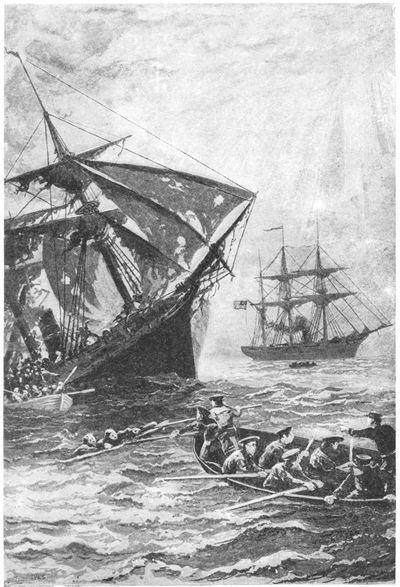
Sinking of the "Alabama."
After five days in port, she set out again on her wanderings about the
world. Week after week she patrolled the waters in all parts of the
globe where ships were likely to be met. Sometimes she would go a
fortnight without a capture, and then the men in the forecastle would
grow turbulent and restive under the long idleness. Every bit of
brass-work was polished hour after hour, and the officers were at
their wits' end to devise means for "teasing-time." The men made
sword-knots and chafing-gear enough to last the whole
navy, and then looked longingly at the captain's mustache, as the only
thing left in which a "Turk's head" could be tied. Music enlivened the
hours for a time; but the fiddler was soon voted a bore, and silenced
by some one pouring a pint of molasses into the f-holes of his
instrument. The enraged musician completed the job by breaking it over
the head of the joker. After several weeks, they put into Cape Town.
Here the practical joker of the crew made himself famous by utterly
routing an inquisitive old lady, who asked, "What do you do with your
prisoners?" The grizzled old tar dropped his voice to a confidential
whisper, and, with a look of the utmost frankness, replied, "We biles
'em, mum. We tried a roast, but there ain't a hounce of meat on one o'
them Yankee carkages. Yes, mum, we biles 'em." The startled old lady
gasped out, "Good lordy," and fled from the ship.
Putting out from Cape Town, the "Alabama" continued her weary round of
cruising. Many vessels were captured, and most of them were burned.
One Yankee captain proved too much for Semmes, as his story will show.
His ship was chased by the "Alabama" in heavy weather all day, and
occasionally fired upon. When the steamer was abeam, "she closed up
with us," the captain says, "as near as safety would permit, and,
hailing us, asked where we were bound, and demanded the surrender of
the ship to the Confederate Government. I answered through my trumpet,
'Come and take me.' Conversation being too straining for the lungs
amid the howling of the wind and rolling of the huge billows, and the
proximity of the vessels too dangerous, we separated a little, and had
recourse to blackboards to carry on our conversation. Semmes asked
where we were bound. I answered, without a blush, 'Melbourne,'
thinking that possibly he might try to intercept me if he knew that I
was to pass through the Straits of Sunda. Then he had the cheek to
order me to 'haul down your flag and surrender, escape or no
escape,'—on a kind of parole, I suppose he meant. I wrote on the
board: 'First capture, then parole,' This answer vexed him, I am sure,
for he immediately wrote: 'Surrender, or I will sink you.' I wrote:
'That would be murder, not battle.'—'Call it what you will, I will do
it,' he wrote. 'Attempt it, and by the living God, I will run you
down, and we will sink together,' I wrote in reply. I knew his threat
was vain; for in that heavy sea, rolling his rails under, he did not
dare to free his guns, which were already double lashed.
They would have carried away their tackles, and gone through the
bulwarks overboard. Conscious that he had made empty threats, we said
no more, but doggedly kept on our course. Sail was still further
reduced on both vessels, as the wind kept increasing and was now
blowing a gale. We were now gradually and surely drawing ahead of the
steamer. It was growing dark. Rejoicing at my fortunate escape, I gave
the valiant Semmes a parting shot by hoisting the signal 'Good-by.'
Dipping the star-spangled banner as a salute, I hauled it down, and
the steamer was soon lost to sight in the darkness.... I never saw her
after our escape; but, indirectly, she forced me to sell my ship in
China soon after."
But we cannot follow the "Alabama" in her career about the world. A
full account of her captures would fill volumes; and in this narrative
we must pass hastily by the time that she spent scouring the ocean,
dodging United States men-of-war, and burning Northern merchantmen,
until, on the 11th of June, she entered the harbor of Cherbourg,
France, and had hardly dropped anchor when the United States
man-of-war "Kearsarge" appeared outside, and calmly settled down to
wait for the Confederate to come out and fight. Capt. Semmes seemed
perfectly ready for the conflict, and began getting his ship in shape
for the battle. The men, too, said that they had had a "plum-pudding
voyage" of it so far, and they were perfectly ready for a fight. The
forecastle poet was set to work, and soon ground out a song, of which
the refrain was,—
"We're homeward bound, we're homeward bound!
And soon shall stand on English ground;
But, ere our native land we see,
We first must fight the 'Kearsargee.'"
This was the last song made on board the "Alabama," and the poet was
never more seen after the fight with the "Kearsargee."
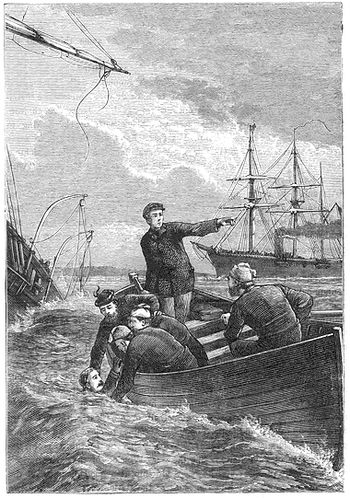
Rescue of Capt. Semmes.
The "Kearsarge" had hardly hove in sight when Capt. Semmes began
taking in coal, and ordered the yards sent down from aloft, and the
ship put in trim for action. Outside the breakwater, the "Kearsarge"
was doing the same thing. In armament, the two vessels were nearly
equal; the "Alabama" having eight guns to the "Kearsarge's" seven, but
the guns of the latter vessel were heavier and of greater range. In
the matter of speed, the "Kearsarge" had a slight advantage. The great
advantage which the "Kearsarge" had was gained by the
forethought of her commander, who had chains hung down her sides,
protecting the boilers and machinery. Semmes might easily have done
the same thing had the idea occurred to him.
It was on Sunday, June 19, that the "Alabama" started out to the duel
that was to end in her destruction. Though Sunday was Capt. Semmes's
lucky day, his luck this time seemed to have deserted him. The
"Alabama" was accompanied in her outward voyage by a large French
iron-clad frigate. The broad breakwater was black with people waiting
to see the fight. The news had spread as far as Paris, and throngs had
come down by special trains to view the great naval duel. A purple
haze hung over the placid water, through which could be seen the
"Kearsarge," with her colors flying defiantly, steaming slowly ahead,
and ready for the "Alabama" to come up. Small steamers on every side
followed the "Alabama," as near the scene of conflict as they dared.
One English yacht, the "Deerhound," with her owner's family aboard,
hung close to the combatants during the fight. No duel of the age of
chivalry had a more eager throng of spectators.
Now the "Alabama" has passed the three-mile line, and is on the open
sea. The big French iron-clad stops; the pilot-boats, with no liking
for cannon-balls, stop too. The "Deerhound" goes out a mile or so
farther, and the "Alabama" advances alone to meet the antagonist that
is waiting quietly for her coming. The moment of conflict is at hand;
and Capt. Semmes, mustering his men on the deck, addresses them
briefly, and sends them to their quarters; and now, with guns shotted,
and lanyards taut, and ready for the pull, the "Alabama" rushes toward
her enemy. When within a distance of a mile, the first broadside was
let fly, without avail. The "Kearsarge," more cool and prudent, waits
yet awhile; and, when the first shot does go whizzing from her big
Dahlgren guns, it strikes the "Alabama," and makes her quiver all
over. Clearly it won't do to fight at long range; and Capt. Semmes
determines to close in on his more powerful antagonist, and even try
to carry her by boarding, as in the glorious days of Paul Jones. But
the wary Winslow of the "Kearsarge" will have none of that; and he
keeps his ship at a good distance, all the time pouring great shot
into the sides of the "Alabama." Now the two vessels begin circling
around each other in mighty circles, each trying to get in a raking
position. The men on the "Alabama" began to find that their
gunpowder was bad and caky; while at the same moment one of the
officers saw two big solid shot strike the "Kearsarge" amidships, and
fall back into the water, revealing the heretofore unsuspected armor.
This was discouraging. Then came a big shot that knocked over the
pivot-gun, and killed half its crew. One sailor saw a shot come in a
port, glide along the gun, and strike the man at the breach full in
the breast, killing him instantly.
The "Kearsarge," too, was receiving some pretty heavy blows, but her
iron armor protected her vulnerable parts. One shell lodged in her
sternpost, but failed to explode. Had it burst, the "Kearsarge's"
fighting would have been over.
After an hour the officers of the "Alabama" began coming to Capt.
Semmes with grave faces, and reporting serious accidents. At last the
first lieutenant reported the ship sinking, and the order was given to
strike the flag. She was sinking rapidly, and the time had come for
every man to save himself. The "Kearsarge" was shamefully slow in
getting out her boats; and finally when the "Alabama," throwing her
bow high in the air, went down with a rush, she carried most of her
wounded with her, and left the living struggling in the water. Capt.
Semmes was picked up by a boat from the yacht "Deerhound," and was
carried in that craft to England away from capture. For so escaping,
he has been harshly criticised by many people; but there seems to be
no valid reason why he should refuse the opportunity so offered him.
Certain it is, that, had he not reached the "Deerhound," he would have
been drowned; for none of the boats of the "Kearsarge" were near him
when he was struggling in the water.
So ended the career of the "Alabama." Her life had been a short one,
and her career not the most glorious imaginable; but she had fulfilled
the purpose for which she was intended. She had captured sixty-four
merchant-vessels, kept a large number of men-of-war busy in chasing
her from one end of the world to the other, and inflicted on American
commerce an almost irreparable injury.
Although the "Alabama" was by all means the most noted and the most
successful of all the Confederate cruisers, there were others that
entered upon the career of privateering, and followed it for a while
with varying degrees of success. Some were captured revenue-cutters,
which the Confederates armed with a single heavy gun, and turned loose
on the ocean in search of Yankee schooners. Others were
merely tugs or pilot-boats. Generally their careers were short. In one
instance a fine privateer, from which the Confederates expected great
things, attempted to capture a United States man-of-war, under the
delusion that it was a merchant-vessel. The captain of the man-of-war
saw the mistake under which the Confederate labored, and allowed the
privateer to come up within short range, when, with a sudden
broadside, he sent her to the bottom, abruptly terminating her career
as a commerce destroyer. Some quite formidable iron-clad cruisers were
built abroad; but in most cases all the diplomacy of the Confederate
agents proved unavailing to prevent the confiscation of the ships by
the neutral governments in whose territory they were built. Two
iron-clad rams built at Liverpool, ostensibly for private parties, but
really for the Confederate Government, were seized by the British
authorities. Six splendid vessels were built in France, but only one
succeeded in getting away to join the Confederate service. This one
was a ram with armored sides, and was named the "Stonewall." The war
was nearly over when she was put in commission, and her services for
the Confederacy amounted to nothing. She made one short cruise, during
which she fell in with two United States men-of-war, that avoided a
fight with her on account of her superior strength. At the end of her
cruise the war was over, and she was sold to the Mikado of Japan,
whose flag she now carries.
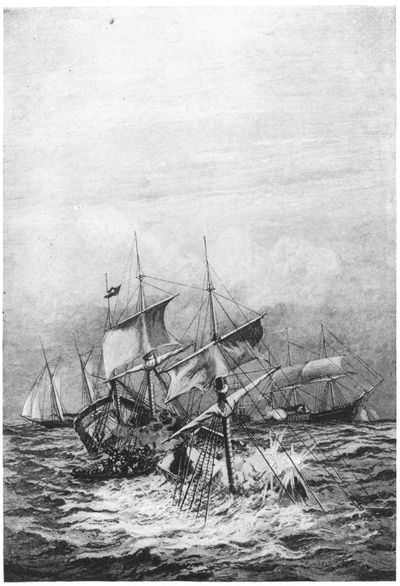
The End of a Privateer.
The "Nashville" was an old side-wheel passenger-steamer, of which the
Confederates had made a privateer. Her career was a short one. She
made one trip to England as a blockade-runner, and on her return
voyage she burned three or four United States merchantmen. She then
put into the Great Ogeechee River, where she was blockaded by three
Union men-of-war. The Confederates protected her by filling the river
with torpedoes, and anchoring the ship at a point where the guns of a
strong fort could beat back all assailants. Here she lay for several
weeks, while the men on the blockaders were fuming at the thought that
they were to be kept idle, like cats watching a rat-hole. At last
Capt. Worden, who was there with his redoubtable monitor "Montauk,"
determined to destroy the privateer, despite the torpedoes and the big
guns of the fort. He accordingly began a movement up the river,
picking his way slowly through the obstructions. The fort began a
lively cannonade; but Worden soon found that he had nothing to fear
from that quarter, as the guns were not heavy enough to
injure the iron sides of the little monitor. But, as he went up the
river, the "Nashville" took the alarm and fled before him; and it
seemed that the most the Union fleet could do would be to keep her
from coming down again, for with her light draught she could keep well
out of range of the monitor's guns. But one morning Worden perceived a
strange commotion on the "Nashville;" and, looking carefully through
his glass, he saw that she was aground. Now was his time; and at once
he pushed forward to a point twelve hundred yards from her, and
directly under the guns of Fort MacAllister. From this point he began
a deliberate fire upon the doomed privateer. The great guns of the
fort were roaring away, and their shells came crashing against the
sides of the "Montauk;" but to this Worden paid no heed. It was
splendid long distance practice for his gunners; and, when they got
the range, not a shot missed the stranded Confederate vessel. From his
pilot-house Worden could see the crew of the "Nashville" escaping in
boats, leaping into the water over the sides,—doing anything to
escape from that terribly destructive fire. All the time the great
fifteen-inch shells were dropping into the vessel with fearful
precision. By and by a heavy fog fell upon the scene; but the gunners
on the "Montauk" knew where their enemy was, and kept up their steady
fire, though they could see nothing. When the fog lifted, they saw the
"Nashville" a mass of flames; and in a moment she blew up, covering
the placid surface of the river with blackened fragments. Then the
"Montauk" returned to her consorts, well satisfied with her day's
work.
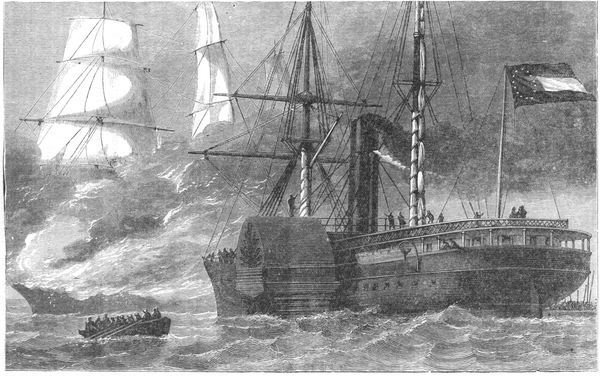
The "Nashville" burning a Prize.
The last of the Confederate privateers to ravage the ocean was the
"Shenandoah," originally an English merchant-vessel engaged in the
East India trade. She was large, fast, and strongly built; and the
astute agent of the Confederacy knew, when he saw her lying in a
Liverpool dock, that she was just calculated for a privateer. She was
purchased by private parties, and set sail, carrying a large stock of
coal and provisions, but no arms. By a strange coincidence, a second
vessel left Liverpool the same day, carrying several mysterious
gentlemen, who afterwards proved to be Confederate naval officers. The
cargo of this second vessel consisted almost entirely of remarkably
heavy cases marked "machinery." The two vessels, once out of English
waters, showed great fondness for each other, and proceeded together
to a deserted, barren island near Madeira. Here they anchored side by
side; and the mysterious gentlemen, now resplendent in the
gray and gold uniform of the Confederacy, stepped aboard the
"Shenandoah." Then the cases were hoisted out of the hold of the
smaller vessel; and, when the "machinery" was mounted on the gun-deck
of the "Shenandoah," it proved to be a number of very fine
steel-rifled cannon. Then the crew was mustered on the gun-deck, and
informed that they were manning the new Confederate ship "Shenandoah;"
and with a cheer the flag was hoisted at the peak, and the newly
created ship-of-war started off in search of merchantmen to make
bonfires of. From Madeira the cruiser made for the Southern Ocean,—a
fresh field not yet ravaged by any Confederate vessel. This made the
hunting all the better for the "Shenandoah," and she burned vessels
right and left merrily. In the spring of 1865, she put into the harbor
of Melbourne, Australia, where her officers were lavishly entertained
by the citizens. Thence she proceeded to the northward, spending some
time in the Indian Ocean, and skirting the Asiatic coast, until she
reached Behrings Straits. Here she lay in wait for returning whalers,
who in that season were apt to congregate in Behrings Sea in great
numbers, ready for the long voyage around Cape Horn to their home
ports on the New England coast. Capt. Waddell was not disappointed in
his expectations, for he reached the straits just as the returning
whalers were coming out in a body. One day he captured eleven in a
bunch. With one-third his crew standing at the guns ready to fire upon
any vessel that should attempt to get up sail, Waddell kept the rest
of his men rowing from ship to ship, taking off the crews. Finally all
the prisoners were put aboard three of the whalers, and the eight
empty ships were set afire. It was a grand spectacle. On every side
were the towering icebergs, whose glassy sides reflected the lurid
glare from the burning ships. Great black volumes of smoke arose from
the blazing oil into the clear blue northern sky. The ruined men
crowded upon the three whalers saw the fruits of their years of labor
thus destroyed in an afternoon, and heaped curses upon the heads of
the men who had thus robbed them. What wonder if, in the face of such
apparently wanton destruction as this, they overlooked the niceties of
the law of war, and called their captors pirates! Yet for the men of
the "Shenandoah" it was no pleasant duty to thus cruise about the
world, burning and destroying private property, and doing warfare only
against unarmed people. More than one has left on record his complaint
of the utter unpleasantness of the duty; but all felt that they were
aiding the cause for which their brothers at home were
fighting, and so they went on in their work of destruction.
For two months more Waddell continued his depredations in the northern
seas. Many a stout bark from New London or New Bedford fell a prey to
his zeal for a cause that was even then lost. For the Confederacy had
fallen. The last volley of the war had been discharged three months
before. Of this Capt. Waddell was ignorant, and his warlike operations
did not end until the captain of a British bark told him of the
surrender of Lee and Johnston, and the end of the war. To continue his
depredations longer would be piracy: so Capt. Waddell hauled down his
Confederate flag, and heading for Liverpool surrendered his ship to
the British authorities, by whom it was promptly transferred to the
United States. So ended the last of the Confederate privateers.[Back to Contents]
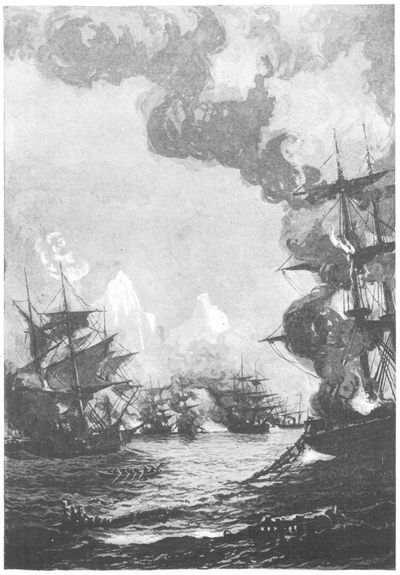
"Shenandoah" burning Whalers.
WORK OF THE GULF SQUADRON. — THE FIGHT AT THE PASSES OF THE
MISSISSIPPI. — DESTRUCTION OF THE SCHOONER "JUDAH." — THE BLOCKADE OF
GALVESTON, AND CAPTURE OF THE "HARRIET LANE."
he
naval forces of the United States during the war may be roughly
classified as the Atlantic fleets, the river navy, and the Gulf
squadron. The vessels comprising the latter detachment enjoyed some
light service during the opening months of the war; but, as the time
went on, the blue-jackets of the Gulf squadron found that they had no
reason to congratulate themselves on securing an easy berth. Their
blockading duty was not so arduous as that of their brothers along the
rugged Atlantic coast; but they were harassed continually by
Confederate rams, which would make a dash into the fleet, strike heavy
blows, and then fly up some convenient river far into the territory of
the Confederacy. One such attack was made upon the squadron blockading
the Mississippi in October, 1861.
Some eighty miles below New Orleans, the Mississippi divides into
three great channels, which flow at wide angles from each other into
the Gulf of Mexico. These streams flow between low marshy banks hardly
higher than the muddy surface of the river, covered with thick growths
of willows, and infested with reptiles and poisonous insects. The
point from which these three streams diverge is known as the "Head of
the Passes," and it was here that the blockading squadron of
four vessels was stationed. The ships swung idly at their moorings for
weeks. The pestilential vapors from the surrounding marshes were
rapidly putting all the crews in the sick bay, while the clouds of
gnats and mosquitoes that hung about made Jack's life a wretched one.
They did not even have the pleasurable excitement of occasionally
chasing a blockade-runner, for the wary merchants of New Orleans knew
that there was absolutely no hope of running a vessel out through a
river so effectually blockaded. And so the sailors idled away their
time, smoking, singing, dancing to the music of a doleful fiddle,
boxing with home-made canvas gloves that left big spots of black and
blue where they struck, and generally wishing that "Johnny Reb" would
show himself so that they might have some excitement, even if it did
cost a few lives.
But while the blue-jackets at the mouth of the river were spending
their time thus idly, the people in the beleaguered city higher up
were vastly enraged at being thus cooped up, and were laying plans to
drive their jailers away. Occasionally they would take a small fleet
of flat boats, bind them together, and heap them high with tar, pitch,
and light wood. Then the whole would be towed down the river, set on
fire, and drifted down upon the fleet. The light of the great fire
could be seen far off, and the warships would get up steam and dodge
the roaring mass of flames as it came surging down on the swift
current. So many trials of this sort failed, that finally the people
of the Crescent City gave up this plan in disgust.
Their next plan seemed for a time successful. It was at four o'clock
one October morning that the watch on the sloop-of-war "Richmond"
suddenly saw a huge dark mass so close to the ship that it seemed
fairly to have sprung from the water, and sweeping down rapidly. The
alarm was quickly given, and the crew beat to quarters. Over the water
from the other ships, now fully alarmed, came the roll of the drums
beating the men to their guns. The dark object came on swiftly, and
the word was passed from man to man, "It's a Confederate ram." And
indeed it was the ram "Manassas," which the Confederates had been hard
at work building in the New Orleans shipyards, and on which they
relied to drive the blockading squadron from the river. As she came
rushing towards the "Richmond," two great lights higher up the river
told of fire-rafts bearing down upon the fleet, and by the fitful
glare three smaller gunboats were seen coming to the assistance of the
"Manassas." Clearly the Confederates were attacking in force.
The first volley from the fleet rattled harmlessly from the
iron-clad sides of the "Manassas;" and, not heeding it, she swept on
and plunged into the side of the "Richmond." The great iron prow cut
deep into the wooden sides of the Union vessel. Heavy oaken timbers
were splintered like laths, and the men were violently hurled to the
deck. As the ram drew away, the blue-jackets sprang to their guns and
gave her a volley. Some of the shots must have penetrated her armor,
for she became unmanageable. But the darkness prevented the officers
of the "Richmond" from seeing how much damage they had done, and they
did not follow up their advantage. The strange panic that the sight of
a ram so often brought upon sailors of the old school fell on the
officers of this squadron, and they began hastily getting their ships
out of the river. By this time four more Confederate steamers had come
to the aid of the ram, and were cannonading the Northern fleet at long
range. In their hurried attempt to escape, the "Richmond" and the
"Vincennes" had run aground. The captain of the latter vessel, fearing
capture, determined to fire his vessel and escape with his crew to the
"Richmond." Accordingly he laid a slow-match to the magazine, lighted
it, and then, wrapping his ship's colors about his waist in the most
theatrical manner, abandoned his ship. But the plan was not altogether
a success. As he left the ship, he was followed by a grizzled old
sailor, who had seen too much fighting to believe in blowing up his
own ship; and, when he saw the smoking slow-match, he hastily broke
off the lighted end, and without saying a word threw it into the
water. No one observed the action, and the crew of the "Vincennes"
watched mournfully for their good ship to go up in a cloud of smoke
and flame. After they had watched nearly an hour, they concluded
something was wrong, and returned to their old quarters. By this time
the enemy had given up the conflict, and the United States navy was
one ship ahead for the old sailor's act of insubordination. The
Confederate flotilla returned to New Orleans, and reported that they
had driven the blockaders away. There was great rejoicing in the city:
windows were illuminated, and receptions were tendered to the officers
of the Confederate fleet. But, while the rejoicing was still going on,
the Union ships came quietly back to their old position, and the great
river was as securely closed as ever.
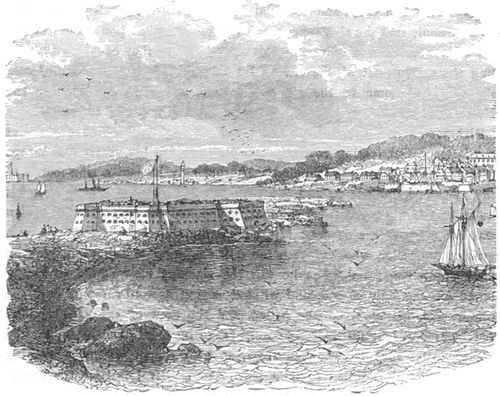
Fort Pensacola.
About a month before the fight with the "Manassas," the blue-jackets
of the North scored for themselves a brilliant success in the harbor
of Pensacola. The frigate "Colorado" was lying outside the harbor of
that city, within clear view of the city front. For some
weeks the sailors had been greatly interested in watching the activity
of people on shore around a small schooner that was lying in a basin
near the navy-yard. With a harbor so thoroughly blockaded as was that
of Pensacola, there seemed really no need of new vessels; and the
haste of the Confederates seemed inexplicable, until they saw through
their glasses men at work mounting a heavy pivot-gun amidships. That
made it clear that another privateer was being fitted out to ravage
the seas and burn all vessels flying the United States flag. The
gallant tars of the "Colorado" determined to go in and burn the
privateer before she should have a chance to escape. It was an
undertaking of great peril. The schooner was near the navy-yard, where
one thousand men were ready to spring to her assistance at the first
alarm. On the dock fronting the navy-yard were mounted a ten-inch
columbiad and a twelve-pounder field-piece, so placed as to command
the deck of the schooner and the wharf to which she was
moored. Fort Pensacola, not far distant, was full of Confederate
troops. But the Union sailors thought that the destruction of the
privateer was of enough importance to warrant the risk, and they
determined to try the adventure.
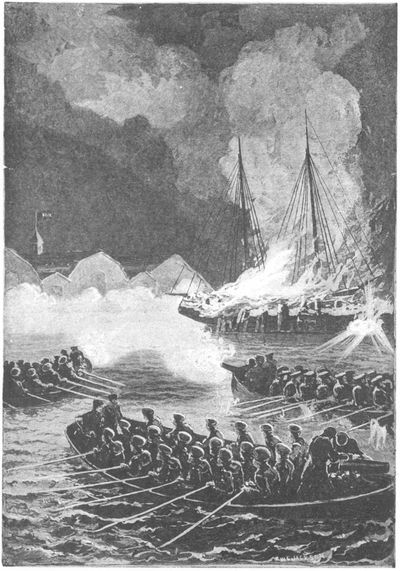
Destruction of the Schooner "Judah."
Accordingly, on the first dark night, four boats, containing one
hundred officers, sailors, and marines, put off from the side of the
"Colorado," and headed for the town. All was done with the most
perfect silence. The tholes of the oars were wrapped in cloth to
deaden their rattle in the rowlocks. No lights were carried. Not a
word was spoken after the officers in muffled tones had given the
order, "Give way." Through the darkness of the night the heavy boats
glide on. Every man aboard has his work laid out for him, and each
knows what he is to do. While the main body are to be engaged in
beating back the guards, some are to spike the guns, and others to
fire the schooner in several places. When within a hundred yards of
the schooner, they are discovered by the sentry. As his ringing hail
comes over the water, the sailors make no reply, but bend to the oars,
and the boats fairly leap toward the wharf. Bang! goes the sentry's
rifle; and the men in the hold of the schooner come rushing up just as
the two boats dash against her side, and the sailors spring like cats
over the bulwarks. One man was found guarding the guns on the wharf,
and was shot down. Little time is needed to spike the guns, and then
those on the wharf turn in to help their comrades on the schooner.
Here the fighting is sharp and hand to hand. Nearly a hundred men are
crowded on the deck, and deal pistol-shots and cutlass-blows right and
left. Several of the crew of the schooner have climbed into the tops,
and from that point of vantage pour down on the attacking party a
murderous fire. Horrid yells go up from the enraged combatants, and
the roar of the musketry is deafening. The crew of the schooner are
forced backward, step by step, until at last they are driven off the
vessel altogether, and stand on the wharf delivering a rapid fire. The
men from the navy-yard are beginning to pour down to the wharf to take
a hand in the fight. But now a column of smoke begins to arise from
the open companionway; and the blue-jackets see that their work is
done, and tumble over the side into their boats. It is high time for
them to leave, for the Confederates are on the wharf in overwhelming
force. As they stand there, crowded together, the retiring sailors
open on them with canister from two howitzers in the boats.
Six rounds of this sort of firing sends the Confederates looking for
shelter; and the sailors pull off through the darkness to their ship,
there to watch the burning vessel, until, with a sudden burst of
flame, she is blown to pieces.
Considering the dashing nature of this exploit, the loss of life was
wonderfully small. Lieut. Blake, who commanded one of the boats, was
saved by one of those strange accidents so common in war. As he was
going over the side of the "Colorado," some one handed him a metal
flask filled with brandy, to be used for the wounded. He dropped it
into the lower pocket of his overcoat, but, finding it uncomfortable
there, changed it to the side pocket of his coat, immediately over his
heart. When the boats touched the side of the schooner, Blake was one
of the first to spring into the chains and clamber aboard. Just as he
was springing over the gunwale, a Confederate sailor pointed a pistol
at his heart, and fired it just as Blake cut him down with a savage
cutlass-stroke. The bullet sped true to its mark, but struck the
flask, and had just enough force to perforate it, without doing any
injury to the lieutenant.
The first death in the fight was a sad one. A marine, the first man to
board the schooner, lost his distinguishing white cap in his leap. His
comrades followed fast behind him, and, seeing that he wore no cap,
took him for one of the enemy, and plunged their bayonets deep in his
breast, killing him instantly. He was known to his comrades as John
Smith, but on searching his bag letters were found proving that this
was not his own name. One from his mother begged him to return home,
and give up his roving life. He proved to be a well-educated young
man, who through fear of some disgrace had enlisted in the marines to
hide himself from the world.
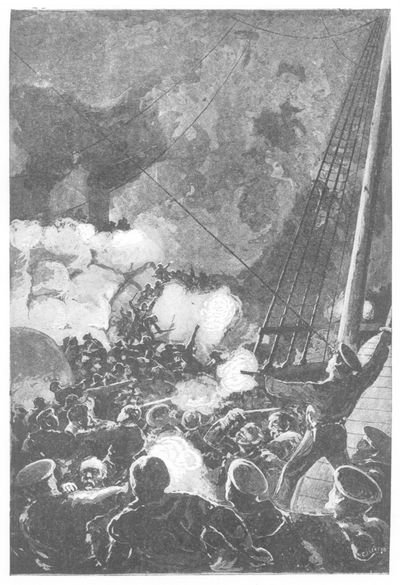
Capture of the "Harriet Lane."
Another dashing event occurred on the Gulf Coast some months later,
although in this instance the Confederates were the assailants and the
victors. Galveston had for some time been in the hands of the Union
forces, and was occupied by three regiments of United States troops.
In the harbor lay three men-of-war, whose cannon kept the town in
subjection. It had been rumored for some time that the Confederates
were planning to recapture the city, and accordingly the most vigilant
lookout was kept from all the ships. On the 1st of January, 1863, at
half-past one A.M., as the lookout on the "Harriet Lane" was thinking
of the new year just ushered in, and wondering whether
before the end of that year he could see again his cosey Northern home
and wife and friends, he saw far up the river a cloud of black smoke,
that rose high in the air, and blotted from sight the shining winter
stars. He rubbed his eyes, and looked again. There was no mistake: the
smoke was there, and rapidly moving toward him. Clearly it was a
steamer coming down the river; but whether an armed enemy or a
blockade-runner, he could not say. He gave the alarm; and in a moment
the roll of the drums made the sailors below spring from their
hammocks, and, hastily throwing on their clothes, rush on deck. The
drums beat to quarters, and the crew were soon at their guns. Over the
water came the roll of the drums from the other ships, and from the
troops on shore, now all aroused and in arms. For thirty hours the
Federals had been expecting this attack, and now they were fully
prepared for it.
The attacking vessels came nearer, and the men on the Union ships
strained their eyes to see by the faint starlight what manner of craft
they had to meet. They proved to be two large river-steamships, piled
high with cotton-bales, crowded with armed men, and provided with a
few field pieces. Clearly they were only dangerous at close quarters,
and the "Lane" at once began a rapid fire to beat them back. But the
bad light spoiled her gunners' aim, and she determined to rush upon
the enemy, and run him down. The Confederate captain managed his helm
skilfully, and the "Lane" struck only a glancing blow. Then, in her
turn, the "Lane" was rammed by the Confederate steamer, which plunged
into her with a crash and a shock which seemed almost to lift the
ships out of water. The two vessels drifted apart, the "Lane" hardly
injured, but the Confederate with a gaping wound in his bow which sent
him to the bottom in fifteen minutes. But now the other Confederate
came bearing down under a full head of steam, and crashed into the
"Lane." Evidently the Confederates wanted to fight in the old style;
for they threw out grappling-irons, lashed the two ships side to side,
and began pouring on to the deck of the Federal ship for a
hand-to-hand conflict. Cries of anger and pain, pistol-shots, cutlass
blows, and occasional roars from the howitzers rose on the night air,
and were answered by the sounds of battle from the shore, where the
Confederates had attacked the slender Union garrison. The sinking
steamer took up a position near the "Lane," and poured broadside after
broadside upon the struggling Union ship. But where were the other
three Union vessels all this time? It seemed as though their
commanders had lost all their coolness; for they ran their vessels
here and there, now trying to do something to help their friends on
shore, now making an ineffectual attempt to aid the "Harriet Lane."
But on board that vessel matters were going badly for the Federals.
The Confederates in great numbers kept pouring over the bulwarks, and
were rapidly driving the crew from the deck. Capt. Wainwright lay dead
at the door of the cabin. Across his body stood his young son, his
eyes blazing, his hair waving in the wind. He held in his right hand a
huge revolver, which he was firing without aim into the tossing mass
of struggling men before him, while he called on his dead father to
rise and help him. A stray bullet cut off two of his fingers, and the
pain was too much for the little hero only ten years old; and,
dropping the pistol, he burst into tears, crying, "Do you want to kill
me?" The blue-jackets began to look anxiously for help toward the
other vessels. But, even while they looked, they saw all hope of help
cut off; for with a crash and a burst of flame the "Westfield" blew
up. It turned out later, that, finding his ship aground, the captain
of the "Westfield" had determined to abandon her, and fire the
magazine; but in fixing his train he made a fatal error, and the ship
blew up, hurling captain and crew into the air. The men on the
"Harriet Lane" saw that all hope was gone, and surrendered their ship.
When the captains of the two remaining gunboats saw the stars and
stripes fall from the peak, they turned their vessels' prows toward
the sea, and scudded out of danger of capture. At the same moment,
cheers from the gray-coats on shore told that the Confederates had
been successful both by land and sea, and the stars and bars once more
floated over Galveston.[Back to Contents]

THE CAPTURE OF NEW ORLEANS. — FARRAGUT'S FLEET PASSES FORT ST. PHILIP
AND FORT JACKSON.
hile Commodore Foote, with his flotilla of gunboats and mortar-boats,
was working his way down the Mississippi River, making occasional
dashes into the broad streams that flow from either side into the
father of waters, Admiral Farragut, with his fleet of tall-sparred,
ocean-going men-of-war, was laying his plans for an expedition
up-stream. But Farragut's first obstacle lay very near the mouth of
the broad, tawny river that flows for a thousand miles through the
centre of the United States. New Orleans, the greatest city of the
Confederacy, stands on the river's bank, only ninety miles from the
blue waters of the Gulf of Mexico. The Confederate authorities knew
the value of this great city to their cause, and were careful not to
let it go unprotected. Long before any thought of civil war disturbed
the minds of the people of the United States, the Federal Government
had built below the Crescent City two forts, that peered at each other
across the swift, turbid tide of the Mississippi River. Fort St.
Philip and Fort Jackson they were called, the latter being named in
honor of the stubborn old military hero who beat back the British
soldiers at the close of the war of 1812 on the glorious field of
Chalmette near New Orleans. Fort Jackson was a huge star of
stone and mortar. In its massive walls were great cavernous
bomb-proofs in which the soldiers were secure from bursting shells. It
stood back about a hundred yards from the levee, and its casemates
just rose above the huge dike that keeps the Mississippi in its proper
channel. When the river was high from the spring floods of the north,
a steamer floating on its swift tide towered high above the bastions
of the fort. In the casemates and on the parapets were mounted
seventy-five guns of all calibres. By its peculiar shape and situation
on a jutting point of land, the fort was able to bring its guns to
bear upon the river in three directions.
When the storm of civil war burst upon the country, the Confederates
of New Orleans were prompt to seize this and Fort St. Philip, that
stood on the other side of the river. They found Fort Jackson in the
state of general decay into which most army posts fall in times of
peace, and they set at work at once to strengthen it. All over the
parapet, bomb-proofs, and weak points, bags of sand were piled five or
six feet deep, making the strongest defence known in war. Steamers
plied up and down the river, bringing provision, ammunition, and new
cannon, and soon the fort was ready to stand the most determined
siege. Fort St. Philip, across the river, though not so imposing a
military work, was more powerful. It was built of masonry, and heavily
sodded over all points exposed to fire. It was more irregular in shape
than Fort Jackson, and with its guns seemed to command every point on
the river. Both were amply protected from storming by wide, deep moats
always filled with water.
In these two forts were stationed troops made up of the finest young
men of New Orleans. For them it was a gay station. Far removed from
the fighting on the frontier, and within an easy journey of their
homes, they frolicked away the first year of the war. Every week gay
parties of pleasure-seekers from New Orleans would come down; and the
proud defenders would take their friends to the frowning bastions, and
point out how easily they could blow the enemy's fleet out of water if
the ships ever came within range of those heavy guns. But the ships
did not come within range of the guns for many months. They contented
themselves with lying at the Head of the Passes, and stopping all
intercourse with the outer world, until New Orleans began to get
shabby and ragged and hungry, and the pleasure-parties came less often
to the forts, and the gay young soldiers saw their uniforms getting
old and tattered, but knew not where to get the cloth to replace them.
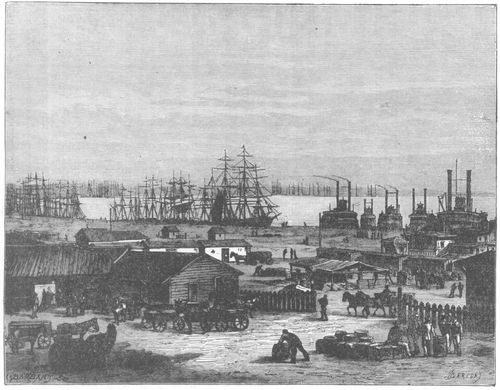
Levee at New Orleans before the War.
In the city no rumble of commerce was heard on the streets.
Grass grew on the deserted levee, where in times of peace the brown
and white cotton-bales were piled by the thousand, waiting
for strong black hands to seize and swing them upon the decks of the
trim Liverpool packets, that lay three or four deep along the river
front. The huge gray custom-house that stood at the foot of Canal
Street no longer resounded with the rapid tread of sea-captains or
busy merchants. From the pipes of the cotton-presses, the rush of the
escaping steam, as the ruthless press squeezed the great bale into
one-third its original size, was no longer heard. Most of the great
towering steamboats that came rushing down the river with stores of
cotton or sugar had long since been cut down into squat, powerful
gunboats, or were tied up idly to the bank. Across the river, in the
shipyards of Algiers, there seemed a little more life; for there
workmen were busy changing peaceful merchant vessels into gunboats and
rams, that were, the people fondly hoped, to drive away the men-of-war
at the river's mouth and save the city from starvation. From time to
time the streets of the city resounded with the notes of drum and
fife, as one after the other the militia companies went off to the
front and the fighting. Then the time came when none were left save
the "Confederate Guards," old gray-haired men, judges, bankers,
merchants, gentlemen of every degree, too old for active service at
the front, but too young not to burn for the grasp of a gun or sword
while they knew that their sons and grandsons were fighting on the
bloodstained soil of Virginia and Tennessee.
But, while the city was gradually falling into desolation and decay,
preparations were being made by the Federal navy for its capture. On
the 2d of February, 1862, Admiral Farragut sailed from Hampton Roads
in his stanch frigate the "Hartford," to take command of a naval
expedition intended to capture New Orleans. The place of rendezvous
was Ship Island, a sandy island in the Gulf of Mexico. Here he
organized his squadron, and started for his post in the Mississippi,
below the forts. The first obstacle was found at the mouth of the
river, where the heavy war-vessels were unable to make their way over
the bar. Nearly two weeks were occupied in the work of lightening
these ships until they were able to pass. The frigate "Colorado" was
unable to get over at all. The "Pensacola" was dragged through the mud
by the sheer strength of other vessels of the expedition. While they
were tugging at her, a huge hawser snapped with a report like a
cannon, and the flying ends killed two men and seriously
wounded five others. But at last the fleet was safely past all
obstacles, and Admiral Farragut found himself well established in the
lower Mississippi, with a force of twenty-five men-of-war, and twenty
mortar-schooners; one of the most powerful armadas ever despatched
against an enemy. Farragut lost no time in getting his ships prepared
for the baptism of fire which was sure to come. While he was
diligently at work on his preparations, he was visited by some French
and English naval officers, who had carefully examined the defences of
the Confederates, and came to warn him that to attack the forts with
wooden vessels, such as made up his fleet, was sheer madness, and
would only result in defeat. "You may be right," answered the brave
old sailor, "but I was sent here to make the attempt. I came here to
reduce or pass the forts, and to take New Orleans, and I shall try it
on." The foreigners remarked that he was going to certain
destruction, and politely withdrew.
In the mean time, the tars on the mortar-fleet were working
industriously to get their ships in fighting-trim. The topmasts were
stripped of their sails, and lowered; the loose and standing rigging
strapped to the masts; the spars, forebooms, and gaffs unshipped, and
secured to the outside of the vessels to avert the danger from
splinters, which, in naval actions, is often greater than from the
shots themselves. From the main-deck every thing was removed that
could obstruct the easy handling of the tremendous mortars; and the
men were drilled to skill and alertness in firing the huge engines of
death. The work was hastened on the mortar-schooners, because the plan
was to rush them into position, and let them harass the Confederates
with a steady bombardment, while the ships-of-war were preparing for
their part in the coming fight.
The mortar-fleet was under command of Admiral Porter, an able and
energetic officer. He soon had his ships ready, and began moving them
into position along the banks of the river, out of sight of the forts.
To further conceal them from the gunners in the forts, he had the
masts and rigging wrapped with green foliage; so that, lying against
the dense thickets of willows that skirt that part of the river, they
were invisible. Other boats that were in more exposed positions had
their hulls covered with grass and reeds, so that they seemed a part
of the swamp that bordered the river. After the line of fire had been
obtained by a careful mathematical survey, Porter got all his
mortar-boats into position, and began his bombardment. The
gunners on the mortar-boats could not see the forts; but the range had
been calculated for them, and they merely fired mechanically. A
lookout, perched on the masthead, could see over the low
willow-forest, and watch the course of the shells as they rushed high
into the air, and then, falling with a graceful curve, plunged into
the forts. The firing was begun on the 16th of April, and was kept up
with a will. The twenty huge mortars keeping up a constant fire, made
a deafening roar that shook the earth, and could be heard far up the
river at New Orleans, where the people poured out into the streets,
and gayly predicted defeat for any enemy who should attack "the boys
in the forts." The forts were not slow in returning the fire; but as
the mortar-vessels were hidden, and did not offer very large marks,
their fire was rather ineffective. Parties of Confederates, old
swamp-hunters, and skilled riflemen, stole down through the dense
thickets, to pick off the crews of the mortar-schooners. They managed
to kill a few gunners in this way, but were soon driven away by the
point-blank fire of the supporting gunboats. But all this time the
shells were falling thick and fast, driving the soldiers to the
bomb-proofs, and tearing to pieces every thing unprotected. One shell
set fire to some wooden structures that stood on the parade-ground in
Fort Jackson; and, as the smoke and flames rose in the air, the
gunners down the river thought that the fort was burning, and cheered
and fired with renewed vigor. The shells that burst upon the levee
soon cut great trenches in it, so that the mighty Mississippi broke
through with a rush, and flooded the country all about. But the forts
seemed as strong and unconquered as ever.
While the soldiers were crowded together in the bomb-proofs to escape
the flying bits of shell, the sailors on the little fleet of
Confederate vessels anchored above them were busily engaged in getting
ready a fire-raft which was to float down the river, and make havoc
among the vessels of the Union fleet. Two such rafts were prepared;
one of which, an immense affair, carrying cords of blazing pine-wood,
was sent down in the early morning at a time when the vessels were
utterly unprepared to defend themselves. Luckily it grounded on a
sandbar, and burned and crackled away harmlessly until it was
consumed. This warned Commander Porter of the danger in which his
mortar-vessels were of a second attack of the same nature; and
accordingly he put in readiness one hundred and fifty small
boats with picked crews, and well supplied with axes and grapnels,
whose duty it was to grapple any future rafts, and tow them into a
harmless position. They did not have long to wait. At sundown that
night, Commander Porter reviewed his little squadron of row-boats as
they lay drawn up in line along the low marshy shores of the mighty
river. The sun sank a glowing red ball beneath the line at which the
blue waters of the gulf and the blue arch of heaven seemed to meet.
The long southern twilight gradually deepened into a black, moonless
night. The cries of frogs and seabirds, and the little flashes of the
fireflies, were silenced and blotted out by the incessant roar and
flash of the tremendous mortars that kept up their deadly work.
Suddenly in the distance the sky grows red and lurid. "The fort is
burning!" cry the men at the guns; but from the masthead comes the
response, "No, the fire is on the river. It is another fire-raft." The
alarm was instantly given to all the vessels of the fleet. Bright
colored signal-lights blazed on the decks, and the dark, slender
cordage stood out against the brilliant red and green fires that
flickered strangely upon the dark wooded banks of the river. Rockets
rushed high into the air, and, bursting, let fall a shower of
party-colored lights that told the watchers far down the river that
danger was to be expected. Then the signal-lights went out, and all
was dark and silent save where the lurid glare of the great mass of
fire could be seen floating in the great curves of the tortuous river
toward the crowded ships. It was a time of intense suspense. The
little flotilla of fire-boats, organized by Commander Porter that day,
was on the alert; and the blue-jackets bent to their oars with a will,
and soon had their boats ranged along a bend far above the fleet. Here
they waited to catch the fiery monster, and save the ships. The danger
came nearer fast. Rapidly the flames increased in volume, until the
whole surrounding region was lighted up by the glare; while from the
floating fire, a huge black column of smoke arose, and blended with
the clouds that glowed as though they themselves were on fire. When
the raft came into view around a point, it was seen to be too big for
the boats to handle unaided, and two gunboats slipped their cables,
and started for the thing of terror. From every side the row-boats
dashed at the raft. Some grappled it, and the sailors tugged lustily
at their oars, seeking to drag the mass of flames toward the shore.
Then the "Westfield," under full head of steam, dashed furiously
against the raft, crashing in the timbers and sending great
clouds of sparks flying high in the air. From her hose-pipes she
poured floods of water on the crackling, roaring, blazing mass; while
all the time, with her powerful engines, she was pushing it toward the
shore.
In the mean time, the sailors from the fleet of small boats were
swarming upon the raft wherever they could find a foothold free from
flame. Some carrying buckets dashed water upon the flames, some with
axes cut loose flaming timbers, and let them float harmlessly down the
river. It was a fight in which all the men were on one side; but it
was a grand sight, and was eagerly watched by those on the imperilled
vessels. The immediate arena of the conflict was bright as day, but
all around was gloom. At last the pluck and determination of the men
triumph over the flames. The raft, flaming, smouldering, broken, is
towed out of the channel, and left to end its life in fitful flashes
on a sandy point. The returning boats are greeted with cheers, and
soon darkness and silence fall upon the scene. The mortars cease their
thunderous work for the night; and ere long the only sounds heard are
the rush of the mighty waters, or the faint cry of the night birds in
the forest. The sentinel pacing the deck peers in vain through the
gloom. War gives way for a time to rest.
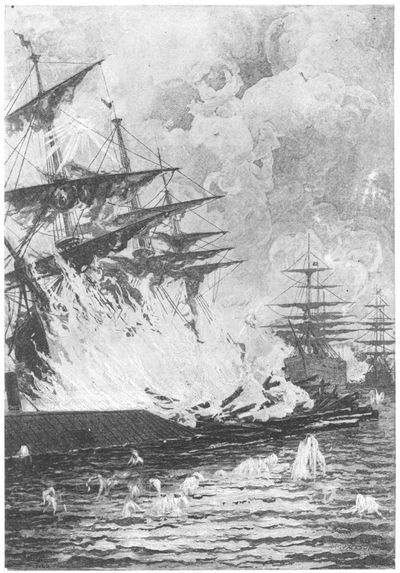
Fire-raft at Forts of the Mississippi.
Hardly had the gray dawn begun to appear, when the roll of the drums
on the decks of the ships was heard; and, soon after, the roar of the
opening gun was heard from one of the mortar-schooners. Again the
bombardment was opened. The twenty boats in the mortar-fleet were
divided into three divisions, each of which fired for two hours in
succession, and then stopped for a time to allow the great cannon to
cool. Thus a continuous bombardment was kept up, and the soldiers in
the forts were given no time to repair the damages caused by the
bursting shells. Every mortar was fired once in five minutes; so that
one shell was hurled towards the fort about every minute, while
sometimes three shells would be seen sweeping with majestic curves
through the air at the same time. The shells weighed two hundred and
fifteen pounds; and when they were hurled into the air by the
explosion of twenty pounds of powder, the boat bearing the mortar was
driven down into the water six or eight inches, and the light railings
and woodwork of buildings at the Balize, thirty miles away, were
shattered by the concussion. The shells rose high in the air, with an
unearthly shriek, and after a curve of a mile and a half
fell into or near the forts, and, bursting, threw their deadly
fragments in all directions. Day after day, and night after night,
this went on. If the men on the mortar-schooners showed bravery and
endurance in keeping up so exhausting a fire so steadily, what shall
we say for the men in the forts who bore up against it so nobly?
Before noon of the first day of the bombardment, the soldiers of Fort
Jackson saw their barracks burned, with their clothing, bedding, and
several days' rations. Shells were pouring in upon them from vessels
that they could not see. The smooth-bore guns mounted in the
embrasures would hardly send a shot to the nearest of the hostile
gunboats. Then the river broke through its banks, and half the fort
was transformed into a morass. An officer in Fort Jackson said, after
the surrender, that in two hours over one hundred shells had fallen
upon the parade-ground of that work, tearing it up terribly. For six
days this terrible fire was endured; and during the latter half of the
bombardment the water stood knee deep on the gun-platforms, and the
gunners worked at their guns until their shoes, soaked for days and
days, fairly fell from their feet. For bed and bedding they had the
wet earth, for rations raw meat and mouldy bread. If there were glory
and victory for the Union sailors, let there at least be honor and
credit granted the soldiers of the gray for the dogged courage with
which they bore the terrible bombardment from Porter's flotilla.
While the mortars were pounding away through those six long days and
nights, Farragut was getting ready to take his ships past the forts.
Union scouts and spies had travelled over every foot of land and water
about the forts; and the exact strength of the Confederates, and the
difficulties to be overcome, were clearly known to the Federal
admiral. One of the chief obstructions was a chain of rafts and old
hulks that stretched across the channel by which the fleet would be
obliged to ascend the river. Under cover of a tremendous fire from all
the mortars, two gunboats were sent up to remove this obstruction. The
night was dark and favorable to the enterprise, and the vessels
reached the chain before they were discovered. Then, under a fierce
cannonade from the forts, Lieut. Caldwell put off in a row-boat from
his vessel, boarded one of the hulks, and managed to break the chain.
The string of hulks was quickly swept ashore by the swift current, and
the channel was open for the ascent of the Union fleet.
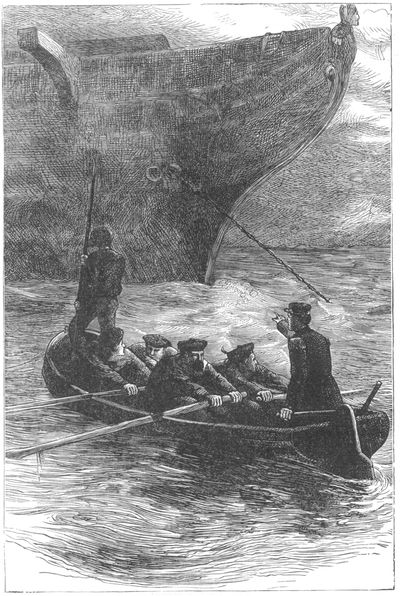
Breaking the Chain.
On the 23d of April, Farragut determined that his fleet should make
the attempt to get past the forts the following day. He
knew that the enemy must be exhausted with the terrible strain of
Porter's bombardment, and he felt that the opportunity had arrived for
him to make a successful dash for the upper river. The fleet was all
prepared for a desperate struggle. Many of the captains had daubed the
sides of their vessels with the river mud, that they might be less
prominent marks for the Confederate gunners. The chain cables of all
the vessels were coiled about vulnerable parts, or draped over the
sides amidships to protect the boilers. Knowing that it was to be a
night action, the gun-decks had been whitewashed; so that even by the
dim, uncertain light of the battle lanterns, the gunners could see
plainly all objects about them. Hammocks and nettings were stretched
above the decks to catch flying splinters from the spars overhead.
Late at night the admiral in his longboat was pulled from ship to ship
to view the preparations made, and see that each captain fully
understood his orders.
It was two o'clock on the morning of the 24th of April, when the
Confederates on the parapets of their forts might have heard the
shrill notes of fifes, the steady tramp of men, the sharp clicking of
capstans, and the grating of chain cables passing through the
hawse-holes on the ships below. Indeed, it is probable that these
sounds were heard at the forts, and were understood, for the
Confederates were on the alert when the ships came steaming up the
river.
They formed in a stately line of battle, headed by the "Cayuga." As
they came up the stream, the gunners in the forts could see the
mastheads over the low willow thickets that bordered the banks of the
stream. The line of obstructions was reached and passed, and then the
whole furious fire of both forts fell upon the advancing ships.
Gallantly they kept on their way, firing thunderous broadsides from
each side. And, while the ships were under the direct fire of the
forts, the enemy's fleet came dashing down the river to dispute the
way. This was more to the taste of Farragut and his boys in blue. They
were tired of fighting stone walls. In the van of the Confederate
squadron was the ram "Manassas," that had created such a panic among
the blockading squadron a month before. She plunged desperately into
the fight. The great frigate "Brooklyn" was a prominent vessel in the
Union line, and at her the ram dashed. The bold hearts on the grand
old frigate did not seek to avoid the conflict, and the two vessels
rushed together. The ram struck the "Brooklyn" a glancing
blow; and the shot from her one gun was returned by a hail of
cannon-balls from the frigate's tremendous broadside, many of which
broke through the iron plating. Nothing daunted, the ram backed off
and rushed at the frigate again. This time she struck full on the
frigate's side. The shock was terrible. Men on the gun-deck of the ram
were hurled to the deck, with the blood streaming from their nostrils.
The frigate keeled over farther and farther, until all thought that
she would be borne beneath the water by the pressure of the ram. All
the time the spiteful bow-gun of the iron monster was hurling its
bolts into her hull. But the blow of the ram had done no damage, for
she had struck one of the coils of chain that had been hung down the
"Brooklyn's" side. The two vessels slowly swung apart; and, after a
final broadside from the "Brooklyn," the "Manassas" drifted away in
the pitchy darkness to seek for new adversaries. She was not long in
finding one; for as the gray dawn was breaking she suddenly found
herself under the very bows of the "Mississippi," which was bearing
down upon her and seemed sure to run her down. The captain of the
"Manassas" was an able steersman, and neatly dodged the blow; but in
this quick movement he ran his vessel ashore, and she lay there under
the guns of the "Mississippi," and unable to bring any of her own guns
to bear. The captain of the frigate was not slow in taking advantage
of this chance to be revenged for all the trouble she had given the
Union fleet; and he took up a good position, and pounded away with his
heavy guns at the iron monster. The heavy shots crashed through the
iron plating and came plunging in the portholes, seeking every nook
and cranny about the vessel. It was too much for men to stand, and the
crew of the "Manassas" fled to the woods; while their vessel was soon
set on fire with red-hot shots, and blew up with a tremendous report
soon after.
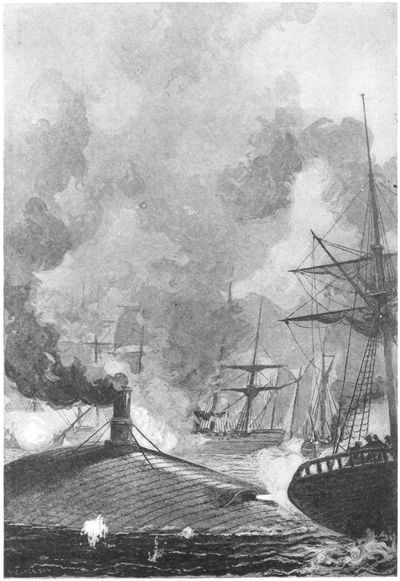
Ram "Tennessee" at Mobile Bay.
In the mean time, the ships of the Union fleet were doing daring work,
and meeting a determined resistance. The flagship "Hartford" was met
by a tug which pushed a huge burning fire-raft against her sides.
There the flaming thing lay right up against the portholes, the flames
catching the tarred rigging, and running up the masts. Farragut walked
his quarter-deck as coolly as though the ship was on parade. "Don't
flinch from that fire, boys," he sang out, as the flames rushed in the
portholes, and drove the men from their guns. "There's a hotter fire
than that for those who don't do their duty. Give that
rascally little tug a shot, and don't let her go off with a whole
coat." But the tug did get away, after all; and no one can feel sorry
that men plucky enough to take an unarmed tug into a terrible fight of
frigates and iron-clads should escape with their lives. The men on the
"Hartford" fought the flames with hose and buckets, and at last got
rid of their dangerous neighbor. Then they saw a steamer crowded with
men rushing toward the flagship without firing a shot, and evidently
intending to board. Capt. Broome, with a crew of marines, was working
a bow-gun on the "Hartford." Carefully he trained the huge piece upon
the approaching steamer. He stepped back, stooped for a last glance
along the sights, then with a quick pull of the lanyard the great gun
went off with a roar, followed instantly by a louder explosion from
the attacking steamer. When the smoke cleared away, all looked eagerly
for the enemy; but she had vanished as if by magic. That single shot,
striking her magazine, had blown her up with all on board.
Much of the hardest fighting was done by the smaller vessels on either
side. The little Confederate "cotton-clad" "Governor Moore" made a
desperate fight, dashing through the Union fleet, taking and giving
broadsides in every direction. The Union vessel "Varuna" also did
daring work, and naturally these two ships met in desperate conflict.
After exchanging broadsides, the "Governor Moore" rammed her
adversary, and, while bearing down on her, received a severe raking
fire from the "Varuna." The "Governor Moore" was in such a position
that none of her guns could be brought to bear; but her captain
suddenly depressed the muzzle of his bow-gun, and sent a shot crashing
through his own deck and side, and deep into the hull of the
"Varuna." The vessels soon parted, but the "Varuna" had received her
death-wound, and sank in shallow water. The "Governor Moore" kept on
her way, but was knocked to pieces by the fire from the heavy guns of
the frigates shortly after.
And so the battle raged for five hours. To recount in full the deeds
of valor done, would be to tell the story of each ship engaged, and
would require volumes. Witnesses who saw the fight from the start were
deeply impressed by the majesty of the scene. It was like a grand
panorama. "From almost perfect silence,—the steamers moving through
the water like phantom ships,—one incessant roar of heavy cannon
commenced, the Confederate forts and gunboats opening together on the
head of our line as it came within range. The Union vessels
returned the fire as they came up, and soon the hundred and seventy
guns of our fleet joined in the thunder which seemed to shake the very
earth. A lurid glare was thrown over the scene by the burning rafts;
and, as the bombshells crossed each other and exploded in the air, it
seemed as if a battle were taking place in the heavens as well as on
the earth. It all ended as suddenly as it commenced."
While this gigantic contest was going on in the river abreast of the
forts, the people of New Orleans were thronging the streets, listening
to the unceasing roar of the great guns, and discussing, with pale
faces and anxious hearts, the outcome of the fight. "Farragut can
never pass our forts. His wooden ships will be blown to pieces by
their fire, or dashed into atoms by the 'Manassas,'" people said. But
many listened in silence: they had husbands, sons, or brothers in that
fearful fight, and who could tell that they would return alive? By and
by the firing ceased. Only an occasional shot broke the stillness of
the morning. Then came the suspense. Had the fleet been beaten back,
or was it above the forts, and even now sullenly steaming up to the
city? Everybody rushed for the housetops to look to the southward,
over the low land through which the Mississippi winds. An hour's
waiting, and they see curls of smoke rising above the trees, then
slender dark lines moving along above the tree-tops. "Are they our
ships?" every one cries; and no one answers until the dark lines are
seen to be crossed by others at right angles. They are masts with
yard-arms, masts of seagoing vessels, the masts of the invader's
fleet. A cry of grief, of fear, of rage, goes up from the housetops.
"To the levee!" cry the men, and soon the streets resound with the
rush of many feet toward the river. "The river is crooked, and its
current swift. It will be hours before the Yankees can arrive: let us
burn, destroy, that they may find no booty." Let one who was in the
sorrowful city that terrible April day tell the story. "I went to the
river-side. There, until far into the night, I saw hundreds of drays
carrying cotton out of the presses and yards to the wharves, where it
was fired. The glare of those sinuous miles of flame set men and women
weeping and wailing thirty miles away, on the farther shore of Lake
Pontchartrain. But the next day was the day of terrors. During the
night, fear, wrath, and sense of betrayal, had run through the people
as the fire had run through the cotton. You have seen, perhaps, a
family fleeing, with lamentations and wringing of hands,
out of a burning house; multiply it by thousands upon thousands: that
was New Orleans, though the houses were not burning. The firemen were
out; but they cast fire on the waters, putting the torch to the empty
ships and cutting them loose to float down the river.
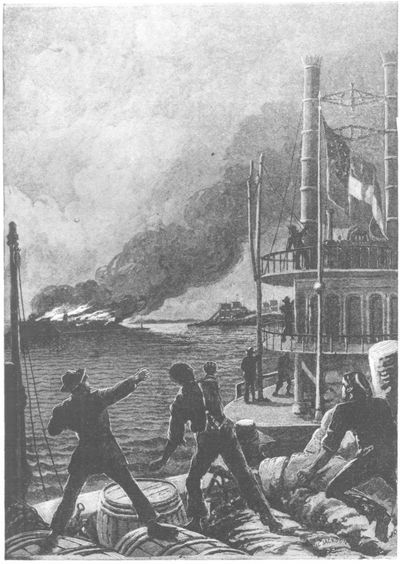
New Orleans on Approach of Fleet.
"Whoever could go was going. The great mass that had no place to go
to, or means to go with, was beside itself. 'Betrayed! betrayed!' it
cried, and ran in throngs from street to street, seeking some vent,
some victim for its wrath. I saw a crowd catch a poor fellow at the
corner of Magazine and Common Streets, whose crime was that he looked
like a stranger and might be a spy. He was the palest living man I
ever saw. They swung him to a neighboring lamp-post; but the Foreign
Legion was patrolling the town in strong squads, and one of its
lieutenants, all green and gold, leaped with drawn sword, cut the
rope, and saved the man. This was one occurrence; there were many like
it. I stood in the rear door of our store, Canal Street, soon after
re-opening it. The junior of the firm was within. I called him to look
toward the river. The masts of the cutter 'Washington' were slowly
tipping, declining, sinking—down she went. The gunboat moored next
her began to smoke all over and then to blaze. My employers lifted up
their heels and left the city, left their goods and their affairs in
the hands of one mere lad—no stranger would have thought I had
reached fourteen—and one big German porter. I closed the doors, sent
the porter to his place in the Foreign Legion, and ran to the levee to
see the sights.
"What a gathering!—the riff-raff of the wharves, the town, the
gutters. Such women! such wrecks of women! and all the juvenile
rag-tag. The lower steamboat-landing, well covered with sugar, rice,
and molasses, was being rifled. The men smashed; the women scooped up
the smashings. The river was overflowing the top of the levee. A
rain-storm began to threaten. 'Are the Yankee ships in sight?' I asked
of an idler. He pointed out the tops of their naked masts as they
showed up across the huge bend of the river. They were engaging the
batteries at Camp Chalmette, the old field of Jackson's renown.
Presently that was over. Ah, me! I see them now as they come slowly
round Slaughterhouse Point, into full view: silent, so grim and
terrible, black with men, heavy with deadly portent, the long banished
stars and stripes flying against the frowning sky. Oh for the
'Mississippi,' the 'Mississippi!' Just then she came down
upon them. But how? Drifting helplessly, a mass of flames.
"The crowds on the levee howled and screamed with rage. The swarming
decks answered never a word; but one old tar on the 'Hartford,'
standing with lanyard in hand, beside a great pivot-gun, so plain to
view that you could see him smile, silently patted its big black
breech and blandly grinned."
As the masts of the fleet came up the river, a young man stepped out
upon the roof of the City Hall, and swiftly hoisted the flag of the
State of Louisiana. When the ships came up, two officers were sent
ashore to demand the surrender of the city; and shoulder to shoulder
the two old sailors marched through a howling, cursing mob to the City
Hall. The mayor refused to surrender the city, saying that Farragut
already had captured it. The officers went back to their ships, and
the flag still floated. Two days later the officers, with a hundred
sailors and marines, returned and demanded that the flag be hauled
down. No one in the city would tear it down, and the Federals went up
to the roof to lower it themselves. The street and surrounding
housetops were crowded with a hostile people, all armed. No one could
tell that the fall of the flag would not be followed by a volley from
the undisciplined populace. The marines in front of the building stood
grouped about two loaded howitzers that bore upon the darkly muttering
crowd. Violence was in the air. As the two officers rose to go to the
roof, the mayor, a young Creole, left the room and descended the
stairs. Quietly he stepped out into the street, and without a word
stood before one of the howitzers, his arms folded, eying the gunner,
who stood with lanyard in hand, ready to fire at the word of command.
The flag fell slowly from the staff. Not a sound arose from the crowd.
All were watching the mayor, who stood coldly looking on death. The
Federal officers came down carrying the flag. A few sharp commands,
and the marines tramped away down the street, with the howitzers
clanking behind them. The crowd cheered for Mayor Monroe and
dispersed, and New Orleans became again a city of the United States.[Back to Contents]
ALONG THE MISSISSIPPI. — FORTS JACKSON AND ST. PHILIP SURRENDER. — THE
BATTLE AT ST. CHARLES. — THE RAM "ARKANSAS." — BOMBARDMENT AND CAPTURE
OF PORT HUDSON.
hile
New Orleans was thus excited over the capture of the city, the
soldiers in the forts below were debating as to the course they should
adopt. They had not surrendered; and although the great bastions were
pounded out of shape by the heavy guns of the fleet, yet they were
still formidable defences, giving perfect security to the men in the
bomb-proofs. But their case was hopeless: for Farragut was at New
Orleans, and could cut off their supplies; while Porter, with his
mortar-boats, was below them, putting escape out of the question.
Every now and then a big shell would drop on the parade, and its
flying pieces would remind the garrison that their enemies were
getting impatient. After waiting a day or two, Porter sent a
lieutenant with a flag of truce to the fort, calling upon the
Confederate commander to surrender the two forts and the shattered
remnant of the Confederate navy. He complimented the Confederates upon
their gallant defence, but warned them, that, should they refuse to
surrender, he would recommence his bombardment with new vigor. The
Confederates refused to surrender until they heard from New Orleans;
and the next day the monotonous thunder of the heavy mortars began
again, and again the heavy shells began falling thick and
fast upon the forts. Wearily the gray-coated soldiers settled down to
continue what they felt must be a useless defence. The officers did
their best to inspirit the men; but all knew that a surrender must
come before long, and at last the men mutinously left their guns, and
said they would fight no longer. They had borne without flinching a
terrible bombardment, and now they felt that to fight longer would be
a foolish sacrifice of life. Many left the forts, and plunged into the
woods to escape the terrible shells. Gen. Duncan saw that all was
lost, and on the night of the 28th of April sent an officer to the
fleet announcing the surrender. On the following day Porter proceeded
up-stream with his squadron, and anchored off the fort. A boat, manned
by six trim sailors in dress uniforms, put off, and soon returned,
bringing the commander of the defeated forces and two or three
officers. They were received on the "Harriet Lane," and Commodore
Porter had made great preparations for the meeting. The crews of all
the vessels were dressed in snow-white mustering-suits, and the
officers in brass-buttoned blue coats and white trousers. The decks
were scrubbed, and all traces of the fight cleared away. As the
Confederate officers came up to the fleet, one of them, a former
lieutenant in the Union navy, said, "Look at the old navy. I feel
proud when I see them. There are no half-breeds there: they are the
simon-pure." As the Confederates came over the side, Porter stood,
with his officers, ready to receive them. The greatest politeness was
observed on either side; and Porter writes, "Their bearing was that of
men who had gained a victory, instead of undergoing defeat." While the
papers of capitulation were being signed, a message came from the deck
that the huge Confederate iron-clad "Louisiana" was drifting down upon
them, a mass of flames, and there was great danger that she would blow
up in the midst of the Union fleet. "This is sharp practice,
gentlemen," said Porter, "and some of us will perhaps be blown up; but
I know what to do. If you can stand what is coming, we can; but I will
make it lively for those people if anybody in the flotilla is
injured."
"I told Lieut. Wainwright to hail the steamer next him," writes Capt.
Porter, "and tell her captain to pass the word for the others to veer
out all their riding-chains to the bitter end, and stand by to sheer
clear of the burning iron-clad as she drifted down. I then sat down to
the table, and said, 'Gentlemen, we will proceed to sign the
capitulation.' I handed the paper to Gen. Duncan, and looked
at the Confederate officers to see how they would behave under the
circumstances of a great iron-clad dropping down on them, all in
flames, with twenty thousand pounds of powder in her magazines. For
myself, I hoped the fire would not reach the powder until the ship had
drifted some distance below us. My greatest fear was that she would
run foul of some of the steamers.
"While I was thinking this over, the officers were sitting as coolly
as if at tea-table among their friends.
"Just then there was a stir on deck, a kind of swaying of the vessel
to and fro, a rumbling in the air, then an explosion which seemed to
shake the heavens. The 'Harriet Lane' was thrown two streaks over, and
every thing in the cabin was jostled from side to side; but not a man
left his seat, or showed any intention of doing so.
"I was glad that I had signed before the explosion took place, as I
would not have liked to have my autograph look shaky."
The destruction of the "Louisiana" was a bit of trickery on the part
of the Confederate naval officers, which Farragut punished by sending
them North as close prisoners, while the army officers were granted
freedom under parole. So ended the Confederate control over the mouth
of the Mississippi; and Porter, after waiting long enough to see a
blue-coat garrison in Forts St. Philip and Jackson, started up the
river to rejoin his chief in New Orleans.
But, on reaching the city, he found that the energetic admiral had
already started out to clear the river of the Confederate batteries
that lined it on either side as far up as Vicksburg. This was a
service of no little danger, and one bringing but little satisfaction;
for no sooner had the gunboats left one point, from which by hard
firing they had driven the Confederates, than the latter would return
in force, build up again their shattered earthworks, mount new guns,
and be once more ready for battle. But more powerful than these little
one or two gun-batteries were the Confederate works at Port Hudson,
the destruction of which was absolutely necessary for further Union
successes on the great river. Between Port Hudson and Vicksburg, the
river was completely under the control of the Confederates; and it was
a powerful gunboat that could hope to navigate that stretch of water
unharmed. Farragut determined to attack Port Hudson, and set the 14th
of March, 1863, as the date for the action.
Port Hudson batteries were perched on a high bluff that
overlooks one of those abrupt curves around which the current of the
Mississippi River sweeps with such terrific force. The heavy guns bore
down upon a point at which the ships would almost inevitably be swept
out of their course by the swift stream, and where the river was
filled with treacherous shifting shoals. Naval officers all agreed
that to pass those batteries was a more difficult task than had been
the passage of the forts below New Orleans; yet Farragut, eager to get
at the stronghold of the foe in Vicksburg, determined to make the
attempt. The mortar-vessels were stationed below to drive the enemy
from his guns with well-directed bombs; while the fleet, led by the
stanch old "Hartford," should make a bold dash up the river.
Night fell upon the scene; and the ships weighed anchor, and started
upon their perilous voyage. To the side of each man-of-war was bound a
gunboat to tow the great vessel out of danger in case of disaster.
Silently the long string of vessels swept upward towards the
batteries; but, as the "Hartford" came into range, the watchful
Confederates gave the alarm, and the nearest battery at once opened
fire. Then from Porter's mortar-schooners far down the river came an
answering roar; and, as ship after ship came up into range, she opened
with shot and shell upon the works. On the dark river-banks great
alarm fires were kindled, lighting up the water with a lurid glare,
and making the ships clearly visible to the Confederate gunners. But
soon the smoke of battle settled down over all; and gunners, whether
on shore or on the ships, fired at random. The "Hartford" led the way,
and picked out the course; and the other vessels followed carefully in
her wake. In the mizzen-top of the flagship was stationed a cool old
river pilot, who had guided many a huge river steamer, freighted with
precious lives, through the mazy channels of the Mississippi. There,
high above the battle-smoke, heedless of the grape-shot and bits of
flying shell whistling around him, he stood at his post, calmly giving
his orders through a speaking-tube that led to the wheel-room. Now and
then the admiral on the deck below would call up, asking about the
pilot's safety, and was always answered with a cheery hail. But though
the "Hartford" went by the batteries, heedless of the storm and lead
poured upon her, she found herself alone, when, after firing a last
gun, she swept into the clear air and tranquil water out of range of
the enemy's guns. She waited some time for the other ships to come up,
while all on board watched eagerly, save those who lay
moaning on the surgeon's tables in the cock-pit below. The night wore
on, and all on board were consumed with anxiety for the fate of the
vessels that had dropped behind. The lookout in the tops reported that
he could see far down the river a bright red light that could only be
caused by a burning vessel. It proved to be the steamer "Mississippi,"
that had grounded under the guns of the batteries, and had been fired
and abandoned by her crew. But of this the admiral knew nothing; and
when, after an hour or two he heard the dull, heavy boom of an
explosion, he went sadly to his cabin, fearing that the lives of many
valiant sailors had been sacrificed. There was no way to communicate
with the fleet below, and it was not until days afterward that the
admiral learned how his fleet had been beaten back by the heavy guns
of the Confederates and the swift current of the river. The "Richmond"
grounded at a point within easy range of the batteries, and her crew
fought desperately while shell after shell went crashing through her
hull. They saw the other vessels of the fleet go drifting by helpless
in the mighty current of the river, but they faltered not in their
brave defence until they saw their ship a wreck and in flames. Then
leaving their dead comrades with the "Richmond" for a funeral pyre,
they escaped to the shore, and threaded their way through miles of
morasses and dense thickets until they came to the mortar-boats, where
they found refuge and rest. And so that first attack on Port Hudson
ended with Farragut above the batteries, and his ships, below. It had
only served to prove, that, safe in their heavy earthworks, the
Confederates could defy any attack by ships alone. This fact was clear
to the Union authorities, and they began massing troops about the
hostile works. Two months later, Porter's mortar-boats, the frigates
and gunboats, and the batteries and muskets of an immense body of
troops, opened on the works. While the heavy fire was being kept up,
the Union armies were closing in, digging trenches, and surrounding
the Confederates on all sides. The firing came to be short-range work
and very deadly. "To show you what cool and desperate fighting it
was," says a Confederate, "I had at least twenty-five shots at
Federals not two hundred feet away. In one instance I fired upon a
lieutenant who was urging on his men. I wounded him in his left arm.
He fired at me with his revolver, and sent a bullet through my cap.
Next time I hit him in the hip, and he fell;, but, while I was
reloading, he raised himself up, and shot the man next to me through
the head. The officer was so close to me that I could tell
the color of his eyes, and detect a small scar on his face."
This sort of work continued for weeks, with occasional charges by the
Federals. Farragut's fleet kept up its bombardment, but did little
damage. One of the Confederate soldiers said, some time after the war,
"One can get used to almost any thing. After the first two or three
days, we took the bombardment as part of the regular routine. Pieces
of shell were continually flying about, and it was the regular thing
for a bomb to drop down among us at intervals. I have seen them come
down within fifty feet of a sentinel, and throw up a wagon-load of
dirt, without his even turning his head. We had but few men hurt by
the artillery-fire. I do not believe we averaged one man hit for every
thousand pounds of metal thrown. I remember that one day I counted
thirteen shells and bombs hurled at the spot where I was posted before
we had a man hurt, and he was only slightly wounded." Naturally, such
work as this could not drive the Confederates from their trenches; and
the fleet soon concluded to leave the army to capture Port Hudson,
while the ships steamed on up the river toward Vicksburg. The army
kept up the siege for weeks, until the Confederates, hearing of the
fall of Vicksburg, surrendered.
While the Union fleet was thus fighting its way up to Vicksburg, the
Confederates were working away at a great ram that they were building
in a secluded spot far up the Yazoo River. Work on the ram was being
pushed with the greatest energy; and the Union sailors, in their ships
on the Mississippi, listened daily to the stories of escaping negroes,
and wondered when the big ship would come down and give them a tussle.
The crew of the ram were no less impatient for the fray; for they were
tired of being hidden away up a little river, plagued by mosquitoes
and gnats. The dark shades of the heavy forests were seldom brightened
by a ray of sun. The stream was full of alligators, that lay lazily on
the banks all day, and bellowed dismally all night. The chirp of a
bird was rarely heard. In its place were the discordant screams of
cranes, or hisses of the moccasins or cotton-mouths. When at last the
carpenters' clatter had ceased, and the ram, ready for action, lay in
the little river, the crew were mustered on the deck, and told that
the new boat had been built to clear the Union vessels from the
Mississippi, and that purpose should be carried out. No white flag was
to flutter from that flagstaff; and she should sink with all
her crew before she would surrender. Any sailor who feared to enter
upon such a service might leave the ship at once. No one left; and the
"Arkansas" started down the river to look for an enemy. She was not
long in finding one. At the mouth of the Yazoo floated three Union
gunboats,—the "Carondelet," the "Tyler," and the "Queen of the West."
As the ram came down into sight, her men heard the roll of the drums
on the decks of the hostile vessels. The gunboats quickly opened fire,
which was as promptly returned by the "Arkansas;" and, as she came
swiftly rushing down the stream, the three vessels fled before her.
The men on the ram were all new recruits, and made awkward work of the
firing; but as she came to close quarters she sent her shells crashing
into the Union ships, while the shot she received in return rattled
harmlessly off her steel-mailed sides. The "Carondelet" was the first
vessel to come to grief. She had hardly fired four shots when a heavy
solid shot crashed through her side, and rattled against the most
delicate part of the engine. She was helpless at once; and hardly had
this damage been reported when a second shot came with a burst into an
open port, killed five men, and broke its way out the other side. In
ten minutes her decks were slippery with blood, and thick strewn with
wounded and dead men. The current of the river drifted her upon a
sandbar; and she lay there helplessly, now and again answering the
galling fire of her foe with a feeble shot. Pouring in a last
broadside, the "Arkansas" steamed past her, and, disregarding the
other two vessels, headed for Vicksburg, where she knew her aid was
sorely needed.
The news of her coming preceded her; and, when she came within sight
of the steeples of the city, at least ten thousand people were
watching her progress, and wondering whether she could pass by the
Federal batteries and through the Federal fleet. The Federal fleet was
all ready for her, and prepared such a gauntlet for the "Arkansas" as
had never been run by any vessel. As she came within range, every
Union gun that could be brought to bear opened; and shot and shell
rained from shore-batteries and marine guns upon the tough hide of the
ram. As she sped by the vessels, they gave her their broadsides, and
the effect was tremendous. As the huge iron balls struck the ship, she
keeled far over; and to her crew inside, it seemed as though she was
being lifted bodily out of the water. Not a shot broke through the
armor; but the terrible concussions knocked men down, and
made blood come pouring from their nostrils. For new men, her crew
fought well and bravely; though two fell flat on their faces, afraid
to lift their heads, lest they be taken off by a shell.
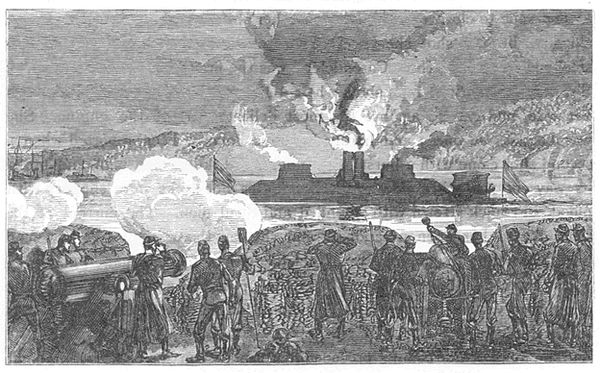
The "Arkansas" under Fire.
When it was seen that the "Arkansas" was likely to pass through the
lines unscathed, the Federals tried to blockade her way; but she
deviated not an inch from her path. The vessel that stood before her
had to move aside, or take the chances of a blow from her terrible
iron beak. She came straight to the centre of the fleet before opening
fire; and when her portholes were opened, and the big guns peered out,
they found plenty of targets. Her first volley knocked a gunboat to
pieces; and in another minute she had crashed into the side of a Union
ram, sending that unlucky craft ashore for repairs. But the storm of
solid shot was too much for her; and she was forced to seek shelter
under the bluffs, where the heavy guns of the Confederate
shore-batteries compelled the Union ships to keep a respectful
distance. Here she lay for several weeks, beating off every assault of
the Federals, and making a valuable addition to the defences of the
city. But, in an evil hour, the Confederate authorities decided to
send her down the river to recapture Baton Rouge. When her journey was
but half completed, she was pounced upon by several United
States vessels, with the "Essex" in the lead. Her engines breaking
down, she drifted upon a sand-bank; and the attacking ships pounded
her at their leisure, until, with the fire bursting from her
portholes, she was abandoned by her crew, and blazed away until her
career was ended by the explosion of her magazine. She had given the
Federal fleet some hard tussles, but beyond that had done nothing of
the work the Confederates so fondly hoped of her.
While the flotilla of gunboats, led by the "Essex," were planning for
the destruction of the "Arkansas," a small naval expedition,
consisting of three gunboats, was threading its way up the narrow
channel of the White River in search of some Confederate batteries
said to be on the banks. Within twelve hours from the start, the
sailors learned from a ragged negro, whom they captured on the shore,
that the Confederates had powerful batteries only five miles farther
up, and that the river channel was obstructed by sunken vessels.
Anchor was cast for the night; and in the morning the troops
accompanying the expedition were landed, and plunged into the forest
with the plan of taking the fort by a rush from the rear. The gunboats
began a slow advance up the river, throwing shells into the woods
ahead of them. The blue-jackets kept carefully under cover; for,
though they could see no foe, yet the constant singing of
rifle-bullets about the ships proved that somewhere in those bushes
were concealed sharp-shooters whose powder was good and whose aim was
true. The "Mound City" was leading the gunboats, and had advanced
within six hundred yards of the enemy's guns, when a single shot,
fired from a masked battery high up the bluffs, rang out sharply amid
the rattle of small-arms. It was the first cannon-shot fired by the
Confederates in that engagement, and it was probably the most horribly
deadly shot fired in the war. It entered the port-casemate forward,
killed three men standing at the gun, and plunged into the boiler. In
an instant the scalding steam came hissing out, filling the ship from
stem to stern, and horribly scalding every one upon the gun-deck. The
deck was covered with writhing forms, and screams of agony rang out
above the harsh noise of the escaping steam and the roar of battle
outside. Many were blown overboard; more crawled out of the portholes,
and dropped into the river to escape the scalding steam, and
struggling in the water were killed by rifle-balls or the fragments of
the shells that were bursting all around. The helpless gunboat turned
round and round in the stream, and drifted away, carrying a
crew of dead and dying men. So great was the horror of the scene, that
one of the officers, himself unhurt, who saw his comrades thus
tortured all about him, went insane.
While this scene was going on before the fort, the Union troops had
come up behind it, and with a cheer rushed over the breastworks, and
drove the garrison to surrender. The Confederate banner fell from the
staff, and the stars and stripes went up in its place. But how great
was the price that the Federals had to pay for that victory! That
night, with muffled drums, and arms reversed, the blue-jackets carried
to the grave fifty-nine of their comrades, who twelve hours before
were active men. With three volleys of musketry the simple rites over
the sailors' graves were ended; and those who were left alive, only
said with a sigh, "It is the fortune of war."[Back to Contents]
ON TO VICKSBURG. — BOMBARDMENT OF THE CONFEDERATE STRONGHOLD. — PORTER'S
CRUISE IN THE FORESTS.
hile the smaller gunboats were thus making dashes into the enemy's
country, destroying batteries and unfinished war-vessels, and burning
salt-works, the heavier vessels of the fleet were being massed about
Vicksburg, and were preparing to aid the army in reducing that city to
subjection. We need not describe the way in which Gen. Grant had been
rushing his troops toward that point, how for weeks his engineers had
been planning trenches and approaches to the Confederate works, until
toward the middle part of June, 1863, the people in that city found
themselves hemmed in by a huge girdle of trenches, batteries, and
military camps. Gen. Pemberton, with his army of Confederate soldiers,
had been forced backward from point after point, until at last he
found himself in Vicksburg, with the prospect of a long siege before
him, and no way to get past the inexorable lines of blue that
surrounded him. It is true that he had a wonderfully strong position,
and many were the tongues that said Vicksburg could never be taken.
But though stronger than Sebastopol, stronger than the Rock of
Gibraltar, Vicksburg was destined to fall before that mighty army that
encircled it, and was slowly starving the city into subjection.
But the Union soldiers, looking from their camps toward the
Confederate citadel, saw that they had before them some severe work
before that flag that flaunted over the city should be replaced by the
stars and stripes. The city stands on a towering bluff high above the
eastern bank of the Mississippi River. On that frowning height the
busy hands of Pemberton's soldiers had reared mighty batteries, that
commanded the Mississippi for miles up and down stream. To think of
carrying the works by assault, was madness. Sherman had tried, and was
beaten back with terrible loss. Then Grant, with nearly twenty
thousand men, and with the co-operation of the river-flotilla, came
upon the stage, and determined to take the city though it kept him at
bay for months.
All imaginable plans were tried to get the army below the city; for
Grant's command had come down from Cairo, and were at the northern and
most impregnable side of the enemy's works. As at Island No. 10, a
sharp bend in the river made a long peninsula right under the
Confederates' guns. Grant, remembering the plan adopted before, set to
work to cut a canal through the peninsula, so that the gunboats and
transports might get below the forts. Twelve hundred negroes worked
with a will upon this ditch for weeks. Then came a terrible
rain-storm: the swollen, muddy torrent of the river broke in upon the
unfinished canal, and that work was wasted. Then a new plan was
suggested, this time by Commodore David Porter, who all through the
war showed the greatest delight in taking his big gunboats into
ditches where nothing larger than a frog or musk-rat could hope to
navigate, and then bringing them out again safe after all.
The country back of Vicksburg was fairly honeycombed with shallow
lakes, creeks, and those sluggish black streams called in the South
bayous. Porter had been looking over this aqueous territory for some
time, and had sent one of his lieutenants off in a steam-launch to see
what could be done in that network of ditches. When the explorer
returned, he brought cheering news. He was confident that, with tugs
and gangs of axemen clearing the way, the gunboats could be taken up
the Yazoo River, then into a wide bayou, and finally through a maze of
small waterways, until they should reach the Mississippi again below
the Vicksburg batteries. Then the transports could follow, the troops
could march down the other side of the river, be met by the
transports, ferried across, and take Vicksburg on the flank.
It was a beautiful plan; and Porter went to Grant with it, full of
enthusiasm.
Gen. Grant considered the matter for some time, but finally gave his
consent, and detailed a number of blue-coated soldiers to aid Porter's
blue-jackets in the work. They first cut the levees, and let the
mighty tide of the Mississippi sweep in, filling the bayous to the
brim, and flooding all the country round about. Then the gunboats
plunged in, and were borne along on the rushing tide until they
brought up, all standing, against the trunks of trees, or had their
smoke-stacks caught by overhanging branches.
Then came the tug of war; and the axemen were called to the front, and
set to work. They chopped their way along for some distance; the rapid
current from the river banging the vessels against the trees and
stumps, until all the standing rigging and light cabins were swept
away. After a good deal of work they saw before them a broad river,
wide enough for two vessels to steam abreast. Soon they drifted out
into it, and the commanding officer sang out cheerily, "On to
Vicksburg, boys, and no more trees to saw." And so they steamed on,
thinking how neatly they should take the "gray-coats" in the rear,
when suddenly a bend in the river showed them, just ahead, a fort in
the middle of the river, with the channel blocked on either side. That
was a surprise. The works were new, and the water was still muddy
about the sunken steamers. Clearly the wily Pemberton had heard of
this inland naval expedition, and was determined to check it
effectually.
The gunboats backed water, and crowded in confused groups. The gunners
in the fort took hurried aim, and pulled the lanyards of their cannon,
forgetting that those pieces were not loaded. It was hard to tell
which party was the more excited at the unexpected meeting. This gave
the blue-jackets a chance to collect their thoughts, and in a minute
or two the gunboats opened fire; but they were soon convinced that the
fort was too much for them, and they turned and crawled back through
the woods to the fleet above Vicksburg. Pemberton scored one point for
successful strategy.
But, even while this expedition was working its way back to the
station of the vessels on the Mississippi, Porter was starting another
through a second chain of water-courses that he had discovered. This
time he was so sure of getting into the rear of Vicksburg, that he
took four of his big iron-clads, and two light mortar-boats
built especially for work in the woods. Gen. Sherman, with a strong
army-force, marched overland, keeping up with the gunboats. Admiral
Porter, in his Memoirs, gives a graphic picture of this expedition.
Back of Vicksburg the country is low, and intersected in every
direction by narrow, tortuous bayous, lined on either side by gloomy
morasses or majestic forests. Into these little-known water-courses
Porter boldly led his ponderous iron-clads; while Sherman, with a
detachment of troops, advanced along the shore, keeping as near the
flotilla as possible. Seldom have naval vessels been detailed upon so
strange a service. For days they steamed on under the spreading
branches of trees, that often spanned the bayous in a mighty arch
overhead, shutting out all sunlight. For a time this navigation of
placid, shady waterways was pleasant enough; but, as they penetrated
farther into the interior, the jackies sighed for the blue waters of
the ocean, or even for the turbid current of the Mississippi. The
heavy foliage that gave so grateful a shade also harbored all sorts of
animals; and coons, rats, mice, and wildcats, that had been driven to
the trees for shelter during the prevailing high water, peered down
upon the sailors, and often dropped sociably down upon the decks of
the vessels gliding beneath.
At some portions of the voyage the flotilla seemed to be steaming
through the primeval forest. The bayou was but a few feet wider than
the gunboats, and its banks were lined by gnarled and knotted old
veterans of the forest,—live oaks, sycamore, and tupelo gum trees
that had stood in majestic dignity on the banks of the dark and sullen
stream for centuries. Sometimes majestic vistas would open; broad
avenues carpeted with velvet turf, and walled in by the massive tree
trunks, extending from the banks of the stream far back into the
country. Again, the stately forests would be replaced by fields of
waving corn or rice, with the tops of a row of negro cabins or the
columned front of a planter's house showing in the distance. Then, as
the flotilla steamed on, this fair prospect would disappear, and be
replaced by noisome cypress brakes, hung thick with the funereal
Spanish moss, and harboring beneath the black water many a noxious
reptile.
So through the ever-changing scenery the gunboats moved along, making
but little progress, but meeting with no serious obstacle, until one
morning there appeared on a bit of high ground, some yards in
advance of the leading gunboat, an army officer mounted on
an old white horse. It was Gen. Sherman, and his troops were in camp
near by. He greeted the naval forces cheerily, and, rallying Porter on
the amphibious service into which his gunboats had been forced, warned
him that he would soon have not a smokestack standing, nor a boat left
at the davits.
"So much the better," said the undaunted admiral. "All I want is an
engine, guns, and a hull to float them. As to boats, they are very
much in the way."
A short time only was spent in consultation, and then Sherman with his
forces left the bayou and plunged into the interior, first warning
Porter that he would have a hard time getting any farther, even if the
enemy did not come down and surround him. But Porter was not the man
to abandon the advance, so long as there was water enough to float his
gunboats. Besides, he had gained some ideas regarding navigation in
the forests, that enabled him to move his fleet forward with more
celerity than at first. When a tree blocked the course of the
iron-clads, they no longer stopped to clear it away by work with the
axes; but, clapping on all steam, the powerful rams dashed at the
woody obstruction, and with repeated blows soon knocked it out of the
way.
Soon after leaving Sherman, Porter saw that the difficulties he had
thus far met and conquered were as nothing to those which he had yet
to encounter. The comparatively broad stream up which he had been
steaming came to an end, and his further progress must be through
Cypress Bayou, a canal just forty-six feet wide..[??-second period a
smudge?] The broadest gunboat was forty-two feet wide, and to enter
that narrow stream made retreat out of the question: there could be no
turning round to fly. The levees rose on either side of the narrow
canal high above the decks of the iron-clads, so that the cannon could
not be sufficiently elevated to do effective work in case of an
attack. But there were nine feet of water in the great ditch; and that
was enough for Porter, who pressed boldly on.
The country into which the combined military and naval expedition was
advancing was in truth the granary of Vicksburg. On all other sides of
the beleaguered city, the Federal lines were drawn so closely that the
wagons laden with farm produce could not hope to pass. But here, back
of the city, and far from the camps of Grant's legions, the work of
raising produce for the gallant people of Vicksburg was prosecuted
with the most untiring vigor. The sight, then, of the
advancing gunboats aroused the greatest consternation. From the deck
of his vessel Porter could see the people striving to save their
property from the advancing enemy. Great droves of cattle were being
driven away far into the interior; negroes were skurrying in all
directions, driving poultry and pigs to the safe concealment of the
forest; wagons groaning under the weight of farm and garden produce
could be seen disappearing in the distance. What the inhabitants could
not save they destroyed, in order that it might not profit the
invaders. A short distance from the mouth of the bayou "were six
thousand bales of cotton piled up on opposite sides of the stream,
ready to be taken aboard a steamer when the war should end. As the
gunboats advanced slowly, making little headway against the two-knot
current of the bayou, Porter saw two men, carrying lighted pine-knots,
dash up to the cotton, and begin to set it afire. The admiral looked
on in disgust. "'What fools these mortals be!'" said he to an officer
standing at his side; "but I suppose those men have a right to burn
their own cotton, especially as we have no way of preventing them."
"I can send a howitzer shell at them, sir," said the officer, "and
drive them away."
But to this Porter demurred, saying that he had no desire to kill the
men, and that they might do as they liked with their own. Accordingly
the officers quietly watched the vandals, until, after twenty minutes'
work, the cotton was blazing, and a dense mass of smoke cut off all
vision ahead, and rose high in the air. Then Porter began to suspect
that he had made a mistake. The difficulties of navigation in the
bayou were great enough, without having smoke and fire added to them.
Yet to wait for the cotton to burn up might cause a serious delay. On
the high bank of the bayou stood a negro begging the sailors to take
him aboard.
"Hallo, there, Sambo!" sung out Porter, "how long will it take this
cotton to burn up?"
"Two day, massa," responded the contraband; "p'raps tree."
That ended the debate. "Ring the bell to go ahead fast," said the
admiral to the pilot; and away went the flotilla at full speed,
plunging into the smoke and fire. It was a hot experience for the
sailors. The heavy iron-clads made but slow progress, and
were scorched and blistered with the heat. The ports were all shut
down, and the crews called to fire-quarters, buckets in hand. To
remain on deck, was impossible. Porter and his captain made the trial,
but had hardly entered the smoke when the scorching heat drove both
into the shelter of an iron-covered deck-house. The pilot standing at
the wheel seized a flag, and, wrapping it about his face and body, was
able to stay at his post. As the flames grew hotter, the sailors below
opened the main hatch, and, thrusting up a hose, deluged the deck with
floods of water. So, without a man in sight, the huge iron ship moved
along between the walls of flame. Suddenly came an enormous crash. The
gunboat shivered, and for a moment stood still; then, gathering
headway, moved on again, though with much ominous grating beneath her
keel. Soon after she passed out of the smoke and heat, and all hands
rushed on deck for a whiff of the fresh, cool air. Their first thought
was of the cause of the collision; and, looking eagerly astern, they
saw a heavy bridge, about fifty feet of which had been demolished by
the tremendous power of the ram. This gave Porter a hint as to the
force he had at his command; and thereafter bridges were rammed as a
matter of course whenever they impeded the progress of the iron-clads.
The astonishment of the people along the shore may well be imagined.
The great and formidable obstacles that stood in the path of the
squadron were, as a rule, overcome by the exertion of the great powers
of the steam-driven, iron-plated vessels; but at last there came a
check, that, though it seemed at first insignificant, terminated the
sylvan manœuvres of the iron-clad navy. After running the gantlet
of the burning cotton, butting down trees, and smashing through
bridges, the column entered a stretch of smooth water that seemed to
promise fair and unobstructed sailing. But toward the end of this
expanse of water a kind of green scum was evident, extending right
across the bayou, from bank to bank. Porter's keen eye caught sight of
this; and, turning to one of the negroes who had taken refuge on the
gunboat, he asked what it was. "It's nuffin' but willows, sah," he
replied. "When de water's out of de bayou, den we cuts de willows to
make baskets with. You kin go troo dat like a eel."
Satisfied with this explanation, the admiral ordered the tug which
led the column to go ahead. Under a full head of steam, the
tug dashed into the willows, but began to slow up, until, after going
about thirty yards, she stopped, unable to go forward or back.
Undaunted by this unexpected resistance, Porter cried out that the
"Cincinnati" would push the tug along; and the heavy gunboat,
withdrawing a short distance to gain headway, hurled herself forward,
and dashed into the willows with a force that would have carried her
through any bridge ever built. But the old fable of the lion bound
down by the silken net was here re-enacted. The gunboat did not even
reach the tug. The slender willow-shoots trailed along the sides,
caught in the rough ends of the iron overhang, and held the vessel
immovable. Abandoning the attempt to advance, the gunboat strove to
back out, but to no avail. Then hooks were rigged over the side to
break away the withes, and men slung in ropes alongside vigorously
wielded sharp cutlasses and saws; but still the willows retained their
grip. Matters were now getting serious; and, to add to Porter's
perplexity, reports came in that Confederate troops were coming down
upon him. Then he began to lose confidence in his iron-clads, and wish
right heartily for Sherman and his soldiers, of whose whereabouts he
could gain no knowledge. The enemy did not leave him long in doubts as
to their intention, and soon began a vigorous fire of shells from the
woods. Porter stopped that promptly by manning his mortars and firing
a few shells at a range measured by the sound of the enemy's cannon.
The immediate silence of the hostile batteries proved the accuracy of
the admiral's calculations, and gave him time to devise means for
escaping from his perilous position.
How to do it without aid from Sherman's troops, was a difficult
question; and in his perplexity he exclaimed aloud, "Why don't Sherman
come on? I'd give ten dollars to get a telegram to him." The admiral
was standing at the moment on the bank of the bayou, near a group of
negroes; and an athletic-looking contraband stepped forward, and,
announcing himself as a "telegram-wire," offered to carry the note "to
kingdum kum for half a dollar." After sharply cross-questioning the
volunteer, Porter wrote on a scrap of paper, "Dear Sherman,—Hurry up,
for Heaven's sake. I never knew how helpless an iron-clad could be,
steaming around through the woods without an army to back her."
"Where will you carry this?" asked Porter, handing the despatch to the
negro.
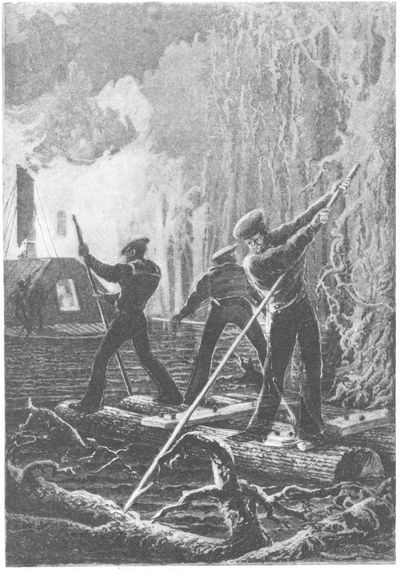
Porter's Flotilla on the Red River.
"In my calabash kiver, massa," responded the messenger with a
grin; and, stowing the paper away in his woolly hair, he darted away.
The telegram being thus despatched, Porter again turned his attention
to the willows; and, a fortunate rise in the water having occurred, he
was able to extricate his vessels and begin his retreat down the
bayou. He was somewhat perplexed by the silence of the Confederates,
from whom he had heard nothing since his mortars silenced their masked
batteries. The conundrum was solved by the sound of wood-chopping in
the forests ahead, and the discovery shortly after of two heavy logs
lying athwart the bayou, and stopping the progress of the vessels. An
hour's hard work with axe and saw removed this obstruction; and the
tug, slipping through first, shot ahead to prevent any more
tree-felling. The loud reports of her howitzer soon carried back to
the fleet the news that she had come up with the enemy, and was
disputing with them the right to the bayou.
The difficulties of the retreat were no less great than those of the
advance, with the intermittent attacks of the enemy added. The work of
removing heavy, soggy logs, half submerged beneath the black waters of
the bayou, clearing away standing trees, and breaking up and removing
Red-river rafts, wearied the sailors, and left them little spirit to
meet the enemy's attacks. The faint sounds of wood-chopping in the
distance told too well of the additional impediments yet in store for
the adventurous mariners. Scouts sent out reported that the enemy had
impressed great gangs of negroes, and were forcing them to do the work
of felling the trees that were to hem in Uncle Sam's gunboats, for the
benefit of the C.S.A. But the plans of the Confederates to this end
were easily defeated. Porter had not only many willing arms at his
command, but the powerful aid of steam. When the gunboats came to a
tree lying across the bayou, a landing party went ashore and fastened
large pulleys to a tree on the bank. Then a rope was passed through
the block; and one end having been made fast to the fallen tree, the
other was taken aboard a gunboat. The word was then given, "Back the
iron-clad hard;" and the fallen monarch of the forest was soon dragged
across the bayou and out of the way So expert did the jackies become
in this work, that they were soon able to clear away the trees faster
than the enemy could fell them. The tug then went ahead, and for a
time put an end to further tree-chopping, and captured several of the
negro axemen.
From the captured contrabands Porter learned that the attempt
to cut off his retreat was directed by the military authorities at
Vicksburg. This was a startling revelation. He had thought that the
Confederates were in entire ignorance of his movement; and now it
turned out that the wily Pemberton had kept a sharp lookout on the
marauding gunboats, and was shrewdly planning for their capture. While
Porter was pondering over this new discovery, a party of scouts came
in, bringing in four captured Confederates, two of whom were
commissioned officers. The commanding officer, a mere boy, was
somewhat chagrined at being captured, but felt confident that his
friends would recapture him shortly. Porter politely asked him to take
a glass of wine and some supper.
"I don't care if I do," responded the youngster; "and I have the less
compunction in taking it, as it belongs to us anyhow. In two hours you
will be surrounded and bagged. You can't escape. How in the Devil's
name you ever got here, is a wonder to me."
Porter smiled pleasantly, and, helping his guests lavishly, proceeded
to question them on the numbers and position of the Confederate
troops. He learned that a large body of troops had been sent out to
surround the iron-clads, and were even then closing in upon the
intruders. The danger was imminent, but Porter showed no trepidation.
"How far off are your troops?" he asked.
"About four miles. They will bag you at daylight," was the confident
response.
"Well, gentlemen," said the admiral, "Gen. Sherman is now surrounding
your forces with ten thousand men, and will capture them all before
daylight." And so saying the admiral went on deck, leaving his
captives lost in wonder; for the information carried to the Vicksburg
authorities had made no mention of troops.
Though Porter had put on so bold a front before his captives, he
really felt much anxiety for the fate of his iron-clads. He could hear
nothing from Sherman, who might be thirty miles away for all he knew.
Accordingly he retraced his course for a few miles, to throw the enemy
off the scent, and the next day began again his descent of the bayou,
bumping along stern foremost amid snags and standing trees. The enemy
soon gave evidence that he was on the watch, and opened fire with his
artillery from the rear. At this one gunboat steamed back and silenced
the artillery for a time, after which she rejoined her
fellows. Sharp-shooters in the thickets along the levee then began to
grow troublesome; and the whistle of the rifle-balls, with an
occasional ping as one struck the smokestack, warned the sailors
that the deck of a gunboat in a narrow canal was no safe place in time
of war. The high levees on either side of the bayou made it impossible
to use the guns properly: so Porter turned them into mortars, and, by
using very small charges of powder, pitched shells up into the air,
dropping them into the bushes back of the levee. This somewhat checked
the fire of the sharp-shooters, but the decks were still dangerous
places to frequent. A rifle-ball struck Lieut. Wells in the head as he
stood talking to Porter; and he fell, apparently dead, upon the deck.
The admiral beckoned an officer to come and bear away the body; but
the newcomer was also hit, and fell across the body of the first.
Porter concluded that the locality was getting rather hot, and gladly
stepped behind a heavy plate of sheet-iron, which an old
quarter-master brought him with the remark, "There, sir, stand behind
that. They've fired at you long enough."
From behind his shield, Porter looked out anxiously at the forces by
which he was beleaguered. He could see clearly that the Confederates
were increasing in numbers; and, when at last he saw a long gray
column come sweeping out of the woods, his heart failed him, and for a
moment he thought that the fate of his flotilla was sealed. But at
that very moment deliverance was at hand. The Confederates were seen
to fall into confusion, waver, and give way before a thin blue
line,—the advance guard of Sherman's troops. The negro
"telegram-wire" had proved faithful, and Sherman had come on to the
rescue.
That ended the difficulties of the flotilla. The enemy, once brought
face to face with Sherman's men, departed abruptly; and soon the
doughty general, mounted on an old gray horse, came riding down to the
edge of the bayou, for a word with Porter. Seeing the admiral on the
deck of his gunboat, he shouted out, "Hallo! Porter, what did you get
into such an ugly scrape for? So much for you navy fellows getting out
of your element. Better send for the soldiers always. My boys will put
you through. Here's your little nigger. He came through all right, and
I started at once. Your gunboats are enough to scare the crows: they
look as if you had got a terrible hammering."
Somewhat crestfallen, Porter remarked, that he "never knew
what helpless things iron-clads could become when they got in a ditch,
and had no soldiers about." As Sherman declined to come aboard, Porter
went below to look after his two prisoners.
"Well, gentlemen," said he, as he entered the cabin, "you were right.
We are surrounded by troops."
The two Confederates were greatly exultant, but assured Porter that
they would see that he was kindly treated when taken into Vicksburg.
"To Vicksburg!" said he with mock amazement. "Who said any thing of
Vicksburg?"
"Why, of course you'll be taken there as a prisoner, now that our men
have surrounded you."
"Oh, you are mistaken there!" responded Porter. "The troops by whom I
am surrounded are Sherman's boys, six thousand strong." And at this
news the chagrined captives subsided, and began to consider the
prospects of a trip to the North, and incarceration in one of the
military prisons.
Sherman's army soon came up in force, and went into camp along the
road that skirted the levee. As night fell, the scene took on a wild
and picturesque air. In the narrow bayou lay the gunboats, strung out
in single file along a line of half a mile. They bore many signs of
the hard knocks they had received in their excursion through the
woods. Boats, davits, steam-pipes, and every thing breakable that rose
above the level of the deck, had been swept away by the overhanging
boughs, or dashed to pieces by falling trees. The smoke-stacks and
wheel-houses were riddled by the bullets of the Confederate
sharp-shooters. The decks were covered with rubbish of all kinds, and
here and there was a fissure that told of the bursting of some
Confederate shell. The paint was blistered, and peeling off, from the
effects of the cotton-fire through which the fleet had dashed.
On the shore blazed the camp-fires of Sherman's troops; and about the
huge flaming piles the weary soldiers threw themselves down to catch a
moment's rest, while the company cooks prepared the evening meal. Many
of the idle soldiers strolled down to the edge of the bayou, and,
forming a line along the levee, began chaffing the sailors on the
ludicrous failure of their attempt to perform naval evolutions in a
swamp.
"What's gone with your boats, Jack?" sung out one tall fellow
in cavalry garb. "Been in dry-dock for repairs?"
"How do you like playing mud-turtle?" said another. "Better stick to
salt water after this."
"Don't go bush-whacking again, unless you have the soldiers with you.
You look as if your mothers didn't know you were out." And at this a
yell of approval went up all along the line, while the badgered
sailors growled and tried to make sharp retorts to the stinging
ridicule of the landsmen.
So ended this memorable gunboat expedition. It is unparalleled in the
history of warfare. The feats performed by the unwieldy iron-clads in
the narrow bayous gained for them, from Lincoln, the title of
"web-footed" gunboats. They had traversed shallow and tortuous
channels; they had cleared their path of trees, snags, and even
bridges; they had run the gantlet of flaming cotton-bales and
Confederate bullets. After meeting and overcoming so many obstacles,
their final stoppage by a thicket of pitiful willow-shoots irritated
the blue-jackets and their commander extremely. Porter had penetrated
so far into the Yazoo country, that he could see how great damage
could be inflicted upon the Confederates, if the expedition could but
be carried out successfully. He had definite information to the
effect, that, at Yazoo City, the Confederates had a thriving shipyard,
at which they were pressing forward the construction of steam-rams
with which to sweep the Mississippi. To reach that point and destroy
the vessels, would have been a service thoroughly in accord with his
tastes; but the willows held him back. However, he was able to console
himself with the thought that the rams were not likely to do the
Confederates any immediate service; for a truthful contraband, brought
in by the Union scouts, informed the admiral that "dey has no bottom
in, no sides to 'em, an' no top on to 'em, sah; an' dere injines is in
Richmon'."
When the dangers encountered by the gunboats during this expedition
are considered, the damage sustained seems surprisingly small. Had the
Confederates acted promptly and vigorously, the intruders would never
have escaped from the swamps into which their temerity had led them. A
few torpedoes, judiciously planted in the muddy bed of the bayou,
would have effectively prevented any farther advance. More than once
the Confederates posted their artillery within effective range, and
opened a rapid and well-directed fire upon the gunboats, but
erred in using explosive shells instead of solid shot. "They were
evidently greenhorns," wrote Porter, exulting over his narrow escape,
"and failed to understand that we were iron-clad, and did not mind
bursting-shell. If they had used solid shot, they might have hurt
us." The infantry forces of the enemy were ample to have given the
marauding gunboats a vast deal of trouble, if the Confederate officers
had been enterprising, and had seized upon the opportunities afforded
them. Night after night the flotilla lay tied up in the centre of a
narrow bayou, with the levees towering so high above the gunboats'
ports, that the cannon were useless. At such a time, a determined
assault by a body of hostile infantry could hardly have been resisted.
Such an attack was the danger which Porter most feared throughout the
expedition, and he nightly made preparations for a desperate
resistance. The widest part of the bayou was chosen for the anchorage,
in order that a strip of water at least four feet wide might separate
the gunboats from the shore. The sides of the iron-clads were then
greased, and the guns loaded with grape, and elevated as much as
possible. Landing parties with howitzers were sent ashore, and posted
so as to enfilade any attacking force; scouts were sent out in all
directions; and the crews of the gunboats slept at their quarters all
night, ready for action at the first alarm. But it is doubtful whether
even these elaborate precautions could have saved the flotilla, had
the Confederates brought one regiment to the assault. However, the
enemy let the golden moment pass; and, after suffering the agonies of
suspense for several days, Porter at last saw his gunboats safely
anchored by the side of Sherman's protecting regiments.
Sherman and Porter held a consultation that night, and concluded that
it was useless to try to get around Vicksburg by hauling the gunboats
through the woods; and the following morning the flotilla started back
to the Union headquarters on the Mississippi.
Gen. Grant was beginning to get impatient. Weeks had passed away, and
there were still no gunboats or transports below the Vicksburg
batteries to aid him in carrying out his military plans. He held a
long consultation with Porter, the outcome of which was that the
admiral decided to run his gunboats and transports right through the
fire of the Confederate guns.
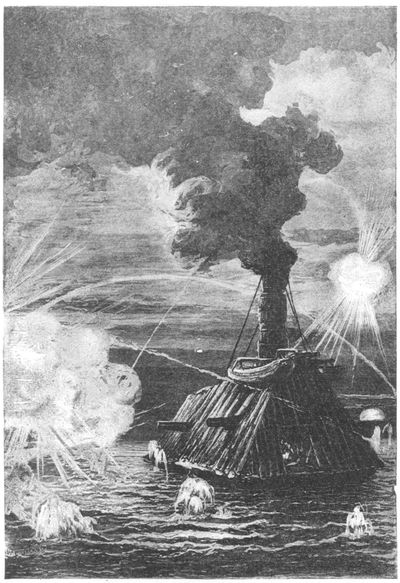
Dummy Gunboat passing Forts on the Mississippi.
But, before sending a vessel through, Porter thought that he would
test the accuracy of the Confederate gunners by giving
them a dummy to fire at. He took a large flat boat, and built it up
with logs and lumber until it looked like a powerful ram. Two huge
wheel-houses towered amidships, on each of which was painted, in
great, staring letters, "Deluded Rebels, cave in." From the open
ports, the muzzles of what appeared to be heavy rifles protruded;
though the guns that seemed so formidable were really only logs of
wood. Two high smoke-stacks, built of empty pork-barrels, rose from
the centre of this strange craft; and at the bottom of each stack was
an iron pot, in which was a heap of tar and oakum that sent forth
volumes of black smoke when lighted. One dark night the fires in this
sham monster were lighted, and she was towed down to the Confederate
batteries, and set drifting down the river. She was quickly
discovered, and the batteries on the bluffs opened on her with a roar.
There was nothing about the dummy to be hurt, however; and it was
impossible to sink her. So she sailed majestically through the
plunging hail of solid shot, and past the terrible batteries that were
thought to be a match for any thing afloat. The Confederates in the
trenches looked at each other in astonishment and dismay. Word was
sent to Gen. Pemberton that a powerful Yankee iron-clad had passed the
batteries unhurt, and was speeding down the stream. The General's
first thought was of a gunboat, the "Indianola," lately captured from
the Federals, and now being converted into an iron-clad ram. She must
be saved from recapture, even if it should be necessary to destroy
her. Word was hurriedly sent down the river that a formidable ram was
bearing down upon the "Indianola;" and, if the latter vessel was not
in condition to do battle, she should be blown up. Accordingly, while
the dummy ram, caught in an eddy of the river, was whirling helplessly
around just below Vicksburg, the Confederates put the torch to their
new war-vessel, and she was soon a heap of ashes. Porter's little joke
was a good one for the United States.
But all the time that the Union navy was making these futile attempts
to get the better of the wily general who held the fort at Vicksburg,
a constant bombardment of the city was kept up. From gunboats and land
batteries, shells were hurled into the streets of the town, tearing
down houses, killing men, women, and children, and driving the
inhabitants to their cellars, or to deep caves dug in the hills. The
fire from the Union gunboats was most destructive, for they could drop
down to an advantageous point, shell the city until tired, then steam
back into safety again.
Cave-digging in the city became a regular business; and caves
brought from twenty to fifty dollars, according to their size. They
generally consisted of two or three rooms, and people lived in them
quite cheerfully during the time that the iron hail was falling in the
city's streets.
A Northern woman, who was pent up in Vicksburg during the siege, tells
graphically the story of the bombardment:—
"For many nights we have had but little sleep, because the Federal
gunboats have been running past the batteries. The uproar when this is
happening is phenomenal. The first night the thundering artillery
burst the bars of sleep, we thought it an attack by the river. To get
into garments, and rush up-stairs, was the work of a moment. From the
upper gallery we have a fine view of the river; and soon a red glare
lit up the scene, and showed a small boat, towing two large barges,
gliding by. The Confederates had set fire to a house near the bank.
Another night, eight boats ran by, throwing a shower of shot; and two
burning houses made the river clear as day. One of the batteries has a
remarkable gun they call 'whistling Dick,' because of the screeching,
whistling sound it gives; and certainly it does sound like a tortured
thing. Added to all this is the indescribable Confederate yell, which
is a soul-harrowing sound to hear. I have gained respect for the
mechanism of the human ear, which stands it all without injury. The
streets are seldom quiet at night: even the dragging about of cannon
makes a din in these echoing gullies. The other night we were on the
gallery till the last of the eight boats got by. Next day a friend
said to H——, 'It was a wonder you didn't have your heads taken off
last night. I passed, and saw them stretched over the gallery; and
grape-shot were whizzing up the street just on a level with you.' The
double roar of batteries and boats was so great, we never noticed the
whizzing. Yesterday the 'Cincinnati' attempted to go by in daylight,
but was disabled and sunk. It was a pitiful sight: we could not see
the finale, though we saw her rendered helpless.
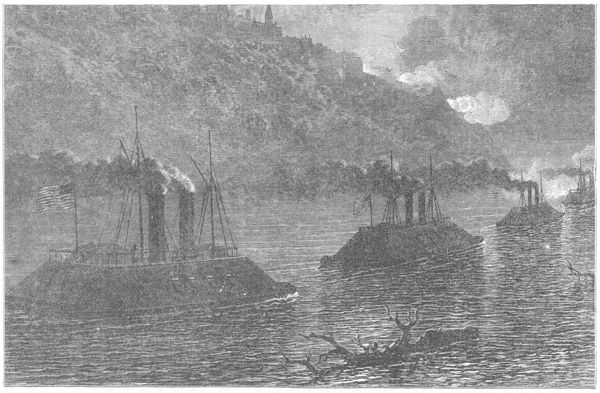
Passing the Vicksburg Batteries.
"Since that day the regular siege has continued. We are utterly cut
off from the world, surrounded by a circle of fire. Would it be wise,
like the scorpion, to sting ourselves to death? The fiery shower of
shells goes on day and night. H——'s occupation, of course, is gone,
his office closed. Every man has to carry a pass in his pocket. People
do nothing but eat what they can get, sleep when they can, and dodge
the shells. There are three intervals when the shelling
stops,—either for the guns to cool, or for the gunners' meals, I
suppose,—about eight in the morning, the same in the evening, and at
noon. In that time we have to both prepare and eat ours. Clothing
cannot be washed, or any thing else done. On the 19th and 22d, when
the assaults were made on the lines, I watched the soldiers cooking on
the green opposite. The half-spent balls, coming all the way from
those lines, were flying so thick that they were obliged to dodge at
every turn. At all the caves I could see from my high perch, people
were sitting, eating their poor suppers at the cave doors, ready to
plunge in again. As the first shell again flew, they dived; and not a
human being was visible. The sharp crackle of the musketry-firing was
a strong contrast to the scream of the bombs. I think all the dogs and
cats must be killed or starved: we don't see any more pitiful animals
prowling around.... The cellar is so damp and musty, the bedding has
to be carried out and laid in the sun every day, with the forecast
that it may be demolished at any moment. The confinement is dreadful.
To sit and listen as if waiting for death in a horrible manner, would
drive me insane. I don't know what others do, but we read when I am
not scribbling in this. H—— borrowed somewhere a lot of Dickens's
novels, and we re-read them by the dim light in the cellar. When the
shelling abates, H—— goes to walk about a little, or get the 'Daily
Citizen,' which is still issuing a tiny sheet at twenty-five and fifty
cents a copy. It is, of course, but a rehash of speculations which
amuses a half-hour. To-day he heard, while out, that expert swimmers
are crossing the Mississippi on logs at night, to bring and carry news
to Johnston. I am so tired of corn-bread, which I never liked, that I
eat it with tears in my eyes. We are lucky to get a quart of milk
daily from a family near, who have a cow they hourly expect to be
killed. I send five dollars to market each morning, and it buys a
small piece of mule-meat. Rice and milk is my main food: I can't eat
the mule-meat. We boil the rice, and eat it cold, with milk, for
supper. Martha runs the gauntlet to buy the meat and milk once a day
in a perfect terror. The shells seem to have many different names. I
hear the soldiers say, 'That's a mortar-shell. There goes a Parrott.
That's a rifle-shell.' They are all equally terrible. A pair of
chimney-swallows have built in the parlor chimney. The concussion of
the house often sends down parts of their nest, which they patiently
pick up and re-ascend with."
Grant's impassable lines about the beleaguered city soon made
starvation more to be feared than even the terrible shells from the
cannon of the gunboats. Necessaries of all sorts became woefully
scarce in Vicksburg. Five dollars could purchase only a little bit of
mule's flesh, hardly enough for a meal for two people. Flour was not
to be had at any price. Bread was made of coarse corn-meal or grated
peas. The ammunition of the soldiers in the trenches soon began to
give out, and the utmost economy was exercised. Many of the soldiers
were armed with muskets that required caps, and it was not many days
before caps were at a great premium. They were generally smuggled into
the city through the Union lines by fleet-footed carriers, who ran a
long gauntlet of Union pickets. Many were shot down in the attempt,
but more succeeded. One man who brought in sixteen thousand caps, was
nine days travelling thirteen miles, and was fired on more than twenty
times.
But, though Grant could have starved the city into subjection by
simply sitting and waiting, he grew tired of this, and determined to
force matters to an issue. The first thing to be done was to get the
gunboats and transports past the batteries. The transports were put
into shape to stand a cannonade by having their weaker parts covered
with cotton-bales; and on one dark night in June, the flotilla started
down the river, with the iron-clad gunboats in advance. Admiral Porter
led in the "Benton." At eleven o'clock the fleet got under way; and,
as the "Benton" came abreast of the first batteries, the alarm was
given in the Confederate camp, and a fierce cannonade began. Huge
fires were lighted on the shores to light up the river, and make the
gunboats visible to the Confederate cannoneers. The warships swung
grandly around the bend, responding with rapid broadsides to the fire
of the forts. All the vessels were hit once or oftener. The heavy
smoke that accompanies such fierce cannonading hung over the river,
cutting off all view of the surroundings from the sailors. The eddying
currents of the river caught the steamers, swinging them now this way,
now that, until the perplexed pilots knew not which way their vessels
were headed. The blue-jackets at the guns worked away cheerily,
knowing that enemies were on every side of them, and that, no matter
which way their missiles sped, an enemy was to be found. More than one
vessel turned completely around; and once, when the rising breeze
cleared away the smoke, the pilot of the "Benton" found that he was
taking his ship up-stream again, and was in imminent danger
of running down a friendly gunboat. But they all passed on without
receiving any severe injuries, and at five o'clock in the morning lay
anchored far below the city, ready to begin the attack upon the
Confederate batteries at Grand Gulf, which were called "the key to
Vicksburg."[Back to Contents]

VICKSBURG SURRENDERS, AND THE MISSISSIPPI IS OPENED. — NAVAL EVENTS
ALONG THE GULF COAST.
he first grand step toward the capture of Vicksburg was made when the
river-flotilla followed Porter down the Mississippi, and past the guns
of the Confederate batteries. Grant, with his army, had followed along
the western bank of the great river; and we now find him ready to
cross the river, and move upon the Vicksburg batteries from the south.
But, before this could be done, the Confederate works at Grand Gulf
must be silenced; and it again happened that the navy was to be the
chief factor in the contest. For this new battle all the blue-jackets
were ready and anxious. Admiral Porter says that "when daylight broke,
after the passage of the fleet, I was besieged by the commanding
officers of the gunboats, who came to tell me of their mishaps; but,
when I intimated that I intended to leave at Carthage any vessel that
could not stand the hammering they would be subject to at Grand Gulf,
they suddenly discovered that no damage had been done to their
vessels, which, if any thing, were better prepared for action than
when they started out!"
The Confederate works at Grand Gulf mounted eighteen guns; and, as
they stood upon high bluffs overlooking the river, they were most
formidable. It was decided by the Federals that the navy
alone should undertake the task of reducing the fortifications,—a
decision that was of benefit to the Confederates, for their strongest
position was along the river-front. Four of the guns held a raking
position up and down the long stretch of muddy water that swirled and
eddied by with a current of seven miles an hour.
While the fort had the advantage of position, the gunboats were much
stronger in their armament; and the contest was looked forward to as
one bound to be desperate. The position of every gun in the batteries,
and the size of the garrison, were well known to every commander of a
Union vessel; and they made the most careful preparations for the
assault.
The Confederates knew that the result of that day's battle would
decide the ownership of Vicksburg, and they were prepared to offer the
most desperate resistance. The orders at every battery were to use
shell alone; and the men were instructed to fire carefully, and only
after taking deadly aim. In a high tree just outside the fort a
lookout was stationed; and at early daylight, on the morning of the
29th of April, 1863, he signalled that the fleet of gunboats was
bearing down upon the works.
Men who were in the fort that morning saw a strange panorama. The
stillness was most profound on the shore and on the river. The boats
moved slowly and grandly down, not a man in sight, and with no sign of
life. The trees up the river were black with Federal spectators; and
the chirp of birds was all about the men who stood waiting beside the
huge cannon.
Porter went at his work with a vim which made the forest tremble and
the river bubble. For the first few minutes the Confederates were
appalled by the fierceness of the fire, which stands on record as the
fastest in the war; but, when the forts did get down to their work,
they went in with a roar that almost deafened the Federal soldiers
three miles away. Great shells burst over the gunboats, or, falling
into the water close by their sides, threw up columns of water that
deluged the decks. The vessels found the greatest difficulty in
getting good positions for the swift-eddying current. One moment they
were bow on, the next headed down stream, or up, or whirling around in
circles. Of course this greatly hurt the aim of the gunners, but it
likewise made the vessels poor targets for the Confederates.
Three gunboats—the "Benton," "Tuscumbia," and "Lafayette"—
engaged the upper battery; and nowhere in naval history is found the
record of faster firing than was done by these ships. Their huge
shells tore away at the walls of earth, throwing up tons of dirt with
each explosion, but not seeming to affect the strength of the fort at
all. Not a shot entered an embrasure, though many came near it. One of
the Confederate artillerists said after the fight,—
"There was not one single minute in all that five hours in which I did
not expect death. We all worked away as if in a nightmare, and we all
felt that any moment might be our last. The 'Benton' fired repeatedly
at my gun; and as many as twenty of her shells struck the opening,
tearing holes in the parapet ten feet back. Twenty times we were
almost buried out of sight under the clouds of dirt, and the loose
earth was knee deep around our gun when the fight closed. Not one of
us was hit hard enough to draw blood, and yet we all felt ten years
older for that five hours' work. I sighted the gun, and saw fourteen
of my shot hit the 'Benton,' and six plunge into another."
The gunboats fought in a way that showed desperate determination. The
first gun from the "Lafayette" was answered by a shell which crashed
through her side and exploded in a wardroom, knocking every thing into
chips. Three times the carpenter came up and reported to the captain
that the ship was sinking; and each time the reply was, "Very well,
sir: keep right on firing until the guns are under water." When the
ship came out of the fight, she counted up fifty scars.
The long-range firing that was carried on at first did not satisfy the
"Mound City." One particular gunner on the Confederate works seemed to
cherish a spite against her; and every time the flame leaped from the
muzzle of his gun, a solid shot banged against the gunboat's side.
This was not to be tamely borne; and the "Mound City" rushed up so
close to the bank that her bow stirred up the mud, and from that
position opened fast and furiously upon the forts with grape and
canister. A hail of rifle-bullets fell upon her decks; but she stuck
to her post, and succeeded in driving the enemy to the bomb-proofs.
But, with all their pluck and rapid firing, the gunners of the fleet
were making no impression on the works. Gen. Grant, who was watching
the engagement from a tug in mid-stream, saw this, and determined to
rush his soldiers past the fort in transports, while the navy engaged
the enemy's guns. This was done quickly, and towards night
the ships returned to their post up the river, leaving the
Confederates in possession of the batteries. But the great point had
been gained; and Grant's army was moving on Vicksburg, with nothing to
interfere with its besieging operations.
Then began that series of attacks and repulses, of building trenches,
paralleling, and advancing steadily, until the lines of the Federals
and the Confederates were so close together that the men used to shout
jokes and taunts over the breastworks. All the Confederates were known
as "Johnnies," and all Union soldiers as "Yanks." Often "Johnny" would
call out, "Well, Yank, when are you coming into town?" Sometimes the
answer was, "We propose to celebrate the Fourth of July there." The
"Johnnies" did not believe this; but it was true, nevertheless, for on
July 4 Grant's victorious army marched into Vicksburg. A day or two
later the Confederate works at Port Hudson and Grand Gulf were
surrendered to the Federals, and the Mississippi was again open for
commerce throughout its length.
When the fall of Vicksburg had thus left the river clear, Admiral
Porter was ordered to take his fleet up the Red River, and clear away
any Confederate works that he might find on the banks of that stream.
Gen. A. J. Smith, with a strong body of troops, accompanied him; while
Gen. Banks was to march his troops overland from Texas, and join the
expedition at Shreveport. For several days the gunboats pressed
forward up the crooked stream, meeting with no opposition, save from
the sharp-shooters who lined the banks on either side, and kept up a
constant fire of small-arms.
Shreveport was reached in safety; and, after a short halt, the
flotilla started again on their voyage up the river. They had
proceeded but a short distance when a courier came galloping down the
river's bank, waving a despatch, which he handed to Admiral Porter.
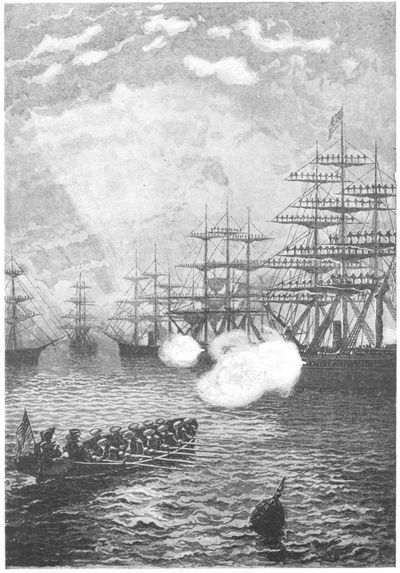
Manning the Yards.
"The despatch read, 'Gen. Banks badly defeated; return,' Here was a
dilemma to be placed in,—a victorious army between us and our own
forces; a long, winding, shallow river wherein the vessels were
continually grounding; a long string of empty transports, with many
doubtful captains, who were constantly making excuses to lie by or to
land (in other words, who were trying to put their vessels into the
power of the Confederates); and a thousand points on the river where
we could be attacked with great advantage by the enemy;
and the banks lined with sharp-shooters, by whom every incautious
soldier who showed himself was shot."
But, though the admiral clearly saw all the dangers he was exposed to,
and which he recounts in the foregoing paragraph, he did not propose
to return, but pressed forward. He soon reached the scene of battle,
and with the big guns of his boats covered the retreat of the troops;
then, having done all there was to be done, started down the river.
But now came the great trouble of the whole expedition. Those Southern
rivers are accustomed in summer to fall rapidly until they become mere
dry ditches, with a narrow rivulet, hardly deep enough to float a
row-boat, flowing down the centre. This was the summer season, and the
Red River was falling fast. The banks swarmed with gray-coated
soldiery, anxious to be on hand to capture the ships. At Grand Écore
the "Eastport" became unmanageable, and was blown up. The fleet
continued on its way quietly, until a serious obstacle was met.
Admiral Porter writes:—
"One of the 'Cricket's' guns was mounted on the upper deck forward, to
command the banks; and a crew of six men were kept stationed at it,
ready to fire at any thing hostile.
"We went along at a moderate pace, to keep within supporting distance
of each other. I was sitting on the upper deck, reading, with one eye
on the book and the other on the bushes, when I saw men's heads, and
sang out to the commanding officer, Gorringe, 'Give those fellows in
the bushes a two-second shell.' A moment after the shell burst in the
midst of the people on the bank.
"'Give them another dose,' I said, when, to my astonishment, there
came on board a shower of projectiles that fairly made the little
'Cricket' stagger. Nineteen shells burst on board our vessel at the
first volley. It was the gun-battery of which our prisoner had told
us. We were going along at this time about six knots an hour; and,
before we could fire another gun, we were right under the battery and
turning the point, presenting the 'Cricket's' stern to the enemy. They
gave us nine shells when we were not more than twenty yards distant
from the bank, all of which burst inside of us; and, as the vessel's
stern was presented, they poured in ten more shots, which raked us
fore and aft.
"Then came the roar of three thousand muskets, which seemed to strike
every spot in the vessel. Fortunately her sides were musket-proof.
"The 'Cricket' stopped. I had been expecting it. How, thought
I, could all these shells go through a vessel without disabling the
machinery? The Rebels gave three cheers, and let us drift on: they
were determined to have the whole of us. They opened their guns on the
two pump-boats, and sunk them at the first discharge. The poor negroes
that could swim tried to reach the shore; but the musketeers picked
off those that were in the water or clinging to the wrecks. It was a
dreadful spectacle to witness, with no power to prevent it; but it
turned out to be the salvation of the 'Cricket.' All this took place
in less than five minutes.
"The moment the 'Cricket' received the first discharge of artillery, I
went on deck to the pilot-house, saluted by a volley of musketry as I
passed along; and, as I opened the pilot-house door, I saw that the
pilot, Mr. Drening, had his head cut open by a piece of shell, and the
blood was streaming down his cheeks. He still held on to the wheel. 'I
am all right, sir,' he said: 'I won't give up the wheel.'
"Gorringe was perfectly cool, and was ringing the engine-room bell to
go ahead. In front of the wheel-house, the bodies of the men who
manned the howitzer were piled up. A shell had struck the gun, and,
exploding, had killed all the crew,—a glorious death for them."
Porter now found himself in a bad fix. His guns could not be elevated
enough to bear on the batteries that stood on the crest of the high
bluffs. There was nothing to do but to run by at the best possible
rate of speed. Suddenly the engine stopped, and the vessel floated
helplessly down the stream. Porter rushed below to discover the
trouble. In the engine-room stood the engineer leaning heavily against
the throttle. Porter shouted at him, but received no reply; then,
putting his hand on the man's shoulder, found him dead. The admiral
threw the body aside, pulled open the throttle, and the "Cricket"
glided along past the batteries to a safe refuge down-stream. The
other ships came down safely, although more or less cut up; and the
flotilla continued its retreat down the stream. For a day or two all
went smoothly as a holiday excursion; then came a sudden reverse,
that, for a time, seemed to make certain the loss of the entire fleet.
At Alexandria the Red-river bottom is full of great rocks that make it
impassable except at the highest water. When Porter's gunboats
arrived, they found themselves caught in a trap from which there
seemed to be no hope of escape. The army was encamped along the banks
of the river, and the soldiers began again their jokes upon
Porter's habit of taking gunboats for an overland journey. The army
generals began to get impatient, and advised Porter to blow up his
ships, as the troops must soon march on and leave him. Porter was sick
in bed, but this suggestion aroused him. "Burn my gunboats!" he cried,
springing to his feet. "Never! I'll wait here for high water if I have
to wait two years." And, indeed, it began to look as though he would
be forced to wait nearly that long.
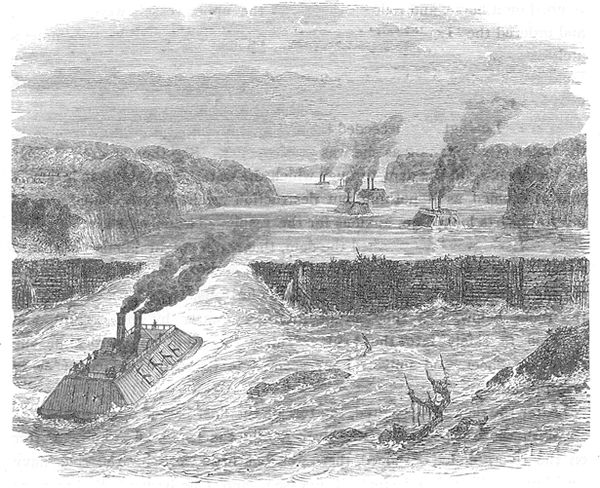
Bailey's Dam on the Red River.
In this time of suspense, there arose a man equal to the emergency. A
certain Lieut-Col. Bailey, who had been a Wisconsin lumberman, came to
Porter, and suggested that a dam should be built to raise the water
fourteen feet above the falls. Porter jumped at the suggestion, and
eight thousand men were set to work.
"It will take too much time to enter into the details of this truly
wonderful work," writes Admiral Porter. "Suffice it to say
that the dam had nearly reached completion in eight days'
working-time, and the water had risen sufficiently on the upper falls
to allow the 'Fort Hindman,' 'Osage,' and 'Neosho' to get down and be
ready to pass the dam. In another day it would have been high enough
to enable all the other vessels to pass the upper falls.
Unfortunately, on the morning of the 9th instant the pressure of water
became so great that it swept away two of the stone barges which swung
in below the dam on one side. Seeing this unfortunate accident, I
jumped on a horse, and rode up to where the upper vessels were
anchored, and ordered the 'Lexington' to pass the upper falls if
possible, and immediately attempt to go through the dam. I thought I
might be able to save the four vessels below, not knowing whether the
persons employed on the work would ever have the heart to renew their
enterprise.
"The 'Lexington' succeeded in getting over the upper falls just in
time, the water rapidly falling as she was passing over. She then
steered directly for the opening in the dam, through which the water
was rushing so furiously that it seemed as if nothing but destruction
awaited her. Thousands of beating hearts looked on, anxious for the
result. The silence was so great as the 'Lexington' approached the
dam, that a pin might almost be heard to fall. She entered the gap
with a full head of steam on, pitched down the roaring torrent, made
two or three spasmodic rolls, hung for a moment on the rocks below,
was then swept into deep water by the current, and rounded to safely
into the bank. Thirty thousand voices rose in one deafening cheer, and
universal joy seemed to pervade the face of every man present."
After the dam was repaired, the rest of the fleet passed down safely.
With the escape of the Red-river flotilla, the career of Admiral
Porter on the rivers ended. Indeed, there was but little work for the
river navy remaining. The Mississippi, Tennessee, and Cumberland
Rivers were opened; and the Confederate works on the smaller streams
were unimportant, and could be left to fall with the fall of the
Confederacy, which was near at hand. There was work for fighting
sea-captains along the Atlantic coast, and thither Admiral Porter was
ordered. He will re-appear at the bombardment of Fort Fisher.
An event which caused the greatest excitement in naval circles at this
time, and which for courage and dash has probably never been equalled
in the history of the world, was the run of the Confederate
privateer "Florida" past the United States fleet blockading the harbor
of Mobile. The "Florida" was originally a merchant-ship, known as the
"Oreto;" and under that name she sailed from Liverpool, carrying a
peaceful cargo, and manned by sailors who had no idea that any thing
beyond a peaceable voyage was planned. She was commanded by an English
sea-captain; and, although the United States consul at Liverpool
looked on her with some suspicion, yet he could find no pretext upon
which to oppose her departure.
Hardly had the ship passed the mouth of the Mersey, when her course
was shaped for Nassau, the haven of privateers and blockade-runners.
At Nassau several officers of the Confederate navy were living; and
from the anxiety with which they scanned the horizon day after day,
through their telescopes, it would seem that they were watching for
some friendly craft. The "Oreto" arrived safely at Nassau; and a young
gentleman who had come with her made all possible haste ashore, and
delivered to the watchful gentlemen in the town certain letters, which
made them first look with the greatest satisfaction at the newly
arrived ship, and then begin again their outlook for vessels. The
letters were from Capt. Bulloch, the agent in London of the
Confederacy; and by them he notified his brother naval officers that
he delivered to them the "Oreto," an admirably built ship, suited for
an armed cruiser. "It has been impossible to get the regular battery
intended for her on board," wrote Capt. Bulloch; "but I have sent out
four seven-inch rifled guns, with all necessary equipments, in the
steamship 'Bahama,' bound for Nassau."
So here were the naval officers and their ship, but the guns were yet
to come; and, when they did come, some shrewd planning would be
necessary to get the guns mounted without alarming the British
authorities. By the time the "Bahama" arrived, the plans were all
made. As the steamer came up to the dock, a small schooner slipped
alongside, and eight or ten heavy cases were transferred from the
larger vessel's hold to the deck of the coaster. Then the little
vessel sailed over to Green Cay, a desert island about sixty miles
from Nassau, where she was soon joined by the "Oreto." There the work
of changing the peaceful merchantman "Oreto" into the war-cruiser
"Florida" began.
The work of transferring the armament, and mounting the guns, was very
laborious. The hot sun of August at the equator poured down upon
them. Exposure and general discomforts told heavily upon
them; and before long the yellow-fever, that most terrible scourge of
the West Indies, broke out among the men. There was no surgeon on
board, and the care of the sick fell upon Capt. Maffitt. Two United
States men-of-war were hunting through the West Indies for the vessel
they knew was fitting out somewhere amid the coral reefs and sandy,
desolate keys. But Maffitt kept up his courage, and before long found
himself at sea, with a good stanch ship and crew, that, though
short-handed, was made up of the very best material. But he had hardly
cut loose from civilization, and started out upon his cruise, when he
discovered, that, in the worry and haste of his departure, he had put
to sea without rammers or sponges for his guns. He was in a desperate
plight. Had the smallest United States man-of-war met the "Florida,"
the Confederate could not have offered the slightest resistance. She
could not have even fired a gun. Capt. Maffitt ran his vessel into
Havana in the hopes of being allowed to refit there; but the fortunes
of the Confederacy were waning fast, and all nations feared to give it
aid or comfort. Seeing no hope, Maffitt determined to dare all things,
and make a dash for Mobile through the very centre of the
blockading-fleet.
When the "Florida" put out from the harbor of Havana, only four or
five men were able to be on deck. The rest, with her commander, were
below, deathly sick with yellow-fever. Under the command of a young
lieutenant, her course was laid for Mobile; and in a few hours the
smoke of the blockading-vessels could be seen rising on the clear air.
An English ensign was hoisted, and the fleet ship dashed towards the
men-o'-war that lay in wait. A blank cartridge was fired to warn her
away, but she paid no heed. Then came a solid shot that ploughed up
the water before her bow. As this evoked no response, the whole fleet
opened fire with shot and shell. "Had they depressed their guns but a
little," said Maffitt afterwards, "the career of the 'Florida' would
have ended then and there." But, as it was, she sped on, with no signs
of damage save the flying ends of cut cordage. She could not respond
to the fire, for but three men remained on her deck. So, silently and
grimly, she rushed through the fleet, and finally passed the last
frigate. Quarter of an hour later she anchored under the guns of Fort
Morgan. She had received eight shots in her hull, and her masts were
chipped by dozens of fragments of shell. After refitting,
the "Florida" waited nearly a month for a chance to get out again.
Finally the moment arrived; and she made her escape, though chased for
four hours by the blockaders. Once on the open sea, she began the
regular career of Confederate cruisers, burned unarmed ships, and
avoided war-vessels, until she was run down in a neutral port by a
Union man-of-war, whose commander acted in utter defiance of all the
rules of modern warfare. In the career of the "Florida," after her
escape from Mobile, there was nothing of moment; and her capture,
treacherous as it was, brought more discredit upon the Northern arms
than did her depredations work injury to the Northern merchant-marine.[Back to Contents]

OPERATIONS ABOUT CHARLESTON. — THE BOMBARDMENT, THE SIEGE, AND THE
CAPTURE.
e have now reached the period at which the rapid decline in the
prospects of the Confederacy had become apparent, not only to its
enemies, but to its friends. Throughout the South the stars and bars
floated over only three strongholds of any importance,—Charleston,
Mobile, and Wilmington. One after the other these were destined to
fall, and their final overthrow was to be the work of the navy. It was
no easy task in any one of the three instances to dislodge the
Confederates from their positions; for though beaten in the Middle
States, driven from the Mississippi, and with their very citadel at
Vicksburg in the hands of the Federals, they still fought with a
courage and desperation that for a long time baffled the attacks of
the Unionists.
From the very opening of the war, Charleston Harbor had been the scene
of naval hostilities. The Confederates, looking upon their mouldering
wharves, and vessels tugging idly at their chains, then looking out to
sea past Fort Sumter, could see the ships of the blockading-squadron
maintaining the watchful guard that was slowly reducing the city to
penury. What wonder that the blood of the good people of Charleston
boiled, and that they built, and hurled against their hated enemy,
weird naval monsters, shapeless torpedo-boats running
beneath the water, or huge rams that might even batter in the heavy
walls of Fort Sumter!
One attack so made was successful to a certain extent. It was in
February, 1864, that an inventive genius in the beleaguered city
brought out a steam torpedo-boat. The craft was about twenty-five feet
long, shaped like a cigar, built of boiler iron, and propelled by a
screw. She had no smokestack, and her deck barely rose above the
surface of the water. Running out from her bow was a stout spar
fifteen feet long, bearing at its end a huge torpedo charged with two
hundred pounds of powder. Just before nine o'clock one night, the
lookout on the deck of the frigate "Housatonic" saw this strange
object approaching the ship. It was a bright night, with no sea on. As
yet torpedoes were hardly known, so the lookout took it for a large
fish, and simply watched with interest its playful movements. Not
until it came so close that no guns could be brought to bear, did any
suspicion of danger enter the lookout's mind. Then there was the roll
of the alarm-drums; while the men rushed to the side, and poured a
fierce fire from small-arms on the mysterious object. The "Housatonic"
started her engines, and tried to escape; but, before any headway
could be gained, the launch dashed alongside, and a slight jar was
felt. Then, with a tremendous roar, a huge column of water was thrown
high in air, washing away men and boats from the deck of the warship.
A hole large enough to drive a horse through was rent in the hull of
the ship. Great beams were broken in twain, the heaviest guns were
dismounted, and men were hurled fifty feet into the air. In five
minutes the ship had gone to the bottom, and boats from other vessels
were picking up the crew. The launch escaped in the excitement.
The Union sailor-boys did not let the Confederates outdo them in dash
and pluck. One of the cleverest bits of work in the whole war was done
by four boat-crews from two men-of-war on the Charleston station. Word
had been brought to the blockaders, that, far up a little deep and
narrow creek, a large steamship was loading with cotton, expecting to
reach the ocean through the labyrinth of inlets that fairly honeycomb
the South Carolina coast. Should she once get into that network of
waterways, it would require a whole fleet to catch her; for there was
no telling at what point she might emerge.
It was at once determined to try to capture her as she lay at her
deck, and four boats' crews of picked men were sent out on
the expedition. It was early evening when they set out; and all
through the dark night they pulled away, threading the mazes of the
tidal inlets. Just as the eastern horizon was beginning to grow gray
with the coming dawn, they came in sight of their destination. Sure
enough, there on the bank of the river was a little Southern village,
changed into a prosperous town by the blockade-runners that had
evidently been making this place a harbor for some time.
All was dark and silent as the grave. Confident in their fancied
security, the blockade-runners had all turned in, leaving no one on
guard. The steamer was loaded, and ready to sail in the morning; and
the thin wreaths of smoke rising from her smokestack told that the
fires were up. Stealthily the sailors pulled alongside, and clambered
on deck. Without a word they stole below, put the crew under guards,
and rushed into the engine-room, where they found the engineer dozing
on his stool. He was ordered to get under way at once; and, though he
looked rather dazed, he obeyed the order. And in fifteen minutes the
steamer was speeding down-stream, leaving the old town still asleep.
One man alone of all the townspeople had seen the capture. A negro,
hiding behind a pile of lumber on the dock, had watched the whole
affair, and, as if struck dumb with astonishment, failed to give the
alarm until the steamer was out of sight down the winding stream. The
blue-jackets took their capture safely out of the enemy's lines, and
the next day it was sent to New York as a prize.
While the navy was keeping the port of Charleston sealed, and every
now and then beating back the improvised gunboats that the
Confederates sent out in the forlorn hope of breaking through the
blockade, the armies of the North were closing in upon the doomed
city. All the North cried aloud for the capture of Charleston. It was
the city which fired the first gun of the war. Let it be reduced! On
every available point of land a Union battery was built. Far out in
the swamps back of the city, where it was thought no living thing save
reptiles could exist, the soldiers of the North had raised a battery,
mounting one two-hundred-pound gun. When a young lieutenant was
ordered to build this battery, he looked the ground over, and reported
the thing impossible. "There is no such word as impossible," sternly
answered the colonel. "Set to work, and call for whatever you need to
secure success."
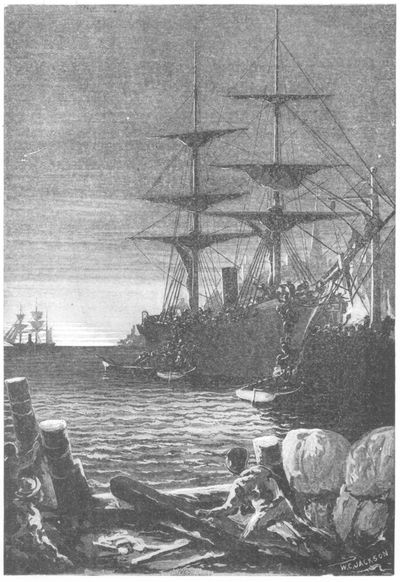
Cutting out a Blockade-Runner.
The next day the lieutenant, who was a bit of a wag, made a
requisition on the quarter-master for one hundred men eighteen feet
high, to wade through mud sixteen feet deep. Pleasantry is not
appreciated in war; and the officer was arrested, but soon secured his
release, and built the battery with men of ordinary height.
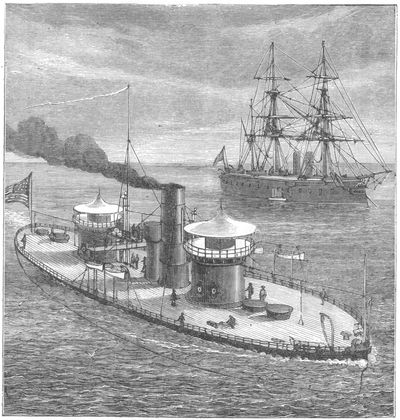
War-ships off Charleston Harbor.
In April, 1862, Admiral Du Pont had lined his iron-clads and monitors
up before the beetling walls of Fort Sumter, and had hurled solid shot
for hours, with only the effect of breaking away sharp corners and
projecting edges of the fort, but leaving it still as
powerful a work of defence as ever. The little monitors exposed to the
terrible fire from the guns of Sumter were fairly riddled; and, when
the signal was finally made to withdraw from the action, the humblest
sailor knew that Charleston would only fall after a siege as
protracted and wearisome as that of Vicksburg.
The investment of Charleston lasted from the date of that first attack
upon Fort Sumter until 1865. From time to time the war-vessels would
throw a few shells into the city, as a reminder to the inhabitants
that they were under surveillance. Early in the siege the Swamp Angel,
as the big gun back in the swamp was called, began sending hourly
messages, in the form of two-hundred-pound shells, into the city. In
one quarter, where the shells fell thickest, a severe fire was
started, which raged fiercely, driving people from their homes, and
reducing whole blocks to ashes; while the deadly shells aided in the
work of destruction. But the life of the Swamp Angel, whose shells
were the most destructive, was but short; for, after a few days' work,
it burst, scattering the sand-bags, of which the battery was built,
far and wide over the swamp.
The officers of the army, who were bringing their troops nearer and
nearer to the city, expected the iron-clad vessels to steam boldly up
the harbor, and compel a surrender of the city; but the naval officers
dared not, owing to the torpedoes with which the channel was thickly
planted. If Sumter could only be captured, the torpedoes could be
searched out and easily removed; and, with this thought in mind, a
number of bold sailors fitted out an expedition to attack the fort.
Thirty boats, filled with armed men, made their way to the base of the
shattered walls of the fort. As they came up, not a sign of life was
to be seen about the huge black monster that had so long kept the
iron-clads at bay. Rapidly and silently the men swarmed from their
boats, and, led by three brave officers, began the ascent of the
sloping walls. "The Johnnies are asleep," they whispered to each
other: "we have the fort this time." But the Johnnies were wide awake,
and waiting behind those grim bastions until the proper moment should
arrive. Higher and higher climbed the blue-jackets; and they were just
about to spring over the last barrier, when there rose before them a
wall of men and a deadly fire of musketry, and a storm of
hand-grenades cut their ranks to pieces. Around the corner of the fort
steamed a small gunboat, which opened fire on the assailants. The
carnage was terrible; and the sailors were driven back to
their boats, leaving two hundred dead and wounded, and three stands of
colors, as trophies for the garrison.
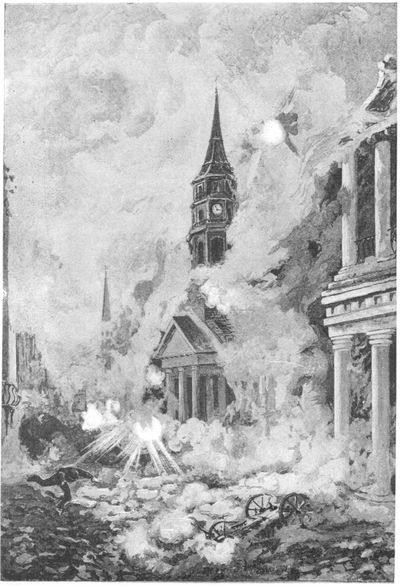
Charleston Bombarded.
After that grapple with the giant fortress, the Federals did not again
try to come to close quarters; but, keeping at a distance, maintained
a steady fire upon the fort, which drove its defenders from the guns,
and enabled the Union troops to throw up batteries upon all the
neighboring islands. The fleet then remained on blockading-service
until Feb. 18, 1865, when the Confederates evacuated the city, and
left the fort to the victorious Federals. Five years after the date
when Major Anderson with his little band of soldiers had marched out
of Sumter, leaving the fort to the enemy, the same gallant officer
returned, and with his own hand hoisted the same tattered flag over
the almost ruined fortress, amid salvos of artillery and the cheers of
a victorious army and navy.[Back to Contents]
THE BATTLE OF MOBILE BAY.
he last two actions of the United States navy in the civil war were
destined to be the grandest successes of a long record of daring and
successful exploits. Farragut at Mobile, and Porter at Fort Fisher,
added to their wondrous careers the cap-sheaves of two victories
wrested from apparently unconquerable adversaries.
It was on a bright August morning in 1864 that Admiral Farragut stood
on the deck of his stanch frigate the "Hartford," that had borne him
through so many desperate battles. Around the flagship were clustered
the vessels of the Gulf squadron. There was the battered old
"Brooklyn," scarred with the wounds of a dozen fights; the "Richmond"
and the "Itasca," that received their baptism of fire at the fight
below New Orleans. In all there were fourteen wooden vessels and four
iron-clad monitors assembled in front of the strongest combination of
harbor defences that warships ever yet dared attack. Yet Farragut was
there that bright summer morning to enter that bay, and batter the
forts of the enemy into subjection. To capture the city was not his
purpose,—that he left to the army,—but the harbor forts and the
great ram "Tennessee" must strike their colors to the navy.
Before arranging for the attack, the admiral made a reconnoissance,
the results of which are thus told by one of his officers:
"On the afternoon of the day of our arrival, Admiral Farragut, with
the commanding officers of the different vessels, made a
reconnoissance on the steam-tender 'Cowslip,' running inside of Sand
Island, where the monitors were anchored, and near enough to get a
good view of both forts. On the left, some two miles distant, was Fort
Gaines, a small brick-and-earth work, mounting a few heavy guns, but
too far away from the ship-channel to cause much uneasiness to the
fleet. Fort Morgan was on the right, one of the strongest of the old
stone forts, and greatly strengthened by immense piles of sand-bags
covering every portion of the exposed front. The fort was well
equipped with three tiers of heavy guns, some of them of the best
English make, imported by the Confederates. In addition, there was in
front a battery of eleven powerful guns, at the water's edge on the
beach. All the guns, of both fort and water battery, were within
point-blank range of the only channel through which the fleet could
pass. The Rebels considered the works impregnable, but they did not
depend solely upon them. Just around the point of land, behind Fort
Morgan, we could see that afternoon three saucy-looking gunboats and
the famous ram 'Tennessee.' The latter was then considered the
strongest and most powerful iron-clad ever put afloat; looking like a
great turtle, with sloping sides covered with iron plates six inches
in thickness, thoroughly riveted together, and having a formidable
iron beak projecting under the water. Her armament consisted of six
heavy guns of English make, sending a solid shot weighing one hundred
and ten pounds,—a small affair compared with the heavy guns of the
present time, but irresistible then against every thing but the
turrets of the monitors. In addition to these means of resistance, the
narrow channel in front of the fort had been lined with torpedoes.
These were under the water, anchored to the bottom, and were chiefly
in the shape of beer-kegs filled with powder, from the sides of which
projected numerous little tubes containing fulminate, which it was
expected would be exploded by contact with the passing vessels.
"Except for what Farragut had already accomplished on the Mississippi,
it would have been considered a foolhardy experiment for wooden
vessels to attempt to pass so close to one of the strongest forts on
the coast; but when to the forts were added the knowledge of the
strength of the ram, and the supposed deadly character of the
torpedoes, it may be imagined that the coming event
impressed the person taking his first glimpse of naval warfare as
decidedly hazardous and unpleasant. So daring an attempt was never
made in any country but this, and was never successfully made by any
commander except Farragut, who in this, as in his previous exploits in
passing the forts of the Mississippi, proved himself the greatest
naval commander the world has ever seen. It was the confidence reposed
in him, the recollection that he had never failed in any of his
attempts, and his manifest faith in the success of the projected
movement, that inspired all around him."
When the reconnoissance was completed, the admiral called a council of
his captains in the wardroom of the "Hartford," and announced that the
attack would be made early the following morning. The council over,
each commander returned to his ship, there to make ready for the dread
business of the morrow. The same writer whom we have before quoted
tells how the night before a battle is spent by brave men not afraid
of death:—
"At sunset the last order had been issued. Every commanding officer
knew his duty, and unusual quiet prevailed in the fleet. The waters of
the Gulf rested for a time from their customary tumult, a gentle
breeze relieved the midsummer heat, and the evening closed upon us as
peacefully as if we had been on board a yachting squadron at Newport.
During the early part of the night, the stillness was almost
oppressive. The officers of the 'Hartford' gathered around the
capacious wardroom table, writing what they knew might be their last
letters to loved ones far away, or giving to friends messages and
instructions in case of death. There were no signs of fear; but, like
brave and intelligent men, they recognized the stern possibilities of
the morrow, and acted accordingly.
"But this occupied but little time; and then, business over, there
followed an hour of unrestrained jollity. Many an old story was
retold, and ancient conundrum repeated. Old officers forgot for the
moment their customary dignity, and it was evident that all were
exhilarated and stimulated by the knowledge of the coming struggle.
Capt. Heywood of the marines proposed a final 'walk-around;' Tyson
solemnly requested information as to 'Which would you rather do or go
by Fort Morgan?' and all agreed they would prefer to 'do.' La Rue
Adams repeated the benediction with which the French instructor at the
naval academy was wont to greet his boys as they were going into
examination: 'Vell, fellows, I hope ve vill do as vell as I
hope ve vill do.' Finally, Chief Engineer Williamson suggested an
adjournment to the forecastle for a last smoke, and the smoking club
went forward; but somehow smoke had lost its customary flavor, and,
after a few whiffs, all hands turned in, to enjoy what sleep would
come."
When the morning dawned, the men were called to quarters, and the
advance upon the forts was begun at once. It was a foggy morning, and
the ships looked like phantom vessels as they moved forward in line of
battle, with the "Brooklyn" in the van. Second came the "Hartford,"
with the admiral high up in the rigging, where he could overlook the
whole scene.
"Nearly every man had his watch in his hand, and waited for the first
shot. To us, ignorant of every thing going on above, every minute
seemed an hour; and there was a feeling of great relief when the boom
of the first gun was heard. This was from the monitor 'Tecumseh,' at
forty-seven minutes past six o'clock. Presently one or two of our
forward guns opened, and we could hear the distant sound of the guns
of the fort in reply. Soon the cannon-balls began to crash through the
deck above us, and then the thunder of our whole broadside of twelve
Dahlgren guns kept the vessel in a quiver. But as yet no wounded were
sent down, and we knew we were still at comparatively long range. In
the intense excitement of the occasion, it seemed that hours had
passed; but it was just twenty minutes from the time we went below
when an officer shouted down the hatchway: 'Send up an army
signal-officer immediately: the 'Brooklyn' is signalling.' In a moment
the writer was on deck, where he found the situation as follows: The
'Brooklyn,' directly in front of us, had stopped, and was backing and
signalling; the tide was with us, setting strongly through the
channel, and the stopping of the 'Brooklyn' threatened to bring the
whole fleet into collision and confusion; the advance vessels of the
line were trying to back to prevent a catastrophe, but were apparently
not able to overcome the force of the current; and there was danger
not only of collision, but of being drifted on shore."
While the fleet was thus embarrassed and hampered, the gunners in the
forts were pouring in their shot thick and fast. On the decks of the
ships the most terrible scenes of death were visible. Along the port
side the bodies of the dead were ranged in long rows, while the
wounded were carried below, until the surgeon's room was
filled to its last corner. One poor fellow on the "Hartford" lost both
legs by a cannon-ball, and, falling, threw up both arms just in time
to have them carried away also. Strange to say, he recovered from
these fearful wounds.
Just as the fight was at its hottest, and the vessels were nearing the
line, the passage of which meant victory, there went up a cry from the
whole fleet, "The 'Tecumseh!' Look at the 'Tecumseh!'" All eyes were
turned on the monitor, and every one saw that she was sinking. She
staggered for a moment, and went down with a rush, carrying her brave
commander and over a hundred of her crew. A few escaped, the last of
whom was the pilot. As the pilot was rushing for the hatchway that led
to the open air and to life, he met at the foot of a narrow ladder
Commander Craven. Craven stepped back, saying gravely, "After you,
pilot;" and the pilot passed out. "There was nothing after me," said
he, in relating the story afterwards; "for as I sprang out of the
hatchway the water rushed in, carrying all behind me to the bottom."
This terrible sight made the ships stop for a moment in some
confusion; but Farragut signalled sternly from his flagship, "Go on,"
and all advanced again. As the fight grew fiercer, the admiral grew
tired of being on the second ship in the line, and ordered the
"Hartford" to forge ahead.
"On board a war steamer the engines are directed by the tap of a bell,
the wires connected with which lead to the quarter-deck. One stroke of
the bell means 'go ahead;' two, 'stop;' three, 'back;' and four, 'go
ahead as fast as possible.' Leaning down through the shrouds to the
officer on deck at the bell-pull, the admiral shouted, 'Four bells,
eight bells, SIXTEEN BELLS! Give her all the steam you've got!' The
order was instantly transmitted, and the old ship seemed imbued with
the admiral's spirit; and running past the "Brooklyn" and the
monitors, regardless of fort, ram, gunboats, and the unseen foe
beneath, dashed ahead, all alone, save for her gallant consort, the
'Metacomet.'"
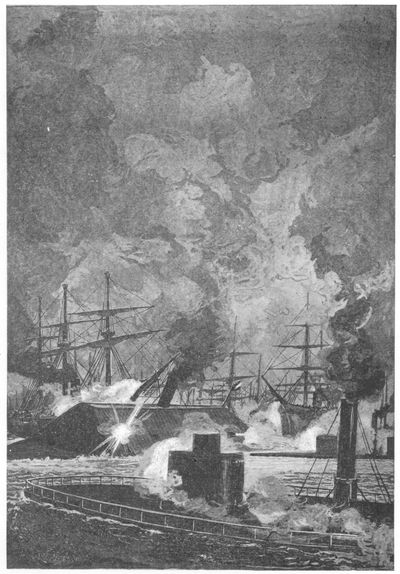
Fight at Mobile Bay.
But by this time the fleet was well abreast of the forts, and now,
pouring out broadside after broadside, they swept along past the
terrible ramparts. The Confederate gunboats had found the fight too
hot for them, and had fled for shelter, with the exception of the
dreaded "Tennessee," which seemed to be holding itself in reserve. It
was but a short time before the vessels were safely past the fort, and
out of range, floating on the smooth waters of the inner
bay. Then the crews were piped to breakfast, and all hands began to
recount their narrow escapes.
But the end was not yet, for the ram "Tennessee" was now ready to try
her mettle with the fleet. Lieut. Kinney of the "Hartford" tells
graphically the story of the desperate fight that the ram carried on
alone against the whole attacking flotilla.
"We were just beginning to feel the re-action following such a season
of extreme peril and excitement, when we were brought to our senses by
the sharp, penetrating voice of executive officer Kimberly calling all
hands to quarters; and a messenger-boy hurried down to us with the
word, 'The ram is coming.' Every man hastened to his post, the writer
to the quarter-deck, where the admiral and fleet-captain were
standing. The cause of the new excitement was evident at once. The
'Tennessee,' as if ashamed of her failure, had left the fort and was
making at full speed directly for the "Hartford," being then perhaps a
mile and a half distant. The spectacle was a grand one, and was viewed
by the Rebel soldiers in both forts, who were now out of range of our
guns, and lined the walls. Few audiences have ever witnessed so
imposing a sight. The great ram came on for a single-handed contest
with the fleet. She was believed to be invulnerable, and had powerful
double engines by which she could be easily handled; while our
monitors were so slow-gaited that they were unable to offer any
serious obstacle to her approach. Farragut himself seemed to place his
chief dependence on his wooden vessels. Doubtless the crowd of
Confederate soldiers who watched the fight expected to see the
'Tennessee' sink the Yankee vessels in detail, and the chances seemed
in its favor....
"Meanwhile, the general signal, 'Attack the enemy,' had gone up to the
peak of the 'Hartford;' and there followed a general slipping of
cables, and a friendly rivalry to see which could quickest meet the
foe. The 'Monongahela,' with her artificial iron prow, was bravely in
the lead, and struck the Rebel craft amidships at full speed, doing no
damage to the ram, but having her own iron prow destroyed, and being
otherwise injured. Next came the 'Lackawanna,' with a like result. The
huge iron frame of the 'Tennessee' scarcely felt the shock, while the
wooden bow of the Union ship was badly demoralized. For an instant the
two vessels swung head and stern alongside of each other. In his
official report, Capt. Marchand naïvely remarks:—
"'A few of the enemy were seen through their ports, who were
using most opprobrious language. Our marines opened on them with
muskets: even a spittoon and a holystone were thrown at them from our
deck, which drove them away.'
"The 'Tennessee' fired two shots through her bow, and then kept on for
the 'Hartford.' The two flag-ships approached each other, bow to bow.
The two admirals, Farragut and Buchanan, had entered our navy together
as boys, and up to the outbreak of the war had been warm friends. But
now each was hoping for the overthrow of the other; and, had Buchanan
possessed the grit of Farragut, it is probable that moment would have
witnessed the destruction of both vessels. For had the ram struck us
square, as it came, bows on, it would have ploughed its way half
through the 'Hartford;' and, as we sank, we should have carried it to
the bottom, unable to extricate itself. But the Rebel admiral was not
desirous of so much glory; and, just as the two vessels were meeting,
the course of the 'Tennessee' was slightly changed, enough to strike
us only a glancing blow on the port-bow, which left us uninjured,
while the two vessels grated past each other. He tried to sink us with
a broadside as he went by; but only one of his guns went off, the
primers in all the others failing. That gun sent a shell that entered
the berth-deck of the 'Hartford,' and killed five men."
But by this time the unequal conflict was becoming too much even for a
man of Buchanan's courage. The armor of the ram was penetrated in
several places, and at last came a shot that almost fatally wounded
her commander. With the controlling mind that guided her course gone,
the ram was useless; and in a moment a white flag fluttered from the
shattered stump of her flagstaff. And so closed the naval battle that
effectually ended Confederate rule on the Gulf coast, and earned for
Farragut his proudest laurels.[Back to Contents]
THE FALL OF FORT FISHER. — THE NAVY ENDS ITS WORK.
n noticing the work of the blockading-fleet, we have spoken of the
fine harbor of Wilmington, and the powerful works that defended its
entrance. This Confederate stronghold was known as Fort Fisher, and
had been for a long time a cause of anxiety and worry to the Northern
authorities. The war had gone past Fort Fisher. To the north and to
the south of it, the country was under the sway of the Federal
authorities; but there in North Carolina stood the formidable bastions
over which floated, in defiance of the laws of the Union, the stars
and bars of the rapidly dying Confederacy. With its connected
batteries, Fort Fisher mounted seventy-five guns, and was stronger
than the celebrated Malakoff at Sebastopol.
To reduce this stronghold, a joint naval and military expedition was
fitted out; and Gen. Butler was placed in command of the land forces,
while Admiral Porter, torn from his beloved Western rivers, was given
command of the fleet. Butler introduced a novel feature at the very
opening of the siege. He procured an old steamer, and had her packed
full of gunpowder. On a dark night this craft was towed close to the
walls of the fort and set afire, in the hopes that she might, in
blowing up, tear the works to pieces. But in this the
projectors were disappointed; for the explosion, though a terrific
one, did absolutely no harm to the Confederate works. When Porter
finally did get into the fort, he asked a soldier what he thought of
the attempt to blow them up. "It was a mighty mean trick," responded
the Southerner satirically. "You woke us all up."
After this fiasco had set all the world laughing, Butler retired
voluntarily, and was succeeded by Gen. Terry; and on Christmas Eve of
the year 1864 the fleet began the bombardment, although the land
forces were not yet prepared for the assault. It was the grandest
armada that was ever arrayed against any fortress. The thunder of
nearly five hundred guns rent the air on that Christmas Eve, when
carols were being sung in Christian churches throughout the world.
Tremendous as was the cannonade, the earthworks were almost a match
for it. The fort was not a mass of masonry that these enormous guns
might batter down and crumble into rubbish, but a huge bank of earth
in which the shells might harmlessly bury themselves. But five hundred
cannon are more than a match for any fort, and so they soon proved to
be in this instance. Earthworks, guns, and men alike went down before
them. The iron-clads were stationed about three-quarters of a mile
from the fort, a little farther out were the frigates and heavy
sloops, and still beyond were the smaller vessels,—all firing to
cover themselves; and all along the whole extended line there blazed
one almost continuous sheet of flame, while the rolling thunder of the
broadsides, and the defiant answering roar from the guns of the forts,
shook earth and sea. Clouds of dust went up from the bastions of the
fort, and mingled with the floating smoke above. Within the forts,
there was a scene of the most terrible confusion: guns were
overturned, piles of cannon-balls were knocked to pieces and scattered
about, and two magazines were blown up and scattered fragments all
over the parade. In one hour and a quarter all the gunners were driven
to the bomb-proofs, and the forts were silenced, not returning a
single shot.
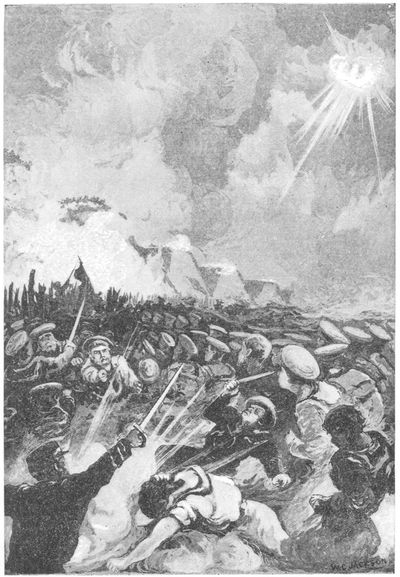
Charge of Sailors at Fort Fisher.
On Christmas morning Gen. Terry arrived with all his transports, and
the attack was recommenced. Early in the morning the ships fell into
position and began a slow fire, merely to cover the landing of the
troops. Again the garrison was driven to the bomb-proofs; and, indeed,
so entirely were they chased from their posts, that a Federal soldier
went into the fort and brought off a Confederate flag without ever
having been seen by the garrison. All the troops were
landed; but for some reason the attack was deferred, much to the
disgust of the officers of the fleet, who felt sure that the fort
could be taken then by a dash. But the troops returned to their
transports or went into camp, and it was not until weeks after that
the assault was fairly made. In the mean time, the ships rode out the
winter gales at their anchors, doing a little desultory firing to keep
the garrison in a state of unrest.
On the 14th of January the heavy bombardment began again, and again
the troops were landed. By night it was seen that every gun on the
face of the fort was disabled, and it was decided to storm the works
the next day. Sixteen hundred sailors and four hundred marines were
told off as the storming-party.
Early in the morning the ships began a fierce cannonade, under cover
of which the sailors and marines landed, and threw up light
breastworks to cover them until the time should be ripe for the
charge. The arrangements contemplated a fierce charge by the
blue-jackets, armed with their cutlasses and revolvers; while the
marines, remaining in the rifle-pits, should cover the advancing party
with a hot fire of musketry. The soldiers from the army-camp were to
charge the fort on the other side.
At three o'clock came the signal that all was ready. The whistles of
the ships rent the air; and the blue-jackets, with ringing cheers,
dashed in a compact body up the beach. But in an instant the
Confederate ramparts were black with men, and a furious fire of
musketry rained down upon the sailors, who were helpless. The marines
in the rifle-pits failed to do what was expected of them, and the
sailors halted for a moment in surprise.
As they stood, a most destructive fire rained down upon them; and the
poor fellows, grasping their useless cutlasses, turned and fled down
the beach, leaving great heaps of dead and wounded behind. Then the
Confederates, thinking the day was theirs, sprang on the ramparts, and
began a vigorous cheer just as the Union soldiers came pouring over
the landward face of the fort. Then ensued a fierce hand-to-hand fight
that lasted for hours. The blue-jackets, encouraged, rushed back to
the fight, and now at close quarters swung their cutlasses with deadly
effect, until step by step the Confederates were driven out of the
fort. Then the fleet opened upon them, and they fled for dear life
while a sailor sprang to the flagstaff and pulled down the Confederate
flag. Fort Fisher had fallen. It was a noble victory, and
formed a fitting climax to the work of the navy throughout that great
war.
With the fall of Fort Fisher, the navy ceased to be a prominent factor
in the war. Its work was done. Along the seacoast, and inland as far
as navigable rivers extended, the ships of the North had carried the
starry banner; and the sailor-boys of the North had defended it. And
their opponents, whether on sea or shore, had shown themselves
courageous and dashing, and worthy to be numbered as men of the same
nation as those who proved the victors. And who can doubt, that,
should the need arise, the sons of these men will show that they have
in their veins the blood that animated the Blue-Jackets of '61?[Back to Contents]

PART IV BLUE JACKETS IN TIMES OF PEACE
POLICE SERVICE ON THE HIGH SEAS. — WAR SERVICE IN ASIATIC
PORTS. — LOSSES BY THE PERILS OF THE DEEP. — A BRUSH WITH THE
PIRATES. — ADMIRAL RODGERS AT COREA. — SERVICES IN ARCTIC WATERS. — THE
DISASTER AT SAMOA. — THE ATTACK ON THE "BALTIMORE'S" MEN AT
VALPARAISO. — LOSS OF THE "KEARSARGE." — THE NAVAL REVIEW.
 he years immediately following the civil war were particularly quiet
and uneventful for the navy. The department was chiefly engaged in the
work of reducing the forces and adapting the navy to the changed
conditions. At the termination of the war an immense naval armament
had been developed, and the navy had assumed a magnitude which made
the United States foremost among the naval powers. This force was
gradually reduced to a peace standard. The volunteers were discharged
and retired from service. The large number of captured and purchased
vessels were disposed of. The home squadrons were withdrawn, and
squadrons established abroad. The ships in foreign stations displayed
an unprecedented energy and activity, visiting, in 1866, nearly every
large port in the world, including several in China which had never
before been entered by an American man-of-war. The reception of
Rear-Admiral Bell in his flagship, the "Hartford," by the Japanese,
was manifestly more hospitable than that given to any other nation.
Admiral Farragut was made commander of the European squadron
in 1867, and he was received with distinguished attention by the
sovereigns and dignitaries of Europe. The "Swatara," of the European
squadron, was ordered, in November, 1866, to Civita Vecchia, a port in
Italy, to bring to the United States John H. Surratt, who was charged
with being implicated in the assassination of Lincoln. The fugitive
was apprehended, but he escaped, and fled into the papal dominions. He
was recaptured at Alexandria, and in February was delivered to the
marshal of the District of Columbia.
he years immediately following the civil war were particularly quiet
and uneventful for the navy. The department was chiefly engaged in the
work of reducing the forces and adapting the navy to the changed
conditions. At the termination of the war an immense naval armament
had been developed, and the navy had assumed a magnitude which made
the United States foremost among the naval powers. This force was
gradually reduced to a peace standard. The volunteers were discharged
and retired from service. The large number of captured and purchased
vessels were disposed of. The home squadrons were withdrawn, and
squadrons established abroad. The ships in foreign stations displayed
an unprecedented energy and activity, visiting, in 1866, nearly every
large port in the world, including several in China which had never
before been entered by an American man-of-war. The reception of
Rear-Admiral Bell in his flagship, the "Hartford," by the Japanese,
was manifestly more hospitable than that given to any other nation.
Admiral Farragut was made commander of the European squadron
in 1867, and he was received with distinguished attention by the
sovereigns and dignitaries of Europe. The "Swatara," of the European
squadron, was ordered, in November, 1866, to Civita Vecchia, a port in
Italy, to bring to the United States John H. Surratt, who was charged
with being implicated in the assassination of Lincoln. The fugitive
was apprehended, but he escaped, and fled into the papal dominions. He
was recaptured at Alexandria, and in February was delivered to the
marshal of the District of Columbia.
The Japanese made further advances of a friendly character toward the
United States in 1867, when the "Shenandoah," of the Asiatic squadron,
with the American minister aboard, arrived at the port of Hakodadi,
and the first salute ever given in honor of a foreign minister was
fired. Just previous to this, the Japanese government had expressed
its willingness to open an additional port on the western coast to
foreign trade, and Commodore Goldsborough, in command of the
"Shenandoah," visited and made surveys of several harbors in which no
foreign ship had ever before anchored.
News was received by Rear-Admiral Bell, in the autumn of 1866, that
the schooner "General Sherman" had been wrecked in the Ping Yang
River, one of the streams of Corea, and that her officers, crew, and
passengers had been murdered by the natives. The Rear-Admiral
despatched one of the vessels of his squadron, the "Wachusett," to
investigate the matter, and demand from the authorities that the
survivors, if any, be delivered on board the "Wachusett." The King of
Corea was communicated with, but without satisfactory results. It was
found that there were no survivors of the schooner. A few months
afterward information reached Rear-Admiral Bell that a similar outrage
had been perpetrated on the southeast end of the island of Formosa. It
was reported that the American bark "Rover" had been wrecked, and all
on board murdered. Commander Febiger, with the "Ashuelot," found that
the crime had been committed by a horde of savages, who, the
authorities of the island said, were not obedient to their laws.
Rear-Admiral Bell left Shanghai in June, with the "Wyoming" and
"Hartford," with the intention of destroying, if possible, the
lurking-places of the savages. On the 18th of June the vessels
anchored half a mile from shore, and 181 officers, sailors, and
marines were landed, under the command of Commander Belknap, of the
"Hartford," and Lieutenant-Commander Alexander S. Mackenzie. As the
company approached the hills the natives, dressed in clouts,
with their bodies painted, and muskets glistening in the sun,
descended to meet them, fighting from the long grass. After delivering
their fire, they would retreat, and form ambuscades, into which the
men from the ships frequently fell in charging after them. In one of
these Lieutenant-Commander Mackenzie was mortally wounded. After
fighting under the intensely hot sun for six hours, during which
period several of the attacking party suffered sunstroke, they
returned to their ships, the expedition having proved a failure.
The navy performed a valuable maritime service in 1867, by locating
and surveying a shoal which was reported to exist twenty miles west of
Georges Shoal, and directly in the track of vessels bound to and from
Europe. The shoal was found by Commander Chandler with the United
States steamer "Don," and mariners were made cognizant of a danger
which probably had been fatal to many vessels. In the same year the
"Sacramento," Captain Napoleon Collins, while on an important cruise,
was wrecked on the reefs off the mouth of the Kothapalem River in the
Bay of Bengal. The vessel proved a total wreck, but without loss of
life. Those aboard effected thrilling escapes by means of rafts. The
navy suffered another misfortune in 1868, in the drowning of
Rear-Admiral Bell, commander of the Asiatic squadron,
Lieutenant-Commander J. H. Reed, and ten of the crew of the Admiral's
barge, which was upset in crossing the bar near Osaka, few days after
the opening by the Japanese of that port and Hioto to foreigners.
Another disaster occurred in 1869. Twenty-seven officers and men of
the "Fredonia" were drowned at Arica, on the western coast of South
America The "Fredonia" and "Wateree" were resting at anchor when a
shock of earthquake was felt. The sea receded and left the former
vessel on the bottom; a moment afterward the wave rolled back,
breaking the ship into fragments. The "Wateree" was thrown upon the
shore; its position was such that the expense of launching would have
been greater than the worth of the vessel, and it was consequently
sold. A year previous to its catastrophe, the "Monongahela," in the
harbor of St. Croix, was swept from her moorings by the force of an
earthquake, and carried by a wave over the warehouses into one of the
streets of the town. Five of her crew were lost. The vessel, after an
interval of some months, was relaunched.
The Cuban rebellion, which began in 1868, occasioned activity on the
part of some of the cruisers to prevent violations of the
neutrality law and to protect the interests of American citizens. A
company of Cuban filibusters, encamped on Gardiner's Island, near the
eastern end of Long Island, were captured by Lieutenant Breese, in
command of the revenue cutter "Mahoning," and fifty marines. The
prisoners, to the number of one hundred and twenty-five, were taken to
New York. On the island of Cuba some outrages were perpetrated upon
American citizens by the Spanish authorities. Rear-Admiral Hoff, in
command of the North Atlantic squadron, was ordered to Santiago de
Cuba for the better protection of American interests, and no further
aggressions occurred.
Two disasters in the navy ushered in the year 1870. In the Bay of
Yeddo, on January 24th, the steam-sloop "Oneida," just after leaving
Yokohama for Hong Kong, was run into and sunk by the English steamer
"Bombay," with the loss of twenty officers and ninety-six men. The tug
"Marie" was sunk in the same month, with a loss of four men, in Long
Island Sound. In October of the same year, Commander Sicard of the
"Saginaw" determined to run to Ocean Island, a small island about a
hundred miles west of the Midways, to rescue any sailors who might
have been shipwrecked there. The "Saginaw" was herself wrecked on a
reef off the perilous coast, but her men, after extreme exertions,
landed safely on the shores of the uninhabited island. Here they lived
for some months. They were rescued by a steamer from the Sandwich
Islands, sent to their aid by the authorities of the islands, who had
been informed of the accident by William Halford, one of the crew,
who, with Lieutenant Talbot and three others, had volunteered to make
the trip from Ocean Island to Honolulu, a distance of 1,500 miles, in
an open boat. After thirty-one days of great danger and hardship, they
arrived off one of the Hawaiian group of islands. In attempting to
land, the boat was upset in the surf, and all but Halford were
drowned.
At various times during the years 1871 and 1872, the marines of the
Brooklyn Navy Yard rendered very efficient aid to the revenue officers
in quelling riots in Brooklyn which grew out of the raiding of illicit
distilleries. In July, 1871, Captain Gilbert was killed and several
men wounded by the rioters.
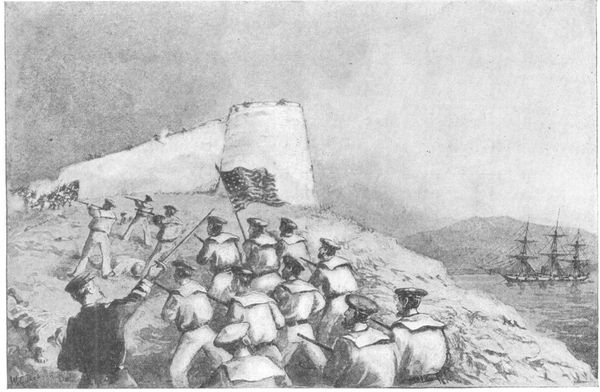
Attack on a Corean Fort.
The steamer "Forward," bearing the San Salvador flag, landed 200
desperadoes at Guaymas, Mexico, in June, 1870, and these outlaws took
possession of the custom-house. They forced the foreign
merchants to furnish them with funds and goods, and compelled the
United States' consul to supply coal for their vessel, their purpose
being to become pirates on a large scale. Commander Low, of the
"Mohican," upon learning these facts, sailed from Mazatlan, and
overtook the "Forward" while still in the Gulf of California. She was
attacked in the harbor of Boca Teacapan by six boatloads of sailors
and marines from the "Mohican," and was captured and burned.
It seemed desirable, in 1871, that some arrangement should be made
with the people of Corea whereby sailors wrecked upon these shores
should have protection. With this end in view our Minister to China,
accompanied by Rear-Admiral John Rodgers, with the "Colorado," the
"Alaska," the "Benicia," the "Monocacy," and the "Palos," vessels of
the Asiatic squadron, sailed to Corea, anchoring in the Sale River.
The local authorities were assured that the visit was a perfectly
peaceful one, and they in turn gave evidences of a peaceful spirit.
But when a party engaged in making surveys and soundings for the
safety of commerce had got beyond a point where they could be
protected by the cruisers' guns, they were fired upon by the Coreans,
and were forced to re-pass the Corean forts under a fierce cannonade.
Admiral Rodgers and the minister determined that an explanation should
be at once demanded. No answer having been received from the Coreans
after an interval of ten days, it was decided that an attack should be
made upon the forts from which the shots had been fired. A party of
about 700 of the sailors and marines were landed, and after a march
through mud which rose to their knees, the first fort was captured
without serious resistance. The next day, other forts were easily
taken, and preparations were made to attack the horseshoe-shaped
citadel, which was defended by a garrison of a thousand Corean
soldiers. A few shells from the vessels, judiciously planted among the
Coreans, frightened and disconcerted them; but they made a stubborn
fight until their ammunition gave out. The attacking party swarmed
over the walls. Then ensued a desperate hand-to-hand fight The Coreans
expected no quarter, and fought till all who had not fled had been
killed or wounded. Lieutenant Hugh McKee, who was the first man to
climb over the ramparts, fell with a mortal wound. Two hundred and
forty-seven dead Coreans were counted within the works. Five forts and
a large number of flags and cannon had been captured. The
gallant conduct of the men of the navy made a deep impression on the
people of the China coast and led to the increased consideration and
safety of American citizens in those localities.
On Saturday morning, November 26, 1877, occurred one of the most
disastrous wrecks in the history of the navy. The steam sloop-of-war
"Huron" struck the rocks near Oregon Inlet, North Carolina, in a heavy
gale and was wrecked, with the loss of nearly a hundred officers and
men. The boats were washed from the davits and the thirty-four persons
who were saved reached the shore by swimming. Ensign Lucien Young
landed on the beach after desperate efforts, and spread the alarm. His
sturdy activity resulted in the saving of several lives.
The members of a naval exploring expedition, which had sailed in the
"Polaris" for the Arctic regions in 1871, were rescued from boats and
the floating ice in Baffin's Bay in 1873, the "Polaris" having been
abandoned as a wreck.
The United States steamer "Rodgers," commanded by Lieutenant Robert M.
Berry, was detailed in 1881 to search for the exploring party
organized by James Gordon Bennett and headed by Lieutenant-Commander
DeLong, which had embarked in the "Jeannette" for the far north and
had been last heard of in August, 1879. The "Rodgers" was burned and
abandoned in St. Laurence Bay, Siberia, in November, 1881; but
Lieutenant Berry continued his search on the coast. In the early
spring he learned that one party from the "Jeannette," that of
Chief-Engineer Melville, had been saved and was searching for the
other two parties which had become separated from the first in a storm
while attempting to escape from the Arctic seas in open boats after
the "Jeannette" had been crushed and sunk by the ice. Lieutenant Berry
soon afterward met Chief-Engineer Melville's party and learned that
the bodies of Lieutenant DeLong and his companions had been found.
Search for the other party which had been led by Lieutenant Chipp was
continued, and the Navy Department fitted out another vessel, the
"Alliance," to aid in the possible rescue. But Lieutenant Chipp and
his men were never found.
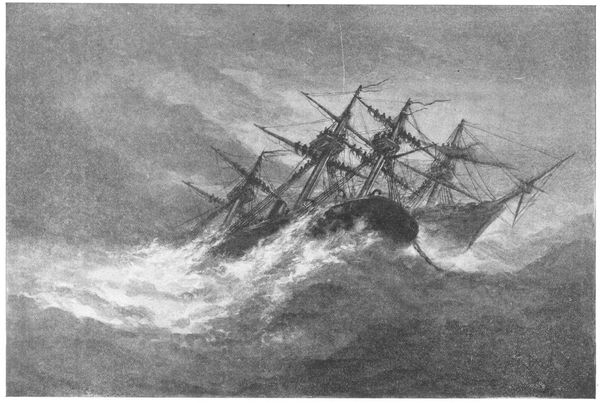
Wreck of United States War-ships off Samoa.
During the massacres by Egyptian troops under Arabi Pasha in
Alexandria, in 1882, when more than two hundred European residents
were killed or wounded, the flagship "Lancaster," under
Captain Gherardi, was in the harbor and afforded a place of refuge for
large numbers of men, women, and children. A large body of marines
with a detachment of naval artillery landed in the city and were of
much service in restoring order.
Another Arctic expedition was fitted out in the spring of 1883. Three
vessels, the "Thetis," "Alert," and "Bear," left New York by order of
the Navy Department to search for Lieutenant Greely and his party,
comprising what is known as the Lady Franklin Bay Expedition. After a
long voyage, in which the vessels were several times in imminent
peril, they passed around Cape Sabine and found Lieutenant Greely and
the seven survivors of his party. Their condition was so enfeebled
that they could have lived only a little longer. On August 8th the
relief squadron and the rescued party arrived in New York.
An insurrection broke out in the United States of Colombia in the
spring of 1885, during which the city of Aspinwall was in great part
destroyed. The affair assumed such a serious aspect that the vessels
of the North Atlantic squadron, under Rear Admiral Jouett, were
ordered to Aspinwall, and in addition to the fleet, the Navy
Department sent a force consisting of about seven hundred and fifty
from New York, for the special purpose of operating on shore. Upon his
arrival at Aspinwall, on April 10th, Rear-Admiral Jouett issued orders
for the landing of a force to open the transit across the isthmus, and
on the 12th, trains were run as usual. On April 28th, the insurgents
capitulated, and shortly afterward the United States naval force was
withdrawn.
One of the most severe disasters that ever befell the United States
Navy in time of peace occurred on the 16th of March, 1889, when,
during a hurricane in the harbor of Apia, Samoa, the "Trenton" and
"Vandalia" were totally wrecked, and the "Nipsic" was run on shore to
save her from destruction. Five officers and forty-six men lost their
lives in this catastrophe. Nothing that skill and experience could
suggest was left undone to avert the disaster, but the vessels were
equipped with old-fashioned engines, whose steam-power was not strong
enough to withstand the fury of the gale. The value of high-pressure
engines in war vessels was illustrated by the British ship "Calliope,"
which was able to steam out to sea, and thus escaped destruction on
the reefs. The "Trenton" and the "Vandalia," which had been two of the
best of the old wooden fleet, were abandoned. The "Nipsic"
sailed for the Sandwich Islands, where she was refitted for active
service. The natives of Samoa displayed great heroism in their efforts
to save the shipwrecked sailors, and were afterward rewarded by the
United States government. Fifteen merchant vessels which were in the
harbor were either sunk or run upon the shore, and the German naval
vessels "Elber," "Adler," and "Olga" were wrecked, with the loss of
many men.
When the United States cruiser "Baltimore" was at anchor in the harbor
off Valparaiso in October, 1891, shortly after the end of a Chilian
rebellion, a number of the seamen were given liberty to go on shore.
They were attacked by a mob in the streets of Valparaiso, and Petty
Officer Charles Riggin was stabbed, and left to die. Another petty
officer, Johnson, went to his assistance, and was attempting to carry
him to an apothecary, when a squad of Chilian police, with fixed
bayonets, came down the street. When at close quarters, they fired at
Johnson. A shot passed through his clothes, and another entered
Riggin's neck, inflicting a death-wound. Petty Officer Hamilton was
dragged to jail dangerously wounded. As a result of the attack, two
men, Riggin and Turnbull, died, and eighteen others were disabled by
wounds. Thirty-six of the "Baltimore's" men were arrested, and treated
by the Chilian police with extreme brutality. Investigation proved
that all had been perfectly sober and well-behaved. The attack grew
out of the bitter hostility of the Chilians toward the United
States—a feeling largely due to false accusations in reference to the
action of the navy during the Chilian revolution. The affair caused
excitement and indignation in the United States, but was amicably
settled.
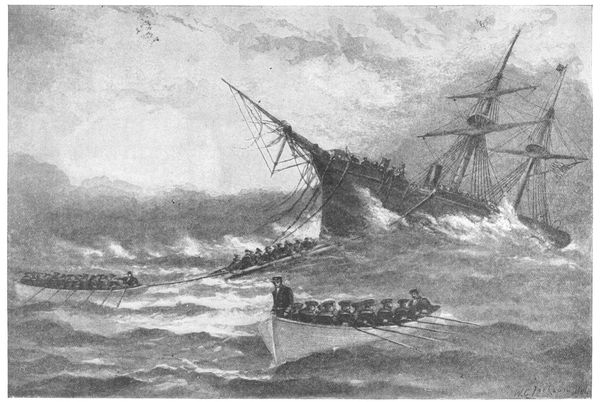
Wreck of the "Kearsarge."
The most important assemblage of naval vessels ever seen in the waters
of America took place in April, 1893, in celebration of the Columbian
quadricentennial. Invitations had been sent to all the important
maritime powers, and at the rendezvous in Hampton Roads, on April
24th, the combined fleet, under the direction of Rear-Admiral
Gherardi, of the United States Navy, comprised twelve men-of-war of
the United States, four of England, three of France, two of Italy, two
of Germany, two of Russia, three of Brazil, and one of Holland. At New
York, the squadron was joined by one more Russian, three Spanish, one
Argentine vessel, and the "Miantonomoh," of the United States Navy,
making a combined fleet of thirty-five ships-of-war. The President, on
board the "Dolphin," reviewed the fleet on April 27th,
and the next day the armed battalions of the various nations, to the
number of 3,815 men, marched through the streets of New York, and were
reviewed by the Governor of the State.
The navy suffered a severe loss in 1894, in the wreck of the famous
old man-of-war "Kearsarge," the conqueror of the "Alabama," which was
wrecked February 2d on Roncador Reef, while on her way from Port au
Prince to Bluefields, Nicaragua. Eight days later her men were rescued
by the "City of Para."
One of the conspicuous features of the pageants which attended the
opening of the Kiel Canal, between the North and the Baltic seas, on
June 19th, 1895, was the fleet of war-vessels which assembled in the
harbor at Kiel. It was the most remarkable ever seen in any waters,
numbering over a hundred of the finest vessels in existence. A number
of these, headed by the flagship "New York," belonged to the new navy
of the United States. These ships provoked the admiration of all the
naval authorities present, and their effective strength was noted and
commented upon all over Europe.[Back to Contents]
THE NAVAL MILITIA. — A VOLUNTEER SERVICE WHICH IN TIME OF WAR WILL BE
EFFECTIVE. — HOW BOYS ARE TRAINED FOR THE LIFE OF A SAILOR. — CONDITIONS
OF ENLISTMENT IN THE VOLUNTEER BRANCH OF THE SERVICE. — THE WORK OF THE
SEAGOING MILITIA IN SUMMER.
he personnel of a navy is quite as important as its vessels. It has
been said that a ship is worth what her captain and crew are worth. It
is certainly true that a man-of-war, of whatever power, would be
useless or worse than useless if her officers and men did not
understand her wonderfully complicated construction nor know how to
handle her. The officers of the United States navy are given this
important instruction at the Naval Academy at Annapolis, and the rank
and file of the men of the navy, those who fill the positions of
seamen and petty officers, are trained at the station in Coaster's
Island Harbor, near Newport, R.I., and in the training-ships when
cruising.
The training-station is designed to ensure the thorough efficiency of
the corps of men enlisted in the service, and to provide for the
manning of the vessels by American citizens instead of by foreigners.
There was a time, and not a great while ago, when the gunners and
crews of United States men-of-war were, with very few exceptions,
aliens, who spoke the English language with difficulty, and who did
not have, and could not be expected to have, any of the patriotic
spirit which makes effective fighters in naval engagements. While this
condition still exists to some extent, the growth of the
apprentice system is bringing about a gradual change.
As early as 1837 an attempt was made to establish a naval apprentice
system. In that year Congress passed an act making it "lawful to
enlist boys for the navy, not under thirteen nor over eighteen years
of age, to serve until twenty-one." Within a few months several boys
were received as apprentices aboard naval vessels. Six years later,
however, the system was abandoned as a failure, owing to a false
impression which had gained wide currency that the apprentices would
receive commissions in the navy.
Capt. S. B. Luce and the officers of the practice-ship "Macedonian"
investigated the apprentice systems at Portsmouth and Plymouth,
England, twenty years afterward, and made such favorable reports that
Secretary Welles was induced to revive it in the United States navy.
This was done, and during the civil war the system was in successful
operation, but soon after the close of the war it was again abandoned.
In the following years the want of intelligent seamen of American
birth in the navy was greatly felt, and in 1875 Secretary of the Navy
Robeson deemed it advisable to resume the enlistment of boys under the
naval apprentice law, which was still in existence. As an experiment
two hundred and fifty boys were enlisted and placed on the frigates
"Minnesota" and "Constitution" and the sloops of war "Portsmouth" and
"Saratoga," which were commissioned as training-ships. Since 1875 the
training-station and vessels have been very important features of the
naval establishment.
The regulations governing the enlistment of boys are simple and few in
number. The boys must be between the ages of fourteen and sixteen
years, of robust form, intelligent, of perfectly sound and healthy
constitution, free from all physical defect or malformation, and of
good moral character. They must be able to read and write, although in
special cases, when a boy shows general intelligence and is otherwise
qualified, he may be enlisted notwithstanding the fact that his
reading and writing are imperfect. Each boy presenting himself for
enlistment must be accompanied by his father, mother, or, in case
neither is living, by his legally appointed guardian, and must
voluntarily sign an agreement to serve in the navy till twenty-one
years of age. Upon enlistment the boys are rated as third-class
apprentices, and are paid $9 a month. Deserving boys are rated
second-class apprentices, and receive pay of $15 a month
after they have completed their term of service on a cruising
training-ship. If they have served a year on a cruising ship of war
they are considered properly qualified apprentices, and receive $21 a
month. As the apprentices become proficient and their services are
required, they are transferred to the seagoing vessels. Upon the
expiration of the enlistment of an apprentice he will, if recommended,
receive an honorable discharge, and if he enlists again within three
months, will be given pay for this period. The apprentices are under
the immediate supervision of the Bureau of Navigation of the Navy
Department, and applications for enlistment are made to the chief of
that bureau at Washington, or to the officer commanding either the
"Vermont," at the Brooklyn navy yard, or the "Richmond," stationed at
the League Island yard, Philadelphia. These were the recruiting-ships,
from which the boys were being sent to the training-station at
Coaster's Island as soon as a squad of twenty were enlisted, at the
period of this writing. Sometimes there have been more ships in this
duty.
There are usually about one hundred boys at the station at one time.
They are taught to march, handle muskets, revolvers, broadswords, and
cannon; they go aloft so as to get practice with the sails, and are
also made familiar with the management of boats and oars and
boathooks. Two hours a day are devoted to lessons, consisting of
arithmetic, reading, writing, spelling, geography and grammar. Ample
time is given for recreation, and innocent social pleasures are
encouraged.
There are two training-ships, besides the famous old ship
"Constellation," which figured in the War of 1812, at the station
devoted to the use of the boys, and every six months one of these
appears at Coaster's Island, and receives the apprentices who have
been at the station for half a year. The vessel then starts on a
cruise to Europe if it is summer, and to the West Indies in the
winter. Each boy remains aboard a year, only half of the crew being
changed at a time. Practice aloft and the life in general aboard a
sailing vessel give him a broad general foundation of knowledge of the
sea and ships, upon which he can build the special training and
instruction he afterward gets upon a regular man-of-war. When he is
transferred, upon the expiration of his year on the training-ship, he
begins the task of mastering the intricacies of a modern ship-of-war.
Here he remains until his first term of service has
expired. If he re-enlists and has shown aptitude for the service, he
is sent to Washington navy yard for a course of six months'
instruction in gunnery and special branches, such as electricity and
torpedoes. He becomes a seaman gunner, with the billet and pay of a
petty officer.
A serious defect in the apprentice system, however, and one which
makes it impossible to man the vessels altogether with well-trained
American citizens, is the fact that the majority of the apprentices do
not re-enlist after receiving their honorable discharge at the age of
twenty-one, for the reason that the special training they have
received enables them to secure better-paid places in civil life than
are possible to them in the navy. In the government service, too, they
cannot attain the rank of officers, as there is no such provision for
the promotion of enlisted men in the navy as there is in the army.
Secretary Tracy, in his report of 1889, forcibly called the attention
of Congress to this condition. As a remedy he recommended that there
be a statutory extension of the term of enlistment to twenty-four
years of age. It was further recommended that the number of
apprentices be increased from seven hundred and fifty to fifteen
hundred, and that the course in the training-ships be extended by the
formation of a special class for training in gunnery on board a ship
devoted exclusively to this purpose. Congress has as yet taken no
action upon these and numerous other recommendations which have been
made for the improvement of the apprentice system, and they remain
pertinent.
The navy, however, in case of war, would not have to depend entirely
upon apprentices and graduates of the training-station for its skilled
seamen. The Naval Militia has become an organization that would render
very efficient service if called upon by the government. It is
composed of about three thousand highly intelligent and well-drilled
young men, and has been organized in sixteen States. It bears the same
relation to the navy that the National Guard does to the regular army,
and is therefore wholly under State control; but it is subject to
call, of course, by the federal government.
The organization of the Naval Militia has been a growth of the last
eight years, and is due in large measure to the reconstruction of the
navy and the revival of activity and interest in naval affairs in the
United States.
It was seen that the new vessels of modern and intricate construction
and appliances should, in case of war, be manned by men
skilled in the use of these appliances. The apprentice system brought
to the navy a supply of apprentices, but the number would be totally
inadequate in a naval war. A naval reserve force was an urgent
necessity.
The first step toward meeting this necessity was made in 1887 by
Senator Whitthorne, of Tennessee, who in that year introduced a bill
"to create a naval reserve of auxiliary cruisers, officers, and men,
from the mercantile marine of the United States." The measure did not
pass, and the next year another was introduced by Senator Whitthorne,
providing for the enrolment of a Naval Militia and the organization of
naval reserve forces. According to this bill, it was to be lawful for
States and Territories bordering on sea and lake coasts and navigable
rivers to enroll and designate as the Naval Militia all seafaring men
of whatever calling or occupation, and all men engaged in the
navigation of the rivers, lakes, and other waters, or in the
construction or management of ships and craft, together with
ship-owners and their employees, yacht-owners, members of yacht clubs
and other associations for aquatic sports, and all ex-officers and
former enlisted men of the navy.
The bill contemplated a naval reserve artillery and a naval reserve
torpedo corps. It did not become a law, but formed a basis for
legislation in several of the States shortly afterward, although the
original plan, as shown in the proposed measure, was modified to the
extent of making the Naval Militia a State organization and forming it
of volunteers irrespective of occupation.
Massachusetts was the pioneer among the States in the organization of
the Naval Militia. In May, 1888, the legislature passed a bill
authorizing the formation of "a naval battalion to be attached to the
volunteer militia." This measure was prepared, with the assistance of
others, by Lieutenant John C. Soley, a retired officer of the United
States navy, and he was afterward energetic in putting it into
successful operation.
The next State to provide for a Naval Militia was Pennsylvania, whose
legislature made the necessary law in 1889. On the same day the
legislature of Rhode Island "established a naval battalion to be
attached to the Rhode Island militia." In New York, in 1889, a State
Naval Militia of three battalions of naval reserve artillery and a
naval reserve torpedo corps, to consist of not less than four
companies to a battalion, was established.
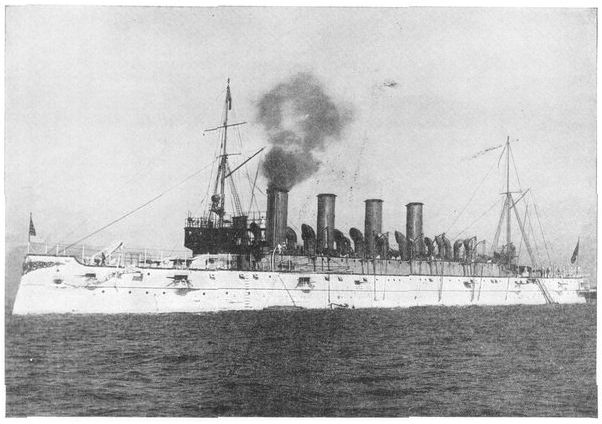
Copyright, 1895, by A. Loeffler.
Cruiser "Columbia" (Commerce Destroyer).
The practical work of the Naval Militia began in 1890, when
the Massachusetts battalion drilled on the receiving-ship "Wabash,"
and the New York battalion on the receiving-ship "Minnesota."
A very decided impetus was given to the movement in 1891 by the
appropriation by Congress of $25,000 for arms and equipments for the
Naval Militia, leaving the disbursement of the money to the discretion
of the Secretary of the Navy. Within the year California, North
Carolina, Texas, and Maryland joined the States having battalions of
Naval Militia, and at its close the force numbered 1,149 men. Progress
was made also in 1891 in the method of drilling and instructing the
members of some of the battalions. Those of New York, Massachusetts,
and Rhode Island spent several days aboard the vessels of the Squadron
of Evolution, under the command of Rear-Admiral J. C. Walker, and were
given practice with the guns and boats, and participated in the ship's
routine duties.
Further appropriations of $25,000 each for the Naval Militia were made
in 1892 and 1893. The legislatures of Vermont and South Carolina
provided for battalions of the Naval Militia in 1892, and those which
had been authorized, but not yet organized, in Maryland and
Pennsylvania, were formed. During the summer of 1892 the members of
the North Carolina Naval Militia were drilled on board the "Newark."
The "Wabash," the "Chicago," and the "Atlanta" were used for drills by
the Massachusetts battalions, and those of New York received their
instruction on the "New Hampshire," the "Chicago," and the "Atlanta."
The California Naval Militia drilled on board the "Charleston."
The Naval Militia was increased in 1893 by battalions formed in North
Carolina, Michigan, Illinois, Georgia, and Connecticut, under laws of
these various legislatures of that year, and the force numbered 2,376
officers and men. New Jersey and Virginia, in 1894, organized
battalions of the Naval Militia, and in that year Congress passed an
important act, empowering the Secretary of the Navy to lend
temporarily to any State vessels "not suitable or required for the
general service, together with such of her apparel, charts, books, and
instruments of navigation as he may deem proper, said vessel to be
used only by the regularly organized Naval Militia of the State for
the purposes of drill and instruction." Even interior States, with no
bodies of water other than rivers, have organized naval battalions. At
Pittsburg the organization owns a small armored gunboat, of
the sort that was so useful on inland waters in the civil war. This
vessel was presented to the militia by a wealthy manufacturer. Few
commands, however, are so fortunate. Most take advantage of the law
authorizing the loan of government ships. Under this law the following
vessels were lent: the "Minnesota" to Massachusetts, the "Wyandotte"
to Connecticut, the "New Hampshire" to New York, the "Portsmouth" and
the "Ajax" to New Jersey, the "St. Louis" to Pennsylvania, the "Dale"
to Maryland, and the "Nantucket" to North Carolina. The other States
have been compelled to get along without vessels, for the reason that
there have been no others available.
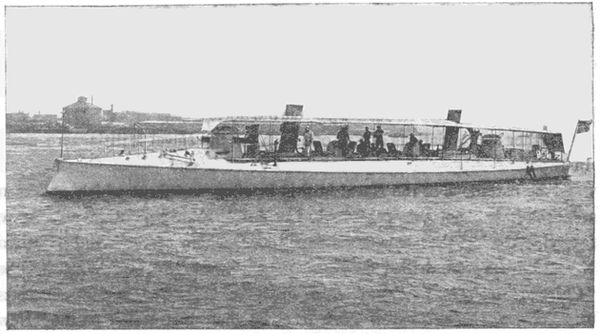
Torpedo Boat "Cushing."
During the summer of 1894 the Massachusetts brigade of the militia
encamped for drill on Lovell's Island, Boston Harbor, and the monitor
"Passaic" was lent to the State. There were also drills and
target-practice on the "Miantonomoh" and the "Atlanta." The forces of
Connecticut and Rhode Island received instruction on the "Miantonomoh"
and the "Atlanta" respectively, and New York's battalion spent a week
on board the "New York" and the "San Francisco" in Gardiner's Bay,
Long Island. A part of the Pennsylvania force had target-practice at
sea on board the "New York," and the North Carolina battalion received
instruction on the "Montgomery."
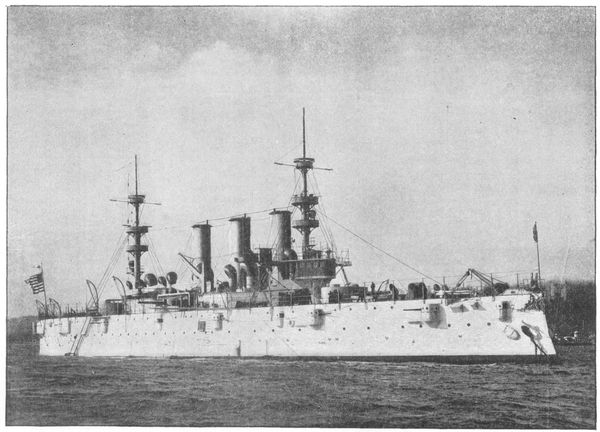
Copyright, 1893, by J. S. Johnston.
Armored Cruiser "New York."
The California division helped to man the "Olympia" for a
week in 1895, taking the places of the crew; the Maryland contingent
had a week's cruise on the "Dale," and the First Naval Battalion of
New York carried out a scheme of reconnoissance and distant boat work
along the northern shore of Long Island, encamping on Shelter Island.
The party was accompanied by the torpedo boat "Cushing." Most of the
other battalions had their quota of drill and instruction.
These details of the summer operations of the Naval Militia will
convey an idea of the manner in which its members are being prepared
for the emergencies of war. In addition to the summer work, there is
drill in armories in the winter. This course of training, in
conjunction with the intelligence and enthusiasm of the young men of
the Naval Militia, who are of the best classes in this country, has
made an organization which would doubtless be of very great value in
time of war.
The uniform of the Naval Militia consists of a blue cap, blouse, and
trousers of blue trimmed with white braid. The working suit is of
white duck with white canvas hat.[Back to Contents]
HOW THE NAVY HAS GROWN. — THE COST AND CHARACTER OF OUR NEW WHITE SHIPS
OF WAR. — OUR PERIOD OF NAVAL WEAKNESS AND OUR ADVANCE TO A PLACE AMONG
THE GREAT NAVAL POWERS. — THE NEW DEVICES OF NAVAL WARFARE. — THE
TORPEDO, THE DYNAMITE GUN, AND THE MODERN RIFLE. — ARMOR AND ITS
POSSIBILITIES.
t the close of the civil war the United States had one of the most
formidable navies afloat. The necessities of the war had forced the
Navy Department to the utmost exertion in increasing the number and
power of the vessels of the fleets. This work of naval upbuilding and
strengthening had been carried on, moreover, till Fort Fisher fell and
hostile operations ceased. The result was that at the close of the war
the United States had upon its hands a large number of ships-of-war
for which it had no use. The Secretary of the Navy at once began to
reduce the number, and secretaries succeeding him followed the same
policy. Old vessels which had outlived their usefulness as cruisers
were one by one taken out of commission and were not replaced. Thus
the navy moved steadily on a downward plane. Through the seventies and
into the eighties this retrogression continued. The lowest ebb was
reached in 1882, when the entire naval force numbered only thirty-one
vessels in commission, all but four of which were built entirely of
wood. They were old-fashioned ships, which had been
efficient in a past day, but were totally unfit to cope with the
modern warships of foreign naval powers. Both their guns and engines
were inferior. Their sole usefulness, in short, lay in displaying the
national flag upon the seas and in the harbors of the commercial world
in times of peace.
This condition of the navy was referred to by Secretary Chandler, in
his report of 1882, as follows:
"It is not the policy of the United States to maintain a large navy,
but its reputation, honor, and prosperity require that such naval
vessels as it possesses shall be the best which human ingenuity can
devise and modern artificers construct. Our present vessels are not
such and cannot be made such. They should be gradually replaced by
iron or steel cruisers, and allowed to go out of commission."
It may be of interest to add that in 1882 there was only one
high-power cannon in the navy, while there were nearly nineteen
hundred naval officers, making the proportion of fifty-nine officers
for each ship, and one for every five seamen.
As the result of Secretary Chandler's recommendations in his report of
1882, three steel warships and an armed despatch-steamer were
authorized by the next Congress. The building of these vessels, named
the "Chicago," the "Boston," the "Atlanta," and the "Dolphin," may be
regarded as the first movement toward the making of the new navy of
the United States.
While progress in naval construction has been so rapid that these
ships are a long distance behind the war-vessels of to-day in power,
they were then considered to be equal to any afloat in their
respective classes. All are unarmored. The "Chicago," of forty-five
hundred tons displacement and a speed of fourteen knots an hour, was
an example of the largest and best unarmored fighting and cruising
vessel then built, and, according to Secretary Chandler, had no
superior in speed, endurance, and armament. In the "Boston" and
"Atlanta," each of three thousand tons displacement and a speed of
thirteen knots an hour, speed and endurance were supposed to have been
given their greatest development, and their fighting power was
increased by placing the battery on a central superstructure on the
spar-deck and adopting a brig rig, so that the extremities would be
clear for a fore and aft fire. The "Dolphin," of fifteen hundred tons
displacement and a speed of fifteen knots, was designed as
an auxiliary in naval operations, and it was expected that she would
furnish a model for high-speed commerce-destroyers to be subsequently
built. These vessels were constructed at an aggregate cost of over
$2,400,000, in the shipyard of John Roach, of Chester, Pa. The
"Dolphin" was launched in 1884.
The Congress which authorized the building of the cruisers also
directed that the double-turreted monitors, "Puritan," "Amphitrite,"
"Terror," and "Monadnock," whose keels had been laid several years
before, be completed. In accordance with this order they were launched
in 1883.
In order that the work of the reconstruction of the navy should be
carried on as rapidly as possible, the secretary recommended, in 1883
and 1884, that seven unarmored cruisers, in addition to the four then
in the process of construction, be built. Congress adopted his
suggestion to the extent of authorizing, in 1884, the construction of
two unarmored cruisers, two gunboats, and two armored cruisers.
The vessels with which the reconstruction of the navy began—namely
the "Chicago," the "Boston," the "Atlanta," and the "Dolphin"—were
completed about this time, and were in some measure disappointments.
It was found that the "Dolphin" was better adapted for pleasure trips
than for war service, because of the lack of protection against
hostile fire. The engines had been so placed as to be exposed above
water-line, which was condemned as a serious mistake in a war-vessel
without armor-protection. It was realized, too, that the essential
characteristic in an unarmored cruiser is great speed. The function
she is expected to perform is to destroy commerce; and if she is
slower than the merchant-vessels it is useless for her to go to sea;
and if she is slower than the iron-clads, and consequently cannot
escape from them, she could not long continue her service. The chief
objection to the vessels was the lack of a speed equal to that of
merchantmen and the cruisers of other countries. The type of protected
cruiser with a maximum speed, in some cases as high as twenty knots,
developed at this time as a result of the earlier experiments. The
torpedo, too, was receiving constant attention, and money was freely
spent for its improvement. It was found that vessels at anchor or
under slow headway could be protected from torpedoes by being
surrounded by a large net. This defence was generally adopted for
armored vessels.
A stride forward in naval construction in the United States
marked the year 1887. Before that time a serious obstacle in the way
of building up the navy was the lack in the country of manufactories
necessary to the construction and armament of a modern war-vessel,
namely, that of steel forgings for the heavier guns, of armor for
iron-clad vessels, and of secondary batteries, which are an essential
portion of the armament. It was important that the country should not
be dependent upon foreigners for these necessary implements of
warfare, because they are contraband in time of war, and consequently
could not then be obtained abroad. Secretary of the Navy Whitney, who
succeeded Secretary Chandler, stipulated, in his advertisements for
bids for the contracts of making the armor for the ships under
construction, that this armor should be of domestic manufacture.
Correspondence was also opened with the leading steel manufacturers of
the country, offering them inducements to take the matter up. Interest
was awakened, and it was found upon investigation that armor could be
made in the United States as advantageously as abroad. A contract was
drawn up with the Bethlehem Iron Company, under which a plant for the
production of armor and gun steel was erected at Bethlehem, Pa., which
was designed to be second to none in the world. In the matter of the
second batteries, the policy of insisting upon home manufacture was
also pursued, with the desired result.
Congress had authorized, in 1885, the construction of two additional
cruisers and two gunboats. In 1886 there was further authorization of
two armor-clad vessels, each of about six thousand tons, and each to
cost, exclusive of armament, not more than $2,500,000. In 1887 the sum
of $2,000,000 was appropriated for harbor and coast defence vessels.
As a result of this reawakening on the part of Congress to the
necessity of a respectable navy, and the manifestations of
enlightenment in the form of substantial appropriations, Secretary
Whitney was able to state in his report of 1888 that upon the
completion of the ships under construction, the United States would
rank second among the nations in the possession of unarmored cruisers
or commerce-destroyers possessing the highest characteristics—namely,
size of three thousand tons and upward and a speed of nineteen knots,
and more. The vessels, inclusive of the monitors, completed and
uncompleted, then composing the navy, were as follows: The "Dolphin,"
"Boston," "Atlanta," "Chicago," whose keels were laid in
1883; the "Charleston" "Baltimore," "Newark," "Philadelphia," "San
Francisco," protected cruisers, whose keels were laid in 1887 and
1888; and the gunboats "Yorktown," "Petrel," "Concord," "Bennington,"
whose keels were laid in 1887 and 1888. In addition to these, there
were under construction the dynamite cruiser "Vesuvius," with a
guaranteed speed of twenty knots an hour, and a first-class
torpedo-boat with a speed of twenty-three knots an hour. Besides
these, five protected cruisers had been authorized, but were not yet
in process of construction.
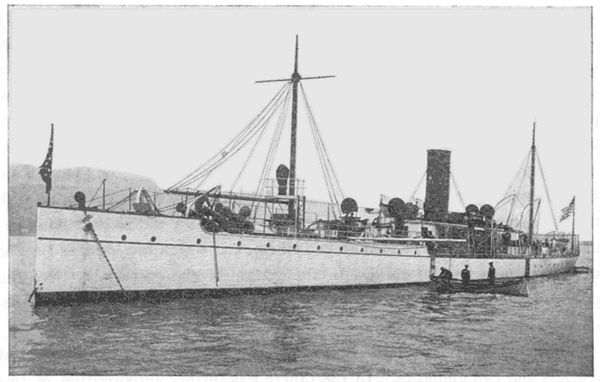
Dynamite Cruiser "Vesuvius."
The "Baltimore," "Charlestown," "Yorktown," and "Petrel" were given
their trial trips in 1889, and were accepted by the Navy Department.
The trip of the "Baltimore," in particular, was a brilliant success.
The horse-power proved to be in excess of the contract requirement,
and her highest speed for one hour was 20.39 knots—this result being
then unparalleled by any warship in the world of the "Baltimore's"
displacement.
When Benjamin F. Tracy became Secretary of the Navy, in 1889 he called
attention to the fact that, while the United States had secured a
number of excellent vessels of the cruiser type, it did not
as yet possess an efficient navy. He pointed out that the country had
two widely separated ocean frontiers to protect, and that there was
only one way to protect them, namely, by two separate fleets of
armored battle-ships. He said further that in addition to the
battle-ships, the condition of the country required at least twenty
vessels for coast and harbor defence, and, moreover, that the
employment of these ships as floating fortresses demanded that they be
equipped with the most powerful batteries and the heaviest of armor.
It may be said parenthetically that eight vessels of this type, five
of which were reconstructed monitors, were under construction or had
been authorized at that time. Secretary Tracy recommended the
authorization by the following Congress of eight armored battle-ships.
He also said that the United States could not afford to neglect
torpedo-boats, with which the foreign naval powers were well supplied,
and he recommended that appropriations be made for the construction of
at least five of these boats of the first and second class. The year
before, the keel of the first of the battle-ships, the "Texas," had
been laid in the navy-yard at Norfolk, Va., and in 1889 work was begun
at the Brooklyn navy yard upon another vessel of the same class, the
"Maine." These vessels are respectively of 6,314 and 6,648 tons
displacement. The construction of a third battle-ship, which had been
provided for, had not yet been begun.
Secretary Tracy's recommendations reveal clearly the naval condition
in 1889. Previous to that year the additions to the navy had consisted
chiefly of cruisers of from three to four thousand tons, and of
gunboats under two thousand tons; but, acting upon the secretary's
report, Congress, on June 10, 1890, authorized, in addition to another
armored cruiser, three seagoing coast-line battle-ships. These were an
entirely new class of vessels in the United States navy, and their
authorization marks another distinct step in its reconstruction.
An appropriation was made in 1891 for an additional armored cruiser,
designed to be a sister ship to the one provided for in 1890. It was
the purpose to make these vessels more powerful than any of their type
in the navy. Their tonnage was fixed at 7,500, and their maximum speed
at twenty-two knots. They were to be given coal capacity that would
enable them to cruise for great distances without recoaling. This, it
will be seen, is an important advantage to a navy so
destitute of coaling-stations abroad as that of the United States.
The vessels under construction in 1891 were the monitors "Puritan,"
"Amphitrite," "Monadnock," and "Terror," which had been begun in 1874,
but had been neglected in subsequent years; the "Maine," the "Texas,"
the coast-defence vessel "Monterey," which was launched in 1891; the
"New York," "Cincinnati," "Raleigh," "Detroit," and a practice-ship,
which had been authorized by the act of 1887; the harbor-defence ram
"Katahdin;" and gunboats "5" and "6," authorized in 1889; the three
battle-ships, "Indiana," "Massachusetts," and "Oregon," and the
protected cruiser "No. 12," authorized by the act of 1890; and
protected cruiser "No. 13," provided for in 1891.
Three vessels, the "Newark," the "Concord," and the "Bennington," were
given their trial trips in 1890. The behavior of the "Newark" proved
her to be a valuable addition to the list of cruisers. The "Concord"
and the "Bennington," vessels of the gunboat class, similar to the
"Yorktown," also gave evidences of power and usefulness. They carry a
comparatively heavy battery, while their light draught enables them to
run into shallow rivers and bays, and thus perform services for which
larger vessels are incapacitated.
The subject of the organization of a naval militia or reserve had been
discussed for some time before Secretary Tracy assumed his office. He
forcibly urged the necessity of such an organization in his first and
in following annual reports, until, in 1891, Congress appropriated
$25,000 for arms for the militia. This was a decided impetus toward
its development, and at the close of the year it existed in six
States, an effective, well-drilled, and organized force of eleven
hundred men.
The year 1892 saw considerable progress in the development of the
navy. Two important vessels, the "Iowa," a first-class, seagoing
battle-ship of 11,296 tons displacement, and the "Brooklyn," an
armored cruiser of 9,150 tons displacement, were provided for by
Congress. The cruisers "Texas," "Columbia," "Olympia," "Raleigh," and
"Cincinnati," and the gunboats "Machias" and "Castine" were launched.
Secretary Tracy's administration of the affairs of the navy, which
closed in 1892, was one of marked progress and development; and this
development was not confined to ships alone. Experiments
extending over a period of three years had resulted in the adopting of
an armor of new composition, namely, nickel-steel, which had been
found to be far superior to any before known. The manufacture of
torpedoes had been domesticated. Since 1889 the heavy, rapid-firing
guns had been developed and proved successful. The manufacture of
armor-piercing shells, of which two firms in Europe had had the
monopoly, was begun in this period under the care and encouragement of
the Navy Department; and the shells turned out soon surpassed the
foreign product. Through investigation and experiment conducted by its
own agencies, the Navy Department succeeded in developing a smokeless
powder, which gave better results than that made abroad. Careful and
protracted experiments with high explosives were also carried on, with
the result of developing an explosive that can be safely used in
shells fired from high-power guns.
In 1893, the first year of the administration of Secretary Herbert,
the following vessels were launched: the armored battle-ships
"Indiana" and "Massachusetts;" the protected cruiser "Minneapolis;"
the unarmored and very rapid cruiser "Marblehead;" and the armed
coast-defence ram "Katahdin." During the same year Congress authorized
the construction of three new vessels, to be of the class known as
light-draft protected gunboats. These are of about twelve hundred tons
displacement, and are designed for river service in China and
elsewhere. Several vessels, namely, the "Monterey," "Bancroft,"
"Detroit," "New York," armored cruiser of 8,480 tons displacement, and
the gunboat "Machias," were given their trial trips in 1893. The
results were in each case satisfactory, and the vessels were added to
the effective fleet of the navy.
Before 1893 the United States had been behind the other important
nations in the matter of small-arms equipment. The navy was still
using the old-fashioned, large-calibre rifle, employing a charge of
black powder, and effectively carrying only twelve hundred yards.
Under Secretary Herbert's direction, a board of naval officers
investigated the improved small arms in use in foreign navies, and
made recommendations which resulted in the adoption of a small-calibre
magazine rifle, in which is used smokeless powder, and which has an
effective range of a mile and a half. A further advantage of the new
rifle is that it employs cartridges of such a weight that no less than
two hundred rounds can be carried by one man. The
cartridges used in the old rifle were so heavy that one man could not
carry more than fifty rounds.
Secretary Herbert recommended in his report of 1893 that Congress
authorize the construction of at least one new battle-ship and six
torpedo-boats. He said that for the defence of ports the latter are
more effective according to cost than any class of vessels. The
knowledge of their existence alone will make an enemy chary about
approaching within bombarding distance. The value of this boat is
recognized by all naval powers, and they are being built abroad in
great numbers. The next naval appropriation contained a provision
authorizing the construction of three additional torpedo-boats of the
general type of the "Ericsson," which was then ready for trial. The
design for the new boat called for a speed of not less than
twenty-four and one-half knots an hour. The battle-ships "Indiana,"
"Texas," and "Oregon" underwent preliminary trial trips in 1894, and
were accepted by the government in 1895. It is of interest to note
that until these vessels were put in commission, the navy was still in
the condition that existed when President Cleveland, in his first
message to Congress in 1885, made the following statement: "We have
not a single vessel that could keep the seas against a first-class
vessel of any important power." It is true that vessels of size and
power enough to hold their own against the battle-ships of other
nations had been under construction for several years, but the United
States was still without an available man-of-war of the first class
until the "Indiana" and the "Oregon" joined the fleet.
Considerable progress in naval affairs marked the year 1895. One of
the important events was the adding to the commissioned fleet of the
coast-defence monitor "Amphitrite," whose keel was laid in 1874. The
work of remodelling her was begun in 1889, under the appropriation
made by Congress in 1887. The "Amphitrite" is in some respects an
old-fashioned type of vessel, but is nevertheless capable of important
service. Her displacement is 3,990 tons. Her armor and armament are
heavy, although not so powerful as that of the battle-ships. Her main
advantage, as with all of the monitors, is that she presents a
comparatively small target for the enemy's fire.
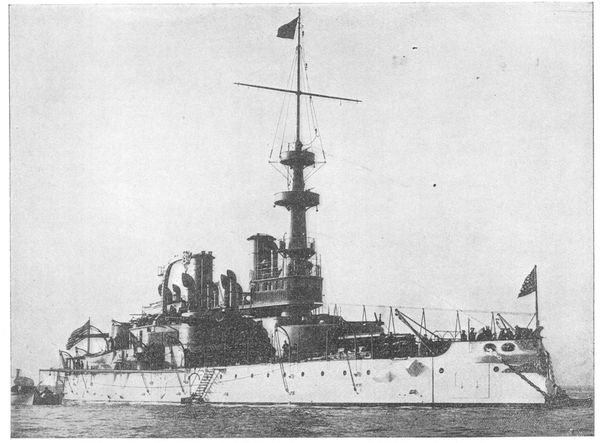
Copyright, 1896, by J. S. Johnston.
United States Battle-ship "Indiana."
Adopting the spirit of Secretary Herbert's recommendations in his
report of 1894, Congress, in 1895, authorized the construction of two
coast-line battle-ships of most formidable equipment and
power, their cost not to exceed $4,000,000 each. Further provision was
made for the building of twelve torpedo-boats. An interesting feature
of the bill was the stipulation that one of the battle-ships shall
bear the historic name "Kearsarge," after the famous old man-of-war
that was wrecked in 1894 on Roncador Reef. According to the plans of
the new ships, they resemble in a general way the "Indiana," although
they are longer and broader and have a greater displacement, and their
batteries are more powerful. A new feature in the arrangement of the
guns was decided upon. The vessels will carry two turrets of two
stories each. Many objections to this plan were advanced, but it was
said that all are outweighed by the opportunity which the turrets give
of concentrating an enormous quantity of shot on a given point. An
estimate has been made that the "Kearsarge" will carry enough
ammunition to kill or disable a million persons, and that she will be
able to discharge it all within a period of five hours. Accommodations
will be provided for five hundred and twenty officers and men. The
"Kearsarge" and her sister ship, which will be called the "Kentucky,"
will carry heavier armor and guns and a greater quantity of the latter
than any foreign battle-ship in existence or in course of
construction.
The ram "Katahdin" was rejected by the government in 1895, because,
upon her official trials, she did not fulfil the speed requirements.
She made 16.011 knots, while the contract called for 17 knots.
Congress was asked to purchase the vessel, and finally did so.
The armored cruiser "Brooklyn," designed to be one of the fastest and
most powerful vessels of her class afloat, was launched from Cramp's
shipyard in Philadelphia in 1895. She is the sister ship to the "New
York," which was put in commission in 1893. A matter of significance,
as showing the rapid progress in the art of naval construction within
a few years, was the taking out of commission in 1895 of the
"Chicago," to be refitted with engines and boilers that will give her
powers approaching those of the newer vessels. Two years will be
required for this work, and when she is complete she will travel three
knots an hour faster than heretofore, and in many respects will be
substantially a new ship.
The official trial trip of the battle-ship "Massachusetts," which
occurred in 1896, was a source of gratification to the Navy Department
and to all others who are anxious to see the United States
take respectable rank among the naval powers. The primary business of
a battle-ship is to fight; hence her guns and not her speed are of the
first importance. Naval experts have agreed that the "Massachusetts"
and her sister ships, the "Indiana" and the "Oregon," have larger and
more effective batteries than any man-of-war afloat or in progress of
construction. The "Massachusetts" has now proved, by steaming at the
rate of 16.15 knots for four hours, with a maximum speed of 17.03
knots, that she is superior to all other battle-ships in speed as well
as in armament. Her performance is unparalleled in naval history, and
makes her the foremost war-vessel of the world. The "Indiana" is a
trifle slower. She steamed 15.61 knots for four hours, but under the
disadvantage of a bottom that had never been cleaned. She would
probably go half a knot faster with a clean bottom. As a
representative specimen of the battle-ships which belong to the navy,
a few details of the "Massachusetts'" armament may be of interest. She
has thirty guns in all. The chief of these are four of thirteen-inch
calibre, which are the largest in use in modern navies; a pair of them
can be fired every three minutes. The eight-inch guns are next in
size. There are four of them, and they can be fired every minute. In
addition to these, there are two six-inch rifles, twenty six-pounders,
and four one-pounders. The six-inch guns can be fired twice a minute,
and the six-pounders twenty times in the same period. In a fight
lasting thirty minutes, these guns would throw forty-one and a half
tons of metal, of which forty-four thousand pounds would be the share
of the thirteen-inch guns, thirty thousand pounds the share of the
eight-inch, six thousand pounds of the six-inch, and thirty-six
hundred pounds of the others. The total weight of the "Massachusetts'"
broadside is 5,724 pounds, and of her head or astern fire 3,434
pounds.
Another of the monitors, the "Monadnock," was added to the navy in
1896. She was launched in 1883, and was then practically left alone
until the acts of 1885, 1886, and 1887 provided for her completion.
She is now a formidable vessel, with heavy guns which can be made to
bear on a point a small boat's length from the ship's side, or can
bombard at a distance of six miles.
While the successive Secretaries of the Navy, during the last fourteen
years, have been chiefly active in increasing the number of
ships-of-war, they have not altogether neglected defences
on the coast. Some of the larger seacoast cities have succeeded in
obtaining a part of the heavy gun and mortar batteries that would be
necessary in repelling attacks without the aid of battle-ships. The
cities of New York and San Francisco have now mounted and ready for
action powerful pneumatic dynamite gun batteries, the most destructive
engines of war in existence. Each of these guns is capable of hurling
a projectile carrying five hundred pounds of the most powerful
explosive known to man, and is able to destroy the strongest
iron-clad. In the naval battle of Sinope in the Crimean War, a shell
designed to explode on striking the object was used for the first
time. When the high explosives, such as dynamite and gun-cotton,
appeared, the idea suggested itself that they might be used in the
shells with vastly greater effect than gunpowder, which had been
employed. The objection, however was that these explosives are so
sensitive that there was great danger of their exploding at the outset
of the journey from the sudden shock of being hurled from the ordinary
high-power guns and mortars. Captain Zalinski, of the United States
Artillery, suggested a method of gun construction by which the shells
could be projected by a steady pressure of compressed air instead of
by the sudden force of powder gases. This system has been steadily
improved until the pneumatic dynamite gun now works perfectly and is a
marvel of destructiveness. The United States possesses six and Great
Britain one of the seven dynamite guns that have thus far been
manufactured for coast defence.
The "Iowa," a battle-ship of the first class whose keel was laid in
1893, was launched in March, 1895. She is the largest vessel of the
navy now afloat, her displacement being 11,410 tons, which is over a
thousand tons greater than that of the "Massachusetts," "Indiana," or
"Oregon."
It will be seen that progress toward the building of the new navy of
the United States has been steady since the first move was made in
1882. As a result of this development, the navy now consists, counting
the vessels built and authorized by Congress, prior to 1896, the naval
appropriations bill for that year still pending at this writing, of
about seventy modern ships-of-war. These include eight battle-ships,
six coast-defence steel-clads, two armored cruisers, one armored ram,
thirteen protected cruisers, eighteen gunboats and unprotected
cruisers, and about two dozen torpedo-boats. This fleet
gives the United States sixth place in the list of naval powers, being
outranked in number of vessels by England, France, Russia, Germany, or
Italy, in the order named. A true idea of the comparative fighting
strength of the United States navy is not conveyed, however, by its
rank in the numerical strength of the fleet. The personnel of the
navy and the power of the individual ships must be considered. It is
generally conceded that the United States has the finest fighting men
and vessels in the world. These advantages would, in all probability,
enable us to whip Germany or Italy in a series of naval contests;
therefore, it is thought by naval critics that we really hold fourth
position among the naval powers. England is still a long way ahead of
us, the English navy now numbering nearly five hundred vessels, of
which one hundred and twenty are armored cruisers. But, comparing the
navies ship to ship, the United States fleet, so far as it goes, is
superior even to that of Great Britain. The battle-ships, while
somewhat smaller, are more effective fighters. The English navy has no
armored cruisers as fast or as powerful as the "New York" and
"Brooklyn;" and the commerce-destroyers, "Columbia" and "Minneapolis,"
are the fastest vessels, either of war or peace, that have gone to
sea.
That this new navy of ours will ever have to meet so stern an ordeal
as that through which the sailors of '61 went is wholly improbable. In
multiplying the number and the effectiveness of fighting machines the
nations of the world have seemingly lessened the likelihood of war.
International disputes which once would have put the territory of all
Europe ablaze are now settled by the peaceful devices of diplomacy.
But behind the diplomat must be the gun, and it will be a sorry day
for the United States when, if ever, the sense of security bred of an
avowed national policy of non-intervention in foreign affairs shall
lead this people to neglect the naval arm of the republic.
PART V. THE NAVAL WAR WITH SPAIN.
THE STATE OF CUBA. — PERTINACITY OF THE REVOLUTIONISTS. — SPAIN'S
SACRIFICES AND FAILURE. — SPANISH BARBARITIES. — THE POLICY OF
RECONCENTRATION. — AMERICAN SYMPATHY AROUSED. — THE STRUGGLE IN
CONGRESS. — THE ASSASSINATION OF THE "MAINE." — REPORT OF THE
COMMISSION. — THE ONWARD MARCH TO BATTLE.
short time after the inauguration of William McKinley as President
of the United States in March, 1897, it became apparent that the
disordered condition of Cuba under Spanish rule was destined
inevitably to become an issue which the United States must help to
settle. For two years a great part of the island had been in open and
determined revolt against Spanish rule. Though the forces of the King
had been able to hold the seaports, thus cutting off the insurgents
from regular communication with the outer world and making impotent
their efforts to secure recognition from foreign powers, the patriots
under Maceo and Gomez held control of the interior, established a
government of their own, enforced order, and levied taxes. Enormous
sacrifices were made by the Spanish people to re-establish sovereignty
in the island. More than 300,000 troops were sent thither to be
cruelly cut down by plague and pestilence. A nation, long on the verge
of bankruptcy, incurred uncomplainingly prodigious additional
indebtedness to save for its boy king—Alphonso XIII. was at this time
but twelve years old—its most precious possession in the
west, the Pearl of the Antilles. Queen Isabella of Spain pawned her
jewels that Columbus might have the means to press his voyage of
discovery into unknown seas, but in the closing years of this century
the people of Spain pawned their national assets, put even themselves
and their posterity in pawn to hold for Spain the last relics of the
empire which Columbus won for her.
Though we were forced to draw the sword upon Spain in the cause of
humanity and human liberty, the man of reason, and of a sense of
justice, will not withhold from the people of that sorely chastened
nation admiration for their loyalty and the sacrifices they made in
their national cause.
But the Spanish people were cruelly betrayed by their own rulers. The
generals whom they sent to Cuba gave less thought to the suppression
of the insurrection than to filling their own pockets. Out of the
millions and millions of pesetas set aside by an already impoverished
people for the needs of war, a great part was stolen by generals and
by army contractors. The young conscripts, sent from Spain to a land
where the air is pestilential to the unacclimated, were clothed and
shod in shoddy; their food invited disease, and when they fell ill it
was found that the greed of the generals had consumed the funds that
should have provided sufficient hospital service. Comparatively few
fell before the bullets or machetes of the insurgents—for, as we
shall see, the revolutionists adopted the tactics of Fabius—but by
thousands they succumbed to fevers of every kind. Death without glory
was the hapless lot of the Spanish conscript.
The Patriot generals, Maximo Gomez and Antonio Maceo, met this
situation with consummate skill. The military problem which confronted
them was one which chiefly demanded self-restraint. They were
lamentably destitute of arms and munitions of war. Cartridges were a
dearly prized acquisition, and it is worth noting, as an indication of
the venality which corrupted the Spanish army, that a considerable
share of the insurgent ammunition was obtained by direct traffic with
the Spanish soldiers. But in the main the Patriots were armed with
heterogeneous firearms and the machete—a heavy, sword-like knife,
used, in peace, for cutting cane. The latter at close quarters was a
formidable weapon, and the insurgents became singularly proficient in
its use; developing a style of machete play almost as exact and
scientific as the school of the rapier in ancient France.
This disparity in weapons, however, made it imperative that the
insurgents should avoid pitched battles with the invaders,
who were armed with Mauser rifles, that do deadly work at two miles'
distance. Accordingly, Gomez and Maceo confined themselves to harrying
the Spanish army of occupation on every side and destroying all
vestiges of Spanish authority outside the large towns. Warfare of this
sort inevitably develops into the most cruel, the most barbarous of
conflicts. So it was in this case. That Cuba might be made desolate,
unable to pay anything toward the price of its own subjection, the
insurgents relentlessly destroyed standing crops, burned great fields
of standing sugar cane, destroyed mills, dynamited railroads, tore up
roads, and demolished aqueducts. That the peaceful inhabitants—the
pacificos—might not give aid or comfort to the revolutionists,
General Weyler caused them to be driven from their farms and herded in
the towns still under Spanish rule. There they stayed, in squalid huts
or under thatched sheds, AND STARVED. Systematically, with devilish
ingenuity, Spain planned to crush Cuba, not by fighting the
revolutionists, but by starving women and children, old men and
peaceful farm hands. It is estimated, and conservatively, that more
than 500,000 people had been starved to death before the United States
interfered.
Indeed, it was upon the hapless pacificos that the horrors of war
chiefly descended. They were ruined, but that was the least. Their
property, the honor of their women, and their lives were held to be
the legitimate spoil of any Spanish soldier, and the tacit
legalization of loot, rapine, and murder was taken full advantage of.
More inhuman even than the regular soldiery were the guerrillas,
licensed free companions, who roamed the island ever in search of
spoil. The deeds of these wretches beggar description, and so foul was
the repute of their corps that prisoners from their number taken by
the Cubans were instantly put to death. It is just to say here that
the testimony of Americans who served with Gomez and Maceo proves that
those leaders enforced humane and orderly conduct upon their
followers. The death penalty was more than once imposed upon useful
and brave soldiers, who had been guilty of outrage. Nothing could more
vividly indicate the moral difference between the Cuban and the
Spaniard than the contrast between their methods of prosecuting the
war. Though outlawed, the Revolutionists observed with scrupulous
exactness the rules of civilized warfare, while the Spaniards murdered
helpless prisoners, even killing the wounded in their beds, had
recourse to torture and to nameless mutilation, in order to
wreak their hatred, and let loose a swarm of bandits and ruffians to
prey upon the defenseless people of the island.
Out of warfare such as this, waged on an island only a few hours' sail
from our coast, and in which were heavy American interests, it was
inevitable that invasion of American rights should proceed, and the
wrath of the American people be awakened. Our citizens owned large
plantations in Cuba, which were destroyed either by the Spaniards or
the insurgents. Many Americans living in the island or visiting there,
were arrested by the Spanish authorities, and one, at least, Dr. Ruiz,
was murdered in Morro Castle, while another a newspaper correspondent,
was cut to pieces by guerrillas. For Spanish outrages upon the lives
or property of American citizens, claims aggregating $60,000,000 were
on file with the United States Department of State before the
declaration of war. The general sympathy of the American people with
the insurgents, as well as the hope of profit, led to repeated efforts
by our citizens to smuggle arms and munitions of war to the Cubans,
and in time it became necessary to employ a great part of the United
States navy in police duty on the high seas for the purpose of
stopping the filibusters. This service in behalf of Spain was
exceedingly repugnant to the American mind, and contributed greatly to
the growing feeling of irritation toward Spain.
History in coming ages, however, will relate, to the unending horror
and glory of the American people, that humanitarian considerations,
rather than regard for imperiled interests, brought the United States
into a war which most emphatically their people did not desire. The
great New York newspapers, day by day, printed circumstantial accounts
of the frightful sufferings in Cuba. One journal secured a great
number of photographs of scenes amid the starving reconcentrados,
which, greatly enlarged, were publicly exhibited in all parts of the
Union. These pictures, showing the frightful distortions of the human
body as the result of long starvation, showing little children, mere
skeletons, looking mutely down on the dead bodies of their parents,
brought home to the mind of the people the state of life in a
neighboring land as no writing, however brilliant, could. A cry went
up from every part of the United States that a Christian duty was
imposed upon our nation to interfere for the alleviation of such
horrible suffering. Charity came to the rescue with free contributions
of provisions, and Congress made a heavy appropriation of money for
the relief of the Cubans. But everywhere the opinion grew
that philanthropy alone could not right this great wrong, but that the
strong hand of the United States must reach forth to pluck out the
Spaniard from the land he ravaged. And when a number of Senators and
Representatives in Congress made journeys to Cuba, and returning,
described in formal addresses at the Capitol the scenes of starvation
and misery, this opinion hardened into positive conviction.
Then, almost as if planned by some all-knowing power, came a great and
inexplicable disaster, which made American intervention inevitable and
immediate.
During the latter years of the Cleveland administration the
representatives of American interests in Cuba urged that a United
States ship-of-war should be permanently stationed in Havana harbor.
The request was reasonable, the act in thorough accord with the custom
of nations. But, fearing to offend Spain, President Cleveland avoided
taking the step and President McKinley for months imitated him. In
time this act, which in itself could have had no hostile significance,
came to be regarded as an expression of hostility to Spain, and all
the resources of Spanish diplomacy were exerted to prevent any
American warship from entering Havana harbor. Ultimately, however, the
pressure of public opinion compelled the Executive to provide for
representation of American authority in the disordered island, and the
battle-ship "Maine"—a sister ship to the "Iowa," a picture of which
appears elsewhere in this volume—was sent to Havana.
The night of February 15 the "Maine" lay quietly at her anchorage in
the Havana harbor. Her great white hull, with lights shining
brilliantly from the ports aft where the officers' quarters were,
gleamed in the starlight. On the berth deck the men swung sleeping in
their hammocks. The watch on deck breathed gratefully the cool evening
air after the long tropic day. Captain Sigsbee was at work in his
cabin, and the officers in the wardroom were chatting over their games
or dozing over their books. The lights of the town and of the ancient
fortress of Morro shone brightly through the purpling light. Not far
away the Spanish man-of-war "Alfonso XIII." lay at her moorings, and
an American merchantman, brightly lighted, was near. The scene was
peaceful, quiet, beautiful. True, in the minds of many officers and
men on the American warship there was a lurking and indefinable sense
of danger. Their coming had been taken by the Spaniards in
Havana as a hostile act. Though all the perfunctory requirements of
international courtesy had been complied with, salutes interchanged,
visits of ceremony paid and returned, there was yet in the Spanish
greeting an ill-concealed tone of anger. In the cafés Spanish officers
cursed the Yankees and boasted of their purpose to destroy them. On
the streets American blue-jackets, on shore leave, were jostled,
jeered, and insulted. Yet the ill-temper of the Spaniards, though
apparent, was so ill defined that no apprehension of a positive attack
was felt. As is the practice on men-of-war, however, the utmost
vigilance was maintained. Only the employment of a boat patrol and the
use of torpedo nettings were lacking to give the "Maine" the aspect of
a ship in an enemy's harbor.
Then came the disaster that shocked the world. A disaster in which it
is impossible not to suspect the element of treachery. A disaster
which if purely accidental, occurring to a hated ship in a port
surrounded by men who were enemies at heart, was the most
extraordinary coincidence in history. The story is brief. Not until
this war is ended and the authority of the United States is employed
to clear up the mystery, can the real narrative of the destruction of
the "Maine" be told.
This much we know: At about half-past nine those on the "Maine" who
lived to tell the tale heard a sudden dull explosion, with a slight
shock, then a prolonged, deep, furious roar, which shook the ship to
its very vitals. The people on the other ships in the harbor saw the
whole forward portion of the "Maine" suddenly become a flaming volcano
belching forth fire, men, huge pieces of steel, and bursting shells.
Portions of the ship's hull rained down on decks a thousand yards
away. When the first fierce shock of the explosion was past, it was
seen that the "Maine" was on fire and was rapidly sinking.
How wonderful is the power of discipline upon the human mind! On the
great battle-ship, with hundreds of its men blown to pieces or penned
down by steel débris to be drowned in the rapidly rising waters, there
was no panic. Captain Sigsbee, rushing from his cabin door, is met by
the sergeant of marines who serves him as orderly. Not a detail of
naval etiquette is lacking. Sergeant William Anthony salutes:
"I have to report, sir, that the ship is blown up and is sinking," he
says, as he would report a pilot boat in the offing.
The captain reaches the deck to find his officers already at work, the
men who have not been injured all at their stations. Boats
are lowered and ply about the harbor to rescue survivors. Though the
flames rage fiercely, and the part of the ship which they have not yet
reached is full of high explosives, there is no panic. At the first
alarm every man has done what years of drill and teaching have taught
him to do. The after-magazines have been flooded, the boats' crews
called away. Even preparations for a fight had been attempted.
Lieutenant Jenkins, hearing the first explosion, sprang so quickly for
his station at a forward gun that he was caught in the second
explosion and slain. Though a bolt from heaven or a shock from hell
had struck the "Maine," it brought death only—not fear nor panic.
The work of rescuing survivors and caring for the wounded was pushed
apace, for the ship sunk rapidly, until only her after-superstructure
was above the water. Boats from the Spanish man-of-war joined in the
work of mercy and her officers, as though conscious that the suspicion
of treachery was first in every man's mind, exerted themselves in
every way to show solicitude for the wounded and sorrow for the
disaster. When all was done that could be done, and the roll of the
ship's company was called, it was found that 266 brave Americans were
lost in Havana harbor—a friendly port. Some lie there yet, penned
down beneath the gnarled and scorched steel which formed the gallant
"Maine"; others lie in lonely graves on the adjacent shore, where,
before this war is ended, the American flag shall be raised above them
to be their avenger and their monument.
It will be necessary to outline in only the most terse and condensed
form the political and military events which succeeded the destruction
of the "Maine" and led up to the declaration of war. The news of the
great disaster was received at home with horror, speedily turning to
anger. The Government, rightly desiring to proceed calmly and in
accordance with regularly ascertained facts, strove to calm the public
temper, but with little success. It gave out as Captain Sigsbee's
first report of the disaster a cable message, which contained no
charge of treachery, advised caution, and urged a suspension of
judgment. But presently it became rumored about Washington that this
dispatch was, in fact, sent under orders; that the captain's first
report formally charged the Spaniards with blowing up the ship. In the
newspapers the discussion raged and theories of the disaster
were plentiful, but, after long weeks of careful study of
the evidence, the Naval Board of Inquiry presented the following
report:
When the "Maine" arrived at Havana, she was conducted by the
regular Government pilot to buoy No. 4, to which she was moored
in from five to six fathoms of water.
The state of discipline on board, and the condition of her
magazines, boilers, coal-bunkers, and storage compartments, are
passed in review, with the conclusion that excellent order
prevailed, and that no indication of any cause for an internal
explosion existed in any quarter.
At eight o'clock on the evening of February 15 everything had
been reported secure, and all was quiet. At 9.40 o'clock the
vessel was suddenly destroyed.
There were two distinct explosions, with a brief interval between
them. The first lifted the forward part of the ship very
perceptibly; the second, which was more open, prolonged, and of
greater volume, is attributed by the Court to the partial
explosion of two or more of the forward magazines.
The evidence of the divers establishes that the after-part of the
ship was practically intact, and sank in that condition a very
few minutes after the explosion. The forward part was completely
demolished.
Upon the evidence of a concurrent external cause the finding of
the Court is as follows:
At frame 17 the outer shell of the ship, from a point eleven and
one-half feet from the middle line of the ship and six feet above
the keel when in its natural position, has been forced up so as
to be now about four feet above the surface of the water;
therefore, about thirty-four feet above where it would be had the
ship sunk uninjured.
The outside bottom plating is bent into a reversed V-shape, the
after-wing of which, about fifteen feet broad and thirty-two feet
in length (from frame 17 to frame 25), is doubled back upon
itself against the continuation of the same plating extending
forward.
At frame 18 the vertical keel is broken in two and the flat keel
bent into an angle similar to the angle formed by the outside
bottom plates. This break is now about six feet below the surface
of the water and about thirty feet above its normal position.
In the opinion of the Court, this effect could have been produced
only by the explosion of a mine situated under the bottom of the
ship, at about frame 18, and somewhat on the port side of the
ship.
The conclusions of the Court are:
That the loss of the "Maine" was not in any respect due to fault
or negligence on the part of any of the officers or members of
her crew.
That the ship was destroyed by the explosion of a submarine mine,
which caused the partial explosion of two or more of her forward
magazines; and,
That no evidence has been obtainable fixing the responsibility
for the destruction of the "Maine" upon any person or persons.
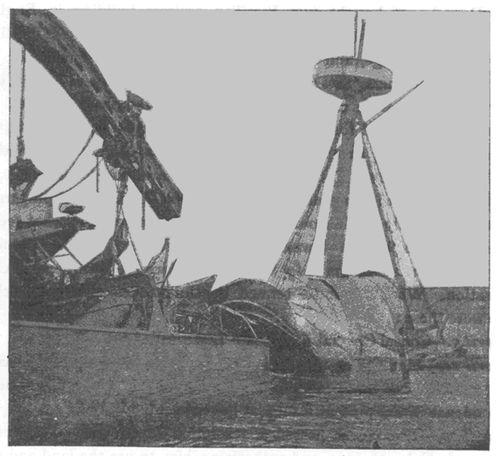
Partial View of the Wreck of the "Maine."
To-day, in the midst of war with Spain, we have no more definite, no
more authoritative knowledge of the cause of this disaster than this.
Spain, indeed, through her official commission, decided
that the explosion was wholly internal, but the American people is not
convinced. Battleships are not in the habit of blowing themselves up,
and it is the expectation that the establishment of American authority
in Cuba will be followed by the unraveling of this murderous plot.
Undoubtedly an anecdote told of Captain Robley D. Evans (Fighting Bob)
of the navy expresses the popular conviction:
"The admiral in command of the United States fleet at Key West should
have sailed for Havana on getting news of the 'Maine's' destruction,"
said Evans. "He should have reduced the forts, seized the city,
discovered the assassins, and hanged them."
"But that would have been defiance of the orders of the Navy
Department," responded his auditor, aghast.
"Perhaps so," admitted Evans, "but the man who did it would
have been the next President of the United States."
While the "Maine" Court of Inquiry was in session measures looking
toward war were rapidly taken. March 9, a bill, which had passed both
houses of Congress without a dissenting voice, became a law,
appropriating $50,000,000 to be expended for the national defense. Out
of this sum the Navy Department bought two Brazilian cruisers building
in England, which were rechristened the "New Orleans" and "Albany." A
flotilla of yachts, seagoing tugs, and merchantmen was bought and
refitted. The great American liners "St. Paul," "City of Paris," "City
of New York," and "St. Louis" were chartered and made into auxiliary
cruisers. All Europe was ransacked for purchasable warships and
torpedo boats, with the result of proving that no nation, however
rich, can equip itself with a navy in an emergency. Not one
battle-ship was available for purchase, and only four cruisers, of
doubtful quality. And while this work of preparation was going
hurriedly on the country was drifting into war with what seemed at the
time inexplicable slowness, but to the calmer backward glance of
history will appear dangerously swift in the face of our great lack of
preparation. What might be termed the milestones on the march to
battle were these:
April 5.—Consul General Fitz Hugh Lee recalled from Havana.
April 11.—Message of the President on Cuba, recommending that we
have power to intervene forcibly without "recognizing at this time the
independence of the present insurgent government."
April 13.—The House passed a resolution directing the President to
intervene in Cuba at once, and authorizing him to use the land and
naval forces of the United States to stop the war.
April 16.—The Senate passed a joint resolution, as a substitute for
the House resolution, declaring the island to be free, recognizing the
republic, demanding relinquishment of authority in Cuba by Spain, and
withdrawal of Spanish forces; directing the President to call out the
militia in addition to regular land and naval forces, and, finally,
disclaiming any intention to annex the island.
April 19.—Senate resolution adopted by the House, with the proviso
recognizing the republic of Cuba stricken out. Both houses agreed to
the report in this form.
April 20.—Ultimatum to Spain, cabled at 11 A.M.—a formal
demand that Spain at once relinquish its authority and government in
the island of Cuba, and withdraw its land and naval forces from Cuba
and Cuban waters.
President signed Cuban joint resolutions at 11.24.
Señor Polo y Bernabé, the Spanish Minister, was notified. He at once
requested his passports.
April 21.—General Woodford, the American Minister at Madrid, left
Spain.
The President directed the Secretary of the Navy to order the vessels
of the North Atlantic squadron to proceed without delay to Cuban
waters to blockade Havana and other ports of the island.
April 23.—President McKinley signed the proclamation calling for
125,000 volunteers.
April 25.—Formal declaration of war recommended by the President,
and a bill "declaring that war exists between the United States of
America and the Kingdom of Spain," passed by both houses.
And so the United States embarked on its first war with any European
Power, save England—a war forced upon us by every consideration of
humanity—a war which shall be of great advantage or of great harm to
our Republic, according as its fruits are wisely or wrongly
administered.
THE OPENING DAYS OF THE WAR. — THE FIRST BLOW STRUCK IN THE
PACIFIC. — DEWEY AND HIS FLEET. — THE BATTLE AT MANILA. — AN EYE-WITNESS'
STORY. — DELAY AND DOUBT IN THE EAST. — DULL TIMES FOR THE
BLUE-JACKETS. — THE DISCOVERY OF CERVERA. — HOBSON'S EXPLOIT. — THE
OUTLOOK.
Strangely enough the first warlike stroke at Spain was not delivered
in or about Cuba, where the quarrel arose, but in the other
hemisphere, in the far-away waters of the Asiatic Pacific, where the
American flag is almost a stranger and the power and wealth of the
great American Republic are unknown. In the Philippine Islands Spain
retains one of the colonies with which she once encircled the globe.
More than 7,000,000 people—a peace-loving, kindly, intelligent
race—are there ruled by the Spaniards, and as the rule was of the
characteristic Spanish kind, with all the accompaniments of slaughter,
dishonor, and extortion, the natives—as in Cuba—were in a chronic
state of rebellion. One uprising, which had assumed very considerable
proportions, was reported by the Spaniards as suppressed just before
our declaration of war. That event, however, aroused the
revolutionists again and, as we shall see, they were of the greatest
service to us as allies.
When war was declared an American squadron of six warships lay at Hong
Kong. The vessels were the "Olympia," protected cruiser;
"Raleigh," "Baltimore," and "Boston," cruisers; "Concord" and
"Petrel," gunboats, and the revenue cutter "McCulloch." Not a very
powerful fleet—not a battle-ship nor even an armored cruiser among
them—but the ships carried crews of as sturdy Yankee blue-jackets as
ever trained a gun, and when the time came for daring an enemy's fire
the little "Petrel" was as dashing and defiant as the stoutest of
steel-clads could be. In command of the squadron was Admiral George
Dewey, a Vermonter, who served with Farragut and had his baptism of
fire at the forts below New Orleans. In time of peace the war record
of a subaltern is quickly forgotten, and Dewey patiently climbed the
ladder of promotion until 1898 found him a commodore and in command of
the Asiatic squadron, without anybody's remembering particularly that
this officer in far Hong Kong had seen fighting and knew how to bear
himself under fire. It is a significant fact that when he had won the
first great victory of the war, and the newspapers were searching
everywhere for stories illustrative of his character, it was
discovered that he had chiefly impressed himself on the Washington
mind by his excessive punctiliousness in matters of dress.
Four days after the declaration of war there was a commotion on the
ships of Dewey's squadron. The signal to weigh anchor flew from the
foremast of the "Olympia," and everybody knew that the admiral had
received fighting orders. For some days past the ships had been in
their battle rigging. The white paint had been covered by a dull
greenish-gray. All woodwork, railings, and unnecessary hamper had been
stripped off and sent ashore. The officers' baggage was reduced to the
barest necessities. Nothing was left anywhere on board which could be
turned into a cloud of flying splinters by a shell, or which cumbered
the decks to the inconvenience of the gunners. The warships which, in
time of peace, were as bright and sparkling as a well-kept yacht, had
put on the sullen, vicious air of war.
Dewey's objective point when he set sail from the harbor of Hong Kong
was the Asiatic squadron of Spain, under the command of Admiral
Montojo. There was every reason to believe that he would find the
enemy under the protecting guns of the forts that guarded the harbor
of Manila. In themselves the Spanish ships were no match for the
American fleet. Three good ships had Admiral Montojo—the "Reina
Cristina," the "Castilla," and the "Don Antonio de Ulloa"; but his
others were old-fashioned and lacking in modern armament.
But should they take positions under the guns of the Spanish forts, at
the end of a channel plentifully guarded by mines and torpedoes, the
disparity in forces would disappear. As it occurred this was precisely
what they did, giving Admiral Dewey opportunity to put into practice
tactics which it seems he had studied for months in anticipation of
exactly such an emergency.
On the night of April 30 the American ships arrived at the entrance of
Manila harbor, unseen by the sentries on the forts. It was known that
Montojo was inside, and every light was extinguished and every noise
hushed on the Yankee ships, for the admiral had planned a midnight
entrance to the stronghold. The ships were stripped for action, boats
covered with canvas, nettings spread to prevent splinters from flying,
partitions removed, and ammunition hoists and bullet shields put up.
At midnight the entrance to the harbor began, the ships steaming in
single column at about six knots an hour, with the "Olympia" leading.
Strangely enough not a single torpedo or mine in the channel was
exploded, though the Spaniards discovered the advance of the ships and
opened fire from the forts. The first shot in answer was fired by a
gunner on the "Boston," without orders. He saw the flash of a gun on a
shore battery and instantly fired his piece without altering its
elevation. That dismantled a gun in the Spanish works and killed
thirty men.
For a few hours after passing the forts the wearied blue-jackets slept
at their guns. With the approach of day came the signal from the
flagship to prepare for action. In the gray dawn the Spanish fleet
could be seen about two miles distant, at such a point that their fire
could be re-enforced by the guns of the forts. A most graphic story of
the action that followed, as seen from the view-point of "the man
behind the gun," whom Captain Mahan eulogizes, is told by Chief Gunner
Evans of the "Boston," from whose narrative I quote the following
paragraphs:
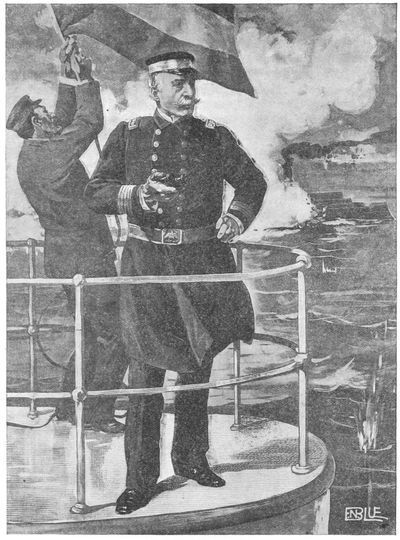
Dewey at Manila.
"We were steaming very slowly, but increasing speed as the dawn
increased. In the gray daylight we could make out a line of ships
anchored in front of the city. Then we steamed ahead faster. The
ships ahead proved to be merchantmen, and at daylight we could
discern the Spanish fleet further down the bay, and then it was
'Full ahead!' The Spanish fleet did not advance to meet us, and
apparently made no move on the defensive. Possibly our audacity
had for the moment paralyzed them. But it was not for long. In
twenty minutes or so they opened a terrific cannonading at long
range. The batteries and forts around Manila opened
fire at the same time. Every man on the ship was now wide awake
and at his post. I knew that it would not be long before there
would be some hot work, and I served my men with a cup of coffee
and a piece of hardtack, and a little later gave them each a
drink of whisky and water.
"According to orders, we did not respond to the Spanish guns
until our ships came into position. Then the flagship opened
fire, and then I followed with two hours of cannonading which I
do not believe has ever been equaled in naval warfare. The shots
from the 'Olympia' were the prearranged signal for the other
ships to do the same.
"We soon discovered that the batteries of Cavité were very
heavily mounted, and the ordnance included several ten-inch guns,
and we were not long in finding out that the 'Don Antonio de
Ulloa' and the 'Reina Cristina,' the flagship, carried much
heavier guns than we thought. We began to fear that our ships had
met their match. As hot as the battle was, the heat of the sun
was equally so, and I had my men who were bringing up the
ammunition throw off every vestige of clothing except their
shoes.
"The Spanish guns had opened upon us at 5.10 A.M., and it was
fully 5.40 before we began to reply. But when we did, we made
every shot tell, for our gunners demonstrated that their
opponents were no match for them in accuracy, although the
Spaniards had every advantage and should have known the exact
range of every point in the harbor, while of the American fleet
not a single gunner had ever as much as been in the harbor
before.
"By 6.30 we had circled three times, and were starting for the
fourth when the Spanish admiral came out in the 'Reina Cristina'
and gallantly assailed us; but we made it hot for him. I don't
know how in the world he escaped with his life. While he was
standing on the bridge a shot from one of our ships—I think it
was the 'Concord'—blew the bridge clean over; in fact, shot it
right from under him, but the Admiral was apparently uninjured,
for a few minutes later I saw him walking the deck as calmly as
though he was on parade. It was getting too hot for him, and he
evidently saw that his ship was no match for us, and he turned to
get back to his fleet.
"Just as the 'Reina Cristina' swung around an eight-inch shell
from the port battery, which I was tending, struck her square
astern, and set her on fire. By this time other gunners had got
the range, and if ever a ship was riddled it was the 'Reina
Cristina.' I do not think it was fifteen minutes from the time
the shell from the 'Boston' struck her when she went down with,
it is said, over two hundred men. The Admiral, however, had
escaped in a small boat and made for the 'Isla de Cuba,' where he
again hoisted his flag.
"After we had circled five times, we withdrew. The smoke was so
dense that we could hardly distinguish friend from foe. Our men
had worked three long hours with scarcely a mouthful of food. I
had, however, kept my men well supplied with whisky and water. I
gave each a small drink about every twenty minutes.
"After we had withdrawn, and the clouds of smoke had lifted
enough so that we could see, Admiral Dewey signaled the ships to
report the number of killed and wounded. It would have done your
heart good to have heard the shouts and cheers that went up as
ship after ship ran up the signal to indicate that she
had no killed and none wounded worth reporting. It was one of the
most thrilling moments of the entire battle.
"It was a wise move on Admiral Dewey's part in withdrawing at
that moment, for our men were rapidly becoming exhausted. For my
own part I do not think I could have held out another half hour,
and neither could my men. We were not only wearied physically,
but the nervous strain was something awful. I called my men into
the gunroom and served each with a good stiff drink of whisky and
told them to take all the rest they could get. I went into the
chartroom, as it was about the coolest place on the ship, and
threw myself on the chart table. I was too nervous to sleep and
too exhausted to move. I just lay there sort of dazed.
"Soon after ten o'clock we advanced again, and the 'Baltimore'
opened the fight. As many of the Spanish ships had been disabled,
what we most feared now was the forts. The 'Baltimore' sailed
right into the very teeth of the guns, any one of which could
have annihilated her, and only bad marksmanship of the Spanish
gunners saved her from destruction, and she did not retreat until
she had practically silenced the fort.
"My ship, the 'Boston,' was perhaps struck oftener during the
battle than any of the American ships, but in every instance it
was small shot or shell, making a glancing blow that did no
particular harm. After the first hour or so of the battle, if we
had received a damaging shot, the chances are that we would have
all gone down, for out of all the ship's boats, only two were of
any value, the others having been shattered to pieces.
"We were circling in line with the other ships when the 'Isla de
Cuba' swung around to give us a broadside. The guns in the port
battery got the range on the 'Isla de Cuba,' and sent in a shot
that struck in amidships and made her tremble from stem to stern.
I was watching at the porthole at the time. The other guns of the
'Boston' followed the example of the port gunner, and for a few
minutes it seemed that the 'Isla de Cuba' was crumbling to pieces
like a falling building in an earthquake. We turned, and the
starboard guns did equally good work, and when the Spanish flag
came tumbling down we let out a yell that was heard around the
world, figuratively speaking, if not literally.
"I can never forget the scene after the battle. The forts were
smoking, and scattered all through the bay were the hulks of once
magnificent Spanish ships. Some were drifting helplessly about,
as though the men on board seemed not to know what to do and had
lost their heads entirely. Rigging was trailing in the water and
only remnants remained of the lifeboats. Over at one end of the
bay was the wreck of the once magnificent 'Reina Cristina.'
Further along were smoking hulks, and here and there could be
seen only the masts and rigging above water.
"To add to the horror of the scene, hundreds of corpses came
floating by, and it seemed as though the bay was full of dead
Spaniards, although I believe less than a thousand were killed. I
really think that the sight in the harbor that afternoon
impressed men more with the horrors of war than did anything
which occurred during the actual battle.
"During all the fight my men, except for a little while during
the interval for breakfast, were stripped to the bare skin and
wore only their shoes. The thermometer was over one
hundred, and to this was added the heat of the fire of the guns,
until it made one's blood fairly boil."
The plan of action was for the fleet to revolve in a great circle or
ellipse before the delivering their fire from starboard and port
batteries alternately. The first shot from the "Olympia" was a
250-pound shell, aimed at the Cavité fort, and discharged with a shout
from all hands, "Remember the Maine!" After two hours' fighting the
fleet withdrew for breakfast, returning to action in about two hours,
and after the Spanish surrender the little "Petrel" was sent in to
destroy, by boats' crews, the ships in the inner harbor.
Commodore Dewey's official report of the action is a model of modesty
and brevity. It came in these two cable messages:
MANILA, May 1.—Squadron arrived at Manila at daybreak this
morning. Immediately engaged the enemy, and destroyed the
following Spanish vessels: "Reina Cristina," "Castilla," "Don
Antonio de Ulloa," "Isla de Luzon," "Isla de Cuba," "General
Lezo," "Marquis de Duero," "Cano," "Velasco," "Isla de Mindanao,"
a transport, and water battery at Cavité. The squadron is
uninjured, and only a few men are slightly wounded. Only means of
telegraphing is to American Consul at Hong Kong. I shall
communicate with him.
DEWEY.
CAVITÉ, May 4.—I have taken possession of naval station at
Cavité, on Philippine Islands. Have destroyed the fortifications
at bay entrance, paroling the garrison. I control bay completely,
and can take city at any time. The squadron is in excellent
health and spirits. Spanish loss not fully known but very heavy.
One hundred and fifty killed, including captain of "Reina
Cristina." I am assisting in protecting Spanish sick and wounded;
250 sick and wounded in hospital within our lines. Much
excitement at Manila. Will protect foreign residents.
DEWEY.
It is little short of marvelous that no lives were lost on the
American ships—though a month later Captain Gridley of the "Olympia"
died from the effect of the concussion of his own guns. The vessels
were handled with a daring amounting almost to bravado, yet so poor
was the marksmanship of the Spaniards that little or no damage was
suffered. It is to be kept in mind that, despite the disparity in the
armament of the fleets, the Spanish works at Cavité mounted guns of
twice the weight of any that Dewey's ships bore. Yet, when the action
was over, the American vessels were practically uninjured, and
perfectly capable of fulfilling the threat sent by Admiral
Dewey, that if another shot was fired he would lay Manila in ashes.
At the time these words are written, that threat alone keeps order in
Manila bay. Dewey with his ships is there, holding the town at the
muzzles of his guns and waiting for the re-enforcements of troops,
which were dispatched to his aid from San Francisco almost a month
after his victory—an unconscionable delay. Some 25,000 troops will be
sent to his aid, and with the insurgents, who were greatly encouraged
and strengthened by the American victory, will forever destroy Spain's
power in the Philippines.
In the waters of the Gulf of Mexico and the Caribbean Sea, where it
was expected the fighting would come first and be most decisive, the
war lagged languidly for weeks. For a few days the jackies found some
excitement and some hope of profit in capturing unsuspecting Spanish
merchantmen, but soon the dull and deadly monotony of the peaceful
blockade settled down upon the fleet, and Sampson's men grilled grimly
under a blazing sun by day and slept uneasily by their guns at night,
week after week, without a touch of battle to vary the dull round. The
Spanish ships "Vizcaya" and "Oquendo," which had been in the harbor of
Havana when war was declared, had slipped away, and there was no enemy
afloat in the neighborhood save puny gunboats and torpedo boats that
clung close to the protecting guns of the fortresses. Blockading is
the most trying duty the blue-jacket has to discharge. Destitute
wholly of glory, the element of danger is still ever present in a form
which is particularly trying to the nerves. Every night brought danger
of an attack by torpedo boats. These swift and sinister craft might at
any time dart out of Havana harbor, discharge their fatal bolt, and
send a good ship to the bottom as speedily as went the "Maine." That
the Spaniards at no time even seriously attempted a torpedo-boat
attack on the blockading squadron seems to reflect on their courage.
But what they lacked apparently in courage they made up in shrewdness.
For weeks the best efforts of our board of strategy and our board of
naval intelligence were baffled by the mysterious movements of the
Spanish fleet under Admiral Cervera. This squadron, which numbered
among its vessels the powerful armored cruisers "Vizcaya," "Maria
Teresa," "Cristobal Colon," and "Almirante Oquendo," was
reported now at the Canaries, then at Cadiz, then dashing through the
Suez Canal to overwhelm Dewey at Manila, then off the coast of New
England,—whereat Boston and Portland were mightily alarmed,—then
bound South to capture or destroy the "Oregon,"—which was painfully
making the voyage around Cape Horn,—then at Martinique, and, in
short, at every conceivable point of menace. As a result of these
conflicting reports, two American fleets were reduced to impotence.
The "flying squadron" of fast cruisers under Commodore Schley was kept
for weeks at moorings in Hampton Roads ready to be dispatched for
protection of our northern coasts, while the squadron of battle-ships
under Admiral Sampson was made to steam hither and yon in the
Caribbean Sea looking for an enemy's fleet which much of the time lay
snugly on the other side of the Atlantic. Accordingly, up to June 15,
the results of naval operations in West Indian waters were almost
nil. Powder had been burned indeed as when, on April 27, the Spanish
works at Matanzas were bombarded and silenced by the "New York,"
"Puritan," and "Cincinnati," of Admiral Sampson's squadron, and on May
13 the works at San Juan, Porto Rico, were similarly tested. Deeds of
conspicuous gallantry, too, were done, as when Ensign Worth Bagley
lost his life while gallantly engaging Spanish gunboats and shore
batteries with the torpedo boat "Winslow" at Cardenas. But these
actions, though seized upon eagerly by a public hungry for war news,
were inconclusive and trivial. The shore batteries were quickly
repaired and strengthened, and the great object of capturing Havana
seemed at the middle of June even further off than it had when war was
declared.
Nevertheless, May and June saw a marked progress in the work of
preparation for active hostilities. The army was mobilized and a great
camp established at Tampa, Fla. Schley's flying squadron, finally
relieved from apprehension as to the course of the Spanish fleet, left
Hampton Roads to increase the naval strength in West Indian waters.
The great battle-ship "Oregon," after a record-beating voyage around
Cape Horn, in which her machinery met and withstood every imaginable
strain, arrived at the rendezvous. And finally it was definitely
learned that Admiral Cervera, with Spain's principal effective fleet,
was actually in West Indian waters, and had entered the port of
Santiago de Cuba for coal and repairs. There he was trapped by an
exploit which has conferred new glory on the United States
Navy and has added a new name to the roster of dashing heroes like
Somers and Gushing.
The harbor of Santiago de Cuba is one of the most easily defended in
the world. Steep hills rise abruptly from either side of the harbor's
mouth, which is scarce half a mile wide, with a channel so narrow that
two vessels could scarcely pass in it. Into the brow of the hills are
built batteries which, with plunging shot, command the entrance
completely. An abrupt turn in the interior shore line makes the whole
inner bay invisible from without, so for days the officers and men of
the United States blockading fleet outside were ignorant whether
Cervera's entire fleet was cooped up within. To send in a boat to make
a reconnoissance would have been suicidal, for the channel, difficult
at all times, was blocked by mines and torpedoes. For this reason,
too, there could be no repetition of Dewey's exploit at Manila.
Accordingly, Admiral Sampson was confronted with a problem which
seemed likely to tax the patience rather than the daring of his men.
There seemed to be no opportunity for more exciting duty than a long
blockade, unless the Spaniards should conclude to come out and
fight—a most unlikely decision for them to reach. The forts, in all
probability, could be reduced by the ships' cannon, but, even with
that done, to enter the harbor in single file, so that the undisturbed
fire of Cervera's fleet could be directed upon the Americans, ship by
ship, as they entered the bay, would have been a most hazardous
undertaking. The situation was not made more pleasing to the admiral
by the fact that he was not sure of having all the Spanish ships in
the trap. Some might not have entered Santiago, but might be at that
very time devastating portions of the coast of the United States.
While the admiral was considering the problem thus presented to him,
there appeared at his cabin a young lieutenant, Richmond P. Hobson, a
graduate of the Naval Academy in 1889. The scientific side of naval
duty had always chiefly attracted this young man. Graduating at the
head of his class, he studied naval construction for two years in
British dockyards. Above all things a student, a contributor to
magazines, a delver into mathematical and structural problems, this
young officer outlined to the admiral an exploit of reckless daring
and volunteered himself to perform it.
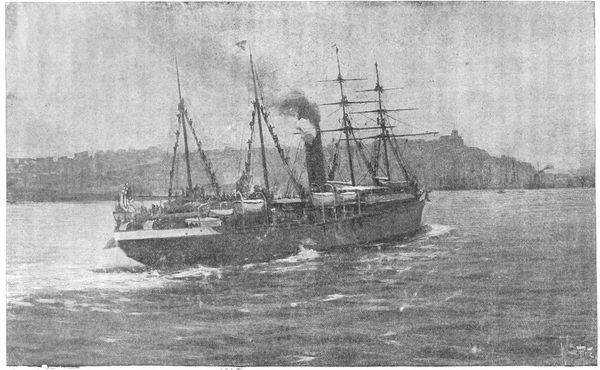
The "Zealandia" leaving San Francisco with Troops for
the Philippines.
(Drawn, after a Photograph, by WILLIAM RITSCHEL).
It was folly, urged Hobson, to keep the entire American fleet watching
at the door to that harbor. The Spaniards, doing nothing
and daring nothing themselves, were still reducing Admiral Sampson's
powerful squadron to complete impotence. If the entrance to the harbor
were obstructed one or two ships would serve to prevent the Spaniards
from escaping, and the remainder of the American fleet would be
released to take part in more vigorous warfare. By sinking a vessel,
an old collier heavily laden, in the channel this could be
accomplished, and Hobson volunteered to perform the feat. It was an
invitation to almost certain death, for the fire of three batteries
and part of the Spanish fleet, besides the explosion of the mines,
must be braved before the narrow spot in which the ship was to be sunk
could be reached. But Hobson thought he could do this, scuttle his
ship, and escape with his men by swimming to a launch which should
accompany him at a distance.
"Do you really expect to escape alive?" asked one of the officers as
he outlined his project.
"Ah! that is another thing," replied the lieutenant. "I suppose the
Estrella battery will fire down on us a bit, but the ships will throw
their searchlights in the gunners' faces and they won't see much of
us. Then, if we are torpedoed, we should even then be able to make the
desired position in the channel. It won't be so easy to hit us, and I
think the men should be able to swim to the dingey. I may jump before
I am blown up, but I don't see that it makes much difference what I
do. I have a fair chance of life either way. If our dingey gets shot
to pieces, we shall then try to swim for the beach right under Morro
Castle. We shall keep together at all hazards. Then we may be able to
make our way alongside, and perhaps get back to the ship. We shall
fight the sentries or a squad until the last, and we shall only
surrender to overwhelming numbers."
The plan being approved by the admiral, volunteers were asked from the
fleet, by signal, to accompany Hobson. Practically the whole fleet
responded. One man was wanted from each ship, but on the "Brooklyn"
150 and on the "Texas" 140 pleaded to be taken. Finally these seven
were selected:
Osborn Deignan, a coxswain of the "Merrimac"; George F. Phillips, a
machinist of the "Merrimac"; John Kelly, a water-tender of the
"Merrimac"; George Charette, a gunner's mate on the flagship "New
York"; Daniel Montague, a seaman of the cruiser "Brooklyn"; J. C.
Murphy, a coxswain of the "Iowa"; Randolph Clausen, a
coxswain of the "New York."
To man the launch which was detailed to follow the "Merrimac "—the
ship chosen—four men and Naval Cadet Joseph W. Powell were taken. In
the end they, too, proved to be heroes.
The steel steamer "Merrimac," loaded with 2,000 tons of coal, was then
given to Hobson and prepared for sinking. An eye-witness, who followed
the "Merrimac" as nearly as safety would permit, thus tells the story
in the New York Sun:
"Cadet Powell and his crew saw the 'Merrimac' head straight for
Estrella Point, which is on the east side of the harbor, back of
the Morro. They knew that just before she reached that point the
engines were to be stopped and the momentum allowed to carry her
on. Then the flimsy wooden props holding the bonnets of her
sea-valves in place were to be kicked aside, the helm put hard to
starboard, and the starboard bower anchor let go. This would
steer the ship directly across the channel and check her headway.
"At the same time seven reduced eight-inch charges, containing
eighty pounds of brown powder in copper cases and protected by
pitch from water, were to be set off separately. These charges
were suspended about ten feet below the water-line at intervals
of thirty feet, and connected by a series of dry batteries. As
the ship steered across the channel the forward port powder
charge was to be exploded. Then, as the stern swung into
position, the anchor lashed on the starboard quarter was to be
let go and the other six charges exploded in succession. A
catamaran and lifeboat were slung aft on the starboard side ready
for the seven men to drop into them.
"The crew in the steam launch watched the course of the old
collier with eyes strained. The moon had sunk behind the horizon.
It was 3.20 o'clock. On, on the heroes went. Lieutenant Hobson
stood on the bridge of the old collier, dressed in full uniform.
The other six men were at their posts, clad in tights, to aid
their escape in case they had to swim a long distance.
"The watchers saw her head straight for Estrella Point, saw her
swing hard across the channel, apparently undiscovered, heard
five of the seven charges explode, and then began a screaming,
flashing, death-dealing fire from the Spanish ships and batteries
that hid the rest from view.
"The battery on Dead Man's Point, square in the center of the
harbor, opened the fire and soon directed its guns against the
launch. In the face of this hell, with ten-and twelve-inch guns
blazing at them at this short range, Cadet Powell and the crew of
his launch continued to search for the men of the 'Merrimac.'
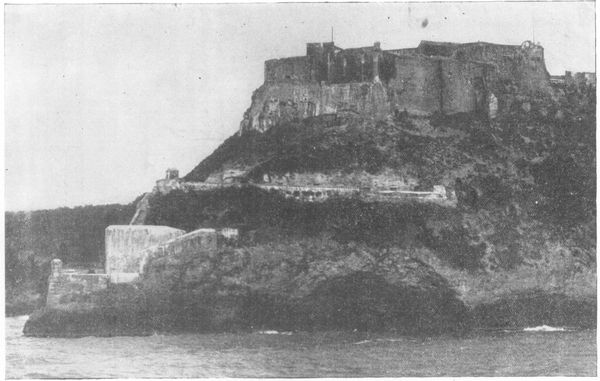
Morro Castle, Santiago De Cuba.
Copyright, 1898, by J. Murray Jordan.
"They saw then the guns of the 'Cristobal Colon,' Admiral
Cervera's flagship, and of the old cruiser 'Reina Mercedes,'
which had been considered gunless, trained on them and thundering
in their ears. "Still they searched with never as
much as a faint cry for help or the sign of a single arm raised
in mute appeal to guide them. Those on the battle-ship looking
into the mouth of the harbor saw only a sheet of flame which,
with the roar of the guns, lasted thirty-five minutes. By this
time dawn had tinged the land and sky with light, and the tiny
launch could be seen loitering by the shore. On the west side of
the harbor, in the center of the channel, just where Hobson had
promised to sink his vessel, could be seen the tops of the
'Merrimac's' masts. The harbor was blocked."
Hobson and his gallant men were not lost. A shot from one of the
batteries destroyed the boat in which they had expected to reach the
launch, but on a raft they escaped from their sinking vessel, only to
be captured by the Spaniards. With sailor-like chivalry and hearty
admiration for a gallant deed Admiral Cervera sent word to the fleet
of their safety and offered to exchange them as soon as the necessary
formalities could be complied with.
The closing words of this chapter must be penned just as the decisive
action of the war seems to be at hand. Cervera is hemmed in at
Santiago with a vastly superior force confronting him. The batteries
at the harbor's mouth have been demolished by the fire of the fleet.
At Caimanera, thirty miles away, the United States flag is flying on
the shore and a battalion of United States marines—"soldiers and
sailors, too"—are there installed and have twice beaten back the
attack of Spaniards in double their number. On great transports
General Shafter's army of 20,000 men is steaming from Key West to
Caimanera, where the invasion of Cuba will begin. The order has gone
forth to reduce Porto Rico, and by the time these words reach the
reader, General Coppinger's army may be landed there. Fitzhugh Lee,
the gallant, is held in reserve for Havana, where he served his
country as Consul General during the trying days that led up to the
war. Hesitation and doubt have vanished. The dreary days of delay are
over. The end is near—the end of Spanish misrule in the West Indies.
THE SPANISH FLEET MAKES A DASH FROM THE HARBOR. — ITS TOTAL
DESTRUCTION. — ADMIRAL CERVERA A PRISONER. — GREAT SPANISH
LOSSES. — AMERICAN FLEET LOSES BUT ONE MAN.
hen the event was least expected the Spaniards made a desperate dash
from the harbor, seeking freedom but finding only death.
July 3d the land forces of General Shafter were closing in on
Santiago. There had been hard fighting for two days, in which both
sides had shown dogged courage, but the Spaniards had been beaten back
into the city, which the Americans almost completely invested. Though
Shafter had but few heavy siege guns, many of the shells from his
field artillery fell in the streets of the town and produced a panic
there.
Admiral Cervera had landed some of his rapid-fire guns in aid of
General Linares, and his marines fought with the Spanish soldiers. But
as the American advance continued he saw that he would be caught in a
trap and ground to pieces between Shafter and Sampson. So he made up
his mind to the desperate chance of slipping out and trying to run
past the American squadron.
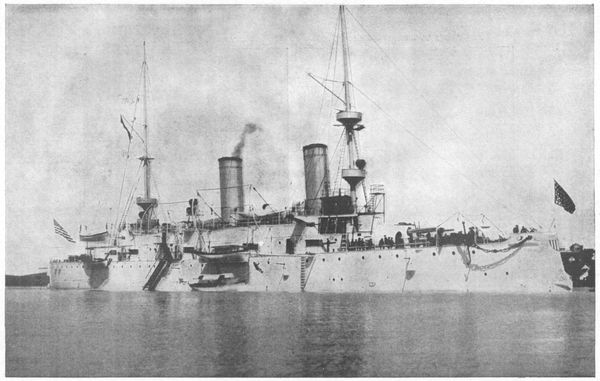
The Protected Cruiser "Olympia," Admiral Dewey's
Flagship.
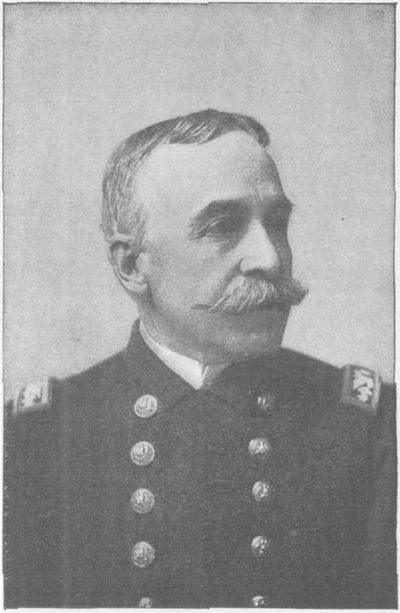
Admiral George Dewey.
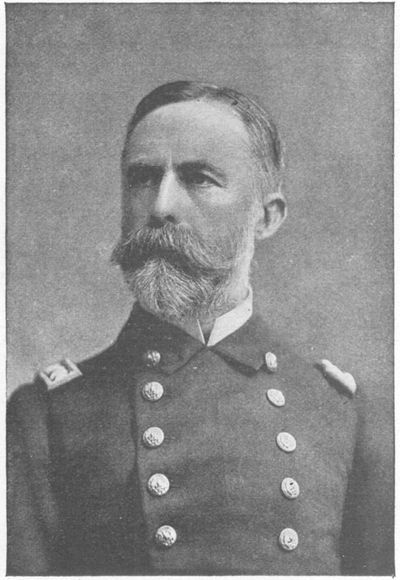
Acting Rear Admiral W. T. Sampson.
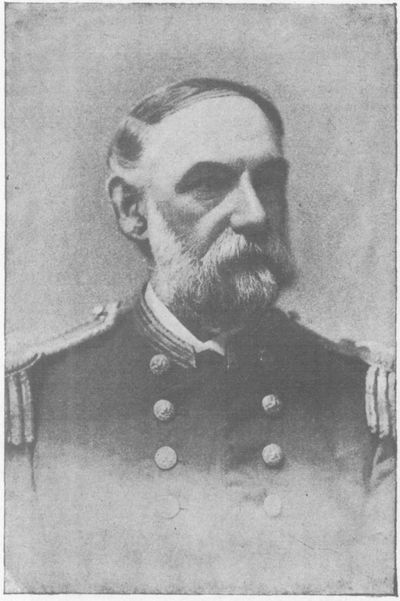
Rear-Admiral Montgomery Sicard.
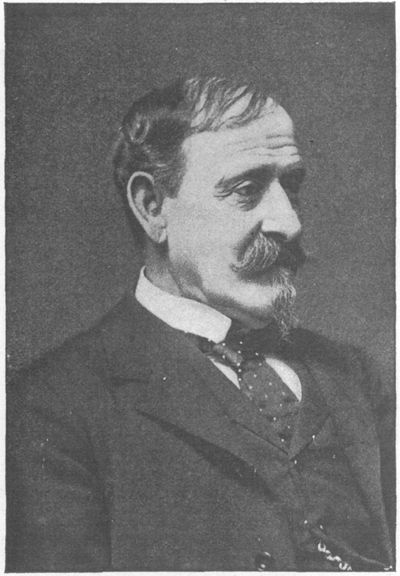
Commodore W. S. Schley.
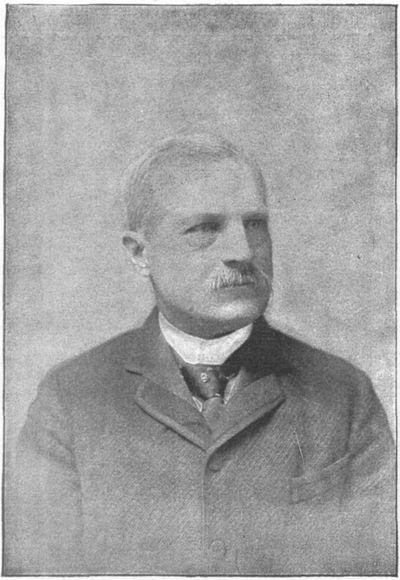
Captain A. S. Barker,
Late of the "Oregon"; now of the
"Newark."
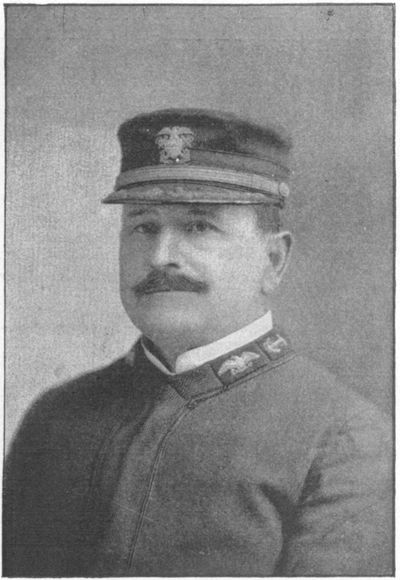
Captain "Jack" Philip,
Of the battle-ship "Texas."
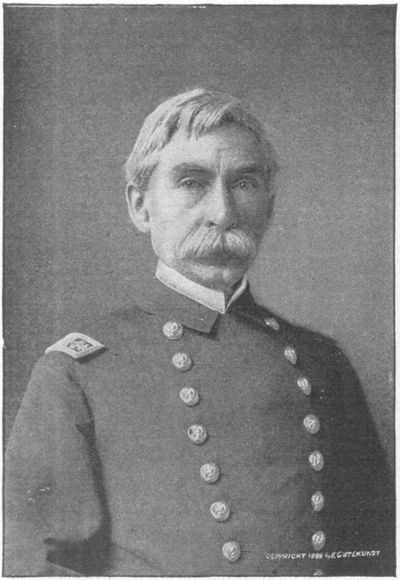
Commodore J. Crittenden Watson.
Second in Command of the Gulf Squadron.
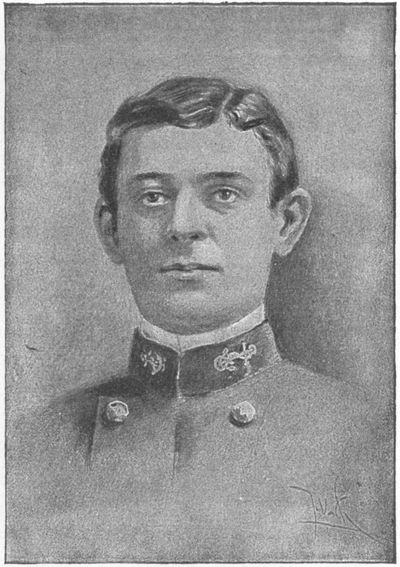
Ensign Worth Bagley Of The "Winslow."
the First
American Officer killed by the Enemy.
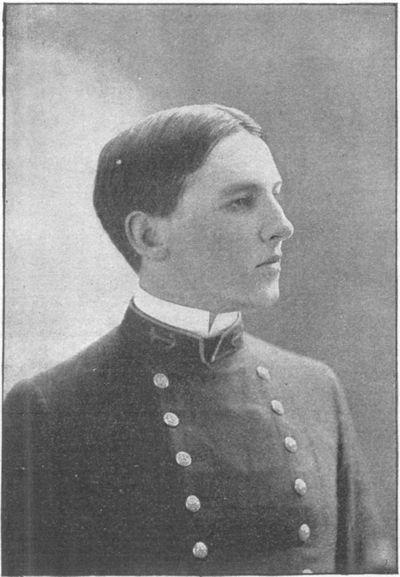
Cadet George T. Pettengill.
Who fired the first Shot
of the War.
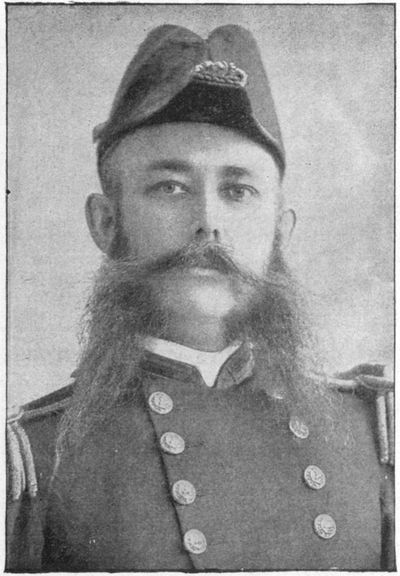
Captain F. W. Dickins.
Chief of Bureau of
Navigation.
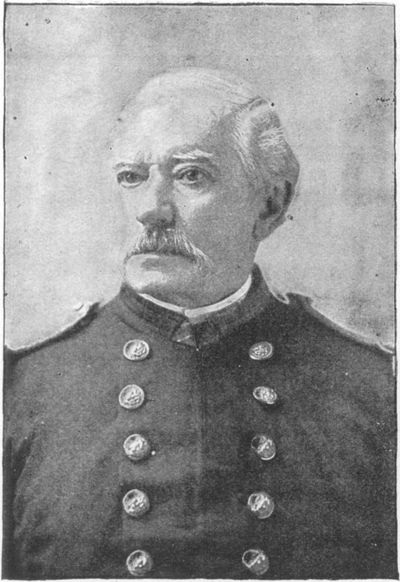
Commodore John A. Howell.
Commanding Inner Line of
Coast Defenses.
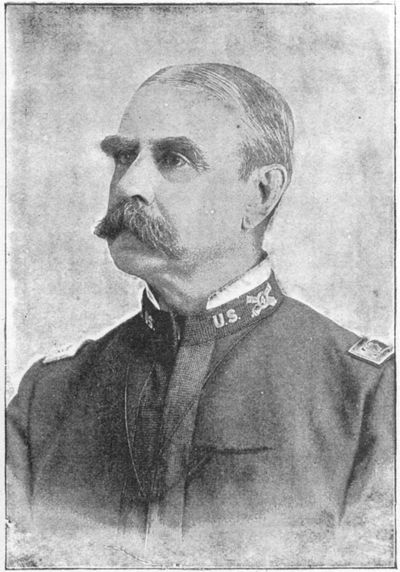
Brig.-Gen. H. C. Hasbrouck.
Commandant of Fort
Monroe.
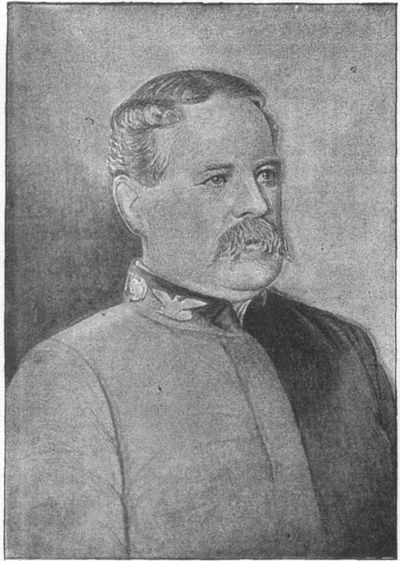
Captain C. E. Clark.
Of The Battle-ship "Oregon."
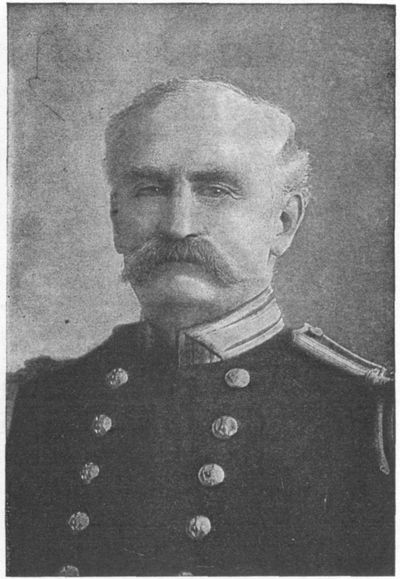
Admiral F. M. Bunce.
Commandant of Brooklyn Navy
Yard.
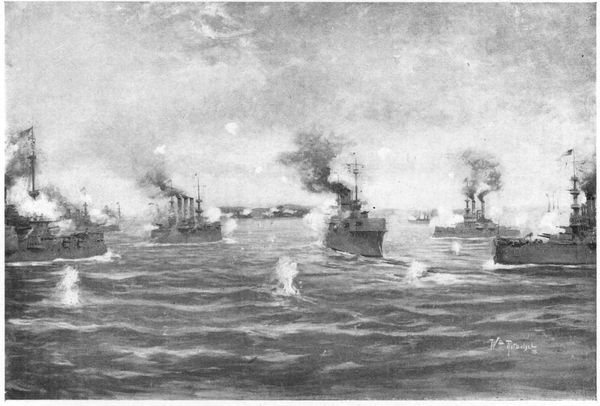
Bombardment of Spanish Ports and Fleet at Santiago De
Cuba, July 6, 1898.
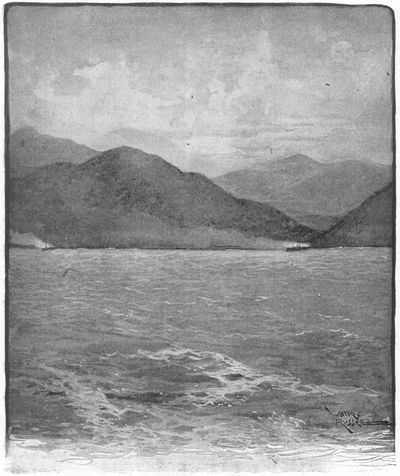
"Maria Teresa" and "Vizcaya" burning on the Beach near
Santiago.
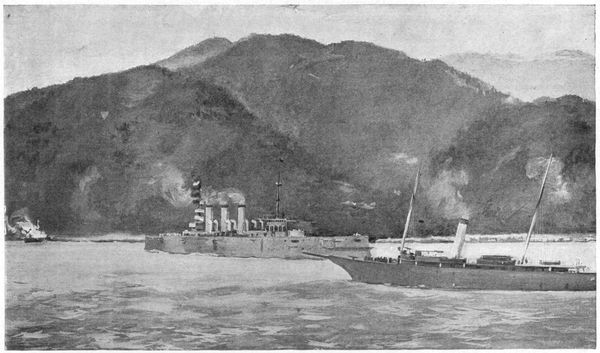
The Flagship "New York," followed by the "Vixen,"
closing on the "Cristobal Colon," while the Latter was being run
ashore west of Santiago.
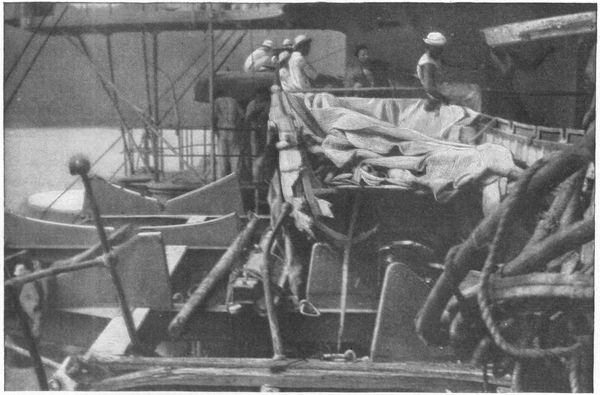
Effect of a Single Spanish Shot on Upper Deck of the
Battle-Ship "Texas".
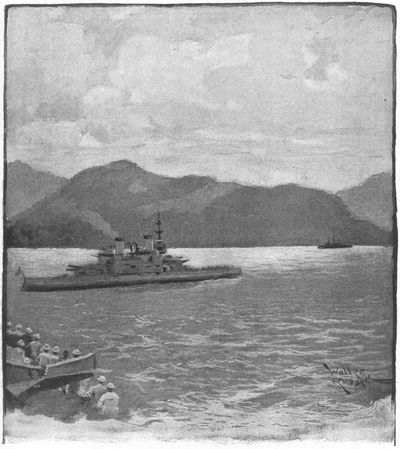
Part of Crew of "Texas"
Band of the "Oregon" playing Funeral March after the Defeat of the
"Colon".
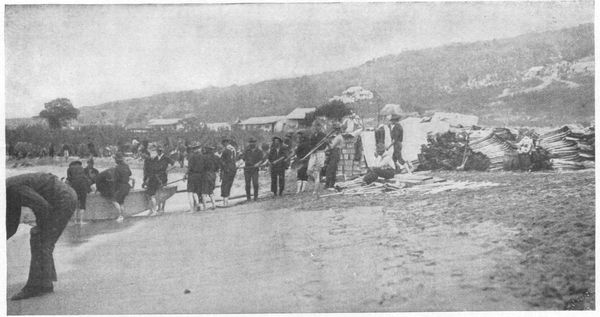
Engineer Battalion unloading Tools at Siboney.
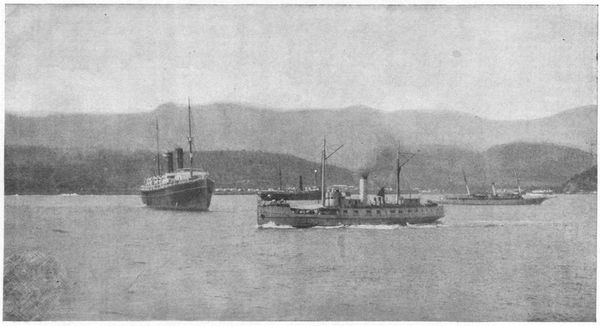
"St. Louis." A Transport. "Suwanee." "Vixen."
Auxiliary Cruisers protecting Landing.

Commodore Watson's Fleet for Service in Spanish Waters.
At 9.30 on the morning of the 3d the lookout on the "Texas"
saw smoke rising above Morro Castle. Immediately after, the black prow
of a warship appeared in the channel coming out at full speed. It was
the "Almirante Oquendo." Instantly the "Texas" broke out with bunting
signaling to all the vessels of the fleet that the Spaniards were
coming out. On every side rung out the bugles and clattered gongs
calling the crews of the American ships to quarters. Admiral Sampson
with the "New York" was far away, and Commodore Schley with the
"Brooklyn" commanded the fleet. The odds were not so greatly in favor
of the Americans, for the Spaniards had four armored cruisers and two
torpedo-boat destroyers, while the Americans had five battle-ships,
one armored cruiser and a yacht. The superiority of the Spaniards in
rapid-fire guns was very great.
The "Brooklyn," thinly clad with armor, dashed first into the fray and
was soon engaged with four armored vessels, each her superior; the
"Iowa," "Texas" and "Oregon" rushed to her aid. It was soon apparent
that the Spaniards were more intent on running than fighting.
Nevertheless, they kept up a rapid fire, but showed the bad
marksmanship which characterized Montojo's gunners at Manila. One
shell from the "Oquendo" crashed through the pilot-house of the
"Texas" just after Captain Philip had left it for the securer retreat
of the conning tower, and one exploded in the smokestack. These were
about the most effective shots aimed by the enemy.
A correspondent of the New York "Journal" and the "Sun" stationed
aboard the "Texas" sent the most graphic account of the battle which
has at this date, July 6, been printed. Some extracts from it will
give a clear account of the fighting:
"Almost before the leading ship was clear of the shadow of Morro
Castle the fight had begun. Admiral Cervera started it by a shell
from the 'Almirante Oquendo,' to which he had transferred his
flag. It struck none of the American vessels. In a twinkling the
big guns of the 'Texas' belched forth their thunder, which was
followed immediately by a heavy fire from our other ships. The
Spaniards turned to the westward under full steam, pouring a
constant fire on our ships, and evidently hoping to get away by
their superior speed.
"The 'Texas,' still heading in shore, kept up a hot exchange of
shots with the foremost ships, which gradually drew away to the
westward under the shadow of the hills. The third of the Spanish
vessels, the 'Vizcaya' or 'Infanta Maria Teresa,' was caught by
the 'Texas' in good fighting range, and it was she that engaged
the chief attention of the first battle-ship commissioned in the
American Navy. The 'Texas' steamed west with her adversary, and
as she could not catch her with speed she did with her shells.
"The din of the guns was so terrific that orders had to be yelled
close to the messengers' ears, and at times the smoke
was so thick that absolutely nothing could be seen. Once or twice
the 12-inch guns in the turrets were swung across the ship and
fired. The concussion shook the great vessel as though she had
been struck by a great ball, and everything movable was
splintered. The men near the guns were thrown flat on their
faces.
"Meanwhile the 'Oregon' had come in on the run. She passed the
'Texas' and chased after Commodore Schley, on the 'Brooklyn,' to
head off the foremost of the Spanish ships. The 'Iowa' also
turned her course westward, and kept up a hot fire on the running
enemy.
"At 10.10 o'clock the third of the Spanish ships, the one that
had been exchanging compliments with the 'Texas,' was seen to be
on fire and a mighty cheer went up from our ships. The Spaniard
headed for the shore and the 'Texas' turned her attention to the
one following. The 'Brooklyn' and 'Oregon,' after a few parting
shots, also left her contemptuously and made all steam and shell
after the foremost two of the Spanish ships, the 'Almirante
Oquendo' and the 'Cristobal Colon.'
"Just then the two torpedo-boat destroyers 'Pluton' and 'Furor'
were discovered. They had come out after the cruisers without
being seen, and were boldly heading west down the coast. 'All
small guns on the torpedo boats' was the order on the 'Texas,'
and in an instant a hail of shot was pouring all about them. A
6-pounder from the starboard battery of the 'Texas,' under Ensign
Gise, struck the foremost torpedo boat fairly in the boiler.
"A rending sound was heard above the roar of battle. A great
spout of black smoke shot up from that destroyer and she was out
of commission. The 'Iowa,' which was coming up fast, threw a few
complimentary shots at the second torpedo-boat destroyer and
passed on. The little 'Gloucester,' formerly a yacht, then sailed
in and finished the second boat."
The "Gloucester" of which the correspondent speaks was in command of
Lieutenant-Commander Wainwright, who had been the executive officer of
the "Maine." For two months after the disaster to that vessel
Wainwright lived on a United States ship in the harbor of Havana,
refusing to set foot on shore until he could go "with a landing party
of marines." In his attack on the torpedo-boat destroyers—vastly
superior to his craft in weight and armament—he threw prudence to the
winds and fought with a fierceness bred of bitter hatred for the Dons.
His was the most stirring display of personal courage shown on a day
when all were brave.
To return to the correspondent's account:
"Gun for gun and shot for shot the running fight was kept up
between the Spanish cruisers and the four American vessels. At
10.30 o'clock the 'Infanta Maria Teresa' and 'Vizcaya' were
almost on the beach, and were evidently in distress. As the
'Texas' was firing at them a white flag was run up on the one
nearest her. 'Cease firing,' called Captain Philip, and a moment
later both the Spaniards were beached. Clouds of black smoke
arose from each, and bright flashes of flame could be seen
shining through the smoke. Boats were visible putting out from
the cruisers to the shore. The 'Iowa' waited to see that the two
warships were really out of the fight, and it did not take her
long to determine that they would never fight again.
The Iowa' herself had suffered some very hard knocks.
"The 'Brooklyn,' 'Oregon' and 'Texas' pushed ahead after the
'Colon' and 'Almirante Oquendo,' which were now running the race
of their lives along the coast. At 10.50 o'clock, when Admiral
Cervera's flagship, the 'Almirante Oquendo,' suddenly headed in
shore, she had the 'Brooklyn' and 'Oregon' abeam and the 'Texas'
astern. 'The Brooklyn' and 'Oregon' pushed on after the
'Cristobal Colon,' which was making fine time and which looked as
if she might escape, leaving the 'Texas' to finish the 'Almirante
Oquendo.' This work did not take long. The Spanish ship was
already burning. At 11.05 o'clock down came a yellow and red flag
at her stern. Just as the 'Texas' got abeam of her she was shaken
by a mighty explosion.
"The crew of the 'Texas' started to cheer. 'Don't cheer, because
the poor devils are dying,' called Captain Philip, and the
'Texas' left the 'Almirante Oquendo' to her fate to join in the
chase of the 'Cristobal Colon.'
"That ship in desperation was plowing the waters at a rate that
caused the fast 'Brooklyn' trouble. The 'Oregon' made great speed
for a battle-ship, and the 'Texas' made the effort of her life.
Never since her trial trip had she made such time.
"The 'Brooklyn' might have proved a match to the 'Cristobal
Colon' in speed, but she was not supposed to be her match in
strength.
"It would never do to allow even one of the Spanish ships to get
away. Straight into the west the strongest chase of modern times
took place. The 'Brooklyn' headed the pursuers. She stood well
out from the shore in order to try to cut off the 'Cristobal
Colon' at a point jutting out into the sea far ahead. The
'Oregon' kept a middle course about a mile from the cruiser. The
desperate Don ran close along the shore, and now and then he
threw a shell of defiance. The old 'Texas' kept well up in the
chase under forced draught for over two hours.
"The fleet Spaniard led the Americans a merry chase, but she had
no chance. The 'Brooklyn' gradually forged ahead, so that the
escape of the 'Cristobal Colon' was cut off at the point above
mentioned. The 'Oregon' was abeam of the 'Colon' then, and the
gallant Don gave it up.
"At 1.15 o'clock he headed for the shore, and five minutes later
down came the Spanish flag. None of our ships was then within a
mile of her, but her escape was cut off. The 'Texas,' 'Oregon'
and 'Brooklyn' closed in on her and stopped their engines a few
hundred yards away.
"Commodore Schley left the 'Brooklyn' in a small boat and went
aboard the 'Cristobal Colon' and received the surrender. Meantime
the 'New York,' with Admiral Sampson on board, and the 'Vixen'
were coming up on the run. Commodore Schley signaled to Admiral
Sampson; 'We have won a great victory; details will be
communicated.'
"Then for an hour after the surrender in that little cove under
the high hills was a general Fourth of July celebration, though a
little premature. Our ships cheered one another, the captains
indulged in compliments through the megaphones, and the 'Oregon'
got out its band, and the strains of the 'Star-Spangled Banner'
echoed over the lines of Spaniards drawn up on the deck of the
last of the Spanish fleet, and up over the lofty green-tipped
hills of the Cuban mountains.
"Commodore Schley, coming alongside the 'Texas' from the
'Cristobal Colon' in his gig, called out cheerily, 'It was a nice
fight, Jack, wasn't it?'
"The veterans of the 'Texas' lined up and gave three hearty
cheers and a tiger for their old commander-in-chief. Captain
Philip called all hands to the quarter-deck, and with bared head,
thanked God for the almost bloodless victory.
"'I want to make public acknowledgment here,' he said, 'that I
believe in God the Father Almighty. I want all you officers and
men to lift your hats and from your hearts offer silent thanks to
the Almighty.' "All hats were off. There was a moment
or two of absolute silence, and then the overwrought feelings of
the ship's company relieved themselves in three hearty cheers for
their beloved commander."
By this victory the naval power of Spain was effectively and finally
crushed. She lost four fine armored ships and two large destroyers. In
killed, wounded and prisoners her loss exceeded eighteen hundred men,
while but one American was slain. Among the prisoners was Admiral
Cervera, whose dignified bearing in the presence of disaster won for
him the high regard of the Americans, his foes. The value of the
property lost to bankrupt Spain exceeded thirteen million dollars, and
it is probable that before these words reach the reader the final
price of Cervera's daring dash will be paid by the surrender of
Santiago.[Back to Contents]