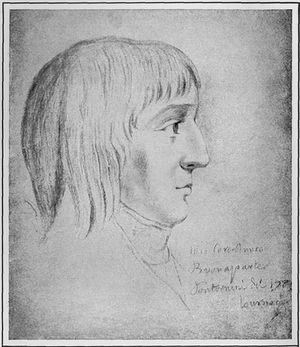
- Napoleon Bonaparte in 1785, aged sixteen. Frontispiece
- Facing Page
- Marie-Lætitia Ramolino Bonaparte "Madame Mère"—Mother of Napoleon I. 50
- Charles Bonaparte, Father of the Emperor Napoleon, 1785. 96
- Bonaparte, General in Chief of the Army of Italy. 176
- Josephine. 226
- Marie-Josephine-Rose Tascher de la Pagerie, called Josephine, Empress of the French. 276
- Bonaparte. 326
- Map of Northern Italy, illustrating the Campaigns of 1796 and 1797. 354
- Josephine, Empress of the French. 374
- Map illustrating the Campaign preceding the Treaty of Campo-Formio, 1797. 414
SI QUID NOVISTI RECTIUS ISTIS,
CANDIDUS IMPERTI: SI NON, HIS UTERE MECUM
Horace
The Revolutionary Epoch in Europe — Its Dominant
Personage — The State System of Europe — The Power of
Great Britain — Feebleness of Democracy — The Expectant
Attitude of the Continent — Survival of Antiquated
Institutions — The American Revolution — Philosophical
Sophistries — Rousseau — His Fallacies — Corsica as a
Center of Interest — Its Geography — Its Rulers — The
People — Sampiero — Revolutions — Spanish Alliance —
King Theodore — French Intervention — Supremacy of Genoa
— Paoli — His Success as a Liberator — His Plan for
Alliance with France — The Policy of Choiseul — Paoli's
Reputation — Napoleon's Account of Corsica and of Paoli —
Rousseau and Corsica.
Napoleon Bonaparte was the representative man of the epoch which
ushered in the nineteenth century. Though an aristocrat by descent, he
was in life, in training, and in quality neither that nor a plebeian;
he was the typical plain man of his time, exhibiting the common sense
of a generation which thought in terms made current by the philosophy
of the eighteenth century. His period was the most tumultuous and yet
the most fruitful in the world's history. But the progress made in it
was not altogether direct; rather was it like the advance of a
traveler whirled through the spiral tunnels of the St. Gotthard.
Flying from the inclemency of the north, he is carried by the
ponderous train due southward into the opening. After a time
of darkness he emerges into the open air. But at first sight the goal
is no nearer; the direction is perhaps reversed, the skies are more
forbidding, the chill is more intense. Only after successive ventures
of the same kind is the climax reached, the summit passed, and the
vision of sunny plains opened to view. Such experiences are more
common to the race than to the individual; the muse of history must
note and record them with equanimity, with a buoyancy and hopefulness
born of larger knowledge. The movement of civilization in Europe
during the latter portion of the eighteenth century was onward and
upward, but it was at times not only devious, slow and laborious, but
fruitless in immediate results.
We must study the age and the people of any great man if we sincerely
desire the truth regarding his strength and weakness, his inborn
tendencies and purposes, his failures and successes, the temporary
incidents and the lasting, constructive, meritorious achievements of
his career. This is certainly far more true of Napoleon than of any
other heroic personage; an affectionate awe has sometimes lifted him
to heaven, a spiteful hate has often hurled him down to hell. Every
nation, every party, faction, and cabal among his own and other
peoples, has judged him from its own standpoint of self-interest and
self-justification. Whatever chance there may be of reading the
secrets of his life lies rather in a just consideration of the man in
relation to his times, about which much is known, than in an attempt
at the psychological dissection of an enigmatical nature, about which
little is known, in spite of the fullness of our information. The
abundant facts of his career are not facts at all unless considered in
the light not only of a great national life, but of a continental
movement which embraced in its day all civilization, not
excepting that of Great Britain and America.
The states of Europe are sisters, children of the Holy Roman Empire.
In the formation of strong nationalities with differences in language,
religion, and institutions the relationship was almost forgotten, and
in the intensity of later rivalry is not always even now remembered.
It is, however, so close that at any epoch there is traceable a common
movement which occupies them all. By the end of the fourteenth century
they had secured their modern form in territorial and race unity with
a government by monarchy more or less absolute. The fifteenth century
saw with the strengthening of the monarchy the renascence of the fine
arts, the great inventions, the awakening of enterprise in discovery,
the mental quickening which began to call all authority to account.
The sixteenth was the age of the Reformation, an event too often
belittled by ecclesiastics who discern only its schismatic character,
and not sufficiently emphasized by historians as the most pregnant
political fact of any age with respect to the rise and growth of free
institutions.
The seventeenth century saw in England the triumph of political ideas
adapted to the new state of society which had arisen, but subversive
of the tyrannical system which had done its work, a work great and
good in the creation of peoples and the production of social order out
of chaos. For a time it seemed as if the island state were to become
the overshadowing influence in all the rest of Europe. By the middle
of the century her example had fired the whole continent with notions
of political reform. The long campaign which she and her allies waged
with varying fortune against Louis XIV, commanding the conservative
forces of the Latin blood, and the Roman religion ended unfavorably to
the latter. At the close of the Seven Years' War there was
not an Englishman in Europe or America or in the colonies at the
antipodes whose pulse did not beat high as he saw his motherland
triumphant in every quarter of the globe.
But these very successes, intensifying the bitterness of defeat and
everything connected with it, prevented among numerous other causes
the triumph of constitutional government anywhere in continental
Europe. Switzerland was remote and inaccessible; her beacon of
democracy burned bright, but its rays scarcely shone beyond the
mountain valleys. The Dutch republic, enervated by commercial success
and under a constitution which by its intricate system of checks was a
satire on organized liberty, had become a warning rather than a model
to other nations.
The other members of the great European state family presented a
curious spectacle. On every hand there was a cheerful trust in the
future. The present was as bad as possible, but belonged to the
passing and not to the coming hour. Truth was abroad, felt the
philosophers, and must prevail. Feudal privilege, oppression, vice and
venality in government, the misery of the poor—all would slowly fade
away. The human mind was never keener than in the eighteenth century;
reasonableness, hope, and thoroughness characterized its activity.
Natural science, metaphysics and historical studies made giant
strides, while political theories of a dazzling splendor never equaled
before nor since were rife on every side. Such was their power in a
buoyant society, awaiting the millennium, that they supplanted
entirely the results of observation and experience in the sphere of
government.
But neither lever nor fulcrum was strong enough as yet to stir the
inert mass of traditional forms. Monarchs still flattered
themselves with notions of paternal government and divine right; the
nobility still claimed and exercised baseless privileges which had
descended from an age when their ancestors held not merely these but
the land on which they rested; the burgesses still hugged, as
something which had come from above, their dearly bought charter
rights, now revealed as inborn liberties. They were thus hardened into
a gross contentment dangerous for themselves, and into an indifference
which was a menace to others. The great agricultural populations
living in various degrees of serfdom still groaned under the
artificial oppressions of a society which had passed away. Nominally
the peasant might own certain portions of the soil, but he could not
enjoy unmolested the airs which blew over it nor the streams which ran
through it nor the wild things which trespassed or dwelt on it, while
on every side some exasperating demand for the contribution of labor
or goods or money confronted him.
In short, the civilized world was in one of those transitional epochs
when institutions persist, after the beliefs and conditions which
molded them have utterly disappeared. The inertia of such a
rock-ribbed shell is terrible, and while sometimes the erosive power
of agitation and discussion suffices to weaken and destroy it, more
often the volcanic fires of social convulsion are alone strong enough.
The first such shock came from within the English-speaking world
itself, but not in Europe. The American colonies, appreciating and
applying to their own conditions the principles of the English
Revolution, began, and with French assistance completed, the movement
which erected in another hemisphere the American republic. Weak and
tottering in its infancy, but growing ever stronger and therefore
milder, its example began at once to suggest the great and peaceful
reforms of the English constitution which have since
followed. Threatening absolutism in the strong contrasts its citizens
presented to the subjects of other lands, it has been ever since the
moral support of liberal movements the world around. England herself,
instead of being weakened, was strengthened by the child grown to
independent maturity, and a double example of prosperity under
constitutional administration was now held up to the continent of
Europe.
But it is the greatest proof of human weakness that there is no
movement however beneficent, no doctrine however sound, no truth
however absolute, but that it can be speciously so extended, so
expanded, so emphasized as to lose its identity. Coincident with the
political speculation of the eighteenth century appeared the storm and
stress of romanticism and sentimentalism. The extremes of morbid
personal emotion were thought serviceable for daily life, while the
middle course of applying ideals to experience was utterly abandoned.
The latest nihilism differs little from the conception of the perfect
regeneration of mankind by discarding the old merely because it was
old which triumphed in the latter half of the eighteenth century among
philosophers and wits. To be sure, they had a substitute for whatever
was abolished and a supplement for whatever was left incomplete.
Even the stable sense of the Americans was infected by the virus of
mere theories. In obedience to the spirit of the age they introduced
into their written constitution, which was in the main but a statement
of their deep-seated political habits, a scheme like that of the
electoral college founded on some high-sounding doctrine, or omitted
from it in obedience to a prevalent and temporary extravagance of
protest some fundamental truth like that of the Christian character of
their government and laws. If there be anywhere a Christian
Protestant state it is the United States; if any futile invention were
ever incorporated in a written charter it was that of the electoral
college. The addition of a vague theory or the omission of essential
national qualities in the document of the constitution has affected
our subsequent history little or not at all.
But such was not the case in a society still under feudal oppression.
Fictions like the contract theory of government, exploded by the sound
sense of Burke; political generalizations like certain paragraphs of
the French Declaration of Rights, every item of which now and here
reads like a platitude but was then and there a vivid revolutionary
novelty; emotional yearnings for some vague Utopia—all fell into
fruitful soil and produced a rank harvest, mostly of straw and stalks,
although there was some sound grain. The thought of the time was a
powerful factor in determining the course and the quality of events
throughout all Europe. No nation was altogether unmoved. The center of
agitation was in France, although the little Calvinistic state of
Geneva brought forth the prophet and writer of the times.
Rousseau was a man of small learning but great insight. Originating
almost nothing, he set forth the ideas of others with incisive
distinctness, often modifying them to their hurt, but giving to the
form in which he wrote them an air of seductive practicability and
reality which alone threw them into the sphere of action. Examining
Europe at large, he found its social and political institutions so
hardened and so unresponsive that he declared it incapable of movement
without an antecedent general crash and breaking up. No laws, he
reasoned, could be made because there were no means by which the
general will could express itself, such was the rigidity of
absolutism and feudalism. The splendid studies of Montesquieu, which
revealed to the French the eternal truths underlying the
constitutional changes in England, had enlightened and captivated the
best minds of his country, but they were too serious, too cold, too
dry to move the quick, bright temperament of the people at large. This
was the work of Rousseau. Consummate in his literary power, he laid
the ax at the root of the tree in his fierce attack on the prevailing
education, sought a new basis for government in his peculiar
modification of the contract theory, and constructed a substitute
system of sentimental morals to supplant the old authoritative one
which was believed to underlie all the prevalent iniquities in
religion, politics, and society.
His entire structure lacked a foundation either in history or in
reason. But the popular fancy was fascinated. The whole flimsy
furniture in the chambers of the general mind vanished. New emotions,
new purposes, new sanctions appeared in its stead. There was a sad
lack of ethical definitions, an over-zealous iconoclasm as to
religion, but there were many high conceptions of regenerating
society, of liberty, of brotherhood, of equality. The influence of
this movement was literally ubiquitous; it was felt wherever men read
or thought or talked, and were connected, however remotely, with the
great central movement of civilization.
No land and no family could to all outward appearance be further aside
from the main channel of European history in the eighteenth century
than the island of Corsica and an obscure family by the name of
Buonaparte which had dwelt there since the beginning of the eighteenth
century. Yet that isolated land and that unknown family were not
merely to be drawn into the movement, they were to illustrate its most
characteristic phases. Rousseau, though mistakenly, forecast
a great destiny for Corsica, declaring in his letters on Poland that
it was the only European land capable of movement, of law-making, of
peaceful renovation. It was small and remote, but it came near to
being an actual exemplification of his favorite and fundamental dogma
concerning man in a state of nature, of order as arising from
conflict, of government as resting on general consent and mutual
agreement among the governed. Toward Corsica, therefore, the eyes of
all Europe had long been directed. There, more than elsewhere, the
setting of the world-drama seemed complete in miniature, and, in the
closing quarter of the eighteenth century, the action was rapidly
unfolding a plot of universal interest.
A lofty mountain-ridge divides the island into eastern and western
districts. The former is gentler in its slopes, and more fertile.
Looking, as it does, toward Italy, it was during the middle ages
closely bound in intercourse with that peninsula; richer in its
resources than the other part, it was more open to outside influences,
and for this reason freer in its institutions. The rugged western
division had come more completely under the yoke of feudalism, having
close affinity in sympathy, and some relation in blood, with the
Greek, Roman, Saracenic, and Teutonic race-elements in France and
Spain. The communal administration of the eastern slope, however,
prevailed eventually in the western as well, and the differences of
origin, wealth, and occupation, though at times the occasion of
intestine discord, were as nothing compared with the common
characteristics which knit the population of the entire island into
one national organization, as much a unit as their insular territory.
The people of this small commonwealth were in the main of
Italian blood. Some slight connection with the motherland they still
maintained in the relations of commerce, and by the education of their
professional men at Italian schools. While a small minority supported
themselves as tradesmen or seafarers, the mass of the population was
dependent for a livelihood upon agriculture. As a nation they had long
ceased to follow the course of general European development. They had
been successively the subjects of Greece, Rome, and the Califate, of
the German-Roman emperors, and of the republic of Pisa. Their latest
ruler was Genoa, which had now degenerated into an untrustworthy
oligarchy. United to that state originally by terms which gave the
island a "speaker" or advocate in the Genoese senate, and recognized
the most cherished habits of a hardy, natural-minded, and primitive
people, they had little by little been left a prey to their own faults
in order that their unworthy mistress might plead their disorders as
an excuse for her tyranny. Agriculture languished, and the minute
subdivision of arable land finally rendered its tillage almost
profitless.
Among a people who are isolated not only as islanders, but also as
mountaineers, old institutions are particularly tenacious of life:
that of the vendetta, or blood revenge, with the clanship it
accompanies, never disappeared from Corsica. In the centuries of
Genoese rule the carrying of arms was winked at, quarrels became rife,
and often family confederations, embracing a considerable part of the
country, were arrayed one against the other in lawless violence. The
feudal nobility, few in number, were unrecognized, and failed to
cultivate the industrial arts in the security of costly strongholds as
their class did elsewhere, while the fairest portions of land not held
by them were gradually absorbed by the monasteries, a process favored
by Genoa as likely to render easier the government of a
turbulent people. The human animal, however, throve. Rudely clad in
homespun, men and women alike cultivated a simplicity of dress
surpassed only by their plain living. There was no wealth except that
of fields and flocks, their money consequently was debased and almost
worthless. The social distinctions of noble and peasant survived only
in tradition, and all classes intermingled without any sense of
superiority or inferiority. Elegance of manner, polish, grace, were
unsought and existed only by natural refinement, which was rare among
a people who were on the whole simple to boorishness. Physically they
were, however, admirable. All visitors were struck by the repose and
self-reliance of their countenances. The women were neither beautiful,
stylish, nor neat. Yet they were considered modest and attractive. The
men were more striking in appearance and character. Of medium stature
and powerful mold, with black hair, fine teeth, and piercing eyes;
with well-formed, agile, and sinewy limbs; sober, brave, trustworthy,
and endowed with many other primitive virtues as well, the Corsican
was everywhere sought as a soldier, and could be found in all the
armies of the southern continental states.
In their periodic struggles against Genoese encroachments and tyranny,
the Corsicans had produced a line of national heroes. Sampiero, one of
these, had in the sixteenth century incorporated Corsica for a brief
hour with the dominions of the French crown, and was regarded as the
typical Corsican. Dark, warlike, and revengeful, he had displayed a
keen intellect and a fine judgment. Simple in his dress and habits,
untainted by the luxury then prevalent in the courts of Florence and
Paris, at both of which he resided for considerable periods, he could
kill his wife without a shudder when she put herself and
child into the hands of his enemies to betray him. Hospitable and
generous, but untamed and terrible; brusque, dictatorial, and without
consideration or compassion; the offspring of his times and his
people, he stands the embodiment of primeval energy, physical and
mental.
The submission of a people like this to a superior force was sullen,
and in the long century which followed, the energies generally
displayed in a well-ordered life seemed among them to be not quenched
but directed into the channels of their passions and their bodily
powers, which were ready on occasion to break forth in devastating
violence. In 1729 began a succession of revolutionary outbursts, and
at last in 1730 the communal assemblies united in a national
convention, choosing two chiefs, Colonna-Ceccaldi and Giafferi, to
lead in the attempt to rouse the nation to action and throw off the
unendurable yoke. English philanthropists furnished the munitions of
war. The Genoese were beaten in successive battles, even after they
brought into the field eight thousand German mercenaries purchased
from the Emperor Charles VI. The Corsican adventurers in foreign
lands, pleading for their liberties with artless eloquence at every
court, filled Europe with enthusiasm for their cause and streamed back
to fight for their homes. A temporary peace on terms which granted all
they asked was finally arranged through the Emperor's intervention.
But the two elected chiefs, and a third patriot, Raffaelli, having
been taken prisoners by the Genoese, were ungenerously kept in
confinement, and released only at the command of Charles. Under the
same leaders, now further exasperated by their ill usage, began and
continued another agitation, this time for separation and complete
emancipation. Giafferi's chosen adjutant was a youth of good
family and excellent parts, Hyacinth Paoli. In the then existing
complications of European politics the only available helper was the
King of Spain, and to him the Corsicans now applied, but his
undertakings compelled him to refuse. Left without allies or any
earthly support, the pious Corsicans naïvely threw themselves on the
protection of the Virgin and determined more firmly than ever to
secure their independence.
In this crisis appeared at the head of a considerable following, some
hundreds in number, the notorious and curious German adventurer,
Theodore von Neuhof, who, declaring that he represented the sympathy
of the great powers for Corsica, made ready to proclaim himself as
king. As any shelter is welcome in a storm, the people accepted him,
and he was crowned on April fifteenth, 1736. But although he spoke
truthfully when he claimed to represent the sympathy of the powers, he
did not represent their strength, and was defeated again and again in
encounters with the forces of Genoa. The oligarchy had now secured an
alliance with France, which feared lest the island might fall into
more hostile and stronger hands; and before the close of the year the
short-lived monarchy ended in the disappearance of Theodore I of
Corsica from his kingdom and soon after, in spite of his heroic
exertions, from history.
The truth was that some of the nationalist leaders had not forgotten
the old patriotic leaning towards France which had existed since the
days of Sampiero, and were themselves in communication with the French
court and Cardinal Fleury. A French army landed in February, 1738, and
was defeated. An overwhelming force was then despatched and the
insurrection subsided. In the end France, though strongly tempted to
hold what she had conquered, kept her promise to Genoa and
disarmed the Corsicans; on the other hand, however, she consulted her
own interest and attempted to soothe the islanders by guaranteeing to
them national rights. Such, however, was the prevalent bitterness that
many patriots fled into exile; some, like Hyacinth Paoli, choosing the
pay of Naples for themselves and followers, others accepting the offer
of France and forming according to time-honored custom a Corsican
regiment of mercenaries which took service in the armies of the King.
Among the latter were two of some eminence, Buttafuoco and Salicetti.
The half measures of Fleury left Corsica, as he intended, ready to
fall into his hands when opportunity should be ripe. Even the
patriotic leaders were now no longer in harmony. Those in Italy were
of the old disinterested line and suspicious of their western
neighbor; the others were charged with being the more ambitious for
themselves and careless of their country's liberty. Both classes,
however, claimed to be true patriots.
During the War of the Austrian Succession it seemed for a moment as if
Corsica were to be freed by the attempt of Maria Theresa to overthrow
Genoa, then an ally of the Bourbon powers. The national party rose
again under Gaffori, the regiments of Piedmont came to their help, and
the English fleet delivered St. Florent and Bastia into their hands.
But the peace of Aix-la-Chapelle (1748) left things substantially as
they were before the war, and in 1752 a new arrangement unsatisfactory
to both parties was made with Genoa. It was virtually dictated by
Spain and France, England having been alienated by the quarrels and
petty jealousies of the Corsican leaders, and lasted only as long as
the French occupation continued. Under the leadership of the same
dauntless Gaffori who in 1740 had been chosen along with Matra to be a
chief commander, the Genoese were once more driven from the
highlands into the coast towns. At the height of his success the bold
guerrilla fell a victim to family rivalries and personal spite.
Through the influence of his despairing foes a successful conspiracy
was formed and in the autumn of 1753 he was foully murdered.
But the greatest of these national heroes was also the last—Pascal
Paoli. Fitted for his task by birth, by capacity, by superior
training, this youth was in 1755 made captain-general of the island, a
virtual dictator in his twenty-ninth year. His success was as
remarkable as his measures were wise. Elections were regulated so that
strong organization was introduced into the loose democratic
institutions which had hitherto prevented sufficient unity of action
in troubled times. An army was created from the straggling bands of
volunteers, and brigandage was suppressed. Wise laws were enacted and
enforced—among them one which made the blood-avenger a murderer,
instead of a hero as he had been. Moreover, the foundations of a
university were laid in the town of Corte, which was the hearthstone
of the liberals because it was the natural capital of the west slope,
connected by difficult and defensible paths with every cape and bay
and intervale of the rocky and broken coast. The Genoese were
gradually driven from the interior, and finally they occupied but
three harbor towns.
Through skilful diplomacy Paoli created a temporary breach between his
oppressors and the Vatican, which, though soon healed, nevertheless
enabled him to recover important domains for the state, and prevented
the Roman hierarchy from using its enormous influence over the
superstitious people utterly to crush the movement for their
emancipation. His extreme and enlightened liberalism is admirably
shown by his invitation to the Jews, with their industry and
steady habits, to settle in Corsica, and to live there in the fullest
enjoyment of civil rights, according to the traditions of their faith
and the precepts of their law. "Liberty," he said, "knows no creed.
Let us leave such distinctions to the Inquisition." Commerce, under
these influences, began to thrive. New harbors were made and
fortified, while the equipment of a few gunboats for their defense
marked the small beginnings of a fleet. The haughty men of Corsica,
changing their very nature for a season, began to labor with their
hands by the side of their wives and hired assistants; to agriculture,
industry, and the arts was given an impulse which promised to be
lasting.
The rule of Paoli was not entirely without disturbance. From time to
time there occurred rebellious outbreaks of petty factions like that
headed by Matra, a disappointed rival. But on the whole they were of
little importance. Down to 1765 the advances of the nationalists were
steady, their battles being won against enormous odds by the force of
their warlike nature, which sought honor above all things, and could,
in the words of a medieval chronicle, "endure without a murmur
watchings and pains, hunger and cold, in its pursuit—which could even
face death without a pang." Finally it became necessary, as the result
of unparalleled success in domestic affairs, that a foreign policy
should be formulated. Paoli's idea was an offensive and defensive
alliance with France on terms recognizing the independence of Corsica,
securing an exclusive commercial reciprocity between them, and
promising military service with an annual tribute from the island.
This idea of France as a protector without administrative power was
held by the majority of patriots.
But Choiseul, the minister of foreign affairs under Louis XV, would
entertain no such visionary plan. It was clear to every one
that the island could no longer be held by its old masters. He had
found a facile instrument for the measures necessary to his
contemplated seizure of it in the son of a Corsican refugee, that
later notorious Buttafuoco, who, carrying water on both shoulders, had
ingratiated himself with his father's old friends, while at the same
time he had for years been successful as a French official. Corsica
was to be seized by France as a sop to the national pride, a slight
compensation for the loss of Canada, and he was willing to be the
agent. On August sixth, 1764, was signed a provisional agreement
between Genoa and France by which the former was to cede for four
years all her rights of sovereignty, and the few places she still held
in the island, in return for the latter's intervention to thwart
Paoli's plan for securing virtual independence. At the end of the
period France was to pay Genoa the millions owed to her.
By this time the renown of Paoli had filled all Europe. As a statesman
he had skilfully used the European entanglements both of the
Bourbon-Hapsburg alliance made in 1756, and of the alliances
consequent to the Seven Years' War, for whatever possible advantage
might be secured to his people and their cause. As a general he had
found profit even in defeat, and had organized his little forces to
the highest possible efficiency, displaying prudence, fortitude, and
capacity. His personal character was blameless, and could be
fearlessly set up as a model. He was a convincing orator and a wise
legislator. Full of sympathy for his backward compatriots, he knew
their weaknesses, and could avoid the consequences, while he
recognized at the same time their virtues, and made the fullest use of
them. Above all, he had the wide horizon of a philosopher,
understanding fully the proportions and relations to each
other of epochs and peoples, not striving to uplift Corsica merely in
her own interest, but seeking to find in her regeneration a leverage
to raise the world to higher things. So gracious, so influential, so
far-seeing, so all-embracing was his nature, that Voltaire called him
"the lawgiver and the glory of his people," while Frederick the Great
dedicated to him a dagger with the inscription, "Libertas, Patria."
The shadows in his character were that he was imperious and arbitrary;
so overmastering that he trained the Corsicans to seek guidance and
protection, thus preventing them from acquiring either personal
independence or self-reliance. Awaiting at every step an impulse from
their adored leader, growing timid in the moment when decision was
imperative, they did not prove equal to their task. Without his people
Paoli was still a philosopher; without him they became in succeeding
years a byword, and fell supinely into the arms of a less noble
subjection. In this regard the comparison between him and Washington,
so often instituted, utterly breaks down.
"Corsica," wrote in 1790 a youth destined to lend even greater
interest than Paoli to that name—"Corsica has been a prey to the
ambition of her neighbors, the victim of their politics and of her own
wilfulness.... We have seen her take up arms, shake the atrocious
power of Genoa, recover her independence, live happily for an instant;
but then, pursued by an irresistible fatality, fall again into
intolerable disgrace. For twenty-four centuries these are the scenes
which recur again and again; the same changes, the same misfortune,
but also the same courage, the same resolution, the same boldness....
If she trembled for an instant before the feudal hydra, it was only
long enough to recognize and destroy it. If, led by a natural feeling,
she kissed, like a slave, the chains of Rome, she was not
long in breaking them. If, finally, she bowed her head before the
Ligurian aristocracy, if irresistible forces kept her twenty years in
the despotic grasp of Versailles, forty years of mad warfare
astonished Europe, and confounded her enemies."
The same pen wrote of Paoli that by following traditional lines he had
not only shown in the constitution he framed for Corsica a historic
intuition, but also had found "in his unparalleled activity, in his
warm, persuasive eloquence, in his adroit and far-seeing genius," a
means to guarantee it against the attacks of wicked foes.
Such was the country in whose fortunes the "age of enlightenment" was
so interested. Montesquieu had used its history to illustrate the loss
and recovery of privilege and rights; Rousseau had thought the little
isle would one day fill all Europe with amazement. When the latter was
driven into exile for his utterances, and before his flight to
England, Paoli offered him a refuge. Buttafuoco, who represented the
opinion that Corsica for its own good must be incorporated with
France, and not merely come under her protection, had a few months
previously also invited the Genevan prophet to visit the island, and
outline a constitution for its people. But the snare was spread in
vain. In the letter which with polished phrase declined the task, on
the ground of its writer's ill-health, stood the words: "I believe
that under their present leader the Corsicans have nothing to fear
from Genoa. I believe, moreover, that they have nothing to fear from
the troops which France is said to be transporting to their shores.
What confirms me in this feeling is that, in spite of the movement, so
good a patriot as you seem to be continues in the service of the
country which sends them." Paoli was of the same opinion, and remained
so until his rude awakening in 1768.[Back to Contents]
The French Occupy Corsica — Paoli Deceived — Treaty
between France and Genoa — English Intervention Vain —
Paoli in England — British Problems — Introduction of the
French Administrative System — Paoli's Policy — The Coming
Man — Origin of the Bonapartes — The Corsican Branch —
Their Nobility — Carlo Maria di Buonaparte — Maria Letizia
Ramolino — Their Marriage and Naturalization as French
Subjects — Their Fortunes — Their Children.
1764-72.
The preliminary occupation of Corsica by the French was ostensibly
formal. The process was continued, however, until the formality became
a reality, until the fortifications of the seaport towns ceded by
Genoa were filled with troops. Then, for the first time, the text of
the convention between the two powers was communicated to Paoli.
Choiseul explained through his agent that by its first section the
King guaranteed the safety and liberty of the Corsican nation. But, no
doubt, he forgot to explain the double dealing in the second section.
Thereby in the Italian form the Corsicans were in return to take "all
right and proper measures dictated by their sense of justice and
natural moderation to secure the glory and interest of the republic of
Genoa," while in the French form they were "to yield to the Genoese
all 'they' thought necessary to the glory and interests of their
republic." Who were the "they"?—the Corsicans or the Genoese? Paoli's
eye was fixed on the acknowledgment of Corsican independence; he was
hoodwinked completely as to the treachery in this second
section, the meaning of which, according to diplomatic usage, was
settled by the interpretation which the language employed for one form
put upon that in which the other was written. Combining the two
translations, Italian and French, of the second section, and
interpreting one by the other, the Genoese were still the arbiters of
Corsican conduct and the promise of liberty contained in the first
section was worthless.
Four years passed: apparently they were uneventful, but in reality
Choiseul made good use of his time. Through Buttafuoco he was in
regular communication with that minority among the Corsicans which
desired incorporation. By the skilful manipulation of private feuds,
and the unstinted use of money, this minority was before long turned
into a majority. Toward the close of 1767 Choiseul began to show his
hand by demanding absolute possession for France of at least two
strong towns. Paoli replied that the demand was unexpected, and
required consideration by the people; the answer was that the King of
France could not be expected to mingle in Corsican affairs without
some advantage for himself. To gain time, Paoli chose Buttafuoco as
his plenipotentiary, despatched him to Versailles, and thus fell into
the very trap so carefully set for him by his opponent. He consented
as a compromise that Corsica should join the Bourbon-Hapsburg league.
More he could not grant for love of his wild, free Corsicans, and he
cherished the secret conviction that, Genoa being no longer able to
assert her sovereignty, France would never allow another power to
intervene, and so, for the sake of peace, might accept this solution.
But the great French minister was a master of diplomacy and would not
yield. In his designs upon Corsica he had little to fear from European
opposition. He knew how hampered England was by the strength
of parliamentary opposition, and the unrest of her American colonies.
The Sardinian monarchy was still weak, and quailed under the jealous
eyes of her strong enemies. Austria could not act without breaking the
league so essential to her welfare, while the Bourbon courts of Spain
and Naples would regard the family aggrandizement with complacency.
Moreover, something must be done to save the prestige of France: her
American colonial empire was lost; Catherine's brilliant policy, and
the subsequent victories of Russia in the Orient, were threatening
what remained of French influence in that quarter. Here was a
propitious moment to emulate once more the English: to seize a station
on the Indian highroad as valuable as Gibraltar or Port Mahon, and to
raise high hopes of again recovering, if not the colonial supremacy
among nations, at least that equality which the Seven Years' War had
destroyed. Without loss of time, therefore, the negotiations were
ended, and Buttafuoco was dismissed. On May fifteenth, 1768, the price
to be paid having been fixed, a definitive treaty with Genoa was
signed whereby she yielded the exercise of sovereignty to France, and
Corsica passed finally from her hands. Paoli appealed to the great
powers against this arbitrary transfer, but in vain.
The campaign of subjugation opened at once, Buttafuoco, with a few
other Corsicans, taking service against his kinsfolk. The soldiers of
the Royal Corsican regiment, which was in the French service, and
which had been formed under his father's influence, flatly refused to
fight their brethren. The French troops already in the island were at
once reinforced, but during the first year of the final conflict the
advantage was all with the patriots; indeed, there was one substantial
victory on October seventh, 1768, that of Borgo, which caused
dismay at Versailles. Once more Paoli hoped for
intervention, especially that of England, whose liberal feeling would
coincide with his interest in keeping Corsica from France. Money and
arms were sent from Great Britain, but that was all. This conduct of
the British ministry was afterward recalled by France as a precedent
for rendering aid to the Americans in their uprising against England.
The following spring an army of no less than twenty thousand men was
despatched from France to make short and thorough work of the
conquest. The previous year of bloody and embittered conflict had gone
far to disorganize the patriot army. It was only with the utmost
difficulty that the little bands of mountain villagers could be
tempted away from the ever more necessary defense of their homes and
firesides. Yet in spite of disintegration before such overwhelming
odds, and though in want both of ordinary munitions and of the very
necessities of life, the forces of Paoli continued a fierce and heroic
resistance. It was only after months of devastating, heartrending,
hopeless warfare, that their leader, utterly routed in the affair
known as the battle of Ponte Nuovo, finally gave up the desperate
cause. Exhausted, and without resources, he would have been an easy
prey to the French; but they were too wise to take him prisoner. On
June thirteenth, 1769, by their connivance he escaped, with three
hundred and forty of his most devoted supporters, on two English
vessels, to the mainland. His goal was England. The journey was a
long, triumphant procession from Leghorn through Germany and Holland;
the honors showered on him by the liberals in the towns through which
he passed were such as are generally paid to victory, not to defeat.
Kindly received and entertained, he lived for the next thirty years in
London, the recipient from the government of twelve hundred
pounds a year as a pension.
The year 1770 saw the King of France apparently in peaceful possession
of that Corsican sovereignty which he claimed to have bought from
Genoa. His administration was soon and easily inaugurated, and there
was nowhere any interference from foreign powers. Philanthropic
England had provided for Paoli, but would do no more, for she was busy
at home with a transformation of her parties. The old Whig party was
disintegrating; the new Toryism was steadily asserting itself in the
passage of contemptuous measures for oppressing the American colonies.
She was, moreover, soon to be so absorbed in her great struggle on
both sides of the globe that interest in Corsica and the Mediterranean
must remain for a long time in abeyance.
But the establishment of a French administration in the King's new
acquisition did not proceed smoothly. The party favorable to
incorporation with France had grown, and, in the rush to side with
success, it now probably far outnumbered that of the old patriots. At
the outset this majority faithfully supported the conquerors in an
attempt, honorable to both, to retain as much of Paoli's system as
possible. But the appointment of an intendant and a military commander
acting as royal governor with a veto over legislation was essential.
This of necessity destroyed the old democracy, for, in any case, the
existence of such officials and the social functions of such offices
must create a quasi-aristocracy, and its power would rest not on
popular habit and good-will, but on the French soldiery. The situation
was frankly recognized, therefore, in a complete reorganization of
those descended from the old nobility, and from these a council of
twelve was selected to support and countenance the governor. The
clergy and the third estate were likewise formally organized
in two other orders, so that with clergy, nobles, and commons, Corsica
became a French pays d'état, another provincial anachronism in the
chaos of royal administration. The class bitterness of the mainland
could easily be and was transplanted to the island; the ultimate
success of the process left nothing to be desired. Moreover, the most
important offices were given into French hands, while the seat of
government was moved from Corte, the highland capital, to the lowland
towns of Bastia and Ajaccio. The primeval feud of highlanders and
lowlanders was thus rekindled, and in the subsequent agitations the
patriots won over by France either lost influence with their
followers, or ceased to support the government. Old animosities were
everywhere revived and strengthened, until finally the flames burst
forth in open rebellion. They were, of course, suppressed, but the
work was done with a savage thoroughness the memory of which long
survived to prevent the formation in the island of a natural sentiment
friendly to the French. Those who professed such a feeling were held
in no great esteem.
It was perhaps an error that Paoli did not recognize the indissoluble
bonds of race and speech as powerfully drawing Corsica to Italy,
disregard the leanings of the democratic mountaineers toward France,
sympathize with the fondness of the towns for the motherland, and so
use his influence as to confirm the natural alliance between the
insular Italians and those of the peninsula. When we regard Sardinia,
however, time seems to have justified him. There is little to choose
between the sister islands as regards the backward condition of both;
but the French department of Corsica is, at least, no less advanced
than the Italian province of Sardinia. The final amalgamation of
Paoli's country with France, which was in a measure the
result of his leaning toward a French protectorate, accomplished one
end, however, which has rendered it impossible to separate her from
the course of great events, from the number of the mighty agents in
history. Curiously longing in his exile for a second Sampiero to have
wielded the physical power while he himself should have become a
Lycurgus, Paoli's wish was to be half-way fulfilled in that a warrior
greater than Sampiero was about to be born in Corsica, one who should,
by the very union so long resisted, come, as the master of France, to
wield a power strong enough to shatter both tyrannies and dynasties,
thus clearing the ground for a lawgiving closely related to Paoli's
own just and wise conceptions of legislation.
The coming man was to be a typical Corsican, moreover. Born in the
agony of his fatherland, he was to combine all the important qualities
of his folk in himself. Like them, he was to be short, with wonderful
eyes and beautiful teeth; temperate; quietly, even meanly, clad;
generous, grateful for any favor, however small; masterful,
courageous, impassive, shrewd, resolute, fluent of speech; profoundly
religious, even superstitious; hot-tempered, inscrutable, mendacious,
revengeful sometimes and ofttimes forgiving, disdainful of woman and
her charms; above all, boastful, conceited, and with a passion for
glory. His pride and his imagination were to be barbaric in their
immensity, his clannishness was to be that of the most primitive
civilization. In all these points he was to be Corsican; other
characteristics he was to acquire from the land of his adoption
through an education French both in affairs and in books; but he was
after all Corsican from the womb to the grave; that in the first
degree, and only secondarily French, while his cosmopolitan disguise
was to be scarcely more than a mask to be raised or lowered at
pleasure.
This scion was to come from the stock which at first bore the
name of Bonaparte, or, as the heraldic etymology later spelled it,
Buonaparte. There were branches of the same stock, or, at least, of
the same name, in other parts of Italy. Three towns at least claimed
to be the seat of a family with this patronymic: and one of them,
Treviso, possessed papers to prove the claim. Although other members
of his family based absurd pretensions of princely origin on these
insufficient proofs, Napoleon himself was little impressed by them. He
was disposed to declare that his ancestry began in his own person,
either at Toulon or from the eighteenth of Brumaire. Whatever the
origin of the Corsican Buonapartes, it was neither royal from the twin
brother of Louis XIV, thought to be the Iron Mask; nor imperial from
the Julian gens, nor Greek, nor Saracen, nor, in short, anything which
later-invented and lying genealogies declared it to be. But it was
almost certainly Italian, and probably patrician, for in 1780 a Tuscan
gentleman of the name devised a scanty estate to his distant Corsican
kinsman. The earliest home of the family was Florence; later they
removed for political reasons to Sarzana, in Tuscany, where for
generations men of that name exercised the profession of advocate. The
line was extinguished in 1799 by the death of Philip Buonaparte, a
canon and a man of means, who, although he had recognized his kin in
Corsica to the extent of interchanging hospitalities, nevertheless
devised his estate to a relative named Buonacorsi.
The Corsican branch were persons of some local consequence in their
latest seats, partly because of their Italian connections, partly in
their substantial possessions of land, and partly through the official
positions which they held in the city of Ajaccio. Their sympathies as
lowlanders and townspeople were with the country of their
origin and with Genoa. During the last years of the sixteenth century
that republic authorized a Jerome, then head of the family, to prefix
the distinguishing particle "di" to his name; but the Italian custom
was averse to its use, which was not revived until later, and then
only for a short time. Nine generations are recorded as having lived
on Corsican soil within two centuries and a quarter. They were
evidently men of consideration, for they intermarried with the best
families of the island; Ornano, Costa, Bozzi, and Colonna are names
occurring in their family records.
Nearly two centuries passed before the grand duke of Tuscany issued
formal patents in 1757, attesting the Buonaparte nobility. It was
Joseph, the grandsire of Napoleon, who received them. Soon afterward
he announced that the coat-armor of the family was "la couronne de
compte, l'écusson fendu par deux barres et deux étoilles, avec les
lettres B. P. qui signifient Buona Parte, le fond des armes
rougeâtres, les barres et les étoilles bleu, les ombrements et la
couronne jaune!" Translated as literally as such doubtful language
and construction can be, this signifies: "A count's coronet, the
escutcheon with two bends sinister and two stars, bearing the letters
B. P., which signify Buonaparte, the field of the arms red, the bends
and stars blue, the letters and coronet yellow!" In heraldic parlance
this would be: Gules, two bends sinister between two estoiles azure
charged with B. P. for Buona Parte, or; surmounted by a count's
coronet of the last. In 1759 the same sovereign granted further the
title of patrician. Charles, the son of Joseph, received a similar
grant from the Archbishop of Pisa in 1769. These facts have a
substantial historical value, since by reason of them the family was
duly and justly recognized as noble in 1771 by the French authorities,
and as a consequence, eight years later, the most
illustrious scion of the stem became, as a recognized aristocrat, the
ward of a France which was still monarchical. Reading between the
lines of such a narrative, it appears as if the short-lived family of
Corsican lawyers had some difficulty in preserving an influence
proportionate to their descent, and therefore sought to draw all the
strength they could from a bygone grandeur, easily forgotten by their
neighbors in their moderate circumstances at a later day. Still later,
when all ci-devant aristocrats were suspects in France, and when the
taint of nobility sufficed to destroy those on whom it rested,
Napoleon denied his quality: the usual inquest as to veracity was not
made and he went free. This escape he owed partly to the station he
had reached, partly to the fact that his family claims had been based
on birth so obscure at the time as to subject the claimants to
good-natured raillery.
No task had lain nearer to Paoli's heart than to unite in one nation
the two factions into which he found his people divided. Accordingly,
when Carlo Maria di Buonaparte, the single stem on which the
consequential lowland family depended for continuance, appeared at
Corte to pursue his studies, the stranger was received with flattering
kindness, and probably, as one account has it, was appointed to a post
of emolument and honor as Paoli's private secretary. The new
patrician, according to a custom common among Corsicans of his class,
determined to take his degree at Pisa, and in November, 1769, he was
made doctor of laws by that university. Many pleasant and probably
true anecdotes have been told to illustrate the good-fellowship of the
young advocate among his comrades while a student. There are likewise
narratives of his persuasive eloquence and of his influence as a
patriot, but these sound mythical. In short, an organized effort of
sycophantic admirers, who would, if possible, illuminate the
whole family in order to heighten Napoleon's renown, has invented
fables and distorted facts to such a degree that the entire truth as
to Charles's character is hard to discern. Certain undisputed facts,
however, throw a strong light upon Napoleon's father. His people were
proud and poor; he endured the hardships of poverty with equanimity.
Strengthening what little influence he could muster, he at first
appears ambitious, and has himself described in his doctor's diploma
as a patrician of Florence, San Miniato, and Ajaccio. His character is
little known except by the statements of his own family. They declared
that he was a spendthrift. He spent two years' income, about twelve
hundred dollars, in celebrating with friends the taking of his degree.
He would have sold not only the heavily mortgaged estates inherited by
himself, but also those of his wife, except for the fierce
remonstrances of his heirs. He could write clever verse, he was a
devotee of belles-lettres, and a sceptic in the fashion of the time.
Self-indulgent, he was likewise bitterly opposed to all family
discipline. His figure was slight and lithe, his expression alert and
intelligent, his eyes gray blue and his head large. He was ambitious,
indefatigable as a place-hunter, suave, elegant, and irrepressible.
On the other hand, with no apparent regard for his personal
advancement by marriage, he followed his own inclination, and in 1764,
at the age of eighteen, gallantly wedded a beautiful child of fifteen,
Maria Letizia Ramolino. Her descent, though excellent and, remotely,
even noble, was inferior to that of her husband, but her fortune was
equal, if not superior, to his. Her father was a Genoese official of
importance; her mother, daughter of a petty noble by a peasant wife,
became a widow in 1755 and two years later was married again to
Francis Fesch, a Swiss, captain in the Genoese navy. Of this
union, Joseph, later Cardinal Fesch, was the child. Although well
born, the mother of Napoleon had no education and was of peasant
nature to the last day of her long life—hardy, unsentimental, frugal,
avaricious, and sometimes unscrupulous. Yet for all that, the
hospitality of her little home in Ajaccio was lavish and famous. Among
the many guests who were regularly entertained there was Marbeuf,
commander in Corsica of the first army of occupation. There was long
afterward a malicious tradition that the French general was Napoleon's
father. The morals of Letizia di Buonaparte, like those of her
conspicuous children, have been bitterly assailed, but her good name,
at least, has always been vindicated. The evident motive of the story
sufficiently refutes such an aspersion as it contains. Of the bride's
extraordinary beauty there has never been a doubt. She was a woman of
heroic mold, like Juno in her majesty; unmoved in prosperity,
undaunted in adversity. It was probably to his mother, whom he
strongly resembled in childhood, that the famous son owed his
tremendous and unparalleled physical endurance.
After their marriage the youthful pair resided in Corte, waiting until
events should permit their return to Ajaccio. Naturally of an indolent
temperament, the husband, though he had at first been drawn into the
daring enterprises of Paoli, and had displayed a momentary enthusiasm,
was now, as he had been for more than a year, weary of them. At the
head of a body of men of his own rank, he finally withdrew to Monte
Rotondo, and on May twenty-third, 1769, a few weeks before Paoli's
flight, the band made formal submission to Vaux, commander of the
second army of occupation, explaining through Buonaparte that the
national leader had misled them by promises of aid which never came,
and that, recognizing the impossibility of further
resistance, they were anxious to accept the new government, to return
to their homes, and to resume the peaceful conduct of their affairs.
This at least is the generally accepted account of his desertion of
Paoli's cause: there is some evidence that having followed Clement, a
brother of Pascal, into a remoter district, he had there found no
support for the enterprise, and had thence under great hardships of
flood and field made his way with wife and child to the French
headquarters. The result was the same in either case. It was the
precipitate naturalization of the father as a French subject which
made his great son a Frenchman. Less than three months afterward, on
August fifteenth, the fourth child, Napoleone di Buonaparte, was born
in Ajaccio, the seat of French influence.
The resources of the Buonapartes, as they still wrote themselves, were
small, although their family and expectations were large. Charles
himself was the owner of a considerable estate in houses and lands,
but everything was heavily mortgaged and his income was small. He had
further inherited a troublesome law plea, the prosecution of which was
expensive. By an entail in trust of a great-great-grandfather,
important lands were entailed in the male line of the Odone family. In
default of regular descent, the estate was vested in the female line,
and should, when Charles's maternal uncle died childless, have
reverted to his mother. But the uncle had made a will bequeathing his
property to the Jesuits, who swiftly took possession and had
maintained their ownership by occupation and by legal quibbles.
Joseph, the father of Charles, had wasted many years and most of his
fortune in weary litigation. Nothing daunted, Charles settled down to
pursue the same phantom, virtually depending for a livelihood on the
patrimony of his wife. Letitia Buonaparte, being an only
child, had fallen heir to her father's property on the second marriage
of her mother. The stepfather was an excellent Swiss, a Protestant
from Basel, thoroughly educated, and interested in education, and for
years a mercenary in the Genoese service. On his retirement he became
a Roman Catholic in order to secure the woman of his choice. He was
the father of Letitia's half brother, Joseph. The retired officer,
though kindly disposed to the family he had entered, had little but
his pension and savings: he could contribute nothing but good, sound
common sense and his homely ideas of education. The real head of the
family was the uncle of Charles, Lucien Buonaparte, archdeacon of the
cathedral. It was he who had supported and guided his nephew, and had
sent him to the college founded by Paoli at Corte. In his youth
Charles was wasteful and extravagant, but his wife was thrifty to
meanness. With the restraint of her economy and the stimulus of his
uncle, respected as head of the family, the father of Napoleon arrived
at a position of some importance. He practised his profession with
some diligence, became an assessor of the highest insular court, and
in 1772 was made a member, later a deputy, of the council of Corsican
nobles.
The sturdy mother was most prolific. Her eldest child, born in 1765,
was a son who died in infancy; in 1767 was born a daughter,
Maria-Anna, destined to the same fate; in 1768 a son, known later as
Joseph, but baptized as Nabulione; in 1769 the great son, Napoleone.
Nine other children were the fruit of the same wedlock, and six of
them—three sons, Lucien, Louis, and Jerome, and three daughters,
Elisa, Pauline, and Caroline—survived to share their brother's
greatness. Charles himself, like his short-lived ancestors,—of
whom five had died within a century,—scarcely reached
middle age, dying in his thirty-ninth year. Letitia, like the stout
Corsican that she was, lived to the ripe age of eighty-six in the full
enjoyment of her faculties, known to the world as Madame Mère, a
sobriquet devised by her great son to distinguish her as the mother of
the Napoleons.[Back to Contents]
Birth of Nabulione or Joseph — Date of Napoleon's Birth —
Coincidence with the Festival of the Assumption — The Name
of Napoleon — Corsican Conditions as Influencing Napoleon's
Character — His Early Education — Childish Traits —
Influenced by Traditions Concerning Paoli — Family
Prospects — Influence of Marbeuf — Upheavals in France —
Napoleon Appointed to a Scholarship — His Efforts to Learn
French at Autun — Development of His Character — His
Father Delegate of the Corsican Nobility at Versailles.
1768-79.
The trials of poverty made the Buonapartes so clever and adroit that
suspicions of shiftiness in small matters were developed later on, and
these led to an over-close scrutiny of their acts. The
opinion has not yet disappeared among reputable authorities that
Nabulione and Napoleone were one and the same, born on January
seventh, 1768, Joseph being really the younger, born on the date
assigned to his distinguished brother. The earliest documentary
evidence consists of two papers, one in the archives of the French war
department, one in those of Ajaccio. The former is dated 1782, and
testifies to the birth of Nabulione on January seventh, 1768, and to
his baptism on January eighth; the latter is the copy, not the
original, of a government contract which declares the birth, on
January seventh, of Joseph Nabulion. Neither is decisive, but the
addition of Joseph, with the use of the two French forms for the name
in the second, with the clear intent of emphasizing his quality as a
Frenchman, destroys much of its value, and leaves the weight of
authority with the former. The reasonableness of the suspicion seems
to be heightened by the fact that the certificate of Napoleon's
marriage gives the date of his birth as February eighth, 1768.
Moreover, in the marriage contract of Joseph, witnesses
testify to his having been born at Ajaccio, not at Corte.
But there are facts of greater weight on the other side. In the first
place, the documentary evidence is itself of equal value, for the
archives of the French war department also contain an extract from the
one original baptismal certificate, which is dated July twenty-first,
1771, the day of the baptism, and gives the date of Napoleone's birth
as August fifteenth, 1769. Charles's application for the appointment
of his two eldest boys to Brienne has also been found, and it
contains, according to regulation, still another copy from the
original certificate, which is dated June twenty-third, 1776, and also
gives what must be accepted as the correct date. This explodes the
story that Napoleon's age was falsified by his father in order to
obtain admittance for him to the military school. The application was
made in 1776 for both boys, so as to secure admission for each before
the end of his tenth year. It was the delay of the authorities in
granting the request which, after the lapse of three years or more,
made Joseph ineligible. The father could have had no motive in 1776 to
perpetrate a fraud, and after that date it was impossible, for the
papers were not in his hands; moreover, the minister of war wrote in
1778 that the name of the elder Buonaparte boy had already been
withdrawn. That charge was made during Napoleon's lifetime. His
brother Joseph positively denied it, and asserted the fact as it is
now substantially proved to be; Bourrienne, who had known his Emperor
as a child of nine, was of like opinion; Napoleon himself, in an
autograph paper still existing, and written in the handwriting of his
youth, thrice gives the date of his birth as August fifteenth, 1769.
If the substitution occurred, it must have been in early infancy.
Besides, we know why Napoleon at marriage sought to appear
older than he was, and Joseph's contract was written when the
misstatement in it was valuable as making him appear thoroughly
French.
Among other absurd efforts to besmirch Napoleon's character is the
oft-repeated insinuation that he fixed his birthday on the greatest
high festival of the Roman Church, that of the Assumption of the
Virgin Mary, in order to assure its perpetual celebration! In sober
fact the researches of indefatigable antiquaries have brought to light
not only the documentary evidence referred to, but likewise the
circumstance that Napoleon, in one paper spelled Lapulion, was a not
uncommon Corsican name borne by several distinguished men, and that in
the early generation of the Buonaparte family the boys had been named
Joseph, Napoleon, and Lucien as they followed one another into the
world. In the eighteenth century spelling was scarcely more fixed than
in the sixteenth. Nor in the walk of life to which the Buonapartes
belonged was the fixity of names as rigid then as it later became.
There were three Maria-Annas in the family first and last, one of whom
was afterward called Elisa.
As to the form of the name Napoleon, there is a curious though
unimportant confusion. We have already seen the forms Nabulione,
Nabulion, Napoleone, Napoleon. Contemporary documents give also the
form Napoloeone, and his marriage certificate uses Napolione. On the
Vendôme Column stands Napolio. Imp., which might be read either
Napolioni Imperatori or Napolio Imperatori. In either case we have
indications of a new form, Napolion or Napolius. The latter, which was
more probably intended, would seem to be an attempt to recall
Neopolus, a recognized saint's name. The absence of the name Napoleon
from the calendar of the Latin Church was considered a
serious reproach to its bearer by those who hated him, and their
incessant taunts stung him. In youth his constant retort was that
there were many saints and only three hundred and sixty-five days in
the year. In after years he had the matter remedied, and the French
Catholics for a time celebrated a St. Napoleon's day with proper
ceremonies, among which was the singing of a hymn composed to
celebrate the power and virtues of the holy man for whom it was named.
The irreverent school-boys of Autun and Brienne gave the nickname
"straw nose"—paille-au-nez—to both the brothers. The
pronunciation, therefore, was probably as uncertain as the form,
Napaille-au-nez being probably a distortion of Napouilloné. The
chameleon-like character of the name corresponds exactly to the
chameleon-like character of the times, the man, and the lands of his
birth and of his adoption. The Corsican noble and French royalist was
Napoleone de Buonaparté; the Corsican republican and patriot was
Napoléone Buonaparté; the French republican, Napoléon Buonaparte; the
victorious general, Bonaparte; the emperor, Napoléon. There was
likewise a change in this person's handwriting analogous to the change
in his nationality and opinions. It was probably to conceal a most
defective knowledge of French that the adoptive Frenchman, as
republican, consul, and emperor, abandoned the fairly legible hand of
his youth, and recurred to the atrocious one of his childhood,
continuing always to use it after his definite choice of a country.
Stormy indeed were his nation and his birthtime. He himself said: "I
was born while my country was dying. Thirty thousand French, vomited
on our shores, drowning the throne of liberty in waves of blood—such
was the horrid sight which first met my view. The cries of
the dying, the groans of the oppressed, tears of despair, surrounded
my cradle at my birth."
These were the words he used in 1789, while still a Corsican in
feeling, when addressing Paoli. They strain chronology for the sake of
rhetorical effect, but they truthfully picture the circumstances under
which he was conceived. Among many others of a similar character there
is a late myth which recalls in detail that when the pains of
parturition seized his mother she was at mass, and that she reached
her chamber just in time to deposit, on a carpet or a piece of
embroidery representing the young Achilles, the prodigy bursting so
impetuously into the world. By the man himself his nature was always
represented as the product of his hour, and this he considered a
sufficient excuse for any line of conduct he chose to follow. When in
banishment at Longwood, and on his death-bed, he recalled the
circumstances of his childhood in conversations with the attendant
physician, a Corsican like himself. "Nothing awed me; I feared no one.
I struck one, I scratched another, I was a terror to everybody. It was
my brother Joseph with whom I had most to do; he was beaten, bitten,
scolded, and I had put the blame on him almost before he knew what he
was about; was telling tales about him almost before he could collect
his wits. I had to be quick: my mama Letizia would have restrained my
warlike temper; she would not have put up with my defiant petulance.
Her tenderness was severe, meting out punishment and reward with equal
justice; merit and demerit, she took both into account."
Of his earliest education he said at the same time: "Like everything
else in Corsica, it was pitiful." Lucien Buonaparte, his great-uncle,
was a canon, a man of substance with an income of five thousand livres
a year, and of some education—sufficient, at least, to permit
his further ecclesiastical advancement. "Uncle" Fesch, whose
father had received the good education of a Protestant Swiss boy, and
had in turn imparted his knowledge to his own son, was the friend and
older playmate of the turbulent little Buonaparte. The child learned a
few notions of Bible history, and, doubtless, also the catechism, from
the canon; by his eleven-year-old uncle he was taught his alphabet. In
his sixth year he was sent to a dame's school. The boys teased him
because his stockings were always down over his shoes, and for his
devotion to the girls, one named Giacominetta especially. He met their
taunts with blows, using sticks, bricks, or any handy weapon.
According to his own story, he was fearless in the face of superior
numbers, however large. His mother, according to his brother Joseph,
declared that he was a perfect imp of a child. She herself described
him as fond of playing at war with a drum, wooden sword, and files of
toy soldiers. The pious nuns who taught him recognized a certain gift
for figures in styling him their little mathematician. Later when in
attendance at the Jesuit school he regularly encountered on his way
thither a soldier with whom he exchanged his own piece of white bread
for a morsel of the other's coarse commissary loaf. The excuse he
gave, according to his mother, was that he must learn to like such
food if he were to be a soldier. In time his passion for the simple
mathematics he studied increased to such a degree that she assigned
him a rough shed in the rear of their home as a refuge from the
disturbing noise of the family. For exercise he walked the streets at
nightfall with tumbled hair and disordered clothes. Of French he knew
not a word; he had lessons at school in his mother tongue, which he
learned to read under the instruction of the Abbé Recco. The worthy
teacher arrayed his boys in two bodies: the diligent under
the victorious standard of Rome, the idle as vanquished Carthaginians.
Napoleon of right belonged to the latter, but he was transferred, not
because of merit, by the sheer force of his imperious temper.
This scanty information is all the trustworthy knowledge we possess
concerning the little Napoleon up to his tenth year. With slight
additions from other sources it is substantially the great Napoleon's
own account of himself by the mouthpiece partly of his mother in his
prosperous days, partly of Antommarchi in that last period of
self-examination when, to him, as to other men, consistency seems the
highest virtue. He was, doubtless, striving to compound with his
conscience by emphasizing the adage that the child is father to the
man—that he was born what he had always been.
In 1775, Corsica had been for six years in the possession of France,
and on the surface all was fair. There was, however, a little remnant
of faithful patriots left in the island, with whom Paoli and his
banished friends were still in communication. The royal cabinet,
seeking to remove every possible danger of disturbance, even so slight
a one as lay in the disaffection of the few scattered nationalists,
and in the unconcealed distrust which these felt for their conforming
fellow-citizens, began a little later to make advances, in order, if
possible, to win at least Paoli's neutrality, if not his acquiescence.
All in vain: the exile was not to be moved. From time to time,
therefore, there was throughout Corsica a noticeable flow in the tide
of patriotism. There are indications that the child Napoleon was
conscious of this influence, listening probably with intense interest
to the sympathetic tales about Paoli and his struggles for liberty
which were still told among the people.
As to Charles de Buonaparte, some things he had hoped for
from annexation were secured. His nobility and official rank were
safe; he was in a fair way to reach even higher distinction. But what
were honors without wealth? The domestic means were constantly growing
smaller, while expenditures increased with the accumulating dignities
and ever-growing family. He had made his humble submission to the
French; his reception had been warm and graceful. The authorities knew
of his pretensions to the estates of his ancestors. The Jesuits had
been disgraced and banished, but the much litigated Odone property had
not been restored to him; on the contrary, the buildings had been
converted into school-houses, and the revenues turned into various
channels. Years had passed, and it was evident that his suit was
hopeless. How could substantial advantage be secured from the King?
His friends, General Marbeuf in particular, were of the opinion that
he could profit to a certain extent at least by securing for his
children an education at the expense of the state. While it is likely
that from the first Joseph was destined for the priesthood, yet there
was provision for ecclesiastical training under royal patronage as
well as for secular, and a transfer from the latter to the former was
easier than the reverse. Both were to be placed at the college of
Autun for a preliminary course, whatever their eventual destination
might be. The necessary steps were soon taken, and in 1776 the formal
supplication for the two eldest boys was forwarded to Paris.
Immediately the proof of four noble descents was demanded. The
movement of letters was slow, that of officials even slower, and the
delays in securing copies and authentications of the various documents
were long and vexatious.
Meantime Choiseul had been disgraced, and on May tenth, 1774, the old
King had died; Louis XVI now reigned. The inertia which
marked the brilliant decadence of the Bourbon monarchy was finally
overcome. The new social forces were partly emancipated. Facts were
examined, and their significance considered. Bankruptcy was no longer
a threatening phantom, but a menacing reality of the most serious
nature. Retrenchment and reform were the order of the day. Necker was
trying his promising schemes. There was, among them, one for a body
consisting of delegates from each of the three estates,—nobles,
ecclesiastics, and burgesses,—to assist in deciding that troublesome
question, the regulation of imposts. The Swiss financier hoped to
destroy in this way the sullen, defiant influence of the royal
intendants. In Corsica the governor and the intendant both thought
themselves too shrewd to be trapped, and secured the appointment from
each of the Corsican estates of men who were believed by them to be
their humble servants. The needy suitor, Charles de Buonaparte, was to
be the delegate at Versailles of the nobility. They thought they knew
this man in particular, but he was to prove as malleable in France as
he had been in Corsica.
Though nearly penniless, the noble deputy, with the vanity of the born
courtier, was flattered, and accepted the mission, setting out on
December fifteenth, 1778, by way of Italy with his two sons Joseph and
Napoleon. With them were Joseph Fesch, appointed to the seminary at
Aix, and Varesa, Letitia's cousin, who was to be sub-deacon at Autun.
Joseph and Napoleon both asserted in later life that during their
sojourn in Florence the grand duke gave his friend, their father, a
letter to his royal sister, Marie Antoinette. As the grand duke was at
that time in Vienna, the whole account they give of the journey is
probably, though perhaps not intentionally, untrue. It was not to the
Queen's intercession but to Marbeuf's powerful influence
that the final partial success of Charles de Buonaparte's supplication
was due. This is clearly proven by the evidence of the archives. To
the general's nephew, bishop of Autun, Joseph, now too old to be
received in a royal military school, and later Lucien, were both sent,
the former to be educated as a priest. It was probably Marbeuf's
influence also, combined with a desire to conciliate Corsica, which
caused the herald's office finally to accept the documents attesting
the Buonapartes' nobility.
It appears that the journey from Corsica through Florence and
Marseilles had already wrought a marvelous change in the boy.
Napoleon's teacher at Autun, the Abbé Chardon, described his pupil as
having brought with him a sober, thoughtful character. He played with
no one, and took his walks alone. In all respects he excelled his
brother Joseph. The boys of Autun, says the same authority, on one
occasion brought the sweeping charge of cowardice against all
inhabitants of Corsica, in order to exasperate him. "If they [the
French] had been but four to one," was the calm, phlegmatic answer of
the ten-year-old boy, "they would never have taken Corsica; but when
they were ten to one...." "But you had a fine general—Paoli,"
interrupted the narrator. "Yes, sir," was the reply, uttered with an
air of discontent, and in the very embodiment of ambition; "I should
much like to emulate him." The description of the untamed faun as he
then appeared is not flattering: his complexion sallow, his hair
stiff, his figure slight, his expression lusterless, his manner
insignificant. Moreover, his behavior was sullen, and at first, of
course, he spoke broken French with an Italian accent. Open-mouthed
and with sparkling eyes, however, he listened attentively to the first
rehearsal of his task; repetition he heartily disliked, and
when rebuked for inattention he coldly replied: "Sir, I know that
already." On April twenty-first, 1779, Napoleon, according to the
evidence of his personal memorandum, left Autun, having been admitted
to Brienne, and it was to Marbeuf that in later life he correctly
attributed his appointment. After spending three weeks with a school
friend, the little fellow entered upon his duties about the middle of
May.
On New Year's day, 1779, the Buonapartes had arrived at Autun, and for
nearly four months the young Napoleone had been trained in the use of
French. He learned to speak fluently, though not correctly, and wrote
short themes in a way to satisfy his teacher. Prodigy as he was later
declared to have been, his real progress was slow, the difficulties of
that elegant and polished tongue having scarcely been reached; so that
it was with a most imperfect knowledge of their language, and a sadly
defective pronunciation, that he made his appearance among his future
schoolmates. Having, we may suppose, been assigned to the first
vacancy that occurred in any of the royal colleges, his first
destination had been Tiron, the roughest and most remote of the
twelve. But as fortune would have it, a change was somehow made to
Brienne. That establishment was rude enough. The instructors were
Minim priests, and the life was as severe as it could be made with
such a clientage under half-educated and inexperienced monks. In spite
of all efforts to the contrary, however, the place had an air of
elegance; there was a certain school-boy display proportionate to the
means and to the good or bad breeding of the young nobles, also a very
keen discrimination among themselves as to rank, social quality, and
relative importance. Those familiar with the ruthlessness of boys in
their treatment of one another can easily conceive what was
the reception of the newcomer, whose nobility was unknown and
unrecognized in France, and whose means were of the scantiest.
During his son's preparatory studies the father had been busy at
Versailles with further supplications—among them one for a supplement
from the royal purse to his scanty pay as delegate, and another for
the speedy settlement of his now notorious claim. The former of the
two was granted not merely to M. de Buonaparte, but to his two
colleagues, in view of the "excellent behavior"—otherwise
subserviency—of the Corsican delegation at Versailles. When, in
addition, the certificate of Napoleon's appointment finally arrived,
and the father set out to place his son at school, with a barely
proper outfit, he had no difficulty in securing sufficient money to
meet his immediate and pressing necessities.[Back to Contents]
Military Schools in France — Napoleon's Initiation into the
Life of Brienne — Regulations of the School — The Course
of Study — Napoleon's Powerful Friends — His Reading and
Other Avocations — His Comrades — His Studies — His
Precocity — His Conduct and Scholarship — The Change in
His Life Plan — His Influence in His Family — His Choice
of the Artillery Service.
1779-84.
It was an old charge that the sons of poor gentlemen destined to be
artillery officers were bred like princes. The institution at Brienne,
with eleven other similar academies, had been but recently founded as
a protest against the luxury which had reigned in the military schools
at Paris and La Flèche. Both these had been closed for a time because
they could not be reformed; the latter was, however, one of the twelve
from the first, and that at Paris was afterward reopened as a
finishing-school. The monasteries of various religious orders were
chosen as seats of the new colleges, and their owners were put in
charge with instructions to secure simplicity of life and manners, the
formation of character, and other desirable benefits, each one in its
own way in the school or schools intrusted to it. The result so far
had been a failure; there were simply not twelve first-rate
instructors in each branch to be found in France for the new
positions; the instruction was therefore limited and poor, so that in
the intellectual stagnation the right standards of conduct
declined, while the old notions of hollow courtliness and conventional
behavior flourished as never before. In order to enter his boy at
Brienne, Charles de Buonaparte presented a certificate signed by the
intendant and two neighbors, that he could not educate his sons
without help from the King, and was a poor man, having no income
except his salary as assessor. This paper was countersigned by Marbeuf
as commanding general, and to him the request was formally granted.
This being the regular procedure, it is evident that all the young
nobles of the twelve schools enjoying the royal bounty were poor and
should have had little or no pocket money. Perhaps for this very
reason, though the school provided for every expense including pocket
money, polished manners and funds obtained surreptitiously from
powerful friends indifferent to rules, were the things most needed to
secure kind treatment for an entering boy. These were exactly what the
young gentleman scholar from Corsica did not possess. The ignorant and
unworldly Minim fathers could neither foresee nor, if they had
foreseen, alleviate the miseries incident to his arrival under such
conditions.
At Autun Napoleon had at least enjoyed the sympathetic society of his
mild and emotional brother, whose easy-going nature could smooth many
a rough place. He was now entirely without companionship, resenting
from the outset both the ill-natured attacks and the playful personal
allusions through which boys so often begin, and with time knit ever
more firmly, their inexplicable friendships. To the taunts about
Corsica which began immediately he answered coldly, "I hope
one day to be in a position to give Corsica her liberty." Entering on
a certain occasion a room in which unknown to him there hung a
portrait of the hated Choiseul, he started back as he caught sight of
it and burst into bitter revilings; for this he was compelled to
undergo chastisement.
Brienne was a nursery for the qualities first developed at Autun. The
building was a gloomy and massive structure of the early eighteenth
century, which stood on a commanding site at the entrance of the town,
flanked by a later addition somewhat more commodious. The dormitory
consisted of two long rows of cells opening on a double corridor,
about a hundred and forty in all: each of these chambers was six feet
square, and contained a folding bed, a pitcher and a basin. The pupil
was locked in at bed-time, his only means of communication being a
bell to arouse the guard who slept in the hall. Larger rooms were
provided for his toilet; and he studied where he recited, in still
another suite. There was a common refectory in which four simple meals
a day were served: for breakfast and luncheon, bread and water, with
fruit either fresh or stewed; for dinner, soup with the soup-meat, a
side-dish and dessert; for supper, a joint with salad or dessert. With
the last two was served a mild mixture of wine and water, known in
school slang as "abundance." The outfit of clothing comprised
underwear for two changes a week, a uniform consisting of a blue cloth
coat, faced and trimmed with red, a waistcoat of the same with white
revers, and serge breeches either blue or black. The overcoat was of
the same material as the uniform, with the same trimming but with
white lining. The studies comprised Latin, mathematics, the French
language and literature, English, German, geography, drawing, fencing,
music, vocal as well as instrumental, and dancing.
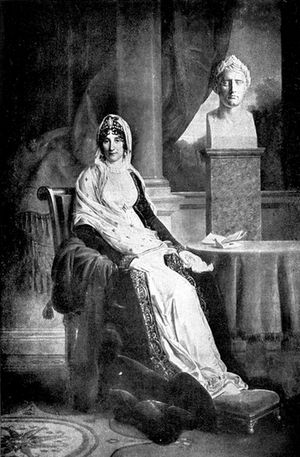
In the Museum of Versailles.
Marie-Laetitia Ramolino Bonaparte
"Madame Mère"—mother Of Napoleon I.
Perhaps the severe regimen of living could have been
mitigated and brightened by a course of study nominally and ostensibly
so rich and full; but in the list of masters, lay and clerical, there
is not a name of eminence. Neither Napoleon nor his contemporary
pupils recalled in later years any portion of their work as
stimulating, nor any instructor as having excelled in ability. The
boys seem to have disliked heartily both their studies and their
masters. Young Buonaparte had likewise a distaste for society and was
thrown upon his own unaided resources to satisfy his eager mind.
Undisciplined in spirit, he was impatient of self-discipline and
worked spasmodically in such subjects as he liked, disdaining the
severe training of his mind, even by himself. He did learn to spell
the foreign tongue of his adopted country, but his handwriting, never
good, was bad or worse, according to circumstances. Dark, solitary,
and untamed, the new scholar assumed the indifference of wounded
vanity, despised all pastimes, and found delight either in books or in
scornful exasperation of his comrades when compelled to associate with
them. There were quarrels and bitter fights, in which the Ishmaelite's
hand was against every other. Sometimes in a kind of frenzy he
inflicted serious wounds on his fellow-students. At length even the
teachers mocked him, and deprived him of his position as captain in
the school battalion.
The climax of the miserable business was reached when to a taunt that
his ancestry was nothing, "his father a wretched tipstaff," Napoleon
replied by challenging his tormentor to fight a duel. For this offense
he was put in confinement while the instigator went unpunished. It was
by the intervention of Marbeuf that his young friend was at length
released. Bruised and wounded in spirit, the boy would gladly have
shaken the dust of Brienne from his feet, but necessity
forbade. Either from some direct communication Napoleon had with his
protector, or through a dramatic but unauthenticated letter purporting
to have been written by him to his friends in Corsica and still in
existence, Marbeuf learned that the chiefest cause of all the
bitterness was the inequality between the pocket allowances of the
young French nobles and that of the young Corsican. The kindly general
displayed the liberality of a family friend, and gladly increased the
boy's gratuity, administering at the same time a smart rebuke to him
for his readiness to take offense. He is likewise thought to have
introduced his young charge to Mme. Loménie de Brienne, whose mansion
was near by.[3] This noble woman, it is asserted, became a second
mother to the lonely child: though there were no vacations, yet long
holidays were numerous and these were passed with her; her tenderness
softened his rude nature, the more so as she knew the value of tips to
a school-boy, and administered them liberally though judiciously.
Nor was this, if true, the only light among the shadows in the picture
of his later Brienne school-days. Each of the hundred and fifty pupils
had a small garden spot assigned to him. Buonaparte developed a
passion for his own, and, annexing by force the neglected
plots of his two neighbors, created for himself a retreat, the
solitude of which was insured by a thick and lofty hedge planted about
it. To this citadel, the sanctity of which he protected with a fury at
times half insane, he was wont to retire in the fair weather of all
seasons, with whatever books he could procure. In the companionship of
these he passed happy, pleasant, and fruitful hours. His youthful
patriotism had been intensified by the hatred he now felt for French
school-boys, and through them for France. "I can never forgive my
father," he once cried, "for the share he had in uniting Corsica to
France." Paoli became his hero, and the favorite subjects of his
reading were the mighty deeds of men and peoples, especially in
antiquity. Such matter he found abundant in Plutarch's "Lives."
Moreover, his punishments and degradation by the school authorities at
once created a sentiment in his favor among his companions, which not
only counteracted the effect of official penalties, but gave him a
sort of compensating leadership in their games. When driven by storms
to abandon his garden haunt, and to associate in the public hall with
the other boys, he often instituted sports in which opposing camps of
Greeks and Persians, or of Romans and Carthaginians, fought until the
uproar brought down the authorities to end the conflict. On one
occasion he proposed the game, common enough elsewhere, but not so
familiar then in France, of building snow forts, of storming and
defending them, and of fighting with snowballs as weapons. The
proposition was accepted, and the preparations were made under his
direction with scientific zeal; the intrenchments, forts, bastions,
and redoubts were the admiration of the neighborhood. For weeks the
mimic warfare went on, Buonaparte, always in command, being sometimes
the besieger and as often the besieged. Such was the
aptitude, such the resources, and such the commanding power which he
showed in either rôle, that the winter was always remembered in the
annals of the school.
Of all his contemporaries only two became men of mark, Gudin and
Nansouty. Both were capable soldiers, receiving promotions and titles
at Napoleon's hand during the empire. Bourrienne, having sunk to the
lowest depths under the republic, found employment as secretary of
General Bonaparte. In this position he continued until the consulate,
when he lost both fortune and reputation in doubtful money
speculations. From old affection he secured pardon and further
employment, being sent as minister to Hamburg. There his lust for
money wrought his final ruin. The treacherous memoirs which appeared
over his name are a compilation edited by him to obtain the means of
livelihood in his declining years. Throughout life Napoleon had the
kindliest feelings for Brienne and all connected with it. In his death
struggle on the battle-fields of Champagne he showed favor to the town
and left it a large legacy in his will. No schoolmate or master
appealed to him in vain, and many of his comrades were in their
insignificant lives dependent for existence on his favor.
It is a trite remark that diamonds can be polished only by diamond
dust. Whatever the rude processes were to which the rude nature of the
young Corsican was subjected, the result was remarkable. Latin he
disliked, and treated with disdainful neglect. His particular
aptitudes were for mathematics, for geography, and above all for
history, in which he made fair progress. His knowledge of mathematics
was never profound; in geography he displayed a remarkable and
excellent memory; biography was the department of history which
fascinated him. In all directions, however, he was quick in
his perceptions; the rapid maturing of his mind by reading and
reflection was evident to all his associates, hostile though they
were. The most convincing evidence of the fact will be found in a
letter written, probably in July, 1784, when he was fifteen years old,
to an uncle,—possibly Fesch, more likely Paravicini,—concerning
family matters.[4] His brother Joseph had gone to Autun to be educated
for the Church, his sister (Maria-Anna) Elisa had been appointed on
the royal foundation at Saint-Cyr, and Lucien was, if possible, to be
placed like Napoleon at Brienne. The two younger children had already
accompanied their father on his regular journey to Versailles, and
Lucien was now installed either in the school itself or near by, to be
in readiness for any vacancy. All was well with the rest, except that
Joseph was uneasy, and wished to become an officer too.
The tone of Napoleon is extraordinary. Opening with a commonplace
little sketch of Lucien such as any elder brother might draw of a
younger, he proceeds to an analysis of Joseph which is remarkable.
Searching and thorough, it explains with fullness of reasoning and
illustration how much more advantageous from the worldly point of view
both for Joseph and for the family would be a career in the Church:
"the bishop of Autun would bestow a fat living on him, and he was
himself sure of becoming a bishop." As an obiter dictum it contains
a curious expression of contempt for infantry as an arm, the origin of
which feeling is by no means clear. Joseph wishes to be a soldier:
very well, but in what branch of the profession? He could not enter
the navy, for he knows no mathematics; nor is his doubtful health
suited to that career. He would have to study two years more
for the navy, and four if he were to be an engineer; however, the
ceaseless occupation of this arm of the service would be more than his
strength could endure. Similar reasons militate against the artillery.
There remains, therefore, only the infantry. "Good. I see. He wants to
be all day idle, he wants to march the streets all day, and besides,
what is a slim infantry office? A poor thing, three quarters of the
time; and that, neither my dear father nor you, nor my mother, nor my
dear uncle the archdeacon, desires, for he has already shown some
slight tendency to folly and extravagance." There is an utter absence
of loose talk, or of enthusiasm, and no allusion to principle or
sentiment. It is the work of a cold, calculating, and dictatorial
nature. There is a poetical quotation in it, very apt, but very badly
spelled; and while the expression throughout is fair, it is by no
means what might be expected from a person capable of such thought,
who had been studying French for three years, and using it exclusively
in daily life.
In August, 1783, Buonaparte and Bourrienne, according to the statement
of the latter, shared the first prize in mathematics, and soon
afterward, in the same year, a royal inspector, M. de Keralio, arrived
at Brienne to test the progress of the King's wards. He took a great
fancy to the little Buonaparte, and declaring that, though
unacquainted with his family, he found a spark in him which must not
be extinguished, wrote an emphatic recommendation of the lad, couched
in the following terms: "M. de Bonaparte (Napoleon), born August
fifteenth, 1769. Height, four feet ten inches ten lines [about five
feet three inches, English]. Constitution: excellent health, docile
disposition, mild, straightforward, thoughtful. Conduct most
satisfactory; has always been distinguished for his application
in mathematics. He is fairly well acquainted with history
and geography. He is weak in all accomplishments—drawing, dancing,
music, and the like. This boy would make an excellent sailor; deserves
to be admitted to the school in Paris." Unfortunately for the
prospect, M. de Keralio, who might have been a powerful friend, died
almost immediately.
By means of further genuflections, supplications, and wearisome
persistency, Charles de Buonaparte at last obtained favor not only for
Lucien, but for Joseph also. Deprived unjustly of his inheritance,
deprived also of his comforts and his home in pursuit of the ambitious
schemes rendered necessary by that wrong, the poor diplomatist was now
near the end of his resources and his energy. Except for the short
visit of his father at Brienne on his way to Paris, it is almost
certain that the young Napoleon saw none of his elders throughout his
sojourn in the former place. The event was most important to the boy
and opened the pent-up flood of his tenderness: it was therefore a
bitter disappointment when he learned that, having seen the royal
physician, his parent would return to Corsica by Autun, taking Joseph
with him, and would not stop at Brienne. Napoleon, by the advice of
Marbeuf and more definitely by the support of his friend the
inspector, had been designated for the navy; through the favor of the
latter he hoped to have been sent to Paris, and thence assigned to
Toulon, the naval port in closest connection with Corsica. There were
so many influential applications, however, for that favorite branch of
the service that the department must rid itself of as many as
possible; a youth without a patron would be the first to suffer. The
agreement which the father had made at Paris was, therefore, that
Napoleon, by way of compensation, might continue at Brienne, while
Joseph could either go thither, or to Metz, in order to make
up his deficiencies in the mathematical sciences and pass his
examinations to enter the royal service along with Napoleon, on
condition that the latter would renounce his plans for the navy, and
choose a career in the army.
The letter in which the boy communicates his decision to his father is
as remarkable as the one just mentioned and very clearly the sequel to
it. The anxious and industrious parent had finally broken down, and in
his feeble health had taken Joseph as a support and help on the
arduous homeward journey. With the same succinct, unsparing statement
as before, Napoleon confesses his disappointment, and in commanding
phrase, with logical analysis, lays down the reasons why Joseph must
come to Brienne instead of going to Metz. There is, however, a new
element in the composition—a frank, hearty expression of affection
for his family, and a message of kindly remembrance to his friends.
But the most striking fact, in view of subsequent developments, is a
request for Boswell's "History of Corsica," and any other histories or
memoirs relating to "that kingdom." "I will bring them back when I
return, if it be six years from now."[5] The immediate sequel makes
clear the direction of his mind. He probably did not remember that he
was preparing, if possible, to strip France of her latest and highly
cherished acquisition at her own cost, or if he did, he must have felt
like the archer pluming his arrow from the off-cast feathers
of his victim's wing. It is plain that his humiliations at school, his
studies in the story of liberty, his inherited bent, and the present
disappointment, were all cumulative in the result of fixing his
attention on his native land as the destined sphere of his activity.
Four days after the probable date of writing he passed his examination
a second time, before the new inspector, announced his choice of the
artillery as his branch of the service, and a month later was ordered
to the military academy in Paris. This institution had not merely been
restored to its former renown: it now enjoyed a special reputation as
the place of reward to which only the foremost candidates for official
honors were sent. The choice of artillery seems to have been reached
by a simple process of exclusion; the infantry was too unintellectual
and indolent, the cavalry too expensive and aristocratic; between the
engineers and the artillery there was little to choose—in neither did
wealth or influence control promotion. The decision seems to have
fallen as it did because the artillery was accidentally mentioned
first in the fatal letter he had received announcing the family
straits, and the necessary renunciation of the navy. On the
certificate which was sent up with Napoleon from Brienne was the note:
"Character masterful, imperious, and headstrong."[Back to Contents]
Introduction to Paris — Teachers and Comrades — Death of
Charles de Buonaparte — His Merits — The School at Paris
— Napoleon's Poverty — His Character at the Close of His
School Years — Appointed Lieutenant in the Regiment of La
Fère — Demoralization of the French Army — The Men in the
Ranks — Napoleon as a Beau — Return to Study — His
Profession and Vocation.
1784-86.
It was on October thirtieth, 1784 that Napoleon left Brienne for
Paris.[7] He was in the sixteenth year of his age, entirely ignorant
of what were then called the "humanities," but fairly versed in
history, geography, and the mathematical sciences. His knowledge, like
the bent of his mind, was practical rather than theoretical, and he
knew more about fortification and sieges than about metaphysical
abstractions; more about the deeds of history than about its
philosophy. The new surroundings into which he was introduced by the
Minim father who had accompanied him and his four comrades from
Brienne, all somewhat younger than himself, were different indeed from
those of the rude convent he had left behind. The splendid
palace constructed on the plans of Gabriel early in the eighteenth
century still stands to attest the King's design of lodging his
gentlemen cadets in a style worthy of their high birth, and of
educating them in manners as well as of instructing them. The domestic
arrangements had been on a par with the regal lodgings of the corps.
So far had matters gone in the direction of elegance and luxury that
as we have said the establishment was closed. But it had been reopened
within a few months, about the end of 1777. While the worst abuses had
been corrected, yet still the food was, in quantity at least, lavish;
there were provided two uniforms complete each year, with underwear
sufficient for two changes a week, what was then considered a great
luxury; there was a great staff of liveried servants, and the officers
in charge were men of polished manners and of the highest distinction.
At the very close of his life Napoleon recalled the arrangements as
made for men of wealth. "We were fed and served splendidly, treated
altogether like officers, enjoying a greater competence than most of
our families, greater than most of us were destined to enjoy." At
sixteen and with his inexperience he was perhaps an incompetent judge.
Others, Vaublanc for example, thought there was more show than
substance.
Be that as it may, Bonaparte's defiant scorn and habits of solitary
study grew stronger together. It is asserted that his humor found vent
in a preposterous and peevish memorial addressed to the minister of
war on the proper training of the pupils in French military schools!
He may have written it, but it is almost impossible that it should
ever have passed beyond the walls of the school, even, as is claimed,
for revision by a former teacher, Berton. Nevertheless he found
almost, if not altogether, for the first time a real friend
in the person of des Mazis, a youth noble by birth and nature, who was
assigned to him as a pupil-teacher, and was moreover a foundation
scholar like himself. It is also declared by various authorities that
from time to time he enjoyed the agreeable society of the bishop of
Autun, who was now at Versailles, of his sister Elisa at Saint-Cyr,
and, toward the very close, of a family friend who had just settled in
Paris, the beautiful Mme. Permon, mother of the future duchess of
Abrantès. Although born in Corsica, she belonged to a branch of the
noble Greek family of the Comneni. In view of the stringent
regulations both of the military school and of Saint-Cyr, these visits
are problematical, though not impossible.
Rigid as were the regulations of the royal establishments, their
enforcement depended of course on the character of their directors.
The marquis who presided over the military school was a veteran
place-holder, his assistant was a man of no force, and the director of
studies was the only conscientious official of the three. He knew his
charge thoroughly and was recognized by Napoleon in later years as a
man of worth. The course of studies was a continuation of that at
Brienne, and there were twenty-one instructors in the various branches
of mathematics, history, geography, and languages. De l'Esguille
endorsed one of Buonaparte's exercises in history with the remark:
"Corsican by nation and character. He will go far if circumstances
favor." Domairon said of his French style that it was "granite heated
in a volcano." There were admirable masters, seven in number, for
riding, fencing, and dancing. In none of these exercises did
Buonaparte excel. It was the avowed purpose of the institution to make
its pupils pious Roman Catholics. The parish priest at Brienne had
administered the sacraments to a number of the boys,
including the young Corsican, who appears to have submitted without
cavil to the severe religious training of the Paris school: chapel
with mass at half-past six in the morning, grace before and after all
meals, and chapel again a quarter before nine in the evening; on
holidays, catechism for new students; Sundays, catechism and high
mass, and vespers with confession every Saturday; communion every two
months. Long afterwards the Emperor remembered de Juigné, his
chaplain, with kindness and overwhelmed him with favors. Of the
hundred and thirty-two scholars resident during Buonaparte's time,
eighty-three were boarders at four hundred dollars each; none of these
attained distinction, the majority did not even pass their
examinations. The rest were scholars of the King, and were diligent;
but even of these only one or two were really able men.
It was in the city of Mme. Permon's residence, at Montpellier, that on
the twenty-fourth of February, 1785, Charles de Buonaparte died. This
was apparently a final and mortal blow to the Buonaparte fortunes, for
it seemed as if with the father must go all the family expectations.
The circumstances were a fit close to the life thus ended. Feeling his
health somewhat restored, and despairing of further progress in the
settlement of his well-worn claim by legal methods, he had determined
on still another journey of solicitation to Versailles. With Joseph as
a companion he started; but a serious relapse occurred at sea, and
ashore the painful disease continued to make such ravages that the
father and son set out for Montpellier to consult the famous
specialists of the medical faculty at that place. It was in vain, and,
after some weeks, on February twenty-fourth the heartbroken father
breathed his last. Having learned to hate the Jesuits, he had become
indifferent to all religion, and is said by some to have repelled with
his last exertions the kindly services of Fesch, who was now
a frocked priest, and had hastened to his brother-in-law's bedside to
offer the final consolations of the Church to a dying man. Others
declare that he turned again to the solace of religion, and was
attended on his death-bed by the Abbé Coustou. Joseph, prostrated by
grief, was taken into Mme. Permon's house and received the tenderest
consolation.[8]
Failure as the ambitious father had been, he had nevertheless been so
far the support of his family in their hopes of advancement. Sycophant
and schemer as he had become, they recognized his untiring energy in
their behalf, and truly loved him. He left them penniless and in debt,
but he died in their service, and they sincerely mourned for him. On
the twenty-third of March the sorrowing boy wrote to his great-uncle,
the archdeacon Lucien, a letter in eulogy of his father and begging
the support of his uncle as guardian. This appointment was legally
made not long after. On the twenty-eighth he wrote to his mother. Both
these letters are in existence, and sound like rhetorical school
exercises corrected by a tutor. That to his mother is, however,
dignified and affectionate, referring in a becoming spirit to the
support her children owed her. As if to show what a thorough child he
still was, the dreary little note closes with an odd postscript giving
the irrelevant news of the birth, two days earlier, of a royal
prince—the duke of Normandy! This may have been added for the benefit
of the censor who examined all the correspondence of the young men.
Some time before, General Marbeuf had married, and the pecuniary
supplies to his boy friend seem after that event to have stopped. Mme.
de Buonaparte was left with four infant children, the youngest,
Jerome, but three months old. Their great-uncle, Lucien, the
archdeacon, was kind, and Joseph, abandoning all his ambitions,
returned to be, if possible, the support of the family. Napoleon's
poverty was no longer relative or imaginary, but real and hard.
Drawing more closely than ever within himself, he became a still more
ardent reader and student, devoting himself with passionate industry
to examining the works of Rousseau, the poison of whose political
doctrines instilled itself with fiery and grateful stinging into the
thin, cold blood of the unhappy cadet. In many respects the
instruction he received was admirable, and there is a traditional
anecdote that he was the best mathematician in the school. But on the
whole he profited little by the short continuation of his studies at
Paris. The marvelous French style which he finally created for himself
is certainly unacademic in the highest degree; in the many courses of
modern languages he mastered neither German nor English, in fact he
never had more than a few words of either; his attainments in fencing
and horsemanship were very slender. Among all his comrades he made but
one friend, while two of them became in later life his embittered
foes. Phélipeaux thwarted him at Acre; Picot de Peccaduc became
Schwarzenberg's most trusted adviser in the successful campaigns of
Austria against France.
Whether to alleviate as soon as possible the miseries of his
destitution, or, as has been charged, to be rid of their querulous and
exasperating inmate, the authorities of the military school shortened
Buonaparte's stay to the utmost of their ability, and admitted him to
examination in August, 1785, less than a year from his admission.[9]
He passed with no distinction, being forty-second in rank, but above
his friend des Mazis, who was fifty-sixth. His appointment,
therefore, was due to an entire absence of rivalry, the young nobility
having no predilection for the arduous duties of service in the
artillery. He was eligible merely because he had passed the legal age,
and had given evidence of sufficient acquisitions. In an oft-quoted
description,[10] purporting to be an official certificate given to the
young officer on leaving, he is characterized as reserved and
industrious, preferring study to any kind of amusement, delighting in
good authors, diligent in the abstract sciences, caring little for the
others,[11] thoroughly trained in mathematics and geography; quiet,
fond of solitude, capricious, haughty, extremely inclined to egotism,
speaking little, energetic in his replies, prompt and severe in
repartee; having much self-esteem; ambitious and aspiring to any
height: "the youth is worthy of protection." There is, unfortunately,
no documentary evidence to sustain the genuineness of this report; but
whatever its origin, it is so nearly contemporary that it probably
contains some truth.
The two friends had both asked for appointments in a regiment
stationed at Valence, known by the style of La Fère. Des Mazis had a
brother in it; the ardent young Corsican would be nearer his native
land, and might, perhaps, be detached for service in his home. They
were both nominated in September, but the appointment was not made
until the close of October. Buonaparte was reduced to utter penury by
the long delay, his only resource being the two hundred livres
provided by the funds of the school for each of its pupils until they
reached the grade of captain. It was probably, and according
to the generally received account, at his comrade's expense, and in
his company, that he traveled. Their slender funds were exhausted by
boyish dissipation at Lyons, and they measured on foot the long
leagues thence to their destination, arriving at Valence early in
November.
The growth of absolutism in Europe had been due at the outset to the
employment of standing armies by the kings, and the consequent
alliance between the crown, which was the paymaster, and the people,
who furnished the soldiery. There was constant conflict between the
crown and the nobility concerning privilege, constant friction between
the nobility and the people in the survivals of feudal relation. This
sturdy and wholesome contention among the three estates ended at last
in the victory of the kings. In time, therefore, the army became no
longer a mere support to the monarchy, but a portion of its moral
organism, sharing its virtues and its vices, its weakness and its
strength, reflecting, as in a mirror, the true condition of the state
so far as it was personified in the king. The French army, in the year
1785, was in a sorry plight. With the consolidation of classes in an
old monarchical society, it had come to pass that, under the
prevailing voluntary system, none but men of the lowest social stratum
would enlist. Barracks and camps became schools of vice. "Is there,"
exclaimed one who at a later day was active in the work of army
reform—"is there a father who does not shudder when abandoning his
son, not to the chances of war, but to the associations of a crowd of
scoundrels a thousand times more dangerous?"
We have already had a glimpse of the character of the officers. Their
first thought was social position and pleasure, duty and the practice
of their profession being considerations of almost vanishing
importance. Things were quite as bad in the central
administration. Neither the organization nor the equipment nor the
commissariat was in condition to insure accuracy or promptness in the
working of the machine. The regiment of La Fère was but a sample of
the whole. "Dancing three times a week," says the advertisement for
recruits, "rackets twice, and the rest of the time skittles,
prisoners' base, and drill. Pleasures reign, every man has the highest
pay, and all are well treated." Buonaparte's income, comprising his
pay of eight hundred, his provincial allowance of a hundred and
twenty, and the school pension of two hundred, amounted, all told, to
eleven hundred and twenty livres a year; his necessary expenses for
board and lodging were seven hundred and twenty, leaving less than
thirty-five livres a month, about seven dollars, for clothes and
pocket money. Fifteen years as lieutenant, fifteen as captain, and,
for the rest of his life, half pay with a decoration—such was the
summary of the prospect before the ordinary commonplace officer in a
like situation. Meantime he was comfortably lodged with a kindly old
soul, a sometime tavern-keeper named Bou, whose daughter, "of a
certain age," gave a mother's care to the young lodger. In his weary
years of exile the Emperor recalled his service at Valence as
invaluable. The artillery regiment of La Fère he said was unsurpassed
in personnel and training; though the officers were too old for
efficiency, they were loyal and fatherly; the youngsters exercised
their witty sarcasm on many, but they loved them all.
During the first months of his garrison service Buonaparte, as an
apprentice, saw arduous service in matters of detail, but he threw off
entirely the darkness and reserve of his character, taking a full
draught from the brimming cup of pleasure. On January tenth, 1786, he
was finally received to full standing as lieutenant. The
novelty, the absence of restraint, the comparative emancipation from
the arrogance and slights to which he had hitherto been subject, good
news from the family in Corsica, whose hopes as to the inheritance
were once more high—all these elements combined to intoxicate for a
time the boy of sixteen. The strongest will cannot forever repress the
exuberance of budding manhood. There were balls, and with them the
first experience of gallantry. The young officer even took
dancing-lessons. Moreover, in the drawing-rooms of the Abbé Saint-Ruf
and of his friends, for the first time he saw the manners and heard
the talk of refined society—provincial, to be sure, but excellent. It
was to the special favor of Monseigneur de Marbeuf, the bishop of
Autun, that he owed his warm reception. The acquaintances there made
were with persons of local consequence, who in later years reaped a
rich harvest for their condescension to the young stranger. In two
excellent households he was a welcome and intimate guest, that of
Lauberie and Colombier. There were daughters in both. His acquaintance
with Mlle. de Lauberie was that of one who respected her character and
appreciated her beauty. In 1805 she was appointed lady in waiting to
the Empress, but declined the appointment because of her duties as
wife and mother. In the intimacy with Mlle. du Colombier there was
more coquetry. She was a year the senior and lived on her mother's
estate some miles from the town. Rousseau had made fashionable long
walks and life in the open. The frequent visits of Napoleon to
Caroline were marked by youthful gaiety and budding love. They spent
many innocent hours in the fields and garden of the château and parted
with regret. Their friendship lasted even after she became Mme. de
Bressieux, and they corresponded intimately for long years. Of his
fellow-officers he saw but little, though he ate regularly
at the table of the "Three Pigeons" where the lieutenants had their
mess. This was not because they were distant, but because he had no
genius for good-fellowship, and the habit of indifference to his
comrades had grown strong upon him.
The period of pleasure was not long. It is impossible to judge whether
the little self-indulgence was a weak relapse from an iron purpose or
part of a definite plan. The former is more likely, so abrupt and
apparently conscience-stricken was the return to labor. His
inclinations and his earnest hope were combined in a longing for
Corsica.[12] It was a bitter disappointment that under the army
regulations he must serve a year as second lieutenant before leave
could be granted. As if to compensate himself and still his longings
for home and family, he sought the companionship of a young Corsican
artist named Pontornini, then living at Tournon, a few miles distant.
To this friendship we owe the first authentic portrait of Buonaparte.
It exhibits a striking profile with a well-shaped mouth, and the
expression of gravity is remarkable in a sitter so young. The face
portrays a studious mind. Even during the months from November to
April he had not entirely deserted his favorite studies, and again
Rousseau had been their companion and guide. In a little study of
Corsica, dated the twenty-sixth of April, 1786, the earliest of his
manuscript papers, he refers to the Social Contract of Rousseau with
approval, and the last sentence is: "Thus the Corsicans were able, in
obedience to all the laws of justice, to shake off the yoke of Genoa,
and can do likewise with that of the French. Amen." But in
the spring it was the then famous but since forgotten Abbé Raynal of
whom he became a devotee. At the first blush it seems as if
Buonaparte's studies were irregular and haphazard. It is customary to
attribute slender powers of observation and undefined purposes to
childhood and youth. The opinion may be correct in the main, and
would, for the matter of that, be true as regards the great mass of
adults. But the more we know of psychology through autobiographies,
the more certain it appears that many a great life-plan has been
formed in childhood, and carried through with unbending rigor to the
end. Whether Buonaparte consciously ordered the course of his study
and reading or not, there is unity in it from first to last.
After the first rude beginnings there were two nearly parallel lines
in his work. The first was the acquisition of what was essential to
the practice of a profession—nothing more. No one could be a soldier
in either army or navy without a practical knowledge of history and
geography, for the earth and its inhabitants are in a special sense
the elements of military activity. Nor can towns be fortified, nor
camps intrenched, nor any of the manifold duties of the general in the
field be performed without the science of quantity and numbers. Just
these things, and just so far as they were practical, the dark,
ambitious boy was willing to learn. For spelling, grammar, rhetoric,
and philosophy he had no care; neither he nor his sister Elisa, the
two strong natures of the family, could ever spell any language with
accuracy and ease, or speak and write with rhetorical elegance. Among
the private papers of his youth there is but one mathematical study of
any importance; the rest are either trivial, or have some practical
bearing on the problems of gunnery. When at Brienne, his patron had
certified that he cared nothing for accomplishments and had
none. This was the case to the end. But there was another branch of
knowledge equally practical, but at that time necessary to so few that
it was neither taught nor learned in the schools—the art of politics.[Back to Contents]
Napoleon as a Student of Politics — Nature of Rousseau's
Political Teachings — The Abbé Raynal — Napoleon Aspires
to be the Historian of Corsica — Napoleon's First Love —
His Notions of Political Science — The Books He Read —
Napoleon at Lyons — His Transfer to Douay — A Victim to
Melancholy — Return to Corsica.
1786-87.
In one sense it is true that the first Emperor of the French was a man
of no age and of no country; in another sense he was, as few have
been, the child of his surroundings and of his time. The study of
politics was his own notion; the matter and method of the study were
conditioned by his relations to the thought of Europe in the
eighteenth century. He evidently hoped that his military and political
attainments would one day meet in the culmination of a grand career.
To the world and probably to himself it seemed as if the glorious
period of the Consulate were the realization of this hope. Those years
of his life which so appear were, in fact, the least successful. The
unsoundness of his political instructors, and the temper of the age,
combined to thwart this ambitious purpose, and render unavailing all
his achievements.
Rousseau had every fascination for the young of that time—a
captivating style, persuasive logic, the sentiment of a poet, the
intensity of a prophet. A native of Corsica would be doubly drawn to
him by his interest in that romantic island. Sitting at the feet of
such a teacher, a young scholar would learn through
convincing argument the evils of a passing social state as they were
not exhibited elsewhere. He would discern the dangers of
ecclesiastical authority, of feudal privilege, of absolute monarchy;
he would see their disastrous influence in the prostitution, not only
of social, but of personal morality; he would become familiar with the
necessity for renewing institutions as the only means of regenerating
society. All these lessons would have a value not to be exaggerated.
On the other hand, when it came to the substitution of positive
teaching for negative criticism, he would learn nothing of value and
much that was most dangerous. In utter disregard of a sound historical
method, there was set up as the cornerstone of the new political
structure a fiction of the most treacherous kind. Buonaparte in his
notes, written as he read, shows his contempt for it in an admirable
refutation of the fundamental error of Rousseau as to the state of
nature by this remark: "I believe man in the state of nature had the
same power of sensation and reason which he now has." But if he did
not accept the premises, there was a portion of the conclusion which
he took with avidity, the most dangerous point in all Rousseau's
system; namely, the doctrine that all power proceeds from the people,
not because of their nature and their historical organization into
families and communities, but because of an agreement by individuals
to secure public order, and that, consequently, the consent given they
can withdraw, the order they have created they can destroy. In this
lay not merely the germ, but the whole system of extreme radicalism,
the essence, the substance, and the sum of the French Revolution on
its extreme and doctrinaire side.
Rousseau had been the prophet and forerunner of the new social
dispensation. The scheme for applying its principles is
found in a work which bears the name of a very mediocre person, the
Abbé Raynal, a man who enjoyed in his day an extended and splendid
reputation which now seems to have had only the slender foundations of
unmerited persecution and the friendship of superior men. In 1770
appeared anonymously a volume, of which, as was widely known, he was
the compiler. "The Philosophical and Political History of the
Establishments and Commerce of the Europeans in the Two Indies" is a
miscellany of extracts from many sources, and of short essays by
Raynal's brilliant acquaintances, on superstition, tyranny, and
similar themes. The reputed author had written for the public prints,
and had published several works, none of which attracted attention.
The amazing success of this one was not remarkable if, as some critics
now believe, at least a third of the text was by Diderot. However this
may be, the position of Raynal as a man of letters immediately became
a foremost one, and such was the vogue of a second edition published
over his name in 1780 that the authorities became alarmed. The climax
to his renown was achieved when, in 1781, his book was publicly
burned, and the compiler fled into exile.
By 1785 the storm had finally subsided, and though he had not yet
returned to France, it is supposed that through the friendship of Mme.
du Colombier, the friendly patroness of the young lieutenant,
communication was opened between the great man and his aspiring
reader.[13] "Not yet eighteen," are the startling words in
the letter, written by Buonaparte, "I am a writer: it is the age when
we must learn. Will my boldness subject me to your raillery? No, I am
sure. If indulgence be a mark of true genius, you should have much
indulgence. I inclose chapters one and two of a history of Corsica,
with an outline of the rest. If you approve, I will go on; if you
advise me to stop, I will go no further." The young historian's letter
teems with bad spelling and bad grammar, but it is saturated with the
spirit of his age. The chapters as they came to Raynal's hands are not
in existence so far as is known, and posterity can never judge how
monumental their author's assurance was. The abbé's reply was kindly,
but he advised the novice to complete his researches, and then to
rewrite his pieces. Buonaparte was not unwilling to profit by the
counsels he received: soon after, in July, 1786, he gave two orders to
a Genevese bookseller, one for books concerning Corsica, another for
the memoirs of Mme. de Warens and her servant Claude Anet, which are a
sort of supplement to Rousseau's "Confessions."
During May of the same year he jotted down with considerable fullness
his notions of the true relations between Church and State. He had
been reading Roustan's reply to Rousseau, and was evidently
overpowered with the necessity of subordinating ecclesiastical to
secular authority. The paper is rude and incomplete, but it shows
whence he derived his policy of dealing with the Pope and the Roman
Church in France. It has very unjustly been called an attempted
refutation of Christianity: it is nothing of the sort. Ecclesiasticism
and Christianity being hopelessly confused in his mind, he
uses the terms interchangeably in an academic and polemic discussion
to prove that the theory of the social contract must destroy all
ecclesiastical assumption of supreme power in the state.
Some of the lagging days were spent not only in novel-reading, as the
Emperor in after years confessed to Mme. de Rémusat, but in attempts
at novel-writing, to relieve the tedium of idle hours. It is said that
first and last Buonaparte read "Werther" five times through. Enough
remains among his boyish scribblings to show how fantastic were the
dreams both of love and of glory in which he indulged. Many entertain
a suspicion that amid the gaieties of the winter he had really lost
his heart, or thought he had, and was repulsed. At least, in his
"Dialogue on Love," written five years later, he says, "I, too, was
once in love," and proceeds, after a few lines, to decry the sentiment
as harmful to mankind, a something from which God would do well to
emancipate it. This may have referred to his first meeting and
conversation with a courtesan at Paris, which he describes in one of
his papers, but this is not likely from the context, which is not
concerned with the gratification of sexual passion. It is of the
nobler sentiment that he speaks, and there seems to have been in the
interval no opportunity for philandering so good as the one he had
enjoyed during his boyish acquaintance with Mlle. Caroline du
Colombier. It has, at all events, been her good fortune to secure, by
this supposition, a place in history, not merely as the first girl
friend of Napoleon, but as the object of his first pure passion.
But these were his avocations; the real occupation of his time was
study. Besides reading again the chief works of Rousseau, and
devouring those of Raynal, his most beloved author, he also read much
in the works of Voltaire, of Filangieri, of Necker, and of
Adam Smith. With note-book and pencil he extracted, annotated, and
criticized, his mind alert and every faculty bent to the clear
apprehension of the subject in hand. To the conception of the state as
a private corporation, which he had imbibed from Rousseau, was now
added the conviction that the institutions of France were no longer
adapted to the occupations, beliefs, or morals of her people, and that
revolution was a necessity. To judge from a memoir presented some
years later to the Lyons Academy, he must have absorbed the teachings
of the "Two Indies" almost entire.
The consuming zeal for studies on the part of this incomprehensible
youth is probably unparalleled. Having read Plutarch in his childhood,
he now devoured Herodotus, Strabo, and Diodorus; China, Arabia, and
the Indies dazzled his imagination, and what he could lay hands upon
concerning the East was soon assimilated. England and Germany next
engaged his attention, and toward the close of his studies he became
ardent in examining the minutest particulars of French history. It
was, moreover, the science of history, and not its literature, which
occupied him—dry details of revenue, resources, and institutions; the
Sorbonne, the bull Unigenitus, and church history in general; the
character of peoples, the origin of institutions, the philosophy of
legislation—all these he studied, and, if the fragments of his notes
be trustworthy evidence, as they surely are, with some thoroughness.
He also found time to read the masterpieces of French literature, and
the great critical judgments which had been passed upon them.[14]
The agreeable and studious life at Valence was soon ended.
Early in August, 1786, a little rebellion, known as the "Two-cent
Revolt," broke out in Lyons over a strike of the silk-weavers for two
cents an ell more pay and the revolt of the tavern-keepers against the
enforcement of the "Banvin," an ancient feudal right levying a heavy
tax on the sale of wine. The neighboring garrisons were ordered to
furnish their respective quotas for the suppression of the uprising.
Buonaparte's company was sent among others, but those earlier on the
ground had been active, several workmen had been killed, and the
disturbance was already quelled when he arrived. The days he spent at
Lyons were so agreeable that, as he wrote his uncle Fesch, he left the
city with regret "to follow his destiny." His regiment had been
ordered northward to Douay in Flanders; he returned to Valence and
reached that city about the end of August. His furlough began
nominally on October first, but for the Corsican officers a month's
grace was added, so that he was free to leave on September first.
The time spent under the summer skies of the north would have been
dreary enough if he had regularly received news from home. Utterly
without success in finding occupation in Corsica, and hopeless as to
France, Joseph had some time before turned his eyes toward Tuscany for
a possible career. He was now about to make a final effort, and seek
personally at the Tuscan capital official recognition with a view to
relearning his native tongue, now almost forgotten, and to obtaining
subsequent employment of any kind that might offer in the land of his
birth. Lucien, the archdeacon, was seriously ill, and
General Marbeuf, the last influential friend of the family, had died.
Louis had been promised a scholarship in one of the royal artillery
schools; deprived of his patron, he would probably lose the
appointment. Finally, the pecuniary affairs of Mme. de Buonaparte were
again entangled, and now appeared hopeless. She had for a time been
receiving an annual state bounty for raising mulberry-trees, as France
was introducing silk culture into the island. The inspectors had
condemned this year's work, and were withholding a substantial portion
of the allowance. These were the facts and they probably reached
Napoleon at Valence; it was doubtless a knowledge of them which put an
end to all his light-heartedness and to his study, historical or
political. He immediately made ready to avail himself of his leave so
that he might instantly set out to his mother's relief.
Despondent and anxious, he moped, grew miserable, and contracted a
slight malarial fever which for the next six or seven years never
entirely relaxed its hold on him. Among his papers has recently been
found the long, wild, pessimistic rhapsody to which reference has
already been made and in which there is talk of suicide. The plaint is
of the degeneracy among men, of the destruction of primitive
simplicity in Corsica by the French occupation, of his own isolation,
and of his yearning to see his friends once more. Life is no longer
worth while; his country gone, a patriot has naught to live for,
especially when he has no pleasure and all is pain—when the character
of those about him is to his own as moonlight is to sunlight. If there
were but a single life in his way, he would bury the avenging blade of
his country and her violated laws in the bosom of the tyrant. Some of
his complaining was even less coherent than this. It is absurd to take
the morbid outpouring seriously, except in so far as it goes
to prove that its writer was a victim of the sentimental egoism into
which the psychological studies of the eighteenth century had
degenerated, and to suggest that possibly if he had not been Napoleon
he might have been a Werther. Though dated May third, no year is
given, and it may well describe the writer's feelings in any period of
despondency. No such state of mind was likely to have arisen in the
preceding spring, but it may have been written even then as a relief
to pent-up feelings which did not appear on the surface; or possibly
in some later year when the agony of suffering for himself and his
family laid hold upon him. In any case it expresses a bitter
melancholy, such as would be felt by a boy face to face with want.
At Valence Napoleon visited his old friend the Abbé Saint-Ruf, to
solicit favor for Lucien, who, having left Brienne, would study
nothing but the humanities, and was determined to become a priest. At
Aix he saw both his uncle Fesch and his brother. At Marseilles he is
said to have paid his respects to the Abbé Raynal, requesting advice,
and seeking further encouragement in his historical labors. This is
very doubtful, for there is no record of Raynal's return to France
before 1787. Lodging in that city, as appears from a memorandum on his
papers, with a M. Allard, he must soon have found a vessel sailing for
his destination, because he came expeditiously to Ajaccio, arriving in
that city toward the middle of the month, if the ordinary time had
been consumed in the journey. Such appears to be the likeliest account
of this period, although our knowledge is not complete. In the
archives of Douay, there is, according to an anonymous local
historian, a record of Buonaparte's presence in that city with the
regiment of La Fère, and he is quoted as having declared at Elba
to Sir Neil Campbell that he had been sent thither. But in
the "Epochs of My Life," he wrote that he left Valence on September
first, 1786, for Ajaccio, arriving on the fifteenth. Weighing the
probabilities, it seems likely that the latter was doubtful, since
there is but the slenderest possibility of his having been at Douay in
the following year, the only other hypothesis, and there exists no
record of his activities in Corsica before the spring of 1787. The
chronology of the two years is still involved in obscurity and it is
possible that he went with his regiment to Douay, contracted his
malaria there, and did not actually get leave of absence until
February first of the latter year.[Back to Contents]
Straits of the Buonaparte Family — Napoleon's Efforts to
Relieve Them — Home Studies — His History and Short
Stories — Visit to Paris — Renewed Petitions to Government
— More Authorship — Secures Extension of his Leave — The
Family Fortunes Desperate — The History of Corsica
Completed — Its Style, Opinions, and Value — Failure to
Find a Publisher — Sentiments Expressed in his Short
Stories — Napoleon's Irregularities as a French Officer —
His Life at Auxonne — His Vain Appeal to Paoli — The
History Dedicated to Necker.
1787-89.
When Napoleon arrived at Ajaccio, and, after an absence of eight
years, was again with his family, he found their affairs in a serious
condition. Not one of the old French officials remained; the
diplomatic leniency of occupation was giving place to the official
stringency of a permanent possession; proportionately the disaffection
of the patriot remnant among the people was slowly developing into a
wide-spread discontent. Joseph, the hereditary head of a family which
had been thoroughly French in conduct, and was supposed to be so in
sentiment, which at least looked to the King for further favors, was
still a stanch royalist. Having been unsuccessful in every other
direction, he was now seeking to establish a mercantile connection
with Florence which would enable him to engage in the oil-trade. A
modest beginning was, he hoped, about to be made. It was high time,
for the only support of his mother and her children, in the failure to
secure the promised subsidy for her mulberry plantations, was the
income of the old archdeacon, who was now confined to his
room, and growing feebler every day under attacks of gout.
Unfortunately, Joseph's well-meant efforts again came to naught.
The behavior of the pale, feverish, masterful young lieutenant was not
altogether praiseworthy. He filled the house with his new-fangled
philosophy, and assumed a self-important air. Among his papers and in
his own handwriting is a blank form for engaging and binding recruits.
Clearly he had a tacit understanding either with himself or with
others to secure some of the fine Corsican youth for the regiment of
La Fère. But there is no record of any success in the enterprise.
Among the letters which he wrote was one dated April first, 1787, to
the renowned Dr. Tissot of Lausanne, referring to his correspondent's
interest in Paoli, and asking advice concerning the treatment of the
canon's gout. The physician never replied, and the epistle was found
among his papers marked "unanswered and of little interest." The old
ecclesiastic listened to his nephew's patriotic tirades, and even
approved; Mme. de Buonaparte coldly disapproved. She would have
preferred calmer, more efficient common sense. Not that her son was
inactive in her behalf; on the contrary, he began a series of busy
representations to the provincial officials which secured some
good-will and even trifling favor to the family. But the results were
otherwise unsatisfactory, for the mulberry money was not paid.
Napoleon's zeal for study was not in the least abated in the
atmosphere of home. Joseph in his memoirs says the reunited family was
happy in spite of troubles. There was reciprocal joy in their
companionship and his long absent brother was glad in the pleasures
both of home and of nature so congenial to his feelings and his
tastes. The most important part of Napoleon's baggage
appears to have been the books, documents, and papers he brought with
him. That he had collections on Corsica has been told. Joseph says he
had also the classics of both French and Latin literature as well as
the philosophical writings of Plato; likewise, he thinks, Ossian and
Homer. In the "Discourse" presented not many years later to the Lyons
Academy and in the talks at St. Helena, Napoleon refers to his
enjoyment of nature at this time; to the hours spent in the grotto, or
under the majestic oak, or in the shade of the olive groves, all parts
of the sadly neglected garden of Milleli some distance from the house
and belonging to his mother; to his walks on the meadows among the
lowing herds; to his wanderings on the shore at sunset, his return by
moonlight, and the gentle melancholy which unbidden enveloped him in
spite of himself. He savored the air of Corsica, the smell of its
earth, the spicy breezes of its thickets, he would have known his home
with his eyes shut, and with them open he found it the earthly
paradise. Yet all the while he was busy, very busy, partly with good
reading, partly in the study of history, and in large measure with the
practical conduct of the family affairs.
As the time for return to service drew near it was clear that the
mother with her family of four helpless little children, all a serious
charge on her time and purse, could not be left without the support of
one older son, at least; and Joseph was now about to seek his fortune
in Pisa. Accordingly Napoleon with methodical care drew up two papers
still existing, a memorandum of how an application for renewed leave
on the ground of sickness was to be made and also the form of
application itself, which no doubt he copied. At any rate he applied,
on the ground of ill health, for a renewal of leave to last five and a
half months. It was granted, and the regular round of family
cares went on; but the days and weeks brought no relief. Ill health
there was, and perhaps sufficient to justify that plea, but the
physical fever was intensified by the checks which want set upon
ambition. The passion for authorship reasserted itself with
undiminished violence. The history of Corsica was resumed, recast, and
vigorously continued, while at the same time the writer completed a
short story entitled "The Count of Essex,"—with an English setting,
of course,—and wrote a Corsican novel. The latter abounds in
bitterness against France, the most potent force in the development of
the plot being the dagger. The author's use of French, though easier,
is still very imperfect. A slight essay, or rather story, in the style
of Voltaire, entitled "The Masked Prophet," was also completed.
It was reported early in the autumn that many regiments were to be
mobilized for special service, among them that of La Fère. This gave
Napoleon exactly the opening he desired, and he left Corsica at once,
without reference to the end of his furlough. He reached Paris in
October, a fortnight before he was due. His regiment was still at
Douay: he may have spent a few days with it in that city. But this is
not certain, and soon after it was transferred to St. Denis, now
almost a suburb of Paris; it was destined for service in western
France, where incipient tumults were presaging the coming storm.
Eventually its destination was changed and it was ordered to Auxonne.
The Estates-General of France were about to meet for the first time in
one hundred and seventy-five years; they had last met in 1614, and had
broken up in disorder. They were now called as a desperate remedy, not
understood, but at least untried, for ever-increasing embarrassments;
and the government, fearing still greater disorders, was
making ready to repress any that might break out in districts known to
be specially disaffected. All this was apparently of secondary
importance to young Buonaparte; he had a scheme to use the crisis for
the benefit of his family. Compelled by their utter destitution at the
time of his father's death, he had temporarily and for that occasion
assumed his father's rôle of suppliant. Now for a second time he sent
in a petition. It was written in Paris, dated November ninth, 1787,
and addressed, in his mother's behalf, to the intendant for Corsica
resident at the French capital. His name and position must have
carried some weight, it could not have been the mere effrontery of an
adventurer which secured him a hearing at Versailles, an interview
with the prime minister, Loménie de Brienne, and admission to all the
minor officials who might deal with his mother's claim. All these
privileges he declares that he had enjoyed and the statements must
have been true. The petition was prefaced by a personal letter
containing them. Though a supplication in form, the request is unlike
his father's humble and almost cringing papers, being rather a demand
for justice than a petition for favor; it is unlike them in another
respect, because it contains a falsehood, or at least an utterly
misleading half-truth: a statement that he had shortened his leave
because of his mother's urgent necessities.
The paper was not handed in until after the expiration of his leave,
and his true object was not to rejoin his regiment, as was hinted in
it, but to secure a second extension of leave. Such was the slackness
of discipline that he spent all of November and the first half of
December in Paris. During this period he made acquaintance with the
darker side of Paris life. The papers numbered four, five, and six in
the Fesch collection give a fairly detailed account of one adventure
and his bitter repentance. The second suggests the writing
of history as an antidote for unhappiness, and the last is a long,
rambling effusion in denunciation of pleasure, passion, and license;
of gallantry as utterly incompatible with patriotism. His acquaintance
with history is ransacked for examples. Still another short effusion
which may belong to the same period is in the form of an imaginary
letter, saturated likewise with the Corsican spirit, addressed by King
Theodore to Walpole. It has little value or meaning, except as it may
possibly foreshadow the influence on Napoleon's imagination of
England's boundless hospitality to political fugitives like Theodore
and Paoli.
Lieutenant Buonaparte remained in Paris until he succeeded in
procuring permission to spend the next six months in Corsica, at his
own charges. He was quite as disingenuous in his request to the
Minister of War as in his memorial to the intendant for Corsica,
representing that the estates of Corsica were about to meet, and that
his presence was essential to safeguard important interests which in
his absence would be seriously compromised. Whatever such a plea may
have meant, his serious cares as the real head of the family were ever
uppermost, and never neglected. Louis had, as was feared, lost his
appointment, and though not past the legal age, was really too old to
await another vacancy; Lucien was determined to leave Brienne in any
case, and to stay at Aix in order to seize the first chance which
might arise of entering the seminary. Napoleon made some
provision—what it was is not known—for Louis's further temporary
stay at Brienne, and then took Lucien with him as far as their route
lay together. He reached his home again on the first of January, 1788.
The affairs of the family were at last utterly desperate, and were
likely, moreover, to grow worse before they grew better. The
old archdeacon was failing daily, and, although known to have means,
he declared himself destitute of ready money. With his death would
disappear a portion of his income; his patrimony and savings, which
the Buonapartes hoped of course to inherit, were an uncertain
quantity, probably insufficient for the needs of such a family. The
mulberry money was still unpaid; all hope of wresting the ancestral
estates from the government authorities was buried; Joseph was without
employment, and, as a last expedient, was studying in Pisa for
admission to the bar. Louis and Lucien were each a heavy charge;
Napoleon's income was insufficient even for his own modest wants,
regulated though they were by the strictest economy. Who shall cast a
stone at the shiftiness of a boy not yet nineteen, charged with such
cares, yet consumed with ambition, and saturated with the romantic
sentimentalism of his times? Some notion of his embarrassments and
despair can be obtained from a rapid survey of his mental states and
the corresponding facts. An ardent republican and revolutionary, he
was tied by the strongest bonds to the most despotic monarchy in
Europe. A patriotic Corsican, he was the servant of his country's
oppressor. Conscious of great ability, he was seeking an outlet in the
pursuit of literature, a line of work entirely unsuited to his powers.
The head and support of a large family, he was almost penniless; if he
should follow his convictions, he and they might be altogether so. In
the period of choice and requiring room for experiment, he saw himself
doomed to a fixed, inglorious career, and caged in a framework of
unpropitious circumstance. Whatever the moral obliquity in his feeble
expedients, there is the pathos of human limitations in their
character.
Whether the resolution had long before been taken, or was of
recent formation, Napoleon now intended to make fame and profit go
hand in hand. The meeting of the Corsican estates was, as far as is
known, entirely forgotten, and authorship was resumed, not merely with
the ardor of one who writes from inclination, but with the regular
drudgery of a craftsman. In spite of all discouragements, he appeared
to a visitor in his family, still considered the most devoted in the
island to the French monarchy because so favored by it, as being "full
of vivacity, quick in his speech and motions, his mind apparently hard
at work in digesting schemes and forming plans and proudly rejecting
every other suggestion but that of his own fancy. For this intolerable
ambition he was often reproved by the elder Lucien, his uncle, a
dignitary of the church. Yet these admonitions seemed to make no
impression upon the mind of Napoleon, who received them with a grin of
pity, if not of contempt."[15] The amusements of the versatile and
headstrong boy would have been sufficient occupation for most men.
Regulating, as far as possible, his mother's complicated affairs, he
journeyed frequently to Bastia, probably to collect money due for
young mulberry-trees which had been sold, possibly to get material for
his history. On these visits he met and dined with the artillery
officers of the company stationed there. One of them, M. de Roman, a
very pronounced royalist, has given in his memoirs a striking portrait
of his guest.[16] "His face was not pleasing to me at all, his
character still less; and he was so dry and sententious for a youth of
his age, a French officer too, that I never for a moment entertained
the thought of making him my friend. My knowledge of governments,
ancient and modern, was not sufficiently extended to discuss with him
his favorite subject of conversation. So when in my turn I
gave the dinner, which happened three or four times that year, I
retired after the coffee, leaving him to the hands of a captain of
ours, far better able than I was to lock arms with such a valiant
antagonist. My comrades, like myself, saw nothing in this but absurd
pedantry. We even believed that this magisterial tone which he assumed
was meaningless until one day when he reasoned so forcibly on the
rights of nations in general, his own in particular, Stupete gentes!
that we could not recover from our amazement, especially when in
speaking of a meeting of their Estates, about calling which there was
some deliberation, and which M. de Barrin sought to delay, following
in that the blunders of his predecessor, he said: 'that it was very
surprising that M. de Barrin thought to prevent them from deliberating
about their interests,' adding in a threatening tone, 'M. de Barrin
does not know the Corsicans; he will see what they can do.' This
expression gave the measure of his character. One of our comrades
replied: 'Would you draw your sword against the King's
representative?' He made no answer. We separated coldly and that was
the last time this former comrade did me the honor to dine with me."
Making all allowance, this incident exhibits the feeling and purpose
of Napoleon. During these days he also completed a plan for the
defense of St. Florent, of La Mortilla, and of the Gulf of Ajaccio;
drew up a report on the organization of the Corsican militia; and
wrote a paper on the strategic importance of the Madeleine Islands.
This was his play; his work was the history of Corsica. It was
finished sooner than he had expected; anxious to reap the pecuniary
harvest of his labors and resume his duties, he was ready for the
printer when he left for France in the latter part of May to secure
its publication. Although dedicated in its first form to a
powerful patron, Monseigneur Marbeuf, then Bishop of Sens, like many
works from the pen of genius it remained at the author's death in
manuscript.
The book was of moderate size, and of moderate merit.[17] Its form,
repeatedly changed from motives of expediency, was at first that of
letters addressed to the Abbé Raynal. Its contents display little
research and no scholarship. The style is intended to be popular, and
is dramatic rather than narrative. There is exhibited, as everywhere
in these early writings, an intense hatred of France, a glowing
affection for Corsica and her heroes. A very short account of one
chapter will sufficiently characterize the whole work. Having outlined
in perhaps the most effective passage the career of Sampiero, and
sketched his diplomatic failures at all the European courts except
that of Constantinople, where at last he had secured sympathy and was
promised aid, the author depicts the patriot's bitterness when
recalled by the news of his wife's treachery. Confronting his guilty
spouse, deaf to every plea for pity, hardened against the tender
caresses of his children, the Corsican hero utters judgment. "Madam,"
he sternly says, "in the face of crime and disgrace, there is no other
resort but death." Vannina at first falls unconscious, but, regaining
her senses, she clasps her children to her breast and begs life for
their sake. But feeling that the petition is futile, she then recalls
the memory of her earlier virtue, and, facing her fate, begs as a last
favor that no base executioner shall lay his soiled hands on the wife
of Sampiero, but that he himself shall execute the sentence. Vannina's
behavior moves her husband, but does not touch his heart. "The pity
and tenderness," says Buonaparte, "which she should have awakened
found a soul thenceforward closed to the power of sentiment.
Vannina died. She died by the hands of Sampiero."
Neither the publishers of Valence, nor those of Dôle, nor those of
Auxonne, would accept the work. At Paris one was finally found who was
willing to take a half risk. The author, disillusioned but sanguine,
was on the point of accepting the proposition, and was occupied with
considering ways and means, when his friend the Bishop of Sens was
suddenly disgraced. The manuscript was immediately copied and revised,
with the result, probably, of making its tone more intensely Corsican;
for it was now to be dedicated to Paoli. The literary aspirant must
have foreseen the coming crash, and must have felt that the exile was
to be again the liberator, and perhaps the master, of his native land.
At any rate, he abandoned the idea of immediate publication, possibly
in the dawning hope that as Paoli's lieutenant he could make Corsican
history better than he could write it. It is this copy which has been
preserved; the original was probably destroyed.
The other literary efforts of this feverish time were not as
successful even as those in historical writing. The stories are wild
and crude; one only, "The Masked Prophet," has any merit or interest
whatsoever. Though more finished than the others, its style is also
abrupt and full of surprises; the scene and characters are Oriental;
the plot is a feeble invention. An ambitious and rebellious Ameer is
struck with blindness, and has recourse to a silver mask to deceive
his followers. Unsuccessful, he poisons them all, throws their corpses
into pits of quicklime, then leaps in himself, to deceive the world
and leave no trace of mortality behind. His enemies believe, as he
desired, that he and his people have been taken up into heaven. The
whole, however, is dimly prescient, and the concluding lines of the
fable have been thought by believers in augury to be
prophetic. "Incredible instance! How far can the passion for fame go!"
Among the papers of this period are also a constitution for the
"calotte," a secret society of his regiment organized to keep its
members up to the mark of conduct expected from gentlemen and
officers, and many political notes. One of these rough drafts is a
project for an essay on royal power, intended to treat of its origin
and to display its usurpations, and which closes with these words:
"There are but few kings who do not deserve to be dethroned."
The various absences of Buonaparte from his regiment up to this time
are antagonistic to our modern ideas of military duty. The subsequent
ones seem simply inexplicable, even in a service so lax as that of the
crumbling Bourbon dynasty. Almost immediately after Joseph's return,
on the first of June he sailed for France. He did not reach Auxonne,
where the artillery regiment La Fère was now stationed, until early in
that month, 1788. He remained there less than a year and a half, and
then actually obtained another leave of absence, from September tenth,
1789, to February, 1791, which he fully intended should end in his
retirement from the French service.[18] The incidents of this second
term of garrison life are not numerous, but from the considerable
body of his notes and exercises which dates from the period
we know that he suddenly developed great zeal in the study of
artillery, theoretical and practical, and that he redoubled his
industry in the pursuit of historical and political science. In the
former line he worked diligently and became expert. With his
instructor Duteil he grew intimate and the friendship was close
throughout life. He associated on the best of terms with his old
friend des Mazis and began a pleasant acquaintance with Gassendi. So
faithful was he to the minutest details of his profession that he
received marks of the highest distinction. Not yet twenty and only a
second lieutenant, he was appointed, with six officers of higher rank,
a member of the regimental commission to study the best disposal of
mortars and cannon in firing shells. Either at this time or later (the
date is uncertain), he had sole charge of important manœuvers held
in honor of the Prince of Condé. These honors he recounted with honest
pride in a letter dated August twenty-second to his great-uncle. Among
the Fesch papers are considerable fragments of his writing on the
theory, practice, and history of artillery. Antiquated as are their
contents, they show how patient and thorough was the work of the
student, and some of their ideas adapted to new conditions were his
permanent possession, as the greatest master of artillery at the
height of his fame. In the study of politics he read Plato and
examined the constitutions of antiquity, devouring with avidity what
literature he could find concerning Venice, Turkey, Tartary, and
Arabia. At the same time he carefully read the history of England, and
made some accurate observations on the condition of contemporaneous
politics in France.
His last disappointment had rendered him more taciturn and
misanthropic than ever; it seems clear that he was working
to become an expert, not for the benefit of France, but for that of
Corsica. Charged with the oversight of some slight works on the
fortifications, he displayed such incompetence that he was actually
punished by a short arrest. Misfortune still pursued the family. The
youth who had been appointed to Brienne when Louis was expecting a
scholarship suddenly died. Mme. de Buonaparte was true to the family
tradition, and immediately forwarded a petition for the place, but
was, as before, unsuccessful. Lucien was not yet admitted to Aix;
Joseph was a barrister, to be sure, but briefless. Napoleon once
again, but for the last time,—and with marked impatience, even with
impertinence,—took up the task of solicitation. The only result was a
good-humored, non-committal reply. Meantime the first mutterings of
the revolutionary outbreak were heard, and spasmodic disorders,
trifling but portentous, were breaking out, not only among the people,
but even among the royal troops. One of these, at Seurre, was
occasioned by the news that the hated and notorious syndicate existing
under the scandalous agreement with the King known as the "Bargain of
Famine" had been making additional purchases of grain from two
merchants of that town. This was in April, 1789. Buonaparte was put in
command of a company and sent to aid in suppressing the riot. But it
was ended before he arrived; on May first he returned to Auxonne.
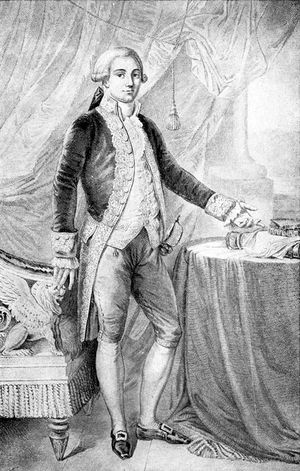
From the collection of W. C. Crane. Engraved by Huot.
Charles Bonaparte,
Father of the Emperor Napoleon,
1785.
Painted by Girodet.
Four days later the Estates met at Versailles. What was passing in the
mind of the restless, bitter, disappointed Corsican is again plainly
revealed. A famous letter to Paoli, to which reference has already
been made, is dated June twelfth. It is a justification of his
cherished work as the only means open to a poor man, the slave of
circumstances, for summoning the French administration to
the bar of public opinion; viz., by comparing it with Paoli's. Willing
to face the consequences, the writer asks for documentary materials
and for moral support, ending with ardent assurances of devotion from
his family, his mother, and himself. But there is a ring of false coin
in many of its words and sentences. The "infamy" of those who betrayed
Corsica was the infamy of his own father; the "devotion" of the
Buonaparte family had been to the French interest, in order to secure
free education, with support for their children, in France. The
"enthusiasm" of Napoleon was a cold, unsentimental determination to
push their fortunes, which, with opposite principles, would have been
honorable enough. In later years Lucien said that he had made two
copies of the history. It was probably one of these which has been
preserved. Whether or not Paoli read the book does not appear. Be that
as it may, his reply to Buonaparte's letter, written some months
later, was not calculated to encourage the would-be historian. Without
absolutely refusing the documents asked for by the aspiring writer, he
explained that he had no time to search for them, and that, besides,
Corsican history was only important in any sense by reason of the men
who had made it, not by reason of its achievements. Among other bits
of fatherly counsel was this: "You are too young to write history.
Make ready for such an enterprise slowly. Patiently collect your
anecdotes and facts. Accept the opinions of other writers with
reserve." As if to soften the severity of his advice, there follows a
strain of modest self-depreciation: "Would that others had known less
of me and I more of myself. Probe diu vivimus; may our descendants
so live that they shall speak of me merely as one who had good
intentions."
Buonaparte's last shift in the treatment of his book was
most undignified and petty. With the unprincipled resentment of
despair, in want of money, not of advice, he entirely remodeled it for
the third time, its chapters being now put as fragmentary traditions
into the mouth of a Corsican mountaineer. In this form it was
dedicated to Necker, the famous Swiss, who as French minister of
finance was vainly struggling with the problem of how to distribute
taxation equally, and to collect from the privileged classes their
share. A copy was first sent to a former teacher for criticism. His
judgment was extremely severe both as to expression and style. In
particular, attention was called to the disadvantage of indulging in
so much rhetoric for the benefit of an overworked public servant like
Necker, and to the inappropriateness of putting his own metaphysical
generalizations and captious criticism of French royalty into the
mouth of a peasant mountaineer. Before the correspondence ended,
Napoleon's student life was over. Necker had fled, the French
Revolution was rushing on with ever-increasing speed, and the young
adventurer, despairing of success as a writer, seized the proffered
opening to become a man of action. In a letter dated January twelfth,
1789, and written at Auxonne to his mother, the young officer gives a
dreary account of himself. The swamps of the neighborhood and their
malarious exhalations rendered the place, he thought, utterly
unwholesome. At all events, he had contracted a low fever which
undermined his strength and depressed his spirits. There was no
immediate hope of a favorable response to the petition for the moneys
due on the mulberry plantation because "this unhappy period in French
finance delays furiously (sic) the discussion of our affair. Let us
hope, however, that we may be compensated for our long and weary
waiting and that we shall receive complete restitution." He
writes further a terse sketch of public affairs in France and Europe,
speaks despairingly of what the council of war has in store for the
engineers by the proposed reorganization, and closes with tender
remembrances to Joseph and Lucien, begging for news and reminding them
that he had received no home letter since the preceding October. The
reader feels that matters have come to a climax and that the scholar
is soon to enter the arena of revolutionary activity. Curiously
enough, the language used is French; this is probably due to the fact
that it was intended for the family, rather than for the neighborhood
circle.[Back to Contents]
The French Aristocracy — Priests, Lawyers, and Petty Nobles
— Burghers, Artisans, and Laborers — Intelligent Curiosity
of the Nation — Exasperating Anachronisms — Contrast of
Demand and Resources — The Great Nobles a Barrier to Reform
— Mistakes of the King — The Estates Meet at Versailles —
The Court Party Provokes Violence — Downfall of Feudal
Privilege.
1787-89.
At last the ideas of the century had declared open war on its
institutions; their moral conquest was already coextensive with
central and western Europe, but the first efforts toward their
realization were to be made in France, for the reason that the line of
least resistance was to be found not through the most downtrodden, but
through the freest and the best instructed nation on the Continent.
Both the clergy and the nobility of France had become accustomed to
the absorption in the crown of their ancient feudal power. They were
content with the great offices in the church, in the army, and in the
civil administration, with exemption from the payment of taxes; they
were happy in the delights of literature and the fine arts, in the
joys of a polite, self-indulgent, and spendthrift society, so
artificial and conventional that for most of its members a sufficient
occupation was found in the study and exposition of its trivial but
complex customs. The conduct and maintenance of a salon, the stage,
gallantry; clothes, table manners, the use of the fan: these are
specimens of what were considered not the incidents but the essentials
of life.
The serious-minded among the upper classes were as
enlightened as any of their rank elsewhere. They were familiar with
prevalent philosophies, and full of compassion for miseries which, for
lack of power, they could not remedy, and which, to their dismay, they
only intensified in their attempts at alleviation. They were even
ready for considerable sacrifices. The gracious side of the character
of Louis XVI is but a reflection of the piety, moderation, and
earnestness of many of the nobles. His rule was mild; there were no
excessive indignities practised in the name of royal power except in
cases like that of the "Bargain of Famine," where he believed himself
helpless. The lower clergy, as a whole, were faithful in the
performance of their duties. This was not true of the hierarchy. They
were great landowners, and their interests coincided with those of the
upper nobility. The doubt of the country had not left them untouched,
and there were many without conviction or principle, time-serving and
irreverent. The lawyers and other professional men were to be found,
for the most part, in Paris and in the towns. They had their
livelihood in the irregularities of society, and, as a class, were
retentive of ancient custom and present social habits. Although by
birth they belonged in the main to the third estate, they were in
reality adjunct to the first, and consequently, being integral members
of neither, formed a strong independent class by themselves. The petty
nobles were in much the same condition with regard to the wealthy,
powerful families in their own estate and to the rich burghers; they
married the fortunes of the latter and accepted their hospitality, but
otherwise treated them with the same exclusive condescension as that
displayed to themselves by the great.
But if the estate of the clergy and the estate of the nobility were
alike divided in character and interests, this was still
more true of the burghers. In 1614, at the close of the middle ages,
the third estate had been little concerned with the agricultural
laborer. For various reasons this class had been gradually emancipated
until now there was less serfage in France than elsewhere; more than a
quarter, perhaps a third, of the land was in the hands of peasants and
other small proprietors. This, to be sure, was economically
disastrous, for over-division of land makes tillage unprofitable, and
these very men were the taxpayers. The change had been still more
marked in the denizens of towns. During the last two centuries the
wealthy burgesses had grown still more wealthy in the expansion of
trade, commerce, and manufactures; many had struggled and bought their
way into the ranks of the nobility. The small tradesmen had remained
smug, hard to move, and resentful of change. But there was a large
body of men unknown to previous constitutions, and growing ever larger
with the increase in population—intelligent and unintelligent
artisans, half-educated employees in workshops, mills, and
trading-houses, ever recruited from the country population, seeking
such intermittent occupation as the towns afforded. The very lowest
stratum of this society was then, as now, most dangerous; idle,
dissipated, and unscrupulous, they were yet sufficiently educated to
discuss and disseminate perilous doctrines, and were often most ready
in speech and fertile in resource.
This comparative well-being of a nation, devoted like the ancient
Greeks to novelty, avid of great ideas and great deeds, holding
opinions not merely for the pleasure of intellectual gymnastics but
logically and with a view to their realization, sensitive to
influences like the deep impressions made on their thinkers by the
English and American revolutions—such relative comfort with its
attendant opportunities for discussion was not the least of
many causes which made France the vanguard in the great revolution
which had already triumphed in theory throughout the continent and was
eventually to transform the social order of all Europe.
Discussion is not only a safety-valve, it is absolutely essential in
governments where the religion, morals, opinions, and occupations of
the people give form and character to institutions and legislation.
The centralized and despotic Bourbon monarchy of France was an
anachronism among an intelligent people. So was every institution
emanating from and dependent upon it. It was impossible for the
structure to stand indefinitely, however tenderly it was treated,
however cleverly it was propped and repaired. As in the case of
England in 1688 and of her colonies in 1772, the immediate and direct
agency in the crash was a matter of money. But the analogy holds good
no further, for in France the questions of property and taxation were
vastly more complex than in England, where the march of events had so
largely destroyed feudalism, or in America, where feudalism had never
existed. On the great French estates the laborers had first to support
the proprietor and his representatives, then the Church and the King;
the minute remainder of their gains was scarcely sufficient to keep
the wolf from the door. The small proprietors were so hampered in
their operations by the tiny size of their holdings that they were
still restricted to ancient and wretched methods of cultivation; but
they too were so burdened with contributions direct and indirect that
famine was always imminent with them as well. Under whatever name the
tax was known, license (octroi), bridge and ferry toll, road-work,
salt-tax, or whatever it may have been, it was chiefly distasteful not
because of its form but because it was oppressive. Some of
it was paid to the proprietors, some to the state. The former was more
hateful because the gainer was near and more tangible; the hatred of
the country people for the feudal privileges and those who held them
was therefore concrete and quite as intense as the more doctrinaire
dislike of the poor in the towns to the rich. Such was the alienation
of classes from each other throughout the beginning and middle of the
century that the disasters which French arms suffered at the hands of
Marlborough and Frederick, so far from humiliating the nation, gave
pleasure and not pain to the masses because they were, as they
thought, defeats not of France, but of the nobility and of the crown.
Feudal dues had arisen when those imposing them had the physical force
to compel their payment and were also the proprietors of the land on
which they were exacted. Now the nobility were entirely stripped of
power and in many instances of land as well. How empty and bottomless
the oppressive institutions and how burdensome the taxes which rested
on nothing but a paper grant, musty with age and backed only by royal
complaisance! Want too was always looking in at the doors of the many,
while the few were enjoying the national substance. This year there
was a crisis, for before the previous harvest time devastating
hail-storms had swept the fields, in 1788; during the winter there had
been pinching want and many had perished from destitution and cold;
the advancing seasons had brought warmth, but sufficient time had not
even yet elapsed for fields and herds to bring forth their increase,
and by the myriad firesides of the people hunger was still an
unwelcome guest.
With wholesome economy such crises may be surmounted in a rich and
fertile country. But economy had not been practised for fifty years by
the governing classes. As early as 1739 there had been a
deficiency in the French finances. From small beginnings the annual
loans had grown until, in 1787, the sum to be raised over and above
the regular income was no less than thirty-two millions of dollars.
This was all due to the extravagance of the court and the aristocracy,
who spent, for the most part, far more than the amount they actually
collected and which they honestly believed to be their income. Such a
course was vastly more disastrous than it appeared, being ruinous not
only to personal but to national well-being, inasmuch as what the
nobles, even the earnest and honest ones, believed to be their
legitimate income was not really such. Two thirds of the land was in
their hands; the other third paid the entire land-tax. They were
therefore regarding as their own two thirds of what was in reality
taken altogether from the pockets of the small proprietors. Small
sacrifices the ruling class professed itself ready to make, but such a
one as to pay their share of the land-tax—never. It had been proposed
also to destroy the monopoly of the grain trade, and to abolish the
road-work, a task more hateful to the people than any tax, because it
brought them into direct contact with the exasperating
superciliousness of petty officials. But in all these proposed
reforms, Necker, Calonne, and Loménie de Brienne, each approaching the
nobles from a separate standpoint, had alike failed. The nobility
could see in such retrenchment and change nothing but ruin for
themselves. An assembly of notables, called in 1781, would not listen
to propositions which seemed suicidal. The King began to alienate the
affection of his natural allies, the people, by yielding to the clamor
of the court party. From the nobility he could wring nothing. The
royal treasury was therefore actually bankrupt, the nobles believed
that they were threatened with bankruptcy, and the people
knew that they themselves were not only bankrupt, but also hungry and
oppressed.
At last the King, aware of the nation's extremity, began to undertake
reforms without reference to class prejudice, and on his own
authority. He decreed a stamp-tax, and the equal distribution of the
land-tax. He strove to compel the unwilling parliament of Paris, a
court of justice which, though ancient, he himself had but recently
reconstituted, to register his decrees, and then banished it from the
capital because it would not. That court had been the last remaining
check on absolutism in the country, and, as such, an ally of the
people; so that although the motives and the measures of Louis were
just, the high-handed means to which he resorted in order to carry
them alienated him still further from the affections of the nation.
The parliament, in justifying its opposition, had declared that taxes
in France could be laid only by the Estates-General. The people had
almost forgotten the very name, and were entirely ignorant of what
that body was, vaguely supposing that, like the English Parliament or
the American Congress, it was in some sense a legislative assembly.
They therefore made their voice heard in no uncertain sound, demanding
that the Estates should meet. Louis abandoned his attitude of
independence, and recalled the Paris parliament from Troyes, but only
to exasperate its members still further by insisting on a huge loan,
on the restoration of civil rights to the Protestants, and on
restricting, not only its powers, but those of all similar courts
throughout the realm. The parliament then declared that France was a
limited monarchy with constitutional checks on the power of the crown,
and exasperated men flocked to the city to remonstrate against the
menace to their liberties in the degradation of all the parliaments by
the King's action in regard to that of Paris. Those from
Brittany formed an association, which soon admitted other members, and
developed into the notorious Jacobin Club, so called from its
meeting-place, a convent on the Rue St. Honoré, once occupied by
Dominican monks who had moved thither from the Rue St. Jacques.
To summon the Estates was a virtual confession that absolutism in
France was at an end. In the seventeenth century the three estates
deliberated separately. Such matters came before them as were
submitted by the crown, chiefly demands for revenue. A decision was
reached by the agreement of any two of the three, and whatever
proposition the crown submitted was either accepted or rejected. There
was no real legislation. Louis no doubt hoped that the
eighteenth-century assembly would be like that of the seventeenth. He
could then, by the coalition of the nobles and the clergy against the
burghers, or by any other arrangement of two to one, secure
authorization either for his loans or for his reforms, as the case
might be, and so carry both. But the France of 1789 was not the France
of 1614. As soon as the call for the meeting was issued, and the
decisive steps were taken, the whole country was flooded with
pamphlets. Most of them were ephemeral; one was epochal. In it the
Abbé Sieyès asked the question, "What is the third estate?" and
answered so as to strengthen the already spreading conviction that the
people of France were really the nation. The King was so far convinced
as to agree that the third estate should be represented by delegates
equal in number to those of the clergy and nobles combined. The
elections passed quietly, and on May fifth, 1789, the Estates met at
Versailles, under the shadow of the court. It was immediately evident
that the hands of the clock could not be put back two centuries, and
that here was gathered an assembly unlike any that had ever
met in the country, determined to express the sentiments, and to be
the executive, of the masses who in their opinion constituted the
nation. On June seventeenth, therefore, after long talk and much
hesitation, the representatives of the third estate declared
themselves the representatives of the whole nation, and invited their
colleagues of the clergy and nobles to join them. Their meeting-place
having been closed in consequence of this decision, they gathered
without authorization in the royal tennis-court on June twentieth, and
bound themselves by oath not to disperse until they had introduced a
new order. Louis was nevertheless nearly successful in his plan of
keeping the sittings of the three estates separate. He was thwarted by
the eloquence and courage of Mirabeau. On June twenty-seventh a
majority of the delegates from the two upper estates joined those of
the third estate in constituting a national assembly.
At this juncture the court party began the disastrous policy which in
the end was responsible for most of the terrible excesses of the
French Revolution, by insisting that troops should be called to
restrain the Assembly, and that Necker should be banished. Louis
showed the same vacillating spirit now that he had displayed in
yielding to the Assembly, and assented. The noble officers had lately
shown themselves untrustworthy, and the men in the ranks refused to
obey when called to fight against the people. The baser social
elements of the whole country had long since swarmed to the capital.
Their leaders now fanned the flame of popular discontent until at last
resort was had to violence. On July twelfth the barriers of Paris were
burned, and the regular troops were defeated by the mob in the Place
Vendôme; on July fourteenth the Bastille, in itself a
harmless anachronism, but considered by the masses to typify all the
tyrannical shifts and inhuman oppressions known to despotism, was
razed to the ground. As if to crown their baseness, the extreme
conservatives among the nobles, the very men who had brought the King
to such straits, now abandoned him and fled.
Louis finally bowed to the storm, and came to reside among his people
in Paris, as a sign of submission. Bailly, an excellent and judicious
man, was made mayor of the city, and Lafayette, with his American
laurels still unfaded, was made commander of a newly organized force,
to be known as the National Guard. On July seventeenth the King
accepted the red, white, and blue—the recognized colors of
liberty—as national. The insignia of a dynasty were exchanged for the
badge of a principle. A similar transformation took place throughout
the land, and administration everywhere passed quietly into the hands
of the popular representatives. The flying nobles found their châteaux
hotter than Paris. Not only must the old feudal privileges go, but
with them the old feudal grants, the charters of oppression in the
muniment chests. These charters the peasants insisted must be
destroyed. If they could not otherwise gain possession of them, they
resorted to violence, and sometimes in the intoxication of the hour
they exceeded the bounds of reason, abusing both the persons and the
legitimate property of their enemies. Death or surrender was often the
alternative. So it was that there was no refuge on their estates, not
even a temporary one, for those who had so long possessed them. Many
had already passed into foreign lands; the emigration increased, and
continued in a steady stream. The moderate nobles, honest patriots to
whom life in exile was not life at all, now clearly saw that their
order must yield: in the night session of August fourth, sometimes
called the "St. Bartholomew of privilege," they surrendered
their privileges in a mass. Every vestige, not only of feudal, but
also of chartered privilege, was to be swept away; even the King's
hunting-grounds were to be reduced to the dimensions permitted to a
private gentleman. All men alike, it was agreed, were to renounce the
conventional and arbitrary distinctions which had created inequality
in civil and political life, and accept the absolute equality of
citizenship. Liberty and fraternity were the two springers of the new
arch; its keystone was to be equality. On August twenty-third the
Assembly decreed freedom of religious opinion; on the next day freedom
of the press.[Back to Contents]
Napoleon's Studies Continued at Auxonne — Another Illness
and a Furlough — His Scheme of Corsican Liberation — His
Appearance at Twenty — His Attainments and Character — His
Shifty Conduct — The Homeward Journey — New Parties in
Corsica — Salicetti and the Nationalists — Napoleon
Becomes a Political Agitator and Leader of the Radicals —
The National Assembly Incorporates Corsica with France and
Grants Amnesty to Paoli — Momentary Joy of the Corsican
Patriots — The French Assembly Ridicules Genoa's Protest —
Napoleon's Plan for Corsican Administration.
1789-90.
Such were the events taking place in the great world while Buonaparte
was at Auxonne. That town, as had been expected, was most uneasy, and
on July nineteenth, 1789, there was an actual outbreak of violence,
directed there, as elsewhere, against the tax-receivers. The riot was
easily suppressed, and for some weeks yet, the regular round of
studious monotony in the young lieutenant's life was not disturbed
except as his poverty made his asceticism more rigorous. "I have no
other resource but work," he wrote to his mother; "I dress but once in
eight days [Sunday parade?]; I sleep but little since my illness; it
is incredible. I retire at ten, and rise at four in the morning. I
take but one meal a day, at three; that is good for my health."
More bad news came from Corsica. The starving patriot fell seriously
ill, and for a time his life hung in the balance. On August eighth he
was at last sufficiently restored to travel, and applied for a
six-months' furlough, to begin immediately. Under the regulations, in
spite of his previous leaves and irregularities, he was this
year entitled to such a vacation, but not before October. His plea
that the winter was unfavorable for the voyage to Corsica was
characteristic, for it was neither altogether true nor altogether
false. He was feverish and ill, excited by news of turmoils at home,
and wished to be on the scene of action; this would have been a true
and sufficient ground for his request. It was likewise true, however,
that his chance for a smooth passage was better in August than in
October, and this evident fact, though probably irrelevant, might move
the authorities. Their answer was favorable, and on September
sixteenth he left Auxonne.
In the interval occurred a mutiny in the regiment. The pay of the men
was far in arrears, and they demanded a division of the surplus which
had accumulated from the various regimental grants, and which was
managed by the officers for the benefit of their own mess. The
officers were compelled to yield, so far had revolutionary license
supplanted royal and military authority. Of course a general orgy
followed. It seems to have been during these days that the scheme of
Corsican liberation which brought him finally into the field of
politics took shape in Napoleon's mind. Fesch had returned to Corsica,
and had long kept his nephew thoroughly informed of the situation. By
the anarchy prevailing all about him in France, and beginning to
prevail in Corsica, his eyes were opened to the possibilities of the
Revolution for one who knew how to take advantage of the changed
order.
The appearance of Buonaparte in his twentieth year was not in general
noteworthy. His head was shapely, but not uncommon in size, although
disproportionate to the frame which bore it. His forehead was wide and
of medium height; on each side long chestnut hair—lanky as
we may suppose from his own account of his personal habits—fell in
stiff, flat locks over his lean cheeks. His eyes were large, and in
their steel-blue irises, lurking under deep-arched and projecting
brows, was a penetrating quality which veiled the mind within. The
nose was straight and shapely, the mouth large, the lips full and
sensuous, although the powerful projecting chin diminished somewhat
the true effect of the lower one. His complexion was sallow. The frame
of his body was in general small and fine, particularly his hands and
feet; but his deep chest and short neck were huge. This lack of
proportion did not, however, interfere with his gait, which was firm
and steady. The student of character would have declared the stripling
to be self-reliant and secretive; ambitious and calculating;
masterful, but kindly. In an age when phrenology was a mania, its
masters found in his cranium the organs of what they called
imagination and causality, of individuality, comparison, and
locality—by which jargon they meant to say that he had a strong power
of imaging and of inductive reasoning, a knowledge of men, of places,
and of things.
The life of the young officer had thus far been so commonplace as to
awaken little expectation for his future. Poor as he was, and careful
of his slim resources, he had, like the men of his class, indulged his
passions to a certain degree; but he had not been riotous in his
living, and he had so far not a debt in the world. What his education
and reading were makes clear that he could have known nothing with a
scholar's comprehensive thoroughness except the essentials of his
profession. But he could master details as no man before or since; he
had a vast fund of information, and a historic outline drawn in fair
proportion and powerful strokes. His philosophy was meager, but he
knew the principles of Rousseau and Raynal thoroughly. His
conception of politics and men was not scientific, but it was clear
and practical. The trade of arms had not been to his taste. He
heartily disliked routine, and despised the petty duties of his rank.
His profession, however, was a means to an end; of any mastery of
strategy or tactics or even interest in them he had as yet given no
sign, but he was absorbed in contemplating and analyzing the exploits
of the great world-conquerors. In particular his mind was dazzled by
the splendors of the Orient as the only field on which an Alexander
could have displayed himself, and he knew what but a few great minds
have grasped, that the interchange of relations between the East and
the West had been the life of the world. The greatness of England he
understood to be largely due to her bestriding the two hemispheres.
Up to this moment he had been a theorist, and might have wasted his
fine powers by further indulgence in dazzling generalizations, as so
many boys do when not called to test their hypotheses by experience.
Henceforward he was removed from this temptation. A plan for an
elective council in Corsica to replace that of the nobles, and for a
local militia, having been matured, he was a cautious and practical
experimenter from the moment he left Auxonne. Thus far he had put into
practice none of his fine thoughts, nor the lessons learned in books.
The family destitution had made him a solicitor of favors, and, but
for the turn in public affairs, he might have continued to be one. His
own inclinations had made him both a good student and a poor officer;
without a field for larger duties, he might have remained as he was.
In Corsica his line of conduct was not changed abruptly: the
possibilities of greater things dawning gradually, the application of
great conceptions already formed, came with the march of
events, not like the sun bursting out from behind a cloud.
Traveling by way of Aix, Napoleon took the unlucky Lucien with him.
This wayward but independent younger brother, making no allowance, as
he tells us in his published memoirs, for the disdain an older boy at
school is supposed to feel for a younger one, blood relative or not,
had been repelled by the cold reception his senior had given him at
Brienne. Having left that school against the advice of the same
would-be mentor, his suit for admission to Aix had been fruitless.
Necessity was driving him homeward, and the two who in after days were
again to be separated were now, for almost the only time in their
lives, companions for a considerable period. Their intercourse made
them no more harmonious in feeling. The only incident of the journey
was a visit to the Abbé Raynal at Marseilles. We would gladly know
something of the talk between the master and the pupil, but we do not.
Napoleon found no change in the circumstances of the Buonaparte
family. The old archdeacon was still living, and for the moment all
except Elisa were at home. On the whole, they were more needy than
ever. The death of their patron, Marbeuf, had been followed by the
final rejection of their long-urged suit, and this fact, combined with
the political opinions of the elder Lucien, was beginning to wean them
from the official clique. There were the same factions as before—the
official party and the patriots. Since the death of Charles de
Buonaparte, the former had been represented at Versailles by
Buttafuoco, Choiseul's unworthy instrument in acquiring the island,
and now, as then, an uninfluential and consequential self-seeker. Its
members were all aristocrats and royalist in politics. The higher
priesthood were of similar mind, and had chosen the Abbé
Peretti to represent them; the parish priests, as in France, were with
the people. Both the higher classes were comparatively small; in spite
of twenty years of peace under French rule, they were both excessively
unpopular, and utterly without any hold on the islanders. They had but
one partizan with an influential name, a son of the old-time patriot
Gaffori, the father-in-law of Buttafuoco. The overwhelming majority of
the natives were little changed in their temper. There were the old,
unswerving patriots who wanted absolute independence, and were now
called Paolists; there were the self-styled patriots, the younger men,
who wanted a protectorate that they might enjoy virtual independence
and secure a career by peace. There was in the harbor towns on the
eastern slope the same submissive, peace-loving temper as of old; in
the west the same fiery, warlike spirit. Corte was the center of
Paoli's power, Calvi was the seat of French influence, Bastia was
radical, Ajaccio was about equally divided between the younger and
older parties, with a strong infusion of official influence.
Both the representatives of the people in the national convention were
of the moderate party; one of them, Salicetti, was a man of ability, a
friend of the Buonapartes, and destined later to influence deeply the
course of their affairs. He and his colleague Colonna were urging on
the National Assembly measures for the local administration of the
island. To this faction, as to the other, it had become clear that if
Corsica was to reap the benefits of the new era it must be by union
under Paoli. All, old and young alike, desired a thorough reform of
their barbarous jurisprudence, and, like all other French subjects, a
free press, free trade, the abolition of all privilege, equality in
taxation, eligibility to office without regard to rank, and the
diminution of monastic revenues for the benefit of
education. Nowhere could such changes be more easily made than in a
land just emerging from barbarism, where old institutions were
disappearing and new ones were still fluid. Paoli himself had come to
believe that independence could more easily be secured from a
regenerated France, and with her help, than by a warfare which might
again arouse the ambition of Genoa.
Buonaparte's natural associates were the younger men—Masseria, son of
a patriot line; Pozzo di Borgo, Peraldi, Cuneo, Ramolini, and others
less influential. The only Corsican with French military training, he
was, in view of uncertainties and probabilities already on the
horizon, a person of considerable consequence. His contribution to the
schemes of the young patriots was significant: it consisted in a
proposal to form a body of local militia for the support of that
central committee which his friends so ardently desired. The plan was
promptly adopted by the associates, the radicals seeing in it a means
to put arms once more into the hands of the people, the others no
doubt having in mind the storming of the Bastille and the possibility
of similar movements in Ajaccio and elsewhere. Buonaparte, the only
trained officer among them, may have dreamed of abandoning the French
service, and of a supreme command in Corsica. Many of the people who
appeared well disposed toward France had from time to time received
permission from the authorities to carry arms, many carried them
secretly and without a license; but proportionately there were so few
in both classes that vigorous or successful armed resistance was in
most places impracticable. The attitude of the department of war at
Paris was regulated by Buttafuoco, and was of course hostile to the
insidious scheme of a local militia. The minister of war would do
nothing but submit the suggestion to the body against whose
influence it was aimed, the hated council of twelve nobles. The stupid
sarcasm of such a step was well-nigh criminal.
Under such instigation the flames of discontent broke out in Corsica.
Paoli's agents were again most active. In many towns the people rose
to attack the citadels or barracks, and to seize the authority. In
Ajaccio Napoleon de Buonaparte promptly asserted himself as the
natural leader. The already existing democratic club was rapidly
organized into the nucleus of a home guard, and recruited in numbers.
But there were none of Paoli's mountaineers to aid the unwarlike
burghers, as there had been in Bastia. Gaffori appeared on the scene,
but neither the magic of his name, the troops that accompanied him,
nor the adverse representations of the council, which he brought with
him, could allay the discontent. He therefore remained for three days
in seclusion, and then departed in secret. On the other hand, the
populace was intimidated, permitting without resistance the rooms of
the club to be closed by the troops, and the town to be put under
martial law. Nothing remained for the agitators but to protest and
disperse. They held a final meeting, therefore, on October
thirty-first, 1789, in one of the churches, and signed an appeal to
the National Assembly, to be presented by Salicetti and Colonna. It
had been written, and was read aloud, by Buonaparte, as he now signed
himself.[19] Some share in its composition was later claimed for
Joseph, but the fiery style, the numerous blunders in grammar and
spelling, the terse thought, and the concise form, are all
characteristic of Napoleon. The right of petition, the recital of
unjust acts, the illegal action of the council, the use of force, the
hollowness of the pretexts under which their request had
been refused, the demand that the troops be withdrawn and redress
granted—all these are crudely but forcibly presented. The document
presages revolution. Under a well-constituted and regular authority,
its writer and signatories would of course have been punished for
insubordination. Even as things were, an officer of the King was
running serious risks by his prominence in connection with it.
Discouraging as was the outcome of this movement in Ajaccio, similar
agitations elsewhere were more successful. The men of Isola Rossa,
under Arena, who had just returned from a consultation with Paoli in
England, were entirely successful in seizing the supreme authority; so
were those of Bastia, under Murati, a devoted friend of Paoli. One
untrustworthy authority, a personal enemy of Buonaparte, declares that
the latter, thwarted in his own town, at once went over to Bastia,
then the residence of General de Barrin, the French royalist governor,
and successfully directed the revolt in that place, but there is no
corroborative evidence to this doubtful story.
Simultaneously with these events the National Assembly had been
debating how the position of the King under the new constitution was
to be expressed by his title. Absolutism being ended, he could no
longer be king of France, a style which to men then living implied
ownership. King of the French was selected as the new form; should
they add "and of Navarre"? Salicetti, with consummate diplomacy, had
already warned many of his fellow-delegates of the danger lest England
should intervene in Corsica, and France lose one of her best
recruiting-grounds. To his compatriots he set forth that France was
the best protector, whether they desired partial or complete
independence. He now suggested that if the Assembly thus
recognized the separate identity of the Pyrenean people, they must
supplement their phrase still further by the words "and of Corsica";
for it had been only nominally, and as a pledge, that Genoa in 1768
had put France in control. At this stage of the debate, Volney
presented a number of formal demands from the Corsican patriots asking
that the position of their country be defined. One of these papers
certainly came from Bastia; among them also was probably the document
which had been executed at Ajaccio. This was the culmination of the
skilful revolutionary agitation which had been started and directed by
Masseria under Paoli's guidance. The anomalous position of both
Corsica and Navarre was clearly depicted in the mere presentation of
such petitions. "If the Navarrese are not French, what have we to do
with them, or they with us?" said Mirabeau. The argument was as
unanswerable for one land as for the other, and both were incorporated
in the realm: Corsica on November thirtieth, by a proposition of
Salicetti's, who was apparently unwilling, but who posed as one under
imperative necessity. In reality he had reached the goal for which he
had long been striving. Dumouriez, later so renowned as a general, and
Mirabeau, the great statesman and orator, had both been members of the
French army of occupation which reduced Corsica to submission. The
latter now recalled his misdeed with sorrow and shame in an
impassioned plea for amnesty to all political offenders, including
Paoli. There was bitter opposition, but the great orator prevailed.
The news was received in Corsica with every manifestation of joy;
bonfires were lighted, and Te Deums were sung in the churches. Paoli
to rejoin his own again! What more could disinterested patriots
desire? Corsica a province of France! How could her aspiring
youth secure a wider field for the exercise of their powers, and the
attainment of ambitious ends? The desires of both parties were
temporarily fulfilled. The names of Mirabeau, Salicetti, and Volney
were shouted with acclaim, those of Buttafuoco and Peretti with
reprobation. The regular troops were withdrawn from Ajaccio; the
ascendancy of the liberals was complete.
Then feeble Genoa was heard once more. She had pledged the
sovereignty, not sold it; had yielded its exercise, and not the thing
itself; France might administer the government as she chose, but
annexation was another matter. She appealed to the fairness of the
King and the National Assembly to safeguard her treaty rights. Her
tone was querulous, her words without force. In the Assembly the
protest was but fuel to the fire. On January twenty-first, 1790,
occurred an animated debate in which the matter was fully considered.
The discussion was notable, as indicating the temper of parties and
the nature of their action at that stage of the Revolution. Mirabeau
as ever was the leader. He and his friends were scornful not only
because of Genoa's temerity in seeming still to claim what France had
conquered, but of her conception that mere paper contracts were
binding where principles of public law were concerned! The opposition
mildly but firmly recalled the existence of other nations than France,
and suggested the consequences of international bad faith. The
conclusion of the matter was the adoption of a cunning and insolent
combination of two propositions, one made by each side, "to lay the
request on the table, or to explain that there is no occasion for its
consideration." The incident is otherwise important only in the light
of Napoleon's future dealings with the Italian commonwealth.
The situation was now most delicate, as far as Buonaparte was
concerned. His suggestion of a local militia contemplated the
extension of the revolutionary movement to Corsica. His appeal to the
National Assembly demanded merely the right to do what one French city
or district after another had done: to establish local authority, to
form a National Guard, and to unfurl the red, white, and blue. There
was nothing in it about the incorporation of Corsica in France; that
had come to pass through the insurgents of Bastia, who had been
organized by Paoli, inspired by the attempt at Ajaccio, and guided at
last by Salicetti. A little later Buonaparte took pains to set forth
how much better, under his plan, would have been the situation of
Corsican affairs if, with their guard organized and their colors
mounted, they could have recalled Paoli, and have awaited the event
with power either to reject such propositions as the royalists, if
successful, would have made, or to accept the conclusions of the
French Assembly with proper self-respect, and not on compulsion.
Hitherto he had lost no opportunity to express his hatred of France;
it is possible that he had planned the virtual independence of
Corsica, with himself as the liberator, or at least as Paoli's
Sampiero. The reservations of his Ajaccio document, and the bitterness
of his feelings, are not, however, sufficient proof of such a
presumption. But the incorporation had taken place, Corsica was a
portion of France, and everybody was wild with delight.[Back to Contents]
French Soldier and Corsican Patriot — Paoli's Hesitancy —
His Return to Corsica — Cross-Purposes in France — A New
Furlough — Money Transactions of Napoleon and Joseph —
Open Hostilities Against France — Address to the French
Assembly — The Bastia Uprising — Reorganization of
Corsican Administration — Meeting of Napoleon and Paoli —
Corsican Politics — Studies in Society.
1790.
What was to be the future of one whose feelings were so hostile to the
nation with the fortunes of which he now seemed irrevocably
identified? There is no evidence that Buonaparte ever asked himself
such disquieting questions. To judge from his conduct, he was not in
the least troubled. Fully aware of the disorganization, both social
and military, which was well-nigh universal in France, with two months
more of his furlough yet unexpired, he awaited developments, not
hastening to meet difficulties before they presented themselves. What
the young democrats could do, they did. The town government was
entirely reorganized, with a friend of the Buonapartes as mayor, and
Joseph—employed at last!—as his secretary. A local guard was also
raised and equipped. Being French, however, and not Corsican, Napoleon
could not accept a command in it, for he was already an officer in the
French army. But he served in the ranks as a common soldier, and was
an ardent agitator in the club, which almost immediately reopened its
doors. In the impossibility of further action there was a relapse into
authorship. The history of Corsica was again revised, though
not softened; the letters into which it was divided were addressed to
Raynal. In collaboration with Fesch, Buonaparte also drew up a memoir
on the oath which was required from priests.
When Paoli first received news of the amnesty granted at the instance
of Mirabeau, and of the action taken by the French Assembly, which had
made Corsica a French department, he was delighted and deeply moved.
His noble instincts told him at once that he could no longer live in
the enjoyment of an English pension or even in England; for he was
convinced that his country would eventually reach a more perfect
autonomy under France than under the wing of any other power, and that
as a patriot he must not fail even in appearance to maintain that
position. But he also felt that his return to Corsica would endanger
the success of this policy; the ardent mountaineers would demand more
extreme measures for complete independence than he could take; the
lowlanders would be angry at the attitude of sympathy with his old
friends which he must assume. In a spirit of self-sacrifice,
therefore, he made ready to exchange his comfortable exile for one
more uncongenial and of course more bitter.
But the National Assembly, with less insight, desired nothing so much
as his presence in the new French department. He was growing old, and
yielded against his better judgment to the united solicitation of
French interest and of Corsican impolicy. Passing through France, he
was detained for over two months by the ovations forced upon him. In
Paris the King urged him to accept honors of every kind; but they were
firmly refused: the reception, however, which the Assembly gave him in
the name of liberty, he declared to be the proudest occasion of his
life. At Lyons the populace crowded the streets to cheer
him, and delegations from the chief towns of his native island met him
to solicit for each of their respective cities the honor of his
landing. On July fourteenth, 1790, after twenty-one years of exile,
the now aged hero set foot on Corsican land at Maginajo, near Capo
Corso. His first act was to kneel and kiss the soil. The nearest town
was Bastia, the revolutionary capital. There and elsewhere the
rejoicings were general, and the ceremonies were such as only the warm
hearts and willing hands of a primitive Italian people could devise
and perform. Not one true Corsican but must "see and hear and touch
him." But in less than a month his conduct was, as he had foreseen, so
misrepresented by friend and foe alike, that it was necessary to
defend him in Paris against the charge of scheming to hand over the
island to England.
It is not entirely clear where Buonaparte was during this time. It is
said that he was seen in Valence during the latter part of January,
and the fact is adduced to show how deep and secret were his plans for
preserving the double chance of an opening in either France or
Corsica, as matters might turn out. The love-affair to which he refers
in that thesis on the topic to which reference has been made would be
an equally satisfactory explanation, considering his age. Whatever was
the fact as to those few days, he was not absent long. The serious
division between the executive in France and the new Assembly came to
light in an ugly circumstance which occurred in March. On the
eighteenth a French flotilla unexpectedly appeared off St. Florent. It
was commanded by Rully, an ardent royalist, who had long been employed
in Corsica. His secret instructions were to embark the French troops,
and to leave the island to its fate. This was an adroit stab at the
republicans of the Assembly; for, should the evacuation be
secured, it was believed that either the radicals in Corsica would
rise, overpower, and destroy the friends of France, call in English
help, and diminish the number of democratic departments by one, or
that Genoa would immediately step in and reassert her sovereignty. The
moderates of St. Florent were not to be thus duped; sharp and angry
discussions arose among both citizens and troops as to the obedience
due to such orders, and soon both soldiers and townsfolk were in a
frenzy of excitement. A collision between the two parties occurred,
and Rully was killed. Papers were found on his person which proved
that his sympathizers would gladly have abandoned Corsica to its fate.
For the moment the young Corsicans were more devoted than ever to
Paoli, since now only through his good offices with the French
Assembly could a chance for the success of their plans be secured.
Such was the diversity of opinion as to ways and means, as to
resources, opportunities, and details, that everything was, for the
moment, in confusion. On April sixteenth Buonaparte applied for an
extension of his furlough until the following October, on the plea of
continued ill-health, that he might drink the waters a second time at
Orezza, whose springs, he explained, had shown themselves to be
efficacious in his complaint. He may have been at that resort once
before, or he may not. Doubtless the fever was still lingering in his
system. What the degree of his illness was we cannot tell. It may have
unfitted him for active service with his regiment; it did not disable
him from pursuing his occupations in writing and political agitation.
His request was granted on May twentieth. The history of Corsica was
now finally revised, and the new dedication completed. This, with a
letter and some chapters of the book, was forwarded to
Raynal, probably by post. Joseph, who was one of the delegates to meet
Paoli, would pass through Marseilles, wrote Napoleon to the abbé, and
would hand him the rest if he should so desire. The text of the
unlucky book was not materially altered. Its theory appears always to
have been that history is but a succession of great names, and the
story, therefore, is more a biographical record than a connected
narrative. The dedication, however, was a new step in the painful
progress of more accurate thinking and better expression; the
additions to the volume contained, amid many immaturities and
platitudes, some ripe and clever thought. Buonaparte's passion for his
bantling was once more the ardor of a misdirected genius unsullied by
the desire for money, which had played a temporary part.
We know nothing definite of his pecuniary affairs, but somehow or
other his fortunes must have mended. There is no other explanation of
his numerous and costly journeys, and we hear that for a time he had
money in his purse. In the will which he dictated at St. Helena is a
bequest of one hundred thousand francs to the children of his friend
who was the first mayor of Ajaccio by the popular will. It is not
unlikely that the legacy was a grateful souvenir of advances made
about this time. There is another possible explanation. The club of
Ajaccio had chosen a delegation, of which Joseph Buonaparte was a
member, to bring Paoli home from France. To meet its expenses, the
municipality had forced the authorities of the priests' seminary to
open their strong box and to hand over upward of two thousand francs.
Napoleon may have shared Joseph's portion. We should be reminded in
such a stroke, but with a difference, to be sure, of what happened
when, a few years later, the hungry and ragged soldiers of
the Republic were led into the fat plains of Lombardy.
The contemptuous attitude of the Ajaccio liberals toward the religion
of Rome seriously alienated the superstitious populace from them.
Buonaparte was once attacked in the public square by a procession
organized to deprecate the policy of the National Assembly with regard
to the ecclesiastical estates. One of the few royalist officials left
in Corsica also took advantage of the general disorder to express his
feelings plainly as to the acts of the same body. He was arrested,
tried in Ajaccio, and acquitted by a sympathetic judge. At once the
liberals took alarm; their club and the officials first protested, and
then on June twenty-fifth assumed the offensive in the name of the
Assembly. It was on this occasion probably that he was seen by the
family friend who narrated his memories to the English diarist already
mentioned. "I remember to have seen Napoleon very active among the
enraged populace against those then called aristocrats, and running
through the streets of Ajaccio so busy in promoting dissatisfaction
that, though he lost his hat, he did not feel nor care for the effects
of the scorching sun to which he was exposed the whole of that
memorable day. The revolution having struck its poisonous root,
Napoleon never ceased stirring up his brothers, Joseph and Lucien,
who, being moved at his instance, were constantly attending clubs and
popular meetings where they often delivered speeches and debated
public matters, while Napoleon sat listening in silence, as he had no
turn for oratory." "One day in December," the narrator continues, "I
was sent for by his uncle already mentioned, in order to assist him in
preparing his testament; and, after having settled his family
concerns, the conversation turned upon politics, when, speaking of the
improbability of Italy being revolutionized, Napoleon, then
present, quickly replied: 'Had I the command, I would take Italy in
twenty-four hours.'"[20]
At last the opportunity to emulate the French cities seemed assured.
It was determined to organize a local independent government, seize
the citadel with the help of the home guard, and throw the hated
royalists into prison. But the preparations were too open: the
governor and most of his friends fled in season to their stronghold,
and raised the drawbridge; the agitators could lay hands on but four
of their enemies, among whom were the judge, the offender, and an
officer of the garrison. So great was the disappointment of the
radicals that they would have vented their spite on these; it was with
difficulty that the lives of the prisoners were saved by the efforts
of the militia officers. The garrison really sympathized with the
insurgents, and would not obey orders to suppress the rising by an
attack. In return for this forbearance the regular soldiers stipulated
for the liberation of their officer. In the end the chief offenders
among the radicals were punished by imprisonment or banished, and the
tumult subsided; but the French officials now had strong support, not
only from the hierarchy, as before, but from the plain pious people
and their priests.
This result was a second defeat for Napoleon Buonaparte, who was
almost certainly the instigator and leader of the uprising. He had
been ready at any moment to assume the direction of affairs, but again
the outcome of such a movement as could alone secure a possible
temporary independence for Corsica and a military command for himself
was absolutely naught. Little perturbed by failure, he took up the pen
to write a proclamation justifying the action of the municipal
authorities. The paper was dated October thirty-first, 1789,
and fearlessly signed both by himself and the other leaders, including
the mayor. It execrates the sympathizers with the old order in France,
and lauds the Assembly, with all its works; denounces those who sold
the land to France, which could offer nothing but an end of the chain
that bound her; and warns the enemies of the new constitution that
their day is over. There is a longing reference to the ideal
self-determination which the previous attempt might have secured. The
present rising is justified, however, as an effort to carry out the
principles of the new charter.[21] There are the same suggested force
and suppressed fury as in his previous manifesto, the same fervid
rhetoric, the same lack of coherence in expression. The same two
elements, that of the eighteenth-century metaphysics and that of his
own uncultured force, combine in the composition. Naturally enough,
the unrest of the town was not diminished; there was even a slight
collision between the garrison and the civil authorities.
Buonaparte was of course suspected and hated by Catholics and military
alike. French officer though he was, no one in Corsica thought of him
otherwise than as a Corsican revolutionist. Among his own friends he
continued his unswerving career. It was he who was chosen to write the
address from Ajaccio to Paoli, although the two men did not meet until
somewhat later. With the arrival of the great liberator the grasp of
the old officials on the island relaxed, and the bluster of the few
who had grown rich in the royal service ceased. The Assembly was
finally triumphant; this new department was at last to be organized
like those of the adoptive mother. It was high time, for the public
order was seriously endangered in this transition period.
The disturbances at Ajaccio had been trifling compared with the
revolutionary procedure inaugurated and carried to extremes in Bastia.
This city being the capital and residence of the governor, Buonaparte
and his comrades had no sooner completed their address to the French
Assembly than they hurried thither to beard de Barrin and
revolutionize the garrison. Their success was complete: garrison and
citizens alike were roused and the governor cowed. Both soldiers and
people assumed the tricolor cockade on November fifth, 1789. Barrin
even assented to the formation of a national militia. On this basis
order was established. This was another affair from that at Ajaccio
and attracted the attention of the Paris Assembly, strongly
influencing the government in its arrangements with Paoli. The young
Buonaparte was naturally very uneasy as to his position and so
remained fairly quiet until February, when the incorporation of the
island with France was completed. Immediately he gave free vent to his
energies. Two letters of Napoleon's written in August, 1790, display a
feverish spirit of unrest in himself, and enumerate the many uprisings
in the neighborhood with their varying degrees of success. Under
provisional authority, arrangements were made, after some delay, to
hold elections for the officials of the new system whose legal
designation was directors. Their appointment and conduct would be
determinative of Corsica's future, and were therefore of the highest
importance.
In a pure democracy the voters assemble to deliberate and record their
decisions. Such were the local district meetings in Corsica. These
chose the representatives to the central constituent assembly, which
was to meet at Orezza on September ninth, 1790. Joseph Buonaparte and
Fesch were among the members sent from Ajaccio. The healing
waters which Napoleon wished to quaff at Orezza were the influence of
the debates. Although he could not be a member of the assembly on
account of his youth, he was determined to be present. The three
relatives traveled from their home in company, Joseph enchanted by the
scenery, Napoleon studying the strategic points on the way. In order
that his presence at Orezza might not unduly affect the course of
events, Paoli had delicately chosen as his temporary home the village
of Rostino, which was on their route. Here occurred the meeting
between the two great Corsicans, the man of ideas and the man of
action. No doubt Paoli was anxious to win a family so important and a
patriot so ardent. In any case, he invited the three young men to
accompany him over the fatal battle-ground of Ponte Nuovo. If it had
really been Napoleon's ambition to become the chief of the French
National Guard for Corsica, which would now, in all probability, be
fully organized, it is very likely that he would have exerted himself
to secure the favor of the only man who could fulfil his desire. There
is, however, a tradition which tends to show quite the contrary: it is
said that after Paoli had pointed out the disposition of his troops
for the fatal conflict Napoleon dryly remarked, "The result of these
arrangements was just what it was bound to be." Among the Emperor's
reminiscences at the close of his life, he recalled this meeting,
because Paoli had on that occasion declared him to be a man of ancient
mold, like one of Plutarch's heroes.
The constituent assembly at Orezza sat for a month. Its sessions
passed almost without any incident of importance except the first
appearance of Napoleon as an orator in various public meetings held in
connection with its labors. He is said to have been bashful
and embarrassed in his beginnings, but, inspirited by each occasion,
to have become more fluent, and finally to have won the attention and
applause of his hearers. What he said is not known, but he spoke in
Italian, and succeeded in his design of being at least a personage in
the pregnant events now occurring. Both parties were represented in
the proceedings and conclusions of the convention. Corsica was to
constitute but a single department. Paoli was elected president of its
directory and commander-in-chief of its National Guard, a combination
of offices which again made him virtual dictator. He accepted them
unwillingly, but the honors of a statue and an annual grant of ten
thousand dollars, which were voted at the same time, he absolutely
declined. The Paolist party secured the election of Canon Belce as
vice-president, of Panatheri as secretary, of Arena as Salicetti's
substitute, of Pozzo di Borgo and Gentili as members of the directory.
Colonna, one of the delegates to the National Assembly, was a member
of the same group. The younger patriots, or Young Corsica, as we
should say now, perhaps, were represented by their delegate and leader
Salicetti, who was chosen as plenipotentiary in Buttafuoco's place,
and by Multedo, Gentili, and Pompei as members of the directory. For
the moment, however, Paoli was Corsica, and such petty politics was
significant only as indicating the survival of counter-currents. There
was some dissent to a vote of censure passed upon the conduct of
Buttafuoco and Peretti, but it was insignificant. Pozzo di Borgo and
Gentili were chosen to declare at the bar of the National Assembly the
devotion of Corsica to its purposes, and to the course of reform as
represented by it. They were also to secure, if possible, both the
permission to form a departmental National Guard, and the means to pay
and arm it.
The choice of Pozzo di Borgo for a mission of such importance
in preference to Joseph was a disappointment to the Buonapartes. In
fact, not one of the plans concerted by the two brothers succeeded.
Joseph sustained the pretensions of Ajaccio to be capital of the
island, but the honor was awarded to Bastia. He was not elected a
member of the general directory, though he succeeded in being made a
member for Ajaccio in the district directory. Whether to work off his
ill humor, or from far-seeing purpose, Napoleon used the hours not
spent in wire-pulling and listening to the proceedings of the assembly
for making a series of excursions which were a virtual canvass of the
neighborhood. The houses of the poorest were his resort; partly by his
inborn power of pleasing, partly by diplomacy, he won their hearts and
learned their inmost feelings. His purse, which was for the moment
full, was open for their gratification in a way which moved them
deeply. For years target practice had been forbidden, as giving
dangerous skill in the use of arms. Liberty having returned, Napoleon
reorganized many of the old rural festivals in which contests of that
nature had been the chief feature, offering prizes from his own means
for the best marksmen among the youth. His success in feeling the
pulse of public opinion was so great that he never forgot the lesson.
Not long afterward, in the neighborhood of Valence,—in fact, to the
latest times,—he courted the society of the lowly, and established,
when possible, a certain intimacy with them. This gave him popularity,
while at the same time it enabled him to obtain the most valuable
indications of the general temper.[Back to Contents]
Literary Work — The Lyons Prize — Essay on Happiness —
Thwarted Ambition — The Corsican Patriots — The Brothers
Napoleon and Louis — Studies in Politics — Reorganization
of the Army — The Change in Public Opinion — A New Leave
of Absence — Napoleon Again at Auxonne — Napoleon as a
Teacher — Further Literary Efforts — The Sentimental
Journey — His Attitude Toward Religion.
1791.
On his return to Ajaccio, the rising agitator continued as before to
frequent his club. The action of the convention at Orezza in
displacing Buttafuoco had inflamed the young politicians still more
against the renegade. This effect was further heightened when it was
known that, at the reception of their delegates by the National
Assembly, the greater council had, under Mirabeau's leadership,
virtually taken the same position regarding both him and his
colleague. Napoleon had written, probably in the previous year, a
notorious diatribe against Buttafuoco in the form of a letter to its
object and the very night on which the news from Paris was received,
he seized the opportunity to read it before the club at Ajaccio. The
paper, as now in existence, is pompously dated January twenty-third,
1791, from "my summer house of Milleli." This was the retreat on one
of the little family properties, to which reference has been made.
There in the rocks was a grotto known familiarly by that name;
Napoleon had improved and beautified the spot, using it, as he did his
garden at Brienne, for contemplation and quiet study.
Although the letter to Matteo Buttafuoco has been often printed, and
was its author's first successful effort in writing, much emphasis
should not be laid on it except in noting the better power to express
tumultuous feeling, and in marking the implications which show an
expansion of character. Insubordinate to France it certainly is, and
intemperate; turgid, too, as any youth of twenty could well make it.
No doubt, also, it was intended to secure notoriety for the writer. It
makes clear the thorough apprehension its author had as to the radical
character of the Revolution. It is his final and public renunciation
of the royalist principles of Charles de Buonaparte. It contains also
the last profession of morality which a youth is not ashamed to make
before the cynicism of his own life becomes too evident for the
castigation of selfishness and insincerity in others. Its substance is
a just reproach to a selfish trimmer; the froth and scum are
characteristic rather of the time and the circumstances than of the
personality behind them. There is no further mention of a difference
between the destinies of France and Corsica. To compare the pamphlet
with even the poorest work of Rousseau, as has often been done, is
absurd; to vilify it as ineffective trash is equally so.
As may be imagined, the "Letter" was received with mad applause, and
ordered to be printed. It was now the close of January; Buonaparte's
leave had expired on October fifteenth. On November sixteenth, after
loitering a whole month beyond his time, he had secured a document
from the Ajaccio officials certifying that both he and Louis were
devoted to the new republican order, and bespeaking assistance for
both in any difficulties which might arise. The busy Corsican
perfectly understood that he might already at that time be regarded as
a deserter in France, but still he continued his dangerous
loitering. He had two objects in view, one literary, one political.
Besides the successful "Letter" he had been occupied with a second
composition, the notion of which had probably occupied him as his
purse grew leaner. The jury before which this was to be laid was to
be, however, not a heated body of young political agitators, but an
association of old and mature men with calm, critical minds—the Lyons
Academy. That society was finally about to award a prize of fifteen
hundred livres founded by Raynal long before—as early as 1780—for
the best thesis on the question: "Has the discovery of America been
useful or hurtful to the human race? If the former, how shall we best
preserve and increase the benefits? If the latter, how shall we remedy
the evils?" Americans must regret that the learned body had been
compelled for lack of interest in so concrete a subject to change the
theme, and now offered in its place the question: "What truths and
ideas should be inculcated in order best to promote the happiness of
mankind?"
Napoleon's astounding paper on this remarkable theme was finished in
December. It bears the marks of carelessness, haste, and
over-confidence in every direction—in style, in content, and in lack
of accuracy. "Illustrious Raynal," writes the author, "the question I
am about to discuss is worthy of your steel, but without assuming to
be metal of the same temper, I have taken courage, saying to myself
with Correggio, I, too, am a painter." Thereupon follows a long
encomium upon Paoli, whose principal merit is explained to have been
that he strove in his legislation to keep for every man a property
sufficient with moderate exertion on his own part for the sustenance
of life. Happiness consists in living conformably to the constitution
of our organization. Wealth is a misfortune, primogeniture a
relic of barbarism, celibacy a reprehensible practice. Our animal
nature demands food, shelter, clothing, and the companionship of
woman. These are the essentials of happiness; but for its perfection
we require both reason and sentiment. These theses are the tolerable
portions, being discussed with some coherence. But much of the essay
is mere meaningless rhetoric and bombast, which sounds like the
effusion of a boyish rhapsodist. "At the sound of your [reason's]
voice let the enemies of nature be still, and swallow their serpents'
tongues in rage." "The eyes of reason restrain mankind from the
precipice of the passions, as her decrees modify likewise the feeling
of their rights." Many other passages of equal absurdity could be
quoted, full of far-fetched metaphor, abounding in strange terms,
straining rhetorical figures to distortion.[22] And yet in spite of
the bombast, certain essential Napoleonic ideas appear in the paper
much as they endured to the end, namely, those on heredity, on the
equal division of property, and on the nature of civil society. And
there is one prophetic sentence which deserves to be quoted. "A
disordered imagination! there lies the cause and source of human
misfortune. It sends us wandering from sea to sea, from fancy to
fancy, and when at last it grows calm, opportunity has passed, the
hour strikes, and its possessor dies abhorring life." In later days
the author threw what he probably supposed was the only existing
manuscript of this vaporing effusion into the fire. But a copy of it
had been made at Lyons, perhaps because one of the judges thought, as
he said, that it "might have been written by a man otherwise gifted
with common sense." Another has been found among the papers
confided by Napoleon to Fesch. The proofs of authenticity are
complete. It seems miraculous that its writer should have become, as
he did, master of a concise and nervous style when once his words
became the complement of his deeds.
The second cause for Buonaparte's delay in returning to France on the
expiration of his furlough was his political and military ambition.
This was suddenly quenched by the receipt of news that the Assembly at
Paris would not create the longed-for National Guard, nor the ministry
lend itself to any plan for circumventing the law. It was, therefore,
evident that every chance of becoming Paoli's lieutenant was finally
gone. By the advice of the president himself, therefore, Buonaparte
determined to withdraw once more to France and to await results.
Corsica was still distracted. A French official sent by the war
department just at this time to report on its condition is not sparing
of the language he uses to denounce the independent feeling and
anti-French sympathies of the people. "The Italian," he says,
"acquiesces, but does not forgive; an ambitious man keeps no faith,
and estimates his life by his power." The agent further describes the
Corsicans as so accustomed to unrest by forty years of anarchy that
they would gladly seize the first occasion to throw off the domination
of laws which restrain the social disorder. The Buonaparte faction,
enumerated with the patriot brigand Zampaglini at their head, he calls
"despicable creatures," "ruined in reputation and credit."
It would be hard to find a higher compliment to Paoli and his friends,
considering the source from which these words emanated. They were all
poor and they were all in debt. Even now, in the age of reform, they
saw their most cherished plans thwarted by the presence in every town
of garrisons composed of officers and men who, though long
resident in the island, and attached to its people by many ties, were
nevertheless conservative in their feelings, and, by the instinct of
their tradition and discipline, devoted to the still powerful official
bureaus not yet destroyed by the Revolution. To replace these by a
well-organized and equipped National Guard was now the most ardent
wish of all patriots. There was nothing unworthy in Napoleon's longing
for a command under the much desired but ever elusive reconstitution
of a force organized and armed according to the model furnished by
France itself. Repeated disappointments like those he had suffered
before, and was experiencing again, would have crushed the spirit of a
common man.
But the young author had his manuscripts in his pocket; one of them he
had means and authority to publish. Perfectly aware, moreover, of the
disorganization in the nation and the army, careless of the order
fulminated on December second, 1790, against absent officers, which he
knew to be aimed especially at the young nobles who were deserting in
troops, with his spirit undaunted, and his brain full of resources, he
left Ajaccio on February first, 1791, having secured a new set of
certificates as to his patriotism and devotion to the cause of the
Revolution. Like the good son and the good brother which he had always
been, he was not forgetful of his family. Life at his home had not
become easier. Joseph, to be sure, had an office and a career, but the
younger children were becoming a source of expense, and Lucien would
not accept the provision which had been made for him. The next, now
ready to be educated and placed, was Louis, a boy already between
twelve and thirteen years old; accordingly Louis accompanied his
brother. Napoleon had no promise, not even an outlook, for the child;
but he determined to have him at hand in case anything
should turn up, and while waiting, to give him from his own slender
means whatever precarious education the times and circumstances could
afford. We can understand the untroubled confidence of the boy; we
must admire the trust, determination, and self-reliance of the elder
brother.
Though he had overrun his leave for three and a half months, there was
not only no severe punishment in store for Napoleon on his arrival at
Auxonne, but there was considerate regard, and, later, promotion.
Officers with military training and loyal to the Assembly were
becoming scarce. The brothers had traveled slowly, stopping first for
a short time at Marseilles, and then at Aix to visit friends,
wandering several days in a leisurely way through the parts of
Dauphiny round about Valence. Associating again with the country
people, and forming opinions as to the course of affairs, Buonaparte
reopened his correspondence with Fesch on February eighth from the
hamlet of Serve in order to acquaint him with the news and the
prospects of the country, describing in particular the formation of
patriotic societies by all the towns to act in concert for carrying
out the decrees of the Assembly.[23] This beginning of "federation for
the Revolution," as it was called, in its spread finally welded the
whole country, civil and even military authorities, together.
Napoleon's presence in the time and place of its beginning explains
much that followed. It was February thirteenth when he rejoined his
regiment.
Comparatively short as had been the time of Buonaparte's absence,
everything in France, even the army, had changed and was still
changing. Step by step the most wholesome reforms were introduced as
each in turn showed itself essential: promotion exclusively
according to service among the lower officers; the same, with room for
royal discretion, among the higher grades; division of the forces into
regulars, reserves, and national guards, the two former to be still
recruited by voluntary enlistment. The ancient and privileged
constabulary, and many other formerly existing but inefficient armed
bodies, were swept away, and the present system of gendarmerie was
created. The military courts, too, were reconstituted under an
impartial body of martial law. Simple numbers were substituted for the
titular distinctions hitherto used by the regiments, and a fair
schedule of pay, pensions, and military honors abolished all chance
for undue favoritism. The necessity of compulsory enlistment was urged
by a few with all the energy of powerful conviction, but the plan was
dismissed as despotic. The Assembly debated as to whether, under the
new system, king or people should wield the military power. They could
find no satisfactory solution, and finally adopted a weak compromise
which went far to destroy the power of Mirabeau, because carried
through by him. The entire work of the commission was temporarily
rendered worthless by these two essential defects—there was no way of
filling the ranks, no strong arm to direct the system.
The first year of trial, 1790, had given the disastrous proof. By this
time all monarchical and absolutist Europe was awakened against
France; only a mere handful of enthusiastic men in England and
America, still fewer elsewhere, were in sympathy with her efforts. The
stolid common sense of the rest saw only ruin ahead, and viewed
askance the idealism of her unreal subtleties. The French nobles,
sickened by the thought of reform, had continued their silly and
wicked flight; the neighboring powers, now preparing for an armed
resistance to the spread of the Revolution, were not slow to abet
them in their schemes. On every border agencies for the
encouragement of desertion were established, and by the opening of
1791 the effective fighting force of France was more than decimated.
There was no longer any question of discipline; it was enough if any
person worthy to command or serve could be retained. But the remedy
for this disorganization was at hand. In the letter to Fesch, to which
reference has already been made, Napoleon, after his observations
among the people, wrote: "I have everywhere found the peasants firm in
their stirrups [steadfast in their opinions], especially in Dauphiny.
They are all disposed to perish in support of the constitution. I saw
at Valence a resolute people, patriotic soldiers, and aristocratic
officers. There are, however, some exceptions, for the president of
the club is a captain named du Cerbeau. He is captain in the regiment
of Forez in garrison at Valence.... The women are everywhere royalist.
It is not amazing; Liberty is a prettier woman than they, and eclipses
them. All the parish priests of Dauphiny have taken the civic oath;
they make sport of the bishop's outcry.... What is called good society
is three fourths aristocratic—that is, they disguise themselves as
admirers of the English constitution."
What a concise, terse sketch of that rising tide of national feeling
which was soon to make good all defects and to fill all gaps in the
new military system, put the army as part of the nation under the
popular assembly, knit regulars, reserves, and home guard into one,
and give moral support to enforcing the proposal for compulsory
enlistment!
This movement was Buonaparte's opportunity. Declaring that he had
twice endeavored since the expiration of his extended furlough to
cross into France, he produced certificates to that effect from the
authorities of Ajaccio, and begged for his pay and
allowances since that date. His request was granted. It is impossible
to deny the truth of his statement, or the genuineness of his
certificates. But both were loose perversions of a half-truth, shifts
palliated by the uncertainties of a revolutionary epoch. A habitual
casuistry is further shown in an interesting letter written at the
same time to M. James, a business friend of Joseph's at Châlons, in
which there occurs a passage of double meaning, to the effect that his
elder brother "hopes to come in person the following year as deputy to
the National Assembly," which was no doubt true; for, in spite of
being incapacitated by age, he had already sat in the Corsican
convention and in the Ajaccio councils. But the imperfect French of
the passage could also mean, and, casually read, does carry the idea,
that Joseph, being already a deputy, would visit his friend the
following year in person.
Buonaparte's connection with his old regiment was soon to be broken.
He joined it on February thirteenth; he left it on June fourteenth.
With these four months his total service was five years and nine
months; but he had been absent, with or without leave, something more
than half the time! His old friends in Auxonne were few in number, if
indeed there were any at all. No doubt his fellow-officers were tired
of performing the absentee's duties, and of good-fellowship there
could be in any case but little, with such difference of taste,
politics, and fortune as there was between him and them. However, he
made a few new friends; but it was in the main the old solitary life
which he resumed. His own room was in a cheap lodging-house, and,
according to the testimony of a visitor, furnished with a wretched
uncurtained couch, a table, and two chairs. Louis slept on a pallet in
a closet near by. All pleasures but those of hope were
utterly banished from those plucky lives, while they studied in
preparation for the examination which might admit the younger to his
brother's corps. The elder pinched and scraped to pay the younger's
board; himself, according to a probable but rather untrustworthy
account, brushing his own clothes that they might last longer, and
supping often on dry bread. His only place of resort was the political
club. One single pleasure he allowed himself—the occasional purchase
of some long-coveted volume from the shelves of a town bookseller.[24]
Of course neither authorship nor publication was forgotten. During
these months were completed the two short pieces, a "Dialogue on
Love," and the acute "Reflections on the State of Nature," from both
of which quotations have already been given. "I too was once in love,"
he says of himself in the former. It could not well have been in
Ajaccio, and it must have been the memories of the old Valence, of a
pleasant existence now ended, which called forth the doleful
confession. It was the future Napoleon who was presaged in the
antithesis. "I go further than the denial of its existence; I believe
it hurtful to society, to the individual welfare of men." The other
trenchant document demolishes the cherished hypothesis of Rousseau as
to man in a state of nature. The precious manuscripts brought from
Corsica were sent to the only publisher in the neighborhood, at Dôle.
The much-revised history was refused; the other—whether by moneys
furnished from the Ajaccio club, or at the author's risk, is not
known—was printed in a slim octavo volume of twenty-one pages, and
published with the title, "Letter of Buonaparte to Buttafuoco." A copy
was at once sent to Paoli with a renewed request for such documents as
would enable the writer to complete his pamphlet on Corsica.
The patriot again replied in a very discouraging tone: Buttafuoco was
too contemptible for notice, the desired papers he was unable to send,
and such a boy could not in any case be a historian. Buonaparte was
undismayed and continued his researches. Joseph was persuaded to add
his solicitations for the desired papers to those of his brother, but
he too received a flat refusal.
Short as was Buonaparte's residence at Auxonne, he availed himself to
the utmost of the slackness of discipline in order to gratify his
curiosity as to the state of the country. He paid frequent visits to
Marmont in Dijon, and he made what he called at St. Helena his
"Sentimental Journey to Nuits" in Burgundy. The account he gave Las
Cases of the aristocracy in the little city, and of its assemblies at
the mansion of a wine-merchant's widow, is most entertaining. To his
host Gassendi and to the worthy mayor he aired his radical doctrines
with great complacence, but according to his own account he had not
the best of it in the discussions which ensued. Under the empire
Gassendi's son was a member of the council of state, and in one of its
sessions he dared to support some of his opinions by quoting Napoleon
himself. The Emperor remembered perfectly the conversation at Nuits,
but meaningly said that his friend must have been asleep and dreaming.
Several traditions which throw some light on Buonaparte's attitude
toward religion date from this last residence in Auxonne. He had been
prepared for confirmation at Brienne by a confessor who was now in
retirement at Dôle, the same to whom when First Consul he wrote an
acknowledgment of his indebtedness, adding: "Without religion there is
no happiness, no future possible. I commend me to your prayers." The
dwelling of this good man was the frequent goal of his walks
abroad. Again, he once jocularly asked a friend who visited him in his
room, if he had heard mass that morning, opening, as he spoke, a
trunk, in which was the complete vestment of a priest. The regimental
chaplain, who must have been his friend, had confided it to him for
safe-keeping. Finally, it was in these dark and never-forgotten days
of trial that Louis was confirmed, probably by the advice of his
brother. Even though Napoleon had collaborated with Fesch in the paper
on the oath of priests to the constitution, though he himself had been
mobbed in Corsica as the enemy of the Church, it does not appear that
he had any other than decent and reverent feelings toward religion and
its professors.[Back to Contents]
A Dark Period — Buonaparte, First Lieutenant — Second
Sojourn in Valence — Books and Reading — The National
Assembly of France — The King Returns from Versailles —
Administrative Reforms in France — Passing of the Old Order
— Flight of the King — Buonaparte's Oath to Sustain the
Constitution — His View of the Situation — His
Revolutionary Zeal — Insubordination — Impatience with
Delay — A Serious Blunder Avoided — Return to Corsica.
1791.
The tortuous course of Napoleon's life for the years from 1791 to 1795
has been neither described nor understood by those who have written in
his interest. It was his own desire that his biographies, in spite of
the fact that his public life began after Rivoli, should commence with
the recovery of Toulon for the Convention. His detractors, on the
other hand, have studied this prefatory period with such evident bias
that dispassionate readers have been repelled from its consideration.
And yet the sordid tale well repays perusal; for in this epoch of his
life many of his characteristic qualities were tempered and ground to
the keen edge they retained throughout. Swept onward toward the
trackless ocean of political chaos, the youth seemed afloat without
oars or compass: in reality, his craft was well under control, and his
chart correct. Whether we attribute his conduct to accident or to
design, from an adventurer's point of view the instinct which made him
spread his sails to the breezes of Jacobin favor was quite as sound as
that which later, when Jacobinism came to be abhorred, made him
anxious that the fact should be forgotten.
In the earlier stages of army reorganization, changes were
made without much regard to personal merit, the dearth of efficient
officers being such that even the most indifferent had some value.
About the first of June, 1791, Buonaparte was promoted to the rank of
first lieutenant, with a salary of thirteen hundred livres, and
transferred to the Fourth Regiment, which was in Valence. He heard the
news with mingled feelings: promotion was, of course, welcome, but he
shrank from returning to his former station, and from leaving the
three or four warm friends he had among his comrades in the old
regiment. On the ground that the arrangements he had made for
educating Louis would be disturbed by the transfer, he besought the
war office for permission to remain at Auxonne with the regiment, now
known as the First. Probably the real ground of his disinclination was
the fear that a residence at Valence might revive the painful emotions
which time had somewhat withered. He may also have felt how discordant
the radical opinions he was beginning to hold would be with those
still cherished by his former friends. But the authorities were
inexorable, and on June fourteenth the brothers departed, Napoleon for
the first time leaving debts which he could not discharge: for the new
uniform of a first lieutenant, a sword, and some wood, he owed about a
hundred and fifteen livres. This sum he was careful to pay within a
few years and as soon as his affairs permitted.
Arrived at Valence, he found that the old society had vanished. Both
the bishop and the Abbé Saint-Ruf were dead. Mme. du Colombier had
withdrawn with her daughter to her country-seat. The brothers were
able, therefore, to take up their lives just where they had made the
break at Auxonne: Louis pursuing the studies necessary for entrance to
the corps of officers, Napoleon teaching him, and
frequenting the political club; both destitute and probably suffering,
for the officer's pay was soon far in arrears. In such desperate
straits it was a relief for the elder brother that the allurements of
his former associations were dissipated; such companionship as he now
had was among the middle and lower classes, whose estates were more
proportionate to his own, and whose sentiments were virtually
identical with those which he professed.
The list of books which he read is significant: Coxe's "Travels in
Switzerland," Duclos's "Memoirs of the Reigns of Louis XIV and Louis
XV," Machiavelli's "History of Florence," Voltaire's "Essay on
Manners," Duvernet's "History of the Sorbonne," Le Noble's "Spirit of
Gerson," and Dulaure's "History of the Nobility." There exist among
his papers outlines more or less complete of all these books. They
prove that he understood what he read, but unlike other similar
jottings by him they give little evidence of critical power. Aside
from such historical studies as would explain the events preliminary
to that revolutionary age upon which he saw that France was entering,
he was carefully examining the attitude of the Gallican Church toward
the claims of the papacy, and considering the rôle of the aristocracy
in society. It is clear that he had no intention of being merely a
curious onlooker at the successive phases of the political and social
transmutation already beginning; he was bent on examining causes,
comprehending reasons, and sharing in the movement itself.
By the summer of 1791 the first stage in the transformation of France
had almost passed. The reign of moderation in reform was nearly over.
The National Assembly had apprehended the magnitude but not the nature
of its task, and was unable to grasp the consequences of the
new constitution it had outlined. The nation was sufficiently familiar
with the idea of the crown as an executive, but hitherto the executive
had been at the same time legislator; neither King nor people quite
knew how the King was to obey the nation when the former, trained in
the school of the strictest absolutism, was deprived of all volition,
and the latter gave its orders through a single chamber, responsive to
the levity of the masses, and controlled neither by an absolute veto
power, nor by any feeling of responsibility to a calm public opinion.
This was the urgent problem which had to be solved under conditions
the most unfavorable that could be conceived.
During the autumn of 1789 famine was actually stalking abroad. The
Parisian populace grew gaunt and dismal, but the King and aristocracy
at Versailles had food in plenty, and the contrast was heightened by a
lavish display in the palace. The royal family was betrayed by one of
its own house, the despicable Philip "Égalité," who sought to stir up
the basest dregs of society, that in the ferment he might rise to the
top; hungry Paris, stung to action by rumors which he spread and by
bribes which he lavished, put Lafayette at its head, and on October
fifth marched out to the gates of the royal residence in order to make
conspicuous the contrast between its own sufferings and the wasteful
comfort of its servants, as the King and his ministers were now
considered to be. Louis and the National Assembly yielded to the
menace, the court returned to Paris, politics grew hotter and more
bitter, the fickleness of the mob became a stronger influence. Soon
the Jacobin Club began to wield the mightiest single influence, and as
it did so it grew more and more radical.
Throughout the long and trying winter the masses remained,
nevertheless, quietly expectant. There was much tumultuous
talk, but action was suspended while the Assembly sat and struggled to
solve its problem, elaborating a really fine paper constitution.
Unfortunately, the provisions of the document had no relation to the
political habits of the French nation, or to the experience of England
and the United States, the only free governments then in existence.
Feudal privilege, feudal provinces, feudal names having been
obliterated, the whole of France was rearranged into administrative
departments, with geographical in place of historical boundaries. It
was felt that the ecclesiastical domains, the holders of which were
considered as mere trustees, should be adapted to the same plan, and
this was done. Ecclesiastical as well as aristocratic control was thus
removed by the stroke of a pen. In other words, by the destruction of
the mechanism through which the temporal and spiritual authorities
exerted the remnants of their power, they were both completely
paralyzed. The King was denied all initiative, being granted merely a
suspensive veto, and in the reform of the judicial system the prestige
of the lawyers was also destroyed. Royalty was turned into a function,
and the courts were stripped of both the moral and physical force
necessary to compel obedience to their decrees. Every form of the
guardianship to which for centuries the people had been accustomed was
thus removed—royal, aristocratic, ecclesiastical, and judicial.
Untrained to self-control, they were as ready for mad excesses as were
the German Anabaptists after the Reformation or the English sectaries
after the execution of Charles.
Attention has been called to the disturbances which arose in Auxonne
and elsewhere, to the emigration of the nobles from that quarter, to
the utter break between the parish priests and the higher church
functionaries in Dauphiny; this was but a sample of the whole. When,
on July fourteenth, 1790, the King accepted a constitution
which decreed a secular reorganization of the ecclesiastical hierarchy
according to the terms of which both bishops and priests were to be
elected by the taxpayers, two thirds of all the clergy in France
refused to swear allegiance to it. All attempts to establish the new
administrative and judicial systems were more or less futile; the
disaffection of officials and lawyers became more intense. In Paris
alone the changes were introduced with some success, the municipality
being rearranged into forty-eight sections, each with a primary
assembly. These were the bodies which later gave Buonaparte the
opening whereby he entered his real career. The influence of the
Jacobin Club increased, just in proportion as the majority of its
members grew more radical. Necker trimmed to their demands, but lost
popularity by his monotonous calls for money, and fell in September,
reaching his home on Lake Leman only with the greatest difficulty.
Mirabeau succeeded him as the sole possible prop to the tottering
throne. Under his leadership the moderate monarchists, or Feuillants,
as they were later called, from the convent of that order to which
they withdrew, seceded from the Jacobins, and before the Assembly had
ceased its work the nation was cleft in two, divided into opponents
and adherents of monarchy. As if to insure the disasters of such an
antagonism, the Assembly, which numbered among its members every man
in France of ripe political experience, committed the incredible folly
of self-effacement, voting that not one of its members should be
eligible to the legislature about to be chosen.
A new impulse to the revolutionary movement was given by the death of
Mirabeau on April second, 1791. His obsequies were celebrated in many
places, and, being a native of Provence, there were probably solemn
ceremonies at Valence. There is a tradition that they
occurred during Buonaparte's second residence in the city, and that it
was he who superintended the draping of the choir in the principal
church. It is said that the hangings were arranged to represent a
funerary urn, and that beneath, in conspicuous letters, ran the
legend: "Behold what remains of the French Lycurgus." Mirabeau had
indeed displayed a genius for politics, his scheme for a strong
ministry, chosen from the Assembly, standing in bold relief against
the feebleness of Necker in persuading Louis to accept the suspensive
veto, and to choose his cabinet without relation to the party in
power. When the mad dissipation of the statesman's youth demanded its
penalty at the hour so critical for France, the King and the moderates
alike lost courage. In June the worried and worn-out monarch
determined that the game was not worth the playing, and on the
twenty-first he fled. Though he was captured, and brought back to act
the impossible rôle of a democratic prince, the patriots who had
wished to advance with experience and tradition as guides were utterly
discredited. All the world could see how pusillanimous was the royalty
they had wished to preserve, and the masses made up their mind that,
real or nominal, the institution was not only useless, but dangerous.
This feeling was strong in the Rhone valley and the adjoining
districts, which have ever been the home of extreme radicalism.
Sympathy with Corsica and the Corsicans had long been active in
southeastern France. Neither the island nor its people were felt to be
strange. When a society for the defense of the constitution was formed
in Valence, Buonaparte, though a Corsican, was at first secretary,
then president, of the association.
The "Friends of the Constitution" grew daily more numerous, more
powerful, and more radical in that city; and when the great
solemnity of swearing allegiance to the new order was to be
celebrated, it was chosen as a convenient and suitable place for a
convention of twenty-two similar associations from the neighboring
districts. The meeting took place on July third, 1791; the official
administration of the oath to the civil, military, judicial, and
ecclesiastical authorities occurred on the fourteenth. Before a vast
altar erected on the drill-ground, in the presence of all the
dignitaries, with cannon booming and the air resounding with shouts
and patriotic songs, the officials in groups, the people in mass,
swore with uplifted hands to sustain the constitution, to obey the
National Assembly, and to die, if need be, in defending French
territory against invasion. Scenes as impressive and dramatic as this
occurred all over France. They appealed powerfully to the imagination
of the nation, and profoundly influenced public opinion. "Until then,"
said Buonaparte, referring to the solemnity, "I doubt not that if I
had received orders to turn my guns against the people, habit,
prejudice, education, and the King's name would have induced me to
obey. With the taking of the national oath it became otherwise; my
instincts and my duty were thenceforth in harmony."
But the position of liberal officers was still most trying. In the
streets and among the people they were in a congenial atmosphere;
behind the closed doors of the drawing-rooms, in the society of
ladies, and among their fellows in the mess, there were constraint and
suspicion. Out of doors all was exultation; in the houses of the
hitherto privileged classes all was sadness and uncertainty. But
everywhere, indoors or out, was spreading the fear of war, if not
civil at least foreign war, with the French emigrants as the allies of
the assailants. On this point Buonaparte was mistaken. As
late as July twenty-seventh, 1791, he wrote to Naudin, an intimate
friend who was chief of the military bureau at Auxonne: "Will there be
war? No; Europe is divided between sovereigns who rule over men and
those who rule over cattle and horses. The former understand the
Revolution, and are terrified; they would gladly make personal
sacrifices to annihilate it, but they dare not lift the mask for fear
the fire should break out in their own houses. See the history of
England, Holland, etc. Those who bear the rule over horses
misunderstand and cannot grasp the bearing of the constitution. They
think this chaos of incoherent ideas means an end of French power. You
would suppose, to listen to them, that our brave patriots were about
to cut one another's throats and with their blood purge the land of
the crimes committed against kings." The news contained in this letter
is most interesting. There are accounts of the zeal and spirit
everywhere shown by the democratic patriots, of a petition for the
trial of the King sent up from the recent meeting at Valence, and an
assurance by the writer that his regiment is "sure," except as to half
the officers. He adds in a postscript: "The southern blood courses in
my veins as swiftly as the Rhone. Pardon me if you feel distressed in
reading my scrawl."[25]
Restlessness is the habit of the agitator, and Buonaparte's
temperament was not exceptional. His movements and purposes during the
months of July and August are very uncertain in the absence of
documentary evidence sufficient to determine them. But his earliest
biographers, following what was in their time a comparatively short
tradition, enable us to fix some things with a high degree of
probability. The young radical had been but two months with his new
command when he began to long for change; the fever of
excitement and the discomfort of his life, with probably some inkling
that a Corsican national guard would ere long be organized, awakened
in him a purpose to be off once more, and accordingly he applied for
leave of absence. His colonel, a very lukewarm constitutionalist,
angry at the notoriety which his lieutenant was acquiring, had already
sent in a complaint of Buonaparte's insubordinate spirit and of his
inattention to duty. Standing on a formal right, he therefore refused
the application. With the quick resource of a schemer, Buonaparte
turned to a higher authority, his friend Duteil, who was
inspector-general of artillery in the department and not unfavorable.
Something, however, must have occurred to cause delay, for weeks
passed and the desired leave was not granted.
While awaiting a decision the applicant was very uneasy. To friends he
said that he would soon be in Paris; to his great-uncle he wrote,
"Send me three hundred livres; that sum would take me to Paris. There,
at least, a person can show himself, overcome obstacles. Everything
tells me that I shall succeed there. Will you stop me for lack of a
hundred crowns?" And again: "I am waiting impatiently for the six
crowns my mother owes me; I need them sadly." These demands for money
met with no response. The explanation of Buonaparte's impatience is
simple enough. One by one the provincial societies which had been
formed to support the constitution were affiliating themselves with
the influential Jacobins at Paris, who were now the strongest single
political power in the country. He was the recognized leader of their
sympathizers in the Rhone valley. He evidently intended to go to
headquarters and see for himself what the outlook was. With backers
such as he thus hoped to find, some advantage, perhaps even the
long-desired command in Corsica, might be secured.
It was rare good fortune that the young hotspur was not yet
to be cast into the seething caldron of French politics. The time was
not yet ripe for the exercise of his powers. The storming of the
Bastille had symbolized the overthrow of privilege and absolute
monarchy; the flight of the King presaged the overthrow of monarchy,
absolute or otherwise. The executive gone, the legislature popular and
democratic but ignorant how to administer or conduct affairs, the
judiciary equally disorganized, and the army transforming itself into
a patriotic organization—was there more to come? Yes. Thus far, in
spite of well-meant attempts to substitute new constructions for the
old, all had been disintegration. French society was to be reorganized
only after further pulverizing; cohesion would begin only under
pressure from without—a pressure applied by the threats of erratic
royalists that they would bring in the foreign powers to coerce and
arbitrate, by the active demonstrations of the emigrants, by the
outbreak of foreign wars. These were the events about to take place;
they would in the end evolve from the chaos of mob rule first the
irregular and temporary dictatorship of the Convention, then the
tyranny of the Directory; at the same time they would infuse a fervor
of patriotism, into the whole mass of the French nation, stunned,
helpless, and leaderless, but loyal, brave, and vigorous. In such a
crisis the people would tolerate, if not demand, a leader strong to
exact respect for France and to enforce his commands; would prefer the
vigorous mastery of one to the feeble misrule of the many or the few.
Still further, the man was as unready as the time; for it was, in all
probability, not as a Frenchman but as an ever true Corsican patriot
that Buonaparte wished to "show himself, overcome obstacles" at this
conjuncture.
On August fourth, 1791, the National Assembly at last
decided to form a paid volunteer national guard of a hundred thousand
men, and their decision became a law on August twelfth. The term of
enlistment was a year; four battalions were to be raised in Corsica.
Buonaparte heard of the decision on August tenth, and was convinced
that the hour for realizing his long-cherished aspirations had finally
struck. He could certainly have done much in Paris to secure office in
a French-Corsican national guard, and with this in mind he immediately
wrote a memorandum on the armament of the new force, addressing it,
with characteristic assurance, to the minister of war. When, however,
three weeks later, on August thirtieth, 1791, a leave of absence
arrived, to which he was entitled in the course of routine, and which
was not granted by the favor of any one, he had abandoned all idea of
service under France in the Corsican guard. The disorder of the times
was such that while retaining office in the French army he could test
in an independent Corsican command the possibility of climbing to
leadership there before abandoning his present subordinate place in
France. In view, apparently, of this new venture, he had for some time
been taking advances from the regimental paymaster, until he had now
in hand a considerable sum—two hundred and ninety livres. A formal
announcement to the authorities might have elicited embarrassing
questions from them, so he and Louis quietly departed without
explanations, leaving for the second time debts of considerable
amount. They reached Ajaccio on September sixth, 1791. Napoleon was
not actually a deserter, but he had in contemplation a step toward the
defiance of French authority—the acceptance of service in a Corsican
military force.[Back to Contents]
Buonaparte's Corsican Patriotism — His Position in His
Family — The Situation of Joseph — Corsican Politics —
Napoleon's Power in the Jacobin Club of Ajaccio — His
Failure as a Contestant for Literary Honors — Appointed
Adjutant-General — His Attitude Toward France — His New
Ambitions — Use of Violence — Lieutenant-Colonel of
Volunteers — Politics in Ajaccio — His First Experience of
Street Warfare — His Manifesto — Dismissed to Paris — His
Plans — The Position of Louis XVI — Buonaparte's
Delinquencies — Disorganization in the Army — Petition for
Reinstatement — The Marseillais — Buonaparte a Spectator
— His Estimate of France — His Presence at the Scenes of
August Tenth — State of Paris — Flight of Lafayette.
1791-92.
This was the third time in four years that Buonaparte had revisited
his home.[26] On the plea of ill health he had been able the first
time to remain a year and two months, giving full play to his Corsican
patriotism and his own ambitions by attendance at Orezza, and by
political agitation among the people. The second time he had remained
a year and four months, retaining his hold on his commission by
subterfuges and irregularities which, though condoned, had strained
his relations with the ministry of war in Paris. He had openly defied
the royal authority, relying on the coming storm for the concealment
of his conduct if it should prove reprehensible, or for preferment in
his own country if Corsica should secure her liberties. There is no
reason, therefore, to suppose that his intentions for the
third visit were different from those displayed in the other two,
although again solicitude for his family was doubtless one of many
considerations.
During Napoleon's absence from Corsica the condition of his family had
not materially changed. Soon after his arrival the old archdeacon
died, and his little fortune fell to the Buonapartes. Joseph, failing
shortly afterward in his plan of being elected deputy to the French
legislature, was chosen a member of the Corsican directory. He was,
therefore, forced to occupy himself entirely with his new duties and
to live at Corte. Fesch, as the eldest male, the mother's brother, and
a priest at that, expected to assume the direction of the family
affairs. But he was doomed to speedy disenchantment: thenceforward
Napoleon was the family dictator. In conjunction with his uncle he
used the whole or a considerable portion of the archdeacon's savings
for the purchase of several estates from the national domain, as the
sequestrated lands of the monasteries were called. Rendered thus more
self-important, he talked much in the home circle concerning the
greatness of classical antiquity, and wondered "who would not
willingly have been stabbed, if only he could have been Cæsar? One
feeble ray of his glory would be an ample recompense for sudden
death." Such chances for Cæsarism as the island of Corsica afforded
were very rapidly becoming better.
The Buonapartes had no influence whatever in these elections. Joseph
was not even nominated. The choice fell upon two men selected by
Paoli: one of them, Peraldi, was already embittered against the
family; the other, Pozzo di Borgo, though so far friendly enough,
thereafter became a relentless foe. Rising to eminence as a diplomat,
accepting service in one and another country of Europe, the latter
thwarted Napoleon at several important conjunctures. Paoli
is thought by some to have been wounded by the frank criticism of his
strategy by Napoleon: more likely he distrusted youths educated in
France, and who, though noisy Corsicans, were, he shrewdly guessed,
impregnated with French idealism. He himself cared for France only as
by her help the largest possible autonomy for Corsica could be
secured. In the directory of the department of Corsica, Joseph, and
with him the Buonaparte influence, was reduced to impotence, while
gratified with high position. The ignorance of the administrators was
only paralleled by the difficulties of their work.
During the last few months religious agitation had been steadily
increasing. Pious Catholics were embittered by the virtual expulsion
of the old clergy, and the induction to office of new priests who had
sworn to uphold the constitution. Amid the disorders of administration
the people in ever larger numbers had secured arms; as of yore, they
appeared at their assemblies under the guidance of their chiefs, ready
to fight at a moment's notice. It was but a step to violence, and
without any other provocation than religious exasperation the
townsfolk of Bastia had lately sought to kill their new bishop. Even
Arena, who had so recently seized the place in Paoli's interest, was
now regarded as a French radical, maltreated, and banished with his
supporters to Italy. The new election was at hand; the contest between
the Paolists and the extreme French party grew hotter and hotter. Not
only deputies to the new assembly, but likewise the superior officers
of the new guard, were to be elected. Buonaparte, being only a
lieutenant of the regulars, could according to the law aspire no
higher than an appointment as adjutant-major with the title and pay of
captain. It was not worth while to lose his place in France for this,
so he determined to stand for one of the higher elective
offices, that of lieutenant-colonel, a position which would give him
more power, and, under the latest legislation, entitle him to retain
his grade in the regular army.
There were now two political clubs in Ajaccio: that of the Corsican
Jacobins, country people for the most part; and that of the Corsican
Feuillants, composed of the officials and townsfolk. Buonaparte became
a moving spirit in the former, and determined at any cost to destroy
the influence of the latter. The two previous attempts to secure
Ajaccio for the radicals had failed; a third was already under
consideration. The new leader began to garnish his language with those
fine and specious phrases which thenceforth were never wanting in his
utterances at revolutionary crises. "Law," he wrote about this time,
"is like those statues of some of the gods which are veiled under
certain circumstances." For a few weeks there was little or nothing to
do in the way of electioneering at home; he therefore obtained
permission to travel with the famous Volney, who desired a
philosopher's retreat from Paris storms and had been chosen director
of commerce and manufactures in the island. This journey was for a
candidate like Buonaparte invaluable as a means of observation and of
winning friends for his cause.
Before the close of this trip his furlough had expired, his regiment
had been put on a war footing, and orders had been issued for the
return of every officer to his post by Christmas day. But in the
execution of his fixed purpose the young Corsican patriot was heedless
of military obligations to France, and wilfully remained absent from
duty. Once more the spell of a wild, free life was upon him; he was
enlisted for the campaign, though without position or money to back
him. The essay on happiness which he had presented to the
Academy of Lyons had failed, as a matter of course, to win the prize,
one of the judges pronouncing it "too badly arranged, too uneven, too
disconnected, and too badly written to deserve attention." This
decision was a double blow, for it was announced about this time, at a
moment when fame and money would both have been most welcome. The
scanty income from the lands purchased with the legacy of the old
archdeacon remained the only resource of the family for the lavish
hospitality which, according to immemorial, semi-barbarous tradition,
was required of a Corsican candidate.
A peremptory order was now issued from Paris that those officers of
the line who had been serving in the National Guard with a grade lower
than that of lieutenant-colonel should return to regular service
before April first, 1792. Here was an implication which might be
turned to account. As a lieutenant on leave, Buonaparte should of
course have returned on December twenty-fifth; if, however, he were an
officer of volunteers he could plead the new order. Though as yet the
recruits had not come in, and no companies had been formed, the mere
idea was sufficient to suggest a means for saving appearances. An
appointment as adjutant-major was solicited from the major-general in
command of the department, and he, under authorization obtained in due
time from Paris, granted it. Safe from the charge of desertion thus
far, it was essential for his reputation and for his ambition that
Buonaparte should be elected lieutenant-colonel. Success would enable
him to plead that his first lapse in discipline was due to irregular
orders from his superior, that anyhow he had been an adjutant-major,
and that finally the position of lieutenant-colonel gave him immunity
from punishment, and left him blameless.
He nevertheless was uneasy, and wrote two letters of a
curious character to his friend Sucy, the commissioner-general at
Valence. In the first, written five weeks after the expiration of his
leave, he calmly reports himself, and gives an account of his
occupations, mentioning incidentally that unforeseen circumstances,
duties the dearest and most sacred, had prevented his return. His
correspondent would be so kind as not to mention the letter to the
"gentlemen of the regiment," but the writer would immediately return
if his friend in his unassisted judgment thought best. In the second
he plumply declares that in perilous times the post of a good Corsican
is at home, that therefore he had thought of resigning, but his
friends had arranged the middle course of appointing him
adjutant-major in the volunteers so that he could make his duty as a
soldier conform to his duty as a patriot. Asking for news of what is
going on in France, he says, writing like an outsider, "If your
nation loses courage at this moment, it is done with forever."
It was toward the end of March that the volunteers from the mountains
began to appear in Ajaccio for the election of their officers.
Napoleon had bitter and powerful rivals, but his recent trip had
apparently enabled him to win many friends among the men. While,
therefore, success was possible by that means, there was another
influence almost as powerful—that of three commissioners appointed by
the directory of the island to organize and equip the battalion. These
were Morati, a friend of Peraldi, the Paolist deputy; Quenza, more or
less neutral, and Grimaldi, a devoted partisan of the Buonapartes.
With skilful diplomacy Napoleon agreed that he would not presume to be
a candidate for the office of first lieutenant-colonel, which was
desired by Peretti, a near friend of Paoli, for his brother-in-law,
Quenza, but would seek the position of second
lieutenant-colonel. In this way he was assured of good will from two
of the three commissioners; the other was of course hostile, being a
partizan of Peraldi.
The election, as usual in Corsica, seems to have passed in turbulence
and noisy violence. His enemies attacked Buonaparte with every weapon:
their money, their influence, and in particular with ridicule. His
stature, his poverty, and his absurd ambitions were held up to
contempt and scorn. The young hotspur was cut to the quick, and,
forgetting Corsican ways, made the witless blunder of challenging
Peraldi to a duel, an institution scorned by the Corsican devotees of
the vendetta. The climax of contempt was Peraldi's failure even to
notice the challenge. At the crisis, Salicetti, a warm friend of the
Buonapartes and a high official of the department, appeared with a
considerable armed force to maintain order. This cowed the
conservatives. The third commissioner, living as a guest with Peraldi,
was seized during the night preceding the election by a body of
Buonaparte's friends, and put under lock and key in their candidate's
house—"to make you entirely free; you were not free where you were,"
said the instigator of the stroke, when called to explain. To the use
of fine phrases was now added a facility in employing violence at a
pinch which likewise remained characteristic of Buonaparte's career
down to the end. Nasica, who alone records the tale, sees in this
event the precursor of the long series of state-strokes which
culminated on the eighteenth Brumaire. There is a story that in one of
the scuffles incident to this brawl a member of Pozzo di Borgo's
family was thrown down and trampled on. Be that as it may, Buonaparte
was successful. This of course intensified the hatred already
existing, and from that moment the families of Peraldi and of Pozzo di
Borgo were his deadly enemies.
Quenza, who was chosen first lieutenant-colonel, was a man of
no character whatever, a nobody. He was moreover absorbed in the
duties of a place in the departmental administration. Buonaparte,
therefore, was in virtual command of a sturdy, well-armed, legal
force. Having been adjutant-major, and being now a regularly elected
lieutenant-colonel according to statute, he applied, with a
well-calculated effrontery, to his regimental paymaster for the pay
which had accrued during his absence. It was at first refused, for in
the interval he had been cashiered for remaining at home in
disobedience to orders; but such were the irregularities of that
revolutionary time that later, virtual deserter as he had been, it was
actually paid and he was restored to his place. He sought and obtained
from the military authorities of the island certificates of his
regular standing and leave to present them in Paris if needed to
maintain his rank as a French officer, but in the final event there
was no necessity for their use. No one was more adroit than Buonaparte
in taking advantage of possibilities. He was a pluralist without
conscience. A French regular if the emergency should demand it, he was
likewise a Corsican patriot and commander in the volunteer guard of
the island, fully equipped for another move. Perhaps, at last, he
could assume with success the liberator's rôle of Sampiero. But an
opportunity must occur or be created. One was easily arranged.
Ajaccio had gradually become a resort for many ardent Roman Catholics
who had refused to accept the new order. The town authorities,
although there were some extreme radicals among them, were, on the
whole, in sympathy with these conservatives. Through the devices of
his friends in the city government, Buonaparte's battalion, the
second, was on one pretext or another assembled in and around the
town. Thereupon, following the most probable account, which,
too, is supported by Buonaparte's own story, a demand was made that
according to the recent ecclesiastical legislation of the National
Assembly, the Capuchin monks, who had been so far undisturbed, should
evacuate their friary. Feeling ran so high that the other volunteer
companies were summoned; they arrived on April first. At once the
public order was jeopardized: on one extreme were the religious
fanatics, on the other the political agitators, both of whom were loud
with threats and ready for violence. In the middle, between two fires,
was the mass of the people, who sympathized with the ecclesiastics,
but wanted peace at any hazard. Quarreling began first between
individuals of the various factions, but it soon resulted in conflicts
between civilians and the volunteer guard. The first step taken by the
military was to seize and occupy the cloister, which lay just below
the citadel, the final goal of their leader, whoever he was, and the
townsfolk believed it was Buonaparte. Once inside the citadel walls,
the Corsicans in the regular French service would, it was hoped,
fraternize with their kin; with such a beginning, all the garrison
might in time be won over.
This further exasperated the ultramontanes, and on Easter day, April
eighth, they made demonstrations so serious that the scheming
commander—Buonaparte again, it was believed—found the much desired
pretext to interfere; there was a mêlée, and one of the militia
officers was killed. Next morning the burghers found their town beset
by the volunteers. Good citizens kept to their houses, while the
acting mayor and the council were assembled to authorize an attack on
the citadel. The authorities could not agree, and dispersed; the
following forenoon it was discovered that the acting mayor and his
sympathizers had taken refuge in the citadel. From the
vantage of this stronghold they proposed to settle the difficulty by
the arbitration of a board composed of two from each side, under the
presidency of the commandant. There was again no agreement.
Worn out at last by the haggling and delay, an officer of the garrison
finally ordered the militia officers to withdraw their forces. By the
advice of some determined radical—Buonaparte again, in all
probability—the latter flatly refused, and the night was spent in
preparation for a conflict which seemed inevitable. But early in the
morning the commissioners of the department, who had been sent by
Paoli to preserve the peace, arrived in a body. They were welcomed
gladly by the majority of the people, and, after hearing the case,
dismissed the battalion of volunteers to various posts in the
surrounding country. Public opinion immediately turned against
Buonaparte, convinced as the populace was that he was the author of
the entire disturbance. The commander of the garrison was embittered,
and sent a report to the war department displaying the young officer's
behavior in the most unfavorable light. Buonaparte's defense was
contained in a manifesto which made the citizens still more furious by
its declaration that the whole civic structure of their town was
worthless, and should have been overthrown.
The aged Paoli found his situation more trying with every day. Under a
constitutional monarchy, such as he had admired and studied in
England, such as he even yet hoped for and expected in France, he had
believed his own land might find a virtual autonomy. With riot and
disorder in every town, it would not be long before the absolute
disqualification of his countrymen for self-government would be proved
and the French administration restored. For his present
purpose, therefore, the peace must be kept, and Buonaparte, upon whom,
whether justly or not, the blame for these recent broils rested, must
be removed elsewhere, if possible; but as the troublesome youth was
the son of an old friend and the head of a still influential family,
it must be done without offense. The government at Paris might be
pacified if the absentee officer were restored to his post; with
Quenza in command of the volunteers, there would be little danger of a
second outbreak in Ajaccio.
It was more than easy, therefore, for the discredited revolutionary,
on the implied condition and understanding that he should leave
Corsica, to secure from the authorities the papers necessary to put
himself and his actions in the most favorable light. Buonaparte armed
himself accordingly with an authenticated certificate as to the posts
he had held, and the period during which he had held them, and with
another as to his "civism"—the phrase used at that time to designate
the quality of friendliness to the Revolution. The former seems to
have been framed according to his own statements, and was speciously
deceptive; yet in form the commander-in-chief, the municipality of
Ajaccio, and the authorities of the department were united in
certifying to his unblemished character and regular standing. This was
something. Whither should the scapegoat betake himself? Valence, where
the royalist colonel regarded him as a deserter, was of course closed,
and in Paris alone could the necessary steps be taken to secure
restoration to rank with back pay, or rather the reversal of the whole
record as it then stood on the regimental books. For this reason he
likewise secured letters of introduction to the leading Corsicans in
the French capital. His departure was so abrupt as to resemble
flight. He hastened to Corte, and remained just long enough
to understand the certainty of his overwhelming loss in public esteem
throughout Corsica. On the way he is said to have seen Paoli for a
short time and to have received some encouragement in a plan to raise
another battalion of volunteers. Joseph claimed to have advised his
brother to have nothing to do with the plan, but to leave immediately
for France. In any case Napoleon's mind was clear. A career in Corsica
on the grand scale was impossible for him. Borrowing money for the
journey, he hurried away and sailed from Bastia on May second, 1792.
The outlook might have disheartened a weaker man. Peraldi, the
Corsican deputy, was a near relative of the defeated rival; Paoli's
displeasure was only too manifest; the bitter hate of a large element
in Ajaccio, including the royalist commander of the garrison, was
unconcealed. Napoleon's energy, rashness, and ambition combined to
make Pozzo di Borgo detest him. He was accused of being a traitor, the
source of all trouble, of plotting a new St. Bartholomew, ready for
any horror in order to secure power. Rejected by Corsica, would France
receive him? Would not the few French friends he had be likewise
alienated by these last escapades? Could the formal record of
regimental offenses be expunged? In any event, how slight the prospect
of success in the great mad capital, amid the convulsive throes of a
nation's disorders!
But in the last consideration lay his only chance: the nation's
disorder was to supply the remedy for Buonaparte's irregularities. The
King had refused his sanction to the secularization of the estates
which had once been held by the emigrants and recusant ecclesiastics;
the Jacobins retorted by open hostility to the monarchy. The plotting
of noble and princely refugees with various royal and other schemers
two years before had been a crime against the King and the
constitutionalists, for it jeopardized their last chance for
existence, even their very lives. Within so short a time what had been
criminal in the emigrants had seemingly become the only means of
self-preservation for their intended victim. His constitutional
supporters recognized that, in the adoption of this course by the
King, the last hope of a peaceful solution to their awful problem had
disappeared. It was now almost certain and generally believed that
Louis himself was in negotiation with the foreign sovereigns; to
thwart his plans and avert the consequences it was essential that open
hostilities against his secret allies should be begun. Consequently,
on April twentieth, 1792, by the influence of the King's friends war
had been declared against Austria. The populace, awed by the armies
thus called out, were at first silently defiant, an attitude which
changed to open fury when the defeat of the French troops in the
Austrian Netherlands was announced.
The moderate republicans, or Girondists, as they were called from the
district where they were strongest, were now the mediating party;
their leader, Roland, was summoned to form a ministry and appease this
popular rage. It was one of his colleagues who had examined the
complaint against Buonaparte received from the commander of the
garrison at Ajaccio. According to a strict interpretation of the
military code there was scarcely a crime which Buonaparte had not
committed: desertion, disobedience, tampering, attack on constituted
authority, and abuse of official power. The minister reported the
conduct of both Quenza and Buonaparte as most reprehensible, and
declared that if their offense had been purely military he would have
court-martialed them.
Learning first at Marseilles that war had broken out, and
that the companies of his regiment were dispersed to various camps for
active service, Buonaparte hastened northward. A new passion, which
was indicative of the freshly awakened patriotism, had taken
possession of the popular fancy. Where the year before the current and
universal phrase had been "federation," the talk was now all for the
"nation." It might well be so. Before the traveler arrived at his
destination further disaster had overtaken the French army, one whole
regiment had deserted under arms to the enemy, and individual soldiers
were escaping by hundreds. The officers of the Fourth Artillery were
resigning and running away in about equal numbers. Consternation ruled
supreme, treason and imbecility were everywhere charged against the
authorities. War within, war without, and the army in a state of
collapse! The emigrant princes would return, and France be sold to a
bondage tenfold more galling than that from which she was struggling
to free herself.
When Buonaparte reached Paris on May twenty-eighth, 1792, the outlook
was poor for a suppliant, bankrupt in funds and nearly so in
reputation; but he was undaunted, and his application for
reinstatement in the artillery was made without the loss of a moment.
A new minister of war had been appointed but a few days before,—there
were six changes in that office during as many months,—and the
assistant now in charge of the artillery seemed favorable to the
request. For a moment he thought of restoring the suppliant to his
position, but events were marching too swiftly, and demands more
urgent jostled aside the claims of an obscure lieutenant with a shady
character. Buonaparte at once grasped the fact that he could win his
cause only by patience or by importunity, and began to consider how he
should arrange for a prolonged stay in the capital. His
scanty resources were already exhausted, but he found Bourrienne, a
former school-fellow at Brienne, in equal straits, waiting like
himself for something to turn up. Over their meals in a cheap
restaurant on the Rue St. Honoré they discussed various means of
gaining a livelihood, and seriously contemplated a partnership in
subletting furnished rooms. But Bourrienne very quickly obtained the
post of secretary in the embassy at Stuttgart, so that his comrade was
left to make his struggle alone by pawning what few articles of value
he possessed.
The days and weeks were full of incidents terrible and suggestive in
their nature. The Assembly dismissed the King's body-guard on May
twenty-ninth; on June thirteenth, the Girondists were removed from the
ministry; within a few days it was known at court that Prussia had
taken the field as an ally of Austria, and on the seventeenth a
conservative, Feuillant cabinet was formed. Three days later the
popular insurrection began, on the twenty-sixth the news of the
coalition was announced, and on the twenty-eighth Lafayette endeavored
to stay the tide of furious discontent which was now rising in the
Assembly. But it was as ruthless as that of the ocean, and on July
eleventh the country was declared in danger. There was, however, a
temporary check to the rush, a moment of repose in which the King, on
the fourteenth, celebrated among his people the fall of the Bastille.
But an address from the local assembly at Marseilles had arrived,
demanding the dethronement of Louis and the abolition of the monarchy.
Such was the impatience of the great southern city that, without
waiting for the logical effect of their declaration, its inhabitants
determined to make a demonstration in Paris. On the thirtieth a
deputation five hundred strong arrived before the capital.
On August third, they entered the city singing the immortal song which
bears their name, but which was written at Strasburg by an officer of
engineers, Rouget de Lisle. The southern fire of the newcomers kindled
again the flame of Parisian sedition, and the radicals fanned it. At
last, on August tenth, the conflagration burst forth in an uprising
such as had not yet been seen of all that was outcast and lawless in
the great town; with them consorted the discontented and the envious,
the giddy and the frivolous, the curious and the fickle, all the
unstable elements of society. This time the King was unnerved; in
despair he fled for asylum to the chamber of the Assembly. That body,
unsympathetic for him, but sensitive to the ragings of the mob
without, found the fugitive unworthy of his office. Before night the
kingship was abolished, and the royal family were imprisoned in the
Temple.
There is no proof that the young Corsican was at this time other than
an interested spectator. In a hurried letter written to Joseph on May
twenty-ninth he notes the extreme confusion of affairs, remarks that
Pozzo di Borgo is on good terms with the minister of war, and
recommends his brother to keep on good terms with Paoli. There is a
characteristic little paragraph on the uniform of the national guard.
Though he makes no reference to the purpose of his journey, it is
clear that he is calm, assured that in the wholesale flight of
officers a man like himself is assured of restoration to rank and
duty. Two others dated June fourteenth and eighteenth respectively are
scarcely more valuable. He gives a crude and superficial account of
French affairs internal and external, of no value as history. He had
made unsuccessful efforts to revive the plea for their mother's
mulberry subsidies, had dined with Mme. Permon, had visited their
sister Marianna at St. Cyr, where she had been called Elisa
to distinguish her from another Marianna. He speculates on the chance
of her marrying without a dot. In quiet times, the wards of St. Cyr
received, on leaving, a dowry of three thousand livres, with three
hundred more for an outfit; but as matters then were, the
establishment was breaking up and there were no funds for that
purpose. Like the rest, the Corsican girl was soon to be stripped of
her pretty uniform, the neat silk gown, the black gloves, and the
dainty bronze slippers which Mme. de Maintenon had prescribed for the
noble damsels at that royal school. In another letter written four
days later there is a graphic account of the threatening
demonstrations made by the rabble and a vivid description which
indicates Napoleon's being present when the mob recoiled at the very
door of the Tuileries before the calm and dignified courage of the
King. There is even a story, told as of the time, by Bourrienne, a
very doubtful authority, but probably invented later, of Buonaparte's
openly expressing contempt for riots. "How could the King let the
rascals in! He should have shot down a few hundred, and the rest would
have run." This statement, like others made by Bourrienne, is to be
received with the utmost caution.
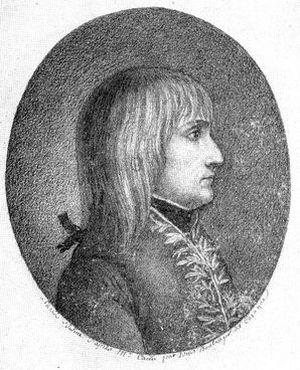
From the collection of W. C. Crane.
Bonaparte,
General in Chief of the Army of Italy.
In a letter written about the beginning of July, probably to Lucien or
possibly to Joseph, and evidently intended to be read in the Jacobin
Club of Ajaccio, there are clear indications of its writer's temper.
He speaks with judicious calmness of the project for educational
reform; of Lafayette's appearance before the Assembly, which had
pronounced the country in danger and was now sitting in permanence, as
perhaps necessary to prevent its taking an extreme and dangerous
course; of the French as no longer deserving the pains men took for
them, since they were a people old and without continuity
or coherence;[27] of their leaders as poor creatures engaged on low
plots; and of the damper which such a spectacle puts on ambition.
Clearly the lesson of moderation which he inculcates is for the first
time sincerely given. The preacher, according to his own judgment for
the time being, is no Frenchman, no demagogue, nothing but a simple
Corsican anxious to live far from the madness of mobs and the
emptiness of so-called glory.
It has been asserted that on the dreadful day of August tenth
Buonaparte's assumed philosophy was laid aside, and that he was a mob
leader at the barricades. His own account of the matter as given at
St. Helena does not bear this out. "I felt," said he, "as if I should
have defended the King if called to do so. I was opposed to those who
would found the republic by means of the populace. Besides, I saw
civilians attacking men in uniforms; that gave me a shock." He said
further in his reminiscences that he viewed the entire scene from the
windows of a furniture shop kept by Fauvelet de Bourrienne,
brother of his old school friend. The impression left after reading
his narrative of the frightful carnage before the Tuileries, of the
indecencies committed by frenzied women at the close of the fight, of
the mad excitement in the neighboring cafés, and of his own calmness
throughout, is that he was in no way connected either with the actors
or their deeds, except to shout, "Hurrah for the nation!" when
summoned to do so by a gang of ruffians who were parading the streets
under the banner of a gory head elevated on a pike.[28] The truth of
his statements cannot be established by any collateral evidence.
It is not likely that an ardent radical leader like Buonaparte, well
known and influential in the Rhone valley, had remained a stranger to
the Marseilles deputation. If the Duchesse d'Abrantès be worthy of any
credence, he was very influential, and displayed great activity with
the authorities during the seventh and eighth, running hither,
thither, everywhere, to secure redress for an illegal domiciliary
visit which her mother, Mme. Permon, had received on the seventh. But
her testimony is of very little value, such is her anxiety to
establish an early intimacy with the great man of her time. Joseph, in
his memoirs,[29] declares that his brother was present at the conflict
of August tenth, and that Napoleon wrote him at the time, "If Louis
XVI had appeared on horseback, he would have conquered." "After the
victory of the Marseillais," continues the passage quoted from the
letter, "I saw a man about to kill a soldier of the guard. I said to
him, 'Southron, let us spare the unfortunate!' 'Art thou from the
South?' 'Yes.' 'Well, then, we will spare him.'" Moreover, it is a
fact that Santerre, the notorious leader of the mob on that
day, was three years later, on the thirteenth of Vendémiaire, most
useful to Buonaparte; that though degraded from the office of general
to which he was appointed in the revolutionary army, he was in 1800
restored to his rank by the First Consul. All this is consistent with
Napoleon's assertion, but it proves nothing conclusively; and there is
certainly ground for suspicion when we reflect that these events were
ultimately decisive of Buonaparte's fortunes.
The Feuillant ministry fell with the King, and an executive council
composed of radicals took its place. For one single day Paris reeled
like a drunkard, but on the next the shops were open again. On the
following Sunday the opera was packed at a benefit performance for the
widows and orphans of those who had fallen in victory. A few days
later Lafayette, as commander of the armies in the North, issued a
pronunciamento against the popular excesses. He even arrested the
commissioners of the Assembly who were sent to supplant him and take
the ultimate direction of the campaign. But he quickly found that his
old prestige was gone; he had not kept pace with the mad rush of
popular opinion; neither in person nor as the sometime commander of
the National Guard had he any longer the slightest influence.
Impeached and declared an outlaw, he, like the King, lost his balance,
and fled for refuge into the possessions of Liège. The Austrians
violated the sanctuary of neutral territory, and captured him, exactly
as Napoleon at a later day violated the neutrality of Baden in the
case of the Duc d'Enghien. On August twenty-third the strong place of
Longwy was delivered into the hands of the Prussians, the capitulation
being due, as was claimed, to treachery among the French officers.[Back to Contents]
Reinstatement — Further Solicitation — Promotion —
Napoleon and Elisa — Occupations in Paris — Return to
Ajaccio — Disorders in Corsica — Buonaparte a French
Jacobin — Expedition against Sardinia — Course of French
Affairs — Paoli's Changed Attitude — Estrangement of
Buonaparte and Paoli — Mischances in the Preparations
against Sardinia — Failure of the French Detachment —
Buonaparte and the Fiasco of the Corsican Detachment — His
Commission Lapses — Further Developments in France —
Results of French Victory — England's Policy — Paoli in
Danger — Denounced and Summoned to Paris.
1792-93.
The committee to which Buonaparte's request for reinstatement was
referred made a report on June twenty-first, 1792, exonerating him
from blame. The reasons given were avowedly based on the
representations of the suppliant himself: first, that Duteil, the
inspector, had given him permission to sail for Corsica in time to
avoid the equinox, a distorted truth; and, second, that the Corsican
authorities had certified to his civism, his good conduct, and his
constant presence at home during his irregular absence from the army,
a truthful statement, but incomplete, since no mention was made of the
disgraceful Easter riots at Ajaccio and of Buonaparte's share in them.
The attitude of the government is clearly expressed in a despatch of
July eighth from the minister of war, Lajard, to Maillard, commander
of the Ajaccio garrison. The misdeeds of Quenza and Buonaparte were of
a civil and not a military nature, cognizable therefore under the new
legislation only by ordinary courts, not by military
tribunals. The uprisings, however, had been duly described to the
commissioners by Peraldi: they state as their opinion that the deputy
was ill-informed and that his judgment should not stand in the way of
justice to M. de Buonaparte. On July tenth the minister of war adopted
the committee's report, and this fact was announced in a letter
addressed by him to Captain Buonaparte!
The situation is clearly depicted in a letter of August seventh from
Napoleon to Joseph. Current events were so momentous as to overshadow
personal considerations. Besides, there had been no military
misdemeanor at Ajaccio and his reinstatement was sure. As things were,
he would probably establish himself in France, Corsican as his
inclinations were. Joseph must get himself made a deputy for Corsica
to the Assembly, otherwise his rôle would be unimportant. He had been
studying astronomy, a superb science, and with his knowledge of
mathematics easy of acquisition. His book—the history, no doubt—was
copied and ready, but this was no time for publication; besides, he no
longer had the "petty ambition of an author." His family desired he
should go to his regiment (as likewise did the military authorities at
Paris), and thither he would go.
A formal report in his favor was drawn up on August twentieth. On the
thirtieth he was completely reinstated, or rather his record was
entirely sponged out and consigned, as was hoped, to oblivion; for his
captain's commission was dated back to February sixth, 1792, the day
on which his promotion would have occurred in due course if he had
been present in full standing with his regiment. His arrears for that
rank were to be paid in full. Such success was intoxicating. Monge,
the great mathematician, had been his master at the military school in
Paris, and was now minister of the navy. True to his nature,
with the carelessness of an adventurer and the effrontery of a
gambler, the newly fledged captain promptly put in an application for
a position as lieutenant-colonel of artillery in the sea service. The
authorities must have thought the petition a joke, for the paper was
pigeonholed, and has been found marked S. R., that is, sans
réponse—without reply. Probably it was written in earnest, the
motive being possibly an invincible distaste for the regiment in which
he had been disgraced, which was still in command of a colonel who was
not disposed to leniency.
An easy excuse for shirking duty and returning to the old habits of a
Corsican agitator was at hand. The events of August tenth settled the
fate of all monarchical institutions, even those which were partly
charitable. Among other royal foundations suppressed by the Assembly
on August eighteenth was that of St. Cyr, formally styled the
Establishment of St. Louis. The date fixed for closing was just
subsequent to Buonaparte's promotion, and the pupils were then to be
dismissed. Each beneficiary was to receive a mileage of one livre for
every league she had to traverse. Three hundred and fifty-two was the
sum due to Elisa. Some one must escort an unprotected girl on the long
journey; no one was so suitable as her elder brother and natural
protector. Accordingly, on September first, the brother and sister
appeared before the proper authorities to apply for the traveling
allowance of the latter. Whatever other accomplishments Mlle. de
Buonaparte had learned at the school of St. Louis, she was still as
deficient in writing and spelling as her brother. The formal
requisitions written by both are still extant; they would infuriate
any conscientious teacher in a primary school. Nor did they suffice:
the school authorities demanded an order from both the city and
department officials. It was by the kind intervention of the
mayor that the red tape was cut; the money was paid on the next day,
and that night the brother and the sister lodged in the Holland
Patriots' Hotel in Paris, where they appear to have remained for a
week.
This is the statement of an early biographer, and appears to be borne
out by an autograph letter of Napoleon's, recently found, in which he
says he left Paris on a date which, although the figure is blurred,
seems to be the ninth.[30] Some days would be necessary for the new
captain to procure a further leave of absence. Judging from subsequent
events, it is possible that he was also seeking further acquaintance
and favor with the influential Jacobins of Paris. During the days from
the second to the seventh more than a thousand of the royalists
confined in the prisons of Paris were massacred. It seems incredible
that a man of Napoleon's temperament should have seen and known
nothing of the riotous events connected with such bloodshed. Yet
nowhere does he hint that he had any personal knowledge. It is
possible that he left earlier than is generally supposed, but it is
not likely in view of the known dates of his journey. In any case he
did not seriously compromise himself, doing at the most nothing
further than to make plans for the future. It may have become clear to
him, for it was true and he behaved accordingly, that France was not
yet ready for him, nor he for France.
It is, moreover, a strong indication of Buonaparte's interest in the
French Revolution being purely tentative that as soon as the desired
leave was granted, probably in the second week of September, without
waiting for the all-important fifteen hundred livres of arrears, now
due him, but not paid until a month later, he and his sister set out
for home. They traveled by diligence to Lyons, and thence by
the Rhone to Marseilles. During the few hours' halt of the boat at
Valence, Napoleon's friends, among them some of his creditors, who
apparently bore him no grudge, waited on him with kindly
manifestations of interest. His former landlady, Mme. Bou, although
her bill had been but insignificantly diminished by payments on
account, brought as her gift a basket of the fruit in which the
neighborhood abounds at that season. The regiment was no longer there,
the greater portion, with the colonel, being now on the northeastern
frontier under Dumouriez, facing the victorious legions of Prussia and
Austria. On the fourteenth the travelers were at Marseilles; in that
friendly democratic city they were nearly mobbed as aristocrats
because Elisa wore feathers in her hat. It is said that Napoleon flung
the offending object into the crowd with a scornful "No more
aristocrats than you," and so turned their howls into laughing
approval. It was about a month before the arrears of pay reached
Marseilles, two thousand nine hundred and fifty livres in all, a
handsome sum of money and doubly welcome at such a crisis. It was
probably October tenth when they sailed for Corsica, and on the
seventeenth Buonaparte was once more in his home, no longer so
confident, perhaps, of a career among his own people, but determined
to make another effort. It was his fourth return. Lucien and Fesch
were leaders in the radical club; Joseph was at his old post, his
ambition to represent Ajaccio at Paris was again thwarted, the
successful candidate having been Multedo, a family friend; Louis, as
usual, was disengaged and idle; Mme. Buonaparte and the younger
children were well; he himself was of course triumphantly vindicated
by his promotion. The ready money from the fortune of the old
archdeacon was long since exhausted, to be sure; but the excellent
vineyards, mulberry plantations, and gardens of the family
properties were still productive, and Napoleon's private purse had
been replenished by the quartermaster of his regiment.
The course of affairs in France had materially changed the aspect of
Corsican politics; the situation was, if anything, more favorable for
a revolutionary venture than ever before. Salicetti had returned to
Corsica after the adjournment of the Constituent Assembly with many
new ideas which he had gathered from observing the conduct of the
Paris commune, and these he unstintingly disseminated among his
sympathizers. They proved to be apt scholars, and quickly caught the
tricks of demagogism, bribery, corruption, and malversation of the
public funds. He had returned to France before Buonaparte arrived, as
a member of the newly elected legislature, but his evil influence
survived his departure, and his lieutenants were ubiquitous and
active. Paoli had been rendered helpless, and was sunk in despair. He
was now commander-in-chief of the regular troops in garrison, but it
was a position to which he had been appointed against his will, for it
weakened his influence with his own party. Pozzo di Borgo, his stanch
supporter and Buonaparte's enemy, was attorney-general in Salicetti's
stead. As Paoli was at the same time general of the volunteer guard,
the entire power of the islands, military and civil, was in his hands:
but the responsibility for good order was likewise his, and the people
were, if anything, more unruly than ever; for it was to their minds
illogical that their idol should exercise such supreme power, not as a
Corsican, but in the name of France. The composition of the two chief
parties had therefore changed materially, and although their
respective views were modified to a certain extent, they were more
embittered than ever against each other.
Buonaparte could not be neutral; his nature and his
surroundings forbade it. His first step was to resume his command in
the volunteers, and, under pretext of inspecting their posts, to make
a journey through the island; his second was to go through the form of
seeking a reconciliation with Paoli. Corsican historians, in their
eagerness to appropriate the greatness of both Paoli and Napoleon,
habitually misrepresent their relations. At this time each was playing
for his own hand, the elder exclusively for Corsica's advantage as he
saw it; the younger was more ambitious personally, although he was
beginning to see that in the course of the Revolution Corsica would
secure more complete autonomy as a French department than in any other
way. It is not at all clear that as late as this time Paoli was eager
for Napoleon's assistance nor the latter for Paoli's support. The
complete breach came soon and lasted until, when their views no longer
clashed, they both spoke generously one of the other. In the clubs,
among his friends and subordinates at the various military stations,
Napoleon's talk was loud and imperious, his manner haughty and
assuming. A letter written by him at the time to Costa, then
lieutenant in the militia and a thorough Corsican, explains that the
writer is detained from going to Bonifacio by an order from the
general (Paoli) to come to Corte; he will, however, hasten to his post
at the head of the volunteers on the very next day, and there will be
an end to all disorder and irregularity. "Greet our friends, and
assure them of my desire to further their interests." The epistle was
written in Italian, but that fact signifies little in comparison with
the new tone used in speaking about France: "The enemy has abandoned
Verdun and Longwy, and recrossed the river to return home, but our
people are not asleep." Lucien added a postscript explaining that he
had sent a pamphlet to his dear Costa, as to a friend, not
as to a co-worker, for that he had been unwilling to be. Both the
brothers seem already to have considered the possibility of abandoning
Corsica.
No sooner had war been declared against Austria in April, than it
became evident that the powers whose territories bordered on those of
France had previously reached an agreement, and were about to form a
coalition in order to make the war general. The Austrian Netherlands,
what we now know as Belgium, were already saturated with the
revolutionary spirit. It was not probable that much annoyance would
come from that quarter. Spain, Prussia, and Holland would, however,
surely join the alliance; and if the Italian principalities, with the
kingdom of Sardinia, should take the same course, France would be in
dire straits. It was therefore suggested in the Assembly that a blow
should be struck at the house of Savoy, in order to awe both that and
the other courts of Italy into inactivity. The idea of an attack on
Sardinia for this purpose originated in Corsica, but among the friends
of Salicetti, and it was he who urged the scheme successfully. The
sister island was represented as eager to free itself from the control
of Savoy. In order to secure Paoli's influence not only in his own
island, but in Sardinia, where he was likewise well known and admired,
the ministers forced upon him the unwelcome appointment of
lieutenant-general in the regular army, and his friend Peraldi was
sent to prepare a fleet at Toulon.
The events of August tenth put an end for the time being to
constitutional government in France. The commissioners of the Paris
sections supplanted the municipal council, and Danton, climbing to
power as the representative "plain man," became momentarily the
presiding genius of the new Jacobin commune, which was soon
able to usurp the supreme control of France. A call was issued for the
election by manhood suffrage of a National Convention, and a committee
of surveillance was appointed with the bloodthirsty Marat as its
motive power. At the instigation of this committee large numbers of
royalists, constitutionalists, and others suspected of holding kindred
doctrines, were thrown into prison. The Assembly went through the form
of confirming the new despotism, including both the commune of the
sections and a Jacobin ministry in which Danton held the portfolio of
justice. It then dispersed. On September second began that general
clearance of the jails under mock forms of justice to which reference
has been made. It was really a massacre, and lasted, as has been said,
for five days. Versailles, Lyons, Meaux, Rheims, and Orléans were
similarly "purified." Amid these scenes the immaculate Robespierre,
whose hands were not soiled with the blood spilled on August tenth,
appeared as the calm statesman controlling the wild vagaries of the
rough and impulsive but unselfish and uncalculating Danton. These two,
with Philip Égalité and Collot d'Herbois, were among those elected to
represent Paris in the Convention. That body met on September
twenty-first. As they sat in the amphitheater of the Assembly, the
Girondists, or moderate republicans, who were in a strong majority,
were on the right of the president's chair. High up on the extreme
left were the Jacobins, or "Mountain"; between were placed those timid
trimmers who were called the "Plain" and the "Marsh" according to the
degree of their democratic sentiments. The members were, of course,
without exception republicans. The first act of the Convention was to
abolish the monarchy, and to declare France a republic. The next was
to establish an executive council. It was decreed that September
twenty-second, 1792, was the "first day of the year I of the
republic." Under the leadership of Brissot and Roland, the Girondists
asserted their power as the majority, endeavoring to restore order in
Paris, and to bridle the extreme Jacobins. But notwithstanding its
right views and its numbers, the Girondist party displayed no
sagacity; before the year I was three months old, the unscrupulous
Jacobins, with the aid of the Paris commune, had reasserted their
supremacy.
The declaration of the republic only hastened the execution of
Salicetti's plan regarding Sardinia, and the Convention was more
energetic than the Legislative had been. The fleet was made ready,
troops from France were to be embarked at Villefranche, and a force
composed in part of regulars, in part of militia, was to be equipped
in Corsica and to sail thence to join the main expedition.
Buonaparte's old battalion was among those that were selected from the
Corsican volunteers. From the outset Paoli had been unfriendly to the
scheme; its supporters, whose zeal far outran their means, were not
his friends. Nevertheless, he was in supreme command of both regulars
and volunteers, and the government having authorized the expedition,
the necessary orders had to be issued through him as the only channel
of authority. Buonaparte's reappearance among his men had been of
course irregular. Being now a captain of artillery in the Fourth
Regiment, on active service and in the receipt of full pay, he could
no longer legally be a lieutenant-colonel of volunteers, a position
which had also been made one of emolument. But he was not a man to
stand on slight formalities, and had evidently determined to seize
both horns of the dilemma.
Paoli, as a French official, of course could not listen for an instant
to such a preposterous notion. But as a patriot anxious to
keep all the influence he could, and as a family friend of the
Buonapartes, he was unwilling to order the young captain back to his
post in France, as he might well have done. The interview between the
two men at Corte was, therefore, indecisive. The older was benignant
but firm in refusing his formal consent; the younger pretended to be
indignant that he could not secure his rights: it is said that he even
threatened to denounce in Paris the anti-nationalist attitude of his
former hero. So it happened that Buonaparte returned to Ajaccio with a
permissive authorization, and, welcomed by his men, assumed a command
to which he could have no claim, while Paoli shut his eyes to an act
of flagrant insubordination. Paoli saw that Buonaparte was irrevocably
committed to revolutionary France; Buonaparte was convinced, or
pretended to be, that Paoli was again leaning toward an English
protectorate. French imperialist writers hint without the slightest
basis of proof that both Paoli and Pozzo di Borgo were in the pay of
England. Many have believed, in the same gratuitous manner, that there
was a plot among members of the French party to give Buonaparte the
chance, by means of the Sardinian expedition, to seize the chief
command at least of the Corsican troops, and thus eventually to
supplant Paoli. If this conjecture be true, Paoli either knew nothing
of the conspiracy, or behaved as he did because his own plans were not
yet ripe. The drama of his own personal perplexities, cross-purposes,
and ever false positions, was rapidly moving to an end; the logic of
events was too strong for the upright but perplexed old patriot, and a
scene or two would soon complete the final act of his public career.
The plan for invading Sardinia was over-complex and too nicely
adjusted. One portion of the fleet was to skirt the Italian shores,
make demonstrations in the various harbors, and demand in
one of them—that of Naples—public reparation for an insult already
offered to the new French flag, which displayed the three colors of
liberty. The other portion was first to embark the Corsican guards and
French troops at Ajaccio, then to unite with the former in the Bay of
Palma, whence both were to proceed against Cagliari. But the French
soldiers to be taken from the Army of the Var under General Anselme
were in fact non-existent; the only military force to be found was a
portion of the Marseilles national guard—mere boys, unequipped,
untrained, and inexperienced. Winds and waves, too, were adverse: two
of the vessels were wrecked, and one was disabled. The rest were badly
demoralized, and their crews became unruly. On the arrival of the
ships at Ajaccio, a party of roistering sailors went ashore,
affiliated immediately with the French soldiers of the garrison, and
in the rough horse-play of such occasions picked a quarrel with
certain of the Corsican militia, killing two of their number. The
character of the islanders showed itself at once in further violence
and the fiercest threats. The tumult was finally allayed, but it was
perfectly clear that for Corsicans and Marseillais to be embarked on
the same vessel was to invite mutiny, riot, and bloodshed.
Buonaparte thought he saw his way to an independent command, and at
once proposed what was manifestly the only alternative—a separate
Corsican expedition. The French fleet accordingly embarked the
garrison troops, and proceeded on its way; the Corsicans remained
ashore, and Buonaparte with them. Scenes like that at Ajaccio were
repeated in the harbor of St. Florent, and the attack on Cagliari by
the French failed, partly, as might be supposed, from the poor
equipment of the fleet and the wretched quality of the men, partly
because the two flotillas, or what was left of them, failed
to effect a junction at the appointed place and time. When they did
unite, it was February fourteenth, 1793; the men were ill fed and
mutinous; the troops that landed to storm the place fell into a panic,
and would actually have surrendered if the officers had not quickly
reëmbarked them. The costly enterprise met with but a single success:
Naples was cowed, and the court promised neutrality, with reparation
for the insult to the tricolor.
The Corsican expedition was quite as ill-starred as the French. Paoli
accepted Buonaparte's plan, but appointed his nephew, Colonna-Cesari,
to lead, with instructions to see that, if possible, "this unfortunate
expedition shall end in smoke."[31] The disappointed but stubborn
young aspirant remained in his subordinate place as an officer of the
second battalion of the Corsican national guard. It was a month before
the volunteers could be equipped and a French corvette with her
attendant feluccas could be made ready to sail. On February twentieth,
1793, the vessels were finally armed, manned, and provisioned. The
destination of the flotilla was the Magdalena Islands, one of which is
Caprera, since renowned as the home of Garibaldi. The troops embarked
and put to sea. Almost at once the wind fell; there was a two days'
calm, and the ships reached their destination with diminished supplies
and dispirited crews. The first attack, made on St. Stephen, was
successful. Buonaparte and his guns were then landed on that spot to
bombard, across a narrow strait, Magdalena, the chief town on the main
island. The enemy's fire was soon silenced, and nothing remained but
for the corvette to work slowly round the intervening island
of Caprera, and take possession. The vessel had suffered slightly from
the enemy's fire, two of her crew having been killed. On the pretense
that a mutiny was imminent, Colonna-Cesari declared that coöperation
between the sloop and the shore batteries was no longer possible; the
artillery and their commander were reëmbarked only with the utmost
difficulty; the unlucky expedition returned on February twenty-seventh
to Bonifacio.
Both Buonaparte and Quenza were enraged with Paoli's nephew, declaring
him to have acted traitorously. It is significant of the utter anarchy
then prevailing that nobody was punished for the disgraceful fiasco.
Buonaparte, on landing, at once bade farewell to his volunteers. He
reported to the war ministry in Paris—and a copy of the memorial was
sent to Paoli as responsible for his nephew—that the Corsican
volunteers had been destitute of food, clothing, and munitions; but
that nevertheless their gallantry had overcome all difficulties, and
that in the hour of victory they were abased by the shameful conduct
of their comrades. He must have expressed himself freely, for he was
mobbed by the sailors in the square of Bonifacio. The men from
Bocagnano, partly from the Buonaparte estates at that place, rescued
him from serious danger.[32] When he entered Ajaccio, on March third,
he found that he was no longer, even by assumption, a
lieutenant-colonel; for during his short absence the whole Corsican
guard had been disbanded to make way for two battalions of light
infantry whose officers were to be appointed by the directory of the
island.
Strange news now greeted his ears. Much of what had occurred since his
departure from Paris he already knew. France having destroyed root and
branch the tyranny of feudal privileges, the whole social
edifice was slack in every joint, and there was no strong hand to
tighten the bolts; for the King, in dallying with foreign courts, had
virtually deserted his people. The monarchy had therefore fallen, but
not until its friends had resorted to the expedient of a foreign war
as a prop to its fortunes. The early victories won by Austria and
Prussia had stung the nation to madness. Robespierre and Danton having
become dictators, all moderate policy was eclipsed. The executive
council of the Convention, determined to appease the nation, gathered
their strength in one vigorous effort, and put three great armies in
the field. On November sixth, 1792, to the amazement of the world,
Dumouriez won the battle of Jemmapes, thus conquering the Austrian
Netherlands as far north as Liège.
The Scheldt, which had been closed since 1648 through the influence of
England and Holland, was reopened, trade resumed its natural channel,
and, in the exuberance of popular joy, measures were taken for the
immediate establishment of a Belgian republic. The other two armies,
under Custine and Kellermann, were less successful. The former, having
occupied Frankfort, was driven back to the Rhine; the latter defeated
the Allies at Valmy, but failed in the task of coming to Custine's
support at the proper moment for combined action. Meantime the
agitation in Paris had taken the form of personal animosity to "Louis
Capet," as the leaders of the disordered populace called the King. In
November he was summoned to the bar of the Convention and questioned.
When it came to the consideration of an actual trial, the Girondists,
willing to save the prisoner's life, claimed that the Convention had
no jurisdiction, and must appeal to the sovereign people for
authorization. The Jacobins insisted on the sovereign power of
the Convention, Robespierre protesting in the name of the
people against an appeal to the people. Supported by the noisy
outcries not only of the Parisian populace, but of their followers
elsewhere, the radicals prevailed. By a vote of three hundred and
sixty-six to three hundred and fifty-five the verdict of death was
pronounced on January seventeenth, 1793, and four days later the
sentence was executed. This act was a defiance to all monarchs, or, in
other words, to all Europe.
The younger Pitt was at this juncture prime minister of England. Like
the majority of his countrymen, he had mildly approved the course of
the French Revolution down to 1789; with them, in the same way, his
opinions had since that time undergone a change. By the aid of Burke's
biased but masterful eloquence the English people were gradually
convinced that Jacobinism, violence, and crime were the essence of the
movement, constitutional reform but a specious pretext. Between 1789
and 1792 there was a rising tide of adverse public sentiment so swift
and strong that Pitt was unable to follow it. By the execution of
Louis the English moderates were silenced; the news was received with
a cry of horror, and the nation demanded war. Were kings' heads to
fall, and republican ideas, supported by republican armies, to spread
like a conflagration? The still monarchical liberals of England could
give no answer to the case of Louis or to the instance of Belgium, and
were stunned. The English anti-Jacobins became as fanatical as the
French Jacobins. Pitt could not resist the torrent. Yet in his extreme
necessity he saw his chance for a double stroke: to throw the blame
for the war on France, and to consolidate once more his nearly
vanished power in parliament. With masterly adroitness France was
tempted into a declaration of war against England. Enthusiasm raged in
Paris like fire among dry stubble. France, if so it must be,
against the world! Liberty and equality her religion! The land a camp!
The entire people an army! Three hundred thousand men to be selected,
equipped, and drilled at once!
Nothing indicates that Buonaparte was in any way moved by the terrible
massacres of September, or even by the news of the King's unmerited
fate. But the declaration of war was a novelty which must have deeply
interested him; for what was Paoli now to do? From gratitude to
England he had repeatedly and earnestly declared that he could never
take up arms against her. He was already a lieutenant-general in the
service of her enemy, his division was assigned to the feeble and
disorganized Army of Italy, which was nominally being equipped for
active service, and the leadership, so ran the news received at
Ajaccio, had been conferred on the Corsican director. The fact was
that the radicals of the Convention had long been aware of the old
patriot's devotion to constitutional monarchy, and now saw their way
to be rid of so dangerous a foe. Three successive commanders of that
army had already found disgrace in their attempts with inadequate
means to dislodge the Sardinian troops from the mountain passes of the
Maritime Alps. Mindful, therefore, of their fate, and of his
obligations to England, Paoli firmly refused the proffered honor.
Suspicion as to the existence of an English party in the island had
early been awakened among the members of the Mountain; for half the
Corsican delegation to the Convention had opposed the sentence passed
on the King, and Salicetti was the only member who voted in the
affirmative. When the ill-starred Sardinian expedition reached Toulon,
the blame of failure was laid by the Jacobins on Paoli's shoulders.
Salicetti, who was now a real power among the leaders at
Paris, felt that he must hasten to his department in order to
forestall events, if possible, and keep together the remnants of
sympathy with France; he was appointed one of a commission to enforce
in the island the decrees of the Convention. The commission was well
received and the feeling against France was being rapidly allayed
when, most unexpectedly, fatal news arrived from Paris. In the
preceding November Lucien Buonaparte had made the acquaintance in
Ajaccio of Huguet de Sêmonville, who was on his way to Constantinople
as a special envoy of the provisory council then in charge of the
Paris administration. In all probability he was sent to test Paoli's
attitude. Versatile and insinuating, he displayed great activity among
the islanders. On one occasion he addressed the radical club of
Ajaccio—but though eloquent, he was no linguist, and his French
rhetoric would have fallen flat but for the fervid zeal of Lucien, who
at the close stood in his place and rendered the ambassador's speech
in Italian to an enthralled audience. This event among others showed
the younger brother's mettle; the intimacy thus inaugurated ripened
quickly and endured for long. The ambassador was recalled to the
mainland on February second, 1793, and took his new-found friend with
him as secretary or useful man. Both were firm Jacobins, and the
master having failed in making any impression on Paoli during his
Corsican sojourn, the man, as the facts stand, took a mean revenge by
denouncing the lieutenant-general as a traitor before a political
meeting in Toulon. Lucien's friends have thought the words unstudied
and unpremeditated, uttered in the heat of unripe oratory. This may
be, but he expressed no repentance and the responsibility rests upon
his memory. As a result of the denunciation an address calumniating
the Corsican leader in the most excited terms was sent by the Toulon
Jacobins to the deputy of the department in Paris. Of all
this Napoleon knew nothing: he and Lucien were slightly alienated
because the latter thought his brother but a lukewarm revolutionary.
The news of the defection of Dumouriez had just arrived at the
capital, public opinion was inflamed, and on April second Paoli, who
seemed likely to be a second Dumouriez, was summoned to appear before
the Convention. For a moment he became again the most popular man in
Corsica. He had always retained many warm personal friends even among
the radicals; the royalists were now forever alienated from a
government which had killed their king; the church could no longer
expect protection when impious men were in power. These three elements
united immediately with the Paolists to protest against the arbitrary
act of the Convention. Even in that land of confusion there was a
degree of chaos hitherto unequaled.[Back to Contents]
The Waning of Corsican Patriotism — Rise of French
Radicalism — Alliance with Salicetti — Another Scheme for
Leadership — Failure to Seize the Citadel of Ajaccio —
Second Plan — Paoli's Attitude Toward the Convention —
Buonaparte Finally Discredited in Corsica — Paoli Turns to
England — Plans of the Buonaparte Family — Their Arrival
in Toulon — Napoleon's Character — His Corsican Career —
Lessons of His Failures — His Ability, Situation, and
Experience.
1793.
Buonoparte was for an instant among the most zealous of Paoli's
supporters, and, taking up his ever-ready pen, he wrote two
impassioned papers whose respective tenors it is not easy to
reconcile: one an appeal to the Convention in Paoli's behalf, the
other a demand addressed to the municipality of Ajaccio that the
people should renew their oath of allegiance to France. The
explanation is somewhat recondite, perhaps, but not discreditable.
Salicetti, as chairman of a committee of the convention on Corsican
affairs, had conferred with Paoli on April thirteenth. The result was
so satisfactory that on the sixteenth the latter was urged to attend a
second meeting at Bastia in the interest of Corsican reconciliation
and internal peace. Meantime Lucien's performance at Marseilles had
fired the train which led to the Convention's action against Paoli,
and on the seventeenth the order for his arrest reached Salicetti, who
was of course charged with its execution. For this he was not
prepared, nor was Buonaparte. The essential of Corsican annexation to
France was order. The Corsican folk flocked to protect Paoli
in Corte, and the local government declared for him. There was
inchoate rebellion and within a few days the districts of Calvi and
Bastia were squarely arrayed with Salicetti against Bonifacio and
Ajaccio, which supported Paoli and Pozzo di Borgo. The Buonapartes
were convinced that the decree of the Convention was precipitate, and
pleaded for its recall. At the same time they saw no hope for peace in
Corsica, except through incorporation with France. But compromise
proved impossible. There was a truce when Paoli on April twenty-sixth
wrote to the Convention regretting that he could not obey their
summons on account of infirmities, and declaring his loyalty to
France. In consequence the Convention withdrew its decree and sent a
new commission of which Salicetti was not a member. This was in May,
on the eve of the Girondin overthrow. The measures of reconciliation
proved unavailing, because the Jacobins of Marseilles, learning that
Paoli was Girondist in sentiment, stopped the commission, and forbade
their proceeding to Corsica.
Meantime Captain Buonaparte's French regiment had already been some
five months in active service. If his passion had been only for
military glory, that was to be found nowhere so certainly as in its
ranks, where he should have been. But his passion for political renown
was clearly far stronger. Where could it be so easily gratified as in
Corsica under the present conditions? The personality of the young
adventurer had for a long time been curiously double: but while he had
successfully retained the position of a French officer in France, his
identity as a Corsican patriot had been nearly obliterated in Corsica
by his constant quarrels and repeated failures. Having become a French
radical, he had been forced into a certain antagonism to
Paoli and had thereby jeopardized both his fortunes and his career as
far as they were dependent on Corsican support. But with Paoli under
the ban of the Convention, and suspected of connivance with English
schemes, there might be a revulsion of feeling and a chance to make
French influence paramount once more in the island under the
leadership of the Buonapartes and their friends. For the moment
Napoleon preserved the outward semblance of the Corsican patriot, but
he seems to have been weary at heart of the thankless rôle and
entirely ready to exchange it for another. Whatever may have been his
plan or the principles of his conduct, it appears as if the decisive
step now to be taken had no relation to either plan or principles, but
that it was forced upon him by a chance development of events which he
could not have foreseen, and which he was utterly unable to control.
It is unknown whether Salicetti or he made the first advances in
coming to an understanding for mutual support, or when that
understanding was reached, but it existed as early as January, 1793, a
fact conclusively shown by a letter of the former dated early in that
month. It was April fifth when Salicetti reached Corsica; the news of
Paoli's denunciation by the Convention arrived, as has been said, on
the seventeenth. Seeing how nicely adjusted the scales of local
politics were, the deputy was eager to secure favor from Paris, and
wrote on the sixteenth an account of how warmly his commission had
been received. Next day the blow of Paoli's condemnation fell, and it
became plain that compromise was no longer possible. When even the
Buonapartes were supporting Paoli, the reconciliation of the island
with France was clearly impracticable. Salicetti did not hesitate, but
as between Paoli and Corsica with no career on the one side, and the
possibilities of a great career under France on the other,
quickly chose the latter. The same considerations weighed with
Buonaparte; he followed his patron, and as a reward was appointed by
the French commission inspector-general of artillery for Corsica.
Salicetti had granted what Paoli would not: Buonaparte was free to
strike his blow for Corsican leadership. With swift and decisive
measures the last scene in his Corsican adventures was arranged.
Several great guns which had been saved from a war-ship wrecked in the
harbor were lying on the shore unmounted. The inspector-general
hypocritically declared that they were a temptation to insurgents and
a menace to the public peace; they should be stored in the citadel.
His plan was to seize the moment when the heavy pieces were passing
the drawbridge, and at the head of his followers to take possession of
the stronghold he had so long coveted, and so often failed to capture.
If he could hold it for the Convention, a career in Corsica would be
at last assured.
But again he was doomed to disappointment. The former garrison had
been composed of French soldiers. On the failure of the Sardinian
expedition most of these had been landed at Toulon, where they still
were. The men in the citadel of Ajaccio were therefore in the main
islanders, although some French infantry and the French gunners were
still there; the new commander was a Paolist who refused to be
hoodwinked, and would not act without an authorization from his
general-in-chief. The value of the seizure depended on its promptness.
In order to secure a sufficient number of faithful followers,
Buonaparte started on foot for Bastia to consult the commission.
Learning that he was already a suspect at Corte and in danger of
arrest, he turned on his steps only to be confronted at Bocognano by a
band of Peraldi's followers. Two shepherds from his own
estate found a place of concealment for him in a house belonging to
their friends, and he passed a day in hiding, escaping after nightfall
to Ucciani, whence he returned to Ajaccio in safety.[33] Thwarted in
one notion, Buonaparte then proposed to the followers he already had
two alternatives: to erect a barricade behind which the guns could be
mounted and trained on the citadel, or, easier still, to carry one of
the pieces to some spot before the main entrance and then batter in
the gate. Neither scheme was considered feasible, and it was
determined to secure by bribes, if possible, the coöperation of a
portion of the garrison. The attempt failed through the integrity of a
single man, and is interesting only as having been Napoleon's first
lesson in an art which was thenceforward an unfailing resource. Rumors
of these proceedings soon reached the friends of Paoli, and Buonaparte
was summoned to report immediately at Corte. Such was the intensity of
popular bitterness against him in Ajaccio for his desertion of Paoli
that after a series of narrow escapes from arrest he was compelled to
flee in disguise and by water to Bastia, which he reached on May
tenth, 1793. Thwarted in their efforts to seize Napoleon, the hostile
party vented its rage on the rest of the family, hunting the mother
and children from their town house, which was pillaged and burned,
first to Milleli, then through jungle and over hilltops to the lonely
tower of Capitello near the sea.
A desire for revenge on his Corsican persecutors would now give an
additional stimulus to Buonaparte, and still another device to secure
the passionately desired citadel of Ajaccio was proposed by him to the
commissioners of the Convention, and adopted by them. The remnants of
a Swiss regiment stationed near by were to be marched into
the city, as if for embarkment; several French war vessels from the
harbor of St. Florent, including one frigate, with troops, munitions,
and artillery on board, were to appear unexpectedly before the city,
land their men and guns, and then, with the help of the Switzers and
such of the citizens as espoused the French cause, were to overawe the
town and seize the citadel. Corsican affairs had now reached a crisis,
for this was a virtual declaration of war. Paoli so understood it, and
measures of mutual defiance were at once taken by both sides. The
French commissioners formally deposed the officials who sympathized
with Paoli; they, in turn, took steps to increase the garrison of
Ajaccio, and to strengthen the popular sentiment in their favor.
On receipt of the news that he had been summoned to Paris and that
hostile commissioners had been sent to take his place, Paoli had
immediately forwarded, by the hands of two friendly representatives,
the temperate letter in which he had declared his loyalty to France.
In it he had offered to resign and leave Corsica. His messengers were
seized and temporarily detained, but in the end they reached Paris,
and were kindly received. On May twenty-ninth they appeared on the
floor of the Convention, and won their cause. On June fifth the former
decree was revoked, and two days later a new and friendly commission
of two members started for Corsica. But at Marseilles they fell into
the hands of the Jacobin mob, and were arrested. Ignorant of these
favorable events, and the untoward circumstances by which their effect
was thwarted, the disheartened statesman had written and forwarded on
May fourteenth a second letter, of the same tenor as the first. This
measure likewise had failed of effect, for the messenger had been
stopped at Bastia, now the focus of Salicetti's influence, and the
letter had never reached its destination.
It was probably in this interval that Paoli finally adopted,
as a last desperate resort, the hitherto hazy idea of putting the
island under English protection, in order to maintain himself in the
mission to which he felt that Providence had called him. The actual
departure of Napoleon's expedition from St. Florent gave the final
impulse. That event so inflamed the passions of the conservative party
in Ajaccio that the Buonaparte family could no longer think of
returning within a reasonable time to their home. Some desperate
resolution must be taken, though it should involve leaving their small
estates to be ravaged, their slender resources to be destroyed, and
abandoning their partizans to proscription and imprisonment. They
finally found a temporary asylum with a relative in Calvi. The
attacking flotilla had been detained nearly a week by a storm, and
reached Ajaccio on May twenty-ninth, in the very height of these
turmoils. It was too late for any possibility of success. The few
French troops on shore were cowed, and dared not show themselves when
a party landed from the ships. On the contrary, Napoleon and his
volunteers were received with a fire of musketry, and, after spending
two anxious days in an outlying tower which they had seized and held,
were glad to reëmbark and sail away. Their leader, after still another
narrow escape from seizure, rejoined his family at Calvi. The Jacobin
commission held a meeting, and determined to send Salicetti to justify
their course at Paris. He carried with him a wordy paper written by
Buonaparte in his worst style and spelling, setting forth the military
and political situation in Corsica, and containing a bitter tirade
against Paoli, which remains to lend some color to the charge that the
writer had been, since his leader's return from exile, a spy and an
informer, influenced by no high principle of patriotism, but
only by a base ambition to supplant the aged president, and then to
adopt whichever plan would best further his own interest: ready either
to establish a virtual autonomy in his fatherland, or to deliver it
entirely into the hands of France.[34]
In this painful document Buonaparte sets forth in fiery phrase the
early enthusiasm of republicans for the return of Paoli, and their
disillusionment when he surrounded himself with venal men like Pozzo
di Borgo, with relatives like his nephew Leonetti, with his vile
creatures in general. The misfortunes of the Sardinian expedition, the
disgraceful disorders of the island, the failure of the commissioners
to secure Ajaccio, are all alike attributed to Paoli. "Can perfidy
like this invade the human heart?... What fatal ambition overmasters a
graybeard of sixty-eight?... On his face are goodness and gentleness,
in his heart hate and vengeance; he has an oily sensibility in his
eyes, and gall in his soul, but neither character nor strength." These
were the sentiments proper to a radical of the times, and they found
acceptance among the leaders of that class in Paris. More moderate men
did what they could to avert the impending breach, but in vain.
Corsica was far, communication slow, and the misunderstanding which
occurred was consequently unavoidable. It was not until July first
that Paoli received news of the pacificatory decrees passed by the
Convention more than a month before, and then it was too late; groping
in the dark, and unable to get news, he had formed his judgment from
what was going on in Corsica, and had therefore committed himself to a
change of policy. To him, as to most thinking men, the
entire structure of France, social, financial, and political, seemed
rotten. Civil war had broken out in Vendée; in Brittany the wildest
excesses passed unpunished; the great cities of Marseilles, Toulon,
and Lyons were in a state of anarchy; the revolutionary tribunal had
been established in Paris; the Committee of Public Safety had usurped
the supreme power; the France to which he had intrusted the fortunes
of Corsica was no more. Already an agent was in communication with the
English diplomats in Italy. On July tenth Salicetti arrived in Paris;
on the seventeenth Paoli was declared a traitor and an outlaw, and his
friends were indicted for trial. But the English fleet was already in
the Mediterranean, and although the British protectorate over Corsica
was not established until the following year, in the interval the
French and their few remaining sympathizers on the island were able at
best to hold only the three towns of Bastia, St. Florent, and Calvi.
After the last fiasco before the citadel of Ajaccio, the situation of
the Buonapartes was momentarily desperate. Lucien says in his memoirs
that shortly before his brother had spoken longingly of India, of the
English empire as destined to spread with every year, and of the
career which its expansion opened to good officers of artillery, who
were scarce among the British—scarce enough everywhere, he thought.
"If I ever choose that career," said he, "I hope you will hear of me.
In a few years I shall return thence a rich nabob, and bring fine
dowries for our three sisters." But the scheme was deferred and then
abandoned. Salicetti had arranged for his own return to Paris, where
he would be safe. Napoleon felt that flight was the only resort for
him and his. Accordingly, on June eleventh, three days earlier than
his patron, he and Joseph, accompanied by Fesch, embarked
with their mother and the rest of the family to join Lucien, who had
remained at Toulon, where they arrived on the thirteenth. The Jacobins
of that city had received Lucien, as a sympathetic Corsican, with
honor. Doubtless his family, homeless and destitute for their devotion
to the republic, would find encouragement and help until some
favorable turn in affairs should restore their country to France, and
reinstate them not only in their old possessions, but in such new
dignities as would fitly reward their long and painful devotion. Such,
at least, appears to have been Napoleon's general idea. He was
provided with a legal certificate that his family was one of
importance and the richest in the department. The Convention had
promised compensation to those who had suffered losses.
As had been hoped, on their arrival the Buonapartes were treated with
every mark of distinction, and ample provision was made for their
comfort. By act of the Convention, women and old men in such
circumstances received seventy-five livres a month, infants forty-five
livres. Lads received simply a present of twenty-five livres. With the
preliminary payment of one hundred and fifty livres, which they
promptly received, the Buonapartes were better off than they had been
at home. Lucien had appropriated Napoleon's certificate of birth in
order to appear older than he was, and, having now developed into a
fluent demagogue, was soon earning a small salary in the commissary
department of the army. Fesch also found a comfortable berth in the
same department. Joseph calmly displayed Napoleon's commission in the
National Guard as his own, and received a higher place with a better
salary. The sovereignty of the Convention was everywhere acknowledged,
their revolutionary courts were established far and wide,
and their legations, clothed with dictatorial power, were acknowledged
in every camp of the land as supreme, superior even to the
commanders-in-chief. It was not exactly a time for further military
irregularities, and Napoleon, armed with a certificate from Salicetti
that his presence in Corsica for the past six months had been
necessary, betook himself to the army headquarters at Nice, where a
detachment of his regiment was now stationed. When he arrived, no
awkward questions were asked by the authorities. The town had but
recently been captured, men were needed to hold it, and the Corsican
refugee was promptly appointed captain of the shore battery. To casual
observers he appeared perfectly content in this subordinate position.
He still cherished the hope, it seems, that he might find some
opportunity to lead a successful expedition against the little citadel
of Ajaccio. Such a scheme, at all events, occupied him intermittently
for nearly two years, or until it was banished forever by visions of a
European control far transcending the limits of his island home.
Not that the outcast Buonaparte was any longer exclusively a Corsican.
It is impossible to conceive of a lot more pitiful or a fate more
obdurate than his so far had been. There was little hereditary
morality in his nature, and none had been inculcated by training; he
had nothing of what is called vital piety, nor even sincere
superstition. A butt and an outcast at a French school under the old
régime, he had imbibed a bitter hatred for the land indelibly
associated with such haughty privileges for the rich and such
contemptuous disdain for the poor. He had not even the consolation of
having received an education. His nature revolted at the religious
formalism of priestcraft; his mind turned in disgust from the
scholastic husks of its superficial knowledge. What he had
learned came from inborn capacity, from desultory reading, and from
the untutored imaginings of his garden at Brienne, his cave at
Ajaccio, or his barrack chambers. What more plausible than that he
should first turn to the land of his birth with some hope of
happiness, usefulness, or even glory! What more mortifying than the
revelation that in manhood he was too French for Corsica, as in
boyhood he had been too Corsican for France!
The story of his sojourns and adventures in Corsica has no
fascination; it is neither heroic nor satanic, but belongs to the dull
and mediocre realism which makes up so much of commonplace life. It is
difficult to find even a thread of continuity in it: there may be one
as to purpose; there is none as to either conduct or theory. There is
the passionate admiration of a southern nature for a hero as
represented by the ideal Paoli. There is the equally southern quality
of quick but transient hatred. The love of dramatic effect is shown at
every turn, in the perfervid style of his writings, in the mock
dignity of an edict issued from the grotto at Milleli, in the empty
honors of a lieutenant-colonel without a real command, in the paltry
style of an artillery inspector with no artillery but a few dismantled
guns.
But the most prominent characteristic of the young man was his
shiftiness, in both the good and bad senses of the word. He would
perish with mortification rather than fail in devising some expedient
to meet every emergency; he felt no hesitation in changing his point
of view as experience destroyed an ideal or an unforeseen chance was
to be seized and improved. Moreover, repeated failure did not
dishearten him. Detesting garrison life, he neglected its duties, and
endured punishment, but he secured regular promotion; defeated again
and again before the citadel of Ajaccio, each time he
returned undismayed to make a fresh trial under new auspices or in a
new way.
He was no spendthrift, but he had no scruples about money. He was
proud in the headship of his family, and reckless as to how he should
support them, or should secure their promotion. Solitary in his
boyhood, he had become in his youth a companion and leader; but his
true friendships were not with his social equals, whom he despised,
but with the lowly, whom he understood. Finally, here was a citizen of
the world, a man without a country; his birthright was gone, for
Corsica repelled him; France he hated, for she had never adopted him.
He was almost without a profession, for he had neglected that of a
soldier, and had failed both as an author and as a politician. He was
apparently, too, without a single guiding principle; the world had
been a harsh stepmother, at whose knee he had neither learned the
truth nor experienced kindness. He appears consistent in nothing but
in making the best of events as they occurred. So far he was a man
neither much better nor much worse than the world into which he was
born. He was quite as unscrupulous as those about him, but he was far
greater than they in perspicacity, adroitness, adaptability, and
persistence. During the period before his expulsion from Corsica these
qualities of leadership were scarcely recognizable, but they existed.
As yet, to all outward appearance, the little captain of artillery was
the same slim, ill-proportioned, and rather insignificant youth; but
at twenty-three he had had the experience of a much greater age.
Conscious of his powers, he had dreamed many day-dreams, and had
acquired a habit of boastful conversation in the family circle; but,
fully cognizant of the dangers incident to his place, and the
unsettled conditions about him, he was cautious and reserved in the
outside world.[Back to Contents]
Revolutionary Madness — Uprising of the Girondists —
Convention Forces Before Avignon — Bonaparte's First
Success in Arms — Its Effect upon His Career — His
Political Pamphlet — The Genius it Displays — Accepted and
Published by Authority — Seizure of Toulon by the Allies.
1793.
It was a tempestuous time in Provence when on June thirteenth the
Buonapartes arrived at Toulon. Their movements during the first few
months cannot be determined; we only know that, after a very short
residence there, the family fled to Marseilles.[35] Much, too, is
obscure in regard even to Napoleon, soldier as he was. It seems as if
this period of their history had been wilfully confused to conceal how
intimate were the connections of the entire family with the Jacobins.
But the obscurity may also be due to the character of the times.
Fleeing before the storms of Corsican revolution, they were caught in
the whirlwind of French anarchy. The Girondists, after involving the
country in a desperate foreign warfare, had shown themselves
incompetent to carry it on. In Paris, therefore, they had to give way
before the Jacobins, who, by the exercise of a reckless despotism,
were able to display an unparalleled energy in its prosecution.
Against their tyranny the moderate republicans and the
royalists outside of Paris now made common cause, and civil war broke
out in many places, including Vendée, the Rhone valley, and the
southeast of France. Montesquieu declares that honor is the
distinguishing characteristic of aristocracy: the emigrant aristocrats
had been the first in France to throw honor and patriotism to the
winds; many of their class who remained went further, displaying in
Vendée and elsewhere a satanic vindictiveness. This shameful policy
colored the entire civil war, and the bitterness in attack and
retaliation that was shown in Marseilles, Lyons, Toulon, and elsewhere
would have disgraced savages in a prehistoric age.
The westward slopes of the Alps were occupied by a French army under
the command of Kellermann, designated by the name of its situation;
farther south and east lay the Army of Italy, under Brunet. Both these
armies were expected to draw their supplies from the fertile country
behind them, and to coöperate against the troops of Savoy and Austria,
which had occupied the passes of lower Piedmont, and blocked the way
into Lombardy. By this time the law for compulsory enlistment had been
enacted, but the general excitement and topsy-turvy management
incident to such rapid changes in government and society, having
caused the failure of the Sardinian expedition, had also prevented
recruiting or equipment in either of these two divisions of the army.
The outbreak of open hostilities in all the lands immediately to the
westward momentarily paralyzed their operations; and when, shortly
afterward, the Girondists overpowered the Jacobins in Marseilles, the
defection of that city made it difficult for the so-called regulars,
the soldiers of the Convention, even to obtain subsistence and hold
the territory they already occupied.
The next move of the insurgent Girondists of Marseilles was
in the direction of Paris, and by the first week of July they had
reached Avignon on their way to join forces with their equally
successful friends at Lyons. With characteristic zeal, the Convention
had created an army to meet them. The new force was put under the
command of Carteaux, a civilian, but a man of energy. According to
directions received from Paris, he quickly advanced to cut the enemy
in two by occupying the strategic point of Valence. This move was
successfully made, Lyons was left to fight its own battle, and by the
middle of July the general of the Convention was encamped before the
walls of Avignon.
Napoleon Buonaparte had hastened to Nice, where five companies of his
regiment were stationed, and rejoining the French army, never faltered
again in his allegiance to the tricolor. Jean Duteil, brother of the
young man's former patron, was in the Savoy capital, high in command.
He promptly set the young artillerist at the work of completing the
shore batteries. On July third and eighth, respectively, the new
captain made written reports to the secretary for war at Paris, and to
the director of artillery in the arsenal of Toulon. Both these papers
are succinct and well written. Almost immediately Buonaparte was
intrusted with a mission, probably confidential, since its exact
nature is unknown, and set out for Avignon. He reached his destination
almost in the moment when Carteaux began the investment of the city.
It was about July sixteenth when he entered the republican camp,
having arrived by devious ways, and after narrow escapes from the
enemy's hands. This time he was absent from his post on duty. The
works and guns at Nice being inadequate and almost worthless, he was
probably sent to secure supplies from the stores of Avignon when it
should be conquered. Such were the straits of the needy
republican general that he immediately appointed his visitor to the
command of a strong body of flying artillery. In the first attack on
the town Carteaux received a check. But the insurgents were raw
volunteers and seem to have felt more and more dismayed by the
menacing attitude of the surrounding population: on the twenty-fifth,
in the very hour of victory, they began their retreat.[36] The road to
Marseilles was thus clear, and the commander unwisely opened his lines
to occupy the evacuated towns on his front. Carteaux entered Avignon
on the twenty-sixth; on the twenty-seventh he collected his force and
departed, reaching Tarascon on the twenty-eighth, and on the
twenty-ninth Beaucaire. Buonaparte, whose battery had done excellent
service, advanced for some distance with the main army, but was
ordered back to protect the rear by reorganizing and reconstructing
the artillery park which had been dismantled in the assault on
Avignon.
This first successful feat of arms made a profound impression on
Buonaparte's mind, and led to the decision which settled his career.
His spirits were still low, for he was suffering from a return of his
old malarial trouble. Moreover, his family seems already to have
been driven from Toulon by the uprising of the hostile
party: in any case they were now dependent on charity; the Corsican
revolt against the Convention was virtually successful, and it was
said that in the island the name of Buonaparte was considered as
little less execrable than that of Buttafuoco. What must he do to get
a decisive share in the surging, rolling tumult about him? The
visionary boy was transformed into the practical man. Frenchmen were
fighting and winning glory everywhere, and among the men who were
reaping laurels were some whom he had known and even despised at
Brienne—Sergeant Pichegru, for instance. Ideas which he had
momentarily entertained,—enlistment in the Russian army,[37] service
with England, a career in the Indies, the return of the nabob,—all
such visions were set aside forever, and an application was sent for a
transfer from the Army of Italy to that of the Rhine. The suppression
of the southern revolt would soon be accomplished, and inactivity
ensue; but on the frontier of the north there was a warfare worthy of
his powers, in which, if he could only attract the attention of the
authorities, long service, rapid advancement, and lasting glory might
all be secured.
But what must be the first step to secure notoriety here and now? How
could that end be gained? The old instinct of authorship returned
irresistibly, and in the long intervals of easy duty at Avignon,
where, as is most probable, he remained to complete the task assigned
to him, Buonaparte wrote the "Supper of Beaucaire," his first literary
work of real ability. As if by magic his style is utterly changed,
being now concise, correct, and lucid. The reader would be
tempted to think it had enjoyed a thorough revision from some capable
hand. But this is improbable when we note that it is the permanent
style of the future. Moreover, the opinions expressed are quite as
thoroughly transformed, and display not only a clear political
judgment, but an almost startling military insight. The setting of
this notable repast is possibly, though by no means certainly, based
on an actual experience, and is as follows: Five wayfarers—a native
of Nîmes, a manufacturer from Montpellier, two merchants of
Marseilles, and a soldier from Avignon—find themselves accidentally
thrown together as table companions at an inn of Beaucaire, a little
city round about which the civil war is raging. The conversation at
supper turns on the events occurring in the neighborhood. The soldier
explains the circumstances connected with the recent capture of
Avignon, attributing the flight of the insurgents to the inability of
any except veteran troops to endure the uncertainties of a siege. One
of the travelers from Marseilles thinks the success but temporary, and
recapitulates the resources of the moderates. The soldier retorts in a
long refutation of that opinion. As a politician he shows how the
insurgents have placed themselves in a false position by adopting
extreme measures and alienating republican sympathy, being cautious
and diplomatic in not censuring their persons nor their principles; on
the other side there is a marked effort to emphasize the professional
attitude; as a military man he explains the strategic weakness of
their position, and the futility of their operations, uttering many
sententious phrases: "Self-conceit is the worst adviser"; "Good
four-and eight-pound cannon are as effective for field work as pieces
of larger caliber, and are in many respects preferable to them"; "It
is an axiom of military science that the army which remains
behind its intrenchments is beaten: experience and theory agree on
this point."
The conclusion of the conversation is a triumphant demonstration that
the cause of the insurgents is already lost, an argument convicting
them of really desiring not moderation, but a counter-revolution in
their own interest, and of displaying a willingness to imitate the
Vendeans, and call in foreign aid if necessary. In one remarkable
passage the soldier grants that the Girondists may have been outlawed,
imprisoned, and calumniated by the Mountain in its own selfish
interest, but adds that the former "were lost without a civil war by
means of which they could lay down the law to their enemies. It was
for them your war was really useful. Had they merited their early
reputation, they would have thrown down their arms before the
constitution and sacrificed their own interests to the public welfare.
It is easier to cite Decius than to imitate him. To-day they have
shown themselves guilty of the worst possible crimes; have, by their
behavior, justified their proscription. The blood they have caused to
flow has effaced the true services they had rendered." The Montpellier
manufacturer is of opinion that, whether this be true or no, the
Convention now represents the nation, and to refuse obedience to it is
rebellion and counter-revolution. History knows no plainer statement
than this of the "de facto, de jure" principle, the conviction that
"might makes right."
At last, then, the leader had shown himself in seizing the salient
elements of a complicated situation, and the man of affairs had found
a style in which to express his clear-cut ideas. When the tide turns
it rises without interruption. Buonaparte's pamphlet was scarcely
written before its value was discerned; for at that moment
arrived one of those legations now representing the sovereignty of the
Convention in every field of operations. This one was a most
influential committee of three—Escudier, Ricord, and the younger
brother of Robespierre. Accompanying them was a commission charged to
renew the commissary stores in Corsica for the few troops still
holding out in that island. Salicetti was at its head; the other
member was Gasparin. Buonaparte, we may infer, found easy access to
the favor of his compatriot Salicetti, and "The Supper of Beaucaire"
was heard by the plenipotentiaries with attention. Its merit was
immediately recognized, as is said, both by Gasparin and by the
younger Robespierre; in a few days the pamphlet was published at the
expense of the state.[38] Of Buonaparte's life between July
twenty-ninth and September twelfth, 1793, there are the most
conflicting accounts. Some say he was at Marseilles, others deny it.
His brother Joseph thought he was occupied in collecting munitions and
supplies for the Army of Italy. His earliest biographer declares that
he traveled by way of Lyons and Auxonne to Paris, returning by the
same route to Avignon, and thence journeying to Ollioules near Toulon.
From the army headquarters before that city Salicetti wrote on
September twenty-sixth that while Buonaparte was passing on his way to
rejoin the Army of Italy, the authorities in charge of the siege
changed his destination and put him in command of the heavy artillery
to replace Dommartin, incapacitated for service by a wound. It has
been hinted by both the suspicious and the credulous writers
on the period that the young man was employed on some secret mission.
This might be expected from those who attribute demonic qualities to
the child of destiny from earliest infancy, but there is no slightest
evidence to sustain the claim. Quite possibly the lad relapsed into
the queer restless ways of earlier life. It is evident he was thwarted
in his hope of transfer to the Army of the Rhine. Unwilling as he was
to serve in Italy, he finally turned his lagging footsteps thither.
Perhaps, as high authorities declare, it was at Marseilles that his
compatriot Cervoni persuaded him to go as far at least as Toulon,
though Salicetti and Buonaparte himself declared later that they met
and arranged the matter at Nice.
In this interval, while Buonaparte remained, according to the best
authority, within reach of Avignon, securing artillery supplies and
writing a political pamphlet in support of the Jacobins, Carteaux had,
on August twenty-fifth, 1793, taken Marseilles. The capture was
celebrated by one of the bloodiest orgies of that horrible year. The
Girondists of Toulon saw in the fate of those at Marseilles the lot
apportioned to themselves. If the high contracting powers now banded
against France had shown a sincere desire to quell Jacobin bestiality,
they could on the first formation of the coalition easily have seized
Paris. Instead, Austria and Prussia had shown the most selfish apathy
in that respect, bargaining with each other and with Russia for their
respective shares of Poland, the booty they were about to seize. The
intensity of the Jacobin movement did not rouse them until the
majority of the French people, vaguely grasping the elements of
permanent value in the Revolution, and stung by foreign interference,
rallied around the only standard which was firmly upheld,—that of the
Convention,—and enabled that body within an incredibly
short space of time to put forth tremendous energy. Then England,
terrified into panic, drove Pitt to take effective measures, and
displayed her resources in raising subsidies for her Continental
allies, in goading the German powers to activity, in scouring every
sea with her fleets. One of these was cruising off the French coast in
the Mediterranean, and it was easy for the Girondists of Toulon to
induce its commander to seize not only their splendid arsenals, but
the fleet in their harbor as well—the only effective one, in fact,
which at that time the French possessed. Without delay or hesitation,
Hood, the English admiral, grasped the easy prize, and before long
war-ships of the Spaniards, Neapolitans, and Sardinians were gathered
to share in the defense of the town against the Convention forces.
Soon the Girondist fugitives from Marseilles arrived, and were
received with kindness. The place was provisioned, the gates were
shut, and every preparation for desperate resistance was completed.
The fate of the republic was at stake. The crisis was acute. No wonder
that in view of his wonderful career, Napoleon long after, and his
friends in accord, declared that in the hour appeared the man. There,
said the inspired memorialist of St. Helena, history found him, never
to leave him; there began his immortality. Though this language is
truer ideally than in sober reality, yet the Emperor had a certain
justification for his claim.[Back to Contents]
The Jacobin Power Threatened — Buonaparte's Fate — His
Appointment at Toulon — His Ability as an Artillerist —
His Name Mentioned with Distinction — His Plan of
Operations — The Fall of Toulon — Buonaparte a General of
Brigade — Behavior of the Jacobin Victors — A Corsican
Plot — Horrors of the French Revolution — Influence of
Toulon on Buonaparte's Career.[39]
1793.
Coupled as it was with other discouraging circumstances, the "treason
of Toulon" struck a staggering blow at the Convention. The siege of
Lyons was still in progress; the Piedmontese were entering Savoy, or
the department of Mont Blanc, as it had been designated after its
recent capture by France; the great city of Bordeaux was ominously
silent and inactive; the royalists of Vendée were temporarily
victorious; there was unrest in Normandy, and further violence in
Brittany; the towns of Mainz, Valenciennes, and Condé had been
evacuated, and Dunkirk was besieged by the Duke of York. The loss of
Toulon would put a climax to such disasters, destroy the credit of the
republic abroad and at home, perhaps bring back the
Bourbons. Carnot had in the meantime come to the assistance of the
Committee of Safety. Great as a military organizer and influential as
a politician, he had already awakened the whole land to a still higher
fervor, and had consolidated public sentiment in favor of his plans.
In Dubois de Crancé he had an able lieutenant. Fourteen armies were
soon to move and fight, directed by a single mind; discipline was
about to be effectively strengthened because it was to be the
discipline of the people by itself; the envoys of the Convention were
to go to and fro, successfully laboring for common action and common
enthusiasm in the executive, in both the fighting services, and in the
nation. But as yet none of these miracles had been wrought, and, with
Toulon lost, they might be forever impossible.
Such was the setting of the stage in the great national theater of
France when Napoleon Buonaparte entered on the scene. The records of
his boyhood and youth by his own hand afford the proof of what he was
at twenty-four. It has required no searching analysis to discern the
man, nor trace the influences of his education. Except for short and
unimportant periods, the story is complete and accurate. It is,
moreover, absolutely unsophisticated. What does it show? A well-born
Corsican child, of a family with some fortune, glad to use every
resource of a disordered time for securing education and money,
patriotic at heart but willing to profit from France, or indeed from
Russia, England, the Orient; wherever material advantage was to be
found. This boy was both idealist and realist, each in the high degree
corresponding to his great abilities. He shone neither as a scholar
nor as an officer, being obdurate to all training,—but by independent
exertions and desultory reading of a high class he formed an
ideal of society in which there prevailed equality of station and
purse, purity of life and manners, religion without clericalism, free
speech and honorable administration of just laws. His native land
untrammeled by French control would realize this ideal, he had fondly
hoped: but the Revolution emancipated it completely, entirely; and
what occurred? A reversion to every vicious practice of medievalism,
he himself being sucked into the vortex and degraded into a common
adventurer. Disenchanted and bitter, he then turned to France.
Abandoning his double rôle, his interest in Corsica was thenceforth
sentimental; his fine faculties when focused on the realities of a
great world suddenly exhibit themselves in keen observation, fair
conclusions, a more than academic interest, and a skill in the conduct
of life hitherto obscured by unfavorable conditions. Already he had
found play for all his powers both with gun and pen. He was not only
eager but ready to deploy them in a higher service.
The city of Toulon was now formally and nominally invested—that is,
according to the then accepted general rules for such operations, but
with no regard to those peculiarities of its site which only master
minds could mark and use to the best advantage. The large double bay
is protected from the southwest by a broad peninsula joined to the
mainland by a very narrow isthmus, and thus opens southeastward to the
Mediterranean. The great fortified city, then regarded as one of the
strongest places in the world, lies far within on the eastern shore of
the inner harbor. Excellent authorities considered it impregnable. It
is protected on the landward side by an amphitheater of high hills,
which leave to the right and left a narrow strip of rolling country
between their lower slopes and the sea. On the east Lapoype commanded
the left wing of the besieging revolutionary force. The
westward pass is commanded by Ollioules, which Carteaux had selected
for his headquarters. On August twenty-ninth his vanguard seized the
place, but they were almost immediately attacked and driven out by the
allied armies, chiefly English troops brought in from Gibraltar. On
September seventh the place was retaken. The two wings were in touch
and to landward the communications of the town were completely cut
off. In the assault only a single French officer fell seriously
wounded, but that one was a captain of artillery. Salicetti and his
colleagues had received from the minister of war a charge to look out
for the citizen Buonaparte who wanted service on the Rhine. This and
their own attachment determined them in the pregnant step they now
took. The still unattached captain of artillery, Napoleon Buonaparte,
was appointed to the vacant place. As far as history is concerned,
this is a very important fact; it is really a matter of slight import
whether Cervoni or Salicetti gave the impulse. At the same time his
mother received a grant of money, and while favors were going, there
were enough needy Buonapartes to receive them. Salicetti and Gasparin,
being the legates of the Convention, were all-powerful. The latter
took a great fancy to Salicetti's friend and there was no opposition
when the former exercised his power. Fesch and Lucien were both
provided with places, being made storekeepers in the commissary
department. Barras, who was the recruiting-officer of the Convention
at Toulon, claims to have been the first to recognize Buonaparte's
ability. He declares that the young Corsican was daily at his table,
and that it was he himself who irregularly but efficiently secured the
appointment of his new friend to active duty. But he also asserts what
we know to be untrue, that Buonaparte was still lieutenant
when they first met, and that he created him captain. It is likely, in
view of their subsequent intimacy at Paris, that they were also
intimate at Toulon; the rest of Barras's story is a fabrication.
But although the investment of Toulon was complete, it was weak. On
September eighteenth the total force of the assailants was ten
thousand men. From time to time reinforcements came in and the various
seasoned battalions exhibited on occasion great gallantry and courage.
But the munitions and arms were never sufficient, and under civilian
officers both regulars and recruits were impatient of severe
discipline. The artillery in particular was scarcely more than
nominal. There were a few field-pieces, two large and efficient guns
only, and two mortars. By a mistake of the war department the general
officer detailed to organize the artillery did not receive his orders
in time and remained on his station in the eastern Pyrenees until
after the place fell. Manifestly some one was required to grasp the
situation and supply a crying deficiency. It was with no trembling
hand that Buonaparte laid hold of his task. For an efficient artillery
service artillery officers were essential, and there were almost none.
In the ebb and flow of popular enthusiasm many republicans who had
fallen back before the storms of factional excesses were now willing
to come forward, and Napoleon, not publicly committed to the Jacobins,
was able to win many capable assistants from among men of his class.
His nervous restlessness found an outlet in erecting buttresses,
mounting guns, and invigorating the whole service until a zealous
activity of the most promising kind was displayed by officers and men
alike. By September twenty-ninth fourteen guns were mounted and four
mortars, the essential material was gathered, and by sheer
self-assertion Buonaparte was in complete charge. The only
check was in the ignorant meddling of Carteaux, who, though energetic
and zealous, though born and bred in camp, being the son of a soldier,
was, after all, not a soldier, but a very fair artist (painter). For
his battle-pieces and portraits of military celebrities he had
received large prices, and was as vain of his artistic as of his
military talent, though both were mediocre. Strange characters rose to
the top in those troublous times: the painter's opponent at Avignon,
the leader of the insurgents, had been a tailor; his successor was one
Lapoype, a physician. Buonaparte's ready pen stood him again in good
stead, and he sent up a memorial to the ministry, explaining the
situation, and asking for the appointment of an artillery general with
full powers. The commissioners transmitted the paper to Paris, and
appointed the memorialist to the higher rank of acting commander.
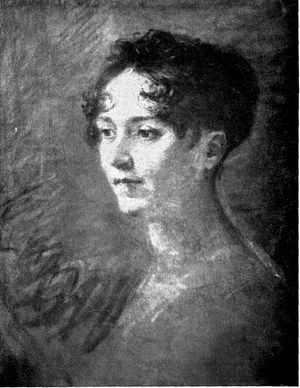
In the collection of the Duc de Trevise.
Josephine.
From a pastel by Pierre Prud'hon.
Though the commanding general could not well yield to his subordinate,
he did, most ungraciously, to the Convention legates. Between the
seventeenth and twentieth of September effective batteries under
Buonaparte's command forced the enemy's frigates to withdraw from the
neighborhood of La Seyne on the inner bay. The shot were red hot, the
fire concentrated, and the guns served with cool efficiency. Next day
the village was occupied and with only four hundred men General
Delaborde marched to seize the Eguillette, the key to the siege, as
Buonaparte reiterated and reiterated. He was ingloriously routed; the
British landed reinforcements and erected strong fortifications over
night. They styled the place Fort Mulgrave. It was speedily flanked by
three redoubts. To Buonaparte this contemptuous defiance was
insufferable: he spoke and Salicetti wrote of the siege as destitute
both of brains and means. Thereupon the Paris legates began to
represent Carteaux as an incapable and demand his recall.
Buonaparte ransacked the surrounding towns and countryside for cannon
and secured a number; he established forges at Ollioules to keep his
apparatus in order, and entirely reorganized his personnel. With fair
efficiency and substantial quantity of guns and shot, he found himself
without sufficient powder and wrote imperiously to his superiors,
enforcing successfully his demand. Meantime he made himself
conspicuous by personal daring and exposure. The days and nights were
arduous because of the enemy's activity. In successive sorties on
October first, eighth, and fourteenth the British garrison of Fort
Mulgrave gained both ground and prestige by successive victories. It
was hard for the French to repress their impatience, but they were not
ready yet for a general move: not a single arm of the service was
sufficiently strong and the army was becoming demoralized by
inactivity. The feud between general and legates grew bitter and the
demands of the latter for material were disregarded alike at Paris and
by Doppet, who had just captured Lyons, but would part with none of
his guns or ammunition or men for use at Toulon. Lapoype and Carteaux
quarreled bitterly, and there was such confusion that Buonaparte ended
by squarely disobeying his superior and taking many minor movements
into his own hand; he was so cocksure that artillery alone would end
the siege that the general dubbed him Captain Cannon. Finally the
wrangling of all concerned cried to heaven, and on October
twenty-third Carteaux was transferred to the Army of Italy with
headquarters at Nice. He left for his new post on November seventh,
and five days later his successor appeared. In the interim the nominal
commander was Lapoype, really Salicetti prompted by Buonaparte.
Thus at length the artist was removed from command, and a
physician was appointed in his stead. The doctor was an ardent patriot
who had distinguished himself at the siege of Lyons, which had fallen
on October ninth. But on arriving at Toulon the citizen soldier was
awed by the magnitude of his new work. On November fifteenth the
French pickets saw a Spaniard maltreating a French prisoner on the
outworks of Fort Mulgrave. There was an impulsive and spontaneous rush
of the besiegers to avenge the insult. General O'Hara landed from the
Victory with reinforcements for the garrison. Doppet was
panic-stricken by the fire and ordered a retreat. Captain Buonaparte
with an oath expressed his displeasure. The soldiers cried in angry
spite: "Are we always to be commanded by painters and doctors?"
Indeed, the newcomer had hardly taken command, leaving matters at
loose ends as they were: in a short time he was transferred at his own
suggestion to an easier station in the Pyrenees, it being understood
that Dugommier, a professional soldier, would be finally appointed
commander-in-chief, and that Duteil, the brother of Buonaparte's old
friend and commander, was to be made general of artillery. He was a
man advanced in years, unable even to mount a horse: but he was
devoted to the young captain, trusted his powers, and left him in
virtual command. Abundant supplies arrived at the same time from
Lyons. On November twentieth the new officers took charge, two days
later a general reconnaissance was made, and within a short time the
investment was completed. On the thirtieth there was a formidable
sally from the town directed against Buonaparte's batteries. In the
force were two thousand three hundred and fifty men: about four
hundred British, three hundred Sardinians, two hundred and fifty
French, and seven hundred each of Neapolitans and Spanish. They were
commanded by General Dundas. Their earliest movements were
successful and the commander-in-chief of the besieged came out to see
the victory. But the tide turned, the French revolutionists rallied,
and the sortie was repulsed. The event was made doubly important by
the chance capture of General O'Hara, the English commandant. Such a
capture is rare,—Buonaparte was profoundly impressed by the fact. He
obtained permission to visit the English general in captivity, but was
coldly received. To the question: "What do you require?" came the curt
reply: "To be left alone and owe nothing to pity." This striking
though uncourtly reply delighted Buonaparte. The success was duly
reported to Paris. In the "Moniteur" of December seventh the name of
Buona Parte is mentioned for the first time, and as among the most
distinguished in the action.
The councils of war before Dugommier's arrival had been numerous and
turbulent, although the solitary plan of operations suggested by the
commander and his aides would have been adequate only for capturing an
inland town, and probably not even for that. From the beginning and
with fierce iteration Buonaparte had explained to his colleagues the
special features of their task, but all in vain. He reasoned that
Toulon depended for its resisting power on the Allies and their
fleets, and must be reduced from the side next the sea. The English
themselves understood this when they seized and fortified the redoubt
of Fort Mulgrave, known also by the French as Little Gibraltar, on the
tongue of land separating, to the westward, the inner from the outer
bay. That post on the promontory styled the Eguillette by the natives
must be taken. From the very moment of his arrival this simple but
clever conception had been urged on the council of war by
Buonaparte. But Carteaux could not and would not see its importance:
it was not until a skilled commander took charge that Buonaparte's
insight was justified and his plan adopted. At the same time it was
determined that operations should also be directed against two other
strong outposts, one to the north, the other to the northeast, of the
town. There was to be a genuine effort to capture Mt. Faron on the
north and a demonstration merely against the third point. But the
concentration of force was to be against the Eguillette.
Finally, on December seventeenth, after careful preparation, a
concerted attack was made at all three points. Officers and men were
daring and efficient everywhere. Buonaparte, assuming responsibility
for the batteries, was ubiquitous and reckless. The movement on which
he had set his heart was successful in every portion; the enemy was
not only driven within the interior works, but by the fall of Little
Gibraltar his communication with the sea was endangered. The whole
peninsula, the fort itself, the point and the neighboring heights were
captured. Victor, Muiron, Buonaparte, and Dugommier led the storming
columns. The Allies were utterly demoralized by the fierce and bloody
struggle. Since, therefore, the supporting fleets could no longer
remain in a situation so precarious, the besieged at once made ready
for departure, embarking with precipitate haste the troops and many of
the inhabitants. The Spaniards fired two frigates loaded with powder
and the explosion of the magazines shook the city and its suburbs like
an earthquake. In that moment the young Sidney Smith landed from the
British ships and laid the trains which kindled an awful
conflagration. The captured French fleet lying at anchor, the
magazines and shops of the arsenal, all its enclosures burst
into flames, and one explosion followed another in an awe-inspiring
volcanic eruption. The besiegers were stupefied as they gazed, and
stopped their ears. In a few hours the city was completely evacuated,
and the foreign war vessels sailed away from the offing. The news of
this decisive victory was despatched without a moment's delay to the
Convention. The names of Salicetti, Robespierre, Ricord, Fréron, and
Barras are mentioned in Dugommier's letters as those of men who had
won distinction in various posts; that of Buonaparte does not occur.
There was either jealousy of his merits, which are declared by his
enemies to have been unduly vaunted, or else his share had been more
insignificant than is generally supposed. He related at St. Helena
that during the operations before Toulon he had had three horses
killed under him, and showed Las Cases a great scar on his thigh which
he said had been received in a bayonet charge at Toulon. "Men wondered
at the fortune which kept me invulnerable; I always concealed my
dangers in mystery." The hypothesis of his insignificance appears
unlikely when we examine the memoirs written by his contemporaries,
and consider the precise traditions of a later generation; it becomes
untenable in view of what happened on the next day, when the
commissioners nominated him for the office of general of brigade, a
rank which in the exchange of prisoners with the English was reckoned
as equal to that of lieutenant-general. In a report written on the
nineteenth to the minister of war, Duteil speaks in the highest terms
of Buonaparte. "A great deal of science, as much intelligence, and too
much bravery; such is a faint sketch of the virtues of this rare
officer. It rests with you, minister, to retain them for the glory of
the republic."
On December twenty-fourth the Convention received the news of
victory. It was really their reprieve, for news of disaster would have
cut short their career. Jubilant over a prompt success, their joy was
savage and infernal. With the eagerness of vampires they at once sent
two commissioners to wipe the name of Toulon from the map, and its
inhabitants from the earth. Fouché, later chief of police and Duke of
Otranto under Napoleon, went down from Lyons to see the sport, and
wrote to his friend the arch-murderer Collot d'Herbois that they were
celebrating the victory in but one way. "This night we send two
hundred and thirteen rebels into hell-fire." The fact is, no one ever
knew how many hundreds or thousands of the Toulon Girondists were
swept together and destroyed by the fire of cannon and musketry.
Fréron, one of the commissioners, desired to leave not a single rebel
alive. Dugommier would listen to no such proposition for a holocaust.
Marmont declares that Buonaparte and his artillerymen pleaded for
mercy, but in vain.
Running like a thread through all these events was a little
counterplot. The Corsicans at Toulon were persons of importance, and
had shown their mettle. Salicetti, Buonaparte, Arena, and Cervoni were
now men of mark; the two latter had, like Buonaparte, been promoted,
though to much lower rank. As Salicetti declared in a letter written
on December twenty-eighth, they were scheming to secure vessels and
arm them for an expedition to Corsica. But for the time their efforts
came to naught; and thenceforward Salicetti seemed to lose all
interest in Corsican affairs, becoming more and more involved in the
ever madder rush of events in France.
This was not strange, for even a common politician could not remain
insensible to the course or the consequences of the
malignant anarchy now raging throughout France. The massacres at
Lyons, Marseilles, and Toulon were the reply to the horrors of like or
worse nature perpetrated in Vendée by the royalists. Danton having
used the Paris sections to overawe the Girondist majority of the
Convention, Marat gathered his riotous band of sansculottes, and
hounded the discredited remnant of the party to death, flight, or
arrest. His bloody career was ended only by Charlotte Corday's dagger.
Passions were thus inflamed until even Danton's conduct appeared calm,
moderate, and inefficient when compared with the reckless
bloodthirstiness of Hébert, now leader of the Exagérés. The latter
prevailed, the Vendeans were defeated, and Citizen Carrier of Nantes
in three months took fifteen thousand human lives by his fiendishly
ingenious systems of drowning and shooting. In short, France was
chaos, and the Salicettis of the time might hope for anything, or fear
everything, in the throes of her disorder. Not so a man like
Buonaparte. His instinct led him to stand in readiness at the parting
of the ways. Others might choose and press forward; he gave no sign of
being moved by current events, but stood with his eye still fixed,
though now in a backward gaze, on Corsica, ready, if interest or
self-preservation required it, for another effort to seize and hold it
as his own. It was self-esteem, not Corsican patriotism, his French
interest perhaps, which now prompted him. Determined and revengeful,
he was again, through the confusion of affairs at Paris, to secure
means for his enterprise, and this time on a scale proportionate to
the difficulty. The influence of Toulon upon Buonaparte's fortunes was
incalculable. Throughout life he spoke of the town, of the siege and
his share therein, of the subsequent events and of the men whose
acquaintance he made there, with lively and emphatic
interest. To all associated with the capture he was in after years
generous to a fault, except a few enemies like Auna whom he treated
with harshness. In particular it must not be forgotten that among many
men of minor importance he there began his relations with some of his
greatest generals and marshals: Desaix, Marmont, Junot, Muiron, and
Chauvet. The experience launched him on his grand career; the
intimacies he formed proved a strong support when he forced himself to
the front. Moreover, his respect for England was heightened. It was
not in violation of a pledge to hold the place for the Bourbon
pretender, but by right of sheer ability that they took precedence of
the Allies in command. They were haughty and dictatorial because their
associates were uncertain and divided. When the Comte de Provence was
suggested as a colleague they refused to admit him because he was
detested by the best men of his own party. In the garrison of nearly
fifteen thousand not a third were British. Buonaparte and others
charged them with perfidy in a desire to hold the great fort for
themselves, but the charge was untrue and he did not disdain them, but
rather admired and imitated their policy.[Back to Contents]
Transformation in Buonaparte's Character — Confirmed as a
French General — Conduct of His Brothers — Napoleon's
Caution — His Report on Marseilles — The New French Army
— Buonaparte the Jacobin Leader — Hostilities with Austria
and Sardinia — Enthusiasm of the French Troops —
Buonaparte in Society — His Plan for an Italian Campaign.
1793-94.
Hitherto prudence had not been characteristic of Buonaparte: his
escapades and disobedience had savored rather of recklessness. Like
scores of others in his class, he had fully exploited the looseness of
royal and early republican administration; his madcap and hotspur
versatility distinguished him from his comrades not in the kind but in
the degree of his bold effrontery. The whole outlook having changed
since his final flight to France, his conduct now began to reveal a
definite plan—to be marked by punctilious obedience, sometimes even
by an almost puerile caution. His family was homeless and penniless;
their only hope for a livelihood was in coöperation with the Jacobins,
who appeared to be growing more influential every hour. Through the
powerful friends that Napoleon had made among the representatives of
the Convention, men like the younger Robespierre, Fréron, and Barras,
much had already been gained. If his nomination to the office of
general of brigade were confirmed, as it was almost certain to be, the
rest would follow, since, with his innate capacity for adapting
himself to circumstances, he had during the last few weeks
successfully cultivated his power of pleasing, captivating
the hearts of Marmont, Junot, and many others.
With such strong chances in his favor, it appeared to Buonaparte that
no stumbling-block of technicality should be thrown in the path of his
promotion. Accordingly, in the record of his life sent up to Paris, he
puts his entrance into the service over a year earlier than it
actually occurred, omits as unessential details some of the places in
which he had lived and some of the companies in which he had served,
declares that he had commanded a battalion at the capture of
Magdalena, and, finally, denies categorically that he was ever noble.
To this paper, which minimizes nearly to the vanishing-point all
mention of Corsica, and emphasizes his services as a Frenchman by its
insidious omissions, the over-driven officials in Paris took no
exception; and on February sixth, 1794, he was confirmed, receiving an
assignment for service in the new and regenerated Army of Italy, which
had replaced as if by magic the ragged, shoeless, ill-equipped, and
half-starved remnants of troops in and about Nice that in the previous
year had been dignified by the same title. This gambler had not drawn
the first prize in the lottery, but what he had secured was enough to
justify his course, and confirm his confidence in fate. Eight years
and three months nominally in the service, out of which in reality he
had been absent four years and ten months either on furlough or
without one, and already a general! Neither blind luck, nor the
revolutionary epoch, nor the superlative ability of the man, but a
compound of all these, had brought this marvel to pass. It did not
intoxicate, but still further sobered, the beneficiary. This effect
was partly due to an experience which demonstrated that strong as are
the chains of habit, they are more easily broken than those which his
associates forge about a man.
In the interval between nomination and confirmation the young
aspirant, through the fault of his friends, was involved in a most
serious risk. Salicetti, and the Buonaparte brothers, Joseph, Lucien,
and Louis, went wild with exultation over the fall of Toulon, and
began by reckless assumptions and untruthful representations to reap
an abundant harvest of spoils. Joseph, by the use of his brother's
Corsican commission, had posed as a lieutenant-colonel; he was now
made a commissary-general of the first class. Louis, without regard to
his extreme youth, was promoted to be adjutant-major of artillery—a
dignity which was short-lived, for he was soon after ordered to the
school at Châlons as a cadet, but which served, like the greater
success of Joseph, to tide over a crisis. Lucien retained his post as
keeper of the commissary stores in St. Maximin, where he was the
leading Jacobin, styling himself Lucius Brutus, and rejoicing in the
sobriquet of "the little Robespierre."
The positions of Lucien and Louis were fantastic even for
revolutionary times. Napoleon was fully aware of the danger, and was
correspondingly circumspect. It was possibly at his own suggestion
that he was appointed, on December twenty-sixth, 1793, inspector of
the shore fortifications, and ordered to proceed immediately on an
inspection of the Mediterranean coast as far as Mentone. The
expedition removed him from all temptation to an unfortunate display
of exultation or anxiety, and gave him a new chance to display his
powers. He performed his task with the thoroughness of an expert; but
in so doing, his zeal played him a sorry trick, eclipsing the caution
of the revolutionist by the eagerness of the sagacious general. In his
report to the minister of war he comprehensively discussed both the
fortification of the coast and the strengthening of the navy, which
were alike indispensable to the wonderful scheme of
operations in Italy which he appears to have been already revolving in
his mind. The Army of Italy, and in fact all southeastern France,
depended at the moment for sustenance on the commerce of Genoa,
professedly a neutral state and friendly to the French republic. This
essential trade could be protected only by making interference from
the English and the Spaniards impossible, or at least difficult.
Arrived at Marseilles, and with these ideas occupying his whole mind,
Buonaparte regarded the situation as serious. The British and Spanish
fleets swept the seas, and were virtually blockading all the
Mediterranean ports of France. At Toulon, as has been told, they
actually entered, and departed only after losing control of the
promontory which forms the harbor. There is a similar conformation of
the ground at the entrance to the port of Marseilles, but Buonaparte
found that the fortress which occupied the commanding promontory had
been dismantled. With the instinct of a strategist and with no other
thought than that of his duties as inspector, he sat down, and on
January fourth, 1794, wrote a most impolitic recommendation that the
fortification should be restored in such a way as to "command the
town." These words almost certainly referred both to the possible
renewal by the conquered French royalists and other malcontents of
their efforts to secure Marseilles, and to a conceivable effort on the
part of the Allies to seize the harbor. Now it happened that the
liberals of the town had regarded this very stronghold as their
Bastille, and it had been dismantled by them in emulation of their
brethren of Paris. The language and motive of the report were
therefore capable of misinterpretation. A storm at once arose among
the Marseilles Jacobins against both Buonaparte and his superior,
General Lapoype; they were both denounced to the Convention,
and in due time, about the end of February, were both summoned before
the bar of that body. In the mean time Buonaparte's nomination as
general of brigade had been confirmed, his commission arriving at
Marseilles on February sixteenth. It availed nothing toward restoring
him to popularity; on the contrary, the masses grew more suspicious
and more menacing. He therefore returned to the protection of
Salicetti and Robespierre, then at Toulon, whence by their advice he
despatched to Paris by special messenger a poor-spirited exculpatory
letter, admitting that the only use of restoring the fort would be to
"command the town," that is, control it by military power in case of
revolution. Having by this language pusillanimously acknowledged a
fault which he had not committed, the writer, by the advice of
Salicetti and Robespierre, refused to obey the formal summons of the
Convention when it came. Those powerful protectors made vigorous
representations to their friends in Paris, and Buonaparte was saved.
Both they and he might well rely on the distinguished service rendered
by the culprit at Toulon; his military achievement might well outweigh
a slight political delinquency. On April first, 1794, he assumed the
duties of his new command, reporting himself at Nice. Lapoype went to
Paris, appeared at the bar of the Convention, and was triumphantly
acquitted. Naturally, therefore, no indictment could lie against the
inferior, and Buonaparte's name was not even mentioned.
A single circumstance changed the French Revolution from a sectarian
dogma into a national movement. By the exertions and plans of Carnot
the effective force of the French army had been raised in less than
two years from one hundred and twelve thousand to the astonishing
figure of over seven hundred and thirty thousand. The
discipline was now rigid, and the machine was perfectly adapted to the
workman's hand, although for lack of money the equipment was still
sadly defective. In the Army of Italy were nearly sixty-seven thousand
men, a number which included all the garrisons and reserves of the
coast towns and of Corsica. Its organization, like that of the other
portions of the military power, had been simplified, and so
strengthened. There were a commander-in-chief, a chief of staff, three
generals of division, of whom Masséna was one, and thirteen generals
of brigade, of whom one, Buonaparte, was the commander and inspector
of artillery. The former was now thirty-four years old. His sire was a
wine-dealer of a very humble sort, probably of Jewish blood, and the
boy, Italian in origin and feeling, had almost no education.
Throughout his wonderful career he was coarse, sullen, and greedy;
nevertheless, as a soldier he was an inspired genius, ranked by many
as the peer of Napoleon. Having served France for several years as an
Italian mercenary, he resigned in 1789, settled in his native town of
Nice, and married; but the stir of arms was irresistible and three
years later he volunteered under the tricolor. His comrades at once
elected him an officer, and in about a year he was head of a
battalion, or colonel in our style. In the reorganization he was
promoted to be a division general because of sheer merit. For sixteen
years he had an unbroken record of success and won from Napoleon the
caressing title: "Dear Child of Victory."
The younger Robespierre, with Ricord and Salicetti, were the
"representatives of the people." The first of these was, to outward
appearance, the leading spirit of the whole organism, and to his
support Buonaparte was now thoroughly committed. The young artillery
commander was considered by all at Nice to be a pronounced
"Montagnard," that is, an extreme Jacobin. Augustin Robespierre had
quickly learned to see and hear with the eyes and ears of his Corsican
friend, whose fidelity seemed assured by hatred of Paoli and by a
desire to recover the family estates in his native island. Many are
pleased to discuss the question of Buonaparte's attitude toward the
Jacobin terrorists. The dilemma they propose is that he was either a
convinced and sincere terrorist or that he fawned on the terrorists
from interested motives. This last appears to have been the opinion of
Augustin Robespierre, the former that of his sister Marie, for the
time an intimate friend of the Buonaparte sisters. Both at least have
left these opinions on record in letters and memoirs. There is no need
to impale ourselves on either horn, if we consider the youth as he
was, feeling no responsibility whatever for the conditions into which
he was thrown, taking the world as he found it and using its
opportunities while they lasted. For the time and in that place there
were terrorists: he made no confession of faith, avoided all snares,
and served his adopted country as she was in fact with little
reference to political shibboleths. He so served her then and
henceforth that until he lost both his poise and his indispensable
power, she laid herself at his feet and adored him. Whatever the ties
which bound them at first, the ascendancy of Buonaparte over the young
Robespierre was thorough in the end. His were the suggestions and the
enterprises, the political conceptions, the military plans, the
devices to obtain ways and means. It was probably his advice which was
determinative in the scheme of operations finally adopted. With an
astute and fertile brain, with a feverish energy and an unbounded
ambition, Buonaparte must attack every problem or be wretched. Here
was a most interesting one, complicated by geographical,
political, naval, and military elements. That he seized it, considered
it, and found some solution is inherently probable. The conclusion too
has all the marks of his genius. Yet the glory of success was justly
Masséna's. A select third of the troops were chosen and divided into
three divisions to assume the offensive, under Masséna's direction,
against the almost impregnable posts of the Austrians and Sardinians
in the upper Apennines. The rest were held in garrison partly as a
reserve, partly to overawe the newly annexed department of which Nice
was the capital.
Genoa now stood in a peculiar relation to France. Her oligarchy,
though called a republic, was in spirit the antipodes of French
democracy. Her trade was essential to France, but English influence
predominated in her councils and English force worked its will in her
domains. In October, 1793, a French supply-ship had been seized by an
English squadron in the very harbor. Soon afterward, by way of
rejoinder to this act of violence, the French minister at Genoa was
officially informed from Paris that as it appeared no longer possible
for a French army to reach Lombardy by the direct route through the
Apennines, it might be necessary to advance along the coast through
Genoese territory. This announcement was no threat, but serious
earnest; the plan had been carefully considered and was before long to
be put into execution. It was merely as a feint that in April, 1794,
hostilities were formally opened against Sardinia and Austria. Masséna
seized Ventimiglia on the sixth. Advancing by Oneglia and Ormea, in
the valley of the Stura, he turned the position of the allied
Austrians and Sardinians, thus compelling them to evacuate their
strongholds one by one, until on May seventh the pass of Tenda,
leading direct into Lombardy, was abandoned by them.
The result of this movement was to infuse new enthusiasm into
the army, while at the same time it set free, for offensive warfare,
large numbers of the garrison troops in places now no longer in
danger. Masséna wrote in terms of exultation of the devotion and
endurance which his troops had shown in the sacred name of liberty.
"They know how to conquer and never complain. Marching barefoot, and
often without rations, they abuse no one, but sing the loved notes of
'Ça ira'—'T will go, 't will go! We'll make the creatures that
surround the despot at Turin dance the Carmagnole!" Victor Amadeus,
King of Sardinia, was an excellent specimen of the benevolent despot;
it was he whom they meant. Augustin Robespierre wrote to his brother
Maximilien, in Paris, that they had found the country before them
deserted: forty thousand souls had fled from the single valley of
Oneglia, having been terrified by the accounts of French savagery to
women and children, and of their impiety in devastating the churches
and religious establishments.
Whether the phenomenal success of this short campaign, which lasted
but a month, was expected or not, nothing was done to improve it, and
the advancing battalions suddenly stopped, as if to make the
impression that they could go farther only by way of Genoese
territory. Buonaparte would certainly have shared in the campaign had
it been a serious attack; but, except to bring captured stores from
Oneglia, he did nothing, devoting the months of May and June to the
completion of his shore defenses, and living at Nice with his mother
and her family. That famous and coquettish town was now the center of
a gay republican society in which Napoleon and his pretty sisters were
important persons. They were the constant companions of young
Robespierre and Ricord. The former, amazed by the activity
of his friend's brain, the scope of his plans, and the terrible energy
which marked his preparations, wrote of Napoleon that he was a man of
"transcendent merit." Marmont, speaking of Napoleon's charm at this
time, says: "There was so much future in his mind.... He had acquired
an ascendancy over the representatives which it is impossible to
describe." He also declares, and Salicetti, too, repeatedly
asseverated, that Buonaparte was the "man, the plan-maker" of the
Robespierres.
The impression which Salicetti and Marmont expressed was doubtless due
to the conclusions of a council of war held on May twentieth by the
leaders of the two armies—of the Alps and of Italy—to concert a plan
of coöperation. Naturally each group of generals desired the foremost
place for the army it represented. Buonaparte overrode all objections,
and compelled the acceptance of a scheme entirely his own, which with
some additions and by careful elaboration ultimately developed into
the famous plan of campaign in Italy. These circumstances are
noteworthy. Again and again it has been charged that this grand scheme
was bodily stolen from the papers of his great predecessors, one in
particular, of whom more must be said in the sequel. Napoleon was a
student and an omnivorous reader, he knew what others had done and
written; but the achievement which launched him on his career was due
to the use of his own senses, to his own assimilation and adaptation
of other men's experiences and theories, which had everything to
commend them except that perfection of detail and energy of command
which led to actual victory. But affairs in Genoa were becoming so
menacing that for the moment they demanded the exclusive attention of
the French authorities. Austrian troops had disregarded her neutrality
and trespassed on her territory; the land was full of French
deserters, and England, recalling her successes in the same
line during the American Revolution, had established a press in the
city for printing counterfeit French money, which was sent by secret
mercantile communications to Marseilles, and there was put into
circulation. It was consequently soon determined to amplify greatly
the plan of campaign, and likewise to send a mission to Genoa.
Buonaparte was himself appointed the envoy, and thus became the pivot
of both movements—that against Piedmont and that against Genoa.[Back to Contents]
Signs of Maturity — The Mission to Genoa — Course of the
French Republic — The "Terror" — Thermidor — Buonaparte a
Scapegoat — His Prescience — Adventures of His Brothers —
Napoleon's Defense of His French Patriotism — Bloodshedding
for Amusement — New Expedition Against Corsica —
Buonaparte's Advice for Its Conduct.
1794.
Buonaparte's plan for combining operations against both Genoa and
Sardinia was at first hazy. In his earliest efforts to expand and
clarify it, he wrote a rambling document, still in existence, which
draws a contrast between the opposite policies to be adopted with
reference to Italy and Spain. In it he also calls attention to the
scarcity of officers suitable for concerted action in a great
enterprise, and a remark concerning the course to be pursued in this
particular case contains the germ of his whole military system.
"Combine your forces in a war, as in a siege, on one point. The breach
once made, equilibrium is destroyed, everything else is useless, and
the place is taken. Do not conceal, but concentrate, your attack." In
the matter of politics he sees Germany as the main prop of opposition
to democracy; Spain is to be dealt with on the defensive, Italy on the
offensive. But, contrary to what he actually did in the following
year, he advises against proceeding too far into Piedmont, lest the
adversary should gain the advantage of position. This paper
Robespierre the younger had in his pocket when he left for Paris,
summoned to aid his brother in difficulties which were now pressing
fast upon him.
Ricord was left behind to direct, at least nominally, the
movements both of the armies and of the embassy to Genoa. Buonaparte
continued to be the real power. Military operations having been
suspended to await the result of diplomacy, his instructions from
Ricord were drawn so as to be loose and merely formal. On July
eleventh he started from Nice, reaching his destination three days
later. During the week of his stay—for he left again on the
twenty-first—the envoy made his representations, and laid down his
ultimatum that the republic of Genoa should preserve absolute
neutrality, neither permitting troops to pass over its territories,
nor lending aid in the construction of military roads, as she was
charged with doing secretly. His success in overawing the oligarchy
was complete, and a written promise of compliance to these demands was
made by the Doge. Buonaparte arrived again in Nice on the
twenty-eighth. We may imagine that as he traveled the romantic road
between the mountains and the sea, the rising general and diplomat
indulged in many rosy dreams, probably feeling already on his
shoulders the insignia of a commander-in-chief. But he was returning
to disgrace, if not to destruction. A week after his arrival came the
stupefying news that the hour-glass had once again been reversed, that
on the very day of his own exultant return to Nice, Robespierre's head
had fallen, that the Mountain was shattered, and that the land was
again staggering to gain its balance after another political
earthquake.
The shock had been awful, but it was directly traceable to the
accumulated disorders of Jacobin rule. A rude and vigorous but eerie
order of things had been inaugurated on November twenty-fourth, 1793,
by the so-called republic. There was first the new calendar, in which
the year I began on September twenty-second, 1792, the day
on which the republic had been proclaimed. In it were the twelve
thirty-day months, with their names of vintage, fog, and frost; of
snow, rain, and wind; of bud, flower, and meadow; of seed, heat, and
harvest: the whole terminated most unpoetically by the five or six
supplementary days named sansculot-tides,—sansculottes meaning
without knee-breeches, a garment confined to the upper classes; that
is, with long trousers like the common people,—and these days were so
named because they were to be a holiday for the long-trousered
populace which was to use the new reckoning. There was next the new,
strange, and unhallowed spectacle, seen in history for the first time,
the realization of a nightmare—a whole people finally turned into an
army, and at war with nearly all the world. The reforming Girondists
had created the situation, and the Jacobins, with grim humor, were
unflinchingly facing the logical consequences of such audacity. Carnot
had given the watchword of attack in mass and with superior numbers;
the times gave the frenzied courage of sentimental exaltation. Before
the end of 1793 the foreign enemies of France, though not conquered,
had been checked on the frontier; the outbreak of civil war in Vendée
had been temporarily suppressed; both Lyons and Toulon had been
retaken.
Robespierre, St. Just, Couthon, and Billaud-Varennes were theorists
after the manner of Rousseau. Their new gospel of social regeneration
embraced democracy, civic virtue, moral institutions, and public
festivals. These were their shibboleths and catch-words. Incidentally
they extolled paternalism in government, general conscription,
compulsory military service, and, on the very eve of the greatest
industrial revival known to history, a return to agricultural society!
The sanction of all this was not moral suasion: essential to the
system was Spartan simplicity and severity, compulsion was
the means to their utopia.[40] The Jacobins were nothing if not
thorough; and here was another new and awful thing—the
"Terror"—which had broken loose with its foul furies of party against
party through all the land. It seemed at last as if it were exhausting
itself, though for a time it had grown in intensity as it spread in
extent. It had created three factions in the Mountain. Early in 1794
there remained but a little handful of avowed and still eager
terrorists in the Convention—Hébert and his friends. These were the
atheists who had abolished religion and the past, bowing down before
the fetish which they dubbed Reason. They were seized and put to death
on March twenty-fourth. There then remained the cliques of Danton and
Robespierre; the former claiming the name of moderates, and telling
men to be calm, the latter with no principle but devotion to a person
who claimed to be the regenerator of society. These hero-worshipers
were for a time victorious. Danton, like Hébert, was foully murdered,
and Robespierre remained alone, virtually dictator. But his theatrical
conduct in decreeing by law the existence of a Supreme Being and the
immortality of the soul, and in organizing tawdry festivals to supply
the place of worship, utterly embittered against him both atheists and
pious people. In disappointed rage at his failure, he laid aside the
characters of prophet and mild saint to give vent to his natural
wickedness and to become a devil.
During the long days of June and July there raged again a carnival of
blood, known to history as the "Great Terror." In less than seven
weeks upward of twelve hundred victims were immolated. The
unbridled license of the guillotine broadened as it ran. First the
aristocrats had fallen, then royalty, then their sympathizers, then
the hated rich, then the merely well-to-do, and lastly anybody not
cringing to existing power. The reaction against Robespierre was one
of universal fear. Its inception was the work of Tallien, Fouché,
Barras, Carrier, Fréron, and the like, men of vile character, who knew
that if Robespierre could maintain his pose of the "Incorruptible"
their doom was sealed. In this sense Robespierre was what Napoleon
called him at St. Helena, "the scapegoat of the Revolution." The
uprising of these accomplices was, however, the opportunity long
desired by the better elements in Parisian society, and the two
antipodal classes made common cause. Dictator as Robespierre wished to
be, he was formed of other stuff, for when the reckoning came his
brutal violence was cowed. On July twenty-seventh (the ninth of
Thermidor), the Convention turned on him in rebellion, extreme
radicals and moderate conservatives combining for the effort. Terrible
scenes were enacted. The sections of Paris were divided, some for the
Convention, some for Robespierre. The artillerymen who were ordered by
the latter to batter down the part of the Tuileries where his enemies
were sitting hesitated and disobeyed; at once all resistance to the
decrees of the Convention died out. The dictator would have been his
own executioner, but his faltering terrors stopped him midway in his
half-committed suicide. He and his brother, with their friends, were
seized, and beheaded on the morrow. With the downfall of Robespierre
went the last vestige of social or political authority; for the
Convention was no longer trusted by the nation—the only organized
power with popular support which was left was the army.
This was the news which, traveling southward, finally reached
Toulon, Marseilles, and Nice, cities where Robespierre's stanchest
adherents were flaunting their newly gained importance. No wonder if
the brains of common men reeled. The recent so-called parties had
disappeared for the moment like wraiths. The victorious group in the
Convention, now known as the Thermidorians, was compounded of elements
from them both, and claimed to represent the whole of France as the
wretched factions who had so long controlled the government had never
done. Where now should those who had been active supporters of the
late administration turn for refuge? The Corsicans who had escaped
from the island at the same time with Salicetti and the Buonapartes
were nearly all with the Army of Italy. Employment had been given to
them, but, having failed to keep Corsica for France, they were not in
favor. It had already been remarked in the Committee of Public Safety
that their patriotism was less manifest than their disposition to
enrich themselves. This too was the opinion of many among their own
countrymen, especially of their own partisans shut up in Bastia or
Calvi and deserted. Salicetti, ever ready for emergencies, was not
disconcerted by this one; and with adroit baseness turned informer,
denouncing as a suspicious schemer his former protégé and lieutenant,
of whose budding greatness he was now well aware. He was apparently
both jealous and alarmed. Possibly, however, the whole procedure was a
ruse; in the critical juncture the apparent traitor was by this
conduct able efficiently to succor and save his compatriot.
Buonaparte's mission to Genoa had been openly political; secretly it
was also a military reconnaissance, and his confidential instructions,
virtually dictated by himself, had unfortunately leaked out. They had
directed him to examine the fortifications in and about both
Savona and Genoa, to investigate the state of the Genoese artillery,
to inform himself as to the behavior of the French envoy to the
republic, to learn as much as possible of the intentions of the
oligarchy—in short, to gather all information useful for the conduct
of a war "the result of which it is impossible to foresee."
Buonaparte, knowing now that he had trodden dangerous ground in his
unauthorized and secret dealings with the younger Robespierre, and
probably foreseeing the coming storm, began to shorten sail
immediately upon reaching Nice. Either he was prescient and felt the
new influences in the air, or else a letter now in the war office at
Paris, and purporting to have been written on August seventh to Tilly,
the French agent at Genoa, is an antedated fabrication written later
for Salicetti's use.[41] Speaking, in this paper, of Robespierre the
younger, he said: "I was a little touched by the catastrophe, for I
loved him and thought him spotless. But were it my own father, I would
stab him to the heart if he aspired to become a tyrant." If the letter
be genuine, as is probable, the writer was very far-sighted. He knew
that its contents would speedily reach Paris in the despatches of
Tilly, so that it was virtually a public renunciation of Jacobinism at
the earliest possible date, an anchor to windward in the approaching
tempest. But momentarily the trick was of no avail; he was first
superseded in his command, then arrested on August tenth, and,
fortunately for himself, imprisoned two days later in Fort Carré, near
Antibes, instead of being sent direct to Paris as some of his friends
were. This temporary shelter from the devastating blast he owed to
Salicetti, who would, no doubt, without hesitation have destroyed a
friend for his own safety, but was willing enough to spare
him if not driven to extremity.
As the true state of things in Corsica began to be known in France,
there was a general disposition to blame and punish the influential
men who had brought things to such a desperate pass and made the loss
of the island probable, if not certain. Salicetti, Multedo, and the
rest quickly unloaded the whole blame on Buonaparte's shoulders, so
that he had many enemies in Paris. Thus by apparent harshness to one
whom he still considered a subordinate, the real culprit escaped
suspicion. Assured of immunity from punishment himself, Salicetti was
content with his rival's humiliation, and felt no real rancor toward
the family. This is clear from his treatment of Louis Buonaparte, who
had fallen from place and favor along with his brother, but was by
Salicetti's influence soon afterward made an officer of the home guard
at Nice. Joseph had rendered himself conspicuous in the very height of
the storm by a brilliant marriage; but neither he nor Fesch was
arrested, and both managed to pull through with whole skins. The noisy
Lucien was also married, but to a girl who, though respectable, was
poor; and in consequence he was thoroughly frightened at the thought
of losing his means of support. But though menaced with arrest, he was
sufficiently insignificant to escape for the time.
Napoleon was kept in captivity but thirteen days. Salicetti apparently
found it easier than he had supposed to exculpate himself from the
charge either of participating in Robespierre's conspiracy or of
having brought about the Corsican insurrection. More than this, he
found himself firm in the good graces of the Thermidorians, among whom
his old friends Barras and Fréron were held in high esteem. It would
therefore be a simple thing to liberate General Buonaparte, if only a
proper expression of opinion could be secured from him. The
clever prisoner had it ready before it was needed. To the faithful
Junot he wrote a kindly note declining to be rescued by a body of
friends organized to storm the prison or scale its walls.[42] Such a
course would have compromised him further. But to the "representatives
of the people" he wrote in language which finally committed him for
life. He explained that in a revolutionary epoch there are but two
classes of men, patriots and suspects. It could easily be seen to
which class a man belonged who had fought both intestine and foreign
foes. "I have sacrificed residence in my department, I have abandoned
all my goods, I have lost all for the republic. Since then I have
served at Toulon with some distinction, and I have deserved a share
with the Army of Italy in the laurels it earned at the taking of
Saorgio, Oneglia, and Tanaro. On the discovery of Robespierre's
conspiracy, my conduct was that of a man accustomed to regard nothing
but principle." The letter concludes with a passionate appeal to each
one of the controlling officials separately and by name, that is, to
both Salicetti and Albitte, for justice and restoration. "An hour
later, if the wicked want my life, I will gladly give it to them, I
care so little for it, I weary so often of it! Yes; the idea that it
may be still useful to my country is all that makes me bear the burden
with courage." The word for country which he employed, patrie, could
only be interpreted as referring to France.
Salicetti in person went through the form of examining the papers
offered in proof of Buonaparte's statements; found them, as a matter
of course, satisfactory; and the commissioners restored the suppliant
to partial liberty, but not to his post. He was to remain at army
headquarters, and the still terrible Committee of Safety was
to receive regular reports of his doings. This, too, was but a
subterfuge; on August twentieth he was restored to his rank. A few
weeks later commissioners from the Thermidorians arrived, with orders
that for the present all offensive operations in Italy were to be
suspended in order to put the strength of the district into a maritime
expedition against Rome and ultimately against Corsica, which was now
in the hands of England. Buonaparte immediately sought, and by
Salicetti's favor obtained, the important charge of equipping and
inspecting the artillery destined for the enterprise. He no doubt
hoped to make the venture tell in his personal interest against the
English party now triumphant in his home. This was the middle of
September. Before beginning to prepare for the Corsican expedition,
the army made a final demonstration to secure its lines. It was during
the preparatory days of this short campaign that a dreadful incident
occurred. Buonaparte had long since learned the power of women, and
had been ardently attentive in turn both to Mme. Robespierre and to
Mme. Ricord. "It was a great advantage to please them," he said; "for
in a lawless time a representative of the people is a real power."
Mme. Turreau, wife of one of the new commissioners, was now the
ascendant star in his attentions. One day, while walking arm in arm
with her near the top of the Tenda pass, Buonaparte took a sudden
freak to show her what war was like, and ordered the advance-guard to
charge the Austrian pickets. The attack was not only useless, but it
endangered the safety of the army; yet it was made according to
command, and human blood was shed. The story was told by Napoleon
himself, at the close of his life, in a tone of repentance, but with
evident relish.[43]
Buonaparte was present at the ensuing victories, but only as
a well-informed spectator and adviser, for he was yet in nominal
disgrace. Within five days the enemies' lines were driven back so as
to leave open the two most important roads into Italy—that by the
valley of the Bormida to Alessandria, and that by the shore to Genoa.
The difficult pass of Tenda fell entirely into French hands. The
English could not disembark their troops to strengthen the Allies. The
commerce of Genoa with Marseilles was reëstablished by land. "We have
celebrated the fifth sansculottide of the year II (September
twenty-first, 1794) in a manner worthy of the republic and the
National Convention," wrote the commissioners to their colleagues in
Paris. On the twenty-fourth, General Buonaparte was released by them
from attendance at headquarters, thus becoming once again a free man
and his own master. He proceeded immediately to Toulon in order to
prepare for the Corsican expedition. Once more the power of a great
nation was, he hoped, to be directed against the land of his birth,
and he was an important agent in the plan.
To regain, if possible, some of his lost influence in the island,
Buonaparte had already renewed communication with former acquaintances
in Ajaccio. In a letter written immediately after his release in
September, 1794, to the Corsican deputy Multedo, he informed his
correspondent that his birthplace was the weakest spot on the island,
and open to attack. The information was correct. Paoli had made an
effort to strengthen it, but without success. "To drive the English,"
said the writer of the letter, "from a position which makes them
masters of the Mediterranean, ... to emancipate a large number of good
patriots still to be found in that department, and to restore to their
firesides the good republicans who have deserved the care of
their country by the generous manner in which they have suffered for
it,—this, my friend, is the expedition which should occupy the
attention of the government." His fortune was in a sense dependent on
success: the important position of artillery inspector could not be
held by an absentee and it was soon filled by the appointment of a
rival compatriot, Casabianca. In the event of failure Buonaparte would
be destitute. Perhaps the old vista of becoming a Corsican hero opened
up once again to a sore and disappointed man, but it is not probable:
the horizon of his life had expanded too far to be again contracted,
and the present task was probably considered but as a bridge to cross
once more the waters of bitterness. On success or failure hung his
fate. Two fellow-adventurers were Junot and Marmont. The former was
the child of plain French burghers, twenty-three years old, a daring,
swaggering youth, indifferent to danger, already an intimate of
Napoleon's, having been his secretary at Toulon. His chequered destiny
was interwoven with that of his friend and he came to high position.
But though faithful to the end, he was always erratic and troublesome;
and in an attack of morbid chagrin he came to a violent end in 1813.
The other comrade was but a boy of twenty, the son of an officer who,
though of the lower nobility, was a convinced revolutionary. The boys
had met several years earlier at Dijon and again as young men at
Toulon, where the friendship was knitted which grew closer and closer
for twenty years. At Wagram, Marmont became a marshal. Already he had
acquired habits of luxurious ease and the doubtful fortunes of his
Emperor exasperated him into critical impatience. He so magnified his
own importance that at last he deserted. The labored memoirs he wrote
are the apology for his life and for his treachery. Though
without great genius, he was an able man and an industrious recorder
of valuable impressions. Not one of the three accomplished anything
during the Corsican expedition; their common humiliation probably
commended both of his junior comrades to Buonaparte's tenderness, and
thereafter both enjoyed much of his confidence, especially Marmont, in
whom it was utterly misplaced.[Back to Contents]
The English Conquest of Corsica — Effects in Italy — The
Buonapartes at Toulon — Napoleon Thwarted Again —
Departure for Paris — His Character Determined — His
Capacities — Reaction From the "Terror" — Resolutions of
the Convention — Parties in France — Their Lack of
Experience — A New Constitution — Different Views of Its
Value.
1795.
The turmoils of civil war in France had now left Corsica to her own
pursuits for many months. Her internal affairs had gone from bad to
worse, and Paoli, unable to control his fierce and wilful people, had
found himself helpless. Compelled to seek the support of some strong
foreign power, he had instinctively turned to England, and the English
fleet, driven from Toulon, was finally free to help him. On February
seventeenth, 1794, it entered the fine harbor of St. Florent, and
captured the town without an effort. Establishing a depot which thus
separated the two remaining centers of French influence, Calvi and
Bastia, the English admiral next laid siege to the latter. The place
made a gallant defense, holding out for over three months, until on
May twenty-second Captain Horatio Nelson, who had virtually controlled
operations for eighty-eight days continuously,—nearly the entire
time,—directed the guns of the Agamemnon with such destructive
force against the little city that when the land forces from St.
Florent appeared it was weakened beyond the power of resistance and
surrendered.[44] The terms made by its captors were the
easiest known to modern warfare, the conquered being granted all the
honors of war. As a direct and immediate result, the Corsican estates
met, and declared the island a constitutional monarchy under the
protection of England. Sir Gilbert Elliot was appointed viceroy, and
Paoli was recalled by George III to England. On August tenth fell
Calvi, the last French stronghold in the country, hitherto considered
impregnable by the Corsicans.
The presence of England so close to Italian shores immediately
produced throughout Lombardy and Tuscany a reaction of feeling in
favor of the French Revolution and its advanced ideas. The Committee
of Safety meant to take advantage of this sentiment and reduce the
Italian powers to the observance of strict neutrality at least, if
nothing more. They hoped to make a demonstration at Leghorn and punish
Rome for an insult to the republic still unavenged—the death of the
French minister, in 1793, at the hands of a mob; perhaps they might
also drive the British from Corsica. This explained the arrival of the
commissioners at Nice with the order to cease operations against
Sardinia and Austria, for the purpose of striking at English influence
in Italy, and possibly in Corsica.
Everything but one was soon in readiness. To meet the English fleet,
the shipwrights at Toulon must prepare a powerful squadron. They did
not complete their gigantic task until February nineteenth, 1795. We
can imagine the intense activity of any man of great power, determined
to reconquer a lost position: what Buonaparte's fire and zeal must
have been we can scarcely conceive; even his fiercest detractors bear
witness to the activity of those months. When the order to embark was
given, his organization and material were both as nearly perfect as
possible. His mother had brought the younger children to a
charming house near by, where she entertained the influential women of
the neighborhood; and thither her busy son often withdrew for the
pleasures of a society which he was now beginning thoroughly to enjoy.
Thanks to the social diplomacy of this most ingenious family,
everything went well for a time, even with Lucien; and Louis, now
sixteen, was made a lieutenant of artillery. At the last moment came
what seemed the climax of Napoleon's good fortune, the assurance that
the destination of the fleet would be Corsica. Peace was made with
Tuscany. Rome could not be reached without a decisive engagement with
the English; therefore the first object of the expedition would be to
engage the British squadron which was cruising about Corsica. Victory
would of course mean entrance into Corsican harbors.
On March eleventh the new fleet set sail. In its very first encounter
with the English on March thirteenth the fleet successfully
manœuvered and just saved a fine eighty-gun ship, the Ça Ira,
from capture by Nelson. Next day there was a partial fleet action
which ended in a disaster, and two fine ships were captured, the Ça
Ira and the Censeur; the others fled to Hyères, where the troops
were disembarked from their transports, and sent back to their
posts.[45] Naval operations were not resumed for three months. Once
more Buonaparte was the victim of uncontrollable circumstance.
Destitute of employment, stripped even of the little credit gained in
the last half-year,[46] he stood for the seventh time on the threshold
of the world, a suppliant at the door. In some respects he was worse
equipped for success than at the beginning, for he now had a
record to expunge. To an outsider the spring of 1795 must have
appeared the most critical period of his life.[47] He himself knew
better; in fact, this ill-fated expedition was probably soon forgotten
altogether. In his St. Helena reminiscences, at least, he never
recalled it: at that time he was not fond of mentioning his failures,
little or great, being chiefly concerned to hand himself down to
history as a man of lofty purposes and unsullied motives. Besides, he
was never in the slightest degree responsible for the terrible waste
of millions in this ill-starred maritime enterprise; all his own plans
had been for the conduct of the war by land.
The Corsican administration had always had in it at least one French
representative. Between the latest of these, Lacombe Saint-Michel, now
a member of the Committee of Safety, and the Salicetti party no love
was ever lost. It was a general feeling that the refugee Corsicans on
the Mediterranean shore were too near their home. They were always
charged with unscrupulous planning to fill their own pockets. Now,
somehow or other, inexplicably perhaps, but nevertheless certainly, a
costly expedition had been sent to Corsica under the impulse of these
very men, and it had failed. The unlucky adventurers had scarcely set
their feet on shore before Lacombe secured Buonaparte's appointment to
the Army of the West, where he would be far from old influences, with
orders to proceed immediately to his post. The papers reached
Marseilles, whither the Buonapartes had already betaken themselves,
during the month of April. On May second,[48] accompanied by Louis,
Junot, and Marmont, the broken general set out for Paris,
where he arrived with his companions eight days later, and rented
shabby lodgings in the Fossés-Montmartre, now Aboukir street. The
style of the house was Liberty Hotel.
At this point Buonaparte's apprentice years may be said to have ended:
he was virtually the man he remained to the end. A Corsican by origin,
he retained the national sensibility and an enormous power of
endurance both physical and intellectual, together with the dogged
persistence found in the medieval Corsicans. He was devoted with
primitive virtue to his family and his people, but was willing to
sacrifice the latter, at least, to his ambition. His moral sense,
having never been developed by education, and, worse than that, having
been befogged by the extreme sensibility of Rousseau and by the chaos
of the times which that prophet had brought to pass, was practically
lacking. Neither the hostility of his father to religion, nor his own
experiences with the Jesuits, could, however, entirely eradicate a
superstition which passed in his mind for faith. Sometimes he was a
scoffer, as many with weak convictions are; but in general he
preserved a formal and outward respect for the Church. He was,
however, a stanch opponent of Roman centralization and papal
pretensions. His theoretical education had been narrow and one-sided;
but his reading and his authorship, in spite of their superficial and
desultory character, had given him certain large and fairly definite
conceptions of history and politics. But his practical education! What
a polishing and sharpening he had had against the revolving world
moving many times faster then than in most ages! He was an adept in
the art of civil war, for he had been not merely an interested
observer, but an active participant in it during five years in two
countries. Long the victim of wiles more secret than his
own, he had finally grown most wily in diplomacy; an ambitious
politician, his pulpy principles were republican in their character so
far as they had any tissue or firmness.
His acquisitions in the science of war were substantial and definite.
Neither a martinet himself nor in any way tolerant of routine,
ignorant in fact of many hateful details, among others of obedience,
he yet rose far above tradition or practice in his conception of
strategy. He was perceptibly superior to the world about him in almost
every aptitude, and particularly so in power of combination, in
originality, and in far-sightedness. He could neither write nor spell
correctly, but he was skilled in all practical applications of
mathematics: town and country, mountains and plains, seas and rivers,
were all quantities in his equations. Untrustworthy himself, he strove
to arouse trust, faith, and devotion in those about him; and
concealing successfully his own purpose, he read the hearts of others
like an open book. Of pure-minded affection for either men or women he
had so far shown only a little, and had experienced in return even
less; but he had studied the arts of gallantry, and understood the
leverage of social forces. To these capacities, some embryonic, some
perfectly formed, add the fact that he was now a cosmopolitan, and
there will be outline, relief, and color to his character. "I am in
that frame of mind," he said of himself about this time, "in which men
are when on the eve of battle, with a persistent conviction that since
death is imminent in the end, to be uneasy is folly. Everything makes
me brave death and destiny; and if this goes on, I shall in the end,
my friend, no longer turn when a carriage passes. My reason is
sometimes astonished at all this; but it is the effect produced on me
by the moral spectacle of this land [ce pays-ci, not patrie], and
by the habit of running risks." This is the power and the
temper of a man of whom an intimate and confidential friend predicted
that he would never stop short until he had mounted either the throne
or the scaffold.
The overthrow of Robespierre was the result of an alliance between
what have been called the radicals and the conservatives in the
Convention. Both were Jacobins, for the Girondists had been
discredited, and put out of doors. It was not, however, the
Convention, but Paris, which took command of the resulting movement.
The social structure of France has been so strong, and the nation so
homogeneous, that political convulsions have had much less influence
there than elsewhere. But the "Terror" had struck at the heart of
nearly every family of consequence in the capital, and the people were
utterly weary of horrors. The wave of reaction began when the would-be
dictator fell. A wholesome longing for safety, with its attendant
pleasures, overpowered society, and light-heartedness returned.
Underneath this temper lay but partly concealed a grim determination
not to be thwarted, which awed the Convention. Slowly, yet surely, the
Jacobins lost their power. As once the whole land had been mastered by
the idea of "federation," and as a later patriotic impulse had given
as a watchword "the nation," so now another refrain was in every
mouth—"humanity." The very songs of previous stages, the "Ça ira" and
the "Carmagnole," were displaced by new and milder ones. With Paris in
this mood, it was clear that the proscribed might return, and the
Convention, for its intemperate severity, must abdicate.
This, of course, meant a new political experiment; but being, as they
were, sanguine admirers of Rousseau, the French felt no apprehension
at the prospect. The constitution of the third republic in France has
been considered a happy chance by many. Far from being
perfectly adapted to the needs of the nation, the fine qualities it
possesses are the outcome, not of chance, nor of theory, but of a
century's experience. It should be remembered that France in the
eighteenth century had had no experience whatever of constitutional
government, and the spirit of the age was all for theory in politics.
Accordingly the democratic monarchy of 1791 had failed because, its
framework having been built of empty visions, its constitution was
entirely in the air. The same fate had now overtaken the Girondist
experiment of 1792 and the Jacobin usurpation of the following year,
which was ostensibly sanctioned by the popular adoption of a new
constitution. With perfect confidence in Rousseau's idea that
government is based on a social contract between individuals, the
nation had sworn its adhesion to two constitutions successively, and
had ratified the act each time by appropriate solemnities. Already the
bubble of such a conception had been punctured. Was it strange that
the Convention determined to repeat the same old experiment? Not at
all. They knew nothing better than the old idea, and never doubted
that the fault lay, not in the system, but in its details; they
believed they could improve on the work of their predecessors by the
change and modification of particulars. Aware, therefore, that their
own day had passed, they determined, before dissolving, to construct a
new and improved form of government. The work was confided to a
committee of eleven, most of whom were Girondists recalled for the
purpose in order to hoodwink the public. They now separated the
executive and judiciary from each other and from the legislature,
divided the latter into two branches, so as to cool the heat of
popular sentiment before it was expressed in statutes, and, avoiding
the pitfall dug for itself by the National Assembly, made
members of the Convention eligible for election under the new system.
If the monarchy could have been restored at the same time, these
features of the new charter would have reproduced in France some
elements of the British constitution, and its adoption would probably
have pacified the dynastic rulers of Europe. But the restoration of
monarchy in any form was as yet impossible. The Bourbons had utterly
discredited royalty, and the late glorious successes had been won
partly by the lavish use in the enemy's camp of money raised and
granted by radical democrats, partly by the prowess of enthusiastic
republicans. The compact, efficient organization of the national army
was the work of the Jacobins, and while the Mountain was discredited
in Paris, it was not so in the provinces; moreover, the army which was
on foot and in the field was in the main a Jacobin army. Royalty was
so hated by most Frenchmen that the sad plight of the child dauphin,
dying by inches in the Temple, awakened no compassion, and its next
lineal representative was that hated thing, a voluntary exile; the
nobility, who might have furnished the material for a French House of
Lords, were traitors to their country, actually bearing arms in the
levies of her foes. The national feeling was a passion; Louis XVI had
been popular enough until he had outraged it first by ordering the
Church to remain obedient to Rome, and then by appealing to foreign
powers for protection. The emigrant nobles had stumbled over one
another in their haste to manifest their contempt for nationality by
throwing themselves into the arms of their own class in foreign lands.
Moreover, another work of the Revolution could not be undone. The
lands of both the emigrants and the Church had either been seized and
divided among the adherents of the new order, or else
appropriated to state uses. Restitution was out of the question, for
the power of the new owners was sufficient to destroy any one who
should propose to take away their possessions. This is a fact
particularly to be emphasized, because, making all allowances, the
subsequent history of France has been determined by the alliance of a
landed peasantry with the petty burghers of the cities and towns. What
both have always desired is a strong hand in government which assures
their property rights. Whenever any of the successive forms and
methods has failed its fate was doomed. In this temper of the masses,
in the flight of the ruling class, in the distemper of the radical
democracy, a constitutional monarchy was unthinkable. A presidential
government on the model of that devised and used by the United States
was equally impossible, because the French appear already to have had
a premonition or an instinct that a ripe experience of liberty was
essential to the working of such an institution. The student of the
revolutionary times will become aware how powerful the feeling already
was among the French that a single strong executive, elected by the
masses, would speedily turn into a tyrant. They have now a nominal
president; but his election is indirect, his office is representative,
not political, and his duties are like an impersonal, colorless
reflection of those performed by the English crown. The
constitution-makers simply could not fall back on an experience of
successful free government which did not exist. Absolute monarchy had
made gradual change impossible, for oppression dies only in
convulsions. Experience was in front, not behind, and must be gained
through suffering.
It was therefore a grim necessity which led the Thermidorians of the
Convention to try another political nostrum. What should it be? There
had always been a profound sense in France of her historic
continuity with Rome. Her system of jurisprudence, her speech, her
church, her very land, were Roman. Recalling this, the
constitution-framers also recollected that these had been the gifts of
imperial and Christian Rome. It was a curious but characteristic whim
which consequently suggested to the enemies of ecclesiasticism the
revival of Roman forms dating from the heathen commonwealth. This it
was which led them to commit the administration of government in both
external and internal relations to a divided executive. There,
however, the resemblance to Rome ended, for instead of two consuls
there were to be five directors. These were to sit as a committee, to
appoint their own ministerial agents, together with all officers and
officials of the army, and to fill the few positions in the
administrative departments which were not elective, except those in
the treasury, which was a separate, independent administration. All
executive powers except those of the treasury were likewise to be in
their hands. They were to have no veto, and their treaties of peace
must be ratified by the legislature; but they could declare war
without consulting any one. The judiciary was to be elected directly
by the people, and the judges were to hold office for about a year.
The legislature was to be separated into a senate with two hundred and
fifty members, called the Council of Ancients, which had the veto
power, and an assembly called the Council of Juniors, or, more
popularly, from its number, the Five Hundred, which had the initiative
in legislation. The members of the former must be at least forty years
old and married; every aspirant for a seat in the latter must be
twenty-five and of good character. Both these bodies were alike to be
elected by universal suffrage working indirectly through secondary
electors, and limited by educational and property
qualifications. There were many wholesome checks and balances. This
constitution is known as that of I Vendémiaire, An IV, or September
twenty-second, 1795. It became operative on October twenty-sixth.
The scheme was formed, as was intended, under Girondist influence, and
was acceptable to the nation as a whole. In spite of many defects, it
might after a little experience have been amended so as to work, if
the people had been united and hearty in its support. But they were
not. The Thermidorians, who were still Jacobins at heart, ordered that
at least two-thirds of the men elected to sit in the new houses should
have been members of the Convention, on the plea that they alone had
sufficient experience of affairs to carry on the public business, at
least for the present. Perhaps this was intended as some offset to the
enforced closing of the Jacobin Club on November twelfth, 1794, due to
menaces by the higher classes of Parisian society, known to history as
"the gilded youth." On the other hand, the royalists saw in the new
constitution an instrument ready to their hand, should public opinion,
in its search for means to restore quiet and order, be carried still
further away from the Revolution than the movement of Thermidor had
swept it. Their conduct justified the measures of the Jacobins.[Back to Contents]
Punishment of the Terrorists — Dangers of the Thermidorians
— Successes of Republican Arms — Some Republican Generals
— Military Prodigies — The Treaty of Basel — Vendean
Disorders Repressed — A "White Terror" — Royalist Activity
— Friction Under the New Constitution — Arrival of
Buonaparte in Paris — Paris Society — Its Power — The
People Angry — Resurgence of Jacobinism — Buonaparte's
Dejection — His Relations with Mme. Permon — His
Magnanimity.
1795.
From time to time after the events of Thermidor the more active agents
of the Terror were sentenced to transportation, and the less guilty
were imprisoned. On May seventh, 1795, three days before Buonaparte's
arrival in Paris, Fouquier-Tinville, and fifteen other wretches who
had been but tools, the executioners of the revolutionary tribunal,
were put to death. The National Guard had been reorganized, and
Pichegru was recalled from the north to take command of the united
forces in Paris under a committee of the Convention with Barras at its
head.
This was intended to overawe those citizens of Paris who were hostile
to the Jacobins. They saw the trap set for them, and were angry.
During the years of internal disorder and foreign warfare just passed
the economic conditions of the land had grown worse and worse, until,
in the winter of 1794-95, the laboring classes of Paris were again on
the verge of starvation. As usual, they attributed their sufferings to
the government, and there were bread riots. Twice in the spring
of 1795—on April first and May twentieth—the unemployed
and hungry rose to overthrow the Convention, but they were easily put
down by the soldiers on both occasions. The whole populace, as
represented by the sections or wards of Paris, resented this use of
armed force, and grew uneasy. The Thermidorians further angered it by
introducing a new metropolitan administration, which greatly
diminished the powers and influence of the sections, without, however,
destroying their organization. The people of the capital, therefore,
were ready for mischief. The storming of the Tuileries on August
tenth, 1792, had been the work of the Paris mob. Why could they not in
turn, another mob, reactionary and to a degree even royalist,
overthrow the tyranny of the Jacobins as they themselves had
overthrown the double-faced administration of the King?
A crisis might easily have been precipitated before Buonaparte's
arrival in Paris, but it was delayed by events outside the city. The
year 1794 had been a brilliant season for the republican arms and for
republican diplomacy. We have seen how the Piedmontese were forced
beyond the maritime Alps; the languid and worthless troops of Spain
were expelled from the Pyrenean strongholds and forced southward; in
some places, beyond the Ebro. Pichegru, with the Army of the North,
had driven the invaders from French soil and had conquered the
Austrian Netherlands. Jourdan, with the Army of the Sambre and Meuse,
had defeated the Austrians at Fleurus in a battle decided by the
bravery of Marceau, thus confirming the conquest. Other generals were
likewise rising to eminence. Hoche had in 1793 beaten the Austrians
under Wurmser at Weissenburg, and driven them from Alsace. He had now
further heightened his fame by his successes against the
insurgents of the west. Saint-Cyr, Bernadotte, and Kléber, with many
others of Buonaparte's contemporaries, had also risen to distinction
in minor engagements.
Of peasant birth, Pichegru was nevertheless appointed by
ecclesiastical influence as a scholar at Brienne. In the dearth of
generals he was selected for promotion by Saint-Just as was Hoche at
the time when Carnot discovered Jourdan. Having assisted Hoche in the
conquest of Alsace when a division general and only thirty-two years
old, he began the next year, in 1794, to deploy his extraordinary
powers, and with Moreau as second in command he swept the English and
Austrians out of the Netherlands. Both these generals were sensitive
and jealous men; after brilliant careers under the republic they
turned royalists and came to unhappy ends. Moreau was two years the
junior. He was the son of a Breton lawyer and rose to notice both as a
local politician, and as a volunteer captain in the Breton struggles
for independence with which he had no sympathy. As a great soldier he
ranks with Hoche after Napoleon in the revolutionary time. Hoche was
younger still, having been born in 1768. In 1784 he enlisted as a
common soldier and rose from the ranks by sheer ability. He died at
the age of thirty, but as a politician and strategist he was already
famous. Kléber was an Alsatian who had been educated in the military
school at Munich and was already forty-one years old. Having enlisted
under the Revolution as a volunteer, he so distinguished himself on
the Rhine that he was swiftly promoted; but, thwarted in his ambition
to have an independent command, he lost his ardor and did not again
distinguish himself until he secured service under Napoleon in Egypt.
There he exhibited such capacity that he was regarded as one of
Bonaparte's rivals. He was assassinated by an Oriental in
Cairo. Bernadotte was four years the senior of Bonaparte, the son of a
lawyer in Paris. He too enlisted in the ranks, as a royal marine, and
rose by his own merits. He was a rude radical whose military ability
was paralleled by his skill in diplomacy. His swift promotion was
obtained in the Rhenish campaigns. Gouvion Saint-Cyr was also born in
1764 at Toul. He was a marquis but an ardent reformer, and a born
soldier. He began as a volunteer captain on the staff of Custine, and
rising like the others mentioned became an excellent general, though
his chances for distinction were few. Jourdan was likewise a nobleman,
born at Limoges to the rank of count in 1762. His long career was
solid rather than brilliant, though he gained great distinction in the
northern campaigns and ended as a marshal, the military adviser of
Joseph Bonaparte in Naples and Madrid.
The record of military energy put forth by the liberated nation under
Jacobin rule stands, as Fox declared in the House of Commons,
absolutely unique. Twenty-seven victories, eight in pitched battle;
one hundred and twenty fights; ninety thousand prisoners; one hundred
and sixteen towns and important places captured; two hundred and
thirty forts or redoubts taken; three thousand eight hundred pieces of
ordnance, seventy thousand muskets, one thousand tons of powder, and
ninety standards fallen into French hands—such is the incredible
tale. Moreover, the army had been purged with as little mercy as a
mercantile corporation shows to incompetent employees. It is often
claimed that the armies of republican France and of Napoleon were,
after all, the armies of the Bourbons. Not so. The conscription law,
though very imperfect in itself, was supplemented by the general
enthusiasm; a nation was now in the ranks instead of hirelings; the
reorganization had remodeled the whole structure, and
between January first, 1792, and January twentieth, 1795, one hundred
and ten division commanders, two hundred and sixty-three generals of
brigade, and one hundred and thirty-eight adjutant-generals either
resigned, were suspended from duty, or dismissed from the service. The
republic had new leaders and new men in its armies.
The nation had apparently determined that the natural boundary of
France and of its own revolutionary system was the Rhine. Nice and
Savoy would round out their territory to the south. This much the new
government, it was understood, would conquer, administer, and keep;
the Revolution in other lands, impelled but not guided by French
influence, must manage its own affairs. This was, of course, an
entirely new diplomatic situation. Under its pressure Holland, by the
aid of Pichegru's army, became the Batavian Republic, and ceded Dutch
Flanders to France; while Prussia abandoned the coalition, and in the
treaty of Basel, signed on April fifth, 1795, agreed to the neutrality
of all north Germany. In return for the possessions of the
ecclesiastical princes in central Germany, which were eventually to be
secularized, she yielded to France undisputed possession of the left
bank of the Rhine. Spain, Portugal, and the little states both of
south Germany and of Italy were all alike weary of the contest, the
more so as they were honeycombed with liberal ideas. They were already
preparing to desert England and Austria, the great powers which still
stood firm. With the exception of Portugal, they acceded within a few
weeks to the terms made at Basel. Rome, as the instigator of the
unyielding ecclesiastics of Vendée, was, of course, on the side of
Great Britain and the Empire.
At home the military success of the republic was for a
little while equally marked. Before the close of 1794 the Breton
peasants who, under the name of Chouans, had become lawless highwaymen
were entirely crushed; and the English expedition sent to Quiberon in
the following year to revive the disorders was a complete, almost
ridiculous failure. The insurrection of Vendée had dragged stubbornly
on, but it was stamped out in June, 1795, by the execution of over
seven hundred of the emigrants who had returned on English vessels to
fan the royalist blaze which was kindling again.
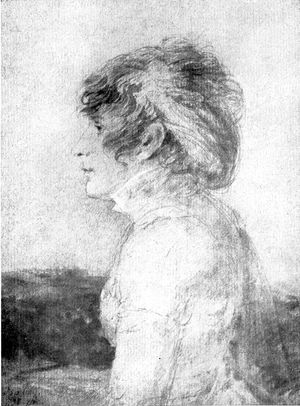
In the collection of Mr. Edmond Taigny.
Marie-Josephine-Rose Tascher de La Pagerie,
Called Josephine, Empress of the French.
From the design by Jean-Baptiste Isabey
(pencil drawing retouched in water-color) made in 1798.
The royalists, having created the panic of five years previous, were
not to be outdone even by the Terror. Charette, the Vendean leader,
retaliated by a holocaust of two thousand republican prisoners whom he
had taken. After the events of Thermidor the Convention had thrown
open the prison doors, put an end to bloodshed, and proclaimed an
amnesty. The evident power of the Parisian burghers, the form given by
the Girondists to the new constitution, the longing of all for peace
and for a return of comfort and prosperity, still further emboldened
the royalists, and enabled them to produce a wide-spread revulsion of
feeling. They rose in many parts of the south, instituting what is
known from the colors they wore as the "White Terror," and pitilessly
murdering, in the desperation of timid revenge, their unsuspecting and
unready neighbors of republican opinions. The scenes enacted were more
terrible, the human butchery was more bloody, than any known during
the darkest days of the revolutionary movement in Paris. This might
well be considered the preliminary trial to the Great White Terror of
1815, in which the frenzy and fanaticism of royalists and Roman
Catholics surpassed the most frantic efforts of radicals in lawless
bloodshed. Imperialists, free-thinkers, and Protestants were the
victims.
The Jacobins, therefore, in view of so dangerous a situation,
and not without some reason, had determined that they themselves
should administer the new constitution. They were in the most
desperate straits because the Paris populace now held them directly
responsible for the existing scarcity of food, a scarcity amounting to
famine. From time to time for months the mob invaded the hall of the
Convention, craving bread with angry, hungry clamor. The members
mingled with the disorderly throng on the floor and temporarily
soothed them by empty promises. But each inroad of disorder was worse
than the preceding until the Mountain was not only without support
from the rabble, but an object of loathing and contempt to them and
their half-starved leaders. Hence their only chance for power was in
some new rearrangement under which they would not be so prominent in
affairs. The royalists at the same time saw in the provisions of the
new charter a means to accomplish their own ends; and relying upon the
attitude of the capital, in which mob and burghers alike were angry,
determined simultaneously to strike a blow for mastery, and to
supplant the Jacobins. Evidence of their activity appeared both in
military and political circles. Throughout the summer of 1795 there
was an unaccountable languor in the army. It was believed that
Pichegru had purposely palsied his own and Jourdan's abilities, and
the needless armistice he made with Austria went far to confirm the
idea. It was afterward proved that several members of the Convention
had been in communication with royalists. Among their agents was a
personage of some importance—a certain Aubry—who, having returned
after the events of Thermidor, never disavowed his real sentiments as
a royalist; and being later made chairman of the army committee, was
in that position when Buonaparte's career was temporarily
checked by degradation from the artillery to the infantry. For this
absurd reason he was long but unjustly thought also to have caused the
original transfer to the west.
The Convention was aware of all that was taking place, but was also
helpless to correct the trouble. Having abolished the powerful and
terrible Committee of Safety, which had conducted its operations with
such success as attends remorseless vigor, it was found necessary on
August ninth to reconstruct something similar to meet the new crisis.
At the same time the spirit of the hour was propitiated by forming
sixteen other committees to control the action of the central one.
Such a dispersion of executive power was a virtual paralysis of
action, but it was to be only temporary, they would soon centralize
their strength in an efficient way. The constitution was adopted only
a fortnight later, on August twenty-second. Immediately the sections
of Paris began to display irritation at the limitations set to their
choice of new representatives. They had many sympathizers in the
provinces, and the extreme reactionaries from the Revolution were
jubilant. Fortunately for France, Carnot was temporarily retained to
control the department of war. He was not removed until the following
March.
When General Buonaparte reached Paris, and went to dwell in the mean
and shabby lodgings which his lean purse compelled him to choose, he
found the city strangely metamorphosed. Animated by a settled purpose
not to accept the position assigned to him in the Army of the West,
and, if necessary, to defy his military superiors, his humor put him
out of all sympathy with the prevalent gaiety. Bitter experience had
taught him that in civil war the consequences of victory and defeat
are alike inglorious. In the fickleness of public opinion
the avenging hero of to-day may easily become the reprobated outcast
of to-morrow. What reputation he had gained at Toulon was already
dissipated in part; the rest might easily be squandered entirely in
Vendée. He felt and said that he could wait. But how about his daily
bread?
The drawing-rooms of Paris had opened like magic before the "sesame"
of Thermidor and the prospects of settled order under the Directory.
There were visiting, dining, and dancing; dressing, flirtation, and
intrigue; walking, driving, and riding—all the avocations of a people
soured with the cruel and bloody past, and reasserting its native
passion for pleasure and refinement. All classes indulged in the
wildest speculation, securities public and corporate were the sport of
the exchange, the gambling spirit absorbed the energies of both sexes
in desperate games of skill and chance. The theaters, which had never
closed their doors even during the worst periods of terror, were
thronged from pit to gallery by a populace that reveled in excitement.
The morality of the hour was no better than the old; for there was a
strange mixture of elements in this new society. The men in power were
of every class—a few of the old aristocracy, many of the wealthy
burghers, a certain proportion of the colonial nabobs from the West
Indies and elsewhere, adventurers of every stripe, a few even of the
city populace, and some country common folk. The purchase and sale of
the confiscated lands, the national domain which furnished a slender
security for the national debt and depreciated bonds, had enriched
thousands of the vulgar sort. The newly rich lost their balance and
their stolidity, becoming as giddy and frivolous and aggressive as the
worst. The ingredients of this queer hodgepodge had yet to learn one
another's language and nature; the niceties of speech,
gesture, and mien which once had a well-understood significance in the
higher circles of government and society were all to be readjusted in
accordance with the ideas of the motley crowd and given new
conventional currency. In such a disorderly transition vice does not
require the mask of hypocrisy, virtue is helpless because unorganized,
and something like riot characterizes conduct. The sound and rugged
goodness of many newcomers, the habitual respectability of the
veterans, were for the moment alike inactive because not yet kneaded
into the lump they had to leaven.
There was, nevertheless, a marvelous exhibition of social power in
this heterogeneous mass; nothing of course proportionate in extent to
what had been brought forth for national defense, but still, of almost
if not entirely equal significance. Throughout the revolutionary epoch
there had been much discussion concerning reforms in education. It was
in 1794 that Monge finally succeeded in founding the great Polytechnic
School, an institution which clearly corresponded to a national
characteristic, since from that day it has strengthened the natural
bias of the French toward applied science, and tempted them to the
undue and unfortunate neglect of many important humanizing
disciplines. The Conservatory of Music and the Institute were
permanently reorganized soon after. The great collections of the
Museum of Arts and Crafts (Conservatoire des Arts et Métiers) were
begun, and permanent lecture courses were founded in connection with
the National Library, the Botanical Garden, the Medical School, and
other learned institutions. Almost immediately a philosophical
literature began to appear; pictures were painted, and the theaters
reopened with new and tolerable pieces written for the day and place.
In the very midst of war, moreover, an attempt was made to emancipate
the press. The effort was ill advised, and the results were
so deplorable for the conduct of affairs that the newspapers were in
the event more firmly muzzled than ever.
When Buonaparte had made his living arrangements, and began to look
about, he must have been stupefied by the hatred for the Convention so
generally and openly manifested on every side. The provinces had
looked upon the Revolution as accomplished. Paris was evidently in
such ill humor with the body which represented it that the republic
was to all appearance virtually undone. "Reëlect two thirds of the
Convention members to the new legislature!" said the angry demagogues
of the Paris sections. "Never! Those men who, by their own confession,
have for three years in all these horrors been the cowardly tools of a
sentiment they could not restrain, but are now self-styled and
reformed moderates! Impossible!" Whether bribed by foreign gold, and
working under the influence of royalists, or by reason of the famine,
or through the determination of the well-to-do to have a radical
change, or from all these influences combined, the sections were
gradually organizing for resistance, and it was soon clear that the
National Guard was in sympathy with them. The Convention was equally
alert, and began to arm for the conflict. They already had several
hundred artillerymen and five thousand regulars who were imbued with
the national rather that the local spirit; they now began to enlist a
special guard of fifteen hundred from the desperate men who had been
the trusty followers of Hébert and Robespierre. The fighting spirit of
the Convention was unquenchable. Having lodged the "two thirds" in the
coming government, they virtually declared war on all enemies internal
and external. By their decree of October twenty-fourth, 1792, they had
announced that the natural limits of France were their goal.
Having virtually obtained them, they were now determined to defend
them. This was the legacy of the Convention to the Directory, a legacy
which indefinitely prolonged the Revolution and nullified the new
polity from the outset.
For a month or more Buonaparte was a mere onlooker, or at most an
interested examiner of events, weighing and speculating in obscurity
much as he had done three years before. The war department listened to
and granted his earnest request that he might remain in Paris until
there should be completed a general reassignment of officers, which
had been determined upon, and, as his good fortune would have it, was
already in progress. As the first weeks passed, news arrived from the
south of a reaction in favor of the Jacobins. It became clearer every
day that the Convention had moral support beyond the ramparts of
Paris, and within the city it was possible to maintain something in
the nature of a Jacobin salon. Many of that faith who were disaffected
with the new conditions in Paris—the Corsicans in particular—were
welcomed at the home of Mme. Permon by herself and her beautiful
daughter, afterward Mme. Junot and Duchess of Abrantès. Salicetti had
chosen the other child, a son now grown, as his private secretary, and
was of course a special favorite in the house. The first manifestation
of reviving Jacobin confidence was shown in the attack made on May
twentieth upon the Convention by hungry rioters who shouted for the
constitution of 1793. The result was disastrous to the radicals
because the tumult was quelled by the courage and presence of mind
shown by Boissy d'Anglas, a calm and determined moderate. Commissioned
to act alone in provisioning Paris, he bravely accepted his
responsibility and mounted the president's chair in the midst of
the tumult to defend himself. The mob brandished in his face
the bloody head of Féraud, a fellow-member of his whom they had just
murdered. The speaker uncovered his head in respect, and his undaunted
mien cowed the leaders, who slunk away, followed by the rabble. The
consequence was a total annihilation of the Mountain on May
twenty-second. The Convention committees were disbanded, their
artillerymen were temporarily dismissed, and the constitution of 1793
was abolished.
The friendly home of Mme. Permon was almost the only resort of
Buonaparte, who, though disillusioned, was still a Jacobin. Something
like desperation appeared in his manner; the lack of proper food
emaciated his frame, while uncertainty as to the future left its mark
on his wan face and in his restless eyes. It was not astonishing, for
his personal and family affairs were apparently hopeless. His
brothers, like himself, had now been deprived of profitable
employment; they, with him, might possibly and even probably soon be
numbered among the suspects; destitute of a powerful patron, and with
his family once more in actual want, Napoleon was scarcely fit in
either garb or humor for the society even of his friends. His hostess
described him as having "sharp, angular features; small hands, long
and thin; his hair long and disheveled; without gloves; wearing badly
made, badly polished shoes; having always a sickly appearance, which
was the result of his lean and yellow complexion, brightened only by
two eyes glistening with shrewdness and firmness." Bourrienne, who had
now returned from diplomatic service, was not edified by the
appearance or temper of his acquaintance, who, he says, "was ill clad
and slovenly, his character cold, often inscrutable. His smile was
hollow and often out of place. He had moments of fierce gaiety which
made you uneasy, and indisposed to love him."
No wonder the man was ill at ease. His worst fears were
realized when the influence of the Mountain was wiped out,—Carnot,
the organizer of victory, as he had been styled, being the only one of
all the old leaders to escape. Salicetti was too prominent a partizan
to be overlooked by the angry burghers. For a time he was concealed by
Mme. Permon in her Paris home. He escaped the vengeance of his enemies
in the disguise of her lackey, flying with her when she left for the
south to seek refuge for herself and children. Even the rank and file
among the members of the Mountain either fled or were arrested. That
Buonaparte was unmolested appears to prove how cleverly he had
concealed his connection with them. The story that in these days he
proposed for the hand of Mme. Permon, though without any corroborative
evidence, has an air of probability, partly in the consideration of a
despair which might lead him to seek any support, even that of a wife
as old as his mother, partly from the existence of a letter to the
lady which, though enigmatical, displays an interesting mixture of
wounded pride and real or pretended jealousy. The epistle is dated
June eighteenth, 1795. He felt that she would think him duped, he
explains, if he did not inform her that although she had not seen fit
to give her confidence to him, he had all along known that she had
Salicetti in hiding. Then follows an address to that countryman,
evidently intended to clear the writer from all taint of Jacobinism,
and couched in these terms: "I could have denounced thee, but did not,
although it would have been but a just revenge so to do. Which has
chosen the truer part? Go, seek in peace an asylum where thou canst
return to better thoughts of thy country. My lips shall never utter
thy name. Repent, and above all, appreciate my motives. This I
deserve, for they are noble and generous." In these words to
the political refugee he employs the familiar republican "thou"; in
the peroration, addressed, like the introduction, to the lady herself,
he recurs to the polite and distant "you." "Mme. Permon, my good
wishes go with you as with your child. You are two feeble creatures
with no defense. May Providence and the prayers of a friend be with
you. Above all, be prudent and never remain in the large cities.
Adieu. Accept my friendly greetings."[49]
The meaning of this missive is recondite; perhaps it is this: Mme.
Permon, I loved you, and could have ruined the rival who is your
protégé with a clear conscience, for he once did me foul wrong, as he
will acknowledge. But farewell. I bear you no grudge. Or else it may
announce another change in the political weather by the veering of the
cock. As a good citizen, despising the horrors of the past, I could
have denounced you, Salicetti. I did not, for I recalled old times and
your helplessness, and wished to heap coals of fire on your head, that
you might see the error of your way. The latter interpretation finds
support in the complete renunciation of Jacobinism which the writer
made soon afterward, and in his subsequent labored explanation that in
the "Supper of Beaucaire" he had not identified himself with the
Jacobin soldier (so far an exact statement of fact), but had wished
only by a dispassionate presentation of facts to show the hopeless
case of Marseilles, and to prevent useless bloodshed.[Back to Contents]
Disappointments — Another Furlough — Connection with
Barras — Official Society in Paris — Buonaparte as a Beau
— Condition of His Family — A Political General — An
Opening in Turkey — Opportunities in Europe — Social
Advancement — Official Degradation — Schemes for
Restoration — Plans of the Royalists — The Hostility of
Paris to the Convention — Buonaparte, General of the
Convention Troops — His Strategy.
1795.
The overhauling of the army list with the subsequent reassignment of
officers turned out ill for Buonaparte. Aubry, the head of the
committee, appears to have been utterly indifferent to him, displaying
no ill will, and certainly no active good will, toward the sometime
Jacobin, whose name, moreover, was last on the list of artillery
officers in the order of seniority. According to the regulations, when
one arm of the service was overmanned, the superfluous officers were
to be transferred to another. This was now the case with the
artillery, and Buonaparte, as a supernumerary, was on June thirteenth
again ordered to the west, but this time only as a mere infantry
general of brigade. He appears to have felt throughout life more
vindictiveness toward Aubry, the man whom he believed to have been
the author of this particular misfortune, than toward any
other person with whom he ever came in contact. In this rigid scrutiny
of the army list, exaggerated pretensions of service and untruthful
testimonials were no longer accepted. For this reason Joseph also had
already lost his position, and was about to settle with his family in
Genoa, while Louis was actually sent back to school, being ordered to
Châlons. Poor Lucien, overwhelmed in the general ruin of the radicals,
and with a wife and child dependent on him, was in despair. The other
members of the family were temporarily destitute, but self-helpful.
In this there was nothing new; but, for all that, the monotony of the
situation must have been disheartening. Napoleon's resolution was soon
taken. He was either really ill from privation and disappointment, or
soon became so. Armed with a medical certificate, he applied for and
received a furlough. This step having been taken, the next, according
to the unchanged and familiar instincts of the man, was to apply under
the law for mileage to pay his expenses on the journey which he had
taken as far as Paris in pursuance of the order given him on March
twenty-ninth to proceed to his post in the west. Again, following the
precedents of his life, he calculated mileage not from Marseilles,
whence he had really started, but from Nice, thus largely increasing
the amount which he asked for, and in due time received. During his
leave several projects occupied his busy brain. The most important
were a speculation in the sequestered lands of the emigrants and
monasteries, and the writing of two monographs—one a history of
events from the ninth of Fructidor, year II (August twenty-sixth,
1794), to the beginning of year IV (September twenty-third, 1795), the
other a memoir on the Army of Italy. The first notion was
doubtless due to the frenzy for speculation, more and more rife, which
was now comparable only to that which prevailed in France at the time
of Law's Mississippi scheme or in England during the South Sea Bubble.
It affords an insight into financial conditions to know that a gold
piece of twenty francs was worth seven hundred and fifty in paper. A
project for purchasing a certain property as a good investment for his
wife's dowry was submitted to Joseph, but it failed by the sudden
repeal of the law under which such purchases were made. The two themes
were both finished, and another, "A Study in Politics: being an
Inquiry into the Causes of Troubles and Discords," was sketched, but
never completed. The memoir on the Army of Italy was virtually the
scheme for offensive warfare which he laid before the younger
Robespierre; it was now revised, and sent to the highest military
power—the new central committee appointed as a substitute for the
Committee of Safety. These occupations were all very well, but the
furlough was rapidly expiring, and nothing had turned up. Most
opportunely, the invalid had a relapse, and was able to secure an
extension of leave until August fourth, the date on which a third of
the committee on the reassignment of officers would retire, among them
the hated Aubry.
Speaking at St. Helena of these days, he said: "I lived in the Paris
streets without employment. I had no social habits, going only into
the set at the house of Barras, where I was well received.... I was
there because there was nothing to be had elsewhere. I attached myself
to Barras because I knew no one else. Robespierre was dead; Barras was
playing a rôle: I had to attach myself to somebody and something." It
will not be forgotten that Barras and Fréron had been Dantonists when
they were at the siege of Toulon with Buonaparte. After the
events of Thermidor they had forsworn Jacobinism altogether, and were
at present in alliance with the moderate elements of Paris society.
Barras's rooms in the Luxembourg were the center of all that was gay
and dazzling in that corrupt and careless world. They were, as a
matter of course, the resort of the most beautiful and brilliant
women, influential, but not over-scrupulous. Mme. Tallien, who has
been called "the goddess of Thermidor," was the queen of the coterie;
scarcely less beautiful and gracious were the widow Beauharnais and
Mme. Récamier. Barras had been a noble; the instincts of his class
made him a delightful host.
What Napoleon saw and experienced he wrote to the faithful Joseph. The
letters are a truthful transcript of his emotions, the key-note of
which is admiration for the Paris women. "Carriages and the gay world
reappear, or rather no more recall as after a long dream that they
have ever ceased to glitter. Readings, lecture courses in history,
botany, astronomy, etc., follow one another. Everything is here
collected to amuse and render life agreeable; you are taken out of
your thoughts; how can you have the blues in this intensity of purpose
and whirling turmoil? The women are everywhere, at the play, on the
promenades, in the libraries. In the scholar's study you find very
charming persons. Here only of all places in the world they deserve to
hold the helm: the men are mad about them, think only of them, and
live only by means of their influence. A woman needs six months in
Paris to know what is her due and what is her sphere."[51] As yet he
had not met Mme. Beauharnais. The whole tone of the correspondence is
cheerful, and indicates that Buonaparte's efforts for a new
alliance had been successful, that his fortunes were looking up, and
that the giddy world contained something of uncommon interest. As his
fortunes improved, he grew more hopeful, and appeared more in society.
On occasion he even ventured upon little gallantries. Presented to
Mme. Tallien, he was frequently seen at her receptions. He was at
first shy and reserved, but time and custom put him more at his ease.
One evening, as little groups were gradually formed for the
interchange of jest and repartee, he seemed to lose his timidity
altogether, and, assuming the mien of a fortune-teller, caught his
hostess's hand, and poured out a long rigmarole of nonsense which much
amused the rest of the circle.
These months had also improved the situation of the family. His mother
and younger sisters were somehow more comfortable in their Marseilles
home. Strange doings were afterward charged against them, but it is
probable that these stories are without other foundation than spite.
Napoleon had received a considerable sum for mileage, nearly
twenty-seven hundred francs, and, good son as he always was, it is
likely that he shared the money with his family. Both Elisa and the
little Pauline now had suitors. Fesch, described by Lucien as "ever
fresh, not like a rose, but like a good radish," was comfortably
waiting at Aix in the house of old acquaintances for a chance to
return to Corsica. Joseph's arrangements for moving to Genoa were
nearly complete, and Louis was comfortably settled at school in
Châlons. "Brutus" Lucien was the only luckless wight of the number:
his fears had been realized, and, having been denounced as a Jacobin,
he was now lying terror-stricken in the prison of Aix, and all about
him men of his stripe were being executed.
On August fifth the members of the new Committee of Safety
finally entered on their duties. Almost the first document presented
at the meeting was Buonaparte's demand for restoration to his rank in
the artillery. It rings with indignation, and abounds with loose
statements about his past services, boldly claiming the honors of the
last short but successful Italian campaign. The paper was referred to
the proper authorities, and, a fortnight later, its writer received
peremptory orders to join his corps in the west. What could be more
amusingly characteristic of this persistent man than to read, in a
letter to Joseph under date of the following day, August twentieth: "I
am attached at this moment to the topographical bureau of the
Committee of Safety for the direction of the armies in Carnot's place.
If I wish, I can be sent to Turkey by the government as general of
artillery, with a good salary and a splendid title, to organize the
artillery of the Grand Turk." Then follow plans for Joseph's
appointment to the consular service, for a meeting at Leghorn, and for
a further land speculation. At the close are these remarks, which not
only exhibit great acuteness of observation, but are noteworthy as
displaying a permanent quality of the man, that of always having an
alternative in readiness: "It is quiet, but storms are gathering,
perhaps; the primaries are going to meet in a few days. I shall take
with me five or six officers.... The commission and decree of the
Committee of Safety, which employs me in the duty of directing the
armies and plans of campaign, being most flattering to me, I fear they
will no longer allow me to go to Turkey. We shall see. I may have on
hand a campaign to-day.... Write always as if I were going to Turkey."
This was all half true. By dint of soliciting Barras and Doulcet de
Pontécoulant, another well-wisher, both men of influence, and by
importuning Fréron, then at the height of his power, but
soon to display a ruinous incapacity, Buonaparte had actually been
made a member of the commission of four which directed the armies, and
Dutot had been sent in his stead to the west. Moreover, there was
likewise a chance for realizing those dreams of achieving glory in the
Orient which had haunted him from childhood. At this moment there was
a serious tension in the politics of eastern Europe, and the French
saw an opportunity to strike Austria on the other side by an alliance
with Turkey. The latter country was of course entirely unprepared for
war, and asked for the appointment of a French commission to
reconstruct its gun-foundries and to improve its artillery service.
Buonaparte, having learned the fact, had immediately prepared two
memorials, one on the Turkish artillery, and another on the means of
strengthening Turkish power against the encroachments of European
monarchies. These he sent up with an application that he should be
appointed head of the commission, inclosing also laudatory
certificates of his uncommon ability from Doulcet and from Debry, a
newly made friend.
But the vista of an Eastern career temporarily vanished. The new
constitution, adopted, as already stated, on August twenty-second,
could not become operative until after the elections. On August
thirty-first Buonaparte's plan for the conduct of the coming Italian
campaign was read by the Convention committee, found satisfactory, and
adopted. It remains in many respects the greatest of all Napoleon's
military papers, its only fault being that no genius inferior to his
own could carry it out. At intervals some strategic authority revives
the charge that this plan was bodily appropriated from the writings of
Maillebois, the French general who led his army to disaster in Italy
during 1746. There is sufficient evidence that Buonaparte
read Maillebois, and any reader may see the resemblances of the two
plans. But the differences, at first sight insignificant, are as vital
as the differences of character in the two men. Like the many other
charges of plagiarism brought against Napoleon by pedants, this one
overlooks the difference between mediocrity and genius in the use of
materials. It is not at all likely that the superiors of Buonaparte
were ignorant of the best books concerning the invasion of Italy or of
their almost contemporary history. They brought no charges of
plagiarism for the excellent reason that there is none, and they were
impressed by the suggestions of their general. It is even possible
that Buonaparte formed his plan before reading Maillebois. Volney
declared he had heard it read and commentated by its author shortly
after his return from Genoa and Nice.[52] The great scholar was
already as profoundly impressed as a year later Carnot, and now the
war commission. A few days later the writer and author of the plan
became aware of the impression he had made: it seemed clear that he
had a reality in hand worth every possibility in the Orient. He
therefore wrote to Joseph that he was going to remain in Paris,
explaining, as if incidentally, that he could thus be on the lookout
for any desirable vacancy in the consular service, and secure it, if
possible, for him.
Dreams of another kind had supplanted in his mind all visions of
Oriental splendor; for in subsequent letters to the same
correspondent, written almost daily, he unfolds a series of rather
startling schemes, which among other things include a marriage, a town
house, and a country residence, with a cabriolet and three horses. How
all this was to come about we cannot entirely discover. The
marriage plan is clearly stated. Joseph had wedded one of the
daughters of a comparatively wealthy merchant. He was requested to
sound his brother-in-law concerning the other, the famous Désirée
Clary, who afterward became Mme. Bernadotte. Two of the horses were to
be supplied by the government in place of a pair which he might be
supposed to have possessed at Nice in accordance with the rank he then
held, and to have sold, according to orders, when sent on the maritime
expedition to Corsica. Where the third horse and the money for the
houses were to come from is inscrutable; but, as a matter of fact,
Napoleon had already left his shabby lodgings for better ones in
Michodière street, and was actually negotiating for the purchase of a
handsome detached residence near that of Bourrienne, whose fortunes
had also been retrieved. The country-seat which the speculator had in
view, and for which he intended to bid as high as a million and a half
of francs, was knocked down to another purchaser for three millions
or, as the price of gold then was, about forty thousand dollars! So
great a personage as he now was must, of course, have a secretary, and
the faithful Junot had been appointed to the office.
The application for the horses turned out a serious matter, and
brought the adventurer once more to the verge of ruin. The story he
told was not plain, the records did not substantiate it, the
hard-headed officials of the war department evidently did not believe
a syllable of his representations,—which, in fact, were
untruthful,—and, the central committee having again lost a third of
its members by rotation, among them Doulcet, there was no one now in
it to plead Buonaparte's cause. Accordingly there was no little talk
about the matter in very influential circles, and almost
simultaneously was issued the report concerning his formal
request for restoration, which had been delayed by the routine
prescribed in such cases, and was only now completed. It was not only
adverse in itself, but contained a confidential inclosure
animadverting severely on the irregularities of the petitioner's
conduct, and in particular on his stubborn refusal to obey orders and
join the Army of the West. Thus it happened that on September
fifteenth the name of Buonaparte was officially struck from the list
of general officers on duty, "in view of his refusal to proceed to the
post assigned him." It really appeared as if the name of Napoleon
might almost have been substituted for that of Tantalus in the fable.
But it was the irony of fate that on this very day the subcommittee on
foreign affairs submitted to the full meeting a proposition to send
the man who was now a disgraced culprit in great state and with a full
suite to take service at Constantinople in the army of the Grand Turk!
No one had ever understood better than Buonaparte the possibilities of
political influence in a military career. Not only could he bend the
bow of Achilles, but he always had ready an extra string. Thus far in
his ten years of service he had been promoted only once according to
routine; the other steps of the height which he had reached had been
secured either by some startling exhibition of ability or by influence
or chicane. He had been first Corsican and then French, first a
politician and then a soldier. Such a veteran was not to be dismayed
even by the most stunning blow; had he not even now three powerful
protectors—Barras, Tallien, and Fréron? He turned his back,
therefore, with ready adaptability on the unsympathetic officials of
the army, the mere soldiers with cool heads and merciless judgment.
The evident short cut to restoration was to carry through the project
of employment at Constantinople; it had been formally
recommended, and to secure its adoption he renewed his importunate
solicitations. His rank he still held; he might hope to regain
position by some brilliant stroke such as he could execute only
without the restraint of orders and on his own initiative. His hopes
grew, or seemed to, as his suit was not rejected, and he wrote to
Joseph on September twenty-sixth that the matter of his departure was
urgent; adding, however: "But at this moment there are some
ebullitions and incendiary symptoms." He was right in both surmises.
The Committee of Safety was formally considering the proposition for
his transfer to the Sultan's service, while simultaneously affairs
both in Paris and on the frontiers alike were "boiling."
Meantime the royalists and clericals had not been idle. They had
learned nothing from the events of the Revolution, and did not even
dimly understand their own position. Their own allies repudiated both
their sentiments and their actions in the very moments when they
believed themselves to be honorably fighting for self-preservation.
English statesmen like Granville and Harcourt now thought and said
that it was impossible to impose on France a form of government
distasteful to her people; but the British regent and the French
pretender, who, on the death of his unfortunate nephew, the dauphin,
had been recognized by the powers as Louis XVIII, were stubbornly
united under the old Bourbon motto, "All or nothing." The change in
the Convention, in Paris society, even in the country itself, which
was about to desert its extreme Jacobinism and to adopt the new
constitution by an overwhelming vote—all this deceived them, and they
determined to strike for everything they had lost. Preparations, it is
now believed, were all ready for an inroad from the Rhine
frontier, for Pichegru to raise the white flag and to advance with his
troops on Paris, and for a simultaneous rising of the royalists in
every French district. On October fourth an English fleet had appeared
on the northern shore of France, having on board the Count of Artois
and a large body of emigrants, accompanied by a powerful force of
English, composed in part of regulars, in part of volunteers. This
completed the preliminary measures.
With the first great conflict in the struggle, avowed royalism had
only an indirect connection. By this time the Paris sections were
thoroughly reorganized, having purged themselves of the extreme
democratic elements from the suburbs. They were well drilled, well
armed, and enthusiastic for resistance to the decree of the Convention
requiring the compulsory reëlection of the "two thirds" from its
existing membership. The National Guard was not less embittered
against that measure. There were three experienced officers then in
Paris who were capable of leading an insurrection, and could be relied
on to oppose the Convention. These were Danican, Duhoux d'Hauterive,
and Laffont, all royalists at heart; the last was an emigrant, and
avowed it. The Convention had also by this time completed its
enlistment, and had taken other measures of defense; but it was
without a trustworthy person to command its forces, for among the
fourteen generals of the republic then present in Paris, only two were
certainly loyal to the Convention, and both these were men of very
indifferent character and officers of no capacity.
The Convention forces were technically a part of the army known as
that of the interior, of which Menou was the commander. The new
constitution having been formally proclaimed on September
twenty-third, the signs of open rebellion in Paris became too clear to
be longer disregarded, and on that night a mass meeting of
the various sections was held in the Odéon theater in order to prepare
plans for open resistance. That of Lepelletier, in the heart of Paris,
comprising the wealthiest and most influential of the mercantile
class, afterward assembled in its hall and issued a call to rebellion.
These were no contemptible foes: on the memorable tenth of August,
theirs had been the battalion of the National Guard which died with
the Swiss in defense of the Tuileries. Menou, in obedience to the
command of the Convention to disarm the insurgent sections, confronted
them for a moment. But the work was not to his taste. After a short
parley, during which he feebly recommended them to disperse and behave
like good citizens, he withdrew his forces to their barracks, and left
the armed and angry sections masters of the situation. Prompt and
energetic measures were more necessary than ever. For some days
already the Convention leaders had been discussing their plans. Carnot
and Tallien finally agreed with Barras that the man most likely to do
thoroughly the active work was Buonaparte. But, apparently, they dared
not altogether trust him, for Barras himself was appointed
commander-in-chief. His "little Corsican officer, who will not stand
on ceremony," as he called him, was to be nominally lieutenant. On
October fourth Buonaparte was summoned to a conference. The messengers
sought him at his lodgings and in all his haunts, but could not find
him. It was nine in the evening when he appeared at headquarters in
the Place du Carrousel. This delay gave Barras a chance to insinuate
that his ardent republican friend, who all the previous week had been
eagerly soliciting employment, was untrustworthy in the crisis, and
had been negotiating with the sectionaries. Buonaparte reported
himself as having come from the section of Lepelletier, but
as having been reconnoitering the enemy. After a rather tart
conversation, Barras appointed him aide-de-camp, the position for
which he had been destined from the first. Whatever was the general's
understanding of the situation, that of the aide was clear—that he
was to be his own master.[53]
Not a moment was lost, and throughout the night most vigorous and
incessant preparation was made. Buonaparte was as much himself in the
streets of Paris as in those of Ajaccio, except that his energy was
proportionately more feverish, as the defense of the Tuileries and the
riding-school attached to it, in which the Convention sat, was a
grander task than the never-accomplished capture of the Corsican
citadel. The avenues and streets of a city somewhat resemble the main
and tributary valleys of a mountain-range, and the task of campaigning
in Paris was less unlike that of manœuvering in the narrow gorges
of the Apennines than might be supposed; at least Buonaparte's
strategy was nearly identical for both. All his measures were
masterly. The foe, scattered as yet throughout Paris on both
sides of the river, was first cut in two by seizing and fortifying the
bridges across the Seine; then every avenue of approach was likewise
guarded, while flanking artillery was set in the narrow streets to
command the main arteries. Thanks to Barras's suggestion, the dashing,
reckless, insubordinate Murat, who first appears at the age of
twenty-seven on the great stage in these events, had under
Buonaparte's orders brought in the cannon from the camp of Sablons.
These in the charge of a ready artillerist were invaluable, as the
event proved. Finally a reserve, ready for use on either side of the
river, was established in what is now the Place de la Concorde, with
an open line of retreat toward St. Cloud behind it. Every order was
issued in Barras's name, and Barras, in his memoirs, claims all the
honors of the day. He declares that his aide was afoot, while he was
the man on horseback, ubiquitous and masterful. He does not even admit
that Buonaparte bestrode a cab-horse, as even the vanquished were
ready to acknowledge. The sections, of course, knew nothing of the new
commander or of Buonaparte, and recalled only Menou's pusillanimity.
Without cannon and without a plan, they determined to drive out the
Convention at once, and to overwhelm its forces by superior numbers.
The quays of the left bank were therefore occupied by a large body of
the National Guard, ready to rush in from behind when the main attack,
made from the north through the labyrinth of streets and blind alleys
then designated by the name of St. Honoré, and by the short, wide
passage of l'Échelle, should draw the Convention forces away in that
direction to resist it. A kind of rendezvous had been appointed at the
church of St. Roch, which was to be used as a depot of supplies and a
retreat. Numerous sectionaries were, in fact, posted there as
auxiliaries at the crucial instant.[Back to Contents]
The Warfare of St. Roch and the Pont Royal — Order Restored
— Meaning of the Conflict — Political Dangers —
Buonaparte's Dilemma — His True Attitude — Sudden Wealth
— The Directory and Their General — Buonaparte in Love —
His Corsican Temperament — His Matrimonial Adventures.
1795.
In this general position the opposing forces confronted each other on
the morning of October fifth, the thirteenth of Vendémiaire. In point
of numbers the odds were tremendous, for the Convention forces
numbered only about four thousand regulars and a thousand volunteers,
while the sections' force comprised about twenty-eight thousand
National Guards. But the former were disciplined, they had cannon, and
they were desperately able; and there was no distracted, vacillating
leadership. What the legend attributes to Napoleon Buonaparte as his
commentary on the conduct of King Louis at the Tuileries was to be the
Convention's ideal now. The "man on horseback" and the hot fire of
cannon were to carry the day. Both sides seemed loath to begin. But at
half-past four in the afternoon it was clear that the decisive moment
had come. As if by instinct, but in reality at Danican's signal, the
forces of the sections from the northern portion of the capital began
to pour through the narrow main street of St. Honoré, behind the
riding-school, toward the chief entrance of the Tuileries. They no
doubt felt safer in the rear of the Convention hall, with the high
walls of houses all about, than they would have done in the open
spaces which they would have had to cross in order to attack
it from the front. Just before their compacted mass reached the church
of St. Roch, it was brought to a halt. Suddenly becoming aware that in
the side streets on the right were yawning the muzzles of hostile
cannon, the excited citizens lost their heads, and began to discharge
their muskets. Then with a swift, sudden blast, the street was cleared
by a terrible discharge of the canister and grape-shot with which the
field-pieces of Barras and Buonaparte were loaded. The action
continued about an hour, for the people and the National Guard rallied
again and again, each time to be mowed down by a like awful discharge.
At last they could be rallied no longer, and retreated to the church,
which they held. On the left bank a similar mêlée ended in a similar
way. Three times Laffont gathered his forces and hurled them at the
Pont Royal; three times they were swept back by the cross-fire of
artillery. The scene then changed like the vanishing of a mirage.
Awe-stricken messengers appeared, hurrying everywhere with the
prostrating news from both sides of the river, and the entire Parisian
force withdrew to shelter. Before nightfall the triumph of the
Convention was complete. The dramatic effect of this achievement was
heightened by the appearance on horseback here, there, and everywhere,
during the short hour of battle, of an awe-inspiring leader; both
before and after, he was unseen. In spite of Barras's claims, there
can be no doubt that this dramatic personage was Buonaparte. If not,
for what was he so signally rewarded in the immediate sequel? Barras
was no artillerist, and this was the appearance of an expert giving
masterly lessons in artillery practice to an astonished world, which
little dreamed what he was yet to demonstrate as to the worth of his
chosen arm on wider battle-fields. For the moment it suited
Buonaparte to appear merely as an agent. In his reports of the affair
his own name is kept in the background. It is evident that from first
to last he intended to produce the impression that, though acting with
Jacobins, he does so because they for the time represent the truth: he
is not for that reason to be identified with them.
Thus by the "whiff of grape-shot" what the wizard historian of the
time "specifically called the French Revolution" was not "blown into
space" at all. Though there was no renewal of the reign of terror, yet
the Jacobins retained their power and the Convention lived on under
the name of the Directory. It continued to live on in its own stupid
anarchical way until the "man on horseback" of the thirteenth
Vendémiaire had established himself as the first among French generals
and the Jacobins had rendered the whole heart of France sick. While
the events of October twenty-fifth were a bloody triumph for the
Convention, only a few conspicuous leaders of the rebels were
executed, among them Laffont; and harsh measures were enacted in
relation to the political status of returned emigrants. But in the
main an unexpected mercy controlled the Convention's policy. They
closed the halls in which the people of the mutinous wards had met,
and once more reorganized the National Guard. Order was restored
without an effort. Beyond the walls of Paris the effect of the news
was magical. Artois, afterward Charles X, though he had landed three
days before on Île Dieu, now reëmbarked, and sailed back to England,
while the other royalist leaders prudently held their followers in
check and their measures in abeyance. The new constitution was in a
short time offered to the nation, and accepted by an overwhelming
majority; the members of the Convention were assured of their
ascendancy in the new legislature; and before long the
rebellion in Vendée and Brittany was so far crushed as to release
eighty thousand troops for service abroad. For the leaders of its
forces the Convention made a most liberal provision: the division
commanders of the thirteenth of Vendémiaire were all promoted.
Buonaparte was made second in command of the Army of the Interior: in
other words, was confirmed in an office which, though informally, he
had both created and rendered illustrious. As Barras almost
immediately resigned, this was equivalent to very high promotion.
This memorable "day of the sections," as it is often called, was an
unhallowed day for France and French liberty. It was the first
appearance of the army since the Revolution as a support to political
authority; it was the beginning of a process which made the
commander-in-chief of the army the dictator of France. All purely
political powers were gradually to vanish in order to make way for a
military state. The temporary tyranny of the Convention rested on a
measure, at least, of popular consent; but in the very midst of its
preparations to perpetuate a purely civil and political
administration, the violence of the sections had compelled it to
confide the new institutions to the keeping of soldiers. The idealism
of the new constitution was manifest from the beginning. Every chance
which the Directory had for success was dependent, not on the inherent
worth of the system or its adaptability to present conditions, but on
the support of interested men in power; among these the commanders of
the army were not the least influential. After the suppression of the
sections, the old Convention continued to sit under the style of the
Primary Assembly, and was occupied in selecting those of its members
who were to be returned to the legislature under the new constitution.
There being no provision for any interim government, the
exercise of real power was suspended; the elections were a mere sham;
the magistracy was a house swept and garnished, ready for the first
comer to occupy it.
As the army and not the people had made the coming administration
possible, the executive power would from the first be the creature of
the army; and since under the constitutional provisions there was no
legal means of compromise between the Directory and the legislature in
case of conflict, so that the stronger would necessarily crush the
weaker, the armed power supporting the directors must therefore
triumph in the end, and the man who controlled that must become the
master of the Directory and the ruler of the country. Moreover, a
people can be free only when the first and unquestioning devotion of
every citizen is not to a party, but to his country and its
constitution, his party allegiance being entirely secondary. This was
far from being the case in France: the nation was divided into
irreconcilable camps, not of constitutional parties, but of violent
partizans; many even of the moderate republicans now openly expressed
a desire for some kind of monarchy. Outwardly the constitution was the
freest so far devised. It contained, however, three fatal blunders
which rendered it the best possible tool for a tyrant: it could not be
changed for a long period; there was no arbiter but force between a
warring legislative and executive; the executive was now supported by
the army.
It is impossible to prove that Buonaparte understood all this at the
time. When at St. Helena he spoke as if he did; but unfortunately his
later writings, however valuable from the psychological, are worthless
from the historical, standpoint. They abound in misrepresentations
which are in part due to lapse of time and weakness of
memory, in part to wilful intention. Wishing the Robespierre-Salicetti
episode of his life to be forgotten, he strives in his memoirs to
create the impression that the Convention had ordered him to take
charge of the artillery at Toulon, when in fact he was in Marseilles
as a mere passer-by on his journey to Nice, and in Toulon as a
temporary adjunct to the army of Carteaux, having been made an active
participant partly through accident, partly by the good will of
personal friends. In the same way he also devised a fable about the
"day of the sections," in order that he might not appear to have been
scheming for himself in the councils of the Convention, and that
Barras's share in his elevation might be consigned to oblivion. This
story of Napoleon's has come down in three stages of its development,
by as many different transcribers, who heard it at different times.
The final one, as given by Las Cases, was corrected by Napoleon's own
hand.[54] It runs as follows: On the night of October third he was at
the theater, but hearing that Menou had virtually retreated before the
wards, and was to be arrested, he left and went to the meeting of the
Convention, where, as he stood among the spectators, he heard his own
name mentioned as Menou's successor. For half an hour he deliberated
what he should do if chosen. If defeated, he would be execrated by all
coming generations, while victory would be almost odious. How could he
deliberately become the scapegoat of so many crimes to which he had
been an utter stranger? Why go as an avowed Jacobin and in a few hours
swell the list of names uttered with horror? "On the other hand, if
the Convention be crushed, what becomes of the great truths of our
Revolution? Our many victories, our blood so often shed, are all
nothing but shameful deeds. The foreigner we have so
thoroughly conquered triumphs and overwhelms us with his contempt; an
incapable race, an overbearing and unnatural following, reappear
triumphant, throw up our crime to us, wreak their vengeance, and
govern us like helots by the hand of a stranger. Thus the defeat of
the Convention would crown the brow of the foreigner, and seal the
disgrace and slavery of our native land." Such thoughts, his youth,
trust in his own power and in his destiny, turned the balance.
Statements made under such circumstances are not proof; but there is
this much probability of truth in them, that if we imagine the old
Buonaparte in disgrace as of old, following as of old the promptings
of his curiosity, indifferent as of old to the success of either
principle, and by instinct a soldier as of old,—if we recall him in
this character, and remember that he is no longer a youthful Corsican
patriot, but a mature cosmopolitan consumed with personal
ambition,—we may surely conclude that he was perfectly impartial as
to the parties involved, leaned toward the support of the principles
of the Revolution as he understood them, and saw in the complications
of the hour a probable opening for his ambition. At any rate, his
conduct after October fourth seems to uphold this view. He was a
changed man, ardent, hopeful, and irrepressible, as he had ever been
when lucky; but now, besides, daring, overbearing, and self-confident
to a degree which those characteristic qualities had never reached
before.
His first care was to place on a footing of efficiency the Army of the
Interior, scattered in many departments, undisciplined and
disorganized; the next, to cow into submission all the low elements in
Paris, still hungry and fierce, by reorganizing the National Guard,
and forming a picked troop for the special protection of the
legislature; the next, to show himself as the powerful
friend of every one in disgrace, as a man of the world without rancor
or exaggerated partizanship. At the same time he plunged into
speculation, and sent sums incredibly large to various members of his
family, a single remittance of four hundred thousand francs being
mentioned in his letters. Lucien was restored to the arms of his
low-born but faithful and beloved wife, and sent to join his mother
and sisters in Marseilles; Louis was brought from Châlons, and made a
lieutenant; Jerome was put at school in Paris; and to Joseph a
consular post was assured. Putting aside all bashfulness, General
Buonaparte became a full-fledged society man and a beau. No social
rank was now strange to him; the remnants of the old aristocracy, the
wealthy citizens of Paris, the returning Girondists, many of whom had
become pronounced royalists, the new deputies, the officers who in
some turn of the wheel had, like himself, lost their positions, but
were now, through his favor, reinstated—all these he strove to court,
flatter, and make his own.
Such activity, of course, could not pass unnoticed. The new government
had been constituted without disturbance, the Directory chosen, and
the legislature installed. Of the five directors—Barras, Rewbell,
Carnot, Letourneaux de la Manche, and Larévellière-Lépeaux,—all had
voted for the death of Louis XVI, and were so-called regicides; but,
while varying widely in character and ability, they were all,
excepting Barras, true to their convictions. They scarcely understood
how strong the revulsion of popular feeling had been, and, utterly
ignoring the impossibility of harmonious action among themselves,
hoped to exercise their power with such moderation as to win all
classes to the new constitution. They were extremely disturbed by the
course of the general commanding their army in seeking intimacy with
men of all opinions, but were unwilling to interpret it
aright. Under the Convention, the Army of the Interior had been a
tool, its commander a mere puppet; now the executive was confronted by
an independence which threatened a reversal of rôles. This situation
was the more disquieting because Buonaparte was a capable and not
unwilling police officer. Among many other invaluable services to the
government, he closed in person the great club of the Panthéon, which
was the rallying-point of the disaffected.[55] Throughout another
winter of famine there was not a single dangerous outbreak. At the
same time there were frequent manifestations of jealousy in lower
circles, especially among those who knew the origin and career of
their young master.
Toward the close of the year the bearing and behavior of the general
became constrained, reserved, and awkward. Various reasons were
assigned for this demeanor. Many thought it was due to a consciousness
of social deficiency, and his detractors still declare that Paris life
was too fierce for even his self-assurance, pointing to the change in
his handwriting and grammar, to his alternate silence and loquacity,
as proof of mental uneasiness; to his sullen musings and coarse
threats as a theatrical affectation to hide wounded pride; and to his
coming marriage as a desperate shift to secure a social dignity
proportionate to the career he saw opening before him in politics and
war. In a common man not subjected to a microscopic examination, such
conduct would be attributed to his being in love; the wedding would
ordinarily be regarded as the natural and beautiful consequence of a
great passion.
Men have not forgotten that Buonaparte once denounced love as
a hurtful passion from which God should protect his creatures; and
they have, for this, among other reasons, pronounced him incapable of
disinterested affection. But it is also true that he likewise
denounced Buttafuoco for having, among other crimes committed by him,
"married to extend his influence"; and we are forced to ask which of
the two sentiments is genuine and characteristic. Probably both and
neither, according to the mood of the man. Outward caprice is, in
great natures, often the mask of inward perseverance, especially among
the unprincipled who suit their language to their present purpose, in
fine disdain of commonplace consistency. The primitive Corsican was
both rude and gentle, easily moved to tears at one time, insensate at
another; selfish at one moment, lavish at another; and yet he had a
consistent character. Although disliking in later life to be called a
Corsican, Napoleon was nevertheless typical of his race: he could
despise love, yet render himself its willing slave; he was fierce and
dictatorial, yet, as the present object of his passion said, "tenderer
and weaker than anybody dreamed."[56]
And thus it was in the matter of his courtship: there were elements in
it of romantic, abandoned passion, but likewise of shrewd, calculating
selfishness. In his callow youth his relations to the other sex had
been either childish, morbid, or immoral. During his earliest manhood
he had appeared like one who desired the training rather than the
substance of gallantry. As a Jacobin he sought such support as he
could find in the good will of the women related to men in
power; as a French patriot he put forth strenuous efforts to secure an
influential alliance through matrimony. He appears to have addressed
Mme. Permon, whose fortune, despite her advanced age, would have been
a great relief to his destitution. Refused by her, he was in a
disordered and desperate emotional state until military and political
success gave him sufficient self-confidence to try once more. With his
feet firmly planted on the ladder of ambition, he was not indifferent
to securing social props for a further rise, but was nevertheless in
such a tumult of feeling as to make him particularly receptive to real
passion. He had made advances for the hand of the rich and beautiful
Désirée Clary;[57] the first evidence in his correspondence of a
serious intention to marry her is contained in the letter of June
eighteenth, 1795, to Joseph; and for a few weeks afterward he wrote at
intervals with some impatience, as if she were coy. In explanation it
is claimed that Napoleon, visiting her long before at the request of
Joseph, who was then enamoured of her, had himself become interested,
and persuading his brother to marry her sister, had entered into an
understanding with her which was equivalent to a betrothal. Time and
distance had cooled his ardor. He now virtually threw her over for
Mme. Beauharnais, who dazzled and infatuated him. This claim is
probably founded on fact, but there is no evidence sufficient to
sustain a charge of positive bad faith on the part of Napoleon.
Neither he nor Mlle. Clary appears to have been ardent when Joseph as
intermediary began, according to French custom, to arrange the
preliminaries of marriage; and when General Buonaparte fell madly in
love with Mme. Beauharnais the matter was dropped.[Back to Contents]
The Taschers and Beauharnais — Execution of Alexandre
Beauharnais — Adventures of His Widow — Meeting of
Napoleon and Josephine — The Latter's Uncertainties — Her
Character and Station — Passion and Convenience — The
Bride's Dowry — Buonaparte's Philosophy of Life — The
Ladder to Glory.
1796.
In 1779, while the boys at Brienne were still tormenting the little
untamed Corsican nobleman, and driving him to his garden fortalice to
seek lonely refuge from their taunts in company with his Plutarch,
there had arrived in Paris from Martinique a successful planter of
that island, a French gentleman of good family, M. Tascher de la
Pagerie, bringing back to that city for the second time his daughter
Josephine. She was then a girl of sixteen, without either beauty or
education, but thoroughly matured, and with a quick Creole
intelligence and a graceful litheness of figure which made her a most
attractive woman. She had spent the years of her life from ten to
fourteen in the convent of Port Royal. Having passed the interval in
her native isle, she was about to contract a marriage which her
relatives in France had arranged. Her betrothed was the younger son of
a family friend, the Marquis de Beauharnais. The bride landed on
October twentieth, and the ceremony took place on December thirteenth.
The young vicomte brought his wife home to a suitable establishment in
the capital. Two children were born to them—Eugène and
Hortense; but before the birth of the latter the husband quarreled
with his wife, for reasons that have never been known. The court
granted a separation, with alimony, to Mme. de Beauharnais, who some
years later withdrew to her father's home in Martinique. Her husband
sailed to America with the forces of Bouillé, and remained there until
the outbreak of the Revolution, when he returned, and was elected a
deputy to the States-General.
Becoming an ardent republican, he was several times president of the
National Assembly, and his house was an important center of influence.
In 1790 M. Tascher died, and his daughter, with her children, returned
to France. It was probably at her husband's instance, for she at once
joined him at his country-seat, where they continued to live, as
"brother and sister," until Citizen Beauharnais was made commander of
the Army of the Rhine. As the days of the Terror approached, every man
of noble blood was more and more in danger. At last Beauharnais's turn
came; he too was denounced to the Commune, and imprisoned. Before long
his wife was behind the same bars. Their children were in the care of
an aunt, Mme. Églé, who had been, and was again to be, a woman of
distinction in the social world, but had temporarily sought the
protection of an old acquaintance, a former abbé, who had become a
member of the Commune. The gallant young general was not one of the
four acquitted out of the batch of forty-nine among whom he was
finally summoned to the bar of the revolutionary tribunal. He died on
June twenty-third, 1794, true to his convictions, acknowledging in his
farewell letter to his wife a fraternal affection for her, and
committing solemnly to her charge his own good name, which she was to
restore by proving his devotion to France. The children were to be her
consolation; they were to wipe out the disgrace of his
punishment by the practice of virtue and—civism!
During her sojourn in prison Mme. Beauharnais had made a most useful
friend. This was a fellow-sufferer of similar character, but far
greater gifts, whose maiden name was Cabarrus, who was later Mme. de
Fontenay, who was afterward divorced and, having married Tallien, the
Convention deputy at Bordeaux, became renowned as his wife, and who,
divorced a second and married a third time, died as the Princesse de
Chimay. The ninth of Thermidor saved them both from the guillotine. In
the days immediately subsequent they had abundant opportunity to
display their light but clever natures. Mme. Beauharnais, as well as
her friend, unfolded her wings like a butterfly as she escaped from
the bars of her cell. Being a Creole, and having matured early, her
physical charms were already fading. Her spirit, too, had reached and
passed its zenith; for in her letters of that time she describes
herself as listless. Nevertheless, in those very letters there is some
sprightliness, and considerable ability of a certain kind. A few weeks
after her liberation, having apprenticed Eugène and Hortense to an
upholsterer and a dressmaker respectively,[59] she was on terms of
intimacy with Barras so close as to be considered suspicious, while
her daily intercourse was with those who had brought her husband to a
terrible end. In a luxurious and licentious society, she was a
successful intriguer in matters both of politics and of pleasure;
versed in the arts of coquetry and dress, she became for the needy and
ambitious a successful intermediary with those in power. Preferring,
as she rather ostentatiously asserted, to be guided by another's will,
she gave little thought to her children, or to the sad legacy of her
husband's good name. She emulated, outwardly at least, the
unprincipled worldliness of those about her, although her friends
believed her kind-hearted and virtuous. Whatever her true nature was,
she had influence among the foremost men of that gay set which was
imitating the court circles of old, and an influence which had become
not altogether agreeable to the immoral Provençal noble who
entertained and supported the giddy coterie. Perhaps the extravagance
of the languid Creole was as trying to Barras as it became afterward
to her second husband.
The meeting of Napoleon and Josephine was an event of the first
importance.[60] His own account twice relates that a beautiful and
tearful boy presented himself, soon after the disarmament of the
sections, to the commander of the city, and asked for the sword of his
father. The request was granted, and next day the boy's mother, Mme.
Beauharnais, came to thank the general for his kindly act of
restitution. Captivated by her grace, Buonaparte was thenceforward her
slave. A cold critic must remember that in the first place there was
no disarmament of anybody after the events of October fifth, the only
action of the Convention which might even be construed into hostility
being a decree making emigrants ineligible for election to the
legislature under the new constitution; that in the second place this
story attributes to destiny what was really due to the friendship of
Barras, a fact which his beneficiary would have liked to forget or
conceal; and finally, that the beneficiary left another account in
which he confessed that he had first met his wife at Barras's house,
this being confirmed by Lucien in his memoirs. Of the passion there is
no doubt; it was a composite emotion, made up in part of sentiment, in
part of self-interest. Those who are born to rude and simple
conditions in life are often dazzled by the charmed
etiquette and mysterious forms of artificial society. Napoleon never
affected to have been born to the manner, nor did he ever pretend to
have adopted its exacting self-control, for he could not; although
after the winter of 1795 he frequently displayed a weak and
exaggerated regard for social conventions. It was not that he had need
to assume a false and superficial polish, or that he particularly
cared to show his equality with those accustomed to polite society;
but that he probably conceived the splendid display and significant
formality of that ancient nobility which had so cruelly snubbed him
from the outset as being, nevertheless, the best conceivable prop to a
throne.
Lucien looked on with interest, and thought that during the whole
winter his brother was rather courted than a suitor. In his memoirs he
naïvely wonders what Napoleon would have done in Asia,—either in the
Indian service of England, or against her in that of Russia, for in
his early youth he had also thought of that,—in fact, what he would
have done at all, without the protection of women, in which he so
firmly believed, if he had not, after the manner of Mohammed, found a
Kadijah at least ten years older than himself, by whose favor he was
set at the opening of a great career. There are hints, too, in various
contemporary documents and in the circumstances themselves that Barras
was an adroit match-maker. In a letter attributed to Josephine, but
without address, a bright light seems to be thrown on the facts. She
asks a female friend for advice on the question of the match. After a
jocular introduction of her suitor as anxious to become a father to
the children of Alexandre de Beauharnais and the husband of his widow,
she gives a sportive but merciless dissection of her own character,
and declares that while she does not love Buonaparte, she
feels no repugnance. But can she meet his wishes or fulfil his
desires? "I admire the general's courage; the extent of his
information about all manner of things, concerning which he talks
equally well; the quickness of his intelligence, which makes him catch
the thought of another even before it is expressed: but I confess I am
afraid of the power he seems anxious to wield over all about him. His
piercing scrutiny has in it something strange and inexplicable, that
awes even our directors; think, then, how it frightens a woman."[61]
The writer is also terrified by the very ardor of her suitor's
passion. Past her first youth, how can she hope to keep for herself
that "violent tenderness" which is almost a frenzy? Would he not soon
cease to love her, and regret the marriage? If so, her only resource
would be tears—a sorry one, indeed, but still the only one. "Barras
declares that if I marry the general, he will secure for him the chief
command of the Army of Italy. Yesterday Buonaparte, speaking of this
favor, which, although not yet granted, already has set his colleagues
in arms to murmuring, said: 'Do they think I need protection to
succeed? Some day they will be only too happy if I give them mine. My
sword is at my side, and with it I shall go far.' What do you think of
this assurance of success? Is it not a proof of confidence arising
from excessive self-esteem? A general of brigade protecting the heads
of the government! I don't know; but sometimes this ridiculous
self-reliance leads me to the point of believing everything possible
which this strange man would have me do; and with his imagination, who
can reckon what he would undertake?" This letter, though often quoted,
is so remarkable that, as some think, it may be a later
invention. If written later, it was probably the invention of
Josephine herself.[62]
The divinity who could awaken such ardor in a Napoleon was in reality
six years older than her suitor, and Lucien proves by his exaggeration
of four years that she certainly looked more than her real age. She
had no fortune, though by the subterfuges of which a clever woman
could make use she led Buonaparte to think her in affluent
circumstances. She had no social station; for her drawing-room, though
frequented by men of ancient name and exalted position, was not graced
by the presence of their wives. The very house she occupied had a
doubtful reputation, having been a gift to the wife of Talma the actor
from one of her lovers, and being a loan to Mme. Beauharnais from
Barras. She had thin brown hair, a complexion neither fresh nor faded,
expressive eyes, a small retroussé nose, a pretty mouth, and a voice
that charmed all listeners. She was rather undersized, but her figure
was so perfectly proportioned as to give the impression of height and
suppleness. Its charms were scarcely concealed by the clothing she
wore, made as it was in the suggestive fashion of the day, with no
support to the form but a belt, and as scanty about her shoulders as
it was about her shapely feet. It appears to have been her elegance
and her manners, as well as her sensuality, which overpowered
Buonaparte; for he described her as having "the calm and dignified
demeanor which belongs to the old régime."
What motives may have combined to overcome her scruples we cannot
tell; perhaps a love of adventure, probably an awakened ambition for a
success in other domains than the one which advancing years would soon
compel her to abandon. She knew that Buonaparte had no
fortune whatever, but she also knew, on the highest authority, that
both favor and fortune would by her assistance soon be his. At all
events, his suit made swift advance, and by the end of January, 1796,
he was secure of his prize. His love-letters, to judge from one which
has been preserved, were as fiery as the despatches with which he soon
began to electrify his soldiers and all France. "I awaken full of
thee," he wrote; "thy portrait and yester eve's intoxicating charm
have left my senses no repose. Sweet and matchless Josephine, how
strange your influence upon my heart! Are you angry, do I see you sad,
are you uneasy, ... my soul is moved with grief, and there is no rest
for your friend; but is there then more when, yielding to an
overmastering desire, I draw from your lips, your heart, a flame which
consumes me? Ah, this very night, I knew your portrait was not you!
Thou leavest at noon; three hours more, and I shall see thee again.
Meantime, mio dolce amor, a thousand kisses; but give me none, for
they set me all afire." What genuine and reckless passion! The "thou"
and "you" maybe strangely jumbled; the grammar may be mixed and bad;
the language may even be somewhat indelicate, as it sounds in other
passages than those given: but the meaning would be strong enough
incense for the most exacting woman.
On February ninth, 1796, their banns were proclaimed; on March second
the bridegroom received his bride's dowry in his own appointment, on
Carnot's motion, not on that of Barras, as chief of the Army of Italy,
still under the name of Buonaparte;[63] on the seventh he was
handed his commission; on the ninth the marriage ceremony
was performed by the civil magistrate; and on the eleventh the husband
started for his post. In the marriage certificate at Paris the groom
gives his age as twenty-eight, but in reality he was not yet
twenty-seven; the bride, who was thirty-three, gives hers as not quite
twenty-nine. Her name is spelled Detascher, his Bonaparte. A new
birth, a new baptism, a new career, a new start in a new sphere,
Corsica forgotten, Jacobinism renounced, General and Mme. Bonaparte
made their bow to the world. The ceremony attracted no public
attention, and was most unceremonious, no member of the family from
either side being present. Madame Mère, in fact, was very angry, and
foretold that with such a difference in age the union would be barren.
There was one weird omen which, read aright, distinguishes the
otherwise commonplace occurrence. In the wedding-ring were two
words—"To destiny." The words were ominous, for they were indicative
of a policy long since formed and never afterward concealed, being a
pretense to deceive Josephine as well as the rest of the world: the
giver was about to assume a new rôle,—that of the "man of
destiny,"—to work for a time on the imagination and superstition of
his age. Sometimes he forgot his part, and displayed the shrewd,
calculating, hard-working man behind the mask, who was less a fatalist
than a personified fate, less a child of fortune than its maker.
"Great events," he wrote a very short time later from Italy, "ever
depend but upon a single hair. The adroit man profits by everything,
neglects nothing which can increase his chances; the less adroit, by
sometimes disregarding a single chance, fails in everything." Here is
the whole philosophy of Bonaparte's life. He may have been sincere at
times in the other profession; if so, it was because he could find
no other expression for what in his nature corresponded to
romance in others.
The general and his adjutant reached Marseilles in due season.
Associated with them were Marmont, Junot, Murat, Berthier, and Duroc.
The two last named had as yet accomplished little: Berthier was
forty-three, Duroc only twenty-three. Both were destined to close
intimacy with Napoleon and to a career of high renown. The good news
of Napoleon's successes having long preceded them, the home of the
Bonapartes had become the resort of many among the best and most
ambitious men in the southern land. Elisa was now twenty, and though
much sought after, was showing a marked preference for Pasquale
Bacciocchi, the poor young Corsican whom she afterward married.
Pauline was sixteen, a great beauty, and deep in a serious flirtation
with Fréron, who, not having been elected to the Five Hundred, had
been appointed to a lucrative but uninfluential office in the great
provincial town—that of commissioner for the department. Caroline,
the youngest sister, was blossoming with greater promise even than
Pauline. Napoleon stopped a few days under his mother's roof to
regulate these matrimonial proceedings as he thought most
advantageous. On March twenty-second he reached the headquarters of
the Army of Italy. The command was assumed with simple and appropriate
ceremonial. The short despatch to the Directory announcing this
momentous event was signed "Bonaparte." The Corsican nobleman di
Buonaparte was now entirely transformed into the French general
Bonaparte. The process had been long and difficult: loyal Corsican;
mercenary cosmopolitan, ready as an expert artillery officer for
service in any land or under any banner; lastly, Frenchman, liberal,
and revolutionary. So far he had been consistent in each
character; for years to come he remained stationary as a sincere
French patriot, always of course with an eye to the main chance. As
events unfolded, the transformation began again; and the "adroit" man,
taking advantage of every chance, became once more a
cosmopolitan—this time not as a soldier, but as a statesman; not as a
servant, but as the imperator universalis, too large for a single
land, determined to reunite once more all Western Christendom, and,
like the great German Charles a thousand years before, make the
imperial limits conterminous with those of orthodox Christianity. The
power of this empire was, however, to rest on a Latin, not on a
Teuton; not on Germany, but on France. Its splendor was not to be
embodied in Aachen nor in the Eternal City, but in Paris; and its
destiny was not to bring in a Christian millennium for the glory of
God, but a scientific equilibrium of social states to the glory of
Napoleon's dynasty, permanent because universally beneficent.[Back to Contents]
The First Coalition — England and Austria — The Armies of
the Republic — The Treasury of the Republic — Necessary
Zeal — The Directory — Its Members — The Abbé Sieyès —
Carnot as a Model Citizen — His Capacity as a Military
Organizer — His Personal Character — His Policy — France
at the Opening of 1796 — Plans of the Directory — Their
Inheritance.
1796.
The great European coalition against France which had been formed in
1792 had in it little centripetal force. In 1795 Prussia, Spain, and
Tuscany withdrew for reasons already indicated in another connection,
and made their peace on terms as advantageous as they could secure.
Holland was conquered by France in the winter of 1794-95, and to this
day the illustrated school-books recall to every child of the French
Republic the half-fabulous tale of how a Dutch fleet was captured by
French hussars. The severity of the cold was long remembered as
phenomenal, and the frozen harbors rendered naval resistance
impossible, while cavalry manœuvered with safety on the thick
ice. The Batavian Republic, as the Dutch commonwealth was
now called, was really an appanage of France.
But England and Austria, though deserted by their strongest allies,
were still redoubtable enemies. The policy of the former had been to
command the seas and destroy the commerce of France on the one hand,
on the other to foment disturbance in the country itself by
subsidizing the royalists. In both plans she had been successful: her
fleets were ubiquitous, the Chouan and Vendean uprisings were
perennial, and the emigrant aristocrats menaced every frontier.
Austria, on the other hand, had once been soundly thrashed. Since
Frederick the Great had wrested Silesia from her, and thereby set
Protestant Prussia among the great powers, she had felt that the
balance of power was disturbed, and had sought everywhere for some
territorial acquisition to restore her importance. The present
emperor, Francis II, and his adroit minister, Thugut, were equally
stubborn in their determination to draw something worth while from the
seething caldron before the fires of war were extinguished. They
thought of Bavaria, of Poland, of Turkey, and of Italy; in the last
country especially it seemed as if the term of life had been reached
for Venice, and that at her impending demise her fair domains on the
mainland would amply replace Silesia. Russia saw her own advantage in
the weakening either of Turkey or of the central European powers, and
became the silent ally of Austria in this policy.
The great armies of the French republic had been created by Carnot,
with the aid of his able lieutenant, Dubois de Crancé; they were
organized and directed by the unassisted genius of the former. Being
the first national armies which Europe had known, they were animated
as no others had been by that form of patriotism which rests not
merely on animal instinct, but on a principle. They had
fought with joyous alacrity for the assertion, confirmation, and
extension of the rights of man. For the two years from Valmy to
Fleurus (1792-94) they had waged a holy war. But victory modified
their quality and their attitude. The French people were too often
disenchanted by their civilian rulers; the army supplanted the
constitution after 1796. Conscious of its strength, and of itself as
the armed nation, yet the officers and men drew closer and closer for
reciprocal advantage, not merely political but material. The civil
government must have money, the army alone could command money, and on
all the military organization took a full commission. Already some of
the officers were reveling in wealth and splendor, more desired to
follow the example, the rank and file longed for at least a decent
equipment and some pocket money. As yet the curse of pillage was not
synonymous with conquest, as yet the free and generous ardor of youth
and military tradition exerted its force, as yet self-sacrifice to the
extreme of endurance was a virtue, as yet the canker of lust and
debauchery had not ruined the life of the camp. Emancipated from the
bonds of formality and mere contractual relation to superiors, manhood
asserted itself in troublesome questionings as to the motives and
plans of officers, discussion of what was done and what was to be
done, above all in searching criticism of government and its schemes.
These were so continuously misleading and disingenuous that the lawyer
politicaster who played such a rôle at Paris seemed despicable to the
soldiery, and "rogue of a lawyer" was almost synonymous to the
military mind with place-holder and civil ruler. In the march of
events the patriotism of the army had brought into prominence
Rousseau's conception of natural boundaries. There was but one opinion
in the entire nation concerning its frontiers, to wit:
that Nice, Savoy, and the western bank of the Rhine were all by nature
a part of France. As to what was beyond, opinion had been divided,
some feeling that they should continue fighting in order to impose
their own system wherever possible, while others, as has previously
been explained, were either indifferent, or else maintained that the
nation should fight only for its natural frontier. To the support of
the latter sentiment came the general longing for peace which was
gradually overpowering the whole country.
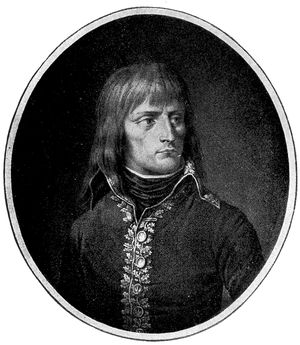
From the collection of W. C. Crane. Engraved by G. Fiesinger.
Buonaparte.
Drawn by S. Guerin.
Deposited in the National Library
on the
29th Vendémiaire of the year 7 of the French Republic
No people ever made such sacrifices for liberty as the French had
made. Through years of famine they had starved with grim
determination, and the leanness of their race was a byword for more
than a generation. They had been for over a century the victims of a
system abhorrent to both their intelligence and their character—a
system of absolutism which had subsisted on foreign wars and on
successful appeals to the national vainglory. Now at last they were to
all appearance exhausted, their treasury was bankrupt, their paper
money was worthless, their agriculture and industries were paralyzed,
their foreign commerce was ruined; but they cherished the delusion
that their liberties were secure. Their soldiers were badly fed, badly
armed, and badly clothed; but they were freemen under such discipline
as is possible only among freemen. Why should not their success in the
arts of peace be as great as in the glorious and successful wars they
had carried on? There was, therefore, both in the country and in the
government, as in the army, a considerable and ever growing party
which demanded a general peace, but only with the "natural" frontier,
and a small one which felt peace to be imperative even if the nation
should be confined within its old boundaries.
But such a reasonable and moderate policy was impossible on
two accounts. In consequence of the thirteenth of Vendémiaire, the
radical party still survived and controlled the machinery of
government; and, in spite of the seeming supremacy of moderate ideas,
the royalists were still irreconcilable. In particular there was the
religious question, which in itself comprehended a political, social,
and economic revolution which men like those who sat in the Directory
refused to understand because they chose to treat it on the basis of
pure theory.[65] The great western district of France was Roman,
royalist, and agricultural. There was a unity in their life and faith
so complete that any disturbance of the equilibrium produced frenzy
and chaos, an embattled strife for life itself. It was a discovery to
Hoche, that to pacify the Vendée brute force was quite insufficient.
The peasantry were beggared and savage but undismayed. While he used
force with nobles, strangers, and madmen, his conquest was in the main
moral because he restored to the people their fields and their church,
their institutions somewhat modified and improved, but still their old
institutions. No man less gigantic in moral stature would have dared
thus to defy the petty atheistic fanaticism of the Directory. France
had secured enlightened legislation which was not enforced, religious
liberty which could not be practised because of ill will in the
government, civil liberty which was a mere sham because of internal
violence, political liberty which was a chimera before hostile
foreigners. Hence it seemed to the administration that one evil must
cure another. Intestine disturbances, they naïvely believed, could be
kept under some measure of control only by an aggressive foreign
policy which should deceive the insurgent elements as to the resources
of the government. Thus far, by hook or by crook, the
armies, so far as they had been clothed and paid and fed at all, had
been fed and paid and clothed by the administration at Paris. If the
armies should still march and fight, the nation would be impressed by
the strength of the Directory.
The Directory was by no means a homogeneous body. It is doubtful
whether Barras was a sincere republican, or sincere in anything except
in his effort to keep himself afloat on the tide of the times. It has
been believed by many that he hoped for the restoration of monarchy
through disgust of the nation with such intolerable disorders as they
would soon associate with the name of republic. His friendship for
General Bonaparte was a mixed quantity; for while he undoubtedly
wished to secure for the state in any future crisis the support of so
able a man, he had at the same time used him as a sort of social
scapegoat. His own strength lay in several facts: he had been Danton's
follower; he had been an officer, and was appointed for that reason
commanding general against the Paris sections; he had been shrewd
enough to choose Bonaparte as his agent so that he enjoyed the
prestige of Bonaparte's success; and in the new society of the capital
he was magnificent, extravagant, and licentious, the only
representative in the Directory of the newly aroused passion for life
and pleasure, his colleagues being severe, unostentatious, and
economical democrats.
Barras's main support in the government was Rewbell, a vigorous
Alsatian and a bluff democrat, enthusiastic for the Revolution and its
extension. He was no Frenchman himself, but a German at heart, and
thought that the German lands—Holland, Switzerland, Germany
itself—should be brought into the great movement. Like Barras, who
needed disorder for his Orleanist schemes and for the supply of his
lavish purse, Rewbell despised the new constitution; but for
a different reason. To him it appeared a flimsy, theoretical document,
so subdividing the exercise of power as to destroy it altogether. His
rôle was in the world of finance, and he was always suspected, though
unjustly, of unholy alliances with army contractors and stock
manipulators. Larévellière was another doctrinaire, but, in comparison
with Rewbell, a bigot. He had been a Girondist, a good citizen, and
active in the formation of the new constitution; but he lacked
practical common sense, and hated the Church with as much narrow
bitterness as the most rancorous modern agnostic,—seeking, however,
not merely its destruction, but, like Robespierre, to substitute for
it a cult of reason and humanity. The fourth member of the Directory,
Letourneur, was a plain soldier, an officer in the engineers. With
abundant common sense and a hard head, he, too, was a sincere
republican; but he was a tolerant one, a moderate, kindly man like his
friend Carnot, with whom, as time passed by and there was gradually
developed an irreconcilable split in the Directory, he always voted in
a minority of two against the other three.
At first the notorious Abbé Sieyès had been chosen a member of the
executive. He was both deep and dark, like Bonaparte, to whom he later
rendered valuable services. His ever famous pamphlet, which in 1789
triumphantly proved that the Third Estate was neither more nor less
than the French nation, had made many think him a radical. As years
passed on he became the oracle of his time, and as such acquired an
enormous influence even in the days of the Terror, which he was
helpless to avert, and which he viewed with horror and disgust.
Whatever may have been his original ideas, he appears to have been for
some time after the thirteenth of Vendémiaire an Orleanist, the head
of a party which desired no longer a strict hereditary and
absolute monarchy, but thought that in the son of Philippe Égalité
they had a useful prince to preside over a constitutional kingdom.
Perhaps for this reason, perhaps for the one he gave, which was that
the new constitution was not yet the right one, he flatly refused the
place in the Directory which was offered to him.
It was as a substitute for this dangerous visionary that Carnot was
made a director. He was now in his forty-third year, and at the height
of his powers. In him was embodied all that was moderate and sound,
consequently all that was enduring, in the French Revolution; he was a
thorough scholar, and his treatise on the metaphysics of the calculus
forms an important chapter in the history of mathematical physics. As
an officer in the engineers he had attained the highest distinction,
while as minister of war he had shown himself an organizer and
strategist of the first order. But his highest aim was to be a model
French citizen. In his family relations as son, husband, and father,
he was held by his neighbors to be a pattern; in his public life he
strove with equal sincerity of purpose to illustrate the highest
ideals of the eighteenth century. Such was the ardor of his
republicanism that no man nor party in France was so repugnant but
that he would use either one or both, if necessary, for his country's
welfare, although he was like Chatham in his lofty scorn for parties.
To him as a patriot, therefore, France, as against the outer world,
was first, no matter what her government might be; but the France he
yearned for was a land regenerated by the gospel of humanity, awakened
to the highest activity by the equality of all before the law, refined
by that self-abnegation of every man which makes all men brothers, and
destroys the menace of the law.
And yet he was no dreamer. While a member of the National
Assembly he had displayed such practical common sense in his chosen
field of military science, that in 1793 the Committee of Safety
intrusted to him the control of the war. The standard of rank and
command was no longer birth nor seniority nor influence, but merit.
The wild and ignorant hordes of men which the conscription law had
brought into the field were something hitherto unknown in Europe. It
was Carnot who organized, clothed, fed, and drilled them. It was he
who devised the new tactics and evolved the new and comprehensive
plans which made his national armies the power they became. It was in
Carnot's administration that the young generals first came to the
fore. It was by his favor that almost every man of that galaxy of
modern warriors who so long dazzled Europe by their feats of arms
first appeared as a candidate for advancement. Moreau, Macdonald,
Jourdan, Bernadotte, Kléber, Mortier, Ney, Pichegru, Desaix, Berthier,
Augereau, and Bonaparte himself,—each one of these was the product of
Carnot's system. He was the creator of the armies which for a time
made all Europe tributary to France.
Throughout an epoch which laid bare the meanness of most natures, his
character was unsmirched. He began life under the ancient régime by
writing and publishing a eulogy on Vauban, who had been disgraced for
his plain speaking to Louis XIV. When called to a share in the
government he was the advocate of a strong nationality, of a just
administration within, and of a fearless front to the world. While
minister of war he on one occasion actually left his post and hastened
to Maubeuge, where defeat was threatening Jourdan, devised and put
into operation a new plan, led in person the victorious assault, and
then returned to Paris to inspire the country and the army with news
of the victory; all this he did as if it were commonplace
duty, without advertising himself by parade or ceremony. Even
Robespierre had trembled before his biting irony and yet dared not, as
he wished, include him among his victims. After the events of
Thermidor, when it was proposed to execute all those who had
authorized the bloody deeds of the Terror, excepting Carnot, he
prevented the sweeping measure by standing in his place to say that he
too had acted with the rest, had held like them the conviction that
the country could not otherwise be saved, and that therefore he must
share their fate.
In the milder light of the new constitution the dark blot on his
record thus frankly confessed grew less repulsive as the continued
dignity and sincerity of his nature asserted themselves in a tolerance
which he believed to be as needful now as ruthless severity once had
been. For a year the glory of French arms had been eclipsed: his
dominant idea was first to restore their splendor, then to make peace
with honor and give the new life of his country an opportunity for
expansion in a mild and firm administration of the new laws. If he had
been dictator in the crisis, no doubt his plan, arduous as was the
task, might have been realized; but, with Letourneur in a minority of
two, against an unprincipled adventurer leading two bigots, it was
impossible to secure the executive unity necessary for success.
At the opening of the year 1796, therefore, the situation of France
was quite as distracting as ever, and the foundation of her
institutions more than ever unstable. There was hopeless division in
the executive, and no coördination under the constitution between it
and the other branches of the government, while the legislature did
not represent the people. The treasury was empty, famine was as
wide-spread as ever, administration virtually non-existent.
The army, checked for the moment, moped unsuccessful, dispirited, and
unpaid. Hunger knows little discipline, and with temporary loss of
discipline the morals of the troops had been undermined. To save the
constitution public opinion must be diverted from internal affairs,
and conciliated. To that end the German emperor must be forced to
yield the Rhine frontier, and money must be found at least for the
most pressing necessities of the army and of the government. If the
republic could secure for France her natural borders, and command a
peace by land, it might hope for eventual success in the conflict with
England. To this end its territorial conquests must be partitioned
into three classes: those within the "natural limits," and already
named, for incorporation; those to be erected into buffer states to
fend off from the tender republic absolutism and all its horrors; and
finally such districts as might be valuable for exchange in order to
the eventual consolidation of the first two classes. Of the second
type, the Directory considered as most important the Germanic
Confederation. There was the example of Catherine's dealing with
Poland by which to proceed. As that had been partitioned, so should
Germany. From its lands should be created four electorates, one to
indemnify the House of Orange for Holland, one for Würtemberg; the
others according to circumstances would be confided to friendly hands.
The means to the end were these. Russia must be reduced to inactivity
by exciting against her through bribes and promises all her foes to
the eastward. Prussia must be cajoled into coöperation by pressure on
King George of Hanover, even to the extinction of his kingdom, and by
the hope of a consolidated territory with the possibility of securing
the Imperial dignity. Austria was to be partly compelled,
partly bribed, into a continental coalition against Great Britain by
adjustment of her possessions both north and south of the Alps. Into a
general alliance against Great Britain, Spain must be dragged by
working on the fears of the queen's paramour Godoy, prime minister and
controller of Spanish destinies. This done, Great Britain, according
to the time-honored, well-worn device of France, royal or radical,
should be invaded and brought to her knees. The plan was as old as
Philippe le Bel, and had appeared thereafter once and again at
intervals either as a bona fide policy or a device to stir the
French heart and secure money from the public purse for the public
defense. For this purpose of the Directory the ruined maritime power
of the republic must be restored, new ships built and old ones
refitted; in the meantime, as did Richelieu or Mazarin, rebellion
against the British government must be roused and supported among
malcontents everywhere within the borders of Great Britain, especially
in Ireland. Such was the stupid plan of the Directory: two well-worn
expedients, both discredited as often as tried. To the territorial
readjustment of Europe, Prussia, though momentarily checked, was
already pivotal; but the first efforts of French diplomacy at Berlin
resulted in a flat refusal to go farther than the peace already made,
or entertain the chimerical proposals now made. Turning then to
Austria, the Directory concluded the armistice of February first,
1796, but at Vienna the offer of Munich and two thirds of Bavaria, of
an outlet to the Adriatic and of an alliance against Russia for the
restoration of Poland—of course without Galicia, which Austria should
retain—was treated only as significant of what French temerity dared
propose, and when heard was scornfully disdained. The program for
Italy was retained substantially as laid down in 1793: the
destruction of the papal power, the overthrow of all existing
governments, the plunder of their rich treasures, the annihilation of
feudal and ecclesiastical institutions, and the regeneration of its
peoples on democratic lines. Neither the revolutionary elements of the
peninsula nor the jealous princes could be brought to terms by the
active and ubiquitous French agents, even in Genoa, though there was
just sufficient dallying everywhere between Venice and Naples to keep
alive hope and exasperate the unsuccessful negotiators. The European
world was worried and harassed by uncertainties, by dark plots, by
mutual distrust. It was unready for war, but war was the only solvent
of intolerable troubles. England, Austria, Russia, and France under
the Directory must fight or perish.
It must not be forgotten that this was the monarchical, secular, and
immemorial policy of France as the disturber of European peace;
continued by the republic, it was rendered more pernicious and
exasperating to the upholders of the balance of power. Not only was
the republic more energetic and less scrupulous than the monarchy, her
rivals were in a very low estate indeed. Great Britain had stripped
France and Holland of their colonies, but these new possessions and
the ocean highway must be protected at enormous expense. The Commons
refused to authorize a new loan, and the nation was exhausted to such
a degree that Pitt and the King, shrinking from the opprobrious
attacks of the London populace, and noting with anguish the renewal of
bloody disorder in Ireland, made a feint of peace negotiations through
the agent they employed in Switzerland to foment royalist
demonstrations against France wherever possible. Wickham asked on
March eighth, 1796, on what terms the Directory would make an
honorable peace, and in less than three weeks received a
rebuff which declared that France would under no circumstances make
restitution of its continental conquests. In a sense it was Russia's
Polish policy which kept Prussia and Austria so occupied with the
partition that the nascent republic of France was not strangled in its
cradle by the contiguous powers. Provided she had the lion's share of
Poland, Catherine was indifferent to the success of Jacobinism. But
she soon saw the danger of a general conflagration and, applying
Voltaire's epithet for ecclesiasticism to the republic, cried all
abroad: Crush the Infamous! Conscious of her old age, distrusting all
the possible successors to her throne: Paul the paranoiac, Constantine
the coarse libertine, and the super-elegant Alexander, she refused a
coalition with England and turned her activities eastward against the
Cossacks and into Persia; but she consented to be the intermediary
between Austria and Great Britain. Austria wanted the Netherlands, but
only if she could secure with them a fortified girdle wherewith to
protect and hold them. She likewise desired the Milanese and the
Legations in Italy, as well as Venetia. As the price of continued war
on France, these lands and a subsidy of three million pounds were the
terms exacted from Great Britain. With no army at his disposal and his
naval resources strained to the utmost, George III agreed to pay a
hundred and fifty thousand pounds per month until parliament would
make the larger grant. Thugut, the Austrian minister, accepted.
Cobenzl, the Austrian ambassador at St. Petersburg, arranged affairs
with Catherine concerning Bavaria, the French royalists under Condé
bribed Pichegru into a promise of yielding the fortresses of the north
to their occupation, the Austrian army on the Rhine was strengthened.
In retort Jourdan was stationed on the lower and Moreau on
the upper Rhine, each with eighty thousand men, Bonaparte was
despatched to Italy, and Hoche made ready a motley crew of outlaws and
Vendeans wherewith to enter Ireland, join Wolfe Tone and his United
Irishmen, and thus let loose the elements of civil war in that unhappy
island. Europe at large expected the brunt of the struggle north of
the Alps in central Germany: the initiated knew better.[Back to Contents]
Bonaparte and the Army of Italy — The System of Pillage —
The General as a Despot — The Republican Armies and French
Politics — Italy as the Focal Point — Condition of Italy
— Bonaparte's Sagacity — His Plan of Action — His Army
and Generals — Strength of the Army of Italy — The
Napoleonic Maxims of Warfare — Advance of Military Science
— Bonaparte's Achievements — His Financial Policy —
Effects of His Success.
1796.
The struggle which was imminent was for nothing less than a new lease
of national life for France. It dawned on many minds that in such a
combat changes of a revolutionary nature—as regarded not merely the
provisioning and management of armies, as regarded not merely the
grand strategy to be adopted and carried out by France, but as
regarded the very structure and relations of other European
nations—would be justifiable. But to be justifiable they must be
adequate; and to be adequate they must be unexpected and thorough.
What should they be? The Œdipus who solves this riddle for France
is the man of the hour. He was found in Bonaparte. What mean these
ringing words from the headquarters at Nice, which, on March
twenty-seventh, 1796, fell on the ears of a hungry, eager soldiery and
a startled world? "Soldiers, you are naked, badly fed. The government
owes you much; it can give you nothing. Your long-suffering, the
courage you show among these crags, are splendid, but they
bring you no glory; not a ray is reflected upon you. I wish to lead
you into the most fertile plains of the world. Rich provinces, great
towns, will be in your power; there you will find honor, glory, and
riches. Soldiers of Italy, can you be found lacking in honor, courage,
or constancy?"
Such language has but one meaning. By a previous understanding with
the Directory, the French army was to be paid, the French treasury to
be replenished, at the expense of the lands which were the seat of
war. Corsicans in the French service had long been suspected of
sometimes serving their own interests to the detriment of their
adopted country. Bonaparte was no exception, and occasionally he felt
it necessary to justify himself. For example, he had carefully
explained that his marriage bound him to the republic by still another
tie. Yet it appears that his promotion, his engagement with the
directors, and his devotion to the republic were all concerned
primarily with personal ambition, though secondarily and incidentally
with the perpetuation of a government professedly based on the
Revolution. From the outset of Napoleon's independent career,
something of the future dictator appears. This implied promise that
pillage, plunder, and rapine should henceforth go unpunished in order
that his soldiers might line their pockets is the indication of a
settled policy which was more definitely expressed in each successive
proclamation as it issued from his pen. It was repeated whenever new
energy was to be inspired into faltering columns, whenever some
unparalleled effort in a dark design was to be demanded from the rank
and file of the army, until at last a point-blank promise
was made that every man should return to France with money enough in
his pocket to become a landowner.
There was magic in the new spell, the charm never ceased to work; with
that first call from Nice began the transformation of the French army,
fighting now no longer for principle, but for glory, victory, and
booty. Its leader, if successful, would be in no sense a
constitutional general, but a despotic conqueror. Outwardly gracious,
and with no irritating condescension; considerate wherever mercy would
strengthen his reputation; fully aware of the influence a dramatic
situation or a pregnant aphorism has upon the common mind, and using
both with mastery; appealing as a climax to the powerful motive of
greed in every heart, Bonaparte was soon to be not alone the general
of consummate genius, not alone the organizing lawgiver of conquered
lands and peoples, but, what was essential to his whole career, the
idol of an army which was not, as of old, the servant of a great
nation, but, as the new era had transformed it, the nation itself.
The peculiar relation of Bonaparte to Italy, to Corsica, and to the
Convention had made him, as early as 1794, while yet but chief of
artillery, the real director of the Army of Italy. He had no personal
share in the victorious campaign of that year, but its victories, as
he justly claimed, were due to his plans. During the unsuccessful
Corsican expedition of the following winter, for which he was but
indirectly responsible, the Austro-Sardinians in Piedmont had taken
advantage of its absorbing so many French troops to undo all that had
so far been accomplished. During the summer of 1795 Spain and Prussia
had made peace with France. In consequence all northern Europe had
been declared neutral, and the field of operations on the Rhine had
been confined to the central zone of Germany, while at the
same time the French soldiers who had formed the Army of the Pyrenees
had been transferred to the Maritime Alps. In 1796, therefore, the
great question was whether the Army of the Rhine or that of Italy was
to be the chief weapon of offense against Austria.
Divided interests and warped convictions quickly created two opinions
in the French nation, each of which was held with intensity and
bitterness by its supporters. So far the Army of the Rhine was much
the stronger, and the Emperor had concentrated his strength to oppose
it. But the wisest heads saw that Austria might be flanked by way of
Italy. The gate to Lombardy was guarded by the sturdy little army of
Victor Amadeus, assisted by a small Austrian force. If the house of
Savoy, which was said to wear at its girdle the keys of the Alps,
could be conquered and brought to make a separate peace, the Austrian
army could be overwhelmed, and a highway to Vienna opened first
through the plains of Lombardy, then by the Austrian Tyrol, or else by
the Venetian Alps. Strangely enough, the plainest and most forcible
exposition of this plan was made by an emigrant in London, a certain
Dutheil, for the benefit of England and Austria. But the Allies were
deaf to his warnings, while in the mean time Bonaparte enforced the
same idea upon the French authorities, and secured their acceptance of
it. Both he and they were the more inclined to the scheme because once
already it had been successfully initiated; because the general,
having studied Italy and its people, thoroughly understood what
contributions might be levied on them; because the Army of the Rhine
was radically republican and knew its own strength; because therefore
the personal ambitions of Bonaparte, and in fact the very existence of
the Directory, alike depended on success elsewhere than in central
Europe.
Having been for centuries the battle-field of rival
dynasties, Italy, though a geographical unit with natural frontiers
more marked than those of any other land, and with inhabitants fairly
homogeneous in birth, speech, and institutions, was neither a nation
nor a family of kindred nations, but a congeries of heterogeneous
states. Some of these, like Venice and Genoa, boasted the proud title
of republics; they were in reality narrow, commercial, even piratical
oligarchies, destitute of any vigorous political life. The Pope, like
other petty rulers, was but a temporal prince, despotic, and not even
enlightened, as was the Grand Duke of Tuscany. Naples and the Milanese
both groaned under the yoke of foreign rulers, and the only passable
government in the length and breadth of the land was that of the house
of Savoy in Piedmont and Sardinia, lands where the revolutionary
spirit of liberty was most extended and active. The petty courts, like
those of Parma and Modena, were nests of intrigue and corruption.
There was, of course, in every place that saving remnant of
high-minded men which is always providentially left as a seed; but the
people as a whole were ignorant and enervated. The accumulations of
ages, gained by an extensive and lucrative commerce, or by the tilling
of a generous soil, had not been altogether dissipated by misrule, and
there was even yet rich store of money in many of the venerable and
still splendid cities. Nowhere in the ancient seats of the Roman
commonwealth, whose memory was now the cherished fashion in France,
could anything more than a reflection of French revolutionary
principles be discerned; the rights of man and republican doctrine
were attractive subjects of debate in many cities throughout the
peninsula, but there was little of that fierce devotion to their
realization so prevalent beyond the Alps.
The sagacity of Bonaparte saw his account in these
conditions. Being a professed republican, he could announce himself as
the regenerator of society, and the liberator of a people. If, as has
been supposed, he already dreamed of a throne, where could one be so
easily founded with the certainty of its endurance? As a conqueror he
would have a divided, helpless, and wealthy people at his feet. If the
old flame of Corsican ambition were not yet extinguished, he felt
perhaps that he could wreak the vengeance of a defeated and angry
people upon Genoa, their oppressor for ages.
His preparations began as early as the autumn of 1795, when, with
Carnot's assistance, the united Pyrenean and Italian armies were
directed to the old task of opening the roads through the mountains
and by the sea-shore into Lombardy and central Italy. They won the
battle of Loano, which secured the Maritime Alps once more; but a long
winter amid these inclement peaks had left the army wretched and
destitute of every necessity. It had been difficult throughout that
winter to maintain even the Army of the Interior in the heart of
France; the only chance for that of Italy was movement. The completed
plan of action was forwarded from Paris in January. But, as has been
told, Schérer, the commanding general, and his staff were outraged,
refusing to consider its suggestions, either those for supplying their
necessities in Lombardy, or those for the daring and venturesome
operations necessary to reach that goal.
Bonaparte, who could invent such schemes, alone could realize them;
and the task was intrusted to him. For the next ten weeks no sort of
preparation was neglected. The nearly empty chest of the Directory was
swept clean; from that source the new commander received forty-seven
thousand five hundred francs in cash, and drafts for twenty thousand
more; forced loans for considerable sums were made in Toulon and
Marseilles; and Salicetti levied contributions of grain and
forage in Genoa according to the plan which had been preconcerted
between him and the general in their Jacobin days. The army which
Bonaparte finally set in motion was therefore a fine engine of war.
Its immediate necessities relieved, the veterans warmed to their work,
and that notable promise of booty worked them to the pitch of genuine
enthusiasm. The young commander, moreover, was as circumspect as a man
of the first ability alone could be when about to make the venture of
his life and play for the stake of a world. His generals of division
were themselves men of mark—personages no less than Masséna,
Augereau, Laharpe, and Sérurier. Of Masséna some account has already
been given. Augereau was Bonaparte's senior by thirteen years, of
humble and obscure origin, who had sought his fortunes as a
fencing-master in the Bourbon service at Naples, and having later
enlisted in the French forces sent to Spain in 1792, rose by his
ability to be general of brigade, then division commander in the Army
of Italy. He was rude in manner and plebeian in feeling, jealous of
Bonaparte, but brave and capable. In the sequel he played an important
part and rose to eminence, though he distrusted both the Emperor and
the empire and flinched before great crises. Neither Laharpe nor
Sérurier was distinguished beyond the sphere of their profession, but
in that they were loyal and admirable. Laharpe was a member of the
famous Swiss family banished from home for devotion to liberty. Under
Luckner in Germany he had earned and kept the sobriquet of "the
brave"; until he was mortally wounded in a night attack, while
crossing the Po after Millesimo, he continued his brilliant career,
and would have gone far had he been spared. Sérurier was a veteran of
the Seven Years' War and of Portugal, already fifty-four years old.
Able and trustworthy, he was loaded with favors by Napoleon
and survived until 1819. It might have been very easy to exasperate
such men. But what the commander-in-chief had to do was done with such
smoothness and skill that even they could find no ground for carping;
and though at first cold and reticent, before long they yielded to the
influences which filled with excitement the very air they breathed.
At this moment, besides the National Guard, France had an army, and in
some sense a navy: of both the effective fighting force numbered
upward of half a million. Divided nominally into nine armies, instead
of fourteen as first planned, there were in reality but seven; of
these, four were of minor importance: a small, skeleton Army of the
Interior, a force in the west under Hoche twice as large and with
ranks better filled, a fairly strong army in the north under
Macdonald, and a similar one in the Alps under Kellermann, with
Berthier and Vaubois as lieutenants, which soon became a part of
Bonaparte's force. These were, if possible, to preserve internal order
and to watch England, while three great active organizations were to
combine for the overthrow of Austria. On the Rhine were two of the
active armies—one near Düsseldorf under Jourdan, another near
Strasburg under Moreau. Macdonald was of Scottish Jacobite descent, a
French royalist converted to republicanism by his marriage. He was now
thirty-one years old. Trained in the regiment of Dillon, he alone of
its officers remained true to democratic principles on the outbreak of
the Revolution. He was made a colonel for his bravery at Jemmapes, and
for his loyalty when Dumouriez went over to the Austrians he was
promoted to be general of brigade. For his services under Pichegru in
Holland he had been further rewarded by promotion, and after the peace
of Campo Formio was transferred from the Rhine to Italy. He
was throughout a loyal friend of Bonaparte and received the highest
honors. Kellermann was a Bavarian, and when associated with Bonaparte
a veteran, sixty-one years old. He had seen service in the Seven
Years' War and again in Poland during 1771. An ardent republican, he
had served with distinction from the beginning of the revolutionary
wars: though twice charged with incapacity, he was triumphantly
acquitted. He linked his fortunes to those of Bonaparte without
jealousy and reaped abundant laurels. Of Berthier and the other great
generals we have already spoken. Vaubois reached no distinction. At
the portals of Italy was Bonaparte, with a third army, soon to be the
most active of all. At the outset he had, all told, about forty-five
thousand men; but the campaign which he conducted had before its close
assumed such dimensions that in spite of its losses the Army of Italy
contained nearly double that number of men ready for the field,
besides the garrison troops and invalids. The figures on the records
of the war department were invariably much greater; but an enormous
percentage, sometimes as high as a third, was always in the hospitals,
while often as many as twenty thousand were left behind to hold
various fortresses. Bonaparte, for evident reasons, uniformly
represented his effective force as smaller than it was, and stunned
the ears of the Directory with ever reiterated demands for
reinforcement. A dispassionate estimate would fix the number of his
troops in the field at any one time during these operations as not
lower than thirty-five thousand nor much higher than eighty thousand.
Another element of the utmost importance entered into the coming
campaign. The old vicious system by which a vigilant democracy had
jealously prescribed to its generals every step to be taken was swept
away by Bonaparte, who as Robespierre's "man" had been
thoroughly familiar with its workings from the other end. He was now
commander-in-chief, and he insisted on the absolute unity of command
as essential to the economy of time. This being granted, his equipment
was complete. It will be remembered that in 1794 he had explained to
his patrons how warfare in the field was like a siege: by directing
all one's force to a single point a breach might be made, and the
equilibrium of opposition destroyed. To this conception of
concentration for attack he had, in concert with the Directory, added
another, that of expansion in a given territory for sustenance. He had
still a third, that war must be made as intense and awful as possible
in order to make it short, and thus to diminish its horrors. Trite and
simple as these aphorisms now appear, they were all original and
absolutely new, at least in the quick, fierce application of them made
by Bonaparte. The traditions of chivalry, the incessant warfare of two
centuries and a half, the humane conceptions of the Church, the regard
for human life, the difficulty of communications, the scarcity of
munitions and arms,—all these and other elements had combined to make
war under mediocre generals a stately ceremonial, and to diminish the
number of actual battles, which took place, when they did, only after
careful preparation, as an unpleasant necessity, by a sort of common
agreement, and with the ceremony of a duel.
Turenne, Marlborough, and Frederick, all men of cold-blooded
temperament, had been the greatest generals of their respective ages,
and were successful much in proportion to their lack of sentiment and
disregard of conventionalities. Their notions and their conduct
displayed the same instincts as those of Bonaparte, and their minds
were enlarged by a study of great campaigns like that which
had fed his inchoate genius and had made possible his consummate
achievement. He had much the same apparatus for warfare as they. The
men of Europe had not materially changed in stature, weight,
education, or morals since the closing years of the Thirty Years' War.
The roads were somewhat better, the conformation of mountains, hills,
and valleys was better known, and like his great predecessors, though
unlike his contemporaries, Bonaparte knew the use of a map; but in the
main little was changed in the conditions for moving and
manœuvering troops. News traveled slowly, the semaphore telegraph
was but slowly coming into use, and the fastest couriers rode from
Nice to Paris or from Paris to Berlin in seven days. Firearms of every
description were little improved: Prussia actually claimed that she
had been forced to negotiate for peace because France controlled the
production of gun-flints. The forging of cannon was finer, and the
artillery arm was on the whole more efficient. In France there had
been considerable change for the better in the manual and in tactics;
the rest of Europe followed the old and more formal ways. Outside the
republic, ceremony still held sway in court and camp; youthful energy
was stifled in routine; and the generals opposed to Bonaparte were for
the most part men advanced in years, wedded to tradition, and
incapable of quickly adapting their ideas to meet advances and attacks
based on conceptions radically different from their own. It was at
times a positive misery to the new conqueror that his opponents were
such inefficient fossils. Young and at the same time capable; using
the natural advantages of his territory to support the bravery of his
troops; with a mind which was not only accurate and decisive, but
comprehensive in its observations; unhampered by control or by
principle; opposed to generals who could not think of a boy
of twenty-six as their equal; with the best army and the finest
theater of war in Europe; finally, with a genius independently
developed, and with conceptions of his profession which summarized the
experience of his greatest predecessors, Bonaparte performed feats
that seemed miraculous even when compared with those of Hoche,
Jourdan, or Moreau, which had already so astounded the world.
Within eleven days the Austrians and Sardinians were separated, the
latter having been defeated and forced to sign an armistice. After a
rest of two days, a fortnight saw him victorious in Lombardy, and
entering Milan as a conqueror. Two weeks elapsed, and again he set
forth to reduce to his sway in less than a month the most of central
Italy. Against an enemy now desperate and at bay his operations fell
into four divisions, each resulting in an advance—the first, of nine
days, against Wurmser and Quasdanowich; the second, of sixteen days,
against Wurmser; the third, of twelve days, against Alvinczy; and the
fourth, of thirty days, until he captured Mantua and opened the
mountain passes to his army. Within fifteen days after beginning
hostilities against the Pope, he forced him to sign the treaty of
Tolentino; and within thirty-six days of their setting foot on the
road from Mantua to Vienna, the French were at Leoben, distant only
ninety miles from the Austrian capital, and dictating terms to the
Empire. In the year between March twenty-seventh, 1796, and April
seventh, 1797, Bonaparte humbled the most haughty dynasty in Europe,
toppled the central European state system, and initiated the process
which has given a predominance apparently final to Prussia, then
considered but as a parvenu.
It is impossible to estimate the enormous sums of money which he
exacted for the conduct of a war that he chose to say was
carried on to emancipate Italy. The soldiers of his army were well
clad, well fed, and well equipped from the day of their entry into
Milan; the arrears of their pay were not only settled, but they were
given license to prey on the country until a point was reached which
seemed to jeopardize success, when common pillage was promptly stopped
by the severest examples. The treasury of the Directory was not filled
as were those of the conquering officers, but it was no longer empty.
In short, France reached the apex of her revolutionary greatness; and
as she was now the foremost power on the Continent, the shaky
monarchies in neighboring lands were forced to consider again
questions which in 1795 they had hoped were settled. As Bonaparte
foresaw, the destinies of Europe had indeed hung on the fate of Italy.
Europe had grown accustomed to military surprises in the few preceding
years. The armies of the French republic, fired by devotion to their
principles and their nation, had accomplished marvels. But nothing in
the least foreshadowing this had been wrought even by them. Then, as
now, curiosity was inflamed, and the most careful study was expended
in analyzing the process by which such miracles had been performed.
The investigators and their readers were so overpowered by the
spectacle and its results that they were prevented by a sort of
awe-stricken credulity from recognizing the truth; and even yet the
notion of a supernatural influence fighting on Bonaparte's side has
not entirely disappeared. But the facts as we know them reveal
cleverness dealing with incapacity, energy such as had not yet been
seen fighting with languor, an embodied principle of great vitality
warring with a lifeless, vanishing system. The consequences were
startling, but logical; the details sound like a romance from the land
of Eblis.[Back to Contents]
The Armies of Austria and Sardinia — Montenotte and
Millesimo — Mondovi and Cherasco — Consequences of the
Campaign — The Plains of Lombardy — The Crossing of the Po
— Advance Toward Milan — Lodi — Retreat of the Austrians
— Moral Effects of Lodi.
1796.
Victor Amadeus of Sardinia was not unaccustomed to the loss of
territory in the north, because from immemorial times his house had
relinquished picturesque but unfruitful lands beyond the Alps to gain
fertile fields below them. It was a hard blow, to be sure, that Savoy,
which gave name to his family, and Nice, with its beautiful and
commanding site, should have been lost to his crown. But so far, in
every general European convulsion, some substantial morsels had fallen
to the lot of his predecessors, who had looked on Italy "as an
artichoke to be eaten leaf by leaf"; and it was probable that a slice
of Lombardy would be his own prize at the next pacification. He had
spent his reign in strengthening his army, and as the foremost
military power in Italy his young and vigorous people, with the help
of Austria, were defending the passes into their territory. The road
from their capital to Savona on the sea wound by Ceva and Millesimo
over the main ridge of the Apennines, at the summit of which it was
joined by the highway through Dego and Cairo leading
southwestward from Milan through Alessandria. The Piedmontese, under
Colli, were guarding the approach to their own capital; the Austrians,
under Beaulieu, that to Milan. Collectively their numbers were
somewhat greater than those of the French; but the two armies were
separated.
Beaulieu began operations on April tenth by ordering an attack on the
French division of Laharpe, which had been thrown forward to Voltri.
The Austrians under Argenteau were to fall on its rear from
Montenotte, a village to the north of Savona, with the idea of driving
that wing of Bonaparte's army back along the shore road, on which it
was hoped they would fall under the fire of Nelson's guns. Laharpe,
however, retreated to Savona in perfect safety, for the English fleet
was not near. Thereupon Bonaparte, suddenly revealing the new
formation of his army in the north and south line, assumed the
offensive. Argenteau, having been held temporarily in check by the
desperate resistance of a handful of French soldiers under Colonel
Rampon, was surprised and overwhelmed at Montenotte on the twelfth by
a force much larger than his own. Next day Masséna and Augereau drove
back toward Dego an Austrian division which had reached
Millesimo on its way to join Colli; and on the fifteenth, at that
place, Bonaparte himself destroyed the remnant of Argenteau's corps.
On the sixteenth Beaulieu abandoned the mountains to make a stand at
Acqui in the plain. Thus the whole Austrian force was not only driven
back, but was entirely separated from the Piedmontese.
Bonaparte had a foolish plan in his pocket, which had been furnished
by the Directory in a temporary reversion to official tradition,
ordering him to advance into Lombardy, leaving behind the hostile
Piedmontese on his left, and the uncertain Genoese on his right. He
disregarded it, apparently without hesitation, and throwing his force
northwestward toward Ceva, where the Piedmontese were posted,
terrified them into a retreat. They were overtaken, however, at
Mondovi on April twenty-second, and utterly routed, losing not only
their best troops, but their field-pieces and baggage-train. Three
days later Bonaparte pushed onward and occupied Cherasco, which was
distant from Turin, the Piedmontese capital, but twenty-five miles by
a short, easy, and now open road. On the twenty-seventh the
Sardinians, isolated in a mountain amphitheater, and with no prospect
of relief from their discomfited ally, made overtures for an armistice
preliminary to peace. These were readily accepted by Bonaparte; and
although he had no authorization from the government to perform such
functions, he was defiantly careless of instructions in this as in
every subsequent step he took. The negotiation was conducted with
courtesy and firmness, on the basis of military honor, much to the
surprise of the Piedmontese, who had expected to deal with a savage
Jacobin. There was not even a word in Bonaparte's talk which recalled
the republican severity; as has been noted, the word virtue did not
pass his lips, his language was that of chivalry. He
stipulated in kindly phrase for the surrender of Coni and Tortona, the
famous "keys of the Alps," with other strongholds of minor importance,
demanding also the right to cross and recross Piedmontese territory at
will. The paper was completed and signed on the twenty-eighth. The
troublesome question of civil authority to make a treaty was evaded by
calling the arrangement a military convention. It was none the less
binding by reason of its name. Indeed the idea was steadily expanded
into a new policy, for just as pillage and rapine were ruthlessly
repressed by the victorious commander, all agreements were made
temporarily on a military basis, including those for indemnities.
Salicetti was the commissioner of the Directory and there was no
friction between him and Bonaparte. Both profited by a partnership in
which opportunities for personal ventures were frequent, while the
military chest was well supplied and remittances to Paris were kept
just large enough to save the face and quiet the clamors of the
Directory. Victor Amadeus being checkmated, Bonaparte was free to deal
with Beaulieu.
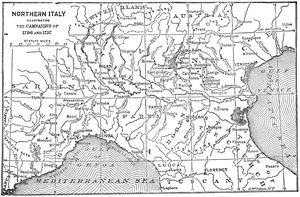
Northern Italy.
Illustrating the Campaigns of 1796 and
1797.
This short campaign was in some respects insignificant, especially
when compared as to numbers and results with what was to follow. But
the names of Montenotte, Millesimo, Dego, Mondovi, and Cherasco were
ever dear to Bonaparte, and stand in a high place on his greatest
monument. The King of Sardinia was the father-in-law of Louis XVIII,
and his court had been a nest of plotting French emigrants. When his
agents reached Paris they were received with coarse resentment by the
Directory and bullied into an alliance, though they had been
instructed to make only a peace. Their sovereign was humiliated to the
limit of possibility. The loss of his fortress robbed him of his
power. By the terms of the treaty he was to banish the French
royalists from his lands. Stripped thus of both force and
prestige, he did not long survive the disgrace, and died, leaving to
Charles Emmanuel, his son, no real dominion but that over the island
of Sardinia. The contrast between the ferocious bluster of the
Directory and the generous simplicity of a great conqueror was not
lost on the Italians nor on the moderate French. For them as for
Bonaparte, a military and political aspirant in his first
independence, everything, absolutely everything, was at stake in those
earliest engagements; on the event hung not merely his career, but
their release. In pleasant succession the spring days passed like a
transformation scene. Success was in the air, not the success of
accident, but the resultant of forethought and careful combination.
The generals, infected by their leader's spirit, vied with each other
in daring and gallantry. For happy desperation Rampon's famous stand
remains unsurpassed in the annals of war.
From the heights of Ceva the leader of conquering and now devoted
soldiers could show to them and their equally enthusiastic officers
the gateway into the fertile and well-watered land whither he had
promised to lead them, the historic fields of Lombardy. Nothing
comparable to that inexhaustible storehouse of nature can be found in
France, generous as is her soil. Walled in on the north and west by
the majestic masses of the Alps, and to the south by the smaller but
still mighty bastions of the Apennines, these plains owe to the
mountains not only their fertility and prosperity, but their very
existence. Numberless rills which rise amid the icy summits of the
great chain, or the lower peaks of the minor one, combine into ever
growing streams of pleasant waters which finally unite in the sluggish
but impressive Po. Melting snows and torrential rains fill these
watercourses with the rich detritus of the hills which
renews from year to year the soil it originally created. A genial
climate and a grateful soil return to the industrious inhabitants an
ample reward for their labors. In the fiercest heats of summer the
passing traveler, if he pauses, will hear the soft sounds of
slow-running waters in the irrigation sluices which on every side
supply any lack of rain. Wheat, barley, and rice, maize, fruit, and
wine, are but a few of the staples. Great farmsteads, with barns whose
mighty lofts and groaning mows attest the importance of Lombard
agriculture, are grouped into the hamlets which abound at the shortest
intervals. And to the vision of one who sees them first from a
mountain-top through the dim haze of a sunny day, towns and cities
seem strewn as if they were grain from the hand of a sower. The
measure of bewilderment is full when memory recalls that this garden
of Italy has been the prize for which from remotest antiquity the
nations of Europe have fought, and that the record of the ages is
indelibly written in the walls and ornaments of the myriad
structures—theaters, palaces, and churches—which lie so quietly
below. Surely the dullest sansculotte in Bonaparte's army must have
been aroused to new sensations by the sight. What rosy visions took
shape in the mind of their leader we can only imagine.
Piedmont having submitted, the promised descent into these rich plains
was not an instant deferred. "Hannibal," said the commanding general
to his staff, "took the Alps by storm. We have turned their flank." He
paused only to announce his feats to the Directory in modest phrase,
and to recommend for preferment those who, like Lannes and Lanusse,
had earned distinction. The former was just Bonaparte's age but
destitute of solid education, owing to the poverty of his parents. He
enlisted in 1792 and in 1795 was already a colonel, owing to
his extraordinary inborn courage and capacity. Through the hatred of a
Convention legate he was degraded from his rank after the peace of
Basel and entered Bonaparte's army as a volunteer. Thereafter his
promotion was fast and regular until he became the general's close
friend and steadfast supporter. Lanusse was only twenty-four but had
been chief of battalion for four years, and now entered upon a
brilliant though short career which ended by his death in 1801 at
Aboukir. The advance of Bonaparte's army began on May thirtieth.
Neither Genoa, Tuscany, nor Venice was to be given time for arming;
Beaulieu must be met while his men were still dispirited, and before
the arrival of reinforcements: for a great army of thirty thousand men
was immediately to be despatched under Wurmser to maintain the power
of Austria in Italy. Beaulieu was a typical Austrian general,
seventy-one years old, but still hale, a stickler for precedent, and
looking to experience as his only guide. Relying on the principles of
strategy as he had learned them, he had taken up what he considered a
strong position for the defense of Milan, his line stretching
northeasterly beyond the Ticino from Valenza, the spot where rumors,
diligently spread by Bonaparte, declared that the French would attempt
to force a passage. Confirmed in his own judgment by those reports,
the old and wary Austrian commander stood brave and expectant, while
the young and daring adventurer opposed to him marched swiftly by on
the right bank fifty miles onward to Piacenza. There he made his
crossing on May seventh in common ferry-boats and by a pontoon bridge.
No resistance was made by the few Austrian cavalry who had been sent
out merely to reconnoiter the line. The enemy were outwitted and
virtually outflanked, being now in the greatest danger. Beaulieu had
barely time to break camp and march in hot haste
northeasterly to Lodi, where, behind the swift current of the Adda, he
made a final stand for the defense of Milan, the seat of Austrian
government. In fact, his movements were so hurried that the
advance-guards of both armies met by accident at Fombio on May eighth,
where a sharp engagement resulted in a victory for the French.
Laharpe, who had shown his usual courage in this fight, was killed a
few hours later, through a mistake of his own soldiers, in a night
mêlée with the pickets of a second Austrian corps. On the ninth the
dukes of Parma and of Piacenza both made their submission in treaties
dictated by the French commander, and simultaneously the reigning
archduke quitted Milan. Next day the pursuing army was at Lodi.
Bonaparte wrote to the Directory that he had expected the passage of
the Po would prove the most bold and difficult manœuver of the
campaign. But it was no sooner accomplished than he again showed a
perfect mastery of his art by so manœuvering as to avoid an
engagement while the great river was still immediately in his rear. He
was then summoned to meet a third emergency of equal consequence. The
Adda is fordable in some places at certain times, but not easily; and
at Lodi a wooden bridge about two hundred yards in length then
occupied the site of the later solid structure of masonry and iron.
The approach to this bridge Beaulieu had seized and fortified.
Northwestward was Milan; to the east lay the almost impregnable
fortress of Mantua. Beaten at Lodi, the Austrians might still retreat,
and make a stand under the walls of either town with some hope of
victory: it was Bonaparte's intention so to disorganize his enemy's
army that neither would be possible. Accordingly on May tenth the
French forces were concentrated for the advance. They started
immediately and marched so swiftly that they overtook the
Austrian rear-guard before it could withdraw behind the old Gothic
walls of the town, and close the gates. Driving them onward, the
French fought as they marched. A decisive conflict cleared the
streets; and after a stubborn resistance the brave defenders retreated
over the bridge to the eastern bank of what was now their last
rampart, the river. With cool and desperate courage, Sebottendorf,
whose Austrians numbered less than ten thousand men, then brought into
action his artillery, and swept the wooden roadway.
In a short time the bridge would no doubt have been in flames; it was
uncertain whether the shifting and gravelly bottom of the stream above
or below would either yield a ford or permit a crossing by any other
means. Under Bonaparte's personal supervision, and therefore with
miraculous speed, the French batteries were placed and began an
answering thunder. In an access of personal zeal, the commander even
threw himself for an instant into the whirling hail of shot and
bullets, in order the better to aim two guns which in the hurry had
been misdirected. Under this terrible fire and counterfire it was
impossible for the Austrians to apply a torch to any portion of the
structure. Behind the French guns were three thousand grenadiers
waiting for a signal. Soon the crisis came. A troop of Bonaparte's
cavalry had found the nearest ford a few hundred yards above the
bridge, and were seen, amid the smoke, struggling to cross, though
without avail, and turn the right flank of the Austrian infantry,
which had been posted a safe distance behind the artillery on the
opposite shore. Quick as thought, in the very nick of opportunity, the
general issued his command, and the grenadiers dashed for the bridge.
Eye-witnesses declared that the fire of the Austrian artillery was now
redoubled, while from houses on the opposite side soldiers
hitherto concealed poured volley after volley of musket-balls upon the
advancing column. For one single fateful moment it faltered. Berthier
and Masséna, with others equally devoted, rushed to its head, and
rallied the lines. In a few moments the deed was accomplished, the
bridge was won, the batteries were silenced, and the enemy was in full
retreat.
Scattered, stunned, and terrified, the disheartened Austrians felt
that no human power could prevail against such a foe. Beaulieu could
make no further stand behind the Adda; but, retreating beyond the
Oglio to the Mincio, a parallel tributary of the Po, he violated
Venetian neutrality by seizing Peschiera, where that stream flows out
of Lake Garda, and spread his line behind the river from the Venetian
town on the north as far as Mantua, the farthest southern outpost of
Austria, thus thwarting one, and that not the least important, of
Bonaparte's plans. As to the Italians, they seemed bereft of sense,
and for the most part yielded dumbly to what was required. There were
occasional outbursts of enthusiasm by Italian Jacobins, and in the
confusion of warfare they wreaked a sneaking vengeance on their
conservative compatriots by extortion and terrorizing. The population
was confused between the woe of actual loss and the joy of
emancipation from old tyrannies. Suspicious and adroit, yet slow and
self-indulgent, the common folk concluded that the grievous burden of
the hour would be lightened by magnanimity and held a waiting
attitude.
The moral effect of the action at Lodi was incalculable. Bonaparte's
reputation as a strategist had already been established, but his
personal courage had never been tested. The actual battle-field is
something quite different from the great theater of war, and men
wondered whether he had the same mastery of the former as of
the latter. Hitherto he had been untried either as to his tactics or
his intrepidity. In both respects Lodi elevated him literally to the
stars. No doubt the risk he took was awful, and the loss of life
terrible. Critics, too, have pointed out safer ways which they believe
would have led to the same result; be that as it may, in no other way
could the same dramatic effect have been produced. France went wild
with joy. The peoples of Italy bowed before the prodigy which thus
both paralyzed and fascinated them all. Austria was dispirited, and
her armies were awe-stricken. When, five days later, on May fifteenth,
amid silent but friendly throngs of wondering men, Bonaparte entered
Milan, not as the conqueror but as the liberator of Lombardy, at the
head of his veteran columns, there was already about his brows a mild
effulgence of supernatural light, which presaged to the growing band
of his followers the full glory in which he was later to shine on the
imagination of millions. It was after Lodi that his adoring soldiers
gave him the name of "Little Corporal," by which they ever after knew
him. He himself confessed that after Lodi some conception of his high
destiny arose in his mind for the first time.[Back to Contents]
Bonaparte's Assertion of Independence — Helplessness of the
Directory — Threats and Proclamations — The General and
His Officers — Bonaparte's Comprehensive Genius — The
Devotion of France — Uneasiness in Italy — The Position of
the Austrians — Bonaparte's Strategy — His Conception of
the Problem in Italy — Justification of His Foresight —
Modena, Parma, and the Papacy — The French Radicals and the
Pope — Bonaparte's Policy — His Ambition.
1796.
When the news of the successes in Piedmont reached Paris, public
festivals were decreed and celebrated; but the democratic spirit of
the directors could brook neither the contemptuous disregard of their
plan which Bonaparte had shown, nor his arrogant assumption of
diplomatic plenipotence. Knowing how thoroughly their doctrine had
permeated Piedmont, they had intended to make it a republic. It was
exasperating, therefore, that through Bonaparte's meddling they found
themselves still compelled to carry on negotiations with a monarchy.
The treaty with the King of Sardinia was ungraciously dictated and
signed by them on May fifteenth, but previous to the act they
determined to clip the wings of their dangerous falcon. This they
thought to accomplish by assigning Kellermann to share with Bonaparte
the command of the victorious army, and by confirming Salicetti as
their diplomatic plenipotentiary to accompany it. The news reached the
conqueror at Lodi on the eve of his triumphant entry into Milan. "As
things now are," he promptly replied to the Directory, "you
must have a general who possesses your entire confidence. If I must
refer every step to government commissioners, if they have the right
to change my movements, to withdraw or send troops, expect nothing
good hereafter." To Carnot he wrote at the same time: "I believe one
bad general to be worth two good ones.... War is like government, a
matter of tact.... I do not wish to be hampered. I have begun with
some glory; I wish to continue worthy of you." Aware probably that his
own republican virtue could not long withstand the temptations opening
before him, he began the latter missive, as if to excuse himself and
anticipate possible accusations: "I swear I have nothing in view but
the country. You will always find me on the straight road. I owe to
the republic the sacrifice of all my own notions. If people seek to
set me wrong in your esteem, my answer is in my heart and in my
conscience." It is of course needless to add that the Directory
yielded, not only as to the unity of command, but also in the fatal
and vital matter of intrusting all diplomatic negotiations to his
hands.
In taking this last step the executive virtually surrendered its
identity. Such, however, was the exultation of the Parisian populace
and of the soldiery, that the degradation or even the forced
resignation of the conquering dictator would have at once assured the
fall of the directors. They could not even protest when, soon after,
there came from Bonaparte a despatch announcing that the articles of
"the glorious peace which you have concluded with the King of
Sardinia" had reached "us," and significantly adding in a later
paragraph that the troops were content, having received half their pay
in coin. Voices in Paris declared that for such language the writer
should be shot. Perhaps those who put the worst
interpretation on the apparently harmless words were correct in their
instinct. In reality the Directory had been wholly dependent on the
army since the previous October; and while such an offensive
insinuation of the fact would be, if intentional, most unpalatable,
yet those who had profited by the fact dared not resent a remote
reference to it.
The farce was continued for some time longer, Bonaparte playing his
part with singular ability. He sent to Kellermann, in Savoy, without
the form of transmitting it through government channels, a subsidy of
one million two hundred thousand francs. As long as he was unhampered,
his despatches to Paris were soldierly and straightforward, although
after the passage of the Po they began to be somewhat bombastic, and
to abound in his old-fashioned, curious, and sometimes incorrect
classical or literary allusions. But if he were crossed in the least,
if reinforcements did not arrive, or if there were any sign of
independence in Paris, they became petulant, talking of ill-health,
threatening resignation, and requesting that numbers of men be sent
out to replace him in the multiform functions which in his single
person he was performing. Of course these tirades often failed of
immediate effect, but at least no effort was made to put an effective
check on the writer's career. Read a century later in a cold and
critical light, Bonaparte's proclamations of the same period seem
stilted, jerky, and theatrical. In them, however, there may still be
found a sort of interstitial sentimentality, and in an age of romantic
devotion to ideals the quality of vague suggestiveness passed for
genuine coin. Whatever else was lacking in those compositions, they
had the one supreme merit of accomplishing their end, for they roused
the French soldiers to frenzied enthusiasm.
In fact, if the Directory stood on the army, the army
belonged henceforth to Bonaparte. On the very day that Milan was
entered, Marmont heard from his leader's lips the memorable words,
"Fortune is a woman; the more she does for me, the more I shall exact
from her.... In our day no one has conceived anything great; it falls
to me to give the example." This is the language that soldiers like to
hear from their leader, and it was no doubt repeated throughout the
army. "From this moment," wrote the same chronicler, a few months
later, "the chief part of the pay and salaries was in coin. This led
to a great change in the situation of the officers, and to a certain
extent in their habits." Bonaparte was incorruptible. Salicetti
announced one day that the brother of the Duke of Modena was waiting
outside with four chests containing a million of francs in gold, and
urged the general, as a friend and compatriot, to accept them. "Thank
you," was the calm and significant answer, "I shall not put myself in
the hands of the Duke of Modena for such a sum." But similar
propositions were made by the commander-in-chief to his subordinates,
and they with less prudence fell into the trap, taking all they could
lay hands upon and thus becoming the bond-slaves of their virtuous
leader. There were stories at the time that some of the generals, not
daring to send their ill-gotten money to France, and having no
opportunity for investing it elsewhere, actually carried hundreds of
thousands of francs in their baggage. This prostitution of his
subordinates was part of a system. Twenty million francs was
approximately the sum total of all contributions announced to the
Directory, and in their destitution it seemed enormous. They also
accepted with pleasure a hundred of the finest horses in Lombardy to
replace, as Bonaparte wrote on sending his present, the ordinary ones
which drew their carriages. Was this paltry four million
dollars the whole of what was derived from the sequestrations of
princely domains and the secularization of ecclesiastical estates? By
no means. The army chest, of which none knew the contents but
Bonaparte, was as inexhaustible as the widow's cruse. At the opening
of the campaign in Piedmont, empty wagons had been ostentatiously
displayed as representing the military funds at the commander's
disposal: these same vehicles now groaned under a weight of treasure,
and were kept in a safe obscurity. Well might he say, as he did in
June to Miot, that the commissioners of the Directory would soon leave
and not be replaced, since they counted for nothing in his policy.
With the entry into Milan, therefore, begins a new epoch in the
remarkable development we are seeking to outline. The military genius
of him who had been the Corsican patriot and the Jacobin republican
had finally asserted dominion over all his other qualities. In the
inconsistency of human nature, those former characters now and then
showed themselves as still existent, but they were henceforth
subordinate. The conquered Milanese was by a magical touch provided
with a provisional government, ready, after the tardy assent of the
Directory, to be changed into the Transpadane Republic and put under
French protection. Every detail of administration, every official and
his functions, came under Bonaparte's direction. He knew the land and
its resources, the people and their capacities, the mutual relations
of the surrounding states, and the idiosyncrasies of their rulers.
Such laborious analysis as his despatches display, such grasp both of
outline and detail, such absence of confusion and clearness of vision,
such lack of hesitance and such definition of plan, seem to prove that
either a hero or a demon is again on earth. All the capacity this man
had hitherto shown, great as it was, sinks into
insignificance when compared with the Olympian powers he now displays,
and will continue to display for years to come. His sinews are iron,
his nerves are steel, his eyes need no sleep, and his brain no rest.
What a captured Hungarian veteran said of him at Lodi is as true of
his political activity as of his military restlessness: "He knows
nothing of the regular rules of war: he is sometimes on our front,
sometimes on the flank, sometimes in the rear. There is no supporting
such a gross violation of rules." His senses and his reason were
indeed untrammeled by human limitations; they worked on front, rear,
and flank, often simultaneously, and always without confusion.
Was it astonishing that the French nation, just recovering from a
debauch of irreligion and anarchy, should begin insensibly to yield to
the charms of a wooer so seductive? For some time past the soldiers,
as the Milan newspapers declared, had been a pack of tatterdemalions
ever flying before the arms of his Majesty the Emperor; now they were
victors, led by a second Cæsar or Alexander, clothed, fed, and paid at
the cost of the conquered. To ardent French republicans, and to the
peoples of Italy, this phenomenal personage proclaimed that he had
come to break the chains of captives, while almost in the same hour he
wrote to the Directory that he was levying twenty million francs on
the country, which, though exhausted by five years of war, was then
the richest in the civilized world. Nor was the self-esteem of France
and the Parisian passion for adornment forgotten. There began a course
of plunder, if not in a direction at least in a measure hitherto
unknown to the modern world—the plunder of scientific specimens, of
manuscripts, of pictures, statues, and other works of art. It is
difficult to fix the responsibility for this policy, which
by the overwhelming majority of learned and intelligent Frenchmen was
considered right, morally and legally. Nothing so flattered the
national pride as the assemblage in Paris of art treasures from all
nations, nothing so humiliated it as their dispersion at the behest of
the conquering Allies. In the previous year a few art works had been
taken from Holland and Belgium, and formal orders were given again and
again by the Directory for stripping the Pope's galleries; but there
is a persistent belief, founded, no doubt, in an inherent probability,
that the whole comprehensive scheme of art spoliation had been
suggested in the first place by Bonaparte, and prearranged between
himself and the executive before his departure. At any rate, he asked
and easily obtained from the government a commission of scholars and
experts to scour the Italian cities; and soon untold treasures of art,
letters, and science began to pour into the galleries, cabinets, and
libraries of Paris. A few brave voices among the artists of the
capital protested against the desecration; the nation at large was
tipsy with delight, and would not listen. Raphael, Leonardo, and
Michelangelo, Correggio, Giorgione, and Paul Veronese, with all the
lesser masters, were stowed in the holds of frigates and despatched by
way of Toulon toward the new Rome; while Monge and Berthollet
ransacked the scientific collections of Milan and Parma for their
rarest specimens. Science, in fact, was to flourish on the banks of
the Seine as never before or elsewhere; and the great investigators of
Italy, forgetful of their native land, were to find a new citizenship
in the world of knowledge at the capital of European liberties. Words
like these, addressed to the astronomer Oriani, indicate that on
Bonaparte's mind had dawned the notion of a universal federated state,
to which national republics would be subordinate.
No scene in the history of warfare was more theatrical than
the entry of the French into Milan. The pageant was arranged on the
lines of a Roman triumph and the distances so calculated that
Bonaparte was the one impressive figure. With his lean face and sharp
Greek profile, his long, lank, unpowdered locks, his simple uniform,
and awkward seat in the saddle, he looked like a new human type,
neither angel nor devil but an inscrutable apparition from another
sphere. To officers and men the voluptuous city extended wide its
arms, and the shabby soldiery were incongruous figures where their
entertainers were elegant and fastidious beyond what the guests had
dreamed. With stern impartiality the liberator repressed all excess in
his army, but immediately the question of contributions, billeting,
indemnity, and fiscal organization was taken up, settled, and the
necessary measures inaugurated. The rich began to hide their
possessions and the burghers to cry out. Ere long there was
opposition, first sullen, then active, especially in the suburban
villages where the French were fiercely attacked. One of these,
Binasco, was burned and sacked as an example to the rest and to the
city. Order was restored and the inexorable process of seizures went
on. Pavia bade defiance; the officials were threatened with death,
many leading citizens were taken as hostages, and the place was
pillaged for three days. "Such a lesson would set the people of Italy
right." They did not need a second example, it was true, but the price
of "liberation" was fearful.
Italian rebellion having been subdued, the French nation roused to
enthusiasm, independent funds provided, and the Directory put in its
place, Bonaparte was free to unfold and consummate his further plans.
Before him was the territory of Venice, a state once vigorous and
terrible, but now, as far as the country populations were
concerned, an enfeebled and gentle ruler. With quick decision a French
corps of observation was sent to seize Brescia and watch the Tyrolean
passes. It was, of course, to the advantage of Austria that Venetian
neutrality should not be violated, except by her own troops. But the
French, having made a bold beginning of formal defiance, were quick to
go further. Beaulieu had not hesitated on false pretenses to seize
Peschiera, another Venetian town, which, by its situation at the
outlet of Lake Garda, was of the utmost strategic value. He now stood
confronting his pursuers on a strong line established, without
reference to territorial boundaries, behind the whole course of the
Mincio. Such was the situation to the north and east of the French
army. Southeastward, on the swampy banks of the same river, near its
junction with the Po, was Mantua. This city, which even under ordinary
circumstances was an almost impregnable fortress, had been
strengthened by an extraordinary garrison, while the surrounding
lowlands were artificially inundated as a supreme measure of safety.
Bonaparte intended to hurl Beaulieu back, and seize the line of the
Adige, far stronger than that of the Mincio for repelling an Austrian
invasion from the north. What to him was the neutrality of a weak
government, and what were the precepts of international law with no
force behind it but a moral one? Austria, according to treaty, had the
right to move her troops over two great military roads within Venetian
jurisdiction, and her defeated armies had just used one of them for
retreat. The victorious commander could scarcely be expected to pause
in his pursuit for lack of a few lines of writing on a piece of
stamped paper. Accordingly, by a simple feint, the Austrians were led
to believe that his object was the seizure of Peschiera and the
passes above Lake Garda; consequently, defying international
law and violating their treaties, they massed themselves at that place
to meet his attack. Then with a swift, forced march the French were
concentrated not on the enemy's strong right, but on his weak center
at Borghetto. Bonaparte's cavalry, hitherto badly mounted and timid,
but now reorganized, were thrown forward for their easy task. Under
Murat's command they dashed through, and, encouraged by their own
brilliant successes, were thenceforward famous for efficiency.
Bonaparte, with the main army, then hurried past Mantua as it lay
behind its bulwarks of swamp-fever, and the Austrian force was cut in
two. The right wing fled to the mountains; the left was virtually in a
trap. Without any declaration of war against Venice, the French
immediately occupied Verona, and Legnago a few days later; Peschiera
was fortified, and Pizzighettone occupied as Brescia had been, while
contributions of every sort were levied more ruthlessly even than on
the Milanese. The mastery of these new positions isolated Mantua more
completely than a formal investment would have done; but it was,
nevertheless, considered wise to leave no loophole, and a few weeks
later an army of eight thousand Frenchmen sat down in force before its
gates.
It was certain that within a short time a powerful Austrian force
would pour out from the Alpine passes to the north. Further advance
into Venetian lands would therefore be ruin for the French. There was
nothing left but the slow hours of a siege, for Mantua had become the
decisive point. In the heats of summer this interval might well have
been devoted to ease; but it was almost the busiest period of
Bonaparte's life. According to the Directory's rejected plan for a
division of command in Italy, the mission assigned to Kellermann
had been to organize republics in Piedmont and in the
Milanese, and then to defend the Tyrolean passes against an Austrian
advance from the north. Bonaparte was to have moved southward along
the shore to revolutionize Genoa, Tuscany, the Papal States, and
Naples successively. The whole idea having been scornfully rejected by
Bonaparte, the Directory had been forced by the brilliant successes of
their general not merely to condone his disobedience, but actually to
approve his policy. He now had the opportunity of justifying his
foresight. Understanding, as the government did not, that Austria was
their only redoubtable foe by land, the real bulwark of the whole
Italian system, he had first shattered her power, at least for the
time. The prop having been removed, the structure was toppling, and
during this interval of waiting, it fell. His opportunity was made,
his resolution ripe.
In front, Venice was at his mercy; behind him, guerrilla bands of
so-called Barbets, formed in Genoese territory and equipped by
disaffected fugitives, were threatening the lately conquered gateway
from France where the Ligurian Alps and the Apennines meet.
Bonaparte's first step was to impose a new arrangement upon the
submissive Piedmont, whereby, to make assurance doubly sure,
Alessandria was added to the list of fortresses in French hands; then,
as his second measure, Murat and Lannes appeared before Genoa at the
head of an armed force, with instructions first to seize and shoot the
many offenders who had taken refuge in her territory after the risings
in Lombardy, and then to threaten the Senate with further retaliatory
measures, and command the instant dismissal of the imperial Austrian
plenipotentiary. From Paris came orders to drive the English fleet out
of the harbor of Leghorn, where, in spite of the treaty
between Tuscany and France, there still were hostile arsenals and
ships. It was done. Naples did not wait to see her territories
invaded, but sued for mercy and was humbled, being forced to withdraw
her navy from that of the coalition, and her cavalry from the Austrian
army. For the moment the city of Rome was left in peace. The strength
of papal dominion lay in Bologna, and the other legations beyond the
Apennines, comprising many of the finest districts in Italy; and there
a master-stroke was to be made.
On the throne of Modena was an Austrian archduke: his government was
remorselessly shattered and virtually destroyed, the ransom being
fixed at the ruinous sum of ten million francs with twenty of the best
pictures in the principality. But on that of Parma was a Spanish
prince with whose house France had made one treaty and hoped to make a
much better one. The duke, therefore, was graciously allowed to
purchase an armistice by an enormous but yet possible contribution of
two million francs in money, together with provisions and horses in
quantity. The famous St. Jerome of Correggio was among the twenty
paintings seized in Modena. The archduke repeatedly offered to ransom
it for one million francs, the amount at which its value was
estimated, but his request was not granted. Next came Bologna and its
surrounding territory. Such had been the tyranny of ecclesiastical
control that the subjects of the Pope in that most ancient and famous
seat of learning welcomed the French with unfeigned joy; and the
fairest portion of the Papal States passed by its own desire from
under the old yoke. The successor of St. Peter was glad to ransom his
capital by a payment nominally of twenty-one million francs. In
reality he had to surrender far more; for his galleries,
like those of Modena, were stripped of their gems, while the funds
seized in government offices, and levied in irregular ways, raised the
total value forwarded to Paris to nearly double the nominal
contribution. All this, Bonaparte explained, was but a beginning, the
idleness of summer heats. "This armistice," he wrote to Paris on June
twenty-first, 1796, "being concluded with the dog-star rather than
with the papal army, my opinion is that you should be in no haste to
make peace, so that in September, if all goes well in Germany and
northern Italy, we can take possession of Rome."
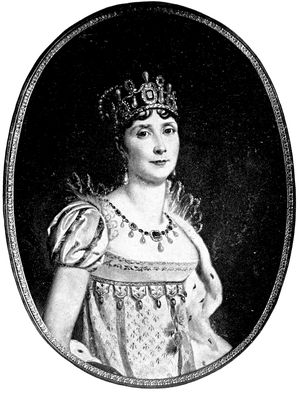
Josephine, Empress of the French.
From the painting by Francois Gérard.
In the Museum of Versailles.
In fact, this ingenious man was really practising moderation, as both
he and the terrified Italians, considering their relative situations,
understood it. Whatever had been the original arrangement with the
directors, there was nothing they did not now expect and demand from
Italy; they wrote requiring, in addition to all that had hitherto been
mentioned, plunder of every kind from Leghorn; masts, cordage, and
ship supplies from Genoa; horses, provisions, and forage from Milan;
and contributions of jewels and precious stones from the reigning
princes. As for the papal power, the French radicals would gladly have
destroyed it. They had not forgotten that Basseville, a diplomatic
agent of the republic, had been killed in the streets of Rome, and
that no reparation had been made either by the punishment of the
assassin or otherwise. The Pope, they declared, had been the real
author of the terrible civil war fomented by the unyielding clergy,
and waged with such fury in France. Moreover, the whole sentimental
and philosophical movement of the century in France and elsewhere
considered the ecclesiastical centralization and hierarchical tyranny
of the papacy as a dangerous survival of absolutism.
But Bonaparte was wise in his generation. The contributions
he levied throughout Italy were terrible; but they were such as she
could bear, and still recuperate for further service in the same
direction. The liberalism of Italy was, moreover, not the radicalism
of France; and a submissive papacy was of incalculably greater value
both there and elsewhere in Europe than an irreconcilable and fugitive
one. The Pope, too, though weakened and humiliated as a temporal
prince, was spared for further usefulness to his conqueror as a
spiritual dignitary. Beyond all this was the enormous moral influence
of a temperate and apparently impersonal policy. Bonaparte, though
personally and by nature a passionate and wilful man, felt bound, as
the representative of a great movement, to exercise self-restraint,
taking pains to live simply, dress plainly, almost shabbily, and
continuing by calm calculation to refuse the enormous bribes which
began and continued to be offered to him personally by the rulers of
Italy. His generals and the fiscal agents of the nation were all in
his power, because it was by his connivance that they had grown
enormously rich, he himself remaining comparatively poor, and for his
station almost destitute. The army was his devoted servant; Italy and
the world should see how different was his moderation from the
rapacity of the republic and its tools, vandals like the commissioners
Gareau and Salicetti.
Such was the "leisure" of one who to all outward appearance was but a
man, and a very ordinary one. In the medals struck to commemorate this
first portion of the Italian campaign, he is still the same slim
youth, with lanky hair, that he was on his arrival in Paris the year
previous. It was observed, however, that the old indifferent manner
was somewhat emphasized, and consequently artificial; that the gaze
was at least as direct and the eye as penetrating as ever; and that
there was, half intentionally, half unconsciously,
disseminated all about an atmosphere of peremptory command—but that
was all. The incarnation of ambition was long since complete; its
attendant imperious manner was suffered to develop but slowly. In
Bonaparte was perceptible, as Victor Hugo says, the shadowy outline of
Napoleon.[Back to Contents]
The Austrian System — The Austrian Strategy — Castiglione
— French Gains — Bassano — The French in the Tyrol — The
French Defeated in Germany — Bonaparte and Alvinczy —
Austrian Successes — Caldiero — First Battle of Arcola —
Second Battle of Arcola.
1796.
Meantime the end of July had come. The Emperor Francis had decided. At
the risk of defeat on the Rhine he must retain his Italian possessions
and prestige. He was still the Roman emperor, inheritor of an
immemorial dignity, overlord of the fairest lands in the peninsula.
Wurmser, considered by Austria her greatest general, had therefore
been recalled to Vienna from the west, and sent at the head of
twenty-five thousand fresh troops to collect the columns of Beaulieu's
army, which was scattered in the Tyrol. This done, he was to assume
the chief command, and advance to the relief of Mantua. The first part
of his task was successfully completed, and already, according to the
direction of the Aulic Council of the empire, and in pursuance of the
same hitherto universal but vicious system of cabinet campaigning
which Bonaparte had just repudiated, he was moving down from the Alps
in three columns with a total force of about forty-seven thousand men.
There were about fifteen thousand in the garrison of Mantua. Bonaparte
was much weaker, having only forty-two thousand, and of these some
eight thousand were occupied in the siege of that place. Wurmser was a
master of the old school, working like an automaton under the
hand of his government, and commanding according to
well-worn precept his well-equipped battalions, every soldier of which
was a recruit so costly that destructive battles were made as
infrequent as possible, because to fight many meant financial ruin. In
consequence, like all the best generals of his class, he made war as
far as possible a series of manœuvers. Opposed to him was an
emancipated genius with neither directors nor public council to hamper
him. In the tradition of the Revolution, as in the mind of Frederick
the Great, war was no game, but a bloody decision, and the quicker the
conclusion was tried the better. The national conscription, under the
hands of Dubois de Crancé, had secured men in unlimited numbers at the
least expense; while Carnot's organization had made possible the quick
handling of troops in large mass by simplifying the machinery.
Bonaparte was about to show what could be done in the way of using the
weapon which had been put into his hands.
The possession of Mantua was decisive of Italian destiny, for its
holder could command a kind of overlordship in every little Italian
state. If Bonaparte should take and keep it, Austria would be
virtually banished from Italy, and her prestige destroyed. She must,
therefore, relieve it, or lose not only her power in the peninsula,
but her rank in Europe. To this end, and according to the established
rules of strategy, the Austrians advanced from the mountains in three
divisions against the French line, which stretched from Brescia past
Peschiera, at the head of the Mincio, and through Verona to Legnago on
the Adige. Two of these armies were to march respectively down the
east and west banks of Lake Garda, and, flanking the inferior forces
of the French on both sides, surround and capture them. The other
division was on the Adige in front of Verona, ready to
relieve Mantua. Between that river and the lake rises the stately mass
of Monte Baldo, abrupt on its eastern, more gentle on its western
slope. This latter, as affording some space for manœuvers, was
really the key to the passage. Such was the first onset of the
Austrians down this line that the French outposts at Lonato and Rivoli
were driven in, and for a time it seemed as if there would be a
general rout. But the French stood firm, and checked any further
advance. For a day Bonaparte and Wurmser stood confronting each other.
In the mean time, however, the left Austrian column was pouring down
toward Verona, while the right, under Quasdanowich, had already
captured Brescia, seized the highway to Milan, and cut off the French
retreat. This move in Wurmser's plan was so far entirely successful,
and for a moment it seemed as if the sequel would be equally so. The
situation of his opponents was desperate.
In this crisis occurred the first of those curious scenes which recur
at intervals in Bonaparte's life. Some, and those eye-witnesses, have
attributed them to genuine panic. His first measure was to despatch
flying adjutants, ten in number, to concentrate his scattered forces
at the critical point, south of Lake Garda. His genius decided that
victory on the field was far more fruitful than the holding in check
of a garrison. Accordingly he ordered Sérurier to raise the siege of
Mantua, and his siege-guns to be spiked and withdrawn. The division
thus rendered available he at once despatched for field operations
toward Brescia. But its numbers were so few as scarcely to relieve the
situation. Accordingly a council of war was summoned to decide whether
the army should stand and fight, or retreat for further concentration.
The commander-in-chief was apparently much excited, and according to
Augereau's account advised the latter course. The enemy
being between the French and the Adda, no other line was open but that
southward through the low country, over the Po; and to follow that
implied something akin to a disorderly rout. Nevertheless, all the
generals were in favor of this suggestion except one, the fiery
hotspur who tells the tale, who disdained the notion of retreat on any
line, and flung out of the room in scorn. Bonaparte walked the floor
until late in the small hours; finally he appeared to have accepted
Augereau's advice, and gave orders for battle. But the opening
movements were badly executed. Bonaparte seemed to feel that the omens
were unfavorable, and again the generals were summoned. Augereau
opened the meeting with a theatrical and declamatory but earnest
speech, encouraging his comrades and urging the expediency of a
battle. This time it was Bonaparte who fled, apparently in despair,
leaving the chief command, and with it the responsibility, to the
daring Augereau, by whose enthusiasm, as he no doubt saw, the other
generals had been affected. The hazardous enterprise succeeded, and on
the very plan already adopted. Augereau gave the orders, and with
swift concentration every available man was hurled against the
Austrian column under Quasdanowich at Lonato. This much may be true;
casting aside Augereau's inconsistencies and braggadocio, it is
possible but unlikely.
The result was an easy victory, the enemy was driven back to a safe
distance, and Brescia was evacuated on August fourth, the defeated
columns retreating behind Lake Garda to join Wurmser on the other
side. Like the regular return of the pendulum, the French moved back
again, and confronted the Austrian center that very night, but now
with every company in line and Bonaparte at their head. A portion of
the enemy, about twenty-five thousand in number, had reached
Lonato, hastening to the support of Quasdanowich. Wurmser had lost a
day before Mantua. A second time the hurrying French engaged their foe
almost on the same field. A second time they were easily victorious.
In fact, so terrible was this second defeat that the scattered bands
of Austrians wandered aimlessly about in ignorance of their way. One
of them, four thousand strong, reaching Lonato, found it almost
abandoned by the French, Bonaparte and his staff with but twelve
hundred men being left behind. A herald, blindfolded, as was then the
custom, was at once despatched to summon the French commander to
surrender to the superior Austrian force. The available remnant of the
victorious army quickly gathered, and the messenger was introduced in
the midst of them. As the bandage was taken from his eyes, dazzled by
the light falling on hundreds of brilliant uniforms, the imperious
voice of his great enemy was heard commanding him to return and say to
his leader that it was a personal insult to speak of surrender to the
French army, and that it was he who must immediately yield himself and
his division. The bold scheme was successful, and to the ten thousand
previously killed, wounded, and captured by the conquerors four
thousand prisoners were added. Next morning Wurmser advanced, and with
his right resting on Lake Garda offered battle. The decisive fight
occurred in the center of his long, weak line at Castiglione, where
some fifteen thousand Austrians had happened to make a stand, without
orders and so without assurance of support. Again the French position
was so weak as apparently to throw Bonaparte into a panic, and again,
according to the memoirs of General Landrieux, Augereau's fire and
dash prevailed to have the battle joined, while Bonaparte withdrew in
a sulky pet. Whatever the truth, the attack was made. Before
evening the sharp struggle was over. This affair of August fifth was
always referred to by Napoleon as the true battle of Castiglione. Two
days later Wurmser, who had fondly hoped that Mantua was his and the
French in full retreat, brought up a straggling line of twenty-five
thousand men. These were easily routed by Bonaparte in a series of
clever manœuvers on the seventh and without much bloodshed. That
night saw the utter rout of Wurmser and the Austrians in full retreat
towards the Tyrol. Had the great risk of these few days been
determined against the French, who would have been to blame but the
madcap Augereau? As things turned out, whose was the glory but
Bonaparte's? This panic, at least, appears to have been carefully
calculated and cleverly feigned. A week later the French lines were
again closed before Mantua, which, though not invested, was at least
blockaded. The fortress had been revictualed and regarrisoned, while
the besiegers had been compelled to destroy their own train to prevent
its capture by the enemy. But France was mistress of the Mincio and
the Adige, with a total loss of about ten thousand men; while Austria
had lost about twenty thousand, and was standing by a forlorn hope.
Both armies were exhausted, as yet the great stake was not won. If
Austrian warfare was utterly discredited, the irregular, disjointed,
uncertain French warfare of the past week had not enhanced French
glory.
In the shortest possible period new troops were under way both from
Vienna and from Paris. With those from the Austrian capital came
positive instructions to Wurmser that in any case he should again
advance toward Mantua. In obedience to this command of the Emperor, a
division of the army, twenty thousand strong, under Davidowich, was
left in the Austrian Tyrol at Roveredo, near Trent, to stop
the advance of the French, who, with their reinforcements, were
pressing forward through the pass as if to join Moreau, who had
successfully advanced and would be in Munich. The main Austrian army,
under Wurmser, moved over into the valley of the Brenta, and pushed on
toward Mantua. If he should decide to turn westward against the
French, the reserve could descend the valley of the Adige to his
assistance. But Bonaparte did not intend either to pass by and leave
open the way southward, or to be shut up in the valleys of the Tyrol.
With a quick surge, Davidowich was first defeated at Roveredo, and
then driven far behind Trent into the higher valleys. The victor
delayed only to issue a proclamation giving autonomy to the Tyrolese,
under French protection; but the ungrateful peasantry preferred the
autonomy they already enjoyed, and fortified their precipitous passes
for resistance. Turning quickly into the Brenta valley, Bonaparte, by
a forced march of two days, overtook Wurmser's advance-guard unawares
at Primolano, and captured it; the next day, September eighth, Masséna
cut in two and completely defeated the main army at Bassano. Part of
those who escaped retreated into Friuli, toward Vienna. There was
nothing left for the men under Wurmser's personal command but to throw
themselves, if possible, into Mantua. With these, some sixteen
thousand men in all, the veteran general forced a way, by a series of
most brilliant movements, past the flank of the blockading French
lines, where he made a gallant stand first at St. Georges and then at
Favorita. But he was driven from both positions and forced to find a
refuge in the famous fortress.
The lightning-like rapidity of these operations completed the
demoralization of the Austrian troops. The fortified defiles and
cliffs of the Tyrol fell before the French attacks as easily
as their breastworks in the plains. Wurmser had twenty-six thousand
men in Mantua; but from fear and fever half of them were in the
hospitals.
Meanwhile, disaster had overtaken the French arms in the North.
Jourdan had crossed the Rhine at Düsseldorf, as Moreau had at Kehl.
They had each about seventy-five thousand men, while the army of the
Austrian archduke Charles had been reduced by Wurmser's departure for
Italy to a number far less. According to the plan of the Directory,
these two French armies were to advance on parallel lines south of the
neutral zone through Germany, and to join Bonaparte across the Tyrol
for the advance to Vienna. Moreau defeated the Austrians, and reached
Munich without a check. Würtemberg and Baden made peace with the
French republic on its own terms, and Saxony, recalling its forces
from the coalition, declared itself neutral, as Prussia had done. But
Jourdan, having seized Würzburg and won the battle of Altenkirchen,
was met on his way to Ratisbon and Neumarkt, and thoroughly beaten, by
the same young Archduke Charles, who had acquired experience and
learned wisdom in his defeat by Moreau. Both French armies were thus
thrown back upon the Rhine, and there could be no further hope of
carrying out the original plan. In this way the attention of the world
was concentrated on the victorious Army of Italy and its young
commander, whose importance was further enhanced by the fulfilment of
his own prophecy that the fate of Europe hung on the decision of his
campaign in Italy.
This was not an empty boast. The stubborn determination of Francis to
reconquer Italy had given new courage to the conservatives of central
and southern Italy, who did not conceal their resolve nor their
preparations to annihilate French power and influence within
the borders of Modena, Rome, and Naples. Bonaparte was thus enabled to
take another momentous step in emancipating himself from the
Directory. So far he had asserted and confirmed his military and
diplomatic independence: he now boldly assumed political supremacy.
Though at times he expressed a low opinion of the Italians, yet he
recognized their higher qualities. In Modena, Reggio, Bologna, and
Ferrara were thousands who understood the significance of the dawning
epoch. To these he paid visits and to their leaders he gave, during
the short interval at his command, hearty approbation for their
resistance to the reactionaries. Forestalling the Directory, he
declared Modena and Reggio to be under French protection. This daring
procedure assured his ascendancy with all Italian liberals and
rendered sure and certain the prosecution of his campaign to the
bitter end. Bologna and Ferrara, having surrendered to French
protection on June twenty-third, were soon in open revolt against the
papal influences which were reviving: and even in distant Naples the
liberals took heart once more.
The glory of the imperial arms having been brilliantly vindicated in
the north, the government at Vienna naturally thought it not
impossible to relieve Mantua, and restore Austrian prestige in the
south. Every effort was to be made. The Tyrolese sharp-shooters were
called out, large numbers of raw recruits were gathered in Illyria and
Croatia, while a few veterans were taken from the forces of the
Archduke Charles. When these were collected, Quasdanowich found
himself in Friuli with upward of thirty-five thousand men, while
Davidowich in the Tyrol had eighteen thousand. The chief command of
both armies was assigned to Alvinczy, an experienced but aged general,
one of the same stock as that to which Wurmser belonged.
About October first, the two forces moved simultaneously, one down the
Adige, the other down the Piave, to unite before Vicenza, and proceed
to the relief of Mantua. For the fourth time Bonaparte was to fight
the same battle, on the same field, for the same object, with the same
inferiority of numbers. His situation, however was a trifle better
than it had been, for several veteran battalions which were no longer
needed in Vendée had arrived from the Army of the West; his own
soldiers were also well equipped and enthusiastic. He wrote to the
Directory, on October first, that he had thirty thousand effectives;
but he probably had more, for it is scarcely possible that, as he
said, eighteen thousand were in the hospitals. The populations around
and behind him were, moreover, losing faith in Austria, and growing
well disposed toward France. Many of his garrisons were, therefore,
called in; and deducting eight thousand men destined for the siege of
Mantua, he still had an army of nearly forty thousand men wherewith to
meet the Austrians. There was, of course, some disaffection among his
generals. Augereau was vainglorious and bitter, Masséna felt that he
had not received his due meed of praise for Bassano, and both had
sympathizers even in the ranks. This was inevitable, considering
Bonaparte's policy and system, and somewhat interfered with the
efficiency of his work.
While the balance was thus on the whole in favor of the French, yet
this fourth division of the campaign opened with disaster to them. In
order to prevent the union of his enemy's two armies, Bonaparte
ordered Vaubois, who had been left above Trent to guard the French
conquests in the Tyrol, to attack Davidowich. The result was a rout,
and Vaubois was compelled to abandon one strong position after
another,—first Trent, then Roveredo,—until finally he felt
able to make a stand on the right bank of the Adige at Rivoli, which
commands the southern slopes of Monte Baldo. The other bank was in
Austrian hands, and Davidowich could have debouched safely into the
plain. This result was largely due to the clever mountain warfare of
the Tyrolese militia. Meantime Masséna had moved from Bassano up the
Piave to observe Alvinczy. Augereau was at Verona. On November fourth,
Alvinczy advanced and occupied Bassano, compelling Masséna to retreat
before his superior force. Bonaparte, determined not to permit a
junction of the two Austrian armies, moved with Augereau's division to
reinforce Masséna and drive Alvinczy back into the valley of the
Piave. Augereau fought all day on the sixth at Bassano, Masséna at
Citadella. This first encounter was indecisive; but news of Vaubois's
defeat having arrived, the French thought it best to retreat on the
following day. There was not now a single obstacle to the union of the
two Austrian armies; and on November ninth, Alvinczy started for
Verona, where the French had halted on the eighth. It looked as if
Bonaparte would be attacked on both flanks at once, and thus
overwhelmed.
Verona lies on both banks of the river Adige, which is spanned by
several bridges; but the heart of the town is on the right. The
remains of Vaubois's army having been rallied at Rivoli, some miles
further up on that bank, Bonaparte made all possible use of the stream
as a natural fortification, and concentrated the remainder of his
forces on the same side. Alvinczy came up and occupied Caldiero,
situated on a gentle rise of the other shore to the south of east; but
the French division at Rivoli, which, by Bonaparte's drastic methods,
had been thoroughly shamed, and was now thirsty for revenge,
held Davidowich in check. He had remained some distance farther back
to the north, where it was expected he would cross and come down on
the left bank. To prevent this a fierce onslaught was made against
Alvinczy's position on November twelfth, by Masséna's corps. It was
entirely unsuccessful, and the French were repulsed with the serious
loss of three thousand men. Bonaparte's position was now even more
critical than it had been at Castiglione; he had to contend with two
new Austrian armies, one on each flank, and Wurmser with a third stood
ready to sally out of Mantua in his rear. If there should be even
partial coöperation between the Austrian leaders, he must retreat. But
he felt sure there would be no coöperation whatsoever. From the force
in Verona and that before Mantua twenty thousand men were gathered to
descend the course of the Adige into the swampy lands about Ronco,
where a crossing was to be made and Alvinczy caught, if possible, at
Villanova, on his left flank. This turning manœuver, though highly
dangerous, was fairly successful, and is considered by critics among
the finest in this or any other of Bonaparte's campaigns. Amid these
swamps, ditches, and dikes the methodical Austrians, aiming to carry
strong positions by one fierce onset, were brought into the greatest
disadvantage before the new tactics of swift movement in open columns,
which were difficult to assail. By a feint of retreat to the westward
the French army had left Verona without attracting attention, but by a
swift countermarch it reached Ronco on the morning of November
fifteenth, crossed in safety, and turned back to flank the Austrian
position.
The first stand of the enemy was made at Arcola, where a short, narrow
bridge connects the high dikes which regulate the sluggish stream of
the little river Alpon, a tributary of the Adige on its left bank.
This bridge was defended by two battalions of Croatian
recruits, whose commander, Colonel Brigido, had placed a pair of
field-pieces so as to enfilade it. The French had been advancing in
three columns by as many causeways, the central one of which led to
the bridge. The first attempt to cross was repulsed by the deadly fire
which the Croats poured in from their sheltered position. Augereau,
with his picked corps, fared no better in a second charge led by
himself bearing the standard; and, in a third disastrous rush,
Bonaparte, who had caught up the standard and planted it on the bridge
with his own hand, was himself swept back into a quagmire, where he
would have perished but for a fourth return of the grenadiers, who
drove back the pursuing Austrians, and pulled their commander from the
swamp. Fired by his undaunted courage, the gallant lines were formed
once more. At that moment another French corps passed over lower down
by pontoons, and the Austrians becoming disorganized, in spite of the
large reinforcements which had come up under Alvinczy, the last charge
on the bridge was successful. With the capture of Arcola the French
turned their enemy's rear, and cut off not only his artillery, but his
reserves in the valley of the Brenta. The advantage, however, was
completely destroyed by the masterly retreat of Alvinczy from his
position at Caldiero, effected by other causeways and another bridge
further north, which the French had not been able to secure in time.
Bonaparte quickly withdrew to Ronco, and recrossed the Adige to meet
an attack which he supposed Davidowich, having possibly forced
Vaubois's position, would then certainly make. But that general was
still in his old place, and gave no signs of activity. This movement
misled Alvinczy, who, thinking the French had started from Mantua,
returned by way of Arcola to pursue them. Again the French
commander led his forces across the Adige into the swampy lowlands.
His enemy had not forgotten the desperate fight at the bridge, and was
timid; and besides, in his close formation, he was on such ground no
match for the open ranks of the French. Retiring without any real
resistance as far as Arcola, the Austrians made their stand a second
time in that red-walled burg. Bonaparte could not well afford another
direct attack, with its attendant losses, and strove to turn the
position by fording the Alpon where it flows into the Adige. He
failed, and withdrew once more to Ronco, the second day remaining
indecisive. On the morning of the seventeenth, however, with
undiminished fertility of resource, a new plan was adopted and
successfully carried out. One of the pontoons on the Adige sank, and a
body of Austrians charged the small division stationed on the left
bank to guard it, in the hope of destroying the remainder of the
bridge. They were repulsed and driven back toward the marshes with
which they meant to cover their flank. The garrisons of both Arcola
and Porcil, a neighboring hamlet, were seriously weakened by the
detention of this force. Two French divisions were promptly despatched
to make use of that advantage, while at the same time an ambuscade was
laid among the pollard willows which lined the ditches beyond the
retreating Austrians. At an opportune moment the ambuscade unmasked,
and by a terrible fire drove three thousand of the Croatian recruits
into the marsh, where most of them were drowned or shot. Advancing
then beyond the Alpon by a bridge built during the previous night,
Bonaparte gave battle on the high ground to an enemy whose numbers
were now, as he calculated, reduced to a comparative equality with his
own. The Austrians made a vigorous resistance; but such was their
credulity as to anything their enemy might do, that a simple
stratagem of the French made them believe that their left was turned
by a division, when in reality but twenty-five men had been sent to
ride around behind the swamps and blow their bugles. Being
simultaneously attacked on the front of the same wing by Augereau,
they drew off at last in good order toward Montebello. Thence Alvinczy
slowly retreated into the valley of the Brenta. The French returned to
Verona. Davidowich, ignorant of all that had occurred, now finally
dislodged Vaubois; but, finding before him Masséna with his division
where he had expected Alvinczy and a great Austrian army, he
discreetly withdrew into the Tyrol. It was not until November
twenty-third, long after the departure of both his colleagues, that
Wurmser made a brilliant but of course ineffectual sally from Mantua.
The French were so exhausted, and the Austrians so decimated and
scattered, that by tacit consent hostilities were intermitted for
nearly two months.[Back to Contents]
Bonaparte's Transformation — Military Genius — Powers and
Principles — Theory and Conduct — Political Activity —
Purposes for Italy — Private Correspondence — Treatment of
the Italian Powers — Antagonism to the Directory — The
Task Before Him — Masked Dictator.
1796.
During the two months between the middle of November, 1796, and the
middle of January, 1797, there was a marked change in Bonaparte's
character and conduct. After Arcola he appeared as a man very
different from the novice he had been before Montenotte. Twice his
fortunes had hung by a single hair, having been rescued by the
desperate bravery of Rampon and his soldiers at Monte Legino, and
again by Augereau's daring at Lonato; twice he had barely escaped
being a prisoner, once at Valeggio, once at Lonato; twice his life had
been spared in the heat of battle as if by a miracle, once at Lodi,
once again at Arcola. These facts had apparently left a deep
impression on his mind, for they were turned to the best account in
making good a new step in social advancement. So far he had been as
adventurous as the greatest daredevil among the subalterns, staking
his life in every new venture; hereafter he seemed to appreciate his
own value, and to calculate not only the imperiling of his life, but
the intimacy of his conversation, with nice adaptation to some great
result. Gradually and informally a kind of body-guard was organized,
which, as the idea grew familiar, was skilfully developed
into a picked corps, the best officers and finest soldiers being made
to feel honored in its membership. The constant attendance of such men
necessarily secluded the general-in-chief from those colleagues who
had hitherto been familiar comrades. Something in the nature of formal
etiquette once established, it was easy to extend its rules and
confirm them. The generals were thus separated further and further
from their superior, and before the new year they had insensibly
adopted habits of address which displayed a high outward respect, and
virtually terminated all comradeship with one who had so recently been
merely the first among equals. Bonaparte's innate tendency to command
was under such circumstances hardened into a habit of imperious
dictation. In view of what had been accomplished, it would have been
impossible, even for the most stubborn democrat, to check the process.
Not one of Bonaparte's principles had failed to secure triumphant
vindication.
In later years Napoleon himself believed, and subsequent criticism has
confirmed his opinion, that the Italian campaign, taken as a whole,
was his greatest. The revolution of any public system, social,
political, or military, is always a gigantic task. It was nothing less
than this which Bonaparte had wrought, not in one, but in all three
spheres, during the summer and autumn of 1796. The changes, like those
of most revolutions, were changes of emphasis and degree in the
application of principles already divined. "Divide and conquer" was an
old maxim; it was a novelty to see it applied in warfare and politics
as Bonaparte applied it in Italy. It has been remarked that the
essential difference between Napoleon and Frederick the Great was that
the latter had not ten thousand men a month to kill. The notion that
war should be short and terrible had, indeed, been clear to
the great Prussian; Carnot and the times afforded the opportunity for
its conclusive demonstration by the genius of the greater Corsican.
Concentration of besiegers to breach the walls of a town was nothing
new; but the triumphant application of the same principle to an
opposing line of troops, though well known to Julius Cæsar, had been
forgotten, and its revival was Napoleon's masterpiece. The martinets
of the seventeenth and eighteenth centuries had so exaggerated the
formalities of war that the relation of armies to the fighting-ground
had been little studied and well-nigh forgotten; the use of the map
and the compass, the study of reliefs and profiles in topography,
produced in Bonaparte's hands results that seemed to duller minds
nothing short of miraculous. One of these was to oppose the old-school
rigid formation of troops by any formation more or less open and
irregular according to circumstances, but always the kind best suited
to the character of the seat of war. The first two days at Arcola were
the triumphant vindication of this concept. Finally, there was a
fascination for the French soldiers in the primitive savagery of their
general, which, though partly concealed, and somewhat held in by
training, nevertheless was willing that the spoils of their conquest
should be devoted to making the victorious contestants opulent; which
scorned the limitations of human powers in himself and them, and thus
accomplished feats of strength and stratagem which gratified to
satiety that love for the uncommon, the ideal, and the great which is
inherent in the spirit of their nation. In the successful combination
and evolution of all these elements there was a grandeur which
Bonaparte and every soldier of his army appreciated at its full value.
The military side of Bonaparte's genius is ordinarily considered the
strongest. Judged by what is easily visible in the way of
immediate consequences and permanent results, this appears to be true;
and yet it was only one of many sides. Next in importance, if not
equal to it, was his activity in politics and diplomacy. It is easy to
call names, to stigmatize the peoples of Italy, all the nations even
of western Europe, as corrupt and enervated, to laugh at their
politics as antiquated, and to brand their rulers as incapable fools.
An ordinary man can, by the assistance of the knowledge, education,
and insight acquired by the experience of his race through an
additional century, turn and show how commonplace was the person who
toppled over such an old rotten structure. This is the method of
Napoleon's detractors, except when, in addition, they first magnify
his wickedness, and then further distort the proportion by viewing his
fine powers through the other end of the glass. We all know how easy
great things are when once they have been accomplished, how simple the
key to a mystery when once it has been revealed. Morally considered,
Bonaparte was a child of nature, born to a mean estate, buffeted by a
cruel and remorseless society, driven in youth to every shift for
self-preservation, compelled to fight an unregenerate world with its
own weapons. He had not been changed in the flash of a gun. Elevation
to reputation and power did not diminish the duplicity of his
character; on the contrary, it possibly intensified it. Certainly the
fierce light which began to beat upon him brought it into greater
prominence. Truth, honor, unselfishness are theoretically the virtues
of all philosophy; practically they are the virtues of Christian men
in Christian society. Where should the scion of a Corsican stock,
ignorant of moral or religious sentiment, thrown into the atmosphere
and surroundings of the French Revolution, learn to practise them?
Such considerations are indispensable in the observation of
Bonaparte's progress as a politician. His first settlement with the
various peoples of central Italy was, as he had declared, only
provisional. The uncertain status created by it was momentarily not
unwelcome to the Directory. Their policy was to destroy existing
institutions, and leave order to evolve itself from the chaos as best
it could. Doctrinaires as they were, they meant to destroy absolute
monarchy in Italy, as everywhere else, if possible, and then to stop,
leaving the liberated peoples to their own devices. Some fondly
believed that out of anarchy would arise, in accordance with "the law
of nature," a pure democracy; while others had the same faith that the
result would be constitutional monarchy. Moreover, things appear
simpler in the perspective of distance than they do near at hand. The
sincerity of Bonaparte's republicanism was like the sincerity of his
conduct—an affair of time and place, a consistency with conditions
and not with abstractions. He knew the Italian mob, and faithfully
described it in his letters as dull, ignorant, and unreliable, without
preparation or fitness for self-government. He was willing to
establish the forms of constitutional administration; but in spite of
hearty support from many disciples of the Revolution, he found those
forms likely, if not certain, to crumble under their own weight, and
was convinced that the real sovereignty must for years to come reside
in a strong protectorate of some kind. It appeared to him a necessity
of war that these peoples should relieve the destitution of the French
treasury and army, a necessity of circumstances that France should be
restored to vigor and health by laying tribute on their treasures of
art and science, as on those of all the world, and a necessity of
political science that artificial boundaries should be
destroyed, as they had been in France, to produce the homogeneity of
condition essential to national or administrative unity.
The Italians themselves understood neither the policy of the French
executive nor that of their conqueror. The transitional position in
which the latter had left them produced great uneasiness. The
terrified local authorities asked nothing better than to be left as
they were, with a view to profiting by the event, whatever it might
be. After every Austrian success there were numerous local revolts,
which the French garrison commanders suppressed with severity.
Provisional governments soon come to the end of their usefulness, and
the enemies of France began to take advantage of the disorder in order
to undo what had been done. The English, for example, had seized Porto
Ferrajo in place of Leghorn; the Pope had gone further, and, in spite
of the armistice, was assembling an army for the recovery of Bologna,
Ferrara, and his other lost legations. Thus it happened that in the
intervals of the most laborious military operations, a political
activity, both comprehensive and feverish, kept pace in Bonaparte's
mind with that which was needed to regulate his campaigning.
At the very outset there was developed an antagonism between the
notions of the Directory and Bonaparte's interests. The latter
observed all the forms of consulting his superiors, but acted without
the slightest reference to their instructions, often even before they
could receive his despatches. Both he and they knew the weakness of
the French government, and the inherent absurdity of the situation.
The story of French conquest in Italy might be told exactly as if the
invading general were acting solely on his own responsibility. In his
proclamations to the Italians was one language; in his
letters to the executive, another; in a few confidential family
communications, still another; in his own heart, the same old idea of
using each day as it came to advance his own fortunes. As far as he
had any love of country, it was expended on France, and what we may
call his principles were conceptions derived from the Revolution; but
somehow the best interests of France and the safety of revolutionary
doctrine were every day more involved in the pacification of Italy, in
the humiliation of Austria, and in the supremacy of the army. There
was only one man who could secure all three; could give consistency to
the flaccid and visionary policy of the Directory; could repress the
frightful robberies of its civil agents in Italy; could with any show
of reason humble Italy with one hand, and then with the other rouse
her to wholesome energy; could enrich and glorify France while
crushing out, as no royal dynasty had ever been able to do, the
haughty rivalry of the Hapsburgs.
These purposes made Bonaparte the most gentle and conciliatory of men
in some directions; in others they developed and hardened his
imperiousness. His correspondence mirrors both his mildness and his
arbitrariness. His letters to the Directory abound in praise of his
officers and men, accompanied by demands for the promotion of those
who had performed distinguished services. Writing to General Clarke on
November nineteenth, 1796, from Verona, he says, in words full of
pathos: "Your nephew Elliot was killed on the battle-field of Arcola.
This youth had made himself familiar with arms; several times he had
marched at the head of columns; he would one day have been an
estimable officer. He died with glory, in the face of the foe; he did
not suffer for a moment. What reasonable man would not envy such a
death? Who is he that in the vicissitudes of life would not agree to
leave in such a way a world so often worthy of contempt?
What one of us has not a hundred times regretted that he could not
thus be withdrawn from the powerful effects of calumny, of envy, and
of all the hateful passions that seem almost entirely to control human
conduct?" Perhaps these few words to the widow of one of his late
officers are even finer: "Muiron died at my side on the late
battle-field of Arcola. You have lost a husband that was dear to you;
I, a friend to whom I have long been attached: but the country loses
more than us both in the death of an officer distinguished no less by
his talents than by his rare courage. If I can be of service in
anything to you or his child, I pray you count altogether upon me."
That was all; but it was enough. With the ripening of character, and
under the responsibilities of life, an individual style had come at
last. It is martial and terse almost to affectation, defying
translation, and perfectly reflecting the character of its writer.
But the hours when the general-in-chief was war-worn, weary, tender,
and subject to human regrets like other men, were not those which he
revealed to the world. He was peremptory, and sometimes even peevish,
with the French executive after he had them in his hand; with Italy he
assumed a parental rôle, meting out chastisement and reward as best
suited his purpose. A definite treaty of peace had been made with
Sardinia, and that power, though weak and maimed, was going its own
way. The Transpadane Republic, which he had begun to organize as soon
as he entered Milan, was carefully cherished and guided in its
artificial existence; but the people, whether or not they were fit,
had no chance to exercise any real independence under the shadow of
such a power. It was, moreover, not the power of France; for, by
special order of Bonaparte, the civil agents of the
Directory were subordinated to the military commanders, ostensibly
because the former were so rapacious. Lombardy in this way became his
very own. Rome had made the armistice of Bologna merely to gain time,
and in the hope of eventual disaster to French arms. A pretext for the
resumption of hostilities was easily found by her in a foolish
command, issued from Paris, that the Pope should at length recognize
as regular those of the clergy who had sworn allegiance to the
successive constitutions adopted under the republic, and withdraw all
his proclamations against those who had observed their oaths and
conformed. The Pontiff, relying on the final success of Austria, had
virtually broken off negotiations. Bonaparte informed the French agent
in Rome that he must do anything to gain time, anything to deceive the
"old fox"; in a favorable moment he expected to pounce upon Rome, and
avenge the national honor. During the interval Naples also had become
refractory; refusing a tribute demanded by the Directory, she was not
only collecting soldiers, like the Pope, but actually had some
regiments in marching order. Venice, asserting her neutrality, was
growing more and more bitter at the constant violations of her
territory. Mantua was still a defiant fortress, and in this crisis
nothing was left but to revive French credit where the peoples were
best disposed and their old rulers weakest.
Accordingly, Bonaparte went through the form of consulting the
Directory as to a plan of procedure, and then, without waiting for an
answer from them, and without the consent of those most deeply
interested, broke the armistice with Modena on the pretext that five
hundred thousand francs of ransom money were yet unpaid, and drove the
duke from his throne. This duchy was the nucleus about which was to be
constituted the Cispadane Republic: in conjunction with its
inhabitants, those of Reggio, Bologna, and Ferrara were invited to
form a free government under that name. There had at least been a
pretext for erecting the Milanese into the Transpadane Republic—that
of driving an invader from its soil. This time there was no pretext of
that kind, and the Directory opposed so bold an act regarding these
lands, being uneasy about public opinion in regard to it. They hoped
the war would soon be ended, and were verging to the opinion that
their armies must before long leave the Italians to their own devices.
The conduct of their general pointed, however, in the opposite
direction; he forced the native liberals of the district to take the
necessary steps toward organizing the new state so rapidly that the
Directory found itself compelled to yield. It is possible, but not
likely, that, as has been charged, Bonaparte really intended to bring
about what actually happened, the continued dependence on the French
republic of a lot of artificial governments. The uninterrupted
meddling of France in the affairs of the Italians destroyed in the end
all her influence, and made them hate her dominion, which masqueraded
as liberalism, even more than they had hated the open but mild tyranny
of those royal scions of foreign stocks recently dismissed from their
thrones. During these months there is in Bonaparte's correspondence a
somewhat theatrical iteration of devotion to France and republican
principles, but his first care was for his army and the success of his
campaign. He behaved as any general solicitous for the strength of his
positions on foreign soil would have done, his ruses taking the form
of constantly repeating the political shibboleths then used in France.
Soon afterward Naples made her peace; an insurrection in Corsica
against English rule enabled France to seize that island
once more; and Genoa entered into a formal alliance with the
Directory.
How important these circumstances were comparatively can only be
understood by considering the fiascoes of the Directory elsewhere. No
wonder they groveled before Bonaparte, while pocketing his millions
and saving their face at home and abroad by reason of his victories,
and his alone. They had two great schemes to annihilate British power:
one, to invade Ireland, close all the North Sea ports to British
commerce, and finally to descend on British shores with an
irresistible host of the French democracy. Subsequent events of
Napoleon's life must be judged in full view of the dead earnestness
with which the Directory cherished this plan. But it was versatile
likewise and had a second alternative, to foment rebellions in Persia,
Turkey, and Egypt, overrun the latter country, and menace India. This
second scheme influenced Bonaparte's career more deeply than the
other, both were parts of traditional French policy and cherished by
the French public as the great lines for expanding French renown and
French influence. Both must be reckoned with by any suitor of France.
For the Irish expedition Hoche was available; in his vain efforts for
success he undermined his health and in his untimely death removed one
possible rival of Bonaparte. The directors had Holland, but they could
not win Prussia further than the stipulations made in 1795 at Basel,
so their scheme of embargo rested in futile abeyance. They exhibited
considerable activity in building a fleet, and the King of Spain, in
spite of Godoy's opposition, accepted the title of a French admiral.
By the treaty of San Ildefonso an offensive alliance against Great
Britain was concluded, her commerce to be excluded from Portugal;
Louisiana and Florida going to France. All the clauses except this
last were nugatory because of Spanish weakness, but
Bonaparte put in the plea for compensation to the Spanish Bourbons by
some grant of Italian territory to the house of Parma. As we have
elsewhere indicated, their attack on Austria in central Europe was a
failure, Jourdan having been soundly beaten at Würzburg. There was no
road open to Vienna except through Italy. Their negotiations with the
papacy failed utterly; only a victorious warrior could overcome its
powerful scruples, which in the aggregate prevented the hearty
adhesion of French Roman Catholics to the republican system. Of
necessity their conceptions of Italian destiny must yield to his,
which were widely different from theirs.
Before such conditions other interests sink into atrophy;
thenceforward, for example, there appears in Bonaparte's nature no
trace of the Corsican patriot. The one faint spark of remaining
interest seems to have been extinguished in an order that Pozzo di
Borgo and his friends, if they had not escaped, should be brought to
judgment. His other measures with reference to the once loved island
were as calculating and dispassionate as any he took concerning the
most indifferent principality of the mainland, and even extended to
enunciating the principle that no Corsican should be employed in
Corsica. It is a citizen not of Corsica, nor of France even, but of
Europe, who on October second demands peace from the Emperor in a
threat that if it is not yielded on favorable terms, Triest and the
Adriatic will be seized. At the same time the Directory received from
him another reminder of its position, which likewise indicates an
interesting development of his own policy. "Diminish the number of
your enemies. The influence of Rome is incalculable; it was ill
advised to break with that power; it gives the advantage to her.
If I had been consulted, I would have delayed the
negotiations with Rome as with Genoa and Venice. Whenever your general
in Italy is not the pivot of everything, you run great risks. This
language will not be attributed to ambition; I have but too many
honors, and my health is so broken that I believe I must ask you for a
successor. I can no longer mount a horse; I have nothing left but
courage, which is not enough in a post like this." Before this masked
dictator were two tasks as difficult in their way as any even he would
ever undertake, each calling for the exercise of faculties antipodal
in quality, but quite as fine as any in the human mind. Mantua was yet
to be captured; Rome and the Pope were to be handled so as to render
the highest service to himself, to France, and to Europe. In both
these labors he meant to be strengthened and yet unhampered. The habit
of compliance was now strong upon the Directory, and they continued to
yield as before.[Back to Contents]
The Diplomatic Feint of Great Britain — Clarke and the
Directory — Catherine the Great and Paul I — Austria's
Strategic Plan — Renewal of Hostilities — The Austrians at
Rivoli and Nogara — Bonaparte's Night March to Rivoli —
Monte Baldo and the Berner Klause — The Battle of Rivoli —
The Battle of La Favorita — Feats of the French Army —
Bonaparte's Achievement — The Fall of Mantua.
1797.
The fifth division of the Italian campaign was the fourth attempt of
Austria to retrieve her position in Italy, a position on which her
rulers still believed that all her destinies hung. Her energy was now
the wilfulness of despair. Events in Europe were shaping themselves
without regard to her advantage. The momentary humiliation of France
in Jourdan's defeat, the deplorable condition of British finances as
shown by the fall of the three per cents to fifty-three, the unsettled
and dangerous state of Ireland, with the menace of Hoche's invasion
impending, these circumstances created in London a feeling that
perhaps the time was propitious for negotiating with France, where too
there was considerable agitation for peace. Accordingly, in the autumn
of 1796, Lord Malmesbury was sent to Paris under rigid cautionary
instructions. The envoy was cold and haughty; Delacroix, the French
minister, was conceited and shallow. It soon appeared that what the
agent had to offer was either so indefinite as to be meaningless, or
so favorable to Great Britain as to be ridiculous in principle. The
negotiations were merely diplomatic fencing. To the
Englishman the public law of Europe was still that of the peace of
Utrecht, especially as to the Netherlands; to the Frenchman this was
preposterous since the Low Countries were already in France by
enactment and the rule of natural boundaries. About the middle of
November, Malmesbury was informed that he must either speak to the
point or leave. Of course the point was Belgium; if France would
abandon her claim to Antwerp she could have compensation in Germany.
There was some further futile talk about what both parties then as
before, and thereafter to the end, considered the very nerve of their
contention. Malmesbury went home toward the close of December, and
soon after, Hoche's fleet was wrecked in the Channel. The result of
the British mission was to clarify the issues, to consolidate British
patriotism once more, to reopen the war on a definite basis. Hoche was
assigned to the Army of the Sambre and Meuse, declaring he would first
thunder at the gates of Vienna and then return through Ireland to
London and command the peace of the world.
Meantime the Directory had noted the possibility of independent
negotiation with Austria. It did not intend, complaisant as it had
been hitherto, to leave Bonaparte unhampered in so momentous a
transaction. On the contrary, it selected a pliable and obedient agent
in the person of General Clarke, offspring of an Irish refugee family,
either a mild republican or a constitutional monarchist according to
circumstances, a lover of peace and order, a conciliatory spirit. To
him was given the directors' confidential, elaborate, and elastic plan
for territorial compensations as a basis for peace, the outcome of
which in any case would leave Prussia preponderant in Germany. Liberal
and well disposed to the Revolution as they believed, she could then
be wooed into a firm alliance. In Italy, France was to maintain
her new authority and retain what she had conquered for her
own good pleasure. Bonaparte intended to do as he found necessary in
both these cases. After Arcola, Thugut, the Austrian minister,
expressed a sense of the deepest humiliation that a youth commanding
volunteers and rapscallions should work his will with the fine troops
and skilled generals of the empire. But, undaunted, he applied to
Russia for succor. Catherine had dallied with Jacobinism in order to
occupy both Prussia and Austria while she consolidated and confirmed
her strength in Poland and the Orient. This she had accomplished and
was now ready to bridle the wild steed she had herself unloosed.
Intervening at the auspicious hour, she could deliver Italy, take
control of central Europe, subjugate the north, and sway the universe.
Accordingly she demanded from Pitt a subsidy of two and a half million
dollars, and ordered Suvoroff with sixty thousand troops to the
assistance of Austria. Just then, in September, 1796, Gustavus IV, of
Sweden, was at St. Petersburg for his betrothal with the Empress's
granddaughter Alexandra. He required as a matter of course that she
should adopt his faith. This was contemptuously refused and the
preparations for the festival went forward to completion as if nothing
had occurred. At the appointed hour for the ceremonial, the groom did
not and would not appear. Consternation gave way to a sense of
outrage, but the "Kinglet," as the great courtiers styled him, stood
firm. The Empress was beside herself, her health gave way, and she
died in less than two months, on November seventeenth. The dangerous
imbecile, her son Paul I, reigned in her stead. Weird figure that he
was, he at least renounced his mother's policy of conquest and
countermanded her orders to Suvoroff, recalling him and his army.
Austria was at bay, but she was undaunted.
Once more Alvinczy, despairing of success, but obedient to
his orders, made ready to move down the Adige from Trent. Great zeal
had been shown in Austria. The Vienna volunteer battalions abandoned
the work of home protection for which they had enlisted, and, with a
banner embroidered by the Empress's own hand, joined the active
forces. The Tyrolese, in defiance of the atrocious proclamation in
which Bonaparte, claiming to be their conqueror, had threatened death
to any one taking up arms against France, flocked again to the support
of their Emperor. By a recurrence to the old fatal plan, Alvinczy was
to attack the main French army; his colleague Provera was to follow
the Brenta into the lower reaches of the Adige, where he could effect
a crossing, and relieve Mantua. He was likewise to deceive the enemy
by making a parade of greater strength than he really had, and thus
draw away Bonaparte's main army toward Legnago on the lower Adige. A
messenger was despatched to Wurmser with letters over the Emperor's
own signature, ordering him, if Provera should fail, to desert Mantua,
retreat into the Romagna, and under his own command unite the garrison
and the papal troops. This order never reached its destination, for
its bearer was intercepted, and was compelled by the use of an emetic
to render up the despatches which he had swallowed.
On January seventh, 1797, Bonaparte gave orders to strengthen the
communications along his line, massing two thousand men at Bologna in
order to repress certain hostile demonstrations lately made in behalf
of the Pope. On the following day an Austrian division which had been
lying at Padua made a short attack on Augereau's division, and on the
ninth drove it into Porto Legnago, the extreme right of the French
line. This could mean nothing else than a renewal of hostilities
by Austria, although it was impossible to tell where the
main attack would be made. On the eleventh Bonaparte was at Bologna,
concluding an advantageous treaty with Tuscany; in order to be ready
for any event, he started the same evening, hastened across the Adige
with his troops, and pressed on to Verona.
On the twelfth, at six in the morning, the enemy attacked Masséna's
advance-guard at St. Michel, a suburb of that city. They were repulsed
with loss. Early on the same day Joubert, who had been stationed with
a corps of observation farther up in the old and tried position at the
foot of Monte Baldo, became aware of hostile movements, and occupied
Rivoli. During the day the two Austrian columns tried to turn his
position by seizing his outpost at Corona, but they were repulsed. On
the thirteenth he became aware that the main body of the Austrians was
before him, and that their intention was to surround him by the left.
Accordingly he informed Bonaparte, abandoned Corona, and made ready to
retreat from Rivoli. That evening Provera threw a pontoon bridge
across the Adige at Anghiari, below Legnago, and crossed with a
portion of his army. Next day he started for Mantua, but was so
harassed by Guieu and Augereau that the move was ineffectual, and he
got no farther than Nogara.
The heights of Rivoli command the movements of any force passing out
of the Alps through the valley of the Adige. They are abrupt on all
sides but one, where from the greatest elevation the chapel of St.
Mark overlooked a winding road, steep, but available for cavalry and
artillery. Rising from the general level of the tableland, this
hillock is in itself a kind of natural citadel. Late on the
thirteenth, Joubert, in reply to the message he had sent, received
orders to fortify the plateau, and to hold it at all hazards; for
Bonaparte now divined that the main attack was to be made
there in order to divert all opposition from Provera, and that if it
were successful the two Austrian armies would meet at Mantua. By ten
that evening the reports brought in from Joubert and by scouts left
this conclusion no longer doubtful. That very night, therefore, being
in perfect readiness for either event, Bonaparte moved toward Rivoli
with a force numbering about twenty thousand. It was composed of every
available French soldier between Desenzano and Verona, including
Masséna's division.[68] By strenuous exertions they reached the
heights of Rivoli about two in the morning of the fourteenth.
Alvinczy, ignorant of what had happened, was waiting for daylight in
order to carry out his original design of inclosing and capturing the
comparatively small force of Joubert and the strong place which it had
been set to hold, a spot long since recognized by Northern peoples as
the key to the portal of Italy. Bonaparte, on his arrival, perceived
in the moonlight five divisions encamped in a semicircle below; their
bivouac fires made clear that they were separated from one another by
considerable distances. He knew then that his instinct had been
correct, that this was the main army, and that the decisive battle
would be fought next day. The following hours were spent in disposing
his forces to meet the attack in any form it might take. Not a man was
wasted, but the region was occupied with pickets, outposts, and
reserves so ingeniously stationed that the study of that field, and of
Bonaparte's disposition of his forces, has become a classic
example in military science.
The gorge by which the Adige breaks through the lowest foot-hills of
the Alps to enter the lowlands has been famous since dim antiquity.
The Romans considered it the entrance to Cimmeria; it was sung in
German myths as the Berner Klause, the majestic gateway from their
inclement clime into the land of the stranger, that warm, bright land
for the luxurious and orderly life of which their hearts were ever
yearning. Around its precipices and isolated, frowning bastions song
and fable had clustered, and the effect of mystery was enhanced by the
awful grandeur of the scene. Overlooking all stands Monte Baldo,
frowning with its dark precipices on the cold summits of the German
highland, smiling with its sunny slopes on the blue waters of Lake
Garda and the fertile valley of the Po. In the change of strategy
incident to the introduction of gunpowder the spot of greatest
resistance was no longer in the gorge, but at its mouth, where Rivoli
on one side, and Ceraino on the other, command respectively the gentle
slopes which fall eastward and westward toward the plains. The Alps
were indeed looking down on the "Little Corporal," who, having flanked
their defenses at one end, was now about to force their center, and
later to pass by their eastward end into the hereditary dominions of
the German emperors on the Danube.
At early dawn began the conflict which was to settle the fate of
Mantua. The first fierce contest was between the Austrian left and the
French right at St. Mark; but it quickly spread along the whole line
as far as Caprino. For some time the Austrians had the advantage, and
the result was in suspense, since the French left, at Caprino, yielded
for an instant before the onslaught of the main Austrian army made in
accordance with Alvinczy's first plan, and, as he supposed,
upon an inferior force by one vastly superior in numbers. Berthier,
who by his calm courage was fast rising high in his commander's favor,
came to the rescue, and Masséna, following with a judgment which has
inseparably linked his name with that famous spot, finally restored
order to the French ranks. Every successive charge of the Austrians
was repulsed with a violence which threw their right and center back
toward Monte Baldo in ever growing confusion. The battle waged for
nearly three hours before Alvinczy understood that it was not
Joubert's division, but Bonaparte's army, which was before him. A
fifth Austrian column then pressed forward from the bank of the Adige
to scale the height of Rivoli, and Joubert, whose left at St. Mark was
hard beset, could not check the movement. For an instant he left the
road unprotected. The Austrians charged up the hill and seized the
commanding position; but simultaneously there rushed from the opposite
side three French battalions, clambering up to retrieve the loss. The
nervous activity of the latter brought them quickly to the top, where
at once they were reinforced by a portion of the cavalry reserve, and
the storming columns were thrown back in disorder. At that instant
appeared in Bonaparte's rear an Austrian corps which had been destined
to take the French at Rivoli in their rear. Had it arrived sooner, the
position would, as the French declared, have been lost to them. As it
was, instead of making an attack, the Austrians had to await one.
Bonaparte directed a falling artillery fire against them, and threw
them back toward Lake Garda. He thus gained time to re-form his own
ranks and enabled Masséna to hold in check still another of the
Austrian columns, which was striving to outflank him on his left.
Thereupon the French reserve under Rey, coming in from the
westward, cut the turning column entirely off, and compelled it to
surrender. The rest of Alvinczy's force being already in full retreat,
this ended the worst defeat and most complete rout which the Austrian
arms had so far sustained. Such was the utter demoralization of the
flying and disintegrated columns that a young French officer named
Réné, who was in command of fifty men at a hamlet on Lake Garda,
successfully imitated Bonaparte's ruse at Lonato, and displayed such
an imposing confidence to a flying troop of fifteen hundred Austrians
that they surrendered to what appeared to be a force superior to their
own. Next morning at dawn, Murat, who had marched all night to gain
the point, appeared on the slopes of Monte Baldo above Corona, and
united with Joubert to drive the Austrians from their last foothold.
The pursuit was continued as far as Trent. Thirteen thousand prisoners
were captured in those two days.
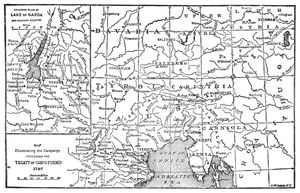
Enlarged Plan of
Lake of Garda
and Adjacent Country.
Map
Illustrating the Campaign
Preceding the
Treaty of Campo-Formio
1797.
While Murat was straining up the slopes of Monte Baldo, Bonaparte,
giving no rest to the weary feet of Masséna's division,—the same men
who two days before had marched by night from Verona,—was retracing
his steps on that well-worn road past the city of Catullus and the
Capulets onward toward Mantua. Provera had crossed the Adige at
Anghiari with ten thousand men. Twice he had been attacked: once in
the front by Guieu, once in the rear by Augereau. On both occasions
his losses had been severe, but, nevertheless, on the same morning
which saw Alvinczy's flight into the Tyrol, he finally appeared with
six thousand men in the suburb of St. George, before Mantua. He
succeeded in communicating with Wurmser, but was held in check by the
blockading French army throughout the day and night until Bonaparte
arrived with his reinforcements. Next morning there was a general
engagement, Provera attacking in front, and Wurmser, by
preconcerted arrangement, sallying out from behind at the head of a
strong force. The latter was thrown back into the town by Sérurier,
who commanded the besiegers, but only after a fierce and deadly
conflict on the causeway. This was the road from Mantua to a
country-seat of its dukes known as "La Favorita," and was chosen for
the sortie as having an independent citadel. Victor, with some of the
troops brought in from Rivoli, the "terrible fifty-seventh
demi-brigade," as Bonaparte designated them, attacked Provera at the
same time, and threw his ranks into such disorder that he was glad to
surrender his entire force. This conflict of January sixteenth, before
Mantua, is known as the battle of La Favorita, from the stand made by
Sérurier on the road to that residence. Its results were six thousand
prisoners, among them the Vienna volunteers with the Empress's banner,
and many guns. In his fifty-fifth year this French soldier of fortune
had finally reached the climax of his career. Having fought in the
Seven Years' War, in Portugal and in Corsica, the Revolution gave him
his opening. He assisted Schérer in the capture of the Maritime Alps,
and fought with leonine power at Mondovi and these succeeding
movements. While his fortunes were linked with Bonaparte's they
mounted higher and higher. As governor of Venice he was so upright and
incorruptible as to win the sobriquet "Virgin of Italy." The
discouragement of defeat under Moreau in 1798 led him to retire into
civil life, where he was a stanch Bonapartist and faithful official to
the end of the Napoleonic epoch, when he rallied to the Bourbons.
Bonaparte estimated that so far in the Italian campaigns the army of
the republic had fought within four days two pitched battles, and had
besides been six times engaged; that they had taken, all
told, nearly twenty-five thousand prisoners, including a
lieutenant-general, two generals, and fifteen colonels; had captured
twenty standards, with sixty pieces of artillery, and had killed or
wounded six thousand men.
This short campaign of Rivoli was the turning-point of the war, and
may be said to have shaped the history of Europe for twenty years.
Chroniclers dwell upon those few moments at St. Mark and the plateau
of Rivoli, wondering what the result would have been if the Austrian
corps which came to turn the rear of Rivoli had arrived five minutes
sooner. But an accurate and dispassionate criticism must decide that
every step in Bonaparte's success was won by careful forethought and
by the most effective disposition of the forces at his command. So
sure was he of success that even in the crises when Masséna seemed to
save the day on the left, and when the Austrians seemed destined to
wrest victory from defeat on the right, he was self-reliant and
cheerful. The new system of field operations had a triumphant
vindication at the hands of its author. The conquering general meted
out unstinted praise to his invincible squadrons and their leaders,
but said nothing of himself, leaving the world to judge whether this
were man or demon who, still a youth, and within a public career of
but one season, had humiliated the proudest empire on the Continent,
had subdued Italy, and on her soil had erected states unknown before,
without the consent of any great power, not excepting France. It is
not wonderful that this personage should sometimes have said of
himself, "Say that my life began at Rivoli," as at other times he
dated his military career from Toulon.
Wurmser's retreat to Mantua in September had been successful because
of the strong cavalry force which accompanied it. He had
been able to hold out for four months only by means of the flesh of
their horses, five thousand in number, which had been killed and
salted to increase the garrison stores. Even this resource was now
exhausted, and after a few days of delay the gallant old man sent a
messenger with the usual conventional declarations as to his ability
for further resistance, in order, of course, to secure the most
favorable terms of surrender. There is a fine anecdote in connection
with the arrival of this messenger at the French headquarters, which,
though perhaps not literally, is probably ideally, true. When the
Austrian envoy entered Sérurier's presence, another person wrapped in
a cloak was sitting at a table apparently engaged in writing. After
the envoy had finished the usual enumeration of the elements of
strength still remaining to his commander, the unknown man came
forward, and, holding a written sheet in his hand, said: "Here are my
conditions. If Wurmser really had provisions for twenty-five days, and
spoke of surrender, he would not deserve an honorable capitulation.
But I respect the age, the gallantry, and the misfortunes of the
marshal; and whether he opens his gates to-morrow, or whether he waits
fifteen days, a month, or three months, he shall still have the same
conditions; he may wait until his last morsel of bread has been
eaten." The messenger was a clever man who afterward rendered his own
name, that of Klenau, illustrious. He recognized Bonaparte, and,
glancing at the terms, found them so generous that he at once admitted
the desperate straits of the garrison. This is substantially the
account of Napoleon's memoirs. In a contemporary despatch to the
Directory there is nothing of it, for he never indulged in such
details to them; but he does say in two other despatches what at first
blush militates against its literal truth. On February first,
writing from Bologna, he declared that he would withdraw his
conditions unless Wurmser acceded before the third: yet, in a letter
of that very date, he indulges in a long and high-minded eulogium of
the aged field-marshal, and declares his wish to show true French
generosity to such a foe. The simple explanation is that, having sent
the terms, Bonaparte immediately withdrew from Mantua to leave
Sérurier in command at the surrender, a glory he had so well deserved,
and then returned to Bologna to begin his final preparations against
Rome. In the interval Wurmser made a proposition even more favorable
to himself. Bonaparte petulantly rejected it, but with the return of
his generous feeling he determined that at least he would not withdraw
his first offer. Captious critics are never content, and they even
charge that when, on the tenth, Wurmser and his garrison finally did
march out, Bonaparte's absence was a breach of courtesy. It requires
no great ardor in his defense to assert, on the contrary, that in
circumstances so unprecedented the disparity of age between the
respective representatives of the old and the new military system
would have made Bonaparte's presence another drop in the bitter cup of
the former. The magnanimity of the young conqueror in connection with
the fall of Mantua was genuine, and highly honorable to him. So at
least thought Wurmser himself, who wrote a most kindly letter to
Bonaparte, forewarning him that a plot had been formed in Bologna to
poison him with that noted, but never seen, compound so famous in
Italian history—aqua tofana.[Back to Contents]
Rome Threatened — Pius VI Surrenders — The Peace of
Tolentino — Bonaparte and the Papacy — Designs for the
Orient — France Reassured — The Policy of Austria — The
Archduke Charles — Bonaparte Hampered by the Directory —
His Treatment of Venice — Condition of Venetia — The
Commonwealth Warned.
1797.
Bonaparte seems after Rivoli to have reached the conviction that a man
who had brought such glory to the arms of France was at least as firm
in the affections of her people as was the Directory, which had no
hold on them whatever, except in its claim to represent the
Revolution. Clarke had reached Milan on November twenty-ninth, 1796.
Bonaparte read him like an open scroll, discovering instantly that
this graceful courtier had been commissioned to keep the little
general in his place as a subordinate, and use him to make peace at
any price. Possessing the full confidence of Carnot and almost
certainly of the entire Directory, the easily won diplomat revealed to
his lean, long-haired, ill-clad, penetrating, and facile inquisitor
the precious contents of the governmental mind. The religious
revolution in France had utterly failed, riotous vice had spread
consternation even in infidel minds, there was in the return a mighty
flood tide of orthodoxy; if the political revolution was to be saved
at all, it was at the price of peace, and peace very
quickly. The Directory had had little right to its distinction as
savior of the republic from the beginning, and even that was daily
disputed by ever increasing numbers: the most visible and dazzling
representative of the Revolution was now the Army of Italy. It was not
for "those rascally lawyers," as Bonaparte afterward called the
directors, that his great battle of Rivoli had been fought. With this
fact in view, the short ensuing campaign against Pius VI, and its
consequences, are easily understood. It was true, as the French
general proclaimed, that Rome had kept the stipulations of the
armistice neither in a pacific behavior nor in the payment of her
indemnity, and was fomenting resistance to the French arms throughout
the peninsula. To the Directory, which had desired the entire
overthrow of the papacy, Bonaparte proposed that with this in view,
Rome should be handed over to Spain. Behind these pretexts he gathered
at Bologna an indifferent force of eleven thousand soldiers, composed,
one half of his own men, the other half of Italians fired with
revolutionary zeal, and of Poles, a people who, since the recent
dismemberment of their country, were wooing France as a
possible ally in its reconstruction. The main division marched against
Ancona; a smaller one of two thousand men directed its course through
Tuscany into the valley of the Tiber.
The position of the Pope was utterly desperate. The Spaniards had once
been masters of Italy; they were now the natural allies of France
against Austria, and Bonaparte's leniency to Parma and Naples had
strengthened the bond. The reigning king at Naples, Ferdinand IV of
the Two Sicilies, was one of the Spanish Bourbons; but his very able
and masterful wife was the daughter of Maria Theresa. His position was
therefore peculiar: if he had dared, he would have sent an army to the
Pope's support, for thus far his consort had shaped his policy in the
interest of Austria; but knowing full well that defeat would mean the
limitation of his domain to the island of Sicily, he preferred to
remain neutral, and pick up what crumbs he could get from Bonaparte's
table. For this there were excellent reasons. The English fleet had
been more or less unfortunate since the spring of 1796: Bonaparte's
victories, being supplemented by the activity of the French cruisers,
had made it difficult for it to remain in the Mediterranean; Corsica
was abandoned in September; and in October the squadron of Admiral
Mann was literally chased into the Atlantic by the Spaniards.
Ferdinand, therefore, could expect no help from the British. As to the
papal mercenaries, they had long been the laughing-stock of Europe.
They did not now belie their character. Not a single serious
engagement was fought; at Ancona and Loretto twelve hundred prisoners,
with a treasure valued at seven million francs, were taken without a
blow; and on February nineteenth Bonaparte dictated the terms of peace
at Tolentino.
The terms were not such as either the Pope or the Directory
expected. Far from it. To be sure, there was, over and above the first
ransom, a new money indemnity of three million dollars, making, when
added to what had been exacted in the previous summer, a total of more
than seven. Further stipulations were the surrender of the legations
of Bologna and Ferrara, together with the Romagna; consent to the
incorporation into France of Avignon and the Venaissin, the two papal
possessions in the Rhone valley which had already been annexed; and
the temporary delivery of Ancona as a pledge for the fulfilment of
these engagements; further still, the dispersion of the papal army,
with satisfaction for the killing in a street row of Basseville, the
French plenipotentiary. This, however, was far short of the
annihilation of the papacy as a temporal power. More than that, the
vital question of ecclesiastical authority was not mentioned except to
guarantee it in the surrendered legations. To the Directory Bonaparte
explained that with such mutilations the Roman edifice would fall of
its own weight; and yet he gave his powerful protection to the French
priests who had refused the oaths to the civil constitution required
by the republic, and who, having renounced their allegiance, had found
an asylum in the Papal States. This latter step was taken in the rôle
of humanitarian. In reality, this first open and radical departure
from the policy of the Directory assured to Bonaparte the most
unbounded personal popularity with faithful Roman Catholics
everywhere, and was a step preliminary to his further alliance with
the papacy. The unthinking masses began to compare the captivity of
the Roman Church in France, which was the work of her government, with
the widely different fate of her faithful adherents at Rome under the
humane control of Bonaparte.
Moreover, it was the French citizen collectors, and not the
army, who continued to scour every town for art plunder. It was
believed that Italy had finally given up "all that was curious and
valuable except some few objects at Turin and Naples," including the
famous wonder-working image of the Lady of Loretto. The words quoted
were used by Bonaparte in a despatch to the Directory, which inclosed
a curious document of very different character. Such had been the
gratitude of Pius for his preservation that he despatched a legate
with his apostolic blessing for the "dear son" who had snatched the
papal power from the very jaws of destruction. "Dear son" was merely a
formal phrase, and a gracious answer was returned from the French
headquarters. This equally formal letter of Bonaparte's was forwarded
to Paris, where, as he knew would be the case, it was regarded as a
good joke by the Directory, who were supposed to consider their
general's diplomacy as altogether patriotic. But, as no doubt the
writer foresaw, it had an altogether different effect on the public.
From that instant every pious Roman Catholic, not only in France, but
throughout Europe, whatever his attitude toward the Directory, was
either an avowed ally of Bonaparte or at least willing to await events
in a neutral spirit. As for the papacy, henceforward it was a tool in
the conqueror's hand: he was determined to use it as an indispensable
bulwark for public decency and political stability. One of the
cardinals gave the gracious preserver of his order a bust of Alexander
the Great: it was a common piece of flattery after the peace to say
that Bonaparte was, like Alexander, a Greek in stature, and, like
Cæsar, a Roman in power.
While at Ancona, Bonaparte had a temporary relapse into his yearning
for Oriental power. He wrote describing the harbor as the only good
one on the Adriatic south of Venice, and explaining how
invaluable it was for the influence of France on Turkey, since it
controlled communication with Constantinople, and Macedonia was but
twenty-four hours distant. With this despatch he inclosed letters from
the Czar to the Grand Master of Malta which had been seized on the
person of a courier. It was by an easy association of ideas that not
long afterward Bonaparte began to make suggestions for the seizure of
Malta and for a descent into Egypt. These, as elsewhere explained,
were old schemes of French foreign policy, and by no means original
with him; but having long been kept in the background, they were
easily recalled, the more so because in a short time both the new
dictator and the Directory seemed to find in them a remedy for their
strained relations.
When the news of Rivoli reached Paris on January twenty-fifth, 1797,
the city went into a delirium of joy. To Clarke were sent that very
day instructions suggesting concessions to Austria for the sake of
peace, but enjoining him to consult Bonaparte at every step! To the
conqueror direct, only two days later, was recommended in explicit
terms the overthrow of Romanism in religion, "the most dangerous
obstacle to the establishment of the French constitution." This was a
new tone and the general might assume that his treaty of Tolentino
would be ratified. Further, he was assured that whatever terms of
peace he might dictate to Austria under the walls of Vienna, whether
distasteful to the Directory or not, were sure of being accepted by
the French nation.
Meantime the foreign affairs of Austria had fallen into a most
precarious condition. Not only had the departure of the English fleet
from the Mediterranean furthered Bonaparte's success in Italy, but
Russia had given notice of an altered policy. If the modern state
system of Europe had rested on any one doctrine more firmly
than on another, it was on the theory of territorial boundaries, and
the inviolability of national existence. Yet, in defiance of all right
and all international law, Prussia, Russia, and Austria had in 1772
swooped down like vultures on Poland, and parted large portions of her
still living body among themselves. The operation was so much to their
liking that it had been repeated in 1792, and completed in 1795. The
last division had been made with the understanding that, in return for
the lion's share which she received, Russia would give active
assistance to Austria in her designs on northern Italy. Not content
with the Milanese and a protectorate over Modena, Francis had already
cast his eyes on the Venetian mainland. But when on November
seventeenth, 1796, the great Catherine had died, and her successor,
Paul, had refused to be bound by his mother's engagements, all hope of
further aid vanishing, the empire, defeated at Rivoli, was in more
cruel straits than ever. Prussia was consolidating herself into a
great power likely in the end to destroy Austrian influence in the
Germanic Diet, which controlled the affairs of the empire. Both in
Italy and in Germany her rival's fortunes were in the last degree of
jeopardy. Thugut might well exclaim that Catherine's death was the
climax of Austria's misfortunes.
The hour was dark indeed for Austria; and in the crisis Thugut, the
able and courageous minister of the Emperor, made up his mind at last
to throw, not some or the most, but all his master's military strength
into Italy. The youthful Archduke Charles, who had won great glory as
the conqueror of Jourdan, was accordingly summoned from Germany with
the strength of his army to break through the Tyrol, and prevent the
French from taking the now open road to Vienna. This brother of the
Emperor, though but twenty-five years old, was in his day
second only to Bonaparte as a general. The splendid persistence with
which Austria raised one great army after another to oppose France was
worthy of her traditions. Even when these armies were commanded by
veterans of the old school, they were terrible: it seemed to the
cabinet at Vienna that if Charles were left to lead them in accordance
with his own designs they would surely be victorious. Had he and his
Army of the Rhine been in Italy from the outset, they thought, the
result might have been different. Perhaps they were right; but his
tardy arrival at the eleventh hour was destined to avail nothing. The
Aulic Council ordered him into Friuli, a district of the Italian Alps
on the borders of Venice, where another army—the sixth within a
year—was to assemble for the protection of the Austrian frontier and
await the arrival of the veterans from Germany. This force, unlike the
other five, was composed of heterogeneous elements, and, until further
strengthened, inferior in numbers to the French, who had finally been
reinforced by fifteen thousand men, under Bernadotte, from the Army of
the Sambre and Meuse.
When Bonaparte started from Mantua for the Alps, his position was the
strongest he had so far secured. The Directory had until then shown
their uneasy jealousy of him by refusing the reinforcements which he
was constantly demanding. It had become evident that the approaching
elections would result in destroying their ascendancy in the Five
Hundred, and that more than ever they must depend for support on the
army. Accordingly they had swallowed their pride, and made Bonaparte
strong. This change in the policy of the government likewise affected
the south and east of France most favorably for his purposes. The
personal pique of the generals commanding in those districts
had subjected him to many inconveniences as to communications with
Paris, as well as in the passage of troops, stores, and the like. They
now recognized that in the approaching political crisis the fate of
the republic would hang on the army, and for that reason they must
needs be complaisant with its foremost figure, whose exploits had
dimmed even those of Hoche in the Netherlands and western France.
Italy was altogether subdued, and there was not a hostile power in the
rear of the great conqueror. Among many of the conquered his name was
even beloved: for the people of Milan his life and surroundings had
the same interest as if he were their own sovereign prince. In front,
however, the case was different; for the position of the Archduke
Charles left the territory of Venice directly between the hostile
armies in such a way as apparently to force Bonaparte into adopting a
definite policy for the treatment of that power.
For the moment, however, there was no declaration of his decision by
the French commander-in-chief; not even a formal proposal to treat
with the Venetian oligarchy, which, to all outward appearance, had
remained as haughty as ever, as dark and inscrutable in its dealings,
as doubtful in the matter of good faith. And yet a method in
Bonaparte's dealing with it was soon apparent, which, though unlike
any he had used toward other Italian powers, was perfectly adapted to
the ends he had in view. He had already violated Venetian neutrality,
and intended to disregard it entirely. As a foretaste of what that
republic might expect, French soldiers were let loose to pillage her
towns until the inhabitants were so exasperated that they retaliated
by killing a few of their spoilers. Then began a persistent and
exasperating process of charges and complaints and admonitions, until
the origins of the respective offenses were forgotten in the
intervening recriminations. Then, as a warning to all who sought to
endanger the "friendly relations" between the countries, a troop of
French soldiers would be thrown here into one town, there into
another. This process went on without an interval, and with merciless
vigor, until the Venetian officials were literally distracted.
Remonstrance was in vain: Bonaparte laughed at forms. Finally, when
protest had proved unavailing, the harried oligarchy began at last to
arm, and it was not long before forty thousand men, mostly Slavonic
mercenaries, were enlisted under its banner. With his usual
conciliatory blandness, Bonaparte next proposed to the senate a treaty
of alliance, offensive and defensive.
This was not a mere diplomatic move. Certain considerations might well
incline the oligarchy to accept the plan. There was no love lost
between the towns of the Venetian mainland and the city itself; for
the aristocracy of the latter would write no names in its Golden Book
except those of its own houses. The revolutionary movement had,
moreover, already so heightened the discontent which had spread
eastward from the Milanese, and was now prevalent in Brescia, Bergamo,
and Peschiera, that these cities really favored Bonaparte, and longed
to separate from Venice. Further than this, the Venetian senate had
early in January been informed by its agents in Paris of a rumor that
at the conclusion of peace Austria would indemnify herself with
Venetian territory for the loss of the Milanese. The disquiet of the
outlying cities on the borders of Lombardy was due to a desire for
union with the Transpadane Republic. They little knew for what a
different fate Bonaparte destined them. He was really holding that
portion of the mainland in which they were situated as an indemnity
for Austria. Venice was almost sure to lose them in any
case, and he felt that if she refused the French alliance he could
then, with less show of injustice, tender them and their territories
to Francis, in exchange for Belgium. He offered, however, if the
republic should accept his proposition, to assure the loyalty of its
cities, provided only the Venetians would inscribe the chief families
of the mainland in the Golden Book.
But in spite of such a suggestive warning, the senate of the
commonwealth adhered to its policy of perfect neutrality. Bonaparte
consented to this decision, but ordered it to disarm, agreeing in that
event to control the liberals on the mainland, and to guarantee the
Venetian territories, leaving behind troops enough both to secure
those ends and to guard his own communications. If these should be
tampered with, he warned the senate that the knell of Venetian
independence would toll forthwith. No one can tell what would have
been in store for the proud city if she had chosen the alternative,
not of neutrality, but of an alliance with France. Bonaparte always
made his plan in two ways, and it is probable that her ultimate fate
would have been identical in either case.[Back to Contents]
Austrian Plans for the Last Italian Campaign — The Battle
on the Tagliamento — Retreat of the Archduke Charles —
Bonaparte's Proclamation to the Carinthians — Joubert
Withdraws from the Tyrol — Bonaparte's "Philosophical"
Letter — His Situation at Leoben — The Negotiations for
Peace — Character of the Treaty — Bonaparte's Rude
Diplomacy — French Successes on the Rhine — Plots of the
Directory — The Uprising of Venetia — War with Venice.
1797.
The Aulic Council at Vienna prepared for the Archduke Charles a
modification of the same old plan, only this time the approach was
down the Piave and the Tagliamento, rivers which rise among the
grotesque Dolomites and in the Carnic Alps. They flow south like the
Adige and the Brenta, but their valleys are wider where they open into
the lowlands, and easier of access. The auxiliary force, under
Lusignan, was now to the westward on the Piave, while the main force,
under Charles, was waiting for reinforcements in the broad intervales
on the upper reaches of the Tagliamento, through which ran the direct
road to Vienna. This time the order of attack was exactly reversed,
because Bonaparte, with his strengthened army of about seventy-five
thousand men, resolved to take the offensive before the expected
levies from the Austrian army of the Rhine should reach the camp of
his foe. The campaign was not long, for there was no resistance from
the inhabitants, as there would have been in the German Alps, among
the Tyrolese, Bonaparte's embittered enemies; and the united
force of Austria was far inferior to that of France. Joubert, with
eighteen thousand men, was left to repress the Tyrol. Though only
twenty-eight years old, he had risen from a volunteer in the files
through every rank and was now division general. He had gained renown
on the Rhine and found the climax of his fame in this expedition,
which he so brilliantly conducted that at the close of the campaign he
was chosen to carry the captured standards to Paris. He was acclaimed
as a coming man. But thereafter his achievements were mediocre and he
fell mortally wounded on August fifteenth, 1799, at the battle of Novi
while rallying an army destined to defeat. Two small forces under
Kilmaine and Victor associated with Lannes were detailed to watch
Venice and Rome respectively; but the general good order of Italy was
intrusted to the native legions which Bonaparte had organized. Fate
had little more in store for Kilmaine, the gallant Irish cavalryman,
who was among the foremost generals of his army. Already a veteran
forty-six years old, as veterans were then reckoned, he had fought in
America and on the Rhine and had filled the cup of his glory at
Peschiera, Castiglione, and Mantua. He was yet to be governor of
Lombardy and end his career by mortal disease when in chief command of
the "Army of England." Victor, wounded at Toulon, general of brigade
in the Pyrenees, a subordinate officer to the unsuccessful Schérer in
Italy, quickly rose under Bonaparte to be division general. Of lowly
birth, he had scarcely reached his thirty-fourth year when on this
occasion he exhibited both military and diplomatic talent of a high
order. Throughout the consulate and empire he held one important
office after another, so successfully that he commended himself even
to the Bourbons, and died in 1841, full of years and honors. Lannes
was now twenty-eight. The child of poor parents, he began
life as a dyer's apprentice, enlisted when twenty-three and was a
colonel within two years, so astounding were his courage and natural
gifts. Detailed to serve under Bonaparte, the two became bosom
friends. A plain, blunt man, Lannes was as fierce as a war dog and as
faithful. Throughout the following years he followed Bonaparte in all
his enterprises, and Napoleon on the Marchfeld, in 1809, wept bitterly
when his faithful monitor was shot to pieces.
Masséna advanced up the Piave against Lusignan, captured his
rear-guard, and drove him away northward beyond Belluno, while the
Archduke, thus separated from his right, withdrew to guard the road
into Carniola. Bonaparte, with his old celerity, reached the banks of
the Tagliamento opposite the Austrian position on March sixteenth,
long before he was expected. His troops had marched all night, but
almost immediately they made a feint as if to force a crossing in the
face of their enemy. The Austrians on the left bank awaited the onset
in perfect order, and in dispositions of cavalry, artillery, and
infantry admirably adapted to the ground. It seemed as if the first
meeting of the two young generals would fall out to the advantage of
Charles. But he was neither as wily nor as indefatigable as his enemy.
The French drew back, apparently exhausted, and bivouacked as if for
the night. The Austrians, expecting nothing further that day, and
standing on the defensive, followed the example of their opponents.
Two hours elapsed, when suddenly the whole French army rose like one
man, and, falling into line without an instant's delay, rushed for the
stream, which at that spot was swift but fordable, flowing between
wide, low banks of gravel. The surprise was complete; the stream was
crossed, and the Austrians had barely time to form when the French
were upon them. They fought with gallantry for three hours
until their flank was turned. They then drew off in an orderly
retreat, abandoning many guns and losing some prisoners.
Masséna, waiting behind the intervening ridge for the signal, advanced
at the first sound of cannon into the upper valley of the same stream,
crossed it, and beset the passes of the Italian Alps, by which
communication with the Austrian capital was quickest. Charles had
nothing left, therefore, but to withdraw due eastward across the great
divide of the Alps, where they bow toward the Adriatic, and pass into
the valley of the Isonzo, behind that full and rushing stream, which
he fondly hoped would stop the French pursuit. The frost, however, had
bridged it in several places, and these were quickly found. Bernadotte
and Sérurier stormed the fortress of Gradisca, and captured two
thousand five hundred men, while Masséna seized the fort at the Chiusa
Veneta, and, scattering a whole division of flying Austrians, captured
five thousand with their stores and equipments. He then attacked and
routed the enemy's guard on the Pontebba pass, occupied Tarvis, and
thus cut off their communication with the Puster valley, by which the
Austrian detachment from the Rhine was to arrive. It was in this
campaign that Bernadotte laid the foundation of his future greatness.
He was the son of a lawyer in Pau, where he was born in 1764.
Enlisting as a common soldier, he was wounded in Corsica, became chief
of battalion under Custine, general of brigade under Kléber, and
commanded a division at Fleurus. The previous year he had shared the
defeat of Jourdan on the Rhine, but under Bonaparte he became a famous
participant in victory. A Jacobin democrat, he was later entrusted by
the Directory with important missions, but in these he had little
success. It was as a soldier that he rose in the coming
years to heights which in his own mind awakened a rivalry with
Napoleon; ambitious for the highest rank, he made a great match with
the sister-in-law of Joseph Bonaparte, and so managed his affairs
that, as is well known, he ended on the throne of Sweden and founded
the reigning house of that kingdom.
Bonaparte wooed the stupefied Carinthians with his softly worded
proclamations, and his advancing columns were unharassed by the
peasantry while he pushed farther on, capturing Klagenfurt, and
seizing both Triest and Fiume, the only harbors on the Austrian shore.
He then returned with the main body of his troops, and, crossing the
pass of Tarvis, entered Germany at Villach. "We are come," he said to
the inhabitants, "not as enemies, but as friends, to end a terrible
war imposed by England on a ministry bought with her gold." And the
populace, listening to his siren voice, believed him. All this was
accomplished before the end of March; and Charles, his army reduced to
less than three fourths, was resting northward on the road to Vienna,
beyond the river Mur, exhausted, and expecting daily that he would be
compelled to a further retreat.
Joubert had not been so successful. According to instructions, he had
pushed up the Adige as far as Brixen, into the heart of the hostile
Tyrol. The Austrians had again called the mountaineers to arms, and a
considerable force under Laudon was gathered to resist the invaders.
It had been a general but most indefinite understanding between
Bonaparte and the Directory that Moreau was again to cross the Rhine
and advance once more, this time for a junction with Joubert to march
against Vienna. But the directors, in an access of suspicion, had
broken their word, and, pleading their penury, had not taken
a step toward fitting out the Army of the North. Moreau was therefore
not within reach; he had not even crossed the Rhine. Consequently
Joubert was in straits, for the whole country had now risen against
him. It was with difficulty that he had advanced, and with serious
loss that he fought one terrible battle after another; finally,
however, he forced his way into the valley of the Drave, and marched
down that river to join Bonaparte. This was regarded by Bonaparte as a
remarkable feat, but by the Austrians as a virtual repulse; both the
Tyrol and Venice were jubilant, and the effects spread as far eastward
as the Austrian provinces of the Adriatic. Triest and Fiume had not
been garrisoned, and the Austrians occupied them once more; the
Venetian senate organized a secret insurrection, which broke out
simultaneously in many places, and was suppressed only after many of
the French, some of them invalids in the hospitals, had been murdered.
On March thirty-first, Bonaparte, having received definite and
official information that he could expect no immediate support from
the Army of the Rhine, addressed from Klagenfurt to the Archduke what
he called a "philosophical" letter, calling attention to the fact that
it was England which had embroiled France and Austria, powers which
had really no grievance one against the other. Would a prince, so far
removed by lofty birth from the petty weaknesses of ministers and
governments, not intervene as the savior of Germany to end the
miseries of a useless war? "As far as I myself am concerned, if the
communication I have the honor to be making should save the life of a
single man, I should be prouder of that civic crown than of the sad
renown which results from military success." At the same time Masséna
was pressing forward into the valley of the Mur, across the
passes of Neumarkt; and before the end of the week his seizure of St.
Michael and Leoben had cut off the last hope of a junction between the
forces of Charles and his expected reinforcements from the Rhine.
Austria was carrying on her preparations of war with the same proud
determination she had always shown, and Charles continued his
disastrous hostilities with Masséna. But when Thugut received the
"philosophical" letter from Bonaparte, which Charles had promptly
forwarded to Vienna, the imperial cabinet did not hesitate, and
plenipotentiaries were soon on their way to Leoben.
The situation of Bonaparte at Leoben was by no means what the position
of the French forces within ninety miles of Vienna would seem to
indicate. The revolutionary movement in Venetia, silently but
effectually fostered by the French garrisons, had been successful in
Bergamo, Brescia, and Salo. The senate, in despair, sent envoys to
Bonaparte at Göritz. His reply was conciliatory, but he declared that
he would do nothing unless the city of Venice should make the
long-desired concession about inscriptions in the Golden Book. At the
same time he demanded a monthly payment of a million francs in lieu of
all requisitions on its territory. At Paris the Venetian ambassador
had no better success, and with the news of Joubert's withdrawal from
the Tyrol a terrible insurrection broke out, which sacrificed many
French lives at Verona and elsewhere. Bonaparte's suggestions for the
preliminaries of peace with Austria had been drawn up before the news
of that event reached him: but with the Tyrol and Venice all aflame in
his rear, and threatening his connections; with no prospect of
assistance from Moreau in enforcing his demands; and with a growing
hostility showing itself among the populations of the hereditary
states of Austria into which he had penetrated, it was not
wonderful that his original design was confirmed. "At Leoben," he once
said, in a gambler's metaphor, "I was playing twenty-one, and I had
only twenty."
When, therefore, Merveldt and Gallo, the duly accredited
plenipotentiaries of Austria, and General Bonaparte, representing the
French republic, but with no formal powers from its government, met in
the castle of Göss at Leoben, they all knew that the situation of the
French was very precarious indeed, and that the terms to be made could
not be those dictated by a triumphant conqueror in the full tide of
victory. Neither party had any scruples about violating the public law
of Europe by the destruction of another nationality; but they needed
some pretext. While they were in the opening stages of negotiation the
pretext came; for on April ninth Bonaparte received news of the
murders to which reference has been made, and of an engagement at
Salo, provoked by the French, in which the Bergamask mountaineers had
captured three hundred of the garrison, mostly Poles. This affair was
only a little more serious than numerous other conflicts incident to
partisan warfare which were daily occurring; but it was enough. With a
feigned fury the French general addressed the Venetian senate as if
their land were utterly irreconcilable, and demanded from them
impossible acts of reparation. Junot was despatched to Venice with the
message, and delivered it from the floor of the senate on April
fifteenth, the very day on which his chief was concluding negotiations
for the delivery of the Venetian mainland to Austria.
So strong had the peace party in Vienna become, and such was the
terror of its inhabitants at seeing the court hide its treasures and
prepare to fly into Hungary, that the plenipotentiaries could only
accept the offer of Bonaparte, which they did with
ill-concealed delight. There was but one point of difference, the
grand duchy of Modena, which Francis for the honor of his house was
determined to keep, if possible. With Tuscany, Modena, and the
Venetian mainland all in their hands, the Austrian authorities felt
that time would surely restore to them the lost Milanese. But
Bonaparte was obdurate. On the eighteenth the preliminaries were
closed and adopted. The Austrians solemnly declared at the time that,
when the papers were to be exchanged formally, Bonaparte presented a
copy which purported to be a counterpart of what had been mutually
arranged. Essential differences were, however, almost immediately
marked by the recipients, and when they announced their discovery with
violent clamor, the cool, sarcastic general produced without remark
another copy, which was found to be a correct reproduction of the
preliminary terms agreed upon. This coarse and silly ruse seems to
have been a favorite device, for it was tried later in another
conspicuous instance, the negotiation of the Concordat. According to
the authentic articles, France was to have Belgium, with the "limits
of France" as decreed by the laws of the republic, a purposely
ambiguous expression. In this preliminary outline the Rhine boundary
was not mentioned. The territory of the Empire was also guaranteed.
These flat contradictions indicate something like panic on both sides,
and duplicity at least on one and probably on both, for Thugut's
correspondence indicates his firm purpose to despoil and destroy
Venice. In any case Austria obtained the longed-for mainland of Venice
as far as the river Oglio, together with Istria and Dalmatia, the
Venetian dependencies beyond the Adriatic, while Venice herself was to
be nominally indemnified by the receipt of the three papal legations,
Bologna, Ferrara, and the Romagna, which had just been
erected into the Transpadane Republic! Modena was to be united with
Mantua, Reggio, and the Milanese into a great central republic, which
would always be dependent on France, and was to be connected with her
territory by way of Genoa. Some of the articles were secret, and all
were subject to immaterial changes in the final negotiations for
definitive peace, which were to be carried on later at Bern, chosen
for the purpose as being a neutral city.
Bonaparte explained, in a letter to the Directory, that whatever
occurred, the Papal States could never become an integral part of
Venice, and would always be under French influences. His sincerity was
no greater, as the event showed, concerning the very existence of
Venice herself. The terms he had made were considered at Vienna most
favorable, and there was great rejoicing in that capital. But it was
significant that in the routine negotiations the old-school
diplomatists had been sadly shocked by the behavior of their military
antagonist, who, though a mere tyro in their art, was very hard to
deal with. At the outset, for instance, they had proposed to
incorporate, as the first article in the preliminaries, that for which
the Directory had long been negotiating with Austria, a recognition of
the French republic. "Strike that out," said Bonaparte. "The Republic
is like the sun on the horizon—all the worse for him who will not see
it." This was but a foretaste of ruder dealings which followed, and of
still more violent breaches with tradition in the long negotiations
which were to ensue over the definitive treaty.
The very day on which the signatures were affixed at Leoben, the
Austrian arms were humbled by Hoche on the Rhine. Moreau had not been
able to move for lack of a paltry sum which he was begging for, but
could not obtain, from the Directory. Hoche, chafing at
similar delays, and anxious to atone for Jourdan's failure of the
previous year, finally set forth, and, crossing at Neuwied, advanced
to Heddersdorf, where he attacked the Austrians, who had been weakened
to strengthen the Archduke Charles. They were routed with a loss of
six thousand prisoners. Another considerable force was nearly
surrounded when a sudden stop was put to Hoche's career by the arrival
of a courier from Leoben. Though, soon after, the ministry of war was
offered to him, he declined. It was apparently prescience of the fact
that the greatest laurels were still to be won which led him to
refuse, and return to his headquarters at Wetzlar. There a mysterious
malady, still attributed by many to poison, ended his brief and
glorious career on September eighteenth, 1797. His laurels were such
as adorn only a character full of promise, serene and generous alike
in success and defeat. In the Black Forest, Desaix, having crossed the
Rhine with Moreau's army below Strasburg, was likewise driving the
Austrians before him. He too was similarly checked, and these
brilliant achievements came all too late. No advantage was gained by
them in the terms of peace, and the glory of humiliating Austria
remained to Bonaparte. Desaix was an Auvergnat, an aristocrat of
famous pedigree, carefully trained as a cadet to the military career.
He was now twenty-nine, having served on the Rhine as Victor's
adjutant, as general of brigade in the Army of the Moselle, and as
general of division under Jourdan and Moreau. Transferred to Italy, he
became the confidential friend and stanch supporter of Bonaparte. His
manner was winning, his courage contagious, his liberal principles
unquestioned. No finer figure appears on the battle-fields of the
Directory and Consulate.
Throughout all France there was considerable dissatisfaction
with Bonaparte's moderation, and a feeling among extreme republicans,
especially in the Directory, that he should have destroyed the
Austrian monarchy. Larévellière and Rewbell were altogether of this
opinion, and the corrupt Barras to a certain extent, for he had taken
a bribe of six hundred thousand francs from the Venetian ambassador at
Paris, to compel the repression by Bonaparte of the rebels on the
mainland. The correspondence of various emissaries connected with this
affair fell into the general's hands at Milan, and put the Directory
more completely at his mercy than ever. On April nineteenth, however,
he wrote as if in reply to such strictures as might be made: "If at
the beginning of the campaign I had persisted in going to Turin, I
never should have passed the Po; if I had persisted in going to Rome,
I should have lost Milan; if I had persisted in going to Vienna,
perhaps I should have overthrown the Republic." He well understood
that fear would yield what despair might refuse. It was a matter of
course that when the terms of Leoben reached Paris the Directory
ratified them: even though they had been irregularly negotiated by an
unauthorized agent, they separated England from Austria, and crushed
the coalition. One thing, however, the directors notified Bonaparte he
must not do; that was, to interfere further in the affairs of Venice.
This order reached him on May eighth; but just a week before, Venice,
as an independent state, had ceased to exist.
Accident and crafty prearrangement had combined to bring the affairs
of that ancient commonwealth to such a crisis. The general
insurrection and the fight at Salo had given a pretext for disposing
of the Venetian mainland; soon after, the inevitable results of French
occupation afforded the opportunity for destroying the oligarchy
altogether. The evacuation of Verona by the garrison of its
former masters had been ordered as a part of the general disarmament
of Italy. The Veronese were intensely, fiercely indignant on learning
that they were to be transferred to a hated allegiance; and on April
seventeenth, when a party appeared to reinforce the French troops
already there, the citizens rose in a frenzy of indignation, and drove
the hated invaders into the citadel. During the following days, three
hundred of the French civilians in the town, all who had not been able
to find refuge, were massacred; old and young, sick and well. At the
same time a detachment of Austrians under Laudon came in from the
Tyrol to join Fioravente, the Venetian general, and his Slavs. This of
course increased the tumult, for the French began to bombard the city
from the citadel. For a moment the combined besiegers, exaggerating
the accounts of Joubert's withdrawal and of Moreau's failure to
advance, hoped for ultimate success, and the overthrow of the French.
But rumors from Leoben caused the Austrians to withdraw up the Adige,
and a Lombard regiment came to the assistance of the French. The
Venetian forces were captured, and the city was disarmed; so also were
Peschiera, Castelnuovo, and many others which had made no resistance.
Two days after this furious outbreak of Veronese resentment,—an event
which is known to the French as the Veronese Passover,—occurred
another, of vastly less importance in itself, but having perhaps even
more value as cumulative evidence that the wound already inflicted by
Bonaparte on the Venetian state was mortal. A French vessel, flying
before two Austrian cruisers, appeared off the Lido, and anchored
under the arsenal. It was contrary to immemorial custom for an armed
vessel to enter the harbor of Venice, and the captain was
ordered to weigh anchor. He refused. Thereupon, in stupid zeal, the
guns of the Venetian forts opened on the ship. Many of the crew were
killed, and the rest were thrown into prison. This was the final
stroke, all that was necessary for the justification of Bonaparte's
plans. An embassy from the senate had been with him at Gratz when the
awful news from Verona came to his headquarters. He had then treated
them harshly, demanding not only the liberation of every man confined
for political reasons within their prison walls, but the surrender of
their inquisitors as well. "I will have no more Inquisition, no more
Senate; I shall be an Attila to Venice!... I want not your alliance
nor your schemes; I mean to lay down the law." They left his presence
with gloomy and accurate forebodings as to what was in those secret
articles which had been executed at Leoben. When, two days later, came
this news of further conflict with the French in Venice itself, the
envoys were dismissed, without another audience, by a note which
declared that its writer "could not receive them, dripping as they
were with French blood." On May third, having advanced to Palma,
Bonaparte declared war against Venice. In accordance with the general
license of the age, hostilities had, however, already begun; for as
early as April thirtieth the French and their Italian helpers had
fortified the lowlands between the Venetian lagoons, and on May first
the main army appeared at Fusina, the nearest point on the mainland to
the city.[Back to Contents]
Feebleness of the Venetian Oligarchy — Its Overthrow —
Bonaparte's Duplicity — Letters of Opposite Purport —
Montebello — The Republican Court — England's Proposition
for Peace — Plans of the Directory — General Clarke's
Diplomatic Career — Conduct of Mme. Bonaparte —
Bonaparte's Jealous Tenderness — His Wife's Social
Conquests — Relations of the Powers.
1797.
Since the days of Carthage no government like that of the Venetian
oligarchy had existed on the earth. At its best it was dark and
remorseless; with the disappearance of its vigor its despotism had
become somewhat milder, but even yet no common man might draw the veil
from its mysterious, irresponsible councils and live. A few hundred
families administered the country as they did their private estates.
All intelligence, all liberty, all personal independence, were
repressed by such a system. The more enlightened Venetians of the
mainland, many even in the city, feeling the influences of the time,
had long been uneasy under their government, smoothly as it seemed to
run in time of peace. Now that the earth was quaking under the march
of Bonaparte's troops, this government was not only helpless, but in
its panic it actually grew contemptible, displaying by its conduct how
urgent was the necessity for a change. The senate had a powerful
fleet, three thousand native troops, and eleven thousand mercenaries;
but they struck only a single futile blow on their own account,
permitting a rash captain to open fire from the gunboats against the
French vanguard when it appeared. But immediately, as if in
fear of their own temerity, they despatched an embassy to learn the
will of the approaching general. That his dealings might be merciful,
they tried the plan of Modena, and offered him a bribe of seven
million francs; but, as in the case of Modena, he refused. Next day
the Great Council having been summoned, it was determined by a nearly
unanimous vote of the patricians—six hundred and ninety to
twenty-one—that they would remodel their institutions on democratic
lines. The pale and terrified Doge thought that in such a surrender
lay the last hope of safety.
Not for a moment did Lallemant and Villetard, the two French agents,
intermit their revolutionary agitation in the town. Disorders grew
more frequent, while uncertainty both paralyzed and disintegrated the
patrician party. A week later the government virtually abdicated. Two
utter strangers appeared in a theatrical way at its doors, and
suggested in writing to the Great Council that to appease the spirit
of the times they should plant the liberty-tree on the Place of St.
Mark, and speedily accede to all the propositions for liberalizing
Venice which the popular temper seemed to demand. Such were the terror
and disorganization of the aristocracy that instead of punishing the
intrusion of the unknown reformers by death, according to the
traditions of their merciless procedure, they took measures to carry
out the suggestions made in a way as dark and significant as any of
their own. The fleet was dismantled, and the army disbanded. By the
end of the month the revolution was virtually accomplished; a rising
of their supporters having been mistaken by the Great Council, in its
pusillanimous terror, for a rebellion of their antagonists, they
decreed the abolition of all existing institutions, and, after hastily
organizing a provisional government, disbanded. Four
thousand French soldiers occupied the town, and an ostensible treaty
was made between the new republic of Venice and that of France.
This treaty was really nothing but a pronunciamento of Bonaparte. He
decreed a general amnesty to all offenders except the commander of
Fort Luco, who had recently fired on the French vessel. He also
guaranteed the public debt, and promised to occupy the city only as
long as the public order required it. By a series of secret articles,
vaguely expressed, Venice was bound to accept the stipulations of
Leoben in regard to territory, pay an indemnity of one million two
hundred thousand dollars, and furnish three ships of the line with two
frigates, while, in pursuance of the general policy of the French
republic, experts were to select twenty pictures from her galleries,
and five hundred manuscripts from her libraries. Whatever was the
understanding of those who signed these crushing conditions, the city
was never again treated by any European power as an independent state.
To this dismemberment the Directory made itself an accessory after the
fact, having issued a declaration of war on Venice which only reached
Milan to be suppressed, when already Venice was no more. Whether the
oligarchy or its assassin was the more loathsome still remains an
academic question, debatable only in an idle hour. Soon afterward a
French expedition was despatched to occupy her island possessions in
the Levant. The arrangements had been carefully prepared during the
very time when the provisional government believed itself to be paying
the price of its new liberties. And earlier still, on May
twenty-seventh, three days before the abdication of the aristocracy,
Bonaparte had already offered to Austria the entire republic in its
proposed form as an exchange for the German lands on the left bank of
the Rhine.
Writing to the Directory on that day, he declared that
Venice, which had been in a decline ever since the discovery of the
Cape of Good Hope and the rise of Triest and Ancona, could with
difficulty survive the blows just given her. "This miserable, cowardly
people, unfit for liberty, and without land or water—it seems natural
to me that we should hand them over to those who have received their
mainland from us. We shall take all their ships, we shall despoil
their arsenal, we shall remove all their cannon, we shall wreck their
rank, we shall keep Corfu and Ancona for ourselves." On the
twenty-sixth, only the day previous, a letter to his "friends" of the
Venetian provisional government had assured them that he would do all
in his power to confirm their liberties, and that he earnestly desired
that Italy, "now covered with glory, and free from every foreign
influence, should again appear on the world's stage, and assert among
the great powers that station to which by nature, position, and
destiny it was entitled." Ordinary minds cannot grasp the guile and
daring which seem to have foreseen and prearranged all the conditions
necessary to plans which for double-dealing transcended the
conceptions of men even in that age of duplicity and selfishness.
Not far from Milan, on a gentle rise, stands the famous villa, or
country-seat, of Montebello. Its windows command a scene of rare
beauty: on one side, in the distance, the mighty Alps, with their
peaks of never-melting ice and snow; on the other three, the almost
voluptuous beauty of the fertile plains; while in the near foreground
lies the great capital of Lombardy, with its splendid industries, its
stores of art, and its crowded spires hoary with antiquity. Within
easy reach are the exquisite scenes of an enchanted region—that of
the Italian lakes. To this lordly residence Bonaparte withdrew.
His summer's task was to be the pacification of Europe, and
the consolidation of his own power in Italy, in France, and northward
beyond the Alps. The two objects went hand in hand. From Austria, from
Rome, from Naples, from Turin, from Parma, from Switzerland, and even
from the minor German principalities whose fate hung on the
rearrangement of German lands to be made by the Diet of the Empire,
agents of every kind, both military and diplomatic, both secret and
accredited, flocked to the seat of power. Expresses came and went in
all directions, while humble suitors vied with one another in homage
to the risen sun.
The uses of rigid etiquette were well understood by Bonaparte. He
appreciated the dazzling power of ceremony, the fascination of
condescension, and the influence of woman in the conduct of affairs.
All such influences he lavished with a profusion which could have been
conceived only by an Oriental imagination. As if to overpower the
senses by an impressive contrast, and symbolize the triumph of that
dominant Third Estate of which he claimed to be the champion against
aristocrats, princes, kings, and emperors, the simplicity of the
Revolution was personified and emphasized in his own person. His
ostentatious frugality, his disdain for dress, his contempt for
personal wealth and its outward signs, were all heightened by the
setting which inclosed them, as a frame of brilliants often heightens
the character in the portrait of a homely face.
Meantime England, grimly determined to save herself and the Europe
essential to her well-being, was not a passive spectator of events in
Italy. To understand the political situation certain facts must be
reiterated in orderly connection. At the close of 1796, Pitt's
administration was still in great straits, for the Tories who
supported him were angered by his lack of success, while the
Whig opposition was correspondingly jubilant and daily growing
stronger. The navy had been able barely to preserve appearances, but
that was all. There was urgent need for reform in tactics, in
administration, and in equipment. France had made some progress in all
these directions, and, in spite of English assistance, both the
Vendean and the Chouan insurrections had, to all appearance, been
utterly crushed. Subsequently the powerful expedition under Hoche,
equipped and held in readiness to sail for Ireland, there to organize
rebellion, and give England a draught from her own cup, though
destined to disaster, wrought powerfully on the British imagination.
It was clear that the Whigs would score a triumph at the coming
elections if something were not done. Accordingly, as has been told,
Pitt determined to open negotiations for peace with the Directory. As
his agent he unwisely chose a representative aristocrat, who had
distinguished himself as a diplomatist in Holland by organizing the
Orange party to sustain the Prussian arms against the rising democracy
of that country. Moreover, the envoy was an ultra-conservative in his
views of the French Revolution, and, believing that there was no room
in western Europe for his own country and her great rival, thought
there could be no peace until France was destroyed. Burke sneered that
he had gone to Paris on his knees. He had been received with suspicion
and distrust, many believing his real errand to be the reorganization
of a royalist party in France. Then, too, Delacroix, minister of
foreign affairs, was a narrow, shallow, and conceited man, unable
either to meet an adroit and experienced negotiator on his own ground,
or to prepare new forms of diplomatic combat, as Bonaparte had done.
The English proposition, it is well to recall, was that Great Britain
would give up all the French colonial possessions she had seized
during the war, provided the French republic would abandon
Belgium. It is essential to an understanding of Bonaparte's attitude
in 1797, to recall also in this connection that the navigation of the
Scheldt has ever been an object of the highest importance to England:
the establishment of a strong, hostile maritime power in harbors like
those of the Netherlands would menace, if not destroy, the British
carrying-trade with central and northern Europe. The reply of the
Directory had been that their fundamental law forbade the
consideration of such a point; and when Malmesbury persisted in his
offer, he was allowed forty-eight hours to leave the country. The
negotiation was a fiasco as far as Austria was concerned, although
useful in consolidating British patriotism. Hoche, having been
despatched to Ireland, found wind and waves adverse, and then returned
to replace Jourdan in command of one of the Rhine armies, the latter
having been displaced for his failures in Germany and relegated to the
career of politics. Bonaparte's victories left his most conspicuous
rival nothing to do and he gracefully congratulated his Italian
colleague on having forestalled him. His sad and suspicious death in
September had no influence on the terms of Bonaparte's treaty, but
emphasized the need of its ratification.
The Directory, with an eye single to the consolidation of the
republic, cared little for Lombardy, and much for Belgium; for the
prestige of the government, even for its stability, Belgium with the
Rhine frontier must be secured. The Austrian minister cared little for
the distant provinces of the empire, and everything for a compact
territorial consolidation. The successes of 1796 had secured to France
treaties with Prussia, Bavaria, Würtemberg, Baden, and the two circles
of Swabia and Franconia, whereby these powers consented to
abandon the control of all lands on the left bank of the Rhine
hitherto belonging to them or to the Germanic body. As a consequence
the goal of the Directory could be reached by Austria's consent, and
Austria appeared to be willing. The only question was, Would France
restore the Milanese? Carnot was emphatic in the expression of his
opinion that for the sake of peace with honor, a speedy, enduring
peace, she must, and his colleagues assented. Accordingly, Bonaparte
was warned that no expectations of emancipation must be awakened in
the Italian peoples. But such a warning was absurd. The directors,
having been able neither to support their general with adequate
reinforcements, nor to pay his troops, it had been only in the rôle of
a liberator that Bonaparte was successful in cajoling and conquering
Italy, in sustaining and arming his men, and in pouring treasures into
Paris. It was for this reason that, enormous and outrageous as was the
ruin and spoliation of a neutral state, he saw himself compelled to
overthrow Venice, and hold it as a substitute for Lombardy in the
coming trade with Austria. But the directors either could not or would
not at that time enter into his plans, and refused to comprehend the
situation.
With doubtful good sense they had therefore determined in November,
1796, to send Clarke, their own chosen agent, to Vienna. It was for
this that they selected a man of polished manners and honest purpose,
but, contrary to their estimate, of very moderate ability. He must of
course have a previous understanding with Bonaparte, and to that end
he had journeyed by way of Italy. Being kindly welcomed, he was
entirely befooled by his subtle host, who detained him with idle
suggestions until after the fall of Mantua, when to his amazement he
received the instructions from Paris already stated: to make no
proposition of any kind without Bonaparte's consent. Then
followed the death of the Czarina Catherine, which left Austria with
no ally, and all the subsequent events to the eve of Leoben. Thugut,
of course, wanted no Jacobin agitator at Vienna, such as he supposed
Clarke to be, and informed him that he must not come thither, but
might reach a diplomatic understanding with the Austrian minister at
Turin, if he could. He was thus comfortably banished from the seat of
war during the closing scenes of the campaign, and to Bonaparte's
satisfaction could not of course reach Leoben in time to conclude the
preliminaries as the accredited agent of the republic. But, to save
the self-respect of the Directory, he was henceforth to be associated
with Bonaparte in arranging the final terms of peace; and to that end
he came of course to Milan. Representing as he did the conviction of
the government that the Rhine frontier must be a condition of peace,
and necessarily emphasizing its scheme of territorial compensations,
he had to be either managed or disregarded. It was the versatility of
the envoy at Montebello which assured him his subsequent career under
the consulate and empire.
The court at Montebello was not a mere levee of men. There was as well
an assemblage of brilliant women, of whom the presiding genius was
Mme. Bonaparte. Love, doubt, decision, marriage, separation, had been
the rapidly succeeding incidents of her connection with Bonaparte in
Paris. Though she had made ardent professions of devotion to her
husband, the marriage vow sat but lightly on her in the early days of
their separation. Her husband appears to have been for a short time
more constant, but, convinced of her fickleness, to have become as
unfaithful as she. And yet the complexity of emotions—ambition,
self-interest, and physical attraction—which seems to have been
present in both, although in widely different degree,
sustained something like genuine ardor in him, and an affection
sincere enough often to awaken jealousy in her. The news of
Bonaparte's successive victories in Italy made his wife a heroine in
Paris. In all the salons of the capital, from that of the directors at
the Luxembourg downward through those of her more aristocratic but
less powerful acquaintances, she was fêted and caressed. As early as
April, 1796, came the first summons of her husband to join him in
Italy. Friends explained to her willing ears that it was not a French
custom for the wives of generals to join the camp-train, and she
refused. Resistance but served to rouse the passions of the young
conqueror, and his fiery love-letters reached Paris by every courier.
Josephine, however, remained unmoved; for the traditions of her
admirers, to whom she showed them, made light of a conjugal affection
such as that. She was flattered, but, during the courtship, slightly
frightened by such addresses.
In due time there were symptoms which appeared to be those of
pregnancy. On receipt of this news the prospective father could not
contain himself for joy. The letter which he sent has been preserved.
It was written from Tortona, on June fifteenth, 1796. Life is but a
vain show because at such an hour he is absent from her. His passion
had clouded his faculties, but if she is in pain he will leave at any
hazard for her side. Without appetite, and sleepless; without thought
of friends, glory, or country, all the world is annihilated for him
except herself. "I care for honor because you do, for victory because
it gratifies you, otherwise I would have left all else to throw myself
at your feet. Dear friend, be sure and say you are persuaded that I
love you above all that can be imagined—persuaded that every moment
of my time is consecrated to you; that never an hour passes
without thought of you; that it never occurred to me to think of
another woman; that they are all in my eyes without grace, without
beauty, without wit; that you—you alone as I see you, as you
are—could please and absorb all the faculties of my soul; that you
have fathomed all its depths; that my heart has no fold unopened to
you, no thoughts which are not attendant upon you; that my strength,
my arms, my mind, are all yours; that my soul is in your form, and
that the day you change, or the day you cease to live, will be that of
my death; that nature, the earth, is lovely in my eyes, only because
you dwell within it. If you do not believe all this, if your soul is
not persuaded, saturated, you distress me, you do not love me. Between
those who love is a magnetic bond. You know that I could never see you
with a lover, much less endure your having one: to see him and to tear
out his heart would for me be one and the same thing; and then, could
I, I would lay violent hands on your sacred person.... No, I would
never dare, but I would leave a world where that which is most
virtuous had deceived me. I am confident and proud of your love.
Misfortunes are trials which mutually develop the strength of our
passion. A child lovely as its mother is to see the light in your
arms. Wretched man that I am, a single day would satisfy me! A
thousand kisses on your eyes, on your lips. Adorable woman! what a
power you have! I am sick with your disease: besides, I have a burning
fever. Keep the courier but six hours, and let him return at once,
bringing to me the darling letter of my queen."
At length, in June, when the first great victories had been won, when
the symptoms of motherhood proved to be spurious and disappeared, when
honors like those of a sovereign were awaiting her in Italy, Mme.
Bonaparte decided to tear herself away from the circle of her
friends in Paris, and to yield to the ever more urgent
pleadings of her husband. Traveling under Junot's care, she reached
Milan early in July, to find the general no longer an adventurer, but
the successful dictator of a people, courted by princes and kings,
adored by the masses, and the arbiter of nations. Rising, apparently
without an effort, to the height of the occasion, she began and
continued throughout the year to rival in her social conquests the
victories of her husband in the field. Where he was Caius, she was
Caia. High-born dames sought her favor, and nobles bowed low to win
her support. At times she actually braved the dangers of insurrection
and the battle-field. Her presence in their capital was used to soothe
the exasperated Venetians. To gratify her spouse's ardor, she
journeyed to many cities, and by a show of mild sympathy moderated
somewhat the wild ambitions which the scenes and character of his
successes awakened in his mind. The heroes and poets of Rome had moved
upon that same stage. To his consort the new Cæsar unveiled the
visions of his heated imagination, explained the sensations aroused in
him by their shadowy presence, and unfolded his schemes of emulation.
Of such purposes the court held during the summer at Montebello was
but the natural outcome. Its historic influence was incalculable: on
one hand, by the prestige it gave in negotiation to the central
figure, and by the chance it afforded to fix and crystallize the
indefinite visions of the hour; on the other, by rendering memorable
the celebration of the national fête on July fourteenth, 1797, an
event arranged for political purposes, and so dazzling as to fix in
the army the intense and complete devotion to their leader which made
possible the next epoch in his career.
The summer was a season of enforced idleness, outwardly and
as far as international relations were concerned, but in reality
Bonaparte was never more active nor more successful. In February the
Bank of England had suspended specie payments, and in March the price
of English consols was fifty-one, the lowest it ever reached. The
battle of Cape St. Vincent, fought on February fourteenth, destroyed
the Spanish naval power, and freed Great Britain from the fear of a
combination between the French and Spanish fleets for an invasion.
But, on the other hand, sedition was wide-spread in the navy; the
British sailors were mutinous to the danger-point, hoisting the red
flag and threatening piracy. The risings, though numerous, were
eventually quelled, but the effect on the English people was magical.
Left without an ally by the death of Catherine, the temporizing of
Paul, and his leaning to the Prussian policy of neutrality, facts
mirrored in the preliminaries of Leoben, their government made
overtures for peace. There was a crisis in the affairs of the
Directory and, as a sort of shelter from the stormy menace of popular
disapproval, Delacroix consented to receive Malmesbury again and renew
negotiations at Lille. As expected, the arrangement was a second
theatrical fencing-bout from the beginning. Canning feared his country
would meet with an accident in the sword-play, for the terms proposed
were a weak yielding to French pride by laying the Netherlands at her
feet. Probably the offer was not serious in any case, the farce was
quickly ended, and when their feint was met the British nation had
recuperated and was not dismayed. It required the utmost diligence in
the use of personal influence, on the part both of the French general
and of his wife, to thwart among the European diplomats assembled at
Montebello the prestige of English naval victory and the swift
adaptations of their policy to changing conditions. But they
succeeded, and the evidence was ultimately given not merely in great
matters like the success of Fructidor or the peace of Campo Formio,
but in small ones—such, for example, as the speedy liberation of
Lafayette from his Austrian prison.[Back to Contents]
Footnote 1: The indispensable authority for the youth of Napoleon is
the collection of his own papers edited, not always judiciously, by
Frédéric Masson and published by him in coöperation with G. Biagi
under the title Napoléon inconnu. The originals are now in the
Laurentian Library at Florence. They were intrusted by the Emperor to
Cardinal Fesch as a safe depositary, probably in the hope that they
would eventually be destroyed. What the cardinal actually did with
them remains obscure. Some time early in the nineteenth century they
came into possession of a certain Libri, one of the French government
library inspectors, an unscrupulous collector and dealer. From them he
excerpted enough matter for an article which, before his disgrace, was
published in an early number of the Revue des Deux Mondes, but in the
publication there was no statement of authority and the article was
forgotten, important as it was. The originals were not found or known
until in the sale catalogue of Lord Ashburnham's library appeared a
lot entitled merely Napoleon Papers. This fact was brought to the
author's attention by a friend, and when after a smart competition
between agents of the French and Italian governments the manuscripts
were deposited at Florence, he sought permission immediately to
examine and study them. This was promptly granted, they proved to be
the lost Fesch papers, and for the first time it was possible to
obtain a clear account of Napoleon's early years. The standard
authorities hitherto had been the works of Nasica, Coston, and Jung:
while they still have a certain value, it is slight in view of the
reliable deductions to be drawn from the original boy papers of
Napoleon Bonaparte. Later on and after the publication of the
corresponding portion of this Life, they were edited, printed, and
published. In the main there is no room for difference with the
transcript of M. Masson, but in some places where the writing is
uncommonly bad the author's own transcript presents the facts as
stated in these pages. Within a few years M. Chuquet has summed up
admirably all our authentic knowledge of the subject—in a book
entitled: La jeunesse de Napoléon. His own researches have brought to
light some further valuable material. I have not hesitated in this
revision to make the freest use of the latest authorities, but it is a
gratification that no substantial changes, except by way of slight
additions, have been found necessary.[Back to Main Text]
Footnote 2: The authorities for the period are Masson: Napoléon
inconnu. Chuquet: La jeunesse de Napoléon. Jung: Bonaparte et son
temps. Böhtlingk: Napoleon Bonaparte: seine Jugend und sein
Emporkommen. Las Cases: Mémorial de Sainte-Hélène. Antommarchi:
Mémoires. Coston: Premières années de Napoléon, Nasica: Mémoires sur
l'enfance et la jeunesse de Napoléon.[Back to Main Text]
Footnote 3: The sources of these statements are two letters of 5
April, 1781, and 8 October, 1783; first printed in the Mémoires sur la
vie de Bonaparte, etc., etc., par le comte Charles d'Og.... This
pseudonym covers a still unknown author; the documents have been for
the most part considered genuine and have been reprinted as such by
many authorities, including Jung. Though this author was an official
in the ministry of war and had its archives at his disposal, he gives
one letter without any authority and the other as in the "Archives de
la guerre." Many searchers, including the writer, have sought them
there without result. Latterly their authenticity has been denied on
the ground of inherent improbability, since pocket money was by rule
almost unknown in the royal colleges, and Corsican homesickness is as
common as that of the Swiss. But rules prove nothing and the letters
seem inherently genuine.[Back to Main Text]
Footnote 4: Du Casse, Supplément à la Correspondence de Napoléon
Ier, Vol. X, p. 50. Masson, I, 79-84.[Back to Main Text]
Footnote 5: This letter, which is without date, is printed in Coston,
as taken from the newspapers; again in a revised form in Nasica:
Mémoires sur l'enfance et la jeunesse de Napoléon, p. 71, who claimed
to have collated it with the original; and again in Jung: Bonaparte et
son temps, who gives as his reference, Archives de la guerre,
preserving exactly the form given by Nasica. The Napoleon papers of
the War Department were freely, and I believe entirely, put into my
hands for examination. This letter was not among them; in fact, my
efforts to confirm the references of Jung were sadly ineffectual.[Back to Main Text]
Footnote 6: Authorities as before for this and the five chapters
following.[Back to Main Text]
Footnote 7: This is the date given by himself on the slip of paper
headed "Époques de ma vie" and contained in the Fesch papers, now
deposited in the Laurentian Library at Florence. Here and there the
text is very difficult to decipher, but the line "Parti pour l'école
de Paris, le 30 Octobre 1784" is perfectly legible. Las Cases, in the
Mémorial, Vol. I, p. 160, represents Napoleon as quoting Keralio in
declaring that it was not for his birth or his attainments but for the
qualities he discerned in the boy that he sent him with imperfect
preparation to Paris.[Back to Main Text]
Footnote 8: Mémoires du roi Joseph, I, 29.[Back to Main Text]
Footnote 9: The examiner in mathematics was the great Laplace.[Back to Main Text]
Footnote 10: Taken from the apocryphal Memoirs of the Count d'Og ...
previously mentioned. See Masson: Napoléon inconnu, I, 123; Chuquet,
I, 260; Jung, I, 125.[Back to Main Text]
Footnote 11: Las Cases, I, 112. Napoleon confessed his inability to
learn German, but prided himself on his historical knowledge.[Back to Main Text]
Footnote 12: For an amusing caricature by a comrade at Paris, see
Chuquet: La jeunesse de Napoléon, I, 262. The legend is: "Buonaparte,
cours, vole au secours de Paoli pour le tirer des mains de ses
ennemis."[Back to Main Text]
Footnote 13: Masson (Napoléon inconnu, Vol. I, p. 160) denies all the
statements of this paragraph. He likewise proves to his own
satisfaction that Bonaparte was neither in Lyons nor in Douay at this
time. The narrative here given is based on Coston and on Jung, who
follows the former in his reprint of the documents, giving the very
dubious reference, Mss. Archives de la guerre. Although these
manuscripts could not be found by me, I am not willing to discard
Jung's authority completely nor to impugn his good faith. Men in
office frequently play strange pranks with official papers, and these
may yet be found. Moreover, there is some slight collateral evidence.
See Vieux: Napoleon à Lyon, p. 4, and Souvenirs à l'usage des
habitants de Douay. Douay, 1822.[Back to Main Text]
Footnote 14: The volumes of Napoléon inconnu contain the text of
these papers as deciphered for M. Masson and revised by him. My own
examination, which antedated his transcription by more than a year
(1891), led me to trust their authenticity absolutely, as far as the
writer's memory and good faith are concerned. I cannot rely as
positively as Masson does on the Époques de ma vie, which has the
appearance of a casual scribbling done in an idle moment on the first
scrap that came to hand.[Back to Main Text]
Footnote 15: Correspondence of Sir John Sinclair, I, 47.[Back to Main Text]
Footnote 16: Souvenirs d'un officier royaliste, par M. de R..., Vol.
I, p. 117.[Back to Main Text]
Footnote 17: Printed in Napoléon inconnu, Vol. II, p. 167.[Back to Main Text]
Footnote 18: Similar instances of repeated and lengthened absence
from duty among the young officers are numerous and easily found in
the archives. Nevertheless, Buonaparte's case is a very extraordinary
example of how a clever person could work the system. The facts are
bad enough, but as many cities claimed Homer, so in the Napoleonic
legend events of a sojourn at Strasburg about this time were given in
great detail. He was in relations with a famous actress and wrote
verses which are printed. Even Metternich records that the young
Napoleon Bonaparte had just left the Alsatian capital when he himself
arrived there in 1788. Later, in 1806, a fencing-master claimed that
he had instructed both these great men in the earlier year at
Strasburg. Yet the whole tale is impossible. See Napoléon inconnu,
Vol. I, p. 204.[Back to Main Text]
Footnote 19: Printed in Coston, II, 94.[Back to Main Text]
Footnote 20: Correspondence of Sir John Sinclair, I, 47.[Back to Main Text]
Footnote 21: For the text see Napoléon inconnu, II, 92.[Back to Main Text]
Footnote 22: These phrases may nearly all be found in the notes which
he had taken or jottings he had made while reading Voltaire and
Rousseau: Napoléon inconnu, II, 209-292.[Back to Main Text]
Footnote 23: "I am in the cabin of a poor man whence I like to write
you after long conversation with these good people." Nasica, p. 161.[Back to Main Text]
Footnote 24: Napoléon inconnu, II, 108 et seq.[Back to Main Text]
Footnote 25: Buonaparte to Naudin, 27 July, 1791, in Buchez et Roux,
Histoire Parlementaire, XVII, 56.[Back to Main Text]
Footnote 26: It is not entirely clear whether he arrived late in
September or early in October, 1791. He remained until May, 1792.[Back to Main Text]
Footnote 27: The rare and curious pamphlet entitled "Manuscrit de
l'Île d'Elbe," attributed to Montholon and probably published by
Edward O'Meara, contains headings for ten chapters which were dictated
by Napoleon at Elba on February twenty-second, 1815. The argument is:
The Bourbons ascended the throne, in the person of Henry IV, by
conquering the so-called Holy League against the Protestants, and by
the consent of the people; a third dynasty thus followed the second;
then came the republic, and its succession was legitimated by victory,
by the will of the people, and by the recognition of all the powers of
Europe. The republic made a new France by emancipating the Gauls from
the rule of the Franks. The people had raised their leader to the
imperial throne in order to consolidate their new interests: this was
the fourth dynasty, etc., etc. The contemplated book was to work out
in detail this very conception of a nation as passing through
successive phases: at the close of each it is worn out, but a new rule
regenerates it, throwing off the incrustations and giving room to the
life within. It is interesting to note the genesis of Napoleon's ideas
and the pertinacity with which he held them.[Back to Main Text]
Footnote 28: Las Cases: Mémorial de Sainte Hélène, V, 170.[Back to Main Text]
Footnote 29: Mémoires du roi Joseph, I, 47.[Back to Main Text]
Footnote 30: Napoléon inconnu, II, 408.[Back to Main Text]
Footnote 31: Reported by Arrighi and Renucci and given in Napoléon
inconnu, II, 418.[Back to Main Text]
Footnote 32: For the original of this protest see Napoléon inconnu,
II, 439.[Back to Main Text]
Footnote 33: Both these men were generously remembered in the secret
codicils of Napoleon's will.[Back to Main Text]
Footnote 34: For this paper, see Napoléon inconnu, II, 462. Jung:
Bonaparte et son temps, II, 266 and 498. There appear to have been an
official portion intended to be filed, and a free, carelessly written
running commentary on men and things. The passage quoted is taken from
the latter.[Back to Main Text]
Footnote 35: The memoirs of Joseph and Lucien, supported by Coston
and the anonymous local historian of Marseilles, all unite in
declaring that the Buonaparte family landed there; on the other hand,
Louis, in the Documents historiques sur la Hollande, I, 34, asserts
categorically in detail that they took up their abode in La Valette, a
suburb of Toulon, where they had landed.[Back to Main Text]
Footnote 36: These are the most probable reasons for the retreat.
Several local chroniclers, Soullier, Audri, and Joudou, writing all
three about 1844, declare each and all that Buonaparte with his
battery followed the right bank of the Rhone as far as the Rocher de
Justice where he mounted his guns and opened fire on the walls of the
city. His fire was so accurate that he destroyed one cannon and killed
several gunners. The besieged garrison of federalists were thrown into
panic and decamped. Neither the contemporary authorities nor Napoleon
himself ever mentioned any such remarkable circumstances. In fact, a
passage of the "Souper de Beaucaire" attributes the retreat to the
inability of any except veteran troops to withstand a siege. Finally,
Buonaparte would surely have been promoted for such an exploit.
Dommartin, a comrade, was thus rewarded for a much smaller service.[Back to Main Text]
Footnote 37: The Archive Russe for 1866 states that in 1788 Napoleon
Buonaparte applied for an engagement to Zaborowski, Potemkin's
lieutenant, who was then with a Russian fleet in the Mediterranean.
The statement may be true, and probably is, but there is no
corroborative evidence to sustain it.[Back to Main Text]
Footnote 38: The very first impression appears to have been a reprint
from the Courier d'Avignon: it was a cheap pamphlet of sixteen pages
in the same type and on the paper as that used by the journal. The
second impression was in twenty pages, printed by the public printer
as a tract for the times, to be distributed throughout the near and
remote neighborhood.[Back to Main Text]
Footnote 39: The authorities for this important epoch are, primarily,
Jung: Bonaparte et son temps; Masson: Napoléon inconnu; but above all,
Chuquet: La jeunesse de Napoléon, Vol. III, Toulon. The Mémoires of
Barras are utterly worthless, the references in Las Cases, Marmont,
and elsewhere have value, but must be controlled. The archives of the
war department have been thoroughly examined by several investigators,
the author among the number. The results have been printed in many
volumes to which the above-mentioned authors refer, and many of the
original papers are printed in whole or in part by them.[Back to Main Text]
Footnote 40: In Buchez et Roux, Histoire Parlementaire, XXXI, pp.
268-290, 415-427; XXXII, pp. 335-381 et seq., and in Œuvres de
St. Just, pp. 360-420, will be found a few examples of their views in
their own words.[Back to Main Text]
Footnote 41: Jung: Bonaparte et son temps, II, 455.[Back to Main Text]
Footnote 42: Correspondance de Napoléon, I, No. 35.[Back to Main Text]
Footnote 43: Las Cases: Mémorial de Sainte-Hélène, I, 141.[Back to Main Text]
Footnote 44: For a full account of these important operations see
Mahan: Life of Nelson, I, 123 et seq.[Back to Main Text]
Footnote 45: Marmont: Mémoires, I, 77-78.[Back to Main Text]
Footnote 46: Inspection report in Jung, II, 477. "Too much ambition
and intrigue for his advancement."[Back to Main Text]
Footnote 47: He was far down the list, one hundred and thirty-ninth
in the line of promotion.[Back to Main Text]
Footnote 48: Possibly the twelfth. See Jung, III, I.[Back to Main Text]
Footnote 49: Correspondance, I, No. 40.[Back to Main Text]
Footnote 50: For this chapter the Mémoires du roi Joseph, I, and
Böhtlingk: Napoleon Bonaparte, etc., I, are valuable references, in
addition to those already given. The memoirs of Barras are
particularly misleading except for comparison. For social conditions,
cf. Goncourt, Histoire de la Société Française sous le Directoire, and
in particular Adolph Schmidt: Tableaux de la Révolution Française;
Pariser Zustände während der Revolutionszeit.[Back to Main Text]
Footnote 51: Napoleon to Joseph, July, 1795; in Du Casse: Les rois
frères de Napoléon, 8, and in Jung, III, 41.[Back to Main Text]
Footnote 52: Chaptal: Mes souvenirs sur Napoléon, p. 198.[Back to Main Text]
Footnote 53: My account of this momentous crisis in Buonaparte's life
was written after a careful study of all the authorities and accounts
as far as known. The reader will find in the monograph, Zivy: Le
treize Vendémiaire, many reprints of documents and certain conclusions
drawn from them. The result is good as far as it goes, but, like all
history written from public papers solely, it is incomplete.
Buonaparte was only one of seven generals appointed to serve under
Barras. It seems likewise true that his exploits did not bring him
into general notice, for Mallet du Pan speaks of him as a "Corsican
terrorist" and Rémusat records her mother's amazement that a man so
little known should have made so good a marriage. But, on the other
hand, Thiébault declares that Buonaparte's activities impressed every
one, Barras's labored effort is suspicious, and then, as at Toulon,
there are the results. Some people in power gave him credit, for they
bestowed on him an extraordinary reward. Then, too, why should we
utterly discard Buonaparte's own evidence, which corroborates, at
least as far as the text goes, the evidence drawn from other sources?[Back to Main Text]
Footnote 54: Mémorial de Sainte Hélène, II, 246.[Back to Main Text]
Footnote 55: This important exploit has been questioned. But see the
American edition of Martin's History of France, II, 16. Babœuf
reopened at the Panthéon the club which had been closed at the Évêché
by the Convention and reorganized a secret society in connection with
it. This Panthéon club was shut by Napoleon in person on February 26,
1796. See likewise the Mémorial, II, 257, 258.[Back to Main Text]
Footnote 56: The best references for the history of Josephine de
Beauharnais are Masson: Joséphine de Beauharnais, 1763-1796, and
Joséphine, impératrice et reine; Hall: Napoleon's letters to
Josephine; Lévy: Napoléon intime; together with the memoirs of Joseph,
Bourrienne, Ducrest, Dufort de Cheverney, and Rémusat.[Back to Main Text]
Footnote 57: See Hochschild: Désirée, reine de Suède.[Back to Main Text]
Footnote 58: The authorities for this chapter are as for the last.[Back to Main Text]
Footnote 59: See Pulitzer: Une idylle sous Napoléon I.[Back to Main Text]
Footnote 60: Mémorial, II, 258; III, 402.[Back to Main Text]
Footnote 61: Given in Aubenas: Histoire de l'impératrice Joséphine,
I, 293. This writer is frankly not an historian but an apologist.[Back to Main Text]
Footnote 62: Coston: Premières années de Napoléon Bonaparte.[Back to Main Text]
Footnote 63: Carnot thoroughly understood and appreciated the genius
shown in Buonaparte's plan for an Italian campaign, and converted the
Directorate to his opinion. They sent a copy to Schérer, then in
command at Nice, and he returned it in a temper, declaring that the
man who made such a plan had better come and work it. The Directory
took him at his word.[Back to Main Text]
Footnote 64: For this and the succeeding chapters we have the memoirs
of Thibaudeau, Marmont, Doulcet de Pontécoulant, Hyde de Neuville, and
the duchess of Abrantès—Madame Junot. Among the histories, the most
important are those of Blanc, Taine, Sybel, Sorel, and
Mortimer-Ternaux. Special studies: C. Rousset, Les Volontaires de
1791-1794. Chassin: Pacifications de l'Ouest and Dictature de Hoche.
Mallet du Pan: Correspondance avec la cour de Vienne. Also the
Correspondence of Sandoz. Many original papers are printed in Hüffer:
Oesterreich und Preussen; Bailleu: Preussen und Frankreich, 1795-1797;
and in the Amtliche Sammlung von Akten aus der Zeit der Helvetischen
Republik.[Back to Main Text]
Footnote 65: See the author's French Revolution and Religious
Reform.[Back to Main Text]
Footnote 66: The state of Europe may be studied in the Correspondence
of Mallet du Pan and in the Archives Woronzoff; in Vivenot: Thugut and
Clerfayt; Daudet: Les Bourbons et la Russie; La Conspiration de
Pichegru; Sorel: L'Europe et la Révolution Française; Lecky: England
in the XVIII century; Stanhope's Life of Pitt; the memoirs of Prince
Adam Czartoryski; also the diplomatic papers of Thugut, Clerfayt,
Hermann, and Sandoz.[Back to Main Text]
Footnote 67: The latest important authorities on this campaign and
its results are, in addition to those already given, Sargent: Napoleon
Bonaparte's First Campaign. Sorel: Bonaparte et Hoche en 1797.
Bonaparte et le Directoire, Vol. V of his large work. Colin: Études
sur la Campagne de 1796 en Italie. Fabry: Histoire de l'armée
d'Italie, 1796-1797. Bouvier: Bonaparte en Italie, 1796. Graham's
Despatches, edited by Rose, in English Historical Review, Vol. XIV.
Tivaroni: Storia del risorgimento italiano. The Dropmore Papers. Of
primary value are Napoleon's "Correspondance," official edition, and
the unofficial edited by Beauvais. Hueffer: Ungedruckte Briefe
Napoleon's in the Archiv für Oest. Geschichte, Vol. XLIX. Of value are
also the memoirs of Marmont, Masséna, and Desgenettes, of Landrieux in
Revue du Cercle Militaire, 1887. Yorck von Wartenberg: Napoleon als
Feldherr, almost supersedes the older authority of Clausewitz, Jomini,
Ruestow, and Lossau. There are also Malachowski: Entwickelung der
leitenden Gedanken zur ersten Campagne Bonaparte's, and Delbrueck:
Unterschied der Strategie Friederich's des Grossen und Napoleon's.[Back to Main Text]
Footnote 68: Somewhat under 40,000. Bonaparte guessed, and his guess
was very shrewd, that all told he was then confronted by 45,000. The
Austrians have never made the facts clear, though their initial
strength is set at 28,000. I have found no estimate of the
reinforcements. In any case they lost 10,000 here, the whole of
Provera's corps at La Favorita, and 18,000 were captured at Mantua:
their fighting force in Italy was annihilated.[Back to Main Text]
Footnote 69: The authorities for the following three chapters are
partly as before, but in particular the following: Vivenot: Thugut,
Clerfayt. Correspondance de Thugut avec Colloredo. Hüffer: Oesterreich
und Preussen, etc.; Der Rastatter Congress. Von Sybel: Geschichte der
Revolutions Zeit. Bailleu: Preussen und Frankreich. Sandoz-Rollin:
Amtliche Sammlung von Akten aus der Zeit der Helvetischen Republic.
Sorel: Bonaparte et Hoche; Bonaparte et le Directoire; also articles
in the Revue Historique, 1885. Sciout: Le Directoire, also article in
Revue des questions historiques, 1886. Boulay de la Meurthe: Quelques
lettres de Marie Caroline; Revue d'histoire diplomatique, 1888.
Barante: Histoire du Directoire and Souvenirs. McClellan: The
Oligarchy of Venice. Bonnal: Chute d'une république. Seché: Les
origines du Concordat. Dandolo: La caduta della republica di Venetia.
Romanin: Storia documentata di Venezia. Sloane: The French Revolution
and Religious Reform. In general and further, the memoirs of Marmont,
Chaptal, Landrieux, Carnot, Larévellière-Lépeaux (probably not
genuine), Mathieu Dumas, Thibaudeau, Miot de Melito, and the
correspondence of Mallet du Pan.[Back to Main Text]