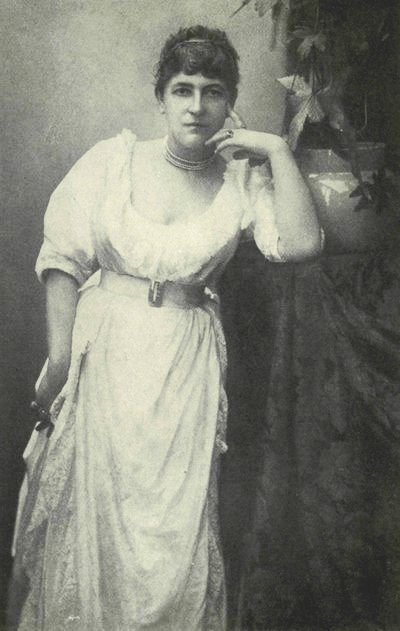
- Fanny Van de Grift Stevenson during the English period
Frontispiece
- Facing Page
- John Keen, about 83 years of age, maternal great-grandfather
of Fanny Van de Grift Stevenson 2
- Jacob Van de Grift, about 56 years of age, father of Fanny
Van de Grift Stevenson 6
- The Van de Grift residence at the corner of Illinois and
Washington Streets, Indianapolis 22
- The bridge at Grez 46
- Fanny Osbourne at about the time of her first meeting with
Robert Louis Stevenson 48
- Robert Louis Stevenson in the French days 50
- Fanny Osbourne at the time of her marriage to Robert
Louis Stevenson 78
- The house at Vailima with the additions made to the first
structure 194
- Mrs. Robert Louis Stevenson 262
- The house at Hyde and Lombard Streets, San Francisco,
with some alterations in the way of bay windows, etc.,
which have been made since Mrs. Stevenson sold it 266
- The house at Vanumanutagi ranch 274
- Stonehedge at Santa Barbara 298
- The last portrait of Mrs. Stevenson 306
- The funeral procession as it wound up the hill 332
- The tomb, showing the bronze tablet with the verse from
Stevenson's poem to his wife 336
To arrive at a full understanding of the complex and unusual character
of Fanny Van de Grift Stevenson, which perhaps played as large a part
as her beauty and intellectual charm in drawing to her the affections
of one of the greatest romance writers of our day, one must go back
and seek out all the uncommon influences that combined to produce
it—a long line of sturdy ancestors, running back to the first
adventurers who left their sheltered European homes and sailed across
the sea to try their fortunes in a wild, unknown land; her childhood
days spent among the hardy surroundings of pioneer Indiana, with its
hints of a past tropical age and its faint breath of Indian
reminiscence; the early breaking of her own family ties and her
fearless adventuring by way of the Isthmus of Panama to the distant
land of gold, and her brave struggle against adverse circumstances in
the mining camps of Nevada. All these prenatal influences and personal
experiences, so foreign to the protected lives of the women of
Stevenson's own race, threw about her an atmosphere of
thrilling New World romance that appealed with irresistible force to
the man who was himself Romance personified.
Fanny Stevenson was a lineal descendant of two of the oldest families
in the United States, her first ancestors landing in this country in
the early part of the seventeenth century. In 1642 Jöran Kyn, called
"The Snow White," reached America in the ship Fama as a member of
the life-guard of John Printz, governor of the Swedish colony
established in the New World by King Gustavus Adolphus. He took up a
large tract of land and was living in peace and comfort on the
Delaware River when William Penn landed in America. He was the
progenitor of eleven generations of descendants born on American soil.
His memory is embalmed in an old document still extant as "a man who
never irritated even a child."
In the list of his descendants one Matthias stands out as "a tall
handsome man, with a very melodious voice which could be intelligibly
heard at times across the Delaware."
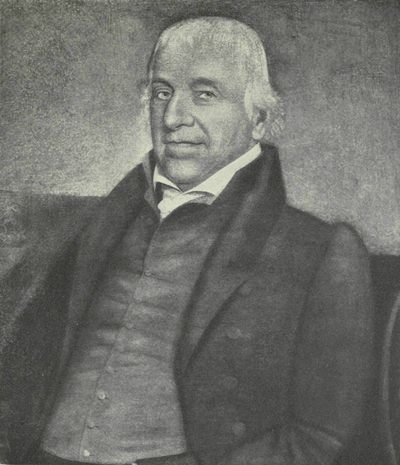
John Keen, about 83 years of age, maternal
great-grandfather of Fanny Van de Grift Stevenson.
A later descendant, John Keen, born in 1747, fought and shed his blood
in the war of American Independence, having been wounded in the battle
of Princeton while in the act of delivering a message to General
Washington. It was he who married Mildred Cook, daughter of James
Cook, an English sea-captain who commanded the London Packet, plying
between London and New York. Family tradition has it that he was a
near relative of Captain Cook of South Sea fame. When Fanny Stevenson
went a-sailing in the South Seas, following in the track of the great
explorer, she boldly claimed this kinship, and, much to
her delight, was immediately christened Tappeni Too-too, which was as
near as the natives could come to Captain Cook's name.
We have a charming old-fashioned silhouette portrait in our family of
a lovely young creature with a dainty profile and curls gathered in a
knot. It is "sweet Kitty Weaver," who married John Cook Keen, son of
the Revolutionary hero, and became the grandmother of Fanny Stevenson.
Little Fanny, when on a visit to Philadelphia in her childhood days,
was shown a pair of red satin slippers worn by this lady, and was no
doubt given a lecture on the folly of vanity, for it was by walking
over the snow to her carriage in the little red slippers that sweet
Kitty Weaver caught the cold which caused her death.
Our mother, Esther Thomas Keen, one of John and Kitty Keen's six
children, was born in Philadelphia, December 3, 1811. She was
described by one who knew her in her youth as "a little beauty of the
dark vivid type, with perfectly regular features, black startled eyes,
and quantities of red-brown curls just the color of a cherry wood
sideboard that stood in her house." She was a tiny creature, under
five feet in height, and never in her life weighed more than ninety
pounds; but in spite of that she was exceedingly strong, swift in her
movements, straight as an arrow to the end of her days, and always
went leaping up the stairs, even when she was over eighty. Fear was
absolutely unknown to her. She once caught a mad dog and held its
mouth shut with her hands, protecting her children till help
came. She was resourceful in emergency, whether it was sickness or
accident, and never lost her presence of mind. She had a tender
sympathy for animals and all weak, suffering, and young creatures, and
it could be truthfully said of her, as of Jöran Kyn, her ancestor,
that she "never irritated even a child." Her daughter Fanny said of
her: "I never heard my mother speak an angry word, no matter what the
provocation, and she was the mother of seven children. No matter what
the offense might be she always found an excuse." In this she was like
the old Scotch woman who, when told she would find something to praise
even in the devil, said: "Weel, there's nae denyin' he's a verra
indoostrious body."
It was from our little mother that my sister Fanny inherited her vivid
dark beauty, her reticence, her fortitude in suffering, her
fearlessness in the presence of danger, and her unfailing
resourcefulness.
Jacob Leendertsen Van de Grift, the first paternal ancestor of whom we
have any record, settled in Bucks County, Pennsylvania, towards the
close of the seventeenth century. The graves of several of his
descendants are still to be seen in the fine old cemetery at
Andalusia, and upon the tombstone of one of them is this epitaph:
"Farewell my friends and wife so dear,
I am not dead but sleeping here.
My debts are paid, my grave you see."
This name has descended in an unbroken line from Jacob Leendertsen Van
de Grift, of New Amsterdam, through eleven generations, to
the brother of Fanny Stevenson, Jacob Van de Grift, of Riverside,
California.
John Miller, a paternal great-grandfather of ours, was also Dutch. The
family account of him is that he fought at Brandywine, crossed the
Delaware with Washington, was wounded at the battle of Trenton, and
that when he died, at the age of eighty-four years, the city of
Philadelphia paid him the tribute of burial with military honours.
Miller married twice, and it was Elizabeth, a daughter by his second
wife, who married a Jacob Van de Grift.
Her son, Jacob Van de Grift, was born in Philadelphia in 1816. Upon
the early death of her first husband she married again, presenting to
her children the cruel stepfather of fiction. Indeed, the story of our
father's childhood and youth and the adventures of his brothers and
sisters reads more like melodrama than sober fact. One brother, Harry,
wandering disconsolate in the market-place, was carried off by a kind
and wealthy Kentuckian, who took a fancy to the handsome boy and
brought him up as his own son. Matilda, the beauty of the family,
seeing a peaceful Quaker couple sitting by a window, was so struck by
the contrast between their gentle lives and her own that she went into
the house and asked to be allowed to stay with them. The kind-hearted
people were so touched by her distress and beauty that they adopted
her as their own. Little Jacob, encouraged by the success of his
brother and sister, ran away on his own account, but fell into evil
hands, and was beaten and ill-used until rescued by his
beautiful sister Matilda. Fortunately for Jacob, he found favour in
the sight of Grandfather Miller, who educated him, dressed him well,
and gave him a good allowance. At this time there was an outbreak of
small riots in Philadelphia, caused by roughs attacking the Quakers.
The "shadbellies," as they were derisively called, did not fight back,
which made the sport all the more alluring to the cowardly rioters.
Young Van de Grift, who was an excellent amateur boxer, joined in
these frays with enthusiasm in defense of the Quakers. It was not only
his fine American spirit of fair play that urged him into these
fights, but he felt a deep gratitude to the Quakers all his life on
account of his sister Matilda. Strangely enough, Grandfather Miller
disapproved of young Van de Grift's conduct. He scolded and fumed, and
when, early one morning, his grandson was found on his door-step
beaten black and blue, the unreasonable old man, utterly losing sight
of the chivalric cause, sent the troublesome lad away—to the farthest
place, in fact, that he could reach. This place turned out to be the
frontier backwoods town of Indianapolis, Indiana.
Here Jacob's attention was soon attracted by a pretty young woman, a
tiny, dainty creature named Esther Keen (our mother, whom I have
already described), who was on a visit to her sister. The records show
that they were married in Philadelphia in 1837.
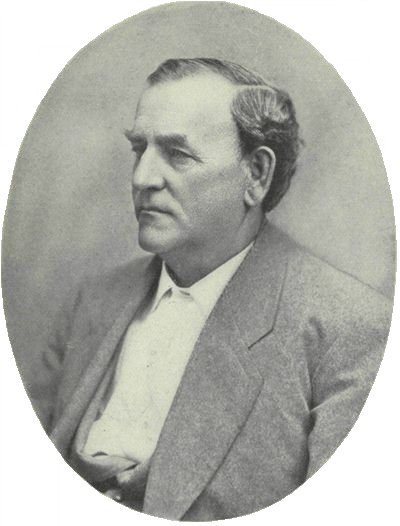
Jacob Van de Grift, about 56 years of age, father of
Fanny Van de Grift Stevenson.
Like many another irresponsible young man, Jacob Van de Grift married
became quite a different person. Returning to
Indianapolis, he built a house for himself with the aid of friends,
and, launching out into the lumber business, soon became one of the
prosperous and solid citizens of the place. His house was on the
"Circle," next door to Henry Ward Beecher's church. This was Mr.
Beecher's first pastorate, and between him and his neighbour a warm
friendship sprang up. In after years, when Beecher had become a
national figure and scandal attacked his name, the friend of his
youth, Jacob Van de Grift, clung loyally to his faith in his old
pastor and firmly refused to believe any of the charges against him.
The little house on the Circle was made into a pleasant home partly by
furniture sent by Jacob's mother from Philadelphia, partly by articles
made by himself, for he had served a short apprenticeship at
cabinet-making while living in his grandfather's house. Among other
pieces of furniture made by him was the cradle in which Fanny Van de
Grift was rocked. As long as she lived she never forgot just how this
cradle looked.
Jacob Van de Grift, father of Fanny Van de Grift Stevenson, was a
fine-looking man, broad-shouldered and deep-chested, slightly above
medium height, blue-eyed, black-haired, and with the regular features
and rosy complexion of his Dutch ancestors. One particularly noticed
the extraordinarily keen expression of his eyes, which seemed to pin
you to the wall when he looked at you. This penetrating glance was
inherited by his daughter Fanny, and was often remarked upon by those
who met her. He made money easily but spent it royally, and, in
consequence, died comparatively poor. He had a hasty temper
but a generous heart, and while his hand was always open to the poor
and unhappy, it was a closed fist ready to strike straight from the
shoulder to resent an insult or defend the oppressed. Like his
ancestor of the Andalusia cemetery, he could not endure to owe any man
a debt. It was from our father that my sister Fanny inherited her
broad and tolerant outlook on life, her hatred of injustice and
cruelty, her punctiliousness in money matters, and her steadfast
loyalty to friends.[Back to Contents]
When Jacob Van de Grift arrived in Indianapolis in 1836 the first
rawness of frontier life had passed away, and many of the comforts of
civilization had made their way out from the East or up from New
Orleans. When he married Esther Keen he took her to live in the little
red house, which, as I have already said, he had built next door to
Henry Ward Beecher's church, opposite the Governor's Circle. Seven
children in all were granted to them, of whom the eldest, a daughter,
was born on March 10, 1840, in this same little red house on the
Circle. When the infant was two years old she and her mother were
taken into the Second Presbyterian Church, and were baptized by Henry
Ward Beecher in the White River, in the presence of a concourse of
several thousand spectators. The record of this noteworthy occasion is
still preserved in the church at Indianapolis.
The little girl was named Frances Matilda, but when she grew older the
second name was finally dropped. To her family and friends she was
known as "Fanny."
The main source, in fact almost the only one, from which I have been
able to draw a description of the childhood of Fanny Stevenson is an
article on early reminiscences written by my sister herself, which was
found among her papers after her death. As she was always
her own worst critic, she has dwelt on mischievous childish escapades
and has said little of the sweetness and charm and warm generosity
that even then drew all hearts to her. From this article, called A
Backwoods Childhood, I quote the following extracts for the sake of
the vivid picture they give of those Indiana days:
"Our life in the backwoods was simple and natural; we had few
luxuries, but we had few cares. In our kitchen gardens potatoes,
cabbages, onions, tomatoes, Indian corn, and numerous other vegetables
grew most luxuriantly; and of fruits we had great abundance. We lived
a natural life and were content. The loom and the spinning-wheel,
though they had by this time largely disappeared from the towns, still
had a place in every farmhouse. We raised our own food and made our
own clothing, often of the linsey-woolsey woven by the women on their
home-made looms. We breakfasted by the light of a tin lamp fed with
lard, four o'clock being a not unusual hour, dined at noon, supped at
five, and went to bed with the chickens. Our carpets were made of our
old cast-off garments torn into strips, the strips then sewn together
at the ends and woven into carpet breadths by a neighbor, who took her
pay in kind. Wheat broken and steeped in water gave a fine white
starch fit for cooking as well as laundry work. We tapped the maple
tree for sugar, and drank our sassafras tea with relish. The virgin
forest furnished us with a variety of nuts and berries and wild
fruits, to say nothing of more beautiful wild flowers than I have
seen in any other part of the world, and, laid up in the
trunks of hollow trees, were rich stores of wild honey.
"Except for ague we had little sickness, and for ordinary ailments
healing herbs waited everywhere for seeing eyes. These were calamus,
bloodroot, snakeroot, slippery elm, tansy, and scores that I do not
remember the names of. There was sumach for tanning and butternut for
dyeing; hickory wood for our fires and hard black walnut for our
house-building and fences. Everything that we needed for comfort or
health was within reach of our hands. Nor in this wholesome simple
life were the arts forgotten. Among us lived a poetess who is quoted
wherever English is spoken.[1] Theatricals were cultivated, and my
father belonged to a Thespian society. We had good painters, too, and
at this moment there hangs before me my father's portrait at the age
of twenty, done by Cox of Indianapolis, which has been praised and
admired by both French and English artists of reputation.
"When we made maple sugar there were the great fires built
out-of-doors with logs that needed the strength of two men to carry;
the bubbling cauldrons, and the gay company of neighbors come to help;
the camp where the work went on all night to the sound of laughter and
song.
"And the woods, traversed by cool streams, where wild vines clambering
from tree to tree made bowers fit for any fairy queen—what a place of
enchantment for a child! There were may apples to be
gathered and buried to ripen, and as you turned up the earth there was
always the chance that you might find a flint arrowhead.
"Then, too, there were shell barks, hickory nuts, walnuts, and
butternuts to be gathered, husked and dried, an operation which
produced every fall a sudden eruption of the society of the 'Black
Hand' among the boys and girls. Haw apples, elderberries, wild
gooseberries, blackberries, and raspberries provided variety of
refreshment. Or you might, as I often did, gather the wild grapes from
over your head, press them in your hands, catch the juice in the neck
of a dried calabash, and toss off the blood-red wine. With my romantic
notions, imbibed from my reading, I always called it the blood-red
wine, though it was in reality a rather muddy looking gray-colored
liquid with the musky flavor peculiar to wild grapes. This wild
dissipation I felt compelled to abandon after I joined a temperance
society and wore a tinsel star on my breast.
"Through the little hamlet where I was born ran, like a great artery,
the National Road. Starting in the far East, it crossed the continent,
looked in on us rustics, and finally lost itself in the wilds of
Illinois. Though we lay on the banks of a romantic river, and a canal,
a branch of the Erie, languidly crawled beside us, breathing fever and
ague as it passed, the Road was our only real means of communication
with the outside world. The river, though of a good breadth, had too
many shoals and rapids to be navigable; and though now and then boats
crept along by the towpath of the canal, I never heard that
they landed or received any produce. The streets of Indianapolis had
no names then; it was too lost a place for that, and we just said the
'main street.' This was afterwards called Washington Street, and was
really a part of the National Road. Oh but that was romantic to me,
leading as it did straight out into the wide, wide world! At certain
intervals, about once in two weeks, the weather and the state of the
road allowing, a lumbering vehicle called a 'mud wagon' left for
regions unknown to me with passengers and freight. I don't know where
it came from, but on its return it brought letters to my father from
his mother, who lived in Philadelphia.
"Sometimes bands of Indians, wrapped in blankets, came through the
town. They seemed friendly enough and no one showed any fear of them.
"We little girls wore pantalettes, to our ankles, and our dresses were
whale-boned down the front, with very long bodices. We had wide flat
hats trimmed with wreaths of roses and tied under our chins. We wore
low necks and short sleeves summer and winter. I was thin but very
tough. My Aunt Knodle[2] made long mittens for me out of nankeen
beautifully embroidered; they came up to my shoulders, and were sewn
on every day to keep me from spoiling my hands. My hair was braided in
front and my everyday gingham sunbonnet sewn to my hair. This was done
in the vain hope of keeping off sunburn, for I was dark, like my
mother, and my complexion was the despair of her life.
Beauty of the fair blonde type was in vogue then, so that I was quite
out of fashion. It was thought that if one was dark one had a wicked
temper."
In reality, Fanny, with her clear olive skin, her bright black eyes,
her perfectly regular features, and mass of half-curling dark hair,
was the prettiest in the family; but the dictates of fashion are
imperious, so her mother put lotions on her face and her grandmother
washed it with strong soap, saying: "She is that color by nature—God
made her ugly." The little girl asked rather pathetically if they
would not change her name to Lily, to which her mother replied: "You
are a little tiger lily!" In after years in her many gardens in
different parts of the world there were always tiger lilies growing.
She was a high-spirited, daring creature, a little flashing firefly of
a child, eagerly seeking for adventure, that might have brought upon
her frequent punishment were it not that her parents held exceedingly
liberal views in such matters. About this she says:
"Henry Ward Beecher and my father were great friends, and used to
discuss very earnestly the proper method of bringing up children. At
that time it was the custom to be extremely severe with youth, and
such axioms as 'spare the rod and spoil the child,' 'to be seen and
not heard,' were popular; so that the views held by Mr. Beecher and my
father were decidedly modern. They argued that if a child was bad by
nature it would grow up bad, and that if it was good it would grow up
good, and that it was best not to interfere with the development of
children's characters, but to allow them to have their own
way."
As Esther Van de Grift limited her corrections of her children to an
occasional mild remonstrance, they worked out their own
individualities with little interference. Fanny was what the children
called a "tomboy," and always preferred the boys' sports, the more
daring the better. She roamed the woods with her cousin Tom Van de
Grift, and the two kindred wild spirits climbed trees, forded streams
up to their necks, did everything, in fact, that the most adventurous
boy could think of. School was a secondary affair then, and, except
for drawing and painting, in which she was thought to have a
remarkable talent, Fanny paid little attention to her studies.
When she was a little girl she was caught in the wave of a great
temperance revival which was sweeping over the country, and, in her
enthusiasm to aid in the work, she produced two drawings that caused a
sensation. One, representing a rickety house with broken windows, a
crooked weed-grown path leading up to a gate fallen off the hinges,
and a fence with half the pickets off, she labelled "The Drunkard's
Home." Then she drew a companion picture of a neat farmhouse with a
straight path, and fence and gate all in apple-pie order, which she
called "The Reformed Drunkard's Home." These two drawings she
presented at a public meeting to Doctor Thompson, the leader of the
movement. Fifty years afterwards she met Mrs. Thompson, who said she
still had the pictures and thought them "very beautiful."
In spite of her indifference to study she was very
precocious, and learned to read at what was considered by her parents'
friends as an objectionably early age. Her father was very proud of
the accomplishments of his little daughter, and liked to show her off
before his friends, who, to speak the truth, looked with extreme
disfavour upon the performance. Once Mr. Page Chapman, editor of a
newspaper, put her through an examination on some subjects about which
she had been reading in Familiar Science, a work arranged in the
form of questions and answers. He asked: "What is the shape of the
world?" "Round," she replied. "Then why don't we fall off?" he asked,
and she answered: "Because of the attraction of gravitation." "This is
awful," he said, in horror at such precocity.
Her father had a taste for verse, and often when walking with his
children would recite a favourite poem, more, evidently, for his own
amusement than theirs. Of this Fanny writes: "He used to declaim so
often, in a loud, solemn voice, 'My name is Norval—on the Grampian
Hills my father feeds his flocks,' that I naturally received the
impression that these flocks and hills were part of my paternal
grandfather's estate. Years afterwards when I was travelling in
Scotland and asked the name of some hills I saw in the distance, I
felt a mental shock when told they were the Grampian Hills."
As I have said before, there was no discipline in the Van de Grift
household, and though the neighbours predicted dire results from such
a method of bringing up a family, one result, at least, was that every
one of Jacob Van de Grift's children adored him, and none
more whole-heartedly than his eldest born. She writes of him:
"My father was a splendid horseman and excelled in all athletic
things. He had such immense shoulders and such a deep chest, though
his hands and feet were remarkably small. I can remember when he and I
would go out to a vacant lot that he owned near Indianapolis and I
would sit on the fence and watch him ride and perform circus tricks on
horseback, riding around in a circle. Though his hands were so small
and fair, with rosy palms and delicately pointed fingers, they were
strong hands and capable, for they fashioned the cradle my mother
rocked me in, and the chest of drawers made of maple-wood stained to
imitate mahogany, where she stored my baby linen with those
old-fashioned herbs, ambrosia and sweet basil. Years ago the cradle
was passed on to a neighbor who needed it more than we, but the chest
of drawers is still in use, a sound and very serviceable piece of
furniture, good for several generations more. It was an eventful day
in my childhood when, perched on a high chair, I was allowed to
explore the mysteries of the top drawer and hold in my own hands the
trinkets, ear-rings, brooches, and fine laces worn by my mother in her
youth, but now laid aside as useless in this new, strange, and busy
life of the backwoods. There, too, were pieces of my maternal
grandmother's (Kitty Weaver's) gowns, satin that shimmered and changed
from purple to gold, 'stiff enough,' as my mother said, 'to stand
alone,' and my great-grandfather Miller's tortoise-shell
snuff-box containing a tonquin bean that had not yet lost its peculiar
fragrance.
"While I gazed reverently on these treasures, the tale of Kitty
Weaver's death, which I already knew by heart, was told me once again.
She was a beauty and loved gaiety, and got her death by going to a
ball in thin slippers. I supposed, in my childish ignorance, that this
radiant creature went about all day long in shining silks that stood
alone, and never by any chance wore other than red satin slippers. My
paternal grandmother, Elizabeth Miller, sniffed a little at my
enthusiasm, and averred that she, too, in her time, had worn silks
that stood alone and slippers of a much smaller size than those of
Kitty Weaver. But when I looked at my grandmother, with her high
hooked nose, her large black-browed blue eyes, as keen as swords, the
haughty outline of her curved lips, her massive shoulders and deep
chest, her domineering expression, and listened to her imperious
voice, doubts assailed me. I could believe that she had led an army of
amazons in cuirass and buckler, but my imagination refused to picture
her in a silken train smiling at gallants from behind her fan; and
surely, I thought, no one in the whole world ever went tripping to a
ball in such strange and monstrous headgear as she wore. Yet she had
been a notable beauty in her day, and even in her old age was still
something of a coquette.
"It was sometimes my privilege to sleep with my grandmother, and I
felt it to be a great one, for she was the best teller of stories I
ever heard. Her religion was of the most terrible kind—the
old-fashioned Presbyterianism which taught that hell was
paved with infants' souls, and such horrors. She always said, when she
heard of the death of a young child, that the chances were it would
become a little angel, which it would not have done if it had lived to
be a little older. I was shocked to hear my mother say she preferred
having her children little living devils rather than dead angels.
After prayers, all about hell and damnation, which she said aloud, I
was put to bed against the wall. The bedstead, a big mahogany
four-poster, had to be mounted like an omnibus. That, and the feather
bed, and the mattress stuffed with the 'best curled hair,' were
presents sent to my father from Philadelphia, and were a great source
of pride to me, especially the mattress, which I believed to be
stuffed with beautiful human curls.
"From my nest in the feather bed I watched my grandmother disrobe with
growing terror. First she unpinned and folded away a white kerchief
she always wore primly crossed over her bosom. Then she removed a
white lace cap that was tied under her chin with ribbons; then she
took off what I supposed to be a portion of her scalp, but now know
was a 'false front.' This was bad enough, but there was worse to come;
there still remained a black silk skull cap that covered the thick
white hair worn cropped closely to her head. When she took off this
cap she seemed to stand before me as some strange and terrible man, so
at this point I always covered my head with the bedclothes until the
light was extinguished.
"After getting into bed, my grandmother, who told every incident as
dramatically as though she had participated in it herself,
related appalling stories about witches, death, apparitions, and the
Inquisition. These stories made such a powerful impression on me that
it is no wonder that I remember them after sixty years. Though my
terror of my grandmother in this guise was excessive, I do not think I
should have liked the stories, generally grim and tragic, so well in a
different setting.
"Aunt Knodle was very neat and orderly, high-tempered and somewhat
domineering, but possessing a singular charm. Children liked to go to
her house even though they were made to be on their best behavior
while they were there. Everything in her house was in what we would
call good taste to-day. She had beautiful old china, fine silver, and
good furniture, everything rich and dark. The house was a long
rambling cottage, with a turn in it to match the irregular shape of
the lot. It had many gables and dormer windows, and the whole was
covered with creeping roses, and there was a faint sweet smell about
it that I think I would know now. The master of this delightful house,
Adam Knodle, was as near a saint on earth as a man can be; he was kind
to everybody and everything. He was extremely absent-minded, and his
wife liked to tell how he once killed a chicken for the family dinner
and threw away the chicken and brought in the head.
"My aunt was an ardent lover of animals, and abhorred cruelty to them
in any form. She had a dog named Ponto, an ugly ill-tempered little
black dog of no pedigree whatever, who ruled as king in that house. He
was accustomed to lie on a silk cushion in the window
commanding the best view. My aunt used to sit at one of the
windows—not Ponto's, I can tell you—ready, like Dickens's heroine,
Betsy Trotwood, to pounce out upon passing travellers. Sometimes, when
she thought a horse was being driven too fast, she rushed out and
seized it by the bridle while she read its driver a severe lecture."
As the years passed the young girl's restless energies found other
outlets. At school she was a brilliant but not an industrious pupil.
It was in composition that she shone especially, and one of her
schoolmates says of her: "She always wrote her compositions in such an
attractive way, weaving them into a story, so that the children were
eager to hear them."
While attending high school she became fired with the idea of writing
a book in conjunction with a friend, a beautiful Southern girl named
Lucy McCrae. The writing was done secretly, after school hours, on the
steps of the schoolhouse, while a third friend, Ella Hale,[3] kept
guard, for the whole thing was to be a profound secret until the world
should receive it as the wonder of the age. This great work was
brought to a sudden end by the illness of Lucy McCrae.
At this time the Van de Grift family were living in a house on
Illinois Street. This house had a cellar door at the back. To quote
the words of her schoolmate, Ella Hale: "At this cellar door the
children used to gather to hear fairy and ghost stories. Fanny was
always the central figure, because she was the only one who could tell
really interesting stories. These gatherings always took
place after supper, and as the shadows grew darker and darker during
the recital of a particularly thrilling ghost story, I clearly
remember the fearful glances toward the dark corners and the crowding
closer together of the little ones, till it sometimes resulted in a
landslide, and we would find ourselves in a heap on the ground at the
foot of the slanting door, our laughter quickly dispelling all our
fears."
Among Fanny's playmates there was a dark, handsome boy, with large,
melancholy eyes, named George Marshall, who was not only exceedingly
attractive in looks but had many other graces. He was a born artist,
and could dance, and act, and sing like an angel; and, best of all, he
was as good as he was charming. These two were close companions in all
sorts of strenuous sports, and nothing annoyed them more than to have
little teasing Josephine, Fanny's younger sister, trailing after them
and breaking up their games. George finally announced that he would
play no more unless Josephine could be kept away. But boys change, and
when he grew up he married Josephine.
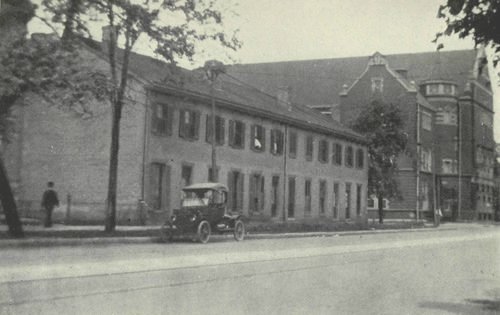
The Van de Grift residence at the corner of Illinois
and Washington Streets, Indianapolis.
All too soon came the time when these days of careless childish joys
were brought to a close. A new era opened, and romance, which budded
early in that time and place, began to unfold its first tender leaves.
Various youths of the town, attracted by the piquant prettiness and
sparkling vivacity of the eldest daughter, began to haunt the Van de
Grift house. In the sentimental fashion of the day, these sighing
swains carved her name on the trees, and so wide was the
circle of her fascination that there was scarcely a tree in the place
that did not bear somewhere on its long-suffering trunk the name or
initials of Fanny Van de Grift. None of these suitors, however, made
any impression on the object of their attentions, who was so much of a
child that she was walking on stilts in the garden when Samuel
Osbourne first called at the house. He was an engaging youth, a
Kentuckian by birth, with all the suavity and charm of the Southerner.
Behind him lay a truly romantic ancestry, for, through John Stewart,
who was stolen and brought up by the Indians, and never knew his
parentage, he was a collateral descendant of Daniel Boone.[4]
On December 4, 1857, in a house on Michigan Street, which had already
been prepared and furnished for their occupancy, Samuel Osbourne, aged
twenty, and Fanny Van de Grift, aged seventeen, were united in
marriage. All the notables of the town, including Governor Willard, to
whom young Osbourne was private secretary, and the entire staff of
State officers, attended. The young bride looked charming in a
handsome gown of heavy white satin, of the kind that "could stand
alone," of the "block" pattern then in vogue, and made in the fashion
of the day, with full long-trained skirt and tight low-necked bodice
trimmed with a rich lace bertha. Her hair was worn in curls, fastened
back from the face on each side. The groom, who is seldom
mentioned in these affairs, deserves a word or two, for he made a
gallant figure in a blue coat with brass buttons, flowered waistcoat,
fawn-coloured trousers, strapped under varnished boots, and carrying a
bell-topped white beaver hat. One who was a guest at the wedding says,
"They looked like two children," as indeed they were. It was a
boy-and-girl marriage of the kind people entered into then with
pioneer fearlessness, to turn out well or ill, as fate decreed.
The young couple took up their residence in the same house in which
they were married, and before the young husband was twenty-one years
old their first child, Isobel, was born. The little mother was so
small and young-looking that once when she was on a railroad-train
with her infant an old gentleman, looking at her with some concern,
asked: "Sissy, where is the baby's mother?"
It was now that the great black storm-cloud which had been hovering
over the nation for years broke in all its fury upon this border
State. The Osbournes, together with nearly all their friends and
relatives, cast in their lot with the North, and young Osbourne left
his family and went to the war as captain in the army.
We must now return to the dark, handsome boy, George Marshall, once
the favourite playmate and now the brother-in-law of Fanny Van de
Grift. He, too, joined the colours, in command of a company of Zouaves
whom he had himself gathered and trained. After a time spent in active
service on some of the hardest fought battle-fields of the Civil War,
the hardships and exposure of the life told upon a
constitution never at any time robust, and he returned to his young
wife a victim of tuberculosis. The doctors said his only chance was to
get to the milder climate of California, and at the close of the war
Samuel Osbourne, who was his devoted friend, gave up position and
prospects to accompany him thither. The two young men, leaving their
families behind them, took ship at New York for Panama; but the Angel
of Death sailed with them, and Captain Marshall breathed his last
while crossing the Isthmus.
Osbourne decided to go on to California, and on his arrival there was
so pleased with the country that he wrote to his wife to sell her
property at once and follow him. Bidding a long farewell to the loving
parents who had up to that time stood between her and every trouble,
Fanny Osbourne, at an age when most young women are enjoying the
care-free life of irresponsible girlhood, took her small daughter
Isobel and set forth into a new and strange world.
Crossing the Isthmus by the crookedest railroad ever seen, she stopped
at Panama to visit the burial-place of the young soldier, George
Marshall, her childhood playmate, beloved friend, and brother-in-law,
and over that lonely grave the child for the first time saw her
girlish mother shed tears.[Back to Contents]
When at last the long voyage up the Western coast came to an end and
the ship sailed into the broad bay of San Francisco, which lay serene
and beautiful under the shadow of its towering guardian, Mount
Tamalpais, Fanny Osbourne hung over the rail and surveyed the scene
with eager interest. Yet it is altogether unlikely that any
realization came to her then that the lively seaport town that lay
before her was to become to her that magic thing we call "home," for
men still regarded California as a place to "make their pile" in and
then shake its dust from their feet. Her stay here was very brief, for
her husband had gone at once to Nevada in the hope of getting a
foothold in the silver-mines, which were then "booming," and she
immediately followed him.
From the level green corn-fields of Indiana, the land of her birth, to
the grey sage-brush of the desert and the naked mountains of Nevada
was a long step, but regrets were lost in the absorbing interest of
the new life.
In a canyon high up in the Toyabee Range, about six miles from Reese
River, lay the new mining camp of Austin, then only about a year old.
Reese River, though in summer it dries up in places so that its bed is
only a series of shallow pools, is nevertheless a most picturesque
stream, and Austin is surrounded by mountain scenery of the
stupendous, awe-inspiring sort.
In a little cabin on a mountainside Fanny Osbourne took up her new
life amidst these strange surroundings, which she found most
interesting and exciting. The men, who were generally away from the
camp during the day, working in the mines, were all
adventurers—young, bold men—and though they wore rough clothes, were
nearly all college bred. In Austin and its vicinity there were but six
women, and when it was decided to give a party at another camp miles
away, a thorough scouring of the whole surrounding country produced
just seven of the fair sex. These ladies came in a sleigh, made of a
large packing-box put on runners, to beg the newcomer, Mrs. Osbourne,
to join them in this festivity. Having some pretty clothes she had
brought with her, she hastily dressed by the aid of a shining tin pan
which one of the women held up for her, there being no such thing as a
mirror in the entire camp. Years afterwards, when Mrs. Osbourne was in
Paris, she read in the papers of this woman as having taken the whole
first floor of the Splendide Hotel, which led her to remark: "I wonder
if she remembers when she held the tin pan for me to do my hair!" At
the party there were fifty men and seven women, and no woman danced
twice with the same man. Among the men was a clergyman, who made
himself very agreeable to Mrs. Osbourne. She asked why she had never
heard of him before, and he replied: "You have heard of me, I am sure,
but not by my real name. They call me 'Squinting Jesus'!"
Her pioneer blood now began to show itself in all kinds of
inventions with which she mitigated the discomforts of the raw mining
camp. As vegetables were exceedingly scarce, the diet of the miners
consisted almost exclusively of meat, and Mrs. Osbourne made a great
hit by her ingenuity in devising variations of this monotonous fare.
She learned how to cook beef in fifteen different ways. Her great
achievement, however, was in making imitation honey, to eat with
griddle-cakes, out of boiled sugar with a lump of alum in it.
All about in the mountains there were Indians, belonging to the Paiute
tribe, and between 1849 and 1882 there was constant trouble with them.
They were a better-looking and more spirited race than the "Diggers"
of California, and consequently more disposed to resent the frequent
outrages put upon them by irresponsible men among the whites. As an
instance, in 1861 some white men stole horses from the Indians, who
then rose up in retaliation, and all the whites, the innocent as well
as the guilty, were compelled to unite for defense, a large number
losing their lives in the subsequent fight.
In the mornings, while Mrs. Osbourne was doing her housework in the
little cabin on the hillside, Indians would gather outside and press
their faces against the window-panes, their eyes following her about
the room. There were blinds, but she was afraid to give offense by
pulling them down. The absence of the Indians was sometimes even more
alarming than their presence, and once when it was noticed that none
of them had been seen about the camp for several days, the
residents knew that trouble threatened. One night signal fires blazed
on the distant mountain tops, and a thrill of fear ran through the
little community. The women and children were gathered in one cabin
and made to lie on the floor and keep quiet. Even the smallest ones
must have felt the danger, for not a whimper escaped them. One of them
was a baby called Aurora. Little Isobel Osbourne thought she was
called "Roarer" because she bawled all the time, but even "Roarer" was
quiet that night.
Among the Austin Indians there was a little boy who named his pony
"Fanny." "Did you name it for me?" my sister asked. He nodded his
head. "Why?" she asked, and he said it was because the pony had such
little feet.
Near the Osbourne cabin lived a miner named Johnny Crakroft. Mrs.
Osbourne never saw him, for he was too shy to speak to a woman, but he
left offerings on her door-step or tied to the knob. Johnny had killed
a man in Virginia City, not an unusual occurrence in those days, but
the circumstances seem to have been such that he did not dare go back
there. Yet, with one of those strange contrasts so common in the life
of the mines, he was a kind-hearted, domestic soul, and on baking days
he made little dogs and cats and elephants out of sweetened dough,
with currants for eyes, for his little pal, Isobel Osbourne. One day
he bestowed upon the child the rather incongruous present of a bottle
of quicksilver and a bowie-knife, which she proudly carried home.
Other neighbours in a cabin on the mountainside were two
young Englishmen, mere boys of twenty or thereabout, named John Lloyd
and Tom Reid. Wishing to celebrate the Queen's birthday in true
British fashion, they went to Mrs. Osbourne to learn how to concoct a
plum pudding. They learned, only the string broke and the pudding had
to be served in soup-plates.
Whatever else the life and the society may have been, they were never
dull or tame. On one occasion, while crossing the desert in a
stage-coach, Mrs. Osbourne met the man said to be the original of Bret
Harte's Colonel Starbottle. When the coach stopped at a little
station, this gentleman politely asked his pretty fellow passenger
what he could bring her. He was so flowery and pompous that as a
little joke she asked for strawberries, thinking them the most
impossible thing to be found at the forlorn little place. To her
amazement he actually brought her the berries.
On another desert trip she was allowed, as a special favour, to sit on
the front seat, between the driver and the express messenger. There
had been, not long before, a number of hold-ups by "road agents," and
when the stage came to suspicious-looking turns in the road the
messenger made her put her head down on her knees while he laid his
gun across her back. She could have gone inside with the other women,
of course, but it was like her to prefer the seat with the driver,
with its risk and its adventure.
Later the Osbournes moved to Virginia City, where the life, while not
quite so primitive as at Austin, was still highly flavoured with all
the spice of a wild mining town. Gambling went on night and day, and
the killing of men over the games still happened often
enough. In the diary of a pioneer of that time, Samuel Orr, of
Alameda, who later married one of Mrs. Osbourne's sisters, Cora Van de
Grift, I find this entry: "This is the hardest place I ever struck. I
saw two men killed to-day in a gambling fight." Men engaged at their
work or passing along the streets were quite often compelled to duck
and dodge to escape sudden fusillades of bullets. There was little
regard for the law, and "killings" seldom received legal punishment.
Virginia City, despite its desolate environment of grey, naked
mountains and deep, narrow ravines, had its own rugged charm. The air
was so crystal-pure that at times one could see as far as one hundred
and eighty miles from its lofty seat on the skirts of Mount Davidson.
Far to the west and south stretched a wonderful panorama of
multicoloured and snow-capped mountains, and in the gap between lay
the desert and a fringe of green to mark the course of the Carson
River. The town, which lay immediately over the famous Comstock Lode,
was built on ground with such a pitch that what was the second story
of a house in front became the first in the back. Every winter snow
falls to a depth of several feet in the town, and on the summit of
Mount Davidson it never melts. At that time Virginia City was
described as "a lively place, wherein all kinds of industry as well as
vice flourished."
After their arrival here Samuel Osbourne bought the Mills, Post, and
White mine, and in the interval of waiting for results worked, like
the resourceful American that he was, at various employments
to earn a living for himself and his family. For a time he was clerk
of the Justice's Court in Virginia City.
It was even so early as in these Nevada mining days that the grey
cloud which was to darken some of the best years of her life first
appeared above the young wife's horizon, for it was there that the
first foreboding came to her that her marriage was to be a failure.
The wild, free life of the West had carried her young and
impressionable husband off his feet, and the painful suspicion now
came to her that she did not reign alone in his heart. As time passed
this trouble went from bad to worse, but no more need be said of it at
this point except to make it clear that years before her meeting with
the true love of her heart, Robert Louis Stevenson, the disagreements
which finally resulted in the shattering of her first romance had
already begun.
In 1866, lured by reports of rich strikes in Montana, Osbourne set off
on a prospecting tour to the Cœur d'Alene Mountains, leaving his
wife and child in Virginia City. While in Montana he met another
prospector, Samuel Orr (who afterwards became his brother-in-law), and
the two joined forces, becoming, in miners' phrase, "pardners."
Led on by the ever-fleeing hope of the great "strike" that might lie
just ahead, the two men penetrated so far into the depths of this
rugged mountain country that they were for some time out of the reach
of mails, causing their friends to finally give them up as dead.
Running out of funds, they were obliged to take work at what they
could get, and Osbourne sold tickets in a theatre at Helena,
Montana, and later took a job in a sawmill at Bear Gulch. At one place
he and another man bought up all the coffee to be had, and, after
grinding it up, sold it in small lots at an advanced price.
Failing in their quest for the elusive treasure, Osbourne and Orr, not
being able to cash the cheques with which they were paid for their
work, were at last compelled to borrow the money with which to make
their way back to civilization and their families.
About this time the silver-mining boom in Nevada began to ebb, and
there was an exodus of men and women, mostly discouraged and "broke,"
to San Francisco. As Mrs. Osbourne had arranged to meet her husband in
that city, she decided to join some of her friends in their removal to
the coast, and began to make preparations for the long, hard journey.
In those days little girls wore very short dresses, with several white
petticoats, like ballet dancers, and long white stockings. This dress
seemed peculiarly unsuitable for the dusty stage trip across the
desert, and Mrs. Osbourne, meeting the situation with her usual common
sense, bought a boy's suit and dressed her little girl in it. The
passengers called her "Billy," and a sensation was created among them
when, after arrival at the Occidental Hotel in the bustling city of
San Francisco, the child appeared in her own little ballet costume.
At this date, 1866, San Francisco was no longer a mere resting-place
for the birds of passage on their way to the mines, but had become a
settled town, with an air of permanency and solidity. It was then
compactly built, for it was only the advent years later of
the cable-cars that enabled it to spread out over its many hills. The
glamour of the days of the first mad rush for gold, with their
feverish alternations of mounting hope and black despair, was gone,
but in its stead had come safety and comfort, and there were few
places in the world where one could live more agreeably, or even more
luxuriously, than in San Francisco in the '60's.
Here word was brought that Osbourne had been killed by the Indians,
and life began to bear heavily upon the young wife and mother,
stranded without means in a strange city. She put on widow's weeds and
looked about for employment with which to eke out her fast diminishing
store. When she was a little girl she had learned to do fine sewing on
the ruffles for her father's shirts, and had always made her own and
her child's dresses. This talent, which proved exceedingly useful at
various times in her life, now served her in good stead. She secured a
situation as fitter in a dressmaking establishment, where, on account
of her foreign looks, she was thought to be French.
Friends were not lacking, for many looked with pity upon the supposed
widow struggling to keep her head above water in a land so far from
her own home and family. During her absence at work she left the child
in the care of the kind-hearted landlady of the boarding-house and her
young son, Michael, still gratefully remembered as "Mackerel" by
Isobel. In the same boarding-house John Lloyd, the young Englishman of
the Reese River days, had also established himself. On
Sundays, no doubt to give the tired mother a long rest, he would take
little Bel to the beach out by old Fort Point, where he made swords
for her out of driftwood, played at Jack the Giant-Killer, and told
stories about Mr. and Mrs. Sea-Gull and what they said to each other.
He even borrowed fairy-tale books from the public library in order to
learn stories to tell his little friend on these Sunday outings. There
came a birthday, with very little to make it gay, but the kind-hearted
young man bought a small jointed doll with his meagre earnings, and
the mother made a set of beautiful clothes for it out of bits of
bright-coloured silks she had saved from her sewing. This, with a
little table whittled out of a cigar-box and a ten-cent set of dishes,
made a glorious day for the happy child. This friendship was
maintained in later years, and when the once poor clerk became a bank
president, Fanny Stevenson put her money in his bank.
So life went on for the mother and child until one eventful day, when
a tall, handsome man in high boots and a wide hat suddenly appeared at
the door, and crying out, "Is this my little girl?" caught her up in
his arms. As one risen from the dead, the husband and father had
returned, and, to the child's amazement, they immediately moved into
what seemed to her a very fine house, and she had a wax doll for
Christmas.
For a few succeeding years happiness seemed to have returned to dwell
with the little family. Osbourne soon made his way in the busy city
and all went well. They lived in San Francisco for several
years. There a son was born to them, and they named him Lloyd, after
their good friend, John Lloyd, now a successful lawyer.
Those peaceful days were brought to an end when Mrs. Osbourne
discovered that her husband had again betrayed her, and she returned
to her father's house in Indiana. After nearly a year she yielded to
entreaties and promises of reform, and again journeyed to California,
taking Cora Van de Grift, one of her younger sisters, with her.
A little while after their return to San Francisco, in 1869, Osbourne
bought a house and lot for his family in East Oakland, then known as
Brooklyn, at the corner of Eleventh Avenue and East 18th Street.
Settled under their own rooftree in the golden land of California, the
family for a time were measurably happy. Mrs. Osbourne, who is
described as being then "a young and slender woman, wearing her hair
in two long braids down her back," was evidently making a strong
effort to forget past differences and to make home a pleasant place
for her children. Though she cared little for society in the general
sense of the word, yet she contrived to gather about her in East
Oakland a little intimate circle of clever, talented, and agreeable
people. Among them were Judge Timothy Rearden, a well-known attorney
and littérateur of San Francisco; Virgil Williams, director of the
San Francisco School of Design, and his wife; Yelland, Bush, and other
distinguished artists; the musician Oscar Weil, and many more whose
names do not now come to mind.
She built a studio where she painted, had a dark room where
she took photographs—and photography in those days of "wet plates"
was a mysterious and unheard-of accomplishment for an amateur; then
there was a rifle-range where she set up a target, and, occasionally,
when it was the cook's day out, she would make wonderful dishes, while
odd moments were filled in at a sewing-machine making pretty clothes.
By this time she had become a famous cook, and often prepared dinners
fit to set before a king. She little thought then that some day she
would break bread with real kings, even though they were but
Polynesian monarchs.
Of all her activities that from which she drew the purest joy was her
gardening, for in this fortunate place, where sun and soil and balmy
air all conspire to produce a paradise for flowers, "her Dutch blood
began to come out," as she said, and she threw herself with ardour
into the business of digging and pruning and planting. The little
cottage was soon curtained with vines, and the whole place glowed with
the many-coloured hues of gorgeous roses. There, too, the tawny golden
bells of the tiger lily, her own particular flower, hung from their
tall stalks. This was the first of the many wonderful gardens that
were made to bloom under her skilful tending in various parts of the
world.
The charming domestic picture of her life in this period can be given
in no better way than by quoting the words of her daughter:
"At that time our fashionable neighbors gave 'parties' for their
children. One night a fire broke out in a house where I had gone to a
party. My mother was at home, sitting at her work, when she
suddenly cried 'Something is the matter with Bel!' and rushing out,
ran across ploughed fields, her slippers falling off, leaving her to
run in stockings all the way. It was not until she was half-way there
that she saw the smoke and realized the meaning of her intuition. When
she found that I was all right and had been sent home she fainted and
had to be carried home herself. She made my clothes herself, and I can
remember to this day how pretty they were. I was very dark and of
course ashamed of it, but she told me it was very nice to be different
from other people, and dressed me in crisp yellow linen or pale blue,
which made me look still darker, on the principle that Sarah Bernhardt
followed in exaggerating her thinness when it was the fashion to have
a rounded form. My mother told me to consider my dark skin a beauty,
for she believed that if children had a good opinion of themselves
they would never be self-conscious.
"All the other girls in my school had given parties and I begged to be
allowed to give one too. Our little house was not very suitable for
the purpose, but my mother put her wits to work. She fitted up the
stable with a stage and seats, and persuaded a neighbor who played the
cornet to act as 'band.' Then she taught a small group of us to act
'Villikens and his Dinah,' which she read aloud behind the scenes, and
'Bluebeard,' made into a little play. My paternal grandmother, a
straight-backed, severe looking old lady, was then visiting us. How my
mother managed it I don't know, but Grandma, who abhorred
theatricals, was soon reading 'Villikens' for us to practice, and she
even consented to appear as one of Bluebeard's departed wives. A sheet
was hung up to represent a wall; the wives stood behind it and put
their heads through holes that had been cut for the purpose; their
hair was pulled up and tacked to imaginary nails, and very realistic
pieces of red flannel arranged to represent gore. My grandmother was a
truly awful sight when my mother had painted her face and made her up
for the show. The party was a great success, and only the other day I
met a woman who had been one of the guests and she still remembered it
as one of the striking events of her childhood.
"My mother influenced me in those days in many ways that I shall never
forget, especially in her hatred of anything that savored of snobbery.
When I gave the party I placed the invitations in little pink
envelopes and put them on the desks of my schoolmates. A neighbor's
son who was poor and had to carry newspapers and peddle milk, sat next
to me in school. Children are snobs by nature, and this boy was never
asked to any of our parties. I consulted my mother as to what I should
do about Danny, for he had been nice to me and I hated to leave him
out. 'Of course you must invite him,' she said. 'But none of the other
girls invited him to their parties,' said I. 'There is nothing against
him, is there, except being poor?' 'Nothing at all,' I replied, and so
I was directed to include him in the invitations. I shall never forget
poor slighted Danny's radiant face when he saw there was a note for
him. He came to the party dressed in new clothes from head to foot,
and made such a success that after that he was always asked
in 'our set.'
"My mother also taught me to be considerate of other people's
feelings. My teacher once kept me in for slamming a door; I told my
mother about it and admitted that I had slammed it purposely because
my teacher was so cross. In the guise of an entertaining story, she
told me how the teacher, a pretty young woman named Miss Miller, had
come to teach a big class, a stranger, alone, and that perhaps she had
a headache from having cried the night before from homesickness. In
this way she harrowed my feelings to such an extent that I went to
Miss Miller of my own accord and begged her pardon, and the poor girl
wept and loved me, and thenceforth made life miserable for me among my
schoolmates by acts of 'favoritism.'"
In the little rose-covered cottage in Oakland a second son, Hervey,
was born to the Osbournes. He was an extraordinarily beautiful child,
with the rare combination of large dark eyes and yellow curls, but
there was an ethereal look about him that boded no long stay on this
earthly sphere.
It was perhaps partly to fill a great void that she began to feel in
her life that Mrs. Osbourne took up the study of art in the School of
Design conducted by Virgil Williams in San Francisco. Mother and
daughter studied there side by side. While there Mrs. Osbourne won the
prize, a silver medal, for the best drawing. She seemed not to value
it at the time, but after her death her daughter found it in a little
box laid away in her jewel-case.
When the little yellow-haired boy was about four years old,
the cloud which had menaced the happiness of the family for so long
again descended upon them. For years Mrs. Osbourne had made earnest
and conscientious efforts to avoid the disruption of her marital ties,
plighted with such high hopes in the springtime of her girlhood, but
her husband's infidelities had now become so open and flagrant that
the situation was no longer bearable. Divorce was at that time a far
more serious step than it is now, and, for the sake of her family, she
hesitated long before taking it, but there is no doubt that she was
deeply wounded and humiliated by this painful episode in her life,
and, in 1875, partly to remove herself as far as possible from
distressing associations, partly to give her daughter the advantage of
instruction in foreign schools of art, she took her three children and
set out for Europe. When she left California for this journey it is no
exaggeration to say that every bond of affection that held her to
Samuel Osbourne had been broken.[Back to Contents]
When they arrived on the other side, the Osbournes went directly to
Antwerp, having decided to make a trial of that place first for their
art studies. They landed at night in that most picturesque old city
and took quarters at the Hotel du Bien-être, a quaint little old
bourgeois inn where you walked in through the kitchen—full of copper
pots and pans. It was in the days before "improvements"—broad
avenues, street-cars, and the like—had robbed the old town of much of
its distinctive charm, when at the corners of the narrow, stone-paved
streets shrines of the Virgin and Child might still be seen. The
passing crowds—peasant women in elaborate lace caps and long cloaks,
groups of soldiers, milk carts drawn by dogs—all were intensely
interesting to the newcomers from America, for whom this was the first
foreign experience. The evening of their arrival they hung fascinated
from their windows, listening to the glorious chimes from the
cathedral near by, and watching the changing spectacle below. There
were little tables in the street where soldiers sat drinking, while
maids in huge caps filled their flagons. Isobel remarked: "It is like
a scene in an opera; all we need is music." At that moment a band at
the corner struck up "La Fille de Madame Angot," and the illusion was
complete.
The Hotel du Bien-être was kept by the Gerhardts, a
delightful family of father, mother, and eleven children. It was a
happy time in Antwerp for the Osbourne children, for this large family
of young people provided them with pleasant companionship.
But if the Osbourne children had a happy time in Antwerp, it was far
otherwise with their mother, for she was alone with her family in a
foreign land and had little money, and the responsibility weighed
heavily upon her, her anxiety being further increased by signs of
ill-health in her youngest child, Hervey. In this state of mind she
was deeply touched by the warm-hearted kindness of the Gerhardts,
which they exhibited in a thousand ways. One day the newspapers
published an account of the failure of a bank in San Francisco, and,
knowing that his guests came from that city, Papa Gerhardt was
troubled lest they might suffer some pecuniary distress from the
failure. Out of the fulness of his good heart he said to Mrs.
Osbourne: "Do not be anxious; it does not matter if you have lost your
money; you can stay with Papa Gerhardt." Fortunately, the bank failure
did not affect her in any way, but the generosity of these good people
in her lonely situation went straight to her heart, and to the end of
her days one only had to be a Belgian to call forth her help and
sympathy.
Finding it necessary to economize, she took a house, a queer little
stone building with a projecting roof, containing four small rooms,
one on top of the other. The rooms were so tiny that when the big
front door stood ajar it opened up almost all the little
apartment dignified by the name of "salon." The entire Gerhardt family
took a hand in getting them settled, bringing little gifts—crocheted
mats, bouquets of artificial flowers, and two pictures,
bright-coloured chromos of "Morning" and "Night," representing two
little children, awake and asleep. Mrs. Osbourne loyally kept these
pictures for years, hanging them upon her wall in tender and grateful
memory of the Gerhardts.
After three months' stay in Antwerp, finding it to be a difficult
place for women to study art, and having been told of a good and cheap
school in Paris, she decided to go there. When they parted, with many
tears, from their dear Belgian friends, Mrs. Osbourne, with a swelling
heart, tried to thank Papa Gerhardt for his kindness to her and her
children, but he said he had a large family who would some day have to
go out into the world, and he had treated the Americans as he hoped
his own would be treated.
From Antwerp they went to Paris, and Fanny and her daughter entered
the Julien School of Art on the Passage des Panorama, where they spent
a very busy time working at their drawings under the instruction of
Monsieur Tony Fleury. The older of the two boys, Lloyd, was placed in
a French school, and he still remembers that in any quarrel with the
boys he was called "Prussian" as a dire insult. He did not know what
it meant, but nevertheless resented it promptly.
The family lived very plainly, their meals often consisting of smoked
herring and brown bread; yet these straitened circumstances did not
prevent Mrs. Osbourne from taking pity on poor and homesick
young students, fellow countrymen, whom she met at the school, and,
when funds allowed, she invited them to eat Dutch-American dishes
prepared by her own hands.
During these Paris days a heavy sorrow fell upon the family. The
beautiful golden-haired boy, Hervey, then about five years old, fell
ill, and after lingering for some time, passed away, and was buried in
an exile's grave at St. Germain. Though the mother bore even this
heart-crushing blow with outward fortitude, the memory of it dwelt
always in an inner chamber of her heart. In a letter of sympathy
written by her years afterwards to the Graham Balfours,[5] on hearing
of the death of one of their children, she says: "My Hervey would have
been a man of forty now had he lived, and yet I am grieving and
longing for my little child as though he had just gone. Time doesn't
always heal wounds as we are told it does."
After this sad event the bereaved mother was so listless and broken in
health that the doctor advised a change to some quiet country place,
where she could get the benefit of outdoor life and better air than in
the stuffy little Paris apartment. A casual acquaintance, Mr.
Pardessus, an American sculptor whom they had met at the art school,
told them about Grez, a little village in Fontainebleau Forest on the
River Loing, where there was a ruined castle, a picturesque old inn,
and a lovely garden on the river-bank. Above all, it was modest in
price and so retired that it was almost unknown to ordinary
travellers. This alluring description was not to be resisted, and Mrs.
Osbourne, with her little family, now sadly bereaved, left for the
place which was to play so momentous a part in her future.
When they reached Grez they found there only one visitor—Mr. Walter
Palmer, then a young student, who was painting in the garden. It was a
quiet, restful place, and Mrs. Osbourne began to recover the tone of
her health and spirits in its peaceful atmosphere.
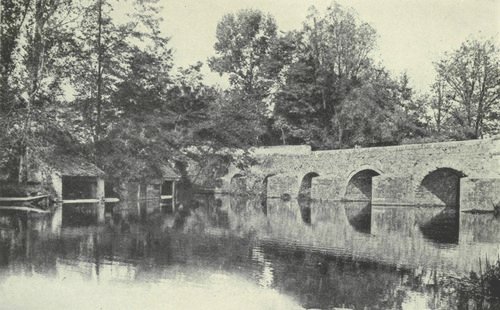
The bridge at Grez.
Previous to this time women artists had been practically unknown in
the colonies about Fontainebleau, and the men who haunted these places
were disposed to resent the coming of any of the other sex. The news
that an American lady and her two children had arrived at Grez spread
consternation among them, and they sent a scout, Mr. R. A. M.
Stevenson,[6] ahead to look over the situation and report. The choice
of scout was scarcely a wise one, for "Bob" Stevenson, as he was known
to his friends, instantly fell a victim to the attractions of the
strangers—who, by the way, were utterly unconscious that they were
regarded as intruders—and so he stayed on from day to day. After
waiting some time for the return of the faithless emissary, another,
Sir Walter Simpson, was sent, but he, too, failed to return. Then
Robert Louis Stevenson set out to look into the mystery. His coming
had been led up to like a stage entrance, for first his cousin had
told wonderful stories of adventures in which Louis was always the
hero—what Louis did, what Louis said—until the two
Americans, mother and daughter, began to get interested in this
fascinating person; and then came Sir Walter, with more stories of
Louis—stories that are now well known through An Inland Voyage.
One evening in the summer of 1876 the little party of guests at the
old inn sat at dinner about the long table in the centre of the
salle-à-manger with the painted panels—handiwork of artists who had
stopped there at various times. It was a soft, sweet evening, and the
doors and windows were open; dusk drew near, and the lamps had just
been lit. Suddenly a young man approached from the outside. It was
Robert Louis Stevenson, who afterwards admitted that he had fallen in
love with his wife at first sight when he saw her in the lamplight
through the open window.
The autumn months passed swiftly by after this meeting in an ideal
existence of work and play. Mrs. Osbourne worked industriously at her
painting, and as she sat at her easel the acquaintance between her and
the young Scotchman rapidly flowered into a full and sympathetic
understanding. Everything about this American family, speaking as it
did of a land of new and strange customs and habits of thought,
appealed strongly to the ardent young man. He was a devoted admirer of
Walt Whitman, and thought he knew America. The daughter, Isobel,
described by one of the members of the colony[7] at Grez as "a
bewitching young girl of seventeen, with eyes so large as to be out of
drawing," amazed and delighted him by the piquancy of the
contrast between her and the young women he had previously known. In a
girlish description given in one of her letters home, written at the
time, she says:
"There is a young Scotchman here, a Mr. Stevenson, who looks at me as
though I were a natural curiosity. He never saw a real American girl
before, and he says I act and talk as though I came out of a book—I
mean an American book. He says that when he first met Bloomer[8] he
came up to him and said in his western way: 'These parts don't seem
much settled, hey?' He laughed for an hour at the idea of such an old
place not being much settled. He is such a nice looking ugly man, and
I would rather listen to him talk than read the most interesting book
I ever saw. We sit in the little green arbor after dinner drinking
coffee and talking till late at night. Mama is ever so much better and
is getting prettier every day."
Again she writes:
"Yesterday I canoed to Nemours in Louis Stevenson's Rob Roy. We
generally congregate down in the garden by the big tree after dinner.
Mama swings in the hammock, looking as pretty as possible, and we all
form a group around her on the grass, Louis and Bob Stevenson babbling
about boats, while Simpson, seated near by, fans himself with a large
white fan."
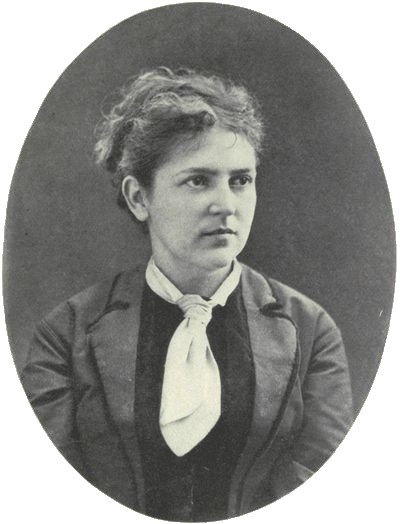
Fanny Osbourne at about the time of her first meeting
with Robert Louis Stevenson.
The little party in the old inn, "entirely surrounded by peasants," as
Bob Stevenson said, devised all sorts of sports, for which the river
afforded many opportunities. There was a huge old boat, a
double canoe, lying at the water's edge; this they put on rollers, and
after the entire party had climbed into it, persuaded the passing
peasants to come and push it off the bank, like a sort of "shoot the
chutes." Another game was to divide the canoes into bands, each under
a captain, and engage in a contest, each side trying to tip over the
enemy canoes. In all this hilarious fun Louis Stevenson was the
leader.
In the old hall they had great times, with dances, now and then a
performance by strolling players, and once a masquerade given by the
guests of the inn themselves, in which they dressed as gods and
goddesses in sheets and wreaths. Once when a couple of wandering
singers arrived after a disappointing season, the artists contributed
a purse and invited them to spend a week and rest. These people told
Stevenson the story he made into Providence and the Guitar, and the
money which he received for it he sent to them afterwards to help pay
for the education of their little girl in Paris.
But of all that went on at Grez the talks are remembered as the best,
for, notwithstanding their merry fooling in their idle hours, there
were brilliant minds among the company, and the conversation sparkled
with rare conceits.
Three summers the Osbournes returned to spend at Grez, lingering on
the last time until the snow came. A short visit was made to Barbizon,
too, and once when there the whole party had their silhouettes drawn
on the walls of the dining-room. This was done by placing a lamp so
that it threw a shadow of the face in profile on the wall,
then outlining the shadow and filling it in with black. Louis
Stevenson wrote verses to them all. The place was repainted the next
spring, which was to be regretted, for the walls were completely
covered with the most interesting silhouettes and drawings by painters
who later became famous, to say nothing of the verses made by
Stevenson, which would now have been a priceless memorial of those
youthful days.
Among the joyous coterie was the American painter Will H. Low, who
writes thus of Fanny Osbourne in his Chronicle of Friendships:
"One evening at Grez we saw two new faces, mother and daughter, though
in appearance more like sisters; the elder, slight, with delicately
moulded features and vivid eyes gleaming from under a mass of dark
hair; the younger of more robust type, in the first precocious bloom
of womanhood."
Another of the company, Mr. Birge Harrison, writing in the Century
Magazine of December, 1916, expresses his mature judgment of her as
he knew her at the little French village:
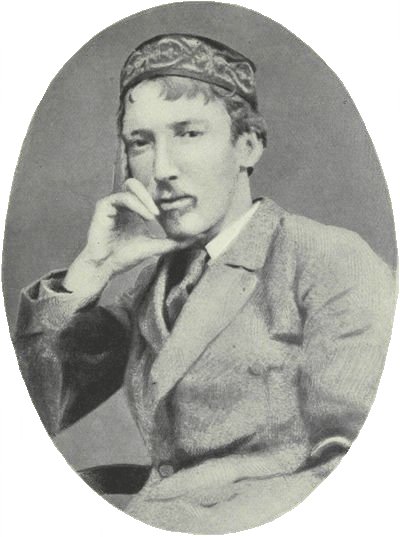
Robert Louis Stevenson in the French days.
"Among a few women who were doing serious work at this place was the
lady, 'Trusty, dusky, vivid, and true,' to whom Robert Louis Stevenson
inscribed the most beautiful love song of our time. Mrs. Osbourne
could not have been at that time more than thirty-five years of age—a
grave and remarkable type of womanhood, with eyes of a depth and
sombre beauty that I have never seen equalled—eyes, nevertheless,
that upon occasion could sparkle with humor and brim over with
laughter. Yet upon the whole Mrs. Osbourne impressed me as
first of all a woman of profound character and serious judgment, who
could, if occasion called, have been the leader in some great
movement. But she belonged to the quattrocento rather than to the
nineteenth century. Had she been born a Medici, she would have held
rank as one of the remarkable women of all time. That she was a woman
of intellectual attainments is proved by the fact that she was already
a magazine writer of recognized ability, and that at the moment when
Stevenson first came into her life she was making a living for herself
and her two children with her pen. But this, after all, is a more or
less ordinary accomplishment, and Mrs. Osbourne was in no sense
ordinary. Indeed, she was gifted with a mysterious sort of
over-intelligence, which is almost impossible to describe, but which
impressed itself upon every one who came within the radius of her
influence. Napoleon had much of this; likewise his arch enemy, the
great Duke of Wellington; and among women, Catherine of Russia and
perhaps Elizabeth of England. She was therefore both physically and
mentally the very antithesis of the gay, hilarious, open-minded and
open-hearted Stevenson, and for that very reason perhaps the woman in
all the world best fitted to be his life comrade and helpmate. At any
rate we may well ask ourselves if anywhere else he would have found
the kind of understanding and devotion which she gave him from the day
of their first meeting at Grez until the day of his death in far-away
Samoa; if anywhere else there was a woman of equal attainments who
would willingly, nay gladly, throw aside all of the
pleasures and comforts of civilization to live among savages, and the
still rougher whites of the South Pacific, in order that her husband
might have just a little more oxygen for his failing lungs, a little
more chance for a respite and an extension of his shortening years?
Probably no one ever better deserved than she the noble tribute of
verse which her husband gave her, and from which I have quoted the
opening line."
In 1878 the Osbournes returned to America, travelling by way of
Queenstown, where, for the sake of stepping on Irish soil, they went
ashore for a few hours and took a ride in a real jaunting-car, with a
driver who was as Irish as possible, with a thick brogue, a hole in
his hat, and a smiling, good-humoured countenance.
A short stop was made in Indiana to visit the old family home in
Hendricks County, now saddened by the death of our father, and then
Fanny Osbourne once more turned her steps towards the setting sun. At
this time she added me, her youngest sister, to her party, and I
remained with her until her marriage to Stevenson and their departure
for Scotland. She was then in the full flower of her striking and
unusual beauty, and so youthful in appearance that she, her daughter,
and I passed everywhere as three sisters. To me, reared as I had been
in the flat country of central Indiana, where mountains and the sea
were wonders known only through books, the journey across the
continent—with its glimpses of the mighty snow-capped crags of the
Rockies outlined against the fiery sunset skies of that region, the
weird castellated rocks of the "Bad Lands," the colonies of
funny little prairie-dogs peeping out of their burrows, the
blanket-wrapped Indians waiting at the stations, and finally the
awesome vision of the stupendous canyons and precipices of the
Sierras, was like some strange, impossible dream; and when at last we
came out into the warm sun and flowery brightness of California,
straight from the gloom and chill of an Indiana November, it was as
though the gates of paradise had suddenly opened.
Not long after her return to California, finding a reconciliation with
her husband to be quite out of the question, Mrs. Osbourne decided to
bring suit for divorce, which was eventually granted without
opposition.
In the meantime, being much run down in health as a result of these
harassing anxieties, she wished to seek rest in some quiet place free
from unpleasant associations. This she found in the charming little
coast town of Monterey, which was then still unspoiled by tourist
travel, and, taking her family with her, she went there for a stay of
several months. In the soft air and peaceful atmosphere of this place
her health and spirits soon revived. There she found an opportunity to
indulge her skill as a horsewoman, and at any time she might have been
seen galloping along the country roads on her little mustang,
Clavel.[9] She even joined a party of friends who accompanied a band
of vaqueros[10] in a great rodéo[11] on the San Francisquito ranch
near Monterey. We rode for days from station to station,
through a delightful country, under the feathery, scented redwoods and
beside clear mountain-streams in which the trout leaped. We slept in
barns on the hay or on the far-from-downy rawhide cots in the ranch
shanties, and subsisted on freshly killed beef hastily barbecued over
the campfire, coming back to Monterey sunburned to a fine mahogany.[Back to Contents]
As the months passed, Stevenson, drawn by an irresistible desire to
see the one who had become dearest in all the world to him, and having
heard that she was soon to be freed from the bonds that held her to
another, decided to take ship for America. After the long ocean voyage
and the fatiguing journey from sea to sea, which he has himself so
graphically described, he went straight to meet the family at
Monterey.
In the year 1879 there remained one spot in practical America where
the Spirit of Romance still lingered, though even there she stood
a-tiptoe, ready to take wing into the mists of the Pacific. It seems
fitting that it should have been at that place that I first knew
Robert Louis Stevenson. Although the passing of the years has dimmed
the memory of those days to a certain degree, yet here and there a
high light gleams out in the shadowy haze of the picture and brings
back the impression of his face and personality and of the
surroundings and little events of our daily life in his company as
though they had happened but yesterday. The little town of Monterey,
being out of the beaten track of travel, and having no mines or large
agricultural tracts in its vicinity to stimulate trade, had
dreamed away the years since American occupation, and still retained
much of the flavour of the pastoral days of Spanish California. It is
true that at the cascarone[12] balls—at which the entire
population, irrespective of age or worldly position, dressed in silks
or in flannel shirts, as the case might be, still gathered almost
weekly in truly democratic comradeship—the egg-shells were no longer
filled with gold-dust, as sometimes happened in the prodigal Spanish
days; yet time was still regarded as a thing of so little value that
no one thought of abandoning the pleasures of the dance until broad
daylight. Along the narrow, crooked streets of the little town, with
its precarious wooden sidewalks, the language of old Castile, spoken
with surprising purity, was heard more often than English. In fact, as
Mr. Stevenson himself says in his essay on The Old Pacific Capital:
"It was difficult to get along without a word or two of that language
for an occasion."
High adobe walls, topped with tiles, concealed pleasant secluded
gardens, from which the heavy perfume of the floribundia and other
semitropical flowers poured out on the evening air. Behind such a wall
and in the midst of such a garden stood the two-story adobe dwelling
of the Señorita Maria Ygnacia Bonifacio, known to her intimates as
Doña Nachita. In the "clean empty rooms" of this house,
furnished with Spanish abstemiousness and kept in shining whiteness,
"where the roar of the water dwelt as in a shell upon the chimney," we
had our temporary residence, and here Louis Stevenson came often to
visit us and share our simple meals, each of which became a little
fête in the thrill of his presence and conversation. Something he had
in him that made life seem a more exciting thing, better worth living,
to every one associated with him, and it seemed impossible to be dull
or bored in his company. It is true that he loved to talk, and one of
his friends complained that he was too "deuced explanatory," but it
seemed to me that the flood of talk he sometimes poured out was the
overflow of a full mind, a mind so rich in ideas that he could well
afford to bestow some of it upon his friends without hope of return.
His was no narrow vein to be jealously hoarded for use in his
writings, but his difficulty lay rather in choosing from the wealth of
his store. He once remarked that he could not understand a man's
having to struggle to "find something to write about," and perhaps it
is true that one who has to do that has no real vocation as a writer.
When he came to us at Monterey he was newly arrived in this country,
and seemed to be in a rather peculiar state of mind concerning it,
complaining that it was too much like England to have the piquancy of
a foreign land, and yet not enough like it to have the restfulness of
home, therefore it left him with a strange, unsatisfied feeling. One
of the things in the new land that pleased him much was its food, for
he believed in enjoying the good things of this life, and he
was like a second Christopher Columbus, just discovering green corn
and sweet potatoes. In a letter to his friend Sidney Colvin he says:
"In America you eat better than anywhere else; fact. The food is
heavenly!" During his first days at Monterey he kept singing the
praises of certain delectable "little cakes," which he had found much
to his liking in the railroad eating-houses while crossing the
continent. These were a great mystery to us until one day Ah Sing, the
Chinese cook, placed upon the table a plate of smoking-hot
baking-powder biscuits. Behold the famous "little cakes"!
The unexpected discovery in the town of Jules Simoneau, to whom he
refers in his letters as "a most pleasant old boy, with whom I discuss
the universe and play chess," a man of varied talents, who was able to
furnish him with an excellent dinner, as well as the intelligent
companionship that he valued more than food, was a great satisfaction
to him. Often we all repaired together to Simoneau's little
restaurant, where we were served meals that were a rare combination of
French and Spanish cookery, for our host's wife, Doña Martina, was a
native of Miraflores, in Lower California, and was skilled in the
preparation of the tamales[13] and carne con chile[14] of the
Southwest. It has always seemed to me that in the oft-told story of
the friendship between Jules Simoneau and Robert Louis Stevenson but
scant justice has been done to that uncommonly fine woman
Doña Martina, who, no doubt, had her part in caring for the writer
when he lay so ill in Monterey. Perhaps more often than not it was her
kind and skilful hand that prepared the broth and smoothed the pillow
for Don Roberto Luís, as she called him; and though she had but little
book knowledge, she was, in her native good sense, her well-chosen
language, and the dignity and courtesy of her manners, what people
call a "born lady." Mrs. Stevenson was profoundly grateful to Jules
Simoneau for his early kindness to her husband, and had a sincere
admiration for his wife as well. When he fell into straitened
circumstances in his old age, she went to his rescue and provided him
with a comfortable living during his last years. When he died she
followed him to his last resting-place, and afterwards erected a
suitable monument to mark it, only stipulating that the name of Doña
Martina should also be placed upon it, she having died some time
before him.
In the Señorita Bonifacio's garden, where we spent much of our time,
there was a riot of flowers—rich yellow masses of enormous
cloth-of-gold roses, delicate pink old-fashioned Castilian roses,
which the Señorita carefully gathered each year to make rose-pillows,
besides fuchsias as large as young trees, and a thousand other blooms
of incredible size and beauty. Loving them all, their little Spanish
mistress flitted about among them like a bird, alert, active,
bright-eyed, straight as an arrow, and as springy of step as a girl of
sixteen, although even then she was past her first youth.
As to flowers, it seemed to me that they made no particular
appeal to Mr. Stevenson except for their scent, in which he was very
like the rest of his sex the world over. He cared rather for nature's
larger effects—a noble cloud in the sky, the thunder of the surf on
the beach, or the fresh resinous smell of the pine forest.
To this house he came often of an afternoon to read the results of his
morning's work to the assembled family. While we sat in a circle,
listening in appreciative silence, he nervously paced the room,
reading aloud in his full sonorous voice—a voice that always seemed
remarkable in so frail a man—his face flushed and his manner
embarrassed, for, far from being overconfident about his work, he
always seemed to feel a sort of shy anxiety lest it should not be up
to the mark. He invariably gave respectful attention and careful
consideration to the criticism of the humblest of his hearers, but in
the end clung with Scotch pertinacity to his own opinion if he was
sure of its justice. In this way we heard The Pavilion on the Links,
which he wrote at Monterey, and read to us chapter by chapter as they
came from his pen. While there he also began another story which was
to have been called Arizona Breckinridge, or A Vendetta in the
West. This story, with its rather lurid title, was to have been based
upon some of his impressions of western America, but his heart could
not have been in it, for it was never finished. The name of Arizona
came out of his intense delight in the "songful, tuneful" nomenclature
of the United States, in which terms he refers to it in Across the
Plains. The name Susquehanna was a special joy to him, and
he took pleasure in rolling it on his tongue, adding to its music with
the rich tones of his voice, as he repeated it: "Susquehanna! Oh,
beautiful!" While on the train passing through Pennsylvania he wrote
some verses in a letter to Sidney Colvin about the beautiful river
with the "tuneful" name, of which one stanza runs thus:
"I think, I hope, I dream no more
The dreams of otherwhere;
The cherished thoughts of yore;
I have been changed from what I was before;
And drunk too deep perchance the lotus of the air
Beside the Susquehanna and along the Delaware."
Again, in writing the poem entitled Ticonderoga, it was the name
that first drew his attention, and
"It sang in his sleeping ears,
It hummed in his waking head;
The name—Ticonderoga."
Some story that we told him about a man who named his numerous family
of daughters after the States—Indiana, Nebraska, California,
etc.—took his fancy and suggested the name of Arizona Breckinridge to
him.
Out of the mist arise memories of walks along the beach—the long
beach of clean white sand that stretches unbroken for many miles
around the great sweeping curve of Monterey Bay, where we "watched the
tiny sandy-pipers, and the huge Pacific seas." Sometimes we walked
there at night, when the blood-red harvest-moon sprang suddenly like a
great ball of fire above the rim of horizon on the opposite
side of the circling bay, sending a glittering track across the water
to our very feet. To walk with Stevenson on such a night, and watch
"the waves come in slowly, vast and green, curve their translucent
necks and burst with a surprising uproar"—to walk with him on such a
night and listen to his inimitable talk is the sort of memory that
cannot fade. On other nights when the waters of the bay were all
alight with the glow of phosphorescence, we walked on the old wooden
pier and marvelled at the billows of fire sent rolling in beneath us
by the splashing porpoises.
Perhaps nothing about the place interested him more deeply than the
old mission of San Carlos Borroméo, once the home of the illustrious
Junípero Serra, and now the last resting-place of his earthly remains.
Within its ruined walls mass was celebrated once a year in honour of
its patron, Saint Charles Borroméo, and after the religious service
was over the people joined in a joyous merienda[15] under the trees,
during which vast quantities of tamales, enchiladas,[16] and other
distinctive Spanish-American viands were generously distributed to
friend and stranger, Catholic and Protestant. Mr. Stevenson attended
one of these celebrations, and was greatly moved by the sight of the
pitiful remnant of aged Indians, sole survivors of Father Serra's once
numerous flock, as they lifted their quavering voices in the
mass. He expressed much surprise at the clarity of their pronunciation
of the Latin, and in his essay on The Old Pacific Capital, he says:
"There you may hear God served with perhaps more touching
circumstances than in any other temple under Heaven.... These Indians
have the Gregorian music at their finger-ends, and pronounce the Latin
so correctly that I could follow the music as they sang." Much has
been changed since then, for the church has been "restored," and the
little band of Indians have long since quavered out their last mass
and gone to meet their beloved pastor, the saintly Serra.
Those were dolce-far-niente days at Monterey, dreamy, romantic days,
spent beneath the bluest sky, beside the bluest sea, and in the best
company on earth, and all glorified by the rainbow hues of youth. But,
as Mr. Stevenson prophesied, the little town was "not strong enough to
resist the influence of the flaunting caravanserai which sprang up in
the desert by the railway," and after the coming of the fashionable
hotel the commercial spirit came to life in the place. The tile-topped
walls, hiding their sweet secluded gardens, gave way to the new frame
or brick buildings, the narrow, crooked streets were straightened and
graded, the breakneck sidewalks replaced by neat cement pavements,
and, at last, the Spirit of Romance spread her wings and vanished into
the mists of the Pacific.
The setting of the picture is now changed to Oakland, across the bay
from San Francisco, where we lived for some months in the little house
which Mr. Stevenson himself describes in the dedication to
Prince Otto as "far gone in the respectable stages of antiquity, and
which seemed indissoluble from the green garden in which it stood, and
that yet was a sea-traveller in its younger days, and had come round
the Horn piecemeal in the belly of a ship, and might have heard the
seamen stamping and shouting and the note of the boatswain's whistle."
This cottage was of the variety known as "cloth and paper," a flimsy
construction permitted by the kindly climate of California, and on
winter nights, when the wind blew in strongly from the sea, its sides
puffed in and out, greatly to the amusement of the "Scot," accustomed
as he was to the solid buildings of his native land. It was, as he
says, "embowered in creepers," for over its front a cloth-of-gold rose
spread its clinging arms, and over one side a Banksia flung a curtain
of green and yellow.
It was during his stay in this house that we first realized the
serious nature of his illness, and yet there was none of the
depressing atmosphere of sickness, for he refused to be the regulation
sick man. Every day he worked for a few hours at least, while I acted
as amanuensis in order to save him the physical labour of writing. In
this way the first rough draught of Prince Otto was written, and
here, too, he tried his hand at poetry, producing some of the poems
that afterwards appeared in the collection called Underwoods,
although it is certain that he never believed himself to be possessed
of the true poetic fire. Brave as his spirit was, yet he had his dark
moments when the dread of premature death weighed upon him.
It was probably in such a mood that he wrote the poem called Not Yet,
My Soul, an appeal to fate in which he expressed his rebellion
against an untimely end.
"Not yet, my soul, these friendly fields desert,
.......
The ship rides trimmed, and from the eternal shore
Thou hearest airy voices; but not yet
Depart, my soul, not yet awhile depart.
.......
Leave not, my soul, the unfoughten field, nor leave
Thy debts dishonored, nor thy place desert
Without due service rendered. For thy life,
Up, spirit, and defend that fort of clay,
Thy body, now beleaguered."
While engaged in dictating, he had a habit of walking up and down the
room, his pace growing faster and faster as his enthusiasm rose. We
feared that this was not very good for him, so we quietly devised a
scheme to prevent it, without his knowledge, by hemming him in with
tables and chairs, so that each time he sprang up to walk he sank back
discouraged at sight of the obstructions. When I recall the sleepless
care with which Mrs. Stevenson watched over him at that critical point
in his life, it seems to me that it is not too much to say that the
world owes it to her that he lived to produce his best works.
But above and beyond his wife's care for his physical well-being was
the strong courage with which she stood by him in his hours of gloom
and heartened him up to the fight. Her profound faith in his genius
before the rest of the world had come to recognize it had a
great deal to do with keeping up his faith in himself, and her
discriminating taste in literature was such that he had begun even
then to submit all his writings to her criticism.
Although his own life work lay entirely in the field of letters, he
had a sincere admiration for work with the hands, and often expressed
his surprise at the mechanical cleverness of American women. He took
pleasure in seeing that we could cut, fit, and make our own clothing,
and do a pretty good job of it, too, and looked on at the operation
with serious interest, sometimes making useful suggestions, for he had
a genuine and unaffected sympathy with the work and aims of other
people, no matter how humble they might be. Any one could go to him
with a tale of daily struggle, of little ambitions bravely fought for,
even though it were nothing more than a job as waiter in a restaurant,
and be sure of his respectful consideration and sincere advice, always
granting that the ambition were honest and the fight well fought.
Sickness and discouragement were not enough to keep down his boyish
gaiety, which he sometimes manifested by teasing his womenfolk. One of
his favourite methods of doing this was to station himself on a chair
in front of us, and, with his brown eyes lighted up with a whimsical
smile, talk broad Scotch, in a Highland nasal twang, by the hour,
until we cried for mercy. Yet he was decidedly sensitive about that
same Scotch, and his feelings were much wounded by hearing me express
a horror of reading it in books.
A pleasant trivial circumstance of our life that comes to
mind is an occasion when we were all rejoicing in the possession of
new clothes—a rare event with any of us in those days, and Louis
proposed that we should celebrate this extraordinary prosperity by an
evening at the theatre. Women wore pockets then, but there had been no
time to provide my dress with one, so Louis agreed to carry my
handkerchief, but only on condition that I should ask for it when
needed in a true Scotch twang, "Gie me the naepkin!" a condition that
I was compelled to fulfill, no doubt to the surprise of our neighbours
at the theatre. Gilbert and Sullivan were in their heyday then, and
the play given that night was The Pirates of Penzance. Louis said
the London "bobbies" were true to life.
Chief among the amusements with which we tried to brighten the extreme
quietude of our lives in the little Oakland house was reading aloud.
We obtained books from the Mercantile Library of San Francisco, among
which I especially remember the historical works of Francis Parkman,
who was a great favourite with Mr. Stevenson. He had a theory that the
not uncommon distaste among the people for that branch of literature
was largely the fault of the dull style adopted by many historians,
and saw no good reason why the thrilling story of the great events of
the world should not be presented in a manner that would hold the
interest of readers. Yet he had no patience with the sort of writing
that subordinates truth to the desire of presenting a striking
picture. As an instance, certainly of rare occurrence in Parkman, he
noticed a paragraph in The Conspiracy of Pontiac, in which
the author refers to the shining of the moon on a certain night when a
party was endeavouring to make a secret passage down the river through
hostile country. He thought it unlikely that Parkman could have known
that the moon shone on that particular night, though it is possible
that he did him an injustice, for it sometimes happens that just such
a trivial circumstance is mentioned in the documents of the early
explorers.
Sometimes he read aloud to us from some French writer, translating it
into English as he read for our benefit. Les Étrangleurs was one of
the books that he read to us in this way, while we sat and sewed our
seams. He seemed to get a good deal of rest as well as amusement from
the reading of such books of mystery and adventure. His taste was
always for the decent in literature, and he was much offended by the
works of the writers of the materialistic school who were just then
gaining a vogue. Among these was Emile Zola, and he exacted a promise
from me never to read that writer—a promise that has been faithfully
kept to this day.
His stay at Monterey had given him a fancy to study the Spanish
language, so we obtained books and began it together. He had a theory
that a language could be best acquired by plunging directly into it,
but I have a suspicion that our choice of a drama of the sixteenth
century, one of Lope de Vega's, I think, was scarcely a wise one for
beginners. He refers to this venture of ours in a letter to Sidney
Colvin as "the play which the sister and I are just beating our way
through with two bad dictionaries and an insane grammar."
Nevertheless, we made some headway, and I remember that he marvelled
greatly at the far-fetched, high-flown similes and figures of speech
indulged in by the writers of the "Golden Age" of Spain. In spite of
his confessed dislike for the cold-blooded study of the grammar, we
did not altogether neglect it, and a day comes to my mind when he was
assisting me in the homely task of washing the dishes in the pleasant
sunny kitchen where the Banksia rose hung its yellow curtain over the
windows. We recited Spanish conjugations while we worked, and he held
up a glass for my inspection, saying: "See how beautifully I have
polished it, Nellie. There is no doubt that I have missed my vocation.
I was born to be a butler." "No, Louis," I replied, "some day you are
to be a famous writer, and who knows but that I shall write about you,
as the humble Boswell wrote about Johnson, and tell the world how you
once wiped dishes for me in this old kitchen!"
For the long evenings of winter we had a game which Louis invented
expressly for our amusement. Lloyd Osbourne, then a boy of twelve, had
rather more than the usual boy's fondness for stories of the sea. It
will be remembered that it was to please this boy that Mr. Stevenson
afterwards wrote Treasure Island. Our game was to tell a continued
story, each person being limited to two minutes, taking up the tale at
the point where the one before him left off. We older ones had a
secret understanding that we were to keep Lloyd away from the sea, but
strive as we might, even though we left the hero stranded in
the middle of the Desert of Sahara, Lloyd never failed to have him
sailing the bounding main again before his allotted two minutes
expired.
Many and long were the arguments that we had on the merits of our
respective countries, and I remember that Mr. Stevenson did not place
the sentiment of patriotism at the top of the list of human virtues,
for he believed that to concentrate one's affections and interest too
closely upon one small section of the earth's surface, simply on
account of the accident of birth, had a narrowing effect upon a man's
mental outlook and his human sympathies. He was a citizen of the world
in his capacity to understand the point of view of other men, of
whatsoever race, colour, or creed, and it was this catholicity of
spirit that made it possible for him to sit upon the benches of
Portsmouth Square in San Francisco and learn something of real life
from the human flotsam and jetsam cast up there by fate.
Of all the popular songs of America he liked Marching Through
Georgia and Dixie best. For Home, Sweet Home he had no liking,
perhaps from having heard it during some moment of poignant
homesickness. He said that such a song made too brutal an assault upon
a man's tenderest feelings, and believed it to be a much greater
triumph for a writer to bring a smile to his readers than a
tear—partly, perhaps, because it is a more difficult achievement.
Here the scene changes again, this time to San Francisco, the city of
many hills, of drifting summer fogs, and sparkling winter sunshine,
the old city that now lives only in the memories of those
who knew it in the days when Stevenson climbed the steep ways of its
streets. Although he had something about him of the ennui of the
much-travelled man, and complained that
"There's nothing under heaven so blue,
That's fairly worth the travelling to,"
yet no attraction was lost on him, and the Far Western flavour of San
Francisco, with its added tang of the Orient, and the feeling of
adventure blowing in on its salt sea-breezes, was much to his liking.
My especial memory here is of many walks taken with him up Telegraph
Hill, where the streets were grass-grown because no horse could climb
them, and the sidewalks were provided with steps or cleats for the
assistance of foot-passengers. This hill, formerly called "Signal
Hill," was used in earlier days, on account of its commanding outlook
over the sea, as a signal-station to indicate the approach of vessels
and give their class, and possibly their names as they neared the
city. When we took our laborious walks up its precipitous paths it
was, as now, the especial home of Italians and other Latin people. Mr.
Stevenson wondered much at the happy-go-lucky confidence, or perhaps
it was their simple trust in God, with which these people had built
their houses in the most alarmingly insecure places, sometimes hanging
on the very edge of a sheer precipice, sometimes with the several
stories built on different levels, climbing the hill like steps. About
them there was a pleasant air of foreign quaintness—little
railed balconies across the fronts, outside stairways leading up to
the second stories, and green blinds to give a look of Latin
seclusion.
In stories of his San Francisco days there is much talk of the
restaurants where he took his meals. The one that I particularly
remember was a place kept by Frank García, familiarly known as
"Frank's." This place, being moderately expensive, was probably only
frequented by him on special occasions, when fortune was in one of her
smiling moods. Food was good and cheap and in large variety in San
Francisco in those days, and venison steak was as often served up to
us at Frank's as beef, while canvasback ducks had not yet flown out of
the poor man's sight; so we had many a savory meal there, generally
served by a waiter named Monroe, with whom Mr. Stevenson now and then
exchanged a friendly jest. I remember one day when Monroe, remarking
on the depression of spirits from which Louis suffered during the
temporary absence of the women of his family, said: "I had half a mind
to take him in a piece of calico on a plate."
Once more the picture changes, now to the town of Calistoga—with its
hybrid name made up of syllables from Saratoga and California—where
we stayed for a few days at the old Springs Hotel while on our way to
Mount Saint Helena, to which mountain refuge Mr. Stevenson was fleeing
from the sea-fogs of the coast. The recollection of this journey seems
to have melted into a general impression of winding mountain roads, of
deep canyons full of tall green trees, of lovely limpid
streams rippling over the stones in darkly shaded depths where the
fern-brakes grew rankly, of burning summer heat, and much dust. At the
Springs Hotel we lived in one of the separate palm-shaded cottages
most agreeably maintained for the guests who liked privacy. On the
premises were tiny sheds built over the steaming holes in the ground
which constituted the Calistoga Hot Springs. It gave one a sensation
like walking about on a sieve over a boiling subterranean caldron.
Determined not to miss any experience, we each took a turn at a
steambath in these sheds, but the sense of imminent suffocation was
too strong to be altogether pleasant.
Then came the wild ride up the side of the mountain, in a six-horse
stage driven at a reckless rate of speed by its indifferent driver,
whirling around curves where the outer wheels had scarcely an inch to
spare, while we looked fearfully down upon the tops of the tall trees
in the canyon far below. If the horses slackened their pace for an
instant, the driver stooped to pick up a stone from a pile that he
kept at his feet and bombarded them into a fresh spurt. At the Toll
House, half-way up the mountain, which still exists in much the same
condition as in those days, we arrived as mere animated pillars of
fine white dust, all individuality as completely lost as though we had
been shrouded in masks and dominoes.
The Toll House was a place of somnolent peace and deep stillness,
broken only by a pleasant dripping from the wooden flume that brought
down the cold waters of some spring hidden in the thick green growth
far up on the mountainside. And such water! He who has once
tasted of the nectar of a California mountain spring "will not ask for
wine!" At the Toll House we had liberal country meals, with venison
steaks, served to us every day. Bear were still killed on the
mountain, but I do not remember having any to eat. From this place we
climbed, by way of a toilsome and stiflingly hot footpath running
through a tangle of thick undergrowth, to the old Silverado mine
bunk-house, where the Stevenson family took up their headquarters.
People said there were many rattlesnakes about, and now and then we
saw indubitable evidence of their presence in a long, spotted body
lying in the road, where it had been killed by some passer-by, but
fear of them never troubled our footsteps. In The Silverado
Squatters Mr. Stevenson says, "The place abounded with rattlesnakes,
and the rattles whizzed on every side like spinning-wheels," but I am
inclined to think that he often mistook the buzzing noise made by
locusts, or some other insect, for the rattle of the snakes.
The old bunk-house seemed to me an incredibly uncomfortable place of
residence. Its situation, on top of the mine-dump piled against the
precipitous mountainside, permitted no chance to take a step except
upon the treacherous rolling stones of the dump; but we bore with its
manifest disadvantages for the sake of its one high redeeming
virtue—its entire freedom from the fog which we dreaded for the sick
man. It was excessively hot there during the day, but there was one
place where coolness always held sway—the mouth of the old tunnel,
from whose dark, mysterious depths, which we never dared explore
for fear of stepping off into some forgotten shaft, a cold,
damp wind blew continuously. Just inside its entrance we established a
cold-storage plant, for there all articles kept delightfully fresh in
the hottest weather. When the coolness of the evening fell, "it was
good to gather stones and send them crashing down the chute," and
indeed this was almost our only pastime in our queer mountain eyrie.
The noise made by these stones as they went bounding down the chute
was sent back in tremendous rolling echoes by the mountains on the
opposite side of the valley, and it pleased us to liken it to the
noise heard by Rip Van Winkle, "like distant peals of thunder," made
by the ghosts of Hendrik Hudson's men playing at ninepins in the
Catskill Mountains.
Then back to San Francisco, where the only memory that remains is that
of a confused blur of preparations for leaving—packing,
ticket-buying, and melancholy farewells—for the time had come to
return to old Scotland to introduce a newly acquired American wife to
waiting parents.
One day Louis came in with his pockets full of twenty-dollar gold
pieces, with which he had supplied himself for the journey. He thought
this piece of money the handsomest coin in the world, and said it made
a man feel rich merely to handle it. In a jesting mood, he drew the
coins from his pockets, threw them on the table, whence they rolled
right and left on the floor, and said: "Just look! I'm simply lousy
wid money!"
Then came the parting, which proved to be eternal, for I never saw him
again; but perhaps it is better to remember him only as he
was then—before the rainbow hues of youth had faded.
To this picture, which represents my own personal recollections of the
California period,[17] something yet remains to be added. Many
obstacles seemed to block the path to happiness of these two people,
not the least of which was Louis's ill health and consequent inability
to earn a sufficient sum to support new obligations. To his great joy
this difficulty was finally smoothed away by a promise from his father
of an allowance large enough for their needs until such time as
restored health might bring about his independence. I remember the day
this word came from his father, and the exceeding happiness it gave
him. While it is true that his parents had at first objected to his
marriage, their objections were based, not on the matter of the
divorce, for they held extremely liberal views on that subject, but
simply on the fact of his choice being an American and a stranger.
They would, quite naturally, have preferred a daughter-in-law of their
own race and acquaintance, but both were intensely attached to their
only and gifted son, and, although his decision caused their own plans
to "gang agley," when they found that his mind was irrevocably made
up, they yielded without reserve, and prepared to welcome their new
daughter to their home and hearts. Writing at this time to his friend
Mr. Edmund Gosse, Stevenson expressed his satisfaction at the turn
affairs were taking in these words:
"Many of the thunderclouds that were overhanging me when
last I wrote have silently stolen away, like Longfellow's Arabs; and I
am now engaged to be married to the woman whom I have loved for three
years and a half. I will boast myself so far as to say that I do not
think many wives are better loved than mine will be."
When the rain-clouds at last rolled away, and the snow had melted from
the mountain-tops in the Coast Range, Fanny Osbourne and Robert Louis
Stevenson went quietly across the bay and were married, on May 19,
1880, by the Reverend Mr. Scott, with only Mrs. Scott and Mrs. Virgil
Williams as witnesses. It was a serious, rather than a joyous
occasion, for both realized that a future overcast with doubt lay
before them. In 1881 Stevenson wrote from Pitlochry in Scotland to Mr.
P. G. Hamerton:
"It was not my bliss that I was interested in when I was married; it
was a sort of marriage in extremis; and if I am where I am, it is
thanks to the care of that lady, who married me when I was a mere
complication of cough and bones, much fitter for an emblem of
mortality than a bridegroom."
As for her, she married him when his fortunes, both in health and
finances, were at their lowest ebb, and she took this step in the
almost certain conviction that in a few months at least she would be a
widow. The best that she hoped for was to make his last days as
comfortable and happy as possible, and that her self-sacrifice was to
receive the bountiful reward of fourteen rich years in his
companionship, during which time she was to see him win fame
and fortune by the exercise of his genius, was far from her dreams.
At the time of their marriage they took with them Mrs. Stevenson's
son, Samuel Lloyd Osbourne, her daughter having been married a short
time before to Joseph Strong, a well-known artist of the Pacific
Coast. Mr. Stevenson took this boy, then about twelve years of age, to
his heart as his own. In fact he always counted it as one of the
blessings that came through his wife that she brought to him, a
childless man, a son and daughter to be a comfort to him in all the
years of his life. In his talk at his last Thanksgiving dinner he
referred to this as one of his chief reasons for gratitude.
In the healing air of Mount Saint Helena the invalid grew better with
astonishing rapidity, and at the end of June he wrote to his mother:
"You must indeed pardon me. This life takes up all my time and
strength. I am truly better; I am allowed to do nothing, never leave
our little platform in the canyon nor do a stroke of work. No one to
see me now would think I was an invalid."
When, in 1883, his mother expressed surprise that such a rough place
should have been chosen for his cure, her daughter-in-law answered:
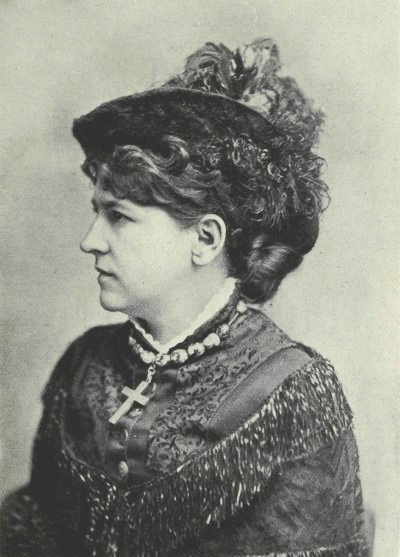
Fanny Osbourne at the time of her marriage to Robert
Louis Stevenson.
"You wonder at my allowing Louis to go to such a place. Why, if you
only knew how thankful I was to get there with him! I was told that
nothing else would save his life, and I believe it was true. We could
not afford to go to a 'mountain resort' place, and there was no other
chance. Then, on the other hand, the next day I put in doors and
windows of light frames covered with white cotton, with
bits of leather from the old boots (miners' boots found in the
deserted cabin) for hinges, made seats and beds, and got things to
look quite homelike. We got white and red wine, dried peaches and
fruits which we kept cool in the tunnel and which we enjoyed
extremely. Louis says nothing about the flowers, but the beauty of
them was beyond description, to say nothing of the perfume. At the
back door was a thicket of trees covered with cream-colored and
scarlet lilies. I have never seen the like anywhere in the world."
Again she writes from Calistoga, July 16, 1880, to the yet unknown
mother-in-law:
"As to my dear boy's appearance, he improves every day in the most
wonderful way, so that I fancy by the time you see him you will hardly
know that he has ever been ill at all. I do try to take care of him;
the old doctor insists that my nursing saved him; I cannot quite think
it myself, as I shouldn't have known what to do without the doctor's
advice, but even having it said is a pleasure to me. Taking care of
Louis is, as you must know, very like angling for shy trout; one must
understand when to pay out the line, and exercise the greatest caution
in drawing him in. I am becoming most expert, though it is an anxious
business. I do not believe that any of Louis's friends, outside of his
own family, have ever realized how very low he has been; letters
followed him continually, imploring, almost demanding his immediate
return to England, when the least fatigue, the shortest journey,
might, and probably would, have proved fatal; and, which at the moment
filled my heart with bitterness against them, they actually
asked for work. Now, at last, I think he may venture to make the
journey without fear, though every step must be made cautiously. I am
sure now that he is on the high road to recovery and health, and I
believe his best medicine will be the meeting with you and his father,
for whom he pines like a child. I have had a sad time through it all,
but it has been worse for you, I know. I am now able to say that all
things are for the best. Louis has come out of this illness a better
man than he was before; not that I did not think him good always, but
the atmosphere of the valley of the shadow is purifying to a true
soul; and though he may be no nearer your hearts than before, I
believe you will take more comfort in your son than you have ever
done. I trust that in about two weeks we shall be able to start, and
perhaps in less time than that. Please remember that my photograph is
flattering; unfortunately all photographs of me are; I can get no
other. At the same time Louis thinks me, and to him I believe I am,
the most beautiful creature in the world. It is because he loves me
that he thinks that, so I am very glad. I do so earnestly hope that
you will like me, but that can only be for what I am to you after you
know me, and I do not want you to be disappointed in the beginning in
anything about me, even in so small a thing as my looks. Your fancy
that I may be a business person is a sad mistake. I am no better in
that respect than Louis, and he has gifts that compensate for any
lack. I fear it is only genius that is allowed to be stupid in
ordinary things."
In this letter the natural trepidation with which she looked
forward to the meeting with her husband's parents, divided as they
were from her in race and customs, is evident. She was, as she
confessed to some of her friends, quite terrified at the prospect,
especially as concerned the elder Mr. Stevenson, whose portrait
represented a serious Scotchman with a stern, almost forbidding face,
firm mouth, and long upper lip. Her fear of her mother-in-law was
less, for from her she had had many affectionate and reassuring
letters. How utterly groundless her apprehensions were in this matter
we shall see later.
Notwithstanding the uncertainty of the future that lay before them,
they were both exceedingly happy in the fruition of their
long-frustrated plans, and for her it lifted a cloud that had rested
upon her spirits for years. One day in San Francisco, shortly after
the marriage, her daughter, upon entering a room, stopped with a
sudden shock, startled by the unaccustomed sound of a light happy
laugh, the first she remembered ever having heard from the lips of her
mother. For the first time she realized what a sad and bitter life
Fanny Osbourne's had been.
Louis's health now being considered strong enough for the journey,
they left their sunny eyrie on the mountainside in July, and on August
7, 1880, sailed from New York for England.[Back to Contents]
When the newly married pair reached Scotland all the fears of the
American bride vanished like mist before the sun, for her husband's
parents instantly took her to their hearts as though she had been
their own choice. In The Letters of Robert Louis Stevenson Sir
Sidney Colvin says:
"Of her new family Mrs. Robert Louis Stevenson, brought thus strangely
and from afar into their midst, made an immediate conquest. To her
husband's especial happiness, there sprang up between her and his
father the closest possible affection and confidence. Parents and
friends, if it is permissible for one of the latter to say as much,
rejoiced to recognize in Stevenson's wife a character as strong, as
interesting, and romantic as his own; an inseparable sharer of all his
thoughts, and staunch companion of all his adventures; the most
open-hearted of friends to all who loved him, the most shrewd and
stimulating critic of his work; and in sickness ... the most devoted
and efficient of nurses."
Mr. Edmund Gosse writes in the Century Magazine, 1895:
"He had married in California a charming lady whom we all learned to
regard as the most appropriate and helpful companion that Louis could
possibly have secured."
Concerning her relations with her mother-in-law, another
friend, Lady Balfour, writes:
"It is a testimonial both to her and to Mrs. Thomas Stevenson that
though they were as the poles apart in character, yet each loved and
appreciated the other most fully." How different they were in training
and ideas of life is illustrated by a trivial incident that occurred
when the younger woman was visiting at the home of her husband's
parents in Scotland. Her mother-in-law asked her if she never
"worked." In some surprise she replied that she had indeed worked, and
then found out that the elder lady meant fancy-work. Thereupon the two
went out shopping and bought all the things needful for a piano-cover
to be embroidered with roses. In a few days the piano-cover,
exquisitely finished, was triumphantly brought for Mrs. Thomas
Stevenson's inspection, but that lady, shocked at this American
strenuousness, threw up her hands and exclaimed: "Oh, Fanny! How could
you! That piece should have lasted you all summer!"
Thomas Stevenson, however, was far more formidable; to the female
members of his family his word was law, but to his pretty
daughter-in-law he capitulated—horse, foot, and dragoons—and his son
was heard to say that he had never seen his father so completely
subjugated. It is true, on the other hand, that she made every effort
to please him, and took pains not to offend his old-fashioned and
rigidly conventional ideas. For instance, when he objected to black
stockings, which were just then coming into vogue for ladies, she
yielded to his prejudice and always wore white ones while at
his house. He had a deep respect for her judgment in literary matters,
and made his son promise "never to publish anything without her
approval." This regard was mutual, and she said of him: "I shall
always believe that something unusual and great was lost to the world
in Thomas Stevenson. One could almost see the struggle between the
creature of cramped hereditary conventions and the man nature had
intended him to be." As his health failed he grew to depend upon her
more and more, and there was between them an interchange of much
friendliness and many little jests. A rather amusing thing happened
once when the two were together in London picking out furnishings for
the house he had bought for her at Bournemouth. One afternoon they
dropped in at a hotel for tea. It had been ordered by the doctors that
he should have bicarbonate of soda in his tea, which it seems he did
not like if he saw it put in, but if he did not see it never knew the
difference. When the tea was brought his daughter-in-law, having
diverted his attention, slyly dropped in the soda. Glancing up, she
saw in the looking-glass the reflection of the horrified face of the
waiter. When she told this story to her husband he immediately began
to weave a thrilling plot around the suspicion that might have fallen
upon her if her father-in-law had happened to die suddenly just then,
especially as his son was his chief heir. Uncle Tom, as she usually
called him, had all sorts of pet names for her, but the usual remark
was "I doot ye're a besom."[18] She was in all ways a true
daughter to him, a comfort in his old age and last distressing
illness, and when he died she mourned him sincerely.
To the Scotch servants in her mother-in-law's house she was something
of an enigma. One of them told her she "spoke English very well for a
foreigner." One day she heard two of them talking about a Mr. McCollop
who had just returned from Africa. "He's merrit a black woman," said
one, and in a mirror the other was seen to point to Mrs. Stevenson's
back and put her finger to her lips, as though to say: "Don't mention
black wives before her!"
It was soon seen that Louis could not face a Scotch winter, with its
raw winds and cold, drizzling rains, and sometimes his wife felt
regrets for the sunny perch on the California mountainside, where
health and strength had once come back to him so marvellously. It was
finally decided to try the dry, clear air of Davos Platz, in the high
Alps of Switzerland, which was just then coming into prominence as a
cure for lung diseases, and in October, 1880, the little family,
husband, wife, and the boy, Lloyd Osbourne, set forth on the arduous
journey thither.
To see publishers and for other necessary business, they stopped in
London on the way, where Mrs. Stevenson was much troubled lest her
husband should suffer harm from the thick, foggy atmosphere and the
fatigue of meeting people. Because he was too weak to see many
visitors, she kept them off, which threw a sort of mystery about him,
and led to his being called in London "the veiled prophet." The only
persons she had trouble with were the doctors, who were
themselves so fascinated by his conversation that they often stayed
too long. The task of keeping his parents informed of his state was
now added to her duties, and in letters to her mother-in-law from
London she says:
"As it is short and often that seems to be wanted, I thought I would
send off a note to-night to say that if nothing happens we leave
London to-morrow, and glad enough I shall be to get away.... For no
one in the world will I stop in London another hour after the time
set. It is a most unhealthful place at this season, and Louis knows
far too many people to get a moment's rest.... Company comes in at all
hours from early morning till late at night, so that I almost never
have a moment alone, and if we do not soon get away from London I
shall become an embittered woman. It is not good for my mind, nor my
body either, to sit smiling at Louis's friends until I feel like a
hypocritical Cheshire cat, talking stiff nothings with one and another
in order to let Louis have a chance with the one he cares the most
for, and all the time furtively watching the clock and thirsting for
their blood because they stay so late...."
The vigilant eyes of love had taught her by this time something yet
undiscovered by the scientists, that is, the contagious nature of
influenza, and, having observed that whenever her husband came in
contact with any one suffering from a cold, he invariably caught it—a
very serious matter for one in his condition—she kept guard over him
like a fiery little watch-dog, never allowing any one with a cold to
enter the house. If she had one herself she kept away from
him till it was over. There were many quarrels on the subject, for his
friends, some of whom refused to recognize the necessity for such
precautions, would be furious; but the worst trouble was with the
doctors themselves, who would come to attend him with sneezing and
snorting, and find their way blocked. One doctor said she was silly
about it, for it was absolutely impossible to catch a cold from
anything but an open window, or wet feet, or a draught. Her friends,
or rather Louis's friends, were well trained in time, and she would
sometimes get a message something like this: "I can't keep my
engagement to see Louis to-day, for I have a cold, but as soon as I am
over it I will let you know." Mr. Stevenson himself had a humourous
way of referring to persons with colds as "pizon sarpints," and
strangers may have wondered to hear him say: "I'm not seeing my friend
So-and-so just now, because he's a pizon sarpint." Once at Saranac, in
the Adirondack Mountains in America, their friends the Fairchilds came
to see them, but, as both had colds, they were not permitted to enter,
and conversed by signs with Mr. Stevenson through a closed window.
They were good-natured, however, about what they probably regarded as
Mrs. Stevenson's whim, and when both were well came again, waving from
a distance perfectly clean handkerchiefs as their passport.
Having at last escaped from the dreaded London fogs, they reached
Troyes in France, where Fanny's heart expanded under the brighter
skies that brought back memories of her own land. She writes: "We have
had lovely weather—warm, sunny, fragrant. I did not realize
before how much like America France is. The sky seems so high, and the
world so big and fresh." Reluctantly these two sun-loving people
turned their steps from this pleasant place towards the frozen heights
of Davos, where they arrived on November 4, and were pleased to find
congenial friends in John Addington Symonds and his wife.
Life was far from exciting in this remote place, and the shut-in
feeling of its situation, enclosed by hills and with no outlook,
sometimes made the sick man impatient, yet his health improved and he
was even able to take part in outdoor sports, such as tobogganing.
Mrs. Stevenson writes:
"Life is most monotonous here, which is after all the best thing for
Louis, although he tires of it sometimes. We have had a few badly
acted plays and one snowstorm; there was a quarrel between a lady and
her son's tutor, and a lady lost a ring. Otherwise the current of our
lives flows on without change.... I have made a couple of pretty caps
for the ladies' bazaar, and if I can get the use of a sitting room
will paint them some things.... We have an enormous porcelain stove
like a monument that reaches from the floor to the ceiling. It has,
however, to be fed only twice a day, and then not in great quantities.
Louis has long boots and is very proud of them. He said himself that
he looked like 'puss in boots,' but was much hurt because the
suggestion was received as a good one. He thought we would say: 'How
ridiculous! Why, you look just like a brigand!' But the great thing is
that the climate is doing Louis good. To have him recover entirely
will be so splendid that I must murmur at nothing." The last
is perhaps a reference to the bad effect of the altitude on her own
health, for her heart was so severely affected that she was compelled
to spend much of the time lying on a couch, and was finally obliged to
go away for a time.
These two were congenially alike in their careless indifference to the
minor details of life. Neither ever dated a letter, and both
invariably forgot all anniversaries, even having to be reminded of
their own wedding-day by his scandalized mother. What Mr. S. S.
McClure called Fanny Stevenson's "robust, inconsequential philosophy
of life" permitted her to accept with calm situations which would have
driven another woman to distraction. Even in that sad colony of the
sick she found compensations, and writing of this she says:
"It is depressing to live with dying and suffering people all about
you, but a sanatorium develops a great deal of human interest and
sympathy. Every one knows what the others should do, and each among
the patients helps to look after the rest. The path of duty always
lies so plain before other people's feet.... Then there are always
little kindnesses going on that warm the heart. The other morning I
told Louis I had dreamed that Alfred Cornish had made him a present of
his toboggan, and sure enough the first thing when Louis went out up
came Cornish and presented him with the toboggan. I had never thought
of such a thing and don't see why I dreamed it."
At Davos they had a great deal of trouble with their little
dog, Woggs, a beautiful but eccentric Skye terrier that had been given
them by Sir Walter Simpson. Both were tenderly considerate of animals,
and when this little creature was ill with a cankered ear they took
turns sitting up at night with him. She writes of him: "Woggs is
ill-tempered, and obstinate, and rather sly, but he is lovable and
intelligent. I imagine that it is with dogs as with people—it is not
for being good alone that we love them."
Here Stevenson wrote but little. Of his work she says:
"Louis is worried because he thinks he cannot write as gracefully as
he used to, but I believe his writing is more direct and stronger, and
that when he is able to join his old style with the new he will do
better work than he dreams of now. His later work is fuller of
thought, more manly in every way."
With the month of March came Mrs. Stevenson's birthday, and, to her
great surprise and confusion, it was made the occasion of a general
fête in which the whole colony took part. She thus describes the
affair:
"I was told there was to be a dance in the dining-room and cake and
ices in my honor, so Louis and I went down in the evening. I watched
the dancing awhile, when suddenly I found myself seated alone at the
end of the room. Judge of my surprise, and I must confess, dismay,
when I saw the two little Doney children, in Watteau costumes, looking
just like bits of porcelain painting, coming down the center towards
me, one bearing a large birthday cake and the other a bouquet of
flowers. The beautiful little creatures dropped on their
knees at my feet and presented their offerings. I suppose I should
have said something, but Louis said I did the best thing possible; I
only kissed both the darlings. Other people had had birthdays and only
received congratulations, so I felt horribly embarrassed by all these
grand doings in a public room, though I was very grateful for the
friendly feelings of those who arranged the affair."
The snow came late, but during the winter it lay deep and heavy on the
ground, making the roads almost impassable and their isolation more
complete. Both husband and wife began to feel an almost uncontrollable
depression amid these bleak surroundings, aggravated as they were by
many deaths among the patients. As spring approached Mrs. Stevenson
wrote:
"Louis is not very well and not very ill. Spring, I think, sits upon
him, and so also all these deaths and Bertie's[19] illness. As soon as
he is a little stronger the doctor is going to send him to some place
in the neighborhood for a change."
And she, to whom warmth and colour were a very part of her nature, was
an exotic, a lost tropic bird, in these icy mountains. In a letter to
her mother-in-law her heart cried out: "I cannot deny that living here
is like living in a well of desolation. Sometimes I feel quite frantic
to look out somewhere, and almost as though I should suffocate. But
may Davos forgive me! It has done so much for Louis that I am ashamed
to say anything against it."
In the latter part of April their discontent went beyond
endurance, and, believing his health now sufficiently improved to
warrant the risk, they turned their steps once more towards their
beloved France, where they spent a month between Barbizon, St.
Germain, and Paris.
In Paris their haunting Nemesis gave them a little breathing spell,
and when Louis's strength permitted, they wandered about the streets
in their own careless, irresponsible fashion, having a delightful time
poking into all sorts of strange places, in one of which he insisted
on spending practically his last sou for an antique watch for which
she had expressed admiration. "Now we'll starve," said she, but after
reaching home he happened to put his hand in the pocket of an old coat
and drew out an uncashed cheque which had been forgotten. One day when
out alone she went into a dismal-looking pawn-shop in a part of the
city that was not considered exactly safe. She was puzzled by the
evident superiority of the proprietor to his surroundings, and when he
invited her to follow him, she went without hesitation back through
winding passages until they stepped out into a beautiful garden, where
sat a charming invalid lady, wife of the pawnbroker. It seemed that
they were people who had fallen from a high estate, and, through
devotion to his wife, who was helplessly confined to her chair, he had
for years kept the secret of his occupation from her, and she had
lived in her garden like a fair flower, uncontaminated by the slums of
Paris. In this shop Mrs. Stevenson bought four rich mahogany posts,
part of an antique bedstead, which she used many years afterwards as
pillars in the drawing-room of her San Francisco house.
But alas, their pleasant jaunting soon came to an end, for Louis had a
relapse which brought desperate disappointment to them both, and of
which she writes to his mother: "I felt compelled to tell him that he
must be prepared for whatever may happen. Naturally the poor boy
yearned for his mother. I think it must be very sweet to you to have
this grown-up man of thirty still clinging to you with his child
love."
The setback dashed their spirits so severely that his conscientious
Scotch parents thought it their duty to lecture them on the sin of
ingratitude for the blessings that were still theirs. In great
contrition their daughter-in-law writes:
"I was just about to write when a double letter from you and Mr. Tommy
came to hand. When I read what Mr. Tommy said about gratitude I felt
more conscience-stricken than words can express. Neither Louis nor I
have any right to feel even annoyed about anything. Certainly God has
been good. I have seen others, apparently no more ill than Louis was
at one time, laid in their graves, and I see others, quite as ill,
struggling wearily for their daily bread. We see misery and
wretchedness on every hand, and here we sit, none of it touching us,
Louis feeling better, and both of us complaining shamefully because in
the smallest things the world does not go round smoothly enough for
us.... I fancy we shall start for Scotland Tuesday, but will travel
slowly on account of Louis's fatigue and nervous exhaustion from the
shaking of the train."
Edinburgh was reached on May 31, 1881, and a few days later,
accompanied by his mother, they went to Pitlochry, where they spent
two months in Kinnaird Cottage, on the banks of a lovely river. This
was a beautiful but inclement region, and cold winds and rain
prevailed almost constantly. The two ladies never ventured out without
umbrellas, and even then usually returned in a drenched condition.
Imprisoned by the weather, the sick man was compelled to spend all his
waking time in the sitting-room, where his confinement was made the
more penitential by the absence of books. It happened that the only
books in the house were two volumes of Voltaire, and these were taken
from the younger pair one dreary Sunday by their stern parents as not
proper "Sabba'-day" reading.
Thrown entirely on their own resources, they decided to write stories
and read them to each other. These tales, coloured by the
surroundings, were of a sombre cast. Here Thrawn Janet was begun. In
a preface, written years later, Mrs. Stevenson gives a graphic
description of the first writing of this gloomy but powerful story.
"That evening is as clear in my memory as though it were
yesterday—the dim light of our one candle, with the acrid smell of
the wick that we had forgotten to snuff, the shadows in the corners of
the 'lang, laigh, mirk chamber, perishing cauld,' the driving rain on
the roof close above our heads, and the gusts of wind that shook our
windows. The very sound of the names, 'Murdock Soulis, the Hangin'
Shaw in the beild of the Black Hill, Balweary in the vale of
Dule,' sent a 'cauld grue' along my bones. By the time the tale was
finished my husband had fairly frightened himself, and we crept down
the stairs clinging hand in hand like two scared children."
"Weather wet, bad weather, still wet, afraid to go out, pouring rain,"
appeared almost constantly in Mrs. Thomas Stevenson's diary, and
though Stevenson, whether inspired by home scenes or driven in upon
himself for relief from the outer dreariness, did some of his best
work here, it became clear that a more favourable spot must be sought.
From Pitlochry they went to Braemar, but that place proved to be no
improvement. Mrs. Stevenson writes of it in her preface to Treasure
Island:
"It was a season of rain and chill weather that we spent in the
cottage of the late Miss McGregor, though the townspeople called the
cold, steady, penetrating drizzle 'just misting,' In Scotland a fair
day appears to mean fairly wet. 'It is quite fair now,' they will say,
when you can hardly distinguish the houses across the street. Queen
Victoria, who had endeared herself greatly to the folk in the
neighborhood, showed a true Scotch spirit in her indifference to the
weather. Her Majesty was in the habit of driving out to take tea in
the open, accompanied by a couple of ladies-in-waiting. The road to
Balmoral ran not far behind the late Miss McGregor's cottage, and as
the Queen always drove in an open carriage, with her tea basket
strapped on behind, we could see her pass very plainly. Our admiration
for the sturdy old lady was very much tempered by our sympathy with
the ladies-in-waiting, with whom driving backward on the
front seat did not apparently agree. Their poor noses were very red,
and the expression of their faces anxious, not to say cross, as they
miserably coughed and sneezed."
At Braemar the working fever continued, and Treasure Island was
planned, but when autumn came they fled before the Scotch mists, and
once more wended their way to the frozen Alps, settling for the winter
in the Châlet am Stein. From mist to snow was but a rueful change, but
this time Louis's health seemed to gain greater benefit, and a
reasonable amount of work was accomplished.
So the level current of their lives flowed on through a rather mild
winter, with an occasional föhn[20] wailing about their châlet as
the "rocs might have wailed in the valley of diamonds," until one
morning they heard a bird sing, and soon the snow on the higher levels
began to melt and send the water with a rush down the sides of the
streets. Almost in a breath the hill slopes about them turned as white
with crocus blooms as they had been in their winter covering of snow.
Into their hearts something of the springtime entered, and one day
Louis sat singing beside his wife, who writes: "I do not care for the
music, but it makes me feel so happy to see him so well. When I wake
in the morning I wonder what it is that brings such a glow to my
heart, and then I remember!"
Yet it was then, as the flowers began to bloom and the birds to sing,
that many of those to whom they had become attached with the pitiful
bond of a common affliction broke the slender cord that held
them to life and quietly slipped away. Of these she writes: "Louis is
much cut up because a young man whom he liked and had been tobogganing
with has been found dead in his bed. Bertie still hovers between life
and death. Poor little Mrs. Doney is gone; my heart is sad for those
two lovely little girls. In a place like this there are many
depressing things, but it is encouraging to know that many are going
away cured."
Their own case had gone better, and Doctor Ruedi had given them leave
"to live in France, fifteen miles as the crow flies from the sea, and
if possible near a fir wood."
In April they left the Alps and ventured back to their misty island,
where they spent an unsatisfactory summer, moving from place to place
in a fruitless search for better weather. Several hemorrhages forced
them to the conclusion that they must be once more on the wing, and as
both felt an unconquerable repugnance to spending another winter at
bleak Davos, it was finally decided to go where their hearts led them,
and seek a suitable place in the south of France. As Mrs. Stevenson
was too ill just then to travel, the invalid, accompanied by his
cousin, Mr. R. A. M. Stevenson, started about the middle of September,
1882, for Marseilles. The wife's anxiety, however, gave her little
rest, and almost before she was able to stand she set out after him,
arriving in an alarmed and fatigued condition, of which he wrote to
his mother in his humourous way: "The wreck was towed into port
yesterday evening at seven P.M. She bore the reversed ensign
in every feature; the population of Marseilles, who were already
vastly exercised, wept when they beheld her jury masts and helpless
hull."
To her mother-in-law she wrote from here: "This is a lovely spot, and
I cannot tell you how my heart goes out to it. It is so like Indiana
that it would not surprise me to hear my father or mother speak to me
at any moment, and yet it is not like home either. The houses and the
ships look foreign, but the color of the sky and the quality of the
air, the corn, the grapes, the yellow pumpkins, the flowers, and the
trees, are the same. Everything seems as it is at home, steeped in
sunshine."
In a few days they found a house, the Campagne Defli, in the suburbs
of St. Marcel, "in a lovely spot, among lovely wooded and cliffy
hills," where they fondly hoped their pursuing fate would forget them
for a time. Of Campagne Defli she joyfully writes to her
mother-in-law: "Of all the houses in the world I think I should choose
this one. It is a garden of paradise, and I cannot tell you how I long
to have you here to enjoy things with me. It is such happiness to be
in a place that combines the features of the land where I was born and
California, where I have spent the best years of my life."
She set eagerly to work to turn this charming but neglected place into
a pleasant home, directing servants in the cleaning and scrubbing,
hanging curtains over draughty doors, repapering walls, putting fresh
coverings on old furniture, planting flowers and vegetables in the
garden—in fact, pouring out her Dutch housekeeping soul in a thousand
and one ways. The French servants, amazed at these
activities, thought she was very queer. Once when she was on a
step-ladder, with a hammer in her hand, putting up some pictures, she
heard some one whisper outside: "Elle est folle." As the two
servants came in she cried out indignantly, waving the hammer for
emphasis, "Pas folle! Beaucoup d'intelligence!" and then, losing her
balance, fell over, step-ladder and all, while the servants fled
shrieking. To her mother-in-law she writes: "For Louis's birthday I
found a violet blooming at the back of the house, and yesterday I
discovered in our reserve a large magnolia tree, the delight of my
heart. I am continually finding something new."
Two things were to her as a closed book: one was foreign languages and
the other was music. She could not sing a note nor hardly tell one
tune from another, yet she liked to listen to music. Her speaking
voice was low, modulated, and sweet, but with few inflections, and her
husband once compared it to the pleasantly monotonous flow of a
running brook under ice. As to languages, although she never seemed
able to acquire any extended knowledge of the tongue of any foreign
land in which she dwelt, she always managed in some mysterious way of
her own to communicate freely with the inhabitants. In Spanish she
only learned si, yet, supplemented with much gay laughter and many
expressive gesticulations, that one word went a long way. She writes
amusingly of this difficulty from Marseilles:
"Yesterday the servant and I went out shopping, which was difficult
for me, but, although she knows no English, she seems to
understand, as did the shopkeepers, my strange lingo. I had to put on
the manner of an old experienced shopper and housekeeper, and count my
change with great care, for it was important that I should impress
both the woman and the shop people with the notion that I knew what
was what. I have been in town all day, making arrangements with
butchers, buying an American stove—for the enormous gaudy French
range is of no account whatever—and even went and got my luncheon in
a restaurant, and all upon my pidgin French. To Louis's great
amusement I sometimes address him in it. I bought some cups and
saucers to-day of a man who said 'yes' to all I said, while to all his
remarks I answered 'oui.' The servant we have is very anxious to
please us, and I have finally got her to the length of bringing the
knives to the table cleaned; she could hardly believe at first that I
was serious in wanting clean knives when there was no company."
It was very pleasant to her to be received everywhere in France with a
warm cordiality on the ground of her being an American, and she tells
a little story about this in one of her letters:
"When I went in search of doctors I arrived in town at an hour when
they all refused to see me, being at luncheon. One man, however, had
not yet come in, though his luncheon was waiting for him, so I waited
too and caught him in his own hall. He was quite furious and said the
most dreadful things to his servant because she had let me in. I sat
in a chair and waited till he had done abusing her, and then
politely explained my errand. After much beating about the bush, he
gave me the information that I wanted, and then, to the astonishment
of his servant, went downstairs with me and put me into my cab with
the most impressive politeness. Just as I left he told me he had
allowed me to break his rule and spoil his lunch because I was an
American."
To their deep disappointment, Louis's health gained little or nothing
in this charming place, and for a time a heavy sadness fell upon his
wife, and in desperation her thoughts turned towards the frozen Alps,
which they both disliked and where she had suffered so much. She
writes: "I am sorry to say that Louis has had another hemorrhage. I
begin almost to think we had better go back to Davos and become
Symondses[21] and just stay there. Symonds himself, however, has taken
a cold and the weather there has not been good. I have news from Davos
that the well people that we knew are all dead and the hopeless cases
are all right."
Trouble with drains now came to add to their fear that beautiful
Campagne Defli would not do for their permanent home. An epidemic
broke out in St. Marcel, and many died. Mrs. Stevenson, stricken with
fear for her husband, hurried him off to Nice, while she, armed with a
revolver, remained behind to keep guard over their effects, the
situation of their place being lonely, and reports of robberies and
even murder in the neighbourhood having reached them.
In the next week or two a series of distressing events took
place which brought Mrs. Stevenson almost to the verge of nervous
prostration. The night before her husband's departure a peasant on the
estate died of the prevailing disease, and for some unknown reason the
body, much swollen and disfigured, was permitted to lie just outside
the gate during the entire morning. Next in the chapter of unfortunate
accidents was the failure to reach her of the promised telegram
announcing Louis's safe arrival at Nice. After four days' anxious
waiting she decided to follow him, and her subsequent adventures may
best be told in her own language as written to her mother-in-law:
"The fourth night I went to Marseilles and telegraphed to the gare
and the police at Nice. All the people said it was no use, and that it
was plain that he had been taken with a violent hemorrhage on the way
and was now dead and buried at some little station. They said all I
could do was to pack up and go back to Scotland. All were very kind in
a dreadful way, but assured me that I had much better accept what 'le
bon Dieu' had sent and go back to Scotland at once. After much
telegraphing back and forth I found that Louis was at the Grand Hotel
at Nice, and when I reached there he was calmly reading in bed. At St.
Marcel and Marseilles every one was furious with me; they were all
fond of Louis and said I had let a dying man go off alone. You may
imagine my feelings all this time!"
As though all that went before had not been enough, her return journey
to St. Marcel was made so uncomfortable by a tactless fellow passenger
that she arrived in a state of complete exhaustion. Of this
she writes:
"I have had a miserable time altogether, and the people, meaning to be
so kind, were really so dreadful. There was a man on the train, an
Englishman, who said such terrible things to me about Louis that when
we reached Marseilles another Englishman[22] who had been in the
carriage came to me and spoke about it, saying he had been so wretched
all the time. He insisted on stopping his journey a day to help me in
my affairs. Here is a specimen of the horrid person's talk: 'What are
you going to do when your husband dies?' 'I don't expect him to die.'
'Oh, I know all about that. I've heard that kind of talk before. He's
done for, and in this country they'll shovel him underground in
twenty-four hours, almost before the breath is out of his body. His
mother'll never see him again.' I do not speak but look intently out
of the window. Again he speaks, leaning forward to be sure that I hear
him. 'Have him embalmed; that's the thing; have you got money enough?'
Can you fancy five hours of this? I got out in the rain several times
to try to get into another carriage, but they were all filled. But I
never heard of anybody being so nice as Mr. Hammond was. I think he
was more proud to be able to help Louis and those belonging to him
than to help the Queen."
Anxious to prevent her husband's return to St. Marcel while conditions
were so unfavourable, she wrote to him: "Don't you dare to come back
to this home of 'pizon' until you are really better. I do
not see how you are to come back at all under the circumstances,
deserting your family as you have done and being hunted down and
caught by your wife. Madame desires me to say that she knows what is
keeping you in Nice—it is another lady. I told her that instead of
amusing yourself with another lady you were weeping for me and home
and your Wogg. She was greatly touched at that and almost wept herself
into her dishpan. You are a dear creature and I love you, but I am not
going to say that I am lonesome lest you come flying back to this den
of death." In the meantime he wrote her letters in which he expressed
his own loneliness in humourous verses, illustrated with drawings, one
of which runs like this:
"When my wife is far from me
The undersigned feels all at sea."
R. L. S.
"I am as good as deaf
When separate from F.
I am far from gay
When separate from A.
I loathe the ways of men
When separate from N.
Life is a murky den
When separate from N.
My sorrow rages high
When separate from Y.
And all things seem uncanny
When separate from Fanny."
"Where is my wife? Where is my Wogg?
I am alone, and life's a bog."
All his wife's expostulations, however, were of no avail, and, much to
her annoyance, it was not long before he appeared at Campagne Defli,
where she was busy packing up their effects for another flitting. She
writes to her mother-in-law:
"I don't wonder you ask what Louis is doing in Marseilles. He became
filled with the idea that it was shirking to leave me here to do all
the work. He was a good deal hurt, poor boy, because I wasn't pleased.
Wasn't it delightful about the article in the Century?[23] The
person was evidently writing in such an ecstasy of joy at having found
out Louis. I am so pleased that it was in the Century, for every
friend and relation I have in the world will read it. I suppose you
are even prouder of Louis than I am, for he is only mine accidentally,
and he is yours by birth and blood. Two or three times last night I
woke up just from pure pleasure to think of all the people I know
reading about Louis.... He is incredibly better, and I suppose will
just have to stay in Marseilles until I get done with things, for
nothing will keep him away from me more than a week. It is so
surprising, for I had never thought of Louis as a real domestic man,
but now I find that all he wanted was a house of his own. Just the
little time that we have been here has sufficed for him to
form a quite passionate attachment for everything connected with the
place, and it was like pulling up roots to get him away. I am quite
bewildered with all the letters I have to write and all the things I
have to do. For the present I think we shall have to cling to the
little circle of country around Nice, so when you come it must be
somewhere there."
After some search they finally decided upon Hyères, and by the latter
part of March had once more hopefully set up their household goods in
a little cottage, the Châlet la Solitude, which clung to a low cliff
almost at the entrance of the town. This house had been a model Swiss
châlet at the Paris Exposition of 1878, and had been removed and again
erected at Hyères, where, amid its French neighbours, it was an
incongruous and alien object. Mrs. Stevenson writes of it: "It is the
smallest doll house I ever saw, but has everything in it to make it
comfortable, and the garden is magnificent. The wild flowers are
lovely, and the walks, all so close at hand, most enchanting."
In the garden grew old grey olive-trees, and in them nightingales
nested and sang. On the rocky crags above stood the ruins of an
ancient Saracen castle, and before them lay the sea—indeed a "most
sweet corner of the universe." Not far away were the rose farms of
Toulon, of which Mrs. Stevenson writes:
"I shall never forget the day my husband and I drove through lanes of
roses from which the attar of commerce is made. On either side of us
the rose hedges were in full bloom; the scent, mingled with
the fragrance of innumerable violets, was truly intoxicating. When we
alighted at a place dappled with sunlight that filtered through the
trees, and cooled by a spouting fountain where girls in colored gowns
laughed and chattered as they plied their trade of lace-making, we
felt that our lines had indeed fallen in pleasant places."
In this charming spot it seemed for a time that their pursuing fate
had forgotten them, and for the greater part of a year happiness sat
by their fireside. Louis always referred to this time as the happiest
period of his life, and in a letter to his old friend in California,
Jules Simoneau, he says: "Now I am in clover, only my health a mere
ruined temple; the ivy grows along its shattered front, otherwise I
have no wish that is not fulfilled; a beautiful large garden, a fine
view of plain, sea, and mountain; a wife that suits me down to the
ground, and a barrel of good Beaujolais."
Under these happy conditions much work was accomplished, and, to the
great pride and satisfaction of both husband and wife, they were at
last able to live upon his earnings. Their almost idyllic life here is
described by Mrs. Stevenson:
"My husband was then engaged on Prince Otto, begun so long ago in
the little rose-covered cottage in Oakland, California. Our life in
the châlet was of the utmost simplicity, and with the help of one
untrained maid I did the cooking myself. The kitchen was so narrow
that I was in continual danger of being scorched by the range on one
side, and at the same time impaled by the saucepan hooks on
the other, and when we had a guest at dinner our maid had to pass in
the dishes over our heads, as our chairs touched the walls of the
dining-room, leaving her no passageway. The markets of Hyères were
well supplied, and the wine both good and cheap, so we were able, for
the first time, to live comfortably within our limited income.
"My husband usually wrote from the early morning until noon, while my
household duties occupied the same time. In the afternoon the work of
the morning was read aloud, and we talked it over, criticising and
suggesting improvements. This finished, we walked in our garden,
listened to the birds, and looked at our trees and flowers; or,
accompanied by our Scotch terrier, wandered up the hill to the ruins
of the castle. After dinner we talked or read aloud, and on rare
occasions visited Mr. Powell or received a visit from him. The châlet
was well named, as far as we were concerned, for it was almost a
solitude à deux, but the days slipped by with amazing celerity."
Their mutual affection and their dependence upon each other grew as
the years went by, and in 1884 he wrote to his mother: "My wife is in
pretty good feather; I love her better than ever and admire her more;
and I cannot think what I have done to deserve so good a gift. This
sudden remark came out of my pen; it is not like me; but in case you
did not know, I may as well tell you, that my marriage has been the
most successful in the world.... She is everything to me; wife,
brother, sister, daughter, and dear companion; and I would not change
to get a goddess or a saint. So far, after four years of matrimony."
At another time he wrote: "As for my wife, that was the best
investment ever made by man; but 'in our branch of the family' we seem
to marry well. Here am I, who you were persuaded was born to disgrace
you, no very burning discredit when all is said and done; here am I
married, and the marriage recognized to be a blessing of the first
water—A1 at Lloyds."
As Christmas, 1883, approached, their content seemed to reach its
highest tide, and out of a full heart Mrs. Stevenson wrote to her
mother-in-law:
"What a Christmas of thanksgiving this should be for us all, with
Louis so well, his father so well, everything pointing to comfort and
happiness. Louis is making such a success with his work, and doing
better work every day. Dear mother and father of my beloved husband, I
send you Christmas greetings from my heart of hearts. I mean to have a
Merry Christmas and be as glad and thankful as possible for all the
undeserved mercies and blessings that have been showered upon me."
They snatched at these moments of respite from eating care with an
almost pathetic eagerness, and set to work once more to make a home in
their doll's house. Mrs. Stevenson had what she called a "painting
fever," and devised a scheme of Japanese decorations for the doors of
the châlet which her husband thought might be made to produce a lot of
money if they were nearer London. One of the panels had a woman
yawning over a fire in the early morning, and the hypnotic effect of
it kept the family and their guests yawning their heads off, so that
Mrs. Stevenson decided the sleepy lady would be better for a
bedroom.
Among their acquaintances here was a certain doctor who was such an
inveterate optimist that he could have given lessons even to Louis
Stevenson himself. She says of him: "This doctor has bought a piece of
land here upon which he expects to build a house and settle down when
he retires from practice. How old do you suppose he will be when he
stops work and settles down to enjoy life? Only ninety-one, and
subject to hemorrhages and other things! It seems to be the received
opinion that when one passes the age of sixty-three years life takes a
new start and one may live to almost any age. As to Louis, I verily
believe he is going to be like the old doctor, only a little better
looking, I hope."
Notwithstanding the cramped quarters in the little châlet their
solitude was broken now and then by a visitor. Thither went at various
times "Bob" Stevenson, Sir Sidney Colvin, Mr. Charles Baxter, Mr. W.
E. Henley, and Miss Ferrier. The pleasurable excitement of this
society, to which he had been so long a stranger, raised Mr.
Stevenson's spirits to such an extent that he rashly proposed an
expedition to Nice, where he took cold, developed pneumonia, was
critically ill for weeks, and returned to Hyères still in a very low
condition. This was one of the most harrowing periods of Mrs.
Stevenson's life, and she tells of its distresses in a letter written
to her mother-in-law in January, 1884:
"If I write like a mad creature do not be surprised, for I have had a
period of awful wretchedness. Louis fell ill, and when the
doctor came he beckoned to me to follow him, and then told me Louis
was dying and could not be kept alive until you could get here. That
was yesterday. I watched every breath he drew all night in what
sickening apprehension you may guess. To-day another doctor, Dr.
Drummond, was called in, and says that Louis may well live to be
seventy, only he must not travel about. He is steadily better and is
reading a newspaper in bed at this moment. I, who have not slept a
wink for two nights, am pretending to be the gayest of the gay, but in
reality I am a total wreck, although I am almost off my head with
relief and joy."
As soon as the patient had sufficiently recovered they returned to
Hyères, but there new troubles awaited them. His eyes became so
severely affected by a contagious ophthalmia then prevailing in the
neighbourhood that he had to give up using them for several weeks,
sciatic rheumatism confined him to bed, and his right arm was bound to
his side to prevent hemorrhage. In the midst of all these afflictions
he refused to be cast down and insisted that everything was for the
best, for he was now forced to take a much-needed rest which he would
not otherwise have taken. On March 25, 1884, she writes to his mother:
"I am not very good at letter writing since I have been doing blind
man's eyes, but here is a note to say that the blind man is doing very
well, and I consider the blindness a real providence. Since he has
been unable to read or do anything at all a wonderful change has come
over his health, spirits, and temper, all for the better....
I wish you could see him with his eye tied up and singing away like
mad; truly like mad, as there is neither time nor method in it, only a
large voice. I am horribly busy, for I have to write for Louis from
dictation, answer all his letters, as well as my own, keep house,
entertain visitors, and do a good deal of the cooking. Our Wogg is an
invalid, having got himself badly mangled in several fights, the maid
is ill with symptoms of pleurisy, and altogether we are a forlorn
household, but with all this Louis and I are in high spirits. He says
it is wonderful how well one gets along without reading. He could
never have believed it."
Perhaps partly for the purpose of getting her out for a little fresh
air, he proposed that she should go for an hour's walk every day, and
during her absence invent a story to be told on her return. It was to
be a sort of Arabian Nights' Entertainment, with him as the Sultan and
her as Scheherazade. The Dynamiter was suggested by certain
attempted outrages in London which had all turned out to be fiascos.
She began with the Mormon tale and followed with the others, one for
each afternoon. Afterwards, when a lean time came at Bournemouth and
money was badly needed, these stories, temporarily forgotten, were
recalled, written, and published as the second volume of the New
Arabian Nights series. As there was only enough for a thin book he
wrote another, The Explosive Bomb, to fill up. It came out at first
under the title of More New Arabian Nights, but afterwards appeared
as The Dynamiter. Of the stories in this second series only one,
The Explosive Bomb, was entirely the work of Mr.
Stevenson's own hand, all the others being done in collaboration with
his wife. The Dynamiter did double service, as his wife said, for
first it amused his tedious hours of illness at Hyères, and afterwards
it replenished his purse in a time of need.
Their peaceful life in the châlet was now broken by a new and most
unexpected interruption. Mrs. Stevenson writes in her preface to The
Dynamiter:
"So quiet and secluded was our life here that we heard almost nothing
of the outside world except through an occasional English
correspondent. I remember before we knew that cholera was raging in
Toulon, only some three miles away, how we watched a cloud gathering
over the town, where it hung heavy and lowering, day after day. We
felt that it was somehow ominous, and were vaguely depressed. We were
told afterwards that at that very time great fires were burning in the
streets of Toulon by order of the mayor, and that the people gathered
at night around these fires capering fantastically in a pagan dance,
resurrected from the dark ages no one knew by whom or how."
To add to the alarm caused by the outbreak of the cholera, in the
first week in May Mr. Stevenson had a violent hemorrhage. "It occurred
late at night, but in a moment his wife was at his side. Being choked
by the flow of blood and unable to speak, he made signs to her for a
paper and pencil, and wrote in a firm neat hand, 'Don't be frightened.
If this is death it is an easy one.' Mrs. Stevenson had always a small
bottle of ergotin and a minim glass in readiness; these she
brought in order to administer the prescribed quantity. Seeing her
alarm he took bottle and glass away from her, measured the dose
correctly with a perfectly steady hand, and gave the things back to
her with a reassuring smile."[24] It was said that if his wife had not
had everything ready and known exactly what to do he could not have
lived. The clergyman came to pray with the supposed dying man, but,
having been warned against the least excitement, she refused him
admittance. In defense of her action she says: "I know Louis, and I
know that he tries always to so live that he may be ready to die."
When Mr. Stevenson heard that a clergyman had come to pray for him as
a man in danger of dying, he said: "Tell him to come and see me when I
am better and I will offer up a prayer for a clergyman in danger of
living." In a few days he rallied once more, but it was now realized
that chronic invalidism was to be his portion for the rest of his
days, and his wife wrote to her mother-in-law:
"The doctor says 'keep him alive until he is forty, and then, though a
winged bird, he may live to ninety.' But between now and forty he must
live as though he were walking on eggs. For the next two years, no
matter how well he feels, he must live the life of an invalid. He must
be perfectly tranquil, trouble about nothing, have no shocks or
surprises, not even pleasant ones, must not eat too much, talk very
little, and walk no more than can be helped. He must never be crossed,
for anger, going upstairs, and walking are the worst things for
him.... Yet he is very cheerful and has been all along. He
is never frightened."
Driven from Hyères by the cholera, they sought a temporary refuge at
an enchanting little watering-place near Clermont-Ferrand called
Royat, in whose healing springs Cæsar himself had once bathed. The
surroundings, of wooded ravines and cliffs and numberless waterfalls,
were charming, and in the centre of the town stood an ancient
cathedral, whose former use as a fortress was still proclaimed by the
loopholes in its walls and the hooded projections on its towers.
In this romantic place they spent the summer in the company of his
parents, who came to visit them, but the joy of this meeting was
tempered by the failing health and spirits of the father, who was now
only able to keep up a semblance of cheerfulness in the presence of
his son.
At the end of the summer of 1884 they returned to Hyères, but the
prospect of a permanent recovery there seemed so slight that it was
finally decided to go to England and seek medical advice. On the 1st
of July they reached England, and shortly afterwards went to London to
consult Sir Andrew Clark and other eminent physicians. Mrs. Stevenson
writes from there: "I suppose it comes from being so long a recluse,
but seeing the few people I have seen has quite shattered my nerves,
so that I tremble and can hardly speak. Louis, on the contrary, is
quite calm, and is at this moment, after a hearty meal, resting
quietly in his bed."
Snatching at a half-hearted permission given by some of the doctors to
remain in England, their decision being assisted by the
desire to be near his father, whose health was rapidly failing, they
went to Bournemouth for a trial of its climate and conditions. Nothing
untoward having occurred by the end of January, the elder Stevenson
purchased a house there as a present to his daughter-in-law. Both the
wanderers were filled with inexpressible joy at the prospect of living
under their own rooftree, and at once plunged with ardour into the
business of furnishing and gardening. The first thing was to change
the name of the place to Skerryvore, in honour of the best known of
the lighthouses built by the Stevenson family, the name being partly
suggested by the fact that a distant view of the sea was to be had
from the upper windows.
Skerryvore was a pleasant, ivy-covered brick cottage, surrounded by a
half-acre of garden, which has been so delightfully described by
William Archer in the Critic of November 5, 1887, that one can do no
better than quote his words:
"Though only a few paces from the public road, it is thoroughly
secluded. Its front faces southward (away from the road) and overlooks
a lawn,
'Linnet haunted garden ground,
Where still the esculents abound.'
"The demesne extends over the edge, and almost to the bottom of the
Chine; and here, amid laurel and rhododendron, broom and gorse, the
garden merges into a network of paths and stairways, with tempting
seats and unexpected arbors at every turn. This seductive little
labyrinth is of Mrs. Stevenson's own designing. She makes
the whole garden her special charge and delight, but this particular
corner of it is as a kingdom conquered, where to reign. Mrs.
Stevenson, the tutelary genius of Skerryvore, is a woman of small
physical stature but surely of heroic mould. Her features are clear
cut and delicate, but marked by unmistakable strength of character;
her hair is an unglossy black, and her complexion darker than one
would expect in a woman of Dutch extraction.... Her personality, no
less than her husband's, impresses itself potently on all who have the
good fortune to be welcomed at Skerryvore."
Writing to her mother-in-law from Bournemouth, she says:
"I have just been going the rounds of my garden, and have brought in
as a sentimental reminder of you the first marguerite,[25] which I
will enclose in this letter. The weather is like paradise, the sun is
shining, the birds are singing, and Louis is walking up and down in
front of the house with a red umbrella over his head, enjoying the
day.... I could only ask one thing more to have the most perfect life
that any woman could have, and that is, of course, good health for
Louis.... I should be perfectly appalled if I were asked to exchange
his faults for other people's virtues."
Three years were spent at this pleasant place, and though Louis's
health was never good, and he lived there, as he afterwards wrote,
"like a pallid weevil in a biscuit," a great deal was accomplished in
literary work by both husband and wife. There they put
together the stories in The Dynamiter, which, as will be remembered,
Mrs. Stevenson had made up to while away the hours of illness at
Hyères. When the book came out little credit was given her by the book
reviewers for her part in it, a neglect which caused her some
mortification. Writing to her mother-in-law, she says: "I thought in
the beginning that I shouldn't mind being Louis's scapegoat, but it is
rather hard to be treated like a comma, and a superfluous one at that.
And then in one paper, the only one in which I am mentioned, the
critic refers to me as 'undoubtedly Mr. Stevenson's sister.' Why,
pray? Surely there can be nothing in the book that points to a sister
in particular."
The morning after her husband had the dream that suggested Dr. Jekyll
and Mr. Hyde, he came with a radiant countenance to show his work to
his wife, saying it was the best thing he had ever done. She read it
and thought it the worst, and thereupon fell into a state of deep
gloom, for she couldn't let it go, and yet it seemed cruel to tell him
so, and between the two horns of the dilemma she made herself quite
ill. At last, by his request and according to their custom, she put
her objections to it, as it then stood, in writing, complaining that
he had treated it simply as a story, whereas it was in reality an
allegory. After reading her paper and seeing the justice of her
criticism, with characteristic impulsiveness he immediately burned his
first draft and rewrote it from a different point of view. She was
appalled when he burned it, for she had only wanted him to change it,
but he was afraid of being influenced by the first writing
and preferred to start anew, with a clean slate.
Their discussions over the work were sometimes hot and protracted, for
neither was disposed to yield without a struggle. Speaking of this in
a letter to his mother, she says: "If I die before Louis, my last
earnest request is that he shall publish nothing without his father's
approval. I know that means little short of destruction to both of
them, but there will be no one else. The field is always covered with
my dead and wounded, and often I am forced to a compromise, but still
I make a very good fight." In this battle of wits they found intense
enjoyment, and it was, in fact, an intellectual comradeship that few
writers have been fortunate enough to enjoy in their own households.
While at Bournemouth an occasional respite from illness enabled them
to enjoy the society of friends in a limited way—among them their
neighbours, Sir Percy and Lady Shelley, Sir Henry Taylor and his
daughters, and many people of note who came down from London to see
them. The incidents of these friendships have been fully dealt with in
Balfour's Life of Robert Louis Stevenson, and need not be treated
extensively here. One of their neighbours, Miss Adelaide Boodle, who
was given the jocose title of "gamekeeper" when she assumed charge of
Skerryvore after their departure from England, writes thus of her
attachment to Mrs. Stevenson: "Among all her friends here there was
never one who loved her more whole-heartedly than her 'gamekeeper,' to
whom in after years she gave the sweet pet name of the 'little
brown deer.' From the first day that we met at Skerryvore
she took entire possession of my heart, and there she will forever
bear sway. There is an old gardener here, too, who was her devoted
slave at Skerryvore. Of course she never trusted him the length of her
little finger, but she used him as extra hands and feet. Her parting
charge to me—given in his presence—has never been forgotten by
either of us: 'Remember, child, if you ever see Philips approach my
creepers with a pruning knife you are to snatch it from his hand and
plunge it into his heart!"
Among the visitors was John Sargent, the American painter, who came to
paint Mr. Stevenson's portrait—a picture which was regarded as too
peculiar to be satisfactory. When Sargent painted it he put Mrs.
Stevenson, dressed in an East Indian costume, in the background,
intending it, not for a portrait, but merely as a bit of colour to
balance the picture. It was a part of the costume that her feet should
be bare, and this fact gave rise to a fantastic story that has often
gone the rounds in print, and will probably continue to do so till the
end of time, that when she first came to London she was such a savage
that she went to dinners and evening entertainments barefoot. This was
but one of the many strange tales that appeared from time to time
concerning her, all of which she refused to contradict, no matter how
false or malicious they might be, for she felt that the name she bore
was not to be lowered by appearing in stupid or ridiculous
controversy; for that reason she would never see newspaper reporters,
and though many so-called "interviews" with her have been printed,
none of them are genuine. She was misrepresented by the
press in many ways, and even wantonly attacked, but refused to break
her rule under any circumstances. During the last days of Jules
Simoneau, of Monterey, a statement appeared in the papers to the
effect that he was being permitted to suffer and die in want, and
although it was perfectly well known to her friends and many other
persons that she had supported him in comfort for years, she would not
make any contradiction in the public press.
One of the interesting people she met while in England was Prince
Kropotkin, the noted Russian revolutionist. Mrs. Stevenson, believing
that Kropotkin was concerned in the blowing up of a French village
while a country fair was in progress, resulting in the killing of a
number of innocent people, prevented her husband from signing a
petition that was instituted for his release from the French prison
where he was confined. When he was finally freed and went to England,
at the urgent request of Henry James she consented to meet him, and
found him to be a most charming person. He assured her that, judging
from the expression of her eyes, she was born to be a nihilist, and
when she indignantly denied this, still insisted that she should learn
to play the game of solitaire, for if she should ever have to go to
prison it might save her life and reason, as it had his. She
consented, not with the anticipation of spending any portion of her
life behind prison-bars, but in order to use the game to amuse her
husband during his long periods of forced and speechless seclusion.
She would sit by his bedside and play her game, and he took
great pleasure in watching it and pointing at the cards that he
thought she ought to play. In later years, when he had gone to the
other world, and the days grew long and lonely, this game of
solitaire, so strangely acquired from the bearded Russian, became a
solace.
But of all the guests that came to Skerryvore, the best loved and most
welcome was Mrs. Stevenson's fellow countryman, Henry James, who often
ran down to see them. In the house there was a certain large blue
chair in which he liked to sit. It was called the "Henry James" chair,
and no one else was allowed to use it. It was to him that Louis
Stevenson wrote the poem called "Who Comes To-Night?" Speaking of
their first meeting, Mrs. Stevenson wrote to her mother-in-law: "We
have had a very pleasant visitor. One evening a card was handed in
with 'Henry James' upon it. He spent that evening, asked to come again
the next night, arriving almost before we had got done with dinner,
and staying as late as he thought he might, and asking to come the
next evening, which is to-night. I call that very flattering. I had
always been told that he was the type of an Englishman, but, except
that he looks like the Prince of Wales, I call him the type of an
American. He is gentle, amiable, and soothing."
A wedding anniversary came around, and it was resolved to celebrate it
by a dinner. Henry James was the only guest, and he took a naïve
delight in the American dishes which his hostess had prepared to
remind him of his native land. She writes: "Our dinner was most
successful, our guest continually asking for double helpings
and breaking out into heartfelt praises of the food. It was a sort of
lady's and literary man's dinner; everything was just as good as could
be, and under each napkin was a paper with verses for each person
written by Louis."
Long afterwards, when Mr. James was in America for his first visit in
many years, he went to see Mrs. Stevenson in her San Francisco house.
He had come up from the southern part of the State, and was so
enchanted with the sights along the way—the flowery hill-slopes and
green ferny canyons—that for the first time he was almost persuaded
to abandon his adopted home and come to live among the orange-groves
of California. "When I come to dinner," said he, "please have a large
dish of California oranges on the table if you have nothing else."
Despite a certain stiffness of manner and speech, he was a man of
kindly heart and simple, unworldly nature. After the first ice was
broken, the most unintellectual person might prattle away to him at
ease, for his sympathies were of the broadest. Both Mr. and Mrs.
Stevenson had a deep affection for him, and "no matter who else was
there, the evenings seemed empty without him."
In the meantime Mr. Stevenson's health went but badly, and his wife
gave up practically all her time and strength to his care.
In May, 1887, the elder Stevenson died, breaking the last tie that
held them to England, and three months later Louis Stevenson, with his
mother, wife, and stepson, set sail for America.[Back to Contents]
After boarding the Ludgate Hill, the tramp steamship on which they
had taken passage for New York, chiefly on account of her unusually
spacious cabins, they discovered, somewhat to their discomfiture, that
the cargo, listed by the agent as "notions," really consisted largely
of live stock—horses to be taken on at Havre, and a consignment of
monkeys. All their party were of the sort, however, who have a "heart
for any fate," so they agreed to regard this as only an added
adventure. As it turned out, they were not disappointed, for, as the
elder Mrs. Stevenson writes, "It was very amusing and like a circus to
see the horses come on board," while Jocko, a large ape, which soon
struck up a warm friendship with Mr. Stevenson, furnished them with a
vast amount of entertainment. The exceptional freedom which they
enjoyed on board, too, more than counterbalanced any lack of elegance.
In a vein of exuberant joy at this escape from the narrow confines of
the sick-room, Louis writes to his Cousin Bob:
"I was so happy on board that ship I could not have believed it
possible. We had the beastliest weather and many discomforts; but the
mere fact of its being a tramp ship gave us many comforts; we could
cut about with the men and officers, stay in the
wheel-house, discuss all manner of things, and really be a little at
sea. And truly there is nothing else. I had literally forgotten what
happiness was, and the full mind—full of external and physical
things, not full of cares and labors and rot about a fellow's
behavior. My heart literally sang; I truly care for nothing so much as
that."
The two ladies took up knitting to while away the long hours at sea,
and so the days slipped peacefully by, with the invalid steadily
gaining in health until they struck a heavy fog on the Newfoundland
banks, where he caught a cold.
They reached New York on September 7, 1887, at the time when
Stevenson's fame was in its flood-tide. Dr. Jekyll and Mr. Hyde had
just made a tremendous impression on the reading public; the idea of
dual personality was being discussed on all sides; ministers preached
sermons about it. Stevenson was amazed and bewildered, though
immensely pleased, at the sudden turn of fortune's wheel. Here,
indeed, was success at last in full measure.
Their original plan had been to try the climate of Colorado, but the
long overland journey seemed too great an ordeal in his condition,
and, hearing of Saranac in the Adirondacks, then just coming into
prominence as a resort for consumptives, they decided to make a trial
of it. While Louis and his mother paid a visit to the Fairchilds at
Newport, his wife and stepson went on to the mountain place to make
arrangements.
This sanatorium was established by Doctor Edward Livingstone Trudeau,
a New York physician who had nursed his brother through
tuberculosis and later developed the disease himself. He had tried
going South and taking daily exercise, but as these attempts at a cure
only made matters worse, in a sort of desperation he went to the
Adirondacks, not so much for health as for love of the great forest
and the wild life. It was then a rough, inaccessible region, visited
only by hunters and fishermen, and was considered to have a most
inclement and trying climate. Trudeau was carried to the place of Paul
Smith, a guide and hotel-keeper, on a mattress, but it was not long
before he was able to move about and to get some enjoyment out of
life. When he first spent a winter there it was thought to mean his
death-warrant, but, to his own surprise, he soon began to eat and
sleep, and lost his fever. In 1876 he moved his family to Saranac and
lived there always after that. Physicians in New York, hearing of the
case of Trudeau, began to send patients now and then to try the
climate at Saranac, and in that small way the health resort, now so
extensive, had its beginning. Stevenson went there in the early days
of the sanatorium, when the place was a mere little logging village,
where logs were cut and floated down the river.
There were two churches in the place, called by the appropriate names
of St. Luke the Beloved Physician and St. John in the Wilderness, the
latter a picturesque structure of logs. These churches, both of the
Episcopal denomination, were built and furnished as a testimonial of
gratitude by persons who had recovered health or had friends under
treatment there.
As soon as Mrs. Stevenson had her people settled at Saranac
she left them and went to Indiana to visit her mother and sister,
stopping on the way for a few days with the Bellamy Storers at
Cincinnati. "The Storers live in a sort of enchanted palace," she
writes, "and are very simple and gentle and kind, and altogether
lovely. Mrs. Storer has a pottery, where poor ladies with artistic
tastes get work and encouragement. She also has a large hospital for
children, and a little girl of her own with a genius for drawing. Mr.
Storer is six feet three and a half inches in height and has a Greek
profile and soft large brown eyes."
The Stevensons reached Saranac when the woods were all aflame with
autumn glory, and to Mr. Stevenson's mother it all seemed unreal and
"more like a painted scene in a theatre" than actuality.
The house in which they lived, a white frame cottage with green
shutters and a veranda around it, belonged to a guide named Andrew
Baker, who took parties into the woods for hunting and fishing
excursions. Baker was a typical frontiersman—brave, obstinate,
independent, and fearless—who might have stepped out of Leather
Stocking, and he had a kind, sweet wife. The cottage stood on high
ground, so that its occupants could look down on the river, and the
view, except for the brilliant hues of the frost-tinted leaves, was
enough like the Highlands to make Louis and his mother feel quite at
home.
Life in the cottage was frontier-like in its simplicity, and the
Scotch lady, for whom this was the first experience in "roughing it,"
asked for many things that caused great surprise to the village
storekeeper, including such unheard-of luxuries as
coffee-pots, teapots, and egg-cups. Writing to her friend Miss Boodle,
the "gamekeeper" of Skerryvore, Mrs. Robert Louis Stevenson describes
their life at Saranac:
"We are high up in the Adirondack Mountains, living in a guide's
cottage in the most primitive fashion. The maid does the cooking (we
have little beyond venison and bread to cook) and the boy comes every
morning to carry water from a distant spring for drinking purposes. It
is already very cold, but we have calked the doors and windows as one
calks a boat, and have laid in a store of extraordinary garments made
by the Canadian Indians. I went to Montreal to buy these and came back
laden with buffalo skins, snow shoes, and fur caps. Louis wants to
have his photograph taken in his, hoping to pass for a mighty hunter
or sly trapper. He is now more like the hardy mountaineer, taking long
walks on hill-tops in all seasons and weathers. It is something like
Davos here, all the invalids looking stronger and ruddier than we who
are supposed to be in good health.... Every afternoon a vehicle called
a 'buckboard' is brought to our door, sometimes with one large horse
attached, and sometimes we have a pair of lovely spirited ponies. The
buckboard is so light that when we meet a stage-coach on the narrow
road we simply drive our horse up the hillside and lift the buckboard
out of the way. Very soon, however, we shall exchange it for a
sleigh."
It was a long, bitter winter spent amid the ice and snow, the
thermometer at one time showing 48 degrees below zero. By November 19
it was fiercely cold, and water and ink froze in the rooms
with fires going all day and night. When the kitchen floor was washed
with warm water, even with a hot fire burning in the room, the floor
became a sheet of ice. All food had to be thawed out before it could
be eaten, and the thawing-out process sometimes presented great
difficulties, a haunch of venison remaining full of ice after being in
a hot oven for an hour. Sometimes a lump of ice was left unmelted in
the centre of the soup-pot even when the water boiled all around it.
The cold was most intense at night, when the rivets could be heard
starting from the boards like pistol-shots, but during the day the
temperature was often quite mild. The snow was so deep that it reached
the second-story windows, and paths had to be shovelled out and kept
clear around the house. In the streets a snow-plough was used. By
March the Hunter's Home was nearly buried in the drifts, and in spite
of a huge open fireplace, in which great log fires were kept
constantly burning, and a stove in every room, it was impossible to do
much more than barely keep from freezing to death. When they went out,
muffled up to the ears in furs, they carried little slabs of hot
soapstone in their pockets, for it was a great comfort to thrust a
frozen hand into a toasting-hot pocket.
Added to the bitterness of the cold was the depression of grey,
sunless days, only too like their memories of Scotland, and while they
sat and shivered around their immense fireplace their thoughts turned
insistently towards sunnier lands. Many years before, when Mr.
Stevenson was a mere lad, it had been suggested that the
South Seas was the very place for him, and the plan for a voyage there
some time in the future had always lain dormant in his thoughts,
waiting for the opportunity. This old dream now came to mind again,
and every glance from their frost-covered windows at the bleak
dreariness without made their vision of tropical forests and coral
strands seem the more alluring. The project now began to take on
definite shape, and days were spent in poring over Findlay's
directories of the Mediterranean, the Indian Ocean, and the South
Seas.
In the meantime much work was accomplished, the most important being a
series of twelve articles written by Mr. Stevenson for Scribner's
Magazine, including some of his best-known essays—The Lantern
Bearers, A Chapter on Dreams, etc. In the short hours of daylight
and the long, dark evenings he worked with his stepson on the novel
called The Wrong Box. It was here, too, that the story of the two
brothers, The Master of Ballantrae, was thought out, and The Black
Arrow, a book which failed to meet with Mrs. Stevenson's approval,
was revised. In the dedication to this last he says:
"No one but myself knows what I have suffered, nor what my books have
gained, by your unsleeping watchfulness and admirable pertinacity. And
now here is a volume that goes into the world and lacks your
imprimatur; a strange thing in our joint lives; and the reason of it
stranger still! I have watched with interest, with pain, and at length
with amusement, your unavailing attempts to peruse The Black Arrow;
I think I should lack humor indeed if I let the occasion
slip and did not place your name in the fly-leaf of the only book of
mine that you have never read—and never will read."
By the time spring had melted the deep snow around their mountain home
they had come to the definite decision to undertake the cruise in the
event that a suitable vessel could be secured for the purpose. Leaving
the other members of the family about to start for Manasquan in New
Jersey, Mrs. Robert Louis Stevenson went to San Francisco, where she
found and chartered the yacht Casco, belonging to Doctor Merritt of
Oakland, for a six months' cruise.
While in California she came to visit me at Monterey, where years
before we had all been so happy together. During the week she spent
there we did the things that she liked best—spending long delightful
days gathering shells on the beach at Point Cypress, where the great
seas roared in from across the wide Pacific and broke thunderously at
our feet. When noon came, bringing us appetites sharpened by the
sparkling air, we built a fire under the old twisted trees and
barbecued the meat we had brought with us. She seemed to be welling
over with happiness—partly because of her great pride and joy in her
husband's success, and partly because, after years spent in Alpine
snows, Scotch mists, London fogs, and fierce Adirondack cold, she had
come again into the sunlight of her beloved California.
While there she had a pleasant meeting with Louis's old friend Jules
Simoneau, of which she writes to her husband:
"At last your dear old Simoneau came to see me. He was laden
with flowers, and was dressed in a flannel shirt thrown open at the
neck and his trousers thrust in his boots. I saw him from the window
and ran out and kissed him. He was greatly pleased and talked a long
time about you. I told him you were going to send him the books, and
he almost cried at that. The following day he and his wife spent the
whole time in the woods searching for roots and leaves that are,
according to the Indians, a certain cure for lung disease where there
is hemorrhage. I have a great packet of them; one dose is divided off,
and I am to divide the rest in the same way. A dose means enough to
make a gallon of tea, of which you are to drink when so inclined.
Simoneau said: 'I thought you might be ashamed of a rough old
eccentric fellow like me.' I expressed my feeling in regard to him, to
which he replied: 'And yet I am rough and eccentric; you say I was
kind; I fear that to be kind is to be eccentric.'"
Having secured the Casco, she telegraphed to her anxiously waiting
husband for a positive decision, to which he sent back an instant and
joyous "Yes."
It is now thirty years since Robert Louis Stevenson passed that winter
in the snows of the Adirondacks, and the little logging-camp, as he
knew it, has grown into a great sanatorium, but his spirit still seems
to hover over the place, and those who seek the healing of its crystal
air have set up a shrine and made of him a sort of patron saint. The
Baker Cottage has been converted by the Stevenson Society into a
memorial museum, where many objects commemorative of him have been
collected. Among these are the woodcuts with which he amused
himself at Davos, and which were given to them by Lloyd Osbourne. Here
Mr. and Mrs. Baker, whose hair has been whitened by the snows of many
winters since the Stevenson days, receive the visitors who come to
reverently examine the relics left by the man who fought so bravely
and so successfully against the same insidious enemy with whom they
themselves are struggling. On the veranda, where, in that time so long
past, his slender figure might often have been seen walking up and
down, a beautiful bas-relief by Gutzon Borglum, representing him in
the fur cap and coat and the boots that he was so boyishly proud of,
has been set up. Just as the mantle of Stevenson fell upon Cummy[26]
and Simoneau, so now it has fallen upon this most amiable and
delightful old couple, the Bakers, making them in a way celebrities;
and to the patients his memory is like that of a dear departed elder
brother, to whom they are linked by the strong bond of a common
suffering and a common hope.
As soon as they could make ready the family set out, and by June 7
their train was rolling down the western slope of the Sierras into
California. At Sacramento they were met by their "advance agent," who,
as her mother-in-law remarks, "was looking so pretty in a new hat that
we were grieved to hear that it belonged to her daughter."
Immediately on reaching San Francisco they were plunged into a bustle
of preparation for the long cruise. While he rested from the fatigue
of the long overland trip Mrs. Stevenson went on with the
work, including, among other things, vaccination for all hands except
the sick man. Lymph was taken with them so that his wife could
vaccinate him if it should become necessary. The burden of these
preparations, including the winning over of Doctor Merritt, who was
not inclined to rent his yacht at first, fell upon the shoulders of
Mrs. Stevenson. Sending the others here and there on errands, getting
the burgee to fly at the masthead, purchasing all the multitudinous
list of supplies necessary for the long voyage, making sure that
nothing that might be needed by the invalid should be forgotten, with
flying runs between times to report to him at the hotel—these were
busy days for her.
While they were in San Francisco Mrs. Stevenson had a strange and
dramatic meeting with Samuel Osbourne's second wife, a quiet, gentle
little woman whom he married soon after his divorce from Fanny Van de
Grift. Within a year or two after the marriage Osbourne mysteriously
disappeared, never to be heard of again, and his wife dragged out a
pitiful existence at their vineyard at Glen Ellen, in Sonoma County,
hoping against hope for his return. Finally her faith failed, and when
she met Mrs. Stevenson in San Francisco she fell on her knees before
her and burst into bitter weeping, saying: "You were right about that
man and I was wrong!" She was then taken in to see Louis, and the two
women sat hand in hand by his bedside and talked of the trouble that
had darkened both their lives. Both Mr. and Mrs. Stevenson felt great
compassion for the unhappy woman and did what they could to
relieve her financial needs.
The Casco was a beautiful racing yacht, with cabin fittings of silk
and velvet, and was kept so shiningly clean by her crew that in the
islands she came to be known as the Silver Ship. At last all was
ready, and, with a cabin packed with flowers and fruit sent by
admiring friends, early in the morning of June 28, 1888, as the first
rays of the sun glinted back from the dancing water, the Casco was
towed across the bay, amid salutes from the ferry-boats and the trains
on shore, and out through the narrow passage of the Golden Gate. Then
the Silver Ship, shaking out her snowy sails, turned her prow across
the glittering expanse straight towards the enchanted isles of which
Louis Stevenson had dreamed since he was a boy of twenty.
The women had already provided themselves with their old solace of
knitting for the slow-passing days at sea, and all settled down for
the long voyage. All through the story of their three years of
wandering among the islands of the South Seas runs the thread of the
wife's devotion; of how she took upon herself the fatiguing details of
preparations for the voyages, searching for ships and arranging for
supplies; of how she walked across an island to get horses and wagon
to move the sick man to a more comfortable place; of how she saved his
trunk of manuscripts from destruction by fire on shipboard, of how she
cheerfully endured a thousand discomforts, hardships, and even dangers
for the sake of the slight increase of health and happiness the life
brought to the loved one. She was not a good sailor and
suffered much from seasickness on these voyages. Some of the trials of
life on the ocean wave under rough conditions are described in a
letter to her friend Mrs. Sitwell:
"As for me, I hate the sea and am afraid of it (though no one will
believe that because in time of danger I do not make an outcry), but I
love the tropic weather and the wild people, and to see my two boys so
happy.... To keep house on a yacht is no easy matter. When I was
deathly sick the question was put to me by the cook: 'What shall we
have for the cabin dinner, what for to-morrow's breakfast, what for
lunch, and what about the sailors' food? And please come and look at
the biscuits, for the weevils have got into them, and show me how to
make yeast that will rise of itself, and smell the pork, which seems
pretty high, and give me directions about making a pudding with
molasses, etc.' In the midst of heavy dangerous weather, when I was
lying on the floor in utter misery, down comes the mate with a cracked
head, and I must needs cut off the blood-clotted hair, wash and dress
the wound, and administer restoratives. I do not like being the 'lady
of the yacht,' but ashore—oh, then I feel I am repaid for all!"
Even Louis himself, lover of the sea though he was, was forced to
acknowledge that under some circumstances his capricious mistress had
her unpleasant moods. "The sea," he writes to Sidney Colvin, "is a
terrible place, stupefying to the mind and poisonous to the
temper—the motion, the lack of space, the cruel publicity,
the villainous tinned foods, the sailors, the passengers." Again he
remarks concerning the food: "Our diet had been from the pickle tub or
out of tins; I had learned to welcome shark's flesh for a variety; and
an onion, an Irish potato, or a beefsteak had been long lost to sense
and dear to aspiration."
But the glamour of romance and the joy of seeing her husband gaining
strength hour by hour made all these annoyances seem things of small
account, and, just as the time spent at Hyères was the happiest in
Louis's life, so these South Sea days were the best of all for her.
It had been decided that their first landfall should be at the
Marquesas, a group which lay quite out of the beaten track of travel,
three thousand miles from the American coast. Peacefully the days
slipped by, with no event to record, until, on July 28, 1888, their
first tropic island rose out of the sea and sent them in greeting a
breeze laden with the perfume of a thousand strange flowers. They
first dropped anchor in Anaho Bay, Nukahiva Island, which, except for
one white trader, was occupied solely by natives, but lately converted
from cannibalism. As both Stevenson and his wife were citizens of the
world in their sympathies, it was not long before they were on terms
of perfect friendliness with the inhabitants. Soon after landing, Mrs.
Stevenson's housekeeping instincts came to the front, and she set to
work to learn something about the native cookery. Her mother-in-law
writes:
"Fanny was determined to get lessons in the proper making of
'kaku,' so went ashore armed with a bowl and beater. Kaku is baked
breadfruit, with a sauce of cocoanut cream, which is made by beating
up the soft pulp of the green nut with the juice, and is
delicious."[27]
Although the Casco had been originally built solely for coast
sailing, and was scarcely fit for battling with wind and wave on the
open sea, it was decided to take the risk and lay their course for
Tahiti through the Dangerous Archipelago. After taking on a mate who
was thoroughly acquainted with those waters, and a Chinese named Ah Fu
to serve them as cook, they sailed away from the Marquesas. Ah Fu had
been brought to the islands when a child, a forlorn little slave among
a band of labourers sent by a contractor to work on the plantations,
although, as the contract called for grown men, it was fraudulent to
send a child. On the islands the boy grew up tall and robust,
abandoned the queue, and no longer looked in the least like a Chinese.
He became one of the most important members of the Stevenson family,
remaining with them for two years. He was intensely attached to Mrs.
Stevenson, carrying his devotion so far that once during a storm, when
the ship was apparently about to go to the bottom, he appropriated the
signal halyards, for which she had expressed an admiration, to give
her as a present, explaining that "if the ship went down they wouldn't
want them, and if it were saved they would all be too grateful to miss
them." When the time came for him to leave the Stevensons and return
to his family in China, it nearly broke his heart to go.
Mrs. Stevenson writes of him:
"Ah Fu had as strong a sense of romance as Louis himself. He returned
to China with a belt of gold around his waist, a ninety dollar breech
loader given him by Louis, and a boxful of belongings. His intention
was to leave these great riches with a member of his family who lived
outside the village, dress himself in beggar's rags, and then go to
his mother's house to solicit alms. He would draw from her the account
of the son who had been lost when he was a little child, and, at the
psychological moment, when the poor lady was weeping, Ah Fu would cry
out: 'Behold your son returned to you, not a beggar, as I appear, but
a man of wealth!"
On September 8 they ran into the lagoon of Fakarava, a typical low
island forming a great ring some eighty miles in circumference by only
a couple of hundred yards in width, and lying not more than twenty
feet above the sea. Their experiences during a fortnight's stay on
this bird's roost in the Pacific are thus described by Mrs. Stevenson:
"Leaving the yacht Casco in the lagoon, we hired a cottage on the
beach where we lived for several weeks. Fakarava is an atoll of the
usual horseshoe shape, so narrow that one can walk across it in ten
minutes, but of great circumference; it lay so little above the sea
level that one had a sense of insecurity, justified by the terrible
disasters following the last hurricane in the group. Not far from
where we lived the waves had recently swept over the narrow strip of
coral during a storm. Our life passed in a gentle monotony
of peace. At sunrise we walked from our front door into the warm,
shallow waters of the lagoon for our bath; we cooked our breakfast on
the remains of an old American cooking stove I discovered on the
beach, and spent the rest of the morning sorting over the shells we
had found the previous day. After lunch and a siesta we crossed the
island to the windward side and gathered more shells. Sometimes we
would find the strangest fish stranded in pools between the rocks by
the outgoing tide, many of them curiously shaped and brilliantly
colored. Some of the most gorgeous were poisonous to eat, and capable
of inflicting very unpleasant wounds with their fins. The captain
suffered for a long time with a sort of paralysis in a finger he had
scratched when handling a fish with a beak like a parrot....
"The close of the placid day marked the beginning of the most
agreeable part of the twenty-four hours; it was the time of the moon,
and the shadows that fell from the cocoanut leaves were so sharply
defined that one involuntarily stepped over them. After a simple
dinner and a dip in the soft sea, we awaited our invariable visitor,
M. Donat Rimareau, the half-caste vice-president. As it was not the
season for pearl fishing, there were no white men on the island,
though now and again a schooner with a French captain would appear and
disappear like a phantom ship. The days were almost intolerably hot,
but with the setting of the sun a gentle breeze sprang up. We spent
the evenings in the moonlight, sitting on mattresses spread on the
veranda, our only chair being reserved for our guest. The conversation
with M. Rimareau, who was half Tahitian, was delightful.
Night after night we sat entranced at his feet, thrilled by stories of
Tahiti and the Paumotus, always of a supernatural character. There was
a strange sect in Fakarava called the 'Whistlers,' resembling the
spiritualists of our country, but greater adepts. When M. Rimareau
spoke of these people and their superstitions his voice sank almost to
a whisper, and he cast fearful glances over his shoulder at the black
shadows of the palms. I remember one of the stories was of the return
of the soul of a dead child, the soul being wrapped in a leaf and
dropped in at the door of the sorrowing parents. I am sure that when
my husband came to write The Isle of Voices he had our evenings in
Fakarava and the stories of M. Rimareau in mind. I know that I never
read The Isle of Voices without a mental picture rising before me of
the lagoon and the cocoa palms and the wonderful moonlight of
Fakarava."[28]
It was the Fakaravans who gave the name of Pahi Muni, the shining or
silver ship, to the Casco.
Here the two ladies of the Stevenson party took lessons from the niece
of a chief in plaiting hats of bamboo shavings and pandanus, and Mrs.
Louis learned how to make them beautifully. This hat-making is the
constant "fancy-work" of all Tahitian women, and serves in lieu of the
tatting and embroidery of civilized lands. The best hats are made of
the stalks of the arrowroot plant.
In the last week of September, bidding a regretful farewell to M.
Rimareau and his delightful moonlight talks, they set sail
for Papeete, the capital and port of entry of the Society Group—most
beautiful of all the islands of the Pacific. But, though they were
entranced with the grandeur and charm of its scenery—its towering
cliffs, leaping cascades, and green, palm-fringed flat land of the
coast—Papeete did not treat them well, and their old enemy, which had
forgotten them for some happy months, again found them out there and
Louis had a severe relapse, with a return of the hemorrhages. It was
clear that Papeete did not agree with him, and it was decided to
remove him to a more suitable place. After a perilous trip around the
island in the Casco, during which the ship was twice nearly lost on
the reefs, they reached Taravao, but found it hot and full of
mosquitoes. Mr. Stevenson was now very ill, and it was imperatively
necessary, not only to find a more salubrious spot, but also some
means of transporting him to it. His wife, equal to the occasion, as
always, set out on foot across the island, following a trail until she
reached the shanty of a Chinese who had a wagon and a pair of horses.
"These she hired to take them to Tautira, the nearest village of any
size, a distance of sixteen miles over a road crossed by
one-and-twenty streams. Stevenson was placed in the cart, and,
sustained by small doses of coca, managed, with the help of his wife
and their servant, to reach his destination before he collapsed
altogether."[29]
They found a house and made him as comfortable as possible. It was not
long before Princess Moë, ex-queen of Raiatea, and a most charming
person, heard of their arrival and came to see them. "I
feel," writes Mrs. Stevenson, "that she saved Louis's life. He was
lying in a deep stupor when she first saw him, suffering from
congestion of the lungs and a burning fever. She made him a dish of
raw fish salad, the first thing he had eaten for days; he liked it and
began to pick up from that day. As soon as he was well enough she
invited us to live with her in the house of Ori, the sub-chief of the
village, and we gladly accepted her invitation." There they lived as
"in fairyland, the guests of a beautiful brown princess."
When the Casco had been brought around to Tautira it was discovered
in a peculiar way that their danger in the recent trip from Papeete
had been greater than they had realized. The elder Mrs. Stevenson gave
a feast on board to a number of native women, and during its progress
one of the women offered a prayer for their deliverance from the
perils of the sea, praying especially that if anything were wrong with
the ship it might be discovered in time. The elder Mrs. Stevenson had
tried in vain to persuade Captain Otis to go to church at the places
where they stopped. This time the church came to him and he couldn't
escape, but stood leaning disgustedly against the mast while the
prayer was said. After the visitors left he made some impatient
exclamation against "psalm-singing natives," and struck the mast a
hard blow with his fist. It went through into decayed wood, and the
captain was aghast. Mrs. Stevenson, on her part, was triumphant, and
she always loved to tell that story and dwell on the
expression of the scoffing captain's face as he saw a prayer answered.
Both masts were found to be almost entirely eaten out with dry-rot,
and if either had gone by the board off the reefs of any of the
islands nothing could have saved the Casco from going to the bottom.
The ship was at once sent to Papeete for repairs, but as it was
impossible to obtain new masts of a proper size there, they were
obliged to be content with patching up the old ones. This let the
party in for a long stay at Tautira, at which none repined, for the
scenery and climate were delightful, and their new friends hospitable
and interesting.
Following island custom, Mrs. Louis Stevenson and the Princess Moë
exchanged names—each taking the name of the other's mother—that of
Mrs. Stevenson being Terii-Tauma-Terai, part of which meant heaven and
part gave her a claim to some land in the neighbourhood.
Chief Ori a Ori (Ori of Ori, a clan name) was a magnificent figure of
a man, standing six feet three and broad and strong in proportion. "He
looked like nothing so much as a Roman emperor in bronze," says Mrs.
Stevenson, and when he appeared at a feast with a wreath of golden
yellow leaves on his head, all the company cried out in admiration. As
he spoke very good French, communication with him was easy, and many a
pleasant evening was spent in his house at Tautira, exchanging strange
tales of old, wild, bloody days in the Scottish Highlands and in the
Southern Seas. Both the Stevensons conceived a warm friendship for
Ori, which endured as long as they lived.
As they used to do in Barbizon, in the old French days, Mrs.
Louis Stevenson set herself to making silhouettes of the different
members of the strangely assorted company, gathered from the four
quarters of the globe. First she did the portrait of Ori by throwing
the shadow of his head on the wall with the help of a lamp, then
drawing the outline and filling it in with India ink. It turned out so
good that Ori demanded likenesses of all the rest, and soon the house
was turned into a veritable picture-gallery.
A feast was given by the chief for the captain of the Casco, and,
says the elder Mrs. Stevenson, "Ori had such respect for Fanny's
cooking powers that he insisted she should prepare the feast; so she
stuffed and cooked a pair of fowls, two roast pigs, and made a
pudding."
These days of pleasant intimacy with the Stevensons were doubtless the
brightest in the whole life of the island chief, and he kept them
always in affectionate remembrance. Years afterwards, when Mrs.
Stevenson was living in San Francisco after the death of her husband,
two of her friends, Doctor and Mrs. Russell Cool, went to Tahiti, and
were commissioned by her to visit Chief Ori a Ori. The Cools took with
them a phonograph and themselves made records of a speech by Ori to
Mrs. Stevenson, which, with its translation, was afterwards reproduced
for her in San Francisco. But let us hear Mrs. Cool's own story of
this visit:
"Ori had never seen a phonograph in his life, but his interest was
that of a clever and civilized person—with none of the ignorance and
terror and superstition of a savage. He was more than
interested in everything relating to Louis and Tamaitai,[30] asking
all sorts of questions, intelligent ones, too, about their life in
Samoa; then in San Francisco; about Tamaitai's personal appearance—if
her hair was gray; whether she had a town house and country house, and
whether they were near the ocean and the mountains. He had a perfect
picture when we had answered them all, and he was so pleased and
grateful to us—bearers of interesting news. All this time we sat out
on the veranda of his cottage, on a moonlight night almost too
heavenly to be real—a tropical night filled with beauty and romance.
Then there was a lull in the conversation, and Ori said: 'And now tell
me about John L. Sullivan!' We fell down from romantic heights with a
thud! Then we reflected that as Louis was the greatest man
intellectually that Ori had ever met, so John L. Sullivan, the famous
fighter, was the greatest man in that line of his time. The islanders,
in common with other primitive peoples, admire physical perfection
tremendously, and feats of strength are celebrated in fable, song, and
story. To Ori there was nothing incongruous in placing John L.
Sullivan, the famous prizefighter, and Robert Louis Stevenson, the
noted writer—two great men—side by side.
"We stayed all night out at Ori's place, and as a mark of honor my
husband was given Louis's bed and I was given Tamaitai's. Ori's wife,
a little dear, kissed our hands all round because we came from
Tamaitai. Their love and admiration for her was so sincere
and touching—it is the sweetest memory I have of Tahiti. We went to
see Ori especially for Tamaitai, for she wished to know the condition
of his eyes, and whether he needed glasses. His eyes were all right
then, but later on developed some trouble, but he was so very old at
that time that he was not willing to make the trip around the island
for examination."
In 1906 the Society Islands were devastated by a terrific hurricane,
and, hearing that Ori had suffered great loss, Mrs. Stevenson sent him
a sum of money to help tide him over the crisis. He was very grateful
for this assistance and wrote her a letter of heartfelt thanks, saying
the money would be used to build a new house for himself and family to
take the place of the houses that had been swept away.
Two dream-like months were spent on this lovely island of Tautira,
while day after day, like shipwrecked mariners, they scanned the sea
in vain for some signs of the long-delayed Casco. At last provisions
fell so low that there seemed no prospect ahead of them but to live on
the charity of their kind friend Ori. Thinking of this one day Mrs.
Stevenson could not restrain her tears, and the chief, divining the
cause of her distress, said to Louis: "You are my brother; all that I
have is yours. I know that your food is done, but I can give you
plenty of fish and taro. We like you and wish to have you here. Stay
where you are till the Casco comes. Be happy—et ne pleurez pas!"
They were deeply moved by this generous offer from a man to whose
island they had come as utter strangers, and to celebrate the occasion
Louis opened a bottle of champagne, which, curiously enough,
was all that was left in their provision-chest. From this time they
lived almost entirely on native food—raw fish with sauce made of
cocoanut milk mixed with sea-water and lime-juice, bananas roasted in
a little pit in the ground, with cocoanut cream to eat with them, etc.
All this sounds luxurious, but after some time on this diet the white
man begins to feel a consuming longing for beefsteak and bread and
coffee.
At last the repaired Casco hove in sight, and, after a
heart-breaking farewell from their now beloved friend, Ori a Ori, and
his family, they set sail for Honolulu. The voyage of thirty days was
a wild and stormy one, and they were obliged to beat about the
Hawaiian Islands for some days before they could enter, eating up the
last of their food twenty-four hours before arrival, but finally the
Silver Ship, flying like a bird before a spanking trade-wind, ran into
port around the bold point of Diamond Head. The deep translucent blue
of the water was broken by ruffles of dazzling foam where treacherous
reefs lay hidden, and on the horizon lay piles of those fat
feather-bed clouds that are never seen so intensely white in any other
place. Their arrival was the cause of great rejoicing to Mrs.
Stevenson's daughter, who was then living in Honolulu, for the
Casco, long overdue, had been given up as lost.
They found Honolulu very beautiful. Taking a house at Waikiki, a short
distance from town, they settled down to finish The Master of
Ballantrae. In these surroundings, which seemed to them
ultra-civilized after their experiences in the Marquesas and
the Societies, they were able to enjoy a little family life. Under a
great hau-tree that stood in the garden a birthday-party was given
to Austin Strong, the little son of Mrs. Stevenson's daughter. Just as
though it had been prearranged, in the midst of the party who should
come along but an Italian with a performing bear, the first that any
of the children had ever seen! The silent witness to these festivities
of years ago, the great hau-tree, still stands.
It was at this time that Stevenson began work on the scheme of his
book on the South Seas. This was one of the rare occasions when he and
his wife reached a deadlock in their opinions, and, unfortunately for
the success of the book, he refused to accept her advice. Writing to
Sir Sidney Colvin, she says:
"I am very much exercised by one thing. Louis has the most enchanting
material that any one ever had in the whole world for his book, and I
am afraid he is going to spoil it all. He has taken into his
Scotch-Stevenson head that a stern duty lies before him, and that his
book must be a sort of scientific and historical, impersonal thing,
comparing the different languages (of which he knows nothing really)
and the different peoples, the object being to settle the question as
to whether they are of common Malay origin or not.... Think of a small
treatise on the Polynesian races being offered to people who are dying
to hear about Ori a Ori, the 'making of brothers' with cannibals, the
strange stories they told, and the extraordinary adventures that
befell us! Louis says it is a stern sense of duty that is at
the bottom of it, which is more alarming than anything else ... What a
thing it is to have a man of genius to deal with! It is like managing
an over-bred horse!"
"This letter," justly comments Sir Sidney, "shows the writer in her
character of wise and anxious critic of her husband's work. The
result, in the judgment of most of his friends, went far to justify
her misgivings."
It had been their intention to return to England by way of America in
the following summer, but the state of Mr. Stevenson's health was
still not good enough to warrant this venture, and, besides, the short
cruise among the islands in the Casco had but whetted their
appetites for more. It was finally decided that while the elder Mrs.
Stevenson went on a visit to Scotland the rest of the party should
sail again for the South Seas, and they began at once to make
preparations. The charter of the Casco having come to an end, it was
necessary to find another vessel. All these details were taken in hand
by Mrs. Stevenson and her son, while Louis went to Molokai to visit
the leper colony, in which he had become intensely interested after
discovering that every island visited in the Casco was afflicted
with the curse of leprosy. They saw many distressing cases, and their
admiration for Father Damien and his unexampled heroism rose higher
and higher. It was while they were in Honolulu that Mr. Stevenson read
the letter written by the Reverend Mr. Hyde, and printed in a
missionary paper, which inspired his eloquent defence of Father
Damien, afterwards written and published in Sydney, Australia.
In the meantime Mrs. Stevenson made arrangements to charter
the Equator, a trading schooner of only sixty-four tons register,
but stanchly built and seaworthy, and having the added advantage of
being commanded by a skilful mariner, Captain Denny Reid. On June 24,
1889, taking the faithful Ah Fu as cook, and this time accompanied by
Mrs. Stevenson's son-in-law, Joseph Strong, they sailed away for the
Gilbert Islands. During their stay in Honolulu they had struck up a
great friendship with the interesting and genial King Kalakaua, and on
the day of their departure he appeared at the wharf with the royal
band of musicians to see them off in proper style.
As Mrs. Strong, Mrs. Stevenson's daughter, did not wish to leave her
son Austin and the voyage was considered too hazardous for so young a
child, she went to Sydney to await the arrival of the Equator.
Through lovely days and glorious nights they sailed along, the little
schooner lying so low in the water that they were brought close to the
sea, "with a sort of intimacy that those on large ships, especially
steamers, can never know."
Captain Reid is described by Mrs. Stevenson as "a small fiery
Scotch-Irishman, full of amusing eccentricities, and always a most gay
and charming companion." Beneath this jolly sea-dog exterior, however,
some eccentricities lay hidden that the crew did not always find
amusing. Hearing a noise of splashing in the water by the ship's side,
Mrs. Stevenson found on inquiry that it was the captain taking his
regular morning bath while surrounded by a circle of sailors to keep
off the sharks. When she asked him if he did not think it selfish to
expose the sailors to the danger in order to protect
himself, he answered: "No, for if the captain should be lost think how
much worse it would be for all on board than if it were a mere
sailor!"
Their first stop in the Gilberts was at the port of Butaritari in the
island of Great Makin, their arrival being unfortunately timed to
strike the town just when the taboo against strong drink had been
temporarily lifted by the king, and the whole population was engaged
in a wild carouse. For a few days their situation seemed precarious,
but the king at length restored the taboo, and after that peace
settled again over the island.
After a stay of about a month at Butaritari they moved to Apemama,
ruled over by the strong and despotic king Tembinoka, who, although
usually unfavourable to whites, admitted the Stevensons to his closest
friendship. He said he was able to judge all people by their eyes and
mouths, and, they having passed his examination successfully, he
proceeded at once to do all in his power to make them comfortable.
They were provided with four houses, "charming little basket-work
affairs, something like bird-cages, standing on stilts about four feet
above the ground, with hanging lids for doors and windows," and a
retinue of several more or less useless servants, who spent most of
their time in frolicking.
When they chartered the Equator it had been in the agreement that
the ship should be permitted to engage in her legitimate occupation of
trading in the islands when opportunity offered. She now went off on a
cruise for copra, while the Stevensons stayed on shore at Apemama,
where they spent six peaceful weeks. As they were again
marooned longer than they expected, provisions began to run short, and
it became necessary to live on the products of the island. Wild
chickens were plentiful, and the handy Ah Fu found no difficulty in
shooting them with a gun borrowed from the king, but a constant diet
of these birds finally palled on them, and they were overjoyed when
some of the king's fishermen caught several large turtles. "Never,"
says Mrs. Stevenson, "was anything more welcome than these turtle
steaks!" The long deprivation of green vegetables caused a great
desire for them, and Louis said: "I think I could shed tears over a
dish of turnips!" As Mrs. Stevenson always carried garden-seeds with
her, she took advantage of their extended stay here to plant onions
and radishes, which soon came up and were received with intense
appreciation.
The shrewd Tembinoka, judge and critic of his fellow men, whom they
found to be the most interesting of all their South Sea acquaintances,
did not fail to perceive unusual qualities in the wife of his guest.
He remarked: "She good; look pretty; plenty chench (sense)."
The king desired a new design for a flag, and all set to work to
produce a suitable one. Mrs. Stevenson's drawing, which consisted of
three vertical stripes of green, red, and yellow, with a horizontal
shark of black showing white teeth and a white eye, pleased him best
and was adopted. The design was afterwards sent to Sydney and
Tembinoka's flag manufactured from it. The shark was a neat reference
to the king's supposed descent, of which he was very proud, from a
fish of that species.
Finding that the whole island was rapidly falling away from
Christianity, the king the worst of all, the Stevensons felt it to be
their duty to go to church every Sunday, to set an example, although
they understood nothing of the services, which were conducted in the
native language. During the latter part of their stay they gave an
exhibition of magic-lantern pictures—wretched daubs, it is true—of
the life of Christ. That their efforts to do good were not all in vain
was proved by the gratifying news received some time afterwards that
all the natives, including the despot king, were returning to their
Christian duties and the big church was full again.
The absence of the Equator was so prolonged that they were in great
alarm lest she might be lost, but at last she hove in sight.
After much discussion during the long days aboard ship and ashore,
their plans had been definitely formed to make Apia, Samoa, their next
port of call, and bidding farewell, with many regrets, to the island
king, the little schooner once more raised her sails to the breeze.
Stern old savage as Tembinoka was, he could not restrain his tears
when he saw these delightful visitors from across the seas sail away
forever, leaving him to the dull society of his many wives, whom he
described as "good woman, but not very smart." Later, while living in
Samoa, they were pained to hear of the death of their dear old friend
Tembinoka, king of the island where they had spent so many happy days.
It seemed that he had an abscess on his leg, and one of the native
doctors lanced it with an unclean fish-bone, which caused
blood-poisoning and the death of the king in great agony. For the
better protection of his heir he left directions that his body should
be buried in the centre of the royal residence, no doubt with the idea
of frightening away evil-doers through their superstitious fears.
This time they took with them a passenger, a German trader named
Höflich, of whom Lloyd Osbourne writes:
"When Paul Höflich, then trading in Butaritari, learned that Louis had
chartered the Equator for Samoa, he packed up his merchandise and
with this and twenty tons of copra engaged passage for the neighboring
island of Maraki, distant about sixty miles. For this passage he paid
sixty dollars. In spite of all efforts, however, the Equator failed
to reach Maraki, being foiled by light airs and violent currents; so
there was nothing left to do but to carry Paul on with us to Samoa,
and though the captain tried to make him pay an increased passage he
smilingly but firmly refused. We always thought that the twenty tons
of copra saved our lives, for it stiffened the ship in the dreadful
little hurricane that almost capsized us."
I shall let Paul Höflich tell his own story of the days when he
cruised with the Stevensons, in the letters he was kind enough to
write me:
"My dear Mrs. Sanchez:
"In reply to your letter to pen any little happenings concerning Mr.
R. L. Stevenson while I was with the Stevenson party on board the old
Equator, I may say that I am very pleased to do so, but I
am afraid the results will be meagre, for the length of time I had the
pleasure of being with them did not exceed ten weeks. Besides, it is
now just twenty-seven years ago. I boarded the Equator while she was
among the islands cruising for copra, and in due time we reached
Apemama and dropped anchor in the lagoon near the king's boat fleet.
Going on shore we found the party hale and much pleased with the
ship's arrival. In the evening the king, a fat and clever native, paid
a visit and entertained us by telling about his ancestors. On the
mother's side they came from a shark, and the father resigned in his
favor, as he was not so high a chief as his son, the descendant of the
shark.
"Mrs. Stevenson told us she had a garden planted with all kinds of
things, but the soil was stubborn and would not yield anything good
but cocoanuts; in fact, all the plants seemed to be growing into
cocoanut trees. She also told us about her first experience as a
medicine man. One day a man came along, sat down, and complained of a
severe headache, asking for 'binika,' by which he meant painkiller.
The lady thought he meant vinegar, and told him it was useless against
a headache, but he persisted. So a generous portion was poured out and
handed to him, to be used externally. He received it, smelled it, and
suspicion was visible on his countenance, but, being too polite to
return it, he swallowed the whole and returned the glass, profusely
thanking Mrs. Stevenson. He then rose and left, more sick than when he
came.
"The king offered Mrs. Stevenson a sewing-machine, saying he
had a houseful of them, and as his arsenal was short of boat anchors
he used the sewing-machines as such for his fleet.
"In a few days everything was snug, and we left the moorings to beat
through the passage, and from there pointed her head for Maraki. A
nice breeze favored us, but gradually it moderated, and as the weary
days dragged on a rumor started that there was a Jonah on board. At
first we eyed each other with distrust, then it was whispered and at
last openly declared that I must be the Jonah. I mildly protested,
saying that Mrs. Stevenson was most likely to blame. I told them all
sorts of stories to prove that sailors believed that a woman on board
would bring bad luck to a ship, but all to no avail. Their idea that
the passenger for Maraki was a Jonah had taken firm hold. Worse still,
I began to believe it myself, and made up my mind to jump the ship as
soon as I had a chance.
"In the meantime we were creeping slowly along until one morning, lo
and behold, my island hove in sight. As the sun rose the breeze
freshened and I got hilarious. We were drawing nearer our anchorage in
good style and could see my station now plainly, and the natives
gathering on the beach. I pictured myself already landing amidst their
shouts of welcome, when, to my horror—I shudder even now as I pen
these lines—the wind died out. I whistled for wind until my lips
blistered, but all in vain, for the breeze kept straight up and down.
Jonah was at work again. I demanded loudly of the captain to
be put on shore, but he only shrugged his shoulders. The argument
brought up Mr. Stevenson, who said 'What about that for a boat?'
nodding at a certain small deck house. 'It resembles a skiff, and I
dare say the trade-room will spare a pair of paddles.' 'The very
thing,' said I, and began sharpening my sheath knife to cut the
lashings. While I got busy Mrs. Stevenson came to me and I told her
what way I was going on shore. 'Why,' she said, 'if you make your
appearance in a miserable craft of that kind your reputation on Maraki
will be gone forever. Besides they might take you for a Jonah fresh
from a whale and turn you right back to sea again. It would be safer
to stay on board and make another attempt to reach Maraki, this time
via Samoa.' I did not think I was getting quite a square deal, but I
stayed. The current had taken us out of sight of land when a strong
and fair breeze sprang up and carried us by noon next day to our
anchorage in Butaritari lagoon.
"Here the party went ashore, biding the vessel getting ready for sea.
In a week we lifted anchor and made for the passage, but the Equator
was unwilling to leave. She hung on to a reef, and not until she had
parted with her false keel would she push on and gain the open. During
the first few weeks we had to beat to the eastward, which brought much
calm and rainy weather. Mrs. Stevenson soon found that her berth was
not the driest place in the ship. The tropical sun had warped the
decks so that the rain found its way into the cabins. So Mrs.
Stevenson would emigrate to the galley-way with her couch,
and, with the help of an umbrella ingeniously handled, manage to do
fairly well for a night's rest.
"One calm morning she called to tell us that sharks were around, and
that one of them was wearing the glasses Mr. Osbourne had lost out of
a boat at Maraki. Sure enough there were lots of them, and we soon had
shark and chain hooks over the side, pulling them in and despatching
them quickly and painlessly, but we never caught the one with the
glasses on. Mrs. Stevenson said he could probably see a little better
than the others. Now it seems that all these sharks stirred the
appetite of Mr. Stevenson for shark steak—at least he advocated
making a meal of them. Mrs. Stevenson mildly remonstrated, pointing
out that it would be gruesome to eat the ancestors of Tembinoka, the
man who had sheltered them for weeks. Mr. Stevenson could not see so
far back, so the shark steak came on the table, but his wife managed
to evade it. At last a breeze sprang up and the sharks took their
leave.
"One night it blew stiff and we shortened sail, but with little
advantage. The ship capered about till she had her topmast overboard
with the jib attached to it. This episode occasioned the composition
of the song 'On board the old Equator,' by Mrs. Stevenson and Mr.
Osbourne, I believe for Mr. Stevenson's birthday. I sang it on that
occasion for the first time, and later at Apia at a dinner given for
the ship. This was before Mr. Stevenson had given away his
birthday,[31] so he was allowed to enjoy it, as did we all.
Speeches were made and we drank his health, severally and all
together. We felt as happy as any crew on board of a 20,000 tonner."
Of this jolly party, gathered together by the camaraderie of the
sea, Lloyd Osbourne writes:
"The rousing chorus was sung in unison: 'Captain darling, where has
your topmast gone, I pray? Captain darling, where has your topmast
gone?' Such things sound foolish years afterwards, but at the time are
gay and funny. Now, looking back, it seems as though the incongruity
of the party was the funniest thing about it—Louis, my mother,
myself, the boyish young Scotch captain, the big Norwegian mate, the
Finnish second mate, Rick, a Russian ex-sea-captain, Paul Höflich, Joe
Strong the artist, all the very best of friends, who had lived a month
together crowded to suffocation, and yet were better friends than ever
when they left the ship."
To continue the story of Paul Höflich:
"On the twenty-sixth morning out Mrs. Stevenson called from the deck:
'Come up and see Samoa!' Proudly the vessel cut her way towards the
mountainous island covered with dark green forest from peak to beach.
We were all struck with its beauty and elated with expectations as to
its hidden shadowy secrets. Inside of an hour we dropped anchor in the
port of Apia, and a friend came off and took the party on shore. The
vessel's stay was five days, and then we up sails and pointed her head
for Maraki, to get rid of the last passenger, the Jonah of
the voyage. Before our departure Mr. Stevenson gave a dinner, where we
gathered for the last time around the hospitable board. Needless to
say, I was in love with the island and acquired a piece of land to
bring me back for sure.[32]
"As I look back now I cannot help admiring Mrs. Stevenson for her
bravery and endurance in her resolution to remain with her husband.
For us men this life was right enough, but for a refined woman it
meant great hardship. When Mr. Stevenson, in his birthday speech on
board, said with moist eyes that he had never enjoyed a voyage and
company so well as ours, Mrs. Stevenson deserved the largest share of
that praise. I remember how she took care of him. A doctor in Tahiti,
who apprehended his early end, gave his wife a vial of medicine, which
she carried sewn in her dress for three years to have it handy. I have
a much-prized photograph of her on which she wrote 'Dear Paul. This is
to remind you of the days when we were so happy on board of the old
Equator.' This gives me a sad pleasure in recalling the old times
when the South Seas seemed to us so much brighter than now.
Civilization is coming to the natives at the rate of geometrical
progression, and soon their good qualities will be swept away by greed
and false education.
"I have the honor to remain,
Yours faithfully,
P. Höflich."
That the voyage was a rough one is clear from Mr. Stevenson's
description in a letter to Sir Sidney Colvin:
"On board the Equator, 190 miles off Samoa. We are just nearing the
end of our long cruise. Rain, calms, squalls, bang—there's the
fore-topmast gone; rain, calms, squalls—away with the staysail; more
rain, more calms, more squalls; a prodigious heavy sea all the time,
and the Equator staggering and hovering like a swallow in a storm;
and the cabin, a great square, crowded with wet human beings, and the
rain avalanching on the deck, and the leaks dripping everywhere;
Fanny, in the midst of fifteen males, bearing up wonderfully." She
rejoiced, nevertheless, that her mother-in-law had not accompanied
them on this voyage, with its extreme discomfort and hardship, but
adds, "and yet I would do it all over again."
In the early part of December, 1889, they arrived at the Navigator
Islands—so called by Bougainville because of the skill with which the
natives managed their canoes and sailed them far out to sea—and, as
related above by Paul Höflich, dropped anchor in the harbour of Apia.
They were not especially attracted to this place at first, the scenery
being of a softer and less striking character than that of Tahiti, but
as time passed the charm of the place grew upon them more and more,
and finally they decided to make it their permanent headquarters
between cruises. To this end they bought four hundred acres in the
"bush," as the great tropical forests are called, and after making
arrangements for the erection of a temporary cabin during their
absence, they sailed on the steamer Lubeck for Sydney,
with the intention of going on from there for a visit to England.
It was during this stay in Sydney that Mr. Stevenson wrote his famous
defense of Father Damien. When he realized that its publication might
result in a suit for libel and the loss of all he had in the world, he
thought it only right to ask for a vote of the family, for without
their concurrence he would not take such a step. The vote was
unanimously in favour of the publication. When the pamphlets were
ready, his wife, with her son and daughter, set to work addressing
them and sending them far and wide. It was certain that he would not
appeal in vain in such a matter to his wife, for in their sympathies
with the unfortunate and unjustly used they were as one.
Their hopes of going to England, based on the long respite of eighteen
months during which Mr. Stevenson had been free from his old trouble,
were dashed to the ground by a severe cold caught in Sydney and a
return of the hemorrhages. His only chance seemed to lie on the
sea—in fact, the doctor said nothing would save him but the South
Seas—but when his wife went to the water-front to secure passage she
found that, owing to a sailors' strike, only one ship, the Janet
Nichol, an iron-screw steamer of about six hundred tons, was going
out. She went to the owners and asked to be taken, but they refused,
on the ground that they didn't want women on board. Nevertheless she
went right on, with pitiful persistence, with her preparations, and
finally had the sick man carried down to the landing-place and rowed
out to the ship. She had won out, but they received her very
reluctantly. And such a ship! It must have looked fine, however, to
Mrs. Stevenson, after the Equator, for she writes: "Think of two
bathrooms and only one other passenger besides ourselves, a nice long
wide deck to walk on, steam to run away from squalls with, and no
flopping about in calms." But when her daughter went on board to see
them off she was horrified at the sight of it—black with coal dust,
manned by Solomon Island "black boys," and just as they stepped on
deck Tin Jack (Jack Buckland[33]) came up the gangway drunk and fell
off into the water. It was pandemonium, but very exciting, and in the
midst of it Mrs. Stevenson was calmly looking after her husband and
keeping up a smiling, courageous face.
As soon as they were at sea Louis recovered, and after stopping off at
Apia for a look at their new property, they went the rounds of the
"low islands," visiting thirty-three in all. Although they confessed
to a certain monotony in these islands, their adventures, of which
Mrs. Stevenson kept a regular diary, were many and exciting. These
notes were written for her husband's benefit, but as it happened that
he made but slight use of them, she prepared them for publication
herself in a volume called The Cruise of the Janet Nichol. "This
diary," she says in her preface, "was written under the most adverse
conditions—sometimes on the damp up-turned bottom of a canoe or
whale-boat, sometimes when lying face downward on the burning sands of
the tropic beach, often in copra sheds in the midst of a
pandemonium of noise and confusion, but oftener on board the rolling
Janet, whose pet name was the Jumping Jenny, but never in
comfortable surroundings."
It was on this voyage, during which they were well tossed about by the
frisky Janet, that the ship was set on fire by the spontaneous
combustion of some fireworks in one of the cabins. In the midst of the
excitement some native sailors were seen by Mrs. Stevenson about to
toss overboard a blazing trunk. She stopped them in time and was
thankful to discover that she had saved all her husband's manuscripts.
At the end of the cruise, from which his health did not benefit as
much as had been hoped, they returned to Sydney, meeting there a
reception which, while irritating enough at the time, afterwards
afforded them much amusement. They went directly from the ship to the
most fashionable hotel, but, not being known there, their queer
appearance, with their Tokalu buckets, mats, shells, straw hats, etc.,
brought upon them a severe snubbing. Then they went to the Oxford, a
little old inn on George Street, where they were courteously received
and given the whole first floor, without being asked to show their
credentials. The next morning every paper in Sydney had their names on
the front page, and all the clubs, societies, churches, and schools
sent cards to the fine hotel, whose proprietor had to send a messenger
three times a day to the Oxford with a basketful of letters for the
Stevensons. The proprietor, now aware of what he had done, came in
great chagrin to beg them to come back, and offered them the
rooms for half price—for nothing—but they refused; and, besides,
they were too comfortable at the Oxford to be willing to leave. After
that, whenever Mrs. Stevenson went to Sydney she always stayed at the
Oxford, for she was always loyal to those who showed her
consideration.
During their stay in Sydney at this time Mr. Stevenson was so ill that
he was compelled to keep his room, and all thought of a return to
England was now definitely abandoned. Plans were set on foot for
establishing a permanent residence in Samoa, and while Lloyd Osbourne
went to England to bring the furniture from Skerryvore, the Stevensons
returned to Apia and camped in a gate lodge on their place until the
new house should be built.[Back to Contents]
It was in Samoa that the word "home" first began to have a real
meaning for these gypsy wanderers, lured on as they had been half
round the world in their quest of the will-o'-the-wisp, health. Having
bought the land, which lay on rising ground about three miles from the
town of Apia, it was then necessary to find the money to build a house
on it. After some thought, Mrs. Stevenson suggested that they might
sell Skerryvore in England, and thus turn the one house directly into
the other. As Skerryvore had been a gift to her from her
father-in-law, Louis said, "But this money is yours," and he then said
he would make it all right by leaving her the Samoan place in his
will, which he did, "with all that it contained."
The next thing was to choose a name, and they finally decided upon the
native word Vailima,[34] meaning "five waters," in reference to a
stream fed by four tributaries that ran through the place.
Without more ado they plunged eagerly into the business of clearing
the forest and building their house—a task for which Fanny Stevenson,
by taste and early training, was supremely fitted. She wrote at once
to her mother-in-law in Scotland, saying: "Come when you
like. Even if we make a temporary shelter you need not be so very
uncomfortable. The only question is the food problem, and if in six
months I cannot have a garden producing and fowls and pigs and cows it
will be strange to me." In all this she took a high delight, for, like
a true pioneer, she found more pleasure in the doing of a task than
in the thing finished. When the house or garden or what-not was done,
and there was nothing left but to admire, a great part of the interest
in it was gone for her. At Vailima she had almost a virgin field for
her gardening activities, and her "Dutch blood" rejoiced within her.
In the old California days her husband, in his humorous way, had
called her "the forty-niner," but now, as he watched her, flitting in
her blue dress, like a witch, in all parts of the plantation,
directing, expostulating, and working with her hands when words
failed, he called her "my little blue bogie planter." Writing to Miss
Taylor, he says: "Ill or well, rain or shine, a little blue
indefatigable figure is to be observed howking about certain patches
of garden. She comes in heated and bemired up to the eyebrows, late
for every meal...."
The place they had bought was not precisely in the "bush," as the
unbroken forest is called in those lands, for it had once been partly
under cultivation; but it needs only a short season of neglect for the
devouring jungle to sweep over and obliterate all traces of the
handiwork of man. To all intents they began anew to clear out a place
for their house and garden, in the midst of the great silent forest,
"where one might hear the babbling of a burn close by, and
the birds, and the sea breaking on the coast three miles away and six
hundred feet below." The days were "fine like heaven; such a blue of
the sea, such green of the trees, and such crimson of the hibiscus
flowers were never dreamed of; and the air as mild and gentle as a
baby's breath—and yet not hot."
"The scenery," writes Mrs. Stevenson to Miss Boodle, "is simply
enchanting; here a cliff, there a dashing little river, yonder a
waterfall, here a great gorge slashed through the hillside, and
everywhere a vegetation that baffles description. Our only workmen are
cannibals from other islands and so-called savages—though I have
never yet met one man whom that word described accurately. I have with
me [on the steamer Lubeck, on the way from Sydney to Samoa] a
cageful of beautiful yellow fowls, a big black mother sow is to
follow, and soon I mean to have some pretty Jersey cows and some
gentle horses. I have packages of garden seeds to experiment with, and
it is odd indeed if I am not able soon to provision a garrison. One of
the first things I shall plunge into is an ice-house run by cascade
power."
At first they lived in a two-room cottage, designed to serve later as
a gate lodge, where comfort was at a minimum. The road to Apia was
scarcely more than a footpath, and it was difficult to bring up
supplies in any quantity. At times provisions ran low, and the story
of the occasion when they were reduced to dining on a single
avocado[35] pear was told so often, in print and otherwise, that
during all the following time of plenty they had to keep explaining
that they really had enough to eat. Of course the famine was
more apparent than real, for there was enough food at the town only
three miles away, and the occasional dearth in those first days was
merely a matter of the inconvenience of bringing it up.
It was in the hurricane season, too, and there were days when they sat
in momentary fear lest their frail dwelling should be carried away by
the fury of the storm or crushed beneath some falling giant of the
forest.
From the day of their arrival at Vailima, in September, 1890, Mrs.
Stevenson began to keep a diary—a record which has proved to be one
of the most valuable sources of material in writing her biography, and
which itself has a curious history. When, after her husband's death,
she finally left Vailima, the diary was inadvertently left behind,
eventually making its way to London and falling into the hands of an
English lady, Miss Gladys Peacock, who, thinking it might be of some
use to the family, sent it to Lloyd Osbourne, with a note saying that
"of course she had not read it." It is to the courtesy of this
Englishwoman that I am indebted for the extracts from the diary, of
which I shall make free use.
In their temporary lodge in the wilderness, where they were encamped
while the big house was building, furniture and other comforts of
civilization were decidedly lacking, but they had brought beds with
them, and Mrs. Stevenson at once set the carpenter to putting them up.
For help about the house and premises they had to depend on Paul
Einfürer, the German pantryman from the Lubeck, who had come up and
asked for work. He was good-natured but clumsy, and spoke so
little English that it was difficult to communicate with him. The
natives employed in clearing and planting knew only Samoan, and Mrs.
Stevenson often found it necessary to instruct them by doing the work
with her own hands. Writing humorously of her troubles to Sir Sidney
Colvin, her husband says: "Fanny was to have rested; blessed Paul
began making a duck house; she let him be; the duck house fell down,
and she had to set her hand to it. He was then to make a drinking
place for the pigs; she let be again, and he made a stair by which the
pigs will probably escape this evening, and she was near weeping....
Then she had to cook the dinner; then, of course, like a fool and a
woman, must wait dinner for me and make a flurry of herself. Her day
so far." Again he writes: "The guid wife had bread to bake, and she
baked it in a pan, O! But between whiles she was down with me weeding
sensitive[36] in the paddock. Our dinner—the lowest we have ever
been—consisted of an avocado pear between Fanny and me, a ship's
biscuit for the guid man, white bread for the missis, and red wine for
the twa; no salt horse, even, in all Vailima!"
On the last trip from Sydney Mrs. Stevenson had brought all sorts of
seeds with her—tomatoes, beans, alfalfa, melons, and a dozen
others—and she went about the place dropping them in wherever she
thought they would grow. Some difficulties peculiar to the tropics had
to be met and conquered. For instance, rats ate out the
inside of the melons as soon as they were ripe, and it became
necessary to put out poison. A beginning had been made in the way of
live stock, of which she says: "We have three pigs—one fine imported
boar and two slab-sided sows. They dwell in a large circular
enclosure, which, with its stone walls, looks like an ancient
fortification."
These same swine became the torment of their lives, for some of the
devils said to haunt Vailima seemed to have entered into them, and no
sty could be made strong enough to restrain them.
In clearing away the dense growth on the site of their projected house
they were careful to preserve the best of the native plants. "The
trees that have been left standing in the clearing," says the diary,
"are of immense size, really majestic, with creepers winding about
their trunks and orchids growing in the forks of their branches. These
great trees are alive with birds, which chatter at certain hours of
the night and morning with rich, throaty voices. Though they do not
exactly sing, the sound they make is very musical and pretty.
Yesterday Ben [the man of all work] took his gun and went into the
bush to shoot. He returned with some small birds like parrots, which
were almost bursting with fat. I felt some compunction about eating
birds that suggested cages and swings and stands, but as we had
nothing else to eat was fain to cook them, and a very excellent dish
they made. I have read somewhere that the dodo and a relative of his
called the 'tooth-billed pigeon' are still to be found on
this island. It would be delightful to possess a pet dodo."[37]
Although their stay in the little lodge was to be but temporary, it
was like her to set to work to make it a pleasant abode even for the
short time that they were to be there. "What we most dislike about our
house," she says, "is the chilly, death-like aspect of the colors in
which it is painted—black and white and lead-color. So we unearthed
from our boxes some pieces of tapa[38] in rich shades of brown and
nailed them on the walls, using pieces of another pattern for
bordering, and at once the whole appearance of the room was changed.
Over the door connecting the two rooms we fastened a large flat piece
of pink coral, a present given me by Captain Reid when we were on the
Equator. We have had the carpenter put up shelves in one corner of
the room and on two sides of one of the windows. I also had him nail
some boards together in the form of a couch, upon which I have laid a
mattress covered by a shawl. On the table an old pink cloth is spread,
and when we light the lamp and set the little Japanese burner to
smoking buhach—for, alas, there are mosquitoes—we feel quite snug
and homelike.
"The pig house, a most unsightly thing, is finished, and a creeper or
two will soon disguise its ugliness. There seem to be a
great number of mummy apples[39] springing up through the clearing, of
which I am glad for the sake of the prospective cow. Paul and I have
planted out a lot of kidney potatoes, which is an experiment only, as
they are not supposed to grow in Samoa. We have sowed tomato seeds,
also artichokes and eggplants, in boxes. A few days ago Mr. Caruthers
sent us half a dozen very fine pineapples, and as fast as we eat them
we plant the tops.
"October 6. I have been too busy to write before. Much has been
accomplished. A good lot of sweet corn is planted, besides peas,
onions, lettuce, and radishes. Lima beans are coming up, and some of
the cantaloupes. Mr. Caruthers has brought a root of mint and some
cuttings of granadilla,[40] which have been set out along the arbor.
It seems absolutely impossible to get anything sent up to us from
Apia. Lists and notes go flying, but, except from Krause the butcher,
with no results. It seems an odd thing that there should not be a
spade or a rake for sale in a town where there would be no difficulty
in finding the best quality of champagne, to say nothing of all the
materials for mixed drinks. We have almost starved for want of
provisions until yesterday, when Ben killed a couple of fowls, a large
piece of meat came from town, Paul shot two pigeons, and Mr. Blacklock
came with fresh tomatoes. Afterwards Ben came with palusami,[41] and
now to-day comes a young native girl from Mrs. Blacklock with enormous
bananas, long green beans, a dozen eggs, and a bunch of
flowers, and Ben has come in with eight little parrots. It seems
either a feast or a famine with us.
"October 7. Last night it rained heavily, which was good for my
plants, but, as our kitchen is some six or eight yards from the house,
cooking became a series of adventures. I had set a sponge for bread
last night, and was most anxious to bake the dough early in the day. A
black boy was sent to the carpenter for a moulding board, and, placing
it on a chair on the back veranda, I knelt on the floor with a shawl
over my head to keep the rain off and made up the loaves. In making
the dough I was successful, but the attempt to bake it almost sent me
into hysterics. With an umbrella over my head I ran to the kitchen,
but found, to my dismay, that all the wood was soaked, and the wind
drove the smoke back into the stove, which thereupon belched forth
acrid clouds from every opening. Paul ran down to where the carpenter
had been working, and returned with a boxful of chips which we dried
on top of the stove, swallowing volumes of smoke as we did so. Then I
called Ben and showed him how to nail up the half of a tin kerosene
can over the opening of the pipe to screen it from the wind. That
helped a little, but the rain beat in on the stove, and, though we
consumed immense quantities of chips, it still remained cold. Finally
I made a barrier of boxes around the stove, and that brought a measure
of success, so that in about a couple of hours I was able to half
bake, half dry a fowl for luncheon. By that time the bread was done
for, and I very nearly so. Paul and I held a council of war, and
decided to send the boys down to the pavilion to live, while
we took their room for a kitchen and dining-room, one end serving for
the one and the other end for the other, somewhat after the fashion of
Mr. and Mrs. Boffin's room in Our Mutual Friend.
"There were two mango trees among the plants sent up by Mr. Caruthers,
and I was surprised to see among them also a shrub that is the pest of
Tahiti and will become so here if it is planted. In the afternoon, the
rain being then only a high mist, Simile and I began to set out the
things. While busy at this I saw three or four beautiful young men,
followed by a troop of dogs, pass along our road towards the bush. I
have seldom seen more graceful, elegant creatures than these fellows.
They carried large knives and axes, wore hats of fresh green banana
leaves, and also carried large banana leaves as umbrellas to keep off
the rain. With a friendly tofa [farewell] on either side, they went
their way. After we had planted all the roots and taken a little rest,
Simile and I took a hoe and pickaxe and finished the afternoon sowing
Indian corn. I asked Simile while we were planting which was the best
season for such work, meaning the wet, dry, or intermediate time. 'We
Samoans,' he answered, 'always go by the moon. Unless we plant in the
time of the big round moon we expect no fruit.'
"I thought one of my yellow hens wanted to sit, and that it would be
the proper thing to provide her with eggs. To identify the eggs from
fresh ones I made a black pencil mark around each one. After all was
finished I retired from the henhouse and peeped through the
palings. Madam hen clucked up to the nest, as I had always seen hens
do, but at the sight of the marked eggs she started back in a sort of
surprise and alarm. 'What's the matter?' cried the two cocks,
stretching wide legs as they hastened to the spot. They, too, started
back, just as the hen had done, held a hurried consultation and
finally ventured to touch the eggs with their beaks. By this time all
the five yellow hens had gathered round the nest, and pretty soon all
the others were craning their necks to gaze at the marvel. After the
cocks had poked the eggs about a little with their beaks the hens went
nearer and tried to peck off the black marks. All the time there was a
great hubbub of anxious conversation. The next morning more than half
the eggs had been destroyed, and to save those that were left I had to
remove them."
Exploring their new estate was one of their most exciting and at the
same time laborious occupations, for most of the land was so densely
overgrown that it was necessary to carry a bush knife with which to
cut a path as they went, and, moreover, unexpected dangers lurked in
the beautiful ferny depths. "Louis and I went up to see the banana
patch," says the diary, "Louis carrying a knife to clear the road. For
a little way we followed a fairly open path that had previously been
cleared by Louis, but by and by it began to close up and become
treacherously boggy underfoot. Several times we were ankle-deep in mud
and water, and Louis had to slash down the tall vegetation that
obstructed our way. Before long he cried out: 'Behold your banana
patch!' And there it was, sure enough—a great number of
sturdy, thickset young plants, many with bunches of fruit hanging
above the strange purple flower of the plant, choked with a rank
undergrowth and set with the roots in sluggishly running water. Here
and there the gigantic leaves of the great taro[42] spread out—a
dark, shining green. It was too much for Louis, who fell to clearing
on the spot, while I went on to the end of the plantation. Once or
twice I was nearly stuck in the bog, but managed to drag myself from
the ooze by clinging to a strong plant. After a while Louis called out
to me as though in answer, and I hurried back to him. When I came up
he said he had mistaken the cry of a bird for my voice and supposed I
had lost the path. I helped him a little while pulling up the smaller
weeds, but was in mortal terror of touching a poisonous creeper whose
acquaintance I had already made and whose marks I still bear. It went
to my heart to dig up and destroy the most lovely specimens of ferns I
have ever seen, but I did it bravely, though I determined to return
some day and make a collection of them. Some of the more delicate
climbing ferns were magnificent. Occasionally as I drew out a plant
the air around me was filled with the perfume of its bruised leaves.
It was entrancing work, though we were soaked with mud and water, but
before very long my head began to swim, and I proposed to go back to
the house and see about some sort of food. I just managed to get a
meal prepared and then gave out utterly, for my beautiful banana swamp
had given me a fever with a most alarming promptitude. I
could not sleep all night, but kept waking with a start, my heart and
pulses bounding, and my head aching miserably. This morning Louis gave
me a dose of quinine, which soon helped me.
"The pigs had to be watered when we came back from the perfidious
swamp, but how to manage it I could not see. Paul was ill, Simile was
gone, and I feared it might be dangerous for Louis to lift pails of
water. I walked round and round the stone wall of their fortification,
but it seemed unclimbable and impenetrable. I might have got over
myself, but could not manage the pailful, also. Finally I thought of a
boy, the son of a neighbor, who had come to visit Paul, and persuaded
him to undertake the task of watering the pigs. The next day I
discovered that he had simply poured the water over the wall upon the
ground, and my poor pigs had gone thirsty all night. I cannot think
that is the sort of son to help a pioneer.
"In the midst of all this Louis wished to go down to Apia. It took all
six of the boys to catch the pony, and in the meantime Louis was
having a desperate struggle to find his clothes and dress. I was in a
dazed state with fever and quinine and could not help him at all. At
last he got away, in what sort of garb I tremble to think, and he was
hardly out of sight before I discovered all the things he had been in
search of—in their right places, naturally."
Eternal vigilance was the price of any progress made in her gardening,
for the moment her eyes were taken off the workmen they committed some
provoking blunder that often undid the work of weeks. "As
all the men were off with the cart," she writes, "I thought I might as
well let Ben plant corn, which he assured me he understood perfectly,
for had he not planted all the first lot which had failed through the
depredations of the rats? At about three Simile and I went down to put
in some pumpkin seeds among the corn, and, to my disgust, I saw why
the first lot of corn had failed. Ben's idea of planting was to scrape
a couple of inches off the ground, drop in a handful of corn, and then
kick a few leaves over the grains. It is really wonderful that any at
all should have germinated.
"While we were working Sitioni[43] came up with some pineapple plants.
He said the people were fighting in Tutuila, but he did not think it
would come to war here. He showed me a large pistol fastened round his
waist by a cartridge belt, and tried to shoot a flying bat with it,
but failed. Simile told me that the vampire bat, or flying fox, as
they call it here, is good to eat, but I do not think I could eat bat.
My lady pig from Sydney is at Apia, but as she only cost thirty-seven
shillings I feel doubts as to her quality. Still, in Samoa a pig's a
pig.
"Next day. The pig is a very small, very common pig, but
nevertheless I had the boys make a special sty for her. The old cock
is really too bad. Every time an egg is laid he strikes his bill into
it, and, throwing it on the ground, calls his harem to a cannibal
feast. Something, either the rats or a wild hen, has destroyed all our
corn."
Perhaps no other part of their life in Samoa was so full of
happiness for them as these first days—just those two alone, for the
presence of their childlike native helpers counted as naught—with all
the surroundings yet in a primitive state and little to remind them of
the sophisticated world from which they had been glad to escape. Both
were natural-born children of the wild. In the brief tropical twilight
they often walked together and talked of the beautiful future they
thought they saw stretching out before them.
"Last night," so runs the diary, "Louis and I walked up and down the
path behind the house. The air was soft and warm, but not too warm,
and filled with the most delicious fragrance. These perfumes of the
tropic forest are wonderful. When I am pulling weeds it often happens
that a puff of the sweetest scent blows back to me as I cast away a
handful of wild plants. I believe I have discovered the ylang-ylang
tree, about which there has been so much mystery. Simile tells me that
one of the priests distils perfume from the same tree. It does not
grow very large and has a delicate leaf of a tender shade of green,
with the flowers, of a greenish white, in racemes. The natives often
use these flowers to mix in their wreaths."
Every paradise has its drawbacks, and though ferocious wild beasts and
poisonous snakes are absent from that fortunate island, yet there were
many small creatures dwelling in the neighbouring jungle that
sometimes made their presence known in disconcerting ways. Of one of
these she writes: "We were driven out of the house by a tree frog of
stentorian voice, which was hidden in a tree near the front
veranda and made a noise like a saw being filed, only fifty times
louder. It actually shook the drums of my ears.... I had to stop just
here to show Paul how to tie a knot that would not slip. The last time
Mr. Caruthers was here he found his horse at the point of
strangulation from a slip noose round its neck as Paul had tethered it
out in the grass.... To return to the tree frog. When we settled
ourselves at the table for the evening what was our horror to hear a
second tree frog piping up just over our heads in the eaves of the
house. We poked at him for some time with sticks and brooms, and I had
a guilty feeling that I had done him a mortal injury; but when, after
we were in bed and half asleep, he started saw-filing again, I wished
I had."
The hurricane season now came on, and wild tropic storms, of a
violence of which they had never before dreamed, beat on the little
house in the clearing with terrifying fury. "We had a very heavy
rainstorm," the diary records, "with thunder and lightning. At night
the rain fell so noisily that we could not hear each other speak, and
it seemed as though the house must be crushed in by the weight of
water falling on it. In the middle of the night Louis arose, made a
light, and fell to writing verses. I was troubled about the taller
corn—lest it be broken down and spoiled. Yet all went well, for the
verses turned out not badly and the corn stood as straight as I could
have wished it to do.
"The banana patch is pretty well cleared, but it is difficult to keep
men at work there. 'Too many devils, me 'fraid,' explained Lafaele
when he came back sooner than I had anticipated. There are
devils everywhere in the bush, it is said; creatures that take on the
semblance of man and kill those with whom they converse, but our
banana patch seems to be exceptionally cursed with the presence of
these demons."
Indeed, to be alone in the jungle is a solemn thing, even for people
of stronger mentality than the superstitious natives. The vegetation
is so dense that there are no shadows, and, the location of the sun
being an unsolvable mystery, one becomes affected by a strange lost
feeling. The loneliness, the silence, the impossibility of seeing far
into the surrounding wall of foliage, all oppress the soul, and
strange alarms attack the most hardy. Then at night, when there is no
moon and the darkness is thick, a phosphorescent light, due to
decaying wood, shines fearsomely all about on the ground, so that it
seems, as Louis said, "like picking one's way over the mouth of hell."
"We ourselves," writes Mrs. Stevenson, "have become infected with the
native fear of the spirits. Louis has been cutting a path in the bush,
and he confesses that the sight of anything like a human figure would
send him flying like the wind with his heart in his mouth. One night
the world seemed full of strange supernatural noises. When Louis
whispered 'Listen! What's that?' I felt as though cold water had been
poured down my back, but it was only the hissing of a fire in the
clearing. The same night we were waked by sounds of terror in the
henhouse. Paul, Louis, and I ran out with one accord, but could see
nothing. In the morning we found the body of a pullet with
its heart torn out. Simile says that the murderer is a certain small
and beautiful bird, but we were quite in the mood to believe it an
aitu."
Notwithstanding the slow progress caused by inefficient help and the
difficulty of getting materials up the steep road to their plantation,
they could see their home gradually growing around them. Mr.
Stevenson's health was better than it had been since their marriage,
and a deep content settled gently upon their long-harassed spirits.
Something of this is reflected in an entry made in her diary on a
certain beautiful, still evening: "It is now half-past eight and very
dark, for the moon is not yet up and the sky is overcast. The air is
fresh and sweetly damp and redolent of many scented leaves and
flowers. I can hear the sea on Apia beach; the sound of it is regular,
like hoarse breathing, or even more like the rhythmic purring of a
gigantic cat. Crickets and tree frogs and innumerable other insects
and small beasts are chirping and pecking with various noises that
mingle harmoniously. Occasionally a bird calls with a startling
cry—perhaps the very bird that murdered my poor pullet. When I stood
in the doorway and looked in, the room seemed to be glowing with
color, glowing and melting, and yet there is nothing to go upon but
the tapa on the walls, the coral, the pink and maroon window
curtains of the coarsest cotton print, a ragged old ink-spotted
table-cover, a few print-covered pillows, and the pandanus mats on the
floor. Louis's books, with their bindings of blue and green, to say
nothing of gold lettering, help greatly on the six shelves,
and the two kava bowls that I have worked as hard to color as a
young man with his first meerschaum have taken on a fine opalescent
coating." This, of course, was when they were living in the temporary
quarters while the main house was being built.
The entry of November 15 gives us an amusing tale of the horses: "The
cart horses, a couple of large, mild-eyed, gentle, dappled grays, have
arrived from Auckland. It was pleasant to see them fall upon the grass
after their tedious sea voyage. Just as we were thinking about going
to bed, an alarming noise was heard from the direction of the stable.
It had been raining hard all day and was still drizzling. The weeds on
the way to the stable were up to my waist and dripping with water. The
prospect was not inviting, but we nobly marched out with the lantern
and an umbrella. As we entered the enclosure where the stable stands,
or rather stood, we became aware of two large white objects showing
indistinctly through the darkness. A little nearer and our two horses
were looking us in the face. They had eaten the sides and ends of
their house quite away. They must have thought it odd to be housed in
an edible stable.[44] When we entered they received us with every sign
of welcome, but we were dismayed to find them tangled with each other
and the wreck of the partition. Louis crawled in under the big hairy
feet, and, after much labor, got one wet knot untangled, the horses
meanwhile smelling and nosing about the top of his head. He
said he expected at every moment to have it bitten off, for, he
argued, if the horses found a stable edible, in these outlandish
parts, they might easily conceive the idea of sampling the hostler....
I am interrupted at this moment by Simile at the door to ask a
question. I wish I could take a photograph as he stands at the door,
with the steady eyes of a capable man of affairs, but the dress of a
houri; about his loins he has twisted a piece of white cotton; a broad
garland of drooping ferns passes over his forehead, crosses at the
back of his head, and coming forward round his neck is fastened in a
knot of greenery on his breast. He is rather a plain young man, but he
looks really lovely just now, and the incongruous expression of his
eyes heightens the effect.
"Yesterday we had a terrific storm, quite alarming to people living in
such a vulnerable abode. Even when the weather is fair the house
shakes as though it would fall if any one comes upstairs rapidly, and
the slight iron roof is entirely open at the eaves to catch any wind
that blows. We could not keep a lamp burning, and the lantern kept for
such emergencies having been broken by Paul, we were in semi-darkness.
Late in the afternoon a cloud enveloped us so that we could see no
farther than in a London fog. From that time the gale increased,
lashing the branches of the trees together, and sometimes twisting
their trunks and throwing them to the ground. We could see the rain
through the windows driving in layers, one sheet above another.
Occasionally there was an ominous thrashing on the iron roof
as though the great hardwood tree alongside of the house meant to do
us an injury. Water poured in under our ill-fitting doors, the matches
were too damp to light, and the general discomfort and sloppiness gave
one quite the feeling of being at sea. I wished we might reef in some
of our green tree sails, which reminded me of Ah Fu's terror of the
land and longing to be at sea in bad weather. Simile and his boys are
building or, rather, excavating, a hurricane refuge. I went to see it
yesterday and found it a big mudhole with immense boulders heaving up
from the bottom. I advised the instant digging of a ditch unless they
wished to use it for a bathing pool. The hole must be pretty well
filled up by to-day, for last night the rain came down in awful
torrents. For the last two days the evening light has been very
strange and disquieting—a whitish glare in the sky, the trees and
bare ground a burnt-sienna red, and the vegetation a strong crude
green with a delicate white bloom. The rain is still pouring and the
whole world is damp and uncomfortable."
The hurricanes were varied now and then by earthquakes, of which they
felt two distinct shocks on January 13. To add to these discomforts,
tiny visitors from the jungle gave them many pin-pricks of annoyance.
"It is strange," says the diary, "that each night has its separate
plague of insects. The mosquitoes, of course, are always with us, and
Simile's hurricane cellar has become a fine breeding place for them.
But on one night moths are our torment, while perhaps the very next
night it will be myriads of small black beetles. At another time the
creatures may be of a large cockshafer sort, or a dreadful
square-tailed thing that is especially ominous. To-night I have had
for the first time two sets of tormentors, the first being small
burnished beetles of the most lovely colors imaginable. A
pinkish-bronze fellow lies on my paper as I write; he kept standing on
his head until he died in a fit. It seems a color night, for I now
have small silver moths, all of a size but with different beautiful
markings. There are also large salmon-colored moths that Louis cannot
bear the sight of because they are marked like a skeleton. Perhaps
they are a variety of the death's head moth. They are almost as large
as a humming-bird, and have beautiful eyes that glow in the dark like
fire."
Enough order had now come out of the first chaos to encourage them to
write for the elder Mrs. Stevenson. Her son went to Sydney to meet
her, but was there taken very ill and returned in that condition with
his mother as nurse. During his absence his wife remained in sole
charge, and, judging by the entries in her diary, she had her hands
full every moment of the time. Everybody—white, brown, or black—went
to her with apparently full confidence that she was able to cure any
wound or disease. "One day," she says, "I heard a loud weeping as of
some one in great pain; a man had just had two fingers dreadfully
crushed. I really didn't know what to do except to go to a doctor, but
as the wound was bleeding a good deal I mixed up some crystals of iron
in water and washed his hand in that. To my surprise his cries
instantly ceased, and he declares he has had no pain since.
It was only for the effect on his mind that I gave the iron, which so
far as I know is a styptic only; I always think it best to give
something—perhaps on the principle of the doctors when they give
bread pills. I have cured both Paul and the carpenter of violent
lumbago, but there I had a little knowledge to go upon. To-day a man
came to us with the sole of his foot very much inflamed from having
run a nail into it the day before yesterday. I bound a bit of fat
bacon on the foot—an old Negro remedy which was the only one I could
think of. It is even more difficult when they bring me their domestic
troubles to settle, in which they seem to think I am as great an
expert as in curing their physical ills."
In the effort to keep things from being lost or improperly used she
fell into the habit of storing them in her bedroom, so that in time it
became a veritable junk-shop. "Among my dresses," she writes, "hang
bridle straps and horse robes. On the camphor-wood trunk which serves
as my dressing-table, beside my comb and toothbrush, a collection of
tools—chisels, pincers, and the like—is spread out. Leather straps
and parts of harness hang from the walls, as well as a long carved
spear, a pistol, strings of teeth—of fish, beasts, and human
beings—necklaces of shells, and several hats. Fine mats and tapas
are piled up in heaps. My little cot bed seems to have got into its
place by mistake. Besides the above mentioned articles there are an
easel and two cameras stowed in one corner. A strange lady's chamber
indeed."
On March 28 there was a stiff blow, during which the little
cottage rocked and groaned in the most alarming way, and with one gust
of wind it swung over so far that its terrified occupants thought it
was gone. All, including Mrs. Stevenson, then took refuge in the
stable, which was rather more solidly constructed. The hurricane, the
most violent they had yet experienced, lasted several days, during
which they remained in the stable, sleeping in the stalls in wet beds,
having to sweep out the water without ceasing and suffering severely
from clouds of mosquitoes. When at last the storm abated and they
could return to the house, they found everything wet and mildewed and
the cottage leaning with a decided cant to one side. Worst of all, one
of the horses had become entangled in the barbed-wire fence that had
been blown down by the wind, and was dreadfully injured. Thus they
discovered that life in the tropics has its drawbacks as well as its
delights.
These were the primitive conditions that greeted the elder Mrs.
Stevenson on her arrival, and the poor lady's surprise and
consternation were increased by the appearance of the good-hearted
Paul while waiting on table—a plump little German with a bald head,
clothed in a flannel shirt open at the neck, a pair of ragged
trousers, particularly dilapidated in the seat and held up by a
leather strap round the waist, a sheath-knife stuck in the belt,
barefoot, and most likely offering the information that "the meat is
tough, by God." Having no pioneer ancestry to sustain her she was
unable to endure the discomforts of the place and only remained over
the stay of the Lubeck, after which she fled to Sydney, there to
await the time when civilization should have been
established on the plantation.
By the end of April the new house was ready for them to move in, and
by July the whole family, including the Strongs,[45] were established
on the place.
The conditions of their lives were now vastly more comfortable. Mrs.
Stevenson no longer had to share the evening lamp with death's-head
moths and piping tree-frogs, for gauze doors and windows had been put
in to keep out the flying things. Nor did she have to take refuge in
the stable when the hurricane season came around, for the new house
was staunchly built and stout storm-shutters stood against the fury of
the wind and rain.
Of Vailima in its finished aspect I need not speak in detail, since it
has been fully and elaborately described by Graham Balfour in his
Life of Robert Louis Stevenson. With its band of "house boys" and
"out boys"—a fine-looking lot of fellows of whom their master was
very proud—the household grew to be almost like that of a feudal
chief, or Scotch laird of the old days, and Mrs. Stevenson took her
place as its mistress as though "to the manner born." The place became
the centre of social life in the island and was the scene of frequent
balls and parties, dinners with twenty-five or thirty guests,
Christmas parties with the guests staying for three days, and tennis
nearly every day with officers from the men-of-war in the harbour and
ladies from the mission. Over these entertainments Mrs. Stevenson
presided—a gracious and beautiful hostess. Once when her
grandson, Austin Strong, came home for a holiday from school, she gave
a ball in his honour. There were torches all along the road to light
the way up, boys in uniform to receive and take care of the guests and
their horses, and a band to play for dancing. For weeks beforehand the
dressmakers of Apia had to work overtime. But it is not to be supposed
that this comfortable state was brought about without great efforts on
the part of the whole family. Mrs. Strong took over the housekeeping,
management of supplies and training of servants, leaving her mother
free to devote her energies to the outdoor work she loved best.
Writing to Miss Jane Balfour, Mrs. Stevenson says: "Never were people
so full of affairs. We have to start a plantation in the solid bush,
manage all our complicated business, receive furniture and guests—and
all the while trying madly to get the house in order and feed our
family. We must have horses to ride or we can go nowhere. The land
must be cleared and grass to feed horses and cows must be planted. Men
have to be taught, also, how to take care of the animals and must be
watched every moment. I am glad to say that the gossip among the
natives is that I have eyes all around my head and am in fifty places
at once, and that I am a person to be feared and obeyed."
The fertile soil and kindly climate of the island encouraged her to
experiment, not only with the plants native to the place, but also
with exotics brought from other lands. In importing these foreign
plants she exercised the greatest care not to introduce any pest, for
she knew that when the lantana was taken to Hawaii and the
sweetbrier to New Zealand these foreigners showed such a destructive
fondness for their adopted homes that they came near choking out
everything else. Before introducing any plant she consulted the heads
of the botanical gardens at Kew and Colombo and the grass expert at
Washington, D. C. She even had the soil that came around her plants
burned, for fear it might bring in insects or disease. The lawn was an
accomplishment in itself, for after she had had the soil sifted to a
depth of eighteen inches to clear it of roots and stones, she levelled
it herself by the simple means of a spirit-level and a string.
It is not to be supposed that all these things grew without immense
difficulty. As an instance, after she had carefully instructed
Lafaele, her gardener, how to plant a patch of vanilla, she was
disgusted to find that he had planted them all upside down. After
giving him a thorough scolding, she dismissed him and replanted them
all herself, right side up. What were her feelings to find the next
day that Lafaele, chagrined by his stupidity, had risen in the night
and planted them all upside down again! This Lafaele was a huge
mutton-headed Hercules, an out-islander, who spoke no English, and as
Mrs. Stevenson never learned Samoan, the two had perforce to invent a
sort of pidgin dialect of their own, in which they jabbered away
successfully but which no one else could understand. She later found
an intelligent Samoan named Leuelu who understood her pidgin Samoan
perfectly and learned to carry out all her orders. He was small and
not strong, but with the help of the dull but faithful
Lafaele he soon had a wonderful garden.
One week her special task was to superintend the boys in putting a
culvert into the new road to carry off the rain in the wet season. She
also devised and carried out a scheme of water-works for the place
which was a great boon and comfort to all the family, and enabled them
to sprinkle their lawn in civilized fashion. A large cemented
reservoir was built at a spring on the mountain and the water carried
down from it in pipes and distributed through the house and grounds.
One of her few failures was trying to make beer out of bananas. The
stuff, after being bottled, blew up with a great noise and a
dissemination of the astonishingly offensive odour of the fermented
fruit that seemed to spread for acres about. On the other hand, her
attempt at making perfume from the moso'oi flower (said to be the real
ylang-ylang) was a distinct success. She had to get permission from
the government to import the small still she set up in a corner of the
garden. The flowers were boiled and distilled, and as the oil rose to
the top of the water it was removed with a medicine-dropper. It was a
charming sight to see her working in her little distillery, while
processions of pretty Samoan girls came with their huge baskets of
flowers and scattered them in piles around her. Long afterwards when
she was in New York she took a sample of the perfume to Colgates, who
pronounced it the best they had ever seen.
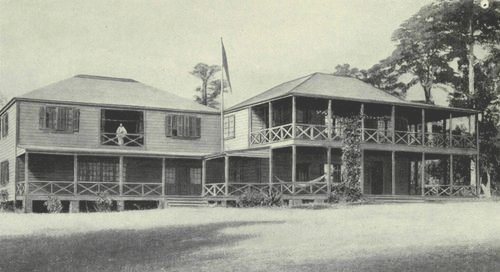
The house at Vailima with the additions made to the
first structure.
In the midst of all these labours there were a thousand other troubles
to be met and conquered—servants' quarrels in the
kitchen, for Samoans are not a whit different in such respects from
domestics all the world over, jealousy between the house boys and the
out boys, constant alarms about devils and bewitchments, and, above
all, sickness of all sorts to be sympathized with and cured. For help
in all these derangements every one went to the mistress, for all had
a simple faith in her ability to relieve them of all their sorrows. At
one time she and her daughter nursed twenty-two men through the
measles—a very serious disease among the islanders. At another time
the large hall at Vailima was entirely filled with the beds of
influenza patients, Mr. Stevenson being isolated upstairs. In the
performance of the plantation work accidents sometimes happened to the
men, and she was often called upon to bind up dreadful wounds that
would have made many women faint. From her earliest youth she had
always been the kind of person to whom every one instinctively turns
in an emergency. When Mr. Stevenson was ill she understood what he
wanted by the merest gesture, and was always calm, reassuring, and
self-reliant, never breaking down until after the crisis was past. She
was a most delightful nurse otherwise, too, for when her children were
sick in bed she entertained them with cheerful stories to divert their
minds, and when they were convalescent made tempting dishes for them
to eat. One of my own dear memories is of a time when, as a little
child, I lay dangerously and painfully ill, unable to move even a
hand, and she lightened my sufferings immeasurably by buying a Noah's
ark and arranging the animals on a little table by my
bedside where I could look at them. When her husband was having one of
his speechless illnesses at Vailima she allowed only one at a time to
go in to him, under orders to be entertaining and to recount amusing
little adventures of the household. She herself was an adept at this,
though when she came out she left her smile at the bedroom door. For
his amusement she would sit by his bedside and play her famous game of
solitaire, learned so long ago from Prince Kropotkin, the Russian
revolutionist. He would make signs when she went wrong and point at
cards for her to take up. Sometimes she read trashy novels to him, for
they both liked such reading when it was bad enough to be funny.
With the childlike Samoans she found sympathy to be as necessary as
medical treatment for their ails. An interesting example of this was
the case of Eliga, who was afflicted with an unsightly tumour on his
back. This, in a land where any sort of deformity is looked upon with
horror, caused the unfortunate man great unhappiness, besides
depriving him of his titles and estates. His kind master and mistress
had him examined by the surgeon of an English man-of-war that was in
the harbour, and the opinion was given that an operation was quite
feasible. Poor Eliga, however, was stricken with terror at the thought
and carefully explained that there were strings in the wen that were
tied about his heart, and if they were severed he would die. Besides,
he said, as his skin was different from the white man's, his insides
were probably different also. In the end, more to please them than
through any faith in it, he consented to the operation,
although so certain was he of a fatal ending that he had his house
swept and garnished, ready for the funeral. To comfort and cheer him
through the ordeal, both Mr. and Mrs. Stevenson went to his house and
remained with him until all was done. The result was most happy, and
the grateful man, now proudly holding up his head among his fellows,
composed in honour of the event "The Song of the Wen":
"O Tusitala, when you first came here I was ugly and poor and
deformed. I was jeered at and scorned by the unthinking. I ate grass;
a bunch of leaves was my sole garment, and I had nothing to hide my
ugliness. But now, O Tusitala, now I am beautiful; my body is sound
and handsome; I bear a great name; I am rich and powerful and
unashamed, and I owe it all to you, Tusitala. I have come to tell your
highness that I will not forget. Tusitala, I will work for you all my
life, and my family shall work for your family, and there shall be no
question of wage between us, only loving-kindness. My life is yours,
and I will be your servant till I die."[46]
It was in Samoa that Mrs. Stevenson acquired the name of Tamaitai,[47]
by which she was known thenceforth to her family and intimate friends
until the day of her death. English words do not come easily from the
tongues of the natives, and so they obviate the difficulty by
bestowing names of their own upon strangers who come to dwell among
them. It was as Tusitala, the writer of tales, that Louis
was best known, his wife was called Aolele,[48] flying cloud, and her
daughter, because of her kindness in giving ribbons and other little
trinkets to the girls, was named Teuila, the decorator. Tamaitai is a
general title, meaning "Madam," and is used in reference to the lady
of the house. Mr. Stevenson himself started the custom by calling his
wife Tamaitai, and it was finally adopted by everybody and grew to be
her name—the complete title being Tamaitai Aolele (Madam Aolele).
These Samoan names were adopted partly as a convenience, to escape the
embarrassment that sometimes arose from the habit among the natives of
calling the different members of the family by their first names. It
was felt to be rather undignified, for instance, that the mistress of
the house should be called "Fanny" by her servants.
Mrs. Stevenson, as I have said before, was a famous cook, and had
learned how to make at least some of the characteristic dishes of each
of the many countries where she had sojourned awhile in her long
wanderings. From her mother she had inherited many an old Dutch
receipt—peppery pot, noodle soup, etc.; in France she acquired the
secret of preparing a bouillabaise,[49] sole à la marguery, and
many others; from Abdul, an East Indian cook she brought from Fiji,
she learned how to make a wonderful mutton curry which contained more
ingredients than perhaps any other dish on earth; in the South Seas
she picked up the art of making raw-fish salad; and now at
Vailima she lost no time in adding Samoan receipts to her list. She
soon knew how to prepare to perfection a pig roasted underground and
eaten with Miti sauce,[50] besides dozens of other dishes, including
ava for drinking.
It was not the least of her duties to play the hostess to a remarkable
assortment of guests—the Chief Justice, officers from the men-of-war
that frequently came into the harbour, Protestant, Catholic, and
Mormon missionaries, all kinds of visitors to the islands, including
an English duchess, and native kings and chiefs. Once a high chief,
one of the highest, bearing the somewhat lengthy name of
Tuimalealiifono, came on a visit to Vailima. He was quite unacquainted
with white ways of living, and, when shown to his bedroom, looked
askance at the neat, comfortable bed that had been prepared for him.
In the morning it was found that he had scorned the bed, and, retiring
to the piazza, had rolled himself up in his mat and lain down to
pleasant dreams. At table, although he had never before seen knives
and forks, he picked up their use instantly by quietly observing the
manners of the others.
A curious episode, which might have turned out to be dangerous,
happened during the war troubles, when King Malietoa went up to
Vailima secretly to have a talk with Tusitala. After the talk Louis
offered him a present, asking what he preferred. Malietoa said he
would like a revolver, and Louis took one from the safe and
handed it to his wife, who happened to be sitting next the king. She
emptied the chambers, as she thought, and then, not noticing that the
thing was pointing straight at the king's heart, she clicked it five
times. By a lucky chance, before clicking it the sixth time she looked
in, and behold, there was the last cartridge! If she had given the
last click she certainly would have killed the king, and one can
imagine the complications that would have resulted in those uneasy
times. Of course the episode, with all the dramatic possibilities
attached to it, appealed to the romantic imaginations of the two
Stevensons, and, after the king's departure, they spent the evening in
making up a harrowing tale about what would have happened if she had
killed him.
Among the notable visitors to Vailima was the Italian artist Pieri
Nerli, who came to paint Mr. Stevenson's portrait—the one that now
hangs in Swanson Cottage in Scotland. This portrait pleased his wife
as little as did the Sargent picture, and, in a letter to Lord Guthrie
of Edinburgh, she makes what Lord Guthrie calls "an acute criticism of
this overdramatized likeness." She says: "It would have been all right
if Nerli had only been content to paint just Louis, and had not
insisted on representing instead the author of Dr. Jekyll and Mr.
Hyde."
It was not all work at Vailima by any means. "Socially," she writes,
"Samoa was not dull. There were many entertainments given by diplomats
and officials in Apia. Besides native feasts there were afternoon
teas, evening receptions, dinner parties, private and public
balls, paper chases on horseback, polo, tennis parties, and picnics.
Sometimes a party of flower-wreathed natives might come dancing over
the lawn at Vailima, or a band of sailors from a man-of-war would be
seen gathered in an embarrassed knot at the front gate." She herself
cared little for these entertainments, and usually busied herself in
helping others with the preparations for them. Her mother-in-law
writes: "A fancy dress ball has been held in honor of the birthday of
the Prince of Wales. Fanny designed a costume for Mrs. Gurr (a pretty
Samoan girl) as Zenobia, Empress of the East. She wore a Greek dress,
made in part of cotton stuff with a gold pattern stamped on it; over
this a crimson chuddah was correctly draped, with a gold belt, many
beads, and an elaborate gold crown."
From the busy round of her many-sided activities she took time now and
then to do a little writing, though in truth she had little liking for
it nor any high regard for her own literary style, in which she
complained of a certain "dry nippedness" that she detested but could
not get rid of. It was only when she wanted some extra money for her
water-works at Vailima that she "took her pen in hand" and wrote a
story for Scribners.
All this sounds hurried and breathless, but in reality these
activities were spread out over far more time than appears in the
telling of them, and there were peaceful intervals of rest and
happiness in seeing Louis well and able for the first time to bear his
share in hospitality.
Always, high above every other purpose, was her unfailing
devotion to her husband and his work, and no other task ever
interfered with her careful watch over his health and her keen
interest in his writing. He appreciated her aid from the bottom of his
heart, and in the dedication to his last unfinished novel, Weir of
Hermiston, he endeavours to express in some degree his profound sense
of obligation:
"I saw the rain falling and the rainbow drawn
On Lammermuir. Hearkening, I heard again
In my precipitous city beaten bells
Winnow the keen sea wind. And here afar,
Intent on my own race and place I wrote.
Take thou the writing; thine it is. For who
Burnished the sword, blew on the drowsy coal,
Held still the target higher; chary of praise
And prodigal of counsel—who but thou?
So now in the end; if this the least be good,
If any deed be done, if any fire
Burn in the imperfect page, the praise be thine."
This was to the critic; to the wife he wrote:
"Trusty, dusky, vivid, true,
With eyes of gold and bramble-dew,
Steel true and blade straight
The great Artificer made my mate.
Honor, anger, valor, fire,
A love that life could never tire,
Death quench, or evil stir,
The mighty Master gave to her.
Teacher, tender comrade, wife,
A fellow-farer true through life,
Heart whole and soul free,
The August Father gave to me."
As the years passed, their comradeship grew closer, and,
indeed, their relationship can perhaps be expressed in no better way
than to call them "comrades," with all that the word implies. In
writing to her he usually called her "My dear fellow," and in speaking
often addressed her in the same way. His attachment and admiration for
her steadily increased in proportion to his longer acquaintance with
her. Once at Vailima they were all playing a game called "Truth," in
which each person writes a list of the qualities—courage, humour,
beauty, etc.—supposed to be possessed by the others, with the
corresponding ratio in numbers, ten being the maximum. Louis put his
wife down as ten for beauty. She argued with him that he must be
perfectly honest and not complimentary; he looked at her in amazement
and said: "I am honest; I think you are the most beautiful woman in
the world."
Once when her birthday, the 10th of March, came around, she found on
waking these verses pinned to the netting of her bed:
"To the Stormy Petrel
"Ever perilous
And precious, like an ember from the fire
Or gem from a volcano, we to-day
When drums of war reverberate in the land
And every face is for the battle blacked—
No less the sky, that over sodden woods
Menaces now in the disconsolate calm
The hurly-burly of the hurricane—
Do now most fitly celebrate your day.
Yet amid turmoil, keep for me, my dear,
The kind domestic fagot. Let the hearth
Shine ever as (I praise my honest gods)
In peace and tempest it has ever shone."
She said these verses were the best of all her birthday presents. He
called her the "stormy petrel" in reference to her birth in the wild
month of March, and because she was such a fiery little person. When
she took sides in an argument he would say, in mild irony: "The shouts
of the women in the opposite camp were heard demanding the heads of
the prisoners."
All through the daily entries in her diary, mingled with the incidents
of the household, runs the talk of impending war:
"War news continues exciting, and there are threats of a massacre of
all the whites. Although nothing of the kind is really anticipated, I
think it would be better to look up our cartridges. Lafaele has
blacked his face in the fashion of a warrior, saying he must be
prepared to protect the place. He has a very sore toe, which he thinks
is bewitched. He sent for the Samoan doctor, a grave middle-aged man,
who announced that a devil, instigated by some enemy, has entered the
toe and is now on the point of travelling up the leg, and unless it is
checked in time will soon have possession of Lafaele's entire body.
"March 22. This entry is written in Suva, Fiji. For a long time I
had not been well, and so I was sent off in the steamer to this place,
though I went with a heavy heart, for I thought Louis did not look
well. I have been to the botanical gardens, which are in
charge of a pleasant young man from Kew, and have secured four boxes
of plants for Vailima. The young man told me, as a trade secret, that
if cauliflowers get an occasional watering of sea water they will head
up in any climate. I have also secured an East Indian cook named
Abdul.
"September 23. At home again. I find that Lloyd and the Strongs have
been teaching a native boy named Talolo to cook, with the best
results, so my fine Indian cook is a fifth wheel. However, Mr. Haggard
has agreed to take him—though he seems very reluctant to leave
Vailima.
"October 28. Paul left us some time ago to be overseer on a German
plantation. Before he left, in his blundering desire to do all he
could for me, he transplanted a lot of my plants, all wrong, and in
fact did all the damage he well could in so short a time. I felt sorry
to see the last of him, for with all his mistakes his heart was in the
right place. Much more distressing is it that our dear Simile is gone.
He wept very much in leaving, saying that 'his poor old family' needed
him. I was told afterwards that he had in reality eloped with a young
lady, which may be the truth of the matter. Talolo, our new cook,
amuses me very much. He was greatly shocked at hearing of the scalping
of victims by American Indians, but thought the taking of heads in the
Samoan fashion perfectly right, as the victim was then dead and felt
nothing.
"November 2. Talolo's mother, a very respectable woman indeed, came
to see us, bringing with her a relative who is almost blind from
cataract. They were shown over the house and could be heard
at every moment crying out in Samoan 'How extremely beautiful!' Even
when shown into the cellar, where it was quite dark, they were heard
to make the same remark.... Last Saturday Lloyd marshalled up all the
men before they left for their Sunday at home and administered to each
a blue pill. One fellow was caught hiding his in his cheek and was
made to swallow it amid shouts of laughter. I feared they would never
come back, but all returned on Monday morning declaring they were much
improved in health.
"We are all blazing with cacao-planting zeal, and we already have over
six hundred plants set out. The method of planting them is very
laborious, for the seeds must first be set in baskets made of plaited
cocoanut leaves, and when the sprouts come up they are put in the
earth, basket and all; in this way the roots are not disturbed and in
time the basket decays in the damp soil and drops off. The whole
family has been infected with the planting fever, and even Mrs.
Stevenson works away at it most gallantly. To-day is Sunday, but we
must all, the family and the house boys, plant the seeds that are
left.
"November 30. Simile has come back in a sad condition from a wound
with a spear or club in the back of his head, and much distressed over
the state of his 'poor old family'.... We have now set out 1,200 cacao
plants. All yesterday Joe[51] and I were superintending the building
of a bridge over the river. We had two trees cut down for the purpose;
one of them was of the most lovely pinkish wood, with salmon
pink bark, and emitted a perfume like a mixture of sassafras and
wintergreen.... Last night we were somewhat alarmed by earthquake
shocks and rifle shots. Yesterday three of the chairs made by the
carpenter out of our own wood, mahogany, and designed from an antique
model, came up. They are very satisfactory—a beautiful shape and
comfortable to sit in."
So the weeks rolled swiftly by, filled with an infinitude of duties
and much happiness, until the bright tropic sun broke on Christmas
morning, 1893. The day was always celebrated at Vailima with much
ceremony, and a gigantic tree, covered with carefully chosen presents
for everybody, from the head of the family down to the humblest Samoan
retainer, was set up in the large hall. Months before Mr. Stevenson
had sent to the army and navy stores in London and had a large boxful
of presents for the tree sent out. The diary gives us some account of
this, the last Christmas spent on earth by Robert Louis Stevenson:
"Our washerwomen," so it runs, "came with presents—tapa and fans,
and Simile brought baskets and tapa. Our people were wild with
delight over their presents. Christmas we spent with friends in Apia,
where we had a most delightful evening. Each gave some performance to
add to the gaiety. Louis and Lloyd played, very badly indeed, on their
pipes. Teuila recited one of Louis's poems, and Austin poured out with
much dramatic fire Lochinvar. There was some very pretty Samoan
dancing by Mrs. Gurr and Mrs. Willis, who gave a sitting dance
and one with clubs. The next day we rode home, dashing at
full speed through mud and water, and reached there drenched to the
skin by a sudden shower. I was alarmed about Louis, but it did him no
harm whatever. We were happy to be at pleasant Vailima again.
"January 3. There has been a terrific storm, lasting three days, but
the hurricane shutters were put up, and proved a great protection,
though the house was dark and airless. Trees went crashing all around
us. There was a curious exhilaration in the air, and the natives
shouted with glee whenever anything came down. The road was filled
with débris from the storm, which had to be cleared away before any
one could pass. In the evening I was told that both the Fiji man and
Simi had been spitting blood. The Fiji man seems to have a touch of
pneumonia. Much to Simi's alarm we put the cupping glass on him, and
the whole party of house servants escorted him to bed, shouting and
laughing and dancing as they went.
"January 7. Lloyd sailed to-day for San Francisco, intending to make
the round trip only, for a change of air. In the afternoon Joe and I
jumped on one horse and galloped as fast as we could down to the
landing, only to find that all the boats were out. Just then the
American consul's boat returned to the landing. We sprang into it, and
with the American flag flying over us, went speeding over the water,
in spite of the fact that the German man-of-war was having target
practice (a most dangerous proceeding) right across the harbor. As we
drew near the ship we suddenly realized that they were
holding it in the supposition that we were bringing a consular
message. We saw Lloyd running on deck to see us, but, alarmed at the
situation, we took a hasty departure. In the evening we heard very
sweet and mournful singing in the servants' quarters, and on asking
what it was were told by Talolo that it was a farewell to Loia
(Lloyd). It was explained that the song was told to go to France, to
Tonga, and other places to look for Lloyd, and, in case of not finding
him there, to search all over the world for him and carry pleasant
dreams to him.
"January 11. To-day the Fiji man appeared in war paint—his nose
blackened and black stripes under his eyes. Lafaele says the war is
soon going to begin, adding 'Please, Tamaitai, you look out; when
Samoa man fight he all same devil.' While we were talking low, dull
thunder was rolling around the horizon, sounding, as we thought, very
like the noise of battle. Strange to say there was not a cloud in the
sky nor a flash of lightning to be seen.
"All the Samoan women married to white men wish to express their
gratitude to me for making it possible for them to return to their
native dress or, rather, the dress introduced among them by the
missionaries. Before we came, all such women were expected to dress in
European fashion, for otherwise they were not considered respectable,
and they were delighted and surprised when I and all the other women
at Vailima appeared in the missionary dress. This dress, called the
holaku, is nothing more than the old-fashioned sacque (known in
America as the 'Mother Hubbard'), which fortunately happened
to be the mode in England when the missionaries first came to the
South Seas. It was loose, cool, modest, and graceful, and so well
suited to the natives and the hot climate of the islands that it
became the regulation garment of the South Pacific. The climax seemed
to be my going to a party in a very handsome black silk holaku with
embroidered yoke and sleeves. The husbands have removed the taboo and
several of the native ladies are to have fine silk gowns made in their
own pretty, graceful fashion. Corsets must be agony to the poor
creatures, and most of them are only the more clumsy and awkward for
these European barbarities. I am very glad I have inadvertently done
so much good."
The political pot was now boiling fiercely, but as the trouble in
Samoa has been discussed in detail in other books, it is not my
purpose to touch upon it here except in so far as any phase of it
directly concerned Mrs. Stevenson herself. It is enough to say that
the family espoused the cause of Mataafa, and in the diary Mrs.
Stevenson describes a visit made by them to that monarch for the
purpose of attempting to reconcile the two parties.
"On the second of May," she writes, "Louis, Teuila[52] and I, taking
Talolo with us, went in a boat to Malie to visit King Mataafa. I took
a dark red silk holaku, trimmed with Persian embroidery, and Teuila
took a green silk one, in which to appear before royalty. Long before
we got to the village we could see the middle part of an
immense native house rising up like a church spire. Mataafa's own
house was the largest and finest I had ever seen, and there were
others as large. Louis tried in vain to get an interpreter, but was
fain to put up with Talolo, who nearly expired with fright and misery,
for he could not speak the high chief language and felt that every
word he uttered was an insult to Mataafa. We have been in the habit of
referring to the king as 'Charley over the water,' and toasting him by
waving our glasses over the water bottle. Talolo had some vague notion
of what this meant and now thought it a good time to do the same. To
our great amusement, he took his glass, waved it in the air, and cried
'Charley in the water!' which we felt to be a rather ominous toast.
His translations of 'Charley's' words came to little more than
'Mataafa very much surprised (pleased),' but Louis knew enough Samoan
to make a little guess at what was going on. The kava bowl was in
the centre of the group, with the king's talking men beside it. Kava
was first given to the king and Louis simultaneously—a great honor
for Louis—then to Teuila and me. The king evidently supposed us both
to be wives of Louis, and was much puzzled as to which was the
superior in station, a dilemma which was finally neatly solved by
serving us both at the same moment. I had seen that it was chewed
kava,[53] but in my weariness after the long journey I forgot that
fact before it came my turn to drink. Before the bowl was
offered to the king a libation was poured out and fresh water from a
cocoanut shell was sprinkled first to the right and then to the left.
The talking man and the others made polite orations, one of them
likening Louis to Jesus Christ, at which Talolo manifested sighs of
acute embarrassment. We were then offered a little refreshment before
dinner. The king, who was a Catholic, crossed himself and said grace.
A folded leaf containing a quantity of arrowroot cooked in cocoanut
milk by dropping in hot stones was placed before each of us, and each
had the milk of a fresh young nut to drink. The arrowroot was grateful
but difficult to manage, on account of the stickiness, and a little
gritty with sand from the stones. We were then invited to take a
siesta behind an immense curtain of tapa that had been hung across
one end of the room. There mats and pillows were laid for Teuila and
me, and in a few seconds we were fast asleep. In an hour and a half we
waked simultaneously and found dinner waiting for us. Louis then
offered his present—a hundred-pound keg of beef—and the talking man
went outside and informed the populace, in stentorian tones, of the
nature and amount of the present received. We ate of pig, fowl, and
taro, in civilized fashion, sitting on chairs and using plates,
tumblers, spoons, knives, and forks. After a walk about the village we
all sat on mats under the eaves and conversed. A distant sound of
singing was heard, and soon a procession of young men in wreaths,
walking two by two, came up to us and each deposited a root of taro,
to which the king added a couple of young fowls, and an
immense root of fresh kava. Speeches were made, after which mats
were spread out for the dancers, who had been called by the sound of a
bugle. There were two long rows of them, with two comic men and a
hunchback, apparently the king's jester. They first sang a song of
welcome to us, and then sang, danced, and acted several pieces—all
well done and some very droll indeed. The hunchback excelled
particularly in an imitation of a circus that was here not long since.
Louis could not speak successfully through Talolo, as he had more to
say than 'much surprised,' so we then took our departure. We returned
by moonlight, all ardent admirers of Mataafa. About a week later Louis
went again, this time with an interpreter named Charley Taylor, and
had a more satisfactory interview. In the early morning, at about
four, he was awakened by the sound of some sort of pipe playing a
curious air. When he inquired about this Mataafa told him that he
always had this performance at the time of the singing of the early
birds, as it conduced to pleasant dreams. His father, he added, would
never allow a bird or animal to be injured, and, in consequence, was
called the 'king of the birds.'"
As the war-cloud grew blacker, the superstitious fears of Lafaele
increased, and every day some new portent was reported. "On May 16,"
says the diary, "Lafaele and Araki reported that while walking on the
road they met Louis riding on my horse Musu. What was their surprise
and terror when they reached home to find that he had not left the
house all day. Great anxiety and alarm are felt all over the place,
for it is supposed that Louis sent his other self to see
what Lafaele and Araki were about." Araki was a runaway "black boy,"
or Solomon Islander, from the German plantations, who became a member
of the Vailima household in a rather dramatic way. One day a strange
figure was seen flitting about the lawn behind the trees. The servants
ran out and dragged in a thin, terrified black boy, who fell on his
face before the master and begged for protection. Such a plea could
not be refused, and Mr. Stevenson went down to the German firm and
made arrangements to keep him. He soon began to fill out, and grew to
be a saucy, lively fellow. Although the natives of Samoa look upon the
Solomon Islanders as cannibals and savages, at Vailima they made a pet
of Araki and dyed his bushy hair red and hung wreaths round his neck.
"May 19. This is the twelfth anniversary of our marriage. It seems
impossible. Also impossible that two years ago (or a little more) we
came up to live in the bush. Everything looks settled and as though we
had lived here for many years.
"May 22. Saturday the captain of the Upolu came up and had
luncheon with us. We had nothing but vegetables, curried and cooked in
various ways, but no meat. Sunday there came a German vegetarian when
there were no vegetables and nothing but meat.... We are having a
great deal of trouble with the servants, as Tomasi, the Fiji man, says
his wife, Elena, is too good to associate with the other women, and
Lafaele's little girl is terribly afraid of Araki, the black boy,
although he speaks of her most tenderly as 'that little
girlie.' When the last litter of pigs was born, each family on the
place was given a pig. Elena chose a spotted boar, which she named
Salé Taylor, and Lafaele took what he calls a 'mare pig,' that is, a
little sow. Both pigs have been tamed and trot around after Elena and
Fanua like pug dogs. They go to bed with their mistresses every night
like babies, and must also be fed once in the night with milk like
babies. Both pigs came to prayers this morning.... Talolo's brother, a
beautiful young boy, has elephantiasis.[54] He has had it for a long
time—about a year—but was afraid to tell. Worse than that has
happened; one of our boys had a fit of insanity, during which it
required the exertions of the entire household to restrain him from
running off into the bush and losing himself. It became necessary to
tie him down to the bed with strips of sheeting and ropes. The
strangest thing about this occurrence is that Lafaele restored him to
his senses in a short time by chewing up certain leaves that he
brought from the bush and then putting them into the sick boy's ears
and nostrils. I had a talk with Lafaele about his remedy. He told me
that in case of lockjaw, if these chewed leaves are forced up the
nostrils, first the jaw, then the muscles, will soon relax and the
cure is accomplished. For some reason he seems unwilling to point out
the tree to me.... Talolo affords us much amusement with his
naïve ideas. I said to him, 'It seems to me that you Samoans do not
feel badly about anything very long.' 'Yes, we do,' said Talolo,
seeming much hurt by the accusation. 'When a man's wife runs away he
feels badly for two or three days.'
"July 3, 1893. Nothing is talked of or thought of but the impending
war. One of our former men came up yesterday to draw out his wages. I
asked him if he meant to act like a coward and take heads of wounded
men. He said he meant to take all the heads he could get. I reasoned
with him, as did Lloyd, but he stood respectfully firm, saying that
each people had its own customs. I am afraid the government has not
thought to forbid this abomination, or has not dared.
"July 8. News comes that the fighting has begun, and that eleven
heads have been taken to Mulinuu,[55] and, worst of all, that one of
the heads is that of a village maid, a thing before unheard-of among
Samoans.
"July 10. Mataafa is routed, and, after burning Malie, has fled to
Manono. His son was killed with a hatchet and his head taken. In all
we hear of three heads of women being brought in to Mulinuu. When
Mataafa was the man before whom all trembled we offered him our
friendship and broke bread with him. If I gave him loyalty then, fifty
thousand times more do I give it now."
At last the smoke and thunder of war rolled away, and peace and
security came once more to dwell at Vailima. Entertainments
and gaieties again made the place lively. Mrs. Strong[56] describes
one of these affairs in a letter to Mr. Stevenson's mother:
"I suppose Louis will write and tell you of the grand day we had here
when the sailors of the Katoomba were invited up here to play. We
had twenty-four people on the place—natives, house boys, outside
boys, and contractors—and the house was gorgeously decorated with
ferns and moso'oi flowers. One large table was piled high with
cocoanuts, oranges, lemons, passion fruit, pineapples, mangoes, and
even a large pumpkin and some ripe tomatoes, besides three huge bowls
of lemonade. The other table had seven baked chickens, ham sandwiches,
cakes and coffee—lots of all. At half-past twelve we saw the white
caps bobbing at the gate, and sent Simile down to meet them. He was
dressed in a dark coat and lavalava and white shirt, and looked very
swagger indeed. The sailors all saluted Simile as he appeared, and in
another moment—boom, bang, and the band burst out with the big drum
in full swing, with the men, fourteen of them, all marching in time.
The faces of our Samoans were stricken with amazement as the jackies
marched up to the lawn in the blazing sun and finished the piece. The
veranda was crowded with our people, all in wreaths of flowers, and a
number of guests were there to witness the festivities. Well, we fed
our sailors, who were all very red and hot and smiling, and the way
they dipped into the lemonade was a caution. Then, to a guitar
accompaniment, one of them sang a song with a melodramatic
story running through it about a poor fellow going to a house and
sitting on the door-step wan and weary, and seeing on the doorplate
the name of Jasper. Soon Jasper comes out, and though the
poverty-stricken one pleads for a bit of bread he's told to go to the
workhouse. 'I pays my taxes,' says the heartless Jasper, 'and to the
workhouse you must go.' 'And who would have thought it,' goes the
chorus, 'for we were schoolmytes, schoolmytes!'"
A devastating epidemic of measles, much aggravated by the improper
treatment given to patients by the natives, now broke out. Even
Vailima did not escape its ravages, and Mrs. Strong writes of it on
October 8:
"Everybody is well of the measles by now and all are crawling out into
the sunshine. There have been a hundred and fifty deaths on this
island alone. Our Sosimo was taken ill down in the town. Tamaitai and
I went down to see him, and, finding him in a wretched state, had him
brought home in a native sling on a pole, the way they carry wounded
soldiers. None of our people died, for they willingly accepted our
rules for their care."
After the war was over, it was found that the stress and excitement of
it all had told on Mr. Stevenson's health, and in the early part of
September he went to Honolulu for a change. The trip was a
disappointment, for he was taken quite seriously ill there, and his
wife had to take steamer and go after him, arriving in a state of
great anxiety. Under her tender care he soon recovered and they
returned to Vailima.
In Samoa, Tusitala was not the only "teller of tales," for all sorts
of strange stories—some amusing, some scurrilous and
malicious—were invented about the family at Vailima and ran current
in the gossip "on the beach." One of the most fantastic of these
inventions was that Mr. Stevenson had been married before to a native
woman, and that Mrs. Strong[57] was his half-caste daughter by this
marriage. The one advantage about this peculiar story was the
hilarious fun he was able to get out of it. He made up all kinds of
wonderful romances about the supposititious first wife, who he said
was a native of Morocco, "black, but a damned fine woman." When Mrs.
Stevenson scolded him for not wearing his cloak in the rain he
pretended to weep and said: "Moroccy never spoke to me like that!" One
evening Mrs. Strong heard gay laughter in her mother's room, and,
going in to see what it was about, found her mother sitting up in bed
laughing, while Louis walked up and down the room gesticulating and
telling her the "true story" of his affair with Moroccy.
So passed all too swiftly three full years—years crowded with work
and play and many rare experiences—and less darkly shadowed by the
spectre that had stalked beside them ever since their marriage. For
this short space he knew what it was to live like a man, not like a
"pallid weevil in a biscuit," and she, though her vigilance was never
relaxed for a moment, breathed somewhat more freely. The days sped
happily by, until Thanksgiving, November 29, 1894, which was
celebrated with an elaborate dinner at Vailima. Mrs. Stevenson was
anxious to have this a truly American feast, from the turkey
to the last detail, but cranberries were not to be had, so she
produced a satisfactory substitute from a native berry, and under her
careful supervision her native servants succeeded in setting out a
dinner that would have satisfied even an old Plymouth Rock Puritan. At
the dinner, the last entertainment taken part in by Mr. Stevenson, in
enumerating his reasons for thankfulness, he spoke of his wife, who
had been all in all to him when the days were very dark, and rejoiced
in their undiminished affection.
A day or two afterwards she was seized with a presentiment of
impending evil—a formless shadow that seemed to settle down upon her
spirit, and that no argument could relieve. Her mother-in-law writes:
"I must tell you a very strange thing that happened just before his
death. For a day or two Fanny had been telling us that she knew—that
she felt—something dreadful was going to happen to some one we cared
for; as she put it, to one of our friends. On Monday she was very low
and upset about it and dear Lou tried to cheer her. Strangely enough,
both of them had agreed that it could not be to either of them that
the dreadful thing was to happen."
On the afternoon of December 3, 1894, according to their custom he
took his morning's work for her criticism. She quickly perceived that
in this, which neither dreamed was to be the last work of his pen, his
genius had risen to its highest level, and she poured out her praise
in a way that was unusual with her. It was almost with her words of
commendation still ringing in his ears that he passed to the great
beyond. In a letter addressed to his friends shortly
afterwards, Lloyd Osbourne gives us the details of these last moments:
"At sunset he came downstairs, rallied his wife about the forebodings
she could not shake off; talked of a lecturing tour to America that he
was eager to make, 'as he was now so well,' and played a game of cards
with her to drive away her melancholy. He said he was hungry; begged
her assistance to help him make a salad for the evening meal; and to
enhance the little feast he brought up a bottle of old Burgundy from
the cellar. He was helping his wife on the veranda, and gaily talking,
when suddenly he put both hands to his head and cried out: 'What's
that?' Then he asked quickly: 'Do I look strange?' Even as he did so,
he fell on his knees beside her." Just as he had leaned upon her for
help, comfort, and advice for so many years of his life, so it was at
her feet that he sank in death when the last swift summons came. He
was helped into the great hall between his wife and his body servant,
Sosimo, and at ten minutes past eight the same evening, Monday,
December 3, 1894, he passed away.
Her great task was finished, and she sat with folded hands in the
quiet house from which the soul had fled; but, although the lightning
suddenness of the blow made it almost a crushing one, the bitterness
of her grief was greatly softened by her firm belief in a life beyond
the grave and the certainty of a reunion with him there.
She bore this supreme sorrow with the same silent fortitude with which
she had always met trouble, but a subtle change came over
her. While it could not be said that she looked exactly old, yet the
youthfulness for which she had been so remarkable seemed suddenly to
vanish, and her hair grew rapidly grey. A little child—Frank Norris's
daughter—said, with an acuteness beyond her years: "Tamaitai smiles
with her lips, but not with her eyes."
Among the hundreds of letters of condolence which she received from
all over the world, none, perhaps, came more directly from the heart
than that written by her old friend, Henry James from which I have
taken the following extracts:
"My dear Fanny Stevenson:
"What can I say to you that will not seem cruelly irrelevant or vain?
We have been sitting in darkness for nearly a fortnight, but what is
our darkness to the extinction of your magnificent light? You will
probably know in some degree what has happened to us—how the hideous
news first came to us via Auckland, etc., and then how, in the
newspapers, a doubt was raised about its authenticity—just enough to
give one a flicker of hope; until your telegram to me via San
Francisco—repeated also from other sources—converted my pessimistic
convictions into the wretched knowledge. All this time my thoughts
have hovered round you all, around you in particular, with a
tenderness of which I could have wished you might have, afar-off, the
divination. You are such a visible picture of desolation that I need
to remind myself that courage, and patience, and fortitude are also
abundantly with you. The devotion that Louis inspired—and
of which all the air about you must be full—must also be much to you.
Yet as I write the word, indeed, I am almost ashamed of it—as if
anything could be 'much' in the presence of such an abysmal void. To
have lived in the light of that splendid life, that beautiful,
bountiful being—only to see it, from one moment to the other,
converted into a fable as strange and romantic as one of his own, a
thing that has been and has ended, is an anguish into which no one can
enter with you fully and of which no one can drain the cup for you.
You are nearest to the pain, because you were nearest the joy and the
pride. But if it is anything to you to know that no woman was ever
more felt with and that your personal grief is the intensely
personal grief of innumerable hearts—know it well, my dear Fanny
Stevenson, for during all these days there has been friendship for you
in the very air. For myself, how shall I tell you how much poorer and
shabbier the whole world seems, and how one of the closest and
strongest reasons for going on, for trying and doing, for planning and
dreaming of the future, has dropped in an instant out of life. I was
haunted indeed with a sense that I should never again see him—but it
was one of the best things in life that he was there, or that one
had him—at any rate one heard him, and felt him and awaited him and
counted him into everything one most loved and lived for. He lighted
up one whole side of the globe, and was in himself a whole province of
one's imagination. We are smaller fry and meaner people without him. I
feel as if there were a certain indelicacy in saying it to you, save
that I know that there is nothing narrow or selfish in your
sense of loss—for himself, however, for his happy name and his great
visible good fortune, it strikes one as another matter. I mean that I
feel him to have been as happy in his death (struck down that way, as
by the gods, in a clear, glorious hour) as he had been in his fame.
And, with all the sad allowances in his rich full life, he had the
best of it—the thick of the fray, the loudest of the music, the
freshest and finest of himself. It isn't as if there had been no full
achievement and no supreme thing. It was all intense, all gallant, all
exquisite from the first, and the experience, the fruition, had
something dramatically complete in them. He has gone in time not to be
old, early enough to be so generously young and late enough to have
drunk deep of the cup. There have been—I think—for men of letters
few deaths more romantically right. Forgive me, I beg you, what may
sound cold-blooded in such words—or as if I imagined there could be
anything for you 'right' in the rupture of such an affection and the
loss of such a presence. I have in my mind in that view only the
rounded career and the consecrated work. When I think of your own
situation I fall into a mere confusion of pity and wonder, with the
sole sense of your being as brave a spirit as he was (all of whose
bravery you shared) to hold on by. Of what solutions or decisions you
see before you we shall hear in time; meanwhile please believe that I
am most affectionately with you.... More than I can say, I hope your
first prostration and bewilderment are over, and that you are feeling
your way in feeling all sorts of encompassing arms—all
sorts of outstretched hands of friendship. Don't, my dear Fanny
Stevenson, be unconscious of mine, and believe me more than ever
faithfully yours,
"Henry James."[58]
With this and the many other letters came one written in pencil on a
scrap of paper, unsigned:
"Mrs. Stevenson.
"Dear Madam:—All over the world people will be sorry for the death of
Robert Louis Stevenson, but none will mourn him more than the blind
white leper at Molokai."[Back to Contents]
As the slow, empty days passed, the weight of her sorrow bore more and
more heavily upon her and she grew steadily weaker. Finally, the
doctors said the only thing was change, so, in April, 1895, she set
sail with her family for San Francisco.
On the way a stop was made in Honolulu, where Mrs. Stevenson was
deeply distressed to find the provisional government in control and
her old friend, Queen Liliuokalani, imprisoned. The deposed queen was
kept in Iolani Palace under close guard, and ostensibly debarred from
all visitors, but one must presume the guard not to have been so
strict as it seemed, for Mrs. Stevenson was able to gain entrance and
secure an audience with the royal prisoner through the not very
dignified avenue of the kitchen-door of the palace. When she gave
expression to her profound sympathy and indignation at the turn
affairs had taken, Liliuokalani replied that she wished she had had
Louis to advise her in her dark hours.
A summer without special incident was spent in California—a grey
summer for her, for her son and daughter tried in vain to interest her
in things there. Her health improved, but she cared for nothing
outside of Samoa and only yearned to go back and be near the grave on
Mount Vaea, so in the autumn they again turned their faces toward the
Pacific Isles.
When they left San Francisco they had added another member to
their party—a small donkey named Dicky, given to Mrs. Stevenson by
one of the Golden Gate Park commissioners, which she intended to use
in driving about the plantation to a little Studebaker cart she had
had made especially for the purpose. A little stable was put up on
deck for Dicky and a bale of hay provided for him, but it was not long
before the little fellow had become such a pet with the carpenter and
his mates that he was taken into the forecastle to live with them and
share their mess, eating his meals out of a tin plate. The men taught
him many amusing tricks, and it got to be quite the thing for the
cabin passengers to make trips down to the forecastle to see him do
them and to feed him chocolate creams. At Waikiki Beach, where they
lived in a cottage attached to the Sans Souci Hotel during their stay
of several months in Hawaii, Mrs. Stevenson often drove about the park
in the little cart which was just fitted to Dicky. She was surprised
at first to find that he would only make short trips and then come to
a dead stop, from which it was impossible to budge him. Nothing would
make him go on until his mistress got out and in again, and then he
would pick up his little feet and trot on for another five minutes,
when the same performance would have to be repeated. At last they
realized that he had been trained to make five-cent trips at Golden
Gate Park, and that nothing would ever break him of it. When they left
Honolulu for Samoa they had difficulty in getting him on board the
steamer, for although there was a belt and tackle to hoist
him up, they could not drag him to it. One man—then two—then finally
six men were hauling at him, while the ship waited, with all
passengers on board and surveying the scene with intense amusement.
The captain suddenly shouted through a megaphone: "Pull him the other
way!" They did so and he immediately backed right up to the tackle and
was hauled on deck amid the plaudits of the multitude. At Samoa he was
a great pet; the native girls loved him and took him with them when
they went to cut alfalfa for the cows. They made a pretty picture
coming through the forest—the girls in leaves and flowers and Dicky a
walking mountain of green, with only his long ears sticking out and
his bright eyes gleaming through the foliage.
Honolulu brought back to Mrs. Stevenson many poignant memories of
other days, of which she wrote to her mother-in-law in these words:
"As you suppose, this has been a sad season with me. People say that
one gets used to things with time, but I do not believe it. Every day
seems harder for me to bear. I say to myself many comforting things,
but even though I believe them they do not comfort me. Everything here
reminds me of Louis, and I do not think there is one moment that I am
not thinking of him. People say: 'What a comfort his great name must
be to you!' It is a pride to me, but not a comfort; I would rather
have my Louis here with me, poor and unknown. And I do not like to
have my friends offer me their sympathy—only you and one or two who
loved him for what he was and not for what he did.... As to his
Christianity his life and work show what he was. I know
that whether or not he always succeeded in living up to his
intentions, he was a true follower of Christ, a real Christian, and
not many have come as close as he; and I believe that not many have
tried as honestly and earnestly. In this place everything reminds me
of him, and I feel that I must see him. I cannot believe that all
these months have passed since he left us. Perhaps the whole time will
not seem so long until we meet again. It gives me a sharp shock when I
hear him spoken of as dead. He is not dead to me—I cannot think it
nor feel it. He is only waiting, I seem to feel, somewhere near at
hand."
After a winter spent in Hawaii, during which the marriage of her son
took place, Mrs. Stevenson and her daughter sailed, in May, 1896, for
Samoa. In these various trips between San Francisco and the islands
she usually sailed on the Mariposa, and because she had so much
baggage Captain Morse and the other officers took to calling the ship
"Mrs. Stevenson's lighter."
Their home-coming, being unexpected, was rather forlorn. They reached
Vailima in the evening and went to bed rather drearily in the empty
house, Mrs. Strong having determined to get breakfast as best she
could the next morning and then send out word to their former Samoan
helpers. After their long journey she slept late, and, springing from
her bed somewhat guiltily, ran to the window. What was her
astonishment to see smoke coming out of the cookhouse chimney, Talolo
at the door, and Iopu, the yard man, coming up with a pail of
water—all the business of the place, in fact, going on like
clockwork, just as though they had never been absent for a day!
Running into her mother's room, she found her sitting up in bed just
finishing her breakfast, which had been brought up on a tray by
Sosimo. The news had gone forth the night before that they had
returned, and every man of the Vailima force was at his post at break
of day.
Once more the lonely widow took up the routine of her life, and,
though its main incentive had gone, in time there came to her a sort
of melancholy satisfaction in living among the scenes made dear by
memories of the loved one. The scale on which the household had been
conducted was now cut down very much, and she and her daughter,
retaining but a few of the former great retinue of servants, led a
calm and peaceful life among their tropic flowers. "Vailima is so
lovely now," writes Mrs. Strong to the elder Mrs. Stevenson. "The
trees are all so big, and the hibiscus hedge is over ten feet high and
blazing with flowers. The lawn is like velvet and everywhere the grass
is knee-high. If it is true that Louis can see us from another world
he would be pleased with this day. This is the day when we decorate
the grave, and all the afternoon people kept coming with flowers and
strange Samoan ornaments. You should have seen Leuelu's sisters in
silk bodices trimmed with gold braid, and green velvet lavalavas
bordered with plush furniture fringe! And they looked very fine, too.
Once arrived on the mountain top we stood looking at the magnificent
view of the sea, and the coral reef, and the distant mountains. We
banked the grave with flowers and the wreath of heather that
you sent. Chief Justice Ide and his two beautiful daughters were
there."
Mother and daughter spent pleasant days in the garden—digging up kava
roots, stringing them on twine and hanging them up in the hall to dry,
and in many another homely task. In the evening they played chess,
and, as neither knew the game, they were well matched, and spent
engrossing evenings over it. Sometimes they would light a lantern and
walk over to see Mr. Caruthers, the lawyer, who lived more than a mile
away. When he saw the flicker of their lantern through the palm-trees
he would wind up his little musical box and they could hear its tinkle
of welcome. "We walked barefoot,"[59] says Mrs. Strong, "and I shall
never forget those lovely walks at night and the feel of the soft,
mossy grass under our feet. Mr. Caruthers was a clever, interesting
man. His Samoan wife would sit by sewing, and his children would study
their lessons in the other room while we sat on his veranda and had
long talks. On the night of his farewell visit to us we stood on the
veranda at Vailima and looked out on a glittering moonlight night, the
lawn sloping before us, the great shadowy trees beyond, and in the
distance the blue line of the sea—'nothing between us and the North
Pole,' we used to say. Mr. Caruthers said, 'How can you leave this for
any other country? This is the "cleaner, greener land,"' and he quoted
Kipling's verses."
The two women lived in perfect security in their lonely forest home,
never having the slightest fear of the natives who passed that way in
their comings and goings. Once in the middle of the night
Mrs. Strong was waked up by the sound of voices on the veranda, and,
running down, found her mother surrounded by twenty Samoans, all with
baskets. Mrs. Stevenson, hearing the sound of talking, had come down,
to find these men coming heavily laden from the direction of the
Vailima taro, yam, cocoanut, and banana plantation. "I politely asked
them," says Mrs. Strong, "to show my mother the contents of their
baskets. They agreed readily enough, and one after another they opened
their baskets at her feet, disclosing nothing but edible wild roots,
until we began to feel abashed and asked them to desist. Nothing would
do, however, but that each of the twenty should empty out his basket,
with much laughing and joking, and thereby prove his innocence of
having plundered the plantation. As a peace offering, my mother
directed me to give them some twists of tobacco and tins of salmon and
biscuit. Then they explained that, owing to the breadfruit having been
blown off the trees while still green, by a hurricane, there had been
a famine in their village. Their Samoan pride made them ashamed for
the other villages to know that they were reduced to eating wild
roots, and so they had sneaked up in the night to the bush back of our
plantation and filled their baskets with the roots. We apologized
again and went back to bed. The twenty Samoans sat on our veranda for
hours singing, but, although our servants were gone for the night and
we two white women were entirely alone in the house, we felt no fear.
Where else in the world could this have happened?"
Secluded as Vailima was, the family could not even here
escape the curiosity of tourists, for on "steamer days" there was
always a procession of them going up the hill from Apia to see the
home of Stevenson. One day its mistress was directing some workmen on
the roof of the carriage house when a party of tourists came up and
asked if that was Vailima and where was Mrs. Stevenson. She replied,
"No spik English," and they went on to the house, sat on the veranda
and had tea, never dreaming that the odd little person in the blue
gown, directing the roofing of the carriage house, was Mrs. Stevenson
herself.
The variety of her experiences and the wide scope of her abilities may
be shown better than in any other way, perhaps, by quotations from a
small notebook which she had carried with her from one end of the
world to the other. These entries show that she did not simply "do the
best she could," but that she made a conscientious study of how to
take care of her invalid husband, what to do in emergencies, how to
feed him when they were on ships or desert islands, etc. In every
place that they went to she kept her eyes open and learned new
receipts for cooking, sickness, and all the other requirements of
life. The entries were jotted down so hastily and often under such
peculiar circumstances that in many cases they are written upside
down, so that you have to keep turning the book about to follow it. I
quote here a few of the most characteristic entries:
The telephone number of a chronometer maker (Butler, Clay 416).
Mr. Antone knows all about Samoan vegetation.
Our marriage day was the 19th of May. [Neither she nor Mr.
Stevenson could ever remember the date of any event, not even that of
their marriage, so she evidently made sure of it by putting it in the
notebook.]
Name of my adopted father [in the South Seas] is Paaena. Name of Pa's
village is Atuona.
Addresses of friends in San Francisco, London, Scotland, Nebraska,
Philadelphia, France, Italy, New York, Hawaii.
Receipt for Spanish fish.
Lotion for the hands.
Then follow a number of prescriptions stamped and evidently written
out by the chemist. They are for a "tickling cough," "night sweats,"
"for light blood spitting," "for violent hemorrhages," "how to inject
ergotine tonic for weakness after spitting blood," and "hypodermic
injections for violent hemorrhages." Among other doctors'
prescriptions pasted in the book there is one for cankered ear in
dogs. It was this prescription that she used on a young English
officer of the Curaçoa who was visiting Vailima, and who was
suffering terribly from some ear trouble. Mrs. Stevenson said to him,
"I can cure you if you will let me treat you with my dog medicine." He
agreed, and, as a result, was well enough to attend a theatre that
night, and before long was entirely recovered.
One interesting prescription, written and signed in a hand that looks
very French, has the heading in Mrs. Stevenson's hand, "Elixir of
Life."
How to make roof paint.
How to make house paint.
Dr. Funk's cure for elephantiasis. [She cured several of her Samoan
servants of this dread disease with this simple remedy.]
Dr. Russel's cure for anemia.
Receipts for ginger beer, lemon pudding, icing, and candy, oranges in
syrup, macaroni and corn, savory, pineapple cake, taro and fish rolled
into balls and fried, Abdul Rassak's mutton curry, home mincemeat,
rice yeast and bannocks for cooking aboard ship, Butaritari potato
cake and pudding, Ah Fu's pig's head, Ah Fu's yeast, pork cake,
fritters, mulled wine, and green corn cakes.
A memorandum of a lock to be turned by figures.
Medicine for tona—boils with which Samoan children are often
afflicted.
More cooking receipts—Magzar fowl, Tautira duff, raw-fish salad from
a Tahiti receipt, strawberry shortcake, spontaneous yeast, banana
popoi, Pennsylvania scrapple, miti sauce to eat with pig roasted
underground, baked breadfruit, breadfruit pudding, onion soup, bisque
of lobster, bouillabaise, banana beer, Russian risotto, Scotch
woodcock, Russian pancake, Spanish tortillas, and blackberry cordial.
Bamboo fence.
To graft mangoes.
Fill wet boots with oats.
How to mend a hole in a boat (Captain Otis).
Abdul Rassak's receipt for taking the poison out of cucumbers.
Creosote in a cupboard to keep out flies and preserve meat.
Furniture polish.
To make a Hawaiian oven.
To make Tahitian flowers and ornaments.
To clean Benares ware.
To destroy red ants.
To preserve meats.
How to keep butter cool in hot weather.
To knit a baby's hood.
Crochet cover for a pincushion [with a little picture showing it when
finished].
Surely, it would not be easy to duplicate this cosmopolitan list in
any other woman's notebook.
Among the villages of the island there was one, Vaiee, with which the
Stevensons had a special friendship, dating back to the first year of
their arrival in Samoa. At that time the villagers were building a
church and had saved up sixty dollars with which to buy corrugated
iron for the roof. One day a deputation of elders, headed by the
chief, called on Mr. Stevenson to ask if he would act as their agent
in buying the iron. Of course, he was interested at once and laid out
the money to such good advantage that they got more corrugated iron
than sixty dollars had ever bought before. After that they came again
with small sums, which were kept for them in the Vailima safe, and
whenever they wanted to buy anything for the village he helped them to
get good value for their money. Their gratitude sometimes took
embarrassing forms, as on one occasion when they brought a present of
a large white bull with a wreath around its neck. At other times, they
brought offerings of turtles, rolls of tapa, fish, and pigs; and on
the night of Mr. Stevenson's death several of the chiefs crossed
the island on foot and were in time to help the men who were
cutting the road to Mount Vaea.
Remembering all this, when the village of Vaiee invited Mrs. Stevenson
and her daughter to make them a visit they naturally wanted to go.
This sort of visiting trip—usually lasting three days, one to arrive,
one to visit, and one to go—is called a malaga (accented on second
syllable—malan'ga), and is a very popular institution among the
natives. The visiting party generally travels in state, taking with it
a boat, food, and servants. The story of the malaga to the village
of Vaiee follows in Mrs. Strong's own words:
"There was only a footpath over the mountain, and as we had to cross
many torrents on no better bridge than a felled cocoanut tree, we
could not even go on horseback. My mother was not able to make the
trip on foot, and I conceived the brilliant idea of slinging a chair
with ropes to two poles and having our Samoan men carry her in it. So
all was arranged, and we made an early morning start. I walked
barefoot and my mother sat in her 'sedan chair' like an island
princess, with her little bare feet swinging with the swaying of the
chair. We had four men for relays in carrying the chair, while others
carried our presents—tins of biscuits, barrels of salt beef, rolls of
calico, and numerous trinkets—besides our wardrobe, which contained a
'silika' (silk) dress for each of us in which to do honor to our
hosts.
"As we swung into the Ala Loto Alofa[60]—an odd procession, for our
boys had decorated us with wreaths and garlands—we passed a
carriage-load of surprised 'steamer-day' tourists who had
come up the mountainside to look at Vailima. As our little party wound
into the forest the road grew gradually steeper, and we walked under
the dense shade of huge trees, hung with lianas, orchids, and other
parasitic plants. The jungle was so thick that now and then the men
had to cut away branches with their cane knives to make a passage for
us. This sounds like hard work, but the wild banana plants, giant
ferns, lush grass, and fat leaves fell before one slash of the knife.
It was damp and a little breathless in the depths of the forest, but
we rested often on the way. The worst place was about a mile of swamp
land that was full of leeches. They fell on us from the overhanging
branches of the trees, and as our feet sank into the mud they stuck to
our ankles. However, the men were constantly on the lookout for them,
and when they saw one would sprinkle salt on it and it would
immediately fall off. We had invited an English couple, a Captain F.
and his wife, who were staying at the hotel, to go with us. The lady
wore shoes, and as her feet grew more and more soppy from walking in
the damp grass and through the swamps she suffered a good deal. I was
much better off walking barefoot.
"By nightfall we reached the summit of the mountain, where there was a
house, and there we had an example of Samoan hospitality. The house
was not large enough to hold us and its occupants, too, so they had
built a big oven,[61] stuffed it with food, laid out fine
mats for our beds, and then quietly decamped. We never even saw our
hosts to thank them. It was a glorious night on the summit, for the
full moon made the scene as bright as daylight, and in the distance we
could see the ocean all around us. It made us feel very small and a
little frightened to see what a tiny island it was we had been living
on with such a feeling of security. Before us a beautiful waterfall
fell away into the thickets of greenery.
"On the way up we crossed many streams, and I held my breath to see
the two men carrying my mother's chair run lightly across the
teetering log bridges, but she sat there smiling, not a bit afraid and
enjoying every minute of it. Our English friends and I were carried
over by the natives. I simply shut my eyes, clutched the thick hair of
my carrier and held my breath till we were on the other side.
"Making ourselves at home in the house so kindly left to our use, we
set the boys to open the oven and remove its contents, and then we sat
down and made a grand feast—roast pig, chicken, taro, yams, and
breadfruit—all fresh and hot. Our boys had brought salt, limes, and
bread, and on the way up we gathered fresh cocoanuts to drink with our
dinner. Then we lay down on the soft mats and fell sound asleep in our
borrowed house on the top of our little world.
"In the morning, we began the descent of the other side, which was
much easier and quicker. When we were within a mile of the village we
were shown a pool; then the men retired and we women took a swim,
after which we put on our 'silika' dresses and started on. Children
had been stationed along the path to look out for us, and, though we
could see no one, we heard shouts of 'Ua maliu mai
tamaitai' (the ladies are coming), going from one to another. At the
entrance to the village my mother got out of her chair and we walked
on. The manaia, or beauty man of the village, accompanied by two
magnificent looking aides, came forward to meet us. They were oiled
and polished till they shone like bronze, and on their heads they wore
the great ceremonial headdresses. Their only garments were short kilts
of tapa, which made a fine display of their lace-like tattooing. On
their right arms they wore twists of green with boars' tusks, while
their ankles were encircled with green wreaths and their necks with
the whale-tooth necklaces that denote rank. It seemed strange to be
received by young men, for in all our other trips either Louis or
Lloyd was the guest of honor—making it a man's party—and to them the
village maid, or taupo, with her girl attendants, acted as hostess.
As ours was a woman's party, we were received by young men. The
manaia gave his hand to my mother, the other two escorted me and the
English lady, and, with the poor husband trailing along behind, we
walked with stately pomp across the malae[62] to the guest house.
There was not a soul in sight, and, though the children must have been
bursting with interest and curiosity, not one was to be seen. The
guest house stood in the centre of the little village, which lay on
the seashore, overlooking a small bay. Behind it the forest climbed
the slopes of steep mountains, down which several streams and
waterfalls rushed into the sea, and in front the smooth wide
beach stretched its white length. On each side were the plantations of
bananas, cocoanuts, and other tropic fruits, while scattered here and
there among the brown thatched houses the breadfruit trees spread out
their huge branches of shining green.
"The guest house had been decorated with leaves, ferns, and flowers.
As we ducked under the eaves, our eyes a little dazzled by the
brightness of the sunlight, we were received by the taupo and her
maidens, who were spreading fine mats for us to sit on. Oh the sweet,
cool, clean freshness of a native house! It would not be fair to call
it a hut, for that suggests squalor, or makeshift, whereas these
houses are works of art. The roof rises inside like a great dome, the
inner thatch being intricately woven in patterns, while the floor is
made of clean pebbles, neatly laid and covered with fine mats. In the
centre of the house the main pole stands like a tall mast, with
several cross-bars where the furniture—rolls of mats and tapa,
kava bowls and cups—is kept. There is nothing else in the room,
except, perhaps, one or two camphor-wood chests. The centre pole in
the house at Vaiee was wound round and about with ropes of frangipani
flowers, while bright red hibiscus bells decorated the cross bars, and
ferns in long wreaths were looped round the edge of the room. The
eaves come down pretty low, about four feet from the ground, so that
one has to stoop to enter.
"After receiving us with great cordiality, making us comfortable with
fans, etc., the girls joined us as we sat stiffly in a semi-circle,
waiting for the chief—for we knew our Samoan manners.
Presently we saw him coming, dressed very plainly in a kilt of tapa
and carrying the high chief fly flapper.[63] He was accompanied by his
talking man, with his tall staff of office, and several of the lesser
house chiefs—all looking very important and impressive. After shaking
hands with us (which is not a Samoan custom and always spoils the
dignity of a fine entrance), they sat in a semi-circle facing us. Then
the talking man drew a long breath and started in. Samoan talking men,
or tulafale, are noted for their eloquence, but it is the wearisome
part of a malaga to have to listen to hours of high-flown discourse.
At last, however, with a final burst of oratory, our relief came, and
then the taupo made and served the kava. In later years the
Samoans learned to grate the root for brewing, but on that occasion it
was prepared in the good old-fashioned island way. The taupo and her
girls first washed their mouths out several times with fresh water and
then chewed the roots—nibbled them, rather, very daintily—until
there was enough for a brew. This was put in the middle of a huge
wooden bowl (shallow and with eight short legs, all carved out of one
piece of wood), and water was poured over it. The taupo,[64] very
self-conscious, sitting cross-legged before the bowl, dressed to the
nines in flowers and ferns, with a piece of red hibiscus flower stuck
on one cheek like a beauty patch, her short hair oiled and sprinkled
with grated sandalwood, was as pretty as a picture. The cup
was presented first to the chief,[65] who made a little speech of
welcome—'May your visit be a happy one'—then drank off the contents
and spun the cup along the floor. It was now presented to my mother,
who took a sip only, and afterwards to me. I poured a libation and
said in Samoan 'Blessed be our high chief meeting.' Then came our
English friends and Laulii,[66] who came with us to officiate as
'talking man' for our party. She made a charming little speech that
made everybody laugh, and then, the ceremonies being over, we all
gathered together for a real talk. We brought news from Apia—we asked
news of Vaiee. When I got into deep water with my Samoan, Laulii would
help me out, and we would both translate what was said to my mother
and the others. The manaia and his young men, who had taken a back
seat while their elders received us, came over to join in the talk and
tell us of the preparations for our visit.
"Immediately after the ceremonies of our reception we presented our
gifts to the chief. Laulii was the spokesman for us, and the village
talking man stood in the door of the guest house and announced in a
loud voice the list of our presents, while from the inside of the
surrounding houses came the sound of clapping hands. This ceremony of
presenting gifts was done humorously, Laulii making many jokes
and local hits which were received with polite laughter.
"We were three days in Vaiee, during which we were entertained by
dances of the village girls, war and knife dances by the manaia and
his young men, and, besides being furnished with good food all the
time, we were honored with one grand feast, which was attended by the
whole village. On the morning of the second day we were sitting in the
guest house, which, by the simple expedient of hanging up a sheet of
tapa, had been turned into two bedrooms for the night, when some
native girls called my attention and pointed out to sea. A number of
canoes were to be seen coming round the point at the mouth of the
harbor, and as they came nearer we could hear the oarsmen singing and
could distinguish our names. They were bringing—so they sang—the
fish to Tamaitai Aolele—they had been out all night gathering turtles
for Tamaitai Teuila.
"Later in the day there was a grand talolo, or ceremony of gift
giving. My mother, as guest of honor, sat just inside the guest house,
on a pile of mats, with the rest of us in a semi-circle around her,
all facing the sea. There was a hum and buzz of excitement in the
village, and we could catch glimpses of fine headdresses and old women
scurrying about with mats and flowers. Soon the procession appeared,
led by the manaia in full costume, dancing and twirling his head
knife, and accompanied by several young men. After them came others
bearing gifts hung from poles. Laulii, as our 'talking man,' received
them, and our servants, in a little group, made up a fine
chorus. The manaia and his young men came up, danced in front of us,
and then, taking the poles from their attendants, laid three large
turtles before us, calling out that they were a humble offering from
the men of Vaiee to the great and glorious and beautiful lady of
Vailima. Laulii received them, to my surprise, with jeering remarks
that threw everybody into fits of laughter, evidently quite the
correct thing to do. The next people brought a huge fish, nets of
crabs, strings of brightly coloured fish, and sharks' fins.
"Seeing that one of the young men had a rag tied round his thumb, I
asked him if he had hurt his hand. He replied that when he dived for
the turtle it caught him by the thumb, and if his friends hadn't gone
to his aid he might have drowned. He told it as though it would have
been a great joke on him. We were all pretty well acquainted by this
time, and everybody threw in remarks. Then our boys removed the
presents, chose what we would take with us—only a small portion—and
the rest was returned to the village for the feast. On state occasions
the men are the cooks, and there is one dish that is only to be
prepared by the manaia—who has to array himself in full war paint
to serve it—and a grand dish it is, composed of breadfruit dumplings
stewed in cocoanut cream in a wooden bowl by means of hot stones
dropped in. The dumplings are served in a twist of banana leaf, and
each has a stick thrust in it to eat it by. The grand feast was held
about four o'clock, in a long arbor built for the occasion of upright
sticks covered with cocoanut-palm leaves. Fresh green banana
leaves served as a table-cloth, and on it was spread every dainty
known to Samoa—pigs baked underground, turtle, whole fish, chickens,
taro, yams, roasted green bananas, broiled fresh-water prawns,
crabs, a fat worm that we pretended to eat but didn't, heart of
cocoanut-tree salad with dressing made of cream from the nuts, limes
and sea-water, and all kinds of fruit. We were all so hungry that, if
it hadn't been for Laulii's warning, we might have fallen to before
the chief said grace, which would have been a shocking breach of good
manners. The first ceremonious stiffness having worn off by this time,
the meal was enlivened by much friendly gaiety.
"That evening was given over to the dances, which lasted till nearly
midnight. The manaia and the taupo had each written songs and
composed music for the dances in our honor, and copies of them,
written out neatly by the schoolmaster, were presented to us. Our
friend, the English captain, made a great hit with the young men by
exhibiting feats of strength, which they all copied, being highly
delighted when they beat the Englishman, but cheering generously when
he beat them. Then we played casino, with sticks of tobacco on our
side and head knives, fans, etc., on theirs, for stakes. I perceived
that the manaia purposely played badly in order to let me win his
head knife, on which he had carved my name.
"We had intended returning over the mountain as we came, but the chief
suggested that we go back by sailboat, as they had a very good one,
and we could stop at some village every night on the way home. When we
saw the boat we found it to be a primitive affair, with a
bent tree for a mast and the sails tied with rotten ropes, but,
knowing the natives to be the best boatmen in the world, we decided to
take our chances and rely on their skill to pilot us safely home. We
sent a number of our men back over the mountain to carry our share of
the presents, but, as we were going to stop at villages on the way we
took with us our part of the feast—several turtles, and, in lieu of
calico or European things, which were not to be had at this retired
place, some tapa—for gifts. Before we left I made a parcel of
sandwiches—of tinned tongue and stale bread—in case we got hungry,
for it is often a 'long time between feasts.'
"Everybody wanted to go with us, and, though the chief did his best to
hold them back, the little boat was so crowded that we were nearly
level with the water. As we went around by the windward side of the
island, it was a rough trip.
"I noticed that the boatmen were narrowly watching my mother as she
paddled in the water with her hand over the side of the boat, but did
not understand the reason until afterwards, when we found out that, a
little while before, a man had had his hand bitten off by a shark, and
another who was sitting on the edge of a canoe had had a large piece
of his thigh bitten out. The natives, being too polite to tell her to
stop dabbling in the water, preferred to keep close watch themselves
and be ready to strike with their oars if a shark should rise.
"At the first village where we stopped for the night we had a ticklish
job getting through the reef, for there was but one small opening, and
if we missed it we would be smashed to pieces. The wind was
blowing towards the shore, and the great breakers crashing against the
reef sent white spray high into the air. The boatmen were all pulling
ropes and shouting orders at once. It seemed as though we were driving
straight into the reef, and I looked on terror-stricken, but my mother
chose that moment to say cheerfully, 'I think I'll have a sandwich!'
"The last day of our trip we ran inside the reef, where it was smooth
sailing. Surely there is no mode of travelling on earth so enchanting
as this; we went gliding over the blue water, with a sea-garden of
coral, marine mosses, and brilliantly coloured fish below us, the
white sails bellying before the breeze, the natives singing, the shore
with its palms and little villages half hidden in green foliage
slipping by, the mountains standing high against the sky, while on the
other side of the barrier reef the surf pounded in impotent fury,
throwing up a hedge of white, foaming spray. We seemed to be part of a
living poem.
"When at length our delightful expedition came to an end and we landed
at Apia, we found ourselves confronted by a rather ridiculous dilemma.
My mother had not worn any shoes going over to Vaiee, which was quite
in keeping with native customs and more comfortable for walking on the
soft moss and lush grass in the damp, dripping woods, but it was
another thing to land in Apia at the hotel barefoot. She slipped in as
unobtrusively as possible and no one saw her. We had supper in our
rooms—or, rather, on the veranda connected with them. The next
morning I ran out to buy her some shoes—any kind—but there
were none small enough. At last our little carriage was sent down from
Vailima and came around to the side entrance. My mother got in without
being seen and took the reins, but the horse, having been overfed with
oats by Eliga in his desire to treat it kindly, began to leap and
plunge, and dashed around to the front, where a number of the hotel
guests were gathered. I heard them say, 'That is Mrs. Stevenson,' and
all ran to look. As the horse continued to plunge about they all
called out 'Jump, Mrs. Stevenson!' but she held on. I knew why she
didn't jump—it was because of her bare feet. She was otherwise very
neatly dressed in black, with hat and veil and gloves. Finally one
man, bolder than the rest, reached in and lifted her out, and her
little bare feet were seen waving in the air!"
One day, not long after this—July 17, 1896, to be exact—Mrs.
Stevenson and her daughter were driving along the beach at Apia, when
they were surprised to see a strange craft in the bay—a curious
little sloop that they knew had not been seen nor heard of before in
those waters. On inquiry they found it was the famous Spray, in
which Captain Joshua Slocum, of Boston, sailed alone around the world.
They called on the adventurous skipper at once and invited him to
visit Vailima, which he did on the following day. Mrs. Stevenson was
delighted with the unconventional ways and conversation of the
captain, and, indeed, found in him much that was kindred to her own
spirit. When he wished to buy some giant bamboo from her plantation
for a mast for his little vessel, she, of course, made him a
present of it, and had it cut and taken down by the natives. He told
her of his visit to the missionary bark, the Star of Hope, which was
then in port at Apia. He was shown into their chart room and looked at
their instruments, upon which he remarked, "I am a better Christian
than you are, for you have two chronometers and a sextant, while I
have only my belief in God and an old clock." When asked why he didn't
take a sheep or some chickens along with him to eat as a relief from
his constant diet of canned goods, he said, "You can't kill a
fellow-passenger. Out in the great stillness you get fond even of a
chicken, and as for pigs, they are the most lovable and intelligent of
animals."
Joshua Slocum was a magnificent specimen of strength and health, and
his manly figure was well set off by the clothing—or, rather, the
lack of it—used in the tropics. When Mrs. Stevenson met him
afterwards in New York she was much struck by the change caused in his
appearance by the wearing of a conventional black suit, and regretted
that he had to hide his real beauty—his lithe, strong figure—in ugly
broadcloth. She had a great and sincere admiration for him, as she
always had for physical courage in any form. In her preface to The
Wrong Box she says, "Some time after Louis's death Captain Joshua
Slocum, on his way round the world alone in the little sloop Spray,
came to the house at Vailima. Here, I thought, was a mariner after my
husband's own heart. Who had a better right to the directories
[studied by Stevenson at Saranac when planning for the South Sea
cruise] than this man who was about to sail those very seas
with no other guide than the stars and a small broken clock that
served in place of a chronometer? Captain Slocum received the volumes
with reverence, and used them, as he afterwards told me, to his great
advantage."
From his own book, Sailing Alone Around the World, I have taken the
following account of his meeting with Mrs. Stevenson:
"The next morning after my arrival, bright and early, Mrs. Robert
Louis Stevenson came to the Spray and invited me to visit Vailima
the following day. I was of course thrilled when I found myself, after
so many days of adventure, face to face with this bright woman, so
lately the companion of the author whose books had delighted me on the
voyage. The kindly eyes, that looked me through and through, sparkled
when we compared notes of adventure. I marvelled at some of her
experiences and escapes. She told me that along with her husband she
had voyaged in all manner of rickety craft among the islands of the
Pacific, reflectively adding, 'Our tastes were similar.' Following the
subject of voyages she gave me the four beautiful volumes of sailing
directories for the Mediterranean, writing on the fly-leaf of the
first, 'To Captain Slocum. These volumes have been read and re-read
many times by my husband, and I am very sure that he would be pleased
that they should be passed on to the sort of sea-faring man that he
liked above all others. Fanny V. de G. Stevenson.' Mrs. Stevenson also
gave me a great directory of the Indian Ocean. It was not without a
feeling of reverential awe that I received the books so
nearly directly from the hand of Tusitala, 'who sleeps in the forest.'
Aolele, the Spray will cherish your gift!
"On another day the family from Vailima went to visit the Spray. The
sloop being in the stream, we boarded her from the beach abreast, in
the little razeed Gloucester dory, which had been painted a smart
green. Our combined weight loaded it gunwale to the water, and I was
obliged to steer with great care to avoid swamping. The adventure
pleased Mrs. Stevenson greatly, and as we paddled along she sang 'They
went to sea in a pea-green boat.' I could understand her saying of her
husband and herself 'Our tastes were similar.'
"Calling to say good-bye to my friends at Vailima, I met Mrs.
Stevenson, in her Panama hat, and went over the estate with her. Men
were at work clearing the land, and to one of them she gave an order
to cut a couple of bamboo trees for the Spray from a clump she had
planted four years before, and which had grown to a height of sixty
feet. I used them for spare spars, and the butt of one served on the
homeward voyage for a jib-boom.
"After a farewell ava ceremony in Samoan fashion at Vailima, the
Spray stood out of the harbor August 20, 1896, and continued on her
course. A sense of loneliness seized upon me as the islands faded
astern, and as a remedy for it I crowded on sail for lovely Australia,
which was not a strange land to me; but for long days in my dreams
Vailima stood before the prow."
It is sad to know that this brave sailor tempted fate once
too often, for he sailed out of New York harbor some years ago and was
never heard of again.
Even though their beloved Tusitala was with them no more, the Samoans
did not forget his widow, and they often went to Vailima in bodies to
do her honour. In a letter to her mother-in-law she describes one of
these visiting parties:
"A couple of months ago the Tongan village sent to ask if they might
come and dance for us on Christmas. They were the men that considered
they belonged particularly to Louis; do you remember my telling you
how their village was put into mourning at the time of his death—in
Tongan fashion—for three days? And then how they marched up here,
every man in a new black lavalava, some forty strong, to decorate the
grave? I did not feel much like gaieties, but could not refuse the
Tongans. I asked Chief Justice Ide, his daughter, and a travelling
salesman named Campbell to see the dancing. Six or eight pretty girls
were turned up by our 'poor old family' to make the kava, and,
though our own boys had been given a holiday, we had attendants in
scores. I had had a turkey roasted and corned beef boiled, so that
with such things laid out on the sideboard I could give my guests a
sort of picnic meal instead of dinner. The Tongans marched up—about
fifty of them—led by their taupo dressed in a fine mat and dancing
as she came. She was followed by the girls of the village carrying the
usual presents on poles, and then came the fighting men with blackened
faces and wearing the dress used in the war dances. They were all tall
powerful young men, and looked very fierce and magnificent.
They manœuvred while on the lawn and then we had the usual business
of kava and orations. The dancing, for which they used an ancient
war drum, took place in the hall, where the Chief Justice and I sat,
as you might say, on thrones in front of the table, with the other
spectators sitting on the floor around us. The dancing was wild and
really splendid. When they left, just as dusk was falling, we
presented them with a full-grown pig and two boxes of biscuit. Our
boys thought Louis's grandfather[67] should be shown some honor for
the occasion, so they decorated his bust with a wreath cocked over one
eye and a big red flower over one ear. I never saw anything more
incongruous; it was enough to make him turn over in his grave."
Mrs. Stevenson's health improved after her return to Samoa, and she
and her daughter spent quiet, pleasant months together working in the
garden, walking in the forest, playing chess, reading, and sewing, and
were both looking forward to the return of Mr. Osbourne when the news
arrived of the sudden death in Edinburgh of Mrs. Thomas Stevenson. It
was a sad shock to her daughter-in-law, who had grown to love Louis's
mother dearly, and all the more distressing as she was summoned to go
at once to Scotland to help settle the estate. It now became clear
that the island home, made dear by a thousand tender associations,
would have to be abandoned. Had Mrs. Stevenson been able to follow out
her own desires at that time, she would have preferred to spend the
remainder of her days there, but her son and daughter were
drawn away perforce by the claims of their own families—the education
of their children, etc.—and it was impossible for her to live there
alone. So, with a tearing of heart-strings more easily imagined than
described, she began to make preparations to leave the place for ever.
The first thing was to choose from their belongings suitable gifts for
the dear friends that were to be left behind. Two young chiefs, one
their host at the malaga to Vaiee, were taken to the tool room and
told to choose what they wanted. One took an immense steel gouge which
he said would be grand for making canoes. Another young chief fell
heir to the tennis outfit (he had learned the game from Lloyd
Osbourne), and went proudly off to set it up in his village. To old
Seumanutafa, high chief of Apia, Mrs. Stevenson gave a four-poster
bedstead, with mattress and pillows complete, in which one may imagine
that he slept more imposingly but less restfully than on his own
native mats. This chief was the man who saved so many lives at the
time of the great hurricane, when the men-of-war were lost, that the
United States Government sent him, in appreciation, a fine whale boat
and a gold watch with an inscription in the case. As he had no pockets
in his native costume, he wore a leather belt with a pouch in it for
the watch, usually wearing it next to his bare brown body.
To the friend and neighbour, Mr. Caruthers, were given some framed
oil-paintings, and he returned the compliment by offering to take
Jack, Mrs. Stevenson's pony, and give him the best of care as long as
he lived, promising that no one should ever ride him. To a
Danish baker named Hellesoe, who had always sent up a huge cake with
his compliments on Mr. Stevenson's birthday, was given a wonderful
armchair made entirely of beadwork put on by hand and trimmed with
fringe and coloured flowers. Having seen the little sitting-room over
the bakeshop, they were sure the chair would fit in beautifully there.
It was a busy time when they packed up to leave Samoa. They had no
real help, for none of the Samoans knew how to pack, though they
helped in making boxes and lifting and carrying. The two women sorted,
wrapped, and packed all the books of the large library, besides the
Chippendale furniture that came from Scotland, and some antiques,
including old carved cabinets dating back to 1642. After everything of
value had been packed, there were still many odds and ends—glassware
and such articles—which were left behind with the intention of
sending for them later. Eventually the plan was changed and the things
were given to Mr. Gurr, with whom the key of the house had been left.
This explains why so many glass bowls, etc., were bought by tourists
at Apia, and how every odd pen that was found was sold as Mr.
Stevenson's own and original. It was then that Mrs. Stevenson's diary,
to which I have already alluded, was overlooked in the packing, only
to turn up years afterwards in London.
It was a genuine grief to Mrs. Stevenson to sell Vailima, but, in
order to retain it she would have had to keep a force of men there
constantly at work "fighting the forest," which, if left
alone for a short time, speedily envelops and smothers everything in
its path. If even so much as an old tin can is thrown out on the
ground tropic nature at once proceeds to get rid of the defacement,
and in a few days it will be covered with creepers. So, with many a
pang of regret, the place was finally sold—with the reservation of
the summit of Vaea where the tomb stands—to a Russian merchant named
Kunst. He lived there for some time and at his death his heirs sold it
to the German Government, which purchased it as a residence for the
German governor of Samoa. So the flag of Germany flew over Vailima
until the New Zealand expeditionary force landed and took over the
islands for Great Britain, when the Union Jack was run up. The natives
said that England came to Tusitala, since he could not go to her, and
when his own country's flag blew out in the breeze over his old home
one could almost fancy that his spirit looked down and rejoiced. Since
then it has been used as the British Government House, and at present
the English administrator lives there with his wife and aides. Many
changes and enlargements have been made in it since it was the home of
Tusitala. The Germans cut a new road to Vailima from the highway, and
the Road of the Loving Hearts, which originally led to the house, now
leads to the burial place of the man for whom the grateful chiefs
built it long ago.
All was now ready for their departure, and their native friends
gathered from far and wide to take part in what was for them
an event of mournful significance. Tusitala's widow was not permitted
to go out to the waiting vessel in the ordinary boat, but was taken by
the high chief Seumanutafa in the cutter that had been given him by
the United States Government. The awning had been put up over it and
it was all trimmed for the occasion in ferns and flowers. Crowds of
Samoan friends—Fanua (Mrs. Gurr), Laulii (Mrs. Willis), Tamasese,
Amatua, Tupua, Tautala, the Vailima household, and many others, were
there in boats, also trimmed with ferns and flowers, to see them off.
All went on board and were taken into the cabin, where they were
treated to bottled lemonade with ice in the glasses, at which they
marvelled greatly. Though they realized that the woman who had done so
much for them in the few years of her residence among them—who had
tended them in sickness and sympathized with them in sorrow—was about
to leave them for ever, they made a strong effort not to cloud her
departure with demonstrations of grief, and it was only when she took
farewell of Sosimo, the man who had been her beloved husband's body
servant at Vailima, that they gave signs of breaking down. All had
brought presents, and Mrs. Stevenson and her daughter stood on the
deck wreathed in flowers, surrounded by baskets of pineapples,
oranges, bananas, and other fruits. Each departing friend, after
kissing their hands, added something to the pile of gifts—Samoan
fans, seed and shell necklaces, rolls of tapa, and native woven
baskets, and the two ladies had all the fingers of both
hands adorned with Samoan tortoise-shell rings. As the ship steamed
away the little flotilla of boats, looking like green bouquets on the
water, followed them for some distance, the boatmen singing as they
rowed the farewell song of the islands, To-fa mi feleni (good-bye,
my friend).[Back to Contents]
For six months or more before Mrs. Stevenson's departure for England
in 1898, she had been suffering severely from an illness which finally
necessitated a surgical operation. This operation, which was a very
critical one and brought her within the valley of the shadow for a
time, was performed in London by Sir Frederick Treves, the noted
surgeon and physician to the King. Treves asked no fee, saying that he
considered it a privilege to give this service to the widow of
Stevenson.
While the family were in Dorking, where they had taken a house for the
summer, Mrs. Strong received a letter of sympathy from Mrs.
Stevenson's old friend, Henry James, which is so characteristic that I
am impelled to quote it:
"Dear Mrs. Strong:
"I have been meaning each day to write to you again and tell you how
much, in these days, I am with you in thought. I can't sufficiently
rejoice that you are out of town in this fearful heat, which the air
of London, as thick as the wit of some of its inhabitants, must now
render peculiarly damnable. I rejoice, too, that you have, like
myself, an old house in a pretty old town and an old garden
with pleasant old flowers. Further, I jubilate that you are within
decent distance of dear old George Meredith, whom I tenderly love and
venerate. But after that, I fear my jubilation ceases. I deeply regret
the turn your mother's health has taken has not been, as it so utterly
ought to be, the right one. But if it has determined the prospect of
the operation, which is to afford her relief, I hope with all my heart
that it will end by presenting itself to you as 'a blessing in
disguise.' No doubt she would have preferred a good deal less
disguise, but, after all, we have to take things as they come, and I
throw myself into the deep comfort of gratitude that her situation has
overtaken her in this country, where every perfect ministration will
surround her, rather than in your far-off insular abyss of mere—so to
speak—picturesqueness. I should have been, in that case, at the
present writing, in a fidget too fierce for endurance, whereas I now
can prattle to you quite balmily; for which you are all, no doubt,
deeply grateful. Give her, please, my tender love, and say to her that
if London were actually at all accessible to me, I should dash down to
her thence without delay, and thrust myself as far as would be good
for any of you into your innermost concerns. This would be more
possible to me later on if you should still be remaining awhile at
Dorking—and, at any rate, please be sure that I shall manage to see
you the first moment I am able to break with the complications that,
for the time, forbid me even a day's absence from this place. I repeat
that it eases my spirit immensely that you have exchanged
the planet Saturn—or whichever it is that's the furthest—for this
terrestrial globe. In short, between this and October, many things may
happen, and among them my finding the right moment to drop on you. I
hope all the rest of you thrive and rusticate, and I feel awfully set
up with your being, after your tropic isle, at all tolerant of the
hollyhocks and other garden produce of my adopted home. I am extremely
busy trying to get on with a belated serial—an effort in which each
hour has its hideous value. That is really all my present history—but
to you all it will mean much, for you too have lived in Arcadia! I
embrace you fondly, if you will kindly permit it—every one; beginning
with the Babe, so as to give me proper presumption, and working my way
steadily up. Good-bye till soon again.
"Yours, my dear Teuila, very constantly,
"Henry James."
Except for this unfortunate illness the family spent a pleasant summer
in England, in a little cottage surrounded by an old-fashioned garden
near Burford.
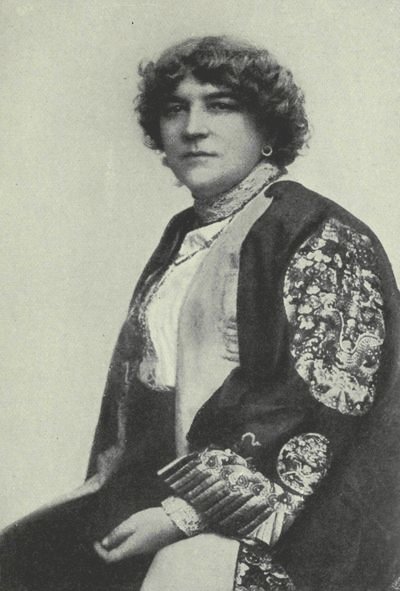
From a photograph by Hollinger, London.
Mrs. Robert
Louis Stevenson.
One of the purposes of this visit to England was Mrs. Stevenson's
desire to carry out one of her husband's last requests. In a letter
not to be opened until after his death he asked that, if the
arrangements already made for the writing and publication of his
biography by Sidney Colvin should not have been carried out within
four years, it should be placed in the hands of some other person. As
the four years had elapsed and nothing had been done in the matter, it
was decided that Graham Balfour, Stevenson's cousin and
devoted friend, should undertake the task; and when Mrs. Stevenson had
partially recovered from her illness she removed to the Balfour
residence and gave her assistance for some time in laying out the
plans for the book.
Her convalescence was very slow, and, finding the damp climate of
England unfavourable, she finally decided to move to the island of
Madeira for rest and recuperation. Accompanied by her son and his
family, her daughter having left for New York City to join her son,
Austin Strong, she travelled by slow stages through France, Spain, and
Portugal, reaching Madeira in the early part of December, 1898. From
Lisbon they sailed in a filthy little Portuguese steamer, freighted
with hay and kerosene, and the passengers, in utter disregard of the
inflammable nature of the cargo, scattered cigarette ends and lighted
matches all over the ship. However, a kind Providence carried them to
port without accident.
After a most uncomfortable voyage of two days and nights they drew
into the beautiful bay of Funchal, with its curving shore and
background of lofty mountains. The quintas, or country-houses, each
surrounded by a terraced garden and vineyard, which dotted the slopes,
gave a cheerful air to the landscape. Mrs. Stevenson speaks of it as
the "most picturesque place" she ever saw, and she had seen many of
the beauty spots of the world.
In a letter to her daughter written from here she says: "My plans are
vague. The years ahead of me seem like large empty rooms, with high
ceilings and echoes. Not gay, say you, but I was never one for
gaiety much—and I may discover a certain grandeur in the
emptiness."
When at last her strength seemed equal to the long journey, she once
more turned her face towards the setting sun, and beautiful
California. On the way a flying stop was made in Indiana to see
relatives and friends of her girlhood. Speaking of them she says, "I
saw my old friends, the Fletchers. They came to see me in droves, and
it was strange to see them old men and women, talking of their
grandchildren. It seems so difficult to realize that one's self is
old; indeed, I don't believe I ever shall." While in Indianapolis she
met for the first time her distinguished compatriot, James Whitcomb
Riley, who afterwards wrote to her recalling the occasion of their
meeting in his own gentle, kindly way. I quote the letter:
"Indianapolis, Christmas, 1900.
"Dear Mrs. Stevenson:
"Since your brief visit here last winter I've been remembering you and
your kindness every day, and in fancy have written down—hundreds of
times—my thanks to you and yours—once, when first well enough to get
down-town, wrapping a photograph for you of the very well man I used
to be. Finding the portrait this Christmas morning, I someway think it
good-omenish, and so send you the long-belated thing, together with a
copy of a recent book in which are most affectionally set some old and
some new lines of tribute to the dear man who is just away. How I
loved him through his lovely art! And how I loved all he loved and yet
loves—for with both heart and soul, and tears and smiles,
he seems very near at hand. Therefore my very gentlest greetings on
this blessed day go out to him as to you.
"Fraternally,
"James Whitcomb Riley."[68]
Mrs. Stevenson wished to live within sight of the Pacific Ocean, so
she purchased a lot at the corner of Hyde and Lombard Streets, on the
very top of one of San Francisco's famous hills, and at once began the
building of her house, living meanwhile for a time on Belvedere Island
and later at 2751 Broadway. The creation of a new thing—whether it
might be a dress, a surprise dish for the table, a garden or a house,
always appealed strongly to her, and as she plunged eagerly into the
business of planning and discussing with architects and contractors,
her interest in life rose again. As she remarked, "It is awfully
exciting to build a house." Mr. Willis Polk was the architect, but he
followed her design, which she made by building a little house out of
match-boxes on the corner of a table. The house was rather unusual in
its plan, flat-roofed, and with architecture somewhat "on the Mexican
order," as the contractor said. It fitted in well with the landscape
and gave one a feeling of home comfort and cheer within. She herself
said it was "like a fort on a cliff." Hidden from the street by a high
retaining wall and a colonnade embowered in vines was a beautiful
garden where she gradually collected rare plants from various parts of
the world. A wide stretch of emerald lawn filled the centre,
and around its borders were massed flowering shrubs and small
trees—low-growing varieties purposely chosen in order not to hide the
sea view from the windows. Here a climbing syringa brought from the
romantic Borda gardens in Mexico, where the sad Empress Carlota used
to walk, flung out its tendrils gaily to the salt sea breeze, and
seemed never to miss the kindlier sun of its former home. At one side
there was a small cemented pool, the birds' drinking-place, where many
of the little creatures came to dip their bills and trill their
morning songs. In this quiet scented garden, kept safe from intruding
eyes on all sides by vine-covered walls and shrubbery, one might sit
and dream, reminded of the outside world only by the clanging of a
street-car bell or the distant whistle of an ocean steamer.
Within the walls of this house were a thousand objects gathered in her
wanderings in all sorts of strange places, but the greatest attraction
was the magnificent outlook over sea and land afforded by its
commanding position. From the flat roof one looked down on one side
upon the picturesque city, with its many hills and steeply climbing
streets, all a-glitter at night with a million twinkling lights, and
on the other upon the great sparkling expanse of the bay, alive with
craft of every sort, from the great ocean steamer just in from the
Orient to the tiny fisher boats, with their lateen sails, returning
with their day's catch from outside the "Heads." From the drawing-room
windows one could see the winking eye of Alcatraz Island, grim rocky
guardian of the Golden Gate, and all the ships of the Pacific fleets
making their slow way in to their docking places. How
often must she have looked out upon those returning wanderers of the
deep and thought with a tender sadness of that day in the treasured
past when the Silver Ship sailed away with her and her beloved towards
the enchanted isles!
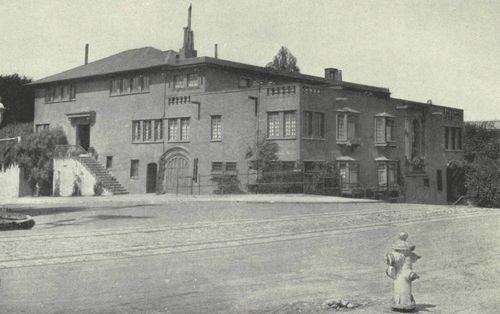
The house at Hyde and Lombard Streets, San Francisco,
with some alterations in the way of bay windows, etc., which have been
made since Mrs. Stevenson sold it.
Once she stood watching from these windows for the transport that was
coming in with soldiers from the Philippines, among whom was her
nephew, Edward Orr. As the ship hove in sight she sent her grandson
flying to the roof to wave a welcome with a large flag, and almost the
first thing the homesick young soldier saw as he turned eager eyes
shorewards was the fluttering banner high on the house-top on the
hill. Having nothing else convenient with which to return the salute,
he and his mates snatched a sheet from a bunk and waved it from a
porthole. Meanwhile Mrs. Stevenson had despatched her son to hire a
launch and take the mother and sisters of her nephew out to meet him,
and as soon as the sea-worn and tired young soldiers had landed at the
Presidio she sent out baskets of fruit and bottles of milk for their
refreshment.
Island memories were always dear to her, and when one day she heard
that a ship had come into port manned with sailors from Samoa, she at
once sent to the dock and invited them all to call on her. Soon the
dark-skinned, picturesque troop, shy but proud of the attention shown
them by Tusitala's widow, arrived. The ava bowl was brought out and
placed before them as they sat cross-legged on the floor in a
semi-circle, and after the brewing of the ava it was drunk
with all the proper ceremonies of speech-making and exchanges of
compliments. Mr. Carmichael Carr, who, with his mother, the well-known
singer, was one of the visitors that day, writes: "I have a
wonderfully clear picture of the reception Mrs. Stevenson gave and the
South Sea men she had gathered around her—their strange appearance
and incantations and the peculiar drink they brewed."
At the Hyde Street house she received many distinguished
people—actors, writers, singers, and even royalties. There Henry
James, S. S. McClure, David Bispham, William Faversham and his wife,
ex-Queen Liliuokalani and a hundred others went to pay her their
respects. It was at a reception she was giving to Liliuokalani—which,
by the way, she gave in the hope of arousing favourable interest in
the Queen's mission to Washington to seek justice—that she first met
David Bispham, and first heard him sing, too, in a rather unusual way.
Some one—I think it was Gelett Burgess—said to the Queen, "Will your
Majesty please issue a royal command? We have never heard one."
Whereupon her Majesty pointed her finger at Bispham and said, "The
bard is commanded to sing!"
When the Stevenson Society of San Francisco held their yearly meetings
of commemoration on Louis's birthday she was the honoured guest, and
it was characteristic of her to remember to invite his old friend,
Jules Simoneau of Monterey, for these occasions. When she first asked
the old man to come he shrugged his shoulders and said: "What! Will
you take me to see your fine friends in this old blouse? I have no
other clothes." "Your clothes are nothing," she replied.
"All that matters to me is that you were my husband's dear friend." So
he went, and was entertained in her house with as much consideration
as though he had been a prince of the blood. On the evening of the
dinner given by the Society at the old restaurant which had once been
frequented by Stevenson, she took Simoneau in her carriage, and when a
fashionable young lady in her party objected to this arrangement she
was rebuked by being sent home in a street-car.
Among other public functions to which she was invited to do her honour
as the widow of Stevenson was a banquet given by the St. Andrews
Society, which included nearly all the Scotchmen in San Francisco. In
conversation with three of them she remarked that she had the sugar
bowl from which Bobby Burns had sweetened his toddy when he went to
see Robert Stevenson,[69] and, after inviting them to call, promised
to mix a toddy for them and sweeten it from the same historic sugar
bowl. About a week later the three appeared, exceedingly Scotch in
their long black coats and silk hats, and each carrying a formal
bouquet. They had a delightful time, drinking their toddy, which was
duly sweetened from the hallowed bowl, and reciting Burns's poems to
her in such broad Scotch that she could not understand a word of it.
But she loved the sound of it all the same.
It was soon after her return to San Francisco that Mrs. Stevenson
interested herself in the story of a half-caste Samoan girl,
a sort of modern Cinderella, of whom she had heard before leaving the
islands. This girl, who was an orphan, had been left a fortune in
lands and money in Samoa by her American father, and when she was five
years of age had been sent to San Francisco by her guardian to be
educated. There, through a combination of circumstances, she
disappeared, and her property in Samoa lay unclaimed, while the rents
went to the benefit of others. When Mrs. Stevenson heard of this she
determined to make a search for the girl, and as soon as she reached
San Francisco set out to do so. After the rounds of all the private
schools and seminaries had been made without success, her friend, Miss
Chismore, thought of trying the charity orphan asylums, and in one of
these, a Catholic convent school for orphans, she found a girl bearing
a somewhat similar name to the lost one. Mrs. Stevenson, taking with
her a Samoan basket and some shells, immediately went out to see her.
At the school a small, dark, shy girl was brought by the sisters into
the visitors' room, and at sight of the Samoan basket she gave a
joyful cry of recognition. The long-lost heiress was found, living as
a pauper in a charity school! The difficulty then was to prove her
claim to the property and secure it for her. In her determination to
do this Mrs. Stevenson went to Washington, where, after seeing
senators, priests of the Catholic Church, and other persons in
authority, she finally succeeded in having the girl's lands, with some
of the back rents, restored to her. All this was like a fairy story to
the kind sisters at the convent, and their joy was unbounded
at seeing their little pauper pupil thus romantically transformed into
the rich princess. Meanwhile Mrs. Stevenson invited the young lady to
her house, gave a party in her honour, helped her buy clothing
suitable to her new station, and, when the time came for her
triumphant departure to claim her island possessions, went to see her
off on the steamer. As long as this little Cinderella lived she never
forgot the fairy godmother who had worked this wonderful change in her
life.
It was during this period that the regrettable incident of Mr.
Henley's attack on the memory of Stevenson occurred—an incident that
attracted a great deal more attention in England than in America,
where it was forgotten almost as soon as it happened. Mrs. Stevenson
herself always ascribed this strange act on the part of her husband's
old friend to his state of health, which had never been good and was
rapidly growing worse; and, because she believed he had become
embittered by his misfortunes, she bore no rancour. In referring to it
she repeated one of her favourite sayings, "To know all is to forgive
all," and when, after Mr. Henley's death, his widow wrote to her
asking for letters to be published in his "life," she sent them with a
kind and affectionate note.
While the house in San Francisco was building, Mrs. Stevenson went
away for a time, accompanied only by her maid, for a camping trip in
the Santa Cruz Mountains, down among the redwoods. The delights of the
place where they camped, in a shady little valley about ten miles from
Gilroy, soon won her heart completely, and she decided to purchase a
small ranch there for a permanent summer home. For the first
season she lived there in true campers' fashion, which she describes
in a letter to her daughter: "At the ranch I have one tent with a
curtain in the middle. We sleep on one side of the curtain and sit on
the other. I have only the most primitive facilities for cooking, and
the butcher is twelve miles away over a mountain road. He is anything
but dependable, and when I send for a piece of roast beef I may get a
soup bone of veal, or a small bit of liver, or a side of breakfast
bacon, which I keep hung in a tree. I cannot keep flour on a tree, so
am dependent on the boarding-house [a small summer resort about a
quarter of a mile distant] for my bread, and if they are short I have
no bread. If I find I lack something essential I have to spend a whole
day driving to town through the deep dust to get it. But of course I
am going to do all kinds of things by and by." The truth was that this
sort of life was exactly to her taste, and the wilder and rougher it
was the better it suited her. She was always, to the end of her days,
the pioneer woman, and the greensward of the woods went better to her
feet than carpeted halls.
Afterwards tents were put up for the accommodation of her family, and
every spring, after the rains were over, they all moved down to take
up a delightful out-of-door life such as can scarcely be enjoyed
anywhere in the world except in California. Cooking was done in the
open air, and meals were taken at a long table spread in a deep glen,
where the trees were so thick that it was pleasantly cool even on the
hottest days.
As time went on the mistress of this sylvan paradise grew
more and more attached to it, and she at length decided to build more
permanent quarters. First of all, she made a model of a house out of
match boxes, with pebbles for the foundation wall, all glued together,
painted and complete. Then she hired a country carpenter and built her
house—a pleasant little dwelling, with a wide veranda extending in
country fashion around two sides of it.
In building the foundation wall boulders from the stream were used,
and many were found bearing bold imprints of fossil ferns, birds, and
snakes. Mrs. Stevenson was delighted to have these reminders of a past
age for her wall, but, alas, during her absence the stones were all
cemented in place with the nice smooth sides outward and the fossils
turned inward.
Although it was so different from the tropic island that had now
become but a tender memory, yet there was much about this place that
recalled Vailima days—the sweet seclusion, the rich greenery all
about, the music of the little tinkling stream, and, above all, the
morning song of the multitudes of birds. It was for this, and perhaps
to make a link between her California home and that other far across
the wide Pacific that she chose to call the little ranch in the Santa
Cruz Mountains Vanumanutagi, vale of the singing birds.
At Vanumanutagi Mrs. Stevenson led a simple life, spending most of her
time out-of-doors and occupying herself with plans for the planting
and improvement of the land. The house was simply furnished, and the
country people were charmed with the gay chintz and bright
wall-paper, the brick fireplace, and the general appropriateness of it
all. As it was not large, tents were put up for the family and guests
to sleep in.
Even this peaceful spot had its excitements, for in the autumn, when
the undergrowth everywhere was as dry as tinder, its quiet was
sometimes disturbed by the outbreak of California's summer
terror—forest-fires. One of the worst of these happened when Mrs.
Stevenson was at the ranch with only her sister Elizabeth[70] and a
maid. It came suddenly, and the first they knew of it was the sight of
what they took to be sea fog, rolling and tumbling over the tops of
the hills. They soon knew it for what it was when it came pouring down
into the valley and they began to choke with its acrid smell.
Presently horsemen came galloping by on their way to warn ranchers of
the fire, and every little while a man would come out and report the
progress made in checking it. It was an oppressive, hidden danger, for
nothing could be seen from the valley of the actual flames through the
thick suffocating curtain of smoke that hung over all. The only avenue
of escape was by way of the road to Gilroy, and the fire threatened
momentarily to cut this off. Not wishing to abandon the place to its
fate, Mrs. Stevenson thought out a plan for saving their lives in the
last emergency by wrapping up in wet blankets and crouching in a sort
of hole or low place in an open field near the house. Fortunately the
fire was stopped before this became necessary.
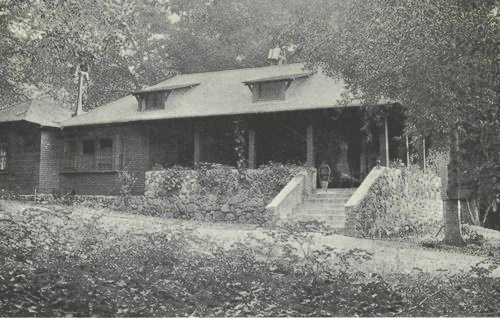
The house at Vanumanutagi ranch.
It was while she was living at the ranch that Mrs. Stevenson began to
write the introductions to her husband's works in the
biographical edition brought out by Charles Scribner's Sons. As she
had but a modest opinion of her abilities, she undertook this work
with the greatest reluctance, and in a letter to Mr. Scribner she
remarks, "It appalls me to think of my temerity in writing these
introductions." Yet I believe that everyone who reads them will feel
that a new and personal interest has been added to each one of his
books by her graphic story of the circumstances of its writing.
Among the best loved of the infrequent guests who braved the long,
hot, dusty drive from Gilroy to the ranch was the young California
writer, Frank Norris. During his visits there Mrs. Stevenson became
much attached to him, and he in turn was so charmed with the place and
the life that he determined to buy a ranch in the neighbourhood. As I
have already said, when an opportunity offered he bought the Douglas
Sanders place, Quien Sabe Rancho, intending to spend all his summers
there. Writing to Mrs. Stevenson about his plans in his gay boyish
fashion, he says:
"My dear Mrs. Stevenson:
"This is to tell you that our famous round-the-world trip has been
curtailed to a modest little excursion Samoa-wards and back, or mebbe
we get as far as Sydney. We wont go to France, but will come to Quien
Sabe in February—FEBRUARY! We find in figuring up our stubs that we
have a whole lot more money than we thought, but the blame stuff has
got to be transferred from our New York bank to here, which (because
we went about it wrong in the first place), can't be done
for another two weeks. We will make the first payment on Quien Sabe
before October 1st—$250. Will you ask Lloyd to let us know—or I mean
to bear us in mind—if he hears of a horse for sale so we could buy
the beast when we come up next February. Meanwhile will keep you
informed as to 'lightning change' programme we are giving these days.
"Ever thine (I've clean forgot me nyme)."
The Norris cabin stands high on the mountain slope, and is reached by
a steep winding road leading up from Vanumanutagi Ranch.
To this ideal spot, this secluded little lodge in the wilderness,
Frank Norris hoped to bring his wife and little daughter and spend
many happy and fruitful summers. Here he intended to work on the last
volume of his series of the wheat trilogy—the story of the hunger of
the people, which was to be called by the appropriate name of The
Wolf. His joy in his new purchase was unbounded, and many
improvements to the cabin and ranch were projected. In all these plans
Mrs. Stevenson took a more than neighbourly interest, for she spent
time and money in helping to make the place comfortable and
attractive. Among other things she built a curbing around the well,
using for the purpose boulders from the inexhaustible supply in the
bed of the stream, and, to have all complete, even sent to Boston for
a real "old oaken bucket." At just the right intervals along the steep
road to the cabin, measured off by her own indefatigable
feet, she placed rustic seats, where the tired climber might rest.
But alas! All these pleasing hopes came to naught, for within a short
time after buying the ranch sudden death cut him off in the flower of
his youth and the first unfolding of his genius. This was a sad blow
to Mrs. Stevenson, for she had become much attached to the brilliant
and lovable young writer. Sometime afterwards she thought of putting
up a memorial to him on the little ranch where he had hoped to spend
many happy years. Having decided that it should take the form of a
stone seat, bearing a suitable inscription, she went to work in
conjunction with Gelett Burgess to make the design. The site chosen
for the seat is upon a small level spot a few yards below the cabin,
at the side of the winding road leading up from the Stevenson ranch.
In carrying out this project she took a melancholy pleasure, as she
writes in a letter to Mr. Charles Scribner, dated 1902: "I am building
a memorial seat to poor Frank Norris. With the assistance of a couple
of men I have gathered a lot of boulders from the bed of a stream, and
from these we have fashioned a bench to hold six or eight people, and
set it where the view is glorious. I have helped lay the stones, and
have dabbled in mortar until I can hardly use my hands to write. This
sort of work is so much more interesting than scratching with a pen.
In the joy of even so poor a creation I forget the sad purpose of it,
and am as happy as one hopes to be who has lived as long as I."
Before these two friends—he in the springtime of his days,
she in the mellow autumn of maturity—passed away, they were persuaded
to record their voices in a phonograph, but it was a useless effort,
for no one who loved them has ever been able to endure to listen to
their spirit voices, as it were, speaking from the other world.[Back to Contents]
Eight years, divided between the house "like a fort on a cliff" in San
Francisco and the sylvan solitude of the little ranch tucked away in
its corner in the mountains of the Holy Cross, slipped by happily
enough. Now and again the wandering mood came back, but, except for
one visit to France and England, Mrs. Stevenson confined her
journeyings to the American continent.
One of these excursions led her to Mexico—a country that she found
more interesting than any she had ever visited in Europe. Sometimes I
think this may have been because of some primitive element in her own
nature that responded to the traditions of that strange land—so aged
in history, so young in civilization—but, anyway, she told me that
she felt a genuine thrill there such as she had never experienced in
any of the historic places of the Old World. At the tomb of Napoleon
she remained cold, but at the "tree of the sad night," where Cortés is
said to have wept bitter tears on that dark and rainy night away back
in 1520, her imagination was deeply touched. At the church of
Guadalupe she looked at the pitifully crude paintings and other
thank-offerings of the simple devotees with deep and sympathetic
interest.
Much more interesting than the city of Mexico she found the
quaint and ancient town of Cuernavaca, where Maximilian was wont to
come with his Empress to enjoy the delights of the famous Borda
Gardens. These gardens, though fallen from their first high estate,
were still very beautiful at the time of Mrs. Stevenson's visit.
Of these pleasant days in Cuernavaca she writes in a letter to her
daughter:
"I have a little plant from the garden where Carlota lived, which I
think is a climbing syringa. We go round nearly every evening to the
palace built by Cortés, in one room of which he strangled one of his
mistresses.... I had always supposed Maximilian to be a most exemplary
person, but he seems to have lived in a palace some three miles from
here with a beautiful Mexican girl, while poor Carlota was left alone
in town in the Borda Gardens.... Everybody goes barefoot here, though
all dressed up otherwise, and everybody wears the rebozo.[71] This
morning I killed a scorpion on the wall alongside the bed, and the
other day I also assisted in the killing of a tremendous tarantula in
the middle of the road. We stood far off and threw stones at it. None
of mine hit the mark, but I threw like mad.... I hope you were not
frightened by the news of the earthquake here. We got a good shake but
no harm done. Just a little south of us there has been terrible
damage—a whole town destroyed and people killed. Here all the people
ran into the streets, and kneeling, held out their hands towards the
churches that contain their miraculous images.... We have
had a 'blessing of the animals' at the cathedral, where cats, dogs,
eagles, doves, cocks and hens, horses, colts, donkeys, cows and bulls,
dyed every color of the rainbow and wearing wreaths of artificial
flowers round their necks, were brought to receive this sacrament. I
wanted to take Burney [her little Scotch terrier], but feared his
getting some contagion, so gave it up, and now my Burney has forever
lost the chance of becoming a holy, blessed dog.... The native people
here are very abject, and seem almost entirely without intellect; yet
they are the only servants to be had unless one sends to California,
and they make life a desperate business. The only spirit I have seen
in any of them was to-day, when a native policeman tried to get up a
fight between his own huge dog and my little Burney. Of course Burney
the valiant was ready for the fray and would probably have disposed of
the big dog had I not run up, closing and clubbing my parasol as I
came. The policeman thought I was going to strike him, and for one
second stood up to me fiercely, saying 'No Señorita! No Señorita!'
Then his knees suddenly gave way and he and his dog and his friend who
was standing by to see fair play utterly collapsed."
Steeped as the country was in old tradition, and far removed as it
seemed from all knowledge of the outside world, the name of Robert
Louis Stevenson had penetrated to its inmost recesses, and its people
were pleased to bestow honour upon his widow. Writing of this she
says: "I want to tell you that at every little lost place on the road
I have received extra attention because of my name. In this
house I have the best room, the landlord himself giving it up to me. I
hope Louis knows this."
The little plant of which she spoke, the climbing syringa, which was
given to her as a special favour by the man in charge of the Borda
Gardens, reached San Francisco in good condition and took most kindly
to its new home. Slips of it were given to friends, and its sweet
flowers, reminiscent of the ill-fated queen who once breathed their
perfume, now scent the air in more than one garden round San Francisco
Bay.
It was not long after her return from this trip to Mexico that Mrs.
Stevenson began to be troubled with a bronchial affection that
increased as she advanced in years and made it necessary for her to
seek a frequent change from the cool climate of San Francisco. In
November of 1904 a severe cough from which she was suffering led her
southward. This time she was accompanied by Salisbury Field, the son
of her old friend and schoolmate of Indiana days, Sarah Hubbard Field.
Mr. Field had now become a member of Mrs. Stevenson's household, and
at a later date married her daughter, Isobel Osbourne Strong.
Arriving at La Jolla by the sea, a most picturesque spot on the
southern coast of California, they were disappointed in not finding it
as warm as they had expected, so it was decided to go further south.
In the course of their inquiries at San Diego they met a Western miner
named George Brown, who told them stories of a lonely desert island
off the coast of Lower California, where he was about to
open a copper-mine for the company for which he was general manager.
The more he talked of this lonesome isle and of how barren and
desolate it was the more Mrs. Stevenson was fascinated with it, and
when he finally invited them, in true Western fashion, to accompany
him thither, she joyfully accepted. In the early part of January she
took passage with her little party, consisting of herself, Mr. Field,
and her maid, on the small steamer St. Denis, which was sailing from
San Diego and making port at Ensenada and San Quintin on the way to
Cedros Island.
At the island the Stevenson party was offered the large company house
of ten rooms by Mr. Brown, but preferred to live in a little
whitewashed cottage that stood on the beach. Except for the Mexican
families of the mine workmen there were no women on the island besides
Mrs. Stevenson and her maid. The small circle of Americans soon became
intimately acquainted, for the lack of other society and interests
naturally drew them close together. Besides George Brown, Clarence
Beall, and Doctor Chamberlain, the company doctor, there was only a
queer old character known as "Chips," a stranded sea carpenter who was
employed to build lighters on the beach.
Mrs. Stevenson had all of Kipling's fondness for mining men,
engineers—all that great class of workers, in fact, who harness the
elements of earth and air and bend them to man's will—and she was
very happy on this lonely island with no society outside of her own
party but that of the few employed at the mine. Between her and Mr.
Beall, a young mining engineer employed on the island, a
strong and lasting bond of friendship was established from the moment
of their first meeting, when she saw him wet and cold from a hard day
of loading ship through the surf and insisted on "mothering" him to
the extent of seeing that he had dry clothing and other comforts. And,
although the difference between the green tropic isle beyond the
sunset which lay enshrined in her memory and this barren cactus-grown
pile of volcanic rocks was immeasurable, yet the one, in its peace,
its soft sweet air, and the near presence of the murmuring sea, called
back the other.
When, after three pleasant, peaceful months, the time came for her
departure, there was general sorrow on the island, where it may well
be imagined that her presence had greatly lightened the tedium of
existence for its lonely dwellers. "To this day," writes Doctor
Chamberlain, "whenever I pick up one of Mr. Stevenson's novels, my
first thoughts are always of his wife and our days at Cedros Island."
While in Ensenada on the return trip Mrs. Stevenson heard of a ranch
for sale there, and after looking at it decided to purchase it. The
place, known as El Sausal,[72] lies on the very edge of the great
Pacific, and has a magnificent beach. The climate is as nearly perfect
as a climate can be, and Mrs. Stevenson often said that if the world
ever learned of the magic healing in that country there would be a
great rush to the peninsula, so long despised as a hopeless desert.
There was only a little cottage of a very humble sort on the
ranch and supplies were hard to get, but she loved it and was never
better in health than when she was at Sausal. At this time she
returned to San Francisco, but the following winter she went back to
take possession and spent some time there. Writing to Mr. Charles
Scribner, she says: "I am living in a sweet lost spot known as the
Rancho El Sausal, some six miles from Ensenada in Lower California. If
I had no family I should stop here forever; except for the birds, and
the sea, and the wind, it is so heavenly quiet, and I so love peace."
Running through the place was a little stream, the banks of which were
thick with the scarlet "Christmas berry," so well known in the woods
of Upper California; multitudes of birds—canaries, linnets, larks,
mocking-birds—all sang together outside the door in an amazing
chorus; and on the beach near by the sea beat its soft rhythmic
measure.
They were very close to nature at Sausal, but though its situation was
so isolated they had no fear, for the penalties for any sort of crime
were terrific. Burglary, or even house-breaking, were punished with
death, and one could hardly frown at another without going to prison
for it. Sometimes they were surprised by the sudden appearance of a
man, tired and dusty, dashing up on a foam-covered horse and asking
for food. To such an unfortunate they always gave meat and drink, and
when the rurales[73] presently galloped up and demanded to know
whether they had seen an escaped prisoner they swallowed their
conscientious scruples and answered "No!" Personally they
met with nothing but the most punctilious courtesy from the Mexican
officials. When Mrs. Stevenson received a Christmas box from her
daughter, the chivalric comandante at Ensenada, in order to make
sure that she should have it in time, sent it out to Sausal
magnificently conducted by three mounted policemen.
When she left this peaceful spot in the spring of 1906 to return to
San Francisco she little thought that she was moving towards one of
the most dramatic incidents in her eventful life. All went as usual on
the journey until they had passed Santa Barbara on the morning of the
fateful day, April 18, when vague rumours of some great disaster began
to circulate in a confused way among the passengers. Soon they knew
the dreadful truth, though in the swift running of the train they
themselves had not felt the earthquake, and it was not long before
concrete evidence confirmed the reports, for at Salinas they were
halted by the broken Pajaro bridge. At that place Mrs. Stevenson slept
the night on the train, and the next day she hired a team and drove by
a roundabout way to Gilroy, near which, it will be remembered, her
ranch, Vanumanutagi, was situated. There they learned that San
Francisco was burning, and while Mr. Field made his way as best he
could to the doomed city, she camped in a little hotel in Gilroy
waiting for news—a prey meanwhile to the most intense fears for the
safety of various members of her family, from whom she was entirely
cut off.
While she waited as patiently as might be in the little
country town, there were strenuous times in the burning city, but, as
telegraph wires were all down and no mails were going out, she was
compelled to remain in suspense until three days later, when the fire
was subdued and Mr. Field was able to get back to her with the news
that her family were all safe and her house unharmed. The story of the
rescue of her house from the flames has been curiously contorted by
persons who have attempted to write about it without knowing the
facts. The real saviors of Mrs. Stevenson's house were her nephews and
Mr. Field, and even they might have lost the day had it not been for a
providential wind that blew in strongly from the sea against the
advancing wall of flame. For three days and nights they looked down
from their high post upon the raging furnace below and anxiously
watched the progress of the fire as it leaped from street to street in
its mad race up the hill, and when at last the two houses and a large
wooden reservoir immediately opposite went roaring up all hope seemed
gone. In the end it was through a mere trifle that the tide of fortune
was turned in their favour. In the garden there was a small cement
pool, the home of a tiny fish answering to the name of Jack. When the
water in the pool was slopped over by the earthquake poor Jack was
tossed some yards away upon the grass, whence he was rescued, alive
and wriggling, and restored to his own element, only to be killed
later by some thoughtless refugee who washed his hands in the water
with soap. The half bucket or so of water remaining in the pool helped
to save the day, for the fire fighters dipped rugs and sacks
in it, and, climbing to the flat roof, took turns in dashing through
the scorching heat to beat the cornices when they began to smoke. Even
so, the escape was so narrow that at times it seemed hopeless, and the
rescuers took the precaution to dig a hole in the garden and bury the
silverware, the St. Gaudens plaque, and other valuables.
When the three days' conflagration had finally worn itself out and the
tired and smoke-begrimed fighters could take account, they found the
house and its contents safe, except for a huge hole in the roof where
the earthquake had thrown down a large heavy chimney, piling up the
bricks on the bed in the guest-chamber, fortunately not occupied at
the time. But the outlook was ghastly, for the house stood high on its
clean-swept hill like a lonely outpost in a great waste of cinders,
half-fallen chimneys, and sagging walls. In two weeks' time, while
they still smoked, the ruins took on a strangely old look, and it was
like standing in the midst of the excavations of an ancient city.
Around the solitary house on the hill the wind howled, making a
mournful moaning sound through the broken network of wires that hung
everywhere in the streets.
Homeless refugees, running through the streets like wild creatures
driven before a prairie fire, came pouring past, and some stopped to
build their lean-to shacks of pieces of board and sacking against the
sheltering wall of the house. Blankets and other things were passed
out to keep them warm, and when they finally went their way the
blankets went with them, but Mrs. Stevenson was glad that
they should have them and said she would have done the same had she
been in their case.
All this while her son and daughter—the son in New York and the
daughter in Italy—were in a state of anguished suspense as to their
mother's fate. By a strange coincidence the daughter had herself been
in some danger from the great eruption of Vesuvius, and had but just
escaped from that when she heard newsboys crying in the streets of
Rome, "San Francisco tutta distrutta!" Several days passed in
intense anxiety before she received the telegram with the blessed
words "Mother safe!"
As it was quite impossible to live in the destroyed city until some
sort of order should be established, even water being unprocurable on
the Hyde Street hill, Mrs. Stevenson decided to take refuge for the
time at Vanumanutagi Ranch near Gilroy. Even there she found a sorry
confusion, for the house chimneys were all wrecked and the stone wall
around the enclosure had been thrown down and scattered. There was
plenty of good water, however, and the possibility of getting
provisions and living after a fashion, so she settled down to stay
there until conditions should improve in the city. It was an eerie
place to stay in, too, for that section lies close to the main
earthquake fault, and the quivering earth was a long time settling
down from its great upheaval. For as long as a year afterwards small
quakes came at frequent intervals, and in the stillness of the night
strange roaring sounds, like the approach of a railroad train, and
sudden exploding noises, like distant cannon shot, came to
add their terrors to the creaking and swaying of the little wooden
house.
After some months Mrs. Stevenson went to San Francisco, but she found
the discomfort still so great and the sight of the ruined city so
depressing that she finally yielded to the persuasions of her son and
Mr. Field to accompany them on a trip to Europe. They sailed from New
York in November, 1906, on the French steamer La Provence.
After a stay of only three or four days in Paris, they took the train
for the south—an all-day trip. As Mrs. Stevenson had always thought
she would love Avignon, though she had never been there, it was
decided to go there first. In their compartment on the train there was
a French bishop, a Monseigneur Charmiton, and his sister, with whom
they soon fell into conversation. The bishop and his sister seemed
appalled at the idea of anyone wanting to spend a winter in Avignon.
"By no means go there," they said, "but come down where we live. It is
beautiful there." The good people had a villa, it seemed, half-way
between Nice and Monte Carlo. But Mrs. Stevenson wanted to decide upon
Avignon for herself, so they went on, and found it a most picturesque
place, but soon discovered the truth of the old saw, "Windy Avignon,
liable to plague when it has not the wind, and plagued with the wind
when it has it." This wind swept strong and cold down the Valley of
the Rhone, making it so bleak and forbidding that they were forced to
cut their visit short.
They left next day for Marseilles, where they found, much to their
delight, not only their motor-car, which had been shipped
from New York, but Monseigneur Charmiton and his sister, who were on
the point of leaving for their villa at Cap Ferrat. "And how did you
like Avignon?" were their first words. Although too polite to say "I
told you so," they now insisted the Riviera be given a fair trial. So,
chance and friendly counsel prevailing, the Stevenson party motored
east through lovely Provence, passing swiftly through Hyères of
haunting memory, and on to Cannes, where they stopped the night; and
so to an hotel in Beaulieu, where Monseigneur's sister had engaged
rooms for them till a villa was found to their liking. And soon a
charming one at St. Jean-sur-Mer, a little village near Beaulieu, was
taken for the season.
The Villa Mes Rochers stood in a walled garden, which sloped gently to
a terrace on the edge of the sea—a place for tea in the afternoons
when the mistral was not blowing. Here they settled down for the
winter.
It was a pleasant, easy life. There were friends in Nice and Monte
Carlo; there was the daily motor ride; there were books to read,
letters to write, and recipes to be learned from the French and set
down in the famous cook book without which Mrs. Stevenson never
travelled. Here they lingered till April, and then set out in their
motor for London.
Their route again lay through Provence. They stopped at Arles, famous
alike for its beautiful women and its sausages. The beautiful women
were absent that day, but a sausage appeared at table and was
pronounced worthy of its niche in the sausage Hall of Fame.
Further along, in the Cevennes, they were enchanted with Le Puy, and
the lovely, lovely country where Louis had made his memorable journey
with Modestine. And so they went on north, by Channel steamer to
Folkstone, up through Kent, and into London by the Old Kent Road; then
to lodgings in Chelsea, where old friends called and old ties were
renewed.
After a month in London a house was taken in Chiddingfold, Surrey, to
be near "the dear Favershams," as Mrs. Stevenson always called them.
Mr. and Mrs. William Faversham, whom Mrs. Stevenson held in great
affection, owned The Old Manor in Chiddingfold, and they had found a
place for her near them—Fairfield, a charming old house in an
old-world garden, and, best of all, not five minutes' walk from The
Old Manor.
Life at Fairfield, except for constant rain, was delightful. Graham
Balfour, the well-beloved, came for a visit; Austin Strong and his
wife ran down from London; many an afternoon was spent at Sir James
Barrie's place near Farnham. Sir James loved Mrs. Stevenson—a dear,
shy man who had so little to say to so many, so much to say to her.
Then there were the Williamsons (of Lightning Conductor fame), whom
she had met in Monte Carlo; they also had a house in Surrey. And there
were Sir Arthur and Lady Pinero, who lived only a mile or two from
Fairfield. Mrs. Stevenson considered the genial, witty, gently cynical
Sir Arthur one of the most interesting men she had ever met. Lady
Pinero always called her husband "Pin," and Sir Arthur was enchanted
when, after looking at him with smiling eyes, Mrs. Stevenson
one day turned to Lady Pinero and remarked, "I've always doubted that
old saying, 'It is a sin to steal a Pin,' but now I understand it
perfectly."
Katherine de Mattos, Stevenson's cousin, also honoured Fairfield with
a visit, and Coggie Ferrier, sister of Stevenson's boyhood friend, and
the woman perhaps above all others in England whom Mrs. Stevenson
loved best, came frequently. And always there were the Favershams, who
were very dear to her heart. It was a memorable summer, full of
pleasant companionship—and rain. Towards the middle of August, on
account of the never-ceasing rain, it was finally decided to abandon
Fairfield and return to France for a long motor trip.
The first night out from Chiddingfold was spent at Tunbridge Wells,
and next day a stop was made at Rye to call on Henry James. Never did
travellers receive a more hearty or gracious welcome. It is a quaint,
lost place, Rye—one of the old Cinque Ports; to enter it one passes
under an ancient Roman arch; the nearest railroad is miles away. It is
nice to think that after giving him a cup of tea in her drawing-room
in San Francisco two years before, Mrs. Stevenson could see the house
he lived in, admire his garden, drink tea in his drawing-room, and
talk long and pleasantly with this old and valued friend she was never
to see again.
The second motor trip in France was an unqualified success. Keeping to
the west and avoiding Paris, this time their route lay through Blois,
Tours, Angoulême, Libourne, Biarritz, till, finally, several miles
from Pau, they had a panne, as they say in France, and
their motor, which had behaved remarkably well until that moment,
entered Pau ignominiously at the end of a long tow-rope. As it took
ten days to make the repairs necessary, they used the interval of
waiting to go by train to Lourdes. It was the particular time when
pilgrims go to seek the healing waters of the miraculous fountain, and
they saw many sad and depressing sights—for the lame, the halt, the
blind, people afflicted with every sort of disease, and some even in
the last agonies, crowded the paths in a pitiful procession. Mrs.
Stevenson afterwards said that when she saw the blind come away from
the sacred fount with apparently seeing eyes, and the lame throw away
their crutches and walk, she was, as King Agrippa said unto Paul,
"almost persuaded" to believe.
Gladly putting this picture behind them, they went on to
Bagnères-de-Bigorre, a little village nestling at the base of the
Pyrenees. The weather there was perfect, and the whole atmosphere of
the place so sweetly simple and unsophisticated that Mrs. Stevenson
loved it best of all. After six pleasant days spent there, the motor
now mended, they returned by train to Pau and resumed their trip—due
east to Carcassonne, that lovely, lovely city, with its mediæval
ramparts and towers, and then on to Cette on the Mediterranean, where
they landed in a storm.
And so north, almost paralleling their first trip, they ran through
Mende, Bourges, and Montargis, and one rainy afternoon passed within
sight of the village of Grez, where so many years before Fanny
Osbourne first met Louis Stevenson, but the memories that it
brought were too poignant, and she was only able to give one look as
they sped swiftly by.
Arriving in Paris on October 3, after this leisurely journey through
beautiful France, they remained but a few days there and then went on
to London, where they met the Favershams and sailed in company with
them for America on the Vaterland. With but a brief stop in New York
they hastened on to San Francisco to carry out a certain plan that had
been formulated while they were in France. Oddly enough, it was on the
other side of the world that Mrs. Stevenson first heard of beautiful
Stonehedge, the place at Santa Barbara which became the home of her
last days. At Monte Carlo she met Mrs. Clarence Postley, of
California, who dilated on the charms of the Santa Barbara place—its
fine old trees, its spring water, its romantic story of being haunted
by the ghost of a beautiful countess—until finally Mrs. Stevenson
said that if it was as charming as that she would buy it. After her
return to California she went to see it, and, finding it even more
lovely than she had been told, the bargain was struck. It had been
evident for some time, too, that her health required a warmer climate
than that of San Francisco, and, above all, she longed for a place
where she might live more in the open than the winds and fogs of the
bay city permitted. So, though she was very sad at leaving the house
on the heights where she had lived long enough for her heart-strings
to take root, she sold it in 1908 and removed to the southern place,
there to enter on a new phase of her life.
The house at Hyde and Lombard Streets, following out the
curious fatality that made everything connected with her take on some
romantic aspect, became for a time the abode of Carmelite Sisters, the
Roman Catholic Order whose strict rules require its devotees to live
almost completely cut off from the world. The long drawing-room, where
Mrs. Stevenson had entertained so many of the great people of the
earth, became the chapel, and in place of the light laughter and gay
talk that once echoed from its walls only the low intoning of the mass
was heard. At the front door, where the Indian pagan idols had kept
guard, a revolving cylinder was placed so that the charitable might
put in their donations without seeing the faces or hearing the voices
of the immured nuns. In the green garden where Mrs. Stevenson had so
often walked and dreamed of other days the gentle sisters knelt and
prayed that the sins of the world might be forgiven.[Back to Contents]
Of all the beautiful places of the earth where it was Fanny
Stevenson's good fortune to set up her household gods at various
times, perhaps the loveliest of all was this spot on the peaceful
shore of the sunset sea, under the patronage of the noble lady, Saint
Barbara. In the Samoan gardens tropical flowers flamed under the hot
rays of the vertical sun; in San Francisco geraniums and fuchsias
rejoiced and grew prodigiously in the salt sea fog; but at Santa
Barbara, where north and south meet, the plants of every land thrive
as though native born. The scarlet hibiscus, child of the tropics,
grows side by side with the aster of northern climes; the
bougainvillæa flings out its purple sprays in close neighbourhood to
the roses of old England; the sweet-william, dear to the hearts of our
grandmothers, blooms in rich profusion in the shade of the
pomegranate; and in brotherly companionship with the Norwegian pine
the magnolia-tree unfolds its great creamy cups.
In her garden at Stonehedge, situated in lovely Montecito, about six
miles from Santa Barbara, Fanny Stevenson found the chief solace of
her declining years. Its extent of some seven acres gave her full
scope for the horticultural experiments in which she delighted. When
she took possession of the place it was in rather a
neglected state, but that was all the better, for it gave her a free
field to develop it according to her own tastes. The house was a
well-built but old-fashioned affair of an unattractive type, with
imitation towers and gingerbread trimmings, and at first sight her
friends assured her that nothing could be done with it. Architects,
when asked for advice, said the only thing was to tear it down and
build a new house. But, instead, she called in a carpenter from the
town and set to work on alterations. When all was done the house had a
pleasant southern look that fitted in well with the luxuriant growth
of flowers and trees in which it stood, and its red roof made a
cheerful note in the landscape.
In the grounds she worked out her plans, leisurely adding something
year by year, a little Dutch garden, sweeping walks and lawns, a
wonderful terraced rose-garden with a stone pergola at the upper end,
where the creepers were never trimmed into smug stiffness, but grew in
wild luxuriance at their own sweet will, and soon they made a glorious
tangle of sweet-smelling blooms and glossy green leaves. From the
living-room windows one looked out over a broad expanse of mossy lawn;
groups of vermilion-coloured hibiscus and poinsettias kept harmonious
company; dahlias made great masses of gorgeous colour among the green;
tall hollyhocks were ranged along the veranda in old-fashioned
formalism; indeed, it would be like quoting from a florist's catalogue
to mention all the plants to be found in this garden.
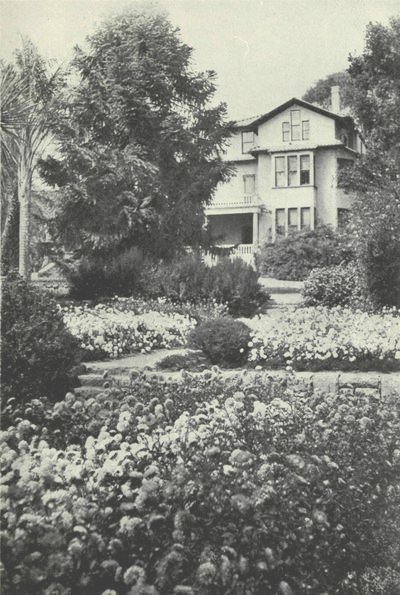
Stonehedge at Santa Barbara.
Nor did she neglect the purely useful, for the most delicious fruits
and vegetables—from the lemons, oranges, and loquats of
the south to the apricots, apples, and pears of the north—grew to
perfection under her fostering care. She was always on the lookout for
new varieties, and I find among her correspondence a letter from the
distinguished horticulturist, Luther Burbank, in answer to her request
for strawberry plants:
"Santa Rosa, California, Feb. 21, 1911.
"Dear Mrs. Stevenson:
"I feel most highly honored and pleased with your kind order of the
15th instant for 25 Patagonian strawberry plants, which were sent out
yesterday.... You can never know the regard and love in which Mr.
Stevenson is held in thousands of hearts who have never expressed
themselves to you.
"Sincerely yours,
"Luther Burbank."
The story of Fanny Stevenson's life at Stonehedge is one of the still
peace that she loved more and more as time went on, almost its only
excitements being the blooming of a new flower, the digging of a well,
or perhaps the trying out of an electric pump. The hurly-burly of the
world was far away from that quiet spot, and only the arrival of the
daily mail by rural carrier, or an infrequent visitor from some one of
the country houses in the neighbourhood, broke the sweet monotony of
existence. Of the simple pleasures of her life here she writes to her
husband's cousin, Graham Balfour, in these words:
"As I write, my delightful Japanese boy, Yonida, brings me
in a great bunch of violets in one hand and quantities of yellow
poppies in the other, while in front of me stands an immense vase of
sweet peas—all just plucked from my garden. I wish that you might
share them with me, and that you might hear the mocking-bird that is
singing by my window. A mocking-bird is not a night-in-gale, to be
sure, but he has a fine song of his own. I have such a nice little
household; my two Japanese young men, who do gardening and such
things; a most excellent, very handsome, middle-aged cook named Kate
Romero, who, in spite of her name is half Irish and half English; and
Mary Boyle, altogether Irish and altogether a most delightful
creature. The most important member of the family, however, is my cat;
Kitson is a full-bred Siamese royal temple cat, and is quite aware of
his exalted pedigree. He exacts all and gives nothing. There are times
when I should prefer more affection and less hauteur. He's a proud
cat, and loves no one but Kitson."
This cat, a strange creature coloured like a tawny lion, with face,
tail, and paws a chocolate brown, and large bright-blue eyes staring
uncannily from his dark countenance, possibly had more affection than
his haughty manner indicated, for, after his mistress's death, he
refused food and soon followed her into the other world, if so be that
cats are admitted there.
In this house were gathered all the heirlooms, books, old furniture,
pictures, and other interesting objects which had been brought down
from San Francisco. The St. Gaudens medallion of Stevenson was fitted
into a niche over the mantelpiece in the living-room, where
Mrs. Stevenson spent much of her time seated before the great
fireplace with the haughty Kitson on her lap. On the mantelshelf there
was a curious collection of photographs—one of Ah Fu, the Chinese
cook of South Sea memory, side by side with that of Sir Arthur Pinero,
famous playwright—silent witnesses to the wide extent of her
acquaintance and the broad democracy of her ideas.
At Stonehedge her life ran on almost undisturbed in the calm stillness
that she loved so much. Now and then she went for a day's fishing at
Serena, a place on the shore a few miles from Stonehedge. With its
background of high, rugged hills and the calm summer sea at its feet
it has a serene beauty that well befits its name.
At infrequent intervals people of note arriving in Santa Barbara
sought her out, and though she received them graciously she was
equally interested in the visit of an Italian gardener and his wife,
who came to bring her a present of some rare plant, and with whom she
had most delightful talks about the flowers of the tropics. She was
much pleased, too, when one day a Scotch couple, plain, kindly people,
came merely to look at the house where the widow of their great
countryman lived. When they came she happened to be in the garden and
they apologized for the intrusion and were about to withdraw, but the
moment she recognized the accent she welcomed them with outstretched
hands. When they left their carriage was loaded with flowers, and she
stood on the veranda waving her hand in farewell.
In August, 1909, accompanied by her daughter, Mr. Field, her
nephew Louis Sanchez, and the maid Mary Boyle, she went on a motor
trip to Sausal in Lower California, where they found that the house
had been broken into by duck hunters, and presented a forlorn
appearance. Coming from the comfort of Stonehedge to this deserted
cabin was something of a shock to the rest of the party, and but for
Mrs. Stevenson they would have left at once. "Mrs. Robinson Crusoe,"
however, justified her name with such enthusiasm that the others
caught fire. Louis Sanchez lent a ready hand to repairs and under his
magic fingers doors swung upon their hinges, tables ceased to wabble,
door-knobs turned, and even a comfortable rocking-chair "for Tamaitai"
emerged from a hopeless wreck. Mrs. Strong and Mary Boyle assaulted
the little cabin with soap and water and disinfectants, and with much
courage and laughter routed two swarms of bees which had taken
possession of the ceiling. Mr. Field supplied the larder with game and
fish, and ran the automobile to town for supplies. Mrs. Stevenson,
who, at Stonehedge, was always somewhat dismayed by the morning
demands of the cook for the day's orders, delighted in surprising the
party with unexpected good dishes which she cooked with her own hands.
As the years passed her health began to show distinct signs of
breaking, and when she proposed another trip to Mexico in the spring
of 1910, her family feared she was not strong enough to endure the
fatigue, but as she herself said she "would rather go to the well and
be broken than be preserved on a dusty shelf," they finally agreed.
She had had a great admiration for Mexico ever since her
first visit, and wanted to show her daughter the land she said was
"older and more interesting" than any country she had ever seen. Then,
as her nephew was a mining engineer recently graduated from the
University of California, she hoped to find a good opening for him in
that land of gold and silver. The three set off in high spirits, for
there was nothing Mrs. Stevenson liked better than change of scene.
Although during this time in Mexico City she found the altitude very
trying in its effect on her heart, and was in consequence obliged to
keep rather quiet, yet she was able to move about to a certain extent
and to see some of the sights of the place. She loved to sit by the
Viga Canal and watch the life of the people ebb and flow along its
tree-lined stretches—the queer old flat-bottomed and square-ended
boats coming in on work days with vegetables and flowers from the
so-called "floating gardens," and on days of fiesta transformed into
pleasure craft with gay streamers and flags. On moonlight nights the
tinkle of guitars sounded everywhere on the still waters of the canal
and far out on the lake, for it is the custom of well-to-do people to
hire these boats and with their musicians spend the evening à la
Venice.
In the city the travellers were much interested in the Monte de
Piedad, the pawn shop which is run under State control. Here great
bargains may sometimes be picked up in jewels left there by ladies of
good family in reduced circumstances. Mrs. Stevenson had a very
feminine liking for jewels, but they had to be different
from the ordinary sort to attract her, and she was much pleased to
pick up in Mexico some pieces of the odd and barbaric designs that she
especially liked.
Delightful days were spent in the city prowling about the queer old
shops and buying curious things that are not to be found in other
parts of the world. This was the kind of shopping that she really
enjoyed—this poking about in strange, romantic places.
Among the very few people that Mrs. Stevenson met in Mexico in a
social way was the well-known historian and archaeologist, Mrs. Zelia
Nuttall, whom she considered a most charming and interesting woman.
Together with her daughter she lunched with Mrs. Nuttall at her
picturesque house, once the home of Alvarado, in the outskirts of
Mexico City. It was the oldest house they had ever seen, and, with its
inner patio, outside stairways and balconies, and large collection
of rare idols, pots, and weapons that Mrs. Nuttall had herself
unearthed from old Indian ruins, was intensely interesting.
Hearing of an opening in the mining business at Oaxaca for her nephew,
she decided to go there and look into the matter. Conditions at Oaxaca
were found to be even more primitive than at the capital. One time
they asked for hot water, but the American landlady threw up her hands
and cried, "Oh, my dears! There is a water famine in Oaxaca. It is
terrible. We can get you a very small jug to wash with, but it isn't
clear enough to drink."
"What are we to drink?"
In answer to this she brought a large jug of bottled water
that tasted strongly of sulphur. This they mixed with malted milk
bought at a grocery, making a beverage of which they said that though
they had tasted better in their time, they certainly never had tasted
worse. Notwithstanding all these inconveniences Mrs. Stevenson was in
the best of tempers and keenly interested in seeing places and things,
and when she tired was happy with a magazine or sitting at a window
watching the street life. The first evening, while they were sitting
in the patio, there was a violent earthquake, which seemed to them
worse than the famous shake of 1906 in San Francisco, but it did no
damage and the hotel people made nothing of it.
After seeing her nephew off to the mines at Taviche, and taking a side
trip to see the ancient buried city of Mitla, Mrs. Stevenson and her
daughter returned to the capital, where they took train for
California, and were soon at home again amid the sweet flowers of
Stonehedge. There Mrs. Stevenson once more took up the writing of the
introductions to her husband's books, for which she had contracted
with Charles Scribner's Sons. As I have already said, it was only
after much urging that she consented to do this work, and her almost
painful shrinking from it appears in a letter of March 25, 1911, to
Mr. Charles Scribner: "With this note I send the introduction to
Father Damien. I didn't see how to touch upon the others when I know
so little about them. I know this thing is about as bad as anything
can be. I cringe whenever I think of it, but I seem incapable of doing
better. If, however, it is beyond the pale, write and tell
me, please, and I will try once again. Louis's work was so mixed up
with his home life that it is hard to see just where to draw the line
between telling enough and yet not too much. I dislike extremely
drawing aside the veil to let the public gaze intimately where they
have no right to look at all. I think it is the consciousness of this
feeling that gives an extra woodenness to my style—style is a big
word—I should have put it 'bad style.'"
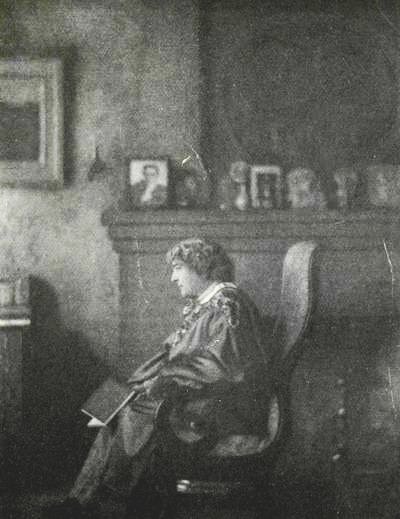
The last portrait of Mrs. Stevenson.
It was during this time that news came of a severe accident to Alison
Cunningham, Louis's old nurse—a misfortune which resulted in her
death within a few weeks. Mrs. Stevenson always felt an especial
tenderness for "Cummy," as the one whose kind hand had tended her
beloved husband in his infancy, and she very gladly aided in the old
lady's support during her last years. Lord Guthrie, Louis's longtime
friend and schoolmate, says in his booklet on the story of Cummy:
"From the novelist's widow she always received most delicate and
thoughtful kindness. Mrs. Stevenson often wrote to her and she amply
supplemented the original pension settled on her by Mr. Thomas
Stevenson, Louis's father. A few months before Cummy's death (at the
age of ninety-two), she cordially agreed, on condition that Cummy
should not know of it, to make a special additional annual payment
which I had ascertained, from an outside source, would add to the old
lady's happiness. And as soon as she received my letter telling her of
Cummy's accident (a fall causing a broken hip), I had a
characteristically generous message from her, sent by wire
from San Francisco, giving me carte-blanche for Cummy's benefit. I
call this message characteristic, because I find in her letters such
passages as this: 'Please, dear Cummy, always let me know instantly
when there is anything in the world I can do to add to your comfort,
your happiness, or your pleasure. There is so little I can do for you,
and I wish to do so much. You and I are the last; and we must help
each other all we can, until we, too, follow.'"[74]
When Cummy died Mrs. Stevenson was represented at the funeral by Mr.
A. P. Melville, W. S., and a wreath ordered by her was placed on the
coffin. She also bore the expense of Cummy's last illness and funeral
and had a handsome tombstone put up in her memory.
In these days the sands began to run low in the hour-glass of the life
of Fanny Stevenson, and a great weariness seemed to be settling upon
her. Writing to Mr. Scribner in June, 1913, she says: "All my life I
have taken care of others, and yet I have always wanted to be taken
care of, for naturally I belong to the clinging vine sort of woman;
but fate seems still against me." Nevertheless, I truly believe she
enjoyed being the head of her clan, the fairy godmother, the
chieftainess of her family, to whom all came for help and counsel. But
now the shadows of evening were growing long, and she was getting
very, very tired.
But, world-weary as she was, she consented at this time to prepare for
publication in book form the notes which she had taken, primarily for
her husband's use, of one of their voyages in the South
Seas. As it happened, he made little use of the notes, so that most of
it was new material. In this work, for dear memory's sake, she took a
real pleasure, of which she speaks in the preface in these words: "The
little book, however dull it may seem to others, can boast of at least
one reader, for I have gone over this record of perhaps the happiest
period of my life with thrilling interest." The book was brought out
by Charles Scribner's Sons, under the title of The Cruise of the
"Janet Nichol", and it has a melancholy interest, apart from its
contents, as the last work done by her in this life. She had only
finished the reading of the proofs a few days before her death, and
the book did not appear until some months afterwards.
In November, 1913, she was threatened with asthma, and in consequence
went to spend some time at Palm Springs, a health resort on the desert
in southeastern California. In the dry, clear air of that place her
health improved so wonderfully that all her friends and family
believed that a crisis had passed, and that she had fortunately sailed
into one of those calm havens which so often come to people in their
later years. She returned to Stonehedge seemingly well. All their
fears were lulled, and the blow was all the more crushing when, on the
18th of February, 1914, silently and without warning, she passed from
this life. In the manner of her death and that of her husband there
was a striking coincidence; each passed away suddenly, after only a
few hours of unconsciousness, from the breaking of an artery in the
brain. The story of her last moments may best be told in the
words of a letter from her devoted maid, Agnes Crowley,[75] which is
so sincere and touching that I quote it without eliminations:
"My dear Mrs. Sanchez:
"We are a very sad little household—we are all heart-broken, to think
our dear little Madam has gone away never to return. It seems too
awful, and just when she was enjoying everything. We were home from
Palm Springs just one week when she was taken away from us—but you
can console yourself by thinking that she was surrounded by love and
devotion. She was not sick and did not suffer. Tuesday evening,
February 17, she felt well and read her magazines until nine o'clock,
and Mr. Field played cards with her till 10.30. Then she retired. The
next morning I went in to attend to her as usual, and there was my
dear little Madam lying unconscious. I thought at first she was in a
faint, and I quickly ran for Mr. Field; he jumped up and put on his
bathrobe and went to her while I called Dr. Hurst. It took the doctor
about seven minutes to get here, and as soon as he saw her he said it
was a stroke, but he seemed to be hopeful and thought he could pull
her through. He put an ice pack on her head and gave her an injection
in the arm and oxygen to inhale, and she seemed to begin to breathe
natural, and we all hoped, but it was in vain. She never regained
consciousness, and at two o'clock she just stopped breathing, so you
see she did not suffer. But oh Mrs. Sanchez, we all seemed so
helpless—we all loved her so and yet could do nothing. Dr.
Hurst worked hard from 8.30 till two o'clock, and when the end came he
cried like a little child, for he loved Mrs. Stevenson very much. It
was an awful blow to us all—it was so sudden. This place will never
seem the same to William and me, for we loved our little Madam dearly,
and it was a pleasure to do anything for her—for she was always so
gentle and sweet. I adored her from the first time I ever saw her, and
will always consider it the greatest pleasure of my life to have had
the privilege of waiting upon her.
"I remain very affectionately,
"Agnes Crowley."
When the angel of death stooped to take her he came on the wings of a
wild storm, which raged that week all through the Southwest—fitting
weather for the passing of the "Stormy Petrel." Railroads were flooded
all over the country, and her son, Lloyd Osbourne, was delayed by
washouts for some days on the way out from New York. On his arrival
the body was removed to San Francisco, where a simple funeral ceremony
was held in the presence of a few sorrowing friends and relatives. On
her bier red roses, typical of her own warm nature, were heaped in
masses. A touching incident, one that it would have pleased her to
know, was the appearance of Fuzisaki, her Japanese gardener at
Stonehedge, with a wreath of beautiful flowers. It was in accordance
with her own wish, several times expressed to those nearest her, that
her body was cremated and the ashes later removed to Samoa, there to
lie beside her beloved on the lonely mountain top.
To her own family the sense of loss was overwhelming, and I
cannot perhaps express it better than in the words of her grandson,
Austin Strong: "To say that I miss her means nothing. Why, it is as if
an Era had passed into oblivion. She was so much the Chief of us all,
the Ruling Power. God rest her soul!"
When Fanny Van de Grift Stevenson passed from this earth the news of
her death carried a pang of grief to many a heart in far distant
lands. One who knew her well, her husband's cousin, Graham Balfour,
writes his estimate of her character in these words:
"Although I had met Fanny Stevenson twice in England, I first came to
know her on my arrival at Vailima in August, 1892, when within a
single day we established a firm friendship that only grew closer
until her death. The three stanzas by Louis so completely expressed
her that it seems useless for a man to add anything or to refine upon
it:
'Steel-true and blade-straight
......
Honor, anger, valor, fire,
A love that life could never tire,
......
Teacher, tender comrade, wife,
A fellow-farer true through life.'
"These were all the essentials, and if we add her devotion to her
children and her loyalty to her friends, we have the fabric of which
her life was woven. Her integrity and her directness were such that
one could, and frequently did, differ from her and express the
difference in the strongest terms without leaving a trace of
bitterness.
"I remember in particular a scheme which she wished to set on foot for
releasing Mataafa and other Samoan chiefs from their exile in the
German island of Jaluit and carrying them off to Australia. The
project was a wild one and would only have led to their return and
disgrace, and in these terms and much stronger expressions we
discussed it, without ever abating one jot from our personal
friendship.
"And in the long years that followed absence made no difference. Every
letter, when it came, was as full of affection and of confidence as
its predecessors—full of loyalty and tenderness.
"To her enemies, of course, she showed another side. Opposition she
did not mind, but dishonesty and deceit were unforgivable.
"The news of her death reached me in St. Helena, as the announcement
of Louis's death found me on another far-off island in the Carolinas;
and both times the world became a colder, greyer, more monotonous
place."
These pages have been written in vain if I have not made clear what
the world owes this rare woman, not only for the sedulous care which
kept the invalid genius alive long after the time allotted to him in
the book of fate, but for the intellectual sympathy and keen
discernment with which she stood beside him and
"Burnished the sword, blew on the drowsy coal,
Held still the target higher, chary of praise
And prodigal of counsel."
In speaking of literature's great debt to her, Lord Guthrie
says:
"Without her Louis's best work neither could nor would have existed.
In studying the life and works of Thomas Carlyle I often had occasion
to contrast his wife and Louis's. With all Mrs. Carlyle's great and
attractive qualities and her undoubted influence on her husband, she
made his work difficult by her want of perspective, magnifying
molehills into mountains. It could not be said that any of his great
writings owed their existence to her."
An article appearing in the Literary Digest shortly after her death
touches upon this point:
"Mrs. Robert Louis Stevenson was content to remain in the background
and let her husband reap all the glory for his literary achievements,
and the result was that her part in his career had probably been
minimized in the public mind. She was a great deal more than a mere
domestic help meet."
From her old and attached friend, Mr. S. S. McClure, comes this
sincere tribute:
"The more I saw of the Stevensons the more I became convinced that
Mrs. Stevenson was the unique woman in the world to be Stevenson's
wife.... When he met her her exotic beauty was at its height, and with
this beauty she had a wealth of experience, a reach of imagination, a
sense of humor, which he had never found in any other woman. Mrs.
Stevenson had many of the fine qualities that we usually attribute to
men rather than to women; a fair-mindedness, a large judgment, a
robust, inconsequential philosophy of life, without which
she could not have borne, much less shared with a relish equal to his
own, his wandering, unsettled life, his vagaries, his gipsy passion
for freedom. She had a really creative imagination, which she
expressed in living. She always lived with great intensity, had come
more into contact with the real world than Stevenson had done at the
time when they met, had tried more kinds of life, known more kinds of
people. When he married her, he married a woman rich in knowledge of
life and the world.
"She had the kind of pluck that Stevenson particularly admired. He was
best when he was at sea, and although Mrs. Stevenson was a poor sailor
and often suffered greatly from seasickness, she accompanied him on
all his wanderings in the South Seas and on rougher waters, with the
greatest spirit. A woman who was rigid in small matters of domestic
economy, who insisted on a planned and ordered life, would have
worried Stevenson terribly.
"A sick man of letters never married into a family so well fitted to
help him make the most of his powers. Mrs. Stevenson and both of her
children were gifted; the whole family could write. When Stevenson was
ill, one of them could always lend a hand and help him out. Without
such an amanuensis as Mrs. Strong,[76] Mrs. Stevenson's daughter, he
could not have got through anything like the amount of work he turned
off. Whenever he had a new idea for a story, it met, at his own
fireside, with the immediate recognition, appreciation, and enthusiasm
so necessary to an artist, and which he so seldom finds
among his own blood or in his own family.
"After Stevenson disappeared in the South Seas, many of us had a new
feeling about that part of the world. I remember that on my next trip
to California I looked at the Pacific with new eyes; there was a
glamour of romance over it. I always intended to go to Samoa to visit
him; it was one of those splendid adventures that one might have had
and did not.
"One afternoon in August, 1896, I went with Sidney Colvin and Mrs.
Sitwell (now Lady Colvin) to Paddington Station to meet Mrs.
Stevenson, when, after Stevenson's death she at last returned to
Europe after her world-wide wanderings—after nine years of exile.
When she alighted from the boat train I felt Stevenson's death as if
it had happened only the day before, and I have no doubt that she did.
As she came up the platform in black, with so much that was strange
and wonderful behind her, his companion of so many years, through
uncharted seas and distant lands, I could only say to myself:
'Hector's Andromache!'"[77]
She had one of those unusual personalities that attract other women as
well as men, and one of them, Lady Balfour, writes of her from the
point of view of her own sex:
"When Mrs. Stevenson heard of my engagement to Graham Balfour she
wrote me the kindest and tenderest of letters, telling me not to have
any fears in the new path that lay before me. She added: 'I who tell
you so have trodden it from end to end.' This sympathy meant
much to me, for it could only have come from such a generous heart as
hers. She had hoped that Palema[78] would continue to make his home
with them, and she had great confidence in and love for him. He would
have been a link between her and the old associations of the Vailima
life, and his engagement to an English girl proved to her that this
would no longer be possible. Yet where a less fine nature would have
contented itself with the mere formal congratulations as all that
could be possible under the circumstances, she gave generous sympathy
to a stranger, who caused her fresh loss, from her generous
'steel-true' heart.
"I had been married about two years when Mrs. Stevenson came to
England in 1898, and we were living at Oxford. I was naturally a
little nervous as to my first introduction to her. My husband wanted
to take me up to London to see her, but I asked to go alone, feeling
somehow that it would be easier. To this day I remember the
trepidation with which I followed the parlor maid upstairs in Oxford
Terrace, and was ushered into the room where a lady of infinite
dignity was lying on a sofa. It seems to me now that after one steady
look from those searching 'eyes of gold and bramble dew' (which had
rather the effect of a sort of spiritual X-ray), I lost my feeling of
being on approval, and in ten minutes I was sitting on the floor
beside the sofa, pouring out my own past history in remarkable detail,
and feeling as if I had known Tamaitai for years.
"In the following summer, 1899, she came to stay with us at
Oxford, to give Palema all the help she could about the life of Robert
Louis Stevenson he had just undertaken at her urgent request.
Incidentally, she was to be introduced to her godson, our eldest boy
Gilbert, who was then about six months old. She gave him a christening
present of a silver bowl for his bread and milk, upon a silver saucer
which could be reversed and used also as a cover. On the covering side
were the words from the Child's Garden:
'It is very nice to think
The world is full of meat and drink
With little children saying grace
In every Christian kind of place.'
"When the cover was taken off and used as a saucer it had on its
concave side:
'A child should always say what's true
And speak when he is spoken to,
And behave mannerly at table,
At least as far as he is able.'
"Tamaitai had had a very critical operation during the previous
autumn, and was still comparatively invalided with the effects of it.
She spoke enthusiastically of Sir Frederick Treves, who had performed
it and had refused any fee, saying he counted it a privilege to attend
her. I have a clear picture of her in my mind, lying on the sofa in
our drawing-room. The door opened and the nurse carried in the baby,
barefooted. 'Ah,' she said to him, 'who's this coming in hanging out
ten pink rosebuds at the tail of his frock?' And the little
pink toes justified a description that only she would have so worded.
"We drove her round to a few of the most beautiful and characteristic
of the Oxford colleges. She was easily fatigued, but she delighted in
what she saw. I remember admiring her pretty feet, clad in quite
inadequate but most dainty black satin shoes, with very high heels,
and fine silk stockings. When I put my admiration into words she just
smiled upon me delightfully but said nothing.
"One evening we talked desultorily about the 'criminal instinct.'
'Well,' I said at last, 'there's one thing certain, I should never
commit a murder. I shouldn't have the courage when it came to the
point!' 'Oh,' said she, 'I could murder a person if I hated him enough
for anything he had done, but I should have to call upon him in the
morning and tell him I was going to murder him at five o'clock.'
"We dined out with some Oxford friends, among whom was a tall Scotch
professor who was a brilliant and quick talker. Tamaitai took no part
in the rapid thrust and parry of the talk, but sat silently looking
from one to another with her great dark eyes. Their comment on her
long afterwards was that she was the most inscrutable person they had
ever met. As we drove home after the party I asked Tamaitai: 'What did
you think of the talk?' There was a brief silence—then: 'I didn't
understand a single word of it, they talked so fast,' said she
frankly.
"I don't think I ever knew a woman who was a more perfect 'gentleman.'
Scorning all that was not direct, and true, and simple, she herself
hated disguise or casuistry in any form. Her eyes looked
through your soul and out at the other side, but you never felt that
her judgment, whatever it was, would be harsh. She was curiously
detached, and yet you always wanted her sympathy, and if she loved you
it never failed you. She was a strong partisan, which was perhaps the
most feminine part of her character. She was wholly un-English, but
she made allowances for every English tradition. My English maids
loved her without understanding her in the least. I never knew any one
that had such a way as she had of turning your little vagaries and
habits and fads to your notice with their funny side out, so that all
the time you were subtly flattered and secretly delighted."
I wish I had the power to describe that mysterious charm which drew to
her so many and such various people—the high and the low in
far-scattered places of the earth—but it was too elusive to put in
words. Perhaps a large part of it lay in her clear simplicity, her
utter lack of pretence or pose. I remember reading once in a San
Francisco newspaper a comment by a writer who seemed to touch nearly
upon the heart of the secret. The paragraph runs thus:
"Once a man told me that Mrs. Robert Louis Stevenson was the one woman
in the world he could imagine a man being willing to die for. Every
man I asked—every single man, rich and poor, young or old, clever or
stupid—all agreed about Mrs. Stevenson, that she was the most
fascinating woman he had ever seen. It was some years ago that I saw
her, but I would know her again if I saw her between flashes of
lightning in a stormy sea. Individuality—that was her
charm. She knew it and she had sense enough to be herself.
Individuality and simple unaffected honesty of speech and action and
look are the most potent charms and the most lasting that any woman
can ever hope to have."
Her broad sympathies, too, had much to do with it. If there is any
word in the English language that means the opposite of snob, it may
certainly be applied to her. She picked out her friends for the simple
and sufficient reason that she liked them, and they might and did
include a duchess, a Chinese, a great English playwright, a French
fisherman, a saloon-keeper who was once shipwrecked with her, a noted
actor—and so on through a long and varied list. Once in Sydney when
she was out walking with her daughter, both richly dressed, she
stopped suddenly to shake hands with a group of black-avised pirates
(to all appearances) with rings in their ears. She had met them
somewhere among the islands, and her little white-gloved hand grasped
their big brown ones with genuine and affectionate friendship. Wide
apart as she and her husband were in many things, in their utter lack
of snobbery they were as one. Once they were at a French
watering-place when from their room upstairs they heard a loud uproar
below. A voice cried: "I will see my Louis!" Going out to see what the
trouble was, Louis found four French fishermen in a
char-à-bancs—all in peasant blouses. The major-domo of the
fashionable hotel was trying to keep them out, but when Louis appeared
he called out their names joyfully, and they all cried: "Mon cher
Louis!" After each had embraced him, he asked them up to his
rooms, and, despite the ill-concealed scorn of the waiter, ordered up
a grand dinner for them. They were the French fishermen he had known
at Monterey, California, and one may be sure that they met with as
cordial a welcome from his wife as from himself. I know that in one of
her letters she urges him not to forget to write to François the
baker, at Monterey, saying: "It seems to me much more necessary to
write some word to him than to Sir Walter, or Baxter, or Henley, for
they are your friends who know you and will not be disappointed,
either in a pleasure or in humanity, as this poor baker will be.
Indeed you must write and say something to him."
As has been said, her dislike of deceit and treachery was one of the
most strongly marked traits in her character. Once when she had reason
to fear that a person whom she was befriending was deceiving her, and
she was told that a simple inquiry would settle the matter, she
replied: "But I couldn't bear to find out that he is lying to me."
Her charities were many, but they were always of the quiet,
unobtrusive sort, of which few heard except those most nearly
concerned. For instance, when she heard of a poor woman in her
neighbourhood whose life could only be saved by an expensive
operation, she paid to have it done. Her life was full of such acts,
and there are many, many people who have good reason to be grateful to
her memory.
But when all is said, it has always seemed to me that the bright star
of her character, shining above all other traits, was her
loyalty—that staunch fidelity that made her cling, through
thick and thin, through good or evil report, to those whom she loved.
But as she loved, so she hated, and as she endowed her friends with
all the virtues, so she could see no good at all in an enemy. Yet,
just when you thought you were beginning to understand her
nature—with its love and hate of the primal woman—her anger would
suddenly soften, not into tenderness, but into a sort of dispassionate
wisdom, and she would quote her favourite saying: "To know all is to
forgive all."
That she had infinite tenderness for the feelings of others, living or
dead, she proved every day. In a letter to Mr. Scribner asking advice
about the publication in London of certain letters of her husband, she
says:
"Some of the letters that are intended to go into the book should not,
in my judgment, appear at all. When my husband was a boy in his late
'teens' and early twenties he and his father—a rigid old
Calvinist—quarrelled on the subject of religion. Louis being young
enough to like the melodrama, it took on an undue importance, out of
all keeping with the real facts. During this turbulent period Louis
poured out his soul in letters, the publication of many of which would
give a false impression of the relations between the son and the
father. Louis was twenty-five when I first met him, and the period of
the religious discussion was long past. Mr. Thomas Stevenson loved me
and was as kind to me as though I were his own daughter. I cannot, for
the sake of an extra volume that would produce a certain amount of
money, do anything that in my heart would seem disloyal to
the dear old man's memory—all the more because he is dead."
In her character there were many strange contradictions, and I think
sometimes this was a part of her attraction, for even after knowing
her for years one could always count on some surprise, some unexpected
contrast which went far in making up her fascinating personality.
Notwithstanding the broad view that she took of life in most of its
aspects, in some things she was old-fashioned. She was never
reconciled, for instance, to female suffrage, and once when she was
persuaded to attend a political meeting at which her daughter was one
of the speakers, she sat looking on with mingled pride in her
daughter's eloquence and horror at her sentiments. Yet, after the
suffrage was granted to women in California, her family was amused to
see her go to the polls and vote and carefully advise the men employed
on her place concerning their ballots.
Some persons were repelled by what they considered Mrs. Stevenson's
cold and distant manner, but they were not aware of what it took her
own family a long time to discover—that this apparent detachment and
sphinxlike immobility covered a real and childlike shyness; yet it was
never apathy, but the stillness of a frightened wild creature that has
never been tamed. Though she said so little, she never failed to
create an impression. Some one once said of her that her silence was
more fascinating than the most brilliant conversation of other women,
and, indeed, "Where Macgregor sits is the head of the table" applied
very aptly to her. Her manner had nothing of the aggressive
self-confidence of the "capable woman." She seemed so essentially
feminine, low-voiced, quiet, even helplessly appealing, that it was
difficult to realize that she was a fair shot, a fearless horsewoman,
a first-rate cook, an expert seamstress, a really scientific gardener,
a most skillful nurse, and had, besides, some working acquaintance
with many trades and professions upon which she could draw in an
emergency.
Her physical courage was remarkable; she would get on any horse, jump
into a boat in any sea, face a burglar—do anything, in fact, that
circumstances seemed to require. But perhaps her moral courage, that
which gave her strength to face great crises—as when Louis was near
death—with a smile on her face, was even greater. This I know came to
her as a direct inheritance from our mother, Esther Van de Grift, who
was never known to give way under the stress of great need.
In her fondness for animals she reminds one of her maternal
ancestress, Elizabeth Knodle, who used to rush out and seize horses by
the bridle when she thought they were being driven too fast by their
cruel drivers. Nothing would more surely arouse her anger than the
sight of any unkindness to one of these "little brothers." Once at
Vailima a gentleman, who ought to have known better, came riding up on
a horse that showed signs of being in pain. "That horse has a sore
back," she cried. The rider angrily denied it, but she insisted on his
dismounting, and when the saddle was removed found that her suspicions
were but too well founded. She compelled him to leave the
suffering creature in her care until its back was entirely cured.
I have been surprised sometimes to hear people speak of her as
"bohemian." Simplicity and genuineness were the foundation-stones of
her character, and she certainly dispensed with many of the useless
conventions of society, but she was a serious-minded woman for whom
the cheap affectations generally labelled as "bohemianism" could have
no attractions.
She was entirely feminine in her love of pretty clothes. In choosing
her own attire, though she followed the fashions and never tried to be
extravagant or outré, she had a discriminating taste that made her
always seem to be dressed more attractively than other people. All who
think of her, even in her last days, must have a picture in their
minds of the dainty, lacy, silken prettiness in which she sat
enshrined.
She was pretty as a young woman, but as she grew older she was
beautiful—with that rare type of beauty that "age cannot wither nor
custom stale." With her clear-cut profile, like an exquisite cameo,
color like old ivory, delicate oval face, eyes dark, vivid, and
youthful, her appearance was most unusual. Louis used to say of her
eyes that her glance was like that of one aiming a pistol—direct,
steady, and to some persons rather alarming. Her voice, as I think I
have said somewhere else in these pages, was low, with few
inflections, and was compared by her husband to the murmur of a brook
running under ice. The poet Gosse said of her: "She is dark and
rich-hearted, like some wonderful wine-red jewel."
For years she had worn her hair short, not in the fashion of
a strong-minded female, but in a frame of soft grey curls which was
exceedingly becoming to her face.
Everywhere she went her appearance attracted attention. One evening at
Santa Barbara when David Bispham was giving a concert, she sat in a
box at the theatre, wearing a bandeau of pearls and diamonds round her
head and a collar and necklace of the same. Leaning over the edge of
the box, deeply interested in the singing, she didn't realize the
impression she was making or the fact that Bispham was singing "Oh,
the pretty, pretty creature" directly at her box. Suddenly she became
aware of his compliment, gave a startled, embarrassed look at the
audience, and retired behind her big ostrich-feather fan. People often
turned to look at her in the street, and at such times she would say
to her companions: "Is there anything wrong with my hat? The people
all seem to be smiling at me." They were, but it was with surprised
admiration. Saleswomen and shop-girls adored her, and at all the shops
they vied with each other in waiting on her. On the way home she would
say, with naïve surprise: "How nice all those young women were! There
were five of them all waiting on me at once."
One of her vanities was her small feet, on which she always wore the
daintiest of shoes, often totally unsuited to the occasion. Whenever I
looked at her feet I was reminded of our maternal grandmother, sweet
Kitty Weaver, and how she caught her death going to a ball in the red
satin slippers.
Her beauty was of the elusive type that is the despair of
artists, and of all the portraits painted of her none seemed to me to
represent her true self. I quote from The Craftsman of May, 1912, a
reference to a reproduction of the portrait painted of her by Mrs.
Will Low:
"We are sure that our readers the world over will enjoy the
opportunity of this glimpse of Mrs. Stevenson, however the limitations
imposed by black and white may prevent a full realization of the great
charm of this unusual woman, whose personality is so magnetic, so
serene in its poise, so richly intellectual, that those who have had
the opportunity of knowing her always remember her as one of the most
interesting and beautiful among women."
She kept her spirit young to the last, so that no one could ever think
of her as an old woman, and young people always enjoyed her company.
As to her literary accomplishments, had she chosen to devote her time
and strength to the development of her own talents, instead of using
them, as has been the wont of women since the world began, in the
support and encouragement of others, there is no saying how far she
might have gone, for she had an active, creative imagination, and a
discriminating, critical judgment of style. As it was, her writings
were not extensive, and were almost all produced under the spur of
some particular need. They consist of:
Several fairy stories published years ago in Our Young Folks and
St. Nicholas, magazines for young people.
The Dynamiter, written in collaboration with her husband.
Introductions to her husband's works.
A number of short stories in Scribner's and McClure's
magazines, among which "Anne" and "The Half-White" attracted the most
attention.
The Cruise of the Janet Nichol, a posthumous work.
Her own estimate of her talents and achievements was extremely modest,
and it was always with the greatest reluctance that she put pen to
paper. Yet she was intensely proud of the work of any member of her
family—whether it might be sister, daughter, son, nephew, or
grandson—and seemed to get more happiness out of anything we did than
from her own work.
She was appalled at the great flood of mediocre writing that has been
pouring over the United States in the last decade or two, and speaks
of it thus in a letter written to Mr. Scribner from her quiet haven at
Sausal:
"If I had a magazine of my own I should bar from its pages any story
in which a young woman urges a young man to 'do things' when he
doesn't have to. There would also be a list of words and phrases that
I would not have within my covers. But, if I had a magazine what would
become of my peace and quiet that I care so much for? No—no such
strenuous life for me! They may call houses 'homes' and spell words so
that children and foreigners must be unable to find out how to
pronounce them—I need not know of such annoyances in El Sausal unless
I choose. I have before me a great pile of magazines—hence these
cries. I read them with wonder and interest. There seems to be such an
extraordinary quantity of clever, talented, ignorant, unliterary
literature let loose in them. Where does it all come from?
And why isn't it better done—or worse done? I suppose we might call
it 'near literature.' Sometimes, indeed, it is very near. I suppose it
is the public school system that is accountable. Well, I never
believed in general education, and here's a justification of my
attitude."
When one casts a backward glance over the life of Fanny Van de Grift
Stevenson, it cannot be said that she knew much of that for which she
had always longed—peace. Her girlhood was cut short by a too early
marriage. Her first romance was soon wrecked, and her second was
constantly overshadowed by fear for the loved one. Storm and stress,
varied by some peaceful intervals, filled the larger portion of her
days, and at their end it was in storm and flood that her spirit took
its flight. But it was a full, rich life, and had she had the
choosing, I believe she would have elected no other.
After something more than a year had elapsed from the time of her
death, Mrs. Stevenson's daughter, who had now become the wife of Mr.
Field, sailed with her husband in the spring of 1915 for Samoa,
bearing with them the sacred ashes to be placed within the tomb on
Mount Vaea.
Early in the war the New Zealand Expeditionary Forces had taken
possession of German Samoa, so that when Mr. and Mrs. Field arrived
they found the Union Jack flying over Vailima, now used as Government
House by the Administrator, Colonel Logan, and his staff. The natives,
interested spectators of these stirring events, remarked
among themselves that Tusitala, not going back to his own country, had
drawn his country out to him.
Two friends of the old Vailima days were a great help in making the
arrangements for the funeral—Amatua, often referred to in the
Stevenson letters as Sitione, now a serious elderly chief, and Laulii,
a charming Samoan lady of rank, and a warm and attached friend of the
Stevenson family. Of the Vailima household time and wars had
eliminated all but the youngest—Mitaele, who looked much the same in
spite of grey hair and a family of nine children.
It was Amatua who saw to it that those who remained of the builders of
the "Road of the Loving Hearts" and the chiefs who had cut the path up
the mountain for Tusitala's funeral were included in the list of
guests, and it was he who took personal charge of all the arrangements
for the native ceremonies, which were conducted in the elaborate
Samoan fashion as for a chief of the highest rank.
Colonel and Mrs. Logan very graciously invited the Fields to Vailima
and placed the house and grounds at their disposal.
"It is strange," wrote Mrs. Field, "being here at Vailima. I was so
afraid to come, but mercifully it is not the same. Rooms have been
added, the polished redwood panels in the large hall are painted over
in white; the lawn where the tennis courts were is cut up into flower
beds; many of the great trees have gone; and the atmosphere of the
place has changed so utterly that I have to say to myself 'This is
Vailima' to believe that I am here after so many years. Mrs.
Logan and the Governor came out to meet us when we arrived, and as we
turned into the road and I saw the house for the first time it was the
Union Jack flying from the flag-staff that affected me most. I felt
like a person in a dream as we walked over the house—the same and yet
changed out of all recognition. We had tea, and then in the soft
sunset we went down to the waterfall, no longer a fairy dell of
loveliness but improved with a dam, cement flooring, and a row of neat
bathrooms. In the evening we sat on the upper veranda looking out over
the moonlit tree-tops; the scene was very beautiful, with the view of
the sea and Vaea mountain so green and so close. 'Here we wrote St.
Ives and Hermiston,' I tell myself, but I don't believe it."
It had been their intention to have their old missionary friend, Dr.
Brown, conduct the services, but at the last moment word was brought
that he was detained on one of the other islands by storms. For a time
they were much troubled, but at last Colonel Logan lifted a load off
their hearts by offering to read the Church of England service
himself.
The day before that set for the funeral, June 22, it blew and rained,
and there was much anxious foreboding about the weather. In the night,
however, the wind blew away the clouds and rain, and morning broke,
still, sunny, but cool—a perfect day.
The small bronze case containing the ashes, wrapped in a fine mat, had
been laid on a table in one of the rooms that had wide doors opening
on the veranda. The guests began to arrive early, in Samoan fashion,
bringing flowers and wreaths, and soon the table was a mass
of lovely blooms—all colours, for the Samoans do not adhere to white
for funerals. The high chief Tamasese, with his wife Vaaiga, both
wearing mourning bands on their arms, were the first to arrive. Then
came Malietoa Tanu, who was a prominent figure in the war in which the
United States and England joined to fight against Samoa. Following
them came a long concourse of the old friends of Mr. and Mrs.
Stevenson—natives, half-castes, and whites, and last of all, in a
little carriage, three sweet sisters from the Sacred Heart Convent.
The sisters could not stay for the ceremony on the hill, but begged to
be allowed to say a little prayer, and the three knelt before the
table and said an ave for one who had always been their friend.
At nine o'clock they started on the steep climb up the mountain, the
path having been cleared the day before by men sent up through the
thoughtful kindness of the Administrator. Mr. Field led the way with
the casket wrapped in a fine mat, then came Mrs. Field and Laulii,
each carrying one of the mats used in Samoan funeral ceremonies, these
being the same that had been carried at Mr. Stevenson's burial.
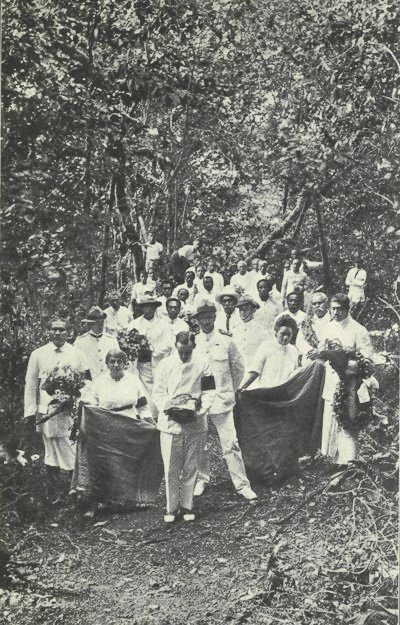
The funeral procession as it wound up the hill.
After them came Colonel Logan and the two high chiefs, Tamasese and
Malietoa, followed by all the other guests, including forty chiefs of
the Tuamasaga. The procession, very picturesque in white clothing and
wreaths of flowers, wound slowly up the mountainside in a zigzag path
under the forest trees. Overhead the branches met in a leafy roof, and
on each side of the narrow path the jungle closed in, thick, lush, and
green. The lianas looped across from bough to bough, huge
birds' nest ferns lay tucked in the branches, on all sides big-leaved
plants, fronds of ferns, and tangled creepers crowded each other for
space, and through all the mass of wild tropic growth the hot sunlight
filtered in splashes of bright green.
When, after many breathless pauses, the top was at last reached, the
case was laid on the base of the tomb and covered with fine mats, with
flowers all about it. Among them were the Japanese imitation
cherry-blossoms sent by Yonida and Fuzisaki, the gardeners at
Stonehedge. The company then gathered around the tomb in a
semi-circle, and Colonel Logan read the Church of England service. It
was an impressive ceremony, and the hearts of all were deeply moved by
it. Filemoni, the Samoan pastor, followed with an eloquent speech in
the native language.
The mats were then removed from the small space that had been cut into
the base of the tomb, and the little case was fitted in and cemented
over. George Stowers, the original builder of the tomb, was there, and
his hand sealed the ashes in their last resting-place.
The ceremony now being over, the party went down the hill in little
groups, resting by the way on fallen logs. Crossing the river at the
bottom, they came into the Loto Alofa Road (Road of the Loving
Hearts), where Amatua had made all the preparations for the funeral
feast, which was to be given according to Samoan custom. A long
table-cloth, consisting of bright-green breadfruit and banana leaves
and ferns, stretched along the ground for sixty feet or more.
The feast was preceded by the ceremonious drinking of kava
and speeches in Samoan. "I had expected the usual somewhat flowery
eulogies," wrote Mrs. Field, "but their speeches were sincere and some
of them very beautiful. They were translated by an interpreter, but
fortunately my memory of the language helped me to follow the meaning,
even though some of the 'high chief' expressions were beyond me. 'Many
foreigners had visited Samoa,' they said, 'but of all who had
professed affection and admiration for the land only one loved it so
well that he chose it for his last resting-place. Tusitala had been
the true friend, the dearly loved, the deeply mourned, and now when
the wife of his heart had joined him after many lonely years the
occasion was one too tender and too beautiful for sorrow.' They
assured me that we might leave Samoa with peaceful hearts, knowing
that those we loved were in the land—not of strangers, but of devoted
friends, who would cherish the tomb on Vaea as they cherished in their
hearts the memory of Tusitala and Aolele."
Amatua then announced that the feast was ready, and the Governor and
his wife were seated at the head at one end of the long table, with
Tamasese and Malietoa Tanu on either side. The board, figuratively
speaking, groaned under a great spread of native delicacies. It was
full noon by this time, and very hot, but Amatua had thoughtfully
placed little trees all along the side to keep off the sunshine. "At
the end of the feast," says Mrs. Field, "I made a little speech of
thanks, and it came straight from my heart, for I was deeply touched
by the kindness of them all and their loyalty to the memory
of my dear mother and Tusitala. We tried to thank Colonel Logan and
his wife, but words can never do that."
"Nothing more picturesque can be imagined than the narrow plateau that
forms the summit of Mount Vaea, a place no wider than a room and as
flat as a table. On either side the land descends precipitately; in
front lie the vast ocean and the surf-swept reefs; in the distance to
the right and left green mountains rise, densely covered with the
primeval forest."[79]
Stevenson's tomb, with the tablet and lettering, was designed by
Gelett Burgess, and was built by native workmen under the direction of
a half-caste named George Stowers. The material was cement, run into
boxes and formed into large blocks, which were then carried to the
summit on the strong shoulders of Samoans, though each block was so
heavy that two white men could scarcely lift it from the ground.
Arrived at the summit the blocks were then welded into a plain and
dignified design, with two large bronze tablets let in on either side.
One bears the inscription in Samoan, "The resting-place of Tusitala,"
followed by the quotation in the same language of "Thy country shall
be my country and thy God my God." The other side bears the name and
dates and the requiem:
"Under the wide and starry sky,
Dig the grave and let me lie.
Glad did I live and gladly die,
And I laid me down with a will.
This be the verse you grave for me:
Here he lies where he longed to be;
Home is the sailor, home from the sea,
And the hunter home from the hill."
When Mr. and Mrs. Field arrived in Samoa they brought with them a
tablet which they carried to the summit of Mount Vaea and had cemented
in one end of the base of the tomb. It is of heavy bronze, and bears
the name Aolele, together with these lines:
"Teacher, tender comrade, wife,
A fellow-farer true through life,
Heart whole and soul free,
The August Father gave to me."
On the tablet for Mr. Stevenson the thistle for Scotland had been
carved at one corner and the hibiscus for Samoa at the other. On his
wife's the hibiscus was placed at one corner, and after long
hesitation about the other, a sudden inspiration suggested to Mrs.
Field the tiger-lily—bright flower whose name had been given to
little Fanny Van de Grift by her mother in the old days in Indiana.
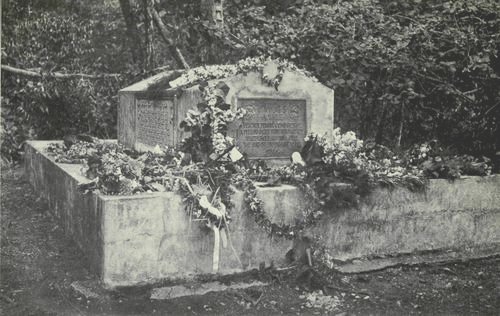
The tomb, showing the bronze tablet with the verse from
Stevenson's poem to his wife.
Before leaving the island Mr. and Mrs. Field endowed a scholarship for
three little girls at the convent school—one to be chosen by the
sisters, one by Tamasese, and one by Mitaele, the last of the Vailima
household. All they asked was that these little girls should go to the
tomb on the 10th of every March, the birthday of Aolele, and decorate
the grave. That they kept their promise is shown by the following
quotation from the Samoan Times:
"On Friday morning, the 10th instant, the three pupils of
the convent school, Savalalo, whose scholarships were endowed by Mr.
and Mrs. Salisbury Field in memory of the late Mrs. Robert Louis
Stevenson, the mother of Mrs. Field, paid a visit to the Stevenson
tomb on Mount Vaea in honor of the anniversary of the birthday of the
deceased lady. The little party left at 7 A.M. and arrived at the
summit of the hill at about nine o'clock. Upon arrival at the top of
the hill the children lost no time in decorating the grave with
wreaths of flowers and greenery, a plentiful supply of which was taken
by them. After the decorating the party sat down to a small
taumafataga (high chief lunch), after which they returned to town."
Tiger-lily and Scotch thistle—they sleep together under tropic stars,
far from the fields of waving corn and the purple moorlands, but each
year hands, alien to them both, tenderly lay flowers on their tomb.[Back to Contents]
Footnote 1: Sarah Tittle Bolton, known for her patriotic and war
songs, among them "Paddle Your Own Canoe" and "Left on the
Battlefield."[Back to Main Text]
Footnote 2: The "k" is silent in this name. Elizabeth Knodle was the
elder sister of Esther Van de Grift.[Back to Main Text]
Footnote 3: Now Mrs. Thaddeus Up de Graff, of Elmira,
New York.[Back to Main Text]
Footnote 4: Stewart, who acquired by his life among the Indians a
thorough knowledge of the trails of the country, became a guide, and
it was he that led Boone on the expedition to explore Kentucky. The
connection between them became even closer when he married Boone's
youngest sister, Hannah. At the State capitol there is a picture of
him in the striking costume of the hunter and trapper, pointing out to
Boone the lovely land of Kentucky.[Back to Main Text]
Footnote 5: Now Sir Graham and Lady Balfour. Sir Graham is a cousin
of Robert Louis Stevenson, and his biographer.[Back to Main Text]
Footnote 6: Robert Alan Mowbray Stevenson, cousin of Robert
Louis.[Back to Main Text]
Footnote 7: Mr. Birge Harrison, in the Century Magazine, December,
1916.[Back to Main Text]
Footnote 8: An American artist.[Back to Main Text]
Footnote 9: A Spanish word, pronounced clahvél, and meaning a pink.[Back to Main Text]
Footnote 10: Cowboys.[Back to Main Text]
Footnote 11: Cattle round-up.[Back to Main Text]
Footnote 12: These entertainments were so called in allusion to the
custom of breaking cascarones (egg-shells), previously filled with
finely cut coloured or tinsel paper, upon the heads of the dancers. By
the time the midnight hour rolled around, every head glittered with
the confetti, and the floor was piled several inches deep with it.[Back to Main Text]
Footnote 13: Tamales, perhaps the most famous culinary product of
the Southwest, were probably of Indian origin. Their construction is
too complicated to explain here, further than to say that they are
made of corn-meal and chopped meat rolled in corn-husks and boiled.[Back to Main Text]
Footnote 14: Carne con chile (meat with chile) is what its name
indicates, a stew of meat and red peppers.[Back to Main Text]
Footnote 15: Merienda—noonday luncheon.[Back to Main Text]
Footnote 16: Enchiladas are a sort of corn-meal pancake rolled up
and stuffed with cheese and a sauce made of red peppers.[Back to Main Text]
Footnote 17: Previously published in Scribner's Magazine, October,
1916.[Back to Main Text]
Footnote 18: In American phrase, a "bossy" person.[Back to Main Text]
Footnote 19: The son of Mrs. Sitwell, now Lady Colvin.[Back to Main Text]
Footnote 20: Föhn—a violent south wind in Switzerland.[Back to Main Text]
Footnote 21: Mr. Symonds never dared to leave Davos, but remained
there until his death.[Back to Main Text]
Footnote 22: Mr. Basil Hammond, of Trinity College, Cambridge.[Back to Main Text]
Footnote 23: An editorial review of New Arabian Nights in the
Century Magazine of February, 1883.[Back to Main Text]
Footnote 24: From The Life of Robert Louis Stevenson, by Graham
Balfour.[Back to Main Text]
Footnote 25: The elder lady's name was Margaret.[Back to Main Text]
Footnote 26: Alison Cunningham, Stevenson's old nurse.[Back to Main Text]
Footnote 27: The Letters of Mrs. M. I. Stevenson, Saranac to
Marquesas.[Back to Main Text]
Footnote 28: Preface by Mrs. Stevenson to Island Nights
Entertainments.[Back to Main Text]
Footnote 29: The Life of Robert Louis Stevenson, by Graham
Balfour.[Back to Main Text]
Footnote 30: Tamaitai was the Samoan name of Mrs. Stevenson.[Back to Main Text]
Footnote 31: See The Letters of Robert Louis Stevenson, page 279.[Back to Main Text]
Footnote 32: Mr. Höflich returned to Samoa a year or two later to
remain, and was always a valued friend of the Stevensons.[Back to Main Text]
Footnote 33: Tin is the equivalent in the islands for Mr. Jack
Buckland was the living original of Tommy Haddon in The Wrecker.[Back to Main Text]
Footnote 34: Pronounced Vyleéma.[Back to Main Text]
Footnote 35: Commonly called "alligator" pear.[Back to Main Text]
Footnote 36: They had a terrible time with the sensitive plant, which
had become a pest there and grew almost faster than they could weed it
out.[Back to Main Text]
Footnote 37: "The one surviving species of dodo, the manume'a, a bird
about the size of a small moor-hen, exists in Samoa. It has only
recovered its present feeble powers of flight since cats were
introduced in the island. Its dark flesh is extremely
delicious."—From Balfour's Life of Robert Louis
Stevenson.[Back to Main Text]
Footnote 38: Tapa is a cloth made of vegetable fibre and stained in
various striking patterns. It is used by the natives for clothing,
curtains, beds, and many other purposes.[Back to Main Text]
Footnote 39: The papaw.[Back to Main Text]
Footnote 40: A tropical fruit.[Back to Main Text]
Footnote 41: A native dish of taro tops and cocoanut.[Back to Main Text]
Footnote 42: A tropical plant with an edible root.[Back to Main Text]
Footnote 43: Sitioni was a chief, later known as Amatua, a name of
higher rank. We shall hear of Amatua again at the very end of the
story.[Back to Main Text]
Footnote 44: The stable was probably made of pandanus leaves, like
the native houses.[Back to Main Text]
Footnote 45: Mrs. Stevenson's daughter, Isobel Strong, with her
husband and son.[Back to Main Text]
Footnote 46: The complete story of Eliga, most agreeably told, may be
found in Vailima Memories, by Lloyd Osbourne and Isobel Strong.[Back to Main Text]
Footnote 47: Pronounced Tahmyty, with the accent on the "my."[Back to Main Text]
Footnote 48: Translated in an old missionary notebook as "beautiful
as a flying cloud."[Back to Main Text]
Footnote 49: A Provençal fish-chowder.[Back to Main Text]
Footnote 50: Miti sauce is made of grated kukui nuts mixed with
lime-juice and sea-water.[Back to Main Text]
Footnote 51: Her son-in law, Mr. Strong.[Back to Main Text]
Footnote 52: It will be remembered that Teuila was the native name of
Mrs. Stevenson's daughter.[Back to Main Text]
Footnote 53: In the old times kava, or ava, as it is sometimes
spelled, was prepared by being chewed by young girls especially chosen
for the purpose, and then made into a brew.[Back to Main Text]
Footnote 54: A disease of the tropics, said to be transmitted by the
bite of mosquitoes, which causes enormous enlargement of the parts
affected. Mrs. Stevenson cured this boy, Mitaele, of elephantiasis by
Dr. Funk's remedy of rubbing the diseased vein with blue ointment and
giving him a certain prescribed drug.[Back to Main Text]
Footnote 55: Mulinuu was the seat of government. King Malietoa lived
there.[Back to Main Text]
Footnote 56: Now Mrs. Salisbury Field.[Back to Main Text]
Footnote 57: Mrs. Strong will be remembered as the little Isobel
Osbourne of the early pages of this book.[Back to Main Text]
Footnote 58: Quoted by courtesy of Henry James of New York, nephew of
the novelist.[Back to Main Text]
Footnote 59: It is the custom in Samoa to go barefoot in the wet
season, in order to avoid the unpleasantness of soggy wet shoes.[Back to Main Text]
Footnote 60: This was the "Road of the Loving Hearts," built by the
Mataafa chiefs in return for Tusitala's kindness to them when they
were in prison.[Back to Main Text]
Footnote 61: A Samoan oven is made by digging a hole, lining it with
hot stones, putting on top of them pigs, fish, chickens, taro, yams,
etc., all wrapped in banana leaves, then piling hot stones on them and
covering the whole with earth. In about four hours everything is
cooked.[Back to Main Text]
Footnote 62: The malae is the green lawn around which all Samoan
villages are built.[Back to Main Text]
Footnote 63: The fly flapper is a carved stick with a horse-hair
tassel on the end.[Back to Main Text]
Footnote 64: The taupo is the maid of the village. She is chosen
for her beauty and is the official hostess to receive all guests.[Back to Main Text]
Footnote 65: Nowadays the Samoans, having learned European ways,
present the cup first to the ladies, but then it was faa-Samoa, that
is, in Samoan fashion.[Back to Main Text]
Footnote 66: Laulii, the Samoan wife of Mr. Willis, was a close
friend of Mrs. Stevenson while she lived in the islands, and after she
left there came to California to make her a visit at the ranch near
Gilroy.[Back to Main Text]
Footnote 67: Robert Stevenson, lighthouse engineer.[Back to Main Text]
Footnote 68: Quoted by courtesy of Mr. Edmund Eitel, nephew of Mr.
Riley.[Back to Main Text]
Footnote 69: Robert Louis Stevenson's grandfather.[Back to Main Text]
Footnote 70: The late Mrs. E. E. Mitchell, of Nebraska City,
Nebraska.[Back to Main Text]
Footnote 71: The rebozo is a scarf or shawl worn wound about the
head and shoulders.[Back to Main Text]
Footnote 72: Sausal (pronounced sowsál) is a Spanish word meaning
willow grove.[Back to Main Text]
Footnote 73: Mexican mounted police.[Back to Main Text]
Footnote 74: Quoted by courtesy of Lord Guthrie.[Back to Main Text]
Footnote 75: Her former maid, Mary Boyle, had married and left her
service.[Back to Main Text]
Footnote 76: Now Mrs. Salisbury Field.[Back to Main Text]
Footnote 77: Quoted from McClure's Magazine.[Back to Main Text]
Footnote 78: Sir Graham Balfour's Samoan name.[Back to Main Text]
Footnote 79: Lloyd Osbourne, in A Letter to His Friends, written
directly after the death of Mr. Stevenson.[Back to Main Text]