But that era did not close with Columbus, nor did he live long enough to
complete the Discovery of America. Our practice of affixing specific
dates to great events is on many accounts indispensable, but it is
sometimes The Discovery of America was a gradual process.
misleading. Such an event as the discovery of a pair of vast
continents does not take place within a single year. When we speak of
America as discovered in 1492, we do not mean that the moment Columbus
landed on two or three islands of the West Indies, a full outline map of
the western hemisphere from Labrador and Alaska to Cape Horn suddenly
sprang into existence—like Pallas from the forehead of Zeus—in the
minds of European men. Yet people are perpetually using arguments which
have neither force nor meaning save upon the tacit assumption that
somehow or other some such sort of thing must have happened. This
grotesque fallacy lies at the bottom of the tradition which has caused
so many foolish things to be said about that gallant mariner, Americus
Vespucius. In geographical discussions the tendency to overlook the fact
that Columbus and his immediate successors did not sail with the latest
edition of Black's General Atlas in their cabins is almost
inveterate; it keeps revealing itself in all sorts of queer statements,
and probably there is no cure for it except in familiarity with the long
series of perplexed and struggling maps made in the sixteenth century.
Properly regarded, the Discovery of America was not a single event, but
a very gradual process. It was not like a case of special creation, for
it was a case of evolution, and the voyage of 1492 was simply the most
decisive and epoch-marking incident in that evolution. Columbus himself,
after all his four eventful voyages across the Sea of Darkness, died in
the belief that he had simply discovered the best and straightest route
to the eastern shores of Asia. Yet from his first experiences in Cuba
down to his latest voyage upon the coasts of Honduras and Veragua, he
was more or less puzzled at finding things so different from what he had
anticipated. If he had really known anything with accuracy about the
eastern coast of Asia, he would doubtless soon have detected his
fundamental error, but no European in his day had any such knowledge. In
his four voyages Columbus was finding what he supposed to be parts of
Asia, what we now know to have been parts of America, but what were
really to him and his contemporaries neither more nor less than Strange
Coasts. We have now to consider briefly his further experiences upon
these strange coasts.
The second voyage of Columbus was begun in a very different mood and
under very different auspices from either his former or his two
subsequent voyages. On his first departure from Palos, in
1492, all save a few devoted friends regarded him as a madman rushing
upon his doom; and outside the Spanish peninsula the expedition seems to
have attracted no notice. But on the second start, in 1493, all hands
supposed that they were going straight to golden Cathay and to boundless
riches. It was not now with groans but with pæans that they flocked on
board the ships; and the occasion was observed, with more or less
interest, by some people in other countries of Europe,—as in Italy, and
for the moment in France and England.
At the same time with his letter to Santangel, the Admiral had
despatched another account, substantially the same,[532] to Gabriel
The letter to Sanchez.
Sanchez,[533] another officer of the royal treasury. Several copies of a
Latin translation of this letter were published at Rome, at Paris, and
elsewhere, in the course of the year 1493.[534] The story which
it contained was at once paraphrased in Italian verse by
Giuliano Dati, one of the most popular poets of the age, and perhaps in
the autumn of 1493 the amazing news that the Indies had been found by
sailing west[535] was sung by street urchins in Florence. We
are also informed, in an ill-vouched but not improbable clause in
Ramusio, that not far from that same time the news was heard with
admiration in London, where it was pronounced "a thing more divine than
human to sail by the West unto the East, where spices grow, by a way
that was never known before;"[536] and it seems altogether likely that
it was this news that prompted the expedition of John Cabot hereafter to
be mentioned.[537]
The references to the discovery are very scanty, however, until after
the year 1500, and extremely vague withal. For example, Bernardino de
Carvajal, the Spanish ambassador at the papal court, delivered an
oration in Rome on June 19, 1493, in which he said: "And Christ placed
under their Earliest references to the discovery.
[Ferdinand and Isabella's] rule the Fortunate [Canary]
islands, the fertility of which has been ascertained to be wonderful.
And he has lately disclosed some other unknown ones towards the Indies
which may be considered among the most precious things on earth; and it
is believed that they will be gained over to Christ by the
emissaries of the king."[538] Outside of the Romance countries we find
one German version of the first letter of Columbus, published at
Strasburg, in 1497,[539] and a brief allusion to the discovery in
Sebastian Brandt's famous allegorical poem, "Das Narrenschiff," the
first edition of which appeared in 1494.[540] The earliest distinct
reference to Columbus in the English language is to be found in a
translation of this poem, "The Shyppe of Fooles," by Henry Watson,
published in London by Wynkyn de Worde in 1509. Earliest reference in English.
The purpose of Brandt's
allegory was to satirize the follies committed by all sorts and
conditions of men. In the chapter, "Of hym that wyll wryte and enquere
of all regyons," it is said: "There was one that knewe that in
ye ysles of Spayne was enhabitantes. Wherefore he asked men of Kynge
Ferdynandus & wente & founde them, the whiche lyved as beestes."[541]
Until after the middle of the sixteenth century no English chronicler
mentions either Columbus or the Cabots, nor is there anywhere an
indication that the significance of the discoveries in the western ocean
was at all understood.[542]
North of the Alps and Pyrenees the interest in what was going on at the
Spanish court in 1493 was probably confined to very few people. As for
Venice and Genoa we have no adequate means of knowing how they felt
about the matter,—a fact which in itself is significant. The interest
was centred in Spain and Portugal. There it was intense and awakened
fierce heart-burnings. Though John II. had not given his consent to the
proposal for murdering Columbus, he appears to have seriously
entertained the thought of Portuguese claim to the Indies.
sending a small fleet across the Atlantic as
soon as possible, to take possession of some point in Cathay or Cipango
and then dispute the claims of the Spaniards.[543] Such a summary
proceeding might perhaps be defended on the ground that the grant from
Pope Eugenius V. to the crown of Portugal expressly included "the
Indies." In the treaty of 1479, moreover, Spain had promised not to
interfere with the discoveries and possessions of the Portuguese.
But whatever King John may have intended, Ferdinand and
Isabella were too quick for him. No sooner had Columbus arrived at
Barcelona than an embassy was despatched to Rome, asking for a grant of
the Indies just discovered by that navigator in the service of Castile.
The notorious Rodrigo Borgia, who had lately been placed in the
apostolic chair as Alexander VI., was a native of Valencia in the
kingdom of Aragon, and would not be likely to refuse such a request
through any excess of regard for Portugal. Bulls of Pope Alexander VI.
As between the two rival
powers the pontiff's arrangement was made in a spirit of even-handed
justice. On the 3d of May, 1493, he issued a bull conferring upon the
Spanish sovereigns all lands already discovered or thereafter to be
discovered in the western ocean, with jurisdiction and privileges in all
respects similar to those formerly bestowed upon the crown of Portugal.
This grant was made by the pope "out of our pure liberality, certain
knowledge, and plenitude of apostolic power," and by virtue of "the
authority of omnipotent God granted to us in St. Peter, and of the
Vicarship of Jesus Christ which we administer upon the earth."[544] It
was a substantial reward for the monarchs who had completed the
overthrow of Mahometan rule in Spain, and it afforded them
opportunities for further good work in converting the heathen
inhabitants of the islands and mainland of Asia.[545]
On the following day Alexander issued a second bull in order to prevent
any occasion for quarrel between Spain and Portugal.[546] He decreed
that all lands discovered or to be discovered to the west of a
meridian one hundred leagues west of the Azores and Cape Verde
islands should belong to the Spaniards. Inasmuch as between the
westernmost of the Azores and the easternmost of the Cape
Verde group the difference in longitude is not far from ten degrees,
this description must be allowed to be somewhat vague, especially in a
document emanating from "certain knowledge;"[547] and it left
open a source of future disputes which one would suppose the "plenitude
of apostolic power" might have been worthily employed in closing. The
meridian 25° W., however, would have satisfied the conditions, and the
equitable intent of the arrangement is manifest. The Portuguese were
left free to pursue their course of discovery and conquest along the
routes which they had always preferred. King John, however, was not
satisfied. He entertained vague hopes of finding spice islands, or
something worth having, in the western waters; and he wished to have the
Line of Demarcation carried farther to the west. After a year of
diplomatic wrangling a treaty was signed at Treaty of Tordesillas.
Tordesillas, June 7, 1494,
in which Spain consented to the moving of the line to a distance of 370
leagues west from the Cape Verde islands.[548] It would thus on a modern
map fall somewhere between the 41st and 44th meridians west of
Greenwich. This amendment had important and curious consequences. It
presently gave the Brazilian coast to the Portuguese, and thereupon
played a leading part in the singular and complicated series of events
that ended in giving the name of Americus Vespucius to that
region, whence it was afterwards gradually extended to the whole western
hemisphere.[549]
Already in April, 1493, without waiting for the papal sanction,
Ferdinand and Isabella bent all their energies to the work of fitting
out an expedition for taking possession of "the Indies." First, a
department of Indian affairs was created, Juan Rodriguez de Fonseca.
and at its head was placed
Juan Rodriguez de Fonseca, archdeacon of Seville: in Spain a man in high
office was apt to be a clergyman. This Fonseca was all-powerful in
Indian affairs for the next thirty years. He won and retained the
confidence of the sovereigns by virtue of his executive ability. He was
a man of coarse fibre, ambitious and domineering, cold-hearted and
perfidious, with a cynical contempt—such as low-minded people are apt
to call "smart"—for the higher human feelings. He was one of those ugly
customers who crush, without a twinge of compunction, whatever comes in
their way. The slightest opposition made him furious, and his
vindictiveness was insatiable. This dexterous and pushing Fonseca held
one after another the bishoprics of Badajoz, Cordova, Palencia, and
Conde, the archbishopric of Rosano in Italy, together with the bishopric
of Burgos, and he was also principal chaplain to Isabella and afterwards
to Ferdinand. As Sir Arthur Helps observes, "the student of early
American history will have a bad opinion of many Spanish bishops, if he
does not discover that it is Bishop Fonseca who reappears
under various designations."[550] Sir Arthur fitly calls him "the
ungodly bishop."
The headquarters of Fonseca and of the Indian department were
established at Seville, and a special Indian custom-house was set up at
Cadiz. There was to be another custom-house upon the island of
Hispaniola (supposed to be Japan), and a minute registry was to be kept
of all ships and their crews and cargoes, going out or coming in. Nobody
was to be allowed to go to the Indies for any purpose whatever without a
license formally obtained. Careful regulations were made for hampering
trade and making everything as vexatious as possible for traders,
according to the ordinary wisdom of governments in such matters. All
expenses were to be borne and all profits received by the crown of
Castile, saving the rights formerly guaranteed to Columbus. The cost of
the present expedition was partly defrayed with stolen money, the
plunder wrung from the worthy and industrious Jews who had been driven
from their homes by the infernal edict of the year before. Extensive
"requisitions" were also made; in other words, when the sovereigns
wanted a ship or a barrel of gunpowder they seized it, and impressed it
into the good work of converting the heathen. To superintend this
missionary work, a Franciscan monk[551] was selected who had lately
distinguished himself as a diplomatist in the dispute with
France over the border province of Friar Boyle.
Rousillon. This person was a native
of Catalonia, and his name was Bernardo Boyle, which strongly suggests
an Irish origin. Alexander VI. appointed him his apostolic vicar for the
Indies,[552] and he seems to have been the first clergyman to perform
mass on the western shores of the Atlantic. To assist the vicar, the six
Indians brought over by Columbus were baptized at Barcelona, with the
king and queen for their godfather and godmother. It was hoped that they
would prove useful as missionaries, and when one of them presently died
he was said to be the first Indian ever admitted to heaven.[553]
The three summer months were occupied in fitting out the little fleet.
There were fourteen caravels, and three larger store-ships known as
carracks. Horses, mules, and other cattle were put on board,[554] as
well as vines and sugar-canes, and the seeds of several European
cereals, for it was intended to establish a permanent colony upon
Hispaniola. In the course of this work some slight matters of
disagreement came up between Columbus and Fonseca, and the question
having been referred to the sovereigns, Fonseca was mildly snubbed and
told that he must in all respects be guided by the Admiral's wishes.
From that time forth this ungodly prelate nourished a deadly hatred
toward Columbus, and never lost an opportunity for whispering
evil things about him. The worst of the grievous afflictions that
afterward beset the great discoverer must be ascribed to the secret
machinations of this wretch.
At last the armament was ready. People were so eager to embark that it
was felt necessary to restrain them. It was not intended to have more
than 1,200, but about 1,500 in all contrived to go, so that some of the
caravels must have been overcrowded. The character of the company was
very different from that of the year before. Those who went in the first
voyage were chiefly common sailors. Now there were many aristocratic
young men, hot-blooded and feather-headed hidalgos whom the surrender of
Granada had left without an occupation. Most distinguished among these
was Notable persons who embarked on the second voyage.
Alonso de Ojeda, a dare-devil of unrivalled muscular strength, full
of energy and fanfaronade, and not without generous qualities, but with
very little soundness of judgment or character. Other notable personages
in this expedition were Columbus's youngest brother Giacomo (henceforth
called Diego), who had come from Genoa at the first news of the
Admiral's triumphant return; the monk Antonio de Marchena,[555] whom
historians have so long confounded with the prior Juan Perez; an
Aragonese gentleman named Pedro Margarite, a favourite of the king and
destined to work sad mischief; Juan Ponce de Leon, who
afterwards gave its name to Florida; Francisco de Las Casas, father of
the great apostle and historian of the Indies; and, last but not least,
the pilot Juan de La Cosa, now charged with the work of chart-making, in
which he was an acknowledged master.[556]
The pomp and bustle of the departure from Cadiz, September 25, 1493, at
which the Admiral's two sons, Diego and Ferdinand, were present, must
have been one of the earliest recollections of the younger boy, then
just five years of age.[557] Again Columbus stopped at the Canary
islands, this time to take on board goats and sheep, pigs and fowls, for
he had been struck by the absence of all such animals on the coasts
which he had visited.[558] Seeds of melons, oranges, and lemons were
also taken. On the 7th of October the ships weighed anchor, heading a
trifle to the south of west, and after a pleasant and uneventful voyage
they sighted land on the 3d of November.[559] It turned out to
be a small mountainous island, and as it was discovered on Sunday they
called it Dominica. In a fortnight's cruise in these Caribbean waters
they discovered and named several islands, such as Marigalante,
Guadaloupe, Antigua, and others, and at length reached Porto
Rico. Cruise among the cannibal islands.
The
inhabitants of these islands were ferocious cannibals, very different
from the natives encountered on the former voyage. There were skirmishes
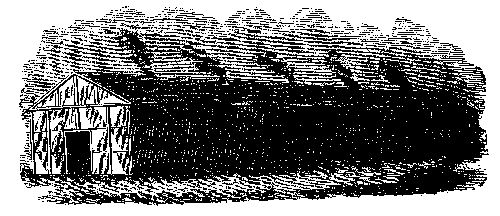
in which a few Spaniards were killed with poisoned arrows. On Guadaloupe
the natives lived in square houses made of saplings intertwined with
reeds, and on the rude porticoes attached to these houses some of the
wooden pieces were carved so as to look like serpents. In some of these
houses human limbs were hanging from the roof, cured with smoke, like
ham; and fresh pieces of human flesh were found stewing in earthen
kettles, along with the flesh of parrots. Now at length, said Peter
Martyr, was proved the truth of the stories of Polyphemus and the
Læstrygonians, and the reader must look out lest his hair stand on
end.[560] These western Læstrygonians were known as Caribbees,
Caribales, or Canibales, and have thus furnished an epithet which we
have since learned to apply to man-eaters the world over.
It was late at night on the 27th of November that Columbus arrived in
the harbour of La Navidad and fired a salute to arouse the attention of
the party that had been left there the year before. There was no reply
and the silence seemed fraught with evil omen. On going ashore next
morning and exploring the neighbourhood, the Spaniards came upon sights
of dismal significance. Fate of the colony at La Navidad.
The fortress was pulled to pieces and partly
burnt, the chests of provisions were broken open and emptied, tools and
fragments of European clothing were found in the houses of the natives,
and finally eleven corpses, identifiable as those of white men, were
found buried near the fort. Not one of the forty men who had been left
behind in that place ever turned up to tell the tale. The little colony
of La Navidad had been wiped out of existence. From the Indians,
however, Columbus gathered bits of information that made a sufficiently
probable story. It was a typical instance of the beginnings of
colonization in wild countries. In such instances human nature has shown
considerable uniformity. Insubordination and deadly feuds among
themselves had combined with reckless outrages upon the natives to
imperil the existence of this little party of rough sailors. The cause
to which Horace ascribes so many direful wars, both before and since the
days of fairest Helen, seems to have been the principal cause on this
occasion. At length a fierce chieftain named Caonabo, from the region of
Xaragua, had attacked the Spaniards in overwhelming force, knocked their
blockhouse about their heads, and butchered all that were left
of them.
This was a gloomy welcome to the land of promise. There was nothing to
be done but to build new fortifications and found a town. The site
chosen for this new settlement, which was named Building of Isabella.
Isabella, was at a good
harbour about thirty miles east of Monte Christi. It was chosen because
Columbus understood from the natives that it was not far from there to
the gold-bearing mountains of Cibao, a name which still seemed to
signify Cipango. Quite a neat little town was presently built, with
church, marketplace, public granary, and dwelling-houses, the whole
encompassed with a stone wall. An exploring party led by Ojeda into the
mountains of Cibao found gold dust and pieces of gold ore in the beds of
the brooks, and returned elated with this discovery. Twelve of the ships
were now sent back to Spain for further supplies and reinforcements, and
Exploration of Cibao.
specimens of the gold were sent as an earnest of what was likely to be
found. At length, in March, 1494, Columbus set forth, with 400 armed
men, to explore the Cibao country. The march was full of interest. It is
upon this occasion that we first find mention of the frantic terror
manifested by Indians at the sight of horses. At first they supposed the
horse and his rider to be a kind of centaur, and when the rider
dismounted this separation of one creature into two overwhelmed them
with supernatural terror. Even when they had begun to get over this
notion they were in dread of being eaten by the horses.[561]
These natives lived in houses grouped into villages, and had carved
wooden idols and rude estufas for their tutelar divinities. It was
ascertained that different tribes tried to steal each other's idols and
even fought for the possession of valuable objects of "medicine."[562]
Columbus observed and reported the customs of these people with some
minuteness. There was nothing that agreed with Marco Polo's descriptions
of Cipango, but so far as concerned the discovery of gold mines, the
indications were such as to leave little doubt of the success of this
reconnaissance. The Admiral now arranged his forces so as to hold the
inland regions just visited and gave the general command to Margarite,
who was to continue the work of exploration. He left his brother, Diego
Columbus, in charge of the colony, and taking three caravels set sail
from Isabella on the 24th of April, on a cruise of discovery in these
Asiatic waters.
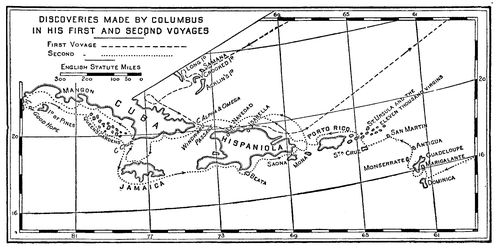
Discoveries made by Columbus in his first and second
voyages.
A brief westward sail brought the little squadron into the Windward
Passage and in sight of Cape Mayzi, which Columbus on his first voyage
had named Cape Alpha and Omega.
Cape Alpha and Omega as being the easternmost point on the
Chinese coast. He believed that if he were to sail to the right of this
cape he should have the continent on his port side for a thousand miles
and more, as far as Quinsay and Cambaluc (Peking). If he had
sailed in this direction and had succeeded in keeping to the east of
Florida, he would have kept a continent on his port side, and a thousand
miles would have taken him a long way toward that Vinland which our
Scandinavian friends would fondly have us believe was his secret
guiding-star, and the geographical position of which they suppose him to
have known with such astounding accuracy. But on this as on other
occasions, if the Admiral had ever received any information about
Vinland, it must be owned that he treated it very cavalierly, for he
chose the course to the left of Cape Mayzi. His decision is intelligible
if we bear in mind that he had not yet circumnavigated Hayti and was not
yet cured of his belief that its northern shore was the shore of the
great Cipango. At the same time he had seen enough on his first voyage
to convince him that the relative positions of Cipango and the mainland
of Cathay were not correctly laid down upon the Toscanelli map. He had
already inspected two or three hundred miles of the coast to the right
of Cape Mayzi without finding traces of civilization; and whenever
inquiries were made about gold or powerful kingdoms the natives
invariably pointed to the south or southwest. Columbus, therefore,
decided to try his luck in this direction. He passed to the left of Cape
Mayzi and followed the southern coast of Cuba.
By the 3d of May the natives were pointing so persistently to the south
and off to sea that he Discovery of Jamaica.
changed his course in that direction and soon
came upon the northern coast of the island which we still know by its
native name Jamaica. Here he found Indians more intelligent
and more warlike than any he had as yet seen. He was especially struck
with the elegance of their canoes, some of them nearly a hundred feet in
length, carved and hollowed from the trunks of tall trees. We may
already observe that different tribes of Indians comported themselves
very differently at the first sight of white men. While the natives of
some of the islands prostrated themselves in adoration of these
sky-creatures, or behaved with a timorous politeness which the Spaniards
mistook for gentleness of disposition, in other places the red men
showed fight at once, acting upon the brute impulse to drive away
strangers. In both cases, of course, dread of the unknown was the
prompting impulse, though so differently manifested. As the Spaniards
went ashore upon Jamaica, the Indians greeted them with a shower of
javelins and for a few moments stood up against the deadly fire of the
cross-bows, but when they turned to flee, a single bloodhound, let loose
upon them, scattered them in wildest panic.[563]
Finding no evidences of civilization upon this beautiful island,
Columbus turned northward and struck the Cuban coast again at the point
which still bears the name he gave it, Cape Cruz. Between the general
contour of this Coasting the south side of Cuba.
end of Cuba and that of the eastern extremity of Cathay
upon the Toscanelli map there is a curious resemblance, save that the
direction is in the one case more east and west and in the
other more north and south. Columbus passed no cities like Zaiton, nor
cities of any sort, but when he struck into the smiling archipelago
which he called the Queen's Gardens, now known as Cayos de las Doce
Leguas, he felt sure that he was among Marco Polo's seven thousand spice
islands. On the 3d of June, at some point on the Cuban coast, probably
near Trinidad, the crops of several doves were opened and spices found
in them. None of the natives here had ever heard of an end to Cuba, and
they believed it was endless.[564] The next country to the west of
themselves was named Mangon, and it was inhabited by people with tails
which they carefully hid by wearing loose robes of cloth. This
information seemed decisive to Columbus. Evidently this Mangon was
Mangi, the province in which was the city of Zaiton, the province just
south of Cathay. And as for the tailed men, the book of Mandeville had a
story of some naked savages in eastern Asia who spoke of their more
civilized neighbours as wearing clothes in order to cover up some bodily
peculiarity or defect. Could there be any doubt that the Spanish
caravels had come at length to the coast of opulent Mangi?[565]
Under the influence of this belief, when a few days later they landed in
search of fresh water, and a certain archer, on the lookout for game,
caught distant glimpses of a flock of tall white cranes feeding in an
everglade, he fled to his comrades with the story that he had seen a
party of men clad in long white tunics, and all agreed The "people of Mangon."
that these must
be the people of Mangon.[566] Columbus sent a small company ashore to
find them. It is needless to add that the search was fruitless, but
footprints of alligators, interpreted as footprints of griffins guarding
hoarded gold,[567] frightened the men back to their ships.
From the natives, with whom the Spaniards could converse only by signs,
they seemed to learn that they were going toward the realm of Prester
John;[568] and in such wise did they creep along the coast to the point,
some fifty miles west of Broa Bay, where it begins to trend decidedly to
the southwest. Before they had reached Point Mangles, a hundred miles
farther on, inasmuch as they found this southwesterly trend persistent,
the proof that they were upon the coast of the Asiatic continent began
to seem complete. Columbus thought that they had passed the point (lat.
23°, long. 145° on Toscanelli's map) where the coast of Asia began to
trend steadily toward the southwest.[569] By pursuing this coast he felt
sure that he would eventually reach the peninsula (Malacca) which
Ptolemy, who knew of it only by vague hearsay, called the
Golden Chersonese.[570] An immense idea now flitted through the mind of
Columbus. The Golden Chersonese.
If he could reach and double that peninsula he could then find
his way to the mouth of the Ganges river; thence he might cross the
Indian ocean, pass the Cape of Good Hope (for Dias had surely shown that
the way was open), and return that way to Spain after circumnavigating
the globe! But fate had reserved this achievement for another man of
great heart and lofty thoughts, a quarter of a century later, who should
indeed accomplish what Columbus dreamed, but only after crossing another
Sea of Darkness, the most stupendous body of water on our globe, the
mere existence of which until after Columbus had died no European ever
suspected.[571] If Columbus had now sailed about a hundred miles
farther, he would have found the end of Cuba, and might perhaps have
skirted the northern shore of Yucatan and come upon the barbaric
splendours of Uxmal and Campeche. The excitement which such news would
have caused in Spain might perhaps have changed all the rest of his life
and saved him from the worst of his troubles. But the crews were now
unwilling to go farther, and the Admiral realized that it would be
impossible to undertake such a voyage as he had in mind with no more
than their present outfit. So it was decided to return to Hispaniola.
Upon consultation with La Cosa and others, it was unanimously
agreed that they were upon the coast of the continent of Asia. The
evidence seemed conclusive. From Cape Mayzi (Alpha and Omega) they had
observed, upon their own reckoning, 335 leagues, or about 1,000
geographical miles, of continuous coast running steadily in nearly the
same direction.[572] Clearly it was too long for the coast of an island;
and then there was the name Mangon = Mangi. The only puzzling
circumstance was that they did not find any of Marco Polo's cities. They
kept getting scraps of information which seemed to refer to gorgeous
kingdoms, but these were always in the dim distance. Still there was no
doubt that they had discovered the coast of a continent, and of course
such a continent could be nothing else but Asia!
Such unanimity of opinion might seem to leave nothing to be desired. But
Columbus had already met with cavillers. Before he started on this
cruise from Isabella, some impatient hidalgos, disgusted at finding much
to do and little to get, had begun to hint that the Admiral was a
humbug, and that his "Indies" were no such great affair after all. In
order to silence these ill-natured critics, he sent his notary,
accompanied by four witnesses, to every person in those three caravels,
to get a sworn statement. If anybody had a grain of doubt about this
coast being the coast of Asia, so that you could go ashore
there and walk on dry land all the way to Spain if so disposed, let him
declare his doubts once for all, so that they might now be duly
considered. A solemn expression of opinion.
No one expressed any doubts. All declared, under oath, their
firm belief. It was then agreed that if any of the number should
thereafter deny or contradict this sworn statement, he should have his
tongue slit;[573] and if an officer, he should be further punished with
a fine of 10,000 maravedis, or if a sailor, with a hundred lashes. These
proceedings were embodied in a formal document, dated June 12, 1494,
which is still to be seen in the Archives of the Indies at Seville.[574]
Having disposed of this solemn matter, the three caravels turned
eastward, touching at the Isle of Pines and coasting back along the
south side of Cuba. The headland where the Admiral first became
convinced of the significance of the curvature of the coast, he named
Cape of Good Hope,[575] believing it to be much nearer the goal which
all were seeking than the other cape of that name, discovered by Dias
seven years before.
It will be remembered that the Admiral, upon his first voyage,
Vicissitudes of theory.
had
carried home with him two theories,—first, that in the Cuban coast he
had already discovered that of the continent of Asia, secondly
that Hispaniola was Cipango. The first theory seemed to be confirmed by
further experience; the second was now to receive a serious shock.
Leaving Cape Cruz the caravels stood over to Jamaica, leisurely explored
the southern side of that island, and as soon as adverse winds would let
them, kept on eastward till land appeared on the port bow. Nobody
recognized it until an Indian chief who had learned some Spanish hailed
them from the shore and told them it was Hispaniola. They then followed
that southern coast its whole length, discovering the tiny islands,
Beata, Saona, and Mona. Here Columbus, overcome by long-sustained
fatigue and excitement, suddenly fell into a death-like lethargy, and in
this sad condition was carried all the way to Isabella, and to his own
house, where he was put to bed. Hispaniola had thus been
circumnavigated, and either it was not Cipango or else that wonderland
must be a much smaller affair than Toscanelli and Martin Behaim had
depicted it.[576] There was something truly mysterious about these
Strange Coasts!
When Columbus, after many days, recovered consciousness, he found his
Arrival of Bartholomew Columbus.
brother Bartholomew standing by his bedside. It was six years since they
had last parted company at Lisbon, whence the younger brother started
for England, while the elder returned to Spain. The news of
Christopher's return from his first voyage found Bartholomew
in Paris, whence he started as soon as he could for Seville, but did not
arrive there until just after the second expedition had started.
Presently the sovereigns sent him with three ships to Hispaniola, to
carry supplies to the colony; and there he arrived while the Admiral was
exploring the coast of Cuba. The meeting of the two brothers was a great
relief to both. The affection between them was very strong, and each was
a support for the other. The Admiral at once proceeded to appoint
Bartholomew to the office of Adelantado, which in this instance was
equivalent to making him governor of Hispaniola under himself, the
Viceroy of the Indies. In making this appointment Columbus seems to have
exceeded the authority granted him by the second article of his
agreement of April, 1492, with the sovereigns;[577] but they mended the
matter in 1497 by themselves investing Bartholomew with the office and
dignity of Adelantado.[578]
Columbus was in need of all the aid he could summon, for, during his
absence, the island had become a pandemonium.
Mutiny in Hispaniola; desertion of Boyle and Margarite.
His brother Diego, a man
of refined and studious habits, who afterwards became a priest, was too
mild in disposition to govern the hot-heads who had come to Hispaniola
to get rich without labour. They would not submit to the rule of this
foreigner. Instead of doing honest work they roamed about the island,
abusing the Indians and slaying one another in silly quarrels. Chief
among the offenders was King Ferdinand's favourite, the
commander Margarite; and he was aided and abetted by Friar Boyle. Some
time after Bartholomew's arrival, these two men of Aragon gathered about
them a party of malcontents and, seizing the ships which had brought
that mariner, sailed away to Spain. Making their way to court, they
sought pardon for thus deserting the colony, saying that duty to their
sovereigns demanded that they should bring home a report of what was
going on in the Indies. They decried the value of Columbus's
discoveries, and reminded the king that Hispaniola was taking money out
of the treasury much faster than it was putting it in; an argument well
calculated to influence Ferdinand that summer, for he was getting ready
to go to war with France over the Naples affair. Then the two recreants
poured forth a stream of accusations against the brothers Columbus, the
general purport of which was that they were gross tyrants not fit to be
trusted with the command of Spaniards.
No marked effect seems to have been produced by these first complaints,
but when Margarite and Boyle were once within reach of Fonseca, we need
not wonder that mischief was soon brewing. It was unfortunate for
Columbus that his work of exploration was hampered by the necessity of
founding a colony and governing a parcel of unruly men let loose in the
wilderness, far away from the powerful restraints of civilized society.
Such work required undivided attention and extraordinary talent for
command. It does not appear that Columbus was lacking in such talent. On
the contrary both he and his brother Bartholomew seem to have
possessed it in a high degree. But the situation was desperately bad
when the spirit of mutiny was fomented by deadly enemies at court.
The government of Columbus was not tyrannical.
I do
not find adequate justification for the charges of tyranny brought
against Columbus. The veracity and fairness of the history of Las Casas
are beyond question; in his divinely beautiful spirit one sees now and
then a trace of tenderness even for Fonseca, whose conduct toward him
was always as mean and malignant as toward Columbus. One gets from Las
Casas the impression that the Admiral's high temper was usually kept
under firm control, and that he showed far less severity than most men
would have done under similar provocation. Bartholomew was made of
sterner stuff, but his whole career presents no instance of wanton
cruelty; toward both white men and Indians his conduct was distinguished
by clemency and moderation. Under the government of these brothers a few
scoundrels were hanged in Hispaniola. Many more ought to have been.
Of the attempt of Columbus to collect tribute from the native
population, and its Troubles with the Indians.
consequences in developing the system of
repartimientos out of which grew Indian slavery, I shall treat in a
future chapter.[579] That attempt, which was ill-advised and
ill-managed, was part of a plan for checking wanton depredations and
regulating the relations between the Spaniards and the Indians. The
colonists behaved so badly toward the red men that the
chieftain Caonabo, who had destroyed La Navidad the year before, now
formed a scheme[580] for a general alliance among the native tribes,
hoping with sufficient numbers to overwhelm and exterminate the
strangers, in spite of their solid-hoofed monsters and death-dealing
thunderbolts. This scheme was revealed to Columbus, soon after his
return from the coast of Cuba, by the chieftain Guacanagari, who was an
enemy to Caonabo and courted the friendship of the Spaniards. Alonso de
Ojeda, by a daring stratagem, captured Caonabo and brought him to
Columbus, who treated him kindly but kept him a prisoner until it should
be convenient to send him to Spain. But this chieftain's scheme was
nevertheless put in operation through the influence of his principal
wife Anacaona. An Indian war broke out; roaming bands of Spaniards were
ambushed and massacred; and there was fighting in the field, where the
natives—assailed by firearms and cross-bows, horses and
bloodhounds—were wofully defeated.
Thus in the difficult task of controlling mutinous white men and
Mission of Aguado.
defending the colony against infuriated red men Columbus spent the first
twelvemonth after his return from Cuba. In October, 1495, there arrived
in the harbour of Isabella four caravels laden with welcome supplies. In
one of these ships came Juan Aguado, sent by the sovereigns to gather
information respecting the troubles of the colony. This
appointment was doubtless made in a friendly spirit, for Columbus had
formerly recommended Aguado to favour. But the arrival of such a person
created a hope, which quickly grew into a belief, that the sovereigns
were preparing to deprive Columbus of the government of the island; and,
as Irving neatly says, "it was a time of jubilee for offenders; every
culprit started up into an accuser." All the ills of the colony, many of
them inevitable in such an enterprise, many of them due to the
shiftlessness and folly, the cruelty and lust of idle swash-bucklers,
were now laid at the door of Columbus. Discovery of gold mines.
Aguado was presently won over by
the malcontents, so that by the time he was ready to return to Spain,
early in 1496, Columbus felt it desirable to go along with him and make
his own explanations to the sovereigns. Fortunately for his purposes,
just before he started, some rich gold mines were discovered on the
south side of the island, in the neighbourhood of the Hayna and Ozema
rivers. Moreover there were sundry pits in these mines, which looked
like excavations and seemed to indicate that in former times there had
been digging done.[581] This discovery confirmed the Admiral in a new
theory, which he was beginning to form. If it should turn out that
Hispaniola was not Cipango, as the last voyage seemed to suggest,
perhaps it might prove to be Ophir![582] Probably these ancient
excavations were made by King Solomon's men when they came
here to get gold for the temple at Jerusalem! Speculations about Ophir.
If so, one might expect to
find silver, ivory, red sandal-wood, apes, and peacocks at no great
distance. Just where Ophir was situated no one could exactly tell,[583]
but the things that were carried thence to Jerusalem certainly came from
"the Indies." Columbus conceived it as probably lying northeastward of
the Golden Chersonese (Malacca) and as identical with the island of
Hispaniola.
The discovery of these mines led to the transfer of the headquarters of
the colony to the mouth of the Founding of San Domingo, 1496.
Ozema river, where, in the summer of
1496, Bartholomew Columbus made a settlement which became the city of
San Domingo.[584] Meanwhile Aguado and the Admiral sailed for Spain
early in March, in two caravels overloaded with more than two hundred
homesick passengers. In choosing his course Columbus did not show so
much sagacity as on his first return voyage. Instead of
working northward till clear of the The return voyage.
belt of trade-winds, he kept
straight to the east, and so spent a month in beating and tacking before
getting out of the Caribbean Sea. Scarcity of food was imminent, and it
became necessary to stop at Guadaloupe and make a quantity of cassava
bread.[585] It was well that this was done, for as the ships worked
slowly across the Atlantic, struggling against perpetual head-winds, the
provisions were at length exhausted, and by the first week in June the
famine was such that Columbus had some difficulty in preventing the
crews from eating their Indian captives, of whom there were thirty or
more on board.[586]
At length, on the 11th of June, the haggard and starving company arrived
at Cadiz, and Columbus, while awaiting orders from the sovereigns,
stayed at the house of his good friend Bernaldez, the curate of Los
Palacios.[587] After a month he attended court at Burgos, and was kindly
received. No allusion was made to the complaints against him, and the
sovereigns promised to furnish ships for a third voyage of discovery.
For the moment, however, other things interfered with this
enterprise. One was the marriage of the son and daughter of Ferdinand
and Isabella to the daughter and son of the Emperor Maximilian. The war
with France was at the same time fast draining the treasury. Indeed, for
more than twenty years, Castile had been at war nearly all the time,
first with Portugal, next with Granada, then with France; and the crown
never found it easy to provide money for maritime enterprises.
Accordingly, at the earnest solicitation of Vicente Yañez Pinzon and
other enterprising mariners, the sovereigns had issued a proclamation,
Edicts of 1495 and 1497.
April 10, 1495, granting to all native Spaniards the privilege of
making, at their own risk and expense, voyages of discovery or traffic
to the newly found coasts. As the crown was to take a pretty heavy
tariff out of the profits of these expeditions, while all losses were to
be borne by the adventurers, a fairly certain source of revenue, be it
great or small, seemed likely to be opened.[588] Columbus protested
against this edict, inasmuch as he deemed himself entitled to
a patent or monopoly in the work of conducting expeditions to Cathay.
The sovereigns evaded the difficulty by an edict of June 2, 1497,
declaring that it was never their intention "in any way to affect the
rights of the said Don Christopher Columbus." This declaration was,
doubtless, intended simply to pacify the Admiral. It did not prevent the
authorization of voyages conducted by other persons a couple of years
later; and, as I shall show in the next chapter, there are strong
reasons for believing that on May 10, 1497, three weeks before this
edict, an expedition sailed from Cadiz under the especial auspices of
King Ferdinand, with Vicente Yañez Pinzon for its chief commander and
Americus Vespucius for one of its pilots.
It was not until late in the spring of 1498 that the ships were ready
for Columbus. Everything that Columbus loses his temper.
Fonseca could do to vex and delay him was
done. One of the bishop's minions, a converted Moor or Jew named Ximeno
Breviesca, behaved with such outrageous insolence that on the day of
sailing the Admiral's indignation, so long restrained, at last broke
out, and he drove away the fellow with kicks and cuffs.[589] This
imprudent act gave Fonseca the opportunity to maintain that
what the Admiral's accusers said about his tyrannical disposition must
be true.
The expedition started on May 30, 1498, from the little port of San
Lucar de Barrameda. The third voyage.
There were six ships, carrying about 200 men besides
the sailors. On June 21, at the Isle of Ferro, the Admiral divided his
fleet, sending three ships directly to Hispaniola, while with the other
three he kept on to the Cape Verde islands, whence he steered southwest
on the 4th of July. A week later, after a run of about 900 miles, his
astrolabe seemed to show that he was within five degrees of the
equator.[590] There were three reasons for going so far to the
south:—1, the natives of the islands already visited always
pointed in that direction when gold was mentioned; 2, a learned
jeweller, who had travelled in the East, had assured Columbus that gold
and gems, as well as spices and rare drugs, were to be found for the
most part among black people near the equator; 3, if he should not find
any rich islands on the way, a sufficiently long voyage would bring him
to the coast of Champa (Cochin China) at a lower point than he had
reached on the preceding voyage, and nearer to the Golden Chersonese
(Malacca), by doubling which he could enter the Indian ocean. It will be
remembered that he supposed the southwesterly curve in the Cuban coast,
the farthest point reached in his second voyage, to be the beginning of
the coast of Cochin China according to Marco Polo.
Once more through ignorance of the atmospheric conditions of the regions
within the tropics Columbus encountered needless perils and hardships.
If he had steered from Ferro straight across the ocean a trifle south of
west-southwest, he might have made a quick and comfortable voyage, with
the trade-wind filling his sails, to the spot where he actually struck
land.[591]
As it was, however, he naturally followed the custom then so
common, The belt of calms.
of first running to the parallel upon which he intended to sail.
This long southerly run brought him into the belt of calms or neutral
zone between the northern and southern trade-winds, a little north of
the equator.[592] No words can describe what followed so well
as those of Irving: "The wind suddenly fell, and a dead sultry calm
commenced, which lasted for eight days. The air was like a furnace; the
tar melted, the seams of the ship yawned; the salt meat became putrid;
the wheat was parched as if with fire; the hoops shrank from the wine
and water casks, some of which leaked and others burst, while the heat
in the holds of the vessels was so suffocating that no one could remain
below a sufficient time to prevent the damage that was taking place. The
mariners lost all strength and spirits, and sank under the oppressive
heat. It seemed as if the old fable of the torrid zone was about to be
realized; and that they were approaching a fiery region where it would
be impossible to exist."[593]
Fortunately, they were in a region where the ocean is comparatively
narrow. The longitude reached by Columbus on July 13, when the wind died
away, must have been about 36° or 37° W., and a run of only
800 miles west from that point would have brought him to Cayenne. His
course between the 13th and 21st of July must have intersected the
thermal equator, or line of greatest mean annual heat on the globe,—an
irregular curve which is here deflected as much as five degrees north of
the equinoctial line. But although there was not a breath of wind, the
powerful equatorial current was quietly driving the ships, much faster
than the Admiral could have suspected, to the northwest and toward land.
By the end of that stifling week they were in latitude 7° N., and caught
the trade-wind on the starboard quarter. Thence after a brisk run of ten
days, in sorry plight, with ugly leaks and scarcely a cask of fresh
water left, they arrived within sight of land. Three mountain peaks
loomed up in the offing before them, and as they drew nearer it appeared
that those peaks belonged to one great mountain; wherefore the pious
Admiral named the island Trinidad.
Here some surprises were in store for Columbus. Instead of finding black
and woolly-haired natives, he found men of cinnamon hue, like those in
Hispaniola, Trinidad and the Orinoco.
only—strange to say—lighter in colour. Then in coasting
Trinidad he caught a glimpse of land at the delta of the Orinoco, and
called it Isla Santa, or Holy Island.[594] But, on passing
into the gulf of Paria, through the strait which he named Serpent's
Mouth, his ships were in sore danger of being swamped by the raging
surge that poured from three or four of the lesser mouths of that
stupendous river. Presently, finding that the water in the gulf was
fresh to the taste, he gradually reasoned his way to the correct
conclusion, that the billows which had so nearly overwhelmed him must
have come out from a river greater than any he had ever known or dreamed
of, and that so vast a stream of running water could be produced only
upon land of continental dimensions.[595] This coast to the south of him
was, therefore, the coast of a continent, with indefinite extension
toward the south, a land not laid down upon Toscanelli's or any other
map, and of which no one had until that time known anything.[596]
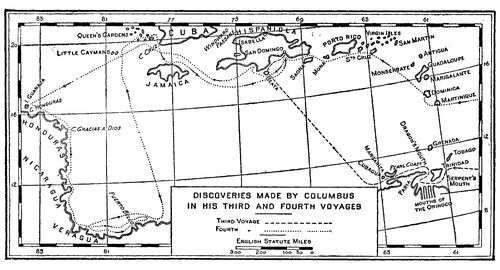
Discoveries made by Columbus in his third and
fourth voyages.
In spite of the correctness of this surmise, Columbus was still as far
from a true interpretation of the whole situation as when he supposed
Hispaniola to be Ophir. He entered upon a series of speculations which
forcibly remind us how empirical was the notion of the earth's rotundity
before the inauguration of physical astronomy by Speculations as to the earth's shape.
Galileo, Kepler, and
Newton. We now know that our planet has the only shape possible for such
a rotating mass that once was fluid or nebulous, the shape of a spheroid
slightly protuberant at the equator and flattened at the poles; but this
knowledge is the outcome of mechanical principles utterly unknown and
unsuspected in the days of Columbus. He understood that the earth is a
round body, but saw no necessity for its being strictly spherical or
spheroidal. He now suggested that it was probably shaped like a pear,
rather a blunt and corpulent pear, nearly spherical in its lower part,
but with a short, stubby apex in the equatorial region somewhere beyond
the point which he had just reached. He fancied he had been sailing up a
gentle slope from the burning glassy sea where his ships had been
becalmed to this strange and beautiful coast where The mountain of Paradise.
he found the climate
enchanting. If he were to follow up the mighty river just now revealed,
it might lead him to the summit of this apex of the world, the place
where the terrestrial paradise, the Garden which the Lord
planted eastward in Eden, was in all probability situated![597]
As Columbus still held to the opinion that by keeping to the west from
that point he should soon reach the coast of Relation of the "Eden continent" to "Cochin China."
Cochin China, his
conception of the position of Eden is thus pretty clearly indicated. He
imagined it as situated about on the equator, upon a continental mass
till then unknown, but evidently closely connected with the continent of
Asia if not a part of it. If he had lived long enough to hear of Quito
and its immense elevation, I should suppose that might very well have
suited his idea of the position of Eden. The coast of this continent,
upon which he had now arrived, was either continuous with the coast of
Cochin China (Cuba) and Malacca, or would be found to be divided from it
by a strait through which one might pass directly into the Indian ocean.
It took some little time for this theory to come to maturity in the mind
of Columbus. Not expecting to find any mainland in that The Pearl Coast.
quarter, he
began by calling different points of the coast different islands. Coming
out through the passage which he named Dragon's Mouth, he caught distant
glimpses of Tobago and Grenada to starboard, and turning westward
followed the Pearl Coast as far as the islands of Margarita and Cubagua.
The fine pearls which he found there in abundance confirmed
him in the good opinion he had formed of that country. By this time, the
15th of August, he had so far put facts together as to become convinced
of the continental character of that coast, and would have been glad to
pursue it westward. But now his strength gave out. During most of the
voyage he had suffered acute torments with gout, his temperature had
been very feverish, and his eyes were at length so exhausted with
perpetual watching that he could no longer make observations. So he left
the coast a little beyond Cubagua, and steered straight for Hispaniola,
aiming at Arrival at San Domingo.
San Domingo, but hitting the island of Beata because he did
not make allowance for the westerly flow of the currents. He arrived at
San Domingo on the 30th of August, and found his brother Bartholomew,
whom he intended to send at once on a further cruise along the Pearl
Coast, while he himself should be resting and recovering strength.
But alas! there was to be no cruising now for the younger brother nor
rest for the elder. It was a sad story that Roldan's rebellion.
Bartholomew had to tell. War
with the Indians had broken out afresh, and while the Adelantado was
engaged in this business a scoundrel named Roldan had taken advantage of
his absence to stir up civil strife. Roldan's rebellion was a result of
the ill-advised mission of Aguado. The malcontents in the colony
interpreted the Admiral's long stay in Spain as an indication that he
had lost favour with the sovereigns and was not coming back to the
island. Gathering together a strong body of rebels, Roldan
retired to Xaragua and formed an alliance with the brother of the late
chieftain Caonabo. By the time the Admiral arrived the combination of
mutiny with barbaric warfare had brought about a frightful state of
things. A party of soldiers, sent by him to suppress Roldan, straightway
deserted and joined that rebel. It thus became necessary to come to
terms with Roldan, and this revelation of the weakness of the government
only made matters worse. Two wretched years were passed in attempts to
restore order in Hispaniola, while the work of discovery and exploration
was postponed. Meanwhile the items of information that found their way
to Spain were skilfully employed by Fonseca's machinations.
Fonseca in poisoning the minds of
the sovereigns, until at last they decided to send out a judge to the
island, armed with plenary authority to make investigations and settle
disputes. The glory which Columbus had won by the first news of the
discovery of the Indies had now to some extent faded away. The
enterprise yielded as yet no revenue and entailed great expense; and
whenever some reprobate found his way back to Spain, the malicious
Fonseca prompted him to go to the treasury with a claim for pay alleged
to have been wrongfully withheld by the Admiral. Ferdinand Columbus
tells how some fifty such scamps were gathered one day in the courtyard
of the Alhambra, cursing his father and catching hold of the king's
robe, crying, "Pay us! pay us!" and as he and his brother Diego, who
were pages in the queen's service, happened to pass by, they
were greeted with hoots:—"There go the sons of the Admiral of
Mosquito-land, the man who has discovered a land of vanity and deceit,
the grave of Spanish gentlemen!"[598]
An added sting was given to such taunts by a great event that happened
about this time. In the summer of Gama's voyage to Hindustan, 1497.
1497, Vasco da Gama started from
Lisbon for the Cape of Good Hope, and in the summer of 1499 he returned,
after having doubled the cape and crossed the Indian ocean to Calicut on
the Malabar coast of Hindustan. His voyage was the next Portuguese step
sequent upon that of Bartholomew Dias. There was nothing questionable or
dubious about Gama's triumph. He had seen splendid cities, talked with a
powerful Rajah, and met with Arab vessels, their crews madly jealous at
the unprecedented sight of Christian ships in those waters; and he
brought back with him to Lisbon nutmegs and cloves, pepper and ginger,
rubies and emeralds, damask robes with satin linings, bronze chairs with
cushions, trumpets of carved ivory, a sunshade of crimson satin, a sword
in a silver scabbard, and no end of such gear.[599] An old civilization
had been found and a route of commerce discovered, and a factory was to
be set up at once on that Indian coast. What a contrast to the miserable
performance of Columbus, who had started with the flower of Spain's
chivalry for rich Cipango, and had only led them to a land
where they must either starve or do work fit for peasants, while he
spent his time in cruising among wild islands! The king of Portugal
could now snap his fingers at Ferdinand and Isabella, and if a doubt
should have sometimes crossed the minds of those chagrined sovereigns,
as to whether this plausible Genoese mariner might not, after all, be a
humbug or a crazy enthusiast, we can hardly wonder at it.
The person sent to investigate the affairs of Hispaniola was Francisco
de Bobadilla, a knight commander of the order of Calatrava. He carried
several Fonseca's creature, Bobadilla.
documents, one of them directing him to make inquiries and
punish offenders, another containing his appointment as governor, a
third commanding Columbus and his brothers to surrender to him all
fortresses and other public property.[600] The two latter papers were to
be used only in case of such grave misconduct proved against Columbus as
to justify his removal from the government. These papers were made out
in the spring of 1499, but Bobadilla was not sent out until July, 1500.
When he arrived at San Domingo on the 23d of August, the insurrection
had been suppressed; the Admiral and Bartholomew were bringing things
into order in distant parts of the island, while Diego was left in
command at San Domingo. Seven ringleaders had just been hanged, and five
more were in prison under sentence of death. If Bobadilla had not
come upon the scene this wholesome lesson might have worked
some improvement in affairs.[601] He destroyed its moral in a twinkling.
The first day after landing, he read aloud, at the church door, the
paper directing him to make inquiries and punish offenders; and
forthwith demanded of Diego Columbus that the condemned prisoners should
be delivered up to him. Diego declined to take so important a step until
he could get orders from the Admiral. Next day Bobadilla read his second
and third papers, proclaimed himself governor, called on Diego to
surrender the fortress and public buildings, and renewed his demand for
the prisoners. As Diego still hesitated to act before news of these
proceedings could be sent to his brother, Bobadilla broke into the
fortress, took the prisoners out, and presently set them free. All the
rebellious spirits in the colony were thus drawn to the side of
Bobadilla, whose royal commission, under such circumstances, gave him
irresistible power. He threw Diego into prison and loaded him with
fetters. He seized the Admiral's house, and confiscated all his personal
property, even including his business papers and private letters. When
the Admiral arrived in San Domingo, Bobadilla, Columbus in chains.
without even waiting to
see him, sent an officer to put him in irons and take him to prison.
When Bartholomew arrived, he received the same treatment. The three
brothers were confined in different places, nobody was allowed
to visit them, and they were not informed of the offences with which
they were charged. While they lay in prison, Bobadilla busied himself
with inventing an excuse for this violent behaviour. Finally he hit upon
one at which Satan from the depths of his bottomless pit must have
grimly smiled. He said that he had arrested and imprisoned the brothers
only because he had reason to believe they were inciting the Indians to
aid them in resisting the commands of Ferdinand and Isabella!! In short,
from the day of his landing Bobadilla made common cause with the
insurgent rabble, and when they had furnished him with a ream or so of
charges against the Admiral and his brothers, it seemed safe to send
these gentlemen to Spain. They were put on board ship, with their
fetters upon them, and the officer in charge was instructed by Bobadilla
to deliver them into the hands of Bishop Fonseca, who was thus to have
the privilege of glutting to the full his revengeful spite.
The master of the ship, shocked at the sight of fetters upon such a man
as the Admiral, would have taken them off, but Return to Spain.
Columbus would not let it
be done. No, indeed! they should never come off except by order of the
sovereigns, and then he would keep them for the rest of his life, to
show how his labours had been rewarded.[602] The event—which always
justifies true manliness—proved the sagacity of this proud
demeanour. Fonseca was baulked of his gratification. The clumsy
Bobadilla had overdone the business. The sight of the Admiral's stately
and venerable figure in chains, as he passed through the streets of
Cadiz, on a December day of that year 1500, awakened a popular outburst
of sympathy for him and indignation at his persecutors. While on the
ship he had written or dictated a beautiful and touching letter[603] to
a lady of whom the queen was fond, the former nurse of the Infante,
whose untimely death, three years since, his mother was still mourning.
This letter reached the court at Granada, and was read to the queen
before she had heard of Bobadilla's performances from any other quarter.
A courier was sent in all haste to Cadiz, with orders that the brothers
should at once be released, and with a letter to the Admiral, inviting
him to court and enclosing an order for money to cover his expenses.
Release of Columbus.
The
scene in the Alhambra, when Columbus arrived, is one of the most
touching in history. Isabella received him with tears in her eyes, and
then this much-enduring old man, whose proud and masterful spirit had so
long been proof against all wrongs and insults, broke down. He threw
himself at the feet of the sovereigns in an agony of tears and
sobs.[604]
How far the sovereigns should be held responsible for the behaviour of
their agent is not altogether easy to determine. The appointment of such
a creature as Bobadilla was a sad blunder, but one such as is
liable to be made under any government.
How far were the sovereigns responsible for Bobadilla?
Fonseca was very powerful at
court, and Bobadilla never would have dared to proceed as he did if he
had not known that the bishop would support him. Indeed, from the
indecent haste with which he went about his work, without even the
pretence of a judicial inquiry, it is probable that he started with
private instructions from that quarter. But, while Fonseca had some of
the wisdom along with the venom of the serpent, Bobadilla was simply a
jackass, and behaved so that in common decency the sovereigns were
obliged to disown him. They took no formal or public notice of his
written charges against the Admiral, and they assured the latter that he
should be reimbursed for his losses and restored to his viceroyalty and
other dignities.
This last promise, however, was not fulfilled; partly, perhaps, because
Fonseca's influence was still strong enough to prevent it, partly
because the sovereigns may have come to the sound and reasonable
conclusion that for the present there was no use in committing the
government of that disorderly rabble in Hispaniola to a foreigner. What
was wanted was a Spanish priest, and a military priest withal, of the
sort that Spain then had in plenty. Obedience to priests came natural to
Spaniards. Ovando, another creature of Fonseca, appointed governor of
Hispaniola.
The man now selected was Nicolas de Ovando, a knight
commander of the order of Alcántara, of whom we shall have more to say
hereafter.[605] Suffice it now to observe that he proved himself a
famous disciplinarian, and that he was a great favourite with
Fonseca, to whom he seems to have owed his appointment. He went out in
February, 1502, with a fleet of thirty ships carrying 2,500 persons, for
the pendulum of public opinion had taken another swing, and faith in the
Indies was renewed. Some great discoveries, to be related in the next
chapter, had been made since 1498; and, moreover, the gold mines of
Hispaniola were beginning to yield rich treasures.
But, while the sovereigns were not disposed to restore Columbus to his
viceroyalty, they were quite ready to send him on Purpose of Columbus's fourth voyage.
another voyage of
discovery which was directly suggested by the recent Portuguese voyage
of Gama. Since nothing was yet known about the discovery of a New World,
the achievement of Gama seemed to have eclipsed that of Columbus. Spain
must make a response to Portugal. As already observed, the Admiral
supposed the coast of his "Eden continent" (South America) either to be
continuous with the coast of Cochin China (Cuba) and Malacca, or else to
be divided from that coast by a strait. The latter opinion was the more
probable, since Marco Polo and a few other Europeans had sailed from
China into the Indian ocean without encountering any great continent
that had to be circumnavigated. The recent expedition of Vespucius and
Ojeda (1499-1500) had followed the northern coast of South America for a
long distance to the west of Cubagua, as far as the gulf of Maracaibo.
Columbus now decided to return to the coast of Cochin China (Cuba) and
follow the coast southwestward until he should find the
passage between his Eden continent and the Golden Chersonese (Malacca)
into the Indian ocean. He would thus be able to reach by this western
route the same shores of Hindustan which Gama had lately reached by
sailing eastward. So confident did he feel of the success of this
enterprise, that he wrote a letter to Pope Alexander VI., renewing his
vow to furnish troops for the rescue of the Holy Sepulchre.[606] It was
no doubt the symptom of a reaction against his misfortunes that he grew
more and more mystical in these days, consoling himself with the belief
that he was a chosen instrument in the hands of Providence for enlarging
the bounds of Christendom. In this mood he made some studies on the
prophecies, after the fantastic fashion of his time,[607] and a habit
grew upon him of attributing his discoveries to miraculous inspiration
rather than to the good use to which his poetical and scientific mind
had put the data furnished by Marco Polo and the ancient geographers.
The armament for the Admiral's fourth and last voyage consisted of four
small caravels, of from fifty to seventy tons burthen, with crews
numbering, all told, 150 men. Crossing the Atlantic.
His brother Bartholomew, and his younger
son Ferdinand, then a boy of fourteen, accompanied him. They sailed from
Cadiz on the 11th of May, 1502, and finally left the Canaries
behind on the 26th of the same month. The course chosen was the same as
on the second voyage, and the unfailing trade-winds brought the ships on
the 15th of June to an island called Mantinino, probably Martinique, not
more than ten leagues distant from Dominica. The Admiral had been
instructed not to touch at Hispaniola upon his way out, probably for
fear of further commotions there until Ovando should have succeeded in
bringing order out of the confusion ten times worse confounded into
which Bobadilla's misgovernment had thrown that island. Columbus might
stop there on his return, but not on his outward voyage. His intention
had, therefore, been, on reaching the cannibal islands, to steer for
Jamaica, thence make the short run to "Cochin China," and then turn
southwards. But as one of his caravels threatened soon to become
unmanageable, he thought himself justified in touching at San Domingo
long enough to hire a sound vessel in place of her. Ovando had assumed
the government there in April, and a squadron of 26 or 28 ships,
containing Roldan and Bobadilla, with huge quantities of gold wrung from
the enslaved Indians, was ready to start for Spain about the end of
June. In one of these ships were 4,000 pieces of gold destined for
Columbus, probably a part of the reimbursement that had been promised
him. On the 29th of June the Admiral arrived in the harbour and stated
the nature of his errand. At the same time, as his practised eye had
detected the symptoms of an approaching hurricane, he requested
permission to stay in the harbour until it should be over, and
he furthermore sent to the commander of the fleet a friendly warning not
to venture out to sea at present. His requests and his warnings were
alike treated with contumely. Columbus not allowed to stop at San Domingo.
He was ordered to leave the harbour, and
did so in great indignation. As his first care was for the approaching
tempest, he did not go far but found safe anchorage in a sheltered and
secluded cove, where his vessels rode the storm with difficulty but
without serious damage. Meanwhile the governor's great fleet had rashly
put out to sea, and was struck with fatal fury by wind and wave. Twenty
or more ships went to the bottom, with Bobadilla, Roldan, and most of
the Admiral's principal enemies, besides all the ill-gotten treasure;
five or six shattered caravels, unable to proceed, found their way back
to San Domingo; of all the fleet, only one ship arrived safe and sound
in Spain, and that, says Ferdinand, was the one that had on board his
father's gold. Truly it was such an instance of poetical justice as one
does not often witness in this world. "We will not inquire now," says
Las Casas, who witnessed the affair, "into this remarkable divine
judgment, for at the last day of the world it will be made quite clear
to us."[608] If such judgments were more often visited upon the right
persons, perhaps the ways of Providence would not have so generally come
to be regarded as inscrutable.
The hurricane was followed by a dead calm, during which the Admiral's
ships were carried by the currents into the Arrival at Cape Honduras.
group of tiny islands called
the Queen's Gardens, on the south side of Cuba. With the first
favourable breeze he took a southwesterly course, in order to strike
that Cochin-Chinese coast farther down toward the Malay peninsula. This
brought him directly to the island of Guanaja and to Cape Honduras,
which he thus reached without approaching the Yucatan channel.[609]
Upon the Honduras coast the Admiral found evidences of semi-civilization
with which he was much elated,—such as copper knives and hatchets,
pottery of skilled and artistic workmanship, and cotton garments finely
woven and beautifully dyed. Here the Spaniards first tasted the
chicha, or maize beer, and marvelled at the heavy clubs, armed with
sharp blades of obsidian, with which the soldiers of Cortes were by and
by to become unpleasantly acquainted. The people here wore cotton
clothes, and, according to Ferdinand, the women covered themselves as
carefully as the Moorish women of Granada.[610] On inquiring as to the
sources of gold and other wealth, the Admiral was now referred to the
west, evidently to Yucatan and Guatemala, or, as he supposed, to the
neighbourhood of the Ganges. Evidently the way to reach these countries
was to keep the land on the starboard and search for the
passage between the Eden continent and the Malay peninsula.[611] This
course at first led Columbus eastward for a greater number of leagues
than he could have relished. Wind and current were dead against him,
too; and when, after forty days of wretched weather,
Cape Gracias a Dios.
he succeeded in
doubling the cape which marks on that coast the end of Honduras and the
beginning of Nicaragua, and found it turning square to the south, it was
doubtless joy at this auspicious change of direction, as well as the
sudden relief from head-winds, that prompted him to name that bold
prominence Cape Gracias a Dios, or Thanks to God.
Columbus shipwrecked.
As the ships proceeded southward in the direction of Veragua, evidences
of the kind of semi-civilization which we recognize as characteristic of
that part of aboriginal America grew more and more numerous. Great
houses were seen, built of "stone and lime," or perhaps of rubble stone
with adobe mortar. Walls were adorned with carvings and pictographs.
The coast of Veragua.
Mummies were found in a good state of preservation. There were signs of
abundant gold; the natives wore plates of it hung by cotton
cords about their necks, and were ready to exchange pieces worth a
hundred ducats for tawdry European trinkets. From these people Columbus
heard what we should call the first "news of the Pacific Ocean," though
it had no such meaning to his mind. From what he heard he understood
that he was on the east side of a peninsula, and that there was another
sea on the other side, by gaining which he might in ten days reach the
mouth of the Ganges.[612] By proceeding on his present course he would
soon come to a "narrow place" between the two seas. There was a curious
equivocation here. No doubt the Indians were honest and correct in what
they tried to tell Columbus. But by the "narrow place" they meant narrow
land, not narrow water; Fruitless search for the Strait of Malacca.
not a strait which connected but an isthmus
which divided the two seas, not the Strait of Malacca, but the Isthmus
of Darien![613] Columbus, of course, understood them to mean the strait
for which he was looking, and in his excitement at approaching the
long-expected goal he pressed on without waiting to verify the reports
of gold mines in the neighbourhood, a thing that could be done at any
time.[614] By the 5th of December, however, having reached a
point on the isthmus, a few leagues east of Puerto Bello, without
finding the strait, he yielded to the remonstrances of the crews, and
retraced his course to Veragua. If the strait could not be found, the
next best tidings to carry home to Spain would be the certain
information of the discovery of gold mines, and it was decided to make a
Futile attempt to make a settlement.
settlement here which might serve as a base for future operations. Three
months of misery followed. Many of the party were massacred by the
Indians, the stock of food was nearly exhausted, and the ships were
pierced by worms until it was feared there would be no means left for
going home. Accordingly, it was decided to abandon the enterprise and
return to Hispaniola.[615] In order to allow for the strong westerly
currents in the Caribbean sea, the Admiral first sailed eastward almost
to the gulf of Darien, and then turned to the north. The allowance was
not enough, however. The ships were again carried into the Queen's
Gardens, where they were caught in a storm and nearly beaten to pieces.
At length, on St. John's eve, June 23, 1503, the crazy wrecks—now full
of water and unable to sail another league—were beached on
the coast of Jamaica and converted into a sort of rude fortress; and
while two trusty men were sent over to San Domingo in a canoe, to obtain
relief, Columbus and his party remained shipwrecked in Jamaica. They
waited there a whole year before it proved possible to get any relief
from Ovando. He was a slippery knave, who knew how to deal out promises
without taking the first step toward fulfilment.
It was a terrible year that Columbus spent upon the wild coast of
Jamaica. A year of misery.
To all the horrors inseparable from such a situation there was
added the horror of mutiny. The year did not end until there had been a
pitched battle, in which the doughty Bartholomew was, as usual,
victorious. The ringleader was captured, and of the other mutineers such
as were not slain in the fight were humbled and pardoned. At length
Ovando's conduct began to arouse indignation in San Domingo, and was
openly condemned from the pulpit; so that, late in June, 1504, he sent
over to Jamaica a couple of ships which brought away the Admiral and his
starving party. Ovando greeted the brothers Columbus with his customary
hypocritical courtesy, which they well understood. During the past year
the island of Hispaniola had been the scene of atrocities such as have
scarcely been surpassed in history. I shall give a brief account of them
in a future chapter. Columbus was not cheered by what he saw and heard,
and lost no time in starting for Spain. On the 7th of November, 1504,
after a tempestuous voyage and narrow escape from shipwreck,
he landed at San Lucar de Barrameda and made his way to Seville.
Last return to Spain.
Queen
Isabella was then on her death-bed, and breathed her last just nineteen
days later.
The death of the queen deprived Columbus of the only protector who could
stand between him and Fonseca. The reimbursement for the wrongs which he
had suffered at that man's hands was never made. The last eighteen
months of the Admiral's life were spent in sickness and poverty.
Accumulated hardship and disappointment had broken him down, and he died
on Death of Columbus.
Ascension day, May 20, 1506, at Valladolid. So little heed was taken
of his passing away that the local annals of that city, "which give
almost every insignificant event from 1333 to 1539, day by day, do not
mention it."[616] His remains were buried in the Franciscan monastery at
Valladolid, whence they were removed in 1513 to the monastery of Las
Cuevas, at Seville, where the body of his son Diego, second Admiral and
Viceroy of the Indies, was buried in 1526. Ten years after this date,
the bones of father and son were removed to Hispaniola, to the cathedral
of San Domingo; whence they have since been transferred to Havana. The
result of so many removals has been to raise doubts as to whether the
ashes now reposing at Havana are really those of Columbus and his son;
and over this question there has been much critical discussion, of a
sort that we may cheerfully leave to those who like to spend their time
over such trivialities.
There is a tradition that Ferdinand and Isabella, at some date
unspecified, had granted to Columbus, as a legend for his coat-of-arms,
the noble motto:—
Á Castilla y á Leon
Nuevo mundo dió Colon,
i. e. "To Castile-and-Leon Columbus gave a New World;" and we are
further told that, when the "Nuevo Mundo."
Admiral's bones were removed to Seville,
this motto was, by order of King Ferdinand, inscribed upon his
tomb.[617] This tradition crumbles under the touch of historical
criticism. The Admiral's coat-of-arms, as finally emblazoned under his
own inspection at Seville in 1502, quarters the royal Castle-and-Lion of
the kingdom of Castile with his own devices of five anchors, and a group
of golden islands with a bit of Terra Firma, upon a blue sea. But there
is no legend of any sort, nor is anything of the kind mentioned by Las
Casas or Bernaldez or Peter Martyr. The first allusion to such a motto
is by Oviedo, in 1535, who gives it a somewhat different turn:—
Por Castilla y por Leon
Nuevo mundo halló Colon,
i. e. "For Castile-and-Leon Columbus found a New World." But the other
form is no doubt the better, for Ferdinand Columbus, at some time not
later than 1537, had adopted it, and it may be read to-day upon his tomb
in the cathedral at Seville. The time-honoured tradition has evidently
transferred to the father the legend adopted, if not
originally devised, by his son.
But why is this mere question of heraldry a matter of importance for the
historian? Simply because it furnishes one of the most striking among
many illustrations of the fact that at no time during the life of
Columbus, nor for some years after his death, did anybody use the phrase
"New World" with conscious reference to his discoveries. At the time
of his death their true significance had not yet begun to dawn upon the
mind of any voyager or any writer. It was supposed that he had found a
new route to the Indies by sailing west, and that in the course of this
achievement he had discovered some new islands and a bit or bits of
Terra Firma of more or less doubtful commercial value. To group these
items of discovery into an organic whole, and to ascertain that they
belonged to a whole quite distinct from the Old World, required the work
of many other discoverers, companions and successors to Columbus. In the
following chapter I shall endeavour to show how the conception
of the New World was thus originated and at length became developed into
the form with which we are now familiar.[Back to Contents]
Sketch of Toscanelli's map, sent to Portugal in
1474, and used by Columbus in his first voyage across the Atlantic.
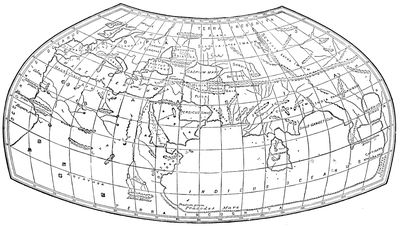
Claudius Ptolemy's world, cir. A. D. 150.
Footnote 1: See my Excursions of an Evolutionist, p. 148. A good
succinct account of these various theories, monuments of wasted
ingenuity, is given in Short's North Americans of Antiquity, chap.
iii. The most elaborate statement of the theory of an Israelite
colonization of America is to be found in the ponderous tomes of Lord
Kingsborough, Mexican Antiquities, London, 1831-48, 9 vols.
elephant-folio. Such a theory was entertained by the author of that
curious piece of literary imposture, The Book of Mormon. In this book
we are told that, when the tongues were confounded at Babel, the Lord
selected a certain Jared, with his family and friends, and instructed
them to build eight ships, in which, after a voyage of 344 days, they
were brought to America, where they "did build many mighty cities," and
"prosper exceedingly." But after some centuries they perished because of
their iniquities. In the reign of Zedekiah, when calamity was impending
over Judah, two brothers, Nephi and Laman, under divine guidance led a
colony to America. There, says the veracious chronicler, their
descendants became great nations, and worked in iron, and had stuffs
of silk, besides keeping plenty of oxen and sheep. (Ether, ix.
18, 19; x. 23, 24.) Christ appeared and wrought many wonderful works;
people spake with tongues, and the dead were raised. (3 Nephi, xxvi.
14, 15.) But about the close of the fourth century of our era, a
terrible war between Lamanites and Nephites ended in the destruction of
the latter. Some two million warriors, with their wives and children,
having been slaughtered, the prophet Mormon escaped, with his son
Moroni, to the "hill Cumorah," hard by the "waters of Ripliancum," or
Lake Ontario. (Ether, xv. 2, 8, 11.) There they hid the sacred
tablets, which remained concealed until they were miraculously
discovered and translated by Joseph Smith in 1827. There is, of course,
no element of tradition in this story. It is all pure fiction, and of a
very clumsy sort, such as might easily be devised by an ignorant man
accustomed to the language of the Bible; and of course it was suggested
by the old notion of the Israelitish origin of the red men. The
references are to The Book of Mormon, Salt Lake City: Deseret News
Co., 1885.[Back to Main Text]
Footnote 2: Second Annual Report of the Peabody Museum of American
Archæology, etc., p. 18.[Back to Main Text]
Footnote 3: Visited in 1866-74 by Professor Jeffries Wyman, and
described in his Fresh-Water Shell Mounds of the St. John's River,
Cambridge, 1875.[Back to Main Text]
Footnote 4: Excursions of an Evolutionist,
p. 39.[Back to Main Text]
Footnote 5: Croll, Climate and Time in their Geological Relations,
New York, 1875; Discussions on Climate and Cosmology, New York, 1886;
Archibald Geikie, Text Book of Geology, pp. 23-29, 883-909, London,
1882; James Geikie, The Great Ice Age, pp. 94-136, New York, 1874;
Prehistoric Europe, pp. 558-562, London, 1881; Wallace, Island Life,
pp. 101-225, New York, 1881. Some objections to Croll's theory may be
found in Wright's Ice Age in North America, pp. 405-505, 585-595, New
York, 1889. I have given a brief account of the theory in my Excursions
of an Evolutionist, pp. 57-76.[Back to Main Text]
Footnote 6: See Miss F. E. Babbitt, "Vestiges of Glacial Man in
Minnesota," in Proceedings of the American Association, vol. xxxii.,
1883.[Back to Main Text]
Footnote 7: See N. H. Winchell, Annual Report of the State Geologist
of Minnesota, 1877, p. 60.[Back to Main Text]
Footnote 8: Wright's Ice Age in North America,
p. 516.[Back to Main Text]
Footnote 9: The chipped implements discovered by Messrs. Abbott, Metz,
and Cresson, and by Miss Babbitt, are all on exhibition at the Peabody
Museum in Cambridge, whither it is necessary to go if one would get a
comprehensive view of the relics of interglacial man in North America.
The collection of implements made by Dr. Abbott includes much more than
the palæoliths already referred to. It is one of the most important
collections in the world, and is worth a long journey to see. Containing
more than 20,000 implements, all found within a very limited area in New
Jersey, "as now arranged, the collection exhibits at one and the same
time the sequence of peoples and phases of development in the valley of
the Delaware, from palæolithic man, through the intermediate period, to
the recent Indians, and the relative numerical proportion of the many
forms of their implements, each in its time.... It is doubtful whether
any similar collection exists from which a student can gather so much
information at sight as in this, where the natural pebbles from the
gravel begin the series, and the beautifully chipped points of chert,
jasper, and quartz terminate it in one direction, and the polished celts
and grooved stone axes in the other." There are three principal
groups,—first, the interglacial palæoliths, secondly, the argillite
points and flakes, and thirdly, the arrow-heads, knives, mortars and
pestles, axes and hoes, ornamental stones, etc., of Indians of the
recent period. Dr. Abbott's Primitive Industry, published in 1881, is
a useful manual for studying this collection; and an account of his
discoveries in the glacial gravels is given in Reports of the Peabody
Museum, vol. ii. pp. 30-48, 225-258; see also vol. iii. p. 492. A
succinct and judicious account of the whole subject is given by H. W.
Haynes, "The Prehistoric Archæology of North America," in Winsor's
Narrative and Critical History, vol. i. pp. 329-368.[Back to Main Text]
Footnote 10: J. D. Whitney, "The Auriferous Gravels of the Sierra
Nevada", Memoirs of the Museum of Comparative Zoölogy at Harvard
College, Cambridge, 1880, vol. vi.[Back to Main Text]
Footnote 11: In an essay published in 1882 on "Europe before the
Arrival of Man" (Excursions of an Evolutionist, pp. 1-40), I argued
that if we are to find traces of the "missing link," or primordial stock
of primates from which man has been derived, we must undoubtedly look
for it in the Miocene (p. 36). I am pleased at finding the same opinion
lately expressed by one of the highest living authorities. The case is
thus stated by Alfred Russel Wallace: "The evidence we now possess of
the exact nature of the resemblance of man to the various species of
anthropoid apes, shows us that he has little special affinity for any
one rather than another species, while he differs from them all in
several important characters in which they agree with each other. The
conclusion to be drawn from these facts is, that his points of affinity
connect him with the whole group, while his special peculiarities
equally separate him from the whole group, and that he must, therefore,
have diverged from the common ancestral form before the existing types
of anthropoid apes had diverged from each other. Now this divergence
almost certainly took place as early as the Miocene period, because in
the Upper Miocene deposits of western Europe remains of two species of
ape have been found allied to the gibbons, one of them, dryopithecus,
nearly as large as a man, and believed by M. Lartet to have approached
man in its dentition more than the existing apes. We seem hardly,
therefore, to have reached in the Upper Miocene the epoch of the common
ancestor of man and the anthropoids." (Darwinism, p. 455, London,
1889.) Mr. Wallace goes on to answer the objection of Professor Boyd
Dawkins, "that man did not probably exist in Pliocene times, because
almost all the known mammalia of that epoch are distinct species from
those now living on the earth, and that the same changes of the
environment which led to the modification of other mammalian species
would also have led to a change in man." This argument, at first sight
apparently formidable, quite overlooks the fact that in the evolution of
man there came a point after which variations in his intelligence were
seized upon more and more exclusively by natural selection, to the
comparative neglect of physical variations. After that point man changed
but little in physical characteristics, except in size and complexity of
brain. This is the theorem first propounded by Mr. Wallace in the
Anthropological Review, May, 1864; restated in his Contributions to
Natural Selection, chap. ix., in 1870; and further extended and
developed by me in connection with the theory of man's origin first
suggested in my lectures at Harvard in 1871, and worked out in Cosmic
Philosophy, part ii., chapters xvi., xxi., xxii.[Back to Main Text]
Footnote 12: See, for example, the map of Europe in early post-glacial
times, in James Geikie's Prehistoric Europe.[Back to Main Text]
Footnote 13: "There are three human crania in the Museum, which were
found in the gravel at Trenton, one several feet below the surface, the
others near the surface. These skulls, which are of remarkable
uniformity, are of small size and of oval shape, differing from all
other skulls in the Museum. In fact they are of a distinct type, and
hence of the greatest importance. So far as they go they indicate that
palæolithic man was exterminated, or has become lost by admixture with
others during the many thousand years which have passed since he
inhabited the Delaware valley." F. W. Putnam, "The Peabody Museum,"
Proceedings of the American Antiquarian Society, 1889, New Series,
vol. vi. p. 189.[Back to Main Text]
Footnote 14: An excellent example of this is the expansion and
modification undergone during the past twenty years by our theories of
the Aryan settlement of Europe. See Benfey's preface to Fick's
Woerterbuch der Indogermanischen Grundsprache, 1868; Geiger, Zur
Entwickelungsgeschichte der Menschheit, 1871; Cuno, Forschungen im
Gebiete der alten Voelkerkunde, 1871; Schmidt, Die
Verwandtschaftsverhältnisse der Indogermanischen Sprachen, 1872;
Poesche, Die Arier, 1878; Lindenschmit, Handbuch der deutschen
Alterthumskunde, 1880; Penka, Origines Ariacæ, 1883, and Die
Herkunft der Arier, 1886; Spiegel, Die arische Periode und ihre
Zustande, 1887; Rendal, Cradle of the Aryans, 1889; Schrader,
Sprachvergleichung und Urgeschichte, 1883, and second edition
translated into English, with the title Prehistoric Antiquities of the
Aryan Peoples, 1890. Schrader's is an epoch-making book. An attempt to
defend the older and simpler views is made by Max Müller, Biographies
of Words and the Home of the Aryas, 1888; see also Van den Gheyn,
L'origine européenne des Aryas, 1889. The whole case is well summed up
by Isaac Taylor, Origin of the Aryans, 1889.[Back to Main Text]
Footnote 15: See Dawkins, Early Man in Britain,
pp. 233-245.[Back to Main Text]
Footnote 16: According to Dr. Rink the Eskimos formerly inhabited the
central portions of North America, and have retreated or been driven
northward; he would make the Eskimos of Siberia an offshoot from those
of America, though he freely admits that there are grounds for
entertaining the opposite view. Dr. Abbott is inclined to attribute an
Eskimo origin to some of the palæoliths of the Trenton gravel. On the
other hand, Mr. Clements Markham derives the American Eskimos from those
of Siberia. It seems to me that these views may be comprehended and
reconciled in a wider one. I would suggest that during the Glacial
period the ancestral Eskimos may have gradually become adapted to arctic
conditions of life; that in the mild interglacial intervals they
migrated northward along with the musk-sheep; and that upon the return
of the cold they migrated southward again, keeping always near the edge
of the ice-sheet. Such a southward migration would naturally enough
bring them in one continent down to the Pyrenees, in the other down to
the Alleghanies; and naturally enough the modern inquirer has his
attention first directed to the indications of their final retreat,
both northward in America and northeastward from Europe through
Siberia. This is like what happened with so many plants and animals.
Compare Darwin's remarks on "Dispersal in the Glacial Period," Origin
of Species, chap. xii.
The best books on the Eskimos are those of Dr. Rink, Tales and
Traditions of the Eskimo, Edinburgh, 1875; Danish Greenland, London,
1877; The Eskimo Tribes, their Distribution and Characteristics,
especially in regard to Language, Copenhagen, 1887. See also Franz
Boas, "The Central Eskimo," Sixth Report of the Bureau of Ethnology,
Washington, 1888, pp. 399-669; W. H. Dall. Alaska and its Resources,
1870; Markham, "Origin and Migrations of the Greenland Esquimaux,"
Journal of the Royal Geographical Society, 1865; Cranz, Historie von
Groenland, Leipsic, 1765; Petitot, Traditions indiennes du Canada
nord-ouest, Paris, 1886; Pilling's Bibliography of the Eskimo
Language, Washington, 1887; Wells and Kelly, English-Eskimo and
Eskimo-English Vocabularies, with Ethnographical Memoranda concerning
the Arctic Eskimos in Alaska and Siberia, Washington, 1890;
Carstensen's Two Summers in Greenland, London, 1890.[Back to Main Text]
Footnote 17: Wallace, Geographical Distribution of Animals, vol. ii.
p. 155.[Back to Main Text]
Footnote 18: Asa Gray, "Sequoia and its History," in his Darwiniana,
pp. 205-235.[Back to Main Text]
Footnote 19: Illustrations may be found in plenty in the learned works
of Brasseur de Bourbourg:—Histoire des nations civilisées du Mexique
et de l'Amérique centrale, 4 vols., Paris, 1857-58; Popol Vuh, Paris,
1861; Quatre lettres sur le Mexique, Paris, 1868; Le manuscrit
Troano, Paris, 1870, etc.[Back to Main Text]
Footnote 20: See Werner, "The African Pygmies," Popular Science
Monthly, September, 1890,—a thoughtful and interesting
article.[Back to Main Text]
Footnote 21: This sort of illustration requires continual limitation
and qualification. The case in ancient America was not quite as it
would have been in Europe if there had been only Aryans there. The
semi-civilized people of the Cordilleras were relatively brachycephalous
as compared with the more barbarous Indians north and east of New
Mexico. It is correct to call this a distinction of race if we mean
thereby a distinction developed upon American soil, a differentiation
within the limits of the red race, and not an intrusion from without. In
this sense the Caribs also may be regarded as a distinct sub-race; and,
in the same sense, we may call the Kafirs a distinct sub-race of African
blacks. See, as to the latter, Tylor, Anthropology,
p. 39.[Back to Main Text]
Footnote 22: As Sir John Lubbock well says, "Different races in similar
stages of development often present more features of resemblance to one
another than the same race does to itself in different stages of its
history." (Origin of Civilization, p. 11.) If every student of history
and ethnology would begin by learning this lesson, the world would be
spared a vast amount of unprofitable theorizing.[Back to Main Text]
Footnote 23: See his great work on Ancient Society,
New York, 1877.[Back to Main Text]
Footnote 24: See the evidence in Tylor, Researches into the Early
History of Mankind, pp. 269-272; cf. Lubbock, Prehistoric Times, p.
573; and see Cushing's masterly "Study of Pueblo Pottery," etc.,
Reports of Bureau of Ethnology, iv., 473-521.[Back to Main Text]
Footnote 25: Lumholtz, Among Cannibals, London, 1889, gives a vivid
picture of aboriginal life in Australia.[Back to Main Text]
Footnote 26: The case of Peru, which forms an apparent but not real
exception to this general statement, will be considered below in chap.
ix.[Back to Main Text]
Footnote 27: See Shaler, "Physiography of North America," in Winsor's
Narr. and Crit. Hist. vol. iv. p. xiii.[Back to Main Text]
Footnote 28: "No manure was used," says Mr. Parkman, speaking of the
Hurons, "but at intervals of from ten to twenty years, when the soil was
exhausted and firewood distant, the village was abandoned and a new one
built." Jesuits in North America,
p. xxx.[Back to Main Text]
Footnote 29: In the interesting architectural remains unearthed by Dr.
Schliemann at Mycenæ and Tiryns, there have been found at the former
place a few iron keys and knives, at the latter one iron lance-head; but
the form and workmanship of these objects mark them as not older than
the beginning of the fifth century B. C., or the time of the Persian
wars. With these exceptions the weapons and tools found in these cities,
as also in Troy, were of bronze and stone. Bronze was in common use, but
obsidian knives and arrow-heads of fine workmanship abound in the ruins.
According to Professor Sayce, these ruins must date from 2000 to 1700 B.
C. The Greeks of that time would accordingly be placed in the middle
status of barbarism. (See Schliemann's Mycenæ, pp. 75, 364; Tiryns,
p. 171.) In the state of society described in the Homeric poems the
smelting of iron was well known, but the process seems to have been
costly, so that bronze weapons were still commonly used. (Tylor,
Anthropology, p. 279.) The Romans of the regal period were ignorant of
iron. (Lanciani, Ancient Rome in the Light of Recent Discoveries,
Boston, 1888, pp. 39-48.) The upper period of barbarism was shortened
for Greece and Rome through the circumstance that they learned the
working of iron from Egypt and the use of the alphabet from Phœnicia.
Such copying, of course, affects the symmetry of such schemes as Mr.
Morgan's, and allowances have to be made for it. It is curious that both
Greeks and Romans seem to have preserved some tradition of the Bronze
Age:—
τοῖς
δ'
ἦν
χαλκεα
μεν
τευχεα,
χαλκεοι
δε
τε
οἶκοι,
χαλκῷ
δ'
ειργαζοντο·
μελας
δ'
οὐκ
ἔσκε
σιδηρος.
Hesiod, Opp. Di. 134.
Arma antiqua manus ungues dentesque fuerunt
Et lapides et item silvarum fragmina rami,
Et flamma atque ignes, postquam sunt cognita primum.
Posterius ferri vis est, ærisque reperta.
Et prior æris erat, quam ferri cognitus usus, etc.
Lucretius, v. 1283.
Perhaps, as Munro suggests, Lucretius was thinking of Hesiod; but it
does not seem improbable that in both cases there may have been a
genuine tradition that their ancestors used bronze tools and weapons
before iron, since the change was comparatively recent, and sundry
religious observances tended to perpetuate the memory of it.[Back to Main Text]
Footnote 30: See his Intellectual Development of Europe, New York,
1863, pp. 448, 464.[Back to Main Text]
Footnote 31: Now and then, perhaps, but very rarely, it just touches
the close of the middle period, as, e. g., in the lines from Hesiod and
Lucretius above quoted.[Back to Main Text]
Footnote 32: Winsor, "Bibliographical Notes on American Linguistics,"
in his Narr. and Crit. Hist., vol. i. pp. 420-428, gives an admirable
survey of the subject. See also Pilling's bibliographical bulletins of
Iroquoian, Siouan, and Muskhogean languages, published by the Bureau of
Ethnology.[Back to Main Text]
Footnote 33: Excursions of an Evolutionist,
pp. 147-174.[Back to Main Text]
Footnote 34: For a good account of Indians in the upper status of
savagery until modified by contact with civilization, see Myron Eells,
"The Twana, Chemakum, and Klallam Indians of Washington Territory,"
Smithsonian Report, 1887, pp. 605-681.[Back to Main Text]
Footnote 35: An excellent description of them, profusely illustrated
with coloured pictures, may be found in Catlin's North American
Indians, vol. i. pp. 66-207, 7th ed., London, 1848; the author was an
accurate and trustworthy observer. Some writers have placed these tribes
in the Dakota group because of the large number of Dakota words in their
language; but these are probably borrowed words, like the numerous
French words in English.[Back to Main Text]
Footnote 36: See Francis Parkman's paper, "The Discovery of the Rocky
Mountains," Atlantic Monthly, June, 1888. I hope the appearance of
this article, two years ago, indicates that we have not much longer to
wait for the next of that magnificent series of volumes on the history
of the French in North America.[Back to Main Text]
Footnote 37: North American Indians, vol. ii.,
Appendix A.[Back to Main Text]
Footnote 38: Smith's Generall Historie of Virginia, New England and
the Summer Isles, p. 1, London, 1626.[Back to Main Text]
Footnote 39: For the history and ethnology of these interesting tribes,
see three learned papers by J. B. Dunbar, in Magazine of American
History, vol. iv. pp. 241-281; vol. v. pp. 321-342; vol. viii. pp.
734-756; also Grinnell's Pawnee Hero Stories and Folk-Tales, New York,
1889.[Back to Main Text]
Footnote 40: These tribes of the Gulf region were formerly grouped,
along with others not akin to them, as "Mobilians." The Cherokees were
supposed to belong to the Maskoki family, but they have lately been
declared an intrusive offshoot from the Iroquois stock. The remnants of
another alien tribe, the once famous Natchez, were adopted into the
Creek confederacy. For a full account of these tribes, see Gatschet, A
Migration Legend of the Creek Indians, vol. i., Philadelphia,
1884.[Back to Main Text]
Footnote 41: Howse, Grammar of the Cree Language, London, 1865, p.
vii.[Back to Main Text]
Footnote 42: Except in so far as the Cherokees and Tuscaroras,
presently to be mentioned, were interposed.[Back to Main Text]
Footnote 43: Brinton, The Lenape and their Legends,
p. 30.[Back to Main Text]
Footnote 44: Because they refused to take part in the strife between
the Hurons and the Five Nations. Their Indian name was Attiwandarons.
They were unsurpassed for ferocity. See Parkman, Jesuits in North
America, p. xliv.[Back to Main Text]
Footnote 45: Morgan, Ancient Society,
p. 125.[Back to Main Text]
Footnote 46: Whether there was ever such a person as Hiawatha is, to
say the least, doubtful. As a traditional culture-hero his attributes
are those of Ioskeha, Michabo, Quetzalcoatl, Viracocha, and all that
class of sky-gods to which I shall again have occasion to refer. See
Brinton's Myths of the New World, p. 172. When the Indian speaks of
Hiawatha whispering advice to Daganoweda, his meaning is probably the
same as that of the ancient Greek when he attributed the wisdom of some
mortal hero to whispered advice from Zeus or his messenger Hermes.
Longfellow's famous poem is based upon Schoolcraft's book entitled The
Hiawatha Legends, which is really a misnomer, for the book consists
chiefly of Ojibwa stories about Manabozho, son of the West Wind. There
was really no such legend of Hiawatha as that which the poet has
immortalized. See Hale, The Iroquois Book of Rites, pp. 36,
180-183.[Back to Main Text]
Footnote 47: Cadwallader Colden, History of the Five Nations, New
York, 1727.[Back to Main Text]
Footnote 48: Morgan, League of the Iroquois,
p. 12.[Back to Main Text]
Footnote 49: All except the distant Tuscaroras, who in 1715 migrated
from North Carolina to New York, and joining the Iroquois league made it
the Six Nations. All the rest of the outlying Huron-Iroquois stock was
wiped out of existence before the end of the seventeenth century, except
the remnant of Hurons since known as Wyandots.[Back to Main Text]
Footnote 50: See my Beginnings of New England,
chap. i.[Back to Main Text]
Footnote 51: F. A. Walker, "The Indian Question," North American
Review, April, 1873, p. 370.[Back to Main Text]
Footnote 52: See Humboldt, Ansichten der Natur, 3d ed., Stuttgart,
1849, vol. i. p. 203.[Back to Main Text]
Footnote 53: "Women and children joined in these fiendish atrocities,
and when at length the victim yielded up his life, his heart, if he were
brave, was ripped from his body, cut in pieces, broiled, and given to
the young men, under the belief that it would increase their courage;
they drank his blood, thinking it would make them more wary; and finally
his body was divided limb from limb, roasted or thrown into the seething
pot, and hands and feet, arms and legs, head and trunk, were all stewed
into a horrid mess and eaten amidst yells, songs, and dances." Jeffries
Wyman, in Seventh Report of Peabody Museum, p. 37. For details of the
most appalling character, see Butterfield's History of the Girtys, pp.
176-182; Stone's Life of Joseph Brant, vol. ii. pp. 31, 32; Dodge's
Plains of the Great West, p. 418, and Our Wild Indians, pp. 525-529;
Parkman's Jesuits in North America, pp. 387-391; and many other places
in Parkman's writings.[Back to Main Text]
Footnote 54: One often hears it said that the cruelty of the Indians
was not greater than that of mediæval Europeans, as exemplified in
judicial torture and in the horrors of the Inquisition. But in such a
judgment there is lack of due discrimination. In the practice of torture
by civil and ecclesiastical tribunals in the Middle Ages, there was a
definite moral purpose which, however lamentably mistaken or perverted,
gave it a very different character from torture wantonly inflicted for
amusement. The atrocities formerly attendant upon the sack of towns, as
e. g. Beziers, Magdeburg, etc., might more properly be regarded as an
illustration of the survival of a spirit fit only for the lowest
barbarism: and the Spanish conquerors of the New World themselves often
exhibited cruelty such as even Indians seldom surpass. See below, vol.
ii. p. 444. In spite of such cases, however, it must be held that for
artistic skill in inflicting the greatest possible intensity of
excruciating pain upon every nerve in the body, the Spaniard was a
bungler and a novice as compared with the Indian. See Dodge's Our Wild
Indians, pp. 536-538. Colonel Dodge was in familiar contact with
Indians for more than thirty years, and writes with fairness and
discrimination.
In truth the question as to comparative cruelty is not so much one of
race as of occupation, except in so far as race is moulded by long
occupation. The "old Adam," i. e. the inheritance from our brute
ancestors, is very strong in the human race. Callousness to the
suffering of others than self is part of this brute-inheritance, and
under the influence of certain habits and occupations this germ of
callousness may be developed to almost any height of devilish cruelty.
In the lower stages of culture the lack of political aggregation on a
large scale is attended with incessant warfare in the shape in which it
comes home to everybody's door. This state of things keeps alive the
passion of revenge and stimulates cruelty to the highest degree. As long
as such a state of things endures, as it did in Europe to a limited
extent throughout the Middle Ages, there is sure to be a dreadful amount
of cruelty. The change in the conditions of modern warfare has been a
very important factor in the rapidly increasing mildness and humanity of
modern times. See my Beginnings of New England, pp. 226-229. Something
more will be said hereafter with reference to the special causes
concerned in the cruelty and brutality of the Spaniards in America.
Meanwhile it may be observed in the present connection, that the Spanish
taskmasters who mutilated and burned their slaves were not
representative types of their own race to anything like the same extent
as the Indians who tortured Brébeuf or Crawford. If the fiendish
Pedrarias was a Spaniard, so too was the saintly Las Casas. The latter
type would be as impossible among barbarians as an Aristotle or a
Beethoven. Indeed, though there are writers who would like to prove the
contrary, it may be doubted whether that type has ever attained to
perfection except under the influence of Christianity.[Back to Main Text]
Footnote 55: See the evidence collected by Jeffries Wyman, in Seventh
Report of Peabody Museum, pp. 27-37; cf. Wake, Evolution of Morality,
vol. i. p. 243. Many illustrations are given by Mr. Parkman. In this
connection it may be observed that the name "Mohawk" means "Cannibal."
It is an Algonquin word, applied to this Iroquois tribe by their enemies
in the Connecticut valley and about the lower Hudson. The name by which
the Mohawks called themselves was "Caniengas," or "People-at-the-Flint."
See Hale, The Iroquois Book of Rites, p. 173.[Back to Main Text]
Footnote 56: For accounts and explanations of animism see Tylor's
Primitive Culture, London, 1871, 2 vols.; Caspari, Urgeschichte der
Menschheit, Leipsic, 1877, 2 vols.; Spencer's Principles of
Sociology, part i.; and my Myths and Mythmakers,
chap. vii.[Back to Main Text]
Footnote 57: No time should be lost in gathering and recording every
scrap of this folk-lore that can be found. The American Folk-Lore
Society, founded chiefly through the exertions of my friend Mr. W. W.
Newell, and organized January 4, 1888, is already doing excellent work
and promises to become a valuable aid, within its field, to the work of
the Bureau of Ethnology. Of the Journal of American Folk-Lore,
published for the society by Messrs. Houghton, Mifflin & Co., nine
numbers have appeared, and the reader will find them full of valuable
information. One may also profitably consult Knortz's Märchen und Sagen
der nordamerikanischen Indianer, Jena, 1871; Brinton's Myths of the
New World, N. Y., 1868, and his American Hero-Myths, Phila., 1882;
Leland's Algonquin Legends of New England, Boston, 1884; Mrs.
Emerson's Indian Myths, Boston, 1884. Some brief reflections and
criticisms of much value, in relation to aboriginal American folk-lore,
may be found in Curtin's Myths and Folk-Lore of Ireland,
pp. 12-27.[Back to Main Text]
Footnote 58: Until lately our acquaintance with human history was
derived almost exclusively from literary memorials, among which the
Bible, the Homeric poems, and the Vedas, carried us back about as far as
literature could take us. It was natural, therefore, to suppose that the
society of the times of Abraham or Agamemnon was "primitive," and the
wisest scholars reasoned upon such an assumption. With vision thus
restricted to civilized man and his ideas and works, people felt free to
speculate about uncivilized races (generally grouped together
indiscriminately as "savages") according to any à priori whim that
might happen to captivate their fancy. But the discoveries of the last
half-century have opened such stupendous vistas of the past that the age
of Abraham seems but as yesterday. The state of society described in the
book of Genesis had five entire ethnical periods, and the greater part
of a sixth, behind it; and its institutions were, comparatively
speaking, modern.[Back to Main Text]
Footnote 59: McLennan's Studies in Ancient History, comprising a
reprint of Primitive Marriage, etc. London, 1876, p. 421.[Back to Main Text]
Footnote 60: There is much that is unsound in it, however, as is often
inevitably the case with books that strike boldly into a new field of
inquiry.[Back to Main Text]
Footnote 61: A general view of the subject may be obtained from the
following works: Bachofen, Das Mutterrecht, Stuttgart, 1871, and Die
Sage von Tanaquil, Heidelberg, 1870; McLennan's Studies in Ancient
History, London, 1876, and The Patriarchal Theory, London, 1884;
Morgan's Systems of Consanguinity (Smithsonian Contributions to
Knowledge, vol. xvii.), Washington, 1871, and Ancient Society, New
York, 1877; Robertson Smith, Kinship and Marriage in Early Arabia,
Cambridge, Eng., 1885; Lubbock, Origin of Civilization, 5th ed.,
London, 1889; Giraud-Teulon, La Mère chez certains peuples de
l'antiquité, Paris, 1867, and Les Origines de la Famille, Geneva,
1874; Starcke (of Copenhagen), The Primitive Family, London, 1889.
Some criticisms upon McLennan and Morgan may be found in Maine's later
works, Early History of Institutions, London, 1875, and Early Law and
Custom, London, 1883. By far the ablest critical survey of the whole
field is that in Spencer's Principles of Sociology, vol. i. pp.
621-797.[Back to Main Text]
Footnote 62:
Ἀλλ' ἄγε μοι
τόδε εἰπὲ καὶ
ἀτρεκέως
κατάλεξον,
εἰ δὴ ἐξ
αὐτοῖο τόσος
παῖς εἶς
Ὀδυσῆος.
αἰνῶς γὰρ
κεφαλήν τε
καὶ ὄμματα
καλὰ ἔοικας
κείνῳ, ἐπεὶ
θαμὰ τοῖον
ἐμισγόμεθ'
ἀλλήλοισιν,
πρίν γε τὸν ἐς
Τροίην
ἀναβήμεναι,
ἔνθα περ
ἄλλοι
Ἀργείων οἱ
ἄριστοι ἔβαν
κοίλῃς ἐπὶ
νηυσίν·
ἐκ τοῦ δ' οὔτ'
Ὀδυσῆα ἐγὼν
ἴδον οὔτ' ἐμὲ
κεῖνος.
Τὴν δ' αὖ
Τηλέμαχος
πεπνυμένος
ἀντίον ηὔδα
τοιγὰρ ἐγώ
τοι, ξεῖνε,
μάλ' ἀτρεκέως
ἀγορεύσω.
μήτηρ μέν τ'
ἐμέ φησι τοῦ
ἔμμεναι,
αὐτὰρ ἔγωγε
οὐκ οἶδ'· οὐ
γάρ πώ τις
ἑὸν γόνον
αὐτὸς ἀνέγνω.
Odyssey, i. 206.[Back to Main Text]
Footnote 63: Lumholtz, Among Cannibals, p. 213; Lubbock, Origin of
Civilization, p. 107; Morgan, Ancient Society, part iii., chap. iii.
"After battle it frequently happens among the native tribes of Australia
that the wives of the conquered, of their own free-will, go over to the
victors; reminding us of the lioness which, quietly watching the fight
between two lions, goes off with the conqueror." Spencer, Principles of
Sociology, vol. i. p. 632.[Back to Main Text]
Footnote 64: The notion of the descent of the human race from a single
"pair," or of different races from different "pairs," is a curious
instance of transferring modern institutions into times primeval. Of
course the idea is absurd. When the elder Agassiz so emphatically
declared that "pines have originated in forests, heaths in heaths,
grasses in prairies, bees in hives, herrings in shoals, buffaloes in
herds, men in nations" (Essay on Classification, London, 1859, p. 58),
he made, indeed, a mistake of the same sort, so far as concerns the
origin of Man, for the nation is a still more modern institution than
the family; but in the other items of his statement he was right, and as
regards the human race he was thinking in the right direction when he
placed multitude instead of duality at the beginning. If instead of
that extremely complex and highly organized multitude called "nation"
(in the plural), he had started with the extremely simple and almost
unorganized multitude called "horde" (in the singular), the statement
for Man would have been correct. Such views were hardly within the reach
of science thirty years ago.[Back to Main Text]
Footnote 65: Outlines of Cosmic Philosophy, part ii., chaps. xvi.,
xxi., xxii.; Excursions of an Evolutionist, pp. 306-319; Darwinism,
and other Essays, pp. 40-49; The Destiny of Man,
§§ iii.-ix.[Back to Main Text]
Footnote 66: The slowness of the development has apparently been such
as befits the transcendent value of the result. Though the question is
confessedly beyond the reach of science, may we not hold that civilized
man, the creature of an infinite past, is the child of eternity,
maturing for an inheritance of immortal life?[Back to Main Text]
Footnote 67: The Teutonic hundred and Roman curia answered to the
Greek phratry.[Back to Main Text]
Footnote 68: Fenton's Early Hebrew Life, London, 1880, is an
interesting study of the upper period of barbarism; see also Spencer,
Princip. of Sociol., i. 724-737.[Back to Main Text]
Footnote 69: See below, p. 122.[Back to Main Text]
Footnote 70: As among the Hervey Islanders; Gill, Myths and Songs of
the South Pacific, p. 36. Sir John Lubbock would account for the
curious and widely spread custom of the Couvade as a feature of this
change. Origin of Civilization, pp. 14-17, 159; cf. Tylor, Early
Hist. of Mankind, pp. 288, 297.[Back to Main Text]
Footnote 71: "There is no embarrassment growing out of problems
respecting the woman's future support, the division of property, or the
adjustment of claims for the possession of the children. The independent
self-support of every adult healthy Indian, male or female, and the
gentile relationship, which is more wide-reaching and authoritative than
that of marriage, have already disposed of these questions, which are
usually so perplexing for the white man. So far as personal maintenance
is concerned, a woman is, as a rule, just as well off without a husband
as with one. What is hers, in the shape of property, remains her own
whether she is married or not. In fact, marriage among these Indians
seems to be but the natural mating of the sexes, to cease at the option
of either of the interested parties." Clay MacCauley, "The Seminole
Indians of Florida", in Fifth Annual Report of the Bureau of
Ethnology, Washington, 1887, p. 497. For a graphic account of the state
of things among the Cheyennes and Arrapahos, see Dodge, Our Wild
Indians, pp. 204-220.[Back to Main Text]
Footnote 72: See Morgan's Houses and House-Life of the American
Aborigines, Washington, 1881, an epoch-making book of rare and
absorbing interest.[Back to Main Text]
Footnote 73: This verb of Mr. Morgan's at first struck me as odd, but
though rarely used, it is supported by good authority; see Century
Dictionary, s. v.[Back to Main Text]
Footnote 74: The Iroquois ceased to build such houses before the
beginning of the present century. I quote Mr. Morgan's description at
length, because his book is out of print and hard to obtain. It ought to
be republished, and in octavo, like his Ancient Society, of which it
is a continuation.[Back to Main Text]
Footnote 75: Lucien Carr, "On the Social and Political Position of
Woman among the Huron-Iroquois Tribes," Reports of Peabody Museum,
vol. iii. p. 215.[Back to Main Text]
Footnote 76: This was not incompatible with the subjection of women to
extreme drudgery and ill-treatment. For an instructive comparison with
the case among the tribes of the Far West, see Dodge, Our Wild
Indians, chap. xvi.[Back to Main Text]
Footnote 77: Among the Wyandots there is in each clan a council
composed of four squaws, and this council elects the male sachem who is
its head. Therefore the tribal council, which is the aggregate of the
clan-councils, consists one fifth of men and four fifths of women. See
Powell, "Wyandot Government: a Short Study of Tribal Society," in First
Annual Report of the Bureau of Ethnology, Washington, 1881, pp. 59-69;
and also Mr. Carr's interesting essay above cited.[Back to Main Text]
Footnote 78: H. H. Bancroft, Native Races of the Pacific States, vol.
i. p. 109.[Back to Main Text]
Footnote 79: Morgan, Houses and House-Life,
p. 16.[Back to Main Text]
Footnote 80: See Freeman, Comparative Politics, p. 117; Stubbs,
Const. Hist., vol. i. pp. 98-104; Grote, History of Greece, vol.
iii. pp. 74, 88. It is interesting to compare Grote's description with
Morgan's (Anc. Soc., pp. 71, 94) and note both the closeness of the
general parallelism and the character of the specific variations.[Back to Main Text]
Footnote 81: In his League of the Iroquois, Rochester, 1851, a book
now out of print and excessively rare. A brief summary is given in his
Ancient Society, chap. v., and in his Houses and House-Life, pp.
23-41. Mr. Morgan was adopted into the Seneca tribe, and his life work
was begun by a profound and exhaustive study of this interesting
people.[Back to Main Text]
Footnote 82: Houses and House-Life, p. 33. At the period of its
greatest power, about 1675, the people of the confederacy were about
25,000 in number. In 1875, according to official statistics (see table
appended to Dodge's Plains of the Great West, pp. 441-448), there were
in the state of New York 198 Oneidas, 203 Onondagas, 165 Cayugas, 3,043
Senecas, and 448 Tuscaroras,—in all 4,057. Besides these there were
1,279 Oneidas on a reservation in Wisconsin, and 207 Senecas in the
Indian Territory. The Mohawks are not mentioned in the list. During the
Revolutionary War, and just afterward, the Mohawks migrated into Upper
Canada (Ontario), for an account of which the reader may consult the
second volume of Stone's Life of Brant. Portions of the other tribes
also went to Canada. In New York the Oneidas and Tuscaroras were
converted to Christianity by Samuel Kirkland and withheld from alliance
with the British during the Revolution; the others still retain their
ancient religion. They are for the most part farmers and are now
increasing in numbers. Their treatment by the state of New York has been
honourably distinguished for justice and humanity.[Back to Main Text]
Footnote 83: Somewhat on the same principle that in mediæval Europe led
an earl or count, commanding an exposed border district or march to
rise in power and importance and become a "margrave" [mark + graf =
march-count] or "marquis." Compare the increase of sovereignty accorded
to the earls of Chester and bishops of Durham as rulers of the two
principal march counties of England.[Back to Main Text]
Footnote 84: For instance, the whole discussion in Gomme's Village
Community, London, 1890, an excellent book, abounds with instances of
this crumpling.[Back to Main Text]
Footnote 85: Morgan, Houses and House-life, pp. 126-129; Catlin's
North Amer. Indians, i. 81 ff.[Back to Main Text]
Footnote 86: Catlin, i. 83.[Back to Main Text]
Footnote 87: Catlin, i. 90.[Back to Main Text]
Footnote 88: See above, p. 25.[Back to Main Text]
Footnote 89: See his articles in the Century Magazine, Dec., 1882,
Feb., 1883, May, 1883; and his papers on "Zuñi Fetiches," Reports of
the Bureau of Ethnology, ii. 9-45; "A Study of Pueblo Pottery as
Illustrative of Zuñi Culture Growth," id. iv. 473-521; see also Mrs.
Stevenson's paper, "Religious Life of a Zuñi Child," id. v. 539-555;
Sylvester Baxter, "An Aboriginal Pilgrimage," Century Magazine, Aug.,
1882.[Back to Main Text]
Footnote 90: Cf. Greek οἶκος,
"house," with Latin vicus, "street" or "village," Sanskrit vesa,
"dwelling-place," English wick, "mansion" or "village."[Back to Main Text]
Footnote 91: "With the woman rests the security of the marriage ties;
and it must be said, in her high honour, that she rarely abuses the
privilege; that is, never sends her husband 'to the home of his
fathers,' unless he richly deserves it." But should not Mr. Cushing have
said "home of his mothers," or perhaps, of "his sisters and his cousins
and his aunts?" For a moment afterward he tells us, "To her belong all
the children; and descent, including inheritance, is on her side."
Century Magazine, May, 1883, p. 35.[Back to Main Text]
Footnote 92: For example, since the arrival of the Spaniards some or
perhaps all of the pueblos have introduced chimneys into their
apartments; but when they were first visited by Coronado, he found the
people wearing cotton garments, and Franciscan friars in 1581 remarked
upon the superior quality of their shoes. In spinning and weaving, as
well as in the grinding of meal, a notable advance had been made.[Back to Main Text]
Footnote 93: At least a better one than Mr. Prescott had when he
naively reckoned five persons to a household, Conquest of Mexico, ii.
97.[Back to Main Text]
Footnote 94: Morgan, Houses and House-Life,
chap. vii.[Back to Main Text]
Footnote 95: For careful descriptions of the ruined pueblos and
cliff-houses, see Nadaillac's Prehistoric America, chap. v., and
Short's North Americans of Antiquity, chap. vii. The latter sees in
them the melancholy vestiges of a people gradually "succumbing to their
unpropitious surroundings—a land which is fast becoming a howling
wilderness, with its scourging sands and roaming savage Bedouin—the
Apaches."[Back to Main Text]
Footnote 96: "La qual ciudad ... es muy mayor que Granada, y muy mas
fuerte, y de tan buenos edificios, y de mucha mas gente, que Granada
tenia al tiempo que se gaño." Cortes, Relacion segunda al Emperador,
ap. Lorenzana, p. 58, cited in Prescott's Conquest of Mexico, vol. i.
p. 401 (7th ed., London, 1855).[Back to Main Text]
Footnote 97: See Bandelier's Archæological Tour in Mexico, Boston,
1885, pp. 160-164. Torquemada's words, cited by Bandelier, are "Quando
entraron los Españoles, dicen que tenia mas de quarenta mil vecinos esta
ciudad." Monarquía Indiana, lib. iii. cap. xix. p. 281. A prolific
source of error is the ambiguity in the word vecinos, which may mean
either "inhabitants" or "householders." Where Torquemada meant 40,000
inhabitants, uncritical writers fond of the marvellous have understood
him to mean 40,000 houses, and multiplying this figure by 5, the average
number of persons in a modern family, have obtained the figure
200,000. But 40,000 houses peopled after the old Mexican fashion, with
at least 200 persons in a house (to put it as low as possible), would
make a city of 8,000,000 inhabitants! Las Casas, in his Destruycion de
las Indias, vii., puts the population of Cholula at about 30,000. I
observe that Llorente (in his Œuvres de Las Casas, tom. i. p. 38)
translates the statement correctly. I shall recur to this point below,
vol. ii. p. 264.[Back to Main Text]
Footnote 98: Mariana, Historia de España, Valencia, 1795, tom. viii.
p. 317.[Back to Main Text]
Footnote 99: "Et io entrai piu di quattro volte in una casa del gran
Signor non por altro effetto che per vederla, et ogni volta vi camminauo
tanto che mi stancauo, et mai la fini di vedere tutta." Relatione fatta
per un gentil' huomo del Signor Fernando Cortese, apud Ramusio,
Navigationi et Viaggi, Venice, 1556, tom. iii.
fol. 309.[Back to Main Text]
Footnote 100: When Pocahontas visited London in 1616 she was received
at court as befitted a "king's daughter," and the old Virginia
historian, William Stith (born in 1689), says it was a "constant
tradition" in his day that James I. "became jealous, and was highly
offended at Mr. Rolfe for marrying a princess." The notion was that "if
Virginia descended to Pocahontas, as it might do at Powhatan's death, at
her own death the kingdom would be vested in Mr. Rolfe's posterity."
Esten Cooke's Virginia, p. 100. Powhatan (i. e. Wahunsunakok, chief of
the Powhatan tribe) was often called "emperor" by the English settlers.
To their intense bewilderment he told one of them that his office would
descend to his [maternal] brothers, even though he had sons living. It
was thought that this could not be true.[Back to Main Text]
Footnote 101: The small states into which tribes were at first
transformed have in many cases survived to the present time as portions
of great states or nations. The shires or counties of England, which
have been reproduced in the United States, originated in this way, as I
have briefly explained in my little book on Civil Government in the
United States, p. 49. When you look on the map of England, and see the
town of Icklingham in the county of Suffolk, it means that this
place was once the "home" of the "Icklings" or "children of Ickel," a
clan which formed part of the tribe of Angles known as "South folk." So
the names of Gaulish tribes survived as names of French provinces, e. g.
Auvergne from the Arverni, Poitou from the Pictavi, Anjou from
the Andecavi, Béarn from the Bigerrones,
etc.[Back to Main Text]
Footnote 102: "It was no easy task to accomplish such a fundamental
change, however simple and obvious it may now seem.... Anterior to
experience, a township, as the unit of a political system, was abstruse
enough to tax the Greeks and Romans to the depths of their capacities
before the conception was formed and set in practical operation."
Morgan, Ancient Society, p. 218.[Back to Main Text]
Footnote 103: Robertson's History of America, 9th ed. vol. iii. pp.
274, 281.[Back to Main Text]
Footnote 104: "Notes on the Semi-civilized Nations of Mexico, Yucatan,
and Central America," American Ethnological Society's Transactions,
vol. i., New York, 1852. There is a brief account of Mr. Gallatin's
pioneer work in American philology and ethnology in Stevens's Albert
Gallatin, pp. 386-396.[Back to Main Text]
Footnote 105: Cass, "Aboriginal Structures," North Amer. Review,
Oct., 1840.[Back to Main Text]
Footnote 106: Mr. R. A. Wilson's New History of the Conquest of
Mexico, Philadelphia, 1859, denounced the Spanish conquerors as
wholesale liars, but as his book was ignorant, uncritical, and full of
wild fancies, it produced little effect. It was demolished, with
neatness and despatch, in two articles in the Atlantic Monthly, April
and May, 1859, by the eminent historian John Foster Kirk, whose History
of Charles the Bold is in many respects a worthy companion to the works
of Prescott and Motley. Mr. Kirk had been Mr. Prescott's
secretary.[Back to Main Text]
Footnote 107: A summary of Mr. Bandelier's principal results, with
copious citation and discussion of original Spanish and Nahuatl sources,
is contained in his three papers, "On the art of war and mode of warfare
of the ancient Mexicans,"—"On the distribution and tenure of land, and
the customs with respect to inheritance, among the ancient
Mexicans,"—"On the social organization and mode of government of the
ancient Mexicans," Peabody Museum Reports, vol. ii., 1876-79, pp.
95-161, 385-448, 557-699.[Back to Main Text]
Footnote 108: In the Iroquois confederacy the Mohawks enjoyed a certain
precedence or seniority, the Onondagas had the central council-fire, and
the Senecas, who had the two head war-chiefs, were much the most
numerous. In the Mexican confederacy the various points of superiority
seem to have been more concentrated in the Aztecs; but spoils and
tribute were divided into five portions, of which Mexico and Tezcuco
each took two, and Tlacopan one.[Back to Main Text]
Footnote 109: The wretched prisoners were ordinarily compelled to carry
the booty.[Back to Main Text]
Footnote 110: Bandelier, op. cit.
p. 563.[Back to Main Text]
Footnote 111: The notion of an immense population groaning under the
lash of taskmasters, and building huge palaces for idle despots must be
dismissed. The statements which refer to such a vast population are apt
to be accompanied by incompatible statements. Mr. Morgan is right in
throwing the burden of proof upon those who maintain that a people
without domestic animals or field agriculture could have been so
numerous (Anc. Soc., p. 195). On the other hand, I believe Mr. Morgan
makes a grave mistake in the opposite direction, in underestimating the
numbers that could be supported upon Indian corn even under a system of
horticulture without the use of the plough. Some pertinent remarks on
the extraordinary reproductive power of maize in Mexico may be found in
Humboldt, Essai politique sur la Nouvelle Espagne, Paris, 1811, tom.
iii. pp. 51-60; the great naturalist is of course speaking of the yield
of maize in ploughed lands, but, after making due allowances, the yield
under the ancient system must have been well-nigh unexampled in barbaric
agriculture.[Back to Main Text]
Footnote 112: Compare this description with that of the institutions of
Indians in the lower status, above, p. 69.[Back to Main Text]
Footnote 113: In this respect it seems to have had some resemblance to
the Roman centuria and Teutonic hundred. So in prehistoric Greece we
may perhaps infer from Nestor's advice to Agamemnon that a similar
organization existed:—
κρῖν'
ἄνδρας
κατὰ
φῦλα,
κατὰ
φρήτρας,
Ἀγάμεμνον,
ὡς
φρήτρη
φρήτρηφιν
ἀρήγῃ,
φῦλα
δὲ
φῦλοις.
Iliad, ii. 362.
But the phratry seems never to have reached so high a development among
the Greeks as among the Romans and the early English.[Back to Main Text]
Footnote 114: Compare parliament from parler. These twenty were the
"grandees," "counsellors," and "captains" mentioned by Bernal Diaz as
always in Montezuma's company; "y siempre á la contina estaban en su
compañía veinte grandes señores y consejeros y capitanes," etc.
Historia verdadera, ii. 95. See Bandelier, op. cit.
p. 646.[Back to Main Text]
Footnote 115: Mr. Bandelier's note on this point gives an especially
apt illustration of the confusion of ideas and inconsistencies of
statement amid which the early Spanish writers struggled to understand
and describe this strange society: op. cit. p. 651.[Back to Main Text]
Footnote 116: In Aztec mythology Cihuacoatl was wife of the supreme
night deity, Tezcatlipoca. Squier, Serpent Symbol in America, pp.
159-166, 174-183. On the connection between serpent worship and human
sacrifices, see Fergusson's Tree and Serpent Worship, pp. 3-5, 38-41.
Much evidence as to American serpent worship is collected in J. G.
Müller's Geschichte der amerikanischen Urreligionen, Basel, 1855. The
hieroglyphic emblem of the Aztec tribal sachem was a female head
surmounted by a snake.[Back to Main Text]
Footnote 117: Other tribes besides the Aztec had the "snake-woman." In
the city of Mexico the Spaniards mistook him for a "second-king," or
"royal lieutenant." In other towns they regarded him, somewhat more
correctly, as "governor," and called him gobernador,—a title still
applied to the tribal sachem of the pueblo Indians, as e. g. in Zuñi
heretofore mentioned; see above p. 89.[Back to Main Text]
Footnote 118: This title seems precisely equivalent to
ἄναξ ἀνδρῶν,
commonly applied to Agamemnon,
and sometimes to other chieftains, in the Iliad.[Back to Main Text]
Footnote 119: Ramsay's Roman Antiquities, p. 64; Hermann's Political
Antiquities of Greece, p. 105; Morgan, Anc. Soc.,
p. 248.[Back to Main Text]
Footnote 120: Such would naturally result from the desirableness of
securing unity of command. If Demosthenes had been in sole command of
the Athenian armament in the harbour of Syracuse, and had been a
basileus, with priestly authority, who can doubt that some such theory
of the eclipse as that suggested by Philochorus would have been adopted,
and thus one of the world's great tragedies averted? See Grote, Hist.
Greece, vol. vii. chap. lx. M. Fustel de Coulanges, in his admirable
book La Cité antique, pp. 205-210, makes the priestly function of the
king primitive, and the military function secondary; which is entirely
inconsistent with what we know of barbarous races.[Back to Main Text]
Footnote 121: It is worthy of note that the archon who retained the
priestly function was called basileus, showing perhaps that at that
time this had come to be most prominent among the royal functions, or
more likely that it was the one with which reformers had some religious
scruples about interfering. The Romans, too, retained part of the king's
priestly function in an officer called rex sacrorum, whose duty was at
times to offer a sacrifice in the forum, and then run away as fast as
legs could carry him,—ἣν θύσας ὁ
βασιλεὺς,
κατὰ τάχος
ἄπεισι
φεύγων ἐξ
ἀγορᾶς (!) Plutarch, Quæst. Rom.
63.[Back to Main Text]
Footnote 122: Something of the priestly quality of "sanctity," however,
surrounded the king's person; and the ceremony of anointing the king at
his coronation was a survival of the ancient rite which invested the
head war-chief with priestly attributes.[Back to Main Text]
Footnote 123: They can be most conveniently stated in connection with
the story of the conquest of Mexico; see below, vol. ii. p. 278. When
Mr. Bandelier completes his long-promised paper on the ancient Mexican
religion, perhaps it will appear that he has taken these facts into the
account.[Back to Main Text]
Footnote 124: I cannot follow Mr. Bandelier in discrediting Clavigero's
statement that the office of tlacatecuhtli "should always remain in
the house of Acamapitzin," inasmuch as the eleven who were actually
elected were all closely akin to one another. In point of fact it did
remain "in the house of Acamapitzin."[Back to Main Text]
Footnote 125: H. H. Bancroft, Native Races of the Pacific States,
vol. ii. p. 145. Hence the accounts of the reverent demeanour of the
people toward Montezuma, though perhaps overcoloured, are not so absurd
as Mr. Morgan deemed them. Mr. Morgan was sometimes too anxious to
reduce Montezuma to the level of an Iroquois
war-chief.[Back to Main Text]
Footnote 126: As I have elsewhere observed in a similar case:—"Each
summer there came two Mohawk elders, secure in the dread that Iroquois
prowess had everywhere inspired; and up and down the Connecticut valley
they seized the tribute of weapons and wampum, and proclaimed the last
harsh edict issued from the savage council at Onondaga." Beginnings of
New England, p. 121.[Back to Main Text]
Footnote 127: See Salmeron's letter of August 13, 1531, to the Council
of the Indies, cited in Bandelier, op. cit. p. 696. The letter
recommends that to increase the security of the Spanish hold upon the
country the roads should be made practicable for beasts and wagons. They
were narrow paths running straight ahead up hill and down dale,
sometimes crossing narrow ravines upon heavy stone culverts.[Back to Main Text]
Footnote 128: The priesthood was not hereditary, nor did it form a
caste. There was no hereditary nobility in ancient Mexico, nor were
there any hereditary vocations, as "artisans," "merchants," etc. See
Bandelier, op. cit. p. 599.[Back to Main Text]
Footnote 129: See the copious references in Tylor's Primitive
Culture, ii. 340-371; Mackay, Religious Development of the Greeks and
Hebrews, ii. 406-434; Oort and Hooykaas, The Bible for Young People,
i. 30, 189-193; ii. 102, 220; iii. 21, 170, 316, 393, 395; iv. 85, 226.
Ghillany, Die Menschenopfer der alten Hebräer, Nuremberg, 1842, treats
the subject with much learning.[Back to Main Text]
Footnote 130: Spencer, Princip. Sociol., i. 287; Tylor, op. cit.
ii. 345.[Back to Main Text]
Footnote 131: Mr. Prescott, to avoid shocking the reader with details,
refers him to the twenty-first canto of Dante's Inferno, Conquest of
Mexico, vol. i. p. 64.[Back to Main Text]
Footnote 132: See below, vol. ii. p. 283.[Back to Main Text]
Footnote 133: The victim, by the offer of which the wrath of the god
was appeased or his favour solicited, must always be some valued
possession of the sacrificer. Hence, e. g., among the Hebrews "wild
animals, as not being property, were generally considered unfit for
sacrifice." (Mackay, op. cit. ii. 398.) Among the Aztecs (Prescott,
loc. cit.) on certain occasions of peculiar solemnity the clan offered
some of its own members, usually children. In the lack of prisoners such
offerings would more often be necessary, hence one powerful incentive to
war. The use of prisoners to buy the god's favour was to some extent a
substitute for the use of the clan's own members, and at a later stage
the use of domestic animals was a further substitution. The legend of
Abraham and Isaac (Genesis, xxii. 1-14) preserves the tradition of
this latter substitution among the ancient Hebrews. Compare the
Bœotian legend of the temple of Dionysos
Aigobolos:—θύοντες γὰρ
τῷ θεῷ
προήχθησάν
ποτε ὑπὸ
μέθης ἐς
ὕβριν, ὥστε
καὶ τοῦ
Διονύσου τὸν
ἱερέα
ἀποκτείνουσιν·
ἀποκτείναντας
δὲ αὐτίκα
ἐπέλαβε
νόσος
λοιμώδης·
καί σφισιν
ἀφίκετο ἅμα
ἐκ Δελφῶν, τῷ
Διονύσῳ
θύειν παῖδα
ὡραῖον·
ἔτεσι δὲ οὐ
πολλοῖς
ὕστερον τὸν
θεόν φασιν
αἶγα ἱερεῖον
ὑπαλλάξαι
σφίσιν ἀντὶ
τοῦ παιδός.
Pausanias, ix. 8. A further stage of progress was the substitution of a
mere inanimate symbol for a living victim, whether human or brute, as
shown in the old Roman custom of appeasing "Father Tiber" once a year by
the ceremony of drowning a lot of dolls in that river. Of this
significant rite Mommsen aptly observes, "Die Ideen göttlicher Gnade und
Versöhnbarkeit sind hier ununterscheidbar gemischt mit der frommen
Schlauigkeit, welche es versucht den gefährlichen Herrn durch
scheinhafte Befriedigung zu berücken und abzufinden." Römische
Geschichte, 4e Aufl., 1865, Bd. i. p. 176. After reading such a remark
it may seem odd to find the writer, in a footnote, refusing to accept
the true explanation of the custom; but that was a quarter of a century
ago, when much less was known about ancient society than now.[Back to Main Text]
Footnote 134: Bandelier, op. cit. p. 611.[Back to Main Text]
Footnote 135: There was, however, in this extreme case, a right of
sanctuary. If the doomed slave could flee and hide himself in the
tecpan before the master or one of his sons could catch him, he became
free and recovered his clan-rights; and no third person was allowed to
interfere in aid of the pursuer. Torquemada, Monarquía indiana, ii.
564-566.[Back to Main Text]
Footnote 136: Bancroft, Native Races of the Pacific States, vol. ii.
p. 251.[Back to Main Text]
Footnote 137: Bandelier, op. cit.
pp. 429, 570, 620.[Back to Main Text]
Footnote 138: I here use these world-famous names without any
implication as to their historical character, or their precise date,
which are in themselves interesting subjects for discussion. I use them
as best symbolizing the state of society which existed about the
northern and eastern shores of the eastern Mediterranean, several
centuries before the Olympiads.[Back to Main Text]
Footnote 139: Morgan, Ancient Society, p. 186,
note.[Back to Main Text]
Footnote 140: North Amer. Review, April, 1876. The substance of it
was reproduced in his Houses and House-Life,
chap. x.[Back to Main Text]
Footnote 141: Houses and House-Life,
p. 241.[Back to Main Text]
Footnote 142: Mr. Andrew Lang asks some similar questions in his Myth,
Ritual, and Religion, vol. ii. p. 349, but in a tone of impatient
contempt which, as applied to a man of Mr. Morgan's calibre, is hardly
becoming.[Back to Main Text]
Footnote 143: For an excellent account of ancient Mexican knives and
chisels, see Dr. Valentini's paper on "Semi-Lunar and Crescent-Shaped
Tools," in Proceedings of Amer. Antiq. Soc., New Series, vol. iii. pp.
449-474. Compare the very interesting Spanish observations on copper
hatchets and flint chisels in Clavigero, Historia antigua, tom. i. p.
242; Mendieta, Historia ecclesiastica indiana,
tom. iv. cap. xii.[Back to Main Text]
Footnote 144: It often happens that the followers of a great man are
more likely to run to extremes than their master, as, for example, when
we see the queen of pueblos rashly described as "a collection of mud
huts, such as Cortes found and dignified with the name of a city."
Smithsonian Report, 1887, part i. p. 691. This is quite
inadmissible.[Back to Main Text]
Footnote 145: This writing was at once recognized by learned Spaniards,
like Las Casas, as entirely different from anything found elsewhere in
America. He found in Yucatan "letreros de ciertos caracteres que en otra
ninguna parte," Las Casas, Historia apologética, cap. cxxiii. For an
account of the hieroglyphics, see the learned essays of Dr. Cyrus
Thomas, A Study of the Manuscript Troano, Washington, 1882; "Notes on
certain Maya and Mexican MSS.," Third Report of the Bureau of
Ethnology, pp. 7-153; "Aids to the Study of the Maya Codices," Sixth
Report, pp. 259-371. (The paper last mentioned ends with the weighty
words, "The more I study these characters the stronger becomes the
conviction that they have grown out of a pictographic system similar to
that common among the Indians of North America." Exactly so; and this is
typical of every aspect and every detail of ancient American culture. It
is becoming daily more evident that the old notion of an influence from
Asia has not a leg to stand on.) See also a suggestive paper by the
astronomer, E. S. Holden, "Studies in Central American Picture-Writing,"
First Report of the Bureau of Ethnology, pp. 205-245; Brinton,
Ancient Phonetic Alphabet of Yucatan, New York, 1870; Essays of an
Americanist, Philadelphia, 1890, pp. 193-304; Léon de Rosny, Les
écritures figuratives, Paris, 1870; L'interprétation des anciens
textes Mayas, Paris, 1875; Essai sur le déchiffrement de l'écriture
hiératique de l'Amérique Centrale, Paris, 1876; Förstemann,
Erläuterungen der Maya Handschrift, Dresden, 1886. The decipherment is
as yet but partially accomplished. The Mexican system of writing is
clearly developed from the ordinary Indian pictographs; it could not
have arisen from the Maya system, but the latter might well have been a
further development of the Mexican system; the Maya system had probably
developed some characters with a phonetic value, i. e. was groping
toward the alphabetical stage; but how far this groping had gone must
remain very doubtful until the decipherment has proceeded further. Dr.
Isaac Taylor is too hasty in saying that "the Mayas employed
twenty-seven characters which must be admitted to be alphabetic"
(Taylor, The Alphabet, vol. i. p. 24); this statement is followed by
the conclusion that the Maya system of writing was "superior in
simplicity and convenience to that employed ... by the great Assyrian
nation at the epoch of its greatest power and glory." Dr. Taylor has
been misled by Diego de Landa, whose work (Relation des choses de
l'Yucatan, ed. Brasseur, Paris, 1864) has in it some pitfalls for the
unwary.[Back to Main Text]
Footnote 146: Stephens, Incidents of Travel in Central America,
Chiapas, and Yucatan, 2 vols., New York,
1841.[Back to Main Text]
Footnote 147: It occurred in the drawings of the artist Fréderic de
Waldeck, who visited Palenque before Stephens, but whose researches were
published later. "His drawings," says Mr. Winsor, "are exquisite; but he
was not free from a tendency to improve and restore, where the
conditions gave a hint, and so as we have them in the final publication
they have not been accepted as wholly trustworthy." Narr. and Crit.
Hist., i. 194. M. de Charnay puts it more strongly. Upon his drawing of
a certain panel at Palenque, M. de Waldeck "has seen fit to place three
or four elephants. What end did he propose to himself in giving this
fictitious representation? Presumably to give a prehistoric origin to
these ruins, since it is an ascertained fact that elephants in a fossil
state only have been found on the American continent. It is needless to
add that neither Catherwood, who drew these inscriptions most minutely,
nor myself who brought impressions of them away, nor living man, ever
saw these elephants and their fine trunks. But such is the mischief
engendered by preconceived opinions. With some writers it would seem
that to give a recent date to these monuments would deprive them of all
interest. It would have been fortunate had explorers been imbued with
fewer prejudices and gifted with a little more common sense, for then we
should have known the truth with regard to these ruins long since."
Charnay, The Ancient Cities of the New World, London, 1887, p. 248.
The gallant explorer's indignation is certainly quite
pardonable.[Back to Main Text]
Footnote 148: Some of his remarks are worth quoting in detail,
especially in view of the time when they were written: "I repeat my
opinion that we are not warranted in going back to any ancient nation of
the Old World for the builders of these cities; that they are not the
work of people who have passed away and whose history is lost, but that
there are strong reasons to believe them the creations of the same races
who inhabited the country at the time of the Spanish conquest, or some
not very distant progenitors. And I would remark that we began our
exploration without any theory to support.... Some are beyond doubt
older than others; some are known to have been inhabited at the time of
the Spanish conquest, and others, perhaps, were really in ruins before;
... but in regard to Uxmal, at least, we believe that it was an existing
and inhabited city at the time of the arrival of the Spaniards."
Stephens, Central America, etc., vol. ii. p. 455.[Back to Main Text]
Footnote 149: Charnay, The Ancient Cities of the New World,
p. 260.[Back to Main Text]
Footnote 150: Lang, Myth, Ritual, and Religion,
vol. ii. p. 348.[Back to Main Text]
Footnote 151: Charnay, op. cit. p. 209. "I may remark that [the]
virgin forests [here] have no very old trees, being destroyed by
insects, moisture, lianas, etc.; and old monteros tell me that mahogany
and cedar trees, which are most durable, do not live above 200 years,"
id. p. 447.[Back to Main Text]
Footnote 152: The reader will find it suggestive to compare portions of
Schliemann's Mycenæ and M. de Charnay's book, just cited, with
Morgan's Houses and House-Life, chap. xi.[Back to Main Text]
Footnote 153: Charnay, op. cit. p. 411. Copan and Palenque may be two
or three centuries older, and had probably fallen into ruins before the
arrival of the Spaniards.[Back to Main Text]
Footnote 154: Brinton, The Maya Chronicles, Philadelphia, 1882,
"Chronicle of Chicxulub," pp. 187-259. This book is of great importance,
and for the ancient history of Guatemala Brinton's Annals of the
Cakchiquels, Philadelphia, 1885, is of like value and interest.
Half a century ago Mr. Stephens wrote in truly prophetic vein, "the
convents are rich in manuscripts and documents written by the early
fathers, caciques, and Indians, who very soon acquired the knowledge of
Spanish and the art of writing. These have never been examined with the
slightest reference to this subject; and I cannot help thinking that
some precious memorial is now mouldering in the library of a
neighbouring convent, which would determine the history of some one of
these ruined cities." Vol. ii. p. 456. The italicizing, of course, is
mine.[Back to Main Text]
Footnote 155: For original researches in the mounds one cannot do
better than consult the following papers in the Reports of the Bureau
of Ethnology:—1. by W. H. Holmes, "Art in Shell of the Ancient
Americans," ii. 181-305; "The Ancient Pottery of the Mississippi
Valley," iv. 365-436; "Prehistoric Textile Fabrics of the United
States," iii. 397-431; followed by an illustrated catalogue of objects
collected chiefly from mounds, iii. 433-515;—2. H. W. Henshaw, "Animal
Carvings from the Mounds of the Mississippi Valley," ii. 121-166;—3.
Cyrus Thomas, "Burial Mounds of the Northern Section of the United
States," v. 7-119; also three of the Bureau's "Bulletins" by Dr. Thomas,
"The Problem of the Ohio Mounds," "The Circular, Square, and Octagonal
Earthworks of Ohio," and "Work in Mound Exploration of the Bureau of
Ethnology;" also two articles by Dr. Thomas in the Magazine of American
History:—"The Houses of the Mound-Builders," xi. 110-115; "Indian
Tribes in Prehistoric Times," xx. 193-201. See also Horatio Hale,
"Indian Migrations," in American Antiquarian, v. 18-28, 108-124; M. F.
Force, To What Race did the Mound-Builders belong? Cincinnati, 1875;
Lucien Carr, Mounds of the Mississippi Valley historically considered,
1883; Nadaillac's Prehistoric America, ed. W. H. Dall, chaps. iii.,
iv. The earliest work of fundamental importance on the subject was
Squier's Ancient Monuments of the Mississippi Valley, Philadelphia,
1848, being the first volume of the Smithsonian Contributions to
Knowledge.—For statements of the theory which presumes either a race
connection or a similarity in culture between the mound-builders and the
pueblo Indians, see Dawson, Fossil Men, p. 55; Foster, Prehistoric
Races of the United States, Chicago, 1873, chaps. iii., v.-x.; Sir
Daniel Wilson, Prehistoric Man, chap. x. The annual Smithsonian
Reports for thirty years past illustrate the growth of knowledge and
progressive changes of opinion on the subject. The bibliographical
account in Winsor's Narr. and Crit. Hist., i. 397-412, is full of
minute information.[Back to Main Text]
Footnote 156: Houses and House-Life,
chap. ix.[Back to Main Text]
Footnote 157: Work in Mound Exploration of the Bureau of Ethnology,
Washington, 1887. For a sight of the thousands of objects gathered from
the mounds, one should visit the Peabody Museum at Cambridge and the
Smithsonian Institution at Washington.[Back to Main Text]
Footnote 158: Heckewelder, History of the Indian Nations of
Pennsylvania, etc., Philadelphia, 1818; cf. Squier, Historical and
Mythological Traditions of the Algonquins, a paper read before the New
York Historical Society in June, 1848; also Brinton, The Lenape and
their Legends, Philadelphia, 1885.[Back to Main Text]
Footnote 159: For a detailed account of their later history, see C. C.
Royce, "The Cherokee Nation," Reports of Bureau of Ethnology, v.
121-378.[Back to Main Text]
Footnote 160: This notion of the Chinese visiting Mexico was set forth
by the celebrated Deguignes in 1761, in the Mémoires de l'Académie des
Inscriptions, tom. xxviii. pp. 506-525. Its absurdity was shown by
Klaproth, "Recherches sur le pays de Fou Sang," Nouvelles annales des
voyages, Paris, 1831, 2e série, tom. xxi. pp. 58-68; see also
Klaproth's introduction to Annales des empereurs du Japon, Paris,
1834, pp. iv.-ix.; Humboldt, Examen critique de l'histoire de la
géographie du nouveau continent, Paris, 1837, tom. ii. pp. 62-84. The
fancy was revived by C. G. Leland ("Hans Breitmann"), in his Fusang,
London, 1875, and was again demolished by the missionary, S. W.
Williams, in the Journal of the American Oriental Society, vol. xi.,
New Haven, 1881.[Back to Main Text]
Footnote 161: On the noble work of the Irish church and its
missionaries in the sixth and seventh centuries, see Montalembert, Les
moines d'Occident, tom. ii. pp. 465-661; tom. iii. pp. 79-332; Burton's
History of Scotland, vol. i. pp. 234-277; and the instructive map in
Miss Sophie Bryant's Celtic Ireland, London, 1889, p. 60. The notice
of the subject in Milman's Latin Christianity, vol. ii. pp. 236-247,
is entirely inadequate.[Back to Main Text]
Footnote 162: The passion for solitude led some of the disciples of St.
Columba to make their way from Iona to the Hebrides, and thence to the
Orkneys, Shetlands, Færoes, and Iceland, where a colony of them remained
until the arrival of the Northmen in 874. See Dicuil, Liber de mensura
Orbis Terræ (A. D. 825), Paris, 1807; Innes, Scotland in the Middle
Ages, p. 101; Lanigan, Ecclesiastical History of Ireland, chap. iii.;
Maurer, Beiträge zur Rechtsgeschichte des Germanischen Nordens, i. 35.
For the legend of St. Brandan, see Gaffarel, Les voyages de St.
Brandan, Paris, 1881.[Back to Main Text]
Footnote 163: C. W. Brooks, of San Francisco, cited in Higginson,
Larger History of the United States,
p. 24.[Back to Main Text]
Footnote 164: Desmarquets, Mémoires chronologiques pour servir à
l'histoire de Dieppe, Paris, 1785, tom. i. pp. 91-98; Estancelin,
Recherches sur les voyages et découvertes des navigateurs normands,
etc., Paris, 1832, pp. 332-361.[Back to Main Text]
Footnote 165: See below, vol. ii.
p. 96.[Back to Main Text]
Footnote 166: As Harrisse says, concerning the alleged voyages of
Cousin and others, "Quant aux voyages du Dieppois Jean Cousin en 1488,
de João Ramalho en 1490, et de João Vaz Cortereal en 1464 ou 1474, le
lecteur nous pardonnera de les passer sous silence." Christophe
Colomb, Paris, 1884, tom. i. p. 307.[Back to Main Text]
Footnote 167: Winsor, Narr. and Crit. Hist.,
i. 59.[Back to Main Text]
Footnote 168: Sufficiently full references may be found in Watson's
Bibliography of the Pre-Columbian Discoveries of America, appended to
Anderson's America not discovered by Columbus, 3d ed., Chicago, 1883,
pp. 121-164; and see the learned chapters by W. H. Tillinghast on "The
Geographical Knowledge of the Ancients considered in relation to the
Discovery of America," and by Justin Winsor on "Pre-Columbian
Explorations," in Narr. and Crit. Hist., vol. i.[Back to Main Text]
Footnote 169: The proper division of this Old Norse word is not into
vī-king, but into vĭk-ing. The first syllable means a
"bay" or "fiord," the second is a patronymic termination, so that
"vikings" are "sons of the fiord,"—an eminently appropriate and
descriptive name.[Back to Main Text]
Footnote 170: Curtius (Griechische Etymologie, p. 237) connects
πόντος with πάτος;
compare the Homeric
expressions
ὑγρὰ κέλευθα,
ἰχθυόεντα
κέλευθα, etc.[Back to Main Text]
Footnote 171: The descendants of these Northmen formed a very large
proportion of the population of the East Anglian counties, and
consequently of the men who founded New England. The East Anglian
counties have been conspicuous for resistance to tyranny and for freedom
of thought. See my Beginnings of New England, p. 62.[Back to Main Text]
Footnote 172: They were the Varangian guard at Constantinople,
described by Sir Walter Scott in Count Robert of Paris. About this
same time their kinsmen, the Russ, moving eastward from Sweden, were
subjecting Slavic tribes as far as Novgorod and Kief, and laying the
foundations of the power that has since, through many and strange
vicissitudes, developed into Russia. See Thomsen, The Relations between
Ancient Russia and Scandinavia, Oxford, 1877.[Back to Main Text]
Footnote 173: Fealty to Norway was not formally declared until 1262.[Back to Main Text]
Footnote 174: The settlement of Iceland is celebrated by Robert Lowe in
verses which show that, whatever his opinion may have been in later
years as to the use of a classical education, his own early studies must
always have been a source of comfort to him:—
Χαῖρε καὶ ἐν
νεφέλαισι
καὶ ἐν
νιφάδεσσι
βαρείαις
Καὶ πυρὶ καὶ
σεισμοῖς
νῆσε
σαλευομένη·
Ἐνθάδε γὰρ
βασιλῆος
ὑπέρβιον
ὕβριν ἀλύξας
Δῆμος
Ὑπερβορέων,
κόσμου ἐπ'
ἐσχατιῇ,
Αὐτάρκη
βίοτον θείων
τ' ἐρεθίσματα
Μουσῶν
Καὶ θεσμοὺς
ἁγνῆς εὗρεν
ἐλευθερίας.
These verses are thus rendered by Sir Edmund Head (Viga Glums Saga, p.
v.):—
"Hail, Isle! with mist and snowstorms girt around,
Where fire and earthquake rend the shattered ground,—
Here once o'er furthest ocean's icy path
The Northmen fled a tyrant monarch's wrath:
Here, cheered by song and story, dwelt they free,
And held unscathed their laws and liberty."
Laing (Heimskringla, vol. i. p. 57) couples Iceland and New England as
the two modern colonies most distinctly "founded on principle and
peopled at first from higher motives than want or gain."[Back to Main Text]
Footnote 175: Just what was then considered wealth, for an individual,
may best be understood by a concrete instance. The historian Snorro
Sturleson, born in 1178, was called a rich man. "In one year, in which
fodder was scarce, he lost 120 head of oxen without being seriously
affected by it." The fortune which he got with his first wife Herdisa,
in 1199, was equivalent nominally to $4,000, or, according to the
standard of to-day, about $80,000. Laing, Heimskringla, vol. i. pp.
191, 193.[Back to Main Text]
Footnote 176: Laing's excellent English translation of it was published
in London in 1844. The preliminary dissertation, in five chapters, is of
great value. A new edition, revised by Prof. Rasmus Anderson, was
published in London in 1889. Another charming book is Sir George
Dasent's Story of Burnt Njal, Edinburgh, 1861, 2 vols., translated
from the Njals Saga. Both the saga itself and the translator's learned
introduction give an admirable description of life in Iceland at the end
of the tenth century, the time when the voyages to America were made. It
is a very instructive chapter in history.
The Icelanders of the present day retain the Old Norse language, while
on the Continent it has been modified into Swedish and Norwegian-Danish.
They are a well-educated people, and, in proportion to their numbers,
publish many books.[Back to Main Text]
Footnote 177: A full collection of these chronicles is given in Rafn's
Antiquitates Americanæ, Copenhagen, 1837, in the original Icelandic,
with Danish and Latin translations. This book is of great value for its
full and careful reproduction of original texts; although the rash
speculations and the want of critical discernment shown in the editor's
efforts to determine the precise situation of Vinland have done much to
discredit the whole subject in the eyes of many scholars. That is,
however, very apt to be the case with first attempts, like Rafn's, and
the obvious defects of his work should not be allowed to blind us to its
merits. In the footnotes to the present chapter I shall cite it simply
as "Rafn;" as the exact phraseology is often important, I shall usually
cite the original Icelandic, and (for the benefit of readers unfamiliar
with that language) shall also give the Latin version, which has been
well made, and quite happily reflects the fresh and pithy vigour of the
original. An English translation of all the essential parts may be found
in De Costa, Pre-Columbian Discovery of America by the Northmen, 2d
ed., Albany, 1890; see also Slafter, Voyages of the Northmen to
America, Boston, 1877 (Prince Society). An Icelandic version,
interpolated in Peringskiold's edition of the Heimskringla, 1697, is
translated in Laing, vol. iii. pp. 344-361.
The first modern writer to call attention to the Icelandic voyages to
Greenland and Vinland was Arngrim Jónsson, in his Crymogœa,
Hamburg, 1610, and more explicitly in his Specimen Islandiæ
historicum, Amsterdam, 1643. The voyages are also mentioned by
Campanius, in his Kort beskrifning om provincien Nya Swerige uti
America, Stockholm, 1702. The first, however, to bring the subject
prominently before European readers was that judicious scholar Thormodus
Torfæus, in his two books Historia Vinlandiæ antiquæ, and Historia
Gronlandiæ antiquæ, Copenhagen, 1705 and 1706. Later writers have until
very recently added but little that is important to the work of Torfæus.
In the voluminous literature of the subject the discussions chiefly
worthy of mention are Forster's Geschichte der Entdeckungen und
Schiffahrten im Norden, Frankfort, 1784, pp. 44-88; and Humboldt,
Examen critique, etc., Paris, 1837, tom. i. pp. 84-104; see, also,
Major, Select Letters of Columbus, London, 1847 (Hakluyt Soc.) pp.
xii.-xxi. The fifth chapter of Samuel Laing's preliminary dissertation
to the Heimskringla, which is devoted to this subject, is full of good
sense; for the most part the shrewd Orkneyman gets at the core of the
thing, though now and then a little closer knowledge of America would
have been useful to him. The latest critical discussion of the sources,
marking a very decided advance since Rafn's time, is the paper by Gustav
Storm, professor of history in the University of Christiania, "Studier
over Vinlandsreiserne," in Aarbøger for Nordisk Oldkyndighed og
Historie, Copenhagen, 1887, pp. 293-372.
Since this chapter was written I have seen an English translation of the
valuable paper just mentioned, "Studies on the Vineland Voyages," in
Mémoires de la société royale des antiquaires du Nord, Copenhagen,
1888, pp. 307-370. I have therefore in most cases altered my footnote
references below, making the page-numbers refer to the English version
(in which, by the way, some parts of the Norwegian original are, for no
very obvious reason, omitted). By an odd coincidence there comes to me
at the same time a book fresh from the press, whose rare beauty of
mechanical workmanship is fully equalled by its intrinsic merit, The
Finding of Wineland the Good—the History of the Icelandic Discovery of
America, edited and translated from the earliest records by Arthur
Middleton Reeves, London, 1890. This beautiful quarto contains phototype
plates of the original Icelandic vellums in the Hauks-bók, the MS. AM.
557, and the Flateyar-bók, together with the texts carefully edited,
an admirable English translation, and several chapters of critical
discussion decidedly better than anything that has gone before it. On
reading it carefully through, it seems to me the best book we have on
the subject in English, or perhaps in any language.
Since the above was written, the news has come of the sudden and
dreadful death of Mr. Reeves, in the railroad disaster at Hagerstown,
Indiana, February 25, 1891. Mr. Reeves was an American scholar of most
brilliant promise, only in his thirty-fifth year.[Back to Main Text]
Footnote 178: Rink, Danish Greenland,
p. 6.[Back to Main Text]
Footnote 179: We thus see the treacherousness of one of the arguments
cited by the illustrious Arago to prove that the Greenland coast must be
colder now than in the tenth century. The Icelanders, he thinks, called
it "a green land" because of its verdure, and therefore it must have
been warmer than at present. But the land which Eric called green was
evidently nothing more than the region about Julianeshaab, which still
has plenty of verdure; and so the argument falls to the ground. See
Arago, Sur l'état thermométrique du globe terrestre, in his
Œuvres, tom. v. p. 243. There are reasons, however, for believing
that Greenland was warmer in the tenth century than at present. See
below, p. 176.[Back to Main Text]
Footnote 180: The map is reduced from Rafn's Antiquitates Americanæ,
tab. xv. The ruins dotted here and there upon it have been known ever
since the last rediscovery of Greenland in 1721, but until after 1831
they were generally supposed to be the ruins of the West Bygd. After the
fifteenth century, when the old colony had perished, and its existence
had become a mere literary tradition, there grew up a notion that the
names East Bygd and West Bygd indicated that the two settlements must
have been respectively eastward and westward of Cape Farewell; and after
1721 much time was wasted in looking for vestiges of human habitations
on the barren and ice-bound eastern coast. At length, in 1828-31, the
exploring expedition sent out by the Danish government, under the very
able and intelligent Captain Graah, demonstrated that both settlements
were west of Cape Farewell, and that the ruins here indicated upon the
map are the ruins of the East Bygd. It now became apparent that a
certain description of Greenland by Ivar Bardsen—written in Greenland
in the fourteenth century, and generally accessible to European scholars
since the end of the sixteenth, but not held in much esteem before
Captain Graah's expedition—was quite accurate and extremely valuable.
From Bardsen's description, about which we shall have more to say
hereafter, we can point out upon the map the ancient sites with much
confidence. Of those mentioned in the present work, the bishop's church,
or "cathedral" (a view of which is given below, p. 222), was at
Kakortok. The village of Gardar, which gave its name to the bishopric,
was at Kaksiarsuk, at the northeastern extremity of Igaliko fiord.
Opposite Kaksiarsuk, on the western fork of the fiord, the reader will
observe a ruined church; that marks the site of Brattahlid. The fiord of
Igaliko was called by the Northmen Einarsfiord; and that of
Tunnudliorbik was their Ericsfiord. The monastery of St. Olaus, visited
by Nicolò Zeno (see below, p. 240), is supposed by Mr. Major to have
been situated near the Iisblink at the bottom of Tessermiut fiord,
between the east shore of the fiord and the small lake indicated on the
map.[Back to Main Text]
Footnote 181: In Herjulfsfiord, at the entrance to which the modern
Friedrichsthal is situated. Across the fiord from Friedrichsthal a
ruined church stands upon the cape formerly known as Herjulfsness. See
map.[Back to Main Text]
Footnote 182: "Leifr var mikill madhr ok sterkr, manna sköruligastr at
sjá, vitr madhr ok gódhr hófsmadhr um alla hluti," i. e. "Leif was a
large man and strong, of noble aspect, prudent and moderate in all
things." Rafn, p. 33.[Back to Main Text]
Footnote 183: The year seems to have been that in which Christianity
was definitely established by law in Iceland, viz., A. D. 1000. The
chronicle Thattr Eireks Raudha is careful about verifying its dates by
checking one against another. See Rafn, p. 15. The most masterly work on
the conversion of the Scandinavian people is Maurer's Die Bekehrung des
Norwegischen Stammes zum Christenthume, Munich, 1855; for an account of
the missionary work in Iceland and Greenland, see vol. i. pp. 191-242,
443-452.[Back to Main Text]
Footnote 184: The name means "Turk," and has served as a touchstone for
the dullness of commentators. To the Northmen a "Southman" would
naturally be a German, and why should a German be called a Turk? or how
should these Northmen happen to have had a Turk in their company? Mr.
Laing suggests that he may have been a Magyar. Yes; or he may have
visited the Eastern Empire and taken part in a fight against Turks,
and so have got a soubriquet, just as Thorhall Gamlason, after returning
from Vinland to Iceland, was ever afterward known as "the Vinlander."
That did not mean that he was an American redskin. See below, p. 203.
From Tyrker's grimaces one commentator sagely infers that he had been
eating grapes and got drunk; and another (even Mr. Laing!) thinks it
necessary to remind us that all the grape-juice in Vinland would not
fuddle a man unless it had been fermented,—and then goes on to ascribe
the absurdity to our innocent chronicle, instead of the stupid
annotator. See Heimskringla, vol. i.
p. 168.[Back to Main Text]
Footnote 185: On the homeward voyage he rescued some shipwrecked
sailors near the coast of Greenland, and was thenceforward called Leif
the Lucky (et postea cognominatus est Leivus Fortunatus). The pleasant
reports from the newly found country gave it the name of "Vinland the
Good." In the course of the winter following Leif's return his father
died.[Back to Main Text]
Footnote 186: "Jam crebri de Leivi in Vinlandiam profectione sermones
serebantur, Thorvaldus vero, frater ejus, nimis pauca terræ loca
explorata fuisse judicavit." Rafn, p. 39.[Back to Main Text]
Footnote 187: Three is the number usually given, but at least four of
their ships would be needed for so large a company; and besides Thorfinn
himself, three other captains are mentioned,—Snorro Thorbrandsson,
Bjarni Grimolfsson, and Thorhall Gamlason. The narrative gives a
picturesque account of this Thorhall, who was a pagan and fond of
deriding his comrades for their belief in the new-fangled Christian
notions. He seems to have left his comrades and returned to Europe
before they had abandoned their enterprise. A further reference to him
will be made below, p. 203.[Back to Main Text]
Footnote 188: To this boy Snorro many eminent men have traced their
ancestry,—bishops, university professors, governors of Iceland, and
ministers of state in Norway and Denmark. The learned antiquarian Finn
Magnusson and the celebrated sculptor Thorwaldsen regarded themselves as
thus descended from Thorfinn Karlsefni.[Back to Main Text]
Footnote 189: Compare the alarm of the Wampanoag Indians in 1603 at the
sight of Martin Pring's mastiff. Winsor, Narr. and Crit. Hist., iii.
174.[Back to Main Text]
Footnote 190: The fate of Bjarni was pathetic and noble. It was decided
that as many as possible should save themselves in the stern boat. "Then
Bjarni ordered that the men should go in the boat by lot, and not
according to rank. As it would not hold all, they accepted the saying,
and when the lots were drawn, the men went out of the ship into the
boat. The lot was that Bjarni should go down from the ship to the boat
with one half of the men. Then those to whom the lot fell went down from
the ship to the boat. When they had come into the boat, a young
Icelander, who was the companion of Bjarni, said: 'Now thus do you
intend to leave me, Bjarni?' Bjarni replied, 'That now seems necessary.'
He replied with these words: 'Thou art not true to the promise made when
I left my father's house in Iceland.' Bjarni replied: 'In this thing I
do not see any other way'; continuing, 'What course can you suggest?' He
said: 'I see this, that we change places and thou come up here and I go
down there.' Bjarni replied: 'Let it be so, since I see that you are so
anxious to live, and are frightened by the prospect of death.' Then they
changed places, and he descended into the boat with the men, and Bjarni
went up into the ship. It is related that Bjarni and the sailors with
him in the ship perished in the worm sea. Those who went in the boat
went on their course until they came to land, where they told all these
things." De Costa's version from Saga Thorfinns Karlsefnis, Rafn, pp.
184-186.[Back to Main Text]
Footnote 191: The stories of Gudleif Gudlaugsson and Ari Marsson, with
the fanciful speculations about "Hvitramannaland" and "Irland it Mikla,"
do not seem worthy of notice in this connection. They may be found in De
Costa, op. cit. pp. 159-177; and see Reeves, The Finding of Wineland
the Good, chap. v.[Back to Main Text]
Footnote 192: Laing, Heimskringla,
i. 152.[Back to Main Text]
Footnote 193: See his Larger History of the United States, pp.
32-34.[Back to Main Text]
Footnote 194: Perhaps it may have been a square-headed lug, like those
of the Deal galley-punts; see Leslie's Old Sea Wings, Ways, and Words,
in the Days of Oak and Hemp, London, 1890, p. 21.[Back to Main Text]
Footnote 195: Some people must have queer notions about the lapse of
past time. I have more than once had this question put to me in such a
way as to show that what the querist really had in mind was some vague
impression of the time when oaks and chestnuts, vines and magnolias,
grew luxuriantly over a great part of Greenland! But that was in the
Miocene period, probably not less than a million years ago, and has no
obvious bearing upon the deeds of Eric the Red.[Back to Main Text]
Footnote 196: Bardsen, Descriptio Grœnlandiæ, appended to Major's
Voyages of the Venetian Brothers, etc., pp. 40, 41; and see below, p.
242.[Back to Main Text]
Footnote 197: Zahrtmann, Journal of Royal Geographical Society,
London, 1836, vol. v. p. 102. On this general subject see J. D. Whitney,
"The Climate Changes of Later Geological Times," in Memoirs of the
Museum of Comparative Zoölogy at Harvard College, Cambridge, 1882, vol.
vii. According to Professor Whitney there has also been a deterioration
in the climate of Iceland.[Back to Main Text]
Footnote 198: One must not too hastily infer that the mean temperature
of points on the American coast south of Davis strait would be affected
in the same way. The relation between the phenomena is not quite so
simple. For example, a warm early spring on the coast of Greenland
increases the discharge of icebergs from its fiords to wander down the
Atlantic ocean; and this increase of floating ice tends to chill and
dampen the summers at least as far South as Long Island, if not
farther.[Back to Main Text]
Footnote 199: Rink's Danish Greenland,
pp. 27, 96, 97.[Back to Main Text]
Footnote 200: See Read's Historical Inquiry concerning Henry Hudson,
Albany, 1866, p. 160.[Back to Main Text]
Footnote 201: "Nú tekst umrædha at nýju um Vínlandsferdh, thviat sú
ferdh thikir bædhi gódh til fjár ok virdhíngar," i. e. "Now they began
to talk again about a voyage to Vinland, for the voyage thither was both
gainful and honourable." Rafn, p. 65.[Back to Main Text]
Footnote 202: Heimskringla, i, 168.[Back to Main Text]
Footnote 203: "Fjöldi var thar melrakka," i. e. "ibi vulpium magnus
numerus erat," Rafn, p. 138.[Back to Main Text]
Footnote 204: It is extremely difficult for an impostor to concoct a
narrative without making blunders that can easily be detected by a
critical scholar. For example, the Book of Mormon, in the passage cited
(see above, p. 3), in supremely blissful ignorance introduces oxen,
sheep, and silk-worms, as well as the knowledge of smelting iron, into
pre-Columbian America.[Back to Main Text]
Footnote 205: "Thar í drápu their einn björn," i. e. "in qua ursum
interfecerunt," id. p. 138.[Back to Main Text]
Footnote 206: "Hvorki skorti thar lax í ánni nè í vatninu, ok stærra
lax enn their hefdhi fyrr sèdh," i. e. "ibi neque in fluvio neque in
lacu deerat salmonum copia, et quidem majoris corporis quam antea
vidissent," id. p. 32.[Back to Main Text]
Footnote 207: "Helgir fiskar," i. e. "sacri pisces," id. p. 148. The
Danish phrase is "helleflyndre," i. e. "holy flounder." The English
halibut is hali = holy + but = flounder. This word but is
classed as Middle English, but may still be heard in the north of
England. The fish may have been so called "from being eaten particularly
on holy days" (Century Dict. s.v.); or possibly from a pagan
superstition that water abounding in flat fishes is especially safe for
mariners (Pliny, Hist. Nat. ix. 70); or possibly from some lost
folk-tale about St. Peter (Maurer, Isländische Volkssagen der
Gegenwart, Leipsic, 1860, p. 195).[Back to Main Text]
Footnote 208: "Svâ var mörg ædhr í eynni, at varla mátti gánga fyri
eggjum," i. e. "tantus in insula anatum mollissimarum numerus erat, ut
præ ovis transiri fere non posset," id. p. 141. Eider ducks breed on our
northeastern coasts as far south as Portland, and are sometimes in
winter seen as far south as Delaware. They also abound in Greenland and
Iceland, and, as Wilson observes, "their nests are crowded so close
together that a person can scarcely walk without treading on them....
The Icelanders have for ages known the value of eider down, and have
done an extensive business in it." See Wilson's American Ornithology,
vol. iii. p. 50.[Back to Main Text]
Footnote 209:
| "Svâ |
er sagt |
at |
eptirbátr |
theirra |
var |
fylldr |
af vinberjurn." |
| So |
it-is-said |
that |
afterboat |
their |
was |
filled |
of vine-berries. |
Rafn, p. 36.[Back to Main Text]
Footnote 210: Storm, "Studies on the Vinland Voyages," Mémoires de la
société royale des antiquaires du Nord, Copenhagen, 1888, p. 351. The
limit of the vine at this latitude is some distance inland; near the
shore the limit is a little farther south, and in Newfoundland it does
not grow at all. Id. p. 308.[Back to Main Text]
Footnote 211: The attempt of Dr. Kohl (Maine Hist. Soc., New Series,
vol. i.) to connect the voyage of Thorfinn with the coast of Maine seems
to be successfully refuted by De Costa, Northmen in Maine, etc.,
Albany, 1870.[Back to Main Text]
Footnote 212:
Footnote 213: Dr. Storm makes perhaps too much of this presumption. He
treats it as decisive against his own opinion that Vinland was the
southern coast of Nova Scotia, and accordingly he tries to prove that
the self-sown corn was not maize, but "wild rice" (Zizania aquatica).
Mémoires, etc., p. 356. But his argument is weakened by excess of
ingenuity.[Back to Main Text]
Footnote 214: "Thar var svâ gódhr landskostr at thví er theim sýndist,
at thar mundi eingi fènadhr fódhr thurfa á vetrum; thar kvomu eingi
frost á vetrum, ok lítt rènudhu thar grös," i. e. "tanta autem erat
terræ bonitas, ut inde intelligere esset, pecora hieme pabulo non
indigere posse, nullis incidentibus algoribus hiemalibus, et graminibus
parum flaccescentibus." Rafn, p. 32.[Back to Main Text]
Footnote 215: "Thar voru their um vetrinn; ok gjördhist vetr mikill, en
ekki fyri unnit ok gjördhist íllt til matarins, ok tókust af
veidhirnar," i. e. "hic hiemarunt; cum vero magna incideret hiems,
nullumque provisum esset alimentum, cibus cœpit deficere capturaque
cessabat," Id. p. 174.[Back to Main Text]
Footnote 216: A favourite method of determining the exact spots visited
by the Northmen has been to compare their statements regarding the shape
and trend of the coasts, their bays, headlands, etc., with various
well-known points on the New England coast. It is a tempting method, but
unfortunately treacherous, because the same general description will
often apply well enough to several different places. It is like summer
boarders in the country struggling to tell one another where they have
been to drive,—past a school-house, down a steep hill, through some
woods, and by a saw-mill, etc.[Back to Main Text]
Footnote 217: It is not meant that stone implements did not continue to
be used in some parts of Europe far into the Middle Ages. But this was
not because iron was not perfectly well known, but because in many
backward regions it was difficult to obtain or to work, so that stone
continued in use. As my friend, Mr. T. S. Perry, reminds me, Helbig says
that stone-pointed spears were used by some of the English at the battle
of Hastings, and stone battle-axes by some of the Scots under William
Wallace at the end of the thirteenth century. Die Italiker in der
Poebene, Leipsic, 1879, p. 42. Helbig's statement as to Hastings is
confirmed by Freeman, Norman Conquest of England, vol. iii.
p. 473.[Back to Main Text]
Footnote 218: My use of the word "inventing" is, in this connection, a
slip of the pen. Of course the tales of "men whose heads do grow beneath
their shoulders," the Sciopedæ, etc., as told by Sir John Mandeville,
were not invented by the mediæval imagination, but copied from ancient
authors. They may be found in Pliny, Hist. Nat., lib. vii., and were
mentioned before his time by Ktesias, as well as by Hecatæus, according
to Stephanus of Byzantium. Cf. Aristophanes, Aves, 1553; Julius
Solinus, Polyhistor, ed. Salmasius, cap. 240. Just as these sheets are
going to press there comes to me Mr. Perry's acute and learned History
of Greek Literature, New York, 1890, in which this subject is mentioned
in connection with the mendacious and medical Ktesias:—These stories
have probably acquired a literary currency "by exercise of the habit,
not unknown even to students of science, of indiscriminate copying from
one's predecessors, so that in reading Mandeville we have the ghosts of
the lies of Ktesias, almost sanctified by the authority of Pliny, who
quoted them and thereby made them a part of mediæval folk-lore—and from
folk-lore, probably, they took their remote start"
(p. 522).[Back to Main Text]
Footnote 219: "En that var grávara ok safvali ok allskonar skinnavara"
(Rafn, p. 59),—i. e. gray fur and sable and all sorts of skinwares; in
another account, "skinnavöru ok algrá skinn," which in the Danish
version is "skindvarer og ægte graaskind" (id. p. 150),—i. e. skinwares
and genuine gray furs. Cartier in Canada and the Puritans in
Massachusetts were not long in finding that the natives had good furs to
sell.[Back to Main Text]
Footnote 220: Rafn,
p. 156.[Back to Main Text]
Footnote 221: Much curious information respecting the use of elephants
in war may be found in the learned work of the Chevalier Armandi,
Histoire militaire des éléphants, Paris, 1843. As regards Thorfinn's
bull, Mr. Laing makes the kind of blunder that our British cousins are
sometimes known to make when they get the Rocky Mountains within sight
of Bunker Hill monument. "A continental people in that part of America,"
says Mr. Laing, "could not be strangers to the much more formidable
bison." Heimskringla, p. 169. Bisons on the Atlantic coast, Mr.
Laing?! And then his comparison quite misses the point; a bison, if the
natives had been familiar with him, would not have been at all
formidable as compared to the bull which they had never before seen. A
horse is much less formidable than a cougar, but Aztec warriors who did
not mind a cougar were paralyzed with terror at the sight of men on
horseback. It is the unknown that frightens in such cases. Thorfinn's
natives were probably familiar with such large animals as moose and
deer, but a deer isn't a bull.[Back to Main Text]
Footnote 222: The Phœnicians, however (who in this connection may be
classed with Europeans), must have met with some such people in the
course of their voyages upon the coasts of Africa. I shall treat of this
more fully below, p. 327.[Back to Main Text]
Footnote 223: As for Indians, says Cieza de Leon, they are all noisy
(alharaquientos). Segunda Parte de la Crónica del Peru,
cap. xxiii.[Back to Main Text]
Footnote 224: For example, Dr. De Costa refers to Dr. Abbott's
discoveries as indicating "that the Indian was preceded by a people like
the Eskimos, whose stone implements are found in the Trenton gravel."
Pre-Columbian Discovery, p. 132. Quite so; but that was in the Glacial
Period (!!), and when the edge of the ice-sheet slowly retreated
northward, the Eskimo, who is emphatically an Arctic creature, doubtless
retreated with it, just as he retreated from Europe. See above, p. 18.
There is not the slightest reason for supposing that there were any
Eskimos south of Labrador so lately as nine hundred years
ago.[Back to Main Text]
Footnote 225: "Their voru svartir menn ok illiligir, ok havdhu íllt hár
á höfdhi. Their voru mjök eygdhir ok breidhir í kinnum," i. e. "Hi
homines erant nigri, truculenti specie, fœdam in capite comam
habentes, oculis magnis et genis latis." Rafn, p. 149. The Icelandic
svartr is more precisely rendered by the identical English swarthy
than by the Latin niger.[Back to Main Text]
Footnote 226: "Mais quãt à noz Sauvages, pour ce qui regarde les ïeux
ilz ne les ont ni bleuz, ni verds, mais noirs pour la pluspart, ainsi
que les cheveux; & neantmoins ne sont petits, cõme ceux des anciens
Scythes, mais d'une grandeur bien agréable." Lescarbot, Histoire de la
Nouvelle France, Paris, 1612, tom. ii. p. 714.[Back to Main Text]
Footnote 227: "Hún fann fyrir sèr mann daudhan, thar var Thorbrandr
Snorrason, ok stódh hellusteinn í höfdhi honum; sverdhit lá bert í hjá
honum," i. e. "Illa incidit in mortuum hominem, Thorbrandum Snorrii
filium, cujus capiti lapis planus impactus stetit; nudus juxta eum
gladius jacuit." Rafn, p. 154.[Back to Main Text]
Footnote 228: These Eskimo skin-boats are described in Rink's Danish
Greenland, pp. 113, 179.[Back to Main Text]
Footnote 229: Cf. Storm, op. cit.
pp. 366, 367.[Back to Main Text]
Footnote 230: "That sá their Karlsefni at Skrælíngar færdhu upp á stöng
knött stundar mykinn thví nær til at jafna sem saudharvömb, ok helzt
blán at lit, ok fleygdhu af stönginni upp á landit yfir lidh theirra
Karlsefnis, ok lèt illilega vidhr, thar sem nidhr kom. Vidh thetta sló
ótta myklum á Karlsefni ok allt lidh hans, svâ at thá fýsti engis annars
enn flýja, ok halda undan upp medh ánni, thvíat theim thótti lidh
Skrælínga drífa at sèr allum megin, ok lètta eigi, fyrr enn their koma
til hamra nokkurra, ok veittu thar vidhrtöku hardha," i. e. "Viderunt
Karlsefniani quod Skrælingi longurio sustulerunt globum ingentem, ventri
ovillo haud absimilem, colore fere cæruleo; hune ex longurio in terram
super manum Karlsefnianorum contorserunt, qui ut decidit, dirum sonuit.
Hac re terrore perculsus est Karlsefnius suique omnes, ut nihil aliud
cuperent quam fugere et gradum referre sursum secundum fluvium:
credebant enim se ab Skrælingis undique circumveniri. Hinc non gradum
stitere, priusquam ad rupes quasdam pervenissent, ubi acriter
resistebant." Rafn, p. 153.[Back to Main Text]
Footnote 231: Schoolcraft, Archives of Aboriginal Knowledge,
Philadelphia, 1860, 6 vols. 4to, vol. i. p. 89; a figure of this weapon
is given in the same volume, plate xv. fig. 2, from a careful
description by Chingwauk, an Algonquin chief.[Back to Main Text]
Footnote 232: Rafn, p. 160; De Costa, p. 134; Storm,
p. 330.[Back to Main Text]
Footnote 233: Here the narrator seems determined to give us a genuine
smack of the marvellous, for when the fleeing uniped comes to a place
where his retreat seems cut off by an arm of the sea, he runs (glides,
or hops?) across the water without sinking. In Vigfusson's version,
however, the marvellous is eliminated, and the creature simply runs over
the stubble and disappears. The incident is evidently an instance where
the narrative has been "embellished" by introducing a feature from
ancient classical writers. The "Monocoli," or one-legged people, are
mentioned by Pliny, Hist. Nat., vii. 2: "Item hominum genus qui
Monocoli vocarentur, singulis cruribus, miræ pernicitatis ad saltum."
Cf. Aulus Gellius, Noctes Atticæ,
viii. 4.[Back to Main Text]
Footnote 234: Between Spitzbergen and Nova Zembla, June 15, 1608. For
the description, with its droll details, see Purchas his Pilgrimes,
iii. 575.[Back to Main Text]
Footnote 235: Proceedings Mass. Hist. Soc.,
December, 1887.[Back to Main Text]
Footnote 236: I used this argument twenty years ago in qualification of
the over-zealous solarizing views of Sir G. W. Cox and others. See my
Myths and Mythmakers, pp. 191-202; and cf. Freeman on "The Mythical
and Romantic Elements in Early English History," in his Historical
Essays, i. 1-39.[Back to Main Text]
Footnote 237: Curtin, Myths and Folk-Lore of Ireland, pp. 12, 204,
303; Kennedy, Legendary Fictions of the Irish Celts,
pp. 203-311.[Back to Main Text]
Footnote 238: Nowhere can you find a more masterly critical account of
Icelandic literature than in Vigfusson's "Prolegomena" to his edition of
Sturlunga Saga, Oxford, 1878, vol. i. pp. ix.-ccxiv. There is a good
but very brief account in Horn's History of the Literature of the
Scandinavian North, transl. by R. B. Anderson, Chicago, 1884, pp.
50-70.[Back to Main Text]
Footnote 239: It is printed in Rafn, pp. 84-187, and in Grönlands
historiske Mindesmærker, i. 352-443. The most essential part of it may
now be found, under its own name, in Vigfusson's Icelandic Prose
Reader, pp. 123-140.[Back to Main Text]
Footnote 240: It belonged to a man who lived on Flat Island, in one of
the Iceland fiords.[Back to Main Text]
Footnote 241: It is printed in Rafn, pp. 1-76, under the title "Thættir
af Eireki Rauda ok Grænlendíngum." For a critical account of these
versions, see Storm, op. cit. pp. 319-325; I do not, in all respects,
follow him in his depreciation of the Flateyar-bók
version.[Back to Main Text]
Footnote 242: Lewis's Inquiry into the Credibility of the Early Roman
History, 2 vols., London, 1855.[Back to Main Text]
Footnote 243: And notably in that terrible fire of October, 1728, which
consumed the University Library at Copenhagen, and broke the heart of
the noble collector of manuscripts, Arni Magnusson. The great eruption
of Hecla in 1390 overwhelmed two famous homesteads in the immediate
neighbourhood. From the local history of these homesteads and their
inmates, Vigfusson thinks it not unlikely that some records may still be
there "awaiting the spade and pickaxe of a new Schliemann." Sturlunga
Saga, p. cliv.[Back to Main Text]
Footnote 244: An excellent facsimile of Hauk's handwriting is given in
Rafn, tab. iii., lower part; tab. iv. and the upper part of tab. iii.
are in the hands of his two amanuenses. See Vigfusson, op. cit. p.
clxi.[Back to Main Text]
Footnote 245: Vigfusson, Eyrbyggja Saga, pp. 91, 92. Another of
Karlsefni's comrades, Thorhall Gamlason, is mentioned in Grettis Saga,
Copenhagen, 1859, pp. 22, 70; he went back to Iceland, settled on a farm
there, and was known for the rest of his life as "the Vinlander." See
above, pp. 165, 168.[Back to Main Text]
Footnote 246: Werlauf, Symbolæ ad Geogr. Medii Ævi, Copenhagen,
1820.[Back to Main Text]
Footnote 247: For a critical estimate of Ari's literary activity and
the extent of his work, the reader is referred to Möbius, Are's
Isländerbuch, Leipsic, 1869; Maurer, "Über Ari Thorgilsson und sein
Isländerbuch," in Germania, xv.; Olsen, Ari Thorgilsson hinn Fródhi,
Reykjavik, 1889, pp. 214-240.[Back to Main Text]
Footnote 248: Their "fundo thar manna vister bæthi austr ok vestr á
landi ok kæiplabrot ok steinsmíthi, that es af thví má scilja, at thar
hafdhi thessconar thjóth farith es Vínland hefer bygt, ok Grænlendínger
calla Skrelínga," i. e. "invenerunt ibi, tam in orientali quam
occidentali terræ parte, humanæ habitationis vestigia, navicularum
fragmenta et opera fabrilia ex lapide, ex quo intelligi potest, ibi
versatum esse nationem quæ Vinlandiam incoluit quamque Grænlandi
Skrælingos appellant." Rafn, p. 207.[Back to Main Text]
Footnote 249: Landnáma-bók, part ii.
chap. xxii.[Back to Main Text]
Footnote 250: Id. part iii.
chap. x.[Back to Main Text]
Footnote 251: Kristni Saga, apud Biskupa Sögur, Copenhagen, 1858,
vol. i. p. 20.[Back to Main Text]
Footnote 252: Indeed, the parallel existence of the Flateyar-bók
version of Eric the Red's Saga, alongside of the Hauks-bók version, is
pretty good proof of the existence of a written account older than
Hauk's time. The discrepancies between the two versions are such as to
show that Jón Thordharson did not copy from Hauk, but followed some
other version not now forthcoming. Jón mentions six voyages in
connection with Vinland: 1. Bjarni Herjulfsson; 2. Leif; 3. Thorvald; 4.
Thorstein and Gudrid; 5. Thorfinn Karlsefni; 6. Freydis. Hauk, on the
other hand, mentions only the two principal voyages, those of Leif and
Thorfinn; ignoring Bjarni, he accredits his adventures to Leif on his
return voyage from Norway in 999, and he makes Thorvald a comrade of
Thorfinn, and mixes his adventures with the events of Thorfinn's voyage.
Dr. Storm considers Hauk's account intrinsically the more probable, and
thinks that in the Flateyar-bók we have a later amplification of the
tradition. But while I agree with Dr. Storm as to the general
superiority of the Hauk version, I am not convinced by his arguments on
this point. It seems to me likely that the Flateyar-bók here preserves
more faithfully the details of an older tradition too summarily
epitomized in the Hauks-bók. As the point in no way affects the general
conclusions of the present chapter, it is hardly worth arguing here. The
main thing for us is that the divergencies between the two versions,
when coupled with their agreement in the most important features,
indicate that both writers were working upon the basis of an antecedent
written tradition, like the authors of the first and third synoptic
gospels. Only here, of course, there are in the divergencies no symptoms
of what the Tübingen school would call "tendenz," impairing and
obscuring to an indeterminate extent the general trustworthiness of the
narratives. On the whole, it is pretty clear that Hauks-bók and
Flateyar-bók were independent of each other, and collated, each in its
own way, earlier documents that have probably since
perished.[Back to Main Text]
Footnote 253: It is further interesting as the only undoubted reference
to Vinland in a mediæval book written beyond the limits of the
Scandinavian world. There is also, however, a passage in Ordericus
Vitalis (Historia Ecclesiastica, iv. 29), in which Finland and the
Orkneys, along with Greenland and Iceland, are loosely described as
forming part of the dominions of the kings of Norway. This Finland does
not appear to refer to the country of the Finns, east of the Baltic, and
it has been supposed that it may have been meant for Vinland. The book
of Ordericus was written about 1140.[Back to Main Text]
Footnote 254: The passage from Adam of Bremen deserves to be quoted in
full: "Præterea unam adhuc insulam [regionam] recitavit [i. e. Svendus
rex] a multis in eo repertam oceano, quæ dicitur Vinland, eo quod ibi
vites sponte nascantur, vinum bonum gerentes [ferentes]; nam et fruges
ibi non seminatas abundare, non fabulosa opinione, sed certa comperimus
relatione Danorum. Post quam insulam terra nulla invenitur habitabilis
in illo oceano, sed omnia quæ ultra sunt glacie intolerabili ac caligine
immensa plena sunt; cujus rei Marcianus ita meminit: ultra Thyle,
inquiens, navigare unius diei mare concretum est. Tentavit hoc nuper
experientissimus Nordmannorum princeps Haroldus, qui latitudinem
septentrionalis oceani perscrutatus navibus, tandem caligantibus ante
ora deficientis mundi finibus, immane abyssi baratrum, retroactis
vestigiis, vix salvus evasit." Descriptio insularum aquilonis, cap.
38, apud Hist. Ecclesiastica, iv. ed. Lindenbrog, Leyden, 1595. No
such voyage is known to have been undertaken by Harold of Norway, nor is
it likely. Adam was probably thinking of an Arctic voyage undertaken by
one Thorir under the auspices of King Harold; one of the company brought
back a polar bear and gave it to King Swend, who was much pleased with
it. See Rafn, 339. "Regionam" and "ferentes" in the above extract are
variant readings found in some editions.[Back to Main Text]
Footnote 255: "Det har imidlertid ikke forhindret de senere forfattere,
der benyttede Adam, fra at blive mistænksomme, og saalænge Adams
beretning stod alene, har man i regelen vægret sig for at tro den. Endog
den norske forfatter, der skrev 'Historia Norvegiæ' og som foruden Adam
vel ogsaa bar kjendt de hjemlige sagn om Vinland, maa have anseet
beretningen for fabelagtig og derfor forbigaaet den; han kjendte altfor
godt Grønland som et nordligt isfyldt Polarland til at ville tro paa, at
i nærheden fandtes et Vinland." Storm, in Aarbøger for Nordisk
Oldkyndighed, etc., Copenhagen, 1887, p. 300.[Back to Main Text]
Footnote 256: See below, p. 386.[Back to Main Text]
Footnote 257: Burton, Ultima Thule, London, 1875,
i. 237.[Back to Main Text]
Footnote 258: See Pickwick Papers, chap. xi. I am indebted to Mr.
Tillinghast, of Harvard University Library, for calling my attention to
a letter from Rev. John Lathrop, of Boston, to Hon. John Davis, August
10, 1809, containing George Washington's opinion of the Dighton
inscription. When President Washington visited Cambridge in the fall of
1789, he was shown about the college buildings by the president and
fellows of the university. While in the museum he was observed to "fix
his eye" upon a full-size copy of the Dighton inscription made by the
librarian, James Winthrop. Dr. Lathrop, who happened to be standing near
Washington, "ventured to give the opinion which several learned men had
entertained with respect to the origin of the inscription." Inasmuch as
some of the characters were thought to resemble "oriental" characters,
and inasmuch as the ancient Phœnicians had sailed outside of the
Pillars of Hercules, it was "conjectured" that some Phœnician vessels
had sailed into Narragansett bay and up the Taunton river. "While
detained by winds, or other causes now unknown, the people, it has been
conjectured, made the inscription, now to be seen on the face of the
rock, and which we may suppose to be a record of their fortunes or of
their fate."
"After I had given the above account, the President smiled and said he
believed the learned gentlemen whom I had mentioned were mistaken; and
added that in the younger part of his life his business called him to be
very much in the wilderness of Virginia, which gave him an opportunity
to become acquainted with many of the customs and practices of the
Indians. The Indians, he said, had a way of writing and recording their
transactions, either in war or hunting. When they wished to make any
such record, or leave an account of their exploits to any who might come
after them, they scraped off the outer bark of a tree, and with a
vegetable ink, or a little paint which they carried with them, on the
smooth surface they wrote in a way that was generally understood by the
people of their respective tribes. As he had so often examined the rude
way of writing practised by the Indians of Virginia, and observed many
of the characters on the inscription then before him so nearly resembled
the characters used by the Indians, he had no doubt the inscription was
made long ago by some natives of America." Proceedings of Massachusetts
Historical Society, vol. x. p. 115. This pleasant anecdote shows in a
new light Washington's accuracy of observation and unfailing
common-sense. Such inscriptions have been found by the thousand,
scattered over all parts of the United States; for a learned study of
them see Garrick Mallery, "Pictographs of the North American Indians,"
Reports of Bureau of Ethnology, iv. 13-256. "The voluminous discussion
upon the Dighton rock inscription," says Colonel Mallery, "renders it
impossible wholly to neglect it.... It is merely a type of Algonquin
rock-carving, not so interesting as many others.... It is of purely
Indian origin, and is executed in the peculiar symbolic character of the
Kekeewin," p. 20. The characters observed by Washington in the Virginia
forests would very probably have been of the same type. Judge Davis, to
whom Dr. Lathrop's letter was addressed, published in 1809 a paper
maintaining the Indian origin of the Dighton inscription.
A popular error, once started on its career, is as hard to kill as a
cat. Otherwise it would be surprising to find, in so meritorious a book
as Oscar Peschel's Geschichte des Zeitalters der Entdeckungen,
Stuttgart, 1877, p. 82, an unsuspecting reliance upon Rafn's ridiculous
interpretation of this Algonquin pictograph. In an American writer as
well equipped as Peschel, this particular kind of blunder would of
course be impossible; and one is reminded of Humboldt's remark, "Il est
des recherches qui ne peuvent s'exécuter que près des sources mêmes."
Examen critique, etc., tom. ii. p. 102.
In old times, I may add, such vagaries were usually saddled upon the
Phœnicians, until since Rafn's time the Northmen have taken their
place as the pack-horses for all sorts of antiquarian
"conjecture."[Back to Main Text]
Footnote 259: See Palfrey's History of New England, vol. i. pp.
57-59; Mason's Reminiscences of Newport, pp. 392-407. Laing
(Heimskringla, pp. 182-185) thinks the Yankees must have intended to
fool Professor Rafn and the Royal Society of Antiquaries at Copenhagen;
"Those sly rogues of Americans," says he, "dearly love a quiet hoax;"
and he can almost hear them chuckling over their joke in their club-room
at Newport. I am afraid these Yankees were less rogues and more fools
than Mr. Laing makes out.[Back to Main Text]
Footnote 260: Laing, Heimskringla, vol. i.
p. 181.[Back to Main Text]
Footnote 261: "Their höfdhu medh sèr allskonar fènadh, thvíat their
ætlödhu at byggja landit, ef their mætti that," i. e., "illi omne
pecudum genus secum habuerunt, nam terram, si liceret, coloniis
frequentare cogitarunt." Rafn,
p. 57.[Back to Main Text]
Footnote 262: Major, Prince Henry the Navigator,
p. 241.[Back to Main Text]
Footnote 263: Irving's Life of Columbus, New York, 1828, vol. i. p.
293.[Back to Main Text]
Footnote 264: Histoire chronologique de la Nouvelle France, pp. 40,
58; this work, written in 1689 by the Recollet friar Sixte le Tac, has
at length been published (Paris, 1888) with notes and other original
documents by Eugène Réveillaud. See, also, Læt, Novus Orbis,
39.[Back to Main Text]
Footnote 265: John Smith, Generall Historie,
247.[Back to Main Text]
Footnote 266: Darwin, Animals and Plants under Domestication, London,
1868, vol. i pp. 27, 77, 84.[Back to Main Text]
Footnote 267: The views of Professor Horsford as to the geographical
situation of Vinland and its supposed colonization by Northmen are set
forth in his four monographs, Discovery of America by Northmen—address
at the unveiling of the statue of Leif Eriksen, etc., Boston, 1888;
The Problem of the Northmen, Cambridge, 1889; The Discovery of the
Ancient City of Norumbega, Boston, 1890; The Defences of Norumbega,
Boston, 1891. Among Professor Horsford's conclusions the two principal
are: 1. that the "river flowing through a lake into the sea" (Rafn, p.
147) is Charles river, and that Leif's booths were erected near the site
of the present Cambridge hospital; 2. that "Norumbega"—a word loosely
applied by some early explorers to some region or regions somewhere
between the New Jersey coast and the Bay of Fundy—was the Indian
utterance of "Norbega" or "Norway;" and that certain stone walls and
dams at and near Watertown are vestiges of an ancient "city of
Norumbega," which was founded and peopled by Northmen and carried on a
more or less extensive trade with Europe for more than three centuries.
With regard to the first of these conclusions, it is perhaps as likely
that Leif's booths were within the present limits of Cambridge as in any
of the numerous places which different writers have confidently assigned
for them, all the way from Point Judith to Cape Breton. A judicious
scholar will object not so much to the conclusion as to the character of
the arguments by which it is reached. Too much weight is attached to
hypothetical etymologies.
With regard to the Norse colony alleged to have flourished for three
centuries, it is pertinent to ask, what became of its cattle and horses?
Why do we find no vestiges of the burial-places of these Europeans? or
of iron tools and weapons of mediæval workmanship? Why is there no
documentary mention, in Scandinavia or elsewhere in Europe, of this
transatlantic trade? etc., etc. Until such points as these are disposed
of, any further consideration of the hypothesis may properly be
postponed.[Back to Main Text]
Footnote 268: Laing, Heimskringla, i. 141. A description of the ruins
may be found in two papers in Meddelelser om Gronland, Copenhagen,
1883 and 1889.[Back to Main Text]
Footnote 269: Sometimes called Eric Uppsi; he is mentioned in the
Landnáma-bók as a native of Iceland.[Back to Main Text]
Footnote 270: Storm, Islandske Annaler, Christiania, 1888; Reeves,
The Finding of Wineland the Good, London, 1890,
pp. 79-81.[Back to Main Text]
Footnote 271: Storm, in Aarbøger for Nordisk Oldkyndighed, 1887, p.
319.[Back to Main Text]
Footnote 272: Reeves, op. cit. p. 83. In another vellum it is
mentioned that in 1347 "a ship came from Greenland, which had sailed to
Markland, and there were eighteen men on board." As Mr. Reeves well
observes: "The nature of the information indicates that the knowledge of
the discovery had not altogether faded from the memories of the
Icelanders settled in Greenland. It seems further to lend a measure of
plausibility to a theory that people from the Greenland colony may from
time to time have visited the coast to the southwest of their home for
supplies of wood, or for some kindred purpose. The visitors in this case
had evidently intended to return directly from Markland to Greenland,
and had they not been driven out of their course to Iceland, the
probability is that this voyage would never have found mention in
Icelandic chronicles, and all knowledge of it must have vanished as
completely as did the colony to which the Markland visitors
belonged."[Back to Main Text]
Footnote 273: Storm, Monumenta historica Norvegiæ,
p. 77.[Back to Main Text]
Footnote 274: Laing, Heimskringla, i. 147. It has been supposed that
the Black Death, by which all Europe was ravaged in the middle part of
the fourteenth century, may have crossed to Greenland, and fatally
weakened the colony there; but Vigfusson says that the Black Death never
touched Iceland (Sturlunga Saga, vol. i. p. cxxix.), so that it is not
so likely to have reached Greenland.[Back to Main Text]
Footnote 275: Laing, op. cit.
i. 142.[Back to Main Text]
Footnote 276: Yet this learned historian was quite correct in his own
interpretation of Zeno's story, for in the same place he says, "If real,
his Frisland is the Ferro islands, and his Zichmni is Sinclair."
Pinkerton's History of Scotland, London, 1797,
vol. i. p. 261.[Back to Main Text]
Footnote 277: Major, The Voyages of the Venetian Brothers, Nicolò and
Antonio Zeno, to the Northern Seas in the XIVth Century, London, 1873
(Hakluyt Society); cf. Nordenskjöld, Om bröderna Zenos resor och de
äldsta kartor öfner Norden, Stockholm, 1883.[Back to Main Text]
Footnote 278: "Or M. Nicolò il Caualiere ... entrò in grandissimo
desiderio di ueder il mondo, e peregrinare, e farsi capace di varij
costumi e di lingue de gli huomini, acciò che con le occasioni poi
potesse meglio far seruigio alla sua patria ed à se acquistar fama e
onore." The narrative gives 1380 as the date of the voyage, but Mr.
Major has shown that it must have been a mistake for 1390 (op. cit.
xlii.-xlviii.).[Back to Main Text]
Footnote 279: It appears on the Zeno map as "Trin [p-]montor,"
about the site of Cape Farewell; but how could six days' sail W. from
Kerry, followed by four days' sail N. E., reach any such point? and how
does this short outward sail consist with the return voyage, twenty days
E. and eight days S. E., to the Færoes? The place is also said to have
had "a fertile soil" and "good rivers," a description in nowise
answering to Greenland.[Back to Main Text]
Footnote 280: "Però non ni dirò altro in questa lettera, sperando tosto
di essere con uoi, e di sodisfarui di molte altre cose con la uiua
uoce." Major, p. 34.[Back to Main Text]
Footnote 281: "All these letters were written by Messire Antonio to
Messire Carlo, his brother; and I am grieved that the book and many
other writings on these subjects have, I don't know how, come sadly to
ruin; for, being but a child when they fell into my hands, I, not
knowing what they were, tore them in pieces, as children will do, and
sent them all to ruin: a circumstance which I cannot now recall without
the greatest sorrow. Nevertheless, in order that such an important
memorial should not be lost, I have put the whole in order, as well as I
could, in the above narrative." Major, p. 35.[Back to Main Text]
Footnote 282: Nicolò Zeno, Dello scoprimento dell' isole Frislanda,
Eslanda, Engronelanda, Estotilanda, & Icaria, fatto per due fratelli
Zeni, M. Nicolò it Caualiere, & M. Antonio. Libro Vno, col disegno di
dette Isole. Venice, 1558. Mr. Major's book contains the entire text,
with an English translation.[Back to Main Text]
Footnote 283: The map is taken from Winsor's Narr. and Crit. Hist.,
i. 127, where it is reduced from Nordenskjöld's Studien ok
Forskningar. A better because larger copy may be found in Major's
Voyages of the Venetian Brothers. The original map measures 12 x
15-1/2 inches. In the legend at the top the date is given as M CCC LXXX.
but evidently one X has been omitted, for it should be 1390, and is
correctly so given by Marco Barbaro, in his Genealogie dei nobili
Veneti; of Antonio Zeno he says, "Scrisse con il fratello Nicolò Kav.
li viaggi dell' Isole sotto il polo artico, e di quei scoprimente del
1390, e che per ordine di Zieno, re di Frislanda, si portò nel
continente d'Estotilanda nell' America settentrionale e che si fermò 14
anni in Frislanda, cioè 4 con suo fratello Nicolò e 10 solo." (This
valuable work has never been published. The original MS., in Barbaro's
own handwriting, is preserved in the Biblioteca di San Marco at Venice.
There is a seventeenth century copy of it among the Egerton MSS. in the
British Museum.)—Nicolò did not leave Italy until after December 14,
1388 (Muratori, Rerum Italicarum Scriptores, tom. xxii. p. 779). The
map can hardly have been made before Antonio's voyage, about 1400. The
places on the map are wildly out of position, as was common enough in
old maps. Greenland is attached to Norway according to the general
belief in the Middle Ages. In his confusion between the names "Estland"
and "Islanda," young Nicolò has tried to reproduce the Shetland group,
or something like it, and attach it to Iceland. "Icaria," probably
Kerry, in Ireland, has been made into an island and carried far out into
the Atlantic. The queerest of young Nicolò's mistakes was in placing the
monastery of St. Olaus ("St. Thomas"). He should have placed it on the
southwest coast of Greenland, near his "Af [p-]montor;"
but he has got it on the extreme northeast, just about
where Greenland is joined to Europe.[Back to Main Text]
Footnote 284: "Combien de coquilles typographiques ou de lectures
défectueuses ont créé de noms boiteux, qu'il est ensuite bien difficile,
quelquefois impossible de redresser! L'histoire et la géographie en sont
pleines." Avezac, Martin Waltzemüller, p. 9.
It is interesting to see how thoroughly words can be disguised by an
unfamiliar phonetic spelling. I have seen people hopelessly puzzled by
the following bill, supposed to have been made out by an illiterate
stable-keeper somewhere in England:—
| Osafada |
7s |
6d |
| Takinonimome |
|
4d |
| |
————— |
| |
7s |
10d |
Some years ago Professor Huxley told me of a letter from France which
came to the London post-office thus addressed:—
Sromfrédévi,
Piqué du lait,
Londres,
Angleterre.
This letter, after exciting at first helpless bewilderment and then busy
speculation, was at length delivered to the right person, Sir Humphry
Davy, in his rooms at the Royal Institution on Albemarle street, just
off from Piccadilly![Back to Main Text]
Footnote 285: Columbus, on his journey to Iceland in 1477, also heard
the name Færoislander as Frislanda, and so wrote it in the letter
preserved for us in his biography by his son Ferdinand, hereafter to be
especially noticed. See Major's remarks on this, op. cit.
p. xix.[Back to Main Text]
Footnote 286: Perhaps in the old worn-out map the archipelago may have
been blurred so as to be mistaken for one island. This would aid in
misleading young Nicolò.[Back to Main Text]
Footnote 287: See the elaborate paper by Admiral Zahrtmann, in Nordisk
Tidsskrift for Oldkyndighed, Copenhagen, 1834, vol. i., and the English
translation of it in Journal of Royal Geographical Society, London,
1836, vol. v. All that human ingenuity is ever likely to devise against
the honesty of Zeno's narrative is presented in this erudite essay,
which has been so completely demolished under Mr. Major's heavy strokes
that there is not enough of it left to pick up. As to this part of the
question, we may now safely cry, "finis, laus Deo!"[Back to Main Text]
Footnote 288: It was translated into Dutch by the famous Arctic
explorer, William Barentz, whose voyages are so graphically described in
Motley's United Netherlands, vol. iii. pp. 552-576. An English
translation was made for Henry Hudson. A very old Danish version may be
found in Rafn's Antiquitates Americanæ, pp. 300-318; Danish, Latin,
and English versions in Major's Voyages of the Venetian Brothers,
etc., pp. 39-54; and an English version in De Costa's Sailing
Directions of Henry Hudson, Albany, 1869, pp. 61-96.[Back to Main Text]
Footnote 289: So he tells us himself: "Quo cum venissent, nullum
hominem, neque christianum neque paganum, invenerunt, tantummodo fera
pecora et oves deprehenderunt, ex quibus quantum naves ferre poterant in
has deportato domum redierunt." Descriptio Grœnlandiæ, apud Major,
p. 53. The glacial men had done their work of slaughter and
vanished.[Back to Main Text]
Footnote 290: "Ma la maggior parte sono delle Islande." Mr. Major is
clearly wrong in translating it "from the Shetland Isles." The younger
Nicolò was puzzled by the similarity of the names Islanda and Eslanda,
and sometimes confounded Iceland with the Shetland group. But in this
place Iceland is evidently meant.[Back to Main Text]
Footnote 291: This application of the hot water to purposes of
gardening reminds us of the similar covered gardens or hot-beds
constructed by Albertus Magnus in the Dominican monastery at Cologne in
the thirteenth century. See Humboldt's Kosmos,
ii. 130.[Back to Main Text]
Footnote 292: Major, op. cit. p. 16. The narrative goes on to give a
description of the skin-boats of the Eskimo fishermen.[Back to Main Text]
Footnote 293: Daubeny, Description of Active and Extinct Volcanoes,
London, 1848, pp. 307; cf. Judd, Volcanoes, London, 1881,
p. 234.[Back to Main Text]
Footnote 294: "Ab Snefelsneso Islandiæ, quâ brevissimus in Gronlandiam
trajectus est, duorum dierum et duarum noctium spatio navigandum est
recto cursu versus occidentem; ibique Gunnbjœrnis scopulos invenies,
inter Gronlandiam et Islandiam medio situ interjacentes. Hic cursus
antiquitûs frequentabatur, nunc vero glacies ex recessu oceani
euroaquilonari delata scopulos ante memoratos tam prope attigit, ut nemo
sine vitæ discrimine antiquum cursum tenere possit, quemadmodum infra
dicetur." Descriptio Grœnlandiæ, apud Major,
op. cit. p. 40.[Back to Main Text]
Footnote 295: Op. cit. p. lxxvi. See below, vol. ii. p. 115,
note B.[Back to Main Text]
Footnote 296: Judd, op. cit.
pp. 217-220.[Back to Main Text]
Footnote 297: My friend, Professor Shaler, tells me that "a volcano
during eruption might shed its ice mantle and afterward don it again in
such a manner as to hide its true character even on a near view;" and,
on the other hand, "a voyager not familiar with volcanoes might easily
mistake the cloud-bonnet of a peak for the smoke of a volcano." This,
however, will not account for Zeno's "hill that vomited fire," for he
goes on to describe the use which the monks made of the pumice and
calcareous tufa for building purposes.[Back to Main Text]
Footnote 298: They were, therefore, not
Northmen.[Back to Main Text]
Footnote 299: Pruning this sentence of its magniloquence, might it
perhaps mean that there was a large palisaded village, and that the
chief had some books in Roman characters, a relic of some castaway,
which he kept as a fetish?[Back to Main Text]
Footnote 300: With all possible latitude of interpretation, this could
not be made to apply to any part of America north of
Mexico.[Back to Main Text]
Footnote 301: The magnetic needle had been used by the mariners of
western and northern Europe since the end of the thirteenth
century.[Back to Main Text]
Footnote 302: "Fanno nauigli e nauigano, ma non hanno la calamìta ne
intendeno col bossolo la tramontana. Per ilche questi pescatori furono
in gran pregio, si che il re li spedì con dodici nauigli uerso ostro nel
paese che essi chiamano Drogio." Major, op. cit.
p. 21.[Back to Main Text]
Footnote 303: Major, op. cit. pp.
20-22.[Back to Main Text]
Footnote 304: Ingram's narrative was first published in Hakluyt's folio
of 1589, pp. 557-562, but in his larger work, Principal Navigations,
etc., London, 1600, it is omitted. As Purchas quaintly says, "As for
David Ingram's perambulation to the north parts, Master Hakluyt in his
first edition published the same; but it seemeth some incredibilities of
his reports caused him to leaue him out in the next impression, the
reward of lying being not to be beleeued in truths." Purchas his
Pilgrimes, London, 1625, vol. iv. p. 1179. The examination before
Walsingham had reference to the projected voyage of Sir Humphrey
Gilbert, which was made in 1583. Ingram's relation, "wch he reported
vnto Sr Frauncys Walsinghm̃, Knight, and diuers others of good
judgment and creditt, in August and Septembar, Ao Dñi, 1582," is in
the British Museum, Sloane MS. No. 1447, fol. 1-18; it was copied and
privately printed in Plowden Weston's Documents connected with the
History of South Carolina, London, 1856. There is a MS. copy in the
Sparks collection in the Harvard University library. See the late Mr.
Charles Deane's note in his edition of Hakluyt's Discourse concerning
Westerne Planting, Cambridge, 1877, p. 229 (Collections of Maine Hist.
Soc., 2d series, vol. ii.); see, also, Winsor, Narr. and Crit. Hist.,
iii. 186.[Back to Main Text]
Footnote 305: See below, vol. ii.
p. 501.[Back to Main Text]
Footnote 306: In the first reception of the Spaniards in Peru, we shall
see a similar idea at work, vol. ii. pp. 398,
407.[Back to Main Text]
Footnote 307: The latest pre-Columbian voyage mentioned as having
occurred in the northern seas was that of the Polish pilot John Szkolny,
who, in the service of King Christian I. of Denmark, is said to have
sailed to Greenland in 1476, and to have touched upon the coast of
Labrador. See Gomara, Historia de las Indias, Saragossa, 1553, cap.
xxxvii.; Wytfliet, Descriptionis Ptolemaicæ Augmentum, Douay, 1603, p.
102; Pontanus, Rerum Danicarum Historia, Amsterdam, 1631, p. 763. The
wise Humboldt mentions the report without expressing an opinion, Examen
critique, tom. ii. p. 153.[Back to Main Text]
Footnote 308: Practically, but not entirely, for we have seen Markland
mentioned in the "Elder Skálholt Annals," about 1362. See above, p.
223.[Back to Main Text]
Footnote 309: The "Truce of God" (Treuga Dei) was introduced by the
clergy in Guienne about 1032; it was adopted in Spain before 1050, and
in England by 1080. See Datt, De pace imperii publica, lib. i. cap.
ii. A cessation of all violent quarrels was enjoined, under
ecclesiastical penalties, during church festivals, and from every
Wednesday evening until the following Monday morning. This left only
about eighty days in the year available for shooting and stabbing one's
neighbours. The truce seems to have accomplished much good, though it
was very imperfectly observed.[Back to Main Text]
Footnote 310: Diodorus Siculus,
i. 70.[Back to Main Text]
Footnote 311: Strabo, xi. 7,
§ 3.[Back to Main Text]
Footnote 312: Robertson, Historical Disquisition concerning the
Knowledge which the Ancients had of India, Dublin, 1791, p. 55. I never
have occasion to consult Dr. Robertson without being impressed anew with
his scientific habit of thought and the solidity of his scholarship; and
in none of his works are these qualities better illustrated than in this
noble essay.[Back to Main Text]
Footnote 313: The Polos sailed back from China to the Persian gulf in
1292-94; see below, p. 282.[Back to Main Text]
Footnote 314: The name "Seres" appears on the map of Pomponius Mela
(cir. A. D. 50), while "Sinæ" does not. See below, p. 304.
Jam Tartessiaco quos solverat æquore Titan
In noctem diffusus equos, jungebat Eoïs
Littoribus, primique novo Phaethonte retecti
Seres lanigeris repetebant vellera lucis.
Silius Italicus, lib. vi. ad init.
[Back to Main Text]
Footnote 315: For this whole subject see Colonel Sir Henry Yule's
Cathay and the Way Thither, London, 1866, 2 vols.,—a work of profound
learning and more delightful than a novel.[Back to Main Text]
Footnote 316: Its title is
Χριστιανῶν
βίβλος,
ἑρμηνεία εἰς
τὴν
Οκτάτευχον,
i. e. against Ptolemy's Geography in eight books. The name Cosmas
Indicopleustes seems merely to mean "the cosmographer who has sailed to
India." He begins his book in a tone of extreme and somewhat unsavory
humility:
Ἀνοίγω τὰ
μογιλάλα καὶ
βραδύγλωσσα
χείλη ὁ
ἁμαρτωλὸς
καὶ τάλας
ἐγώ—"I, the sinner and wretch, open my stammering,
stuttering lips," etc.—The book has been the occasion of some
injudicious excitement within the last half century. Cosmas gave a
description of some comparatively recent inscriptions on the peninsula
of Sinai, and because he could not find anybody able to read them, he
inferred that they must be records of the Israelites on their passage
through the desert. (Compare the Dighton rock, above, p. 214.) Whether
in the sixth century of grace or in the nineteenth, your unregenerate
and unchastened antiquary snaps at conclusions as a drowsy dog does at
flies. Some years ago an English clergyman, Charles Forster, started up
the nonsense again, and argued that these inscriptions might afford a
clue to man's primeval speech! Cf. Bunsen, Christianity and Mankind,
vol. iii. p. 231; Müller and Donaldson, History of Greek Literature,
vol. iii. p. 353; Bury, History of the Later Roman Empire from Arcadius
to Irene, vol. ii. p. 177.[Back to Main Text]
Footnote 317: Such views have their advocates even now. There still
lives, I believe, in England, a certain John Hampden, who with dauntless
breast maintains that the earth is a circular plane with centre at the
north pole and a circumference of nearly 30,000 miles where poor
misguided astronomers suppose the south pole to be. The sun moves across
the sky at a distance of about 800 miles. From the boundless abyss
beyond the southern circumference, with its barrier of icy mountains,
came the waters which drowned the antediluvian world; for, as this
author quite reasonably observes, "on a globular earth such a deluge
would have been physically Impossible." Hampden's title is somewhat like
that of Cosmas,—The New Manual of Biblical Cosmography, London, 1877;
and he began in 1876 to publish a periodical called The Truth-Seeker's
Oracle and Scriptural Science Review. Similar views have been set forth
by one Samuel Rowbotham, under the pseudonym of "Parallax," Zetetic
Astronomy. Earth not a Globe. An experimental inquiry into the true
figure of the earth, proving it a plane without orbital or axial
motion, etc., London, 1873; and by a William Carpenter, One Hundred
Proofs that the Earth is not a Globe, Baltimore, 1885. There is a very
considerable quantity of such literature afloat, the product of a kind
of mental aberration that thrives upon paradox. When I was
superintendent of the catalogue of Harvard University library, I made
the class "Eccentric Literature" under which to group such books,—the
lucubrations of circle-squarers, angle-trisectors, inventors of
perpetual motion, devisers of recipes for living forever without dying,
crazy interpreters of Daniel and the Apocalypse, upsetters of the
undulatory theory of light, the Bacon-Shakespeare lunatics, etc.; a
dismal procession of long-eared bipeds, with very raucous bray. The late
Professor De Morgan devoted a bulky and instructive volume to an account
of such people and their crotchets. See his Budget of Paradoxes,
London, 1872.[Back to Main Text]
Footnote 318: Cosmas, ii. 138. Further mention of China was made early
in the seventh century by Theophylactus Samocatta, vii. 7. See Yule's
Cathay, vol. i. pp. xlix., clxviii.[Back to Main Text]
Footnote 319: Robertson, Historical Disquisition, p. 93; Pears, The
Fall of Constantinople, p. 177,—a book of great merit.[Back to Main Text]
Footnote 320: "It is difficult for the modern traveller who ventures
into the heart of Asia Minor, and finds nothing but rude Kurds and
Turkish peasants living among mountains and wild pastures, not connected
even by ordinary roads, to imagine the splendour and rich cultivation of
this vast country, with its brilliant cities and its teeming
population." Mahaffy, The Greek World under Roman Sway, London, 1890,
p. 229.[Back to Main Text]
Footnote 321: The general effects of the Crusades are discussed, with
much learning and sagacity, by Choiseul-Daillecourt, De l'Influence des
Croisades sur l'état des peuples de l'Europe,
Paris, 1809.[Back to Main Text]
Footnote 322: They were taken from Chios in the fourth century by the
emperor Theodosius, and placed in the hippodrome at Constantinople,
whence they were taken by the Venetians in 1204. The opinion that "the
results of the Fourth Crusade upon European civilization were altogether
disastrous" is ably set forth by Mr. Pears, The Fall of
Constantinople, London, 1885, and would be difficult to refute.
Voltaire might well say in this case, "Ainsi le seul fruit des chrétiens
dans leurs barbares croisades fut d'exterminer d'autres chrétiens. Ces
croisés, qui ruinaient l'empire auraient pu, bien plus aisément que tous
leurs prédécesseurs, chasser les Turcs de l'Asie." Essai sur les
Mœurs, tom. ii. p. 158. Voltaire's general view of the Crusades is,
however, very superficial.[Back to Main Text]
Footnote 323: Yule's Marco Polo,
vol. i. p. lxxi.[Back to Main Text]
Footnote 324: A papal dispensation was necessary before a commercial
treaty could be made with Mahometans. See Leibnitz, Codex Jur. Gent.
Diplomat., i. 489.[Back to Main Text]
Footnote 325: Yule's Cathay, vol. i. p. cxvi.; Marco Polo, vol. i.
p. xlii.[Back to Main Text]
Footnote 326: Yule's Marco Polo, vol. i. p. cxxx.; cf. Humboldt,
Examen critique, tom. i. p. 71. The complete original texts of the
reports of both monks, with learned notes, may be found in the Recueil
de Voyages et de Mémoires, publié par la Société de Géographie, Paris,
1839, tom. iv., viz.: Johannis de Plano Carpini Historia Mongolorum
quos nos Tartaros appellamus, ed. M. d'Avezac; Itinerarium Willelmi de
Rubruk, ed. F. Michel et T. Wright.[Back to Main Text]
Footnote 327: Yule's Cathay, vol. i. p. xxxix.; Ptolemy, i. 17. Cf.
Bunbury's History of Ancient Geography, London, 1883, vol. ii. p.
606.[Back to Main Text]
Footnote 328: See my Beginnings of New England, chap. i. How richly
suggestive to an American is the contemporaneity of Rubruquis and Earl
Simon of Leicester![Back to Main Text]
Footnote 329: Roger Bacon, Opus Majus, ed. Jebb, London, 1733, p.
183.[Back to Main Text]
Footnote 330: Pauthier's Marco Polo, p. 361; Yule's Marco Polo, p.
li.[Back to Main Text]
Footnote 331: Ramusio, apud Yule's Marco Polo,
vol. i. p. xxxvii.[Back to Main Text]
Footnote 332: Yule's Marco Polo, vol. i.
p. cxxxi.[Back to Main Text]
Footnote 333:
"But for to speake of riches and of stones,
And men and horse, I trow the large wones
Of Prestir John, ne all his tresorie,
Might not unneth have boght the tenth partie."
Chaucer, The Flower and the Leaf, 200.
The fabulous kingdom of Prester John is ably treated in Yule's Cathay,
vol. i. pp. 174-182; Marco Polo, vol. i. p. 204-216. Colonel Yule
suspects that its prototype may have been the semi-Christian kingdom of
Abyssinia. This is very likely. As for its range, shifted hither and
thither as it was, all the way from the upper Nile to the Thian-Shan
mountains, we can easily understand this if we remember how an ignorant
mind conceives all points distant from its own position as near to one
another; i. e. if you are about to start from New York for Arizona, your
housemaid will perhaps ask you to deliver a message to her brother in
Manitoba. Nowhere more than in the history of geography do we need to
keep before us, at every step, the limitations of the untutored mind and
its feebleness in grasping the space-relations of remote
regions.[Back to Main Text]
Footnote 334: These Arimaspians afford an interesting example of the
uncritical statements of travellers at an early time, as well as of
their tenacious vitality. The first mention of these mythical people
seems to have been made by Greek travellers in Scythia as early as the
seventh century before Christ; and they furnished Aristeas of
Proconnesus, somewhat later, with the theme of his poem "Arimaspeia,"
which has perished, all except six verses quoted by Longinus. See Mure's
Literature of Antient Greece, vol. iv. p. 68. Thence the notion of the
Arimaspians seems to have passed to Herodotus (iii. 116; iv. 27) and to
Æschylus:—
ὀξυστόμους
γὰρ
Ζηνὸς
ἀκραγεῖς
κύνας
γρῦπας
φύλαξαι,
τόν
τε
μουνῶπα
στρατὸν
Ἀριμασπὸν
ἱπποβάμον',
οἳ
χρυσόῤῥυτον
οἰκοῦσιν
ἀμφὶ
νᾶμα
Πλούτωνος
πόρου·
τούτοις
σὺ
μὴ
πέλαζε.
Prometheus, 802.
Thence it passed on to Pausanias, i. 24; Pomponius Mela, ii. 1; Pliny,
Hist. Nat., vii. 2; Lucan, Pharsalia, iii. 280; and so on to
Milton:—
"As when a gryphon through the wilderness,
With winged course o'er hill or moory dale,
Pursues the Arimaspian who by stealth
Had from his wakeful custody purloined
The guarded gold."
Paradise Lost, ii. 944.
[Back to Main Text]
Footnote 335: Odoric mentions Juggernaut processions and the burning of
widows; in Sumatra he observed cannibalism and community of wives; he
found the kingdom of Prester John in Chinese Tartary; "but as regards
him," says wise Odoric, "not one hundredth part is true of what is told
of him as if it were undeniable." Yule's Cathay, vol. i. pp. 79, 85,
146.[Back to Main Text]
Footnote 336: Colonel Yule gives a list of fourteen important passages
taken bodily from Odoric by Mandeville. Op. cit. i. 28. It is very
doubtful if that famous book, "Sir John Mandeville's Travels," was
written by a Mandeville, or by a knight, or even by an Englishman. It
seems to have been originally written in French by Jean de Bourgogne, a
physician who lived for some years at Liège, and died there somewhere
about 1370. He may possibly have been an Englishman named John Burgoyne,
who was obliged some years before that date to flee his country for
homicide or for some political offence. He had travelled as far as Egypt
and Palestine, but no farther. His book is almost entirely cribbed from
others, among which may be mentioned the works of Jacques de Vitry,
Plano Carpini, Hayton the Armenian, Boldensele's Itinerary, Albert of
Aix's chronicle of the first crusade, Brunetto Latini's Trésor, Petrus
Comestor's Historia scholastica, the Speculum of Vincent de
Beauvais, etc., etc. It is one of the most wholesale and successful
instances of plagiarism and imposture on record. See The Buke of John
Mandevill, from the unique copy (Egerton MS. 1982) in the British
Museum. Edited by G. F. Warner. Westminster, 1889.
(Roxburghe Club.)[Back to Main Text]
Footnote 337: One piece of Pegolotti's advice is still useful for
travellers in the nineteenth century who visit benighted heathen
countries afflicted with robber tariffs: "And don't forget that if you
treat the custom-house officers with respect, and make them something of
a present in goods or money, they will behave with great civility and
always be ready to appraise your wares below their real value." Op.
cit. ii. 307.[Back to Main Text]
Footnote 338: The works of all the writers mentioned in this paragraph,
or copious extracts from them, may be found in Yule's Cathay, which
comprises also the book of the celebrated Ibn Batuta, of Tangier, whose
travels, between 1325 and 1355, covered pretty much the whole of Asia
except Siberia, besides a journey across Sahara to the river Niger. His
book does not seem to have attracted attention in Europe until early in
the present century.[Back to Main Text]
Footnote 339:
Τὸν δὲ
Ὠκεανὸν λόγῳ
μὲν λέγουσι
ἀπ' ἡλίου
ἀνατολέων
ἀρξάμενον
γῆν περὶ
πᾶσαν ῥέειν,
ἔργῳ δὲ οὐκ
ἀποδεικνῦσι.
Herodotus, iv. 8.[Back to Main Text]
Footnote 340:
Καὶ γὰρ
κατ' αὐτὸν
Ἐρατοσθένη
τὴν ἐκτὸς
θάλατταν
ἅπασαν
σύρρουν
εἶναι, ὥστε
καὶ τὴν
Ἑσπέριον καὶ
τὴν Ἐρυθρὰν
θάλατταν
μίαν εἶναι. Strabo, i.
3, § 13.[Back to Main Text]
Footnote 341: Bunbury, History of Ancient Geography,
vol. i. p. 644.[Back to Main Text]
Footnote 342: Strabo, ii. 3, § 4; xvii. 3, § 1.[Back to Main Text]
Footnote 343:
Καθάπερ δὲ
καὶ τῆς Ἀσίας
καὶ τῆς
Λιβύης, καθὸ
συνάπτουσιν
ἀλλήλαις
περὶ τὴν
Αἰθιοπίαν,
οὐδεὶς ἔχει
λέγειν
ἀτρεκῶς ἕως
τῶν καθ' ἡμᾶς
καιρῶν,
πότερον
ἤπειρός ἐστι
κατὰ τὸ
συνεχὲς τὰ
πρὸς τὴν
μεσημβρίαν,
ἡ θαλάττἢ
περιέχεται.
Polybius, iii. 38.[Back to Main Text]
Footnote 344: Bunbury, op. cit.
vol. ii. p. 15.[Back to Main Text]
Footnote 345: See the map of Ptolemy's world, above,
p. 264.[Back to Main Text]
Footnote 346: Ptolemy expressly declares that the equatorial regions
had never been visited by people from the northern hemisphere:
Τίνες δέ
εἰσιν αἱ
οἰκήσεις οὐκ
ἂν ἔχοιμεν
πεπεισμένως
εἰπεῖν.
Ἄτριπτοι γάρ
εἰσι μέχρι
τοῦ δεῦρο
τοῖς ἀπὸ τῆς
καθ' ἡμᾶς
οἰκουμένης,
καὶ εἰκασίαν
μᾶλλον ἄν τις
ἢ ἱστορίαν
ἡγήσαιτο τὰ
λεγόμενα
περὶ
αὐτῶν. Syntaxis, ii. 6.[Back to Main Text]
Footnote 347: Rawlinson's Herodotus, vol. iii.
p. 29, note 8.[Back to Main Text]
Footnote 348: The story is discredited by Mannert, Geographie der
Griechen und Römer, bd. i. pp. 19-26; Gossellin, Recherches sur la
géographie des Anciens, tom. i. p. 149; Lewis, Astronomy of the
Ancients, pp. 508-515; Vincent, Commerce and Navigation of the
Ancients in the Indian Ocean, vol. i. pp. 303-311, vol. ii. pp. 13-15;
Leake, Disputed Questions of Ancient Geography, pp. 1-8. It is
defended by Heeren, Ideen über die Politik, den Verkehr, etc., 3e
aufl., Göttingen, 1815, bd. i. abth. ii. pp. 87-93; Rennell, Geography
of Herodotus, pp. 672-714; Grote, History of Greece, vol. iii. pp.
377-385. The case is ably presented in Bunbury's History of Ancient
Geography, vol. i. pp. 289-296, where it is concluded that the story
"cannot be disproved or pronounced to be absolutely impossible; but the
difficulties and improbabilities attending it are so great that they
cannot reasonably be set aside without better evidence than the mere
statement of Herodotus, upon the authority of unknown informants." Mr.
Bunbury (vol. i. p. 317) says that he has reasons for believing that Mr.
Grote afterwards changed his opinion and came to agree with Sir George
Lewis.[Back to Main Text]
Footnote 349: In reading the learned works of Sir George Cornewall
Lewis, one is often reminded of what Sainte-Beuve somewhere says of the
great scholar Letronne, when he had spent the hour of his lecture in
demolishing some pretty or popular belief: "Il se frotta les mains et
s'en alla bien content." When it came to ancient history, Sir George was
undeniably fond of "the everlasting No." In the present case his
skepticism seems on the whole well-judged, but some of his arguments
savour of undue haste toward a negative conclusion. He thus strangely
forgets that what we call autumn is springtime in the southern
hemisphere (Astronomy of the Ancients, p. 511). His argument that the
time alleged was insufficient for the voyage is fully met by Major
Rennell, who has shown that the time was amply sufficient, and that the
direction of winds and ocean currents would make the voyage around
southern Africa from east to west much easier than from west to
east.[Back to Main Text]
Footnote 350: "No trace of it could be found in the Alexandrian
library, either by Eratosthenes in the third, or by Marinus of Tyre in
the second, century before Christ, although both of them were diligent
examiners of ancient records." Major, Prince Henry the Navigator, p.
90.[Back to Main Text]
Footnote 351: Rawlinson's History of Phœnicia, pp. 105, 418;
Pseudo-Aristotle, Mirab. Auscult., 146; Velleius Paterculus, i. 2, §
6.[Back to Main Text]
Footnote 352: Hanno, Periplus, in Müller, Geographi Græci Minores,
tom. i. pp. 1-14. Of two or three commanders named Hanno it is uncertain
which was the one who led this expedition, and thus its date has been
variously assigned from 570 to 470
B. C.[Back to Main Text]
Footnote 353: For the determination of these localities see Bunbury,
op. cit. vol. i. pp. 318-335. There is an interesting Spanish
description of Hanno's expedition in Mariana, Historia de España,
Madrid, 1783, tom. i. pp. 89-93.[Back to Main Text]
Footnote 354: The sailors pursued them, but did not capture any of the
males, who scrambled up the cliffs out of their reach. They captured
three females, who bit and scratched so fiercely that it was useless to
try to take them away. So they killed them and took their skins home to
Carthage. Periplus, xviii. According to Pliny (Hist. Nat., vi. 36)
these skins were hung up as a votive offering in the temple of Juno (i.
e. Astarte or Ashtoreth: see Apuleius, Metamorph., xi. 257; Gesenius,
Monumenta Phœnic., p. 168), where they might have been seen at any
time before the Romans destroyed the city.[Back to Main Text]
Footnote 355: Herodotus, iv. 43.[Back to Main Text]
Footnote 356: The story is preserved by Strabo, ii. 3, §§ 4, 5, who
rejects it with a vehemence for which no adequate reason is assigned.[Back to Main Text]
Footnote 357: Pliny, Hist. Nat., ii. 67; Mela, De Situ Orbis, iii.
9.[Back to Main Text]
Footnote 358: After the civil war of Sertorius (B. C. 80-72), the
Romans became acquainted with the Canaries, which, because of their
luxuriant vegetation and soft climate, were identified with the Elysium
described by Homer, and were commonly known as the Fortunate islands.
"Contra Fortunatæ Insulæ abundant sua sponte genitis, et subinde aliis
super aliis innascentibus nihil sollicitos alunt, beatius quam aliæ
urbes excultæ." Mela, iii. 10.
Ἀλλά
σ'
ἐς
Ἠλύσιον
πεδίον
καὶ
πείρατα
γαίης
ἀθάνατοι
πέμψουσιν,
ὅθι
ξανθὸς
Ῥαδάμανθυς,
τῆπερ
ῥηΐστη
βιοτὴ
πέλει
ἀνθρώποισιν·
οὐ
νιφετὸς,
οὔτ'
ἂρ
χειμὼν
πολὺς
οὔτε
ποτ'
ὄμβρος,
ἀλλ'
αἰεὶ
Ζεφύροιο
λιγὺ
πνείοντας
ἀήτας
Ὠκεανὸς
ἀνίησιν
ἀναψύχειν
ἀνθρώπους.
Odyssey, iv. 563.
Since Horace's time (Epod. vi. 41-66) the Canary islands have been a
favourite theme for poets. It was here that Tasso placed the loves of
Rinaldo and Armida, in the delicious garden where
Vezzosi augelli infra le verde fronde
Temprano a prova lascivette note.
Mormora l' aura, e fa le foglie e l' onde
Garrir, che variamente ella percote.
Gerusalemme Liberata, xvi. 12.[Back to Main Text]
Footnote 359: Just as our grandfathers used to read the Bible without
noticing such points as the divergences between the books of Kings and
Chronicles, the contradictions between the genealogies of Jesus in
Matthew and Luke, the radically different theories of Christ's
personality and career in the Fourth Gospel as compared with the three
Synoptics, etc.[Back to Main Text]
Footnote 360: Bunbury, op. cit. vol. ii. pp. 492, 527. The name is
used in different geographical senses by various ancient writers, as is
well shown in Lewis's Astronomy of the Ancients, pp. 467-481.[Back to Main Text]
Footnote 361: The Romans, at least by the first century A. D., knew
also of the shortness of northern nights in summer.
Arma quidem ultra
Littora Invernæ promovimus, et modo captas
Orcadas, ac minima contentos nocte Britannos.
Juvenal, ii. 159.
See also Pliny, Hist. Nat., iv. 30; Martianus Capella, vi. 595;
Achilles Tatius, XXXV.[Back to Main Text]
Footnote 362: The reader will remember Virgil's magnificent description
of a Scythian winter (Georg., iii. 352):—
Illic clausa tenent stabulis armenta; neque ullæ
Aut herbæ campo apparent, aut arbore frondes:
Sed jacet aggeribus niveis informis, et alto
Terra gelu late, septemque assurgit in ulnas;
Semper hiems, semper spirantes frigora Cauri.
Tum Sol pallentes haud unquam discutit umbras;
Nec cum invectus equis altum petit æthera, nec cum
Præcipitem Oceani rubro lavit æquore currum.
Concrescunt subitæ currenti in flumine crustæ;
Undaque jam tergo ferratos sustinet orbes,
Puppibus illa prius patulis, nunc hospita plaustris,
Æraque dissiliunt vulgo, vestesque rigescunt
Indutæ, cæduntque securibus humida vina
Et totæ solidam in glaciem vertêre lacunæ,
Stiriaque impexis induruit horrida barbis.
Interea toto non secius aëre ningit;
Intereunt pecudes; stant circumfusa pruinis
Corpora magna boum; confertoque agmine cervi
Torpent mole nova, et summis vix cornibus exstant.
...........................................
Ipsi in defossis specubus, secura sub alta
Otia agunt terra, congestaque robora, totasque
Advolvere focis ulmos, ignique dedere.
Hic noctem ludo ducunt, et pocula læti
Fermento atque acidis imitantur vitea sorbis.
Talis Hyperboreo Septem subjecta trioni
Gens effræna virûm Rhipæo tunditur Euro,
Et pecudum fulvis velantur corpora sætis.
The Roman conception of the situation of these "Hyperboreans" and of the
Rhipæan mountains may be seen in the map of Mela's world.[Back to Main Text]
Footnote 363: "Huic medio terra sublimis cingitur undique mari:
eodemque in duo latera, quæ hemisphæria nominantur, ab oriente divisa ad
occasum, zonis quinque distinguitur. Mediam æstus infestat, frigus
ultimas: reliquæ habitabiles paria agunt anni tempora, verum non
pariter. Antichthones alteram, nos alteram incolimus. Illius situ ab
ardorem intercedentis plagæ incognito, hujus dicendus est," etc. De
Situ Orbis, i. 1. A similar theory is set forth by Ovid (Metamorph.,
i. 45), and by Virgil (Georg., i. 233):—
Quinque tenent cœlum zonæ; quarum una corusco
Semper Sole rubens, et torrida semper ab igni;
Quam circum extremæ dextra lævaque trahuntur,
Cærulea glacie concretæ atque imbribus atris.
Has inter mediamque, duæ mortalibus ægris
Munere concessæ Divûm; et via secta per ambas,
Obliquus qua se signorum verteret ordo.[Back to Main Text]
Footnote 364: "Taprobane aut grandis admodum insula aut prima pars
orbis alterius Hipparcho dicitur; sed quia habitata, nec quisquam
circummeasse traditur, prope verum est." De Situ Orbis,
iii. 7.[Back to Main Text]
Footnote 365: "Taprobanen alterum orbem terrarum esse, diu existimatum
est, Antichthonum appellatione." Hist. Nat., vi. 24.[Back to Main Text]
Footnote 366: Geminus, Isagoge, cap. 13.[Back to Main Text]
Footnote 367: Macrobius, Somnium Scipionis, ii. 8. Strabo (ii. 5, §§
7, 8) sets the southern boundary of the Inhabited World 800 miles south
of Syene, and the northern boundary at the north of Ireland.[Back to Main Text]
Footnote 368: Another notion, less easily explicable and less commonly
entertained, but interesting for its literary associations, was the
notion of a mountain of loadstone in the Indian ocean, which prevented
access to the torrid zone by drawing the nails from ships and thus
wrecking them. This imaginary mountain, with some variations in the
description, is made to carry a serious geographical argument by the
astrologer Pietro d' Abano, in his book Conciliator Differentiarum,
written about 1312. (See Major, Prince Henry the Navigator, p. 100.)
It plays an important part in one of the finest tales in the Arabian
Nights,—the story of the "Third Royal Mendicant."[Back to Main Text]
Footnote 369: Ferdinand Columbus tells us that this objection was urged
against the Portuguese captains and afterwards against his father: "E
altri di ciò quasi così disputavano, come già i Portoghesi intorno al
navigare in Guinea; dicendo che, se si allargasse alcuno a far cammino
diritto al occidente, come l' Ammiraglio diceva, non potrebbe poi
tornare in Ispagna per la rotondità della sfera; tenendo per certissime,
che qualunque uscisse del emisperio conosciuto da Tolomeo, anderebbe in
giù, e poi gli sarebbe impossibile dar la volta; e affermando che ciò
sarebbe quasi uno ascendere all' insù di un monte. Il che non potrebbono
fare i navigli con grandissimo vento." Vita deli' Ammiraglio, Venice,
1571, cap. xii. The same thing is told, in almost the same words, by Las
Casas, since both writers followed the same original documents: "Añidian
mas, que quien navegase por vía derecha la vuelta del poniente, como el
Cristóbal Colon proferia, no podria despues volver, suponiendo que el
mundo era redondo y yendo hácia el occidente iban cuesta abajo, y
saliendo del hemisferio que Ptolomeo escribiò, á la vuelta érales
necesario subir cuesta arriba, lo que los navíos era imposible hacer."
The gentle but keen sarcasm that follows is very characteristic of Las
Casas: "Esta era gentil y profunda razon, y señal de haber bien el
negocio entendido!" Historia de las Indias, tom. i. p. 230.[Back to Main Text]
Footnote 370:
Mundus, ut ad Scythiam Rhipæasque arduus arces
Consurgit, premitur Libyæ devexus in austros.
Hic vertex nobis semper sublimis; at illum
Sub pedibus Styx atra videt Manesque profundi.
Georg., i. 240.
For an account of the deference paid to Virgil in the Middle Ages, as
well as the grotesque fancies about him, see Tunison's Master Virgil,
2d ed., Cincinnati, 1890.[Back to Main Text]
Footnote 371: Or simply because a wrong course happened to be taken,
through ignorance of atmospheric conditions, as in the second homeward
and third outward voyages of Columbus. See below, pp. 485, 490.[Back to Main Text]
Footnote 372: Navarrete, Discurso historico sobre los progresos del
arte de navegar en España, p. 28; see also Raymond Lully's treatise,
Libro felix, ó Maravillas del mundo (A. D. 1286).[Back to Main Text]
Footnote 373: See Humboldt's Kosmos, bd. i. p. 294; Klaproth, Lettre
à M. de Humboldt sur l'invention de la boussole, pp. 41, 45, 50, 66,
79, 90. But some of Klaproth's conclusions have been doubted: "Pour la
boussole, rien ne prouve que les Chinois l'aient employée pour la
navigation, tandis que nous la trouvons dès le xie siècle chez les
Arabes qui s'en servent non seulement dans leurs traversées maritimes,
mais dans les voyages de caravanes au milieu des déserts," etc.
Sédillot, Histoire des Arabes, tom. ii. p. 130.[Back to Main Text]
Footnote 374: Is it not a curious instance of human perversity that
while customary usage from time immemorial has characterized as "acts of
God" such horrible events as famines, pestilences, and earthquakes, on
the other hand when some purely beneficent invention has appeared, such
as the mariner's compass or the printing press, it has commonly been
accredited to the Devil? The case of Dr. Faustus is the most familiar
example.[Back to Main Text]
Footnote 375: This version is cited from Major's Prince Henry the
Navigator, p. 58.[Back to Main Text]
Footnote 376: Hüllmann, Städtewesen des Mittelalters, bd. i. pp.
125-137.[Back to Main Text]
Footnote 377: Compare the remarks of Mr. Clark Russell on the mariners
of the seventeenth century, in his William Dampier, p. 12.[Back to Main Text]
Footnote 378: My chief authorities for the achievements of Prince Henry
and his successors are the Portuguese historians, Barros and Azurara.
The best edition of the former is a modern one, Barros y Couto, Decadas
da Asia, nova edicão con Indice geral, Lisbon, 1778-88, 24 vols. 12mo.
I also refer sometimes to the Lisbon, 1752, edition of the Decada
primeira, in folio. The priceless contemporary work of Azurara, written
in 1453 under Prince Henry's direction, was not printed until the
present century; Azurara, Chronica do Descobrimento e Conquista de
Guiné, Paris, 1841, a superb edition in royal quarto, edited by the
Viscount da Carreira, with introduction and notes by the Viscount de
Santarem.[Back to Main Text]
Footnote 379: Partly, perhaps, because Mela was himself a Spaniard, and
partly because his opinions had been shared and supported by St.
Isidore, of Seville (A. D. 570-636), whose learned works exercised
immense authority throughout the Middle Ages. It is in one of St.
Isidore's books (Etymologiarum, xiii. 16, apud Migne, Patrologia,
tom. lxxxii. col. 484) that we first find the word "Mediterranean" used
as a proper name for that great land-locked sea.[Back to Main Text]
Footnote 380:
Ὁμοίως δὲ καὶ
περὶ τῆς ἔξω
στηλῶν
λέγεται·
δυσμικώτατον
μὲν γὰρ
σημεῖον τῆς
οἰκουμένης,
τὸ τῶν Ἰβήρων
ἀκρωτήριον, ὃ
καλοῦσιν
Ἱερόν.] Strabo, ii. 5, § 14; cf. Dionysius
Periegetes, v. 161. In reality it lies not quite so far west as the
country around Lisbon.[Back to Main Text]
Footnote 381: See Littré, Dictionnaire, s. v. "Talent;" Du Cange,
Glossarium, "talentum, animi decretum, voluntas, desiderium,
cupiditas," etc.; cf. Raynouard, Glossaire Provençale, tom. v. p. 296.
French was then fashionable at court, in Lisbon as well as in
London.[Back to Main Text]
Footnote 382: The Portuguese proverb was "Quem passar o Cabo de Não ou
voltará ou não," i. e. "Whoever passes Cape Non will return or
not." See Las Casas, Hist. de las Indias, tom. i. p. 173; Mariana,
Hist. de España, tom. i. p. 91; Barros, tom. i. p. 36.[Back to Main Text]
Footnote 383: An engraved copy of this map may be found in Major's
Prince Henry the Navigator, London, 1868, facing p. 107. I need hardly
say that in all that relates to the Portuguese voyages I am under great
obligation to Mr. Major's profoundly learned and critical researches. He
has fairly conquered this subject and made it his own, and whoever
touches it after him, however lightly, must always owe him a tribute of
acknowledgment.[Back to Main Text]
Footnote 384: See Bontier and Le Verrier, The Canarian, or, Book of
the Conquest and Conversion of the Canaries, translated and edited by
R. H. Major, London, 1872 (Hakluyt Soc). In 1414, Béthencourt's nephew,
left in charge of these islands, sold them to Prince Henry, but Castile
persisted in claiming them, and at length in 1479 her claim was
recognized by treaty with Portugal. Of all the African islands,
therefore, the Canaries alone came to belong, and still belong, to
Spain.[Back to Main Text]
Footnote 385: Perestrelo had with him a female rabbit which littered on
the voyage, and being landed, with her young, at Porto Santo, forthwith
illustrated the fearful rate of multiplication of which organisms are
capable in the absence of enemies or other adverse circumstances to
check it. (Darwin, Origin of Species, chap. iii.) These rabbits
swarmed all over the island and devoured every green and succulent
thing, insomuch that they came near converting it into a desert. Prince
Henry's enemies, who were vexed at the expenditure of money in such
colonizing enterprises, were thus furnished with a wonderful argument.
They maintained that God had evidently created those islands for beasts
alone, not for men! "En este tiempo habia en todo Portugal grandísimas
murmuraciones del Infante, viéndolo tan cudicioso y poner tanta
diligencia en el descubrir de la tierra y costa de África, diciendo que
destruia el reino en los gastos que hacia, y consumia los vecinos dél en
poner en tanto peligro y daño la gente portoguesa, donde muchos morian,
enviándolos en demanda de tierras que nunca los reyes de España pasados
se atrevieron á emprender, donde habia de hacer muchas viudas y
huérfanos con esta su porfia. Tomaban por argumento, que Dios no habia
criado aquellas tierras sino para bestias, pues en tan poco tiempo en
aquella isla tantos conejos habia multiplicado, que no dejaban cosa que
para sustentacion de los hombres fuese menester." Las Casas, Hist. de
las Indias, tom. i. p. 180. See also Azurara, Chronica do
descobrimento e conquista de Guiné, cap. lxxxiii.[Back to Main Text]
Footnote 386: See below, vol. ii. pp. 429-431.[Back to Main Text]
Footnote 387: "En el año de 1442, viendo el Infante que se habia pasado
el cabo del Boxador y que la tierra iba muy adelante, y que todos los
navíos que inviaba traian muchos esclavos moros, con que pagaba los
gastos que hacia y que cada dia crecia más el provecho y se prosperaba
su amada negociacion, determinó de inviar á suplicar al Papa Martino V.,
... que hiciese gracia á la Corona real de Portogal de los reinos y
señoríos que habia y hobiese desde el cabo del Boxador adelante, hácia
el Oriente y la India inclusive; y ansí se las concedió, ... con todas
las tierras, puertos, islas, tratos, rescates, pesquerías y cosas á esto
pertenecientes, poniendo censuras y penas á todos los reyes cristianos,
príncipes, y señores y comunidades que á esto le perturbasen; despues,
dicen, que los sumos pontífices, sucesores de Martino, como Eugenio IV.
y Nicolas V. y Calixto IV. lo confirmaron." Las Casas, Hist. de las
Indias, tom. i. p. 185. The name of Martin V. is a slip of the memory
on the part of Las Casas. That pope had died of apoplexy eleven years
before. It was Eugenius IV. who made this memorable grant to the crown
of Portugal. The error is repeated in Irving's Columbus, vol. i. p.
339.[Back to Main Text]
Footnote 388: The first published account of the voyages of Cadamosto
and Cintra was in the Paesi nouamente retrouati, Vicenza, 1507, a
small quarto which can now sometimes be bought for from twelve to
fifteen hundred dollars. See also Grynæus, Novus Orbis, Basel, 1532.[Back to Main Text]
Footnote 389: It was in the course of these voyages upon the African
coast that civilized Europeans first became familiar with people below
the upper status of barbarism. Savagery and barbarism of the lower types
were practically unknown in the Middle Ages, and almost, though probably
not quite unknown, to the civilized peoples of the Mediterranean in
ancient times. The history of the two words is interesting. The Greek
word
βάρβαρος, whence Eng.
barbarian (=Sanskrit barbara, Latin balbus), means "a stammerer,"
or one who talks gibberish, i. e. in a language we do not understand.
Aristophanes (Aves, 199) very prettily applies the epithet to the
inarticulate singing of birds. The names Welsh, Walloon,
Wallachian, and Belooch, given to these peoples by their neighbours,
have precisely the same meaning (Kuhn's Zeitschrift, ii. 252); and in
like manner the Russians call the Germans Nyemetch, or people who
cannot talk (Schafarik, Slawische Alterthumer, i. 443; Pott, Etym.
Forsch., ii. 521). The Greeks called all men but themselves barbarians,
including such civilized people as the Persians. The Romans applied the
name to all tribes and nations outside the limits of the Empire, and the
Italians of the later Middle Ages bestowed it upon all nations outside
of Italy. Upon its lax use in recent times I have already commented
(above, pp. 25-35). The tendency to apply the epithet to savages is
modern. The word savage, on the other hand, which came to us as the
Old French sauvage or salvage (Ital. selvaggio, salvatico), is
the Latin silvaticus, sylvaticus, salvaticus, that which pertains
to a forest and is sylvan or wild. In its earliest usage it had
reference to plants and beasts rather than to men. Wild apples, pears,
or laurels are characterized by the epithet sylvaticus in Varro, De
re rustica, i. 40; and either this adjective, or its equivalent
silvestris, was used of wild animals as contrasted with domesticated
beasts, as wild sheep and wild fowl, in Columella, vii. 2; viii. 12, or
wolves, in Propertius, iii. 7, or mice, in Pliny, xxx. 22. (Occasionally
it is used of men, as in Pliny, viii. 79.) The meaning was the same in
mediæval Latin (Du Cange, Glossarium, Niort, 1886, tom. vii. p. 686)
and in Old French, as "La douce voiz du loussignol sauvage" (Michel,
Chansons de chatelain de Coucy, xix.). In the romance of Robert le
Diable, in the verses
Sire, se vos fustes Sauvages
Viers moi, je n'i pris mie garde, etc.,
the reference is plainly to degenerate civilized men frequenting the
forests, such as bandits or outlaws, not to what we call savages.
Mediæval writers certainly had some idea of savages, but it was not
based upon any actual acquaintance with such people, but upon
imperfectly apprehended statements of ancient writers. At the famous
ball at the Hotel de Saint Pol in Paris, in 1393, King Charles VI. and
five noblemen were dressed in close-fitting suits of linen, thickly
covered from head to foot with tow or flax, the colour of hair, so as to
look like "savages." In this attire nobody recognized them, and the Duke
of Orleans, in his eagerness to make out who they were, brought a torch
too near, so that the flax took fire, and four of the noblemen were
burned to death. See Froissart's Chronicles, tr. Johnes, London, 1806,
vol. xi. pp. 69-76. The point of the story is that savages were supposed
to be men covered with hair, like beasts, and Froissart, in relating it,
evidently knew no better. Whence came this notion of hairy men? Probably
from Hanno's gorillas (see above, p. 301), through Pliny, whose huge
farrago of facts and fancies was a sort of household Peter Parley in
mediæval monasteries. Pliny speaks repeatedly of men covered with hair
from head to foot, and scatters them about according to his fancy, in
Carmania and other distant places (Hist. Nat., vi. 28, 36, vii. 2).
Greek and Roman writers seem to have had some slight knowledge of
savagery and the lower status of barbarism as prevailing in remote
places ("Ptolomée dit que es extremités de la terre habitable sont gens
sauvages," Oresme, Les Éthiques d'Aristote, Paris, 1488), but their
remarks are usually vague. Seldom do we get such a clean-cut statement
as that of Tacitus about the Finns, that they have neither horses nor
houses, sleep on the ground, are clothed in skins, live by the chase,
and for want of iron use bone-tipped arrows (Germania, cap. 46). More
often we have unconscionable yarns about men without noses, or with only
one eye, tailed men, solid-hoofed men, Amazons, and parthenogenesis. The
Troglodytes, or Cave-dwellers, on the Nubian coast of the Red Sea seem
to have been in the middle status of barbarism (Diodorus, iii. 32;
Agatharchides, 61-63), and the Ichthyophagi, or Fish-eaters, whom
Nearchus found on the shores of Gedrosia (Arrian, Indica, cap. 29),
were probably in a lower stage, perhaps true savages. It is exceedingly
curious that Mela puts a race of pygmies at the headwaters of the Nile
(see map above, p. 304). Is this only an echo from Iliad, iii. 6, or
can any ancient traveller have penetrated far enough inland toward the
equator to have heard reports of the dwarfish race lately visited by
Stanley (In Darkest Africa, vol. ii. pp. 100-104, 164)? Strabo had no
real knowledge of savagery in Africa (cf. Bunbury, Hist. Ancient
Geog., ii. 331). Sataspes may have seen barbarians of low type,
possibly on one of the Canary isles (see description of Canarians in
Major's Prince Henry, p. 212). Ptolemy had heard of an island of
cannibals in the Indian ocean, perhaps one of the Andaman group, visited
A. D. 1293 by Marco Polo. The people of these islands rank among the
lowest savages on the earth, and Marco was disgusted and horrified;
their beastly faces, with huge prognathous jaws and projecting canine
teeth, he tried to describe by calling them a dog-headed people. Sir
Henry Yule suggests that the mention of Cynocephali, or Dog-heads, in
ancient writers may have had an analogous origin (Marco Polo, vol. ii.
p. 252). This visit of the Venetian traveller to Andaman was one of very
few real glimpses of savagery vouchsafed to Europeans before the
fifteenth century; and a general review of the subject brings out in a
strong light the truthfulness and authenticity of the description of
American Indians in Eric the Red's Saga, as shown above, pp. 185-192.[Back to Main Text]
Footnote 390: See Major's India in the Fifteenth Century, pp.
lxxxv.-xc.[Back to Main Text]
Footnote 391: The greatest of Portuguese poets represents the Genius of
the Cape as appearing to the storm-tossed mariners in cloud-like shape,
like the Jinni that the fisherman of the Arabian tale released from a
casket. He expresses indignation at their audacity in discovering his
secret, hitherto hidden from mankind:—
Eu sou aquelle occulto e grande Cabo,
A quem chamais vós outros Tormentorio,
Que nunca á Ptolomeo, Pomponio, Estrabo,
Plinio, e quantos passaram, fui notorio:
Aqui toda a Africana costa acabo
Neste meu nunca vista promontorio,
Que para o polo Antarctico se estende,
A quem vossa ousadia tanto offende.
Camoens, Os Lusiadas, v. 50.[Back to Main Text]
Footnote 392: Historie del S. D. Fernando Colombo; Nelle quali s' ha
particolare, & vera relatione della vita, & de' fatti dell' Ammiraglio
D. Christoforo Colombo, suo padre: Et dello scoprimento, ch' egli fece
dell' Indie Occidentali, dette Monde-Nuovo, hora possedute dal Sereniss.
Re Catolico: Nuouamente di lingua Spagnuola tradotte nell' Italiana dal
S. Alfonso Vlloa. Con. privilegio. In Venetia, m d lxxi. Appresso
Francesco de' Franceschi Sanese. The principal reprints are those of
Milan, 1614; Venice, 1676 and 1678; London, 1867. I always cite it as
Vita dell' Ammiraglio.[Back to Main Text]
Footnote 393: Irving's Life of Columbus, New York, 1868, vol. iii. p.
375. My references, unless otherwise specified, are to this, the
"Geoffrey Crayon," edition.[Back to Main Text]
Footnote 394: Las Casas, Historia de las Indias, ahora por primera vez
dada á luz por el Marqués de la Fuensanta del Valle y D. José Sancho
Rayon, Madrid, 1875, 5 vols. 8vo.[Back to Main Text]
Footnote 395: "Fu questo D. Ernando di non minor valore del padre, ma
di molte più lettere et scienze dotato che quelle non fu; et il quale
lasciò alla Chiesa maggiore di Siviglia, dove hoggi si vede
honorevolmente sepolto, una, non sola numerosissima, ma richissima
libraria, et piena di molti libri in ogni facoltà et scienza rarissimi:
laquale da coloro che l' han veduta, vien stimata delle più rare cose di
tutta Europa." Moleto's prefatory letter to Vita dell' Ammiraglio,
April 25, 1571.[Back to Main Text]
Footnote 396: For example, "Manuel de la Sancta Fe católica, Sevilla,
1495, in-4. Costó en Toledo 34 maravedis, año 1511, 9 de Octubre, No.
3004." "Tragicomedia de Calisto y Melibea, Sevilla, 1502, in-4. Muchas
figuras. Costó en Roma 25 cuatrines, por Junio de 1515. No. 2417," etc.
See Harrisse, Fernand Colomb, Paris, 1872, p. 13.[Back to Main Text]
Footnote 397: "L' autorita di Las Casas è d' una suprema e vitale
importanza tanto nella storia di Cristoforo Colombo, come nell' esame
delle Historie di Fernando suo figlio.... E dal confronto tra questi
due scrittori emergerà una omogeneità si perfetta, che si potrebbe coi
termini del frate domenicano ritrovare o rifare per due terzi il testo
originale spagnuolo delle Historie di Fernando Colombo." Peragallo,
L' autenticità delle Historie di Fernando Colombo, Genoa, 1884, p.
23.[Back to Main Text]
Footnote 398: Historia de los Reyes Católicos D. Fernando y Da
Isabel. Crónica inédita del siglo XV, escrita por el Bachiller Andrés
Bernaldez, cura que fué de Los Palacios, Granada, 1856, 2 vols. small
4to. It is a book of very high authority.[Back to Main Text]
Footnote 399: De orbe novo Decades, Alcalá, 1516; Opus epistolarum,
Compluti (Alcalá), 1530; Harrisse, Bibliotheca Americana Vetustissima,
Nos. 88, 160.[Back to Main Text]
Footnote 400: "A Gutierrez vuestro solicitador, ruego à Dios que nunca
le falte papel, porque escribe mas que Tolomeo y que Colon, el que halló
las Indias." Rivadeneyra, Curiosidades bibliográficas, p. 59, apud
Harrisse, Christophe Colomb, tom. i. p. 1.[Back to Main Text]
Footnote 401: Harrisse, loc. cit., in 1884, gives the number at
sixty-four.[Back to Main Text]
Footnote 402: Sometimes from a slip of memory or carelessness of
phrasing, on Columbus's part, sometimes from our lacking the clue,
sometimes from an error in numerals, common enough at all times.[Back to Main Text]
Footnote 403: "Ora, l' Ammiraglio avendo cognizione delle dette
scienze, cominciò ad attendere al mare, e a fare alcuni viaggi in
levante e in ponente; de' quali, e di molte altre cose di quei primi dì
io non ho piena notizia; perciocchè egli venne a morte a tempo che io
non aveva tanto ardire, o pratica, per la riverenza filiale, che io
ardissi di richiederlo di cotali cose; o, per parlare più veramente,
allora mi ritrovava io, come giovane, molto lontano da cotal pensiero."
Vita dell' Ammiraglio, cap. iv.[Back to Main Text]
Footnote 404: Twenty years ago M. Harrisse published in Spanish and
French a critical essay maintaining that the Vita dell' Ammiraglio was
not written by Ferdinand Columbus, but probably by the famous scholar
Perez de Oliva, professor in the university of Salamanca, who died in
1530 (D. Fernando Colon, historiador de su padre, Seville, 1871;
Fernand Colomb: sa vie, ses œuvres, Paris, 1872). The Spanish
manuscript of the book had quite a career. As already observed, it is
clear that Las Casas used it, probably between 1552 and 1561. From
Ferdinand's nephew, Luis Columbus, it seems to have passed in 1568 into
the hands of Baliano di Fornari, a prominent citizen of Genoa, who sent
it to Venice with the intention of having it edited and published with
Latin and Italian versions. All that ever appeared, however, was the
Italian version made by Ulloa and published in 1571. Harrisse supposes
that the Spanish manuscript, written by Oliva, was taken to Genoa by
some adventurer and palmed off upon Baliano di Fornari as the work of
Ferdinand Columbus. But inasmuch as Harrisse also supposes that Oliva
probably wrote the book (about 1525) at Seville, under Ferdinand's eyes
and with documents furnished by him, it becomes a question, in such
case, how far was Oliva anything more than an amanuensis to Ferdinand?
and there seems really to be precious little wool after so much loud
crying. If the manuscript was actually written "sous les yeux de Fernand
et avec documents fournis par lui," most of the arguments alleged to
prove that it could not have emanated from the son of Columbus fall to
the ground. It becomes simply a question whether Ulloa may have here and
there tampered with the text, or made additions of his own. To some
extent he seems to have done so, but wherever the Italian version is
corroborated by the Spanish extracts in Las Casas, we are on solid
ground, for Las Casas died five years before the Italian version was
published. M. Harrisse does not seem as yet to have convinced many
scholars. His arguments have been justly, if somewhat severely,
characterized by my old friend, the lamented Henry Stevens (Historical
Collections, London, 1881, vol. i. No. 1379), and have been elaborately
refuted by M. d'Avezac, Le livre de Ferdinand Colomb: revue critique
des allegations proposées contre son authenticité, Paris, 1873; and by
Prospero Peragallo, L' autenticità delle Historie di Fernando Colombo,
Genoa, 1884. See also Fabié, Vida de Fray Bartolomé de Las Casas,
Madrid, 1869, tom. i. pp. 360-372.[Back to Main Text]
Footnote 405: See Harrisse, Christophe Colomb, Paris, 1884, 2 vols.,
a work of immense research, absolutely indispensable to every student of
the subject, though here and there somewhat over-ingenious and
hypercritical, and in general unduly biased by the author's private
crotchet about the work of Ferdinand.[Back to Main Text]
Footnote 406: One of the most radical of these reconstructions may be
found in the essay by M. d'Avezac, "Canevas chronologique de la vie de
Christophe Colomb," in Bulletin de la Société de Géographie, Paris,
1872, 6e série, tom. iv. pp. 5-59.[Back to Main Text]
Footnote 407: Washington Irving's Life of Columbus, says Harrisse,
"is a history written with judgment and impartiality, which leaves far
behind it all descriptions of the discovery of the New World published
before or since." Christophe Colomb, tom. i. p. 136. Irving was the
first to make use of the superb work of Navarrete, Coleccion de los
viages y descubrimientos que hicieron por mar los Españoles desde fines
del siglo XV., Madrid, 1825-37, 5 vols. 4to. Next followed Alexander
von Humboldt, with his Examen critique de l'histoire de la géographie
de Nouveau Continent, Paris, 1836-39, 5 vols. 8vo. This monument of
gigantic erudition (which, unfortunately, was never completed) will
always remain indispensable to the historian.[Back to Main Text]
Footnote 408: Harrisse, op. cit. tom. i.
p. 196.[Back to Main Text]
Footnote 409: "In senectute bona, de edad de setenta años poco mas o
menos." Bernaldez, Reyes Católicos, tom. i. p. 334.[Back to Main Text]
Footnote 410: M. d'Avezac (Canevas chronologique, etc.) objects to
this date that we have positive documentary evidence of the birth of
Christopher's youngest brother Giacomo (afterwards spanished into Diego)
in 1468, which makes an interval of 32 years; so that if the mother were
(say) 18 in 1436 she must have borne a child at the age of 50. That
would be unusual, but not unprecedented. But M. Harrisse (tom. ii. p.
214), from a more thorough sifting of this documentary evidence, seems
to have proved that while Giacomo cannot have been born later than 1468
he may have been born as early as 1460; so that whatever is left of M.
d'Avezac's objection falls to the ground.[Back to Main Text]
Footnote 411: "Serenissimi principi, di età molto tenera io entrai in
mare navigando, et vi ho continovato fin' hoggi: ... et hoggimai passano
quaranta anni che io uso per tutte quelle parti che fin hoggi si
navigano." Vita dell' Ammiraglio, cap. iv.[Back to Main Text]
Footnote 412: Op. cit. cap. iv. ad fin.[Back to Main Text]
Footnote 413: "Traido en disputas," Navarrete, Coleccion, tom. ii. p.
254.[Back to Main Text]
Footnote 414: "Muy altos Reyes, de muy pequeña edad entré en la mar
navegando, é lo he continuado fasta hoy.... Yá pasan de cuarenta años
que yo voy en este uso: todo lo que hoy se navega, todo lo he andado."
Navarrete, Coleccion, tom. ii. p. 262. Observe the lame phrase "pasan
de cuarenta;" what business has that "de" in such a place without "mas"
before it? "Pasan mas de cuarenta," i. e. "more than forty;" writing in
haste and excitement, Columbus left out a little word; or shall we blame
the proof-reader? Avezac himself translates it "il y a plus de quarante
ans," and so does Eugène Müller, in his French version of Ferdinand's
book, Histoire de la vie de Christophe Colomb, Paris, 1879, p. 15.[Back to Main Text]
Footnote 415: That was the golden age of sumptuary laws. Because
Alfonso XI. of Castile (1312-1350), when he tried to impress horses for
the army, found it hard to get as many as he wanted, he took it into his
head that his subjects were raising too many mules and not enough
horses. So he tried to remedy the evil by a wholesale decree prohibiting
all Castilians from riding upon mules! In practice this precious decree,
like other villainous prohibitory laws that try to prevent honest people
from doing what they have a perfect right to do, proved so vexatious and
ineffective withal that it had to be perpetually fussed with and
tinkered. One year you could ride a mule and the next year you couldn't.
In 1492, as we shall see, Columbus immortalized one of these patient
beasts by riding it a few miles from Granada. But in 1494 Ferdinand and
Isabella decreed that nobody except women, children, and clergymen could
ride on mules,—"dont la marche est beaucoup plus douce que celle des
chevaux" (Humboldt, Examen critique, tom. iii. p. 338). This edict
remained in force in 1505, so that the Discoverer of the New World, the
inaugurator of the greatest historic event since the birth of Christ,
could not choose an easygoing animal for the comfort of his weary old
weather-shaken bones without the bother of getting a special edict to
fit his case. Eheu, quam parva sapientia regitur mundus![Back to Main Text]
Footnote 416: "Nous avons démontré l'inanité des théories qui le font
naître à Pradello, à Cuccaro, à Cogoleto, à Savona, à Nervi, à
Albissola, à Bogliasco, à Cosseria, à Finale, à Oneglia, voire même en
Angleterre ou dans l'isle de Corse." Harrisse, tom. i. p. 217. In
Cogoleto, about sixteen miles west of Genoa on the Corniche road, the
visitor is shown a house where Columbus is said first to have seen the
light. Upon its front is a quaint inscription in which the discoverer is
compared to the dove (Colomba) which, when sent by Noah from the ark,
discovered dry land amid the waters:—
Con generoso ardir dall' Arca all' onde
Ubbidiente il vol Colomba prende,
Corre, s' aggira, terren scopre, e fronde
D' olivo in segno, al gran Noè ne rende.
L' imita in ciò Colombo, ne' s' asconde,
E da sua patria il mar solcando fende;
Terreno al fin scoprendo diede fondo,
Offerendo all' Ispano un Nuovo Mondo.
This house is or has been mentioned in Baedeker's Northern Italy as
the probable birthplace, along with Peschel's absurd date 1456. It is
pretty certain that Columbus was not born in that house or in
Cogoleto. See Harrisse, tom. i. pp. 148-155.[Back to Main Text]
Footnote 417: Harrisse, tom. i. pp. 166-216.[Back to Main Text]
Footnote 418: Harrisse, tom. i. p. 188; Vita dell' Ammiraglio, cap.
xi.[Back to Main Text]
Footnote 419: "Fué este varon escogido de nacion genovés, de algun
lugar de la provincia de Génova; cual fuese, donde nació ó qué nombre
tuvo el tal lugar, no consta la verdad dello más de que se solia llamar
ántes que llegase al estado que llegó, Cristobal Colombo de Terra-rubia
y lo mismo su hermano Bartolomé Colon." Las Casas, Historia de las
Indias, tom. i. p. 42; cf. Harrisse, tom. i. pp. 217-222.[Back to Main Text]
Footnote 420: "Mando al dicho D. Diego, mi hijo, ó á la persona que
heredare el dicho mayorazgo, que tenga y sostenga siempre en la Ciudad
de Génova una persona de nuestro linage ... pues que della salí y en
ella naci" [italics mine]. Navarrete, Coleccion,
tom. ii. p. 232.[Back to Main Text]
Footnote 421: Las Casas, Historia,
tom. i. p. 46.[Back to Main Text]
Footnote 422: The reader must beware, however, of some of the stories
of adventure attaching to this part of his life, even where they are
confirmed by Las Casas. They evidently rest upon hearsay, and the
incidents are so confused that it is almost impossible to extract the
kernel of truth.[Back to Main Text]
Footnote 423: The date 1470 rests upon a letter of Columbus to King
Ferdinand of Aragon in May, 1505. He says that God must have directed
him into the service of Spain by a kind of miracle, since he had already
been in Portugal, whose king was more interested than any other
sovereign in making discoveries, and yet God closed his eyes, his ears,
and all his senses to such a degree that in fourteen years Columbus
could not prevail upon him to lend aid to his scheme. "Dije
milagrosamente porque fui á aportar á Portugal, adonde el Rey de allí
entendia en el descubrir mas que otro: él le atajó la vista, oido y
todos los sentidos, que en catorce años no le pude hacer entender lo que
yo dije." Las Casas, op. cit. tom. iii. p. 187; Navarrete, tom. iii.
p. 528. Now it is known that Columbus finally left Portugal late in
1484, or very early in 1485, so that fourteen years would carry us back
to before 1471 for the first arrival of Columbus in that country. M.
Harrisse (op. cit. tom. i. p. 263) is unnecessarily troubled by the
fact that the same person was not king of Portugal during the whole of
that period. Alfonso V. (brother of Henry the Navigator) died in 1481,
and was succeeded by his son John II.; but during a considerable part of
the time between 1475 and 1481 the royal authority was exercised by the
latter. Both kings were more interested in making discoveries than any
other European sovereigns. Which king did Columbus mean? Obviously his
words were used loosely; he was too much preoccupied to be careful about
trifles; he probably had John in his mind, and did not bother himself
about Alfonso; King Ferdinand, to whom he was writing, did not need to
have such points minutely specified, and could understand an elliptical
statement; and the fact stated by Columbus was simply that during a
residence of fourteen years in Portugal he had not been able to enlist
even that enterprising government in behalf of his novel scheme.
In the town archives of Savona we find Christopher Columbus witnessing a
document March 20, 1472, endorsing a kind of promissory note for his
father August 26, 1472, and joining with his mother and his next brother
Giovanni, August 7, 1473, in relinquishing all claims to the house in
Genoa sold by his father Domenico by deed of that date. It will be
remembered that Domenico had moved from Genoa to Savona in 1471. From
these documents (which are all printed in his Christophe Colomb, tom.
ii. pp. 419, 420, 424-426) M. Harrisse concludes that Christopher cannot
have gone to Portugal until after August 7, 1473. Probably not, so far
as to be domiciled there; but inasmuch as he had long been a sailor, why
should he not have been in Portugal, or upon the African coast in a
Portuguese ship, in 1470 and 1471, and nevertheless have been with his
parents in Savona in 1472 and part of 1473? His own statement "fourteen
years" is not to be set aside on such slight grounds as this.
Furthermore, from the fact that Bartholomew's name is not signed to the
deed of August 7, 1473, M. Harrisse infers that he was then a minor; i.
e. under five and twenty. But it seems to me more likely that
Bartholomew was already domiciled at Lisbon, since we are expressly told
by two good contemporary authorities—both of them Genoese writers
withal—that he moved to Lisbon and began making maps there at an
earlier date than Christopher. See Antonio Gallo, De navigatione
Columbi per inaccessum antea Oceanum Commentariolus, apud Muratori,
tom. xxiii. col. 301-304; Giustiniani, Psalterium, Milan, 1516
(annotation to Psalm xix.); Harrisse, Bibliotheca Americana
Vetustissima, No. 88. To these statements M. Harrisse objects that he
finds (in Belloro, Notizie, p. 8) mention of a document dated Savona,
June 16, 1480, in which Domenico Colombo gives a power of attorney to
his son Bartholomew to act for him in some matter. The document itself,
however, is not forthcoming, and the notice cited by M. Harrisse really
affords no ground for the assumption that Bartholomew was in 1480
domiciled at Savona or at Genoa.[Back to Main Text]
Footnote 424: Las Casas, op. cit. tom. i. p. 224; tom. ii. p. 80. He
possessed many maps and documents by both the brothers.[Back to Main Text]
Footnote 425: "Spesse volte navigando da Lisbona a Guinea," etc. Vita
dell' Ammiraglio, cap. iv. The original authority is Columbus's
marginal note in his copy of the Imago Mundi of Alliacus, now
preserved in the Colombina at Seville: "Nota quod sepius navigando ex
Ulixbona ad austrum in Guineam, notavi cum diligentia viam,
etc." Compare the allusions to Guinea in his letters, Navarrete,
Coleccion, tom. i. pp. 55, 71, 101.[Back to Main Text]
Footnote 426: There are some vexed questions concerning this lady and
the connections between the Moñiz and Perestrelo families, for which see
Harrisse, tom. i. pp. 267-292.[Back to Main Text]
Footnote 427: Las Casas, Historia, tom. i. p. 43. He describes
Bartholomew as not unlike his brother, but not so tall, less affable in
manner, and more stern in disposition, id. tom. ii. p. 80.[Back to Main Text]
Footnote 428: "Christoval Colon ... persona de gran corazon y altos
pensamientos." Mariana, Historia de España, tom. viii. p. 341.[Back to Main Text]
Footnote 429: Upon that island his eldest son Diego was born. This
whole story of the life upon Porto Santo and its relation to the genesis
of Columbus's scheme is told very explicitly by Las Casas, who says that
it was told to him by Diego Columbus at Barcelona in 1519, when they
were waiting upon Charles V., just elected Emperor and about to start
for Aachen to be crowned. And yet there are modern critics who are
disposed to deny the whole story. (See Harrisse, tom. i. p. 298.) The
grounds for doubt are, however, extremely trivial when confronted with
Las Casas, Historia, tom. i. p. 54.[Back to Main Text]
Footnote 430: See above, p. 330.[Back to Main Text]
Footnote 431: I translate this prologue from the Italian text of the
Vita dell' Ammiraglio, cap. viii. The original Latin has nowhere been
found. A Spanish version of the whole may be found in Las Casas,
Historia, tom. i. pp. 92-96. Las Casas, by a mere slip of the pen,
calls "Paul, the physicist," Marco Paulo, and fifty years later
Mariana calls him Marco Polo, physician: "por aviso que le dió un
cierto Marco Polo médico Florentin," etc. Historia de España, tom.
viii. p. 343. Thus step by step doth error grow.[Back to Main Text]
Footnote 432: He means that his friend Martinez has been a member of
King Alfonso's household ever since the time before the civil wars that
began with the attempted deposition of Henry IV. in 1465 and can hardly
be said to have come to an end before the death of that prince in
December, 1474. See Humboldt, Examen critique, tom. i. p. 225.[Back to Main Text]
Footnote 433: I translate this enclosed letter from the original Latin
text, as found, a few years ago, in the handwriting of Columbus upon the
fly-leaves of his copy of the Historia rerum ubique gestarum of Æneas
Sylvius Piccolomini (Pope Pius II.), published at Venice in 1477, in
folio, and now preserved in the Colombina at Seville. This Latin text is
given by Harrisse, in his Fernand Colomb, pp. 178-180, and also (with
more strict regard to the abbreviations of the original) in his
Bibliotheca Americana Vetustissima—Additions, Paris, 1872, pp.
xvi.-xviii. Very likely Columbus had occasion to let the original MS. go
out of his hands, and so preserved a copy of it upon the fly-leaves of
one of his books. These same fly-leaves contain extracts from Josephus
and Saint Augustine. The reader will rightly infer from my translation
that the astronomer's Latin was somewhat rugged and lacking in literary
grace. Apparently he was anxious to jot down quickly what he had to say,
and get back to his work.[Back to Main Text]
Footnote 434: A sketch of this most memorable of maps is given
opposite. Columbus carried it with him upon his first voyage, and shaped
his course in accordance with it. Las Casas afterwards had it in his
possession (Hist. de las Indias, tom. i. pp. 96, 279). It has since
been lost, that is to say, it may still be in existence, but nobody
knows where. But it has been so well described that the work of
restoring its general outlines is not difficult and has several times
been done. The sketch here given is taken from Winsor (Narr. and Crit.
Hist., ii. 103), who takes it from Das Ausland, 1867, p. 5. Another
restoration may be found in St. Martin's Atlas, pl. ix. This map was
the source of the western part of Martin Behaim's globe, as given below,
p. 422.[Back to Main Text]
Footnote 435: All the description that follows is taken by Toscanelli
from the book of Marco Polo.[Back to Main Text]
Footnote 436: On modern maps usually called Chang-chow, about 100 miles
S. W. from Fou-chow.[Back to Main Text]
Footnote 437: I have given an account of this mission, above, p.
281.[Back to Main Text]
Footnote 438: Eugenius IV., pope from 1431 to 1447.[Back to Main Text]
Footnote 439: This paragraph is evidently the conclusion of the letter
to Columbus, and not a part of the letter to Martinez, which has just
ended with the date. In Vita dell' Ammiraglio the two letters are
mixed together.[Back to Main Text]
Footnote 440: On modern maps Hang-chow. After 1127 that city was for
some time the capital of China, and Marco Polo's name Quinsay
represents the Chinese word King-sse or "capital," now generally
applied to Peking. Marco Polo calls it the finest and noblest city in
the world. It appears that he does not overstate the circumference of
its walls at 100 Chinese miles or li, equivalent to about 30 English
miles. It has greatly diminished since Polo's time, while other cities
have grown. Toscanelli was perhaps afraid to repeat Polo's figure as to
the number of stone bridges; Polo says there were 12,000 of them, high
enough for ships to pass under! We thus see how his Venetian
fellow-citizens came to nickname him "Messer Marco Milione." As Colonel
Yule says, "I believe we must not bring Marco to book for the literal
accuracy of his statements as to the bridges; but all travellers have
noticed the number and elegance of the bridges of cut stone in this part
of China." Marco Polo, vol. ii, p. 144.[Back to Main Text]
Footnote 441: For Cipango, or Japan, see Yule's Marco Polo, vol. ii.
pp. 195-207. The venerable astronomer's style of composition is amusing.
He sets out to demonstrate to Columbus that the part of the voyage to be
accomplished through new and unfamiliar stretches of the Atlantic is not
great; but he is so full of the glories of Cathay and Cipango that he
keeps reverting to that subject, to the manifest detriment of his
exposition. His argument, however, is perfectly clear.[Back to Main Text]
Footnote 442: The original of this letter is not forthcoming. I
translate from Vita dell' Ammiraglio, cap. viii.[Back to Main Text]
Footnote 443: Yet poor old Toscanelli did not live to see it
accomplished; he died in 1482, before Columbus left Portugal.[Back to Main Text]
Footnote 444: That is, of Europe, and especially of Italy. Toscanelli
again refers to Kublai Khan's message to the pope which—more or less
mixed up with the vague notions about Prester John—had evidently left a
deep impression upon the European mind. In translating the above
sentence I have somewhat retrenched its excessive verbiage without
affecting the meaning.[Back to Main Text]
Footnote 445: In including the "whole Portuguese nation" as feeling
this desire, the good astronomer's enthusiasm again runs away with him.[Back to Main Text]
Footnote 446: Luigi Pulci, in his famous romantic poem published in
1481, has a couple of striking stanzas in which Astarotte says to
Rinaldo that the time is at hand when Hercules shall blush to see how
far beyond his Pillars the ships shall soon go forth to find another
hemisphere, for although the earth is as round as a wheel, yet the water
at any given point is a plane, and inasmuch as all things tend to a
common centre so that by a divine mystery the earth is suspended in
equilibrium among the stars, just so there is an antipodal world with
cities and castles unknown to men of olden time, and the sun in
hastening westwards descends to shine upon those peoples who are
awaiting him below the horizon:—
Sappi che questa opinione è vana
Perchè più oltre navicar si puote,
Però che l' acqua in ogni parte è piana,
Benchè la terra abbi forma di ruote;
Era più grossa allor la gente umana,
Tal che potrebbe arrossirne le gote
Ercule ancor, d' aver posti que' segni,
Perchè più oltre passeranno i legni.
E puossi andar giù nell' altro emisperio,
Però che al centro ogni cosa reprime:
Sicchè la terra per divin misterio
Sospesa sta fra le stelle sublime,
E laggiù son città, castella, e imperio;
Ma nol cognobbon quelle gente prime.
Vedi che il sol di camminar s' affretta,
Dove io dico che laggiù s' aspetta.
Pulci, Morgante Maggiore, xxv. 229, 230.
This prophecy of western discovery combines with the astronomical
knowledge here shown, to remind us that the Florentine Pulci was a
fellow-townsman and most likely an acquaintance of Toscanelli.[Back to Main Text]
Footnote 447: It was formerly assumed, without hesitation, that the
letter from Toscanelli to Columbus was written and sent in 1474. The
reader will observe, however, that while the enclosed letter to Martinez
is dated June 25, 1474, the letter to Columbus, in which it was
enclosed, has no date. But according to the text as given in Vita dell'
Ammiraglio, cap. viii., this would make no difference, for the letter
to Columbus was sent only a few days later than the original letter to
Martinez: "I send you a copy of another letter, which I wrote a few days
ago (alquanti giorni fa) to a friend of mine, a gentleman of the
household of the king of Portugal before the wars of Castile, in reply
to another," etc. This friend, Martinez, had evidently been a gentleman
of the household of Alfonso V. since before the civil wars of Castile,
which in 1474 had been going on intermittently for nine years under the
feeble Henry IV., who did not die until December 12, 1474. Toscanelli
apparently means to say "a friend of mine who has for ten years or more
been a gentleman of the royal household," etc.; only instead of
mentioning the number of years, he alludes less precisely (as most
people, and perhaps especially old people, are apt to do) to the most
notable, mentionable, and glaring fact in the history of the Peninsula
for that decade,—namely, the civil wars of Castile. As if an American
writer in 1864 had said, "a friend of mine, who has been secretary to A.
B. since before the war," instead of saying "for four years or more."
This is the only reasonable interpretation of the phrase as it stands
above, and it was long ago suggested by Humboldt (Examen critique,
tom. i. p. 225). Italian and Spanish writers of that day, however, were
lavish with their commas and sprinkled them in pretty much at haphazard.
In this case Ferdinand's translator, Ulloa, sprinkled in one comma too
many, and it fell just in front of the clause "before the wars of
Castile;" so that Toscanelli's sentence was made to read as follows: "I
send you a copy of another letter, which I wrote a few days ago to a
friend of mine, a gentleman of the household of the king of Portugal,
before the wars of Castile, in reply to another," etc. Now this unhappy
comma, coming after the word "Portugal," has caused ream after ream of
good paper to be inked up in discussion, for it has led some critics to
understand the sentence as follows: "I send you a copy of another
letter, which I wrote a few days ago, before the wars of Castile, to a
friend of mine," etc. This reading brought things to a pretty pass.
Evidently a letter dated June 25, 1474, could not have been written
before the civil wars of Castile, which began in 1465. It was therefore
assumed that the phrase must refer to the "War of Succession" between
Castile and Portugal (in some ways an outgrowth from the civil wars of
Castile) which began in May, 1475, and ended in September, 1479. M.
d'Avezac thinks that the letter to Columbus must have been written after
the latter date, or more than five years later than the enclosed letter.
M. Harrisse is somewhat less exacting, and is willing to admit that it
may have been written at any time after this war had fairly begun,—say
in the summer of 1475, not more than a year or so later than the
enclosed letter. Still he is disposed on some accounts to put the date
as late as 1482. The phrase alquanti giorni fa will not allow either
of these interpretations. It means "a few days ago," and cannot possibly
mean a year ago, still less five years ago. The Spanish retranslator
from Ulloa renders it exactly algunos dias há (Navarrete, Coleccion,
tom. ii. p. 7), and Humboldt (loc. cit.) has it il y a quelques
jours. If we could be sure that the expression is a correct rendering
of the lost Latin original, we might feel sure that the letter to
Columbus must have been written as early as the beginning of August,
1474. But now the great work of Las Casas, after lying in manuscript for
314 years, has at length been published in 1875. Las Casas gives a
Spanish version of the Toscanelli letters (Historia de las Indias,
tom. i. pp. 92-97), which is unquestionably older than Ulloa's Italian
version, though perhaps not necessarily more accurate. The phrase in Las
Casas is not algunos dias há, but há dias, i. e. not "a few days
ago," but "some time ago." Just which expression Toscanelli used cannot
be determined unless somebody is fortunate enough to discover the lost
Latin original. The phrase in Las Casas admits much more latitude of
meaning than the other. I should suppose that há dias might refer to
an event a year or two old, which would admit of the interpretation
considered admissible by M. Harrisse. I should hardly suppose that it
could refer to an event five or six years old; if Toscanelli had been
referring in 1479 or 1480 to a letter written in 1474, his phrase would
probably have appeared in Spanish as algunos años há, i. e. "a few
years ago," not as há dias. M. d'Avezac's hypothesis seems to me not
only inconsistent with the phrase há dias, but otherwise improbable.
The frightful anarchy in Castile, which began in 1465 with the attempt
to depose Henry IV. and alter the succession, was in great measure a
series of ravaging campaigns and raids, now more general, now more
local, and can hardly be said to have come to an end before Henry's
death in 1474. The war which began with the invasion of Castile by
Alfonso V. of Portugal, in May, 1475, was simply a later phase of the
same series of conflicts, growing out of disputed claims to the crown
and rivalries among great barons, in many respects similar to the
contemporary anarchy in England called the Wars of the Roses. It is not
likely that Toscanelli, writing at any time between 1475 and 1480, and
speaking of the "wars of Castile" in the plural, could have had 1474 in
his mind as a date previous to those wars; to his mind it would have
rightly appeared as a date in the midst of them. In any case, therefore,
his reference must be to a time before 1465, and Humboldt's
interpretation is in all probability correct. The letter from Toscanelli
to Columbus was probably written within a year or two after June 25,
1474.
On account of the vast importance of the Toscanelli letters, and because
the early texts are found in books which the reader is not likely to
have at hand, I have given them entire in the Appendix at the end of
this work.[Back to Main Text]
Footnote 448: Ὥστε τὰ ὑπὲρ
τῆς κεφαλῆς
ἄστρα
μεγάλην
ἔχειν τὴν
μεταβολὴν,
καὶ μὴ ταῦτα
φαίνεσθαι
πρὸς ἄρκτον
τε καὶ
μεσημβρίαν
μεταβαίνουσιν·
ἔνιοι γὰρ ἐν
Αἰγύπτῳ
μὲν ἀστέρες
ὁρῶνται, καὶ
περὶ Κύπρον·
ἐν τοῖς πρὸς
ἄρκτον δὲ
χωρίους οὐχ
ὁρῶνται καὶ
τὰ διὰ παντὸς
ἐν τοῖς πρὸς
ἀρκτὸν
φαινόμενα
τῶν ἀστρῶν,
ἐν ἐκείνοις
τοῖς τόποις
ποιεῖται
δύσιν. Ὥστ' οὐ
μόνον ἐκ
τούτων δῆλον
περιφερὲς
ὂν τὸ σχῆμα
τῆς γῆς, ἀλλὰ
καὶ σφαίρας
οὐ μεγάλης. Οὐ
γὰρ ἂν οὕτω
ταχὺ
ἐπίδηλον
ἐποίει
μεθιστεμένοις
οὕτω βραχύ.
Διὸ τοὺς
ὑπολαμβάνοντας
συνάπτειν
τὸν περὶ τὰς
Ἡρακλείους
στήλας τόπον
τῷ περὶ τὴν
Ἰνδικὴν, καὶ
τοῦτον τὸν
τρόπον εἶναι
τὴν Θάλατταν,
μὴ λίαν
ὑπολαμβάνειν
ἄπιστα
δοκεῖν. Aristotle, De Cœlo, ii. 14.
He goes on to say that "those persons" allege the existence of elephants
alike in Mauretania and in India in proof of their theory.[Back to Main Text]
Footnote 449:
Ὥστ' εἰ μὴ τὸ
μέγεθος τοῦ
Ἀτλαντικοῦ
πελάγους
ἐκώλυε, κᾂν
πλεῖν ἡμᾶς ἐκ
τῆς Ἰβηρίας
εἰς
τὴν Ἰνδικὴν
διὰ τοῦ αὐτοῦ
παραλλήλου. Strabo,
i. 4, § 6.[Back to Main Text]
Footnote 450: "Quantum enim est, quod ab ultimis litoribus Hispaniæ
usque ad Indos jacet? Paucissimorum dierum spatium, si navem suus ventus
implevit." Seneca, Nat. Quæst., i. præf. § 11.[Back to Main Text]
Footnote 451:
Venient annis sæcula seris,
Quibus Oceanus vincula rerum
Laxet, et ingens pateat tellus,
Tethysque novos detegat orbes,
Nec sit terris ultima Thule.
Seneca, Medea, 376.
In the copy of Seneca's tragedies, published at Venice in 1510, bought
at Valladolid by Ferdinand Columbus in March, 1518, for 4 reals (plus 2
reals for binding), and now to be seen at the Biblioteca Colombina,
there is a marginal note attached to these verses: "hæc prophetia
expleta ē per patrē meuʒ cristoforū col
almirātē anno 1492."[Back to Main Text]
Footnote 452:
Καλοῦμεν γὰρ
οἰκουμένην
ἣν οἰκοῦμεν
καὶ
γνωρίζομεν·
ἐνδέκεται δὲ
καὶ ἐν
τῇ αὐτῇ
εὐκράτῳ ζώνῃ
καὶ δύο
οἰκουμένας
εἶναι ἢ καὶ
πλείους.
Strabo, i. 4, § 6;
καὶ γὰρ εἰ
οὕτως ἔχει,
οὐχ ὑπὸ
τούτων γε
οἰκεῖται τῶν
παρ' ἡμῖν·
ἀλλ' ἐκείνην
ἄλλην
οἰκουμένην
θετέον. ὅπερ
ἐστὶ πιθανόν.
Ἡμῖν δὲ τὰ ἐν
αὐτῇ ταῦτα
λεκτέον. Id. ii. 5, § 13. This has
always seemed to me one of the most remarkable anticipations of modern
truth in all ancient literature. Mr. Bunbury thinks it may have
suggested the famous verses of Seneca just quoted. History of Ancient
Geography, vol. ii. p. 224.[Back to Main Text]
Footnote 453: Οἱ δὲ
ἡμέτεροι [i. e. the Stoics]
καὶ ἀπὸ
μαθημάτων
πάντες, καὶ οἱ
πλείους τῶν
ἀπὸ τοῦ
Σωκρατικοῦ
διδασκαλείου
σφαιρικὸν
εἶναι τὸ
σχῆμα τῆς γῆς
διεβεβαιώσαντο.
Cleomedes, i. 8; cf. Lucretius, De Rerum Nat., i. 1052-1082; Stobæus,
Eclog. i. 19; Plutarch, De facie in Orbe Luna, cap. vii.[Back to Main Text]
Footnote 454: See Augustine, De civitate Dei, xvi. 9; Lactantius,
Inst. Div., iii. 23; Jerome, Comm. in Ezechiel, i. 6; Whewell's
History of the Inductive Sciences, vol i. p. 196.[Back to Main Text]
Footnote 455: See above, p. 266.[Back to Main Text]
Footnote 456: For an account of the cosmography of the Divine Comedy,
illustrated with interesting diagrams, see Artaud de Montor, Histoire
de Dante Alighieri, Paris, 1841.[Back to Main Text]
Footnote 457: It was first printed without indication of place or date,
but probably the place was Paris and the date somewhere from 1483 to
1490. Manuscript copies were very common, and Columbus probably knew the
book long before that time. There is a good account of it in Humboldt's
Examen critique, tom. i. pp. 61-76, 96-108. Humboldt thinks that such
knowledge as Columbus had of the opinions of ancient writers was chiefly
if not wholly obtained from Alliacus. It is doubtful if Columbus had any
direct acquaintance with the works of Roger Bacon, but he knew the
Liber Cosmographicus of Albertus Magnus and the Speculum Naturale of
Vincent de Beauvais (both about 1250), and drew encouragement from them.
He also knew the book of Mandeville, first printed in French at Lyons in
1480, and a Latin translation of Marco Polo, published in 1485, a copy
of which, with marginal MS. notes, is now in the Colombina.[Back to Main Text]
Footnote 458: See Herschel's Outlines of Astronomy, p. 140. For an
account of the method employed by Eratosthenes, see Delambre, Histoire
de l'astronomie ancienne, tom. i. pp. 86-91; Lewis, Astronomy of the
Ancients, p. 198.[Back to Main Text]
Footnote 459: See Bunbury's History of Ancient Geography, vol. ii.
pp. 95-97, 546-579; Müller and Donaldson, History of Greek Literature,
vol. iii. p. 268.[Back to Main Text]
Footnote 460: Strabo, in arguing against this theory of bad lands,
etc., as obstacles to ocean navigation—a theory which seems to be at
least as old as Hipparchus—has a passage which finely expresses the
loneliness of the
sea:—Οἵτε γὰρ
περιπλεῖν
ἐπιχειρήσαντες,
εἶτα
ἀναστρέψαντες,
οὐχ ὑπὸ
ἠπείρου
τινὸς
ἀντιπιπτούσης
καὶ
κωλυούσης,
τὸν ἐπέκεινα
πλοῦν
ἀνακρουσθῆναι
φασὶν, ἀλλὰ
ὑπὸ
ἀπορίας καὶ
ἐρημίας,
οὐδὲν ἧττον
τῆς θαλάττης
ἐχούσης τὸν
πόρον (lib. i. cap. i. § 8). When one thinks
of this ἀπορία and
ἐρημία, one fancies
oneself far out on the Atlantic, alone in an open boat on a cloudy
night, bewildered and hopeless.[Back to Main Text]
Footnote 461: See above, p. 360. Toscanelli's mile was nearly
equivalent to the English statute mile. See the very important note in
Winsor, Narr. and Crit. Hist., vol. i. p. 51.[Back to Main Text]
Footnote 462: The reader will also notice upon Toscanelli's map the
islands of Brazil and St. Brandan. For an account of all these fabulous
islands see Winsor, Narr. and Crit. Hist., vol. i. pp. 46-51. The name
of "Antilia" survives in the name "Antilles," applied since about 1502
to the West India islands. All the islands west of Toscanelli's
ninetieth meridian belong in the Pacific. He drew them from his
understanding of the descriptions of Marco Polo, Friar Odoric, and other
travellers. These were the islands supposed, rightly, though vaguely, to
abound in spices.[Back to Main Text]
Footnote 463: Columbus was confirmed in this opinion by the book of the
Arabian astronomer Alfragan, written about A. D. 950, a Latin
translation of which appeared in 1447. There is a concise summary of it
in Delambre, Histoire de l'astronomie du Moyen Âge, pp. 63-73.
Columbus proceeded throughout on the assumption that the length of a
degree at the equator is 56.6 geographical miles, instead of the correct
figure 60. This would oblige him to reduce all Toscanelli's figures by
about six per cent., to begin with. Upon this point we have the highest
authority, that of Columbus himself, in an autograph marginal note in
his copy of the Imago Mundi, where he expresses himself most
explicitly: "Nota quod sepius navigando ex Ulixbona ad Austrum in
Guineam, notavi cum diligentia viam, ut solitum naucleris et malineriis,
et preteria accepi altitudinem solis cum quadrante et aliis instrumentis
plures vices, et inveni concordare cum Alfragano, videlicet respondere
quemlibet gradum milliariis 56-2/3. Quare ad hanc mensuram fidem
adhibendam. Tunc igitur possumus dicere quod circuitus Terræ sub aræ
equinoctiali est 20,400 milliariorum. Similiter que id invenit magister
Josephus phisicus et astrologus et alii plures missi specialiter ad hoc
per serenissimum regem Portugaliæ," etc.; anglicè, "Observe that in
sailing often from Lisbon southward to Guinea, I carefully marked the
course, according to the custom of skippers and mariners, and moreover I
took the sun's altitude several times with a quadrant and other
instruments, and in agreement with Alfragan I found that each degree [i.
e. of longitude, measured on a great circle] answers to 56-2/3 miles. So
that one may rely upon this measure. We may therefore say that the
equatorial circumference of the earth is 20,400 miles. A similar result
was obtained by Master Joseph, the physicist [or, perhaps, physician]
and astronomer, and several others sent for this special purpose by the
most gracious king of Portugal."—Master Joseph was physician to John
II. of Portugal, and was associated with Martin Behaim in the invention
of an improved astrolabe which greatly facilitated ocean
navigation.—The exact agreement with Ptolemy's figures shows that by a
mile Columbus meant a geographical mile, equivalent to ten Greek
stadia.[Back to Main Text]
Footnote 464: One seventh of 18,000 is 2,571 geographical miles,
equivalent to 2,963 English miles. The actual length of Columbus's first
voyage, from last sight of land in the Canaries to first sight of land
in the Bahamas, was according to his own dead reckoning about 3,230
geographical miles. See his journal in Navarrete, Coleccion, tom. i.
pp. 6-20.
I give here in parallel columns the passage from Bacon and the one from
Alliacus upon which Columbus placed so much reliance. In the Middle Ages
there was a generous tolerance of much that we have since learned to
stigmatize as plagiarism.
| From Roger Bacon, Opus |
From Petrus Alliacus, De |
| Majus (A. D. 1267), London, |
imagine Mundi (A. D. 1410), |
| 1733, ed. Jebb, p. 183:—"Sed |
Paris, cir. 1490, cap. viii. fol. |
| Aristoteles vult in fine secundi |
13 b:—"Summus Aristoteles |
| Cœli et Mundi quod plus [terræ] |
dicit quod mare parvum est inter |
| habitetur quam quarta pars. Et |
finem Hispaniæ a parte occidentis |
| Averroes hoc confirmat. Dicit |
et inter principium Indiæ |
| Aristoteles quod mare parvum |
a parte orientis, et vult quod |
| est inter finem Hispaniæ a parte |
plus habitetur quam quarta |
| occidentis et inter principium |
pars, et Averroes hoc confirmat. |
| Indiæ a parte orientis. Et Seneca, |
Insuper Seneca libro |
| libro quinto Naturalium, |
quinto Naturalium, dicit quod |
| dicit quod mare hoc est navigabile |
mare est navigabile in paucis |
| in paucissimis diebus si |
diebus si ventus sit conveniens. |
| ventus sit conveniens. Et Plinius |
Et Plinius docet in Naturalibus, |
| docet in Naturalibus quod |
libro secundo, quod navigatum |
| navigatum est a sinu Arabico |
est a sinu Arabico usque ad |
| usque ad Gades: unde refert |
Gades Herculis non multum |
| quendam fugisse a rego suo |
magno tempore, |
| præ timore et intravit sinum |
|
| Maris Rubri ... qui circiter |
|
| spatium navigationis annualis |
|
| distat a Mari Indico: ... ex |
|
| quo patet principium Indiæ in |
|
| oriente multum a nobis distare |
|
| et ab Hispania, postquam tantum |
|
| distat a principio Arabiæ |
|
| versus Indiam. A fine Hispaniæ |
unde concludunt |
| sub terra tam parvum mare est |
aliqui, quod mare non est |
| quod non potest cooperire tres |
tantum quod possit cooperire |
| quartas terræ. Et hoc per |
tres quartas terræ. Accedit ad |
| auctoritatem alterius considerationis |
hoc auctoritas Esdræ libro suo |
| probatur. Nam Esdras |
quarto, dicentis quod sex partes |
| dicit quarto libro, quod sex |
|
| partes terræ sunt habitatæ et |
terrae sunt habitatæ et septima |
| septima est cooperta aquis. Et |
est cooperta aquis, |
| ne aliquis impediat hanc auctoritatem, |
|
| dicens quod liber ille |
|
| est apocryphus et ignotæ auctoritatis, |
|
| dicendum est quod |
cujus libri auctoritatem sancti |
| sancti habuerunt illum librum |
habuerunt in reverentia." |
| in usu et confirmant veritates |
|
| sacras per illum librum." |
|
Columbus must either have carried the book of Alliacus with him on his
voyages, or else have read his favourite passages until he knew them by
heart, as may be seen from the following passage of a letter, written
from Hispaniola in 1498 to Ferdinand and Isabella (Navarrete, tom i. p.
261):—"El Aristotel dice que este mundo es pequeño y es el agua muy
poca, y que facilmente se puede pasar de España à las Indias, y esto
confirma el Avenryz [Averroes], y le alega el cardenal Pedro de Aliaco,
autorizando este decir y aquel de Seneca, el qual conforma con estos....
À esto trac una autoridad de Esdras del tercero libro suyo, adonde dice
que de siete partes del mundo las seis son descubiertas y la una es
cubierta de agua, la cual autoridad es aprobada por Santos, los cuales
dan autoridad al 3o é 4o libro de Esdras, ansí come es S. Agustin é S.
Ambrosio en su exámeron," etc.—"Singular period," exclaims Humboldt,
"when a mixture of testimonies from Aristotle and Averroes, Esdras and
Seneca, on the small extent of the ocean compared with the magnitude of
continental land, afforded to monarchs guarantees for the safety and
expediency of costly enterprises!" Cosmos, tr. Sabine, vol. ii. p.
250. The passages cited in this note may be found in Humboldt,
Examen critique, tom. i. pp. 65-69. Another interesting passage from
Imago Mundi, cap. xv., is quoted on p. 78 of the same work.[Back to Main Text]
Footnote 465: See below, vol. ii. p. 96.[Back to Main Text]
Footnote 466: Vita dell' Ammiraglio, cap. iv.; Las Casas,
Historia, tom. i. p. 49.[Back to Main Text]
Footnote 467: "Io navigai l' anno M CCCC LXXVII nel mese di Febraio
oltra Tile isola cento leghe, la cui parte Australe è lontana dall'
Equinottiale settantatrè gradi, e non sessantatrè, come alcuni vogliono;
nè giace dentro della linea, che include l' Occidente di Tolomeo, ma è
molto più Occidentale. Et a questa isola, che è tanto grande, come
l'Inghilterra, vanno gl' Inglesi con le loro mercatantie, specialmente
quelli di Bristol. Et al tempo che io vi andai, non era congelato il
mare, quantunque vi fossero si grosse maree, che in alcuni luoghi
ascendeva ventisei braccia, e discendeva altretanti in altezza. È bene
il vero, che Tile, quella, di cui Tolomeo fa mentione, giace dove egli
dice; & questa da' moderni è chiamata Frislanda." Vita dell'
Ammiraglio, cap. iv. In the original edition of 1571, there are no
quotation-marks; and in some modern editions, where these are supplied,
the quotation is wrongly made to end just before the last sentence, so
as to make it appear like a gloss of Ferdinand's. This is, however,
impossible. Ferdinand died in 1539, and the Zeno narrative of Frislanda
was not published till 1558, so that the only source from which that
name could have come into his book was his father's document. The
genuineness of the passage is proved by its recurrence, almost word for
word, in Las Casas, Historia, tom. i. p. 48.[Back to Main Text]
Footnote 468: See Thorold Rogers, The Economic Interpretation of
History, London, 1888, pp. 103, 319.[Back to Main Text]
Footnote 469: See above, p. 236.[Back to Main Text]
Footnote 470: See the graphic description of a voyage in these waters
in March, 1882, in Nansen's The First Crossing of Greenland, London,
1890, vol. i. pp. 149-152.[Back to Main Text]
Footnote 471: "E vidi tutto il Levante, e tutto il Ponente, che si dice
per andare verso il Settentrione, cioè l'Inghilterra, e ho camminato per
la Guinea." Vita dell' Ammiraglio, cap. iv.[Back to Main Text]
Footnote 472: See Anderson's America not discovered by Columbus,
Chicago, 1874; 3d ed. enlarged, Chicago, 1883.[Back to Main Text]
Footnote 473: "Det er derfor sikkert, at Columbus ikke, som nogle har
formodet, kan have kjendt Adam af Bremens Beretning on Vinland; vi kan
gjerne tilføie, at havde Columbus kjendt den, vilde den ikke have kunnet
vise ham Vei til Vesten (Indien), men kanske til Nordpolen." Aarbøger
for Nordisk Oldkyndighed, 1887, ii. 2, p. 301.[Back to Main Text]
Footnote 474: See above, p. 210.[Back to Main Text]
Footnote 475: In 1689 the Swedish writer, Ole Rudbeck, could not
understand Adam of Bremen's allusion to Vinland. The passage is
instructive. Rudbeck declares that in speaking of a wine-growing country
near to the Arctic ocean, Adam must have been misled by some poetical or
figurative phrase; he was deceived either by his trust in the Danes, or
by his own credulity, for he manifestly refers to Finland, for which
the form Vinland does not once occur in Sturleson, etc.:—"Ne tamen
poetis solis hoc loquendi genus in suis regionum laudationibus familiare
fuisse quis existimet, sacras adeat literas quæ Palæstinæ fæcunditatem
appellatione fluentorum lactis & mellis designant. Tale aliquid, sine
omne dubio, Adamo Bremensi quondam persuaserat insulam esse in ultimo
septentrione sitam, mari glaciali vicinam, vini feracem, & ea propter
fide tamen Danorum, Vinlandiam dictam prout ipse ... fateri non
dubitat. Sed deceptum eum hae sive Danorum fide, sive credulitate sua
planum facit affine isti vocabulum Finlandiæ provinciæ ad Regnum
nostrum pertinentis, pro quo apud Snorronem & in Hist. Regum non semel
occurrit Vinlandiæ nomen, cujus promontorium ad ultimum septentrionem
& usque ad mare glaciale sese extendit." Rudbeck, Atland eller
Manheim, Upsala, cir. 1689, p. 291.[Back to Main Text]
Footnote 476: The source of such a confusion of ideas is probably the
ridiculous map in Rafn's Antiquitates Americanæ, upon which North
America is represented in all the accuracy of outline attainable by
modern maps, and then the Icelandic names are put on where Rafn thought
they ought to go, i. e. Markland upon Nova Scotia, Vinland upon New
England, etc. Any person using such a map is liable to forget that it
cannot possibly represent the crude notions of locality to which the
reports of the Norse voyages must have given rise in an ignorant age.
(The reader will find the map reproduced in Winsor, Narr. and Crit.
Hist., i. 95.) Rafn's fault was, however, no greater than that
committed by the modern makers of so-called "ancient atlases"—still
current and in use in schools—when, for example, they take a correct
modern map of Europe, with parts of Africa and Asia, and upon countries
so dimly known to the ancients as Scandinavia and Hindustan, but now
drawn with perfect accuracy, they simply print the ancient names!!
Nothing but confusion can come from using such wretched maps. The only
safe way to study the history of geography is to reproduce the ancient
maps themselves, as I have done in the present work. Many of the maps
given below in the second volume will illustrate the slow and painful
growth of the knowledge of the North American coast during the two
centuries after Columbus.[Back to Main Text]
Footnote 477: "The fault that we find with Columbus is, that he was not
honest and frank enough to tell where and how he had obtained his
previous information about the lands which he pretended to discover."
Anderson, America not discovered by Columbus, p. 90.[Back to Main Text]
Footnote 478: See below, p. 398, note.[Back to Main Text]
Footnote 479: For example, the pilot Martin Vicenti told Columbus that
1,200 miles west of Cape St. Vincent he had picked up from the sea a
piece of carved wood evidently not carved with iron tools. Pedro Correa,
who had married Columbus's wife's sister, had seen upon Porto Santo a
similar piece of carving that had drifted from the west. Huge reeds
sometimes floated ashore upon those islands, and had not Ptolemy
mentioned enormous reeds as growing in eastern Asia? Pine-trees of
strange species were driven by west winds upon the coast of Fayal, and
two corpses of men of an unknown race had been washed ashore upon the
neighbouring island of Flores. Certain sailors, on a voyage from the
Azores to Ireland, had caught glimpses of land on the west, and believed
it to be the coast of "Tartary;" etc., etc. See Vita dell' Ammiraglio,
cap. ix. Since he cited these sailors, why did he not cite the Northmen
also, if he knew what they had done?[Back to Main Text]
Footnote 480: Larger History of the United States, p. 54.[Back to Main Text]
Footnote 481: "Terram veró Landa Rolfoni quæsitam existimarem esse
Vinlandiam olim Islandis sic dictam; de qua alibi insulam nempe Americæ
e regione Gronlandiæ, quæ fortè hodie Estotilandia," etc. Crymogœa,
Hamburg, 1610, p. 120.
Abraham Ortelius in 1606 speaks of the Northmen coming to America, but
bases his opinion upon the Zeno narrative (published in 1558) and upon
the sound of the name Norumbega, and apparently knows nothing of
Vinland:—"Iosephus Acosta in his book De Natura noui orbis indeuors
by many reasons to proue, that this part of America was originally
inhabited by certaine Indians, forced thither by tempestuous weather
ouer the South sea which now they call Mare del Zur. But to me it seemes
more probable, out of the historie of the two Zeni, gentlemen of Venice,
... that this New World many ages past was entred upon by some islanders
of Europe, as namely of Grœnland, Island, and Frisland; being
much neerer thereunto than the Indians, nor disioyned thence ... by an
Ocean so huge, and to the Indians so vnnauigable. Also, what else may we
coniecture to be signified by this Norumbega [the name of a North
region of America] but that from Norway, signifying a North land,
some Colonie in times past hath hither beene transplanted?" Theatre of
the Whole World, London, 1606, p. 5. These passages are quoted and
discussed by Reeves, The Finding of Wineland the Good, pp. 95, 96. The
supposed connection of Norumbega with Norway is very doubtful.
Possibly Stephanius, in his map of 1570 (Torfæus, Gronlandia antiqua,
1706), may have had reference to Labrador or the north of Newfoundland.[Back to Main Text]
Footnote 482: Gallo, De navigatione Columbi, apud Muratori, Rerum
Italicarum Scriptores, tom. xxiii. col. 302.[Back to Main Text]
Footnote 483: Lafuente, Historia de España, tom. ix, p. 428.[Back to Main Text]
Footnote 484: Vasconcellos, Vida del rey Don Juan II., lib. iv.; La
Clède, Histoire de Portugal, lib. xiii.[Back to Main Text]
Footnote 485: The Portuguese have never been able to forgive Columbus
for discovering a new world for Spain, and their chagrin sometimes vents
itself in amusing ways. After all, says Cordeiro, Columbus was no such
great man as some people think, for he did not discover what he promised
to discover; and, moreover, the Portuguese geographers were right in
condemning his scheme, because it really is not so far by sea from
Lisbon around Africa to Hindustan as from Lisbon by any practicable
route westward to Japan! See Luciano Cordeiro, De la part prise par les
Portugais dans la découverte d'Amérique, Lisbon, 1876, pp. 23, 24, 29,
30. Well, I don't know that there is any answer to be made to this
argument. Logic is logic, says the wise Autocrat:—
"End of the wonderful one-hoss shay,
Logic is logic, that's all I say."
Cordeiro's book is elaborately criticised in the learned work of
Prospero Peragallo, Cristoforo Colombo in Portogallo: studi critici,
Genoa, 1882.[Back to Main Text]
Footnote 486: "Perciocchè essendo l' Ammiraglio di generosi ed alti
pensieri, volle capitolare con suo grande onore e vantaggio, per lasciar
la memoria sua, e la grandezza della sua casa, conforme alla grandezza
delle sue opere e de' suoi meriti." Vita dell' Ammiraglio, cap. xi.
The jealous Portuguese historian speaks in a somewhat different tone
from the affectionate son:—"Veó requerer á el rey Dom João que le desse
algums navios pera ir á descobrir a ilha de Gypango [sic] per esta mar
occidental.... El rey, porque via ser este Christovão Colom homem
falador e glorioso em mostrar suas habilidades, e mas fantastico et de
imaginacão com sua ilha de Cypango, que certo no que dezia: davalhe
pouco credito." Barros, Decada primeira da Asia, Lisbon, 1752, liv.
iii. cap. xi. fol. 56.[Back to Main Text]
Footnote 487: It has been urged in the king's defence that "such a
proceeding was not an instance of bad faith or perfidy (!) but rather of
the policy customary at that time, which consisted in distrusting
everything that was foreign, and in promoting by whatever means the
national glory." Yes, indeed, whether the means were fair or foul. Of
course it was a common enough policy, but it was lying and cheating all
the same. "Não foi sem duvida por mà fè ou perfidia que tacitamente se
mandon armar hum navio à cujo capitão se confiou o plano que Colombo
havia proposto, e cuja execuçao se lhe encarregou; mas sim por seguir a
politica naquelle tempo usada, que toda consistia em olhar com
desconfiança para tudo o que era estrangeiro, e en promover por todos os
modos a gloria nacional. O capitão nomeado para a empreza, como não
tivesse nem o espirito, nem a convicção de Colombo, depois de huma curta
viagem nos mares do Oeste, fez-se na volta da terra: e arribou à Lisboa
descontente e desanimado." Campe, Historia do descobrimento da
America, Paris, 1836, tom. i. p. 13. The frightened sailors protested
that YOU MIGHT AS WELL EXPECT TO FIND LAND IN THE SKY AS IN THAT WASTE
OF WATERS! See Las Casas, Hist. de las Indias, tom. i. p. 221. Las
Casas calls the king's conduct by its right name, dobladura,
"trickery."[Back to Main Text]
Footnote 488: It has generally been supposed, on the authority of Vita
dell' Ammiraglio, cap. xi., that his wife had lately died; but an
autograph letter of Columbus, in the possession of his lineal descendant
and representative the present Duke of Veraguas, proves that this is a
mistake. In this letter Columbus says expressly that when he left
Portugal he left wife and children, and never saw them again.
(Navarrete, Coleccion, tom. ii. doc. cxxxvii. p. 255.) As Las Casas,
who knew Diego so well, also supposed his mother to have died before his
father left Portugal, it is most likely that she died soon afterwards.
Ferdinand Columbus says that Diego was left in charge of some friars at
the convent of La Rábida near Palos (loc. cit.); Las Casas is not
quite so sure; he thinks Diego was left with some friend of his father
at Palos, or perhaps (por ventura) at La Rábida. (Historia, tom. i.
p. 227.) These mistakes were easy to make, for both La Rábida and Huelva
were close by Palos, and we know that Diego's aunt Muliar was living at
Huelva. (Las Casas, op. cit. tom. i. p. 241; Harrisse, tom. i. pp.
279, 356, 391; tom. ii. p. 229.) It is pretty clear that Columbus never
visited La Rábida before the autumn of 1491 (see below, p. 412). My own
notion is that Columbus may have left his wife with an infant and
perhaps one older child, relieving her of the care of Diego by taking
him to his aunt, and intending as soon as practicable to reunite the
family. He clearly did not know at the outset whether he should stay in
Spain or not.[Back to Main Text]
Footnote 489: It rests upon an improbable statement of Ramusio, who
places the event as early as 1470. The first Genoese writer to allude to
it is Casoni, Annali della Republica di Genova, Genoa, 1708, pp.
26-31. Such testimony is of small value.[Back to Main Text]
Footnote 490: First mentioned in 1800 by Marin, Storia del commercio
de Veneziani, Venice, 1798-1808, tom. vii. p. 236.[Back to Main Text]
Footnote 491: The description usually given of this conference rests
upon the authority of Remesal, Historia de la prouincia de Chyapa,
Madrid, 1619, lib. ii. cap. vii. p. 52. Las Casas merely says that the
question was referred to certain persons at the court, Hist. de las
Indias, tom. i. p. 228. It is probably not true that the project of
Columbus was officially condemned by the university of Salamanca as a
corporate body. See Camara, Religion y Ciencia, Valladolid, 1880, p.
261.[Back to Main Text]
Footnote 492: Some historians, unwilling to admit any blemishes in the
character of Columbus, have supposed that this union was sanctioned by
marriage, but this is not probable. He seems to have been tenderly
attached to Beatriz, who survived him many years. See Harrisse, tom. ii.
pp. 353-357.[Back to Main Text]
Footnote 493: The authority for Bartholomew Columbus having sailed to
the Cape of Good Hope with Dias is a manuscript note of his own in
Christopher's copy of the Imago Mundi: "Nota quod hoc anno de 88 [it
should be 87] in mense decembri appulit in Ulixbona Bartholomeus Didacus
capitaneus trium carabelarum quem miserat serenissimus rex Portugalie in
Guineam ad tentandum terrain. Et renunciavit ipse serenissimo regi prout
navigaverat ultra jam navigata leuchas 600, videlicet 450 ad austrum et
150 ad aquilonem usque montem per ipsum nominatum Cabo de boa
esperança quem in Agesimba estimamus. Qui quidem in eo loco invenit se
distare per astrolabium ultra lineam equinoctialem gradus 35. Quem
viagium pictavit et scripsit de leucha in leucham in una carta
navigationis ut oculi visum ostenderet ipso serenissimo regi. In quibus
omnibus interfui." M. Varnhagen has examined this note and thinks it is
in the handwriting of Christopher Columbus (Bulletin de Géographie,
janvier, 1858, tom. xv. p. 71); and M. d'Avezac (Canevas
chronologique, p. 58), accepting this opinion, thinks that the words
in quibus omnibus interfui, "in all of which I took part," only mean
that Christopher was present in Lisbon when the expedition returned, and
heard the whole story! With all possible respect for such great scholars
as MM. d'Avezac and Varnhagen, I submit that the opinion of Las Casas,
who first called attention to this note, must be much better than theirs
on such a point as the handwriting of the two brothers. When Las Casas
found the note he wondered whether it was meant for Bartholomew or
Christopher, i. e. wondered which of the two was meant to be described
as having "taken part;" but at all events, says Las Casas, the
handwriting is Bartholomew's:—"Estas son palabras escritas de la mano
de Bartolomé Colon, no sé si las escribió de sí ó de su letra por su
hermano Cristóbal Colon." Under these circumstances it seems idle to
suppose that Las Casas could have been mistaken about the handwriting;
he evidently put his mind on that point, and in the next breath he goes
on to say, "la letra yo conozco ser de Bartolomé Colon, porque tuve
muchas suyas," i. e. "I know it is Bartholomew's writing, for I have had
many letters of his;" and again "estas palabras ... de la misma letra y
mano de Bartolomé Colon, la cual muy bien conocí y agora tengo hartas
cartas y letras suyas, tratando deste viaje," i. e. "these words ...
from the very writing and hand of Bartholomew Columbus, which I knew
very well, and I have to-day many charts and letters of his, treating of
this voyage." (Hist. de las Indias, tom. i. pp. 213, 214.) This last
sentence makes Las Casas an independent witness to Bartholomew's
presence in the expedition, a matter about which he was not likely to be
mistaken. What puzzled him was the question, not whether Bartholomew
went, but whether Christopher could have gone also, "pudo ser tambien
que se hallase Cristóbal Colon." Now Christopher certainly did not go on
that voyage. The expedition started in August, 1486, and returned to
Lisbon in December, 1487, after an absence of sixteen months and
seventeen days, "anendo dezaseis meses et dezasete dias que erão
partidos delle." (Barros, Decada primeira da Asia, Lisbon, 1752, tom.
i. fol. 42, 44.) The account-book of the treasury of Castile shows that
sums of money were paid to Christopher at Seville, May 5, July 3, August
27, and October 15, 1487; so that he could not have gone with Dias (see
Harrisse, tom. ii. p. 191). Neither could Christopher have been in
Lisbon in December, 1487, when the little fleet returned, for his
safe-conduct from King John is dated March 20, 1488. It was not until
the autumn of 1488 that Columbus made this visit to Portugal, and M.
d'Avezac has got the return of the fleet a year too late. Bartholomew's
note followed a custom which made 1488 begin at Christmas, 1487.
In reading a later chapter of Las Casas for another purpose (tom. i. p.
227), I come again upon this point. He rightly concludes that
Christopher could not have gone with Dias, and again declares most
positively that the handwriting of the note was Bartholomew's and not
Christopher's.
This footnote affords a good illustration of the kind of difficulties
that surround such a subject as the life of Columbus, and the ease with
which an excess of ingenuity may discover mare's nests.[Back to Main Text]
Footnote 494: It may be found in Navarrete, Coleccion de viages, tom.
ii. pp. 5, 6.[Back to Main Text]
Footnote 495: The account-book of the treasury shows that on June 16 he
was still in Spain. See Harrisse, tom. i. p. 355.[Back to Main Text]
Footnote 496: The entry, as given by Las Casas, is "Pro authore, seu
pictore, ║ Gennua cui patria est, nomen cui Bartolomeus ║
Columbus de terra rubea, opus edidit istud ║ Londonije: anno domini
millesimo quatercentessimo octiesque uno ║ Atque insuper anno octavo:
decimaque die mensis Februarii. ║ Laudes Christo cantentur abunde."
Historia, tom. i. p. 225. Now since Bartholomew Columbus was a fairly
educated man, writing this note in England on a map made for the eyes of
the king of England, I suppose he used the old English style which made
the year begin at the vernal equinox instead of Christmas, so that his
February, 1488, means the next month but one after December, 1488, i. e.
what in our new style becomes February, 1489. Bartholomew returned to
Lisbon from Africa in the last week of December, 1487, and it is not
likely that his plans could have been matured and himself settled down
in London in less than seven weeks. The logical relation of the events,
too, shows plainly that Christopher's visit to Lisbon was for the
purpose of consulting his brother and getting first-hand information
about the greatest voyage the world had ever seen. In the early weeks of
1488 Christopher sends his request for a safe-conduct, gets it March 20,
waits till his child is born, August 15, and then presently goes.
Bartholomew may have sailed by the first of October for England, where
(according to this reading of his date) we actually find him four months
later. What happened to him in this interval? Here we come to the story
of the pirates. M. Harrisse, who never loses an opportunity for throwing
discredit upon the Vita dell' Ammiraglio, has failed to make the
correction of date which I have here suggested. He puts Bartholomew in
London in February, 1488, and is thus unable to assign any reason for
Christopher's visit to Lisbon. He also finds that in the forty-six days
between Christmas, 1487, and February, 10, 1488, there is hardly room
enough for any delay due to so grave a cause as capture by pirates.
(Christophe Colomb, vol. ii. p. 192.) He therefore concludes that the
statement in the Vita dell' Ammiraglio, cap. xi., is unworthy of
credit, and it is upon an accumulation of small difficulties like this
that he bases his opinion that Ferdinand Columbus cannot have written
that book. But Las Casas also gives the story of the pirates, and adds
the information that they were "Easterlings," though he cannot say of
what nation, i. e. whether Dutch, German, or perhaps Danes. He says that
Bartholomew was stripped of his money and fell sick, and after his
recovery was obliged to earn money by map-making before he could get to
England. (Historia, tom. i. p. 225.) Could all this have happened
within the four months which I have allowed between October, 1488, and
February, 1489? Voyages before the invention of steamboats were of very
uncertain duration. John Adams in 1784 was fifty-four days in getting
from London to Amsterdam (see my Critical Period of American History,
p. 156). But with favourable weather a Portuguese caravel in 1488 ought
to have run from Lisbon to Bristol in fourteen days or less, so that in
four months there would be time enough for quite a chapter of accidents.
Las Casas, however, says it was a long time before Bartholomew was
able to reach England:—"Esto fué causa que enfermase y viniese á mucha
pobreza, y estuviese mucho tempo sin poder llegar á Inglaterra, hasta
tanto que quiso Dies sanarle; y reformado algo, por su industria y
trabajos de sus manos, haciendo cartas de marear, llegó á Inglaterra, y,
pasados un dia y otros, hobo de alcanzar que le oyese Enrique VII." It
is impossible, I think, to read this passage without feeling that at
least a year must have been consumed; and I do not think we are entitled
to disregard the words of Las Casas in such a matter. But how shall we
get the time?
Is it possible that Las Casas made a slight mistake in deciphering the
date on Bartholomew's map? Either that mariner did not give the map to
Henry VII., or the king gave it back, or more likely it was made in
duplicate. At any rate Las Casas had it, along with his many other
Columbus documents, and for aught we know it may still be tumbling about
somewhere in the Spanish archives. It was so badly written (de muy mala
é corrupta letra), apparently in abbreviations (sin ortografía), that
Las Casas says he found extreme difficulty in making it out. Now let us
observe that date, which is given in fantastic style, apparently because
the inscription is in a rude doggerel, and the writer seems to have
wished to keep his "verses" tolerably even. (They don't scan much better
than Walt Whitman's.) As it stands, the date reads anno
domini millesimo quatercentessimo octiesque uno atque insuper anno
octavo, i. e. "in the year of our Lord the thousandth, four hundredth,
AND EIGHT-TIMES-ONE, and thereafter the eighth year." What business has
this cardinal number octiesque uno in a row of ordinals? If it were
translatable, which it is not, it would give us 1,000 + 400 + 8 + 8 =
1416, an absurd date. The most obvious way to make the passage readable
is to insert the ordinal octogesimo primo instead of the incongruous
octiesque uno; then it will read "in the year of our Lord the
one-thousand-four-hundred-and-eighty-first, and thereafter the eighth
year," that is to say 1489. Now translate old style into new style, and
February, 1489, becomes February, 1490, which I believe to be the
correct date. This allows sixteen months for Bartholomew's mishaps; it
justifies the statement in which Las Casas confirms Ferdinand Columbus;
and it harmonizes with the statement of Lord Bacon: "For Christopherus
Columbus, refused by the king of Portugal (who would not embrace at once
both east and west), employed his brother Bartholomew Columbus unto King
Henry to negotiate for his discovery. And it so fortuned that he was
taken by pirates at sea; by which accidental impediment he was long ere
he came to the king; so long that before he had obtained a capitulation
with the king for his brother the enterprise was achieved, and so the
West Indies by Providence were then reserved for the crown of Castilia."
Historie of the Raygne of K. Henry the Seventh, Bacon's Works,
Boston, 1860, vol. xi. p. 296. Lord Bacon may have taken the statement
from Ferdinand's biography; but it probably agreed with English
traditions, and ought not to be slighted in this connection.[Back to Main Text]
Footnote 497: One of the sisters of Charles VIII. See Harrisse, tom.
ii. p. 194.[Back to Main Text]
Footnote 498: Bernaldez, Reyes Católicos, cap. xci.[Back to Main Text]
Footnote 499: Zuñiga, Anales de Sevilla, lib. xii. p. 404.[Back to Main Text]
Footnote 500: See the letter of March 19, 1493, from the Duke of
Medina-Celi to the Grand Cardinal of Spain (from the archives of
Simancas) in Navarrete Coleccion de viages, tom. ii. p. 20.[Back to Main Text]
Footnote 501: This promise was never fulfilled. When Columbus returned
in triumph, arriving March 6, 1493, at Lisbon, and March 15 at Palos,
the Duke of Medina-Celi wrote the letter just cited, recalling the
queen's promise and asking to be allowed to send to the Indies once each
year an expedition on his own account; for, he says, if he had not kept
Columbus with him in 1490 and 1491 he would have gone to France, and
Castile would have lost the prize. There was some force in this, but
Isabella does not appear to have heeded the request.[Back to Main Text]
Footnote 502: This theory of the situation is fully sustained by Las
Casas, tom. i. p. 241.[Back to Main Text]
Footnote 503: My account of these proceedings at La Rábida differs in
some particulars from any heretofore given, and I think gets the events
into an order of sequence that is at once more logical and more in
harmony with the sources of information than any other. The error of
Ferdinand Columbus—a very easy one to commit, and not in the least
damaging to his general character as biographer—lay in confusing his
father's two real visits (in 1484 and 1491) to Huelva with two visits
(one imaginary in 1484 and one real in 1491) to La Rábida, which was
close by, between Huelva and Palos. The visits were all the more likely
to get mixed up in recollection because in each case their object was
little Diego and in each case he was left in charge of somebody in that
neighbourhood. The confusion has been helped by another for which
Ferdinand is not responsible, viz.: the friar Juan Perez has been
confounded with another friar Antonio de Marchena, who Columbus says was
the only person who from the time of his first arrival in Spain had
always befriended him and never mocked at him. These worthy friars twain
have been made into one (e. g. "the prior of the convent, Juan Perez de
Marchena," Irving's Columbus, vol. i. p. 128), and it has often been
supposed that Marchena's acquaintance began with Columbus at La Rábida
in 1484, and that Diego was left at the convent at that time. But some
modern sources of information have served at first to bemuddle, and then
when more carefully sifted, to clear up the story. In 1508 Diego
Columbus brought suit against the Spanish crown to vindicate his claim
to certain territories discovered by his father, and there was a long
investigation in which many witnesses were summoned and past events were
busily raked over the coals. Among these witnesses were Rodriguez
Cabejudo and the physician Garcia Fernandez, who gave from personal
recollection a very lucid account of the affairs at La Rábida. These
proceedings are printed in Navarrete, Coleccion de viages, tom. iii.
pp. 238-591. More recently the publication of the great book of Las
Casas has furnished some very significant clues, and the elaborate
researches of M. Harrisse have furnished others. (See Las Casas, lib. i.
cap. xxix., xxxi.; Harrisse, tom. i. pp. 341-372; tom. ii. pp.
237-231; cf. Peragallo, L' autenticità, etc., pp.
117-134.)—It now seems clear that Marchena, whom Columbus knew from his
first arrival in Spain, was not associated with La Rábida. At that time
Columbus left Diego, a mere infant, with his wife's sister at Huelva.
Seven years later, intending to leave Spain forever, he went to Huelva
and took Diego, then a small boy. On his way from Huelva to the Seville
road, and thence to Cordova (where he would have been joined by Beatriz
and Ferdinand), he happened to pass by La Rábida, where up to that time
he was evidently unknown, and to attract the attention of the prior Juan
Perez, and the wheel of fortune suddenly and unexpectedly turned. As
Columbus's next start was not for France, but for Granada, his boy was
left in charge of two trustworthy persons. On May 8, 1492, the little
Diego was appointed page to Don John, heir-apparent to the thrones of
Castile and Aragon, with a stipend of 9,400 maravedis. On February 19,
1498, after the death of that young prince, Diego became page to Queen
Isabella.[Back to Main Text]
Footnote 504: In popular allusions to Columbus it is quite common to
assume or imply that he encountered nothing but opposition from the
clergy. For example the account in Draper's Conflict between Science
and Religion, p. 161, can hardly be otherwise understood by the reader.
But observe that Marchena who never mocked at Columbus, Juan Perez who
gave the favourable turn to his affairs, the great prelates Deza and
Mendoza, and the two treasurers Santangel and Quintanilla, were every
one of them priests! Without cordial support from the clergy no such
enterprise as that of Columbus could have been undertaken, in Spain at
least. It is quite right that we should be free-thinkers; and it is also
desirable that we should have some respect for facts.[Back to Main Text]
Footnote 505: Our Scandinavian friends are fond of pointing to this
demand of Columbus as an indication that he secretly expected to
"discover America," and not merely to find the way to Asia. But how
about Ferdinand and Isabella, who finally granted what was demanded, and
their ministers who drew up the agreement, to say nothing of the clerks
who engrossed it? What did they all understand by "discovering islands
and continents in the ocean"? Were they all in this precious Vinland
secret? If so, it was pretty well kept. But in truth there was nothing
singular in these stipulations. Portugal paid for discovery in just this
way by granting governorships over islands like the Azores, or long
stretches of continent like Guinea, along with a share of the revenues
yielded by such places. See for example the cases of Gonzalo Cabral,
Fernando Gomez, and others in Major, Prince Henry the Navigator, pp.
238, 321, and elsewhere. In their search for the Indies the Portuguese
were continually finding new lands, and it was likely to be the same
with the western route, which was supposed (see Catalan, Toscanelli, and
Behaim maps) to lead among spice islands innumerable, and to Asiatic
kingdoms whose heathen people had no rights of sovereignty that
Christian monarchs felt bound to respect.[Back to Main Text]
Footnote 506: Las Casas, op. cit. tom i. p. 243.[Back to Main Text]
Footnote 507: See his letter of February, 1502, to Pope Alexander VI.
in Navarrete, tom. ii. p. 280; and cf. Helps, Spanish Conquest in
America, vol. i. p. 96; Roselly de Lorgues, Christophe Colomb, p.
394.[Back to Main Text]
Footnote 508: I cite this version from Irving's Columbus, vol. i. p.
142, making a slight amendment in the rendering; the original text is in
Navarrete, tom. ii. p. 7. A few days later the title of "Don" was
granted to Columbus and made hereditary in his family along with the
offices of viceroy and governor-general.[Back to Main Text]
Footnote 509: A police organization formed in 1476 for suppressing
highway robbery.[Back to Main Text]
Footnote 510: It is not easy to give an accurate account of the cost of
this most epoch-making voyage in all history. Conflicting statements by
different authorities combine with the fluctuating values of different
kinds of money to puzzle and mislead us. According to M. Harrisse
1,000,000 maravedis would be equivalent to 295,175 francs, or about
59,000 gold dollars of United States money at present values. Las Casas
(tom. i. p. 256) says that the eighth part, raised by Columbus, was
500,000 maravedis (29,500 dollars). Account-books preserved in the
archives of Simancas show that the sums paid from the treasury of
Castile amounted to 1,140,000 maravedis (67,500 dollars). Assuming the
statement of Las Casas to be correct, the amounts contributed would
perhaps have been as follows:—
| Queen Isabella, from Castile treasury |
$67,500 |
| "loan from Santangel |
59,000 |
| Columbus |
29,500 |
| Other sources, including contribution levied
upon the town of Palos |
80,000 |
| |
————— |
| Total |
$236,000 |
This total seems to me altogether too large for probability, and so does
the last item, which is simply put at the figure necessary to make the
total eight times 29,500. I am inclined to suspect that Las Casas (with
whom arithmetic was not always a strong point) may have got his figures
wrong. The amount of Santangel's loan also depends upon the statement of
Las Casas, and we do not know whether he took it from a document or from
hearsay. Nor do we know whether it should be added to, or included in,
the first item. More likely, I think, the latter. The only item that we
know with documentary certainty is the first, so that our statement
becomes modified as follows:—
| Queen Isabella, from Castile treasury |
$67,500 |
| "loan from Santangel |
? |
| Columbus |
? |
| Town of Palos |
rent of two fully equipped caravels for two months, etc. |
| |
————— |
| Total |
? |
(Cf. Harrisse, tom. i. pp. 391-404.) Unsatisfactory, but certain as far
as it goes. Alas, how often historical statements are thus reduced to
meagreness, after the hypothetical or ill-supported part has been sifted
out! The story that the Pinzon brothers advanced to Columbus his portion
is told by Las Casas, but he very shrewdly doubts it. The famous story
that Isabella pledged her crown jewels (Vita dell' Ammiraglio, cap.
xiv.) has also been doubted, but perhaps on insufficient grounds, by M.
Harrisse. It is confirmed by Las Casas (tom. i. p. 249). According to
one account she pledged them to Santangel in security for his
loan,—which seems not altogether improbable. See Pizarro y Orellana,
Varones ilustres del Nuevo Mundo, Madrid, 1639, p. 16.[Back to Main Text]
Footnote 511: Navarrete, Biblioteca maritima, tom. ii.
pp. 208, 209.[Back to Main Text]
Footnote 512: The accounts of the armament are well summed up and
discussed in Harrisse, tom. i. pp. 405-408. Eighty-seven names, out of
the ninety, have been recovered, and the list is given below, Appendix
C.[Back to Main Text]
Footnote 513: "Para de allí tomar mi derrota, y navegar tanto que yo
llegase á las Indias," he says in his journal, Navarrete, Coleccion de
viages, tom. i.p. 3.[Back to Main Text]
Footnote 514: Martin Behaim was born at Nuremberg in 1436, and is said
to have been a pupil of the celebrated astronomer, Regiomontanus, author
of the first almanac published in Europe, and of Ephemerides, of
priceless value to navigators. He visited Portugal about 1480, invented
a new kind of astrolabe, and sailed with it in 1484 as cosmographer in
Diego Cam's voyage to the Congo. On his return to Lisbon he was
knighted, and presently went to live on the island of Fayal, of which
his wife's father was governor. He was a friend of Columbus. Toward 1492
he visited Nuremberg, to look after some family affairs, and while there
"he gratified some of his townspeople by embodying in a globe the
geographical views which prevailed in the maritime countries; and the
globe was finished before Columbus had yet accomplished his voyage. The
next year (1493) Behaim returned to Portugal; and after having been sent
to the Low Countries on a diplomatic mission, he was captured by English
cruisers and carried to England. Escaping finally, and reaching the
Continent, he passes from our view in 1494, and is scarcely heard of
again." (Winsor, Narr. and Crit. Hist., ii. 104.) He died in May,
1506. A ridiculous story that he anticipated Columbus in the discovery
of America originated in the misunderstanding of an interpolated passage
in the Latin text of Schedel's Registrum, Nuremberg, 1498, p. 290 (the
so-called Nuremberg Chronicle). See Winsor, op. cit. ii. 34; Major's
Prince Henry, p. 326; Humboldt, Examen critique, tom. i.p. 256;
Murr, Diplomatische Geschichte des Ritters Behaim, Nuremberg, 1778;
Cladera, Investigaciones históricas, Madrid, 1794; Harrisse,
Bibliotheca Americana Vetustissima, pp. 37-43.—The globe made by
Behaim may now be seen in the city hall at Nuremberg. It "is made of
papier-maché, covered with gypsum, and over this a parchment surface
received the drawing; it is twenty inches in diameter." (Winsor, op.
cit. ii. 105.) The portion west of the 330th meridian is evidently
copied from Toscanelli's map. I give below (p. 429) a sketch (from
Winsor, after Ruge's Geschichte des Zeitalters der Entdeckungen, p.
230) of Behaim's ocean, with the outline of the American continent
superimposed in the proper place.[Back to Main Text]
Footnote 515: The situation of this Sargasso region in mid-ocean seems
to be determined by its character as a quiet neutral ground between the
great ocean-currents that flow past it on every side. Sargasso plants
are found elsewhere upon the surface of the waves, but nowhere else do
they congregate as here. There are reasons for supposing that in ancient
times this region extended nearer to the African coast. Skylax
(Periplus, cap. 109) says that beyond Kerne, at the mouth of Rio d'
Ouro the sea cannot be navigated on account of the mud and seaweed.
Sataspes, on his return to Persia, B. C. 470, told King Xerxes that his
voyage failed because his ship stopped or was stuck fast. (Herodotus,
iv. 43.) Festus Avienus mentions vast quantities of seaweed in the ocean
west of the Pillars of Hercules:—
Exsuperat autem gurgitem fucus frequens
Atque impeditur æstus ex uligine....
Sic nulla late flabra propellunt ratem,
Sic segnis humor æquoris pigri stupet.
Adjicit et illud, plurimum inter gurgites
Exstare fucum, et sæpe virgulti vice
Retinere puppim, etc.
Avienus, Ora Maritima, 108, 117.
See also Aristotle, Meteorol., ii. 1, 14; Pseudo-Aristotle, De Mirab.
Auscult., p. 106; Theophrastus, Historia plantarum, iv. 7 Jornandes,
De rebus Geticis, apud Muratori, tom. i.p. 191; according to Strabo
(iii. 2, § 7) tunny fish were caught in abundance in the ocean west of
Spain, and were highly valued for the table on account of their fatness
which was due to submarine vegetables on which they fed. Possibly the
reports of these Sargasso meadows may have had some share in suggesting
to Plato his notion of a huge submerged island Atlantis (Timæus, 25;
Kritias, 108; cf. the notion of a viscous sea in Plutarch, De facie
in Orbe Luna, 26), Plato's fancy has furnished a theme for much wild
speculation. See, for example, Bailly, Lettres sur l'Atlantide de
Platon, Paris, 1779. The belief that there can ever have been such an
island in that part of the Atlantic is disposed of by the fact that the
ocean there is nowhere less than two miles in depth. See the beautiful
map of the Atlantic sea-bottom in Alexander Agassiz's Three Cruises of
the Blake, Boston, 1888, vol. i.p. 108, and compare chap. vi. of that
noble work, on "The Permanence of Continents and of Oceanic Basins;" see
also Wallace's Island Life, chap. vi. It was formerly supposed that
the Sargasso plants grow on the sea-bottom, and becoming detached rise
to the surface (Peter Martyr, De rebus oceanicis, dec. iii. lib. v. p.
53; Humboldt, Personal Narrative, book i. chap, i.); but it is now
known that they are simply rooted in the surface water itself.
"L'accumulation de ces plantes marines est l'exemple le plus frappant de
plantes congénères réunies sur le même point. Ni les forêts colossales
de l'Himalaya, ni les graminées qui s'étendent à perte de vue dans les
savanes américaines ou les steppes sibériens ne rivalisent avec ces
prairies océaniques. Jamais sur un espace aussi étendu, ne se
rencontrent de telles masses de plantes semblables. Quand on a vu la mer
des Sargasses, on n'oublie point un pareil spectacle." Paul Gaffarel,
"La Mer des Sargasses," Bulletin de Géographie, Paris, 1872, 6e
série, tom. iv. p. 622.[Back to Main Text]
Footnote 516: The often-repeated story that a day or two before the end
of the voyage Columbus capitulated with his crew, promising to turn back
if land were not seen within three days, rests upon the single and
relatively inferior authority of Oviedo. It is not mentioned by Las
Casas or Bernaldez or Peter Martyr or Ferdinand Columbus, and it is
discredited by the tone of the Admiral's journal, which shows as
unconquerable determination on the last day of the voyage as on any
previous day. Cf. Irving, vol. i. p. 187.[Back to Main Text]
Footnote 517: Applying the Gregorian Calendar, or "new style," it
becomes the 21st. The four hundredth anniversary will properly fall on
October 21, 1892.[Back to Main Text]
Footnote 518: This is a common notion among barbarians. "The
Polynesians imagine that the sky descends at the horizon and encloses
the earth. Hence they call foreigners papalangi, or 'heaven-bursters,'
as having broken in from another world outside." Max Müller, Chips from
a German Workshop, vol. ii. p. 268.[Back to Main Text]
Footnote 519: "An Attempt to solve the Problem of the First Landing
Place of Columbus in the New World," in United States Coast and
Geodetic Survey—Report for 1880—Appendix 18, Washington, 1882.[Back to Main Text]
Footnote 520: The first recorded mention of tobacco is in Columbus's
diary for November 20, 1492:—"Hallaron los dos cristianos por el camino
mucha gente que atravesaba á sus pueblos, mugeres y hombres con un tizon
en la mano, yerbas para tomar sus sahumerios que acostumbraban," i. e.
"the two Christians met on the road a great many people going to their
villages, men and women with brands in their hands, made of herbs for
taking their customary smoke." Navarrete, tom. i. p. 51.[Back to Main Text]
Footnote 521: Not "Little Spain," as the form of the word, so much like
a diminutive, might seem to indicate. It is simply the feminine of
Español, "Spanish," sc. tierra or isla. Columbus believed that the
island was larger than Spain. See his letter to Gabriel Sanchez, in
Harrisse, tom. i. p. 428.[Back to Main Text]
Footnote 522: Columbus to Santangel, February 15, 1493 (Navarrete, tom.
i. p. 168).[Back to Main Text]
Footnote 523: Las Casas, tom. i. pp. 443, 449.[Back to Main Text]
Footnote 524: This story rests upon the explicit statement of a
contemporary Portuguese historian of high authority, Garcia de Resende,
Chronica del Rey Dom João II., Lisbon, 1622, cap. clxiv. (written
about 1516); see also Vasconcellos, Vida del Rey Don Juan II., Madrid,
1639, lib. vi.[Back to Main Text]
Footnote 525: "When they learnt that she returned in triumph from the
discovery of a world, the whole community broke forth into transports of
joy." Irving's Columbus, vol. i. p. 318. This is projecting our
present knowledge into the past. We now know that Columbus had
discovered a new world. He did not so much as suspect that he had done
anything of the sort; neither did the people of Palos.[Back to Main Text]
Footnote 526: Charlevoix, Histoire de l'isle Espagnole, ou de St.
Domingue, Paris, 1730, liv. ii.; Muñoz, Historia de las Indias ó Nuevo
Mundo, Madrid, 1793, lib. iv. § 14.[Back to Main Text]
Footnote 527: He was also allowed to quarter the royal arms with his
own, "which consisted of a group of golden islands amid azure billows.
To these were afterwards added five anchors, with the celebrated motto,
well known as being carved on his sepulchre." Prescott's Ferdinand and
Isabella, pt. i. chap. vii. This statement about the motto is
erroneous. See below, p. 514. Considering the splendour of the reception
given to Columbus, and the great interest felt in his achievement, Mr.
Prescott is surprised at finding no mention of this occasion in the
local annals of Barcelona, or in the royal archives of Aragon. He
conjectures, with some probability, that the cause of the omission may
have been what an American would call "sectional" jealousy. This Cathay
and Cipango business was an affair of Castile's, and, as such, quite
beneath the notice of patriotic Aragonese archivists! That is the way
history has too often been treated. With most people it is only a kind
of ancestor worship.[Back to Main Text]
Footnote 528: The unique copy of this first edition of this Spanish
letter is a small folio of two leaves, or four pages. It was announced
for sale in Quaritch's Catalogue, April 16, 1891, No. 111, p. 47, for
£1,750. Evidently most book-lovers will have to content themselves with
the facsimile published in London, 1891, price two guineas. A unique
copy of a Spanish reprint in small quarto, made in 1493, is preserved in
the Ambrosian library at Milan. In 1889 Messrs. Ellis & Elvey, of
London, published a facsimile alleged to have been made from an
edition of about the same date as the Ambrosian quarto; but there are
good reasons for believing that these highly respectable publishers have
been imposed upon. It is a time just now when fictitious literary
discoveries of this sort may command a high price, and the dealer in
early Americana must keep his eyes open. See Quaritch's note, op. cit.
p. 49; and Justin Winsor's letter in The Nation, April 9, 1891, vol.
lii. p. 298.[Back to Main Text]
Footnote 529: "The lands, therefore, which Columbus had visited were
called the West Indies; and as he seemed to have entered upon a vast
region of unexplored countries, existing in a state of nature, the whole
received the comprehensive appellation of the New World." Irving's
Columbus, vol. i. p. 333. These are very grave errors, again involving
the projection of our modern knowledge into the past. The lands which
Columbus had visited were called simply the Indies; it was not until
long after his death, and after the crossing of the Pacific ocean, that
they were distinguished from the East Indies. The New World was not at
first a "comprehensive appellation" for the countries discovered by
Columbus; it was at first applied to one particular region never visited
by him, viz. to that portion of the southeastern coast of South America
first explored by Vespucius. See vol. ii. pp. 129, 130.[Back to Main Text]
Footnote 530: Peter Martyr, however, seems to have entertained some
vague doubts, inasmuch as this assumed nearness of the China coast on
the west implied a greater eastward extension of the Asiatic continent
than seemed to him probable:—"Insulas reperit plures; has esse, de
quibus fit apud cosmographos mentio extra oceanum orientalem, adjacentes
Indiæ arbitrantur. Nec inficior ego penitus, quamvis sphæræ magnitudo
aliter sentire videatur; neque enim desunt qui parvo tractu a finibus
Hispaniæ distare littus Indicum putent." Opus Epist., No. 135. The
italicizing is mine.[Back to Main Text]
Footnote 531: This abominable piece of wickedness, driving 200,000 of
Spain's best citizens from their homes and their native land, was
accomplished in pursuance of an edict signed March 30, 1492. There is a
brief account of it in Prescott's Ferdinand and Isabella, pt. i. chap.
vi.[Back to Main Text]
Footnote 532: "Un duplicata de cette relation," Harrisse, Christophe
Colomb, tom i. p. 419.[Back to Main Text]
Footnote 533: Often called Raphael Sanchez.[Back to Main Text]
Footnote 534: The following epigram was added to the first Latin
edition of the latter by Corbaria, Bishop of Monte-Peloso:—
Ad Invictissimum Regem Hispaniarum:
Iam nulla Hispanis tellus addenda triumphis,
Atque parum tantis viribus orbis erat.
Nunc longe eois regio deprensa sub undis,
Auctura est titulos Betice magne tuos.
Unde repertori inerita referenda Columbo
Gratia, sed summo est maior habenda deo,
Qui vincenda parat noua regna tibique sibique
Teque simul fortem prestat et esse pium.
These lines are thus paraphrased by M. Harrisse:—
To the Invincible King of the Spains:
Less wide the world than the renown of Spain,
To swell her triumphs no new lands remain.
Rejoice, Iberia! see thy fame increased!
Another world Columbus from the East
And the mid-ocean summons to thy sway!
Give thanks to him—but loftier homage pay
To God Supreme, who gives its realms to thee!
Greatest of monarchs, first of servants be!
Bibliotheca Americana Vetustissima, p. 13.
The following is a literal version:—"Already there is no land to be
added to the triumphs of Spain, and the earth was too small for such
great deeds. Now a far country under the eastern waves has been
discovered, and will be an addition to thy titles, O great Bætica!
wherefore thanks are due to the illustrious discover Columbus; but
greater thanks to the supreme God, who is making ready new realms to be
conquered for thee and for Himself, and vouchsafes to thee to be at once
strong and pious." It will be observed that nothing is said about
"another world."
An elaborate account of these earliest and excessively rare editions is
given by M. Harrisse, loc. cit.[Back to Main Text]
Footnote 535: Or, as Mr. Major carelessly puts it, "the astounding news
of the discovery of a new world." (Select Letters of Columbus, p. vi.)
Mr. Major knows very well that no such "news" was possible for many a
year after 1493; his remark is, of course, a mere slip of the pen, but
if we are ever going to straighten out the tangle of misconceptions with
which this subject is commonly surrounded, we must be careful in our
choice of words.—As a fair specimen, of the chap-book style of Dati's
stanzas, we may cite the fourteenth:—
Hor vo tornar almio primo tractato
dellisole trovate incognite a te
in q̃sto anno presente q̃sto e stato
nel millequatrocento novātatre,
uno che xp̃ofan colōbo chiamato,
che e stato in corte der prefecto Re
ha molte volte questa stimolato,
el Re ch'cerchi acrescere il suo stato.
M. Harrisse gives the following version:—
Back to my theme, O Listener, turn with me
And hear of islands all unknown to thee!
Islands whereof the grand discovery
Chanced in this year of fourteen ninety-three.
One Christopher Colombo, whose resort
Was ever in the King Fernando's court,
Bent himself still to rouse and stimulate
The King to swell the borders of his State.
Bibliotheca Americana Vetustissima, p. 29.
The entire poem of sixty-eight stanzas is given in Major, op. cit. pp.
lxxiii.-xc. It was published at Florence, Oct. 26, 1493, and was called
"the story of the discovery [not of a new world, but] of the new Indian
islands of Canary!" (Storia della inventione delle nuove isole
dicanaria indiane.)[Back to Main Text]
Footnote 536: Raccolta di Navigazioni, etc., Venice, 1550, tom. i.
fol. 414.[Back to Main Text]
Footnote 537: See below, vol. ii. pp. 2-15.[Back to Main Text]
Footnote 538: Harrisse, Bibliotheca Americana Vetustissima,
p. 35.[Back to Main Text]
Footnote 539: Id. p. 50.[Back to Main Text]
Footnote 540:
Auch hat man sydt in Portigall
Und in Hyspanyen uberall
Golt-inseln funden, und nacket lůt
Von den man vor wust sagen nůt.
Harrisse, Bibl. Amer. Vet.; Additions, p. 4.
Or, in more modern German:—
Wie man auch jüngst von Portugal
Und Hispanien aus schier überall
Goldinseln fand und nakte Leute,
Von denen man erst weiss seit heute.
Das Narrenschiff, ed. Simrock, Berlin, 1872, p. 161.
In the Latin version of 1497, now in the National Library at Paris, it
goes somewhat differently:—
Antea que fuerat priscis incognita tellus:
Exposita est oculis & manifesta patet.
Hesperie occidue rex Ferdinandus: in alto
Aequore nunc gentes repperit innumeras.
Harrisse, op. cit.; Additions, p. 7.
It will be observed that these foreign references are so ungallant, and
so incorrect, as to give all the credit to Ferdinand, while poor
Isabella is not mentioned![Back to Main Text]
Footnote 541: Harrisse, op. cit.; Additions,
p. 45.[Back to Main Text]
Footnote 542: Harrisse, Jean et Sebastien Cabot, Paris, 1882,
p. 15.[Back to Main Text]
Footnote 543: Vasconcellos, Vida del Rey Don Juan II., Madrid, 1639,
lib. vi.[Back to Main Text]
Footnote 544: "De nostra mera liberalitate, et ex certa scientia, ac de
apostolicæ potestatis plenitudine." ... "auctoritate omnipotentis Dei
nobis in beato Petro concessa, ac vicariatus Jesu Christi qua fungimur
in terris." The same language is used in the second bull. Mr. Prescott
(Ferdinand and Isabella, part i. chap, vii.) translates certa
scientia "infallible knowledge," but in order to avoid any
complications with modern theories concerning papal infallibility, I
prefer to use a less technical word.[Back to Main Text]
Footnote 545: A year or two later the sovereigns were further rewarded
with the decorative title of "Most Catholic." See Zurita, Historia del
Rey Hernando, Saragossa, 1580, lib. ii. cap. xl.; Peter Martyr,
Epist. clvii.[Back to Main Text]
Footnote 546: The complete text of this bull, with Richard Eden's
translation, is given at the end of this work; see below, Appendix B.
The official text is in Magnum Bullarium Romanum, ed. Cherubini,
Lyons, 1655, tom. i. p. 466. The original document received by Ferdinand
and Isabella is preserved in the Archives of the Indies at Seville; it
is printed entire in Navarrete, Coleccion de viages, tom. ii. No. 18.
Another copy, less complete, may be found in Raynaldus, Annales
ecclesiastici, Lucca, 1754, tom. xi. p. 214, No. 19-22; and another in
Leibnitz, Codex Diplomaticus, tom. i. pt. i. p. 471. It is often
called the Bull "Inter Cetera," from its opening words.
The origin of the pope's claim to apostolic authority for giving away
kingdoms is closely connected with the fictitious "Donation of
Constantine," an edict probably fabricated in Rome about the middle of
the eighth century. The title of the old Latin text is Edictum domini
Constantini Imp., apud Pseudo-Isidorus, Decretalia. Constantine's
transfer of the seat of empire from the Tiber to the Bosphorus tended
greatly to increase the dignity and power of the papacy, and I presume
that the fabrication of this edict, four centuries afterward, was the
expression of a sincere belief that the first Christian emperor meant
to leave the temporal supremacy over Italy in the hands of the Roman
see. The edict purported to be such a donation from Constantine to Pope
Sylvester I., but the extent and character of the donation was stated
with such vagueness as to allow a wide latitude of interpretation. Its
genuineness was repeatedly called in question, but belief in it seems to
have grown in strength until after the thirteenth century. Leo IX., who
was a strong believer in its genuineness, granted in 1054 to the Normans
their conquests in Sicily and Calabria, to be held as a fief of the
Roman see. (Muratori, Annali d' Italia, tom. vi. pt. ii. p. 245.) It
was next used to sustain the papal claim to suzerainty over the island
of Corsica. A century later John of Salisbury maintained the right of
the pope to dispose "of all islands on which Christ, the Sun of
righteousness, hath shined," and in conformity with this opinion Pope
Adrian IV. (Nicholas Breakspeare, an Englishman) authorized in 1164 King
Henry II. of England to invade and conquer Ireland. (See Adrian IV.,
Epist. 76, apud Migne, Patrologia, tom. clxxxviii.) Dr. Lanigan, in
treating of this matter, is more an Irishman than a papist, and derides
"this nonsense of the pope's being the head-owner of all Christian
islands." (Ecclesiastical History of Ireland, vol. iv. p.
159.)—Gregory VII., in working up to the doctrine that all Christian
kingdoms should be held as fiefs under St. Peter (Baronius, Annales,
tom. xvii. p. 430; cf. Villemain, Histoire de Grégoire VII., Paris,
1873, tom. ii. pp. 59-61), does not seem to have appealed to the
Donation. Perhaps he was shrewd enough to foresee the kind of objection
afterwards raised by the Albigensians, who pithily declared that if the
suzerainty of the popes was derived from the Donation, then they were
successors of Constantine and not of St. Peter. (Moneta Cremonensis,
Adversus Catharos et Waldenses, ed. Ricchini, Rome, 1743, v. 2.) But
Innocent IV. summarily disposed of this argument at the Council of Lyons
in 1245, when he deposed the Emperor Frederick II. and King Sancho II.
of Portugal,—saying that Christ himself had bestowed temporal as well
as spiritual headship upon St. Peter and his successors, so that
Constantine only gave up to the Church what belonged to it already. The
opposite or Ghibelline theory was eloquently set forth by Dante, in his
treatise De Monarchia; he held that inasmuch as the Empire existed
before the Church, it could not be derived from it. Dante elsewhere
expressed his abhorrence of the Donation:—
Ahi Constantin, di quanto mal fu matre,
Non la tua conversion, ma quella dote
Che da te prese il primo ricco patre!
Inferno, xix. 115.
Similar sentiments were expressed by many of the most popular poets from
the twelfth century to the sixteenth. Walther von der Vogelweide was
sure that if the first Christian emperor could have foreseen the evils
destined to flow from his Donation, he would have withheld it:—
Solte ich den pfaffen raten an den triuwen min,
So spræche ir haut den armen zuo: se, daz ist din,
Ir zunge sünge, unde lieze mengem man daz sin,
Gedæhten daz ouch si dur Got wæren almuosenære.
Do gab ir erste teil der Kuenik Konstantin,
Het er gewest, daz da von uebel kuenftik wære,
So het er wol underkomen des riches swære,
Wan daz si do waren kiusche, und uebermuete lære.
Hagen, Minnesinger-Sammlung, Leipsic, 1838, bd. i. p. 270.
Ariosto, in a passage rollicking with satire, makes his itinerant
paladin find the "stinking" Donation in the course of his journey upon
the moon:—
Di varii fiori ad un gran monte passa,
Ch' ebber già buono odore, or puzzan forte,
Questo era il dono, se però dir lece,
Che Constantino al buon Silvestro fece.
Orlando Furioso, xxxiv. 80.
The Donation was finally proved to be a forgery by Laurentius Valla in
1440, in his De falso credita et ementita Constantini donatione
declamatio (afterward spread far and wide by Ulrich von Hutten), and
independently by the noble Reginald Pecock, bishop of Chichester, in his
Repressor, written about 1447.—During the preceding century the
theory of Gregory VII. and Innocent IV. had been carried to its
uttermost extreme by the Franciscan monk Alvaro Pelayo, in his De
Planctu Ecclesiæ, written at Avignon during the "Babylonish Captivity,"
about 1350 (printed at Venice in 1560), and by Agostino Trionfi, in his
Summa de potestate ecclesiastica, Augsburg, 1473, an excessively rare
book, of which there is a copy in the British Museum. These writers
maintained that the popes were suzerains of the whole earth and had
absolute power to dispose not only of all Christian kingdoms, but also
of all heathen lands and powers. It was upon this theory that Eugenius
IV. seems to have acted with reference to Portugal and Alexander VI.
with reference to Spain. Of course there was never a time when such
claims for the papacy were not denied by a large party within the
Church. The Spanish sovereigns in appealing to Alexander VI. took care
to hint that some of their advisers regarded them as already entitled to
enjoy the fruits of their discoveries, even before obtaining the papal
permission, but they did not choose to act upon that opinion (Herrera,
decad. i. lib. ii. cap. 4). The kings of Portugal were less reserved in
their submission. In Valasci Ferdinandi ad Innocentium octauum de
obedientia oratio, a small quarto printed at Rome about 1488, John II.
did homage to the pope for the countries just discovered by Bartholomew
Dias. His successor Emanuel did the same after the voyages of Gama and
Vespucius. In a small quarto, Obedientia potentissimi Emanuelis
Lusitaniæ regis &c. per clarissimum juris consultum Dieghum Pacettū
oratorem ad Iuliū Pont. Max., Rome, 1505, all the newly found lands
are laid at the feet of Julius II. in a passage that ends with words
worth noting: "Accipe tandem orbem ipsum terrarum, Deus enim noster es,"
i. e. "Accept in fine the earth itself, for thou art our God." Similar
homage was rendered to Leo X. in 1513, on account of Albuquerque's
conquests in Asia.—We may suspect that if the papacy had retained, at
the end of the fifteenth century, anything like the overshadowing power
which it possessed at the end of the twelfth, the kings of Portugal
would not have been quite so unstinted in their homage. As it came to be
less of a reality and more of a flourish of words, it cost less to offer
it. Among some modern Catholics I have observed a disposition to imagine
that in the famous bull of partition Alexander VI. acted not as supreme
pontiff but merely as an arbiter, in the modern sense, between the
crowns of Spain and Portugal; but such an interpretation is hardly
compatible with Alexander's own words. An arbiter, as such, does not
make awards by virtue of "the authority of Omnipotent God granted to us
in St. Peter, and of the Vicarship of Jesus Christ which we administer
upon the earth."
Since writing this note my attention has been called to Dr. Ignaz von
Döllinger's Fables respecting the Popes of the Middle Ages, London,
1871; and I find in it a chapter on the Donation of Constantine, in
which the subject is treated with a wealth of learning. Some of my brief
references are there discussed at considerable length. To the references
to Dante there is added a still more striking passage, where Constantine
is admitted into Heaven in spite of his Donation (Paradiso, xx.
55).[Back to Main Text]
Footnote 547: The language of the bull is even more vague than my
version in the text. His Holiness describes the lands to be given to the
Spaniards as lying "to the west and south" (versus occidentem et
meridiem) of his dividing meridian. Land to the south of a meridian
would be in a queer position! Probably it was meant to say that the
Spaniards, once west of the papal meridian, might go south as well as
north. For the king of Portugal had suggested that they ought to confine
themselves to northern waters.[Back to Main Text]
Footnote 548: For the original Spanish text of the treaty of
Tordesillas, see Navarrete, tom. ii. pp. 116-130.[Back to Main Text]
Footnote 549: See below, vol. ii. pp. 98-154.[Back to Main Text]
Footnote 550: History of the Spanish Conquest,
vol. i. p. 487.[Back to Main Text]
Footnote 551: Irving calls him a Benedictine, but he is addressed as
"fratri ordinis Minorum" in the bull clothing him with apostolic
authority in the Indies, June 25, 1493. See Raynaldus, Annales
ecclesiastici, tom. xi. p. 216. I cannot imagine what M. Harrisse means
by calling him "religieux de Saint-Vincent de Paule" (Christophe
Colomb, tom. ii. p. 55). Vincent de Paul was not born till
1576.[Back to Main Text]
Footnote 552: Not for "the New World," as Irving carelessly has it in
his Columbus, vol. i. p. 346. No such phrase had been thought of in
1493, or until long afterward.[Back to Main Text]
Footnote 553: Herrera, Hist. de las Indias, decad. i. lib. ii. cap.
5.[Back to Main Text]
Footnote 554: Vita dell' Ammiraglio,
cap. xliv.[Back to Main Text]
Footnote 555: He went as astronomer, from which we may perhaps suppose
that scientific considerations had made him one of the earliest and most
steadfast upholders of Columbus's views.[Back to Main Text]
Footnote 556: See Harrisse, Christophe Colomb, tom. ii. pp. 55, 56;
Las Casas, Hist. de las Indias, tom. i. p. 498; Fabié, Vida de Las
Casas, Madrid, 1879, tom. i. p. 11; Oviedo, Hist. de las Indias, tom.
i. p. 467; Navarrete, Coleccion de viages, tom. ii.
pp. 143-149.[Back to Main Text]
Footnote 557: "E con questo preparamento il mercoledé ai 25 del mese di
settembre dell' anno 1493 un' ora avanti il levar del sole, essendovi io
e mio fratel presenti, l' Ammiraglio levò le ancore," etc. Vita dell'
Ammiraglio, cap. xliv.[Back to Main Text]
Footnote 558: Eight sows were bought for 70 maravedis apiece, and
"destas ocho puercas se han multiplicado todos los puercos que, hasta
hoy, ha habido y hay en todas estas Indias," etc. Las Casas, Historia,
tom. ii. p. 3.[Back to Main Text]
Footnote 559: The relation of this second voyage by Dr. Chanca may be
found in Navarrete, tom. i. pp. 198-241; an interesting relation in
Italian by Simone Verde, a Florentine merchant then living in
Valladolid, is published in Harrisse, Christophe Colomb, tom. ii. pp.
68-78. The narrative of the curate of Los Palacios is of especial value
for this voyage.[Back to Main Text]
Footnote 560: Martyr, Epist. cxlvii. ad Pomponium Lætum; cf.
Odyssey, x. 119; Thucyd. vi. 2.—Irving (vol. i. p. 385) finds it hard
to believe these stories, but the prevalence of cannibalism, not only in
these islands, but throughout a very large part of aboriginal America,
has been superabundantly proved.[Back to Main Text]
Footnote 561: For an instance of 400 hostile Indians fleeing before a
single armed horseman, see Vita dell' Ammiraglio, cap. lii.; Las
Casas, Hist. tom. ii. p. 46.[Back to Main Text]
Footnote 562: Compare the Fisherman's story of Drogio, above, pp. 246,
252.[Back to Main Text]
Footnote 563: Bernaldez, Reyes Católicos, cap. cxxv. Domesticated
dogs were found generally in aboriginal America, but they were very
paltry curs compared to these fierce hounds, one of which could handle
an unarmed man as easily as a terrier handles a rat.[Back to Main Text]
Footnote 564: As a Greek would have said,
ἤπειρος, a continent.[Back to Main Text]
Footnote 565: Bernaldez, Reyes Católicos, cap. cxxvii, Mr. Irving, in
citing these same incidents from Bernaldez, could not quite rid himself
of the feeling that there was something strange or peculiar in the
Admiral's method of interpreting such information: "Animated by one of
the pleasing illusions of his ardent imagination, Columbus pursued his
voyage, with a prosperous breeze, along the supposed continent of Asia."
(Life of Columbus, vol. i. p. 493.) This lends a false colour to the
picture, which the general reader is pretty sure to make still falser.
To suppose the southern coast of Cuba to be the southern coast of
Toscanelli's Mangi required no illusion of an "ardent imagination." It
was simply a plain common-sense conclusion reached by sober reasoning
from such data as were then accessible (i. e. the Toscanelli map,
amended by information such as was understood to be given by the
natives); it was more probable than any other theory of the situation
likely to be devised from those data; and it seems fanciful to us to-day
only because knowledge acquired since the time of Columbus has shown us
how far from correct it was. Modern historians abound in unconscious
turns of expression—as in this quotation from Irving—which project
modern knowledge back into the past, and thus destroy the historical
perspective. I shall mention several other instances from Irving, and
the reader must not suppose that this is any indication of captiousness
on my part toward a writer for whom my only feeling is that of sincerest
love and veneration.[Back to Main Text]
Footnote 566: These tropical birds are called soldados, or
"soldiers," because their stately attitudes remind one of sentinels on
duty. The whole town of Angostura, in Venezuela, was one day frightened
out of its wits by the sudden appearance of a flock of these cranes on
the summit of a neighbouring hill. They were mistaken for a war-party of
Indians. Humboldt, Voyage aux régions équinoxiales du Nouveau
Continent, tom. ii. p. 314.[Back to Main Text]
Footnote 567: See above, p. 287, note.[Back to Main Text]
Footnote 568: For these events, see Bernaldez, Reyes Católicos, cap.
cxxiii.; F. Columbus, Vita dell' Ammiraglio, cap. lvi.; Muñoz,
Historia del Nuevo Mundo, lib. v. § 16; Humboldt, Examen critique,
tom. iv. pp. 237-263; Irving's Columbus, vol. i. pp. 491-504.[Back to Main Text]
Footnote 569: That is to say, he thought he had passed the coast of
Mangi (southern China) and reached the beginning of the coast of Champa
(Cochin China; see Yule's Marco Polo, vol. ii. p. 213). The name
Champa, coming to European writers through an Italian source, was
written Ciampa and Ciamba. See its position on the Behaim and Toscanelli
maps, and also on Ruysch's map, 1508, below, vol. ii. p. 114. Peter Martyr
says that Columbus was sure that he had
reached the coast of Gangetic (i. e. what we call Farther) India: "Indiæ
Gangetidis continentem eam (Cubæ) plagam esse contendit Colonus."
Epist. xciii. ad Bernardinum. Of course Columbus understood that
this region, while agreeing well enough with Toscanelli's latitude, was
far from agreeing with his longitude. But from the moment when he turned
eastward on his first voyage he seems to have made up his mind that
Toscanelli's longitudes needed serious amendment. Indeed he had always
used different measurements from Toscanelli.[Back to Main Text]
Footnote 570: For an account of Ptolemy's almost purely hypothetical
and curiously distorted notions about southeastern Asia, see Bunbury's
History of Ancient Geography, vol. ii. pp. 604-608.[Back to Main Text]
Footnote 571: See below, vol. ii. pp. 200-210.[Back to Main Text]
Footnote 572: The length of Cuba from Cape Mayzi to Cape San Antonio is
about 700 English miles. But in following the sinuosities of the coast,
and including tacks, the estimate of these pilots was probably not far
from correct.[Back to Main Text]
Footnote 573: "É cortada la lengua;" "y le cortarian la lengua." Irving
understands it to mean cutting off the tongue. But in those days of
symbolism slitting the tip of that unruly member was a recognized
punishment for serious lying.[Back to Main Text]
Footnote 574: It is printed in full in Navarrete, torn. ii. pp.
143-149.[Back to Main Text]
Footnote 575: It is given upon La Cosa's map; see below, vol. ii.,
frontispiece.[Back to Main Text]
Footnote 576: Hispaniola continued, however, for many years to be
commonly identified with Cipango. See note D on Ruysch's map, 1508,
below, vol. ii. p. 114.[Back to Main Text]
Footnote 577: See above, p. 417.[Back to Main Text]
Footnote 578: Las Casas, Hist. de las Indias,
tom. ii. p. 80.[Back to Main Text]
Footnote 579: See below, vol. ii. pp. 433, 434.[Back to Main Text]
Footnote 580: The first of a series of such schemes in American
history, including those of Sassacus, Philip, Pontiac, and to some
extent Tecumseh.[Back to Main Text]
Footnote 581: The Indians then living upon the island did not dig, but
scraped up the small pieces of gold that were more or less abundant in
the beds of shallow streams.[Back to Main Text]
Footnote 582: Peter Martyr, De Rebus Oceanicis,
dec. i. lib. iv.[Back to Main Text]
Footnote 583: The original Ophir may be inferred, from Genesis x. 29,
to have been situated where, as Milton says,
"northeast winds blow
Sabæan odours from the spicy shore
Of Araby the Blest,"
but the name seems to have become applied indiscriminately to the remote
countries reached by ships that sailed past that coast; chiefly no
doubt, to Hindustan. See Lassen, Indische Alterthumskunde, bd. i. p.
538.[Back to Main Text]
Footnote 584: Bartholomew's town was built on the left side of the
river, and was called New Isabella. In 1504 it was destroyed by a
hurricane, and rebuilt on the right bank in its present situation. It
was then named San Domingo after the patron saint of Domenico, the
father of Columbus.[Back to Main Text]
Footnote 585: While the Spaniards were on this island they encountered
a party of tall and powerful women armed with bows and arrows; so that
Columbus supposed it must be the Asiatic island of Amazons mentioned by
Marco Polo. See Yule's Marco Polo, vol. ii. pp. 338-340.[Back to Main Text]
Footnote 586: Among them was Caonabo, who died on the voyage.[Back to Main Text]
Footnote 587: The curate thus heard the story of the second voyage from
Columbus himself while it was fresh in his mind. Columbus also left with
him written memoranda, so that for the events of this expedition the
Historia de los Reyes Católicos is of the highest authority.[Back to Main Text]
Footnote 588: "All vessels were to sail exclusively from the port of
Cadiz, and under the inspection of officers appointed by the crown.
Those who embarked for Hispaniola without pay, and at their own expense,
were to have lands assigned to them, and to be provisioned for one year,
with a right to retain such lands and all houses they might erect upon
them. Of all gold which they might collect, they were to retain one
third for themselves, and pay two thirds to the crown. Of all other
articles of merchandise, the produce of the island, they were to pay
merely one tenth to the crown. Their purchases were to be made in the
presence of officers appointed by the sovereigns, and the royal duties
paid into the hands of the king's receiver. Each ship sailing on private
enterprise was to take one or two persons named by the royal officers at
Cadiz. One tenth of the tonnage of the ship was to be at the service of
the crown, free of charge. One tenth of whatever such ships should
procure in the newly-discovered countries was to be paid to the crown on
their return. These regulations included private ships trading to
Hispaniola with provisions. For every vessel thus fitted out on private
adventure, Columbus, in consideration of his privilege of an eighth of
tonnage, was to have the right to freight one on his own account."
Irving's Columbus, vol. ii. p. 76.[Back to Main Text]
Footnote 589: "Parece que uno debiera de, en estos reveses, y, por
ventura, en palábras contra él y contra la negociacion destas Indias,
mas que otro señalarse, y segun entendí, no debiera ser cristiano viejo,
y creo que se llamaba Ximeno, contra el cual debió el Almirante
gravemente sentirse y enojarse, y aguardó el dia que se hizo á la vela,
y, ó en la nao que entró, por ventura, el dicho oficial, ó en tierra
quando queria desembarcarse, arrebatólo el Almirante, y dále muchas
coces ó remesones, por manera que lo trató mal; y á mi parecer, por esta
causa principalmente, sobre otras quejas que fueron de acá, y cosas que
murmuraron dél y contra él los que bien con él no estaban y le
acumularon; los Reyes indignados proveyeron de quitarle la gobernacion."
Las Casas, Historia de las Indias, tom. ii. p. 199.[Back to Main Text]
Footnote 590: The figure given by Columbus is equivalent only to 360
geographical miles (Navarrete, Coleccion, tom. i. p. 246), but as Las
Casas (Hist. tom. ii. p. 226) already noticed, there must be some
mistake here, for on a S. W. course from the Cape Verde islands it would
require a distance of 900 geographical miles to cut the fifth parallel.
From the weather that followed, it is clear that Columbus stated his
latitude pretty correctly; he had come into the belt of calms. Therefore
his error must be in the distance run.[Back to Main Text]
Footnote 591: Humboldt in 1799 did just this thing, starting from
Teneriffe and reaching Trinidad in nineteen days. See Bruhn's Life of
Humboldt, vol. i. p. 263.[Back to Main Text]
Footnote 592: "The strength of the trade-winds depends entirely upon
the difference in temperature between the equator and the pole; the
greater the difference, the stronger the wind. Now, at the present time,
the south pole is much colder than the north pole, and the southern
trades are consequently much stronger than the northern, so that the
neutral zone in which they meet lies some five degrees north of the
equator." Excursions of an Evolutionist, p. 64.[Back to Main Text]
Footnote 593: Irving's Columbus, vol. ii. p. 137. One is reminded of
a scene in the Rime of the Ancient Mariner:—
"All in a hot and copper sky
The bloody sun, at noon,
Right up above the mast did stand,
No bigger than the moon.
"Day after day, day after day,
We stuck,—nor breath nor motion;
As idle as a painted ship
Upon a painted ocean."
[Back to Main Text]
Footnote 594: He "gave it the name of Isla Santa," says Irving (vol.
ii. p. 140), "little imagining that he now, for the first time, beheld
that continent, that Terra Firma, which had been the object of his
earnest search." The reader of this passage should bear in mind that the
continent of South America, which nobody had ever heard of, was not
the object of Columbus's search. The Terra Firma which was the object of
his search was the mainland of Asia, and that he never beheld, though he
felt positively sure that he had already set foot upon it in 1492 and
1494.[Back to Main Text]
Footnote 595: A modern traveller thus describes this river: "Right and
left of us lay, at some distance off, the low banks of the Apuré, at
this point quite a broad stream. But before us the waters spread out
like a wide dark flood, limited on the horizon only by a low black
streak, and here and there showing a few distant hills. This was the
Orinoco, rolling with irrepressible power and majesty sea-wards, and
often upheaving its billows like the ocean when lashed to fury by the
wind.... The Orinoco sends a current of fresh water far into the ocean,
its waters—generally green, but in the shallows milk-white—contrasting
sharply with the indigo blue of the surrounding sea." Bates, Central
America, the West Indies, and South America, 2d ed., London, 1882, pp.
234, 235. The island of Trinidad forms an obstacle to the escape of this
huge volume of fresh water, and hence the furious commotion at the two
outlets, the Serpent's Mouth and Dragon's Mouth, especially in July and
August, when the Orinoco is swollen with tropical rains.[Back to Main Text]
Footnote 596: In Columbus's own words, in his letter to the sovereigns
describing this third voyage, "Y digo que ... viene este rio y procede
de tierra infinita, pues al austro, de la cual fasta agora no se ha
habido noticia." Navarrete, Coleccion, tom. i. p. 262.[Back to Main Text]
Footnote 597: Thus would be explained the astounding force with which
the water was poured down. It was common in the Middle Ages to imagine
the terrestrial paradise at the top of a mountain. See Dante,
Purgatorio, canto xxviii. Columbus quotes many authorities in favour
of his opinion. The whole letter is worth reading. See Navarrete, tom.
i. pp. 242-264.[Back to Main Text]
Footnote 598: "Ecco i figliuoli dell' Ammiraglio de' Mosciolini, di
colui che ha trovate terre di vanitá e d' inganno, per sepoltura e
miseria de' gentiluomini castigliani." Vita dell' Ammiraglio, cap.
lxxxiv.[Back to Main Text]
Footnote 599: Major, Prince Henry the Navigator,
pp. 398-401.[Back to Main Text]
Footnote 600: The documents are given in Navarrete, Coleccion de
viages, tom. ii. pp. 235-240; and, with accompanying narrative, in Las
Casas, Hist. de las Indias, tom. ii. pp. 472-487.[Back to Main Text]
Footnote 601: No better justification for the government of the
brothers Columbus can be found than to contrast it with the infinitely
worse state of affairs that ensued under the administrations of
Bobadilla and Ovando. See below, vol. ii. pp. 442-446.[Back to Main Text]
Footnote 602: Las Casas, Hist. de las Indias, tom. ii. p. 501; F.
Columbus, Vita dell' Ammiraglio, cap. lxxxv. Ferdinand adds that he
had often seen these fetters hanging in his father's room.[Back to Main Text]
Footnote 603: It is given in full in Las Casas, op. cit. tom. ii. pp.
502-510.[Back to Main Text]
Footnote 604: Herrera, Historia, dec. i.
lib. iv. cap. 10.[Back to Main Text]
Footnote 605: See below, vol. ii. pp. 435-446.[Back to Main Text]
Footnote 606: Navarrete, Coleccion, tom. ii. pp. 280-282.[Back to Main Text]
Footnote 607: The MS. volume of notes on the prophecies is in the
Colombina. There is a description of it in Navarrete, tom. ii. pp.
260-273.[Back to Main Text]
Footnote 608: "Aqueste tan gran juicio de Dios no curemos de
escudriñallo, pues en el dia final deste mundo nos será bien claro."
Hist. do las Indias, tom. iii. p. 32; cf. Vita dell' Ammiraglio,
cap. lxxxvii. As Las Casas was then in San Domingo, having come out in
Ovando's fleet, and as Ferdinand Columbus was with his father, the
testimony is very direct.[Back to Main Text]
Footnote 609: In the next chapter I shall give some reasons for
supposing that the Admiral had learned the existence of the Yucatan
channel from the pilot Ledesma, coupled with information which made it
unlikely that a passage into the Indian ocean would be found that way.
See below, vol. ii. p. 92.[Back to Main Text]
Footnote 610: Vita dell' Ammiraglio, cap. lxxxviii.[Back to Main Text]
Footnote 611: Irving (vol. ii. pp. 386, 387) seems to think it strange
that Columbus did not at once turn westward and circumnavigate Yucatan.
But if—as Irving supposed—Columbus had not seen the Yucatan channel,
and regarded the Honduras coast as continuous with that of Cuba, he
could only expect by turning westward to be carried back to Cape Alpha
and Omega, where he had already been twice before! In the next chapter,
however, I shall show that Columbus may have shaped his course in
accordance with the advice of the pilot Ledesma.[Back to Main Text]
Footnote 612: Navarrete, Coleccion de viages, tom. i. p. 299.[Back to Main Text]
Footnote 613: Vita dell' Ammiraglio, cap. lxxxix.; Humboldt, Examen
Critique, tom. i. p. 350.[Back to Main Text]
Footnote 614: "Nothing could evince more clearly his generous ambition
than hurrying in this brief manner along a coast where wealth was to be
gathered at every step, for the purpose of seeking a strait which,
however it might produce vast benefit to mankind, could yield little
else to himself than the glory of the discovery." Irving's Columbus,
vol. ii. p. 406. In this voyage, however, the express purpose from the
start was to find the strait of Malacca as a passage to the very same
regions which had been visited by Gama, and Columbus expected thus to
get wealth enough to equip an army of Crusaders. Irving's statement does
not correctly describe the Admiral's purpose, and as savouring of
misplaced eulogy, is sure to provoke a reaction on the part of captious
critics.[Back to Main Text]
Footnote 615: A graphic account of these scenes, in which he took part,
is given by Ferdinand Columbus, Vita dell' Ammiraglio, cap.
xciii.-cvi.[Back to Main Text]
Footnote 616: Harrisse, Notes on Columbus, New York, 1866, p. 73.[Back to Main Text]
Footnote 617: Vita del Ammiraglio, cap. cvii. This is unquestionably
a gloss of the translator Ulloa. Cf. Harrisse, Christophe Colomb, tom.
ii. pp. 177-179.[Back to Main Text]