Throughout the stages of development of the book-printing press the
chief object has been to lessen the cost of printing. Whether the
direct purpose of an improvement has been to increase the working
speed of the press, to lessen the necessary operating power, to
simplify the mechanism, to strengthen the parts, to lighten the
pressman's labor, or to better the quality of printing, the ultimate
aim has always been the same. It has been the constant incentive to
invention and the standard for judging the adaptability of a press.
The first printing press was the "wooden screw" press, which came into
use about the middle of the fifteenth century, and was built upon the
same mechanical principle as the linen presses in the homes of the
well-to-do. This was the press used by Gutenberg.
It consisted of two upright timbers held together at the top and the
bottom by crosspieces of wood and with two intermediate cross-timbers.
One of these intermediate cross-timbers supported a wooden or stone
"bed" on which the form of type was placed, and through the
other passed a large wooden screw, the lower point of which was
attached to the centre of a flat, wooden plate, called the "platen."
The lower side of the platen was covered with a soft "packing" or
"blanket" of cloth. After the type had been inked, a sheet of paper
was laid on it. This paper had previously been dampened so that it
would take a better impression of the type. The screw was then turned
down until the platen pressed the paper against the inked type, and
produced a printed sheet.
The form of type was incased in a frame called a "coffin." These
coffins and the type within them were very heavy, but they had to be
lifted in and out of the press by hand. After each impression the
platen was screwed upward so that the sheet of paper which had been
printed could be removed and hung up to dry.
This simple form of press continued in use without material change
until the early part of the seventeenth century. The first
improvements on it came about 1620, and consisted of a device for
rolling in and out the wooden or stone bed on which the type rested
instead of lifting it by hand, of a new form of iron hand-lever for
turning the screw, and of an iron screw in place of the wooden one.
These were the inventions of William Janson Blaeuw, a printer of
Amsterdam. Blaeuw's press was introduced into England and used there
as well as on the continent. It was substantially the same
press as that on which Benjamin Franklin worked when in London in
1735.
After this first type of printing press had been in use for three and
a half centuries, a much-improved form was invented by the Earl of
Stanhope in 1798. The frame of his press was made of iron, cast in one
piece; the bed, the impression plate, or "platen," and the other large
parts were also of cast iron, while the working parts were of iron,
steel, or brass. The iron impression screw was retained, but connected
to it was a combination of levers whereby its power was greatly
increased. This enabled the printing of larger forms and the use of a
thinner and harder "packing," or "tympan," between the platen and the
sheet of paper to be printed, resulting in a sharper and clearer
impression. Much less exertion was required to work the lever, and at
first, on this account, a printer, who was accustomed to use all his
physical force on the old screw press, found it difficult to work on
the new one.
This improved style of press was received with so much favor by
printers that several persons took up its manufacture, and competition
soon reduced its cost and brought it into general use for printing
newspapers as well as books. The process of printing remained about
the same as in the earlier presses. Two men were required to work it.
One spread the ink on a wooden block, rolling over it with two
leather-covered balls, about six inches in diameter, stuffed
with wool or horsehair, and fastened to round wooden handles. Holding
one of these inking balls in each hand, he then rolled one upon the
other to distribute the ink evenly over both of them, and applied the
ink to the face of the type by rocking the balls over it until the
entire form was inked. While this was being done, the other man was
placing the sheet of paper on the "tympan." This was a light frame, in
two parts, really forming two frames, one inside the other, and both
covered with parchment. There was a woollen or felt blanket between
them, and the two frames were held together by hooks. The outer frame
was hinged at its lower end to the outer end of the bed of the press,
and when ready to receive the paper, it stood in a nearly upright
position at about right angles to the bed. On the frame were two or
four pins, upon which the sheet of paper was impaled.
Attached to the upper end of the inner frame by hinges was a thin and
narrow frame, called the "frisket," of the same length and width as
the inner tympan frame. This frisket was covered with strong paper in
which were openings, cut a little larger than the size of the pages of
the type-form. When the sheets of paper had been placed upon the
tympan frame, the frisket was folded down upon it, and the two were
then turned down over the form of type. The bed was then "run in"
under the platen by means of a crank at the side of the
press, and the platen was screwed down to make the impression. After
the impression had been taken, the platen was screwed up, the bed "run
out," the tympan frame and frisket lifted, and the printed sheet taken
off.
The introduction of this Stanhope press gave a great impetus to the
development of the printing press in other countries as well as in
England, and many varieties were devised during the thirty years
following. Although as early as 1811 Koenig had made a cylinder press
which had proved fairly successful, the better grades of printing
could be obtained only by the flat pressure of the hand-presses. In
some of these hand presses, the platen, or upper impression plate, was
moved into position over the bed and remained stationary while the bed
with the type-form upon it was forced upward to make the impression.
In others, the platen was hinged to the bed, but in all of them the
mechanism was complicated.
The "Columbian" press, devised by George Clymer, of Philadelphia, in
1816, gained considerable distinction both in this country and in
England, where it was introduced in 1818. It differed from the
Stanhope in that the screw was dispensed with, the platen being
depressed by a combination of levers and lifted by the aid of a
weighted balance-lever.
The reduction of the hand-lever movement to its simplest and most
powerful form is now seen in the Washington hand press,
devised by Samuel Rust, of New York, in 1827. His patent was later
purchased by R. Hoe & Co., who made nearly seven thousand of these
presses in different sizes and still make many of a greatly
strengthened pattern for taking fine proofs from photo-engraved
plates. Some of these presses made before 1850 are still in use, and
occasionally one hears of a Washington hand press being used for
printing upon handmade paper an edition of a small and limited number
of copies of a book. Of all the hand presses, this is the only one
that has survived to the present day.
With the introduction of other means for applying power than the
hand-lever, a distinction came to be drawn between printing presses
and printing machines. The term "machine" might perhaps be more
appropriately used for the huge printing presses of the present day,
yet, as the first essential is the impression power, all other
features being subordinate, the term "press" is still the proper one
to apply, even to the greatest combination of printing units yet
devised.
The "bed and platen" system of printing as first used in hand presses
occupies such an important place in the history of the book-printing
press that a further description of its career is necessary.
In December, 1806, Friedrich Koenig, a Saxon, who later gave to the
world the first practical cylinder press, went from Germany to England
to seek assistance in carrying out his plans for the
construction of a greatly improved printing press, having failed in
his efforts in his own country and in Russia. He succeeded in
enlisting the support of Thomas Bensley, a London printer, and
constructed a press in which all the operations but laying on and
taking off of the sheet were performed mechanically.
An accurate description of this press is not extant, but it is known
to have consisted of a large wooden frame, a platen worked by a
vertical screw and gears, a type-bed drawn forward and backward by
means of straps fastened to a large roller underneath the bed, a
tympan frame and frisket arranged to open and close automatically with
the movement of the bed, and an inking apparatus, consisting of an
ink-box with a narrow slit in the bottom through which the ink was
forced by a piston upon a roller below, from which it was transmitted
by two intermediate rollers to another and lower roller which inked
the form as it passed underneath. The two intermediate rollers had an
alternating, lateral motion which spread or distributed the ink
sideways before it reached the lowest roller.
This press was the first to have ink-distributing rollers and the
first to be run by steam power. In April, 1811, the "Annual Register"
for 1810 was printed on it by Mr. Bensley at the rate of eight hundred
impressions an hour. Nothing further is recorded about this press, and
it was probably abandoned as being too complicated.
In the following year, Koenig's first cylinder press was
completed, to be followed two years later by an improved cylinder
press made for the London Times, which will be referred to farther
on.
In his experiments, the Earl of Stanhope had tried, without success,
to find a substitute for inking-balls by making rollers covered with
different kinds of skins. He also tried other materials, such as
cloth, silk, etc., but the unavoidable seam and the impossibility of
keeping these materials soft and pliable defeated his purpose. About
1813 inking-rollers made of a composition of glue and molasses came
into general use, and this important invention was of great assistance
in the further improvement of the printing press.
Other cylinder presses with mechanical inking appliances were devised
and patented, the most notable of which were those of Rutt, Bacon,
Cowper, Applegath, and Napier, but the mechanical imperfections of
these presses unfitted them for the better grades of book printing.
Further efforts were, therefore, directed to increasing the output of
the bed and platen presses by the application of improved inking
devices, sheet-feeding, and impression mechanisms. About 1825 there
was constructed by D. Napier, a machinist in London, a press
containing such appliances which produced six to seven hundred
impressions an hour. Other presses constructed upon the same
principle, but with two type-beds, two sets of friskets, two
inking mechanisms—and only one platen, in the centre of the
press—were made by Hopkinson & Cope and by Napier, and were known as
"double platen machines," though this is really a misnomer as there
was only one platen.
Napier's invention achieved the greatest popularity and came into
general use. At each end of his press there was an inking device, a
type-bed, and a frisket, each set of which operated alternately with
the other, but either could be made inoperative if the "feeder," or
"layer-on," failed to place the sheet in time. Four boys, besides the
printer, were required—two to lay on, and two to take off the sheets.
When the type-bed and the frisket carrying the sheet of paper were in
position under the platen, the latter was drawn downward to make the
impression by means of a "toggle" joint which acted upon two strong
rods, one on each side, and was then raised again by a counterbalance
weight. Owing to the awkward method of handling the paper, the working
speed of the press was necessarily slow, and the size of the sheets
limited to double royal, or 25 × 40 inches.
The best presses of this type were those devised and patented by Isaac
Adams, of Boston, in 1830 and 1836, and by Otis Tufts, also of Boston,
in 1834. R. Hoe & Co., of New York, acquired Adams' business in 1858
and continued the manufacture of his presses. Over one
thousand in many different sizes were made by this firm, the largest
printing a sheet 33 × 46 inches at a working speed of one thousand
impressions an hour. The last Adams press was made in 1882, but quite
a number are still in use in prominent printing-offices in New York,
Boston, and a few other cities, where the results on fine book work
are still considered better than from the faster cylinder presses. The
mechanical principle employed in the Adams press for exerting a flat,
parallel pressure has now been generally adopted for heavy stamping
and embossing presses.
To go back to the early part of the nineteenth century, when Koenig
found his bed and platen press impracticable, he immediately set to
work, assisted by one of his countrymen, Andreas Bauer, a mechanic who
had helped him formerly, and in the latter part of 1812, the first
flat-bed cylinder press was erected by them in Bensley's office. The
cylinder of this press had three impression surfaces with spaces
between them, and each covered with a soft blanket. With each forward
movement of the type-bed the cylinder made one-third of a revolution
and then came to a standstill, while the bed returned to its
starting-point. The spaces between the impression surfaces allowed the
type-form to pass under the cylinder without touching the blankets. At
the end of the cylinder and at equal distances along its circumference
were hinged three frisket frames, each fitted with tapes
having reel springs at one end. The frisket frame of the uppermost
impression surface rested in a vertically inclined position against
the high framework of the inking mechanism. The sheet of paper was
placed upon the blanket, and the cylinder then turned forward, drawing
the frisket frame down with it, while the tapes, kept taut by the reel
springs, adjusted themselves to the curvature of the cylinder and held
the sheet upon it. After one-third of a revolution, the cylinder came
to a stop to let the type-bed return. On the next forward movement of
the bed and the next one-third of a revolution of the cylinder, the
impression was made, and on the next repetition of these movements,
the sheet was taken off by hand, and the cylinder returned to its
original position to have another sheet placed on the first frisket.
At every complete revolution of the cylinder and three complete
reciprocating movements of the bed, three sheets were printed.
The inking mechanism was similar to that employed on the bed and
platen press, but the mechanism for forcing the ink through the slit
in the bottom of the fountain was improved. The inking-rollers were
covered with leather as before. The type-bed was moved by a very
ingenious mechanism which is in use even at the present time, and is
described farther on, when the two-revolution press is mentioned. The
different parts were not connected with each other, the
cylinder, the type-bed, the inking-rollers, and the fountain being
operated independently by separate driving mechanisms. This press
printed eight hundred sheets an hour, on one side. A part of
Clarkson's "Life of William Penn" was printed on this press, and was
the first book ever printed on a cylinder press.
Printers and publishers were sceptical as to the practical value of
this novel invention, but Mr. John Walter, the proprietor of the
London Times, with better foresight than the others, and needing
increased facilities for printing his paper, contracted for two
presses, each to have two impression cylinders. These were constructed
for him with great secrecy in a building adjoining the pressroom of
the Times, and on November 28, 1814, the entire edition of that
paper was printed on them,—the first cylinder presses driven by steam
power.
The mechanical principles were the same as in the first cylinder
press. There were two impression cylinders, but only one type-bed, and
the latter had, therefore, to travel a greater distance than in the
single-cylinder press. This made it impossible to obtain quite double
the output of the single-cylinder press, but each of these new presses
produced eleven hundred impressions an hour, a very respectable
performance for that early stage. The threefold motion of the
cylinders was retained, but the frisket frames were displaced, and
tapes running over rollers and underneath the cylinders held
the sheets against the impression surfaces. An improvement was also
made in the inking mechanism by the addition of an intermediate roller
between the fountain and the upper distributing cylinder roller.
The next step in advance was the construction of the first of the
so-called perfecting presses, which was patented, December 24, 1814,
and erected in Mr. Bensley's office in 1815 or 1816. This press had
two type-beds and two impression cylinders, one of each near either
end of the press. The cylinders instead of having a threefold motion
revolved continuously. The circumference of each corresponded
approximately to the distance traversed by one of the beds. The part
of the cylinder which made the impression was a little larger in
diameter than the remainder, the low portion giving the necessary room
for the type-bed to return without touching it. The board from which
the sheets were "fed" was near the centre of the press, and at the top
adjoining the feed board was an endless belt made of cloth as wide as
the board and running with an intermittent motion over two rollers.
The sheet of paper was laid upon this belt, which then moved forward,
carrying the sheet between the tapes and leading it to the top of,
down and around, the first cylinder where it received the first
impression. Thence the sheet was conveyed by the tapes to the top of
and around the second impression cylinder and was printed on
the reverse side, that is "perfected," and it was then taken from the
lower side of the second cylinder by hand and laid upon a board in the
centre of the press, between the two impression cylinders and
underneath the feed board. This press printed both sides of a sheet
21 × 34-½ inches at a speed of nine hundred to one thousand an hour.
Shortly afterward a single-cylinder press was constructed upon the
same principle, the forerunner of what is now known as the single
large or drum cylinder press.
Within the next few years, Applegath and Cowper greatly simplified the
presses in the Times and in Bensley's office by removing many of the
gear wheels. They also invented the first inking-table, a flat, iron
plate attached to the type-bed which enabled the rollers to distribute
the ink more evenly than before. They placed rollers at an angle
across the ink-table and introduced the revolving roller and the
scraping blade in the ink-fountain.
More important, however, were Napier's inventions about 1824, of
"grippers" which seized the sheet of paper at its front edge and drew
it from the feed board, while the cylinder was in motion, and of a
method of alternately depressing and raising the impression cylinders
on the forward and backward stroke of the type-bed, making it
unnecessary to have a part of the cylinders of smaller
diameter than the rest to allow the type to pass under it as the bed
returned. This made it possible to use cylinders of a smaller
diameter. These improvements were first embodied in a perfecting press
made for Hansard, a London printer.
Although a number of presses were already being operated by steam
power, Hansard, in his description of the Napier bed and platen press
(the "Nay-Peer," he called it) finds a peculiar advantage in that "it
supersedes the necessity of steam power, as the motion of this machine
is gained by two men turning a fly-wheel which acts as the impelling
power."
I have described the development of the printing press up to this
state with considerable detail, because it discloses the main
principles of the book press of the present day. During the first
quarter of the last century, the manufacture of cylinder presses was
confined to England, not only because London was then the leading
centre of civilization, but because nowhere else could be found the
mechanical facilities for constructing the large metal frames and
parts. Koenig left London for his native land in 1817, dejected by the
treatment he had received at the hands of Bensley, both in financial
matters and in the attempts to disparage his achievements. He was
followed two years later by his friend Bauer, and together they
founded the firm of Koenig & Bauer at Oberzell, where it still thrives
as one of the largest factories in Germany.
It was not long, however, before the United States took the
lead in the number of presses manufactured as well as in their
improvement, and the present high state of efficiency of American
presses makes them models which are copied in all other countries.
These improvements and the perfections of details often presented
problems which were more difficult to solve than those of the earlier
inventors, and thousands of patents have been granted to Americans for
new and ingenious devices.
The firm of R. Hoe & Co., which as early as 1822 was already engaged
in the manufacture of hand-presses in New York, commenced about 1832
to manufacture flat-bed cylinder presses, beginning with the single
large or drum cylinder press which was followed soon afterward by the
single small cylinder and the double small cylinder press, the
flat-bed perfecting press, the stop-cylinder press, the two-revolution
press, and the rotary book press. They also made and are still making
large newspaper and color presses which are used all over the
civilized world, but of these we will not treat here.
As stated at the beginning of this article the chief object in press
making has always been to lessen the cost of printing, but after
increased speed had been attained, there came a demand for a press
that would produce the finest quality of printing without sacrificing
the quantity produced.
To meet this no press has ever surpassed the stop cylinder.
It has been made in several different sizes, the largest having a
type-bed 45 × 65 inches. Resting upon and attached to a heavy iron
foundation are two iron side frames which are securely braced together
by an upper iron frame, called the "rib." This upper frame contains
four tracks faced with hard steel, on which run a series of friction
rollers, supporting the iron type-bed. Attached to the front of the
type-bed is an iron plate, called the ink-table, its surface level
with the surface of the type-form as it lies upon the bed.
At the front of the press is the ink-fountain and a number of steel
and composition rollers, called the "distributing rollers." The ink is
delivered a little at a time from the fountain to the revolving
distributing rollers, and from them to the ink-table which moves under
the rollers with the motion of the type-bed. By this means the ink is
distributed upon the entire surface of the ink-table in a thin, even
film. From the ink-table the ink is taken by a set of six rollers,
called the "form rollers." Resting on the form rollers and moving in
contact with them are additional rollers which help to distribute the
ink still finer before it reaches the type.
The impression cylinder is located at a distance from the front of the
press of about two-thirds of the entire length of the press. The
circumference of the cylinder is equal to the distance that the
type-bed travels in one direction. When the type-bed moves
from the front to the rear, the cylinder rotates in unison with it,
and thus the cylinder makes one revolution. While the bed returns the
cylinder does not move.
Near the rear of the press is a large wooden board extending across
the press and lying in a slightly inclined position with its lower
edge almost directly above the centre of the impression cylinder. This
is the "feed board" upon which the sheets of paper lie before they are
printed. The impression cylinder has a set of grippers, and when the
cylinder is at rest, these grippers are close to the edge of the feed
board and stand open to receive the edge of the sheet of paper.
Extending a little over the front of the feed board are two gauges
against which the front edge of the sheet of paper is placed, while
one side edge of the sheet is placed against a gauge at the side of
the feed board. Just an instant before the cylinder commences to
rotate, the grippers seize the front edge of the sheet, and the gauges
lift out of the way. The cylinder then carries the sheet around, meets
the moving inked form, and makes the impression. Before the cylinder
completes its revolution, the grippers open and release the sheet, and
at the same instant another set of grippers on an adjoining cylinder,
called the "delivery cylinder," seize the sheet. From this delivery
cylinder the sheet runs down over a set of strings, and is lifted off
the strings by a sort of fan, or "sheet flier," and deposited on a
table at the rear of the press. This method of delivering
the sheets is known as the cylinder or rear delivery. This press may
also be fitted for "front delivery." By this method the sheet of paper
after being printed is carried around on the impression cylinder until
the front edge comes again to the feeding point. Just as the
impression cylinder comes to a stop, a set of grippers seize the front
edge of the printed sheet, draw it over and away from the impression
cylinder, and deposit it, with the printed side up, upon a table near
the front of the press and above the ink-fountain and distributing
rollers.
The average speed of one of these presses is from one thousand to
fifteen hundred impressions an hour, depending upon the desired
quality of the work.
Notwithstanding the excellent qualities of the stop-cylinder press,
commercial necessities often demand a sacrifice of quality to speed,
and this has brought the two-revolution press into very general use.
As the name implies, the cylinder makes two revolutions, one to print
the sheet, and the other, an idle one, to allow the bed to return.
While the bed is returning, the impression cylinder is lifted to clear
the type-form. As the cylinder rotates continually at a uniform speed,
the type-bed must also travel at a constant speed. The reversal of the
movements of the bed must, therefore, take place in a short space of
time.
The study of inventors has been concentrated upon this
subject more than upon any other connected with flat-bed presses, and
hundreds of patents for "bed motions" have been taken out. Considering
the fact that in the larger presses the weight of the bed and form is
about one and a half tons and that this weight moving at a speed of
about six feet in a second must be brought to a full stop and put into
motion again in the opposite direction at full speed in about
one-quarter of a second, it is obvious that the problem was not an
easy one, especially when the reversal of the bed must be accomplished
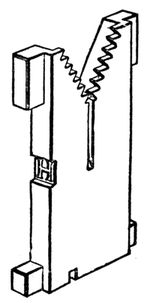
without a jar or vibration. The mechanism employed has always been a
driving gear and one or two toothed racks. In Koenig's original
movement, the driving gear on the end of a rising and falling shaft
ran on top of a rack attached to the bottom of the bed in order to
drive the bed in one direction, and then descending around the end of
the rack ran in the bottom to the same rack to drive the bed in the
other direction and ascending at the other end to repeat the movement.
This, as already stated, has proven a very efficient mechanism and is
employed, with improvements, by some of the press manufacturers of the
present time.
In a pamphlet entitled "A Short History of the Printing Press" (New
York, 1902), by Robert Hoe, the writer describes a method of reversing
the bed. Although somewhat technical, it seems desirable to quote him
as follows: "As early as 1847, Hoe & Co. patented an
entirely new bed-driving mechanism. To a hanger fixed on the lower
side of the bed were attached two racks facing each other, but not in
the same vertical plane, and separated by a distance equal to the
diameter of the driving wheel, which was on a horizontal shaft and
movable sideways so as to engage in either one or other of the racks.
By this means, a uniform movement was obtained in each direction. The
reversal of the bed was accomplished by a roller at either end of the
bed entering a recess in a disc on the driving shaft, which in a
half-revolution brought the bed to a stop and started it in the
opposite direction. This involved a new principle; a crank action
operating directly upon the bed from a shaft having a fixed centre,
and within recent years modifications of this patent have been
successfully employed to drive the type-bed at a high velocity and
reverse it without a shock or vibration."
This invention appears to have been the forerunner of the more recent
improvements in bed motions. A notable one is that employed in the
Miehle presses, which have gained much celebrity, run at a high rate
of speed, and are used in many printing-offices in this and other
countries. The reversal of the bed movement is accomplished by a
so-called "true crank" movement and with an absence of jar and
vibration never before obtained in any other than the stop-cylinder
presses.
At the present time, the latest development in printing
presses is Hoe & Co.'s new two-revolution press, in which, also, the
reversal of the bed is accomplished by the true crank movement, but
with an improvement which brings it to an easy stop and returns it
without the least vibration.
On all two-revolution presses there are employed, to assist in the
reversal of the bed, air-chambers or cylinders, without which the
reversing mechanisms could not withstand the enormous strain to which
they are subjected. These are iron cylinders, closed at one end,
approximately six inches in diameter and eighteen inches long, and
varying in size according to the size of the press. Some presses have
two and others four of these cylinders, one or two at each end. The
open ends of the cylinders are toward the bed, and attached to the bed
are two or four pistons which enter the air-chambers as the bed nears
the end of its stroke. The compression of the air in the cylinders
makes a cushion and checks the momentum of the moving bed. The pistons
can be adjusted to regulate the air compression to suit the velocity
of the bed and the weight of the form, which vary in different kinds
of work.
The delivery of the printed sheets is performed either by a delivery
cylinder or by a front delivery with the printed side of the paper
uppermost as already described for the stop-cylinder presses. Grippers
are not used in the front delivery carriage, as the sheet is
discharged from the cylinder by its continuous rotation.
The average running speed of a two-revolution press is about one-third
greater than that of a stop cylinder, or about eighteen hundred
impressions an hour, as against from one thousand to thirteen hundred
and fifty impressions from the stop cylinder, this being the
comparison in presses of the average size, printing sheets about
33 × 46 inches. The driving power required is in the proportion of
about five for the two-revolution press to three for the stop
cylinder, and the wear and tear is in about the same proportion.
Another press, which is still employed to a small extent for
book-work, is the flat-bed perfecting press. This press is virtually
two two-revolution presses combined into one, with the advantage that
they require only one man as "feeder," but with the disadvantage that
they produce only about two-thirds as much work as two separate
single-cylinder, two-revolution presses. Their greatest disadvantage
lies in the difficulty of preventing the fresh ink on the side of the
sheet first printed from "setting off" on the packing of the cylinder
which prints the reverse or second side. Mechanisms are employed to
move the "tympan sheet" or outside covering of the second cylinder
along at fixed intervals, but they are complicated and troublesome.
These presses are expensive and cumbersome, and can generally be used
only for inferior grades of work in large editions. Under
the care of a skilful and painstaking pressman, good work can be
produced from them, but fine book-work is always done on stop-cylinder
and two-revolution, single-cylinder presses, which have now been
brought to a high state of perfection.
Nearly a hundred years ago Hansard wrote, "The printing machine in its
present state appears susceptible of little improvement." He was, in
truth, right so far as the main principles of the flat-bed cylinder
press are concerned, but there have been immense improvements in many
of the details. With the introduction of automatic sheet-feeding
devices, and improvements in the driving, inking, and delivery
arrangements, mechanical ingenuity seems to have been exhausted. The
temptation is strong to apply Hansard's prediction to the flat-bed
cylinder press of the present day, but with the many surprises that
meet us in other fields this would border on temerity.
Already there have been great advances in adapting the entirely rotary
principle to the printing of high-grade work, although its use is
still restricted to the production of large editions.
As early as 1852 Hoe & Co. made a rotary press for D. Appleton & Co.,
especially for printing the famous Webster spelling-book. The types
were locked up on the cylinders in curved beds, called "turtles," and
the sheets were delivered by a sheet-flier. Probably thirty million
copies were printed on this press, which was dismantled
nearly twenty-six years ago.
In 1886 this same concern made a press which is still used for
printing some of the forms of the Century Magazine. This press had
two pairs of cylinders, and curved electrotype plates were used on it.
The paper was in a roll at one end, and at the other end there were
delivered, to each revolution of the cylinders, eight eight-page
signatures already folded to the size of the Century page. This was
the first rotary press made for a good grade of book-work. Two similar
presses were afterward made for Harper's Weekly and for the Strand
Magazine of London.
What is known as the rotary art press was made in 1890 for printing
the fine half-tone illustrations in the Century Magazine.
This has one plate cylinder and one impression cylinder, and curved
electrotype plates are used. The sheets are "fed" by hand in the usual
manner, and are printed on one side at a time and delivered by a
sheet-flier. It produces as much work as four flat-bed cylinder
presses and of better quality. The plates are inked by sixteen
rollers. The performance of this press is another demonstration of the
superiority of the rotary over the flat-bed principle of printing.
Since then hundreds of rotary presses have been made for magazine and
book printing, most of them equipped with attachments for folding the
sheets as they are printed, and all having a high rate of
speed. C. B. Cottrell & Co. have made many rotary presses for magazine
printing, most of which deliver the sheets flat, without folding, and
most of them made to suit some predetermined size or sizes of sheets
or pages.
In the evolution of the printing press there are three sharply defined
stages: first, the flat impression surface and the flat printing
surface, requiring the exertion of all of the impressing power upon
the entire surfaces; second, the cylindrical impression surface and
the flat printing surface, requiring the exertion of all of the
impressing power upon only a narrow line or a small portion of the
printing surface; third, a cylindrical impression surface and a
cylindrical printing surface, still further reducing the area upon
which all the impressing power is exerted.
Just as the second stage has, particularly for book-work, virtually
superseded the first, so the third is destined to supersede the
second. It is only an adaptation of the means to the ends. The
mechanical principles of the rotary press are, in fact, simpler than
those of the flat-bed cylinder press, and it may be said that so far
as the purely mechanical part of the press is concerned, they have
been fully developed, but much still remains to be done in other
directions. The variety in the sizes of the pages of different books,
the smallness of the editions, and the fact that the finer
grades of paper, especially coated paper, cannot be obtained in roll
form, are obstacles to be removed. As most book forms are electrotyped
for flat-bed presses, and as it requires but little additional expense
to curve the plates, this one item is not much of an obstacle to
overcome. It is, however, still difficult to curve the plates
perfectly, and the pressmen, even if they can produce excellent work
from flat-bed presses, require considerable training if they have had
no experience on rotary presses. All these difficulties are sure to be
overcome in time.[Back to Contents]