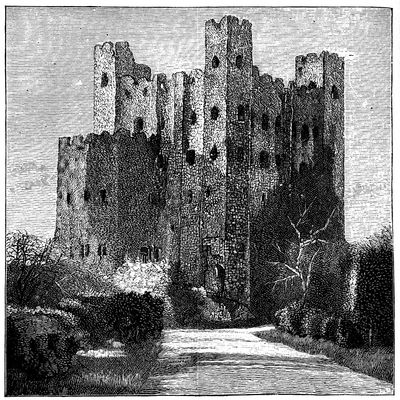
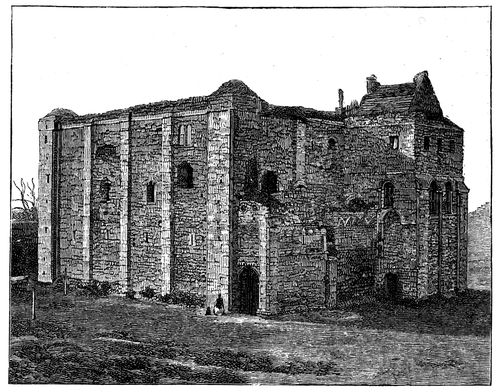
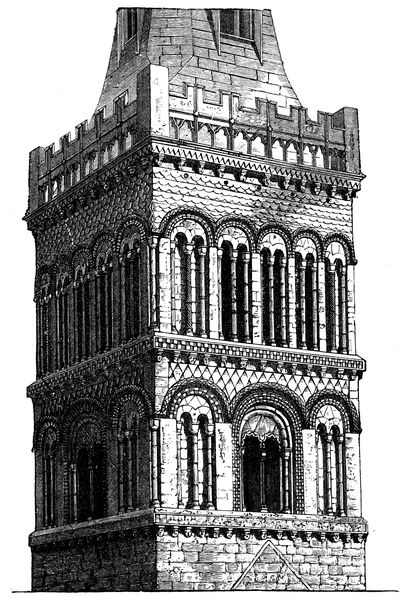
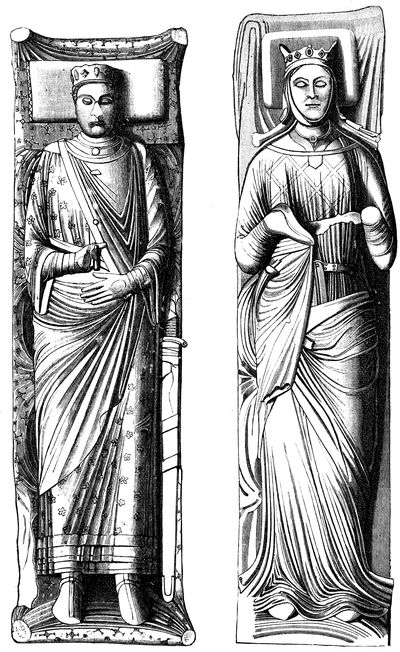
The Project Gutenberg e-Book of Student's History of England, Vol. 1; Author: Samuel R. Gardiner
Whole book · 10 sections
STUDENT'S HISTORY OF ENGLAND
Transcriber's note: Obvious printer's errors have been corrected, all
other inconsistencies are as in the original. The author's spelling
has been maintained.
Each page of the original book had a side note stating the time span
treated on that page. Those side notes have been deleted.
FROM THE EARLIEST TIMES TO THE DEATH
OF KING EDWARD VII
BY
SAMUEL R. GARDINER, D.C.L., LL.D. LATE FELLOW OF MERTON COLLEGE, OXFORD ETC. — WORKS BY SAMUEL RAWSON GARDINER. — PREFACE TO FIRST EDITION
VOL. I. B.C. 55—A.D. 1509
NEW IMPRESSION (1915)
REISSUE
LONGMANS, GREEN, AND CO.
39 PATERNOSTER ROW, LONDON FOURTH AVENUE & 30th STREET, NEW YORK
BOMBAY, CALCUTTA, AND MADRAS
1916
All rights reserved
HISTORY OF ENGLAND, from the Accession of James I. to the Outbreak of
the Civil War, 1603-1642. With Maps. 10 vols. crown 8vo. 5s. net
each.
A HISTORY OF THE GREAT CIVIL WAR, 1642-1649. With Maps. 4 vols. crown
8vo. 5s. net each.
A HISTORY OF THE COMMONWEALTH AND THE PROTECTORATE, 1649-1656. With
Maps. 4 vols. crown 8vo. 5s. net each.
THE LAST YEARS OF THE PROTECTORATE, 1656-1658. By Charles Harding
Firth, M.A., Regius Professor of Modern History in the University of
Oxford. With 3 Plans. 2 vols. 8vo. 24s. net.
A STUDENT'S HISTORY OF ENGLAND. From the Earliest Times to the Death
of King Edward VII.
Vol. I. B.C. 55-A.D. 1509. With 173 Illustrations. Crown 8vo. 4s.
Vol. II. 1509-1689. With 96 Illustrations. Crown 8vo. 4s.
Vol. III. 1689-1910. With 112 Illustrations. Crown 8vo. 4s.
⁂ Complete in One Volume, with 381 Illustrations, crown 8vo. 12s.
PREPARATORY QUESTIONS ON S. R. GARDINER'S STUDENT'S HISTORY OF
ENGLAND. By R. Somervell, M.A. Crown 8vo. 1s.
SUMMARY OF ENGLISH HISTORY, based on S. R. Gardiner's 'Outline of
English History.' Brought down to the Accession of Edward VII. By W.
Reep. Fcp. 8vo. 6d.
A SCHOOL ATLAS OF ENGLISH HISTORY. Edited by Samuel Rawson Gardiner,
D.C.L., LL.D. With 66 Coloured Maps and 22 Plans of Battles and
Sieges. Fcp. 4to. 5s.
LONGMANS' ELEMENTARY HISTORICAL ATLAS, abridged from S. R. Gardiner's
'School Atlas of English History.' Post 4to. 1s.
CROMWELL'S PLACE IN HISTORY. Founded on Six Lectures delivered at
Oxford. Crown 8vo. 3s. 6d.
OLIVER CROMWELL. With Portrait. Crown 8vo. 5s. net.
THE FIRST TWO STUARTS AND THE PURITAN REVOLUTION, 1603-1660. 4 Maps.
Fcp. 8vo. 2s. 6d.
THE THIRTY YEARS' WAR, 1618-1648. With a Map. Fcp. 8vo. 2s. 6d.
OUTLINE OF ENGLISH HISTORY,B.C. 55-A.D. 1910. With 67 Woodcuts and 17
Maps. Fcp. 8vo. 2s. 6d.
THE FRENCH REVOLUTION, 1789-1795. By Mrs. S. R. Gardiner. With 7 Maps.
Fcp. 8vo. 2s. 6d.
LONGMANS, GREEN, & CO., 39 Paternoster Row, London, New York, Bombay,
Calcutta, and Madras.
The present work is intended for such students as have already an
elementary knowledge of the main facts of English history, and aims at
meeting their needs by the use of plain language on the one hand, and
by the avoidance, on the other hand, of that multiplicity of details
which is apt to overburden the memory.
At the close of the book I have treated the last eleven years, 1874 to
1885, in a manner which precludes all expression of my own views,
either on the characters of the actors or on the value of the work
performed by them; and something of the same reticence will be
observed in the pages dealing with the years immediately preceding
1874. We have not the material before us for the formation of a final
judgment on many points arising in the course of the narrative, and it
is therefore better to abstain from the expression of decided opinion,
except on matters so completely before the public as to leave no room
for hesitation. Especially is this rule to be observed in a book
addressed to those who are not yet at an age when independent
investigation is possible.
I hope it will be understood that in my mention of various authors I
have had no intention of writing a history of literature, however
brief. My object has been throughout to exhibit that side of
literature which connects itself with the general political or
intellectual movement of the country, and to leave unnoticed the
purely literary or scientific qualities of the writers mentioned. This
will explain, for instance, the total omission of the name of Roger
Bacon, and the brief and, if regarded from a different point of view,
the very unsatisfactory treatment of writers like Dickens and
Thackeray.
Those of my readers who have complained that no maps were to be found
in the book may now be referred to a 'School Atlas of English
History,' recently edited by me for Messrs. Longmans & Co. To include
an adequate number of maps in this volume would have increased its
size beyond all fitting limits.
In the spelling of Indian names I have not adopted the modern and
improved system of transliteration. Admirable as it is when used by
those who are able to give the right sound to each letter, it only
leads to mispronunciation in the mouths of those who are, as most of
the readers of this volume will be, entirely in the dark on this
point. The old rough method of our fathers at least ensures a fair
approximation to the true pronunciation.
My warmest thanks are due to Mr. George Nutt, of Rugby, and to the
Rev. W. Hunt. Mr. Nutt not only looked over the proof-sheets up to the
death of Edward I. with excellent results, but gave me most valuable
advice as to the general arrangement of the book, founded on his own
long experience of scholastic teaching. The Rev. W. Hunt looked over a
considerable portion of the remaining proof-sheets, and called my
attention to several errors and omissions which had escaped my eye.
The illustrations have been selected by Mr. W. H. St. John
Hope, Assistant-Secretary of the Society of Antiquaries. He wishes to
acknowledge much valuable assistance given to him in the choice of
portraits by George Scharf, Esq., C.B., F.S.A., who is recognised as
the highest authority on the subject.
I am indebted to Her Majesty the Queen for permission to engrave two
of the portraits appearing in the following pages—viz., those of
Bishop Fisher, on p. 393, and the Duke of Norfolk, on p.
410—the originals in both cases being at Windsor Castle.
I have to thank
Earl Spencer for permission to engrave the portrait on p. 362;
the Earl of Essex for that on p. 476; the Earl of Warwick for
that on p. 403; the Earl of Carlisle for that on p. 459; the
Viscount Dillon, F.S.A., for that on p. 376; the Hon Sir Spencer
Ponsonby-Fane, K.C.B., for that on p. 365; Sir John Farnaby Lennard,
Bart., for that on p. 463; Dr. Evans for those on pp. 2, 4, 6; Edward
Huth, Esq., for that on p. 387; Mrs. Dent, of Sudeley, for that on p.
395; H. Hucks Gibbs, Esq., for that on p. 419; T. A. Hope, Esq., for
that on p. 487; E. B. Nicholson, Esq., for the portrait of Lord
Burghley in the Bodleian Library, Oxford, engraved at p. 479; the
authorities of the University of Cambridge for that on p. 477; of
Jesus College, Cambridge, for that on p. 414; and of Sidney Sussex
College, Cambridge, for that on p. 567; and the Treasurer of Christ's
Hospital, London, for the portrait of Charles II. on p. 579. I have
also to thank Mr. John Murray for permission to engrave the figures on
pp. 130, 150, 160, 166, 177, 188, 260; Messrs. Parker & Co., Oxford,
for those on pp. 19, 51, 75, 91, 107, 128, 170, 192, 197, 230, 245,
246, 247, 253, 409, 451; Mr. W. Nives for those at pp. 381, 409, 451;
Mr. J. G. Waller for those on pp. 219, 229, 292, 298, 515; Mr. Bruce
for those on pp. 17, 18, 21; Messrs. Poulton & Sons, Lee, for those on
pp. 7, 132; Mr. G. A. Nichols, Stamford, for those on pp.
311, 316, Mr. G. T. Clarke, for that on p. 74; Messrs. Carl Norman &
Co., Tunbridge Wells, for that on p. 171; Mr. R. Keene, Derby, for
that on p. 318; the Rev. H. H. Henson, Vicar of Barking, Essex, for
the photograph of the monument of Sir Charles Montague on p. 507; the
Science and Art Department for those on pp. 371, 440, 518, 612; Mr. W.
H. Wheeler, of Oxford, for those on pp. 319, 384; Messrs. Valentine &
Sons, Dundee, for those on pp. 109, 206, 213, 238, 244, 276, 355, 378,
485, 662, 666, 668, 683, 907, 919, 937, 942; and Mr. R. Keene, Derby,
for those on pp. 466, 467, 469, 471.
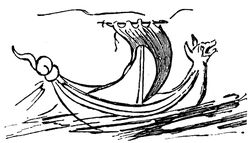
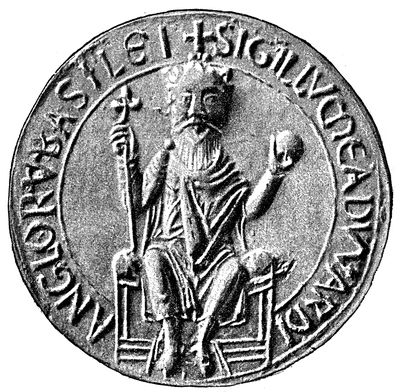
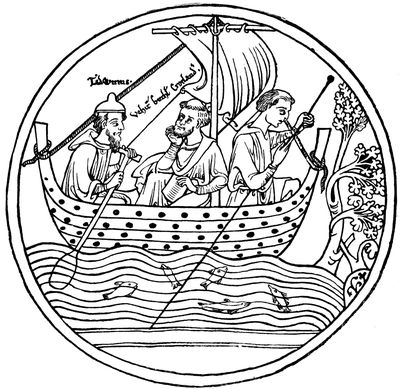
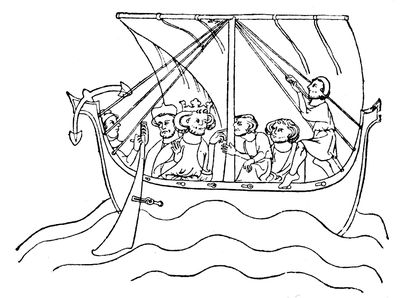
Small ship of the latter part of the twelfth century 146
(From 'Harley Roll,' Y. 6)
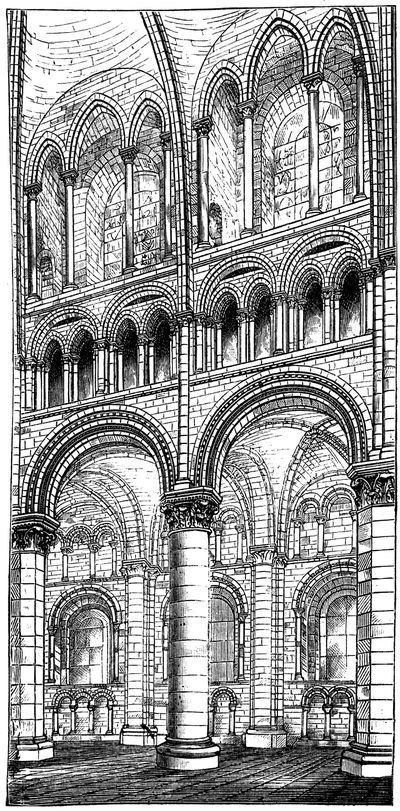
Part of the choir of Canterbury cathedral, in building 1175-1184 150
(From Scott's 'Mediæval Architecture,' London, J. Murray)
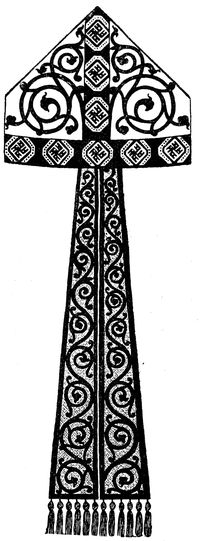
Mitre of archbishop Thomas of Canterbury, preserved at Sens 153
(From Shaw's 'Dresses and Decorations')
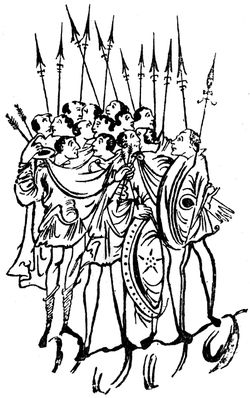
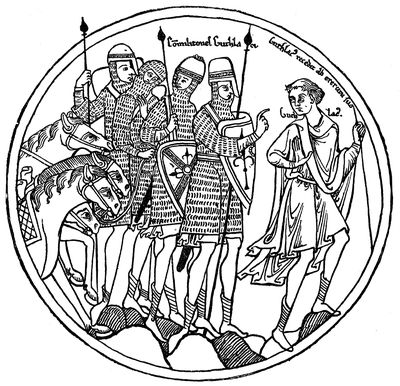
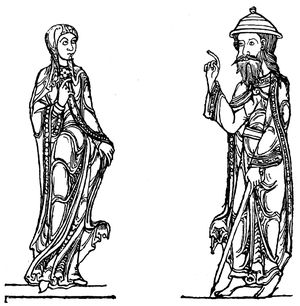
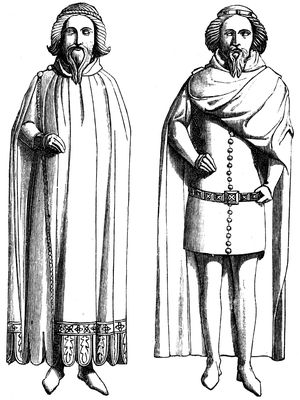
Military and civil costume of the latter part of the twelfth century 154
(From 'Harley Roll,' Y. 6)
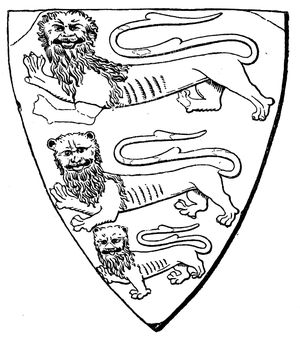
Royal Arms of England from Richard I. to Edward III. 159
(From the wall arcade, south aisle of nave, Westminster Abbey)
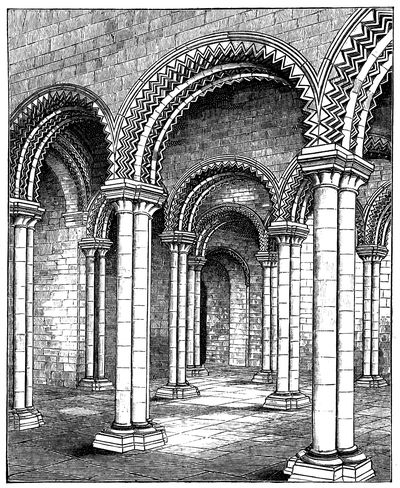
The Galilee or Lady chapel, Durham cathedral,
built by bishop Hugh of Puiset, between 1180 and 1197 160
(From Scott's 'Mediæval Architecture,' London, J. Murray)
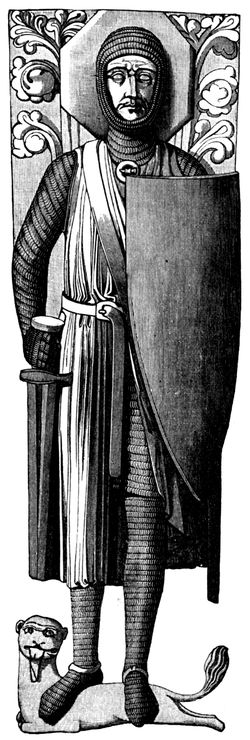
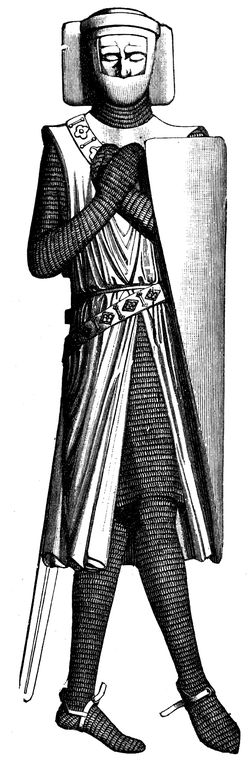
Effigy of a knight in the Temple church, London,
showing armour of the end of the twelfth century 162
(From Hollis's 'Monumental Effigies')
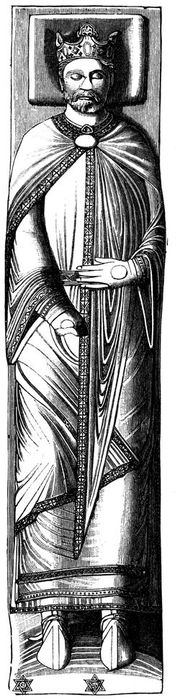
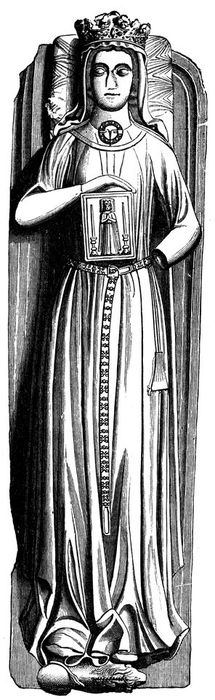
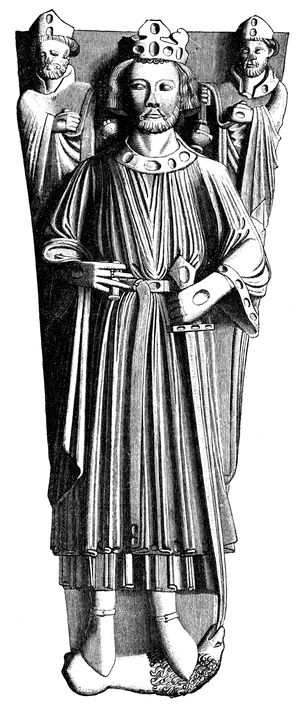
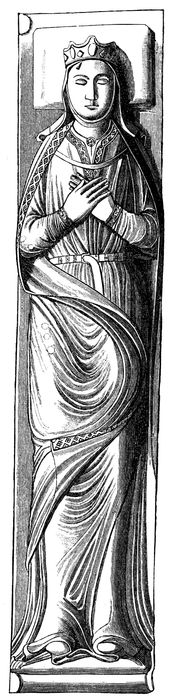
Effigies of Richard I. and queen Berengaria 164
(From Stothard's 'Monumental Effigies')
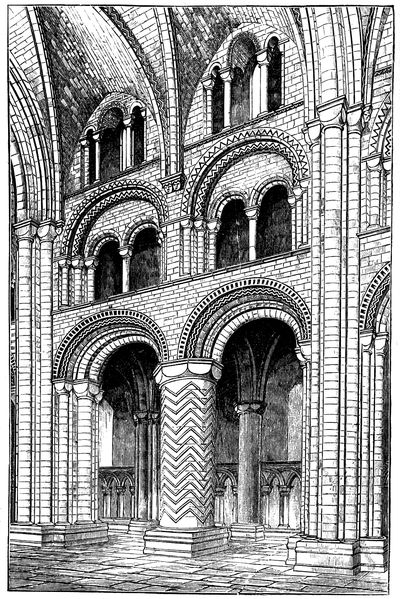
Part of the choir of Ripon cathedral, built during
the last quarter of the twelfth century 166
(From Scott's 'Mediæval Architecture,' London, J. Murray)
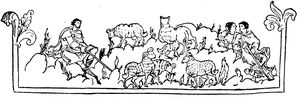
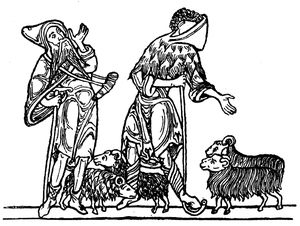
Costume of shepherds in the twelfth century 168
(From Cott. MS. Nero C. iv. ff. 11 and 16)
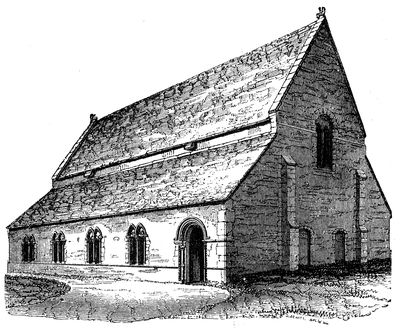
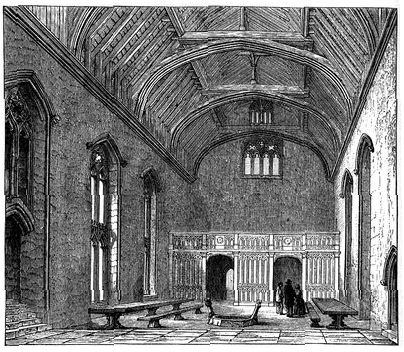
Hall of Oakham castle, Rutland, built about 1185 170
(From Hudson Turner's 'Domestic Architecture')
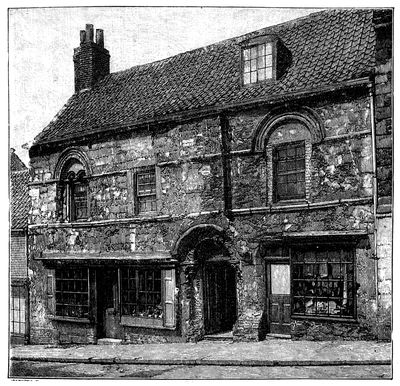
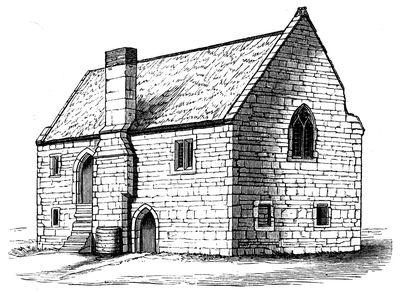
Norman house at Lincoln, called the Jews' House 171
(From a photograph by Carl Norman, Tunbridge Wells)
Effigies of king John and queen Isabella 175
(From Stothard's 'Monumental Effigies')
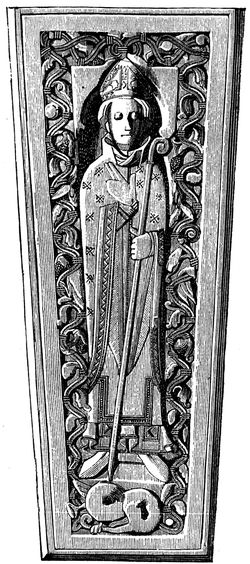
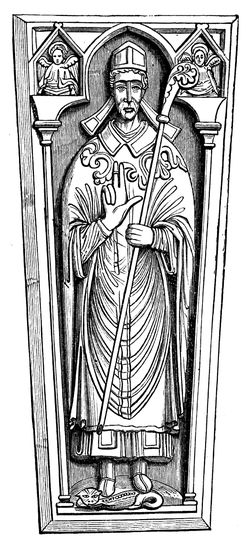
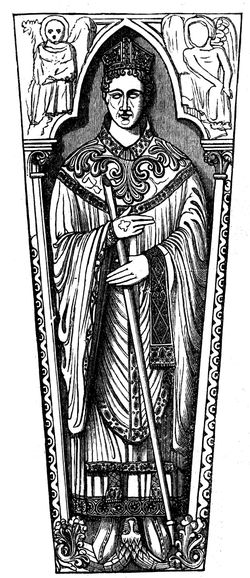
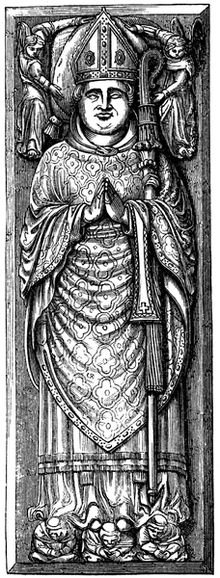
Effigy of bishop Marshall of Exeter, died 1206 177
(From Murray's 'Handbook to the Southern Cathedrals')
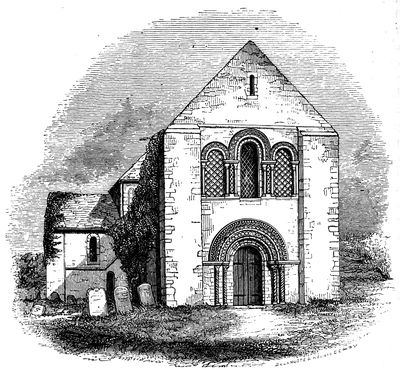
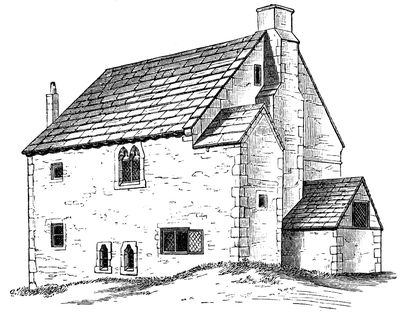
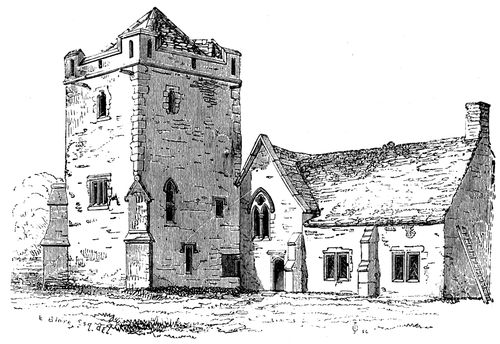
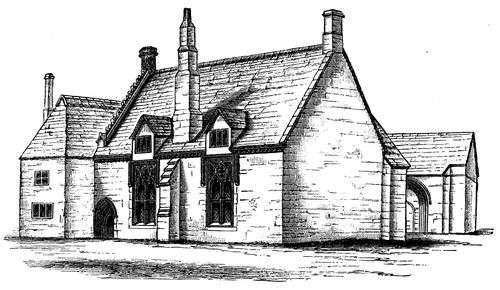
Parsonage house of early thirteenth-century date at West Dean, Sussex 179
(From Hudson Turner's 'Domestic Architecture')
Effigy of a knight in the Temple church, London,
showing armour worn between 1190 and 1225 182
(From Stothard's 'Monumental Effigies')
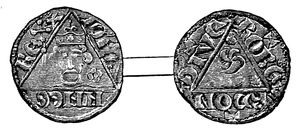
Silver penny of John, struck at Dublin 184
(From an original example)
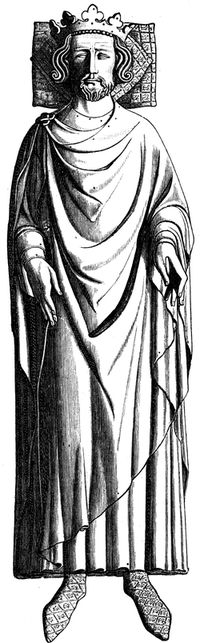
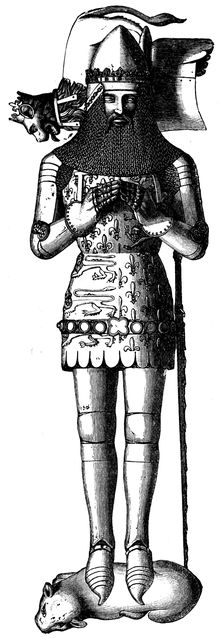
Effigy of Henry III. (From his tomb at Westminster) 186
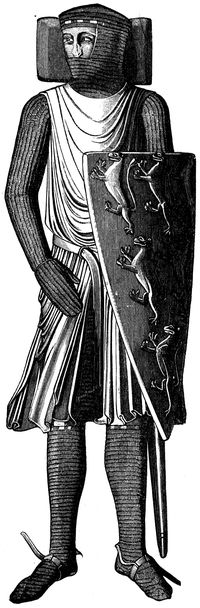
Effigy of William Longespée, earl of Salisbury,
died 1227, from his tomb at Salisbury, showing armour
worn from about 1225 to 1250 187
(From Stothard's 'Monumental Effigies')
Effigy of Simon, bishop of Exeter, died 1223 188
(From Murray's 'Handbook to the Southern Cathedrals')
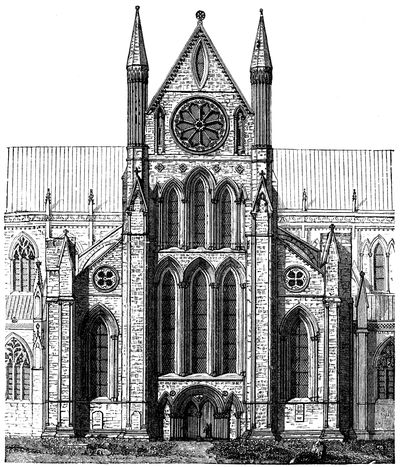
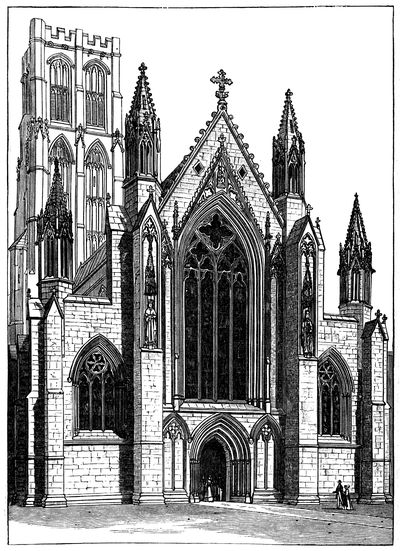
Beverley Minster, Yorkshire, the south transept;
built about 1220—1230 189
(From Britton's 'Architectural Antiquities')
Longthorpe manor house, Northamptonshire, built about 1235 192
(From Hudson Turner's 'Domestic Architecture')
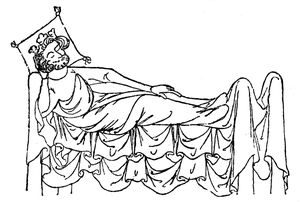
A bed in the reign of Henry III. 196
(From Cott. MS. Nero D. i. ff. 21 and 22 b)
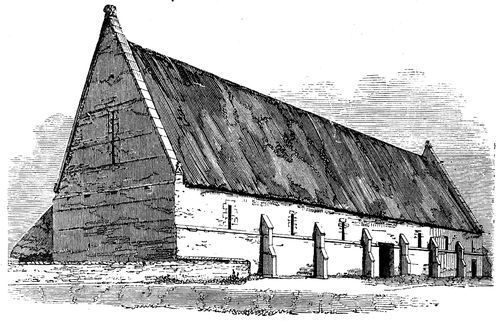
Barn of thirteenth-century date at Raunds, Northamptonshire 197
(From Hudson Turner's 'Domestic Architecture')
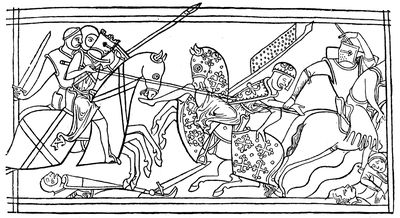
A fight between armed and mounted knights of the time of Henry III. 201
(From Cott. MS. Nero D. i. f. 4)
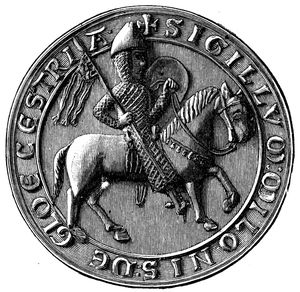
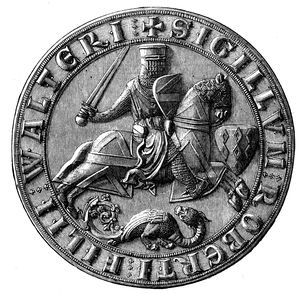
Seal of Robert Fitzwalter, showing a mounted knight
in complete mail armour; date about 1265 202
(From an original impression)
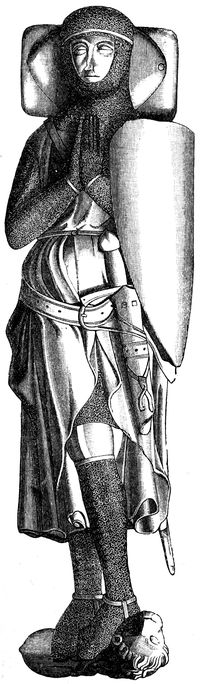
Effigy of a knight at Gosperton, showing armour worn
from about 1250 to 1300; date about 1270 203
(From Stothard's 'Monumental Effigies')
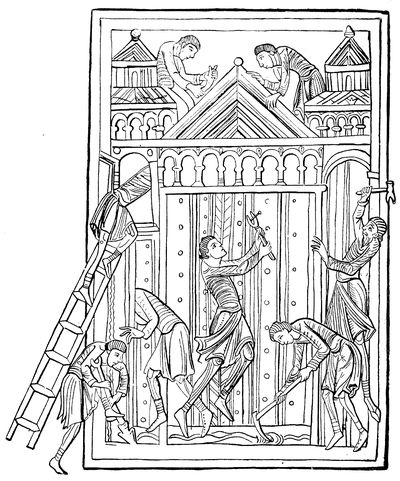
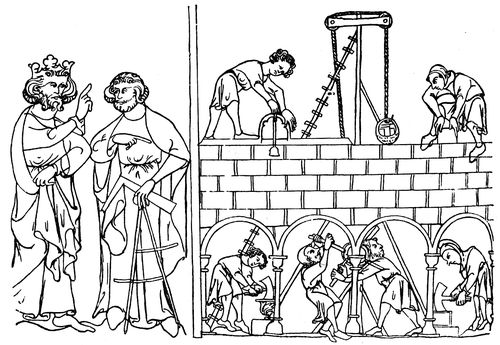
Building operations in the reign of Henry III., with
the king giving directions to the architect 204
(From Cott. MS. Nero D. i. f. 23 b)
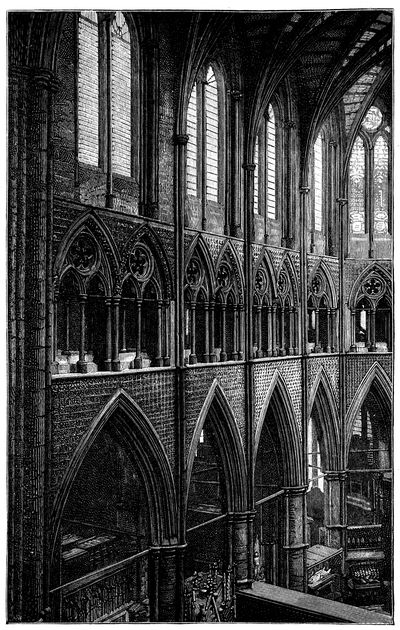
East end of Westminster abbey church; begun by Henry III. in 1245 205
(From a photograph)
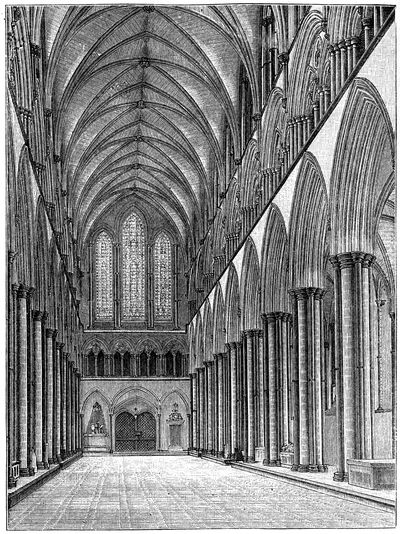
Nave of Salisbury cathedral church, looking west;
date, between 1240 and 1250 206
(From a photograph by Valentine & Sons, Dundee)
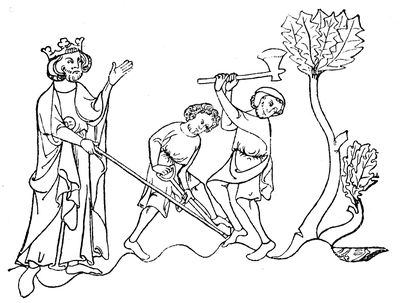
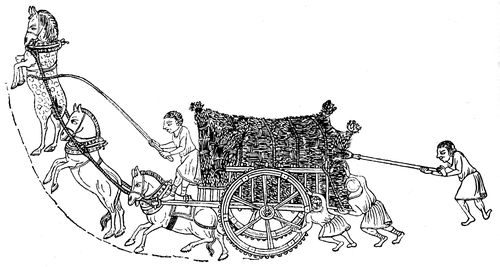
A king and labourers in the reign of Henry III. 207
(From Cott. MS. Nero D. i. f. 21 b)
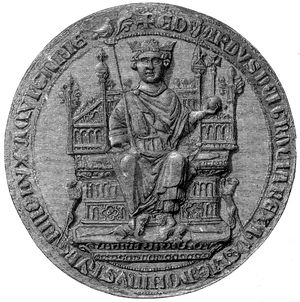
Great Seal of Edward I. (slightly reduced) 209
(From an original impression)
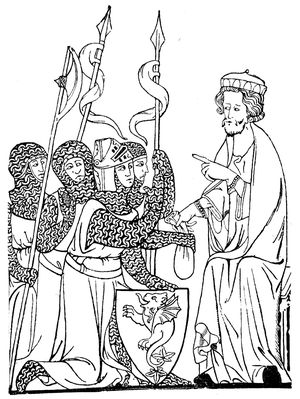
Group of armed knights and a king in ordinary
dress; date, temp. Edward I. 211
(From Arundel MS. 83, f. 132)
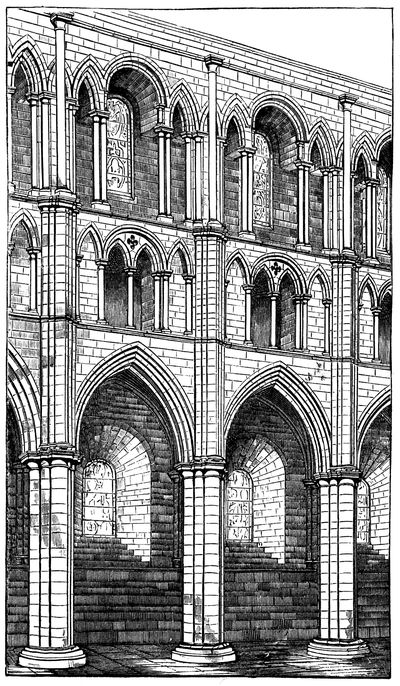
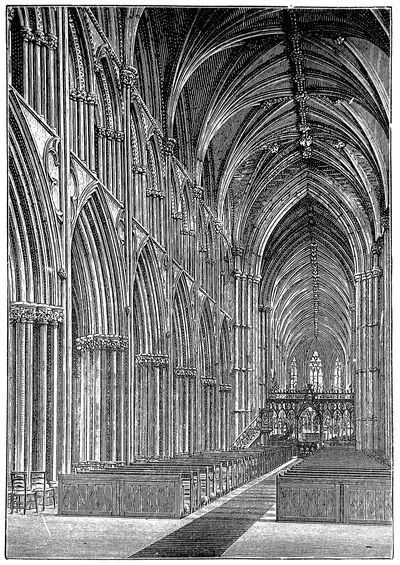
Nave of Lichfield cathedral church, looking east; built about 1280 213
(From a photograph by Valentine & Sons, Dundee)
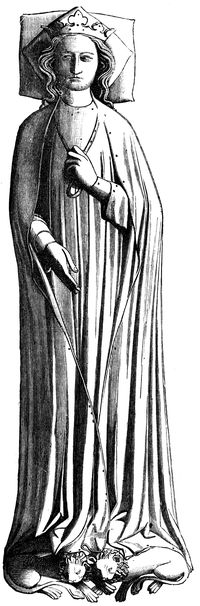
Effigy of Eleanor of Castile, queen of Edward I.,
in Westminster abbey 215
(From Stothard's 'Monumental Effigies')
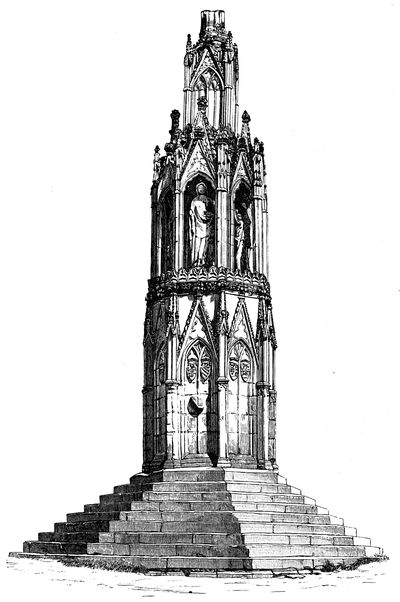
Cross erected near Northampton by Edward I. in memory
of queen Eleanor 217
(From a photograph)
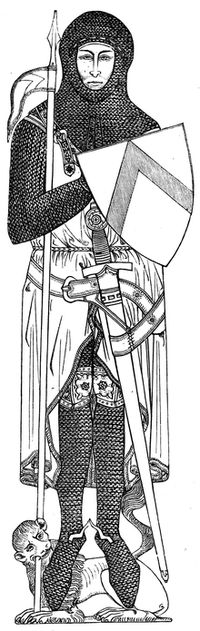
Sir John d'Abernoun, died 1277, from his brass at
Stoke Dabernon; showing armour worn from about 1250 to 1300 219
(From Waller's 'Monumental Brasses')
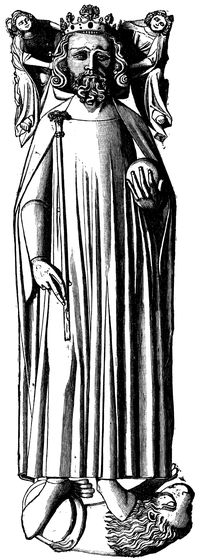
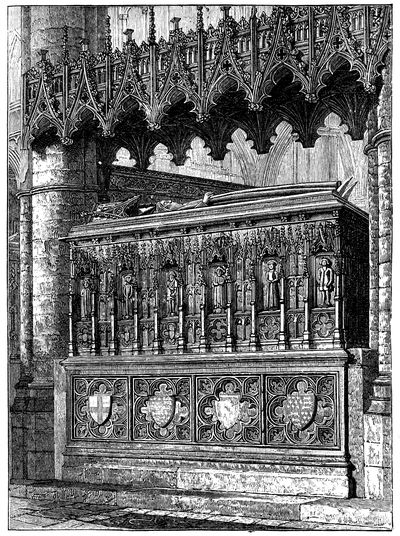
Edward II. from his monument in Gloucester cathedral 225
(From Stothard's 'Monumental Effigies')
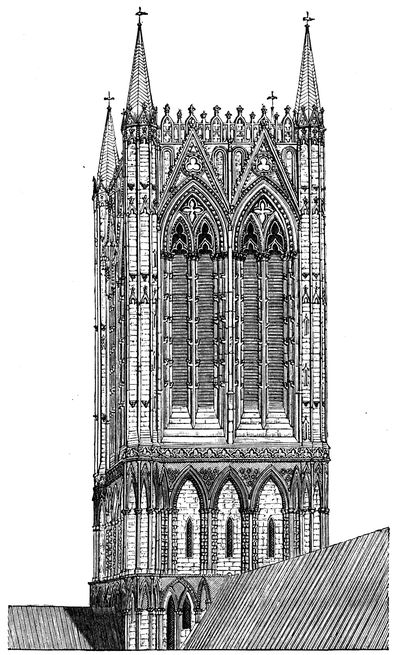
Lincoln cathedral, the central tower; built about 1310 227
(From Britton's 'Architectural Antiquities')
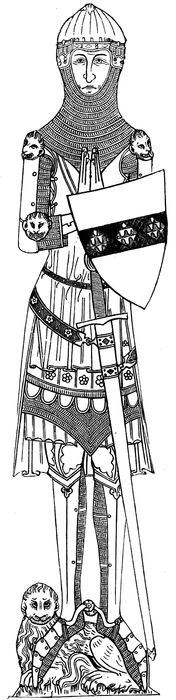
Sir John de Creke, from his brass at Westley
Waterless, Cambridgeshire; showing armour worn between
1300 and 1335 or 1340; date, about 1325 229
(From Waller's 'Monumental Brasses')
Howden church, Yorkshire, the west front 230
(From Rickman's 'Gothic Architecture,' 7th edition, by J. H. Parker)
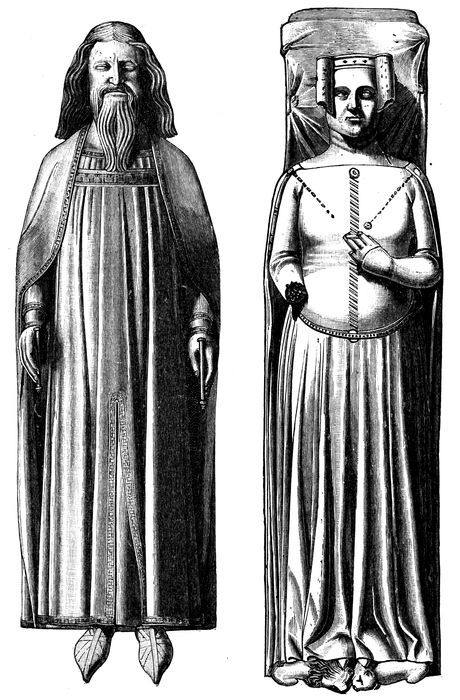
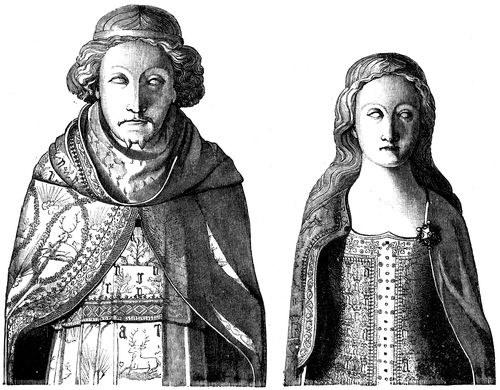
Effigies of Edward III. and queen Philippa, from
their tombs in Westminster abbey 233
(From Blore's 'Monumental Remains')
A knight—Sir Geoffrey Luttrell, who died
1345—receiving his helm and pennon from his wife;
another lady holds his shield 236
(From the Luttrell Psalter, 'Vetusta Monumenta')
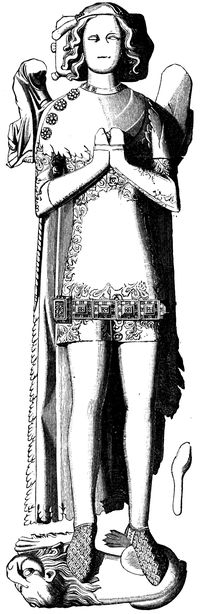
William of Hatfield, second son of Edward III.,
from his tomb in York Minster 237
(From Stothard's 'Monumental Effigies')
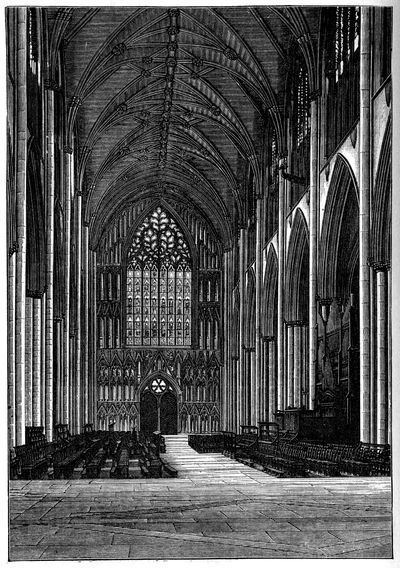
York Minster, the nave, looking west 238
(From a photograph by Valentine & Sons, Dundee)
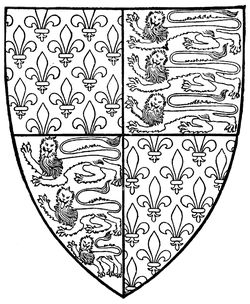
Royal Arms of Edward III., from his tomb 239
(From a photograph)
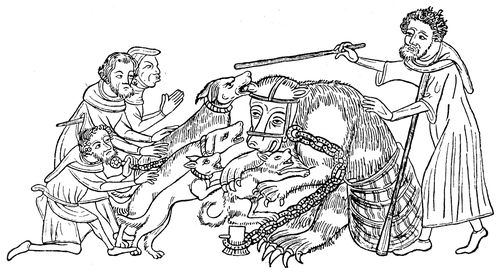
Bear-baiting 275
(From the Luttrell Psalter, 'Vetusta Monumenta')
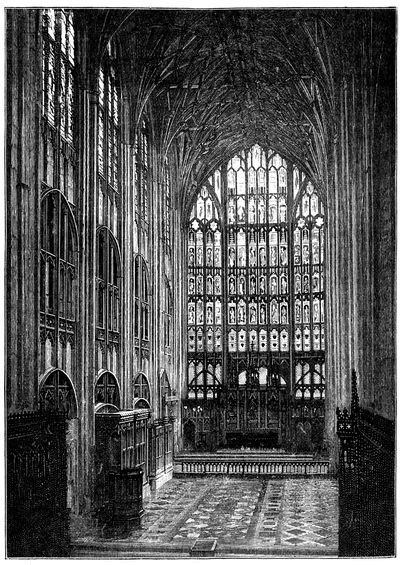
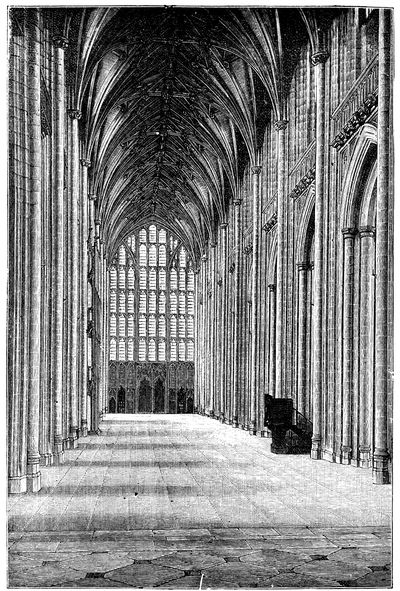
West end of the nave of Winchester cathedral church 276
(From a photograph by Valentine & Sons, Dundee)
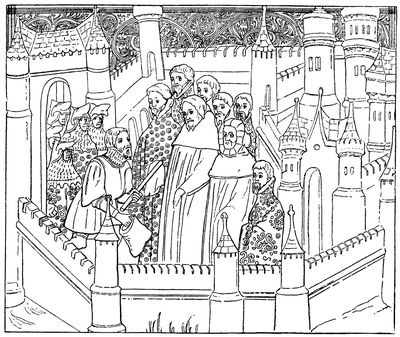
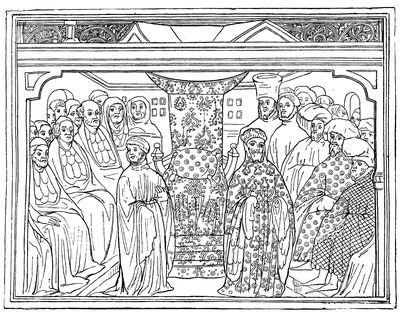
Meeting of Henry of Lancaster and Richard II. at Flint 284
Henry of Lancaster claiming the throne 285
(From Harl MS. 1319)
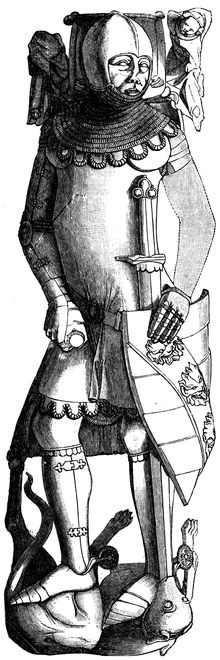
Effigy of a knight at Clehonger, showing development
of plate armour; date about 1400 287
(From Hollis's 'Monumental Effigies')
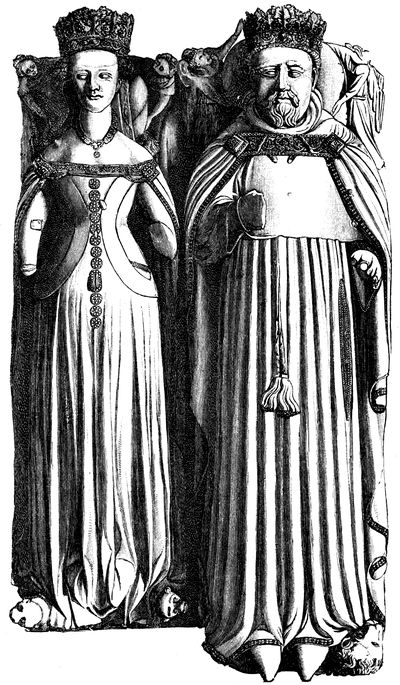
Henry IV. and his queen Joan of Navarre; from their
tomb in Canterbury cathedral church 290
(From Stothard's 'Monumental Effigies')
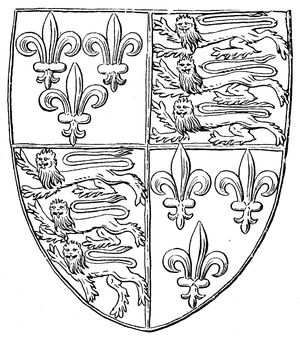
Royal arms as borne from about 1408 to 1603 291
(From a fifteenth-century seal)
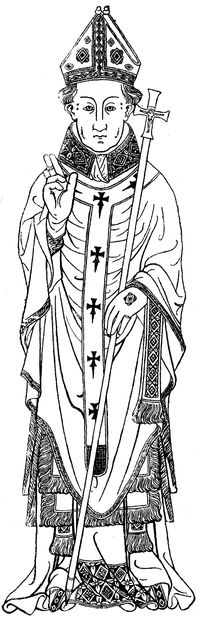
Thomas Cranley, archbishop of Dublin; from his
brass at New College, Oxford, showing the archiepiscopal
costume 292
(From Waller's 'Monumental Brasses')
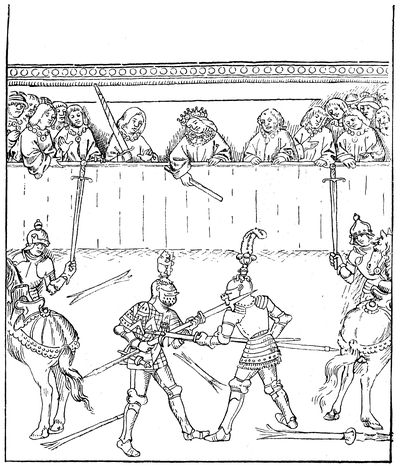
Fight in the lists with poleaxes 297
(From Cott. MS. Julius E. iv. ff. 4 and 7)
Costume of a judge about 1400; from a brass at Deerhurst 298
(From Waller's 'Monumental Brasses')
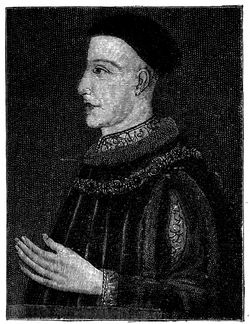
Henry V. 300
(From an original portrait belonging to the Society of Antiquaries)
154. Effigy of William Phelip, lord Bardolph; from
his tomb at Dennington, Suffolk 304
(From Stothard's 'Monumental Effigies')
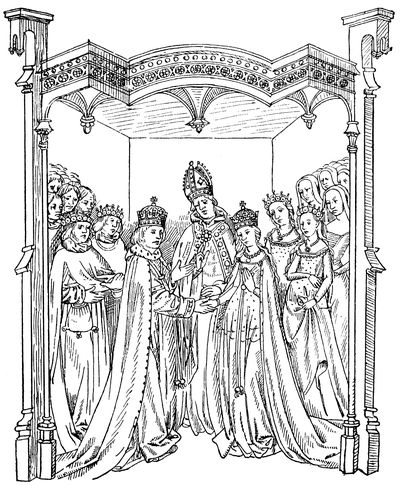
Marriage of Henry V. and Catherine of France 305
(From Cott. MS. Julius E. iv. f. 22)
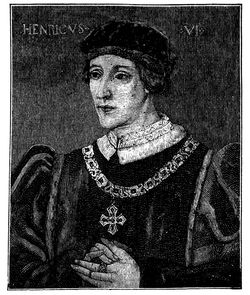
Henry VI. 308
(From an original picture in the National Portrait Gallery)
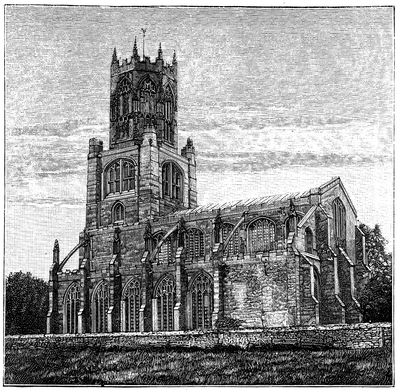
Fotheringay church, Northamptonshire; begun in 1434 311
(From a photograph by G. A. Nichols, Stamford)
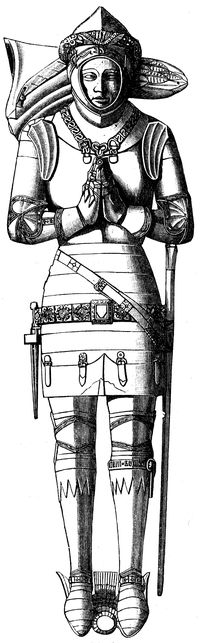
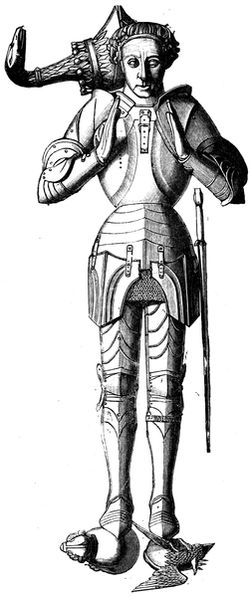
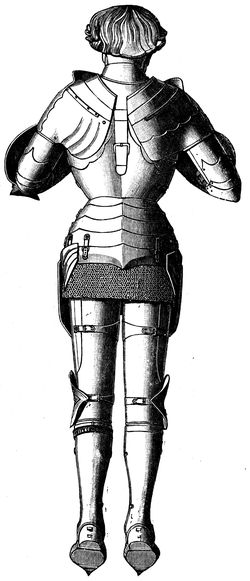
159. Front and back views of the gilt-latten
effigy of Richard Beauchamp, earl of Warwick, died
1439; from his tomb at Warwick 314, 315
(From Stothard's 'Monumental Effigies')
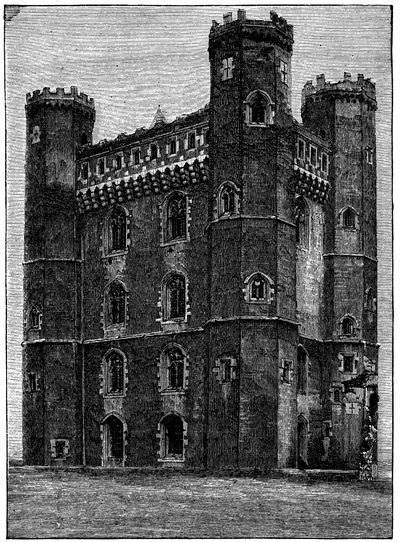
Tattershall castle, Lincolnshire; built between 1433 and 1455 316
(From a photograph by G. A. Nichols, Stamford)
Part of Winfield manor-house, Derbyshire; built about 1440 318
(From a photograph by R. Keene, Derby)
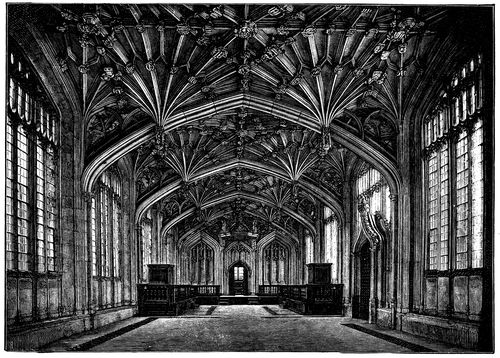
The Divinity School, Oxford; built between 1445 and 1454 319
(From a photograph by W. H. Wheeler, Oxford)
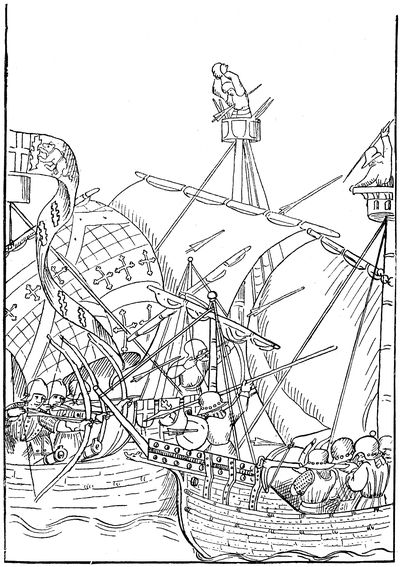
A sea-fight 325
(From Cott. MS. Julius E. iv. f. 18 b)
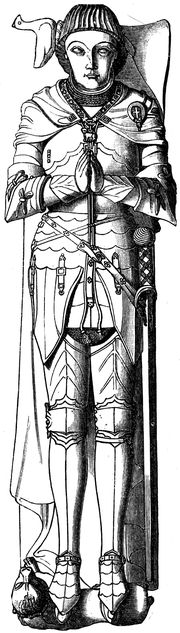
Effigy of Sir Robert Harcourt, K.G., showing
armour worn from about 1445 to 1480 326
(From Stothard's 'Monumental Effigies')
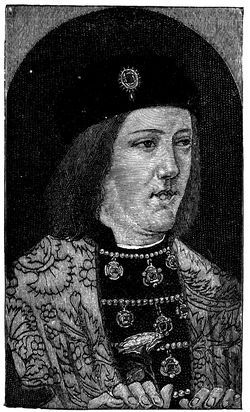
Edward IV. 330
(From an original portrait belonging to the Society of Antiquaries)
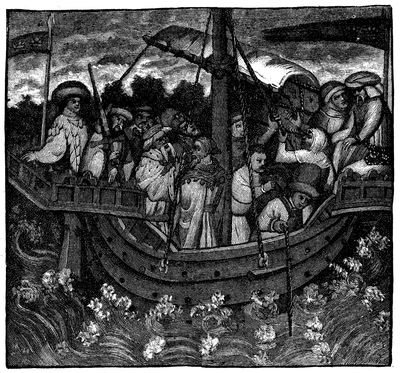
A fifteenth-century ship 333
(From Harl. MS. 2278, f. 16)
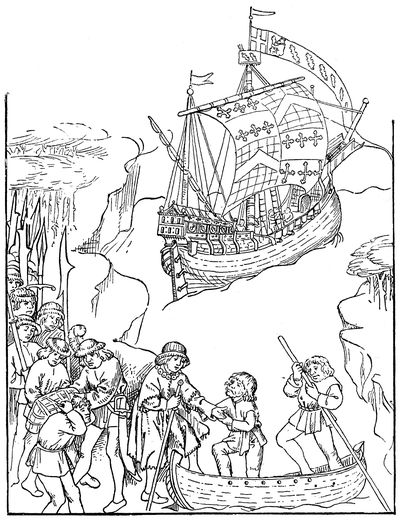
Large ship and boat of the fifteenth century 339
(From Cott. MS. Julius E. iv. f. 5)
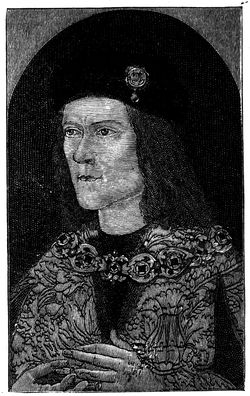
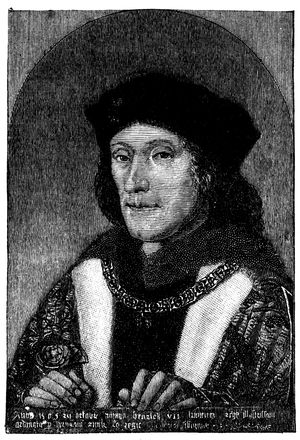
Richard III. 341
(From an original portrait belonging to the Society of Antiquaries)
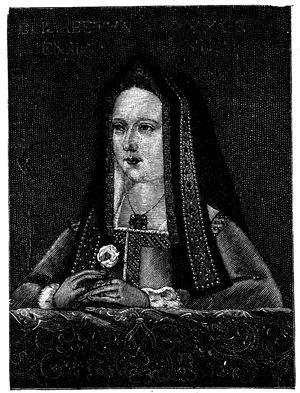
Elizabeth of York, queen of Henry VII. 345
(From original pictures in the National Portrait Gallery)
Tudor Rose; from the chapel of Henry VII., Westminster 346
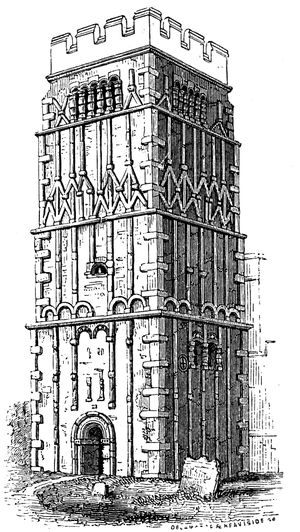
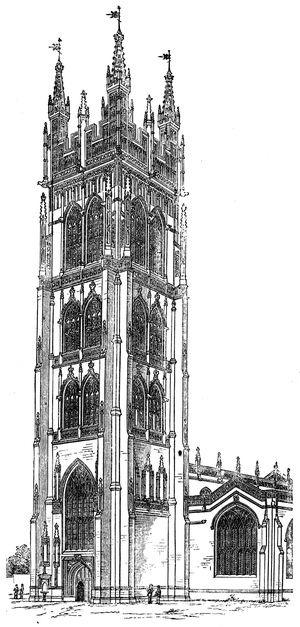
Tower of St. Mary's church, Taunton; built about 1500 353
(From Britton's 'Architectural Antiquities')
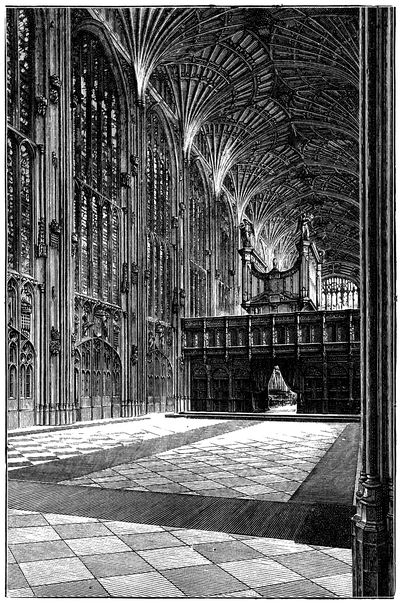
King's College Chapel, Cambridge; interior, looking east 355
(From a photograph by Valentine & Sons, Dundee)
GENEALOGICAL TABLES — I ENGLISH KINGS FROM ECGBERHT TO HENRY I. — II GENEALOGY OF THE NORMAN DUKES AND OF THE KINGS OF ENGLAND FROM THE CONQUEST TO HENRY VII. — III GENEALOGY OF THE KINGS OF SCOTLAND FROM DUNCAN I. TO JAMES IV. — IV GENEALOGY OF THE KINGS OF FRANCE FROM HUGH CAPET TO LOUIS XII. — SHORTER AND SOMETIMES MORE DETAILED GENEALOGIES will be found in the following pages. — HISTORY OF ENGLAND.
Ecgberht 802-839
Æthelwulf 839-858
Æthelbald 858-860
Æthelberht 860-866
Æthelred 866-871
Ælfred 871-901
Eadward the Elder 899-924
Æthelflæd (the Lady of the Mercians)
=
Æthelred Ealdorman of the Mercians
Æthelstan 924-940
Eadmund 940-946
Eadred 946-955
Eadwig 955-959
Æthelflæd
=
Eadgar 959-975
=
Ælfthryth
Richard I. Duke of Normandy
Svend
Eadward the Martyr 975-979
Ælfled
=
Æthelred the Unready 979-1016
=
Emma
=
Cnut 1016-1035
Eadmund Ironside 1016
Harold 1036-1039
Harthacnut 1039-1042
Godwine
Eadmund
Eadward the Ætheling
Ælfred the Ætheling
Eadward the Confessor 1042-1066
=
Eadgyth
Harold 1066
Eadgar the Ætheling
Margaret
=
Malcolm Canmore
Eadgyth (Matilda)
=
Henry I. 1100-1135
Hrolf 912-927 (?)
William Longsword 927 (?)-943
Richard I., the Fearless 943-996
Richard II., the Good 996-1026
Emma
=
(1) Æthelred the Unready
Richard III. 1026-1028
Robert 1028-1035
Eadward the Confessor
William I 1035-1087
King of England 1066-1087
Robert Duke of Normandy 1087-1106
William II 1087-1100
Henry I. 1100-1135
Adela
=
Stephen Count of Blois
Henry V. Emperor
=
Matilda
=
Geoffrey Count of Anjou
Stephen 1135-1154
Henry II. 1154-1189
Henry
Geoffrey
Richard I. 1189-1199
John 1199-1216
Henry III. 1216-1272
Edward I. 1272-1307
Edward II. 1307-1327
Edward III 1327-1377
Edward the Black Prince
Lionel Duke of Clarence
John of Gaunt Duke of Lancaster
Edmund Duke of York
Richard II. 1377-1399
Philippa
=
Edmund Mortimer Earl of March
Henry IV. 1399-1412
Henry V. 1413-1422
Roger, Earl of March
Henry VI. 1422-1461
Edmund Earl of March
Anne
=
Richard Earl of Cambridge
Richard, Duke of York
Edward IV. 1461-1483
Richard III. 1483-1485
Edward V. 1483
Elizabeth
=
Henry VII. 1485-1509
(Descended from John of Gaunt by Catherine Swynford)
PART I. ENGLAND BEFORE THE NORMAN CONQUEST. — CHAPTER I. PREHISTORIC AND ROMAN BRITAIN. — CHAPTER II. THE ENGLISH SETTLEMENTS. — CHAPTER III. THE STRIFE OF THE ENGLISH KINGDOMS. — CHAPTER IV. THE ENGLISH KINGSHIP AND THE STRUGGLE WITH THE DANES. — CHAPTER V. EADGAR'S ENGLAND. — CHAPTER VI. ENGLAND AND NORMANDY.
LEADING DATES
Cæsar's first invasion B.C. 55
Invasion of Aulus Plautius A.D. 43
Recall of Agricola 84
Severus in Britain 208
End of the Roman Government 410
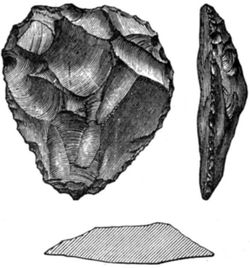
Palæolithic flint scraper from Icklingham, Suffolk.
(Evans.)
1. Palæolithic Man of the River-Drift.—Countless ages ago, there was
a period of time to which geologists have given the name of the
Pleistocene Age. The part of the earth's surface afterwards called
Britain was then attached to the Continent, so that animals could pass
over on dry land. The climate was much colder than it is now, and it
is known from the bones which have been dug up that the country was
inhabited by wolves, bears, mammoths, woolly rhinoceroses, and other
creatures now extinct. No human remains have been found amongst these
bones, but there is no doubt that men existed contemporaneously with
their deposit, because, in the river drift, or gravel washed down by
rivers, there have been discovered flints sharpened by chipping, which
can only have been produced by the hand of man. The men who used them
are known as Palæolithic, or the men of ancient stone, because these
stone implements are rougher and therefore older than others which
have been discovered. These Palæolithic men of the river
drift were a race of stunted savages who did not cultivate the ground,
but lived on the animals which they killed, and must have had great
difficulty in procuring food, as they did not know how to make handles
for their sharpened flints, and must therefore have had to hold them
in their hands.
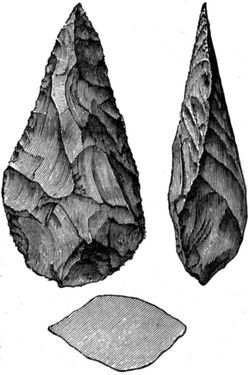
Palæolithic flint implement from Hoxne, Suffolk.
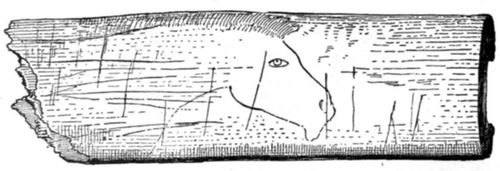
2. Cave-dwelling Palæolithic Man.—This race was succeeded by another
which dwelt in caves. They, as well as their predecessors, are known
as Palæolithic men, as their weapons were still very rude. As,
however, they had learnt to make handles for them, they could
construct arrows, harpoons, and javelins. They also made awls and
needles of stone; and, what is more remarkable, they possessed a
decided artistic power, which enabled them to indicate by a few
vigorous scratches the forms of horses, mammoths, reindeer, and other
animals. Vast heaps of rubbish still exist in various parts of Europe,
which are found to consist of the bones, shells, and other refuse
thrown out by these later Palæolithic men, who had no reverence for
the dead, casting out the bodies of their relations to decay with as
little thought as they threw away oyster-shells or
reindeer-bones. Traces of Palæolithic men of this type have been found
as far north as Derbyshire. Their descendants are no longer be met
with in these islands. The Eskimos of the extreme north of America,
however, have the same artistic faculty and the same disregard for the
dead, and it has therefore been supposed that the cave-dwelling men
were of the race to which the modern Eskimos belong.
Engraved bone from Cresswell Crags, Derbyshire, now in
the British Museum (full size).
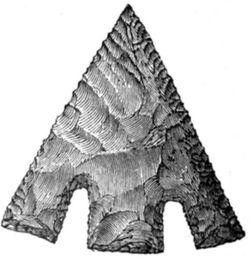
Neolithic flint arrow-head from Rudstone, Yorks.
(Evans.)
Neolithic celt or cutting instrument from Guernsey.
(Evans.)
Neolithic axe from Winterbourn Steepleton, Dorset.
(Evans.)
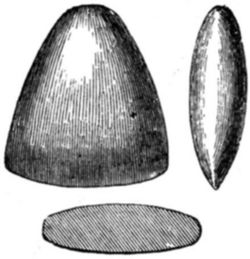
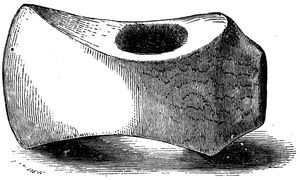
3. Neolithic Man.—Ages passed away during which the climate became
more temperate, and the earth's surface in these regions sank to a
lower level. The seas afterwards known as the North Sea and the
English Channel flowed over the depression; and an island was thus
formed out of land which had once been part of the continent. After
this process had taken place, a third race appeared, which must have
crossed the sea in rafts or canoes, and which took the place of the
Palæolithic men. They are known as Neolithic, or men of the new stone
age, because their stone implements were of a newer kind, being
polished and more efficient than those of their predecessors. They
had, therefore, the advantage of superior weapons, and
perhaps of superior strength, and were able to overpower those whom
they found in the island. With their stone axes they made clearings in
the woods in which to place their settlements. They brought with them
domestic animals, sheep and goats, dogs and pigs. They spun thread
with spindle and distaff, and wove it into cloth upon a loom. They
grew corn and manufactured a rude kind of pottery. Each tribe lived in
a state of war with its neighbours. A tribe when attacked in force
took shelter on the hills in places of refuge, which were surrounded
by lofty mounds and ditches. Many of these places of refuge are still
to be seen, as, for instance, the one which bears the name of Maiden
Castle, near Dorchester. On the open hills, too, are still to be found
the long barrows which the Neolithic men raised over the dead. There
is little doubt that these men, whose way of life was so superior to
that of their Eskimo-like predecessors, were of the race now known
as Iberian, which at one time inhabited a great part of
Western Europe, but which has since mingled with other races. The
Basques of the Pyrenees are the only Iberians who still preserve
anything like purity of descent, though even the Basques have in them
blood the origin of which is not Iberian.
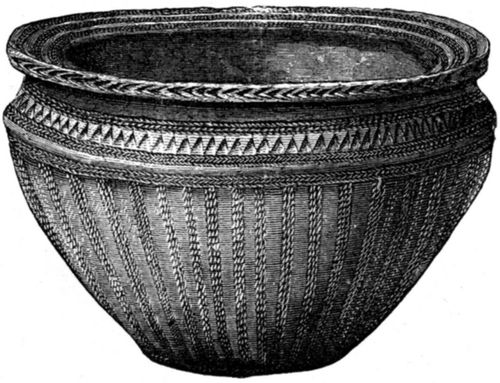
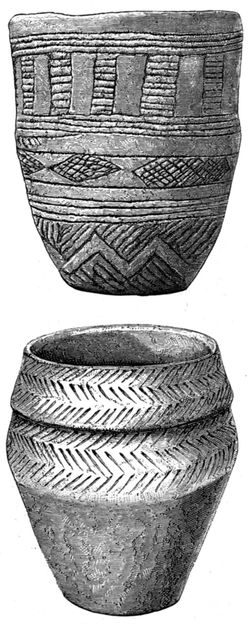
Early British Pottery.
Early British Pottery.
4. Celts and Iberians.—The Iberians were followed by a swarm of
new-comers called Celts. The Celts belong to a group of races
sometimes known as the Aryan group, to which also belong Teutons,
Slavonians, Italians, Greeks, and the chief ancient races of Persia
and India. The Celts were the first to arrive in the West, where they
seized upon lands in Spain, in Gaul, and in Britain, which the
Iberians had occupied before them. They did not, however, destroy the
Iberians altogether. However careful a conquering tribe maybe to
preserve the purity of its blood, it rarely succeeds in doing so. The
conquerors are sure to preserve some of the men of the
conquered race as slaves, and a still larger number of young and
comely women who become the mothers of their children. In time the
slaves and the children learn to speak the language of their masters
or fathers. Thus every European population is derived from many races.
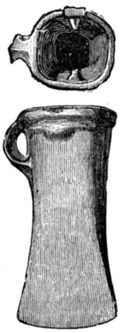
Bronze celt from the Isle of Harty, Kent (½).
5. The Celts in Britain.—The Celts were fair-haired and taller than
the Iberians, whom they conquered or displaced. They had the advantage
of being possessed of weapons of bronze, for which even the polished
stone weapons of the Iberians were no match. They burned instead of
burying their dead, and raised over the ashes those round barrows
which are still to be found intermingled with the long barrows of the
Iberians.
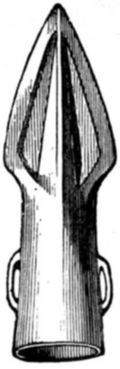
Bronze lance-head found in Ireland.
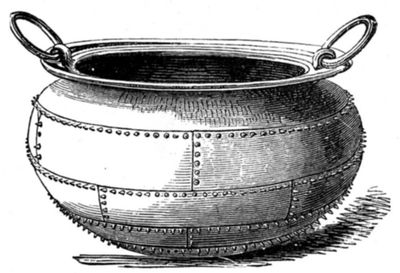
Bronze caldron found in Ireland.
6. Goidels and Britons.—The earliest known name given to this island
was Albion. It is uncertain whether the word is of Celtic or of
Iberian origin. The later name Britain is derived from a second swarm
of Celts called Brythons or Britons, who after a long interval
followed the first Celtic immigration. The descendants of these first
immigrants are distinguished from the new-comers by the name of
Goidels, and it is probable that they were at one time settled in
Britain as well as in Ireland, and that they were pushed across the
sea into Ireland by the stronger and more civilised Britons. At all
events, when history begins Goidels were only to be found in Ireland,
though at a later time they colonised a part of what is now
known as Scotland, and sent some offshoots into Wales. At present the
languages derived from that of the Goidels are the Gaelic of the
Highlands, the Manx of the Isle of Man, and the Erse of Ireland. The
only language now spoken in the British Isles which is derived from
that of the Britons is the Welsh; but the old Cornish language, which
was spoken nearly up to the close of the eighteenth century, came from
the same stock. It is therefore likely that the Britons pushed the
Goidels northward and westward, as the Goidels had formerly pushed the
Iberians in the same directions. It was most likely that the Britons
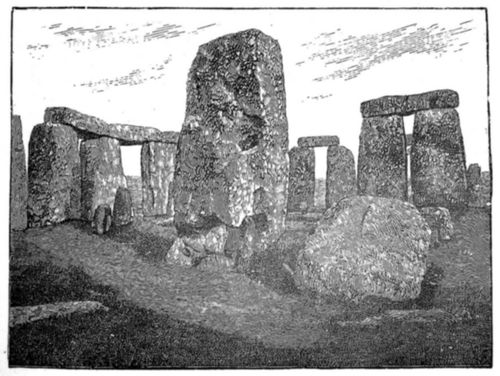
erected the huge stone circle of Stonehenge on Salisbury Plain, though
it is not possible to speak with certainty. That of Avebury is of an
earlier date and uncertain origin. Both were probably intended to
serve as monuments of the dead, though it is sometimes supposed that
they were also used as temples.
View of Stonehenge. (From a photograph.)
7. Phœnicians and Greeks.—The most civilised nations of the
ancient world were those which dwelt round the Mediterranean Sea. It
was long supposed that the Phœnicians came to Britain
from the coast of Syria, or from their colonies at Carthage and in the
south of Spain, for the tin which they needed for the manufacture of
bronze. The peninsula of Devon and Cornwall is the only part of the
island which produces tin, and it has therefore been thought that the
Cassiterides, or tin islands, which the Phœnicians visited, were to
be found in that region. It has, however, been recently shown that the
Cassiterides were most probably off the coast of Galicia, in Spain,
and the belief that Phœnicians visited Britain for tin must
therefore be considered to be very doubtful. The first educated
visitor who reached Britain was Pytheas, a Greek, who was sent by the
merchants of the Greek colony of Massalia (Marseilles) about 330B.C. to make discoveries which might lead to the opening across Gaul
of a trade-route between Britain and their city. It was probably in
consequence of the information which he carried to Massalia on his
return that there sprang up a trade in British tin. Another Greek,
Posidonius, who came to Britain about two centuries after Pytheas,
found this trade in full working order. The tin was brought by land
from the present Devon or Cornwall to an island called Ictis, which
was only accessible on foot after the tide had ebbed. This island was
probably Thanet, which was in those days cut off from the mainland by
an arm of the sea which could be crossed on foot at low water. From
Thanet the tin was carried into Gaul across the straits, and was then
conveyed in waggons to the Rhone to be floated down to the
Mediterranean.
8. Gauls and Belgians in Britain.—During the time when this trade was
being carried on, tribes of Gauls and Belgians landed in Britain. The
Gauls were certainly, and the Belgians probably, of the same Celtic
race as that which already occupied the island. The Gauls settled on
the east coast as far as the Fens and the Wash, whilst the Belgians
occupied the south coast, and pushed northwards towards the Somerset
Avon. Nothing is known of the relations between the new-comers and the
older Celtic inhabitants. Most likely those who arrived last contented
themselves with mastering those whom they defeated, without attempting
to exterminate them. At all events, states of some extent were formed
by the conquerors. Thus the Cantii occupied the open ground to the
north of the great forest which then filled the valley between the
chalk ranges of the North and South Downs; the Trinobantes dwelt
between the Lea and the Essex Stour; the Iceni occupied the peninsula
between the Fens and the sea which was afterwards known as East Anglia
(Norfolk and Suffolk); and the Catuvellauni dwelt to the
west of the Trinobantes, spreading over the modern Hertfordshire and
the neighbouring districts.
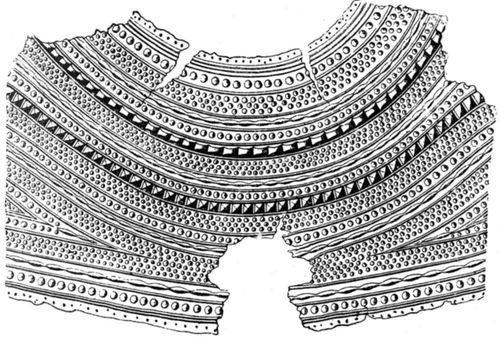
Part of a British gold corselet found at Mold.
9. Culture and War.—Though there were other states in Britain, the
tribes which have been named had the advantage of being situated on
the south-eastern part of the island, and therefore of being in
commercial communication with the continental Gauls of their own race
and language. Trade increased, and brought with it the introduction of
some things which the Britons would not have invented for themselves.
For instance, the inhabitants of the south-east of Britain began to
use gold coins and decorations in imitation of those which were then
common in Gaul. Yet, in spite of these improvements, even the most
civilised Britons were still in a rude and barbarous condition. They
had no towns, but dwelt in scattered huts. When they were hard pressed
by an enemy they took refuge in an open space cleared in the woods,
and surrounded by a high earthwork crowned by a palisade and guarded
by felled trees. When they went out to battle they dyed their faces in
order to terrify their enemies. Their warriors made use of chariots,
dashing in them along the front of the enemy's line till they espied
an opening in his ranks. They then leapt down and charged on foot into
the gap. Their charioteers in the meanwhile drove off the
horses to a safe distance, so as to be ready to take up their comrades
if the battle went against them.
10. Religion of the Britons.—The Celtic races worshipped many gods.
In Gaul, the Druids, who were the ministers of religion, taught the
doctrine of the transmigration of souls, and even gave moral
instruction to the young. In Ireland, and perhaps in Britain, they
were conjurers and wizards. Both in Gaul and Britain they kept up the
traditional belief which had once been prevalent in all parts of the
world, that the gods could only be appeased by human sacrifices. It
was supposed that they needed either to drink human blood or to be
supplied with human slaves, and that the only way to give them what
they wanted was to despatch as many human beings as possible into the
other world. The favourite way of doing this was to construct a huge
wicker basket in the shape of a man, to cram it with men and women,
and to set it on fire. At other times a Druid would cut open a single
human victim, and would imagine that he could foretell the future by
inspecting the size and appearance of the entrails.
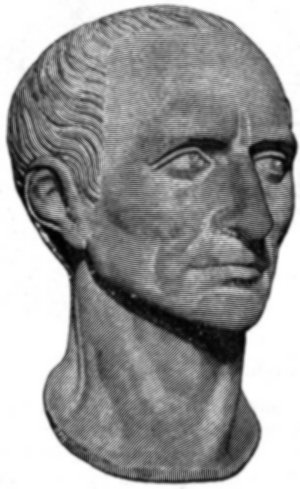
Julius Cæsar. (From a bust in the British Museum.)
11. The Romans in Gaul.B.C.55.—In the year 55B.C. the Celts of
south-eastern Britain first came in contact with a Roman army. The
Romans were a civilised people, and had been engaged for some
centuries in conquering the peoples living round the Mediterranean.
They possessed disciplined armies, and a regular government. By the
beginning of the year the Roman general, Gaius Julius Cæsar, had made
himself master of Gaul. Then, after driving back with enormous
slaughter two German tribes which had invaded Gaul, he crossed the
Rhine, not because he wished to conquer Germany, but because he wished
to strike terror into the Germans in order to render them
unwilling to renew their attack. This march into Germany seems to have
suggested to Cæsar the idea of invading Britain. It is most unlikely
that he thought of conquering the island, as he had quite enough to do
in Gaul. What he really wanted was to prevent the Britons from coming
to the help of their kindred whom he had just subdued, and he would
accomplish this object best by landing on their shores and showing
them how formidable a Roman army was.
12. Cæsar's First Invasion.B.C.55.—Accordingly, towards the end of
August, Cæsar crossed the straits with about 10,000 men. There is some
uncertainty about the place of his landing, but he probably first
appeared off the spot at which Dover now stands, and then, being
alarmed at the number of the Britons who had crowded to defend the
coast, made his way by sea to the site of the modern Deal. There, too,
his landing was opposed, but he managed to reach the shore with his
army. He soon found, however, that the season was too advanced to
enable him to accomplish anything. A storm having damaged his shipping
and driven off the transports on which was embarked his cavalry, he
returned to Gaul.
13. Cæsar's Second Invasion.B.C.54—Cæsar had hitherto failed to
strike terror into the Britons. In the following year he started in
July, so as to have many weeks of fine weather before him, taking with
him as many as 25,000 foot and 2,000 horse. After effecting a landing
he pushed inland to the Kentish Stour, where he defeated the natives
and captured one of their stockades. Good soldiers as the Romans were,
they were never quite at home on the sea, and Cæsar was recalled to
the coast by the news that the waves had dashed to pieces a large
number of his ships. As soon as he had repaired the damage he resumed
his march. His principal opponent was Cassivelaunus, the chief of the
tribe of the Catuvellauni, who had subdued many of the neighbouring
tribes, and whose stronghold was a stockade near the modern St.
Albans. This chief and his followers harassed the march of the Romans
with the rush of their chariots. If Cassivelaunus could have counted
upon the continued support of all his warriors, he might perhaps have
succeeded in forcing Cæsar to retreat, as the country was covered with
wood and difficult to penetrate. Many of the tribes, however, which
now served under him longed to free themselves from his rule. First,
the Trinobantes and then four other tribes broke away from him and
sought the protection of Cæsar. Cæsar, thus encouraged, dashed at his
stockade and carried it by storm. Cassivelaunus abandoned
the struggle, gave hostages to Cæsar, and promised to pay a yearly
tribute. On this Cæsar returned to Gaul. Though the tribute was never
paid, he had gained his object. He had sufficiently frightened the
British tribes to make it unlikely that they would give him any
annoyance in Gaul.
14. South-eastern Britain after Cæsar's Departure.B.C.54—A.D.43.—For nearly a century after Cæsar's departure Britain was left to
itself. The Catuvellauni recovered the predominance which they had
lost. Their chieftain, Cunobelin, the original of Shakspere's
Cymbeline, is thought to have been a grandson of Cassivelaunus. He
established his power over the Trinobantes as well as over his own
people, and made Camulodunum, the modern Colchester, his headquarters.
Other tribes submitted to him as they had submitted to his
grandfather. The prosperity of the inhabitants of south-eastern
Britain increased more rapidly than the prosperity of their ancestors
had increased before Cæsar's invasion. Traders continued to flock over
from Gaul, bringing with them a knowledge of the arts and refinements
of civilised life, and those arts and refinements were far greater now
that Gaul was under Roman rule than they had been when its Celtic
tribes were still independent. Yet, in spite of the growth of trade,
Britain was still a rude and barbarous country. Its exports were but
cattle and hides, corn, slaves, and hunting dogs, together with a few
dusky pearls.
15. The Roman Empire.—The Roman state was now a monarchy. The Emperor
was the head of the army, as well as the head of the state. Though he
was often a cruel oppressor of the wealthy personages who lived in
Rome itself, and whose rivalry he feared, he, for the most part,
sought to establish his power by giving justice to the provinces which
had once been conquered by Rome, but were now admitted to share in the
advantages of good government which the Empire had to give. One
consequence of the conquest of nations by Rome was that there was now
an end to cruel wars between hostile tribes. An army was stationed on
the frontier of the Empire to defend it against barbarian attacks. In
the interior the Roman peace, as it was called, prevailed, and there
was hardly any need of soldiers to keep order and to maintain
obedience.
16. The Invasion of Aulus Plautius.A.D.43.—One question which each
Emperor had to ask himself was whether he would attempt to enlarge the
limits of the Empire or not. For a time each Emperor had resolved to
be content with the frontier which Cæsar had left. There had
consequently for many years been no thought of again invading Britain.
At last the Emperor Claudius reversed this policy. There is reason to
suppose that some of the British chiefs had made an attack upon the
coasts of Gaul. However this may have been, Claudius in 43 sent Aulus
Plautius against Togidumnus and Caratacus, the sons of Cunobelin, who
were now ruling in their father's stead. Where one tribe has gained
supremacy over others, it is always easy for a civilised power to gain
allies amongst the tribes which have been subdued. Cæsar had
overpowered Cassivelaunus by enlisting on his side the revolted
Trinobantes, and Aulus Plautius now enlisted on his side the Regni,
who dwelt in the present Sussex, and the Iceni, who dwelt in the
present Norfolk and Suffolk. With their aid, Aulus Plautius, at the
head of 40,000 men, defeated the sons of Cunobelin. Togidumnus was
slain, and Caratacus driven into exile. The Romans then took
possession of their lands, and, stepping into their place, established
over the tribes chieftains who were now dependent on the Emperor
instead of on Togidumnus and Caratacus. Claudius himself came for a
brief visit to receive the congratulations of the army on the victory
which his lieutenant had won. Aulus Plautius remained in Britain till
47. Before he left it the whole of the country to the south of a line
drawn from the Wash to some point on the Severn had been subjugated.
The mines of the Mendips and of the western peninsula were too
tempting to be left unconquered, and it is probably their attraction
which explains the extension of Roman power at so early a date over
the hilly country in the west.
17. The Colony of Camulodunum.—In 47 Aulus Plautius was succeeded by
Ostorius Scapula. He disarmed the tribes dwelling to the west of the
Trent, whilst he attempted to establish the Roman authority more
firmly over those whose territory lay to the east of that river.
Amongst these later were the Iceni, who had been hitherto allowed to
preserve their native government in dependence on the Roman power. The
consequence was that they rose in arms. Ostorius overpowered them, and
then sought to strengthen his hold upon the south-east of Britain by
founding (51) a Roman colony at Camulodunum, which had formerly been
the headquarters of Cunobelin. Roman settlers—for the most part
discharged soldiers—established themselves in the new city, bringing
with them all that belonged to Roman life with all its conveniences
and luxuries. Roman temples, theatres, and baths quickly rose, and
Ostorius might fairly expect that in Britain, as in Gaul, the native
chiefs would learn to copy the easy life of the new
citizens, and would settle their quarrels in Roman courts of law
instead of taking arms on their own behalf.
18. The Conquests of Ostorius Scapula.—Ostorius, however, was soon
involved in fresh troubles. Nothing is more difficult for a civilised
power than to guard a frontier against barbarous tribes. Such tribes
are accustomed to plunder one another, and they are quick to perceive
that the order and peace which a civilised power establishes offers
them a richer booty than is to be found elsewhere. The tribes beyond
the line which Ostorius held were constantly breaking through to
plunder the Roman territory, and he soon found that he must either
allow the lands of Roman subjects to be plundered, or must carry war
amongst the hostile tribes. He naturally chose the latter alternative,
and the last years of his government were spent in wars with the
Ordovices of Central Wales, and with the Silures of Southern Wales.
The Silures were not only a most warlike people, but they were led by
Caratacus, who had taken refuge with them after his defeat by Aulus
Plautius in the east. The mountainous region which these two tribes
defended made it difficult to subdue them, and though Caratacus was
defeated (50), and ultimately captured and sent as a prisoner to Rome,
Ostorius did not succeed in effectually mastering his hardy followers.
The proof of his comparative failure lies in the fact that he
established strong garrison towns along the frontier of the hilly
region, which he would not have done unless he had considered it
necessary to have a large number of soldiers ready to check any
possible rising. At the northern end of the line was Deva (Chester),
at the southern was Isca Silurum (Caerleon upon Usk) and in each of
which was placed a whole legion, about 5,000 men. Between them was the
smaller post of Uriconium, or more properly Viriconium (Wroxeter),
the city of the Wrekin.
19. Government of Suetonius Paullinus.58.—When Suetonius Paullinus
arrived to take up the government, he resolved to complete the
conquest of the west by an attack on Mona (Anglesey). In Mona was a
sacred place of the Druids, who gave encouragement to the still
independent Britons by their murderous sacrifices and their
soothsayings. When Suetonius attempted to land (61), a rabble of
women, waving torches and shrieking defiance, rushed to meet him on
the shore. Behind them the Druids stood calling down on the intruders
the vengeance of the gods. At first the soldiers were terrified and
shrunk back. Then they recovered courage, and put to the sword or
thrust into the flames the priests and their female rout.
The Romans were tolerant of the religion of the peoples whom they
subdued, but they could not put up with the continuance of a cruel
superstition whose upholders preached resistance to the Roman
government.
20. Boadicea's Insurrection.61.—At the very moment of success
Suetonius was recalled hurriedly to the east. Roman officers and
traders had misused the power which had been given them by the valour
of Roman soldiers. Might had been taken for right, and the natives
were stripped of their lands and property at the caprice of the
conquerors. Those of the natives to whom anything was left were called
upon to pay a taxation far too heavy for their means. When money was
not to be found to satisfy the tax-gatherer, a Roman usurer was always
at hand to proffer the required sum at enormous interest, after which
the unhappy borrower who accepted the proposal soon found himself
unable to pay the debt, and was stripped of all that he possessed to
satisfy the cravings of the lender. Those who resisted this oppression
were treated as the meanest criminals. Boadicea, the widow of
Prasutagus, who had been the chief of the Iceni, was publicly flogged,
and her two daughters were subjected to the vilest outrage. She called
upon the whole Celtic population of the east and south to rise against
the foreign tyrants. Thousands answered to her call, and the angry
host rushed to take vengeance upon the colonists of Camulodunum. The
colonists had neglected to fortify their city, and the insurgents,
bursting in, slew by the sword or by torture men and women alike. The
massacre spread wherever Romans were to be found. A Roman legion
hastening to the rescue was routed, and the small force of cavalry
attached to it alone succeeded in making its escape. Every one of the
foot soldiers was slaughtered on the spot. It is said that 70,000
Romans perished in the course of a few days.
21. The Vengeance of Suetonius.—Suetonius was no mean general, and he
hastened back to the scene of destruction. He called on the commander
of the legion at Isca Silurum to come to his help. Cowardice was rare
in a Roman army, but this officer was so unnerved by terror that he
refused to obey the orders of his general, and Suetonius had to march
without him. He won a decisive victory at some unknown spot, probably
not far from Camulodunum, and 80,000 Britons are reported to have been
slain by the triumphant soldiery. Boadicea committed suicide by
poison. The commander of the legion at Isca Silurum also put an end to
his own life, in order to escape the punishment which he deserved.
Suetonius had restored the Roman authority in Britain, but
it was to his failure to control his subordinates that the
insurrection had been due, and he was therefore promptly recalled by
the Emperor Nero. From that time no more is heard of the injustice of
the Roman government.
22. Agricola in Britain.78—84.—Agricola, who arrived as governor in
78, took care to deal fairly with all sorts of men, and to make the
natives thoroughly satisfied with his rule. He completed the conquest
of the country afterwards known as Wales, and thereby pushed the
western frontier of Roman Britain to the sea. Yet from the fact that
he found it necessary still to leave garrisons at Deva and Isca
Silurum, it may be gathered that the tribes occupying the hill country
were not so thoroughly subdued as to cease to be dangerous. Although
the idea entertained by Ostorius of making a frontier on land towards
the west had thus been abandoned, it was still necessary to provide a
frontier towards the north. Even before Agricola arrived it had been
shown to be impossible to stop at the line between the Mersey and the
Humber. Beyond that line was the territory of the Brigantes, who had
for some time occupied the position which in the first years of the
Roman conquest had been occupied by the Iceni—that is to say, they
were in friendly dependence upon Rome, without being actually
controlled by Roman authority. Before Agricola's coming disputes had
arisen with them, and Roman soldiers had occupied their territory.
Agricola finished the work of conquest. He now governed the whole of
the country as far north as to the Solway and the Tyne, and he made
Eboracum, the name of which changed in course of time into York, the
centre of Roman power in the northern districts. A garrison was
established there to watch for any danger which might come from the
extreme north, as the garrisons of Deva and Isca Silurum watched for
dangers which might come from the west.
23. Agricola's Conquests in the North.—Agricola thought that there
would be no real peace unless the whole island was subdued. For seven
years he carried on warfare with this object before him. He had
comparatively little difficulty in reducing to obedience the country
south of the narrow isthmus which separates the estuary of the Clyde
from the estuary of the Forth. Before proceeding further he drew a
line of forts across that isthmus to guard the conquered country from
attack during his absence. He then made his way to the Tay, but he had
not marched far up the valley of that river before he reached the edge
of the Highlands. The Caledonians, as the Romans then called the
inhabitants of those northern regions, were a savage race,
and the mountains in the recesses of which they dwelt were rugged and
inaccessible, offering but little means of support to a Roman army. In
84 the Caledonians, who, like all barbarians when they first come in
contact with a civilised people, were ignorant of the strength of a
disciplined army, came down from their fortresses in the mountains
into the lower ground. A battle was fought near the Graupian Hill,
which seems to have been situated at the junction of the Isla and the
Tay. Agricola gained a complete victory, but he was unable to follow
the fugitives into their narrow glens, and he contented himself with
sending his fleet to circumnavigate the northern shores of the island,
so as to mark out the limits of the land which he still hoped to
conquer. Before the fleet returned, however, he was recalled by the
Emperor Domitian. It has often been said that Domitian was jealous of
his success; but it is possible that the Emperor really thought that
the advantage to be gained by the conquest of rugged mountains would
be more than counterbalanced by the losses which would certainly be
incurred in consequence of the enormous difficulty of the task.
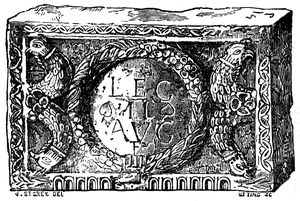
Commemorative tablet of the Second Legion found at
Halton Chesters on the Roman Wall.
24. The Roman Walls.—Agricola, in addition to his line of forts
between the Forth and the Clyde, had erected detached forts at the
mouth of the valleys which issue from the Highlands, in order to
hinder the Caledonians from plundering the lower country. In 119 the
Emperor Hadrian visited Britain. He was more disposed to defend the
Empire than to extend it, and though he did not abandon Agricola's
forts, he also built further south a continuous stone wall between the
Solway and the Tyne. This wall, which, together with an earthwork of
earlier date, formed a far stronger line of defence than the more
northern forts, was intended to serve as a second barrier to keep out
the wild Caledonians if they succeeded in breaking through the first.
At a later time a lieutenant of the Emperor, Antoninus Pius, who
afterwards became Emperor himself, connected Agricola's
forts between the Forth and Clyde by a continuous earthwork. In 208
the Emperor Severus arrived in Britain, and after strengthening still
further the earthwork between the Forth and Clyde, he attempted to
carry out the plans of Agricola by conquering the land of the
Caledonians. Severus, however, failed as completely as Agricola had
failed before him, and he died soon after his return to Eboracum.
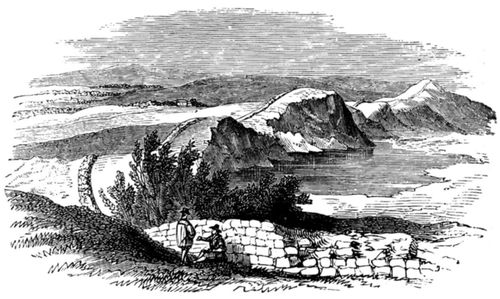
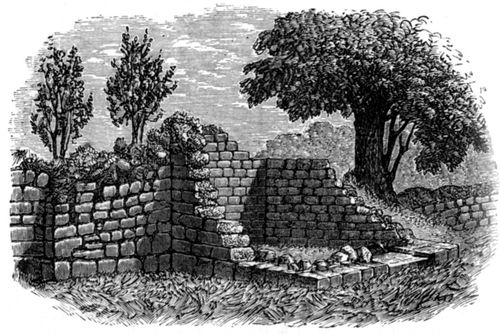
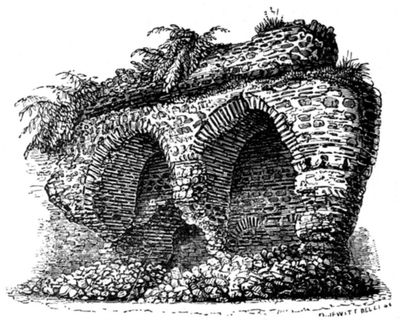
View of part of the Roman Wall.
Ruins of a Turret on the Roman Wall.
Part of the Roman Wall at Leicester.
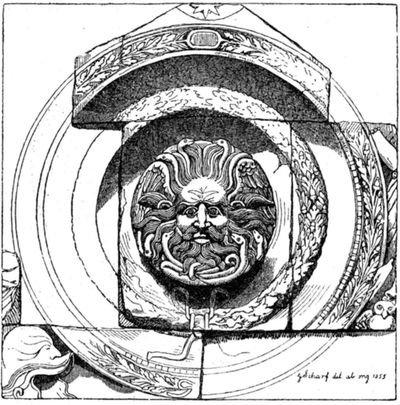
Pediment of a Roman temple found at Bath.
25. The Roman Province of Britain.—Very little is known of the
history of the Roman province of Britain, except that it made
considerable progress in civilisation. The Romans were great
road-makers, and though their first object was to enable their
soldiers to march easily from one part of the country to another, they
thereby encouraged commercial intercourse. Forests were to some extent
cleared away by the sides of the new roads, and fresh ground was
thrown open to tillage. Mines were worked and country houses built,
the remains of which are in some places still to be seen, and bear
testimony to the increased well-being of a population which, excepting
in the south-eastern part of the island, had at the arrival of the
Romans been little removed from savagery. Cities sprang up in great
numbers. Some of them were at first garrison towns, like Eboracum,
Deva, and Isca Silurum. Others, like Verulamium, near the present St.
Albans, occupied the sites of the old stockades once used as places of
refuge by the Celts, or, like Lindum, on the top of the hill
on which Lincoln Cathedral now stands, were placed in strongly
defensible positions. Aquæ Sulis, the modern Bath, owes its existence
to its warm medicinal springs. The chief port of commerce was
Londinium, the modern London. Attempts which have been made to explain
its name by the Celtic language have failed, and it is therefore
possible that an inhabited post existed there even before the Celts
arrived. Its importance was, however, owing to its position, and that
importance was not of a kind to tell before a settled system of
commercial intercourse sprang up. London was situated on the hill on
which St. Paul's now stands. There first, after the Thames narrowed
into a river, the merchant found close to the stream hard ground on
which he could land his goods. The valley for some distance above and
below it was then filled with a wide marsh or an expanse of water. An
old track raised above the marsh crossed the river by a ford at
Lambeth, but, as London grew in importance, a ferry was established
where London Bridge now stands, and the Romans, in course of time,
superseded the ferry by a bridge. It is, therefore, no
wonder that the Roman roads both from the north and from the south
converged upon London. Just as Eboracum was a fitting centre for
military operations directed to the defence of the northern frontier,
London was the fitting centre of a trade carried on with the
Continent, and the place would increase in importance in proportion to
the increase of that trade.
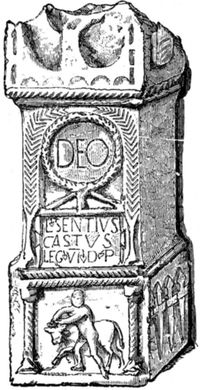
Roman altar from Rutchester.
26. Extinction of Tribal Antagonism.—The improvement of
communications and the growth of trade and industry could not fail to
influence the mind of the population. Wars between tribes, which
before the coming of the Romans had been the main employment of the
young and hardy, were now things of the past. The mutual hatred which
had grown out of them had died away, and even the very names of
Trinobantes and Brigantes were almost forgotten. Men who lived in the
valley of the Severn came to look upon themselves as belonging to the
same people as men who lived in the valleys of the Trent or the
Thames. The active and enterprising young men were attracted to the
cities, at first by the novelty of the luxurious habits in which they
were taught to indulge, but afterwards because they were allowed to
take part in the management of local business. In the time of the
Emperor Caracalla, the son of Severus, every freeman born in the
Empire was declared to be a Roman citizen, and long before that a
large number of natives had been admitted to citizenship. In each
district a council was formed of the wealthier and more prominent
inhabitants, and this council had to provide for the building of
temples, the holding of festivals, the erection of fortifications, and
the laying out of streets. Justice was done between man and man
according to the Roman law, which was the best law that the world had
seen, and the higher Roman officials, who were appointed by the
Emperor, took care that justice was done between city and city. No one
therefore, wished to oppose the Roman government or to bring
back the old times of barbarism.
27. Want of National Feeling.—Great as was the progress made, there
was something still wanting. A people is never at its best unless
those who compose it have some object for which they can sacrifice
themselves, and for which, if necessary, they will die. The Briton had
ceased to be called upon to die for his tribe, and he was not expected
to die for Britain. Britain had become a more comfortable country to
live in, but it was not the business of its own inhabitants to guard
it. It was a mere part of the vast Roman Empire, and it was the duty
of the Emperors to see that the frontier was safely kept. They were so
much afraid lest any particular province should wish to set up for
itself and to break away from the Empire, that they took care not to
employ soldiers born in that province for its protection. They sent
British recruits to guard the Danube or the Euphrates, and Gauls,
Spaniards, or Africans to guard the wall between the Solway and the
Tyne, and the entrenchment between the Forth and the Clyde. Britons,
therefore, looked on their own defence as something to be done for
them by the Emperors, not as something to be done by themselves. They
lived on friendly terms with one another, but they had nothing of what
we now call patriotism.
28. Carausius and Allectus.288—296.—In 288 Carausius, with the help
of some pirates, seized on the government of Britain and threw off the
authority of the Emperor. He was succeeded by Allectus, yet neither
Carausius nor Allectus thought of making himself the head of a British
nation. They called themselves Emperors and ruled over Britain alone,
merely because they could not get more to rule over.
29. Constantius and Constantine.296—337.—Allectus was overthrown
and slain by Constantius, who, however, did not rule, as Carausius and
Allectus had done, by mere right of military superiority. The Emperor
Diocletian (285—305) discovered that the whole Empire, stretching
from the Euphrates to the Atlantic, was too extensive for one man to
govern, and he therefore decreed that there should in future be four
governors, two principal ones named Emperors (Augusti), and two
subordinate ones named Cæsars. Constantius was first a Cæsar and
afterwards an Emperor. He was set to govern Spain, Gaul, and Britain,
but he afterwards became Emperor himself, and for some time
established himself at Eboracum (York). Upon his death (306), his
son Constantine, after much fighting, made himself sole Emperor (325),
overthrowing the system of Diocletian. Yet in one respect he
kept up Diocletian's arrangements. He placed Spain, Gaul, and Britain
together under a great officer called a Vicar, who received orders
from himself and who gave orders to the officers who governed each of
the three countries. Under the new system, as under the old, Britain
was not treated as an independent country. It had still to look for
protection to an officer who lived on the Continent, and was therefore
apt to be more interested in Gaul and Spain than he was in Britain.
30. Christianity in Britain.—When the Romans put down the Druids and
their bloody sacrifices, they called the old Celtic gods by Roman
names, but made no further alteration in religious usages. Gradually,
however, Christianity spread amongst the Romans on the Continent, and
merchants or soldiers who came from the Continent introduced it into
Britain. Scarcely anything is known of its progress in the island.
Alban is said to have been martyred at Verulamium, and Julius and
Aaron at Isca Silurum. In 314 three British bishops attended a council
held at Arles in Gaul. Little more than these few facts have been
handed down, but there is no doubt that there was a settled Church
established in the island. The Emperor Constantine acknowledged
Christianity as the religion of the whole Empire. The remains of a
church of this period have recently been discovered at Silchester.
31. Weakness of the Empire.—The Roman Empire in the time of
Constantine had the appearance rather than the reality of strength.
Its taxation was very heavy, and there was no national enthusiasm to
lead men to sacrifice themselves in its defence. Roman citizens became
more and more unwilling to become soldiers at all, and the Roman
armies were now mostly composed of barbarians. At the same time the
barbarians outside the Empire were growing stronger, as the tribes
often coalesced into wide confederacies for the purpose of attacking
the Empire.
32. The Picts and Scots.—The assailants of Britain on the north and
the west were the Picts and Scots. The Picts were the same as the
Caledonians of the time of Agricola. We do not know why they had
ceased to be called Caledonians. The usual derivation of their name
from the Latin Pictus, said to have been given them because they
painted their bodies, is inaccurate. Opinions differ whether they were
Goidels with a strong Iberian strain, or Iberians with a Goidelic
admixture. They were probably Iberians, and at all events they were
more savage than the Britons had been before they were influenced by
Roman civilisation. The Scots, who afterwards settled in what is
now known as Scotland, at that time dwelt in Ireland. Whilst
the Picts, therefore, assailed the Roman province by land, and strove,
not always unsuccessfully, to break through the walls which defended
its northern frontier, the Scots crossed the Irish Sea in light boats
to plunder and slay before armed assistance could arrive.
33. The Saxons.—The Saxons, who were no less deadly enemies of the
Roman government, were as fierce and restless as the Picts and Scots,
and were better equipped and better armed. At a later time they
established themselves in Britain as conquerors and settlers, and
became the founders of the English nation; but at first they were only
known as cruel and merciless pirates. In their long flat-bottomed
vessels they swooped down upon some undefended part of the coast and
carried off not only the property of wealthy Romans, but even men and
women to be sold in the slave-market. The provincials who escaped
related with peculiar horror how the Saxons were accustomed to torture
to death one out of every ten of their captives as a sacrifice to
their gods.
34. Origin of the Saxons.—The Saxons were the more dangerous because
it was impossible for the Romans to reach them in their homes. They
were men of Teutonic race, speaking one of the languages, afterwards
known as Low German, which were once spoken in the whole of North
Germany. The Saxon pirates were probably drawn from the whole of the
sea coast stretching from the north of the peninsula of Jutland to the
mouth of the Ems, and if so, there were amongst them Jutes, whose
homes were in Jutland itself; Angles, who inhabited Schleswig and
Holstein; and Saxons, properly so called, who dwelt about the mouth of
the Elbe and further to the west. All these peoples afterwards took
part in the conquest of southern Britain, and it is not unlikely that
they all shared in the original piratical attacks. Whether this was
the case or not, the pirates came from creeks and inlets outside the
Roman Empire, whose boundary was the Rhine, and they could therefore
only be successfully repressed by a power with a good fleet, able to
seek out the aggressors in their own homes and to stop the mischief at
its source.
35. The Roman Defence.—The Romans had always been weak at sea, and
they were weaker now than they had been in earlier days. They were
therefore obliged to content themselves with standing on the
defensive. Since the time of Severus, Britain had been divided, for
purposes of defence, into Upper and Lower Britain. Though there is no
absolute certainty about the matter, it is probable that
Upper Britain comprised the hill country of the west and north, and
that Lower Britain was the south-eastern part of the island, marked
off by a line drawn irregularly from the Humber to the Severn.[1]
Lower Britain in the early days of the Roman conquest had been in no
special need of military protection. In the fourth century it was
exposed more than the rest of the island to the attacks of the Saxon
pirates. Fortresses were erected between the Wash and Beachy Head at
every point at which an inlet of the sea afforded an opening to an
invader. The whole of this part of the coast became known as the Saxon
Shore, because it was subjected to attacks from the Saxons, and a
special officer known as the Count of the Saxon Shore was appointed to
take charge of it. An officer known as the Duke of the Britains (Dux
Britanniarum) commanded the armies of Upper Britain; whilst a third,
who was a civilian, and superior in rank over the other two, was the
Count of Britain, and had a general supervision of the whole country.
36. End of the Roman Government.383—410.—In 383 Maximus, who was
probably the Duke of the Britains, was proclaimed Emperor by his
soldiers. If he could have contented himself with defending Britain,
it would have mattered little whether he chose to call himself an
Emperor or a Duke. Unhappily for the inhabitants of the island, not
only did every successful soldier want to be an Emperor, but every
Emperor wanted to govern the whole Empire. Maximus, therefore, instead
of remaining in Britain, carried a great part of his army across the
sea to attempt a conquest of Gaul and Spain. Neither he nor his
soldiers ever returned, and in consequence the Roman garrison in the
island was deplorably weakened. Early in the fifth century an
irruption of barbarians gave full employment to the army which
defended Gaul, so that it was impossible to replace the forces which
had followed Maximus by fresh troops from the Continent. The Roman
Empire was in fact breaking up. The defence of Britain was left to the
soldiers who remained in the island, and in 409 they proclaimed a
certain Constantine Emperor. Constantine, like Maximus, carried his
soldiers across the Channel in pursuit of a wider empire than he could
find in Britain. He was himself murdered, and his soldiers, like those
of Maximus, did not return. In 410 the Britons implored the Emperor
Honorius to send them help. Honorius had enough to do to
ward off the attacks of barbarians nearer Rome, and announced to the
Britons that they must provide for their own defence. From this time
Britain ceased to form part of the Roman Empire.[Back to Contents]
LEADING DATES
Landing of the Jutes in Thanet A.D. 449?
The West Saxons defeated at Mount Badon 520
The West Saxons take Sorbiodunum 552
Battle of Deorham 577
The West Saxons defeated at Faddiley 584
1. Britain after the Departure of the Romans.410—449?—After the
departure of the Romans, the Picts from the north and the Scots from
Ireland continued their ravages, but though they caused terrible
misery by slaughtering or dragging into slavery the inhabitants of
many parts of the country, they did not succeed in making any
permanent conquests. The Britons were not without a government and an
armed force; and their later history shows that they were capable of
carrying on war for a long time against enemies more formidable than
the Picts and Scots. Their rulers were known by the British title
Gwledig, and probably held power in different parts of the island as
the successors of the Roman Duke of the Britains and of the Roman
Count of the Saxon Shore. Their power of resistance to the Picts and
the Scots was, however, weakened by the impossibility of turning their
undivided attention to these marauders, as at the same time that they
had, to defend the Roman Wall and the western coast against the Picts
and Scots, they were exposed on the eastern coast to the attacks of
the Saxon pirates.
2. The Groans of the Britons.—In their misery the thoughts of the
Britons turned to those Roman legions who had defended their fathers
so well. In 446 they appealed to Aëtius, the commander of the Roman
armies, to deliver them from their destroyers. "The groans of the
Britons" was the title which they gave to their appeal to him. "The
barbarians," they wrote, "drive us to the sea; the sea drives us back
to the barbarians; between them we are exposed to two sorts
of death: we are either slain or drowned." Aëtius had no men to spare,
and he sent no help to the Britons. Before long the whole of Western
Europe was overrun by barbarian tribes, the title of Emperor being
retained only by the Roman Emperor who ruled from Constantinople over
the East, his authority over the barbarians of the West being no more
than nominal.
3. The Conquest of Kent.449?—It had been the custom of the Roman
Empire to employ barbarians as soldiers in their armies, and
Vortigern, the British ruler, now followed that bad example. In or
about 449 a band of Jutish sea-rovers landed at Ebbsfleet, in the Isle
of Thanet. According to tradition their leaders were Hengist and
Horsa, names signifying the horse and the mare, which were not very
likely to have been borne by real warriors. Whatever may have been the
names of the chiefs, Vortigern took them into his service against the
Picts, giving them the Isle of Thanet as a dwelling-place for
themselves. With their help he defeated the Picts, but afterwards
found himself unable to defend himself against his fierce auxiliaries.
Thanet was still cut off from the mainland by an arm of the sea, and
the Jutes were strong enough to hold it against all assailants. Their
numbers rapidly increased as shiploads of their fellows landed, and
they crossed the strait to win fresh lands from the Britons on the
mainland of Kent. In several battles Vortigern was overpowered. His
rival and successor, Ambrosius Aurelianus, whose name makes it
probable that he was an upholder of the old Roman discipline, drove
back the Jutes in turn. He did not long keep the upper hand, and in
465 he was routed utterly. The defeat of the British army was followed
by an attack upon the great fortresses which had been erected along
the Saxon Shore in the Roman times. The Jutes had no means of carrying
them by assault, but they starved them out one by one, and some
twenty-three years after their first landing, the whole of the coast
of Kent was in their hands.
4. The South Saxons.477.—The conquests of the Jutes stopped at the
inlet of the sea now filled by Romney Marsh. To the south and west was
the impenetrable Andred's Wood, which covered what is now known as the
Weald. At its eastern extremity stood by the sea the strong fortified
town of Anderida, which gave its name to the wood, the most westerly
of the fortresses of the Saxon Shore still unconquered by the Jutes.
It was at last endangered by a fresh pirate band—not of Jutes but of
Saxons—which landed near Selsey, and fought its way eastwards,
conquering the South Downs and the flat land between the South Downs
and the sea, till it reached Anderida. Anderida was starved
out after a long blockade, and the Saxons, bursting in, 'slew all that
dwelt therein, nor was there henceforth one Briton left.' To this day
the Roman walls of Anderida stand round the site of the desolated city
near the modern Pevensey. Its Saxon conquerors came to be known as the
South Saxons, and their land as Sussex.
5. The West Saxons and the East Saxons.—Another swarm also of Saxons,
called Gewissas, landed on the shore of Southampton Water. After a
time they were reinforced by a body of Jutes, and though the Jutes
formed settlements of their own in the Isle of Wight and on the
mainland, the difference of race and language between them and the
Gewissas was not enough to prevent the two tribes from coalescing.
Ultimately Gewissas and Jutes became known as West Saxons, and
established themselves in a district roughly corresponding with the
modern Hampshire. Then, having attempted to penetrate further west,
they were defeated at Mount Badon, probably Badbury Rings in
Dorsetshire. Their overthrow was so complete as to check their advance
for more than thirty years. Whilst the coast line from the inlet of
the sea now filled by Romney Marsh to the western edge of Hampshire
had thus been mastered by Saxons, others of the same stock, known as
East Saxons, seized upon the low coast to the north of the Thames.
From them the land was called Essex. Neither Saxons nor Jutes,
however, were as yet able to penetrate far up the valley of the
Thames, as the Roman settlement of London, surrounded by marshes,
still blocked the way.
6. The Anglian Settlements.—The coast-line to the north of the East
Saxons was seized at some unascertained dates by different groups of
Angles. The land between the Stour and the great fen which in those
days stretched far inland from the Wash was occupied by two of these
groups, known as the North folk and the South folk. They gave their
names to Norfolk and Suffolk, and at some later time combined under
the name of East Anglians. North of the Wash were the Lindiswara—that
is to say, the settlers about the Roman Lindum, the modern Lincoln,
and beyond them, stretching to the Humber, were the Gainas, from whom
is derived the name of the modern Gainsborough. To the north of the
Humber the coast was fringed by Angle settlements which had not yet
coalesced into one.
7. Nature of the Conquest.—The three peoples who effected this
conquest were afterwards known amongst themselves by the common name
of English, a name which was originally equivalent to Angle,
whilst amongst the whole of the remaining Celtic population they were
only known as Saxons. The mode in which the English treated the
Britons was very different from that of the Romans, who were a
civilised people and aimed at governing a conquered race. The
new-comers drove out the Britons in order to find homes for
themselves, and they preferred to settle in the country rather than in
a town. No Englishman had ever lived in a town in his German home, or
was able to appreciate the advantages of the commerce and manufacture
by which towns are supported. Nor were they inclined to allow the
inhabitants of the Roman towns to remain unmolested in their midst.
When Anderida was captured not a Briton escaped alive, and there is
good reason to believe that many of the other towns fared no better,
especially as the remains of some of them still show marks of the fire
by which they were consumed. What took place in the country cannot be
certainly known. Many of the British were no doubt killed. Many took
refuge in fens or woods, or fled to those portions of the island in
which their countrymen were still independent. It is difficult to
decide to what extent the men who remained behind were spared, but it
is impossible to doubt that a considerable number of women were
preserved from slaughter. The conquerors, at their landing, must have
been for the most part young men, and when they wanted wives, it would
be far easier for them to seize the daughters of slain Britons than to
fetch women from the banks of the Elbe.
8. The Cultivators of the Soil.—When the new-comers planted
themselves on British soil, each group of families united by kinship
fixed its home in a separate village or township, to which was given
the name of the kindred followed by 'ham' or 'tun,' the first word
meaning the home or dwelling, the second the earthen mound which
formed the defence of the community. Thus Wokingham is the home of the
Wokings, and Wellington the 'tun' of the Wellings. Each man had a
homestead of his own, with a strip or strips of arable land in an open
field. Beyond the arable land was pasture and wood, common to the
whole township, every villager being entitled to drive his cattle or
pigs into them according to rules laid down by the whole township.
9. Eorls, Ceorls, Gesiths.—The population was divided into Eorls and
Ceorls. The Eorl was hereditarily distinguished by birth, and the
Ceorl was a simple freeman without any such distinction. How the
difference arose we do not know, but we do know that the Eorl had
privileges which the Ceorl had not. Below the Ceorls were
slaves taken in war or condemned to slavery as criminals. There were
also men known as Gesiths, a word which means 'followers,' who were
the followers of the chiefs or Ealdormen (Eldermen) who led the
conquerors. The Gesiths formed the war-band of the chief. They were
probably all of them Eorls, so that though every settler was either an
Eorl or a Ceorl, some Eorls were also Gesiths. This war-band of
Gesiths was composed of young men who attached themselves to the chief
by a tie of personal devotion. It was the highest glory of the Gesith
to die to save his chief's life. Of one Gesith it is told that, when
he saw a murderer aiming a dagger at his chief, he, not having time to
seize the assassin, threw his body between the blow and his chief, and
perished rather than allow him to be killed. It was even held to be
disgraceful for a Gesith to return from battle alive if his chief had
been slain. The word by which the chief was known was Hlaford
(Lord), which means a giver of bread, because the Gesiths ate his
bread. They not only ate his bread, but they shared in the booty which
he brought home. They slept in his hall, and were clothed in the
garments woven by his wife and her maidens. A continental writer tells
how a body of Gesiths once approached their lord with a petition that
he should take a wife, because as long as he remained unmarried there
was no one to make new clothes for them or to mend their old ones.
10. The Gesiths and the Villagers.—At the time of the English
settlement, therefore, there were two sorts of warriors amongst the
invaders. The Ceorls, having been accustomed to till land at home,
were quite ready to till the lands which they had newly acquired in
Britain. They were, however, ready to defend themselves and their
lands if they were attacked, and they were under the obligation of
appearing in arms when needed for defence. This general army of the
villagers was called the Fyrd. On the other hand, the Gesiths had not
been accustomed to till land at home, but had made fighting their
business. War, in short, which was an unwelcome accident to the Ceorl,
was the business of life to the Gesith. The exact relationship between
the Gesiths and the Ceorls cannot be ascertained with certainty. It is
not improbable that the Gesiths, being the best warriors amongst their
countrymen, sometimes obtained land granted them by their chiefs, and
were expected in consequence to be specially ready to serve the chief
whom they had followed from their home. It was from their relation to
their chief that they were called Gesiths, a name gradually abandoned
for that of Thegns, or servants, when they—as was soon the
case—ceased to live with their chief and had houses and
lands of their own, though they were still bound to military service.
How these Thegns cultivated their lands is a question to which there
is no certain answer. In later days they made use of a class of men
known as bondmen or villeins. These bondmen were not, like slaves, the
property of their masters. They had land of their own which they were
allowed to cultivate for themselves on condition of spending part of
their time in cultivating the land of their lords. It has been
supposed by some writers that the Thegns employed bondmen from the
earliest times of the conquest. If, however, this was the case, there
arises a further question whether the bondmen were Englishmen or
Britons. The whole subject is under investigation, and the evidence
which exists is excessively scanty. It is at least certain that the
further the conquest progressed westwards, the greater was the number
of Britons preserved alive.
11. English and Welsh.—The bulk of the population on the eastern and
southern coasts was undoubtedly English. English institutions and
English language took firm root. The conquerors looked on the Britons
with the utmost contempt, naming them Welsh, a name which no Briton
thought of giving to himself, but which Germans had been in the habit
of applying somewhat contemptuously to the Celts on the Continent. So
far as British words have entered into the English language at all,
they have been words such as gown or curd, which are likely to
have been used by women, or words such as cart or pony, which are
likely to have been used by agricultural labourers, and the evidence
of language may therefore be adduced in favour of the view that many
women and many agricultural labourers were spared by the conquerors.
12. The Township and the Hundred.—The smallest political community of
the new settlers was the village, or, as it is commonly called, the
township, which is still represented by the parish, the parish being
merely a township in which ecclesiastical institutions have been
maintained whilst political institutions have ceased to exist. The
freemen of the township met to settle small questions between
themselves, under the presidency of their reeve or headman. More
important cases were brought before the hundred-moot, or meeting of
the hundred, a district which had been inhabited, or was supposed to
have been inhabited, either by a hundred kindred groups of the
original settlers or by the families of a hundred warriors. This
hundred-moot was held once a month, and was attended by four
men and the reeve from every township, and also by the Eorls and
Thegns living in the hundred. It not only settled disputes about
property, but gave judgment in criminal cases as well.
13. Weregild.—In early days, long before the English had left their
lands beyond the sea, it was not considered to be the business of the
community to punish crime. If any one was murdered, it was the duty of
the kinsmen of the slain man to put to death the murderer. In course
of time men got tired of the continual slaughter produced by this
arrangement, and there sprang up a system according to which the
murderer might offer to the kinsmen a sum of money known as weregild,
or the value of a man, and if this money was accepted, then peace was
made and all thought of vengeance was at an end. At a later time, at
all events after the arrival of the English in this country, charges
of murder were brought before the hundred-moot whenever the alleged
murderer and his victim lived in the same hundred. If the accused
person did not dispute the fact the moot sentenced him to pay a
weregild, the amount of which differed in proportion to the rank of
the slain man, not in proportion to the heinousness of the offence. As
there was a weregild for murder, so there was also a graduated scale
of payments for lesser offences. One who struck off a hand or a foot
could buy off vengeance at a fixed rate.
14. Compurgation and Ordeal.—A new difficulty was introduced when a
person who was charged with crime denied his guilt. As there were no
trained lawyers and there was no knowledge of the principles of
evidence, the accused person was required to bring twelve men to be
his compurgators—that is to say, to hear him swear to his own
innocence, and then to swear in turn that his oath was true. If he
could not find men willing to be his compurgators he could appeal to
the judgment of the gods, which was known as the Ordeal. If he could
walk blindfold over red-hot ploughshares, or plunge his arm into
boiling water, and show at the end of a fixed number of days that he
had received no harm, it was thought that the gods bore witness to his
innocency and had as it were become his compurgators when men had
failed him. It is quite possible that all or most of those who tried
the ordeal failed, but as nobody would try the ordeal who could get
compurgators, those who did not succeed must have been regarded as
persons of bad character, so that no surprise would be expressed at
their failure.
15. Punishments.—When a man had failed in the ordeal there was a
choice of punishments. If his offence was a slight one, a
fine was deemed sufficient. If it was a very disgraceful one, such as
secret murder, he was put to death or was degraded to slavery, in most
cases he was declared to be a 'wolf's-head'—that is to say, he was
outlawed and driven into the woods, where, as the protection of the
community was withdrawn from him, anyone might kill him without fear
of punishment.
16. The Folk-moot.—As the hundred-moot did justice between those who
lived in the hundred, so the folk-moot did justice between those who
lived in different hundreds, or were too important to be judged in the
hundred-moot. The folk-moot was the meeting of the whole folk or
tribe, which consisted of several hundreds. It was attended, like the
hundred-moot, by four men and the reeve from each township, and it met
twice a year, and was presided over by the chief or Ealdorman. The
folk-moot met in arms, because it was a muster as well as a council
and a court. The vote as to war and peace was taken in it, and while
the chief alone spoke, the warriors signified their assent by clashing
their swords against their shields.
17. The Kingship.—How many folks or tribes settled in the island it
is impossible to say, but there is little doubt that many of them soon
combined. The resistance of the Britons was desperate, and it was only
by joining together that the settlers could hope to overcome it. The
causes which produced this amalgamation of the folks produced the
king. It was necessary to find a man always ready to take the command
of the united folks, and this man was called King, a name which
signifies the man of the kinship or race at the head of which he
stood. His authority was greater than the Ealdorman's, and his
warriors were more numerous than those which the Ealdorman had led. He
must come of a royal family—that is, of one supposed to be descended
from the god Woden. As it was necessary that he should be capable of
leading an army, it was impossible that a child could be king, and
therefore no law of hereditary succession prevailed. On the death of a
king the folk-moot chose his successor out of the kingly family. If
his eldest son was a grown man of repute, the choice would almost
certainly fall upon him. If he was a child or an invalid, some other
kinsman of the late king would be selected.
18. The Legend of Arthur.—Thirty-two years passed away after the
defeat of the West Saxons at Mount Badon in 520 (see p. 28)
before they made any further conquests. Welsh legends represent
this period as that of the reign of Arthur. Some modern inquirers have
argued that Arthur's kingdom was in the north, whilst others have
argued that it was in the south. It is quite possible that
the name was given by legend to more than one champion; at all events,
there was a time when an Ambrosius, probably a descendant of Ambrosius
Aurelianus (see p. 27), protected the southern
Britons. This stronghold was at Sorbiodunum, the hill fort now a
grassy space known as Old Sarum, and his great church and monastery,
where Christian priests encouraged the Christian Britons in their
struggle against the heathen Saxons, was at the neighbouring
Ambresbyrig (the fortress of Ambrosius), now modernised into
Amesbury. Thirty-two years after the battle of Mount Badon the kingdom
of Ambrosius had been divided amongst his successors, who were plunged
in vice and were quarrelling with one another.
Plan of the city of Old Sarum, the ancient Sorbiodunum. The
Cathedral is of later date.
19. The West Saxon Advance.—In 552 Cynric, the West Saxon king,
attacked the divided Britons, captured Sorbiodunum, and made himself
master of Salisbury Plain. Step by step he fought his way to the
valley of the Thames, and when he had reached it, he turned eastwards
to descend the river to its mouth. Here, however, he found
himself anticipated by the East Saxons, who had captured London, and
had settled a branch of their people under the name of the Middle
Saxons in Middlesex. The Jutes of Kent had pushed westwards through
the Surrey hills, but in 568 the West Saxons defeated them and drove
them back. After this battle, the first in which the conquerors strove
with one another, the West Saxons turned northwards, defeated the
Britons in 571 at Bedford, and occupied the valleys of the Thame and
Cherwell and the upper valley of the Ouse. They are next heard of much
further west, and it has been supposed that they turned in that
direction because they found the lower Ouse already held by Angle
tribes. However this may have been, they crossed the Cotswolds in 577
under two brothers, Ceawlin and Cutha, and at Deorham defeated and
slew three kings who ruled over the cities of Glevum (Gloucester),
Corinium (Cirencester), and Aquæ Sulis (Bath). They seized on the
fertile valley of the Severn, and during the next few years they
pressed gradually northwards. In 584 they destroyed and sacked the old
Roman station of Viriconium. This was their last victory for many a
year. They attempted to reach Chester, but were defeated at Faddiley
by the Britons, who slew Cutha in the battle.
Old Sarum from an engraving published in 1843, showing
mound. (It is now obscured by trees from this point of view.)
20. Repulse of the West Saxons.—After the defeat at Faddiley the West
Saxons split up into two peoples. Those of them who settled
in the lower Severn valley took the name of Hwiccan, and joined the
Britons against their own kindred. This alliance could hardly have
taken place if the Hwiccan, in settling in the Severn valley, had
destroyed the whole, or even a considerable part, of the Celtic
population, though there can be little doubt that there was still
slaughter when a battle was fought or a town taken by storm; as it is
known that the magnificent Roman buildings at Bath were standing in
ruins and the city untenanted many years after the capture of the
city. At all events, the Britons, now allied with the Hwiccan,
defeated Ceawlin at Wanborough. After this disaster, though the West
Saxon kingdom retained its independence, it was independent within
smaller limits than those which Ceawlin had wished to give to it. If
he had seized Chester he would have been on the way to gain the
mastery over all England, but he had tried to do too much in a short
time. His people can hardly have been numerous enough to occupy in
force a territory reaching from Southampton Water to Bedford on one
side and to Chester on another.
21. The Advance of the Angles.—Whilst the West Saxons were enlarging
their boundaries in the south, the Angles were gradually spreading in
the centre and the north. The East Anglians were stopped on their way
to the west by the great fen, but either a branch of the Lindiswara or
some new-comers made their way up the Trent, and established
themselves first at Nottingham and then at Leicester, and called
themselves the Middle English. Another body, known as the Mercians, or
men of the mark or border-land, seized on the upper valley of the
Trent. North of the Humber the advance was still slower. In 547, five
years before the West Saxons attacked Sorbiodunum, Ida, a chieftain of
one of the scattered settlements on the coast, was accepted as king by
all those which lay between the Tees and the Forth. His new kingdom
was called Bernicia, and his principal fortress was on a rock by the
sea at Bamborough. During the next fifty years he and his successors
enlarged their borders till they reached that central ridge of
moorland hill which is sometimes known as the Pennine range. The
Angles between the Tees and the Humber called their country Deira, but
though they also united under a king, their progress was as slow as
that of the Bernicians. Bernicia and Deira together were known as
North-humberland, the land north of the Humber, a much larger
territory than that of the modern county of Northumberland.
22. The Kymry.—It is probable that the cause of the slow advance of
the northern Angles lay in the existence of a strong Celtic
state in front. Welsh tradition speaks of a ruler named Cunedda, who
after the departure of the Roman legions governed the territory from
the Clyde to the south of Wales, which formed the greater part of what
had once been known as Upper Britain. (See p. 25.) This
territory was inhabited by a mixed population of Britons and Goidels,
with an isolated body of Picts in Galloway. A common danger from the
English fused them together, and as a sign of the wearing out of old
distinctions, they took the name of Kymry, or Comrades, the name by
which the Welsh are known amongst one another to this day, and which
is also preserved in the name of Cumberland, though the Celtic
language is no longer spoken there.
23. Britain at the End of the Sixth Century.—During the sixth century
the Kymry ceased to be governed by one ruler, but the chieftains of
the various territories all acknowledged the supremacy of a descendant
of Cunedda. For purposes of war they combined together, and as the
country which they occupied was hilly and easily defended, the
northern English discovered that they too must unite amongst
themselves if they were to overpower the united resistance of the
Kymry.[Back to Contents]
LEADING DATES
Augustine's mission 597
Æthelfrith's victory at Chester 613
Penda defeats Eadwine at Heathfield 633
Penda's defeat at Winwæd 655
Theodore Archbishop of Canterbury 668
Offa defeats the West Saxons at Bensington 779
Ecgberht returns to England 800
Death of Ecgberht 839
1. England and the Continent.—Whatever may be the exact truth about
the numbers of Britons saved alive by the English conquerors, there
can be no doubt that English speech and English customs prevailed
wherever the English settled. In Gaul, where the German Franks made
themselves masters of the country, a different state of things
prevailed. Roman officials continued to govern the country under
Frankish kings, Roman bishops converted the conquerors to
Christianity, and Roman cities maintained, as far as they could, the
old standard of civilisation. All commercial intercourse between Gaul,
still comparatively rich and prosperous, and Britain was for some time
cut off by the irruption of the English, who were at first too rude
and too much engaged in fighting to need the products of a more
advanced race. Gradually, however, as the English settled down into
peaceful industry along the south-eastern shores of the island, trade
again sprang up, as it had sprung up in the wild times preceding the
landing of Cæsar. The Gaulish merchants who crossed the straits found
themselves in Kent, and during the years in which the West Saxon
Ceawlin was struggling with the Britons the communications between
Kent and the Continent had become so friendly that in 584, or a little
later, Æthelberht, king of Kent, took to wife Bertha, the daughter of
a Frankish king, Charibert. Bertha was a Christian, and brought with
her a Christian bishop. She begged of her husband a forsaken Roman
church for her own use. This church, now known as St. Martin's, stood
outside the walls of the deserted city of Durovernum, the buildings of
which were in ruins, except where a group of rude dwellings rose in a
corner of the old fortifications. In these dwellings Æthelberht and
his followers lived, and to them had been given the new name of
Cantwarabyrig or Canterbury (the dwelling of the men of Kent). The
English were heathen, but their heathenism was not intolerant.
2. Æthelberht's Supremacy.—Æthelberht's authority reached far beyond
his native Kent. Within a few years after his marriage he had gained a
supremacy over most of the other kings to the south of the Humber.
There is no tradition of any war between Æthelberht and these kings,
and he certainly did not thrust them out from the leadership of their
own peoples. The exact nature of his supremacy is, however, unknown to
us, though it is possible that they were bound to follow him if he
went to war with peoples not acknowledging his supremacy, in which
case his position towards them was something of the same kind as that
of a lord to his gesiths.
3. Gregory and the English.—Æthelberht's position as the over-lord of
so many kings and as the husband of a Christian wife drew upon him the
attention of Gregory, the Bishop of Rome, or Pope. Many years before,
as a deacon, he had been attracted by the fair faces of some boys from
Deira exposed for sale in the Roman slave-market. He was told that the
children were Angles. "Not Angles, but angels," he replied. "Who," he
asked, "is their king?" Hearing that his name was Ælla, he
continued to play upon the words. "Alleluia," he said, "shall be sung
in the land of Ælla." Busy years kept him from seeking to fulfil his
hopes, but at last the time came when he could do something to carry
out his intentions, not in the land of Ælla, but in the land of
Æthelberht. He became Pope. In those days the Pope had far less
authority over the Churches of Western Europe than he afterwards
acquired, but he offered the only centre round which they could rally,
now that the Empire had broken up into many states ruled over by
different barbarian kings. The general habit of looking to Rome for
authority, which had been diffused over the whole Empire whilst Rome
was still the seat of the Emperors, made men look to the Roman Bishop
for advice and help as they had once looked to the Roman Emperor.
Gregory, who united to the tenderheartedness of the Christian the
strength of will and firmness of purpose which had marked out the best
of the Emperors, now sent Augustine to England as the leader of a band
of missionaries.
4. Augustine's Mission. 597.—Augustine with his companions landed at
Ebbsfleet, in Thanet, where Æthelberht's forefathers had landed nearly
a century and a half before. After a while Æthelberht arrived. Singing
a litany, and bearing aloft a painting of the Saviour, the
missionaries appeared before him. He had already learned from his
Christian wife to respect Christians, but he was not prepared to
forsake his own religion. He welcomed the new-comers, and told them
that they were free to convert those who would willingly accept their
doctrine. A place was assigned to them in Canterbury, and they were
allowed to use Bertha's church. In the end Æthelberht himself,
together with thousands of the Kentish men, received baptism. It was
more by their example than by their teaching that Augustine's band won
converts. The missionaries lived 'after the model of the primitive
Church, giving themselves to frequent prayers, watchings, and
fastings; preaching to all who were within their reach, disregarding
all worldly things as matters with which they had nothing to do,
accepting from those whom they taught just what seemed necessary for
livelihood, living themselves altogether in accordance with what they
taught, and with hearts prepared to suffer every adversity, or even to
die, for that truth which they preached.'
5. Monastic Christianity.—These missionaries were monks as well as
preachers. The Christians of those days considered the monastic life
to be the highest. In the early days of the Church, when the world was
full of vice and cruelty, it seemed hardly possible to live
in the world without being dragged down to its wickedness. Men and
women, therefore, who wished to keep themselves pure, withdrew to
hermitages or monasteries, where they might be removed from
temptation, and might fit themselves for heaven by prayer and fasting.
In the fifth century Benedict of Nursia had organised in Italy a
system of life for the monastery which he governed, and the
Benedictine rule, as it was called, was soon accepted in almost all
the monasteries of Western Europe. The special feature of this rule
was that it encouraged labour as well as prayer. It was a saying of
Benedict himself that 'to labour is to pray.' He did not mean that
labour was good in itself, but that monks who worked during some hours
of the day would guard their minds against evil thoughts better than
if they tried to pray all day long. Augustine and his companions were
Benedictine monks, and their quietness and contentedness attracted the
population amidst which they had settled. The religion of the heathen
English was a religion which favoured bravery and endurance, counting
the warrior who slaughtered most enemies as most highly favoured by
the gods. The religion of Augustine was one of peace and self-denial.
Its symbol was the cross, to be borne in the heart of the believer.
The message brought by Augustine was very hard to learn. If Augustine
had expected the whole English population to forsake entirely its evil
ways and to walk in paths of peace, he would probably have been
rejected at once. It was perhaps because he was a monk that he did not
expect so much. A monk was accustomed to judge laymen by a lower
standard of self-denial than that by which he judged himself. He
would, therefore, not ask too much of the new converts. They must
forsake the heathen temples and sacrifices, and must give up some
particularly evil habits. The rest must be left to time and the
example of the monks.
6. The Archbishopric of Canterbury.—After a short stay Augustine
revisited Gaul and came back as Archbishop of the English. Æthelberht
gave to him a ruined church at Canterbury, and that poor church was
named Christ Church, and became the mother church of England. From
that day the Archbishop's See has been fixed at Canterbury. If
Augustine in his character of monk led men by example, in his
character of Archbishop he had to organise the Church. With
Æthelberht's help he set up a bishopric at Rochester and another in
London. London was now again an important trading city, which, though
not in Æthelberht's own kingdom of Kent, formed part of the kingdom of
Essex, which was dependent on Kent. More than these three Sees
Augustine was unable to establish. An attempt to obtain the
friendly co-operation of the Welsh bishops broke down because
Augustine insisted on their adoption of Roman customs; and Lawrence,
who succeeded to the archbishopric after Augustine's death, could do
no more than his predecessor had done.
7. Death of Æthelberht. 616.—In 616 Æthelberht died. The
over-lordship of the kings of Kent ended with him, and Augustine's
church, which had largely depended upon his influence, very nearly
ended as well. Essex relapsed into heathenism, and it was only by
terrifying Æthelberht's son with the vengeance of St. Peter that
Lawrence kept him from relapsing also. On the other hand, Rædwald,
king of the East Anglians, who succeeded to much of Æthelberht's
authority, so far accepted Christianity as to worship Christ amongst
his other gods.
8. The Three Kingdoms opposed to the Welsh.—Augustine's Church was
weak, because it depended on the kings, and had not had time to root
itself in the affections of the people. Æthelberht's supremacy was
also weak. The greater part of the small states which still
existed—Sussex, Kent, Essex, East Anglia, and most of the small
kingdoms of central England—were no longer bordered by a Celtic
population. For them the war of conquest and defence was at an end. If
any one of the kingdoms was to rise to permanent supremacy it must be
one of those engaged in strenuous warfare, and as yet strenuous
warfare was only carried on with the Welsh. The kingdoms which had the
Welsh on their borders were three—Wessex, Mercia, and
North-humberland, and neither Wessex nor Mercia was as yet very
strong. Wessex was too distracted by conflicts amongst members of the
kingly family, and Mercia was as yet too small to be of much account.
North-humberland was therefore the first of the three to rise to the
foremost place. Till the death of Ælla, the king of Deira, from whose
land had been carried off the slave-boys whose faces had charmed
Gregory at Rome, Deira and Bernicia had been as separate as Kent and
Essex. Then in 588 Æthelric of Bernicia drove out Ælla's son and
seized his kingdom of Deira, thus joining the two kingdoms of Deira
and Bernicia (see p. 36) into one, under the new name of
North-humberland.[2]
9. Æthelfrith and the Kymry.—In 593, four years before the landing of
Augustine, Æthelric was succeeded by his son Æthelfrith. Æthelfrith
began a fresh struggle with the Welsh. We know little of the
internal history of the Welsh population, but what we do know shows
that towards the end of the sixth century there was an improvement in
their religious and political existence. The monasteries were
thronged, especially the great monastery of Bangor-iscoed, in the
modern Flintshire, which contained 2,000 monks. St. David and other
bishops gave examples of piety. In fighting against Æthelfrith the
warriors of the Britons were fighting for their last chance of
independence. They still held the west from the Clyde to the Channel.
Unhappily for them, the Severn, the Dee, and the Solway Firth divided
their land into four portions, and if an enemy coming from the east
could seize upon the heads of the inlets into which those rivers
flowed he could prevent the defenders of the west from aiding one
another. Already in 577, by the victory of Deorham (see p.
35), the West Saxons had seized on the mouth of the Severn,
and had split off the West Welsh of the south-western peninsula.
Æthelfrith had to do with the Kymry, whose territories stretched from
the Bristol Channel to the Clyde, and who held an outlying wedge of
land then known as Loidis and Elmet, which now together form the West
Riding of Yorkshire.
10. Æthelfrith's Victories.—The long range of barren hills which
separated Æthelfrith's kingdom from the Kymry made it difficult for
either side to strike a serious blow at the other. In the extreme
north, where a low valley joins the Firths of Clyde and Forth, it was
easier for them to meet. Here the Kymry found an ally outside their
own borders. Towards the end of the fifth century a colony of Irish
Scots had driven out the Picts from the modern Argyle. In 603 their
king, Aedan, bringing with him a vast army, in which Picts and the
Kymry appear to have taken part, invaded the northern part of
Æthelfrith's country. Æthelfrith defeated him at Degsastan, which was
probably Dawstone, near Jedburgh. 'From that time no king of
the Scots durst come into Britain to make war upon the English.'
Having freed himself from the Scots in the north, Æthelfrith turned
upon the Kymry. After a succession of struggles of which no record
remains, he forced his way in 613 to the western sea near Chester. The
Kymry had brought with them the 2,000 monks of their great monastery
Bangor-iscoed, to pray for victory whilst their warriors were engaged
in battle. Æthelfrith bade his men to slay them all. 'Whether they
bear arms or no,' he said, 'they fight against us when they cry
against us to their God.' The monks were slain to a man. Their
countrymen were routed, and Chester fell into the hands of the
English. The capture of Chester split the Kymric kingdom in two, as
the battle of Deorham thirty-five years before had split that kingdom
off from the West Welsh of the south-western peninsula. The Southern
Kymry, in what is now called Wales, could no longer give help to the
Northern Kymry between the Clyde and the Ribble, who grouped
themselves into the kingdom of Strathclyde, the capital of which was
Alcluyd, the modern Dumbarton. Three weak Celtic states, unable to
assist one another, would not long be able to resist their invaders.
11. The Greatness of Eadwine.—Powerful as Æthelfrith was, he was
jealous of young Eadwine, a son of his father's rival, Ælla of Deira.
For some years Eadwine had been in hiding, at one time with Welsh
princes, at another time with English kings. In 617 he took refuge
with Rædwald, the king of the East Angles. Æthelfrith demanded the
surrender of the fugitive. Rædwald hesitated, but at last refused.
Æthelfrith attacked him, but was defeated and slain near the river
Idle, at some point near Retford. Eadwine the Deiran then became king
over the united North-humberland in the place of Æthelfrith the
Bernician, whose sons fled for safety to the Picts beyond the Forth.
Eadwine completed and consolidated the conquests of his predecessors.
He placed a fortress, named after himself Eadwinesburh, or Edinburgh,
on a rocky height near the Forth, to guard his land against a fresh
irruption of Scots and Picts, such as that which had been turned back
at Degsastan. He conquered from the Kymry Loidis and Elmet, and he
launched a fleet at Chester which added to his dominions the Isle of
Man and the greater island which was henceforth known as Anglesea, the
island of the Angles. Eadwine assumed unwonted state. Wherever he went
a standard was borne before him, as well as a spear decorated with a
tuft of feathers, the ancient sign of Roman authority. It has been
thought by some that his meaning was that he, rather than
any Welshman, was the true Gwledig, the successor of the Duke of the
Britains (Dux Britanniarum), and that the name of Bretwalda, or
ruler of the Britons, which he is said to have borne, was only a
translation of the Welsh Gwledig. It is true that the title of
Bretwalda is given to other powerful kings before and after Eadwine,
some of whom were in no sense rulers over Britons; but it is possible
that it was taken to signify a ruler over a large part of Britain,
though the men over whom he ruled were English, and not Britons.
12. Eadwine's Supremacy.—Eadwine's immediate kingship did not reach
further south than the Humber and the Dee. But before 625 he had
brought the East Angles and the kingdoms of central England to submit
to his over-lordship, and he hoped to make himself over-lord of the
south as well, and thus to reduce all England to dependence on
himself. In 625 he planned an attack upon the West Saxons, and with
the object of winning Kent to his side, he married Æthelburh, a sister
of the Kentish king. Kent was still the only Christian kingdom, and
Eadwine was obliged to promise to his wife protection for her
Christian worship. He was now free to attack the West Saxons. In 626,
before he set out, ambassadors arrived from their king. As Eadwine was
listening to them, one of their number rushed forward to stab him. His
life was saved by the devotion of Lilla, one of his thegns, who threw
his body in the way of the assassin, and was slain by the stroke
intended for his lord. After this Eadwine marched against the West
Saxons. He defeated them in battle and forced them to acknowledge him
as their over-lord. He was now over-lord of all the English states
except Kent, and Kent had become his ally in consequence of his
marriage.
13. Character of the later Conquests.—Eadwine's over-lordship had
been gained with as little difficulty as Æthelberht's had been. The
ease with which each of them carried out their purpose can only be
explained by the change which had taken place in the condition of the
English. The small bodies of conquerors which had landed at different
parts of the coast had been interested to a man in the defence of the
lands which they had seized. Every freeman had been ready to come
forward to defend the soil which his tribe had gained. After tribe had
been joined to tribe, and still more after kingdom had been joined to
kingdom, there were large numbers who ceased to have any interest in
resisting the Welsh on what was, as far as they were concerned, a
distant frontier. Thus, when Ceawlin was fighting to extend the West
Saxon frontiers in the valley of the Severn, it mattered
little to a man whose own allotted land lay on the banks of the
Southampton Water whether or not his English kinsmen won lands from
the Welsh near Bath or Gloucester. The first result of this change was
that the king's war-band formed a far greater proportion of his
military force than it had formed originally. There was still the
obligation upon the whole body of the freemen to take arms, but it was
an obligation which had become more difficult to fulfil, and it must
often have happened that very few freemen took part in a battle except
the local levies concerned in defending their own immediate
neighbourhood. A military change of this kind would account for the
undoubted fact that the further the English conquest penetrated to the
west the less destructive it was of British life. The thegns, or
warriors personally attached to the king, did not want to plough and
reap with their own hands. They would be far better pleased to spare
the lives of the conquered and to compel them to labour. Every step in
advance was marked by a proportionately larger Welsh element in the
population.
14. Political Changes.—The character of the kingship was as much
affected by the change as the character of the population. The old
folk-moots still remained as the local courts of the smaller kingdoms,
or of the districts out of which the larger kingdoms were composed,
and continued to meet under the presidency of ealdormen appointed or
approved by the king. Four men and a reeve, all of them humble
cultivators, could not, however, be expected to walk up to York from
the shores of the Forth, or even from the banks of the Tyne, whenever
Eadwine needed their counsel. Their place in the larger kingdoms was
therefore taken by the Witenagemot (The moot of the wise men),
composed of the ealdormen and the chief thegns, together with the
priests attached to the king's service in the time of heathendom, and,
in the time of Christianity, the bishop or bishops of his kingdom. In
one way the king was the stronger for the change. His counsellors,
like his fighting force, were more dependent on himself than before.
He was able to plan greater designs, and to carry out military
enterprises at a greater distance. In another way he was the weaker
for the change. He had less support from the bulk of his people, and
was more likely to undertake enterprises in which they had no
interest. The over-lordships of Æthelberht and Eadwine appear very
imposing, but no real tie united the men of the centre of England to
those of Kent at one time, or to those of North-humberland at another.
Eadwine was supreme over the other kings because he had a
better war-band than they had. If another king appeared whose war-band
was better than his, his supremacy would disappear.
15. Eadwine's Conversion and Fall.—In 627 Eadwine, moved by his
wife's entreaties and the urgency of her chaplain, Paulinus, called
upon his Witan to accept Christianity. Coifi, the priest, declared
that he had long served his gods for naught, and would try a change of
masters. 'The present life of man, O king,' said a thegn, 'seems to me
in comparison of that time which is unknown to us like to the swift
flight of a sparrow through the room wherein you sit at supper in
winter, with your ealdormen and thegns, and a good fire in the midst,
and storms of rain and snow without.... So this life of man appears
for a short space, but of what went before or what is to follow we are
utterly ignorant. If therefore this new doctrine contains something
more certain, it seems justly to deserve to be followed.' On this
recommendation Christianity was accepted. Paulinus was acknowledged as
Bishop of York. The new See, which had been originally intended by
Pope Gregory to be an archbishopric, was ultimately acknowledged as
such, but as yet it was but a missionary station. Paulinus converted
thousands in Deira, but the men of Bernicia were unaffected by his
pleadings. Christianity, like the extension of all better teaching,
brought at first not peace but the sword. The new religion was
contemptible in the eyes of warriors. The supremacy of Eadwine was
shaken. The men of East Anglia slew their king, who had followed his
over-lord's example by accepting Christianity. The worst blow came
from Mercia. Hitherto it had been only a little state on the Welsh
border. Its king, Penda, the stoutest warrior of his day, now gathered
under him all the central states, and founded a new Mercia which
stretched from the Severn to the Fens. He first turned on the West
Saxons, defeated them at Cirencester, and in 628 brought the territory
of the Hwiccas under Mercian sway. On the other hand, East Anglia
accepted Eadwine's supremacy and Christianity. Penda called to his aid
Cædwalla, the king of Gwynnedd, the Snowdonian region of Wales. That
he should have done so shows how completely Æthelfrith's victory at
Chester, by cutting the Kymric realm in two, had put an end to all
fears that the Kymry could ever make head against England as a whole.
The alliance was too strong for Eadwine, and in 633, at the battle of
Heathfield—the modern Hatfield, in Yorkshire—the great king was
slain and his army routed.
16. Oswald's Victory at Heavenfield.—Penda was content to
split up Bernicia and Deira into separate kingdoms, and to join East
Anglia to his subject states. Cædwalla had all the wrongs of his race
to avenge. He remained in North-humberland burning and destroying till
635, when Oswald, who was a son of Æthelfrith and of Eadwine's sister,
and therefore united the claims of the rival families, gathered the
men of Bernicia round him, overthrew Cædwalla at Heavenfield, near the
Roman Wall, and was gratefully accepted as king by the whole of
North-humberland.
17. Oswald and Aidan.—In the days of Eadwine, Oswald, as the heir of
the rival house of Bernicia, had passed his youth in exile, and had
been converted to Christianity in the monastery of Hii, the island now
known as Iona. The monastery had been founded by Columba, an Irish
Scot. Christianity had been introduced into Ireland by Patrick early
in the fifth century. Ireland was a land of constant and cruel war
between its tribes, and all who wished to be Christians in more than
name withdrew themselves into monasteries, where they lived an even
stricter and more ascetic life than the monks did in other parts of
Western Europe. Bishops were retained in the monasteries to ordain
priests, but they were entirely powerless. Columba's monastery at Hii
sent its missionaries abroad, and brought Picts as well as Scots under
the influence of Christianity. Oswald now requested its abbot, the
successor of Columba, to send a missionary to preach the faith to the
men of North-humberland in the place of Paulinus, who had fled when
Eadwine was slain. The first who was sent came back reporting that the
people were too stubborn to be converted. "Was it their stubbornness
or your harshness?" asked the monk Aidan. "Did you forget to give them
the milk first and then the meat?" Aidan was chosen to take the place
of the brother who had failed. He established himself, not in an
inland town, but in Holy Island. His life was spent in wandering
amongst the men of the valleys opposite, winning them over by his
gentleness and his self-denying energy. Oswald, warrior as he was, had
almost all the gentleness and piety of Aidan. 'By reason of his
constant habit of praying or giving thanks to the Lord he was wont
whenever he sat to hold his hands upturned on his knees.' On one
occasion when he sat down to a feast with Aidan by his side, he sent
both the dainties before him and the silver dish on which they had
been served to be divided amongst the poor. "May this hand," exclaimed
the delighted Aidan, "never grow old!"
18. Oswald's Greatness and Overthrow.—As a king Oswald
based his power on the acknowledgment of his over-lordship by all the
kingdoms which were hostile to Penda. In 635 Wessex accepted
Christianity, and the acceptance of Christianity brought with it the
acceptance of Oswald's supremacy. Penda was thus surrounded by
enemies, but his courage did not fail him, and in 642 at the battle of
Maserfield he defeated Oswald. Oswald fell in the battle, begging with
his last words for God's mercy on the souls of his enemies.
19. Penda's Overthrow.—After Oswald's fall Bernicia was ruled by his
brother Oswiu. Deira, again divided from it, was governed first by
Eadwine's cousin Osric, and then by Osric's son, Oswini, who
acknowledged Penda as his over-lord. Oswini was a man after Aidan's
own heart. Once he gave a horse to Aidan to carry him on his mission
journeys. Aidan gave it away to the first beggar he met. "Is that son
of a mare," answered Aidan to the reproaches of the king, "worth more
in your eyes than that son of God?" Oswini fell at the bishop's feet
and entreated his pardon. Aidan wept. "I am sure," he cried, "the king
will not live long. I never till now saw a king humble." Aidan was
right. In 651 Oswini was slain by the order of King Oswiu of Bernicia,
who had long engaged in a struggle with Penda. Penda had for some
years been burning and slaughtering in Bernicia, till he had turned a
quarrel between himself and Oswiu into a national strife. Oswiu
rescued Bernicia from destruction, and after Oswini's murder joined
once more the two kingdoms together. Oswini was the last heir of
Ælla's house, and from that time there was but one North-humberland.
In 655 Oswiu and Penda met to fight, as it seemed for supremacy over
the whole of England, by the river Winwæd, near the present Leeds. The
heathen Penda was defeated and slain.
20. The Three Kingdoms and the Welsh.—For a moment it seemed as if
England would be brought together under the rule of Oswiu. After
Penda's death Mercia accepted Christianity, and the newly united
Mercia was split up into its original parts ruled by several kings.
The supremacy of Oswiu was, however, as little to be borne by the
Mercians as the supremacy of Penda had been borne by the men of
North-humberland. Under Wulfhere the Mercians rose in 659 against
Oswiu. All hope of uniting England was for the present at an end. For
about a century and a half longer there remained three larger
kingdoms—North-humberland, Mercia, and Wessex, whilst four smaller
ones—East Anglia, Essex, Kent, and Sussex—were usually attached
either to Mercia or to Wessex. The failure of North-humberland to
maintain the power was no doubt, in the first place owing to
the absence of any common danger, the fear of which would bind
together its populations in self-defence. The northern Kymry of
Strathclyde were no longer formidable, and they grew less formidable
as years passed on. The southern Kymry of Wales were too weak to
threaten Mercia, and the Welsh of the south-western peninsula were too
weak to threaten Wessex. It was most unlikely that any permanent union
of the English states would be brought about till some enemy arose who
was more terrible to them than the Welsh could any longer be.
21. The English Missionaries.—Some preparation might, however, be
made for the day of union by the steady growth of the Church. The
South Saxons, secluded between the forest and the sea, were the last
to be converted, but with them English heathenism came to an end as an
avowed religion, though it still continued to influence the multitude
in the form of a belief in fairies and witchcraft. Monasteries and
nunneries sprang up on all sides. Missionaries spread over the
country. In their mouths, and still more in their lives, Christianity
taught what the fierce English warrior most wanted to learn, the duty
of restraining his evil passions, and above all his cruelty. Nowhere
in all Europe did the missionaries appeal so exclusively as they did
in England to higher and purer motives. Nowhere but in England were to
be found kings like Oswald and Oswini, who bowed their souls to the
lesson of the Cross, and learned that they were not their own, but
were placed in power that they might use their strength in helping the
poor and needy.
22. Dispute between Wilfrid and Colman. 664.—The lesson was all the
better taught because those who taught it were monks. Monasticism
brought with it an extravagant view of the life of self-denial, but
those who had to be instructed needed to have the lesson written
plainly so that a child might read it. The rough warrior or the rough
peasant was more likely to abstain from drunkenness, if he had learned
to look up to men who ate and drank barely enough to enable them to
live; and he was more likely to treat women with gentleness and
honour, if he had learned to look up to some women who separated
themselves from the joys of married life that they might give
themselves to fasting and prayer. Yet, great as the influence of the
clergy was, it was in danger of being lessened through internal
disputes amongst themselves. A very large part of England had been
converted by the Celtic missionaries, and the Celtic missionaries,
though their life and teaching was in the main the same as that of the
Church of Canterbury and of the Churches of the Continent, differed
from them in the shape of the tonsure and in the time at
which they kept their Easter. These things were themselves
unimportant, but it was of great importance that the young English
Church should not be separated from the Churches of more civilised
countries which had preserved much of the learning and art of the old
Roman Empire. One of those who felt strongly the evil which would
follow on such a separation was Wilfrid. He was scornful and
self-satisfied, but he had travelled to Rome, and had been impressed
with the ecclesiastical memories of the great city, and with the
fervour and learning of its clergy. He came back resolved to bring the
customs of England into conformity with those of the churches of the
Continent. On his arrival, Oswiu, in 664, gathered an assembly of the
clergy of the north headed by Colman, Aidan's successor, to discuss
the point. Learned arguments were poured forth on either side. Oswiu
listened in a puzzled way. Wilfrid boasted that his mode of keeping
Easter was derived from Peter, and that Christ had given to Peter the
keys of the kingdom of heaven. Oswiu at once decided to follow Peter,
lest when he came to the gate of that kingdom Peter, who held the
keys, should lock him out. Wilfrid triumphed, and the English Church
was in all outward matters regulated in conformity with that of Rome.
23. Archbishop Theodore and the Penitential System.—In 668, four
years after Oswiu's decision was taken, Theodore of Tarsus was
consecrated Archbishop of Canterbury at Rome by the Pope himself. When
he arrived in England the time had come for the purely missionary
stage of the English Church to come to an end. Hitherto the bishops
had been few, only seven in all England. Their number was now
increased, and they were set to work no longer merely to convert the
heathen, but to see that the clergy did their duty amongst those who
had been already converted. Gradually, under these bishops, a
parochial clergy came into existence. Sometimes the freemen of a
hamlet, or of two or three hamlets together, would demand the constant
residence of a priest. Sometimes a lord would settle a priest to teach
his serfs. The parish clergy attacked violence and looseness of life
in a way different from that of the monks. The monks had given
examples of extreme self-denial. Theodore introduced the penitential
system of the Roman Church, and ordered that those who had committed
sin should be excluded from sharing in the rites of the Church until
they had done penance. They were to fast, or to repeat prayers,
sometimes for many years, before they were readmitted to communion.
Many centuries afterwards good men objected that these penances were
only bodily actions, and did not necessarily bring with them
any real repentance. In the seventh century the greater part of the
population could only be reached by such bodily actions. They had
never had any thought that a murder, for instance, was anything more
than a dangerous action which might bring down on the murderer the
vengeance of the relations of the murdered man, which might be bought
off with the payment of a weregild of a few shillings. The murderer
who was required by the Church to do penance was being taught that a
murder was a sin against God and against himself, as well as an
offence against his fellow-men. Gradually—very gradually—men would
learn from the example of the monks and from the discipline of penance
that they were to live for something higher than the gratification of
their own passions.
Saxon church at Bradford-on-Avon, Wilts.
24. Ealdhelm and Cædmon.—When a change is good in itself, it usually
bears fruit in unexpected ways. Theodore was a scholar as well as a
bishop. Under his care a school grew up at Canterbury, full of all the
learning of the Roman world. That which distinguished this school and
others founded in imitation of it was that the scholars did not keep
their learning to themselves, but strove to make it helpful to the
ignorant and the poor. They learnt architecture on the Continent in
order to raise churches of stone in the place of churches of wood. One
of these churches is still standing at Bradford-on-Avon. Its builder
was Ealdhelm, the abbot of Malmesbury, a teacher of all the knowledge
of the time. Ealdhelm, learned as he was, let his heart go forth to
the unlearned. Finding that his neighbours would not listen to his
sermons, he sang to them on a bridge to win them to higher
things. Like all people who cannot read, the English of those days
loved a song. In the north, Cædmon, a rude herdsman on the lands of
the abbey which in later days was known as Whitby, was vexed with
himself because he could not sing. When at ale-drinkings his comrades
pressed him to sing a song, he would leave his supper unfinished and
return home ashamed. One night in a dream he heard a voice bidding him
sing of the Creation. In his sleep the words came to him, and they
remained with him when he woke. He had become a poet—a rude poet, it
is true, but still a poet. The gift which Cædmon had acquired never
left him. He sang of the Creation and of the whole course of God's
providence. To the end he was unable to compose any songs which were
not religious.
25. Bede. 673—735.—Of all the English scholars of the time Bæda,
usually known as 'the venerable Bede,' was the most remarkable. He was
a monk of Jarrow on the Tyne. From his youth up he was a writer on all
subjects embraced by the knowledge of his day. One subject he made his
own. He was the first English historian. The title of his greatest
work was the Ecclesiastical History of the English Nation. He told how
that nation had been converted, and of the fortunes of its Church; but
for him the Church included the whole nation, and he told of the
doings of kings and people, as well as of priests and monks. In this
he was a true interpreter of the spirit of the English Church. Its
clergy did not stand aloof from the rulers of the state, but worked
with them as well as for them. The bishops stepped into the place of
the heathen priests in the Witenagemots of the kings, and counselled
them in matters of state as well as in matters of religion.
26. Church Councils.—Bede recognised in the title of his book that
there was such a thing as an English nation long before there was any
political unity. Whilst kingdom was fighting against kingdom, Theodore
in 673 assembled the first English Church council at Hertford. From
that time such councils of the bishops and principal clergy of all
England met whenever any ecclesiastical question required them to
deliberate in common. The clergy at least did not meet as West Saxons
or as Mercians. They met on behalf of the whole English Church, and
their united consultations must have done much to spread the idea
that, in spite of the strife between the kings, the English nation was
really one.
Saxon horsemen (Harl. MS. 603.)
Group of Saxon warriors. (Harl. MS. 603.)
27. Struggle between Mercia and Wessex.—Many years passed away before
the kingdoms could be brought under one king. North-humberland stood
apart from southern England, and during the latter half of
the seventh century Wessex grew in power. Wessex had been weak because
it was seldom thoroughly united. Each district was presided over by an
Ætheling, or chief of royal blood, and it was only occasionally that
these Æthelings submitted to the king. From time to time a strong king
compelled the obedience of the Æthelings and carried on the old
struggle with the western Welsh. It was not till 710 that Ine
succeeded in driving the Welsh out of Somerset, and about the same
time a body of the West Saxons advancing through Dorset reached
Exeter. They took possession of half the city for themselves, and left
the remainder to the Welsh. Ine was, however, checked by fresh
outbreaks of the subordinate Æthelings, and in 726 he gave up the
struggle and went on a pilgrimage to Rome. Æthelbald, king of the
Mercians, took the opportunity to invade Wessex, and made himself
master of the country and over-lord of all the other kingdoms south of
the Humber. In 754 the West Saxons rose against him and defeated him
at Burford. After a few years his successor, Offa, once more took up
the task of making the Mercian king over-lord of southern England. In
775, after a long struggle, he brought Kent as well as Essex under his
sway. In 779 he defeated the West Saxons at Bensington, and pushed the
Mercian frontier to the Thames. Further than that Offa did not venture
to go, and, great as he was, the West Saxons within their shrunken
limits continued to be independent of him. He turned his
arms upon the Welsh, and drove them back from the Severn to the
embankment which is known from his name as Offa's Dyke. The West
Saxons, being freed from attack on the side of Mercia, overran Devon.
Then there was a contest for the West Saxon crown between Beorhtric
and Ecgberht. Beorhtric gained the upper hand, and entered into
alliance with Offa by taking his daughter to wife. Ecgberht fled to
the Continent.
28. Mohammedanism and the Carolingian Empire.—A great change had
passed over Europe since the days when a Frankish princess, by her
marriage with the Kentish Ethelberht, had smoothed the way for the
introduction of Christianity into England. In the first part of the
seventh century Mohammed had preached a new religion in Arabia. He
taught that there was one God, and that Mohammed was his prophet.
After his death his Arab followers spread as conquerors over the
neighbouring countries. Before the end of the century they had subdued
Persia, Syria, and Egypt, and were pushing westwards along the north
coast of Africa. In 711 they crossed the Straits of Gibraltar. All
Spain, with the exception of a hilly district in the north, soon fell
into their hands, and in 717 they crossed the Pyrenees. There can be
little doubt that, if they had subdued Gaul, Mohammedanism and not
Christianity would for a long time have been the prevailing religion
in Europe. From this Europe was saved by a great Frankish warrior,
Charles Martel (the Hammer), who in 732 drove the invaders back at a
great battle between Tours and Poitiers. Charles's son, Pippin,
dethroned the reigning family and became king of the Franks. Pippin's
son was Charles the Great, who before he died ruled over the whole of
Gaul and Germany, over the north and centre of Italy, and the
north-east of Spain. His rule was favoured both by the Frankish
warriors and by the clergy, who were glad to see so strong a bulwark
erected against the attacks of the Mohammedans. At that time the Roman
Empire, which had never ceased to exist at Constantinople, fell into
the hands of Irene, the murderess of her son. In 800 the Pope,
refusing to acknowledge that the Empire could have so unworthy a head,
placed the Imperial crown on the head of Charles as the successor of
the old Roman Emperors.
29. Ecgberht's Rule. 802—839.—Though Charles did not directly govern
England, he made his influence felt there. Offa had claimed his
protection, and Ecgberht took refuge at his court. Ecgberht doubtless
learned something of the art of ruling from him, and in 802 he
returned to England. Beorhtric was by this time dead, and
Ecgberht was accepted as king by the West Saxons. Before he died, in
839, he had made himself the over-lord of all the other kingdoms. He
was never, indeed, directly king of all England. Kent, Sussex, and
Essex were governed by rulers of his own family appointed by himself.
Mercia, East Anglia, and North-humberland retained their own kings,
ruling under Ecgberht as their over-lord. Towards the west Ecgberht's
direct government did not reach beyond the Tamar, though the Cornish
Celts acknowledged his authority, as did the Celts of Wales. The Celts
of Strathclyde and the Picts and Scots remained entirely independent.[Back to Contents]
LEADING DATES
First landing of the Danes 787
Treaty of Wedmore 878
Dependent alliance of the Scots with Eadward the Elder 925
Accession of Eadgar 959
1. The West Saxon Supremacy.—It was quite possible that the power
founded by Ecgberht might pass away as completely as did the power
which had been founded by Æthelfrith of North-humberland or by Penda
of Mercia. To some extent the danger was averted by the unusual
strength of character which for six generations showed itself in the
family of Ecgberht. For nearly a century and a half after Ecgberht's
death no ruler arose from his line who had not great qualities as a
warrior or as a ruler. It was no less important that these successive
kings, with scarcely an exception, kept up a good understanding with
the clergy, and especially with the Archbishops of Canterbury, so that
the whole of the influence of the Church was thrown in favour of the
political unity of England under the West Saxon line. The clergy
wished to see the establishment of a strong national government for
the protection of the national Church. Yet it was difficult to
establish such a government unless other causes than the goodwill of
the clergy had contributed to its maintenance. Peoples who have had
little intercourse except by fighting with one another rarely unite
heartily unless they have some common enemy to ward off, and
some common leader to look up to in the conduct of their defence.[3]
Remains of a Viking ship, from a cairn at Gokstad. (Now
in the University at Christiania.)
2. The Coming of the Northmen.—The common enemy came from the north.
At the end of the eighth century the inhabitants of Norway
and Denmark resembled the Angles and Saxons three or four centuries
before. They swarmed over the sea as pirates to plunder wherever they
could find stored-up wealth along the coasts of Western Europe. The
Northmen were heathen still and their religion was the old religion of
force. They loved battle even more than they loved plunder. They held
that the warrior who was slain in fight was received by the god Odin
in Valhalla, where immortal heroes spent their days in cutting one
another to pieces, and were healed of their wounds in the evening that
they might join in the nightly feast, and be able to fight again on
the morrow. He that died in bed was condemned to a chilly and dreary
existence in the abode of the goddess Hela, whose name is the Norse
equivalent of Hell.
Gold ring of Æthelwulf.
3. The English Coast Plundered.—Since Englishmen had settled in
England they had lost the art of seamanship. The Northmen therefore
were often able to plunder and sail away. They could only be attacked
on land, and some time would pass before the Ealdorman who ruled the
district could gather together not only his own war-band, but the
fyrd, or levy of all men of fighting age. When at last he arrived at
the spot on the coast where the pirates had been plundering, he often
found that they were already gone. Yet, as time went on, the Northmen
took courage, and pushed far enough into the interior to be attacked
before they could regain the coast. Their first landing had been in
787, before the time of Ecgberht. In Ecgberht's reign their attacks
upon Wessex were so persistent that Ecgberht had to bring his own
war-band to the succour of his Ealdormen. His son and successor,
Æthelwulf, had a still harder struggle. The pirates spread their
attacks over the whole of the southern and the eastern coast, and
ventured to remain long enough on shore to fight a succession of
battles. In 851 they were strong enough to remain during the whole
winter in Thanet. The crews of no less than 350 ships landed in the
mouth of the Thames sacked Canterbury and London. They were finally
defeated by Æthelwulf at Aclea (Ockley), in Surrey. In 858 Æthelwulf
died. Four of his sons wore the crown in succession; the two eldest,
Æthelbald and Æthelberht, ruling only a short time.
4. The Danes in the North.—The task of the third brother,
Æthelred, who succeeded in 866, was harder than his father's. Hitherto
the Northmen had come for plunder, and had departed sooner or later. A
fresh swarm of Danes now arrived from Denmark to settle on the land as
conquerors. Though they did not themselves fight on horseback, they
seized horses to betake themselves rapidly from one part of England to
the other. Their first attack was made on the north, where there was
no great affection for the West Saxon kings. They overcame the greater
part of North-humberland. They beat down the resistance of East
Anglia, and, fastening its king, Eadmund, to a tree, shot him to death
with arrows. His countrymen counted him a saint, and a great monastery
arose at Bury St. Edmunds in his honour. Everywhere the Danes
plundered and burnt the monasteries, because the monks were weak, and
their houses were rich with jewelled service books and golden plate.
They next turned upon Mercia, and forced the Mercian under-king to pay
tribute to them. Only Wessex, to which the smaller eastern states of
Kent and Sussex had by this time been completely annexed, retained its
independence.
5. Ælfred's Struggle in Wessex. 871—878.—In Wessex Æthelred strove
hard against the invaders. He won a great victory at Æscesdun
(Ashdown, near Reading), on the northern slope of the Berkshire
Downs. After a succession of battles he was slain in 871. Though he
left sons of his own, he was succeeded by Ælfred, his youngest
brother. It was not the English custom to give the crown to the child
of a king if there was any one of the kingly family more fitted to
wear it. Ælfred was no common man. In his childhood he had visited
Rome, and had been hallowed as king by Pope Leo IV., though the
ceremony could have had no weight in England. He had early shown a
love of letters, and the story goes that when his mother offered a
book with bright illuminations to the one of her children who could
first learn to read it, the prize was won by Ælfred. During Æthelred's
reign he had little time to give to learning. He fought nobly by his
brother's side in the battles of the day, and after he succeeded him
he fought nobly as king at the head of his people. In 878 the Danish
host, under its king, Guthrum, beat down all resistance. Ælfred was no
longer able to keep in the open country, and took refuge with a few
chosen warriors in the little island of Athelney, in Somerset, then
surrounded by the waters of the fen country through which the Parret
flowed. After a few weeks he came forth, and with the levies of
Somerset and Wilts and of part of Hants he utterly defeated Guthrum at
Ethandun (? Edington, in Wiltshire), and stormed his camp.
Gold jewel of Ælfred found at Athelney. (Now in the
Ashmolean Museum, Oxford.)
6. The Treaty of Chippenham, and its Results. 878.—After
this defeat Guthrum and the Danes swore to a peace with Ælfred at
Chippenham. They were afterwards baptised in a body at Aller, not far
from Athelney. Guthrum with a few of his companions then visited
Ælfred at Wedmore, a village near the southern foot of the Mendips,
from which is taken the name by which the treaty is usually but
wrongly known. By this treaty Ælfred retained no more than Wessex,
with its dependencies, Sussex and Kent, and the western half of
Mercia. The remainder of England as far north as the Tees was
surrendered to the Danes, and became known as the Danelaw, because
Danish and not Saxon law prevailed in it. Beyond the Tees Bernicia
maintained its independence under an English king. Though the English
people never again had to struggle for its very existence as a
political body, yet, in 886, after a successful war, Ælfred wrung from
Guthrum a fresh treaty by which the Danes surrendered London and the
surrounding district. Yet, even after this second treaty, it might
seem as if Ælfred, who only ruled over a part of England,
was worse off than his grandfather, Ecgberht, who had ruled over the
whole. In reality he was better off. In the larger kingdom it would
have been almost impossible to produce the national spirit which alone
could have permanently kept the whole together. In the smaller kingdom
it was possible, especially as there was a strong West Saxon element
in the south-west of Mercia in consequence of its original settlement
by a West Saxon king after the battle of Deorham (see p. 35). Moreover,
Ælfred, taking care not to offend the old feeling
of local independence which still existed in Mercia, appointed his
son-in-law, Æthelred, who was a Mercian, to govern it as an ealdorman
under himself.
An English vessel. (Harl. MS. 603.)
7. Ælfred's Military Work.—Ælfred would hardly have been able to do
so much unless his own character had been singularly attractive. Other
men have been greater warriors or legislators or scholars than Ælfred
was, but no man has ever combined in his own person so much excellence
in war, in legislation, and in scholarship. As to war, he was not only
a daring and resolute commander, but he was an organiser of the
military forces of his people. One chief cause of the defeats of the
English had been the difficulty of bringing together in a short time
the 'fyrd,' or general levy of the male population, or of keeping it
long together when men were needed at home to till the fields. Ælfred
did his best to overcome this difficulty by ordering that half the men
of each shire should be always ready to fight, whilst half remained at
home. This new half-army, like his new half-kingdom, was stronger than
the whole one had been before. To an improved army Ælfred added a
navy, and he was the first English king who defeated the Danes at sea.
A Saxon house. (Harl. MS. 603.)
8. His Laws and Scholarship.—Ælfred was too great a man to want to
make every one conform to some ideal of his own choosing. It was
enough for him to take men as they were, and to help them to become
better. He took the old laws and customs, and then, suggesting a few
improvements, submitted them to the approval of his Witenagemot, the
assembly of his bishops and warriors. He knew also that men's conduct
is influenced more by what they think than by what they are commanded
to do. His whole land was steeped in ignorance. The monasteries had
been the schools of learning; and many of them had been sacked by the
Danes, their books burnt, and their inmates scattered,
whilst others were deserted, ceasing to receive new inmates because
the first duty of Englishmen had been to defend their homes rather
than to devote themselves to a life of piety. Latin was the language
in which the services of the Church were read, and in which books like
Bede's Ecclesiastical History were written. Without a knowledge of
Latin there could be no intercourse with the learned men of the
Continent, who used that language still amongst themselves. Yet when
the Danes departed from Ælfred's kingdom, there were but very few
priests who could read a page of Latin. Ælfred did his best to remedy
the evil. He called learned men to him wherever they could be found.
Some of these were English; others, like Asser, who wrote Ælfred's
life, were Welsh; others again were Germans from beyond the sea. Yet
Ælfred was not content. It was a great thing that there should be
again schools in England for those who could write and speak Latin,
the language of the learned, but his heart yearned for those who could
not speak anything but their own native tongue. He set himself to be
the teacher of these. He himself translated Latin books for them, with
the object of imparting knowledge, not of giving, as a modern
translator would do, the exact sense of the author. When, therefore,
he knew anything which was not in the books, but which he thought it
good for Englishmen to read, he added it to his translation. Even with
this he was not content. The books of Latin writers which he
translated taught men about the history and geography of the
Continent. They taught nothing about the history of England itself, of
the deeds and words of the men who had ruled the English nation. That
these things might not be forgotten, he bade his learned men bring
together all that was known of the history of his people since the day
when they first landed as pirates on the coast of Kent. The Chronicle,
as it is called, is the earliest history which any European nation
possesses in its own tongue. Yet, after all, such a man as
Ælfred is greater for what he was than for what he did. No other king
ever showed forth so well in his own person the truth of the saying,
'He that would be first among you, let him be the servant of all.'
9. Eadward the Elder. 899—925.—In 899 Ælfred died. He had already
fortified London as an outpost against the Danes, and he left to his
son, Eadward, a small but strong and consolidated kingdom. The Danes
on the other side of the frontier were not united. Guthrum's kingdom
stretched over the old Essex and East Anglia, as well as over the
south-eastern part of the old Mercia. The land from the Humber to the
Nen was under the rule of Danes settled in the towns known to the
English as the Five boroughs of Derby, Leicester, Lincoln, Stamford,
and Nottingham. In the old Deira or modern Yorkshire was a separate
Danish kingdom. Danes, in short, settled wherever we now find the
place-names, such as Derby and Whitby, ending in the Danish
termination 'by' instead of in the English terminations 'ton' or
'ham,' as in Luton and Chippenham. Yet even in these parts the bulk of
the population was usually English, and the English population would
everywhere welcome an English conqueror. A century earlier a Mercian
or a North-humbrian had preferred independence to submission to a West
Saxon king. They now preferred a West Saxon king to a Danish master,
especially as the old royal houses were extinct, and there was no one
but the West Saxon king to lead them against the Danes.
10. Eadward's Conquests.—Eadward was not, like his father, a
legislator or a scholar, but he was a great warrior. In a series of
campaigns he subdued the Danish parts of England as far north as the
Humber. He was aided by his brother-in-law, Æthelred, and after
Æthelred's death by his own sister, Æthelred's widow, Æthelflæd, the
Lady of the Mercians, one of the few warrior-women of the world. Step
by step the brother and sister won their way, not contenting
themselves with victories in the open country, but securing each
district as they advanced by the erection of 'burhs' or
fortifications. Some of these 'burhs' were placed in desolate Roman
strongholds, such as Chester. Others were raised, like that of
Warwick, on the mounds piled up in past times by a still earlier race.
Others again, like that of Stafford, were placed where no fortress had
been before. Towns, small at first, grew up in and around the 'burhs,'
and were guarded by the courage of the townsmen themselves. Eadward,
after his sister's death, took into his own hands the government of
Mercia, and from that time all southern and central England
was united under him. In 922 the Welsh kings acknowledged his
supremacy.
11. Eadward and the Scots.—Tradition assigns to Eadward a wider rule
shortly before his death. In the middle of the ninth century the Picts
and the intruding Scots (see p. 42) had been amalgamated
under Keneth MacAlpin, the king of the Scots, and the new kingdom had
since been welded together, just as Mercia and Wessex were being
welded together by the attacks of the Danes. It is said that in 925
the king of the Scots, together with other northern rulers, chose
Eadward 'to father and lord.' Probably this statement only covers some
act of alliance formed by the English king with the king of Scots and
other lesser rulers. Nothing was more natural than that the Scottish
king, Constantine, should wish to obtain the support of Eadward
against his enemies; and it was also natural that if Eadward agreed to
support him, he would require some acknowledgment of the superiority
of the English king; but what was the precise form of the
acknowledgment must remain uncertain. In 925 Eadward died.
12. Æthelstan. 925—940.—Three sons of Eadward reigned in succession.
The eldest, of illegitimate birth, was Æthelstan. Sihtric, the Danish
king at York, owned him as over-lord, and on Sihtric's death in 926,
Æthelstan took Danish North-humberland under his direct rule. The
Welsh kings were reduced to make a fuller acknowledgment of his
supremacy than they had made to his father. He drove the Welsh out of
the half of Exeter which had been left to them, and confined them to
the modern Cornwall beyond the Tamar. Great rulers on the Continent
sought his alliance. The empire of Charles the Great had broken up.
One of Æthelstan's sisters was given to Charles the Simple, the king
of the Western Franks; another to Hugh the Great, Duke of the French
and lord of Paris, who, though nominally the vassal of the king, was
equal in power to his lord, and whose son was afterwards the first
king of modern France. A third sister was given to Otto, the son of
Henry, the king of the Eastern Franks, from whom, in due time, sprang
a new line of Emperors. Æthelstan's greatness drew upon him the
jealousy of the king of the Scots and of all the northern kings. In
937 he defeated them all in a great battle at Brunanburh, of which the
site is unknown. His victory was celebrated in a splendid war-song.
13. Eadmund (940-946) and Eadred (946-955).—Æthelstan died in 940. He
was succeeded by his young brother, Eadmund, who had fought bravely at
Brunanburh. Eadmund had to meet a general rising of the
Danes of Mercia as well as of those of the north. After he had
suppressed the rising he showed himself to be a great statesman as
well as a great warrior. The relations between the king of the English
and the king of the Scots had for some time been very uncertain.
Little is definitely known about them but it looks as if they joined
the English whenever they were afraid of the Danes, and joined the
Danes whenever they were afraid of the English. Eadmund took an
opportunity of making it to be the interest of the Scottish king
permanently to join the English. The southern part of the kingdom of
Strathclyde had for some time been under the English kings. In 945
Eadmund overran the remainder, but gave it to Malcolm on condition
that he should be his fellow-worker by sea and land. The king of Scots
thus entered into a position of dependent alliance towards Eadmund. A
great step was thus taken in the direction in which the inhabitants of
Britain afterwards walked. The dominant powers in the island were to
be English and Scots, not English and Danes. Eadmund thought it worth
while to conciliate the Scottish Celts rather than to endeavour to
conquer them. The result of Eadmund's statesmanship was soon made
manifest. He himself did not live to gather its fruits. In 946 an
outlaw who had taken his seat at a feast in his hall slew him as he
was attempting to drag him out by the hair. The next king, Eadred, the
last of Eadward's sons, though sickly, had all the spirit of his race.
He had another sharp struggle with the Danes, but in 954 he made
himself their master. North-humberland was now thoroughly amalgamated
with the English kingdom, and was to be governed by an Englishman,
Oswulf, with the title of Earl, an old Danish title equivalent to the
English Ealdorman, having nothing to do, except philologically, with
the old English word Eorl.
14. Danes and English.—In 955 Eadred died, having completed the work
which Ælfred had begun, and which had been carried on by his son and
his three grandsons. England, from the Forth to the Channel, was under
one ruler. Even the contrast between Englishmen and Danes was soon,
for the most part, wiped out. They were both of the same Teutonic
stock, and therefore their languages were akin to one another and
their institutions very similar. The Danes of the north were for some
time fiercer and less easily controlled than the English of the south,
but there was little national distinction between them, and what
little there was gradually passed away.
15. Eadwig. 955—959.—Eadred was succeeded by Eadwig, the
eldest son of his brother Eadmund. Eadwig was hardly more than fifteen
years old, and it would be difficult for a boy to keep order amongst
the great ealdormen and earls. At his coronation feast he gave deep
offence by leaving his place to amuse himself with a young kinswoman,
Ælfgifu, in her mother's room, whence he was followed and dragged back
by two ecclesiastics, one of whom was Dunstan, Abbot of Glastonbury.
16. Dunstan.—Dunstan in his boyhood had been attached to Eadmund's
court, but he had been driven off by the rivalry of other youths. He
was in no way fitted to be a warrior. He loved art and song, and
preferred a book to a sword. For such youths there was no place
amongst the fighting laymen, and Dunstan early found the peace which
he sought as a monk at Glastonbury. Eadmund made him abbot, but
Dunstan had almost to create his monastery before he could rule it.
Monasteries had nearly vanished from England in the time of the Danish
plunderings, and the few monks who remained had very little that was
monastic about them. Dunstan brought the old monks into order, and
attracted new ones, but to the end of his days he was conspicuous
rather as a scholar than as an ascetic. From Glastonbury he carried on
the work of teaching an ignorant generation, just as Ælfred had done
in an earlier time. Ælfred, however, was a warrior and a ruler first,
and then a teacher. Dunstan was a teacher first, and then a ruler.
Eadred took counsel with him, and Dunstan became thus the first
example of a class of men which afterwards rose to power—that,
namely, of ecclesiastical statesmen. Up to that time all who had
governed had been warriors.
17. Archbishop Oda.—Another side of the Church's work, the
maintenance of a high standard of morality, was, in the time of
Eadred, represented by Oda, Archbishop of Canterbury. The accepted
standard of morality differs in different ages, and, for many reasons,
it was held by the purer minds in the tenth century that celibacy was
nobler than marriage. If our opinion is changed now, it is because
many things have changed. No one then thought of teaching a girl
anything, except to sew and to look after the house, and an ignorant
and untrained wife could only be a burden to a man who was intent upon
the growth of the spiritual or intellectual life in himself and in
others. At all times the monks, who were often called the regular
clergy, because they lived according to a certain rule, had been
unmarried, and attempts had frequently been made by councils of the
Church to compel the parish priests, or secular clergy, to follow
their example. In England, however, and on the Continent as
well, these orders were seldom heeded, and a married clergy was
everywhere to be found. Of late, however, there had sprung up in the
monastery of Cluny, in Burgundy, a zeal for the establishment of
universal clerical celibacy, and this zeal was shared by Archbishop
Oda, though he found it impossible to overcome the stubborn resistance
of the secular clergy.
A monk driven out of the King's presence. (From a
drawing belonging to the Society of Antiquaries.)
18. Eadwig's Marriage.—In its eagerness to set up a pure standard of
morality, the Church had made rules against the marriage of even
distant relations. Eadwig offended against these rules by marrying his
kinswoman, Ælfgifu. A quarrel arose on this account between Dunstan
and the young king, and Dunstan was driven into banishment. Such a
quarrel was sure to weaken the king, because the support of the
bishops was usually given to him, for the sake of the maintenance of
peace and order. The dispute came at a bad time, because there was
also a quarrel among the ealdormen and other great men. At last the
ealdormen of the north and centre of England revolted and set up the
king's brother, Eadgar, to be king of all England north of the Thames.
Upon this, Oda, taking courage, declared Eadwig and his young wife to
be separated as too near of kin, and even seized her and had her
carried beyond sea. In 959 Eadwig died, and Eadgar succeeded to the
whole kingdom.[Back to Contents]
1. Eadgar and Dunstan. 959—975.—Eadgar was known as the Peaceful
King. He had the advantage, which Eadwig had not, of having the Church
on his side. He maintained order, with the help of Dunstan as his
principal adviser. Not long after his accession Dunstan became
Archbishop of Canterbury. His policy was that of a man who knows that
he cannot do everything and is content to do what he can. The Danes
were to keep their own laws, and not to have English laws forced upon
them. The great ealdormen were to be conciliated, not to be repressed.
Everything was to be done to raise the standard of morality and
knowledge. Foreign teachers were brought in to set up schools. More
than this Dunstan did not attempt. It is true that in his time an
effort was made to found monasteries, which should be filled
with monks living after the stricter rule of which the example had
been set at Cluny, but the man who did most to establish monasteries
again in England was not Dunstan, but Æthelwold, Bishop of Winchester.
Æthelwold, however, was not content with founding monasteries. He also
drove out the secular canons from his own cathedral of Winchester and
filled their places with monks. His example was followed by Oswald,
Bishop of Worcester. Dunstan did not introduce monks even into his own
cathedrals at Worcester and Canterbury. As far as it is now possible
to understand the matter, the change, though it provoked great
hostility, was for the better. The secular canons were often married,
connected with the laity of the neighbourhood, and living an easy
life. The monks were celibate, living according to a strict rule, and
conforming themselves to what, according to the standard of the age,
was the highest ideal of religion. By a life of complete self-denial
they were able to act as examples to a generation which needed
teaching by example more than by word. How completely monasticism was
associated with learning is shown by the fact that the monks now
established at Worcester took up the work of continuing the Chronicle
which had been begun under Ælfred (see p. 61).
2. The Cession of Lothian.—It is said that Eadgar was once rowed by
six kings on the river Dee. The story, though probably untrue, sets
forth his power not only over his own immediate subjects but over the
whole island. His title of Peaceful shows that at least he lived on
good terms with his neighbours. There is reason to believe that he was
able to do this because he followed out the policy of Eadmund in
singling out the king of Scots as the ruler whom it was most worth his
while to conciliate. Eadmund had given over Strathclyde to one king of
Scots. Eadgar, it is said—and probably with truth—gave over Lothian
to another. Lothian was then the name of the whole of the northern
part of Bernicia stretching from the Cheviots to the Forth. In
Eadred's time the Scots had occupied Eadwinesburh (Edinburgh), the
northern border fortress of Bernicia (see p. 43), and after
this the land to the south of that fortress must have been difficult
to defend against them. It is therefore likely that the story is true
that Eadgar ceded Lothian to Kenneth, who was then king of the Scots,
especially as it would account for the peaceful character of his
reign. Kenneth in accepting the gift no doubt engaged to be faithful
to Eadgar, though it is impossible to say what was the exact nature of
his obligation. It is of more importance that a Celtic king ruled
thenceforward over an English people as well as over his own
Celtic Scots, and that ultimately his descendants became more English
than Celtic in character, through the attraction exercised upon them
by their English subjects.
3. Changes in English Institutions.—The long struggle with the Danes
could not fail to leave its mark upon English society. The history of
the changes which took place is difficult to trace; in the first place
because our information is scanty, in the second because things
happened in one part of the country which did not happen in another.
Yet there were two changes which were widely felt: the growth of the
king's authority, and the acceleration of the process which was
reducing to bondage the ceorl, or simple freeman.
4. Growth of the King's Power.—In the early days of the English
conquest the kings and other great men had around them their
war-bands, composed of gesiths or thegns, personally attached to
themselves, and ready, if need were, to die on their lord's behalf.
Very early these thegns were rewarded by grants of land on condition
of continuing military service. Every extension of the king's power
over fresh territory made their services more important. It had always
been difficult to bring together the fyrd, or general army of the
freemen, even of a small district, and it was quite impossible to
bring together the fyrd of a kingdom reaching from the Channel to the
Firth of Forth. Ælfred's division of the fyrd into two parts, one to
fight and the other to stay at home, may have served when all the
fighting had to be done in the western part of Wessex. Æthelstan or
Eadmund could not possibly make even half of the men of Devonshire or
Essex fight in his battles north of the Humber. The kings therefore
had to rely more and more upon their thegns, who in turn had thegns of
their own whom they could bring with them; and thus was formed an army
ready for military service in any part of the kingdom. A king who
could command such an army was even more powerful than one who could
command the whole of the forces of a smaller territory.
January—Ploughing and sowing.
February—Pruning.
March—Sowing and digging.
April—Feasting.
May—Sheep-tending.
June—Cutting wood.
Rural life in the eleventh century. January to June.
(Cott. MS. Julius A. vi.)
July—Mowing.
August—Harvesting.
September—Feeding swine.
October—Hawking.
November—Making a bonfire.
December—Threshing and Winnowing.
Rural life in the eleventh century. July to December.
(Cott. MS. Julius A. vi.)]
5. Conversion of the Freemen into Serfs.—It is impossible to give a
certain account of the changes which passed over the English freemen,
but there can be little doubt that a process had been for some time
going on which converted them into bondmen, and that this process was
greatly accelerated by the Danish wars. When a district was being
plundered the peasant holders of the strips of village land suffered
most, and needed the protection of the neighbouring thegn, who was
better skilled in war than themselves, and this protection
they could only obtain on condition of becoming bondmen
themselves—that is to say, of giving certain days in the week to work
on the special estate of the lord. A bondman differed both from a
slave and from a modern farmer. Though he was bound to the soil and
could not go away if he wished to do so, yet he could not be sold as
though he were a slave; nor, on the other hand, could he, like a
farmer, be turned out of his holding so long as he fulfilled his
obligation of cultivating his lord's demesne. The lord was almost
invariably a thegn, either of the king or of some superior thegn, and
there thus arose in England, as there arose about the same time on the
Continent, a chain of personal relationships. The king was no longer
merely the head of the whole people. He was the personal lord of his
own thegns, and they again were the lords of other thegns. The serfs
cultivated their lands, and thereby set them free to fight for the
king on behalf of the whole nation. It seems at first sight as if the
English people had fallen into a worse condition. An organisation,
partly military and partly servile, was substituted for an
organisation of free men. Yet only in this way could the whole of
England be amalgamated. The nation gained in unity what it lost in
freedom.
6. The Hundred-moot and the Lord's Court.—In another way the
condition of the peasants was altered for the worse by the growth of
the king's power. In former days land was held as 'folkland,' granted
by the people at the original conquest, passing to the kinsmen of the
holder if he died without children. Afterwards the clergy introduced a
system by which the owner could grant the 'bookland,' held by book or
charter, setting at nought the claim of his kinsmen, and in order to
give validity to the arrangement, obtained the consent of the king and
his Witenagemot (see p. 45). In time, the king and the
Witenagemot granted charters in other cases, and the new 'bookland' to
a great extent superseded the old 'folkland,' accompanied by a grant
of the right of holding special courts. In this manner the old
hundred-moots became neglected, people seeking for justice in the
courts of the lords. Yet those who lived on the lord's land attended
his court, appeared as compurgators, and directed the ordeal just as
they had once done in the hundred-moot.
7. The Towns.—The towns had grown up in various ways. Some were of
old Roman foundation, such as Lincoln and Gloucester. Others, like
Nottingham and Bristol, had come into existence since the English
settlement. Others again gathered round monasteries, like Bury St.
Edmunds and Peterborough. The inhabitants met to consult
about their own affairs, sometimes in dependence on a lord. Where
there was no lord they held a court which was composed in the same way
as the hundred-moots outside. The townsmen had the right of holding a
market. Every sale had to take place in the presence of witnesses who
could prove, if called upon to do so, that the sale had really taken
place, and markets were therefore usually to be found in towns,
because it was there that witnesses could most easily be found.
8. The Origin of the Shires.—Shires, which were divisions larger than
the hundreds, and smaller than the larger kingdoms, originated in
various ways. In the south, and on the east coast as far north as the
Wash, they were either old kingdoms like Kent and Essex, or
settlements forming part of old kingdoms, as Norfolk (the north folk)
formed part of East Anglia, and Dorset or Somerset, the lands of the
Dorsætan or the Somersætan, formed part of the kingdom of Wessex. In
the centre and north they were of more recent origin, and were
probably formed as those parts of England were gradually reconquered
from the Danes. The fact that most of these shires are named from
towns—as Derbyshire from Derby, and Warwickshire from Warwick—shows
that they came into existence after towns had become of importance.
9. The Shire-moot.—Whilst the hundred-moot decayed, the folk-moot
continued to flourish under a new name, as the shire-moot. This moot
was still attended by the freemen of the shire though the thegns were
more numerous and the simple freemen less numerous than they had once
been. Still the continued existence of the shire-moot kept up the
custom of self-government more than anything else in England. The
ordeals were witnessed, the weregild inflicted, and rights to land
adjudged, not by an officer of the king, but by the landowners of the
shire assembled for the purpose. These meetings were ordinarily
presided over by the ealdorman, who appeared as the military commander
and the official head of the shire, and by the bishop, who represented
the Church. Another most important personage was the sheriff, or
shire-reeve, whose business it was to see that the king had all his
rights, to preside over the shire-moot when it sat as a judicial
court, and to take care that its sentences were put in execution.
Walker & Boutallse.
Plan and section of a burh of the eleventh century at
Laughton-en-Le-Morthen, Yorks.
10. The Ealdormen and the Witenagemot.—During the long fight with the
Danes commanders were needed who could lead the forces of more than a
single shire. Before the end of Eadred's reign there were ealdormen
who ruled over many shires. One of them for instance, Æthelstan,
Ealdorman of East Anglia, and of the shires immediately to
the west of East Anglia, was so powerful that he was popularly known
as the Half-King. Such ealdormen had great influence in their own
districts, and they also were very powerful about the king. The king
could not perform any important act without the consent of the
Witenagemot, which was made up of three classes—the Ealdormen, the
Bishops, and the greater Thegns. When a king died the Witenagemot
chose his successor out of the kingly family; its members appeared as
witnesses whenever the king 'booked' land to any one; and it even, on
rare occasions, deposed a king who was unfit for his post. In
the days of a great warrior king like Eadward or Eadmund,
members of the Witenagemot were but instruments in his hands, but if a
weak king came upon the throne, each member usually took his own way
and pursued his own interest rather than that of the king and kingdom.
11. The Land.—The cultivated land was surrounded either by wood or by
pasture and open commons. Every cottager kept his hive of bees, to
produce the honey which was then used as we now use sugar, and drove
his swine into the woods to fatten on the acorns and beech nuts which
strewed the ground in the autumn. Sheep and cattle were fed on the
pastures, and horses were so abundant that when the Danish pirates
landed they found it easy to set every man on horseback. Yet neither
the Danes nor the English ever learnt to fight on horseback. They rode
to battle, but as soon as they approached the enemy they dismounted to
fight on foot.
Glass tumbler. (British Museum.)
12. Domestic Life.—The huts of the villagers clustered round the
house of the lord. His abode was built in a yard surrounded for
protection by a mound and fence, whilst very great men often
established themselves in burhs, surrounded by earthworks, either of
their own raising or the work of earlier times. Its principal feature
was the hall, in which the whole family with the guests and the thegns
of the lord met for their meals. The walls were covered with curtains
worked in patterns of bright colours. The fire was lighted on the
hearth, a broad stone in the middle, over which was a hole in the roof
through which the smoke of the hall escaped. The windows were narrow,
and were either unclosed holes in the wall, or covered with oiled
linen which would admit a certain amount of light.
Drinking glass. (British Museum.)
13. Food and Drink.—In a great house at meal-time boards were brought
forward and placed on tressels. Bread was to be had in plenty, and
salt butter. Meat too, in winter, was always salted, as turnips and
other roots upon which cattle are now fed in winter were wholly
unknown, and it was therefore necessary to kill large numbers of sheep
and oxen when the cold weather set in. There were dishes, but neither
plates nor forks. Each man took the meat in his fingers and either bit
off a piece or cut it off with a knife. The master of the house sat at
the head of the table, and the lady handed round the drink, and
afterwards sat down by her husband's side. She, however, with any
other ladies who might be present, soon departed to the chamber which
was their own apartment. The men continued drinking long. The cups or
glasses which they used were often made with the bottoms
rounded so as to force the guests to keep them in their hands till
they were empty. The usual drink was mead, that is to say, fermented
honey, or ale brewed from malt alone, as hops were not introduced till
many centuries later. In wealthy houses imported wine was to be had.
English wine was not unknown, but it was so sour that it had
to be sweetened with honey. It was held to be disgraceful to leave the
company as long as the drinking lasted, and drunkenness and quarrels
were not unfrequent. Wandering minstrels who could play and sing or
tell stories were always welcome, especially if they were jugglers as
well, and could amuse the company by throwing knives in the air and
catching them as they fell, or could dance on their hands with their
legs in the air. When the feast was over, the guests and dependents
slept on the floor on rugs or straw, each man taking care to hang his
weapons close to his head on the wall, to defend himself in case of an
attack by robbers in the night. The lord retired to his chamber,
whilst the unmarried ladies occupied bowers, or small rooms, each with
a separate door opening on to the yard. Their only beds were bags of
straw. Neither men nor women wore night-dresses of any kind, but if
they took off their clothes at all, wrapped themselves in rugs.[Back to Contents]
Comb and case of Scandinavian type, found at York. (Now
in the British Museum.)
LEADING DATES
Death of Eadgar 975
Accession of Æthelred 979
Accession of Cnut 1016
Accession of Eadward the Confessor 1035
Banishment of Godwine 1051
Accession of Harold and Battle of Senlac 1066
1. Eadward the Martyr. 975—979.—Eadgar died in 975, leaving two
boys, Eadward and Æthelred.[4] On his death a quarrel broke out
amongst the ealdormen, some declaring for the succession of Eadward
and others for the succession of Æthelred. The political quarrel was
complicated by an ecclesiastical quarrel. The supporters of Eadward
were the friends of the secular clergy; the supporters of Æthelred
were the friends of the monks. Dunstan, with his usual moderation,
gave his voice for the eldest son, and Eadward was chosen king and
crowned. Not only had he a strong party opposed to him, but he had a
dissatisfied step-mother in Ælfthryth, the mother of Æthelred, whilst
his own mother, who had probably been married to Eadgar without full
marriage rites, had been long since dead. After reigning for four
years Eadward was murdered near Corfe by some of the
opposite party, and, as was commonly supposed, by his step-mother's
directions.
2. Æthelred's Early Years. 979—988.—Æthelred, now a boy of ten,
became king in 979. The epithet the Unready, which is usually assigned
to him, is a mistranslation of a word which properly means the
Rede-less, or the man without counsel. He was entirely without the
qualities which befit a king. Eadmund had kept the great chieftains in
subordination to himself because he was a successful leader. Eadgar
had kept them in subordination because he treated them with respect.
Æthelred could neither lead nor show respect. He was always picking
quarrels when he ought to have been making peace, and always making
peace when he ought to have been fighting. What he tried to do was to
lessen the power of the great ealdormen, and bring the whole country
more directly under his own authority. In 985 he drove out Ælfric, the
Ealdorman of the Mercians. In 988 Dunstan died, and Æthelred had no
longer a wise adviser by his side.
3. The Return of the Danes. 984.—It would have been difficult for
Æthelred to overpower the ealdormen even if he had had no other
enemies to deal with. Unluckily for him, new swarms of Danes and
Norwegians had already appeared in England. They began by plundering
the country, without attempting to settle in it. In 991 Brihtnoth,
Ealdorman of the East Saxons, was defeated and slain by them at
Maldon. Æthelred could think of no better counsel than to pay them
10,000l., a sum of money which was then of much greater value than
it is now, to abstain from plundering. It was not necessarily a bad
thing to do. One of the greatest of the kings of the Germans, Henry
the Fowler, had paid money for a truce to barbarians whom he was not
strong enough to fight. But when the truce had been bought Henry took
care to make himself strong enough to destroy them when they came
again. Æthelred was never ready to fight the Danes and Norwegians at
any time. In 994 Olaf Trygvasson, who had been driven from the
kingship of Norway, and Svend, who had been driven from the kingship
of Denmark, joined forces to attack London. The London citizens fought
better than the English king, and the two chieftains failed to take
the town. 'They went thence, and wrought the greatest evil that ever
any army could do, in burning, and harrying, and in man-slaying, as in
Essex, and in Kent, and in Sussex, and in Hampshire. And at last they
took their horses and rode as far as they could, and did unspeakable
evil.' The plunderers were now known as 'the army,' moving about where
they would. Æthelred this time gave them 16,000l. He got
rid of Olaf, who sailed away and was slain by his enemies, but he
could not permanently get rid of Svend. Svend, about the year 1000,
recovered his kingship in Denmark, and was more formidable than he had
been before. Plunderings went on as usual, and Æthelred had no
resource but to pay money to the plunderers to buy a short respite. He
then looked across the sea for an ally, and hoped to find one by
connecting himself with the Duke of the Normans.
4. The Norman Dukes. 912—1002.—The country which lies on both sides
of the lower course of the Seine formed, at the beginning of the tenth
century, part of the dominions of Charles the Simple, king of the West
Franks, who had inherited so much of the dominions of Charles the
Great as lay west of a line roughly drawn from the Scheldt to the
Mediterranean through the lower course of the Rhone. Danes and
Norwegians, known on the Continent as Normans, plundered Charles's
dominions as they had plundered England, and at last settled in them
as they had settled in parts of England. In 912 Charles the Simple
ceded to their leader, Hrolf, a territory of which the capital was
Rouen, and which became known as Normandy—the land of the Normans.
Hrolf became the first Duke of the Normans, but his men were fierce
and rugged, and for some time their southern neighbours scornfully
called him and his descendants Dukes of the Pirates. In process of
time a change took place which affected both Normandy and other
countries as well. The West Frankish kings were descended from Charles
the Great; but they had failed to defend their subjects from the
Normans, and they thereby lost hold upon their people. One of their
dependent nobles, the Duke of the French, whose chief city, Paris,
formed a bulwark against the Normans advancing up the Seine, grew more
powerful than themselves. At the same time the Normans were becoming
more and more French in their speech and customs. At last an alliance
was made between Hugh Capet, the son of Hugh the Great, Duke of the
French (see p. 63), and Richard the Fearless, Duke of the
Normans. The race of Charles the Great was dethroned, and Hugh became
king of the French. In name he was king over all the territory which
had been governed by Charles the Simple. In reality that happened in
France which Æthelred had been trying to prevent in England. Hugh
ruled directly over his own duchy of France, a patch of land of which
Paris was the capital. The great vassals of the crown, who answered to
the English ealdormen, only obeyed him when it was their interest to
do so. The most powerful of these vassals was the Duke of
the Normans. In 1002 the duke was Richard II.—the Good—the son of
Richard the Fearless. In that year Æthelred, who was a widower,
married Richard's sister, Emma. It was the beginning of a connection
with Normandy which never ceased till a Norman duke made himself by
conquest king of the English.
5. Political Contrast between Normandy and England.—The causes which
were making the English thegnhood a military aristocracy acted with
still greater force in Normandy. The tillers of the soil, sprung from
the old inhabitants of the land, were kept by their Norman lords in
even harsher bondage than the English serfs. The Norman warriors held
their land by military service, each one being bound to fight for his
lord, and the lord in turn being bound, together with his dependents,
to fight for a higher lord, and all at last for the Duke himself. In
England, though, in theory, the relations between the king and his
ealdormen were not very different from those existing between the
Norman duke and his immediate vassals, the connection between them was
far looser. The kingdom as a whole had no general unity. The king
could not control the ealdormen, and the ealdormen could not control
the king. Even when ealdormen, bishops, and thegns met in the
Witenagemot they could not speak in the name of the nation. A nation
in any true sense hardly existed at all, and they were not chosen as
representatives of any part of it. Each one stood for himself, and it
was only natural that men who during the greater part of the year were
ruling in their own districts like little kings should think more of
keeping up their own almost independent power at home than of the
common interests of all England, which they had to consider when they
met—and that for a few days only at a time—in the Witenagemot.
Æthelred at least was not the man to keep them united.
6. Svend's Conquest. 1002—1013.—Æthelred, having failed to buy off
the Danes, tried to murder them. In 1002, on St. Brice's Day, there
was a general massacre of all the Danes—not of the old inhabitants of
Danish blood who had settled in Ælfred's time—but of the new-comers.
Svend returned to avenge his countrymen. Æthelred had in an earlier
part of his reign levied a land-tax known as the Danegeld to pay off
the Danes—the first instance of a general tax in England. He now
called on all the shires to furnish ships for a fleet; but he could
not trust his ealdormen. Some of the stories told of these times may
be exaggerated, and some may be merely idle tales, but we know enough
to be sure that England was a kingdom divided against
itself. Svend, ravaging as he went, beat down resistance everywhere.
In 1012 the Danes seized Ælfheah, Archbishop of Canterbury, and
offered to set him free if he would pay a ransom for his life. He
refused to do so, lest he should have to wring money from the poor in
order to pay it. The drunken Danes pelted him with bones till one of
the number clave his skull with an axe. He was soon counted as a
martyr. Long afterwards one of the most famous of his successors, the
Norman Lanfranc, doubted whether he was really a martyr, as he had not
died for the faith. 'He that dies for righteousness,' answered the
gentle Anselm, 'dies for the faith,' and to this day the name of
Ælfheah is retained as St. Alphege in the list of English saints. In
1013 Svend appeared no longer as a plunderer but as a conqueror. First
the old Danish districts of the north and east, and then the
Anglo-Saxon realm of Ælfred—Mercia and Wessex—submitted to him to
avoid destruction. In 1013 Æthelred fled to Normandy.
Martyrdom of St. Edmund by the Danes. (From a drawing
belonging to the Society of Antiquaries.)
7. Æthelred Restored. 1014—1016.—In 1014 Svend died suddenly as he
was riding at the head of his troops to the attack of the monastery of
Bury St. Edmunds. A legend soon arose as to the manner of his death.
St. Edmund himself, the East Anglian king Eadmund who had once been
martyred by Danes (see p. 58), now appeared, it was said, to
protect the monastery founded in his honour. 'Help, fellow soldiers!'
cried Svend, as he caught sight of the saint. 'St. Edmund is coming to
slay me.' St. Edmund, we are told, ran his spear through the body of
the aggressor, and Svend died that night in torments. His
Danish warriors chose his son Cnut king of England.[5] The English
Witenagemot sent for Æthelred to return. At last, in 1016, Æthelred
died before he had conquered Cnut or Cnut conquered him.
8. Eadmund Ironside. 1016.—Æthelred's eldest son—not the son of
Emma—Eadmund Ironside, succeeded him. He did all that could be done
to restore the English kingship by his vigour. In a single year he
fought six battles; but the treachery of the ealdormen was not at an
end, and at Assandun (? Ashington), in Essex, he was completely
overthrown. He and Cnut agreed to divide the kingdom, but before the
end of the year the heroic Eadmund died, and Cnut the Dane became king
of England without a rival.
9. Cnut and the Earldoms. 1016—1035.—Cnut was one of those rulers
who, like the Emperor Augustus, shrink from no barbarity in gaining
power, but when once they have acquired it exercise their authority
with moderation and gentleness. He began by outlawing or putting to
death men whom he considered dangerous, but when this had once been
done he ruled as a thoroughly English king of the best type. The Danes
who had hitherto fought for him had come not as settlers, but as an
army, and soon after Eadmund's death he sent most of them home,
retaining a force, variously stated as 3,000 or 6,000, warriors known
as his House-carls (House-men), who formed a small standing army
depending entirely on himself. They were not enough to keep down a
general rising of the whole of England, but they were quite enough to
prevent any single great man from rebelling against him. Cnut
therefore was, what Æthelred had wished to be, really master of his
kingdom. Under him ruled the ealdormen, who from this time were known
as Earls, from the Danish title of Jarl (see p. 64), and of
these Earls the principal were the three who governed Mercia,
North-humberland, and Wessex, the last named now including the old
kingdoms of Kent and Sussex. There was a fourth in East Anglia, but
the limits of this earldom varied from time to time, and
there were sometimes other earldoms set up in the neighbouring shires,
whereas the first-named three remained as they were for some time
after Cnut's death. It is characteristic of Cnut that the one of the
Earls to whom he gave his greatest confidence was Godwine, an
Englishman, who was Earl of the West Saxons. Another Englishman,
Leofwine, became Earl of the Mercians. A Dane obtained the earldom of
the North-humbrians, but the land was barbarous, and its Earls were
frequently murdered. Sometimes there was one Earl of the whole
territory, sometimes two. It was not till after the end of Cnut's
reign that Siward became Earl of Deira, and at a later time of all
North-humberland as far as the Tweed. The descendants of two of these
Earls, Godwine and Leofwine, leave their mark on the history for some
time to come.
10. Cnut's Empire.—Beyond the Tweed Malcolm, king of the Scots,
ruled. He defeated the North-humbrians at Carham, and Cnut ceded
Lothian to him, either doing so for the first time or repeating the
act of Eadgar, if the story of Eadgar's cession is true. At all events
the king of the Scots from this time ruled as far south as the Tweed,
and acknowledged Cnut's superiority. Cnut also became king of Denmark
by his brother's death, and king of Norway by conquest. He entered
into friendly relations with Richard II., Duke of the Normans, by
marrying his sister Emma, the widow of Æthelred.[6]
11. Cnut's Government.—Cnut had thus made himself master of a great
empire, and yet, Dane as he was, though he treated Englishmen and
Danes as equals, he gave his special favour to Englishmen. He
restored, as men said, the laws of Eadgar—that is to say, he kept
peace and restored order as in the days of Eadgar. He
reverenced monks, and once as he was rowing on the waters of the fens,
he heard the monks of Ely singing. He bade the boatmen row him to the
shore that he might listen to the song of praise and prayer. He even
went on a pilgrimage to Rome, to humble himself in that city which
contained the burial places of the Apostles Peter and Paul. From Rome
he sent a letter to his subjects. 'I have vowed to God,' he wrote, 'to
live a right life in all things; to rule justly and piously my realms
and subjects, and to administer just judgment to all. If heretofore I
have done aught beyond what is just, through headiness or negligence
of youth, I am ready, with God's help, to amend it utterly.' With Cnut
these were not mere words. It is not likely that there is any truth in
the story how his flattering courtiers told him to sit by the
sea-shore and bade the inflowing tide refrain from wetting his feet,
and how when the waves rose over the spot on which his chair was
placed he refused to wear his crown again, because that honour
belonged to God alone, the true Ruler of the world. Yet the story
would not have been invented except of one who was believed to have
been clothed with real humility.
12. The Sons of Cnut. 1035—1042.—Cnut died in 1035. Godwine and the
West Saxons chose Harthacnut, the son of Cnut and Emma to take his
father's place, whilst the north and centre, headed by Leofwine's son,
Leofric,[7] Earl of the Mercians, chose Harold, the son of Cnut by an
earlier wife or concubine. Godwine perhaps hoped that Harthacnut would
make the West Saxon earldom the centre of the empire which had been
his father's. Cnut's empire was, however, breaking up. The Norwegians
chose Magnus, a king of their own race, and Harthacnut remained in
Denmark to defend it against the attacks of Magnus. In Normandy there
were two English Ethelings, Ælfred and Eadward, the sons of Æthelred
by Emma, who seem to have thought that the absence of Harthacnut gave
them a chance of returning to England. Ælfred landed, but was seized
by Harold. He was blinded with such cruelty that he died.
His death was, truly or falsely, attributed to Godwine. As Harthacnut
still remained in Denmark, the West Saxons deposed him and gave
themselves to Harold, since which time England has never been divided.
In 1040 Harold died, and Harthacnut came at last to England to claim
the crown. He brought with him a Danish fleet, and with his sailors
and his house-carls he ruled England as a conquered land. He raised a
Danegeld to satisfy his men, and sent his house-carls to force the
people to pay the heavy tax. Two of them were killed at Worcester, and
he burnt Worcester to the ground. In 1042 he died 'as he stood at his
drink' at a bridal.
First Great Seal of Eadward the Confessor (obverse).
13. Eadward the Confessor and Earl Godwine. 1042—1051.—The English
were tired of foreign rulers. 'All folk chose Eadward king.' Eadward,
the son of Æthelred and the brother of the murdered Ælfred, though an
Englishman on his father's side, was also the son of the Norman Emma,
and had been brought up in Normandy from his childhood. The Normans
were now men of French speech, and they were more polite and
cultivated than Englishmen. Eadward filled his court with
Normans. He disliked the roughness of the English, but instead of
attempting to improve them as the great Ælfred had formerly done, he
stood entirely aloof from them. The name of the Confessor by which he
was afterwards known was given him on account of his piety, but his
piety was not of that sort which is associated with active usefulness.
He was fond of hunting, but was not active in any other way, and he
left others to govern rather than himself. For some years the real
governor of England was Earl Godwine, who kept his own earldom of
Wessex, and managed to procure other smaller earldoms for his sons. As
the Mercia over which Leofric ruled was only the north-western part of
the old kingdom, and as Siward (see p. 84) had enough to do to
keep the fierce men of North-humberland in order, Godwine had as yet
no competitor to fear. In 1045 he became the king's father-in-law by
the marriage of Eadward with his daughter, Eadgyth. Eadward, however,
did his best for his Norman favourites, and appointed one of them,
Robert of Jumièges, to the bishopric of London, and afterwards raised
him to the Archbishopric of Canterbury. Between Godwine and the
Normans there was no goodwill, and though Godwine was himself of fair
repute, his eldest son, Swegen, a young man of brutal nature,
alienated the goodwill of his countrymen by seducing the Abbess of
Leominster, and by murdering his cousin Beorn. Godwine, in his blind
family affection, clung to his wicked son and insisted on his being
allowed to retain his earldom.
Hunting. (From the Bayeux Tapestry.)
14. The Banishment of Godwine. 1051.—At last, in 1051, the strife
between the king and the Earl broke out openly. Eadward's
brother-in-law, Eustace, Count of Boulogne, visited England. On his
return his men made a disturbance at Dover, and in the riot which
ensued some of the townsmen as well as some of his own men were slain.
Eadward called on Godwine, in whose earldom Dover was, to punish the
townsmen. Godwine refused, and Eadward summoned him to Gloucester to
account for his refusal. He came attended by an armed host, but
Leofric and Siward, who were jealous of Godwine's power, came with
their armed followers to support the king. Leofric mediated, and it
was arranged that the question should be settled at a
Witenagemot to be held in London. In the end Godwine was outlawed and
banished with all his family. Swegen went on a pilgrimage to Jerusalem
and died on the way back.
15. Visit of Duke William. 1051.—In Godwine's absence Eadward
received a visit from the Duke of the Normans, William, the bastard
son of Duke Robert and the daughter of a tanner of Falaise. Robert was
a son of Richard II., and William was thus the grandson of the brother
of Eadward's mother, Emma. Such a relationship gave him no title
whatever to the English throne, as Emma was not descended from the
English kings, and as, even if she had been, no one could be lawfully
king in England who was not chosen by the Witenagemot. Eadward,
however, had no children or brothers, and though he had no right to
give away the crown, he now promised William that he should succeed
him. William, indeed, was just the man to attract one whose character
was as weak as Eadward's. Since he received the dukedom he had beaten
down the opposition of a fierce and discontented nobility at
Val-ès-dunes (1047). From that day peace and order prevailed in
Normandy. Law in Normandy did not come as in England from the
traditions of the shire-moot or the Witenagemot, where men met to
consult together. It was the Duke's law, and if the Duke was a strong
man he kept peace in the land. If he was a weak man, the lords fought
against one another and plundered and oppressed the poor. William was
strong and wily, and it was this combination of strength and wiliness
which enabled him to bear down all opposition.
16. William and the Norman Church.—An Englishman, who saw much of
William in after-life, declared that, severe as he was, he was mild to
good men who loved God. The Church was in his days assuming a new
place in Europe. The monastic revival which had originated at Cluny
(see p. 67) had led to a revival of the Papacy. In 1049, for
the first time, a Pope, Leo IX., travelled through Western Europe,
holding councils and inflicting punishments upon the married clergy
and upon priests who took arms and shed blood. With this improvement
in discipline came a voluntary turning of the better clergy to an
ascetic life, and increased devotion was accompanied, as it always was
in the middle ages, with an increase of learning. William, who by the
strength of his will brought peace into the state, also brought men of
devotion and learning into the high places of the Church. His chief
confidant was Lanfranc, an Italian who had taken refuge in
the abbey of Bec, and, having become its prior, had made it the
central school of Normandy and the parts around. With the improvement
of learning came the improvement of art, and churches arose in
Normandy, as in other parts of Western Europe, which still preserved
the old round arch derived from the Romans, though both the arches
themselves and the columns on which they were borne were lighter and
more graceful than the heavy work which had hitherto been employed. Of
all this Englishmen as yet knew nothing. They went on in their old
ways, cut off from the European influences of the time. It was no
wonder that Eadward yearned after the splendour and the culture of the
land in which he had been brought up, or even that, in defiance of
English law, he now promised to Duke William the succession to the
English crown.
17. The Return and Death of Godwine. 1052—1053.—After William had
departed Englishmen became discontented at Eadward's increasing favour
to the Norman strangers. In 1052 Godwine and his sons—Swegen only
excepted—returned from exile. They sailed up the Thames and landed at
Southwark. The foreigners hastily fled, and Eadward was unable to
resist the popular feeling. Godwine was restored to his earldom, and
an Englishman, Stigand, was made Archbishop of Canterbury in the place
of Robert of Jumièges, who escaped to the Continent. As it was the law
of the Church that a bishop once appointed could not be deposed except
by the ecclesiastical authorities, offence was in this way given to
the Pope. Godwine did not long outlive his restoration. He was struck
down by apoplexy at the king's table in 1053. Harold, who, after
Swegen's death, was his eldest son, succeeded to his earldom of
Wessex, and practically managed the affairs of the kingdom in
Eadward's name.[8]
18. Harold's Greatness. 1053—1066.—Harold was a brave and energetic
man, but Eadward preferred his brother Tostig, and on the death of
Siward appointed him Earl of North-humberland. A little later Gyrth,
another brother of Harold, became Earl of East Anglia, together with
Bedfordshire and Oxfordshire, and a fourth brother,
Leofwine, Earl of a district formed of the eastern shires on either
side of the Thames. All the richest and most thickly populated part of
England was governed by Harold and his brothers. Mercia was the only
large earldom not under their rule. It was now under Ælfgar, the son
of Leofric, who had lately died.
19. Harold and Eadward. 1057—1065.—It became necessary to arrange
for the succession to the throne, as Eadward was childless, and as
Englishmen were not likely to acquiesce in his bequest to William. In
1057 the Ætheling Eadward, a son of Eadmund Ironside, was fetched back
from Hungary, where he had long lived in exile, and was accepted as
the heir. Eadward, however, died almost immediately after his arrival.
He left but one son, Eadgar the Ætheling (see genealogy at p.
78), who was far too young to be accepted as a king for many
years to come. Naturally the thought arose of looking on Harold as
Eadward's successor. It was contrary to all custom to give the throne
to any one not of the royal line, but the custom had been necessarily
broken in favour of Cnut, the Danish conqueror, and it might be better
to break it in favour of an English earl rather than to place a child
on the throne, when danger threatened from Normandy. During the
remainder of Eadward's reign Harold showed himself a warrior worthy of
the crown. In 1063 he invaded Wales and reduced it to submission.
About the same time Ælfgar died, and was succeeded by his son,
Eadwine, in the earldom of the Mercians. In 1065 the men of
North-humberland revolted against Tostig, who had governed them
harshly, and who was probably unpopular as a West Saxon amongst a
population of Danes and Angles. The North-humbrians chose Eadwine's
brother, Morkere, as his successor, and Harold advised Eadward to
acquiesce in what they had done. Northamptonshire and Huntingdonshire
were committed to Waltheof, a son of Siward (see p. 84), and
the modern Northumberland was committed to a native ruler, Oswulf.
Tower in the earlier style. Church at Earl's Barton.
(The battlements are much later.)
Tower in the earlier style. St Benet's Church,
Cambridge.
20. Death of Eadward. 1066.—England was therefore ruled by two great
families. Eadwine and Morkere, the grandsons of Leofric, governed the
Midlands and almost the whole of North-humberland. Harold and his
brothers, the sons of Godwine, governed the south and the east. The
two houses had long been rivals, and after Eadward's death there would
be no one in the country to whom they could even nominally submit.
Eadward, whose life was almost at an end, was filled with gloomy
forebodings. His thoughts, however, turned aside from the
contemplation of earthly things, and he was only anxious that the
great abbey church of Westminster, which he had been
building hard by his own new palace on what was then a lonely place
outside London, should be consecrated before his death. The church,
afterwards superseded by the structure which now stands there, was
built in the new and lighter form of round-arched architecture which
Eadward had learned to admire from his Norman friends. It was
consecrated on December 28, 1065, but the king was too ill to be
present, and on January 5, 1066, he died, and was buried in the church
which he had founded. Harold was at once chosen king, and crowned at
Westminster.
Building a church in the later style. (From a drawing
belonging to the Society of Antiquaries.)
21. Harold and William. 1066.—William, as soon as he heard of his
rival's coronation, claimed the crown. He was now even mightier than
he had been when he visited Eadward. In 1063 he had conquered Maine,
and, secure on his southern frontier, he was able to turn his
undivided attention to England. According to the principles
accepted in England, he had no right to it whatever; but he contrived
to put together a good many reasons which seemed, in the eyes of those
who were not Englishmen, to give him a good case. In the first place
he had been selected by Eadward as his heir. In the second place the
deprivation of Robert of Jumièges was an offence against the Church
law of the Continent, and William was therefore able to obtain from
the Pope a consecrated banner, and to speak of an attack upon
England as an attempt to uphold the righteous laws of the
Church. In the third place, Harold had at some former time been
wrecked upon the French coast, and had been delivered up to William,
who had refused to let him go till he had sworn solemnly, placing his
hand on a chest which contained the relics of the most holy Norman
saints, to do some act, the nature of which is diversely related, but
which Harold never did. Consequently William could speak of himself as
going to take vengeance on a perjurer. With some difficulty William
persuaded the Norman barons to follow him, and he attracted a mixed
multitude of adventurers from all the neighbouring nations by
promising them the plunder of England, an argument which every one
could understand. During the whole of the spring and the summer ships
for the invasion of England were being built in the Norman harbours.
Normans feasting; with Odo, Bishop of Bayeux, saying
grace. (From the Bayeux Tapestry.)
Harold swearing upon the Relics. (From the Bayeux
Tapestry.)
22. Stamford Bridge. 1066.—All through the summer Harold was watching
for his rival's coming. The military organisation of England, however,
was inferior to that of Normandy. The Norman barons and their vassals
were always ready for war, and they could support on their estates the
foreign adventurers who were placed under their orders till the time
of battle came. Harold had his house-carls, the constant guard of
picked troops which had been instituted by Cnut, and his thegns, who,
like the Norman barons, were bound to serve their lord in
war. The greater part of his force, however, was composed of the
peasants of the fyrd, and when September came they must needs be sent
home to attend to their harvest, which seems to have been late this
year. Scarcely were they gone when Harold received news that his
brother Tostig, angry with him for having consented to his deposition
from the North-humbrian earldom, had allied himself to Harold
Hardrada, the fierce sea-rover, who was king of Norway, and that the
two, with a mighty host, after wasting the Yorkshire coast, had sailed
up the Humber. The two Northern Earls, Eadwine and Morkere, were hard
pressed. Harold had not long before married their sister, and,
whatever might be the risk, he was bound as the king of all England to
aid them. Marching swiftly northwards with his house-carls and the
thegns who joined him on the way, he hastened to their succour. On
the way worse tidings reached him. The Earls had been
defeated, and York had agreed to submit to the Norsemen. Harold
hurried on the faster, and came upon the invaders unawares as they lay
heedlessly on both sides of the Derwent at Stamford Bridge. Those on
the western side, unprepared as they were, were soon overpowered. One
brave Norseman, like Horatius and his comrades in the Roman legend,
kept the narrow bridge against the army, till an Englishman crept
under it and stabbed him from below through a gap in the woodwork. The
battle rolled across the Derwent, and when evening came
Harold Hardrada, and Tostig himself, with the bulk of the invaders,
had been slain. For the last time an English king overthrew a foreign
host in battle on English soil.
A Norman ship. (From the Bayeux Tapestry.)
Norman soldiers mounted. (From the Bayeux Tapestry.)
23. The Landing of William. 1066.—Harold had shown what an English
king could do, who fought not for this or that part of the country,
but for all England. It was the lack of this national spirit in
Englishmen which caused his ruin. As Harold was feasting at York in
celebration of his victory, a messenger told him of the landing of the
Norman host at Pevensey. He had saved Eadwine and Morkere from
destruction, but Eadwine and Morkere gave him no help in return. He
had to hurry back to defend Sussex without a single man from the north
or the Midlands, except those whom he collected on his line of march.
The House of Leofric bore no goodwill to the House of Godwine. England
was a kingdom divided against itself.
Group of archers on foot. (From the Bayeux Tapestry.)
24. The Battle of Senlac. 1066.—Harold, as soon as he reached the
point of danger, drew up his army on the long hill of Senlac on which
Battle Abbey now stands. On October 14 William marched forth to attack
him. The military equipment of the Normans was better than that of the
English. Where the weapons on either side are unlike, battles are
decided by the momentum—that is to say, by the combined weight and
speed of the weapons employed. The English fought on foot mostly with
two-handed axes; the Normans fought not only on horseback with lances,
but also with infantry, some of them being archers. A horse, the
principal weapon of a horseman, has more momentum than an armed
footman, whilst an arrow can reach the object at which it is aimed
long before a horse. Harold, however, had in his favour the slope of
the hill up which the Normans would have to ride, and he
took advantage of the lie of the ground by posting his men with their
shields before them on the edge of the hill. The position was a strong
one for purposes of defence, but it was not one that made it easy for
Harold to change his arrangements as the fortunes of the day might
need. William, on the other hand, had not only a better armed force,
but a more flexible one. He had to attack, and, versed as he was in
all the operations of war, he could move his men from place to place
and make use of each opportunity as it arrived. The English were brave
enough, but William was a more intelligent leader than Harold, and his
men were better under control. Twice after the battle had begun the
Norman horsemen charged up the hill only to be driven back. The wily
William, finding that the hill was not to be stormed by a direct
attack, met the difficulty by galling the English with a shower of
arrows and ordering his left wing to turn and fly. The stratagem was
successful. Some of the English rushed down the hill in pursuit. The
fugitives faced round and charged the pursuers, following them up the
slope. The English on the height were thus thrown into confusion; but
they held out stoutly, and as the Norman horsemen now in occupation of
one end of the hill charged fiercely along its crest, they locked
their shields together and fought desperately for life, if no longer
for victory. Slowly and steadily the Normans pressed on, till they
reached the spot where Harold, surrounded by his house-carls, fought
beneath his standard. There all their attacks were in vain, till
William, calling for his bowmen, bade them shoot their arrows into the
air. Down came the arrows in showers upon the heads of the English
warriors, and one of them pierced Harold's eye, stretching
him lifeless on the ground. In a series of representations in worsted
work, known as the Bayeux Tapestry, which was wrought by the needle of
some unknown woman and is now exhibited in the museum of that city,
the scenes of the battle and the events preceding it are pictorially
recorded.
Men fighting with axes. (From the Bayeux Tapestry.)
Death of Harold, who is attempting to pull the arrow
from his eye. (From the Bayeux Tapestry.)
25. William's Coronation. 1066.—William had destroyed both the
English king and the English army. It is possible that England, if
united, might still have resisted. The great men at London chose for
their king Eadgar the Ætheling, the grandson of Eadmund Ironside.
Eadwine and Morkere were present at the election, but left London as
soon as it was over. They would look after their own earldoms; they
would not join others, as Harold had done, in defending England as a
whole. Divided England would sooner or later be a prey to William. He
wanted, however, not merely to reign as a conqueror, but to be
lawfully elected as king, that he might have on his side law as well
as force. He first struck terror into Kent and Sussex by ravaging the
lands of all who held out against him. Then he marched to the Thames
and burnt Southwark. He did not, however, try to force his way into
London, as he wanted to induce the citizens to submit voluntarily to
him, or at least in a way which might seem voluntary. He therefore
marched westwards, crossed the Thames at Wallingford, and wheeled
round to Berkhampstead. His presence there made the
Londoners feel utterly isolated. Even if Eadwine and Morkere wished to
do anything for them, they could not come from the north or north-west
without meeting William's victorious army. The great men and citizens
alike gave up all thought of resistance, abandoned Eadgar, and
promised to take William for their king. On Christmas Day, 1066,
William was chosen with acclamation in Eadward's abbey at Westminster,
where Harold had been chosen less than a year before. The Normans
outside mistook the shouts of applause for a tumult against their
Duke, and set fire to the houses around. The English rushed out to
save their property, and William, frightened for the only time in his
life, was left alone with the priests. Not knowing what was next to
follow, he was crowned king of the English by Ealdred, Archbishop of
York, in an empty church, amidst the crackling of flames and the
shouts of men striving for the mastery.
Coronation of a king, temp. William the Conqueror.
(From a drawing in the possession of the Society of Antiquaries.)
Books recommended for further study of Part I.
Dawkins, W. Boyd. Early Man in Britain.
Rhys, J. Early Britain.
Elton, C. J. Origins of English History.
Guest, E. Origines Celticæ. Vol. ii. pp. 121-408.
Freeman. History of the Norman Conquest. Vols. i.-iii.
Green, J. R. The Making of England.
—— The Conquest of England.
—— History of the English People. Vol. i. pp. 1-114.
Bright, W. Chapters of English Church History.
Stubbs, W. The Constitutional History of England. Chaps. I.-IX.
Cunningham, W. The Growth of English Industry and Commerce
during the Early and Middle Ages. pp. 1-128.
Hodgkin, T. The Political History of England. Vol i. From the
Earliest Times to 1066.[Back to Contents]
PART II THE NORMAN AND ANGEVIN KINGS. — CHAPTER VII. WILLIAM I. 1066—1087. — CHAPTER VIII. WILLIAM II. 1087—1100. — CHAPTER IX. HENRY I. AND STEPHEN. HENRY I., 1100—1135 . STEPHEN, 1135—1154 . — CHAPTER X. HENRY II. 1154—1189 . — CHAPTER XI. RICHARD I. 1189—1199 .
LEADING DATES
William's coronation 1066
Completion of the Conquest 1070
The rising of the Earls 1075
The Gemot at Salisbury 1086
Death of William I. 1087
A silver penny of William the Conqueror, struck at
Romney.
1. The First Months of the Conquest. 1066—1067.—Though at the time
when William was crowned he had gained actual possession of no more
than the south-eastern part of England, he claimed a right to rule the
whole as lawful king of the English, not merely by Eadward's bequest,
but by election and coronation. In reality, he came as a conqueror,
whilst the Normans by whose aid he gained the victory at Senlac left
their homes not merely to turn their Duke into a king, but also to
acquire lands and wealth for themselves. William could not act justly
and kindly to his new subjects even if he wished. What he did was to
clothe real violence with the appearance of law. He gave out that as
he had been the lawful king of the English ever since Eadward's death,
Harold and all who fought under him at Senlac had forfeited their
lands by their treason to himself as their lawful king. These lands he
distributed amongst his Normans. The English indeed were not entirely
dispossessed. Sometimes the son of a warrior who had been
slain was allowed to retain a small portion of his father's land.
Sometimes the daughter or the widow of one of Harold's comrades was
compelled to marry a Norman whom William wished to favour. Yet, for
all that, a vast number of estates in the southern and eastern
counties passed from English into Norman hands. The bulk of the
population, the serfs—or, as they were now called by a Norman name,
the villeins—were not affected by the change, except so far as they
found a foreign lord less willing than a native one to hearken to
their complaints. The changes which took place were limited as yet to
a small part of England. In three months after his coronation William
was still without authority beyond an irregular line running from the
Wash to the western border of Hampshire, except that he held some
outlying posts in Herefordshire. It is true that Eadwine and Morkere
had acknowledged him as king, but they were still practically
independent. Even where William actually ruled he allowed all
Englishmen who had not fought on Harold's side to keep their lands,
though he made them redeem them by the payment of a fine, on the
principle that all lands in the country, except those of the Church,
were the king's lands, and that it was right to fine those who had not
come to Senlac to help him as their proper lord.
2. The Conquest of the West and North. 1067—1069.—In March 1067
William returned to Normandy. In his absence the Normans left behind
in England oppressed the English, and were supported in their
oppression by the two regents appointed to govern in William's name,
his half-brother, Odo, Bishop of Bayeux, whom he had made Earl of
Kent, and William Fitz-Osbern, Earl of Hereford. In some parts the
English rose in rebellion. In December William returned, and after
putting down resistance in the south-eastern counties, set himself to
conquer the rest of England. It took him more than two years to
complete his task. Perhaps he would have failed even then if the whole
of the unconquered part of the country had risen against him at the
same time. Each district, however, resisted separately, and he was
strong enough to beat them down one by one. In the spring of 1068 he
besieged and took Exeter, and subdued the West to the Land's End. When
this had been accomplished he turned northwards against Eadwine and
Morkere, who had declared against him. William soon frightened them
into submission, and seized on York and all the country to the south
of York on the eastern side of England. In 1069 the English of the
North rose once more and summoned to their aid Svend, king
of Denmark, a nephew of the great Cnut. Svend sent a Danish fleet, and
the Danes were joined by Eadgar the Ætheling and by other English
chiefs. They burnt and plundered York, but could do no more. Their
great host melted away. The Danes went off with their booty to their
ships, and the English returned to their homes. William found no army
to oppose him, and he not only regained the lands which he had
occupied the year before, but added to them the whole country up to
the Tweed.
3. The Completion of the Conquest. 1070.—William was never cruel
without an object, but there was no cruelty which he would not commit
if it would serve his purpose. He resolved to make all further
resistance impossible. The Vale of York, a long and wide stretch of
fertile ground running northwards from the city to the Tees, was laid
waste by William's orders. The men who had joined in the revolt were
slain. The stored-up crops, the ploughs, the carts, the oxen and sheep
were destroyed by fire. Men, women, and children dropped dead of
starvation, and their corpses lay unburied in the wasted fields. Some
prolonged life by feeding on the flesh of horses, or even of men.
Others sold themselves into slavery, bowing their heads, as was said,
in the evil days for meat. "Waste! waste! waste!" was the account
given long afterwards of field after field in what had once been one
of the most fertile districts in England. William's work of conquest
was almost over. Early in 1070 he crossed the hills amidst frost and
snow, and descended upon Chester. Chester submitted, and with it the
shires on the Welsh border. The whole of England was at last subdued.
4. Hereward's Revolt and the Homage of Malcolm. 1070—1072.—Only one
serious attempt to revolt was afterwards made, but this was no more
than a local rising. The Isle of Ely was in those days a real island
in the midst of the waters of the fens. Hereward, with a band of
followers, threw himself into the island, and it was only after a
year's attack that he was driven out. When the revolt was at its
height, Eadwine and Morkere fled from William's court to join the
insurgents. Eadwine was murdered by his own attendants. Morkere
reached Ely, and when resistance was at an end was banished to
Normandy. No man ever deserved less pity than these two brothers. They
had never sought any one's advantage but their own, and they had been
faithless to every cause which they had pretended to adopt. Before
Hereward was overpowered, Malcolm, king of the Scots, ravaged northern
England, carrying off with him droves of English slaves. In 1072
William, who had by that time subdued Hereward, marched into
Scotland as far as the Tay. Malcolm submitted to him at Abernethy, and
acknowledged him to be his lord. Malcolm's acknowledgment was only a
repetition of the acknowledgment made by his predecessors the Scottish
kings, to Eadward and Cnut (see pp. 63, 84); but William was
more powerful than Eadward or Cnut had been, and was likely to
construe the obligation more strictly.
5. How William kept down the English.—William, having conquered
England, had now to govern it. His first object was to keep the
English in subjection.
(a) The Confiscation of Land.—In the first place he continued to
treat all who had resisted him as rebels, confiscating their land and
giving it to some Norman follower. In almost every district there was
at least one Norman landowner, who was on the watch against any
attempt of his English neighbours to revolt, and who knew that he
would lose his land if William lost his crown.
(b) Building Castles.—In the second place William built a castle in
every town of importance, which he garrisoned with his own men. The
most notable example of these castles is the Tower of London.
(c) The Feudal Army.—In the third place, though the diffusion of
Norman landowners and of William's castles made a general revolt of
the English difficult, it did not make it impossible, and William took
care to have an army always ready to put down a revolt if it occurred.
No king in those days could have a constantly paid army, such as
exists in all European countries at the present day, because there was
not much money anywhere. Some men had land and some men had bodily
strength, and they bartered one for the other. The villein gave his
strength to plough and reap for his lord, in return for the land which
he held from him. The fighting man gave his strength to his lord, to
serve him with his horse and his spear, in return for the land which
he held from him. This system, which is known as feudal, had been
growing up in England before the Conquest, but it was perfected on the
Continent, and William brought it with him in its perfected shape. The
warrior who served on horseback was called a knight, and when a knight
received land from a lord on military tenure—that is to say, on
condition of military service—he was called the vassal of his lord.
When he became a vassal he knelt, and, placing his hands between those
of his lord, swore to be his man. This act was called doing homage.
The land which he received as sufficient to maintain him was called a
knight's fee. After this homage the vassal was bound to
serve his lord in arms, this service being the rent payable for his
land. If the vassal broke his oath and fought against his lord, he was
regarded as a traitor, or a betrayer of his trust, and could be turned
out of his land. The whole land of England being regarded as the
king's, all land was held from the king. Sometimes the knights held
their fees directly from the king and did homage to him. These knights
were known as tenants in chief (in capite), however small their
estates might be. Usually, however, the tenants in chief were large
landowners, to whom the king had granted vast estates; and these when
they did homage engaged not merely to fight for him in person, but to
bring some hundreds of knights with them. To enable them to do this
they had to give out portions of their land to sub-tenants, each
engaging to bring himself and a specified number of knights. There
might thus be a regular chain of sub-tenants, A engaging to serve
under B, B under C, C under D, and so on till the tenant-in-chief was
reached, who engaged to bring them all to serve the king. Almost all
the larger tenants-in-chief were Normans, though Englishmen were still
to be found amongst the sub-tenants, and even amongst the smaller
tenants-in-chief. The whole body, however, was preponderantly Norman,
and William could therefore depend upon it to serve him as an army in
the field in case of an English rising.
6. How William kept down the Normans.—William was not afraid only of
the English. He had cause to fear lest the feudal army, which was to
keep down the English, might be strong enough to be turned against
himself, and that the barons—as the greater tenants-in-chief were
usually called—might set him at naught as Eadwine and Morkere had set
Harold at naught, and as the Dukes of Normandy had set at naught the
kings of France. To prevent this he adopted various contrivances.
(a) Abolition of the great Earldoms.—In the first place he
abolished the great earldoms. In most counties there were to be no
earls at all, and no one was to be earl of more than one county. There
was never again to be an Earl of the West Saxons like Godwine, or an
Earl of the Mercians like Leofric.
(b) The Estates of the Barons scattered.—- Not only did William
diminish the official authority of the earls, he also weakened the
territorial authority of the barons. Even when he granted to one man
estates so numerous that if they had been close together they would
have extended at least over a whole county, he took care to scatter
them over England, allowing only a few to be held by a single owner in
any one county. If, therefore, a great baron took it into
his head to levy war against the king, he would have to collect his
vassals from the most distant counties, and his intentions would thus
be known before they could be put in practice.
(c) The Fyrd kept in readiness.—Still more important was William's
resolution to be the real head of the English nation. He had weakened
it enough to fear it no longer, but he kept it strong enough to use
it, if need came, against the Norman barons. He won Englishmen to his
side by the knowledge that he was ready to do them justice whenever
they were wronged, and he could therefore venture to summon the fyrd
whenever he needed support, without having cause to fear that it would
turn against him.
7. Ecclesiastical Organisation.—Before the Conquest the English
Church had been altogether national. Its bishops had sat side by side
with the ealdormen or earls in the shire-moots, and in the Witenagemot
itself. They had been named, like the ealdormen or earls, by the king
with the consent of the Witenagemot. Ecclesiastical questions had been
decided and ecclesiastical offences punished not by any special
ecclesiastical court, but by the shire-moot or Witenagemot, in which
the laity and the clergy were both to be found. William resolved to
change all this. The bishops and abbots whom he found were Englishmen,
and he replaced most of them by Normans. The new Norman bishops and
abbots were dependent on the king. They looked on the English as
barbarians, and would certainly not support them in any revolt, as
their English predecessors might have done. Thurstan, indeed, the
Norman Abbot of Glastonbury, was so angry with his English monks
because they refused to change their style of music that he called in
Norman archers to shoot them down on the steps of the altar. Such
brutality, however, was exceptional, and, as a rule, even Norman
bishops and abbots were well disposed towards their English
neighbours, all the more because they were not very friendly with the
Norman nobles, who often attempted to encroach on the lands of the
Church. Many a king in William's position would have been content to
fill the sees with creatures of his own, who would have done what they
were bidden and have thought of no one's interest but his. William
knew, as he had already shown in Normandy, that he would be far better
served if the clergy were not only dependent on himself but deserving
the respect of others. He made his old friend Lanfranc (see p.
88) Archbishop of Canterbury. Lanfranc had, like William, the
mind of a ruler, and under him bishops and abbots were appointed who
enforced discipline. The monks were compelled to keep the rules of
their order, the canons of cathedrals were forced to send
away their wives, and though the married clergy in the country were
allowed to keep theirs, orders were given that in future no priest
should marry. Everywhere the Church gave signs of new vigour. The
monasteries became again the seats of study and learning. The sees of
bishops were transferred from villages to populous towns, as when the
Bishop of Dorchester, in Oxfordshire, migrated to Lincoln, and the
Bishop of Thetford to Norwich. New churches were built and old ones
restored after the new Continental style, which is known in England as
Norman, and which Eadward had introduced in his abbey of Westminster.
The Church, though made dependent on William, was independent, so far
as its spiritual rights were concerned, of the civil courts.
Ecclesiastical matters were discussed, not in the Witenagemot, but in
a Church synod, and, in course of time, punishments were inflicted by
Church courts on ecclesiastical offenders. The power of William was
strengthened by the change. That power rested on three supports—the
Norman conquerors, the English nation, and the Church, and each one of
these three had reason to distrust the other two.
East end of Darenth Church, Kent. Built about 1080.
8. Pope Gregory VII.—The strength which William had acquired showed
itself in his bearing towards the Pope. In 1073 Archdeacon Hildebrand,
who for some years had been more powerful at Rome than the Popes
themselves, himself became Pope under the name of Gregory VII. Gregory
was as stern a ruler of the Church as William was of the State. He was
an uncompromising champion of the Cluniac reforms (see p. 67).
His object was to moderate the cruelty and sinfulness of the feudal
warriors of Europe by making the Church a light to guide the world to
piety and self-denial. As matters stood on the Continent, it had been
impossible for the Church to attain to so high a standard. The clergy
bought their places and fought and killed like the laymen
around them. The Cluniac monks, therefore, thought it best to separate
the clergy entirely from the world. In the first place they were to be
celibate, that they might not be entangled in the cares of life. In
the second place they were to refrain from simony, or the purchase of
ecclesiastical preferment, that they might not be dependent on the
great men of the world. A third demand was added later, that bishops
and abbots should not receive from laymen the ring and staff which
were the signs of their authority—the ring as the symbol of marriage
to their churches; the staff or crozier, in the shape of a shepherd's
crook, as the symbol of their pastoral authority. The Church, in fact,
was to be governed by its own laws in perfect independence, that it
might become more pure itself, and thus capable of setting a better
example to the laity. As might have been expected, though the internal
condition of the Church was greatly improved, yet when Gregory
attempted entirely to free ecclesiastics from the influence and
authority of the State, he found himself involved in endless quarrels.
Clergy and laity alike resisted him, and they were supported by the
Emperor Henry IV., whose rule extended over Germany and the greater
part of Italy. Gregory next claimed the right of excommunicating kings
and emperors, and of deposing them if they did not repent after
excommunication. The State, he declared, was as the moon, receiving
light from the Church, which shone like the sun in heaven. The whole
of the remainder of Gregory's life was spent in a struggle with the
Emperor, and the struggle was carried on by the successors of both.
Part of the nave of St. Alban's Abbey Church. Built by
Abbot Paul between 1077 and 1093.
9. William and Gregory VII.—It is remarkable that such a Pope as
Gregory never came into conflict with William. William appointed
bishops and abbots by giving them investiture, as the presenting of
the ring and staff was called. He declared that no Pope should be
obeyed in England who was not acknowledged by himself, that no papal
bulls or letters should have any force till he had allowed them, and
that the decrees of an ecclesiastical synod should bind no one till he
had confirmed them. When, at a later time, Gregory required William to
do homage to the see of Rome, William refused, on the ground that
homage had never been rendered by his predecessors. To all this
Gregory submitted. No doubt Gregory was prudent in not provoking
William's anger; but that he should have refrained from even finding
fault with William may perhaps be set down to the credit of his
honesty. He claimed to make himself the master of kings because as a
rule they did not care to advance the purity of the Church. William
did care to advance it. He chose virtuous and learned
bishops, and defended the clergy against aggression from without and
corruption within. Gregory may well have been content to leave power
over the Church in the hands of a king who ruled it in such a fashion.
10. The Rising of the Earls. 1075.—Of the three classes of men over
which William ruled, the great Norman barons imagined themselves to be
the strongest, and were most inclined to throw off his yoke. The chief
feature of the reigns of William and of his successors for three
generations was the struggle which scarcely ever ceased between the
Norman barons on the one side, and the king supported by the English
and the clergy on the other. It was to the advantage of the king that
he had not to contend against the whole of the Normans. Normans with
small estates clung for support, like their English neighbours, to the
crown. The first of many risings of the barons took place in 1075.
Roger, Earl of Hereford, in spite of William's prohibition, gave his
sister in marriage to Ralph of Wader, Earl of Norfolk, who, though of
English birth on his father's side, had fought for William at Senlac,
and may practically be counted as a Norman. As the chronicler
expressed it:
There was that bride-ale
To many men's bale.
The two earls plotted a rising against William and the
revivals of the old independent earldoms. They took arms and were
beaten. Ralph fled the country, and Roger was condemned to perpetual
imprisonment. His followers were blinded or had their feet cut off. It
was the Norman custom not to put criminals to death. To this rule,
however, William made one exception. Waltheof, the last earl of purely
English race, had been present at the fatal bride-ale, but though he
had listened to the plottings of the conspirators, he had revealed all
that he knew to William. His wife, Judith, a niece of the Conqueror,
accused him of actual treason, and he was beheaded at Winchester. By
the English he was regarded as a martyr, and it was probably his
popularity amongst them which made William resolve upon his death.
11. The New Forest.—Only once did William cause misery amongst his
subjects for the sake of his own enjoyment. Many kings before him had
taken pleasure in hunting, but William was the first who claimed the
right of hunting over large tracts of country exclusively for himself.
He made, as the chronicler says, 'mickle deer-frith'—a tract, that is
to say, in which the deer might have peace—'and laid laws
therewith that he who slew hart or hind that man should blind him....
In sooth he loved the high deer as though he were their father.' He
forbade, in short, all men, except those to whom he gave permission,
to hunt within the limits of the royal forests. In the south-west of
Hampshire, near his favourite abode at Winchester, he enlarged the New
Forest. The soil is poor, and it can never have been covered by
cultivated fields, but here and there, by the sides of streams, there
were scattered hamlets, and these were destroyed and the dwellers in
them driven off by William's orders, that there might be a 'mickle
deer-frith.' We may be sure that there was not nearly as much misery
caused by the making of the New Forest as was caused by the harrying
of the Vale of York, but popular tradition rightly held in more
abhorrence the lesser cruelty for the sake of pleasure than the
greater cruelty for the sake of policy. It told how the New Forest was
accursed for William's family. In his own lifetime a son and a
grandson of his were cut off within it by unknown hands, probably
falling before the vengeance of some who had lost home and substance
through the creation of the Forest, and in due time another son, who
succeeded him on the throne, was to meet with a similar fate.
12. Domesday Book. 1085—1086.—It was to William's credit that his
government was a strong one. In William's days life and property and
female honour were under the protection of a king who knew how to make
himself obeyed. Strong government, however, is always expensive, and
William and his officers were always ready with an excuse for getting
money. "The king and the headmen loved much and overmuch covetousness
on gold and on silver, and they recked not how sinfully it was gotten,
if only it came to them.... They reared up unright tolls, and many
other unright things they did that are hard to reckon." Other men, in
short, must observe the law; William's government was a law to itself.
It was, however, a law, and not a mere scramble for money. Though
there were no Danish invaders now, William continued to levy the
Danegeld, and he had rents and payments due to him in many quarters
which had been due to his predecessors. In order to make his exactions
more complete and more regular, he resolved to have set down the
amount of taxable property in the realm that his full rights might be
known, and in 1085, "He sent over all England into ilk shire his men,
and let them find out how many hundred hides were in the shire, or
what the king himself had of land or cattle in the land, or whilk
rights he ought to have.... Eke he let write how mickle of land his
archbishops had, and his bishops, and his abbots and his
earls, and what or how mickle ilk man had that landholder was in
England in land and in cattle, and how mickle fee it was worth. So
very narrowly he let speer it out that there was not a single hide nor
a yard of land, nor so much as—it is a shame to tell, though he
thought it no shame to do—an ox nor a cow nor a swine was left that
was not set in his writ." The chronicler who wrote these words was an
English monk of Peterborough. Englishmen were shocked by the new
regularity of taxation. They could hardly be expected to understand
the advantages of a government strong enough through regular taxation
to put down the resistance of rebellious earls at home and to defy
invasion from abroad. The result of the inquiries of the king's
commissioners was embodied in Domesday Book, so called because it was
no more possible to appeal from it than from the Last Judgment.
Reduced facsimile of part of Domesday Book.
13. William's Great Councils.—Though William was himself
the true ruler of England, he kept up the practice of his predecessors
in summoning the Witenagemot from time to time. In his days, however,
the name of the Witenagemot was changed into that of the Great
Council, and, to a slight extent, it changed its nature with its name.
The members of the Witenagemot had attended because they were
officially connected with the king, being ealdormen or bishops or
thegns serving in some way under him. Members of the Great Council
attended because they held land in chief from the king. The
difference, however, was greater in appearance than in reality. No
doubt men who held very small estates in chief might, if they pleased,
come to the Great Council, and if they had done so the Great Council
would have been much more numerously attended than the Witenagemot had
been. The poorer tenants-in-chief, however, found that it was not only
too troublesome and expensive to make the journey at a time when all
long journeys had to be made on horseback, but that when they arrived
their wishes were disregarded. They therefore stayed at home, so that
the Great Council was regularly attended only by the bishops, the
abbots of the larger abbeys, and certain great landowners who were
known as barons. In this way the Great Council became a council of the
wealthy landowners, as the Witenagemot had been, though the two
assemblies were formed on different principles.
14. The Gemot at Salisbury. 1086.—In 1086, after Domesday Book had
been finished, William summoned an unusually numerous assembly, known
as the Great Gemot, to meet at Salisbury. At this not only the
tenants-in-chief appeared, but also all those who held lands from them
as sub-tenants. "There came to him," wrote the chronicler, "... all
the landowning men there were over all England, whose soever men they
were, and all bowed down before him and became his men, and swore
oaths of fealty to him, that they would be faithful to him against all
other men." It was this oath which marked the difference between
English and Continental feudalism, though they were now in other
respects alike. On the Continent each tenant swore to be faithful to
his lord, but only the lords who held directly from the crown swore to
be faithful to the king. The consequence was that when a lord rebelled
against the king, his tenants followed their lord and not the king. In
England the tenants swore to forsake their lord and to serve the king
against him if he forsook his duty to the king. Nor was this all. Many
men break their oaths. William, however, was strong enough in England
to punish those who broke their oaths to him, whilst the
king of France was seldom strong enough to punish those who broke
their oaths to him.
15. William's Death. 1087.—The oath taken at Salisbury was the
completion of William's work in England. To contemporaries he appeared
as a foreign conqueror, and often as a harsh and despotic ruler. Later
generations could recognise that his supreme merit was that he made
England one. He did not die in England. In 1087 he fought with his
lord, the king of France, Philip I. In anger at a jest of Philip's he
set fire to Mantes. As he rode amidst the burning houses his horse
shied and threw him forward on the pommel of his saddle. He was now
corpulent and the injury proved fatal. On September 9 he died. When
the body was carried to Caen for burial in the abbey of St. Stephen,
which William himself had reared, a knight stepped forward and claimed
as his own the ground in which the grave had been dug. It had been
taken, he said, by William from his father. "In the name of God," he
cried, "I forbid that the body of the robber be covered with my mould,
or that he be buried within the bounds of my inheritance." The
bystanders acknowledged the truth of his accusation, and paid the
price demanded.[Back to Contents]
LEADING DATES
Accession of William II 1087
Norman rebellion against William II. 1088
Anselm, Archbishop of Canterbury 1093
The Council of Rockingham, and the First Crusade 1095
Conquest of Jerusalem by the Crusaders 1099
Death of William II. 1100
1. The Accession of the Red King. 1087.—In Normandy the Conqueror was
succeeded by his eldest son, Robert. Robert was sluggish and
incapable, and his father had expressed a wish that England, newly
conquered and hard to control, should be ruled by his more energetic
second son, William. To the third son, Henry, he gave a sum of money.
There was as yet no settled rule of succession to the English crown,
and William at once crossed the sea and was crowned king of the
English at Westminster, by Lanfranc. William Rufus, or the
Red King, as men called him, feared not God nor regarded man. Yet the
English rallied round him, because they knew that he was
strong-willed, and because they needed a king who would keep the
Norman barons from oppressing them. For that very reason the more
turbulent of the Norman barons declared for Robert, who would be too
lazy to keep them in order. In the spring of 1088 they broke into
rebellion in his name. William called the English people to his help.
He would not, he said, wring money from his subjects or exercise
cruelty in defence of his hunting grounds. On this the English rallied
round him. At the head of a great army he marched to attack the
rebels, and finally laid siege to Rochester, which was held against
him by his uncle Odo, Bishop of Bayeux, whom he had released from the
imprisonment in which the Conqueror had kept him. William called upon
yet greater numbers of the English to come to his help. Every one, he
declared, who failed him now should be known for ever by the shameful
name of Nithing, or worthless. The English came in crowds. When at
last Odo surrendered, the English pleaded that no mercy should be
shown him. "Halters, bring halters!" they cried; "hang up the traitor
bishop and his accomplices on the gibbet." William, however, spared
him, but banished him for ever from England.
2. The Wickedness of the Red King.—William had crushed the Norman
rebels with English aid. When the victory was won he turned against
those who had helped him. It was not that he oppressed the English
because they were English, but that he oppressed English and Normans
alike, though the English, being the weaker, felt his cruelty most. He
broke all his promises. He gathered round him mercenary soldiers from
all lands to enforce his will. He hanged murderers and robbers, but he
himself was the worst of robbers. When he moved about the country with
the ruffians who attended him, the inhabitants fled to the woods,
leaving their houses to be pillaged. William allowed no law to be
pleaded against his own will. His life, and the life of his courtiers,
was passed in the foulest vice. He was as irreligious as he was
vicious. It was in especial defiance of the Christian sentiment of the
time that he encouraged the Jews, who had begun to come into England
in his father's days, to come in greater numbers. They grew rich as
money-lenders, and William protected them against their debtors,
exacting a high price for his protection. Once, it is said, he invited
the Jewish rabbis to argue in his presence with the bishops on the
merits of their respective creeds, and promised to become a
Jew if the rabbis had the better of the argument. His own mouth was
filled with outrageous blasphemies. "God," he said, "shall never see
me a good man. I have suffered too much at His hands."
3. Ranulf Flambard.—The chief minister of the Red King was Ranulf
Flambard, whom he ultimately made Bishop of Durham. He was one of the
clerks of the king's chapel. The word 'clerk' properly signified a
member of the clergy. The only way in which men could work with their
brains instead of with their hands was by becoming clerks, the
majority of whom, however, only entered the lower orders, without any
intention of becoming priests or even deacons. Few, except clerks,
could read or write, and whatever work demanded intelligence naturally
fell into their hands. They acted as physicians or lawyers, kept
accounts, and wrote letters. The clerks of the king's chapel were the
king's secretaries and men of business. These ready writers had taken
a leading part in the compilation of Domesday Book, and they were
always active in bringing in money. Under the Conqueror they were
expected to observe at least something of the rules of justice. Under
the Red King they were expected to disregard them entirely. Of all the
clerks Ranulf Flambard was the most unscrupulous; therefore he rose
into the greatest favour. The first William had appointed high
officers, known as Justiciars, to act in his name from time to time
when he was absent from England, or was from any cause unable to be
present when important business was transacted. Flambard was appointed
Justiciar by the second William, and in his hands the office became
permanent. The Justiciar was now the king's chief minister, acting in
his name whether he was present or absent. Flambard used his power to
gather wealth for the king on every side. "He drave the king's
gemots," we are told, "over all England;" that is to say, he forced
the reluctant courts to exact the money which he claimed for the king.
4. Feudal Dues.—It was Flambard who systematised, if he did not
invent, the doctrine that the king was to profit by his position as
supreme landlord. In practice this meant that he exacted to the full
the consequences of feudal tenure. If a man died who held land by
knight service from the crown, leaving a son who was a minor, the boy
became the ward of the king, who took the profits of his lands till he
was twenty-one, and forced him to pay a relief or fine for taking them
into his own hands when he attained his majority. If the land
fell to an heiress the king claimed the right of marrying
her to whom he would, or of requiring of her a sum of money for
permission to take a husband at her own choice, or, as was usually the
case, at the choice of her relations. Under special circumstances the
king exacted aids from his tenants-in-chief. If he were taken prisoner
they had to pay to ransom him from captivity. When he knighted his
eldest son or married his eldest daughter they had to contribute to
the expense. It is true that this was in accordance with the principle
of feudality. Neither a boy nor a woman could render service in the
field, and it was therefore only fair that the king should hold the
lands at times when no service was rendered to him for them; and it
was also fair that the dependents should come to their lord's help in
times of special need, especially as all that the king took from them
they in turn took from their own sub-tenants. Flambard, however, did
not content himself with a moderately harsh exaction of these feudal
dues. The grievance against him was that he made the king 'to be every
man's heir, whether he were in orders or a layman,' that is to say,
that Flambard so stripped and exhausted the land belonging to the
king's wards as to make it almost worthless, and then demanded reliefs
so enormous that when the estate had at last been restored, all its
value had passed into the hands of the king. When a bishop or an abbot
died, the king appointed no successor, and appropriated the revenues
of the vacant see or monastery till some one chose to buy the office
from him. The king alone grew rich, whilst his vassals were
impoverished.
5. Archbishop Anselm.—In 1089 Lanfranc died, and the archbishopric of
Canterbury was then left vacant for nearly four years. The Archbishop
of Canterbury was more than the first of English bishops. He was not
only the maintainer of ecclesiastical discipline, but also the
mouthpiece of the English people when they had complaints to make to
the king. Men turned their thoughts to Anselm, the Abbot of Bec.
Anselm was a stranger from Aosta, on the Italian side of the Alps. He
was the most learned man of the age, and had striven to justify the
theology of the day by rational arguments. He was as righteous as he
was learned, and as gentle as he was righteous. Tender to man and
woman, he had what was in those days a rare tenderness to animals, and
had caused astonishment by saving a hunted hare from its pursuers. In
1092 the king's vassals assembled in the Great Council urged William
to choose a successor to Lanfranc, and asked him to allow prayers to
be offered in the churches that God might move his heart to select a
worthy chief pastor. "Pray as you will," said the king,
scornfully. "I shall do as I think good; no man's prayers will do
anything to shake my will!" In the spring of 1093 William fell sick.
Believing himself to be a dying man, he promised to amend his life,
and named Anselm archbishop. On his refusal to accept the nomination,
Anselm was dragged to the king's bedside, and the pastoral staff, the
symbol of the pastoral office of a bishop, was forced into his hands
by the bystanders.
6. The Council of Rockingham. 1095.—To this well-meant violence
Anselm submitted unwillingly. He was, he said, a weak old sheep to be
yoked with an untamed bull to draw the plough of the English Church.
Yet, gentle as he was, he was possessed of indomitable courage in
resistance to evil. William recovered, and returned to his blasphemy
and his tyranny. In vain Anselm warned him against his sins. A fresh
object of dispute soon arose between the king and the new archbishop.
Two Popes claimed the obedience of Christendom. Urban II. was the Pope
acknowledged by the greater part of the Church. Clement III. was the
Pope supported by the Emperor. Anselm declared that Urban was the true
Pope, and that he would obey none other. William asserted that his
father had laid down a rule that no Pope should be acknowledged in
England without the king's assent, and he proposed to act upon it by
acknowledging neither Clement nor Urban. His object was, perhaps, to
prevent the enforcement of ecclesiastical discipline by temporarily
getting rid of the papal authority. Anselm wanted the authority of the
Pope to check vice and disorder. The question was set aside for a
time, but in 1095 Anselm, tired of witnessing William's wicked
actions, asked leave to go to Rome to fetch from Urban the pallium, a
kind of scarf given by the Pope to archbishops in recognition of their
office. William replied that he did not acknowledge Urban as Pope. A
Great Council was summoned to Rockingham to discuss the question. The
lay barons, who liked to see the king resisted, were on Anselm's side.
The bishops, many of whom were creatures of William, appointed from
amongst his clerks, took the side of the king. Anselm stated his case
firmly and moderately, and then, caring nothing for the angry king,
retired into the chapel and went quietly to sleep. The king, finding
that the barons would give him no support, was unable to punish
Anselm. Two years later, in 1097, Anselm betook himself to Rome, and
William at once seized on his estates.
7. William II. and his Brothers.—Normandy under Robert was even worse
off than England under William. William was himself a
tyrant, but in Normandy there were at least a hundred tyrants because
Robert was too easy-tempered to bring any one to justice. The land was
full of violence. Each baron made war on his neighbour, and, as usual,
the peasant suffered most. Robert's own life was vicious and wasteful,
and he was soon in debt. He sold the Cotentin and the territory of
Avranches to his youngest brother, Henry. Henry was cool-headed and
prudent, and he kept order in his new possession better than either of
his elder brothers would have done. The brothers coveted the
well-ordered land, and in 1091, two years before Anselm became
archbishop, they marched together against Henry. Henry was besieged on
St. Michael's Mount, a rocky island surrounded by the sea at high
water. After a time water ran short. The easy-tempered Robert sent in
a supply. "Shall we let our brother die of thirst?" he said to
William. Henry was in the end forced to surrender, and the land which
he had purchased was lost to him for a time. In 1095 Henry was again
in Normandy. Robert of Bellême, the lord of Domfront, was the most
cruel of the cruel barons. Once he had torn out with his own hands the
eyes of his godson, merely because the child's father had displeased
him. The people of Domfront called on Henry to deliver them from such
a monster. Henry seized Domfront, ruled its people with justice, and
soon recovered the possessions from which his brothers had driven him.
8. William and Scotland. 1093—1094.—William's attention was at this
time drawn to the North. Early in his reign he annexed Cumberland, and
had secured it against the Scots by fortifying Carlisle, which had
been desolate since the Danish invasion in the reign of Ælfred.
Malcolm, king of the Scots, was a rude warrior who had been tamed into
an outward show of piety by his saintly wife, Margaret, the sister of
Eadgar the Ætheling. Though he could not read her books of devotion,
he liked to look at the pictures in them and to kiss the relics which
she honoured. Margaret gathered Englishmen round her, and spread
abroad something of southern piety and civilisation amongst the fierce
Celtic warriors of her husband. She could not teach them to change
their natures. In 1093 Malcolm burst into Northumberland, plundering
and burning, till an Englishman slew him at Alnwick. Queen Margaret
died broken-hearted at the news, and was before long counted as a
saint. For the moment the Scottish Celts were weary of the English
queen and her English ways. They set up Malcolm's brother, Donald
Bane, as their king, refusing to be governed by any of
Margaret's sons. Donald at once 'drave out all the English that before
were with King Malcolm.' In 1094 Duncan, Margaret's step-son, gained
the crown from Donald with the aid of a troop of English and Norman
followers. The Celts soon drove out his followers, and after a while
they slew him and restored Donald.
9. Mowbray's Rebellion. 1095.—William had as yet too much to do at
home to interfere further in Scotland. The Norman barons hated him,
and in 1095 Robert of Mowbray, Earl of Northumberland—the name was
now confined to the land between the Tweed and the Tyne—refused
obedience. William at once marched against him, and took from him the
new castle which he had built in 1080, and which has ever since been
known as Newcastle-on-Tyne. Robert held out long in his stronger
fortress of Bamborough, which was only taken at last by fraud. He was
condemned to a lifelong imprisonment, and it is even said that the
Pope, seeing his case hopeless, allowed his wife to marry again as
though her husband had been dead. Mowbray's rebellion, like the
conspiracy of the Earls against the Conqueror, shows how eagerly the
Norman barons longed to shake off the yoke of the king, and how
readily Englishmen and the less powerful Normans supported even a
tyrannical king rather than allow the barons to have their way.
10. The First Crusade. 1095—1099.—These petty wars were interrupted
by a call to arms from the Pope. For centuries Christians had made
pilgrimages to Bethlehem and Jerusalem, the holy places where their
Lord had been born and had been crucified. When the Arabs conquered
the Holy Land, Mohammedans as they were, they gave protection to the
pilgrims from the West. The Turks, who were also Mohammedans, had
lately obtained the mastery over the Arabs, and had secured dominion
over the Holy Land. They were fierce warriors, ignorant and cruel, who
either put the pilgrims to death or subjected them to torture and
ill-usage. In 1095 Pope Urban II. came to Clermont to appeal to the
Christians of the West to set out on a Crusade—a war of the Cross—to
deliver the Holy City from the infidel. After he had spoken the
multitude burst out with the cry, "It is the will of God!" Men of
every rank placed on their garments a cross, as the sign of their
devotion to the service of Christ. In 1096 a huge multitude set forth
under Peter the Hermit, who had been active in urging men to take part
in the Crusade. They believed it to be unnecessary to take money or
food, trusting that God would supply His warriors. All these
perished on the way. A better-equipped body of knights and nobles set
out later under Godfrey of Bouillon. They fought their way through
Asia Minor and Syria to Jerusalem, and in 1099 the Holy City was taken
by storm. Godfrey, though he became its first Christian king, refused
to be crowned. "I will not," he said, "wear a crown of gold where my
Saviour wore a crown of thorns." The piety of the Christian warriors
was not accompanied by mercy to the vanquished. Holding Mohammedans to
be the special enemies of God, they treated them as no better than
savage beasts. There was a terrible butchery when Jerusalem was taken,
and Christian men fancied that they did God service by dashing out the
brains of Mohammedan babes against the walls.
11. Normandy in Pledge. 1096.—Robert was amongst the Crusaders. To
raise money for his expedition he pledged Normandy to his brother
William. William had no wish to take part in a holy war, but he was
ready to make profit out of those who did. Normandy was the better for
the change. It is true that William oppressed it himself, but he saved
the people from the worse oppression of the barons.
12. The Last Years of the Red King.—The remaining years of William's
reign were years of varying success. An English force set up Eadgar,
the son of Malcolm and Margaret, as king of the Scots, and Eadgar
consented to hold his crown as William's vassal. William's attempts to
reduce the Welsh to submission ended in failure, and he was obliged to
content himself with hemming them in with castles. In 1098 the wicked
Robert of Bellême succeeded his brother as earl of Shrewsbury. Robert
robbed and tortured Englishmen as he had robbed and tortured Normans.
He was a great builder of castles, and at Bridgenorth he raised a
fortress as the centre of a group of strong places which could defy
the Welsh and form the basis of his operations against them. In the
same year William captured Le Mans, the capital of Maine, which had
recovered its independence from Robert, which was held against him by
Helie de la Flêche, one of the few unselfish men of the day. Unlike
his father, the Red King often began enterprises which he did not
finish. In 1099 he had all his work to do over again. He was hunting
in the New Forest when he heard that Helie had regained Le Mans. He
rode hard to Southampton, and, leaping on board a vessel, bade the
sailors put to sea. A storm was raging, and the sailors prayed him to
wait till the wind fell. "I never heard," he answered, "of a king
being drowned." The next morning he was in Normandy. He
recovered Le Mans, but returned to England without conquering Maine.
13. The Death of the Red King. 1100.—On August 2, 1100, the Red King
went out to hunt in the New Forest. In the evening his body was found
pierced by an arrow. Who his slayer was is unknown. The blow may have
been accidental. It is more likely to have been intentional. In every
part of England were men who had good cause to hate William, and
nowhere were his enemies in greater numbers than round the New Forest.
Whoever was his slayer, the body of the tyrant was borne to the
cathedral of Winchester and buried as the corpse of a wild beast,
without funeral rites or weeping eyes. When, after a few years had
passed, the tower above the unhallowed tomb fell in, men said that it
had fallen because so foul a body lay beneath it.[Back to Contents]
LEADING DATES
The Accession of Henry I. 1100
Battle of Tinchebrai 1106
Death of Henry I. and Accession of Stephen 1135
The Civil War 1139
Treaty of Wallingford 1153
Death of Stephen 1154
Henry I. and his queen Matilda. (From the west front of
Rochester Cathedral.)
1. The Accession of Henry I. 1100.—When the news spread that the Red
King had been slain in the New Forest, his younger brother, Henry,
hastened to Winchester, where he was chosen king by the barons who
happened to be there. At his coronation at Westminster he swore to
undo all the evil of his brother's reign. The name by which he came to
be known—the Lion of Justice—shows how well he kept his promise. He
maintained order as his father had done, and his brother had not done.
Flambard, the wicked minister of the Red King, was imprisoned in the
Tower, and Anselm, the good archbishop, recalled to England. Henry's
chief strength lay in the support of the English. To please them he
married Eadgyth, the daughter of Malcolm and Margaret, the descendant
through her mother of the old English kings. Through Eadgyth
the blood of Alfred and Ecgberht was transmitted to the later kings.
It was, however, necessary that she should take another
name. Every one at Henry's court talked French, and 'Eadgyth' was
unpronounceable in French. The new queen was therefore known as
Matilda, or Maud. The English called her the good queen. The Normans
mocked her husband and herself by giving them the English nicknames of
Godric and Godgifu.
2. Invasion of Robert. 1101.—One danger at least Henry had to face.
The Norman barons yearned after the weak rule of Robert, who was again
in possession of Normandy. Once, we are told, he had to stay in bed
till noon, because his favourites had carried off his clothes, and he
had no others to put on. A duke who could not keep his own clothes was
not likely to be able to rule his duchy, and Normandy was again the
scene of fightings and plunderings which he made no effort to
suppress. Flambard, having escaped from prison, fled to Normandy, and
urged Robert to claim England as the heritage of the eldest son of the
Conqueror. Robert listened to the tempter and sailed for England. When
he landed at Porchester he found that the Church and the English had
rallied to Henry. Robert's position was hopeless, and he made a treaty
with his brother, abandoning all claim to the crown.
3. Revolt of Robert of Bellême. 1102.—Henry knew that the great
barons wished well to Robert, and on one pretext or another he
stripped most of them of power. Robert of Bellême, the strongest and
wickedest of them all, rose in revolt. After capturing many of his
castles, Henry laid siege to his great fortress at Bridgenorth. The
barons who served under Henry urged him to spare a rebel who was one
of their own class. The Englishmen and the inferior Norman knights
thought otherwise. "Lord King Henry," they cried, "trust not those
traitors. They do but strive to deceive you, and to take away from you
the strength of kingly justice.... Behold, we all stand by you
faithfully; we are ready to serve and help you in all things. Attack
the castle vigorously; shut in the traitor on all sides, and make no
peace with him till you have him alive or dead in your hands."
Bridgenorth was taken, and Robert of Bellême, having been stripped of
his English land, was sent off to Normandy. Henry was now, in very
truth, king of the English. "Rejoice, King Henry," ran a popular song,
"and give thanks to the Lord God, because thou art a free king since
thou hast overthrown Robert of Bellême, and hast driven him from the
borders of thy kingdom." Never again during Henry's reign did the
great Norman lords dare to lift hand against him.
4. The Battle of Tinchebrai. 1106.—It was impossible for Henry to
avoid interference in Normandy. Many of his vassals in
England possessed lands in Normandy as well, where they were exposed
to the violence of Robert of Bellême and of others who had been
expelled from England. The Duke of the Normans would do nothing to
keep the peace, and Henry crossed the sea to protect his own injured
subjects. Duke Robert naturally resisted him, and at last, in 1106, a
great battle was fought at Tinchebrai, in which Robert was utterly
defeated. Duke Robert was kept for the remainder of his life a
prisoner in Cardiff Castle, where he died after an imprisonment of
twenty-eight years. Henry became Duke of the Normans as well as king
of the English, and all Normandy was the better for the change. Robert
of Bellême was thrown into prison, and the cruel oppressor thus shared
the fate of the weak ruler whose remissness had made his oppressions
possible.
Seal of Milo of Gloucester, showing mounted armed
figure in the reign of Henry I.
5. Henry and Anselm. 1100—1107.—Though Anselm had done everything in
his power to support Henry against Robert of Bellême, he was himself
engaged in a dispute with the king which lasted for some years. A
bishop in Anselm's time was not only a great Church officer, whose
duty it was to maintain a high standard of religion and morality
amongst the clergy. He was also one of the king's barons, because he
was possessed of large estates, and was therefore bound like any other
baron to send knights to the king when they were needed. Consequently,
when Anselm became archbishop he had not only received investiture
from William II. by accepting from him the ring and the staff which
were the signs of ecclesiastical authority, but also did homage, thus
acknowledging himself to be the king's man, and obliging himself, not
indeed to fight for him in person, but to send knights to fight under
his orders. When, however, Henry came to the throne, and asked Anselm
to repeat the homage which he had done to William, Anselm
not only refused himself to comply with the king's request, but also
refused to consecrate newly-chosen bishops who had received
investiture from Henry. During the time of his exile Anselm had taken
part in a council of the Church, in which bishops and abbots had been
forbidden by the Pope and the council either to receive investiture
from laymen or to do homage to them. These decrees had not been issued
merely to serve the purpose of papal ambition. At that time all
zealous ecclesiastics thought that the only way to stop the violence
of kings in their dealings with the Church was to make the Church
entirely independent. Anselm's experience of the Red King's wickedness
must have made him ready to concur with this new view, and there can
be no doubt that it was from the most conscientious motives that he
refused to do homage to Henry. On the other hand, Henry, wishing to
rule justly, thought it very hard that the archbishop should insist
upon the independence of the bishops, especially as in consequence of
their large estates they had so many knights to send into the field.
Though the dispute was a hot one, it was carried on without any of the
violence which had characterised the dispute between Anselm and the
Red King, and it ended in a compromise. Henry abandoned all claim to
give the ring and the pastoral staff which were the signs of a
bishop's or an abbot's spiritual jurisdiction, whilst Anselm consented
to allow the new bishop or abbot to render the homage which was the
sign of his readiness to employ all his temporal wealth and power on
the king's behalf. The bishop was to be chosen by the chapter of his
cathedral, the abbot by the monks of his abbey, but the election was
to take place in the king's presence, thus giving him influence over
their choice. Whether this settlement would work in favour of the king
or the clergy depended on the character of the kings and the clergy.
If the kings were as riotous as the Red King and the clergy as
self-denying as Anselm, the clergy would grow strong in spite of these
arrangements. If the kings were as just and wise as Henry, and the
clergy as wicked as Ralph Flambard, all advantage would be on the side
of the king.
Monument of Roger, Bishop of Salisbury (died 1139), in
his cathedral church.
6. Roger of Salisbury.—After the defeat of the Norman barons the
Great Council ceased for a time to have any important influence on the
government. Henry was practically an absolute king, and it was well
that he should be so, as the country wanted order more than
discussion. Henry, however, loved to exercise absolute power in an
orderly way, and he chose for his chief minister Roger, whom he made
Bishop of Salisbury. Roger had first attracted his notice when he was
going out hunting, by saying mass in a shorter time than any
other priest, but he retained his favour by the order and system which
he introduced into the government. A special body of officials and
councillors was selected by the king—perhaps a similar body had been
selected by his predecessor—to sit in judgment over cases in which
tenants-in-chief were concerned, as well as over other cases which
were, for one reason or another, transferred to it from the Baronial
Courts. This council or committee was called the Curia Regis (the
King's Court). The members of this Curia Regis met also in the
Exchequer, so called from the chequered cloth which covered the table
at which they sat. They were then known as Barons of the Exchequer,
and controlled the receipts and outgoings of the treasury. The
Justiciar presided in both the Curia Regis and the Exchequer.
Amongst those who took part in these proceedings was the Chancellor,
who was then a secretary and not a judge, as well as other superior
officers of the king. A regular system of finance was introduced, and
a regular system of justice accompanied it. At last the king
determined to send some of the judges of his court to go on circuit
into distant parts of the kingdom. These itinerant Justices
(Justitiarii errantes) brought the royal power into connection with
the local courts. Their business was of a very miscellaneous
character. They not only heard the cases in which the king was
concerned—the pleas of the crown, as they were called—but they made
assessments for purposes of taxation, listened to complaints, and
conveyed the king's wishes to his people.
7. Growth of Trade.—Though Henry's severe discipline was not liked,
yet the law and order which he maintained told on the prosperity of
the country, and the trade of London flourished so much as
to attract citizens from Normandy to settle in it. Flemings too,
trained in habits of industry, came in crowds, and with the view of
providing a bulwark against the Welsh, Henry settled a colony of them
in South Pembrokeshire, which has since been known as Little England
beyond Wales. The foreigners were not popular, but the Jews, to whom
Henry continued the protection which William had given them, were more
unpopular still.
Porchester Church, Hampshire. Built about 1135.
8. The Benedictines.—In the midst of this busy life the Benedictine
monasteries were still harbours of refuge for all who did not care to
fight or trade. They were now indeed wealthier than they had once
been, as gifts, usually of land, had been made to the monks by those
who reverenced their piety. Sometimes these gifts took a shape which
afterwards caused no little evil. Landowners who had churches on their
lands often gave to a monastery the tithes which had hitherto been
paid for the support of the parish priest, and the monastery stepped
into the place of the parish priest, sending a vicar to act
for it in the performance of its new duties. As the monks themselves
grew richer they grew less ascetic. Their life, however, was not spent
in idleness. They cared for the poor, kept a school for the children,
and managed their own property. Some of their number studied and
wrote, and our knowledge of the history of these times is mainly owing
to monastic writers. When Henry I. came to the throne the Chronicle
was still being written in the English tongue by the monks of
Worcester, and for some years after his death was still carried on at
Peterborough. The best historical compositions were, however, in
Latin, the language understood by the clergy over all Western Europe.
Amongst the authors of these Latin works, the foremost was William of
Malmesbury.
9. The Cistercians.—Useful as the Benedictines were, there were some
monks who complained that the extreme self-denial of their founder,
St. Benedict, was no longer to be met with, and the complainants had
lately originated a new order, called the Cistercian, from Cîteaux, in
Burgundy, the site of their first abbey. The Cistercians made their
appearance in England in 1128. Their buildings and churches were
simpler than those of the Benedictines, and their life more austere.
They refused to receive gifts of tithes lest they should impoverish
the parish clergy. They loved to make their homes in solitary places
far from the haunts of men, and some of the most beautiful of the
abbeys which remain in ruins—those, for instance, of Fountains and
Tintern—were Cistercian abbeys. They are beautiful, not because the
Cistercians loved pleasant places, but because they loved solitude,
whilst the Benedictines had either planted themselves in towns or had
allowed towns to grow up round their monasteries.
Part of the nave of Durham Cathedral. Built about
1130.
10. The White Ship.—Henry, in consequence of the possession of
Normandy, had been frequently involved in war with France. Robert's
son, William Clito, claimed Normandy, and his claim was supported by
Louis VI. the Fat, who was styled king of France, though the territory
which he actually ruled was no larger than Normandy. In these wars
Henry was usually successful, and at last, in 1127, William was
killed, and Henry freed from danger. His own son, also named William,
had already been drowned on the voyage between Normandy and England in
1120. The ship in which he sailed ran upon a rock, and the young man
was placed in a boat, and might have escaped if he had not returned to
save his half-sister, the Countess of Perche, who was still on board.
As soon as he approached the sailors and passengers crowded into the
boat and swamped it. Only one man, a butcher, was saved, by clinging
to the mast of the ship when it sank. The captain, who was
with him on the mast, threw himself off as soon as he learned that the
king's son had been drowned, and perished in the water. It is said
that no man dared to tell Henry that his son was drowned,
and that at last a little child was sent to inform him of his
misfortune.
11. The Last Years of Henry I.—Henry had many illegitimate children,
but after William's death the only lawful child left to him was
Matilda. She had been married as a child to the Emperor Henry V., but
her husband had died before she was grown up, and she then returned to
her father, as the Empress Matilda. There had never been a queen in
England, and it would have been very hard for a woman to rule in those
times of constant war and bloodshed. Yet Henry persuaded the barons to
swear to accept her as their future sovereign. He then married her to
Geoffrey, Count of Anjou, who came of a brave and active race, and
whose lands, which lay to the south of Normandy, would enlarge the
French possessions of Henry's descendants. In 1135 Henry died. The
great merit of his English government was that he forsook his
brother's evil ways of violence, and maintained peace by erecting a
regular administrative system, which kept down the outrages of the
barons. One of the English chroniclers in recording his death prayed
that God might give him the peace that he loved.[9]
Keep of Rochester Castle. Built between 1126 and 1139.
12. Stephen's Accession. 1135.—Among the barons who had sworn to obey
Matilda was Stephen of Blois, a son of the Conqueror's daughter Adela,
and a nephew of Henry I. As soon as Henry's death was known Stephen
made his way to London, where he was joyfully received as king. The
London citizens felt that their chief interest lay in the maintenance
of peace, and they thought that a man would be more likely than a
woman to secure order. The barons chose Stephen king at Winchester,
where his brother, Henry of Blois, was the bishop. Shortly afterwards
some of these very barons rose against him, but their insurrection was
soon repressed. More formidable was the hostility of David,
king of the Scots. David was closely connected with the family of
Henry I., his sister having been Henry's wife, the Empress Matilda
being consequently his niece. He also held in right of his own wife
the earldom of Huntingdon. Under the pretext of taking up Matilda's
cause he broke into the north of England. Though he himself carried on
the work of introducing English civilisation into Scotland, his Celtic
followers were still savage, and massacred women and infants. In 1137
Stephen drove David back. In 1138 David reappeared, and this time the
aged Thurstan, Archbishop of York, sent the levies of the North
against him. In the midst of the English army was a cart bearing a
standard, at the top of which the banners of the three great churches
of St. Peter's of York, St. John of Beverley, and St. Wilfrid of
Ripon, waved round the consecrated Host. The battle which
ensued, near Northallerton, has consequently been known as the battle
of the Standard. The Scots were completely defeated, but Stephen, in
spite of the victory gained for him, found himself obliged to buy
peace at a heavy price. He agreed that David's son, Henry, should hold
Northumberland, with the exception of the fortresses of Bamborough and
of Newcastle, as a fief of the English Crown. David himself was also
allowed to keep Cumberland without doing homage.
Keep of Castle Rising. Built about 1140-50.
13. Civil War.—It would have been well for Stephen if he had learnt
from the men of the North that his strength lay in rallying the
English people round him against the great barons, as the Red King and
Henry I. had done when their right to the crown had been challenged by
Robert. Instead of this, he brought over mercenaries from Flanders,
and squandered treasure and lands upon his favourites so as to have
little left for the hour of need. He made friends easily, but he made
enemies no less easily. One of the most powerful of the barons was
Robert, Earl of Gloucester, an illegitimate son of Henry I., who held
the strong fortress of Bristol, and whose power extended
over both sides of the lower course of the Severn. In 1138 Stephen,
who distrusted him, ordered his castles to be seized. Robert at once
declared his half-sister Matilda to be the lawful queen, and a
terrible civil war began. Robert's garrison at Bristol was a terror to
all the country round. He, too, gathered foreign mercenaries, who knew
not what pity was. Other barons imitated Robert's example, fighting
only for themselves whether they nominally took the part of Stephen or
of Matilda, and the southern and midland counties of England were
preyed upon by the garrisons of their castles.
14. Stephen's Quarrel with the Clergy. 1139.—Evil as were the men who
fought on either side, it was to Stephen and not to Matilda and Robert
that men as yet looked to restore order. The port towns, London,
Yarmouth, and Lynn, clung to him to the last. Unfortunately Stephen
did not know how to make good use of his advantages. The clergy, like
the traders, had always been in favour of order. Some of them, with
the Justiciar, Roger, Bishop of Salisbury, at their head, had
organised the Exchequer of Henry I., had gathered in the payments due
to the Crown, or had acted as judges. Yet with all their zeal in the
service of the Crown, they had not omitted to provide for their own
interests. Roger in particular had been insatiable in the pursuit of
wealth for himself and of promotion for his family. One of his
nephews, Nigel, Bishop of Ely, was Treasurer, whilst another,
Alexander, was Bishop of Lincoln, and his own illegitimate son, Roger,
was Chancellor. In 1139 Stephen, rightly or wrongly, threw him into
prison with his son and Alexander of Lincoln. The other nephew, Nigel,
escaped to his uncle's castle at Devizes, in which was the younger
Roger's mother, Matilda of Ramsbury. Stephen brought her son before
the castle, and put a rope round his neck to hang him unless the
castle was surrendered. The unhappy mother could not bear the sight,
and opened the gates to Stephen. It might have been wise to deprive a
too ambitious bishop of his castle, but it was not wise personally to
maltreat the clergy. Every priest in England turned against Stephen.
His own brother, Henry, Bishop of Winchester, declared against him,
and Stephen was obliged to do penance for his offence. The
administration of the Exchequer was shattered, and though it was not
altogether destroyed, and money was brought to it for the king's use
even in the worst times, Stephen's financial resources were from
henceforth sadly diminished.
15. Anarchy. 1139.—The war now lapsed into sheer anarchy. The barons
on either side broke loose from all restraint. "They fought
amongst themselves with deadly hatred; they spoiled the fairest lands
with fire and rapine; in what had been the most fertile of counties
they destroyed almost all the provision of bread." All goods and money
they carried off, and if they suspected any man to have concealed
treasure they tortured him to oblige him to confess where it was.
"They hanged up men by the feet and smoked them with foul smoke; some
were hanged up by their thumbs, others by their head, and coats of
mail were hung on to their feet. They put knotted strings about men's
heads, and twisted them till they went to the brain. They put men into
prisons where adders and snakes and toads were crawling; and so they
tormented them. Some they put into a chest, short and narrow and not
deep, and that had sharp stones within; and forced men therein, so
that they broke all their limbs. In many of the castles were hateful
and grim things called neckties, which two or three men had enough to
do to carry. This instrument of torture was thus made: it was fastened
to a beam, and had a sharp iron to go about a man's neck and throat,
so that he might no way sit or lie or sleep, but he bore all the iron.
Many thousands they starved with hunger.... Men said openly that
Christ and His saints were asleep."
16. The End of the War. 1141—1148.—In the autumn of 1139, Matilda
appeared in England, and in 1141 there was a battle at Lincoln, in
which Stephen was taken prisoner. Henry of Winchester (see p.
131) acknowledged Matilda as queen, and all England submitted
to her, London giving way most reluctantly. Her rule did not last
long. She was as much too harsh as Stephen was too good-natured. She
seized the lands of the Church, and ordered the Londoners to pay a
heavy fine for having supported Stephen. On this the Londoners rang
their bells, and the citizens in arms swarmed out of their houses
'like bees out of a hive.' Matilda fled to Winchester before them.
Bishop Henry then turned against her. Robert of Gloucester was taken
prisoner, and after a while Matilda was obliged to set free King
Stephen in exchange for her brother. Fighting continued for some time.
On all sides men were longing for peace. The fields were untilled
because no man could tell who would reap the harvest. Thousands
perished of starvation. If peace there was to be, it could only come
by Stephen's victory. It was now known that Matilda was even less fit
to govern than Stephen. Stephen took one castle after another. In 1147
Earl Robert died, and in 1148 Matilda gave up the struggle and left
England.
Tower of Castor Church, Northamptonshire. Built about
1145. (The parapet and spire are later.)
17. Henry, Duke of the Normans. 1149.—Whilst Matilda had
been losing England her husband had been conquering Normandy, and for
a little while it seemed possible that England and Normandy would be
separated; England remaining under Stephen and his heirs,
and Normandy united with Anjou under the Angevin Geoffrey and his
descendants. That the separation did not yet take place was partly
owing to the different character of the two heirs. Stephen's son,
Eustace, was rough and overbearing. Geoffrey's son, Henry, was shrewd
and prudent. Henry had already been in England when he was still quite
young, and had learnt something of English affairs from his uncle,
Robert of Gloucester. He returned to his father in 1147, and in 1149
Geoffrey gave up to him the duchy of Normandy. He was then sent to try
his fortune in England in his mother's stead, but he was only a boy of
sixteen, and too young to cope with Stephen. In 1150 he abandoned the
struggle for a time. In his absence Stephen had still rebels to put
down and castles to besiege, but he had the greater part of the
kingdom at his back, and if Henry had continued to leave him alone he
would probably have reduced all his enemies to submission.
18. The Last Days of Stephen. 1153—1154.—In 1150 Geoffrey died, and
Henry became Count of Anjou as well as Duke of Normandy. Before long
he acquired a much wider territory than either Anjou or Normandy.
Louis VII. of France had to wife Eleanor, the Duchess of Aquitaine,
and through her had added to his own scanty dominions the whole of the
lands between the Loire and the Pyrenees. Louis, believing that she
was unfaithful to him, had divorced her on the pretext that she was
too near of kin. Henry was not squeamish about the character of so
great an heiress, and in 1152 married the Duchess of Aquitaine for the
sake of her lands. Thus strengthened, he again returned to England. He
was now a young man of nineteen; his vigour was as great as that of
Stephen, and his skill greater. He won fortress after fortress. Before
the end of 1153 Eustace died, and Stephen had no motive for prolonging
the strife if his personal interests could be saved. It was arranged
by the treaty of Wallingford that Stephen should retain the crown for
life, and that Henry should be his heir. The castles which had sprung
up during the civil war without the licence of the king—the
'adulterine castles,' as they were called—and there were no less than
365[10] of them—were to be destroyed, and order and good government
were to return. For five months Henry remained in England. The robber
barons could not hold out against the two rivals now united. Many of
the castles were demolished, and 'such good peace as never was here'
was established. In 1154 Stephen died, and young Henry ruled England
in his own name.[Back to Contents]
LEADING DATES
Accession of Henry II. 1154
Thomas, Archbishop of Canterbury 1162
The Constitutions of Clarendon 1164
Murder of Archbishop Thomas 1172
The Assize of Arms 1181
Fall of the Kingdom of Jerusalem 1187
Death of Henry II. 1189
1. Henry's Accession. 1154.—Henry II. was but twenty-one when he
returned, after Stephen's death, to govern England. He had before him
the difficult task of establishing order where anarchy had prevailed,
but it was a task for which he was specially suited. His frame was
strong and thick-set, and he was as active as he was strong. His
restlessness was the dismay of his courtiers. Eager to see everything
for himself, and having to rule a territory extending from the
Pyrenees to the Scottish border, he was always on the move. His
followers were not allowed to know till he started in the morning
where he intended to sleep at night, and he frequently changed his
mind even after he had set out. He was as busy with his mind as he was
with his body, as fond of a book as of a horse, and ready to chat with
any one of whatever rank. Even when he was at mass he either drew
pictures to amuse himself or conversed in whispers with his
neighbours. His ceaseless energy was combined with a strong will, a
clear perception of the limits beyond which action would be unwise, a
good eye for ability in others, and a power of utilising their ability
in his own service. On the Continent his sagacity appeared in his
resolution to be content with the dominions which he had acquired
without making further conquests. In England his main object was the
same as that of his predecessors, to establish the king's authority
over the great barons. What especially distinguished him was his clear
perception of the truth that he could only succeed by securing, not
merely the passive goodwill, but the active co-operation of those who,
whether they were of Norman or of English descent, were inferior in
wealth and position to the great barons.
Effigies of Henry II. and Queen Eleanor at
Fontevrault.
2. Pacification of England.—Henry's first year was spent in
completing the work which he had begun after the treaty of
Wallingford. He sent Stephen's mercenaries over the sea and
completed the destruction of the 'adulterine castles.' One great rebel
after another was forced to submit and have his strong walls pulled
down. There were to be no more dens of robbers in England, but all men
were to obey the king and the law. What castles remained were the
king's, and as long as they were his rebellions would not be likely to
be successful. Henry even regained from Malcolm IV., king of the
Scots, Northumberland and Cumberland, which had been surrendered by
Stephen (see p. 133). In his government Henry did his best to
carry out the plans of his grandfather, Henry I. It was perhaps
because he was afraid that one Justiciar would be too powerful, that
he appointed two, Richard de Lucy and the Earl of Leicester, to see
that justice was executed and the government maintained whether the
king were absent or present. The old Bishop Nigel of Ely was
reappointed Treasurer, and presided over the Exchequer at Westminster.
Thomas of London, known in later times by the name of Becket,[11] an
active and vigorous man, fifteen years older than the king, who had
been ordained a deacon, but had nothing clerical about him except the
name, was made Chancellor. Thomas was the king's chosen friend, and
the two together delighted in the work of restoring order. Thomas
liked sumptuous living, and the magnificence of his housekeeping and
of his feasts was the talk of the whole country. Yet though he laughed
and jested in the midst of his grandeur, he kept himself from every
kind of vice. Henry was fond of horseplay, and once on a bitter
winter's day, when he was riding with Thomas, he snatched at a fine
new scarlet mantle from the Chancellor's neck to throw to a beggar.
Thomas struggled hard, and the two men nearly pulled one another off
their horses, but in the end the beggar got the mantle.
3. Henry and Feudality.—It was principally with Thomas the Chancellor
that Henry consulted as to the best means of establishing his
authority. He resolved not only to renew but to extend the
administrative system of Henry I. The danger which threatened him came
from the great barons, and as the great barons were as dangerous to
the lesser ones and to the bulk of the people as they were to the
king, Henry was able to strengthen himself by winning the affections
of the people. Feudality in itself was only a method of owning land;
but it was always threatening to pass into a method of government. In
France the great feudal lords ruled their own territories
with very little regard for the wishes of the king, and the smaller
feudal lords had their own courts in which they hanged and imprisoned
their villeins. In Stephen's time an attempt had been made to
introduce this system into England, with evil consequences both to
king and people. Before the Conquest great landowners had often
received permission from the king to exercise criminal jurisdiction in
the Manor Courts on their own estates, whilst the vast extent of their
landed property gave them a preponderant voice in the proceedings of
the shire-moots, now known by the Normans as County Courts. Henry
resolved to attack the evil at both ends: in the first place to make
the barons support the king's government instead of setting up their
own; in the second place, to weaken the Manor and County Courts and to
strengthen courts directly proceeding from himself.
4. The Great Council and the Curia Regis.—Henry in the early years of
his reign revived the importance of the Great Council, taking care
that it should be attended not only by the great barons, but by
vassals holding smaller estates, and therefore more dependent on
himself. He summoned the Great Council oftener than his predecessors
had done. In this way even the greater barons got the habit of sharing
in the government of England as a whole, instead of seeking to split
up the country, as France was split up, into different districts, each
of which might be governed by one of themselves. It was in consequence
of the increasing habit of consulting with the king that the Great
Council, after many changes, ultimately grew into the modern
Parliament. It was of no less importance that Henry II. strengthened
the Curia Regis, which had been established in the reign of Henry I.
(see p. 127) to collect the king's revenue, to give him
political advice, and to judge as many questions as it could possibly
get hold of. It was especially by doing justice that the Curia Regis
was likely to acquire strength, and the strength of the Curia Regis
was in reality the strength of the king.
5. Scutage.—If Henry was to carry out justice everywhere it would be
necessary for him to weaken still further the power of the barons. He
reintroduced a plan which had been first adopted by his grandfather,
which had the double merit of strengthening the king upon the
Continent and of weakening the barons in England. Henry needed an army
to defend his Continental possessions against the king of France. The
fyrd, or general levy of Englishmen, was not bound to fight except at
home, and though the feudal vassals were liable to serve abroad, they
could only be made to serve for forty days in the year,
which was too short a time for Henry's purposes. He accordingly came
to an agreement with his vassals. The owner of every knight's fee was
to pay a sum of money known as scutage (shield-money) in lieu of
service. Both parties gained by the arrangement. The king got money
with which he paid mercenaries abroad, who would fight for him all the
year round, and the vassal escaped the onerous duty of fighting in
quarrels in which he took no interest. Indirectly the change weakened
the feudal vassals, because they had now less opportunity than before
of acquiring a military training in actual war.
Ecclesiastical costume in the twelfth century.
6. Archbishop Thomas. 1162.—Henry, who meditated great judicial
reforms, foresaw that the clergy would be an obstacle in his way. He
was eager to establish one law for his whole kingdom, and the clergy,
having been exempted by the Conqueror from the jurisdiction of the
ordinary law courts in all ecclesiastical matters, had, during the
anarchy of Stephen's reign, encroached on the royal authority, and
claimed to be responsible, even in criminal cases, only to the
ecclesiastical courts, which were unable to inflict the penalty of
death, so that a clerk who committed a murder could not be hanged like
other murderers. As large numbers of clerks were only in the lower
orders, and as many of them had only taken those orders to escape from
the hardships of lay life, their morals were often no better than
those of their lay neighbours. A vacancy occurring in the
Archbishopric of Canterbury, Henry, who wished to make these clerks
punishable by his own courts, thought that the arrangement would
easily be effected if Thomas, who had hitherto been active as a
reformer in his service, were Archbishop as well as Chancellor. It was
in vain that Thomas remonstrated. "I warn you," he said to Henry,
"that, if such a thing should be, our friendship would soon turn to
bitter hate." Henry persisted in spite of the warning, and Thomas
became Archbishop.
7. Breach between Henry and Thomas.—The first act of the new
Archbishop was to surrender his Chancellorship. He was unable, he
said, to serve two masters. It is not difficult to understand his
motives. The Church, as the best men of the twelfth century believed,
was divinely instituted for the guidance of the world. It was but a
short step for the nobler spirits amongst the clergy to hold it
necessary that, in order to secure the due performance of such exalted
duties, the clergy should be exempted from the so-called justice of
laymen, which was often only another name for tyranny, even if the
exemption led to the infliction upon wicked clerks of lesser
punishments than were meet. In this way the clergy would unconsciously
fall into the frame of mind which might lead them to imagine it more
to the honour of God that a wicked clerk should be insufficiently
punished than that he should be punished by a layman. Of all men
Archbishop Thomas was the most likely to fall into this mistake. He
was, as Chancellor, prone to magnify his office, and to think more of
being the originator of great reforms than of the great reforms
themselves. As Archbishop he would also be sure to magnify his office,
and to think less, as Anselm would have thought, of reconciling the
true interests of the kingdom with the true interests of the Church,
than of making the Archbishop's authority the centre of stirring
movement, and of raising the Church, of which he was the highest
embodiment in England, to a position above the power of the king. All
this he would do with a great, if not a complete, sincerity. He would
feel that he was himself the greater man because he believed that he
was fighting in the cause of God.
A bishop ordaining a priest. (From a MS. of the latter
part of the twelfth century.)
8. The Constitutions of Clarendon. 1164.—Between a king eager to
assert the rights of the crown and an archbishop eager to assert the
rights of the clergy a quarrel could not be long deferred. Thomas's
first stand, however, was on behalf of the whole country. At a Great
Council at Woodstock he resisted the king's resolution to levy the old
tax of Danegeld, and in consequence Danegeld was never levied again.
Henry had for some time been displeased because, without
consulting him, the Archbishop had seized on lands which he claimed as
the property of the see of Canterbury, and had excommunicated one of
the king's tenants. Then a clerk who had committed a rape and a murder
had been acquitted in an ecclesiastical court. On this, Henry called
on the bishops to promise to obey the customs of the realm. Thomas,
being told that the king merely wanted a verbal promise to save his
dignity, with some reluctance consented. He soon found that he had
been tricked. In 1164 Henry summoned a Great Council to meet at
Clarendon, and directed some of the oldest of his barons to set down
in writing the customs observed by his grandfather. Their report was
intended to settle all disputed points between the king and the
clergy, and was drawn up under sixteen heads known as the
Constitutions of Clarendon. The most important of them declared
that beneficed clergy should not leave the realm without the
king's leave; that no tenant-in-chief of the king should be
excommunicated without the king's knowledge; that no villein should be
ordained without his lord's consent; that a criminous clerk should be
sent to the ecclesiastical court for trial, and that after he had been
there convicted or had pleaded guilty the Church should deprive him
and leave him to the lay court for further punishment. It was for the
Curia Regis to determine what matters were properly to be decided by
the ecclesiastical courts; and no appeal to Rome was to be allowed
without its permission. To all this Thomas was violently opposed,
maintaining that the sentence of deprivation, which was all that an
ecclesiastical court was empowered to inflict, was so terrible, that
one who had incurred it ought not to be sentenced to any further
penalty by a lay court. After six days' struggle he left the Council,
refusing to assent to the Constitutions.
9. The Persecution of Archbishop Thomas. 1164.—Unluckily for himself,
Henry could not be content firmly and quietly to enforce the law as it
had been declared at Clarendon. He had in his character much of the
orderly spirit of his grandfather, Henry I., but he had also something
of the violence of his great-uncle, William II. A certain John the
Marshal had a suit against the archbishop, and when the archbishop
refused to plead in a lay court, the king's council sentenced him to a
fine of 500l. Then Henry summoned the archbishop to his castle at
Northampton to give an account of all the money which, when he was
Chancellor, he had received from the king—a claim which is said to
have amounted to 30,000l., a sum equal in the money of these days to
not much less than 400,000l. now. Thomas, with the crucifix in his
hand, awaited in the hall the decision of Henry, who with the council
was discussing his fate in an upper chamber. When the Justiciar came
out to tell him that he had been declared a traitor he refused to
listen, and placed himself under the Pope's protection. Hot words were
bandied on either side as he walked out of the hall. "This is a
fearful day," said one of his attendants. "The Day of Judgment,"
replied Thomas, "will be more fearful." Thomas made his way to the
coast and fled to France. Henry in his wrath banished no less than
four hundred of the archbishop's kinsmen and friends. Thomas found
less help in France than he had expected. There were once more two
rival Popes—Alexander III., who was acknowledged by the greater part
of the clergy and by the kings of England and France, and Calixtus
III., who had been set up by the Emperor Frederick Barbarossa.
Alexander was too much afraid lest Henry should take the
part of Calixtus to be very eager in supporting Thomas. He therefore
did his best to effect a reconciliation between Henry and Thomas, but
for some years his efforts were of no avail.
Small ship of the latter part of the twelfth century.
10. The Assize of Clarendon. 1166.—Henry, being temporarily
disembarrassed of Thomas's rivalry, was able to devote his time to
carrying out still further the judicial organisation of the country.
In 1166 he held a Great Council at Clarendon, and with its approval
issued a set of decrees known as the Assize of Clarendon. By this
assize full force was given to a change which had for some time been
growing in the judicial system. The old English way of dealing with
criminals had been by calling on an accused person to swear to his own
innocence and to bring compurgators to swear that his oath was true.
If the accused failed to find compurgators he was sent to the ordeal.
According to the new way there was to be in each county
juries consisting of twelve men of the hundred and of four from each
township in it to present offences—felonies, murders, and
robberies—and to accuse persons on common report. They were sworn to
speak the truth, so that their charges were known as verdicts (verè
dicta). No compurgators were allowed, but the accused, after his
offence had been presented, had to go to the ordeal, and even if he
succeeded in this he was, if his character was notoriously bad, to
abjure the realm—that is to say, to be banished, swearing never to
return. If he came back he was held to be an outlaw, and might be put
to death without mercy by any one.
11. Recognitions.—A very similar system to that which was thus
adopted in criminal cases had already in the early part of Henry's
reign been widely extended in civil cases. When, before the Conquest,
disputes occurred amongst the English as to the possession of
property, each party swore to the justice of his own case, brought
compurgators, and summoned witnesses to declare in his favour. There
was, however, no method of cross-examination, and if the hundred or
shire court was still unsatisfied, it had recourse to the ordeal. The
Normans introduced the system of trial by battle, under the belief
that God would intervene to give victory to the litigant whose cause
was just. This latter system, however, had never been popular with the
English, and Henry favoured another which had been in existence in
Normandy before the Conquest, and was fairly suited to English habits.
This was the system of recognitions. Any freeholder who had been
dispossessed of his land might apply to the Curia Regis, and the
Curia Regis ordered the sheriff of the county in which was the land
in dispute to select four knights of that county, by whom twelve
knights were chosen to serve as Recognitors. It was the business of
these Recognitors to find out either by their own knowledge or by
private inquiry the truth of the matter. If they were unanimous their
verdict was accepted as final. If not, other knights were added to
them, and when at last twelve were found agreeing, their agreement was
held to settle the question.
12. The Germ of the Jury.—Thus, whilst in criminal cases the local
knowledge of sworn accusers was treated as satisfactory evidence of
guilt, in civil cases a system was growing up in which is to be traced
the germ of the modern jury. The Recognitors did not indeed hear
evidence in public or become judges of the fact, like the modern jury;
they were rather sworn witnesses, allowed to form an opinion not
merely, like modern witnesses, on what they had actually
seen or heard, but also on what they could gather by private inquiry.
13. The Itinerant Justices Revived.—To carry out this system Henry
renewed his grandfather's experiment of sending members of the Curia
Regis as itinerant justices visiting the counties. They held what
were called the pleas of the crown—that is to say, trials which were
brought before the king's judges instead of being tried either in the
county courts or the manorial courts. Both these judges and the king
had every interest in getting as much business before their courts as
possible. Offenders were fined and suitors had to pay fees, and the
best chance of increasing these profits was to attract suitors by
administering justice better than the local courts. The more thronged
were the king's courts, the more rich and powerful he became. The
consequent growth of the influence of the itinerant justices was no
doubt offensive to the lords of the manor, and especially to the
greater landowners, as diminishing their importance, and calling them
to account whenever they attempted to encroach on their less powerful
neighbours.
14. The Inquisition of the Sheriffs. 1170.—It was not long before
Henry discovered another way of diminishing the power of the barons.
In the early part of his reign the sheriffs of the counties were still
selected from the great landowners, and the sheriff was not merely the
collector of the king's revenue in his county, but had, since the
Conquest, assumed a new importance in the county court, over which in
the older times the ealdorman or earl and the bishop had presided.
Since the Conquest the bishop, having a court of his own for
ecclesiastical matters, had ceased to take part in its proceedings,
and the earl's authority, which had been much lessened after the
Conquest, had now disappeared. The sheriff, therefore, was left alone
at the head of the county court, and when the new system of trial grew
up he as well as the itinerant justices was allowed to receive the
presentments of juries. When, in the spring of 1170, the king returned
to England after an absence of four years, he held a strict inquiry
into the conduct of them all, and deposed twenty of them. In many
cases, no doubt, the sheriffs had done things to displease Henry, but
there can be no doubt that the blow thus struck at the sheriffs was,
in the main, aimed at the great nobility. The successors of those
turned out were of lower rank, and therefore more submissive. From
this time it was accepted by the kings of England as a principle of
government that no great noble should serve as sheriff.
15. The Nobles and the Church.—Henry knew well that the
great nobles were indignant, and that it was possible that they might
rise against him, as at one time or another they had risen against
every king since the Conquest. He knew too that his predecessors had
found their strongest support against the nobles in the Church, and
that the Church was no longer unanimously on his side. He could indeed
count upon all the bishops save one. Bishops who were or had been his
officials, bishops envious of Thomas or afraid of himself, were all at
his disposal, but they brought him no popular strength. Thomas alone
amongst them had a hold on the imagination of the people through his
austerities and his daring. Moreover, as the champion of the clergy,
he was regarded as being also the champion of the people, from whose
ranks the clergy were recruited.
16. The Coronation of Young Henry. 1170.—At the moment of Henry's
return to England he had special need of the Church. He wished the
kingdom of England to pass at his death to his eldest son, Henry, and
since the Conquest no eldest son had ever succeeded his father on the
throne. He therefore determined to adopt a plan which had succeeded
with the kings of France, of having the young Henry chosen and crowned
in his own lifetime, so that when he died he might be ready to step
into his father's place. Young Henry was chosen, and on June 14, 1170,
he was crowned by Roger, Archbishop of York; but on the day before the
coronation Roger received from Thomas a notice of his excommunication
of all bishops taking part in the ceremony, on the ground that it
belonged only to an Archbishop of Canterbury to crown a king, and this
excommunication had been ratified by the Pope. It was therefore
possible that the whole ceremony might go for nothing.
17. The Return of Archbishop Thomas. 1170.—To obviate this danger
Henry again sought to make peace with Thomas. An agreement was come to
on the vague terms that the past should be forgotten on both sides.
Henry perhaps hoped that when Thomas was once again in England he
would be too wise to rake up the question of his claim to crown the
king. If it was so he was soon disappointed. On December 1, 1170,
Thomas landed at Sandwich and rode to Canterbury amidst the shouts of
the people. He refused to release from excommunication the bishops who
had taken part in young Henry's coronation unless they would first
give him satisfaction for the wrong done to the see of Canterbury,
thus showing that he had forgotten nothing.
Part of the choir of Canterbury Cathedral (in building
from 1175-1184).
18. Murder of Archbishop Thomas. 1170.—The aggrieved
bishops at once crossed the sea to lay their complaint before Henry.
"What a parcel of fools and dastards," cried Henry impatiently, "have
I nourished in my house, that none of them can be found to
avenge me on one upstart clerk!" Four of his knights took him at his
word, and started in all haste for Canterbury. The Archbishop before
their arrival had given fresh offence in a cause more righteous than
that of his quarrel with the bishops. Ranulf de Broc and others who
had had the custody of his lands in his absence refused to surrender
them, robbed him of his goods, and maltreated his followers. On
Christmas Day he excommunicated them and repeated the excommunication
of the bishops. On December 29 the four knights sought him out. They
do not seem at first to have intended to do him bodily harm. The
excommunication of the king's servants before the king had been
consulted was a breach of the Constitutions of Clarendon, and they
bade him, in the king's name, to leave the kingdom. After a hot
altercation the knights retired to arm themselves. The archbishop was
persuaded by his followers to take refuge in the church. In rushed the
knights crying, "Where is the traitor? Where is the archbishop?"
"Behold me," replied Thomas, "no traitor, but a priest of God." The
assailants strove to lay hands upon him. He struggled and cast forth
angry words upon them. In the madness of their wrath they struck him
to the ground and slew him as he lay.
19. Popular Indignation. 1171.—Archbishop Thomas did not die as a
martyr for any high or sacred cause. He was not a martyr for the
faith, like those who had been thrown to the lions by the Roman
emperors. He was not a martyr for righteousness, like Archbishop
Ælfheah. He was a martyr for the privileges of his order and of his
see. Yet if he sank below the level of the great martyrs, he did not
sink to that lowest stage at which men cry out for the preservation of
their own privileges, after those privileges have ceased to benefit
any but themselves. The sympathy of the mass of the population shows
the persistence of a widespread belief that in maintaining the
privileges of the clergy Thomas was maintaining the rights of the
protectors of the poor. This sentiment was only strengthened by his
murder. All through Europe the news was received with a burst of
indignation. Of that indignation the Pope made himself the mouthpiece.
In the summer of 1171 two Papal legates appeared in Normandy to
excommunicate Henry unless he was able to convince them that he was
guiltless of the murder. Henry was too cautious to abide their coming.
He crossed first to England and then to Ireland, resolved to have
something to offer the Pope which might put him in a better humour.
20. State of Ireland.—In the domain of art, Ireland was inferior to
no European nation. In metal-work, in sculpture, and in the
skilful illumination of manuscripts it surpassed them all. It had no
mean school of music and song. In political development it lagged far
behind. Ireland was still in the tribal stage, and had never been
welded into unity by foreign conquerors, as Gaul had been welded into
unity by the Romans, and as England had been welded into unity by the
Normans. Tribe warred with tribe and chief with chief. The efforts of
chiefs to attain supremacy over the whole island had always ended in
partial or complete failure. The Danes had made settlements in Dublin,
Wexford, Waterford, Cork, and Limerick, but though the native Celtic
population was not strong enough to expel them, neither were they
strong enough to conquer the Celts. The Church was as disorganised as
the State, and there was little discipline exercised outside the
monasteries. For some time the Popes and the Archbishops of Canterbury
had been anxious to establish a better regulated Church system, and in
1154 Adrian IV.—the only Englishman who was ever Pope—hoping that
Henry would bring the Irish Church under Papal order, had made him a
present of Ireland, on the ground that all islands belonged to the
Pope.
21. Partial Conquest of Ireland. 1166—1172.—Henry, however, had too
much to do during the earlier years of his reign to think of
conquering Ireland. In 1166 Dermot, king or chief of Leinster, having
been driven out of his dominions, appealed to Henry for aid. Henry
gave him leave to carry over to Ireland any English knights whom he
could persuade to help him. On this a number of knights from South
Wales, of whom the most important was Richard de Clare, afterwards
known as Strongbow, flocked across the Irish Sea (1169—1170). They
fought and conquered, and Strongbow, who married Dermot's daughter,
gave himself the title of Earl of Leinster. The rule of these knights
was a rule of cruelty and violence, and, what was more, it might well
become dangerous to Henry himself. If feudal nobles established
themselves in Ireland, they might soon be holding out a hand to help
the feudal nobles who were Henry's worst enemies in England. When
Henry landed in Ireland in 1171 he set himself to restore order. The
Irish welcomed him because he alone could bridle the invaders, and the
invaders submitted to him because they dared not resist him. He
gathered a synod of the clergy at Cashel, and arranged for the future
discipline of the Church. Unhappily he could not remain long in
Ireland, and when he left it the old anarchy and violence blazed up
again. Though Henry had not served Ireland, he had gained his own
personal ends. He had frightened Strongbow and his followers, and had
shown the Pope, by his proceedings at Cashel, that his
friendship was worth having.
Mitre of Archbishop Thomas of Canterbury preserved at
Sens.
22. Young Henry's Coronation and the Revolt of the Barons.
1172—1174.—In the spring of 1172 Henry was back in Normandy. The
English barons were longing to take advantage of his quarrel with the
Church, and his only chance of resisting them was to propitiate the
Church. He met the Papal legates at Avranches, swore that he was
innocent of the death of Thomas, and renounced the Constitutions of
Clarendon. He then proceeded to pacify Louis VII., whose daughter was
married to the younger Henry, by having the boy recrowned in due form.
Young Henry was a foolish lad, and took it into his head that because
he had been crowned his father's reign was at an end. In 1173 he fled
for support to his father-in-law and persuaded him to take up his
cause. "Your master," said Louis to the ambassadors of the father, "is
king no longer. Here stands the king of the English." These words were
the signal for a general attack on the elder king. Headed by Louis,
his neighbours and discontented subjects took arms against him, and it
was not till September that he prevailed over them. In July the great
English barons of the north and centre rose in insurrection, and
William the Lion, king of the Scots, joined them. De Lucy, the
Justiciar, stood up for Henry; but, though he gained ground, the war
was still raging in the following year, 1174. In the spring of that
year the rebels were gaining the upper hand, and the younger Henry was
preparing to come to their help. In July the elder Henry landed in
England. For the first and only time in his life he brought to England
the mercenaries who were paid with the scutage money. At Canterbury he
visited the tomb of Thomas, now acknowledged as a martyr,
spent the whole night in prayer and tears, and on the next morning
was, at his own request, scourged by the monks as a token of his
penitence. That night he was awakened by a messenger with good news.
Ranulf de Glanvile had won for him a great victory at Alnwick, had
dispersed the barons' host, and had taken prisoner the Scottish king.
About the same time the fleet which was to bring his son over was
dispersed by a storm. Within a few weeks the whole rebellion was at an
end. It was the last time that the barons ventured to strive with the
king till the time came when they had the people and the Church on
their side. William the Lion was carried to Normandy, where, by the
treaty of Falaise, he acknowledged himself the vassal of the king of
England for the whole of Scotland.
Military and civil costume of the latter part of the
twelfth century.
23. The Assize of Arms. 1181.—In September 1174 there was a general
peace. In 1181 Henry issued the Assize of Arms, organising
the old fyrd in a more serviceable way. Every English freeman was
bound by it to find arms of a kind suitable to his property, that he
might be ready to defend the realm against rebels or invaders. The
Assize of Arms is the strongest possible evidence as to the real
nature of Henry's government. He had long ago sent back to the
Continent the mercenaries whom he had brought with him in the peril of
1174, and he now entrusted himself not to a paid standing army, but to
the whole body of English freemen. He was, in truth, king of the
English not merely because he ruled over them, but because they were
ready to rally round him in arms against those barons whose ancestors
had worked such evil in the days of Stephen. England was not to be
given over either to baronial anarchy or to military despotism.
24. Henry II. and his Sons.—In England Henry ruled as a national king
over a nation which, at least, preferred his government to that of the
barons. The old division between English and Norman was dying out, and
though the upper classes, for the most part, still spoke French,
intermarriages had been so frequent that there were few amongst them
who had not some English ancestress and who did not understand the
English language. Henry was even strong enough to regain much that he
had surrendered when he abandoned the Constitutions of Clarendon. In
his Continental possessions there was no such unity. The inhabitants
of each province were tenacious of their own laws and customs, and
this was especially the case with the men of Aquitaine, the country
south of the Loire, who differed in habits, and even in language, from
the Frenchmen of Normandy and Anjou. They therefore found it difficult
to give a share of the allegiance which they owed to their own
duchess, Eleanor, to her Angevin husband, the king of England. Henry
in 1172 having appointed his eldest son, Henry, as the future ruler of
Normandy and Anjou as well as of England, thought it wise to recognise
this feeling by giving to his second son, Richard, the immediate
possession of Eleanor's duchy of Aquitaine. In 1181 he provided for
his third son, Geoffrey, by a marriage with Constance, the heiress of
Brittany, over which country he claimed a feudal superiority as Duke
of the Normans. Yet, though he gave away so much to his sons, he
wished to keep the actual control over them all. The arrangement did
not turn out well. He had set no good example of domestic peace. His
sons knew that he had married their mother for the sake of her lands,
that he had subsequently thrown her into prison and had been faithless
to her with a succession of mistresses. Besides this, they were
torn away from him by the influence of the men whom they
were set to rule. Richard was dragged away from his father by the
interests and feelings of the men of Aquitaine, Geoffrey by the
interests and feelings of the men of Brittany. John, the fourth son,
who was named Lackland from having no territory assigned to him, was,
as yet, too young to be troublesome.[12] Both Richard and Geoffrey had
taken part with their brother Henry in the great revolt of 1173. In
1177 they were again quarrelling with their father and with each
other. "Dost thou not know," was the message which Geoffrey sent to
his father, "that it is our proper nature, planted in us by
inheritance from our ancestors, that none of us should love the other,
but that ever brother should strive with brother and son against
father? I would not that thou shouldst deprive us of our hereditary
right nor vainly seek to rob us of our nature." Henry loved his
children, and could never bring himself to make war very seriously
against them. Henry died young in 1183, and Geoffrey in 1185. Richard
was now the heir of all his father's lands, from the Tweed to the
Pyrenees. Henry made an effort to provide for John in Ireland, and in
1185 he sent the youth—now eighteen years old—to Dublin to rule as
king of Ireland. John soon showed his incompetence. He was rude to the
English barons, and still ruder to the Irish chiefs, amusing himself
by laughing at their dress and pulling the hairs out of their beards.
Before the end of the year his father was obliged to recall him.
25. The Fall of the Kingdom of Jerusalem. 1187.—The divisions in
Henry's family were stirred up afresh by the new king of France,
Philip II., who had succeeded his father, Louis VII., in 1179. Philip
was resolved to enlarge his narrow dominions at the expense of Henry.
He was Henry's feudal lord, and he was crafty enough to know that by
assisting Henry's sons he might be able to convert his nominal
lordship into a real power. News, however, arrived in the midst of the
strife which for a little time put an end to the discords of
men and peoples. The Latin kingdom of Jerusalem, which had been
established after the first crusade, had only maintained itself
because the Mahommedan rulers of Egypt were the rivals and enemies of
the Mahommedan rulers of Syria. Yet even with the advantage of
divisions amongst their enemies, the Christians had only defended
themselves with difficulty. A second crusade which had gone out to
relieve them in Stephen's reign, under the Emperor Conrad III. and
Louis VII. of France, had accomplished nothing. Their real defenders
were two bodies of soldiers, known as the Knights Templars and the
Knights of St. John, who were bound, like monks, to vows of celibacy,
so that they might always be free to defend Jerusalem. At last a great
Mahommedan warrior, Saladin, arose, who ruled both Egypt and Syria,
and was therefore able to bring the united forces of the two countries
against the Christian colony. In 1187 he destroyed the Christian army
at Tiberias, and in the same year took Jerusalem and almost every city
still held by the Christians in the East. Tyre alone held out, and
that, too, would be lost unless help came speedily.
26. The Last Years of Henry II. 1188—1189.—For a moment the rulers
of the West were shocked at the tidings from the East. In 1188 Philip,
Henry, and Richard had taken the cross as the sign of their resolution
to recover the Holy City from the infidel. To enable him to meet the
expenses of a war in the East, Henry imposed upon England a new tax of
a tenth part of all movable property, which is known as the Saladin
tithe, but in a few months those who were pledged to go on the crusade
were fighting with one another—first Henry and Richard against
Philip, and then Philip and Richard against Henry. At last, in 1189,
Henry, beaten in war, was forced to submit to Philip's terms,
receiving in return a list of those of his own barons who had engaged
to support Richard against his father. The list reached him when he
was at Chinon, ill and worn out. The first name on it was that of his
favourite son John. The old man turned his face to the wall. "Let
things go now as they will," he cried bitterly. "I care no more for
myself or for the world." After a few days of suffering he died. The
last words which passed his lips were, "Shame, shame upon a conquered
king."
27. The Work of Henry II.—The wisest and most powerful ruler can only
assist the forces of nature; he cannot work against them. Those who
merely glance at a map in which the political divisions of France are
marked as they existed in Henry's reign, cannot but wonder that Henry
did not make himself master of the small territory which was
directly governed, in turn, by Louis VII. and Philip II. A careful
study of the political conditions of his reign shows, however, that he
was not really strong enough to do anything of the kind. His own power
on the Continent was purely feudal, and he held authority over his
vassals there because they had personally done homage to him. Henry,
however, had also done homage to the king of France, and did not
venture, even if he made war upon his lord, the king of France, to
push matters to extremities against him, lest his sons as his own
vassals might push matters to extremities against himself. He could
not, in short, expel the king of France from Paris, lest he should
provoke his own vassals to follow his example of insubordination and
expel him from Bordeaux or Rouen. Moreover, Henry had too much to do
in England to give himself heart and soul to Continental affairs,
whilst the king of France, on the contrary, who had no foreign
possessions, and was always at his post, would be the first to profit
by a national French feeling whenever such a feeling arose. England
under Henry II. was already growing more united and more national. The
crown which Henry derived from the Conqueror was national as well as
feudal. Henry, like his predecessors, had two strings to his bow. On
the one hand he could call upon his vassals to be faithful to him
because they had sworn homage to him, whilst he himself, as far as
England was concerned, had sworn homage to no one. On the other hand,
he could rally round him the national forces. To do this he must do
justice and gain the goodwill of the people at large. It was this that
he had attempted to do, by sending judges round the country and by
improving the law, by establishing scutage to weaken the power of the
barons, and by strengthening the national forces by the Assize of
Arms. No doubt he had little thanks for his pains. Men could feel the
weight of his arm and could complain of the heavy fines exacted in his
courts of justice. It was only a later generation, which enjoyed the
benefits of his hard discipline, which understood how much England
owed to him.[Back to Contents]
LEADING DATES
Accession of Richard I. 1189
Richard's Return to England from the Crusade 1194
Death of Richard I. 1199
Royal arms of England from Richard I. to Edward III.
(From the wall arcade, south aisle of nave, Westminster Abbey.)
1. Richard in England. 1189.—Richard was accepted without dispute as
the master of the whole of the Angevin dominions. He was a warrior,
not a statesman. Impulsive in his generosity, he was also impulsive in
his passions. Having determined to embark on the crusade, he came to
England eager to raise money for its expenses. With this object he not
only sold offices to those who wished to buy them, and the right of
leaving office to those who wished to retire, but also, with the
Pope's consent, sold leave to remain at home to those who had taken
the cross. Regardless of the distant future, he abandoned for money to
William the Lion the treaty of Falaise, in which William had engaged
to do homage to the English king.
2. William of Longchamps. 1189—1191.—To secure order during his
absence Richard appointed two Justiciars—Hugh of Puiset, Bishop of
Durham, and William of Longchamps, Bishop of Ely. At the same time he
attempted to conciliate all who were likely to be dangerous by making
them lavish grants of land, especially giving what was practically
royal authority over five shires to his brother John. Such an
arrangement was not likely to last. Before the end of 1189
Richard crossed to the Continent. Scarcely was he gone when the
populace in many towns turned savagely on the Jews and massacred them
in crowds. The Jews lived by money-lending, and money-lenders are
never popular. In York they took refuge in the castle, and when all
hope of defending themselves failed, slew their wives and children,
set fire to the castle, and perished in the flames. The Justiciars
were too much occupied with their own quarrels to heed such matters.
Hugh was a stately and magnificent prelate. William was lame
and misshapen, quick of wit and unscrupulous. In a few weeks he had
deprived his rival of all authority. His own power did not last long.
He had a sharp tongue, and did not hesitate to let all men, great and
small, know how meanly he thought of them. Those whom he despised
found a leader in John, who was anxious to succeed his brother, and
thought that it might some day be useful to have made himself popular
in England. In the autumn of 1191 William of Longchamps was driven out
of the country.
The Galilee or Lady Chapel, Durham Cathedral. Built by
Bishop Hugh of Puiset between 1180 and 1197.
3. The Third Crusade. 1189—1192.—Richard threw his whole heart—his
lion's heart, as men called it—into the crusade. Alike by sea and by
land, he knew better than any other leader of his age how to direct
the operations of war. He was too impetuous to guard himself against
the intrigues and personal rancour of his fellow-Crusaders. At Messina
he quarrelled with the wily Philip II. of France, while he gave
offence to all Germans by upholding the claims of Tancred to the crown
of Sicily, which was also claimed by the German king, who afterwards
became the Emperor Henry VI. In the spring of 1191 Richard sailed from
Sicily for the Holy Land, conquering Cyprus on the way, where he
married Berengaria of Navarre. Passing on to the coast of Syria, he
found the Crusaders besieging Acre, and his own vigour greatly
contributed to its fall. When Acre was taken Philip slipped home to
plot against Richard, and Richard found every French Crusader and
every German Crusader banded together against him. When he advocated
the right of Guy of Lusignan to the crown of Jerusalem, they advocated
the claim of Conrad of Montferrat. Jerusalem was not to be had for
either of them. Twice Richard brought the Crusading host within a few
miles of the Holy City. Each time he was driven to retreat by the
failure of the Crusaders to support him. The last time his comrades
invited him at least to reach a spot from which a view of the city
could be gained. Richard refused. If he was not worthy, he said, to
regain the city, he was not worthy to look on it.
4. The Return of Richard. 1192—1194.—In 1192 there was nothing for
it but to return home. Enemies were watching for him on every shore.
Landing at the head of the Adriatic, he attempted to make his way in
disguise through Germany. With characteristic want of reflection, he
roasted his meat at a village inn near Vienna with a jewelled ring on
his finger. Attention was aroused, and he was arrested and delivered
up to Leopold, Duke of Austria, who had been his bitter antagonist in
the Holy Land, and Leopold delivered him up to his own feudal
superior, the Emperor, Henry VI.
Effigy of a knight in the Temple Church, London,
showing armour of the end of the twelfth century.
The imprisonment of Richard was joyful news to Philip and
John. John did his best to get into his hands all the English and
Continental dominions of his brother. His meanness was, however, by
this time well known, and he was repelled on all sides. At last in
1193 the Emperor consented to let Richard go on payment of what was
then the enormous ransom of 150,000 marks, or 100,000l. "Beware,"
wrote Philip to John when he heard that the Emperor's consent had been
given; "the devil is loose again," Philip and John tried to bribe the
Emperor to keep his prisoner, but in February 1194 Richard was
liberated, and set out for England.
5. Heavy taxation.—Before Richard reappeared in England each
tenant-in-chief had to pay the aid which was due to deliver his lord
from prison (see p. 117), but this was far from being
enough. Besides all kinds of irregular expedients the Danegeld had
been practically revived, and to it was now given the name of
carucage, a tax of two shillings on every plough-land. Another tax of
a fourth part of all movable goods had also been imposed, for which a
precedent had been set by Henry II. when he levied the Saladin tithe
(see p. 157). Richard had now to gather in what was left
unpaid of these charges. Yet so hated was John that Richard
was welcomed with every appearance of joy, and John thought it prudent
to submit to his brother. Philip, however, was still an open enemy,
and as soon as Richard had gathered in all the money that he could
raise in England he left the country never to return. On the Continent
he could best defend himself against Philip, and, besides this,
Richard was at home in sunny Aquitaine, and had no liking for his
English realm.
6. The Administration of Hubert Walter. 1194—1198.—For four years
the administration of England was in the hands of a new Justiciar, the
Archbishop of Canterbury, Hubert Walter. He was a statesman of the
school of Henry II., and he carried the jury system yet farther than
Henry had done. The immense increase of taxation rendered it the more
necessary to guard against unfairness, and Hubert Walter placed the
selection of the juries of presentment (see p. 147) in the
hands of four knights in every shire, who, as is probable, were chosen
by the freeholders in the County Court, instead of being named by the
sheriff. This was a further step in the direction of allowing the
counties to manage their own affairs, and a still greater one was
taken by the frequent employment of juries in the assessment of the
taxes paid within the county, so as to enable them to take a prominent
part in its financial as well as in its judicial business. In 1198
there was taken a new survey of England for taxable purposes, and
again elected juries were employed to make the returns. In this year
Archbishop Hubert retired from the Justiciarship, and was succeeded by
Geoffrey Fitz-Peter. Archbishop Hubert's administration marks a great
advance in constitutional progress, though it is probable that his
motive was only to raise money more readily. The main constitutional
problem of the Norman and Angevin reigns was how to bring the national
organisation of the king's officials into close and constant
intercourse with the local organisation of the counties. Henry I. and
Henry II. had attacked the problem on one side by sending the judges
round the country to carry the king's wishes and commands to each
separate county. It still remained to devise a scheme by which the
wishes and complaints of the counties could be brought to the king.
Hubert Walter did not contrive that this should be done, but he made
it easy to be done in the next generation, because before he left
office he had increased the powers of the juries in each county and
had accustomed them to deal independently with all the local matters
in which the king and the county were both interested. It only
remained to bring these juries together in one place where they might
join in making the king aware of the wishes and complaints
of all counties alike. When this had been accomplished there would,
for the first time, be a representative assembly in England.
Richard I. From his tomb at Fontevrault.
Berengaria. From her tomb at Espan.
7. Death of Richard. 1199.—It was not only Richard's love for his old
home which fixed him on the Continent. He knew that the weakest part
of his dominions was there. His lands beyond sea had no natural unity.
Normans did not love Angevins, neither did Angevins love the men of
Poitou or Guienne. Philip was willingly obeyed in his own dominions,
and he had all the advantage which his title of king of the French
could give him. Richard fought desperately, and for the most part
successfully, against the French king, and formed alliances with all
who were opposed to him. He built on a rock overhanging the Seine
above Les Andelys a mighty fortress—the Château Gaillard, or Saucy
Castle, as he called it in jest. With characteristic haste he
completed the building in a few months. "How fair a child is mine!" he
called to his followers, "this child but a twelvemonth old." Other
child he had none, and he had but the miserable John to look to to
hold his dominions after he was gone. He did not live long enough to
see whether his new castle could stand a siege. A peasant dug up a
treasure on the land of the lord of Châlus in the Limousin. Richard
claimed it as his right because he was the over-lord. On the refusal
of the lord to surrender it he laid siege to Châlus. An arrow from the
castle struck him on the shoulder. The wound rankled, and
mortification followed. As Richard lay dying the castle surrendered,
and the man who had aimed the fatal shot was brought before him. "What
have I done to thee," asked Richard, "that thou shouldest slay me?"
"Thou hast slain my father and two of my brothers with thy own hand,"
said the prisoner, "and thou wouldest fain have killed me too. Avenge
thyself upon me as thou wilt. I will gladly endure the greatest
torments thou canst devise, since I have seen thee on thy deathbed."
Richard, generous to the last, bade his attendants set the prisoner
free. They kept him till Richard was dead, and then tortured him to
death.
Part of the choir of Ripon Cathedral: built during the
last quarter of the twelfth century.
8. Church and State under the Angevin Kings.—During the forty-five
years of the reigns of Richard and his father the chief feature of
English history is the growth of the power of the state. There was
more justice and order, and also more taxation, at the end of the
period than at the beginning. During the same period the influence of
the Church grew less. The character of Thomas's resistance to the king
was lower than that of Anselm, and not long after Thomas's
murder Henry indirectly regained the power which he had lost, and
filled the sees with officials and dependents who cared little for the
higher aims of religion. The evil consequences of making the
Church dependent on the king were at least as great as those of
freeing the political and social life of the clergy from the control
of the State. Even monasticism ceased to afford a strong example of
self-denial. The very Cistercians, who had begun so well, had fallen
from their original purity. They were now owners of immense tracts of
pasture-land, and their keenness in money-making had become notorious.
They exercised great influence, but it was the influence of great
landlords, not the influence of ascetics.
9. Growth of Learning.—The decay of asceticism was to some extent
brought about by the opening of new careers into which energetic men
might throw themselves. They were needed as judges, as administrators,
as councillors. A vigorous literature sprung up in the reign of Henry
II., but at the end of the reign most of it was connected with the
court rather than with the monasteries. Henry's Justiciar, Ranulf de
Glanvile, wrote the first English law-book. His Treasurer, Richard
Fitz-Nigel, set forth in the Dialogus de Scaccario the methods of
his financial administration, and also produced 'The Deeds of King
Henry and King Richard.' William of Newburgh, indeed, the best
historian of these reigns, wrote in a small Yorkshire monastery, but
Roger of Hoveden and Ralph de Diceto pursued their historical work
under the influence of the court. Still more striking is the
universality of the intellectual inquisitiveness of Walter Map. On the
one hand, in his De Nugis Curialium he chattered over the manners of
his contemporaries, and in his satirical poems scourged the greed and
vices of the clergy, whilst on the other hand he took a principal part
in spreading a knowledge of the legend of the high-souled King Arthur
and of the quest of the Holy Grail. Giraldus Cambrensis again, or
Gerald of Wales, wrote on all sorts of subjects with shrewd humour and
extensive knowledge.
10. The University of Oxford.—There was already in England a place
where learning was cherished for its own sake. For some time there had
been growing up on the Continent gatherings for the increase of
learning, which ultimately were known as universities, or corporations
of teachers and scholars. One at Bologna had devoted itself to the
study of the civil or Roman law. Another at Paris gave itself to the
spread of all the knowledge of the time. In these early universities
there were no colleges. Lads, very poor for the most part, flocked to
the teachers and lodged themselves as best they could. Such a
university, though the name was not used till later, had been
gradually forming at Oxford. Its origin and early history is
obscure, but in 1186 Giraldus, wishing to find a cultivated audience
for his new book on the topography of Ireland, read it aloud at
Oxford, where, as he tells us, 'the clergy in England chiefly
flourished and excelled in clerkly lore.' It appears that there were
already separate faculties or branches of study, and persons
recognised as doctors or teachers in all of them.
Lay costumes in the twelfth century.
Costume of shepherds in the twelfth century.
11. Country and Town.—Intellectual progress was accompanied by
material progress. In the country the old system of cultivation by the
labour service of villein-tenants still prevailed, but in many parts
the service had been commuted, either for a money payment or for
payments in kind, such as payments of a fixed number of eggs or fowls,
or of a fixed quantity of honey or straw. Greater progress was made in
the towns. At the time of the Conquest there were about eighty towns
in England, most of them no larger than villages. The largest towns
after London were Winchester, Bristol, Norwich, York, and Lincoln, but
even these had not a population much above 7,000 apiece. In the
smaller towns trade was sufficiently provided for by the establishment
of a market to which country people brought their grain or their
cattle, and where they provided themselves in turn with such rude
household necessaries as they required. Even before the Conquest port
towns had grown up on the coast, but foreign trade was
slight, imports being almost entirely confined to luxuries for the
rich. The order introduced by the Normans and the connection between
England and the king's Continental possessions was followed by an
increase of trade, and there arose in each of the larger towns a
corporation which was known as the Merchant Gild, and which was, in
some instances at least, only a development of an older association
existing in the times before the Conquest. No one except the brothers
of the Merchant Gild was allowed to trade in any article except food,
but any one living in the town might become a brother on payment of a
settled fee. The first Merchant Gild known was constituted in 1093. A
little later, Henry I. granted charters to some of the towns,
conferring on them the right of managing their own affairs; and his
example was followed, in far greater profusion, by Henry II. and
Richard I. Though the organisation of the Merchant Gild was originally
distinct from the organisation of the town, and the two were in theory
kept apart, the Merchant Gild, to which most of the townsmen belonged,
usually encroached upon the authorities of the town, regulated trade
to its own advantage, and practically controlled the choice of
officers, the principal officer being usually styled an Alderman, with
power to keep order and generally to provide for the well-being of the
place. In this way the tradesmen and merchants of the towns prepared
themselves unconsciously for the time when they would be called on to
take part in managing the affairs of the country. Even in these early
times, however, the artisans in some of the trades attempted to
combine together.
12. Condition of London.—Of all the towns London had been growing
most rapidly in wealth and population, and during the troubles in
which John had been pitted against William of Longchamps it had
secured the right of being governed by a Mayor and Aldermen of its
own, instead of being placed under the jurisdiction of the King's
sheriff. The Mayor and Aldermen, however, did not represent all the
townsmen. In London, though there is no evidence of the existence of a
Merchant Gild, there was a corporation composed of the wealthier
traders, by which the city was governed. The Mayor and Aldermen were
chosen out of this corporation, as were the juries elected to assess
the taxes. Artisans soon came to believe that these juries dealt
unfairly with the poor. One of the Aldermen, William Longbeard, made
himself the mouthpiece of their complaints and stirred them up against
the rest. Hubert Walter sent a messenger to seize him, but William
Longbeard slew the messenger and fled into the church of
Mary-at-Bow. Here, according to the ideas of his age, he should have
been safe, as every church was considered to be a sanctuary in which
no criminal could be arrested. Hubert Walter, however, came in person
to seize him, set the church on fire, and had him dragged out. William
Longbeard was first stabbed, and then tried and hanged, and for the
time the rich tradesmen had their way against the poorer artisans.
Hall of Oakham Castle, Rutland: built about 1185.
13. Architectural Changes.—Even in the most flourishing towns the
houses were still mostly of wood or rubble covered with thatch, and
only here and there was to be found a house of stone. So slight,
indeed, were the ordinary buildings, that it was provided by the
Assize of Clarendon that the houses of certain offenders should be
carried outside the town and burnt. Here and there, however, as in the
case of the so-called Jews' house at Lincoln, stone houses were
erected. In the larger houses the arrangements were much as they had
been before the Conquest, the large hall being still the most
conspicuous part, though another apartment, known as the solar, to
which an ascent was made by steps from the outside, and which served
as a sitting-room for the master of the house, had usually
been added. The castles reared by the king or the barons were built
for defence alone, and it was in the great cathedrals and churches
that the skill of the architect was shown. An enormous number of
parish churches of stone were raised by Norman builders to supersede
earlier buildings of wood. For some time the round-arched Norman
architecture which had been introduced by Eadward the Confessor was
alone followed, such as may be studied in the Galilee of Durham (see
p. 160) the nave of St. Albans (see p. 109) and the
tower of Castor (see p. 136). Gradually the pointed arch of
Gothic architecture took its place, and after a period of transition,
of which the nave of Durham, and the choirs of Canterbury and of Ripon
afford examples (see pp. 130, 150, 166), the graceful style
now known as Early English was first used on a large scale in 1192 in
the choir of the cathedral of Lincoln.
Norman House at Lincoln, called the Jews' House. Built
about 1140. The square windows are of later date.
Books recommended for further study of Part II.
Stubbs, W. (Bishop of Oxford). Constitutional History of England.
Vol i. chaps. ix.-xiii.
Freeman, E. A. History of the Norman Conquest. Vols. iv. and v.
History of William Rufus.
Green, J. R. History of the English People. Vol. i. pp. 115-189.
Norgate, Miss K. England under the Angevin Kings. Vols. i. and
ii. pp. 1-388.
Cunningham, W. Growth of English Industry and Commerce during
the Early and Middle Ages, pp. 129-173.
Wakeman, H. O., and Hassall, A. Constitutional Essays.
Adams, G. B. The Political History of England. Vol. ii. From the
Norman Conquest to the Death of John (1066-1216).[Back to Contents]
PART III. THE GROWTH OF THE PARLIAMENTARY CONSTITUTION. 1199-1399 . — CHAPTER XII. JOHN. 1199-1216 . — CHAPTER XIII. HENRY III. 1216-1272 . — CHAPTER XIV. EDWARD I. AND EDWARD II. EDWARD I., 1272—1307. EDWARD II., 1307—1327. — CHAPTER XV. FROM THE ACCESSION OF EDWARD III. TO THE TREATY OF BRETIGNI. 1327—1360. — CHAPTER XVI. REIGN OF EDWARD III. AFTER THE TREATY OF BRETIGNI. 1360—1377. — CHAPTER XVII. RICHARD II. AND THE SOCIAL REVOLUTION. 1377—1381. — CHAPTER XVIII. RICHARD II. AND THE POLITICAL REVOLUTION. 1382—1399.
LEADING DATES
Accession of John 1199
Loss of Normandy 1204
England under an Interdict 1208
Magna Carta 1215
Death of John 1216
1. The Accession of John. 1199.—After Richard's death there were
living but two descendants of Henry II. in the male line—John,
Richard's only surviving brother, and Arthur, the young son of John's
elder brother, Geoffrey. The English barons had to make their choice
between uncle and nephew, and, as had been done in the days of Ælfred,
they preferred the grown man to the child. It was the last time when
that principle of election was confessedly acted on. Archbishop Hubert
in announcing the result used words which seem strange now:
"Forasmuch," he declared to the people assembled to witness John's
coronation, "as we see him to be prudent and vigorous, we all, after
invoking the Holy Spirit's grace, for his merits no less than his
royal blood, have with one consent chosen him for our king." In
reality, John was of all men most unworthy. He was without dispute the
worst of the English kings. Like William II. he feared not God nor
regarded man. Though William indeed was more vicious in his private
life, John's violence and tyranny in public life was as great as
William's, and he added a meanness and frivolity which sank him far
below him.
2. John's First War with Philip II. 1199—1200.—On the Continent
John had a difficult game to play. Normandy and Aquitaine
submitted to him, but Anjou and its dependent territories declared for
Arthur, who was Duke of Brittany in right of his mother. Philip II.,
who had long been the rival of Richard, now took the field in 1199 as
the rival of John in support of Arthur; but for the moment he ruined
his chance of success by keeping in his own hands the castles which he
took from John instead of making them over to Arthur. Arthur's
supporters took offence, and in 1200 Philip made peace with John.
Philip acknowledged John as Richard's heir, but forced him in return
to pay a heavy sum of money, and to make other concessions.
3. John's Misconduct in Poitou. 1200—1201.—John did not know how to
make use of the time of rest which he had gained. Being tired of his
wife, Avice of Gloucester, he persuaded some Aquitanian bishops to
divorce him from her, though he took care to keep the lands which he
had received from her at her marriage. He then married Isabella of
Angoulême, though she was betrothed to a Poitevin noble, Hugh of
Lusignan. Hugh was enraged, and, together with many of his neighbours,
took arms against John. In 1201 John charged all the barons of Poitou
with treason, and bade them clear their character by selecting
champions to fight with an equal number of English and Norman knights.
4. The Loss of Normandy and Anjou. 1202—1204.—The Poitevin barons,
instead of accepting the wager of battle, appealed to Philip as John's
over-lord, and in 1202 Philip summoned John to answer their complaints
before his peers. John not only did not appear, but made no excuse for
his absence; and Philip afterwards pretended that the peers had
condemned him to forfeit his lands. After this Philip, in alliance
with Arthur, invaded Normandy. John's aged mother, Eleanor, who was
far more able and energetic than her son, took up his cause against
her grandson Arthur. She was besieged by Arthur at Mirebeau when John
came to her help, and not only raised the siege, but carried off
Arthur as a prisoner. Many of his vassals rose against him, and
finding himself unable to meet them in the field he wreaked his
vengeance on his helpless prisoner. A little before Easter 1203 Arthur
ceased to live. How the boy died has never been known, but it was
generally believed that he was drowned in the Seine near Rouen—some
said by his uncle's own hands. The murderer was the first to suffer
from the crime. Philip at once invaded Normandy. The Norman barons had
long ceased to respect John, and very few of them would do anything to
help him. Philip took castle after castle. John was indeed capable of
a sudden outbreak of violence, but he was incapable of
sustained effort. He now looked sluggishly on, feasting and amusing
himself whilst Philip was conquering Normandy. "Let him alone," he
lazily said; "I shall some day win back all that he is taking from me
now." His best friends dropped off from him. The only fortress which
made a long resistance was that Château Gaillard which Richard had
built to guard the Seine. In 1204 it was at last taken, and before the
end of that year Normandy, Maine, Anjou, and Touraine, together with
part of Poitou, had submitted to Philip.
Effigy of King John on his monument in Worcester
Cathedral.
Isabella, wife of King John. From her monument at
Fontevrault.
5. Causes of Philip's Success.—It was not owing to John's vigour that
Aquitaine was not lost as well as Normandy and Anjou. Philip had
justified his attack on John as being John's feudal lord, and as being
therefore bound to take the part of John's vassals whom he had
injured. Hitherto the power of the king over his great vassals, which
had been strong in England, had been weak in France. Philip made it
strong in Normandy and Anjou because he had the support there of the
vassals of John. That these vassals favoured him was owing partly to
John's contemptible character, but also to the growth of national
unity between the inhabitants of Normandy and Anjou on the one hand
and those of Philip's French dominions on the other. Normans and
Angevins both spoke the same language as the Frenchmen of Paris and
its neighbourhood. Their manners and characters were very much the
same, and the two peoples very soon blended with one another. They had
been separated merely because their feudal organisation had been
distinct, because the lord over one was John and over the other was
Philip. In Aquitaine it was otherwise. The language and manners there,
though much nearer to those of the French than they were to those of
the English, differed considerably from the language and manners of
the Frenchmen, Normans, and Angevins. What the men of Aquitaine really
wanted was independence. They therefore now clung to John against
Philip as they had clung to Richard against Henry II. They resisted
Henry II. because Henry II. ruled in Anjou and Normandy, and they
wished to be free from any connection with Anjou and Normandy. They
resisted Philip because Philip now ruled in Anjou and Normandy. They
were not afraid of John any longer, because they thought that now that
England alone was left to him, he would be too far off to interfere
with them.
6. The Election of Stephen Langton to the Archbishopric of Canterbury.
1205.—In England John had caused much discontent by the heavy
taxation which he imposed, not with the regularity of Henry II. and
Hubert Walter, but with unfair inequality. In 1205
Archbishop Hubert Walter died. The right of choosing a new archbishop
lay with the monks of the monastery of Christchurch at Canterbury, of
which every archbishop, as the successor of St. Augustine, was the
abbot. This right, however, had long been exercised only according to
the wish of the king, who practically named the archbishop. This time
the monks, without asking John's leave, hurriedly chose their
sub-prior Reginald, and sent him off with a party of monks to Rome, to
obtain the sanction of the Pope. Reginald was directed to say nothing
of his election till he reached Rome; but he was a vain man, and had
no sooner reached the Continent than he babbled about his own dignity
as an archbishop. When John heard this he bade the monks choose the
Bishop of Norwich, John de Grey, the king's treasurer; and the monks,
thoroughly frightened, chose him as if they had not already made their
election. John had, however, forgotten to consult the bishops of the
province of Canterbury, who had always been consulted by his father
and brother, and they too sent messengers to the Pope to complain of
the king.
Bishop Marshall of Exeter, died 1206; from his tomb at
Exeter, showing a bishop vested for mass.
7. Innocent III. and Stephen Langton. 1206.—The Pope was Innocent
III., who at once determined that John must not name bishops whose
only merit was that they were good state officials. Being an able man,
he soon discovered that Reginald was a fool. He therefore in 1206 sent
for a fresh deputation of monks, and, as soon as they arrived in Rome,
bade them make a new choice in the name of their monastery. At
Innocent's suggestion they chose Stephen Langton, one of the most
pious and learned men of the day, whose greatness of character was
hardly suspected by anyone at the time.
8. John's Quarrel with the Church. 1206—1208.—The choice of
an archbishop in opposition to the king was undoubtedly something new.
The archbishopric of Canterbury was a great national office, and a
king as skilful as Henry II. would probably have succeeded in refusing
to allow it to be disposed of by the Pope and a small party of monks.
John was unworthy to be the champion of any cause whatever. In 1207,
after an angry correspondence with Innocent, he drove the monks of
Christchurch out of the kingdom. Innocent in reply threatened England
with an interdict, and in the spring of 1208 the interdict was
published.
9. England under an Interdict. 1208.—An interdict carried with it the
suppression of all the sacraments of the Church except those of
baptism and extreme unction. Even these were only to be received in
private. No words of solemn import were pronounced at the burial of
the dead. The churches were all closed, and to the men of that time
the closing of the church-doors was like the closing of the very gate
of heaven. In the choice of the punishment inflicted there was some
sign that the Papacy was hardly as strong in the thirteenth as it had
been in the eleventh century. Gregory VII. had smitten down kings by
personal excommunication; Innocent III. found it necessary to stir up
resistance against the king by inflicting sufferings on the people.
Yet there is no evidence of any indignation against the Pope. The
clergy rallied almost as one man round Innocent, and songs proceeded
from the monasteries which mocked the few official bishops who took
John's side as money-makers who cared more for marks than for Mark,
and more for lucre than for Luke, whilst John de Grey was branded with
the title of 'that beast of Norwich.' John taking no heed of the
popular feeling, seized the property of the clergy who obeyed the
interdict. Yet he was not without fear lest the barons should join the
clergy against him, and to keep them in obedience he compelled them to
entrust to him their eldest sons as hostages. One lady to whom this
order came replied that she would never give her son to a king who had
murdered his nephew.
10. John Excommunicated. 1209.—In 1209 Innocent excommunicated John
himself. John cared nothing for being excluded from the services of
the Church, but he knew that if the excommunication were published in
England few would venture to sit at table with him, or even to speak
with him. For some time he kept it out of the country, but it became
known that it had been pronounced at Rome, and even his own dependents
began to avoid his company. He feared lest the barons whom he had
wearied with heavy fines and taxes might turn against him,
and he needed large sums of money to defend himself against them.
First he turned on the Jews, threw them into prison, and after
torturing those who refused to pay, wrung from them 40,000l. The
abbots were next summoned before him and forced by threats to pay
100,000l. Besides this the wealthy Cistercians had to pay an
additional fine, the amount of which is uncertain, but of which the
lowest estimate is 27,000l. In 1211 some of the barons declared
against John, but they were driven from the country, and those who
remained were harshly treated. Some of their sons who had been taken
as hostages were hanged or starved to death.
Parsonage house of early thirteenth-century date at
West Dean, Sussex.
11. The Pope threatens John with Deposition. 1212—1213.—In 1212
Innocent's patience came to an end, and he announced that he would
depose John if he still refused to give way, and would transfer his
crown to his old enemy, Philip II. The English clergy and barons were
not likely to oppose the change. Philip gathered a great army in
France to make good the claim which he expected Innocent to give him.
John, indeed, was not entirely without resource. The Emperor Otto IV.
was John's sister's son, and as he too had been excommunicated by
Innocent he made common cause with John against Philip. Early in 1213
John gathered an army of 60,000 men to resist Philip's landing, and if
Otto with his Germans were to attack France from the east, a
French army would hardly venture to cross into England, unless indeed
it had no serious resistance to fear. John, however, knew well that he
could not depend on his own army. Many men in the host hated him
bitterly, and he feared deposition, and perhaps death, at the hands of
those whom he had summoned to his help.
12. John's Submission. 1213.—Under these circumstances John preferred
submission to the Pope to submission to Philip or his own barons. He
invited Pandulf, the Pope's representative, to Dover. He swore to
admit Stephen Langton as Archbishop of Canterbury, to restore to their
rights all those of the clergy or laity whom he had banished, and to
give back the money which he had wrongfully exacted. Two days later he
knelt before Pandulf and did homage to the Pope for England and
Ireland. He was no longer to be an independent king but the Pope's
vassal. In token of his vassalage he agreed that he and his successors
should pay to Innocent and his successors 1,000 marks a year, each
mark being equal to 13s. 4d., or two-thirds of a pound. Innocent
had reached his aim as far as John was concerned. In his eyes the
Papacy was not merely the guide of the Church, it was an institution
for controlling kings and forcing them to act in accordance with the
orders of the Popes. It remained to be seen whether the Pope's orders
would be always unselfish, and whether the English barons and clergy
would submit to them as readily as did this most miserable of English
kings.
13. The Resistance of the Barons and Clergy. 1213.—At first John
seemed to have gained all that he wanted by submission. Pandulf bade
Philip abandon all thought of invading England, and when Philip
refused to obey, John's fleet fell upon the French fleet off the coast
of Flanders and destroyed it. John even proposed to land with an army
in Poitou and to reconquer Normandy and Anjou. His subjects thought
that he ought to begin by fulfilling his engagements to them. John
having received absolution, summoned four men from each county to meet
at St. Albans to assess the damages of the clergy which he had bound
himself to make good. The meeting thus summoned was the germ of the
future House of Commons. It was not a national political assembly, but
it was a national jury gathered together into one place. The exiled
barons were recalled, and John now hoped that his vassals would follow
him to Poitou. They refused to do so, alleging their poverty and the
fact that they had already fulfilled their feudal obligation of forty
days' service by attending him at Dover. They had, in fact,
no interest in regaining Normandy and Anjou for John. Though the
English barons still spoke French, and were proud of their Norman
descent, they now thought of themselves as Englishmen and cared for
England alone. John turned furiously on the barons, and was only
hindered from attacking them by the new Archbishop, who threatened to
excommunicate everyone who took arms against them. It was time for all
Englishmen who loved order and law to resist John. Stephen Langton put
himself at the head of the movement, and at a great assembly at St.
Paul's produced a charter of Henry I., by which that king had promised
to put an end to the tyranny of the Red King, and declared amidst
general applause that it must be renewed by John. It was a memorable
scene. Up to this time it had been necessary for the clergy and the
people to support the king against the tyranny of the barons. Now the
clergy and people offered their support to the barons against the
tyranny of the king. John had merely the Pope on his side. Innocent's
view of the situation was very simple. John was to obey the Pope, and
all John's subjects were to obey John. A Papal legate arrived in
England, fixed the sum which John was to pay to the clergy, and
refused to listen to the complaints of those who thought themselves
defrauded.
14. The Battle of Bouvines. 1214.—In 1214 John succeeded in carrying
his barons and their vassals across the sea. With one army he landed
at Rochelle, and recovered what had been lost to him on the south of
the Loire, but failed to make any permanent conquests to the north of
that river. Another army, under John's illegitimate brother, the Earl
of Salisbury, joined the Emperor Otto in an attack on Philip from the
north. The united force of Germans and English was, however, routed by
Philip at Bouvines, in Flanders. "Since I have been reconciled to
God," cried John, when he heard the news, "and submitted to the Roman
Church, nothing has gone well with me." He made a truce with Philip,
and temporarily renounced all claims to the lands to the north of the
Loire.
Effigy of a knight in the Temple Church, London,
showing armour worn between 1190 and 1225.
15. The Struggle between John and the Barons. 1214—1215. When John
returned he called upon all his vassals who had remained at home to
pay an exorbitant scutage. In reply they met at Bury St. Edmunds. The
charter of Henry I., which had been produced at St. Paul's the year
before, was again read, and all present swore to force John to accept
it as the rule of his own government. John asked for delay, and
attempted to divide his antagonists by offering to the clergy the
right of free election to bishoprics and abbacies. Then he turned
against the barons. Early in 1215 he brought over a large
force of foreign mercenaries, and persuaded the Pope to threaten the
barons with excommunication. His attempt was defeated by the constancy
of Stephen Langton. The demands of the barons were placed in writing
by the archbishop, and, on John's refusal to accept them, an army was
formed to force them on the king. The army of God and the Holy Church,
as it was called, grew rapidly. London admitted it within its walls,
and the accession of London to the cause of the barons was a sign that
the traders of England were of one mind with the barons and the
clergy. John found that their force was superior to his own, and at
Runnimede on June 15, 1215, confirmed with his hand and seal the
articles of the barons, with the full intention of breaking his
engagement as soon as he should be strong enough to do so.
16. Magna Carta. 1215.—Magna Carta, or the Great Charter, as the
articles were called after John confirmed them, was won by a
combination between all classes of freemen, and it gave rights to them
all.
(a) Its Concessions.—The Church was to be free, its privileges
were to be respected, and its right to free elections which John had
granted earlier in the year was not to be infringed on. As for the
laity, the tenants-in-chief were to pay only fixed reliefs when they
entered on their estates. Heirs under age were to be the king's wards,
but the king was to treat them fairly, and do nothing to
injure their land whilst it was in his hands. The king might continue
to find husbands for heiresses and wives for heirs, but only amongst
those of their own class. The tenants-in-chief again were bound to pay
aids to the king when he needed ransom from imprisonment, or money to
enable him to bear the expenses of knighting his eldest son or of
marrying his eldest daughter. For all other purposes the king could
only demand supplies from his tenants-in-chief with the consent of the
Common Council of the realm. As only the tenants-in-chief were
concerned, this Common Council was the Great Council of
tenants-in-chief, such as had met under the Norman and Angevin kings.
A fresh attempt, however, was made to induce the smaller
tenants-in-chief to attend, in addition to the bishops, abbots, and
barons, by a direction that whilst these were to be summoned
personally, the sheriffs should in each county issue a general summons
to the smaller tenants-in-chief. Though the sub-tenants had no part in
the Common Council of the realm, they were relieved by a direction
that they should pay no more aids to their lords than their lords paid
to the king, and by a general declaration that all that had been
granted to their lords by the king should be allowed by their lords to
them. The Londoners and other townsmen had their privileges assured to
them; and all freemen were secured against heavy and irregular
penalties if they committed an offence.
(b) Its Securities.—Such were the provisions of this truly
national act, which Englishmen were for ages engaged in maintaining
and developing. The immediate question was how to secure what had been
gained. The first thing necessary for this purpose was to make the
courts of law the arbitrators between the king and his subjects. In a
series of articles it was declared that the sworn testimony of a man's
peers should be used whenever fines or penalties were imposed, and
this insistence on the employment of the jury system as it then
existed was emphasised by the strong words to which John placed his
seal: "No freeman may be taken, or imprisoned, or disseised, or
outlawed, or banished, or in any way destroyed, nor will we go against
him, or send against him, except by the lawful judgment of his peers,
or by the law of the land. To none will we sell or deny or delay right
or justice." It was a good security if it could be maintained, but it
would avail nothing against a king who was willing and able to use
force to set up the old tyranny once more. In the first place John
must dismiss all his foreign mercenaries. So little, however, was John
trusted that it was thought necessary in the second place to establish
a body of twenty-five—twenty-four barons and the Mayor of
London—which was to guard against any attempt of the king to break
his word. If John infringed upon any of the articles of the Charter
the twenty-five, with the assistance of the whole community of the
kingdom, had the right of distraining upon the king's lands till
enough was obtained to make up the loss to the person who had suffered
wrong. In other words, there was to be a permanent organisation for
making war upon the king.
17. War between John and the Barons. 1215—1216.—John waited for the
moment of vengeance. Not only did he refuse to send his mercenaries
away, but he sent to the Continent for large reinforcements. Pope
Innocent declared the barons to be wicked rebels, and released John
from his oath to the Great Charter. War soon broke out. John's
mercenaries were too strong for the barons, and in the beginning of
1216 almost all England with the exception of London had been overrun
by them. Though the Pope laid London under an interdict, neither the
citizens nor the barons paid any attention to it. They sent to Louis,
the eldest son of Philip of France, to invite him to come and be their
king in John's stead. Louis was married to John's niece, and might
thus be counted as a member of the English royal family. The time had
not yet come when a man who spoke French was regarded as quite a
foreigner amongst the English barons. On May 21, 1216, Louis landed
with an army in the Isle of Thanet.
A silver penny of John, struck at Dublin.
18. Conflict between Louis and John. 1216.—John, in spite of his
success, found himself without sufficient money to pay his
mercenaries, and he therefore retreated to Winchester. Louis entered
London in triumph, and afterwards drove John out of Winchester.
Innocent indeed excommunicated Louis, but no one took heed of the
excommunication. Yet John was not without support. The trading towns
of the East, who probably regarded Louis as a foreigner, took his
part, and many of his old officials, to whom the victory of the barons
seemed likely to bring back the anarchy of Stephen's time,
clung to him. One of these, a high-spirited and strong-willed man,
Hubert de Burgh, held out for John in Dover Castle. John kept the
field and even won some successes. As he was crossing the Wash the
tide rose rapidly and swept away his baggage. He himself escaped with
difficulty. Worn out in mind and body, he was carried on a litter to
Newark, where on October 19, 1216, he died.[Back to Contents]
LEADING DATES
Accession of Henry III. 1216
The Fall of Hubert de Burgh 1232
The Provisions of Oxford 1258
Battle of Lewes 1264
Battle of Evesham 1265
Death of Henry III. 1272
1. Henry III. and Louis. 1216—1217.—Henry III., the eldest son of
John, was but nine years old at his father's death. Never before had
it been useful for England that the king should be a child. As Henry
had oppressed no one and had broken no oaths, those who dared not
trust the father could rally to the son. The boy had two guardians,
one of whom was Gualo, the legate of Pope Honorius III., a man gentler
and less ambitious than Innocent III., whom he had just succeeded; the
other was William the Marshal, Earl of Pembroke, who had been constant
to John, not because he loved his evil deeds, but because, like many
of the older officials, he feared that the victory of the barons would
be followed by anarchy. These two had on their side the growing
feeling on behalf of English nationality; whereas, as long as John
lived, his opponents had argued that it was better to have a foreign
king like Louis than to have a king like John, who tyrannised over the
land by the help of foreign mercenaries. Henry's followers daily
increased, and in 1217 Louis was defeated by the Marshal at Lincoln.
Later in the year Hubert de Burgh, the Justiciar, sent out a fleet
which defeated a French fleet off Dover. Louis then submitted and left
the kingdom.
Effigy of Henry III. from his tomb in Westminster
Abbey.
2. The Renewal of the Great Charter. 1216—1217.—The
principles on which William the Marshal intended to govern were
signified by the changes made in the Great Charter when it was renewed
on the king's accession in 1216, and again on Louis's expulsion in
1217. Most of the clauses binding the king to avoid oppression were
allowed to stand; but those which prohibited the raising of new
taxation without the authority of the Great Council, and the
stipulation which established a body of twenty-five to distrain on
John's property in case of the breach of the Charter, were omitted.
Probably it was thought that there was less danger from Henry than
there had been from John; but the acceptance of the compromise was
mainly due to the feeling that, whilst it was desirable that the king
should govern with moderation, it would be a dangerous experiment to
put the power to control him in the hands of the barons, who might use
it for their own advantage rather than for the advantage of the
nation. The whole history of England for many years was to turn on the
difficulty of weakening the power of a bad king without producing
anarchy.
Effigy of William Longespée, Earl of Salisbury (died
1227); from his tomb in Salisbury Cathedral: showing armour worn from
about 1225 to 1250.
3. Administration of Hubert de Burgh. 1219-1232.—In 1219 William the
Marshal died. For some years the government was mainly in the hands of
Hubert de Burgh, who strenuously maintained the authority of the king
over the barons, whilst at the same time he set himself distinctly at
the head of the growing national feeling against the
admission of foreigners to wealth and high position in England. As a
result of the disturbances of John's reign many of the barons and of
the leaders of the mercenaries had either fortified their own castles
or had taken possession of those which belonged to the king. In 1220
Hubert demanded the surrender of these castles as Henry II. had done
in the beginning of his reign. In 1221 the Earl of Aumale was forced
to surrender his castles, and in 1224 Faukes de Breauté, one of the
leaders of John's mercenaries who had received broad lands in England,
was reduced to submission and was banished on his refusal to give up
his great castle at Bedford. As long as Hubert ruled, England was to
belong to the English. His power was endangered from the very quarter
from which it ought to have received most support. In 1227 Henry
declared himself of age. He was weak and untrustworthy, always ready
to give his confidence to unworthy favourites. His present favourite
was Peter des Roches, Bishop of Winchester. The bishop was a greedy
and unscrupulous Poitevin, who regarded the king's favour as a means
of enriching himself and his Poitevin relatives and friends. Henry was
always short of money, and was persuaded by Peter that it was
Hubert's fault. In 1232 Hubert was charged with a whole
string of crimes and dismissed from office.
Simon, Bishop of Exeter (died 1223); from his tomb at
Exeter, showing rich mass-vestments.
4. Administration of Peter des Roches. 1232-1234.—Henry was now
entirely under the power of Peter des Roches. In 1233 he ordered
Hubert to be seized. Though Hubert took sanctuary in a chapel, he was
dragged out, and a smith was ordered to put him in fetters. The man
refused to obey. "Is not this," he said, "that most faithful and
high-souled Hubert who has so often saved England from the ravages of
foreigners, and has given England back to the English?" Hubert was
thrown into the Tower, and was never again employed in any office of
state. As long as Peter des Roches ruled the king it would be hard to
keep England for the English. Poitevins and Bretons flocked over from
the Continent, and were appointed to all the influential posts which
fell vacant. The barons had the national feeling behind them when they
raised complaints against this policy. Their leader was Earl Richard
the Marshal, the son of the Earl William who had governed England
after the death of John. Without even the semblance of trial Henry
declared Earl Richard and his chief supporters guilty of treason. At a
Great Council held at Westminster some of the barons remonstrated.
Peter des Roches replied saucily that there were no peers in England
as in France, meaning that in England the barons had no rights against
the king. Both Henry and Peter could, however, use their tongues
better than their swords. They failed miserably in an attempt to
overcome the men whom they had unjustly accused, till in 1234 Peter
stirred up some of the English lords in Ireland to seize on Earl
Richard's possessions there. The Earl hurried over to defend his
estates. Amongst his followers were many of Peter's
confidants, who, treacherously deserting him in the first battle, left
him to be slain by his enemies. Peter at least gained nothing by his
villainy. Edmund Rich, a saintly man, who had recently become
Archbishop of Canterbury, protested against his misdeeds. All England
was behind the Archbishop, and Henry was compelled to dismiss Peter
and then to welcome back Peter's enemies and to restore them to their
rights. It was of no slight importance that a man so devoted and
unselfish as Edmund Rich had put himself at the head of the movement.
It was a good thing, no doubt, to maintain that wealth should be in
the hands rather of natives than of foreigners; but after
all every contention for material wealth alone is of the earth,
earthy. No object which appeals exclusively to the selfish instincts
can, in the long run, be worth contending for. Edmund Rich's accession
to the national cause was a guarantee that the claims of righteousness
and mercy in the management of the national government would not
altogether be forgotten, and fortunately there were new forces
actively at work in the same direction. The friars, the followers of
St. Francis and St. Dominic, had made good their footing in England.
Beverley Minster, Yorkshire—the south transept; built
about 1220-1230.
5. Francis of Assisi.—Francis, the son of a merchant in the Tuscan
town of Assisi, threw aside the vanities of youth after a serious
illness. He was wedded, he declared, to Poverty as his bride. He
clothed himself in rags. When his father sent him with a horseload of
goods to a neighbouring market, he sold both horse and goods, and
offered the money to build a church. His father was enraged, and
summoned him before the bishop that he might be deprived of the right
of inheriting that which he knew not how to use. Francis stripped
himself naked, renouncing even his clothes as his father's property.
"I have now," he said, "but one Father, He that is in heaven." He
wandered about as a beggar, subsisting on alms and devoting himself to
the care of the sick and afflicted. In his heroism of self-denial he
chose out the lepers, covered as they were with foul and infectious
sores, as the main objects of his tending. Before long he gathered
together a brotherhood of men like-minded with himself, who left all,
to give not alms but themselves to the help of the poor and sorrowful
of Christ's flock. In 1209 Innocent III. constituted them into a new
order, not of monks but of Friars (Fratres or brethren). The special
title of the new order, which after ages have known by the name of
Franciscans, was that of Minorites (Fratres Minores), or the lesser
brethren, because Francis in his humility declared them to be less
than the least of Christ's servants. Like Francis, they were to be
mendicants, begging their food from day to day. Having nothing
themselves, they would be the better able to touch the hearts of those
who had nothing. Yet it was not so much the humility of Francis as his
loving heart which distinguished him amongst men. Not only all human
beings but all created things were dear to him. Once he is said to
have preached to birds. He called the sun and the wind his brethren,
the moon and the water his sisters. When he died the last feeble words
which he breathed were, "Welcome, sister Death!"
6. St. Dominic.—Another order arose about the same time in
Spain. Dominic, a Spaniard, was appalled, not by the misery, but by
the ignorance of mankind. The order which he instituted was to be
called that of the Friars Preachers, though they have in later times
usually been known as Dominicans. Like the Franciscans they were to be
Friars, or brothers, because all teaching is vain, as much as all
charitable acts are vain, unless brotherly kindness be at the root.
Like the Franciscans they were to be mendicants, because so only could
the world be convinced that they sought not their own good, but to win
souls to Christ.
7. The Coming of the Friars. 1220-1224.—In 1220 the first Dominicans
arrived in England. Four years later, in 1224, the first Franciscans
followed them. Of the work of the early Dominicans in England little
is known. They preached and taught, appealing to those whose
intelligence was keen enough to appreciate the value of argument. The
Franciscans had a different work before them. The misery of the
dwellers on the outskirts of English towns was appalling. The townsmen
had made provision for keeping good order amongst all who shared in
the liberties,[13] or, as we should say, in the privileges of the
town; but they made no provision for good order amongst the crowds who
flocked to the town to pick up a scanty living as best they might.
These poor wretches had to dwell in miserable hovels outside the walls
by the side of fetid ditches into which the filth of the town was
poured. Disease and starvation thinned their numbers. No man cared for
their bodies or their souls. The priests who served in the churches
within the town passed them by, nor had they any place in the
charities with which the brethren of the gilds assuaged the
misfortunes of their own members. It was amongst these that the
Franciscans lived and laboured, sharing in their misery and their
diseases, counting their lives well spent if they could bring comfort
to a single human soul.
8. Monks and Friars.—The work of the friars was a new phase in the
history of the Church. The monks had made it their object to save
their own souls; the friars made it their object to save the bodies
and souls of others. The friars, like the monks, taught by the example
of self-denial; but the friars added active well-doing to the passive
virtue of restraint. Such examples could not fail to be attended with
consequences of which those who set them never dreamed, all
the more because the two new orders worked harmoniously towards a
common end. The Dominicans quickened the brain whilst the Franciscans
touched the heart, and the whole nation was the better in consequence.
Longthorpe Manor House, Northampton; built about 1235.
Some of the larger windows are later.
9. The King's Marriage. 1236.—In 1236 Henry married Eleanor, the
daughter of the Count of Provence. The immediate consequence was the
arrival of her four uncles with a stream of Provençals in their train.
Amongst these uncles William, Bishop-elect of Valence, took the lead.
Henry submitted his weak mind entirely to him, and distributed rank
and wealth to the Provençals with as much profusion as he had
distributed them to the Poitevins in the days of Peter des Roches. The
barons, led now by the king's brother, Richard of Cornwall,
remonstrated when they met in the Great Council, which was gradually
acquiring the right of granting fresh taxes, though all reference to
that right was dropped out of all editions of the Great Charter issued
in the reign of Henry. For some time they granted the money which
Henry continually asked for, coupling, however, with their grant the
demand that Henry should confirm the Charter. The king never refused
to confirm it. He had no difficulty in making promises, but he never
troubled himself to keep those which he had made.
A ship in the reign of Henry III.
10. The Early Career of Simon de Montfort.
1231—1243.—Strangely enough, Simon de Montfort, the man who was to
be the chief opponent of Henry and his foreign favourites, was himself
a foreigner. He was sprung from a family established in Normandy, and
his father, the elder Simon de Montfort, had been the leader of a body
of Crusaders from the north of France, who had poured over the south
to crush a vast body of heretics, known by the name of Albigeois, from
Albi, a town in which they swarmed. The elder Simon had been strict in
his orthodoxy and unsparing in his cruelty to all who were unorthodox.
From him the younger Simon inherited his unswerving religious zeal and
his constancy of purpose. There was the same stern resolution in both,
but in the younger man these qualities were coupled with a
statesmanlike instinct, which was wanting to the father. Norman as he
was, he had a claim to the earldom of Leicester through his
grandmother, and in 1231 this claim was acknowledged by Henry. For
some time Simon continued to live abroad, but in 1236 he returned to
England to be present at the king's marriage. He was at once taken
into favour, and in 1238 married the king's sister, Eleanor. His
marriage was received by the barons and the people with a burst of
indignation. It was one more instance, it was said, of Henry's
preference for foreigners over his own countrymen. In 1239 Henry
turned upon his brother-in-law, brought heavy charges against him, and
drove him from his court. In 1240 Simon was outwardly reconciled to
Henry, but he was never again able to repose confidence in one so
fickle. In 1242 Henry resolved to undertake an expedition to France to
recover Poitou, which had been gradually slipping out of his
hands. At a Great Council held before he sailed, the barons, who had
no sympathy with any attempt to recover lost possessions in France,
not only rated him soundly for his folly, but, for the first time,
absolutely refused to make him a grant of money. Simon told him to his
face that the Frenchman was no lamb to be easily subdued. Simon's
words proved true. Henry sailed for France, but in 1243 he surrendered
all claims to Poitou, and returned discomfited. If he did not bring
home victory he brought with him a new crowd of Poitevins, who were
connected with his mother's second husband. All of them expected to
receive advancement in England, and they seldom expected it in vain.
11. Papal Exactions. 1237—1243.—Disgusted as were the English
landowners by the preference shown by the king to foreigners, the
English clergy were no less disgusted by the exactions of the Pope.
The claim of Innocent III. to regulate the proceedings of kings had
been handed down to his successors and made them jealous of any ruler
too powerful to be controlled. The Emperor Frederick II. had not only
succeeded to the government of Germany, and to some influence over the
north of Italy, but had inherited Naples and Sicily from his mother.
The Pope thus found himself, as it were, between two fires. There was
constant bickering between Frederick and Gregory IX., a fiery old man
who became Pope in 1227, and in 1238 Gregory excommunicated Frederick,
and called on all Europe to assist him against the man whom he
stigmatised as the enemy of God and the Church. As the king of England
was his vassal in consequence of John's surrender, he looked to him
for aid more than to others, especially as England, enjoying internal
peace more than other nations, was regarded as especially wealthy. In
1237, the year before Frederick's excommunication, Gregory sent
Cardinal Otho as his legate to demand money from the English clergy.
The clergy found a leader in Robert Grossetête, Bishop of Lincoln, a
wise and practical reformer of clerical disorders; but though they
grumbled, they could get no protection from the king, and were forced
to pay. Otho left England in 1241, carrying immense sums of money with
him, and the promise of the king to present three hundred Italian
priests to English benefices before he presented a single Englishman.
In 1243 Gregory IX. was succeeded by Innocent IV., who was even more
grasping than his predecessor.
12. A Weak Parliamentary Opposition. 1244.—Against these evils the
Great Council strove in vain to make head. It was now
beginning to be known as Parliament, though no alteration was yet made
in its composition. In 1244 clergy and barons joined in remonstrating
with the king, and some of them even talked about restraining his
power by the establishment of a Justiciar and Chancellor, together
with four councillors, all six to be elected by the whole of the
baronage. Without the consent of the Chancellor thus chosen no
administrative act could be done. The scheme was a distinct advance
upon that of the barons who, in 1215, forced the Great Charter upon
John. The barons had then proposed to leave the appointment of
executive officials to the king, and to appoint a committee of
twenty-five, who were to have nothing to do with the government of the
country, but were to compel the king by force to keep the promises
which he had made. In 1244 they proposed to appoint the executive
officials themselves. It was the beginning of a series of changes
which ultimately led to that with which we are now familiar, the
appointment of ministers responsible to Parliament. It was too great
an innovation to be accepted at once, especially as it was demanded by
the barons alone. The clergy, who were still afraid of the disorders
which might ensue if power were lodged in the hands of the barons,
refused to support it, and for a time it fell to the ground. At the
same time Richard of Cornwall abandoned the baronial party. He had
lately married the queen's sister, which may have drawn him over to
the king; but it is also probable that his own position as the king's
brother made him unwilling to consent to a scheme which would
practically transfer the government from the king to the barons. On
the other hand Earl Simon was found on the side of the barons. He held
his earldom by inheritance from his English grandmother, and the
barons were willing to forgive his descent from a foreign grandfather
when they found him prepared to share their policy.
13. Growing Discontent. 1244—1254.—The clergy had to learn by bitter
experience that it was only by a close alliance with the barons that
they could preserve themselves from wrong. In 1244 a new envoy from
the Pope, Master Martin, travelled over England wringing money from
the clergy. Though he was driven out of the country in 1245, the Papal
exactions did not cease. The Pope, moreover, continued to present his
own nominees to English benefices, and in 1252 Grossetête complained
that these nominees drew three times as much income from England as
flowed into the royal exchequer. For a time even Henry made
complaints, but in 1254 Innocent IV. won him over to his side.
Frederick II. had died in 1250, and his illegitimate son, Manfred, a
tried warrior and an able ruler, had succeeded him as king
of Sicily and Naples. Innocent could not bear that that crown should
be worn by the son of the man whom he had hated bitterly, and offered
it to Edmund, the second son of Henry III. Henry lept at the offer,
hoping that England would bear the expense of the undertaking. England
was, however, in no mood to comply. Henry had been squandering money
for years. He had recently employed Earl Simon in Gascony, where Simon
had put down the resistance of the nobles with a heavy hand. The
Gascons complained to Henry, and Henry quarrelled with Simon more
bitterly than before. In 1254 Henry crossed the sea to restore order
in person. To meet his expenses he borrowed a vast sum of money, and
this loan, which he expected England to meet, was the only result of
the expedition.
A bed in the reign of Henry III.
14. The Knights of the Shire in Parliament. 1254.—During the king's
absence the queen and Earl Richard, who were left as regents, and who
had to collect money as best they might, gathered a Great Council, to
which, for the first time, representative knights, four from each
shire, were summoned. They were merely called on to report what amount
of aid their constituents were willing to give, and the regents were
doubtless little aware of the importance of the step which they were
taking. It was only, to all appearances, an adaptation of the summons
calling on the united jury to meet at St. Albans to assess the damages
of the clergy in the reign of John. It might seem as if the regents
had only summoned a united jury to give evidence of their
constituents' readiness to grant certain sums of money. In reality the
new scheme was sure to take root, because it held out a hope of
getting rid of a constitutional difficulty which had hitherto proved
insoluble—the difficulty, that is to say, of weakening the king's
power to do evil without establishing baronial anarchy in its place.
It was certain that the representatives of the freeholders in the
counties would not use their influence for the destruction of order.
Barn of thirteenth-century date at Raunds,
Northamptonshire.
15. Fresh Exactions. 1254-1257.—At the end of 1254 Henry returned to
England. In 1255 a new Pope, Alexander IV., confirmed his
predecessor's grant of the kingdom of Sicily to Edmund, on condition
that Henry should give a large sum of money for the expenses of a war
against Manfred. To make it easy for Henry to find the money,
Alexander gave him a tenth of the revenues of the English clergy, on
the plea that the clergy had always borne their share of the expenses
of a crusade, and that to fight for the Pope against Manfred was
equivalent to a crusade. Immense sums were wrung from the clergy, who
were powerless to resist Pope and king combined. Their indignation was
the greater, not only because they knew that religion was not at stake
in the Pope's effort to secure his political power in Italy, but also
because the Papal court was known to be hopelessly corrupt, it being a
matter of common talk that all things were for sale at Rome. The
clergy indeed were less than ever in a condition to resist the king
without support. Grossetête was dead, and the Archbishop of
Canterbury, the queen's uncle, Boniface of Savoy, whose duty it was to
maintain the rights of the Church, was a man who cared nothing for
England except on account of the money he drew from it. Other
bishoprics as well were held by foreigners. The result of the weakness
of the clergy was that they were now ready to unite with the barons,
whom they had deserted in 1244 (see p. 195). Henry's
misgovernment, in fact, had roused all classes against him, as the
townsmen and the smaller landowners had been even worse treated than
the greater barons. In 1257 one obstacle to reform was
removed. Richard of Cornwall, the king's brother, who was formidable
through his wealth and the numbers of his vassals, had for some time
taken part against them. In 1257 he was chosen king of the Romans by
the German electors, an election which would make him Emperor as soon
as he had been crowned by the Pope. He at once left England to seek
his fortunes in Germany, where he was well received as long as he had
money to reward his followers, but was deserted as soon as his purse
was empty.
16. The Provisions of Oxford. 1258.—The crisis in England came in
1258, whilst Richard was still abroad. Though thousands were dying of
starvation in consequence of a bad harvest, Henry demanded for the
Pope the monstrous sum of one-third of the revenue of all England.
Then the storm burst. At a Parliament at Westminster the barons
appeared in arms and demanded, first, the expulsion of all foreigners,
and, secondly, the appointment of a committee of twenty-four—twelve
from the king's party and twelve from that of the barons—to reform
the realm. The king unwillingly consented, and the committee was
appointed. Later in the year Parliament met again at Oxford to receive
the report of the new committee. The Mad Parliament, as it was
afterwards called in derision, was resolved to make good its claims.
The scheme of reinforcing Parliament by the election of knights of the
shire had indeed been suffered to fall into disuse since its
introduction in 1254, yet every tenant-in-chief had of old the right
of attending, and though the lesser tenants-in-chief had hitherto
seldom or never exercised that right, they now trooped in arms to
Oxford to support the barons. To this unwonted gathering the committee
produced a set of proposals which have gone by the name of the
Provisions of Oxford. There was to be a council of fifteen, without
the advice of which the king could do no act, and in this council the
baronial party had a majority. The offices of state were filled in
accordance with the wishes of the twenty-four, and the barons thus
entered into possession of the authority which had hitherto been the
king's. The danger of the king's tyranny was averted, but it remained
to be seen whether a greater tyranny would not be erected in its
stead. One clause of the Provisions of Oxford was not reassuring. The
old Parliaments, which every tenant-in-chief had at least the
customary right of attending, were no longer to exist. Their place was
to be taken by a body of twelve, to be chosen by the barons, which was
to meet three times a year to discuss public affairs with the council
of fifteen.
17. The Expulsion of the Foreigners. 1258.—The first
difficulty of the new government was to compel the foreigners to
surrender their castles. William de Valence, the king's half-brother,
headed the resistance of the foreigners. The barons swore that no
danger should keep them back till they had cleared the land of
foreigners and had obtained the good laws which they needed. Earl
Simon set the example by surrendering his own castles at Kenilworth
and Odiham. The national feeling was with Simon and the barons, and at
last the foreigners were driven across the sea. For a time all went
well. The committee of twenty-four continued its work and produced a
further series of reforms. All persons in authority were called on to
swear to be faithful to the Provisions of Oxford, and the king and his
eldest son, Edward, complied with the demand.
18. Edward and the Barons. 1259.—Early in 1259 Richard came back to
England, and gave satisfaction by swearing to the Provisions. Before
long signs of danger appeared. The placing complete authority in the
hands of the barons was not likely to be long popular, and Earl Simon
was known to be in favour of a wider and more popular scheme. Hugh
Bigod, who had been named Justiciar by the barons, gave offence by the
way in which he exercised his office. Simon was hated by the king, and
he knew that many of the barons did not love him. The sub-tenants—the
Knights Bachelors of England as they called themselves—doubting his
power to protect them, complained, not to Simon, but to Edward, the
eldest son of the King, that the barons had obtained the redress of
their own grievances, but had done nothing for the rest of the
community. Edward was now a young man of twenty, hot-tempered and
impatient of control, but keen-sighted enough to know, what his father
had never known, that the royal power would be increased if it could
establish itself in the affections of the classes whose interests were
antagonistic to those of the barons. He therefore declared that he had
sworn to the Provisions, and would keep his oath; but that if the
barons did not fulfil their own promises, he would join the community
in compelling them to do so. The warning was effectual, and the barons
issued orders for the redress of the grievances of those who had found
so high a patron.
19. The Breach amongst the Barons. 1259—1261.—Simon had no wish to
be involved in a purely baronial policy. He had already fallen out
with Richard de Clare, Earl of Gloucester, the leader of the barons
who had resisted the full execution of the promises made at Oxford in
the interest of the people at large. "With such fickle and
faithless men," said Simon to him, "I care not to have ought to do.
The things we are treating of now we have sworn to carry out. And
thou, Sir Earl, the higher thou art the more art thou bound to keep
such statutes as are wholesome for the land." The king fomented the
rising quarrel, and in 1261 announced that the Pope had declared the
Provisions to be null and void, and had released him from his oath to
observe them.
20. Royalist Reaction and Civil War. 1261.—Henry now ruled again in
his own fashion. Even the Earl of Gloucester discovered that if the
king was to be resisted it must be by an appeal to a body of men more
numerous than the barons alone. He joined Simon in inviting a
Parliament to meet, at which three knights should appear for each
county, thus throwing over the unfortunate narrowing of Parliament to
a baronial committee of twelve, which had been the worst blot on the
Provisions of Oxford. In the summer of 1262 the Earl of Gloucester
died, and was succeeded by his son, Earl Gilbert, one of Simon's
warmest personal admirers. In 1263 Simon, now the acknowledged head of
the barons and of the nation, finding that the king could not be
brought to keep the Provisions, took arms against him. He was a master
in the art of war, and gained one fortified post after another. Henry,
being, as usual, short of money, called on the Londoners for a loan.
On their refusal Edward seized a sum of money which belonged to them,
and so exasperated them that, on the queen's passing under London
Bridge, the citizens reviled her and pelted her with stones. The war
was carried on with doubtful results, and by the end of the year both
parties agreed to submit to the arbitration of the king of France.
21. The Mise of Amiens. 1264.—The king of France Louis IX.,
afterwards known as St. Louis, was the justest and most unselfish of
men. In 1259 he had surrendered to Henry a considerable amount of
territory in France, which Henry had been unable to reconquer for
himself; and was well satisfied to obtain from Henry in return a
formal renunciation of the remainder of the lands which Philip II. had
taken from John. Yet, well-intentioned as Louis was, he had no
knowledge of England, and in France, where the feudal nobility was
still excessively tyrannical, justice was only to be obtained by the
maintenance of a strong royal power. He therefore thought that what
was good for France was also good for England, and in the beginning of
1264 he relieved Henry from all the restrictions which his subjects
had sought to place upon him. The decision thus taken was
known as the Mise, or settlement, of Amiens, from the place at which
it was issued.
A fight between armed and mounted knights of the time
of Henry III.
22. The Battle of Lewes. 1264.—The Mise of Amiens required an
unconditional surrender of England to the king. The Londoners and the
trading towns were the first to reject it. Simon put himself at the
head of a united army of barons and citizens. In the early morning of
May 14 he caught the king's army half asleep at Lewes. Edward charged
at the Londoners, against whom he bore a grudge since they had
ill-treated his mother, and cleared them off the field with enormous
slaughter. When he returned the battle was lost. Henry himself was
captured, and Richard, king of the Romans, was found hiding in a
windmill. Edward, in spite of his success, had to give himself up as a
prisoner.
Seal of Robert Fitzwalter, showing a mounted knight in
complete mail armour. Date, about 1265.
Effigy of a knight at Gosperton, showing armour worn
from about 1250 to 1300. Date, about 1270.
23. Earl Simon's Government. 1264-1265.—Simon followed up his victory
by an agreement called the Mise of Lewes, according to which all
matters of dispute were again to be referred to arbitration. In the
meantime there were to be three Electors, Earl Simon himself, the Earl
of Gloucester, and the Bishop of Chichester. These were to elect nine
councillors, who were to name the ministers of state. To keep these
councillors within bounds a Parliament was called, in which with the
barons, bishops, and abbots there sat not only chosen knights for each
shire, but also for the first time two representatives of certain
towns. This Parliament met in 1265. It was not, indeed, a full
parliament, as only Simon's partisans amongst the barons were
summoned, but it was the fullest representation of England
as a whole which had yet met, and not a merely baronial committee like
that proposed in 1258. The views of Simon were clearly indicated in an
argumentative Latin poem written after the battle of Lewes by one of
his supporters. In this poem the king's claim to do as he likes with
his own is met by a demand that he shall rule according to law. Such a
demand was made by others than the poet. "The king," a great lawyer of
the day had said, "is not subject to any man, but to God and the law."
The difficulty still remained of ascertaining what the law was. The
poet did not, indeed, anticipate modern theories, and hold that the
law was what the representatives of the people made it to be; but he
held that the law consisted in the old customs, and that the people
themselves must be appealed to as the witnesses of what those old
customs were. "Therefore," he wrote, "let the community of the kingdom
advise, and let it be known what the generality thinks, to whom their
own laws are best known. Nor are all those of the country so ignorant
that they do not know better than strangers the customs of their own
kingdom which have been handed down to them by their
ancestors."[14] The poet, in short, regarded the Parliament as a
national jury, whose duty it was to give evidence on the laws and
customs of the nation, in the same way that a local jury gave evidence
on local matters.
24. The Battle of Evesham. 1265.—Simon's constitution was premature.
Men wanted a patriotic king who could lead the nation instead of one
who, like Henry, used it for his own ends. The new rulers were sure to
quarrel with one another. If Simon was still Simon the Righteous, his
sons acted tyrannically. The barons began again to distrust Simon
himself, and the young Earl of Gloucester, like his father before him,
put himself at the head of the dissatisfied barons, and went over to
the king. Edward escaped from confinement, by urging his keepers to
ride races with one another, and then galloping off when their horses
were too tired to follow him. Edward and Gloucester combined forces,
and, falling on Earl Simon at Evesham, defeated him utterly. Simon was
slain in the fight and his body barbarously mutilated; but his memory
was treasured, and he was counted as a saint by the people for whom he
had worked. Verses have been preserved in which he is compared to
Archbishop Thomas, who had given himself as a sacrifice for
the Church, as Simon had given himself as a sacrifice for the nation.
Building operations in the reign of Henry III., with
the king giving directions to the architect.
25. The Last Years of Henry III. 1265—1272.—The storm which had been
raised was some time in calming down. Some of Earl Simon's followers
continued to hold out against the king. When at last they submitted,
they were treated leniently, and in 1267, at a Parliament at
Marlborough, a statute was enacted embodying most of the demands for
the redress of grievances made by the earlier reformers. The kingdom
settled down in peace, because Henry now allowed Edward to be the real
head of the government. Edward, in short, carried on Earl Simon's work
in ruling justly, with the advantage of being raised above jealousies
by his position as heir to the throne. In 1270 England was so peaceful
that Edward could embark on a crusade. At Acre he very nearly fell a
victim to a fanatic belonging to a body which counted assassination a
religious duty. His wife, Eleanor of Castile, who was tenderly
attached to him, had to be led out of his tent, lest her bitter grief
should distract him during an operation which the surgeons held to be
necessary. In 1272 Henry III. died, and his son, though in
a distant land, was quietly accepted as his successor.
East end of Westminster Abbey Church: begun by Henry
III. in 1245.
Nave of Salisbury Cathedral Church, looking west. Date,
between 1240 and 1250.
A king and labourers in the reign of Henry III.
26. General Progress of the Country.—In spite of the turmoils of
Henry's reign the country made progress in many ways. Men busied
themselves with replacing the old round-arched churches by
large and more beautiful ones, in that Early English style of which
Lincoln Cathedral was the first example on a large scale. In 1220 it
was followed by Beverley Minster (see p. 189). The nave of
Salisbury Cathedral was begun in 1240 (see p. 206), and a new
Westminster Abbey grew piecemeal under Henry's own supervision during
the greater part of the reign (see p. 205). Mental activity
accompanied material activity. At Oxford there were reckoned 15,000
scholars. Most remarkable was the new departure taken by Walter de
Merton, Henry's Chancellor. Hitherto each scholar had shifted for
himself, lived where he could, and been subjected to little or no
discipline. In founding Merton College, the first college which
existed in the University, Merton proposed not only to erect a
building in which the lads who studied might be boarded and placed
under supervision, but to train them with a view to learning for its
own sake, and not to prepare them for the priesthood. The eagerness to
learn things difficult was accompanied by a desire to increase popular
knowledge. For the first time since the Chronicle came to an end,
which was soon after the accession of Henry II., a book—Layamon's
Brut—appeared in the reign of John in the English language, and one
at least of the songs which witness to the interest of the people in
the great struggle with Henry III. was also written in the same
language. Yet the great achievement of the fifty-six years of Henry's
reign was—to use the language of the smith who refused to put fetters
on the limbs of Hubert de Burgh (see p. 188)—the giving of
England back to the English. In 1216 it was possible for
Englishmen to prefer a French-born Louis as their king to an Angevin
John. In 1272 England was indeed divided by class prejudices and
conflicting interests, but it was nationally one. The greatest
grievance suffered from Henry III. was his preference of foreigners
over his own countrymen. In resistance to foreigners Englishmen had
been welded together into a nation, and in their new king Edward they
found a leader who would not only prove a wise and thoughtful ruler,
but who was every inch an Englishman.
Completion of the Second Conquest of Scotland 1304
The Incorporation of Scotland with England 1305
The Third Conquest of Scotland 1306
Accession of Edward II. 1307
Execution of Gaveston 1312
Battle of Bannockburn 1314
Execution of Lancaster 1322
Deposition of Edward II. 1327
Great Seal of Edward I.
1. The First Years of Edward I. 1272—1279.—Edward I., though he
inherited the crown in 1272, did not return to England till 1274,
being able to move in a leisurely fashion across Europe without fear
of disturbances at home. He fully accepted those articles of John's
Great Charter which had been set aside at the beginning of
the reign of Henry III., and which required that the king should only
take scutages and aids with the consent of the Great Council or
Parliament. The further requirement of the barons that they should
name the ministers of the crown, was allowed to fall asleep. Edward
was a capable ruler, and knew how to appoint better ministers than the
barons were likely to choose for him. It was Edward's peculiar merit
that he stood forward not only as a ruler but as a legislator. He
succeeded in passing one law after another, because he thoroughly
understood that useful legislation is only possible when the
legislator on the one hand has an intelligent perception of the
remedies needed to meet existing evils, and on the other hand is
willing to content himself with such remedies as those who are to be
benefited by them are ready to accept. The first condition
was fulfilled by Edward's own skill as a lawyer, and by the skill of
the great lawyers whom he employed. The second condition was fulfilled
by his determination to authorise no new legislation without the
counsel and consent of those who were most affected by it. He did not,
indeed, till late in his reign call a whole Parliament together, as
Earl Simon had done. But he called the barons together in any matter
which affected the barons, and he called the representatives of the
townsmen together in any matter which affected the townsmen, and so on
with the other classes.
2. Edward I. and Wales. 1276—1284.—Outside England Edward's first
difficulty was with the Welsh, who, though their Princes had long been
regarded by the English Kings as vassals, had practically maintained
their independence in the mountainous region of North Wales of which
Snowdon is the centre. Between them and the English Lords Marchers,
who had been established to keep order in the marches, or border-land,
there was nothing but hostility. The Welshmen made forays and
plundered the English lands, and the English retorted by slaughtering
Welshmen whenever they could come up with them amongst the hills.
Naturally the Welsh took the side of any enemy of the English kings
with whom it was possible to ally themselves. Llewelyn, Prince of
Wales, had joined Earl Simon against Henry III., and had only done
homage to Henry after Simon had been defeated. After Henry's death he
refused homage to Edward till 1276. In 1282 he and his brother David
renewed the war, and Edward, determined to put an end to the
independence of such troublesome neighbours, marched against them.
Before the end of the year Llewelyn was slain, and David was captured
and executed in 1283. Wales then came fully under the dominion of the
English kings. Edward's second son, afterwards King Edward II., was
born at Carnarvon in 1284, and soon afterwards, having become heir to
the throne upon the death of his elder brother, was presented to the
Welsh as Prince of Wales, a title from that day usually bestowed upon
the king's eldest son. At the same time, though Edward built strong
castles at Conway and Carnarvon to hold the Welsh in awe, he made
submission easier by enacting suitable laws for them, under the name
of the Statute of Wales, and by establishing a separate body of local
officials to govern them, as well as by confirming them in the
possession of their lands and goods.
Group of armed knights, and a king in ordinary dress.
Date, temp. Edward I.
3. Customs Duties. 1275.—Though Edward I. was by no means
extravagant, he found it impossible to meet the expenses of government
without an increase of taxation. In 1275 he obtained the
consent of Parliament to the increase of the duties on exports and
imports which had hitherto been levied without Parliamentary sanction.
He was now to receive by a Parliamentary grant a fixed export duty of
6s. 8d. on every sack of wool sent out of the country, and of a
corresponding duty on wool-fells and leather. Under ordinary
circumstances it is useless for any government to attempt to gain a
revenue by export duty, because such a duty only raises the price
abroad of the products of its own country, and foreigners will
therefore prefer to buy the articles which they need from some country
which does not levy export duties, and where, therefore, the articles
are to be had more cheaply. England, however, was, in Edward's time,
and for many years afterwards, an exception to the rule. On the
Continent men could not produce much wool or leather for sale, because
private wars were constantly occurring, and the fighting men were in
the habit of driving off the sheep and the cattle. In England there
were no private wars, and under the king's protection sheep and cattle
could be bred in safety. There were now growing up manufactures of
cloth in the fortified towns of Flanders, and the manufacturers there
were obliged to come to England for the greater part of the wool which
they used. They could not help paying not only the price of the wool,
but the king's export duty as well, because if they refused they could
not get sufficient wool in any other country.
4. Edward's Judicial Reforms. 1274—1290.—Every king of
England since the Norman Conquest had exercised authority in a twofold
capacity. On one hand he was the head of the nation, on the other hand
he was the feudal lord of his vassals. Edward laid more stress than
any former king upon his national headship. Early in his reign he
organised the courts of law, completing the division of the Curia
Regis into the three courts which existed till recent times: the
Court of King's Bench, to deal with criminal offences reserved for the
king's judgment, and with suits in which he was himself concerned; the
Court of Exchequer, to deal with all matters touching the king's
revenue; and the Court of Common Pleas, to deal with suits between
subject and subject. Edward took care that the justice administered in
these courts should as far as possible be real justice, and in 1289 he
dismissed two Chief Justices and many other officials for corruption.
In 1285 he improved the Assize of Arms of Henry II. (see p.
154), so as to be more sure of securing a national support for
his government in time of danger.
5. Edward's Legislation. 1279—1290.—It was in accordance with the
national feeling that Edward, in 1290, banished from England the Jews,
whose presence was most profitable to himself, but who were regarded
as cruel tyrants by their debtors. On the other hand, Edward took care
to assert his rights as a feudal lord. In 1279, by the statute De
religiosis, commonly known as the Statute of Mortmain, he forbade the
gift of land to the clergy, because in their hands land was no longer
liable to the feudal dues. In 1290, by another statute, Quia
emptores, he forbade all new sub-infeudation. If from henceforth a
vassal wished to part with his land, the new tenant was to hold it,
not under the vassal who gave it up, but under that vassal's lord,
whether the lord was the king or anyone else. The object of this law
was to increase the number of tenants-in-chief, and thus to bring a
larger number of landowners into direct relations with the king.
Nave of Lichfield Cathedral, looking east. Built about
1280.
6. Edward as a National and as a Feudal Ruler.—In his government of
England Edward had sought chiefly to strengthen his position as the
national king of the whole people, and to depress legally and without
violence the power of the feudal nobility. He was, however, ambitious,
with the ambition of a man conscious of great and beneficent aims, and
he was quite ready to enforce even unduly his personal claims to
feudal obedience whenever it served his purpose to do so. His
favourite motto, 'Keep troth' (Pactum serva), revealed his sense of
the inviolability of a personal engagement given or received, but his
legal mind often led him into construing in his own favour
engagements in which only the letter of the law was on his side,
whilst its spirit was against him. It was chiefly in his relations
with foreign peoples that he fell into this error, as it was
here that he was most strongly tempted to lay stress upon the feudal
tie which made for him, and to ignore the importance of a national
resistance which made against him. In dealing with Wales, for
instance, he sent David to a cruel death, because he had broken the
feudal tie which bound him to the king of England, feeling no sympathy
with him as standing up for the independence of his own people.
7. The Scottish Succession. 1285-1290.—In the earlier part of
Edward's reign Alexander III. was king of Scotland. Alexander's
ancestors, indeed, had done homage to Edward's ancestors, but in 1189
William the Lion had purchased from Richard I. the abandonment of all
the claim to homage for the crown of Scotland which Henry II. had
acquired by the treaty of Falaise (see pp. 154, 159).
William's successors, however, held lands in England, and had done
homage for them to the English kings. Edward would gladly have
restored the old practice of homage for Scotland itself, but to this
Alexander had never given way. To Edward there was something alluring
in the prospect of being lord of the whole island, as it would not
only strengthen his own personal position, but would bring two nations
into peaceful union. Between the southern part of Scotland, indeed,
and the northern part of England there was no great dissimilarity. On
both sides of the border the bulk of the population was of the same
Anglian stock, whilst, in consequence of the welcome offered by the
Scottish kings to persons of Norman descent, the nobility was as
completely Norman in Scotland as it was in England, many of the nobles
indeed possessing lands on both sides of the border. A prospect of
effecting a union by peaceful means offered itself to Edward in 1285,
when Alexander III. was killed by a fall from his horse near Kinghorn.
Alexander's only descendant was Margaret, a child of his daughter and
of King Eric of Norway. In 1290 it was agreed that she should marry
the Prince of Wales, but that the two kingdoms should remain
absolutely independent of one another. Unfortunately, the Maid of
Norway, as the child was called, died on her way to Scotland, and this
plan for establishing friendly relations between the two countries
came to naught. If it had succeeded three centuries of war and misery
might possibly have been avoided.
8. Death of Eleanor of Castile. 1290.—Another death, which happened
in the same year, brought sorrow into Edward's domestic life. His wife
Eleanor died in November. The corpse was brought for burial from
Lincoln to Westminster, and the bereaved husband ordered the
erection of a memorial cross at each place where the body rested.
Effigy of Eleanor of Castile, queen of Edward I., in
Westminster Abbey.
9. The Award of Norham. 1291—1292.—Edward, sorrowing as he was, was
unable to neglect the affairs of State. On the death of the Maid of
Norway there was a large number of claimants to the Scottish crown.
The hereditary principle, which had long before been adopted in regard
to the succession to landed property, was gradually being adopted in
most kingdoms in regard to the succession to the crown. There were
still, however, differences of opinion as to the manner in which
hereditary succession ought to be reckoned, and there were now many
claimants, of whom at least three could make out a plausible case.
David, Earl of Huntingdon, a brother of William the Lion, had left
three daughters. The grandson of the eldest daughter was John Balliol;
the son of the second was Robert Bruce; the grandson of the third was
John Hastings. Balliol maintained that he ought to succeed as being
descended from the eldest: Bruce urged that the son of a younger
daughter was nearer to the common ancestor, David, than the grandson
of the elder: whilst Hastings asked that Scotland should be divided
into three parts—according to a custom which prevailed in
feudal estates in which the holder left only daughters—amongst the
representatives of David's three daughters.[15] Every one of these
three claimants was an English baron, and Bruce held large estates in
both countries. The only escape from a desolating civil war seemed to
be to appeal to Edward's arbitration, and in 1291 Edward summoned the
Scots to meet him at Norham. He then demanded as the price of his
arbitration the acknowledgment of his position as lord paramount of
Scotland, in virtue of which the Scottish king, when he had once been
chosen, was to do homage to himself as king of England. Edward, who
might fairly have held that, in spite of the abandonment of the treaty
of Falaise by Richard, he had a right to the old vague over-lordship
of earlier kings, appears to have thought it right to take the
opportunity of Scotland's weakness to renew the stricter relationship
of homage which had been given up by Richard. At all events, the
Scottish nobles and clergy accepted his demand, though the commonalty
made some objection, the nature of which has not been recorded. Edward
then investigated carefully the points at issue, and in 1292 decided
in favour of Balliol. If he had been actuated by selfish motives he
would certainly have adopted the suggestion of Hastings that Scotland
ought to be divided into three kingdoms.
Cross erected near Northampton by Edward I. in memory
of Queen Eleanor built between 1291 and 1294.
10. Disputes with Scotland and France. 1293—1295.—The new king of
Scotland did homage to Edward for his whole kingdom. If Edward could
have contented himself with enforcing the ordinary obligations of
feudal superiority all might have gone well. Unfortunately for all
parties, he attempted to stretch them by insisting in 1293 that
appeals from the courts of the king of Scotland should lie
to the courts of the king of England. Suitors found that their rights
could not be ascertained till they had undertaken a long and costly
journey to Westminster. A national feeling of resistance was roused
amongst the Scots, and though Edward pressed his claims courteously,
he continued to press them. A temper grew up in Scotland which might
be dangerous to him if Scotland could find an ally, and an ally was
not long in presenting himself. Philip IV. now king of France, was as
wily and unscrupulous as Philip II. had been in the days of John.
Edward was his vassal in Guienne and Gascony, and Philip knew how to
turn the feudal relationship to account in France as well as Edward
knew how to turn it to account in Scotland. The Cinque Ports[16] along
the south-eastern shore of England swarmed with hardy and practised
mariners, and there had often been sea-fights between French and
English sailors quite independently of the two kings. In 1293 there
was a great battle in which the French were worsted. Though Edward was
ready to punish the offenders, Philip summoned him to appear as a
vassal before his lord's court at Paris. In 1294, however, an
agreement was made between the two kings. Edward was for mere form's
sake to surrender his French fortresses to Philip in token of
submission, and Philip was then to return them. Philip, having thus
got the fortresses into his hands, refused to return them. In 1295 a
league was made between France and Scotland, which lasted for more
than three hundred years. Its permanence was owing to the fact that it
was a league between nations more than a league between kings.
11. The Model Parliament. 1295.—Edward, attacked on two sides, threw
himself for support on the English nation. Towards the end of 1295 he
summoned a Parliament which was in most respects the model for all
succeeding Parliaments. It was attended not only by bishops, abbots,
earls, and barons, by two knights from every shire, and two burgesses
from every borough, but also by representatives of the chapters of
cathedrals and of the parochial clergy. It cannot be said with any
approach to certainty, whether the Parliament thus collected met in
one House or not. As, however, the barons and knights offered an
eleventh of the value of their movable goods, the clergy a tenth, and
the burgesses a seventh, it is not unlikely that there was a
separation into what in modern times would be called three Houses, at
least for purposes of taxation. At all events, the
representatives of the clergy subsequently refused to sit in
Parliament, preferring to vote money to the Crown in their own
convocations.
Sir John d'Abernoun, died 1277: from his brass at Stoke
Dabernon: showing armour worn from about 1250 to 1300.
12. The first Conquest of Scotland. 1296.—In 1296 Edward turned first
upon Scotland. After he crossed the border Balliol sent to him
renouncing his homage. "Has the felon fool done such folly?" said
Edward. "If he will not come to us, we will go to him." He won a
decisive victory over the Scots at Dunbar. Balliol surrendered his
crown, and was carried off, never to reappear in Scotland. Edward set
up no more vassal kings. He declared himself to be the immediate king
of Scotland, Balliol having forfeited the crown by treason. The
Scottish nobles did homage to him. On his return to England he left
behind him the Earl of Surrey and Sir Hugh Cressingham as guardians of
the kingdom, and he carried off from Scone the stone of destiny on
which the Scottish kings had been crowned, and concerning which there
had been an old prophecy to the effect that wherever that stone was
Scottish kings should rule. The stone was placed, where it still
remains, under the coronation-chair of the English kings in
Westminster Abbey, and there were those long afterwards who deemed the
prophecy fulfilled when the Scottish King James VI. came to
take his seat on that chair as James I. of England.
13. The Resistance of Archbishop Winchelsey. 1296—1297.—The dispute
with France and the conquest of Scotland cost much money, and Edward,
finding his ordinary revenue insufficient, had been driven to increase
it by unusual means. He gathered assemblies of the merchants, and
persuaded them without the leave of Parliament to increase the export
duties, and he also induced the clergy in the same way to grant him
large sums. The clergy were the first to resist. In 1296 Boniface
VIII., a Pope who pushed to the extreme the Papal claims to the
independence of the Church, issued the Bull, Clericis laicos, in
which he declared that the clergy were not to pay taxes without the
Pope's consent; and when at the end of the year Edward called on his
Parliament to grant him fresh sums, Winchelsey, the Archbishop of
Canterbury, refused, on the ground of this Bull, to allow a penny to
be levied from the clergy. Edward, instead of arguing with him,
directed the chief justice of the King's Bench to announce that, as
the clergy would pay no taxes, they would no longer be protected by
the king. The clergy now found themselves in evil case. Anyone who
pleased could rob them or beat them, and no redress was to be had.
They soon therefore evaded their obligation to obey the Bull, and paid
their taxes, under the pretence that they were making presents to the
king, on which Edward again opened his courts to them. In the days of
Henry I. or Henry II. it would not have been possible to treat the
clergy in this fashion. The fact was, that the mass of the people now
looked to the king instead of to the Church for protection, and
therefore respected the clergy less than they had done in earlier
days.
14. The 'Confirmatio Cartarum.' 1297.—In 1297 Edward, having subdued
the Scots in the preceding year, resolved to conduct one army to
Flanders, and to send another to Gascony to maintain his rights
against Philip IV. He therefore called on his barons to take part in
these enterprises. Amongst those ordered to go to Gascony were Roger
Bigod, Earl of Norfolk, and Humfrey Bohun, Earl of Hereford. They
declared that they were only bound to follow the king himself, and
that as Edward was not going in person to Gascony they would not go.
"By God, Sir Earl," said the king to one of them, "you shall either go
or hang." "By God," was the reply, "I will neither go nor hang." The
two earls soon found support. The barons were sore because Edward's
reforms had diminished their authority. The clergy were sore because
of their recent treatment. The merchants were sore because of the
exactions to which they had been subjected. Archbishop
Winchelsey bound the malcontents together by asking Edward to confirm
Magna Carta and other charters granted by his predecessors, and by
adding other articles now proposed for the first time, so as to
preclude him from demanding taxes not granted by Parliament. Edward
found that the new articles restricted his action more than it had
been restricted by the older charters. He was deeply vexed, as he
thought that he deserved to be trusted, and that, though he had
exacted illegal payments, he had only done so out of necessity. He
saw, however, that he must yield, but he could not bring himself to
yield in person, and he therefore crossed the sea to Flanders, leaving
the Prince of Wales to make the required concession. On October 10,
1297, the Confirmatio Cartarum, as it was called, was issued in the
king's name. It differed from Magna Carta in this, that whereas John
had only engaged not to exact feudal revenue from his vassals without
consent of Parliament, Edward I. also engaged not to exact customs
duties without a Parliamentary grant. From that time no general
revenue could be taken from the whole realm without a breach of the
law, though the king still continued for some time to raise tallages,
or special payments, from the tenants of his own demesne lands.
15. Wallace's Rising. 1297—1304.—Whilst Edward was contending with
his own people his officers had been oppressing the Scots. They had
treated Scotland as a conquered land, not as a country joined to
England by equal union. Resistance began in 1297, and a rising was
headed by Wallace, a gentleman of moderate fortune in the western
lowlands. Wallace's bold and vigorous attacks gained him the
confidence of the lesser gentry and the people, though the nobles,
mostly of Norman descent, supported the English government, and only
joined Wallace when it was dangerous to stand aloof. In the autumn, an
English army advancing into Scotland reached the south bank of the
Forth near Stirling. Wallace, who showed on that day that he was
skilful as well as brave, drew up his army on the north bank at some
little distance from the narrow bridge over which the English must
come if they were to attack him. When half of them had crossed, he
fell upon that half before the troops in the rear could advance to its
succour. Wallace's victory was complete, and he then invaded England,
ravaging and slaughtering as far as Hexham.
16. The Second Conquest of Scotland. 1298—1304.—In 1298 Edward, who
had been unsuccessful on the Continent, made a truce with Philip.
Returning to England, he marched against Wallace, and came
up with him at Falkirk. The battle which ensued, like William's
victory at Senlac (see p. 96), was a triumph of inventive
military skill over valour content to rest upon ancient methods. The
Scots were hardy footmen, drawn up in three rings, and provided with
long spears. Against such a force so armed the cavalry of the feudal
array would dash itself in vain. Edward, however, had marked in his
Welsh wars the superiority of the long-bow drawn to the ear—not, as
in the case of the shorter bows of older times, to the breast of the
archer—and sending its cloth-yard shaft with a strength and swiftness
hitherto unknown. He now brought with him a large force of bowmen
equipped in this fashion. At Falkirk the long-bow was tried for the
first time in any considerable battle. The effect was overwhelming: a
shower of arrows poured upon a single point in the ring of the
spearmen soon cleared a gap. Edward's cavalry dashed in before the
enemy had time to close, and the victory was won. Wallace had had
scarcely one of the Scottish nobles with him either at Stirling or at
Falkirk, and unless all Scotland combined he could hardly be expected
to succeed against such a warrior as Edward. Wallace's merit was that
he did not despair of his country, and that by his patriotic vigour he
prepared the minds of Scotsmen for a happier day. He himself fled to
France, but Scotland struggled on without him. Some of the nobles, now
that Wallace was no longer present to give them cause of jealousy,
took part in the resistance, and only in 1304 did Edward after
repeated campaigns complete his second conquest of the country.
17. The Incorporation of Scotland with England. 1305.—In 1305
Wallace, who had returned from France, but had taken no great part in
the late resistance, was betrayed to the English. His barbarity in his
raid on Northumberland in 1297 (see p. 221) had marked him out
for vengeance, and he was executed at Tyburn as a traitor to the
English king of Scotland, whose right he had never acknowledged.
Edward then proceeded to incorporate Scotland with England. Scotland
was to be treated very much as Wales had been treated before. There
was to be as little harshness as possible. Nobles who had resisted
Edward were to keep their estates on payment of fines, the Scottish
law was to be observed, and Scots were to be chosen to represent the
wishes of their fellow-countrymen in the Parliament at Westminster. On
the other hand, the Scottish nobles were to surrender their castles,
and the country was to be governed by an English Lieutenant, who,
together with his council, had power to amend the laws.
18. Character of Edward's Dealings with Scotland.—Edward's
dealings with Scotland, mistaken as they were, were not those of a
self-willed tyrant. If it be once admitted that he was really the lord
paramount of Scotland, everything that he did may be justified upon
feudal principles. First, Balliol forfeited his vassal crown by
breaking his obligations as a vassal. Secondly, Edward, through the
default of his vassal, took possession of the fief which Balliol had
forfeited, and thus became the immediate lord of Balliol's vassals.
Thirdly, those vassals rebelled—so at least Edward would have
said—against their new lord. Fourthly, they thereby forfeited their
estates to him, and he was therefore, according to his own view, in
the right in restoring their estates to them—if he restored them at
all—under new conditions. Satisfactory as this argument must have
seemed to Edward, it was weak in two places. The Scots might attack it
at its basis by retorting that Edward had never truly been lord
paramount of Scotland at all; or they might assert that it did not
matter whether he was so or not, because the Scottish right to
national independence was superior to all feudal claims. It is this
latter argument which has the most weight at the present day, and it
seems to us strange that Edward, who had done so much to encourage the
national growth of England, should have entirely ignored the national
growth of Scotland. All that can be said to palliate Edward's mistake
is that it was, at first, difficult to perceive that there was a
Scottish nationality at all. Changes in the political aspect of
affairs grow up unobserved, and it was not till after his death that
all classes in Scotland were completely welded together in resistance
to an English king. At all events, if he treated the claim of the
Scots to national independence with contempt, he at least strove,
according to his own notions, to benefit Scots and English alike. He
hoped that one nation, justly ruled under one government, would grow
up in the place of two divided peoples.
19. Robert Bruce. 1306.—It was better even for England that Edward's
hopes should fail. Scotland would have been of little worth to its
more powerful neighbour if it had been cowed into subjection; whereas
when, after struggling and suffering for her independence, she offered
herself freely as the companion and ally of England to share in common
duties and common efforts, the gift was priceless. That Scotland was
able to shake off the English yoke was mainly the work of Robert
Bruce, the grandson of the Robert Bruce who had been one of the
claimants of the Scottish crown at Norham. The Bruces, like Balliol,
were of Norman descent, and as Balliol's rivals they had attached
themselves to Edward. The time was now come when all chances of
Balliol's restoration were at an end, and thoughts of
gaining the crown stirred in the mind of the younger Bruce. After
Edward's last settlement of Scotland it was plain that there was no
longer room for a Scottish vassal king, and Bruce was therefore driven
to connect his own aspirations with those of the Scottish nation. He
had, however, one powerful rival amongst the nobles. John Comyn—the
Red Comyn, as he was called—had been one of the many claimants of the
throne who appeared before Edward at Norham, and he still looked with
a jealous eye upon all who disputed his title. He was, however,
persuaded in 1306 to meet Bruce in the Grey Friars Church at Dumfries.
As Bruce pleaded his own right to the crown, Comyn denounced him as a
traitor to Edward. Bruce answered by driving his dagger into him. "I
doubt," cried Bruce, as he rushed from the church, "that I have slain
the Red Comyn." "I will mak sicker" (make sure), said Kirkpatrick,
who was in attendance upon him, and, going in, completed the murder.
Bruce made for Scone and was crowned king of Scotland in the presence
of many of the chief nobility.
20. Edward's Last March on Scotland and Death. 1306—1307. Edward, to
whom Bruce was but a rebel and a murderer, despatched against him the
Earl of Pembroke who routed his forces at Methven. The revolt was
suppressed and Bruce's supporters were carried off to English prisons,
and their lands divided amongst English noblemen. The Countess of
Buchan, who had taken a prominent part in Bruce's coronation, was
subjected to an imprisonment of great severity in the castle of
Berwick. Bruce almost alone escaped. He knew now that he had the
greater part of the nobility as well as the people at his side, and
even in his lonely wanderings and hairbreadth escapes he was, what
neither Balliol nor Wallace had been, the true head of the Scottish
nation. Before the end of 1306 he reappeared in Carrick, where his own
possessions lay, and where the whole population was on his side, and
inflicted heavy losses on the English garrisons. Early in July 1307
Edward, who himself had tarried in Cumberland, once more set out to
take the field in person; but he was now old and worn out, and he died
at Burgh on Sands, a few miles on the English side of the border.
Edward II.; from his monument in Gloucester Cathedral.
21. Edward II. and Piers Gaveston. 1307—1312.—The new king, Edward
II., was as different as possible from his father. He was not wicked,
like William II. and John, but he detested the trouble of public
business, and thought that the only advantage of being a king was that
he would have leisure to amuse himself. During his father's life he
devoted himself to Piers Gaveston, a Gascon, who encouraged
him in his pleasures and taught him to mistrust his father. Edward I.
banished Gaveston; Edward II., immediately on his accession, not only
recalled him, but made him regent when he himself crossed to France to
be married to Isabella, the daughter of Philip IV. The barons, who
were already inclined to win back some of the authority of which
Edward I. had deprived them, were very angry at the place taken over
their heads by an upstart favourite, especially as Gaveston was
ill-bred enough to make jests at their expense. The barons found a
leader in Thomas, Earl of Lancaster, the son of that Edmund, the
brother of Edward I., who had received the title of king of Sicily
from the Pope (see p. 197). Thomas of Lancaster had very large
estates. He was an ambitious man, who tried to play the part which had
been played by Earl Simon without any of Simon's qualifications for
the position. In 1308 the king yielded to the barons so far as to send
Gaveston out of the country to Ireland as his Lieutenant. In 1309 he
recalled him. The barons were exasperated, and in the Parliament of
1310 they brought forward a plan for taking the king's
government out of his hands, very much after the fashion of the
Provisions of Oxford. Twenty-one barons were appointed Lords
Ordainers, to draw up ordinances for the government of the country. In
1311 they produced the ordinances. Gaveston was to be banished for
life. The king was to appoint officers only with the consent of the
barons, without which he was not to go to war nor leave the kingdom.
The ordinances may have been justified in so far as they restrained
the authority of a king so incapable as Edward II. Constitutionally
their acceptance was a retrograde step, as, like the Provisions of
Oxford, they placed power in the hands of the barons, passing over
Parliament as a whole. Edward agreed to the ordinances, but refused to
surrender Gaveston. The barons took arms to enforce their will, and in
1312, having captured Gaveston, they beheaded him near Warwick without
the semblance of a trial.
22. Success of Robert Bruce. 1307—1314.—Whilst Edward and the barons
were disputing Bruce gained ground rapidly. In 1313 Stirling was the
only fortress of importance in Scotland still garrisoned by the
English, and the English garrison bound itself to surrender on June
24, 1314, if it had not been previously relieved. Even Edward II. was
stirred by this doleful news, and in 1314 he put himself at the head
of an army to relieve Stirling. Lancaster, however, and all whom he
could influence refused to follow him, on the ground that the king had
not, in accordance with the ordinances, received permission from the
barons to go to war. On June 24 Edward reached Bannockburn, within
sight of Stirling. Like his father, he brought with him English
archers as well as English horsemen, but he foolishly sent his archers
far in advance of his horsemen, where they would be entirely
unprotected. Bruce, on the other hand, not only had a small body of
horse, which rode down the archers, but he strengthened the defensive
position of his spearmen by digging pits in front of his line and
covering them with turf. Into these pits the foremost horses of the
English cavalry plunged. Edward's whole array was soon one mass of
confusion, and before it could recover itself a body of gillies, or
camp-followers, appearing over a hill was taken for a fresh Scottish
army. The vast English host turned and fled. Stirling at once
surrendered, and all Scotland was lost to Edward. Materially, both
England and Scotland suffered grievously from the result of the battle
of Bannockburn. English invasions of southern Scotland and Scottish
invasions of northern England spread desolation far and wide, stifling
the germs of nascent civilisation. Morally, both nations were in the
end the gainers. The hardihood and self-reliance of the
Scottish character is distinctly to be traced to those years of
struggle against a powerful neighbour. England, too, was the better
for being balked of its prey. No nation can suppress the liberty of
another without endangering its own.
Lincoln Cathedral—the central tower; built about
1310.
23. Lancaster's Government. 1314—1322.—Edward was thrown by
his defeat entirely under the power of Lancaster, who took the whole
authority into his hands and placed and displaced ministers at his
pleasure. Lancaster, however, was a selfish and incompetent ruler. He
allowed the Scots to ravage the north of England without venturing to
oppose them, and as he could not even keep order at home, private wars
broke out amongst the barons. In 1318 Bruce took Berwick, the great
border fortress against Scotland. It was rather by good luck than by
good management that Edward was at last able to resist Lancaster.
Edward could not exist without a personal favourite, and he found one
in Hugh le Despenser. Despenser was at least an Englishman, which
Gaveston had not been, and his father, Hugh le Despenser the elder,
did his best to raise up a party to support the king. In 1321,
however, Parliament, under Lancaster's influence, declared against
them and sentenced them to exile. Edward took arms for his favourites,
and in 1322 defeated Lancaster at Boroughbridge, and then had him
tried and beheaded at Pontefract.
24. A Constitutional Settlement. 1322.—Favourites as they were, the
Despensers had at least the merit of seeing that the king could not
overpower the barons by the mere assertion of his personal authority.
At a Parliament held at York in 1322, the king obtained the revocation
of the ordinances, and a declaration that 'matters to be established
for the estate of our lord the king and of his heirs, and for the
estate of the realm and of the people, shall be treated, accorded, and
established in Parliaments by our lord the king, and by the consent of
the prelates, earls and barons, and commonalty of the realm, according
as hath been hitherto accustomed.' Edward I. had in 1295 gathered a
full Parliament, including the commons. But there was no law to
prevent him or his successors excluding the commons on some future
occasion. Edward II. by this declaration, issued with consent of
Parliament, confirmed his father's practice by a legislative act.
Unless the law were broken or repealed, no future statute could come
into existence without the consent of the commons.
Sir John de Creke; from his brass at Westley Waterless,
Cambridgeshire: showing armour worn between 1300 and 1335 or 1340.
Date, about 1325.
25. The Rule of the Despensers. 1322—1326.—For some years after the
execution of Lancaster, Edward, or rather the Despensers, retained
power, but it was power which did not work for good. In 1323 Edward
made a truce with Scotland, but the cessation of foreign war did not
bring with it a cessation of troubles at home. Edward was entirely
unable to control his favourites. The elder Despenser was covetous and
the younger Despenser haughty, and they both made enemies
for themselves and the king. Queen Isabella was alienated from her
husband, partly by his exclusive devotion to the Despensers and partly
by the contempt which an active woman is apt to feel for a husband
without a will of his own. In 1325 she went to France, and was soon
followed by her eldest son, named Edward after his father. From that
moment she conspired against her husband. In 1326 she landed,
accompanied by her paramour, Robert Mortimer, and bringing with her
foreign troops. The barons rose in her favour. London joined them, and
all resistance was speedily beaten down. The elder Despenser was
hanged by the queen at Bristol. The younger was hanged, after a form
of trial, at Hereford.
26. The Deposition and Murder of Edward II. 1327.—Early in 1327 a
Parliament met at Westminster. It was filled with the king's enemies,
and under pressure from the queen and Mortimer Edward II. was
compelled to sign a declaration of his own wrong-doing and
incompetency, after which he formally resigned the crown. He was
allowed to live for eight months, at the end of which he was brutally
murdered in Berkeley Castle. The deposition of Edward II.—for his
enforced resignation was practically nothing less than that—was the
work of a faithless wife and of unscrupulous partisans, but at least
they clothed their vengeance in the forms of Parliamentary action. It
was by the action of Parliament in loosing the feudal ties by which
vassals were bound to an unworthy king, that it rose to the
full position of being the representative of the nation, and at the
same time virtually proclaimed that the wants of the nation must be
satisfied at the expense of the feudal claims of the king. The
national headship of the king would from henceforward be the
distinguishing feature of his office, whilst his feudal right to
personal service would grow less and less important every year.[Back to Contents]
Howden Church, Yorkshire—the west front; built about
1310-1320. The tower was built between 1390 and 1407.
LEADING DATES
Reign of Edward III., 1327—1377
Accession of Edward III. 1327
Beginning of the War with France 1337
Battle of Creçy 1346
The Black Death 1348
Battle of Poitiers 1356
Treaty of Bretigni 1360
1. Mortimer's Government. 1327—1330.—Edward III. was only fifteen at
his accession. For three years power was in the hands of his mother's
paramour, Mortimer. Robert Bruce, though old and smitten with leprosy,
was still anxious to wring from England an acknowledgment of Scottish
independence, and, in spite of the existing truce, sent an army to
ravage the northern counties of England. Edward led in person against
it an English force far superior in numbers and equipment; but the
English soldier needed many things, whilst the Scot contented himself
with a little oatmeal carried on the back of his hardy pony. If he
grew tired of that he had but to seize an English sheep or cow and to
boil the flesh in the hide. Such an army was difficult to come up
with. Fighting there was none, except once when the Scots broke into
the English camp at night and almost succeeded in carrying off the
young king. Mortimer was at his wits' end, and in 1328 agreed to a
treaty acknowledging the complete independence of Scotland. It was a
wise thing to do, but no nation likes to acknowledge failure, and
Mortimer became widely unpopular. He succeeded indeed in breaking up a
conspiracy against himself, and in 1330 even executed Edmund, Earl of
Kent, a brother of Edward II. The discontented barons found another
leader in the king, who, young as he was, had been married at fifteen
to Philippa of Hainault. Though he was already a father, he
was still treated by Mortimer as a child, and was virtually kept a
prisoner. At Nottingham he introduced a body of Mortimer's enemies
into the castle through a secret passage in the rock on which it
stood. His mother pleaded in vain for her favourite: "Fair son, have
pity on the gentle Mortimer." Mortimer was hanged, and Queen Isabella
was never again allowed to take part in public affairs.
2. The French Succession. 1328—1331.—Isabella's three brothers,
Louis X., Philip V., and Charles IV., had successively reigned in
France. Louis X. died in 1316, leaving behind him a daughter and a
posthumous son, who died a week after his birth. Then Philip V. seized
the crown, his lawyers asserting that, according to the Salic law, 'no
part of the heritage of Salic land can fall to a woman,' and that
therefore no woman could rule in France. As a matter of fact this was
a mere quibble of the lawyers. The Salic law had been the law of the
Salian Franks in the fifth century, and had to do with the inheritance
of estates, not with the inheritance of the throne of France, which
was not at that time in existence. The quibble, however, was used on
the right side. What Frenchmen wanted was that France should remain an
independent nation, which it was not likely to do under a queen who
might marry the king of another country. The rule thus laid down was
permanently adopted in France. When Philip V. died in 1322 the throne
passed, not to his daughter, but to his brother, Charles IV., and when
Charles died in 1328, to his cousin, Philip of Valois, who reigned as
Philip VI. At that time England was still under the control of
Mortimer and Isabella, and though Isabella, being the sister of
Charles IV., thought of claiming the crown, not for herself, but for
her son, Mortimer did not press the claim. In 1329 he sent Edward to
do homage to Philip VI. for his French possessions, but Edward only
did it with certain reservations, and in 1330 preparations for war
were made in England. In 1331, after Mortimer's fall, when Edward was
his own master, he again visited France, and a treaty was concluded
between the two kings in which he abandoned the reservations on his
homage.
Effigies of Edward III. and Queen Philippa; from their
tombs in Westminster Abbey.
3. Troubles in Scotland. 1329—1336.—On his return, Edward looked in
another direction. In 1329 Robert Bruce died, leaving his crown to his
son, David II., a child five years old. Certain English noblemen had
in the late treaty (see p. 231) been promised restoration of
the estates of their ancestors in Scotland, and in 1332 some of them,
finding the promise unfulfilled, offered English forces to John
Balliol's son, Edward, to help him to the Scottish crown.
Aided by his English allies, Edward Balliol landed in Scotland,
defeated the Scottish army at Dupplin, and was crowned king. Before
the end of the year he was surprised at Annan, and fled to England to
appeal to Edward for help. Though Edward had all the love of
enterprise of his grandfather, Edward I., yet there was a marked
contrast between the deliberate calculation of Edward I. and the
almost accidental way in which Edward III. involved himself in an
attempt to regain the lordship of Scotland. In 1333 he laid siege to
Berwick, then in the hands of the Scots. The Scots advanced into
England, and their spearmen crossed a marsh to attack the English
array of knights and archers posted on the slope of Halidon Hill. The
arrows poured like rain on their struggling columns. The Scots were
thrown into confusion, and their whole army was almost destroyed.
Berwick was regained, and Bannockburn, it seemed, was avenged. Edward
not only set up Balliol as his vassal, but compelled him to yield all
Scotland south of the Forth to be annexed to England. Such a
settlement could not last. Balliol was as weak as his father had been,
and the Scots, recovering courage, drove him out in 1334. Edward
invaded Scotland again and again. As long as he was in the country he
was strong enough to keep his puppet on the throne, but whenever he
returned to England David Bruce's supporters regained strength. The
struggle promised to be lengthy unless help came to the Scots.
4. Dispute with France. 1336—1337.—Philip VI., like Philip IV. in
the days of Edward I. (see p. 218), had his own reasons for
not allowing the Scots to be crushed. He pursued the settled policy of
his predecessors in attempting to bring the great fiefs into his
power, and especially that part of Aquitaine which was still held by
the most powerful of his vassals, the king of England. Whilst Edward
was doing his best to bring Scotland into subjection by open war,
Philip was doing his best to disturb Edward in his hold upon Aquitaine
by secret intrigues and legal chicanery. Ill-feeling increased on both
sides. Philip welcomed David Bruce and gave him protection in France,
and in 1336 French sailors attacked English shipping and landed
plunderers in the Isle of Wight. In 1337 Edward determined to resist,
and the long war roughly known as the Hundred Years' War began. It was
in reality waged to discover by an appeal to arms whether the whole of
Aquitaine was to be incorporated with France and whether Scotland was
to be incorporated with England. That which gave it its peculiar
bitterness was, however, not so much the claims of the
kings, as the passions of their subjects. The national antagonism
aroused by the plunderings of French sea-rovers would be invigorated
by the plunderings of Englishmen in the fields of France.
5. Edward's Allies. 1337—1338.—To Edward it was merely a question of
defending, first England, and then Aquitaine, against aggression. He
won over, with large offers of money, the alliance of the princes of
the Empire whose lands lay round the French frontier to the north and
east, and even gained the support of the Emperor Lewis the Bavarian.
His relations with Flanders were even more important. In Flanders
there had sprung up great manufacturing towns, such as Ghent, Bruges,
and Ypres, which worked up into cloth the wool which was the produce
of English sheep. These wealthy towns claimed political independence,
and thus came into collision with their feudal lord, the Count of
Flanders. Early in the reign of Philip VI., the Count, who held the
greater part of his lands from the king of France, had appealed to
Philip for support, and Philip, who, unlike his wiser predecessors,
despised the strength which he might gain from the goodwill of
citizens in a struggle against their lords, took the part of the
Count, and for a time crushed the citizens at the battle of Cassel.
After a while the cities recovered themselves, and formed an alliance
under the leadership of Jacob van Arteveldt, a Flemish nobleman, who
had ingratiated himself with them by enrolling himself amongst the
brewers of Ghent, and who was now successful in urging his countrymen
to enter into friendship with Edward.
A knight—Sir Geoffrey Luttrell, who died
1345—receiving his helm and pennon from his wife. Another lady holds
his shield.
William of Hatfield, second son of Edward III.; from
his tomb in York Minster: showing rich costume worn by the youth of
the upper classes about 1340. The embroidery on the tunic has been
partly worn off on the effigy.
6. Chivalry and War.—In the long run Edward's cause would be found a
losing one, but there were circumstances which made it prevail for a
time. In France there was a broad distinction between gentlemen on the
one side and citizens and peasants on the other. The gentlemen
despised all who were not of their own class. In earlier days there
had sprung up a view of life known as chivalry, which taught that the
knight was bound to observe the laws of honour, to fight fairly, to
treat with courtesy a defeated enemy, and to protect women and all who
were unable to help themselves. Ennobling as the idea was, it had been
narrowed by the refusal of the gentlemen to extend the rules of
chivalry beyond their own order, and they were, therefore, ready to
exercise cruelty upon those who were not gentlemen, whilst proffering
the most high-flown compliments to those who were. In France, too,
this broad distinction of ranks told upon the military strength of the
crown. The fighting force of the French king was his feudal
array of armour-protected cavalry, composed entirely of gentlemen, and
aiming at deciding battles in the old fashion by the rush of horsemen.
If foot soldiers were brought at all into the field they were, for the
most part, ill armed and ill trained peasants, exposed to be
helplessly slaughtered by the horsemen.
7. Commerce and War.—In England, on the other hand, the various
orders of society had been welded together into a united people. The
king and his vassals indeed still talked the language of chivalry, but
they were wise enough to seek strength elsewhere. War had become in
England the affair of the nation, and no longer the affair of a class.
It must be waged with efficient archers as well as with efficient
horsemen, the archers being drawn from the class of yeomen or free
landed proprietors of small plots of land, which was entirely wanting
in France. Such an army needed pay, and the large sums required for
the purpose could only be extracted from a nation which, like the
English, had grown comparatively rich because it was at peace within
its own borders. Edward was compelled, if he wanted to fight, to
encourage trade, though it is only fair to remember that he showed
himself ready to encourage trade without any such ulterior object. He
brought Flemish weavers into England, and did his best to improve the
feeble woollen manufacture of the Eastern counties. His
great resource, however, for purposes of taxation, was the export of
wool to the Flemish manufacturing towns. Sometimes he persuaded
Parliament to raise the duties upon exported wool; sometimes he raised
them, by an evasion of the law, after making a private compact with
the merchants without consulting Parliament at all; sometimes he
turned merchant himself and bought wool cheaply in England to sell it
dear in Flanders. It was said of a great minister of later times that
he made trade flourish by means of war.[17] It might be said with
greater truth of Edward III. that he made war flourish by means of
trade.
York Minster:—The nave, looking west, built during the
first half of the fourteenth century. The west window was completed
and glazed in 1338.
8. Attacks on the North of France. 1338—1340.—Great as was Edward's
advantage in having a united nation at his back, it hardly seemed in
the first years of the war as though he knew how to use it. Though he
had declared war against Philip in 1337, he did not begin hostilities
till the following year. In 1338, after landing at Antwerp, he
obtained from the Emperor Lewis the title of Imperial Vicar, which
gave him a right to the military services of the vassals of the
Empire. Crowds of German and Low Country lords pressed into his ranks,
but they all wanted high pay, and his resources, great as
they were, were soon exhausted, and he had to pawn his crowns to
satisfy their needs. These lords proved as useless as they were
expensive. In 1339 Edward crossed the French frontier, but he could
not induce Philip to fight, and being deserted by his German allies,
he was obliged to return to England. He then attempted to fall back on
the support of the Flemings, but was told by them that unless he
formally took the title of king of France, which he had only
occasionally done before, they could not fight for him, as the king of
France, whoever he might be, was their superior lord, and as such had
a claim to their services. After some hesitation, in the beginning of
1340, Edward satisfied their scruples by reviving the claim which he
had formerly abandoned, declaring himself to be, in right of his
mother, the lawful king of France; and quartering the French arms with
his own. A third territorial question was thus added to the other two.
Practically Edward's answer to Philip's effort to absorb all Aquitaine
in France was a counter-demand that all France should be absorbed in
England.
Royal arms of Edward III., adopted in 1340 and used
till about 1405. From the tomb of Edward III.
9. Battle of Sluys. 1340.—Edward had not yet learnt to place
confidence in those English archers who had served him so well at
Halidon Hill. In 1340, however, he found himself engaged in a conflict
which should have taught him where his true strength lay. The French
navy held the Channel, and had burnt Southampton. The fleet of the
Cinque Ports was no longer sufficient to cope with the enemy. Edward
proudly announced that he, like his progenitors, was the lord of the
English sea on every side, and called out every vessel upon which he
could lay hands. The result was a naval victory at Sluys, in which
well-nigh the whole French fleet was absolutely destroyed. It was by
the English archers that the day was won. So complete was
the victory that no one dared to tell the ill news to Philip, till his
jester called out to him, "What cowards those English are!" "Because,"
he explained, "they did not dare to leap into the sea as our brave
Frenchmen did."
10. Attacks on the West of France. 1341—1345.—If Edward was to
obtain still greater success, he had but to fight with a national
force behind him on land as he had fought at sea; but he was slow to
learn the lesson. Personally he was as chivalrous as Philip, and
thought that far more could be done by the charge of knights on
horseback than by the cloth-yard shafts of the English bowmen. For six
more years he frittered away his strength. There was a disputed
succession in Brittany, and one of the claimants, John of Montfort,
ranged himself on the side of the English. There was fighting in
Brittany and fighting on the borders of Edward's lands in Aquitaine,
but up to the end of 1345 there was no decisive result on either side.
In Scotland, too, things had been going so badly for Edward that in
1341 David Bruce had been able to return, and was now again ruling
over his own people.
11. The Campaign of Creçy. 1346.—Surprising as Edward's neglect to
force on a battle in France appears to us, it must be remembered that
in those days it was far more difficult to bring on an engagement than
it is in the present day. Fortified towns and castles were then almost
impregnable, except when they were starved out; and it was therefore
seldom necessary for a commander—on other grounds unwilling to
fight—to risk a battle in order to save an important post from
capture. Edward, however, does not appear to have thought that there
was anything to be gained by fighting. In 1346 he led a large English
army into Normandy, taking with him his eldest son, afterwards known
as the Black Prince, at that time a lad of sixteen. It had been from
Normandy and Calais that the fleets had put out by which the coasts of
England had been ravaged, and Edward now deliberately ravaged
Normandy. He then marched on, apparently intending to take refuge in
Flanders. As the French had broken the bridges over the Seine, he was
driven to ascend the bank of the river almost to Paris before he could
cross. His burnings and his ravages continued till Philip, stung to
anger, pursued him with an army more than twice as numerous as his
own. Edward had the Somme to cross on his way, and the bridges over
that river had been broken by the French, as those over the Seine had
been broken; and but for the opportune discovery of a ford at Blanche
Tache Edward would have been obliged to fight with an
impassable river at his back. When he was once over the Somme he
refused—not from any considerations of generalship, but from a point
of honour—to continue his retreat further. He halted on a gentle
slope near the village of Creçy facing eastwards, as Philip's force
had swept round to avoid difficulties in the ground, and was
approaching from that direction.
Shooting at the butts with the long-bow.
12. The Tactics of Creçy. 1346.—Great as was Edward's advantage in
possessing an army so diverse in its composition as that which he
commanded, it would have availed him little if he had not known how to
order that army for battle. At once it appeared that his skill as a
tactician was as great as his weakness as a strategist. His experience
at Halidon Hill (see p. 234) had taught him that the archers
could turn the tide of battle against any direct attack, however
violent. He knew, too, from the tradition of Bannockburn (see p.
226), that archers could readily be crushed by a cavalry
charge on the flank; and he was well aware that his own horsemen were
in too small numbers to hold out against the vast host of the French
cavalry. He therefore drew up his line of archers between the two
villages of Creçy and Vadicourt, though his force was not large enough
to extend from one to the other. He then ordered the bulk of his
horsemen to dismount and to place themselves with levelled spears in
bodies at intervals in the line of archers. The innovation was
thoroughly reasonable, as spearmen on foot would be able to check the
fiercest charge of horse, if only the horse could be exposed to a
shower of arrows. The English army was drawn up in three corps, two of
them in the front line. The Black Prince was in command of one of the
two bodies in front, whilst the king himself took charge of the third
corps, which acted as a reserve in the rear.
13. The Battle of Creçy. August 26, 1346.—When Philip drew
nigh in the evening his host was weary and hungry. He ordered his
knights to halt, but each one was thinking, not of obeying orders, but
of securing a place in the front, where he might personally
distinguish himself. Those in the rear pushed on, and in a few minutes
the whole of the French cavalry became a disorganised mob. Then Philip
ordered 15,000 Genoese crossbowmen to advance against the enemy. At
the best a crossbow was inferior to the English long-bow, as it was
weaker in its action and consumed more time between each shot. To make
matters worse, a heavy shower of rain had wetted the strings of the
unlucky Genoese, rendering their weapons useless. The English had
covers for their bows, and had kept them dry. The thick shower of
their arrows drove the Genoese back. Philip took their retreat for
cowardice. "Kill me those scoundrels!" he cried, and the French
knights rode in amongst them, slaughtering them at every stride. Then
the French horsemen charged the English lines. Some one amongst the
Black Prince's retinue took alarm, and hurried to the king to conjure
him to advance to the son's assistance. Edward knew better. "Is he
dead?" he asked, "or so wounded that he cannot help himself?" "No,
sire, please God," was the reply, "but he is in a hard passage of
arms, and he much needs your help." "Return," answered the king, "to
those that sent you, and tell them not to send to me again so long as
my son lives; I command them to let the boy win his spurs." The French
were driven off with terrible slaughter, and the victory was won. It
was a victory of foot soldiers over horse soldiers—of a nation in
which all ranks joined heartily together over one in which all ranks
except that of the gentry were despised. Edward III. had contributed a
high spirit and a keen sense of honour, but it was to the influence of
Edward I.—to his wide and far-reaching statesmanship, and his
innovating military genius—that the victory of Creçy was really due.
Contemporary view of a fourteenth-century walled town.
14. Battle of Nevill's Cross, and the Siege of Calais.
1346—1347.—Whilst Edward was fighting in France, the Scots invaded
England, but they were defeated at Nevill's Cross, and their king,
David Bruce (David II.), taken prisoner. Edward, when the news reached
him, had laid siege to Calais. In this siege cannon,[18] which had
been used in earlier sieges of the war, were employed, but they were
too badly made and loaded with too little gunpowder to do much damage.
In 1347 Calais was starved into surrender, and Edward, who
regarded the town as a nest of pirates, ordered six of the principal
burgesses to come out with ropes round their necks, as a sign that
they were to be put to death. It was only at Queen Philippa's
intercession that he spared their lives, but he drove every Frenchman
out of Calais, and peopled it with his own subjects. A truce with
Philip was agreed on, and Edward returned to England.
Gloucester Cathedral. The choir, looking east: built
between 1340 and 1350.
15. Constitutional Progress. 1337—1347.—Edward III. had begun his
reign as a constitutional ruler, and on the whole he had no reason to
regret it. In his wars with France and Scotland he had the popular
feeling with him, and he showed his reliance on it when, in 1340, he
consented to the abolition of his claim to impose tallage on his
demesne lands (see p. 221)—the sole fragment of
unparliamentary taxation legally retained by the king after the
Confirmatio Cartarum. In 1341 the two Houses of Parliament
finally separated from one another, and when Edward picked a quarrel
with Archbishop Stratford, the Lords successfully insisted that no
member of their House could be tried excepting by his peers. The
Commons, on the other hand, were striving—not always
successfully—to maintain their hold upon taxation. In 1341 they made
Edward a large money grant on condition of his yielding to their
demands, and Edward (whose constitutional intentions were seldom proof
against his wish to retain the power of the purse) shamelessly broke
his engagement after receiving the money. On other occasions the
Commons were more successful; yet, after all, the composition of their
House was of more importance than any special victory they might gain.
In it the county members—or knights of the shire—sat side by side
with the burgesses of the towns. In no other country in Europe would
this have been possible. The knights of the shire were gentlemen, who
on the Continent were reckoned amongst the nobility, and despised
townsmen far too much to sit in the same House with them. In England
there was the same amalgamation of classes in Parliament as
on the battle-field. When once gentlemen and burgesses formed part of
the same assembly, they would come to have common interests; and, in
any struggle in which the merchants were engaged, it would be a great
gain to them that a class of men trained to arms would be inclined to
take their part.
The upper chamber or solar at Sutton Courtenay
manor-house. Date, about 1350.
Interior of the Hall at Penshurst, Kent: showing the
screen with minstrels' gallery over it, and the brazier for fire in
the middle: built about 1340.
16. Edward's Triumph. 1347.—Edward's return after the surrender of
Calais was followed by an outburst of luxury. As the sea-rovers of
Normandy and Calais had formerly plundered Englishmen, English
landsmen now plundered Normandy and Calais. "There was no woman who
had not gotten garments, furs, feather-beds, and utensils from the
spoils." Edward surrounded himself with feasting and jollity. About
this time he instituted the Order of the Garter, and his tournaments
were thronged with gay knights and gayer ladies in gorgeous attires.
The very priests caught the example, and decked themselves in
unclerical garments. Even architecture lent itself to the prevailing
taste for magnificence. The beautiful Decorated style which had come
into use towards the end of the reign of Edward I.—and
which may be seen[19] in
the central tower of Lincoln Cathedral (see
p. 227), in the west front of Howden Church (see p.
230), and in the nave of York Minster (see p.
238)—was, in the reign of Edward III., superseded by the
Perpendicular style, in which beauty of form was abandoned for the
sake of breadth, as in the choir of Gloucester and the nave of
Winchester (see pp. 244, 276). Roofs become wide, as
in the Hall of Penshurst (see p. 246), and consequently halls
were larger and better adapted to crowded gatherings than those at
Meare and Norborough (p. 247).
A small house or cottage at Meare, Somerset. Built
about 1350.
Norborough Hall, Northamptonshire. A manor-house built
about 1350. The dormer windows and addition to the left are of much
later date.
17. The Black Death. 1348.—In the midst of this luxurious society
arrived, in 1348, a terrible plague which had been sweeping over Asia
and Europe, and which in modern times has been styled the Black Death.
No plague known to history was so destructive of life. Half of the
population certainly perished, and some think that the number of those
who died must be reckoned at two-thirds.
Ploughing.
Harrowing. A boy slinging stones at the birds.
Breaking the clods with mallets.
Cutting weeds.
Reaping.
18. The Statute of Labourers. 1351.—This enormous destruction of life
could not fail to have important results on the economic condition of
the country. The process of substituting money rents for labour
service, which had begun some generations before (see p. 168),
had become very general at the accession of Edward III. so that the
demesne land which the lord kept in his own hands was on most estates
cultivated by hired labour. Now, when at least half of the labourers
had disappeared, those who remained, having less competition to fear,
demanded higher wages, whilst at the same time the price of the
produce of the soil was the same or less than it had been before. The
question affected not merely the great lords but the smaller
gentry as well. The House of Commons, which was filled with the
smaller gentry and the well-to-do townsmen—who were also employers of
labour—was therefore as eager as the House of Lords to keep down
wages. In 1351 the Statute of Labourers was passed, fixing a scale of
wages at the rates which had been paid before the Black Death, and
ordering punishments to be inflicted on those who demanded more. It is
not necessary to suppose that the legislators had any
tyrannical intentions. For ages all matters relating to agriculture
had been fixed by custom; and the labourers were outrageously
violating custom. Custom, however, here found itself in opposition to
the forces of nature, and though the statute was often renewed, with
increasing penalties, it was difficult to secure obedience to it in
the teeth of the opposition of the labourers. The chief result of the
statute was that it introduced an element of discord between two
classes of society.
Stacking corn.
Threshing corn with the flail.
19. The Statute of Treasons. 1352.—In 1352 was passed the Statute of
Treasons, by which the offences amounting to treason were defined, the
chief of them being levying war against the king. As no one
but a great nobleman was strong enough even to think of levying war
against the king, this statute may be regarded as a concession to the
wealthier landowners rather than to the people at large.
20. The Black Prince in the South of France. 1355.—In 1350 Philip VI.
of France died, and was succeeded by his son John. The truce (see p.
243) was prolonged, and it was not till 1355 that war was
renewed. Edward himself was recalled to England by fresh troubles in
Scotland, but the Black Prince landed at Bordeaux and marched through
the south of France, plundering as he went. Neither father nor son
seems to have had any idea of gaining their ends except by driving the
French by ill-treatment into submission. "You must know," wrote a
contemporary in describing the condition of southern Languedoc, "that
this was, before, one of the fat countries of the world, the people
good and simple, who did not know what war was, and no war had ever
been waged against them before the Prince of Wales came. The English
and Gascons found the country full and gay, the rooms furnished with
carpets and draperies, the caskets and chests full of beautiful
jewels; but nothing was safe from these robbers." The Prince returned
to Bordeaux laden with spoils.
21. The Battle of Poitiers. 1356.—In 1356 the Black Prince swept over
central France in another similar plundering expedition. He was on his
way back with his plunder to Bordeaux with no more than 8,000 men to
guard it when he learnt as he passed near Poitiers that King John was
close to him with 50,000. He drew up his little force on a rising
ground amidst thick vineyards, with a hedge in front of him behind
which he could shelter his archers. As at Creçy, the greater part of
the English horsemen were dismounted, and John, thinking that therein
lay their secret of success, ordered most of his horsemen to dismount
as well, not having discovered that though spearmen on foot could
present a formidable resistance to a cavalry charge, they were
entirely useless in attacking a strong position held by archers. Then
he sent forward 300 knights who retained their horses, bidding a
strong body of dismounted horsemen to support them. The horsemen,
followed by the footmen, charged at a gap in the hedge, but the hedge
on either side was lined with English bowmen, and men and horses were
struck down. Those who survived fled and scattered their countrymen
behind. Seeing the disorder, the Black Prince ordered the few knights
whom he had kept on horseback to sweep round and to fall upon the
confused crowd in the flank. The archers advanced to second
them, and, gallantly as the French fought, their unhorsed knights
could accomplish nothing against the combined efforts of horse and
foot. King John was taken prisoner and the battle was at an end.
22. The Courtesy of the Black Prince.—The Black Prince had been cruel
to townsmen and peasants, but he was a model of chivalry, and knew how
to deal with a captive king. At supper he stood behind John's chair
and waited on him, praising his bravery. "All on our side," he said,
"who have seen you and your knights, are agreed about this, and give
you the prize and the chaplet if you will wear it." After the
astounding victory of Poitiers, the Black Prince, instead of marching
upon Paris, went back to Bordeaux. In 1357 he made a truce for two
years and returned to England with his royal captive.
23. Misery of France. 1356—1359.—In 1356, the year in which the
Black Prince fought at Poitiers, his father ravaged Scotland. Edward,
however, gained nothing by this fresh attempt at conquest. In his
retreat he suffered heavy loss, and in 1357, changing his plan, he
replaced David Bruce (see p. 242) on the throne, and strove
to win the support of the Scots instead of exasperating them by
violence. In the meanwhile the two years' truce brought no good to
France. The nobles wrung from the peasants the sums needed to redeem
their relatives, who were prisoners in England, and the disbanded
soldiers, French and English, formed themselves into free companies
and plundered as mercilessly as the Black Prince had done in time of
war. Worn down with oppression, the French peasants broke into a
rebellion known as the Jacquerie, from the nickname of
Jacques-Bonhomme, which the gentry gave to them. After committing
unheard-of cruelties the peasants were repressed and slaughtered. An
attempt of the States-General—a sort of French Parliament which
occasionally met—to improve the government failed. Peace with England
was talked of, but Edward's terms were too hard to be accepted, and in
1359 war began again.
24. Edward's Last Invasion. 1359—1360.—So miserably devastated was
France that Edward, when he invaded the country in 1359, had to take
with him not only men and munitions of war, but large stores of
provisions. He met no enemy in the field, but the land had been so
wasted that his men suffered much from want of food, in spite of the
supplies which they had taken with them. "I could not believe," wrote
an Italian who revisited France after an absence of some years, "that
this was the same kingdom which I had once seen so rich and
flourishing. Nothing presented itself to my eyes but a fearful
solitude, an extreme poverty, land uncultivated, houses in ruins. Even
the neighbourhood of Paris manifested everywhere marks of destruction
and conflagration. The streets were deserted; the roads overgrown with
weeds; the whole a vast solitude." In the spring of 1360 Edward moved
on towards the banks of the Loire, hoping to find sustenance there.
Near Chartres he was overtaken by a terrible storm of hail and
thunder, and in the roar of the thunder he thought that he heard the
voice of God reproving him for the misery which he had caused. He
abated his demands and signed the treaty of Bretigni.
West front of Edington Church, Wilts: built about 1360.
An example of the transition from the Decorated style to the
Perpendicular.
25. The Treaty of Bretigni. 1360.—By the treaty of Bretigni John was
to be ransomed for an enormous sum; Edward was to surrender his claim
to the crown of France and to the provinces north of Aquitaine,
receiving in return the whole of the duchy of Aquitaine together with
the districts round Calais and Ponthieu, all of them to be held in
full sovereignty, without any feudal obligation to the king
of France. Probably it cost Edward little to abandon his claim to the
French crown, which had only been an after-thought; and it was a clear
gain to get rid of those feudal entanglements which had so frequently
been used as a pretext of aggression against the English kings. It was
hardly likely, however, that England would long be able to keep a
country like Aquitaine, which was geographically part of France and in
which French sympathies were constantly on the increase. "We will obey
the English with our lips," said the men of Rochelle, when their town
was surrendered, "but our hearts shall never be moved towards them."[Back to Contents]
LEADING DATES
Reign of Edward III., 1327—1377
Battle of Navarrete 1367
Renewal of war with France 1369
Truce with France 1375
The Good Parliament 1376
Death of Edward III. 1377
1. The First Years of Peace. 1360—1364.—To hold his new provinces
the better, Edward sent the Black Prince to govern them in 1363 with
the title of Duke of Aquitaine. King John had been liberated soon
after the making of the peace, and had been allowed to return to
France on payment of part of his ransom, and on giving hostages for
the payment of the remainder. In 1363 one of the hostages, his son,
the Duke of Anjou, broke his parole and fled, on which John, shocked
at such perfidy, returned to England to make excuses for him, and died
there in 1364. If honour, he said, were not to be found elsewhere, it
ought to be found in the breasts of kings.
2. The Spanish Troubles. 1364—1368.—John's eldest son and successor,
Charles V., known as the Wise, or the Prudent, was less chivalrous,
but more cautious than his father, and soon found an opportunity of
stirring up trouble for the Black Prince without exposing his own
lands to danger. Pedro the Cruel, king of Castile, who had for some
time been the ally of England, had murdered his wife,
tyrannised over his nobles, and contracted an alliance with the
Mohammedans of Granada. The Pope having excommunicated him, his own
illegitimate brother, Henry of Trastamara, claimed the crown, and
sought aid of the king of France. Charles V. sent Bertrand du
Guesclin, a rising young commander, to his help. Du Guesclin's army
was made up of men of the Free Companies (see p. 252), which
still continued to plunder France on their own account after the Peace
of Bretigni. In this way Charles got rid of a scourge of his own
country at the same time that he attacked an ally of the English. In
1366 Du Guesclin entered Spain. The tyrannical Pedro took refuge at
Bayonne, where he begged the Black Prince to help him. The Gascon
nobles pleaded with the Prince to reject the monster, but the Prince
was not to be held back. "It is not a right thing or reasonable," he
said, when they urged him to keep aloof from the unjust undertaking to
which he invited them, "that a bastard should hold a kingdom, and
thrust out of it, and of his heritage, a brother and heir of the land
by legal marriage. All kings and sons of kings should never agree nor
consent to it, for it is a great blow at the royal state." In 1367 the
Black Prince entered Spain, and with the help of his English archers
thoroughly defeated Henry at Navarrete. Then vengeance overtook him on
the side on which he had sinned. Pedro was as false as he was cruel,
and refused to pay the sums which he had engaged to furnish to the
Prince's troops. Sickness broke out in the English ranks, and the
Black Prince returned to Bordeaux with only a fifth part of his army,
and with his own health irretrievably shattered. In 1368 Henry made
his way back to Spain, defeated and slew Pedro, and undid the whole
work of the Black Prince to the south of the Pyrenees.
A gold noble of Edward III., struck between A.D. 1360
and 1369.
Effigy of Edward the Black Prince, from his tomb at
Canterbury: showing the type of armour worn from 1335 to 1400.
3. The Taxation of Aquitaine. 1368—1369.—Worse than this
was in store for the Black Prince. As his soldiers clamoured for their
wages, he levied a hearth tax to supply their needs. The Aquitanian
Parliament declared against the tax, and appealed to the king of
France to do them right. In 1369 Charles, who knew that the men of
Aquitaine would be on his side, summoned the Black Prince to Paris to
defend his conduct, on the pretext that, as there had been some
informality in the treaty of Bretigni, he was himself still the feudal
superior of the Duke of Aquitaine. "Willingly," replied the Black
Prince when he received the summons, "we will go to the court of
Paris, as the king of France orders it; but it shall be with helmet on
head and sixty thousand men with us."
4. The Renewed War. 1369—1375.—Edward, by the advice of Parliament,
resumed the title of King of France, and war broke out afresh in 1369.
The result of the first war had been owing to the blunders of the
French in attacking the English archers with the feudal cavalry.
Charles V. and his commander, Du Guesclin, resolved to fight no
battles. Their troops hung about the English march, cut off
stragglers, and captured exposed towns. The English marched hither and
thither, plundering and burning, but their armies, powerful as they
were when attacked in a defensive position, could not succeed in
forcing a battle, and were worn out without accomplishing anything
worthy of their fame. The Black Prince, soured by failure and
ill-health, having succeeded in 1370 in recapturing Limoges, ordered
his men to spare no one in the town. "It was great pity," wrote the
chronicler Froissart, "for men, women, and children threw themselves
on their knees before the Prince, crying 'Mercy! mercy! gentle Sire!'"
The Prince, who had waited at table behind a captive king, hardened
his heart. More than three thousand—men, women and children—were
butchered on that day. Yet the spirit of chivalry was strong within
him, and he spared three gentlemen who fought bravely merely in order
to sell their lives dearly. In 1371 the Black Prince was back in
England. His eldest surviving brother, John of Gaunt—or Ghent—Duke
of Lancaster, continued the war in France. In 1372 the English lost
town after town. In 1373 John of Gaunt set out from Calais. He could
plunder, but he could not make the enemy fight. "Let them go," wrote
Charles V. to his commanders; "by burning they will not become masters
of your heritage. Though storms rage over a land, they disperse of
themselves. So will it be with these English." When the English
reached the hilly centre of France food failed them. The winter came,
and horses and men died of cold and want. A rabble of half-starved
fugitives was all that reached Bordeaux after a march of six hundred
miles. Aquitaine, where the inhabitants were for the most part hostile
to the English, and did everything in their power to assist the
French, was before long all but wholly lost, and in 1375 a truce was
made which put an end to hostilities for a time, leaving only Calais,
Cherbourg, Brest, Bayonne, and Bordeaux in the hands of the English.
5. Anti-Papal Legislation. 1351—1366.—The antagonism between England
and France necessarily led to an antagonism between England and the
Papacy. Since 1305 the Popes had fixed their abode at Avignon, and
though Avignon was not yet incorporated with France, it was near
enough to be under the control of the king of France. During the time
of this exile from Rome, known to ardent churchmen as the Babylonian
captivity of the Church, the Popes were regarded in England as the
tools of the French enemy. The Papal court, too, became distinguished
for luxury and vice, and its vast expenditure called for supplies
which England was increasingly loth to furnish. By a system
of provisions, as they were called, the Pope provided—or appointed
beforehand—his nominees to English benefices, and expected that his
nominees would be allowed to hold the benefices to the exclusion of
those of the patrons. In 1351 the Statute of Provisors[20] attempted
to put an end to the system, but it was not immediately successful,
and had to be re-enacted in later years. In 1353 a Statute of
Præmunire[21] was passed, in which, though the Pope's name was not
mentioned, an attempt was made to stop suits being carried before
foreign courts—in other words before the Papal court at Avignon.
Another claim of the Popes was to the 1,000 marks payable annually as
a symbol of John's vassalage, a claim most distasteful to Englishmen
as a sign of national humiliation. Since 1333, the year in which
Edward took the government into his own hands, the payment had not
been made, and in 1366 Parliament utterly rejected a claim made by the
Pope for its revival.
6. Predominance of the English Language.—The national spirit which
revealed itself in an armed struggle with the French and in a legal
struggle with the Papacy showed itself in the increasing predominance
of the English language. In 1362 it supplanted French in the law
courts, and in the same year Parliament was opened with an English
speech. French was still the language of the court, but it was
becoming a foreign speech, pronounced very differently from the
'French of Paris.'
7. Piers the Plowman. 1362.—Cruel as had been the direct results of
the English victories in France, they had indirectly contributed to
the overthrow of that feudalism which weighed heavily upon France and
upon all Continental Europe. The success of the English had been the
success of a nation strong in the union of classes. The cessation of
the war drove the thoughts of Englishmen back upon themselves. The old
spiritual channels had been, to a great extent, choked up. Bishops
were busy with the king's affairs; monks had long ceased to be
specially an example to the world; and even the friars had fallen from
their first estate, and had found out that, though they might
personally possess nothing, their order might be wealthy. The men who
won victories in France came home to spend their booty in show and
luxury. Yet, for all the splendour around, there was a general feeling
that the times were out of joint, and this feeling was strengthened by
a fresh inroad of the Black Death in 1361. To the prevalent
yearning for a better life, a voice was given by William Langland,
whose Vision of Piers the Plowman appeared in its first shape in
1362. In the opening of his poem he shows to his readers the supremacy
of the Maiden Meed—bribery—over all sorts and conditions of men, lay
and clerical. Then he turns to the purification of this wicked world.
They who wish to eschew evil and to do good inquire their way to
Truth—the eternal God—and find their only guide in 'Piers the
Plowman.' The simple men of the plough, who do honest work and live
upright lives, know how to find the way to Truth. That way lies not
through the inventions of the official Church, the pardons and
indulgences set up for sale. "They who have done good shall go into
eternal life, but they who have done evil into eternal fire."
Langland's teaching, in short, is the same as that of the great
Italian poet, Dante, who, earlier in the century, had cried aloud for
the return of justice and true religion. He stands apart from Dante
and from all others of his time in looking for help to the despised
peasant. No doubt his peasant was idealised, as no one knew better
than himself; but it was honesty of work in the place of dishonest
idleness which he venerated. It was the glory of England to have
produced such a thought far more than to have produced the men who,
heavy with the plunder of unhappy peasants, stood boldly to their arms
at Creçy and Poitiers. He is as yet hardly prepared to say what is the
righteousness which leads to eternal life. It is not till he issues a
second edition in 1377 that he can answer. To do well, he now tells
us, is to act righteously to all in the fear of God. To do better is
to walk in the way of love: "Behold how good a thing it is for
brethren to dwell in unity." To do best is to live in fellowship with
Christ and the Church, and in all humility to bring forth the fruits
of the Divine communion.
8. The Anti-Clerical Party. 1371.—Langland wished to improve, not to
overthrow, existing institutions, but for all that his work was
profoundly revolutionary. They who call on those who have left their
first love to return to it are seldom obeyed, but their voice is often
welcomed by the corrupt and self-seeking crowd which is eager, after
the fashion of birds of prey, to tear the carcase from which life has
departed. A large party was formed in England, especially amongst the
greater barons, which was anxious to strip the clergy of their wealth
and power, without any thought for the better fulfilment of their
spiritual functions. In the Parliament of 1371 bishops were declared
unfit to hold offices of state. Amongst others who were
dismissed was William of Wykeham, the Bishop of Winchester. He was a
great architect and administrator, and having been deprived of the
Chancellorship used his wealth to found at Winchester the first great
public school in England. By this time a Chancellor was no longer what
he had been in earlier days (see p. 127), a secretary to the
king. He was now beginning to exercise equitable jurisdiction—that is
to say, the right of deciding suits according to equity, in cases in
which the strict artificial rules of the ordinary courts stood in the
way of justice.
William of Wykeham, Bishop of Winchester, 1367-1404:
from his tomb at Winchester.
9. The Duke of Lancaster. 1374—1376.—In 1374, as soon as the Duke of
Lancaster returned from his disastrous campaign (see p. 257),
he put himself at the head of the baronial and anti-clerical party. He
was selfish and unprincipled, but he had enormous wealth, having
secured the vast estates of the Lancaster family by his marriage with
Blanche, the granddaughter of the brother of Thomas of Lancaster, the
opponent of Edward II. Rich as he was he wished to be richer, and he
saw his opportunity in an attack upon the higher clergy, which might
end in depriving them not only of political power, but of much of
their ecclesiastical property as well. His accession to the baronial
party was of the greater importance because he was now practically the
first man in the state. The king was suffering from softening of the
brain, and had fallen under the influence of a greedy and unscrupulous
mistress, Alice Perrers, whilst the Black Prince was disqualified by
illness from taking part in the management of affairs. A bargain was
struck between the Duke and Alice Perrers, who was able to obtain the
consent of the helpless king to anything she pleased. She even sat on
the bench with the judges, intimidating them into deciding in favour
of the suitors who had bribed her most highly. It seemed as if
Langland's Meed (see p. 259) had appeared in person.
The king's patronage was shared between her and Lancaster.
10. John Wycliffe. 1366—1376.—If Lancaster's character had been
higher, he might have secured a widespread popularity, as the feeling
of the age was adverse to the continuance of a wealthy clergy. Even as
things were, he had on his side John Wycliffe, the most able reasoner
and devoted reformer of his age, who, like others before and after
him, imagined that a high spiritual enterprise could be achieved with
the help of low and worldly politicians. Wycliffe had distinguished
himself at Oxford, and had attracted Lancaster's notice by the ability
of his argument against the Pope's claim to levy John's tribute (see
p. 258). In 1374 he had been sent to Bruges to argue with the
representatives of the Pope on the question of the provisions, and by
1376 had either issued, or was preparing to issue, his work On Civil
Lordship, in which, by a curious adaptation of feudal ideas, he
declared that all men held their possessions direct from God, as a
vassal held his estate from his lord; and that as a vassal was bound
to pay certain military services, failing which he lost his estate, so
everyone who fell into mortal sin failed to pay his service to God,
and forfeited his right to his worldly possessions. In this way
dominion, as he said, was founded on grace—that is to say, the
continuance of man's right to his possessions depended on his
remaining in a state of grace. It is true that Wycliffe qualified his
argument by alleging that he was only announcing theoretical truth,
and that no man had a right to rob another of his holding because he
believed him to be living in sin. It is evident, however, that men
like Lancaster would take no heed of this distinction, and would
welcome Wycliffe as an ally in the work of despoiling the clergy for
their own purposes.
11. Lancaster and the Black Prince. 1376.—Ordinary citizens, who
cared nothing for theories which they did not understand, were roused
against Lancaster by the unblushing baseness of his rule. Nor was this
all. The anti-clerical party was also a baronial party, and ever since
the Knights Bachelors of England had turned to the future Edward I. to
defend them against the barons who made the Provisions of Oxford (see
p. 199), the country gentry and townsmen had learnt the lesson
that they would be the first to suffer from the unchecked rule of the
baronage. They now had the House of Commons to represent their wishes,
but as yet the House of Commons was too weak to stand alone. At last
it was rumoured that when the Black Prince died his young son Richard
was to be set aside, and that Lancaster was to claim the inheritance
of the crown, as an earlier John had claimed it in the place
of the youthful Arthur. The Black Prince awoke from his lethargy, and
stood forward as the leader of the Commons.
12. The Good Parliament. 1376.—A Parliament, known as the Good
Parliament, met in 1376, and, strong through the Black Prince's
support, the Commons refused to grant supply till an account of the
receipts and expenditure had been laid before them. "What," cried
Lancaster, "do these base and ignoble knights attempt? Do they think
they be the kings and princes of the land? I think they know not what
power I am of. I will therefore, early in the morning, appear unto
them so glorious, and will show such power among them, and with such
vigour I will terrify them that neither they nor theirs shall dare
henceforth to provoke me to wrath." Lancaster soon found that his
brother was stronger than he. The Commons obtained a new Council, in
which Wykeham was included and from which Lancaster was shut out. They
then proceeded to accuse before the House of Lords Richard Lyons and
Lord Latimer of embezzling the king's revenue. Lyons, accustomed to
the past ways of the court, packed 1,000l. in a barrel and sent it
to the Black Prince. The Black Prince returned the barrel and the
money, and the Lords condemned Lyons to imprisonment. Latimer was also
sentenced to imprisonment, but he was allowed to give bail and
regained his liberty. These two cases are the first instances of the
exercise of the right of impeachment—that is to say, of the
accusation of political offenders by the Commons before the Lords.
Alice Perrers was next driven from court.
Tomb of Edward III. in Westminster Abbey.
13. The Last Year of Edward III. 1376—1377.—Whilst Parliament was
still sitting the Black Prince, worn out by his exertions, died. His
son, young Richard, was at once recognised as heir to the throne.
Lancaster, however, regained his influence over his doting father.
Alice Perrers and Lord Latimer found their way back to court. The
Speaker of the House of Commons was thrown into prison. Frivolous
charges were brought against Wykeham, who was deprived of his
temporalities and banished from the court. In 1377 a new Parliament,
elected under Lancaster's influence, reversed all the proceedings of
the Good Parliament, and showed how little sympathy the baronial party
had with the people by imposing a poll tax of 4d. a head on all
except beggars, thus making the payment of a labourer and a duke
equal. The bishops, unable to strike at Lancaster, struck at Wycliffe,
as his creature. Wycliffe was summoned to appear before an
ecclesiastical court at St. Paul's, presided over by
Courtenay, the Bishop of London. He came supported by Lancaster and a
troop of Lancaster's followers. Hot words were exchanged between them
and the Bishop. The London crowd took their Bishop's part and the Duke
was compelled to flee for his life. In the summer of 1377
Edward III. died, deserted by everyone, Alice Perrers making off,
after robbing him of his finger-rings.
Figures of Edward, the Black Prince, and Lionel, Duke
of Clarence, from the tomb of Edward III.; illustrating the ordinary
costume of gentlemen at the end of the fourteenth century.
14. Ireland from the Reign of John to that of Edward II.—When England
was gradually losing its hold on France, what hold it had had on
Ireland was gradually slipping away. Henry II. had been quite unable
to effect in Ireland the kind of conquest which William the Conqueror
had effected in England. William had succeeded because he had been
able to secure order by placing himself at the head of the conquered
nation. In Ireland, in the first place, the king was a perpetual
absentee; and, in the second place, there was no Irish national
organisation at the head of which he could have placed himself, even
if he had from time to time visited the island. There were separate
tribes, each one attached to its own chief and to its own laws and
customs. They were unable to drive out their feudal conquerors; but in
the outlying parts of the country, they were able to absorb them, just
as the English in their own country absorbed their Norman conquerors.
The difference was that in England the conquerors were absorbed into a
nation: in Ireland they were absorbed into the several tribes. The few
who retained the English laws and habits were, for the most part,
confined to the part of Ireland in the neighbourhood of Dublin, which
was specially accessible to English influences. In 1315 Edward Bruce,
the brother of Robert Bruce, invaded Ireland, and, though he
was ultimately defeated and slain, he did enough to shatter the power
of the English nobility; and it was mainly in consequence of his
partial success that the authority of the English government was, for
some time to come, limited to a certain district round Dublin, known
about a century later as the English Pale, the extent of which varied
from time to time.
15. The Statute of Kilkenny. 1367.—As long as the French wars lasted
the attention of the English Government was diverted from Ireland. In
1361, however, the year after the Treaty of Bretigni, the king's son,
Lionel Duke of Clarence, was sent to extend English rule. In 1367 he
gathered a Parliament of the English colonists. This Parliament passed
the Statute of Kilkenny, by which the relations between the two races
were defined. Within the Pale English laws and customs were to
prevail, and even Irishmen living there were to be debarred from the
use of their own language. Beyond the Pale the Irish were to be left
to themselves, communication between the two peoples being cut off as
much as possible. The idea of conquering Ireland was abandoned, and
the idea of maintaining a colony on a definite part of Irish soil was
substituted for it. The Statute of Kilkenny was, in short, a
counterpart of the Treaty of Bretigni. In both cases Edward III.
preferred the full maintenance of his authority over a part of a
country to its assertion over the whole.
16. Weakness of the English Colony. 1367—1377.—It takes two to make
a bargain, and the Irish were not to be prevented from encroaching on
the English because the English had resolved no longer to encroach
upon them. The renewal of the war with France in 1369 made it
impossible to send help from England, and during the latter part of
the reign of Edward III. the Irish pillaged freely within the English
territory, constantly winning ground from their antagonists.
Genealogy of the more important Sons of Edward III.
1. The First Years of Richard II. 1377—1378.—"Woe to the land,"
quoted Langland from Ecclesiastes, in the second edition of Piers the
Plowman, "when the king is a child." Richard was but ten years of age
when he was raised to the throne. The French plundered the coast, and
the Scots plundered the Borders. In the presence of such dangers
Lancaster and Wykeham forgot their differences, and as Lancaster was
too generally distrusted to allow of his acting as regent, the council
governed in the name of the young king. Lancaster, however, took the
lead, and renewed the war with France with but little result beyond so
great a waste of money as to stir up Parliament to claim a control
over the expenditure of the Crown.
2. Wycliffe and the Great Schism. 1378—1381.—In 1378 began the Great
Schism. For nearly half a century from that date there were two Popes,
one at Avignon and one at Rome. Wycliffe had been gradually losing his
reverence for a single Pope, and he had none left for two. He was now
busy with a translation of the Bible into English, and sent forth a
band of "poor priests," to preach the simple gospel which he found in
it. He was thus brought into collision with the pretensions of the
priesthood, and was thereby led to question the doctrines on which
their authority was based. In 1381 he declared his disbelief in the
doctrine of transubstantiation, and thereby denied to priests that
power "of making the body of Christ," which was held to mark them off
from their fellow-men. In any case, so momentous an announcement would
have cost Wycliffe the hearts of large numbers of his supporters. It
was the more fatal to his influence as it was coincident with social
disorders, the blame for which was certain, rightly or wrongly, to be
laid at his door.
Richard II. and his first queen, Anne of Bohemia: from
the gilt-latten effigies on their tomb in Westminster Abbey, made by
Nicholas Broker and Godfrey Prest, coppersmiths of London, in 1395.
3. The Poll-taxes. 1379—1381.—The disastrous war with
France made fresh taxation unavoidable. In 1379 a poll-tax was imposed
by Parliament on a graduated scale, reaching from the 6l. 13s.
4d. required of a duke, to the groat or 4d., representing
in those days at least the value of 4s. at the present
day, required of the poorest peasant. A second poll-tax in 1380
exacted no less than three groats from every peasant, and from every
one of his unmarried children above the age of fifteen. In 1381 a
tiler of Dartford in Kent struck dead a collector who attempted to
investigate his daughter's age in an indecent fashion. His neighbours
took arms to protect him. In an incredibly short time the peasants of
the east and south of England rose in insurrection.
4. The Peasants' Grievances.—The peasants had other grievances
besides the weight of taxation thrown on them by a Parliament in which
they had no representatives. The landlords, finding it impossible to
compel the acceptance of the low wages provided for by the Statute of
Labourers (see p. 248), had attempted to help themselves in
another way. Before the Black Death the bodily service of villeins had
been frequently commuted into a payment of money which had been its
fair equivalent, but which, since the rise of wages consequent upon
the Black Death, could not command anything like the amount of labour
surrendered. The landlords in many places now declared the bargain to
have been unfair, and compelled the villeins to render once more the
old bodily service. The discontent which prevailed everywhere was
fanned not merely by the attacks made by Wycliffe's poor priests upon
the idle and inefficient clergy, but by itinerant preachers
unconnected with Wycliffe, who denounced the propertied classes in
general. One of these, John Ball, a notorious assailant of the gentry,
had been thrown into prison. His favourite question was—
When Adam delved and Eve span
Who was then a gentleman?
5. The Peasants' Revolt. 1381.—From one end of England to another the
revolt spread. The parks of the gentry were broken into, the deer
killed, the fish-ponds emptied. The court-rolls which testified to the
villeins' services were burnt, and lawyers and all others connected
with the courts were put to death without mercy. From Kent and Essex
100,000 enraged peasants, headed by Wat Tyler and Jack Straw, released
John Ball from gaol and poured along the roads to London. They hoped
to place the young Richard at their head against their enemies the
gentry. The boy was spirited enough, and in spite of his mother's
entreaties insisted on leaving the Tower, and being rowed across the
Thames to meet the insurgents on the Surrey shore. Those who were with
him, however, refused to allow him to land. The peasants had
sympathisers in London itself, who allowed them to break
into the city. Lancaster's palace of the Savoy and the houses of
lawyers and officials were sacked and burnt. All the lawyers who could
be found were murdered, and others who were not lawyers shared their
fate. The mob broke into the Tower, and beheaded Simon of Sudbury,
Archbishop of Canterbury, who had, as Chancellor, proposed the
obnoxious taxes to Parliament.
6. The Suppression of the Revolt.—The boy-king met the mob at
Mile-End, and promised to abolish villeinage in England. Charters of
manumission were drawn out and sealed, and a great part of the
insurgents returned contentedly home. About 30,000, however, remained
behind. When Richard came amongst them at Smithfield, Wat Tyler
threatened him, and Walworth, the Mayor of London, slew Wat Tyler with
his dagger. A shout for vengeance was raised. With astonishing
presence of mind Richard rode forward. "I am your king," he said; "I
will be your leader." His boldness inspired the insurgents with
confidence, and caused them to desist from their threats and to return
to their homes. In the country the gentry, encouraged by the failure
of the insurgents in London, recovered their courage. The insurrection
was everywhere vigorously suppressed. Richard ordered the payment of
all services due, and revoked the charters he had granted. The judges
on their circuits hanged the ringleaders without mercy. When
Parliament met it directed that the charters of manumission should be
cancelled. Lords and Commons alike stood up for the rich against the
poor, and the boy-king was powerless to resist them, and it is
possible that he did not wish to do so.
7. Results of the Peasants' Revolt.—The revolt of the peasants
strengthened the conservative spirit in the country. The villeinage
into which the peasants had been thrust back could not, indeed, endure
long, because service unwillingly rendered is too expensive to be
maintained. Men were, however, no longer in a mood to listen to
reformers. Great noblemen, whose right to the services of their
villeins had been denied, now made common cause with the great
churchmen. The propertied classes, lay and clerical, instinctively saw
that they must hang together. Wycliffe's attack on transubstantiation
finding little response, he was obliged to retire to his parsonage at
Lutterworth, where he laboured with his pen till his death in 1384.
His followers, known by the nickname of Lollards,[22] were,
however, for some time still popular amongst the poorer classes.
Portrait of Geoffrey Chaucer.
8. Chaucer's 'Canterbury Tales.'—A combination between the great
nobles and the higher clergy might, at the end of the fourteenth
century, meet with temporary success; but English society was too
diversified, and each separate portion of it was too closely linked to
the other to make it possible for the higher classes to tyrannise over
the others for any long time. What that society was like is best seen
in Chaucer's Canterbury Tales. Chaucer was in many ways the exact
opposite of Langland, and was the precursor of modern literature as
Wycliffe was the precursor of modern religion. He was an inimitable
story-teller, with an eye which nothing could escape. He was ready to
take men as he found them, having no yearning for the purification of
a sinful world. Heroic examples of manly constancy and of womanly
purity and devotion, are mingled in his pages with coarse and ribald
tales; still, coarse and ribald as some of his narratives are, Chaucer
never attempts to make vice attractive. He takes it rather as a matter
of course, calling, not for reproof, but for laughter, whenever those
who are doing evil place themselves in ridiculous situations.
A gentleman riding out with his hawk: from the Luttrell
Psalter.
9. The Prologue of the 'Canterbury Tales.'—Whilst, however, there is
not one of the Canterbury Tales which fails to bring vividly before
the reader one aspect or another of the life of Chaucer's day, it is
in the prologue that is especially found evidence of the close
connection which existed between different ranks of society. Men and
women of various classes are there represented as riding
together on a pilgrimage to the shrine of St. Thomas of Canterbury,
and beguiling the way by telling stories to one another. No baron,
indeed, takes part in the pilgrimage, and the villein class is
represented by the reeve, who was himself a person in authority, the
mere cultivator of the soil being excluded. Yet, within these limits,
the whole circle of society is admirably represented. The knight, just
returned from deeds of chivalry, is on the best of terms with the
rough-spoken miller and the reeve, whilst the clerk of Oxford, who
would gladly learn and gladly teach, and who followed in his own life
those precepts which he commended to his parishioners, has no
irreconcilable quarrel with the begging friar or with the official of
the ecclesiastical courts, whose only object is to make a gain of
godliness.
10. Chaucer and the Clergy.—In his representation of the clergy,
Chaucer shows that, like Langland, he had no reverence for the merely
official clergy. His "poor parson of a town," indeed, is a model for
all helpers and teachers. The parson is regardless of his own comfort,
ever ready to toil with mind and body for his parishioners, and, above
all, resolved to set them an example, knowing
That if gold ruste, what schulde yren doo?
For if a prest be foul, on whom we truste,
No wondur is a lewid man to ruste.[23]
The final character given to him is:—
A bettre preest I trowe ther nowher non is.
He waytud after no pompe ne reverence,
Ne maked him a spiced conscience;[24]
But Cristes lore, and his apostles twelve,
He taught, and ferst he folwed[25] it himselve.
The majority amongst Chaucer's clergy are, however, of a very
different kind. There is the parish clerk, who, when he is waving
the censer in church thinks more of the pretty women there
than of his duty; the monk who loves hunting, and hates work and
reading; the friar who is ready to grant absolution to any one who
will give money to the friars; who has a word and a jest for every
man, and presents of knives and pins for the women; who takes a
farthing where he cannot get a penny, but turns aside from those who
have not even a farthing to give; the pardoner, who has for sale sham
relics—a piece of the sail of the ship which carried St. Peter on the
sea of Galilee, and a glass of pigs' bones, which he was ready to sell
as bones of saints, if he could thereby extract something even from
the poorest widow. He would not, he said, work with his hands like the
apostles. He wanted to have money, wool, cheese, and wheat at other
people's expense. Though Wycliffe had failed to reform the Church
there was evidently much room for a reformer.
Carrying corn—a cart going uphill: from the Luttrell
Psalter.
11. Roads and Bridges.—Such men as these latter did not go on
pilgrimages through pure religious zeal. Villeins, indeed, were "bound
to the soil," and lived and died on land which they tilled; but the
classes above them moved about freely, and took pleasure in a
pilgrimage, as a modern Englishman takes pleasure in a railway
excursion. It was considered to be a pious work to make or repair
roads and bridges, and the existence of many bridges especially was
owing to the clergy. The most famous bridge in England, London Bridge,
had been begun in the place of an old wooden one in 1176—in the reign
of Henry II.—by a priest, Peter Colechurch, who obtained
gifts for the purpose from notable people of all kinds. It was
completed in 1209, houses being built upon it in order that their
rents might pay for keeping it in good condition. Local taxes were
sometimes levied to maintain the roads and bridges, and in default of
these, it was held to be the duty of the owners of land to keep the
communications open.
State carriage of the fourteenth century: from the
Luttrell Psalter.
12. Modes of Conveyance.—In spite of these precautions, roads were
often neglected, so that those who were not obliged to go on foot
travelled almost entirely on horseback, women almost always riding
astride like men. It was only at the end of the fourteenth century
that a few ladies rode sideways. Kings and queens and exceedingly
great people occasionally used lumbering but gorgeously ornamented
carriages; but this was to enable them to appear in splendour, as this
way of travelling must, at least in fine weather, have been far less
agreeable than the ordinary ride. The only other wheeled vehicles
in existence were the peasants' carts on two wheels, roughly
made in the form of a square box either of boards or of a lighter
framework. It was one of the grievances of the peasants that when the
king moved from one manor to another his purveyors seized their carts
to carry his property, and that though the purveyors were bound by
frequently repeated statutes to pay for their hire, these statutes
were often broken, and the carts sent back without payment for their
use. The same purveyors often took corn and other agricultural
produce, for which they paid little or nothing.
13. Hospitality and Inns.—When the king arrived in the evening at a
town his numerous attendants were billeted upon the townsmen, without
asking leave. Monasteries were always ready to offer hospitality to
himself or to any great person, and even to provide rougher fare for
the poorest stranger in a special guest-house provided for the
purpose. In castles, the owner was usually glad to see a stranger of
his own rank. The halls were still furnished with movable tables, as
in the days before the Conquest (see p. 76), and at night
mattresses were placed for persons of inferior rank on the floor,
which was strewn with rushes; whilst a stranger of high rank had
usually a bed in the solar (see p. 245) with the lord of the
castle. Travellers of the middle class were not thought good enough to
be welcomed in monasteries and castles, and were not poor enough to be
received out of charity; and for them inns were provided. These inns
provided beds, of which there were several in each room, and the
guests then bought their provisions and fuel from the host, instead of
being charged for their meals as is now the custom. From a manual of
French conversation, written at the end of the fourteenth century for
the use of Englishmen, it appears that cleanliness was not always to
be found in these inns. "William," one traveller is supposed to say to
another, "undress and wash your legs, and rub them well for the love
of the fleas, that they may not leap on your legs; for there is a peck
of them lying in the dust under the rushes.... Hi! the fleas bite me
so, and do me great harm, for I have scratched my shoulders till the
blood flows."
14. Alehouses.—By the roadside were alehouses for temporary
refreshment, known by a bunch of twigs at the end of a pole, from
which arose the saying that "Good wine needs no bush." The ale of the
day was made without hops, which were still unknown in England, and
ale would therefore only keep good for about five days.
15. Wanderers.—Besides the better class of travellers the
roads were frequented by wanderers of all kinds, quack doctors,
minstrels, jugglers, beggars, and such like. Life in the country was
dull, and even great lords took pleasure in amusements which are now
only to be heard of at country fairs. Any one who could play or sing
was always welcome, and the verses sung were often exceedingly coarse.
A tumbler who could stand on his head or balance a heavy article at
the end of a stick balanced on his chin, or the leader of a performing
bear, was seldom turned away from the door, whilst the pedlar went
from place to place, supplying the wants which are now satisfied in
the shop of the village or the neighbouring town.
Bear-baiting: from the Luttrell Psalter.
16. Robbers and Criminals.—The roads, indeed, were not always safe.
Outlaws who had escaped from the punishment due to their crimes took
refuge in the broad tracts of forest land which occupied much of the
soil which has since been cultivated, shot the king's deer, and robbed
merchants and wealthy travellers, leaving the poor untouched, like the
legendary Robin Hood of an earlier date. Such robbers were highly
esteemed by the poor, as the law from which they suffered was cruelly
harsh, hanging being the penalty for thefts amounting to a shilling.
Villeins who fled from service could be reclaimed by their masters,
unless they could succeed in passing a year in a town, and
consequently were often found amongst vagabonds who had to live as
best they might, often enough by committing fresh crimes. Prisons, in
which even persons guilty of no more than harmless vagabondage were
confined, reeked with disease, and those who were, as
wanderers or drunkards, put in the stocks, had, if an unpleasant, at
least a less dangerous experience than the prisoner. One means of
escape, indeed, was available to some, at least, of these
unfortunates. They could take refuge in the sanctuaries to be found in
churches, from which no officer of the law could take them, and,
though the Church preserved some guilty ones from just punishment, she
also saved many who were either innocent or who were exposed to
punishments far too severe for their slight offences.
West end of the nave of Winchester Cathedral: begun by
Bishop Edington (who built the great window) between 1360 and 1366:
carried on by Bishop William of Wykeham from 1394 to 1416, and finally
completed after his death.
17. Justices of the Peace.—Even harshness is less dangerous than
anarchy, and from time to time measures were taken to provide against
anarchy. Before the Conquest order had been kept by making either the
kindred or the township liable to produce offenders, and this system
was maintained by the Norman kings. In the time of Richard I. all men
were required to swear to keep the peace, to avoid crime, and to join
in the hue and cry in pursuit of criminals. In the time of Henry III.
persons called guardians of the peace were occasionally appointed to
see that order was kept, and at the accession of Edward III. these
officials were established for a time by Act of Parliament as
conservators of the peace. In 1360, the year of the Treaty of
Bretigni, they were permanently continued, and the name of Justices of
the Peace was given to them. They were to keep the peace in each
county, and their number was to be made up of a lord, three or four
gentlemen, and a lawyer, who was in those days always a cleric.[26]
They were to seize and imprison, and even to try persons accused of
crime. The king named these justices, but he had to name all of them
except the lawyer from amongst the local landowners. In every way, in
the fourteenth century, the chief local landowners were becoming
prominent. The kings attempted to govern with their help, both in
Parliament and in the counties.[Back to Contents]
LEADING DATES
Reign of Richard II., 1377-1399
The impeachment of Suffolk 1386
The Merciless Parliament 1388
Richard begins his constitutional government 1389
Richard's coup-d'état 1397
Deposition of Richard 1399
1. Progress of the War with France. 1382—1386.—In 1382 Richard at
the early age of fifteen was married to Anne of Bohemia. Though he was
a young husband he was at all events old enough to be accused of
disasters which he could not avoid. Not only was the war with France
not prospering, but English influence was declining in Flanders. In
1382 Philip van Arteveldt, who like his father Jacob (see p.
235) headed the resistance of Ghent against the Count of
Flanders, was defeated and slain at Roosebeke by Charles VI., the
young king of France. In 1383 an English expedition led by Henry
Spencer, Bishop of Norwich, under the pretext of a crusade against the
French as the followers of the Pope of Avignon, ended in complete
failure, and Flanders, the great purchaser of English wool, fell under
the control of France. In 1385 Richard, indeed, invaded Scotland,
ravaged the country and burnt Edinburgh, though without producing any
permanent result. In 1386 a French fleet and army was gathered at
Sluys, and an invasion of England was threatened.
2. Richard's growing Unpopularity. 1385—1386.—When the king returned
from Scotland in 1385 he made a large creation of peers. He raised his
two younger uncles to the Dukedoms of York and Gloucester; his
Chancellor, Michael de la Pole, to the earldom of Suffolk, and his
favourite, Robert de Vere, Earl of Oxford, to the marquisate of
Dublin, making him not long afterwards Duke of Ireland. Suffolk was an
able and apparently an honest administrator, who upheld the king's
prerogative against the encroachments of Parliament. Oxford was a gay
and heedless companion of Richard's pleasures, who
encouraged him in unnecessary expense, and thereby provoked to
resistance those who might have put up with an extension of the royal
authority. That resistance, however, was to a great extent due to
causes not of Richard's own making. Though the French in 1386
abandoned their attempt at invasion, the preparations to resist them
had been costly, and Englishmen were in an unreasonable mood. Things,
they said, had not gone so in the days of Edward III. A cry for reform
and retrenchment, for more victories and less expense, was loudly
raised.
3. The Impeachment of Suffolk and the Commission of Regency.
1386.—The discontented found a leader in Gloucester, the youngest of
the king's uncles. Wealthy, turbulent, and ambitious, he put himself
at the head of all who had a grievance against the king. Lancaster had
just sailed for Spain to prosecute a claim in right of his second wife
to the throne of Castile, and as York was without ambition, Gloucester
had it all his own way. Under his guidance a Parliament demanded the
dismissal of Richard's ministers, and, on his refusal, impeached
Suffolk. Suffolk, though probably innocent of the charges brought
against him, was condemned and driven from power, and Commissioners of
regency were appointed for a year to regulate the realm and the king's
household, as the Lords Ordainers had done in the days of Edward II.
(see p. 226).
4. The Lords Appellant and the Merciless Parliament. 1387—1388.—In
one way the Commissioners of regency satisfied the desire of
Englishmen. In 1387 they sent the Earl of Arundel to sea, and Arundel
won a splendid victory over a combined fleet of French, Flemings, and
Spaniards. Richard, on the other hand, fearing that they would prolong
their power when their year of office was ended, consulted upon the
legality of the commission with the judges in the presence of Suffolk
and others of his principal supporters, amongst whom was the Duke of
Ireland. With one voice the judges declared that Parliament might not
put the king in tutelage. Richard then made preparations to prevent by
force the renewal of the commission, and to punish as traitors those
who had originated it. His intention got abroad, and five lords, the
Duke of Gloucester, the Earls of Arundel, Nottingham, Warwick, and
Derby, the latter being the son of the absent Lancaster, appeared at
the head of an overwhelming force against him. The five lords
appellant, as they were called, appealed, or accused of treason five
of Richard's councillors before a Parliament which met at Westminster
in 1388, by flinging down their gloves as a token that they
were ready to prove the truth of their charge in single combat. The
Duke of Ireland, attempting resistance, was defeated by Derby at
Radcot Bridge, and finally escaped to Ireland. The Parliament, called
by its admirers the Wonderful, and by its opponents the Merciless
Parliament, was entirely subservient to the lords appellant, who,
instead of meeting their antagonists in single combat, accused them
before the House of Lords. The Duke of Ireland, Suffolk, Chief Justice
Tresilian, and Brember, who had been Mayor of London, were condemned
to be hanged. The two first-named had escaped to the Continent, but
the others were put to death. The fifth councillor, the Archbishop of
York, escaped with virtual deprivation by the Pope. Four other
knights, amongst them Sir Simon Burley, a veteran soldier and trusted
companion of the Black Prince, were also put to death. Richard was
allowed nominally to retain the crown, but in reality he was subjected
to a council in which Gloucester and his adherents were supreme.
5. Richard's Restoration to Power. 1389.—Richard's entire submission
turned the scale in his favour. England had been dissatisfied with
him, but it had never loved the rule of the great feudal lords.
Gloucester's council was no more popular than had been the Committees
named in the Provisions of Oxford in the reign of Henry III., or the
Lords Ordainers in the reign of Edward II., and it fell more easily
than any government, before or afterwards. Suddenly, on May 3, 1389,
Richard asked his uncle in full council how old he was. "Your
highness," replied Gloucester, "is in your twenty-second year."
"Then," said Richard, "I must be old enough to manage my own affairs,
as every heir is at liberty to do when he is twenty-one." No attempt
having been made to confute this argument, Richard dismissed the
council, and ruled once more in person.
6. Richard's Constitutional Government. 1389—1396.—This sudden blow
was followed by seven years of constitutional government. It seemed as
if Richard had solved the problem of the relations between Crown and
Parliament, which had perplexed so many generations of Englishmen. In
1389 he appointed ministers at his own pleasure, but when Parliament
met in 1390 he commanded them to lay down their offices in order that
no one should be deterred from bringing charges against them; and it
was only upon finding that no one had any complaint to bring against
them that he restored them to their posts. Nor did he show any signs
of irritation against those by whom he had been outraged. Not only did
he forbear to recall Suffolk and his other exiled
favourites, but after a little time he admitted Gloucester and his
supporters to sit in council alongside of his own adherents.
7. Livery and Maintenance. 1390.—During the fourteenth century the
importance of the House of Commons had been steadily growing, and the
king on the one hand and the great nobles on the other had been sorely
tempted to influence the elections unduly. The means of doing so had
come with a change in civil relationships, the natural result of that
change in military relationships which had given a new character to
the wars of Edward III. (see p. 236). Just as the king now
fought with paid soldiers of every rank instead of fighting with
vassals bound by feudal tenure, so the great nobles surrounded
themselves with retainers instead of vassals. The vassal had been on
terms of social equality with his lord, and was bound to follow him on
fixed terms. The retainer was an inferior, who was taken into service
and professed himself ready to fight for his lord at all times and in
all causes. In return his lord kept open house for his retainers,
supplied them with coats, known as liveries, marked with his badge,
and undertook to maintain them against all men, either by open force
or by supporting them in their quarrels in the law courts; and this
maintenance, as it was called, was seldom limited to the mere payment
of expenses. The lord, by the help of his retainers, could bully
witnesses and jurors, and wrest justice to the profit of the
wrongdoer. As yet, indeed, the practice had not attained the
proportions which it afterwards assumed, but it was sufficiently
developed to draw down upon it in 1390 a statute prohibiting
maintenance and the granting of liveries. Such a statute was not
merely issued in defence of private persons against intimidation; it
also helped to protect the Crown against the violence of the great
lords. The growth of the power of the House of Commons was a good
thing as long as the House of Commons represented the wishes of the
community. It would be a bad thing if it merely represented knots of
armed retainers who either voted in their own names according to the
orders of their lords, or who frightened away those who came to vote
for candidates whom their lords opposed.
8. Richard's Domestic Policy. 1390—1391.—It was therefore well for
the community that there should be a strong and wise king capable of
making head against the ambition of the lords. For some years Richard
showed himself wise. Not only did he seek, by opening the council to
his opponents, to win over the lords to take part in the peaceable
government of the country instead of disturbing it, but he forwarded
legislation which carried out the general wishes of the
country. The Statute of Provisors (see p. 258) was re-enacted
and strengthened in 1390, the Statute of Mortmain (see p. 212)
in 1391, and the Statute of Præmunire (see p. 258) in 1393.
9. Richard's Foreign Policy. 1389—1396.—Richard's foreign policy was
based upon a French alliance. In 1389 he made a truce with France for
three years. Negotiations for a permanent peace were frustrated
because the French would make no peace unless Calais were surrendered
to them, and English feeling was against the surrender of the claims
sanctioned by the Treaty of Bretigni. The truce was, however,
prolonged from time to time, and in 1396, when Richard, who was by
that time a widower, married Isabella, the daughter of Charles VI., a
child of eight, it was prolonged for twenty-eight years. Wise as this
policy was, it was distasteful to Englishmen, and their
dissatisfaction rose when they learnt that Richard had surrendered
Brest and Cherbourg to the French. It was true that these places had
been pledged to him for money, and that he had only given them up as
he was bound to do when the money was paid, but his subjects drew no
fine distinctions, and fancied that he was equally ready to surrender
Calais and Bordeaux.
10. Richard's Coup d'État. 1397.—Richard knew that Gloucester was
ready to avail himself of any widespread dissatisfaction, and that he
had recently been allying himself with Lancaster against him. To
please Lancaster, who had married his mistress, Catherine Swynford, as
his third wife, Richard had legitimatised the Beauforts, his children
by her, for all purposes except the succession of the crown, thus
giving personal offence to Gloucester. Lancaster's son Derby, and
Nottingham, another of the lords appellant (see p. 279), were
now favourable to the king, and when rumours reached Richard that
Gloucester was plotting against him, he resolved to anticipate the
blow. He arrested the three of the lords appellant whom he still
distrusted, Gloucester, Warwick, and Arundel, and charged them before
Parliament, not with recent malpractices, of which he had probably no
sufficient proof, but with the slaughter of his ministers in the days
of the Merciless Parliament. Warwick was banished to the Isle of Man,
Arundel was executed, and Gloucester imprisoned at Calais, where he
was secretly murdered, as was generally believed by the order of the
king. Archbishop Arundel, brother of the Earl of Arundel, was also
banished. In such contradiction was this sudden outburst of violence
to the prudence of Richard's recent conduct, that it has sometimes
been supposed that, he had been dissimulating all the time. It is more
probable that, without being actually insane, his mind had to some
extent given way. He was always excitable, and in his better
days his alertness of mind carried him forward to swift decisions, as
when he met the mob at Smithfield, and when he vindicated his
authority from the restraint of his uncle. Signs had not been wanting
that his native energy was no longer balanced by the restraints of
prudence. In 1394 he had actually struck Arundel in Westminster Abbey.
In 1397 there was much to goad him to hasty and ill-considered action.
The year before complaints had been raised against the extravagance of
his household. The peace which he had given to his country was made
the subject of bitter reproach against him, and he seems to have
believed that Gloucester was plotting to bring him back into the
servitude to which he had been subjected by the Commissioners of
regency.
11. The Parliament of Shrewsbury. 1398.—Whether Richard was mad or
not, he at all events acted like a madman. In 1398 he summoned a
packed Parliament to Shrewsbury, which declared all the acts of the
Merciless Parliament to be null and void, and announced that no
restraint could legally be put on the king. It then delegated all
parliamentary power to a committee of twelve lords and six commoners
chosen from the king's friends. Richard was thus made an absolute
ruler unbound by the necessity of gathering a Parliament again. He had
freed himself not merely from turbulent lords but also from all
constitutional restraints.
12. The Banishment of Hereford and Norfolk. 1398.—Richard had shown
favour to the two lords appellant who had taken his side. Derby became
Duke of Hereford, and Nottingham Duke of Norfolk. Before long Hereford
came to the king with a strange tale. Norfolk, he said, had complained
to him that the king still distrusted them, and had suggested that
they should guard themselves against him. Norfolk denied the truth of
the story, and Richard ordered the two to prove their truthfulness by
a single combat at Coventry. When the pair met in the lists in full
armour Richard stopped the fight, and to preserve peace, as he said,
banished Norfolk for life and Hereford for ten years, a term which was
soon reduced to six. There was something of the unwise cunning of a
madman in the proceeding.
13. Richard's Despotism. 1398—1399.—Richard, freed from all control,
was now, in every sense of the word, despotic. He extorted money
without a semblance of right, and even compelled men to put their
seals to blank promises to pay, which he could fill up with any sum he
pleased. He too, like the lords, gathered round him a vast horde of
retainers, who wore his badge and ill-treated his subjects
at their pleasure. He threatened the Percies, the Earl of
Northumberland and his son, Harry Hotspur, with exile, and sent them
off discontented to their vast possessions in the North. Early in 1399
the Duke of Lancaster died. His son, the banished Hereford, was now
Duke of Lancaster. Richard, however, seized the lands which ought to
have descended to him from his father. Every man who had property to
lose felt that Lancaster's cause was his own. Richard at this
inopportune moment took occasion to sail to Ireland. He had been there
once before in 1394 in the vain hope of protecting the English
colonists (see p. 265). His first expedition had been a
miserable failure: his second expedition was cut short by bad news
from England.
Meeting of Henry of Lancaster and Richard II. at Flint:
from Harl. MS. 1319.
14. Henry of Lancaster in England. 1399.—Lancaster, with a small
force, landed at Ravenspur, in Yorkshire, a harbour which has now
disappeared in the sea. At first he gave out that he had come merely
to demand his own inheritance. Then he alleged that he had come to
redress the wrongs of the realm. Northumberland brought the Percies to
his help. Armed men flocked to his support in crowds. The
Duke of York, who had been left behind by Richard as regent, accepted
this statement and joined him with all his forces. When Richard heard
what had happened, he sent the Earl of Salisbury from Ireland to Wales
to summon the Welshmen to his aid. The Welshmen rallied to Salisbury,
but the king was long in following, and when Richard landed they had
all dispersed. Richard found himself almost alone in Conway Castle,
whilst Lancaster had a whole kingdom at his back.
Henry of Lancaster claiming the throne: from Harl. MS.
1319.
15. The Deposition of Richard and the Enthronement of Henry IV.
1399.—By lying promises Lancaster induced Richard to place himself in
his power at Flint. "My lord," said Lancaster to him, "I have now come
before you have sent for me. The reason is that your people commonly
say you have ruled them very rigorously for twenty or two and twenty
years; but, if it please God, I will help you to govern better." The
pretence of helping the king to govern was soon abandoned. Richard was
carried to London and thrown into the Tower. He consented, probably
not till after he had been threatened with the fate of Edward II., to
sign his abdication. On the following morning the act of abdication
was read in Parliament. The throne was empty Then Lancaster
stepped forward. "In the name," he said, "of the Father, Son, and Holy
Ghost, I, Henry of Lancaster, challenge this realm of England, and the
crown with all its members and appurtenances, as I am descended by
right line of the blood coming from the good lord King Henry the
Third,[27] and through that right God of his grace hath sent me, with
help of my kin and of my friends, to recover it, the which realm was
in point to be undone for default of governance and undoing of the
good laws." The assent of Parliament was given, and Lancaster took his
seat in Richard's throne as King Henry IV.
Effigy of a knight at Clehonger, showing development of
plate armour. Date, about 1400.
16. Nature of the Claim of Henry IV.—The claim which Henry put
forward would certainly not bear investigation. It laid stress on
right of descent, and it has since been thought that Henry intended to
refer to a popular belief that his ancestor Edmund, the second son of
Henry III., was in reality the eldest son, but had been set aside in
favour of his younger brother, Edward I., on account of a supposed
physical deformity from which he was known as Edmund Crouchback. As a
matter of fact the whole story was a fable, and the name Crouchback
had been given to Edmund not because his back was crooked, but because
he had worn a cross on his back as a crusader (see p. 197).
That Henry should have thought it necessary to allude to
this story, if such was really his meaning, shows the hold which the
idea of hereditary succession had taken on the minds of Englishmen. In
no other way could he claim hereditary right as a descendant of Henry
III. Richard had selected as his heir Roger Mortimer, the son of the
daughter of Lionel, Duke of Clarence, the next son of Edward III.,
after the Black Prince, who lived to be old enough to have children.
Roger Mortimer, indeed, had recently been killed in Ireland, but he
had left a boy, Edmund Mortimer, who, on hereditary principles, was
heir to the kingdom, unless the doctrine announced by Edward III. that
a claim to the crown descended through females was to be set aside. In
fact the real importance of the change of kings lay not in what Henry
said, but in what he avoided saying. It was a reversion to the old
right of election, and to the precedent set in the deposition of
Edward II. Henry tacitly announced that in critical times, when the
wearer of the crown was hopelessly incompetent, the nation,
represented by Parliament, might step in and change the order of
succession. The question at issue was not merely a personal one
between Richard and Henry. It was a question between
hereditary succession leading to despotism on the one side, and to
parliamentary choice, perhaps to anarchy, on the other. That there
were dangers attending the latter solution of the constitutional
problem would not be long in appearing.
Books recommended for further study of Part III.
Green, J. R. History of the English
People. Vol. i. pp. 189-520.
Stubbs, W. (Bishop of Oxford). Constitutional History of England. Vol.
i. chap. xii. sections 151-155; vol. ii. chaps. ix. and x.
—— The Early Plantagenets, 129-276.
Norgate, Miss K. England under the Angevin Kings. Vol. ii. p. 390.
Michelet, J. History of France (Middle Ages). Translated by G. H.
Smith.
Longman, W. The History of the Life and Times of Edward III.
Gairdner, James. The Houses of Lancaster and York, pp. 1-64.
Rogers, James E. Thorold. A History of Agriculture and Prices in
England. Vols. i. and ii.
Cunningham, W. Growth of English Industry and Commerce in the Early
and Middle Ages, pp. 172-365.
Wakeman, H. O. and Hassall, A. (Editors). Essays Introductory to the
Study of English Constitutional History.
Ashley, W. J. An Introduction to English Economic History and Theory.
Vol. i.
Jusserand, J. J. English Wayfaring Life in the Middle Ages. Translated
by Lucy Toulmin Smith (Miss).
Browne, M. Chaucer's England.
Jessopp, A., Dr. The Coming of the Friars, and other Historic Essays.
Oman, C. W. C. The Art of War in the Middle Ages.
Adams, G. B. The Political History of England. Vol. ii. From the
Norman Conquest to the Death of John (1066-1216).
Tout, T. F. The Political History of England. Vol. iii. From the
Accession of Henry III. to the Death of Edward III. (1216-1377).
Oman, C. The Political History of England. Vol. iv. From the Accession
of Richard II. to the Death of Richard III. (1377-1485).[Back to Contents]
PART IV. LANCASTER, YORK, AND TUDOR. 1399—1509. — CHAPTER XIX. HENRY IV. AND HENRY V. HENRY IV., 1399—1413 . HENRY V., 1413—1422 . — CHAPTER XX. HENRY VI. AND THE LOSS OF FRANCE. 1422—1451 . — CHAPTER XXI. THE LATER YEARS OF HENRY VI. 1450—1461 . — CHAPTER XXII. THE YORKIST KINGS. EDWARD IV., 1461—1483 . EDWARD V., 1483 . RICHARD III., 1483—1485 . — CHAPTER XXIII. HENRY VII. 1485—1509.
LEADING DATES
Accession of Henry IV. 1399
Statute for the burning of heretics 1401
Battle of Shrewsbury 1403
Fight at Bramham Moor 1408
Succession of Henry V. 1413
Battle of Agincourt 1415
Treaty of Troyes 1420
Death of Henry V. 1422
1. Henry's First Difficulties. 1399—1400.—Henry IV. fully understood
that his only chance of maintaining himself on the throne was to rule
with due consideration for the wishes of Parliament. His main
difficulty, like that of his predecessor, was that the great lords
preferred to hold their own against him individually with the help of
their armies of retainers, instead of exercising political power in
Parliament. In his first Parliament an angry brawl arose. The lords
who in the last reign had taken the side of Gloucester flung their
gloves on the floor of the House as a challenge to those who had
supported Richard when he compassed Gloucester's death; and though
Henry succeeded in keeping the peace for the time, a rebellion broke
out early in 1400 in the name of Richard. Henry, like the kings before
him, found his support against the turbulent nobles in the townsmen
and the yeomen, and he was thus able to suppress the rebellion. Some
of the noblemen who were caught by the excited defenders of the throne
were butchered without mercy and without law.
Henry IV. and his queen, Joan of Navarre: from their
tomb in Canterbury Cathedral.
2. Death of Richard II. 1400.—A few weeks after the
suppression of this conspiracy it was rumoured that Richard had died
in prison at Pontefract. According to Henry's account of the matter he
had voluntarily starved himself to death. Few, however, doubted that
he had been put to death by Henry's orders. To prove the untruth of
this story, Henry had the body brought to St. Paul's, where he showed
to the people only the face of the corpse, as if this could be any
evidence whatever. After Richard's death, if hereditary succession had
been regarded, the person having a claim to the crown in preference to
Henry was the young Edmund Mortimer, Earl of March, the descendant of
Lionel, Duke of Clarence (see p. 287). Henry therefore took
care to keep the boy under custody during the whole of his reign.
Royal arms as borne by Henry IV. after about 1408, and
by successive sovereigns down to 1603.
3. Henry IV. and the Church.—Besides seeking the support of the
commonalty, Henry sought the support of the Church. Since the rise of
the friars at the beginning of the thirteenth century (see p.
191) the Church had produced no new orders of monks or friars.
In the thirteenth and fourteenth she produced the schoolmen, a
succession of great thinkers who systematised her moral and religious
teaching. Imagining that she had no more to learn, she now attempted
to strengthen herself by persecuting those who disbelieved her
teaching, and after the suppression of the revolt of the peasants,
made common cause with the landlords, who feared pecuniary loss from
the emancipation of the villeins. This conservative alliance against
social and religious change was the more easily made because many of
the bishops were now members of noble families, instead of
springing, as had usually been the case in the better days of the
mediæval Church, from poor or middle-class parentage. In the reign of
Richard II. a Courtenay, a kinsman of the Earl of Devonshire, had
become first Bishop of London (see p. 263), and then
Archbishop of Canterbury. He was succeeded in his archbishopric by an
Arundel, brother of the Earl of Arundel who had been executed by
Richard, and Archbishop Arundel was in the days of Henry IV. the
spokesman of the clergy.
Thomas Cranley, Archbishop of Dublin, 1397-1417: from
his brass at New College, Oxford. Showing the archiepiscopal
mass-vestments and the cross and pall. Date, about 1400.
4. The Statute for the Burning of Heretics. 1401.—In 1401 the clergy
cried aloud for new powers. The ecclesiastical courts could condemn
men as heretics, but had no power to burn them. Bishops and abbots
formed the majority of the House of Lords, and though the Commons had
not lost that craving for the wealth of the Church which had
distinguished John of Gaunt's party, they had no sympathy with heresy.
Accordingly the statute for the burning of heretics (De hæretico
comburendo), the first English law for the suppression of religious
opinion, was passed with the ready consent of the king and both
Houses. The first victim was William Sawtre, a priest who held,
amongst other things, "that after the words of consecration in the
Eucharist the bread remains bread, and nothing more." He was burnt by
a special order from the king and council even before the new law had
been enacted.
5. Henry IV. and Owen Glendower. 1400—1402.—If Henry found it
difficult to maintain order in England, he found it still more
difficult to keep the peace on the borders of Wales. In 1400
an English nobleman, Lord Grey of Ruthyn, seized on an estate
belonging to Owen Glendower, a powerful Welsh gentleman. Owen
Glendower called the Welsh to arms, ravaged Lord Grey's lands, and
proclaimed himself Prince of Wales. For some years Wales was
practically independent. English townsmen and yeomen were ready to
support Henry against any sudden attempt of the nobility to crush him
with their retainers, but they were unwilling to bear the burden of
taxation needed for the steady performance of a national task. In the
meanwhile Henry was constantly exposed to secret plots. In 1401 he
found an iron with four spikes in his bed. In the autumn of 1402 he
led an expedition into Wales, but storms of rain and snow forced him
back. His English followers attributed the disaster to the evil
spirits which, as they fully believed, were at the command of the
wizard Glendower.
6. The Rebellion of the Percies. 1402—1404.—The Scots were not
forgetful of the advantages to be derived from the divisions of
England. They had amongst them some one—whoever he may have
been—whom they gave out to be King Richard, and when Henry marched
against Wales in 1402 they invaded England. They were met by the
Percies and defeated at Homildon Hill. The Percies had still something
of the enormous power of the feudal barons of the eleventh century.
Their family estates stretched over a great part of Northumberland,
and as they were expected to shield England against Scottish invasions
they were obliged to keep up a military retinue which might be
employed against the king as well as in his service. It was mainly
through their aid that Henry had seated himself on the throne. Their
chief, the Earl of Northumberland, and his brother, the Earl of
Worcester, were aged men, but Northumberland's son, Henry Percy—Harry
Hotspur as he was usually called—was of a fiery temper, and
disinclined to submit to insult. Hotspur's wife was a Mortimer, and
her brother, Sir Edmund Mortimer, the uncle of the young Earl of
March, had been taken prisoner by Glendower. It was noticed that
Henry, who had ransomed other prisoners, took no steps to ransom
Mortimer, and it was believed that he was in no hurry to set free one
whose hereditary claim to the crown, like that of the Earl of March,
came before his own. Other causes contributed to irritate the Percies,
and in 1403, bringing with them as allies the Scottish prisoners whom
they had taken at Homildon Hill, they marched southwards against
Henry. Southern England might not be ready adequately to support Henry
in an invasion of Wales, but it was in no mood to allow him to be
dethroned by the Percies. It rallied to his side, and
enabled him signally to defeat the Percies at Shrewsbury. Hotspur was
killed in the fight, and his uncle, the Earl of Worcester, being
captured, was beheaded without delay. Northumberland, who was not
present at the battle, was committed to prison in 1404, but was
pardoned on promise of submission.
The battle of Shrewsbury: from the "Life of Richard
Beauchamp, Earl of Warwick;" drawn by John Rous about 1485.
7. The Commons and the Church. 1404.—After such a deliverance the
Commons could not but grant some supplies. In the autumn of 1404,
however, they pleaded for the confiscation of the revenues of the
higher clergy, which were sufficient, as they alleged, to support 15
earls, 1,500 knights, 6,200 esquires, and 100 hospitals as well. The
king refused to listen to the proposal, and money was voted in the
ordinary way. It was the first deliberate attempt to meet the growing
expenditure of the Crown by the confiscation of ecclesiastical
revenue.
8. The Capture of the Scottish Prince. 1405.—Early in 1405
Henry was threatened with a fresh attack. Charles VI. of France was
now a confirmed lunatic, and his authority had mainly fallen into the
hands of his brother Louis, Duke of Orleans, a profligate and
unscrupulous man who was regarded by the feudal nobility of France as
their leader. The Duke of Orleans refused to consider himself bound to
Henry by the truce which had been made with Richard, and, forming an
alliance with Owen Glendower, prepared to send a fleet to his aid.
When there was war between England and France the Scots seldom
remained quiet, but this time Henry was freed from that danger by an
unexpected occurrence. The reigning King of Scotland was Robert III.,
whose father, Robert II., had been the first king of the House of
Stuart, and had ascended the throne after the death of David Bruce, as
being the son of his sister Margaret.[28] Robert III., weakly in mind
and body, had committed to the custody of his brother, the Duke of
Albany, his eldest son, the Duke of Rothesay, who had gained an evil
name by his scandalous debauchery. Rothesay died in the prison in
which his uncle had confined him, and popular rumour alleged that
Albany had murdered him to clear the way to the throne. Robert now
sent young James, his only surviving son, to be educated in France in
order to save him from Albany's machinations. On his way the prince
was captured by an English ship, and delivered to Henry, who kept him
under guard as a hostage for the peaceful behaviour of his countrymen.
The prince, he said, should have been sent to him to be educated, as
he could talk French as well as the king of France. When Robert died
soon afterwards the captive became King James I.; but he was
not allowed to return home, and Albany ruled Scotland as regent in his
name.
9. The Execution of Archbishop Scrope. 1405.—The capture of such a
hostage as James was the more valuable to Henry as at that very moment
there was a fresh rising in the North, in which Scrope, the Archbishop
of York, took a leading part. The insurgents were soon dispersed, and
both Archbishop Scrope and Mowbray, the Earl Marshal, were captured.
Henry had them both beheaded, though neither were tried by their
peers, and ecclesiastics were not punishable by a secular court.
Knowing that the insurrection had been contrived by Northumberland,
Henry gave himself no rest till he had demolished the fortifications
of his castles of Alnwick, Warkworth, and Prudhoe. Northumberland
himself escaped to Scotland.
10. France, Wales, and the North. 1405—1408.—In 1405, whilst Henry
was in the North, a French fleet landed a force in Wales and seized
Carmarthen. In 1406 the Duke of Orleans attacked the possessions still
held by the English in Guienne, but though he plundered the country he
could do no more. Once again fortune relieved Henry of a dangerous
enemy. The Duke of Orleans had a rival in his cousin John the
Fearless, Duke of Burgundy, who, in addition to his own duchy and
county of Burgundy, was ruler of Flanders through his mother. His wise
and firm government attached the manufacturing towns of Flanders to
him, and the example of his government in Flanders won him favour in
Paris and other French towns, especially in the north of France. He
was, however, personally brutal and unscrupulous, and having entered
into a competition for power with the Duke of Orleans, he had him
murdered in 1407 in the streets of Paris. At once a civil war broke
out between the Burgundian party, supported by the towns, and the
Orleans party, which rested on the feudal nobility, and was now termed
the party of the Armagnacs, from the Count of Armagnac, its chief
leader after the murder of the Duke of Orleans. Henry had no longer to
fear invasion from France. In 1408 he was freed from yet another
enemy. The old Earl of Northumberland, who had wandered from Scotland
to Wales, now wandered north again to try his fortunes in his own
country. As he passed through Yorkshire he was met by the sheriff of
the county, and defeated and slain on Bramham Moor. At the same time
South Wales fell again under the power of the king, and though Owen
Glendower still continued to hold out in the mountainous region round
Snowdon, his power rapidly declined.
Fight in the lists with poleaxes between Richard
Beauchamp, Earl of Warwick, and Sir Pandolf Malatesta, at Verona,
temp. Henry IV.: from the "Life of Richard, Earl of Warwick;" drawn
by John Rous about 1485.
11. Henry, Prince of Wales. 1409—1410.—No one had been more
helpful to the king in these wars than his son, Henry, Prince of
Wales. He had fought at Shrewsbury and in Wales, and had learnt to
command as well as to fight. Young as he was—in 1409 he was but
twenty-two—he was already seen to be a man born to have the mastery.
He took his place in his father's council as well as in his armies in
the field. He was skilful, resolute, always knowing his own mind,
prompt to act as each occasion arose. He was, moreover,
unfeignedly religious. It seemed as if a king as great as Edward I.
was about to ascend the throne. Yet between the character of Edward I.
and the character of Prince Henry there was a great difference. Edward
I. worked for the future as well as for the present. His constructive
legislation served his country for generations after his death. Even
his mistaken attempt to unite England and Scotland was, to some extent
at least, an anticipation of that which was done by the Act of Union
four hundred years after his death. The young Henry had no such power
of building for the future. He worked for the present alone, and his
work crumbled away almost as soon as he was in his grave. His ideas
were the ordinary ideas of his age, and he never originated any of his
own. In 1410, when a heretic, Badby, was led to be burnt, the Prince
in vain urged him to recant. As the flames blazed up, the poor wretch,
stung by the torment, cried for mercy. The Prince bade the
executioners drag away the blazing faggots, and offered Badby support
for his lifetime if he would abandon his heresy. Badby refused, and
the Prince sternly ordered the executioners to push the faggots back
and to finish their cruel work. In that very year the House of
Commons, which was again urging the king to confiscate the revenues of
the clergy, even urged him also to soften the laws against the
Lollards. The king refused, and he had no opposition to fear from the
Prince of Wales.
Costume of a judge, about 1400: from the brass of Sir
John Cassy, Chief Baron of the Exchequer, at Deerhurst,
Gloucestershire.
12. The Last Years of Henry IV. 1411—1413.—It was not long before a
bitter quarrel broke out between Henry IV. and his son, which lasted
till the death of the old man. In later times stories were told how
Prince Henry gave himself up to the society of low and debauched
companions, how he amused himself by robbing the receivers
of his own rents, and how, having struck Chief Justice Gascoigne for
sitting in judgment on one of his unruly followers, he was sent to
prison for contempt of court. There is no real evidence in support of
these stories; but there is good reason to believe that, though they
were certainly exaggerated, they were not altogether without
foundation. Since 1410 the Prince kept house in the heart of London,
and, as a young and active man suddenly called from service in the
field to live in the midst of the temptations of a city, he may very
well have developed a taste for boisterous amusements, even if he did
not fall into grosser forms of dissipation. It is certain that during
this period of his life he ran deeply into debt, and was no longer on
good terms with his father. Yet even the story about the Chief Justice
goes on to say that the Prince took his punishment meekly and offered
no resistance, and that his father thanked God that he had so upright
a judge and so obedient a son. Political disagreement probably widened
the breach between the King and the Prince. Henry IV. had grown
accustomed to live from hand to mouth, and had maintained himself on
the throne rather because Englishmen needed a king than because he was
himself a great ruler. In his foreign policy he was swayed by the
interests of the moment. In 1411 he helped the Burgundians against the
Armagnacs. In 1412 he helped the Armagnacs against the Burgundians.
Prince Henry already aimed at a steady alliance with the Burgundians,
with a view to a policy more thoroughgoing than that of keeping a
balance between the French parties. The king, too, was subject to
epileptic attacks, and to a cutaneous disorder which his ill-willers
branded by the name of leprosy. It has even been said that in 1412 the
Prince urged his father to abdicate in his favour. If so, he had not
long to wait for the crown. In 1413 Henry IV. died, and Henry V. sat
upon his throne.
13. Henry V. and the Lollards. 1413—1414.—Henry V. was steadied by
the duties which now devolved upon him. He indeed dismissed from the
chancellorship Archbishop Arundel, who had supported his father
against himself, and gave it to his half-uncle, Henry Beaufort, Bishop
of Winchester, one of the legitimated sons of John of Gaunt and
Catherine Swynford (see p. 282), but he allowed no plans of
vengeance to take possession of his mind. His first thought was to
show that he had confidence in his own title to the crown. He
liberated the Earl of March, and transferred the body of Richard II.
to a splendid tomb at Westminster, as if he had nothing to fear from
any competitor. If there was one thing on which, as far as England was
concerned, his heart was set, it was on strengthening the
religion of his ancestors. He founded three friaries and he set
himself to crush the Lollards. Sir John Oldcastle, who bore the title
of Lord Cobham in right of his wife, was looked up to by the Lollards
as their chief supporter. Oldcastle was brought before Archbishop
Arundel. Both judge and accused played their several parts with
dignity. Arundel without angry reviling asserted the necessity of
accepting the teaching of the Church. Oldcastle with modest firmness
maintained the falsity of many of its doctrines. In the end he was
excommunicated, but before any further action could be taken he
escaped, and was nowhere to be found. His followers were so
exasperated as to form a plot against the king's life. Early in 1414
Henry fell upon a crowd of them in St. Giles's Fields. Most escaped,
but of those who were taken the greater part were hanged or burnt. The
result was a statute giving fresh powers to the king for the
punishment of the Lollards. Every book written by them was to be
confiscated. Three years later (1417) Oldcastle was seized and burnt.
He was the last of the Lollards to play an historical part. The
Lollards continued to exist in secret, especially in the towns, but
there was never again any one amongst them who combined religious
fervour with cultivated intelligence.
Henry V.: from an original painting belonging to the
Society of Antiquaries.
14. Henry's Claim to the Throne of France. 1414.—Henry V. was
resolved to uphold the old foreign policy of the days of Edward III.
as well as the old religion. In 1414, whilst he amused the French
court by offers of friendship, he was in reality preparing to demand
the crown of France as the right of the king of England, leaving out
of sight the consideration that if the claim of Edward III.
had been worth anything at all, it would have descended to the Earl of
March and not to himself. Everything seemed to combine to make easy an
attack on France. Burgundians and Armagnacs were engaged in a
death-struggle. In 1413 a riotous Burgundian mob had made itself
master of Paris and the Government. Then the Armagnacs had got the
upper hand, and the Duke of Burgundy was driven back to his own
dominions. Henry now made an alliance with the Duke of Burgundy
against the ruling powers, and prepared to invade the distracted land.
Thus far he proceeded in imitation of Edward III., who had attacked
Philip VI. in alliance with the Flemings. With Edward III., however,
the claim to the French crown had always been a secondary
consideration. He went to war because French sailors plundered English
ports and the French king assisted the Scots. Henry had no such reason
to urge. He went to war because he was young and warlike, because the
enterprise was easy, and because foreign conquest would unite all
Englishmen round his throne. When once the war was begun he was
certain to carry it on in a different spirit from that of Edward III.
Edward had gone to weaken the plunderers by plundering in return, and
to fight battles only when they happened to come in his way. Henry
went with the distinct resolution to conquer France and to place the
French crown on his own head. Every step which he took was calculated
with skill for the attainment of this end. Of immediate, perhaps of
lifelong, success Henry was as nearly certain as it was possible to
be. Yet, if he had remembered what had been the end of campaigns
adorned by the brilliant victories of Creçy and Poitiers, he might
have known that all that he could do would end in ultimate failure,
and that the day must come when divided France would unite to cast
out, if not himself, at least his heirs. It was significant that when
his Chancellor, Beaufort, announced to Parliament the king's
intention, he took for his text, after the manner of political
speakers in those days, 'Let us work while it is called to-day.' Henry
was not inclined, as Edward I. had been, to take thought for a distant
morrow.
15. The Invasion of France. 1415.—In 1415 Henry openly made his claim
and gathered his army at Southampton. He there detected a conspiracy
to place the Earl of March on the throne, which had been formed by
Lord Scrope and Sir Thomas Grey, in combination with March's
brother-in-law, the Earl of Cambridge, a son of the Duke of York (see
genealogy at p. 327), the son of Edward III. All three were
executed, and then Henry sailed for France. He landed at the
mouth of the Seine and besieged Harfleur. Harfleur fell after an
heroic defence, and the Seine valley lay open to Henry.[29] Over
two-thirds of his army, however, had perished from dysentery and
fever, and with no more, even at the highest calculation, than 15,000
men, he was unable to take advantage of the opportunity to march upon
Paris. His brother the Duke of Clarence, urged him to return to
England, but Henry knew that if he went back with baffled hopes his
throne would hardly stand the shock. He resolved to march to Calais.
It might be that he would find a Creçy on the way.
16. The March to Agincourt. 1415.—Not a Frenchman could be found who
would take seriously Henry's claim to be the true king of France. When
he reached the Somme he found the bridges over the river broken, and
he was only able to cross it by ascending it almost to its source.
Then, bending to the left, he pushed on towards Calais. His own army
was by this time scarcely more than 10,000 strong, and he soon learnt
that a mighty French host of at least 50,000 men blocked the way at
Agincourt. Though his little band was worn with hunger, he joyfully
prepared for battle. He knew that the Duke of Burgundy had kept aloof,
and that the Armagnac army opposed to him was a feudal host of the
same character as that which had been defeated at Creçy. There were no
recognised commanders, no subordination, no notion of the superior
military power of the English archers.
17. The Battle of Agincourt, October 25, 1415.—In the early morning,
mass was said in the English army, and Henry's scanty followers prayed
earnestly that their king's right, as they believed it to be, might be
shown on that day. Henry's own prayers were long and fervid. He was
told that it was the hour of prime, the first hour of prayer. "Now,"
he said, "is good time, for all England prayeth for us, and,
therefore, be of good cheer." He then went forth to marshal his army.
To a knight who wished that every brave Englishman now at home were
there, he replied that he would not have one man more. Few as they
were, they were in the hands of God, who could give them the victory.
Henry's tactics were those of Creçy. He drew up his archers between
thick woods which defended their flanks, and with sharp stakes planted
in the ground to defend them in front, placing his dismounted horsemen
at intervals between the bodies of archers. The French, however,
showed no signs of attacking, and Henry, knowing that unless he cut
his way through his soldiers would starve, threw tactics to
the winds and ordered his archers to advance. He had judged wisely.
The French horsemen were on ploughed ground soaked with rain, and when
at last they charged, the legs of their horses stuck fast in the
clinging mud. The English arrows played thickly on them. Immovable and
helpless, they were slaughtered as they stood. In vain their
dismounted horsemen pushed forward in three columns upon the English
knights. Their charge was vigorously resisted, and the archers,
overlapping each column, drew forth the heavy leaden mallets which
each man carried, and fell upon the helpless rout with blows which
crashed through the iron headpieces of the Frenchmen. Such as could
escape fled hastily to the rear, throwing into wild confusion the
masses of their countrymen who had not as yet been engaged. The battle
was won, but unfortunately the victory was stained by a cruel deed.
Some French plunderers had got into the rear to seize upon the
baggage, and Henry, believing that a fresh enemy was upon him, gave
orders, which were promptly carried out, to slay the prisoners. The
loss of the French was enormous, and fell heavily on their nobility,
always eager to be foremost in fight. Amongst the prisoners who were
spared was the young Duke of Orleans.
Effigy of William Phelip, Lord Bardolf (died 1441),
with the Garter and Lancastrian collar of SS.: from his tomb at
Dennington, Suffolk. The type of armour here shown prevailed from
about 1415 to 1435.
18. Henry's Diplomacy. 1416—1417.—If Henry had not yet secured the
crown of France, he had at least made sure of the crown of England.
When he landed at Dover he was borne to land on the shoulders of the
multitude. He entered London amidst wild enthusiasm. There was no fear
of any fresh conspiracy to place the Earl of March on the throne. In
1416 he sent his brother, the Duke of Bedford, to secure Harfleur
against a French attack, whilst he himself was diplomatically active
in an attempt to win over to his side the Duke of Burgundy and
Sigismund, King of the Romans, who actually visited him in England.
Sigismund promised much, but had little power to fulfil his promises,
whilst the Duke shifted backwards and forwards, looking out for his
own advantage and giving no real help to either side. In 1417 the
quarrels in France reached a head. The Count of Armagnac, getting into
his possession the Dauphin Charles, a boy of fourteen, established a
reign of terror in Paris, and the Duke of Burgundy, summoned by the
frightened citizens to their help, levied war against the Armagnacs
and marched to Paris.
19. Henry's Conquest of Normandy. 1417—1419.—Henry seized the
opportunity and landed in Normandy. Caen was taken by storm, and in a
few weeks all Normandy except Rouen had submitted to Henry. There had
been a terrible butchery when Caen was stormed, but when
once submission was secured Henry took care that justice and order
should be enforced, and that his soldiers should abstain from plunder
and outrage. In Paris affairs were growing worse. The citizens rose
against the Armagnacs and imprisoned all of them on whom they could
lay hands. Then the mob burst into the prisons and massacred the
prisoners, the Count of Armagnac himself being one of the number.
Henry's army in the meanwhile closed round Rouen. The magistrates, to
prolong the defence, thrust out the poorer inhabitants. Henry, who
knew not pity when there was a practical object to be gained, thrust
them back. During five months the poor wretches wandered about half
starved, dying off day by day. On Christmas Day, in honour of Christ's
nativity, Henry sent some food to the few who were left. Famine did
its work within as well as without the walls, and on January 19, 1419,
Rouen, the old ducal capital of the Norman kings, surrendered to
Henry.
Marriage of Henry V. and Catherine of France: from the
'Life of Richard Beauchamp, Earl of Warwick,' drawn by John Rous about
1485.
20. The Murder of the Duke of Burgundy and the Treaty of Troyes.
1419—1420.—In the summer of 1419 English troops swept the country
even up to the walls of Paris. Henry, however, gained more by the
follies and crimes of his enemies than by his own skill. Terrified at
the prospect of losing all, Burgundians and Armagnacs seemed
for a moment to forget their quarrel and to be ready to join together
in defence of their common country; but the hatred in their hearts
could not be rooted out. At a conference between the Duke of Burgundy
and the Dauphin on the bridge of Montereau, angry words sprang easily
to the lips of both. The Duke put his hand on the pommel of his sword,
and some of the Dauphin's attendants, believing their master's life in
danger, fell on the Duke and slew him. After this an agreement between
the factions was no longer possible. The new Duke of
Burgundy, Philip the Good, at once joined the English against the
Dauphin, whom he regarded as an accomplice of his father's murderers.
Even Queen Isabella, the mother of the Dauphin, shared in the outcry
against her own son, and in 1420 was signed the Treaty of Troyes, by
which the Dauphin was disinherited in favour of Henry, who was to be
king of France on the death of Charles VI. In accordance with its
terms, Henry married Charles's daughter Catherine, and ruled France as
regent till the time came when he was to rule it as king.
21. The Close of the Reign of Henry V. 1420—1422.—The Treaty of
Troyes was very similar in its stipulations to that which Henry II.
had made with Stephen at Wallingford (see p. 137). The result
was, as might have been expected, totally different. Henry II. had the
English nation behind his back. Henry V. presumed to rule over a
foreign nation, the leaders of which had only accepted him in a
momentary fit of passion. He never got the whole of France into his
power. He held Paris and the North, whilst the Duke of Burgundy held
the East. South of the Loire the Armagnacs were strong, and that part
of France stood by the Dauphin, though even here the English possessed
a strip of land along the sea-coast in Guienne and Gascony, and at one
time drew over some of the lords to admit Henry's feudal supremacy. In
1420 Henry fancied it safe for him to return to England, but, in his
absence, in the spring of 1421 his brother, the Duke of Clarence, was
defeated and slain at Baugé by a force of Frenchmen and of Scottish
auxiliaries. Clarence had forgotten that English victories had been
due to English archery. He had plunged into the fight with his
horsemen, and had paid the penalty for his rashness with his life.
Henry hurried to the rescue of his followers, and drove the French
over the Loire; though Orleans, on the north bank of that river,
remained unconquered. Instead of laying siege to it Henry turned
sharply round northwards to besiege Meaux, the garrison of which was
plundering the country round Paris in the name of the Dauphin, and
seemed likely to shake the fidelity to Henry even of Paris itself.
Meaux held out for many months. When at last it fell, in 1422, Henry
was already suffering from a disease which carried him off before the
end of the year at the age of thirty-five. Henry V. had given his life
to the restoration of the authority of the Church in England, and to
the establishment of his dynasty at home by means of the glory of
foreign conquest. What man could do he did, but he could not achieve
the impossible.[Back to Contents]
LEADING DATES
Reign of Henry VI., 1422-1461
The accession of Henry VI. 1422
The relief of Orleans 1429
End of the alliance with the Duke of Burgundy 1435
Marriage of Henry VI. with Margaret of Anjou 1445
Murder of the Duke of Suffolk and Jack Cade's rebellion 1450
Loss of the last French possessions except Calais 1451
1. Bedford and Gloucester. 1422.—In England Henry V. was succeeded in
1422 by his son, Henry VI., a child of nine months. In the same year,
in consequence of the death of Charles VI., the infant was
acknowledged as king of France in the north and east of that country.
The Dauphin, holding the lands south of the Loire, and some territory
even to the north of it, claimed to reign over the whole of France by
hereditary right as Charles VII. Henry V. had appointed his eldest
surviving brother, John, Duke of Bedford, regent in France, and his
youngest brother, Humphrey, Duke of Gloucester, regent in England. In
England there were no longer any parties banded against the Crown, and
the title of the Earl of March had not a single supporter; but both
the Privy Council and the Parliament agreed that the late king could
not dispose of the regency by will. Holding that Bedford as the elder
brother had the better claim, they nevertheless, in consequence of his
absence in France, appointed Gloucester Protector, with the proviso
that he should give up his authority to Bedford if the latter were to
return to England. They also imposed limitations upon the authority of
the Protector, requiring him to act by the advice of the Council.
2. Bedford's Success in France. 1423—1424.—The English nation was
bent upon maintaining its supremacy in France. Bedford was a good
warrior and an able statesman. In 1423 he prudently married the sister
of Philip of Burgundy, hoping thereby to secure permanently the
all-important fidelity of the Duke. His next step was to place
difficulties in the way of the Scottish auxiliaries who poured into
France to the help of Charles. Through his influence the captive James
I. (see p. 295) was liberated and sent home to Scotland, on
the understanding that he would prevent his subjects from
aiding the enemies of England. Bedford needed all the support he could
find, as the French had lately been gaining ground. In 1424, however,
Bedford defeated them at Verneuil. In England it was believed that
Verneuil was a second Agincourt, and that the French resistance would
soon be at an end.
3. Gloucester's Invasion of Hainault. 1424.—Bedford's progress in
France was checked by the folly of his brother Gloucester, who was as
unwise and capricious as he was greedy of power. Gloucester had lately
married Jacqueline, the heiress of Holland and Hainault, though her
husband, the Duke of Brabant, was still living, on the plea that her
first marriage was null on the ground of nearness of kin. In 1424
Gloucester overran Hainault, which was under the government of the
Duke of Brabant, thereby giving offence to the Duke of Burgundy, who
was a cousin and ally of the Duke of Brabant, and who had no wish to
see the English holding a territory so near to his own county of
Flanders. The Duke of Brabant recovered Hainault and captured
Jacqueline, who had already been abandoned by Gloucester. A coolness
arose between the Duke of Burgundy and the English which was never
completely removed.
Henry VI.: from an original picture in the National
Portrait Gallery.
4. Gloucester and Beaufort. 1425—1428.—In England as well as on the
Continent Gloucester's self-willed restlessness roused enemies, the
most powerful of them being his uncle, the Chancellor, Henry Beaufort,
Bishop of Winchester (see pp. 301, 335), a wealthy and
ambitious prelate not without those statesmanlike qualities which were
sadly lacking to Gloucester. If Beaufort ruled the Council, Gloucester
had the art of making himself popular with the multitude, whose
sympathies were not likely to be given to a bishop of the type of
Beaufort, who practised no austerities and who had nothing
in him to appeal to the popular imagination. So bitter was the feud
between Gloucester and Beaufort that in 1426 Bedford was obliged to
visit England to keep the peace between them. Before he returned to
France he persuaded Beaufort to surrender the chancellorship to Kemp,
the Bishop of London, and to leave England for a time. Moreover, in
1427 he himself swore that as long as the king was under age the
Council and not the Protector was to govern. When Gloucester was asked
to take the same oath, he signed it, but refused to swear. In 1428,
after Bedford had returned to France, Beaufort came back, bringing
with him from Rome the title of Cardinal, and authority to raise
soldiers for a crusade against heretics in Bohemia. A storm was at
once raised against him. A Cardinal, it was said, was a servant of the
Roman See, and as no man could serve two masters, he ought not to hold
an English bishopric or to sit in the English Council, far less to
send to Bohemia English troops which were needed in France. Gloucester
fancied that the opportunity of overthrowing his rival had come.
Beaufort, however, was too prudent to press his claims. He absented
himself from the Council and allowed the men whom he had raised for
Bohemia to be sent to France instead. Before the end of the year the
outcry against him died away, and, Cardinal as he was, he resumed his
old place in the Council.
5. The Siege of Orleans. 1428—1429.—The time had arrived when the
presence of every English soldier was needed in France. Bedford had
made himself master of almost the whole country north of the Loire
except Orleans. If he could gain that city it would be easy for him to
overpower Charles, who kept court at Chinon. In 1428, therefore, he
laid siege to Orleans. The city, however, defended itself gallantly,
though all that the French outside could hope to do was to cut off the
supplies of the besiegers. In February 1429 they attempted to
intercept a convoy of herrings coming from Paris for the English
troops, but were beaten off in what was jocosely styled the Battle of
the Herrings, and it seemed as though Orleans, and with it France
itself, were doomed. Frenchmen were indeed weary of the foreign yoke
and of the arrogant insolence of the rough island soldiers. Yet in
France all military and civil organisation had hitherto come from the
kings, and unfortunately for his subjects Charles was easy-tempered
and entirely incapable either of carrying on war successfully or of
inspiring that enthusiasm without which the most careful organisation
is as the twining of ropes of sand. It would need a miracle to inspire
Frenchmen with the belief that it was possible for them to defeat
the victors of Agincourt and Verneuil, and yet without such
a miracle irretrievable ruin was at hand.
6. Jeanne Darc and the Relief of Orleans. 1429.—The miracle was
wrought by a young maiden of seventeen, Jeanne Darc, the daughter of a
peasant of Domremi, in the duchy of Bar. Her home was at a distance
from the actual scenes of war, but whilst she was still little more
than a child, tales of horror, reaching her from afar, had filled her
with 'pity for the realm of France' and for its young king, whom she
idealised into the pattern of every virtue. As she brooded over the
thought of possible deliverance, her warm imagination summoned up
before her bright and saintly forms, St. Michael, St. Catherine, and
St. Margaret, who bade her, the chosen of God, to go forth and save
the king, and conduct him to Reims to be crowned and anointed with the
holy oil from the vessel which, as men believed, had been brought down
from heaven in days of old. At last in 1428 her native hamlet was
burnt down by a Burgundian band. Then the voices of the saints bade
her go to Vaucouleurs, where she would find a knight, Robert de
Baudricourt, who would conduct her to Charles. Months passed before
Baudricourt would do aught but scorn her message, and it was not till
February 1429, when the news from Orleans was most depressing, that he
consented to take her in his train. She found Charles at Chinon, and,
as the story goes, convinced him of her Divine mission by recognising
him in disguise in the midst of his courtiers. Soldiers and
theologians alike distrusted her, but her native good sense, her
simple and earnest faith, and above all her purity of heart and life
disarmed all opposition, and she was sent forth to lead an army to the
relief of Orleans. She rode on horseback clothed in armour as a man,
with a sword which she had taken from behind the altar of St.
Catherine by her side, and a consecrated banner in her hand. She
brought with her hope of victory, enthusiasm built on confidence in
Divine protection, and wide-reaching patriotism. 'Pity for the realm
of France' inspired her, and even the rough soldiers who followed her
forsook for a time their debaucheries that they might be fit to follow
God's holy maid. Such an army was invincible; but whilst to the French
the maid was an instrument of the mercy of God, to the English she was
an emissary of hell and the forerunner of defeat. On May 7 she led the
storm of one of the English fortified posts by which the town was
hemmed in. After a sharp attack she planted her standard on the wall.
The English garrison was slain to a man. The line of the besiegers was
broken through, and Orleans was saved. On the 12th the English army
was in full retreat.
Fotheringhay Church, Northamptonshire. The contract for
building it, between Edward Duke of York, and William Horwod,
freemason, is dated September 24, 1434.
7. The Coronation of Charles VII. and the Capture of the
Maid. 1429—1430.—The Maid followed up her victory. She had at her
side brave and skilful warriors, such as La Hire and the Bastard of
Orleans, the illegitimate son of the murdered Louis of Orleans, and
with their help she pressed the English hard, driving them northwards
and defeating them at Patay. She insisted on conducting Charles to
Reims, and he, indolently resisting at first, was carried away by her
persistent urgency. Hostile towns opened their gates to her on the
way, and on July 17 she saw with chastened joy the man whom she had
saved from destruction crowned in the great cathedral of Reims. For
her part, she was eager to push on the war, but Charles was slothful,
and in a hurry to be back to the pleasures of his court.
When she led the troops to the attack of Paris, she was ordered back
by the king, and the army sent into winter quarters. In the spring of
1430 the Maid was allowed again to attack the English, but she had no
longer the support which she had once had. Many of the French soldiers
were meanly jealous of her, and were vexed when they were told that
they owed their victories to a woman. On the other side the Duke of
Burgundy was frightened by the French successes into giving real aid
to Bedford, and on May 23, in a skirmish before Compiègne, her
countrymen doing nothing to save or to rescue her, the Maid was taken
by Burgundian soldiers. Before the end of the year her captors sold
her to the English, who firmly believed her to be a witch.
8. The Martyrdom at Rouen. 1431.—The English had no difficulty in
finding an ecclesiastical court to judge their prisoner. Even the
French clergy detested the Maid as having appealed to supernatural
voices which had not been recognised by the Church; and in spite of an
intelligent and noble defence she was condemned to be burnt. At the
stake she behaved with heroic simplicity. When the flames curled round
her she called upon the saints who had befriended her. Her last
utterance was a cry of "Jesus!" An Englishman who had come to triumph
hung his head for shame. "We are lost," he said; "we have burnt a
saint!"
9. The Last Years of the Duke of Bedford. 1431—1435.—The English
gained nothing by their unworthy vengeance. Though the personal
presence of the Maid was no longer there to encourage her countrymen,
they had learnt from her to cherish that 'pity for the realm of
France' which had glowed so brightly in her own bosom. It was in vain
that towards the end of 1431 Bedford carried the young Henry, now a
boy of ten years, who had already been crowned in England the year
before, to be crowned at Nôtre Dame, the cathedral of Paris. The
Parisians were disgusted by the troop of foreigners which accompanied
him, and their confidence was shaken when Bedford sent the king back
to England as not venturing to trust him amongst his French subjects.
In 1432 the armies of Charles VII. stole forwards step by step, and
Bedford, who had no money to pay his troops, could do nothing to
resist them. The English Parliament, which had cheerfully voted
supplies as long as there seemed a prospect of conquering France, hung
back from granting them when victories were no longer won. In 1433
Bedford was again forced to return to England to oppose the intrigues
of Gloucester, who, though he had lost the title of Protector when the
young king was crowned, had thrown the government into
confusion by his intrigues. When Bedford went back to France in 1434
he found the tide running strongly against him. Little more than Paris
and Normandy were held by the English, and the Duke of Burgundy was
inclining more and more towards the French. In 1435 a congress was
held at Arras, under the Duke of Burgundy's presidency, in the hope
that peace might be made. The congress, however, failed to accomplish
anything, and soon after the English ambassadors were withdrawn
Bedford died at Rouen. If so wise a statesman and so skilful a warrior
had failed to hold down France, no other Englishman was likely to
achieve the task.
10. The Defection of Burgundy. 1435.—After Bedford's death the Duke
of Burgundy renounced his alliance with the English and entered into a
league with Charles VII. In 1430, by the death of the Duke of Brabant,
he inherited Brabant, and in 1436 he inherited from the faithless
Jacqueline Hainault, Holland, Zealand, and Friesland (see p.
308). He thus, being already Count of Flanders, became ruler
over well-nigh the whole of the Netherlands in addition to his own
territories in Burgundy. The vassal of the king of France was now a
European potentate. England had therefore to count on the enmity of a
ruler whose power of injuring her was indeed serious.
11. The Duke of York in France. 1436—1437.—Bedford's successor was
the young Richard, Duke of York, whose father was that Earl of
Cambridge who had been executed at Southampton (see p. 301);
whilst his mother was Anne Mortimer, the sister of the Earl of March.
As the Earl of March had died in 1425, the Duke of York was now,
through his mother, the heir of Lionel, Duke of Clarence, and thus, if
hereditary right was to be regarded, heir to the throne. That a man
with such claims should have been entrusted with such an office shows
how firmly the victories of Henry V. had established the House of
Lancaster in England. Disputes in the English Council, however,
delayed his departure, and in April 1436, before he could arrive in
France, Paris was lost, whilst the Duke of Burgundy besieged Calais.
England, stung by the defection of Burgundy, made an unusual effort.
One army drove the Burgundians away from before Calais, whilst another
under the Duke of York himself regained several fortresses in
Normandy, and in 1437 Lord Talbot drove the Burgundians behind the
Somme.
12. The English Lose Ground. 1437—1443.—Gallant as the Duke of York
was, he was soon recalled, and in 1437 was succeeded by Richard
Beauchamp, Earl of Warwick. Warwick, however, failed to do
more than to hold what his predecessor had gained, and he died in
1439. Both in England and France the suffering was terrible, and
England would find neither men nor money to support a falling cause.
In 1439 a peace conference was held at Calais, but the English
continued arrogantly to claim the crown of France, and peace was not
to be had. In 1440 York was sent back, and fighting went on till 1443,
in which the English lost ground both in Normandy and in Guienne.
Gilt-latten effigy (front view) of Richard Beauchamp,
Earl of Warwick, died 1439: from his tomb at Warwick. Made by William
Austen, of London, founder, 1453.
Gilt-latten effigy (back view) of Richard Beauchamp,
Earl of Warwick, died 1439: from his tomb at Warwick. Made by William
Austen, of London, founder, 1453.
13. Continued Rivalry of Beaufort and Gloucester. 1439—1441.—The
chief advocate in England of the attempt to make peace at Calais in
1439 had been Cardinal Beaufort, whose immense wealth gave him
authority over a Council which was always at its wits' end for money.
Beaufort was wise enough to see that the attempt to reconquer the lost
territory, or even to hold Normandy, was hopeless. Such a view,
however, was not likely to be popular. Nations, like men,
often refuse openly to acknowledge failure long after they cease to
take adequate means to avert it. Of the popular feeling Gloucester
made himself the mouthpiece, and it was by his influence that
exorbitant pretensions had been put forward at Calais. In 1440 he
accused Beaufort of using his authority for his own private interests,
and though Beaufort gave over to the public service a large sum of
money which he received as the ransom of the Duke of Orleans from a
captivity which had lasted twenty-four years (see p. 303),
Gloucester virulently charged him with an unpatriotic concession to
the enemy. Gloucester's domestic relations, on the other hand, offered
an easy object of attack. When he deserted Jacqueline he took a
mistress, Eleanor Cobham, and subsequently married her, which he was
able to do without difficulty, as his union with Jacqueline was, in
the eyes of the Church, no marriage at all. The new Duchess
of Gloucester being aware that if the king should die her husband
would be next in order of succession to the throne, was anxious to
hasten that event. It was a superstitious age, and the Duchess
consulted an astrologer as to the time of the king's death, and
employed a reputed witch to make a waxen image of the king under the
belief that as the wax melted before the fire the king's life would
waste away. In 1441 these proceedings were detected. The astrologer
was hanged, the witch was burnt, whilst the Duchess escaped with doing
public penance and with imprisonment for life. Gloucester
could not save her, but he did not lose his place in the Council,
where he continued to advocate a war policy, though with less success
than before.
Tattershall Castle, Lincolnshire: built of brick by
Ralph, Lord Cromwell, between 1433 and 1455.
14. Beaufort and Somerset. 1442—1443.—In 1442 Henry was in his
twenty-first year. Unfeignedly religious and anxious to be at peace
with all men, his character was far too weak and gentle to fit him for
governing in those rough times. He had attached himself to Beaufort
because Beaufort's policy was pacific, and because Gloucester's life
was scandalous. Beaufort's position was secured at court, but the
situation was not one in which a pacific statesman could hope for
success. The French would not consent to make peace till all that they
had lost had been recovered; yet, hardly bested as the English in
France were, it was impossible in the teeth of English public opinion
for any statesman, however pacific, to abandon lands still commanded
by English garrisons. Every year, however, brought the problem nearer
to the inevitable solution. In 1442 the French attacked the strip of
land which was all that the English now held in Guienne and Gascony,
and with the exception of Bordeaux and Bayonne captured almost every
fortified town. The command in France was given to Cardinal Beaufort's
nephew, John Beaufort, Duke of Somerset. Somerset, who was thoroughly
incompetent, did not even leave England till the autumn of 1443, and
when he arrived in France accomplished nothing worthy of his office.
15. The Angevin Marriage Treaty. 1444—1445.—Henry now fell under the
influence of William de la Pole, Earl of Suffolk, a descendant of the
favourite of Richard II. Suffolk had fought bravely in France, and had
learnt by sad experience the hopelessness of the English cause. In
1444, with the consent of the king and the Parliament, he negotiated
at Tours a truce for ten months. In order to make it more lasting
there was to be a marriage between Henry and Margaret of Anjou. Her
father, René, the Duke of Anjou, was titular king of Jerusalem and
Sicily, in neither of which did he possess a foot of ground, whilst
his duchy of Anjou was almost valueless to him in consequence of the
forays of the English, who still held posts in Maine. Charles had the
more readily consented to the truce, because it was understood that
the surrender of Maine would be a condition of the marriage. In 1445
Suffolk led Margaret to England, where her marriage to Henry was
solemnised. A French queen who brought with her no portion except a
truce bought by the surrender of territory could hardly fail to be
unpopular in England.
Part of Wingfield manor-house, Derbyshire: built by
Ralph, Lord Cromwell, about 1440.
16. Deaths of Gloucester and Beaufort. 1447.—The truce was
renewed from time to time, and Suffolk's authority seemed firmly
established. In 1447 Gloucester was charged with high treason in a
Parliament held at Bury St. Edmunds, but before he had time to answer
he was found dead in his bed. His death may, with strong probability,
be ascribed to natural causes, but it was widely believed that he had
been murdered and that Suffolk was the murderer. A few weeks later
Gloucester's old rival, Cardinal Beaufort, the last real statesman who
supported the throne of Henry VI., followed him to the grave, and
Suffolk was left alone to bear the responsibility of government and
the disgrace of failure.
The Divinity School, Oxford: built between 1445 and
1454.
17. The Loss of the French Provinces. 1448—1449.—Suffolk had
undertaken more than he was able to fulfil. Somerset had died in 1444,
and Suffolk being jealous of all authority but his own, he
sent York to govern Ireland. He could not secure the fulfilment of the
conditions which he had made with the king of France. The English
commanders refused to evacuate Maine, and in 1448 a French army
entered the province and drove out the English. Edmund, the
new Duke of Somerset, was sent to take the command in Normandy, which
had formerly been held by his brother. In 1449 an Aragonese captain in
the English service, who had no pay for his troops, having seized
Fougères, a place on the frontier of Brittany, for the sake of the
booty to be gained, Charles made the attack an excuse for the renewal
of the war. So destitute was the condition in which the English forces
were left that neither Somerset nor the warlike Talbot (see p.
313), who had recently been created Earl of Shrewsbury, was
able to resist him. Rouen fell in 1450, and in 1450 the whole of
Normandy was lost. In 1451 the French attacked Bordeaux and Bayonne,
two port-towns which, in consequence of their close commercial
intercourse with England, had no wish to transfer their allegiance to
Charles. England, however, sent them no succour, and before the end of
the year they were forced to capitulate. The relics of Guienne and
Gascony thus passed into the hands of the French, and of all the
possessions which the kings of England had once held on the Continent
Calais alone remained.[Back to Contents]
LEADING DATES
Reign of Henry VI., 1422-1461
Murder of the Duke of Suffolk and Jack Cade's rebellion 1450
First Protectorate of the Duke of York 1453
First Battle of St. Albans and second Protectorate of the
Duke of York 1455
Battle of Blore Heath and the discomfiture of the Yorkists 1459
After a Yorkist victory at Northampton the Duke of York
is declared heir to the crown, but is defeated and slain
at Wakefield 1460
Battles of Mortimer's Cross, St. Albans, and Towton 1461
Coronation of Edward IV. 1461
1. The Growth of Inclosures.—Since the insurrection of the peasants
in 1381 (see p. 268) villeinage had to a great extent been
dying out, in consequence of the difficulty felt by the lords in
enforcing their claims. Yet the condition of the classes connected
with the land was by no means prosperous. The lords of manors indeed
abandoned the old system of cultivating their own lands by
the labour of villeins, or by labourers hired with money paid by
villeins in commutation for bodily service. They began to let out
their land to tenants who paid rent for it; but even the new system
did not bring in anything like the old profit. The soil had been
exhausted for want of a proper system of manuring, and arable land
scarcely repaid the expenses of its cultivation. For this evil a
remedy was found in the inclosure of lands for pasturage. This change,
which in itself was beneficial by increasing the productiveness of the
country, and by giving rest to the exhausted soil, became oppressive
because all the benefit went to the lords of the manors, whilst the
tenants of the manors were left to struggle on as best they might. Not
only had they no share in the increase of wealth which was brought
about by the inclosure of what had formerly been the common land of
the manors, but the poorer amongst them had less employment than
before, as it required fewer men to look after sheep than to grow
corn.
2. Increasing Power of the Nobility.—The disproportionate increase of
the wealth of the landowners threw into their hands a disproportionate
amount of power. The great landowner especially was able to gather
bands of retainers and to spread terror around him. The evil of
liveries and maintenance, which had become prominent in the reign of
Richard II. (see p. 281), had increased since his deposition.
It was an evil which the kings were powerless to control. Again and
again complaints were raised of 'want of governance.' Henry V. had
abated the mischief for a time by employing the unruly elements in his
wars in France, but it was a remedy which, when defeat succeeded
victory, only increased the disease which it was meant to cure. When
France was lost bands of unruly men accustomed to deeds of violence
poured back into England, where they became retainers of the great
landowners, who with their help set king and laws at defiance.
3. Case of Lord Molynes and John Paston.—The difficulty of obtaining
justice may be illustrated by a case which occurred in Norfolk. The
manor of Gresham belonged to John Paston, a gentleman of moderate
fortune. It was coveted by Lord Molynes, who had no legal claim to it
whatever. Lord Molynes, however, took possession of it in 1448 with
the strong hand. If such a thing had happened at present Paston would
have gone to law; but to go to law implies the submitting of a case to
a jury, and in those days a jury was not to be trusted to do justice.
In the first place it was selected by the sheriff, and the sheriff
took care to choose such men as would give a verdict pleasing to the
great men whom he wished to serve, and in the second place,
supposing that the sheriff did not do this, a juryman who offended
great men by giving a verdict according to his conscience, but
contrary to their desire, ran the risk of being knocked on the head
before he reached home. Paston accordingly, instead of going to law,
begged Lord Molynes to behave more reasonably. Finding his entreaties
of no avail, he took possession of a house on the manor. Lord Molynes
merely waited till Paston was away from home, and then sent a thousand
men, who drove out Paston's wife and pillaged and wrecked the house.
Paston ultimately recovered the manor, but redress for the injury done
him was not to be had.
4. Suffolk's Impeachment and Murder. 1450.—A government which was too
weak to redress injuries was certain to be unpopular. The loss of the
French possessions made it still more unpopular. The brunt of the
public displeasure fell on Suffolk, who had just been made a duke, and
who, through the queen's favour, was all-powerful at court. It was
believed that he had sold himself to France, and it was known that
whilst the country was impoverished large grants had been made to
court favourites. An outcry was raised that the king 'should live of
his own,' and ask for no more grants from his people. In 1450 Suffolk
was impeached. Though the charge brought against him was a tissue of
falsehoods, Henry did not dare to shield him entirely, and ordered him
into banishment for five years. Suffolk, indeed, embarked for the
Continent, but a large ship ranged up alongside of the vessel in which
he was. Having been dragged on board amidst cries of "Welcome,
traitor!" he was, two days afterwards, transferred to a boat, where
his head was chopped off with six strokes of a rusty sword. His body
was flung on the beach at Dover.
5. Jack Cade's Rebellion. 1450.—Suffolk's supporters remained in
office after his death. The men of Kent rose against them, and found a
leader in an Irish adventurer, Jack Cade, who called himself Mortimer,
and gave out that he was an illegitimate son of the late Earl of
March. He established himself on Blackheath at the head of 30,000 men,
asking that the burdens of the people should be diminished, the Crown
estates recovered, and the Duke of York recalled from Ireland to take
the place of the present councillors. Jack Cade's rebellion, in short,
unlike that of Wat Tyler, was a political, not a social movement. In
demanding that the government should be placed in the hands of the
Duke of York, Jack Cade virtually asked that the Duke should step into
the place, not of the Council, but of the King—that is to say, that a
ruler who could govern should be substituted for one who
could not, and in whose name the great families plundered England. It
was this demand which opened the long struggle which was soon to
devastate the country. At first it seemed as if Jack Cade would carry
all before him. London, which had the most to gain by the
establishment of a strong government, opened its gates to him. When,
however, he was tested by success, he was found wanting. Striking with
his sword the old Roman milestone known as London Stone, he cried out,
"Now is Mortimer lord of this city." His followers gave themselves up
to wild excesses. They beheaded Lord Say and his son-in-law, the
Sheriff of Kent, and carried about their heads on pikes. They
plundered houses and shops. The citizens who had invited them to enter
now turned against them. After a fight on London Bridge the insurgents
agreed to go home on the promise of a pardon. Jack Cade himself,
attempting to gather fresh forces, was chased into Sussex and slain.
6. Rivalry of York and Somerset. 1450—1453.—In the summer of 1450,
Richard, Duke of York, the real leader of the opposition, came back
from Ireland. He found that Somerset, who had just returned from
Normandy after the final loss of that province (see p. 320),
had succeeded Suffolk in the king's confidence. Somerset, however, was
not merely the favourite of Henry and the queen. The bulk of the
nobility was on his side, whilst York was supported by the force of
popular discontent and by such of the nobility as cherished a personal
grudge against Somerset and his friends. In 1451 the loss of Guienne
and Gascony increased the weight of Somerset's unpopularity. In 1452
both parties took arms; but, this time, civil war was averted by a
promise from the king that York should be admitted to the Council, and
that Somerset should be placed in confinement till he answered the
charges against him. On this York dismissed his army. Henry, however,
was not allowed to keep his promise, and Somerset remained in power,
whilst York was glad to be allowed to retire unhurt. Somerset
attempted to recover his credit by fresh victories in France, and sent
the old Earl of Shrewsbury to Bordeaux to reconquer Gascony.
Shrewsbury was successful for a while, but in 1453 he was defeated and
slain at Castillon, and the whole enterprise came to nothing.
7. The First Protectorate of the Duke of York. 1453—1454.—Henry's
mind had never been strong, and in 1453 it entirely gave way. His
insanity was probably inherited from his maternal grandfather, Charles
VI. The queen bore him a son, named Edward, but though the infant was
brought to his father, Henry gave no sign of recognising his
presence. It was necessary to place the government in other hands, and
in 1454 the Duke of York was named Protector by the House of Lords,
which, as the majority of its members were at that time ecclesiastics,
did not always re-echo the sentiments of the great families. If only
the king had remained permanently insane York might have established
an orderly government. Henry, however, soon recovered as much sense as
he ever had, and York's protectorate came to an end.
8. The First Battle of St. Albans and the Duke of York's Second
Protectorate.—The restoration of Henry was in reality the restoration
of Somerset. In 1455 York, fearing destruction, took arms against his
rival. A battle was fought at St. Albans, in which Somerset was
defeated and slain. This was the first battle in the wars known as the
Wars of the Roses, because a red rose was the badge of the House of
Lancaster, to which Henry belonged, and a white rose the badge of the
House of York. After the victory York accompanied the king to London.
Though the bulk of the nobility was against him, he had on his side
the powerful family of the Nevills, as he had married Cicely Nevill,
the sister of the head of that family, the Earl of Salisbury. Still
more powerful was Salisbury's eldest son, who had married the heiress
of the Beauchamps, Earls of Warwick, and who held the earldom of
Warwick in right of his wife.[30] In June 1455 the king was again
insane, and York was for the second time named Protector. This
Protectorate, however, did not last long, as early in 1456 the king
recovered his senses, and York had to resign his post.
A sea-fight: from the 'Life of Richard Beauchamp, Earl
of Warwick:' drawn by John Rous about 1485.
9. Discomfiture of the Yorkists. 1456—1459.—For two years
Henry exercised such authority as he was capable of exercising. In
1458 he tried his hand at effecting a reconciliation. The chiefs
of the two parties walked hand in hand in procession to St.
Paul's, York himself leading the queen. The Yorkists founded masses
for the repose of the souls of their enemies slain at St. Albans, and
paid money to their widows. It seemed as if the old practice of the
weregild (see p. 32) had been unexpectedly revived. The spirit
which had made weregild possible was, however, no longer to be found.
Warwick retired to Calais, of which he was governor, and sent out
vessels to plunder the merchant ships of all nations. When he was
summoned to Westminster to give account of his actions, a quarrel
broke out there between his servants and those of the king. Believing
his own life to be in danger, he made his way back to Calais. The
Yorkists spent the winter in preparing for war. In the summer of 1459
Lord Audley, sent by the queen to seize the Earl of Salisbury, was
defeated by him at Blore Heath, in Staffordshire. Later in the year
the two parties with their whole forces prepared for a battle near
Ludlow, but the Yorkists found themselves no match for their enemies,
and, without fighting, York, with his second son, the Earl of Rutland,
took refuge in Ireland. His eldest son Edward, Earl of March, with
Salisbury and Warwick, made his way to Calais.
Effigy of Sir Robert Harcourt, K.G. (died 1471): from
his tomb at Stanton Harcourt, Oxon; showing armour worn from about
1445 to 1480.
10. The Battle of Northampton and the Duke of York's Claim to the
Throne. 1460.—In 1460 the Yorkist Earls of Salisbury, Warwick, and
March were once more in England. They defeated the royal army at
Northampton and captured the king. York returned from
Ireland, and, as soon as Parliament met, took an unexpected step. If
hereditary descent was to count for anything, his claim to the throne
was superior to that of Henry himself, as he was the heir of Edward
III. through his mother Anne, the sister of the last Earl of
March.[31] The Duke of York now placed his hand on the throne,
claiming it in right of birth. The Lords decided that Henry, to whom
they had sworn oaths of fealty, should retain the crown, but that York
should succeed him, to the exclusion of Henry's son, Edward, Prince of
Wales.
11. The Battle of Wakefield. 1460.—The struggle, which had at first
been one between two unequal sections of the nobility, each nominally
acknowledging Henry VI. as their king, thus came to be one between the
Houses of Lancaster and York. The queen, savage at the wrong done to
her son, refused to accept the compromise. Withdrawing to the North,
she summoned to her aid the Earl of Northumberland and the Lancastrian
lords. The North was always exposed to Scottish invasions, and the
constant danger kept the inhabitants ready for war, and strengthened
the authority of the great lords who led them. For the same reason the
people of the North were ruder and less civilised than their
fellow-countrymen in the South. Plunder and outrage did not come amiss
to men who were frequently subjected to plunder and outrage. An army
composed of 18,000 of these rough warriors placed itself at
the queen's disposal. With these she routed her enemies at Wakefield.
York himself was slain. His son, Rutland, was stabbed to death by Lord
Clifford, whose father had been slain at St. Albans. Salisbury was
subsequently beheaded by the populace at Pontefract. By command of
Margaret, York's head was cut off, and, adorned in mockery with a
paper crown, was fixed with those of Salisbury and Rutland above one
of the gates of York.
12. The Battle of Mortimer's Cross and the Second Battle of St.
Albans. 1461.—The battle of Wakefield differed in character from the
earlier battles of the war. They had been but conflicts between bands
of noblemen and their armed retainers, in which the general population
took little part, whilst the ordinary business of the country went on
much as usual. At Wakefield not only were cruel passions developed,
but a new danger appeared. When Margaret attempted to gain her ends
with the help of her rude northern followers, she roused against her
the fears of the wealthier and more prosperous South. The South found
a leader in York's son, Edward. Though only in his nineteenth year,
Edward showed that he had the qualities of a commander. Rapid in his
movements, he fell upon some Lancastrian forces and defeated them on
February 2, 1461, at Mortimer's Cross. In the meanwhile Margaret was
marching with her northern host upon London, plundering and destroying
as she went. Warwick, carrying the king with him, met her on the way,
but in the second battle of St. Albans—fought on February 17—was
driven back, leaving the king behind him.
13. The Battle of Towton and the Coronation of Edward IV. 1461.—With
a civilised army at her back, Margaret might have won her way into
London, and established her authority, at least for a time. Her
unbridled supporters celebrated their victory by robbery and rape, and
Margaret was unable to lead them forward. The Londoners steeled their
hearts against her. Edward was marching to their help, and on February
25 he entered London. The men of the neighbouring counties flocked in
to his support. On March 2 the crown was offered to him at Clerkenwell
by such lords as happened to be in London. On his presenting himself
to the multitude in Westminster Hall, he was greeted with shouts of
"Long live the king!" Edward IV. represented to peace-loving England
the order which had to be upheld against the barbarous host which
Margaret and the Lancastrian lords had called to their aid. He had yet
to justify the choice. The northern host had retreated to its own
country, and Edward swiftly followed it up. His advanced
guard was surprised and driven back at Ferry Bridge; but his main army
pressed on, and on March 29 gained a decisive victory at Towton. The
slaughter of the defeated side was enormous. Margaret escaped with
Henry to Scotland, and Edward, returning southwards, was crowned at
Westminster on June 29.[Back to Contents]
LEADING DATES
Coronation of Edward IV. 1461
Restoration of Henry VI. 1470
Edward IV. recovers the crown—Battles of Barnet and
Tewkesbury 1471
Edward V. 1483
Richard III. deposes Edward V. 1483
Richard III. killed at Bosworth 1485
1. Edward IV. and the House of Commons. 1461.—On June 29, 1461,
Edward IV. was crowned, and created his two brothers, George and
Richard, Dukes of Clarence and Gloucester. His first Parliament
declared the three Lancastrian kings to have been usurpers, and Henry
VI., his wife, his son, and his chief supporters, to be traitors. At
the end of the session Edward thanked the Commons for their support,
and assured them of his resolution to protect them at the hazard of
his own life. It was the first time that a king had addressed the
Commons, and his doing so was a sign that a new era had begun, in
which the wishes of the middle class in town and country were to
prevail over those of the great nobles. It did not follow that the
House of Commons would take the control of the government into its own
hands, as it does at the present day. For a long time the election of
the members had been carried out under pressure from the local
nobility. If the great men in a county resolved that certain persons
should be returned as members, those who came to the place of election
in support of others would be driven off, and perhaps beaten or
wounded. Consequently each House of Commons had hitherto represented
the dominant party, Lancastrian or Yorkist, as the case might be.
Before there could be a House of Commons capable of
governing, the interference of the nobles with elections would have to
be brought to an end, and it was only by a strong king that their
power could be overthrown. The strengthening of the kingship was the
only road to future constitutional progress.
Edward IV.: from an original painting belonging to the
Society of Antiquaries.
2. Loss of the Mediæval Ideals.—Before the end of the 15th century
the English people had lost all the ideals of the middle ages. The
attempt of Henry V. to revive the old ecclesiastical feeling had
broken down through the race for material power opened by his French
wars, and through the savagery of the wars of the Roses. The new
religious feeling of Wycliffe and the nobler Lollards had perished
with Sir John Oldcastle from the same causes. Neither the Church nor
the opponents of the Church had any longer a sway over men's hearts.
The clergy continued to perform their part in the services of the
Church not indeed without belief, but without the spiritual fervour
which influences the lives of men. The chivalry of the middle ages was
as dead as its religion. Men spoke of women as coarsely as they spoke
of their cattle. Human nature indeed could not be entirely crushed.
John Paston's wife (see p. 321), for instance, was quaintly
affectionate. "I would," she once wrote to her husband, "ye were at
home, if it were for your ease ... now liever than a gown, though it
were of scarlet." But the system of wardship (see p. 116) made
marriages a matter of bargain and sale. "For very need," wrote a
certain Stephen Scrope, "I was fain to sell a little
daughter I have for much less than I should." When Scrope was old he
wished to marry Paston's young sister, and the girl was willing to
take him if she were sure that his land was not burdened with debt.
She would be glad enough to escape from home. Her mother kept her in
close confinement and beat her once or twice every week, and sometimes
twice a day, so that her head was broken in two or three places. This
low and material view of domestic life had led to an equally low and
material view of political life, and the cruelty which stained the
wars of the Roses was but the outcome of a state of society in which
no man cared much for anything except his own greatness and enjoyment.
The ideal which shaped itself in the minds of the men of the middle
class was a king acting as a kind of chief constable, who, by keeping
great men in order, would allow their inferiors to make money in
peace.
3. Fresh Efforts of the Lancastrians. 1462—1465.—Edward IV. only
very partially responded to this demand. He was swift in action when a
crisis came, and was cruel in his revenge, but he was lustful and
indolent when the crisis was passed, and he had no statesmanlike
abilities to lay the foundations of a powerful government. The wars
were not ended by his victory at Towton. In 1462 Queen Margaret
reappeared in the North, and it was not till 1464 that Warwick's
brother, Lord Montague, thoroughly defeated her forces at Hedgeley
Moor and Hexham; for which victories he was rewarded by Edward with
the earldom of Northumberland, which had been forfeited by the
Lancastrian head of the House of Percy. Montague's victory was marked
by the usual butcheries; the Duke of Somerset, a son of the duke who
had been slain at St. Albans, being amongst those who perished on the
scaffold. In 1465 Henry himself was taken prisoner and lodged in the
Tower.
4. Edward's Marriage. 1464.—Whilst these battles were being fought
Edward was lingering in the South courting the young widow of Sir John
Grey, usually known by her maiden name as Elizabeth Woodville. His
marriage to her gave offence to his noble supporters, who disdained to
acknowledge a queen of birth so undistinguished; and their ill-will
was increased when they found that Edward distributed amongst his
wife's kindred estates and preferments which they had hoped to gain
for themselves. The queen's father became Earl Rivers and Lord
Constable, and her brothers and sisters were enriched by marriages
with noble wards of the Crown. One of her brothers, a youth of twenty,
was married to the old Duchess of Norfolk, who was over eighty.
5. Estrangement of Warwick. 1465—1468.—No doubt there was
as much of policy as of affection in the slight shown by Edward to the
Yorkist nobility. Warwick—the King-maker, as he was called—had
special cause for ill-humour. He had expected to be a King-ruler as
well as a King-maker, and he took grave offence when he found Edward
slipping away from his control. It seemed as if Edward had the settled
purpose of raising up a new nobility to counterbalance the old. In
1467 Warwick's brother, the Archbishop of York, was deprived of the
chancellorship. In foreign politics, too, Edward and Warwick
disagreed. Warwick had taken up the old policy of the Beauforts, and
was anxious for an alliance with the astute Louis XI., who had in 1461
succeeded his father, Charles VII., as king of France. Edward, perhaps
with some thought passing through his head of establishing his throne
by following in the steps of Henry V., declared for an alliance with
Burgundy. In 1467 Warwick was allowed to go to France as an
ambassador, whilst Edward was entertaining Burgundian ambassadors in
England. In the same year Charles the Rash succeeded his father,
Philip the Good (see p. 306), as Duke of Burgundy, and in 1468
married Edward's sister, Margaret. The Duke of Burgundy, the rival of
the king of France, was the lord of the seventeen provinces of the
Netherlands, and his friendship brought with it that peaceful
intercourse with the manufacturing towns of Flanders which it was
always the object of English policy to secure.
6. Warwick's Alliance with Clarence. 1469—1470.—Warwick, disgusted
with Edward, found an ally in Edward's brother, Clarence, who, like
Warwick, was jealous of the Woodvilles. Warwick had no son, and his
two daughters, Isabel and Anne, would one day share his vast estates
between them. Warwick gave Isabel in marriage to Clarence, and
encouraged him to think that it might be possible to seat him—in days
when everything seemed possible to the strong—on Edward's throne.
Edward had by this time lost much of his popularity. His extravagant
and luxurious life made men doubt whether anything had been gained by
substituting him for Henry, and in 1469 and 1470 there were risings
fomented by Warwick. In the latter year Edward, with the help of his
cannon, the importance of which in battles was now great, struck such
a panic into his enemies at a battle near Stamford that the place of
action came to be known as Lose-coat Field, from the haste with which
the fugitives stripped themselves of their armour to make their flight
the easier. Warwick and Clarence fled across the sea.
Warwick was governor of Calais, but his own officer there refused to
admit him, and he was forced to take refuge in France.
A fifteenth-century ship: from Harl. MS. 2278.
7. The Restoration of Henry VI. 1470.—Warwick knew that he had no
chance of recovering power without the support of the Lancastrian
party, and, disagreeable as it was to him, he allowed Louis XI. to
reconcile him to Queen Margaret, the wife of that Henry VI., of whom
he had been the bitterest enemy. Louis, who dreaded Edward's alliance
with the Duke of Burgundy, did everything to support Edward's foes,
and sent Warwick off to England, where he was subsequently to be
joined by the queen. Edward, who was in his most careless mood, was
foolish enough to trust Warwick's brother, Montague, from whom he had
taken away, not only his new earldom of Northumberland to restore it
to the head of the Percies (see p. 331), but all the lands
connected with it, and had thought to compensate him with the mere
marquisate of Montague, unaccompanied by any estate
wherewith to support the dignity of his rank. Montague turned against
him, and Edward, fearing for his life, fled to Holland. Warwick became
master of England, and this time the King-maker drew Henry from the
Tower and placed him once more on the throne, imbecile as he now was.
8. Edward IV. recovers the Throne. 1471.—In the spring of 1471 Edward
was back in England, landing at Ravenspur, where Henry IV. had landed
in 1399. Like Henry IV., he lyingly declared that he had come merely
to claim his duchy and estates. Like Henry IV., too, he found a
supporter in an Earl of Northumberland, who was this time the Percy
who, Lancastrian as he was, had been restored by Edward to his earldom
at the expense of Montague. Clarence, too—false, fleeting, perjured
Clarence, as Shakspere truly calls him—had offered to betray Warwick.
Edward gathered a sufficient force to march unassailed to London,
where he was enthusiastically received. Taking with him the
unfortunate Henry he won a complete victory at Barnet. The battle was
fought in a dense fog, and was decided by a panic caused amongst
Warwick's men through the firing of one of their divisions into
another. Warwick and Montague were among the slain. By this time
Margaret had landed with a fresh army at Weymouth. Edward caught her
and her army at Tewkesbury, where he inflicted on her a crushing
defeat. Her son, Edward Prince of Wales, was either slain in the
battle, or more probably murdered after the fight was over; and the
Duke of Somerset, the brother of the duke who had been executed after
the battle of Hexham (see p. 331), the last male heir of the
House of Beaufort, as well as others, who had taken refuge in the
abbey, were afterwards put to death, though Edward had solemnly
promised them their lives. On the night after Edward's return to
London Henry VI. ended his life in the Tower. There can be no
reasonable doubt that he was murdered, and that, too, by Edward's
directions.
9. Edward IV. prepares for War with France. 1471—1474.—Edward IV.
was now all powerful. He had no competitor to fear. No descendant of
Henry IV. remained alive. Of the Beauforts, the descendants of John of
Gaunt by Catherine Swynford (see p. 282), the male line had
perished, and the only representative was young Henry, Earl of
Richmond, whose mother, the Lady Margaret, was the daughter of the
first Duke of Somerset, and the cousin of the two dukes who had been
executed after the battles of Hexham and Tewkesbury.[32] His
father, Edmund Tudor, Earl of Richmond, who died before his birth, was
the son of a Welsh gentleman of no great mark, who had had the luck to
marry Catherine of France, the widow of Henry V. The young Richmond
was, however, an exile, and, as he was only fourteen years of age when
Edward was restored, no serious danger was as yet to be apprehended
from that side. Moreover, the slaughter amongst both the Yorkist and
the Lancastrian nobility had, for the time, put an end to all danger
of a rising. Edward was, therefore, at liberty to carry out his own
foreign policy. He obtained grants from Parliament to enable him, in
alliance with Charles of Burgundy, to make war against Louis XI. The
grants were insufficient, and he supplemented them by a newly invented
system of benevolences, which were nominally free gifts made to him by
the well-to-do, but which were in reality exactions, because those
from whom they were required dared not refuse to pay. The system
raised little general ill will, partly because the small owners of
property who were relieved from taxation were not touched by the
benevolences, and partly because the end which Edward had put to the
civil war made his government welcome. In some cases his personal
charm counted for something. One old lady whom he asked for ten pounds
replied that for the sake of his handsome face she would
give him twenty. He kissed her and she at once made it forty.
10. The Invasion of France. 1475.—In 1475 Edward invaded France. If
he could have secured the steady support of the Duke of Burgundy he
might have accomplished something, but the Duke's dominions were too
scattered to enable him to have a settled policy. He was sometimes led
to attack the king of France, because he had interests as a French
vassal; whilst at other times he threw all his strength into projects
for encroachments in Germany, because he had also interests as a
vassal of the Emperor. When Edward landed Charles was anxious to carry
on war in Germany, and would give no help to Edward in France. Louis
XI., who preferred a victory of diplomacy to one of force, wheedled
Edward into a seven years' truce by a grant of 75,000 crowns, together
with a yearly pension of 50,000, and by a promise to marry the Dauphin
Charles to Elizabeth, the eldest daughter of the king of England.
Louis also made presents to Edward's chief followers, and was
delighted when the English army turned its back on France. In
consequence of this understanding Queen Margaret recovered her
liberty.
11. Fall and Death of Clarence. 1476—1478.—Soon after Edward's
return he became suspicious of his brother Clarence, who took upon
himself to interfere with the course of justice. In 1477 the Duke of
Burgundy, Charles the Rash, was slain at Nancy by the Swiss, leaving
only a daughter, Mary. Ducal Burgundy was at once seized by Louis, as
forfeited for want of male heirs, but Franche Comté, or the county of
Burgundy, was a part of the Empire, and therefore beyond his reach;
and this latter district, together with the provinces of the
Netherlands, formed a dower splendid enough to attract suitors for
Mary's hand. Amongst these was Clarence,[33] now a widower. Edward,
who had no wish to see his brother an independent sovereign, forbade
him to proceed with his wooing. Other actions of Clarence were
displeasing to the king, and when Parliament met, 1478, Edward with
his own mouth accused his brother of treason. Clarence was condemned
to death, and perished secretly in the Tower, being, according to
rumour, drowned in a butt of malmsey.
12. The Last Years of Edward IV. 1478—1483.—The remainder of
Edward's life was spent in quiet, as far as domestic affairs were
concerned. In foreign affairs he met with a grave
disappointment. Mary of Burgundy had found a husband in Maximilian,
archduke of Austria, the son of the Emperor Frederick III. In 1482 she
died, leaving two children, Philip and Margaret. The men of Ghent set
Maximilian at naught, and, combining with Louis, forced Maximilian in
the treaty of Arras to promise the hand of Margaret to the Dauphin,
and the cession of some Netherlandish territory to France. Edward died
on April 9, 1483, and it has been said that the treaty of Arras, which
extended French influence in the Netherlands, brought about his death.
It is more reasonable to attribute it to the dissoluteness of his
life.
13. Edward V. and the Duke of Gloucester. 1483.—Edward IV. left two
sons. The elder, a boy of twelve, was now Edward V., and his younger
brother, Richard, was Duke of York.[34] The only grown-up man of the
family was the youngest brother of Edward IV., Richard, Duke of
Gloucester. Gloucester had shown himself during his brother's reign to
be possessed of the qualities which fit a man to fulfil the duties of
a high position. He was not only a good soldier and an able commander,
but, unlike his brother Clarence, was entirely faithful to Edward,
though he showed his independence by refusing to take part in Edward's
treaty with Louis of France. He had a rare power of winning popular
sympathy, and was most liked in Yorkshire, where he was best known. He
had, however, grown up in a cruel and unscrupulous age, and had no
more hesitation in clearing his way by slaughter than had Edward IV.
or Margaret of Anjou. Though absolute proof is wanting, there is
strong reason to believe that he took part in cutting down Prince
Edward after the battle of Tewkesbury, and that he executed his
brother's orders in providing for the murder of Henry VI. in
the Tower. He made no remonstrance against, though he took no part in,
the death of Clarence, with whom he was on bad terms, because Clarence
claimed the whole of the estates of the King-maker, whose eldest
daughter Isabel he had married; whereas Gloucester, having married the
younger daughter Anne, the widow of the slaughtered son of Henry VI.
put in a claim to half. Gloucester was now to be tried as he had never
been tried before, his brother having appointed him by will to be the
guardian of his young nephew and of the kingdom. If the authority thus
conferred upon him met with general acceptance, he would probably make
an excellent ruler. If it were questioned he would strike out, and
show no mercy. In those hard days every man of high position must be
either hammer or anvil, and Richard was resolved that he would not be
the anvil.
14. Fall of the Queen's Relations. 1483.—The young king was at
Ludlow, and rode up towards London, guarded by Earl Rivers, his uncle
on his mother's side, and by his half-brother, Sir Richard Grey.
Another half-brother, the Marquis of Dorset, was lieutenant of the
Tower.[35] Gloucester had strong reasons for believing that the Greys
intended to keep the young king in their hands and, having him crowned
at once, so as to put an end to his own guardianship, to make
themselves masters of the kingdom. He therefore struck the first blow.
Accompanied by his friend and supporter, the Duke of Buckingham, he
overtook the cavalcade, and sent Rivers and Grey prisoners to
Pontefract. The queen-mother at once took refuge in the sanctuary at
Westminster, whence no one could remove her without violating the
privileges of the Church.
Large ship and boat of the fifteenth century. The
mainsail of the ship has the Beauchamp arms, and the streamer the bear
and ragged staff. From the 'Life of Richard Beauchamp, Earl of
Warwick,' by John Rous; drawn about 1485.
15. Execution of Lord Hastings.—The young king arrived in London on
May 4. The Council acknowledged Gloucester as Protector, and removed
Edward to the Tower, which in those days was a place of safety rather
than a prison. Dorset, however, had equipped a fleet, and Gloucester
was afraid lest a fresh attempt might be made by the queen's
party to overthrow him. His fears were increased because Lord
Hastings, the leading member of the Council, who had taken his part
against the Woodvilles, now turned against him and began to intrigue
with the queen's supporters. Coming into the council chamber
on June 13, he laid bare his left arm, which had been withered from
his birth, and declared that the mischief was the effect of
witchcraft, and that the witches were the queen and Jane Shore, who
had been one of the many mistresses of Edward IV., and was now the
mistress of Hastings. Hastings admitted that the queen and Jane Shore
were worthy of punishment if they were guilty. "What!" cried
Gloucester, "dost thou serve me with ifs and with ands? I tell thee
they have done it, and that I will make good on thy body, traitor."
Gloucester struck his fist on the table. Armed men rushed in, dragged
Hastings out, and cut off his head on a log of wood. Jane Shore was
compelled to do public penance in a white sheet. Of the causes of
Hastings' desertion of Gloucester it is impossible to speak with
certainty. It is a probable conjecture that he had discovered that
Gloucester entertained the thought of making himself more than
Protector. Young Edward's coronation would make the boy capable,
formally at least, of exercising royal power, and as it was known that
the boy loved his mother's relations, it was almost certain that he
would place the Woodvilles in power. Now that Gloucester had
imprisoned Rivers and Grey, it was certain that the first thing done
by the Woodvilles, if they got a chance, would be to send Gloucester
to the scaffold, and Gloucester was not the man patiently to allow
himself to be crushed. It is ridiculous to speak of Gloucester as an
accomplished dissembler. The story of witchcraft served its purpose,
but it was the stupid lie of a man who had not hitherto been
accustomed to lying.
16. Deposition of Edward V. 1483.—The execution of Hastings was
promptly followed by the execution of Rivers and Grey. Dorset saved
himself by escaping beyond sea. By threats Gloucester got the Duke of
York into his hands, and lodged him with his brother in the Tower. He
was now in a temper which would stop at no atrocity. He put up a Dr.
Shaw to preach a sermon against Edward's claim to the throne. In those
days if a man and woman made a contract of marriage neither of the
contracting parties could marry another, though no actual marriage had
taken place. Shaw declared that Edward IV. had promised marriage to
one of his mistresses before he met Elizabeth Woodville, and that
therefore, his marriage with Elizabeth being invalid, all his children
by her were illegitimate, and Gloucester was the true heir to the
throne. Further, Shaw declared that Gloucester was the only legitimate
son of the Duke of York, both Edward IV. and Clarence being
the sons of their mother by some other man. That Richard should have
authorised so base an attack upon his mother's honour shows the depth
of infamy to which he had now sunk. At first it seemed as if he had
lowered himself to no purpose. The hearers of the sermon, instead of
shouting, "God save King Richard!" held their peace. At a meeting in
the City the Duke of Buckingham told the same story as had been told
by Shaw, and there the servants of the two dukes shouted for 'King
Richard,' and their voice was taken as the voice of the City. On June
25 Parliament declared Gloucester to be the lawful heir, and on July 6
he was crowned as Richard III. The Woodvilles were not popular, and
the bloodshed with which Richard had maintained himself against them
was readily condoned.
Richard III.: from an original painting belonging to
the Society of Antiquaries.
17. Buckingham's Rebellion. 1483.—Richard's enemies were chiefly to
be found amongst the nobility. No nobleman could feel his life secure
if he crossed Richard's path. The first to revolt was Buckingham, who
had played the part of a king-maker, and who was disappointed because
Richard did not reward him by conceding his claim to estates so vast
that if he possessed them he would have been master of England.
Buckingham, who was descended from Edward III. through his youngest
son, the Duke of Gloucester, at first thought of challenging a right
to the throne for himself, but afterwards determined to support the
claim of the Earl of Richmond, the Tudor heir of the House of
Lancaster (see p. 334). He was skilfully led from one step to
another by John Morton, Bishop of Ely, one of the ablest
statesmen of the day. Richmond was to sail from Brittany, where he was
in exile, and Buckingham was to raise forces in Wales, where the Welsh
Tudors were popular, whilst other counties were to rise
simultaneously. The rebellion came to nothing. Heavy rains caused a
flood of the Severn, and Buckingham, in Shropshire, was cut off from
his army in Wales. Buckingham was betrayed to Richard, and on November
2 was beheaded at Salisbury.
18. Murder of the Princes. 1483.—At some time in the summer or autumn
the princes in the Tower ceased to live. There had been movements in
their favour in some counties, and there can be no reasonable doubt
that Richard had them secretly killed. It was only by degrees that the
truth leaked out. Wherever it was believed it roused indignation.
Murders there had been in plenty, but the murdered as yet had been
grown men. To butcher children was reserved for Richard alone.
19. Richard's Government. 1484—1485.—As long as the last tale of
murder was still regarded as doubtful, Richard retained his
popularity. In a Parliament which met in January 1484 he enacted good
laws, amongst which was one declaring benevolences illegal. In the
summer he was welcomed as he moved about, yet he knew that danger
threatened. Richmond was preparing invasion and the hollow friendship
of the English nobility was not to be trusted. In vain Richard
scattered gifts in profusion amongst them. They took the gifts and
hoped for deliverance. The popular goodwill grew cooler, and in the
winter Richard, needing money, and not venturing to summon another
Parliament, raised a forced loan. A loan not being a gift, he did not
technically break the statute against benevolences though practically
he set it at naught. Domestic misfortunes came to add to Richard's
political troubles. His only son, Edward, died in 1484. His wife,
Anne, died in 1485. Richard was now eager, if he had not been eager
before, to marry his niece, Elizabeth of York, the daughter of Edward
IV. This monstrous proposal was scouted by his own supporters, and he
had reluctantly to abandon the scheme. If there could be queens in
England, Elizabeth was on hereditary principles the heiress of the
throne, unless, indeed, Richard's argument against her mother's
marriage (see p. 340) was to be accepted. Richmond was
naturally as anxious as Richard could be to win her hand, and his
promise to marry her was the condition on which he obtained the
support of those Yorkists who were Richard's enemies.
20. Richard Defeated and Slain at Bosworth. 1485.—In August
1485 Richmond landed at Milford Haven. As he marched on he was joined
by considerable numbers, but on August 22 he found Richard waiting for
him near Bosworth, with a host far larger than his own. Richard,
however, could not count on the fidelity of his own commanders. Lord
Stanley, who had married Richmond's widowed mother, the Lady Margaret
(see p. 334), together with his brother, Sir William Stanley,
were secretly in accord with Richmond, though they had placed
themselves on Richard's side. When the battle began Stanley openly
joined Richmond, whilst the Earl of Northumberland who was also
nominally on Richard's side withdrew his forces and stood aloof.
Knowing that defeat was certain, Richard, with the crown on his head,
rushed into the thick of the fight and met a soldier's death. After
the battle the fallen crown was discovered on a bush, and placed by
Stanley, amidst shouts of 'King Henry!' on Richmond's head.
LEADING DATES
Accession of Henry VII. 1485
The Battle of Stoke 1487
Poynings' Acts 1494
Capture of Perkin Warbeck 1497
Alliance with Scotland 1503
Death of Henry VII. 1509
Henry VII.: from an original picture in the National
Portrait Gallery.
1. The First Measures of Henry VII. 1485—1486.—Henry VII. owed his
success not to a general uprising against Richard, but to a
combination of the nobles who had hitherto taken opposite sides. To
secure this combination he had promised to marry Elizabeth, the
heiress of the Yorkist family. Lest an attempt should be made to
challenge her title, Henry imprisoned in the Tower the Earl of
Warwick, the son of Clarence, who might possibly maintain that a
female was incapable of inheriting. He was indeed unwilling to have it
thought that he derived his title from a wife, and when Parliament met
on November 7 he obtained from it a recognition of his own
right to the throne, though it would have puzzled the most acute
controversialist to discover in what that right consisted. Parliament,
therefore, contented itself with declaring that the inheritance of the
crown was to 'be, rest, and abide in King Henry VII. and his heirs,'
without giving any reasons why it was to be so.[36] As far as the
House of Lords was concerned the attendance when this
declaration was made was scanty. Only twenty-nine lay peers were
present, not because many of the great houses had become extinct, but
because some of the principal Yorkist peers had been attainted, and
others had been left without a summons. In the quieter times which
followed this slur upon them was removed, and the House of Lords was
again filled. On January 18, 1486, Henry married Elizabeth. This
marriage and the blending of the white and red rose in the Tudor badge
was Henry's way of announcing that he intended to be the king of both
parties.
Elizabeth of York, queen of Henry VII.: from an
original picture in the National Portrait Gallery.
2. Maintenance and Livery.—Henry could not maintain himself on the
throne merely by the support of the nobility. The middle classes, as
in the days of Edward IV., called out for a strong king, and were
ready to overlook violence and cruelty if only order could be secured.
Henry was shrewd enough to know that their aid was indispensable, and,
Lancastrian as he was, he adopted the policy of the Yorkist kings.
Economical and patient, he might succeed where Edward IV. had
partially failed. He had no injuries to avenge, no cruelties to repay.
He clearly saw that both the throne and the lives and properties of
the middle classes were rendered insecure by maintenance and
livery—the support given by the great landowners to their
retainers, and the granting of badges by which the retainers might
recognise one another, and thus become as it were a uniformed army
ready to serve their lords in the field. Against these abuses Richard
II. had directed a statute, (see p. 281) and that statute had
been confirmed by Edward IV. These laws had, however, been
inoperative; and Henry, in his first Parliament, did not venture to do
more than to make the peers swear to abandon their evil courses.
3. Lovel's Rising. 1486.—In 1486 Lord Lovel, who had been one of
Richard's ministers, rose in arms and seized Worcester. Henry found
warm support even in Yorkshire, where Richard had been more popular
than elsewhere. At short warning a 'marvellous great number of
esquires, gentlemen, and yeomen' gathered round him, and the rebellion
was easily put down. Lovel escaped to Flanders, where he found a
protector in Margaret, the dowager Duchess of Burgundy, the sister of
Edward IV. and Richard III. Before long a new attack upon Henry was
developed. For the first time an English king had to ward off danger
from Ireland.
Tudor rose (white and red): from the gates of the
Chapel of Henry VII.
4. Lancaster and York in Ireland. 1399—1485.—Since the expedition of
Richard II. no king had visited Ireland, and the English colonists
were left to defend themselves against the Celtic tribes as best they
might. In 1449 Richard, Duke of York, who had not at that time entered
on his rivalry with Henry VI., was sent to Dublin as Lord Lieutenant
(see p. 319) where he remained till 1450, and gained friends
amongst both races by his conciliatory firmness. In 1459, after the
break-up of his party at Ludlow (see p. 326), he appeared in
Ireland in the character of a fugitive seeking for allies. Between him
and the English colony a bargain was soon struck. They gave him troops
which fought gallantly for him at Wakefield, and he, claiming to be
Lord Lieutenant, assented to an act in which they asserted the
complete legislative independence of the Parliament of the colony. The
colony, therefore, became distinctly Yorkist. Its leader was the Earl
of Kildare, the chief of the eastern Fitzgeralds or Geraldines, the
Earl of Desmond being the chief of the Geraldines of the West. Between
them was the Earl of Ormond, the chief of the Butlers, the hereditary
foe of the Geraldines, who, probably merely because his
rivals were Yorkist, had attached himself to the Lancastrian party.
All three were of English descent, but all three exercised the tribal
authority of an Irish chief, and were practically independent of
English control. Ormond fought at Towton on the Lancastrian side, and
was executed after the battle. Family quarrels broke out amongst his
kindred, and for the time Kildare was supreme in the English Pale (see
p. 265).
5. Insurrection of Lambert Simnel. 1487.—Kildare and the colonists
had every reason to distrust Henry, but to oppose him they needed a
pretender. They found one in the son of an Oxford tradesman, a boy of
ten, named Lambert Simnel, who had been persuaded to give himself out
as the Earl of Warwick, who, as it was said, had escaped from the
Tower. In 1487 Simnel landed in Ireland, where he was soon joined by
Lord Lovel from Flanders, and by the Earl of Lincoln, of the family of
Pole or De la Pole,[37] whose mother, Elizabeth, was the eldest sister
of Edward IV., and who had been named by Richard III. as his heir
after the death of his son (see p. 342). Lincoln and Lovel,
after crowning Simnel at Dublin, crossed to Lancashire, taking with
them the pretender, and 2,000 trained German soldiers under Martin
Schwarz; as well as an Irish force furnished by Kildare. Scarcely an
Englishman would join them, and on June 16 they were utterly defeated
by Henry at Stoke, a village between Nottingham and Newark. Lincoln
and Schwarz were slain. Lovel was either drowned in the Trent or,
according to legend, was hidden in an underground vault, where he was
at last starved to death through the neglect of the man whose duty it
was to provide him with food. Simnel was pardoned, and
employed by Henry as a turnspit in his kitchen.
6. The Court of Star Chamber. 1487.—Nothing could serve Henry better
than this abortive rising. At Bosworth he had been the leader of one
party against the other. At Stoke he was the leader of the nation
against Irishmen and Germans. He felt himself strong enough in his
second Parliament to secure the passing of an act to ensure the
execution of the engagements to which the lords had sworn two years
before (see p. 345). A court was to be erected, consisting of
certain specified members of the Privy Council and of two judges,
empowered to punish with fine and imprisonment all who were guilty of
interfering with justice by force or intrigue. The new court,
reviving, to some extent, the disused criminal authority of the king's
Council, sat in the Star Chamber[38] at Westminster. The results of
its establishment were excellent. Wealthy landowners, the terror of
their neighbours, who had bribed or bullied juries at their pleasure,
and had sent their retainers to inflict punishment on those who had
displeased them, were brought to Westminster to be tried before a
court in which neither fear nor favour could avail them. It was the
greatest merit of the new court that it was not dependent on a jury,
because in those days juries were unable or unwilling to give verdicts
according to their conscience.
7. Henry VII. and Brittany. 1488—1492.—Henry VII. was a lover of
peace by calculation, and would gladly have let France alone if it had
been possible to do so. France, however, was no longer the divided
power which it had been in the days of Henry V. When Louis XI. died in
1483, he left to his young son, Charles VIII., a territory the whole
of which, with the exception of Brittany, was directly governed by the
king. Charles's sister, Anne of Beaujeu, who governed in his name,
made it the object of her policy to secure Brittany. She waged war
successfully against its duke, Francis II., and after he died, in
1488, she continued to wage war against his daughter, the Duchess
Anne. In England there was a strong feeling against allowing the
Duchess to be overwhelmed. At the beginning of 1489 Henry, having
received from Parliament large supplies, sent 6,000 Englishmen to
Anne's assistance. Maximilian—whose hold on the Netherlands, where he
ruled in the name of his young son, Philip (see p. 337), was
always slight—proposed marriage to the young duchess, and
in 1490 was wedded to her by proxy. He was a restless adventurer,
always aiming at more than he had the means of accomplishing. Though
he could not find time to go at once to Brittany to make
good his claim, yet in 1491 he called on Henry to assist him in
asserting it.
8. Cardinal Morton's Fork. 1491.—Henry, who knew how unpopular a
general taxation was, fell back on the system of benevolences (see p.
335), excusing his conduct on the plea that the statute of
Richard III. abolishing benevolences (see p. 342) was invalid,
because Richard himself was a usurper. In gathering the benevolence
the Chancellor, Cardinal Morton, who had been helpful to Henry in the
days of his exile (see p. 341), invented a new mode of putting
pressure on the wealthy, which became known as Cardinal Morton's fork.
If he addressed himself to one who lived in good style, he told him
that his mode of living showed that he could afford to give money to
the king. If he had to do with one who appeared to be economical, he
told him that he must have saved and could therefore afford to give
money to the king. Before Henry could put the money thus gained to
much use, Anne, pressed hard by the French, repudiated her formal
marriage with Maximilian, who had never taken the trouble to visit
her, and gave her hand to Charles VIII., who on his part refused to
carry out his contract to marry Maximilian's daughter Margaret (see p.
337). From that time Brittany, the last of the great fiefs to
maintain its independence, passed under the power of the king of
France. Feudality was everywhere breaking down, and in France, as in
England, a strong monarchy was being erected on its ruins.
9. The Invasion of France. 1492.—Maximilian's alliance had proved but
a broken reed, but there was now arising a formidable power in the
south of Europe, which might possibly give valuable support to the
enemies of France. The peninsula to the south of the Pyrenees had
hitherto been divided amongst various states, but in 1469 a marriage
between Ferdinand, king of Aragon, and Isabella, the heiress of
Castile, united the greater part under one dominion. Ferdinand and
Isabella were, for the present, fully occupied with the conquest of
Granada, the last remnant of the possessions of the Moors in Spain,
and that city did not surrender till early in 1492. In the meanwhile
all England was indignant with the king of France on account of his
marriage with the heiress of Brittany. Money was voted and men were
raised, and on October 2, 1492, Henry crossed to Calais to invade
France. He was, however, cool enough to discover that both
Ferdinand and Maximilian wanted to play their own game at his expense,
and as Anne of Beaujeu was ready to meet him half-way, he concluded a
treaty with the French king on November 3 at Etaples, receiving large
sums of money for abandoning a war in which he had nothing to gain. In
1493 the Spaniards followed Henry's example, and made a peace with
France to their own advantage.[39]
10. Perkin Warbeck. 1491—1494.—Henry's prudent relinquishment of a
war of conquest was not likely to bring him popularity in England, and
his enemies were now on the watch for another pretender to support
against him. Such a pretender was found in Perkin Warbeck, a Fleming
of Tournay, who had landed at Cork in the end of 1491 or the beginning
of 1492, and who had been pressed by the townsmen to give himself some
name which would attach him to the Yorkist family. He allowed them to
call him Richard, Duke of York, the younger of the princes who had
been murdered in the Tower. He received support from Desmond, and
probably from Kildare, upon which Henry deprived Kildare of the office
of Lord Deputy. Perkin crossed to France, and ultimately made his way
to Flanders, where he was supported by Margaret of Burgundy. In 1493
Henry demanded his surrender, and on receiving a refusal broke off
commercial intercourse between England and Flanders. The interruption
of trade did more harm to England than to Flanders, and gave hopes to
the Yorkist party that it might give rise to ill-will between the
nation and the king. For some time, however, no one gave assistance
to Perkin, and in 1494 Charles VIII. crossed the Alps to invade Italy,
and drew the attention of the Continental powers away from the affairs
of England.
11. Poynings' Acts. 1494.—Henry seized the opportunity to
bring into obedience the English colony in Ireland. He sent over as
Lord Deputy Sir Edward Poynings, a resolute and able man. At a
Parliament held by him at Drogheda two acts were passed. By the one it
was enacted that all English laws in force at that time should be
obeyed in Ireland; by the other, known for many generations afterwards
as Poynings' Law, no bill was to be laid before the Irish Parliament
which had not been previously approved by the king and his Council in
England. At the same time the greater part of the Statute of Kilkenny
(see p. 265) was re-enacted; and restricted the authority of
the Government at Dublin to the English Pale.
12. Perkin's First Attempt on England. 1495.—Henry's firm government
in England had given offence even to men who were not Yorkists. Early
in 1495 he discovered that Sir William Stanley, who had helped him to
victory at Bosworth, had turned against him. Stanley, who was probably
involved in a design for sending Perkin to invade England, was tried
and executed. In the summer of 1495 Perkin actually arrived off Deal.
Being no warrior, he sent a party of his followers on shore, though he
remained himself on shipboard to see what would happen. The countrymen
fell upon the invaders, who were all slain or captured. Then Perkin
sailed to Ireland, was repulsed at Waterford, and ultimately took
refuge in Scotland, where King James IV., anxious to distinguish
himself in a war with England, acknowledged him as the Duke of York,
and found him a wife of noble birth, Lady Catherine Gordon. It was
probably in order to rally even the most timid around him, in face of
such a danger, that Henry obtained the consent of Parliament to an act
declaring that no one supporting a king in actual possession of the
crown could be subjected to the penalty of treason in the event of
that king's dethronement.
13. The Intercursus Magnus. 1496.—The danger of a Scottish invasion
made Henry anxious to be on good terms with his neighbours. Maximilian
had become Emperor in 1493 upon his father's death. In the
Netherlands, however, his influence had declined, as his son, the
young Archduke Philip, was now growing up, and claimed actually to
rule the country which he had inherited from his mother, Mary of
Burgundy (see p. 337), his father having merely the right of
administering the government of it till he himself came of age. It was
therefore with Philip, and not with Maximilian, that Henry concluded,
in 1496, a treaty known as the Intercursus Magnus, for the
encouragement of trade between England and the Netherlands, each
party engaging at the same time to give no shelter to each
other's rebels.
14. Kildare Restored to the Deputyship. 1496.—In Ireland also Henry
was careful to avert danger. The government of Poynings had not been
entirely successful, and the Geraldines had taken good care to show
that they could be troublesome in spite of the establishment of
English government. The Earl of Kildare was at the time in England,
and a story is told of some one who, having brought a long string of
charges against him, wound up by saying that all Ireland could not
govern the Earl, whereupon the king replied that then the Earl should
govern all Ireland. The story is untrue, but it well represents the
real situation. In 1496 Henry sent Kildare back as Lord Deputy. A
bargain seems to have been struck between them. Henry abandoned his
attempt to govern Ireland from England, and Kildare was allowed to use
the king's name in any enterprise upon which his heart was set,
provided that he did not support any more pretenders to the English
throne.
15. Perkin's Overthrow. 1496—1497.—In the autumn of 1496 James IV.
made an attack on England in Perkin's name, but it was no more than a
plundering foray. Henry, however, early in 1497, obtained from
Parliament a grant of money, to enable him to resist any attempt to
repeat it. This grant had unexpected consequences. The Cornishmen,
refusing payment, marched up to Blackheath, where on June 18 they were
overpowered by the king's troops. James IV., thinking it time to be
quit of Perkin, sent him off by sea. In July Perkin arrived at Cork,
but there was no shelter for him there now that Kildare was Lord
Deputy, and in September he made his way to Cornwall. Followed by
6,000 Cornishmen he reached Taunton, but the news of the defeat of the
Cornish at Blackheath depressed him, and the poor coward ran away from
his army and took sanctuary in Beaulieu Abbey. He was brought to
London, where he publicly acknowledged himself to be an impostor.
Henry was too humane to do more than place him in confinement.
Tower of St. Mary's Church, Taunton: built about 1500.
16. European Changes. 1494—1499.—In 1494 Charles VIII. had passed
through Italy as a conqueror to make good his claims to the kingdom of
Naples. In 1495 he had returned to France, and in 1496 the French army
left behind had been entirely destroyed. Yet the danger of a renewed
attack from France made the other Continental powers anxious to unite,
and in 1496 the Archduke Philip married Juana, the eldest daughter of
Ferdinand and Isabella, whilst his sister was sent to Spain
to be married to their only son, Juan. In 1497 the death of the young
prince led to consequences unexpected when the two marriages were
arranged. Philip, who held Franche Comté and the Netherlands, and who
was through his father Maximilian heir to the German dominions of the
House of Austria, would now, that his wife had become the heiress of
Spain, be able to transmit to his descendants the whole of the Spanish
monarchy as well. That monarchy was no longer confined to Europe.
Portugal at the end of the fourteenth century had led the way in
maritime adventure, and Portuguese navigators discovered a way to
India round the Cape of Good Hope. Spain was anxious to do as much,
and in 1492 Columbus had discovered the West Indies, and the kings of
Spain became masters of the untold wealth produced by the gold and
silver mines of the New World. It was impossible but that the huge
power thus brought into existence would one day arouse the jealousy of
Europe. For the present, however, the danger was less than it would be
after the deaths of Ferdinand and Isabella, as the actual combination
of their territories with those which Philip was to inherit from
Maximilian had not been effected. In 1499 France gave a fresh shock to
her neighbours. Charles VIII. had died the year before, and his
successor, Louis XII., invaded Italy and subdued the duchy of Milan,
to which he had set up a claim. Naturally the powers jealous of France
sought to have Henry on their side. There had been for some time a
negotiation for a marriage between Henry's eldest son, Arthur, Prince
of Wales, and Catherine of Aragon, the youngest daughter of Ferdinand
and Isabella, but hitherto nothing had been concluded.
17. Execution of the Earl of Warwick. 1499.—Perkin had long been
eager to free himself from prison. In 1498 he was caught attempting to
escape, but Henry contented himself with putting him in the stocks. He
was then removed to the Tower, where he persuaded the unhappy Earl of
Warwick (see p. 343) to join him in flight. It is almost
certain that Warwick was guilty of no more, but Henry, soured by the
repeated attempts to dethrone him, resolved to remove him from his
path. On trumped-up evidence Warwick was convicted and executed, and
Perkin shared his fate.
King's College Chapel, Cambridge (looking east). Begun
by Henry VI. in 1441, completed by Henry VII. The screen built between
1531 and 1535.
18. Prince Arthur's Marriage and Death. 1501—1502.—Warwick's death
was the one judicial murder of Henry's reign. To the Spaniards it
appeared to be a prudent action which had cleared away the last of
Henry's serious competitors. The negotiations for the
Spanish marriage were pushed on, and in 1501 Catherine, a bride of
fifteen, gave her hand to Arthur, a bridegroom of fourteen. In 1502
the prince died, and the attempt to bind England and Spain together
seemed to have come to an end.
19. The Scottish Marriage. 1503.—Another marriage treaty proved
ultimately to be of far greater importance. Henry was sufficiently
above the prejudices of his time to be anxious to be on good terms
with Scotland. For some time a negotiation had been in progress for a
marriage between James IV. and Henry's daughter, Margaret. The
marriage took place in 1503. To the counsellors who urged that in the
case of failure of Henry's heirs in the male line England would become
subject to Scotland Henry shrewdly replied that there was no fear of
that, as 'the greater would draw the less.'
20. Maritime Enterprise.—Henry's chief merit was that he had
re-established order. Commercial prosperity followed, though the
commerce was as yet on a small scale. It is probable that the
population of England was no more than 2,500,000. London contained but
130,000 inhabitants, whilst Paris contained 400,000. There was no
royal navy, as there was no royal army, but merchant vessels were
armed to protect themselves. The company of Merchant Adventurers made
voyages to the Baltic, and the men of Bristol sent out fleets to the
Iceland fishery. Henry did what he could to encourage maritime
enterprise. He had offered to take Columbus into his service before
the great navigator closed with Spain, and in 1497 he sent the
Venetian, John Cabot, and his sons across the Atlantic, where they
landed in Labrador before any Spaniards had set foot on the American
continent. England however, was as yet too poor to push these
discoveries farther, and the lands beyond the sea were for the present
left to Spain.
21. Growth of the Royal Power.—The improvement in the general
well-being of the country had been rendered possible by the extension
of the royal power, and the price paid for order was the falling into
abeyance of the constitutional authority of Parliaments. The loss
indeed was greater in appearance than in reality. In the fifteenth
century the election of members of the House of Commons depended more
upon the will of the great lords than upon the political sentiments of
the community. In the first half of the sixteenth century they
depended on the will of the king. The peculiarity of the Tudor rule
was that its growing despotism was exercised without the
support of the army. It rested on the goodwill of the middle classes.
Treading cautiously in the steps of Edward IV., Henry VII. recognised
that in order to have a full treasury it was less dangerous to exact
payments illegally from the few than to exact them legally from the
many. Hence his recourse in times of trouble to benevolences. Hence,
too, the eagerness with which he gathered in fines. The Cornish rebels
were fined individually. The great lords who persisted in keeping
retainers were fined. On one occasion the king visited the Earl of
Oxford, and found, when he went away, a band of retainers drawn up to
do him honour. "My lord," he said, "I thank you for your
entertainment, but my attorney must speak with you." If there was a
man in England who had deserved well of Henry it was Oxford, but
Oxford had to pay 15,000l., a sum worth perhaps 180,000l. at the
present day, to atone for his offence. No services rendered to Henry
were to excuse from obedience to the law.
22. Empson and Dudley.—As Henry grew older the gathering of money
became a passion. His chief instruments were Empson and Dudley, who
under pretence of enforcing the law established the worst of
tyrannies. Even false charges were brought for the sake of extracting
money. At the end of his reign Henry had accumulated a hoard of
1,800,000l., mainly gathered by injustice and oppression. The
despotism of one man was no doubt better than the despotism of many,
but the price paid for the change was a heavy one.
23. Henry and his Daughter-in-law. 1502—1505.—On the death of Prince
Arthur in 1502, Ferdinand and Isabella proposed that their daughter
Catharine should marry her brother-in-law, Henry, the only surviving
son of the king of England, though the boy was six years younger than
herself. They had already paid half their daughter's marriage portion,
and they believed, probably with truth, that they had little chance of
recovering it from Henry VII., and that it would therefore be more
economical to re-marry their daughter where they would get off with no
more expense than the payment of the other half. Henry on the other
hand feared lest the repayment of the first half might be demanded of
him, and consequently welcomed the proposal. In 1503 a dispensation
for the marriage was obtained from Pope Julius II., but in 1505, when
the time for the betrothal arrived, the young Henry protested, no
doubt at his father's instigation, that he would proceed no farther.
24. The Last Years of Henry VII. 1505—1509.—Circumstances
were changed by the death of Isabella in 1504, when her son-in-law,
the Archduke Philip, claimed to be sovereign of Castile in right of
his wife Juana. Philip, sailing from the Netherlands to Spain in 1506,
was driven into Weymouth by a storm, and Henry seized the opportunity
of wringing from him commercial concessions as well as the surrender
of Edmund de la Pole, a brother of the Earl of Lincoln who perished at
Stoke, and a nephew of Edward IV. Henry was himself now a widower on
the look-out for a rich wife, and Philip promised him the hand of his
sister, Margaret, who had formerly been betrothed to Charles VIII.
(see p. 337). Once more, however, the conditions of the game
changed. Philip died a few months after his arrival in Spain, leaving
a mad widow, and as Ferdinand then regained his authority Catharine's
marriage was again discussed. Other schemes were also proposed,
amongst them one for marrying Catharine, not to the young prince, but
to her old father-in-law, the king. In 1509, before any of these plans
could take effect, Henry VII. died. He deserves to be reckoned amongst
the kings who have accomplished much for England. If he was not
chivalrous or imaginative, neither was the age in which he lived. His
contemporaries needed a chief constable to keep order, and he gave
them what they needed.
25. Architectural Changes and the Printing Press.—Architecture, which
in England, as upon the Continent, had been the one great art of the
Middle Ages, was already, though still instinct with beauty, giving
signs in its over-elaboration of approaching decadence. To the tower
of Fotheringhay Church (see p. 311) had succeeded the tower of
St. Mary's, Taunton. To the roof of the nave of Winchester Cathedral
(see p. 276) had succeeded the roof of the Divinity School at
Oxford (see p. 319), and of the chapel of King's College,
Cambridge (see p. 355). Art in this direction could go no
farther. The new conditions in which the following age was to move
were indicated by the discovery of America and the invention of
printing. New objects of knowledge presented themselves, and a new
mode of spreading knowledge was at hand. In the reign of Edward IV.,
Caxton, the earliest English printer, set up his press at Westminster,
and the king and his nobles came to gaze at it as at some new toy,
little knowing how profoundly it was to modify their methods of
government. Henry VII. had enough to do without troubling himself with
such matters. It was his part to close an epoch of English history,
not to open a fresh one.
Books recommended for further study of Part IV.
Green, J. R. History of the English People. Vol. i. p. 521-Vol.
ii. p. 77.
Stubbs, W. (Bishop of Oxford). Constitutional History of England.
Vol. ii. from p. 441, and Vol. iii.
Hallam, H. Constitutional History of England. Vol. i. pp. 1-15.
Rogers, J. E. Thorold. History of Agriculture and Prices. Vols.
iii. and iv.
Cunningham, W. The Growth of English Industry and Commerce. Vol.
i. pp. 335-449.
Wylie, J. H. History of England under Henry IV.
Gairdner, James. Lancaster and York.
—-—-— Richard III.
—-—-— Henry VII.
Ramsay, Sir James. Lancaster and York.
Oman, C. The Political History of England. Vol. iv. From the
Accession of Richard II. to the Death of Richard III.
(1377-1485).
Fisher, H. A. L. The Political History of England. Vol. v. From
the Accession of Henry VII. to the Death of Henry VIII.
(1485-1547).[Back to Contents]
INDEX TO THE FIRST VOLUME
Aaron, martyrdom of,
23. Aclea, battle of,
57. Acre, captured by the Crusaders,
161; Edward I. at,
204. Adrian IV. grants Ireland to Henry II.,
152. Adulterine castles,
137. Aedan, king of the Scots, is defeated at Degsastan,
42. Ælfgar, earl of the Mercians,
90. Ælfgifu, wife of Eadwig,
65,
66. Ælfheah, Archbishop, murdered by the Danes,
82. Ælfred, his struggle with the Danes,
58; his position after the Treaty of Wedmore,
59; gains London, ib.; character of his work,
60. Ælfred the Ætheling, murder of,
85,
86. Ælfthryth, wife of Eadgar,
78. Ælla, king of Deira, slave-boys from his kingdom found at Rome,
38. Æscesdun, battle of,
58. Æthelbald, king of the Mercians,
53. Æthelbald, king of the West Saxons,
57. Æthelberht, king of Kent, his supremacy,
38; becomes a Christian,
39; helps Augustine to set up bishoprics,
40; death of,
41. Æthelberht, king of the West Saxons,
57. Æthelflæd, the Lady of the Mercians,
62. Æthelfrith, king of North-humberland, his struggle with the northern Welsh,
41; defeats the Scots at Degsastan,
42; and the Kymry near Chester,
43; is defeated and slain by Eadwine, ib. Æthelred, ealdorman of Mercia,
60. Æthelred, king of the West Saxons, his struggle with the Danes,
58,
62. Æthelred the Unready, his relations with the Danes,
79; and with the Normans,
80; orders a massacre of the Danes,
81; flies to Normandy,
82; returns and dies,
83. Æthelric unites North-humberland,
41. Æthelstan, reign of,
63. Æthelstan, the Half-King,
73. Æthelwold drives secular canons from Winchester,
68. Æthelwulf defeats the Northmen,
57. Aëtius refuses help to the Britons,
26. Agincourt, battle of,
302. Agricola, campaigns of,
16; forts built by,
17. Agriculture in Eadgar's time,
75. Aidan establishes himself in Holy Island,
47; his relations with Oswald, ib.; and with Oswine, ib. Alban, martyrdom of,
23. Albany, the Duke of, suspected of the murder of the Duke of Rothesay,
295; is regent of Scotland,
296. Albigeois, the, crusade against,
193. Albin, probable Iberian derivation of the name, 6. Albion,seeAlbin. Alcluyd (Dumbarton), the capital of Strathclyde,
43. Alexander, bishop of Lincoln,
134. Alexander III., king of Scotland, death of,
214. Alexander III., Pope, shrinks from supporting Archbishop Thomas,
145. Alexander IV., Pope, confirms a grant of Sicily to Edmund Crouchback,
197. Allectus asserts a claim to the Empire,
22. Alnwick, Malcolm Canmore slain at,
119; William the Lion captured at,
154; dismantled,296. Ambresbyrig (Amesbury) named from Ambrosius,
34. Ambrosius fights with the West Saxons,
34. Ambrosius Aurelianus, fights with the Jutes,
27. Amiens, the mise of,
200. Anderida destroyed by the South Saxons,
28. Andred's Wood covers the Weald,
27. Angevin kings, Church and State under,
165; growth of learning under,
167; growth of commerce under,
168; architectural changes under,
170. Angles ravage Roman Britain,
24; settle in Britain,
28; advance gradually,
36; seeBernicia,Deira, East Anglia, Mercia, North-humberland. Anglesea,seeMona. Anjou, Geoffrey, Count of,
131; united with Normandy,
137; declares for Arthur,
174; conquered by Philip II.,
176; English forays in,
317. Anne of Beaujeu, policy of,
348. Anne of Bohemia marries Richard II.,
278. Anne of Brittany is married to Maximilian by proxy,
349; married to Charles VIII.,
349. Anselm acknowledges Ælfheah to be a martyr,
82; character of,
117; becomes Archbishop of Canterbury,
118; quarrels with William II., ib.; his relations with Henry I.,
125. Antoninus Pius, wall of,
17. Appellant, the Lords,
279. Aquitaine, Duchy of, passes to Henry II. by his marriage,
137; is given to Richard,
155; divided in language and character from the North of France,
176; intrigues of Philip IV. in,
218; efforts of Philip VI. to gain,
234; ceded to Edward III.,
253; the Black Prince made Duke of,
254; resistance to the Black Prince in,
256; almost wholly lost,
257; complete loss of,
320. Aquæ Sulis (Bath) subdued by the West Saxons,
35. Archers employed at Senlac,
96; armed with the long bow at Falkirk,
221; improperly employed at Bannockburn,
226; effect of, at Halidon Hill,
234; drawn from the yeomen,
236; win the battle of Creçy,
242; are successful at Poitiers,
251. Architecture before the Conquest,
51; Norman,89; under the Angevins,
170; Early English style of,
207; Decorated and Perpendicular styles of,
247; later development of,
358. Arles, Council of,
23. Armagnac, the Count of, establishes a reign of terror,
303; murder of,
304. Armagnacs, party of the, oppose the Burgundians,
296; relations of Henry IV. with,
299; make war with the Burgundians,
301; insurrection of the Parisians against,
304. Army, the, the folk-moot in arms,
33; Ælfred's organisation of,
60; under William I.,
104,
106; reorganised by Henry II.,
141; its condition under Edward III.,
236. Arras, congress at,
313; Treaty of,
337. Arteveldt, Jacob van,
235. Arteveldt, Philip van,
278. Arthur, legend of,
33. Arthur, nephew of John, descent of,
173; murder of,
174. Arthur, Prince of Wales, marriage and death of,
356. Arundel, Archbishop of Canterbury, banished,
282; his position under Henry IV.,
292; deprived of the Chancellorship,
299; Oldcastle tried before,
300. Arundel, the Earl of, opposes Richard II.,
279; executed,282. Aryans, the,
5. Assandun, battle of,
83. Asser, life of Ælfred by,
61. Assize of Arms,
154. Assize of Clarendon, seeClarendon. Athelney, Ælfred takes refuge in,
58. Augustine preaches to the men of Kent,
39; becomes Archbishop of Canterbury and founds other bishoprics,
40; fails to obtain the co-operation of the Welsh bishops,
41. Aumale, Earl of, surrenders his castles to Hubert de Burgh,
187. Austria, imprisonment of Richard I. in,
161. Avice of Gloucester divorced by John,
174. Avignon, the Popes at,
257.
Badby burnt as a heretic,
298. Badon, Mount, seeMount Badon. Balliol, Edward, wins and loses the crown of Scotland,
232,
233. Balliol, John, descent of,
215; declared King of Scotland,
216; is defeated and surrenders the crown,
219. Bamborough, Ida's fortress at,
36; Mowbray besieged in,
120. Bangor-iscoed, monastery at,
42; slaughter of the monks of,
43. Bannockburn, battle of,
226. Barnet, battle of,
334. Basques, the, Iberian descent of,
5. Bath,seeAquæ Sulis. Battle Abbey, site of,
96. Baugé, battle of,
306. Bayeux Tapestry, the,
98. Bayonne taken by the French,
320. Bears, performing,
275. Beaufort, Henry, Bishop of Winchester, becomes Chancellor,
299; invites Parliament to support Henry V.,
301; opposes Gloucester,
308; becomes a cardinal,
309; continues his opposition to Gloucester,
314; policy of,
317; death of,
318. Bec, Abbey of,
89,
117. Becket,seeThomas, Archbishop of Canterbury. Bede, Ecclesiastical History of,
52. Bedford, West Saxon victory at,
35; castle of Faukes de Breauté at,
187. Bedford, John, Duke of, brother of Henry V., sent to secure Harfleur,
303; Regent of France,
307; marries the Duke of Burgundy's sister, ib.; defeats the French at Verneuil,
308; returns to England,
312; death of,
313. Belgians land in Britain,
8. Bellême,seeRobert of Bellême. Benedict of Nursia establishes the Benedictine rule,
40. Benedictines, monasteries of the,
128. Benevolences invented by Edward IV.,
335; abolished by Richard III.,
342. Bensington, Mercian victory at,
53. Berengaria marries Richard I.,
161. Bernard du Guesclin, seeDu Guesclin. Bernicia, formation of the kingdom of,
36; is merged for a time in North-humberland,
41; is untouched by the preaching of Paulinus,
46; is finally merged in North-humberland,
48; maintains its independence after the Danish conquest,
59. Bertha obtains from Æthelberht a disused church,
38. Bigod, Hugh, appointed justiciar by the barons,
199. Bigod, Roger, Earl of Norfolk, resists Edward I.,
220. Black Death, the,
248,
259. Black Prince, the, fights at Creçy,
242; ravages the south of France, and defeats the French at Poitiers,
251; his courtesy to King John,
252; is sent to Aquitaine,
254; his expedition into Spain,
255; taxes Aquitaine,
256; loses Aquitaine,
257; leads the Good Parliament, and dies,
262. Blanche Tache, ford of,
240. Blore Heath, battle of,
326. Boadicea, insurrection of,
15. Bohun, Humfrey, Earl of Hereford, resists Edward I.,
220. Boniface VIII.,
220. Boniface of Savoy, Archbishop of Canterbury,
197. Bordeaux taken by the French,
320. Boroughbridge, defeat of Thomas of Lancaster at,
228. Bosworth, battle of,
343. Bouvines, battle of,
181. Brabant, the Duke of, captures Jacqueline of Hainault,
308. Bradford-on-Avon, early stone church at,
51. Bramham Moor, defeat of Northumberland on,
296. Brember hanged,
280. Bretigni, Treaty of,
253. Bretwalda, title of,
44. Bridgenorth, Robert of Bellême's castle at,
121; besieged by Henry I.,
124. Bridges, making and repair of,
272,
273. Brigantes, the, conquest of,
16. Brihtnoth slain at Maldon,
79. Bristol garrisoned by Robert of Gloucester,
134. Britain, its name derived from the Britons,
6; tin trade opened to,
8; Gauls and Belgians in, ib.; Cæsar's invasion of,
11; trade of Gaul with,
12; beginning of the Roman conquest of,
13-17; condition of the Roman province of,
19-22; emperors specially connected with,
22; Christianity in,
23; ravaged by the Picts and Scots,
23; and by the Saxons,
24; military divisions of, ib.; end of the Roman government of,
25,
26; is deserted by the Romans,
26; its organisation after the departure of the Romans, ib.; the English conquest of,
27-29. Britons, the, succeed the Goidels,
6; languages spoken by the descendants of,
7; habits of,
9; religion of,
10; introduction of Roman manners amongst,
13; increased civilisation of,
21; non-existence of a national feeling amongst,
22; ask Honorius in vain for help,
25; the groans of the,
26; treatment of, by the English conquerors,
29; are better treated in the West,
31; slight modification of English language by them,
31; seeKymry. Brittany, its relation with Henry II.,
155; Edward III. sends forces to,
240; annexed to France,
349. Bruce, Edward, invades Ireland,
264. Bruce, Robert, claims the crown of Scotland,
215. Bruce, Robert, grandson of the preceding, seeRobert I. Brunanburh, battle of,
63. Brut, Layamon's,
207. Brythons,seeBritons. Buchan, Countess of, imprisoned,
224. Buckingham, Edward Stafford, Duke of, supports Richard III.,
338,
341; executed as a rebel,
342. Burford, West Saxon victory at,
53. Burgundians, party of the, opposed to the Armagnacs,
296,
299; are friendly to Henry V.,
301. Burgundy, Charles the Rash, Duke of, marries the sister of Edward IV.,
332; policy of,
336; is slain at Nancy, ib. Burgundy, John the Fearless, Duke of, has the Duke of Orleans murdered,
296; allies himself with Henry V.,
301; holds aloof in the campaign of Agincourt,
302; makes war upon the Armagnacs,
303; murder of,
305. Burgundy, Philip the Good, Duke of, joins the English against the Dauphin,
306; allies himself with the Duke of Bedford,
307; forms a league with Charles VII.,
313; inherits territories in the Netherlands, ib. Burhs erected by Eadward the Elder,
62. Burley, Sir Simon, executed,
280. Bury St. Edmunds, foundation of the monastery at,
58; death of Svend at,
82; meeting of barons at,
181.
Cade, Jack, rebellion of,
322. Cædmon, poetry of,
52. Cædwalla, allied with Penda,
46; is defeated by Oswald,
47. Caen, burial of William I. at,
114; stormed by Henry V.,
303. Caerleon upon Usk, seeIsca Silurum. Cæsar, Gaius Julius, makes war in Gaul and Germany,
10; twice invades Britain,
11. Caint, the, occupied by the Cantii,
8. Calais taken by Edward III.,
243; besieged by the Duke of Burgundy,
313. Caledonians, the, wars of Agricola with,
16. Cambridge, the Earl of, execution of,
301. Camulodunum, Cunobelin's headquarters at,
12; Roman colony of,
13; captured by Boadicea,
15. Cannon, first use of,
242. Canterbury, Æthelberht's residence at,
38; Augustine preaches at,
39; foundation of the archbishopric of,
40; murder of Archbishop Thomas at,
150; Henry II. does penance at,
153; architecture of the choir of,
171; disputed election of the Archbishop of,
177. Canterbury Tales, the,
270. Caractacus, defeat and flight of,
13; capture of,
14. Carausius claims to be emperor,
22. Carham, battle of,
84. Carlisle fortified by William II.,
119. Carnarvon, Edward I. builds a castle at,
210. Carriages and carts,
273. Carucage substituted for Danegeld,
162. Cashel, synod at,
152. Cassel, battle of,
235. Cassiterides, the geographical position of,
8. Cassivelaunus, resistance to Cæsar by,
11. Castile, intervention of the Black Prince in,
255; united with Aragon,
349. Catherine of Aragon married to Prince Arthur,
356; marriages proposed for,
357. Catherine of France marries Henry V.,
306; marries Owen Tudor,
335. Catuvellauni, the, position of,
9; attacked by Cæsar,
11; subsequent history of,
12. Caxton, William, establishes a printing press at Westminster,
358. Ceawlin overruns the Severn Valley,
35; defeated at Wanborough,
36. Celibacy of the clergy, early opinion in favour of,
65; inculcated at Cluny,
67. Celtic Christianity, influence of,
47,
49. Celts, the, succeed the Iberians in Western Europe,
5; are divided into two stocks,
7; know their conquerors as Saxons,
29. Ceorls, distinguished from Eorls,
29; are the tillers of the soil,
30. Chancellor, the official position of,
127; becomes a judge,
260. Charles Martel defeats the Mohammedans,
54. Charles the Great, Emperor,
55,
63. Charles the Simple, king of the West Franks,
63; cedes Normandy to Hrolf,
80. Charles IV., king of France, death of,
232. Charles V., king of France, opposes the English in Spain,
255; summons the Black Prince to Paris,
256; renews the war against the English, ib.; avoids a battle,
257. Charles VI., king of France, defeats the Flemings,
278; allies himself with Richard II.,
282; loses his senses,
295; disinherits the Dauphin,
306; dies,307. Charles VII., king of France, as Dauphin, falls into the hands of the Armagnacs,
303; is present at the murder of John, Duke of Burgundy,
305; is disinherited,306; claims to succeed to the crown at his father's death,
307; his weakness,309; is helped by the Maid of Orleans,
310; is crowned,311; consents to a truce,
317; renews the war,
320. Charles VIII., king of France, succeeds to the crown,
348; invades Italy,
352; death of,
354. Château Gaillard built by Richard I.,
165; lost by John,
354. Chaucer, Geoffrey, his Canterbury Tales,
270. Chester (seeDeva) submits to William I.,
103. Chinon, Henry II. dies at,
157. Chivalry,235. Christ Church, at Canterbury, privileges of,
177; expulsion of the monks of,
178. Christianity introduced into Britain,
23; into England,
39; character of early English, seeEngland, the Church of. Chronicle, the, begun under Ælfred,
61; continued at Worcester,
68,
129; completed at Peterborough,
129. Church of England,seeEngland, the Church of. Cinque Ports, the,
218. Cirencester,seeCorinium. Cistercians, the, introduced into England,
129; decline of asceticism amongst,
167; are fined by John,
179. Clare, Gilbert de, seeGloucester, Earl of. Clare, Richard de, seeStrongbow. Clare, Richard de, seeGloucester, Earl of. Clarence, Lionel, Duke of, sent to Ireland,
265. Clarence, George, Duke of, brother of Edward IV., created a duke,
329; marries Warwick's daughter, and quarrels with Edward IV.,
332; put to death,336. Clarence, Thomas, Duke of, brother of Henry IV., killed at Baugé,
306. Clarendon, the Constitutions of,
144; the assize of,
146. Claudius, the Emperor, plans the conquest of Britain,
13. Clergy, the, seeEcclesiastical Courts, England, Church of. Clericis Laicos, the Bull named,
220. Clifford, Lord, stabs the Earl of Rutland,
328. Cluny, clerical celibacy inculcated at,
67; reforms originated at,
107. Cnut, reign of,
83-85. Cobham, Eleanor, mistress and wife of the Duke of Gloucester,
315; does penance for witchcraft,
316. Colleges, first foundation of, at Oxford,
207. Colman disputes with Wilfrid,
50. Columba founds a monastery at Iona,
47. Columbus discovers the West Indies,
354. Commerce between Britain and Gaul,
8,
12; between England and Gaul,
38; under the Angevin kings,
168; under Edward I.,
211; under Edward III.,
235,
236; under Henry VII.,
351. Common Pleas, establishment of a separate Court of,
212. Commons, the House of (seeParliament), finally separated from the Lords,
243; struggle of, against unparliamentary taxation,
244; importance of the constitution of,
245; supported by the Black Prince,
261; influence over the elections of,
281; proposes to confiscate Church property,
294; addressed by Edward IV.,
329. Compurgation, system of,
32; set aside by Henry II.,
146,
147. Comyn, John (the Red), slain by Bruce,
224. Confirmatio Cartarum,221. Conrad III., Emperor, takes part in the second Crusade,
157. Constance of Brittany marries Geoffrey,
155. Constantine takes an army from Britain,
25. Constantine, king of the Scots, allies himself with Eadward,
63. Constantine the Great becomes sole Emperor,
22; acknowledges Christianity as the religion of the Empire,
23. Constantius, the Emperor,
22. Constitutions of Clarendon,
144; renounced by Henry II.,
153. Convocations of the clergy vote money,
219. Conway, Edward I. builds a castle at,
210. Corinium (Cirencester), West Saxon conquest of,
35. Cornish, the, derivation of the old language of,
7; submit to Ecgberht,
55. Cotentin, the, sold to Henry,
119. County courts derived from the shire-moots,
141. Courtenay, Bishop of London, supported by the citizens against Lancaster,
263. Creçy, battle of,
241,
242. Cressingham, Sir Hugh, governs Scotland in the name of Edward I.,
219. Crown, the,seeKing. Crusade, the first,
120; the second,157; the third,161; against the Albigeois,
193; the seventh,204. Cumberland, origin of the name of,
37; annexed by William II.,
119; left to David I.,
133; regained by Henry II.,
140. Cunedda, extensive rule of,
37. Cunobelin, government of,
12. Curia Regis, the, organised under Henry I.,
127; strengthened by Henry II.,
141; powers assigned by the Constitutions of Clarendon to,
145; orders the appointment of recognitors,
147; divided into three courts,
212. Customs on imports and exports under Edward I.,
211,
221. Cutha,35. Cymbeline, original of Shakspere's,
12. Cynric captures Sorbiodunum,
34.
Danegeld, levy of,
81; abolition of,
143. Danelaw, the, formation of,
59. Danes, the, invade England,
58; make peace with Ælfred,
59; extent of the settlements of,
62; are amalgamated with the English,
64; relations of Dunstan with,
67; reappear as invaders,
79; conquer England,
81-83; settle in Ireland,
152. Darc, Jeanne, delivers Orleans,
310; conducts Charles VII. to Rheims,
311; martyrdom of,
312. David I., king of the Scots, invades England,
131. David II. (Bruce), king of Scotland,
232; takes refuge with Philip VI.,
234; restoration of,
240; taken prisoner at Nevill's Cross,
242; restored by Edward III.,
252. David, brother of Llewelyn, executed,
140. David, Earl of Huntingdon,
215. David, St., piety of,
42. Decorated style, the,
247. Degsastan, Æthelfrith's victory at,
42. Deira, formation of the kingdom of,
36; is merged for a time in North-humberland,
41; accepts Christianity,
46; is finally merged in North-humberland,
48; Danish kingdom of,
62,
63. Deorham, battle of,
35. Derby, Earl of (son of John of Gaunt), opposes Richard II.,
279; defeats the Duke of Ireland,
280; becomes Duke of Hereford, and is banished,
283; succeeds to the Duchy of Lancaster,
284; and forces Richard II. to abdicate,
285; seeHenry IV. Dermot invites Strongbow to Ireland,
152. Despensers, the,
228,
229. Deva, Roman colony of,
14,
19. Devizes, surrender of the castle of,
134. Dialogus de Scaccario,167. Diocletian reorganises the Empire,
22. Domesday Book,
111. Domestic life in Eadgar's time,
75. Domfront occupied by Henry,
119. Dominic, St.,
190. Dominicans arrive in England,
191. Donald Bane made king of the Scots by the Celts,
119. Dorchester, abandonment of the see of,
107. Dorset, Marquis of, his relations with Richard III.,
338. Druids, character of the,
10; resist Suetonius,
14. Dublin, Danish settlement in,
152. Du Châtel, Tannegui, murders the Duke of Burgundy,
305. Du Guesclin, Bernard, supports Henry of Trastamara,
255; his mode of fighting with the English,
256. Dunbar, Balliol defeated at,
219. Duncan II., king of the Scots,
120. Dunstan, character and work of,
65; banished by Eadwig,
67; becomes Eadgar's Minister, ib.; his attitude towards the monks,
68; supports Eadward's succession,
78; death of,79. Dupplin, Edward Balliol's victory at,
234. Durham, architecture of the choir and galilee of,
171.
Eadgar, reign of,
67. Eadgar, king of the Scots,
121. Eadgar the Ætheling, early years of,
90; chosen king,
98; is abandoned,100. Eadgyth married to Eadward the Confessor,
87. Eadgyth married to Henry I.,
122; is known as Matilda,
124. Eadmund Ironside,
83. Eadmund, king of East Anglia, killed by the Danes,
58. Eadmund, king of the English,
63. Eadred, king of the English,
64. Eadward the Confessor, his life in Normandy,
85; is chosen king,
86; his relations with Godwine,
87; makes William his heir,
88; dies,91. Eadward the Elder, reign of,
62; his relations with the Scots,
63. Eadward the Ætheling, death of,
90. Eadward the Martyr,
78. Eadwig, reign of,
64; his quarrel with the clergy,
65; his marriage and death,
67. Eadwine, king of North-humberland, greatness of,
43; marries Æthelburh,
44; is converted and slain,
46. Eadwine, son of Ælfgar, becomes Earl of the Mercians,
90; is present at Eadgar's election,
98; submits to William,
102; is murdered,103. Eadwinesburh,seeEdinburgh. Ealdhelm as a builder and teacher,
51. Ealdormen, the, are the leaders of the English conquerors,
30; preside over the folk-moot,
33; growing power of,
73; their position under Æthelred the Unready,
79. Ealdred, Archbishop of York, crowns William I.,
100. Earl, title of, derivation of,
64. Earldoms under Cnut,
83; diminished after the Norman Conquest,
105. Early English architecture,
171. East Anglia, first settlement of,
28; growth of,
36; comparative weakness of,
41; its relations with Ecgberht,
55; overrun by the Danes,
58. East Saxons establish themselves to the north of the Thames,
28; capture London,
35; seeEssex. Easter, dispute on the mode of keeping,
50. Ebbsfleet, landing of the Jutes at,
27; landing of Augustine at,
39. Ecclesiastical courts, jurisdiction of,
106; conflict of Henry II. with,
142. Ecgberht, at the court of Charles the Great,
53; becomes king of the West Saxons, and over-lord of the other kingdoms,
55. Edinburgh, Eadwine builds the castle of,
43; occupied by the Scots,
68. Edmund Crouchback, second son of Henry III., named king of Sicily and Naples,
196; supposed primogeniture of,
286. Education in the time of Ælfred,
61; in the time of Dunstan,
65; carried on at Oxford,
167,
207. Edward I., appeal of the Knights Bachelors to,
199; taken prisoner at Lewes,
201; defeats Earl Simon at Evesham,
203; takes part in the seventh Crusade
204; becomes king,
208; constitutional position of,
209; his dealings with Wales,
210; finance of,211; judicial reforms and legislation of,
212; arranges for a personal union between England and Scotland,
214; erects the Eleanor crosses,
215; awards the Scottish crown to John Balliol,
216; his relations with Philip IV.,
218; summons the Model Parliament,
218; his first conquest of Scotland,
219; grants the Confirmatio Cartarum,
220; his second conquest of Scotland,
221; incorporates Scotland with England,
222; his third conquest of Scotland, and death,
224. Edward II., birth of,
210; succeeds to the crown,
224; marriage of,
225; resistance of the barons to, ib.; defeated at Bannockburn,
226; overthrows Lancaster and effects a constitutional settlement,
228; deposed and murdered,
229. Edward III., accession and marriage of,
231; does homage to Philip VI.,
232; sets up Edward Balliol in Scotland and begins war with France,
234; allies himself with the Emperor and the cities of Flanders,
235; encourages trade,
236; is named Imperial Vicar,
237; claims the crown of France,
239; wins the battle of Sluys, ib.; marches through the north of France,
240; wins the battle of Creçy,
241,
242; takes Calais,
243; constitutional progress under, ib.; restores David Bruce,
252; makes peace with France,
253; enters on a fresh war with France,
256. Edward IV., as Earl of March, takes part in the battle of Northampton,
326; wins the battle of Mortimer's Cross,
and is acknowledged by the Londoners as king,
328; wins the battle of Towton, and is crowned,
329; marries Elizabeth Woodville, and promotes her kindred,
331; allies himself with Burgundy,
332; loses and recovers the crown,
334; invents benevolences,
335; invades France,
336; puts Clarence to death,
336; death of,337. Edward V. succeeds to the throne,
337; lodged in the Tower,
340; deposed,341; murdered,342. Edward, Prince of Wales, seeBlack Prince, the. Edward, Prince of Wales, son of Henry VI., birth of,
323; slain at Tewkesbury,
334. Edward, Prince of Wales, son of Richard III., death of,
342. Eleanor of Aquitaine marries Henry II.,
137; imprisonment of,
155; takes part with John against Arthur,
174. Eleanor of Castile, wife of Edward I., accompanies her husband on the Crusade,
204; death of,214. Eleanor of Provence marries Henry III.,
192. Eleanor, sister of Henry III., marries Simon de Montfort,
193. Elizabeth, daughter of Edward IV., proposed marriage of the Dauphin to,
336; proposed marriage of Richard III. to,
342; marries Henry VII.,
345. Elmet conquered by Eadwine,
43. Emma marries Æthelred,
81. Empire, the Western, revived by Charles the Great,
55. Empson and Dudley, exactions of,
357. England, early social and political institutions of,
29-32; contrasted with Gaul,
37; commerce with Gaul renewed by,
38; Christianity introduced into,
39; growing power of three kingdoms in,
41; character of the later conquests in,
44; political changes in,
45; spread of Christianity in,
49; influence of Church Councils on the political unity of,
52; Ecgberht's over-lordship in,
55; attacks of the Northmen and Danes on,
56; its condition under Ælfred,
60; its relations with Scotland,
63,
68; development of the institutions of,
69; Danish conquest of,
79-83; Norman conquest of,
96-103; Norman constitution of,
113; civil war in,134; pacification of,
137; administrative reforms of Henry II. in,
140; made tributary to the Papacy,
180; military reforms in,
154; effect of the reign of Henry II. on,
158; constitutional result of the administration of Hubert Walter in,
163; growth of learning in,
167; growth of commerce in,
168; architectural changes in,
170; the Barons' Wars in,
200-203; architectural and literary growth in,
206,
207; complete national unity of,
208; completion of the Parliamentary constitution of,
218,
220,
228,
243; relieved of tribute to the Papacy,
258; social and moral condition of, during the Wars of the Roses,
330. England, the Church of, Wilfrid's influence on,
50; parochial organisation of, ib.; its close connection with the State,
52; councils of,ib.; organisation of, after the Norman Conquest,
106; its relations with Stephen,
134; and with Henry II.,
149; result of the Angevin reigns on,
166; Papal exactions resisted by,
194; payments exacted from,
197; temporary Parliamentary representation of the clergy of,
219; taxation resisted by the clergy of,
220; social condition of,
236; supports Henry IV.,
291; members of noble families in the episcopate of, ib.; procures a statute for burning heretics,
292; proposal to confiscate the property of,
294. English, the, origin of the name of,
28; nature of their conquest of Britain,
29; village settlements of, ib.; division of ranks among, ib.; effect of the conquest of Britain on the language of,
31; early political organisation of, ib.; early judicial system of,
32; position of, under William I.,
104; support William II.,
115; support Henry I.
124; cease to be distinguished from Normans,
155; reappearance of their language in literature,
207; predominance of their language,
258. Eorls, distinguished from Ceorls,
29; their relation to Gesiths,
30. Erse, a Goidelic language,
7. Eskimos, compared with palæolithic men,
3. Essex, Saxon settlement in,
28; is dependent on Kent, and accepts Christianity,
40; relapses into heathenism,
41; comparative weakness of, ib. Eustace, Count of Boulogne, visits Eadward the Confessor,
87. Eustace, son of Stephen, death of,
137. Evesham, battle of,
203. Exchequer, the, organised by Roger of Salisbury,
127; disorganised under Stephen,
134; reorganised under Henry II.,
140; establishment of a separate Court of,
212. Exeter taken by William I.,
102.
Faddiley, battle of,
35. Falaise, Treaty of,
154; abandoned by Richard I.,
159. Falkirk, Wallace defeated at,
222. Faukes de Breauté, banishment of,
187. Ferdinand V., king of Aragon, marries Isabella of Castile,
349. Ferry Bridge, skirmish at,
329. Feudality, early forms of,
81; after the Norman Conquest,
104; organised by William I.,
113; Flambard's further organisation of,
116; ideas of Edward I. on,
214. Fitz-Osbern, William, oppresses the English,
102. Five Boroughs, the,
62. Flambard, Ranulf, tyranny of,
116; imprisonment of,
122; escapes,124. Flanders, commercial intercourse with,
211; Edward I. in,
221; alliance of Edward III. with,
235; falls under the control of France,
278. Flemings emigrate to Wales,
128; introduced as weavers by Edward III.,
236. Folk-moot, functions of the,
33. Fountains Abbey,
129. France, social condition of,
235; miserable state of,
251,
252; friendship of Richard II. with,
282. Francis of Assisi, St.,
190. Franciscans, the, constitution of,
190; arrive in England,
191. Frederick I., Barbarossa, Emperor, supports an anti-pope,
145. Frederick II., Emperor, excommunication of,
194; death of,195. Freemen, gradual disappearance of,
69. French, the, Dukes of,
63; Hugh Capet, king of,
80. Friars, the, orders of,
190; arrive in England,
191. Fyrd, the, a general army of the villagers,
30; Ælfred reforms,
60; comparative disuse of,
69; retained after the Norman Conquest,
106; seeAssize of Arms.
Gaelic a Goidelic language,
7. Gainas, the, settlements of,
28. Gainsborough, origin of the name of,
28. Garter, the order of the, institution of,
246. Gascoigne, Chief Justice,
299. Gaul, trade of Britain with,
8,
12; persistency of Roman civilisation in,
37; renewal of trade with,
38. Gauls arrive in Britain,
8. Gaveston, Piers, favoured by Edward II.,
224; execution of,
226. Geoffrey, Count of Anjou, marries the Empress Matilda,
131; conquers Normandy,
136. Geoffrey Fitz-Peter, Justiciar,
163. Geoffrey, son of Henry II., marries the heiress of Brittany,
155; dies,156. Gesiths, the, personal devotion of,
30; their relation to the Ceorls, ib.; their name changed to that of Thegns,
31. Gewissas, the, combine with Jutes,
28; seeWest Saxons. Ghent, Jacob van Arteveldt at,
235; Philip van Arteveldt at,
278. Giraldus Cambrensis,
167. Glanvile, Ranulf de, captures William the Lion,
154; writes the first English law-book,
167. Glastonbury, Dunstan, abbot of,
65; proceedings of Dunstan at,
106. Glendower, Owen, heads the Welsh,
293; decline of the power of,
296. Glevum (Gloucester), Saxon conquest of,
35. Gloucester, Duke of (brother of Edward IV.), seeRichard III. Gloucester, Duke of, Humphrey (brother of Henry V.), appointed Protector,
307; marries Jacqueline of Hainault,
308; quarrels with Cardinal Beaufort,
309,
314; his relations with Eleanor Cobham,
315; advocates a war policy,
317; death of,318. Gloucester, Duke of, Thomas, son of Edward III., heads the opposition to Richard II.,
279; driven from power,
280; murdered,282. Gloucester, Earl of (Gilbert de Clare), allies himself with Earl Simon,
200; becomes one of the three Electors,
201; joins Edward against Simon at Evesham,
203. Gloucester, Earl of, seeRobert. Gloucester, Earl of (Richard de Clare), quarrels with Earl Simon,
199; joins Earl Simon, and dies,
200. Gloucester,seeGlevum. Godfrey of Bouillon,
121. Godwine becomes Earl of the West Saxons,
84; supports Harthacnut,
85; charged with the murder of Ælfred,
86; governs under Eadward,
87; outlawed,88; return and death of,
89. Goidels, the, a branch of the Celts,
6; languages spoken by the descendants of,
7. Good Parliament, the,
262. Granada, conquest of,
349. Graupian Hill, the, battle of,
17. Great Council, the, composition of,
113; urges William to name an archbishop,
117; summoned to Rockingham,
118; becomes unimportant under Henry I.,
126; frequently consulted by Henry II.,
141; meets at Clarendon,
144; remonstrates with Henry III.,
188,
192; refuses money to Henry III.,
194; begins to be known as Parliament,
195; seeParliament. Gregory I., Pope, finds English slave-boys at Rome,
28; sends Augustine to England,
39. Gregory VII., Pope, his relations with William I.,
107. Gregory IX., Pope, demands money from England,
194. Grey, John de, nominated Archbishop of Canterbury by John,
177; unpopularity of,
178. Grey, family of, favoured by Edward IV.,
331. Grey, Sir Thomas, execution of,
301. Grossetête, Robert, Bishop of Lincoln, opposes Henry III.,
194,
195; death of,197. Gualo, legate of Honorius III.,
185. Guthrum defeats Ælfred,
58; makes peace at Wedmore,
59; cedes London to Ælfred, ib.; extent of the kingdom of,
62. Gwledig, British title of,
26; title thought to have been assumed by Eadwine,
44. Gwynnedd under Cædwalla,
46. Gyrth, Earl of East Anglia,
89.
Hadrian, the Emperor, wall of,
17. Halidon Hill, the Scots defeated at,
234. Harfleur taken by Henry V.,
302; secured by the Duke of Bedford,
303. Harold Hardrada invades England,
94; is slain at Stamford Bridge,
96. Harold, son of Cnut, chosen king by the Mercians,
85; death of,86. Harold, son of Godwine, earl of the West Saxons,
89; rules England under Eadward,
90; chosen king,
91; his oath to William,
93; marches into the North,
94; defeats Harold Hardrada at Stamford Bridge,
95; defeated and slain at Senlac,
98. Harthacnut, chosen king of the West Saxons,
85; comes to England, and dies,
86. Hastings, battle of, seeSenlac. Hastings, John, claims a third of Scotland,
215. Hastings, Lord, turns against Richard III.,
339; execution of,
340. Heathfield, battle of,
46. Heavenfield, battle of,
47. Hedgeley Moor, battle of,
331. Helie de la Flêche opposes William II.,
121. Hengist, traditional leader of the Jutes,
27. Henry I. receives no land at his father's death,
114; his wars with his brothers,
119; accession and marriage of,
122; puts down insurrections,
124; conquers Normandy,
125; his dispute with Anselm, ib.; judicial reforms of,
127; makes war in Normandy,
129; loses his only son,
130; death of,131. Henry II., early career of,
136; marries Eleanor,
137; character of,
138; advances Thomas of London,
140; administrative system of,
140-142; appoints Thomas archbishop, and quarrels with him,
143; draws up the Constitutions of Clarendon,
144; persecutes Thomas,
145; issues the Assize of Clarendon,
146; renews the itinerant justices, and inquires into the conduct of the sheriffs,
148; has young Henry crowned,
149; uses strong language against Thomas,
150; goes to Ireland,
151; renounces the Constitutions of Clarendon,
153; does penance,154; issues the Assize of Arms, ib.; his domestic troubles,
155; takes the cross and dies,
157; his weakness on the Continent and strength in England,
158; literary vigour under,
167. Henry III., minority of,
185; favours Poitevins under the influence of Peter des Roches,
187; marries Eleanor of Provence and favours Provençals,
192; frequently renews the Great Charter,
192; quarrels with Simon de Montfort,
193; surrenders Poitou,
194; is opposed by Parliament,
195; hopes to make his second son King of Sicily,
196; misgovernment of,
197; consents to the Provisions of Oxford,
198; recovers power,
200; taken prisoner at Lewes,
201; last years of,
204; progress of the country in the reign of,
206. Henry IV., (seeDerby) Earl of, claims the throne,
286; meets with difficulties,
289; leans on the Church,
291; rebellion of the Percies against,
293; keeps James I. as a hostage,
295; suppresses a rebellion in the North,
296; quarrels with the Prince of Wales,
298; death of,299.
Henry IV., Emperor, resists Gregory VII.,
108. Henry V., career of, as Prince of Wales,
297-299; domestic policy of,
299; claims the crown of France,
300; defeats the French at Agincourt,
302; conquers Normandy,
303; forms an alliance with the Duke of Burgundy, and is declared heir to the French throne,
306; marriage and death of, ib. Henry V., Emperor, marries Matilda,
131. Henry VI., accession of,
307; crowned at Westminster and Paris,
312; marriage of,
317; supports Somerset,
323; insanity of, ib.; recovery and renewed insanity of,
324; second recovery of, ib.; attempts to reconcile the parties,
325; declared a traitor by Edward IV.,
329; restoration of,
333; murder of,
334. Henry VI., Emperor, his relations with Richard I.,
161,
162. Henry VII., as Earl of Richmond, genealogy of,
334; invades England,
343; defeats Richard III. and becomes king, ib.; supported by the middle classes,
345; suppresses Lord Lovel's rising,
346; his relations with Brittany and France,
348; assailed by Perkin Warbeck,
350; sends Poynings to Ireland,
352; restores Kildare to the Deputyship,
352; secures Warbeck, ib.; effects an alliance with Scotland,
356; encourages maritime enterprise,
356; fills his treasury,
357; his alliance with the Archduke Philip,
358; last years and death of,
358. Henry of Blois, Bishop of Winchester,
131; declares against Stephen,
134. Henry of Trastamara,
255. Henry, son of Henry II., coronation of,
149; rebellion of,153; death of,156. Henry the Fowler, his mode of warfare,
79. Hereford, Duke of, seeDerby, Earl of. Hereford, Earl of, seeBohun, Humfrey. Heretics, Statute for burning,
292. Hereward, rising of,
103. Herrings, battle of the,
309. Hexham, battle of,
331. Hii,seeIona. Hlaford,seeLord. Homildon Hill, battle of,
293. Honorius III., Pope, protects Henry III.,
185. Horsa, a traditional leader of the Jutes,
27. Horses used to carry warriors to battle,
75. House-carls,83,
93. Hrolf, Duke of the Normans,
80. Hubert, Walter, administration of,
163; death of,177. Hubert de Burgh holds Dover Castle,
185; administration of,186-188. Hugh Capet,
80. Hugh of Lusignan rises against John,
174. Hugh the Great, Duke of the French,
63. Hundreds, early political organisation of the,
31. Hundred Years' War, the,
234. Hundred-moot, the, organisation of,
31; judicial functions of,
32; gradual decay of,
72. Huntingdon, David I. holds the earldom of,
132. Hwiccas, the, split off from the West Saxons,
36.
Iberians, the,
5. Iceni, the geographical position of,
8; take part with the Romans,
13; roused to insurrection by Boadicea,
15. Ictis, probably identified with Thanet,
8. Ida becomes king of Bernicia,
36. Idle, the, Eadwine's victory on,
43. Impeachment of Latimer and Lyons,
262; of Suffolk,322. Inclosures, growth of,
320. Ine, his rule in Wessex,
53. Innocent III., Pope, influences the election of Stephen Langton,
177; puts England under an interdict, and reduces John to submission,
178-180; declares against the barons,
181-184; establishes the Friars,
190. Innocent IV. becomes Pope,
195; wins over Henry III.,
196. Inquisition of the Sheriffs, the,
148. Intercursus Magnus, the,
351. Interdict, England under,
178. Investiture, William I. claims the right of granting,
108; Anselm's position with regard to,
125; compromise on,
126. Iona, missionaries sent forth from,
47. Ireland, ancient language of,
7; Druids in,10; Christianity introduced into,
47; state of civilisation in,
151; partially conquered by Henry II.,
152; results of the conquest of,
264; weakness of the English colony in,
265; under Lancaster and York,
346; under Henry VII.,
350,
351. Ireland, Duke of (seeOxford, Earl of), supports Richard II.,
279; is condemned to death, but escapes,
280. Isabella of Angoulême marries John,
174. Isabella of Bavaria, Queen of France, takes part against her son,
306. Isabella of France marries Edward II.,
225; obtains the deposition of her husband,
229; gives power to Mortimer,
231; is placed in seclusion,
232. Isca Silurum, Roman colony of,
14; martyrdom of Aaron at,
23. Isle of Wight, Jutish settlements in,
28; plundered by the French,
234. Itinerant justices under Henry I.,
127; under Henry II.,
148.
Jacquerie, the,
252. Jacqueline of Hainault, marriage of,
308. James I., king of Scotland, kept in custody by Henry IV.,
295; liberation of,
307. James IV., king of Scotland, invades England,
352; marries the daughter of Henry VII.,
356. Jerusalem captured by the Crusaders,
121; captured by Saladin,
157; Richard I. refuses to look at,
161. Jews, the, encouraged by William II.,
115; protected by Henry I.,
128; massacre of,
160; persecuted by John,
179; banished by Edward I.,
212. Jews' House, the so-called,
170. John, king of England, his misconduct in Ireland,
156; leads the opposition to William of Longchamps,
161; joins Philip II. against Richard,
162; accession of,
173; loses Normandy and Anjou,
174; appoints an Archbishop of Canterbury,
177; quarrels with the Pope,
178; submits to the Pope,
180; quarrels with the barons,
181; confirmsMagna Carta,
182; makes war with the barons,
184; dies,185. John, king of France, defeated at Poitiers,
251; brought to England,
252; is liberated, but returns to England and dies,
254. John Ball,
268. Judicial system of the early English,
31; of Eadgar,72; of William I.,107; of Henry I.,127; of Henry II.,146. Judith accuses Waltheof,
110. Jury of presentment,
147. Jury system, the, germ of,
147; completed,321. Justices of the peace, the, origin of,
277. Justiciar, institution of the office of,
116; his position under Henry I.,
127. Jutes, probably ravage Roman Britain,
24; subdue Kent,27; settle in the Isle of Wight and the mainland opposite,
28.
Kemp, Bishop of London, becomes Lord Chancellor,
309. Kenilworth, Earl, Simon's castle at,
199. Kenneth, king of the Scots, receives Lothian from Eadgar,
68. Kenneth MacAlpin unites the Scots and Picts,
63. Kent, foundation of the Jutish kingdom of,
27; its inhabitants driven back by the West Saxons,
35; Gaulish traders in,
38; accepts Christianity,
39; is kept by Lawrence from relapsing,
41; comparative weakness of, ib. Kent, Earl of (brother of Edward II.), execution of,
231. Kildare, Earl of, supports the Yorkists,
347; supports Lambert Simnel, ib.; is deprived of the Deputyship for supporting Warbeck,
350; restored to the Deputyship,
352. Kilkenny, Statute of,
265. King, authority of the, origin of,
33; effect of the enlargement of the kingdoms on,
45; increased importance of,
69; limitations imposed by Magna Carta on,
182; proposed administrative restrictions on,
195; effect of the revolution of 1399 upon,
289. King's Bench, Court of,
212. Knights Bachelors, the, appeal to Edward,
199. Knights of the shire first admitted to Parliament,
196; later elections of,
200,
201; importance of their conjunction with borough members,
245. Kymry, the, origin of the name,
37; share in the defeat of the Scots at Degsastan,
42; are defeated by Æthelfrith near Chester,
43; geographical dismemberment of, ib.; in alliance with Penda,
46; weakness of,49; seeWelsh.
Labourers, Statute of,
248,
268. Lambeth, ford over the Thames at,
20. Lancaster, Duke of (John of Gaunt), makes unsuccessful war in France,
257; heads the anti-clerical party,
260; opposes the Black Prince,
262; reverses the proceedings of the Good Parliament, ib.; supports Wycliffe,
263; takes the lead at the accession of Richard II.,
266; goes to Spain,
279; marries Catherine Swynford,
282. Lancaster, Earl of (Thomas), opposes Edward II.,
225; execution of,
228. Lanfranc trusted by William I.,
88; becomes Archbishop of Canterbury,
106; crowns William II.,
114; death of,117. Langland, William,
259. Langton, Stephen, chosen Archbishop of Canterbury at Rome,
177; allowed by John to come to England,
180; produces a charter of Henry I.,
181; his part in obtaining the Great Charter,
182. Latimer, Lord, impeached,
262. Lawrence, Archbishop of Canterbury, keeps Kent Christian,
41. Layamon's Brut,
207. Leicester, Anglian settlement at,
36; earldom of, inherited by Simon de Montfort,
193. Leicester, Earl of, shares the Justiciar's office with Richard de Lucy,
140. Le Mans, sieges of,
121. Leo IX., Papacy of,
88. Leofric, Earl of the Mercians,
85,
90. Leofwine, Earl of the Mercians,
84. Leofwine, son of Godwine, earl of the shires about the Thames,
90. Leopold, Duke of Austria, imprisons Richard I.,
161. Lewes, battle of,
201. Lewis III. (the Bavarian), Emperor, supports Edward III.,
235. Lilla gives his life for his lord,
44. Limoges taken by the Black Prince,
257. Lincoln (seeLindum), settlement of the Lindiswaras round,
28; establishment of the see of,
107; Stephen taken prisoner at,
135; cathedral at,
171,
207. Lincoln, Earl of, killed at Stoke,
347. Lindiswaras, settlement of,
28; possible advance of,
36. Lindum, Roman city at,
20; Anglian settlers round,
28. Liveries,seeMaintenance and Livery. Llewelyn, career of,
140. Loidis conquered by Eadwine,
43. Lollards, the, rise of,
269; Oldcastle's leadership of,
300. Londinium,seeLondon. London, early importance of the position of,
20; foundation of the bishopric of,
40; its commercial position under the kings of Essex, ib.; acquired and fortified by Ælfred,
62,
63; attacked by Olaf Trygvasson and Svend,
79; after the Conquest,
127; supports Stephen,
131,
134; submits for a time to Matilda,
135; municipal organisation of,
169; sends troops to the battle of Lewes,
201; Wat Tyler in,
269; Jack Cade in,
323; Edward IV. in,
328. London Bridge, building of,
272. Long bow, the, seeArchers. Longchamps, William of, appointed a justiciar in the absence of Richard I.,
159; is banished,161. Lord, devotion of Gesiths to their,
30; is expected to marry, ib.; growth of his jurisdiction,
72. Lords, House of, names the Duke of York Protector,
324; decides on his claim to the crown,
329. Lose-coat Field,
332. Lothian, cession of, to Scotland,
68,
84. Louis VI., king of France, makes war with Henry I.,
129. Louis VII., king of France, divorces Eleanor of Aquitaine,
137; supports young Henry's rebellion,
153; takes part in the second Crusade,
157. Louis (afterwards Louis VIII., king of France) opposes John,
184; expelled from England,
185. Louis IX., Saint, king of France, surrenders territory to Henry III.,
200; mediates between Henry III. and the barons, ib. Louis X., king of France, succeeded by his brother,
232. Louis XI., king of France, succeeds his father,
332; buys off Edward IV.,
336. Louis XII., king of France, invades Italy,
354. Lovel, Lord, insurrection of,
345; supports Simnel, and is defeated at Stoke,
346,
347. Lucy, Richard de, joint justiciar with the Earl of Leicester,
140; makes head against young Henry's rebellion,
153. Ludlow, break-up of the Yorkists at,
326. Lynn supports Stephen,
134. Lyons, Richard, impeached,
262.
Mad Parliament, the,
198. Magna Carta,182; partially renewed at the accession of Henry III.,
185; attitude of Edward I. to,
288. Magnus, king of Norway,
85. Maiden Castle,4. Maine conquered by William I.,
91; failures of William II. in,
121; conquered by Philip II.,
176; surrendered to René by Henry VI.,
317; the English driven out of,
319. Maintenance and livery, Statute against,
281; increase of,
321; measures of Henry VII. against,
345. Malcolm, king of the Scots, his alliance with Eadmund,
64. Malcolm III., Canmore, ravages England,
103; submits to William I.,
104; death of,119. Malcolm IV. loses North-humberland and Cumberland,
140. Man, Isle of, subdued by Eadwine,
43. Manfred, king of Sicily and Naples,
195,
197. Manor courts,141. Mantes burnt by William I.,
114. Manx, a Goidelic language,
7. March, Earl of, seeEdward IV. March, Edmund Mortimer, Earl of, his claim to the crown,
287; imprisoned by Henry IV.,
291; freed by Henry V.,
299. March, Roger, Earl of, grandson of the Duke of Clarence, named heir by Richard II.,
287. Margaret, daughter of Henry VII., married to James IV.,
356. Margaret of Anjou marries Henry VI.,
317; gives birth to a son,
323; puts herself at the head of the Northern forces,
326; defeats the Duke of York at Wakefield, and Warwick at the second battle of St. Albans,
328; is defeated at Towton,
329; is defeated at Hedgeley Moor and Hexham,
331; reconciled to Warwick,
333; defeated at Tewkesbury,
334. Margaret, sister of Edward IV., married to Charles the Rash,
332; protects Lord Lovel,
346. Margaret, the Lady,
334. Margaret, the Maid of Norway,
214. Margaret, first wife of Malcolm Canmore,
119. Marlborough, Statute of,
204. Marriages of heiresses arranged by the lord,
117. Marshal, Richard the,
188,
189. Marshal, William, the, guardian of Henry III.,
185. Martin, Master, his exactions,
195. Mary, heiress of Burgundy,
336; marries the Archduke Maximilian, and dies,
337. Maserfield, Oswald slain at,
48. Massalia, tin-trade of,
8. Matilda, daughter of Henry I., married to the Emperor Henry V., and to Geoffrey of Anjou,
131; claims the crown,
134; fails to maintain her claim,
135. Matilda, wife of Henry I., seeEadgyth. Maximilian I., Emperor, as Archduke, marries Mary of Burgundy,
337; marries Anne of Brittany by proxy,
348. Maximus leads an army out of Britain,
25. Meaux besieged by Henry V.,
306. Mercenaries employed on the Continent by Henry II.,
142; temporarily brought to England,
153,
155; employed by John,
182. Merchant Adventurers, the,
356. Merchant Gild, the,
169. Mercia, first settlement of,
36; comparative smallness of,
41; unites with other districts under Penda,
46; accepts Christianity, and rejects the supremacy of North-humberland,
48; its relations with Ecgberht,
55; its relations with Ælfred,
60; under Leofwine,84; under Leofric,85,
87; under Ælfgar and Eadwine,
90. Mercians, the, distinguished from the Middle English,
36. Merciless Parliament, the,
280. Merton College, foundation of,
207. Middle English, the, first settlements of,
36. Middle Saxons a branch of the East Saxons,
35. Middlesex, Saxon settlement in,
35. Ministerial responsibility, proposal to establish,
195. Mirebeau, Eleanor besieged in,
174. Mise of Amiens, the,
200. Mohammedanism, origin and spread of,
54. Molynes, Lord, ill-treats John Paston,
321. Mona (Anglesey) conquered by Suetonius,
14. Monasticism, character of early,
39; converts made in England by,
40; character of Irish,
47; Benedictine,128. Monks contrasted with Friars,
191. Montague, Lord, made Earl of North-humberland,
331; is deprived of the earldom,
333; turns against Edward IV., and is killed at Barnet,
332. Montfort, de, seeSimon de Montfort. Morkere, becomes Earl of North-humberland,
90; is present at Eadgar's election,
98; submits to William,
102; is banished,103. Mortimer, Edmund, seeMarch, Earl of. Mortimer, Roger, paramour of Queen Isabella,
229; governs in the name of Edward III.,
231; is hanged,232. Mortimer, Sir Edmund, imprisoned by Glendower,
293. Mortimer's Cross, battle of,
328. Mortmain, Statute of,
212. Morton, Thomas, Bishop of Ely, afterwards Cardinal and Archbishop of Canterbury, gives advice to Buckingham,
341,
342; his 'fork,'349. Mount Badon, British victory at,
28. Mowbray, Robert of, rebellion of,
120.
Navarrete, battle of,
255. Navy, Ælfred's,
60. Neolithic man,
3. Nevill, influence of the family of,
324. Nevill, George, Archbishop of York, deprived of the Chancellorship,
332. Nevill's Cross, battle of,
242. Newark, death of John at,
185. Newcastle-on-Tyne, foundation of,
120. New Forest, the, making of,
110; death of William II. in,
122. Nigel, Bishop of Ely, Treasurer of Henry I., Stephen's attack on,
134; is reappointed Treasurer,
140. Norfolk, origin of the name of,
28. Norfolk, Duke of, banished by Richard II.,
283. Norfolk, Earl of, seeBigod, Roger. Norham, award of the crown of Scotland at,
216. Norman Conquest, the,
96-103. Normandy, early dukes of,
80; institutions of,
81; its condition under Robert,
118; pledged to William II.,
121; recovered by Robert,
124; conquered by Henry I.,
125; conquered by Geoffrey,
136; Henry, Duke of,
137; conquered by Philip II.,
174,
176; invaded by Edward III.,
240; conquered by Henry V.,
303; reconquered by the French,
320. Normans favoured by Eadward,
87; their style of architecture,
89. Northampton, Archbishop Thomas called to account at,
145; battle of,326. North-humberland, component parts of,
36; united by Æthelric,
41; divided by Penda, and re-united under Oswald,
47; is again divided, but re-united under Oswiu,
48; its relations with Ecgberht,
55; overrun by the Danes,
58; Danish kingdom in,
62,
63; is amalgamated with England,
64; its condition under Cnut,
84; under Siward,84,
87. Northmen, their attacks on England,
56; religion of,57; seeDanes. Northumberland invaded by Malcolm Canmore,
119; given to Henry, son of David I.
133; recovered by Henry II.,
140. Northumberland, the Earl of, assists Henry IV.,
284; quarrels with Henry IV.,
293; imprisoned and pardoned,
294; defeated and slain,
296. Norwich, establishment of the see of,
107. Nottingham, Anglian settlement at,
56; seizure of Mortimer at,
232. Nottingham, Earl of, opposes Richard II.,
279; is made Duke of Norfolk and banished,
283.
Oda, Archbishop, advocates the celibacy of the clergy,
65; separates Eadwig and Ælfgifu,
67. Odo oppresses the English,
102; is banished by William II.,
115. Offa, king of the Mercians, defeats the West Saxons at Bensington,
53; his dyke,54. Olaf Trygvasson,
79,
80. Oldcastle, Sir John, burnt as a Lollard,
300. Old Sarum, earthworks of Sorbiodunum at,
34. Ordainers, the Lords,
226. Ordeal, system of,
32; continued by Henry II.,
146. Ordovices, the, resist the Romans,
14. Orleans, siege of,
309. Orleans, Duke of, Charles, captured at Agincourt,
303; ransomed,315. Orleans, Duke of, Louis, makes an alliance with Glendower,
295; murdered,296. Ormond, Earl of, supports the Lancastrians,
346. Osric governs Deira,
48. Ostorius Scapula arrives in Britain,
13; conquests of,14. Oswald, bishop of Worcester,
68. Oswald, King of North-humberland, his greatness and piety,
47; is slain at Maserfield,
48. Oswini, his relations with Aidan,
48; is murdered,ib. Oswiu unites North-humberland,
48; defeats Penda, ib.; decides for Wilfrid against Colman,
50. Otho, Cardinal, legate of Gregory IX.,
194. Otto I., Emperor,
63. Otto IV., Emperor, supports John,
179; defeated at Bouvines,
181. Over-lordship, character of,
38. Oxford, growth of the University of,
167; the so-called Mad Parliament meets at,
198; thronged with scholars,
207. Oxford, Earl of (Robert de Vere), made Duke of Ireland,
298; seeIreland, Duke of.
Palæolithic man, 1. Pandulf receives John's submission,
180. Papacy, influence of, in the time of Gregory I.,
39; strength of, in the eleventh century,
88; its position in the time of Gregory VII.,
107; in the time of Innocent III.,
178; Babylonian captivity of,
257; England relieved of tribute to,
258; great schism of,
266. Paris, the capital of Hugh Capet's duchy,
80; rising against the Armagnacs in,
304; Henry VI. crowned at,
312; lost to the English,
313. Parliament (seeGreat Council, the), germ of representation in,
180; first use of the name of,
195; scheme of administrative reform proposed in, ib.; knights of the shire elected to,
196; relations between the clergy and the barons,
197; insists on the Provisions of Oxford,
197; representatives of towns admitted by Earl Simon to,
201; growth of, under Edward I.,
210,
218; Scottish representatives in,
222; acknowledgment of the legislative power of the Commons in,
228; finally separated into two Houses,
244; opposition to the clergy in,
259; Richard II. invites complaints in,
280. Paston, John, attacked by Lord Molynes,
321; domestic life of,
330. Patay, battle of,
311. Patrick, St., introduces Christianity into Ireland,
47. Paulinus effects conversions in Deira,
46. Peasants' Revolt, the,
268. Pedro the Cruel,
255. Pembroke, Earl of, seeWilliam the Marshal. Penda defeats Eadwine at Heathfield,
46; splits up North-humberland,
47; is defeated and slain,
48. Penitential system, the, introduced by Theodore,
50. Percies, the, territorial influence of,
293. Percy, Henry (Hotspur),
293,
294. Perpendicular style, the,
247. Perrers, Alice,
260,
262. Peter des Roches influences Henry III.,
188; is dismissed,189. Peter the Hermit,
120. Pevensey, landing of William at,
96. Philip I., king of France, makes war with William I.,
114. Philip II., king of France, stirs up enmity between Henry II. and his sons,
156; quarrels with Richard I.,
161; stirs up John against Richard,
162; supports Arthur against John,
174; wins Normandy and Anjou from John,
175; prepares an invasion of England,
179; wins a victory at Bouvines,
181. Philip IV., king of France, his relations with Edward I. and with Scotland,
218. Philip V., king of France, succeeds in virtue of the so-called Salic law,
232. Philip VI., king of France, succeeds in virtue of the so-called Salic law, and receives the homage of Edward III.,
232; protects David Bruce,
234; defeats the Flemings at Cassel,
235; avoids fighting the English,
239; is defeated at Creçy,
242; death of,251. Philip, the Archduke, birth of,
337; marries Juana,
352; dies,358. Philippa of Hainault marries Edward III.,
231; begs the lives of the burgesses of Calais,
243. Phœnicians, the, supposed visits to Britain of,
7. Picts, the, ravages of,
23,
26; unite with the Scots,
63. Piers the Plowman,259. Pippin becomes king of the Franks,
54. Plautius, Aulus, subdues south east Britain,
13. Poitevins, favour of Henry III. to,
187,
194. Poitiers, battle of,
251. Poitou, John's attack on the barons of,
174; submission to Philip II. of part of,
176; John attempts to recover,
180; Henry III. surrenders,
194. Poll-taxes,267,
268. Poor priests sent out by Wycliffe,
268. Posidonius visits Britain,
8. Poynings' Acts,
350. Præmunire, Statute of,
258; re-enacted,282. Printing press, the,
358. Prisons, condition of,
275. Provençals favoured by Henry III.,
192. Provisions of Oxford, the,
198. Provisors, Statute of,
258; re-enacted,282. Puiset, Hugh de, appointed a justiciar in the absence of Richard I.,
159. Punishments, early English,
32; mediæval,275. Purveyors,274. Pytheas opens a trade-route to Britain,
8.
Radcot Bridge, the Duke of Ireland defeated at,
280. Rædwald, king of East Anglia,
41; Eadwine takes refuge with,
43. Ralph de Diceto,
167. Ralph of Wader takes part in the Rising of the Earls,
110. Ranulph Flambard, seeFlambard. Recognitions,147. Reginald elected Archbishop of Canterbury by the monks,
177. Regni, the, join Aulus Plautius,
13. Regular clergy, the,
65. Rent, land let for,
321. Representative institutions, seeParliament. Retainers substituted for vassals,
281; increase of the number of,
321. Rich, Edmund, Archbishop of Canterbury,
189. Richard I., as Duke of Aquitaine,
155; takes the cross,
157; becomes King of England,
159; sells the homage of Scotland, ib.; his Crusade and imprisonment,
161; is liberated,162; his short visit to England, ib.; death of,165. Richard II., proposal to set aside,
261; his minority,266; meets the insurgents,
268; offers to head them,
269; marries Anne of Bohemia,
278; his favouritism,ib.; superseded in his authority by a Commission of Regency,
279; regains power and governs constitutionally,
280; makes an alliance with France, and marries Isabella,
282; makes himself absolute, ib.; banishes Norfolk and Hereford,
283; goes to Ireland,
284; forced to abdicate,
285; murdered,291; alleged reappearance of,
293; buried at Westminster,
299. Richard III. (seeDuke of Gloucester) is created a duke,
329; character of,
337; becomes Protector,
338; has Hastings executed,
340; is crowned king,
341; his government,342; defeated and slain,
343. Richard, Earl of Cornwall, leads the barons against Henry III.,
192; deserts the barons,
195; takes part in summoning knights of the shire to Parliament,
196; is chosen king of the Romans,
198; hides himself after the battle of Lewes,
201. Richard Fitz-Nigel writes the Dialogus de Scaccario,
167. Richard the Fearless, Duke of the Normans,
80. Richard the Good, Duke of the Normans,
81. Richmond, Earl of, seeHenry VII. Riding on horseback,
273. Ripon, architecture of the choir of,
171. Rising of the Earls, the,
110. Rivers, Earl, becomes Lord Constable,
331; imprisoned,338; executed,340. Roads, making and repair of,
272,
273. Robert I. (Bruce), king of Scotland, allied with Edward I.,
223; slays Comyn, and is crowned King of Scotland,
224; defeats Edward II. at Bannockburn,
226; leprosy of,231; death of,232. Robert II., king of Scotland,
295. Robert III., king of Scotland,
295. Robert, Earl of Gloucester, his power in the West of England,
133; declares for Matilda,
134; taken prisoner, and exchanged for Stephen,
135; death of,ib. Robert, Duke of the Normans (father of William the Conqueror),
88. Robert, Duke of the Normans (son of William the Conqueror), incapacity of,
114; rebellion in England in favour of,
115; goes on the first Crusade,
121; fails to overthrow Henry I.,
124; defeat, imprisonment, and death of,
125. Robert of Bellême, cruelty of,
119; becomes Earl of Shrewsbury,
121; expelled by Henry I.,
124; imprisonment of,
125. Robert of Jumièges, Archbishop of Canterbury,
87. Robin Hood, legend of,
275. Rochester, foundation of the bishopric of,
40; Odo besieged in,
115. Rockingham, Council at,
118. Roger, Archbishop of York, crowns the young Henry,
149. Roger, Bishop of Salisbury, Minister of Henry I.,
126; quarrels with Stephen,
134. Roger, Earl of Hereford, takes part in the Rising of the Earls,
110. Roger of Hoveden,
167. Roger, son of Roger of Salisbury,
134. Roman Empire, the establishment of,
12; continuance of, in the East after its destruction in the West,
27. Romans, the, invasion of Gaul by,
10; invasion of Britain by,
11; commencement of the conquest of Britain by,
12; massacre of,15; complete conquest of the greater part of Britain by,
17; civilisation introduced into Britain by,
21; end of their rule in Britain,
26; persistency of their civilisation in Gaul,
37. Romney Marsh divides Jutes from South Saxons,
27. Roosebeke, battle of,
278. Roses, Wars of the, seeWars of the Roses. Rothesay, Duke of, death of,
295. Rouen occupied by Hrolf,
80; surrenders to Henry V.,
304; retaken by the French,
320. Rutland, Earl of (son of the Duke of York), accompanies his father to Ireland,
326; murdered,328.
St. Albans (seeVerulam), architecture of the nave of the abbey of,
171; meeting of a national jury at,
180; the first battle of,
324; the second battle of,
328. St. John, Knights of,
157. St. Michael's Mount, Henry besieged at,
119. Saladin takes Jerusalem,
157. Saladin tithe, the,
157. Salic law, the so-called,
232. Salisbury, great Gemot at,
113; cathedral at,
207. Salisbury, Richard, Earl of, his connection with the Duke of York,
324; takes part in the battles of Blore Heath and Northampton,
326; beheaded,328. Sarum, Old,
34. Savoy, the, burnt,
269. Saxon shore, the defence of,
25; over run by the Jutes,
27. Saxons, the (seeEast Saxons, South Saxons, West Saxons), ravage Roman Britain,
24; settle in Britain,
27; merge their name in that of English,
28; are known by the Celts as Saxons,
29. Sawtre, William, burnt as a heretic,
292. Say, Lord, beheaded by Jack Cade,
323. Schwartz, Martin, defeated at Stoke,
347. Scotland, kingdom of, formed by a union of Scots and Picts,
63; its relations with England under Eadmund,
64; its relations with Cnut,
84; with William I.,104; with William II.,119; with Stephen,133; with Henry II.,154; with Richard I.,159; disputed succession in,
214; Edward I. acknowledged Lord Paramount of,
216; its league with France,
218; twice conquered by Edward I.,
219,
221; incorporated with England,
222; conquered a third time by Edward I.,
224; independence of,
226; first war of Edward III. with,
231; struggle between Edward Balliol and David Bruce in,
232,
234; accession of the Stuarts to the throne of,
295; assists France in its wars with England,
307. Scots, the ravages of,
23; abode of, in Ireland,
23; renewed ravages of,
26; settle in Argyle, and are defeated at Degsastan,
42; their relations with Eadward the Elder,
63; seeScotland. Scrope, Archbishop of York, executed,
296. Scrope, Lord, execution of,
301. Scutage,141. Secular clergy, the,
67. Selsey, landing of the South Saxons near,
27. Senlac, battle of,
96. Serfs,seeVilleins. Severn, West Saxon conquest of the Valley of,
35. Severus fails in conquering the Caledonians,
19. Sheriffs, their position in Eadgar's reign,
73; weakened by Henry II.,
148. Shires, origin of,
73. Shire-moot, the,
73; seeCounty Courts. Shore, Jane, penance of,
340. Shrewsbury, Earl of, seeTalbot, Lord. Shrewsbury, Parliament of,
283; battle of,294. Silchester, Roman church at,
23. Simnel, Lambert, insurrection in favour of,
347. Simon de Montfort, early career of,
193; takes the side of the barons,
195; employed in Gascony,
196; executes the Provisions of Oxford,
199; heads the baronial party,
200; wins the battle of Lewes,
201; constitutional scheme of, ib.; killed at Evesham,
203; compared with Archbishop Thomas,
204. Siward, Earl of North-humberland,
84,
87. Slaves preserved alive at the English conquest,
30. Sluys, battle of,
239. Somerset, Welsh driven out of,
53. Somerset, Edmund Beaufort, second Duke of, commands in Normandy,
320; supported by Henry VI.,
323; slain at St. Albans,
324. Somerset, Edmund Beaufort, fourth Duke of, executed,
334. Somerset, John Beaufort, first Duke of, commands in France,
317; kept from court by Suffolk,
318; dies,320. Somerset, Henry Beaufort, third Duke of, executed,
331. Sorbiodunum (Old Sarum), the stronghold of Ambrosius,
34. South Saxons, the, first conquests of,
27; destroy Anderida,
28. Spain, union of the kingdoms of,
349; growth of the monarchy of,
354. Spencer, Henry, bishop of Norwich, leads an expedition to Flanders,
278. Stamford Bridge, battle of,
95. Standard, battle of the,
133. Stanley, Lord, joins Henry VII.,
343. Stanley, Sir William, deserts Richard III.,
343; execution of,
351. Star Chamber, Court of, organisation of,
348. States-General, the French, meet during John's captivity,
252. Statute of Wales,
210. Stephen, accession of,
131; makes peace with the Scots,
133; quarrels with the barons, ib.; quarrels with the clergy,
134; death of,135. Stigand, Archbishop of Canterbury,
89. Stirling, Wallace's victory at,
221. Stoke, battle of,
347. Stone implements,
1-4. Strathclyde, formation of the kingdom of,
43; is not dependent on Ecgberht,
55; its relations with Eadmund,
64. Strongbow in Ireland,
152. Stuart, family of, inherit the throne of Scotland,
295. Suetonius Paullinus, campaigns of,
14-16. Suffolk, origin of the name of,
28. Suffolk, Michael de la Pole, Earl of, Chancellor of Richard II.,
278; driven from power,
279; condemned to death,
280. Suffolk, William de la Pole, Earl of, arranges a truce with France,
317; presides over the government of England,
318; impeached and murdered,
322. Surrey, Earl of, governs Scotland in the name of Edward I.,
219. Sussex, conquest of,
27,
28; weakness of,
41; accepts Christianity,
49. Svend attacks London,
79; returns to Denmark,
80; invades England,
81; death of,83. Swegen, son of Godwine, misconduct of,
87; death of,88. Swynford, Catherine, marries John of Gaunt,
282.
Talbot, Lord, defeats the Burgundians,
313; becomes Earl of Shrewsbury,
320; defeated and slain,
323. Tallages levied by Edward I.,
221; abolished by Edward III.,
243. Taxation,seeDanegeld, Customs. Templars, the Knights,
157. Tewkesbury, battle of,
334. Thames, the, early ferry over,
20. Thanet, probable identification of Ictis with,
8; Jutes established in,
27. Thegns, how distinguished from Gesiths,
31; their devotion to their lord,
44; growing military importance of,
69. Theodore, Archbishop, his influence on the Church of England,
50; assembles the first Church Council,
52. Thetford, removal of the see from,
107. Thomas of London (Becket), Chancellor,
140; being appointed Archbishop of Canterbury, resists Henry II.,
143; takes refuge in France,
145; returns to England,
149; is murdered,150. Thurstan, Archbishop, leads the levies at the Battle of the Standard,
132. Tiberias, battle of,
157. Tin, Phœnician and Greek trade in,
8. Tinchebrai, battle of,
125. Tintern Abbey,
129. Togidumnus, death of,
13. Tostig, Earl of North-humberland,
89; driven from his earldom,
90; allied to Harold Hardrada,
94; killed at Stamford Bridge,
96. Touraine conquered by Philip II.,
176. Towns, growth of,
62,
72,
168; condition of the outskirts of,
191. Townships, early political organisation of,
31. Towton, battle of,
329. Trade,seeCommerce. Transition from round-arched to Pointed architecture,
171. Travelling modes of,
273. Treasons, Statute of,
250. Trent, the Anglian occupation of the Valley of,
36. Tresilian, Chief Justice, hanged,
280. Trinobantes, the geographical position of,
8; side with Cæsar,
11; submit to Cunobelin,
12. Troyes, the Treaty of,
306. Tudor, Owen, marries the widow of Henry V.,
335. Tumblers,275. Tyre in danger,157.
Universities, growth of,
167. Urban II., Pope, supported by Lanfranc,
118; preaches a Crusade,
120. Uriconium,seeViriconium.
Valence, William de, resists the Provisions of Oxford,
199. Val-ès-dunes, battle of,
88. Verneuil, battle of,
308. Verulamium, Roman city at,
19; martyrdom of St. Alban at,
23. Vicar, meaning of the term,
129. Villages, arrangements of,
75. Villeins, the, uncertain origin of,
31; increase of,
69; position of, after the Norman conquest,
102; partial commutation of the services of,
168; effect of the Black Death upon,
248; insurrection of,
268; take refuge in towns,
275; land ceases to be cultivated by,
320,
321. Viriconium, Roman colony at,
14. Vortigern establishes Jutes in Thanet,
27.
Wakefield, battle of,
328. Wales reduced by Harold,
90; Flemish settlement in,
128; conquered by Edward I.,
210; marches of,ib.; supports Richard II.,
285. Wallace, William, rises against Edward I.,
221; execution of,
222. Wallingford, Treaty of,
137. Walls, the Roman,
17. Walter Map,
167. Waltheof, Earl of Northamptonshire and Huntingdonshire,
90; is beheaded,110. Wanborough, Ceawlin defeated at,
36. War-band, the, composed of Gesiths,
30. Warbeck, Perkin, insurrection of,
350-352; execution of,
354. Wardship, nature of the lord's claim to,
116; results of the system,
330. Wars of the Roses, origin of the name of,
324; state of society during,
330. Warwick, Earl of, opposes Richard II.,
279; banishment of,
282. Warwick, Earl of (son of the Duke of Clarence), imprisonment of,
343; execution of,
354. Warwick, Richard Beauchamp, Earl of, regent in France,
313. Warwick, Richard Nevill, Earl of (the King-maker), influence of,
324; retires to Calais, and comes back and defeats the Lancastrians at Northampton,
326; estranged from Edward IV.,
332; is reconciled to Queen Margaret,
333; restores Henry VI., and is defeated and slain at Barnet,
334. Wat Tyler, insurrection of,
268,
269. Wedmore, Peace of (the so-called),
59. Welsh, the, speak a language derived from that of the Britons,
7; origin of their name,
31; adopt the name Kymry,
37; defeated by Æthelfrith near Chester,
43; split up into three divisions, ib.; driven out of Somerset,
53; their relations with Ecgberht,
56; seeWales. Weregild, system of,
32. Wessex, gradual formation of,
28,
34,
35; is weakened by internal quarrels,
41; accepts Christianity,
48; growing unity of,
53; causes of the supremacy of,
55; an earldom under Godwine and Harold,
84,
89. West Saxons, the, first conquests of,
28; defeated at Mount Badon, ib.; occupy Salisbury Plain,
34; wage war with the men of Kent and with the Britons of the Severn Valley,
35; are defeated at Faddiley, ib.; seeWessex. West Wales split off from other Welsh territory,
42. Westminster Abbey, consecration of,
91; coronation of William I. in,
100. White Ship, the, wreck of,
129. Wilfrid supports Papal authority,
50. William I. (the Conqueror) declared heir of Eadward the Confessor,
88; his rule in Normandy, ib.; claims the crown from Harold,
91; lands at Pevensey, and defeats Harold at Senlac,
96-98; crowned at Westminster,
100; progress of his conquest,
101-103; devastates the Vale of York,
103; subdues Hereward, and receives Malcolm's submission,
104; his method of keeping English and Normans in subjection,
104-106; his relations with the Church,
106-110; suppresses the Rising of the Earls,
110; lays waste the New Forest, ib.; has Domesday Book prepared,
111; receives oaths at Salisbury,
113; death of,114. William II. (Rufus) is crowned King of England,
114; is supported by the English against Robert,
115; character of,ib.; his treatment of Anselm,
117; his quarrels with his brothers,
118; his relations with Scotland,
119; suppresses Mowbray's rebellion,
120; last years of,
121; is murdered,122. William, son of Henry I., wrecked,
129. William Clito, son of Robert,
129. William Longbeard,
169,
170. William of Malmesbury,
129. William of Newburgh,
167. William the Lion, king of Scotland, acknowledges himself to be a vassal of Henry II.,
154; frees himself from vassalage,
159. Winchelsey, Archbishop,
221. Winchester, secular canons driven out of
68; burial of William II. at,
122; Stephen chosen king at,
131. Winwæd, the battle of,
48. Witenagemot, the, constitution of,
45; discussion on the acceptance of Christianity in,
46; constitutional powers of,
74; becomes the Great Council,
113; seeGreat Council, the. Women, education of, in the Middle Ages,
65. Wonderful Parliament, the,
280. Worcester, secular canons driven from,
68. Wroxeter,seeViriconium. Wulfhere maintains the independence of Mercia,
48. Wycliffe, John, his doctrines,
261; summoned before an ecclesiastical court at St. Paul's,
262; sends out 'poor priests,' and renounces transubstantiation,
266; retires, and dies,
269. Wykeham, William of, deprived of the Chancellorship,
260; restored to the Council, and again dismissed,
262.
Yarmouth supports Stephen,
134. York (see Eboracum) submits to Harold Hardrada,
95; taken by William I.,
102; devastation of the Vale of,
103; massacre of Jews at,
160. York Archbishop of, his right to crown a king questioned,
149. York, Archbishopric of, founded,
46. York, Duke of Edmund (son of Edward III.), joins Henry IV.,
285. York, Richard, Duke of, (father of Edward IV.), is regent in France,
313; governs Ireland,
319; first Protectorate of,
323; second Protectorate of,
324; driven to Ireland,
326; claims the throne,
327; defeated and slain,
328. York, Richard, Duke of (son of Edward IV.), lodged in the Tower,
341; murdered,342.
PRINTED BY
SPOTTISWOODE AND CO., NEW-STREET SQUARE
LONDON
Footnote 1: There were also four smaller divisions, ultimately
increased to five. All that is known about their position is that they
were not where they are placed in our atlases.[Back to Main Text]
Footnote 2: Genealogy of the principal Northumbrian
kings:—[Note.—The names of kings are in capitals. The figures
denote the order of succession of those who ruled over the whole of
North-humberland. Those whose names are followed by a B. or D. ruled
only over Bernicia or Deira respectively.]
Footnote 10: The number usually given, '1,115,' is probably an
error.[Back to Main Text]
Footnote 11: His father's name was Becket, but at that time
hereditary surnames had not come into use. He was once called Thomas
Becket in his lifetime by one of his murderers as an insult.[Back to Main Text]
Footnote 12: Genealogy of the sons and grandchildren of Henry II.:—
Footnote 13: A phrase which may serve to keep in mind the medieval
meaning of 'libertas' is to be found in the statement that a certain
monastery kept up a pair of stocks 'pro libertate servandâ'—that is
to say, to keep up its franchise of putting offenders into the
stocks.[Back to Main Text]
Footnote 14:
"Igitur communitas regni consulatur;
Et quid universitas sentiat, sciatur,
Cui leges propriæ maxime sunt notæ.
Nec cuncti provinciæ sic sunt idiotæ,
Quin sciant plus cæteris regni sui mores,
Quos relinquunt posteris hii qui sunt priores."[Back to Main Text]
Footnote 15: Genealogy of the claimants of the Scottish throne:—
Footnote 16: Sandwich, Dover, Hythe, Romney, Hastings; to which were
added Winchelsea and Rye as 'ancient towns,' besides several 'limbs'
or dependencies.[Back to Main Text]
Footnote 17: See the inscription on the monument to the elder Pitt in
the Guildhall, in the City of London.[Back to Main Text]
Footnote 18: It has been said that they were used at Creçy, but this
is uncertain.[Back to Main Text]
Footnote 20: Provisors are the persons provided or appointed to a
benefice.[Back to Main Text]
Footnote 21: So called from the first words of the writs appointed to
be issued under it, Præmunire facias; the first of these two words
being a corruption of Præmoneri.[Back to Main Text]
Footnote 22: The name is said to have been derived from a low German
word, lollen, to sing, from their habit of singing, but their
clerical opponents derived it from the Latin lolium (tares), as if
they were the tares in the midst of the wheat which remained constant
to the Church.[Back to Main Text]
Footnote 23:i.e., if a priest, who is like gold, allow himself to
rust, or fall into sloth or sin, how can he expect the 'lewid man' or
layman, who is as iron to him, to be free from these faults?[Back to Main Text]
Footnote 24: A nice conscience; to see offence where there is none.[Back to Main Text]
Footnote 26: Many clerics took one of the minor orders so as to
secure the immunities of the clergy, without any intention of being
ordained a deacon or a priest.[Back to Main Text]
Footnote 27: Genealogy of the claimants of the throne in 1399:—
Footnote 33: Mary was the child of an earlier wife of Charles the
Bold than Margaret the sister of Edward IV. and Clarence, and the
latter was therefore not related to her.[Back to Main Text]
Footnote 34: Genealogy of the Yorkist Kings:—
Richard, Duke of York, killed at Wakefield, 1460
Elizabeth Woodville
=
Edward IV. (1461-1483)
Margaret
=
Charles, the Rash, Duke of Burgundy
George Duke of Clarence, d. 1478
=
Isabel Nevil
Richard III. Duke of
Gloucester, afterwards king, m. to Anne Nevill (1483-1485)
Footnote 38: So called either because the roof was decorated with
stars or because it was the room in which had formerly been kept
Jewish bonds or 'starres.'[Back to Main Text]
Footnote 39: Genealogy of the Houses of Spain and Burgundy:—