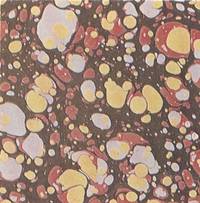
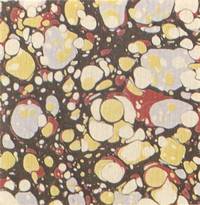
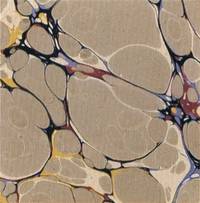
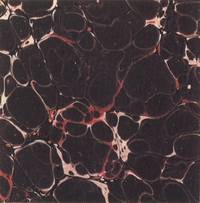
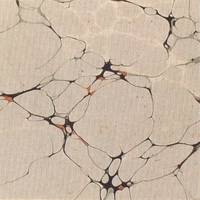
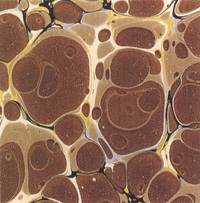
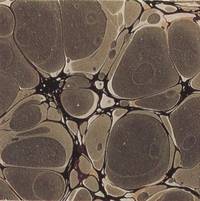
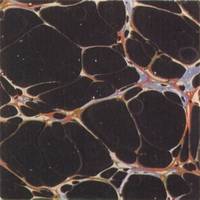
The Carrageen or Iceland moss, or lichen is one of the algae of the sea.
Chondrus Crispus grows on the cliffs of the Atlantic Ocean and the North
Sea. Carrageen smells slightly of iodine and when uncleaned tastes
offensively salty. Like all seaweeds it contains a great quantity of
mucilage and small quantities of salts of iodine and bromine. When washed
in sweetened water it becomes nearly tasteless and is without smell. On
account of the great quantity of mucilage contained in it, and of its
action as an alleviative to pulmonary complaints it has found many
applications in medicinal practice and is given to the patient boiled in
water, milk or bouillon or as gelatine in cases of coughs and diarrhoea,
being a slightly nutritious substance.
The carrageen moss or Iceland moss or weed is a lichen and consists of a
tuft of flat deeply divided cartilaginous fronds of an olive brown,
sometimes yellowish or reddish white color; the tuft is sometimes 2 to 5
inches long.
The moss is used in many ways; as size for marbling edges, for clarifying
beer, as linen-weavers starch, for finishing cloth and in the production
of iodine.
The good pure carrageen is horn-like, yellowish-white, contains a great
quantity of mucilage and gives the best size for marbling, as it complies
with all the requirements of a good size. It is homogeneous, of great
consistency, not extraordinarily viscous and cheaper than all the other
materials containing mucilage which are used for marbling, but is inferior
to gum tragacanth as far as durability is concerned, and that it must be
subjected to boiling, but this trouble is amply repaid by the beauty of
the productions.
On this size all varieties of edges can be produced, and by its diaphanous
watery mucilage it gives an excellent ground to work upon.
The preparation of carrageen size is confined to one ever recurring
manipulation, which must be repeated every eight days, if an always good
and useful size is desired; the expenses are very trifling, a few cents
for the best kind of carrageen. If bought in larger quantities the
expenses for carrageen can still be reduced. For the preparation of the
size take a new pot, which must always be used for this purpose
exclusively, pour in six quarts of water, which quantity is sufficient to
twice or three times fill the usual marbling trough, add 2-1/2 ounces of
Carrageen moss and boil until the water bubbles up several times. A longer
boiling is injurious because the mucilage becomes flaky and muddy. 2/5 of
an ounce of Carrageen to one quart of water is fully sufficient to produce a
consistent size, provided that only the best Carrageen is used.
Soft water or rain water was formerly used exclusively for preparing the
size, as by using it a greater durability was obtained.
During my researches, regarding the durability of the varieties of sizes,
I found means by which the influence of hard water on the ground can be
suspended, so that spring and pump water can now be used without any
danger.
Every kind of hard water contains mineral salts, spring water especially
containing lime in smaller or larger quantities. This can be seen, when
the soap, which is used in such water, curdles, because of the ingredients
of soap stearine palmitic or fatty acids of sodium or potassium, form a
combination with the lime, to carbonate of lime, and the potash soap is
converted into an insoluble lime soap. If we add to hard water a quantity
of sodium or potassium, the carbonate of lime is precipitated as a white
or yellowish powder, according to the quantity of iron contained in the
water, and a soft water remains.
The sun produces on a great scale in nature, what the chemist achieves on
a smaller scale by evaporation or precipitation and cooling of steam, a
water free of all mineral salts, which we call distilled water. Rain water
is the same, but the flowing water derived from a river already contains
mineral salts in greater or smaller quantities, which are brought into it by
different springs and substances. The water gained by precipitations is
considered soft. Carbonates of sodium or potassium are strong bases,
exactly the opposite of acids, and they therefore prohibit the oxidation
in plant mucilages. This chemical reaction against the formation of acids
I used for the purpose of prohibiting a deterioration of the size by
adding sodium, in which I was thoroughly successful, as it can easily be
preserved in a cool place for even eight or ten days.
Two obstacles offered themselves, which I have overcome after a tireless
and thorough investigation, first the strongly alkaline property of the
size which was generated by the added carbonate of sodium and second the
fermentation of lactic acid which occurred notwithstanding the sodium and
made the size useless.
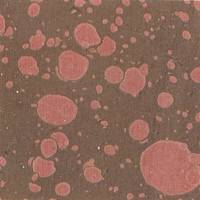
The presence of alkalies was injurious to such colors, chemically bound to
bodies, among which red is most affected. The coloring matter was removed
from the bodies and became mixed by running with the size, causing the
size to become soiled. Even the shade of the color was changed to another
which was nearer to purple, and in this way, the beauty of the color was
greatly lessened. The second obstacle is the fermentation of lactic acids
which always occurs where starch flour is in the solution, causing in
consistent sizes a gradual thinning out and even a destruction of the
size.
It was not my aim to save the size from destruction forever, as this is
impossible (laws of nature cannot be obliterated at will) but to keep it
useful for a certain period of time, and this I achieved after many
experiments by using borax.
Borax is a neutral salt of strongly antiseptic properties, prohibiting
fermentation and decomposition where neither base nor acid predominate.
Borax is produced by neutralization of boracic acid with carbonate of
sodium and can be bought at every drug-store.
This salt is sold in crystals of the size of walnuts; for our purpose it
is ground to powder and is kept for use in a closed vessel. The size is
first used without any addition of borax as it is then better adapted for
producing comb and other drawn edges, and only after some time has
elapsed, in summer 36, in winter 48 hours, are 150 grains of borax added
to the size, whereupon the size, having been repeatedly stirred to
dissolve the salt, will keep entirely good and useful for a period of
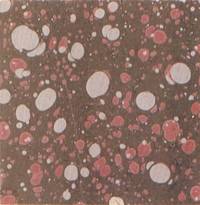
eight days without doing any harm to the colors. On a size which contains
borax, the colors expand in a much greater degree than upon unadulterated
size, without impairing the consistency of the mucilage. An unadulterated
size is therefore, better for marbled and veined edges, but if it be
desired to produce only marbled and veined edges on the size, it is
advisable to add borax to the water before boiling the carrageen moss.
As the influence of temperature is important in marbling, and the
production of beautiful edges is often jeopardized by it, it should
therefore have the most careful attention. Every glutinous mass acquires,
according to the difference of the temperature of the size and air, in
one-half to one-quarter of a minute, a film (top) which forms through
natural evaporation.
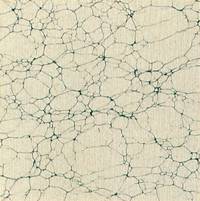
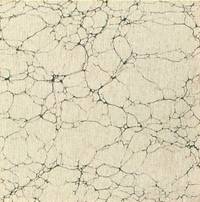
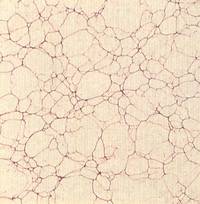
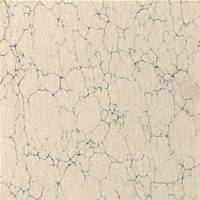
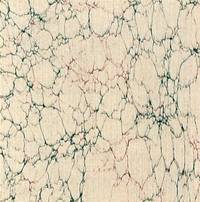
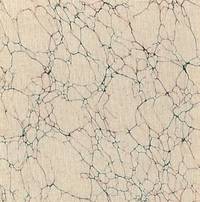
On a size which has such a film, or top, the colors do not spread out in
such circular forms as on a size on which the colors are quickly thrown
right after the film (top) has been taken off, but form star-like veined
spots which are torn by the film in all directions.
Even in the normal expansion of the drops of color, it often happens, that
the rim of the drop is jagged, the cause being that the size already
possessed a thin top, which was not yet sufficient to prevent the
expanding of the colors. If the size be left standing for a half-hour or
an hour before throwing on the color without having at first removed the
top of the size, the drop will tear a hole into this film and will sink,
even if quite a large quantity of gall had been added. This explains the
contraction and the sinking down of colors on a still warm size, inasmuch
as the top is formed by evaporation of the warm mucilage, so quickly and
so thick, that the color which had already begun to spread out is pressed
together by it and is forced to sink.
The greater the difference of temperature between the size and air, the
quicker is the top formed. It is therefore a rule, that the size should be
allowed to cool off in the same room, in which the marbling occurs,
because in this way a symmetrical degree of heat or cold of the size and
air will be gained. On such a size, the formation of the top is much
slower and thinner, so that even after one to one and a half minutes after
removal of the top of the size, the colors can be thrown on without the
occurrence of the starry formation.
I will here mention a fact to show the importance of temperature. As this
point has given me much trouble and has taken much time and labor, it was
my aim to find that mysterious effect which I was unable to overcome
despite my numerous chemical experiments, until my eyes became opened and
I saw accidentally that this obstacle was the difference of temperature of
size and air. From that time on I was able to prosecute my labors without
the slightest difficulty.
To show the excellence of my marbling colors, I used a great number of
samples, perhaps several thousand, and in order to produce them I worked
on Sunday so that I could employ my whole time to the good purpose. It was
winter; on every Saturday I ordered two pots of size to be boiled, and to
cool them off I placed them in a room, in which there was no heat. On
Sunday morning I filtered the size through a loose linen cloth; it was as clear as
crystal, it possessed the necessary consistency, and I was much pleased
with the results, which I had expected to achieve.
I commenced the preparation of the colors in a separate flat vessel, using
but little size, so as to keep the rest from being soiled, but I was
greatly astonished, when the colors in spite of the addition of gall,
which of course was carefully done by drops, first spread out and then
again were contracted, the starry formation of the colors took place,
whenever I was not quick enough after the taking off of the top to throw
on the colors.
I was dumbfounded and could give no explanation for it; the size was
sufficiently cooled off, it had been standing the proper length of time,
the mucilage was excellent but in spite of all that, these difficulties
occurred.
Thinking that I might be more successful, if I should do the marbling in
the trough where there is more surface offered to the color to spread out,
I filled the trough with size of a sufficient height and then commenced
the marbling, but immediately after the first trial I instantly recognized
that even here my experiments would have the same result. Although I threw
on the color with great alacrity, right after the top had been taken off,
the first drop spread out normally 4 inches, the second but three, the
third two, and the fifth and sixth only one inch. In this way I received
instead of an equally wide band of thrown on color, one which
tapered to a point. If I had not worked according to the system which I
shall describe in the chapter of throwing on of colors, I would have
received already with the fourth drop, a star-like formation.
Whatever I did to avoid this obstacle was worthless, it was and remained a
mystery and I was unable on that day to produce anything beautiful or
worthy of consideration. This happened several times until, by accident,
and through careful study I found the cause which was nothing but the
fact, that the size was much colder than the air in the room in which I
worked. The evaporation on the surface of the size was so great, that the
top was formed nearly as quick as on warm size and therefore a favorable
result was impossible.
Another abnormity which arises from cold temperature acting on the size is
the fig-like formation occurring during the drawing of the colors. The
cold in some way seasons the surface; this surface becomes mixed in
filtering with the liquid part of the size in numberless small particles
which although the size is well stirred up in the trough by the fingers,
are not dissolved and this hinders the drawing of the colors.
They adhere to the stylus and follow it and arrange themselves between the
color lines in a way similar to a green fig, having a broad upper and a
pointed lower end. Such an edge traversed by the comb will give an ugly
result. A difference
of temperature of the size and the air can also occur when the working
room is suddenly heated, or, when in summer time, the size is kept in a
cold cellar. To effectively obviate this difficulty it is necessary to
bring the temperatures of the air and size carefully to the same height
which is made easy by leaving the size, after boiling, in the room, where
the marbling is executed.
In winter, when the room is heated, the size should be poured into the
trough one hour before using, in summer the thing regulates itself because
it is then unnecessary to keep the size in a cool place, the addition of
borax being a sufficient protection against spoiling. But in spite of it
all, in winter-time when in drawing the colors the fig-like formation
should occur, it is advisable to return the size to the pot and to warm it
up slightly so that the seasoned particles are dissolved, until an equal
temperature is reached, whereupon after the lapse of one hour the marbling
can again be proceeded with.
Should the size be too thick the trouble can be remedied by the addition
of some warm water.
The quantity of mucilage contained in carrageen moss varies greatly, and
the consistency of the size often depends upon the quality of the moss.
The quantity which I gave as essential to the preparation of the size
means first class moss.
Should the consistency of the size be insufficient after the first trial
then from 1/2 to 1 ounce of moss should be added as it is clear that the
carrageen moss is not of prime quality. Before I speak of another variety
of size, I will repeat the main condition which should meet with the
attention of every layman and which are as follows; the size must not boil
too long, in order that it may not become flaky and muddy, it should
remain for cooling in the same room in which the marbling is carried on,
so that the temperature of of it and the air are the same; the colors
should be prepared separately on a small quantity of size so that the
whole size cannot become soiled and, lastly, the top of the size should be
taken off before the colors are thrown on, so that no film can form before
the colors cover the surface of the size.
The quicker the manipulation of marbling is executed the prettier are the
edges produced. As soon as the size is covered with color, the formation
of the film is prevented.
As the size is one of the most important parts in the process of marbling,
I recommend these main points to the special consideration of the reader.[42]
[44]