As the century draws to its close the interest in the
subject of aeronautics steadily increases. There already
exists a keen curiosity to know what the aerial machine
of the future is likely to resemble, and also to know
whether the nineteenth or the twentieth century will
claim it for its own.
In the present article the writer wishes to show what
inferences may be drawn from the laws of nature as so
far ascertained by observation and experiment, and he
wishes also to point out a way which may lead to
further progress.
The investigators of this subject are now divided into
two camps: on the one side there are men who, like
Mr. Maxim, are endeavoring to construct machines
which will carry motors and therefore be self-propelling;
on the other side there are men like Mr. A. M.
Wellington, who maintains that a motor is unnecessary
and that wind-power is sufficient.
In the New York Engineering News, of Oct. 12,
1893, Mr. Wellington, in a very interesting article entitled
“The Mechanics of Flight,” makes the following
statement: “If the conclusions so far reached in this
paper be accepted, it is obvious that they greatly
simplify the problem of artificial flight by reducing to a
minimum the demand for power, making it chiefly
necessary for acquiring the first initial velocity. All
attempts at aviation which include any motor for propulsion
are, in my judgment, on wrong lines, and predestined
to certain failure, since they not only neglect,
but destroy, the action of the forces by which true flight
may be and is attained. I will not go so far as to say
that some (soaring) birds, in the exuberance of power,
may not use the wings to accelerate, as they do to retard
motion. I think they do, but only in an abnormal way;
it is wholly unnecessary, and even destructive of all
normal flight. The fish needs a propeller, because it
has no gravity in water; the bird does not need it,
because it has gravity, and in that gravity has the best
and smoothest of all conceivable means of propulsion, if
he can make the wind lift him uphill whenever he has
slid far enough downhill. If so, man commits an absurdity
when he flies in the face of nature and assumes
a propelling force where none is needed or exists.”
Later on in this article, I wish to describe an instrument,
experiments with which can be made to answer
for us the question as to whether or not a motor is
needed; but just here further quotations should be given
to show the trend of the best thought.
Aeronautics (N.Y.) for January contains Professor
Langley’s remarkable paper entitled “The Internal
Work of the Wind.” The closing paragraph is as
follows:
“The final application of these principles to the art
of aerodromics seems, then, to be, that while it is not
likely that the perfected aerodrome (air-runner) will
ever be able to dispense altogether with the ability to
rely at intervals on some internal source of power, it
will not be indispensable that this aerodrome of the
future shall, in order to go any distance—even to circumnavigate
the globe without alighting,—need to carry
a weight of fuel which would enable it to perform this
journey under conditions analogous to those of a steamship,
but that the fuel and weight need only be such as
to enable it to take care of itself in exceptional moments
of calm.”
Mr. Octave Chanute, in his admirable chronicle entitled
“Progress in Flying-Machines,” which will soon
be published, says in one of his closing chapters: “But
it is possible to utilize a still lighter power [than that
of engines], for we have seen that the wind may be
availed of under favorable circumstances, and that it
will furnish an extraneous motor which costs nothing
and imposes no weight upon the apparatus.
“Just how much power can be thus utilized cannot
well be told in advance of experiment; but we have
calculated that under certain supposed conditions it
may be as much as some six-horse power for an aeroplane
with one thousand square feet of sustaining
surface; and we have also seen that while but few experimenters
have resorted to the wind as a motor, those
few have accomplished remarkable results.”
The indications seem to be that we must try to construct
a machine analogous to the sailing-yacht rather
than to the steamship, though perhaps the aerial machine
of the future will be, so far as power is concerned,
analogous to the yacht Sunbeam with its auxiliary
screw.
Before continuing further with this subject, I wish to
call attention to certain facts concerning the storage of
power and the flight of soaring birds. First, in regard
to the storage of power. It is well known that the construction
of a useful electric storage-battery presents a
most difficult problem. Such a storage device is needed
for use upon the surface of the earth; yet, for purposes
of aerial navigation, there is a much simpler accumulator
which can be used. Take, for example, one hundred
pounds of lead and let energy be stored in it by giving
it altitude, just as energy is stored in the weight of a
clock when it is wound.
What is known as one-horse power is the amount of
energy which must be exerted in lifting thirty-three
thousand pounds at the rate of one foot per minute, or
five hundred and fifty pounds at the rate of one foot per
second, or fifty-five pounds at the rate of ten feet per
second. To give an illustration, it may be stated that if
a man weighing one hundred and sixty-five pounds
ascends a flight of steps ten feet high in three seconds,
he exerts for the time being just one standard horsepower.
A small balloon which can lift one hundred pounds
of lead three hundred and thirty feet high in one minute
exerts one-horse power.
The lead when lifted to this height has stored within
itself thirty-three thousand foot-pounds of energy.
Now, if weights can be made to slide downhill upon
aeroplanes at very gentle grades, then the balloon becomes
a valuable motor which stores energy in its load
by giving it altitude, and the weight lifted becomes a
reservoir of the very power needed for its own transportation,
and the name of Montgolfier, the inventor of
the under-estimated balloon, takes its place as that of the
real founder of the useful art of aerial transportation.
Whether or not it is possible to transport freight by
sliding it down long and gentle inclines by means of
aeroplanes will be considered further on; just here we
must consider the soaring power of birds.
In “The Reign of Law,” by the Duke of Argyll (first
published in 1867), there is a most notable chapter in
which the flight of birds is analyzed. In a note the
author makes the following statement: “I owe to my
father [John, seventh Duke of Argyll] my knowledge of
the theory of flight, which is expounded in this chapter.
The retired life he led, and the dislike he had of the
work of literary composition, confined the knowledge
of his views within a comparatively narrow circle. But
his love of mechanical science, and his study of the
problem during many years of investigation and experiment,
made him thoroughly master of the subject.”
Every student of the subject of flight should read the
interesting work just mentioned. We may not agree
with all the conclusions which are reached, yet the
author gives most stimulating food for thought.
The following paragraphs are among the most striking,
showing, as they do, advanced ideas:
“In the first place, it is remarkable that the force
which seems so adverse—the force of gravitation
drawing down all bodies to the earth—is the very force
which is the principal one concerned in flight, and without
which flight would be impossible. It is curious how
completely this has been forgotten in almost all human
attempts to navigate the air. Birds are not lighter than
the air, but immensely heavier. If they were lighter
than the air they might float, but they could not fly.
This is the difference between a bird and a balloon.” (p.
130, Am. ed.)
“No bird is ever for an instant of time lighter than
the air in which it flies; but being, on the contrary,
always greatly heavier, it keeps possession of a force
capable of supplying momentum, and therefore capable
of overcoming any lesser force, such as the ordinary
resistance of the atmosphere, and even heavy gales of
wind. The force of gravitation, therefore, is used in
the flight of birds as one of the most essential of the
forces which are available for the accomplishment of the
end in view.” (p. 131.)
“The lightness of a bird is a limit to its velocity.
The heavier a bird is, the greater is its possible velocity
of flight—because the greater is the store of force;
or, to use the language of modern physics, the greater is
the quantity of ‘potential energy’ which, with proper
implements to act upon aerial resistance, it can always
convert into upward, or horizontal, or downward motion,
according to its own management and desires.” (p.
144.)
“When a strong current of air strikes against the
wings of a bird, the same sustaining effect is produced
as when the wing strikes against the air. Consequently
birds with very long wings have this great advantage,
that, with pre-acquired momentum, they can often for
a long time fly without flapping their wings at all.
Under these circumstances a bird is sustained very
much as a boy’s kite is sustained in the air. The string
which the boy holds, and by which he pulls the kite
downwards with a certain force, performs for the kite
the same offices which its own weight and balance and
momentum perform for the bird. The great long-winged
oceanic birds often appear to float rather than
to fly. The stronger is the gale, their flight, though less
rapid, is all the more easy, so easy indeed as to appear
buoyant; because the blasts which strike against their
wings are enough to sustain the bird with comparatively
little exertion of its own, except that of holding the
wing vanes stretched and exposed at proper angles to
the wind. And whenever the onward force previously
acquired by flapping becomes at length exhausted, and
the ceaseless, inexorable force of gravity is beginning
to overcome it, the bird again rises by a few easy and
gentle half-strokes of the wing. Very often the same
effect is produced by allowing the force of gravity to
act, and when the downward momentum has brought
the bird close to the ground or to the sea, that force is
again converted into an ascending impetus by a change
in the angle at which the wing is exposed to the wind.”
(p. 152.)
It is to be regretted that the limits of this article prevent
more extended quotations from this remarkable
book.
Now let us recall what we have seen at sea.
When one stands on the after-deck of a steamer in
crossing the ocean, he may watch the soaring gulls to
his heart’s content. When the ship struggles painfully
to force her way into the teeth of a gale, the birds make
sport for themselves—they rise and dip, thus conquering
the wind. How? Simply by tacking; in one sense,
just as a yacht tacks to windward. Neither bird nor
yacht can sail into the eye of the wind by the wind’s
power, but either can, by use of that power, reach an
objective point lying to windward.
But here the reader may say that the parallelism between
the bird and the sailing craft is not correctly
drawn, because the yacht has a keel immersed in a
dense medium which resists and prevents the making
of leeway.
Yet the soaring bird has something which, at necessary
times, holds it against the wind just as effectually
as the keel holds the yacht: that something is momentum,
which, while it lasts, holds the bird against the
wind as firmly as the kite-string holds the boy’s kite.
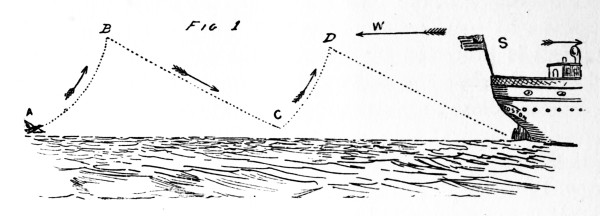
In Fig. 1, let S represent a steamship going eastward
at the rate of twenty miles per hour; W the
wind blowing westward at the rate of twenty miles per
hour; A a gull near the water’s surface, with momentum
which for the instant gives him an eastward
velocity of twenty miles per hour. While the bird’s
momentum lasts it holds him firmly against the wind.
At the point A the bird inclines his wings so that the
wind strikes them on the under side, and he is lifted and
lifted until, at the point B, his momentum is so reduced
that he must tack; then he gives to the wind the thin
edge of his wings and slides down to the point C, and
then, with velocity regained, he repeats the manœuvre.
Altitude sacrificed becomes velocity or momentum, and
momentum sacrificed becomes altitude. In this description
of the gull’s soaring to windward, the movement
is reduced to its simplest elements, and it leaves
out of account the graceful sinuosity of the bird’s airy
travels, just as the teacher of dancing leaves grace out
of account when she teaches the beginner the elements
of the steps.
What has here been said about the storage of energy
in weights, and concerning the elements of flight, is all
intended to lead up to the important subject of sliding
freight downhill upon aeroplanes. It may be asked,
How about a calm?
There is no calm for the aeroplane. Give it altitude
and it can gain velocity, and velocity gives the wind
of flight.
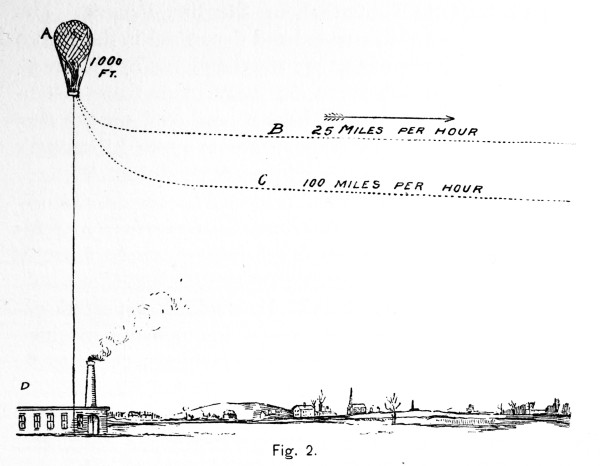
The plan for the transportation of freight is simply
this: at each shipping-point a power-house (D, Fig. 2)
may be established to operate captive balloons. These
should be cellular, and should be made to hold gas
with little waste. In its action the apparatus would be
what might be called an inverted elevator; that is, the
steam or water-motor in the power-house would not
hoist the freight, but, instead, would pull the balloon
down after it had hoisted the freight and discharged
it by means of a soaring machine, which will presently
be described.
In Fig. 2 A represents a captive balloon at a height
of one thousand feet. B and C represent the courses
which would be taken by dirigible aeroplanes or soaring
machines bearing loads of freight.
Perhaps this seems fanciful. Then let it be remembered
that the feat of safely sliding down a long and
gentle incline upon an aeroplane has already been performed
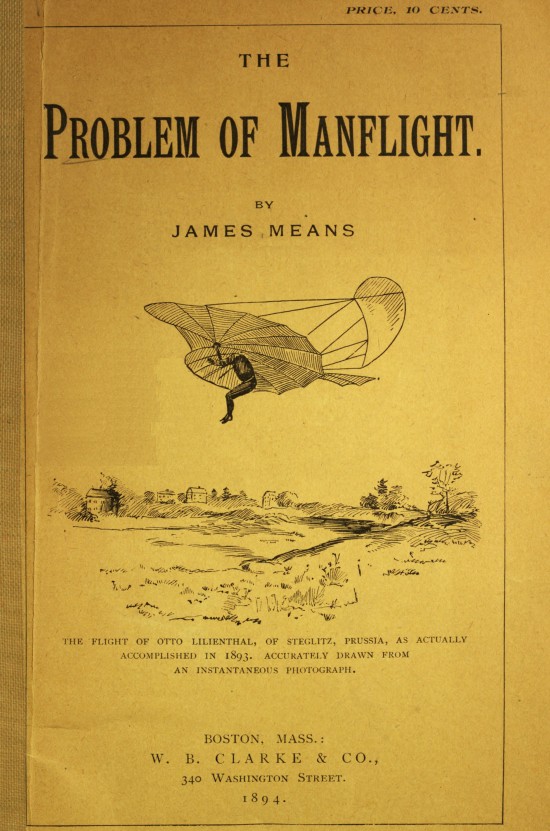
by Otto Lilienthal, of Steglitz, Prussia. His
experiments were illustrated and described in the Berlin
Illustrirte Zeitung of Oct. 7, 1893, and one of the drawings—all
of which were correctly made from instantaneous
photographs—is here reproduced on the first
page of cover. An improvement upon Lilienthal’s
device may be made by adding a pendulum.[1]
Now, in order to travel long distances in the air
it is only necessary to improve the dirigibility of the
aeroplane so that the angle of descent can be brought
to a minimum.
How can this be done? By making repeated experiments
with very simple and inexpensive mechanical
contrivances called soaring machines, these to be
dropped from a height.
In Fig. 2 it will be noticed that the course marked B
indicates a speed of twenty-five miles per hour, that
marked C a speed of one hundred miles per hour.
What speed may we expect of an improved soaring-machine?
and upon how gentle a decline can we hope
to see it maintain its initial velocity? First, note the
fact that with a dirigible aeroplane or soaring machine
the rate of speed is practically a matter of choice and
depends at the start upon the length of the first swoop.
The limit of speed will probably be decided by the
strength of the machine and the breathing requirements
of the aerial pilot. Let us consider a railroad train.
Man has safely travelled at a rate of one hundred and
twelve miles per hour. On May 11, 1893, the Empire
State express on the N.Y.C. R.R. reached that speed
in a mile run in thirty-two seconds, one mile westward
from Crittenden. So we know that man can safely
breathe when travelling at over one hundred miles per
hour; yet for this, of course, he needs the same protection
which a cab gives to the locomotive engineer.
We will answer as well as we may the second question,
Upon how gentle a decline may we hope to see an
aerial machine maintain its initial velocity? When a
railway car is at rest upon a smooth steel track having
a down grade of one and twenty-three one-hundredths
feet in every one hundred feet, it will remain at rest if
undisturbed; but let it be once started downward by
ever so slight an impulse and it will run down the track,
gaining velocity to the end of the grade. It encounters
the head resistance of the air and the friction of the
track, but an aerial machine would encounter only air-resistance;
is it not, therefore, reasonable to suppose that
a dirigible aeroplane would in a calm, maintain its initial
velocity while running upon a down grade of air of one
foot in every one hundred feet? If so, an altitude of
ten or twelve hundred feet would send a soaring machine
eighteen or twenty miles, and greater altitudes
would give longer flights, if, as may be supposed, the
rarefaction of the air can be offset by an increase of
velocity. These are surmises, but the way to learn is
to experiment with soaring machines.
It is above all things important that a soaring machine
should, when desired, automatically keep itself in a
horizontal or slightly descending course. I have this
winter begun a series of experiments with soaring
machines, and when these are finished the full details
will be reported.
In November, 1893, I launched several of these
machines from the balcony of the tower of Boston
Light, and more recently I have experimented from the
top of the cliffs at Manomet. The former place is an
ideal one for the purpose of experiment, being as it is,
one hundred and eleven feet above the sea with a straight
drop of seventy or eighty feet. Unfortunately, a gale of
wind was blowing when I visited the light, and two out
of the three machines were total failures, being badly
bent by the wind before they were launched. The third
machine righted itself before reaching the ground, but
the pendulum, which will presently be described, was
too light to do efficient work.
The experiments from the cliffs at Manomet were even
less successful, owing to the fact that the descent is not
sheer. All of the machines failed to gain sufficient
velocity to clear the cliff.
Those who wish to experiment with machines weighing
only a few pounds will probably find that a height
of seventy or eighty feet will be sufficient if the position
gives a straight drop. When it comes to experimenting
with a soaring machine as large as Lilienthal’s and carrying
a weight representing that of a man, the summit of
Mt. Willard, near the Crawford House, N.H., will be
found an excellent place.
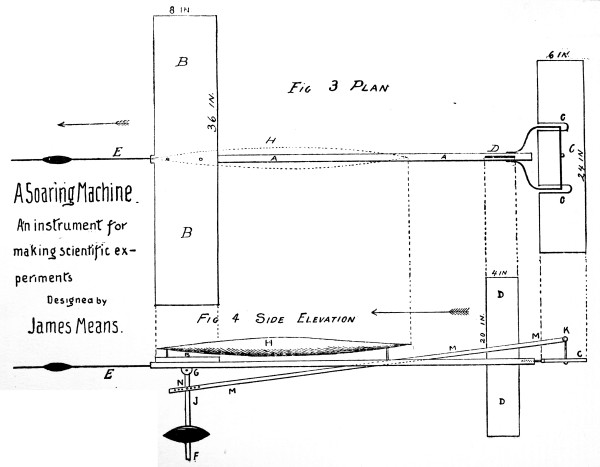
To any one who desires to take up this most fascinating
study, Figs. 3 and 4 will give a general idea as to the
construction of his first instrument for making experiments.
A represents a backbone five-eighths of an
inch square and four feet long, made of pine wood;
B, the main aeroplane, eight inches wide and three feet
long. This should be made of light tin plate, and bent
in the middle so as to form a flattened V; the angle
should be about one hundred and seventy degrees.
C represents a steering aeroplane six inches by twenty-four
inches, pivoted at cc, also made of light tin plate;
D, a vertical aeroplane four inches by twenty inches,
rigidly fixed in the wooden backbone; E, a rod of
steel wire, eighteen or twenty inches long, and carrying
an adjustable leaden weight of three ounces; K, a rod
two and one-half inches long, soldered in the centre of
and vertical to the plane C, with a pivot at the upper
end with which the rod MM is connected. This rod
should have five or six pivot-holes at its forward end N,
so that its working length may be varied for different
experiments; J, a rod pivoted at G, free to swing fore
and aft; N, a pivot where the rod MM joins the rod J;
F, a leaden weight adjustable higher or lower upon the
rod J; its proper weight is x, an unknown quantity.
Upon ascertaining by repeated experiment the right
weight for F, the right position for the adjustable
weight E, and the right length for the rod MM, the reaching
of the maximum efficiency of a system of aeroplanes
largely depends. I think that this sets forth with clearness
the problem as it stands to-day. When it is fully
solved—and it certainly seems solvable—right and left
steering will be a less difficult matter, and alighting
will be accomplished by killing the momentum when
near the ground by an abrupt upward slant of the main
aeroplanes; but this is an anticipation and a digression.
Now to return to the instrument we are considering:
this soaring machine is intended to gain velocity by a
swoop, and then automatically steer itself into a horizontal
or very slightly descending course, as indicated
by B and C in Fig. 2. It depends upon the principle
that the pendulum rod always seeks the perpendicular;
for instance, when the machine is launched pointing
steeply downward, the positions of the pendulum and
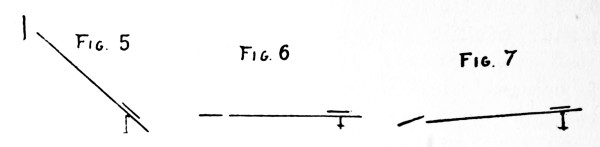
aeroplanes are as shown in Fig. 5; therefore the steering
aeroplane C will, as soon as velocity is gained, lay
a strong hold upon the wind of flight, and have a tendency
to bring the machine into a horizontal course.
Now, if the length of the rod MM is made correct by
adjustment at the pivot-holes near N, when the desired
course, a very gentle decline, is reached, both aeroplanes
will be approximately horizontal, as shown in
Fig. 6. If, however, the machine deviates either
upward or downward from its intended course, the
weight at the end of the pendulum causes the steering
aeroplane to correct the error. Fig. 7 shows the
effect of a slight upward deviation.
H represents a long and very slender air-receptacle
made of thin rubber and inflated; this should be
pointed at both ends. It may be used to keep the
machine afloat when experiments are made near the
water. I have not yet used this, but have allowed my
machines to go to pieces. The design here given calls
for aeroplanes as being more easily made than aerocurves
modelled after the wings of birds, but in all
probability the latter will eventually displace the former.
We are brought now, after this consideration of the
greatest mechanical problem of the age, to ask, What
shall be done to bring to our own century the credit
and honor of reaching the solution?
The answer is, encourage experiments with soaring
machines. Have regattas and large prizes. Appeal to
the people’s love of sport, and show what possibilities
of recreation have been suggested by the experiments
of Otto Lilienthal. Tobogganing on ice we can have
only a few weeks in the year: tobogganing on air is
possible at all seasons. When we have made our aeroplanes
or aerocurves automatic in their steering action,
flights like Lilienthal’s will be, to say the least, no
more dangerous than football and quite as interesting.
In order to encourage the designing and construction
of soaring machines, I suggest that a sum of money be
raised to be offered as a prize to the constructor of the
most successful soaring-machine, the award to be made
after a public trial of the same, to take place early in
September of the present year (1894).
I will subscribe one hundred dollars if others will
subscribe, in any sums they choose, nine hundred dollars
more, to make a purse of one thousand dollars,
provided that the publisher of some journal of wide
influence will be custodian of the fund.
One or two more thoughts in conclusion. We have
seen how the soaring bird tacks, first up, then down,
then up again, and then down again. That conveys the
idea of the perfection of rapid transit for passengers
and freight. With the captive balloon we can tack up,
with the soaring machine we can tack down. Short
tacks up, long tacks down; there is no calm for the
aeroplane; give it altitude and it can seize from the
calm the wind of flight.
Imagine a bowling alley four hundred feet long, perfectly
level, with an athlete at one end and a boy at the
other. Let the chute which returns the balls have a
drop of fifteen inches in every one hundred feet; imagine
the game to be one of rapid transit instead of ten-pins.
It is a competition between the two ends of the
alley to see which end can make the most of what
energy it has. Let the athlete exert all his strength
to propel the spheres; see them arrive at the end of the
alley after their journey of four hundred feet, with
sluggish speed; the boy lifts them to a height of five
feet to the chute, gives them a gentle push, and they are
returned to the athlete’s end, arriving, not as sluggards,
but as filled with energy. A short tack up and a long
tack down is what does it.
There you have the old and the new methods of transit
represented. The athlete represents the steam locomotive
which, with all its polish and glitter, wastes
energy. The boy represents the balloon, the lifter,
which stores energy in matter by giving it altitude.
The chute represents the free highway which through
all the centuries men have supposed to be lacking.
Aerial transit will be accomplished because the air
is a solid if you hit it hard enough.
James Means.
Transcriber’s Note:
Variations in hyphenation and compound words have been preserved.