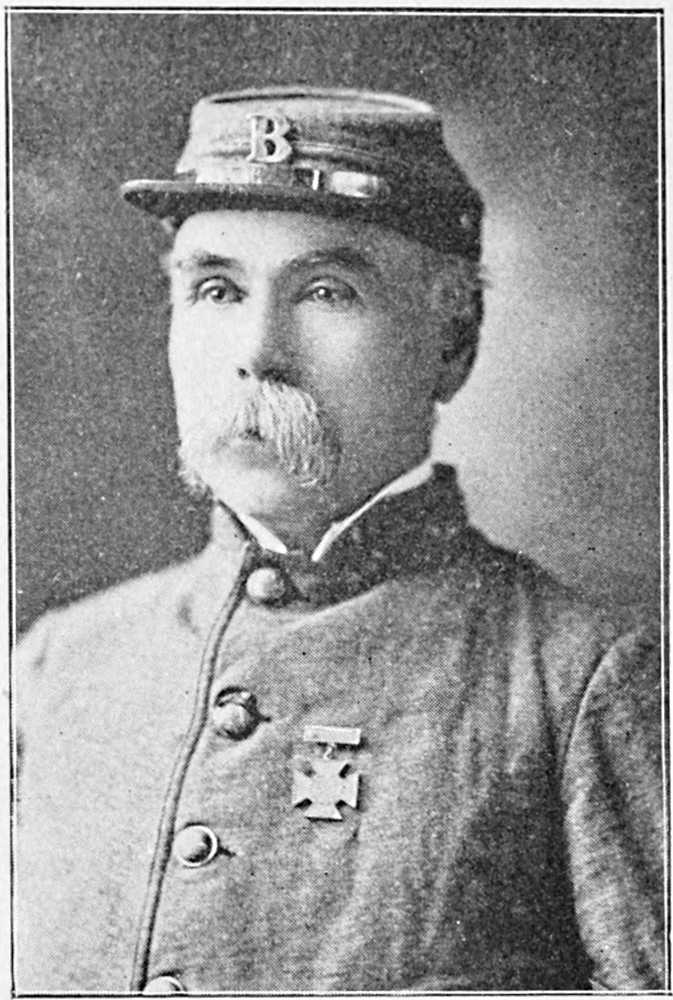
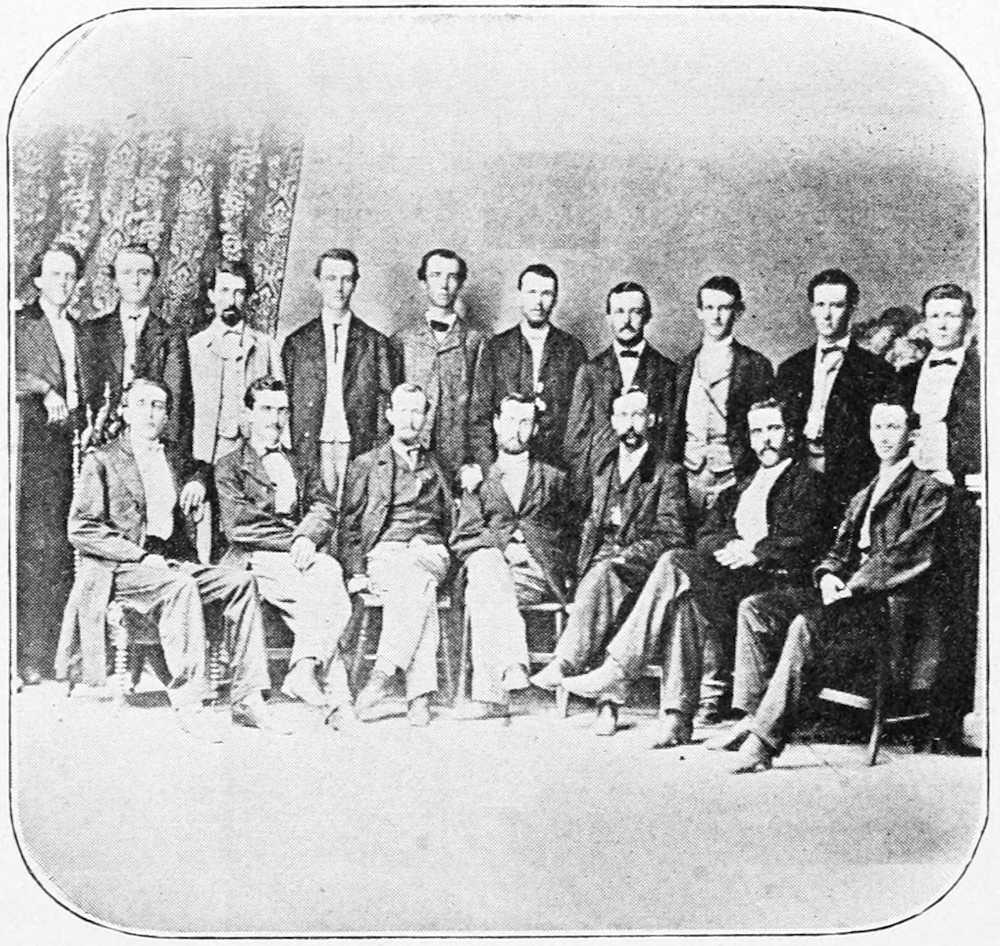
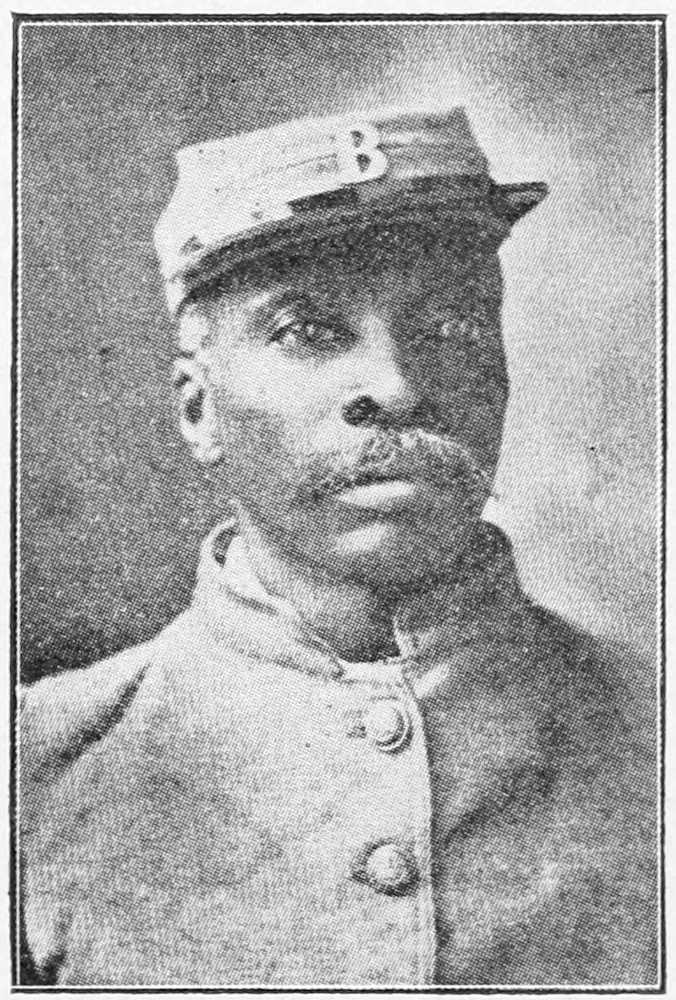
COMPANY B, CONFEDERATE VETERANS, FIRST REGIMENT
STATE GUARDS, TENNESSEE.
THE CAMPAIGN UNDER GEN. R. E. LEE; THE CAMPAIGN UNDER
GEN. STONEWALL JACKSON; BRAGG’S INVASION OF KENTUCKY;
THE CHICKAMAUGA CAMPAIGN; THE WILDERNESS
CAMPAIGN; PRISON LIFE IN THE NORTH;
THE PRIVATIONS OF A CITIZEN; THE KUKLUX
KLAN; A UNITED CITIZENSHIP;
RETROSPECTION.
BY MARCUS B. TONEY.
SECOND EDITION, REVISED AND ENLARGED.
Nashville, Tenn.; Dallas, Tex.: Publishing House of the M. E. Church, South, Smith & Lamar, Agents. 1907.
COPYRIGHT, 1905,
BY MARCUS B. TONEY.
Dedicatory.
TO THE BOYS WHO WORE THE GRAY—1861-65—AND
BATTLED FOR THEIR CONSTITUTIONAL RIGHTS,
AND REMAINED TRUE TO THE PRINCIPLES
FOR WHICH THEY FOUGHT,
AND TO THE MASONIC FRATERNITY,
THIS VOLUME IS RESPECTFULLY DEDICATED BY
THE AUTHOR.
The purpose of this volume is to follow the life of
a Confederate private as I lived it and saw it lived by
others in the great struggle of 1861-65. The causes
leading to the Civil War are history, and need not be
enumerated here, except to say that our New England
cousins first engaged in the African slave trade, but,
finding their labor not profitable in that section, sold
their slaves to the Southern people, and a few years
afterwards looked upon the institution as horrible and
the Southern people as barbarians. Their continued
onslaught against it caused the separation of the Methodist
Church, and we of the Southern branch have
been known as the Methodist Episcopal Church,
South. Many of the older people of that date predicted
that the agitation of the question would lead
to the secession of the Southern states, which they
thought would be done peaceably. In their fight
against slavery in the South the abolitionists vilified
and abused the Southern people; their school primers
were illustrated with pictures of Southern farmers with
whip in hand chastising brutally the poor blacks. The
book written by Mrs. Harriet Beecher Stowe and the
drama therefrom, “Uncle Tom’s Cabin,” were a libel
upon the Southern people; yet they served their purpose
in inflaming the minds of the people North and
prejudicing the South against the North. Mrs. Stowe
may have visited a Southern plantation in which, the
owner being absent, the overseer may have treated
some of the slaves in a cruel manner; but this would
have been an isolated case, and not representing the
Southern people as a class. Mrs. Stowe could have
said she had visited the Southern plantations and was
surprised to see such a degree of harmony as existed
between master and servant, maid and mistress, who
were living as one great family in peace and harmony;
that the master and servant had grown up boys together,
that the young servant had attended his young
master to school, and that they had played together
the games common to young people of that day; and
that the maid had attended the mistress from girlhood
to womanhood, and there existed a mutual confidence
between them; and there was the old black
mammy who had nurtured the young master and mistress
from her breasts, nursed them in her arms, and
sang them to sleep many a night with her plaintive
and sweet lullaby. Mrs. Stowe could have gone to
black mammy’s and Uncle Tom’s cabin and said she
was surprised with what neatness it was kept, and that
the table was supplied from the products of the farm
and old master’s larder, and that the black folks
dressed about as well as the whites, and that on Sunday
Uncle Tom put on broadcloth and high silk hat
and was better dressed than old master. After supper
Mrs. Stowe could have seen Uncle Tom take down
his banjo and play “Billy in the Low Grounds” and
“Arkansas Traveler,” while the young pickaninnies
danced around him. Mrs. Stowe could have gone up
to the mistress’s room of the old plantation, and there
have seen two old-fashioned wooden cradles, one on
each side of the bed, the one containing the white the
other the black baby; not that the blacks did not have
time to attend to their offspring, but they would neglect
them.
I will say here that my black mammy did not have
the affection for her children that she displayed toward
me. Next to my own mother, black mammy was
as gentle to me; but with her own children I have seen
her manifest an ungovernable temper, and twice in
my boyhood I have seen my father take her children
from her and say: “That child has been whipped
enough!”
Mrs. Stowe could have visited our jails and penitentiaries
and wondered why there were so few black
prisoners; she could have been told that the blacks were
imprisoned for murder and arson only, that for petty
crimes the master was responsible and stood between
the law and the slave; that they were not allowed to
prowl after night without a pass from the master, or
the patrol would get them; hence the slaves kept regular
hours, which was beneficial to them.
Mrs. Stowe could have said that in some Southern
states she found the whipping-post where, after being
tied and their clothing stripped to the waist, the whites
and blacks were given nine and thirty lashes for petty
crimes. Of course this was severe punishment to
both whites and blacks, but in those days it was not
considered more cruel than prison walls.
Mrs. Stowe could next have visited the asylums for
the insane, and reported them full of whites, but she
was struck with the absence of the blacks. The superintendent
could have said to her: “Why should we
have any slaves here? They have nothing to worry
them, they are not troubled about finance or the business
affairs of the world; old master supplies their
every want, looks after all their families, clothes and
feeds them, and furnishes his own physician in case
of illness.”
Surely Mrs. Stowe could have said: “In all my
travels I have never seen a race happier or better satisfied
with their lot—no thought of to-morrow, what
they shall eat, drink, or wherewithal be clothed. Why
should this condition of affairs be changed?”
Let us see. In 1860 I had two homes, both occupied
by my negroes, one in what was then Edgefield,
opposite Nashville, and the other near Lynchburg, Va.
All my family except the blacks had crossed over the
river, and I decided to move the Lynchburg family to
Edgefield, Tenn., arriving during the heated campaign
in 1860 which elected Mr. Lincoln President. Whether
or not his election was a casus belli, I do not know, but
I do know that the abolitionists of the North had so
outraged the feelings of the Southern people that we
felt we did not want any further affiliation with them.
It is true that many of our old people who had been
reared under the shadow of the Hermitage counseled
against secession, and hoped that some compromise
would be effected and the Union preserved;
but the secession of South Carolina and the firing on
Fort Sumter banished all their hopes, and war was
inevitable, especially after President Lincoln called
for 75,000 and then 300,000 troops to coerce the Southern
states, as under our idea of state rights at that
time each state should have been allowed to depart in
peace; but such was not the case. The old Volunteer
State was expected to do her duty, and the Governor’s
call met a hearty response, and the enlisting began in
April, 1861. The young ladies were as enthusiastic
as the young men; and if they found a fellow lukewarm,
he was threatened with a petticoat and was not
allowed to hang up his hat in their father’s hall.
I thought Virginia was to be the theater of war for
probably six or eight weeks. We would have a battle
in which one Southern man would whip five Yankees
with cornstalks, England would intervene, peace would
be declared, and we should return home finding all
our servants smiling at our home-coming. Vain
thought! Four years and three months I was absent,
and found no home on my return. The slaves were
all free, but morally and financially in a much worse
state than when I left them. Oh, if we could have had
a Roosevelt across the water! But all the nations stood
aloof and said, “Sick ’em, and may the heaviest guns
and largest forces win!” There was too much revenue
in war for some people to want it stopped.
I thought the first regiment enrolled would reach
the seat of war early; and as the Rock City Guards,
A, B, and C, were organized before the war, I enlisted
in Company B, in which there were one hundred and
four members, commanded by Captain James B. Craighead.
We drilled in Edgefield and on the Square from
April 15 to May 10, 1861, when we were mustered
into the regiment, containing nearly one thousand men.
Our line extended across the Square. We elected as
Colonel George Maney. We were sent for a few
days to Camp Harris (named for Governor Isham G.
Harris), on Elk River, near Estill Springs. While
many of the young men of the South were adepts in
the use of arms, we were novices as to cooking and
washing. We knew that water and flour mixed made
batter, and we knew that meat when fried made
gravy; so with this much of the art acquired, we had
fried dough, or what the boys called flapjacks. As to
the washing—well, let that pass.
Instead of leaving Camp Harris for Virginia, we
were returned to Camp Cheatham, where we were put
through camp life and two daily drills. While here
the young ladies from the Nashville Academy of Dr.
Elliott presented us with a regimental flag by Miss
Foster. Many cases of measles, and many fatal, took
place at the camp, and the doleful dirge of the dead
march often touched our hearts. We remained at
Camp Cheatham nearly six weeks, all chafing under
the delay and fearing the war would be over before
we reached Virginia. We made one trip as a regiment
to Goodlettsville, June 22, to vote Tennessee out
of the Union. Soon thereafter we folded our tents
and took the train for Nashville, where we stopped a
few hours and bivouacked on the lawn in front of the
Nashville Academy, where some three hundred young
ladies of the city gave us a luncheon and assembled to
say good-by.
I will say right here that nothing shall be written
by me that will encourage young men to go to war.
I would rather discourage, because nothing in it tends
to elevate the young. Separate men from home influences
and from the refining contact of female society,
and they degenerate very rapidly. I don’t suppose
ten per cent. of the young men who go to war
maintain their integrity. This is my opinion after
careful study. I will say further that we left Nashville
with as good a lot of boys as ever went to the
front.
After luncheon we fell in and marched to the N.
and C. depot to the tune of “The Girl I Left Behind
Me.” I was too young to be leaving a girl behind me;
so I marched out with light step and joyous heart, not
dreaming of the shock of battle, the roar of cannon,
the hissing of bullets, and the groans of the wounded
and dying. I looked to the right as we were passing
the girls, and saw tears gathering in many eyes, for
from the intuition of womanhood they knew that war
meant death and destruction, and that many of the
boys going to the front would fill soldiers’ graves;
and such was the case, for Company B lost seventy-one—only
thirty-two reached home alive. It was
only a short march to the N. and C. depot; in those
days the N. and C. was spelled with small letters; now
it is Nashville, Chattanooga, and St. Louis Railway.
In those days we had small engines, after the pattern
of the “General,” with wood-burner furnace and big
smokestack; we had ten box cars of 16,000 pounds
capacity, and our speed was some fifteen miles an
hour; now we have engines, as 251, 252, of nearly
ninety tons, and developing a speed of sixty miles an
hour with ten cars, including the coaches and Pullman
sleepers.
In those days the N. and C. Railway track was on
stringers instead of cross ties. The rails were laid
on these stringers, and were flat like bar iron, and
were nailed to the stringers, as they were too thin to
use spikes. Sometimes the nails would draw out, and
the end of a rail fly up, tearing up coaches. In those
days the box cars were small, and 16,000 pounds was
the maximum. Into these box cars we climbed and
stood as thick as pins in a pincushion. When a fellow
got tired of standing, he could climb to the top of
the car, lie flat like a lizard, and hold on to the running
board. About every fifteen miles we had to
wood and water, and in order to rest themselves many
of the boys would crawl down and spread out on the
ground. In those days the passenger coaches were
small, with little panes of glass; and in order to see
out, one would have to raise the window. The N. and
C. had one train from Atlanta to Nashville called the
“owl train”—out owl night—left Nashville at 8 A.M.,
and arrived in Atlanta next morning at eight o’clock.
We reached Knoxville in two days, and much to our
surprise went into camp just north of the railroad
track and in quite thick woods. Knoxville was a small
town in 1861, and had no houses north of the railroad.
Now she has nearly a city north of the railroad, and
she has crowded herself across the Tennessee River.
It was while here that we heard that up in Parson
Brownlow’s home was a United States flag unfurled to
the breeze, and some daring soldier said it should
not flaunt, and went up to take it down; but Miss
Brownlow, with pistol in hand, said: “The man that
touches that flag will die!” Of course the Southern
soldier did not die, as he had too much respect for the
lady to disturb her flag. Miss Brownlow afterwards
married my friend H. M. Aiken, and I had the pleasure
of meeting her a few years ago, but said to her
that I was not the soldier that went after the flag.
After a few days in Knoxville we boarded the train
and went as far as Johnson City, where again we
went into camp. Why those continuous delays I have
never been able to find out, and my readers can imagine
how we chafed under the delay, as the armies
were gathering around Manassas for battle. We
fussed and fumed for a few days, when the rush order
came to run with all speed to Manassas. We sped the
best we could; but when we reached Lynchburg, Va.,
the battle had been fought and won, many of the
wounded had been brought to Lynchburg, and this
was our first sight of the bloody war. The first
wounded man I saw was Hon. H. A. Edmondson, of
Roanoke, Va., who was a brother of John K. Edmondson,
before the war sheriff of Davidson county, Tenn.
Having nothing to do, we were held at Lynchburg,
the City of Hills; and as we bivouacked near Black
Water Creek on a steep hill, we had no use for a
pillow, but if a soldier got crossways the hill he had
a chance of rolling into the creek, far below.
While our troops had such success at Manassas,
General Garnett had been killed at Rich Mountain.
General Lee had been appointed to command the Department
of West Virginia, and hitherward we were
ordered; so we boarded the train for Millboro, Va.,
and stopped a few days at Staunton, where we met
many of General Garnett’s soldiers, and they were in
a bad plight, many of them without shoes and with
stone bruises on their heels. In a few days we were
on the train for Millboro, where we disembarked after
some eight hours’ ride. Our destination was Cheat
Mountain, some eighty miles from the railroad.
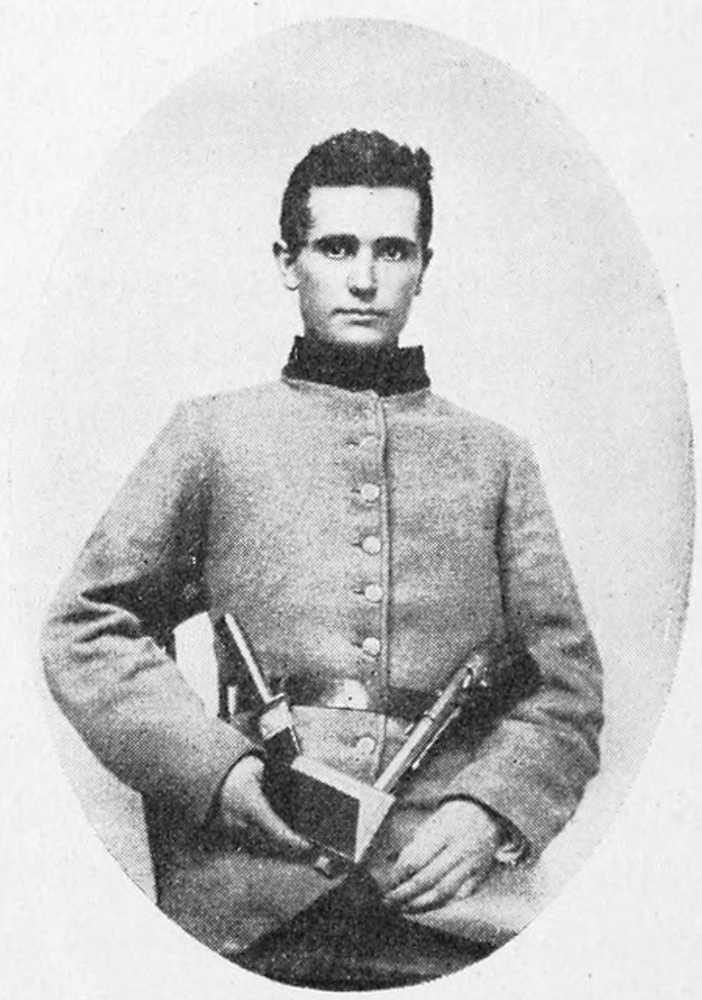
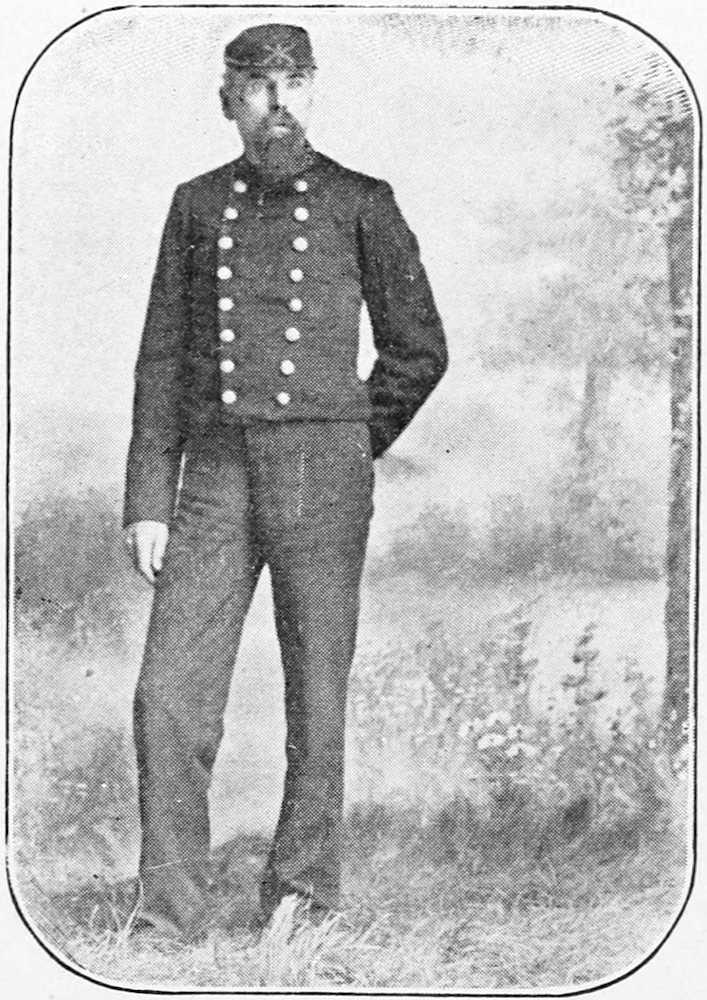
PRIVATE HENRY H. COOK.
This was our first march fully equipped. Besides
our gun, knapsack, haversack, and cartridge box,
nearly all our boys had on one side a six-shooter Colt’s
revolver buckled around them, and on the other side
was a large Damascus blade (made at a blacksmith’s
shop). This too had a scabbard and belt. The accompanying
picture of Private Henry H. Cook, of Franklin,
Tenn., will give my readers a full knowledge of
the uniform and accouterments, as Henry (now Judge
Cook) had it taken just before leaving home, and his
Company (D, Williamson Grays) was next to mine on
the march. In Henry Cook’s hand can be seen a
small book. This is the pocket edition of the New Testament,
which, when through with the picture, he
placed in his knapsack. Each one of us was given
a New Testament by our chaplain, Dr. Quintard,
and on the fly leaf was written: “God is our sun and
shield.” We thought that “thrice armed is he who is
armed with the word of truth.”
From Millboro to Warm Springs, the first day’s
march, was fifteen miles, twelve of which were a
gradual ascent. After we had trudged along some
five miles in a sweltering August sun, I tried to give
my six-shooter away, but could not find any one to
accept it, and over in the bushes I threw it. I then
unbuckled my Damascus blade, made an offer of that,
but was likewise refused, and it was thrown into the
bushes. I then tried to give away a blanket, but no
one would accept, so away it went. I thought, probably,
the war would end before the winter. By the
time we reached the summit of the mountain nearly
all the men in the regiment had disposed of their
extra appendages by leaving them in the bushes. Looking
down from the crest of the mountain, we could
see in the valley, three miles distant, the hotels and
cottages of Warm Springs. The descent to the springs
was easy compared with the struggle up. Reaching
the springs, we found a large bathing pool into which,
from an iron pipe, the apparently cool water was gushing.
Our men being thirsty, they crowded around
the springs, and the first one to get a drink yelled
out: “It is as hot as h—ll!” Of course the water
was not cool, for it was one of the warm springs,
known for its curative properties. Near by, however,
was a spring so cold that one of the men said that it
had ice in it. The next day we marched toward Valley
Mountain, and in the evening heard immense
cheering in our rear, the sound gradually coming toward
the front; and looking around, we saw the cause.
Sitting on “Traveler,” clad in fatigue cap and jacket,
and polished sword dangling from his side, with cap
in hand as we gave a rousing cheer, rode General R.
E. Lee, the pride of the Confederate army. At that
time General Lee did not wear any chin whiskers; he
had a large, dark mustache sprinkled with a little gray.
He was the very picture of a magnificent general and
horseman.
The third day from the Springs we pitched our
tents near Valley Mountain, and then came the rain
every day for some ten days, putting the roads in
very bad condition. We were nearly sixty miles from
the railroad, and a two-horse wagon could haul only
some four barrels of flour, so with an army of about
ten thousand men to feed it was a difficult problem.
Our rations consisted of two small biscuits for breakfast
and a like amount for supper. However, the
country afforded some cattle as fine as I ever saw.
They were very fat; and if we did not get enough bread
and beef, we filled up on tallow. We had also some
fine blackberries, which were as large as if they had
been cultivated. One day I denied myself the usual
two biscuits for breakfast, saved the dough, and had
blackberry pies without any sugar for dinner.
We had not been in Valley Mountain very long till
one night after nine o’clock taps the long roll sounded
and we sprang to arms and took up our march toward
Mingo Flats. The night was as black as Egyptian
darkness. We crossed ravines and waded streams;
and finally toward daylight, wet and weary, my regiment
halted near an old stable. It would accommodate
only a few, and the rest of us made a bed in the
long dewy grass and got a few hours’ sleep. The
long roll seemed to be a false alarm, and after daylight
we marched back to camp very tired and hungry,
and without seeing a bluecoat.
One day I had been on picket duty near Mingo
Flats, and on my return to camp in the evening I
passed near General Lee’s headquarters. There was
a spring near by where I knelt to drink. General Lee
hailed me: “Don’t drink out of that spring; my horse
uses it. Come and drink out of this spring near my
tent.” Out of deference to the General’s request, I
went up and drank of the spring; and as I passed him
sitting on a camp stool I threw my hand to gun, palm
extended, which is a private’s salute to a general.
General Lee returned it with the salute of the hand
from the brow, which is a general’s salute to a private.
I mention this incident to show General Lee’s regard
for the private soldier. It made no difference to him
whether a man wore the stripes of a private or the
insignia of a major general: he had respect for the
one and respect and consideration for the other.
Twenty miles from Valley Mountain was a road
running from Beverly, Va., on the Baltimore and
Ohio, to Staunton, crossing Cheat Mountain at a place
on the mountain called Cheat Pass. It was General
Lee’s object of this expedition to dislodge and destroy
the enemy at this place. The fort at the pass was garrisoned
by some three thousand men, while at Beverly
they had some eight thousand men. Besides the fortifications
on the mountain, the enemy had felled large
trees outward from the fort and trimmed off the limbs
and sharpened the many ends, so with a gun and knapsack
and without an enemy in sight it would not be an
easy matter to crawl through these obstructions to the
fort. The plan of the attack was for General Rusk
with his Arkansas brigade to cross Greenbrier River,
which flowed near the base of the mountain, and assault
the fort in front, while General Lee’s troops
should take it in the rear. September 12, 1861, at 9
A.M. was the hour, and the guns from General Rusk’s
brigade were to be the signal for our moving. We left
Valley Mountain on the morning of September 10, with
three days’ (scant) rations. We marched on the valley
road a while, and then commenced the ascent of
Cheat Mountain. Our force for this expedition consisted
of the First, Seventh, and Fourteenth Tennessee
Regiments commanded respectively by Colonels Maney,
Hatton, and Forbes, with General S. R. Anderson
as brigadier. The other troops, commanded by Generals
Donelson and Loring, moved down the valley
road near the base of the mountain. My brigade was
to get in the rear of the fortifications and cut off any reenforcements
that might come. When we reached the
crest of Cheat Mountain I saw the roughest and wildest
country that I ever beheld, and we were to traverse
it for twenty miles. The mountain was cut up into
peaks and crags. Of course we had to march in single
file, and our brigade stretched out some three
miles. General Lee and our commanders were in advance,
and any command from them was passed back
from the front man to the next in the rear, and so to
the end of the line. We received and passed back
many a time: “Keep quiet, keep well closed up.” It
was impossible to keep closed up; sometimes my leader
would be thirty feet ahead of me, while I would be
struggling over a huge bowlder or trying to crawl up
the mountain by the aid of a sapling. The night of
September 11 we bivouacked on top of the mountain
only a few miles from the enemy’s fortifications. It
was about the roughest place I ever saw, and on account
of the many rocks it was difficult to find a place
for a spread. My comrade, George Keeling, was a
delicate young man, and I carried his blanket, and
after scraping off a lot of stones I spread George’s
blanket down, and we bunked together, covering with
my blanket. Soon after we had retired it commenced
to rain, and all night we had a continuous downpour.
We not only got thoroughly wet, but our rations of
biscuits washed into dough. Next morning I had
a hard time carrying two wet blankets. We were in
line early, and took up our march, and soon formed
in line of battle on the Huttonville road, not far from
the fortifications. In marching single file to the road,
a bridle path crossed our line, and up this path, riding
a magnificent horse, came a lieutenant of the Federal
army. He appeared in a deep study, and came near
riding into our line. We commanded “Halt”; and he
looked up and said, “Did you men come from the
clouds?” He was Lieutenant Merrill, of the Engineer
Corps. He was en route to the fort, but he was our
prisoner. While we were in line on the road General
Lee received a message from General Rusk saying:
“Greenbrier River is at flood height; could not cross.”
We then received orders to return to camp, but before
we moved the enemy fired into us from ambuscade,
killing three and wounding eight of our regiment. We
had no litters with us, and had to carry the wounded
down the steep mountain side in blankets, four men
to a blanket; and a new detail had to be made very
often, as a man’s fingers would cramp, and we would
put the poor soldier down on the ground and change
hands. On reaching the valley we had to carry the
wounded some distance before we reached a farmhouse,
and there we had to leave them and return to
Valley Mountain, after falling in line several times on
report that the enemy was following us. When we
reached the camp at Valley Mountain we were in a
bad plight, very hungry, and many of us barefoot. I
was not quite barefoot, as I had one foot shod, the
other bare. This campaign developed much measles
and typhoid fever, and we filled the hotels at Warm
Springs. Miss Jane Thomas and Miss Lavinia Taylor
came out from Nashville to nurse the sick, and our
boys ever remembered their kind ministrations.
General Rosecrans had commenced to invade Virginia
via Charleston, and we received orders to meet
his advance. On September 25, 1861, we took up
our line of march for Big Sewell Mountain, some one
hundred miles distant, and we made good mileage
considering the downpour of rain we passed through.
We reached Big Sewell Mountain September 30, and
could plainly see the tents of General Rosecrans’s army.
On the night of October 3 we received orders to have
our guns cleaned and in shape for the following morning;
so we were up at half past three on the morning of
October 4, and were ready to meet the enemy, as our
information was that they were to attack us in the
early morning; but we were disappointed. Upon looking
over where the tents were the previous evening,
we saw nothing of them. General Rosecrans had fallen
back in the direction of Charleston. We started after
him, but the road was in such a bad condition that we
had to return to our camp in an old field on Big Sewell
Mountain. We moved off the mountain October 11,
and remained near by till October 22; we were then
ordered to Huntersville, Va., where we remained till
November 19, when we moved our camp on the Monterey
road. As the weather was getting quite cold,
it was decided to build winter quarters, and each mess
vied with the others as to which could build the
best cabin. But there were to be no winter quarters
for us. Before the quarters were all completed we
received orders to join General Stonewall Jackson at
Winchester, Va., about two hundred and seventy-five
miles distant; so on December 11 we took up our
march at 10 A.M., and we moved to Gatewood, ten
miles distant. We passed Warm Springs on the morning
of the 13th, and on to Harrisonburg in a few days,
and we were in the beautiful Shenandoah. On this
march we had reveille before daylight, and soon after
sunup we had eaten our breakfast, put a couple of
biscuits in our haversack for dinner, and we would
get into camp before sundown and soon have our supper.
The First Tennessee Regiment had a splendid
band, and as we marched through the beautiful towns
of Bridgewater, Newmarket, etc., we would line up,
get in step, and have “music by the band”; and the
ladies would come out of the residences, lean on the
front gates, and cheer us on our way. We reached the
quaint old German town of Strasburg on Christmas
Day; and if there was any whisky or eggnog left in
that town, I did not know it. Between Strasburg and
Winchester we saw many locomotives being hauled
along the turnpike. General Jackson had captured
them from the Baltimore and Ohio Railway at Martinsville.
On December 26 we went into camp near
Winchester on the Romney road.
CHAPTER II. Campaign Under General Stonewall Jackson.
The object of the expedition we were about to
make was to drive from Virginia General W. S. Hancock’s
forces, which had crossed the Potomac on pontoon
at Sir John’s Run and taken up their camp at
Berkeley Springs, not far from the Potomac. General
Jackson’s plan was to pass General Hancock’s
right flank, get in his rear between the army and the
Potomac, and kill or capture as many as he could.
His plans were similar to the Chancellorsville movement,
but we shall see that the weather knocked us out.
We struck tents at 8 A.M. Wednesday, January 1, 1862,
and the wind struck a good many of them, blowing
them down before we had a chance to draw the pegs.
It was a blustery day, but not very cold. We moved
eight miles to Pughtown, and bivouacked there. On
the morning of January 2 reveille sounded at five
o’clock, and before daylight we were on the move, but
made little headway, as the weather had turned intensely
cold, with a light snow. If a man was at the
head of the column he was all right; but after a few
companies had passed over, the snow became as slick
as ice, and skating would have been good if a fellow
had had skates. I bivouacked on three cedar rails and
built a rail fire on each side, and the red cedar popped
sparks on the cape of my overcoat, and when I woke
up I was afire.
Colonel Maney said that he thought we would get
in the fight the next day. We were ordered to cook
up all our rations. On the morning of the 4th we
were formed in line and each man supplied with forty
rounds of cartridges. We marched thirteen miles and
reached a point three miles from Bath, or Berkeley
Springs, and camped in the woods. It snowed heavily
that night, and was extremely cold. There was little
sleep for us. On the morning of the 5th we moved on
Bath, and as we formed a line a short distance from
the town, which was situated on a hill of considerable
proportions, the enemy’s battery opened fire upon us.
General Stonewall Jackson rode upon Old Sorrel. The
General wore a skull cap, a blouse, gray jacket, and
the reins hung loosely on Old Sorrel’s neck; he looked
more like a plow horse than a war steed. With a
twinkle in his eye General Jackson said to Colonel
Maney: “Colonel Maney, I want the Virginians [alluding
to his old regiment] to take that battery. They
have had some rations since your men.” We yelled
out: “General, we do not want any rations; let us
capture the battery.” General Jackson replied: “Colonel
Maney, move your regiment by companies to the
right.” We made a gallant charge, but when we
reached the guns only two of the enemy were in
sight. It was a feint to cover General Hancock’s retreat
across the Potomac on his pontoon, but he could
have crossed on the ice, as it was nearly twelve inches
thick.
While we moved to the capture of the battery Turner
Ashby with his black horse cavalry charged into
the town, capturing a few prisoners. It was an inspiring
sight—the black horses of Ashby charging down
the valley. We captured some rations, which we
devoured in short order. The next day (Sunday)
we moved six miles from Bath, and took up our position
opposite Hancock, Md., a beautiful little town on
the mountain side, and General Hancock had occupied
the town; but alas! the Potomac River separated us,
and it was filled with floating ice. The next day
about 9 A.M. General Jackson sent a courier across the
river. We watched the horse struggling through the
floating ice, and cheered as it brought the rider safely
to the other side. General Jackson’s order was to move
the noncombatants out of town, as he would commence
to bombard at 12 M. At the hour named our
batteries opened up a brisk fire, and General Hancock
rushed some batteries behind the Methodist church
and replied furiously. At intervals the dueling was
kept up into the night, and it was a grand sight to see
the solid shot moving as balls of fire. During a part
of the cannonading in the daytime I stood near
General Jackson and Colonel Robert Hatton, of the
Seventh Tennessee. Both sat upon their horses as
immovable as statues. It was said of General Jackson
that he was a predestinarian. The Presbyterian
boys might have explained the meaning of the term.
It was also said that he was a fatalist. This was a
term that I think would have been difficult for any of
the boys to explain. I believe, however, that General
Stonewall Jackson had that faith in God that lifted him
above the field of battle, and, living or dying, he was
the Lord’s; then why should he be disturbed by the
roar of cannon or the bursting of shells? That night a
detail was to be made to picket the Potomac, with
orders not to light any fires, because the enemy might
fire at us from the opposite bank. Sergeant J. W.
Carter, of Company B, commenced near the head of the
roster for a detail, and many of the boys were sick.
Captain Patterson said: “I cannot excuse any more;
the sick must go to Dr. Buist and get an excuse.”
The roll call was continued, and I was a long way
down the list; yet my name was reached, and I answered:
“Am always on hand.” Captain Patterson
turned to Sergeant Carter and said: “How many roll
calls has Toney missed since leaving Big Sewell Mountain?”
He replied: “Seventeen.” Captain Patterson
said: “To-night’s duty on picket wipes them all out.”
Gallant, chivalrous John S. Patterson, how I loved
him! He was as gentle and modest as a woman. How
my heart ached when I buried him the following October
at Perryville, Ky.! In regard to the missing of
roll call, I never regarded it as a dereliction of duty,
therefore on the march from Sewell Mountain frequently
when roll was called I was off foraging. In
army parlance foraging was to send one of the mess
out to buy something to eat, provided he had the money;
if he did not have the money, he was to take the
food. It was related of two comrades who lived near
Murfreesboro, and who were sent out by their mess
with one dollar to purchase supplies, that they returned
with five cents’ worth of bread and ninety-five cents’
worth of whisky, and those that liked to imbibe complained
of the purchase of so much bread. In regard to
the roll call, it is a breach of duty to neglect when any
service is to be performed, because it puts an extra and
more frequent burden on your comrades. If I had
used the army parlance term, and said “stood picket”
that night, I should have missed it. I ran picket for
four hours around and around a big tree; I had to do it
to keep from freezing. I did not have anything to eat
the previous day but some raw corn taken from artillery
horses, and chewed the sprigs of sassafras bushes.
Captain F. S. Harris told me that he had traveled in
that section much since the war, and that a citizen of
Hancock, Md., had told him that on the two nights we
were there the mercury was sixteen degrees below
zero; and I do not doubt it. Many of our boys would
get in that stupor which precedes death by freezing,
and we would have to seize them roughly and keep
them moving to prevent freezing. When relieved by
another detail, about 3 A.M., I crawled in under an oilcloth
and blanket and got a few hours’ sleep. A fall of
snow during the latter part of the night served to keep
us warm. Looking from under the blankets next
morning, we could see many of the boys sleeping beneath
their snowy couches, which resembled graves.
A detail of Company C was made to guard the medical
stores of General Jackson, which were in wagons. The
boys found in one of the wagons a cask of brandy.
Getting hold of an auger, they notified the boys in camp
to have some kettles ready. Going under the wagon,
they bored through the body into the cask, and thus
filled their vessels. General Jackson relieved them
from duty, but did not punish them. I presume he
thought they were excusable under the weather conditions.
We were sorely disappointed in not being
able to engage the enemy. It is true that we forced
them across the river, but they could return in a few
days after we left. General Jackson succeeded in destroying
a dam in the Potomac River which fed the
Chesapeake and Ohio Canal, and cut off canal communication
between Cumberland, Md., and Washington,
D. C.
On the morning of January 8 reveille sounded very
early, and we moved slowly to Bath over a very slick,
icy pike. The next morning there was another early
reveille; and we made only seven miles that day, on
account of the condition of the pike and blockade of
wagons. On the 10th we were at Munger’s Cross
Roads, awaiting orders. Sunday, January 12, Dr.
Quintard preached for us.
On my way to the post-office tent to mail a letter
home General S. R. Anderson hailed me, and asked
where I was going. I told him, whereupon he reached
into his pocket and gave me a letter, saying earnestly:
“I wish I could put myself into that letter and be sent
home.”
On the morning of January 13 we had early
reveille, struck tents, and moved down to headquarters.
Many of our boys were on the sick list, and
when we went into Winchester we had only twenty-five
able-bodied men left in Company B; and other
companies were depleted in proportion. Out of my
mess of ten only two of us were ready for duty, and
we had the extra blankets of eight men. The town
of Winchester was overrun with soldiers, and all the
houses were filled to overflowing.
On January 14 we started to Romney, Va., which
was situated on the bank of the beautiful south branch
of the Potomac. On account of the ice and sleet we
made only a few miles. On the 13th we crossed
Capon River, and made only six miles during the
day. The 16th of January we made only nine miles,
and camped within eleven miles of Romney, which
the enemy evacuated, leaving a lot of stores. On January
17 we were within four miles, and bivouacked
with the regiments of Colonels Hatton and Forbes.
Our cavalry occupied Romney, and we had nothing
to do except to go into the town and get some rations.
We were given a lot of provisions and drew quantities
of butter, the first and only rations of butter I had
seen issued during the war.
I went into Romney and took dinner at a private
house on January 21. I met Major Yost, our quartermaster,
and he said that he had heard that our brigade
was going to Hanging Rock, some three miles from
Romney, to winter quarters. Was the First Tennessee
Regiment to go into winter quarters? We shall see.
Friday, January 24, we moved through Romney and
reached Hanging Rock, and camped one-quarter of a
mile from the Potomac. On January 25 Colonel Hatton’s
regiment moved down to Suspension Bridge, and
camped near there. Some of our boys who went
back to Winchester began coming into camp on January
26. They thought we would have a fight, and
did not wish to miss it. On January 29 I crossed the
south branch of the Potomac in a skiff, and saw the
residence of Colonel Washington, who was on General
Lee’s staff, and who was killed in the Cheat
Mountain campaign. Colonel Washington was the
nearest living relative of General George Washington.
We got too near the enemy’s pickets, and had to wait
until nightfall to recross the river. At eleven o’clock
at night our camp was aroused by the beating of the
long roll, and we tumbled out of our tents in quick
order. After the regiment was formed, my company
was detailed to picket the ford. January 31 closed a
very disagreeable week; it had snowed or hailed during
the entire week.
On February 2 we had orders to be ready to move
at a moment’s notice, as the enemy were preparing
to cut us off. On the 4th we moved from camp
as rapidly as the weather and the wagons would permit.
On February 5 we camped one mile from Capon
Bridge, and on February 7 we reached our old camp
at Winchester, which we left on January 1.
On February 8 I went into Winchester to get some
clothing from Nashville brought by Lieutenant Van
Leer. I learned that my package was lost at Manassas
Junction. On February 9 we heard of the fall of Fort
Henry, and this made us fear the loss of Fort Donelson.
On the 14th of February my mess built a chimney
to our tent, and we were prepared for the six-inch
snow that fell on the 15th.
Colonel Maney had been to Richmond, and had the
regiment detached from the Virginia army, and ordered
returned to Tennessee to support Fort Donelson.
The fatalities of the campaign were three soldiers
frozen to death.
CHAPTER III. The Return to Tennessee.
On February 19 we left Winchester, arriving at
Lynchburg on the 21st. We went into camp near that
city, not knowing when we could proceed farther, on
account of many washouts between Lynchburg and
Bristol. Sunday, February 23, was a dark day for
us, for we heard of the evacuation of Nashville. On
February 27 I note from my diary: “Feel a great
anxiety for the loved ones at home, but cannot get
any message.” On March 5 the railroad expected to
resume traffic, but there were no trains moving. On
the morning of March 6 we started for Bristol, the left
wing of the regiment ahead of us. We reached Knoxville
March 10, and remained there until the 12th, when
Colonel Maney arrived and said that the right wing
would proceed to Bridgeport, Ala., to guard the
bridge there. We were held in Knoxville until Sunday,
February 23, when we loaded baggage and proceeded
to Chattanooga, where we went into camp one
mile from the city. Fred Berry, of Company B, died
February 21, at 6 P.M., and on the morning of February
22 Company B escorted his remains to the
depot for forwarding to Nashville.
We had guard, drill duty, and dress parades daily at
Chattanooga. On March 28 we heard of General
Stonewall Jackson’s victory at Kernstown. We left
Chattanooga April 1 at 8 A.M., and arrived at Bridgeport
at 11 A.M. and went into camp near the railroad
bridge; in the meantime the left wing of the regiment
went forward to Corinth. On April 4 we were
ordered to cook three days’ rations and to leave at
9 A.M. We boarded the train, and the order was countermanded
and we disembarked and remained in
camp till April 5, when ten box cars were backed up
and we loaded at 7 A.M. These cars had been hauling
bulk bacon, and they were very greasy. We
slipped and slid, but could not slide very far, as we
were packed in closely. We reached Stevenson at
8 A.M., and remained until 1:30 P.M., April 6, when
the news reached us of the battle of Shiloh and the
death of General Albert Sidney Johnston. We did
not reach Corinth until Monday, April 7, at 10 A.M.
We saw a large number of Federal prisoners, and the
old Tishomingo Hotel was turned into a hospital and
filled with our wounded. General Johnston’s body
had arrived, and was in a residence near by. On the
morning of April 8 we were ordered to cook five days’
rations, and on the morning of the 9th we left Corinth
for the Shiloh battlefield. We met a large number
of wagons and all kinds of conveyances carrying
our wounded to Corinth. We marched over a dirt
road, through swamps and water, reaching General
Breckinridge at sundown, and slept in some vacant
tents that were left by the enemy. Reveille sounded
early on the morning of April 10, and we were soon
under arms. We marched by General Breckinridge’s
headquarters, were drawn up in line of battle all day,
and went back to our quarters in the evening. On Friday,
April 11, it rained nearly all day, and we stayed in
our tents until 5 P.M., when we were called out in the
rain, but soon afterwards ordered back.
In camp all day April 12, and General Forrest’s
cavalry scouts said that there was no sign of the Federals
south of where Shiloh was fought, but that they
were under cover of the gunboats at Pittsburg Landing.
We left Shiloh Sunday, April 13, on our way to
Corinth, and after getting lost in the woods several
times reached the camp at twelve o’clock Monday,
April 14, where we found the left wing of the regiment,
and listened to the boys, who gave us a graphic
picture of the fight and regretted that we were not
with them. We expected the next battle at Corinth,
and for days and weeks worked on the fortifications
and drank water the color of soapsuds. One had no
trouble to get water at Corinth: all you had to do was
to shovel out a few spadefuls of earth, and the hole
would soon fill with water.
After completing out breastworks, we were expecting
an attack daily by General Grant’s forces, but were
disappointed. Our pickets were very close together,
and for days there was the rattle of musketry and
hissing of bullets. The foliage was very thick, and
frequently men would be shot from guns held by soldiers
up in the trees. Often we had to crawl out
to relieve the pickets. One of our men was shot as
he poked his head around a tree.
On May 30 the enemy moved as if to flank us, and
on May 31 we were en route to Tupelo, Miss. The
Federal cavalry dashed around our army near Guntown
and fired a train of ammunition, and the explosions
could be heard for some distance. We reached
Tupelo June 10, and went into camp there. We had
the regular routine drill twice a day and dress parade
in the evening. We remained in Tupelo until July 20;
and learning that the Federals were withdrawing their
troops from Corinth toward Nashville, it was decided
by our authorities to invade Kentucky.
CHAPTER IV. Bragg’s Invasion of Kentucky.
Our army was moved to Chattanooga, Tenn., by
two routes: one by Selma, the other by Mobile. We
went by train to Mobile, and there embarked on the
side-wheel steamer Dixie, and were three days and
nights reaching Montgomery, Ala., where we camped
a few days, and then went by train to Atlanta, thence
to Chattanooga. While we were on the Alabama River
near Selma our boat landed for wood, and the boys
spied a watermelon patch, and in a few moments the
entire crop, green or ripe, had disappeared. In the
meantime the owner boarded the boat, and Colonel
Fields ordered every man to pay the farmer for the
melons, and that he should be paid for either green or
ripe; and the farmer got his pay. We remained for
some days in Chattanooga, and on August 19 we were
ferried across the Tennessee River on a steamboat,
and took up our line of march across Walden’s Ridge
toward Pikeville and Sparta. When we reached
Sparta, it was in ashes. Instead of proceeding to
Nashville, we went to Gainesboro, where we crossed
the Cumberland River, and were on the dark and
bloody ground of Kentucky. While the march over
Walden’s Ridge and the Cumberland Mountains was a
little fatiguing, they did not compare with Cheat and
other Virginia mountains. Yet we were to encounter
a march which was full of suffering, but of a variety
which we were to experience for the first time. After
we left Tomkinsville, Ky., we met a drought then prevailing
in Kentucky. The dirt roads were very dusty,
and sometimes we could not see ten feet ahead. The
perspiration caused clots of mud to form in our eyebrows,
hair, whiskers, and mustaches. At nightfall
when we went into camp, very little water could be
found, and frequently we drank out of the ponds in
the barn lots. How many wiggletails and tadpoles
I have drunk will never be known. When we reached
Glasgow, Ky., General Buell was moving his army
out of Nashville. There was a garrison (well fortified)
of four thousand Federals at Woodsonville, a
village of three or four houses opposite Munfordville,
Ky. It was General Bragg’s intention to capture this
fort before General Buell could reach there. A short
time previous to this, General Chalmers, of Mississippi,
had stormed this fort and lost twelve hundred
men. Our object was to get in the rear of these
fortifications. We left Glasgow at sunrise with one
day’s rations, and marched rapidly in an easterly direction.
We had some twelve thousand men and
twenty-seven pieces of artillery. In marching along
the road shaded by a lot of black-jack trees, we saw
a countryman with a barrel of water on a sled drawn
by a horse. We did not ask for a drink, but in a
few moments the barrel was empty. The poor fellow
said: “I have not a drop of water at home, and
my wife and children are suffering.” We felt sorry
for him, but such is war.
We crossed Green River before midnight, and about
3 A.M. we were in Munfordville, and formed a line
of battle in the suburbs of the town. Company B was
in the cemetery, and I slept until sunup with a grave
for a pillow. Our artillery had been placed in position
not far from the Louisville and Nashville bridge, and
considerably higher than the Federal fort in Woodsonville.
They saw that we were in a position to shell
them out, and at sunrise up went the white flag, and
we marched four thousand prisoners out and paroled
them. The advance of General Buell’s army had
reached Bowling Green; and in a few days many of
his men reached our line without guns and surrendered,
saying that they were tired of the war. After
the capture we expected General Bragg to do one of
two things: either move on General Buell at Cave
City, or go to Louisville. The authorities in Louisville
expected the latter, and every able-bodied man in
Louisville was called on to throw up fortifications; but
General Bragg did neither of the two things expected,
but he marched us eight miles toward Louisville and
went into camp at Bacon Creek. Next day he marched
us back to Munfordville, and then again to Bacon
Creek; and one night we camped at the side of the old
stage road near Bacon Creek, and it poured rain all
night. The little sleep I got was on three rails. From
Bacon Creek the army moved through Elizabethtown,
Hodgenville, New Haven, and went into camp at
Bardstown, Ky., twenty-seven miles from Louisville.
While here Governor Hawes was inaugurated Governor
of the State. General Bragg issued a proclamation
calling on the Kentuckians to flock to his standard,
and we fired a few volleys from the artillery, which
broke all the glass in the windows of the courthouse.
While we were in camp at Bardstown, General Buell’s
army marched to Louisville; and while we were playing
soldier and living high in the blue grass country
and losing men, General Buell was recruiting his
army, and was soon ready for an advance; and we
moved to Springfield, Perryville, Danville, and from
Danville to Harrodsburg, and then back to Perryville—a
forty-mile march to no purpose, for we did not
need the exercise. On the night of October 7, 1862,
we marched again through Harrodsburg and bivouacked
after midnight in the suburbs of the little
town of Perryville. When we formed in line and
stacked guns for a few hours’ rest, Company B was
again in a cemetery. Was it a bad omen that twice
recently our company slept in a cemetery?
Next morning Company B moved out of the cemetery
to cook one day’s rations. Seven of my mess
dipped their hands in the same skillet. They were all
stalwart men of brawny arm. That evening when the
smoke of battle lifted, five of my comrades were dead,
and the sixth wounded. Early in the morning we
formed in line and moved slowly through the town on
the Harrodsburg pike, which we left some half mile
beyond Perryville, and turned to the left, crossing
Chaplin Creek, or river, as it is called there. About
three o’clock we were in line of battle on our extreme
right and in a valley of the Chaplin River two and
one-half miles from Perryville. There had been some
skirmishing before our arrival, and about three o’clock
the musketry and cannonading became quite brisk, the
shells falling around us as we climbed the fence in
battle line. We crossed Chaplin River, ascended a
high bluff, and when we reached the height Colonel
Savage’s Sixteenth Regiment was hotly engaged with
the enemy. To uncover from Colonel Savage we had
to move by the right flank, and while executing this
move some of our men were wounded. When we
uncovered, we again moved by the left flank. General
Leonidas Polk rode up and asked: “What regiment
is this?” The answer was: “The First Tennessee.”
He then said: “Capture that battery.”
It was Parsons’s eight-gun battery, supported by an
Ohio brigade (Germans) in command of General Jackson,
of Hopkinsville, Ky. They would not stand the
charge, but ran in great disorder, leaving the battery
in our possession. In attempting to rally them General
Jackson was killed, and his body fell in our line
of march. On a hill in the rear of where we captured
the Parsons battery was Bush’s Indiana battery,
supported by the First and Twenty-first Wisconsin
Regiments and another brigade of infantry. In
charging this battery we uncovered our left flank, and
were subjected to an enfilade fire from the enemy,
which played havoc with our men. We had ten men
killed in attempting to carry the colors. We lost some
two hundred and fifty men in a short time. Our boys
got so close to the battery that the smoke covered
them. Young Tom Lanier was killed some thirty feet
from the battery, not by the artillery, because we were
under the crest of the hill, and the pieces could not be
depressed so as to reach us, but the men supporting the
battery were the ones that caused most of our trouble.
Colonel Patterson was slightly wounded in the wrist,
but he tied a handkerchief around it and continued to
give orders until a grapeshot hit his mustache, going
through his head, killing him instantly. Captain Pilcher
was quartermaster, but he was in the thickest of
the fray, receiving a wound that came near causing
his death. Company B lost fourteen killed and thirteen
wounded. Among the dead was a young man
named Robert S. Hamilton. He came to Nashville in
1860, and was a proof reader in the Southern Methodist
Publishing House. We were very intimate
friends. He was an ardent secessionist, while his
family in Kentucky were divided on the war question.
In the charge Robert was shot through the forehead,
and fell not far from where Tom Lanier and gallant
Jack Goodbar fell. Colonel Fields detailed me to stay
and take care of the wounded and do the best I could to
bury the dead. After getting all the wounded off, with
the aid of reflected rays from a burning barn which
the exploding shells fired, I penned the following:
Battlefield, Perryville, Ky., October 8, 1862.
Mrs. W. C. Hamilton, Lexington, Ky.: Robert was killed
in gallant charge this evening. Will take care of remains
until you arrive.
Marcus B. Toney.
Mrs. Hamilton was Robert’s sister-in-law, and I
wrote to her because his brother, W. C. Hamilton, was
a Union man, and Robert never wrote a line to him;
but all his correspondence was with his sister-in-law,
and he always read her letters to me; therefore I wrote
to the sister-in-law rather than to the brother. The
blue and the gray mingled together all that night removing
the wounded. I approached one of the blue
and asked him if he would deliver the note to Mrs.
Hamilton, and he promised me that he would.
It was a sad sight that night as I gazed upon the
upturned, ghastly faces of our dead; and the cries of
the wounded for “water!” “water!” “water!” were
heartrending. Before daylight all of our wounded
had been brought from the field. A farmer named
Goodnight, who lived some half mile from the battlefield,
had deserted his house on the eve of battle, and
we turned it into a hospital. On the second floor in
the small room were the following: J. H. Woldridge,
B. P. Steele, T. H. Maney, M. B. Pilcher, Mac Campbell,
Lute Irwin, J. H. Wheless, and Lieutenant Hammond.
These eight men were my patients. Four of
them were on the bedsteads and four on the floor.
Comrade Woldridge lost both of his eyes, and Captain
Pilcher, Captain Steele, Lieutenant Maney, Mac
Campbell, and Lute Irwin were all badly wounded.
For three nights I did not close my eyes in sleep.
About the third day after the battle a messenger
came upstairs and said that a lady was in waiting to
see me. This was my first meeting with Mrs. Hamilton.
Mr. Hamilton was with her, and they brought
a hearse and casket, and a carryall with blankets and
provisions for our wounded. I accompanied Mr. and
Mrs. Hamilton to the battlefield. I had buried twenty-seven
of the Rock City Guards in a gully near by
where they fell, and not far from the battery that
they charged so gallantly. I did not have any implement
to bury with, but with the use of a breastplate
taken from the body of a dead Federal I invented a
tool which formed a kind of scoop, and with this covered
our boys with the dirt. I had buried Robert
Hamilton at the head of the twenty-seven, and when
we reached the spot I raked the dirt from his face and
said: “Mrs. Hamilton, this is Robert.” “Is it possible,”
she replied, “that these are Robert’s remains?”
I said: “I will soon satisfy you.” Reaching down, I
caught one of his hands, and, brushing the dirt away,
I said to her: “Do you see this?” She replied: “I am
satisfied.” Robert was a very studious young man,
and in his deep studies I have seen him bite his nails
to the quick, and frequently brought blood. When
Mrs. Hamilton saw the hand and the condition of the
finger nails, she knew they were Robert’s. When the
body was taken to the hospital and prepared for
burial, there was no doubt in her mind. We expected
to bury W. J. Whitthorne, of the Maury Grays, Columbia,
Tenn., but the body could not be found. He
was shot through the neck, and Dr. Buist said that
he would not live until we got him to the hospital.
Billy Whitthorne, as we all called him, is living this
year (1907). He raised a company at Columbia during
the Spanish-American War, and went to the Philippines.
He was elected major in the regular army,
and later lieutenant colonel of the First Tennessee
National Guards, and I am a private in Company B,
Confederate Veterans, of the Guards. We had a similar
case in John Sullivan, the gallant Irishman of the
Martin Guards. His wife accompanied him to the
war, and was very valuable in assisting the boys in
needlework and cooking. Sullivan had a hole in his
forehead that exposed a part of the brain. Mrs. Sullivan
was at the hospital when the fight was going on,
and when we reported after midnight that John was
left on the field for dead she said that she would go out
and look after him. She was a stalwart woman, and
brought John on her shoulder to the hospital. About
two weeks after that Dr. Buist bought a carryall, placed
Captain Woldridge, Mr. and Mrs. Sullivan in it, and
started them through the country to Pulaski. Near
Lebanon, Ky., they were captured and sent to prison.
A few weeks after the battle Captain Steele was removed
to Harrodsburg, and Mrs. C. H. Rochester
came after Captain Pilcher, T. H. Maney, S. B. Shearon,
and myself, and we were taken to her residence,
near Danville, Ky., where we were royally entertained.
Colonel Rochester and the elder sons were in the Confederate
army, leaving Mrs. Rochester and the young
ladies and boys at home. The families of Captain Merritt
S. Pilcher, George S. Kinney, and Henry C. Hensley
had refugeed from Nashville to Louisville.
Dr. Buist sent a message to Captain M. S. Pilcher
saying that if Matt were sent to prison he could not
possibly survive. Captain Merritt Pilcher had a stanch
friend in Louisville, Mr. John B. Smith, who stood very
close to General Jere Boyle, commanding that district,
and through his influence we received the following:
Headquarters Department of Kentucky. Louisville, October 13, 1862.
The bearers hereof, Capt. Matthew B. Pilcher and Private
Marcus B. Toney, will be allowed to report at these headquarters
without a guard so soon as the wound of Captain
Pilcher’s will permit.
Jere Boyle, General.
We remained at Mrs. Rochester’s nearly four
months, and almost despaired of getting Captain
Pilcher to Louisville. In addition to his great suffering
from the wound, a spell of pneumonia gave him a
setback. Soon after convalescing he came near
bleeding to death, and I mounted a horse and went
rapidly to Harrodsburg for Dr. Buist. Finally he
recovered so far as to allow us to proceed, and he
desired to go via Lexington to visit for a few days his
relatives, Mr. Hiram Shaw and family; so we proceeded
to Nicholasville by stage, and thence to Lexington
by rail. Mr. Shaw was a stanch Union man, and
was a dealer in gents’ furnishing goods. A few weeks
before we reached there, General Morgan’s men raided
his store, exchanging their old headgear for his fine
hats, and some of the boys wore off his best tiles;
therefore I felt a hesitancy in going to the Shaw
domicile. But we were treated in a most generous
manner. A few nights after reaching there, we paid
a visit to another family of the Shaws, where there
were three young ladies. General J. Q. A. Gilmore
was a visitor, and he asked one of the ladies who
we were. She informed him, and the next day we
received orders to report to General Gilmore’s headquarters.
Accordingly we did so, and he said in a
very brusque manner: “I wish to know by whose authority
you Rebels are free.” I replied, “By authority
of General Jere Boyle, of Louisville”; and I placed our
parole in his hands. He glanced over it, and said:
“This is not General Boyle’s district; I am commanding
here, and my name is General J. Q. A. Gilmore.
You will get ready to go to Louisville with a guard
this evening. Report here at three o’clock.” I said:
“All right, General Gilmore. Your order will be
obeyed, but we were ignorant of the infringement on
your territory.” At 3 P.M. we were there, and so was
the guard with his gun. We wired Captain Pilcher
that we would be in about 8 P.M., under guard. When
we reached Frankfort, we found that the railroad
bridge had been burned, and we had to cross on the
ferry. In going through the city many ladies turned
out and escorted us to the ferry. When we reached
Louisville, Captain Meritt S. Pilcher was pacing up
and down the platform, and appeared more disturbed
than we were. After greeting us, he said: “Boys, I
have been trying all day to see General Boyle; but one
of his children has smallpox, and he is at home. The
officer of the day says he cannot release you, and you
will have to go to prison at Tenth and Broadway.” We
could do nothing but obey. When we reached the pen
we found there four hundred prisoners who had been
captured at Fort Donelson. It was quite a filthy place,
without sleeping accommodations. We had some salt
pork, stale bread, and coffee without sugar. As we
had been living for four months on the fat of the
blue grass region, we could not eat the prison diet, and
were glad to hear our names called at the wicket about
nine o’clock next morning, where we signed parole to
the National Hotel; and when we reached the sidewalk
we found Captain Pilcher and Mr. John B. Smith with
a carriage, and they escorted us to the hotel. We
remained at the hotel for six weeks, waiting for the
flag-of-truce boat for exchange. After the first week’s
confinement at the hotel, General Boyle extended our
parole so as to allow us to attend church on Sunday,
and we first went to Sunday school and then went to
services at 11 A.M. Sometimes we went to hear the
big gun of the Baptist Church, Dr. Lorimer, and then
to hear Dr. Craik, of the Episcopal Church, and at 3
P.M. we attended vespers at the Cathedral, and at
night church again. One Sunday morning in Dr.
Lorimer’s church Captain Pilcher was asked to teach
the Bible class, and in the class were some of the boys
in blue. The Southern people in Louisville treated us
with much consideration and kindness, and the people
who differed with us on the war issue treated us with
respect. In the churches and on the streets we were
frequently detained for hand shakes. We wore Confederate
uniforms, but General Boyle requested that
the brass buttons be covered. The Southern ladies
visited us frequently at the hotel, and we returned
many of the visits at their residences on Sunday. I
recall these names among those who were exceedingly
kind to us: Miss Fanny Jack, Miss Kate Quarrier,
Miss Mary Miller, Miss Anna Caldwell, Miss Nina
Smith (who after the war married Mr. H. Victor Newcomb,
and later Mr. Ten Broeck). Captain Pilcher
and myself did not indulge in wine, so we were much
amused to receive from Miss Fanny Jack a bottle of
wine with this toast: “Believe that in every drop of
wine contained in this bottle is mingled a heartfelt
prayer for the ultimate success of the Southern Confederacy.”
Evidently it was the toast which Miss
Fanny wished us to enjoy rather than the wine. So
the time drew near when we were to journey to Fortress
Monroe for exchange at City Point, and Mr. John
B. Smith called on General Boyle for an order to proceed
without a guard. General Boyle said that he
could favor us only as far as Cincinnati, and gave us
the following:
Headquarters Department of Kentucky, Louisville, April 9, 1863.
General Ambrose E. Burnside, Cincinnati, Ohio: Capt. M.
B. Pilcher and Private M. B. Toney have been on parole
from these headquarters since the battle of Perryville, and
have faithfully kept it. I will therefore be obliged if you
will allow them to proceed to Fortress Monroe without a
guard.
Jere Boyle, General Commanding Department of Kentucky.
Armed with this document and escorted by a large
number of friends, we proceeded to board the steamer
General Lytle. One of the ladies had purchased for
me a large silk handkerchief. It was plain on
one side, but on the other was the bonnie blue flag,
and as the General Lytle steamed out from the levee
Captain Pilcher and I were on the hurricane roof, and
I unfurled my banner to the breeze, and received the
cheers from the assembled multitude on the levee. We
stopped at the Burnett House. Next morning at
breakfast I said to Captain Pilcher: “There is General
Burnside.” He was sitting two tables from us. General
Burnside at that time was trying Mr. Vallandigham
for treason, and banished him through our lines
at Shelbyville. I agreed with Captain Pilcher not to
report as yet to General Burnside, because there were
some friends in Covington whom we wished to meet,
and did meet in our room at the hotel; and they got
into such a boisterous discussion that one of them said:
“Hush, boys; walls have ears.” When we reported to
General Burnside with General Boyle’s letter, I noticed
his brows contract, and he looked at us fiercely and said
in a very abrupt manner: “This is a very peculiar request
from General Boyle, and one entirely contrary to
War Department orders. I cannot grant it.” I replied:
“Very well, General; do with us as you will, as
we are subject to your orders.” He thought a while
and said: “I will do this: place you in charge of a lieutenant
with his side arms. That will be better than going
with a soldier and gun over you. Report here at
six o’clock to take the train for Baltimore.” We reported
at six o’clock, and met the lieutenant, whom we
found to be a nice gentleman and very companionable.
We arrived in Baltimore and registered at the Barnum
Hotel. After supper we retired early.
The next morning the lieutenant, after a visit to the
provost marshal’s office, said that the flag-of-truce boat
would not sail for several days, and that they had
smallpox very bad there. He said that we would remain
in Baltimore. After breakfast he said: “Boys,
I am going to see the city. I know you do not wish
to go with me, and I don’t care to stay with you. If
you are arrested, tell them to wait till I come with the
papers.” Captain Pilcher and I had a letter to Noah
Walker, wholesale clothier, and we started to his
store, but had gone only two squares when we
were arrested as spies. We told the detective that we
were under orders for exchange, and under the control
of a lieutenant of the United States Army, and if he
did not believe our story he could accompany us to
the hotel, which he did, and waited several hours.
When our lieutenant returned he was very angry, and
cursed and abused the detective severely. Next morning
I said: “Lieutenant, we want to call at Noah
Walker’s. We wish you would go with us to the door,
where you can leave us and resume your sight-seeing.”
So he did. We presented our letter to Mr. Walker,
and had a pleasant chat with him. He inquired especially
after his friends in Louisville. When we
arose to take our leave, he said: “Boys, wait a while.
Come this way.” We followed him up four flights
of stairs. Coming to the fifth story, he unlocked a
door and we entered another narrow flight of stairs;
he locked the door on the inside, and put the key in his
pocket. When we reached the head of the stairs, we
found a large stock of Confederate uniforms. He
said: “Mum is the word. I am running the blockade
with these; and if it were known by the Federal authorities,
my entire stock would be confiscated.” We
told him that our lips would be sealed. He said: “I
did not bring you up here for a display, but I want
each of you boys to select an overcoat.” We did so,
and he sent them to the hotel. The next morning we
took passage on the Bay Line steamer for Fortress
Monroe. Just after leaving Baltimore I saw a commotion
in the ladies’ cabin, and heard the word “Rebel”
uttered excitedly. Presently the captain came to us
and said: “Boys, I have an old lady aboard who is a
regular virago. She says that she does not want to
travel on the same boat with Rebels. I told her that
you had paid first-class fare and were entitled to cabin-fare
passage, but that doesn’t quiet her. She is creating
a terrible furor with the passengers. I wish you
would go down on the deck. I will send your supper
to you, the best we have on the table, and after supper
I will bring you up to your stateroom.”
The captain was a Baltimorean and a Southern sympathizer,
and to accommodate him we went below till
after the old lady retired, when we turned in to dream
of the flag of truce. I hope the old lady has reached
that land where there are no Rebels to molest or make
her afraid.
When we awoke next morning, we were landed near
the truce boat. The lieutenant took a receipt for us
from the exchange officer, and bade us good-by as if
he were sad in leaving us. I am sure we were sorry
to give him up, as he was exceedingly kind to us. I
wish that I had kept his name. We asked to be remembered
to General Burnside for sending such a
clever officer with us. Soon after boarding the truce
boat we were sailing up the historic James River. The
next morning we landed at City Point, where a like
number of Federals were to be exchanged for us.
Many cases of smallpox were on the lower deck of
our truce boat, and it was difficult to get help to unload.
Finally the captain said that if they were not
removed he would take them back, so I volunteered
to carry the patients off.
The exchange officer said that he would have to
separate the officers and privates and send us to our
commands in that manner. He was rather brusque in
his order, which irritated us. Captain Pilcher said:
“We have been in the hands of the enemy for six
months. They not only would not allow us to be separated,
but treated us in a more respectful manner
than you have.” This appeared to put a quietus on
the officer, and he allowed us to proceed together,
which we did as far as Knoxville, when we separated
on account of the following accident. About fifteen
miles west of Bristol, at three o’clock in the morning,
Captain Pilcher and I, with a lot of soldiers, were in
the rear car, when a brake beam broke and fell in
front of our trucks, throwing our car from the track
and dragging it until it reached a sharp curve, when
the coupling pin broke and we turned over several
times, landing near the edge of the Watauga River.
Captain Pilcher said that the first voice that he heard
from the groans of the wounded was my query: “Captain,
are you hurt?” He replied: “Yes; take these
wounded men off of me.”
As soon as we went over the lamps were smashed
and it was very dark; but with the assistance of a
comrade who had only a few bruises like mine, we
succeeded in getting Captain Pilcher out through the
end window. His arm was broken, but on arrival at
Knoxville he said that he thought he would be able to
travel in a week. As I had been absent for six months,
I was anxious to get back.
CHAPTER V. The Chickamauga Campaign.
I found the regiment on Duck River in the suburbs
of Shelbyville. I was glad to be with the boys again.
I did not rest long, for the regiment was busy making
detail for digging fortifications, and I worked with
pick and shovel.
The two great evils attending war are drinking and
gambling. In 1863 the drink habit was much lessened
in our army because the drinks were scarce and hard
to get. Mr. McGrew kept a drug store on the Square
in Shelbyville, and by some means it was ascertained
that he had some whisky in the cellar, and one night
some soldiers got into it and took the whole stock,
consisting of about half a barrel; and the old mill,
situated on the river, was frequently robbed of its
stock; and in unloading commissaries at the depot the
soldiers would make mistakes and throw meat under
the depot, and at nightfall bring it to camp. The
mania for gambling continued unabated. I have seen
men gamble all night, and do a good deal of nodding
on duty the next day. If they did not have money
to gamble with, chips for fun would not be much
amusement. I have seen on the march, just previous
to an engagement, bits of pasteboard (decks of cards)
scattered along so that the line of march could almost
be designated by the scraps, and also by letters torn
and scattered, because a soldier did not wish to be
found dead on the field of battle with a deck of cards
in his pocket, or prying eyes to read his letters from
home; but I have never yet seen a soldier discard the
little pocket Testament that his mother gave him when
she sent him forth with her prayers.
THE GAMBLING MANIA.
Shelbyville was a place that could easily be flanked,
and Rosecrans was preparing for it. General Bragg
hoped to give him battle on better vantage ground (for
us), and selected Tullahoma, and we prepared to retire
to that point in good order if General Rosecrans would
permit. Our army commenced to retire—the infantry
in front, General Wheeler’s cavalry in the rear. Early
in the morning I was on detail to proceed to the Nashville
and Chattanooga depot and load up the commissaries.
We worked with a will, and thought that we
could get everything in the cars, but some of the detail
early in the day found a lot of whisky and commenced
to get drunk. About 3 P.M. we heard a tremendous
boom, boom of our artillery on the Square, followed by
a fusillade of musketry. The Federal cavalry had approached
from the front and flank. Lieutenant J. R.
McDaniel’s (or Wiggins’s) battery made a gallant resistance,
and succeeded in getting his pieces away with
the loss of only two. He lost a number of his men,
however, the enemy riding into their midst and cutting
them with sabers. In attempting to cross the Duck
River bridge General Wheeler found it blockaded and
swam his horse above it, having the belt of his sword
shot away. As soon as I saw the stampede on the
Square I ran into the depot, got some clothing and
shoes out of a box there, and went down under the depot
(which had open sides) and bivouacked in the dust
with hogs and fleas, which were very industrious. After
leaving the Square the Federal cavalry rode rapidly
toward the depot. One of my detail, seeing them coming,
staggered out near the Barksdale House and said
that he could whip the whole Yankee army. It was
only a short while before he was in Nashville, and
later in Fort Delaware. I remained with my companions
(hogs and fleas, and the dust made a pretty soft
bed) till late in the night, and then by the aid of the
stars kept in the direction of Tullahoma, where I found
the First Tennessee next day in a beautiful black-jack
grove about one mile north of the town. In front of
the grove an avenue some two hundred feet wide by
one mile long had been cut out, and it was a splendid
place to fight in the open; but the enemy chose not
to fight there. General Rosecrans’s scouts came within
three miles of us, our cavalry interposed, and
General Starnes was mortally wounded. After a few
days’ rest we commenced to retire toward Chattanooga,
and it was a rough march over the mountains,
but nothing in comparison with Cheat Mountain.
Soon after reaching Chattanooga we were put to work
building two immense forts—one near where the
Stanton House is now, and the other near the city
cemetery, in the eastern suburbs of the city. The only
service that the forts rendered was to conceal in the
dirt bacon stolen from the cars, and hid there until a
favorable time to remove it to the camp.
We had been in Chattanooga but a short time when
General Rosecrans occupied Walden’s Ridge and Raccoon
Mountain. About the 15th of August our army
moved out of Chattanooga. I did not know where
we were going. In fact, it is not the business of a
private soldier to know anything except to obey orders.
I did not like to leave the forts, upon which
we had expended so much labor, knowing that in a
short while the enemy would be enjoying the fruits
of our labor. We moved down the valley via Rossville,
McLemore’s Cove, and next day reached Lafayette,
Ga., where we camped; the following day we
faced again toward Chattanooga, and early next morning
crossed Chickamauga River at Lee and Gordon’s
Mill, and were soon drawn up in battle array, when
General Maney stood up in his stirrups and made a
speech to the Tennessee boys, saying: “We shall soon
have an opportunity of striking again for our homes
and firesides, and to acquit ourselves like men worthy
of the old Volunteer State.” Soon the firing of pickets
gave notice that the battle of Chickamauga was about
to begin. As the First Tennessee Regiment moved in
line through a thick wood of oak and pine, we struck
the enemy, who were posted on a hill much higher than
our position. General Cheatham rode in advance of
the line with hat in hand, and said: “Come on, boys.”
The First Tennessee charged gallantly amidst a terrible
cannonade. A shell exploded in front of us,
a piece striking the shoulder of Lieutenant W. H.
Webster, of the Maury Grays, from which he soon bled
to death. The enemy’s infantry retired before our
charge, and we reached the crest of a ridge and were
ordered to “lie down.” While in this position Ensign
Joe Campbell raised up on his arm, and a shot from the
enemy pierced his brain, and he was instantly killed.
The next day we were moved to the right of our
army and held in reserve nearly the entire day,
and late in the evening participated in the final
charge over the enemy’s breastworks of black-jack
logs, and Chickamauga was ours, and the enemy
on retreat to Chattanooga, ten miles distant. General
Bragg has been much criticised because he did not
capture General Rosecrans’s army before it was safely
ensconced in the forts upon which we had expended
so much labor. If General Bragg had had a
sufficient force of fresh cavalry, the feat might have
been accomplished; but it must be borne in mind that
we had been on the move some five days and nights,
with little sleep and short rations, and when the final
charge came, about dusk of September 20, our men
fell down with the dead and wounded of the enemy
inside of their former breastworks, and went to sleep.
The next day we moved leisurely up to the crest of
Missionary Ridge, and we lost comrade Eugene Topp,
of Pulaski, who was shot by the enemy’s pickets as
we ascended the ridge. From Missionary Ridge we
could see the enemy scattered around Chattanooga,
and occupying our former forts. We moved down
from the ridge and went into camp at the base, facing
toward Chattanooga. We also occupied Lookout
Mountain, and had one piece of artillery on the Point;
but we could not throw a shell to the Nashville and
Chattanooga depot, which was about three miles distant
on an air line. Soon afterwards General Grant
succeeded General Rosecrans, and he had a lot of
guns casemated at Moccasin Point. We could look
down on his batteries, but we could not depress our
pieces so as to give him any trouble. A party of us
would gather at the Point to attract his fire, and as
soon as we would see the smoke, down we would fall,
and the shell would whiz over us. Our pickets were
on the bench of the mountain below the Craven House,
and extended up Lookout Creek. A shell from Moccasin
Point killed and wounded five of our men at one
time. I was on picket duty one day on Lookout Creek,
a Federal on the other side. You could take a run and
jump across. I asked him how rations were. He replied
that they were living on ox-tail soup. He said
that Joe Wheeler had burned a number of bridges on
the Nashville and Chattanooga Railroad between
Nashville and Chattanooga, and that General Grant
had started a train of some two hundred wagons with
commissary stores, and when they reached Sequatchie
Valley Joe Wheeler again appeared on the scene and
burned the entire train; the army was therefore greatly
reduced in supplies.
In 1863 Chattanooga was not much of a town;
Market was the principal street, and that was filled
with a lot of insignificant shanties, hence General
Grant’s army camped over the hills upon which beautiful
residences are now located. His tents extended
from the fort near the Stanton House to the river,
while General Hooker’s tents covered Raccoon Mountain.
From the top of Lookout Mountain it was a
grand scene at night—the bright camp fires of this
large army; and at nine o’clock the many bugles
would blow taps, after the music from many bands had
floated upward. On the night of November 24, 1863,
we moved off of Lookout Mountain and took our
position on Missionary Ridge. Part of the First Tennessee
Regiment line was directly over the tunnel.
From this position we could clearly see the entire line
of General Grant’s army moving out of Chattanooga
in order of battle, extending nearly to Rossville. Just
below where the Cincinnati Southern bridge is now located
could be seen General Sherman’s army crossing
on steamboats, and it did not take him a great while to
get a battery on one bench of Missionary Ridge,
which was separated from our ridge by Chickamauga
River and the Western and Atlantic Railway. I think
his position was some higher than ours, and his battery
annoyed us without doing much damage. General
Grant’s lines were drawing nearer and nearer to us,
and our batteries were belching forth, and we could
now and then see his men scatter from an exploding
shell. Nearer and nearer they came until we could
see the glittering steel and the flash of the officers’
swords in the sunlight; nearer and nearer they came
until lost to sight at the base of Missionary Ridge.
We then took our position on the crest of the ridge,
lying down and waiting for them to come in sight.
We did not have a great while to wait. Soon we saw
the long line of bluecoats advancing. We were hugging
the ridge so closely that nothing but our heads
peered over; so it was not so easy to see us, as the
bushes were quite thick and many large trees were on
the ridge. When the bluecoats got within a hundred
feet of us the firing commenced, and they continued
to advance, when Colonel Fields said: “Fire, boys, and
charge.” Down the ridge we went, the enemy keeping
ahead of us. We got so close to them that Colonel
Fields hit a Federal on the head with a rock, and
comrade John Branch grabbed at the colors, tearing
out a piece, but the sergeant got away with them. We
followed them to the base of the ridge, where the
town of Sherman Heights is now located. Finding
them in the trenches which we had once made, we returned
to the top of the ridge. It was now dusk, and
we were still in line of battle and drawing some rations,
when the order came to get away as quietly and
quickly as possible. General Grant had pierced our
center, and all were in danger of capture. We were
the worst disappointed soldiers in the army. We
thought our whole line as far as Rossville had made
the same movement that we had, and would next move
on General Grant and capture his army before it
could get to our forts in Chattanooga.
Well, we did not stand upon the order of our going,
but went out as rapidly as possible, every fellow taking
care of himself. We went down many ridges and
crossed the Chickamauga River on the Western and
Atlantic Railroad bridge, and afterwards burned it.
The next day we came to Chickamauga Station. There
was a large pile of bacon there ready to be burned
rather than to have it fall into the hands of the enemy.
I fixed my bayonet and selected a small side of bacon
through which I ran the bayonet, and was marching
along thinking what a nice fry I would have for
supper, when the enemy’s guns opened on us, and the
skirmish known as Cat Creek took place. I had to
unfix my bayonet in order to load my gun, and the
bacon was lost. Samuel Seay was wounded in this
skirmish, and he begged the boys not to leave him in
the hands of the enemy. We told him we would not,
unless they got us; so four of us shouldered him, and
we would now and then call for relief. We marched
till late in the night before reaching Ringgold; and
although Sam Seay was a light man, he got heavier
and heavier. At one place where we crossed the
Chickamauga River I got very wet, and it was a
cold night—November 26. I rolled up my trousers as
high as I could, and four of us started across with
Sam, and I got into a hole up to my waist. Finally
we reached a clump of black-jacks near Ringgold,
through which ran a country road well filled with
autumn leaves, and here we made our bed. We were
sleeping soundly at sunrise when General Walker
came riding swiftly, saying: “Get up, men; the Yankees
will soon be here, and they will cut your throats.”
We moved out promptly, and as we had been the rear
guard the day previous, we were now in the advance.
We had just reached the narrow place where the
stream is spanned by the railroad bridge, when the battle
of Ringgold was fought; but we continued our
retrograde movement until Dalton was reached, and,
after camping there for some days and the weather
getting cold, we built winter quarters south of Dalton.
CHAPTER VI. Carry Me Back to Old Virginia.
While in winter quarters at Dalton, I received a
letter from a relative saying that she would soon get
married, and had woven on her loom a nice suit of
jeans, and that I must come a week before in order
that the tailor could make them. Therefore, I made
application for a furlough, and it is not necessary to
say here that I obtained a genuine one. My destination
was New Canton, Va., on the James River, sixty-six
miles above Richmond. I went via Columbia, S.
C., and reached there without any money. As I had
not drawn any clothing from the Confederate States
Army for a year, I was entitled to so much money in
lieu thereof. I think the paymaster paid me ninety-five
dollars.
When I reached Petersburg I heard that the canal
was frozen over between Richmond and New Canton.
I therefore went from Petersburg to Farmville by
rail, and thence horseback to New Canton, hiring a
negro boy to bring the horses back. Near Buckingham
Courthouse we had to ford Slate River. Some
men were working in the low ground, and I asked
them where to ford, as the river was much swollen.
They pointed to a place above, and in my horse went;
down the stream he swam, and I clinging to him.
I got pretty wet, and as it was a very cold day I rode
to the town for some stimulants. I got a small glass
of whisky, for which I paid one dollar, and I said to
the landlord: “It tastes like turpentine.” He said: “It
is pine top.” They cut off the boughs of pine and put
them into the whisky to color it and give it strength;
hence the name “pine top.”
I reached my destination without further mishap,
and after a few days’ rest carried my piece of jeans
to the tailor at Columbia, and soon I was the best-dressed
soldier in Buckingham county. The night
for the wedding soon drew near, and what a repast
there was! There were on the table all shapes of cake—tea,
pound, and sponge cake—but all made of the
same ingredients, flour and sorghum. The coffee
was made of parched rye mixed with parched sweet
potato peelings and sweetened with sorghum. I do
not believe that, in January, 1864, there were more
than five bags of coffee in Virginia. Nearly all the
saddles had been denuded of their skirts to make soles
for shoes; and when leather gave out, the farmers
blocked out of hickory or dogwood solid soles and
heels. By taking sheepskin for uppers, it gave a solid
hair shoe, comfortable to ride in but very hard on
the feet and limbs in walking. The negro boy who
made my fire woke me up by his tramping upstairs
like a horse. Of course in riding horseback the wooden
shoes were all right.
I was struck with the absence of young men. They
were all at the front with General Lee. The old men
and women, the girls and boys, were at home, and the
slaves watched over and guarded those girls as if they
were their own children. I never heard of an improper
act committed anywhere in old Virginia by
any of the old-time slaves. All honor to these old
trusted servants, many of whom sleep in the sacred
dust of old Virginia! Another thing that impressed
me was the devotion of the Southern women to the
boys in the army. They would deny themselves any
little delicacy they could get to send to the boys,
and they would knit and knit, sew and sew from
morning till night; and as scarce as was cotton goods
in 1864. I have seen the women tear up their skirts
and make them into bandages and send them to our
wounded in hospitals in Richmond.
The nearest male relatives I had at that time were
three first cousins. Two of them had been discharged,
and the other was in Company C, commanded
by Captain Miller, and was in the Forty-fourth
Virginia Regiment, General Jones’s Brigade,
Major General Edward Johnson’s Division, Army of
Northern Virginia; and I desired to be with my cousin
in the final struggle. Being a native of Virginia,
I was entitled to the transfer under certain conditions:
(1) The assent of the captain commanding my company;
(2) the consent of the captain of the company
to which I wished to be transferred; (3) the approval
of the Congressman representing my Congressional
district.
Armed with these papers, I went to Richmond, and
stopped at the Spottswood Hotel, next day sending my
card to Hon. Thomas S. Bocock. He invited me to
his room, where I explained to him my mission by
saying that I wished to come back to my native state
and try to defend her against the encroachments of
General Grant. Mr. Bocock slapped me on the
shoulder and said: “Young man, we would like to
have twenty thousand like you. We will go down
to the War Department, where we will meet Mr.
Judah P. Benjamin, and will arrange the transfer
for you.” We had a pleasant meeting with Mr.
Benjamin, who was then acting in place of Mr. Seddon.
Mr. Benjamin said that I would have to return
to the First Tennessee Regiment at Dalton, and the
transfer would reach me through the headquarters of
General Joseph E. Johnston. On my return to Dalton
the regiment was in comfortable winter quarters, but
I was very lonely. Only nine of my old Company B
were present, and I was glad a few days after to get
notice to report to Captain Miller, Company C, Forty-fourth
Virginia Regiment, on the Rapidan, near Vedersville,
Va. As General Lee’s army was in winter
quarters, and I did not have to report in any specified
time, I returned to Virginia, and went over much the
same ground as previously, except that I made the
trip by canal. I visited also while in Lynchburg. I
arrived at Orange Courthouse March 14, 1864, on
quite a cold night. I went to the only hotel near the
depot, which was covered with what are called in Virginia
“clapboards.” I was surprised on awaking next
morning to find about three inches of snow on my
coverlet. It had drifted in under the boards. I found
outside about ten inches of snow, through which I
had to trudge ten miles before I found my regiment.
CHAPTER VII. On the Rapidan.
I found my boys in a comfortable cabin, ten of them
in my cousin’s mess. He was just recovering from a
wound received at Brandy Station. I was considered
as a guest of the boys, and did not have to go through
any drudgery such as cooking or washing. However,
I was detailed on picket duty, and occasionally on drill.
When I reached the camp, rations consisted of middling
meat and corn bread, without any salt. We got
along without salt as long as the middling meat lasted,
as that was quite salty. By the 1st of May the meat
was gone, and many of the soldiers were without shoes.
When the meat gave out, we resorted to wild onions,
which were plentiful in that section, but hard to dig
up. They were about the size of shallots, but very deep
rooted, and we had to dig pretty deep with bayonets
to get them up. These onions and corn bread without
salt did very well toward appeasing the appetite of
hungry soldiers.
One day I was on picket duty near the Rapidan
River, which is a stream a little larger than Duck River
in Tennessee; just opposite us were the Yankee pickets.
One of them yelled out: “Hello, Johnny Reb!
how is sassafras tea to-day?” I told him the tea was
all right, but we had no sugar. I asked him how he
was fixed for tobacco, and he said, “Very short”; so
we arranged on the morrow to get on duty again. I
was to bring a plug of tobacco, and he a shot pouch of
coffee. The Federals had their coffee parched, ground,
and sugar mixed with it; so on the morrow we made
the exchange, and I don’t think that I ever enjoyed
coffee as much as I did that, having been months without
a taste of pure coffee. After making the exchange,
he asked me how I would like to have a New York
Herald. He said that it was not contraband, for it
was several weeks old. I told him that I would like
very much to see it, as we did not get any papers now,
and the ones received were printed on the reverse side
of wall paper and were so flimsy that they would not
stand the mails. So he tied the Herald to a stick and
threw it across to me. When I opened it up, I read as
follows: “The Rebel Capital Must be Captured at All
Hazards; General Grant Has Been Appointed to the
Task.” He afterwards uttered what became a memorable
saying: “I will fight it out on this line if it
takes all summer.”
CHAPTER VIII. The Wilderness Campaign.
On May 1 General Lee issued the following order:
“Send all extra baggage to the rear”; and on May 3 he
issued an order to cook three days’ rations. The
first order was easily complied with. Back to Buckingham
county was sent my Baltimore coat. The
second order was also easily complied with. Three
days’ rations were three pones of corn bread without
any sifting and minus salt. We did not have any sifters
in General Lee’s army; and if we had, we could not
have afforded the loss of the bran.
On the night of May 4, 1864, General Grant crossed
the Rapidan at Germana, United States, and Ely’s
fords. We had advanced to Mine Run, and on the
night of the 4th the two armies were not far apart. The
Wilderness is a peculiar country, and in the early days
much gold ore was smelted there. From the Rapidan
to Spottsylvania Courthouse, fourteen miles, is
the wilderness proper. It is a slightly undulating
country without hills, but abounds in the thickest
growth of pine or black-jack. The pines are very
tall, and range from an inch to twelve inches in diameter.
These small pines grow in thickets, and in some
places it is difficult to walk through. Sometimes you
can walk a mile through nothing but a wilderness of
pines, with now and then a black-jack; then it reverses,
and you can walk for a mile in a wilderness of black-jack,
with now and then a pine. The growth was
thus because in cutting timber in the early days for
smelting the undergrowth came up afterwards as described.
There were very few cleared fields in this
section, and they took their names from their owners.
General Grant’s headquarters on the night of May
4 were near the Wilderness Tavern, and one mile and
a half from Palmer’s old field; and our line of pickets
was on the edge of Palmer’s field. A few years ago
I was where General Grant pitched his tent at the
Wilderness. The trees were then standing between
which he rested the night of May 4, after crossing
the Rapidan, which was less than a mile distant. That
night everything betokened the conflict on the coming
morrow—the neighing of the horses, the unlimbering
of artillery, the commands of the officers, could
be distinctly heard from our lines.
Before taps one of General Grant’s bands struck up
the old song once revered by North and South alike:
The star-spangled banner, long may it wave
O’er the land of the free and the home of the brave!
The music echoed and reëchoed through that wilderness
of pines, and our band responded with that song
so dear to Southern hearts:
Hurrah, hurrah, for Southern rights hurrah!
Hurrah for the bonnie blue flag that bears a single star.
In response to our “Bonnie Blue Flag” General
Grant’s band played “Home, Sweet Home.” Looking
back to that scene of May 4, 1864, I have often thought
that if the messenger of peace could have hovered
over the camp that night many would have been saved
to family and friends; for between May 5 and 12
nearly fifty thousand men fell, General Grant losing
nearly forty thousand. General Lee being on the defensive,
his loss was only about ten thousand.
What a contrast between the two armies assembled
on the night of May 4, 1864! General Grant’s army
numbered about one hundred and seventeen thousand,
and it was the best equipped and best provisioned army
ever marshaled in the United States. On the other
hand, General Lee had only about fifty-five thousand
ill clad and poorly fed men, but they were veterans
who had previously held at bay such generals as
McClellan, Meade, Hooker, and Burnside. Many of
the men were nearly barefooted; and some were just
from the hospital, with their wounds not yet healed.
The morning of May 5, 1864, found us forming on
the old plank road, my regiment extending across it.
There were two roads extending from Orange Courthouse
to Fredericksburg, thirty-two miles distant.
One was called the plank road and the other the
dirt road. Both led out of Orange Courthouse together,
but diverged soon after. At our line they
were three miles apart, and it was sixteen miles by
each road to Orange Courthouse or Fredericksburg.
The plank road was nearest the Rapidan River, and
our left rested not far from the river (our line extended
three miles), the right resting on the dirt road
near Parker’s store. Running from the Rapidan River
and crossing the plank road and dirt road was the
Brock road, extending from the Rapidan River to
Spottsylvania Courthouse, eighteen miles from the
Rapidan River. General Lee made no resistance to the
passage of General Grant across the Rapidan; in fact,
all our pickets had been withdrawn when General
Grant first reached and obtained possession of the
Brock road. He thought that General Lee was retiring
toward Richmond, but we were hid in the Wilderness
for the time being. His scouts reported our
whereabouts after nightfall of May 4. On the morning
of May 5 we were forming our lines; and as General
Grant’s numbers outflanked us, we had to stretch
out the thin gray line, and on my part of the line we
did not have a rear rank, and the front rank files were
so far apart that they could not touch elbows. My line
of battle was in a pine thicket on the edge of Palmer’s
field, a clearing of some two hundred feet in width and
some five hundred feet in length. On General Grant’s
side of the field the pine and underbrush were as thick
as on our side. Just in the rear of our line, and running
parallel with us, was a newly cut road on which
wagons had recently been hauling out timber. Into
this road we ran a battery of nine pieces charged with
grape and canister. This was our position when, about
3 P.M., the picket lines commenced firing, and our
pickets, who were across the old field, ran to and
joined our ranks. Soon a line of blue appeared on
the opposite side of the thicket and opened a brisk
fire, and continued to advance on us; and the battle of
the Wilderness had begun. The One Hundred and
Forty-sixth New York Zouaves were in our immediate
front, and their commander was Major Gilbert.
They were as fine-looking a body of men as I ever saw.
They had yellow sashes around their waists, red caps
with tassels, and leggings on their ankles. With our
shots and those from the nine pieces of artillery they
were mowed down like grass before the sickle. It appeared
to me that the whole regiment was annihilated.
Another line appeared quickly to take their place, and
the battle waged hot and fast till toward nightfall,
when General Grant withdrew his line into the thicket;
and all through the night we lay on our arms
expecting an attack, as the artillery he had placed
some distance off boomed at us unceasingly. On
the morning of May 6 eleven hundred Federals were
dead on Palmer’s old field. All their haversacks had
disappeared, and in many instances their knapsacks,
and the pockets of each were turned inside out, showing
that their pockets had been picked. Our men
threw away their rations of corn bread, as they had
three days’ rations of hard-tack, besides some bacon
and coffee. When the Federals made their last charge,
we were lying down firing, and after they retired
I said to my cousin, who was by my side: “That was
an impetuous charge.” Hearing no response from
him, I looked and saw that a bullet had pierced his
forehead, killing him instantly. I wrapped him in his
oilcloth and blanket, and with the assistance of comrades
buried him with a black-jack tree for his headstone,
into which I cut with a knife the initials of
his name, then wrote to his father telling him the
spot in case he wished him removed to the old family
burying ground, near Buckingham Church. Some
months after, I received a letter from his father saying:
“My son died like a true soldier on the field of
battle, and I shall there let his bones rest.”
After burying all of our dead, Lieutenant George
Price, of my company, and I were sitting on a pine
log to rest. All around was quiet except now and
then a shot from sharpshooters. We were only a short
distance from their line, and could see the Federal
dead in the old field. We were talking of the dead
boys, and the feelings of the folks at home when the
news should reach them, when suddenly I heard a thud,
and saw the blood gushing from above the heart of
my lieutenant. I gathered him in my arms and lowered
him to the earth. He did not speak, but from
his inside pocket gave me a daguerreotype. On opening
the case I saw the fair features of a James River
young lady, and one whom I had heard play and sing
“When This Cruel War Is Over.”
On the morning of May 6 about sunrise one of our
boys came into the lines with a pair of boots on his
arm. He said that he had been trying all night to get
the boots, but that every time he attempted to pull
them off the soldier would open his eyes. He died
just before this, and our comrade got the boots.
All day quiet reigned in our front, save now and
then the sharpshooters of the enemy, who fired from
the tall trees; but of course their shots were at random,
as we could not be seen from their lines. On the
right of our line the battle was raging furiously.
General Grant threw the columns of General Warren
against those of Longstreet, and attempted to turn
our right flank as he had failed the previous day to
turn our left. The battle was in a wilderness of
black-jacks as thick as ours was of pines. First one
side and then the other advanced and receded till the
end of the day’s struggle, when General Longstreet
held the ground in advance of where it commenced.
Eight years ago, when I was going over the Wilderness
battlefield, I came upon a huge stone which
marked the spot where one of the Texas Rangers
took hold of the bridle reins of “Traveler” and carried
General Lee from the front to the rear.
The 7th of May was very quiet and quite warm.
The bodies of the dead in the old field were very much
swollen, and General Lee sent a flag of truce to General
Grant requesting that we be allowed to bury the
Federal dead, which request was granted. There is
very little ceremony in burying the dead of an enemy.
With a shovel the dirt is removed the length of the
soldier and to the depth of eight or ten inches, and
then with the shovel the body is turned into the little
trench, sometimes falling on side or back and sometimes
on the face; the dirt removed from the little
trench is then shoveled onto the body, and is soon
washed off by the rains, when the body is mutilated by
hogs or vultures. We had buried but few of the dead
when orders came to fall into ranks, as General Grant
was on the march toward Richmond. As we were in
the rear, our march was very slow, and we soon bivouacked
for the night.
On May 8 we passed near where Generals Warren
and Longstreet fought on the 6th, and saw many sickening
sights. The wads from the guns had fired the
thick beds of leaves in the black-jack thicket, and
some of our wounded had been burned, and their
charred remains were close to our line of march. We
moved very slowly on the 9th of May; but on the 10th,
early in the morning, our advance was in position a
few miles northeast of Spottsylvania Courthouse, and
General Grant made a furious charge, trying to dislodge
us, but General Lee held the position. General
Sedgwick was killed, and near by is a handsome
monument erected to him. On the night of May 10,
by the aid of engineers’ voices (it was a very dark
night), the dead angle was formed, and we commenced
to dig lively with our bayonets, throwing out the dirt
with tin plates. On the night of May 11 the trench
was completed and occupied by us, as we expected
an attack at any moment. In building the trench we
threw the dirt out in front, and on top of the dirt
placed some small pine logs, cut out of the thicket.
The logs would be of no use in case artillery was
used, but we knew that General Grant could not use
it on account of the wilderness, but the little logs
served their purpose in catching Minie balls. All
night there was a steady drizzling rain, and soon after
daylight on the morning of the 12th of May we heard
the pickets firing, and soon they came running in
and scampered over the breastworks and yelled out,
“Boys, the Yanks are coming in three columns!”
and soon we were engaged with General Hancock’s
Corps. The battle raged furiously for a while, and the
front column of the Federals was not more than
thirty feet from our line. Soon I heard one of our
men say: “Stop firing; they will kill all of us.” I
heard a voice in our rear say, “Surrender,” and it was
accompanied with an oath. I looked up, and General
Thomas Francis Meagher’s Brigade was in our rear,
and some of our men were being shot and clubbed to
death with guns after they had thrown down their
arms. The big, burly Irishman that had called on me
to surrender had his gun within two feet of my body
and his finger on the trigger. Why he did not shoot,
I will never know. Major General Edward Johnson,
commanding my division, and Colonel Norvell Cobbs,
of my regiment, had dismounted previous to the battle,
and were near me in the trenches, and we leaped the
breastworks, grabbing the pine logs on top to assist
us over, and we were in the midst of the attacking
column in front. Eleven hundred men were captured,
which comprised all of General Johnson’s division
except seven of my regiment that were on our extreme
right. When we reached General Hancock’s
men they displayed the excitement incident to a fierce
charge, and I think we had about four guards to
each prisoner. They rushed to us and said, “To the
rear, quick, men”; and away they ran with us. Of
course we know that it was not our personal safety
that they were looking after, but they wished to get
out of the fight. After the war I talked with one of
the seven men who was not captured, and he said that
just after we left the trenches General J. B. Gordon
came up with his division, and charged Meagher’s
Brigade, tumbling them into the trenches that we had
left and, crossing them, was soon in the midst of Hancock’s
Corps, whose ranks had been so depleted by his
men going with us to the rear that a gap was left in
front. It was in this charge that General Gordon
caught the bridle rein of Traveler and asked General
Lee to retire to the rear, as his boys would do the
fighting. Our three or four guards each trotted us
to the rear rapidly, and I suspect would have gone with
us as far as Fredericksburg, but for General Grant;
for when we reached his headquarters, about a mile
in the rear, the General was directing couriers to different
positions on the field. When he saw the head
column of prisoners attended by so many guards, he
knew why there was trouble in General Hancock’s
ranks. Turning to one of his staff, General Grant
said: “Reorganize that line; for every four prisoners a
guard, and place Lieutenant —— in command.”
When the line was reorganized, we proceeded slowly
along the dirt road in single file toward the town of
Fredericksburg, distant sixteen miles. Soon we had
to move out of the road and take to the edge of the
woods, for marching in columns of fours were twenty-five
thousand soldiers who had been doing duty as
guards since we invaded Pennsylvania and Maryland.
Many of them were members of the heavy artillery,
and had been armed as infantrymen. Each regiment
was headed by a fine band. We were in a sorry
plight to meet such an array of tinseled regalia. Many
of our men were hatless, shoeless, and coatless, and
were covered with mud from the trenches. This
grand army guyed us all day. As we met one column
a good-natured-looking soldier yelled out: “Hello,
Johnnies! we are taking you North, and will give
you something to eat, put some clothes on your backs,
and shoes on your feet.”
Toward nightfall we bivouacked on the marshy
plains of Marye Heights, overlooking Fredericksburg.
The ground was wet and marshy. One of our boys had
a pocketknife, and we cut some chinquapin bushes, and
four of us set back to back on the pile of bushes.
This was a good way to rest and sleep when the wet
ground would not allow a horizontal position. We
had a chain picket around our camp. In army parlance
a chain picket is one in which the guards are
so close together that with extended arms they can
touch hands; so it would be difficult to get away with
guards so near each other.
THE BIVOUAC
The next day we went through Fredericksburg,
crossed the Rappahannock River on the pontoon General
John Pope built while he was in the campaign of
“On to Richmond, with headquarters in the saddle.”
Eight miles from Fredericksburg we reached Belle
Plains, on the Potomac. We camped a few days here,
waiting for transports, and drew very good rations of
hard-tack, bacon, sugar, and coffee. Here I first saw
what was then termed the Christian Commission,
whose duty it was to minister to the spiritual and material
welfare of the United States Army. They did
not minister to any of the Confederate prisoners. I
guess they thought we were an incorrigible set.
CHAPTER IX. Prison Life, Point Lookout, Md.
IN THE HANDS OF COLORED TROOPS.
In a few days the transports came along, and we
boarded them quickly, reaching Point Lookout May
20; and before getting in line each prisoner was subjected
to a search and relieved of any valuables or
knives and pistols. We found as guards here about
eleven hundred colored soldiers, in command of
Major H. G. O. Weymouth, of the Nineteenth Massachusetts
Regiment. Major Weymouth lost a leg
in the battle of Fredericksburg, and this post was
given him, and also because he was a good executive
officer.
General Grant knew how to economize in men; and
as these colored soldiers had not behaved well at the
front, he replaced them with white troops and sent the
colored soldiers to Point Lookout. This camp occupied
some twenty acres of sandy land. It was a peninsula
with several wells, and the waters before the war
were noted for their medicinal properties. It was
situated on Chesapeake Bay at the confluence of the
Potomac River. The bay was twenty-five miles wide,
and it was eight miles across the Potomac. The camp
was surrounded by a fence sixteen feet high, and
three feet from the top was a parapet walkway which
was the beat of the guards, who were stationed some
forty feet apart; besides, there were also a garrison on
the outside and artillery, shotted, to be used in case
of an insurrection by the prisoners.
Much has been said, written, and spoken of the
treatment of prisoners, North and South. In the
United States Senate it was on one occasion the cause
of a heated debate between Senators Hill and Blaine;
and no doubt Senator Hill got the better of the argument,
for with the Southern ports all blockaded, our
people raising tobacco, cotton, resin, and turpentine,
we did not have provisions to feed the army, and consequently
the prisoners at Andersonville and other
Southern prisons had to fare the same as our army.
On the other hand, the United States was teeming
with men, provisions, and money, all the ports were
open to the world, and a bounty of six hundred dollars
had induced a great flood of emigrants from the
Old World. While the words I use in describing prison
life may be harsh, yet there is no bitterness in my
heart. When I took the oath of allegiance at Elmira,
N. Y., nearly three months after General Lee surrendered,
I turned my back upon the past, and buried
it with all its prejudices and animosities. I recognize
the fatherhood of God, the brotherhood of man,
and there is no one with whom I cannot clasp hands.
The quarters at Point Lookout were large Sibley
tents, which were cone-shaped. These tents would accommodate
seventeen men sleeping in a circle. We
did not need any blankets, and for a pillow we raked
up a bank of sand. It was very hot in these tents
with so many bunkmates. Our rations consisted of
salt pork, bean soup, hard-tack, and occasionally fresh
meat. We had not been in prison long before we
were deprived of coffee. There were three large
gates in the fence opening out to Chesapeake Bay, and
we bathed and did our washing there. Near Major
Weymouth’s headquarters was another gate, opening
to the pier where all the vessels unloaded prisoners
and supplies. On the bay side at night the gates were
closed, and no one could get to the bay. I was at the
Point five weeks without change of clothing. I would
go into the bay, wash my clothes, hang them on sand
to dry, and go into the water up to my chin to keep
from getting sunburned. At the end of five weeks
I resolved to get some clothing, so I denied myself a
ration a day, and after the two days’ fast I sold my
two rations to a fellow-prisoner for five cents, and with
the money I purchased from the sutler one postage
stamp, in those days three cents, and one cent each
for sheets of paper and envelopes; and as soon as my
letter reached a friend in Baltimore he sent me a
package of clothing and a ten-pound package of Killikinnick
smoking tobacco. In writing a letter you
could use only one side of the sheet, as all letters had
to be examined and approved before mailing, and you
had to be careful not to write anything contraband.
The envelopes were stamped: “Prisoner’s letter, examined
and approved.” On receiving letters, they first
came to the commandant and were read and stamped
approved by him. Remittances of money, by mail or
express, were receipted for by the commandant, and
then turned over to the sutler. In some prisons I
have heard that the commandant and sutler were
partners; I do not think that this was the case, however,
at Point Lookout. At nine o’clock at night the
bugle was sounded for taps or lights out, and every
one had to be in his tent at that hour with lights
out. The colored soldiers patroled after nine o’clock
along the avenues between the tents with six-shooters
in their hands; and if they heard any noise in a tent,
they would shoot into it; therefore, after 9 P.M. Point
Lookout, with its army of ten thousand men, was
almost as quiet as a cemetery.
Of course it was very humiliating to Southern men
to be thus guarded by some of their former slaves.
All the commissaries, wood, etc., was unloaded by
details of prisoners; and many of them were anxious
to get on this detail, as it gave them a day outside
of prison walls, and also sometimes an opportunity to
appropriate some extra rations; and again, they could
hear what they called grapevine news. Newspapers
were not allowed in the prison, and our chance to hear
anything from the front was very limited. There was
a line inside the prison called the dead line, which was
one of the guards’ beats, and no one was allowed to
cross this line. One evening a squad which had been
on detail on the outside entered the prison, and quite
a crowd rushed up to them to hear the news, and
some of them were crowded over the dead line.
Without hesitation the guard fired into the group,
severely wounding two of our prisoners. Major
Weymouth had the sentinel removed, but I never
heard of his court-martial. Our ears were frequently
greeted with the expression from the colored guards:
“The bottom rail is on top now; my gun wants to
smoke.”
For a great deal of persecution from the guards I
do not think that Major Weymouth was responsible.
They were, nearly all of them, young negroes from
the North Carolina tobacco fields. They were uniformed
the same as white troops, and of course they
felt their importance. While Major Weymouth was
at the head of the troops, he was also to command the
prisoners and to see that there was no infringement
of the rules and regulations. Major Weymouth was a
Mason, and allowed the prisoners to make an appeal to
the fraternity at Baltimore for clothing, which was
sent to the prison, and he distributed it to them.
Major Wirz occupied the same position at Andersonville
in command of our guards, who were all
white. There is no doubt that many indignities offered
prisoners at Andersonville were without his
knowledge or consent. Mr. Oakley, who is at present
yardmaster of the Louisville and Nashville Railroad,
was from an Ohio regiment, and served a term in Andersonville.
I heard him say that Wirz was a Mason,
and that he had known him on many occasions to read
the Masonic burial service over his dead. Mr. Oakley
contends that Wirz was not a cruel man, yet the poor
fellow was denied the glorious death of a soldier by being
shot, but suffered an ignominious death by hanging.
If we had gained our independence, I do not think
that Major Weymouth would have been hanged for the
many crimes committed by the colored sentinels at
Point Lookout; but there is no telling what feelings
are engendered by a civil war in which father is arrayed
against son, brother against brother, and neighbor
against neighbor. We lived too close to our brethren
in East Tennessee and Kentucky not to be familiar
with the bitter sectional hate; but let me digress just
here to give an illustration between a civil and a foreign
war, in which the treatment of prisoners of war
is in marked contrast. During the Spanish-American
War I was in Norfolk, Va., just after one hundred
and twenty prisoners had been received at the Naval
Hospital from Admiral Cervera’s fleet. Our ladies
were very kind to them, sending them all sorts of delicacies;
and it will be remembered that some enthusiastic
American suggested that we purchase a mansion
for the Admiral, and induce him to reside with us.
A peculiar malady affected the prisoners at Point
Lookout. After dark about half of them were blind,
and daylight would restore their sight. One day I
asked the doctor the cause, and he said that he thought
that the salty soup mixed with the mineral-water had
something to do with it, but that the prime cause was
the sun’s heat and reflection from the water, the sand,
and the white tents.
One day there was quite a commotion in camp, and
I saw a crowd gathering near one of the tents. On
inquiry I heard, “There is a woman in camp.” It
appeared that, in order to be with her lover, who was
an artilleryman, she had doffed her feminine garb,
cut short her hair, and donned the uniform of an
artilleryman. Major Weymouth provided her with
feminine wearing apparel and sent her home. Whether
either survived the cruel war and afterwards married,
“this deponent sayeth not.”
An enterprising prisoner whom I knew many years
ago in Lynchburg, Va., made him a gambling house
of pieces of cracker boxes, and here gambling was
going on from early morn till nearly nine o’clock at
night. If the prisoners did not have any money, they
put up tobacco as stakes.
In July, 1864, the prison was overcrowded with
captures from General’s Lee’s army, and the government
was building a new one at Elmira, N. Y., and
about the 15th of July commenced to transfer a large
number to that point. I left July 30 on a transport.
One thousand men were loaded on one steamer. We
were packed away in the hull and lower deck, and
were not allowed in the cabin. We steamed down
the bay, and were en route to Jersey City. Before
reaching Elmira it may be well to give some statistics:
White troops enlisted by the United States 1861-65, about
2,100,000
Colored troops
190,000
The Confederate States, about
650,000
The United States captured
220,000
The Confederate States captured
270,000
Died in Northern prisons
26,246
Died in Southern prisons
22,576
The death rate North was twelve per cent., while the
death rate South was only nine per cent., and we have
already seen that there was little in the South to feed
prisoners or any one else. When we landed at Jersey
City, I saw a large crowd over at Governor’s Island,
and upon inquiring who they were, the answer came:
“Bounty jumpers.” I asked what constituted a bounty
jumper, and the reply was that a lot of foreigners
came to the United States for the six hundred dollars
bounty, and after getting the money deserted.
Soon after reaching Jersey City we disembarked,
and were loaded into the cars, and a guard stationed
at each door. The car windows were small, and there
was no chance to get out. While en route we were not
allowed to speak to any one at the various stations at
which we stopped.
PRISON CAMP, ELMIRA, N. Y.
CHAPTER X. Prison Life at Elmira, N. Y.
We reached Elmira prison August 2, 1864, and as
we marched through the city quite a curious crowd
followed us and commented on the appearance of the
Rebels, as they termed us. We had been preceded by
some fifteen hundred prisoners from the former prison
at Point Lookout. As Elmira was a new prison, the
government had not built any barracks, and we were
comfortably quartered in tents; and the tents were
located some fifty feet from the stockade, and no one
was allowed to go between the tents and fence or
stockade.
The prison camp contained some forty acres of
land about one mile above the city, and near the
Cheming River, a beautiful, clear, limpid mountain
stream of very pure water. The stockade that surrounded
the camp was much like the one at Point
Lookout, but built of heavier material, and the ends
of the upright planks going some eighteen inches into
the ground. The planks were about sixteen feet high,
and nailed to heavy sills, which were supported by
large posts set deep in the ground. The stockade was
about sixteen feet high, and three feet from the top
was the parapet walkway or beat of the guards, who
were stationed some forty feet apart, and were relieved
every two hours by other guards. Commencing at
nine o’clock at night, or at taps, they would cry out
their posts all through the hours of the night, as,
“Post No. 1, nine o’clock; all is well,” which would
be taken up by all posts, and repeated all around the
stockade. Inside the stockade, about fifty feet apart,
were large coal oil lamps nailed near the center of
the stockade, with large reflectors, which were lit after
nightfall, and the guards on the parapet would be able
to see any one approaching.
The tents in which we slept were struck every morning
in order for inspection. The prisoners in one of
the tents had a false floor laid and covered with dirt
hard packed so it would have the same appearance
as the ground floor in the other tents. Under this
false floor was one of the prisoners, digging day and
night. There were six occupants of this particular
tent, and by making a detail one man was digging all
the time. They were tunneling to get under the fence.
The tunnel was only about two feet under the ground,
and they had to go about sixty feet distance to get
under the fence; the only implement they had was a
large knife. They had a small box to which was attached
a string at both ends, and when the fellow at
the farther side had filled his box he gave a pull of the
string, and the other fellow just under the false floor
of the tent would pull the box under the floor, pile up
the dirt, and at night they would remove the false
floor, gather the dirt in their hands, fill their haversacks,
and scatter the dirt along the new-made streets.
When they reached the upright planks of the stockade
they had to go over a foot lower than the tunnel in
order to get under the end of the planks. Finally the
tunnel was completed, and one of the boys crawled
through, poked his head on the outside, and came and
reported bright moonshine, disclosed the camp of the
guards under patrol across the street, and a number
of pieces of artillery in position along the camp; so
they waited for the moon to go down before they commenced
their underground journey. The plan was
that the last of the six to leave should notify as many
of the prisoners as he could, in order that they might
take advantage of it; but only fifteen got out, and we
heard that they reached Canada in safety.
I had charge of and was sergeant, by Federal appointment,
of Ward Thirty-six. My duty was to call
the roll once a day, make out the daily ration report,
and to report the sick sent to the hospital and convalescents
received from the hospital. While out calling
the roll the morning the boys made their escape, I
saw a number of the guards with picks in their hands,
and they excavated the tunnel up to the tent and carried
away and destroyed the false bottom. I was surprised
to see how crooked the tunnel was, yet underground
it was so dark that they could not make it
straight. The tunneling ceased after that successful
attempt.
It is fortunate that I kept a diary in Elmira prison,
which refreshes memory of the many scenes I witnessed
during my sojourn there, and the following
survivors of the camp are now living and can testify
to my statements: Alphonso S. Allen, Nashville, Tenn.;
L. T. Webb, Nashville, Tenn.; R. W. Miller, Nashville,
Tenn.; W. S. Riddle, Nashville, Tenn.; W. G.
Lloyd, Lewisburg, Tenn.: P. D. Houston, Lewisburg,
Tenn.; D. B. Anderson, Gallatin, Tenn.; H. M. Cartmell,
Lebanon, Tenn.; Stokely Jacobs, Murfreesboro,
Tenn.; Richard Messick, Beech Grove, Tenn.
In a military prison it was very difficult to get information
from the outside world. No papers were
allowed, and the papers received had been opened
and read; if there was anything contraband, you did
not get it. When you wrote a letter it was left unsealed,
and when the prison authorities examined it
they stamped it “Prisoner’s letter, approved,” and then
sealed and mailed it. Money was contraband of war,
for a fellow might bribe his way out; therefore, whenever
a remittance came to a prisoner it was turned
over to the sutler, who opened an account with the
owner, and he could purchase all he wished so long
as the funds held out; but when money went, a prisoner’s
credit was non est.
Until I reached prison I did not know what a slave
to habit man was. I have seen men go hungry a day
and save their rations and trade them for tobacco. I
have seen a prisoner discharge a quid of tobacco from
his mouth and another one pick it up, dry and smoke
it. They used the black navy tobacco, sold in prison
at the rate of one dollar per pound. They would cut
it into little squares; each square would be called
a chew, and five chews five cents. We had all kinds
of trades and traffics, and tobacco was one of the
mediums of exchange. We had many barbers, and
they would shave you for five chews of tobacco. When
the barber would get more tobacco than he needed, he
would sell five chews for a small loaf of bread, valued
at five cents, or he could purchase a small piece of
meat or a fresh rat, each valued at five cents. These
barbers carried square boxes with them, upon which
they set their patients; and a fellow would have to be
very patient, as they never used a hone or strap except
their boots and shoes, and it was hard to tell
which was the worst sufferer, the barber or his customer.
SHAVE FOR FIVE CHEWS OF TOBACCO.
THE BARREL SHIRT.
Before the fall season opened the government had
erected forty-two wards, capable of holding and
sleeping three hundred men each, with bunks three
high on each side; also two large hospitals, and one
large cook house where the light bread was baked
and soup and meat cooked. Adjoining the cook house
was a large shed with tables that would accommodate
three hundred men, and there were in the shed
about twenty tables which were higher than my waist
when standing. Of course they were higher to a
small boy. Seats were not allowed. The men were
marched in in two ranks, and separated at the head
of the table, making one rank face the other. Each
man had a plate and spoon; in the plate were his bean
soup and beans, by the side of his plate was a small
piece of light bread, and on the bread a thin ration of
salt pork. The rations were thus prepared: A baker
who lived outside would come in daily and superintend
the baking. In the cook house were a large number
of iron kettles or caldrons in which the meat and
beans were boiled. I suppose these caldrons would
hold fifty gallons. The salt pork was shipped in
barrels and rolled up to the caldrons, and with a
pitchfork tossed in, then the beans—I have heard the
boys say four beans to a gallon of water. Now when
this is boiled down it gets very salty, and after three
weeks of a diet of this kind a prisoner will commence
to get sick. I thought for a while that the government
was retaliating on us on account of Andersonville, but
I afterwards believed that it was done by the army
contractors. We had the same kind of a scandal in the
corned beef business during the Spanish-American
War; we would nowadays call them grafters. So I
can say without hesitancy that the death rate here was
higher than at any other prison North or South. The
life of the prison did not average seven months, because
it was not opened till July, 1864, and prisoners arrived
till December, 1864, when the maximum of twelve
thousand had been received. There are two thousand
nine hundred and seventeen graves in the cemetery,
and over two thousand died who were exchanged to
go home and die, and many died before they reached
home. A prisoner eating this diet will crave any kind
of fresh meat. Marching through the camp one day
was a prisoner in a barrel shirt, with placard, “I eat a
dog”; another one bearing a barrel, with placard, “Dog
Eater.” The barrel shirt was one of the modes of
punishment. The shirt was made by using a whisky
or coal oil barrel, knocking out one end and in the
other boring a hole so as to get the head through, and
then putting on a placard to indicate the crime. It
appeared that these prisoners had captured a lapdog
owned by the baker who came into camp daily to bake
the bread. The baker made complaint to Colonel
Beall, and said that his wife and children would not
have taken one hundred dollars for the dog. As the
prisoners had nothing to pay with, they were treated
to the barrel shirt. The punishment was a two hours’
march followed by a soldier with a bayonet, and they
were not allowed much rest till the two hours were
completed. I saw another barrel shirt, “I told a lie.”
A prisoner did not have much compunction of conscience,
especially if he had lied to deceive the commandant,
which he conceived to be his religious duty.
A prisoner carrying a barrel shirt, “I stole my messmate’s
rations,” was hissed all around the camp; and
deservedly so, because a man who would steal from
his messmates in prison deserved the most severe punishment;
while the ones who carried the placard
“Dog Eater” had the sympathies of the entire camp,
because many of them would have enjoyed a piece of
the fresh meat. When twitted about it, they said:
“It was not a common cur, but a Spitz, and tasted like
mutton.”
TRAFFIC IN RODENTS.
On account of the waste from the commissary a
great many rodents from Elmira ran into the prison.
As there were not any holes in which they could hide,
it was an easy catch for the boys by knocking them
over with sticks, and there was quite a traffic in them.
As there was very little currency in prison, tobacco,
rats, pickles, pork, and light bread were mediums of
exchange. Five chews of tobacco would buy a rat, a
rat would buy five chews of tobacco, a loaf of bread
would buy a rat, a rat would buy a loaf of bread, and
so on. I am glad that I did not have to go on this
diet; but I have tasted a piece of rat, and it is much
like squirrel. I bought one for one of my men who
was sick. I had friends in Louisville, Cincinnati, Baltimore,
Hoosick Falls, N. Y., and was kept well supplied
with everything I needed until an order was issued
saying that we would have to get a permit to
ask for anything in the North. I suppose this was
done because we were arousing too much sympathy.
When cut off from the North, I fell back on Nashville
friends. On August 19, 1864, the sutler received orders
not to sell us any fruits or vegetables, but it was
rescinded in about two weeks. In the meantime I
was prepared for it. I had sent out and bought a
sheet-iron stove and had it erected in my office, which
was a room about eight by ten in the front end of the
ward. I had three bunks, and three of the boys stayed
with me. One did the cooking, one the washing, and
the other attended to the sick in the ward; and by reference
to my diary I find that I weighed, on the cook house
scales, one hundred and eighty-one pounds. As
sergeant of the ward I had to make the requisitions
for rations for the ward, also for the sick in the ward,
and I rarely made a correct one, and the mistake was
always in my favor, and the extra rations thus obtained
sufficed for three of us. We would take the
salt pork and give it about three boilings in fresh water
together with the beans, and when fried the pork
would taste like fresh meat; on account of the diet
the hospitals were all filled, and many sick were in the
wards. There was a young man named Stroup, from
South Carolina. He was a nephew of Squire W. D.
Robinson, of Nashville. I had been writing to the
Squire for Stroup, and money was sent to him, and he
had been examined by the doctor for exchange; but I
was satisfied that he would not leave the prison alive,
and one morning as I knelt by his bunk and pressed
his clammy brow with my hard hand, he feebly said
“Mother,” and his soul passed into the beyond. But it
was not mother’s hand; mother was in the far Southland,
and I thought, “O the power of a mother’s love!”
and when a child could forget a mother’s love it would
be below the instincts of a brute.
THE DYING PRISONER.
The bunks extended the length of the ward on
each side, leaving an aisle in the center and two stoves
in each ward, and the prisoners were not allowed to
get very close to them in zero weather. With an open
building, the heat was not very intense. The bunks
were three high, and the boys occupying the top bunk
had to do some climbing. They were wide enough
to sleep two medium-sized men. Each one was allowed
only a pair of blankets, and so had to sleep on
the hard board; therefore, in extreme weather four
slept in the space of two, using one pair of blankets
to sleep on, which gave three for cover. Two of them
slept with their heads toward the east, and two with
heads toward the west, and of course had to be on their
sides; and when ready to change positions, one would
call out, “All turn to the right”; and the next call
would be, “All turn to the left.” The turns had to be
made as stated, or there would be collisions. Of
course the men did not disrobe in extreme cold weather,
and on awakening in the morning their feet would
be in each other’s faces.
Comrade W. S. Riddle, of Nashville, had not been in
prison very long, and did not know all the rules, and
one day he got hold of a cracker box and was whittling
off shavings when the sergeant came along and
asked: “What are you doing?” Will replied: “I am
trying to make a softer bed; that board nearly breaks
my back.” The sergeant said: “Throw out those
shavings, sir; you are not allowed to litter up the
ward.” Not a straw or shaving was allowed in the
ward. Each man was required to fold up his blanket
in the morning and deposit it in the bunk. Comrade
Riddle was horrified one day to see four prisoners sitting
in a bunk playing poker, when in a near-by bunk
was a dying prisoner. But such is war: a man’s sensibilities
are dwarfed. To illustrate the severity of prison
life, Riddle went into Elmira with a squad of six,
and he was the only one to get out alive. By reference
to my diary, I note that we had almost daily inspection
in the wards, and every ten days we had what the
officers called “muster” on the outside. In the ward
inspection the boys were formed in two ranks inward
face, hat in hand, while the Federal inspection
officer passed down one line and returned by the other.
I think this was to keep the officer in military training.
In the muster on the outside my diary says that
on one occasion the boys were held in line two hours
on a very cold day and in snow ankle-deep. This
was very rough on the boys from the extreme South,
and they shivered as with chills.
My diary says that Major Richmond ordered me
to the guardhouse for throwing water on the street.
The guardhouse was a room about forty feet square,
without any light or ventilation; it was like a dungeon.
I said to the guard: “Wait until I write a note
to Major Colt.” In this note I said: “Officer of the
day, Major Richmond, ordered me to the guardhouse
for throwing water on the street. It was not dirty
water, but from the dipper, as I saw some sediment
in it previous to drinking. I respectfully ask that you
give me a hearing, that I may vindicate myself.” I
was in the guardhouse, or dungeon, only a few hours
when Major Colt ordered my release.
One night the boom of cannon saluted our ears, and
a solid shot passed through Ward No. 5, and came
near hitting some of the occupants. I heard later
that the boys were making a noise, and the artillerymen
thought that an insurrection was brewing, and
they wanted us to know that the artillery was in position
and ten guns always shotted for an emergency.
No civilians were allowed in the prison except on
permit from the President or the Secretary of War, so
an enterprising citizen with an eye to business erected
across the street from the prison a large observatory,
reached from below by winding stairs. He charged
ten cents for admission, and kept the platform filled
all day. His customers used spyglasses, and scrutinized
the camp with much curiosity. I suppose they
got their money’s worth. The baker, the preacher, and
Horace Greeley were the only visitors that I saw previous
to the surrender of General Lee. Mr. Greeley
made some sneering remark about Southern chivalry,
so when the time came that I should choose between
General Grant and Mr. Greeley for President I voted
for General Grant. I thought it was a magnanimous
act when he said, “Boys, take your horses, go home,
and go to work”; and later, when the Federal authorities
attempted to disturb the parole of General Lee, he
said, “It cannot be done so long as I am in command
of the army.”
I find in my diary of November 8, 1864, the following
entry: “The election appears to pass off quietly in
Elmira; no demonstration at night. I believe it would
be to the best interests of the South that old Abe be
elected, because if General McClellan is elected it
would tend to solidify the Northern Democrats.”
There was quite an anti-war party in the North, and
we expected much disturbance at the November election,
and there were local disturbances; but the government
had so many soldiers at its command that
all mobs were quickly dispersed.
I find in my diary of November 9, 1864: “Some of
the prisoners broke into the commissary last night and
stole quite a lot of provisions, and an order was issued
by Captain Whitson that if the provisions were not
returned no more meals would be issued.” It was roll
call before the stolen articles were returned and we
got our dinner.
THE INGENIOUS PRISONER.
On November 10 we had our regular muster, and
heard that President Lincoln was reëlected. In November,
1864, the boys commenced to get quite a lot
of small change in the following way; and it illustrates
that “necessity is the mother of invention,” for without
any previous knowledge the men engaged in the manufacture
of gutta-percha rings which were afterwards
sold and distributed throughout the North and South.
The machine with which the rings were made was a
simple one, and made with a knife. The upright or
drill was whittled out of a cracker box, and at the point
was a needle, a horizontal bar with a hole in the
center and a string tied at each end, the strings reversing
at the top of the drill. Near the needle or drill
was a wheel which gave the drill a rotary action. By
moving the hand up and down the wheel moved forward
and backward, drilling very rapidly. To get the
gutta-percha buttons, they approached the guards
quietly and said: “Bring us some gutta-percha buttons,
and we will make you some rings; also bring in
some five- or ten-cent pieces of silver, so that we can
make settings for the rings.” With a knife the inside
of the button was cut out to fit the finger; then
with the drill two or three buttons were riveted together,
and with a hammer the silver was flattened out
and cut with the knife into shapes of two hearts joined
together and two hands joined. In some instances
the men would get hold of a mussel shell highly colored,
and insert a small seal in the ring. I have bought
and given away many of these rings, North and South,
and have some now in Nashville for which I paid two
dollars and a half. The next procedure was to dispose
of the rings, which was done by the guards smuggling
them to the city, selling them, and dividing the
proceeds with the prisoners; and I believe in nearly
every instance the guards were honest in returning a
part of the proceeds of the sale. Generally their commissions
were about one-half. There were also prisoners
at work on horsehair watch guards or necklaces.
They were made in a manner similar to the way that
ladies work with a crochet needle, except the boys’
needles were whittled out of pine. To make a hook,
they cut out of a white beef bone a form representing
a snake’s head, and on top of this was carved a small
dog or other animal in a sitting position. To the hook
was attached a Bible in a small clasp. It was amusing
to see men rob the horses’ manes and tails to get the
horsehair. These horses pulled the wagons that hauled
the wood and commissaries inside the prison. Finally
the horses were about to lose their hair appendages,
and a guard was sent with each wagon.
THE BURIAL OF THE DEAD.
The authorities at Elmira had an admirable system
regarding the burial of the dead, and I have said that
the care of the dead was better than that bestowed on
the living. When a prisoner died, his name, company,
and regiment were written on a slip of paper and
pinned on the lapel of his coat. If he did not have a
coat, it was pinned on his vest; and if the vest was
gone, then it was pinned on the shirt. The body was
removed to a house called the dead house, a building
some thirty by forty feet in size. In this building were
a large lot of boxes made out of poplar, not coffin-shaped,
but straight boxes that resembled gun boxes;
and into the box the body was deposited. On the lid
of the box was nailed a headboard. The inscription
was removed from the body, and copied in large letters—the
name, company, regiment, and the date of death
of deceased. The inscription was then put into a dry
mineral-water bottle, corked perfectly tight, and placed
under the armpit. Each grave was numbered, and an
alphabetically arranged book kept in which the names
were entered, and opposite the names were the numbers
of the graves. In 1901 I stood by the graves of
two thousand nine hundred and seventeen of our dead,
and time had swept away each wooden headboard, but
by digging into the graves I could have identified each
body by the inscription in the mineral-water bottles.
From January 25 to January 29, 1865, there is not
an entry in my diary. On the 29th of January, 1865,
I find this entry: “On January 25, 1865, I was sent to
the smallpox hospital, and returned on January 29,
and the boys were all glad to see me.” My experience
as a smallpox patient was very trying. I was
taken with a severe chill, with pains in my spine and
back of my head. Comrade Stokely Jacobs, now living
near Murfreesboro, was my bunkmate, and he was
suspicious of my case, and kept me hid from the
doctor. Stokely says that I was delirious for two
days, and climbing up and down the bunk. When I
came to myself, I was out calling the roll of the ward.
I noticed that my hands were badly pimpled, but as we
did not have a mirror I could not see my face. Before
I finished the roll call along came Dr. Burchard,
one of the prison surgeons. I have often wondered if
this was the Dr. Burchard, author of “Rum, Romanism,
and Rebellion,” that helped dig the political grave
of Mr. Blaine. The Doctor looked at me and said:
“Toney, you have the smallpox.” “No, Doctor,” I
replied; “I have had a case of varioloid, and the fever
has left me, and I cannot communicate smallpox to the
other prisoners; besides, Doctor, let me show you”;
and I pulled off my coat, rolled up my sleeve, and
exposed a perfect scar. “Now you know, Doctor, that
I have not got the smallpox.” He said that I was not a
physician and not competent to diagnose my own case,
and that I must go at once, without further parleying.
The cold was below zero, and the hospital was across
a little lake inside the prison walls, and the patients
were in A tents—i. e., tents shaped as the letter A, and
having a capacity of three patients each. I walked
across the lake on the ice, and commenced my search at
the head of the row of tents, trying to find some bedfellows
who had as light an attack as mine. Nearly all
the tents were filled with patients who had the confluent
type, but finally I found a tent with two patients—one
very bad and the other lighter—and I crawled in.
We did not see a doctor while there, but once a day
a waiter brought us some tea and bread. As the hospital
was some distance from the cook house, and the
weather below zero, the tea was cold when it reached
us. My bedfellows could not eat or drink anything,
and I had all the rations, yet I could not get enough.
The second night one of our bedfellows died, and all
the vermin came to us, and we had plenty of company.
The vermin will leave a body as soon as it gets cold.
We had about eight blankets, but could not keep
warm; and to make the situation worse, the men who
died were dragged out and left in front of the tents,
and in whatever position a man was when death overtook
him in that position he froze. Some with arms
and legs extended presented a horrible sight.
On the 29th of January, so my diary reads, I was
ordered to the cook house for a bath, and my nice suit
of gray was burned; and as the authorities did not
keep any uniforms of gray, I donned a suit of blue, so
in the picture I do not resemble “the boy in gray.” I
buttoned up my coat and was feeling comfortable as
“the boy in blue,” when the sergeant, who was robing
me, took out his knife and commenced to cut off my
skirt. “Hold on, sergeant,” I said; “don’t disfigure
my uniform in that manner.” He continued to cut
until my skirt was gone, and then replied: “If I had
left that frock intact, you might have walked out as
one of our guards.” And I guess I would have attempted
it.
The fever had left my eyes in bad condition, and I
went to the sutler and bought a pair of green-goggle
spectacles, which materially changed my appearance;
so when I reached Ward Thirty-six I jumped in the
door and yelled, “Attention!” The boys quickly fell in
line, hats in hand, thinking I was the Federal sergeant
on an inspection. As I started down the center to inspect
the line they grabbed and hugged me, for when
I left for the hospital many thought that they would
not see me again, because they had heard of so many
deaths there.
FROM SMALLPOX HOSPITAL.
Whenever there was any news favorable to the Federals,
it was bulletined on the inside; but of course
the unfavorable news we did not hear. So on April 10,
1865, was bulletined the surrender of General Lee.
On referring to my diary on April 10, 1865, I find:
“This is a dark day for us, and the officers celebrated
by getting drunk.”
SURRENDER OF GENERAL LEE.
As it is well known, the surrender took place at
Appomattox Courthouse April 9, 1865, and the capitulation
papers were signed in the McLean homestead
the next day. General Grant was accompanied by two
of his staff and General Lee by Colonel Marshall, of
his staff, and in the picture General Lee is in the act
of signing the papers. The McLean homestead is
about ten miles from where I was born, and some
years ago a Northern capitalist bought the house,
tore it down, and intended to transport it to Chicago
to become an adjunct to the old Libby prison as a
war museum; but the Libby prison venture failed, as it
should have failed, and the McLean homestead at last
accounts was in Appomattox, packed in sections ready
for transportation to Chicago. I will say here that
the Libby prison erected at Chicago was intended not
so much as a monument to the inhumanity of the
Southern people as it was to fill some enterprising
citizens’ pockets with the shekels.
I read from my diary previous to the surrender of
General Lee that I saw a number of prisoners at headquarters
making application to take the oath; these
men were called “oath-takers,” and they were ostracized
by the men who were standing by their convictions
of right. We had more respect for the men who
stood guard over us than for these oath-takers. They
were the men who reported to the commandants of the
prison any infractions of the rules, thinking thereby to
gain favor with the Federal authorities; but they were
mistaken, because Colonel Beall, Major Colt, Captain
Brady, and Major Richmond, Federal officers of the
prison, had very little respect for them, and very
properly so.
Referring to my diary April 15, 1865, I find this:
“This has been another dark day for us. About eight
o’clock in the morning the news flashed through the
prison, ‘President Abraham Lincoln assassinated by a
Rebel.’” Immediately after hearing this, one indiscreet
prisoner yelled out, “It is a good thing; old Abe
ought to have been killed long ago!” The guards immediately
rushed on him, and I thought that he would
get the bayonet; but they trotted him to the headquarters
of Colonel Beall, who ordered him tied up by the
thumbs. This is a very cruel mode of punishment. A
man is tied by the thumbs and pulled up till he is on his
tiptoes, and there is no way to relieve the pressure. If
he tries to relieve the thumbs, the toes get it; and if the
toes are relieved, the thumbs are in trouble. In a very
short time he will faint, and is then cut down.
TIED UP BY THE THUMBS.
April 15, 1865, appeared as if pandemonium had
broken loose; the guards were excited, and we did not
know but that some of us would get shot or the bayonet.
No one sympathized with the fellow tied up,
because he jeopardized so many lives. I believe the
artillery would have been turned on us but for the
guards who were stationed throughout the camp.
Looking back to the scene, I believe it very unfortunate
for the South that President Lincoln was assassinated.
I do not believe we would have had the five
years of carpetbag rule and other troubles incident to
the reconstruction policy adopted by the government.
I believe President Lincoln would have said: “The
South has made a mistake in secession; and you have
not seceded, because you cannot draw an imaginary
line separating this country. We are Americans; let
us be friends and brothers again.”
Of course we were uncertain as to our fate, and
would have felt easier if President Lincoln rather than
President Johnson had been guiding the affairs of the
nation, for the reason that we knew President Johnson
hated and had no use for Rebels or, as he called
them, “secessionists.” However, on our return home
we had the pleasure of meeting him, and to know him
was to love him; and before he was elected to the
United States Senate he had won many friends, who at
one time had cordially hated him. Once upon a visit to
Greeneville, Tenn., I went from the little, insignificant
tailor shop of A. Johnson to the handsome monument
on the hill, and I thought of the possibilities of the
American youth.
On April 24, 1865, we had sergeant’s call, and upon
assembling at headquarters directions were read from
the Secretary of War to furnish:
1. A list of those who were citizens.
2. The names of those who had made application to
take the oath of allegiance previous to the surrender
of General Lee.
3. A list of those who had not made application to
take the oath.
4. A list of those who refused to take the oath of
allegiance.
In making out the list of my ward, No. 36, I gave
the names of seven who refused to take the oath. In
regard to the first order, with reference to citizens,
many prisons contained citizens who were called “butternuts,”
who sympathized with the South, and sometimes
uttered treasonable sentiments.
On May 24, 1865, a new form of oath was received
in camp, to which all must subscribe before leaving.
This delayed the release of the boys.
On June 7, 1865, my diary reads: “The New York
Herald says: ‘Orders will soon be issued to release all
prisoners below the rank of major who will take the
oath of allegiance.’” On June 8, 1865, orders were
received to release all privates who would take the
oath. The prison rules were now relaxed, and visitors
could come and go with all liberty; and the prison
was kept pretty lively in the daytime, and the boys
did a fine business selling rings and other trinkets, and
took in quite a lot of shinplasters and five- and ten-cent
pieces of silver.
HOMEWARD BOUND.
There were twenty-eight men who hesitated about
taking the oath. They felt that they would perjure
themselves, as they had taken the oath of allegiance to
the Southern Confederacy. The month of July was
near, and there were two hundred and fifty-one sick
prisoners in the hospitals who could not be moved
and were not in condition to take the oath. Colonel
Beall was anxious to close the prison, and we asked
him what he would do with the twenty-eight who
refused to take the oath. He said that he would send
us to Dry Tortugas to die of yellow fever. About that
time I received a letter and money from Judge Whitworth,
and the letter said that I had better come home
and go to work, and I had begun to think before the
letter came that it would be the best thing to do. So
the twenty-eight subscribed to the oath, and were at the
depot waiting for the train when an enterprising photographer
set up his camera and said: “Boys, you
should take a picture home to show the folks how
you looked the day you got out of prison. I will
charge you only a quarter.” I told him to fire away.
I was the only one of the twenty-eight that had a
quarter, and I took the center of the group. I was
clad in a light hat and a linen duster. After getting
out of prison I first went to a restaurant and then to a
clothing store, and fixed myself for traveling. I got
a shave also, the first one in many months.
The effect of the prison diet can be seen in the faces
of the men. One has lost his teeth and has his jaw
tied up with a rag, another is as pale as a ghost, and
several of them are very dark. One poor fellow can
be seen on the right with a blanket twisted and thrown
around him; he is too weak to stand, and is sitting
down. The bad effect produced on the men is called
scurvy, and is caused by eating salt pork. I am standing
in the center, and weighed about one hundred and
eighty pounds. If the tintype picture would show
color, I would appear as rosy as a young lady. Colonel
Beall had given me transportation to Louisville for
each of the boys, and I said: “Boys, you must keep
close to me; if you straggle off, you will have to walk
home.” The Big Four had not then been completed
to Cincinnati, nor the Louisville and Nashville from
Cincinnati to Louisville, so we had to go via Indianapolis,
at which point we missed connection, and I
took the squad around the city sight-seeing.
There were many of the boys in blue with guns.
It appeared to me as an army post. As we were
strolling a squad of Union soldiers, recognizing us as
the boys in gray, commenced singing, “Hang Jeff
Davis on a sour apple tree.” As we approached they
continued to sing, and I yelled out, “Why not hang
some of the privates?” They replied with an oath
that they would hang us, and started toward our
group, when I said: “Come on, boys; it is train time.”
And we did not get hanged.
SURVIVORS OF CO. B, ROCK CITY GUARDS.
It can also be noticed in the picture that one of the
boys had captured a blue army vest, over which he
wears a gray coat. Another one has a cotton haversack
supported by a cotton string, to which is attached
a tin cup. He is supposed to be on the lookout for
buttermilk, coffee, or probably something stronger.
The old slouched hats that had seen hard service were
quite noticeable. The picture is unique and antique—unique
as the only one ever taken of the group, and
antique in being over forty years of age.
Here is another picture over forty years of age,
the survivors of Company B, Rock City Guards, taken
in August, 1865. Where are the one hundred and
four who marched out so gayly from the old Academy
in 1861, when the bands were playing “The Girl I
Left Behind Me”? Seventy-two of them had filled
soldiers’ graves; thirty-two had returned to their
homes; and in August, 1865, they were much scattered,
and we could get together only seventeen, who
are herewith produced.
CHAPTER XI. The Privations of a Citizen.
On reaching home we found change written upon
everything. During our four years and three months’
absence the city government was in control of aliens
or carpetbaggers who ground out checks and bonds
with a lavish hand. After paying my last fifty cents
for dinner at the Commercial Hotel, I borrowed
five cents from a friend, and proceeded across the
ferry, which was just above the Louisville and Nashville
Railroad bridge. I trudged along the White’s
Creek pike and finally stopped and tried to locate myself.
When I left home, the whole country around
Edgefield was a vast forest of large poplars, sweet-gum,
hackberry, hickory, and walnut. There never
was a country that produced such fine and diversified
timber as this. It was all gone, and the stumps dug up.
I looked for the old homestead, and found a dilapidated
house that resembled it; the weatherboarding
had been stripped off for some distance, and not a
piece of fence was in sight. The trees my mother
planted in 1845, the year before she died, were all
gone. I walked near the old house, where some
mulatto children were playing on the porch. I stopped
to look at them, but could not recognize them. Presently
a white woman came out on the porch, and I said,
“Who are you?” She replied, “I am Jim’s wife.” I
saw at once that she was a Northern woman. The
“Jim” she had reference to was one of my former
faithful slaves. As soon as I got one dollar and twenty-five
cents, I went before Mr. R. McPhail Smith
and took the amnesty oath, and Jim and his wife had
to vamoose the ranch. I trudged along for four miles
farther to the home of Judge Whitworth, on the Brick
Church turnpike, which I reached early in the evening.
The family were all glad to see me; and after supper,
feeling very tired, I went to the office room to bed, but
could not sleep. Man is a creature of habit, and I
had been so used to sleeping on a hard surface that I
got up, took a quilt, and slept well in the front yard
under the apple trees. James, George, and Leonard
followed me, and it was nearly a month before I got
used to a bed.
After helping on the farm for a month I came to
the city and went to work for the Express Company.
No one who had participated in the war on the Southern
side could vote. In order to vote, a man had
to subscribe to an oath that he had not aided, abetted,
or sympathized with secession. Of course that disfranchised
nearly all of the whites, and no one could
vote save carpetbaggers and the colored population.
Those who had real estate at that time, in
addition to the city, county, and state tax, had a
special tax to pay on the Edgefield and Kentucky and
the Tennessee and Pacific Railway. So we had taxation
without representation. The city was in the
hands of a military post and metropolitan police;
the railroads were United States military roads, and
were managed by superintendents. It took nearly the
entire police force to look after the lawless soldiers,
who would rob and in some instances murder inoffensive
citizens. We had no law or order; everything
was in a chaotic state. In the meantime the Kuklux
Klan and Palefaces were a law unto themselves. The
object of the Kuklux Klan was a laudable one. It
was to intimidate the evil doer and to protect the weak
against the strong. No one knew who the Grand
Cyclops was unless he recognized his voice in the
giving of the oath, as it was administered in a deep
guttural voice, and with hoodwink. The Palefaces
were auxiliaries of the Kuklux, and were composed
of young men who were too young to go in the war
of 1861. Any Kuklux could join the Palefaces. Their
mode of initiation was quite tragic. A large tent
was in the hall room, and a sentinel paced to and
fro; near by was a gallows, and before the initiate was
to be hanged there was a terrible scuffling and firing of
pistols. This was done to try the mettle of the young
candidate. The Kuklux ceremony was quite tame compared
with that of the Palefaces. The Kuklux Klan
were supposed to have been tried by the fires of battle,
and no other kind of firing was required in their initiation.
I recollect five meeting places: in the powder
magazine of Fort Negley; Masonic Temple; under the
Olympic Theater; a store on Market Street; and over
Evans, Fite, Porter, and Company’s store. Those serving
as Grand Cyclops were Player Martin, E. R.
Richardson, Frank Anderson, Captain John W. Morton;
and Judge J. H. Hales, of the Palefaces. There
were about four thousand of the Kuklux and Palefaces
in the city and county. Each Klan had a Grand Cyclops,
but many of their names I have forgotten. I
never heard of a large procession of Kuklux riding
through our city intimidating the metropolitan police.
There were some eighteen in the squad, and they were
not trying to intimidate the police. On the other hand,
I have always thought that the Kuklux Klan were
auxiliaries to the police in suppressing crime. Columbia
and Pulaski would sometimes have a horseback
procession of one hundred and fifty or two hundred
horsemen, the men all heavily gowned and the horses’
hoofs muffled; and they presented quite a weird troop
as they noiselessly marched through the towns, which
would strike awe to the evil doers. It was not done
especially to intimidate the blacks, but whites as well,
if guilty of wrongdoing. The blacks who behaved
themselves had the best of friends in the Kuklux Klan.
I never heard of but two deeds of violence in our
community during the existence of the Klan. One was
that of a white man who was mistreating his wife. The
Klan to which Captain P. M. Griffin belonged took the
man out, gave him a good whipping, and sent him
home. The man afterwards always behaved himself,
and I think he died a good citizen. The Klans were
located in all parts of the city and country, and kept
up with their neighbors’ doings. When a man was
doing wrong a note saying “Beware,” and signed “Kuklux
Klan,” was enough. The fellow’s guilty conscience
would say, “I am the man,” and thus a reformation
in his conduct would take place. So I have always
maintained that the Klans were great conservators
of law and order. The next deed of violence was
the case of Mr. Barmore, of Indianapolis. It was
said that Governor Brownlow had offered a large reward
to any one who would ferret out the Klan, and
Mr. Barmore came to Nashville. He soon called at
the Express office for a package, and I asked for
identification, and he brought in Mr. Sparling, who
was at that time agent for the Knickerbocker Life
Insurance Company. Mr. Barmore would have attracted
attention anywhere. He was a man of fine physique,
and dressed very conspicuously for a detective. He
wore a fur cap, velvet jacket and trousers, high-top
patent leather boots with trousers stuffed in boot-legs,
and carried under his arm a large silver-mounted
cane. After his first introduction he frequently called
at the office for packages, and talked with me, but never
mentioned the Kuklux Klan, although he knew that
I had been in the Confederate army. One day he
went to Columbia, and the Klan gave him a mock
and asked him not to come to that section any more.
A few weeks later he was in Pulaski, but did not get
any information, and left on the train for Nashville.
The Pulaski Klan wired Columbia: “Barmore is on
the train.” Four men in Columbia bought tickets to
Godwin, and took seats near Barmore. I think Pitts
Brown was the conductor. Just before Duck River
bridge was reached one of the men pulled the bell
cord and said to Barmore: “We want you.” They
carried him below the turnpike bridge, put a rope
around his neck, and, notwithstanding his plea for
mercy, they deposited his body in Duck River.
In 1870 our franchise was restored while D. W. C.
Senter was Governor, and the Kuklux Klan was disbanded
forever.
Another great privation, and I shall have finished.
On December 4, 1868, I was returning home from
Cincinnati on the steamer United States. It was a
cold, stormy night, and there were thirty barrels of coal
oil on the bow. At 11:20 the America collided with
our steamer, knocking a large hole in the bow, igniting
the coal oil, and the vessel commenced to burn and sink
at the same time. We had a large passenger list, one
hundred and thirty of whom were lost. As soon as I
felt the shock of the collision I rushed up to the hurricane
roof to see what had struck our boat. I saw the
America standing out between us and the shore, and
there was no sign of fire about her except the lights
from the cabin. From the light of our fire I read her
name distinctly. I ran at once to the ladies’ cabin and
said to James W. McFerrin and wife: “Get out on the
guards quick; the America will save us.” I then hurried
back to my stateroom, which was near the office,
to get my watch and money. When I came out of my
room, the vessel was afire from stem to stern, and on
account of the dense coal oil smoke I came near suffocating,
and had to crawl some one hundred and fifty
feet to the ladies’ cabin, where all was in great confusion.
Mothers were calling for husbands and children,
husbands shrieking for wives and children. In all my
privations in life I have never witnessed such a heartrending
scene, and I was powerless to aid any one.
When I reached the outer guard, aft of the wheel-house
and near where I left Mr. McFerrin and wife,
the bow of the America was passing by, and the fire
was nearly to the top of her chimneys. I started to
jump on the stageplank space, but all around were
burning piles of baled hay. As soon as her bow passed
I took a plunge, and went down, I suppose, about
twelve feet; and when I struck the bottom, I shot up
like a rocket, and struck out for the shore, which I
soon reached. But I got very cold when a few feet
up the bank, and could go no farther. I had on nothing
but my underclothes, and but for a flatboatman
who carried me on his back about two hundred yards
to the burning America, I believe I would have succumbed
to the cold. On my berth that night was my
Baltimore overcoat, which I had worn in General Lee’s
army and had sent to relatives in Virginia before the
Wilderness campaign. My relatives had forwarded it
to me at Nashville in the fall of 1865, and it was lost
in that terrible holocaust; but I was glad to get out.
I was sick for quite a while after the wreck, and
the doctor said that one of my lungs was involved; but
I said, “Doctor, I am too young a man to give up so
early;” and I have been leading an active life to this
date (December 3, 1906).
CHAPTER XII. A United Citizenship.
When the reconstruction of the Southern states
had been accomplished by our representatives taking
their seats in the halls of legislation, we felt that we
were again a part of this great nation. The South
then started on an era of prosperity; it was not the
new South, but the old South, with new life infused
into it. We had been slaves to our slaves, and now
we were freemen, as the yoke of slavery had been
lifted from our necks. Whatever of bitterness had
been felt was fast disappearing; in fact, there was
always less prejudice between the men who fought
each other than by the noncombatants of both sides.
Between the old soldiers it was as with the schoolboys—one
a stalwart, the other a weakling—engaging in a
fight. The stalwart overpowers the puny one, and
feels sorry, and they make up, and are faster friends
than before. Such was the case with many of
the boys in blue, who said: “We fought you with
all the Americans we could muster, and then gave
bounty to all the foreigners we could get, and also
armed many of your former slaves to fight. We overpowered
you, boys, and are sorry for it.” And you
know sympathy begets love, and that is why the
boys in blue, when we go north of the river and attend
their camp fires, make us welcome guests. Some
of them felt so sorry for us that they suggested that
we ought to receive pensions, and when the matter
was agitated in certain sections the bivouacs of the
South were unanimous in repudiating it. We have
condemned pensions, except in cases of disability, because
it discounts patriotism; and a Southern soldier
who deserted his flag and joined the enemy and now
receives a pension is getting a premium on perjury.
When the Spanish-American War came on, the men
of the blue and the men of the gray stood shoulder
to shoulder, the sons of the men who wore the blue
and the gray in 1861-65 marched step with step, and
won the victory that made us feel proud that we were
Americans. Our country was thus cemented as never
before, and prejudices gave way to an era of good
feeling throughout this Union.
I wish that every American citizen could have been
with comrade S. A. Cunningham and me and witnessed
the unveiling of the bronze statue erected to the
memory of the private Confederate soldier over the
graves of our two thousand two hundred and sixty
dead at Camp Chase, near Columbus, Ohio, June 14,
1902. The history of the monument is as follows:
Colonel W. H. Knauss was a member of a Pennsylvania
regiment, and was badly wounded at Fredericksburg,
Va., the wound being so severe that the surgeons
said he could not recover, and he was unconscious
for some weeks. He finally recovered, and
after the war moved to Columbus, Ohio, and engaged
in the real estate business. Soon after he reached Columbus
he commenced to look after the graves of our
two thousand two hundred and sixty dead at Camp
Chase, four miles from Columbus. He found the
graves in a common overgrown with bushes and weeds,
which he soon had cut and the ground put in good
shape, and asked Governor Foraker to recommend to
the Legislature an appropriation of $4,000, which was
made, and the cemetery was inclosed in a substantial
fence. Colonel Knauss then got an oval stone which,
I think, would weigh about two tons. On this stone he
inscribed: “Two thousand two hundred and sixty Confederate
soldiers buried here; died in Camp Chase
Prison, 1861-65.” He then commenced to send appeals
to the South each June, and he called public meetings
of G. A. R. men, the Daughters of the Confederacy,
the Bivouacs and Daughters of the Grand Army
Circle, and he put these combined influences to work,
and for years has had each June a successful decoration.
He then conceived the idea of erecting a monument
to the private Confederate soldier, and he had
all his plans made, and approached Mr. W. H. Harrison,
a wealthy manufacturer of Columbus, and said:
“Mr. Harrison, here are the plans for the monument.
These men fought for what they thought was right,
and were as much entitled to their opinions as I was
to mine, and they died away from home and among
strangers and foes.” Mr. Harrison was so struck with
Colonel Knauss’s enthusiasm that he said: “Build
the monument according to your plans, and send me
the bill.”
Therefore, on that bright June day was assembled
a vast multitude of citizens, Grand Army men, and
ex-Confederates. A special train was run from
Charleston, W. Va., bringing the boys in gray and their
families to the unveiling. We met and clasped hands
with Governor Nash and Judge Pugh, both of whom
had followed General Grant at Vicksburg. We were
accorded a place on the programme, and followed Governor
Nash and Judge Pugh, and spoke in the uniform
of Company B, Confederate Veterans, and did
our best to picture the deeds of the boys in gray. On
the platform with us were the Daughters of the Confederacy
and Grand Army Circle. We could not tell
one from the other so far as enthusiasm went. We
did recognize them, however, from their badges. Just
before the service commenced Colonel Knauss came
to each of the Confederates on the platform and whispered:
“Boys, when the veil is removed from the
statue, I want you to give us the old-fashioned Rebel
yell.” So we did our best, and the entire throng
appeared to enjoy it. We heard the Ohio State Band
play “Dixie”; we saw the Ohio State Guards fire a
volley over the graves of our dead; we saw the statue
standing out like a life figure. The monument had
two bases, each starting out on a side of the oval
rock, about nine feet high, joined together by an arch.
On the arch was inscribed “Americans”: I guess Colonel
Knauss did not wish to offend any over-sensitive
people by calling them Confederates. On the apex of
the arch was the bronze figure of the boy in gray. It
was typical of the Confederate private: the empty
haversack, the full canteen; the old blanket twisted,
tied at both ends, and thrown around the shoulders:
trousers stuffed in socks, and shoes well-nigh worn out.
He was standing at order arms, and his body was facing
his Southland. When I saw this statue I thought
of William Stewart Hawkins, the author of “Behind
Prison Bars,” a volume he wrote in Camp Chase.
Many will recollect his “Letter that Came Too Late.”
He died in Nashville November 5, 1865, of the seeds
of disease sown in Camp Chase. His last verses
were written a few days after the surrender of General
Lee, and were written behind prison bars as he
looked out upon the graves of the two thousand two
hundred and sixty dead, who preceded him only a
short while. The lines were entitled “Defeated Valor”:
Sleep sweetly in your humble graves;
Sleep, martyrs of a fallen cause;
Though yet no marble column craves
The pilgrim here to pause.
In the seeds of laurel in the earth
The blossom of your fame is blown;
And somewhere, waiting for its birth,
The shaft is in the stone.
CHAPTER XIII. Retrospection. — The Masonic Widows’ and Orphans’ Home. — Edward Worsham. — Sam Davis. — The Care of Confederate Graves. — Captain D. Jobe — The Faithful Negroes. — Company B, Confederate Veterans. — Transcriber’s Notes
Looking back to the events of the past, I have often
thought, “All things work together for good.” But
for the Civil War, we would not have had the remarkable
scene between President McKinley and General
Joe Wheeler, when General Wheeler said: “Mr.
President, I drew my sword to help disrupt this Union;
I want now to draw it to help cement it.” And
General Joe Wheeler was commissioned as a United
States general, and became the hero of San Juan
Hill. But for the Civil War, we would not have had
a Sam Davis. But for the Civil War, there would
not have developed in the South the noble womanhood
that made our history so illustrious—a womanhood
that endured so many sacrifices in giving aid and sympathy
to the soldier boys that inspired “the thin gray
line” to maintain the struggle against odds much beyond
its strength. There should be many monuments
in the South to our noble women. But for the Civil
War, we would not have had a Henry Wirz, who
went to the scaffold rather than tell a lie. But for the
Civil War, I might not have been a Mason and the
humble instrument in the hands of my brethren in
helping to build the Masonic Widows’ and Orphans’
Home.
In a previous chapter I said that Major H. G. O.
Weymouth, who commanded the Prison Camp at Point
Lookout, was a Mason; and the following correspondence
will explain:
Nashville, Tenn., Aug. 13th, 1892.
Editor Herald, Boston, Mass.: While in your busy city a
few days ago, in looking over the Boston Herald I saw the
name East Weymouth (referring to one of your suburbs),
and I wondered if this town was any kin to Major H. G. O.
Weymouth, who commanded the Prison Camp, Point Lookout,
Md., back in 1864. I was a prisoner there. Major Weymouth
was a Mason, and allowed the Masons who were prisoners
there to make an appeal to the Masons of Baltimore for
clothing; and he distributed it to them. If Major Weymouth
is in the land of the living, I would like to grasp him by the
hand.
Marcus B. Toney.
Boston, Aug. 17th, 1892.
Marcus B. Toney, Nashville, Tenn.
Dear Sir and Bro.: Yours of the 13th inst. to Boston Herald
read, and I well remember the occurrence as stated by you;
and whenever you come this way I would reciprocate by grasping
you by the hand. I live at 15 Beech Street, Cambridge,
Mass., and wish to meet you at my home.
Yours fraternally,
H. G. O. Weymouth.
I saw Major Weymouth at the United States customhouse
in Boston, July 14, 1905, and had quite a
chat with him. I said if the South had gained her
independence it would have been a crime to have
hanged him for the shooting of our prisoners by the
negro guards, for the boys had transgressed the rules
by getting on the dead line or talking after taps; yet
all will admit that the offenses did not merit such awful
penalties. Major Weymouth said I was right. He
cursed the negroes, and said he could not control
them. He did all he could by relieving them from
duty. In response to my request for his photo, the
Major sent one which was taken at Point Lookout in
April, 1864, and the following letter:
15 Beech St., Cambridge, Mass., July 25, 1906.
Dear Brother Toney: Enclosed please find photograph. I
was pleased to hear from you, and should like to have you
send me your “Reminiscences” as soon as you complete them,
as they must be very interesting to all the survivors of your
acquaintance during the war. Occasionally some of our
Southern ex-prisoners of war come to see me—one from
Hayes’s Battery, New Orleans, but a few weeks ago. When
you come to Boston, don’t fail to come and see me.
Faithfully yours,
H. G. O. Weymouth.
MAJOR H. G. O. WEYMOUTH.
I have also said that Major Henry Wirz, the
Southern commander at the Andersonville (Ga.)
prison, was a Mason, and cited the testimony of Mr.
W. E. Oakley, of Nashville, Tenn. (who was a prisoner
there from Ohio), that Major Wirz was not a
cruel man, and performed the burial service over the
Masons there.
The hanging of Major Wirz was very sad. He was
tried by a military commission, or rather drumhead
court-martial, the main charges being an effort to
starve the prisoners, and also the issuing of impure
virus with which to vaccinate them. In the testimony
used to convict Major Wirz were affidavits from
bounty jumpers, thugs, and coffee-boilers. So notorious
had been the actions of some of these men in
Andersonville prison that six of them were hanged
by their own soldiers.
Surgeon James Jones, who was eminent in his profession,
and a resident of Nashville for quite a while
after the war, made an exhaustive report in regard to
the sanitary condition of Andersonville prison. The
military commission captured this report and mutilated
and garbled it so that it was used in evidence to convict
poor Wirz, though there was nothing in the original
report of Surgeon Jones to fix the responsibility
of the condition of affairs on the accused. It is well
known that the prisoners fared better than the soldiers
in General Lee’s army, who in 1864 were reduced
to a quart of meal, and sometimes to a pint, per
day.
Father Boyle, the Catholic priest who attended
Henry Wirz, said that on the night before the execution
two men called and went into the cell, and he
thought they came to bring a reprieve. After they
retired he went to see Wirz, and was surprised
when Wirz told him that the men had offered him
freedom if he would implicate Jefferson Davis in a
conspiracy to starve the prisoners. Wirz told them
he did not know Jefferson Davis, nor had he ever received
any communication from him, and he would
die before he would tell a lie. And the poor fellow
went to the scaffold as a martyr to the truth.
In order that my young readers may know what I
mean by bounty jumpers, I will explain. They were
mostly foreigners who came to this country, on a promise
of six hundred dollars, to enlist in the army. To
men who had not been earning over fifty cents a day
this was a great inducement. After enlisting and receiving
the money, they deserted the army, or jumped
the bounty.
Now as to coffee-boilers. They were so called in
the United States Army because they remained in the
rear and boiled coffee while the other soldiers were at
the front. In the Confederate Army we called such
men stragglers. We could not call them coffee-boilers,
because after 1863 we did not have any coffee.
These were some of the men who testified against
Major Wirz, a class of men who were despised by
the regular United States soldiers.
Coming down the steps of Cumberland Lodge one
stormy night (December 27, 1886), I said to Brother
W. H. Bumpas, “We must have a Masonic Home in
Tennessee.” He replied, “I will help you build it.”
A few days thereafter we had a set of rules and by-laws,
which we presented to the Grand Lodge on January
27, 1887. Under the by-laws no salaries or commissions
should be received for services. We showed
the Grand Lodge that our charity, scattered over the
state and assisted by the various lodges and the
monthly allowance doled out to the widow and orphan,
rather encouraged dependence and did not educate the
orphan and tended to pauperize the widow; that the
Home would be indeed a home to the widow and a
school to the children, and in this school the children
would be taught physically, morally, and intellectually,
and be prepared to take their places in the world as
educated men and women; and when they were able
to maintain themselves they would take their mothers
from the Home, would set up housekeeping, and
thus remove these charges from the fraternity.
The Grand Lodge, by resolution, approved our plans
and agreed to give financial aid to the cause, and always
contributed their surplus. The Home was organized
and chartered in 1887, with the following as
charter members: Marcus B. Toney, William H. Bumpas,
James H. Collins, Wilbur F. Foster, Ben Herman,
Edward B. Stahlman, William K. McAllister. The
County Register, County Court Clerk, and Secretary of
State remitted the usual fees.
THE MASONIC HOME.
One day while Colonel Jere Baxter was building
Baxter Court, I approached him and said: “Colonel
Baxter, we are seeking a site for the Masonic Widows’
and Orphans’ Home, and Mr. Joseph H. Ambrose
wishes to sell his place near Maplewood, and as you
wish to know who your neighbors are, we would like
you to purchase and give it to us.” He looked at me
a moment, and said: “I have just as good if not a
better location in the Maplewood tract. Send your
committee out and select, and I will make a deed of
gift.” This he did a few days after, and the property
was deeded to the above trustees in behalf of the fraternity
of the state, Noble, generous Jere Baxter!
I wish he could have lived longer, to witness the fruits
of his gift.
June 24, 1888, the corner stone was laid, Brother
Grand Master H. H. Ingersoll officiating. December
10, 1892, the building was ready for a limited number,
and we ordered two families from East Tennessee
and one family from West Tennessee. June 24,
1893, the building was dedicated by Grand Master
Henry A. Chambers, and there was a special train
from Louisville over the Louisville and Nashville road
bringing a large delegation of Knights Templars and
ladies; and they enjoyed a splendid barbecue prepared
by our wives, sweethearts, and daughters.
In 1894 the Home had increased to ninety-two
members, and in 1895 to one hundred and thirty inmates.
We had to depend on voluntary contributions
from our members, and the assistance of the Grand
Lodge, which was always generous, especially after
the children had been brought before them and demonstrated
their good training.
Our wards were from every section of the state;
and in order that each Mason might contribute to its
support and feel an individual interest and individual
ownership, our directors agreed to make an unconditional
deed of gift to the fraternity of the state, and
naming the Grand Lodge officers as trustees. The
Grand Lodge accepted the property, and the seven
trustees who held the title of the property under the
deed of gift from Colonel Jere Baxter transferred
their rights by deed of gift to the Grand Lodge officers
as aforesaid.
Since the opening of the Home, some two hundred
boys and girls have been educated, and are now employed
in Nashville and vicinity, and are proud of
their alma mater. Six have married since leaving the
Home, and seven mothers have been taken from the
Home by their children and are now keeping house.
In 1876 a bright, manly young man named Ed.
Worsham was running out of Memphis on the Louisville
and Nashville Railroad as news agent. We were
attracted by the gentle bearing and urbane manners
of the youth, and offered him the position of agent
of the Merchants’ Dispatch Transportation Company,
Memphis, which he filled to the satisfaction of the
company and its patrons.
Ed. rose very rapidly in Masonry, and in 1878 was
Eminent Grand Commander of Knights Templars of
the state. The Grand Commandery met in Nashville,
May, 1878, and Grand Commander Worsham reviewed
the parade from a stand on the Square in front of the
courthouse. Near him were his mother and sister,
who looked with great pride upon their son and brother.
Little did any of us then think that he would so
soon pass from us, as the following telegrams will
show:
Nashville, Tenn., Sept. 8, 1878.
Ed. Worsham, M. D. T. Co., Memphis, Tenn.:
I see the yellow fever is epidemic in Memphis. Take such
care of yourself as your general good health may demand.
M. B. Toney.
Memphis, Tenn., Sept. 9, 1878.
M. B. Toney, M. D. T. Co., Nashville, Tenn.:
Yours received. I went through the epidemic of 1873 on
the Masonic Board of Relief. Have sent my mother and sister
to the country, and I propose to hold the fort.
Ed. Worsham.
Memphis, Tenn., Sept. 12, 1878.
M. B. Toney, Nashville, Tenn.:
Brother Ed. Worsham died this evening with yellow fever.
Angel S. Myers.
Nashville, Tenn., Sept. 13, 1878.
O. B. Skinner, Gen’l Manager M. D. T. Co., Cleveland,
Ohio.:
Our Agent at Memphis, Edward Worsham, died there yesterday
with yellow fever. His was a noble sacrifice to the
cause of humanity.
M. B. Toney.
I esteem it a great honor to have belonged to the
First Tennessee Regiment that had in its ranks so illustrious
a private as Sam Davis. His first education
was from a pious mother, who instilled into his mind
that truth was a divine attribute. His early school
days were spent at his home near Smyrna, Tenn., and
he was later sent to the Military Institute at Nashville
to finish the course. While at Nashville the war
cloud burst upon us, and he hastened to Murfreesboro
(which was eleven miles from his home) and joined
the Rutherford Rifles (Captain William Ledbetter),
which was mustered in the First Tennessee Regiment
May 10, 1861, and became Company I. Captain Ledbetter
was one of the noblest captains in the Confederate
States Army, and was devoted to his men.
Though he was of small stature and delicate frame,
yet I have seen him carrying the gun of a lame or
sick private. Captain Ledbetter lived till 1906, and
left but few of old Company I behind him.
Sam Davis was a soldier full of adventure. Camp
life was too tame for him; he wanted to be on the
picket line, or out as a scout, or in the midst of the
battle din. In all our campaigns under General Lee
and Stonewall Jackson, in which we marched some
nine hundred miles, we did not get into a fight, but got
ambuscaded on Cheat Mountain, and lost only a few
men. So when we turned our faces toward Tennessee
and Fort Donelson, Sam Davis felt, as we all did, that
we would soon be in the fray; but delays previously
mentioned prevented our getting to the Fort, and when
the left wing of the regiment reached Shiloh Sam
was satisfied that he would get into the action. He
was detailed to guard ordnance stores; but, not to be
baffled, he gave a comrade twenty dollars to take his
place, and in the first day’s fight he was wounded,
but not seriously. He went into the second day’s engagement,
and succeeded in helping to drive the enemy
to the river bluff. Many a soldier with Sam
Davis’s wound would have pleaded disability and gone
to the rear.
At Perryville, Ky., Sam was in the thickest of the
fight, and came out unharmed, though his company
suffered severely. After a long, weary march through
Kentucky, East Tennessee, and back to Murfreesboro,
Sam was in the battle of Stone’s River. Our line of
battle was only ten miles from his mother’s home, and
in the second day’s fight, when the First Tennessee
was gradually pressing the enemy back, he thought he
would soon see home and mother; but he was doomed
to disappointment, for the order came to fall back.
General Rosecrans was also retreating toward Nashville,
yet General Bragg did not seem to know it, and
General Rosecrans took advantage of the situation and
called a halt, and then moved forward. We retired
to Shelbyville, and had not been there long before
Sam’s brother, John G. Davis, who was a member of
Captain H. B. Shaw’s Scouts, came and got Sam detached
for duty with the Scouts: and in this service he
was engaged when captured near Pulaski and tried as
a spy, and hanged November 27, 1863. He was unjustly
executed, as he was not a spy but a scout, and
in addition to watching and fighting the enemy was
getting recruits for General Bragg’s army.
I think Sam Davis was captured not far south of
Lynnville. Captain John Woldridge (the blind Confederate)
was at his mother’s house when Sam came
to Lynnville and talked with Captain W., and the Captain
recognized his voice when Sam spoke. A few
days afterwards Captain Woldridge’s mother said,
“John, what manly-looking young man were you talking
to yesterday?” Captain W. replied, “Sam Davis.”
His mother said, “He was hanged yesterday at Pulaski.”
When Sam Davis was captured he was clad in a
Confederate uniform, gray, and over it a Federal overcoat
dyed brown. In one of his boots, concealed by a
false inside, were a number of letters addressed to persons
in the South; also a report from Captain Shaw to
General Bragg, giving the disposition of the Federal
forces in Middle Tennessee, including General Dodge’s
troops stationed near Pulaski. Captain Shaw was
afterwards captured and placed in jail with Sam Davis,
but in giving his name said it was Coleman.
Among the documents found in Sam Davis’s boot
was one which General Dodge thought had been given
him by one of the Federals; and the General assured
Sam if he would divulge the name of the informant he
would set him free. In reply the heroic prisoner said,
“If I had a thousand lives, I would give them all rather
than betray a trust.” I am glad that the Daughters of
the Confederacy have erected a monument to Sam
Davis at Pulaski, and that it bears the above godlike
inscription.
Mr. Will S. Ezell, of Pulaski, was a boy standing
near the jail about noon of November 27, 1863,
and he said Sam Davis walked between the guards
with a firm step and noble mien, and mounted the
wagon and took a seat on his coffin with the utmost
composure. On reaching the scaffold, some one told
him of the battle of Missionary Ridge, and he replied,
“The old First Tennessee must in future do their
fighting without me.” The Federal chaplain, Rev.
James Young, prayed with Sam, then removed his
overcoat, the noose was adjusted, and the tragedy
closed. Some weeks afterwards Mr. John C. Kennedy
obtained a permit from General Rousseau, went to
Pulaski, disinterred the body, and brought it to his
mother’s home, and it rests in the family burying
ground. Mr. Kennedy also retained the boot, which
is now in the History Building at Centennial Park,
Nashville.
After the war Captain Shaw was very reticent as
to his movements during the conflict, yet he was unstinted
in his praise of Sam Davis and his many exploits
in the field. On account of his association with
Sam Davis, he became peculiarly attached to his
brother, John G. Davis; they were to each other as
Jonathan and David, and owned an interest in the
steamer David White, with Dan Kinney, of Nashville,
as captain. The White blew up, February 17, 1867, on
the lower Mississippi, killing John Davis and Captain
H. B. Shaw and badly scalding Captain Kinney.
SAM DAVIS’S BOOT.
At the close of the Centennial Exposition at Nashville
in 1897, President J. W. Thomas and Director
General E. C. Lewis suggested and recommended that
the History Building and the Parthenon be preserved,
the History Building to be used as a depository for
Confederate relics.
President J. W. Thomas was in the transportation
department of the Confederate States in 1861-65, and
filled that position with diligence and fidelity, as he
afterwards managed a great corporation to the day of
his death. I loved him devotedly, and I learned from
his secretary, Mr. T. B. Clarkson, that his last official
act was dictating and signing his name to a communication
to me.
HISTORY BUILDING, CENTENNIAL PARK.
Major E. C. Lewis was a boy during the war, and
witnessed the Fort Donelson fight. His mother belonged
to that noble hand of Southern women who inspired
the Confederate soldier to deeds of valor and
endurance.
The History Building in Centennial Park contains
many Confederate relics, and here may be seen Sam
Davis’s boot from which was cut the inner sole, disclosing
the documents that led to his execution.
Nashville, June 11, 1902.
Hon. J. B. Foraker, Cincinnati, Ohio.
Dear Sir: While attending the unveiling exercises of the
Confederate statue at Camp Chase, Ohio, a few days ago, I
saw surrounding the Confederate Cemetery a substantial stone
fence which I learned was built through your efforts, and I
thought “one good turn deserves another,” and would ask if
at the next session of Congress you would introduce a measure
appropriating $200,000 to suitably mark the resting places
of my 24,456 comrades who were buried from Northern prisons
in 1861-1865.
Yours very truly,
Marcus B. Toney.
The bill was introduced as promised, and was finally
passed in February, 1906.
SENATOR J. B. FORAKER.
A few months after I wrote Senator Foraker I met
him in the office of Judge H. H. Lurton, of the United
States District Court of Appeals. Judge Lurton said:
“Senator Foraker, I was a resident of near Columbus,
Ohio, during the Civil War.” “Ah!” said the Senator;
“whereabouts?” The Judge replied: “At Camp
Chase, where I was a prisoner of war. I went in as a
private, and the Federals promoted me to sergeant of
a mess.” Judge Lurton’s case illustrated the possibilities
of American youth—from a private soldier to the
judgeship of the United States District Court of Appeals,
and Senator Foraker before him to argue as
chief attorney in so important a suit as the Northern
Pacific Railway case.
was another intrepid scout who met a violent and sudden
death. His family home was near Triune, Tenn.,
and his company operated in the rear of General Rosecrans’s
army, as did that of Captain Shaw. One
day, after being hotly pursued by the enemy, he
reached his mother’s home and ran in and threw his
arms around her and said: “Mother, I am very weary,
and must have a little rest, yet I dare not tarry in the
house but will go up to yonder thick woods, will get a
little needed rest, and will come back and say good-by.”
Poor fellow! he never returned to his mother’s
house. Riding up in the woods, he dismounted, tethered
his horse to graze, removed the saddle, of which
he made a pillow on the ground, and soon was taking
the much-needed sleep. The enemy crept upon him
stealthily and shot him while he slept.
There was not a more gallant scout than Captain
D. Jobe. All honor to his memory.
So much has been written by Southern writers of
the old uncles and black mammies of the South that
one would think the field had been thrashed over. Yet
there were different types of the old negroes, and
many of us had different experiences with them. My
mother died at the age of twenty-five. She was preceded
by my three young sisters, and soon after by my
father. So mother’s maid became my black mammy,
and the love she bore mother seemed to be intensified,
and concentrated upon me. Sometimes she was cruel
to her own children, but never put her hand on me unkindly.
When I started from my home in Edgefield,
clad in my uniform of gray and a big B on my cap, I
called black mammy to say good-by. She threw her
arms around me and said: “Don’t let them Yankees
kill you. I am gwine to pray for you.” And before
I reached the front gate, she plucked off her old shoe
and threw it at me.
There was a superstition among the old Virginia
darkies that to give good luck to those departing an
old shoe must be thrown at them. (I will say here in
parenthesis that the Southern children of those days
imbibed some of the superstitions of their black mammies.)
I don’t believe my black mammy’s old shoe
had anything to do with my return; yet who knows
but that through all the privations I have safely passed
black mammy’s prayer availed in my behalf? She
lived to be fourscore and six, and surrounded by her
children and grandchildren, seeming to forget them
all in her last moments, she passed out with my name
upon her lips.
When I received notice to appear at the photographer’s
in August, 1865, I said to old Uncle Ike, “My
clothing is rather dilapidated.” He replied, “I want
you to look as well as any o’ dem, and I’ll fetch you
down my broadcloth coat.” And I am standing in the
group of survivors of Company B, Rock City Guards,
the sixth man from the right, and the best-dressed man
in the group. Yet old Uncle Ike never thought of
social equality.
Many negroes went with their young masters to the
front as cooks and servants, and when freedom was
offered them they declined, preferring to remain as
servants rather than to assume the cares and responsibilities
of freedom, which they thought might estrange
them from their masters.
In explanation of my picture in the frontispiece I
would state that in 1895 comrade William Aimison
and I organized and recruited Company B, Confederate
Veterans, to the number of one hundred, in which
are represented some thirty-five Tennessee regiments,
that took part in the war of 1861-65. I was tendered
an office, but declined, and chose to enter as a private.
I, however, was placed on the committee to name the
officers. We were soon after attached to the National
Guards, State of Tennessee, and wear a United States
belt and cartridge box and carry Springfield breech-loaders.
I suppose in an emergency call by the President
or Governor we could muster sixty men for duty.
Our first parade was at the Richmond reunion in 1896,
and the next in 1897 at Nashville. Since then the
company has been in parade at all the reunions.
MONROE GOOCH, CO. B, CONFEDERATE VETERANS.
We received an invitation to the reunion of the
Blue and Gray on President McKinley’s day in Evansville,
Ind., October 11, 1900. Leaving here on the
evening of the 10th, it was late in the night when the
Evansville and Terra Haute Railway switched our car
containing seventy-nine men to the Fair Grounds in
Evansville. We found four thousand Blues in camp,
and when we marched in with fife and drum to the tune
of “Dixie,” there was not much sleep for the night.
The Blues crowded around us, and we spun out war
stories till early in the morning. Belonging to our
company was Monroe Gooch, one of the faithful negroes
who went through the war—faithful to his trust.
The Blues had provided A tents, each serving four
men. The committee did not furnish a tent for Monroe
Gooch, and I told him to crawl in with some of the
boys, making five in one tent. Next morning we had
dress parade at six o’clock, and as we wanted Monroe
in it, we asked him to sit at the breakfast table with
the company. Four Indiana negroes were cooking
for each company, and I heard one of them say:
“Look dar at dem Southern folks; dey knows how to
treat niggers; one eatin’ at table wid ’em.” Yet Monroe
Gooch never thought of social equality.
The Cleveland Grays, the President’s Own as they
were called, escorted the President to the city, but in
the parade the Cleveland Grays were put aside and
Company B, Confederate Veterans, given the post of
honor; and the programme committee of Evansville
citizens did me the honor to put me on the programme
with the President, in an address to the Blue and Gray.
There was a large reunion tent in the Fair Grounds,
and any one who wore the blue or gray ate and drank
without money or price. After the parade, we opened
ranks and clasped hands with the Blues, their wives
and daughters. Four thousand Blues to eighty Grays
gave us a good many handclasps, and my right arm
was tired for two weeks. We made a parade through
the streets of Evansville, and had one grand ovation
all along the line. I was gratified to see the city of
Evansville decorated with so many pictures containing
three in a group—viz.: Generals Grant, Lee, and
Stonewall Jackson. At night Company B was entertained
by the Cleveland Grays, and the only complaint
I made was that they gave some of my men too much
champagne.
It has been my good fortune to attend many reunions,
but nowhere, not even in our Southland, have
we met with a more cordial reception than in Evansville.
The United Confederate Veteran reunions in
the South are so largely attended, and so many have to
be entertained, that it is difficult to reach them all. In
Evansville we were the guests not only of the city
but of the four thousand Blues camped in the Fair
Grounds.
I think it will be proper to close this volume with
some verses by Captain Harry L. Flash, of General
Joe Wheeler’s staff in 1861-65. He wished to go with
General Wheeler to Cuba, but under the present army
regulations his age barred him:
You who faced the boys in blue,
(When like a storm they rose),
And played with life and laughed at death
Among such stalwart foes,
Need never cast your eyes to earth
Or bow your heads with shame—
Though fortune frown, your names are down
Upon the Roll of Fame.
The flag you followed in the fight
Will never float again—
Thank God, it sank to endless rest
Without a blot or stain!
And in its place Old Glory rose
With all its stars restored:
And smiling Peace, with rapture, raised
A pæan to the Lord.
We love both flags—let smiles and tears
Together hold their sway;
One won our hearts in days agone—
One owns our love to-day.
We claim them both with all their wealth
Of honor and of fame—
One lives triumphant in the sun:
And one a hallowed name.
A few short years and “Yank” and “Reb”
Beneath their native sod
Will wait until the judgment day
The calling voice of God—
The Great Commander’s smile will beam
On that enrollment day,
Alike on him who wore the blue
And him who wore the gray.
pg 89 Changed: would have been hanged for the may crimes To: would have been hanged for the many crimes
pg 139 Changed: the Unted States Army because they remained To: the United States Army because they remained