On arriving at New York, Benjamin applied to a well known printer, Mr.
William Bradford, for work.
"Where are you from?" he inquired.
"From Boston," was Benjamin's reply.
"Used to the printing business?"
"Yes, that is my trade. I have worked at it several years."
"I am sorry I cannot employ you. Just now my business is small, and I
have all the help I need."
"What do you think of the prospect of getting work at some other
office in the town?" inquired Benjamin.
"Not very flattering, I am sorry to say. Dull times, my son, very dull
indeed. But I can tell you where you can find employment, I think. My
son carries on the printing business in Philadelphia, and one of his
men died the other day. I think he would be glad to employ you."
"How far is it to Philadelphia?"
"It is a hundred miles," replied Mr. Bradford, "a much shorter
distance than you have already travelled."
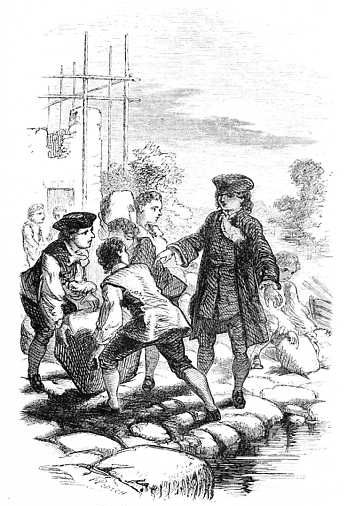
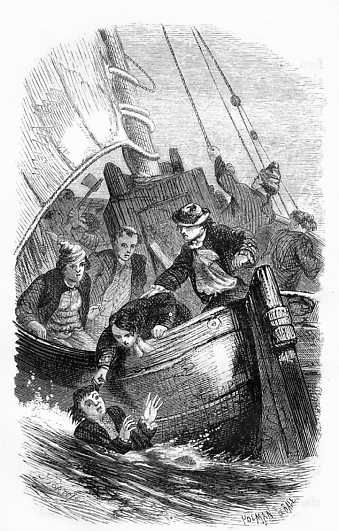 Franklin saving the Dutchman.—See page 149.
Benjamin looked somewhat disappointed when he found that Philadelphia
was a hundred miles farther; still, he was after work, and he was
determined to find it; so he made inquiries about the mode of
conveyance, and left Mr. Bradford, thanking him for his kindness.
Immediately he engaged a passage in a boat to Amboy, and made
arrangements for his chest to be carried round by sea. He was less
disheartened, probably, on account of the assurance of Mr. Bradford
that his son would employ him. If he could procure work by travelling
a hundred miles more, he would cheerfully do it, although a journey of
a hundred miles then was about equal to one thousand now.
At the appointed time Benjamin went aboard, and the boat started. She
had not proceeded far when a squall struck her, tore her rotten sails
to pieces, and drove her upon Long Island. Before this, however, a
drunken Dutchman, who was also a passenger, fell overboard, and would
have lost his life but for the timely assistance of our printer-boy.
Springing to the side of the boat, Benjamin reached over and seized
him by the hair of his head as he rose, and drew him on board.
"He may thank you for saving his life," exclaimed one of the boatmen.
"He is too drunk for that," answered Benjamin. "It will sober him a
little, however, I think. Halloo, here, you Dutchman!" (turning to the
drunken man) "how do you like diving?"
The Dutchman mumbled over something, and pulling a book out of his
pocket, asked Benjamin to dry it for him, which he promised to do.
Soon the poor, miserable fellow was fast asleep, in spite of the wet
and danger, and Benjamin examined the drenched volume, which proved to
be Bunyan's Pilgrim's Progress, in Dutch, a favourite book of his a
few years before. It was a very good companion for even a drunken
Dutchman to have; but Benjamin could not but think that its contents
were not so familiar to the unfortunate possessor as the bottle.
On approaching Long Island they found that there was no place to land,
and the beach was very stony; so "they dropped anchor, and swung out
their cable towards the shore." Some men came down to the shore and
hallooed to them, and they returned the shout. Seeing some small boats
lying along the shore, they cried out as loudly as possible, "A boat!
a boat!" and made signs to them to come to their assistance; but the
wind was so boisterous that neither party could understand the other.
After several fruitless attempts on both sides to be heard, and night
coming on, the men on the shore went home, and left Benjamin and the
boatmen to their perils.
"There is only one thing to be done," said the captain, "when we get
into such a predicament."
"What is that?" asked Benjamin.
"To do nothing but wait patiently till the wind abates," answered the
captain, rather coolly.
"Then let us turn in with the Dutchman to sleep," said one of the
boatmen. "It isn't best for him to have all the good things."
All agreed to this, and soon they were crowded into the hatches,
Benjamin among the number. But the spray broke over the head of the
boat so much that the water leaked through upon them, until they were
about as wet as the Dutchman. This was hard fare for Benjamin, who had
been accustomed to a comfortable bed and regular sleep. It was
impossible for him to rest in such a plight, and he had all the more
time to think. He thought of home, and the friends he had left
behind, of the comfortable quarters he had exchanged for his present
wet and perilous berth, and he began to feel that he had paid too
dear for his whistle. Runaways usually feel thus sooner or later,
since few of them ever realize their anticipations.
The cold, dreary night wore away slowly, and the wind continued to
howl, and the breakers to dash and roar, until after the dawn of the
following morning. Benjamin was never more rejoiced to see daylight
appear than he was after that dismal and perilous night. It was the
more pleasant to him because the wind began to abate, and there was a
fairer prospect of reaching their place of destination. As soon as the
tumult of the wind and waves had subsided, they weighed anchor, and
steered for Amboy, where they arrived just before night, "having been
thirty hours on the water without victuals, or any drink but a bottle
of filthy rum."
In the evening Benjamin found himself feverish, having taken a severe
cold by the exposure of the previous night. With a hot head and a
heavy heart he retired to rest, first, however, drinking largely of
cold water, because he had somewhere read that cold water was good for
fever. This was one of the advantages he derived from his early habit
of reading. But for his taste for reading, which led him to spend his
leisure moments in poring over books, he might never have known this
important fact, which perhaps saved him a fit of sickness. Availing
himself of this knowledge, he drank freely of water before he retired,
and the consequence was, that he sweat most of the night, and arose
the next morning comparatively well. So much advantage from loving
books!
Boys never have occasion to deplore the habit of reading, provided
their books are well chosen. They usually find that they are thrice
paid for all the time spent in this way. Sooner or later they begin to
reap the benefits of so wise a course. A few years since, a young man
was travelling in the State of Maine, procuring subscribers to a
newspaper. On passing a certain farm, he observed some bricks of a
peculiar colour, and he traced them to their clay-bed, and satisfied
himself that the material could be applied to a more valuable purpose
than that of making bricks. He at once purchased the farm for three
hundred pounds, and, on his return to Boston, sold one half of it for
eight hundred pounds. The secret of his success lay in a bit of
knowledge he acquired at school. He had given some attention to
geology and chemistry, and the little knowledge he had gleaned
therefrom enabled him to discover the nature of the clay on the farm.
Thus, even a little knowledge gleaned from a book in a single leisure
half-hour, will sometimes prove the key to a valuable treasure; much
more valuable than the farm which the young man purchased. For this
pecuniary benefit is, after all, the least important advantage derived
from reading. The discipline of the mind and heart, and the refined
and elevated pleasure which it secures, are far more desirable than
any pecuniary good it bestows. A little reading, also, sometimes gives
an impulse to the mind in the direction of learning and renown. It was
the reading of Echard's Roman History, which Gibbon met with while on
a visit to Wiltshire, that opened before him the historic path to
distinction.
Let the reader consider these things. Never say, as hundred's of boys
do, "I hate books, and wish that I was not obliged to go to school.
There is no use in reading and studying so much; we shall get along
just as well without it." This class of boys usually will have to
regret, under mortifying circumstances, in later life, that they
wasted their early opportunities to acquire knowledge. Sir Walter
Scott, in his boyhood, joined in the tirade of idlers against books;
but in manhood he said: "If it should ever fall to the lot of youth to
peruse these pages, let such readers remember that it is with the
deepest regret that I recollect, in my manhood, the opportunities of
learning which I neglected in my youth; that through every part of my
literary career I have felt pinched and hampered by my own ignorance;
and I would at this moment give half the reputation I have had the
good fortune to acquire, if by so doing I could rest the remaining
part upon a sound foundation of learning and science."
But we have lost sight of Benjamin. We left him at the tavern in
Amboy, after having passed the night in a cold-water sweat, ready for
another start on his journey. Burlington was fifty miles from Amboy,
and there was no public conveyance, so that he was obliged to go on
foot, expecting to find a boat there bound for Philadelphia. It was
raining hard, and yet he started upon the journey, and trudged on
through the storm and the mud, eager to see Burlington. He was
thoroughly drenched before he had travelled five miles, and, in this
condition, he walked on rapidly till noon, when he came to a "poor
inn," and stopped. Being wet and tired, he resolved to remain there
until the next day. The innkeeper's suspicions were awakened by
Benjamin's appearance, and he questioned him rather closely.
"Where are you from, my lad?"
"From Boston, sir."
"Hey! and away off here so far? quite a youngster for such a trip.
What's your name?"
"My name is Benjamin Franklin, and I am going to Philadelphia after
work."
"No work in Boston I 'spose, hey? How long since you left home?"
"About a week. I did not expect to go farther than New York when I
started, but I could get no work there."
"No work, hey? what sort of work are you after that you find it so
scarce?"
"I am a printer by trade, and I hope to get into a printing-office in
Philadelphia."
"Wall, you are a pretty young one to go so far; I would hardly be
willing that a son of mine should make such a trip alone, printer or
no printer."
Benjamin saw that he was suspected of being a runaway, and he felt
very uncomfortable. He managed, however, to answer all questions
without satisfying the curiosity of the family. He ate and slept
there, and on the following morning proceeded on his journey, and by
night was within eight or ten miles of Burlington. Here he stopped at
an inn kept by one Dr. Brown, "an ambulating quack doctor." He was a
very social and observing man, and soon discovered that Benjamin was a
youth of unusual intelligence for one of his age. He conversed with
him freely about Boston and other places, and gave a particular
account of some foreign countries which he had visited. In this way he
made Benjamin's brief stay with him very pleasant, and they became
friends for life, meeting many times thereafter on friendly terms.
The next morning he reluctantly bade the doctor good bye, and
proceeded to Burlington, where he expected to find a boat. In the
suburbs of the town he bought some gingerbread of an old woman who
kept a shop, and walked on, eating it as he went. To his great
disappointment, on reaching the wharf, he found the boat had gone, and
there would not be another until Tuesday. It was now Saturday, and his
money would not hold out if he should get boarded at a public-house
till then. What should he do? After some reflection, he determined to
go back to the old lady of whom he bought his gingerbread, as he liked
her appearance very well, and ask her advice. So back he went.
"Ah! back again?" said she, as he entered her shop. "Want more
gingerbread I 'spose?"
"No," answered Benjamin. "I was going to take the boat to
Philadelphia, but it has gone, and there is not another to go until
Tuesday."
"Dear me!" exclaimed the kind-hearted woman; "if that ain't too bad.
What kin ye du?"
"That is what I want to ask you. Is there any other conveyance to
Philadelphia?"
"No, and all ye has to du is to make the best on't."
"And what is that? That is just what I want to know,—the best thing
for me to do in such a case."
"What ye goin' to Philadelphy for?" inquired the old lady.
"I am going after work. I am a printer, and want to find work in a
printing-office."
"A printer," exclaimed the woman, who had probably never seen one
before. "Dear me, yer fortin is made to set up business in this ere
town. There is nothing of the like here."
"I have nothing to set up the business with here," replied Benjamin.
"I would as lief work here as in Philadelphia, if the way was open."
The woman did not know what was necessary in setting up a printing
establishment. That types and a press were indispensable articles in
such business she did not dream. She thought, doubtless, that he
carried all necessary fixtures with him in his pockets.
"Well, then, I'll lodge ye till Tuesday for ——" (naming the sum).
"I will stay with you, then, and make the best of it," he replied.
He found himself in very good quarters, and his host proved herself to
be very kind and hospitable. He took dinner with her, and remained
about the shop until towards night, when he walked forth to view the
place. In his walk he came round to the river, and as he approached
it, he discovered a boat with several people in it, and he hailed
them.
"Whither bound?"
"To Philadelphia."
"Can you take me in? I was too late for the boat to-day."
"As well as not," a voice replied; and the boat was turned to receive
its additional passenger. There was no wind, so that they were obliged
to depend on rowing for progress. Benjamin now found a rare
opportunity to exercise the skill at rowing which he cultivated in
Boston. He was so elated with the prospect of proceeding on his way to
Philadelphia, that he thought neither of the fatigue of rowing, nor of
the wonder of the old lady in the shop at the unexpected disappearance
of her boarder. He did not mean to treat her disrespectfully, for he
considered her a very clever woman, but the boat could not wait for
him to return and pay her his compliments. Whether she ever learned
what became of him, or that he grew up to be Dr. Franklin, the great
philosopher, we have no means of knowing. Doubtless she concluded that
she had not entertained an "angel unawares," but had rather aided an
undeserving fellow in pursuing a vicious course,—which was not true.
The boat went on. Benjamin rowed with strong resolution, taking his
turn with others, until midnight, when one of the company said: "We
must have passed the city. It can't be that we have been so long
getting to it."
"That is impossible," said another. "We must have seen it, if we had
passed it."
"Well, I shall row no more," added the first speaker. "I know that
Philadelphia is not so far off as this."
"Let us put for the shore," said a third person, "and find out where
we are, if possible."
"Agreed," replied several voices; and so saying they rowed toward the
shore, and entered a small creek, where they landed near an old fence,
the rails of which furnished them with fuel for a fire. They were very
chilly, it being a frosty night of October, and they found the fire
very grateful. They remained there till daylight, when one of the
company knew that the place was "Cooper's Creek," a few miles above
the "City of Brotherly Love." Immediately they made preparations to
continue their journey, which had not been altogether unpleasant, and
they were soon in full view of the city, where they arrived between
eight and nine o'clock on Sunday morning. They landed at Market Street
Wharf. Taking out his money, which consisted of one unbroken dollar,
and a shilling in copper coin, he offered the latter to the boatmen
for his passage.
"Not a cent, my good fellow," said one of them, "you worked your
passage, and did it well, too."
"But you must take it," responded Benjamin. "You are quite welcome
to all the rowing I have done. I am glad enough to get here by rowing
and paying my passage too. But for your coming along to take me in, I
should have been obliged to stay in Burlington until next Tuesday;"
and he fairly forced the shilling into their hands. This manifested a
spirit of generosity, for which Benjamin was always distinguished. He
was no mean, niggardly fellow, not he. Although he was in a stranger
city, and had but a single dollar left on which to live until he could
earn something by daily toil, yet he cheerfully gave the change for
his passage. He felt grateful to them for taking him in, and he gave
expression to his gratitude in this generous way. It was noble, too,
in the boatman to refuse to take the shilling. It was only on his
insisting upon their receiving it, that they consented to take it. A
kind-hearted, generous set of fellows were in that boat, and Benjamin
was not inferior to one of them in that respect. Bidding them good
morning, he walked up Market Street, where he met a boy eating some
bread.
"Where did you get your bread, boy?" he inquired.
"Over to the baker's, there," he replied, pointing to a shop that was
near by.
Benjamin was very tired and hungry, having eaten nothing since he
dined with the old shopwoman in Burlington, on the day before; and,
for this reason, the boy's bread was very tempting. Besides, he had
made many a meal of dry bread when he boarded himself in Boston; and
now it was not hard at all for him to breakfast on unbuttered bread,
minus both tea and coffee. He hastened to the bakery, and found it
open.
"Have you biscuit?" he inquired, meaning such as he was accustomed to
eat in Boston.
"We make nothing of the kind," answered the proprietor.
"You may give me a three-penny loaf, then."
"We have none."
Benjamin began to think that he should have to go hungry still, since
he did not know the names or prices of the kinds of bread made in
Philadelphia. But in a moment he recovered himself, and said: "Then
give me three-pennyworth of any sort."
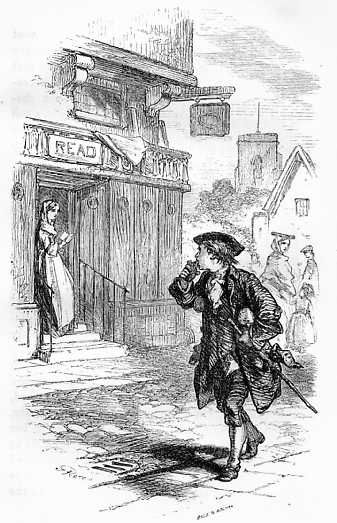 Miss Read's first Glimpse of her future
Husband.—See page 162.
Miss Read's first Glimpse of her future
Husband.—See page 162.
To his surprise the baker gave him three great puffy rolls, enough to
satisfy half a dozen hungry persons. He looked at it, scarcely knowing
at first what he could do with so much, but, as "necessity is the
mother of invention," he soon discovered a way of disposing of it. He
put a roll under each arm, and taking a third in his hand he proceeded
to eat it, as he continued his way up Market Street.
Let the reader stop here, and take a view of Benjamin Franklin, the
runaway youth, as he made his first appearance in the city of
Philadelphia. See him trudging up Market Street with his worn, dirty
clothes (his best suit having been sent round by sea), his pockets
stuffed out with shirts and stockings, and a "puffy roll" under each
arm, and a third in his hand of which he is eating! A comical
appearance certainly! It is not very probable that this runaway
Benjamin will ever become "Minister Plenipotentiary to the Court of
France," or surprise the world by his philosophical discoveries! There
is much more probability that he will live in some obscure
printing-office, and die, "unknown, unhonoured, and unsung." Who
wonders that a young lady, Miss Read, who was standing in the door of
her father's residence as Benjamin passed, thought he made a very
awkward and ridiculous appearance? She little thought she was taking a
bird's-eye view of her future husband, as the youth with the rolls of
bread under his arm proved to be. But just then he cared more for
bread than he did for her; some years after, the case was reversed,
and he cared more for her than he did for bread.
Turning down Chestnut Street he continued to walk until he came round
to the wharf where he landed. Being thirsty, he went to the boat for
water, where he found the woman and child who came down the river with
them on the previous night, waiting to go further.
"Are you hungry?" he inquired of the child, who looked wistfully at
his bread.
"We are both very hungry," answered the woman, speaking for herself
and child.
"I have satisfied my hunger," said Benjamin, "and you may have the
rest of my bread if you would like it," at the same time passing both
rolls to her.
"You are very kind indeed," responded the woman. "I thank you much for
it;"—all of which was as good pay for the bread as Benjamin wanted.
This was another instance of the generosity for which he was
distinguished throughout his whole life. An American statesman said of
him, in a eulogy delivered in Boston: "No form of personal suffering
or social evil escaped his attention, or appealed in vain for such
relief or remedy as his prudence could suggest, or his purse supply.
From that day of his early youth, when, a wanderer from his home and
friends in a strange place, he was seen sharing his rolls with a poor
woman and child, to the last act of his public life, when he signed
that well known memorial to Congress, a spirit of earnest and
practical benevolence runs like a golden thread along his whole
career."
He then walked up the street again, and found well-dressed people
going to church. Joining in the current, notwithstanding his
appearance, he went with them into the large Quaker meeting-house that
stood near the market. He took his seat, and waited for the services
to begin, either not knowing what Quakers did at meeting, or else
being ignorant that he was among this sect. As nothing was said, and
he was weary and exhausted with the labours and watchings of the
previous night, he became drowsy, and soon dropped into a sweet sleep.
His nap might have proved a very unfortunate event for him, but for
the kindness of a wide-awake Quaker. For he did not wake up when the
meeting closed, and the congregation might have dispersed, and the
sexton locked him in, without disturbing his slumbers. But the
kind-hearted Quaker moved his spirit by giving him a gentle rap on the
shoulder. He started up, somewhat surprised that the service was over,
and passed out with the crowd. Soon after, meeting a fine-looking
young Quaker, who carried his heart in his face, Benjamin inquired,
"Can you tell me where a stranger can get a night's lodging?"
"Here," answered the Quaker, "is a house where they receive strangers"
(pointing to the sign of the Three Mariners near which they stood),
"but it is not a reputable one; if thee will walk with me I will show
thee a better one."
"I will be obliged to you for doing so," answered Benjamin. "I was
never in Philadelphia before, and am not acquainted with one person
here."
The Quaker conducted him to Water Street, and showed him the Crooked
Billet,—a house where he might be accommodated. Benjamin thanked him
for his kindness, entered the house, and called for dinner and a room.
While sitting at the dinner-table, his host asked, "Where are you
from?"
"I am from Boston?"
"Boston!" exclaimed the host, with some surprise. "How long since you
left home?"
This question being answered, he continued, "Have you friends in
Philadelphia?"
"None at all. I do not know a single person here."
"What did you come here for?"
"I came to get work in a printing-office. I am a printer by trade."
"How old are you?"
"I am seventeen years old, sir," replied Benjamin, just beginning to
perceive that the man suspected him of being a runaway.
"And came all the way from Boston alone?"
"Yes, sir!"
Benjamin closed the conversation as soon as he could conveniently,
after perceiving that his appearance had excited suspicions, and went
to his room, where he lay down and slept till six o'clock in the
evening, when he was called to supper. He went to bed again very
early, and was soon locked in the embrace of "nature's sweet restorer,
balmy sleep."
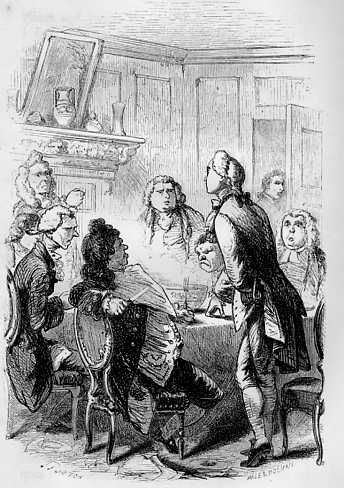
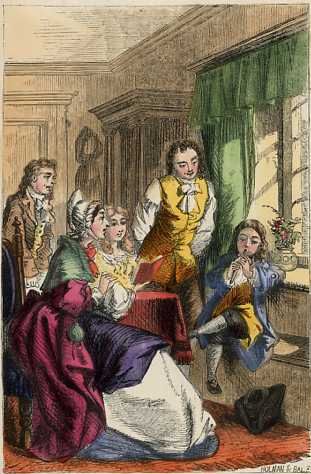 "How much did you give for your whistle!"—See page 4.