THE PRINCIPLES OF SCIENCE: A TREATISE ON LOGIC AND SCIENTIFIC METHOD.
Transcriber’s notes:
The text of this book has been preserved as closely as
practicable to its original form. However, the author used some unusual
symbols, and I have taken the liberty of using Unicode characters
with similar appearance (ꖌ ᔕ) as substitutes, disregarding their
official meaning and aware that they might not display on all devices.
An archaic symbol used by the author to indicate the mathematical
‘factorial’ function has been replaced by the modern equivalent, viz. !
Unusual placements of some sub- and superscripted symbols remain as
in the original text.
Inconsistencies of punctuation have been corrected
silently, but inconsistent spellings such as Roemer, Römer, Rœmer have
not been altered. A list of corrected
spellings is appended at the end of the book.
>Footnotes have been renumbered consecutively and
relocated to the end of the book. A missing footnote marker has been
inserted on p.751 after tracking down the original document. A missing
negative symbol has been added to an exponent in a formula on p.327.
There is a misleading calculation on p.194 and
the table that follows, regarding progressive powers of two:
((22)2)2 is equivalent to
(16)2 which equals 256 not 65,356 as stated, but
216does equal 65,356.
[sic] has been inserted on p.179 alongside a statement that the
alphabet contains 24 letters; however, the statement may well be
correct given that it was written in 1704 by a Flemish author and the
language is not specified.
New original cover art included with this eBook is granted to the
public domain.
THE PRINCIPLES OF SCIENCE.
THE LOGICAL MACHINE.
BY
W. STANLEY JEVONS,
LL.D. (EDINB.), M.A. (LOND.), F.R.S.
London:
MACMILLAN AND CO.
1883.
The Right of Translation and Reproduction is Reserved.
LONDON: R. Clay, Sons, & Taylor, Printers,
BREAD STREET HILL.
Stereotyped Edition.
PREFACE TO THE FIRST EDITION .
It may be truly asserted that the rapid progress of the
physical sciences during the last three centuries has not
been accompanied by a corresponding advance in the
theory of reasoning. Physicists speak familiarly of
Scientific Method, but they could not readily describe
what they mean by that expression. Profoundly engaged
in the study of particular classes of natural phenomena,
they are usually too much engrossed in the immense and
ever-accumulating details of their special sciences to
generalise upon the methods of reasoning which they
unconsciously employ. Yet few will deny that these
methods of reasoning ought to be studied, especially by
those who endeavour to introduce scientific order into less
successful and methodical branches of knowledge.
The application of Scientific Method cannot be restricted
to the sphere of lifeless objects. We must sooner
or later have strict sciences of those mental and social
phenomena, which, if comparison be possible, are of more
interest to us than purely material phenomena. But it
is the proper course of reasoning to proceed from the
known to the unknown—from the evident to the obscure—from
the material and palpable to the subtle and
refined. The physical sciences may therefore be properly
made the practice-ground of the reasoning powers, because
they furnish us with a great body-of precise and successful
investigations. In these sciences we meet with happy
instances of unquestionable deductive reasoning, of extensive
generalisation, of happy prediction, of satisfactory
verification, of nice calculation of probabilities. We can
note how the slightest analogical clue has been followed
up to a glorious discovery, how a rash generalisation has
at length been exposed, or a conclusive experimentum
crucis has decided the long-continued strife between two
rival theories.
In following out my design of detecting the general
methods of inductive investigation, I have found that the
more elaborate and interesting processes of quantitative
induction have their necessary foundation in the simpler
science of Formal Logic. The earlier, and probably by
far the least attractive part of this work, consists, therefore,
in a statement of the so-called Fundamental Laws
of Thought, and of the all-important Principle of Substitution,
of which, as I think, all reasoning is a development.
The whole procedure of inductive inquiry, in its
most complex cases, is foreshadowed in the combinational
view of Logic, which arises directly from these fundamental
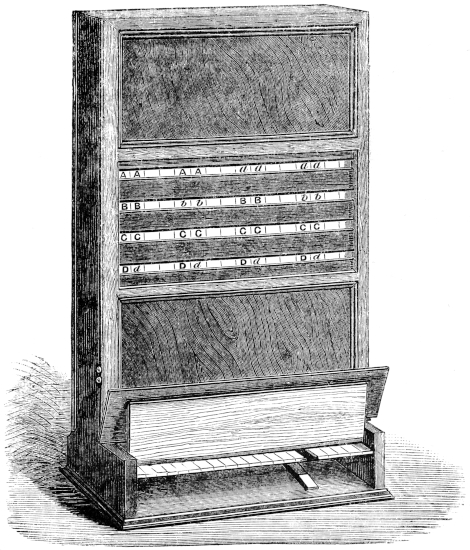
principles. Incidentally I have described the mechanical
arrangements by which the use of the important form
called the Logical Alphabet, and the whole working of
the combinational system of Formal Logic, may be rendered
evident to the eye, and easy to the mind and
hand.
The study both of Formal Logic and of the Theory of
Probabilities has led me to adopt the opinion that there
is no such thing as a distinct method of induction as
contrasted with deduction, but that induction is simply
an inverse employment of deduction. Within the last
century a reaction has been setting in against the purely
empirical procedure of Francis Bacon, and physicists have
learnt to advocate the use of hypotheses. I take the
extreme view of holding that Francis Bacon, although he
correctly insisted upon constant reference to experience,
had no correct notions as to the logical method by which
from particular facts we educe laws of nature. I endeavour
to show that hypothetical anticipation of nature is
an essential part of inductive inquiry, and that it is the
Newtonian method of deductive reasoning combined with
elaborate experimental verification, which has led to all
the great triumphs of scientific research.
In attempting to give an explanation of this view of
Scientific Method, I have first to show that the sciences
of number and quantity repose upon and spring from the
simpler and more general science of Logic. The Theory
of Probability, which enables us to estimate and calculate
quantities of knowledge, is then described, and especial
attention is drawn to the Inverse Method of Probabilities,
which involves, as I conceive, the true principle of inductive
procedure. No inductive conclusions are more
than probable, and I adopt the opinion that the theory of
probability is an essential part of logical method, so that
the logical value of every inductive result must be determined
consciously or unconsciously, according to the
principles of the inverse method of probability.
The phenomena of nature are commonly manifested
in quantities of time, space, force, energy, &c., and the
observation, measurement, and analysis of the various
quantitative conditions or results involved, even in a
simple experiment, demand much employment of systematic
procedure. I devote a book, therefore, to a simple
and general description of the devices by which exact
measurement is effected, errors eliminated, a probable
mean result attained, and the probable error of that mean
ascertained. I then proceed to the principal, and probably
the most interesting, subject of the book, illustrating
successively the conditions and precautions requisite for
accurate observation, for successful experiment, and for
the sure detection of the quantitative laws of nature.
As it is impossible to comprehend aright the value of
quantitative laws without constantly bearing in mind the
degree of quantitative approximation to the truth probably
attained, I have devoted a special chapter to the Theory
of Approximation, and however imperfectly I may have
treated this subject, I must look upon it as a very essential
part of a work on Scientific Method.
It then remains to illustrate the sound use of hypothesis,
to distinguish between the portions of knowledge
which we owe to empirical observation, to accidental discovery,
or to scientific prediction. Interesting questions
arise concerning the accordance of quantitative theories
and experiments, and I point out how the successive
verification of an hypothesis by distinct methods of experiment
yields conclusions approximating to but never
attaining certainty. Additional illustrations of the general
procedure of inductive investigations are given in a
chapter on the Character of the Experimentalist, in which
I endeavour to show, moreover, that the inverse use of
deduction was really the logical method of such great
masters of experimental inquiry as Newton, Huyghens,
and Faraday.
In treating Generalisation and Analogy, I consider the
precautions requisite in inferring from one case to another,
or from one part of the universe to another part; the
validity of all such inferences resting ultimately upon
the inverse method of probabilities. The treatment of
Exceptional Phenomena appeared to afford an interesting
subject for a further chapter illustrating the various modes
in which an outstanding fact may eventually be explained.
The formal part of the book closes with the subject of
Classification, which is, however, very inadequately treated.
I have, in fact, almost restricted myself to showing that
all classification is fundamentally carried out upon the
principles of Formal Logic and the Logical Alphabet
described at the outset.
In certain concluding remarks I have expressed the
conviction which the study of Logic has by degrees
forced upon my mind, that serious misconceptions are
entertained by some scientific men as to the logical value
of our knowledge of nature. We have heard much of
what has been aptly called the Reign of Law, and the
necessity and uniformity of natural forces has been not
uncommonly interpreted as involving the non-existence
of an intelligent and benevolent Power, capable of interfering
with the course of natural events. Fears have
been expressed that the progress of Scientific Method
must therefore result in dissipating the fondest beliefs
of the human heart. Even the ‘Utility of Religion’ is
seriously proposed as a subject of discussion. It seemed
to be not out of place in a work on Scientific Method to
allude to the ultimate results and limits of that method.
I fear that I have very imperfectly succeeded in expressing
my strong conviction that before a rigorous logical scrutiny
the Reign of Law will prove to be an unverified hypothesis,
the Uniformity of Nature an ambiguous expression,
the certainty of our scientific inferences to a great extent
a delusion. The value of science is of course very high,
while the conclusions are kept well within the limits of
the data on which they are founded, but it is pointed out
that our experience is of the most limited character compared
with what there is to learn, while our mental powers
seem to fall infinitely short of the task of comprehending
and explaining fully the nature of any one object. I
draw the conclusion that we must interpret the results
of Scientific Method in an affirmative sense only. Ours
must be a truly positive philosophy, not that false negative
philosophy which, building on a few material facts,
presumes to assert that it has compassed the bounds
of existence, while it nevertheless ignores the most
unquestionable phenomena of the human mind and feelings.
It is approximately certain that in freely employing
illustrations drawn from many different sciences, I have
frequently fallen into errors of detail. In this respect I
must throw myself upon the indulgence of the reader,
who will bear in mind, as I hope, that the scientific facts
are generally mentioned purely for the purpose of illustration,
so that inaccuracies of detail will not in the
majority of cases affect the truth of the general principles
illustrated.
December 15, 1873.
PREFACE TO THE SECOND EDITION .
Few alterations of importance have been made in preparing
this second edition. Nevertheless, advantage has
been taken of the opportunity to revise very carefully
both the language and the matter of the book. Correspondents
and critics having pointed out inaccuracies
of more or less importance in the first edition, suitable
corrections and emendations have been made. I am under
obligations to Mr. C. J. Monro, M.A., of Barnet, and to
Mr. W. H. Brewer, M.A., one of Her Majesty’s Inspectors
of Schools, for numerous corrections.
Among several additions which have been made to the
text, I may mention the abstract (p. 143) of Professor
Clifford’s remarkable investigation into the number of
types of compound statement involving four classes of
objects. This inquiry carries forward the inverse logical
problem described in the preceding sections. Again, the
need of some better logical method than the old Barbara
Celarent, &c., is strikingly shown by Mr. Venn’s logical
problem, described at p. 90. A great number of candidates
in logic and philosophy were tested by Mr. Venn with this
problem, which, though simple in reality, was solved by
very few of those who were ignorant of Boole’s Logic.
Other evidence could be adduced by Mr. Venn of the need
for some better means of logical training. To enable the
logical student to test his skill in the solution of inductive
logical problems, I have given (p. 127) a series of ten
problems graduated in difficulty.
To prevent misapprehension, it should be mentioned
that, throughout this edition, I have substituted the name
Logical Alphabet for Logical Abecedarium, the name applied
in the first edition to the exhaustive series of logical
combinations represented in terms of A, B, C, D (p. 94).
It was objected by some readers that Abecedarium is a
long and unfamiliar name.
To the chapter on Units and Standards of Measurement,
I have added two sections, one (p. 325) containing
a brief statement of the Theory of Dimensions, and the
other (p. 319) discussing Professor Clerk Maxwell’s very
original suggestion of a Natural System of Standards for
the measurement of space and time, depending upon the
length and rapidity of waves of light.
In my description of the Logical Machine in the
Philosophical Transactions (vol. 160, p. 498), I said—“It
is rarely indeed that any invention is made without
some anticipation being sooner or later discovered; but up
to the present time I am totally unaware of even a single
previous attempt to devise or construct a machine which
should perform the operations of logical inference; and it
is only, I believe, in the satirical writings of Swift that an
allusion to an actual reasoning machine is to be found.”
Before the paper was printed, however, I was able to refer
(p. 518) to the ingenious designs of the late Mr. Alfred
Smee as attempts to represent thought mechanically.
Mr. Smee’s machines indeed were never constructed, and,
if constructed, would not have performed actual logical
inference. It has now just come to light, however, that
the celebrated Lord Stanhope actually did construct a
mechanical device, capable of representing syllogistic
inferences in a concrete form. It appears that logic was
one of the favourite studies of this truly original and
ingenious nobleman. There remain fragments of a logical
work, printed by the Earl at his own press, which show
that he had arrived, before the year 1800, at the principle
of the quantified predicate. He puts forward this principle
in the most explicit manner, and proposes to employ
it throughout his syllogistic system. Moreover, he converts
negative propositions into affirmative ones, and
represents these by means of the copula “is identic with.”
Thus he anticipated, probably by the force of his own
unaided insight, the main points of the logical method
originated in the works of George Bentham and George
Boole, and developed in this work. Stanhope, indeed, has
no claim to priority of discovery, because he seems never
to have published his logical writings, although they were
put into print. There is no trace of them in the British
Museum Library, nor in any other library or logical work,
so far as I am aware. Both the papers and the logical
contrivance have been placed by the present Earl Stanhope
in the hands of the Rev. Robert Harley, F.R.S., who will,
I hope, soon publish a description of them.1
By the kindness of Mr. Harley, I have been able to
examine Stanhope’s logical contrivance, called by him the
Demonstrator. It consists of a square piece of bay-wood
with a square depression in the centre, across which two
slides can be pushed, one being a piece of red glass, and
the other consisting of wood coloured gray. The extent
to which each of these slides is pushed in is indicated by
scales and figures along the edges of the aperture, and the
simple rule of inference adopted by Stanhope is: “To the
gray add the red and subtract the holon,” meaning by
holon (ὅλον) the whole width of the aperture. This rule
of inference is a curious anticipation of De Morgan’s
numerically definite syllogism (see below, p. 168), and of
inferences founded on what Hamilton called “Ultra-total
distribution.” Another curious point about Stanhope’s
device is, that one slide can be drawn out and pushed in
again at right angles to the other, and the overlapping
part of the slides then represents the probability of a
conclusion, derived from two premises of which the probabilities
are respectively represented by the projecting
parts of the slides. Thus it appears that Stanhope had
studied the logic of probability as well as that of certainty,
here again anticipating, however obscurely, the recent
progress of logical science. It will be seen, however, that
between Stanhope’s Demonstrator and my Logical Machine
there is no resemblance beyond the fact that they both
perform logical inference.
In the first edition I inserted a section (vol. i. p. 25), on
“Anticipations of the Principle of Substitution,” and I
have reprinted that section unchanged in this edition
(p. 21). I remark therein that, “In such a subject as logic
it is hardly possible to put forth any opinions which have
not been in some degree previously entertained. The
germ at least of every doctrine will be found in earlier
writings, and novelty must arise chiefly in the mode of
harmonising and developing ideas.” I point out, as
Professor T. M. Lindsay had previously done, that Beneke
had employed the name and principle of substitution, and
that doctrines closely approximating to substitution were
stated by the Port Royal Logicians more than 200 years
ago.
I have not been at all surprised to learn, however, that
other logicians have more or less distinctly stated this
principle of substitution during the last two centuries.
As my friend and successor at Owens College, Professor
Adamson, has discovered, this principle can be traced back
to no less a philosopher than Leibnitz.
The remarkable tract of Leibnitz,2 entitled “Non inelegans
Specimen Demonstrandi in Abstractis,” commences at once
with a definition corresponding to the principle:—
“Eadem sunt quorum unum potest substitui alteri salva
veritate. Si sint A et B, et A ingrediatur aliquam propositionem
veram, et ibi in aliquo loco ipsius A pro ipso
substituendo B fiat nova propositio æque itidem vera, idque
semper succedat in quacunque tali propositione, A et B
dicuntur esse eadem; et contra, si eadem sint A et B,
procedet substitutio quam dixi.”
Leibnitz, then, explicitly adopts the principle of substitution,
but he puts it in the form of a definition, saying
that those things are the same which can be substituted
one for the other, without affecting the truth of the
proposition. It is only after having thus tested the sameness
of things that we can turn round and say that A and
B, being the same, may be substituted one for the other.
It would seem as if we were here in a vicious circle; for
we are not allowed to substitute A for B, unless we have
ascertained by trial that the result is a true proposition.
The difficulty does not seem to be removed by Leibnitz’
proviso, “idque semper succedat in quacunque tali propositione.”
How can we learn that because A and B may
be mutually substituted in some propositions, they may
therefore be substituted in others; and what is the criterion
of likeness of propositions expressed in the word “tali”?
Whether the principle of substitution is to be regarded as a
postulate, an axiom, or a definition, is just one of those fundamental
questions which it seems impossible to settle in the
present position of philosophy, but this uncertainty will not
prevent our making a considerable step in logical science.
Leibnitz proceeds to establish in the form of a theorem
what is usually taken as an axiom, thus (Opera, p. 95):
“Theorema I. Quæ sunt eadem uni tertio, eadem sunt
inter se. Si A ∝ B et B ∝ C, erit A ∝ C. Nam si in
propositione A ∝ B (vera ea hypothesi) substituitur C in
locum B (quod facere licet per Def. I. quia B ∝ C ex
hypothesi) fiet A ∝ C. Q. E. Dem.” Thus Leibnitz
precisely anticipates the mode of treating inference with
two simple identities described at p. 51 of this work.
Even the mathematical axiom that ‘equals added to
equals make equals,’ is deduced from the principle of
substitution. At p. 95 of Erdmann’s edition, we find: “Si
eidem addantur coincidentia fiunt coincidentia. Si A ∝ B,
erit A + C ∝ B + C. Nam si in propositione A + C ∝ A
+ C (quæ est vera per se) pro A semel substituas B (quod
facere licet per Def. I. quia A ∝ B) fiet A + C ∝ B +
C Q. E. Dem.” This is unquestionably the mode of deducing
the several axioms of mathematical reasoning from the
higher axiom of substitution, which is explained in the
section on mathematical inference (p. 162) in this work,
and which had been previously stated in my Substitution
of Similars, p. 16.
There are one or two other brief tracts in which Leibnitz
anticipates the modern views of logic. Thus in the
eighteenth tract in Erdmann’s edition (p. 92), called
“Fundamenta Calculi Ratiocinatoris”, he says: “Inter ea
quorum unum alteri substitui potest, salvis calculi legibus,
dicetur esse æquipollentiam.” There is evidence, also, that
he had arrived at the quantification of the predicate, and
that he fully understood the reduction of the universal
affirmative proposition to the form of an equation, which is
the key to an improved view of logic. Thus, in the tract
entitled “Difficultates Quædam Logicæ,”3 he says: “Omne A
est B; id est æquivalent AB et A, seu A non B est non-ens.”
It is curious to find, too, that Leibnitz was fully acquainted
with the Laws of Commutativeness and “Simplicity”
(as I have called the second law) attaching to logical
symbols. In the “Addenda ad Specimen Calculi Universalis”
we read as follows.4 “Transpositio literarum in
eodem termino nihil mutat, ut ab coincidet cum ba, seu
animal rationale et rationale animal.”
“Repetitio ejusdem literæ in eodem termino est inutilis,
ut b est aa; vel bb est a; homo est animal animal, vel
homo homo est animal. Sufficit enim dici a est b, seu
homo est animal.”
Comparing this with what is stated in Boole’s Mathematical
Analysis of Logic, pp. 17–18, in his Laws of
Thought, p. 29, or in this work, pp. 32–35, we find that
Leibnitz had arrived two centuries ago at a clear perception
of the bases of logical notation. When Boole pointed out
that, in logic, xx = x, this seemed to mathematicians to be
a paradox, or in any case a wholly new discovery; but
here we have it plainly stated by Leibnitz.
The reader must not assume, however, that because
Leibnitz correctly apprehended the fundamental principles
of logic, he left nothing for modern logicians to do. On
the contrary, Leibnitz obtained no useful results from his
definition of substitution. When he proceeds to explain
the syllogism, as in the paper on “Definitiones Logicæ,”5 he gives up substitution altogether, and falls back upon
the notion of inclusion of class in class, saying, “Includens
includentis est includens inclusi, seu si A includit B
et B includit C, etiam A includet C.” He proceeds to
make out certain rules of the syllogism involving the
distinction of subject and predicate, and in no important
respect better than the old rules of the syllogism.
Leibnitz’ logical tracts are, in fact, little more than brief
memoranda of investigations which seem never to have
been followed out. They remain as evidence of his
wonderful sagacity, but it would be difficult to show that
they have had any influence on the progress of logical
science in recent times.
I should like to explain how it happened that these
logical writings of Leibnitz were unknown to me, until
within the last twelve months. I am so slow a reader
of Latin books, indeed, that my overlooking a few pages
of Leibnitz’ works would not have been in any case
surprising. But the fact is that the copy of Leibnitz’
works of which I made occasional use, was one of the
edition of Dutens, contained in Owens College Library.
The logical tracts in question were not printed in that
edition, and with one exception, they remained in manuscript
in the Royal Library at Hanover, until edited by
Erdmann, in 1839–40. The tract “Difficultates Quædam
Logicæ,” though not known to Dutens, was published by
Raspe in 1765, in his collection called Œuvres Philosophiques
de feu Mr. Leibnitz; but this work had not
come to my notice, nor does the tract in question seem
to contain any explicit statement of the principle of
substitution.
It is, I presume, the comparatively recent publication of
Leibnitz’ most remarkable logical tracts which explains
the apparent ignorance of logicians as regards their contents
and importance. The most learned logicians, such
as Hamilton and Ueberweg, ignore Leibnitz’ principle of
substitution. In the Appendix to the fourth volume of
Hamilton’s Lectures on Metaphysics and Logic, is given
an elaborate compendium of the views of logical writers
concerning the ultimate basis of deductive reasoning.
Leibnitz is briefly noticed on p. 319, but without any
hint of substitution. He is here quoted as saying, “What
are the same with the same third, are the same with each
other; that is, if A be the same with B, and C be the
same with B, it is necessary that A and C should also
be the same with one another. For this principle flows
immediately from the principle of contradiction, and is
the ground and basis of all logic; if that fail, there is no
longer any way of reasoning with certainty.” This view
of the matter seems to be inconsistent with that which he
adopted in his posthumous tract.
Dr. Thomson, indeed, was acquainted with Leibnitz’
tracts, and refers to them in his Outline of the Necessary
Laws of Thought. He calls them valuable; nevertheless,
he seems to have missed the really valuable point; for in
making two brief quotations,6 he omits all mention of the
principle of substitution.
Ueberweg is probably considered the best authority
concerning the history of logic, and in his well-known
System of Logic and History of Logical Doctrines,7 he gives
some account of the principle of substitution, especially
as it is implicitly stated in the Port Royal Logic. But he
omits all reference to Leibnitz in this connection, nor does
he elsewhere, so far as I can find, supply the omission.
His English editor, Professor T. M. Lindsay, in referring to
my Substitution of Similars, points out how I was anticipated
by Beneke; but he also ignores Leibnitz. It is thus
apparent that the most learned logicians, even when writing
especially on the history of logic, displayed ignorance of
Leibnitz’ most valuable logical writings.
It has been recently pointed out to me, however, that
the Rev. Robert Harley did draw attention, at the Nottingham
Meeting of the British Association, in 1866, to
Leibnitz’ anticipations of Boole’s laws of logical notation,8
and I am informed that Boole, about a year after the publication
of his Laws of Thought, was made acquainted with
these anticipations by R. Leslie Ellis.
There seems to have been at least one other German
logician who discovered, or adopted, the principle of substitution.
Reusch, in his Systema Logicum, published in
1734, laboured to give a broader basis to the Dictum de
Omni et Nullo. He argues, that “the whole business of
ordinary reasoning is accomplished by the substitution of
ideas in place of the subject or predicate of the fundamental
proposition. This some call the equation of thoughts.”
But, in the hands of Reusch, substitution does not seem to
lead to simplicity, since it has to be carried on according
to the rules of Equipollence, Reciprocation, Subordination,
and Co-ordination.9 Reusch is elsewhere spoken of10 as the
“celebrated Reusch”; nevertheless, I have not been able to
find a copy of his book in London, even in the British
Museum Library; it is not mentioned in the printed
catalogue of the Bodleian Library; Messrs. Asher have
failed to obtain it for me by advertisement in Germany;
and Professor Adamson has been equally unsuccessful.
From the way in which the principle of substitution is
mentioned by Reusch, it would seem likely that other
logicians of the early part of the eighteenth century were
acquainted with it; but, if so, it is still more curious that
recent historians of logical science have overlooked the
doctrine.
It is a strange and discouraging fact, that true views of
logic should have been discovered and discussed from one
to two centuries ago, and yet should have remained, like
George Bentham’s work in this century, without influence
on the subsequent progress of the science. It may
be regarded as certain that none of the discoverers of
the quantification of the predicate, Bentham, Hamilton,
Thomson, De Morgan, and Boole, were in any way assisted
by the hints of the principle contained in previous writers.
As to my own views of logic, they were originally moulded
by a careful study of Boole’s works, as fully stated in my
first logical essay.11 As to the process of substitution, it
was not learnt from any work on logic, but is simply the
process of substitution perfectly familiar to mathematicians,
and with which I necessarily became familiar in the course
of my long-continued study of mathematics under the late
Professor De Morgan.
I find that the Theory of Number, which I explained in
the eighth chapter of this work, is also partially anticipated
in a single scholium of Leibnitz. He first gives as an
axiom the now well-known law of Boole, as follows:—
“Axioma I. Si idem secum ipso sumatur, nihil constituitur
novum, seu A + A ∝ A.” Then follows this
remarkable scholium: “Equidem in numeris 4 + 4 facit
8, seu bini nummi binis additi faciunt quatuor nummos,
sed tunc bini additi sunt alii a prioribus; si iidem essent
nihil novi prodiret et perinde esset ac si joco ex tribus
ovis facere vellemus sex numerando, primum 3 ova, deinde
uno sublato residua 2, ac denique uno rursus sublato
residuum.”
Translated this would read as follows:—
“Axiom I. If the same thing is taken together with
itself, nothing new arises, or A + A = A.
“Scholium. In numbers, indeed, 4 + 4 makes 8, or two
coins added to two coins make four coins, but then the
two added are different from the former ones; if they were
the same nothing new would be produced, and it would
be just as if we tried in joke to make six eggs out of three,
by counting firstly the three eggs, then, one being removed,
counting the remaining two, and lastly, one being again
removed, counting the remaining egg.”
Compare the above with pp. 156 to 162 of the present
work.
M. Littré has quite recently pointed out12 what he thinks
is an analogy between the system of formal logic, stated
in the following pages, and the logical devices of the
celebrated Raymond Lully. Lully’s method of invention
was described in a great number of mediæval books, but
is best stated in his Ars Compendiosa Inveniendi Veritatem,
seu Ars Magna et Major. This method consisted in placing
various names of things in the sectors of concentric
circles, so that when the circles were turned, every possible
combination of the things was easily produced by mechanical
means. It might, perhaps, be possible to discover in
this method a vague and rude anticipation of combinational
logic; but it is well known that the results of Lully’s
method were usually of a fanciful, if not absurd character.
A much closer analogue of the Logical Alphabet is
probably to be found in the Logical Square, invented by
John Christian Lange, and described in a rare and unnoticed
work by him which I have recently found in the
British Museum.13 This square involved the principle of
bifurcate classification, and was an improved form of the
Ramean and Porphyrian tree (see below, p. 702). Lange
seems, indeed, to have worked out his Logical Square
into a mechanical form, and he suggests that it might be
employed somewhat in the manner of Napier’s Bones
(p. 65). There is much analogy between his Square and
my Abacus, but Lange had not arrived at a logical system
enabling him to use his invention for logical inference in
the manner of the Logical Abacus. Another work of
Lange is said to contain the first publication of the well
known Eulerian diagrams of proposition and syllogism.14
Since the first edition was published, an important
work by Mr. George Lewes has appeared, namely, his
Problems of Life and Mind, which to a great extent treats
of scientific method, and formulates the rules of philosophising.
I should have liked to discuss the bearing
of Mr. Lewes’s views upon those here propounded, but
I have felt it to be impossible in a book already filling
nearly 800 pages, to enter upon the discussion of a
yet more extensive book. For the same reason I have
not been able to compare my own treatment of the subject
of probability with the views expressed by Mr. Venn in
his Logic of Chance. With Mr. J. J. Murphy’s profound
and remarkable works on Habit and Intelligence, and on
The Scientific Basis of Faith, I was unfortunately unacquainted
when I wrote the following pages. They cannot
safely be overlooked by any one who wishes to
comprehend the tendency of philosophy and scientific
method in the present day.
It seems desirable that I should endeavour to answer
some of the critics who have pointed out what they
consider defects in the doctrines of this book, especially in
the first part, which treats of deduction. Some of the
notices of the work were indeed rather statements of its
contents than critiques. Thus, I am much indebted to
M. Louis Liard, Professor of Philosophy at Bordeaux, for
the very careful exposition15 of the substitutional view of
logic which he gave in the excellent Revue Philosophique,
edited by M. Ribot. (Mars, 1877, tom. iii. p. 277.) An
equally careful account of the system was given by
M. Riehl, Professor of Philosophy at Graz, in his article on
“Die Englische Logik der Gegenwart,” published in the
Vierteljahrsschrift für wissenschaftliche Philosophie. (1 Heft,
Leipzig, 1876.) I should like to acknowledge also the
careful and able manner in which my book was reviewed
by the New York Daily Tribune and the New York Times.
The most serious objections which have been brought
against my treatment of logic have regard to my failure
to enter into an analysis of the ultimate nature and origin
of the Laws of Thought. The Spectator,16 for instance, in
the course of a careful review, says of the principle of
substitution, “Surely it is a great omission not to discuss
whence we get this great principle itself; whether it is a
pure law of the mind, or only an approximate lesson of
experience; and if a pure product of the mind, whether
there are any other products of the same kind, furnished
by our knowing faculty itself.” Professor Robertson, in
his very acute review,17 likewise objects to the want of
psychological and philosophical analysis. “If the book
really corresponded to its title, Mr. Jevons could hardly
have passed so lightly over the question, which he does
not omit to raise, concerning those undoubted principles
of knowledge commonly called the Laws of Thought....
Everywhere, indeed, he appears least at ease when he
touches on questions properly philosophical; nor is he
satisfactory in his psychological references, as on pp. 4, 5,
where he cannot commit himself to a statement without
an accompaniment of ‘probably,’ ‘almost,’ or ‘hardly.’
Reservations are often very much in place, but there are
fundamental questions on which it is proper to make up
one’s mind.”
These remarks appear to me to be well founded, and I
must state why it is that I have ventured to publish an
extensive work on logic, without properly making up my
mind as to the fundamental nature of the reasoning
process. The fault after all is one of omission rather than
of commission. It is open to me on a future occasion to
supply the deficiency if I should ever feel able to undertake
the task. But I do not conceive it to be an essential
part of any treatise to enter into an ultimate analysis of
its subject matter. Analyses must always end somewhere.
There were good treatises on light which described the
laws of the phenomenon correctly before it was known
whether light consisted of undulations or of projected
particles. Now we have treatises on the Undulatory
Theory which are very valuable and satisfactory, although
they leave us in almost complete doubt as to what the
vibrating medium really is. So I think that, in the
present day, we need a correct and scientific exhibition
of the formal laws of thought, and of the forms of
reasoning based on them, although we may not be able
to enter into any complete analysis of the nature of those
laws. What would the science of geometry be like now
if the Greek geometers had decided that it was improper
to publish any propositions before they had decided on
the nature of an axiom? Where would the science of
arithmetic be now if an analysis of the nature of number
itself were a necessary preliminary to a development of
the results of its laws? In recent times there have been
enormous additions to the mathematical sciences, but very
few attempts at psychological analysis. In the Alexandrian
and early mediæval schools of philosophy, much
attention was given to the nature of unity and plurality
chiefly called forth by the question of the Trinity. In
the last two centuries whole sciences have been created
out of the notion of plurality, and yet speculation on the
nature of plurality has dwindled away. This present
treatise contains, in the eighth chapter, one of the few
recent attempts to analyse the notion of number itself.
If further illustration is needed, I may refer to the
differential calculus. Nobody calls in question the formal
truth of the results of that calculus. All the more exact
and successful parts of physical science depend upon its
use, and yet the mathematicians who have created so
great a body of exact truths have never decided upon
the basis of the calculus. What is the nature of a limit
or the nature of an infinitesimal? Start the question
among a knot of mathematicians, and it will be found
that hardly two agree, unless it is in regarding the question
itself as a trifling one. Some hold that there are no such
things as infinitesimals, and that it is all a question of
limits. Others would argue that the infinitesimal is the
necessary outcome of the limit, but various shades of
intermediate opinion spring up.
Now it is just the same with logic. If the forms of
deductive and inductive reasoning given in the earlier
part of this treatise are correct, they constitute a definite
addition to logical science, and it would have been absurd
to decline to publish such results because I could not at
the same time decide in my own mind about the psychology
and philosophy of the subject. It comes in short
to this, that my book is a book on Formal Logic and
Scientific Method, and not a book on psychology and
philosophy.
It may be objected, indeed, as the Spectator objects,
that Mill’s System of Logic is particularly strong in the
discussion of the psychological foundations of reasoning,
so that Mill would appear to have successfully treated
that which I feel myself to be incapable of attempting at
present. If Mill’s analysis of knowledge is correct, then
I have nothing to say in excuse for my own deficiencies.
But it is well to do one thing at a time, and therefore
I have not occupied any considerable part of this book
with controversy and refutation. What I have to say of
Mill’s logic will be said in a separate work, in which
his analysis of knowledge will be somewhat minutely
analysed. It will then be shown, I believe, that Mill’s
psychological and philosophical treatment of logic has not
yielded such satisfactory results as some writers seem to
believe.18
Various minor but still important criticisms were made
by Professor Robertson, a few of which have been noticed
in the text (pp. 27, 101). In other cases his objections
hardly admit of any other answer than such as consists
in asking the reader to judge between the work and the
criticism. Thus Mr. Robertson asserts19 that the most
complex logical problems solved in this book (up to p. 102
of this edition) might be more easily and shortly dealt
with upon the principles and with the recognised methods
of the traditional logic. The burden of proof here lies
upon Mr. Robertson, and his only proof consists in a
single case, where he is able, as it seems to me accidentally,
to get a special conclusion by the old form of dilemma.
It would be a long labour to test the old logic upon every
result obtained by my notation, and I must leave such
readers as are well acquainted with the syllogistic logic to
pronounce upon the comparative simplicity and power of
the new and old systems. For other acute objections
brought forward by Mr. Robertson, I must refer the reader
to the article in question.
One point in my last chapter, that on the Results and
Limits of Scientific Method, has been criticised by
Professor W. K. Clifford in his lecture20 on “The First
and the Last Catastrophe.” In vol. ii. p. 438 of the
first edition (p. 744 of this edition) I referred to certain
inferences drawn by eminent physicists as to a limit to
the antiquity of the present order of things. “According
to Sir W. Thomson’s deductions from Fourier’s theory of
heat, we can trace down the dissipation of heat by conduction
and radiation to an infinitely distant time when
all things will be uniformly cold. But we cannot similarly
trace the Heat-history of the Universe to an infinite
distance in the past. For a certain negative value of the
time, the formulæ give impossible values, indicating that
there was some initial distribution of heat which could
not have resulted, according to known laws of nature,
from any previous distribution.”
Now according to Professor Clifford I have here misstated
Thomson’s results. “It is not according to the
known laws of nature, it is according to the known laws
of conduction of heat, that Sir William Thomson is speaking. . . .
All these physical writers, knowing what they
were writing about, simply drew such conclusions from
the facts which were before them as could be reasonably
drawn. They say, here is a state of things which could
not have been produced by the circumstances we are at
present investigating. Then your speculator comes, he
reads a sentence and says, ‘Here is an opportunity for
me to have my fling.’ And he has his fling, and makes a
purely baseless theory about the necessary origin of the
present order of nature at some definite point of time,
which might be calculated.”
Professor Clifford proceeds to explain that Thomson’s
formulæ only give a limit to the heat history of, say, the
earth’s crust in the solid state. We are led back to the
time when it became solidified from the fluid condition.
There is discontinuity in the history of the solid matter,
but still discontinuity which is within our comprehension.
Still further back we should come to discontinuity again,
when the liquid was formed by the condensation of heated
gaseous matter. Beyond that event, however, there is
no need to suppose further discontinuity of law, for the
gaseous matter might consist of molecules which had been
falling together from different parts of space through infinite
past time. As Professor Clifford says (p. 481) of the
bodies of the universe, “What they have actually done
is to fall together and get solid. If we should reverse
the process we should see them separating and getting
cool, and as a limit to that, we should find that all these
bodies would be resolved into molecules, and all these
would be flying away from each other. There would be
no limit to that process, and we could trace it as far back
as ever we liked to trace it.”
Assuming that I have erred, I should like to point out
that I have erred in the best company, or more strictly,
being a speculator, I have been led into error by the best
physical writers. Professor Tait, in his Sketch of Thermodynamics,
speaking of the laws discovered by Fourier
for the motion of heat in a solid, says, “Their mathematical
expressions point also to the fact that a uniform distribution
of heat, or a distribution tending to become uniform,
must have arisen from some primitive distribution of heat
of a kind not capable of being produced by known laws
from any previous distribution.” In the latter words it
will be seen that there is no limitation to the laws of
conduction, and, although I had carefully referred to
Sir W. Thomson’s original paper, it is not unnatural
that I should take Professor Tait’s interpretation of its
meaning.21
In his new work On some Recent Advances in Physical
Science, Professor Tait has recurred to the subject as
follows:22 “A profound lesson may be learned from one
of the earliest little papers of Sir W. Thomson, published
while he was an undergraduate at Cambridge, where he
shows that Fourier’s magnificent treatment of the conduction
of heat [in a solid body] leads to formulæ for its
distribution which are intelligible (and of course capable
of being fully verified by experiment) for all time future,
but which, except in particular cases, when extended to
time past, remain intelligible for a finite period only, and
then indicate a state of things which could not have
resulted under known laws from any conceivable previous
distribution [of heat in the body]. So far as heat is
concerned, modern investigations have shown that a
previous distribution of the matter involved may, by its
potential energy, be capable of producing such a state of
things at the moment of its aggregation; but the example
is now adduced not for its bearing on heat alone, but as
a simple illustration of the fact that all portions of our
Science, especially that beautiful one, the Dissipation
of Energy, point unanimously to a beginning, to a state of
things incapable of being derived by present laws [of
tangible matter and its energy] from any conceivable
previous arrangement.” As this was published nearly a
year after Professor Clifford’s lecture, it may be inferred
that Professor Tait adheres to his original opinion that
the theory of heat does give evidence of “a beginning.”
I may add that Professor Clerk Maxwell’s words seem
to countenance the same view, for he says,23 “This is only
one of the cases in which a consideration of the dissipation
of energy leads to the determination of a superior
limit to the antiquity of the observed order of things.”
The expression “observed order of things” is open to
much ambiguity, but in the absence of qualification I
should take it to include the aggregate of the laws of
nature known to us. I should interpret Professor Maxwell
as meaning that the theory of heat indicates the occurrence
of some event of which our science cannot give any
further explanation. The physical writers thus seem not to
be so clear about the matter as Professor Clifford assumes.
So far as I may venture to form an independent
opinion on the subject, it is to the effect that Professor
Clifford is right, and that the known laws of nature do
not enable us to assign a “beginning.” Science leads us
backwards into infinite past duration. But that Professor
Clifford is right on this point, is no reason why we should
suppose him to be right in his other opinions, some of
which I am sure are wrong. Nor is it a reason why other
parts of my last chapter should be wrong. The question
only affects the single paragraph on pp. 744–5 of this
book, which might, I believe, be struck out without
necessitating any alteration in the rest of the text. It
is always to be remembered that the failure of an argument
in favour of a proposition does not, generally
speaking, add much, if any, probability to the contradictory
proposition. I cannot conclude without expressing
my acknowledgments to Professor Clifford for his kind
expressions regarding my work as a whole.
CHAPTER I. INTRODUCTION. — The Powers of Mind concerned in the Creation of Science. — Laws of Identity and Difference. — The Nature of the Laws of Identity and Difference. — The Process of Inference. — Deduction and Induction. — Symbolic Expression of Logical Inference. — Expression of Identity and Difference. — General Formula of Logical Inference. — The Propagating Power of Similarity. — Anticipations of the Principle of Substitution. — The Logic of Relatives.
THE PRINCIPLES OF SCIENCE.
Science arises from the discovery of Identity amidst
Diversity. The process may be described in different
words, but our language must always imply the presence
of one common and necessary element. In every act of
inference or scientific method we are engaged about a
certain identity, sameness, similarity, likeness, resemblance,
analogy, equivalence or equality apparent between two
objects. It is doubtful whether an entirely isolated
phenomenon could present itself to our notice, since there
must always be some points of similarity between object
and object. But in any case an isolated phenomenon
could be studied to no useful purpose. The whole value
of science consists in the power which it confers upon
us of applying to one object the knowledge acquired
from like objects; and it is only so far, therefore, as we can
discover and register resemblances that we can turn our
observations to account.
Nature is a spectacle continually exhibited to our senses,
in which phenomena are mingled in combinations of
endless variety and novelty. Wonder fixes the mind’s
attention; memory stores up a record of each distinct
impression; the powers of association bring forth the record
when the like is felt again. By the higher faculties of
judgment and reasoning the mind compares the new with
the old, recognises essential identity, even when disguised
by diverse circumstances, and expects to find again what
was before experienced. It must be the ground of all
reasoning and inference that what is true of one thing will
be true of its equivalent, and that under carefully ascertained
conditions Nature repeats herself.
Were this indeed a Chaotic Universe, the powers of mind
employed in science would be useless to us. Did Chance
wholly take the place of order, and did all phenomena
come out of an Infinite Lottery, to use Condorcet’s expression,
there could be no reason to expect the like result
in like circumstances. It is possible to conceive a world
in which no two things should be associated more often, in
the long run, than any other two things. The frequent
conjunction of any two events would then be purely
fortuitous, and if we expected conjunctions to recur continually,
we should be disappointed. In such a world we
might recognise the same kind of phenomenon as it appeared
from time to time, just as we might recognise a
marked ball as it was occasionally drawn and re-drawn
from a ballot-box; but the approach of any phenomenon
would be in no way indicated by what had gone before,
nor would it be a sign of what was to come after. In such
a world knowledge would be no more than the memory of
past coincidences, and the reasoning powers, if they existed
at all, would give no clue to the nature of the present, and
no presage of the future.
Happily the Universe in which we dwell is not the
result of chance, and where chance seems to work it is
our own deficient faculties which prevent us from recognising
the operation of Law and of Design. In the material
framework of this world, substances and forces present
themselves in definite and stable combinations. Things
are not in perpetual flux, as ancient philosophers held.
Element remains element; iron changes not into gold.
With suitable precautions we can calculate upon finding
the same thing again endowed with the same properties.
The constituents of the globe, indeed, appear in almost
endless combinations; but each combination bears its fixed
character, and when resolved is found to be the compound
of definite substances. Misapprehensions must continually
occur, owing to the limited extent of our experience. We
can never have examined and registered possible existences
so thoroughly as to be sure that no new ones will
occur and frustrate our calculations. The same outward
appearances may cover any amount of hidden differences
which we have not yet suspected. To the variety of substances
and powers diffused through nature at its creation,
we should not suppose that our brief experience can assign
a limit, and the necessary imperfection of our knowledge
must be ever borne in mind.
Yet there is much to give us confidence in Science. The
wider our experience, the more minute our examination of
the globe, the greater the accumulation of well-reasoned
knowledge,—the fewer in all probability will be the failures
of inference compared with the successes. Exceptions
to the prevalence of Law are gradually reduced to Law
themselves. Certain deep similarities have been detected
among the objects around us, and have never yet been
found wanting. As the means of examining distant parts
of the universe have been acquired, those similarities have
been traced there as here. Other worlds and stellar
systems may be almost incomprehensively different from
ours in magnitude, condition and disposition of parts, and
yet we detect there the same elements of which our own
limbs are composed. The same natural laws can be
detected in operation in every part of the universe within
the scope of our instruments; and doubtless these laws are
obeyed irrespective of distance, time, and circumstance.
It is the prerogative of Intellect to discover what is uniform
and unchanging in the phenomena around us. So
far as object is different from object, knowledge is useless
and inference impossible. But so far as object resembles
object, we can pass from one to the other. In proportion
as resemblance is deeper and more general, the commanding
powers of knowledge become more wonderful.
Identity in one or other of its phases is thus always
the bridge by which we pass in inference from case to
case; and it is my purpose in this treatise to trace out the
various forms in which the one same process of reasoning
presents itself in the ever-growing achievements of Scientific
Method.
It is no part of the purpose of this work to investigate the
nature of mind. People not uncommonly suppose that
logic is a branch of psychology, because reasoning is a
mental operation. On the same ground, however, we
might argue that all the sciences are branches of psychology.
As will be further explained, I adopt the opinion
of Mr. Herbert Spencer, that logic is really an objective
science, like mathematics or mechanics. Only in an incidental
manner, then, need I point out that the mental
powers employed in the acquisition of knowledge are probably
three in number. They are substantially as Professor
Bain has stated them24:—
1. The Power of Discrimination.
2. The Power of Detecting Identity.
3. The Power of Retention.
We exert the first power in every act of perception.
Hardly can we have a sensation or feeling unless we discriminate
it from something else which preceded. Consciousness
would almost seem to consist in the break
between one state of mind and the next, just as an induced
current of electricity arises from the beginning or the
ending of the primary current. We are always engaged in
discrimination; and the rudiment of thought which exists
in the lower animals probably consists in their power of
feeling difference and being agitated by it.
Yet had we the power of discrimination only, Science
could not be created. To know that one feeling differs
from another gives purely negative information. It cannot
teach us what will happen. In such a state of intellect
each sensation would stand out distinct from every other;
there would be no tie, no bridge of affinity between them.
We want a unifying power by which the present and the
future may be linked to the past; and this seems to be
accomplished by a different power of mind. Lord Bacon
has pointed out that different men possess in very different
degrees the powers of discrimination and identification. It
may be said indeed that discrimination necessarily implies
the action of the opposite process of identification; and so
it doubtless does in negative points. But there is a rare
property of mind which consists in penetrating the disguise
of variety and seizing the common elements of
sameness; and it is this property which furnishes the true
measure of intellect. The name of “intellect” expresses the
interlacing of the general and the single, which is the
peculiar province of mind.25 To cogitate is the Latin coagitare,
resting on a like metaphor. Logic, also, is but
another name for the same process, the peculiar work of
reason; for λογος is derived from λεγειν, which like the
Latin legere meant originally to gather. Plato said of this
unifying power, that if he met the man who could detect
the one in the many, he would follow him as a god.
At the base of all thought and science must lie the
laws which express the very nature and conditions of the
discriminating and identifying powers of mind. These
are the so-called Fundamental Laws of Thought, usually
stated as follows:—
1. The Law of Identity. Whatever is, is.
2. The Law of Contradiction. A thing cannot both be
and not be.
3. The Law of Duality. A thing must either be or
not be.
The first of these statements may perhaps be regarded as
a description of identity itself, if so fundamental a notion
can admit of description. A thing at any moment is perfectly
identical with itself, and, if any person were unaware
of the meaning of the word “identity,” we could not better
describe it than by such an example.
The second law points out that contradictory attributes
can never be joined together. The same object may vary
in its different parts; here it may be black, and there
white; at one time it may be hard and at another time
soft; but at the same time and place an attribute cannot be
both present and absent. Aristotle truly described this
law as the first of all axioms—one of which we need not
seek for any demonstration. All truths cannot be proved,
otherwise there would be an endless chain of demonstration;
and it is in self-evident truths like this that we find the
simplest foundations.
The third of these laws completes the other two. It
asserts that at every step there are two possible alternatives—presence
or absence, affirmation or negation.
Hence I propose to name this law the Law of Duality, for
it gives to all the formulæ of reasoning a dual character. It
asserts also that between presence and absence, existence
and non-existence, affirmation and negation, there is no
third alternative. As Aristotle said, there can be no mean
between opposite assertions: we must either affirm or
deny. Hence the inconvenient name by which it has been
known—The Law of Excluded Middle.
It may be allowed that these laws are not three independent
and distinct laws; they rather express three different
aspects of the same truth, and each law doubtless presupposes
and implies the other two. But it has not
hitherto been found possible to state these characters of
identity and difference in less than the threefold formula.
The reader may perhaps desire some information as to the
mode in which these laws have been stated, or the
way in which they have been regarded, by philosophers
in different ages of the world. Abundant information
on this and many other points of logical history will be
found in Ueberweg’s System of Logic, of which an excellent
translation has been published by Professor T. M. Lindsay
(see pp. 228–281).
I must at least allude to the profoundly difficult question
concerning the nature and authority of these Laws of
Identity and Difference. Are they Laws of Thought or
Laws of Things? Do they belong to mind or to material
nature? On the one hand it may be said that science is a
purely mental existence, and must therefore conform to the
laws of that which formed it. Science is in the mind and
not in the things, and the properties of mind are therefore
all important. It is true that these laws are verified in the
observation of the exterior world; and it would seem that
they might have been gathered and proved by generalisation,
had they not already been in our possession. But
on the other hand, it may well be urged that we cannot
prove these laws by any process of reasoning or observation,
because the laws themselves are presupposed, as Leibnitz
acutely remarked, in the very notion of a proof. They are
the prior conditions of all thought and all knowledge, and
even to question their truth is to allow them true. Hartley
ingeniously refined upon this argument, remarking that if
the fundamental laws of logic be not certain, there must
exist a logic of a second order whereby we may determine
the degree of uncertainty: if the second logic be not certain,
there must be a third; and so on ad infinitum. Thus we
must suppose either that absolutely certain laws of thought
exist, or that there is no such thing as certainty whatever.26
Logicians, indeed, appear to me to have paid insufficient
attention to the fact that mistakes in reasoning are always
possible, and of not unfrequent occurrence. The Laws
of Thought are often called necessary laws, that is, laws
which cannot but be obeyed. Yet as a matter of fact, who
is there that does not often fail to obey them? They are
the laws which the mind ought to obey rather than what
it always does obey. Our thoughts cannot be the criterion
of truth, for we often have to acknowledge mistakes in
arguments of moderate complexity, and we sometimes only
discover our mistakes by collision between our expectations
and the events of objective nature.
Mr. Herbert Spencer holds that the laws of logic are
objective laws,27 and he regards the mind as being in
a state of constant education, each act of false reasoning
or miscalculation leading to results which are likely to
prevent similar mistakes from being again committed.
I am quite inclined to accept such ingenious views; but
at the same time it is necessary to distinguish between the
accumulation of knowledge, and the constitution of the
mind which allows of the acquisition of knowledge.
Before the mind can perceive or reason at all it must have
the conditions of thought impressed upon it. Before a
mistake can be committed, the mind must clearly distinguish
the mistaken conclusion from all other assertions.
Are not the Laws of Identity and Difference the prior
conditions of all consciousness and all existence? Must
they not hold true, alike of things material and immaterial?
and if so, can we say that they are only subjectively true
or objectively true? I am inclined, in short, to regard
them as true both “in the nature of thought and things,”
as I expressed it in my first logical essay;28 and I hold
that they belong to the common basis of all existence.
But this is one of the most difficult questions of psychology
and metaphysics which can be raised, and it is hardly one
for the logician to decide. As the mathematician does not
inquire into the nature of unity and plurality, but develops
the formal laws of plurality, so the logician, as I conceive,
must assume the truth of the Laws of Identity and
Difference, and occupy himself in developing the variety
of forms of reasoning in which their truth may be
manifested.
Again, I need hardly dwell upon the question whether
logic treats of language, notions, or things. As reasonably
might we debate whether a mathematician treats of
symbols, quantities, or things. A mathematician certainly
does treat of symbols, but only as the instruments
whereby to facilitate his reasoning concerning quantities;
and as the axioms and rules of mathematical science must
be verified in concrete objects in order that the calculations
founded upon them may have any validity or utility,
it follows that the ultimate objects of mathematical science
are the things themselves. In like manner I conceive that
the logician treats of language so far as it is essential for the
embodiment and exhibition of thought. Even if reasoning
can take place in the inner consciousness of man without
the use of any signs, which is doubtful, at any rate it
cannot become the subject of discussion until by some
system of material signs it is manifested to other persons.
The logician then uses words and symbols as instruments
of reasoning, and leaves the nature and peculiarities of
language to the grammarian. But signs again must
correspond to the thoughts and things expressed, in order
that they shall serve their intended purpose. We may
therefore say that logic treats ultimately of thoughts and
things, and immediately of the signs which stand for them.
Signs, thoughts, and exterior objects may be regarded as
parallel and analogous series of phenomena, and to treat
any one of the three series is equivalent to treating either
of the other series.
The fundamental action of our reasoning faculties
consists in inferring or carrying to a new instance of a
phenomenon whatever we have previously known of its
like, analogue, equivalent or equal. Sameness or identity
presents itself in all degrees, and is known under various
names; but the great rule of inference embraces all
degrees, and affirms that so far as there exists sameness,
identity or likeness, what is true of one thing will be true
of the other. The great difficulty doubtless consists in
ascertaining that there does exist a sufficient degree of
likeness or sameness to warrant an intended inference;
and it will be our main task to investigate the conditions
under which reasoning is valid. In this place I wish to
point out that there is something common to all acts
of inference, however different their apparent forms. The
one same rule lends itself to the most diverse applications.
The simplest possible case of inference, perhaps, occurs
in the use of a pattern, example, or, as it is commonly
called, a sample. To prove the exact similarity of two
portions of commodity, we need not bring one portion
beside the other. It is sufficient that we take a sample
which exactly represents the texture, appearance, and
general nature of one portion, and according as this
sample agrees or not with the other, so will the two
portions of commodity agree or differ. Whatever is true
as regards the colour, texture, density, material of the
sample will be true of the goods themselves. In such
cases likeness of quality is the condition of inference.
Exactly the same mode of reasoning holds true of
magnitude and figure. To compare the sizes of two
objects, we need not lay them beside each other. A
staff, string, or other kind of measure may be employed
to represent the length of one object, and according as it
agrees or not with the other, so must the two objects
agree or differ. In this case the proxy or sample represents
length; but the fact that lengths can be added and
multiplied renders it unnecessary that the proxy should
always be as large as the object. Any standard of
convenient size, such as a common foot-rule, may be made
the medium of comparison. The height of a church in
one town may be carried to that in another, and objects
existing immovably at opposite sides of the earth may be
vicariously measured against each other. We obviously
employ the axiom that whatever is true of a thing as
regards its length, is true of its equal.
To every other simple phenomenon in nature the same
principle of substitution is applicable. We may compare
weights, densities, degrees of hardness, and degrees of all
other qualities, in like manner. To ascertain whether two
sounds are in unison we need not compare them directly,
but a third sound may be the go-between. If a tuning-fork
is in unison with the middle C of York Minster
organ, and we afterwards find it to be in unison with the
same note of the organ in Westminster Abbey, then it
follows that the two organs are tuned in unison. The
rule of inference now is, that what is true of the tuning-fork
as regards the tone or pitch of its sound, is true of
any sound in unison with it.
The skilful employment of this substitutive process
enables us to make measurements beyond the powers of
our senses. No one can count the vibrations, for instance,
of an organ-pipe. But we can construct an instrument
called the siren, so that, while producing a sound of any
pitch, it shall register the number of vibrations constituting
the sound. Adjusting the sound of the siren in
unison with an organ-pipe, we measure indirectly the
number of vibrations belonging to a sound of that pitch.
To measure a sound of the same pitch is as good as to
measure the sound itself.
Sir David Brewster, in a somewhat similar manner,
succeeded in measuring the refractive indices of irregular
fragments of transparent minerals. It was a troublesome,
and sometimes impracticable work to grind the minerals
into prisms, so that the power of refracting light could
be directly observed; but he fell upon the ingenious device
of compounding a liquid possessing the same refractive
power as the transparent fragment under examination.
The moment when this equality was attained could be
known by the fragments ceasing to reflect or refract light
when immersed in the liquid, so that they became almost
invisible in it. The refractive power of the liquid being
then measured gave that of the solid. A more beautiful
instance of representative measurement, depending immediately
upon the principle of inference, could not be
found.29
Throughout the various logical processes which we are
about to consider—Deduction, Induction, Generalisation,
Analogy, Classification, Quantitative Reasoning—we shall
find the one same principle operating in a more or less
disguised form.
The processes of inference always depend on the one
same principle of substitution; but they may nevertheless
be distinguished according as the results are inductive or
deductive. As generally stated, deduction consists in
passing from more general to less general truths; induction
is the contrary process from less to more general
truths. We may however describe the difference in
another manner. In deduction we are engaged in developing
the consequences of a law. We learn the meaning,
contents, results or inferences, which attach to any given
proposition. Induction is the exactly inverse process.
Given certain results or consequences, we are required to
discover the general law from which they flow.
In a certain sense all knowledge is inductive. We can
only learn the laws and relations of things in nature by
observing those things. But the knowledge gained from
the senses is knowledge only of particular facts, and we
require some process of reasoning by which we may
collect out of the facts the laws obeyed by them.
Experience gives us the materials of knowledge: induction
digests those materials, and yields us general knowledge.
When we possess such knowledge, in the form of
general propositions and natural laws, we can usefully
apply the reverse process of deduction to ascertain the
exact information required at any moment. In its ultimate
foundation, then, all knowledge is inductive—in the sense
that it is derived by a certain inductive reasoning from
the facts of experience.
It is nevertheless true,—and this is a point to which
insufficient attention has been paid, that all reasoning
is founded on the principles of deduction. I call in
question the existence of any method of reasoning which
can be carried on without a knowledge of deductive processes.
I shall endeavour to show that induction is really
the inverse process of deduction. There is no mode of
ascertaining the laws which are obeyed in certain phenomena,
unless we have the power of determining what
results would follow from a given law. Just as the
process of division necessitates a prior knowledge of multiplication,
or the integral calculus rests upon the observation
and remembrance of the results of the differential
calculus, so induction requires a prior knowledge of
deduction. An inverse process is the undoing of the
direct process. A person who enters a maze must either
trust to chance to lead him out again, or he must carefully
notice the road by which he entered. The facts furnished
to us by experience are a maze of particular results; we
might by chance observe in them the fulfilment of a law,
but this is scarcely possible, unless we thoroughly learn
the effects which would attach to any particular law.
Accordingly, the importance of deductive reasoning is
doubly supreme. Even when we gain the results of induction
they would be of no use unless we could deductively
apply them. But before we can gain them at all
we must understand deduction, since it is the inversion of
deduction which constitutes induction. Our first task in
this work, then, must be to trace out fully the nature of
identity in all its forms of occurrence. Having given any
series of propositions we must be prepared to develop
deductively the whole meaning embodied in them, and
the whole of the consequences which flow from them.
In developing the results of the Principle of Inference
we require to use an appropriate language of signs. It
would indeed be quite possible to explain the processes of
reasoning by the use of words found in the dictionary.
Special examples of reasoning, too, may seem to be more
readily apprehended than general symbolic forms. But it
has been shown in the mathematical sciences that the
attainment of truth depends greatly upon the invention of
a clear, brief, and appropriate system of symbols. Not
only is such a language convenient, but it is almost
essential to the expression of those general truths which
are the very soul of science. To apprehend the truth of
special cases of inference does not constitute logic; we
must apprehend them as cases of more general truths.
The object of all science is the separation of what is
common and general from what is accidental and different.
In a system of logic, if anywhere, we should esteem this
generality, and strive to exhibit clearly what is similar in
very diverse cases. Hence the great value of general
symbols by which we can represent the form of a reasoning
process, disentangled from any consideration of the special
subject to which it is applied.
The signs required in logic are of a very simple kind.
As sameness or difference must exist between two things
or notions, we need signs to indicate the things or
notions compared, and other signs to denote the relations
between them. We need, then, (1) symbols for terms, (2)
a symbol for sameness, (3) a symbol for difference, and (4)
one or two symbols to take the place of conjunctions.
Ordinary nouns substantive, such as Iron, Metal, Electricity,
Undulation, might serve as terms, but, for the
reasons explained above, it is better to adopt blank letters,
devoid of special signification, such as A, B, C, &c.
Each letter must be understood to represent a noun, and,
so far as the conditions of the argument allow, any noun.
Just as in Algebra, x, y, z, p, q, &c. are used for any
quantities, undetermined or unknown, except when the
special conditions of the problem are taken into account,
so will our letters stand for undetermined or unknown
things.
These letter-terms will be used indifferently for nouns
substantive and adjective. Between these two kinds of
nouns there may perhaps be differences in a metaphysical
or grammatical point of view. But grammatical usage
sanctions the conversion of adjectives into substantives, and
vice versâ; we may avail ourselves of this latitude without
in any way prejudging the metaphysical difficulties which
may be involved. Here, as throughout this work, I shall
devote my attention to truths which I can exhibit in a
clear and formal manner, believing that in the present
condition of logical science, this course will lead to greater
advantage than discussion upon the metaphysical questions
which may underlie any part of the subject.
Every noun or term denotes an object, and usually
implies the possession by that object of certain qualities
or circumstances common to all the objects denoted. There
are certain terms, however, which imply the absence of
qualities or circumstances attaching to other objects. It
will be convenient to employ a special mode of indicating
these negative terms, as they are called. If the general
name A denotes an object or class of objects possessing
certain defined qualities, then the term Not A will denote
any object which does not possess the whole of those
qualities; in short, Not A is the sign for anything which
differs from A in regard to any one or more of the assigned
qualities. If A denote “transparent object,” Not A will
denote “not transparent object.” Brevity and facility of
expression are of no slight importance in a system of
notation, and it will therefore be desirable to substitute
for the negative term Not A a briefer symbol. De Morgan
represented negative terms by small Roman letters, or
sometimes by small italic letters;30 as the latter seem to
be highly convenient, I shall use a, b, c, . . . p, q, &c., as
the negative terms corresponding to A, B, C, . . . P, Q, &c.
Thus if A means “fluid,” a will mean “not fluid.”
To denote the relation of sameness or identity I unhesitatingly
adopt the sign =, so long used by mathematicians
to denote equality. This symbol was originally appropriated
by Robert Recorde in his Whetstone of Wit, to avoid the
tedious repetition of the words “is equal to;” and he
chose a pair of parallel lines, because no two things can be
more equal.31 The meaning of the sign has however been
gradually extended beyond that of equality of quantities;
mathematicians have themselves used it to indicate
equivalence of operations. The force of analogy has been
so great that writers in most other branches of science
have employed the same sign. The philologist uses it to
indicate the equivalence of meaning of words: chemists
adopt it to signify identity in kind and equality in weight
of the elements which form two different compounds.
Not a few logicians, for instance Lambert, Drobitsch,
George Bentham,32 Boole,33 have employed it as the copula
of propositions. De Morgan declined to use it for this
purpose, but still further extended its meaning so as to
include the equivalence of a proposition with the premises
from which it can be inferred;34 and Herbert Spencer has
applied it in a like manner.35
Many persons may think that the choice of a symbol is
a matter of slight importance or of mere convenience; but
I hold that the common use of this sign = in so many
different meanings is really founded upon a generalisation
of the widest character and of the greatest importance—one
indeed which it is a principal purpose of this work to
explain. The employment of the same sign in different
cases would be unphilosophical unless there were some real
analogy between its diverse meanings. If such analogy
exists, it is not only allowable, but highly desirable and
even imperative, to use the symbol of equivalence with a
generality of meaning corresponding to the generality of
the principles involved. Accordingly De Morgan’s refusal
to use the symbol in logical propositions indicated his
opinion that there was a want of analogy between logical
propositions and mathematical equations. I use the sign
because I hold the contrary opinion.
I conceive that the sign = as commonly employed, always
denotes some form or degree of sameness, and the particular
form is usually indicated by the nature of the terms joined
by it. Thus “6,720 pounds = 3 tons” is evidently an
equation of quantities. The formula — × — = + expresses
the equivalence of operations. “Exogens = Dicotyledons”
is a logical identity expressing a profound truth
concerning the character and origin of a most important
group of plants.
We have great need in logic of a distinct sign for the
copula, because the little verb is (or are), hitherto used
both in logic and ordinary discourse, is thoroughly ambiguous.
It sometimes denotes identity, as in “St. Paul’s
is the chef-d’œuvre of Sir Christopher Wren;” but it
more commonly indicates inclusion of class within class,
or partial identity, as in “Bishops are members of the
House of Lords.” This latter relation involves identity,
but requires careful discrimination from simple identity, as
will be shown further on.
When with this sign of equality we join two nouns or
logical terms, as in
Hydrogen = The least dense element,
we signify that the object or group of objects denoted by
one term is identical with that denoted by the other, in
everything except the names. The general formula
A = B
must be taken to mean that A and B are symbols for the
same object or group of objects. This identity may sometimes
arise from the mere imposition of names, but it may
also arise from the deepest laws of the constitution of
nature; as when we say
Gravitating matter = Matter possessing inertia,
Exogenous plants = Dicotyledonous plants,
Plagihedral quartz crystals = Quartz crystals causing
the plane of polarisation of light to rotate.
We shall need carefully to distinguish between relations
of terms which can be modified at our own will and those
which are fixed as expressing the laws of nature; but at
present we are considering only the mode of expression
which may be the same in either case.
Sometimes, but much less frequently, we require a
symbol to indicate difference or the absence of complete
sameness. For this purpose we may generalise in like
manner the symbol ~, which was introduced by Wallis
to signify difference between quantities. The general
formula
B ~ C
denotes that B and C are the names of two objects or
groups which are not identical with each other. Thus
we may say
Acrogens ~ Flowering plants.
Snowdon ~ The highest mountain in Great Britain.
I shall also occasionally use the sign ᔕ to signify in the
most general manner the existence of any relation between
the two terms connected by it. Thus ᔕ might mean not
only the relations of equality or inequality, sameness or
difference, but any special relation of time, place, size,
causation, &c. in which one thing may stand to another.
By A ᔕ B I mean, then, any two objects of thought
related to each other in any conceivable manner.
The one supreme rule of inference consists, as I have
said, in the direction to affirm of anything whatever is
known of its like, equal or equivalent. The Substitution
of Similars is a phrase which seems aptly to express the
capacity of mutual replacement existing in any two objects
which are like or equivalent to a sufficient degree. It is
matter for further investigation to ascertain when and for
what purposes a degree of similarity less than complete
identity is sufficient to warrant substitution. For the
present we think only of the exact sameness expressed in
the form
A = B.
Now if we take the letter C to denote any third conceivable
object, and use the sign ᔕ in its stated meaning
of indefinite relation, then the general formula of all
inference may be thus exhibited:—
From A = B ᔕ C
we may infer A ᔕ C
or, in words—In whatever relation a thing stands to a
second thing, in the same relation it stands to the like or
equivalent of that second thing. The identity between A
and B allows us indifferently to place A where B was, or
B where A was; and there is no limit to the variety of
special meanings which we can bestow upon the signs
used in this formula consistently with its truth. Thus if
we first specify only the meaning of the sign ᔕ, we may
say that if C is the weight of B, then C is also the weight
of A. Similarly
If C is the father of B, C is the father of A;
If C is a fragment of B, C is a fragment of A;
If C is a quality of B, C is a quality of A;
If C is a species of B, C is a species of A;
If C is the equal of B, C is the equal of A;
and so on ad infinitum.
We may also endow with special meanings the letter-terms
A, B, and C, and the process of inference will never
be false. Thus let the sign ᔕ mean “is height of,” and let
A = Snowdon,
B = Highest mountain in England or Wales,
C = 3,590 feet;
then it obviously follows since “3,590 feet is the height
of Snowdon,” and “Snowdon = the highest mountain in
England or Wales,” that, “3,590 feet is the height of the
highest mountain in England or Wales.”
One result of this general process of inference is that we
may in any aggregate or complex whole replace any part
by its equivalent without altering the whole. To alter is
to make a difference; but if in replacing a part I make no
difference, there is no alteration of the whole. Many
inferences which have been very imperfectly included in
logical formulas at once follow. I remember the late Prof.
De Morgan remarking that all Aristotle’s logic could not
prove that “Because a horse is an animal, the head of a
horse is the head of an animal.” I conceive that this
amounts merely to replacing in the complete notion head of
a horse, the term “horse,” by its equivalent some animal or
an animal. Similarly, since
The Lord Chancellor = The Speaker of the House of Lords,
it follows that
The death of the Lord Chancellor = The death of the
Speaker of the House of Lords;
and any event, circumstance or thing, which stands in a
certain relation to the one will stand in like relation to the
other. Milton reasons in this way when he says, in his
Areopagitica, “Who kills a man, kills a reasonable creature,
God’s image.” If we may suppose him to mean
God’s image = man = some reasonable creature,
it follows that “The killer of a man is the killer of some
reasonable creature,” and also “The killer of God’s image.”
This replacement of equivalents may be repeated over
and over again to any extent. Thus if person is identical
in meaning with individual, it follows that
Meeting of persons = meeting of individuals;
and if assemblage = meeting, we may make a new replacement
and show that
Meeting of persons = assemblage of individuals.
We may in fact found upon this principle of substitution
a most general axiom in the following terms36:—
Same parts samely related make same wholes.
If, for instance, exactly similar bricks and other
materials be used to build two houses, and they be similarly
placed in each house, the two houses must be similar.
There are millions of cells in a human body, but if each
cell of one person were represented by an exactly similar
cell similarly placed in another body, the two persons
would be undistinguishable, and would be only numerically
different. It is upon this principle, as we shall see, that
all accurate processes of measurement depend. If for a
weight in a scale of a balance we substitute another
weight, and the equilibrium remains entirely unchanged,
then the weights must be exactly equal. The general test
of equality is substitution. Objects are equally bright
when on replacing one by the other the eye perceives no
difference. Objects are equal in dimensions when tested
by the same gauge they fit in the same manner. Generally
speaking, two objects are alike so far as when substituted
one for another no alteration is produced, and vice versâ
when alike no alteration is produced by the substitution.
The relation of similarity in all its degrees is reciprocal.
So far as things are alike, either may be substituted for the
other; and this may perhaps be considered the very
meaning of the relation. But it is well worth notice that
there is in similarity a peculiar power of extending itself
among all the things which are similar. To render a
number of things similar to each other we need only
render them similar to one standard object. Each coin
struck from a pair of dies not only resembles the matrix
or original pattern from which the dies were struck, but
resembles every other coin manufactured from the same
original pattern. Among a million such coins there are
not less than 499,999,500,000 pairs of coins resembling
each other. Similars to the same are similars to all. It
is one great advantage of printing that all copies of a
document struck from the same type are necessarily
identical each with each, and whatever is true of one copy
will be true of every copy. Similarly, if fifty rows of
pipes in an organ be tuned in perfect unison with one row,
usually the Principal, they must be in unison with each
other. Similarity can also reproduce or propagate itself
ad infinitum: for if a number of tuning-forks be adjusted
in perfect unison with one standard fork, all instruments
tuned to any one fork will agree with any instrument
tuned to any other fork. Standard measures of length,
capacity, weight, or any other measurable quality, are
propagated in the same manner. So far as copies of the
original standard, or copies of copies, or copies again of
those copies, are accurately executed, they must all agree
each with every other.
It is the capability of mutual substitution which gives
such great value to the modern methods of mechanical
construction, according to which all the parts of a machine
are exact facsimiles of a fixed pattern. The rifles used in
the British army are constructed on the American interchangeable
system, so that any part of any rifle can be
substituted for the same part of another. A bullet fitting
one rifle will fit all others of the same bore. Sir J.
Whitworth has extended the same system to the screws
and screw-bolts used in connecting together the parts of
machines, by establishing a series of standard screws.
In such a subject as logic it is hardly possible to put
forth any opinions which have not been in some degree
previously entertained. The germ at least of every
doctrine will be found in earlier writers, and novelty must
arise chiefly in the mode of harmonising and developing
ideas. When I first employed the process and name of
substitution in logic,37 I was led to do so from analogy with
the familiar mathematical process of substituting for a
symbol its value as given in an equation. In writing my
first logical essay I had a most imperfect conception of the
importance and generality of the process, and I described,
as if they were of equal importance, a number of other
laws which now seem to be but particular cases of the one
general rule of substitution.
My second essay, “The Substitution of Similars,” was
written shortly after I had become aware of the great
simplification which may be effected by a proper application
of the principle of substitution. I was not then
acquainted with the fact that the German logician
Beneke had employed the principle of substitution, and
had used the word itself in forming a theory of the
syllogism. My imperfect acquaintance with the German
language had prevented me from acquiring a complete
knowledge of Beneke’s views; but there is no doubt that
Professor Lindsay is right in saying that he, and probably
other logicians, were in some degree familiar with
the principle.38 Even Aristotle’s dictum may be regarded
as an imperfect statement of the principle of substitution;
and, as I have pointed out, we have only to
modify that dictum in accordance with the quantification
of the predicate in order to arrive at the complete
process of substitution.39 The Port-Royal logicians appear
to have entertained nearly equivalent views, for they
considered that all moods of the syllogism might be
reduced under one general principle.40 Of two premises
they regard one as the containing proposition (propositio
continens), and the other as the applicative proposition.
The latter proposition must always be affirmative, and
represents that by which a substitution is made; the
former may or may not be negative, and is that in
which a substitution is effected. They also show that
this method will embrace certain cases of complex reasoning
which had no place in the Aristotelian syllogism.
Their views probably constitute the greatest improvement
in logical doctrine made up to that time since the days
of Aristotle. But a true reform in logic must consist,
not in explaining the syllogism in one way or another,
but in doing away with all the narrow restrictions of
the Aristotelian system, and in showing that there exists
an infinite variety of logical arguments immediately
deducible from the principle of substitution of which the
ancient syllogism forms but a small and not even the
most important part.
There is a difficult and important branch of logic
which may be called the Logic of Relatives. If I argue,
for instance, that because Daniel Bernoulli was the son
of John, and John the brother of James, therefore Daniel
was the nephew of James, it is not possible to prove
this conclusion by any simple logical process. We require
at any rate to assume that the son of a brother is
a nephew. A simple logical relation is that which exists
between properties and circumstances of the same object
or class. But objects and classes of objects may also be
related according to all the properties of time and space.
I believe it may be shown, indeed, that where an inference
concerning such relations is drawn, a process of substitution
is really employed and an identity must exist;
but I will not undertake to prove the assertion in this
work. The relations of time and space are logical
relations of a complicated character demanding much
abstract and difficult investigation. The subject has been
treated with such great ability by Peirce,41 De Morgan,42
Ellis,43 and Harley, that I will not in the present work
attempt any review of their writings, but merely refer
the reader to the publications in which they are to be
found.
CHAPTER II. TERMS. — Twofold Meaning of General Names. — Abstract Terms. — Substantial Terms. — Collective Terms. — Synthesis of Terms. — Symbolic Expression of the Law of Contradiction. — Certain Special Conditions of Logical Symbols.
Every proposition expresses the resemblance or difference
of the things denoted by its terms. As inference
treats of the relation between two or more propositions, so
a proposition expresses a relation between two or more
terms. In the portion of this work which treats of
deduction it will be convenient to follow the usual order
of exposition. We will consider in succession the various
kinds of terms, propositions, and arguments, and we commence
in this chapter with terms.
The simplest and most palpable meaning which can
belong to a term consists of some single material object,
such as Westminster Abbey, Stonehenge, the Sun, Sirius,
&c. It is probable that in early stages of intellect only
concrete and palpable things are the objects of thought.
The youngest child knows the difference between a hot and
a cold body. The dog can recognise his master among a
hundred other persons, and animals of much lower intelligence
know and discriminate their haunts. In all such
acts there is judgment concerning the likeness of physical
objects, but there is little or no power of analysing each
object and regarding it as a group of qualities.
The dignity of intellect begins with the power of
separating points of agreement from those of difference.
Comparison of two objects may lead us to perceive that
they are at once like and unlike. Two fragments of rock
may differ entirely in outward form, yet they may have the
same colour, hardness, and texture. Flowers which agree
in colour may differ in odour. The mind learns to regard
each object as an aggregate of qualities, and acquires the
power of dwelling at will upon one or other of those
qualities to the exclusion of the rest. Logical abstraction,
in short, comes into play, and the mind becomes capable of
reasoning, not merely about objects which are physically
complete and concrete, but about things which may be
thought of separately in the mind though they exist not
separately in nature. We can think of the hardness of
a rock, or the colour of a flower, and thus produce
abstract notions, denoted by abstract terms, which will
form a subject for further consideration.
At the same time arise general notions and classes of
objects. We cannot fail to observe that the quality hardness
exists in many objects, for instance in many fragments
of rock; mentally joining these together, we create the
class hard object, which will include, not only the actual
objects examined, but all others which may happen to
agree with them, as they agree with each other. As our
senses cannot possibly report to us all the contents of
space, we cannot usually set any limits to the number of
objects which may fall into any such class. At this point
we begin to perceive the power and generality of thought,
which enables us in a single act to treat of indefinitely
or even infinitely numerous objects. We can safely assert
that whatever is true of any one object coming under a
class is true of any of the other objects so far as they
possess the common qualities implied in their belonging to
the class. We must not place a thing in a class unless
we are prepared to believe of it all that is believed of the
class in general; but it remains a matter of important
consideration to decide how far and in what manner we
can safely undertake thus to assign the place of objects in
that general system of classification which constitutes the
body of science.
Etymologically the meaning of a name is that which we
are caused to think of when the name is used. Now every
general name causes us to think of some one or more of
the objects belonging to a class; it may also cause us to
think of the common qualities possessed by those objects.
A name is said to denote the object of thought to which it
may be applied; it implies at the same time the possession
of certain qualities or circumstances. The objects denoted
form the extent of meaning of the term; the qualities
implied form the intent of meaning. Crystal is the name
of any substance of which the molecules are arranged in
a regular geometrical manner. The substances or objects
in question form the extent of meaning; the circumstance
of having the molecules so arranged forms the intent of
meaning.
When we compare general terms together, it may often
be found that the meaning of one is included in the meaning
of another. Thus all crystals are included among
material substances, and all opaque crystals are included
among crystals; here the inclusion is in extension. We
may also have inclusion of meaning in regard to intension.
For, as all crystals are material substances, the qualities
implied by the term material substance must be among
those implied by crystal. Again, it is obvious that while
in extension of meaning opaque crystals are but a part of
crystals, in intension of meaning crystal is but part of
opaque crystal. We increase the intent of meaning of a
term by joining to it adjectives, or phrases equivalent to
adjectives, and the removal of such adjectives of course
decreases the intensive meaning. Now, concerning such
changes of meaning, the following all-important law holds
universally true:—When the intent of meaning of a term is
increased the extent is decreased; and vice versâ, when the
extent is increased the intent is decreased. In short, as one is
increased the other is decreased.
This law refers only to logical changes. The number of
steam-engines in the world may be undergoing a rapid
increase without the intensive meaning of the name being
altered. The law will only be verified, again, when there
is a real change in the intensive meaning, and an adjective
may often be joined to a noun without making a change.
Elementary metal is identical with metal; mortal man
with man; it being a property of all metals to be elements,
and of all men to be mortals.
There is no limit to the amount of meaning which a
term may have. A term may denote one object, or many,
or an infinite number; it may imply a single quality, if such
there be, or a group of any number of qualities, and yet
the law connecting the extension and intension will infallibly
apply. Taking the general name planet, we
increase its intension and decrease its extension by
prefixing the adjective exterior; and if we further add
nearest to the earth, there remains but one planet, Mars, to
which the name can then be applied. Singular terms,
which denote a single individual only, come under the
same law of meaning as general names. They may be
regarded as general names of which the meaning in extension
is reduced to a minimum. Logicians have erroneously
asserted, as it seems to me, that singular terms are devoid
of meaning in intension, the fact being that they exceed
all other terms in that kind of meaning, as I have elsewhere
tried to show.44
Comparison of objects, and analysis of the complex
resemblances and differences which they present, lead us
to the conception of abstract qualities. We learn to think
of one object as not only different from another, but as
differing in some particular point, such as colour, or
weight, or size. We may then convert points of agreement
or difference into separate objects of thought which we
call qualities and denote by abstract terms. Thus the term
redness means something in which a number of objects
agree as to colour, and in virtue of which they are called
red. Redness forms, in fact, the intensive meaning of the
term red.
Abstract terms are strongly distinguished from general
terms by possessing only one kind of meaning; for as they
denote qualities there is nothing which they cannot in
addition imply. The adjective “red” is the name of red
objects, but it implies the possession by them of the quality
redness; but this latter term has one single meaning—the
quality alone. Thus it arises that abstract terms are incapable
of plurality. Red objects are numerically distinct
each from each, and there are multitudes of such objects;
but redness is a single quality which runs through all
those objects, and is the same in one as it is in another.
It is true that we may speak of rednesses, meaning different
kinds or tints of redness, just as we may speak of colours,
meaning different kinds of colours. But in distinguishing
kinds, degrees, or other differences, we render the terms so
far concrete. In that they are merely red there is but a
single nature in red objects, and so far as things are merely
coloured, colour is a single indivisible quality. Redness,
so far as it is redness merely, is one and the same everywhere,
and possesses absolute oneness. In virtue of this
unity we acquire the power of treating all instances of
such quality as we may treat any one. We possess, in
short, general knowledge.
Logicians appear to have taken little notice of a class of
terms which partake in certain respects of the character of
abstract terms and yet are undoubtedly the names of concrete
existing things. These terms are the names of
substances, such as gold, carbonate of lime, nitrogen, &c.
We cannot speak of two golds, twenty carbonates of lime,
or a hundred nitrogens. There is no such distinction
between the parts of a uniform substance as will allow of
a discrimination of numerous individuals. The qualities of
colour, lustre, malleability, density, &c., by which we
recognise gold, extend through its substance irrespective of
particular size or shape. So far as a substance is gold, it
is one and the same everywhere; so that terms of this
kind, which I propose to call substantial terms, possess
the peculiar unity of abstract terms. Yet they are not
abstract; for gold is of course a tangible visible body,
entirely concrete, and existing independently of other
bodies.
It is only when, by actual mechanical division, we break
up the uniform whole which forms the meaning of a
substantial term, that we introduce number. Piece of gold
is a term capable of plurality; for there may be a great
many pieces discriminated either by their various shapes
and sizes, or, in the absence of such marks, by simultaneously
occupying different parts of space. In substance
they are one; as regards the properties of space they are
many.45 We need not further pursue this question, which
involves the distinction between unity and plurality, until
we consider the principles of number in a subsequent
chapter.
We must clearly distinguish between the collective and
the general meanings of terms. The same name may be
used to denote the whole body of existing objects of a
certain kind, or any one of those objects taken separately.
“Man” may mean the aggregate of existing men, which we
sometimes describe as mankind; it is also the general
name applying to any man. The vegetable kingdom is
the name of the whole aggregate of plants, but “plant”
itself is a general name applying to any one or other plant.
Every material object may be conceived as divisible into
parts, and is therefore collective as regards those parts.
The animal body is made up of cells and fibres, a crystal
of molecules; wherever physical division, or as it has been
called partition, is possible, there we deal in reality with a
collective whole. Thus the greater number of general
terms are at the same time collective as regards each
individual whole which they denote.
It need hardly be pointed out that we must not infer of
a collective whole what we know only of the parts, nor of
the parts what we know only of the whole. The relation
of whole and part is not one of identity, and does not
allow of substitution. There may nevertheless be qualities
which are true alike of the whole and of its parts. A
number of organ-pipes tuned in unison produce an aggregate
of sound which is of exactly the same pitch as each
separate sound. In the case of substantial terms, certain
qualities may be present equally in each minutest part as
in the whole. The chemical nature of the largest mass of
pure carbonate of lime is the same as the nature of the
smallest particle. In the case of abstract terms, again, we
cannot draw a distinction between whole and part; what
is true of redness in any case is always true of redness, so
far as it is merely red.
We continually combine simple terms together so as to
form new terms of more complex meaning. Thus, to
increase the intension of meaning of a term we write it
with an adjective or a phrase of adjectival nature. By
joining “brittle” to “metal,” we obtain a combined term,
“brittle metal,” which denotes a certain portion of the
metals, namely, such as are selected on account of possessing
the quality of brittleness. As we have already
seen, “brittle metal” possesses less extension and greater
intension than metal. Nouns, prepositional phrases, participial
phrases and subordinate propositions may also be
added to terms so as to increase their intension and
decrease their extension.
In our symbolic language we need some mode of indicating
this junction of terms, and the most convenient
device will be the juxtaposition of the letter-terms. Thus
if A mean brittle, and B mean metal, then AB will mean
brittle metal. Nor need there be any limit to the number
of letters thus joined together, or the complexity of the
notions which they may represent.
Thus if we take the letters
P = metal,
Q = white,
R = monovalent,
S = of specific gravity 10·5,
T = melting above 1000° C.,
V = good conductor of heat and electricity,
then we can form a combined term PQRSTV, which will
denote “a white monovalent metal, of specific gravity 10·5,
melting above 1000° C., and a good conductor of heat and
electricity.”
There are many grammatical usages concerning the
junction of words and phrases to which we need pay no
attention in logic. We can never say in ordinary language
“of wood table,” meaning “table of wood;” but we may
consider “of wood” as logically an exact equivalent of
“wooden”; so that if
X = of wood,
Y = table,
there is no reason why, in our symbols, XY should not be
just as correct an expression for “table of wood ” as YX.
In this case indeed we might substitute for “of wood ” the
corresponding adjective “wooden,” but we should often fail
to find any adjective answering exactly to a phrase. There
is no single word by which we could express the notion
“of specific gravity 10·5:” but logically we may consider
these words as forming an adjective; and denoting this by
S and metal by P, we may say that SP means “metal of
specific gravity 10·5.” It is one of many advantages in
these blank letter-symbols that they enable us completely
to neglect all grammatical peculiarities and to fix our
attention solely on the purely logical relations involved.
Investigation will probably show that the rules of grammar
are mainly founded upon traditional usage and have little
logical signification. This indeed is sufficiently proved by
the wide grammatical differences which exist between
languages, though the logical foundation must be the
same.
The synthesis of terms is subject to the all-important
Law of Thought, described in a previous section (p. 5) and
called the Law of Contradiction, It is self-evident that no
quality can be both present and absent at the same time
and place. This fundamental condition of all thought and
of all existence is expressed symbolically by a rule that a
term and its negative shall never be allowed to come into
combination. Such combined terms as Aa, Bb, Cc, &c., are
self-contradictory and devoid of all intelligible meaning.
If they could represent anything, it would be what cannot
exist, and cannot even be imagined in the mind. They
can therefore only enter into our consideration to suffer
immediate exclusion. The criterion of false reasoning, as we
shall find, is that it involves self-contradiction, the affirming
and denying of the same statement. We might represent
the object of all reasoning as the separation of the
consistent and possible from the inconsistent and impossible;
and we cannot make any statement except a truism
without implying that certain combinations of terms are
contradictory and excluded from thought. To assert that
“all A’s are B’s” is equivalent to the assertion that “A’s
which are not B’s cannot exist.”
It will be convenient to have the means of indicating
the exclusion of the self-contradictory, and we may use the
familiar sign for nothing, the cipher 0. Thus the second
law of thought may be symbolised in the forms
Aa = 0 ABb = 0 ABCa = 0
We may variously describe the meaning of 0 in logic as
the non-existent, the impossible, the self-inconsistent, the
inconceivable. Close analogy exists between this meaning
and its mathematical signification.
In order that we may argue and infer truly we must
treat our logical symbols according to the fundamental
laws of Identity and Difference. But in thus using our
symbols we shall frequently meet with combinations of
which the meaning will not at first sight be apparent. If
in one case we learn that an object is “yellow and round,”
and in another case that it is “round and yellow,” there
arises the question whether these two descriptions are
identical in meaning or not. Again, if we proved that an
object was “round round,” the meaning of such an expression
would be open to doubt. Accordingly we must take
notice, before proceeding further, of certain special laws
which govern the combination of logical terms.
In the first place the combination of a logical term with
itself is without effect, just as the repetition of a statement
does not alter the meaning of the statement; “a round
round object” is simply “a round object.” What is
yellow yellow is merely yellow; metallic metals cannot
differ from metals, nor circular circles from circles. In our
symbolic language we may similarly hold that AA is identical
with A, or
A = AA = AAA = &c.
The late Professor Boole is the only logician in modern
times who has drawn attention to this remarkable property
of logical terms;46 but in place of the name which he gave
to the law, I have proposed to call it The Law of Simplicity.47
Its high importance will only become apparent
when we attempt to determine the relations of logical and
mathematical science. Two symbols of quantity, and only
two, seem to obey this law; we may say that 1 × 1 = 1,
and 0 × 0 = 0 (taking 0 to mean absolute zero or 1 – 1);
there is apparently no other number which combined with
itself gives an unchanged result. I shall point out, however,
in the chapter upon Number, that in reality all
numerical symbols obey this logical principle.
It is curious that this Law of Simplicity, though almost
unnoticed in modern times, was known to Boëthius, who
makes a singular remark in his treatise De Trinitate et
Unitate Dei (p. 959). He says: “If I should say sun,
sun, sun, I should not have made three suns, but I should
have named one sun so many times.”48 Ancient discussions
about the doctrine of the Trinity drew more attention
to subtle questions concerning the nature of unity and
plurality than has ever since been given to them.
It is a second law of logical symbols that order of combination
is a matter of indifference. “Rich and rare gems”
are the same as “rare and rich gems,” or even as “gems,
rich and rare.” Grammatical, rhetorical, or poetic usage
may give considerable significance to order of expression.
The limited power of our minds prevents our grasping
many ideas at once, and thus the order of statement may
produce some effect, but not in a simply logical manner.
All life proceeds in the succession of time, and we are
obliged to write, speak, or even think of things and their
qualities one after the other; but between the things and
their qualities there need be no such relation of order in
time or space. The sweetness of sugar is neither before
nor after its weight and solubility. The hardness of a
metal, its colour, weight, opacity, malleability, electric and
chemical properties, are all coexistent and coextensive, pervading
the metal and every part of it in perfect community,
none before nor after the others. In our words and symbols
we cannot observe this natural condition; we must name
one quality first and another second, just as some one must
be the first to sign a petition, or to walk foremost in a procession.
In nature there is no such precedence.
I find that the opinion here stated, to the effect that
relations of space and time do not apply to many of our
ideas, is clearly adopted by Hume in his celebrated Treatise
on Human Nature (vol. i. p. 410). He says:49—“An
object may be said to be no where, when its parts are not so
situated with respect to each other, as to form any figure
or quantity; nor the whole with respect to other bodies so
as to answer to our notions of contiguity or distance. Now
this is evidently the case with all our perceptions and
objects, except those of sight and feeling. A moral reflection
cannot be placed on the right hand or on the left hand
of a passion, nor can a smell or sound be either of a circular
or a square figure. These objects and perceptions, so far
from requiring any particular place, are absolutely incompatible
with it, and even the imagination cannot attribute
it to them.”
A little reflection will show that knowledge in the
highest perfection would consist in the simultaneous possession
of a multitude of facts. To comprehend a
science perfectly we should have every fact present with
every other fact. We must write a book and we must read
it successively word by word, but how infinitely higher
would be our powers of thought if we could grasp the
whole in one collective act of consciousness! Compared
with the brutes we do possess some slight approximation
to such power, and it is conceivable that in the indefinite
future mind may acquire an increase of capacity, and be
less restricted to the piecemeal examination of a subject.
But I wish here to make plain that there is no logical
foundation for the successive character of thought and
reasoning unavoidable under our present mental conditions.
We are logically weak and imperfect in respect of the fact
that we are obliged to think of one thing after another. We
must describe metal as “hard and opaque,” or “opaque and
hard,” but in the metal itself there is no such difference of
order; the properties are simultaneous and coextensive in
existence.
Setting aside all grammatical peculiarities which render
a substantive less moveable than an adjective, and disregarding
any meaning indicated by emphasis or marked
order of words, we may state, as a general law of logic,
that AB is identical with BA, or AB = BA. Similarly,
ABC = ACB = BCA = &c.
Boole first drew attention in recent years to this property
of logical terms, and he called it the property of
Commutativeness.50 He not only stated the law with the
utmost clearness, but pointed out that it is a Law of
Thought rather than a Law of Things. I shall have in
various parts of this work to show how the necessary imperfection
of our symbols expressed in this law clings to
our modes of expression, and introduces complication into
the whole body of mathematical formulæ, which are really
founded on a logical basis.
It is of course apparent that the power of commutation
belongs only to terms related in the simple logical mode of
synthesis. No one can confuse “a house of bricks” with
“bricks of a house,” “twelve square feet” with “twelve feet
square,” “the water of crystallization” with “the crystallization
of water.” All relations which involve differences of time
and space are inconvertible; the higher must not be made to
change places with the lower, nor the first with the last. For
the parties concerned there is all the difference in the world
between A killing B and B killing A. The law of commutativeness
simply asserts that difference of order does
not attach to the connection between the properties and
circumstances of a thing—to what I call simple logical
relation.
CHAPTER III. PROPOSITIONS. — Simple Identities. — Partial Identities. — Limited Identities. — Negative Propositions. — Conversion of Propositions. — Twofold Interpretation of Propositions.
We now proceed to consider the variety of forms of propositions
in which the truths of science must be expressed.
I shall endeavour to show that, however diverse these
forms may be, they all admit the application of the one
same principle of inference that what is true of a thing is
true of the like or same. This principle holds true whatever
be the kind or manner of the likeness, provided
proper regard be had to its nature. Propositions may
assert an identity of time, space, manner, quantity, degree,
or any other circumstance in which things may agree or
differ.
We find an instance of a proposition concerning time in
the following:—“The year in which Newton was born,
was the year in which Galileo died.” This proposition
expresses an approximate identity of time between two
events; hence whatever is true of the year in which
Galileo died is true of that in which Newton was born,
and vice versâ. “Tower Hill is the place where Raleigh
was executed” expresses an identity of place; and whatever
is true of the one spot is true of the spot otherwise
defined, but in reality the same. In ordinary language we
have many propositions obscurely expressing identities
of number, quantity, or degree. “So many men, so many
minds,” is a proposition concerning number, that is to say,
an equation; whatever is true of the number of men is
true of the number of minds, and vice versâ. “The density
of Mars is (nearly) the same as that of the Earth,” “The
force of gravity is directly as the product of the masses, and
inversely as the square of the distance,” are propositions
concerning magnitude or degree. Logicians have not paid
adequate attention to the great variety of propositions
which can be stated by the use of the little conjunction
as, together with so. “As the home so the people,” is a
proposition expressing identity of manner; and a great
number of similar propositions all indicating some kind of
resemblance might be quoted. Whatever be the special
kind of identity, all such expressions are subject to the
great principle of inference; but as we shall in later
parts of this work treat more particularly of inference in
cases of number and magnitude, we will here confine our
attention to logical propositions which involve only notions
of quality.
The most important class of propositions consists of
those which fall under the formula
A = B,
and may be called simple identities. I may instance, in
the first place, those most elementary propositions which
express the exact similarity of a quality encountered in
two or more objects. I may compare the colour of the
Pacific Ocean with that of the Atlantic, and declare them
identical. I may assert that “the smell of a rotten egg is
like that of hydrogen sulphide;” “the taste of silver hyposulphite
is like that of cane sugar;” “the sound of an
earthquake resembles that of distant artillery.” Such are
propositions stating, accurately or otherwise, the identity
of simple physical sensations. Judgments of this kind
are necessarily pre-supposed in more complex judgments.
If I declare that “this coin is made of gold,” I must base
the judgment upon the exact likeness of the substance in
several qualities to other pieces of substance which are
undoubtedly gold. I must make judgments of the colour,
the specific gravity, the hardness, and of other mechanical
and chemical properties; each of these judgments is expressed
in an elementary proposition, “the colour of this
coin is the colour of gold,” and so on. Even when we
establish the identity of a thing with itself under a
different name or aspect, it is by distinct judgments
concerning single circumstances. To prove that the
Homeric χαλκός is copper we must show the identity of
each quality recorded of χαλκός with a quality of copper.
To establish Deal as the landing-place of Cæsar all material
circumstances must be shown to agree. If the modern
Wroxeter is the ancient Uriconium, there must be the like
agreement of all features of the country not subject to
alteration by time.
Such identities must be expressed in the form A = B.
We may say
Colour of Pacific Ocean = Colour of Atlantic Ocean.
Smell of rotten egg = Smell of hydrogen sulphide.
In these and similar propositions we assert identity of
single qualities or causes of sensation. In the same form
we may also express identity of any group of qualities, as
in
χαλκός = Copper.
Deal = Landing-place of Cæsar.
A multitude of propositions involving singular terms fall
into the same form, as in
The Pole star = The slowest-moving star.
Jupiter = The greatest of the planets.
The ringed planet = The planet having seven satellites.
The Queen of England = The Empress of India.
The number two = The even prime number.
Honesty = The best policy.
In mathematical and scientific theories we often meet
with simple identities capable of expression in the same
form. Thus in mechanical science “The process for finding
the resultant of forces = the process for finding the resultant
of simultaneous velocities.” Theorems in geometry
often give results in this form, as
Equilateral triangles = Equiangular triangles.
Circle = Finite plane curve of constant curvature.
Circle = Curve of least perimeter.
The more profound and important laws of nature are
often expressible in the form of simple identities; in
addition to some instances which have already been given,
I may suggest,
Crystals of cubical system = Crystals not possessing
the power of double refraction.
All definitions are necessarily of this form, whether the
objects defined be many, few, or singular. Thus we may say,
Common salt = Sodium chloride.
Chlorophyl = Green colouring matter of leaves.
Square = Equal-sided rectangle.
It is an extraordinary fact that propositions of this
elementary form, all-important and very numerous as they
are, had no recognised place in Aristotle’s system of Logic.
Accordingly their importance was overlooked until very
recent times, and logic was the most deformed of sciences.
But it is impossible that Aristotle or any other person
should avoid constantly using them; not a term could be
defined without their use. In one place at least Aristotle
actually notices a proposition of the kind. He observes:
“We sometimes say that that white thing is Socrates, or
that the object approaching is Callias.”51 Here we certainly
have simple identity of terms; but he considered such
propositions purely accidental, and came to the unfortunate
conclusion, that “Singulars cannot be predicated of other
terms.”
Propositions may also express the identity of extensive
groups of objects taken collectively or in one connected
whole; as when we say,
The Queen, Lords, and Commons = The Legislature of
the United Kingdom.
When Blackstone asserts that “The only true and natural
foundation of society are the wants and fears of individuals,”
we must interpret him as meaning that the whole of the
wants and fears of individuals in the aggregate form the
foundation of society. But many propositions which
might seem to be collective are but groups of singular
propositions or identities. When we say “Potassium and
sodium are the metallic bases of potash and soda,” we
obviously mean,
Potassium = Metallic base of potash;
Sodium = Metallic base of soda.
It is the work of grammatical analysis to separate the
various propositions often combined into a single sentence.
Logic cannot be properly required to interpret the forms
and devices of language, but only to treat the meaning
when clearly exhibited.
A second highly important kind of proposition is that
which I propose to call a partial identity. When we say
that “All mammalia are vertebrata,” we do not mean that
mammalian animals are identical with vertebrate animals,
but only that the mammalia form a part of the class vertebrata.
Such a proposition was regarded in the old logic as
asserting the inclusion of one class in another, or of an
object in a class. It was called a universal affirmative proposition,
because the attribute vertebrate was affirmed of the
whole subject mammalia; but the attribute was said to be
undistributed, because not all vertebrata were of necessity
involved in the proposition. Aristotle, overlooking the importance
of simple identities, and indeed almost denying
their existence, unfortunately founded his system upon the
notion of inclusion in a class, instead of adopting the basis
of identity. He regarded inference as resting upon the rule
that what is true of the containing class is true of the
contained, in place of the vastly more general rule that
what is true of a class or thing is true of the like. Thus
he not only reduced logic to a fragment of its proper self,
but destroyed the deep analogies which bind together
logical and mathematical reasoning. Hence a crowd of
defects, difficulties and errors which will long disfigure the
first and simplest of the sciences.
It is surely evident that the relation of inclusion rests
upon the relation of identity. Mammalian animals cannot
be included among vertebrates unless they be identical with
part of the vertebrates. Cabinet Ministers are included
almost always in the class Members of Parliament, because
they are identical with some who sit in Parliament. We
may indicate this identity with a part of the larger class in
various ways; as for instance,
Mammalia = part of the vertebrata.
Diatomaceæ = a class of plants.
Cabinet Ministers = some members of Parliament.
Iron = a metal.
In ordinary language the verbs is and are express mere
inclusion more often than not. Men are mortals, means
that men form a part of the class mortal; but great confusion
exists between this sense of the verb and that in
which it expresses identity, as in “The sun is the centre of
the planetary system.” The introduction of the indefinite
article a often expresses partiality; when we say “Iron is
a metal” we clearly mean that iron is one only of several
metals.
Certain recent logicians have proposed to avoid the
indefiniteness in question by what is called the Quantification
of the Predicate, and they have generally used the
little word some to show that only a part of the predicate
is identical with the subject. Some is an indeterminate
adjective; it implies unknown qualities by which we might
select the part in question if the qualities were known, but
it gives no hint as to their nature. I might make use of
such an indeterminate sign to express partial identities in
this work. Thus, taking the special symbol V = Some, the
general form of a partial identity would be A = VB, and in
Boole’s Logic expressions of the kind were much used.
But I believe that indeterminate symbols only introduce
complexity, and destroy the beauty and simple universality
of the system which may be created without their use. A
vague word like some is only used in ordinary language by
ellipsis, and to avoid the trouble of attaining accuracy.
We can always employ more definite expressions if we
like; but when once the indefinite some is introduced we
cannot replace it by the special description. We do not
know whether some colour is red, yellow, blue, or what it
is; but on the other hand red colour is certainly some
colour.
Throughout this system of logic I shall dispense with
such indefinite expressions; and this can readily be done
by substituting one of the other terms. To express the
proposition “All A’s are some B’s” I shall not use the form
A = VB, but
A = AB.
This formula states that the class A is identical with the
class AB; and as the latter must be a part at least of the
class B, it implies the inclusion of the class A in that of
B. We might represent our former example thus,
Mammalia = Mammalian vertebrata.
This proposition asserts identity between a part (or it may
be the whole) of the vertebrata and the mammalia. If it is
asked What part? the proposition affords no answer, except
that it is the part which is mammalian; but the assertion
“mammalia = some vertebrata” tells us no more.
It is quite likely that some readers will think this
mode of representing the universal affirmative proposition
artificial and complicated. I will not undertake to convince
them of the opposite at this point of my exposition.
Justification for it will be found, not so much in the immediate
treatment of this proposition, as in the general
harmony which it will enable us to disclose between all
parts of reasoning. I have no doubt that this is the
critical difficulty in the relation of logical to other forms of
reasoning. Grant this mode of denoting that “all A’s are
B’s,” and I fear no further difficulties; refuse it, and we find
want of analogy and endless anomaly in every direction. It
is on general grounds that I hope to show overwhelming
reasons for seeking to reduce every kind of proposition to
the form of an identity.
I may add that not a few logicians have accepted this
view of the universal affirmative proposition. Leibnitz, in
his Difficultates Quædam Logicæ, adopts it, saying, “Omne
A est B; id est æquivalent AB et A, seu A non B est nonens.”
Boole employed the logical equation x = xy concurrently
with x = vy; and Spalding52 distinctly says that
the proposition “all metals are minerals” might be described
as an assertion of partial identity between the two
classes. Hence the name which I have adopted for the
proposition.
An important class of propositions have the form
AB = AC,
expressing the identity of the class AB with the class AC.
In other words, “Within the sphere of the class A, all the
B’s are all the C’s;” or again, “The B’s and C’s, which are
A’s, are identical.” But it will be observed that nothing is
asserted concerning things which are outside of the class
A; and thus the identity is of limited extent. It is the
proposition B = C limited to the sphere of things called A.
Thus we may say, with some approximation to truth, that
“Large plants are plants devoid of locomotive power.”
A barrister may make numbers of most general statements
concerning the relations of persons and things in the
course of an argument, but it is of course to be understood
that he speaks only of persons and things under the
English Law. Even mathematicians make statements
which are not true with absolute generality. They say
that imaginary roots enter into equations by pairs; but this
is only true under the tacit condition that the equations in
question shall not have imaginary coefficients.53 The universe,
in short, within which they habitually discourse is
that of equations with real coefficients. These implied
limitations form part of that great mass of tacit knowledge
which accompanies all special arguments.
To De Morgan is due the remark, that we do usually
think and argue in a limited universe or sphere of notions,
even when it is not expressly stated.54
It is worthy of inquiry whether all identities are not
really limited to an implied sphere of meaning. When we
make such a plain statement as “Gold is malleable” we
obviously speak of gold only in its solid state; when we
say that “Mercury is a liquid metal” we must be understood
to exclude the frozen condition to which it may be
reduced in the Arctic regions. Even when we take such a
fundamental law of nature as “All substances gravitate,”
we must mean by substance, material substance, not including
that basis of heat, light, and electrical undulations
which occupies space and possesses many wonderful mechanical
properties, but not gravity. The proposition then
is really of the form
Material substance = Material gravitating substance.
In every act of intellect we are engaged with a certain
identity or difference between things or sensations compared
together. Hitherto I have treated only of identities; and
yet it might seem that the relation of difference must be
infinitely more common than that of likeness. One thing
may resemble a great many other things, but then it differs
from all remaining things in the world. Diversity may
almost be said to constitute life, being to thought what
motion is to a river. The perception of an object involves
its discrimination from all other objects. But we may
nevertheless be said to detect resemblance as often as we
detect difference. We cannot, in fact, assert the existence
of a difference, without at the same time implying the
existence of an agreement.
If I compare mercury, for instance, with other metals,
and decide that it is not solid, here is a difference between
mercury and solid things, expressed in a negative proposition;
but there must be implied, at the same time, an
agreement between mercury and the other substances
which are not solid. As it is impossible to separate the
vowels of the alphabet from the consonants without at the
same time separating the consonants from the vowels, so I
cannot select as the object of thought solid things, without
thereby throwing together into another class all things
which are not solid. The very fact of not possessing a
quality, constitutes a new quality which may be the ground
of judgment and classification. In this point of view,
agreement and difference are ever the two sides of the same
act of intellect, and it becomes equally possible to express
the same judgment in the one or other aspect.
Between affirmation and negation there is accordingly a
perfect equilibrium. Every affirmative proposition implies
a negative one, and vice versâ. It is even a matter of indifference,
in a logical point of view, whether a positive or
negative term be used to denote a given quality and the
class of things possessing it. If the ordinary state of a
man’s body be called good health, then in other circumstances
he is said not to be in good health; but we might equally
describe him in the latter state as sickly, and in his normal
condition he would be not sickly. Animal and vegetable
substances are now called organic, so that the other substances,
forming an immensely greater part of the globe, are
described negatively as inorganic. But we might, with at
least equal logical correctness, have described the preponderating
class of substances as mineral, and then vegetable
and animal substances would have been non-mineral.
It is plain that any positive term and its corresponding
negative divide between them the whole universe of
thought: whatever does not fall into one must fall into the
other, by the third fundamental Law of Thought, the Law
of Duality. It follows at once that there are two modes
of representing a difference. Supposing that the things
represented by A and B are found to differ, we may indicate
(see p. 17) the result of the judgment by the notation
A ~ B.
We may now represent the same judgment by the assertion
that A agrees with those things which differ from B, or
that A agrees with the not-B’s. Using our notation for
negative terms (see p. 14), we obtain
A = Ab
as the expression of the ordinary negative proposition.
Thus if we take A to mean quicksilver, and B solid, then
we have the following proposition:—
Quicksilver = Quicksilver not-solid.
There may also be several other classes of negative propositions,
of which no notice was taken in the old logic.
We may have cases where all A’s are not-B’s, and at the
same time all not-B’s are A’s; there may, in short, be
a simple identity between A and not-B, which may be
expressed in the form
A = b.
An example of this form would be
Conductors of electricity = non-electrics.
We shall also frequently have to deal as results of deduction,
with simple, partial, or limited identities between
negative terms, as in the forms
a = b, a = ab, aC = bC, etc.
It would be possible to represent affirmative propositions
in the negative form. Thus “Iron is solid,” might be expressed
as “Iron is not not-solid,” or “Iron is not fluid;”
or, taking A and b for the terms “iron,” and “not-solid,”
the form would be A ~ b.
But there are very strong reasons why we should employ
all propositions in their affirmative form. All inference
proceeds by the substitution of equivalents, and a proposition
expressed in the form of an identity is ready to yield
all its consequences in the most direct manner. As will be
more fully shown, we can infer in a negative proposition,
but not by it. Difference is incapable of becoming the
ground of inference; it is only the implied agreement with
other differing objects which admits of deductive reasoning;
and it will always be found advantageous to employ
propositions in the form which exhibits clearly the implied
agreements.
The old books of logic contain many rules concerning
the conversion of propositions, that is, the transposition of
the subject and predicate in such a way as to obtain a new
proposition which will be true when the original proposition
is true. The reduction of every proposition to the form
of an identity renders all such rules and processes needless.
Identity is essentially reciprocal. If the colour of the
Atlantic Ocean is the same as that of the Pacific Ocean,
that of the Pacific must be the same as that of the Atlantic.
Sodium chloride being identical with common salt, common
salt must be identical with sodium chloride. If the number
of windows in Salisbury Cathedral equals the number of
days in the year, the number of days in the year must
equal the number of the windows. Lord Chesterfield was
not wrong when he said, “I will give anybody their choice
of these two truths, which amount to the same thing; He
who loves himself best is the honestest man; or, The
honestest man loves himself best.” Scotus Erigena exactly
expresses this reciprocal character of identity in saying,
“There are not two studies, one of philosophy and the
other of religion; true philosophy is true religion, and true
religion is true philosophy.”
A mathematician would not think it worth while to
mention that if x = y then also y = x. He would not consider
these to be two equations at all, but one equation
accidentally written in two different manners. In written
symbols one of two names must come first, and the other
second, and a like succession must perhaps be observed in
our thoughts: but in the relation of identity there is no
need for succession in order (see p. 33), each is simultaneously
equal and identical to the other. These remarks
will hold true both of logical and mathematical identity;
so that I shall consider the two forms
A = B and B = A
to express exactly the same identity differently written.
All need for rules of conversion disappears, and there will
be no single proposition in the system which may not be
written with either end foremost. Thus A = AB is the
same as AB = A, aC = bC is the same as bC = aC, and so
forth.
The same remarks are partially true of differences and
inequalities, which are also reciprocal to the extent that
one thing cannot differ from a second without the second
differing from the first. Mars differs in colour from
Venus, and Venus must differ from Mars. The Earth differs
from Jupiter in density; therefore Jupiter must differ from
the Earth. Speaking generally, if A ~ B we shall also
have B ~ A, and these two forms may be considered expressions
of the same difference. But the relation of
differing things is not wholly reciprocal. The density of
Jupiter does not differ from that of the Earth in the same
way that that of the Earth differs from that of Jupiter.
The change of sensation which we experience in passing
from Venus to Mars is not the same as what we experience
in passing back to Venus, but just the opposite in nature.
The colour of the sky is lighter than that of the ocean;
therefore that of the ocean cannot be lighter than that of
the sky, but darker. In these and all similar cases we gain
a notion of direction or character of change, and results of
immense importance may be shown to rest on this notion.
For the present we shall be concerned with the mere fact
of identity existing or not existing.
Terms, as we have seen (p. 25), may have a meaning
either in extension or intension; and according as one or
the other meaning is attributed to the terms of a proposition,
so may a different interpretation be assigned to the
proposition itself. When the terms are abstract we must
read them in intension, and a proposition connecting such
terms must denote the identity or non-identity of the
qualities respectively denoted by the terms. Thus if we
say
Equality = Identity of magnitude,
the assertion means that the circumstance of being equal
exactly corresponds with the circumstance of being
identical in magnitude. Similarly in
Opacity = Incapability of transmitting light,
the quality of being incapable of transmitting light is declared
to be the same as the intended meaning of the word
opacity.
When general names form the terms of a proposition we
may apply a double interpretation. Thus
Exogens = Dicotyledons
means either that the qualities which belong to all exogens
are the same as those which belong to all dicotyledons, or else
that every individual falling under one name falls equally
under the other. Hence it may be said that there are two
distinct fields of logical thought. We may argue either by
the qualitative meaning of names or by the quantitative,
that is, the extensive meaning. Every argument involving
concrete plural terms might be converted into
one involving only abstract singular terms, and vice
versâ. But there are reasons for believing that the
intensive or qualitative form of reasoning is the primary
and fundamental one. It is sufficient to point out that the
extensive meaning of a name is a changeable and fleeting
thing, while the intensive meaning may nevertheless remain
fixed. Very numerous additions have been lately made
to the extensive meanings both of planet and element.
Every iron steam-ship which is made or destroyed adds to
or subtracts from the extensive meaning of the name
steam-ship, without necessarily affecting the intensive
meaning. Stage coach means as much as ever in one way,
but in extension the class is nearly extinct. Chinese
railway, on the other hand, is a term represented only by a
single instance; in twenty years it may be the name of a
large class.
CHAPTER IV. DEDUCTIVE REASONING. — Immediate Inference. — Inference with Two Simple Identities. — Inference with a Simple and a Partial Identity. — Inference of a Partial from Two Partial Identities. — Ellipsis of Terms in Partial Identities. — Inference of a Simple from Two Partial Identities. — Inference of a Limited from Two Partial Identities. — Miscellaneous Forms of Deductive Inference. — Fallacies.
The general principle of inference having been explained
in the previous chapters, and a suitable system of symbols
provided, we have now before us the comparatively easy
task of tracing out the most common and important forms
of deductive reasoning. The general problem of deduction
is as follows:—From one or more propositions called
premises to draw such other propositions as will necessarily
be true when the premises are true. By deduction we investigate
and unfold the information contained in the premises;
and this we can do by one single rule—For any term occurring
in any proposition substitute the term which is asserted
in any premise to be identical with it. To obtain certain
deductions, especially those involving negative conclusions,
we shall require to bring into use the second and third Laws
of Thought, and the process of reasoning will then be called
Indirect Deduction. In the present chapter, however, I
shall confine my attention to those results which can be
obtained by the process of Direct Deduction, that is, by
applying to the premises themselves the rule of substitution.
It will be found that we can combine into one harmonious
system, not only the various moods of the ancient syllogism
but a great number of equally important forms of reasoning,
which had no recognised place in the old logic. We can
at the same time dispense entirely with the elaborate
apparatus of logical rules and mnemonic lines, which
were requisite so long as the vital principle of reasoning
was not clearly expressed.
Probably the simplest of all forms of inference is that
which has been called Immediate Inference, because it can
be performed upon a single proposition. It consists in
joining an adjective, or other qualifying clause of the same
nature, to both sides of an identity, and asserting the
equivalence of the terms thus produced. For instance,
since
Conductors of electricity = Non-electrics,
it follows that
Liquid conductors of electricity = Liquid non-electrics.
This is but a case of plain substitution; for by the first
Law of Thought it must be admitted that
AC = AC,
and if, in the second side of this identity, we substitute
for A its equivalent B, we obtain
AC = BC.
In like manner from the partial identity
A = AB
we may obtain
AC = ABC
by an exactly similar act of substitution; and in every
other case the rule will be found capable of verification by
the principle of inference. The process when performed as
here described will be quite free from the liability to error
which I have shown55 to exist in “Immediate Inference by
added Determinants,” as described by Dr. Thomson.56
One of the most common forms of inference, and one to
which I shall especially direct attention, is practised with
two simple identities. From the two statements that
“London is the capital of England” and “London is the
most populous city in the world,” we instantaneously draw
the conclusion that “The capital of England is the most
populous city in the world.” Similarly, from the identities
Hydrogen = Substance of least density,
Hydrogen = Substance of least atomic weight,
we infer
Substance of least density = Substance of least atomic weight.
The general form of the argument is exhibited in the
symbols
B = A
(1)
B = C
(2)
hence
A = C.
(3)
We may describe the result by saying that terms identical
with the same term are identical with each other; and
it is impossible to overlook the analogy to the first axiom
of Euclid that “things equal to the same thing are equal
to each other.” It has been very commonly supposed that
this is a fundamental principle of thought, incapable of
reduction to anything simpler. But I entertain no doubt
that this form of reasoning is only one case of the general
rule of inference. We have two propositions, A = B and
B = C, and we may for a moment consider the second one
as affirming a truth concerning B, while the former one
informs us that B is identical with A; hence by substitution
we may affirm the same truth of A. It happens in
this particular case that the truth affirmed is identity to
C, and we might, if we preferred it, have considered the
substitution as made by means of the second identity in
the first. Having two identities we have a choice of the
mode in which we will make the substitution, though the
result is exactly the same in either case.
Now compare the three following formulæ,
(1)
A = B = C, hence A = C
(2)
A = B ~ C, hence A ~ C
(3)
A ~ B ~ C, no inference.
In the second formula we have an identity and a difference,
and we are able to infer a difference; in the third we
have two differences and are unable to make any inference
at all. Because A and C both differ from B, we cannot
tell whether they will or will not differ from each other.
The flowers and leaves of a plant may both differ in colour
from the earth in which the plant grows, and yet they may
differ from each other; in other cases the leaves and stem
may both differ from the soil and yet agree with each other.
Where we have difference only we can make no inference;
where we have identity we can infer. This fact gives great
countenance to my assertion that inference proceeds always
through identity, but may be equally well effected in propositions
asserting difference or identity.
Deferring a more complete discussion of this point, I
will only mention now that arguments from double identity
occur very frequently, and are usually taken for granted,
owing to their extreme simplicity. In regard to the equivalence
of words this form of inference must be constantly
employed. If the ancient Greek χαλκός is our copper, then
it must be the French cuivre, the German kupfer, the Latin
cuprum, because these are words, in one sense at least,
equivalent to copper. Whenever we can give two definitions
or expressions for the same term, the formula applies;
thus Senior defined wealth as “All those things, and those
things only, which are transferable, are limited in supply,
and are directly or indirectly productive of pleasure or
preventive of pain.” Wealth is also equivalent to “things
which have value in exchange;” hence obviously, “things
which have value in exchange = all those things, and those
things only, which are transferable, &c.” Two expressions
for the same term are often given in the same sentence, and
their equivalence implied. Thus Thomson and Tait say,57
“The naturalist may be content to know matter as that
which can be perceived by the senses, or as that which
can be acted upon by or can exert force.” I take this to
mean—
Matter = what can be perceived by the senses;
Matter = what can be acted upon by or can exert force.
For the term “matter” in either of these identities we
may substitute its equivalent given in the other definition.
Elsewhere they often employ sentences of the form exemplified
in the following:58 “The integral curvature, or
whole change of direction of an arc of a plane curve, is the
angle through which the tangent has turned as we pass from
one extremity to the other.” This sentence is certainly of
the form—
The integral curvature = the whole change of direction,
&c. = the angle through which the tangent
has turned, &c.
Disguised cases of the same kind of inference occur
throughout all sciences, and a remarkable instance is found
in algebraic geometry. Mathematicians readily show that
every equation of the form y = mx + c corresponds to or
represents a straight line; it is also easily proved that the
same equation is equivalent to one of the general form
Ax + By + C = 0, and vice versâ. Hence it follows that
every equation of the form in question, that is to say,
every equation of the first degree, corresponds to or
represents a straight line.59
A form of reasoning somewhat different from that last
considered consists in inference-between a simple and a
partial identity. If we have two propositions of the forms
A = B,
B = BC,
we may then substitute for B in either proposition its
equivalent in the other, getting in both cases A = BC;
in this we may if we like make a second substitution for
B, getting
A = AC.
Thus, since “The Mont Blanc is the highest mountain in
Europe, and the Mont Blanc is deeply covered with snow,”
we infer by an obvious substitution that “The highest
mountain in Europe is deeply covered with snow.” These
propositions when rigorously stated fall into the forms
above exhibited.
This mode of inference is constantly employed when for
a term we substitute its definition, or vice versâ. The very
purpose of a definition is to allow a single noun to be
employed in place of a long descriptive phrase. Thus,
when we say “A circle is a curve of the second degree,” we
may substitute a definition of the circle, getting “A curve,
all points of which are at equal distances from one point, is
a curve of the second degree.” The real forms of the propositions
here given are exactly those shown in the symbolic
statement, but in this and many other cases it will be
sufficient to state them in ordinary elliptical language for
sake of brevity. In scientific treatises a term and its
definition are often both given in the same sentence, as in
“The weight of a body in any given locality, or the force
with which the earth attracts it, is proportional to its
mass.” The conjunction or in this statement gives the
force of equivalence to the parenthetic phrase, so that the
propositions really are
Weight of a body = force with which the earth attracts it.
Weight of a body = weight, &c. proportional to its mass.
A slightly different case of inference consists in substituting
in a proposition of the form A = AB, a definition of the
term B. Thus from A = AB and B = C we get A = AC.
For instance, we may say that “Metals are elements” and
“Elements are incapable of decomposition.”
Metal = metal element.
Element = what is incapable of decomposition.
Hence
Metal = metal incapable of decomposition.
It is almost needless to point out that the form of these
arguments does not suffer any real modification if some
of the terms happen to be negative; indeed in the last
example “incapable of decomposition” may be treated as
a negative term. Taking
A = metal
C = capable of decomposition
B = element
c = incapable of decomposition;
the propositions are of the forms
A = AB
B = c
whence, by substitution,
A = Ac.
However common be the cases of inference already
noticed, there is a form occurring almost more frequently,
and which deserves much attention, because it occupied a
prominent place in the ancient syllogistic system. That
system strangely overlooked all the kinds of argument we
have as yet considered, and selected, as the type of all
reasoning, one which employs two partial identities as
premises. Thus from the propositions
Sodium is a metal
(1)
Metals conduct electricity,
(2)
we may conclude that
Sodium conducts electricity. (3)
Taking A, B, C to represent the three terms respectively,
the premises are of the forms
A = AB (1)
B = BC. (2)
Now for B in (1) we can substitute its expression as given
in (2), obtaining
A = ABC, (3)
or, in words, from
Sodium = sodium metal,
(1)
Metal = metal conducting electricity,
(2)
we infer
Sodium = sodium metal conducting electricity, (3)
which, in the elliptical language of common life, becomes
“Sodium conducts electricity.”
The above is a syllogism in the mood called Barbara60 in
the truly barbarous language of ancient logicians; and the
first figure of the syllogism contained Barbara and three
other moods which were esteemed distinct forms of argument.
But it is worthy of notice that, without any real
change in our form of inference, we readily include these
three other moods under Barbara. The negative mood
Celarent will be represented by the example
Neptune is a planet,
(1)
No planet has retrograde motion;
(2)
Hence
Neptune has not retrograde motion.
(3)
If we put A for Neptune, B for planet, and C for “having
retrograde motion,” then by the corresponding negative
term c, we denote “not having retrograde motion.” The
premises now fall into the forms
A = AB
(1)
B = Bc,
(2)
and by substitution for B, exactly as before, we obtain
A = ABc. (3)
What is called in the old logic a particular conclusion
may be deduced without any real variation in the symbols.
Particular quantity is indicated, as before mentioned
(p. 41), by joining to the term an indefinite adjective of
quantity, such as some, a part of, certain, &c., meaning that
an unknown part of the term enters into the proposition
as subject. Considerable doubt and ambiguity arise out of
the question whether the part may not in some cases be
the whole, and in the syllogism at least it must be understood
in this sense.61 Now, if we take a letter to represent
this indefinite part, we need make no change in our
formulæ to express the syllogisms Darii and Ferio. Consider
the example—
Some metals are of less density than water,
(1)
All bodies of less density than water will float upon the surface of water; hence
(2)
Some metals will float upon the surface of water.
(3)
Let
A = some metals,
B = body of less density than water,
C = floating on the surface of water
then the propositions are evidently as before,
A = AB,
(1)
B = BC;
(2)
hence
A = ABC,
(3)
Thus the syllogism Darii does not really differ from Barbara.
If the reader prefer it, we can readily employ a
distinct symbol for the indefinite sign of quantity.
Let
P = some,
Q = metal,
B and C having the same meanings as before. Then the
premises become
PQ = PQB,
(1)
B = BC;
(2)
hence, by substitution, as before,
PQ = PQBC. (3)
Except that the formulæ look a little more complicated
there is no difference whatever.
The mood Ferio is of exactly the same character as
Darii or Barbara, except that it involves the use of a
negative term. Take the example,
Bodies which are equally elastic in all directions do
not doubly refract light;
Some crystals are bodies equally elastic in all directions;
therefore, some crystals do not doubly
refract light.
Assigning the letters as follows:—
A = some crystals,
B = bodies equally elastic in all directions,
C = doubly refracting light, c = not doubly refracting light.
Our argument is of the same form as before, and may
be concisely stated in one line,
A = AB = ABc.
If it is preferred to put PQ for the indefinite some crystals,
we have
PQ = PQB = PQBc.
The only difference is that the negative term c takes the
place of C in the mood Darii.
The reader will probably have noticed that the conclusion
which we obtain from premises is often more full than
that drawn by the old Aristotelian processes. Thus from
“Sodium is a metal,” and “Metals conduct electricity,” we
inferred (p. 55) that “Sodium = sodium, metal, conducting
electricity,” whereas the old logic simply concludes
that “Sodium conducts electricity.” Symbolically, from
A = AB, and B = BC, we get A = ABC, whereas the old
logic gets at the most A = AC. It is therefore well to
show that without employing any other principles of
inference than those already described, we may infer
A = AC from A = ABC, though we cannot infer the latter
more full and accurate result from the former. We may
show this most simply as follows:—
By the first Law of Thought it is evident that
AA = AA;
and if we have given the proposition A = ABC, we may
substitute for both the A’s in the second side of the above,
obtaining
AA = ABC . ABC.
But from the property of logical symbols expressed in the
Law of Simplicity (p. 33) some of the repeated letters may
be made to coalesce, and we have
A = ABC . C.
Substituting again for ABC its equivalent A, we obtain
A = AC,
the desired result.
By a similar process of reasoning it may be shown that
we can always drop out any term appearing in one member
of a proposition, provided that we substitute for it the
whole of the other member. This process was described in
my first logical Essay,62 as Intrinsic Elimination, but it
might perhaps be better entitled the Ellipsis of Terms.
It enables us to get rid of needless terms by strict
substitutive reasoning.
Two terms may be connected together by two partial
identities in yet another manner, and a case of inference
then arises which is of the highest importance. In the
two premises
A = AB (1)
B = AB (2)
the second member of each is the same; so that we can by
obvious substitution obtain
A = B.
Thus, in plain geometry we readily prove that “Every
equilateral triangle is also an equiangular triangle,” and we
can with equal ease prove that “Every equiangular triangle
is an equilateral triangle.” Thence by substitution, as
explained above, we pass to the simple identity,
Equilateral triangle = equiangular triangle.
We thus prove that one class of triangles is entirely
identical with another class; that is to say, they differ
only in our way of naming and regarding them.
The great importance of this process of inference arises
from the fact that the conclusion is more simple and general
than either of the premises, and contains as much information
as both of them put together. It is on this account
constantly employed in inductive investigation, as will
afterwards be more fully explained, and it is the natural
mode by which we arrive at a conviction of the truth of
simple identities as existing between classes of numerous
objects.
We have considered some arguments which are of the
type treated by Aristotle in the first figure of the syllogism.
But there exist two other types of argument which employ
a pair of partial identities. If our premises are as shown
in these symbols,
B = AB (1)
B = CB, (2)
we may substitute for B either by (1) in (2) or by (2) in
(1), and by both modes we obtain the conclusion
AB = CB, (3)
a proposition of the kind which we have called a limited
identity (p. 42). Thus, for example,
Potassium = potassium metal
(1)
Potassium = potassium capable of floating on water;
(2)
hence
Potassium metal = potassium capable of floating on water.
(3)
This is really a syllogism of the mood Darapti in the third
figure, except that we obtain a conclusion of a more exact
character than the old syllogism gives. From the premises
“Potassium is a metal” and “Potassium floats on water,”
Aristotle would have inferred that “Some metals float on
water.” But if inquiry were made what the “some
metals” are, the answer would certainly be “Metal which
is potassium.” Hence Aristotle’s conclusion simply leaves
out some of the information afforded in the premises. It
even leaves us open to interpret the some metals in a wider
sense than we are warranted in doing. From these distinct
defects of the old syllogism the process of substitution is
free, and the new process only incurs the possible objection
of being tediously minute and accurate.
The more common forms of deductive reasoning having
been exhibited and demonstrated on the principle of
substitution, there still remain many, in fact an indefinite
number, which may be explained with nearly equal ease.
Such as involve the use of disjunctive propositions will be
described in a later chapter, and several of the syllogistic
moods which include negative terms will be more conveniently
treated after we have introduced the symbolic
use of the second and third laws of thought.
We sometimes meet with a chain of propositions which
allow of repeated substitution, and form an argument
called in the old logic a Sorites. Take, for instance, the
premises
Iron is a metal,
(1)
Metals are good conductors of electricity,
(2)
Good conductors ofelectricity are useful for telegraphic purposes.
(3)
It obviously follows that
Iron is useful for telegraphic purposes.
(4)
Now if we take our letters thus,
A = Iron, B = metal, C = good conductor of
electricity, D = useful for telegraphic purposes,
the premises will assume the forms
A = AB,
(1)
B = BC,
(2)
C = CD.
(3)
For B in (1) we can substitute its equivalent in (2)
obtaining, as before,
A = ABC.
Substituting for C in this intermediate result its equivalent
as given in (3), we obtain the complete conclusion
A = ABCD.
(4)
The full interpretation is that Iron is iron, metal, good
conductor of electricity, useful for telegraphic purposes, which
is abridged in common language by the ellipsis of the
circumstances which are not of immediate importance.
Instead of all the propositions being exactly of the same
kind as in the last example, we may have a series of
premises of various character; for instance,
Common salt is sodium chloride,
(1)
Sodium chloride crystallizes in a cubical form,
(2)
What crystallizes in a cubical form does not possess the power of double refraction;
(3)
it will follow that
Common salt does not possess the power of double refraction.
(4)
Taking our letter-terms thus,
A = Common salt,
B = Sodium chloride,
C = Crystallizing in a cubical form,
D = Possessing the power of double refraction,
we may state the premises in the forms
A = B,
(1)
B = BC,
(2)
C = Cd.
(3)
Substituting by (3) in (2) and then by (2) as thus altered
in (1) we obtain
A = BCd,
(4)
which is a more precise version of the common conclusion.
We often meet with a series of propositions describing
the qualities or circumstances of the one same thing, and
we may combine them all into one proposition by the
process of substitution. This case is, in fact, that which
Dr. Thomson has called “Immediate Inference by the
sum of several predicates,” and his example will serve my
purpose well.63 He describes copper as “A metal—of a
red colour—and disagreeable smell—and taste—all the
preparations of which are poisonous—which is highly
malleable—ductile—and tenacious—with a specific gravity
of about 8.83.” If we assign the letter A to copper, and the
succeeding letters of the alphabet in succession to the series
of predicates, we have nine distinct statements, of the form
A = AB (1) A = AC (2) A = AD (3) . . . A = AK (9).
We can readily combine these propositions into one by
substituting for A in the second side of (1) its expression
in (2). We thus get
A = ABC,
and by repeating the process over and over again we
obviously get the single proposition
A = ABCD . . . JK.
But Dr. Thomson is mistaken in supposing that we can
obtain in this manner a definition of copper. Strictly
speaking, the above proposition is only a description of
copper, and all the ordinary descriptions of substances in
scientific works may be summed up in this form. Thus we
may assert of the organic substances called Paraffins that
they are all saturated hydrocarbons, incapable of uniting
with other substances, produced by heating the alcoholic
iodides with zinc, and so on. It may be shown that no
amount of ordinary description can be equivalent to a definition
of any substance.
I have hitherto been engaged in showing that all the
forms of reasoning of the old syllogistic logic, and an
indefinite number of other forms in addition, may be
readily and clearly explained on the single principle of
substitution. It is now desirable to show that the same
principle will prevent us falling into fallacies. So long
as we exactly observe the one rule of substitution of
equivalents it will be impossible to commit a paralogism,
that is to break any one of the elaborate rules of the
ancient system. The one new rule is thus proved to be as
powerful as the six, eight, or more rules by which the correctness
of syllogistic reasoning was guarded.
It was a fundamental rule, for instance, that two negative
premises could give no conclusion. If we take the
propositions
Granite is not a sedimentary rock,
(1)
Basalt is not a sedimentary rock,
(2)
we ought not to be able to draw any inference concerning
the relation between granite and basalt. Taking our
letter-terms thus:
A = granite, B = sedimentary rock, C = basalt,
the premises may be expressed in the forms
A ~ B,
(1)
C ~ B.
(2)
We have in this form two statements of difference; but
the principle of inference can only work with a statement
of agreement or identity (p. 63). Thus our rule gives
us no power whatever of drawing any inference; this is
exactly in accordance with the fifth rule of the syllogism.
It is to be remembered, indeed, that we claim the
power of always turning a negative proposition into an
affirmative one (p. 45); and it might seem that the old rule
against negative premises would thus be circumvented.
Let us try. The premises (1) and (2) when affirmatively
stated take the forms
A = Ab
(1)
C = Cb.
(2)
The reader will find it impossible by the rule of substitution
to discover a relation between A and C. Three terms
occur in the above premises, namely A, b, and C; but they
are so combined that no term occurring in one has its
exact equivalent stated in the other. No substitution
can therefore be made, and the principle of the fifth rule of
the syllogism holds true. Fallacy is impossible.
It would be a mistake, however, to suppose that the
mere occurrence of negative terms in both premises of a
syllogism renders them incapable of yielding a conclusion.
The old rule informed us that from two negative premises
no conclusion could be drawn, but it is a fact that the rule
in this bare form does not hold universally true; and I
am not aware that any precise explanation has been given
of the conditions under which it is or is not imperative.
Consider the following example:
Whatever is not metallic is not capable of powerful magnetic influence,
(1)
Carbon is not metallic,
(2)
Therefore, carbon is not capable of powerful magnetic influence.
(3)
Here we have two distinctly negative premises (1) and
(2), and yet they yield a perfectly valid negative conclusion
(3). The syllogistic rule is actually falsified in its bare
and general statement. In this and many other cases we
can convert the propositions into affirmative ones which will
yield a conclusion by substitution without any difficulty.
To show this let
A = carbon,
B = metallic,
C = capable of powerful magnetic influence.
The premises readily take the forms
b = bc,
(1)
A = Ab,
(2)
and substitution for b in (2) by means of (1) gives the
conclusion
A = Abc.
(3)
Our principle of inference then includes the rule of
negative premises whenever it is true, and discriminates
correctly between the cases where it does and does not
hold true.
The paralogism, anciently called the Fallacy of Undistributed
Middle, is also easily exhibited and infallibly
avoided by our system. Let the premises be
Hydrogen is an element,
(1)
All metals are elements.
(2)
According to the syllogistic rules the middle term “element”
is here undistributed, and no conclusion can be obtained;
we cannot tell then whether hydrogen is or is not a metal.
Represent the terms as follows
A = hydrogen,
B = element,
C = metal.
The premises then become
A = AB,
(1)
C = CB.
(2)
The reader will here, as in a former page (p. 62), find it
impossible to make any substitution. The only term which
occurs in both premises is B, but it is differently combined
in the two premises. For B we must not substitute A,
which is equivalent to AB, not to B. Nor must we confuse
together CB and AB, which, though they contain one common
letter, are different aggregate terms. The rule of substitution
gives us no right to decompose combinations;
and if we adhere rigidly to the rule, that if two terms are
stated to be equivalent we may substitute one for the other,
we cannot commit the fallacy. It is apparent that the form
of premises stated above is the same as that which we
obtained by translating two negative premises into the
affirmative form.
The old fallacy, technically called the Illicit Process of
the Major Term, is more easy to commit and more difficult
to detect than any other breach of the syllogistic rules. In
our system it could hardly occur. From the premises
All planets are subject to gravity,
(1)
Fixed stars are not planets,
(2)
we might inadvertently but fallaciously infer that, “Fixed
stars are not subject to gravity.” To reduce the premises
to symbolic form, let
A = planet
B = fixed star
C = subject to gravity;
then we have the propositions
A = AC
(1)
B = Ba.
(2)
The reader will try in vain to produce from these premises
by legitimate substitution any relation between B and C;
he could not then commit the fallacy of asserting that B is
not C.
There remain two other kinds of paralogism, commonly
known as the fallacy of Four Terms and the Illicit Process
of the Minor Term. They are so evidently impossible
while we obey the rule of the substitution of equivalents,
that it is not necessary to give any illustrations. When
there are four distinct terms in two propositions as in
A = B and C = D, there could evidently be no opening for
substitution. As to the Illicit Process of the Minor Term
it consists in a flagrant substitution for a term of another
wider term which is not known to be equivalent to it,
and which is therefore not allowed by our rule to be
substituted for it.
CHAPTER V. DISJUNCTIVE PROPOSITIONS. — Expression of the Alternative Relation. — Nature of the Alternative Relation. — Laws of the Disjunctive Relation. — Symbolic expression of the Law of Duality. — Various Forms of the Disjunctive Proposition. — Inference by Disjunctive Propositions.
In the previous chapter I have exhibited various cases
of deductive reasoning by the process of substitution, avoiding
the introduction of disjunctive propositions; but we
cannot long defer the consideration of this more complex
class of identities. General terms arise, as we have seen
(p. 24), from classifying or mentally uniting together all
objects which agree in certain qualities, the value of this
union consisting in the fact that the power of knowledge
is multiplied thereby. In forming such classes or general
notions, we overlook or abstract the points of difference
which exist between the objects joined together, and fix our
attention only on the points of agreement. But every
process of thought may be said to have its inverse process,
which consists in undoing the effects of the direct process.
Just as division undoes multiplication, and evolution undoes
involution, so we must have a process which undoes
generalization, or the operation of forming general notions.
This inverse process will consist in distinguishing the
separate objects or minor classes which are the constituent
parts of any wider class. If we mentally unite together
certain objects visible in the sky and call them planets, we
shall afterwards need to distinguish the contents of this
general notion, which we do in the disjunctive proposition—
A planet is either Mercury or Venus or the Earth or
. . . or Neptune.
Having formed the very wide class “vertebrate animal,”
we may specify its subordinate classes thus:—“A vertebrate
animal is either a mammal, bird, reptile, or fish.”
Nor is there any limit to the number of possible alternatives.
“An exogenous plant is either a ranunculus, a
poppy, a crucifer, a rose, or it belongs to some one of the
other seventy natural orders of exogens at present recognized
by botanists.” A cathedral church in England must
be either that of London, Canterbury, Winchester, Salisbury,
Manchester, or of one of about twenty-four cities
possessing such churches. And if we were to attempt to
specify the meaning of the term “star,” we should require
to enumerate as alternatives, not only the many thousands
of stars recorded in catalogues, but the many millions unnamed.
Whenever we thus distinguish the parts of a general
notion we employ a disjunctive proposition, in at least one
side of which are several alternatives joined by the so-called
disjunctive conjunction or, a contracted form of other.
There must be some relation between the parts thus connected
in one proposition; we may call it the disjunctive or
alternative relation, and we must carefully inquire into its
nature. This relation is that of ignorance and doubt,
giving rise to choice. Whenever we classify and abstract
we must open the way to such uncertainty. By fixing our
attention on certain attributes to the exclusion of others,
we necessarily leave it doubtful what those other attributes
are. The term “molar tooth” bears upon the face of it
that it is a part of the wider term “tooth.” But if we
meet with the simple term “tooth” there is nothing to indicate
whether it is an incisor, a canine, or a molar tooth.
This doubt, however, may be resolved by further information,
and we have to consider what are the appropriate
logical processes for treating disjunctive propositions in
connection with other propositions disjunctive or otherwise.
In order to represent disjunctive propositions with convenience
we require a sign of the alternative relation,
equivalent to one meaning at least of the little conjunction
or so frequently used in common language. I propose
to use for this purpose the symbol ꖌ. In my first
logical essay I followed the practice of Boole and adopted
the sign +; but this sign should not be employed unless there
exists exact analogy between mathematical addition and
logical alternation. We shall find that the analogy is imperfect,
and that there is such profound difference between
logical and mathematical terms as should prevent our
uniting them by the same symbol. Accordingly I have
chosen a sign ꖌ, which seems aptly to suggest whatever
degree of analogy may exist without implying more.
The exact meaning of the symbol we will now proceed to
investigate.
Before treating disjunctive propositions it is indispensable
to decide whether the alternatives must be considered
exclusive or unexclusive. By exclusive alternatives we
mean those which cannot contain the same things. If we
say “Arches are circular or pointed,” it is certainly to be
understood that the same arch cannot be described as both
circular and pointed. Many examples, on the other hand,
can readily be suggested in which two or more alternatives
may hold true of the same object. Thus
Luminous bodies are self-luminous or luminous by
reflection.
It is undoubtedly possible, by the laws of optics, that the
same surface may at one and the same moment give off
light of its own and reflect light from other bodies. We
speak familiarly of deaf or dumb persons, knowing that the
majority of those who are deaf from birth are also dumb.
There can be no doubt that in a great many cases,
perhaps the greater number of cases, alternatives are
exclusive as a matter of fact. Any one number is
incompatible with any other; one point of time or place
is exclusive of all others. Roger Bacon died either in
1284 or 1292; it is certain that he could not die in both
years. Henry Fielding was born either in Dublin or
Somersetshire; he could not be born in both places.
There is so much more precision and clearness in the use
of exclusive alternatives that we ought doubtless to select
them when possible. Old works on logic accordingly
contained a rule directing that the Membra dividentia, the
parts of a division or the constituent species of a genus,
should be exclusive of each other.
It is no doubt owing to the great prevalence and convenience
of exclusive divisions that the majority of logicians
have held it necessary to make every alternative in
a disjunctive proposition exclusive of every other one.
Aquinas considered that when this was not the case the
proposition was actually false, and Kant adopted the
same opinion.64 A multitude of statements to the same
effect might readily be quoted, and if the question were
to be determined by the weight of historical evidence,
it would certainly go against my view. Among recent
logicians Hamilton, as well as Boole, took the exclusive
side. But there are authorities to the opposite effect.
Whately, Mansel, and J. S. Mill have all pointed out that
we may often treat alternatives as Compossible, or true at
the same time. Whately gives us an example,65 “Virtue
tends to procure us either the esteem of mankind, or the
favour of God,” and he adds—“Here both members are
true, and consequently from one being affirmed we are not
authorized to deny the other. Of course we are left to
conjecture in each case, from the context, whether it is
meant to be implied that the members are or are not
exclusive.” Mansel says,66 “We may happen to know that
two alternatives cannot be true together, so that the
affirmation of the second necessitates the denial of the
first; but this, as Boethius observes, is a material, not a
formal consequence.” Mill has also pointed out the
absurdities which would arise from always interpreting
alternatives as exclusive. “If we assert,” he says,67 “that
a man who has acted in some particular way must be
either a knave or a fool, we by no means assert, or intend
to assert, that he cannot be both.” Again, “to make an
entirely unselfish use of despotic power, a man must be
either a saint or a philosopher.... Does the disjunctive
premise necessarily imply, or must it be construed
as supposing, that the same person cannot be both a
saint and a philosopher? Such a construction would be
ridiculous.”
I discuss this subject fully because it is really the point
which separates my logical system from that of Boole.
In his Laws of Thought (p. 32) he expressly says,
“In strictness, the words ‘and,’ ‘or,’ interposed between
the terms descriptive of two or more classes of objects,
imply that those classes are quite distinct, so that no
member of one is found in another.” This I altogether
dispute. In the ordinary use of these conjunctions we do
not join distinct terms only; and when terms so joined
do prove to be logically distinct, it is by virtue of a tacit
premise, something in the meaning of the names and
our knowledge of them, which teaches us that they are
distinct. If our knowledge of the meanings of the
words joined is defective it will often be impossible
to decide whether terms joined by conjunctions are
exclusive or not.
In the sentence “Repentance is not a single act, but
a habit or virtue,” it cannot be implied that a virtue is
not a habit; by Aristotle’s definition it is. Milton has the
expression in one of his sonnets, “Unstain’d by gold or
fee,” where it is obvious that if the fee is not always gold,
the gold is meant to be a fee or bribe. Tennyson has the
expression “wreath or anadem.” Most readers would be
quite uncertain whether a wreath may be an anadem, or
an anadem a wreath, or whether they are quite distinct or
quite the same. From Darwin’s Origin of Species, I
take the expression, “When we see any part or organ
developed in a remarkable degree or manner.” In this, or
is used twice, and neither time exclusively. For if part
and organ are not synonymous, at any rate an organ is a
part. And it is obvious that a part may be developed at
the same time both in an extraordinary degree and an
extraordinary manner, although such cases may be comparatively
rare.
From a careful examination of ordinary writings, it will
thus be found that the meanings of terms joined by “and,”
“or” vary from absolute identity up to absolute contrariety.
There is no logical condition of distinctness at all, and
when we do choose exclusive alternatives, it is because
our subject demands it. The matter, not the form of an
expression, points out whether terms are exclusive or not.68
In bills, policies, and other kinds of legal documents, it
is sometimes necessary to express very distinctly that
alternatives are not exclusive. The form
and/or
is then used, and, as Mr. J. J. Murphy has remarked, this form
coincides exactly in meaning with the symbol ꖌ.
In the first edition of this work (vol. i., p. 81), I took
the disjunctive proposition “Matter is solid, or liquid, or
gaseous,” and treated it as an instance of exclusive alternatives,
remarking that the same portion of matter cannot be
at once solid and liquid, properly speaking, and that still less
can we suppose it to be solid and gaseous, or solid, liquid,
and gaseous all at the same time. But the experiments of
Professor Andrews show that, under certain conditions of
temperature and pressure, there is no abrupt change from
the liquid to the gaseous state. The same substance may be
in such a state as to be indifferently described as liquid and
gaseous. In many cases, too, the transition from solid to
liquid is gradual, so that the properties of solidity are at least
partially joined with those of liquidity. The proposition
then, instead of being an instance of exclusive alternatives,
seems to afford an excellent instance to the opposite effect.
When such doubts can arise, it is evidently impossible to
treat alternatives as absolutely exclusive by the logical
nature of the relation. It becomes purely a question of
the matter of the proposition.
The question, as we shall afterwards see more fully, is
one of the greatest theoretical importance, because it
concerns the true distinction between the sciences of
Logic and Mathematics. It is the foundation of number
that every unit shall be distinct from every other unit;
but Boole imported the conditions of number into the
science of Logic, and produced a system which, though
wonderful in its results, was not a system of logic at all.
In considering the combination or synthesis of terms
(p. 30), we found that certain laws, those of Simplicity
and Commutativeness, must be observed. In uniting
terms by the disjunctive symbol we shall find that the
same or closely similar laws hold true. The alternatives
of either member of a disjunctive proposition are certainly
commutative. Just as we cannot properly distinguish
between rich and rare gems and rare and rich gems, so we
must consider as identical the expression rich or rare gems,
and rare or rich gems. In our symbolic language we may
say
A ꖌ B = B ꖌ A.
The order of statement, in short, has no effect upon the
meaning of an aggregate of alternatives, so that the
Law of Commutativeness holds true of the disjunctive
symbol.
As we have admitted the possibility of joining as alternatives
terms which are not really different, the question
arises, How shall we treat two or more alternatives when
they are clearly shown to be the same? If we have it
asserted that P is Q or R, and it is afterwards proved that
Q is but another name for R, the result is that P is either
R or R. How shall we interpret such a statement? What
would be the meaning, for instance, of “wreath or anadem”
if, on referring to a dictionary, we found anadem described
as a wreath? I take it to be self-evident that the meaning
would then become simply “wreath.” Accordingly we
may affirm the general law
A ꖌ A = A.
Any number of identical alternatives may always be
reduced to, and are logically equivalent to, any one of
those alternatives. This is a law which distinguishes
mathematical terms from logical terms, because it obviously
does not apply to the former. I propose to call it the Law
of Unity, because it must really be involved in any
definition of a mathematical unit. This law is closely
analogous to the Law of Simplicity, AA = A; and the
nature of the connection is worthy of attention.
Few or no logicians except De Morgan have adequately
noticed the close relation between combined and disjunctive
terms, namely, that every disjunctive term is the negative
of a corresponding combined term, and vice versâ. Consider
the term
Malleable dense metal.
How shall we describe the class of things which are not
malleable-dense-metals? Whatever is included under that
term must have all the qualities of malleability, denseness,
and metallicity. Wherever any one or more of the qualities
is wanting, the combined term will not apply. Hence the
negative of the whole term is
Not-malleable or not-dense or not-metallic.
In the above the conjunction or must clearly be interpreted
as unexclusive; for there may readily be objects
which are both not-malleable, and not-dense, and perhaps
not-metallic at the same time. If in fact we were required
to use or in a strictly exclusive manner, it would be
requisite to specify seven distinct alternatives in order to
describe the negative of a combination of three terms.
The negatives of four or five terms would consist of fifteen
or thirty-one alternatives. This consideration alone is
sufficient to prove that the meaning of or cannot be
always exclusive in common language.
Expressed symbolically, we may say that the negative of
ABC
is
not-A or not-B or not-C;
that is,
a ꖌ b ꖌ c.
Reciprocally the negative of
P ꖌ Q ꖌ R
is
pqr.
Every disjunctive term, then, is the negative of a
combined term, and vice versâ.
Apply this result to the combined term AAA, and its
negative is
a ꖌ a ꖌ a.
Since AAA is by the Law of Simplicity equivalent to A,
so a ꖌ a ꖌ a must be equivalent to a, and the Law of
Unity holds true. Each law thus necessarily presupposes
the other.
We may now employ our symbol of alternation to
express in a clear and formal manner the third Fundamental
Law of Thought, which I have called the Law
of Duality (p. 6). Taking A to represent any class or
object or quality, and B any other class, object or quality,
we may always assert that A either agrees with B, or does
not agree. Thus we may say
A = AB ꖌ Ab.
This is a formula which will henceforth be constantly
employed, and it lies at the basis of reasoning.
The reader may perhaps wish to know why A is inserted
in both alternatives of the second member of the identity,
and why the law is not stated in the form
A = B ꖌ b.
But if he will consider the contents of the last section
(p. 73), he will see that the latter expression cannot be
correct, otherwise no term could have a corresponding
negative term. For the negative of B ꖌ b is bB, or a self-contradictory
term; thus if A were identical with B ꖌ b,
its negative a would be non-existent. To say the least,
this result would in most cases be an absurd one, and I
see much reason to think that in a strictly logical point of
view it would always be absurd. In all probability we
ought to assume as a fundamental logical axiom that every
term has its negative in thought. We cannot think at all
without separating what we think about from other things,
and these things necessarily form the negative notion.69
It follows that any proposition of the form A = B ꖌ b is
just as self-contradictory as one of the form A = Bb.
It is convenient to recapitulate in this place the three
Laws of Thought in their symbolic form, thus
Law of Identity
A = A.
Law of Contradiction
Aa = 0.
Law of Duality
A = AB ꖌ Ab.
Disjunctive propositions may occur in a great variety of
forms, of which the old logicians took insufficient notice.
There may be any number of alternatives, each of which
may be a combination of any number of simple terms. A
proposition, again, may be disjunctive in one or both
members. The proposition
Solids or liquids or gases are electrics or conductors
of electricity
is an example of the doubly disjunctive form. The meaning
of such a proposition is that whatever falls under any
one or more alternatives on one side must fall under one
or more alternatives on the other side. From what has
been said before, it is apparent that the proposition
A ꖌ B = C ꖌ D
will correspond to
ab = cd,
each member of the latter being the negative of a member
of the former proposition.
As an instance of a complex disjunctive proposition I
may give Senior’s definition of wealth, which, briefly
stated, amounts to the proposition “Wealth is what is
transferable, limited in supply, and either productive of
pleasure or preventive of pain.”70
Let
A = wealth
B = transferable
C = limited in supply
D = productive of pleasure
E = preventive of pain.
The definition takes the form
A = BC(D ꖌ E);
but if we develop the alternatives by a method to be
afterwards more fully considered, it becomes
A = BCDE ꖌ BCDe ꖌ BCdE.
An example of a still more complex proposition is
found in De Morgan’s writings,71 as follows:—“He must
have been rich, and if not absolutely mad was weakness
itself, subjected either to bad advice or to most unfavourable
circumstances.”
If we assign the letters of the alphabet in succession,
thus,
A = he
B = rich
C = absolutely mad
D = weakness itself
E = subjected to bad advice
F = subjected to most unfavourable circumstances,
the proposition will take the form
A = AB{C ꖌ D (E ꖌ F)},
and if we develop the alternatives, expressing some of
the different cases which may happen, we obtain
A = ABC ꖌ ABcDEF ꖌ ABcDEf ꖌ ABcDeF.
The above gives the strict logical interpretation of the
sentence, and the first alternative ABC is capable of development
into eight cases, according as D, E and F are or
are not present. Although from our knowledge of the
matter, we may infer that weakness of character cannot be
asserted of a person absolutely mad, there is no explicit
statement to this effect.
Before we can make a free use of disjunctive propositions
in the processes of inference we must consider how
disjunctive terms can be combined together or with
simple terms. In the first place, to combine a simple term
with a disjunctive one, we must combine it with every
alternative of the disjunctive term. A vegetable, for
instance, is either a herb, a shrub, or a tree. Hence an
exogenous vegetable is either an exogenous herb, or an
exogenous shrub, or an exogenous tree. Symbolically
stated, this process of combination is as follows,
A(B ꖌ C) = AB ꖌ AC.
Secondly, to combine two disjunctive terms with each
other, combine each alternative of one with each alternative
of the other. Since flowering plants are either
exogens or endogens, and are at the same time either
herbs, shrubs or trees, it follows that there are altogether
six alternatives—namely, exogenous herbs, exogenous
shrubs, exogenous trees, endogenous herbs, endogenous
shrubs, endogenous trees. This process of combination is
shown in the general form
(A ꖌ B) (C ꖌ D ꖌ E) = AC ꖌ AD ꖌ AE ꖌ BC ꖌ BD ꖌ BE.
It is hardly necessary to point out that, however
numerous the terms combined, or the alternatives in those
terms, we may effect the combination, provided each alternative
is combined with each alternative of the other
terms, as in the algebraic process of multiplication.
Some processes of deduction may be at once exhibited.
We may always, for instance, unite the same qualifying
term to each side of an identity even though one or both
members of the identity be disjunctive. Thus let
A = B ꖌ C.
Now it is self-evident that
AD = AD,
and in one side of this identity we may for A substitute
its equivalent B ꖌ C, obtaining
AD = BD ꖌ CD.
Since “a gaseous element is either hydrogen, or oxygen,
or nitrogen, or chlorine, or fluorine,” it follows that “a free
gaseous element is either free hydrogen, or free oxygen,
or free nitrogen, or free chlorine, or free fluorine.”
This process of combination will lead to most useful inferences
when the qualifying adjective combined with both
sides of the proposition is a negative of one or more alternatives.
Since chlorine is a coloured gas, we may infer
that “a colourless gaseous element is either (colourless)
hydrogen, oxygen, nitrogen, or fluorine.” The alternative
chlorine disappears because colourless chlorine does not
exist. Again, since “a tooth is either an incisor, canine,
bicuspid, or molar,” it follows that “a not-incisor tooth is
either canine, bicuspid, or molar.” The general rule is that
from the denial of any of the alternatives the affirmation
of the remainder can be inferred. Now this result clearly
follows from our process of substitution; for if we have
the proposition
A = B ꖌ C ꖌ D,
and we insert this expression for A on one side of the self-evident
identity
Ab = Ab,
we obtain Ab = ABb ꖌ AbC ꖌ AbD;
and, as the first of the three alternatives is self-contradictory,
we strike it out according to the law of contradiction:
there remains
Ab = AbC ꖌ AbD.
Thus our system fully includes and explains that mood of
the Disjunctive Syllogism technically called the modus
tollendo ponens.
But the reader must carefully observe that the Disjunctive
Syllogism of the mood ponendo tollens, which affirms
one alternative, and thence infers the denial of the rest,
cannot be held true in this system. If I say, indeed, that
Water is either salt or fresh water,
it seems evident that “water which is salt is not fresh.”
But this inference really proceeds from our knowledge that
water cannot be at once salt and fresh. This inconsistency
of the alternatives, as I have fully shown, will not always
hold. Thus, if I say
Gems are either rare stones or beautiful stones,
(1)
it will obviously not follow that
A rare gem is not a beautiful stone,
(2)
nor that
A beautiful gem is not a rare stone.
(3)
Our symbolic method gives only true conclusions; for if
we take
A = gem
B = rare stone
C = beautiful stone,
the proposition (1) is of the form
A
= B ꖌ C
hence
AB
= B ꖌ BC
and
AC
= BC ꖌ C;
but these inferences are not equivalent to the false ones
(2) and (3).
We can readily represent disjunctive reasoning by the
modus ponendo tollens, when it is valid, by expressing the
inconsistency of the alternatives explicitly. Thus if we
resort to our instance of
Water is either salt or fresh,
and take
A = Water B = salt C = fresh,
then the premise is apparently of the form
A = AB ꖌ AC;
but in reality there is an unexpressed condition that “what
is salt is not fresh,” from which follows, by a process of
inference to be afterwards described, that “what is fresh
is not salt.” We have then, in letter-terms, the two propositions
B = Bc
C = bC.
If we substitute these descriptions in the original proposition,
we obtain
A = ABc ꖌ AbC;
uniting B to each side we infer
AB
= ABc ꖌ ABbC
or
AB
= ABc;
that is,
Water which is salt is water salt and not fresh.
I should weary the reader if I attempted to illustrate
the multitude of forms which disjunctive reasoning may
take; and as in the next chapter we shall be constantly
treating the subject, I must here restrict myself to a single
instance. A very common process of reasoning consists in
the determination of the name of a thing by the successive
exclusion of alternatives, a process called by the old name
abscissio infiniti. Take the case:
Red-coloured metal is either copper or gold
(1)
Copper is dissolved by nitric acid
(2)
This specimen is red-coloured metal
(3)
This specimen is not dissolved by nitric acid
(4)
Therefore, this specimen consists of gold
(5)
Let us assign the letter-symbols thus—
A = this specimen
B = red-coloured metal
C = copper
D = gold
E = dissolved by nitric acid.
Assuming that the alternatives copper or gold are
intended to be exclusive, as just explained in the case of
fresh and salt water, the premises may be stated in the
forms
B = BCd ꖌ BcD
(1)
C = CE
(2)
A = AB
(3)
A = Ae
(4)
Substituting for C in (1) by means of (2) we get
B = BCdE ꖌ BcD
From (3) and (4) we may infer likewise
A = ABe
and if in this we substitute for B its equivalent just
stated, it follows that
A = ABCdEe ꖌ ABcDe
The first of the alternatives being contradictory the result
is
A = ABcDe
which contains a full description of “this specimen,” as
furnished in the premises, but by ellipsis asserts that it is
gold. It will be observed that in the symbolic expression
(1) I have explicitly stated what is certainly implied, that
copper is not gold, and gold not copper, without which
condition the inference would not hold good.
CHAPTER VI. THE INDIRECT METHOD OF INFERENCE. — Simple Illustrations. — Employment of the Contrapositive Proposition. — Contrapositive of a Simple Identity. — Miscellaneous Examples of the Method. — Mr. Venn’s Problem. — Abbreviation of the Process. — The Logical Alphabet. — The Logical Slate. — Abstraction of Indifferent Circumstances. — Illustrations of the Indirect Method. — Second Example. — Third Example. — Fourth Example. — Fifth Example. — Fallacies analysed by the Indirect Method. — The Logical Abacus. — The Logical Machine. — The Order of Premises. — The Equivalence of Propositions . — The Nature of Inference.
The forms of deductive reasoning as yet considered, are
mostly cases of Direct Deduction as distinguished from
those which we are now about to treat. The method of
Indirect Deduction may be described as that which points
out what a thing is, by showing that it cannot be anything
else. We can define a certain space upon a map, either by
colouring that space, or by colouring all except the space;
the first mode is positive, the second negative. The
difference, it will be readily seen, is exactly analogous to
that between the direct and indirect modes of proof in
geometry. Euclid often shows that two lines are equal, by
showing that they cannot be unequal, and the proof rests
upon the known number of alternatives, greater, equal or
less, which are alone conceivable. In other cases, as for
instance in the seventh proposition of the first book, he
shows that two lines must meet in a particular point, by
showing that they cannot meet elsewhere.
In logic we can always define with certainty the utmost
number of alternatives which are conceivable. The Law
of Duality (pp. 6, 74) enables us always to assert that any
quality or circumstance whatsoever is either present or
absent. Whatever may be the meaning of the terms A
and B it is certainly true that
A = AB ꖌ Ab
B = AB ꖌ aB.
These are universal tacit premises which may be employed
in the solution of every problem, and which are
such invariable and necessary conditions of all thought,
that they need not be specially laid down. The Law of
Contradiction is a further condition of all thought and of
all logical symbols; it enables, and in fact obliges, us to
reject from further consideration all terms which imply the
presence and absence of the same quality. Now, whenever
we bring both these Laws of Thought into explicit
action by the method of substitution, we employ the
Indirect Method of Inference. It will be found that we
can treat not only those arguments already exhibited
according to the direct method, but we can include an
infinite multitude of other arguments which are incapable
of solution by any other means.
Some philosophers, especially those of France, have held
that the Indirect Method of Proof has a certain inferiority
to the direct method, which should prevent our using it
except when obliged. But there are many truths which
we can prove only indirectly. We can prove that a
number is a prime only by the purely indirect method of
showing that it is not any of the numbers which have
divisors, and the remarkable process known as Eratosthenes’
Sieve is the only mode by which we can select the
prime numbers.72 It bears a strong analogy to the indirect
method here to be described. We can prove that the side
and diameter of a square are incommensurable, but only in
the negative or indirect manner, by showing that the contrary
supposition inevitably leads to contradiction.73 Many
other demonstrations in various branches of the mathematical
sciences proceed upon a like method. Now, if
there is only one important truth which must be, and can
only be, proved indirectly, we may say that the process is a
necessary and sufficient one, and the question of its comparative
excellence or usefulness is not worth discussion.
As a matter of fact I believe that nearly half our logical
conclusions rest upon its employment.
In tracing out the powers and results of this method, we
will begin with the simplest possible instance. Let us
take a proposition of the common form, A = AB, say,
A Metal is an Element,
and let us investigate its full meaning. Any person who
has had the least logical training, is aware that we can
draw from the above proposition an apparently different
one, namely,
A Not-element is a Not-metal.
While some logicians, as for instance De Morgan,74 have
considered the relation of these two propositions to be
purely self-evident, and neither needing nor allowing
analysis, a great many more persons, as I have observed
while teaching logic, are at first unable to perceive the
close connection between them. I believe that a true and
complete system of logic will furnish a clear analysis of
this process, which has been called Contrapositive Conversion;
the full process is as follows:—
Firstly, by the Law of Duality we know that
Not-element is either Metal or Not-metal.
If it be metal, we know that it is by the premise an
element; we should thus be supposing that the same thing
is an element and a not-element, which is in opposition
to the Law of Contradiction. According to the only
other alternative, then, the not-element must be a not-metal.
To represent this process of inference symbolically we
take the premise in the form
A = AB.
(1)
We observe that by the Law of Duality the term not-B is
thus described
b = Ab ꖌ ab.
(2)
For A in this proposition we substitute its description as
given in (1), obtaining
b = ABb ꖌ ab.
But according to the Law of Contradiction the term
ABb must be excluded from thought, or
ABb = 0.
Hence it results that b is either nothing at all, or it is ab;
and the conclusion is
b = ab.
As it will often be necessary to refer to a conclusion of
this kind I shall call it, as is usual, the Contrapositive
Proposition of the original. The reader need hardly be
cautioned to observe that from all A’s are B’s it does not
follow that all not-A’s are not-B’s. For by the Law of
Duality we have
a = aB ꖌ ab,
and it will not be found possible to make any substitution
in this by our original premise A = AB. It still remains
doubtful, therefore, whether not-metal is element or not-element.
The proof of the Contrapositive Proposition given above
is exactly the same as that which Euclid applies in the
case of geometrical notions. De Morgan describes Euclid’s
process as follows75:—“From every not-B is not-A he produces
Every A is B, thus: If it be possible, let this A be
not-B, but every not-B is not-A, therefore this A is not-A,
which is absurd: whence every A is B.” Now De Morgan
thinks that this proof is entirely needless, because common
logic gives the inference without the use of any geometrical
reasoning. I conceive however that logic gives
the inference only by an indirect process. De Morgan
claims “to see identity in Every A is B and every not-B
is not-A, by a process of thought prior to syllogism.”
Whether prior to syllogism or not, I claim that it is not
prior to the laws of thought and the process of substitutive
inference, by which it may be undoubtedly demonstrated.
We can frequently employ the contrapositive form of a
proposition by the method of substitution; and certain
moods of the ancient syllogism, which we have hitherto
passed over, may thus be satisfactorily comprehended in
our system. Take for instance the following syllogism in
the mood Camestres:—
“Whales are not true fish; for they do not respire water,
whereas true fish do respire water.”
Let us take
A = whale
B = true fish
C = respiring water
The premises are of the forms
A = Ac
(1)
B = BC
(2)
Now, by the process of contraposition we obtain from
the second premise
c = bc
and we can substitute this expression for c in (1), obtaining
A = Abc
or “Whales are not true fish, not respiring water.”
The mood Cesare does not really differ from Camestres
except in the order of the premises, and it could be exhibited
in an exactly similar manner.
The mood Baroko gave much trouble to the old logicians,
who could not reduce it to the first figure in the same
manner as the other moods, and were obliged to invent,
specially for it and for Bokardo, a method of Indirect
Reduction closely analogous to the indirect proof of Euclid.
Now these moods require no exceptional treatment in this
system. Let us take as an instance of Baroko, the argument
All heated solids give continuous spectra
(1)
Some nebulæ do not give continuous spectra
(2)
Therefore, some nebulæ are not heated solids
(3)
Treating the little word some as an indeterminate adjective
of selection, to which we assign a symbol like any
other adjective, let
A = some
B = nebulæ
C = giving continuous spectra
D = heated solids
The premises then become
D
= DC
(1)
AB
= ABc
(2)
Now from (1) we obtain by the indirect method the contrapositive
proposition
c = cd
and if we substitute this expression for c in (2) we have
AB = ABcd
the full meaning of which is that “some nebulæ do not
give continuous spectra and are not heated solids.”
We might similarly apply the contrapositive in many
other instances. Take the argument, “All fixed stars are
self-luminous; but some of the heavenly bodies are not
self-luminous, and are therefore not fixed stars.” Taking
our terms
A = fixed stars
B = self-luminous
C = some
D = heavenly bodies
we have the premises
A
= AB,
(1)
CD
= bCD
(2)
Now from (1) we can draw the contrapositive
b = ab
and substituting this expression for b in (2) we obtain
CD = abCD
which expresses the conclusion of the argument that some
heavenly bodies are not fixed stars.
The reader should carefully note that when we apply
the process of Indirect Inference to a simple identity of
the form
A = B
we may obtain further results. If we wish to know what
is the term not-B, we have as before, by the Law of Duality,
b = Ab ꖌ ab
and substituting for A we obtain
b = Bb ꖌ ab = ab.
But we may now also draw a second contrapositive; for
we have
a = aB ꖌ ab,
and substituting for B its equivalent A we have
a = aA ꖌ ab = ab.
Hence from the single identity A = B we can draw
the two propositions
a = ab b = ab,
and observing that these propositions have a common term
ab we can make a new substitution, getting
a = b.
This result is in strict accordance with the fundamental
principles of inference, and it may be a question whether
it is not a self-evident result, independent of the steps of
deduction by which we have reached it. For where two
classes are coincident like A and B, whatever is true of
the one is true of the other; what is excluded from the one
must be excluded from the other similarly. Now as a
bears to A exactly the same relation that b bears to B, the
identity of either pair follows from the identity of the
other pair. In every identity, equality, or similarity, we
may argue from the negative of the one side to the negative
of the other. Thus at ordinary temperatures
Mercury = liquid-metal,
hence obviously
Not-mercury = not liquid-metal;
or since
Sirius = brightest fixed star,
it follows that whatever star is not the brightest is not
Sirius, and vice versâ. Every correct definition is of the
form A = B, and may often require to be applied in the
equivalent negative form.
Let us take as an illustration of the mode of using this
result the argument following:
Vowels are letters which can be sounded alone,
(1)
The letter w cannot be sounded alone;
(2)
Therefore the letter w is not a vowel.
(3)
Here we have a definition (1), and a comparison of a
thing with that definition (2), leading to exclusion of the
thing from the class defined.
Taking the terms
A = vowel,
B = letter which can be sounded alone,
C = letter w,
the premises are plainly of the forms
A = B,
(1)
C = bC.
(2)
Now by the Indirect method we obtain from (1) the
Contrapositive
b = a,
and inserting in (2) the equivalent for b we have
C = aC,
(3)
or “the letter w is not a vowel.”
We can apply the Indirect Method of Inference however
many may be the terms involved or the premises containing
those terms. As the working of the method is
best learnt from examples, I will take a case of two
premises forming the syllogism Barbara: thus
Iron is metal
(1)
Metal is element.
(2)
If we want to ascertain what inference is possible concerning
the term Iron, we develop the term by the Law of
Duality. Iron must be either metal or not-metal; iron
which is metal must be either element or not-element;
and similarly iron which is not-metal must be either
element or not-element. There are then altogether four
alternatives among which the description of iron must be
contained; thus
Iron, metal, element,
(α)
Iron, metal, not-element,
(β)
Iron, not-metal, element,
(γ)
Iron, not-metal, not-element.
(δ)
Our first premise informs us that iron is a metal, and if
we substitute this description in (γ) and (δ) we shall have
self-contradictory combinations. Our second premise likewise
informs us that metal is element, and applying this
description to (β) we again have self-contradiction, so that
there remains only (α) as a description of iron—our
inference is
Iron = iron, metal, element.
To represent this process of reasoning in general symbols,
let
A = iron
B = metal
C = element,
The premises of the problem take the forms
A = AB
(1)
B = BC.
(2)
By the Law of Duality we have
A = AB ꖌ Ab
(3)
A = AC ꖌ Ac.
(4)
Now, if we insert for A in the second side of (3) its
description in (4), we obtain what I shall call the development
of A with respect to B and C, namely
A = ABC ꖌ ABc ꖌ AbC ꖌ Abc.
(5)
Wherever the letters A or B appear in the second side of
(5) substitute their equivalents given in (1) and (2), and
the results stated at full length are
A = ABC ꖌ ABCc ꖌ ABbC ꖌ ABbCc.
The last three alternatives break the Law of Contradiction,
so that
A = ABC ꖌ 0 ꖌ 0 ꖌ 0 = ABC.
This conclusion is, indeed, no more than we could obtain
by the direct process of substitution, that is by substituting
for B in (1), its description in (2) as in p. 55; it is the
characteristic of the Indirect process that it gives all
possible logical conclusions, both those which we have
previously obtained, and an immense number of others or
which the ancient logic took little or no account. From
the same premises, for instance, we can obtain a description
of the class not-element or c. By the Law of Duality we can
develop c into four alternatives, thus
c = ABc ꖌ Abc ꖌ aBc ꖌ abc.
If we substitute for A and B as before, we get
c = ABCc ꖌ ABbc ꖌ aBCc ꖌ abc,
and, striking out the terms which break the Law of
Contradiction, there remains
c = abc,
or what is not element is also not iron and not metal.
This Indirect Method of Inference thus furnishes a
complete solution of the following problem—Given any
number of logical premises or conditions, required the
description of any class of objects, or of any term, as
governed by those conditions.
The steps of the process of inference may thus be
concisely stated—
1. By the Law of Duality develop the utmost number
of alternatives which may exist in the description of the
required class or term as regards the terms involved in the
premises.
2. For each term in these alternatives substitute its
description as given in the premises.
3. Strike out every alternative which is then found to
break the Law of Contradiction.
4. The remaining terms may be equated to the term in
question as the desired description.
The need of some logical method more powerful and
comprehensive than the old logic of Aristotle is strikingly
illustrated by Mr. Venn in his most interesting and able
article on Boole’s logic.76 An easy example, originally got,
as he says, by the aid of my method as simply described
in the Elementary Lessons in Logic, was proposed in
examination and lecture-rooms to some hundred and fifty
students as a problem in ordinary logic. It was answered
by, at most, five or six of them. It was afterwards set,
as an example on Boole’s method, to a small class who
had attended a few lectures on the nature of these
symbolic methods. It was readily answered by half or
more of their number.
The problem was as follows:—“The members of a board
were all of them either bondholders, or shareholders, but
not both; and the bondholders as it happened, were all on
the board. What conclusion can be drawn?” The conclusion
wanted is, “No shareholders are bondholders.”
Now, as Mr. Venn says, nothing can look simpler than the
following reasoning, when stated:—“There can be no
bondholders who are shareholders; for if there were they
must be either on the board, or off it. But they are not
on it, by the first of the given statements; nor off it, by
the second.” Yet from the want of any systematic mode
of treating such a question only five or six of some
hundred and fifty students could succeed in so simple a
problem.
By symbolic statement the problem is instantly solved.
Taking
A = member of board
B = bondholder
C = shareholder
the premises are evidently
A = ABc ꖌ AbC
B = AB.
The class C or shareholders may in respect of A and B be
developed into four alternatives,
C = ABC ꖌ AbC ꖌ aBC ꖌ abC.
But substituting for A in the first and for B in the third
alternative we get
C = ABCc ꖌ ABbC ꖌ AbC ꖌ aABC ꖌ abC.
The first, second, and fourth alternatives in the above are
self-contradictory combinations, and only these; striking
them out there remain
C = AbC ꖌ abC = bC,
the required answer. This symbolic reasoning is, I believe,
the exact equivalent of Mr. Venn’s reasoning, and I do
not believe that the result can be attained in a simpler
manner. Mr. Venn adds that he could adduce other
similar instances, that is, instances showing the necessity
of a better logical method.
Before proceeding to further illustrations of the use of
this method, I must point out how much its practical
employment can be simplified, and how much more easy
it is than would appear from the description. When we
want to effect at all a thorough solution of a logical
problem it is best to form, in the first place, a complete
series of all the combinations of terms involved in it. If
there be two terms A and B, the utmost variety of
combinations in which they can appear are
AB
aB
Ab
ab.
The term A appears in the first and second; B in the first
and third; a in the third and fourth; and b in the second
and fourth. Now if we have any premise, say
A = B,
we must ascertain which of these combinations will be
rendered self-contradictory by substitution; the second
and third will have to be struck out, and there will remain
only
AB ba.
Hence we draw the following inferences
A = AB, B = AB, a = ab, b = ab.
Exactly the same method must be followed when a
question involves a greater number of terms. Thus by the
Law of Duality the three terms A, B, C, give rise to eight
conceivable combinations, namely
ABC
(α)
aBC
(ε)
ABc
(β)
aBc
(ζ)
AbC
(γ)
abC
(η)
Abc
(δ)
abc.
(θ)
The development of the term A is formed by the first four
of these; for B we must select (α), (β), (ε), (ζ); C
consists of (α), (γ), (ε), (η); b of (γ), (δ), (η), (θ), and so on.
Now if we want to investigate completely the meaning
of the premises
A = AB
(1)
B = BC
(2)
we examine each of the eight combinations as regards each
premise; (γ) and (δ) are contradicted by (1), and (β) and
(ζ) by (2), so that there remain only
ABC
(α)
aBC
(ε)
abC
(η)
abc.
(θ)
To describe any term under the conditions of the premises
(1) and (2), we have simply to draw out the proper combinations
from this list; thus, A is represented only by
ABC, that is to say
A
= ABC,
similarly
c
= abc.
For B we have two alternatives thus stated,
B = ABC ꖌ aBC;
and for b we have
b = abC ꖌ abc.
When we have a problem involving four distinct terms
we need to double the number of combinations, and as
we add each new term the combinations become twice
as numerous. Thus
A, B
produce
four combinations
A, B, C,
"
eight
"
A, B, C, D
"
sixteen
"
A, B, C, D, E
"
thirty-two
"
A, B, C, D, E, F
"
sixty-four
"
and so on.
I propose to call any such series of combinations the
Logical Alphabet. It holds in logical science a position
the importance of which cannot be exaggerated, and as
we proceed from logical to mathematical considerations, it
will become apparent that there is a close connection
between these combinations and the fundamental theorems
of mathematical science. For the convenience of the
reader who may wish to employ the Alphabet in logical
questions, I have had printed on the next page a complete
series of the combinations up to those of six terms. At
the very commencement, in the first column, is placed a
single letter X, which might seem to be superfluous. This
letter serves to denote that it is always some higher class
which is divided up. Thus the combination AB really
means ABX, or that part of some larger class, say X,
which has the qualities of A and B present. The letter
X is omitted in the greater part of the table merely for the
sake of brevity and clearness. In a later chapter on Combinations
it will become apparent that the introduction of
this unit class is requisite in order to complete the
analogy with the Arithmetical Triangle there described.
The reader ought to bear in mind that though the Logical
Alphabet seems to give mere lists of combinations, these
combinations are intended in every case to constitute the
development of a term of a proposition. Thus the four
combinations AB, Ab, aB, ab really mean that any class X
is described by the following proposition,
X = XAB ꖌ XAb ꖌ XaB ꖌ Xab.
If we select the A’s, we obtain the following proposition
AX = XAB ꖌ XAb.
Thus whatever group of combinations we treat must be
conceived as part of a higher class, summum genus or
universe symbolised in the term X; but, bearing this in
mind, it is needless to complicate our formulæ by always
introducing the letter. All inference consists in passing
from propositions to propositions, and combinations per se
have no meaning. They are consequently to be regarded
in all cases as forming parts of propositions.
I.
II.
III.
IV.
V.
VI.
VII.
X
AX
AB
ABC
ABCD
ABCDE
ABCDEF
aX
Ab
ABc
ABCd
ABCDe
ABCDEf
aB
AbC
ABcD
ABCdE
ABCDeF
ab
Abc
ABcd
ABCde
ABCDef
aBC
AbCD
ABcDE
ABCdEF
aBc
AbCd
ABcDe
ABCdEf
abC
AbcD
ABcdE
ABCdeF
abc
Abcd
ABcde
ABCdef
aBCD
AbCDE
ABcDEF
aBCd
AbCDe
ABcDEf
aBcD
AbCdE
ABcDeF
aBcd
AbCde
ABcDef
abCD
AbcDE
ABcdEF
abCd
AbcDe
ABcdEf
abcD
AbcdE
ABcdeF
abcd
Abcde
ABcdef
aBCDE
AbCDEF
aBCDe
AbCDEf
aBCdE
AbCDeF
aBCde
AbCDef
aBcDE
AbCdEF
aBcDe
AbCdEf
aBcdE
AbCdeF
aBcde
AbCdef
abCDE
AbcDEF
abCDe
AbcDEf
abCdE
AbcDeF
abCde
AbcDef
abcDE
AbcdEF
abcDe
AbcdEf
abcdE
AbcdeF
abcde
Abcdef
aBCDEF
aBCDEf
aBCDeF
aBCDef
aBCdEF
aBCdEf
aBCdeF
aBCdef
aBcDEF
aBcDEf
aBcDeF
aBcDef
aBcdEF
aBcdEf
aBcdeF
aBcdef
abCDEF
abCDEf
abCDeF
abCDef
abCdEF
abCdEf
abCdeF
abCdef
abcDEF
abcDEf
abcDeF
abcDef
abcdEF
abcdEf
abcdeF
abcdef
In a theoretical point of view we may conceive that
the Logical Alphabet is infinitely extended. Every new
quality or circumstance which can belong to an object,
subdivides each combination or class, so that the number
of such combinations, when unrestricted by logical
conditions, is represented by an infinitely high power of
two. The extremely rapid increase in the number of
subdivisions obliges us to confine our attention to a
few qualities at a time.
When contemplating the properties of this Alphabet I
am often inclined to think that Pythagoras perceived the
deep logical importance of duality; for while unity was
the symbol of identity and harmony, he described the
number two as the origin of contrasts, or the symbol of
diversity, division and separation. The number four, or
the Tetractys, was also regarded by him as one of the chief
elements of existence, for it represented the generating
virtue whence come all combinations. In one of the
golden verses ascribed to Pythagoras, he conjures his
pupil to be virtuous:77
“By him who stampt The Four upon the Mind, The Four, the fount of Nature’s endless stream.”
Now four and the higher powers of duality do represent
in this logical system the numbers of combinations which
can be generated in the absence of logical restrictions.
The followers of Pythagoras may have shrouded their
master’s doctrines in mysterious and superstitious notions,
but in many points these doctrines seem to have some
basis in logical philosophy.
To a person who has once comprehended the extreme
significance and utility of the Logical Alphabet the
indirect process of inference becomes reduced to the
repetition of a few uniform operations of classification,
selection, and elimination of contradictories. Logical
deduction, even in the most complicated questions,
becomes a matter of mere routine, and the amount of
labour required is the only impediment, when once the
meaning of the premises is rendered clear. But the
amount of labour is often found to be considerable. The
mere writing down of sixty-four combinations of six
letters each is no small task, and, if we had a problem of
five premises, each of the sixty-four combinations would
have to be examined in connection with each premise.
The requisite comparison is often of a very tedious
character, and considerable chance of error intervenes.
I have given much attention, therefore, to lessening both
the manual and mental labour of the process, and I shall
describe several devices which may be adopted for saving
trouble and risk of mistake.
In the first place, as the same sets of combinations occur
over and over again in different problems, we may avoid
the labour of writing them out by having the sets of
letters ready printed upon small sheets of writing-paper.
It has also been suggested by a correspondent that, if any
one series of combinations were marked upon the margin
of a sheet of paper, and a slit cut between each pair of
combinations, it would be easy to fold down any particular
combination, and thus strike it out of view. The combinations
consistent with the premises would then remain
in a broken series. This method answers sufficiently well
for occasional use.
A more convenient mode, however, is to have the series
of letters shown on p. 94, engraved upon a common school
writing slate, of such a size, that the letters may occupy
only about a third of the space on the left hand side of
the slate. The conditions of the problem can then be
written down on the unoccupied part of the slate, and the
proper series of combinations being chosen, the contradictory
combinations can be struck out with the pencil.
I have used a slate of this kind, which I call a Logical
Slate, for more than twelve years, and it has saved me
much trouble. It is hardly possible to apply this
process to problems of more than six terms, owing to
the large number of combinations which would require
examination.
There is a simple but highly important process of
inference which enables us to abstract, eliminate or disregard
all circumstances indifferently present and absent.
Thus if I were to state that “a triangle is a three-sided
rectilinear figure, either large or not large,” these two
alternatives would be superfluous, because, by the Law of
Duality, I know that everything must be either large or
not large. To add the qualification gives no new knowledge,
since the existence of the two alternatives will be
understood in the absence of any information to the
contrary. Accordingly, when two alternatives differ only
as regards a single component term which is positive in
one and negative in the other, we may reduce them to one
term by striking out their indifferent part. It is really a
process of substitution which enables us to do this; for
having any proposition of the form
A = ABC ꖌ ABc,
(1)
we know by the Law of Duality that
AB = ABC ꖌ ABc.
(2)
As the second member of this is identical with the second
member of (1) we may substitute, obtaining
A = AB.
This process of reducing useless alternatives may be
applied again and again; for it is plain that
A = AB (CD ꖌ Cd ꖌ cD ꖌ cd)
communicates no more information than that A is B.
Abstraction of indifferent terms is in fact the converse
process to that of development described in p. 89; and
it is one of the most important operations in the whole
sphere of reasoning.
The reader should observe that in the proposition
AC = BC
we cannot abstract C and infer
A = B;
but from
AC ꖌ Ac = BC ꖌ Bc
we may abstract all reference to the term C.
It ought to be carefully remarked, however, that alternatives
which seem to be without meaning often imply
important knowledge. Thus if I say that “a triangle is a
three-sided rectilinear figure, with or without three equal
angles,” the last alternatives really express a property of
triangles, namely, that some triangles have three equal
angles, and some do not have them. If we put P =
“Some,” meaning by the indefinite adjective “Some,” one
or more of the undefined properties of triangles with three
equal angles, and take
A = triangle
B = three-sided rectilinear figure
C = with three equal angles,
then the knowledge implied is expressed in the two
propositions
PA = PBC pA = pBc.
These may also be thrown into the form of one proposition,
namely,
A = PBC ꖌ pBc;
but these alternatives cannot be reduced, and the proposition
is quite different from
A = BC ꖌ Bc.
A great variety of arguments and logical problems
might be introduced here to show the comprehensive
character and powers of the Indirect Method. We can
treat either a single premise or a series of premises.
Take in the first place a simple definition, such as “a
triangle is a three-sided rectilinear figure.” Let
A = triangle
B = three-sided
C = rectilinear figure,
then the definition is of the form
A = BC.
If we take the series of eight combinations of three
letters in the Logical Alphabet (p. 94) and strike out
those which are inconsistent with the definition, we have
the following result:—
ABC aBc abC abc.
For the description of the class C we have
C = ABC ꖌ abC,
that is, “a rectilinear figure is either a triangle and three-sided,
or not a triangle and not three-sided.”
For the class b we have
b = abC ꖌ abc.
To the second side of this we may apply the process of
simplification by abstraction described in the last section;
for by the Law of Duality
ab = abC ꖌ abc;
and as we have two propositions identical in the second
side of each we may substitute, getting
b = ab,
or what is not three-sided is not a triangle (whether it be
rectilinear or not).
Let us treat by this method the following argument:—
“Blende is not an elementary substance; elementary
substances are those which are undecomposable;
blende, therefore, is decomposable.”
Taking our letters thus—
A = blende,
B = elementary substance,
C = undecomposable,
the premises are of the forms
A = Ab,
(1)
B = C.
(2)
No immediate substitution can be made; but if we take
the contrapositive of (2) (see p. 86), namely
b = c,
(3)
we can substitute in (1) obtaining the conclusion
A = Ac.
But the same result may be obtained by taking the eight
combinations of A, B, C, of the Logical Alphabet; it will
be found that only three combinations, namely,
Abc aBC abc,
are consistent with the premises, whence it results that
A = Abc,
or by the process of Ellipsis before described (p. 57)
A = Ac.
As a somewhat more complex example I take the
argument thus stated, one which could not be thrown into
the syllogistic form:—
“All metals except gold and silver are opaque; therefore
what is not opaque is either gold or silver or
is not-metal.”
There is more implied in this statement than is distinctly
asserted, the full meaning being as follows:
All metals not gold or silver are opaque,
(1)
Gold is not opaque but is a metal,
(2)
Silver is not opaque but is a metal,
(3)
Gold is not silver.
(4)
Taking our letters thus—
A = metal
C = silver
B = gold
D = opaque,
we may state the premises in the forms
Abc
= AbcD
(1)
B
= ABd
(2)
C
= ACd
(3)
B
= Bc.
(4)
To obtain a complete solution of the question we take
the sixteen combinations of A, B, C, D, and striking out
those which are inconsistent with the premises, there remain
only
ABcd
AbCd
AbcD abcD abcd.
The expression for not-opaque things consists of the
three combinations containing d, thus
d
= ABcd ꖌ AbCd ꖌ abcd,
or
d
= Ad (Bc ꖌ bC) ꖌ abcd.
In ordinary language, what is not-opaque is either metal
which is gold, and then not-silver, or silver and then not-gold,
or else it is not-metal and neither gold nor silver.
A good example for the illustration of the Indirect
Method is to be found in De Morgan’s Formal Logic (p.
123), the premises being substantially as follows:—
From A follows B, and from C follows D; but B and D
are inconsistent with each other; therefore A and C are
inconsistent.
The meaning no doubt is that where A is, B will be
found, or that every A is a B, and similarly every C is a D;
but B and D cannot occur together. The premises therefore
appear to be of the forms
A = AB,
(1)
C = CD,
(2)
B = Bd.
(3)
On examining the series of sixteen combinations, only
five are found to be consistent with the above conditions,
namely,
ABcd aBcd abCD abcD abcd.
In these combinations the only A which appears is joined
to c, and similarly C is joined to a, or A is inconsistent
with C.
A more complex argument, also given by De Morgan,78
contains five terms, and is as stated below, except that
the letters are altered.
Every A is one only of the two B or C; D is both B
and C, except when B is E, and then it is
neither; therefore no A is D.
The meaning of the above premises is difficult to
interpret, but seems to be capable of expression in the
following symbolic forms—
A
= ABc ꖌ AbC,
(1)
De
= DeBC,
(2)
DE
= DEbc.
(3)
As five terms enter into these premises it is requisite to
treat their thirty-two combinations, and it will be found
that fourteen of them remain consistent with the premises,
namely
ABcdE
aBCDe
abCdE
ABcde
aBCdE
abCde
AbCdE
aBCde
abcDE
AbCde
aBcdE
abcdE
aBcde
abcde.
If we examine the first four combinations, all of which
contain A, we find that they none of them contain D; or
again, if we select those which contain D, we have only
two, thus—
D = aBCDe ꖌ abcDE.
Hence it is clear that no A is D, and vice versâ no D is A.
We might draw many other conclusions from the same
premises; for instance—
DE = abcDE,
or D and E never meet but in the absence of A, B, and C.
It has been sufficiently shown, perhaps, that we can by
the Indirect Method of Inference extract the whole truth
from a series of propositions, and exhibit it anew in any
required form of conclusion. But it may also need to be
shown by examples that so long as we follow correctly
the almost mechanical rules of the method, we cannot fall
into any of the fallacies or paralogisms which are often
committed in ordinary discussion. Let us take the example
of a fallacious argument, previously treated by the Method
of Direct Inference (p. 62),
Granite is not a sedimentary rock,
(1)
Basalt is not a sedimentary rock,
(2)
and let us ascertain whether any precise conclusion can be
drawn concerning the relation of granite and basalt.
Taking as before
A = granite,
B = sedimentary rock,
C = basalt,
the premises become
A = Ab,
(1)
C = Cb.
(2)
Of the eight conceivable combinations of A, B, C, five
agree with these conditions, namely
AbC
aBc
Abc
abC
abc.
Selecting the combinations which contain A, we find the
description of granite to be
A = AbC ꖌ Abc = Ab(C ꖌ c),
that is, granite is not a sedimentary rock, and is either
basalt or not-basalt. If we want a description of basalt the
answer is of like form
C = AbC ꖌ abC = bC(A ꖌ a),
that is basalt is not a sedimentary rock, and is either
granite or not-granite. As it is already perfectly evident
that basalt must be either granite or not, and vice versâ,
the premises fail to give us any information on the point,
that is to say the Method of Indirect Inference saves us
from falling into any fallacious conclusions. This
example sufficiently illustrates both the fallacy of
Negative premises and that of Undistributed Middle of
the old logic.
The fallacy called the Illicit Process of the Major Term
is also incapable of commission in following the rules of
the method. Our example was (p. 65)
All planets are subject to gravity,
(1)
Fixed stars are not planets.
(2)
The false conclusion is that “fixed stars are not subject to
gravity.” The terms are
A = planet
B = fixed star
C = subject to gravity.
And the premises are
A = AC,
(1)
B = aB.
(2)
The combinations which remain uncontradicted on comparison
with these premises are
AbC
aBc
aBC
abC
abc.
For fixed star we have the description
B = aBC ꖌ aBc,
that is, “a fixed star is not a planet, but is either subject
or not, as the case may be, to gravity.” Here we have no
conclusion concerning the connection of fixed stars and
gravity.
The Indirect Method of Inference has now been sufficiently
described, and a careful examination of its powers
will show that it is capable of giving a full analysis and
solution of every question involving only logical relations.
The chief difficulty of the method consists in the great
number of combinations which may have to be examined;
not only may the requisite labour become formidable, but
a considerable chance of mistake arises. I have therefore
given much attention to modes of facilitating the work,
and have succeeded in reducing the method to an almost
mechanical form. It soon appeared obvious that if the
conceivable combinations of the Logical Alphabet, for any
number of letters, instead of being printed in fixed order
on a piece of paper or slate, were marked upon light
movable pieces of wood, mechanical arrangements could
readily be devised for selecting any required class of the
combinations. The labour of comparison and rejection
might thus be immensely reduced. This idea was first
carried out in the Logical Abacus, which I have found
useful in the lecture-room for exhibiting the complete
solution of logical problems. A minute description of the
construction and use of the Abacus, together with figures
of the parts, has already been given in my essay called
The Substitution of Similars,79 and I will here give only
a general description.
The Logical Abacus consists of a common school black-board
placed in a sloping position and furnished with four
horizontal and equi-distant ledges. The combinations
of the letters shown in the first four columns of the
Logical Alphabet are printed in somewhat large type,
so that each letter is about an inch from the neighbouring
one, but the letters are placed one above the other
instead of being in horizontal lines as in p. 94. Each
combination of letters is separately fixed to the surface of
a thin slip of wood one inch broad and about one-eighth
inch thick. Short steel pins are then driven in an inclined
position into the wood. When a letter is a large capital
representing a positive term, the pin is fixed in the upper
part of its space; when the letter is a small italic representing
a negative term, the pin is fixed in the lower part
of the space. Now, if one of the series of combinations
be ranged upon a ledge of the black-board, the sharp edge
of a flat rule can be inserted beneath the pins belonging to
any one letter—say A, so that all the combinations marked
A can be lifted out and placed upon a separate ledge.
Thus we have represented the act of thought which
separates the class A from what is not-A. The operation
can be repeated; out of the A’s we can in like manner
select those which are B’s, obtaining the AB’s; and in like
manner we may select any other classes such as the aB’s,
the ab’s, or the abc’s.
If now we take the series of eight combinations of the
letters A, B, C, a, b, c, and wish to analyse the argument
anciently called Barbara, having the premises
A = AB
(1)
B = BC,
(2)
we proceed as follows—We raise the combinations marked
a, leaving the A’s behind; out of these A’s we move to a
lower ledge such as are b’s, and to the remaining AB’s
we join the a’s which have been raised. The result is that
we have divided all the combinations into two classes,
namely, the Ab’s which are incapable of existing consistently
with premise (1), and the combinations which are
consistent with the premise. Turning now to the second
premise, we raise out of those which agree with (1) the b’s,
then we lower the Bc’s; lastly we join the b’s to the BC’s.
We now find our combinations arranged as below.
A
a
a
a
B
B
b
b
C
C
C
c
A
A
A
a
B
b
b
B
c
C
c
c
The lower line contains all the combinations which are
inconsistent with either premise; we have carried out in a
mechanical manner that exclusion of self-contradictories
which was formerly done upon the slate or upon paper.
Accordingly, from the combinations remaining in the upper
line we can draw any inference which the premises yield.
If we raise the A’s we find only one, and that is C, so
that A must be C. If we select the c’s we again find only
one, which is a and also b; thus we prove that not-C is
not-A and not-B.
When a disjunctive proposition occurs among the
premises the requisite movements become rather more
complicated. Take the disjunctive argument
A is either B or C or D,
A is not C and not D,
Therefore A is B.
The premises are represented accurately as follows:—
A = AB ꖌ AC ꖌ AD
(1)
A = Ac
(2)
A = Ad.
(3)
As there are four terms, we choose the series of sixteen
combinations and place them on the highest ledge of the
board but one. We raise the a’s and out of the A’s, which
remain, we lower the b’s. But we are not to reject all the
Ab’s as contradictory, because by the first premise A’s
may be either B’s or C’s or D’s. Accordingly out of the
Ab’s we must select the c’s, and out of these again the d’s,
so that only Abcd will remain to be rejected finally.
Joining all the other fifteen combinations together again,
and proceeding to premise (2), we raise the a’s and lower
the AC’s, and thus reject the combinations inconsistent
with (2); similarly we reject the AD’s which are inconsistent
with (3). It will be found that there remain, in
addition to all the eight combinations containing a, only
one containing A, namely
ABcd,
whence it is apparent that A must be B, the ordinary
conclusion of the argument.
In my “Substitution of Similars” (pp. 56–59) I have
described the working upon the Abacus of two other
logical problems, which it would be tedious to repeat in
this place.
Although the Logical Abacus considerably reduced the
labour of using the Indirect Method, it was not free from
the possibility of error. I thought moreover that it would
afford a conspicuous proof of the generality and power of
the method if I could reduce it to a purely mechanical
form. Logicians had long been accustomed to speak of
Logic as an Organon or Instrument, and even Lord Bacon,
while he rejected the old syllogistic logic, had insisted, in
the second aphorism of his “New Instrument,” that the
mind required some kind of systematic aid. In the
kindred science of mathematics mechanical assistance of
one kind or another had long been employed. Orreries,
globes, mechanical clocks, and such like instruments,
are really aids to calculation and are of considerable
antiquity. The Arithmetical Abacus is still in common
use in Russia and China. The calculating machine of
Pascal is more than two centuries old, having been constructed
in 1642–45. M. Thomas of Colmar manufactures
an arithmetical machine on Pascal’s principles which is
employed by engineers and others who need frequently
to multiply or divide. To Babbage and Scheutz is due
the merit of embodying the Calculus of Differences in a
machine, which thus became capable of calculating the
most complicated tables of figures. It seemed strange
that in the more intricate science of quantity mechanism
should be applicable, whereas in the simple science of
qualitative reasoning, the syllogism was only called an
instrument by a figure of speech. It is true that Swift
satirically described the Professors of Laputa as in possession
of a thinking machine, and in 1851 Mr. Alfred
Smee actually proposed the construction of a Relational
machine and a Differential machine, the first of which
would be a mechanical dictionary and the second a mode
of comparing ideas; but with these exceptions I have
not yet met with so much as a suggestion of a reasoning
machine. It may be added that Mr. Smee’s designs, though
highly ingenious, appear to be impracticable, and in any
case they do not attempt the performance of logical inference.80
The Logical Abacus soon suggested the notion of a
Logical Machine, which, after two unsuccessful attempts,
I succeeded in constructing in a comparatively simple and
effective form. The details of the Logical Machine have
been fully described by the aid of plates in the Philosophical
Transactions,81 and it would be needless to repeat
the account of the somewhat intricate movements of the
machine in this place.
The general appearance of the machine is shown in a
plate facing the title-page of this volume. It somewhat
resembles a very small upright piano or organ, and has a
keyboard containing twenty-one keys. These keys are of
two kinds, sixteen of them representing the terms or
letters A, a, B, b, C, c, D, d, which have so often been
employed in our logical notation. When letters occur on
the left-hand side of a proposition, formerly called the
subject, each is represented by a key on the left-hand half
of the keyboard; but when they occur on the right-hand
side, or as it used to be called the predicate of the proposition,
the letter-keys on the right-hand side of the
keyboard are the proper representatives. The five other
keys may be called operation keys, to distinguish them
from the letter or term keys. They stand for the stops,
copula, and disjunctive conjunctions of a proposition.
The middle key of all is the copula, to be pressed when
the verb is or the sign = is met. The key to the extreme
right-hand is called the Full Stop, because it should be
pressed when a proposition is completed, in fact in the
proper place of the full stop. The key to the extreme
left-hand is used to terminate an argument or to restore
the machine to its initial condition; it is called the Finis
key. The last keys but one on the right and left complete
the whole series, and represent the conjunction or in
its unexclusive meaning, or the sign ꖌ which I have
employed, according as it occurs in the right or left hand
side of the proposition. The whole keyboard is arranged
as shown on the next page—
Finis.
Left-hand side of Proposition.
Cupola.
Right-hand side of Proposition.
Fullstop.
ꖌ Or
d
D
c
C
b
B
a
A
A
a
B
b
C
c
D
d
ꖌ Or
To work the machine it is only requisite to press the
keys in succession as indicated by the letters and signs of
a symbolical proposition. All the premises of an argument
are supposed to be reduced to the simple notation
which has been employed in the previous pages. Taking
then such a simple proposition as
A = AB,
we press the keys A (left), copula, A (right), B (right), and
full stop.
If there be a second premise, for instance
B = BC,
we press in like manner the keys—
B (left), copula, B (right), C (right), full stop.
The process is exactly the same however numerous the
premises may be. When they are completed the operator
will see indicated on the face of the machine the exact
combinations of letters which are consistent with the
premises according to the principles of thought.
As shown in the figure opposite the title-page, the
machine exhibits in front a Logical Alphabet of sixteen
combinations, exactly like that of the Abacus, except
that the letters of each combination are separated by a
certain interval. After the above problem has been
worked upon the machine the Logical Alphabet will have
been modified so as to present the following appearance—
A
A
a
a
a
a
a
a
B
B
B
B
b
b
b
b
C
C
C
C
C
C
c
c
D
d
D
d
D
d
D
d
The operator will readily collect the various conclusions
in the manner described in previous pages, as, for instance
that A is always C, that not-C is not-B and not-A;
and not-B is not-A but either C or not-C. The results
are thus to be read off exactly as in the case of the
Logical Slate, or the Logical Abacus.
Disjunctive propositions are to be treated in an exactly
similar manner. Thus, to work the premises
A =
AB ꖌ AC
B ꖌ C =
BD ꖌ CD,
it is only necessary to press in succession the keys
A (left), copula, A (right), B, ꖌ, A, C, full stop.
B (left), ꖌ, C, copula, B (right), D, ꖌ, C, D, full stop.
The combinations then remaining will be as follows
ABCD
aBCD
abcD
ABcD
aBcD
abcd.
AcCD
abCD
On pressing the left-hand key A, all the possible combinations
which do not contain A will disappear, and the
description of A may be gathered from what remain,
namely that it is always D. The full-stop key restores all
combinations consistent with the premises and any other
selection may be made, as say not-D, which will be found
to be always not-A, not-B, and not-C.
At the end of every problem, when no further questions
need be addressed to the machine, we press the Finis
key, which has the effect of bringing into view the whole
of the conceivable combinations of the alphabet. This
key in fact obliterates the conditions impressed upon the
machine by moving back into their ordinary places those
combinations which had been rejected as inconsistent with
the premises. Before beginning any new problem it is
requisite to observe that the whole sixteen combinations
are visible. After the Finis key has been used the machine
represents a mind endowed with powers of thought, but
wholly devoid of knowledge. It would not in that condition
give any answer but such as would consist in the
primary laws of thought themselves. But when any proposition
is worked upon the keys, the machine analyses
and digests the meaning of it and becomes charged with
the knowledge embodied in that proposition. Accordingly
it is able to return as an answer any description of a term
or class so far as furnished by that proposition in accordance
with the Laws of Thought. The machine is thus the embodiment
of a true logical system. The combinations are
classified, selected or rejected, just as they should be by a
reasoning mind, so that at each step in a problem, the
Logical Alphabet represents the proper condition of a mind
exempt from mistake. It cannot be asserted indeed that
the machine entirely supersedes the agency of conscious
thought; mental labour is required in interpreting the
meaning of grammatical expressions, and in correctly impressing
that meaning on the machine; it is further required
in gathering the conclusion from the remaining combinations.
Nevertheless the true process of logical inference
is really accomplished in a purely mechanical manner.
It is worthy of remark that the machine can detect any
self-contradiction existing between the premises presented
to it; should the premises be self-contradictory it will be
found that one or more of the letter-terms disappears
entirely from the Logical Alphabet. Thus if we work the
two propositions, A is B, and A is not-B, and then inquire
for a description of A, the machine will refuse to give it
by exhibiting no combination at all containing A. This
result is in agreement with the law, which I have explained,
that every term must have its negative (p. 74).
Accordingly, whenever any one of the letters A, B, C, D, a,
b, c, d, wholly disappears from the alphabet, it may be
safely inferred that some act of self-contradiction has been
committed.
It ought to be carefully observed that the logical
machine cannot receive a simple identity of the form
A = B except in the double form of A = B and B = A.
To work the proposition A = B, it is therefore necessary to
press the keys—
A (left), copula, B (right), full stop;
B (left), copula, A (right), full stop.
The same double operation will be necessary whenever the
proposition is not of the kind called a partial identity
(p. 40). Thus AB = CD, AB = AC, A = B ꖌ C, A ꖌ B
= C ꖌ D, all require to be read from both ends separately.
The proper rule for using the machine may in fact be
given in the following way:—(1) Read each proposition as
it stands, and play the corresponding keys: (2) Convert the
proposition and read and play the keys again in the transposed
order of the terms. So long as this rule is observed
the true result must always be obtained. There can be no
mistake. But it will be found that in the case of partial
identities, and some other similar forms of propositions,
the transposed reading has no effect upon the combinations
of the Logical Alphabet. One reading is in such cases all
that is practically needful. After some experience has
been gained in the use of the machine, the worker naturally
saves himself the trouble of the second reading when
possible.
It is no doubt a remarkable fact that a simple identity
cannot be impressed upon the machine except in the form
of two partial identities, and this may be thought by some
logicians to militate against the equational mode of representing
propositions.
Before leaving the subject I may remark that these
mechanical devices are not likely to possess much
practical utility. We do not require in common life to be
constantly solving complex logical questions. Even in
mathematical calculation the ordinary rules of arithmetic
are generally sufficient, and a calculating machine can only
be used with advantage in peculiar cases. But the machine
and abacus have nevertheless two important uses.
In the first place I hope that the time is not very far
distant when the predominance of the ancient Aristotelian
Logic will be a matter of history only, and when the
teaching of logic will be placed on a footing more worthy
of its supreme importance. It will then be found that the
solution of logical questions is an exercise of mind at least
as valuable and necessary as mathematical calculation. I
believe that these mechanical devices, or something of the
same kind, will then become useful for exhibiting to a
class of students a clear and visible analysis of logical
problems of any degree of complexity, the nature of each
step being rendered plain to the eyes of the students. I
often used the machine or abacus for this purpose in
my class lectures while I was Professor of Logic at
Owens College.
Secondly, the more immediate importance of the machine
seems to consist in the unquestionable proof which it
affords that correct views of the fundamental principles of
reasoning have now been attained, although they were
unknown to Aristotle and his followers. The time must
come when the inevitable results of the admirable
investigations of the late Dr. Boole must be recognised
at their true value, and the plain and palpable form in
which the machine presents those results will, I hope, hasten
the time. Undoubtedly Boole’s life marks an era in the
science of human reason. It may seem strange that it had
remained for him first to set forth in its full extent the
problem of logic, but I am not aware that anyone before
him had treated logic as a symbolic method for evolving
from any premises the description of any class whatsoever
as defined by those premises. In spite of several serious
errors into which he fell, it will probably be allowed that
Boole discovered the true and general form of logic, and
put the science substantially into the form which it must
hold for evermore. He thus effected a reform with which
there is hardly anything comparable in the history of logic
between his time and the remote age of Aristotle.
Nevertheless, Boole’s quasi-mathematical system could
hardly be regarded as a final and unexceptionable solution
of the problem. Not only did it require the manipulation
of mathematical symbols in a very intricate and perplexing
manner, but the results when obtained were devoid of
demonstrative force, because they turned upon the employment
of unintelligible symbols, acquiring meaning only by
analogy. I have also pointed out that he imported into
his system a condition concerning the exclusive nature of
alternatives (p. 70), which is not necessarily true of logical
terms. I shall have to show in the next chapter that logic
is really the basis of the whole science of mathematical
reasoning, so that Boole inverted the true order of proof
when he proposed to infer logical truths by algebraic
processes. It is wonderful evidence of his mental power
that by methods fundamentally false he should have
succeeded in reaching true conclusions and widening the
sphere of reason.
The mechanical performance of logical inference affords
a demonstration both of the truth of Boole’s results and
of the mistaken nature of his mode of deducing them.
Conclusions which he could obtain only by pages of intricate
calculation, are exhibited by the machine after one or
two minutes of manipulation. And not only are those
conclusions easily reached, but they are demonstratively
true, because every step of the process involves nothing
more obscure than the three fundamental Laws of Thought.
Before quitting the subject of deductive reasoning, I
may remark that the order in which the premises of an
argument are placed is a matter of logical indifference.
Much discussion has taken place at various times concerning
the arrangement of the premises of a syllogism;
and it has been generally held, in accordance with the
opinion of Aristotle, that the so-called major premise,
containing the major term, or the predicate of the conclusion,
should stand first. This distinction however falls
to the ground in our system, since the proposition is
reduced to an identical form, in which there is no distinction
of subject and predicate. In a strictly logical point
of view the order of statement is wholly devoid of
significance. The premises are simultaneously coexistent,
and are not related to each other according to the properties
of space and time. Just as the qualities of the same
object are neither before nor after each other in nature
(p. 33), and are only thought of in some one order owing
to the limited capacity of mind, so the premises of an
argument are neither before nor after each other, and are
only thought of in succession because the mind cannot
grasp many ideas at once. The combinations of the
logical alphabet are exactly the same in whatever order
the premises be treated on the logical slate or machine.
Some difference may doubtless exist as regards convenience
to human memory. The mind may take in the results
of an argument more easily in one mode of statement
than another, although there is no real difference in the
logical results. But in this point of view I think that
Aristotle and the old logicians were clearly wrong. It is
more easy to gather the conclusion that “all A’s are C’s”
from “all A’s are B’s and all B’s are C’s,” than from the
same propositions in inverted order, “all B’s are C’s and
all A’s are B’s.”
One great advantage which arises from the study of
this Indirect Method of Inference consists in the clear
notion which we gain of the Equivalence of Propositions.
The older logicians showed how from certain simple
premises we might draw an inference, but they failed to
point out whether that inference contained the whole, or
only a part, of the information embodied in the premises.
Any one proposition or group of propositions may be
classed with respect to another proposition or group of
propositions, as
Taking the proposition “All men are mortals” as the
original, then “All immortals are not men” is its equivalent;
“Some mortals are men” is inferrible, or capable of
inference, but is not equivalent; “All not-men are not
mortals” cannot be inferred, but is consistent, that is,
may be true at the same time; “All men are immortals”
is of course contradictory.
One sufficient test of equivalence is capability of mutual
inference. Thus from
All electrics = all non-conductors,
I can infer
All non-electrics = all conductors,
and vice versâ from the latter I can pass back to the
former. In short, A = B is equivalent to a = b. Again,
from the union of the two propositions, A = AB and
B = AB, I get A = B, and from this I might as easily
deduce the two with which I started. In this case one
proposition is equivalent to two other propositions. There
are in fact no less than four modes in which we may
express the identity of two classes A and B, namely,
FIRST MODE.
SECOND MODE.
THIRD MODE.
FOURTH MODE.
A = B
a = b
A = AB
a = ab
B = AB
b = ab
The Indirect Method of Inference furnishes a universal
and clear criterion as to the relationship of propositions.
The import of a statement is always to be measured by
the combinations of terms which it destroys. Hence two
propositions are equivalent when they remove the same
combinations from the Logical Alphabet, and neither more
nor less. A proposition is inferrible but not equivalent to
another when it removes some but not all the combinations
which the other removes, and none except what this
other removes. Again, propositions are consistent provided
that they jointly allow each term and the negative of
each term to remain somewhere in the Logical Alphabet.
If after all the combinations inconsistent with two propositions
are struck out, there still appears each of the letters
A, a, B, b, C, c, D, d, which were there before, then no
inconsistency between the propositions exists, although
they may not be equivalent or even inferrible. Finally,
contradictory propositions are those which taken together
remove any one or more letter-terms from the Logical
Alphabet.
What is true of single propositions applies also to groups
of propositions, however large or complicated; that is to
say, one group may be equivalent, inferrible, consistent,
or contradictory as regards another, and we may similarly
compare one proposition with a group of propositions.
To give in this place illustrations of all the four kinds
of relation would require much space: as the examples
given in previous sections or chapters may serve more or
less to explain the relations of inference, consistency, and
contradiction, I will only add a few instances of equivalent
propositions or groups.
In the following list each proposition or group of propositions
is exactly equivalent in meaning to the corresponding
one in the other column, and the truth of this
statement may be tested by working out the combinations
of the alphabet, which ought to be found exactly the same
in the case of each pair of equivalents.
A =
Ab
B =
aB
A =
b
a =
B
A =
BC
a =
b ꖌ c
A =
AB ꖌ AC
b =
ab ꖌ AbC
A ꖌ B =
B ꖌ d
ab =
cd
A ꖌ c =
B ꖌ d
aC =
bD
A =
ABc ꖌ AbC
A =
AB ꖌ AC
AB =
ABc
A =
B
A =
B
B =
C
A =
C
A =
AB
A =
AC
B =
BC
B =
A ꖌ aBC
Although in these and many other cases the equivalents
of certain propositions can readily be given, yet I believe
that no uniform and infallible process can be pointed out
by which the exact equivalents of premises can be
ascertained. Ordinary deductive inference usually gives
us only a portion of the contained information. It is
true that the combinations consistent with a set of
premises may always be thrown into the form of a
proposition which must be logically equivalent to those
premises; but the difficulty consists in detecting the other
forms of propositions which will be equivalent to the
premises. The task is here of a different character from
any which we have yet attempted. It is in reality an
inverse process, and is just as much more troublesome and
uncertain than the direct process, as seeking is compared
with hiding. Not only may several different answers
equally apply, but there is no method of discovering any
of those answers except by repeated trial. The problem
which we have here met is really that of induction, the
inverse of deduction; and, as I shall soon show, induction
is always tentative, and, unless conducted with peculiar
skill and insight, must be exceedingly laborious in cases
of complexity.
De Morgan was unfortunately led by this equivalence of
propositions into the most serious error of his ingenious
system of Logic. He held that because the proposition
“All A’s are all B’s,” is but another expression for the
two propositions “All A’s are B’s” and “All B’s are A’s,”
it must be a composite and not really an elementary form
of proposition.82 But on taking a general view of the
equivalence of propositions such an objection seems to
have no weight. Logicians have, with few exceptions,
persistently upheld the original error of Aristotle in
rejecting from their science the one simple relation of
identity on which all more complex logical relations must
really rest.
The question, What is Inference? is involved, even to
the present day, in as much uncertainty as that ancient
question, What is Truth? I shall in more than one part
of this work endeavour to show that inference never does
more than explicate, unfold, or develop the information
contained in certain premises or facts. Neither in deductive
nor inductive reasoning can we add a tittle to our
implicit knowledge, which is like that contained in an
unread book or a sealed letter. Sir W. Hamilton has well
said, “Reasoning is the showing out explicitly that a
proposition not granted or supposed, is implicitly contained
in something different, which is granted or supposed.”83
Professor Bowen has explained84 with much clearness
that the conclusion of an argument states explicitly what is
virtually or implicitly thought. “The process of reasoning
is not so much a mode of evolving a new truth, as it is of
establishing or proving an old one, by showing how much
was admitted in the concession of the two premises taken
together.” It is true that the whole meaning of these
statements rests upon that of such words as “explicit,”
“implicit,” “virtual.” That is implicit which is wrapped
up, and we render it explicit when we unfold it. Just as
the conception of a circle involves a hundred important
geometrical properties, all following from what we know,
if we have acuteness to unfold the results, so every fact
and statement involves more meaning than seems at first
sight. Reasoning explicates or brings to conscious possession
what was before unconscious. It does not create, nor
does it destroy, but it transmutes and throws the same
matter into a new form.
The difficult question still remains, Where does novelty
of form begin? Is it a case of inference when we pass
from “Sincerity is the parent of truth” to “The parent of
truth is sincerity?” The old logicians would have called
this change conversion, one case of immediate inference. But
as all identity is necessarily reciprocal, and the very
meaning of such a proposition is that the two terms are
identical in their signification, I fail to see any difference
between the statements whatever. As well might we say
that x = y and y = x are different equations.
Another point of difficulty is to decide when a change
is merely grammatical and when it involves a real logical
transformation. Between a table of wood and a wooden
table there is no logical difference (p. 31), the adjective
being merely a convenient substitute for the prepositional
phrase. But it is uncertain to my mind whether the
change from “All men are mortal” to “No men are not
mortal” is purely grammatical. Logical change may
perhaps be best described as consisting in the determination
of a relation between certain classes of objects from a
relation between certain other classes. Thus I consider
it a truly logical inference when we pass from “All men
are mortal” to “All immortals are not-men,” because the
classes immortals and not-men are different from mortals
and men, and yet the propositions contain at the bottom the
very same truth, as shown in the combinations of the
Logical Alphabet.
The passage from the qualitative to the quantitative
mode of expressing a proposition is another kind of change
which we must discriminate from true logical inference.
We state the same truth when we say that “mortality
belongs to all men,” as when we assert that “all men are
mortals.” Here we do not pass from class to class, but
from one kind of term, the abstract, to another kind, the
concrete. But inference probably enters when we pass
from either of the above propositions to the assertion that
the class of immortal men is zero, or contains no objects.
It is of course a question of words to what processes we
shall or shall not apply the name “inference,” and I have
no wish to continue the trifling discussions which have
already taken place upon the subject. What we need to
do is to define accurately the sense in which we use the
word “inference,” and to distinguish the relation of inferrible
propositions from other possible relations. It
seems to be sufficient to recognise four modes in which
two apparently different propositions may be related.
Thus two propositions may be—
1. Tautologous or identical, involving the same relation
between the same terms and classes, and only differing in
the order of statement; thus “Victoria is the Queen of
England” is tautologous with “The Queen of England is
Victoria.”
2. Grammatically related, when the classes or objects
are the same and similarly related, and the only difference
is in the words; thus “Victoria is the Queen of England”
is grammatically equivalent to “Victoria is England’s
Queen.”
3. Equivalents in qualitative and quantitative form, the
classes being the same, but viewed in a different manner.
4. Logically inferrible, one from the other, or it may be
equivalent, when the classes and relations are different, but
involve the same knowledge of the possible combinations.
CHAPTER VII. INDUCTION. — Induction an Inverse Operation — Inductive Problems for Solution by the Reader. — Induction of Simple Identities . — Induction of Partial Identities . — Solution of the Inverse or Inductive Problem, involving Two Classes . — The Inverse Logical Problem involving Three Classes. — Professor Clifford on the Types of Compound Statement involving Four Classes. — Distinction between Perfect and Imperfect Induction. — Transition from Perfect to Imperfect Induction.
We enter in this chapter upon the second great department
of logical method, that of Induction or the
Inference of general from particular truths. It cannot
be said that the Inductive process is of greater importance
than the Deductive process already considered, because the
latter process is absolutely essential to the existence of
the former. Each is the complement and counterpart of
the other. The principles of thought and existence which
underlie them are at the bottom the same, just as subtraction
of numbers necessarily rests upon the same principles
as addition. Induction is, in fact, the inverse operation
of deduction, and cannot be conceived to exist without
the corresponding operation, so that the question of relative
importance cannot arise. Who thinks of asking
whether addition or subtraction is the more important
process in arithmetic? But at the same time much
difference in difficulty may exist between a direct and
inverse operation; the integral calculus, for instance, is
infinitely more difficult than the differential calculus of
which it is the inverse. Similarly, it must be allowed
that inductive investigations are of a far higher degree of
difficulty and complexity than any questions of deduction;
and it is this fact no doubt which led some logicians, such
as Francis Bacon, Locke, and J. S. Mill, to erroneous
opinions concerning the exclusive importance of induction.
Hitherto we have been engaged in considering how from
certain conditions, laws, or identities governing the combinations
of qualities, we may deduce the nature of the
combinations agreeing with those conditions. Our work
has been to unfold the results of what is contained in any
statements, and the process has been one of Synthesis.
The terms or combinations of which the character has
been determined have usually, though by no means always,
involved more qualities, and therefore, by the relation of
extension and intension, fewer objects than the terms in
which they were described. The truths inferred were thus
usually less general than the truths from which they were
inferred.
In induction all is inverted. The truths to be ascertained
are more general than the data from which they
are drawn. The process by which they are reached is
analytical, and consists in separating the complex combinations
in which natural phenomena are presented to
us, and determining the relations of separate qualities.
Given events obeying certain unknown laws, we have to
discover the laws obeyed. Instead of the comparatively
easy task of finding what effects will follow from a given
law, the effects are now given and the law is required.
We have to interpret the will by which the conditions
of creation were laid down.
I have already asserted that induction is the inverse
operation of deduction, but the difference is one of such
great importance that I must dwell upon it. There are
many cases in which we can easily and infallibly do a
certain thing but may have much trouble in undoing it.
A person may walk into the most complicated labyrinth
or the most extensive catacombs, and turn hither and thither
at his will; it is when he wishes to return that doubt and
difficulty commence. In entering, any path served him;
in leaving, he must select certain definite paths, and in this
selection he must either trust to memory of the way he
entered or else make an exhaustive trial of all possible
ways. The explorer entering a new country makes sure
his line of return by barking the trees.
The same difficulty arises in many scientific processes.
Given any two numbers, we may by a simple and infallible
process obtain their product; but when a large number
is given it is quite another matter to determine its factors.
Can the reader say what two numbers multiplied together
will produce the number 8,616,460,799? I think it
unlikely that anyone but myself will ever know; for
they are two large prime numbers, and can only be rediscovered
by trying in succession a long series of prime
divisors until the right one be fallen upon. The work
would probably occupy a good computer for many weeks,
but it did not occupy me many minutes to multiply the
two factors together. Similarly there is no direct process
for discovering whether any number is a prime or not; it
is only by exhaustively trying all inferior numbers which
could be divisors, that we can show there is none, and the
labour of the process would be intolerable were it not performed
systematically once for all in the process known as
the Sieve of Eratosthenes, the results being registered in
tables of prime numbers.
The immense difficulties which are encountered in the
solution of algebraic equations afford another illustration.
Given any algebraic factors, we can easily and infallibly
arrive at the product; but given a product it is a matter
of infinite difficulty to resolve it into factors. Given any
series of quantities however numerous, there is very little
trouble in making an equation which shall have those
quantities as roots. Let a, b, c, d, &c., be the quantities;
then (x - a)(x - b)(x - c)(x - d) . . . = 0
is the equation required, and we only need to multiply out
the expression on the left hand by ordinary rules. But
having given a complex algebraic expression equated to
zero, it is a matter of exceeding difficulty to discover all
the roots. Mathematicians have exhausted their highest
powers in carrying the complete solution up to the fourth
degree. In every other mathematical operation the inverse
process is far more difficult than the direct process, subtraction
than addition, division than multiplication, evolution
than involution; but the difficulty increases vastly
as the process becomes more complex. Differentiation,
the direct process, is always capable of performance by
fixed rules, but as these rules produce considerable variety
of results, the inverse process of integration presents immense
difficulties, and in an infinite majority of cases
surpasses the present resources of mathematicians. There
are no infallible and general rules for its accomplishment;
it must be done by trial, by guesswork, or by remembering
the results of differentiation, and using them as a guide.
Coming more nearly to our own immediate subject,
exactly the same difficulty exists in determining the law
which certain things obey. Given a general mathematical
expression, we can infallibly ascertain its value for any
required value of the variable. But I am not aware that
mathematicians have ever attempted to lay down the rules
of a process by which, having given certain numbers, one
might discover a rational or precise formula from which
they proceed. The reader may test his power of detecting
a law, by contemplation of its results, if he, not being a
mathematician, will attempt to point out the law obeyed
by the following numbers:
1/6,
1/30,
1/42,
1/30,
5/66,
691/2730,
7/6,
3617/510,
43867/798,
etc.
These numbers are sometimes in low terms, but unexpectedly
spring up to high terms; in absolute magnitude
they are very variable. They seem to set all regularity
and method at defiance, and it is hardly to be supposed
that anyone could, from contemplation of the numbers,
have detected the relations between them. Yet they are
derived from the most regular and symmetrical laws of
relation, and are of the highest importance in mathematical
analysis, being known as the numbers of Bernoulli.
Compare again the difficulty of decyphering with that
of cyphering. Anyone can invent a secret language, and
with a little steady labour can translate the longest letter
into the character. But to decypher the letter, having no
key to the signs adopted, is a wholly different matter.
As the possible modes of secret writing are infinite in
number and exceedingly various in kind, there is no direct
mode of discovery whatever. Repeated trial, guided more
or less by knowledge of the customary form of cypher, and
resting entirely on the principles of probability and logical
induction, is the only resource. A peculiar tact or skill is
requisite for the process, and a few men, such as Wallis or
Wheatstone, have attained great success.
Induction is the decyphering of the hidden meaning of
natural phenomena. Given events which happen in certain
definite combinations, we are required to point out the
laws which govern those combinations. Any laws being
supposed, we can, with ease and certainty, decide whether
the phenomena obey those laws. But the laws which may
exist are infinite in variety, so that the chances are immensely
against mere random guessing. The difficulty is
much increased by the fact that several laws will usually
be in operation at the same time, the effects of which
are complicated together. The only modes of discovery
consist either in exhaustively trying a great number of
supposed laws, a process which is exhaustive in more
senses than one, or else in carefully contemplating the
effects, endeavouring to remember cases in which like
effects followed from known laws. In whatever manner
we accomplish the discovery, it must be done by the more
or less conscious application of the direct process of
deduction.
The Logical Alphabet illustrates induction as well as
deduction. In considering the Indirect Process of Inference
we found that from certain propositions we could infallibly
determine the combinations of terms agreeing with those
premises. The inductive problem is just the inverse.
Having given certain combinations of terms, we need to
ascertain the propositions with which the combinations are
consistent, and from which they may have proceeded.
Now, if the reader contemplates the following combinations,
ABC
abC
aBC
abc,
he will probably remember at once that they belong to the
premises A = AB, B = BC (p. 92). If not, he will require
a few trials before he meets with the right answer, and
every trial will consist in assuming certain laws and
observing whether the deduced results agree with the data.
To test the facility with which he can solve this inductive
problem, let him casually strike out any of the combinations
of the fourth column of the Logical Alphabet, (p. 94),
and say what laws the remaining combinations obey,
observing that every one of the letter-terms and their
negatives ought to appear in order to avoid self-contradiction
in the premises (pp. 74, 111). Let him say, for
instance, what laws are embodied in the combinations
ABC
aBC
Abc
abC.
The difficulty becomes much greater when more terms
enter into the combinations. It would require some little
examination to ascertain the complete conditions fulfilled
in the combinations
ACe
abCe
aBCe
abcE.
aBcdE
The reader may discover easily enough that the principal
laws are C = e, and A = Ae; but he would hardly discover
without some trouble the remaining law, namely, that
BD = BDe.
The difficulties encountered in the inductive investigations
of nature, are of an exactly similar kind. We seldom
observe any law in uninterrupted and undisguised operation.
The acuteness of Aristotle and the ancient Greeks
did not enable them to detect that all terrestrial bodies
tend to fall towards the centre of the earth. A few nights
of observation might have convinced an astronomer
viewing the solar system from its centre, that the planets
travelled round the sun; but the fact that our place of
observation is one of the travelling planets, so complicates
the apparent motions of the other bodies, that it required
all the sagacity of Copernicus to prove the real simplicity
of the planetary system. It is the same throughout
nature; the laws may be simple, but their combined
effects are not simple, and we have no clue to guide us
through their intricacies. “It is the glory of God,” said
Solomon, “to conceal a thing, but the glory of a king to
search it out.” The laws of nature are the invaluable
secrets which God has hidden, and it is the kingly prerogative
of the philosopher to search them out by industry
and sagacity.
In the first edition (vol. ii. p. 370) I gave a logical
problem involving six terms, and requested readers to
discover the laws governing the combinations given. I
received satisfactory replies from readers both in the
United States and in England. I formed the combinations
deductively from four laws of correction, but my
correspondents found that three simpler laws, equivalent
to the four more complex ones, were the best answer; these
laws are as follows: a = ac, b = cd, d = Ef.
In case other readers should like to test their skill in the
inductive or inverse problem, I give below several series
of combinations forming problems of graduated difficulty.
Problem I.
A B c
A b C
a B C
Problem II.
A B C
A b C
a B C
a B c
Problem III.
A B C
A b C
a B C
a B c
abc
Problem IV.
A B C D
A bc D
a B cf
ab C f
Problem V.
A B C D
A B C f
A B cf
A b C D
A bc D
a B C D
a B c D
a B cf
ab C f
Problem VI.
A B C D E
A B C fe
A B c D E
A B cfe
A b C D E
a B C D E
a B C fe
ab C D E
abcfe
Problem VII.
A bc D e
a B C f E
ab C f E
Problem VIII.
A B C D E
A B C D e
A B C fe
A B cfe
A b C D E
A bcf E
A bcfe
a B C D e
a B C fe
a B c D e
ab C D e
ab C f E
abc D e
abcf E
Problem IX.
A B c D E F
A B c D e F
A b C D ef
A bc D E f
A bc D ef
A bcf E F
A bcfe F
a B c D E F
a B c D e F
a B cf E F
ab C D E F
ab C D e F
ab C D ef
abc D ef
abc D E f
abcfe F
Problem X.
A B C D e F
A B c D E f
A b C D E F
A b C D e F
A bc D e F
a B C D E f
a B c D E f
ab C D e F
ab C fe F
abc D ef
abcdef
Many important laws of nature are expressible in the
form of simple identities, and I can at once adduce them
as examples to illustrate what I have said of the difficulty
of the inverse process of induction. Two phenomena are
conjoined. Thus all gravitating matter is exactly coincident
with all matter possessing inertia; where one
property appears, the other likewise appears. All crystals
of the cubical system, are all the crystals which do not
doubly refract light. All exogenous plants are, with some
exceptions, those which have two cotyledons or seed-leaves.
A little reflection will show that there is no direct and
infallible process by which such complete coincidences
may be discovered. Natural objects are aggregates of
many qualities, and any one of those qualities may prove
to be in close connection with some others. If each of a
numerous group of objects is endowed with a hundred
distinct physical or chemical qualities, there will be no
less than 1/2(100 × 99) or 4950 pairs of qualities, which
may be connected, and it will evidently be a matter of
great intricacy and labour to ascertain exactly which qualities
are connected by any simple law.
One principal source of difficulty is that the finite powers
of the human mind are not sufficient to compare by a
single act any large group of objects with another large
group. We cannot hold in the conscious possession of the
mind at any one moment more than five or six different
ideas. Hence we must treat any more complex group by
successive acts of attention. The reader will perceive by
an almost individual act of comparison that the words
Roma and Mora contain the same letters. He may
perhaps see at a glance whether the same is true of
Causal and Casual, and of Logica and Caligo. To assure
himself that the letters in Astronomers make No more
stars, that Serpens in akuleo is an anagram of Joannes
Keplerus, or Great gun do us a sum an anagram of Augustus
de Morgan, it will certainly be necessary to break
up the act of comparison into several successive acts. The
process will acquire a double character, and will consist in
ascertaining that each letter of the first group is among
the letters of the second group, and vice versâ, that each
letter of the second is among those of the first group.
In the same way we can only prove that two long lists of
names are identical, by showing that each name in one
list occurs in the other, and vice versâ.
This process of comparison really consists in establishing
two partial identities, which are, as already shown (p. 58),
equivalent in conjunction to one simple identity. We
first ascertain the truth of the two propositions A = AB,
B = AB, and we then rise by substitution to the single
law A = B.
There is another process, it is true, by which we may
get to exactly the same result; for the two propositions
A = AB, a = ab are also equivalent to the simple identity
A = B. If then we can show that all objects included
under A are included under B, and also that all objects
not included under A are not included under B, our purpose
is effected. By this process we should usually compare
two lists if we are allowed to mark them. For each
name in the first list we should strike off one in the second,
and if, when the first list is exhausted, the second list is
also exhausted, it follows that all names absent from the
first must be absent from the second, and the coincidence
must be complete.
These two modes of proving an identity are so closely
allied that it is doubtful how far we can detect any difference
in their powers and instances of application. The
first method is perhaps more convenient when the phenomena
to be compared are rare. Thus we prove that all
the musical concords coincide with all the more simple
numerical ratios, by showing that each concord arises from
a simple ratio of undulations, and then showing that each
simple ratio gives rise to one of the concords. To examine
all the possible cases of discord or complex ratio of
undulation would be impossible. By a happy stroke of
induction Sir John Herschel discovered that all crystals
of quartz which cause the plane of polarization of light
to rotate are precisely those crystals which have plagihedral
faces, that is, oblique faces on the corners of the
prism unsymmetrical with the ordinary faces. This
singular relation would be proved by observing that all
plagihedral crystals possessed the power of rotation, and
vice versâ all crystals possessing this power were plagihedral.
But it might at the same time be noticed that
all ordinary crystals were devoid of the power. There is
no reason why we should not detect any of the four propositions
A = AB, B = AB, a = ab, b = ab, all of which
follow from A = B (p. 115).
Sometimes the terms of the identity may be singular
objects; thus we observe that diamond is a combustible gem,
and being unable to discover any other that is, we affirm—
Diamond = combustible gem.
In a similar manner we ascertain that
Mercury = metal liquid at ordinary temperatures,
Substance of least density = substance of least atomic weight.
Two or three objects may occasionally enter into the
induction, as when we learn that
Sodium ꖌ potassium = metal of less density than water,
Venus ꖌ Mercury ꖌ Mars = major planet devoid of satellites.
We found in the last section that the complete identity
of two classes is almost always discovered not by direct
observation of the fact, but by first establishing two
partial identities. There are also a multitude of cases in
which the partial identity of one class with another is the
only relation to be discovered. Thus the most common of
all inductive inferences consists in establishing the fact
that all objects having the properties of A have also those
of B, or that A = AB. To ascertain the truth of a proposition
of this kind it is merely necessary to assemble
together, mentally or physically, all the objects included
under A, and then observe whether B is present in each
of them, or, which is the same, whether it would be impossible
to select from among them any not-B. Thus, if
we mentally assemble together all the heavenly bodies
which move with apparent rapidity, that is to say, the
planets, we find that they all possess the property of not
scintillating. We cannot analyse any vegetable substance
without discovering that it contains carbon and hydrogen,
but it is not true that all substances containing carbon
and hydrogen are vegetable substances.
The great mass of scientific truths consists of propositions
of this form A = AB. Thus in astronomy we learn
that all the planets are spheroidal bodies; that they all
revolve in one direction round the sun; that they all shine
by reflected light; that they all obey the law of gravitation.
But of course it is not to be asserted that all
bodies obeying the law of gravitation, or shining by
reflected light, or revolving in a particular direction, or
being spheroidal in form, are planets. In other sciences
we have immense numbers of propositions of the same
form, as, for instance, all substances in becoming gaseous
absorb heat; all metals are elements; they are all good
conductors of heat and electricity; all the alkaline metals
are monad elements; all foraminifera are marine organisms;
all parasitic animals are non-mammalian; lightning
never issues from stratous clouds; pumice never occurs
where only Labrador felspar is present; milkmaids do
not suffer from small-pox; and, in the works of Darwin,
scientific importance may attach even to such an apparently
trifling observation as that “white tom-cats having
blue eyes are deaf.”
The process of inference by which all such truths are
obtained may readily be exhibited in a precise symbolic
form. We must have one premise specifying in a disjunctive
form all the possible individuals which belong
to a class; we resolve the class, in short, into its constituents.
We then need a number of propositions, each
of which affirms that one of the individuals possesses a
certain property. Thus the premises must be of the
forms
A = B ꖌ C ꖌ D ꖌ ...... ꖌ P ꖌ Q
B = BX
C = CX
... ...
... ...
Q = QX.
Now, if we substitute for each alternative of the first
premise its description as found among the succeeding
premises, we obtain
A = BX ꖌ CX ꖌ ...... ꖌ PX ꖌ QX
or
A = (B ꖌ C ꖌ ...... ꖌ Q)X
But for the aggregate of alternatives we may now
substitute their equivalent as given in the first premise,
namely A, so that we get the required result:
A = AX.
We should have reached the same result if the first
premise had been of the form
A = AB ꖌ AC ꖌ ...... ꖌ AQ.
We can always prove a proposition, if we find it more
convenient, by proving its equivalent. To assert that all
not-B’s are not-A’s, is exactly the same as to assert that all
A’s are B’s. Accordingly we may ascertain that A = AB by
first ascertaining that b = ab. If we observe, for instance,
that all substances which are not solids are also not capable
of double refraction, it follows necessarily that all double
refracting substances are solids. We may convince ourselves
that all electric substances are nonconductors of
electricity, by reflecting that all good conductors do not,
and in fact cannot, retain electric excitation. When we
come to questions of probability it will be found desirable
to prove, as far as possible, both the original proposition
and its equivalent, as there is then an increased area of
observation.
The number of alternatives which may arise in the
division of a class varies greatly, and may be any number
from two upwards. Thus it is probable that every substance
is either magnetic or diamagnetic, and no substance
can be both at the same time. The division then must be
made in the form
A = ABc ꖌ AbC.
If now we can prove that all magnetic substances are
capable of polarity, say B = BD, and also that all diamagnetic
substances are capable of polarity, C = CD, it
follows by substitution that all substances are capable of
polarity, or A = AD. We commonly divide the class substance
into the three subclasses, solid, liquid, and gas; and
if we can show that in each of these forms it obeys Carnot’s
thermodynamic law, it follows that all substances obey
that law. Similarly we may show that all vertebrate
animals possess red blood, if we can show separately that
fish, reptiles, birds, marsupials, and mammals possess red
blood, there being, as far as is known, only five principal
subclasses of vertebrata.
Our inductions will often be embarrassed by exceptions,
real or apparent. We might affirm that all gems are incombustible
were not diamonds undoubtedly combustible.
Nothing seems more evident than that all the metals are
opaque until we examine them in fine films, when gold and
silver are found to be transparent. All plants absorb
carbonic acid except certain fungi; all the bodies of the
planetary system have a progressive motion from west to
east, except the satellites of Uranus and Neptune. Even
some of the profoundest laws of matter are not quite
universal; all solids expand by heat except india-rubber,
and possibly a few other substances; all liquids which have
been tested expand by heat except water below 4° C. and
fused bismuth; all gases have a coefficient of expansion
increasing with the temperature, except hydrogen. In
a later chapter I shall consider how such anomalous
cases may be regarded and classified; here we have only to
express them in a consistent manner by our notation.
Let us take the case of the transparency of metals, and
assign the terms thus:—
A = metal
D = iron
B = gold
E, F, &c. = copper, lead, &c.
C = silver
X = opaque.
Our premises will be
A = B ꖌ C ꖌ D ꖌ E, &c.
B = Bx
C = Cx
D = DX
E = EX,
and so on for the rest of the metals. Now evidently
Abc = (D ꖌ E ꖌ F ꖌ ......)bc,
and by substitution as before we shall obtain
Abc = AbcX,
or in words, “All metals not gold nor silver are opaque;”
at the same time we have
A(B ꖌ C) = AB ꖌ AC = ABx ꖌ ACx = A(B ꖌ C)x,
or “Metals which are either gold or silver are not opaque.”
In some cases the problem of induction assumes a much
higher degree of complexity. If we examine the properties
of crystallized substances we may find some properties
which are common to all, as cleavage or fracture in definite
planes; but it would soon become requisite to break up
the class into several minor ones. We should divide
crystals according to the seven accepted systems—and we
should then find that crystals of each system possess
many common properties. Thus crystals of the Regular
or Cubical system expand equally by heat, conduct heat
and electricity with uniform rapidity, and are of like
elasticity in all directions; they have but one index of
refraction for light; and every facet is repeated in like
relation to each of the three axes. Crystals of the system
having one principal axis will be found to possess the
various physical powers of conduction, refraction, elasticity,
&c., uniformly in directions perpendicular to the
principal axis; in other directions their properties vary
according to complicated laws. The remaining systems
in which the crystals possess three unequal axes, or have
inclined axes, exhibit still more complicated results, the
effects of the crystal upon light, heat, electricity, &c.,
varying in all directions. But when we pursue induction
into the intricacies of its application to nature we really
enter upon the subject of classification, which we must
take up again in a later part of this work.
It is now plain that Induction consists in passing back
from a series of combinations to the laws by which such
combinations are governed. The natural law that all
metals are conductors of electricity really means that in
nature we find three classes of objects, namely—
It comes to the same thing if we say that it excludes the
existence of the class, “metals not-conductors.” In the
same way every other law or group of laws will really
mean the exclusion from existence of certain combinations
of the things, circumstances or phenomena governed by
those laws. Now in logic, strictly speaking, we treat not
the phenomena, nor the laws, but the general forms of the
laws; and a little consideration will show that for a finite
number of things the possible number of forms or kinds
of law governing them must also be finite. Using general
terms, we know that A and B can be present or absent in
four ways and no more—thus:
AB, Ab, aB, ab;
therefore every possible law which can exist concerning
the relation of A and B must be marked by the exclusion
of one or more of the above combinations. The number
of possible laws then cannot exceed the number of selections
which we can make from these four combinations.
Since each combination may be present or absent, the
number of cases to be considered is 2 × 2 × 2 × 2, or sixteen;
and these cases are all shown in the following table, in
which the sign 0 indicates absence or non-existence of the
combination shown at the left-hand column in the same
line, and the mark 1 its presence:—
1
2
3
4
5
6
7 *
8 *
9
10 *
11
12 *
13
14 *
15 *
16 *
AB
0
0
0
0
0
0
0
0
1
1
1
1
1
1
1
1
Ab
0
0
0
0
1
1
1
1
0
0
0
0
1
1
1
1
aB
0
0
1
1
0
0
1
1
0
0
1
1
0
0
1
1
ab
0
1
0
1
0
1
0
1
0
1
0
1
0
1
0
1
Thus in column sixteen we find that all the conceivable
combinations are present, which means that there are no
special laws in existence in such a case, and that the
combinations are governed only by the universal Laws of
Identity and Difference. The example of metals and
conductors of electricity would be represented by the
twelfth column; and every other mode in which two
things or qualities might present themselves is shown in
one or other of the columns. More than half the cases
may indeed be at once rejected, because they involve the
entire absence of a term or its negative. It has been
shown to be a logical principle that every term must have
its negative (p. 111), and when this is not the case, inconsistency
between the conditions of combination must exist.
Thus if we laid down the two following propositions,
“Graphite conducts electricity,” and “Graphite does not
conduct electricity,” it would amount to asserting the
impossibility of graphite existing at all; or in general
terms, A is B and A is not B result in destroying altogether
the combinations containing A, a case shown in the
fourth column of the above table. We therefore restrict
our attention to those cases which may be represented in
natural phenomena when at least two combinations are
present, and which correspond to those columns of the
table in which each of A, a, B, b appears. These cases
are shown in the columns marked with an asterisk.
We find that seven cases remain for examination, thus
characterised—
Four cases exhibiting three combinations,
Two cases exhibiting two combinations,
One case exhibiting four combinations.
It has already been pointed out that a proposition of the
form A = AB destroys one combination, Ab, so that this is
the form of law applying to the twelfth column. But by
changing one or more of the terms in A = AB into its
negative, or by interchanging A and B, a and b, we obtain
no less than eight different varieties of the one form; thus—
12th case.
8th case.
15th case.
14th case.
A =
AB
A =
Ab
a =
aB
a =
ab
b =
ab
B =
aB
b =
Ab
B =
AB
The reader of the preceding sections will see that each
proposition in the lower line is logically equivalent to, and
is in fact the contrapositive of, that above it (p. 83). Thus
the propositions A = Ab and B = aB both give the same
combinations, shown in the eighth column of the table,
and trial shows that the twelfth, eighth, fifteenth and
fourteenth columns are thus accounted for. We come to
this conclusion then—The general form of proposition
A = AB admits of four logically distinct varieties, each
capable of expression in two modes.
In two columns of the table, namely the seventh and
tenth, we observe that two combinations are missing.
Now a simple identity A = B renders impossible both Ab
and aB, accounting for the tenth case; and if we change
B into b the identity A = b accounts for the seventh case.
There may indeed be two other varieties of the simple
identity, namely a = b and a = B; but it has already
been shown repeatedly that these are equivalent respectively
to A = B and A = b (p. 115). As the sixteenth
column has already been accounted for as governed
by no special conditions, we come to the following general
conclusion:—The laws governing the combinations of two
terms must be capable of expression either in a partial
identity or a simple identity; the partial identity is capable
of only four logically distinct varieties, and the simple
identity of two. Every logical relation between two terms
must be expressed in one of these six forms of law, or
must be logically equivalent to one of them.
In short, we may conclude that in treating of partial
and complete identity, we have exhaustively treated the
modes in which two terms or classes of objects can be
related. Of any two classes it can be said that one must
either be included in the other, or must be identical with
it, or a like relation must exist between one class and the
negative of the other. We have thus completely solved
the inverse logical problem concerning two terms.85
No sooner do we introduce into the problem a third term
C, than the investigation assumes a far more complex
character, so that some readers may prefer to pass over
this section. Three terms and their negatives may be
combined, as we have frequently seen, in eight different
combinations, and the effect of laws or logical conditions
is to destroy any one or more of these combinations. Now
we may make selections from eight things in 28 or 256
ways; so that we have no less than 256 different cases to
treat, and the complete solution is at least fifty times as
troublesome as with two terms. Many series of combinations,
indeed, are contradictory, as in the simpler
problem, and may be passed over, the test of consistency
being that each of the letters A, B, C, a, b, c, shall appear
somewhere in the series of combinations.
My mode of solving the problem was as follows:—Having
written out the whole of the 256 series of combinations,
I examined them separately and struck out such
as did not fulfil the test of consistency. I then chose
some form of proposition involving two or three terms,
and varied it in every possible manner, both by the
circular interchange of letters (A, B, C into B, C, A and
then into C, A, B), and by the substitution for any one or
more of the terms of the corresponding negative terms.
For instance, the proposition AB = ABC can be first
varied by circular interchange so as to give BC = BCA and
then CA = CAB. Each of these three can then be thrown
into eight varieties by negative change. Thus AB = ABC
gives aB = aBC, Ab = AbC, AB = ABc, ab = abC, and
so on. Thus there may possibly exist no less than twenty-four
varieties of the law having the general form
AB = ABC, meaning that whatever has the properties of
A and B has those also of C. It by no means follows
that some of the varieties may not be equivalent to others;
and trial shows, in fact, that AB = ABC is exactly the
same in meaning as Ac = Abc or Bc = Bca. Thus the law
in question has but eight varieties of distinct logical meaning.
I now ascertain by actual deductive reasoning which
of the 256 series of combinations result from each of these
distinct laws, and mark them off as soon as found. I then
proceed to some other form of law, for instance A = ABC,
meaning that whatever has the qualities of A has those
also of B and C. I find that it admits of twenty-four
variations, all of which are found to be logically distinct;
the combinations being worked out, I am able to mark off
twenty-four more of the list of 256 series. I proceed in
this way to work out the results of every form of law
which I can find or invent. If in the course of this work
I obtain any series of combinations which had been previously
marked off, I learn at once that the law giving
these combinations is logically equivalent to some law
previously treated. It may be safely inferred that every
variety of the apparently new law will coincide in meaning
with some variety of the former expression of the same
law. I have sufficiently verified this assumption in some
cases, and have never found it lead to error. Thus as
AB = ABC is equivalent to Ac = Abc, so we find that
ab = abC is equivalent to ac = acB.
Among the laws treated were the two A = AB and
A = B which involve only two terms, because it may of
course happen that among three things two only are in
special logical relation, and the third independent; and
the series of combinations representing such cases of relation
are sure to occur in the complete enumeration. All
single propositions which I could invent having been
treated, pairs of propositions were next investigated. Thus
we have the relations, “All A’s are B’s, and all B’s are
C’s,” of which the old logical syllogism is the development.
We may also have “all A’s are all B’s, and all B’s are C’s,”
or even “all A’s are all B’s, and all B’s are all C’s.” All
such premises admit of variations, greater or less in
number, the logical distinctness of which can only be
determined by trial in detail. Disjunctive propositions
either singly or in pairs were also treated, but were often
found to be equivalent to other propositions of a simpler
form; thus A = ABC ꖌ Abc is exactly the same in meaning
as AB = AC.
This mode of exhaustive trial bears some analogy to
that ancient mathematical process called the Sieve of
Eratosthenes. Having taken a long series of the natural
numbers, Eratosthenes is said to have calculated out in
succession all the multiples of every number, and to
have marked them off, so that at last the prime numbers
alone remained, and the factors of every number were
exhaustively discovered. My problem of 256 series of
combinations is the logical analogue, the chief points of
difference being that there is a limit to the number of cases,
and that prime numbers have no analogue in logic, since
every series of combinations corresponds to a law or group
of conditions. But the analogy is perfect in the point that
they are both inverse processes. There is no mode of
ascertaining that a number is prime but by showing that
it is not the product of any assignable factors. So there
is no mode of ascertaining what laws are embodied in any
series of combinations but trying exhaustively the laws
which would give them. Just as the results of Eratosthenes’
method have been worked out to a great extent
and registered in tables for the convenience of other
mathematicians, I have endeavoured to work out the
inverse logical problem to the utmost extent which is at
present practicable or useful.
I have thus found that there are altogether fifteen conditions
or series of conditions which may govern the combinations
of three terms, forming the premises of fifteen
essentially different kinds of arguments. The following
table contains a statement of these conditions, together
with the numbers of combinations which are contradicted
or destroyed by each, and the numbers of logically distinct
variations of which the law is capable. There might be
also added, as a sixteenth case, that case where no special
logical condition exists, so that all the eight combinations
remain.
Reference Number.
Propositions expressing the general type of the logical conditions.
Number of distinct logical variations.
Number of combinations contradicted by each.
I.
A = B
6
4
II.
A = AB
12
2
III.
A = B, B = C
4
6
IV.
A = B, B = BC
24
5
V.
A = AB, B = BC
24
4
VI.
A = BC
24
4
VII.
A = ABC
24
3
VIII.
AB = ABC
8
1
IX.
A = AB, aB = aBc
24
3
X.
A = ABC, ab = abC
8
4
XI.
AB = ABC, ab = abc
4
2
XII.
AB = AC
12
2
XIII.
A = BC ꖌ Abc
8
3
XIV.
A = BC ꖌ bc
2
4
XV.
A = ABC, a = Bc ꖌ bC
8
5
There are sixty-three series of combinations derived from
self-contradictory premises, which with 192, the sum of
the numbers of distinct logical variations stated in the
third column of the table, and with the one case where
there are no conditions or laws at all, make up the whole
conceivable number of 256 series.
We learn from this table, for instance, that two propositions
of the form A = AB, B = BC, which are such
as constitute the premises of the old syllogism Barbara,
exclude as impossible four of the eight combinations in
which three terms may be united, and that these propositions
are capable of taking twenty-four variations by transpositions
of the terms or the introduction of negatives.
This table then presents the results of a complete analysis
of all the possible logical relations arising in the case of
three terms, and the old syllogism forms but one out of
fifteen typical forms. Generally speaking, every form can
be converted into apparently different propositions; thus
the fourth type A = B, B = BC may appear in the form
A = ABC, a = ab, or again in the form of three propositions
A = AB, B = BC, aB = aBc; but all these sets of
premises yield identically the same series of combinations,
and are therefore of equivalent logical meaning. The fifth
type, or Barbara, can also be thrown into the equivalent
forms A = ABC, aB = aBC and A = AC, B = A ꖌ aBC.
In other cases I have obtained the very same logical
conditions in four modes of statements. As regards mere
appearance and form of statement, the number of possible
premises would be very great, and difficult to exhibit
exhaustively.
The most remarkable of all the types of logical condition
is the fourteenth, namely, A = BC ꖌ bc. It is that which
expresses the division of a genus into two doubly marked
species, and might be illustrated by the example—“Component
of the physical universe = matter, gravitating, or
not-matter (ether), not-gravitating.” It is capable of only
two distinct logical variations, namely, A = BC ꖌ bc and
A = Bc ꖌ bC. By transposition or negative change of the
letters we can indeed obtain six different expressions of
each of these propositions; but when their meanings are
analysed, by working out the combinations, they are found
to be logically equivalent to one or other of the above two.
Thus the proposition A = BC ꖌ bc can be written in any
of the following five other modes,
a = bC ꖌ Bc, B = CA ꖌ ca, b = cA ꖌ Ca,
C = AB ꖌ ab, c = aB ꖌ Ab.
I do not think it needful to publish at present the complete
table of 193 series of combinations and the premises
corresponding to each. Such a table enables us by mere
inspection to learn the laws obeyed by any set of combinations
of three things, and is to logic what a table of
factors and prime numbers is to the theory of numbers, or
a table of integrals to the higher mathematics. The table
already given (p. 140) would enable a person with but little
labour to discover the law of any combinations. If there
be seven combinations (one contradicted) the law must be
of the eighth type, and the proper variety will be apparent.
If there be six combinations (two contradicted), either the
second, eleventh, or twelfth type applies, and a certain
number of trials will disclose the proper type and variety.
If there be but two combinations the law must be of the
third type, and so on.
The above investigations are complete as regards the
possible logical relations of two or three terms. But
when we attempt to apply the same kind of method to
the relations of four or more terms, the labour becomes
impracticably great. Four terms give sixteen combinations
compatible with the laws of thought, and the number of
possible selections of combinations is no less than 216 or
65,536. The following table shows the extraordinary
manner in which the number of possible logical relations
increases with the number of terms involved.
Number of terms.
Number of possible combinations.
Number of possible selections of combinations corresponding to consistent or inconsistent logical relations.
2
4
16
3
8
256
4
16
65,536
5
32
4,294,967,296
6
64
18,446,744,073,709,551,616
Some years of continuous labour would be required to
ascertain the types of laws which may govern the combinations
of only four things, and but a small part of such
laws would be exemplified or capable of practical application
in science. The purely logical inverse problem,
whereby we pass from combinations to their laws, is
solved in the preceding pages, as far as it is likely to be
for a long time to come; and it is almost impossible that
it should ever be carried more than a single step
further.
In the first edition, vol i. p. 158, I stated that I had not
been able to discover any mode of calculating the number
of cases in which inconsistency would be implied in the
selection of combinations from the Logical Alphabet. The
logical complexity of the problem appeared to be so great
that the ordinary modes of calculating numbers of combinations
failed, in my opinion, to give any aid, and
exhaustive examination of the combinations in detail
seemed to be the only method applicable. This opinion,
however, was mistaken, for both Mr. R. B. Hayward, of
Harrow, and Mr. W. H. Brewer have calculated the
numbers of inconsistent cases both for three and for four
terms, without much difficulty. In the case of four
terms they find that there are 1761 inconsistent selections
and 63,774 consistent, which with one case where no
condition exists, make up the total of 65,536 possible
selections.
The inconsistent cases are distributed in the manner
shown in the following table:—
Number of Combinations remaining.
0
1
2
3
4
5
6
7
8
9
10, &c.
Number of Inconsistent Cases.
1
16
112
352
536
448
224
64
8
0
0, &c.
When more than eight combinations of the Logical
Alphabet (p. 94, column V.) remain unexcluded, there cannot
be inconsistency. The whole numbers of ways of selecting
0, 1, 2, &c., combinations out of 16 are given in the 17th
line of the Arithmetical Triangle given further on in the
Chapter on Combinations and Permutations, the sum of
the numbers in that line being 65,536.
In the first edition (vol. i. p. 163), I asserted that some
years of labour would be required to ascertain even the
precise number of types of law governing the combinations
of four classes of things. Though I still believe that some
years’ labour would be required to work out the types
themselves, it is clearly a mistake to suppose that the
numbers of such types cannot be calculated with a reasonable
amount of labour, Professor W. K. Clifford having
actually accomplished the task. His solution of the
numerical problem involves the use of a complete new
system of nomenclature and is far too intricate to be fully
described here. I can only give a brief abstract of the
results, and refer readers, who wish to follow out the
reasoning, to the Proceedings of the Literary and Philosophical
Society of Manchester, for the 9th January, 1877,
vol. xvi., p. 88, where Professor Clifford’s paper is printed
in full.
By a simple statement Professor Clifford means the denial
of the existence of any single combination or cross-division,
of the classes, as in ABCD = 0, or AbCd = 0.
The denial of two or more such combinations is called a
compound statement, and is further said to be twofold,
threefold, &c., according to the number denied. Thus
ABC = 0 is a twofold compound statement in regard to
four classes, because it involves both ABCD = 0 and
ABCd = 0. When two compound statements can be
converted into one another by interchange of the classes,
A, B, C, D, with each other or with their complementary
classes, a, b, c, d, they are called similar, and all similar
statements are said to belong to the same type.
Two statements are called complementary when they
deny between them all the sixteen combinations without
both denying any one; or, which is the same thing, when
each denies just those combinations which the other
permits to exist. It is obvious that when two statements
are similar, the complementary statements will also be
similar, and consequently for every type of n-fold statement,
there is a complementary type of (16—n)-fold statement.
It follows that we need only enumerate the types as far as
the eighth order; for the types of more-than-eight-fold
statement will already have been given as complementary
to types of lower orders.
One combination, ABCD, may be converted into another
AbCd by interchanging one or more of the classes with
the complementary classes. The number of such changes
is called the distance, which in the above case is 2. In
two similar compound statements the distances of the
combinations denied must be the same; but it does not
follow that when all the distances are the same, the statements
are similar. There is, however, only one example
of two dissimilar statements having the same distances.
When the distance is 4, the two combinations are said to
be obverse to one another, and the statements denying them
are called obverse statements, as in ABCD = 0 and abcd = 0
or again AbCd = 0 and aBcD = 0. When any one combination
is given, called the origin, all the others may be
grouped in respect of their relations to it as follows:—Four
are at distance one from it, and may be called proximates;
six are at distance two, and may be called mediates; four
are at distance three, and may be called ultimates; finally
the obverse is at distance four.
Origin and four proximates.
Six mediates.
Obverse and four ultimates.
abCD
|
aBCD
AbcD
|
AbCd
Abcd
|
╲
|
╱
|
ABCd
—
ABCD
—
AbCD
╳
abcD
—
abcd
—
aBcd
|
╱
|
╲
|
ABcD
aBcD
|
aBCd
abCd.
|
ABcd
It will be seen that the four proximates are respectively
obverse to the four ultimates, and that the mediates form
three pairs of obverses. Every proximate or ultimate is
distant 1 and 3 respectively from such a pair of mediates.
Aided by this system of nomenclature Professor Clifford
proceeds to an exhaustive enumeration of types, in which
it is impossible to follow him. The results are as follows:—
1-fold
statements
1
type
159
2
"
"
4
types
3
"
"
6
"
4
"
"
19
"
5
"
"
27
"
6
"
"
47
"
7
"
"
55
"
8-fold
statements
78
"
Now as each seven-fold or less-than-seven-fold statement
is complementary to a nine-fold or more-than-nine-fold
statement, it follows that the complete number of types
will be 159 × 2 + 78 = 396.
It appears then that the types of statement concerning
four classes are only about 26 times as numerous as those
concerning three classes, fifteen in number, although the
number of possible combinations is 256 times as great.
Professor Clifford informs me that the knowledge of the
possible groupings of subdivisions of classes which he
obtained by this inquiry has been of service to him in
some applications of hyper-elliptic functions to which he
has subsequently been led. Professor Cayley has since
expressed his opinion that this line of investigation should
be followed out, owing to the bearing of the theory of
compound combinations upon the higher geometry.86 It
seems likely that many unexpected points of connection
will in time be disclosed between the sciences of logic
and mathematics.
We cannot proceed with advantage before noticing the
extreme difference which exists between cases of perfect
and those of imperfect induction. We call an induction
perfect when all the objects or events which can possibly
come under the class treated have been examined. But
in the majority of cases it is impossible to collect together,
or in any way to investigate, the properties of all portions
of a substance or of all the individuals of a race. The
number of objects would often be practically infinite, and
the greater part of them might be beyond our reach, in
the interior of the earth, or in the most distant parts of
the Universe. In all such cases induction is imperfect,
and is affected by more or less uncertainty. As some
writers have fallen into much error concerning the functions
and relative importance of these two branches of
reasoning, I shall have to point out that—
1. Perfect Induction is a process absolutely requisite,
both in the performance of imperfect induction and
in the treatment of large bodies of facts of which
our knowledge is complete.
2. Imperfect Induction is founded on Perfect Induction,
but involves another process of inference of a
widely different character.
It is certain that if I can draw any inference at all
concerning objects not examined, it must be done on the
data afforded by the objects which have been examined.
If I judge that a distant star obeys the law of gravity,
it must be because all other material objects sufficiently
known to me obey that law. If I venture to assert that
all ruminant animals have cloven hoofs, it is because all
ruminant animals which have come under my notice have
cloven hoofs. On the other hand, I cannot safely say
that all cryptogamous plants possess a purely cellular
structure, because some cryptogamous plants, which have
been examined by botanists, have a partially vascular
structure. The probability that a new cryptogam will be
cellular only can be estimated, if at all, on the ground of
the comparative numbers of known cryptogams which
are and are not cellular. Thus the first step in every
induction will consist in accurately summing up the
number of instances of a particular phenomenon which
have fallen under our observation. Adams and Leverrier,
for instance, must have inferred that the undiscovered
planet Neptune would obey Bode’s law, because all the
planets known at that time obeyed it. On what principles
the passage from the known to the apparently unknown
is warranted, must be carefully discussed in the next section,
and in various parts of this work.
It would be a great mistake, however, to suppose that
Perfect Induction is in itself useless. Even when the
enumeration of objects belonging to any class is complete,
and admits of no inference to unexamined objects, the
statement of our knowledge in a general proposition is a
process of so much importance that we may consider it
necessary. In many cases we may render our investigations
exhaustive; all the teeth or bones of an animal; all
the cells in a minute vegetable organ; all the caves in a
mountain side; all the strata in a geological section; all
the coins in a newly found hoard, may be so completely
scrutinized that we may make some general assertion
concerning them without fear of mistake. Every bone
might be proved to contain phosphate of lime; every cell
to enclose a nucleus; every cave to hide remains of extinct
animals; every stratum to exhibit signs of marine origin;
every coin to be of Roman manufacture. These are cases
where our investigation is limited to a definite portion of
matter, or a definite area on the earth’s surface.
There is another class of cases where induction is
naturally and necessarily limited to a definite number of
alternatives. Of the regular solids we can say without the
least doubt that no one has more than twenty faces, thirty
edges, and twenty corners; for by the principles of geometry
we learn that there cannot exist more than five regular
solids, of each of which we easily observe that the above
statements are true. In the theory of numbers, an endless
variety of perfect inductions might be made; we can show
that no number less than sixty possesses so many divisors,
and the like is true of 360; for it does not require a great
amount of labour to ascertain and count all the divisors
of numbers up to sixty or 360. I can assert that between
60,041 and 60,077 no prime number occurs, because the
exhaustive examination of those who have constructed
tables of prime numbers proves it to be so.
In matters of human appointment or history, we can
frequently have a complete limitation of the number of
instances to be included in an induction. We might show
that the propositions of the third book of Euclid treat only
of circles; that no part of the works of Galen mentions the
fourth figure of the syllogism; that none of the other kings
of England reigned so long as George III.; that Magna
Charta has not been repealed by any subsequent statute;
that the price of corn in England has never been so high
since 1847 as it was in that year; that the price of the
English funds has never been lower than it was on the
23rd of January, 1798, when it fell to 47 1/4.
It has been urged against this process of Perfect Induction
that it gives no new information, and is merely a
summing up in a brief form of a multitude of particulars.
But mere abbreviation of mental labour is one of the most
important aids we can enjoy in the acquisition of knowledge.
The powers of the human mind are so limited that multiplicity
of detail is alone sufficient to prevent its progress
in many directions. Thought would be practically impossible
if every separate fact had to be separately thought
and treated. Economy of mental power may be considered
one of the main conditions on which our elevated intellectual
position depends. Mathematical processes are for the most
part but abbreviations of the simpler acts of addition and
subtraction. The invention of logarithms was one of the
most striking additions ever made to human power: yet it
was a mere abbreviation of operations which could have
been done before had a sufficient amount of labour been
available. Similar additions to our power will, it is hoped,
be made from time to time; for the number of mathematical
problems hitherto solved is but an indefinitely small
fraction of those which await solution, because the labour
they have hitherto demanded renders them impracticable.
So it is throughout all regions of thought. The amount
of our knowledge depends upon our power of bringing it
within practicable compass. Unless we arrange and
classify facts and condense them into general truths, they
soon surpass our powers of memory, and serve but to
confuse. Hence Perfect Induction, even as a process of
abbreviation, is absolutely essential to any high degree of
mental achievement.
It is a question of profound difficulty on what grounds
we are warranted in inferring the future from the present,
or the nature of undiscovered objects from those which we
have examined with our senses. We pass from Perfect to
Imperfect Induction when once we allow our conclusion to
apply, at all events apparently, beyond the data on which
it was founded. In making such a step we seem to gain a
net addition to our knowledge; for we learn the nature of
what was unknown. We reap where we have never sown.
We appear to possess the divine power of creating knowledge,
and reaching with our mental arms far beyond the
sphere of our own observation. I shall have, indeed, to
point out certain methods of reasoning in which we do
pass altogether beyond the sphere of the senses, and
acquire accurate knowledge which observation could
never have given; but it is not imperfect induction that
accomplishes such a task. Of imperfect induction itself,
I venture to assert that it never makes any real addition
to our knowledge, in the meaning of the expression sometimes
accepted. As in other cases of inference, it merely
unfolds the information contained in past observations;
it merely renders explicit what was implicit in previous
experience. It transmutes, but certainly does not create
knowledge.
There is no fact which I shall more constantly keep
before the reader’s mind in the following pages than that
the results of imperfect induction, however well authenticated
and verified, are never more than probable. We
never can be sure that the future will be as the present.
We hang ever upon the will of the Creator: and it is
only so far as He has created two things alike, or maintains
the framework of the world unchanged from moment to
moment, that our most careful inferences can be fulfilled.
All predictions, all inferences which reach beyond their
data, are purely hypothetical, and proceed on the assumption
that new events will conform to the conditions detected
in our observation of past events. No experience of finite
duration can give an exhaustive knowledge of the forces
which are in operation. There is thus a double uncertainty;
even supposing the Universe as a whole to proceed unchanged,
we do not really know the Universe as a whole.
We know only a point in its infinite extent, and a moment
in its infinite duration. We cannot be sure, then, that our
observations have not escaped some fact, which will cause
the future to be apparently different from the past; nor
can we be sure that the future really will be the outcome
of the past. We proceed then in all our inferences to
unexamined objects and times on the assumptions—
1. That our past observation gives us a complete knowledge
of what exists.
2. That the conditions of things which did exist
will continue to be the conditions which will
exist.
We shall often need to illustrate the character of our
knowledge of nature by the simile of a ballot-box, so often
employed by mathematical writers in the theory of probability.
Nature is to us like an infinite ballot-box, the
contents of which are being continually drawn, ball after
ball, and exhibited to us. Science is but the careful
observation of the succession in which balls of various
character present themselves; we register the combinations,
notice those which seem to be excluded from occurrence,
and from the proportional frequency of those which
appear we infer the probable character of future drawings.
But under such circumstances certainty of prediction
depends on two conditions:—
1. That we acquire a perfect knowledge of the comparative
numbers of balls of each kind within
the box.
2. That the contents of the ballot-box remain unchanged.
Of the latter assumption, or rather that concerning the
constitution of the world which it illustrates, the logician
or physicist can have nothing to say. As the Creation of
the Universe is necessarily an act passing all experience
and all conception, so any change in that Universe, or, it
may be, a termination of it, must likewise be infinitely beyond
the bounds of our mental faculties. No science no
reasoning upon the subject, can have any validity; for
without experience we are without the basis and materials
of knowledge. It is the fundamental postulate accordingly
of all inference concerning the future, that there shall be
no arbitrary change in the subject of inference; of the probability
or improbability of such a change I conceive that
our faculties can give no estimate.
The other condition of inductive inference—that we
acquire an approximately complete knowledge of the combinations
in which events do occur, is in some degree
within our power. There are branches of science in which
phenomena seem to be governed by conditions of a most
fixed and general character. We have ground in such
cases for believing that the future occurrence of such
phenomena can be calculated and predicted. But the
whole question now becomes one of probability and improbability.
We seem to leave the region of logic to enter
one in which the number of events is the ground of inference.
We do not really leave the region of logic; we
only leave that where certainty, affirmative or negative, is
the result, and the agreement or disagreement of qualities
the means of inference. For the future, number and
quantity will commonly enter into our processes of reasoning;
but then I hold that number and quantity are but
portions of the great logical domain. I venture to assert
that number is wholly logical, both in its fundamental
nature and in its developments. Quantity in all its forms
is but a development of number. That which is mathematical
is not the less logical; if anything it is more
logical, in the sense that it presents logical results in a
higher degree of complexity and variety.
Before proceeding then from Perfect to Imperfect Induction
I must devote a portion of this work to treating
the logical conditions of number. I shall then employ
number to estimate the variety of combinations in which
natural phenomena may present themselves, and the probability
or improbability of their occurrence under definite
circumstances. It is in later parts of the work that I must
endeavour to establish the notions which I have set forth
upon the subject of Imperfect Induction, as applied in the
investigation of Nature, which notions maybe thus briefly
stated:—
1. Imperfect Induction entirely rests upon Perfect Induction
for its materials.
2. The logical process by which we seem to pass directly
from examined to unexamined cases consists in an
inverse application of deductive inference, so that
all reasoning may be said to be either directly or
inversely deductive.
3. The result is always of a hypothetical character, and
is never more than probable.
4. No net addition is ever made to our knowledge by
reasoning; what we know of future events or unexamined
objects is only the unfolded contents of
our previous knowledge, and it becomes less probable
as it is more boldly extended to remote
cases.
CHAPTER VIII. PRINCIPLES OF NUMBER. — The Nature of Number. — Of Numerical Abstraction. — Concrete and Abstract Number. — Analogy of Logical and Numerical Terms. — Principle of Mathematical Inference. — Reasoning by Inequalities. — Arithmetical Reasoning. — Numerically Definite Reasoning. — Numerical meaning of Logical Conditions.
BOOK II. NUMBER, VARIETY, AND PROBABILITY.
Not without reason did Pythagoras represent the world
as ruled by number. Into almost all our acts of thought
number enters, and in proportion as we can define numerically
we enjoy exact and useful knowledge of the Universe.
The science of numbers, too, has hitherto presented the
widest and most practicable training in logic. So free and
energetic has been the study of mathematical forms, compared
with the forms of logic, that mathematicians have
passed far in advance of pure logicians. Occasionally, in
recent times, they have condescended to apply their
algebraic instrument to a reflex treatment of the primary
logical science. It is thus that we owe to profound mathematicians,
such as John Herschel, Whewell, De Morgan, or
Boole, the regeneration of logic in the present century. I
entertain no doubt that it is in maintaining a close alliance
with quantitative reasoning that we must look for further
progress in our comprehension of qualitative inference.
I cannot assent, indeed, to the common notion that
certainty begins and ends with numerical determination.
Nothing is more certain than logical truth. The laws of
identity and difference are the tests of all that is certain
throughout the range of thought, and mathematical reasoning
is cogent only when it conforms to these conditions, of
which logic is the first development. And if it be
erroneous to suppose that all certainty is mathematical, it
is equally an error to imagine that all which is mathematical
is certain. Many processes of mathematical
reasoning are of most doubtful validity. There are points
of mathematical doctrine which must long remain matter
of opinion; for instance, the best form of the definition and
axiom concerning parallel lines, or the true nature of a
limit. In the use of symbolic reasoning questions occur on
which the best mathematicians may differ, as Bernoulli
and Leibnitz differed irreconcileably concerning the existence
of the logarithms of negative quantities.87 In fact we
no sooner leave the simple logical conditions of number,
than we find ourselves involved in a mazy and mysterious
science of symbols.
Mathematical science enjoys no monopoly, and not even
a supremacy, in certainty of results. It is the boundless
extent and variety of quantitative questions that delights
the mathematical student. When simple logic can give
but a bare answer Yes or No, the algebraist raises a score
of subtle questions, and brings out a crowd of curious
results. The flower and the fruit, all that is attractive
and delightful, fall to the share of the mathematician, who
too often despises the plain but necessary stem from which
all has arisen. In no region of thought can a reasoner
cast himself free from the prior conditions of logical correctness.
The mathematician is only strong and true as
long as he is logical, and if number rules the world, it is
logic which rules number.
Nearly all writers have hitherto been strangely content
to look upon numerical reasoning as something apart from
logical inference. A long divorce has existed between
quality and quantity, and it has not been uncommon to
treat them as contrasted in nature and restricted to
independent branches of thought. For my own part, I
believe that all the sciences meet somewhere. No part of
knowledge can stand wholly disconnected from other parts
of the universe of thought; it is incredible, above all, that
the two great branches of abstract science, interlacing and
co-operating in every discourse, should rest upon totally
distinct foundations. I assume that a connection exists,
and care only to inquire, What is its nature? Does the
science of quantity rest upon that of quality; or, vice
versâ, does the science of quality rest upon that of
quantity? There might conceivably be a third view,
that they both rest upon some still deeper set of principles.
It is generally supposed that Boole adopted the second
view, and treated logic as an application of algebra, a
special case of analytical reasoning which admits only two
quantities, unity and zero. It is not easy to ascertain
clearly which of these views really was accepted by Boole.
In his interesting biographical sketch of Boole,88 the Rev.
R. Harley protests against the statement that Boole’s
logical calculus imported the conditions of number and
quantity into logic. He says: “Logic is never identified
or confounded with mathematics; the two systems of
thought are kept perfectly distinct, each being subject to
its own laws and conditions. The symbols are the same
for both systems, but they have not the same interpretation.”
The Rev. J. Venn, again, in his review of Boole’s
logical system,89 holds that Boole’s processes are at bottom
logical, not mathematical, though stated in a highly generalized
form and with a mathematical dress. But it is
quite likely that readers of Boole should be misled. Not
only have his logical works an entirely mathematical
appearance, but I find on p. 12 of his Laws of Thought
the following unequivocal statement: “That logic, as a
science, is susceptible of very wide applications is
admitted; but it is equally certain that its ultimate
forms and processes are mathematical.” A few lines
below he adds, “It is not of the essence of mathematics
to be conversant with the ideas of number and quantity.”
The solution of the difficulty is that Boole used the
term mathematics in a wider sense than that usually
attributed to it. He probably adopted the third view, so
that his mathematical Laws of Thought are the common
basis both of logic and of quantitative mathematics. But
I do not care to pursue the subject because I think that,
in either case Boole was wrong. In my opinion logic is
the superior science, the general basis of mathematics as
well as of all other sciences. Number is but logical discrimination,
and algebra a highly developed logic. Thus
it is easy to understand the deep analogy which Boole
pointed out between the forms of algebraic and logical
deduction. Logic resembles algebra as the mould
resembles that which is cast in it. Boole mistook the
cast for the mould. Considering that logic imposes its
own laws upon every branch of mathematical science, it
is no wonder that we constantly meet with the traces of
logical laws in mathematical processes.
Number is but another name for diversity. Exact identity
is unity, and with difference arises plurality. An
abstract notion, as was pointed out (p. 28), possesses a
certain oneness. The quality of justice, for instance, is one
and the same in whatever just acts it is manifested. In
justice itself there are no marks of difference by which to
discriminate justice from justice. But one just act can be
discriminated from another just act by circumstances of
time and place, and we can count many acts thus discriminated
each from each. In like manner pure gold is
simply pure gold, and is so far one and the same throughout.
But besides its intrinsic qualities, gold occupies
space and must have shape and size. Portions of gold
are always mutually exclusive and capable of discrimination,
in respect that they must be each without the other.
Hence they may be numbered.
Plurality arises when and only when we detect difference.
For instance, in counting a number of gold coins
I must count each coin once, and not more than once.
Let C denote a coin, and the mark above it the order of
counting. Then I must count the coins
C′ + C″ + C‴ + C″″ + . . . . . .
If I were to count them as follows
C′ + C″ + C‴ + C‴ + C″″ + . . .,
I should make the third coin into two, and should imply
the existence of difference where there is no difference.90
C‴ and C‴ are but the names of one coin named twice
over. But according to one of the conditions of logical
symbols, which I have called the Law of Unity (p. 72),
the same name repeated has no effect, and
A ꖌ A = A.
We must apply the Law of Unity, and must reduce all
identical alternatives before we can count with certainty
and use the processes of numerical calculation. Identical
alternatives are harmless in logic, but are wholly inadmissible
in number. Thus logical science ascertains the
nature of the mathematical unit, and the definition may
be given in these terms—A unit is any object of thought
which can be discriminated from every other object treated as
a unit in the same problem.
It has often been said that units are units in respect of
being perfectly similar to each other; but though they
may be perfectly similar in some respects, they must be
different in at least one point, otherwise they would be
incapable of plurality. If three coins were so similar that
they occupied the same space at the same time, they
would not be three coins, but one coin. It is a property
of space that every point is discriminable from every other
point, and in time every moment is necessarily distinct
from any other moment before or after. Hence we
frequently count in space or time, and Locke, with some
other philosophers, has held that number arises from
repetition in time. Beats of a pendulum may be so
perfectly similar that we can discover no difference except
that one beat is before and another after. Time alone is
here the ground of difference and is a sufficient foundation
for the discrimination of plurality; but it is by no means
the only foundation. Three coins are three coins, whether
we count them successively or regard them all simultaneously.
In many cases neither time nor space is the
ground of difference, but pure quality alone enters. We
can discriminate the weight, inertia, and hardness of gold
as three qualities, though none of these is before nor after
the other, neither in space nor time. Every means of
discrimination may be a source of plurality.
Our logical notation may be used to express the rise of
number. The symbol A stands for one thing or one class,
and in itself must be regarded as a unit, because no
difference is specified. But the combinations AB and Ab
are necessarily two, because they cannot logically coalesce,
and there is a mark B which distinguishes one from the
other. A logical definition of the number four is given in
the combinations ABC, ABc, AbC, Abc, where there is a
double difference. As Puck says—
“Yet but three? Come one more;
Two of both kinds makes up four.”
I conceive that all numbers might be represented as
arising out of the combinations of the Logical Alphabet,
more or less of each series being struck out by various
logical conditions. The number three, for instance, arises
from the condition that A must be either B or C, so that
the combinations are ABC, ABc, AbC.
There will now be little difficulty in forming a clear
notion of the nature of numerical abstraction. It consists
in abstracting the character of the difference from which
plurality arises, retaining merely the fact. When I speak
of three men I need not at once specify the marks by which
each may be known from each. Those marks must exist
if they are really three men and not one and the same, and
in speaking of them as many I imply the existence of the
requisite differences. Abstract number, then, is the empty
form of difference; the abstract number three asserts the existence
of marks without specifying their kind.
Numerical abstraction is thus seen to be a different
process from logical abstraction (p. 27), for in the
latter process we drop out of notice the very existence of
difference and plurality. In forming the abstract notion
hardness, we ignore entirely the diverse circumstances in
which the quality may appear. It is the concrete notion
three hard objects, which asserts the existence of hardness
along with sufficient other undefined qualities, to mark out
three such objects. Numerical thought is indeed closely
interwoven with logical thought. We cannot use a concrete
term in the plural, as men, without implying that
there are marks of difference. But when we use an
abstract term, we deal with unity.
The origin of the great generality of number is now
apparent. Three sounds differ from three colours, or three
riders from three horses; but they agree in respect of the
variety of marks by which they can be discriminated. The
symbols 1 + 1 + 1 are thus the empty marks asserting the
existence of discrimination. But in dropping out of sight
the character of the differences we give rise to new
agreements on which mathematical reasoning is founded.
Numerical abstraction is so far from being incompatible
with logical abstraction that it is the origin of our widest
acts of generalization.
The common distinction between concrete and abstract
number can now be easily stated. In proportion as we
specify the logical characters of the things numbered, we
render them concrete. In the abstract number three
there is no statement of the points in which the three
objects agree; but in three coins, three men, or three horses,
not only are the objects numbered but their nature is restricted.
Concrete number thus implies the same consciousness
of difference as abstract number, but it is
mingled with a groundwork of similarity expressed in the
logical terms. There is identity so far as logical terms
enter; difference so far as the terms are merely numerical.
The reason of the important Law of Homogeneity will
now be apparent. This law asserts that in every arithmetical
calculation the logical nature of the things numbered
must remain unaltered. The specified logical
agreement of the things must not be affected by the unspecified
numerical differences. A calculation would be
palpably absurd which, after commencing with length,
gave a result in hours. It is equally absurd, in a purely
arithmetical point of view, to deduce areas from the
calculation of lengths, masses from the combination of
volume and density, or momenta from mass and velocity.
It must remain for subsequent consideration to decide in
what sense we may truly say that two linear feet multiplied
by two linear feet give four superficial feet; arithmetically
it is absurd, because there is a change of unit.
As a general rule we treat in each calculation only
objects of one nature. We do not, and cannot properly
add, in the same sum yards of cloth and pounds of sugar.
We cannot even conceive the result of adding area to
velocity, or length to density, or weight to value. The
units added must have a basis of homogeneity, or must be
reducible to some common denominator. Nevertheless it
is possible, and in fact common, to treat in one complex
calculation the most heterogeneous quantities, on the
condition that each kind of object is kept distinct, and
treated numerically only in conjunction with its own kind.
Different units, so far as their logical differences are specified,
must never be substituted one for the other. Chemists
continually use equations which assert the equivalence of
groups of atoms. Ordinary fermentation is represented
by the formula
C6 H12 O6 = 2C2 H6 O + 2CO2.
Three kinds of units, the atoms respectively of carbon,
hydrogen, and oxygen, are here intermingled, but there is
really a separate equation in regard to each kind. Mathematicians
also employ compound equations of the same
kind; for in, a + b √ - 1 = c + d √ - 1, it is impossible
by ordinary addition to add a to b √ -1. Hence we
really have the separate equations a = b, and c √ - 1 =
d √ - 1. Similarly an equation between two quaternions is
equivalent to four equations between ordinary quantities,
whence indeed the name quaternion.
If my assertion is correct that number arises out of
logical conditions, we ought to find number obeying all the
laws of logic. It is almost superfluous to point out that
this is the case with the fundamental laws of identity and
difference, and it only remains to show that mathematical
symbols do really obey the special conditions of logical
symbols which were formerly pointed out (p. 32). Thus
the Law of Commutativeness, is equally true of quality and
quantity. As in logic we have
AB = BA,
so in mathematics it is familiarly known that
2 × 3 = 3 × 2, or x × y = y × x.
The properties of space are as indifferent in multiplication
as we found them in pure logical thought.
Similarly, as in logic
triangle or square =
square or triangle,
or generally
A ꖌ B =
B ꖌ A,
so in quantity
2 + 3 =
3 + 2,
or generally
x + y =
y + x.
The symbol ꖌ is not identical with +, but it is thus far
analogous.
How far, now, is it true that mathematical symbols obey
the Law of Simplicity expressed in the form
AA = A,
or the example
Round round = round?
Apparently there are but two numbers which obey this
law; for it is certain that
x × x = x
is true only in the two cases when x = 1, or x = 0.
In reality all numbers obey the law, for 2 × 2 = 2 is not
really analogous to AA = A. According to the definition
of a unit already given, each unit is discriminated from
each other in the same problem, so that in 2′ × 2″, the
first two involves a different discrimination from the second
two. I get four kinds of things, for instance, if I first discriminate
“heavy and light” and then “cubical and
spherical,” for we now have the following classes—
heavy, cubical.
light, cubical.
heavy, spherical.
light, spherical.
But suppose that my two classes are in both cases discriminated
by the same difference of light and heavy, then
we have
heavy
heavy =
heavy,
heavy
light =
0,
light
heavy =
0,
light
light =
light.
Thus, (heavy or light) × (heavy or light) = (heavy or light).
In short, twice two is two unless we take care that the
second two has a different meaning from the first. But
under similar circumstances logical terms give the like
result, and it is not true that A′A″ = A′, when A″ is
different in meaning from A′.
In a similar manner it may be shown that the Law of
Unity
A ꖌ A = A.
holds true alike of logical and mathematical terms. It is
absurd indeed to say that
x + x = x
except in the one case when x = absolute zero. But this
contradiction x + x = x arises from the fact that we have
already defined the units in one x as differing from those in
the other. Under such circumstances the Law of Unity
does not apply. For if in
A′ ꖌ A″ = A′
we mean that A″ is in any way different from A′ the
assertion of identity is evidently false.
The contrast then which seems to exist between logical
and mathematical symbols is only apparent. It is because
the Laws of Simplicity and Unity must always be observed
in the operation of counting that those laws seem no further
to apply. This is the understood condition under which
we use all numerical symbols. Whenever I write the
symbol 5 I really mean
1 + 1 + 1 + 1 + 1,
and it is perfectly understood that each of these units is
distinct from each other. If requisite I might mark them
thus
1′+ 1″ + 1‴ + 1″″ + 1″‴.
Were this not the case and were the units really
1′ + 1″ + 1″ + 1‴ + 1″″,
the Law of Unity would, as before remarked, apply, and
1″ + 1″ = 1″.
Mathematical symbols then obey all the laws of logical
symbols, but two of these laws seem to be inapplicable
simply because they are presupposed in the definition of
the mathematical unit. Logic thus lays down the conditions
of number, and the science of arithmetic developed
as it is into all the wondrous branches of mathematical
calculus is but an outgrowth of logical discrimination.
The universal principle of all reasoning, as I have
asserted, is that which allows us to substitute like for like.
I have now to point out how in the mathematical sciences
this principle is involved in each step of reasoning. It is
in these sciences indeed that we meet with the clearest
cases of substitution, and it is the simplicity with which
the principle can be applied which probably led to the
comparatively early perfection of the sciences of geometry
and arithmetic. Euclid, and the Greek mathematicians
from the first, recognised equality as the fundamental
relation of quantitative thought, but Aristotle rejected the
exactly analogous, but far more general relation of identity,
and thus crippled the formal science of logic as it has
descended to the present day.
Geometrical reasoning starts from the axiom that
“things equal to the same thing are equal to each other.”
Two equalities enable us to infer a third equality; and this
is true not only of lines and angles, but of areas, volumes,
numbers, intervals of time, forces, velocities, degrees of
intensity, or, in short, anything which is capable of being
equal or unequal. Two stars equally bright with the same
star must be equally bright with each other, and two forces
equally intense with a third force are equally intense with
each other. It is remarkable that Euclid has not explicitly
stated two other axioms, the truth of which is necessarily
implied. The second axiom should be that “Two things of
which one is equal and the other unequal to a third common
thing, are unequal to each other.” An equality and
inequality, in short, give an inequality, and this is equally
true with the first axiom of all kinds of quantity. If
Venus, for instance, agrees with Mars in density, but Mars
differs from Jupiter, then Venus differs from Jupiter. A
third axiom must exist to the effect that “Things unequal
to the same thing may or may not be equal to each
other.” Two inequalities give no ground of inference whatever.
If we only know, for instance, that Mercury and
Jupiter differ in density from Mars, we cannot say whether
or not they agree between themselves. As a fact they do
not agree; but Venus and Mars on the other hand both
differ from Jupiter and yet closely agree with each other.
The force of the axioms can be most clearly illustrated by
drawing equal and unequal lines.91
The general conclusion then must be that where there
is equality there may be inference, but where there is not
equality there cannot be inference. A plain induction
will lead us to believe that equality is the condition of
inference concerning quantity. All the three axioms may
in fact be summed up in one, to the effect, that “in
whatever relation one quantity stands to another, it stands
in the same relation to the equal of that other.”
The active power is always the substitution of equals,
and it is an accident that in a pair of equalities we can
make the substitution in two ways. From a = b = c we
can infer a = c, either by substituting in a = b the value
of b as given in b = c, or else by substituting in b = c the
value of b as given in a = b. In a = b ~ d we can make
but the one substitution of a for b. In e ~ f ~ g we can
make no substitution and get no inference.
In mathematics the relations in which terms may stand
to each other are far more varied than in pure logic, yet
our principle of substitution always holds true. We may
say in the most general manner that In whatever relation
one quantity stands to another, it stands in the same relation
to the equal of that other. In this axiom we sum up a
number of axioms which have been stated in more or less
detail by algebraists. Thus, “If equal quantities be added
to equal quantities, the sums will be equal.” To explain
this, let
a = b, c = d.
Now a + c, whatever it means, must be identical with
itself, so that
a + c = a + c.
In one side of this equation substitute for the quantities
their equivalents, and we have the axiom proved
a + c = b + d.
The similar axiom concerning subtraction is equally evident,
for whatever a - c may mean it is equal to a - c,
and therefore by substitution to b - d. Again, “if equal
quantities be multiplied by the same or equal quantities,
the products will be equal,” For evidently
ac = ac,
and if for c in one side we substitute its equal d, we have
ac = ad,
and a second similar substitution gives us
ac = bd.
We might prove a like axiom concerning division in an
exactly similar manner. I might even extend the list of
axioms and say that “Equal powers of equal numbers are
equal.” For certainly, whatever a × a × a may mean, it
is equal to a × a × a; hence by our usual substitution it
is equal to b × b × b. The same will be true of roots of
numbers and c√a = d√b provided that the roots are so
taken that the root of a shall really be related to a as
the root of b is to b. The ambiguity of meaning of an
operation thus fails in any way to shake the universality
of the principle. We may go further and assert that, not
only the above common relations, but all other known or
conceivable mathematical relations obey the same principle.
Let Qa denote in the most general manner that we
do something with the quantity a; then if a = b it follows
that
Qa = Qb.
The reader will also remember that one of the most
frequent operations in mathematical reasoning is to substitute
for a quantity its equal, as known either by assumed,
natural, or self-evident conditions. Whenever a quantity
appears twice over in a problem, we may apply what we
learn of its relations in one place to its relations in the
other. All reasoning in mathematics, as in other branches
of science, thus involves the principle of treating equals
equally, or similars similarly. In whatever way we
employ quantitative reasoning in the remaining parts of
this work, we never can desert the simple principle on
which we first set out.
I have stated that all the processes of mathematical
reasoning may be deduced from the principle of substitution.
Exceptions to this assertion may seem to exist
in the use of inequalities. The greater of a greater is
undoubtedly a greater, and what is less than a less is
certainly less. Snowdon is higher than the Wrekin, and
Ben Nevis than Snowdon; therefore Ben Nevis is higher
than the Wrekin. But a little consideration discloses
sufficient reason for believing that even in such cases,
where equality does not apparently enter, the force of the
reasoning entirely depends upon underlying and implied
equalities.
In the first place, two statements of mere difference do
not give any ground of inference. We learn nothing
concerning the comparative heights of St. Paul’s and
Westminster Abbey from the assertions that they both
differ in height from St. Peter’s at Rome. We need something
more than inequality; we require one identity in
addition, namely the identity in direction of the two
differences. Thus we cannot employ inequalities in the
simple way in which we do equalities, and, when we try
to express what other conditions are requisite, we find
ourselves lapsing into the use of equalities or identities.
In the second place, every argument by inequalities
may be represented in the form of equalities. We express
that a is greater than b by the equation
a = b + p, (1)
where p is an intrinsically positive quantity, denoting the
difference of a and b. Similarly we express that b is
greater than c by the equation
b = c + q, (2)
and substituting for b in (1) its value in (2) we have
a = c + q + p. (3)
Now as p and q are both positive, it follows that a is
greater than c, and we have the exact amount of excess
specified. It will be easily seen that the reasoning concerning
that which is less than a less will result in an
equation of the form
c = a - r - s.
Every argument by inequalities may then be thrown
into the form of an equality; but the converse is not true.
We cannot possibly prove that two quantities are equal
by merely asserting that they are both greater or both less
than another quantity. From e > f and g > f, or e < f
and g < f, we can infer no relation between e and g. And
if the reader take the equations x = y = 3 and attempt to
prove that therefore x = 3, by throwing them into inequalities,
he will find it impossible to do so.
From these considerations I gather that reasoning in
arithmetic or algebra by so-called inequalities, is only an
imperfectly expressed reasoning by equalities, and when
we want to exhibit exactly and clearly the conditions of
reasoning, we are obliged to use equalities explicitly. Just
as in pure logic a negative proposition, as expressing mere
difference, cannot be the means of inference, so inequality
can never really be the true ground of inference. I do
not deny that affirmation and negation, agreement and
difference, equality and inequality, are pairs of equally
fundamental relations, but I assert that inference is possible
only where affirmation, agreement, or equality, some
species of identity in fact, is present, explicitly or implicitly.
It may seem somewhat inconsistent that I assert number
to arise out of difference or discrimination, and yet hold
that no reasoning can be grounded on difference. Number,
of course, opens a most wide sphere for inference, and a
little consideration shows that this is due to the unlimited
series of identities which spring up out of numerical
abstraction. If six people are sitting on six chairs, there
is no resemblance between the chairs and the people in
logical character. But if we overlook all the qualities
both of a chair and a person and merely remember that
there are marks by which each of six chairs may be
discriminated from the others, and similarly with the
people, then there arises a resemblance between the chairs
and the people, and this resemblance in number may be
the ground of inference. If on another occasion the chairs
are filled by people again, we may infer that these people
resemble the others in number though they need not
resemble them in any other points.
Groups of units are what we really treat in arithmetic.
The number five is really 1 + 1 + 1 + 1 + 1, but for the
sake of conciseness we substitute the more compact sign
5, or the name five. These names being arbitrarily imposed
in any one manner, an infinite variety of relations
spring up between them which are not in the least
arbitrary. If we define four as 1 + 1 + 1 + 1, and five
as 1 + 1 + 1 + 1 + 1, then of course it follows that
five = four + 1; but it would be equally possible to take
this latter equality as a definition, in which case one of
the former equalities would become an inference. It is
hardly requisite to decide how we define the names of
numbers, provided we remember that out of the infinitely
numerous relations of one number to others, some one
relation expressed in an equality must be a definition of
the number in question and the other relations immediately
become necessary inferences.
In the science of number the variety of classes which
can be formed is altogether infinite, and statements of
perfect generality may be made subject only to difficulty
or exception at the lower end of the scale. Every existing
number for instance belongs to the class m + 7; that is,
every number must be the sum of another number and
seven, except of course the first six or seven numbers,
negative quantities not being here taken into account.
Every number is the half of some other, and so on. The
subject of generalization, as exhibited in mathematical
truths, is an infinitely wide one. In number we are only
at the first step of an extensive series of generalizations.
As number is general compared with the particular things
numbered, so we have general symbols for numbers, and
general symbols for relations between undetermined
numbers. There is an unlimited hierarchy of successive
generalizations.
It was first discovered by De Morgan that many arguments
are valid which combine logical and numerical
reasoning, although they cannot be included in the
ancient logical formulas. He developed the doctrine of
the “Numerically Definite Syllogism,” fully explained in
his Formal Logic (pp. 141–170). Boole also devoted
considerable attention to the determination of what he
called “Statistical Conditions,” meaning the numerical
conditions of logical classes. In a paper published among
the Memoirs of the Manchester Literary and Philosophical
Society, Third Series, vol. IV. p. 330 (Session 1869–70),
I have pointed out that we can apply arithmetical calculation
to the Logical Alphabet. Having given certain logical
conditions and the numbers of objects in certain classes,
we can either determine the numbers of objects in other
classes governed by those conditions, or can show what
further data are required to determine them. As an
example of the kind of questions treated in numerical
logic, and the mode of treatment, I give the following
problem suggested by De Morgan, with my mode of
representing its solution.
“For every man in the house there is a person who is
aged; some of the men are not aged. It follows that
some persons in the house are not men.”92
Now let
A = person in house,
B = male,
C = aged.
By enclosing a logical symbol in brackets, let us denote
the number of objects belonging to the class indicated by
the symbol. Thus let
(A) =
number of persons in house,
(AB) =
number of male persons in house,
(ABC) =
number of aged male persons in house,
and so on. Now if we use w and w′ to denote unknown
numbers, the conditions of the problem may be thus stated
according to my interpretation of the words—
(AB) = (AC) - w, (1)
that is to say, the number of persons in the house who are
aged is at least equal to, and may exceed, the number of
male persons in the house;
(ABc) = w′, (2)
that is to say, the number of male persons in the house
who are not aged is some unknown positive quantity.
If we develop the terms in (1) by the Law of Duality
(pp. 74, 81, 89), we obtain
(ABC) + (ABc) = (ABC) + (AbC) - w.
Subtracting the common term (ABC) from each side and
substituting for (ABc) its value as given in (2), we get at
once
(AbC) = w + w′,
and adding (Abc) to each side, we have
(Ab) = (Abc) + w + w′.
The meaning of this result is that the number of persons
in the house who are not men is at least equal to w + w′,
and exceeds it by the number of persons in the house who
are neither men nor aged (Abc).
It should be understood that this solution applies only
to the terms of the example quoted above, and not to the
general problem for which De Morgan intended it to serve
as an illustration.
As a second instance, let us take the following question:—The
whole number of voters in a borough is a;
the number against whom objections have been lodged by
liberals is b; and the number against whom objections
have been lodged by conservatives is c; required the
number, if any, who have been objected to on both sides.
Taking
A = voter,
B = objected to by liberals,
C = objected to by conservatives,
then we require the value of (ABC). Now the following
equation is identically true—
(ABC) = (AB) + (AC) + (Abc) - (A). (1)
For if we develop all the terms on the second side we
obtain
and striking out the corresponding positive and negative
terms, we have left only (ABC) = (ABC). Since then
(1) is necessarily true, we have only to insert the known
values, and we have
(ABC) = b + c - a + (Abc).
Hence the number who have received objections from both
sides is equal to the excess, if any, of the whole number
of objections over the number of voters together with the
number of voters who have received no objection (Abc).
The following problem illustrates the expression for
the common part of any three classes:—The number of
paupers who are blind males, is equal to the excess, if
any, of the sum of the whole number of blind persons,
added to the whole number of male persons, added to the
number of those who being paupers are neither blind nor
males, above the sum of the whole number of paupers
added to the number of those who, not being paupers,
are blind, and to the number of those who, not being
paupers, are male.
The reader is requested to prove the truth of the above
statement, (1) by his own unaided common sense; (2) by
the Aristotelian Logic; (3) by the method of numerical
logic just expounded; and then to decide which method
is most satisfactory.
In many cases classes of objects may exist under special
logical conditions, and we must consider how these
conditions can be interpreted numerically. Every logical
proposition gives rise to a corresponding numerical
equation. Sameness of qualities occasions sameness of
numbers. Hence if
A = B
denotes the identity of the qualities of A and B, we may
conclude that
(A) = (B).
It is evident that exactly those objects, and those objects
only, which are comprehended under A must be comprehended
under B. It follows that wherever we can draw
an equation of qualities, we can draw a similar equation
of numbers. Thus, from
A = B = C
we infer
A = C;
and similarly from
(A) = (B) = (C),
meaning that the numbers of A’s and C’s are equal to the
number of B’s, we can infer
(A) = (C).
But, curiously enough, this does not apply to negative
propositions and inequalities. For if
A = B ~ D
means that A is identical with B, which differs from D, it
does not follow that
(A) = (B) ~ (D).
Two classes of objects may differ in qualities, and yet they
may agree in number. This point strongly confirms me
in the opinion which I have already expressed, that all
inference really depends upon equations, not differences.
The Logical Alphabet thus enables us to make a complete
analysis of any numerical problem, and though the
symbolical statement may sometimes seem prolix, I conceive
that it really represents the course which the mind
must follow in solving the question. Although thought
may outstrip the rapidity with which the symbols can
be written down, yet the mind does not really follow a
different course from that indicated by the symbols. For
a fuller explanation of this natural system of Numerically
Definite Reasoning, with more abundant illustrations
and an analysis of De Morgan’s Numerically Definite
Syllogism, I must refer the reader to the paper93 in the
Memoirs of the Manchester Literary and Philosophical
Society, already mentioned, portions of which, however,
have been embodied in the present section.
The reader may be referred, also, to Boole’s writings
upon the subject in the Laws of Thought, chap. xix.
p. 295, and in a paper on “Propositions Numerically
Definite,” communicated by De Morgan, in 1868, to the
Cambridge Philosophical Society, and printed in their
Transactions, vol. xi. part ii.
CHAPTER IX. THE VARIETY OF NATURE, OR THE DOCTRINE OF COMBINATIONS AND PERMUTATIONS. — Distinction of Combinations and Permutations. — Calculation of Number of Combinations. — The Arithmetical Triangle. — Connection between the Arithmetical Triangle and the Logical Alphabet. — Possible Variety of Nature and Art. — Higher Orders of Variety.
Nature may be said to be evolved from the monotony
of non-existence by the creation of diversity. It is plausibly
asserted that we are conscious only so far as we
experience difference. Life is change, and perfectly uniform
existence would be no better than non-existence.
Certain it is that life demands incessant novelty, and that
nature, though it probably never fails to obey the same
fixed laws, yet presents to us an apparently unlimited
series of varied combinations of events. It is the work of
science to observe and record the kinds and comparative
numbers of such combinations of phenomena, occurring
spontaneously or produced by our interference. Patient
and skilful examination of the records may then disclose
the laws imposed on matter at its creation, and enable us
more or less successfully to predict, or even to regulate,
the future occurrence of any particular combination.
The Laws of Thought are the first and most important
of all the laws which govern the combinations of phenomena,
and, though they be binding on the mind, they
may also be regarded as verified in the external world.
The Logical Alphabet develops the utmost variety of
things and events which may occur, and it is evident that
as each new quality is introduced, the number of combinations
is doubled. Thus four qualities may occur in 16
combinations; five qualities in 32; six qualities in 64;
and so on. In general language, if n be the number of
qualities, 2n is the number of varieties of things which
may be formed from them, if there be no conditions but
those of logic. This number, it need hardly be said,
increases after the first few terms, in an extraordinary
manner, so that it would require 302 figures to express
the number of combinations in which 1,000 qualities
might conceivably present themselves.
If all the combinations allowed by the Laws of Thought
occurred indifferently in nature, then science would begin
and end with those laws. To observe nature would give
us no additional knowledge, because no two qualities
would in the long run be oftener associated than any
other two. We could never predict events with more
certainty than we now predict the throws of dice, and
experience would be without use. But the universe, as
actually created, presents a far different and much more
interesting problem. The most superficial observation
shows that some things are constantly associated with
other things. The more mature our examination, the
more we become convinced that each event depends
upon the prior occurrence of some other series of events.
Action and reaction are gradually discovered to underlie
the whole scene, and an independent or casual occurrence
does not exist except in appearance. Even dice as they
fall are surely determined in their course by prior conditions
and fixed laws. Thus the combinations of events
which can really occur are found to be comparatively
restricted, and it is the work of science to detect these
restricting conditions.
In the English alphabet, for instance, we have twenty-six
letters. Were the combinations of such letters perfectly
free, so that any letter could be indifferently
sounded with any other, the number of words which
could be formed without any repetition would be 226 - 1,
or 67,108,863, equal in number to the combinations of
the twenty-seventh column of the Logical Alphabet,
excluding one for the case in which all the letters
would be absent. But the formation of our vocal
organs prevents us from using the far greater part of
these conjunctions of letters. At least one vowel must be
present in each word; more than two consonants cannot
usually be brought together; and to produce words capable
of smooth utterance a number of other rules must be
observed. To determine exactly how many words might
exist in the English language under these circumstances,
would be an exceedingly complex problem, the solution of
which has never been attempted. The number of existing
English words may perhaps be said not to exceed one
hundred thousand, and it is only by investigating the combinations
presented in the dictionary, that we can learn the
Laws of Euphony or calculate the possible number of
words. In this example we have an epitome of the work
and method of science. The combinations of natural
phenomena are limited by a great number of conditions
which are in no way brought to our knowledge except so
far as they are disclosed in the examination of nature.
It is often a very difficult matter to determine the numbers
of permutations or combinations which may exist
under various restrictions. Many learned men puzzled
themselves in former centuries over what were called
Protean verses, or verses admitting many variations in
accordance with the Laws of Metre. The most celebrated
of these verses was that invented by Bernard Bauhusius,
as follows:94—
“Tot tibi sunt dotes, Virgo, quot sidera cœlo.”
One author, Ericius Puteanus, filled forty-eight pages of a
work in reckoning up its possible transpositions, making
them only 1022. Other calculators gave 2196, 3276, 2580
as their results. Wallis assigned 3096, but without much
confidence in the accuracy of his result.95 It required the
skill of James Bernoulli to decide that the number of
transpositions was 3312, under the condition that the sense
and metre of the verse shall be perfectly preserved.
In approaching the consideration of the great Inductive
problem, it is very necessary that we should acquire correct
notions as to the comparative numbers of combinations
which may exist under different circumstances. The
doctrine of combinations is that part of mathematical
science which applies numerical calculation to determine
the numbers of combinations under various conditions.
It is a part of the science which really lies at the base not
only of other sciences, but of other branches of mathematics.
The forms of algebraical expressions are determined
by the principles of combination, and Hindenburg
recognised this fact in his Combinatorial Analysis. The
greatest mathematicians have, during the last three centuries,
given their best powers to the treatment of this
subject; it was the favourite study of Pascal; it early
attracted the attention of Leibnitz, who wrote his curious
essay, De Arte Combinatoria, at twenty years of age; James
Bernoulli, one of the very profoundest mathematicians,
devoted no small part of his life to the investigation of the
subject, as connected with that of Probability; and in his
celebrated work, De Arte Conjectandi, he has so finely
described the importance of the doctrine of combinations,
that I need offer no excuse for quoting his remarks at full
length.
“It is easy to perceive that the prodigious variety which
appears both in the works of nature and in the actions of
men, and which constitutes the greatest part of the beauty
of the universe, is owing to the multitude of different ways
in which its several parts are mixed with, or placed near,
each other. But, because the number of causes that concur
in producing a given event, or effect, is oftentimes so immensely
great, and the causes themselves are so different
one from another, that it is extremely difficult to reckon up
all the different ways in which they may be arranged or
combined together, it often happens that men, even of the
best understandings and greatest circumspection, are guilty
of that fault in reasoning which the writers on logic call
the insufficient or imperfect enumeration of parts or cases:
insomuch that I will venture to assert, that this is the
chief, and almost the only, source of the vast number of
erroneous opinions, and those too very often in matters
of great importance, which we are apt to form on all the
subjects we reflect upon, whether they relate to the knowledge
of nature, or the merits and motives of human
actions.
“It must therefore be acknowledged, that that art which
affords a cure to this weakness, or defect, of our understandings,
and teaches us so to enumerate all the possible
ways in which a given number of things may be mixed
and combined together, that we may be certain that we
have not omitted any one arrangement of them that can
lead to the object of our inquiry, deserves to be considered
as most eminently useful and worthy of our highest esteem
and attention. And this is the business of the art or
doctrine of combinations. Nor is this art or doctrine to be
considered merely as a branch of the mathematical sciences.
For it has a relation to almost every species of useful knowledge
that the mind of man can be employed upon. It
proceeds indeed upon mathematical principles, in calculating
the number of the combinations of the things proposed:
but by the conclusions that are obtained by it, the sagacity
of the natural philosopher, the exactness of the historian,
the skill and judgment of the physician, and the prudence
and foresight of the politician may be assisted; because
the business of all these important professions is but to
form reasonable conjectures concerning the several objects
which engage their attention, and all wise conjectures are
the results of a just and careful examination of the several
different effects that may possibly arise from the causes
that are capable of producing them.”96
We must first consider the deep difference which exists
between Combinations and Permutations, a difference involving
important logical principles, and influencing the
form of mathematical expressions. In permutation we recognise
varieties of order, treating AB as a different group
from BA. In combination we take notice only of the
presence or absence of a certain thing, and pay no regard
to its place in order of time or space. Thus the four
letters a, e, m, n can form but one combination, but they
occur in language in several permutations, as name, amen,
mean, mane.
We have hitherto been dealing with purely logical questions,
involving only combination of qualities. I have
fully pointed out in more than one place that, though our
symbols could not but be written in order of place and read
in order of time, the relations expressed had no regard to
place or time (pp. 33, 114). The Law of Commutativeness,
in fact, expresses the condition that in logic we deal with
combinations, and the same law is true of all the processes
of algebra. In some cases, order may be a matter of
indifference; it makes no difference, for instance, whether
gunpowder is a mixture of sulphur, carbon, and nitre, or
carbon, nitre, and sulphur, or nitre, sulphur, and carbon,
provided that the substances are present in proper proportions
and well mixed. But this indifference of order does
not usually extend to the events of physical science or the
operations of art. The change of mechanical energy into
heat is not exactly the same as the change from heat into
mechanical energy; thunder does not indifferently precede
and follow lightning; it is a matter of some importance
that we load, cap, present, and fire a rifle in this precise
order. Time is the condition of all our thoughts, space of
all our actions, and therefore both in art and science we
are to a great extent concerned with permutations.
Language, for instance, treats different permutations of
letters as having different meanings.
Permutations of things are far more numerous than
combinations of those things, for the obvious reason that
each distinct thing is regarded differently according to
its place. Thus the letters A, B, C, will make different
permutations according as A stands first, second, or third;
having decided the place of A, there are two places
between which we may choose for B; and then there
remains but one place for C. Accordingly the permutations
of these letters will be altogether 3 × 2 × 1 or 6 in
number. With four things or letters, A, B, C, D, we
shall have four choices of place for the first letter, three
for the second, two for the third, and one for the fourth,
so that there will be altogether, 4 × 3 × 2 × 1, or 24
permutations. The same simple rule applies in all cases;
beginning with the whole number of things we multiply
at each step by a number decreased by a unit. In general
language, if n be the number of things in a combination,
the number of permutations is
n (n - 1)(n - 2) . . . . 4 . 3 . 2 . 1.
If we were to re-arrange the names of the days of
the week, the possible arrangements out of which we
should have to choose the new order, would be no less
than 7 . 6 . 5 . 4 . 3 . 2 . 1, or 5040, or, excluding the
existing order, 5039.
The reader will see that the numbers which we reach in
questions of permutation, increase in a more extraordinary
manner even than in combination. Each new object or
term doubles the number of combinations, but increases
the permutations by a factor continually growing. Instead
of 2 × 2 × 2 × 2 × .... we have 2 × 3 × 4 × 5 × ....
and the products of the latter expression immensely
exceed those of the former. These products of increasing
factors are frequently employed, as we shall see, in questions
both of permutation and combination. They are
technically called factorials, that is to say, the product of
all integer numbers, from unity up to any number n is the
factorial of n, and is often indicated symbolically by n!.
I give below the factorials up to that of twelve:—
24 =
1 . 2 . 3 . 4
120 =
1 . 2 . . . 5
720 =
1 . 2 . . . 6
5,040 =
7!
40,320 =
8!
362,880 =
9!
3,628,800 =
10!
39,916,800 =
11!
479,001,600 =
12!
The factorials up to 36! are given in Rees’s ‘Cyclopædia,’
art. Cipher, and the logarithms of factorials up to 265!
are to be found at the end of the table of logarithms
published under the superintendence of the Society for
the Diffusion of Useful Knowledge (p. 215). To express
the factorial 265! would require 529 places of figures.
Many writers have from time to time remarked upon
the extraordinary magnitude of the numbers with which
we deal in this subject. Tacquet calculated97 that the
twenty-four [sic] letters of the alphabet may be arranged in
more than 620 thousand trillions of orders; and Schott
estimated98 that if a thousand millions of men were employed
for the same number of years in writing out these
arrangements, and each man filled each day forty pages
with forty arrangements in each, they would not have
accomplished the task, as they would have written only
584 thousand trillions instead of 620 thousand trillions.
In some questions the number of permutations may be
restricted and reduced by various conditions. Some
things in a group may be undistinguishable from others,
so that change of order will produce no difference. Thus
if we were to permutate the letters of the name Ann,
according to our previous rule, we should obtain 3 × 2 × 1,
or 6 orders; but half of these arrangements would be
identical with the other half, because the interchange of
the two n’s has no effect. The really different orders will
therefore be 3 . 2 . 1/1 . 2 or 3, namely Ann,
Nan,
Nna. In
the word utility there are two i’s and two t’s, in respect
of both of which pairs the numbers of permutations must
be halved. Thus we obtain 7 . 6 . 5 . 4 . 3 . 2 . 1/1 . 2 . 1 . 2
or 1260, as
the number of permutations. The simple rule evidently
is—when some things or letters are undistinguished,
proceed in the first place to calculate all the possible
permutations as if all were different, and then divide by
the numbers of possible permutations of those series of
things which are not distinguished, and of which the
permutations have therefore been counted in excess.
Thus since the word Utilitarianism contains fourteen
letters, of which four are i’s, two a’s, and two t’s, the
number of distinct arrangements will be found by
dividing the factorial of 14, by the factorials of 4, 2,
and 2, the result being 908,107,200. From the letters
of the word Mississippi we can get in like manner
11!/4! × 4! × 2!
or 34,650 permutations, which is not the one-thousandth
part of what we should obtain were all the
letters different.
Although in many questions both of art and science
we need to calculate the number of permutations on
account of their own interest, it far more frequently
happens in scientific subjects that they possess but an
indirect interest. As I have already pointed out, we
almost always deal in the logical and mathematical
sciences with combinations, and variety of order enters
only through the inherent imperfections of our symbols
and modes of calculation. Signs must be used in some
order, and we must withdraw our attention from this order
before the signs correctly represent the relations of things
which exist neither before nor after each other. Now, it
often happens that we cannot choose all the combinations
of things, without first choosing them subject to the
accidental variety of order, and we must then divide by
the number of possible variations of order, that we may
get to the true number of pure combinations.
Suppose that we wish to determine the number of ways
in which we can select a group of three letters out of the
alphabet, without allowing the same letter to be repeated.
At the first choice we can take any one of 26 letters; at
the next step there remain 25 letters, any one of which
may be joined with that already taken; at the third step
there will be 24 choices, so that apparently the whole
number of ways of choosing is 26 × 25 × 24. But the
fact that one choice succeeded another has caused us to
obtain the same combinations of letters in different orders;
we should get, for instance, a, p, r at one time, and p, r, a at
another, and every three distinct letters will appear six
times over, because three things can be arranged in six
permutations. To get the number of combinations, then,
we must divide the whole number of ways of choosing,
by six, the number of permutations of three things,
obtaining 26 × 25 × 24/1 × 2 × 3 or 2,600.
It is apparent that we need the doctrine of combinations
in order that we may in many questions counteract
the exaggerating effect of successive selection. If out of
a senate of 30 persons we have to choose a committee of 5,
we may choose any of 30 first, any of 29 next, and so on,
in fact there will be 30 × 29 × 28 × 27 × 26 selections;
but as the actual character of the members of the committee
will not be affected by the accidental order of their selection,
we divide by 1 × 2 × 3 × 4 × 5, and the possible
number of different committees will be 142,506. Similarly
if we want to calculate the number of ways in which the
eight major planets may come into conjunction, it is evident
that they may meet either two at a time or three at
a time, or four or more at a time, and as nothing is said as to
the relative order or place in the conjunction, we require
the number of combinations. Now a selection of 2 out of 8
is possible in 8 . 7/1 . 2
or 28 ways; of 3 out of 8 in 8 . 7 . 6/1 . 2 . 3
or 56 ways; of 4 out of 8 in 8 . 7 . 6 . 5/1 . 2 . 3 . 4
or 70 ways; and it
may be similarly shown that for 5, 6, 7, and 8 planets,
meeting at one time, the numbers of ways are 56, 28, 8,
and 1. Thus we have solved the whole question of the
variety of conjunctions of eight planets; and adding all the
numbers together, we find that 247 is the utmost possible
number of modes of meeting.
In general algebraic language, we may say that a group
of m things may be chosen out of a total number of n
things, in a number of combinations denoted by the
formula
n . (n-1)(n-2)(n-3) .
. . . (n - m + 1)/1 . 2 . 3 . 4 . . . . m
The extreme importance and significance of this formula
seems to have been first adequately recognised by Pascal,
although its discovery is attributed by him to a friend, M.
de Ganières.99 We shall find it perpetually recurring in
questions both of combinations and probability, and
throughout the formulæ of mathematical analysis traces
of its influence may be noticed.
The Arithmetical Triangle is a name long since given to
a series of remarkable numbers connected with the subject
we are treating. According to Montucla100 “this triangle is
in the theory of combinations and changes of order, almost
what the table of Pythagoras is in ordinary arithmetic, that
is to say, it places at once under the eyes the numbers required
in a multitude of cases of this theory.” As early
as 1544 Stifels had noticed the remarkable properties of
these numbers and the mode of their evolution. Briggs,
the inventor of the common system of logarithms, was so
struck with their importance that he called them the
Abacus Panchrestus. Pascal, however, was the first who
wrote a distinct treatise on these numbers, and gave them
the name by which they are still known. But Pascal did
not by any means exhaust the subject, and it remained for
James Bernoulli to demonstrate fully the importance of
the figurate numbers, as they are also called. In his
treatise De Arte Conjectandi, he points out their application
in the theory of combinations and probabilities, and
remarks of the Arithmetical Triangle, “It not only contains
the clue to the mysterious doctrine of combinations,
but it is also the ground or foundation of most of the important
and abstruse discoveries that have been made in
the other branches of the mathematics.”101
The numbers of the triangle can be calculated in a
very easy manner by successive additions. We commence
with unity at the apex; in the next line we place a second
unit to the right of this; to obtain the third line of figures
we move the previous line one place to the right, and add
them to the same figures as they were before removal; we
can then repeat the same process ad infinitum. The
fourth line of figures, for instance, contains 1, 3, 3, 1;
moving them one place and adding as directed we obtain:—
Fourth line . . .
1
3
3
1
1
3
3
1
Fifth line . . . . .
1
4
6
4
1
1
4
6
4
1
Sixth line . . . . .
1
5
10
10
5
1
Carrying out this simple process through ten more steps
we obtain the first seventeen lines of the Arithmetical
Triangle as printed on the next page. Theoretically
speaking the Triangle must be regarded as infinite in
extent, but the numbers increase so rapidly that it soon
becomes impracticable to continue the table. The longest
table of the numbers which I have found is in Fortia’s
“Traité des Progressions” (p. 80), where they are given up
to the fortieth line and the ninth column.
THE ARITHMETICAL TRIANGLE.
Line.
First Column.
1
1
Second Column.
2
1
1
Third Column.
3
1
2
1
Fourth Column.
4
1
3
3
1
Fifth Column.
5
1
4
6
4
1
Sixth Column.
6
1
5
10
10
5
1
Seventh Column.
7
1
6
15
20
15
6
1
Eighth Column.
8
1
7
21
35
35
21
7
1
Ninth Column.
9
1
8
28
56
70
56
28
8
1
Tenth Column.
10
1
9
36
84
126
126
84
36
9
1
Eleventh Column.
11
1
10
45
120
210
252
210
120
45
10
1
Twelfth Column.
12
1
11
55
165
330
462
462
330
165
55
11
1
Thirteenth Column.
13
1
12
66
220
495
792
924
792
495
220
66
12
1
Fourteenth Column.
14
1
13
78
286
715
1287
1716
1716
1287
715
286
78
13
1
Fifteenth Column.
15
1
14
91
364
1001
2002
3003
3432
3003
2002
1001
364
91
14
1
Sixteenth Column.
16
1
15
105
455
1365
3003
5005
6435
6435
5005
3003
1365
455
105
15
1
Seventeenth Col.
17
1
16
120
560
1820
4368
8008
11440
12870
11440
8008
4368
1820
560
120
16
1
Examining these numbers, we find that they are connected
by an unlimited series of relations, a few of the
more simple of which may be noticed. Each vertical
column of numbers exactly corresponds with an oblique
series descending from left to right, so that the triangle is
perfectly symmetrical in its contents. The first column
contains only units; the second column contains the
natural numbers, 1, 2, 3, &c.; the third column contains
a remarkable series of numbers, 1, 3, 6, 10, 15, &c., which
have long been called the triangular numbers, because they
correspond with the numbers of balls which may be
arranged in a triangular form, thus—
The fourth column contains the pyramidal numbers, so
called because they correspond to the numbers of equal
balls which can be piled in regular triangular pyramids.
Their differences are the triangular numbers. The numbers
of the fifth column have the pyramidal numbers for their
differences, but as there is no regular figure of which they
express the contents, they have been arbitrarily called the
trianguli-triangular numbers. The succeeding columns
have, in a similar manner, been said to contain the
trianguli-pyramidal, the pyramidi-pyramidal numbers,
and so on.102
From the mode of formation of the table, it follows that
the differences of the numbers in each column will be
found in the preceding column to the left. Hence the
second differences, or the differences of differences, will be
in the second column to the left of any given column, the
third differences in the third column, and so on. Thus
we may say that unity which appears in the first column
is the first difference of the numbers in the second column;
the second difference of those in the third column; the third
difference of those in the fourth, and so on. The triangle
is seen to be a complete classification of all numbers
according as they have unity for any of their differences.
Since each line is formed by adding the previous line
to itself, it is evident that the sum of the numbers in each
horizontal line must be double the sum of the numbers in
the line next above. Hence we know, without making
the additions, that the successive sums must be 1, 2, 4,
8, 16, 32, 64, &c., the same as the numbers of combinations
in the Logical Alphabet. Speaking generally, the sum of
the numbers in the nth line will be 2n–1.
Again, if the whole of the numbers down to any line be
added together, we shall obtain a number less by unity
than some power of 2; thus, the first line gives 1 or
21–1; the first two lines give 3 or 22–1; the first three
lines 7 or 23–1; the first six lines give 63 or 26–1; or,
speaking in general language, the sum of the first n lines
is 2n–1. It follows that the sum of the numbers in any
one line is equal to the sum of those in all the preceding
lines increased by a unit. For the sum of the nth line is,
as already shown, 2n–1, and the sum of the first n - 1 lines
is 2n–1–1, or less by a unit.
This account of the properties of the figurate numbers
does not approach completeness; a considerable, probably
an unlimited, number of less simple and obvious relations
might be traced out. Pascal, after giving many of the
properties, exclaims103: “Mais j’en laisse bien plus que je
n’en donne; c’est une chose étrange combien il est fertile
en propriétés! Chacun peut s’y exercer.” The arithmetical
triangle may be considered a natural classification
of numbers, exhibiting, in the most complete manner,
their evolution and relations in a certain point of view.
It is obvious that in an unlimited extension of the
triangle, each number, with the single exception of the
number two, has at least two places.
Though the properties above explained are highly
curious, the greatest value of the triangle arises from the
fact that it contains a complete statement of the values of
the formula (p. 182), for the numbers of combinations of m
things out of n, for all possible values of m and n. Out
of seven things one may be chosen in seven ways, and
seven occurs in the eighth line of the second column. The
combinations of two things chosen out of seven are
7 × 6/1 × 2
or 21, which is the third number in the eighth
line. The combinations of three things out of seven are
7 × 6 × 5/1 × 2 × 3
or 35, which appears fourth in the eighth line.
In a similar manner, in the fifth, sixth, seventh, and eighth
columns of the eighth line I find it stated in how many
ways I can select combinations of 4, 5, 6, and 7 things out
of 7. Proceeding to the ninth line, I find in succession
the number of ways in which I can select 1, 2, 3, 4, 5, 6,
7, and 8 things, out of 8 things. In general language, if
I wish to know in how many ways m things can be
selected in combinations out of n things, I must look in
the n + 1th line, and take the m + 1th number, as the
answer. In how many ways, for instance, can a subcommittee
of five be chosen out of a committee of nine.
The answer is 126, and is the sixth number in the tenth
line; it will be found equal to 9 . 8 . 7 . 6 . 5/1 . 2 . 3 . 4 . 5,
which our formula (p. 182) gives.
The full utility of the figurate numbers will be more
apparent when we reach the subject of probabilities, but I
may give an illustration or two in this place. In how
many ways can we arrange four pennies as regards head
and tail? The question amounts to asking in how many
ways we can select 0, 1, 2, 3, or 4 heads, out of 4 heads,
and the fifth line of the triangle gives us the complete
answer, thus—
We can select
No
head and 4 tails in 1 way.
"
1
head and 3 tails in 4 ways.
"
2
heads and 2 tails in 6 ways.
"
3
heads and 1 tail in 4 ways.
"
4
heads and 0 tail in 1 way.
The total number of different cases is 16, or 24, and
when we come to the next chapter, it will be found that
these numbers give us the respective probabilities of all
throws with four pennies.
I gave in p. 181 a calculation of the number of ways in
which eight planets can meet in conjunction; the reader
will find all the numbers detailed in the ninth line of the
arithmetical triangle. The sum of the whole line is 28 or
256; but we must subtract a unit for the case where no
planet appears, and 8 for the 8 cases in which only one
planet appears; so that the total number of conjunctions
is 28 – 1 – 8 or 247. If an organ has eleven stops we
find in the twelfth line the numbers of ways in which we
can draw them, 1, 2, 3, or more at a time. Thus there are
462 ways of drawing five stops at once, and as many of
drawing six stops. The total number of ways of varying
the sound is 2048, including the single case in which no
stop at all is drawn.
One of the most important scientific uses of the arithmetical
triangle consists in the information which it gives
concerning the comparative frequency of divergencies
from an average. Suppose, for the sake of argument, that
all persons were naturally of the equal stature of five feet,
but enjoyed during youth seven independent chances of
growing one inch in addition. Of these seven chances,
one, two, three, or more, may happen favourably to any
individual; but, as it does not matter what the chances
are, so that the inch is gained, the question really turns
upon the number of combinations of 0, 1, 2, 3, &c., things
out of seven. Hence the eighth line of the triangle gives
us a complete answer to the question, as follows:—
Out of every 128 people—
Feet
Inches.
One
person
would have
the stature of
5
0
7
persons
"
"
5
1
21
persons
"
"
5
2
35
persons
"
"
5
3
35
persons
"
"
5
4
21
persons
"
"
5
5
7
persons
"
"
5
6
1
person
"
"
5
7
By taking a proper line of the triangle, an answer may
be had under any more natural supposition. This theory
of comparative frequency of divergence from an average,
was first adequately noticed by Quetelet, and has lately
been employed in a very interesting and bold manner
by Mr. Francis Galton,104 in his remarkable work on
“Hereditary Genius.” We shall afterwards find that the
theory of error, to which is made the ultimate appeal in
cases of quantitative investigation, is founded upon the
comparative numbers of combinations as displayed in the
triangle.
There exists a close connection between the arithmetical
triangle described in the last section, and the series of
combinations of letters called the Logical Alphabet. The
one is to mathematical science what the other is to
logical science. In fact the figurate numbers, or those
exhibited in the triangle, are obtained by summing up the
logical combinations. Accordingly, just as the total of the
numbers in each line of the triangle is twice as great as
that for the preceding line (p. 186), so each column of the
Alphabet (p. 94) contains twice as many combinations as
the preceding one. The like correspondence also exists
between the sums of all the lines of figures down to any
particular line, and of the combinations down to any
particular column.
By examining any column of the Logical Alphabet we
find that the combinations naturally group themselves
according to the figurate numbers. Take the combinations
of the letters A, B, C, D; they consist of all the ways in
which I can choose four, three, two, one, or none of the
four letters, filling up the vacant spaces with negative
terms.
There is one combination, ABCD, in which all the
positive letters are present; there are four combinations in
each of which three positive letters are present; six in
which two are present; four in which only one is present;
and, finally, there is the single case, abcd, in which all
positive letters are absent. These numbers, 1, 4, 6, 4, 1,
are those of the fifth line of the arithmetical triangle, and
a like correspondence will be found to exist in each
column of the Logical Alphabet.
Numerical abstraction, it has been asserted, consists in
overlooking the kind of difference, and retaining only a
consciousness of its existence (p. 158). While in logic,
then, we have to deal with each combination as a separate
kind of thing, in arithmetic we distinguish only the classes
which depend upon more or less positive terms being
present, and the numbers of these classes immediately
produce the numbers of the arithmetical triangle.
It may here be pointed out that there are two modes in
which we can calculate the whole number of combinations
of certain things. Either we may take the whole number
at once as shown in the Logical Alphabet, in which case
the number will be some power of two, or else we may
calculate successively, by aid of permutations, the number
of combinations of none, one, two, three things, and so
on. Hence we arrive at a necessary identity between two
series of numbers. In the case of four things we shall
have
the terms being continued until they cease to have any
value. Thus we arrive at a proof of simple cases of the
Binomial Theorem, of which each column of the Logical
Alphabet is an exemplification. It may be shown that all
other mathematical expansions likewise arise out of simple
processes of combination, but the more complete consideration
of this subject must be deferred to another work.
We cannot adequately understand the difficulties
which beset us in certain branches of science, unless we
have some clear idea of the vast numbers of combinations
or permutations which may be possible under certain conditions.
Thus only can we learn how hopeless it would
be to attempt to treat nature in detail, and exhaust the
whole number of events which might arise. It is instructive
to consider, in the first place, how immensely great
are the numbers of combinations with which we deal in
many arts and amusements.
In dealing a pack of cards, the number of hands, of
thirteen cards each, which can be produced is evidently
52 × 51 × 50 × ... × 40 divided by 1 × 2 × 3 ... × 13.
or 635,013,559,600. But in whist four hands are simultaneously
held, and the number of distinct deals becomes
so vast that it would require twenty-eight figures to express
it. If the whole population of the world, say one thousand
millions of persons, were to deal cards day and night, for
a hundred million of years, they would not in that time
have exhausted one hundred-thousandth part of the possible
deals. Even with the same hands of cards the play
may be almost infinitely varied, so that the complete
variety of games at whist which may exist is almost
incalculably great. It is in the highest degree improbable
that any one game of whist was ever exactly like another,
except it were intentionally so.
The end of novelty in art might well be dreaded, did
we not find that nature at least has placed no attainable
limit, and that the deficiency will lie in our inventive
faculties. It would be a cheerless time indeed when all
possible varieties of melody were exhausted, but it is
readily shown that if a peal of twenty-four bells had been
rung continuously from the so-called beginning of the
world to the present day, no approach could have been
made to the completion of the possible changes. Nay,
had every single minute been prolonged to 10,000 years,
still the task would have been unaccomplished.105 As
regards ordinary melodies, the eight notes of a single
octave give more than 40,000 permutations, and two
octaves more than a million millions. If we were to take
into account the semitones, it would become apparent that
it is impossible to exhaust the variety of music. When
the late Mr. J. S. Mill, in a depressed state of mind, feared
the approaching exhaustion of musical melodies, he had
certainly not bestowed sufficient study on the subject of
permutations.
Similar considerations apply to the possible number of
natural substances, though we cannot always give precise
numerical results. It was recommended by Hatchett106
that a systematic examination of all alloys of metals
should be carried out, proceeding from the binary ones to
more complicated ternary or quaternary ones. He can
hardly have been aware of the extent of his proposed
inquiry. If we operate only upon thirty of the known
metals, the number of binary alloys would be 435, of
ternary alloys 4060, of quaternary 27,405, without paying
regard to the varying proportions of the metals, and only
regarding the kind of metal. If we varied all the ternary
alloys by quantities not less than one per cent., the
number of these alloys would be 11,445,060. An exhaustive
investigation of the subject is therefore out of
the question, and unless some laws connecting the properties
of the alloy and its components can be discovered, it
is not apparent how our knowledge of them can ever be
more than fragmentary.
The possible variety of definite chemical compounds,
again, is enormously great. Chemists have already examined
many thousands of inorganic substances, and a
still greater number of organic compounds;107 they have
nevertheless made no appreciable impression on the
number which may exist. Taking the number of elements
at sixty-one, the number of compounds containing
different selections of four elements each would
be more than half a million (521,855). As the same
elements often combine in many different proportions,
and some of them, especially carbon, have the power of
forming an almost endless number of compounds, it
would hardly be possible to assign any limit to the
number of chemical compounds which may be formed.
There are branches of physical science, therefore, of which
it is unlikely that scientific men, with all their industry,
can ever obtain a knowledge in any appreciable degree
approaching to completeness.
The consideration of the facts already given in this
chapter will not produce an adequate notion of the possible
variety of existence, unless we consider the comparative
numbers of combinations of different orders. By
a combination of a higher order, I mean a combination
of groups, which are themselves groups. The immense
numbers of compounds of carbon, hydrogen, and oxygen,
described in organic chemistry, are combinations of a
second order, for the atoms are groups of groups. The
wave of sound produced by a musical instrument may be
regarded as a combination of motions; the body of sound
proceeding from a large orchestra is therefore a complex
aggregate of sounds, each in itself a complex combination
of movements. All literature may be said to be developed
out of the difference of white paper and black ink. From
the unlimited number of marks which might be chosen we
select twenty-six conventional letters. The pronounceable
combinations of letters are probably some trillions in
number. Now, as a sentence is a selection of words, the
possible sentences must be inconceivably more numerous
than the words of which it may be composed. A book is
a combination of sentences, and a library is a combination
of books. A library, therefore, may be regarded as a combination
of the fifth order, and the powers of numerical
expression would be severely tasked in attempting to
express the number of distinct libraries which might be
constructed. The calculation, of course, would not be
possible, because the union of letters in words, of words
in sentences, and of sentences in books, is governed by
conditions so complex as to defy analysis. I wish only to
point out that the infinite variety of literature, existing or
possible, is all developed out of one fundamental difference.
Galileo remarked that all truth is contained in the
compass of the alphabet. He ought to have said that it
is all contained in the difference of ink and paper.
One consequence of successive combination is that the
simplest marks will suffice to express any information.
Francis Bacon proposed for secret writing a biliteral
cipher, which resolves all letters of the alphabet into
permutations of the two letters a and b. Thus A was
aaaaa, B aaaab, X babab, and so on.108 In a similar way,
as Bacon clearly saw, any one difference can be made the
ground of a code of signals; we can express, as he says,
omnia per omnia. The Morse alphabet uses only a
succession of long and short marks, and other systems
of telegraphic language employ right and left strokes.
A single lamp obscured at various intervals, long or
short, may be made to spell out any words, and with
two lamps, distinguished by colour, position, or any
other circumstance, we could at once represent Bacon’s
biliteral alphabet. Babbage ingeniously suggested that
every lighthouse in the world should be made to spell
out its own name or number perpetually, by flashes or
obscurations of various duration and succession. A
system like that of Babbage is now being applied to
lighthouses in the United Kingdom by Sir W. Thomson
and Dr. John Hopkinson.
Let us calculate the numbers of combinations of different
orders which may arise out of the presence or
absence of a single mark, say A. In these figures
A
A
A
A
A
A
A
A
A
A
A
A
we have four distinct varieties. Form them into a group
of a higher order, and consider in how many ways we
may vary that group by omitting one or more of the
component parts. Now, as there are four parts, and any
one may be present or absent, the possible varieties will
be 2 × 2 × 2 × 2, or 16 in number. Form these into a new
whole, and proceed again to create variety by omitting
any one or more of the sixteen. The number of possible
changes will now be 2 . 2 . 2 . 2 . 2 . 2 . 2 . 2 . 2 . 2 . 2 . 2 . 2 . 2 . 2 . 2, or
216, and we can repeat the process again and again. We
are imagining the creation of objects, whose numbers are
represented by the successive orders of the powers of two.
At the first step we have 2; at the next 22, or 4;
at the third (22)2, or 16, numbers of very moderate amount.
Let the reader calculate the next term, ((22)2)2, and he will be
surprised to find it leap up to 65,536. But at the next
step he has to calculate the value of 65,536 two’s multiplied
together, and it is so great that we could not possibly
compute it, the mere expression of the result requiring
19,729 places of figures. But go one step more and we
pass the bounds of all reason. The sixth order of the
powers of two becomes so great, that we could not even
express the number of figures required in writing it down,
without using about 19,729 figures for the purpose. The
successive orders of the powers of two have then the
following values so far as we can succeed in describing
them:—
First order
2
Second order
4
Third order
16
Fourth order
65,536
Fifth order, number expressed by
19,729
figures.
Sixth order, number expressed by figures, to express the number of which figures would require about
19,729
figures.
It may give us some notion of infinity to remember
that at this sixth step, having long surpassed all bounds
of intuitive conception, we make no approach to a limit.
Nay, were we to make a hundred such steps, we should be
as far away as ever from actual infinity.
It is well worth observing that our powers of expression
rapidly overcome the possible multitude of finite objects
which may exist in any assignable space. Archimedes
showed long ago, in one of the most remarkable writings
of antiquity, the Liber de Arcnæ Numero, that the grains of
sand in the world could be numbered, or rather, that if
numbered, the result could readily be expressed in arithmetical
notation. Let us extend his problem, and ascertain
whether we could express the number of atoms which could
exist in the visible universe. The most distant stars which
can now be seen by telescopes—those of the sixteenth
magnitude—are supposed to have a distance of about
33,900,000,000,000,000 miles. Sir W. Thomson has
shown reasons for supposing that there do not exist
more than from 3 × 1024 to 1026 molecules in a cubic
centimetre of a solid or liquid substance.109 Assuming
these data to be true, for the sake of argument, a simple
calculation enables us to show that the almost inconceivably
vast sphere of our stellar system if entirely filled with
solid matter, would not contain more than about 68 × 1090
atoms, that is to say, a number requiring for its expression
92 places of figures. Now, this number would be immensely
less than the fifth order of the powers of two.
In the variety of logical relations, which may exist
between a certain number of logical terms, we also meet
a case of higher combinations. We have seen (p. 142) that
with only six terms the number of possible selections of
combinations is 18,446,744,073,709,551,616. Considering
that it is the most common thing in the world to use an
argument involving six objects or terms, it may excite
some surprise that the complete investigation of the
relations in which six such terms may stand to each
other, should involve an almost inconceivable number
of cases. Yet these numbers of possible logical relations
belong only to the second order of combinations.
CHAPTER X. THE THEORY OF PROBABILITY. — Fundamental Principles of the Theory. — Rules for the Calculation of Probabilities. — The Logical Alphabet in questions of Probability. — Comparison of the Theory with Experience. — Probable Deductive Arguments . — Difficulties of the Theory.
The subject upon which we now enter must not be
regarded as an isolated and curious branch of speculation.
It is the necessary basis of the judgments we make in the
prosecution of science, or the decisions we come to in the
conduct of ordinary affairs. As Butler truly said, “Probability
is the very guide of life.” Had the science of
numbers been studied for no other purpose, it must have
been developed for the calculation of probabilities. All
our inferences concerning the future are merely probable,
and a due appreciation of the degree of probability depends
upon a comprehension of the principles of the subject. I
am convinced that it is impossible to expound the methods
of induction in a sound manner, without resting them upon
the theory of probability. Perfect knowledge alone can
give certainty, and in nature perfect knowledge would be
infinite knowledge, which is clearly beyond our capacities.
We have, therefore, to content ourselves with partial
knowledge—knowledge mingled with ignorance, producing
doubt.
A great difficulty in this subject consists in acquiring a
precise notion of the matter treated. What is it that we
number, and measure, and calculate in the theory of probabilities?
Is it belief, or opinion, or doubt, or knowledge,
or chance, or necessity, or want of art? Does probability
exist in the things which are probable, or in the mind which
regards them as such? The etymology of the name lends
us no assistance: for, curiously enough, probable is ultimately
the same word as provable, a good instance of one word
becoming differentiated to two opposite meanings.
Chance cannot be the subject of the theory, because
there is really no such thing as chance, regarded as producing
and governing events. The word chance signifies
falling, and the notion of falling is continually used as a
simile to express uncertainty, because we can seldom predict
how a die, a coin, or a leaf will fall, or when a bullet
will hit the mark. But everyone sees, after a little
reflection, that it is in our knowledge the deficiency lies,
not in the certainty of nature’s laws. There is no doubt in
lightning as to the point it shall strike; in the greatest
storm there is nothing capricious; not a grain of sand lies
upon the beach, but infinite knowledge would account for
its lying there; and the course of every falling leaf is
guided by the principles of mechanics which rule the
motions of the heavenly bodies.
Chance then exists not in nature, and cannot coexist
with knowledge; it is merely an expression, as Laplace
remarked, for our ignorance of the causes in action, and
our consequent inability to predict the result, or to bring
it about infallibly. In nature the happening of an event
has been pre-determined from the first fashioning of the
universe. Probability belongs wholly to the mind. This is
proved by the fact that different minds may regard the
very same event at the same time with widely different
degrees of probability. A steam-vessel, for instance, is
missing and some persons believe that she has sunk in
mid-ocean; others think differently. In the event itself
there can be no such uncertainty; the steam-vessel either
has sunk or has not sunk, and no subsequent discussion of
the probable nature of the event can alter the fact. Yet
the probability of the event will really vary from day to
day, and from mind to mind, according as the slightest
information is gained regarding the vessels met at sea, the
weather prevailing there, the signs of wreck picked up,
or the previous condition of the vessel. Probability thus
belongs to our mental condition, to the light in which we
regard events, the occurrence or non-occurrence of which
is certain in themselves. Many writers accordingly have
asserted that probability is concerned with degree or
quantity of belief. De Morgan says,110 “By degree of probability
we really mean or ought to mean degree of belief.”
The late Professor Donkin expressed the meaning of
probability as “quantity of belief;” but I have never felt
satisfied with such definitions of probability. The nature
of belief is not more clear to my mind than the notion
which it is used to define. But an all-sufficient objection
is, that the theory does not measure what the belief is, but
what it ought to be. Few minds think in close accordance
with the theory, and there are many cases of evidence in
which the belief existing is habitually different from what
it ought to be. Even if the state of belief in any mind
could be measured and expressed in figures, the results
would be worthless. The value of the theory consists in
correcting and guiding our belief, and rendering our states
of mind and consequent actions harmonious with our
knowledge of exterior conditions.
This objection has been clearly perceived by some of
those who still used quantity of belief as a definition of
probability. Thus De Morgan adds—“Belief is but
another name for imperfect knowledge.” Donkin has
well said that the quantity of belief is “always relative
to a particular state of knowledge or ignorance; but it
must be observed that it is absolute in the sense of not
being relative to any individual mind; since, the same
information being presupposed, all minds ought to distribute
their belief in the same way.”111 Boole seemed to
entertain a like view, when he described the theory as
engaged with “the equal distribution of ignorance;”112
but we may just as well say that it is engaged with the
equal distribution of knowledge.
I prefer to dispense altogether with this obscure word
belief, and to say that the theory of probability deals with
quantity of knowledge, an expression of which a precise
explanation and measure can presently be given. An
event is only probable when our knowledge of it is
diluted with ignorance, and exact calculation is needed
to discriminate how much we do and do not know. The
theory has been described by some writers as professing to
evolve knowledge out of ignorance; but as Donkin admirably
remarked, it is really “a method of avoiding the erection
of belief upon ignorance.” It defines rational expectation
by measuring the comparative amounts of knowledge and
ignorance, and teaches us to regulate our actions with
regard to future events in a way which will, in the long
run, lead to the least disappointment. It is, as Laplace
happily said, good sense reduced to calculation. This theory
appears to me the noblest creation of intellect, and it
passes my conception how two such men as Auguste Comte
and J. S. Mill could be found depreciating it and vainly
questioning its validity. To eulogise the theory ought to
be as needless as to eulogise reason itself.
The calculation of probabilities is really founded, as I
conceive, upon the principle of reasoning set forth in preceding
chapters. We must treat equals equally, and what
we know of one case may be affirmed of every case
resembling it in the necessary circumstances. The theory
consists in putting similar cases on a par, and distributing
equally among them whatever knowledge we possess.
Throw a penny into the air, and consider what we know
with regard to its way of falling. We know that it will
certainly fall upon a side, so that either head or tail will
be uppermost; but as to whether it will be head or tail,
our knowledge is equally divided. Whatever we know
concerning head, we know also concerning tail, so that we
have no reason for expecting one more than the other.
The least predominance of belief to either side would be
irrational; it would consist in treating unequally things
of which our knowledge is equal.
The theory does not require, as some writers have
erroneously supposed, that we should first ascertain by
experiment the equal facility of the events we are considering.
So far as we can examine and measure the
causes in operation, events are removed out of the sphere
of probability. The theory comes into play where ignorance
begins, and the knowledge we possess requires to be
distributed over many cases. Nor does the theory show
that the coin will fall as often on the one side as the other.
It is almost impossible that this should happen, because
some inequality in the form of the coin, or some uniform
manner in throwing it up, is almost sure to occasion a
slight preponderance in one direction. But as we do not
previously know in which way a preponderance will exist,
we have no reason for expecting head more than tail. Our
state of knowledge will be changed should we throw up
the coin many times and register the results. Every throw
gives us some slight information as to the probable
tendency of the coin, and in subsequent calculations we
must take this into account. In other cases experience
might show that we had been entirely mistaken; we might
expect that a die would fall as often on each of the six
sides as on each other side in the long run; trial might show
that the die was a loaded one, and falls most often on a
particular face. The theory would not have misled us: it
treated correctly the information we had, which is all that
any theory can do.
It may be asked, as Mill asks, Why spend so much
trouble in calculating from imperfect data, when a little
trouble would enable us to render a conclusion certain by
actual trial? Why calculate the probability of a measurement
being correct, when we can try whether it is correct?
But I shall fully point out in later parts of this work that
in measurement we never can attain perfect coincidence.
Two measurements of the same base line in a survey may
show a difference of some inches, and there may be no
means of knowing which is the better result. A third
measurement would probably agree with neither. To
select any one of the measurements, would imply that
we knew it to be the most nearly correct one, which we
do not. In this state of ignorance, the only guide is the
theory of probability, which proves that in the long run
the mean of divergent results will come most nearly to
the truth. In all other scientific operations whatsoever,
perfect knowledge is impossible, and when we have exhausted
all our instrumental means in the attainment of
truth, there is a margin of error which can only be safely
treated by the principles of probability.
The method which we employ in the theory consists in
calculating the number of all the cases or events concerning
which our knowledge is equal. If we have the slightest
reason for suspecting that one event is more likely to
occur than another, we should take this knowledge into
account. This being done, we must determine the whole
number of events which are, so far as we know, equally
likely. Thus, if we have no reason for supposing that a
penny will fall more often one way than another, there are
two cases, head and tail, equally likely. But if from trial
or otherwise we know, or think we know, that of 100
throws 55 will give tail, then the probability is measured
by the ratio of 55 to 100.
The mathematical formulæ of the theory are exactly the
same as those of the theory of combinations. In this
latter theory we determine in how many ways events may
be joined together, and we now proceed to use this knowledge
in calculating the number of ways in which a certain
event may come about. It is the comparative numbers of
ways in which events can happen which measure their
comparative probabilities. If we throw three pennies
into the air, what is the probability that two of them
will fall tail uppermost? This amounts to asking in how
many possible ways can we select two tails out of three,
compared with the whole number of ways in which the
coins can be placed. Now, the fourth line of the Arithmetical
Triangle (p. 184) gives us the answer. The whole
number of ways in which we can select or leave three things
is eight, and the possible combinations of two things at a
time is three; hence the probability of two tails is the
ratio of three to eight. From the numbers in the triangle
we may similarly draw all the following probabilities:—
One combination gives 0 tail. Probability 1/8.
Three combinations gives 1 tail. Probability 3/8.
Three combinations give 2 tails. Probability 3/8.
One combination gives 3 tails. Probability 1/8.
We can apply the same considerations to the imaginary
causes of the difference of stature, the combinations of
which were shown in p. 188. There are altogether 128
ways in which seven causes can be present or absent.
Now, twenty-one of these combinations give an addition
of two inches, so that the probability of a person under
the circumstances being five feet two inches is 21/128. The
probability of five feet three inches is 35/128; of five feet
one inch 7/128;
of five feet 1/128, and so on. Thus the
eighth line of the Arithmetical Triangle gives all the
probabilities arising out of the combinations of seven causes.
I will now explain as simply as possible the rules
for calculating probabilities. The principal rule is as
follows:—
Calculate the number of events which may happen
independently of each other, and which, as far as is
known, are equally probable. Make this number the
denominator of a fraction, and take for the numerator
the number of such events as imply or constitute the
happening of the event, whose probability is required.
Thus, if the letters of the word Roma be thrown down
casually in a row, what is the probability that they will
form a significant Latin word? The possible arrangements
of four letters are 4 × 3 × 2 × 1, or 24 in number
(p. 178), and if all the arrangements be examined, seven
of these will be found to have meaning, namely Roma,
ramo, oram, mora, maro, armo, and amor. Hence the
probability of a significant result is 7/24.
We must distinguish comparative from absolute probabilities.
In drawing a card casually from a pack, there
is no reason to expect any one card more than any other.
Now, there are four kings and four queens in a pack, so
that there are just as many ways of drawing one as the
other, and the probabilities are equal. But there are
thirteen diamonds, so that the probability of a king is to
that of a diamond as four to thirteen. Thus the probabilities
of each are proportional to their respective numbers
of ways of happening. Again, I can draw a king in four
ways, and not draw one in forty-eight, so that the probabilities
are in this proportion, or, as is commonly said,
the odds against drawing a king are forty-eight to four.
The odds are seven to seventeen in favour, or seventeen to
seven against the letters R,o,m,a, accidentally forming a
significant word. The odds are five to three against two
tails appearing in three throws of a penny. Conversely,
when the odds of an event are given, and the probability is
required, take the odds in favour of the event for numerator,
and the sum of the odds for denominator.
It is obvious that an event is certain when all the combinations
of causes which can take place produce that
event. If we represent the probability of such event
according to our rule, it gives the ratio of some number to
itself, or unity. An event is certain not to happen when
no possible combination of causes gives the event, and the
ratio by the same rule becomes that of 0 to some number.
Hence it follows that in the theory of probability certainty
is expressed by 1, and impossibility by 0; but no mystical
meaning should be attached to these symbols, as they
merely express the fact that all or no possible combinations
give the event.
By a compound event, we mean an event which may be
decomposed into two or more simpler events. Thus the
firing of a gun may be decomposed into pulling the
trigger, the fall of the hammer, the explosion of the
cap, &c. In this example the simple events are not
independent, because if the trigger is pulled, the other
events will under proper conditions necessarily follow, and
their probabilities are therefore the same as that of the
first event. Events are independent when the happening
of one does not render the other either more or less
probable than before. Thus the death of a person is
neither more nor less probable because the planet Mars
happens to be visible. When the component events are
independent, a simple rule can be given for calculating
the probability of the compound event, thus—Multiply
together the fractions expressing the probabilities of the
independent component events.
The probability of throwing tail twice with a penny is
1/2 × 1/2, or 1/4; the probability of throwing it three times
running is 1/2 × 1/2 × 1/2, or 1/8; a result agreeing with that
obtained in an apparently different manner (p. 202). In
fact, when we multiply together the denominators, we
get the whole number of ways of happening of the compound
event, and when we multiply the numerators, we
get the number of ways favourable to the required event.
Probabilities may be added to or subtracted from each
other under the important condition that the events in
question are exclusive of each other, so that not more than
one of them can happen. It might be argued that, since
the probability of throwing head at the first trial is 1/2, and
at the second trial also 1/2, the probability of throwing it
in the first two throws is 1/2 + 1/2, or certainty. Not only is
this result evidently absurd, but a repetition of the process
would lead us to a probability of 1 1/2 or of any greater
number, results which could have no meaning whatever.
The probability we wish to calculate is that of one head in
two throws, but in our addition we have included the case
in which two heads appear. The true result is 1/2 + 1/2 × 1/2
or 3/4, or the probability of head at the first throw, added to
the exclusive probability that if it does not come at the
first, it will come at the second. The greatest difficulties
of the theory arise from the confusion of exclusive and
unexclusive alternatives. I may remind the reader that
the possibility of unexclusive alternatives was a point
previously discussed (p. 68), and to the reasons then given
for considering alternation as logically unexclusive, may
be added the existence of these difficulties in the theory of
probability. The erroneous result explained above really
arose from overlooking the fact that the expression “head
first throw or head second throw” might include the case
of head at both throws.
When the probabilities of certain simple events are
given, and it is required to deduce the probabilities of
compound events, the Logical Alphabet may give assistance,
provided that there are no special logical conditions
so that all the combinations are possible. Thus, if there be
three events, A, B, C, of which the probabilities are, α, β,
γ, then the negatives of those events, expressing the absence
of the events, will have the probabilities 1 - α, 1 - β, 1 - γ.
We have only to insert these values for the letters of the
combinations and multiply, and we obtain the probability
of each combination. Thus the probability of ABC is
αβγ; of Abc, α(1 - β)(1 - γ).
We can now clearly distinguish between the probabilities
of exclusive and unexclusive events. Thus, if A and B
are events which may happen together like rain and high
tide, or an earthquake and a storm, the probability of A or
B happening is not the sum of their separate probabilities.
For by the Laws of Thought we develop A ꖌ B into
AB ꖌ Ab ꖌ aB, and substituting α and β, the probabilities
of A and B respectively, we obtain α . β + α . (1 - β) +
(1 - α) . β or α + β - α . β. But if events are incompossible
or incapable of happening together, like a clear sky and
rain, or a new moon and a full moon, then the events are
not really A or B, but A not-B, or B not-A, or in symbols
Ab ꖌ aB. Now if we take μ = probability of Ab and
ν = probability of aB, then we may add simply, and the
probability of Ab ꖌ aB is μ + ν.
Let the reader carefully observe that if the combination
AB cannot exist, the probability of Ab is not the
product of the probabilities of A and b. When certain
combinations are logically impossible, it is no longer
allowable to substitute the probability of each term for
the term, because the multiplication of probabilities presupposes
the independence of the events. A large part of
Boole’s Laws of Thought is devoted to an attempt to
overcome this difficulty and to produce a General Method
in Probabilities by which from certain logical conditions
and certain given probabilities it would be possible to
deduce the probability of any other combinations of
events under those conditions. Boole pursued his task
with wonderful ingenuity and power, but after spending
much study on his work, I am compelled to adopt the
conclusion that his method is fundamentally erroneous.
As pointed out by Mr. Wilbraham,113 Boole obtained his
results by an arbitrary assumption, which is only the most
probable, and not the only possible assumption. The
answer obtained is therefore not the real probability,
which is usually indeterminate, but only, as it were, the
most probable probability. Certain problems solved by
Boole are free from logical conditions and therefore may
admit of valid answers. These, as I have shown,114 may be
solved by the combinations of the Logical Alphabet, but
the rest of the problems do not admit of a determinate
answer, at least by Boole’s method.
The Laws of Probability rest upon the fundamental principles
of reasoning, and cannot be really negatived by any
possible experience. It might happen that a person
should always throw a coin head uppermost, and appear
incapable of getting tail by chance. The theory would
not be falsified, because it contemplates the possibility of
the most extreme runs of luck. Our actual experience
might be counter to all that is probable; the whole
course of events might seem to be in complete contradiction
to what we should expect, and yet a casual conjunction
of events might be the real explanation. It is
just possible that some regular coincidences, which we
attribute to fixed laws of nature, are due to the accidental
conjunction of phenomena in the cases to which our
attention is directed. All that we can learn from finite
experience is capable, according to the theory of probabilities,
of misleading us, and it is only infinite experience
that could assure us of any inductive truths.
At the same time, the probability that any extreme
runs of luck will occur is so excessively slight, that it
would be absurd seriously to expect their occurrence. It
is almost impossible, for instance, that any whist player
should have played in any two games where the distribution
of the cards was exactly the same, by pure accident
(p. 191). Such a thing as a person always losing at
a game of pure chance, is wholly unknown. Coincidences
of this kind are not impossible, as I have said, but they
are so unlikely that the lifetime of any person, or indeed
the whole duration of history, does not give any appreciable
probability of their being encountered. Whenever we
make any extensive series of trials of chance results, as in
throwing a die or coin, the probability is great that the
results will agree nearly with the predictions yielded by
theory. Precise agreement must not be expected, for that,
as the theory shows, is highly improbable. Several
attempts have been made to test, in this way, the accordance
of theory and experience. Buffon caused the first
trial to be made by a young child who threw a coin many
times in succession, and he obtained 1992 tails to 2048
heads. A pupil of De Morgan repeated the trial for his
own satisfaction, and obtained 2044 tails to 2048 heads. In
both cases the coincidence with theory is as close as could
be expected, and the details may be found in De Morgan’s
“Formal Logic,” p. 185.
Quetelet also tested the theory in a rather more complete
manner, by placing 20 black and 20 white balls in an
urn and drawing a ball out time after time in an indifferent
manner, each ball being replaced before a new drawing was
made. He found, as might be expected, that the greater
the number of drawings made, the more nearly were the
white and black balls equal in number. At the termination
of the experiment he had registered 2066 white
and 2030 black balls, the ratio being 1·02.115
I have made a series of experiments in a third manner,
which seemed to me even more interesting, and capable
of more extensive trial. Taking a handful of ten coins,
usually shillings, I threw them up time after time, and
registered the numbers of heads which appeared each
time. Now the probability of obtaining 10, 9, 8, 7, &c.,
heads is proportional to the number of combinations of
10, 9, 8, 7, &c., things out of 10 things. Consequently
the results ought to approximate to the numbers in the
eleventh line of the Arithmetical Triangle. I made
altogether 2048 throws, in two sets of 1024 throws each,
and the numbers obtained are given in the following
table:—
Character of Throw.
Theoretical Numbers.
First Series.
Second Series.
Average.
Divergence.
10
Heads
0
Tail
1
3
1
2
+ 1
9
"
1
"
10
12
23
171/2
+ 71/2
8
"
2
"
45
57
73
65
+ 20
7
"
3
"
120
129
123
126
+ 6
6
"
4
"
210
181
190
185 1/2
– 25
5
"
5
"
252
257
232
244 1/2
– 71/2
4
"
6
"
210
201
197
199
– 11
3
"
7
"
120
111
119
115
– 5
2
"
8
"
45
52
50
51
+ 6
1
"
9
"
10
21
15
18
+ 8
0
"
10
"
1
0
1
1/2
– 1/2
Totals ... ...
1024
1024
1024
1024
– 1
The whole number of single throws of coins amounted
to 10 × 2048, or 20,480 in all, one half of which or
10,240 should theoretically give head. The total number
of heads obtained was actually 10,353, or 5222 in the
first series, and 5131 in the second. The coincidence
with theory is pretty close, but considering the large
number of throws there is some reason to suspect a
tendency in favour of heads.
The special interest of this trial consists in the exhibition,
in a practical form, of the results of Bernoulli’s
theorem, and the law of error or divergence from the
mean to be afterwards more fully considered. It illustrates
the connection between combinations and permutations,
which is exhibited in the Arithmetical Triangle,
and which underlies many important theorems of science.
With the aid of the theory of probabilities, we may
extend the sphere of deductive argument. Hitherto we
have treated propositions as certain, and on the hypothesis
of certainty have deduced conclusions equally
certain. But the information on which we reason in
ordinary life is seldom or never certain, and almost all
reasoning is really a question of probability. We ought
therefore to be fully aware of the mode and degree in
which deductive reasoning is affected by the theory of
probability, and many persons may be surprised at the
results which must be admitted. Some controversial
writers appear to consider, as De Morgan remarked,116 that
an inference from several equally probable premises is
itself as probable as any of them, but the true result is
very different. If an argument involves many propositions,
and each of them is uncertain, the conclusion will
be of very little force.
The validity of a conclusion may be regarded as a compound
event, depending upon the premises happening
to be true; thus, to obtain the probability of the conclusion,
we must multiply together the fractions expressing the
probabilities of the premises. If the probability is 1/2 that
A is B, and also 1/2 that B is C, the conclusion that A is C,
on the ground of these premises, is 1/2 × 1/2 or 1/4. Similarly if
there be any number of premises requisite to the establishment
of a conclusion and their probabilities be p, q, r, &c.,
the probability of the conclusion on the ground of these
premises is p × q × r × ... This product has but a small
value, unless each of the quantities p, q, &c., be nearly
unity.
But it is particularly to be noticed that the probability
thus calculated is not the whole probability of the conclusion,
but that only which it derives from the premises
in question. Whately’s117 remarks on this subject might
mislead the reader into supposing that the calculation is
completed by multiplying together the probabilities of the
premises. But it has been fully explained by De Morgan118
that we must take into account the antecedent probability
of the conclusion; A may be C for other reasons besides
its being B, and as he remarks, “It is difficult, if not
impossible, to produce a chain of argument of which the
reasoner can rest the result on those arguments only.”
The failure of one argument does not, except under special
circumstances, disprove the truth of the conclusion it is
intended to uphold, otherwise there are few truths which
could survive the ill-considered arguments adduced in their
favour. As a rope does not necessarily break because one
or two strands in it fail, so a conclusion may depend upon
an endless number of considerations besides those immediately
in view. Even when we have no other information
we must not consider a statement as devoid of all
probability. The true expression of complete doubt is a
ratio of equality between the chances in favour of and
against it, and this ratio is expressed in the probability 1/2.
Now if A and C are wholly unknown things, we have
no reason to believe that A is C rather than A is not C.
The antecedent probability is then 1/2. If we also have the
probabilities that A is B, 1/2
and that B is C, 1/2 we have no
right to suppose that the probability of A being C is reduced
by the argument in its favour. If the conclusion is
true on its own grounds, the failure of the argument does
not affect it; thus its total probability is its antecedent
probability, added to the probability that this failing, the
new argument in question establishes it. There is a probability
1/2 that we shall not require the special argument;
a probability 1/2
that we shall, and a probability 1/4 that the
argument does in that case establish it. Thus the complete
result is 1/2 + 1/2 × 1/4, or 5/8. In general language, if a
be the probability founded on a particular argument, and
c the antecedent probability of the event, the general result
is 1 - (1 - a)(1 - c), or a + c - ac.
We may put it still more generally in this way:—Let
a, b, c, &c. be the probabilities of a conclusion grounded
on various arguments. It is only when all the arguments
fail that our conclusion proves finally untrue; the probabilities
of each failing are respectively, 1 - a, 1 - b, 1 - c,
&c.; the probability that they will all fail is (1 - a)(1 - b)(1 - c)
...; therefore the probability that the conclusion
will not fail is 1 - (1 - a)(1 - b)(1 - c) ... &c. It follows
that every argument in favour of a conclusion, however
flimsy and slight, adds probability to it. When it is
unknown whether an overdue vessel has foundered or not,
every slight indication of a lost vessel will add some probability
to the belief of its loss, and the disproof of any
particular evidence will not disprove the event.
We must apply these principles of evidence with great
care, and observe that in a great proportion of cases the
adducing of a weak argument does tend to the disproof
of its conclusion. The assertion may have in itself great
inherent improbability as being opposed to other evidence
or to the supposed law of nature, and every reasoner may
be assumed to be dealing plainly, and putting forward the
whole force of evidence which he possesses in its favour.
If he brings but one argument, and its probability a is
small, then in the formula 1 - (1 - a)(1 - c) both a and c
are small, and the whole expression has but little value.
The whole effect of an argument thus turns upon the
question whether other arguments remain, so that we can
introduce other factors (1 - b), (1 - d), &c., into the above
expression. In a court of justice, in a publication having
an express purpose, and in many other cases, it is doubtless
right to assume that the whole evidence considered to
have any value as regards the conclusion asserted, is put
forward.
To assign the antecedent probability of any proposition,
may be a matter of difficulty or impossibility, and one
with which logic and the theory of probability have little
concern. From the general body of science in our possession,
we must in each case make the best judgment we
can. But in the absence of all knowledge the probability
should be considered = 1/2, for if we make it less than this
we incline to believe it false rather than true. Thus, before
we possessed any means of estimating the magnitudes of
the fixed stars, the statement that Sirius was greater than
the sun had a probability of exactly 1/2; it was as likely that
it would be greater as that it would be smaller; and so
of any other star. This was the assumption which Michell
made in his admirable speculations.119 It might seem,
indeed, that as every proposition expresses an agreement,
and the agreements or resemblances between phenomena
are infinitely fewer than the differences (p. 44), every proposition
should in the absence of other information be
infinitely improbable. But in our logical system every
term may be indifferently positive or negative, so that we
express under the same form as many differences as agreements.
It is impossible therefore that we should have
any reason to disbelieve rather than to believe a statement
about things of which we know nothing. We can hardly
indeed invent a proposition concerning the truth of which
we are absolutely ignorant, except when we are entirely
ignorant of the terms used. If I ask the reader to assign
the odds that a “Platythliptic Coefficient is positive” he
will hardly see his way to doing so, unless he regard them
as even.
The assumption that complete doubt is properly expressed
by 1/2
has been called in question by Bishop Terrot,120
who proposes instead the indefinite symbol 0/0; and he
considers that “the à priori probability derived from
absolute ignorance has no effect upon the force of a
subsequently admitted probability.” But if we grant that
the probability may have any value between 0 and 1, and
that every separate value is equally likely, then n and
1 - n are equally likely, and the average is always 1/2.
Or
we may take p . dp to express the probability that our
estimate concerning any proposition should lie between
p and p + dp. The complete probability of the proposition
is then the integral taken between the limits 1 and 0, or
again 1/2.
The theory of probability, though undoubtedly true,
requires very careful application. Not only is it a branch
of mathematics in which oversights are frequently committed,
but it is a matter of great difficulty in many cases,
to be sure that the formula correctly represents the data
of the problem. These difficulties often arise from the
logical complexity of the conditions, which might be,
perhaps, to some extent cleared up by constantly bearing
in mind the system of combinations as developed in the
Indirect Logical Method. In the study of probabilities,
mathematicians had unconsciously employed logical processes
far in advance of those in possession of logicians,
and the Indirect Method is but the full statement of these
processes.
It is very curious how often the most acute and powerful
intellects have gone astray in the calculation of
probabilities. Seldom was Pascal mistaken, yet he inaugurated
the science with a mistaken solution.121 Leibnitz
fell into the extraordinary blunder of thinking that the
number twelve was as probable a result in the throwing
of two dice as the number eleven.122 In not a few cases the
false solution first obtained seems more plausible to the
present day than the correct one since demonstrated.
James Bernoulli candidly records two false solutions of a
problem which he at first thought self-evident; and he
adds a warning against the risk of error, especially when
we attempt to reason on this subject without a rigid
adherence to methodical rules and symbols. Montmort
was not free from similar mistakes. D’Alembert constantly
fell into blunders, and could not perceive, for
instance, that the probabilities would be the same when
coins are thrown successively as when thrown simultaneously.
Some men of great reputation, such as
Ancillon, Moses Mendelssohn, Garve, Auguste Comte,123
Poinsot, and J. S. Mill,124 have so far misapprehended the
theory, as to question its value or even to dispute its
validity. The erroneous statements about the theory given
in the earlier editions of Mill’s System of Logic were partially
withdrawn in the later editions.
Many persons have a fallacious tendency to believe that
when a chance event has happened several times together
in an unusual conjunction, it is less likely to happen
again. D’Alembert seriously held that if head was thrown
three times running with a coin, tail would more probably
appear at the next trial.125 Bequelin adopted the same
opinion, and yet there is no reason for it whatever. If
the event be really casual, what has gone before cannot in
the slightest degree influence it. As a matter of fact, the
more often a casual event takes place the more likely it is
to happen again; because there is some slight empirical
evidence of a tendency. The source of the fallacy is to be
found entirely in the feelings of surprise with which we
witness an event happening by chance, in a manner which
seems to proceed from design.
Misapprehension may also arise from overlooking the
difference between permutations and combinations. To
throw ten heads in succession with a coin is no more
unlikely than to throw any other particular succession
of heads and tails, but it is much less likely than five
heads and five tails without regard to their order, because
there are no less than 252 different particular
throws which will give this result, when we abstract
the difference of order.
Difficulties arise in the application of the theory from
our habitual disregard of slight probabilities. We are
obliged practically to accept truths as certain which are
nearly so, because it ceases to be worth while to calculate
the difference. No punishment could be inflicted if
absolutely certain evidence of guilt were required, and as
Locke remarks, “He that will not stir till he infallibly
knows the business he goes about will succeed, will
have but little else to do but to sit still and perish.”126
There is not a moment of our lives when we do not lie
under a slight danger of death, or some most terrible fate.
There is not a single action of eating, drinking, sitting
down, or standing up, which has not proved fatal to some
person. Several philosophers have tried to assign the
limit of the probabilities which we regard as zero; Buffon
named 1/10,000, because it is the probability, practically
disregarded, that a man of 56 years of age will die the next
day. Pascal remarked that a man would be esteemed a
fool for hesitating to accept death when three dice gave
sixes twenty times running, if his reward in case of a
different result was to be a crown; but as the chance of
death in question is only 1 ÷ 660, or unity divided by
a number of 47 places of figures, we may be said to incur
greater risks every day for less motives. There is far
greater risk of death, for instance, in a game of cricket or
a visit to the rink.
Nothing is more requisite than to distinguish carefully
between the truth of a theory and the truthful application
of the theory to actual circumstances. As a general rule,
events in nature and art will present a complexity of
relations exceeding our powers of treatment. The intricate
action of the mind often intervenes and renders complete
analysis hopeless. If, for instance, the probability that
a marksman shall hit the target in a single shot be 1 in
10, we might seem to have no difficulty in calculating
the probability of any succession of hits; thus the probability
of three successive hits would be one in a thousand.
But, in reality, the confidence and experience derived from
the first successful shot would render a second success
more probable. The events are not really independent,
and there would generally be a far greater preponderance
of runs of apparent luck, than a simple calculation of
probabilities could account for. In some persons, however,
a remarkable series of successes will produce a degree of
excitement rendering continued success almost impossible.
Attempts to apply the theory of probability to the
results of judicial proceedings have proved of little value,
simply because the conditions are far too intricate. As
Laplace said, “Tant de passions, d’intérêts divers et de
circonstances compliquent les questions relatives à ces
objets, qu’elles sont presque toujours insolubles.” Men
acting on a jury, or giving evidence before a court, are
subject to so many complex influences that no mathematical
formulas can be framed to express the real conditions.
Jurymen or even judges on the bench cannot be regarded
as acting independently, with a definite probability in
favour of each delivering a correct judgment. Each man
of the jury is more or less influenced by the opinion of the
others, and there are subtle effects of character and manner
and strength of mind which defy analysis. Even in
physical science we can in comparatively few cases apply
the theory in a definite manner, because the data required
are too complicated and difficult to obtain. But such failures
in no way diminish the truth and beauty of the theory
itself; in reality there is no branch of science in which our
symbols can cope with the complexity of Nature. As
Donkin said,—
“I do not see on what ground it can be doubted that
every definite state of belief concerning a proposed hypothesis,
is in itself capable of being represented by a numerical
expression, however difficult or impracticable it may
be to ascertain its actual value. It would be very difficult
to estimate in numbers the vis viva of all the particles of
a human body at any instant; but no one doubts that it is
capable of numerical expression.”127
The difficulty, in short, is merely relative to our knowledge
and skill, and is not absolute or inherent in the
subject. We must distinguish between what is theoretically
conceivable and what is practicable with our
present mental resources. Provided that our aspirations
are pointed in a right direction, we must not allow them
to be damped by the consideration that they pass beyond
what can now be turned to immediate use. In spite of
its immense difficulties of application, and the aspersions
which have been mistakenly cast upon it, the theory of
probabilities, I repeat, is the noblest, as it will in course
of time prove, perhaps the most fruitful branch of mathematical
science. It is the very guide of life, and hardly
can we take a step or make a decision of any kind without
correctly or incorrectly making an estimation of probabilities.
In the next chapter we proceed to consider how
the whole cogency of inductive reasoning rests upon probabilities.
The truth or untruth of a natural law, when
carefully investigated, resolves itself into a high or low
degree of probability, and this is the case whether or not
we are capable of producing precise numerical data.
CHAPTER XI. PHILOSOPHY OF INDUCTIVE INFERENCE. — Various Classes of Inductive Truths. — The Relation of Cause and Effect. — Fallacious Use of the Term Cause. — Confusion of Two Questions. — Definition of the Term Cause. — Distinction of Inductive and Deductive Results. — The Grounds of Inductive Inference. — Illustrations of the Inductive Process. — Geometrical Reasoning. — Discrimination of Certainty and Probability.
We have inquired into the nature of perfect induction,
whereby we pass backwards from certain observed combinations
of events, to the logical conditions governing
such combinations. We have also investigated the grounds
of that theory of probability, which must be our guide when
we leave certainty behind, and dilute knowledge with
ignorance. There is now before us the difficult task of
endeavouring to decide how, by the aid of that theory, we
can ascend from the facts to the laws of nature; and may
then with more or less success anticipate the future
course of events. All our knowledge of natural objects
must be ultimately derived from observation, and the
difficult question arises—How can we ever know anything
which we have not directly observed through one of our
senses, the apertures of the mind? The utility of reasoning
is to assure ourselves that, at a determinate time and
place, or under specified conditions, a certain phenomenon
will be observed. When we can use our senses and perceive
that the phenomenon does occur, reasoning is superfluous.
If the senses cannot be used, because the event
is in the future, or out of reach, how can reasoning take
their place? Apparently, at least, we must infer the unknown
from the known, and the mind must itself create
an addition to the sum of knowledge. But I hold that it
is quite impossible to make any real additions to the contents
of our knowledge, except through new impressions
upon the senses, or upon some seat of feeling. I shall
attempt to show that inference, whether inductive or
deductive, is never more than an unfolding of the contents
of our experience, and that it always proceeds upon the
assumption that the future and the unperceived will be
governed by the same conditions as the past and the
perceived, an assumption which will often prove to be
mistaken.
In inductive as in deductive reasoning the conclusion
never passes beyond the premises. Reasoning adds no
more to the implicit contents of our knowledge, than the
arrangement of the specimens in a museum adds to the
number of those specimens. Arrangement adds to our
knowledge in a certain sense: it allows us to perceive the
similarities and peculiarities of the specimens, and on the
assumption that the museum is an adequate representation
of nature, it enables us to judge of the prevailing forms of
natural objects. Bacon’s first aphorism holds perfectly
true, that man knows nothing but what he has observed,
provided that we include his whole sources of experience,
and the whole implicit contents of his knowledge. Inference
but unfolds the hidden meaning of our observations,
and the theory of probability shows how far we go beyond
our data in assuming that new specimens will resemble the
old ones, or that the future may be regarded as proceeding
uniformly with the past.
It will be desirable, in the first place, to distinguish
between the several kinds of truths which we endeavour
to establish by induction. Although there is a certain
common and universal element in all our processes of
reasoning, yet diversity arises in their application.
Similarity of condition between the events from which
we argue, and those to which we argue, must always be
the ground of inference; but this similarity may have
regard either to time or place, or the simple logical
combination of events, or to any conceivable junction of
circumstances involving quality, time, and place. Having
met with many pieces of substance possessing ductility
and a bright yellow colour, and having discovered, by
perfect induction, that they all possess a high specific
gravity, and a freedom from the corrosive action of acids,
we are led to expect that every piece of substance, possessing
like ductility and a similar yellow colour, will have an
equally high specific gravity, and a like freedom from
corrosion by acids. This is a case of the coexistence of
qualities; for the character of the specimens examined
alters not with time nor place.
In a second class of cases, time will enter as a principal
ground of similarity. When we hear a clock
pendulum beat time after time, at equal intervals, and
with a uniform sound, we confidently expect that the stroke
will continue to be repeated uniformly. A comet having
appeared several times at nearly equal intervals, we infer
that it will probably appear again at the end of another
like interval. A man who has returned home evening
after evening for many years, and found his house standing,
may, on like grounds, expect that it will be standing
the next evening, and on many succeeding evenings. Even
the continuous existence of an object in an unaltered state,
or the finding again of that which we have hidden, is but
a matter of inference depending on experience.
A still larger and more complex class of cases involves
the relations of space, in addition to those of time and
quality. Having observed that every triangle drawn upon
the diameter of a circle, with its apex upon the circumference,
apparently contains a right angle, we may
ascertain that all triangles in similar circumstances will
contain right angles. This is a case of pure space reasoning,
apart from circumstances of time or quality, and it
seems to be governed by different principles of reasoning.
I shall endeavour to show, however, that geometrical
reasoning differs but in degree from that which applies
to other natural relations.
In a very large part of the scientific investigations
which must be considered, we deal with events which
follow from previous events, or with existences which
succeed existences. Science, indeed, might arise even were
material nature a fixed and changeless whole. Endow
mind with the power to travel about, and compare part
with part, and it could certainly draw inferences concerning
the similarity of forms, the coexistence of qualities,
or the preponderance of a particular kind of matter in
a changeless world. A solid universe, in at least approximate
equilibrium, is not inconceivable, and then the relation
of cause and effect would evidently be no more than
the relation of before and after. As nature exists, however,
it is a progressive existence, ever moving and
changing as time, the great independent variable, proceeds.
Hence it arises that we must continually compare
what is happening now with what happened a moment
before, and a moment before that moment, and so on,
until we reach indefinite periods of past time. A comet
is seen moving in the sky, or its constituent particles
illumine the heavens with their tails of fire. We cannot
explain the present movements of such a body without
supposing its prior existence, with a definite amount
of energy and a definite direction of motion; nor can we
validly suppose that our task is concluded when we find
that it came wandering to our solar system through the
unmeasured vastness of surrounding space. Every event
must have a cause, and that cause again a cause, until
we are lost in the obscurity of the past, and are driven to
the belief in one First Cause, by whom the course of
nature was determined.
The words Cause and Causation have given rise to infinite
trouble and obscurity, and have in no slight degree retarded
the progress of science. From the time of Aristotle, the
work of philosophy has been described as the discovery of
the causes of things, and Francis Bacon adopted the notion
when he said “vere scire esse per causas scire.” Even now
it is not uncommonly supposed that the knowledge of
causes is something different from other knowledge, and
consists, as it were, in getting possession of the keys of
nature. A single word may thus act as a spell, and throw
the clearest intellect into confusion, as I have often thought
that Locke was thrown into confusion when endeavouring
to find a meaning for the word power.128 In Mill’s System of
Logic the term cause seems to have re-asserted its old
noxious power. Not only does Mill treat the Laws of
Causation as almost coextensive with science, but he so
uses the expression as to imply that when once we pass
within the circle of causation we deal with certainties.
The philosophical danger which attaches to the use of
this word may be thus described. A cause is defined as
the necessary or invariable antecedent of an event, so
that when the cause exists the effect will also exist or
soon follow. If then we know the cause of an event, we
know what will certainly happen; and as it is implied
that science, by a proper experimental method, may attain
to a knowledge of causes, it follows that experience may
give us a certain knowledge of future events. But nothing
is more unquestionable than that finite experience can
never give us certain knowledge of the future, so that
either a cause is not an invariable antecedent, or else we
can never gain certain knowledge of causes. The first
horn of this dilemma is hardly to be accepted. Doubtless
there is in nature some invariably acting mechanism, such
that from certain fixed conditions an invariable result
always emerges. But we, with our finite minds and
short experience, can never penetrate the mystery of
those existences which embody the Will of the Creator,
and evolve it throughout time. We are in the position
of spectators who witness the productions of a complicated
machine, but are not allowed to examine its intimate
structure. We learn what does happen and what
does appear, but if we ask for the reason, the answer
would involve an infinite depth of mystery. The simplest
bit of matter, or the most trivial incident, such as the
stroke of two billiard balls, offers infinitely more to learn
than ever the human intellect can fathom. The word
cause covers just as much untold meaning as any of the
words substance, matter, thought, existence.
The subject is much complicated, too, by the confusion
of two distinct questions. An event having happened, we
may ask—
(1) Is there any cause for the event?
(2) Of what kind is that cause?
No one would assert that the mind possesses any
faculty capable of inferring, prior to experience, that the
occurrence of a sudden noise with flame and smoke indicates
the combustion of a black powder, formed by the
mixture of black, white, and yellow powders. The greatest
upholder of à priori doctrines will allow that the particular
aspect, shape, size, colour, texture, and other
qualities of a cause must be gathered through the senses.
The question whether there is any cause at all for an
event, is of a totally different kind. If an explosion could
happen without any prior existing conditions, it must be
a new creation—a distinct addition to the universe. It
may be plausibly held that we can imagine neither the
creation nor annihilation of anything. As regards matter,
this has long been held true; as regards force, it is now
almost universally assumed as an axiom that energy can
neither come into nor go out of existence without distinct
acts of Creative Will. That there exists any instinctive
belief to this effect, indeed, seems doubtful. We find
Lucretius, a philosopher of the utmost intellectual power
and cultivation, gravely assuming that his raining atoms
could turn aside from their straight paths in a self-determining
manner, and by this spontaneous origination of
energy determine the form of the universe.129 Sir George
Airy, too, seriously discussed the mathematical conditions
under which a perpetual motion, that is, a perpetual
source of self-created energy, might exist.130 The larger
part of the philosophic world has long held that in mental
acts there is free will—in short, self-causation. It is in
vain to attempt to reconcile this doctrine with that of an
intuitive belief in causation, as Sir W. Hamilton candidly
allowed.
It is obvious, moreover, that to assert the existence
of a cause for every event cannot do more than remove
into the indefinite past the inconceivable fact and mystery
of creation. At any given moment matter and energy
were equal to what they are at present, or they were
not; if equal, we may make the same inquiry concerning
any other moment, however long prior, and we are thus
obliged to accept one horn of the dilemma—existence
from infinity, or creation at some moment. This is but
one of the many cases in which we are compelled to believe
in one or other of two alternatives, both inconceivable.
My present purpose, however, is to point out that we must
not confuse this supremely difficult question with that
into which inductive science inquires on the foundation of
facts. By induction we gain no certain knowledge; but
by observation, and the inverse use of deductive reasoning,
we estimate the probability that an event which has
occurred was preceded by conditions of specified character,
or that such conditions will be followed by the event.
Clear definitions of the word cause have been given by
several philosophers. Hobbes has said, “A cause is the
sum or aggregate of all such accidents, both in the agents
and the patients, as concur in the producing of the effect
propounded; all which existing together, it cannot be
understood but that the effect existeth with them; or
that it can possibly exist if any of them be absent.”
Brown, in his Essay on Causation, gave a nearly corresponding
statement. “A cause,” he says,131 “may be
defined to be the object or event which immediately
precedes any change, and which existing again in similar
circumstances will be always immediately followed by a
similar change.” Of the kindred word power, he likewise
says:132 “Power is nothing more than that invariableness
of antecedence which is implied in the belief of
causation.”
These definitions may be accepted with the qualification
that our knowledge of causes in such a sense can be
probable only. The work of science consists in ascertaining
the combinations in which phenomena present themselves.
Concerning every event we shall have to determine its
probable conditions, or the group of antecedents from which
it probably follows. An antecedent is anything which
exists prior to an event; a consequent is anything which
exists subsequently to an antecedent. It will not usually
happen that there is any probable connection between an
antecedent and consequent. Thus nitrogen is an antecedent
to the lighting of a common fire; but it is so far from
being a cause of the lighting, that it renders the combustion
less active. Daylight is an antecedent to all fires lighted
during the day, but it probably has no appreciable effect
upon their burning. But in the case of any given event it
is usually possible to discover a certain number of antecedents
which seem to be always present, and with more
or less probability we conclude that when they exist the
event will follow.
Let it be observed that the utmost latitude is at present
enjoyed in the use of the term cause. Not only may a
cause be an existent thing endowed with powers, as
oxygen is the cause of combustion, gunpowder the cause
of explosion, but the very absence or removal of a thing
may also be a cause. It is quite correct to speak of the
dryness of the Egyptian atmosphere, or the absence of
moisture, as being the cause of the preservation of
mummies, and other remains of antiquity. The cause of
a mountain elevation, Ingleborough for instance, is the
excavation of the surrounding valleys by denudation. It
is not so usual to speak of the existence of a thing at one
moment as the cause of its existence at the next, but to
me it seems the commonest case of causation which can
occur. The cause of motion of a billiard ball may be the
stroke of another ball; and recent philosophy leads us to
look upon all motions and changes, as but so many manifestations
of prior existing energy. In all probability
there is no creation of energy and no destruction, so that
as regards both mechanical and molecular changes, the
cause is really the manifestation of existing energy. In
the same way I see not why the prior existence of matter
is not also a cause as regards its subsequent existence. All
science tends to show us that the existence of the universe
in a particular state at one moment, is the condition of its
existence at the next moment, in an apparently different
state. When we analyse the meaning which we can
attribute to the word cause, it amounts to the existence of
suitable portions of matter endowed with suitable quantities
of energy. If we may accept Horne Tooke’s assertion,
cause has etymologically the meaning of thing before.
Though, indeed, the origin of the word is very obscure, its
derivatives, the Italian cosa, and the French chose, mean
simply thing. In the German equivalent ursache, we have
plainly the original meaning of thing before, the sache
denoting “interesting or important object,” the English
sake, and ur being the equivalent of the English ere,
before. We abandon, then, both etymology and philosophy,
when we attribute to the laws of causation any
meaning beyond that of the conditions under which an
event may be expected to happen, according to our
observation of the previous course of nature.
I have no objection to use the words cause and
causation, provided they are never allowed to lead us to
imagine that our knowledge of nature can attain to certainty.
I repeat that if a cause is an invariable and
necessary condition of an event, we can never know
certainly whether the cause exists or not. To us, then, a
cause is not to be distinguished from the group of positive
or negative conditions which, with more or less probability,
precede an event. In this sense, there is no particular
difference between knowledge of causes and our general
knowledge of the succession of combinations, in which the
phenomena of nature are presented to us, or found to
occur in experimental inquiry.
We must carefully avoid confusing together inductive
investigations which terminate in the establishment of
general laws, and those which seem to lead directly to
the knowledge of future particular events. That process
only can be called induction which gives general laws,
and it is by the subsequent employment of deduction that
we anticipate particular events. If the observation of a
number of cases shows that alloys of metals fuse at lower
temperatures than their constituent metals, I may with
more or less probability draw a general inference to that
effect, and may thence deductively ascertain the probability
that the next alloy examined will fuse at a lower
temperature than its constituents. It has been asserted,
indeed, by Mill,133 and partially admitted by Mr. Fowler,134
that we can argue directly from case to case, so that what
is true of some alloys will be true of the next. Professor
Bain has adopted the same view of reasoning. He thinks
that Mill has extricated us from the dead lock of the
syllogism and effected a total revolution in logic. He
holds that reasoning from particulars to particulars is not
only the usual, the most obvious and the most ready
method, but that it is the type of reasoning which best
discloses the real process.135 Doubtless, this is the usual
result of our reasoning, regard being had to degrees of
probability; but these logicians fail entirely to give any
explanation of the process by which we get from case
to case.
It may be allowed that the knowledge of future particular
events is the main purpose of our investigations,
and if there were any process of thought by which we
could pass directly from event to event without ascending
into general truths, this method would be sufficient, and
certainly the briefest. It is true, also, that the laws of
mental association lead the mind always to expect the like
again in apparently like circumstances, and even animals
of very low intelligence must have some trace of such
powers of association, serving to guide them more or less
correctly, in the absence of true reasoning faculties. But
it is the purpose of logic, according to Mill, to ascertain
whether inferences have been correctly drawn, rather than
to discover them.136 Even if we can, then, by habit,
association, or any rude process of inference, infer the
future directly from the past, it is the work of logic to
analyse the conditions on which the correctness of this
inference depends. Even Mill would admit that such
analysis involves the consideration of general truths,137 and
in this, as in several other important points, we might
controvert Mill’s own views by his own statements. It
seems to me undesirable in a systematic work like this to
enter into controversy at any length, or to attempt to refute
the views of other logicians. But I shall feel bound to
state, in a separate publication, my very deliberate opinion
that many of Mill’s innovations in logical science, and
especially his doctrine of reasoning from particulars to
particulars, are entirely groundless and false.
I hold that in all cases of inductive inference we must
invent hypotheses, until we fall upon some hypothesis
which yields deductive results in accordance with experience.
Such accordance renders the chosen hypothesis
more or less probable, and we may then deduce, with some
degree of likelihood, the nature of our future experience,
on the assumption that no arbitrary change takes place in
the conditions of nature. We can only argue from the
past to the future, on the general principle set forth in this
work, that what is true of a thing will be true of the like.
So far then as one object or event differs from another, all
inference is impossible, particulars as particulars can no
more make an inference than grains of sand can make a
rope. We must always rise to something which is general
or same in the cases, and assuming that sameness to be
extended to new cases we learn their nature. Hearing a
clock tick five thousand times without exception or variation,
we adopt the very probable hypothesis that there is
some invariably acting machine which produces those uniform
sounds, and which will, in the absence of change, go
on producing them. Meeting twenty times with a bright
yellow ductile substance, and finding it always to be very
heavy and incorrodible, I infer that there was some natural
condition which tended in the creation of things to associate
these properties together, and I expect to find them
associated in the next instance. But there always is the
possibility that some unknown change may take place
between past and future cases. The clock may run down,
or be subject to a hundred accidents altering its condition.
There is no reason in the nature of things, so far as known
to us, why yellow colour, ductility, high specific gravity,
and incorrodibility, should always be associated together,
and in other cases, if not in this, men’s expectations
have been deceived. Our inferences, therefore, always
retain more or less of a hypothetical character, and are so
far open to doubt. Only in proportion as our induction
approximates to the character of perfect induction, does
it approximate to certainty. The amount of uncertainty
corresponds to the probability that other objects than
those examined may exist and falsity our inferences; the
amount of probability corresponds to the amount of information
yielded by our examination; and the theory of
probability will be needed to prevent us from over-estimating
or under-estimating the knowledge we possess.
To illustrate the passage from the known to the apparently
unknown, let us suppose that the phenomena
under investigation consist of numbers, and that the
following six numbers being exhibited to us, we are
required to infer the character of the next in the
series:—
5, 15, 35, 45, 65, 95.
The question first of all arises, How may we describe this
series of numbers? What is uniformly true of them?
The reader cannot fail to perceive at the first glance that
they all end in five, and the problem is, from the properties
of these six numbers, to infer the properties of the
next number ending in five. If we test their properties
by the process of perfect induction, we soon perceive that
they have another common property, namely that of being
divisible by five without remainder. May we then assert that
the next number ending in five is also divisible by five,
and, if so, upon what grounds? Or extending the question,
Is every number ending in five divisible by five? Does it
follow that because six numbers obey a supposed law,
therefore 376,685,975 or any other number, however large,
obeys the law? I answer certainly not. The law in question
is undoubtedly true; but its truth is not proved by
any finite number of examples. All that these six numbers
can do is to suggest to my mind the possible existence of
such a law; and I then ascertain its truth, by proving
deductively from the rules of decimal numeration, that any
number ending in five must be made up of multiples of
five, and must therefore be itself a multiple.
To make this more plain, let the reader now examine
the numbers—
7, 17, 37, 47, 67, 97.
They all end in 7 instead of 5, and though not at equal
intervals, the intervals are the same as in the previous
case. After consideration, the reader will perceive that
these numbers all agree in being prime numbers, or multiples
of unity only. May we then infer that the next, or
any other number ending in 7, is a prime number?
Clearly not, for on trial we find that 27, 57, 117 are not
primes. Six instances, then, treated empirically, lead us
to a true and universal law in one case, and mislead us in
another case. We ought, in fact, to have no confidence in
any law until we have treated it deductively, and have
shown that from the conditions supposed the results expected
must ensue. No one can show from the principles
of number, that numbers ending in 7 should be primes.
From the history of the theory of numbers some good
examples of false induction can be adduced. Taking the
following series of prime numbers,
it will be found that they all agree in being values of
the general expression x2 + x + 41, putting for x in succession
the values, 0, 1, 2, 3, 4, &c. We seem always to
obtain a prime number, and the induction is apparently
strong, to the effect that this expression always will
give primes. Yet a few more trials disprove this false conclusion.
Put x = 40, and we obtain 40 × 40 + 40 + 41,
or 41 × 41. Such a failure could never have happened,
had we shown any deductive reason why x2 + x + 41
should give primes.
There can be no doubt that what here happens with
forty instances, might happen with forty thousand or
forty million instances. An apparent law never once
failing up to a certain point may then suddenly break
down, so that inductive reasoning, as it has been described
by some writers, can give no sure knowledge of what is to
come. Babbage pointed out, in his Ninth Bridgewater
Treatise, that a machine could be constructed to give a
perfectly regular series of numbers through a vast series
of steps, and yet to break the law of progression suddenly
at any required point. No number of particular cases as
particulars enables us to pass by inference to any new case.
It is hardly needful to inquire here what can be inferred
from an infinite series of facts, because they are never
practically within our power; but we may unhesitatingly
accept the conclusion, that no finite number of instances
can ever prove a general law, or can give us certain knowledge
of even one other instance.
General mathematical theorems have indeed been discovered
by the observation of particular cases, and may
again be so discovered. We have Newton’s own statement,
to the effect that he was thus led to the all-important
Binomial Theorem, the basis of the whole structure
of mathematical analysis. Speaking of a certain series of
terms, expressing the area of a circle or hyperbola, he says:
“I reflected that the denominators were in arithmetical
progression; so that only the numerical co-efficients of
the numerators remained to be investigated. But these,
in the alternate areas, were the figures of the powers of
the number eleven, namely 110, 111, 112, 113, 114; that is,
in the first 1; in the second 1, 1; in the third 1, 2, 1; in
the fourth 1, 3, 3, 1; in the fifth 1, 4, 6, 4, 1.138 I inquired,
therefore, in what manner all the remaining figures could
be found from the first two; and I found that if the first
figure be called m, all the rest could be found by the
continual multiplication of the terms of the formula
It is pretty evident, from this most interesting statement,
that Newton, having simply observed the succession of the
numbers, tried various formulæ until he found one which
agreed with them all. He was so little satisfied with this
process, however, that he verified particular results of his
new theorem by comparison with the results of common
multiplication, and the rule for the extraction of the
square root. Newton, in fact, gave no demonstration
of his theorem; and the greatest mathematicians of the
last century, James Bernoulli, Maclaurin, Landen, Euler,
Lagrange, &c., occupied themselves with discovering a conclusive
method of deductive proof.
There can be no doubt that in geometry also discoveries
have been suggested by direct observation. Many of the
now trivial propositions of Euclid’s Elements were probably
thus discovered, by the ancient Greek geometers;
and we have pretty clear evidence of this in the Commentaries
of Proclus.140 Galileo was the first to examine the
remarkable properties of the cycloid, the curve described by
a point in the circumference of a wheel rolling on a plane.
By direct observation he ascertained that the area of the
curve is apparently three times that of the generating circle
or wheel, but he was unable to prove this exactly, or to
verify it by strict geometrical reasoning. Sir George Airy
has recorded a curious case, in which he fell accidentally by
trial on a new geometrical property of the sphere.141 But
discovery in such cases means nothing more than suggestion,
and it is always by pure deduction that the general
law is really established. As Proclus puts it, we must
pass from sense to consideration.
Given, for instance, the series of figures in the accompanying
diagram, measurement will show that the curved
lines approximate to semicircles, and the rectilinear figures
to right-angled triangles. These figures may seem to
suggest to the mind the general law that angles inscribed
in semicircles are right angles; but no number of instances,
and no possible accuracy of measurement would really
establish the truth of that general law. Availing ourselves
of the suggestion furnished by the figures, we can only
investigate deductively the consequences which flow from
the definition of a circle, until we discover among them the
property of containing right angles. Persons have thought
that they had discovered a method of trisecting angles by
plane geometrical construction, because a certain complex
arrangement of lines and circles had appeared to trisect an
angle in every case tried by them, and they inferred, by a
supposed act of induction, that it would succeed in all
other cases. De Morgan has recorded a proposed mode of
trisecting the angle which could not be discriminated by
the senses from a true general solution, except when it was
applied to very obtuse angles.142 In all such cases, it has
always turned out either that the angle was not trisected
at all, or that only certain particular angles could be thus
trisected. The trisectors were misled by some apparent or
special coincidence, and only deductive proof could establish
the truth and generality of the result. In this particular
case, deductive proof shows that the problem
attempted is impossible, and that angles generally cannot
be trisected by common geometrical methods.
This view of the matter is strongly supported by the
further consideration of geometrical reasoning. No skill
and care could ever enable us to verify absolutely any one
geometrical proposition. Rousseau, in his Emile, tells us
that we should teach a child geometry by causing him to
measure and compare figures by superposition. While a
child was yet incapable of general reasoning, this would
doubtless be an instructive exercise; but it never could
teach geometry, nor prove the truth of any one proposition.
All our figures are rude approximations, and they may
happen to seem unequal when they should be equal,
and equal when they should be unequal. Moreover
figures may from chance be equal in case after case, and
yet there may be no general reason why they should be
so. The results of deductive geometrical reasoning are
absolutely certain, and are either exactly true or capable
of being carried to any required degree of approximation.
In a perfect triangle, the angles must be equal to one half-revolution
precisely; even an infinitesimal divergence
would be impossible; and I believe with equal confidence,
that however many are the angles of a figure, provided
there are no re-entrant angles, the sum of the angles will
be precisely and absolutely equal to twice as many right-angles
as the figure has sides, less by four right-angles.
In such cases, the deductive proof is absolute and complete;
empirical verification can at the most guard against
accidental oversights.
There is a second class of geometrical truths which can
only be proved by approximation; but, as the mind sees
no reason why that approximation should not always go
on, we arrive at complete conviction. We thus learn that
the surface of a sphere is equal exactly to two-thirds of
the whole surface of the circumscribing cylinder, or to four
times the area of the generating circle. The area of a
parabola is exactly two-thirds of that of the circumscribing
parallelogram. The area of the cycloid is exactly three
times that of the generating circle. These are truths that
we could never ascertain, nor even verify by observation;
for any finite amount of difference, less than what the
senses can discern, would falsify them.
There are geometrical relations again which we cannot
assign exactly, but can carry to any desirable degree of approximation.
The ratio of the circumference to the diameter
of a circle is that of 3·14159265358979323846....
to 1, and the approximation may be carried to any extent
by the expenditure of sufficient labour. Mr. W.
Shanks has given the value of this natural constant, known
as π, to the extent of 707 places of decimals.143 Some years
since, I amused myself by trying how near I could get to
this ratio, by the careful use of compasses, and I did not
come nearer than 1 part in 540. We might imagine measurements
so accurately executed as to give us eight or
ten places correctly. But the power of the hands and
senses must soon stop, whereas the mental powers of deductive
reasoning can proceed to an unlimited degree of approximation.
Geometrical truths, then, are incapable of
verification; and, if so, they cannot even be learnt by
observation. How can I have learnt by observation a proposition
of which I cannot even prove the truth by observation,
when I am in possession of it? All that observation
or empirical trial can do is to suggest propositions, of
which the truth may afterwards be proved deductively.
If Viviani’s story is to be believed, Galileo endeavoured
to satisfy himself about the area of the cycloid by cutting
out several large cycloids in pasteboard, and then comparing
the areas of the curve and the generating circle by
weighing them. In every trial the curve seemed to be
rather less than three times the circle, so that Galileo, we
are told, began to suspect that the ratio was not precisely
3 to 1. It is quite clear, however, that no process of
weighing or measuring could ever prove truths like these,
and it remained for Torricelli to show what his master
Galileo had only guessed at.144
Much has been said about the peculiar certainty of
mathematical reasoning, but it is only certainty of deductive
reasoning, and equal certainty attaches to all correct
logical deduction. If a triangle be right-angled, the
square on the hypothenuse will undoubtedly equal the
sum of the two squares on the other sides; but I can
never be sure that a triangle is right-angled: so I can be
certain that nitric acid will not dissolve gold, provided I
know that the substances employed really correspond to
those on which I tried the experiment previously. Here
is like certainty of inference, and like doubt as to the
facts.
We can never recur too often to the truth that our
knowledge of the laws and future events of the external
world is only probable. The mind itself is quite capable
of possessing certain knowledge, and it is well to discriminate
carefully between what we can and cannot know
with certainty. In the first place, whatever feeling is
actually present to the mind is certainly known to that
mind. If I see blue sky, I may be quite sure that I
do experience the sensation of blueness. Whatever I do
feel, I do feel beyond all doubt. We are indeed very
likely to confuse what we really feel with what we are
inclined to associate with it, or infer inductively from
it; but the whole of our consciousness, as far as it is
the result of pure intuition and free from inference, is
certain knowledge beyond all doubt.
In the second place, we may have certainty of inference;
the fundamental laws of thought, and the rule of substitution
(p. 9), are certainly true; and if my senses could inform me
that A was indistinguishable in colour from B, and B from
C, then I should be equally certain that A was indistinguishable
from C. In short, whatever truth there is in the
premises, I can certainly embody in their correct logical
result. But the certainty generally assumes a hypothetical
character. I never can be quite sure that two colours
are exactly alike, that two magnitudes are exactly equal,
or that two bodies whatsoever are identical even in their
apparent qualities. Almost all our judgments involve
quantitative relations, and, as will be shown in succeeding
chapters, we can never attain exactness and certainty
where continuous quantity enters. Judgments concerning
discontinuous quantity or numbers, however, allow of certainty;
I may establish beyond doubt, for instance, that
the difference of the squares of 17 and 13 is the product
of 17 + 13 and 17 - 13, and is therefore 30 × 4, or 120.
Inferences which we draw concerning natural objects
are never certain except in a hypothetical point of
view. It might seem to be certain that iron is magnetic,
or that gold is incapable of solution in nitric acid; but,
if we carefully investigate the meanings of these statements,
they will be found to involve no certainty but
that of consciousness and that of hypothetical inference.
For what do I mean by iron or gold? If I choose a
remarkable piece of yellow substance, call it gold, and
then immerse it in a liquid which I call nitric acid, and
find that there is no change called solution, then consciousness
has certainly informed me that, with my meaning of
the terms, “Gold is insoluble in nitric acid.” I may further
be certain of something else; for if this gold and nitric
acid remain what they were, I may be sure there will be
no solution on again trying the experiment. If I take other
portions of gold and nitric acid, and am sure that they really
are identical in properties with the former portions, I can
be certain that there will be no solution. But at this point
my knowledge becomes purely hypothetical; for how can I
be sure without trial that the gold and acid are really
identical in nature with what I formerly called gold and
nitric acid. How do I know gold when I see it? If I
judge by the apparent qualities—colour, ductility, specific
gravity, &c., I may be misled, because there may always
exist a substance which to the colour, ductility, specific
gravity, and other specified qualities, joins others which we
do not expect. Similarly, if iron is magnetic, as shown by
an experiment with objects answering to those names, then
all iron is magnetic, meaning all pieces of matter identical
with my assumed piece. But in trying to identify iron, I
am always open to mistake. Nor is this liability to mistake
a matter of speculation only.145
The history of chemistry shows that the most confident
inferences may have been falsified by the confusion of one
substance with another. Thus strontia was never discriminated
from baryta until Klaproth and Haüy detected
differences between some of their properties. Accordingly
chemists must often have inferred concerning strontia
what was only true of baryta, and vice versâ. There is
now no doubt that the recently discovered substances,
cæsium and rubidium, were long mistaken for potassium.146
Other elements have often been confused together—for
instance, tantalum and niobium; sulphur and selenium;
cerium, lanthanum, and didymium; yttrium and erbium.
Even the best known laws of physical science do
not exclude false inference. No law of nature has been
better established than that of universal gravitation, and
we believe with the utmost confidence that any body
capable of affecting the senses will attract other bodies,
and fall to the earth if not prevented. Euler remarks
that, although he had never made trial of the stones
which compose the church of Magdeburg, yet he had
not the least doubt that all of them were heavy, and
would fall if unsupported. But he adds, that it would
be extremely difficult to give any satisfactory explanation
of this confident belief.147 The fact is, that the belief ought
not to amount to certainty until the experiment has been
tried, and in the meantime a slight amount of uncertainty
enters, because we cannot be sure that the stones of
the Magdeburg Church resemble other stones in all their
properties.
In like manner, not one of the inductive truths which
men have established, or think they have established, is
really safe from exception or reversal. Lavoisier, when
laying the foundations of chemistry, met with so many
instances tending to show the existence of oxygen in
all acids, that he adopted a general conclusion to that
effect, and devised the name oxygen accordingly. He
entertained no appreciable doubt that the acid existing
in sea salt also contained oxygen;148 yet subsequent experience
falsified his expectations. This instance refers
to a science in its infancy, speaking relatively to the
possible achievements of men. But all sciences are and
ever will remain in their infancy, relatively to the extent
and complexity of the universe which they undertake to
investigate. Euler expresses no more than the truth when
he says that it would be impossible to fix on any one thing
really existing, of which we could have so perfect a knowledge
as to put us beyond the reach of mistake.149 We may
be quite certain that a comet will go on moving in a
similar path if all circumstances remain the same as
before; but if we leave out this extensive qualification,
our predictions will always be subject to the chance of
falsification by some unexpected event, such as the division
of Biela’s comet or the interference of an unknown gravitating
body.
Inductive inference might attain to certainty if our
knowledge of the agents existing throughout the universe
were complete, and if we were at the same time certain
that the same Power which created the universe would
allow it to proceed without arbitrary change. There is
always a possibility of causes being in existence without
our knowledge, and these may at any moment produce
an unexpected effect. Even when by the theory of probabilities
we succeed in forming some notion of the comparative
confidence with which we should receive inductive
results, it yet appears to me that we must make
an assumption. Events come out like balls from the vast
ballot-box of nature, and close observation will enable us
to form some notion, as we shall see in the next chapter,
of the contents of that ballot-box. But we must still
assume that, between the time of an observation and that
to which our inferences relate, no change in the ballot-box
has been made.
CHAPTER XII. THE INDUCTIVE OR INVERSE APPLICATION OF THE THEORY OF PROBABILITY. — Principle of the Inverse Method. — Simple Applications of the Inverse Method. — The Theory of Probability in Astronomy. — The General Inverse Problem. — Simple Illustration of the Inverse Problem. — General Solution of the Inverse Problem. — Rules of the Inverse Method. — Fortuitous Coincidences. — Summary of the Theory of Inductive Inference.
We have hitherto considered the theory of probability
only in its simple deductive employment, in which it
enables us to determine from given conditions the probable
character of events happening under those conditions.
But as deductive reasoning when inversely applied constitutes
the process of induction, so the calculation of
probabilities may be inversely applied; from the known
character of certain events we may argue backwards to
the probability of a certain law or condition governing
those events. Having satisfactorily accomplished this
work, we may indeed calculate forwards to the probable
character of future events happening under the same conditions;
but this part of the process is a direct use of
deductive reasoning (p. 226).
Now it is highly instructive to find that whether the
theory of probability be deductively or inductively applied,
the calculation is always performed according to
the principles and rules of deduction. The probability
that an event has a particular condition entirely depends
upon the probability that if the condition existed the
event would follow. If we take up a pack of common
playing cards, and observe that they are arranged in perfect
numerical order, we conclude beyond all reasonable
doubt that they have been thus intentionally arranged
by some person acquainted with the usual order of
sequence. This conclusion is quite irresistible, and rightly
so; for there are but two suppositions which we can make
as to the reason of the cards being in that particular
order:—
1. They may have been intentionally arranged by some
one who would probably prefer the numerical order.
2. They may have fallen into that order by chance, that
is, by some series of conditions which, being unknown to
us, cannot be known to lead by preference to the particular
order in question.
The latter supposition is by no means absurd, for any
one order is as likely as any other when there is no preponderating
tendency. But we can readily calculate by the
doctrine of permutations the probability that fifty-two
objects would fall by chance into any one particular order.
Fifty-two objects can be arranged in 52 × 51 × ... × 3
× 2 × 1 or about 8066 × (10)64 possible orders, the
number obtained requiring 68 places of figures for its
full expression. Hence it is excessively unlikely that
anyone should ever meet with a pack of cards arranged
in perfect order by accident. If we do meet with a
pack so arranged, we inevitably adopt the other supposition,
that some person, having reasons for preferring that
special order, has thus put them together.
We know that of the immense number of possible
orders the numerical order is the most remarkable; it is
useful as proving the perfect constitution of the pack, and
it is the intentional result of certain games. At any rate,
the probability that intention should produce that order is
incomparably greater than the probability that chance
should produce it; and as a certain pack exists in that
order, we rightly prefer the supposition which most probably
leads to the observed result.
By a similar mode of reasoning we every day arrive,
and validly arrive, at conclusions approximating to certainty.
Whenever we observe a perfect resemblance
between two objects, as, for instance, two printed pages,
two engravings, two coins, two foot-prints, we are warranted
in asserting that they proceed from the same type,
the same plate, the same pair of dies, or the same boot.
And why? Because it is almost impossible that with
different types, plates, dies, or boots some apparent distinction
of form should not be produced. It is impossible
for the hand of the most skilful artist to make two objects
alike, so that mechanical repetition is the only probable
explanation of exact similarity.
We can often establish with extreme probability that
one document is copied from another. Suppose that each
document contains 10,000 words, and that the same word
is incorrectly spelt in each. There is then a probability of
less than 1 in 10,000 that the same mistake should be
made in each. If we meet with a second error occurring
in each document, the probability is less than 1 in 10,000
× 9999, that two such coincidences should occur by chance,
and the numbers grow with extreme rapidity for more
numerous coincidences. We cannot make any precise
calculations without taking into account the character of
the errors committed, concerning the conditions of which
we have no accurate means of estimating probabilities.
Nevertheless, abundant evidence may thus be obtained
as to the derivation of documents from each other. In
the examination of many sets of logarithmic tables, six
remarkable errors were found to be present in all but
two, and it was proved that tables printed at Paris, Berlin,
Florence, Avignon, and even in China, besides thirteen
sets printed in England between the years 1633 and 1822,
were derived directly or indirectly from some common
source.150 With a certain amount of labour, it is possible
to establish beyond reasonable doubt the relationship or
genealogy of any number of copies of one document, proceeding
possibly from parent copies now lost. The relations
between the manuscripts of the New Testament have
been elaborately investigated in this manner, and the same
work has been performed for many classical writings,
especially by German scholars.
The inverse application of the rules of probability
entirely depends upon a proposition which may be thus
stated, nearly in the words of Laplace.151If an event can
be produced by any one of a certain number of different
causes, all equally probable à priori, the probabilities of the
existence of these causes as inferred from the event, are proportional
to the probabilities of the event as derived from these
causes. In other words, the most probable cause of an
event which has happened is that which would most probably
lead to the event supposing the cause to exist; but
all other possible causes are also to be taken into account
with probabilities proportional to the probability that the
event would happen if the cause existed. Suppose, to fix
our ideas clearly, that E is the event, and C1 C2 C3 are the
three only conceivable causes. If C1 exist, the probability
is p1 that E would follow; if C2 or C3 exist, the like probabilities
are respectively p2 and p3. Then as p1 is to p2,
so is the probability of C1 being the actual cause to the
probability of C2 being it; and, similarly, as p2 is to p3, so
is the probability of C2 being the actual cause to the
probability of C3 being it. By a simple mathematical process
we arrive at the conclusion that the actual probability
of C1 being the cause is
p1/p1 + p2 + p3;
and the similar probabilities of the existence of C2 and
C3 are,
p2/p1 + p2 + p3
and p3/p1 + p2 + p3.
The sum of these three fractions amounts to unity, which
correctly expresses the certainty that one cause or other
must be in operation.
We may thus state the result in general language.
If it is certain that one or other of the supposed causes
exists, the probability that any one does exist is the probability
that if it exists the event happens, divided by the sum
of all the similar probabilities. There may seem to be an
intricacy in this subject which may prove distasteful to
some readers; but this intricacy is essential to the subject
in hand. No one can possibly understand the principles
of inductive reasoning, unless he will take the trouble to
master the meaning of this rule, by which we recede from
an event to the probability of each of its possible causes.
This rule or principle of the indirect method is that
which common sense leads us to adopt almost instinctively,
before we have any comprehension of the principle in its
general form. It is easy to see, too, that it is the rule
which will, out of a great multitude of cases, lead us most
often to the truth, since the most probable cause of an
event really means that cause which in the greatest
number of cases produces the event. Donkin and Boole
have given demonstrations of this principle, but the one
most easy to comprehend is that of Poisson. He imagines
each possible cause of an event to be represented by a
distinct ballot-box, containing black and white balls, in
such a ratio that the probability of a white ball being
drawn is equal to that of the event happening. He further
supposes that each box, as is possible, contains the same
total number of balls, black and white; then, mixing all
the contents of the boxes together, he shows that if a
white ball be drawn from the aggregate ballot-box thus
formed, the probability that it proceeded from any particular
ballot-box is represented by the number of white
balls in that particular box, divided by the total number
of white balls in all the boxes. This result corresponds to
that given by the principle in question.152
Thus, if there be three boxes, each containing ten balls
in all, and respectively containing seven, four, and three
white balls, then on mixing all the balls together we have
fourteen white ones; and if we draw a white ball, that is
if the event happens, the probability that it came out of
the first box is 7/14;
which is exactly equal to 7/10/7/10 + 4/10 + 3/10,
the fraction given by the rule of the Inverse Method.
In many cases of scientific induction we may apply the
principle of the inverse method in a simple manner. If
only two, or at the most a few hypotheses, may be made
as to the origin of certain phenomena, we may sometimes
easily calculate the respective probabilities. It was thus
that Bunsen and Kirchhoff established, with a probability
little short of certainty, that iron exists in the sun. On
comparing the spectra of sunlight and of the light proceeding
from the incandescent vapour of iron, it became apparent
that at least sixty bright lines in the spectrum of iron
coincided with dark lines in the sun’s spectrum. Such coincidences
could never be observed with certainty, because,
even if the lines only closely approached, the instrumental
imperfections of the spectroscope would make them apparently
coincident, and if one line came within half a millimetre
of another, on the map of the spectra, they could not
be pronounced distinct. Now the average distance of the
solar lines on Kirchhoff’s map is 2 mm., and if we throw
down a line, as it were, by pure chance on such a map,
the probability is about one-half that the new line will fall
within 1/2 mm. on one side or the other of some one of the
solar lines. To put it in another way, we may suppose
that each solar line, either on account of its real breadth,
or the defects of the instrument, possesses a breadth of
1/2 mm., and that each line in the iron spectrum has a like
breadth. The probability then is just one-half that the
centre of each iron line will come by chance within 1 mm.
of the centre of a solar line, so as to appear to coincide
with it. The probability of casual coincidence of each
iron line with a solar line is in like manner 1/2. Coincidence
in the case of each of the sixty iron lines is a very
unlikely event if it arises casually, for it would have a
probability of only (1/2)60
or less than 1 in a trillion. The
odds, in short, are more than a million million millions
to unity against such casual coincidence.153 But on the
other hypothesis, that iron exists in the sun, it is highly
probable that such coincidences would be observed; it is
immensely more probable that sixty coincidences would be
observed if iron existed in the sun, than that they should
arise from chance. Hence by our principle it is immensely
probable that iron does exist in the sun.
All the other interesting results, given by the comparison
of spectra, rest upon the same principle of probability.
The almost complete coincidence between the spectra of
solar, lunar, and planetary light renders it practically
certain that the light is all of solar origin, and is reflected
from the surfaces of the moon and planets, suffering only
slight alteration from the atmospheres of some of the
planets. A fresh confirmation of the truth of the Copernican
theory is thus furnished.
Herschel proved in this way the connection between the
direction of the oblique faces of quartz crystals, and
the direction in which the same crystals rotate the
plane of polarisation of light. For if it is found in a
second crystal that the relation is the same as in the first,
the probability of this happening by chance is 1/2; the
probability that in another crystal also the direction
will be the same is 1/4, and so on. The probability that
in n + 1 crystals there would be casual agreement of direction
is the nth power of 1/2. Thus, if in examining fourteen
crystals the same relation of the two phenomena is discovered
in each, the odds that it proceeds from uniform
conditions are more than 8000 to 1.154 Since the first
observations on this subject were made in 1820, no exceptions
have been observed, so that the probability of invariable
connection is incalculably great.
It is exceedingly probable that the ancient Egyptians
had exactly recorded the eclipses occurring during long
periods of time, for Diogenes Laertius mentions that 373
solar and 832 lunar eclipses had been observed, and the
ratio between these numbers exactly expresses that which
would hold true of the eclipses of any long period, of
say 1200 or 1300 years, as estimated on astronomical
grounds. It is evident that an agreement between small
numbers, or customary numbers, such as seven, one
hundred, a myriad, &c., is much more likely to happen from
chance, and therefore gives much less presumption of dependence.
If two ancient writers spoke of the sacrifice of
oxen, they would in all probability describe it as a hecatomb,
and there would be nothing remarkable in the coincidence.
But it is impossible to point out any special
reason why an old writer should select such numbers as
373 and 832, unless they had been the results of observation.
On similar grounds, we must inevitably believe in the
human origin of the flint flakes so copiously discovered of
late years. For though the accidental stroke of one stone
against another may often produce flakes, such as are
occasionally found on the sea-shore, yet when several
flakes are found in close company, and each one bears
evidence, not of a single blow only, but of several successive
blows, all conducing to form a symmetrical knife-like
form, the probability of a natural and accidental
origin becomes incredibly small, and the contrary supposition,
that they are the work of intelligent beings,
approximately certain.155
The science of astronomy, occupied with the simple
relations of distance, magnitude, and motion of the
heavenly bodies, admits more easily than almost any
other science of interesting conclusions founded on the
theory of probability. More than a century ago, in
1767, Michell showed the extreme probability of bonds
connecting together systems of stars. He was struck
by the unexpected number of fixed stars which have
companions close to them. Such a conjunction might
happen casually by one star, although possibly at a
great distance from the other, happening to lie on a
straight line passing near the earth. But the probabilities
are so greatly against such an optical union happening
often in the expanse of the heavens, that Michell asserted
the existence of some connection between most of the
double stars. It has since been estimated by Struve,
that the odds are 9570 to 1 against any two stars of not
less than the seventh magnitude falling within the apparent
distance of four seconds of each other by chance, and
yet ninety-one such cases were known when the estimation
was made, and many more cases have since been discovered.
There were also four known triple stars, and yet the odds
against the appearance of any one such conjunction are
173,524 to 1.156 The conclusions of Michell have been
entirely verified by the discovery that many double stars
are connected by gravitation.
Michell also investigated the probability that the six
brightest stars in the Pleiades should have come by
accidents into such striking proximity. Estimating the
number of stars of equal or greater brightness at 1500, be
found the odds to be nearly 500,000 to 1 against casual
conjunction. Extending the same kind of argument to
other clusters, such as that of Præsepe, the nebula in the
hilt of Perseus’ sword, he says:157 “We may with the
highest probability conclude, the odds against the contrary
opinion being many million millions to one, that the stars
are really collected together in clusters in some places,
where they form a kind of system, while in others there
are either few or none of them, to whatever cause this may
be owing, whether to their mutual gravitation, or to some
other law or appointment of the Creator.”
The calculations of Michell have been called in question
by the late James D. Forbes,158 and Mr. Todhunter vaguely
countenances his objections,159 otherwise I should not have
thought them of much weight. Certainly Laplace accepts
Michell’s views,160 and if Michell be in error it is in the
methods of calculation, not in the general validity of his
reasoning and conclusions.
Similar calculations might no doubt be applied to the
peculiar drifting motions which have been detected by
Mr. R A. Proctor in some of the constellations.161 The odds
are very greatly against any numerous group of stars moving
together in any one direction by chance. On like
grounds, there can be no doubt that the sun has a considerable
proper motion because on the average the fixed
stars show a tendency to move apparently from one point
of the heavens towards that diametrically opposite. The
sun’s motion in the contrary direction would explain this
tendency, otherwise we must believe that thousands of
stars accidentally agree in their direction of motion, or are
urged by some common force from which the sun is
exempt. It may be said that the rotation of the earth is
proved in like manner, because it is immensely more probable
that one body would revolve than that the sun,
moon, planets, comets, and the whole of the stars of the
heavens should be whirled round the earth daily, with a
uniform motion superadded to their own peculiar motions.
This appears to be mainly the reason which led Gilbert,
one of the earliest English Copernicans, and in every way
an admirable physicist, to admit the rotation of the earth,
while Francis Bacon denied it.
In contemplating the planetary system, we are struck
with the similarity in direction of nearly all its movements.
Newton remarked upon the regularity and uniformity of
these motions, and contrasted them with the eccentricity
and irregularity of the cometary orbits.162 Could we, in
fact, look down upon the system from the northern side,
we should see all the planets moving round from west to
east, the satellites moving round their primaries, and the
sun, planets, and satellites rotating in the same direction,
with some exceptions on the verge of the system. In the
time of Laplace eleven planets were known, and the directions
of rotation were known for the sun, six planets, the
satellites of Jupiter, Saturn’s ring, and one of his satellites.
Thus there were altogether 43 motions all concurring,
namely:—
Orbital motions of eleven planets
11
Orbital motions of eighteen satellites
18
Axial rotations
14
—
43
The probability that 43 motions independent of each
other would coincide by chance is the 42nd power of 1/2, so
that the odds are about 4,400,000,000,000 to 1 in favour of
some common cause for the uniformity of direction. This
probability, as Laplace observes,163 is higher than that of
many historical events which we undoubtingly believe. In
the present day, the probability is much increased by the
discovery of additional planets, and the rotation of other
satellites, and it is only slightly weakened by the fact that
some of the outlying satellites are exceptional in direction,
there being considerable evidence of an accidental disturbance
in the more distant parts of the system.
Hardly less remarkable than the uniform direction of
motion is the near approximation of the orbits of the
planets to a common plane. Daniel Bernoulli roughly
estimated the probability of such an agreement arising
from accident as 1 ÷ (12)6 the greatest inclination of any
orbit to the sun’s equator being 1-12th part of a quadrant.
Laplace devoted to this subject some of his most ingenious
investigations. He found the probability that the sum of
the inclinations of the planetary orbits would not exceed
by accident the actual amount (·914187 of a right angle
for the ten planets known in 1801) to be 1/10! (·914187)10
or about ·00000011235. This probability may be combined
with that derived from the direction of motion, and
it then becomes immensely probable that the constitution
of the planetary system arose out of uniform conditions,
or, as we say, from some common cause.164
If the same kind of calculation be applied to the orbits
of comets, the result is very different.165 Of the orbits
which have been determined 48·9 per cent. only are direct
or in the same direction as the planetary motions.166 Hence
it becomes apparent that comets do not properly belong
to the solar system, and it is probable that they are stray
portions of nebulous matter which have accidentally become
attached to the system by the attractive powers of the
sun or Jupiter.
In the instances described in the preceding sections,
we have been occupied in receding from the occurrence
of certain similar events to the probability that there
must have been a condition or cause for such events. We
have found that the theory of probability, although never
yielding a certain result, often enables us to establish an
hypothesis beyond the reach of reasonable doubt. There
is, however, another method of applying the theory,
which possesses for us even greater interest, because it
illustrates, in the most complete manner, the theory of
inference adopted in this work, which theory indeed it
suggested. The problem to be solved is as follows:—
An event having happened a certain number of times,
and failed a certain number of times, required the probability
that it will happen any given number of times
in the future under the same circumstances.
All the larger planets hitherto discovered move in one
direction round the sun; what is the probability that, if a
new planet exterior to Neptune be discovered, it will move
in the same direction? All known permanent gases, except
chlorine, are colourless; what is the probability that,
if some new permanent gas should be discovered, it will
be colourless? In the general solution of this problem, we
wish to infer the future happening of any event from the
number of times that it has already been observed to
happen. Now, it is very instructive to find that there is
no known process by which we can pass directly from the
data to the conclusion. It is always requisite to recede
from the data to the probability of some hypothesis, and
to make that hypothesis the ground of our inference
concerning future events. Mathematicians, in fact, make
every hypothesis which is applicable to the question in
hand; they then calculate, by the inverse method, the
probability of every such hypothesis according to the
data, and the probability that if each hypothesis be true,
the required future event will happen. The total probability
that the event will happen is the sum of the
separate probabilities contributed by each distinct hypothesis.
To illustrate more precisely the method of solving the
problem, it is desirable to adopt some concrete mode of
representation, and the ballot-box, so often employed by
mathematicians, will best serve our purpose. Let the
happening of any event be represented by the drawing of
a white ball from a ballot-box, while the failure of an
event is represented by the drawing of a black ball. Now,
in the inductive problem we are supposed to be ignorant
of the contents of the ballot-box, and are required to
ground all our inferences on our experience of those contents
as shown in successive drawings. Rude common
sense would guide us nearly to a true conclusion. Thus,
if we had drawn twenty balls one after another, replacing
the ball after each drawing, and the ball had in each case
proved to be white, we should believe that there was a
considerable preponderance of white balls in the urn, and
a probability in favour of drawing a white ball on the next
occasion. Though we had drawn white balls for
thousands of times without fail, it would still be possible
that some black balls lurked in the urn and would at last
appear, so that our inferences could never be certain. On
the other hand, if black balls came at intervals, we should
expect that after a certain number of trials the black balls
would appear again from time to time with somewhat the
same frequency.
The mathematical solution of the question consists in
little more than a close analysis of the mode in which our
common sense proceeds. If twenty white balls have been
drawn and no black ball, my common sense tells me that
any hypothesis which makes the black balls in the urn
considerable compared with the white ones is improbable;
a preponderance of white balls is a more probable hypothesis,
and as a deduction from this more probable hypothesis,
I expect a recurrence of white balls. The mathematician
merely reduces this process of thought to exact
numbers. Taking, for instance, the hypothesis that there
are 99 white and one black ball in the urn, he can calculate
the probability that 20 white balls would be drawn
in succession in those circumstances; he thus forms a
definite estimate of the probability of this hypothesis, and
knowing at the same time the probability of a white ball
reappearing if such be the contents of the urn, he combines
these probabilities, and obtains an exact estimate
that a white ball will recur in consequence of this hypothesis.
But as this hypothesis is only one out of many
possible ones, since the ratio of white and black balls may
be 98 to 2, or 97 to 3, or 96 to 4, and so on, he has to
repeat the estimate for every such possible hypothesis.
To make the method of solving the problem perfectly
evident, I will describe in the next section a very simple
case of the problem, originally devised for the purpose by
Condorcet, which was also adopted by Lacroix,167 and has
passed into the works of De Morgan, Lubbock, and others.
Suppose it to be known that a ballot-box contains only
four black or white balls, the ratio of black and white balls
being unknown. Four drawings having been made with
replacement, and a white ball having appeared on each
occasion but one, it is required to determine the probability
that a white ball will appear next time. Now the
hypotheses which can be made as to the contents of the
urn are very limited in number, and are at most the
following five:—
4
white
and
0
black
balls
3
"
"
1
"
"
2
"
"
2
"
"
1
"
"
3
"
"
0
"
"
4
"
"
The actual occurrence of black and white balls in the
drawings puts the first and last hypothesis out of the
question, so that we have only three left to consider.
If the box contains three white and one black, the
probability of drawing a white each time is 3/4, and a black
1/4; so that the compound event observed, namely, three
white and one black, has the probability 3/4 × 3/4 × 3/4 × 1/4, by
the rule already given (p. 204). But as it is indifferent
in what order the balls are drawn, and the black ball
might come first, second, third, or fourth, we must multiply
by four, to obtain the probability of three white and
one black in any order, thus getting 27/64.
Taking the next hypothesis of two white and two
black balls in the urn, we obtain for the same probability
the quantity 1/2 × 1/2 × 1/2 × 1/2 × 4, or 16/64, and from the
third hypothesis of one white and three black we deduce
likewise 1/4 × 1/4 × 1/4 × 3/4 × 4, or 3/64. According, then, as we
adopt the first, second, or third hypothesis, the probability
that the result actually noticed would follow is 27/64,
16/64,
and 3/64. Now it is certain that one or other of these
hypotheses must be the true one, and their absolute
probabilities are proportional to the probabilities that the
observed events would follow from them (pp. 242, 243). All
we have to do, then, in order to obtain the absolute probability
of each hypothesis, is to alter these fractions in
a uniform ratio, so that their sum shall be unity, the
expression of certainty. Now, since 27 + 16 + 3 = 46,
this will be effected by dividing each fraction by 46, and
multiplying by 64. Thus the probabilities of the first,
second, and third hypotheses are respectively—
27/46, 16/46, 3/46.
The inductive part of the problem is completed, since we
have found that the urn most likely contains three white
and one black ball, and have assigned the exact probability
of each possible supposition. But we are now in a position
to resume deductive reasoning, and infer the probability
that the next drawing will yield, say a white ball. For if
the box contains three white and one black ball, the probability
of drawing a white one is certainly 3/4; and as the
probability of the box being so constituted is 27/46,
the compound
probability that the box will be so filled and will
give a white ball at the next trial, is
27/46 × 3/4 or 81/184.
Again, the probability is 16/46 that the box contains two
white and two black, and under those conditions the
probability is 1/2 that a white ball will appear; hence the
probability that a white ball will appear in consequence
of that condition, is
16/46 × 1/2 or 32/184.
From the third supposition we get in like manner the
probability
3/46 × 1/4 or 3/184.
Since one and not more than one hypothesis can be true,
we may add together these separate probabilities, and we
find that
81/184 + 32/184 + 3/184 or 116/184
is the complete probability that a white ball will be next
drawn under the conditions and data supposed.
In the instance of the inverse method described in the
last section, the balls supposed to be in the ballot-box
were few, for the purpose of simplifying the calculation.
In order that our solution may apply to natural phenomena,
we must render our hypotheses as little arbitrary
as possible. Having no à priori knowledge of the conditions
of the phenomena in question, there is no limit
to the variety of hypotheses which might be suggested.
Mathematicians have therefore had recourse to the most
extensive suppositions which can be made, namely, that
the ballot-box contains an infinite number of balls; they
have then varied the proportion of white to black balls
continuously, from the smallest to the greatest possible
proportion, and estimated the aggregate probability which
results from this comprehensive supposition.
To explain their procedure, let us imagine that, instead
of an infinite number, the ballot-box contains a large
finite number of balls, say 1000. Then the number of
white balls might be 1 or 2 or 3 or 4, and so on, up to
999. Supposing that three white and one black ball
have been drawn from the urn as before, there is a certain
very small probability that this would have occurred in
the case of a box containing one white and 999 black
balls; there is also a small probability that from such a
box the next ball would be white. Compound these
probabilities, and we have the probability that the next
ball really will be white, in consequence of the existence
of that proportion of balls. If there be two white and 998
black balls in the box, the probability is greater and will
increase until the balls are supposed to be in the proportion
of those drawn. Now 999 different hypotheses are
possible, and the calculation is to be made for each of
these, and their aggregate taken as the final result. It is
apparent that as the number of balls in the box is increased,
the absolute probability of any one hypothesis concerning
the exact proportion of balls is decreased, but the aggregate
results of all the hypotheses will assume the character of
a wider average.
When we take the step of supposing the balls within
the urn to be infinite in number, the possible proportions
of white and black balls also become infinite, and the
probability of any one proportion actually existing is
infinitely small. Hence the final result that the next ball
drawn will be white is really the sum of an infinite
number of infinitely small quantities. It might seem
impossible to calculate out a problem having an infinite
number of hypotheses, but the wonderful resources of the
integral calculus enable this to be done with far greater
facility than if we supposed any large finite number of
balls, and then actually computed the results. I will not
attempt to describe the processes by which Laplace finally
accomplished the complete solution of the problem. They
are to be found described in several English works, especially
De Morgan’s Treatise on Probabilities, in the Encyclopædia
Metropolitana, and Mr. Todhunter’s History of
the Theory of Probability. The abbreviating power of
mathematical analysis was never more strikingly shown.
But I may add that though the integral calculus is
employed as a means of summing infinitely numerous
results, we in no way abandon the principles of combinations
already treated. We calculate the values of
infinitely numerous factorials, not, however, obtaining
their actual products, which would lead to an infinite
number of figures, but obtaining the final answer to the
problem by devices which can only be comprehended
after study of the integral calculus.
It must be allowed that the hypothesis adopted by
Laplace is in some degree arbitrary, so that there was some
opening for the doubt which Boole has cast upon it.168
But it may be replied, (1) that the supposition of an
infinite number of balls treated in the manner of Laplace
is less arbitrary and more comprehensive than any other
that can be suggested. (2) The result does not differ
much from that which would be obtained on the hypothesis
of any large finite number of balls. (3) The supposition
leads to a series of simple formulas which can be applied
with ease in many cases, and which bear all the appearance
of truth so far as it can be independently judged by a
sound and practiced understanding.
By the solution of the problem, as described in the last
section, we obtain the following series of simple rules.
1. To find the probability that an event which has not
hitherto been observed to fail will happen once more,
divide the number of times the event has been observed
increased by one, by the same number increased by two.
If there have been m occasions on which a certain event
might have been observed to happen, and it has happened
on all those occasions, then the probability that it will
happen on the next occasion of the same kind m + 1/m + 2.
For instance, we may say that there are nine places in
the planetary system where planets might exist obeying
Bode’s law of distance, and in every place there is a
planet obeying the law more or less exactly, although
no reason is known for the coincidence. Hence the
probability that the next planet beyond Neptune will
conform to the law is 10/11.
2. To find the, probability that an event which has not
hitherto failed will not fail for a certain number of new
occasions, divide the number of times the event has happened
increased by one, by the same number increased by
one and the number of times it is to happen.
An event having happened m times without fail, the
probability that it will happen n
more times is m + 1/m + n + 1.
Thus the probability that three new planets would obey
Bode’s law is 10/13; but it must be allowed that this, as well
as the previous result, would be much weakened by the
fact that Neptune can barely be said to obey the law.
3. An event having happened and failed a certain
number of times, to find the probability that it will happen
the next time, divide the number of times the event has
happened increased by one, by the whole number of times
the event has happened or failed increased by two.
If an event has happened m times and failed n times,
the probability that it will happen on the next occasion is
m + 1/m + n + 2.
Thus, if we assume that of the elements discovered
up to the year 1873, 50 are metallic and 14 non-metallic,
then the probability that the next element discovered
will be metallic is 51/66. Again, since of 37 metals
which have been sufficiently examined only four, namely,
sodium, potassium, lanthanum, and lithium, are of less
density than water, the probability that the next metal
examined or discovered will be less dense than water is
4 + 1/37 + 2
or 5/39.
We may state the results of the method in a more
general manner thus,169—If under given circumstances certain
events A, B, C, &c., have happened respectively m, n,
p, &c., times, and one or other of these events must
happen, then the probabilities of these events are proportional
to m + 1, n + 1, p + 1, &c., so that the probability
of A will be m + 1/m + 1 + n + 1 + p + 1 + &c. But if new
events may happen in addition to those which have been
observed, we must assign unity for the probability of such
new event. The odds then become 1 for a new event,
m + 1 for A, n + 1 for B, and so on, and the absolute
probability of A is m + 1/1 + m + 1 + n + 1 + &c.
It is interesting to trace out the variations of probability
according to these rules. The first time a casual event
happens it is 2 to 1 that it will happen again; if it does
happen it is 3 to 1 that it will happen a third time; and
on successive occasions of the like kind the odds become
4, 5, 6, &c., to 1. The odds of course will be discriminated
from the probabilities which are successively 2/3,
3/4,
4/5, &c.
Thus on the first occasion on which a person sees a shark,
and notices that it is accompanied by a little pilot fish,
the odds are 2 to 1, or the probability 2/3, that the next
shark will be so accompanied.
When an event has happened a very great number of
times, its happening once again approaches nearly to certainty.
If we suppose the sun to have risen one thousand
million times, the probability that it will rise again, on
the ground of this knowledge merely, is 1,000,000,000 + 1/1,000,000,000 + 1 + 1.
But then the probability that it will continue to rise for as
long a period in the future is only 1,000,000,000 + 1/2,000,000,000 + 1, or almost
exactly 1/2. The probability that it will continue so rising a
thousand times as long is only about 1/1001. The lesson which
we may draw from these figures is quite that which we
should adopt on other grounds, namely, that experience
never affords certain knowledge, and that it is exceedingly
improbable that events will always happen as we observe
them. Inferences pushed far beyond their data soon lose
any considerable probability. De Morgan has said,170 “No
finite experience whatsoever can justify us in saying that
the future shall coincide with the past in all time to come,
or that there is any probability for such a conclusion.” On
the other hand, we gain the assurance that experience
sufficiently extended and prolonged will give us the
knowledge of future events with an unlimited degree of
probability, provided indeed that those events are not
subject to arbitrary interference.
It must be clearly understood that these probabilities are
only such as arise from the mere happening of the events,
irrespective of any knowledge derived from other sources
concerning those events or the general laws of nature.
All our knowledge of nature is indeed founded in like
manner upon observation, and is therefore only probable.
The law of gravitation itself is only probably true. But
when a number of different facts, observed under the most
diverse circumstances, are found to be harmonized under a
supposed law of nature, the probability of the law approximates
closely to certainty. Each science rests upon so
many observed facts, and derives so much support from
analogies or connections with other sciences, that there
are comparatively few cases where our judgment of the
probability of an event depends entirely upon a few antecedent
events, disconnected from the general body of
physical science.
Events, again, may often exhibit a regularity of succession
or preponderance of character, which the simple
formula will not take into account. For instance, the
majority of the elements recently discovered are metals,
so that the probability of the next discovery being that of
a metal, is doubtless greater than we calculated (p. 258).
At the more distant parts of the planetary system, there
are symptoms of disturbance which would prevent our
placing much reliance on any inference from the prevailing
order of the known planets to those undiscovered ones
which may possibly exist at great distances. These and
all like complications in no way invalidate the theoretic
truth of the formulas, but render their sound application
much more difficult.
Erroneous objections have been raised to the theory of
probability, on the ground that we ought not to trust to
our à priori conceptions of what is likely to happen, but
should always endeavour to obtain precise experimental
data to guide us.171 This course, however, is perfectly in
accordance with the theory, which is our best and only
guide, whatever data we possess. We ought to be always
applying the inverse method of probabilities so as to take
into account all additional information. When we throw
up a coin for the first time, we are probably quite ignorant
whether it tends more to fall head or tail upwards, and
we must therefore assume the probability of each event
as 1/2. But if it shows head in the first throw, we now
have very slight experimental evidence in favour of a
tendency to show head. The chance of two heads is
now slightly greater than 1/4, which it appeared to be at
first,172 and as we go on throwing the coin time after time,
the probability of head appearing next time constantly
varies in a slight degree according to the character of our
previous experience. As Laplace remarks, we ought
always to have regard to such considerations in common
life. Events when closely scrutinized will hardly ever
prove to be quite independent, and the slightest preponderance
one way or the other is some evidence of
connection, and in the absence of better evidence should
be taken into account.
The grand object of seeking to estimate the probability
of future events from past experience, seems to have been
entertained by James Bernoulli and De Moivre, at least
such was the opinion of Condorcet; and Bernoulli may be
said to have solved one case of the problem.173 The English
writers Bayes and Price are, however, undoubtedly the
first who put forward any distinct rules on the subject.174
Condorcet and several other eminent mathematicians advanced
the mathematical theory of the subject; but it was
reserved to the immortal Laplace to bring to the subject
the full power of his genius, and carry the solution of the
problem almost to perfection. It is instructive to observe
that a theory which arose from petty games of chance, the
rules and the very names of which are forgotten, gradually
advanced, until it embraced the most sublime problems of
science, and finally undertook to measure the value and
certainty of all our inductions.
We should have studied the theory of probability to
very little purpose, if we thought that it would furnish
us with an infallible guide. The theory itself points
out the approximate certainty, that we shall sometimes
be deceived by extraordinary fortuitous coincidences.
There is no run of luck so extreme that it may not
happen, and it may happen to us, or in our time, as
well as to other persons or in other times. We may be
forced by correct calculation to refer such coincidences
to a necessary cause, and yet we may be deceived. All
that the calculus of probability pretends to give, is the
result in the long run, as it is called, and this really means
in an infinity of cases. During any finite experience,
however long, chances may be against us. Nevertheless
the theory is the best guide we can have. If we always
think and act according to its well-interpreted indications,
we shall have the best chance of escaping error; and if all
persons, throughout all time to come, obey the theory in
like manner, they will undoubtedly thereby reap the
greatest advantage.
No rule can be given for discriminating between
coincidences which are casual and those which are the
effects of law. By a fortuitous or casual coincidence, we
mean an agreement between events, which nevertheless
arise from wholly independent and different causes or conditions,
and which will not always so agree. It is a
fortuitous coincidence, if a penny thrown up repeatedly
in various ways always falls on the same side; but it
would not be fortuitous if there were any similarity
in the motions of the hand, and the height of the throw,
so as to cause or tend to cause a uniform result. Now
among the infinitely numerous events, objects, or relations
in the universe, it is quite likely that we shall occasionally
notice casual coincidences. There are seven intervals in
the octave, and there is nothing very improbable in the
colours of the spectrum happening to be apparently
divisible into the same or similar series of seven intervals.
It is hardly yet decided whether this apparent coincidence,
with which Newton was much struck, is well founded or
not,175 but the question will probably be decided in the
negative.
It is certainly a casual coincidence which the ancients
noticed between the seven vowels, the seven strings of the
lyre, the seven Pleiades, and the seven chiefs at Thebes.176
The accidents connected with the number seven have misled
the human intellect throughout the historical period.
Pythagoras imagined a connection between the seven
planets and the seven intervals of the monochord. The
alchemists were never tired of drawing inferences from
the coincidence in numbers of the seven planets and the
seven metals, not to speak of the seven days of the
week.
A singular circumstance was pointed out concerning
the dimensions of the earth, sun, and moon; the sun’s
diameter was almost exactly 110 times as great as the
earth’s diameter, while in almost exactly the same ratio
the mean distance of the earth was greater than the sun’s
diameter, and the mean distance of the moon from the
earth was greater than the moon’s diameter. The agreement
was so close that it might have proved more than
casual, but its fortuitous character is now sufficiently shown
by the fact, that the coincidence ceases to be remarkable when
we adopt the amended dimensions of the planetary system.
A considerable number of the elements have atomic
weights, which are apparently exact multiples of that
of hydrogen. If this be not a law to be ultimately extended
to all the elements, as supposed by Prout, it is a
most remarkable coincidence. But, as I have observed,
we have no means of absolutely discriminating accidental
coincidences from those which imply a deep producing
cause. A coincidence must either be very strong in
itself, or it must be corroborated by some explanation or
connection with other laws of nature. Little attention
was ever given to the coincidence concerning the dimensions
of the sun, earth, and moon, because it was not very
strong in itself, and had no apparent connection with the
principles of physical astronomy. Prout’s Law bears more
probability because it would bring the constitution of the
elements themselves in close connection with the atomic
theory, representing them as built up out of a simpler
substance.
In historical and social matters, coincidences are frequently
pointed out which are due to chance, although
there is always a strong popular tendency to regard them
as the work of design, or as having some hidden meaning.
If to 1794, the number of the year in which Robespierre
fell, we add the sum of its digits, the result is 1815, the
year in which Napoleon fell; the repetition of the process
gives 1830 the year in which Charles the Tenth abdicated.
Again, the French Chamber of Deputies, in 1830, consisted
of 402 members, of whom 221 formed the party called
“La queue de Robespierre,” while the remainder, 181 in
number, were named “Les honnêtes gens.” If we give to
each letter a numerical value corresponding to its place in
the alphabet, it will be found that the sum of the values
of the letters in each name exactly indicates the number
of the party.
A number of such coincidences, often of a very curious
character, might be adduced, and the probability against
the occurrence of each is enormously great. They must
be attributed to chance, because they cannot be shown
to have the slightest connection with the general laws
of nature; but persons are often found to be greatly influenced
by such coincidences, regarding them as evidence
of fatality, that is of a system of causation governing
human affairs independently of the ordinary laws of nature.
Let it be remembered that there are an infinite number of
opportunities in life for some strange coincidence to present
itself, so that it is quite to be expected that remarkable
conjunctions will sometimes happen.
In all matters of judicial evidence, we must bear in
mind the probable occurrence from time to time of unaccountable
coincidences. The Roman jurists refused for
this reason to invalidate a testamentary deed, the witnesses
of which had sealed it with the same seal. For
witnesses independently using their own seals might be
found to possess identical ones by accident.177 It is well
known that circumstantial evidence of apparently overwhelming
completeness will sometimes lead to a mistaken
judgment, and as absolute certainty is never really attainable,
every court must act upon probabilities of a high
amount, and in a certain small proportion of cases they
must almost of necessity condemn the innocent victims
of a remarkable conjuncture of circumstances.178 Popular
judgments usually turn upon probabilities of far less
amount, as when the palace of Nicomedia, and even
the bedchamber of Diocletian, having been on fire twice
within fifteen days, the people entirely refused to believe
that it could be the result of accident. The Romans
believed that there was fatality connected with the name
of Sextus.
“Semper sub Sextis perdita Roma fuit.”
The utmost precautions will not provide against all
contingencies. To avoid errors in important calculations,
it is usual to have them repeated by different computers;
but a case is on record in which three computers made
exactly the same calculations of the place of a star, and
yet all did it wrong in precisely the same manner, for no
apparent reason.179
The theory of inductive inference stated in this and the
previous chapters, was suggested by the study of the
Inverse Method of Probability, but it also bears much
resemblance to the so-called Deductive Method described
by Mill, in his celebrated System of Logic. Mill’s views
concerning the Deductive Method, probably form the most
original and valuable part of his treatise, and I should
have ascribed the doctrine entirely to him, had I not
found that the opinions put forward in other parts of his
work are entirely inconsistent with the theory here upheld.
As this subject is the most important and difficult one
with which we have to deal, I will try to remedy the
imperfect manner in which I have treated it, by giving a
recapitulation of the views adopted.
All inductive reasoning is but the inverse application
of deductive reasoning. Being in possession of certain
particular facts or events expressed in propositions, we
imagine some more general proposition expressing the
existence of a law or cause; and, deducing the particular
results of that supposed general proposition, we observe
whether they agree with the facts in question. Hypothesis
is thus always employed, consciously or unconsciously.
The sole conditions to which we need conform in
framing any hypothesis is, that we both have and exercise
the power of inferring deductively from the hypothesis to
the particular results, which are to be compared with the
known facts. Thus there are but three steps in the process
of induction:—
(1) Framing some hypothesis as to the character of the
general law.
(2) Deducing consequences from that law.
(3) Observing whether the consequences agree with the
particular facts under consideration.
In very simple cases of inverse reasoning, hypothesis
may seem altogether needless. To take numbers again as
a convenient illustration, I have only to look at the series,
1, 2, 4, 8, 16, 32, &c.,
to know at once that the general law is that of geometrical
progression; I need no successive trial of various
hypotheses, because I am familiar with the series, and have
long since learnt from what general formula it proceeds.
In the same way a mathematician becomes acquainted
with the integrals of a number of common formulas, so
that he need not go through any process of discovery.
But it is none the less true that whenever previous reasoning
does not furnish the knowledge, hypotheses must be
framed and tried (p. 124).
There naturally arise two cases, according as the nature
of the subject admits of certain or only probable deductive
reasoning. Certainty, indeed, is but a singular case of
probability, and the general principles of procedure are
always the same. Nevertheless, when certainty of inference
is possible, the process is simplified. Of several
mutually inconsistent hypotheses, the results of which
can be certainly compared with fact, but one hypothesis
can ultimately be entertained. Thus in the inverse logical
problem, two logically distinct conditions could not yield
the same series of possible combinations. Accordingly,
in the case of two terms we had to choose one of six
different kinds of propositions (p. 136), and in the case of
three terms, our choice lay among 192 possible distinct
hypotheses (p. 140). Natural laws, however, are often
quantitative in character, and the possible hypotheses are
then infinite in variety.
When deduction is certain, comparison with fact is
needed only to assure ourselves that we have rightly
selected the hypothetical conditions. The law establishes
itself, and no number of particular verifications can add
to its probability. Having once deduced from the principles
of algebra that the difference of the squares of two
numbers is equal to the product of their sum and difference,
no number of particular trials of its truth will
render it more certain. On the other hand, no finite
number of particular verifications of a supposed law will
render that law certain. In short, certainty belongs only
to the deductive process, and to the teachings of direct
intuition; and as the conditions of nature are not given
by intuition, we can only be certain that we have got a
correct hypothesis when, out of a limited number conceivably
possible, we select that one which alone agrees
with the facts to be explained.
In geometry and kindred branches of mathematics,
deductive reasoning is conspicuously certain, and it would
often seem as if the consideration of a single diagram
yields us certain knowledge of a general proposition.
But in reality all this certainty is of a purely hypothetical
character. Doubtless if we could ascertain that a supposed
circle was a true and perfect circle, we could be
certain concerning a multitude of its geometrical properties.
But geometrical figures are physical objects, and
the senses can never assure us as to their exact forms.
The figures really treated in Euclid’s Elements are
imaginary, and we never can verify in practice the
conclusions which we draw with certainty in inference;
questions of degree and probability enter.
Passing now to subjects in which deduction is only
probable, it ceases to be possible to adopt one hypothesis
to the exclusion of the others. We must entertain at the
same time all conceivable hypotheses, and regard each
with the degree of esteem proportionate to its probability.
We go through the same steps as before.
(1) We frame an hypothesis.
(2) We deduce the probability of various series of possible
consequences.
(3) We compare the consequences with the particular
facts, and observe the probability that such facts would
happen under the hypothesis.
The above processes must be performed for every conceivable
hypothesis, and then the absolute probability of
each will be yielded by the principle of the inverse
method (p. 242). As in the case of certainty we accept
that hypothesis which certainly gives the required results,
so now we accept as most probable that hypothesis which
most probably gives the results; but we are obliged to
entertain at the same time all other hypotheses with
degrees of probability proportionate to the probabilities
that they would give the same results.
So far we have treated only of the process by which
we pass from special facts to general laws, that inverse
application of deduction which constitutes induction.
But the direct employment of deduction is often combined
with the inverse. No sooner have we established
a general law, than the mind rapidly draws particular
consequences from it. In geometry we may almost seem
to infer that because one equilateral triangle is equiangular,
therefore another is so. In reality it is not because one is
that another is, but because all are. The geometrical conditions
are perfectly general, and by what is sometimes
called parity of reasoning whatever is true of one equilateral
triangle, so far as it is equilateral, is true of all equilateral
triangles.
Similarly, in all other cases of inductive inference,
where we seem to pass from some particular instances to
a new instance, we go through the same process. We
form an hypothesis as to the logical conditions under
which the given instances might occur; we calculate
inversely the probability of that hypothesis, and compounding
this with the probability that a new instance
would proceed from the same conditions, we gain the
absolute probability of occurrence of the new instance in
virtue of this hypothesis. But as several, or many, or
even an infinite number of mutually inconsistent hypotheses
may be possible, we must repeat the calculation for
each such conceivable hypothesis, and then the complete
probability of the future instance will be the sum of the
separate probabilities. The complication of this process
is often very much reduced in practice, owing to the fact
that one hypothesis may be almost certainly true, and
other hypotheses, though conceivable, may be so improbable
as to be neglected without appreciable error.
When we possess no knowledge whatever of the conditions
from which the events proceed, we may be unable
to form any probable hypotheses as to their mode of
origin. We have now to fall back upon the general
solution of the problem effected by Laplace, which consists
in admitting on an equal footing every conceivable ratio
of favourable and unfavourable chances for the production
of the event, and then accepting the aggregate result as
the best which can be obtained. This solution is only to
be accepted in the absence of all better means, but like
other results of the calculus of probability, it comes to our
aid where knowledge is at an end and ignorance begins,
and it prevents us from over-estimating the knowledge we
possess. The general results of the solution are in accordance
with common sense, namely, that the more often an
event has happened the more probable, as a general rule,
is its subsequent recurrence. With the extension of
experience this probability increases, but at the same time
the probability is slight that events will long continue to
happen as they have previously happened.
We have now pursued the theory of inductive inference,
as far as can be done with regard to simple logical or
numerical relations. The laws of nature deal with time
and space, which are infinitely divisible. As we passed
from pure logic to numerical logic, so we must now pass
from questions of discontinuous, to questions of continuous
quantity, encountering fresh considerations of much difficulty.
Before, therefore, we consider how the great inductions
and generalisations of physical science illustrate
the views of inductive reasoning just explained, we must
break off for a time, and review the means which we
possess of measuring and comparing magnitudes of time,
space, mass, force, momentum, energy, and the various
manifestations of energy in motion, heat, electricity,
chemical change, and the other phenomena of nature.
BOOK III. METHODS OF MEASUREMENT.
CHAPTER XIII. THE EXACT MEASUREMENT OF PHENOMENA. — Division of the Subject. — Continuous Quantity. — The Fallacious Indications of the Senses. — Complexity of Quantitative Questions. — The Methods of Accurate Measurement. — Conditions of Accurate Measurement. — Measuring Instruments. — The Method of Repetition. — Measurements by Natural Coincidence. — Modes of Indirect Measurement. — Comparative Use of Measuring Instruments. — Systematic Performance of Measurements. — The Pendulum. — Attainable Accuracy of Measurement.
As physical science advances, it becomes more and
more accurately quantitative. Questions of simple logical
fact after a time resolve themselves into questions of
degree, time, distance, or weight. Forces hardly suspected
to exist by one generation, are clearly recognised by the
next, and precisely measured by the third generation.
But one condition of this rapid advance is the invention
of suitable instruments of measurement. We need what
Francis Bacon called Instantiæ citantes, or evocantes,
methods of rendering minute phenomena perceptible to
the senses; and we also require Instantiæ radii or curriculi,
that is measuring instruments. Accordingly, the
introduction of a new instrument often forms an epoch in
the history of science. As Davy said, “Nothing tends so
much to the advancement of knowledge as the application
of a new instrument. The native intellectual powers of
men in different times are not so much the causes of the
different success of their labours, as the peculiar nature
of the means and artificial resources in their possession.”
In the absence indeed of advanced theory and analytical
power, a very precise instrument would be useless.
Measuring apparatus and mathematical theory should advance
pari passu, and with just such precision as the theorist
can anticipate results, the experimentalist should be able
to compare them with experience. The scrupulously
accurate observations of Flamsteed were the proper
complement to the intense mathematical powers of
Newton.
Every branch of knowledge commences with quantitative
notions of a very rude character. After we have far
progressed, it is often amusing to look back into the
infancy of the science, and contrast present with past
methods. At Greenwich Observatory in the present day,
the hundredth part of a second is not thought an inconsiderable
portion of time. The ancient Chaldæans
recorded an eclipse to the nearest hour, and the early
Alexandrian astronomers thought it superfluous to distinguish
between the edge and centre of the sun. By
the introduction of the astrolabe, Ptolemy and the later
Alexandrian astronomers could determine the places of
the heavenly bodies within about ten minutes of arc.
Little progress then ensued for thirteen centuries, until
Tycho Brahe made the first great step towards accuracy,
not only by employing better instruments, but even
more by ceasing to regard an instrument as correct.
Tycho, in fact, determined the errors of his instruments,
and corrected his observations. He also took notice
of the effects of atmospheric refraction, and succeeded
in attaining an accuracy often sixty times as great as
that of Ptolemy. Yet Tycho and Hevelius often erred
several minutes in the determination of a star’s place, and
it was a great achievement of Rœmer and Flamsteed to
reduce this error to seconds. Bradley, the modern Hipparchus,
carried on the improvement, his errors in right
ascension, according to Bessel, being under one second of
time, and those of declination under four seconds of arc.
In the present day the average error of a single observation
is probably reduced to the half or quarter of what it
was in Bradley’s time; and further extreme accuracy is
attained by the multiplication of observations, and their
skilful combination according to the theory of error.
Some of the more important constants, for instance that
of nutation, have been determined within the tenth part
of a second of space.180
It would be a matter of great interest to trace out the
dependence of this progress upon the introduction of
new instruments. The astrolabe of Ptolemy, the telescope
of Galileo, the pendulum of Galileo and Huyghens,
the micrometer of Horrocks, and the telescopic sights and
micrometer of Gascoygne and Picard, Rœmer’s transit instrument,
Newton’s and Hadley’s quadrant, Dollond’s
achromatic lenses, Harrison’s chronometer, and Ramsden’s
dividing engine—such were some of the principal additions
to astronomical apparatus. The result is, that we
now take note of quantities, 300,000 or 400,000 times as
small as in the time of the Chaldæans.
It would be interesting again to compare the scrupulous
accuracy of a modern trigonometrical survey with Eratosthenes’
rude but ingenious guess at the difference of latitude
between Alexandria and Syene—or with Norwood’s
measurement of a degree of latitude in 1635. “Sometimes
I measured, sometimes I paced,” said Norwood; “and I
believe I am within a scantling of the truth.” Such was
the germ of those elaborate geodesical measurements
which have made the dimensions of the globe known to
us within a few hundred yards.
In other branches of science, the invention of an instrument
has usually marked, if it has not made, an epoch.
The science of heat might be said to commence with the
construction of the thermometer, and it has recently been
advanced by the introduction of the thermo-electric pile.
Chemistry has been created chiefly by the careful use of
the balance, which forms a unique instance of an instrument
remaining substantially in the form in which it was
first applied to scientific purposes by Archimedes. The
balance never has been and probably never can be improved,
except in details of construction. The torsion
balance, introduced by Coulomb towards the end of last
century, has rapidly become essential in many branches
of investigation. In the hands of Cavendish and Baily, it
gave a determination of the earth’s density; applied in the
galvanometer, it gave a delicate measure of electrical
forces, and is indispensable in the thermo-electric pile.
This balance is made by simply suspending any light rod
by a thin wire or thread attached to the middle point.
And we owe to it almost all the more delicate investigations
in the theories of heat, electricity, and magnetism.
Though we can now take note of the millionth of an
inch in space, and the millionth of a second in time, we
must not overlook the fact that in other operations of
science we are yet in the position of the Chaldæans. Not
many years have elapsed since the magnitudes of the
stars, meaning the amounts of light they send to the
observer’s eye, were guessed at in the rudest manner, and
the astronomer adjudged a star to this or that order of
magnitude by a rough comparison with other stars of the
same order. To Sir John Herschel we owe an attempt
to introduce a uniform method of measurement and
expression, bearing some relation to the real photometric
magnitudes of the stars.181 Previous to the researches
of Bunsen and Roscoe on the chemical action of light,
we were devoid of any mode of measuring the energy of
light; even now the methods are tedious, and it is not
clear that they give the energy of light so much as one of
its special effects. Many natural phenomena have hardly
yet been made the subject of measurement at all, such
as the intensity of sound, the phenomena of taste and
smell, the magnitude of atoms, the temperature of the
electric spark or of the sun’s photosphere.
To suppose, then, that quantitative science treats only of
exactly measurable quantities, is a gross if it be a common
mistake. Whenever we are treating of an event which
either happens altogether or does not happen at all, we are
engaged with a non-quantitative phenomenon, a matter of
fact, not of degree; but whenever a thing may be greater or
less, or twice or thrice as great as another, whenever, in
short, ratio enters even in the rudest manner, there
science will have a quantitative character. There can
be little doubt, indeed, that every science as it progresses
will become gradually more and more quantitative.
Numerical precision is the soul of science, as
Herschel said, and as all natural objects exist in space, and
involve molecular movements, measurable in velocity and
extent, there is no apparent limit to the ultimate extension
of quantitative science. But the reader must not for a
moment suppose that, because we depend more and more
upon mathematical methods, we leave logical methods
behind us. Number, as I have endeavoured to show, is
logical in its origin, and quantity is but a development of
number, or analogous thereto.
The general subject of quantitative investigation will
have to be divided into several parts. We shall firstly
consider the means at our disposal for measuring phenomena,
and thus rendering them more or less amenable
to mathematical treatment. This task will involve an
analysis of the principles on which accurate methods of
measurement are founded, forming the subject of the
remainder of the present chapter. As measurement, however,
only yields ratios, we have in the next chapter to
consider the establishment of unit magnitudes, in terms of
which our results may be expressed. As every phenomenon
is usually the sum of several distinct quantities
depending upon different causes, we have next to investigate
in Chapter XV. the methods by which we may disentangle
complicated effects, and refer each part of the joint
effect to its separate cause.
It yet remains for us in subsequent chapters to treat of
quantitative induction, properly so called. We must
follow out the inverse logical method, as it presents itself
in problems of a far higher degree of difficulty than those
which treat of objects related in a simple logical manner,
and incapable of merging into each other by addition and
subtraction.
The phenomena of nature are for the most part manifested
in quantities which increase or decrease continuously.
When we inquire into the precise meaning of
continuous quantity, we find that it can only be described
as that which is divisible without limit. We can divide
a millimetre into ten, or a hundred, or a thousand, or ten
thousand parts, and mentally at any rate we can carry
on the division ad infinitum. Any finite space, then,
must be conceived as made up of an infinite number of
parts each infinitely small. We cannot entertain the
simplest geometrical notions without allowing this. The
conception of a square involves the conception of a side
and diagonal, which, as Euclid beautifully proves in the
117th proposition of his tenth book, have no common
measure,182 meaning no finite common measure. Incommensurable
quantities are, in fact, those which have for their
only common measure an infinitely small quantity. It is
somewhat startling to find, too, that in theory incommensurable
quantities will be infinitely more frequent than
commensurable. Let any two lines be drawn haphazard;
it is infinitely unlikely that they will be commensurable,
so that the commensurable quantities, which we are supposed
to deal with in practice, are but singular cases
among an infinitely greater number of incommensurable
cases.
Practically, however, we treat all quantities as made up
of the least quantities which our senses, assisted by the
best measuring instruments, can perceive. So long as
microscopes were uninvented, it was sufficient to regard
an inch as made up of a thousand thousandths of an
inch; now we must treat it as composed of a million
millionths. We might apparently avoid all mention of
infinitely small quantities, by never carrying our approximations
beyond quantities which the senses can appreciate.
In geometry, as thus treated, we should never assert two
quantities to be equal, but only to be apparently equal.
Legendre really adopts this mode of treatment in the
twentieth proposition of the first book of his Geometry;
and it is practically adopted throughout the physical
sciences, as we shall afterwards see. But though our
fingers, and senses, and instruments must stop somewhere,
there is no reason why the mind should not go on. We
can see that a proof which is only carried through a few
steps in fact, might be carried on without limit, and it is
this consciousness of no stopping-place, which renders
Euclid’s proof of his 117th proposition so impressive. Try
how we will to circumvent the matter, we cannot really
avoid the consideration of the infinitely small and the
infinitely great. The same methods of approximation
which seem confined to the finite, mentally extend themselves
to the infinite.
One result of these considerations is, that we cannot
possibly adjust two quantities in absolute equality. The
suspension of Mahomet’s coffin between two precisely
equal magnets is theoretically conceivable but practically
impossible. The story of the Merchant of Venice turns
upon the infinite improbability that an exact quantity of
flesh could be cut. Unstable equilibrium cannot exist in
nature, for it is that which is destroyed by an infinitely
small displacement. It might be possible to balance an
egg on its end practically, because no egg has a surface of
perfect curvature. Suppose the egg shell to be perfectly
smooth, and the feat would become impossible.
I may briefly remind the reader how little we can trust
to our unassisted senses in estimating the degree or
magnitude of any phenomenon. The eye cannot correctly
estimate the comparative brightness of two luminous
bodies which differ much in brilliancy; for we know
that the iris is constantly adjusting itself to the intensity
of the light received, and thus admits more or less light
according to circumstances. The moon which shines with
almost dazzling brightness by night, is pale and nearly
imperceptible while the eye is yet affected by the vastly
more powerful light of day. Much has been recorded
concerning the comparative brightness of the zodiacal
light at different times, but it would be difficult to prove
that these changes are not due to the varying darkness
at the time, or the different acuteness of the observer’s
eye. For a like reason it is exceedingly difficult to establish
the existence of any change in the form or comparative
brightness of nebulæ; the appearance of a nebula
greatly depends upon the keenness of sight of the
observer, or the accidental condition of freshness or
fatigue of his eye. The same is true of lunar observations;
and even the use of the best telescope fails
to remove this difficulty. In judging of colours, again,
we must remember that light of any given colour tends
to dull the sensibility of the eye for light of the same
colour.
Nor is the eye when unassisted by instruments a much
better judge of magnitude. Our estimates of the size of
minute bright points, such as the fixed stars, are completely
falsified by the effects of irradiation. Tycho
calculated from the apparent size of the star-discs, that
no one of the principal fixed stars could be contained
within the area of the earth’s orbit. Apart, however, from
irradiation or other distinct causes of error our visual
estimates of sizes and shapes are often astonishingly
incorrect. Artists almost invariably draw distant mountains
in ludicrous disproportion to nearer objects, as a
comparison of a sketch with a photograph at once shows.
The extraordinary apparent difference of size of the sun
or moon, according as it is high in the heavens or near
the horizon, should be sufficient to make us cautious in
accepting the plainest indications of our senses, unassisted
by instrumental measurement. As to statements concerning
the height of the aurora and the distance of meteors,
they are to be utterly distrusted. When Captain Parry
says that a ray of the aurora shot suddenly downwards
between him and the land which was only 3,000 yards
distant, we must consider him subject to an illusion of
sense.183
It is true that errors of observation are more often
errors of judgment than of sense. That which is actually
seen must be so far truly seen; and if we correctly interpret
the meaning of the phenomenon, there would be no error
at all. But the weakness of the bare senses as measuring
instruments, arises from the fact that they import varying
conditions of unknown amount, and we cannot make the
requisite corrections and allowances as in the case of a
solid and invariable instrument.
Bacon has excellently stated the insufficiency of the
senses for estimating the magnitudes of objects, or detecting
the degrees in which phenomena present themselves.
“Things escape the senses,” he says, “because the
object is not sufficient in quantity to strike the sense: as
all minute bodies; because the percussion of the object is
too great to be endured by the senses: as the form of the
sun when looking directly at it in mid-day; because the
time is not proportionate to actuate the sense: as the
motion of a bullet in the air, or the quick circular motion
of a firebrand, which are too fast, or the hour-hand of
a common clock, which is too slow; from the distance
of the object as to place: as the size of the celestial
bodies, and the size and nature of all distant bodies;
from prepossession by another object: as one powerful
smell renders other smells in the same room imperceptible;
from the interruption of interposing bodies:
as the internal parts of animals; and because the object
is unfit to make an impression upon the sense: as the
air or the invisible and untangible spirit which is included
in every living body.”
One remark which we may well make in entering
upon quantitative questions, has regard to the great variety
and extent of phenomena presented to our notice. So
long as we deal only with a simply logical question, that
question is merely, Does a certain event happen? or, Does
a certain object exist? No sooner do we regard the event
or object as capable of more and less, than the question
branches out into many. We must now ask, How much
is it compared with its cause? Does it change when the
amount of the cause changes? If so, does it change in
the same or opposite direction? Is the change in simple
proportion to that of the cause? If not, what more complex
law of connection holds true? This law determined
satisfactorily in one series of circumstances may be varied
under new conditions, and the most complex relations of
several quantities may ultimately be established.
In every question of physical science there is thus a
series of steps the first one or two of which are usually
made with ease while the succeeding ones demand more
and more careful measurement. We cannot lay down
any invariable series of questions which must be asked
from nature. The exact character of the questions will
vary according to the nature of the case, but they will
usually be of an evident kind, and we may readily illustrate
them by examples. Suppose that we are investigating
the solution of some salt in water. The first is a
purely logical question: Is there solution, or is there not?
Assuming the answer to be in the affirmative, we next
inquire, Does the solubility vary with the temperature, or
not? In all probability some variation will exist, and we
must have an answer to the further question, Does
the quantity dissolved increase, or does it diminish with
the temperature? In by far the greatest number of
cases salts and substances of all kinds dissolve more freely
the higher the temperature of the water; but there are a
few salts, such as calcium sulphate, which follow the
opposite rule. A considerable number of salts resemble
sodium sulphate in becoming more soluble up to a certain
temperature, and then varying in the opposite direction.
We next require to assign the amount of variation as
compared with that of the temperature, assuming at first
that the increase of solubility is proportional to the increase
of temperature. Common salt is an instance of
very slight variation, and potassium nitrate of very considerable
increase with temperature. Accurate observations
will probably show, however, that the simple law
of proportionate variation is only approximately true,
and some more complicated law involving the second,
third, or higher powers of the temperature may ultimately
be established. All these investigations have to be
carried out for each salt separately, since no distinct principles
by which we may infer from one substance to
another have yet been detected. There is still an indefinite
field for further research open; for the solubility
of salts will probably vary with the pressure under
which the medium is placed; the presence of other salts
already dissolved may have effects yet unknown. The
researches already effected as regards the solvent power of
water must be repeated with alcohol, ether, carbon
bisulphide, and other media, so that unless general laws
can be detected, this one phenomenon of solution can
never be exhaustively treated. The same kind of questions
recur as regards the solution or absorption of gases in
liquids, the pressure as well as the temperature having
then a most decided effect, and Professor Roscoe’s researches
on the subject present an excellent example of
the successive determination of various complicated laws.184
There is hardly a branch of physical science in which
similar complications are not ultimately encountered.
In the case of gravity, indeed, we arrive at the final
law, that the force is the same for all kinds of matter,
and varies only with the distance of action. But in
other subjects the laws, if simple in their ultimate nature,
are disguised and complicated in their apparent results.
Thus the effect of heat in expanding solids, and the reverse
effect of forcible extension or compression upon the temperature
of a body, will vary from one substance to
another, will vary as the temperature is already higher or
lower, and, will probably follow a highly complex law,
which in some cases gives negative or exceptional results.
In crystalline substances the same researches have to be
repeated in each distinct axial direction.
In the sciences of pure observation, such as those of
astronomy, meteorology, and terrestrial magnetism, we
meet with many interesting series of quantitative determinations.
The so-called fixed stars, as Giordano Bruno
divined, are not really fixed, and may be more truly
described as vast wandering orbs, each pursuing its own
path through space. We must then determine separately
for each star the following questions:—
1. Does it move?
2. In what direction?
3. At what velocity?
4. Is this velocity variable or uniform?
5. If variable, according to what law?
6. Is the direction uniform?
7. If not, what is the form of the apparent path?
8. Does it approach or recede?
9. What is the form of the real path?
The successive answers to such questions in the case of
certain binary stars, have afforded a proof that the
motions are due to a central force coinciding in law with
gravity, and doubtless identical with it. In other cases
the motions are usually so small that it is exceedingly
difficult to distinguish them with certainty. And the time
is yet far off when any general results as regards stellar
motions can be established.
The variation in the brightness of stars opens an unlimited
field for curious observation. There is not a star
in the heavens concerning which we might not have to
determine:—
1. Does it vary in brightness?
2. Is the brightness increasing or decreasing?
3. Is the variation uniform?
4. If not, according to what law does it vary?
In a majority of cases the change will probably be
found to have a periodic character, in which case several
other questions will arise, such as—
5. What is the length of the period?
6. Are there minor periods?
7. What is the law of variation within the period?
8. Is there any change in the amount of variation?
9. If so, is it a secular, i.e. a continually growing
change, or does it give evidence of a greater period?
Already the periodic changes of a certain number of
stars have been determined with accuracy, and the lengths
of the periods vary from less than three days up to
intervals of time at least 250 times as great. Periods
within periods have also been detected.
There is, perhaps, no subject in which more complicated
quantitative conditions have to be determined than terrestrial
magnetism. Since the time when the declination
of the compass was first noticed, as some suppose by
Columbus, we have had successive discoveries from time
to time of the progressive change of declination from
century to century; of the periodic character of this
change; of the difference of the declination in various
parts of the earth’s surface; of the varying laws of
the change of declination; of the dip or inclination of
the needle, and the corresponding laws of its periodic
changes; the horizontal and perpendicular intensities have
also been the subject of exact measurement, and have been
found to vary with place and time, like the directions of
the needle; daily and yearly periodic changes have also
been detected, and all the elements are found to be subject
to occasional storms or abnormal perturbations, in which
the eleven year period, now known to be common to many
planetary relations, is apparent. The complete solution
of these motions of the compass needle involves nothing
less than a determination of its position and oscillations in
every part of the world at any epoch, the like determination
for another epoch, and so on, time after time, until
the periods of all changes are ascertained. This one subject
offers to men of science an almost inexhaustible field
for interesting quantitative research, in which we shall
doubtless at some future time discover the operation of
causes now most mysterious and unaccountable.
In studying the modes by which physicists have accomplished
very exact measurements, we find that they
are very various, but that they may perhaps be reduced
under the following three classes:—
1. The increase or decrease, in some determinate ratio,
of the quantity to be measured, so as to bring it within
the scope of our senses, and to equate it with the standard
unit, or some determinate multiple or sub-multiple of this
unit.
2. The discovery of some natural conjunction of events
which will enable us to compare directly the multiples of
the quantity with those of the unit, or a quantity related
in a definite ratio to that unit.
3. Indirect measurement, which gives us not the quantity
itself, but some other quantity connected with it by
known mathematical relations.
Several conditions are requisite in order that a measurement
may be made with great accuracy, and that
the results may be closely accordant when several independent
measurements are made.
In the first place the magnitude must be exactly defined
by sharp terminations, or precise marks of inconsiderable
thickness. When a boundary is vague and graduated,
like the penumbra in a lunar eclipse, it is impossible to
say where the end really is, and different people will come
to different results. We may sometimes overcome this
difficulty to a certain extent, by observations repeated in
a special manner, as we shall afterwards see; but when
possible, we should choose opportunities for measurement
when precise definition is easy. The moment of
occultation of a star by the moon can be observed with
great accuracy, because the star disappears with perfect
suddenness; but there are other astronomical conjunctions,
eclipses, transits, &c., which occupy a certain length of
time in happening, and thus open the way to differences
of opinion. It would be impossible to observe with precision
the movements of a body possessing no definite
points of reference. The colours of the complete spectrum
shade into each other so continuously that exact determinations
of refractive indices would have been impossible,
had we not the dark lines of the solar spectrum as precise
points for measurement, or various kinds of homogeneous
light, such as that of sodium, possessing a nearly uniform
length of vibration.
In the second place, we cannot measure accurately
unless we have the means of multiplying or dividing
a quantity without considerable error, so that we may
correctly equate one magnitude with the multiple or submultiple
of the other. In some cases we operate upon the
quantity to be measured, and bring it into accurate coincidence
with the actual standard, as when in photometry
we vary the distance of our luminous body, until its
illuminating power at a certain point is equal to that of a
standard lamp. In other cases we repeat the unit until it
equals the object, as in surveying land, or determining a
weight by the balance. The requisites of accuracy now
are:—(1) That we can repeat unit after unit of exactly
equal magnitude; (2) That these can be joined together
so that the aggregate shall really be the sum of the
parts. The same conditions apply to subdivision, which
may be regarded as a multiplication of subordinate units.
In order to measure to the thousandth of an inch, we must
be able to add thousandth after thousandth without error
in the magnitude of these spaces, or in their conjunction.
To consider the mechanical construction of scientific
instruments, is no part of my purpose in this book. I
wish to point out merely the general purpose of such
instruments, and the methods adopted to carry out that
purpose with great precision. In the first place we must
distinguish between the instrument which effects a comparison
between two quantities, and the standard magnitude
which often forms one of the quantities compared.
The astronomer’s clock, for instance, is no standard of the
efflux of time; it serves but to subdivide, with approximate
accuracy, the interval of successive passages of a
star across the meridian, which it may effect perhaps to
the tenth part of a second, or 1/864000 part of the whole.
The moving globe itself is the real standard clock, and the
transit instrument the finger of the clock, while the stars
are the hour, minute, and second marks, none the less
accurate because they are disposed at unequal intervals.
The photometer is a simple instrument, by which we compare
the relative intensity of rays of light falling upon a
given spot. The galvanometer shows the comparative
intensity of electric currents passing through a wire.
The calorimeter gauges the quantity of heat passing from
a given object. But no such instruments furnish the
standard unit in terms of which our results are to be expressed.
In one peculiar case alone does the same instrument
combine the unit of measurement and the means of
comparison. A theodolite, mural circle, sextant, or other
instrument for the measurement of angular magnitudes
has no need of an additional physical unit; for the circle
itself, or complete revolution, is the natural unit to which
all greater or lesser amounts of angular magnitude are
referred.
The result of every measurement is to make known the
purely numerical ratio existing between the magnitude
to be measured, and a certain other magnitude, which
should, when possible, be a fixed unit or standard magnitude,
or at least an intermediate unit of which the value
can be ascertained in terms of the ultimate standard. But
though a ratio is the required result, an equation is the
mode in which the ratio is determined and expressed. In
every measurement we equate some multiple or submultiple
of one quantity, with some multiple or submultiple
of another, and equality is always the fact which we
ascertain by the senses. By the eye, the ear, or the touch,
we judge whether there is a discrepancy or not between
two lights, two sounds, two intervals of time, two bars of
metal. Often indeed we substitute one sense for the other,
as when the efflux of time is judged by the marks upon
a moving slip of paper, so that equal intervals of time are
represented by equal lengths. There is a tendency to
reduce all comparisons to the comparison of space magnitudes,
but in every case one of the senses must be the
ultimate judge of coincidence or non-coincidence.
Since the equation to be established may exist between
any multiples or submultiples of the quantities compared,
there naturally arise several different modes of comparison
adapted to different cases. Let p be the magnitude to
be measured, and q that in terms of which it is to be
expressed. Then we wish to find such numbers x and y,
that the equation p = x/yq
may be true. This equation
may be presented in four forms, namely:—
First Form.
Second Form.
Third Form.
Fourth Form.
p = x/yq
py/x = q
py = qx
p/x = q/y
Each of these modes of expressing the same equation corresponds
to one mode of effecting a measurement.
When the standard quantity is greater than that to be
measured, we often adopt the first mode, and subdivide
the unit until we get a magnitude equal to that measured.
The angles observed in surveying, in astronomy, or in
goniometry are usually smaller than a whole revolution,
and the measuring circle is divided by the use of the
screw and microscope, until we obtain an angle undistinguishable
from that observed. The dimensions of minute
objects are determined by subdividing the inch or centimetre,
the screw micrometer being the most accurate
means of subdivision. Ordinary temperatures are estimated
by division of the standard interval between the
freezing and boiling points of water, as marked on a
thermometer tube.
In a still greater number of cases, perhaps, we multiply
the standard unit until we get a magnitude equal to that
to be measured. Ordinary measurement by a foot rule,
a surveyor’s chain, or the excessively careful measurements
of the base line of a trigonometrical survey by standard
bars, are sufficient instances of this procedure.
In the second case, where py/x = q, we multiply or divide
a magnitude until we get what is equal to the unit, or to
some magnitude easily comparable with it. As a general
rule the quantities which we desire to measure in
physical science are too small rather than too great for
easy determination, and the problem consists in multiplying
them without introducing error. Thus the expansion
of a metallic bar when heated from 0°C to 100° may be
multiplied by a train of levers or cog wheels. In the
common thermometer the expansion of the mercury,
though slight, is rendered very apparent, and easily
measurable by the fineness of the tube, and many other
cases might be quoted. There are some phenomena, on
the contrary, which are too great or rapid to come within
the easy range of our senses, and our task is then the opposite
one of diminution. Galileo found it difficult to measure
the velocity of a falling body, owing to the considerable
velocity acquired in a single second. He adopted the
elegant device, therefore, of lessening the rapidity by
letting the body roll down an inclined plane, which
enables us to reduce the accelerating force in any required
ratio. The same purpose is effected in the well-known
experiments performed on Attwood’s machine, and the
measurement of gravity by the pendulum really depends
on the same principle applied in a far more advantageous
manner. Wheatstone invented a beautiful method of galvanometry
for strong currents, which consists in drawing
off from the main current a certain determinate portion,
which is equated by the galvanometer to a standard
current. In short, he measures not the current itself but
a known fraction of it.
In many electrical and other experiments, we wish to
measure the movements of a needle or other body, which
are not only very slight in themselves, but the manifestations
of exceedingly small forces. We cannot even
approach a delicately balanced needle without disturbing
it. Under these circumstances the only mode of proceeding
with accuracy, is to attach a very small mirror to the
moving body, and employ a ray of light reflected from
the mirror as an index of its movements. The ray may
be considered quite incapable of affecting the body, and
yet by allowing the ray to pass to a sufficient distance,
the motions of the mirror may be increased to almost any
extent. A ray of light is in fact a perfectly weightless
finger or index of indefinite length, with the additional
advantage that the angular deviation is by the law of
reflection double that of the mirror. This method was
introduced by Gauss, and is now of great importance;
but in Wollaston’s reflecting goniometer a ray of light
had previously been employed as an index. Lavoisier
and Laplace had also used a telescope in connection with
the pyrometer.
It is a great advantage in some instruments that they
can be readily made to manifest a phenomenon in a greater
or less degree, by a very slight change in the construction.
Thus either by enlarging the bulb or contracting the tube
of the thermometer, we can make it give more conspicuous
indications of change of temperature. The ordinary barometer,
on the other hand, always gives the variations of
pressure on one scale. The torsion balance is remarkable
for the extreme delicacy which may be attained
by increasing the length and lightness of the rod, and the
length and thinness of the supporting thread. Forces so
minute as the attraction of gravitation between two balls,
or the magnetic and diamagnetic attraction of common
liquids and gases, may thus be made apparent, and even
measured. The common chemical balance, too, is capable
theoretically of unlimited sensibility.
The third mode of measurement, which may be called
the Method of Repetition, is of such great importance and
interest that we must consider it in a separate section. It
consists in multiplying both magnitudes to be compared
until some multiple of the first is found to coincide very
nearly with some multiple of the second. If the multiplication
can be effected to an unlimited extent, without the
introduction of countervailing errors, the accuracy with
which the required ratio can be determined is unlimited,
and we thus account for the extraordinary precision with
which intervals of time in astronomy are compared together.
The fourth mode of measurement, in which we equate
submultiples of two magnitudes, is comparatively seldom
employed, because it does not conduce to accuracy. In
the photometer, perhaps, we may be said to use it; we
compare the intensity of two sources of light, by placing
them both at such distances from a given surface, that the
light falling on the surface is tolerable to the eye, and
equally intense from each source. Since the intensity of
light varies inversely as the square of the distance, the
relative intensities of the luminous bodies are proportional
to the squares of their distances. The equal intensity
of two rays of similarly coloured light may be
most accurately ascertained in the mode suggested by
Arago, namely, by causing the rays to pass in opposite
directions through two nearly flat lenses pressed together.
There is an exact equation between the intensities of the
beams when Newton’s rings disappear, the ring created
by one ray being exactly the complement of that created
by the other.
The ratio of two quantities can be determined with
unlimited accuracy, if we can multiply both the object
of measurement and the standard unit without error, and
then observe what multiple of the one coincides or nearly
coincides with some multiple of the other. Although perfect
coincidence can never be really attained, the error
thus arising may be indefinitely reduced. For if the
equation py = qx be uncertain to the amount e, so
that py = qx ± e,
then we have p = qx/y ± e/y , and
as we are supposed to be able to make y as great as we
like without increasing the error e, it follows that we
can make e ÷ y as small as we like, and thus approximate
within an inconsiderable quantity to the required
ratio x ÷ y.
This method of repetition is naturally employed whenever
quantities can be repeated, or repeat themselves
without error of juxtaposition, which is especially the
case with the motions of the earth and heavenly bodies.
In determining the length of the sidereal day, we determine
the ratio between the earth’s revolution round the
sun, and its rotation on its own axis. We might ascertain
the ratio by observing the successive passages of a star
across the zenith, and comparing the interval by a good
clock with that between two passages of the sun, the
difference being due to the angular movement of the
earth round the sun. In such observations we should
have an error of a considerable part of a second at each
observation, in addition to the irregularities of the clock.
But the revolutions of the earth repeat themselves day
after day, and year after year, without the slightest interval
between the end of one period and the beginning
of another. The operation of multiplication is perfectly
performed for us by nature. If, then, we can find an observation
of the passage of a star across the meridian a hundred
years ago, that is of the interval of time between
the passage of the sun and the star, the instrumental
errors in measuring this interval by a clock and telescope
may be greater than in the present day, but will be
divided by about 36,524 days, and rendered excessively
small. It is thus that astronomers have been able to
ascertain the ratio of the mean solar to the sidereal day
to the 8th place of decimals (1·00273791 to 1), or to the
hundred millionth part, probably the most accurate result
of measurement in the whole range of science.
The antiquity of this mode of comparison is almost as
great as that of astronomy itself. Hipparchus made the
first clear application of it, when he compared his own
observations with those of Aristarchus, made 145 years
previously, and thus ascertained the length of the year.
This calculation may in fact be regarded as the earliest
attempt at an exact determination of the constants of
nature. The method is the main resource of astronomers;
Tycho, for instance, detected the slow diminution
of the obliquity of the earth’s axis, by the comparison
of observations at long intervals. Living astronomers
use the method as much as earlier ones; but so superior
in accuracy are all observations taken during the last
hundred years to all previous ones, that it is often
found preferable to take a shorter interval, rather than
incur the risk of greater instrumental errors in the earlier
observations.
It is obvious that many of the slower changes of the
heavenly bodies must require the lapse of large intervals
of time to render their amount perceptible. Hipparchus
could not possibly have discovered the smaller inequalities
of the heavenly motions, because there were no previous
observations of sufficient age or exactness to exhibit them.
And just as the observations of Hipparchus formed the
starting-point for subsequent comparisons, so a large part
of the labour of present astronomers is directed to recording
the present state of the heavens so exactly, that future
generations of astronomers may detect changes, which
cannot possibly become known in the present age.
The principle of repetition was very ingeniously employed
in an instrument first proposed by Mayer in 1767,
and carried into practice in the Repeating Circle of Borda.
The exact measurement of angles is indispensable, not
only in astronomy but also in trigonometrical surveys, and
the highest skill in the mechanical execution of the graduated
circle and telescope will not prevent terminal errors
of considerable amount. If instead of one telescope, the
circle be provided with two similar telescopes, these may
be alternately directed to two distant points, say the
marks in a trigonometrical survey, so that the circle shall
be turned through any multiple of the angle subtended
by those marks, before the amount of the angular revolution
is read off upon the graduated circle. Theoretically
speaking, all error arising from imperfect graduation might
thus be indefinitely reduced, being divided by the number
of repetitions. In practice, the advantage of the invention
is not found to be very great, probably because a certain
error is introduced at each observation in the changing
and fixing of the telescopes. It is moreover inapplicable
to moving objects like the heavenly bodies, so that its use
is confined to important trigonometrical surveys.
The pendulum is the most perfect of all instruments,
chiefly because it admits of almost endless repetition.
Since the force of gravity never ceases, one swing of the
pendulum is no sooner ended than the other is begun,
so that the juxtaposition of successive units is absolutely
perfect. Provided that the oscillations be equal, one
thousand oscillations will occupy exactly one thousand
times as great an interval of time as one oscillation.
Not only is the subdivision of time entirely dependent
on this fact, but in the accurate measurement of gravity,
and many other important determinations, it is of the
greatest service. In the deepest mine, we could not
observe the rapidity of fall of a body for more than a
quarter of a minute, and the measurement of its velocity
would be difficult, and subject to uncertain errors from
resistance of air, &c. In the pendulum, we have a body
which can be kept rising and falling for many hours, in
a medium entirely under our command or if desirable in
a vacuum. Moreover, the comparative force of gravity at
different points, at the top and bottom of a mine for
instance, can be determined with wonderful precision, by
comparing the oscillations of two exactly similar pendulums,
with the aid of electric clock signals.
To ascertain the comparative times of vibration of two
pendulums, it is only requisite to swing them one in
front of the other, to record by a clock the moment when
they coincide in swing, so that one hides the other, and
then count the number of vibrations until they again come
to coincidence. If one pendulum makes m vibrations and
the other n, we at once have our equation pn = qm;
which gives the length of vibration of either pendulum in
terms of the other. This method of coincidence, embodying
the principle of repetition in perfection, was employed
with wonderful skill by Sir George Airy, in his experiments
on the Density of the Earth at the Harton Colliery,
the pendulums above and below being compared with
clocks, which again were compared with each other by
electric signals. So exceedingly accurate was this method
of observation, as carried out by Sir George Airy, that he
was able to measure a total difference in the vibrations at
the top and bottom of the shaft, amounting to only 2·24
seconds in the twenty-four hours, with an error of less
than one hundredth part of a second, or one part in
8,640,000 of the whole day.185
The principle of repetition has been elegantly applied
in observing the motion of waves in water. If the canal
in which the experiments are made be short, say twenty
feet long, the waves will pass through it so rapidly that
an observation of one length, as practised by Walker, will
be subject to much terminal error, even when the observer
is very skilful. But it is a result of the undulatory theory
that a wave is unaltered, and loses no time by complete
reflection, so that it may be allowed to travel backwards
and forwards in the same canal, and its motion, say
through sixty lengths, or 1200 feet, may be observed with
the same accuracy as in a canal 1200 feet long, with the
advantage of greater uniformity in the condition of the
canal and water.186 It is always desirable, if possible, to
bring an experiment into a small compass, so that it
may be well under command, and yet we may often
by repetition enjoy at the same time the advantage of
extensive trial.
One reason of the great accuracy of weighing with a
good balance is the fact, that weights placed in the same
scale are naturally added together without the slightest
error. There is no difficulty in the precise juxtaposition
of two grams, but the juxtaposition of two metre measures
can only be effected with tolerable accuracy, by the
use of microscopes and many precautions. Hence, the
extreme trouble and cost attaching to the exact measurement
of a base line for a survey, the risk of error entering
at every juxtaposition of the measuring bars, and indefatigable
attention to all the requisite precautions being
necessary throughout the operation.
In certain cases a peculiar conjunction of circumstances
enables us to dispense more or less with instrumental
aids, and to obtain very exact numerical results in the
simplest manner. The mere fact, for instance, that no
human being has ever seen a different face of the moon
from that familiar to us, conclusively proves that the
period of rotation of the moon on its own axis is equal
to that of its revolution round the earth. Not only have
we the repetition of these movements during 1000 or
2000 years at least, but we have observations made for
us at very remote periods, free from instrumental error,
no instrument being needed. We learn that the seventh
satellite of Saturn is subject to a similar law, because its
light undergoes a variation in each revolution, owing to
the existence of some dark tract of land; now this failure
of light always occurs while it is in the same position
relative to Saturn, clearly proving the equality of the
axial and revolutional periods, as Huygens perceived.187
A like peculiarity in the motions of Jupiter’s fourth satellite
was similarly detected by Maraldi in 1713.
Remarkable conjunctions of the planets may sometimes
allow us to compare their periods of revolution, through
great intervals of time, with much accuracy. Laplace in
explaining the long inequality in the motions of Jupiter
and Saturn, was assisted by a conjunction of these
planets, observed at Cairo, towards the close of the
eleventh century. Laplace calculated that such a conjunction
must have happened on the 31st of October, A.D.
1087; and the discordance between the distances of the
planets as recorded, and as assigned by theory, was less
than one-fifth part of the apparent diameter of the sun.
This difference being less than the probable error of the
early record, the theory was confirmed as far as facts
were available.188
Ancient astronomers often showed the highest ingenuity
in turning any opportunities of measurement which
occurred to good account. Eratosthenes, as early as
250 B.C., happening to hear that the sun at Syene, in
Upper Egypt, was visible at the summer solstice at the
bottom of a well, proving that it was in the zenith, proposed
to determine the dimensions of the earth, by measuring
the length of the shadow of a rod at Alexandria on
the same day of the year. He thus learnt in a rude
manner the difference of latitude between Alexandria and
Syene and finding it to be about one fiftieth part of the
whole circumference, he ascertained the dimensions of the
earth within about one sixth part of the truth. The use
of wells in astronomical observation appears to have been
occasionally practised in comparatively recent times as
by Flamsteed in 1679.189 The Alexandrian astronomers
employed the moon as an instrument of measurement
in several sagacious modes. When the moon is exactly
half full, the moon, sun, and earth, are at the angles of a
right-angled triangle. Aristarchus measured at such a
time the moon’s elongation from the sun, which gave him
the two other angles of the triangle, and enabled him to
judge of the comparative distances of the moon and sun
from the earth. His result, though very rude, was far
more accurate than any notions previously entertained,
and enabled him to form some estimate of the comparative
magnitudes of the bodies. Eclipses of the moon were
very useful to Hipparchus in ascertaining the longitude
of the stars, which are invisible when the sun is above
the horizon. For the moon when eclipsed must be 180°
distant from the sun; hence it is only requisite to measure
the distance of a fixed star in longitude from the eclipsed
moon to obtain with ease its angular distance from the
sun.
In later times the eclipses of Jupiter have served to
measure an angle; for at the middle moment of the
eclipse the satellite must be in the same straight line with
the planet and sun, so that we can learn from the known
laws of movement of the satellite the longitude of Jupiter
as seen from the sun. If at the same time we measure
the elongation or apparent angular distance of Jupiter
from the sun, as seen from the earth, we have all the
angles of the triangle between Jupiter, the sun, and the
earth, and can calculate the comparative magnitudes of
the sides of the triangle by trigonometry.
The transits of Venus over the sun’s face are other
natural events which give most accurate measurements
of the sun’s parallax, or apparent difference of position
as seen from distant points of the earth’s surface. The
sun forms a kind of background on which the place of
the planet is marked, and serves as a measuring instrument
free from all the errors of construction which affect
human instruments. The rotation of the earth, too, by
variously affecting the apparent velocity of ingress or
egress of Venus, as seen from different places, discloses
the amount of the parallax. It has been sufficiently
shown that by rightly choosing the moments of observation,
the planetary bodies may often be made to reveal
their relative distance, to measure their own position, to
record their own movements with a high degree of
accuracy. With the improvement of astronomical instruments,
such conjunctions become less necessary to the
progress of the science, but it will always remain advantageous
to choose those moments for observation when
instrumental errors enter with the least effect.
In other sciences, exact quantitative laws can occasionally
be obtained without instrumental measurement, as
when we learn the exactly equal velocity of sounds of
different pitch, by observing that a peal of bells or a
musical performance is heard harmoniously at any distance
to which the sound penetrates; this could not be
the case, as Newton remarked, if one sound overtook
the other. One of the most important principles of the
atomic theory, was proved by implication before the use
of the balance was introduced into chemistry. Wenzel
observed, before 1777, that when two neutral substances
decompose each other, the resulting salts are also neutral.
In mixing sodium sulphate and barium nitrate, we
obtain insoluble barium sulphate and neutral sodium
nitrate. This result could not follow unless the nitric
acid, requisite to saturate one atom of sodium, were
exactly equal to that required by one atom of barium,
so that an exchange could take place without leaving
either acid or base in excess.
An important principle of mechanics may also be
established by a simple acoustical observation. When
a rod or tongue of metal fixed at one end is set in
vibration, the pitch of the sound may be observed to
be exactly the same, whether the vibrations be small or
great; hence the oscillations are isochronous, or equally
rapid, independently of their magnitude. On the ground
of theory, it can be shown that such a result only
happens when the flexure is proportional to the deflecting
force. Thus the simple observation that the pitch of
the sound of a harmonium, for instance, does not change
with its loudness establishes an exact law of nature.190
A closely similar instance is found in the proof that the
intensity of light or heat rays varies inversely as the
square of the distance increases. For the apparent magnitude
certainly varies according to this law; hence, if the
intensity of light varied according to any other law, the
brightness of an object would be different at different
distances, which is not observed to be the case. Melloni
applied the same kind of reasoning, in a somewhat
different form, to the radiation of heat-rays.
Some of the most conspicuously beautiful experiments
in the whole range of science, have been devised for the
purpose of indirectly measuring quantities, which in their
extreme greatness or smallness surpass the powers of
sense. All that we need to do, is to discover some
other conveniently measurable phenomenon, which is related
in a known ratio or according to a known law,
however complicated, with that to be measured. Having
once obtained experimental data, there is no further
difficulty beyond that of arithmetic or algebraic calculation.
Gold is reduced by the gold-beater to leaves so thin,
that the most powerful microscope would not detect any
measurable thickness. If we laid several hundred leaves
upon each other to multiply the thickness, we should
still have no more than 1/100th of an inch at the most to
measure, and the errors arising in the superposition and
measurement would be considerable. But we can readily
obtain an exact result through the connected amount of
weight. Faraday weighed 2000 leaves of gold, each
3 3/8 inch square, and found them equal to 384 grains.
From the known specific gravity of gold it was easy to
calculate that the average thickness of the leaves was
1/282,000
of an inch.191
We must ascribe to Newton the honour of leading the
way in methods of minute measurement. He did not
call waves of light by their right name, and did not
understand their nature; yet he measured their length,
though it did not exceed the 2,000,000th part of a metre
or the one fifty-thousandth part of an inch. He pressed
together two lenses of large but known radii. It was
easy to calculate the interval between the lenses at any
point, by measuring the distance from the central point
of contact. Now, with homogeneous rays the successive
rings of light and darkness mark the points at which the
interval between the lenses is equal to one half, or any
multiple of half a vibration of the light, so that the
length of the vibration became known. In a similar
manner many phenomena of interference of rays of light
admit of the measurement of the wave lengths. Fringes
of interference arise from rays of light which cross each
other at a small angle, and an excessively minute difference
in the lengths of the waves makes a very perceptible
difference in the position of the point at which two rays
will interfere and produce darkness.
Fizeau has recently employed Newton’s rings to measure
small amounts of motion. By merely counting the number
of rings of sodium monochromatic light passing a certain
point where two glass plates are in close proximity, he is
able to ascertain with the greatest accuracy and ease the
change of distance between these glasses, produced, for
instance, by the expansion of a metallic bar, connected with
one of the glass plates.192
Nothing excites more admiration than the mode in which
scientific observers can occasionally measure quantities,
which seem beyond the bounds of human observation.
We know the average depth of the Pacific Ocean to be
14,190 feet, not by actual sounding, which would be
impracticable in sufficient detail, but by noticing the
rate of transmission of earthquake waves from the South
American to the opposite coasts, the rate of movement
being connected by theory with the depth of the water.193
In the same way the average depth of the Atlantic Ocean
is inferred to be no less than 22,157 feet, from the velocity
of the ordinary tidal waves. A tidal wave again gives
beautiful evidence of an effect of the law of gravity,
which we could never in any other way detect. Newton
estimated that the moon’s force in moving the ocean is
only one part in 2,871,400 of the whole force of gravity,
so that even the pendulum, used with the utmost skill,
would fail to render it apparent. Yet, the immense extent
of the ocean allows the accumulation of the effect into a
very palpable amount; and from the comparative heights
of the lunar and solar tides, Newton roughly estimated
the comparative forces of the moon’s and sun’s gravity at
the earth.194
A few years ago it might have seemed impossible that
we should ever measure the velocity with which a star
approaches or recedes from the earth, since the apparent
position of the star is thereby unaltered. But the spectroscope
now enables us to detect and even measure such
motions with considerable accuracy, by the alteration which
it causes in the apparent rapidity of vibration, and consequently
in the refrangibility of rays of light of definite
colour. And while our estimates of the lateral movements
of stars depend upon our very uncertain knowledge
of their distances, the spectroscope gives the motions
of approach and recess irrespective of other motions excepting
that of the earth. It gives in short the motions of
approach and recess of the stars relatively to the earth.195
The rapidity of vibration for each musical tone, having
been accurately determined by comparison with the Syren
(p. 10), we can use sounds as indirect indications of rapid
vibrations. It is now known that the contraction of a
muscle arises from the periodical contractions of each
separate fibre, and from a faint sound or susurrus which
accompanies the action of a muscle, it is inferred that each
contraction lasts for about one 300th part of a second.
Minute quantities of radiant heat are now always measured
indirectly by the electricity which they produce when falling
upon a thermopile. The extreme delicacy of the method
seems to be due to the power of multiplication at several
points in the apparatus. The number of elements or junctions
of different metals in the thermopile can be increased
so that the tension of the electric current derived from the
same intensity of radiation is multiplied; the effect of the
current upon the magnetic needle can be multiplied within
certain bounds, by passing the current many times round
it in a coil; the excursions of the needle can be increased
by rendering it astatic and increasing the delicacy of its
suspension; lastly, the angular divergence can be observed,
with any required accuracy, by the use of an attached
mirror and distant scale viewed through a telescope (p. 287).
Such is the delicacy of this method of measuring heat, that
Dr. Joule succeeded in making a thermopile which would
indicate a difference of 0°·000114 Cent.196
A striking case of indirect measurement is furnished by
the revolving mirror of Wheatstone and Foucault, whereby
a minute interval of time is estimated in the form of an
angular deviation. Wheatstone viewed an electric spark
in a mirror rotating so rapidly, that if the duration of the
spark had been more than one 72,000th part of a second,
the point of light would have appeared elongated to an
angular extent of one-half degree. In the spark, as drawn
directly from a Leyden jar, no elongation was apparent, so
that the duration of the spark was immeasurably small; but
when the discharge took place through a bad conductor,
the elongation of the spark denoted a sensible duration.197
In the hands of Foucault the rotating mirror gave a
measure of the time occupied by light in passing through
a few metres of space.
In almost every case a measuring instrument serves,
and should serve only as a means of comparison between
two or more magnitudes. As a general rule, we should
not attempt to make the divisions of the measuring scale
exact multiples or submultiples of the unit, but, regarding
them as arbitrary marks, should determine their values by
comparison with the standard itself. The perpendicular
wires in the field of a transit telescope, are fixed at nearly
equal but arbitrary distances, and those distances are afterwards
determined, as first suggested by Malvasia, by watching
the passage of star after star across them, and noting
the intervals of time by the clock. Owing to the perfectly
regular motion of the earth, these time intervals give exact
determinations of the angular intervals. In the same way,
the angular value of each turn of the screw micrometer
attached to a telescope, can be easily and accurately
ascertained.
When a thermopile is used to observe radiant heat, it
would be almost impossible to calculate on à priori grounds
what is the value of each division of the galvanometer
circle, and still more difficult to construct a galvanometer,
so that each division should have a given value. But this
is quite unnecessary, because by placing the thermopile
before a body of known dimensions, at a known distance,
with a known temperature and radiating power, we measure
a known amount of radiant heat, and inversely measure
the value of the indications of the thermopile. In a
similar way Dr. Joule ascertained the actual temperature
produced by the compression of bars of metal. For having
inserted a small thermopile composed of a single junction
of copper and iron wire, and noted the deflections of the
galvanometer, he had only to dip the bars into water of
different temperatures, until he produced a like deflection,
in order to ascertain the temperature developed by
pressure.198
In some cases we are obliged to accept a very carefully
constructed instrument as a standard, as in the case of a
standard barometer or thermometer. But it is then best
to treat all inferior instruments comparatively only, and
determine the values of their scales by comparison with
the assumed standard.
When a large number of accurate measurements have
to be effected, it is usually desirable to make a certain
number of determinations with scrupulous care, and afterwards
use them as points of reference for the remaining
determinations. In the trigonometrical survey of a country,
the principal triangulation fixes the relative positions
and distances of a few points with rigid accuracy. A
minor triangulation refers every prominent hill or village
to one of the principal points, and then the details are
filled in by reference to the secondary points. The survey
of the heavens is effected in a like manner. The ancient
astronomers compared the right ascensions of a few principal
stars with the moon, and thus ascertained their positions
with regard to the sun; the minor stars were afterwards
referred to the principal stars. Tycho followed the same
method, except that he used the more slowly moving
planet Venus instead of the moon. Flamsteed was in the
habit of using about seven stars, favourably situated at
points all round the heavens. In his early observations
the distances of the other stars from these standard points
were determined by the use of the quadrant.199 Even since
the introduction of the transit telescope and the mural
circle, tables of standard stars are formed at Greenwich,
the positions being determined with all possible accuracy,
so that they can be employed for purposes of reference by
astronomers.
In ascertaining the specific gravities of substances, all
gases are referred to atmospheric air at a given temperature
and pressure; all liquids and solids are referred to
water. We require to compare the densities of water and
air with great care, and the comparative densities of any
two substances whatever can then be ascertained.
In comparing a very great with a very small magnitude,
it is usually desirable to break up the process into several
steps, using intermediate terms of comparison. We should
never think of measuring the distance from London to
Edinburgh by laying down measuring rods, throughout the
whole length. A base of several miles is selected on level
ground, and compared on the one hand with the standard
yard, and on the other with the distance of London and
Edinburgh, or any other two points, by trigonometrical
survey. Again, it would be exceedingly difficult to compare
the light of a star with that of the sun, which would
be about thirty thousand million times greater; but Herschel200
effected the comparison by using the full moon as
an intermediate unit. Wollaston ascertained that the sun
gave 801,072 times as much light as the full moon, and
Herschel determined that the light of the latter exceeded
that of α Centauri 27,408 times, so that we find the ratio
between the light of the sun and star to be that of about
22,000,000,000 to 1.
By far the most perfect and beautiful of all instruments
of measurement is the pendulum. Consisting merely of a
heavy body suspended freely at an invariable distance from
a fixed point, it is most simple in construction; yet all the
highest problems of physical measurement depend upon its
careful use. Its excessive value arises from two circumstances.
(1) The method of repetition is eminently applicable
to it, as already described (p. 290).
(2) Unlike other instruments, it connects together three
different quantities, those of space, time, and force.
In most works on natural philosophy it is shown, that
when the oscillations of the pendulum are infinitely small,
the square of the time occupied by an oscillation is directly
proportional to the length of the pendulum, and indirectly
proportional to the force affecting it, of whatever kind.
The whole theory of the pendulum is contained in the
formula, first given by Huygens in his Horologium Oscillatorium.
Time of oscillation = 3·14159 × √length of pendulum/force.
The quantity 3·14159 is the constant ratio of the circumference
and radius of a circle, and is of course known with
accuracy. Hence, any two of the three quantities concerned
being given, the third may be found; or any two
being maintained invariable, the third will be invariable.
Thus a pendulum of invariable length suspended at the
same place, where the force of gravity may be considered
constant, furnishes a measure of time. The same invariable
pendulum being made to vibrate at different points of
the earth’s surface, and the times of vibration being astronomically
determined, the force of gravity becomes accurately
known. Finally, with a known force of gravity,
and time of vibration ascertained by reference to the stars,
the length is determinate.
All astronomical observations depend upon the first
manner of using the pendulum, namely, in the astronomical
clock. In the second employment it has been almost
equally indispensable. The primary principle that gravity
is equal in all matter was proved by Newton’s and Gauss’
pendulum experiments. The torsion pendulum of Michell,
Cavendish, and Baily, depending upon exactly the same
principles as the ordinary pendulum, gave the density of
the earth, one of the foremost natural constants. Kater
and Sabine, by pendulum observations in different parts
of the earth, ascertained the variation of gravity, whence
comes a determination of the earth’s ellipticity. The laws
of electric and magnetic attraction have also been determined
by the method of vibrations, which is in constant
use in the measurement of the horizontal force of terrestrial
magnetism.
We must not confuse with the ordinary use of the
pendulum its application by Newton, to show the absence
of internal friction against space,201 or to ascertain the laws
of motion and elasticity.202 In these cases the extent of
vibration is the quantity measured, and the principles of
the instrument are different.
It is a matter of some interest to compare the degrees
of accuracy which can be attained in the measurement of
different kinds of magnitude. Few measurements of any
kind are exact to more than six significant figures,203 but it
is seldom that such accuracy can be hoped for. Time is
the magnitude which seems to be capable of the most exact
estimation, owing to the properties of the pendulum, and
the principle of repetition described in previous sections.
As regards short intervals of time, it has already been
stated that Sir George Airy was able to estimate one part
in 8,640,000, an exactness, as he truly remarks, “almost
beyond conception.”204 The ratio between the mean solar
and the sidereal day is known to be about one part in
one hundred millions, or to the eighth place of decimals,
(p. 289).
Determinations of weight seem to come next in exactness,
owing to the fact that repetition without error is
applicable to them. An ordinary good balance should
show about one part in 500,000 of the load. The finest
balance employed by M. Stas, turned with one part in
825,000 of the load.205 But balances have certainly been
constructed to show one part in a million,206 and Ramsden is
said to have constructed a balance for the Royal Society,
to indicate one part in seven millions, though this is hardly
credible. Professor Clerk Maxwell takes it for granted that
one part in five millions can be detected, but we ought to
discriminate between what a balance can do when first
constructed, and when in continuous use.
Determinations of length, unless performed with extraordinary
care, are open to much error in the junction of
the measuring bars. Even in measuring the base line of
a trigonometrical survey, the accuracy generally attained
is only that of about one part in 60,000, or an inch in the
mile; but it is said that in four measurements of a
base line carried out very recently at Cape Comorin, the
greatest error was 0·077 inch in 1·68 mile, or one part in
1,382,400, an almost incredible degree of accuracy. Sir J.
Whitworth has shown that touch is even a more delicate
mode of measuring lengths than sight, and by means of a
splendidly executed screw, and a small cube of iron placed
between two flat-ended iron bars, so as to be suspended
when touching them, he can detect a change of dimension
in a bar, amounting to no more than one-millionth of an
inch.207
CHAPTER XIV. UNITS AND STANDARDS OF MEASUREMENT. — Standard Unit of Time. — The Unit of Space and the Bar Standard. — The Terrestrial Standard. — The Pendulum Standard. — Unit of Density. — Unit of Mass. — Natural System of Standards. — Subsidiary Units. — Derived Units. — Provisional Units. — Theory of Dimensions. — Natural Constants. — Mathematical Constants. — Physical Constants. — Astronomical Constants. — Terrestrial Numbers. — Organic Numbers. — Social Numbers.
As we have seen, instruments of measurement are
only means of comparison between one magnitude and
another, and as a general rule we must assume some
one arbitrary magnitude, in terms of which all results
of measurement are to be expressed. Mere ratios between
any series of objects will never tell us their
absolute magnitudes; we must have at least one ratio
for each, and we must have one absolute magnitude. The
number of ratios n are expressible in n equations, which
will contain at least n + 1 quantities, so that if we
employ them to make known n magnitudes, we must
have one magnitude known. Hence, whether we are
measuring time, space, density, mass, weight, energy, or
any other physical quantity, we must refer to some concrete
standard, some actual object, which if once lost and
irrecoverable, all our measures lose their absolute meaning.
This concrete standard is in all cases arbitrary in
point of theory, and its selection a question of practical
convenience.
There are two kinds of magnitude, indeed, which do not
need to be expressed in terms of arbitrary concrete units,
since they pre-suppose the existence of natural standard
units. One case is that of abstract number itself, which
needs no special unit, because any object which exists or
is thought of as separate from other objects (p. 157) furnishes
us with a unit, and is the only standard required.
Angular magnitude is the second case in which
we have a natural unit of reference, namely the whole
revolution or perigon, as it has been called by Mr. Sandeman.208
It is a necessary result of the uniform properties
of space, that all complete revolutions are equal to each
other, so that we need not select any one revolution, but
can always refer anew to space itself. Whether we take
the whole perigon, its half, or its quarter, is really immaterial;
Euclid took the right angle, because the Greek geometers
had never generalised their notions of angular
magnitude sufficiently to treat angles of all magnitudes, or
of unlimited quantity of revolution. Euclid defines a right
angle as half that made by a line with its own continuation,
which is of course equal to half a revolution, but which
was not treated as an angle by him. In mathematical
analysis a different fraction of the perigon is taken, namely,
such a fraction that the arc or portion of the circumference
included within it is equal to the radius of the circle. In
this point of view angular magnitude is an abstract ratio,
namely, the ratio between the length of arc subtended and
the length of the radius. The geometrical unit is then
necessarily the angle corresponding to the ratio unity.
This angle is equal to about 57°, 17′, 44″·8, or decimally
57°·295779513... .209 It was called by De Morgan the arcual
unit, but a more convenient name for common use would
be radian, as suggested by Professor Everett. Though this
standard angle is naturally employed in mathematical
analysis, and any other unit would introduce great complexity,
we must not look upon it as a distinct unit, since
its amount is connected with that of the half perigon,
by the natural constant 3·14159... usually denoted by
the letter π.
When we pass to other species of quantity, the choice
of unit is found to be entirely arbitrary. There is absolutely
no mode of defining a length, but by selecting some
physical object exhibiting that length between certain
obvious points—as, for instance, the extremities of a bar,
or marks made upon its surface.
Time is the great independent variable of all change—that
which itself flows on uninterruptedly, and brings the
variety which we call motion and life. When we reflect
upon its intimate nature, Time, like every other element of
existence, proves to be an inscrutable mystery. We can
only say with St. Augustin, to one who asks us what is
time, “I know when you do not ask me.” The mind of
man will ask what can never be answered, but one result
of a true and rigorous logical philosophy must be to
convince us that scientific explanation can only take place
between phenomena which have something in common,
and that when we get down to primary notions, like those
of time and space, the mind must meet a point of mystery
beyond which it cannot penetrate. A definition of time
must not be looked for; if we say with Hobbes,210 that it
is “the phantasm of before and after in motion,” or with
Aristotle that it is “the number of motion according to
former and latter,” we obviously gain nothing, because
the notion of time is involved in the expressions before
and after, former and latter. Time is undoubtedly one
of those primary notions which can only be defined physically,
or by observation of phenomena which proceed in
time.
If we have not advanced a step beyond Augustin’s acute
reflections on this subject,211 it is curious to observe the
wonderful advances which have been made in the practical
measurement of its efflux. In earlier centuries the rude
sun-dial or the rising of a conspicuous star gave points of
reference, while the flow of water from the clepsydra, the
burning of a candle, or, in the monastic ages, even the
continuous chanting of psalms, were the means of roughly
subdividing periods, and marking the hours of the day and
night.212 The sun and stars still furnish the standard of
time, but means of accurate subdivision have become
requisite, and this has been furnished by the pendulum
and the chronograph. By the pendulum we can accurately
divide the day into seconds of time. By the chronograph
we can subdivide the second into a hundred, a thousand,
or even a million parts. Wheatstone measured the duration
of an electric spark, and found it to be no more than
one 115,200th part of a second, while more recently
Captain Noble has been able to appreciate intervals of
time not exceeding the millionth part of a second.
When we come to inquire precisely what phenomenon
it is that we thus so minutely measure, we meet insurmountable
difficulties. Newton distinguished time according
as it was absolute or apparent time, in the following
words:—“Absolute, true, and mathematical time, of itself
and from its own nature, flows equably without regard to
anything external, and by another name is called duration;
relative, apparent and common time, is some sensible and
external measure of duration by the means of motion.”213
Though we are perhaps obliged to assume the existence
of a uniformly increasing quantity which we call time,
yet we cannot feel or know abstract and absolute time.
Duration must be made manifest to us by the recurrence
of some phenomenon. The succession of our own thoughts
is no doubt the first and simplest measure of time, but a
very rude one, because in some persons and circumstances
the thoughts evidently flow with much greater rapidity
than in other persons and circumstances. In the absence
of all other phenomena, the interval between one thought
and another would necessarily become the unit of time,
but the most cursory observations show that there are
changes in the outward world much better fitted by their
constancy to measure time than the change of thoughts
within us.
The earth, as I have already said, is the real clock of the
astronomer, and is practically assumed as invariable in
its movements. But on what ground is it so assumed?
According to the first law of motion, every body perseveres
in its state of rest or of uniform motion in a right line,
unless it is compelled to change that state by forces impressed
thereon. Rotatory motion is subject to a like
condition, namely, that it perseveres uniformly unless disturbed
by extrinsic forces. Now uniform motion means
motion through equal spaces in equal times, so that if we
have a body entirely free from all resistance or perturbation,
and can measure equal spaces of its path, we have a
perfect measure of time. But let it be remembered that
this law has never been absolutely proved by experience;
for we cannot point to any body, and say that it is wholly
unresisted or undisturbed; and even if we had such a body,
we should need some independent standard of time to
ascertain whether its motion was really uniform. As it
is in moving bodies that we find the best standard of time,
we cannot use them to prove the uniformity of their own
movements, which would amount to a petitio principii.
Our experience comes to this, that when we examine and
compare the movements of bodies which seem to us nearly
free from disturbance, we find them giving nearly harmonious
measures of time. If any one body which seems
to us to move uniformly is not doing so, but is subject to
fits and starts unknown to us, because we have no absolute
standard of time, then all other bodies must be subject to
the same arbitrary fits and starts, otherwise there would be
discrepancy disclosing the irregularities. Just as in comparing
together a number of chronometers, we should soon
detect bad ones by their going irregularly, as compared
with the others, so in nature we detect disturbed movement
by its discrepancy from that of other bodies which we
believe to be undisturbed, and which agree nearly among
themselves. But inasmuch as the measure of motion
involves time, and the measure of time involves motion,
there must be ultimately an assumption. We may define
equal times, as times during which a moving body under
the influence of no force describes equal spaces;214 but all
we can say in support of this definition is, that it leads us
into no known difficulties, and that to the best of our experience
one freely moving body gives the same results as
any other.
When we inquire where the freely moving body is, no
perfectly satisfactory answer can be given. Practically
the rotating globe is sufficiently accurate, and Thomson
and Tait say: “Equal times are times during which the
earth turns through equal angles.”215 No long time has
passed since astronomers thought it impossible to detect
any inequality in its movement. Poisson was supposed
to have proved that a change in the length of the sidereal
day amounting to one ten-millionth part in 2,500 years was
incompatible with an ancient eclipse recorded by the
Chaldæans, and similar calculations were made by Laplace.
But it is now known that these calculations were somewhat
in error, and that the dissipation of energy arising
out of the friction of tidal waves, and the radiation of the
heat into space, has slightly decreased the rapidity of the
earth’s rotatory motion. The sidereal day is now longer by
one part in 2,700,000, than it was in 720 B.C. Even before
this discovery, it was known that invariability of rotation
depended upon the perfect maintenance of the earth’s
internal heat, which is requisite in order that the earth’s
dimensions shall be unaltered. Now the earth being
superior in temperature to empty space, must cool more or
less rapidly, so that it cannot furnish an absolute measure
of time. Similar objections could be raised to all other
rotating bodies within our cognisance.
The moon’s motion round the earth, and the earth’s
motion round the sun, form the next best measure of
time. They are subject, indeed, to disturbance from other
planets, but it is believed that these perturbations must
in the course of time run through their rhythmical courses,
leaving the mean distances unaffected, and consequently,
by the third Law of Kepler, the periodic times unchanged.
But there is more reason than not to believe that the earth
encounters a slight resistance in passing through space,
like that which is so apparent in Encke’s comet. There
may also be dissipation of energy in the electrical relations
of the earth to the sun, possibly identical with that which
is manifested in the retardation of comets.216 It is probably
an untrue assumption then, that the earth’s orbit remains
quite invariable. It is just possible that some other body
may be found in the course of time to furnish a better
standard of time than the earth in its annual motion.
The greatly superior mass of Jupiter and its satellites, and
their greater distance from the sun, may render the
electrical dissipation of energy less considerable than in
the case of the earth. But the choice of the best measure
will always be an open one, and whatever moving body
we choose may ultimately be shown to be subject to
disturbing forces.
The pendulum, although so admirable an instrument for
subdivision of time, fails as a standard; for though the
same pendulum affected by the same force of gravity performs
equal vibrations in equal times, yet the slightest
change in the form or weight of the pendulum, the least
corrosion of any part, or the most minute displacement of
the point of suspension, falsifies the results, and there enter
many other difficult questions of temperature, friction,
resistance, length of vibration, &c.
Thomson and Tait are of opinion217 that the ultimate
standard of chronometry must be founded on the physical
properties of some body of more constant character than
the earth; for instance, a carefully arranged metallic
spring, hermetically sealed in an exhausted glass vessel.
But it is hard to see how we can be sure that the dimensions
and elasticity of a piece of wrought metal will
remain perfectly unchanged for the few millions of years
contemplated by them. A nearly perfect gas, like
hydrogen, is perhaps the only kind of substance in the
unchanged elasticity of which we could have confidence.
Moreover, it is difficult to perceive how the undulations of
such a spring could be observed with the requisite
accuracy. More recently Professor Clerk Maxwell has
made the novel suggestion, discussed in a subsequent
section, that undulations of light in vacuo would form the
most universal standard of reference, both as regards time
and space. According to this system the unit of time
would be the time occupied by one vibration of the particular
kind of light whose wave length is taken as the
unit of length.
Next in importance after the measurement of time is
that of space. Time comes first in theory, because phenomena,
our internal thoughts for instance, may change in
time without regard to space. As to the phenomena
of outward nature, they tend more and more to resolve
themselves into motions of molecules, and motion cannot
be conceived or measured without reference both to time
and space.
Turning now to space measurement, we find it almost
equally difficult to fix and define once and for ever, a unit
magnitude. There are three different modes in which
it has been proposed to attempt the perpetuation of a
standard length.
(1) By constructing an actual specimen of the standard
yard or metre, in the form of a bar.
(2) By assuming the globe itself to be the ultimate
standard of magnitude, the practical unit being a submultiple
of some dimension of the globe.
(3) By adopting the length of the simple seconds pendulum,
as a standard of reference.
At first sight it might seem that there was no great
difficulty in this matter, and that any one of these methods
might serve well enough; but the more minutely we
inquire into the details, the more hopeless appears to be
the attempt to establish an invariable standard. We must
in the first place point out a principle not of an obvious
character, namely, that the standard length must be defined
by one single object.218 To make two bars of exactly the
same length, or even two bars bearing a perfectly defined
ratio to each other, is beyond the power of human art. If
two copies of the standard metre be made and declared
equally correct, future investigators will certainly discover
some discrepancy between them, proving of course that they
cannot both be the standard, and giving cause for dispute
as to what magnitude should then be taken as correct.
If one invariable bar could be constructed and maintained
as the absolute standard, no such inconvenience
could arise. Each successive generation as it acquired
higher powers of measurement, would detect errors in
the copies of the standard, but the standard itself would
be unimpeached, and would, as it were, become by degrees
more and more accurately known. Unfortunately to construct
and preserve a metre or yard is also a task which
is either impossible, or what comes nearly to the same
thing, cannot be shown to be possible. Passing over the
practical difficulty of defining the ends of the standard
length with complete accuracy, whether by dots or lines
on the surface, or by the terminal points of the bar, we
have no means of proving that substances remain of invariable
dimensions. Just as we cannot tell whether the
rotation of the earth is uniform, except by comparing it
with other moving bodies, believed to be more uniform
in motion, so we cannot detect the change of length in a
bar, except by comparing it with some other bar supposed
to be invariable. But how are we to know which
is the invariable bar? It is certain that many rigid
and apparently invariable substances do change in dimensions.
The bulb of a thermometer certainly contracts
by age, besides undergoing rapid changes of dimensions
when warmed or cooled through 100° Cent. Can we
be sure that even the most solid metallic bars do not
slightly contract by age, or undergo variations in their
structure by change of temperature. Fizeau was induced
to try whether a quartz crystal, subjected to several
hundred alternations of temperature, would be modified in
its physical properties, and he was unable to detect any
change in the coefficient of expansion.219 It does not
follow, however, that, because no apparent change was
discovered in a quartz crystal, newly-constructed bars of
metal would undergo no change.
The best principle, as it seems to me, upon which the
perpetuation of a standard of length can be rested, is that,
if a variation of length occurs, it will in all probability be
of different amount in different substances. If then a
great number of standard metres were constructed of all
kinds of different metals and alloys; hard rocks, such as
granite, serpentine, slate, quartz, limestone; artificial
substances, such as porcelain, glass, &c., &c., careful
comparison would show from time to time the comparative
variations of length of these different substances. The
most variable substances would be the most divergent, and
the standard would be furnished by the mean length
of those which agreed most closely with each other just
as uniform motion is that of those bodies which agree
most closely in indicating the efflux of time.
The second method assumes that the globe itself is a
body of invariable dimensions and the founders of the metrical
system selected the ten-millionth part of the distance
from the equator to the pole as the definition of the
metre. The first imperfection in such a method is that the
earth is certainly not invariable in size; for we know
that it is superior in temperature to surrounding space, and
must be slowly cooling and contracting. There is much
reason to believe that all earthquakes, volcanoes, mountain
elevations, and changes of sea level are evidences of this
contraction as asserted by Mr. Mallet.220 But such is the
vast bulk of the earth and the duration of its past existence,
that this contraction is perhaps less rapid in proportion
than that of any bar or other material standard which
we can construct.
The second and chief difficulty of this method arises
from the vast size of the earth, which prevents us from
making any comparison with the ultimate standard, except
by a trigonometrical survey of a most elaborate and
costly kind. The French physicists, who first proposed
the method, attempted to obviate this inconvenience by
carrying out the survey once for all, and then constructing
a standard metre, which should be exactly the one ten
millionth part of the distance from the pole to the
equator. But since all measuring operations are merely
approximate, it was impossible that this operation could be
perfectly achieved. Accordingly, it was shown in 1838
that the supposed French metre was erroneous to the considerable
extent of one part in 5527. It then became
necessary either to alter the length of the assumed metre,
or to abandon its supposed relation to the earth’s dimensions.
The French Government and the International
Metrical Commission have for obvious reasons decided in
favour of the latter course, and have thus reverted to the
first method of defining the metre by a given bar. As
from time to time the ratio between this assumed standard
metre and the quadrant of the earth becomes more accurately
known, we have better means of restoring that metre
by reference to the globe if required. But until lost, destroyed,
or for some clear reason discredited, the bar metre
and not the globe is the standard. Thomson and Tait remark
that any of the more accurate measurements of the
English trigonometrical survey might in like manner be
employed to restore our standard yard, in terms of which
the results are recorded.
The third method of defining a standard length, by
reference to the seconds pendulum, was first proposed by
Huyghens, and was at one time adopted by the English
Government. From the principle of the pendulum (p. 302)
it clearly appears that if the time of oscillation and the
force actuating the pendulum be the same, the length of
the pendulum must be the same. We do not get rid of
theoretical difficulties, for we must assume the attraction
of gravity at some point of the earth’s surface, say
London, to be unchanged from time to time, and the
sidereal day to be invariable, neither assumption being
absolutely correct so far as we can judge. The pendulum,
in short, is only an indirect means of making one physical
quantity of space depend upon two other physical quantities
of time and force.
The practical difficulties are, however, of a far more
serious character than the theoretical ones. The length
of a pendulum is not the ordinary length of the instrument,
which might be greatly varied without affecting the
duration of a vibration, but the distance from the centre of
suspension to the centre of oscillation. There are no
direct means of determining this latter centre, which
depends upon the average momentum of all the particles
of the pendulum as regards the centre of suspension.
Huyghens discovered that the centres of suspension
and oscillation are interchangeable, and Kater pointed out
that if a pendulum vibrates with exactly the same rapidity
when suspended from two different points, the distance
between these points is the true length of the equivalent
simple pendulum.221 But the practical difficulties in employing
Kater’s reversible pendulum are considerable, and
questions regarding the disturbance of the air, the force
of gravity, or even the interference of electrical attractions
have to be entertained. It has been shown that all the
experiments made under the authority of Government for
determining the ratio between the standard yard and the
seconds pendulum, were vitiated by an error in the corrections
for the resisting, adherent, or buoyant power of the
air in which the pendulums were swung. Even if such
corrections were rendered unnecessary by operating in a
vacuum, other difficult questions remain.222 Gauss’ mode of
comparing the vibrations of a wire pendulum when suspended
at two different lengths is open to equal or greater
practical difficulties. Thus it is found that the pendulum
standard cannot compete in accuracy and certainty with
the simple bar standard, and the method would only be
useful as an accessory mode of restoring the bar standard
if at any time again destroyed.
Before we can measure the phenomena of nature, we
require a third independent unit, which shall enable us to
define the quantity of matter occupying any given space.
All the changes of nature, as we shall see, are probably so
many manifestations of energy; but energy requires some
substratum or material machinery of molecules, in and by
which it may be manifested. Observation shows that, as
regards force, there may be two modes of variation of
matter. As Newton says in the first definition of the
Principia, “the quantity of matter is the measure of the
same, arising from its density and bulk conjunctly.”
Thus the force required to set a body in motion varies
both according to the bulk of the matter, and also according
to its quality. Two cubic inches of iron of uniform
quality, will require twice as much force as one cubic inch
to produce a certain velocity in a given time; but one cubic
inch of gold will require more force than one cubic inch of
iron. There is then some new measurable quality in
matter apart from its bulk, which we may call density, and
which is, strictly speaking, indicated by its capacity to
resist and absorb the action of force. For the unit of
density we may assume that of any substance which is uniform
in quality, and can readily be referred to from time to
time. Pure water at any definite temperature, for instance
that of snow melting under inappreciable pressure, furnishes
an invariable standard of density, and by comparing
equal bulks of various substances with a like bulk of
ice-cold water, as regards the velocity produced in a unit
of time by the same force, we should ascertain the densities
of those substances as expressed in that of water. Practically
the force of gravity is used to measure density; for a
beautiful experiment with the pendulum, performed by
Newton and repeated by Gauss, shows that all kinds of
matter gravitate equally. Two portions of matter then
which are in equilibrium in the balance, may be assumed
to possess equal inertia, and their densities will therefore
be inversely as their cubic dimensions.
Multiplying the number of units of density of a portion
of matter, by the number of units of space occupied by it,
we arrive at the quantity of matter, or, as it is usually
called, the unit of mass, as indicated by the inertia and
gravity it possesses. To proceed in the most simple
manner, the unit of mass ought to be that of a cubic unit
of matter of the standard density; but the founders of
the metrical system took as their unit of mass, the cubic
centimetre of water, at the temperature of maximum
density (about 4° Cent.). They called this unit of mass
the gramme, and constructed standard specimens of the
kilogram, which might be readily referred to by all who
required to employ accurate weights. Unfortunately the
determination of the bulk of a given weight of water at a
certain temperature is an operation involving many difficulties,
and it cannot be performed in the present day
with a greater exactness than that of about one part in
5000, the results of careful observers being sometimes
found to differ as much as one part in 1000.223
Weights, on the other hand, can be compared with
each other to at least one part in a million. Hence if
different specimens of the kilogram be prepared by direct
weighing against water, they will not agree closely with
each other; the two principal standard kilograms agree
neither with each other, nor with their definition. According
to Professor Miller the so-called Kilogramme des
Archives weighs 15432·34874 grains, while the kilogram
deposited at the Ministry of the Interior in Paris, as the
standard for commercial purposes, weighs 15432·344 grains.
Since a standard weight constructed of platinum, or platinum
and iridium, can be preserved free from any appreciable
alteration, and since it can be very accurately compared
with other weights, we shall ultimately attain the
greatest exactness in our measurements of mass, by assuming
some single kilogram as a provisional standard, leaving
the determination of its actual mass in units of space and
density for future investigation. This is what is practically
done at the present day, and thus a unit of mass
takes the place of the unit of density, both in the French
and English systems. The English pound is defined by a
certain lump of platinum, preserved at Westminster, and
is an arbitrary mass, chosen merely that it may agree as
nearly as possible with old English pounds. The gallon,
the old English unit of cubic measurement, is defined by
the condition that it shall contain exactly ten pounds
weight of water at 62° Fahr.; and although it is stated that
it has the capacity of about 277·274 cubic inches, this
ratio between the cubic and linear systems of measurement
is not legally enacted, but left open to investigation.
While the French metric system as originally designed
was theoretically perfect, it does not differ practically in
this point from the English system.
Quite recently Professor Clerk Maxwell has suggested
that the vibrations of light and the atoms of matter might
conceivably be employed as the ultimate standards of
length, time, and mass. We should thus arrive at a
natural system of standards, which, though possessing no
present practical importance, has considerable theoretical
interest. “In the present state of science,” he says, “the
most universal standard of length which we could assume
would be the wave-length in vacuum of a particular kind
of light, emitted by some widely diffused substance such
as sodium, which has well-defined lines in its spectrum.
Such a standard would be independent of any changes in
the dimensions of the earth, and should be adopted by
those who expect their writings to be more permanent than
that body.”224 In the same way we should get a universal
standard unit of time, independent of all questions about
the motion of material bodies, by taking as the unit the
periodic time of vibration of that particular kind of light
whose wave-length is the unit of length. It would follow
that with these units of length and time the unit of
velocity would coincide with the velocity of light in empty
space. As regards the unit of mass, Professor Maxwell,
humorously as I should think, remarks that if we expect
soon to be able to determine the mass of a single molecule
of some standard substance, we may wait for this determination
before fixing a universal standard of mass.
In a theoretical point of view there can be no reasonable
doubt that vibrations of light are, as far as we can tell, the
most fixed in magnitude of all phenomena. There is as
usual no certainty in the matter, for the properties of the
basis of light may vary to some extent in different parts of
space. But no differences could ever be established in the
velocity of light in different parts of the solar system, and
the spectra of the stars show that the times of vibration
there do not differ perceptibly from those in this part of
the universe. Thus all presumption is in favour of the
absolute constancy of the vibrations of light—absolute,
that is, so far as regards any means of investigation we are
likely to possess. Nearly the same considerations apply
to the atomic weight as the standard of mass. It is impossible
to prove that all atoms of the same substance are
of equal mass, and some physicists think that they differ, so
that the fixity of combining proportions may be due only
to the approximate constancy of the mean of countless
millions of discrepant weights. But in any case the detection
of difference is probably beyond our powers. In a
theoretical point of view, then, the magnitudes suggested
by Professor Maxwell seem to be the most fixed ones of
which we have any knowledge, so that they necessarily
become the natural units.
In a practical point of view, as Professor Maxwell would
be the first to point out, they are of little or no value, because
in the present state of science we cannot measure a
vibration or weigh an atom with any approach to the
accuracy which is attainable in the comparison of standard
metres and kilograms. The velocity of light is not known
probably within a thousandth part, and as we progress in
the knowledge of light, so we shall progress in the accurate
fixation of other standards. All that can be said then,
is that it is very desirable to determine the wave-lengths
and periods of the principal lines of the solar spectrum,
and the absolute atomic weights of the elements, with all
attainable accuracy, in terms of our existing standards.
The numbers thus obtained would admit of the reproduction
of our standards in some future age of the world to a
corresponding degree of accuracy, were there need of such
reference; but so far as we can see at present, there is no
considerable probability that this mode of reproduction
would ever be the best mode.
Having once established the standard units of time,
space, and density or mass, we might employ them for the
expression of all quantities of such nature. But it is often
convenient in particular branches of science to use multiples
or submultiples of the original units, for the expression
of quantities in a simple manner. We use the
mile rather than the yard when treating of the magnitude
of the globe, and the mean distance of the earth and
sun is not too large a unit when we have to describe
the distances of the stars. On the other hand, when we
are occupied with microscopic objects, the inch, the line
or the millimetre, become the most convenient terms of
expression.
It is allowable for a scientific man to introduce a new
unit in any branch of knowledge, provided that it assists
precise expression, and is carefully brought into relation
with the primary units. Thus Professor A. W. Williamson
has proposed as a convenient unit of volume in chemical
science, an absolute volume equal to about 11·2 litres
representing the bulk of one gram of hydrogen gas at
standard temperature and pressure, or the equivalent weight
of any other gas, such as 16 grams of oxygen, 14 grams
of nitrogen, &c.; in short, the bulk of that quantity of
any one of those gases which weighs as many grams as
there are units in the number expressing its atomic
weight.225 Hofmann has proposed a new unit of weight for
chemists, called a crith, to be defined by the weight of one
litre of hydrogen gas at 0° C. and 0°·76 mm., weighing
about 0·0896 gram.226 Both of these units must be regarded
as purely subordinate units, ultimately defined by
reference to the primary units, and not involving any new
assumption.
The standard units of time, space, and mass having been
once fixed, many kinds of magnitude are naturally measured
by units derived from them. From the metre, the unit of
linear magnitude follows in the most obvious manner the
centiare or square metre, the unit of superficial magnitude,
and the litre that is the cube of the tenth part of a metre,
the unit of capacity or volume. Velocity of motion is expressed
by the ratio of the space passed over, when the
motion is uniform, to the time occupied; hence the unit
of velocity is that of a body which passes over a unit
of space in a unit of time. In physical science the
unit of velocity might be taken as one metre per second.
Momentum is measured by the mass moving, regard being
paid both to the amount of matter and the velocity at
which it is moving. Hence the unit of momentum will be
that of a unit volume of matter of the unit density moving
with the unit velocity, or in the French system, a cubic
centimetre of water of the maximum density moving one
metre per second.
An accelerating force is measured by the ratio of the
momentum generated to the time occupied, the force
being supposed to act uniformly. The unit of force will
therefore be that which generates a unit of momentum
in a unit of time, or which causes, in the French system,
one cubic centimetre of water at maximum density to
acquire in one second a velocity of one metre per second.
The force of gravity is the most familiar kind of force,
and as, when acting unimpeded upon any substance, it
produces in a second a velocity of 9·80868 . . metres
per second in Paris, it follows that the absolute unit
of force is about the tenth part of the force of gravity.
If we employ British weights and measures, the absolute
unit of force is represented by the gravity of about half
an ounce, since the force of gravity of any portion of
matter acting upon that matter during one second, produces
a final velocity of 32·1889 feet per second or about
32 units of velocity. Although from its perpetual action
and approximate uniformity we find in gravity the most
convenient force for reference, and thus habitually employ
it to estimate quantities of matter, we must remember
that it is only one of many instances of force. Strictly
speaking, we should express weight in terms of force, but
practically we express other forces in terms of weight.
We still require the unit of energy, a more complex
notion. The momentum of a body expresses the
quantity of motion which belongs or would belong to the
aggregate of the particles; but when we consider how this
motion is related to the action of a force producing or
removing it, we find that the effect of a force is proportional
to the mass multiplied by the square of the
velocity and it is convenient to take half this product
as the expression required. But it is shown in books
upon dynamics that it will be exactly the same thing if
we define energy by a force acting through a space. The
natural unit of energy will then be that which overcomes
a unit of force acting through a unit of space; when we
lift one kilogram through one metre, against gravity, we
therefore accomplish 9·80868... units of work, that is, we
turn so many units of potential energy existing in the
muscles, into potential energy of gravitation. In lifting
one pound through one foot there is in like manner a conversion
of 32·1889 units of energy. Accordingly the
unit of energy will be in the English system, that required
to lift one pound through about the thirty-second part of
a foot; in terms of metric units, it will be that required to
lift a kilogram through about one tenth part of a metre.
Every person is at liberty to measure and record
quantities in terms of any unit which he likes. He
may use the yard for linear measurement and the litre
for cubic measurement, only there will then be a complicated
relation between his different results. The
system of derived units which we have been briefly considering,
is that which gives the most simple and natural
relations between quantitative expressions of different
kinds, and therefore conduces to ease of comprehension
and saving of laborious calculation.
It would evidently be a source of great convenience if
scientific men could agree upon some single system of
units, original and derived, in terms of which all quantities
could be expressed. Statements would thus be rendered
easily comparable, a large part of scientific literature would
be made intelligible to all, and the saving of mental labour
would be immense. It seems to be generally allowed, too,
that the metric system of weights and measures presents
the best basis for the ultimate system; it is thoroughly
established in Western Europe; it is legalised in England;
it is already commonly employed by scientific men; it is
in itself the most simple and scientific of systems. There
is every reason then why the metric system should be
accepted at least in its main features.
Ultimately, as we can hardly doubt, all phenomena
will be recognised as so many manifestations of energy;
and, being expressed in terms of the unit of energy, will
be referable to the primary units of space, time, and
density. To effect this reduction, however, in any particular
case, we must not only be able to compare different
quantities of the phenomenon, but to trace the whole
series of steps by which it is connected with the primary
notions. We can readily observe that the intensity of
one source of light is greater than that of another; and,
knowing that the intensity of light decreases as the
square of the distance increases, we can easily determine
their comparative brilliance. Hence we can express the
intensity of light falling upon any surface, if we have a
unit in which to make the expression. Light is undoubtedly
one form of energy, and the unit ought therefore
to be the unit of energy. But at present it is quite impossible
to say how much energy there is in any particular
amount of light. The question then arises,—Are we to
defer the measurement of light until we can assign its
relation to other forms of energy? If we answer Yes, it is
equivalent to saying that the science of light must stand
still perhaps for a generation; and not only this science
but many others. The true course evidently is to select,
as the provisional unit of light, some light of convenient
intensity, which can be reproduced from time to time in
the same intensity, and which is defined by physical circumstances.
All the phenomena of light may be experimentally
investigated relatively to this unit, for instance
that obtained after much labour by Bunsen and Roscoe.227
In after years it will become a matter of inquiry what is
the energy exerted in such unit of light; but it may be
long before the relation is exactly determined.
A provisional unit, then, means one which is assumed
and physically defined in a safe and reproducible manner,
in order that particular quantities may be compared inter
se more accurately than they can yet be referred to the
primary units. In reality the great majority of our
measurements are expressed in terms of such provisionally
independent units, and even the unit of mass, as we have
seen, ought to be considered as provisional.
The unit of heat ought to be simply the unit of energy,
already described. But a weight can be measured to the
one-millionth part, and temperature to less than the
thousandth part of a degree Fahrenheit, and to less therefore
than the five-hundred thousandth part of the absolute
temperature, whereas the mechanical equivalent of heat is
probably not known to the thousandth part. Hence the
need of a provisional unit of heat, which is often taken as
that requisite to raise one gram of water through one degree
Centigrade, that is from 0° to 1°. This quantity of heat is
capable of approximate expression in terms of time, space,
and mass; for by the natural constant, determined by Dr.
Joule, and called the mechanical equivalent of heat, we
know that the assumed unit of heat is equal to the energy
of 423·55 gram-metres, or that energy which will raise
the mass of 423·55 grams through one metre against 9·8...
absolute units of force. Heat may also be expressed in
terms of the quantity of ice at 0° Cent., which it is capable
of converting into water under inappreciable pressure.
In order to understand the relations between the quantities
dealt with in physical science, it is necessary to pay
attention to the Theory of Dimensions, first clearly stated
by Joseph Fourier,228 but in later years developed by several
physicists. This theory investigates the manner in which
each derived unit depends upon or involves one or more of
the fundamental units. The number of units in a rectangular
area is found by multiplying together the numbers
of units in the sides; thus the unit of length enters twice
into the unit of area, which is therefore said to have two
dimensions with respect to length. Denoting length by L,
we may say that the dimensions of area are L × L or
L2. It is obvious in the same way that the dimensions of
volume or bulk will be L3.
The number of units of mass in a body is found by multiplying
the number of units of volume, by those of density.
Hence mass is of three dimensions as regards length,
and one as regards density. Calling density D, the dimensions
of mass are L3D. As already explained, however,
it is usual to substitute an arbitrary provisional unit of
mass, symbolised by M; according to the view here taken
we may say that the dimensions of M are L3D.
Introducing time, denoted by T, it is easy to see that
the dimensions of velocity will be L/T
or LT-1, because
the number of units in the velocity of a body is found
by dividing the units of length passed over by the units
of time occupied in passing. The acceleration of a body
is measured by the increase of velocity in relation to
the time, that is, we must divide the units of velocity
gained by the units of time occupied in gaining it; hence
its dimensions will be LT-2. Momentum is the product
of mass and velocity, so that its dimensions are MLT-1.
The effect of a force is measured by the acceleration
produced in a unit of mass in a unit of time; hence the
dimensions of force are MLT-2. Work done is proportional
to the force acting and to the space through
which it acts; so that it has the dimensions of force with
that of length added, giving ML2T-2.
It should be particularly noticed that angular magnitude
has no dimensions at all, being measured by the
ratio of the arc to the radius (p. 305). Thus we have the
dimensions LL-1 or L0. This agrees with the statement
previously made, that no arbitrary unit of angular magnitude
is needed. Similarly, all pure numbers expressing
ratios only, such as sines and other trigonometrical functions,
logarithms, exponents, &c., are devoid of dimensions.
They are absolute numbers necessarily expressed in terms
of unity itself, and are quite unaffected by the selection of
the arbitrary physical units. Angular magnitude, however,
enters into other quantities, such as angular velocity, which
has the dimensions 1/T or T-1,
the units of angle being
divided by the units of time occupied. The dimensions of
angular acceleration are denoted by T-2.
The quantities treated in the theories of heat and
electricity are numerous and complicated as regards
their dimensions. Thermal capacity has the dimensions
ML-3, thermal conductivity, ML-1T-1. In Magnetism
the dimensions of the strength of pole are M1/2L3/2T-1,
the
dimensions of field-intensity are M1/2L-1/2T-1, and the
intensity of magnetisation has the same dimensions. In the
science of electricity physicists have to deal with numerous
kinds of quantity, and their dimensions are different too in
the electro-static and the electro-magnetic systems. Thus
electro-motive force has the dimensions M1/2L1/2T-1, in
the former, and M1/2L3/2T-2 in the latter system. Capacity
simply depends upon length in electro-statics, but
upon L-1T2 in electro-magnetics. It is worthy of particular
notice that electrical quantities have simple dimensions
when expressed in terms of density instead of mass.
The instances now given are sufficient to show the difficulty
of conceiving and following out the relations of the
quantities treated in physical science without a systematic
method of calculating and exhibiting their dimensions. It
is only in quite recent years that clear ideas about these
quantities have been attained. Half a century ago probably
no one but Fourier could have explained what he
meant by temperature or capacity for heat. The notion
of measuring electricity had hardly been entertained.
Besides affording us a clear view of the complex relations
of physical quantities, this theory is specially useful in
two ways. Firstly, it affords a test of the correctness of
mathematical reasoning. According to the Principle of
Homogeneity, all the quantities added together, and equated
in any equation, must have the same dimensions. Hence
if, on estimating the dimensions of the terms in any equation,
they be not homogeneous, some blunder must have
been committed. It is impossible to add a force to a velocity,
or a mass to a momentum. Even if the numerical
values of the two members of a non-homogeneous equation
were equal, this would be accidental, and any alteration in
the physical units would produce inequality and disclose
the falsity of the law expressed in the equation.
Secondly, the theory of units enables us readily and
infallibly to deduce the change in the numerical expression
of any physical quantity, produced by a change in the
fundamental units. It is of course obvious that in order
to represent the same absolute quantity, a number must
vary inversely as the magnitude of the units which are
numbered. The yard expressed in feet is 3; taking the
inch as the unit instead of the foot it becomes 36. Every
quantity into which the dimension length enters positively
must be altered in like manner. Changing the unit from
the foot to the inch, numerical expressions of volume must
be multiplied by 12 × 12 × 12. When a dimension enters
negatively the opposite rule will hold. If for the minute
we substitute the second as unit of time, then we must
divide all numbers expressing angular velocities by 60,
and numbers expressing angular acceleration by 60 × 60.
The rule is that a numerical expression varies inversely as
the magnitude of the unit as regards each whole dimension
entering positively, and it varies directly as the magnitude
of the unit for each whole dimension entering negatively.
In the case of fractional exponents, the proper root of the
ratio of change has to be taken.
The study of this subject may be continued in Professor
J. D. Everett’s “Illustrations of the Centimetre-gramme-second
System of Units,” published by Taylor and Francis,
1875; in Professor Maxwell’s “Theory of Heat;” or Professor
Fleeming Jenkin’s “Text Book of Electricity.”
Having acquired accurate measuring instruments, and
decided upon the units in which the results shall be expressed,
there remains the question, What use shall be
made of our powers of measurement? Our principal
object must be to discover general quantitative laws of
nature; but a very large amount of preliminary labour is
employed in the accurate determination of the dimensions
of existing objects, and the numerical relations between
diverse forces and phenomena. Step by step every part
of the material universe is surveyed and brought into
known relations with other parts. Each manifestation of
energy is correlated with each other kind of manifestation.
Professor Tyndall has described the care with which such
operations are conducted.229
“Those who are unacquainted with the details of
scientific investigation, have no idea of the amount of
labour expended on the determination of those numbers
on which important calculations or inferences depend.
They have no idea of the patience shown by a Berzelius
in determining atomic weights; by a Regnault in determining
coefficients of expansion; or by a Joule in determining
the mechanical equivalent of heat. There is a
morality brought to bear upon such matters which, in
point of severity, is probably without a parallel in any other
domain of intellectual action.”
Every new natural constant which is recorded brings
many fresh inferences within our power. For if n be the
number of such constants known, then 1/2
(n2—n) is the
number of ratios which are within our powers of calculation,
and this increases with the square of n. We thus
gradually piece together a map of nature, in which the
lines of inference from one phenomenon to another rapidly
grow in complexity, and the powers of scientific prediction
are correspondingly augmented.
Babbage230 proposed the formation of a collection of the
constant numbers of nature, a work which has at last
been taken in hand by the Smithsonian Institution.231 It
is true that a complete collection of such numbers would
be almost co-extensive with scientific literature, since
almost all the numbers occurring in works on chemistry,
mineralogy, physics, astronomy, &c., would have to be
included. Still a handy volume giving all the more
important numbers and their logarithms, referred when
requisite to the different units in common use, would be
very useful. A small collection of constant numbers will
be found at the end of Babbage’s, Hutton’s, and many
other tables of logarithms, and a somewhat larger collection
is given in Templeton’s Millwright and Engineer’s
Pocket Companion.
Our present object will be to classify these constant
numbers roughly, according to their comparative generality
and importance, under the following heads:—
At the head of the list of natural constants must come
those which express the necessary relations of numbers to
each other. The ordinary Multiplication Table is the
most familiar and the most important of such series of
constants, and is, theoretically speaking, infinite in extent.
Next we must place the Arithmetical Triangle, the significance
of which has already been pointed out (p. 182).
Tables of logarithms also contain vast series of natural
constants, arising out of the relations of pure numbers.
At the base of all logarithmic theory is the mysterious
natural constant commonly denoted by e, or ε, being
equal to the infinite series 1 + 1/1 + 1/1.2 + 1/1.2.3 + 1/1.2.3.4 +....,
and thus consisting of the sum of the ratios between the
numbers of permutations and combinations of 0, 1, 2, 3,
4, &c. things. Tables of prime numbers and of the factors
of composite numbers must not be forgotten.
Another vast and in fact infinite series of numerical
constants contains those connected with the measurement
of angles, and embodied in trigonometrical tables,
whether as natural or logarithmic sines, cosines, and
tangents. It should never be forgotten that though
these numbers find their chief employment in connection
with trigonometry, or the measurement of the sides of a
right-angled triangle, yet the numbers themselves arise
out of numerical relations bearing no special relation to
space. Foremost among trigonometrical constants is the
well known number π, usually employed as expressing
the ratio of the circumference and the diameter of a
circle; from π follows the value of the arcual or natural
unit of angular value as expressed in ordinary degrees
(p. 306).
Among other mathematical constants not uncommonly
used may be mentioned tables of factorials (p. 179), tables
of Bernoulli’s numbers, tables of the error function,232
which latter are indispensable not only in the theory of
probability but also in several other branches of science.
It should be clearly understood that the mathematical
constants and tables of reference already in our possession,
although very extensive, are only an infinitely small part
of what might be formed. With the progress of science
the tabulation of new functions will be continually
demanded, and it is worthy of consideration whether
public money should not be available to reward the
severe, long continued, and generally thankless labour
which must be gone through in calculating tables. Such
labours are a benefit to the whole human race as long as
it shall exist, though there are few who can appreciate
the extent of this benefit. A most interesting and excellent
description of many mathematical tables will be
found in De Morgan’s article on Tables, in the English
Cyclopædia, Division of Arts and Sciences, vol. vii. p. 976.
An almost exhaustive critical catalogue of extant tables is
being published by a Committee of the British Association,
two portions, drawn up chiefly by Mr. J. W. L. Glaisher
and Professor Cayley, having appeared in the Reports of
the Association for 1873 and 1875.
The second class of constants contains those which
refer to the actual constitution of matter. For the most
part they depend upon the peculiarities of the chemical
substance in question, but we may begin with those
which are of the most general character. In a first sub-class
we may place the velocity of light or heat undulations,
the numbers expressing the relation between the
lengths of the undulations, and the rapidity of the
undulations, these numbers depending only on the properties
of the ethereal medium, and being probably the
same in all parts of the universe. The theory of heat
gives rise to several numbers of the highest importance,
especially Joule’s mechanical equivalent of heat, the
absolute zero of temperature, the mean temperature of
empty space, &c.
Taking into account the diverse properties of the
elements we must have tables of the atomic weights,
the specific heats, the specific gravities, the refractive
powers, not only of the elements, but their almost
infinitely numerous compounds. The properties of hardness,
elasticity, viscosity, expansion by heat, conducting powers
for heat and electricity, must also be determined in
immense detail. There are, however, certain of these
numbers which stand out prominently because they serve
as intermediate units or terms of comparison. Such are,
for instance, the absolute coefficients of expansion of air,
water and mercury, the temperature of the maximum
density of water, the latent heats of water and steam,
the boiling-point of water under standard pressure, the
melting and boiling-points of mercury, and so forth.
The third great class consists of numbers possessing far
less generality because they refer not to the properties of
matter, but to the special forms and distances in which
matter has been disposed in the part of the universe open
to our examination. We have, first of all, to define the
magnitude and form of the earth, its mean density, the
constant of aberration of light expressing the relation
between the earth’s mean velocity in space and the
velocity of light. From the earth, as our observatory, we
then proceed to lay down the mean distances of the sun,
and of the planets from the same centre; all the elements
of the planetary orbits, the magnitudes, densities, masses,
periods of axial rotation of the several planets are by
degrees determined with growing accuracy. The same
labours must be gone through for the satellites. Catalogues
of comets with the elements of their orbits, as far
as ascertainable, must not be omitted.
From the earth’s orbit as a new base of observations,
we next proceed to survey the heavens and lay down the
apparent positions, magnitudes, motions, distances, periods
of variation, &c. of the stars. All catalogues of stars from
those of Hipparchus and Tycho, are full of numbers expressing
rudely the conformation of the visible universe.
But there is obviously no limit to the labours of astronomers;
not only are millions of distant stars awaiting their
first measurements, but those already registered require
endless scrutiny as regards their movements in the three
dimensions of space, their periods of revolution, their
changes of brilliance and colour. It is obvious that
though astronomical numbers are conventionally called
constant, they are probably in all cases subject to more
or less rapid variation.
Our knowledge of the globe we inhabit involves many
numerical determinations, which have little or no connection
with astronomical theory. The extreme heights
of the principal mountains, the mean elevations of
continents, the mean or extreme depths of the oceans,
the specific gravities of rocks, the temperature of mines,
the host of numbers expressing the meteorological or
magnetic conditions of every part of the surface, must
fall into this class. Many such numbers are not to be
called constant, being subject to periodic or secular
changes, but they are hardly more variable in fact than
some which in astronomical science are set down as
constant. In many cases quantities which seem most
variable may go through rhythmical changes resulting
in a nearly uniform average, and it is only in the long
progress of physical investigation that we can hope to
discriminate successfully between those elemental numbers
which are fixed and those which vary. In the latter
case the law of variation becomes the constant relation
which is the object of our search.
The forms and properties of brute nature having been
sufficiently defined by the previous classes of numbers,
the organic world, both vegetable and animal, remains
outstanding, and offers a higher series of phenomena for
our investigation. All exact knowledge relating to the
forms and sizes of living things, their numbers, the
quantities of various compounds which they consume,
contain, or excrete, their muscular or nervous energy, &c.
must be placed apart in a class by themselves. All such
numbers are doubtless more or less subject to variation,
and but in a minor degree capable of exact determination.
Man, so far as he is an animal, and as regards his physical
form, must also be treated in this class.
Little allusion need be made in this work to the fact
that man in his economic, sanitary, intellectual, æsthetic,
or moral relations may become the subject of sciences,
the highest and most useful of all sciences. Every one
who is engaged in statistical inquiry must acknowledge
the possibility of natural laws governing such statistical
facts. Hence we must allot a distinct place to numerical
information relating to the numbers, ages, physical and
sanitary condition, mortality, &c., of different peoples, in
short, to vital statistics. Economic statistics, comprehending
the quantities of commodities produced, existing,
exchanged and consumed, constitute another extensive
body of science. In the progress of time exact investigation
may possibly subdue regions of phenomena which
at present defy all scientific treatment. That scientific
method can ever exhaust the phenomena of the human
mind is incredible.
CHAPTER XV. ANALYSIS OF QUANTITATIVE PHENOMENA. — Illustrations of the Complication of Effects. — Methods of Eliminating Error. — I. Method of Avoidance of Error. — 2. Differential Method. — 3. Method of Correction. — 4. Method of Compensation. — 5. Method of Reversal.
In the two preceding chapters we have been engaged
in considering how a phenomenon may be accurately
measured and expressed. So delicate and complex an
operation is a measurement which pretends to any considerable
degree of exactness, that no small part of the
skill and patience of physicists is usually spent upon this
work. Much of this difficulty arises from the fact that
it is scarcely ever possible to measure a single effect at a
time. The ultimate object must be to discover the
mathematical equation or law connecting a quantitative
cause with its quantitative effect; this purpose usually
involves, as we shall see, the varying of one condition at
a time, the other conditions being maintained constant.
The labours of the experimentalist would be comparatively
light if he could carry out this rule of varying one
circumstance at a time. He would then obtain a series of
corresponding values of the variable quantities concerned,
from which he might by proper hypothetical treatment
obtain the required law of connection. But in reality it
is seldom possible to carry out this direction except in an
approximate manner. Before then we proceed to the
consideration of the actual process of quantitative induction,
it is necessary to review the several devices by
which a complicated series of effects can be disentangled.
Every phenomenon measured will usually be the sum,
difference, or it may be the product or quotient, of
two or more different effects, and these must be in some
way analysed and separately measured before we possess
the materials for inductive treatment.
It is easy to bring forward a multitude of instances to
show that a phenomenon is seldom to be observed simple
and alone. A more or less elaborate process of analysis
is almost always necessary. Thus if an experimentalist
wishes to observe and measure the expansion of a liquid
by heat, he places it in a thermometer tube and registers
the rise of the column of liquid in the narrow tube. But
he cannot heat the liquid without also heating the glass,
so that the change observed is really the difference between
the expansions of the liquid and the glass. More minute
investigation will show the necessity perhaps of allowing
for further minute effects, namely the compression of the
liquid and the expansion of the bulb due to the increased
pressure of the column as it becomes lengthened.
In a great many cases an observed effect will be
apparently at least the simple sum of two separate and
independent effects. The heat evolved in the combustion
of oil is partly due to the carbon and partly to the
hydrogen. A measurement of the heat yielded by the two
jointly, cannot inform us how much proceeds from the
one and how much from the other. If by some separate
determination we can ascertain how much the hydrogen
yields, then by mere subtraction we learn what is due
to the carbon; and vice versâ. The heat conveyed by a
liquid, may be partly conveyed by true conduction, partly
by convection. The light dispersed in the interior of a
liquid consists both of what is reflected by floating
particles and what is due to true fluorescence;233 and we
must find some mode of determining one portion before
we can learn the other. The apparent motion of the spots
on the sun, is the algebraic sum of the sun’s axial
rotation, and of the proper motion of the spots upon the
sun’s surface; hence the difficulty of ascertaining by
direct observations the period of the sun’s rotation.
We cannot obtain the weight of a portion of liquid
in a chemical balance without weighing it with the
containing vessel. Hence to have the real weight of
the liquid operated upon in an experiment, we must
make a separate weighing of the vessel, with or without
the adhering film of liquid according to circumstances.
This is likewise the mode in which a cart and its load
are weighed together, the tare of the cart previously
ascertained being deducted. The variation in the height
of the barometer is a joint effect, partly due to the real
variation of the atmospheric pressure, partly to the expansion
of the mercurial column by heat. The effects may
be discriminated, if, instead of one barometer tube we have
two tubes containing mercury placed closely side by side,
so as to have the same temperature. If one of them be
closed at the bottom so as to be unaffected by the atmospheric
pressure, it will show the changes due to temperature
only, and, by subtracting these changes from those
shown in the other tube, employed as a barometer, we
get the real oscillations of atmospheric pressure. But
this correction, as it is called, of the barometric reading,
is better effected by calculation from the readings of
an ordinary thermometer.
In other cases a quantitative effect will be the difference
of two causes acting in opposite directions. Sir John
Herschel invented an instrument like a large thermometer,
which he called the Actinometer,234 and Pouillet constructed
a somewhat similar instrument called the Pyrheliometer,
for ascertaining the heating power of the sun’s rays. In
both instruments the heat of the sun was absorbed by a
reservoir containing water, and the rise of temperature
of the water was exactly observed, either by its own
expansion, or by the readings of a delicate thermometer
immersed in it. But in exposing the actinometer to the
sun, we do not obtain the full effect of the heat absorbed,
because the receiving surface is at the same time radiating
heat into empty space. The observed increment of temperature
is in short the difference between what is received
from the sun and lost by radiation. The latter quantity is
capable of ready determination; we have only to shade the
instrument from the direct rays of the sun, leaving it
exposed to the sky, and we can observe how much it cools
in a certain time. The total effect of the sun’s rays will
obviously be the apparent effect plus the cooling effect in
an equal time. By alternate exposure in sun and shade
during equal intervals the desired result may be obtained
with considerable accuracy.235
Two quantitative effects were beautifully distinguished
in an experiment of John Canton, devised in 1761 for the
purpose of demonstrating the compressibility of water.
He constructed a thermometer with a large bulb full of
water and a short capillary tube, the part of which above
the water was freed from air. Under these circumstances
the water was relieved from the pressure of the atmosphere,
but the glass bulb in bearing that pressure was
somewhat contracted. He next placed the instrument
under the receiver of an air-pump, and on exhausting the
air, the water sank in the tube. Having thus obtained a
measure of the effect of atmospheric pressure on the bulb,
he opened the top of the thermometer tube and admitted
the air. The level of the water now sank still more, partly
from the pressure on the bulb being now compensated, and
partly from the compression of the water by the atmospheric
pressure. It is obvious that the amount of the
latter effect was approximately the difference of the two
observed depressions.
Not uncommonly the actual phenomenon which we wish
to measure is considerably less than various disturbing
effects which enter into the question. Thus the compressibility
of mercury is considerably less than the expansion
of the vessels in which it is measured under pressure, so
that the attention of the experimentalist has chiefly to be
concentrated on the change of magnitude of the vessels.
Many astronomical phenomena, such as the parallax or the
proper motions of the fixed stars, are far less than the
errors caused by instrumental imperfections, or motions
arising from precession, nutation, and aberration. We
need not be surprised that astronomers have from time to
time mistaken one phenomenon for another, as when Flamsteed
imagined that he had discovered the parallax of the
Pole star.236
In any particular experiment it is the object of the experimentalist
to measure a single effect only, and he
endeavours to obtain that effect free from interfering
effects. If this cannot be, as it seldom or never can
really be, he makes the effect as considerable as possible
compared with the other effects, which he reduces to a
minimum, and treats as noxious errors. Those quantities,
which are called errors in one case, may really be most
important and interesting phenomena in another investigation.
When we speak of eliminating error we really
mean disentangling the complicated phenomena of nature.
The physicist rightly wishes to treat one thing at a time,
but as this object can seldom be rigorously carried into
practice, he has to seek some mode of counteracting the
irrelevant and interfering causes.
The general principle is that a single observation can
render known only a single quantity. Hence, if several
different quantitative effects are known to enter into any
investigation, we must have at least as many distinct observations
as there are quantities to be determined. Every
complete experiment will therefore consist in general of
several operations. Guided if possible by previous knowledge
of the causes in action, we must arrange the determinations,
so that by a simple mathematical process we
may distinguish the separate quantities. There appear to
be five principal methods by which we may accomplish
this object; these methods are specified below and illustrated
in the succeeding sections.
(1) The Method of Avoidance. The physicist may seek
for some special mode of experiment or opportunity of observation,
in which the error is non-existent or inappreciable.
(2) The Differential Method. He may find opportunities
of observation when all interfering phenomena remain constant,
and only the subject of observation is at one time
present and another time absent; the difference between
two observations then gives its amount.
(3) The Method of Correction. He may endeavour to
estimate the amount of the interfering effect by the best
available mode, and then make a corresponding correction
in the results of observation.
(4) The Method of Compensation. He may invent some
mode of neutralising the interfering cause by balancing
against it an exactly equal and opposite cause of unknown
amount.
(5) The Method of Reversal. He may so conduct the
experiment that the interfering cause may act in opposite
directions, in alternate observations, the mean result being
free from interference.
Astronomers seek opportunities of observation when
errors will be as small as possible. In spite of elaborate
observations and long-continued theoretical investigation,
it is not practicable to assign any satisfactory law to the
refractive power of the atmosphere. Although the apparent
change of place of a heavenly body produced by
refraction may be more or less accurately calculated yet
the error depends upon the temperature and pressure of
the atmosphere, and, when a ray is highly inclined to the
perpendicular, the uncertainty in the refraction becomes
very considerable. Hence astronomers always make their
observations, if possible, when the object is at the highest
point of its daily course, i.e. on the meridian. In some
kinds of investigation, as, for instance, in the determination
of the latitude of an observatory, the astronomer is at
liberty to select one or more stars out of the countless
number visible. There is an evident advantage in such a
case, in selecting a star which passes close to the zenith,
so that it may be observed almost entirely free from atmospheric
refraction, as was done by Hooke.
Astronomers endeavour to render their clocks as accurate
as possible, by removing the source of variation. The
pendulum is perfectly isochronous so long as its length
remains invariable, and the vibrations are exactly of equal
length. They render it nearly invariable in length, that
is in the distance between the centres of suspension and
oscillation, by a compensatory arrangement for the change
of temperature. But as this compensation may not be
perfectly accomplished, some astronomers place their chief
controlling clock in a cellar, or other apartment, where
the changes of temperature may be as slight as possible.
At the Paris Observatory a clock has been placed in the
caves beneath the building, where there is no appreciable
difference between the summer and winter temperature.
To avoid the effect of unequal oscillations Huyghens
made his beautiful investigations, which resulted in the
discovery that a pendulum, of which the centre of oscillation
moved upon a cycloidal path, would be perfectly
isochronous, whatever the variation in the length of oscillations.
But though a pendulum may be easily rendered in
some degree cycloidal by the use of a steel suspension
spring, it is found that the mechanical arrangements requisite
to produce a truly cycloidal motion introduce more
error than they remove. Hence astronomers seek to
reduce the error to the smallest amount by maintaining
their clock pendulums in uniform movement; in fact,
while a clock is in good order and has the same weights,
there need be little change in the length of oscillation.
When a pendulum cannot be made to swing uniformly, as
in experiments upon the force of gravity, it becomes requisite
to resort to the third method, and a correction is
introduced, calculated on theoretical grounds from the
amount of the observed change in the length of vibration.
It has been mentioned that the apparent expansion of a
liquid by heat, when contained in a thermometer tube or
other vessel, is the difference between the real expansion
of the liquid and that of the containing vessel. The
effects can be accurately distinguished provided that we
can learn the real expansion by heat of any one convenient
liquid; for by observing the apparent expansion of the
same liquid in any required vessel we can by difference
learn the amount of expansion of the vessel due to any
given change of temperature. When we once know the
change of dimensions of the vessel, we can of course determine
the absolute expansion of any other liquid tested in
it. Thus it became an all-important object in scientific
research to measure with accuracy the absolute dilatation
by heat of some one liquid, and mercury owing to several
circumstances was by far the most suitable. Dulong and
Petit devised a beautiful mode of effecting this by simply
avoiding altogether the effect of the change of size of the
vessel. Two upright tubes full of mercury were connected
by a fine tube at the bottom, and were maintained at two
different temperatures. As mercury was free to flow from
one tube to the other by the connecting tube, the two
columns necessarily exerted equal pressures by the principles
of hydrostatics. Hence it was only necessary to measure
very accurately by a cathetometer the difference of
level of the surfaces of the two columns of mercury, to
learn the difference of length of columns of equal hydrostatic
pressure, which at once gives the difference of density
of the mercury, and the dilatation by heat. The
changes of dimension in the containing tubes became a
matter of entire indifference, and the length of a column
of mercury at different temperatures was measured as
easily as if it had formed a solid bar. The experiment was
carried out by Regnault with many improvements of detail,
and the absolute dilatation of mercury, at temperatures
between 0° Cent. and 350°, was determined almost as
accurately as was needful.237
The presence of a large and uncertain amount of error
may render a method of experiment valueless. Foucault
devised a beautiful experiment with the pendulum for
demonstrating popularly the rotation of the earth, but it
could be of no use for measuring the rotation exactly. It
is impossible to make the pendulum swing in a perfect
plane, and the slightest lateral motion gives it an elliptic
path with a progressive motion of the axis of the ellipse,
which disguises and often entirely overpowers that due to
the rotation of the earth.238
Faraday’s laborious experiments on the relation of gravity
and electricity were much obstructed by the fact that it is
impossible to move a large weight of metal without generating
currents of electricity, either by friction or induction.
To distinguish the electricity, if any, directly due to the
action of gravity from the greater quantities indirectly produced
was a problem of excessive difficulty. Baily in his
experiments on the density of the earth was aware of the
existence of inexplicable disturbances which have since
been referred with much probability to the action of
electricity.239 The skill and ingenuity of the experimentalist
are often exhausted in trying to devise a form of apparatus
in which such causes of error shall be reduced to a
minimum.
In some rudimentary experiments we wish merely to
establish the existence of a quantitative effect without
precisely measuring its amount; if there exist causes of
error of which we can neither render the amount known
or inappreciable, the best way is to make them all
negative so that the quantitative effects will be less than
the truth rather than greater. Grove, for instance, in
proving that the magnetisation or demagnetisation of a
piece of iron raises its temperature, took care to maintain
the electro-magnet by which the iron was magnetised at
a lower temperature than the iron, so that it would cool
rather than warm the iron by radiation or conduction.240
Rumford’s celebrated experiment to prove that heat was
generated out of mechanical force in the boring of a
cannon was subject to the difficulty that heat might be
brought to the cannon by conduction from neighbouring
bodies. It was an ingenious device of Davy to produce
friction by a piece of clock-work resting upon a block
of ice in an exhausted receiver; as the machine rose in
temperature above 32°, it was certain that no heat was
received by conduction from the support.241 In many
other experiments ice may be employed to prevent the
access of heat by conduction, and this device, first put in
practice by Murray,242 is beautifully employed in Bunsen’s
calorimeter.
To observe the true temperature of the air, though
apparently so easy, is really a very difficult matter, because
the thermometer is sure to be affected either by the sun’s
rays, the radiation from neighbouring objects, or the escape
of heat into space. These sources of error are too fluctuating
to allow of correction, so that the only accurate mode
of procedure is that devised by Dr. Joule, of surrounding
the thermometer with a copper cylinder ingeniously
adjusted to the temperature of the air, as described by
him, so that the effect of radiation shall be nullified.243
When the avoidance of error is not practicable, it will
yet be desirable to reduce the absolute amount of the
interfering error as much as possible before employing the
succeeding methods to correct the result. As a general
rule we can determine a quantity with less inaccuracy as
it is smaller, so that if the error itself be small the error in
determining that error will be of a still lower order of
magnitude. But in some cases the absolute amount of an
error is of no consequence, as in the index error of a
divided circle, or the difference between a chronometer and
astronomical time. Even the rate at which a clock gains
or loses is a matter of little importance provided it remain
constant, so that a sure calculation of its amount can be
made.
When we cannot avoid the existence of error, we can
often resort with success to the second mode by measuring
phenomena under such circumstances that the error shall
remain very nearly the same in all the observations, and
neutralise itself as regards the purposes in view. This
mode is available whenever we want a difference between
quantities and not the absolute quantity of either. The
determination of the parallax of the fixed stars is exceedingly
difficult, because the amount of parallax is far less
than most of the corrections for atmospheric refraction,
nutation, aberration, precession, instrumental irregularities,
&c., and can with difficulty be detected among these phenomena
of various magnitude. But, as Galileo long ago
suggested, all such difficulties would be avoided by the
differential observation of stars, which, though apparently
close together, are really far separated on the line of sight.
Two such stars in close apparent proximity will be subject
to almost exactly equal errors, so that all we
need do is to observe the apparent change of place of
the nearer star as referred to the more distant one.
A good telescope furnished with an accurate micrometer
is alone needed for the application of the method.
Huyghens appears to have been the first observer who
actually tried to employ the method practically, but
it was not until 1835 that the improvement of telescopes
and micrometers enabled Struve to detect in this way
the parallax of the star α Lyræ. It is one of the many
advantages of the observation of transits of Venus for the
determination of the solar parallax that the refraction of
the atmosphere affects in an exactly equal degree the planet
and the portion of the sun’s face over which it is passing.
Thus the observations are strictly of a differential nature.
By the process of substitutive weighing it is possible
to ascertain the equality or inequality of two weights
with almost perfect freedom from error. If two weights
A and B be placed in the scales of the best balance
we cannot be sure that the equilibrium of the beam
indicates exact equality, because the arms of the beam
may be unequal or unbalanced. But if we take B out
and put another weight C in, and equilibrium still
exists, it is apparent that the same causes of erroneous
weighing exist in both cases, supposing that the balance
has not been disarranged; B then must be exactly equal
to C, since it has exactly the same effect under the same
circumstances. In like manner it is a general rule that,
if by any uniform mechanical process we get a copy of an
object, it is unlikely that this copy will be precisely the
same as the original in magnitude and form, but two copies
will equally diverge from the original, and will therefore
almost exactly resemble each other.
Leslie’s Differential Thermometer244 was well adapted
to the experiments for which it was invented. Having
two equal bulbs any alteration in the temperature of the
air will act equally by conduction on each and produce
no change in the indications of the instrument. Only
that radiant heat which is purposely thrown upon one
of the bulbs will produce any effect. This thermometer
in short carries out the principle of the differential method
in a mechanical manner.
Whenever the result of an experiment is affected by an
interfering cause to a calculable amount, it is sufficient to
add or subtract this amount. We are said to correct
observations when we thus eliminate what is due to
extraneous causes, although of course we are only separating
the correct effects of several agents. The variation
in the height of the barometer is partly due to the change
of temperature, but since the coefficient of absolute
dilatation of mercury has been exactly determined, as
already described (p. 341), we have only to make calculations
of a simple character, or, what is better still,
tabulate a series of such calculations for general use, and
the correction for temperature can be made with all desired
accuracy. The height of the mercury in the barometer is
also affected by capillary attraction, which depresses it by
a constant amount depending mainly on the diameter of
the tube. The requisite corrections can be estimated with
accuracy sufficient for most purposes, more especially as
we can check the correctness of the reading of a barometer
by comparison with a standard barometer, and introduce
if need be an index error including both the error in the
affixing of the scale and the effect due to capillarity. But
in constructing the standard barometer itself we must take
greater precautions; the capillary depression depends
somewhat upon the quality of the glass, the absence of air,
and the perfect cleanliness of the mercury, so that we
cannot assign the exact amount of the effect. Hence a
standard barometer is constructed with a wide tube, sometimes
even an inch in diameter, so that the capillary effect
may be rendered almost zero.245 Gay-Lussac made barometers
in the form of a uniform siphon tube, so that the
capillary forces acting at the upper and lower surfaces
should balance and destroy each other; but the method
fails in practice because the lower surface, being open to
the air, becomes sullied and subject to a different force of
capillarity.
In mechanical experiments friction is an interfering
condition, and drains away a portion of the energy intended
to be operated upon in a definite manner. We
should of course reduce the friction in the first place to the
lowest possible amount, but as it cannot be altogether prevented,
and is not calculable with certainty from any
general laws, we must determine it separately for each
apparatus by suitable experiments. Thus Smeaton, in
his admirable but almost forgotten researches concerning
water-wheels, eliminated friction in the most simple
manner by determining by trial what weight, acting by a
cord and roller upon his model water-wheel, would make
it turn without water as rapidly as the water made it turn.
In short, he ascertained what weight concurring with the
water would exactly compensate for the friction.246 In Dr.
Joule’s experiments to determine the mechanical equivalent
of heat by the condensation of air, a considerable
amount of heat was produced by friction of the condensing
pump, and a small portion by stirring the water employed
to absorb the heat. This heat of friction was measured by
simply repeating the experiment in an exactly similar
manner except that no condensation was effected, and observing
the change of temperature then produced.247
We may describe as test experiments any in which we
perform operations not intended to give the quantity of
the principal phenomenon, but some quantity which would
otherwise remain as an error in the result. Thus in
astronomical observations almost every instrumental error
may be avoided by increasing the number of observations
and distributing them in such a manner as to produce
in the final mean as much error in one way as in the
other. But there is one source of error, first discovered
by Maskelyne, which cannot be thus avoided, because it
affects all observations in the same direction and to the
same average amount, namely the Personal Error of the
observer or the inclination to record the passage of a star
across the wires of the telescope a little too soon or a
little too late. This personal error was first carefully
described in the Edinburgh Journal of Science, vol. i.
p. 178. The difference between the judgment of observers
at the Greenwich Observatory usually varies from 1/100
to 1/3
of a second, and remains pretty constant for the same
observers.248 One practised observer in Sir George Airy’s
pendulum experiments recorded all his time observations
half a second too early on the average as compared with
the chief observer.249 In some observers it has amounted to
seven or eight-tenths of a second.250 De Morgan appears to
have entertained the opinion that this source of error was
essentially incapable of elimination or correction.251 But it
seems clear, as I suggested without knowing what had
been done,252 that this personal error might be determined
absolutely with any desirable degree of accuracy by test
experiments, consisting in making an artificial star move
at a considerable distance and recording by electricity the
exact moment of its passage over the wire. This method
has in fact been successfully employed in Leyden, Paris,
and Neuchatel.253 More recently, observers were trained
for the Transit of Venus Expeditions by means of a
mechanical model representing the motion of Venus over
the sun, this model being placed at a little distance and
viewed through a telescope, so that differences in the
judgments of different observers would become apparent.
It seems likely that tests of this nature might be employed
with advantage in other cases.
Newton employed the pendulum for making experiments
on the impact of balls. Two balls were hung in
contact, and one of them, being drawn aside through a
measured arc, was then allowed to strike the other, the
arcs of vibration giving sufficient data for calculating the
distribution of energy at the moment of impact. The
resistance of the air was an interfering cause which he
estimated very simply by causing one of the balls to
make several complete vibrations without impact and then
marking the reduction in the lengths of the arcs, a proper
fraction of which reduction was added to each of the other
arcs of vibration when impact took place.254
The exact definition of the standard of length is one
of the most important, as it is one of the most difficult
questions in physical science, and the different practice of
different nations introduces needless confusion. Were
all standards constructed so as to give the true length
at a fixed uniform temperature, for instance the freezing-point,
then any two standards could be compared without
the interference of temperature by bringing them both
to exactly the same fixed temperature. Unfortunately
the French metre was defined by a bar of platinum at
0°C, while our yard was defined by a bronze bar at 62°F.
It is quite impossible, then, to make a comparison of the
yard and metre without the introduction of a correction,
either for the expansion of platinum or bronze, or both.
Bars of metal differ too so much in their rates of expansion
according to their molecular condition that it is
dangerous to infer from one bar to another.
When we come to use instruments with great accuracy
there are many minute sources of error which must be
guarded against. If a thermometer has been graduated
when perpendicular, it will read somewhat differently
when laid flat, as the pressure of a column of mercury
is removed from the bulb. The reading may also be
somewhat altered if it has recently been raised to a
higher temperature than usual, if it be placed under a
vacuous receiver, or if the tube be unequally heated as
compared with the bulb. For these minute causes of
error we may have to introduce troublesome corrections,
unless we adopt the simple precaution of using the thermometer
in circumstances of position, &c., exactly similar to
those in which it was graduated. There is no end to
the number of minute corrections which may ultimately
be required. A large number of experiments on gases,
standard weights and measures, &c., depend upon the
height of the barometer; but when experiments in different
parts of the world are compared together we ought
as a further refinement to take into account the varying
force of gravity, which even between London and Paris
makes a difference of ·008 inch of mercury.
The measurement of quantities of heat is a matter of
great difficulty, because there is no known substance
impervious to heat, and the problem is therefore as
difficult as to measure liquids in porous vessels. To
determine the latent heat of steam we must condense a
certain amount of the steam in a known weight of water,
and then observe the rise of temperature of the water.
But while we are carrying out the experiment, part of
the heat will escape by radiation and conduction from
the condensing vessel or calorimeter. We may indeed
reduce the loss of heat by using vessels with double sides
and bright surfaces, surrounded with swans-down wool or
other non-conducting materials; and we may also avoid
raising the temperature of the water much above that of
the surrounding air. Yet we cannot by any such means
render the loss of heat inconsiderable. Rumford ingeniously
proposed to reduce the loss to zero by commencing
the experiment when the temperature of the calorimeter
is as much below that of the air as it is at the end of the
experiment above it. Thus the vessel will first gain and
then lose by radiation and conduction, and these opposite
errors will approximately balance each other. But Regnault
has shown that the loss and gain do not proceed by
exactly the same laws, so that in very accurate investigations
Rumford’s method is not sufficient. There
remains the method of correction which was beautifully
carried out by Regnault in his determination of the latent
heat of steam. He employed two calorimeters, made in
exactly the same way and alternately used to condense a
certain amount of steam, so that while one was measuring
the latent heat, the other calorimeter was engaged in
determining the corrections to be applied, whether on
account of radiation and conduction from the vessel or
on account of heat reaching the vessel by means of the
connecting pipes.255
There are many cases in which a cause of error cannot
conveniently be rendered null, and is yet beyond the
reach of the third method, that of calculating the requisite
correction from independent observations. The magnitude
of an error may be subject to continual variations, on
account of change of weather, or other fickle circumstances
beyond our control. It may either be impracticable to
observe the variation of those circumstances in sufficient
detail, or, if observed, the calculation of the amount of
error may be subject to doubt. In these cases, and only
in these cases, it will be desirable to invent some artificial
mode of counterpoising the variable error against an equal
error subject to exactly the same variation.
We cannot weigh an object with great accuracy unless
we make a correction for the weight of the air displaced
by the object, and add this to the apparent weight. In
very accurate investigations relating to standard weights,
it is usual to note the barometer and thermometer at the
time of making a weighing, and, from the measured bulks
of the objects compared, to calculate the weight of air
displaced; the third method in fact is adopted. To make
these calculations in the frequent weighings requisite in
chemical analysis would be exceedingly laborious, hence
the correction is usually neglected. But when the chemist
wishes to weigh gas contained in a large glass globe for
the purpose of determining its specific gravity, the correction
becomes of much importance. Hence chemists avoid
at once the error, and the labour of correcting it, by
attaching to the opposite scale of the balance a dummy
sealed glass globe of equal capacity to that containing the
gas to be weighed, noting only the difference of weight
when the operating globe is full and empty. The correction,
being the same for both globes, may be entirely
neglected.256
A device of nearly the same kind is employed in the
construction of galvanometers which measure the force of
an electric current by the deflection of a suspended
magnetic needle. The resistance of the needle is partly
due to the directive influence of the earth’s magnetism,
and partly to the torsion of the thread. But the former
force may often be inconveniently great as well as
troublesome to determine for different inclinations. Hence
it is customary to connect together two equally magnetised
needles, with their poles pointing in opposite directions,
one needle being within and another without the coil of
wire. As regards the earth’s magnetism, the needles are
now astatic or indifferent, the tendency of one needle
towards the pole being balanced by that of the other.
An elegant instance of the elimination of a disturbing
force by compensation is found in Faraday’s researches
upon the magnetism of gases. To observe the magnetic
attraction or repulsion of a gas seems impossible unless we
enclose the gas in an envelope, probably best made of
glass. But any such envelope is sure to be more or less
affected by the magnet, so that it becomes difficult to
distinguish between three forces which enter into the
problem, namely, the magnetism of the gas in question,
that of the envelope, and that of the surrounding atmospheric
air. Faraday avoided all difficulties by employing
two equal and similar glass tubes connected together, and
so suspended from the arm of a torsion balance that the
tubes were in similar parts of the magnetic field. One
tube being filled with nitrogen and the other with oxygen,
it was found that the oxygen seemed to be attracted and
the nitrogen repelled. The suspending thread of the
balance was then turned until the force of torsion restored
the tubes to their original places, where the magnetism of
the tubes as well as that of the surrounding air, being
the same and in the opposite directions upon the two tubes,
could not produce any interference. The force required
to restore the tubes was measured by the amount of
torsion of the thread, and it indicated correctly the difference
between the attractive powers of oxygen and
nitrogen. The oxygen was then withdrawn from one of
the tubes, and a second experiment made, so as to compare
a vacuum with nitrogen. No force was now required to
maintain the tubes in their places, so that nitrogen was
found to be, approximately speaking, indifferent to the
magnet, that is, neither magnetic nor diamagnetic, while
oxygen was proved to be positively magnetic.257 It required
the highest experimental skill on the part of Faraday
and Tyndall, to distinguish between what is apparent and
real in magnetic attraction and repulsion.
Experience alone can finally decide when a compensating
arrangement is conducive to accuracy. As a
general rule mechanical compensation is the last resource,
and in the more accurate observations it is likely to
introduce more uncertainty than it removes. A multitude
of instruments involving mechanical compensation have
been devised, but they are usually of an unscientific
character,258 because the errors compensated can be more
accurately determined and allowed for. But there are
exceptions to this rule, and it seems to be proved that in
the delicate and tiresome operation of measuring a base
line, invariable bars, compensated for expansion by heat,
give the most accurate results. This arises from the fact
that it is very difficult to determine accurately the
temperature of the measuring bars under varying conditions
of weather and manipulation.259 Again, the last
refinement in the measurement of time at Greenwich
Observatory depends upon mechanical compensation. Sir
George Airy, observing that the standard clock increased
its losing rate 0·30 second for an increase of one inch in
atmospheric pressure, placed a magnet moved by a barometer
in such a position below the pendulum, as almost
entirely to neutralise this cause of irregularity. The
thorough remedy, however, would be to remove the cause
of error altogether by placing the clock in a vacuous case.
We thus see that the choice of one or other mode of
eliminating an error depends entirely upon circumstances
and the object in view; but we may safely lay down the
following conclusions. First of all, seek to avoid the
source of error altogether if it can be conveniently done;
if not, make the experiment so that the error may be as
small, but more especially as constant, as possible. If the
means are at hand for determining its amount by calculation
from other experiments and principles of science, allow
the error to exist and make a correction in the result. If
this cannot be accurately done or involves too much labour
for the purposes in view, then throw in a counteracting
error which shall as nearly as possible be of equal amount
in all circumstances with that to be eliminated. There yet
remains, however, one important method, that of Reversal,
which will form an appropriate transition to the succeeding
chapters on the Method of Mean Results and the Law of
Error.
The fifth method of eliminating error is most potent
and satisfactory when it can be applied, but it requires
that we shall be able to reverse the apparatus and mode
of procedure, so as to make the interfering cause act
alternately in opposite directions. If we can get two
experimental results, one of which is as much too great as
the other is too small, the error is equal to half the difference,
and the true result is the mean of the two
apparent results. It is an unavoidable defect of the
chemical balance, for instance, that the points of suspension
of the pans cannot be fixed at exactly equal distances
from the centre of suspension of the beam. Hence two
weights which seem to balance each other will never be
quite equal in reality. The difference is detected by reversing
the weights, and it may be estimated by adding
small weights to the deficient side to restore equilibrium,
and then taking as the true weight the geometric mean of
the two apparent weights of the same object. If the
difference is small, the arithmetic mean, that is half the
sum, may be substituted for the geometric mean, from which
it will not appreciably differ.
This method of reversal is most extensively employed
in practical astronomy. The apparent elevation of a
heavenly body is observed by a telescope moving upon
a divided circle, upon which the inclination of the
telescope is read off. Now this reading will be erroneous
if the circle and the telescope have not accurately the
same centre. But if we read off at the same time both
ends of the telescope, the one reading will be about as
much too small as the other is too great, and the mean
will be nearly free from error. In practice the observation
is differently conducted, but the principle is the same;
the telescope is fixed to the circle, which moves with it,
and the angle through which it moves is read off at three,
six, or more points, disposed at equal intervals round the
circle. The older astronomers, down even to the time of
Flamsteed, were accustomed to use portions only of a
divided circle, generally quadrants, and Römer made a
vast improvement when he introduced the complete circle.
The transit circle, employed to determine the meridian
passage of heavenly bodies, is so constructed that the
telescope and the axis bearing it, in fact the whole moving
part of the instrument, can be taken out of the bearing
sockets and turned over, so that what was formerly the
western pivot becomes the eastern one, and vice versâ.
It is impossible that the instrument could have been
so perfectly constructed, mounted, and adjusted that the
telescope should point exactly to the meridian, but the
effect of the reversal is that it will point as much to
the west in one position as it does to the east in the
other, and the mean result of observations in the two
positions must be free from such cause of error.
The accuracy with which the inclination of the compass
needle can be determined depends almost entirely on the
method of reversal. The dip needle consists of a bar
of magnetised steel, suspended somewhat like the beam of
a delicate balance on a slender axis passing through the
centre of gravity of the bar, so that it is at liberty to rest
in that exact degree of inclination in the magnetic meridian
which the magnetism of the earth induces. The inclination
is read off upon a vertical divided circle, but to avoid
error arising from the centring of the needle and circle,
both ends are read, and the mean of the results is taken.
The whole instrument is now turned carefully round
through 180°, which causes the needle to assume a new
position relatively to the circle and gives two new readings,
in which any error due to the wrong position of the zero
of the division will be reversed. As the axis of the needle
may not be exactly horizontal, it is now reversed in the
same manner as the transit instrument, the end of the axis
which formerly pointed east being made to point west, and
a new set of four readings is taken.
Finally, error may arise from the axis not passing
accurately through the centre of gravity of the bar, and
this error can only be detected and eliminated on changing
the magnetic poles of the bar by the application of a
strong magnet. The error is thus made to act in opposite
directions. To ensure all possible accuracy each reversal
ought to be combined with each other reversal, so that the
needle will be observed in eight different positions by
sixteen readings, the mean of the whole of which will give
the required inclination free from all eliminable errors.260
There are certain cases in which a disturbing cause can
with ease be made to act in opposite directions, in alternate
observations, so that the mean of the results will be
free from disturbance. Thus in direct experiments upon
the velocity of sound in passing through the air between
stations two or three miles apart, the wind is a cause of
error. It will be well, in the first place, to choose a time
for the experiment when the air is very nearly at rest, and
the disturbance slight, but if at the same moment signal
sounds be made at each station and observed at the other,
two sounds will be passing in opposite directions through
the same body of air and the wind will accelerate one
sound almost exactly as it retards the other. Again, in
trigonometrical surveys the apparent height of a point will
be affected by atmospheric refraction and the curvature of
the earth. But if in the case of two points the apparent
elevation of each as seen from the other be observed, the
corrections will be the same in amount, but reversed in
direction, and the mean between the two apparent differences
of altitude will give the true difference of level.
In the next two chapters we really pursue the Method
of Reversal into more complicated applications.
CHAPTER XVI. THE METHOD OF MEANS. — Several uses of the Mean Result. — The Mean and the Average. — On the Average or Fictitious Mean. — The Precise Mean Result. — Determination of the Zero point. — Determination of Maximum Points.
All results of the measurement of continuous quantity
can be only approximately true. Were this assertion
doubted, it could readily be proved by direct experience.
If any person, using an instrument of the greatest precision,
makes and registers successive observations in
an unbiassed manner, it will almost invariably be found
that the results differ from each other. When we operate
with sufficient care we cannot perform so simple an
experiment as weighing an object in a good balance
without getting discrepant numbers. Only the rough
and careless experimenter will think that his observations
agree, but in reality he will be found to overlook the
differences. The most elaborate researches, such as those
undertaken in connection with standard weights and
measures, always render it apparent that complete coincidence
is out of the question, and that the more accurate
our modes of observation are rendered, the more numerous
are the sources of minute error which become apparent.
We may look upon the existence of error in all measurements
as the normal state of things. It is absolutely
impossible to eliminate separately the multitude of small
disturbing influences, except by balancing them off against
each other. Even in drawing a mean it is to be expected
that we shall come near the truth rather than exactly to
it. In the measurement of continuous quantity, absolute
coincidence, if it seems to occur, must be only apparent,
and is no indication of precision. It is one of the most
embarrassing things we can meet when experimental
results agree too closely. Such coincidences should raise
our suspicion that the apparatus in use is in some way
restricted in its operation, so as not really to give the true
result at all, or that the actual results have not been faithfully
recorded by the assistant in charge of the apparatus.
If then we cannot get twice over exactly the same
result, the question arises, How can we ever attain the
truth or select the result which may be supposed to
approach most nearly to it? The quantity of a certain
phenomenon is expressed in several numbers which differ
from each other; no more than one of them at the most
can be true, and it is more probable that they are all
false. It may be suggested, perhaps, that the observer
should select the one observation which he judged to be
the best made, and there will often doubtless be a feeling
that one or more results were satisfactory, and the others
less trustworthy. This seems to have been the course
adopted by the early astronomers. Flamsteed, when he
had made several observations of a star, probably chose in
an arbitrary manner that which seemed to him nearest to
the truth.261
When Horrocks selected for his estimate of the sun’s
semi-diameter a mean between the results of Kepler and
Tycho, he professed not to do it from any regard to the
idle adage, “Medio tutissimus ibis,” but because he
thought it from his own observations to be correct.262 But
this method will not apply at all when the observer has
made a number of measurements which are equally good
in his opinion, and it is quite apparent that in using an
instrument or apparatus of considerable complication the
observer will not necessarily be able to judge whether
slight causes have affected its operation or not.
In this question, as indeed throughout inductive logic,
we deal only with probabilities. There is no infallible
mode of arriving at the absolute truth, which lies beyond
the reach of human intellect, and can only be the distant
object of our long-continued and painful approximations.
Nevertheless there is a mode pointed out alike by common
sense and the highest mathematical reasoning, which is
more likely than any other, as a general rule, to bring us
near the truth. The ἄριστον μέτρον, or the aurea mediocritas,
was highly esteemed in the ancient philosophy of Greece
and Rome; but it is not probable that any of the ancients
should have been able clearly to analyse and express the
reasons why they advocated the mean as the safest course.
But in the last two centuries this apparently simple
question of the mean has been found to afford a field for
the exercise of the utmost mathematical skill. Roger
Cotes, the editor of the Principia, appears to have had
some insight into the value of the mean; but profound
mathematicians such as De Moivre, Daniel Bernoulli,
Laplace, Lagrange, Gauss, Quetelet, De Morgan, Airy,
Leslie Ellis, Boole, Glaisher, and others, have hardly exhausted
the subject.
The elimination of errors of unknown sources, is almost
always accomplished by the simple arithmetical process
of taking the mean, or, as it is often called, the average
of several discrepant numbers. To take an average is to
add the several quantities together, and divide by the
number of quantities thus added, which gives a quotient
lying among, or in the middle of, the several quantities.
Before however inquiring fully into the grounds of this
procedure, it is essential to observe that this one arithmetical
process is really applied in at least three different
cases, for different purposes, and upon different principles,
and we must take great care not to confuse one application
of the process with another. A mean result, then,
may have any one of the following significations.
(1) It may give a merely representative number,
expressing the general magnitude of a series of quantities,
and serving as a convenient mode of comparing them
with other series of quantities. Such a number is properly
called The fictitious mean or The average result.
(2) It may give a result approximately free from
disturbing quantities, which are known to affect some
results in one direction, and other results equally in the
opposite direction. We may say that in this case we get
a Precise mean result.
(3) It may give a result more or less free from unknown
and uncertain errors; this we may call the Probable
mean result.
Of these three uses of the mean the first is entirely different
in nature from the two last, since it does not yield
an approximation to any natural quantity, but furnishes
us with an arithmetic result comparing the aggregate of
certain quantities with their number. The third use of
the mean rests entirely upon the theory of probability,
and will be more fully considered in a later part of this
chapter. The second use is closely connected, or even
identical with, the Method of Reversal already described,
but it will be desirable to enter somewhat fully into all the
three employments of the same arithmetical process.
Much confusion exists in the popular, or even the
scientific employment of the terms mean and average, and
they are commonly taken as synonymous. It is necessary
to ascertain carefully what significations we ought to
attach to them. The English word mean is equivalent to
medium, being derived, perhaps through the French moyen,
from the Latin medius, which again is undoubtedly kindred
with the Greek μεσος. Etymologists believe, too, that this
Greek word is connected with the preposition μετα, the
German mitte, and the true English mid or middle; so that
after all the mean is a technical term identical in its root
with the more popular equivalent middle.
If we inquire what is the mean in a mathematical point
of view, the true answer is that there are several or many
kinds of means. The old arithmeticians recognised ten
kinds, which are stated by Boethius, and an eleventh was
added by Jordanus.263
The arithmetic mean is the one by far the most
commonly denoted by the term, and that which we may
understand it to signify in the absence of any qualification.
It is the sum of a series of quantities divided by their
number, and may be represented by the formula 1/2(a + b).
But there is also the geometric mean, which is the square
root of the product, √a × b, or that quantity the logarithm
of which is the arithmetic mean of the logarithms
of the quantities. There is also the harmonic mean,
which is the reciprocal of the arithmetic mean of the
reciprocals of the quantities. Thus if a and b be the
quantities, as before, their reciprocals are 1/a
and 1/b, the
mean of which is 1/2(1/a + 1/b), and the reciprocal again is
2ab/a + b,
which is the harmonic mean. Other kinds of
means might no doubt be invented for particular purposes,
and we might apply the term, as De Morgan pointed
out,264 to any quantity a function of which is equal to
a function of two or more other quantities, and is such
that the interchange of these latter quantities among themselves
will make no alteration in the value of the function.
Symbolically, if Φ (y, y, y ....) = Φ (x1, x2, x3 ....), then y
is a kind of mean of the quantities, x1, x2, &c.
The geometric mean is necessarily adopted in certain
cases. When we estimate the work done against a force
which varies inversely as the square of the distance from a
fixed point, the mean force is the geometric mean between
the forces at the beginning and end of the path. When in
an imperfect balance, we reverse the weights to eliminate
error, the true weight will be the geometric mean of the
two apparent weights. In almost all the calculations of
statistics and commerce the geometric mean ought, strictly
speaking, to be used. If a commodity rises in price 100
per cent. and another remains unaltered, the mean rise of
a price is not 50 per cent. because the ratio 150 : 200 is
not the same as 100 : 150. The mean ratio is as unity to
√1·00 × 2·00 or 1 to 1·41. The difference between the
three kinds of means in such a case265 is very considerable;
while the rise of price estimated by the Arithmetic mean
would be 50 per cent. it would be only 41 and 33 per cent.
respectively according to the Geometric and Harmonic
means.
In all calculations concerning the average rate of
progress of a community, or any of its operations, the
geometric mean should be employed. For if a quantity
increases 100 per cent. in 100 years, it would not on the
average increase 10 per cent. in each ten years, as the
10 per cent. would at the end of each decade be calculated
upon larger and larger quantities, and give at the end of
100 years much more than 100 per cent., in fact as much
as 159 per cent. The true mean rate in each decade
would be 10√2 or about 1·07, that is, the increase would
be about 7 per cent. in each ten years. But when the
quantities differ very little, the arithmetic and geometric
means are approximately the same. Thus the arithmetic
mean of 1·000 and 1·001 is 1·0005, and the geometric mean
is about 1·0004998, the difference being of an order inappreciable
in almost all scientific and practical matters.
Even in the comparison of standard weights by Gauss’
method of reversal, the arithmetic mean may usually be
substituted for the geometric mean which is the true result.
Regarding the mean in the absence of express qualification
to the contrary as the common arithmetic mean, we
must still distinguish between its two uses where it
gives with more or less accuracy and probability a
really existing quantity, and where it acts as a mere
representative of other quantities. If I make many
experiments to determine the atomic weight of an element,
there is a certain number which I wish to approximate to,
and the mean of my separate results will, in the absence
of any reasons to the contrary, be the most probable
approximate result. When we determine the mean
density of the earth, it is not because any part of the earth
is of that exact density; there may be no part exactly
corresponding to the mean density, and as the crust of the
earth has only about half the mean density, the internal
matter of the globe must of course be above the mean.
Even the density of a homogeneous substance like carbon
or gold must be regarded as a mean between the real
density of its atoms, and the zero density of the intervening
vacuous space.
The very different signification of the word “mean” in
these two uses was fully explained by Quetelet,266 and the
importance of the distinction was pointed out by Sir John
Herschel in reviewing his work.267 It is much to be desired
that scientific men would mark the difference by using the
word mean only in the former sense when it denotes approximation
to a definite existing quantity; and average,
when the mean is only a fictitious quantity, used for convenience
of thought and expression. The etymology of
this word “average” is somewhat obscure; but according
to De Morgan268 it comes from averia, “havings or possessions,”
especially applied to farm stock. By the accidents
of language averagium came to mean the labour of
farm horses to which the lord was entitled, and it probably
acquired in this manner the notion of distributing a
whole into parts, a sense in which it was early applied to
maritime averages or contributions of the other owners of
cargo to those whose goods have been thrown overboard or
used for the safety of the vessel.
Although the average when employed in its proper
sense of a fictitious mean, represents no really existing
quantity, it is yet of the highest scientific importance, as
enabling us to conceive in a single result a multitude of
details. It enables us to make a hypothetical simplification
of a problem, and avoid complexity without committing
error. The weight of a body is the sum of the weights of
infinitely small particles, each acting at a different place,
so that a mechanical problem resolves itself, strictly speaking,
into an infinite number of distinct problems. We
owe to Archimedes the first introduction of the beautiful
idea that one point may be discovered in a gravitating
body such that the weight of all the particles may be regarded
as concentrated in that point, and yet the behaviour
of the whole body will be exactly represented by the
behaviour of this heavy point. This Centre of Gravity
may be within the body, as in the case of a sphere, or it
may be in empty space, as in the case of a ring. Any two
bodies, whether connected or separate, may be conceived
as having a centre of gravity, that of the sun and earth
lying within the sun and only 267 miles from its centre.
Although we most commonly use the notion of a centre
or average point with regard to gravity, the same notion
is applicable to other cases. Terrestrial gravity is a case
of approximately parallel forces, and the centre of gravity
is but a special case of the more general Centre of Parallel
Forces. Wherever a number of forces of whatever amount
act in parallel lines, it is possible to discover a point at
which the algebraic sum of the forces may be imagined to
act with exactly the same effect. Water in a cistern
presses against the side with a pressure varying according
to the depth, but always in a direction perpendicular to
the side. We may then conceive the whole pressure as
exerted on one point, which will be one-third from the
bottom of the cistern, and may be called the Centre of
Pressure. The Centre of Oscillation of a pendulum, discovered
by Huyghens, is that point at which the whole
weight of the pendulum may be considered as concentrated,
without altering the time of oscillation (p. 315). When
one body strikes another the Centre of Percussion is that
point in the striking body at which all its mass might be
concentrated without altering the effect of the stroke. In
position the Centre of Percussion does not differ from the
Centre of Oscillation. Mathematicians have also described
the Centre of Gyration, the Centre of Conversion, the
Centre of Friction, &c.
We ought carefully to distinguish between those cases
in which an invariable centre can be assigned, and those in
which it cannot. In perfect strictness, there is no such
thing as a true invariable centre of gravity. As a general
rule a body is capable of possessing an invariable centre
only for perfectly parallel forces, and gravity never does
act in absolutely parallel lines. Thus, as usual, we find
that our conceptions are only hypothetically correct, and
only approximately applicable to real circumstances.
There are indeed certain geometrical forms called Centrobaric,269
such that a body of that shape would attract another
exactly as if the mass were concentrated at the centre of
gravity, whether the forces act in a parallel manner or not.
Newton showed that uniform spheres of matter have this
property, and this truth proved of the greatest importance
in simplifying his calculations. But it is after all a purely
hypothetical truth, because we can nowhere meet with, nor
can we construct, a perfectly spherical and homogeneous
body. The slightest irregularity or protrusion from the
surface will destroy the rigorous correctness of the assumption.
The spheroid, on the other hand, has no invariable
centre at which its mass may always be regarded as concentrated.
The point from which its resultant attraction
acts will move about according to the distance and position
of the other attracting body, and it will only coincide
with the centre as regards an infinitely distant body whose
attractive forces may be considered as acting in parallel
lines.
Physicists speak familiarly of the poles of a magnet, and
the term may be used with convenience. But, if we attach
any definite meaning to the word, the poles are not the
ends of the magnet, nor any fixed points within, but the
variable points from which the resultants of all the forces
exerted by the particles in the bar upon exterior magnetic
particles may be considered as acting. The poles are, in
short, Centres of Magnetic Forces; but as those forces are
never really parallel, these centres will vary in position
according to the relative place of the object attracted.
Only when we regard the magnet as attracting a very
distant, or, strictly speaking, infinitely distant particle, do
its centres become fixed points, situated in short magnets
approximately at one-sixth of the whole length from each
end of the bar. We have in the above instances of centres
or poles of force sufficient examples of the mode in which
the Fictitious Mean or Average is employed in physical
science.
We now turn to that mode of employing the mean
result which is analogous to the method of reversal, but
which is brought into practice in a most extensive manner
throughout many branches of physical science. We find
the simplest possible case in the determination of the latitude
of a place by observations of the Pole-star. Tycho
Brahe suggested that if the elevation of any circumpolar
star were observed at its higher and lower passages across
the meridian, half the sum of the elevations would be the
latitude of the place, which is equal to the height of the
pole. Such a star is as much above the pole at its highest
passage, as it is below at its lowest, so that the mean must
necessarily give the height of the pole itself free from
doubt, except as regards incidental errors. The Pole-star
is usually selected for the purpose of such observations
because it describes the smallest circle, and is thus on the
whole least affected by atmospheric refraction.
Whenever several causes are in action, each of which at
one time increases and at another time decreases the joint
effect by equal quantities, we may apply this method and
disentangle the effects. Thus the solar and lunar tides
roll on in almost complete independence of each other.
When the moon is new or full the solar tide coincides, or
nearly so, with that caused by the moon, and the joint
effect is the sum of the separate effects. When the moon
is in quadrature, or half full, the two tides are acting in
opposition, one raising and the other depressing the water,
so that we observe only the difference of the effects. We
have in fact—
Spring tide = lunar tide + solar tide;
Neap tide = lunar tide - solar tide.
We have only then to add together the heights of the
maximum spring tide and the minimum neap tide, and
half the sum is the true height of the lunar tide. Half
the difference of the spring and neap tides on the other
hand gives the solar tide.
Effects of very small amount may be detected with
great approach to certainty among much greater fluctuations,
provided that we have a series of observations sufficiently
numerous and long continued to enable us to
balance all the larger effects against each other. For this
purpose the observations should be continued over at least
one complete cycle, in which the effects run through all
their variations, and return exactly to the same relative
positions as at the commencement. If casual or irregular
disturbing causes exist, we should probably require many
such cycles of results to render their effect inappreciable.
We obtain the desired result by taking the mean of all the
observations in which a cause acts positively, and the
mean of all in which it acts negatively. Half the difference
of these means will give the effect of the cause in
question, provided that no other effect happens to vary in
the same period or nearly so.
Since the moon causes a movement of the ocean, it is
evident that its attraction must have some effect upon the
atmosphere. The laws of atmospheric tides were investigated
by Laplace, but as it would be impracticable by
theory to calculate their amounts we can only determine
them by observation, as Laplace predicted that they would
one day be determined.270 But the oscillations of the
barometer thus caused are far smaller than the oscillations
due to several other causes. Storms, hurricanes, or changes
of weather produce movements of the barometer sometimes
as much as a thousand times as great as the tides in
question. There are also regular daily, yearly, or other
fluctuations, all greater than the desired quantity. To
detect and measure the atmospheric tide it was desirable
that observations should be made in a place as free as
possible from irregular disturbances. On this account
several long series of observations were made at St.
Helena, where the barometer is far more regular in its
movements than in a continental climate. The effect of
the moon’s attraction was then detected by taking the
mean of all the readings when the moon was on the meridian
and the similar mean when she was on the horizon.
The difference of these means was found to be only
·00365, yet it was possible to discover even the variation
of this tide according as the moon was nearer to or further
from the earth, though this difference was only ·00056
inch.271 It is quite evident that such minute effects could
never be discovered in a purely empirical manner. Having
no information but the series of observations before us,
we could have no clue as to the mode of grouping them
which would give so small a difference. In applying this
method of means in an extensive manner we must generally
then have à priori knowledge as to the periods at
which a cause will act in one direction or the other.
We are sometimes able to eliminate fluctuations and
take a mean result by purely mechanical arrangements.
The daily variations of temperature, for instance, become
imperceptible one or two feet below the surface of the
earth, so that a thermometer placed with its bulb at that
depth gives very nearly the true daily mean temperature.
At a depth of twenty feet even the yearly fluctuations are
nearly effaced, and the thermometer stands a little above
the true mean temperature of the locality. In registering
the rise and fall of the tide by a tide-gauge, it is desirable
to avoid the oscillations arising from surface waves, which
is very readily accomplished by placing the float in a cistern
communicating by a small hole with the sea. Only a
general rise or fall of the level is then perceptible, just as
in the marine barometer the narrow tube prevents any
casual fluctuations and allows only a continued change of
pressure to manifest itself.
In many important observations the chief difficulty consists
in defining exactly the zero point from which we are
to measure. We can point a telescope with great precision
to a star and can measure to a second of arc the
angle through which the telescope is raised or lowered;
but all this precision will be useless unless we know
exactly the centre point of the heavens from which we
measure, or, what comes to the same thing, the horizontal
line 90° distant from it. Since the true horizon has
reference to the figure of the earth at the place of
observation, we can only determine it by the direction
of gravity, as marked either by the plumb-line or the
surface of a liquid. The question resolves itself then into
the most accurate mode of observing the direction of
gravity, and as the plumb-line has long been found
hopelessly inaccurate, astronomers generally employ the
surface of mercury in repose as the criterion of horizontality.
They ingeniously observe the direction of the
surface by making a star the index. From the laws
of reflection it follows that the angle between the
direct ray from a star and that reflected from a surface
of mercury will be exactly double the angle between the
surface and the direct ray from the star. Hence the
horizontal or zero point is the mean between the apparent
place of any star or other very distant object and its
reflection in mercury.
A plumb-line is perpendicular, or a liquid surface is
horizontal only in an approximate sense; for any irregularity
of the surface of the earth, a mountain, or even a
house must cause some deviation by its attracting power.
To detect such deviation might seem very difficult, because
every other plumb-line or liquid surface would be equally
affected by gravity. Nevertheless it can be detected; for
if we place one plumb-line to the north of a mountain, and
another to the south, they will be about equally deflected
in opposite directions, and if by observations of the same
star we can measure the angle between the plumb-lines,
half the inclination will be the deviation of either, after
allowance has been made for the inclination due to the
difference of latitude of the two places of observation. By
this mode of observation applied to the mountain Schiehallion
the deviation of the plumb-line was accurately measured
by Maskelyne, and thus a comparison instituted between
the attractive forces of the mountain and the whole globe,
which led to a probable estimate of the earth’s density.
In some cases it is actually better to determine the zero
point by the average of equally diverging quantities than
by direct observation. In delicate weighings by a chemical
balance it is requisite to ascertain exactly the point at
which the beam comes to rest, and when standard weights
are being compared the position of the beam is ascertained
by a carefully divided scale viewed through a microscope.
But when the beam is just coming to rest, friction, small
impediments or other accidental causes may readily obstruct
it, because it is near the point at which the force of
stability becomes infinitely small. Hence it is found better
to let the beam vibrate and observe the terminal points of
the vibrations. The mean between two extreme points
will nearly indicate the position of rest. Friction and
the resistance of air tend to reduce the vibrations, so that
this mean will be erroneous by half the amount of this
effect during a half vibration. But by taking several observations
we may determine this retardation and allow
for it. Thus if a, b, c be the readings of the terminal
points of three excursions of the beam from the zero of the
scale, then 1/2 (a + b)
will be about as much erroneous in
one direction as 1/2 (b + c)
in the other, so that the mean
of these two means, or 1/4 (a + 2b + c),
will be exceedingly
near to the point of rest.272 A still closer approximation
may be made by taking four readings and reducing them
by the formula 1/6 (a + 2b + 2c + d).
The accuracy of Baily’s experiments, directed to determine
the density of the earth, entirely depended upon this
mode of observing oscillations. The balls whose gravitation
was measured were so delicately suspended by a
torsion balance that they never came to rest. The extreme
points of the oscillations were observed both when the
heavy leaden attracting ball was on one side and on the
other. The difference of the mean points when the leaden
ball was on the right hand and that when it was on the
left hand gave double the amount of the deflection.
A beautiful instance of avoiding the use of a zero point
is found in Mr. E. J. Stone’s observations on the radiant
heat of the fixed stars. The difficulty of these observations
arose from the comparatively great amounts of heat which
were sent into the telescope from the atmosphere, and which
were sufficient to disguise almost entirely the feeble heat
rays of a star. But Mr. Stone fixed at the focus of his
telescope a double thermo-electric pile of which the two
parts were reversed in order. Now any disturbance of
temperature which acted uniformly upon both piles produced
no effect upon the galvanometer needle, and when
the rays of the star were made to fall alternately upon
one pile and the other, the total amount of the deflection
represented double the heating power of the star. Thus
Mr. Stone was able to detect with much certainty a heating
effect of the star Arcturus, which even when concentrated
by the telescope amounted only to 0°·02 Fahr., and which
represents a heating effect of the direct ray of only about
0°·00000137 Fahr., equivalent to the heat which would be
received from a three-inch cubic vessel full of boiling
water at the distance of 400 yards.273 It is probable that
Mr. Stone’s arrangement of the pile might be usefully
employed in other delicate thermometric experiments
subject to considerable disturbing influences.
We employ the method of means in a certain number
of observations directed to determine the moment at which
a phenomenon reaches its highest point in quantity. In
noting the place of a fixed star at a given time there is no
difficulty in ascertaining the point to be observed, for a
star in a good telescope presents an exceedingly small disc.
In observing a nebulous body which from a bright centre
fades gradually away on all sides, it will not be possible
to select with certainty the middle point. In many such
cases the best method is not to select arbitrarily the supposed
middle point, but points of equal brightness on
either side, and then take the mean of the observations of
these two points for the centre. As a general rule, a
variable quantity in reaching its maximum increases at a
less and less rate, and after passing the highest point
begins to decrease by insensible degrees. The maximum
may indeed be defined as that point at which the increase
or decrease is null. Hence it will usually be the most
indefinite point, and if we can accurately measure the
phenomenon we shall best determine the place of the
maximum by determining points on either side at which
the ordinates are equal. There is moreover this advantage
in the method that several points may be determined with
the corresponding ones on the other side, and the mean of
the whole taken as the true place of the maximum. But
this method entirely depends upon the existence of symmetry
in the curve, so that of two equal ordinates one
shall be as far on one side of the maximum as the other
is on the other side. The method fails when other laws of
variation prevail.
In tidal observations great difficulty is encountered in
fixing the moment of high water, because the rate at which
the water is then rising or falling, is almost imperceptible.
Whewell proposed, therefore, to note the time at
which the water passes a fixed point somewhat below the
maximum both in rising and falling, and take the mean
time as that of high water. But this mode of proceeding
unfortunately does not give a correct result, because the
tide follows different laws in rising and in falling. There
is a difficulty again in selecting the highest spring tide,
another object of much importance in tidology. Laplace
discovered that the tide of the second day preceding the
conjunction of the sun and moon is nearly equal to that of
the fifth day following; and, believing that the increase
and decrease of the tides proceeded in a nearly symmetrical
manner, he decided that the highest tide would occur about
thirty-six hours after the conjunction, that is half-way
between the second day before and the fifth day after.274
This method is also employed in determining the time
of passage of the middle or densest point of a stream of
meteors. The earth takes two or three days in passing
completely through the November stream; but astronomers
need for their calculations to have some definite point fixed
within a few minutes if possible. When near to the
middle they observe the numbers of meteors which come
within the sphere of vision in each half hour, or quarter
hour, and then, assuming that the law of variation is
symmetrical, they select a moment for the passage of the
centre equidistant between times of equal frequency.
The eclipses of Jupiter’s satellites are not only of great
interest as regards the motions of the satellites themselves,
but were, and perhaps still are, of use in determining
longitudes, because they are events occurring at fixed
moments of absolute time, and visible in all parts of the
planetary system at the same time, allowance being made
for the interval occupied by the light in travelling. But,
as is explained by Herschel,275 the moment of the event is
wanting in definiteness, partly because the long cone of
Jupiter’s shadow is surrounded by a penumbra, and partly
because the satellite has itself a sensible disc, and takes
time in entering the shadow. Different observers using
different telescopes would usually select different moments
for that of the eclipse. But the increase of light in the
emersion will proceed according to a law the reverse of
that observed in the immersion, so that if an observer notes
the time of both events with the same telescope, he will be
as much too soon in one observation as he is too late in the
other, and the mean moment of the two observations will
represent with considerable accuracy the time when the
satellite is in the middle of the shadow. Error of judgment
of the observer is thus eliminated, provided that
he takes care to act at the emersion as he did at the
immersion.
CHAPTER XVII. THE LAW OF ERROR. — Establishment of the Law of Error. — Herschel’s Geometrical Proof. — Laplace’s and Quetelet’s Proof of the Law. — Logical Origin of the Law of Error. — Verification of the Law of Error. — The Probable Mean Result. — The Probable Error of Results. — Rejection of the Mean Result. — Method of Least Squares. — Works upon the Theory of Probability. — Detection of Constant Errors.
To bring error itself under law might seem beyond human
power. He who errs surely diverges from law, and it
might be deemed hopeless out of error to draw truth. One
of the most remarkable achievements of the human intellect
is the establishment of a general theory which not only
enables us among discrepant results to approximate to
the truth, but to assign the degree of probability which
fairly attaches to this conclusion. It would be a mistake
indeed to suppose that this law is necessarily the best
guide under all circumstances. Every measuring instrument
and every form of experiment may have its own
special law of error; there may in one instrument be a
tendency in one direction and in another in the opposite
direction. Every process has its peculiar liabilities to
disturbance, and we are never relieved from the necessity of
providing against special difficulties. The general Law of
Error is the best guide only when we have exhausted all
other means of approximation, and still find discrepancies,
which are due to unknown causes. We must treat such
residual differences in some way or other, since they will
occur in all accurate experiments, and as their origin is
assumed to be unknown, there is no reason why we should
treat them differently in different cases. Accordingly the
ultimate Law of Error must be a uniform and general one.
It is perfectly recognised by mathematicians that in
each case a special Law of Error may exist, and should be
discovered if possible. “Nothing can be more unlikely
than that the errors committed in all classes of observations
should follow the same law,”276 and the special Laws
of Error which will apply to certain instruments, as for instance
the repeating circle, have been investigated by
Bravais.277 He concludes that every distinct cause of error
gives rise to a curve of possibility of errors, which may
have any form,—a curve which we may either be able or
unable to discover, and which in the first case may be
determined by à priori considerations on the peculiar
nature of this cause, or which may be determined à
posteriori by observation. Whenever it is practicable and
worth the labour, we ought to investigate these special
conditions of error; nevertheless, when there are a great
number of different sources of minute error, the general
resultant will always tend to obey that general law which
we are about to consider.
Mathematicians agree far better as to the form of the
Law of Error than they do as to the manner in which it
can be deduced and proved. They agree that among a
number of discrepant results of observation, that mean
quantity is probably the best approximation to the truth
which makes the sum of the squares of the errors as small
as possible. But there are three principal ways in which
this law has been arrived at respectively by Gauss, by
Laplace and Quetelet, and by Sir John Herschel. Gauss
proceeds much upon assumption; Herschel rests upon
geometrical considerations; while Laplace and Quetelet
regard the Law of Error as a development of the doctrine
of combinations. A number of other mathematicians, such
as Adrain of New Brunswick, Bessel, Ivory, Donkin, Leslie
Ellis, Tait, and Crofton have either attempted independent
proofs or have modified or commented on those here to be
described. For full accounts of the literature of the
subject the reader should refer either to Mr. Todhunter’s
History of the Theory of Probability or to the able memoir
of Mr. J. W. L. Glaisher.278
According to Gauss the Law of Error expresses the
comparative probability of errors of various magnitude, and
partly from experience, partly from à priori considerations,
we may readily lay down certain conditions to which
the law will certainly conform. It may fairly be assumed
as a first principle to guide us in the selection of the
law, that large errors will be far less frequent and probable
than small ones. We know that very large errors are
almost impossible, so that the probability must rapidly
decrease as the amount of the error increases. A second
principle is that positive and negative errors shall be
equally probable, which may certainly be assumed, because
we are supposed to be devoid of any knowledge as to the
causes of the residual errors. It follows that the probability
of the error must be a function of an even power of
the magnitude, that is of the square, or the fourth power,
or the sixth power, otherwise the probability of the same
amount of error would vary according as the error was
positive or negative. The even powers x2, x4, x6, &c., are
always intrinsically positive, whether x be positive or
negative. There is no à priori reason why one rather than
another of these even powers should be selected. Gauss
himself allows that the fourth or sixth power would fulfil
the conditions as well as the second;279 but in the absence
of any theoretical reasons we should prefer the second
power, because it leads to formulæ of great comparative
simplicity. Did the Law of Error necessitate the use of
the higher powers of the error, the complexity of the
necessary calculations would much reduce the utility of
the theory.
By mathematical reasoning which it would be undesirable
to attempt to follow in this book, it is shown
that under these conditions, the facility of occurrence,
or in other, words, the probability of error is expressed
by a function of the general form ε–h2x2, in which x represents
the variable amount of errors. From this law,
to be more fully described in the following sections, it at
once follows that the most probable result of any observations
is that which makes the sum of the squares of
the consequent errors the least possible. Let a, b, c,
&c., be the results of observation, and x the quantity
selected as the most probable, that is the most free
from unknown errors: then we must determine x so that
(a - x)2 + (b - x)2 + (c - x)2 + . . . shall be the least
possible quantity. Thus we arrive at the celebrated
Method of Least Squares, as it is usually called, which
appears to have been first distinctly put in practice by
Gauss in 1795, while Legendre first published in 1806 an
account of the process in his work, entitled, Nouvelles
Méthodes pour la Détermination des Orbites des Comètes. It
is worthy of notice, however, that Roger Cotes had long
previously recommended a method of equivalent nature in
his tract, “Estimatio Erroris in Mixta Mathesi.”280
A second way of arriving at the Law of Error was
proposed by Herschel, and although only applicable to
geometrical cases, it is remarkable as showing that from
whatever point of view we regard the subject, the same
principle will be detected. After assuming that some
general law must exist, and that it is subject to the
principles of probability, he supposes that a ball is
dropped from a high point with the intention that it
shall strike a given mark on a horizontal plane. In the
absence of any known causes of deviation it will either
strike that mark, or, as is infinitely more probable, diverge
from it by an amount which we must regard as error of
unknown origin. Now, to quote the words of Herschel,281
“the probability of that error is the unknown function of
its square, i.e. of the sum of the squares of its deviations in
any two rectangular directions. Now, the probability of
any deviation depending solely on its magnitude, and not
on its direction, it follows that the probability of each of
these rectangular deviations must be the same function of
its square. And since the observed oblique deviation is
equivalent to the two rectangular ones, supposed concurrent,
and which are essentially independent of one another,
and is, therefore, a compound event of which they are the
simple independent constituents, therefore its probability
will be the product of their separate probabilities. Thus
the form of our unknown function comes to be determined
from this condition, viz., that the product of such functions
of two independent elements is equal to the same function
of their sum. But it is shown in every work on algebra
that this property is the peculiar characteristic of, and
belongs only to, the exponential or antilogarithmic function.
This, then, is the function of the square of the error, which
expresses the probability of committing that error. That
probability decreases, therefore, in geometrical progression,
as the square of the error increases in arithmetical.”
However much presumption the modes of determining
the Law of Error, already described, may give in favour of
the law usually adopted, it is difficult to feel that the
arguments are satisfactory. The law adopted is chosen
rather on the grounds of convenience and plausibility, than
because it can be seen to be the necessary law. We can
however approach the subject from an entirely different
point of view, and yet get to the same result.
Let us assume that a particular observation is subject
to four chances of error, each of which will increase the
result one inch if it occurs. Each of these errors is to be
regarded as an event independent of the rest and we can
therefore assign, by the theory of probability, the comparative
probability and frequency of each conjunction of errors.
From the Arithmetical Triangle (pp. 182–188) we learn that
no error at all can happen only in one way; an error of
one inch can happen in 4 ways; and the ways of happening
of errors of 2, 3 and 4 inches respectively, will be 6, 4 and
1 in number.
We may infer that the error of two inches is the most
likely to occur, and will occur in the long run in six cases
out of sixteen. Errors of one and three inches will be
equally likely, but will occur less frequently; while no
error at all, or one of four inches will be a comparatively
rare occurrence. If we now suppose the errors to act as
often in one direction as the other, the effect will be to
alter the average error by the amount of two inches, and
we shall have the following results:—
Negative error of 2 inches
1
way.
Negative error of 1 inch
4
ways.
No error at all
6
ways.
Positive error of 1 inch
4
ways.
Positive error of 2 inches
1
way.
We may now imagine the number of causes of error
increased and the amount of each error decreased, and the
arithmetical triangle will give us the frequency of the resulting
errors. Thus if there be five positive causes of
error and five negative causes, the following table shows
the numbers of errors of various amount which will be the
result:—
Direction of Error.
Positive Error.
Negative Error.
Amount of Error.
5, 4, 3, 2, 1
0
1, 2, 3, 4, 5
Number of such Errors.
1, 10, 45, 120, 210
252
210 120, 45, 10, 1
It is plain that from such numbers I can ascertain
the probability of any particular amount of error under
the conditions supposed. The probability of a positive
error of exactly one inch is 210/1024, in which fraction the
numerator is the number of combinations giving one
inch positive error, and the denominator the whole
number of possible errors of all magnitudes. I can also,
by adding together the appropriate numbers get the probability
of an error not exceeding a certain amount. Thus
the probability of an error of three inches or less, positive
or negative, is a fraction whose numerator is the sum of
45 + 120 + 210 + 252 + 210 + 120 + 45, and the denominator,
as before, giving the result 1002/1024. We may see at
once that, according to these principles, the probability of
small errors is far greater than of large ones: the odds are
1002 to 22, or more than 45 to 1, that the error will not
exceed three inches; and the odds are 1022 to 2 against
the occurrence of the greatest possible error of five inches.
If any case should arise in which the observer knows
the number and magnitude of the chief errors which
may occur, he ought certainly to calculate from the Arithmetical
Triangle the special Law of Error which would
apply. But the general law, of which we are in search,
is to be used in the dark, when we have no knowledge
whatever of the sources of error. To assume any special
number of causes of error is then an arbitrary proceeding,
and mathematicians have chosen the least arbitrary course
of imagining the existence of an infinite number of infinitely
small errors, just as, in the inverse method of
probabilities, an infinite number of infinitely improbable
hypotheses were submitted to calculation (p. 255).
The reasons in favour of this choice are of several
different kinds.
1. It cannot be denied that there may exist infinitely
numerous causes of error in any act of observation.
2. The law resulting from the hypothesis of a moderate
number of causes of error, does not appreciably differ from
that given by the hypothesis of an infinite number of
causes of error.
3. We gain by the hypothesis of infinity a general law
capable of ready calculation, and applicable by uniform
rules to all problems.
4. This law, when tested by comparison with extensive
series of observations, is strikingly verified, as will be
shown in a later section.
When we imagine the existence of any large number of
causes of error, for instance one hundred, the numbers of
combinations become impracticably large, as may be seen
to be the case from a glance at the Arithmetical Triangle,
which proceeds only up to the seventeenth line. Quetelet,
by suitable abbreviating processes, calculated out a table
of probability of errors on the hypothesis of one thousand
distinct causes;282 but mathematicians have generally
proceeded on the hypothesis of infinity, and then, by the
devices of analysis, have substituted a general law of easy
treatment. In mathematical works upon the subject, it is
shown that the standard Law of Error is expressed in the
formula
y = Y ε –cx2,
in which x is the amount of the error, Y the maximum
ordinate of the curve of error, and c a number constant
for each series of observations, and expressing the amount
of the tendency to error, varying between one series of
observations and another. The letter ε is the mathematical
constant, the sum of ratios between the numbers of permutations
and combinations, previously referred to (p. 330).
To show the close correspondence of this general
law with the special law which might be derived
from the supposition of a moderate number of causes
of error, I have in the accompanying figure drawn a
curved line representing accurately the variation of y
when x in the above formula is taken equal 0, 1/2,
1, 3/2, 2,
&c., positive or negative, the arbitrary quantities Y and c
being each assumed equal to unity, in order to simplify
the calculations. In the same figure are inserted eleven
dots, whose heights above the base line are proportional
to the numbers in the eleventh line of the Arithmetical
Triangle, thus representing the comparative probabilities
of errors of various amounts arising from ten equal causes
of error. The correspondence of the general and the
special Law of Error is almost as close as can be exhibited
in the figure, and the assumption of a greater number of
equal causes of error would render the correspondence far
more close.
It may be explained that the ordinates NM, nm, n′m′,
represent values of y in the equation expressing the Law
of Error. The occurrence of any one definite amount of
error is infinitely improbable, because an infinite number
of such ordinates might be drawn. But the probability of
an error occurring between certain limits is finite, and is
represented by a portion of the area of the curve. Thus the
probability that an error, positive or negative, not exceeding
unity will occur, is represented by the area Mmnn′m′,
in short, by the area standing upon the line nn′.
Since every observation must either have some definite
error or none at all, it follows that the whole area of the
curve should be considered as the unit expressing certainty,
and the probability of an error falling between particular
limits will then be expressed by the ratio which the area
of the curve between those limits bears to the whole area
of the curve.
The mere fact that the Law of Error allows of the possible
existence of errors of every assignable amount shows
that it is only approximately true. We may fairly say
that in measuring a mile it would be impossible to commit
an error of a hundred miles, and the length of life would
never allow of our committing an error of one million
miles. Nevertheless the general Law of Error would assign
a probability for an error of that amount or more, but so
small a probability as to be utterly inconsiderable and
almost inconceivable. All that can, or in fact need, be
said in defence of the law is, that it may be made to represent
the errors in any special case to a very close
approximation, and that the probability of large and practically
impossible errors, as given by the law, will be so
small as to be entirely inconsiderable. And as we are
dealing with error itself, and our results pretend to nothing
more than approximation and probability, an indefinitely
small error in our process of approximation is of no importance
whatever.
It is worthy of notice that this Law of Error, abstruse
though the subject may seem, is really founded upon the
simplest principles. It arises entirely out of the difference
between permutations and combinations, a subject upon
which I may seem to have dwelt with unnecessary prolixity
in previous pages (pp. 170, 189). The order in which we
add quantities together does not affect the amount of the
sum, so that if there be three positive and five negative
causes of error in operation, it does not matter in which
order they are considered as acting. They may be intermixed
in any arrangement, and yet the result will be the
same. The reader should not fail to notice how laws or
principles which appeared to be absurdly simple and
evident when first noticed, reappear in the most complicated
and mysterious processes of scientific method. The fundamental
Laws of Identity and Difference gave rise to the
Logical Alphabet which, after abstracting the character of
the differences, led to the Arithmetical Triangle. The
Law of Error is defined by an infinitely high line of that
triangle, and the law proves that the mean is the most probable
result, and that divergencies from the mean become
much less probable as they increase in amount. Now the
comparative greatness of the numbers towards the middle
of each line of the Arithmetical Triangle is entirely due
to the indifference of order in space or time, which was
first prominently pointed out as a condition of logical relations,
and the symbols indicating them (pp. 32–35), and
which was afterwards shown to attach equally to numerical
symbols, the derivatives of logical terms (p. 160).
The theory of error which we have been considering
rests entirely upon an assumption, namely that when
known sources of disturbances are allowed for, there yet
remain an indefinite, possibly an infinite number of other
minute sources of error, which will as often produce excess
as deficiency. Granting this assumption, the Law of
Error must be as it is usually taken to be, and there is
no more need to verify it empirically than to test the truth
of one of Euclid’s propositions mechanically. Nevertheless,
it is an interesting occupation to verify even the propositions
of geometry, and it is still more instructive to
try whether a large number of observations will justify our
assumption of the Law of Error.
Encke has given an excellent instance of the correspondence
of theory with experience, in the case of observations
of the differences of Right Ascension of the sun and two
stars, namely α Aquilæ and α Canis minoris. The observations
were 470 in number, and were made by Bradley
and reduced by Bessel, who found the probable error of
the final result to be only about one-fourth part of a second
(0·2637). He then compared the numbers of errors of
each magnitude from 0·1 second upwards, as actually given
by the observations, with what should occur according to
the Law of Error.
The reader will remark that the correspondence is very
close, except as regards larger errors, which are excessive
in practice. It is one objection, indeed, to the theory of
error, that, being expressed in a continuous mathematical
function, it contemplates the existence of errors of every
magnitude, such as could not practically occur; yet in this
case the theory seems to under-estimate the number of
large errors.
Another comparison of the law with observation was made
by Quetelet, who investigated the errors of 487 determinations
in time of the Right Ascension of the Pole-Star
made at Greenwich during the four years 1836–39. These
observations, although carefully corrected for all known
causes of error, as well as for nutation, precession, &c.,
are yet of course found to differ, and being classified as
regards intervals of one-half second of time, and then proportionately
increased in number, so that their sum may
be one thousand, give the following results as compared
with what Quetelet’s theory would lead us to expect:—284
Magnitude of error in tenths of a second.
Number of Errors
Magnitude of error in tenths of a second.
Number of Errors
by Observation.
by Theory.
by Observation.
by Theory.
0·0
168
163
–
–
–
+0·5
148
147
–0·5
150
152
+1·0
129
112
–1·0
126
121
+1·5
78
72
–1·5
74
82
+2·0
33
40
–2·0
43
46
+2·5
10
19
–2·5
25
22
+3·0
2
10
–3·0
12
10
–
–
–
–3·5
2
4
In this instance also the correspondence is satisfactory,
but the divergence between theory and fact is in the opposite
direction to that discovered in the former comparison, the
larger errors being less frequent than theory would indicate.
It will be noticed that Quetelet’s theoretical results
are not symmetrical.
One immediate result of the Law of Error, as thus
stated, is that the mean result is the most probable one;
and when there is only a single variable this mean is
found by the familiar arithmetical process. An unfortunate
error has crept into several works which allude
to this subject. Mill, in treating of the “Elimination of
Chance,” remarks in a note285 that “the mean is spoken of
as if it were exactly the same thing as the average.
But the mean, for purposes of inductive inquiry, is not the
average, or arithmetical mean, though in a familiar illustration
of the theory the difference may be disregarded.”
He goes on to say that, according to mathematical principles,
the most probable result is that for which the sums
of the squares of the deviations is the least possible. It
seems probable that Mill and other writers were misled
by Whewell, who says286 that “The method of least
squares is in fact a method of means, but with some
peculiar characters.... The method proceeds upon
this supposition: that all errors are not equally probable,
but that small errors are more probable than large ones.”
He adds that this method “removes much that is arbitrary
in the method of means.” It is strange to find a mathematician
like Whewell making such remarks, when there
is no doubt whatever that the Method of Means is only
an application of the Method of Least Squares. They are,
in fact, the same method, except that the latter method
may be applied to cases where two or more quantities have
to be determined at the same time. Lubbock and Drinkwater
say,287 “If only one quantity has to be determined,
this method evidently resolves itself into taking the mean
of all the values given by observation.” Encke says,288 that
the expression for the probability of an error “not only
contains in itself the principle of the arithmetical mean,
but depends so immediately upon it, that for all those
magnitudes for which the arithmetical mean holds good
in the simple cases in which it is principally applied,
no other law of probability can be assumed than that
which is expressed by this formula.”
When we draw a conclusion from the numerical
results of observations we ought not to consider it sufficient,
in cases of importance, to content ourselves with
finding the simple mean and treating it as true. We
ought also to ascertain what is the degree of confidence
we may place in this mean, and our confidence should be
measured by the degree of concurrence of the observations
from which it is derived. In some cases the mean may
be approximately certain and accurate. In other cases it
may really be worth little or nothing. The Law of Error
enables us to give exact expression to the degree of confidence
proper in any case; for it shows how to calculate
the probability of a divergence of any amount from the
mean, and we can thence ascertain the probability that
the mean in question is within a certain distance from the
true number. The probable error is taken by mathematicians
to mean the limits within which it is as likely as
not that the truth will fall. Thus if 5·45 be the mean of
all the determinations of the density of the earth, and ·20
be approximately the probable error, the meaning is that
the probability of the real density of the earth falling between
5·25 and 5·65 is 1/2. Any other limits might have
been selected at will. We might calculate the limits
within which it was one hundred or one thousand to one
that the truth would fall; but there is a convention to
take the even odds one to one, as the quantity of probability
of which the limits are to be estimated.
Many books on probability give rules for making the
calculations, but as, in the progress of science, persons
ought to become more familiar with these processes,
I propose to repeat the rules here and illustrate their
use. The calculations, when made in accordance with
the directions, involve none but arithmetic or logarithmic
operations.
The following are the rules for treating a mean result,
so as thoroughly to ascertain its trustworthiness.
1. Draw the mean of all the observed results.
2. Find the excess or defect, that is, the error of each
result from the mean.
3. Square each of these reputed errors.
4. Add together all these squares of the errors, which
are of course all positive.
5. Divide by one less than the number of observations.
This gives the square of the mean error.
6. Take the square root of the last result; it is the mean
error of a single observation.
7. Divide now by the square root of the number of
observations, and we get the mean error of the mean
result.
8. Lastly, multiply by the natural constant 0·6745 (or
approximately by 0·674, or even by 2/3), and we arrive at
the probable error of the mean result.
Suppose, for instance, that five measurements of the
height of a hill, by the barometer or otherwise, have given
the numbers of feet as 293, 301, 306, 307, 313; we want
to know the probable error of the mean, namely 304. Now
the differences between this mean and the above numbers,
paying no regard to direction, are 11, 3, 2, 3, 9; their
squares are 121, 9, 4, 9, 81, and the sum of the squares
of the errors consequently 224. The number of observations
being 5, we divide by 1 less, or 4, getting 56. This
is the square of the mean error, and taking its square root
we have 7·48 (say 7 1/2),
the mean error of a single observation.
Dividing by 2·236, the square root of 5, the
number of observations, we find the mean error of the mean
result to be 3·35, or say 3 1/3, and lastly, multiplying by
·6745, we arrive at the probable error of the mean result,
which is found to be 2·259, or say 2 1/4. The meaning of
this is that the probability is one half, or the odds are
even that the true height of the mountain lies between
301 3/4
and 306 1/4 feet. We have thus an exact measure of
the degree of credibility of our mean result, which mean
indicates the most likely point for the truth to fall
upon.
The reader should observe that as the object in these
calculations is only to gain a notion of the degree of confidence
with which we view the mean, there is no real use
in carrying the calculations to any great degree of precision;
and whenever the neglect of decimal fractions, or
even the slight alteration of a number, will much abbreviate
the computations, it may be fearlessly done, except in
cases of high importance and precision. Brodie has shown
how the law of error may be usefully applied in chemical
investigations, and some illustrations of its employment
may be found in his paper.289
The experiments of Benzenberg to detect the revolution
of the earth, by the deviation of a ball from the perpendicular
line in falling down a deep pit, have been cited by
Encke290 as an interesting illustration of the Law of Error.
The mean deviation was 5·086 lines, and its probable error
was calculated by Encke to be not more than ·950 line,
that is, the odds were even that the true result lay between
4·136 and 6·036. As the deviation, according to astronomical
theory, should be 4·6 lines, which lies well within
the limits, we may consider that the experiments are
consistent with the Copernican system of the universe.
It will of course be understood that the probable error
has regard only to those causes of errors which in the long
run act as much in one direction as another; it takes no
account of constant errors. The true result accordingly
will often fall far beyond the limits of probable error, owing
to some considerable constant error or errors, of the existence
of which we are unaware.
We ought always to bear in mind that the mean of any
series of observations is the best, that is, the most probable
approximation to the truth, only in the absence of knowledge
to the contrary. The selection of the mean rests
entirely upon the probability that unknown causes of error
will in the long run fall as often in one direction as the
opposite, so that in drawing the mean they will balance
each other. If we have any reason to suppose that there
exists a tendency to error in one direction rather than the
other, then to choose the mean would be to ignore that
tendency. We may certainly approximate to the length
of the circumference of a circle, by taking the mean of the
perimeters of inscribed and circumscribed polygons of an
equal and large number of sides. The length of the circular
line undoubtedly lies between the lengths of the two
perimeters, but it does not follow that the mean is the
best approximation. It may in fact be shown that the
circumference of the circle is very nearly equal to the
perimeter of the inscribed polygon, together with one-third
part of the difference between the inscribed and circumscribed
polygons of the same number of sides. Having
this knowledge, we ought of course to act upon it, instead
of trusting to probability.
We may often perceive that a series of measurements
tends towards an extreme limit rather than towards a
mean. In endeavouring to obtain a correct estimate
of the apparent diameter of the brightest fixed stars, we
find a continuous diminution in estimates as the powers
of observation increased. Kepler assigned to Sirius an
apparent diameter of 240 seconds; Tycho Brahe made
it 126; Gassendi 10 seconds; Galileo, Hevelius, and J.
Cassini, 5 or 6 seconds. Halley, Michell, and subsequently
Sir W. Herschel came to the conclusion that the brightest
stars in the heavens could not have real discs of a second,
and were probably much less in diameter. It would of
course be absurd to take the mean of quantities which
differ more than 240 times; and as the tendency has
always been to smaller estimates, there is a considerable
presumption in favour of the smallest.291
In many experiments and measurements we know that
there is a preponderating tendency to error in one direction.
The readings of a thermometer tend to rise as
the age of the instrument increases, and no drawing of
means will correct this result. Barometers, on the other
hand, are likely to read too low instead of too high,
owing to the imperfection of the vacuum and the action of
capillary attraction. If the mercury be perfectly pure and
no appreciable error be due to the measuring apparatus,
the best barometer will be that which gives the highest
result. In determining the specific gravity of a solid
body the chief danger of error arises from bubbles of air
adhering to the body, which would tend to make the
specific gravity too small. Much attention must always
be given to one-sided errors of this kind, since the multiplication
of experiments does not remove the error. In
such cases one very careful experiment is better than any
number of careless ones.
When we have reasonable grounds for supposing that
certain experimental results are liable to grave errors, we
should exclude them in drawing a mean. If we want to
find the most probable approximation to the velocity of
sound in air, it would be absurd to go back to the old
experiments which made the velocity from 1200 to 1474
feet per second; for we know that the old observers did
not guard against errors arising from wind and other
causes. Old chemical experiments are valueless as regards
quantitative results. The old chemists found the
atmosphere in different places to differ in composition
nearly ten per cent., whereas modern accurate experimenters
find very slight variations. Any method of
measurement which we know to avoid a source of error
is far to be preferred to others which trust to probabilities
for the elimination of the error. As Flamsteed says,292 “One
good instrument is of as much worth as a hundred indifferent
ones.” But an instrument is good or bad only in
a comparative sense, and no instrument gives invariable
and truthful results. Hence we must always ultimately
fall back upon probabilities for the selection of the final
mean, when other precautions are exhausted.
Legendre, the discoverer of the method of Least Squares,
recommended that observations differing very much from
the results of his method should be rejected. The subject
has been carefully investigated by Professor Pierce, who has
proposed a criterion for the rejection of doubtful observations
based on the following principle:293′“—observations
should be rejected when the probability of the system of
errors obtained by retaining them is less than that of the
system of errors obtained by their rejection multiplied by
the probability of making so many and no more abnormal
observations.” Professor Pierce’s investigation is given
nearly in his own words in Professor W. Chauvenet’s
“Manual of Spherical and Practical Astronomy,” which
contains a full and excellent discussion of the methods of
treating numerical observations.294
Very difficult questions sometimes arise when one or
more results of a method of experiment diverge widely
from the mean of the rest. Are we or are we not to exclude
them in adopting the supposed true mean result of
the method? The drawing of a mean result rests, as I
have frequently explained, upon the assumption that every
error acting in one direction will probably be balanced by
other errors acting in an opposite direction. If then we
know or can possibly discover any causes of error not
agreeing with this assumption, we shall be justified in
excluding results which seem to be affected by this cause.
In reducing large series of astronomical observations, it is
not uncommon to meet with numbers differing from others
by a whole degree or half a degree, or some considerable integral
quantity. These are errors which could hardly arise
in the act of observation or in instrumental irregularity;
but they might readily be accounted for by misreading
of figures or mistaking of division marks. It would be
absurd to trust to chance that such mistakes would
balance each other in the long run, and it is therefore better
to correct arbitrarily the supposed mistake, or better still,
if new observations can be made, to strike out the divergent
numbers altogether. When results come sometimes
too great or too small in a regular manner, we should
suspect that some part of the instrument slips through a
definite space, or that a definite cause of error enters at
times, and not at others. We should then make it a point
of prime importance to discover the exact nature and
amount of such an error, and either prevent its occurrence
for the future or else introduce a corresponding correction.
In many researches the whole difficulty will consist in
this detection and avoidance of sources of error. Professor
Roscoe found that the presence of phosphorus caused
serious and almost unavoidable errors in the determination
of the atomic weight of vanadium.295 Herschel, in reducing
his observations of double stars at the Cape of Good Hope,
was perplexed by an unaccountable difference of the angles
of position as measured by the seven-feet equatorial and
the twenty-feet reflector telescopes, and after a careful investigation
was obliged to be contented with introducing
a correction experimentally determined.296
When observations are sufficiently numerous it seems
desirable to project the apparent errors into a curve, and
then to observe whether this curve exhibits the symmetrical
and characteristic form of the curve of error. If so,
it may be inferred that the errors arise from many minute
independent sources, and probably compensate each other
in the mean result. Any considerable irregularity will
indicate the existence of one-sided or large causes of error,
which should be made the subject of investigation.
Even the most patient and exhaustive investigations
will sometimes fail to disclose any reason why some
results diverge from others. The question again recurs—Are
we arbitrarily to exclude them? The answer should
be in the negative as a general rule. The mere fact of
divergence ought not to be taken as conclusive against a
result, and the exertion of arbitrary choice would open
the way to the fatal influence of bias, and what is commonly
known as the “cooking” of figures. It would
amount to judging fact by theory instead of theory by fact.
The apparently divergent number may prove in time to be
the true one. It may be an exception of that valuable
kind which upsets our false theories, a real exception,
exploding apparent coincidences, and opening a way to a
new view of the subject. To establish this position for
the divergent fact will require additional research; but
in the meantime we should give it some weight in our
mean conclusions, and should bear in mind the discrepancy
as one demanding attention. To neglect a divergent result
is to neglect the possible clue to a great discovery.
When two or more unknown quantities are so involved
that they cannot be separately determined by the Simple
Method of Means, we can yet obtain their most probable
values by the Method of Least Squares, without more
difficulty than arises from the length of the arithmetical
computations. If the result of each observation gives an
equation between two unknown quantities of the form
ax + by = c
then, if the observations were free from error, we should
need only two observations giving two equations; but for
the attainment of greater accuracy, we may take many observations,
and reduce the equations so as to give only a
pair with mean coefficients. This reduction is effected by
(1.), multiplying the coefficients of each equation by the
first coefficient, and adding together all the similar coefficients
thus resulting for the coefficients of a new
equation; and (2.), by repeating this process, and multiplying
the coefficients of each equation by the coefficient
of the second term. Meaning by (sum of a2) the sum of
all quantities of the same kind, and having the same place
in the equations as a2, we may briefly describe the two
resulting mean equations as follows:—
(sum of a2) . x + (sum of ab) . y = (sum of ac),
(sum of ab) . x + (sum of b2) . y = (sum of bc).
When there are three or more unknown quantities
the process is exactly the same in nature, and we get
additional mean equations by multiplying by the third,
fourth, &c., coefficients. As the numbers are in any case
approximate, it is usually unnecessary to make the computations
with accuracy, and places of decimals may be
freely cut off to save arithmetical work. The mean
equations having been computed, their solution by the
ordinary methods of algebra gives the most probable
values of the unknown quantities.
Regarding the Theory of Probability and the Law of
Error as most important subjects of study for any one who
desires to obtain a complete comprehension of scientific
method as actually applied in physical investigations, I
will briefly indicate the works in one or other of which
the reader will best pursue the study.
The best popular, and at the same time profound English
work on the subject is De Morgan’s “Essay on Probabilities
and on their Application to Life Contingencies and
Insurance Offices,” published in the Cabinet Cyclopædia,
and to be obtained (in print) from Messrs. Longman.
Mr. Venn’s work on The Logic of Chance can now be
procured in a greatly enlarged second edition;297 it contains
a most interesting and able discussion of the metaphysical
basis of probability and of related questions concerning
causation, belief, design, testimony, &c.; but I cannot
always agree with Mr. Venn’s opinions. No mathematical
knowledge beyond that of common arithmetic is required
in reading these works. Quetelet’s Letters form a good
introduction to the subject, and the mathematical notes
are of value. Sir George Airy’s brief treatise On the
Algebraical and Numerical Theory of Errors of Observations
and the Combination of Observations, contains a
complete explanation of the Law of Error and its practical
applications. De Morgan’s treatise “On the Theory
of Probabilities” in the Encyclopædia Metropolitana,
presents an abstract of the more abstruse investigations
of Laplace, together with a multitude of profound and
original remarks concerning the theory generally. In
Lubbock and Drinkwater’s work on Probability, in the
Library of Useful Knowledge, we have a concise but
good statement of a number of important problems. The
Rev. W. A. Whitworth has given, in a work entitled
Choice and Chance, a number of good illustrations of
calculations both in combinations and probabilities. In
Mr. Todhunter’s admirable History we have an exhaustive
critical account of almost all writings upon the subject of
probability down to the culmination of the theory in
Laplace’s works. The Memoir of Mr. J. W. L. Glaisher
has already been mentioned (p. 375). In spite of the
existence of these and some other good English works,
there seems to be a want of an easy and yet pretty complete
mathematical introduction to the study of the theory.
Among French works the Traité Élémentaire du Calcul
des Probabilités, by S. E. Lacroix, of which several editions
have been published, and which is not difficult to obtain,
forms probably the best elementary treatise. Poisson’s
Recherches sur la Probabilité des Jugements (Paris 1837),
commence with an admirable investigation of the grounds
and methods of the theory. While Laplace’s great Théorie
Analytique des Probabilités is of course the “Principia”
of the subject; his Essai Philosophique sur les Probabilités
is a popular discourse, and is one of the most profound
and interesting essays ever published. It should be
familiar to every student of logical method, and has lost
little or none of its importance by lapse of time.
The Method of Means is absolutely incapable of eliminating
any error which is always the same, or which always
lies in one direction. We sometimes require to be roused
from a false feeling of security, and to be urged to take
suitable precautions against such occult errors. “It is
to the observer,” says Gauss,298 “that belongs the task of
carefully removing the causes of constant errors,” and this
is quite true when the error is absolutely constant. When
we have made a number of determinations with a certain
apparatus or method of measurement, there is a great
advantage in altering the arrangement, or even devising
some entirely different method of getting estimates of the
same quantity. The reason obviously consists in the improbability
that the same error will affect two or more
different methods of experiment. If a discrepancy is
found to exist, we shall at least be aware of the existence
of error, and can take measures for finding in which way
it lies. If we can try a considerable number of methods,
the probability becomes great that errors constant in one
method will be balanced or nearly so by errors of an opposite
effect in the others. Suppose that there be three
different methods each affected by an error of equal
amount. The probability that this error will in all fall in
the same direction is only 1/4; and with four methods
similarly 1/8. If each method be affected, as is always
the case, by several independent sources of error, the
probability becomes much greater that in the mean result
of all the methods some of the errors will partially
compensate the others. In this case as in all others, when
human vigilance has exhausted itself, we must trust the
theory of probability.
In the determination of a zero point, of the magnitude
of the fundamental standards of time and space, in the
personal equation of an astronomical observer, we have
instances of fixed errors; but as a general rule a change of
procedure is likely to reverse the character of the error,
and many instances may be given of the value of this
precaution. If we measure over and over again the same
angular magnitude by the same divided circle, maintained
in exactly the same position, it is evident that the same
mark in the circle will be the criterion in each case, and
any error in the position of that mark will equally affect
all our results. But if in each measurement we use a
different part of the circle, a new mark will come into use,
and as the error of each mark cannot be in the same
direction, the average result will be nearly free from
errors of division. It will be better still to use more
than one divided circle.
Even when we have no perception of the points at
which error is likely to enter, we may with advantage
vary the construction of our apparatus in the hope that we
shall accidentally detect some latent cause of error. Baily’s
purpose in repeating the experiments of Michell and Cavendish
on the density of the earth was not merely to follow
the same course and verify the previous numbers, but to
try whether variations in the size and substance of the
attracting balls, the mode of suspension, the temperature
of the surrounding air, &c., would yield different results.
He performed no less than 62 distinct series, comprising
2153 experiments, and he carefully classified and discussed
the results so as to disclose the utmost differences. Again,
in experimenting upon the resistance of the air to the
motion of a pendulum, Baily employed no less than 80
pendulums of various forms and materials, in order to
ascertain exactly upon what conditions the resistance
depends. Regnault, in his exact researches upon the
dilatation of gases, made arbitrary changes in the magnitude
of parts of his apparatus. He thinks that if, in spite
of such modification, the results are unchanged, the errors
are probably of inconsiderable amount;299 but in reality it
is always possible, and usually likely, that we overlook
sources of error which a future generation will detect.
Thus the pendulum experiments of Baily and Sabine were
directed to ascertain the nature and amount of a correction
for air resistance, which had been entirely misunderstood
in the experiments by means of the seconds pendulum,
upon which was founded the definition of the standard
yard, in the Act of 5th George IV. c. 74. It has already
been mentioned that a considerable error was discovered
in the determination of the standard metre as the ten-millionth
part of the distance from the pole to the
equator (p. 314).
We shall return in Chapter XXV. to the further consideration
of the methods by which we may as far as possible
secure ourselves against permanent and undetected sources
of error. In the meantime, having completed the consideration
of the special methods requisite for treating
quantitative phenomena, we must pursue our principal
subject, and endeavour to trace out the course by which
the physicist, from observation and experiment, collects
the materials of knowledge, and then proceeds by hypothesis
and inverse calculation to induce from them the
laws of nature.
BOOK IV. INDUCTIVE INVESTIGATION.
CHAPTER XVIII. OBSERVATION. — Distinction of Observation and Experiment. — Mental Conditions of Correct Observation. — Instrumental and Sensual Conditions of Observation. — External Conditions of Correct Observation. — Apparent Sequence of Events. — Negative Arguments from Non-observation.
All knowledge proceeds originally from experience. Using
the name in a wide sense, we may say that experience
comprehends all that we feel, externally or internally—the
aggregate of the impressions which we receive through
the various apertures of perception—the aggregate consequently
of what is in the mind, except so far as some
portions of knowledge may be the reasoned equivalents of
other portions. As the word experience expresses, we go
through much in life, and the impressions gathered intentionally
or unintentionally afford the materials from which
the active powers of the mind evolve science.
No small part of the experience actually employed in
science is acquired without any distinct purpose. We
cannot use the eyes without gathering some facts which
may prove useful. A great science has in many cases
risen from an accidental observation. Erasmus Bartholinus
thus first discovered double refraction in Iceland spar;
Galvani noticed the twitching of a frog’s leg; Oken was
struck by the form of a vertebra; Malus accidentally
examined light reflected from distant windows with a
double refracting substance; and Sir John Herschel’s
attention was drawn to the peculiar appearance of a
solution of quinine sulphate. In earlier times there must
have been some one who first noticed the strange behaviour
of a loadstone, or the unaccountable motions produced by
amber. As a general rule we shall not know in what
direction to look for a great body of phenomena widely
different from those familiar to us. Chance then must
give us the starting point; but one accidental observation
well used may lead us to make thousands of observations
in an intentional and organised manner, and thus a science
may be gradually worked out from the smallest opening.
It is usual to say that the two sources of experience
are Observation and Experiment. When we merely note
and record the phenomena which occur around us in the
ordinary course of nature we are said to observe. When we
change the course of nature by the intervention of our
muscular powers, and thus produce unusual combinations
and conditions of phenomena, we are said to experiment.
Herschel justly remarked300 that we might properly call
these two modes of experience passive and active observation.
In both cases we must certainly employ our senses
to observe, and an experiment differs from a mere observation
in the fact that we more or less influence the
character of the events which we observe. Experiment is
thus observation plus alteration of conditions.
It may readily be seen that we pass upwards by insensible
gradations from pure observation to determinate
experiment. When the earliest astronomers simply noticed
the ordinary motions of the sun, moon, and planets upon
the face of the starry heavens, they were pure observers.
But astronomers now select precise times and places for
important observations of stellar parallax, or the transits
of planets. They make the earth’s orbit the basis of a
well arranged natural experiment, as it were, and take well
considered advantage of motions which they cannot
control. Meteorology might seem to be a science of pure
observation, because we cannot possibly govern the changes
of weather which we record. Nevertheless we may ascend
mountains or rise in balloons, like Gay-Lussac and Glaisher,
and may thus so vary the points of observation as to render
our procedure experimental. We are wholly unable either
to produce or prevent earth-currents of electricity, but
when we construct long lines of telegraph, we gather such
strong currents during periods of disturbance as to render
them capable of easy observation.
The best arranged systems of observation, however, would
fail to give us a large part of the facts which we now
possess. Many processes continually going on in nature
are so slow and gentle as to escape our powers of observation.
Lavoisier remarked that the decomposition of water
must have been constantly proceeding in nature, although
its possibility was unknown till his time.301 No substance
is wholly destitute of magnetic or diamagnetic powers;
but it required all the experimental skill of Faraday to
prove that iron and a few other metals had no monopoly
of these powers. Accidental observation long ago impressed
upon men’s minds the phenomena of lightning,
and the attractive properties of amber. Experiment only
could have shown that phenomena so diverse in magnitude
and character were manifestations of the same agent. To
observe with accuracy and convenience we must have
agents under our control, so as to raise or lower their
intensity, to stop or set them in action at will. Just as
Smeaton found it requisite to create an artificial and
governable supply of wind for his investigation of windmills,
so we must have governable supplies of light, heat,
electricity, muscular force, or whatever other agents we are
examining.
It is hardly needful to point out too that on the earth’s
surface we live under nearly constant conditions of gravity,
temperature, and atmospheric pressure, so that if we are to
extend our inferences to other parts of the universe where
conditions are widely different, we must be prepared to
imitate those conditions on a small scale here. We must
have intensely high and low temperatures; we must vary
the density of gases from approximate vacuum upwards;
we must subject liquids and solids to pressures or strains
of almost unlimited amount.
Every observation must in a certain sense be true, for
the observing and recording of an event is in itself an
event. But before we proceed to deal with the supposed
meaning of the record, and draw inferences concerning the
course of nature, we must take care to ascertain that the
character and feelings of the observer are not to a great
extent the phenomena recorded. The mind of man, as
Francis Bacon said, is like an uneven mirror, and does not
reflect the events of nature without distortion. We need
hardly take notice of intentionally false observations, nor
of mistakes arising from defective memory, deficient light,
and so forth. Even where the utmost fidelity and care
are used in observing and recording, tendencies to error
exist, and fallacious opinions arise in consequence.
It is difficult to find persons who can with perfect fairness
register facts for and against their own peculiar views.
Among uncultivated observers the tendency to remark
favourable and forget unfavourable events is so great, that
no reliance can be placed upon their supposed observations.
Thus arises the enduring fallacy that the changes of the
weather coincide in some way with the changes of the
moon, although exact and impartial registers give no
countenance to the fact. The whole race of prophets and
quacks live on the overwhelming effect of one success,
compared with hundreds of failures which are unmentioned
and forgotten. As Bacon says, “Men mark when
they hit, and never mark when they miss.” And we
should do well to bear in mind the ancient story, quoted
by Bacon, of one who in Pagan times was shown a temple
with a picture of all the persons who had been saved from
shipwreck, after paying their vows. When asked whether
he did not now acknowledge the power of the gods,
“Ay,” he answered; “but where are they painted that
were drowned after their vows?”
If indeed we could estimate the amount of bias existing
in any particular observations, it might be treated like
one of the forces of the problem, and the true course of
external nature might still be rendered apparent. But the
feelings of an observer are usually too indeterminate, so
that when there is reason to suspect considerable bias, rejection
is the only safe course. As regards facts casually
registered in past times, the capacity and impartiality of
the observer are so little known that we should spare no
pains to replace these statements by a new appeal to
nature. An indiscriminate medley of truth and absurdity,
such as Francis Bacon collected in his Natural History, is
wholly unsuited to the purposes of science. But of course
when records relate to past events like eclipses, conjunctions,
meteoric phenomena, earthquakes, volcanic
eruptions, changes of sea margins, the existence of now
extinct animals, the migrations of tribes, remarkable
customs, &c., we must make use of statements however
unsatisfactory, and must endeavour to verify them by the
comparison of independent records or traditions.
When extensive series of observations have to be made,
as in astronomical, meteorological, or magnetical observatories,
trigonometrical surveys, and extensive chemical or
physical researches, it is an advantage that the numerical
work should be executed by assistants who are not interested
in, and are perhaps unaware of, the expected results. The
record is thus rendered perfectly impartial. It may even
be desirable that those who perform the purely routine
work of measurement and computation should be unacquainted
with the principles of the subject. The great
table of logarithms of the French Revolutionary Government
was worked out by a staff of sixty or eighty
computers, most of whom were acquainted only with the
rules of arithmetic, and worked under the direction of
skilled mathematicians; yet their calculations were usually
found more correct than those of persons more deeply
versed in mathematics.302 In the Indian Ordnance Survey
the actual measurers were selected so that they should
not have sufficient skill to falsify their results without
detection.
Both passive observation and experimentation must,
however, be generally conducted by persons who know for
what they are to look. It is only when excited and guided
by the hope of verifying a theory that the observer will
notice many of the most important points; and, where the
work is not of a routine character, no assistant can supersede
the mind-directed observations of the philosopher.
Thus the successful investigator must combine diverse
qualities; he must have clear notions of the result he expects
and confidence in the truth of his theories, and yet
he must have that candour and flexibility of mind which
enable him to accept unfavourable results and abandon
mistaken views.
In every observation one or more of the senses must be
employed, and we should ever bear in mind that the extent
of our knowledge may be limited by the power of the
sense concerned. What we learn of the world only forms
the lower limit of what is to be learned, and, for all that
we can tell, the processes of nature may infinitely surpass
in variety and complexity those which are capable of
coming within our means of observation. In some cases
inference from observed phenomena may make us indirectly
aware of what cannot be directly felt, but we
can never be sure that we thus acquire any appreciable
fraction of the knowledge that might be acquired.
It is a strange reflection that space may be filled with
dark wandering stars, whose existence could not have yet
become in any way known to us. The planets have
already cooled so far as to be no longer luminous, and it
may well be that other stellar bodies of various size have
fallen into the same condition. From the consideration,
indeed, of variable and extinguished stars, Laplace inferred
that there probably exist opaque bodies as great and
perhaps as numerous as those we see.303 Some of these
dark stars might ultimately become known to us, either
by reflecting light, or more probably by their gravitating
effects upon luminous stars. Thus if one member of a
double star were dark, we could readily detect its existence,
and even estimate its size, position, and motions,
by observing those of its visible companion. It was a
favourite notion of Huyghens that there may exist stars
and vast universes so distant that their light has never
yet had time to reach our eyes; and we must also bear
in mind that light may possibly suffer slow extinction
in space, so that there is more than one way in which
an absolute limit to the powers of telescopic discovery
may exist.
There are natural limits again to the power of our
senses in detecting undulations of various kinds. It is
commonly said that vibrations of more than 38,000 strokes
per second are not audible as sound; and as some ears
actually do hear sounds of much higher pitch, even two
octaves higher than what other ears can detect, it is
exceedingly probable that there are incessant vibrations
which we cannot call sound because they are never heard.
Insects may communicate by such acute sounds, constituting
a language inaudible to us; and the remarkable
agreement apparent among bodies of ants or bees might
thus perhaps be explained. Nay, as Fontenelle long ago
suggested in his scientific romance, there may exist unlimited
numbers of senses or modes of perception which
we can never feel, though Darwin’s theory would render it
probable that any useful means of knowledge in an ancestor
would be developed and improved in the descendants.
We might doubtless have been endowed with a sense
capable of feeling electric phenomena with acuteness, so
that the positive or negative state of charge of a body
could be at once estimated. The absence of such a
sense is probably due to its comparative uselessness.
Heat undulations are subject to the same considerations.
It is now apparent that what we call light is the affection
of the eye by certain vibrations, the less rapid of which
are invisible and constitute the dark rays of radiant heat,
in detecting which we must substitute the thermometer
or the thermopile for the eye. At the other end of the
spectrum, again, the ultra-violet rays are invisible, and
only indirectly brought to our knowledge in the phenomena
of fluorescence or photo-chemical action. There is
no reason to believe that at either end of the spectrum an
absolute limit has yet been reached.
Just as our knowledge of the stellar universe is limited
by the power of the telescope and other conditions, so our
knowledge of the minute world has its limit in the powers
and optical conditions of the microscope. There was a
time when it would have been a reasonable induction that
vegetables are motionless, and animals alone endowed
with power of locomotion. We are astonished to discover
by the microscope that minute plants are if anything
more active than minute animals. We even find
that mineral substances seem to lose their inactive
character and dance about with incessant motion when
reduced to sufficiently minute particles, at least when suspended
in a non-conducting medium.304 Microscopists will
meet a natural limit to observation when the minuteness
of the objects examined becomes comparable to the length
of light undulations, and the extreme difficulty already
encountered in determining the forms of minute marks on
Diatoms appears to be due to this cause. According to
Helmholtz the smallest distance which can be accurately
defined depends upon the interference of light passing
through the centres of the bright spaces. With a theoretically
perfect microscope and a dry lense the smallest
visible object would not be less than one 80,000th part
of an inch in red light.
Of the errors likely to arise in estimating quantities by
the senses I have already spoken, but there are some cases
in which we actually see things differently from what
they are. A jet of water appears to be a continuous
thread, when it is really a wonderfully organised succession
of small and large drops, oscillating in form. The
drops fall so rapidly that their impressions upon the eye
run into each other, and in order to see the separate drops
we require some device for giving an instantaneous view.
One insuperable limit to our powers of observation
arises from the impossibility of following and identifying
the ultimate atoms of matter. One atom of oxygen is
probably undistinguishable from another atom; only by
keeping a certain volume of oxygen safely inclosed in
a bottle can we assure ourselves of its identity; allow it
to mix with other oxygen, and we lose all power of identification.
Accordingly we seem to have no means of
directly proving that every gas is in a constant state of
diffusion of every part into every part. We can only
infer this to be the case from observing the behaviour
of distinct gases which we can distinguish in their course,
and by reasoning on the grounds of molecular theory.305
Before we proceed to draw inferences from any series of
recorded facts, we must take care to ascertain perfectly,
if possible, the external conditions under which the facts
are brought to our notice. Not only may the observing
mind be prejudiced and the senses defective, but there
may be circumstances which cause one kind of event to
come more frequently to our notice than another. The
comparative numbers of objects of different kinds existing
may in any degree differ from the numbers which come to
our notice. This difference must if possible be taken into
account before we make any inferences.
There long appeared to be a strong presumption that
all comets moved in elliptic orbits, because no comet had
been proved to move in any other kind of path. The
theory of gravitation admitted of the existence of comets
moving in hyperbolic orbits, and the question arose
whether they were really non-existent or were only
beyond the bounds of easy observation. From reasonable
suppositions Laplace calculated that the probability
was at least 6000 to 1 against a comet which comes
within the planetary system sufficiently to be visible at
the earth’s surface, presenting an orbit which could be
discriminated from a very elongated ellipse or parabola in
the part of its orbit within the reach of our telescopes.306
In short, the chances are very much in favour of our
seeing elliptic rather than hyperbolic comets. Laplace’s
views have been confirmed by the discovery of six
hyperbolic comets, which appeared in the years 1729,
1771, 1774, 1818, 1840, and 1843,307 and as only about 800
comets altogether have been recorded, the proportion of
hyperbolic ones is quite as large as should be expected.
When we attempt to estimate the numbers of objects
which may have existed, we must make large allowances
for the limited sphere of our observations. Probably not
more than 4000 or 5000 comets have been seen in
historical times, but making allowance for the absence of
observers in the southern hemisphere, and for the small
probability that we see any considerable fraction of those
which are in the neighbourhood of our system, we must
accept Kepler’s opinion, that there are more comets in
the regions of space than fishes in the depths of the ocean.
When like calculations are made concerning the numbers
of meteors visible to us, it is astonishing to find that the
number of meteors entering the earth’s atmosphere in every
twenty-four hours is probably not less than 400,000,000,
of which 13,000 exist in every portion of space equal to
that filled by the earth.
Serious fallacies may arise from overlooking the inevitable
conditions under which the records of past events are
brought to our notice. Thus it is only the durable objects
manufactured by former races of men, such as flint implements,
which can have come to our notice as a general
rule. The comparative abundance of iron and bronze
articles used by an ancient nation must not be supposed
to be coincident with their comparative abundance in our
museums, because bronze is far the more durable. There
is a prevailing fallacy that our ancestors built more
strongly than we do, arising from the fact that the more
fragile structures have long since crumbled away. We
have few or no relics of the habitations of the poorer
classes among the Greeks or Romans, or in fact of any
past race; for the temples, tombs, public buildings, and
mansions of the wealthier classes alone endure. There is
an immense expanse of past events necessarily lost to us
for ever, and we must generally look upon records or relics
as exceptional in their character.
The same considerations apply to geological relics.
We could not generally expect that animals would be
preserved unless as regards the bones, shells, strong integuments,
or other hard and durable parts. All the infusoria
and animals devoid of mineral framework have probably
perished entirely, distilled perhaps into oils. It has been
pointed out that the peculiar character of some extinct
floras may be due to the unequal preservation of different
families of plants. By various accidents, however, we gain
glimpses of a world that is usually lost to us—as by
insects embedded in amber, the great mammoth preserved
in ice, mummies, casts in solid material like that of the
Roman soldier at Pompeii, and so forth.
We should also remember, that just as there may be
conjunctions of the heavenly bodies that can have happened
only once or twice in the period of history, so remarkable
terrestrial conjunctions may take place. Great
storms, earthquakes, volcanic eruptions, landslips, floods,
irruptions of the sea, may, or rather must, have occurred,
events of such unusual magnitude and such extreme rarity
that we can neither expect to witness them nor readily
to comprehend their effects. It is a great advantage of
the study of probabilities, as Laplace himself remarked, to
make us mistrust the extent of our knowledge, and pay
proper regard to the probability that events would come
within the sphere of our observations.
De Morgan has excellently pointed out308 that there
are no less than four modes in which one event may
seem to follow or be connected with another, without
being really so. These involve mental, sensual, and external
causes of error, and I will briefly state and illustrate
them.
Instead of A causing B, it may be our perception of A
that causes B. Thus it is that prophecies, presentiments,
and the devices of sorcery and witchcraft often work their
own ends. A man dies on the day which he has always
regarded as his last, from his own fears of the day. An
incantation effects its purpose, because care is taken to
frighten the intended victim, by letting him know his
fate. In all such cases the mental condition is the cause
of apparent coincidence.
In a second class of cases, the event A may make our
perception of B follow, which would otherwise happen
without being perceived. Thus it was believed to be the
result of investigation that more comets appeared in hot
than cold summers. No account was taken of the fact
that hot summers would be comparatively cloudless, and
afford better opportunities for the discovery of comets.
Here the disturbing condition is of a purely external
character. Certain ancient philosophers held that the
moon’s rays were cold-producing, mistaking the cold
caused by radiation into space for an effect of the moon,
which is more likely to be visible at a time when the
absence of clouds permits radiation to proceed.
In a third class of cases, our perception of A may make
our perception of B follow. The event B may be constantly
happening, but our attention may not be drawn to
it except by our observing A. This case seems to be
illustrated by the fallacy of the moon’s influence on clouds.
The origin of this fallacy is somewhat complicated. In
the first place, when the sky is densely clouded the moon
would not be visible at all; it would be necessary for us to
see the full moon in order that our attention should be
strongly drawn to the fact, and this would happen most
often on those nights when the sky is cloudless. Mr.
W. Ellis,309 moreover, has ingeniously pointed out that there
is a general tendency for clouds to disperse at the commencement
of night, which is the time when the full moon
rises. Thus the change of the sky and the rise of the full
moon are likely to attract attention mutually, and the
coincidence in time suggests the relation of cause and
effect. Mr. Ellis proves from the results of observations
at the Greenwich Observatory that the moon possesses no
appreciable power of the kind supposed, and yet it is
remarkable that so sound an observer as Sir John Herschel
was convinced of the connection. In his “Results of
Observations at the Cape of Good Hope,”310 he mentions
many evenings when a full moon occurred with a
peculiarly clear sky.
There is yet a fourth class of cases, in which B is really
the antecedent event, but our perception of A, which is a
consequence of B, may be necessary to bring about our
perception of B. There can be no doubt, for instance,
that upward and downward currents are continually circulating
in the lowest stratum of the atmosphere during
the day-time; but owing to the transparency of the atmosphere
we have no evidence of their existence until we
perceive cumulous clouds, which are the consequence of
such currents. In like manner an interfiltration of bodies
of air in the higher parts of the atmosphere is probably in
nearly constant progress, but unless threads of cirrous
cloud indicate these motions we remain ignorant of their
occurrence.311 The highest strata of the atmosphere are
wholly imperceptible to us, except when rendered luminous
by auroral currents of electricity, or by the passage of
meteoric stones. Most of the visible phenomena of comets
probably arise from some substance which, existing previously
invisible, becomes condensed or electrified suddenly
into a visible form. Sir John Herschel attempted to
explain the production of comet tails in this manner by
evaporation and condensation.312
From what has been suggested in preceding sections, it
will plainly appear that the non-observation of a phenomenon
is not generally to be taken as proving its non-occurrence.
As there are sounds which we cannot hear,
rays of heat which we cannot feel, multitudes of worlds
which we cannot see, and myriads of minute organisms
of which not the most powerful microscope can give us
a view, we must as a general rule interpret our experience
in an affirmative sense only. Accordingly when inferences
have been drawn from the non-occurrence of particular
facts or objects, more extended and careful examination
has often proved their falsity. Not many years since it
was quite a well credited conclusion in geology that no
remains of man were found in connection with those of
extinct animals, or in any deposit not actually at present
in course of formation. Even Babbage accepted this conclusion
as strongly confirmatory of the Mosaic accounts.313
While the opinion was yet universally held, flint implements
had been found disproving such a conclusion, and
overwhelming evidence of man’s long-continued existence
has since been forthcoming. At the end of the last century,
when Herschel had searched the heavens with his powerful
telescopes, there seemed little probability that planets yet
remained unseen within the orbit of Jupiter. But on the
first day of this century such an opinion was overturned
by the discovery of Ceres, and more than a hundred other
small planets have since been added to the lists of the
planetary system.
The discovery of the Eozoön Canadense in strata of
much greater age than any previously known to contain
organic remains, has given a shock to groundless opinions
concerning the origin of organic forms; and the oceanic
dredging expeditions under Dr. Carpenter and Sir Wyville
Thomson have modified some opinions of geologists by
disclosing the continued existence of forms long supposed
to be extinct. These and many other cases which might
be quoted show the extremely unsafe character of negative
inductions.
But it must not be supposed that negative arguments
are of no force and value. The earth’s surface has been
sufficiently searched to render it highly improbable that
any terrestrial animals of the size of a camel remain to be
discovered. It is believed that no new large animal has
been encountered in the last eighteen or twenty centuries,314
and the probability that if existent they would have been
seen, increases the probability that they do not exist.
We may with somewhat less confidence discredit the
existence of any large unrecognised fish, or sea animals,
such as the alleged sea-serpent. But, as we descend to
forms of smaller size negative evidence loses weight from
the less probability of our seeing smaller objects. Even
the strong induction in favour of the four-fold division of
the animal kingdom into Vertebrata, Annulosa, Mollusca,
and Cœlenterata, may break down by the discovery of intermediate
or anomalous forms. As civilisation spreads
over the surface of the earth, and unexplored tracts are
gradually diminished, negative conclusions will increase
in force; but we have much to learn yet concerning the
depths of the ocean, almost wholly unexamined as they
are, and covering three-fourths of the earth’s surface.
In geology there are many statements to which considerable
probability attaches on account of the large
extent of the investigations already made, as, for instance,
that true coal is found only in rocks of a particular geological
epoch; that gold occurs in secondary and tertiary
strata only in exceedingly small quantities,315 probably
derived from the disintegration of earlier rocks. In
natural history negative conclusions are exceedingly
treacherous and unsatisfactory. The utmost patience
will not enable a microscopist or the observer of any
living thing to watch the behaviour of the organism under
all circumstances continuously for a great length of time.
There is always a chance therefore that the critical act or
change may take place when the observer’s eyes are withdrawn.
This certainly happens in some cases; for though
the fertilisation of orchids by agency of insects is proved
as well as any fact in natural history, Mr. Darwin has
never been able by the closest watching to detect an insect
in the performance of the operation. Mr. Darwin has
himself adopted one conclusion on negative evidence,
namely, that the Orchis pyramidalis and certain other
orchidaceous flowers secrete no nectar. But his caution
and unwearying patience in verifying the conclusion give
an impressive lesson to the observer. For twenty-three
consecutive days, as he tells us, he examined flowers in all
states of the weather, at all hours, in various localities.
As the secretion in other flowers sometimes takes place
rapidly and might happen at early dawn, that inconvenient
hour of observation was specially adopted. Flowers of
different ages were subjected to irritating vapours, to moisture,
and to every condition likely to bring on the secretion;
and only after invariable failure of this exhaustive inquiry
was the barrenness of the nectaries assumed to be proved.316
In order that a negative argument founded on the non-observation
of an object shall have any considerable force,
it must be shown to be probable that the object if existent
would have been observed, and it is this probability which
defines the value of the negative conclusion. The failure
of astronomers to see the planet Vulcan, supposed by some
to exist within Mercury’s orbit, is no sufficient disproof of
its existence. Similarly it would be very difficult, or even
impossible, to disprove the existence of a second satellite of
small size revolving round the earth. But if any person
make a particular assertion, assigning place and time, then
observation will either prove or disprove the alleged fact.
If it is true that when a French observer professed to
have seen a planet on the sun’s face, an observer in Brazil
was carefully scrutinising the sun and failed to see it, we
have a negative proof. False facts in science, it has been
well said, are more mischievous than false theories. A
false theory is open to every person’s criticism, and is ever
liable to be judged by its accordance with facts. But a
false or grossly erroneous assertion of a fact often stands
in the way of science for a long time, because it may be
extremely difficult or even impossible to prove the falsity
of what has been once recorded.
In other sciences the force of a negative argument will
often depend upon the number of possible alternatives
which may exist. It was long believed that the quality
of a musical sound as distinguished from its pitch, must
depend upon the form of the undulation, because no other
cause of it had ever been suggested or was apparently
possible. The truth of the conclusion was proved by
Helmholtz, who applied a microscope to luminous points
attached to the strings of various instruments, and
thus actually observed the different modes of undulation.
In mathematics negative inductive arguments have
seldom much force, because the possible forms of expression,
or the possible combinations of lines and circles in
geometry, are quite unlimited in number. An enormous
number of attempts were made to trisect the angle by the
ordinary methods of Euclid’s geometry, but their invariable
failure did not establish the impossibility of the
task. This was shown in a totally different manner, by
proving that the problem involves an irreducible cubic
equation to which there could be no corresponding plane
geometrical solution.317 This is a case of reductio ad
absurdum, a form of argument of a totally different
character. Similarly no number of failures to obtain a
general solution of equations of the fifth degree would
establish the impossibility of the task, but in an indirect
mode, equivalent to a reductio ad absurdum, the impossibility
is considered to be proved.318
CHAPTER XIX. EXPERIMENT. — Exclusion of Indifferent Circumstances. — Simplification of Experiments. — Failure in the Simplification of Experiments. — Removal of Usual Conditions. — Interference of Unsuspected Conditions. — Blind or Test Experiments. — Negative Results of Experiment. — Limits of Experiment.
We may now consider the great advantages which we
enjoy in examining the combinations of phenomena when
things are within our reach and capable of being experimented
on. We are said to experiment when we bring substances
together under various conditions of temperature,
pressure, electric disturbance, chemical action, &c., and
then record the changes observed. Our object in inductive
investigation is to ascertain exactly the group of circumstances
or conditions which being present, a certain
other group of phenomena will follow. If we denote by
A the antecedent group, and by X subsequent phenomena,
our object will usually be to discover a law of the
form A = AX, the meaning of which is that where A is X
will happen.
The circumstances which might be enumerated as present
in the simplest experiment are very numerous, in fact almost
infinite. Rub two sticks together and consider what
would be an exhaustive statement of the conditions.
There are the form, hardness, organic structure, and all
the chemical qualities of the wood; the pressure and
velocity of the rubbing; the temperature, pressure, and all
the chemical qualities of the surrounding air; the proximity
of the earth with its attractive and electric powers;
the temperature and other properties of the persons producing
motion; the radiation from the sun, and to and
from the sky; the electric excitement possibly existing in
any overhanging cloud; even the positions of the heavenly
bodies must be mentioned. On à priori grounds it is
unsafe to assume that any one of these circumstances is
without effect, and it is only by experience that we can
single out those precise conditions from which the observed
heat of friction proceeds.
The great method of experiment consists in removing,
one at a time, each of those conditions which may be
imagined to have an influence on the result. Our object
in the experiment of rubbing sticks is to discover the exact
circumstances under which heat appears. Now the presence
of air may be requisite; therefore prepare a vacuum,
and rub the sticks in every respect as before, except that
it is done in vacuo. If heat still appears we may say that
air is not, in the presence of the other circumstances, a
requisite condition. The conduction of heat from neighbouring
bodies may be a condition. Prevent this by making
all the surrounding bodies ice cold, which is what Davy
aimed at in rubbing two pieces of ice together. If heat
still appears we have eliminated another condition, and so
we may go on until it becomes apparent that the expenditure
of energy in the friction of two bodies is the sole
condition of the production of heat.
The great difficulty of experiment arises from the fact
that we must not assume the conditions to be independent.
Previous to experiment we have no right to say that the
rubbing of two sticks will produce heat in the same way
when air is absent as before. We may have heat produced
in one way when air is present, and in another when air
is absent. The inquiry branches out into two lines, and
we ought to try in both cases whether cutting off a supply
of heat by conduction prevents its evolution in friction.
The same branching out of the inquiry occurs with regard
to every circumstance which enters into the experiment.
Regarding only four circumstances, say A, B, C, D, we
ought to test not only the combinations ABCD, ABCd,
ABcD, AbCD, aBCD, but we ought really to go through
the whole of the combinations given in the fifth column
of the Logical Alphabet. The effect of the absence of
each condition should be tried both in the presence and
absence of every other condition, and every selection of
those conditions. Perfect and exhaustive experimentation
would, in short, consist in examining natural phenomena
in all their possible combinations and registering all
relations between conditions and results which are found
capable of existence. It would thus resemble the exclusion
of contradictory combinations carried out in the Indirect
Method of Inference, except that the exclusion of combinations
is grounded not on prior logical premises, but
on à posteriori results of actual trial.
The reader will perceive, however, that such exhaustive
investigation is practically impossible, because the number
of requisite experiments would be immensely great. Four
antecedents only would require sixteen experiments; twelve
antecedents would require 4096, and the number increases
as the powers of two. The result is that the experimenter
has to fall back upon his own tact and experience in selecting
those experiments which are most likely to yield him
significant facts. It is at this point that logical rules and
forms begin to fail in giving aid. The logical rule is—Try
all possible combinations; but this being impracticable,
the experimentalist necessarily abandons strict logical
method, and trusts to his own insight. Analogy, as we
shall see, gives some assistance, and attention should be
concentrated on those kinds of conditions which have been
found important in like cases. But we are now entirely
in the region of probability, and the experimenter, while
he is confidently pursuing what he thinks the right clue,
may be overlooking the one condition of importance. It is
an impressive lesson, for instance, that Newton pursued
all his exquisite researches on the spectrum unsuspicious of
the fact that if he reduced the hole in the shutter to a
narrow slit, all the mysteries of the bright and dark lines
were within his grasp, provided of course that his prisms
were sufficiently good to define the rays. In like manner
we know not what slight alteration in the most familiar
experiments may not open the way to realms of new
discovery.
Practical difficulties, also, encumber the progress of the
physicist. It is often impossible to alter one condition
without altering others at the same time; and thus we
may not get the pure effect of the condition in question.
Some conditions may be absolutely incapable of alteration;
others may be with great difficulty, or only in a certain
degree, removable. A very treacherous source of error is
the existence of unknown conditions, which of course we
cannot remove except by accident. These difficulties we
will shortly consider in succession.
It is beautiful to observe how the alteration of a single
circumstance sometimes conclusively explains a phenomenon.
An instance is found in Faraday’s investigation
of the behaviour of Lycopodium spores scattered on a
vibrating plate. It was observed that these minute spores
collected together at the points of greatest motion, whereas
sand and all heavy particles collected at the nodes, where
the motion was least. It happily occurred to Faraday to
try the experiment in the exhausted receiver of an air-pump,
and it was then found that the light powder behaved
exactly like heavy powder. A conclusive proof was thus
obtained that the presence of air was the condition of importance,
doubtless because it was thrown into eddies by
the motion of the plate, and carried the Lycopodium to
the points of greatest agitation. Sand was too heavy to be
carried by the air.
From what has been already said it will be apparent
that the detection and exclusion of indifferent circumstances
is a work of importance, because it allows the
concentration of attention upon circumstances which contain
the principal condition. Many beautiful instances may
be given where all the most obvious antecedents have been
shown to have no part in the production of a phenomenon.
A person might suppose that the peculiar colours of mother-of-pearl
were due to the chemical qualities of the substance.
Much trouble might have been spent in following out that
notion by comparing the chemical qualities of various iridescent
substances. But Brewster accidentally took an
impression from a piece of mother-of-pearl in a cement of
resin and bees’-wax, and finding the colours repeated upon
the surface of the wax, he proceeded to take other impressions
in balsam, fusible metal, lead, gum arabic, isinglass,
&c., and always found the iridescent colours the same. He
thus proved that the chemical nature of the substance is a
matter of indifference, and that the form of the surface is
the real condition of such colours.319 Nearly the same may
be said of the colours exhibited by thin plates and films.
The rings and lines of colour will be nearly the same in
character whatever may be the nature of the substance;
nay, a void space, such as a crack in glass, would produce
them even though the air were withdrawn by an air-pump.
The conditions are simply the existence of two reflecting
surfaces separated by a very small space, though it should
be added that the refractive index of the intervening substance
has some influence on the exact nature of the colour
produced.
When a ray of light passes close to the edge of an opaque
body, a portion of the light appears to be bent towards it,
and produces coloured fringes within the shadow of the
body. Newton attributed this inflexion of light to the
attraction of the opaque body for the supposed particles of
light, although he was aware that the nature of the surrounding
medium, whether air or other pellucid substance,
exercised no apparent influence on the phenomena.
Gravesande proved, however, that the character of the
fringes is exactly the same, whether the body be dense or
rare, compound or elementary. A wire produces exactly
the same fringes as a hair of the same thickness. Even the
form of the obstructing edge was subsequently shown to
be a matter of indifference by Fresnel, and the interference
spectrum, or the spectrum seen when light passes
through a fine grating, is absolutely the same whatever be
the form or chemical nature of the bars making the
grating. Thus it appears that the stoppage of a portion of
a beam of light is the sole necessary condition for the
diffraction or inflexion of light, and the phenomenon is
shown to bear no analogy the refraction of light, in
which the form and nature of the substance are all important.
It is interesting to observe how carefully Newton, in his
researches on the spectrum, ascertained the indifference
of many circumstances by actual trial. He says:320 “Now
the different magnitude of the hole in the window-shut,
and different thickness of the prism where the rays passed
through it, and different inclinations of the prism to the
horizon, made no sensible changes in the length of the
image. Neither did the different matter of the prisms
make any: for in a vessel made of polished plates of glass
cemented together in the shape of a prism, and filled with
water, there is the like success of the experiment according
to the quantity of the refraction.” But in the latter statement,
as I shall afterwards remark (p. 432), Newton
assumed an indifference which does not exist, and fell
into an unfortunate mistake.
In the science of sound it is shown that the pitch of a
sound depends solely upon the number of impulses in a
second, and the material exciting those impulses is a matter
of indifference. Whatever fluid, air or water, gas or liquid,
be forced into the Siren, the sound produced is the same;
and the material of which an organ-pipe is constructed
does not at all affect the pitch of its sound. In the science
of statical electricity it is an important principle that the
nature of the interior of a conducting body is a matter of
no importance. The electrical charge is confined to the
conducting surface, and the interior remains in a neutral
state. A hollow copper sphere takes exactly the same
charge as a solid sphere of the same metal.
Some of Faraday’s most elegant and successful researches
were devoted to the exclusion of conditions which previous
experimenters had thought essential for the production of
electrical phenomena. Davy asserted that no known fluids,
except such as contain water, could be made the medium
of connexion between the poles of a battery; and some
chemists believed that water was an essential agent in
electro-chemical decomposition. Faraday gave abundant
experiments to show that other fluids allowed of electrolysis,
and he attributed the erroneous opinion to the very
general use of water as a solvent, and its presence in most
natural bodies.321 It was, in fact, upon the weakest kind of
negative evidence that the opinion had been founded.
Many experimenters attributed peculiar powers to the
poles of a battery, likening them to magnets, which, by
their attractive powers, tear apart the elements of a substance.
By a beautiful series of experiments,322 Faraday
proved conclusively that, on the contrary, the substance of
the poles is of no importance, being merely the path
through which the electric force reaches the liquid acted
upon. Poles of water, charcoal, and many diverse substances,
even air itself, produced similar results; if the
chemical nature of the pole entered at all into the question,
it was as a disturbing agent.
It is an essential part of the theory of gravitation that
the proximity of other attracting particles is without effect
upon the attraction existing between any two molecules.
Two pound weights weigh as much together as they do
separately. Every pair of molecules in the world have, as
it were, a private communication, apart from their relations
to all other molecules. Another undoubted result of
experience pointed out by Newton323 is that the weight of
a body does not in the least depend upon its form or
texture. It may be added that the temperature, electric
condition, pressure, state of motion, chemical qualities, and
all other circumstances concerning matter, except its mass,
are indifferent as regards its gravitating power.
As natural science progresses, physicists gain a kind of
insight and tact in judging what qualities of a substance
are likely to be concerned in any class of phenomena. The
physical astronomer treats matter in one point of view,
the chemist in another, and the students of physical optics,
sound, mechanics, electricity, &c., make a fair division of
the qualities among them. But errors will arise if too
much confidence be placed in this independence of various
kinds of phenomena, so that it is desirable from time to
time, especially when any unexplained discrepancies come
into notice, to question the indifference which is assumed
to exist, and to test its real existence by appropriate
experiments.
One of the most requisite precautions in experimentation
is to vary only one circumstance at a time, and to maintain
all other circumstances rigidly unchanged. There are
two distinct reasons for this rule, the first and most obvious
being that if we vary two conditions at a time, and
find some effect, we cannot tell whether the effect is due
to one or the other condition, or to both jointly. A second
reason is that if no effect ensues we cannot safely conclude
that either of them is indifferent; for the one may have
neutralised the effect of the other. In our symbolic logic
AB ꖌ Ab was shown to be identical with A (p. 97), so
that B denotes a circumstance which is indifferently
present or absent. But if B always goes together with
another antecedent C, we cannot show the same independence,
for ABC ꖌ Abc is not identical with A and
none of our logical processes enables us to reduce it to A.
If we want to prove that oxygen is necessary to life, we
must not put a rabbit into a vessel from which the oxygen
has been exhausted by a burning candle. We should then
have not only an absence of oxygen, but an addition of
carbonic acid, which may have been the destructive agent.
For a similar reason Lavoisier avoided the use of atmospheric
air in experiments on combustion, because air was
not a simple substance, and the presence of nitrogen might
impede or even alter the effect of oxygen. As Lavoisier
remarks,324 “In performing experiments, it is a necessary
principle, which ought never to be deviated from, that
they be simplified as much as possible, and that every
circumstance capable of rendering their results complicated
be carefully removed.” It has also been well said by
Cuvier325 that the method of physical inquiry consists in
isolating bodies, reducing them to their utmost simplicity,
and bringing each of their properties separately into action,
either mentally or by experiment.
The electro-magnet has been of the utmost service in
the investigation of the magnetic properties of matter, by
allowing of the production or removal of a most powerful
magnetic force without disturbing any of the other arrangements
of the experiment. Many of Faraday’s most
valuable experiments would have been impossible had it
been necessary to introduce a heavy permanent magnet,
which could not be suddenly moved without shaking the
whole apparatus, disturbing the air, producing currents
by changes of temperature, &c. The electro-magnet is
perfectly under control, and its influence can be brought
into action, reversed, or stopped by merely touching a
button. Thus Faraday was enabled to prove the rotation
of the plane of circularly polarised light by the fact that
certain light ceased to be visible when the electric current
of the magnet was cut off, and re-appeared when the
current was made. “These phenomena,” he says, “could
be reversed at pleasure, and at any instant of time, and
upon any occasion, showing a perfect dependence of cause
and effect.”326
It was Newton’s omission to obtain the solar spectrum
under the simplest conditions which prevented him from
discovering the dark lines. Using a broad beam of light
which had passed through a round hole or a triangular
slit, he obtained a brilliant spectrum, but one in which
many different coloured rays overlapped each other. In
the recent history of the science of the spectrum, one
main difficulty has consisted in the mixture of the lines of
several different substances, which are usually to be found
in the light of any flame or spark. It is seldom possible
to obtain the light of any element in a perfectly simple
manner. Angström greatly advanced this branch of science
by examining the light of the electric spark when formed
between poles of various metals, and in the presence of
various gases. By varying the pole alone, or the gaseous
medium alone, he was able to discriminate correctly between
the lines due to the metal and those due to the
surrounding gas.327
In some cases it seems to be impossible to carry out the
rule of varying one circumstance at a time. When we
attempt to obtain two instances or two forms of experiment
in which a single circumstance shall be present in
one case and absent in another, it may be found that this
single circumstance entails others. Benjamin Franklin’s
experiment concerning the comparative absorbing powers
of different colours is well known. “I took,” he says, “a
number of little square pieces of broadcloth from a tailor’s
pattern card, of various colours. They were black, deep
blue, lighter blue, green, purple, red, yellow, white, and
other colours and shades of colour. I laid them all out
upon the snow on a bright sunshiny morning. In a few
hours the black, being most warmed by the sun, was sunk
so low as to be below the stroke of the sun’s rays; the
dark blue was almost as low; the lighter blue not quite
so much as the dark; the other colours less as they were
lighter. The white remained on the surface of the snow,
not having entered it at all.” This is a very elegant and
apparently simple experiment; but when Leslie had completed
his series of researches upon the nature of heat, he
came to the conclusion that the colour of a surface has
very little effect upon the radiating power, the mechanical
nature of the surface appearing to be more influential.
He remarks328 that “the question is incapable of being positively
resolved, since no substance can be made to assume
different colours without at the same time changing its
internal structure.” Recent investigation has shown that
the subject is one of considerable complication, because
the absorptive power of a surface may be different according
to the character of the rays which fall upon it;
but there can be no doubt as to the acuteness with which
Leslie points out the difficulty. In Well’s investigations
concerning the nature of dew, we have, again, very
complicated conditions. If we expose plates of various
material, such as rough iron, glass, polished metal, to the
midnight sky, they will be dewed in various degrees;
but since these plates differ both in the nature of the
surface and the conducting power of the material, it would
not be plain whether one or both circumstances were of
importance. We avoid this difficulty by exposing the
same material polished or varnished, so as to present different
conditions of surface;329 and again by exposing
different substances with the same kind of surface.
When we are quite unable to isolate circumstances we
must resort to the procedure described by Mill under the
name of the Joint Method of Agreement and Difference.
We must collect as many instances as possible in which
a given circumstance produces a given result, and as many
as possible in which the absence of the circumstance is
followed by the absence of the result. To adduce his
example, we cannot experiment upon the cause of double
refraction in Iceland spar, because we cannot alter its
crystalline condition without altering it altogether, nor can
we find substances exactly like calc spar in every circumstance
except one. We resort therefore to the method of
comparing together all known substances which have the
property of doubly-refracting light, and we find that they
agree in being crystalline.330 This indeed is nothing but an
ordinary process of perfect or probable induction, already
partially described, and to be further discussed under
Classification. It may be added that the subject does
admit of perfect experimental treatment, since glass, when
compressed in one direction, becomes capable of doubly-refracting
light, and as there is probably no alteration in
the glass but change of elasticity, we learn that the power
of double refraction is probably due to a difference of
elasticity in different directions.
One of the great objects of experiment is to enable us
to judge of the behaviour of substances under conditions
widely different from those which prevail upon the surface
of the earth. We live in an atmosphere which does not
vary beyond certain narrow limits in temperature or
pressure. Many of the powers of nature, such as gravity,
which constantly act upon us, are of almost fixed amount.
Now it will afterwards be shown that we cannot apply a
quantitative law to circumstances much differing from
those in which it was observed. In the other planets, the
sun, the stars, or remote parts of the Universe, the conditions
of existence must often be widely different from
what we commonly experience here. Hence our knowledge
of nature must remain restricted and hypothetical,
unless we can subject substances to unusual conditions by
suitable experiments.
The electric arc is an invaluable means of exposing
metals or other conducting substances to the highest
known temperature. By its aid we learn not only that
all the metals can be vaporised, but that they all give off
distinctive rays of light. At the other extremity of the
scale, the intensely powerful freezing mixture devised by
Faraday, consisting of solid carbonic acid and ether mixed
in vacuo, enables us to observe the nature of substances at
temperatures immensely below any we meet with naturally
on the earth’s surface.
We can hardly realise now the importance of the invention
of the air-pump, previous to which invention it
was exceedingly difficult to experiment except under the
ordinary pressure of the atmosphere. The Torricellian
vacuum had been employed by the philosophers of the
Accademia del Cimento to show the behaviour of water,
smoke, sound, magnets, electric substances, &c., in vacuo,
but their experiments were often unsuccessful from the
difficulty of excluding air.331
Among the most constant circumstances under which
we live is the force of gravity, which does not vary, except
by a slight fraction of its amount, in any part of the earth’s
crust or atmosphere to which we can attain. This force is
sufficient to overbear and disguise various actions, for instance,
the mutual gravitation of small bodies. It was an
interesting experiment of Plateau to neutralise the action
of gravity by placing substances in liquids of exactly the
same specific gravity. Thus a quantity of oil poured into
the middle of a suitable mixture of alcohol and water
assumes a spherical shape; on being made to rotate it
becomes spheroidal, and then successively separates into
a ring and a group of spherules. Thus we have an
illustration of the mode in which the planetary system
may have been produced,332 though the extreme difference
of scale prevents our arguing with confidence from the
experiment to the conditions of the nebular theory.
It is possible that the so-called elements are elementary
only to us, because we are restricted to temperatures at
which they are fixed. Lavoisier carefully defined an
element as a substance which cannot be decomposed by
any known means; but it seems almost certain that some
series of elements, for instance Iodine, Bromine, and Chlorine,
are really compounds of a simpler substance. We
must look to the production of intensely high temperatures,
yet quite beyond our means, for the decomposition of these
so-called elements. Possibly in this age and part of the
universe the dissipation of energy has so far proceeded
that there are no sources of heat sufficiently intense to
effect the decomposition.
It may happen that we are not aware of all the conditions
under which our researches are made. Some substance
may be present or some power may be in action, which
escapes the most vigilant examination. Not being aware
of its existence, we are unable to take proper measures to
exclude it, and thus determine the share which it has in
the results of our experiments. There can be no doubt
that the alchemists were misled and encouraged in their
vain attempts by the unsuspected presence of traces of
gold and silver in the substances they proposed to transmute.
Lead, as drawn from the smelting furnace, almost
always contains some silver, and gold is associated with
many other metals. Thus small quantities of noble metal
would often appear as the result of experiment and raise
delusive hopes.
In more than one case the unsuspected presence of
common salt in the air has caused great trouble. In
the early experiments on electrolysis it was found that
when water was decomposed, an acid and an alkali were
produced at the poles, together with oxygen and hydrogen.
In the absence of any other explanation, some chemists
rushed to the conclusion that electricity must have the
power of generating acids and alkalies, and one chemist
thought he had discovered a new substance called electric
acid. But Davy proceeded to a systematic investigation
of the circumstances, by varying the conditions. Changing
the glass vessel for one of agate or gold, he found that far
less alkali was produced; excluding impurities by the use
of carefully distilled water, he found that the quantities of
acid and alkali were still further diminished; and having
thus obtained a clue to the cause, he completed the exclusion
of impurities by avoiding contact with his fingers,
and by placing the apparatus under an exhausted receiver,
no acid or alkali being then detected. It would be difficult
to meet with a more elegant case of the detection of a
condition previously unsuspected.333
It is remarkable that the presence of common salt in
the air, proved to exist by Davy, nevertheless continued a
stumbling-block in the science of spectrum analysis, and
probably prevented men, such as Brewster, Herschel, and
Talbot, from anticipating by thirty years the discoveries
of Bunsen and Kirchhoff. As I pointed out,334 the utility
of the spectrum was known in the middle of the last
century to Thomas Melvill, a talented Scotch physicist,
who died at the early age of 27 years.335 But Melvill
was struck in his examination of coloured flames by the
extraordinary predominance of homogeneous yellow light,
which was due to some circumstance escaping his attention.
Wollaston and Fraunhofer were equally struck by
the prominence of the yellow line in the spectrum of
nearly every kind of light. Talbot expressly recommended
the use of the prism for detecting the presence of substances
by what we now call spectrum analysis, but he found that
all substances, however different the light they yielded in
other respects, were identical as regards the production of
yellow light. Talbot knew that the salts of soda gave this
coloured light, but in spite of Davy’s previous difficulties
with salt in electrolysis, it did not occur to him to assert
that where the light is, there sodium must be. He suggested
water as the most likely source of the yellow light,
because of its frequent presence; but even substances
which were apparently devoid of water gave the same
yellow light.336 Brewster and Herschel both experimented
upon flames almost at the same time as Talbot, and
Herschel unequivocally enounced the principle of spectrum
analysis.337 Nevertheless Brewster, after numerous
experiments attended with great trouble and disappointment,
found that yellow light might be obtained from the
combustion of almost any substance. It was not until
1856 that Swan discovered that an almost infinitesimal
quantity of sodium chloride, say a millionth part of a grain,
was sufficient to tinge a flame of a bright yellow colour.
The universal diffusion of the salts of sodium, joined to
this unique light-producing power, was thus shown to be
the unsuspected condition which had destroyed the confidence
of all previous experimenters in the use of the
prism. Some references concerning the history of this
curious point are given below.338
In the science of radiant heat, early inquirers were led
to the conclusion that radiation proceeded only from the
surface of a solid, or from a very small depth below it.
But they happened to experiment upon surfaces covered
by coats of varnish, which is highly athermanous or
opaque to heat. Had they properly varied the character
of the surface, using a highly diathermanous substance like
rock salt, they would have obtained very different results.339
One of the most extraordinary instances of an erroneous
opinion due to overlooking interfering agents is that concerning
the increase of rainfall near to the earth’s surface.
More than a century ago it was observed that rain-gauges
placed upon church steeples, house tops, and other elevated
places, gave considerably less rain than if they were on the
ground, and it has been recently shown that the variation
is most rapid in the close neighbourhood of the ground.340
All kinds of theories have been started to explain this
phenomenon; but I have shown341 that it is simply due to
the interference of wind, which deflects more or less rain
from all the gauges which are exposed to it.
The great magnetic power of iron renders it a source of
disturbance in magnetic experiments. In building a magnetic
observatory great care must therefore be taken that
no iron is employed in the construction, and that no
masses of iron are near at hand. In some cases magnetic
observations have been seriously disturbed by the existence
of masses of iron ore in the neighbourhood. In Faraday’s
experiments upon feebly magnetic or diamagnetic substances
he took the greatest precautions against the presence of
disturbing substances in the copper wire, wax, paper, and
other articles used in suspending the test objects. It was
his custom to try the effect of the magnet upon the apparatus
in the absence of the object of experiment, and without
this preliminary trial no confidence could be placed in
the results.342 Tyndall has also employed the same mode
for testing the freedom of electro-magnetic coils from iron,
and was thus enabled to obtain them devoid of any cause
of disturbance.343 It is worthy of notice that in the very
infancy of the science of magnetism, the acute experimentalist
Gilbert correctly accounted for the opinion existing
in his day that magnets would attract silver, by pointing
out that the silver contained iron.
Even when we are not aware by previous experience of
the probable presence of a special disturbing agent, we
ought not to assume the absence of unsuspected interference.
If an experiment is of really high importance, so
that any considerable branch of science rests upon it, we
ought to try it again and again, in as varied conditions as
possible. We should intentionally disturb the apparatus
in various ways, so as if possible to hit by accident upon
any weak point. Especially when our results are more
regular than we have fair grounds for anticipating, ought
we to suspect some peculiarity in the apparatus which
causes it to measure some other phenomenon than that in
question, just as Foucault’s pendulum almost always indicates
the movement of the axes of its own elliptic path
instead of the rotation of the globe.
It was in this cautious spirit that Baily acted in his
experiments on the density of the earth. The accuracy
of his results depended upon the elimination of all disturbing
influences, so that the oscillation of his torsion balance
should measure gravity alone. Hence he varied the apparatus
in many ways, changing the small balls subject to
attraction, changing the connecting rod, and the means of
suspension. He observed the effect of disturbances, such
as the presence of visitors, the occurrence of violent storms,
&c., and as no real alteration was produced in the results,
he confidently attributed them to gravity.344
Newton would probably have discovered the mode of
constructing achromatic lenses, but for the unsuspected
effect of some sugar of lead which he is supposed to have
dissolved in the water of a prism. He tried, by means of
a glass prism combined with a water prism, to produce
dispersion of light without refraction, and if he had
succeeded there would have been an obvious mode of
producing refraction without dispersion. His failure is
attributed to his adding lead acetate to the water for the
purpose of increasing its refractive power, the lead having
a high dispersive power which frustrated his purpose.345
Judging from Newton’s remarks, in the Philosophical
Transactions, it would appear as if he had not, without
many unsuccessful trials, despaired of the construction of
achromatic glasses.346
The Academicians of Cimento, in their early and ingenious
experiments upon the vacuum, were often misled
by the mechanical imperfections of their apparatus. They
concluded that the air had nothing to do with the production
of sounds, evidently because their vacuum was not
sufficiently perfect. Otto von Guericke fell into a like
mistake in the use of his newly-constructed air-pump,
doubtless from the unsuspected presence of air sufficiently
dense to convey the sound of the bell.
It is hardly requisite to point out that the doctrine of
spontaneous generation is due to the unsuspected presence
of germs, even after the most careful efforts to exclude
them, and in the case of many diseases, both of animals
and plants, germs which we have no means as yet of detecting
are doubtless the active cause. It has long been
a subject of dispute, again, whether the plants which spring
from newly turned land grow from seeds long buried in
that land, or from seeds brought by the wind. Argument
is unphilosophical when direct trial can readily be applied;
for by turning up some old ground, and covering a portion
of it with a glass case, the conveyance of seeds by the
wind can be entirely prevented, and if the same plants
appear within and without the case, it will become clear
that the seeds are in the earth. By gross oversight some
experimenters have thought before now that crops of rye
had sprung up where oats had been sown.
Every conclusive experiment necessarily consists in the
comparison of results between two different combinations
of circumstances. To give a fair probability that A is the
cause of X, we must maintain invariable all surrounding
objects and conditions, and we must then show that where
A is X is, and where A is not X is not. This cannot really
be accomplished in a single trial. If, for instance, a
chemist places a certain suspected substance in Marsh’s
test apparatus, and finds that it gives a small deposit of
metallic arsenic, he cannot be sure that the arsenic really
proceeds from the suspected substance; the impurity of the
zinc or sulphuric acid may have been the cause of its
appearance. It is therefore the practice of chemists to
make what they call a blind experiment, that is to try
whether arsenic appears in the absence of the suspected
substance. The same precaution ought to be taken in all
important analytical operations. Indeed, it is not merely
a precaution, it is an essential part of any experiment. If
the blind trial be not made, the chemist merely assumes
that he knows what would happen. Whenever we assert
that because A and X are found together A is the cause of
X, we assume that if A were absent X would be absent.
But wherever it is possible, we ought not to take this
as a mere assumption, or even as a matter of inference.
Experience is ultimately the basis of all our inferences,
but if we can bring immediate experience to bear upon the
point in question we should not trust to anything more
remote and liable to error. When Faraday examined the
magnetic properties of the bearing apparatus, in the absence
of the substance to be experimented on, he really made a
blind experiment (p. 431).
We ought, also, to test the accuracy of a method of experiment
whenever we can, by introducing known amounts
of the substance or force to be detected. A new analytical
process for the quantitative estimation of an element
should be tested by performing it upon a mixture compounded
so as to contain a known quantity of that element.
The accuracy of the gold assay process greatly depends
upon the precaution of assaying alloys of gold of exactly
known composition.347 Gabriel Plattes’ works give evidence
of much scientific spirit, and when discussing the supposed
merits of the divining rod for the discovery of subterranean
treasure, he sensibly suggests that the rod should be tried
in places where veins of metal are known to exist.348
When we pay proper regard to the imperfection of all
measuring instruments and the possible minuteness of
effects, we shall see much reason for interpreting with
caution the negative results of experiments. We may fail
to discover the existence of an expected effect, not because
that effect is really non-existent, but because it is of a
magnitude inappreciable to our senses, or confounded with
other effects of much greater amount. As there is no
limit on à priori grounds to the smallness of a phenomenon,
we can never, by a single experiment, prove the
non-existence of a supposed effect. We are always at
liberty to assume that a certain amount of effect might
have been detected by greater delicacy of measurement.
We cannot safely affirm that the moon has no atmosphere
at all. We may doubtless show that the atmosphere, if
present, is less dense than the air in the so-called vacuum
of an air-pump, as did Du Sejour. It is equally impossible
to prove that gravity occupies no time in transmission.
Laplace indeed ascertained that the velocity of propagation
of the influence was at least fifty million times greater than
that of light;349 but it does not really follow that it is instantaneous;
and were there any means of detecting the
action of one star upon another exceedingly distant star,
we might possibly find an appreciable interval occupied in
the transmission of the gravitating impulse. Newton
could not demonstrate the absence of all resistance to
matter moving through empty space; but he ascertained by
an experiment with the pendulum (p. 443), that if such
resistance existed, it was in amount less than one five-thousandth
part of the external resistance of the air.350
A curious instance of false negative inference is furnished
by experiments on light. Euler rejected the corpuscular
theory on the ground that particles of matter
moving with the immense velocity of light would possess
momentum, of which there was no evidence. Bennet had
attempted to detect the momentum of light by concentrating
the rays of the sun upon a delicately balanced body.
Observing no result, it was considered to be proved that
light had no momentum. Mr. Crookes, however, having
suspended thin vanes, blacked on one side, in a nearly
vacuous globe, found that they move under the influence
of light. It is now allowed that this effect can be explained
in accordance with the undulatory theory of light,
and the molecular theory of gases. It comes to this—that
Bennet failed to detect an effect which he might have
detected with a better method of experimenting; but if he
had found it, the phenomenon would have confirmed, not
the corpuscular theory of light, as was expected, but the
rival undulatory theory. The conclusion drawn from
Bennet’s experiment was falsely drawn, but it was nevertheless
true in matter.
Many incidents in the history of science tend to show
that phenomena, which one generation has failed to discover,
may become accurately known to a succeeding
generation. The compressibility of water which the
Academicians of Florence could not detect, because at a
low pressure the effect was too small to perceive, and at a
high pressure the water oozed through their silver vessel,351
has now become the subject of exact measurement and
precise calculation. Independently of Newton, Hooke
entertained very remarkable notions concerning the nature
of gravitation. In this and other subjects he showed,
indeed, a genius for experimental investigation which
would have placed him in the first rank in any other age
than that of Newton. He correctly conceived that the
force of gravity would decrease as we recede from the
centre of the earth, and he boldly attempted to prove it by
experiment. Having exactly counterpoised two weights
in the scales of a balance, or rather one weight against
another weight and a long piece of fine cord, he removed
his balance to the top of the dome of St. Paul’s, and tried
whether the balance remained in equilibrium after one
weight was allowed to hang down to a depth of 240 feet.
No difference could be perceived when the weights were at
the same and at different levels, but Hooke rightly held
that the failure arose from the insufficient elevation. He
says, “Yet I am apt to think some difference might be discovered
in greater heights.”352 The radius of the earth
being about 20,922,000 feet, we can now readily calculate
from the law of gravity that a height of 240 would not
make a greater difference than one part in 40,000 of the
weight. Such a difference would doubtless be inappreciable
in the balances of that day, though it could readily be detected
by balances now frequently constructed. Again, the
mutual gravitation of bodies at the earth’s surface is so
small that Newton appears to have made no attempt to
demonstrate its existence experimentally, merely remarking
that it was too small to fall under the observation of
our senses.353 It has since been successfully detected and
measured by Cavendish, Baily, and others.
The smallness of the quantities which we can sometimes
observe is astonishing. A balance will weigh to one
millionth part of the load. Whitworth can measure to
the millionth part of an inch. A rise of temperature of
the 8800th part of a degree centigrade has been detected
by Dr. Joule. The spectroscope has revealed the presence
of the 10,000,000th part of a gram. It is said that the
eye can observe the colour produced in a drop of water by
the 50,000,000th part of a gram of fuschine, and about the
same quantity of cyanine. By the sense of smell we can
probably feel still smaller quantities of odorous matter.354
We must nevertheless remember that quantitative effects
of far less amount than these must exist, and we should
state our negative results with corresponding caution. We
can only disprove the existence of a quantitative phenomenon
by showing deductively from the laws of nature, that
if present it would amount to a perceptible quantity. As
in the case of other negative arguments (p. 414), we must
demonstrate that the effect would appear, where it is by
experiment found not to appear.
It will be obvious that there are many operations of
nature which we are quite incapable of imitating in our
experiments. Our object is to study the conditions under
which a certain effect is produced; but one of those conditions
may involve a great length of time. There are
instances on record of experiments extending over five or
ten years, and even over a large part of a lifetime; but
such intervals of time are almost nothing to the time
during which nature may have been at work. The contents
of a mineral vein in Cornwall may have been undergoing
gradual change for a hundred million years. All
metamorphic rocks have doubtless endured high temperature
and enormous, pressure for inconceivable periods of
time, so that chemical geology is generally beyond the
scope of experiment.
Arguments have been brought against Darwin’s theory,
founded upon the absence of any clear instance of the
production of a new species. During an historical interval
of perhaps four thousand years, no animal, it is said, has
been so much domesticated as to become different in
species. It might as well be argued that no geological
changes are taking place, because no new mountain has
risen in Great Britain within the memory of man. Our
actual experience of geological changes is like a point in
the infinite progression of time. When we know that rain
water falling on limestone will carry away a minute
portion of the rock in solution, we do not hesitate to
multiply that quantity by millions, and infer that in
course of time a mountain may be dissolved away. We
have actual experience concerning the rise of land in some
parts of the globe and its fall in others to the extent of
some feet. Do we hesitate to infer what may thus be done
in course of geological ages? As Gabriel Plattes long ago
remarked, “The sea never resting, but perpetually winning
land in one place and losing in another, doth show what
may be done in length of time by a continual operation,
not subject unto ceasing or intermission.”355 The action of
physical circumstances upon the forms and characters of
animals by natural selection is subject to exactly the same
remarks. As regards animals living in a state of nature,
the change of circumstances which can be ascertained to
have occurred is so slight, that we could not expect to
observe any change in those animals whatever. Nature
has made no experiment at all for us within historical
times. Man, however, by taming and domesticating dogs,
horses, oxen, pigeons, &c., has made considerable change
in their circumstances, and we find considerable change
also in their forms and characters. Supposing the state of
domestication to continue unchanged, these new forms
would continue permanent so far as we know, and in this
sense they are permanent. Thus the arguments against
Darwin’s theory, founded on the non-observation of natural
changes within the historical period, are of the weakest
character, being purely negative.
CHAPTER XX. METHOD OF VARIATIONS. — The Variable and the Variant. — Measurement of the Variable. — Maintenance of Similar Conditions. — Collective Experiments. — Periodic Variations. — Combined Periodic Changes. — Principle of Forced Vibrations. — Integrated Variations.
Experiments may be of two kinds, experiments of
simple fact, and experiments of quantity. In the first
class of experiments we combine certain conditions, and
wish to ascertain whether or not a certain effect of any
quantity exists. Hooke wished to ascertain whether or
not there was any difference in the force of gravity at the
top and bottom of St. Paul’s Cathedral. The chemist
continually performs analyses for the purpose of ascertaining
whether or not a given element exists in a particular mineral
or mixture; all such experiments and analyses are
qualitative rather than quantitative, because though the
result may be more or less, the particular amount of the
result is not the object of the inquiry.
So soon, however, as a result is known to be discoverable,
the scientific man ought to proceed to the quantitative
inquiry, how great a result follows from a certain amount
of the conditions which are supposed to constitute the
cause? The possible numbers of experiments are now infinitely
great, for every variation in a quantitative condition
will usually produce a variation in the amount of the effect.
The method of variation which thus arises is no narrow or
special method, but it is the general application of experiment
to phenomena capable of continuous variation. As
Mr. Fowler has well remarked,356 the observation of variations
is really an integration of a supposed infinite number of
applications of the so-called method of difference, that is
of experiment in its perfect form.
In induction we aim at establishing a general law, and
if we deal with quantities that law must really be expressed
more or less obviously in the form of an equation, or
equations. We treat as before of conditions, and of what
happens under those conditions. But the conditions will
now vary, not in quality, but quantity, and the effect will
also vary in quantity, so that the result of quantitative induction
is always to arrive at some mathematical expression
involving the quantity of each condition, and expressing
the quantity of the result. In other words, we wish to
know what function the effect is of its conditions. We
shall find that it is one thing to obtain the numerical
results, and quite another thing to detect the law obeyed
by those results, the latter being an operation of an inverse
and tentative character.
Almost every series of quantitative experiments is
directed to obtain the relation between the different
values of one quantity which is varied at will, and another
quantity which is caused thereby to vary. We
may conveniently distinguish these as respectively the
variable and the variant. When we are examining the
effect of heat in expanding bodies, heat, or one of its
dimensions, temperature, is the variable, length the
variant. If we compress a body to observe how much
it is thereby heated, pressure, or it may be the dimensions
of the body, forms the variable, heat the variant. In
the thermo-electric pile we make heat the variable and
measure electricity as the variant. That one of the two
measured quantities which is an antecedent condition of
the other will be the variable.
It is always convenient to have the variable entirely
under our command. Experiments may indeed be made
with accuracy, provided we can exactly measure the variable
at the moment when the quantity of the effect is
determined. But if we have to trust to the action of
some capricious force, there may be great difficulty in
making exact measurements, and those results may not
be disposed over the whole range of quantity in a convenient
manner. It is one prime object of the experimenter,
therefore, to obtain a regular and governable
supply of the force which he is investigating. To determine
correctly the efficiency of windmills, when the
natural winds were constantly varying in force, would be
exceedingly difficult. Smeaton, therefore, in his experiments
on the subject, created a uniform wind of the
required force by moving his models against the air on the
extremity of a revolving arm.357 The velocity of the wind
could thus be rendered greater or less, it could be maintained
uniform for any length of time, and its amount
could be exactly ascertained. In determining the laws of
the chemical action of light it would be out of the question
to employ the rays of the sun, which vary in intensity with
the clearness of the atmosphere, and with every passing
cloud. One great difficulty in photometry and the investigation
of the chemical action of light consists in obtaining
a uniform and governable source of light rays.358
Fizeau’s method of measuring the velocity of light
enabled him to appreciate the time occupied by light in
travelling through a distance of eight or nine thousand
metres. But the revolving mirror of Wheatstone subsequently
enabled Foucault and Fizeau to measure the
velocity in a space of four metres. In this latter method
there was the advantage that various media could be substituted
for air, and the temperature, density, and other
conditions of the experiment could be accurately governed
and measured.
There is little use in obtaining exact measurements of
an effect unless we can also exactly measure its conditions.
It is absurd to measure the electrical resistance of a
piece of metal, its elasticity, tenacity, density, or other
physical qualities, if these vary, not only with the minute
impurities of the metal, but also with its physical condition.
If the same bar changes its properties by being
heated and cooled, and we cannot exactly define the state
in which it is at any moment, our care in measuring will
be wasted, because it can lead to no law. It is of little
use to determine very exactly the electric conductibility of
carbon, which as graphite or gas carbon conducts like a
metal, as diamond is almost a non-conductor, and in
several other forms possesses variable and intermediate
powers of conduction. It will be of use only for
immediate practical applications. Before measuring these
we ought to have something to measure of which the conditions
are capable of exact definition, and to which at a
future time we can recur. Similarly the accuracy of our
measurement need not much surpass the accuracy with
which we can define the conditions of the object treated.
The speed of electricity in passing through a conductor
mainly depends upon the inductive capacity of the surrounding
substances, and, except for technical or special
purposes, there is little use in measuring velocities which
in some cases are one hundred times as great as in other
cases. But the maximum speed of electric conduction is
probably a constant quantity of great scientific importance,
and according to Prof. Clerk Maxwell’s determination in
1868 is 174,800 miles per second, or little less than that
of light. The true boiling point of water is a point on
which practical thermometry depends, and it is highly
important to determine that point in relation to the absolute
thermometric scale. But when water free from air
and impurity is heated there seems to be no definite limit
to the temperature it may reach, a temperature of 180°
Cent. having been actually observed. Such temperatures,
therefore, do not require accurate measurement. All
meteorological measurements depending on the accidental
condition of the sky are of far less importance than
physical measurements in which such accidental conditions
do not intervene. Many profound investigations
depend upon our knowledge of the radiant energy continually
poured upon the earth by the sun; but this must
be measured when the sky is perfectly clear, and the
absorption of the atmosphere at its minimum. The
slightest interference of cloud destroys the value of such
a measurement, except for meteorological purposes, which
are of vastly less generality and importance. It is seldom
useful, again, to measure the height of a snow-covered
mountain within a foot, when the thickness of the snow
alone may cause it to vary 25 feet or more, when in short
the height itself is indefinite to that extent.359
Our ultimate object in induction must be to obtain the
complete relation between the conditions and the effect,
but this relation will generally be so complex that we can
only attack it in detail. We must, as far as possible,
confine the variation to one condition at a time, and establish
a separate relation between each condition and the
effect. This is at any rate the first step in approximating
to the complete law, and it will be a subsequent question
how far the simultaneous variation of several conditions
modifies their separate actions. In many experiments,
indeed, it is only one condition which we wish to study,
and the others are interfering forces which we would avoid
if possible. One of the conditions of the motion of a pendulum
is the resistance of the air, or other medium in
which it swings; but when Newton was desirous of proving
the equal gravitation of all substances, he had no
interest in the air. His object was to observe a single
force only, and so it is in a great many other experiments.
Accordingly, one of the most important precautions in
investigation consists in maintaining all conditions constant
except that which is to be studied. As that admirable
experimental philosopher, Gilbert, expressed it,360
“There is always need of similar preparation, of similar
figure, and of equal magnitude, for in dissimilar and unequal
circumstances the experiment is doubtful.”
In Newton’s decisive experiment similar conditions were
provided for, with the simplicity which characterises the
highest art. The pendulums of which the oscillations were
compared consisted of equal boxes of wood, hanging by
equal threads, and filled with different substances, so that
the total weights should be equal and the centres of oscillation
at the same distance from the points of suspension.
Hence the resistance of the air became approximately a
matter of indifference; for the outward size and shape of
the pendulums being the same, the absolute force of resistance
would be the same, so long as the pendulums
vibrated with equal velocity; and the weights being equal
the resistance would diminish the velocity equally. Hence
if any inequality were observed in the vibrations of the two
pendulums, it must arise from the only circumstance which
was different, namely the chemical nature of the matter
within the boxes. No inequality being observed, the
chemical nature of substances can have no appreciable
influence upon the force of gravitation.361
A beautiful experiment was devised by Dr. Joule for
the purpose of showing that the gain or loss of heat by a
gas is connected, not with the mere change of its volume
and density, but with the energy received or given out by
the gas. Two strong vessels, connected by a tube and stopcock,
were placed in water after the air had been exhausted
from one vessel and condensed in the other to the extent
of twenty atmospheres. The whole apparatus having
been brought to a uniform temperature by agitating the
water, and the temperature having been exactly observed,
the stopcock was opened, so that the air at once expanded
and filled the two vessels uniformly. The temperature of
the water being again noted was found to be almost unchanged.
The experiment was then repeated in an exactly
similar manner, except that the strong vessels were placed
in separate portions of the water. Now cold was produced
in the vessel from which the air rushed, and an almost
exactly equal quantity of heat appeared in that to which
it was conducted. Thus Dr. Joule clearly proved that
rarefaction produces as much heat as cold, and that only
when there is disappearance of mechanical energy will
there be production of heat.362 What we have to notice,
however, is not so much the result of the experiment, as
the simple manner in which a single change in the apparatus,
the separation of the portions of water surrounding
the air vessels, is made to give indications of the utmost
significance.
There is an interesting class of experiments which
enable us to observe a number of quantitative results in
one act. Generally speaking, each experiment yields us
but one number, and before we can approach the real
processes of reasoning we must laboriously repeat measurement
after measurement, until we can lay out a curve of
the variation of one quantity as depending on another.
We can sometimes abbreviate this labour, by making a
quantity vary in different parts of the same apparatus
through every required amount. In observing the height
to which water rises by the capillary attraction of a glass
vessel, we may take a series of glass tubes of different
bore, and measure the height through which it rises in each.
But if we take two glass plates, and place them vertically
in water, so as to be in contact at one vertical side, and
slightly separated at the other side, the interval between
the plates varies through every intermediate width, and
the water rises to a corresponding height, producing at its
upper surface a hyperbolic curve.
The absorption of light in passing through a coloured
liquid may be beautifully shown by enclosing the liquid in
a wedge-shaped glass, so that we have at a single glance
an infinite variety of thicknesses in view. As Newton
himself remarked, a red liquid viewed in this manner is
found to have a pale yellow colour at the thinnest part,
and it passes through orange into red, which gradually
becomes of a deeper and darker tint.363 The effect may be
noticed in a conical wine-glass. The prismatic analysis of
light from such a wedge-shaped vessel discloses the reason,
by exhibiting the progressive absorption of different rays
of the spectrum as investigated by Dr. J. H. Gladstone.364
A moving body may sometimes be made to mark out
its own course, like a shooting star which leaves a tail
behind it. Thus an inclined jet of water exhibits in the
clearest manner the parabolic path of a projectile. In
Wheatstone’s Kaleidophone the curves produced by the
combination of vibrations of different ratios are shown by
placing bright reflective buttons on the tops of wires of
various forms. The motions are performed so quickly that
the eye receives the impression of the path as a complete
whole, just as a burning stick whirled round produces a
continuous circle. The laws of electric induction are
beautifully shown when iron filings are brought under the
influence of a magnet, and fall into curves corresponding
to what Faraday called the Lines of Magnetic Force.
When Faraday tried to define what he meant by his lines
of force, he was obliged to refer to the filings. “By magnetic
curves,” he says,365 “I mean lines of magnetic forces
which would be depicted by iron filings.” Robison had
previously produced similar curves by the action of frictional
electricity, and from a mathematical investigation of
the forms of such curves we may infer that magnetic and
electric attractions obey the general law of emanation,
that of the inverse square of the distance. In the electric
brush we have a similar exhibition of the laws of electric
attraction.
There are several branches of science in which collective
experiments have been used with great advantage. Lichtenberg’s
electric figures, produced by scattering electrified
powder on an electrified resin cake, so as to show the condition
of the latter, suggested to Chladni the notion of
discovering the state of vibration of plates by strewing
sand upon them. The sand collects at the points where the
motion is least, and we gain at a glance a comprehension
of the undulations of the plate. To this method of experiment
we owe the beautiful observations of Savart. The
exquisite coloured figures exhibited by plates of crystal,
when examined by polarised light, afford a more complicated
example of the same kind of investigation. They
led Brewster and Fresnel to an explanation of the properties
of the optic axes of crystals. The unequal conduction of
heat in crystalline substances has also been shown in a
similar manner, by spreading a thin layer of wax over the
plate of crystal, and applying heat to a single point. The
wax then melts in a circular or elliptic area according as
the rate of conduction is uniform or not. Nor should we
forget that Newton’s rings were an early and most important
instance of investigations of the same kind, showing
the effects of interference of light undulations of all
magnitudes at a single view. Herschel gave to all such
opportunities of observing directly the results of a general
law, the name of Collective Instances,366 and I propose to
adopt the name Collective Experiments.
Such experiments will in many subjects only give the
first hint of the nature of the law in question, but will not
admit of any exact measurements. The parabolic form of
a jet of water may well have suggested to Galileo his views
concerning the path of a projectile; but it would not serve
now for the exact investigation of the laws of gravity. It
is unlikely that capillary attraction could be exactly
measured by the use of inclined plates of glass, and tubes
would probably be better for precise investigation. As a
general rule, these collective experiments would be most
useful for popular illustration. But when the curves are
of a precise and permanent character, as in the coloured
figures produced by crystalline plates, they may admit of
exact measurement. Newton’s rings and diffraction fringes
allow of very accurate measurements.
Under collective experiments we may perhaps place
those in which we render visible the motions of gas or
liquid by diffusing some opaque substance in it. The
behaviour of a body of air may often be studied in a
beautiful way by the use of smoke, as in the production
of smoke rings and jets. In the case of liquids lycopodium
powder is sometimes employed. To detect the mixture of
currents or strata of liquid, I employed very dilute solutions
of common salt and silver nitrate, which produce a visible
cloud wherever they come into contact.367 Atmospheric
clouds often reveal to us the movements of great volumes
of air which would otherwise be quite unapparent.
A large class of investigations is concerned with Periodic
Variations. We may define a periodic phenomenon as one
which, with the uniform change of the variable, returns
time after time to the same value. If we strike a pendulum
it presently returns to the point from which we
disturbed it, and while time, the variable, progresses
uniformly, it goes on making excursions and returning,
until stopped by the dissipation of its energy. If one body
in space approaches by gravity towards another, they will
revolve round each other in elliptic orbits, and return for
an indefinite number of times to the same relative positions.
On the other hand a single body projected into empty
space, free from the action of any extraneous force, would
go on moving for ever in a straight line, according to the
first law of motion. In the latter case the variation is
called secular, because it proceeds during ages in a similar
manner, and suffers no περίοδος or going round. It may
be doubted whether there really is any motion in the
universe which is not periodic. Mr. Herbert Spencer long
since adopted the doctrine that all motion is ultimately
rhythmical,368 and abundance of evidence may be adduced
in favour of his view.
The so-called secular acceleration of the moon’s motion
is certainly periodic, and as, so far as we can tell, no body
is beyond the attractive power of other bodies, rectilinear
motion becomes purely hypothetical, or at least infinitely
improbable. All the motions of all the stars must tend to
become periodic. Though certain disturbances in the planetary
system seem to be uniformly progressive, Laplace
is considered to have proved that they really have their
limits, so that after an immense time, all the planetary
bodies might return to the same places, and the stability of
the system be established. Such a theory of periodic stability
is really hypothetical, and does not take into account
phenomena resulting in the dissipation of energy, which
may be a really secular process. For our present purposes
we need not attempt to form an opinion on such questions.
Any change which does not present the appearance of a
periodic character will be empirically regarded as a secular
change, so that there will be plenty of non-periodic variations.
The variations which we produce experimentally will
often be non-periodic. When we communicate heat to a
gas it increases in bulk or pressure, and as far as we can go
the higher the temperature the higher the pressure. Our
experiments are of course restricted in temperature both
above and below, but there is every reason to believe that
the bulk being the same, the pressure would never return
to the same point at any two different temperatures. We
may of course repeatedly raise and lower the temperature
at regular or irregular intervals entirely at our will, and
the pressure of the gas will vary in like manner and
exactly at the same intervals, but such an arbitrary series
of changes would not constitute Periodic Variation. It
would constitute a succession of distinct experiments,
which would place beyond reasonable doubt the connexion
of cause and effect.
Whenever a phenomenon recurs at equal or nearly
equal intervals, there is, according to the theory of probability,
considerable evidence of connexion, because if the
recurrences were entirely casual it is unlikely that they
would happen at equal intervals. The fact that a brilliant
comet had appeared in the years 1301, 1378, 1456, 1531,
1607, and 1682 gave considerable presumption in favour
of the identity of the body, apart from similarity of the
orbit. There is nothing which so fascinates the attention
of men as the recurrence time after time of some unusual
event. Things and appearances which remain ever the
same, like mountains and valleys, fail to excite the curiosity
of a primitive people. It has been remarked by Laplace
that even in his day the rising of Venus in its brightest
phase never failed to excite surprise and interest. So
there is little doubt that the first germ of science arose
in the attention given by Eastern people to the changes
of the moon and the motions of the planets. Perhaps the
earliest astronomical discovery consisted in proving the
identity of the morning and evening stars, on the grounds
of their similarity of aspect and invariable alternation.369
Periodical changes of a somewhat complicated kind must
have been understood by the Chaldeans, because they were
aware of the cycle of 6585 days or 19 years which brings
round the new and full moon upon the same days, hours,
and even minutes of the year. The earliest efforts of
scientific prophecy were founded upon this knowledge,
and if at present we cannot help wondering at the precise
anticipations of the nautical almanack, we may imagine
the wonder excited by such predictions in early times.
We shall seldom find a body subject to a single periodic
variation, and free from other disturbances. We may expect
the periodic variation itself to undergo variation,
which may possibly be secular, but is more likely to
prove periodic; nor is there any limit to the complication
of periods beyond periods, or periods within periods, which
may ultimately be disclosed. In studying a phenomenon
of rhythmical character we have a succession of questions
to ask. Is the periodic variation uniform? If not, is the
change uniform? If not, is the change itself periodic?
Is that new period uniform, or subject to any other change,
or not? and so on ad infinitum.
In some cases there may be many distinct causes of
periodic variations, and according to the principle of the
superposition of small effects, to be afterwards considered,
these periodic effects will be simply added together, or at
least approximately so, and the joint result may present a
very complicated subject of investigation. The tides of
the ocean consist of a series of superimposed undulations.
Not only are there the ordinary semi-diurnal tides caused
by sun and moon, but a series of minor tides, such as the
lunar diurnal, the solar diurnal, the lunar monthly, the
lunar fortnightly, the solar annual and solar semi-annual
are gradually being disentangled by the labours of Sir W.
Thomson, Professor Haughton and others.
Variable stars present interesting periodic phenomena;
while some stars, δ Cephei for instance, are subject to very
regular variations, others, like Mira Ceti, are less constant
in the degrees of brilliancy which they attain or the
rapidity of the changes, possibly on account of some longer
periodic variation.370 The star β Lyræ presents a double
maximum and minimum in each of its periods of nearly 13
days, and since the discovery of this variation the period
in a period has probably been on the increase. “At first
the variability was more rapid, then it became gradually
slower; and this decrease in the length of time reached
its limit between the years 1840 and 1844. During that
time its period was nearly invariable; at present it is again
decidedly on the decrease.”371 The tracing out of such
complicated variations presents an unlimited field for interesting
investigation. The number of such variable stars
already known is considerable, and there is no reason
to suppose that any appreciable fraction of the whole
number has yet been detected.
Investigations of the connection of periodic causes and
effects rest upon a principle, which has been demonstrated
by Sir John Herschel for some special cases, and clearly
explained by him in several of his works.372 The principle
may be formally stated in the following manner: “If one
part of any system connected together either by material
ties, or by the mutual attractions of its members, be continually
maintained by any cause, whether inherent in
the constitution of the system or external to it, in a state
of regular periodic motion, that motion will be propagated
throughout the whole system, and will give rise, in every
member of it, and in every part of each member, to
periodic movements executed in equal periods, with that
to which they owe their origin, though not necessarily
synchronous with them in their maxima and minima.”
The meaning of the proposition is that the effect of a
periodic cause will be periodic, and will recur at intervals
equal to those of the cause. Accordingly when we find
two phenomena which do proceed, time after time, through
changes of the same period, there is much probability
that they are connected. In this manner, doubtless, Pliny
correctly inferred that the cause of the tides lies in the
sun and the moon, the intervals between successive high
tides being equal to the intervals between the moon’s
passage across the meridian. Kepler and Descartes too
admitted the connection previous to Newton’s demonstration
of its precise nature. When Bradley discovered the
apparent motion of the stars arising from the aberration
of light, he was soon able to attribute it to the earth’s
annual motion, because it went through its phases in a
year.
The most beautiful instance of induction concerning
periodic changes which can be cited, is the discovery of
an eleven-year period in various meteorological phenomena.
It would be difficult to mention any two things
apparently more disconnected than the spots upon the
sun and auroras. As long ago as 1826, Schwabe commenced
a regular series of observations of the spots upon
the sun, which has been continued to the present time,
and he was able to show that at intervals of about
eleven years the spots increased much in size and number.
Hardly was this discovery made known, when Lamont
pointed out a nearly equal period of variation in the
declination of the magnetic needle. Magnetic storms or
sudden disturbances of the needle were next shown to
take place most frequently at the times when sun-spots
were prevalent, and as auroras are generally coincident
with magnetic storms, these phenomena were brought
into the cycle. It has since been shown by Professor
Piazzi Smyth and Mr. E. J. Stone, that the temperature
of the earth’s surface as indicated by sunken thermometers
gives some evidence of a like period. The existence
of a periodic cause having once been established, it is
quite to be expected, according to the principle of forced
vibrations, that its influence will be detected in all
meteorological phenomena.
In considering the various modes in which one effect
may depend upon another, we must set in a distinct
class those which arise from the accumulated effects of
a constantly acting cause. When water runs out of a
cistern, the velocity of motion depends, according to
Torricelli’s theorem, on the height of the surface of the
water above the vent; but the amount of water which
leaves the cistern in a given time depends upon the
aggregate result of that velocity, and is only to be
ascertained by the mathematical process of integration.
When one gravitating body falls towards another, the
force of gravity varies according to the inverse square
of the distance; to obtain the velocity produced we
must integrate or sum the effects of that law; and to
obtain the space passed over by the body in a given
time, we must integrate again.
In periodic variations the same distinction must be
drawn. The heating power of the sun’s rays at any
place on the earth varies every day with the height
attained, and is greatest about noon; but the temperature
of the air will not be greatest at the same time.
This temperature is an integrated effect of the sun’s
heating power, and as long as the sun is able to give
more heat to the air than the air loses in other ways,
the temperature continues to rise, so that the maximum
is deferred until about 3 P.M. Similarly the hottest day of
the year falls, on an average, about one month later than
the summer solstice, and all the seasons lag about a month
behind the motions of the sun. In the case of the tides,
too, the effect of the moon’s attractive power is never
greatest when the power is greatest; the effect always
lags more or less behind the cause. Yet the intervals
between successive tides are equal, in the absence of disturbance,
to the intervals between the passages of the
moon across the meridian. Thus the principle of forced
vibrations holds true.
In periodic phenomena, however, curious results sometimes
follow from the integration of effects. If we strike
a pendulum, and then repeat the stroke time after time at
the same part of the vibration, all the strokes concur in
adding to the momentum, and we can thus increase the
extent and violence of the vibrations to any degree. We
can stop the pendulum again by strokes applied when it
is moving in the opposite direction, and the effects being
added together will soon bring it to rest. Now if we
alter the intervals of the strokes so that each two successive
strokes act in opposite manners they will neutralise
each other, and the energy expended will be turned into
heat or sound at the point of percussion. Similar effects
occur in all cases of rhythmical motion. If a musical note
is sounded in a room containing a piano, the string corresponding
to it will be thrown into vibration, because every
successive stroke of the air-waves upon the string finds
it in like position as regards the vibration, and thus adds
to its energy of motion. But the other strings being incapable
of vibrating with the same rapidity are struck at
various points of their vibrations, and one stroke will
soon be opposed by one contrary in effect. All phenomena
of resonance arise from this coincidence in time of
undulation. The air in a pipe closed at one end, and about
12 inches in length, is capable of vibrating 512 times in
a second. If, then, the note C is sounded in front of the
open end of the pipe, every successive vibration of the air
is treasured up as it were in the motion of the air. In
a pipe of different length the pulses of air would strike
each other, and the mechanical energy being transmuted
into heat would become no longer perceptible as sound.
Accumulated vibrations sometimes become so intense
as to lead to unexpected results. A glass vessel if touched
with a violin bow at a suitable point may be fractured with
the violence of vibration. A suspension bridge may be
broken down if a company of soldiers walk across it in
steps the intervals of which agree with the vibrations of
the bridge itself. But if they break the step or march
in either quicker or slower pace, they may have no perceptible
effect upon the bridge. In fact if the impulses
communicated to any vibrating body are synchronous with
its vibrations, the energy of those vibrations will be unlimited,
and may fracture any body.
Let us now consider what will happen if the strokes be
not exactly at the same intervals as the vibrations of the
body, but, say, a little slower. Then a succession of strokes
will meet the body in nearly but not quite the same position,
and their efforts will be accumulated. Afterwards the
strokes will begin to fall when the body is in the opposite
phase. Imagine that one pendulum moving from one extreme
point to another in a second, should be struck by
another pendulum which makes 61 beats in a minute;
then, if the pendulums commence together, they will at
the end of 30 1/2 beats be moving in opposite directions.
Hence whatever energy was communicated in the first
half minute will be neutralised by the opposite effect of
that given in the second half. The effect of the strokes of
the second pendulum will therefore be alternately to increase
and decrease the vibrations of the first, so that a
new kind of vibration will be produced running through
its phases in 61 seconds. An effect of this kind was
actually observed by Ellicott, a member of the Royal
Society, in the case of two clocks.373 He found that
through the wood-work by which the clocks were connected
a slight impulse was transmitted, and each pendulum
alternately lost and gained momentum. Each
clock, in fact, tended to stop the other at regular intervals,
and in the intermediate times to be stopped by the other.
Many disturbances in the planetary system depend
upon the same principle; for if one planet happens
always to pull another in the same direction in similar
parts of their orbits, the effects, however slight, will be
accumulated, and a disturbance of large ultimate amount
and of long period will be produced. The long inequality
in the motions of Jupiter and Saturn is thus due to the
fact that five times the mean motion of Saturn is very
nearly equal to twice the mean motion of Jupiter, causing
a coincidence in their relative positions and disturbing
powers. The rolling of ships depends mainly upon the
question whether the period of vibration of the ship
corresponds or not with the intervals at which the waves
strike her. Much which seems at first sight unaccountable
in the behaviour of vessels is thus explained, and the
loss of the Captain is a sad case in point.
CHAPTER XXI. THEORY OF APPROXIMATION. — Substitution of Simple Hypotheses. — Approximation to Exact Laws. — Successive Approximations to Natural Conditions. — Discovery of Hypothetically Simple Laws. — Mathematical Principles of Approximation. — Approximate Independence of Small Effects. — Four Meanings of Equality. — Arithmetic of Approximate Quantities.
In order that we may gain a true understanding of the
kind, degree, and value of the knowledge which we acquire
by experimental investigation, it is requisite that
we should be fully conscious of its approximate character.
We must learn to distinguish between what we can know
and cannot know—between the questions which admit of
solution, and those which only seem to be solved. Many
persons may be misled by the expression exact science,
and may think that the knowledge acquired by scientific
methods admits of our reaching absolutely true laws,
exact to the last degree. There is even a prevailing
impression that when once mathematical formulæ have
been successfully applied to a branch of science, this portion
of knowledge assumes a new nature, and admits of
reasoning of a higher character than those sciences which
are still unmathematical.
The very satisfactory degree of accuracy attained in the
science of astronomy gives a certain plausibility to erroneous
notions of this kind. Some persons no doubt consider
it to be proved that planets move in ellipses, in such
a manner that all Kepler’s laws hold exactly true; but
there is a double error in any such notions. In the first
place, Kepler’s laws are not proved, if by proof we mean
certain demonstration of their exact truth. In the next
place, even assuming Kepler’s laws to be exactly true in a
theoretical point of view, the planets never move according
to those laws. Even if we could observe the motions of a
planet, of a perfect globular form, free from all perturbing
or retarding forces, we could never prove that it moved
in a perfect ellipse. To prove the elliptical form we
should have to measure infinitely small angles, and infinitely
small fractions of a second; we should have to
perform impossibilities. All we can do is to show that
the motion of an unperturbed planet approaches very
nearly to the form of an ellipse, and more nearly the
more accurately our observations are made. But if we go
on to assert that the path is an ellipse we pass beyond
our data, and make an assumption which cannot be verified
by observation.
But, secondly, as a matter of fact no planet does move
in a perfect ellipse, or manifest the truth of Kepler’s laws
exactly. The law of gravity prevents its own results
from being clearly exhibited, because the mutual perturbations
of the planets distort the elliptical paths. Those
laws, again, hold exactly true only of infinitely small
bodies, and when two great globes, like the sun and
Jupiter, attract each other, the law must be modified.
The periodic time is then shortened in the ratio of the
square root of the number expressing the sun’s mass, to
that of the sum of the numbers expressing the masses of
the sun and planet, as was shown by Newton.374 Even at
the present day discrepancies exist between the observed
dimensions of the planetary orbits and their theoretical
magnitudes, after making allowance for all disturbing
causes.375 Nothing is more certain in scientific method
than that approximate coincidence alone can be expected.
In the measurement of continuous quantity perfect correspondence
must be accidental, and should give rise to
suspicion rather than to satisfaction.
One remarkable result of the approximate character of
our observations is that we could never prove the existence
of perfectly circular or parabolic movement, even if it
existed. The circle is a singular case of the ellipse, for
which the eccentricity is zero; it is infinitely improbable
that any planet, even if undisturbed by other bodies,
would have a circle for its orbit; but if the orbit were a
circle we could never prove the entire absence of eccentricity.
All that we could do would be to declare the
divergence from the circular form to be inappreciable.
Delambre was unable to detect the slightest ellipticity
in the orbit of Jupiter’s first satellite, but he could only
infer that the orbit was nearly circular. The parabola is
the singular limit between the ellipse and the hyperbola.
As there are elliptic and hyperbolic comets, so we might
conceive the existence of a parabolic comet. Indeed if an
undisturbed comet fell towards the sun from an infinite
distance it would move in a parabola; but we could never
prove that it so moved.
In truth men never can solve problems fulfilling the
complex circumstances of nature. All laws and explanations
are in a certain sense hypothetical, and apply exactly
to nothing which we can know to exist. In place of the
actual objects which we see and feel, the mathematician
substitutes imaginary objects, only partially resembling
those represented, but so devised that the discrepancies
are not of an amount to alter seriously the character of
the solution. When we probe the matter to the bottom
physical astronomy is as hypothetical as Euclid’s elements.
There may exist in nature perfect straight lines, triangles,
circles, and other regular geometrical figures; to our
science it is a matter of indifference whether they do or
do not exist, because in any case they must be beyond
our powers of perception. If we submitted a perfect
circle to the most rigorous scrutiny, it is impossible that
we should discover whether it were perfect or not.
Nevertheless in geometry we argue concerning perfect
curves, and rectilinear figures, and the conclusions apply
to existing objects so far as we can assure ourselves that
they agree with the hypothetical conditions of our
reasoning. This is in reality all that we can do in the
most perfect of the sciences.
Doubtless in astronomy we meet with the nearest approximation
to actual conditions. The law of gravity is
not a complex one in itself, and we believe it with much
probability to be exactly true; but we cannot calculate
out in any real case its accurate results. The law asserts
that every particle of matter in the universe attracts every
other particle, with a force depending on the masses of
the particles and their distances. We cannot know the
force acting on any particle unless we know the masses
and distances and positions of all other particles in the
universe. The physical astronomer has made a sweeping
assumption, namely, that all the millions of existing
systems exert no perturbing effects on our planetary
system, that is to say, no effects in the least appreciable.
The problem at once becomes hypothetical, because there
is little doubt that gravitation between our sun and planets
and other systems does exist. Even when they consider
the relations of our planetary bodies inter se, all their
processes are only approximate. In the first place they
assume that each of the planets is a perfect ellipsoid,
with a smooth surface and a homogeneous interior. That
this assumption is untrue every mountain and valley, every
sea, every mine affords conclusive evidence. If astronomers
are to make their calculations perfect, they must not only
take account of the Himalayas and the Andes, but must
calculate separately the attraction of every hill, nay, of
every ant-hill. So far are they from having considered
any local inequality of the surface, that they have not yet
decided upon the general form of the earth; it is still a
matter of speculation whether or not the earth is an ellipsoid
with three unequal axes. If, as is probable, the globe
is irregularly compressed in some directions, the calculations
of astronomers will have to be repeated and refined,
in order that they may approximate to the attractive
power of such a body. If we cannot accurately learn the
form of our own earth, how can we expect to ascertain
that of the moon, the sun, and other planets, in some of
which probably are irregularities of greater proportional
amount?
In a further way the science of physical astronomy is
merely approximate and hypothetical. Given homogeneous
ellipsoids acting upon each other according to the law of
gravity, the best mathematicians have never and perhaps
never will determine exactly the resulting movements.
Even when three bodies simultaneously attract each other
the complication of effects is so great that only approximate
calculations can be made. Astronomers have not
even attempted the general problem of the simultaneous
attractions of four, five, six, or more bodies; they resolve
the general problem into so many different problems of
three bodies. The principle upon which the calculations
of physical astronomy proceed, is to neglect every quantity
which does not seem likely to lead to an effect appreciable
in observation, and the quantities rejected are far more
numerous and complex than the few larger terms which
are retained. All then is merely approximate.
Concerning other branches of physical science the same
statements are even more evidently true. We speak and
calculate about inflexible bars, inextensible lines, heavy
points, homogeneous substances, uniform spheres, perfect
fluids and gases, and we deduce a great number of beautiful
theorems; but all is hypothetical. There is no such
thing as an inflexible bar, an inextensible line, nor any one
of the other perfect objects of mechanical science; they
are to be classed with those mythical existences, the
straight line, triangle, circle, &c., about which Euclid so
freely reasoned. Take the simplest operation considered
in statics—the use of a crowbar in raising a heavy stone,
and we shall find, as Thomson and Tait have pointed out,
that we neglect far more than we observe.376 If we suppose
the bar to be quite rigid, the fulcrum and stone perfectly
hard, and the points of contact real points, we may give
the true relation of the forces. But in reality the bar must
bend, and the extension and compression of different parts
involve us in difficulties. Even if the bar be homogeneous
in all its parts, there is no mathematical theory
capable of determining with accuracy all that goes on; if,
as is infinitely more probable, the bar is not homogeneous,
the complete solution will be immensely more complicated,
but hardly more hopeless. No sooner had we determined
the change of form according to simple mechanical principles,
than we should discover the interference of thermodynamic
principles. Compression produces heat and
extension cold, and thus the conditions of the problem are
modified throughout. In attempting a fourth approximation
we should have to allow for the conduction of heat
from one part of the bar to another. All these effects are
utterly inappreciable in a practical point of view, if the
bar be a good stout one; but in a theoretical point of
view they entirely prevent our saying that we have solved
a natural problem. The faculties of the human mind,
even when aided by the wonderful powers of abbreviation
conferred by analytical methods, are utterly unable to cope
with the complications of any real problem. And had
we exhausted all the known phenomena of a mechanical
problem, how can we tell that hidden phenomena, as yet
undetected, do not intervene in the commonest actions?
It is plain that no phenomenon comes within the sphere of
our senses unless it possesses a momentum capable of
irritating the appropriate nerves. There may then be
worlds of phenomena too slight to rise within the scope of
our consciousness.
All the instruments with which we perform our measurements
are faulty. We assume that a plumb-line gives a
vertical line; but this is never true in an absolute sense,
owing to the attraction of mountains and other inequalities
in the surface of the earth. In an accurate trigonometrical
survey, the divergencies of the plumb-line must be approximately
determined and allowed for. We assume a
surface of mercury to be a perfect plane, but even in the
breadth of 5 inches there is a calculable divergence from a
true plane of about one ten-millionth part of an inch; and
this surface further diverges from true horizontality as the
plumb-line does from true verticality. That most perfect
instrument, the pendulum, is not theoretically perfect,
except for infinitely small arcs of vibration, and the
delicate experiments performed with the torsion balance
proceed on the assumption that the force of torsion of a
wire is proportional to the angle of torsion, which again is
only true for infinitely small angles.
Such is the purely approximate character of all our
operations that it is not uncommon to find the theoretically
worse method giving truer results than the theoretically
perfect method. The common pendulum which is not
isochronous is better for practical purposes than the
cycloidal pendulum, which is isochronous in theory but
subject to mechanical difficulties. The spherical form is
not the correct form for a speculum or lense, but it differs
so slightly from the true form, and is so much more easily
produced mechanically, that it is generally best to rest
content with the spherical surface. Even in a six-feet
mirror the difference between the parabola and the sphere
is only about one ten-thousandth part of an inch, a thickness
which would be taken off in a few rubs of the polisher.
Watts’ ingenious parallel motion was intended to produce
rectilinear movement of the piston-rod. In reality the
motion was always curvilinear, but for his purposes a
certain part of the curve approximated sufficiently to a
straight line.
Though we can not prove numerical laws with perfect
accuracy, it would be a great mistake to suppose that
there is any inexactness in the laws of nature. We
may even discover a law which we believe to represent
the action of forces with perfect exactness. The mind
may seem to pass in advance of its data, and choose out
certain numerical results as absolutely true. We can
never really pass beyond our data, and so far as assumption
enters in, so far want of certainty will attach to our
conclusions; nevertheless we may sometimes rightly prefer
a probable assumption of a precise law to numerical results,
which are at the best only approximate. We must accordingly
draw a strong distinction between the laws of nature
which we believe to be accurately stated in our formulas,
and those to which our statements only make an approximation,
so that at a future time the law will be differently
stated.
The law of gravitation is expressed in the form
F = Mm/D2,
meaning that gravity is proportional directly to
the product of the gravitating masses, and indirectly to the
square of their distance. The latent heat of steam is expressed
by the equation log F = a + bαt + cβt, in which are
five quantities a, b, c, α, β, to be determined by experiment.
There is every reason to believe that in the progress of
science the law of gravity will remain entirely unaltered,
and the only effect of further inquiry will be to render it a
more and more probable expression of the absolute truth.
The law of the latent heat of steam on the other hand, will
be modified by every new series of experiments, and it may
not improbably be shown that the assumed law can never
be made to agree exactly with the results of experiment.
Philosophers have not always supposed that the law of
gravity was exactly true. Newton, though he had the
highest confidence in its truth, admitted that there were
motions in the planetary system which he could not
reconcile with the law. Euler and Clairaut who were,
with D’Alembert, the first to apply the full powers of
mathematical analysis to the theory of gravitation as explaining
the perturbations of the planets, did not think
the law sufficiently established to attribute all discrepancies
to the errors of calculation and observation. They did
not feel certain that the force of gravity exactly obeyed
the well-known rule. The law might involve other powers
of the distance. It might be expressed in the form
F = . . . + a/D
+ b/D2
+ c/D3 + . . .
and the coefficients a and c might be so small that those
terms would become apparent only in very accurate
comparisons with fact. Attempts have been made to
account for difficulties, by attributing value to such
neglected terms. Gauss at one time thought the even
more fundamental principle of gravity, that the force
is dependent only on mass and distance, might not
be exactly true, and he undertook accurate pendulum
experiments to test this opinion. Only as repeated
doubts have time after time been resolved in favour of
the law of Newton, has it been assumed as precisely
correct. But this belief does not rest on experiment or
observation only. The calculations of physical astronomy,
however accurate, could never show that the other terms
of the above expression were absolutely devoid of value.
It could only be shown that they had such slight value
as never to become apparent.
There are, however, other reasons why the law is probably
complete and true as commonly stated. Whatever
influence spreads from a point, and expands uniformly
through space, will doubtless vary inversely in intensity
as the square of the distance, because the area over which
it is spread increases as the square of the radius. This
part of the law of gravity may be considered as due to
the properties of space, and there is a perfect analogy
in this respect between gravity and all other emanating
forces, as was pointed out by Keill.377 Thus the undulations
of light, heat, and sound, and the attractions of electricity
and magnetism obey the very same law so far as we can
ascertain. If the molecules of a gas or the particles
of matter constituting odour were to start from a point
and spread uniformly, their distances would increase and
their density decrease according to the same principle.
Other laws of nature stand in a similar position. Dalton’s
laws of definite combining proportions never have been,
and never can be, exactly proved; but chemists having
shown, to a considerable degree of approximation, that
the elements combine together as if each element had
atoms of an invariable mass, assume that this is exactly
true. They go even further. Prout pointed out in 1815
that the equivalent weights of the elements appeared to
be simple numbers; and the researches of Dumas, Pelouze,
Marignac, Erdmann, Stas, and others have gradually rendered
it likely that the atomic weights of hydrogen, carbon,
oxygen, nitrogen, chlorine, and silver, are in the ratios of
the numbers 1, 12, 16, 14, 35·5, and 108. Chemists then
step beyond their data; they throw aside their actual
experimental numbers, and assume that the true ratios
are not those exactly indicated by any weighings, but the
simple ratios of these numbers. They boldly assume that
the discrepancies are due to experimental errors, and they
are justified by the fact that the more elaborate and skilful
the researches on the subject, the more nearly their assumption
is verified. Potassium is the only element whose
atomic weight has been determined with great care, but
which has not shown an approach to a simple ratio with
the other elements. This exception may be due to some
unsuspected cause of error.378 A similar assumption is
made in the law of definite combining volumes of gases,
and Brodie has clearly pointed out the line of argument
by which the chemist, observing that the discrepancies
between the law and fact are within the limits of experimental
error, assumes that they are due to error.379
Faraday, in one of his researches, expressly makes an
assumption of the same kind. Having shown, with some
degree of experimental precision, that there exists a simple
proportion between quantities of electrical energy and the
quantities of chemical substances which it can decompose,
so that for every atom dissolved in the battery cell an
atom ought theoretically, that is without regard to dissipation
of some of the energy, to be decomposed in the
electrolytic cell, he does not stop at his numerical results.
“I have not hesitated,” he says,380 “to apply the more strict
results of chemical analysis to correct the numbers obtained
as electrolytic results. This, it is evident, may be done
in a great number of cases, without using too much liberty
towards the due severity of scientific research.”
The law of the conservation of energy, one of the widest
of all physical generalisations, rests upon the same footing.
The most that we can do by experiment is to show that
the energy entering into any experimental combination is
almost equal to what comes out of it, and more nearly so
the more accurately we perform the measurements. Absolute
equality is always a matter of assumption. We
cannot even prove the indestructibility of matter; for
were an exceedingly minute fraction of existing matter to
vanish in any experiment, say one part in ten millions,
we could never detect the loss.
When we examine the history of scientific problems, we
find that one man or one generation is usually able to
make but a single step at a time. A problem is solved
for the first time by making some bold hypothetical
simplification, upon which the next investigator makes
hypothetical modifications approaching more nearly to
the truth. Errors are successively pointed out in previous
solutions, until at last there might seem little more to
be desired. Careful examination, however, will show that
a series of minor inaccuracies remain to be corrected and
explained, were our powers of reasoning sufficiently great,
and the purpose adequate in importance.
Newton’s successful solution of the problem of the
planetary movements entirely depended at first upon a
great simplification. The law of gravity only applies
directly to two infinitely small particles, so that when we
deal with vast globes like the earth, Jupiter, and the
sun, we have an immense aggregate of separate attractions
to deal with, and the law of the aggregate need not coincide
with the law of the elementary particles. But Newton,
by a great effort of mathematical reasoning, was able to
show that two homogeneous spheres of matter act as if
the whole of their masses were concentrated at the centres;
in short, that such spheres are centrobaric bodies (p. 364).
He was then able with comparative ease to calculate the
motions of the planets on the hypothesis of their being
spheres, and to show that the results roughly agreed with
observation. Newton, indeed, was one of the few men
who could make two great steps at once. He did not
rest contented with the spherical hypothesis; having
reason to believe that the earth was really a spheroid
with a protuberance around the equator, he proceeded to
a second approximation, and proved that the attraction of
the protuberant matter upon the moon accounted for the
precession of the equinoxes, and led to various complicated
effects. But, (p. 459), even the spheroidal hypothesis is
far from the truth. It takes no account of the irregularities
of surface, the great protuberance of land in
Central Asia and South America, and the deficiency in
the bed of the Atlantic.
To determine the law according to which a projectile,
such as a cannon ball, moves through the atmosphere is
a problem very imperfectly solved at the present day, but
in which many successive advances have been made. So
little was known concerning the subject three or four
centuries ago that a cannon ball was supposed to move
at first in a straight line, and after a time to be deflected
into a curve. Tartaglia ventured to maintain that the
path was curved throughout, as by the principle of continuity
it should be; but the ingenuity of Galileo was
required to prove this opinion, and to show that the curve
was approximately a parabola. It is only, however, under
forced hypotheses that we can assert the path of a projectile
to be truly a parabola: the path must be through a
perfect vacuum, where there is no resisting medium of any
kind; the force of gravity must be uniform and act in
parallel lines; or else the moving body must be either a
mere point, or a perfect centrobaric body, that is a body
possessing a definite centre of gravity. These conditions
cannot be really fulfilled in practice. The next great step
in the problem was made by Newton and Huyghens, the
latter of whom asserted that the atmosphere would offer a
resistance proportional to the velocity of the moving body,
and concluded that the path would have in consequence
a logarithmic character. Newton investigated in a general
manner the subject of resisting media, and came to the
conclusion that the resistance is more nearly proportional
to the square of the velocity. The subject then fell into
the hands of Daniel Bernoulli, who pointed out the enormous
resistance of the air in cases of rapid movement,
and calculated that a cannon ball, if fired vertically in a
vacuum, would rise eight times as high as in the atmosphere.
In recent times an immense amount both of
theoretical and experimental investigation has been spent
upon the subject, since it is one of importance in the art
of war. Successive approximations to the true law have
been made, but nothing like a complete and final solution
has been achieved or even hoped for.381
It is quite to be expected that the earliest experimenters
in any branch of science will overlook errors which afterwards
become most apparent. The Arabian astronomers
determined the meridian by taking the middle point between
the places of the sun when at equal altitudes on
the same day. They overlooked the fact that the sun has
its own motion in the time between the observations.
Newton thought that the mutual disturbances of the
planets might be disregarded, excepting perhaps the effect
of the mutual attraction of the greater planets, Jupiter
and Saturn, near their conjunction.382 The expansion of
quicksilver was long used as the measure of temperature,
no clear idea being possessed of temperature apart from
some of its more obvious effects. Rumford, in the first
experiment leading to a determination of the mechanical
equivalent of heat, disregarded the heat absorbed by the
apparatus, otherwise he would, in Dr. Joule’s opinion, have
come nearly to the correct result.
It is surprising to learn the number of causes of error
which enter into the simplest experiment, when we strive
to attain rigid accuracy. We cannot accurately perform
the simple experiment of compressing gas in a bent tube
by a column of mercury, in order to test the truth of
Boyle’s Law, without paying regard to—(1) the variations
of atmospheric pressure, which are communicated to the
gas through the mercury; (2) the compressibility of
mercury, which causes the column of mercury to vary
in density; (3) the temperature of the mercury throughout
the column; (4) the temperature of the gas, which is
with difficulty maintained invariable; (5) the expansion
of the glass tube containing the gas. Although Regnault
took all these circumstances into account in his examination
of the law,383 there is no reason to suppose that he
exhausted the sources of inaccuracy.
The early investigations concerning the nature of waves
in elastic media proceeded upon the assumption that
waves of different lengths would travel with equal speed.
Newton’s theory of sound led him to this conclusion, and
observation (p. 295) had verified the inference. When
the undulatory theory came to be applied at the commencement
of this century to explain the phenomena of
light, a great difficulty was encountered. The angle at
which a ray of light is refracted in entering a denser
medium depends, according to that theory, on the velocity
with which the wave travels, so that if all waves
of light were to travel with equal velocity in the same
medium, the dispersion of mixed light by the prism and
the production of the spectrum could not take place.
Some most striking phenomena were thus in direct conflict
with the theory. Cauchy first pointed out the explanation,
namely, that all previous investigators had made
an arbitrary assumption for the sake of simplifying the
calculations. They had assumed that the particles of the
vibrating medium are so close together that the intervals
are inconsiderable compared with the length of the wave.
This hypothesis happened to be approximately true in
the case of air, so that no error was discovered in experiments
on sound. Had it not been so, the earlier
analysts would probably have failed to give any solution,
and the progress of the subject might have been retarded.
Cauchy was able to make a new approximation under
the more difficult supposition, that the particles of the
vibrating medium are situated at considerable distances,
and act and react upon the neighbouring particles by
attractive and repulsive forces. To calculate the rate of
propagation of disturbance in such a medium is a work
of excessive difficulty. The complete solution of the
problem appears indeed to be beyond human power, so
that we must be content, as in the case of the planetary
motions, to look forward to successive approximations.
All that Cauchy could do was to show that certain quantities,
neglected in previous theories, became of considerable
amount under the new conditions of the problem,
so that there will exist a relation between the length of
the wave, and the velocity at which it travels. To remove,
then, the difficulties in the way of the undulatory
theory of light, a new approach to probable conditions
was needed.384
In a similar manner Fourier’s theory of the conduction
and radiation of heat was based upon the hypothesis that
the quantity of heat passing along any line is simply proportional
to the rate of change of temperature. But it
has since been shown by Forbes that the conductivity of a
body diminishes as its temperature increases. All the
details of Fourier’s solution therefore require modification,
and the results are in the meantime to be regarded as
only approximately true.385
We ought to distinguish between those problems which
are physically and those which are merely mathematically
incomplete. In the latter case the physical law is correctly
seized, but the mathematician neglects, or is more
often unable to follow out the law in all its results. The
law of gravitation and the principles of harmonic or undulatory
movement, even supposing the data to be correct,
can never be followed into all their ultimate results.
Young explained the production of Newton’s rings by
supposing that the rays reflected from the upper and
lower surfaces of a thin film of a certain thickness were in
opposite phases, and thus neutralised each other. It was
pointed out, however, that as the light reflected from the
nearer surface must be undoubtedly a little brighter than
that from the further surface, the two rays ought not to
neutralise each other so completely as they are observed
to do. It was finally shown by Poisson that the discrepancy
arose only from incomplete solution of the
problem; for the light which has once got into the film
must be to a certain extent reflected backwards and
forwards ad infinitum; and if we follow out this course of
the light by perfect mathematical analysis, absolute darkness
may be shown to result from the interference of
the rays.386 In this case the natural laws concerned, those
of reflection and refraction, are accurately known, and
the only difficulty consists in developing their full
consequences.
In some branches of science we meet with natural laws
of a simple character which are in a certain point of view
exactly true and yet can never be manifested as exactly
true in natural phenomena. Such, for instance, are the
laws concerning what is called a perfect gas. The gaseous
state of matter is that in which the properties of matter
are exhibited in the simplest manner. There is much
advantage accordingly in approaching the question of
molecular mechanics from this side. But when we ask
the question—What is a gas? the answer must be a
hypothetical one. Finding that gases nearly obey the
law of Boyle and Mariotte; that they nearly expand by
heat at the uniform rate of one part in 272·9 of their
volume at 0° for each degree centigrade; and that they
more nearly fulfil these conditions the more distant the
point of temperature at which we examine them from
the liquefying point, we pass by the principle of continuity
to the conception of a perfect gas. Such a gas
would probably consist of atoms of matter at so great a
distance from each other as to exert no attractive forces
upon each other; but for this condition to be fulfilled the
distances must be infinite, so that an absolutely perfect
gas cannot exist. But the perfect gas is not merely a
limit to which we may approach, it is a limit passed by
at least one real gas. It has been shown by Despretz,
Pouillet, Dulong, Arago, and finally Regnault, that all
gases diverge from the Boylean law, and in nearly all
cases the density of the gas increases in a somewhat greater
ratio than the pressure, indicating a tendency on the
part of the molecules to approximate of their own accord.
In the more condensable gases such as sulphurous acid,
ammonia, and cyanogen, this tendency is strongly apparent
near the liquefying point. Hydrogen, on the contrary,
diverges from the law of a perfect gas in the opposite
direction, that is, the density increases less than in the
ratio of the pressure.387 This is a singular exception, the
bearing of which I am unable to comprehend.
All gases diverge again from the law of uniform expansion
by heat, but the divergence is less as the gas in
question is less condensable, or examined at a temperature
more removed from its liquefying point. Thus the perfect
gas must have an infinitely high temperature. According
to Dalton’s law each gas in a mixture retains its own
properties unaffected by the presence of any other gas.388
This law is probably true only by approximation, but it
is obvious that it would be true of the perfect gas with
infinitely distant particles.389
The approximate character of physical science will be
rendered more plain if we consider it from a mathematical
point of view. Throughout quantitative investigations we
deal with the relation of one quantity to other quantities,
of which it is a function; but the subject is sufficiently
complicated if we view one quantity as a function of
one other. Now, as a general rule, a function can be
developed or expressed as the sum of quantities, the
values of which depend upon the successive powers of the
variable quantity. If y be a function of x then we may
say that
y = A + Bx + Cx2 + Dx3 + Ex4 . . .
In this equation, A, B, C, D, &c., are fixed quantities, of
different values in different cases. The terms may be
infinite in number or after a time may cease to have any
value. Any of the coefficients A, B, C, &c., may be
zero or negative; but whatever they be they are fixed.
The quantity x on the other hand may be made what we
like, being variable. Suppose, in the first place, that x and
y are both lengths. Let us assume that 1/10,000
part of an
inch is the least that we can take note of. Then when x
is one hundredth of an inch, we have x2 =
1/10,000,
and
if C be less than unity, the term Cx2 will be inappreciable,
being less than we can measure. Unless any of the
quantities D, E, &c., should happen to be very great, it
is evident that all the succeeding terms will also be inappreciable,
because the powers of x become rapidly
smaller in geometrical ratio. Thus when x is made small
enough the quantity y seems to obey the equation
y = A + Bx.
If x should be still less, if it should become as small,
for instance, as 1/1,000,000 of an inch, and B should not
be very great, then y would appear to be the fixed
quantity A, and would not seem to vary with x at all.
On the other hand, were x to grow greater, say equal to
1/10
inch, and C not be very small, the term Cx2
would
become appreciable, and the law would now be more
complicated.
We can invert the mode of viewing this question, and
suppose that while the quantity y undergoes variations
depending on many powers of x, our power of detecting
the changes of value is more or less acute. While
our powers of observation remain very rude we may be
unable to detect any change in the quantity at all, that
is to say, Bx may always be too small to come within
our notice, just as in former days the fixed stars were so
called because they remained at apparently fixed distances
from each other. With the use of telescopes and micrometers
we become able to detect the existence of some
motion, so that the distance of one star from another may
be expressed by A + Bx, the term including x2 being
still inappreciable. Under these circumstances the star
will seem to move uniformly, or in simple proportion to
the time x. With much improved means of measurement
it will probably be found that this uniformity of motion
is only apparent, and that there exists some acceleration
or retardation. More careful investigation will show the
law to be more and more complicated than was previously
supposed.
There is yet another way of explaining the apparent
results of a complicated law. If we take any curve and
regard a portion of it free from any kind of discontinuity,
we may represent the character of such portion by an
equation of the form
y = A + Bx + Cx2 + Dx3 + . . .
Restrict the attention to a very small portion of the curve,
and the eye will be unable to distinguish its difference
from a straight line, which amounts to saying that in the
portion examined the term Cx2 has no value appreciable
by the eye. Take a larger portion of the curve and it will
be apparent that it possesses curvature, but it will be
possible to draw a parabola or ellipse so that the curve
shall apparently coincide with a portion of that parabola
or ellipse. In the same way if we take larger and larger
arcs of the curve it will assume the character successively
of a curve of the third, fourth, and perhaps higher degrees;
that is to say, it corresponds to equations involving the
third, fourth, and higher powers of the variable quantity.
We have arrived then at the conclusion that every phenomenon,
when its amount can only be rudely measured,
will either be of fixed amount, or will seem to vary uniformly
like the distance between two inclined straight
lines. More exact measurement may show the error of
this first assumption, and the variation will then appear
to be like that of the distance between a straight line
and a parabola or ellipse. We may afterwards find that
a curve of the third or higher degrees is really required
to represent the variation. I propose to call the variation
of a quantity linear, elliptic, cubic, quartic, quintic, &c.,
according as it is discovered to involve the first, second,
third, fourth, fifth, or higher powers of the variable. It is
a general rule in quantitative investigation that we commence
by discovering linear, and afterwards proceed to
elliptic or more complicated laws of variation. The approximate
curves which we employ are all, according to
De Morgan’s use of the name, parabolas of some order
or other; and since the common parabola of the second
order is approximately the same as a very elongated
ellipse, and is in fact an infinitely elongated ellipse,
it is convenient and proper to call variation of the
second order elliptic. It might also be called quadric
variation.
As regards many important phenomena we are yet only
in the first stage of approximation. We know that the
sun and many so-called fixed stars, especially 61 Cygni,
have a proper motion through space, and the direction of
this motion at the present time is known with some degree
of accuracy. But it is hardly consistent with the theory
of gravity that the path of any body should really be a
straight line. Hence, we must regard a rectilinear path
as only a provisional description of the motion, and look
forward to the time when its curvature will be detected,
though centuries perhaps must first elapse.
We are accustomed to assume that on the surface of the
earth the force of gravity is uniform, because the variation
is of so slight an amount that we are scarcely able to
detect it. But supposing we could measure the variation,
we should find it simply proportional to the height.
Taking the earth’s radius to be unity, let h be the height
at which we measure the force of gravity. Then by the
well-known law of the inverse square, that force will be
proportional to
g/(1 + h)2, or to g(1 - 2h + 3h2 - 4h3 + . . .).
But at all heights to which we can attain h will be
so small a fraction of the earth’s radius that 3h2 will
be inappreciable, and the force of gravity will seem
to follow the law of linear variation, being proportional
to 1 - 2h.
When the circumstances of an experiment are much
altered, different powers of the variable may become prominent.
The resistance of a liquid to a body moving
through it may be approximately expressed as the sum
of two terms respectively involving the first and second
powers of the velocity. At very low velocities the first
power is of most importance, and the resistance, as Professor
Stokes has shown, is nearly in simple proportion to
the velocity. When the motion is rapid the resistance
increases in a still greater degree, and is more nearly proportional
to the square of the velocity.
One result of the theory of approximation possesses such
importance in physical science, and is so often applied,
that we may consider it separately. The investigation of
causes and effects is immensely simplified when we may
consider each cause as producing its own effect invariably,
whether other causes are acting or not. Thus, if the body
P produces x, and Q produces y, the question is whether P
and Q acting together will produce the sum of the separate
effects, x + y. It is under this supposition that we treated
the methods of eliminating error (Chap. XV.), and errors of
a less amount would still remain if the supposition was a
forced one. There are probably some parts of science in
which the supposition of independence of effects holds
rigidly true. The mutual gravity of two bodies is entirely
unaffected by the presence of other gravitating bodies.
People do not usually consider that this important principle
is involved in such a simple thing as putting two
pound weights in the scale of a balance. How do we
know that two pounds together will weigh twice as much
as one? Do we know it to be exactly so? Like other
results founded on induction we cannot prove it absolutely,
but all the calculations of physical astronomy proceed
upon the assumption, so that we may consider it proved
to a very high degree of approximation. Had not this
been true, the calculations of physical astronomy would
have been infinitely more complex than they actually are,
and the progress of knowledge would have been much
slower.
It is a general principle of scientific method that if
effects be of small amount, comparatively to our means of
observation, all joint effects will be of a higher order of
smallness, and may therefore be rejected in a first approximation.
This principle was employed by Daniel
Bernoulli in the theory of sound, under the title of The
Principle of the Coexistence of Small Vibrations. He
showed that if a string is affected by two kinds of
vibrations, we may consider each to be going on as
if the other did not exist. We cannot perceive that
the sounding of one musical instrument prevents or
even modifies the sound of another, so that all sounds
would seem to travel through the air, and act upon
the ear in independence of each other. A similar
assumption is made in the theory of tides, which are
great waves. One wave is produced by the attraction
of the moon, and another by the attraction of the
sun, and the question arises, whether when these waves
coincide, as at the time of spring tides, the joint wave
will be simply the sum of the separate waves. On the
principle of Bernoulli this will be so, because the tides
on the ocean are very small compared with the depth of
the ocean.
The principle of Bernoulli, however, is only approximately
true. A wave never is exactly the same when
another wave is interfering with it, but the less the displacement
of particles due to each wave, the less in a still
higher degree is the effect of one wave upon the other.
In recent years Helmholtz was led to suspect that some
of the phenomena of sound might after all be due to
resultant effects overlooked by the assumption of previous
physicists. He investigated the secondary waves which
would arise from the interference of considerable disturbances,
and was able to show that certain summation of
resultant tones ought to be heard, and experiments subsequently
devised for the purpose showed that they might
be heard.
Throughout the mechanical sciences the Principle of the
Superposition of Small Motions is of fundamental importance,390
and it may be thus explained. Suppose
that two forces, acting from the points B and C, are
simultaneously moving a body A. Let the force acting
from B be such that in one second it would move A
to p, and similarly let the second force, acting alone,
move A to r. The question
arises, then, whether their joint
action will urge A to q along
the diagonal of the parallelogram.
May we say that A will
move the distance Ap in the
direction AB, and Ar in the
direction AC, or, what is the
same thing, along the parallel
line pq? In strictness we cannot say so; for when A has
moved towards p, the force from C will no longer act along
the line AC, and similarly the motion of A towards r will
modify the action of the force from B. This interference
of one force with the line of action of the other will
evidently be greater the larger is the extent of motion
considered; on the other hand, as we reduce the parallelogram
Apqr, compared with the distances AB and AC,
the less will be the interference of the forces. Accordingly
mathematicians avoid all error by considering the
motions as infinitely small, so that the interference becomes
of a still higher order of infinite smallness, and
may be entirely neglected. By the resources of the differential
calculus it is possible to calculate the motion of the
particle A, as if it went through an infinite number of
infinitely small diagonals of parallelograms. The great
discoveries of Newton really arose from applying this
method of calculation to the movements of the moon
round the earth, which, while constantly tending to move
onward in a straight line, is also deflected towards the
earth by gravity, and moves through an elliptic curve,
composed as it were of the infinitely small diagonals of
infinitely numerous parallelograms. The mathematician,
in his investigation of a curve, always treats it as made
up of a great number of straight lines, and it may be
doubted whether he could treat it in any other manner.
There is no error in the final results, because having obtained
the formulæ flowing from this supposition, each
straight line is then regarded as becoming infinitely small,
and the polygonal line becomes undistinguishable from a
perfect curve.391
In abstract mathematical theorems the approximation
to absolute truth is perfect, because we can treat of infinitesimals.
In physical science, on the contrary, we
treat of the least quantities which are perceptible. Nevertheless,
while carefully distinguishing between these two
different cases, we may fearlessly apply to both the principle
of the superposition of small effects. In physical
science we have only to take care that the effects really
are so small that any joint effect will be unquestionably
imperceptible. Suppose, for instance, that there is some
cause which alters the dimensions of a body in the ratio
of 1 to 1 + α, and another cause which produces an alteration
in the ratio of 1 to 1 + β. If they both act at once
the change will be in the ratio of 1 to (1 + α)(1 + β),
or as 1 to 1 + α + β + αβ. But if α and β be both very
small fractions of the total dimensions, αβ will be yet far
smaller and may be disregarded; the ratio of change is
then approximately that of 1 to 1 + α + β, or the joint
effect is the sum of the separate effects. Thus if a body
were subjected to three strains, at right angles to each
other, the total change in the volume of the body would
be approximately equal to the sum of the changes produced
by the separate strains, provided that these are very
small. In like manner not only is the expansion of every
solid and liquid substance by heat approximately proportional
to the change of temperature, when this change is
very small in amount, but the cubic expansion may also
be considered as being three times as great as the linear
expansion. For if the increase of temperature expands
a bar of metal in the ratio of 1 to 1 + α, and the expansion
be equal in all directions, then a cube of the same metal
would expand as 1 to (1 + α)3, or as 1 to 1 + 3α + 3α2 + α3.
When α is a very small quantity the third term 3α2 will
be imperceptible, and still more so the fourth term α3.
The coefficients of expansion of solids are in fact so
small, and so imperfectly determined, that physicists
seldom take into account their second and higher powers.
It is a result of these principles that all small errors may
be assumed to vary in simple proportion to their causes—a
new reason why, in eliminating errors, we should first of
all make them as small as possible. Let us suppose that
there is a right-angled triangle of which the two sides
containing the right angle are really of the lengths 3 and
4, so that the hypothenuse is √32 + 42 or 5. Now, if in
two measurements of the first side we commit slight
errors, making it successively 4·001 and 4·002, then calculation
will give the lengths of the hypothenuse as almost
exactly 5·0008 and 5·0016, so that the error in the
hypothenuse will seem to vary in simple proportion to
that of the side, although it does not really do so with
perfect exactness. The logarithm of a number does not
vary in proportion to that number—nevertheless we find
the difference between the logarithms of the numbers
100000 and 100001 to be almost exactly equal to that
between the numbers 100001 and 100002. It is thus a
general rule that very small differences between successive
values of a function are approximately proportional to
the small differences of the variable quantity.
On these principles it is easy to draw up a series of
rules such as those given by Kohlrausch392 for performing
calculations in an abbreviated form when the variable
quantity is very small compared with unity. Thus for
1 ÷ (1 + α) we may substitute 1 – α; for 1 ÷ (1 – α)
we may put 1 + α; 1 ÷ √1 + α
becomes 1 – 1/2α,
and so forth.
Although it might seem that there are few terms more
free from ambiguity than the term equal, yet scientific
men do employ it with at least four meanings, which it
is desirable to distinguish. These meanings I may describe
as
By absolute equality we signify that which is complete
and perfect to the last degree; but it is obvious that we
can only know such equality in a theoretical or hypothetical
manner. The areas of two triangles standing upon the
same base and between the same parallels are absolutely
equal. Hippocrates beautifully proved that the area of a
lunula or figure contained between two segments of circles
was absolutely equal to that of a certain right-angled
triangle. As a general rule all geometrical and other
elementary mathematical theorems involve absolute
equality.
De Morgan proposed to describe as sub-equal those
quantities which are equal within an infinitely small
quantity, so that x is sub-equal to x + dx. The differential
calculus may be said to arise out of the neglect
of infinitely small quantities, and in mathematical science
other subtle distinctions may have to be drawn between
kinds of equality, as De Morgan has shown in a remarkable
memoir “On Infinity; and on the sign of Equality.”393
Apparent equality is that with which physical science
deals. Those magnitudes are apparently equal which differ
only by an imperceptible quantity. To the carpenter
anything less than the hundredth part of an inch is non-existent;
there are few arts or artists to which the hundred-thousandth
of an inch is of any account. Since all
coincidence between physical magnitudes is judged by one
or other sense, we must be restricted to a knowledge of
apparent equality.
In reality even apparent equality is rarely to be expected.
More commonly experiments will give only
probable equality, that is results will come so near to each
other that the difference may be ascribed to unimportant
disturbing causes. Physicists often assume quantities to
be equal provided that they fall within the limits of
probable error of the processes employed. We cannot
expect observations to agree with theory more closely
than they agree with each other, as Newton remarked of
his investigations concerning Halley’s Comet.
Considering that almost all the quantities which we
treat in physical and social science are approximate only,
it seems desirable that attention should be paid in the
teaching of arithmetic to the correct interpretation and
treatment of approximate numerical statements. We seem
to need notation for expressing the approximateness or
exactness of decimal numbers. The fraction ·025 may
mean either precisely one 40th part, or it may mean
anything between ·0245 and ·0255. I propose that when
a decimal fraction is completely and exactly given, a
small cipher or circle should be added to indicate that
there is nothing more to come, as in ·025◦. When the
first figure of the decimals rejected is 5 or more, the first
figure retained should be raised by a unit, according to a
rule approved by De Morgan, and now generally recognised.
To indicate that the fraction thus retained is more
than the truth, a point has been placed over the last figure
in some tables of logarithms; but a similar point is used
to denote the period of a repeating decimal, and I should
therefore propose to employ a colon after the figure; thus
·025: would mean that the true quantity lies between
·0245° and ·025° inclusive of the lower but not the higher
limit. When the fraction is less than the truth, two dots
might be placed horizontally as in 025.. which would
mean anything between ·025° and ·0255° not inclusive.
When approximate numbers are added, subtracted, multiplied,
or divided, it becomes a matter of some complexity
to determine the degree of accuracy of the result. There
are few persons who could assert off-hand that the sum
of the approximate numbers 34·70, 52·693, 80·1, is 167·5
within less than ·07. Mr. Sandeman has traced out the
rules of approximate arithmetic in a very thorough manner,
and his directions are worthy of careful attention.394 The
third part of Sonnenschein and Nesbitt’s excellent book
on arithmetic395 describes fully all kinds of approximate
calculations, and shows both how to avoid needless labour
and how to take proper account of inaccuracy in operating
with approximate decimal fractions. A simple investigation
of the subject is to be found in Sonnet’s Algèbre
Elémentaire (Paris, 1848) chap. xiv., “Des Approximations
Absolues et Relatives.” There is also an American work
on the subject.396
Although the accuracy of measurement has so much
advanced since the time of Leslie, it is not superfluous to
repeat his protest against the unfairness of affecting by a
display of decimal fractions a greater degree of accuracy
than the nature of the case requires and admits.397 I have
known a scientific man to register the barometer to a
second of time when the nearest quarter of an hour would
have been amply sufficient. Chemists often publish results
of analysis to the ten-thousandth or even the millionth
part of the whole, when in all probability the processes
employed cannot be depended on beyond the hundredth
part. It is seldom desirable to give more than one place
of figures of uncertain amount; but it must be allowed
that a nice perception of the degree of accuracy possible
and desirable is requisite to save misapprehension and
needless computation on the one hand, and to secure all
attainable exactness on the other hand.
CHAPTER XXII. QUANTITATIVE INDUCTION. — Probable Connection of Varying Quantities. — Empirical Mathematical Laws. — Discovery of Rational Formulæ. — The Graphical Method. — Interpolation and Extrapolation. — Illustrations of Empirical Quantitative Laws. — Simple Proportional Variation.
We have not yet formally considered any processes
of reasoning which have for their object to disclose laws
of nature expressed in quantitative equations. We have
been inquiring into the modes by which a phenomenon
may be measured, and, if it be a composite phenomenon,
may be resolved, by the aid of several measurements, into
its component parts. We have also considered the precautions
to be taken in the performance of observations
and experiments in order that we may know what phenomena
we really do measure, but we must remember that,
no number of facts and observations can by themselves
constitute science. Numerical facts, like other facts, are
but the raw materials of knowledge, upon which our
reasoning faculties must be exerted in order to draw
forth the principles of nature. It is by an inverse process
of reasoning that we can alone discover the mathematical
laws to which varying quantities conform. By well-conducted
experiments we gain a series of values of a
variable, and a corresponding series of values of a variant,
and we now want to know what mathematical function
the variant is as regards the variable. In the usual progress
of a science three questions will have to be answered
as regards every important quantitative phenomenon:—
(1) Is there any constant relation between a variable
and a variant?
(2) What is the empirical formula expressing this relation?
(3) What is the rational formula expressing the law of
nature involved?
We find it stated by Mill,398 that “Whatever phenomenon
varies in any manner whenever another phenomenon
varies in some particular manner, is either a cause
or an effect of that phenomenon, or is connected with it
through some fact of causation.” This assertion may be
considered true when it is interpreted with sufficient
caution; but it might otherwise lead us into error. There
is nothing whatever in the nature of things to prevent the
existence of two variations which should apparently follow
the same law, and yet have no connection with each other.
One binary star might be going through a revolution
which, so far as we could tell, was of equal period with
that of another binary star, and according to the above
rule the motion of one would be the cause of the motion
of the other, which would not be really the case. Two
astronomical clocks might conceivably be made so nearly
perfect that, for several years, no difference could be detected,
and we might then infer that the motion of one
clock was the cause or effect of the motion of the other.
This matter requires careful discrimination. We must
bear in mind that the continuous quantities of space,
time, force, &c., which we measure, are made up of an
infinite number of infinitely small units. We may then
meet with two variable phenomena which follow laws
so nearly the same, that in no part of the variations open
to our observation can any discrepancy be discovered.
I grant that if two clocks could be shown to have kept
exactly the same time during any finite interval, the probability
would become infinitely high that there was a
connection between their motions. But we can never
absolutely prove such coincidences to exist. Allow that
we may observe a difference of one-tenth of a second in
their time, yet it is possible that they were independently
regulated so as to go together within less than that
quantity of time. In short, it would require either an infinitely
long time of observation, or infinitely acute powers
of measuring discrepancy, to decide positively whether
two clocks were or were not in relation with each other.
A similar question actually occurs in the case of the
moon’s motion. We have no record that any other portion
of the moon was ever visible to men than such as we
now see. This fact sufficiently proves that within the
historical period the rotation of the moon on its own axis
has coincided with its revolutions round the earth. Does
this coincidence prove a relation of cause and effect to
exist? The answer must be in the negative, because
there might have been so slight a discrepancy between
the motions that there has not yet been time to produce
any appreciable effect. There may nevertheless be a high
probability of connection.
The whole question of the relation of quantities thus
resolves itself into one of probability. When we can
only rudely measure a quantitative result, we can assign
but slight importance to any correspondence. Because
the brightness of two stars seems to vary in the same
manner, there is no considerable probability that they have
any relation with each other. Could it be shown that
their periods of variation were the same to infinitely
small quantities it would be certain, that is infinitely probable,
that they were connected, however unlikely this
might be on other grounds. The general mode of estimating
such probabilities is identical with that applied
to other inductive problems. That any two periods of
variation should by chance become absolutely equal is infinitely
improbable; hence if, in the case of the moon or
other moving bodies, we could prove absolute coincidence
we should have certainty of connection.399 With approximate
measurements, which alone are within our power, we must
hope for approximate certainty at the most.
The principles of inference and probability, according
to which we treat causes and effects varying in amount,
are exactly the same as those by which we treated simple
experiments. Continuous quantity, however, affords us
an infinitely more extensive sphere of observation, because
every different amount of cause, however little different,
ought to be followed by a different amount of effect.
If we can measure temperature to the one-hundredth part
of a degree centigrade, then between 0° and 100° we have
10,000 possible trials. If the precision of our measurements
is increased, so that the one-thousandth part of a
degree can be appreciated, our trials may be increased
tenfold. The probability of connection will be proportional
to the accuracy of our measurements.
When we can vary the quantity of a cause at will it
is easy to discover whether a certain effect is due to that
cause or not. We can then make as many irregular
changes as we like, and it is quite incredible that the
supposed effect should by chance go through exactly the
corresponding series of changes except by dependence.
If we have a bell ringing in vacuo, the sound increases as
we let in the air, and it decreases again as we exhaust the
air. Tyndall’s singing flames evidently obeyed the directions
of his own voice; and Faraday when he discovered
the relation of magnetism and light found that, by making
or breaking or reversing the current of the electro-magnet,
he had complete command over a ray of light, proving
beyond all reasonable doubt the dependence of cause and
effect. In such cases it is the perfect coincidence in time
between the change in the effect and that in the cause
which raises a high improbability of casual coincidence.
It is by a simple case of variation that we infer the
existence of a material connection between two bodies
moving with exactly equal velocity, such as the locomotive
engine and the train which follows it. Elaborate observations
were requisite before astronomers could all be
convinced that the red hydrogen flames seen during solar
eclipses belonged to the sun, and not to the moon’s atmosphere
as Flamsteed assumed. As early as 1706, Stannyan
noticed a blood-red streak in an eclipse which he witnessed
at Berne, and he asserted that it belonged to the sun;
but his opinion was not finally established until photographs
of the eclipse in 1860, taken by Mr. De la Rue,
showed that the moon’s dark body gradually covered the
red prominences on one side, and uncovered those on the
other; in short, that these prominences moved precisely as
the sun moved, and not as the moon moved.
Even when we have no means of accurately measuring
the variable quantities we may yet be convinced of their
connection, if one always varies perceptibly at the same
time as the other. Fatigue increases with exertion;
hunger with abstinence from food; desire and degree of
utility decrease with the quantity of commodity consumed.
We know that the sun’s heating power depends
upon his height of the sky; that the temperature of the
air falls in ascending a mountain; that the earth’s crust
is found to be perceptibly warmer as we sink mines into
it; we infer the direction in which a sound comes from
the change of loudness as we approach or recede. The
facility with which we can time after time observe the
increase or decrease of one quantity with another sufficiently
shows the connection, although we may be unable
to assign any precise law of relation. The probability
in such cases depends upon frequent coincidence in time.
It is important to acquire a clear comprehension of the
part which is played in scientific investigation by empirical
formulæ and laws. If we have a table containing
certain values of a variable and the corresponding values
of the variant, there are mathematical processes by which
we can infallibly discover a mathematical formula yielding
numbers in more or less exact agreement with the
table. We may generally assume that the quantities will
approximately conform to a law of the form
y = A + Bx + Cx2,
in which x is the variable and y the variant. We can
then select from the table three values of y, and the corresponding
values of x; inserting them in the equation,
we obtain three equations by the solution of which we
gain the values of A, B, and C. It will be found as a
general rule that the formula thus obtained yields the
other numbers of the table to a considerable degree of
approximation.
In many cases even the second power of the variable
will be unnecessary; Regnault found that the results
of his elaborate inquiry into the latent heat of steam at
different pressures were represented with sufficient accuracy
by the empirical formula
λ = 606·5 + 0·305 t,
in which λ is the total heat of the steam, and t
the temperature.400
In other cases it may be requisite to include
the third power of the variable. Thus physicists assume
the law of the dilatation of liquids to be of the form
δt = at + bt2 + ct3,
and they calculate from results of observation the values
of the three constants a, b, c, which are usually small
quantities not exceeding one-hundredth part of a unit,
but requiring to be determined with great accuracy.401
Theoretically speaking, this process of empirical representation
might be applied with any degree of accuracy;
we might include still higher powers in the formula, and
with sufficient labour obtain the values of the constants,
by using an equal number of experimental results. The
method of least squares may also be employed to obtain
the most probable values of the constants.
In a similar manner all periodic variations may be represented
with any required degree of accuracy by formulæ
involving the sines and cosines of angles and their multiples.
The form of any tidal or other wave may thus be
expressed, as Sir G. B. Airy has explained.402 Almost all
the phenomena registered by meteorologists are periodic
in character, and when freed from disturbing causes may
be embodied in empirical formulæ. Bessel has given a
rule by which from any regular series of observations we
may, on the principle of the method of least squares,
calculate out with a moderate amount of labour a formula
expressing the variation of the quantity observed, in the
most probable manner. In meteorology three or four
terms are usually sufficient for representing any periodic
phenomenon, but the calculation might be carried to any
higher degree of accuracy. As the details of the process
have been described by Herschel in his treatise on
Meteorology,403 I need not further enter into them.
The reader might be tempted to think that in these
processes of calculation we have an infallible method of
discovering inductive laws, and that my previous statements
(Chap. VII.) as to the purely tentative and inverse
character of the inductive process are negatived. Were
there indeed any general method of inferring laws from
facts it would overturn my statement, but it must be
carefully observed that these empirical formulæ do not
coincide with natural laws. They are only approximations
to the results of natural laws founded upon the general
principles of approximation. It has already been pointed
out that however complicated be the nature of a curve,
we may examine so small a portion of it, or we may examine
it with such rude means of measurement, that its
divergence from an elliptic curve will not be apparent.
As a still ruder approximation a portion of a straight line
will always serve our purpose; but if we need higher precision
a curve of the third or fourth degree will almost
certainly be sufficient. Now empirical formulæ really represent
these approximate curves, but they give us no
information as to the precise nature of the curve itself to
which we are approximating. We do not learn what function
the variant is of the variable, but we obtain another
function which, within the bounds of observation, gives
nearly the same values.
Let us now proceed to consider the modes in which
from numerical results we can establish the actual relation
between the quantity of the cause and that of the effect.
What we want is a rational formula or function, which
will exhibit the reason or exact nature and origin of the
law in question. There is no word more frequently used
by mathematicians than the word function, and yet it
is difficult to define its meaning with perfect accuracy.
Originally it meant performance or execution, being equivalent
to the Greek λειτουργία or τέλεσμα. Mathematicians
at first used it to mean any power of a quantity, but
afterwards generalised it so as to include “any quantity
formed in any manner whatsoever from another quantity.”404
Any quantity, then, which depends upon and varies with
another quantity may be called a function of it, and
either may be considered a function of the other.
Given the quantities, we want the function of which
they are the values. Simple inspection of the numbers
cannot as a general rule disclose the function. In an
earlier chapter (p. 124) I put before the reader certain
numbers, and requested him to point out the law which
they obey, and the same question will have to be asked
in every case of quantitative induction. There are perhaps
three methods, more or less distinct, by which we
may hope to obtain an answer:
(1) By purely haphazard trial.
(2) By noting the general character of the variation of
the quantities, and trying by preference functions which
give a similar form of variation.
(3) By deducing from previous knowledge the form of
the function which is most likely to suit.
Having numerical results we are always at liberty
to invent any kind of mathematical formula we like, and
then try whether, by the suitable selection of values for
the unknown constant quantities, we can make it give the
required results. If ever we fall upon a formula which
does so, to a fair degree of approximation, there is a presumption
in favour of its being the true function, although
there is no certainty whatever in the matter. In this way
I discovered a simple mathematical law which closely
agreed with the results of my experiments on muscular
exertion. This law was afterwards shown by Professor
Haughton to be the true rational law according to his
theory of muscular action.405
But the chance of succeeding in this manner is small.
The number of possible functions is infinite, and even the
number of comparatively simple functions is so large
that the probability of falling upon the correct one by
mere chance is very slight. Even when we obtain the
law it is by a deductive process, not by showing that the
numbers give the law, but that the law gives the numbers.
In the second way, we may, by a survey of the
numbers, gain a general notion of the kind of law they
are likely to obey, and we may be much assisted in this
process by drawing them out in the form of a curve. We
can in this way ascertain with some probability whether
the curve is likely to return into itself, or whether it has
infinite branches; whether such branches are asymptotic,
that is, approach infinitely towards straight lines; whether
it is logarithmic in character, or trigonometric. This
indeed we can only do if we remember the results of previous
investigations. The process is still inversely deductive,
and consists in noting what laws give particular curves,
and then inferring inversely that such curves belong to
such laws. If we can in this way discover the class of
functions to which the required law belongs, our chances
of success are much increased, because our haphazard
trials are now reduced within a narrower sphere. But,
unless we have almost the whole curve before us, the
identification of its character must be a matter of great
uncertainty; and if, as in most physical investigations,
we have a mere fragment of the curve, the assistance
given would be quite illusory. Curves of almost any
character can be made to approximate to each other for
a limited extent, so that it is only by a kind of divination
that we fall upon the actual function, unless we have
theoretical knowledge of the kind of function applicable
to the case.
When we have once obtained what we believe to be the
correct form of function, the remainder of the work is
mere mathematical computation to be performed infallibly
according to fixed rules,406 which include those employed
in the determination of empirical formulæ (p. 487). The
function will involve two or three or more unknown
constants, the values of which we need to determine by
our experimental results. Selecting some of our results
widely apart and nearly equidistant, we form by means
of them as many equations as there are constant quantities
to be determined. The solution of these equations will
then give us the constants required, and having now the
actual function we can try whether it gives with sufficient
accuracy the remainder of our experimental results. If
not, we must either make a new selection of results to
give a new set of equations, and thus obtain a new set of
values for the constants, or we must acknowledge that our
form of function has been wrongly chosen. If it appears
that the form of function has been correctly ascertained,
we may regard the constants as only approximately accurate
and may proceed by the Method of Least Squares (p. 393)
to determine the most probable values as given by the
whole of the experimental results.
In most cases we shall find ourselves obliged to fall
back upon the third mode, that is, anticipation of the
form of the law to be expected on the ground of previous
knowledge. Theory and analogical reasoning must be our
guides. The general nature of the phenomenon will often
indicate the kind of law to be looked for. If one form of
energy or one kind of substance is being converted into
another, we may expect the law of direct simple proportion.
In one distinct class of cases the effect already produced
influences the amount of the ensuing effect, as for instance
in the cooling of a heated body, when the law will be of
an exponential form. When the direction of a force influences
its action, trigonometrical functions enter. Any
influence which spreads freely through tridimensional
space will be subject to the law of the inverse square
of the distance. From such considerations we may sometimes
arrive deductively and analogically at the general
nature of the mathematical law required.
In endeavouring to discover the mathematical law
obeyed by experimental results it is often desirable to
call in the aid of space-representations. Every equation
involving two variable quantities corresponds to some kind
of plane curve, and every plane curve may be represented
symbolically in an equation containing two unknown
quantities. Now in an experimental research we obtain
a number of values of the variant corresponding to an
equal number of values of the variable; but all the
numbers are affected by more or less error, and the values
of the variable will often be irregularly disposed. Even
if the numbers were absolutely correct and disposed at
regular intervals, there is, as we have seen, no direct mode
of discovering the law, but the difficulty of discovery is much
increased by the uncertainty and irregularity of the results.
Under such circumstances, the best mode of proceeding
is to prepare a paper divided into equal rectangular spaces,
a convenient size for the spaces being one-tenth of an
inch square. The values of the variable being marked
off on the lowest horizontal line, a point is marked for
each corresponding value of the variant perpendicularly
above that of the variable, and at such a height as corresponds
to the value of the variant.
The exact scale of the drawing is not of much importance,
but it may require to be adjusted according to
circumstances, and different values must often be attributed
to the upright and horizontal divisions, so as to
make the variations conspicuous but not excessive. If
a curved line be drawn through all the points or ends
of the ordinates, it will probably exhibit irregular inflections,
owing to the errors which affect the numbers. But,
when the results are numerous, it becomes apparent which
results are more divergent than others, and guided by a
so-called sense of continuity, it is possible to trace a line
among the points which will approximate to the true law
more nearly than the points themselves. The accompanying
figure sufficiently explains itself.
Perkins employed this graphical method with much
care in exhibiting the results of his experiments on the
compression of water.407 The numerical results were marked
upon a sheet of paper very exactly ruled at intervals of
one-tenth of an inch, and the original marks were left
in order that the reader might judge of the correctness of
the curve drawn, or choose another for himself. Regnault
carried the method to perfection by laying off the points
with a screw dividing engine;408 and he then formed a
table of results by drawing a continuous curve, and
measuring its height for equidistant values of the variable.
Not only does a curve drawn in this manner enable us to
infer numerical results more free from accidental errors
than any of the numbers obtained directly from experiment,
but the form of the curve sometimes indicates the class of
functions to which our results belong.
Engraved sheets of paper prepared for the drawing of
curves may be obtained from Mr. Stanford at Charing
Cross, Messrs. W. and A. K. Johnston, of London and
Edinburgh, Waterlow and Sons, Letts and Co., and probably
other publishers. When we do not require great accuracy,
paper ruled by the common machine-ruler into equal
squares of about one-fifth or one-sixth of an inch square
will serve well enough. I have met with engineers’ and
surveyors’ memorandum books ruled with one-twelfth inch
squares. When a number of curves have to be drawn, I
have found it best to rule a good sheet of drawing paper
with lines carefully adjusted at the most convenient
distances, and then to prick the points of the curve
through it upon another sheet fixed underneath. In this
way we obtain an accurate curve upon a blank sheet,
and need only introduce such division lines as are requisite
to the understanding of the curve.
In some cases our numerical results will correspond,
not to the height of single ordinates, but to the area of
the curve between two ordinates, or the average height of
ordinates between certain limits. If we measure, for instance,
the quantities of heat absorbed by water when
raised in temperature from 0° to 5°, from 5° to 10°, and so
on, these quantities will really be represented by areas of
the curve denoting the specific heat of water; and since
the specific heat varies continuously between every two
points of temperature, we shall not get the correct curve
by simply laying off the quantities of heat at the mean temperatures,
namely 2 1/2°,
and 7 1/2°, and so on. Lord Rayleigh
has shown that if we have drawn such an incorrect curve,
we can with little trouble correct it by a simple geometrical
process, and obtain to a close approximation the
true ordinates instead of those denoting areas.409
When we have by experiment obtained two or more
numerical results, and endeavour, without further experiment,
to calculate intermediate results, we are said to
interpolate. If we wish to assign by reasoning results
lying beyond the limits of experiment, we may be said,
using an expression of Sir George Airy, to extrapolate.
These two operations are the same in principle, but differ
in practicability. It is a matter of great scientific importance
to apprehend precisely how far we can practise
interpolation or extrapolation, and on what grounds we
proceed.
In the first place, if the interpolation is to be more than
empirical, we must have not only the experimental results,
but the laws which they obey—we must in fact go through
the complete process of scientific investigation. Having
discovered the laws of nature applying to the case, and
verified them by showing that they agree with the experiments
in question, we are then in a position to anticipate
the results of similar experiments. Our knowledge even
now is not certain, because we cannot completely prove
the truth of any assumed law, and we cannot possibly
exhaust all the circumstances which may affect the result.
At the best then our interpolations will partake of the
want of certainty and precision attaching to all our knowledge
of nature. Yet, having the supposed laws, our results
will be as sure and accurate as any we can attain to. But
such a complete procedure is more than we commonly
mean by interpolation, which usually denotes some method
of estimating in a merely approximate manner the results
which might have been expected independently of a theoretical
investigation.
Regarded in this light, interpolation is in reality an indeterminate
problem. From given values of a function it is
impossible to determine that function; for we can invent
an infinite number of functions which will give those
values if we are not restricted by any conditions, just as
through a given series of points we can draw an infinite
number of curves, if we may diverge between or beyond
the points into bends and cusps as we think fit.410 In interpolation
we must in fact be guided more or less by à priori
considerations; we must know, for instance, whether or not
periodical fluctuations are to be expected. Supposing that
the phenomenon is non-periodic, we proceed to assume that
the function can be expressed in a limited series of the
powers of the variable. The number of powers which can
be included depends upon the number of experimental
results available, and must be at least one less than this
number. By processes of calculation, which have been
already alluded to in the section on empirical formulæ, we
then calculate the coefficients of the powers, and obtain an
empirical formula which will give the required intermediate
results. In reality, then, we return to the methods treated
under the head of approximation and empirical formulæ;
and interpolation, as commonly understood, consists in
assuming that a curve of simple character is to pass through
certain determined points. If we have, for instance, two
experimental results, and only two, we assume that the
curve is a straight line; for the parabolas which can be
passed through two points are infinitely various in magnitude,
and quite indeterminate. One straight line alone
can pass through two points, and it will have an equation
of the form, y = mx + n, the constant quantities of which
can be determined from two results. Thus, if the two
values for x, 7 and 11, give the values for y, 35 and 53,
the solution of two equations gives y = 4·5 × x + 3·5
as the equation, and for any other value of x, for instance
10, we get a value of y, that is 48·5. When we take
a mean value of x, namely 9, this process yields a simple
mean result, namely 44. Three experimental results
being given, we assume that they fall upon a portion of a
parabola and algebraic calculation gives the position of
any intermediate point upon the parabola. Concerning
the process of interpolation as practised in the science
of meteorology the reader will find some directions in the
French edition of Kaëmtz’s Meteorology.411
When we have, either by direct experiment or by
the use of a curve, a series of values of the variant for
equidistant values of the variable, it is instructive to take
the differences between each value of the variant and the
next, and then the differences between those differences,
and so on. If any series of differences approaches closely
to zero it is an indication that the numbers may be
correctly represented by a finite empirical formula; if
the nth differences are zero, then the formula will contain
only the first n - 1 powers of the variable. Indeed we
may sometimes obtain by the calculus of differences a
correct empirical formula; for if p be the first term of
the series of values, and Δp, Δ2p, Δ3p, be the first number
in each column of differences, then the mth term of
the series of values will be
p + mΔp + mm – 1/2 Δ2p
+ mm – 1/2m – 2/3 Δ3p + &c.
A closely equivalent but more practicable formula for
interpolation by differences, as devised by Lagrange, will
be found in Thomson and Tait’s Elements of Natural
Philosophy, p. 115.
If no column of differences shows any tendency to
become zero throughout, it is an indication that the law
is of a more complicated, for instance of an exponential
character, so that it requires different treatment. Dr. J.
Hopkinson has suggested a method of arithmetical interpolation,412
which is intended to avoid much that is
arbitrary in the graphical method. His process will yield
the same results in all hands.
So far as we can infer the results likely to be obtained
by variations beyond the limits of experiment, we must
proceed upon the same principles. If possible we must
detect the exact laws in action, and then trust to them as
a guide when we have no experience. If not, an empirical
formula of the same character as those employed in interpolation
is our only resource. But to extend our inference
far beyond the limits of experience is exceedingly unsafe.
Our knowledge is at the best only approximate, and
takes no account of small tendencies. Now it usually
happens that tendencies small within our limits of observation
become perceptible or great under extreme
circumstances. When the variable in our empirical
formula is small, we are justified in overlooking the higher
powers, and taking only two or three lower powers. But
as the variable increases, the higher powers gain in importance,
and in time yield the principal part of the value of
the function.
This is no mere theoretical inference. Excepting the
few primary laws of nature, such as the law of gravity,
of the conservation of energy, &c., there is hardly any
natural law which we can trust in circumstances widely
different from those with which we are practically acquainted.
From the expansion or contraction, fusion or
vaporisation of substances by heat at the surface of the
earth, we can form a most imperfect notion of what would
happen near the centre of the earth, where the pressure
almost infinitely exceeds anything possible in our experiments.
The physics of the earth give us a feeble, and probably
a misleading, notion of a body like the sun, in
which an inconceivably high temperature is united with an
inconceivably high pressure. If there are in the realms of
space nebulæ consisting of incandescent and unoxidised
vapours of metals and other elements, so highly heated
perhaps that chemical composition is out of the question,
we are hardly able to treat them as subjects of scientific
inference. Hence arises the great importance of experiments
in which we investigate the properties of substances
under extreme circumstances of cold or heat, density or
rarity, intense electric excitation, &c. This insecurity
in extending our inferences arises from the approximate
character of our measurements. Had we the power of
appreciating infinitely small quantities, we should by
the principle of continuity discover some trace of every
change which a substance could undergo under unattainable
circumstances. By observing, for instance, the tension
of aqueous vapour between 0° and 100° C., we ought
theoretically to be able to infer its tension at every other
temperature; but this is out of the question practically
because we cannot really ascertain the law precisely between
those temperatures.
Many instances might be given to show that laws
which appear to represent correctly the results of experiments
within certain limits altogether fail beyond those
limits. The experiments of Roscoe and Dittmar, on the
absorption of gases in water413 afford interesting illustrations,
especially in the case of hydrochloric acid, the quantity of
which dissolved in water under different pressures follows
very closely a linear law of variation, from which however
it diverges widely at low pressures.414 Herschel, having
deduced from observations of the double star γ Virginis
an elliptic orbit for the motion of one component round
the centre of gravity of both, found that for a time
the motion of the star agreed very well with this orbit.
Nevertheless divergence began to appear and after a time
became so great that an entirely new orbit, of more than
double the dimensions of the old one, had ultimately to be
adopted.415
Although our object in quantitative inquiry is to discover
the exact or rational formulæ, expressing the laws which
apply to the subject, it is instructive to observe in how
many important branches of science, no precise laws have
yet been detected. The tension of aqueous vapour at
different temperatures has been determined by a succession
of eminent experimentalists—Dalton, Kaëmtz, Dulong,
Arago, Magnus, and Regnault—and by the last mentioned
the measurements were conducted with extraordinary care.
Yet no incontestable general law has been established.
Several functions have been proposed to express the
elastic force of the vapour as depending on the temperature.
The first form is that of Young, namely
F = (a + b t)m, in which a, b, and m are unknown quantities
to be determined by observation. Roche proposed,
on theoretical grounds, a complicated formula of an exponential
form, and a third form of function is that of
Biot,416 as follows—log F = a + bαt + cβt. I mention
these formulæ, because they well illustrate the feeble
powers of empirical inquiry. None of the formulæ can be
made to correspond closely with experimental results, and
the two last forms correspond almost equally well. There is
very little probability that the real law has been reached,
and it is unlikely that it will be discovered except by
deduction from mechanical theory.
Much ingenious labour has been spent upon the discovery
of some general law of atmospheric refraction.
Tycho Brahe and Kepler commenced the inquiry: Cassini
first formed a table of refractions, calculated on theoretical
grounds: Newton entered into some profound investigations
upon the subject: Brooke Taylor, Bouguer, Simpson,
Bradley, Mayer, and Kramp successively attacked the
question, which is of the highest practical importance
as regards the correction of astronomical observations.
Laplace next laboured on the subject without exhausting
it, and Brinkley and Ivory have also treated it. The true
law is yet undiscovered. A closely connected problem,
that regarding the relation between the pressure and
elevation in different strata of the atmosphere, has received
the attention of a long succession of physicists and was
most carefully investigated by Laplace. Yet no invariable
and general law has been detected. The same may be
said concerning the law of human mortality; abundant
statistics on this subject are available, and many hypotheses
more or less satisfactory have been put forward as to the
form of the curve of mortality, but it seems to be impossible
to discover more than an approximate law.
It may perhaps be urged that in such subjects no single
invariable law can be expected. The atmosphere may be
divided into several variable strata which by their unconnected
changes frustrate the exact calculations of astronomers.
Human life may be subject at different ages to
a succession of different influences incapable of reduction
under any one law. The results observed may in fact be
aggregates of an immense number of separate results each
governed by its own separate laws, so that the subjects
may be complicated beyond the possibility of complete
resolution by empirical methods. This is certainly true
of the mathematical functions which must some time or
other be introduced into the science of political economy.
When we first treat numerical results in any novel kind
of investigation, our impression will probably be that one
quantity varies in simple proportion to another, so as to
obey the law y = mx + n. We must learn to distinguish
carefully between the cases where this proportionality is
really, and where it is only apparently true. In considering
the principles of approximation we found that a
small portion of any curve will appear to be a straight line.
When our modes of measurement are comparatively rude,
we must expect to be unable to detect the curvature.
Kepler made meritorious attempts to discover the law of
refraction, and he approximated to it when he observed
that the angles of incidence and refraction if small bear
a constant ratio to each other. Angles when small are
nearly as their sines, so that he reached an approximate
result of the true law. Cardan assumed, probably as a
mere guess, that the force required to sustain a body on
an inclined plane was simply proportional to the angle of
elevation of the plane. This is approximately the case
when the angle is small, but in reality the law is much
more complicated, the power required being proportional
to the sine of the angle. The early thermometer-makers
were unaware whether the expansion of mercury was
proportional or not to the heat communicated to it, and
it is only in the present century that we have learnt it
to be not so. We now know that even gases obey the
law of uniform expansion by heat only in an approximate
manner. Until reason to the contrary is shown, we should
do well to look upon every law of simple proportion as
only provisionally true.
Nevertheless many important laws of nature are in the
form of simple proportions. Wherever a cause acts in
independence of its previous effects, we may expect this
relation. An accelerating force acts equally upon a
moving and a motionless body. Hence the velocity
produced is in simple proportion to the force, and to the
duration of its uniform action. As gravitating bodies
never interfere with each other’s gravity, this force is in
direct simple proportion to the mass of each of the attracting
bodies, the mass being measured by, or proportional
to inertia. Similarly, in all cases of “direct unimpeded
action,” as Herschel has remarked,417 we may expect simple
proportion to manifest itself. In such cases the equation
expressing the relation may have the simple form y = mx.
A similar relation holds true when there is conversion
of one substance or form of energy into another. The
quantity of a compound is equal to the quantity of the
elements which combine. The heat produced in friction
is exactly proportional to the mechanical energy absorbed.
It was experimentally proved by Faraday that “the chemical
power of the current of electricity is in direct proportion
to the quantity of electricity which passes.” When
an electric current is produced, the quantity of electric
energy is simply proportional to the weight of metal
dissolved. If electricity is turned into heat, there is
again simple proportion. Wherever, in fact, one thing
is but another thing with a new aspect, we may expect
to find the law of simple proportion. But it is only in
the most elementary cases that this simple relation will
hold true. Simple conditions do not, generally speaking,
produce simple results. The planets move in approximate
circles round the sun, but the apparent motions, as seen
from the earth, are very various. All those motions, again,
are summed up in the law of gravity, of no great complexity;
yet men never have been, and never will be, able
to exhaust the complications of action and reaction arising
from that law, even among a small number of planets.
We should be on our guard against a tendency to assume
that the connection of cause and effect is one of direct
proportion. Bacon reminds us of the woman in Æsop’s
fable, who expected that her hen, with a double measure
of barley, would lay two eggs a day instead of one, whereas
it grew fat, and ceased to lay any eggs at all. It is a
wise maxim that the half is often better than the whole.
CHAPTER XXIII. THE USE OF HYPOTHESIS. — Requisites of a good Hypothesis. — Possibility of Deductive Reasoning. — Consistency with the Laws of Nature. — Conformity with Facts. — Experimentum Crucis. — Descriptive Hypotheses.
If the views upheld in this work be correct, all inductive
investigation consists in the marriage of hypothesis and
experiment. When facts are in our possession, we frame
an hypothesis to explain their relations, and by the success
of this explanation is the value of the hypothesis to be
judged. In the invention and treatment of such hypotheses,
we must avail ourselves of the whole body of science
already accumulated, and when once we have obtained a
probable hypothesis, we must not rest until we have verified
it by comparison with new facts. We must endeavour by
deductive reasoning to anticipate such phenomena, especially
those of a singular and exceptional nature, as would
happen if the hypothesis be true. Out of the infinite
number of experiments which are possible, theory must
lead us to select those critical ones which are suitable for
confirming or negativing our anticipations.
This work of inductive investigation cannot be guided
by any system of precise and infallible rules, like those of
deductive reasoning. There is, in fact, nothing to which
we can apply rules of method, because the laws of nature
must be in our possession before we can treat them. If
there were any rule of inductive method, it would direct
us to make an exhaustive arrangement of facts in all
possible orders. Given the specimens in a museum, we
might arrive at the best classification by going systematically
through all possible classifications, and, were we endowed
with infinite time and patience, this would be an effective
method. It is the method by which the first simple steps
are taken in an incipient branch of science. Before the dignified
name of science is applicable, some coincidences will
force themselves upon the attention. Before there was a
science of meteorology observant persons learned to associate
clearness of the atmosphere with coming rain, and a
colourless sunset with fine weather. Knowledge of this
kind is called empirical, as seeming to come directly from
experience; and there is a considerable portion of knowledge
which bears this character.
We may be obliged to trust to the casual detection
of coincidences in those branches of knowledge where
we are deprived of the aid of any guiding notions; but
a little reflection will show the utter insufficiency of
haphazard experiment, when applied to investigations of
a complicated nature. At the best, it will be the simple
identity, or partial identity, of classes, as illustrated
in pages 127 or 134, which can be thus detected. It was
pointed out that, even when a law of nature involves only
two circumstances, and there are one hundred distinct circumstances
which may possibly be connected, there will
be no less than 4,950 pairs of circumstances between
which coincidence may exist. When a law involves three
or more circumstances, the possible number of relations
becomes vastly greater. When considering the subject
of combinations and permutations, it became apparent
that we could never cope with the possible variety of
nature. An exhaustive examination of the possible metallic
alloys, or chemical compounds, was found to be out
of the question (p. 191).
It is on such considerations that we can explain the
very small additions made to our knowledge by the alchemists.
Many of them were men of the greatest acuteness,
and their indefatigable labours were pursued through
many centuries. A few things were discovered by them,
but a true insight into nature, now enables chemists to
discover more useful facts in a year than were yielded by
the alchemists during many centuries. There can be no
doubt that Newton was an alchemist, and that he often
laboured night and day at alchemical experiments. But
in trying to discover the secret by which gross metals
might be rendered noble, his lofty powers of deductive
investigation were wholly useless. Deprived of all
guiding clues, his experiments were like those of all the
alchemists, purely tentative and haphazard. While his
hypothetical and deductive investigations have given us
the true system of the Universe, and opened the way in
almost all the great branches of natural philosophy, the
whole results of his tentative experiments are comprehended
in a few happy guesses, given in his celebrated
“Queries.”
Even when we are engaged in apparently passive
observation of a phenomenon, which we cannot modify
experimentally, it is advantageous that our attention
should be guided by theoretical anticipations. A phenomenon
which seems simple is, in all probability, really
complex, and unless the mind is actively engaged in
looking for particular details, it is likely that the critical
circumstances will be passed over. Bessel regretted that
no distinct theory of the constitution of comets had
guided his observations of Halley’s comet;418 in attempting
to verify or refute a hypothesis, not only would there be
a chance of establishing a true theory, but if confuted,
the confutation would involve a store of useful observations.
It would be an interesting work, but one which I cannot
undertake, to trace out the gradual reaction which has
taken place in recent times against the purely empirical
or Baconian theory of induction. Francis Bacon, seeing
the futility of the scholastic logic, which had long been
predominant, asserted that the accumulation of facts and
the orderly abstraction of axioms, or general laws from
them, constituted the true method of induction. Even
Bacon was not wholly unaware of the value of hypothetical
anticipation. In one or two places he incidentally
acknowledges it, as when he remarks that the subtlety of
nature surpasses that of reason, adding that “axioms abstracted
from particular facts in a careful and orderly
manner, readily suggest and mark out new particulars.”
Nevertheless Bacon’s method, as far as we can gather
the meaning of the main portions of his writings, would
correspond to the process of empirically collecting facts
and exhaustively classifying them, to which I alluded.
The value of this method may be estimated historically
by the fact that it has not been followed by any of
the great masters of science. Whether we look to Galileo,
who preceded Bacon, to Gilbert, his contemporary, or
to Newton and Descartes, Leibnitz and Huyghens, his
successors, we find that discovery was achieved by the
opposite method to that advocated by Bacon. Throughout
Newton’s works, as I shall show, we find deductive
reasoning wholly predominant, and experiments are employed,
as they should be, to confirm or refute hypothetical
anticipations of nature. In my “Elementary Lessons
in Logic” (p. 258), I stated my belief that there was no
kind of reference to Bacon in Newton’s works. I have
since found that Newton does once or twice employ the
expression experimentum crucis in his “Opticks,” but this
is the only expression, so far as I am aware, which could
indicate on the part of Newton direct or indirect acquaintance
with Bacon’s writings.419
Other great physicists of the same age were equally
prone to the use of hypotheses rather than the blind
accumulation of facts in the Baconian manner. Hooke
emphatically asserts in his posthumous work on Philosophical
Method, that the first requisite of the Natural
Philosopher is readiness at guessing the solution of phenomena
and making queries. “He ought to be very well
skilled in those several kinds of philosophy already
known, to understand their several hypotheses, suppositions,
collections, observations, &c., their various ways
of ratiocinations and proceedings, the several failings and
defects, both in their way of raising and in their way of
managing their several theories: for by this means the
mind will be somewhat more ready at guessing at the
solution of many phenomena almost at first sight, and
thereby be much more prompt at making queries, and at
tracing the subtlety of Nature, and in discovering and
searching into the true reason of things.”
We find Horrocks, again, than whom no one was more
filled with the scientific spirit, telling us how he tried
theory after theory in order to discover one which was in
accordance with the motions of Mars.420 Huyghens, who
possessed one of the most perfect philosophical intellects,
followed the deductive process combined with continual
appeal to experiment, with a skill closely analogous to
that of Newton. As to Descartes and Leibnitz, they fell
into excess in the use of hypothesis, since they sometimes
adopted hypothetical reasoning to the exclusion of experimental
verification. Throughout the eighteenth century
science was supposed to be advancing by the pursuance
of the Baconian method, but in reality hypothetical
investigation was the main instrument of progress. It is
only in the present century that physicists began to recognise
this truth. So much opprobrium had been attached
by Bacon to the use of hypotheses, that we find Young
speaking of them in an apologetic tone. “The practice of
advancing general principles and applying them to particular
instances is so far from being fatal to truth in all
sciences, that when those principles are advanced on sufficient
grounds, it constitutes the essence of true philosophy;”421
and he quotes cases in which Davy trusted
to his theories rather than his experiments.
Herschel, who was both a practical physicist and an
abstract logician, entertained the deepest respect for
Bacon, and made the “Novum Organum” as far as
possible the basis of his own admirable Discourse on
the Study of Natural Philosophy. Yet we find him in
Chapter VII. recognising the part which the formation
and verification of theories takes in the higher and more
general investigations of physical science. J. S. Mill
carried on the reaction by describing the Deductive
Method in which ratiocination, that is deductive reasoning,
is employed for the discovery of new opportunities
of testing and verifying an hypothesis. Nevertheless
throughout the other parts of his system he
inveighed against the value of the deductive process,
and even asserted that empirical inference from particulars
to particulars is the true type of reasoning.
The irony of fate will probably decide that the most
original and valuable part of Mill’s System of Logic is
irreconcilable with those views of the syllogism and of
the nature of inference which occupy the main part of
the treatise, and are said to have effected a revolution
in logical science. Mill would have been saved from
much confusion of thought had he not failed to observe
that the inverse use of deduction constitutes induction.
In later years Professor Huxley has strongly insisted
upon the value of hypothesis. When he advocates the
use of “working hypotheses” he means no doubt that
any hypothesis is better that none, and that we cannot
avoid being guided in our observations by some hypothesis
or other. Professor Tyndall’s views as to the
use of the Imagination in the pursuit of Science put the
same truth in another light.
It ought to be pointed out that Neil in his Art of
Reasoning, a popular but able exposition of the principles
of Logic, published in 1853, fully recognises in Chapter
XI. the value and position of hypothesis in the discovery
of truth. He endeavours to show, too (p. 109), that
Francis Bacon did not object to the use of hypothesis.
The true course of inductive procedure is that which
has yielded all the more lofty results of science. It
consists in Anticipating Nature, in the sense of forming
hypotheses as to the laws which are probably in operation;
and then observing whether the combinations of
phenomena are such as would follow from the laws
supposed. The investigator begins with facts and ends
with them. He uses facts to suggest probable hypotheses;
deducing other facts which would happen if a particular
hypothesis is true, he proceeds to test the truth
of his notion by fresh observations. If any result prove
different from what he expects, it leads him to modify
or to abandon his hypothesis; but every new fact may
give some new suggestion as to the laws in action.
Even if the result in any case agrees with his anticipations,
he does not regard it as finally confirmatory of his
theory, but proceeds to test the truth of the theory by new
deductions and new trials.
In such a process the investigator is assisted by the
whole body of science previously accumulated. He may
employ analogy, as I shall point out, to guide him in the
choice of hypotheses. The manifold connections between
one science and another give him clues to the kind of laws
to be expected, and out of the infinite number of possible
hypotheses he selects those which are, as far as can be
foreseen at the moment, most probable. Each experiment,
therefore, which he performs is that most likely to throw
light upon his subject, and even if it frustrate his first
views, it tends to put him in possession of the correct
clue.
There is little difficulty in pointing out to what condition
an hypothesis must conform in order to be accepted
as probable and valid. That condition, as I conceive, is
the single one of enabling us to infer the existence of
phenomena which occur in our experience. Agreement
with fact is the sole and sufficient test of a true hypothesis.
Hobbes has named two conditions which he considers
requisite in an hypothesis, namely (1) That it should be
conceivable and not absurd; (2) That it should allow of
phenomena being necessarily inferred. Boyle, in noticing
Hobbes’ views, proposed to add a third condition, to the
effect that the hypothesis should not be inconsistent with
any other truth on phenomenon of nature.422 I think that
of these three conditions, the first cannot be accepted,
unless by inconceivable and absurd we mean self-contradictory
or inconsistent with the laws of thought and
nature. I shall have to point out that some satisfactory
theories involve suppositions which are wholly inconceivable
in a certain sense of the word, because the mind cannot
sufficiently extend its ideas to frame a notion of the
actions supposed to take place. That the force of gravity
should act instantaneously between the most distant parts
of the planetary system, or that a ray of violet light
should consist of about 700 billions of vibrations in a
second, are statements of an inconceivable and absurd
character in one sense; but they are so far from being
opposed to fact that we cannot on any other suppositions
account for phenomena observed. But if an hypothesis
involve self-contradiction, or is inconsistent with known
laws of nature, it is self-condemned. We cannot even
apply deductive reasoning to a self-contradictory notion;
and being opposed to the most general and certain laws
known to us, the primary laws of thought, it thereby conspicuously
fails to agree with facts. Since nature, again,
is never self-contradictory, we cannot at the same time
accept two theories which lead to contradictory results.
If the one agrees with nature, the other cannot. Hence if
there be a law which we believe with high probability to
be verified by observation, we must not frame an hypothesis
in conflict with it, otherwise the hypothesis will necessarily
be in disagreement with observation. Since no law or
hypothesis is proved, indeed, with absolute certainty, there
is always a chance, however slight, that the new hypothesis
may displace the old one; but the greater the probability
which we assign to that old hypothesis, the greater
must be the evidence required in favour of the new and
conflicting one.
I assert, then, that there is but one test of a good
hypothesis, namely, its conformity with observed facts; but
this condition may be said to involve three constituent
conditions, nearly equivalent to those suggested by Hobbes
and Boyle, namely:—
(1) That it allow of the application of deductive reasoning
and the inference of consequences capable of comparison
with the results of observation.
(2) That it do not conflict with any laws of nature, or
of mind, which we hold to be true.
(3) That the consequences inferred do agree with facts
of observation.
As the truth of an hypothesis is to be proved by its
conformity with fact, the first condition is that we be able
to apply methods of deductive reasoning, and learn what
should happen according to such an hypothesis. Even
if we could imagine an object acting according to laws
hitherto wholly unknown it would be useless to do so,
because we could never decide whether it existed or not.
We can only infer what would happen under supposed
conditions by applying the knowledge of nature we possess
to those conditions. Hence, as Boscovich truly said, we
are to understand by hypotheses “not fictions altogether
arbitrary, but suppositions conformable to experience or
analogy.” It follows that every hypothesis worthy of
consideration must suggest some likeness, analogy, or
common law, acting in two or more things. If, in order
to explain certain facts, a, a′, a″, &c., we invent a cause A,
then we must in some degree appeal to experience as to
the mode in which A will act. As the laws of nature are
not known to the mind intuitively, we must point out
some other cause, B, which supplies the requisite notions,
and all we do is to invent a fourth term to an analogy.
As B is to its effects b, b′, b″, &c., so is A to its effects a,
a′, a″, &c. When we attempt to explain the passage of
light and heat radiations through space unoccupied by
matter, we imagine the existence of the so-called ether.
But if this ether were wholly different from anything
else known to us, we should in vain try to reason about it.
We must apply to it at least the laws of motion, that is
we must so far liken it to matter. And as, when applying
those laws to the elastic medium air, we are able to infer
the phenomena of sound, so by arguing in a similar manner
concerning ether we are able to infer the existence of light
phenomena corresponding to what do occur. All that we
do is to take an elastic substance, increase its elasticity
immensely, and denude it of gravity and some other
properties of matter, but we must retain sufficient likeness
to matter to allow of deductive calculations.
The force of gravity is in some respects an incomprehensible
existence, but in other respects entirely conformable
to experience. We observe that the force is
proportional to mass, and that it acts in entire independence
of other matter which may be present or intervening.
The law of the decrease of intensity, as the square of the
distance increases, is observed to hold true of light, sound,
and other influences emanating from a point, and spreading
uniformly through space. The law is doubtless connected
with the properties of space, and is so far in agreement
with our necessary ideas.
It may be said, however, that no hypothesis can be so
much as framed in the mind unless it be more or less
conformable to experience. As the material of our ideas
is derived from sensation we cannot figure to ourselves
any agent, but as endowed with some of the properties of
matter. All that the mind can do in the creation of new
existences is to alter combinations, or the intensity of
sensuous properties. The phenomenon of motion is
familiar to sight and touch, and different degrees of rapidity
are also familiar; we can pass beyond the limits of sense,
and imagine the existence of rapid motion, such as our
senses could not observe. We know what is elasticity,
and we can therefore in a way figure to ourselves elasticity
a thousand or a million times greater than any which is
sensuously known to us. The waves of the ocean are many
times higher than our own bodies; other waves, are many
times less; continue the proportion, and we ultimately
arrive at waves as small as those of light. Thus it is that
the powers of mind enable us from a sensuous basis to
reason concerning agents and phenomena different in an
unlimited degree. If no hypothesis then can be absolutely
opposed to sense, accordance with experience must always
be a question of degree.
In order that an hypothesis may allow of satisfactory
comparison with experience, it must possess definiteness
and in many cases mathematical exactness allowing of
the precise calculation of results. We must be able to
ascertain whether it does or does not agree with facts.
The theory of vortices is an instance to the contrary, for
it did not present any mode of calculating the exact
relations between the distances and periods of the planets
and satellites; it could not, therefore, undergo that rigorous
testing to which Newton scrupulously submitted his theory
of gravity before its promulgation. Vagueness and incapability
of precise proof or disproof often enable a false
theory to live; but with those who love truth, vagueness
should excite suspicion. The upholders of the ancient
doctrine of Nature’s abhorrence of a vacuum, had been
unable to anticipate the important fact that water would
not rise more than 33 feet in a common suction pump.
Nor when the fact was pointed out could they explain it,
except by introducing a special alteration of the theory to
the effect that Nature’s abhorrence of a vacuum was
limited to 33 feet.
In the second place an hypothesis must not be contradictory
to what we believe to be true concerning Nature.
It must not involve self-inconsistency which is opposed to
the highest and simplest laws, namely, those of Logic.
Neither ought it to be irreconcilable with the simple
laws of motion, of gravity, of the conservation of energy,
nor any parts of physical science which we consider to be
established beyond reasonable doubt. Not that we are
absolutely forbidden to entertain such an hypothesis, but
if we do so we must be prepared to disprove some of the
best demonstrated truths in the possession of mankind.
The fact that conflict exists means that the consequences
of the theory are not verified if previous discoveries are
correct, and we must therefore show that previous discoveries
are incorrect before we can verify our theory.
An hypothesis will be exceedingly improbable, not to
say absurd, if it supposes a substance to act in a manner
unknown in other cases; for it then fails to be verified in
our knowledge of that substance. Several physicists,
especially Euler and Grove, have supposed that we might
dispense with an ethereal basis of light, and infer from
the interstellar passage of rays that there was a kind of
rare gas occupying space. But if so, that gas must be
excessively rare, as we may infer from the apparent
absence of an atmosphere around the moon, and from
other facts known to us concerning gases and the atmosphere;
yet it must possess an elastic force at least a
billion times as great as atmospheric air at the earth’s
surface, in order to account for the extreme rapidity of
light rays. Such an hypothesis then is inconsistent with
our knowledge concerning gases.
Provided that there be no clear and absolute conflict
with known laws of nature, there is no hypothesis so
improbable or apparently inconceivable that it may not
be rendered probable, or even approximately certain, by
a sufficient number of concordances. In fact the two best
founded and most successful theories in physical science
involve the most absurd suppositions. Gravity is a force
which appears to act between bodies through vacuous
space; it is in positive contradiction to the old dictum
that nothing can act but through some medium. It is
even more puzzling that the force acts in perfect indifference
to intervening obstacles. Light in spite of its
extreme velocity shows much respect to matter, for it is
almost instantaneously stopped by opaque substances, and
to a considerable extent absorbed and deflected by transparent
ones. But to gravity all media are, as it were,
absolutely transparent, nay non-existent; and two particles
at opposite points of the earth affect each other exactly as
if the globe were not between. The action is, so far as
we can observe, instantaneous, so that every particle of the
universe is at every moment in separate cognisance, as it
were, of the relative position of every other particle throughout
the universe at that same moment of time. Compared
with such incomprehensible conditions, the theory of
vortices deals with commonplace realities. Newton’s
celebrated saying hypotheses non fingo, bears the appearance
of irony; and it was not without apparent grounds that
Leibnitz and the continental philosophers charged Newton
with re-introducing occult powers and qualities.
The undulatory theory of light presents almost equal
difficulties of conception. We are asked by physical
philosophers to give up our prepossessions, and to believe
that interstellar space which seems empty is not empty at
all, but filled with something immensely more solid and
elastic than steel. As Young himself remarked,423 “the
luminiferous ether, pervading all space, and penetrating
almost all substances, is not only highly elastic, but
absolutely solid!!!” Herschel calculated the force which
may be supposed, according to the undulatory theory of
light, to be constantly exerted at each point in space, and
finds it to be 1,148,000,000,000 times the elastic force of
ordinary air at the earth’s surface, so that the pressure
of ether per square inch must be about seventeen billions
of pounds.424 Yet we live and move without appreciable
resistance through this medium, immensely harder and
more elastic than adamant. All our ordinary notions
must be laid aside in contemplating such an hypothesis;
yet it is no more than the observed phenomena of light
and heat force us to accept. We cannot deny even the
strange suggestion of Young, that there may be independent
worlds, some possibly existing in different parts of space,
but others perhaps pervading each other unseen and
unknown in the same space.425 For if we are bound to
admit the conception of this adamantine firmament, it is
equally easy to admit a plurality of such. We see, then,
that mere difficulties of conception must not discredit a
theory which otherwise agrees with facts, and we must
only reject hypotheses which are inconceivable in the
sense of breaking distinctly the primary laws of thought
and nature.
Before we accept a new hypothesis it must be shown
to agree not only with the previously known laws of nature,
but also with the particular facts which it is framed
to explain. Assuming that these facts are properly
established, it must agree with all of them. A single
absolute conflict between fact and hypothesis, is fatal to
the hypothesis; falsa in uno, falsa in omnibus.
Seldom, indeed, shall we have a theory free from
difficulties and apparent inconsistency with facts. Though
one real inconsistency would overturn the most plausible
theory, yet there is usually some probability that the fact
may be misinterpreted, or that some supposed law of
nature, on which we are relying, may not be true. It may
be expected, moreover, that a good hypothesis, besides
agreeing with facts already noticed, will furnish us with
distinct credentials by enabling us to anticipate deductively
series of facts which are not already connected and
accounted for by any equally probable hypothesis. We
cannot lay down any precise rule as to the number of
accordances which can establish the truth of an hypothesis,
because the accordances will vary much in value. While,
on the one hand, no finite number of accordances will
give entire certainty, the probability of the hypothesis
will increase very rapidly with the number of accordances.
Almost every problem in science thus takes the form of
a balance of probabilities. It is only when difficulty
after difficulty has been successfully explained away, and
decisive experimenta crucis have, time after time, resulted
in favour of our theory, that we can venture to assert the
falsity of all objections.
The sole real test of an hypothesis is its accordance
with fact. Descartes’ celebrated system of vortices is
exploded, not because it was intrinsically absurd and
inconceivable, but because it could not give results in
accordance with the actual motions of the heavenly bodies.
The difficulties of conception involved in the apparatus
of vortices, are child’s play compared with those of gravitation
and the undulatory theory already described.
Vortices are on the whole plausible suppositions; for
planets and satellites bear at first sight much resemblance
to objects carried round in whirlpools, an analogy which
doubtless suggested the theory. The failure was in the
first and third requisites; for, as already remarked, the
theory did not allow of precise calculation of planetary
motions, and was thus incapable of rigorous verification.
But so far as we can institute a comparison, facts are entirely
against the vortices. Newton did not ridicule the
theory as absurd, but showed426 that it was “pressed with
many difficulties.” He carefully pointed out that the
Cartesian theory was inconsistent with the laws of Kepler,
and would represent the planets as moving more rapidly
at their aphelia than at their perihelia.427 The rotatory
motion of the sun and planets on their own axes is in
striking conflict with the revolutions of the satellites
carried round them; and comets, the most flimsy of bodies,
calmly pursue their courses in elliptic paths, irrespective
of the vortices which they pass through. We may now
also point to the interlacing orbits of the minor planets
as a new and insuperable difficulty in the way of the
Cartesian ideas.
Newton, though he established the best of theories, was
also capable of proposing one of the worst; and if we
want an instance of a theory decisively contradicted by
facts, we have only to turn to his views concerning the
origin of natural colours. Having analysed, with incomparable
skill, the origin of the colours of thin plates, he
suggests that the colours of all bodies are determined
in like manner by the size of their ultimate particles.
A thin plate of a definite thickness will reflect a definite
colour; hence, if broken up into fragments it will
form a powder of the same colour. But, if this be a
sufficient explanation of coloured substances, then every
coloured fluid ought to reflect the complementary colour of
that which it transmits. Colourless transparency arises,
according to Newton, from particles being too minute to
reflect light; but if so, every black substance should be
transparent. Newton himself so acutely felt this last difficulty
as to suggest that true blackness is due to some
internal refraction of the rays to and fro, and an ultimate
stifling of them, which he did not attempt to explain
further. Unless some other process comes into operation,
neither refraction nor reflection, however often repeated,
will destroy the energy of light. The theory therefore
gives no account, as Brewster shows, of 24 parts out of
25 of the light which falls upon a black coal, and the remaining
part which is reflected from the lustrous surface
is equally inconsistent with the theory, because fine coal-dust
is almost entirely devoid of reflective power.428 It is
now generally believed that the colours of natural bodies
are due to the unequal absorption of rays of light of different
refrangibility.
As we deduce more and more conclusions from a theory,
and find them verified by trial, the probability of the
theory increases in a rapid manner; but we never escape
the risk of error altogether. Absolute certainty is beyond
the powers of inductive investigation, and the most
plausible supposition may ultimately be proved false.
Such is the groundwork of similarity in nature, that
two very different conditions may often give closely
similar results. We sometimes find ourselves therefore
in possession of two or more hypotheses which both agree
with so many experimental facts as to have great appearance
of truth. Under such circumstances we have need
of some new experiment, which shall give results agreeing
with one hypothesis but not with the other.
Any such experiment which decides between two rival
theories may be called an Experimentum Crucis, an
Experiment of the Finger Post. Whenever the mind
stands, as it were, at cross-roads and knows not which
way to select, it needs some decisive guide, and Bacon
therefore assigned great importance and authority to instances
which serve in this capacity. The name given by
Bacon has become familiar; it is almost the only one of
Bacon’s figurative expressions which has passed into common
use. Even Newton, as I have mentioned (p. 507),
used the name.
I do not think, indeed, that the common use of the
word at all agrees with that intended by Bacon. Herschel
says that “we make an experiment of the crucial
kind when we form combinations, and put in action
causes from which some particular one shall be deliberately
excluded, and some other purposely admitted.”429 This,
however, seems to be the description of any special experiment
not made at haphazard. Pascal’s experiment
of causing a barometer to be carried to the top of
the Puy-de-Dôme has often been considered as a perfect
experimentum crucis, if not the first distinct one on
record;430 but if so, we must dignify the doctrine of
Nature’s abhorrence of a vacuum with the position of a
rival theory. A crucial experiment must not simply
confirm one theory, but must negative another; it must
decide a mind which is in equilibrium, as Bacon says,431
between two equally plausible views. “When in search
of any nature, the understanding comes to an equilibrium,
as it were, or stands suspended as to which of two or
more natures the cause of nature inquired after should
be attributed or assigned, by reason of the frequent and
common occurrence of several natures, then these Crucial
Instances show the true and inviolable association of one
of these natures to the nature sought, and the uncertain
and separable alliance of the other, whereby the question
is decided, the former nature admitted for the cause,
and the other rejected. These instances, therefore, afford
great light, and have a kind of overruling authority, so
that the course of interpretation will sometimes terminate
in them, or be finished by them.”
The long-continued strife between the Corpuscular and
Undulatory theories of light forms the best possible illustration
of an Experimentum Crucis. It is remarkable in
how plausible a manner both these theories agreed with
the ordinary laws of geometrical optics, relating to reflection
and refraction. According to the first law of motion
a moving particle proceeds in a perfectly straight line,
when undisturbed by extraneous forces. If the particle
being perfectly elastic, strike a perfectly elastic plane, it
will bound off in such a path that the angles of incidence
and reflection will be equal. Now a ray of light proceeds
in a straight line, or appears to do so, until it meets a reflecting
body, when its path is altered in a manner exactly
similar to that of the elastic particle. Here is a remarkable
correspondence which probably suggested to Newton’s
mind the hypothesis that light consists of minute elastic
particles moving with excessive rapidity in straight lines.
The correspondence was found to extend also to the law
of simple refraction; for if particles of light be supposed
capable of attracting matter, and being attracted by it at
insensibly small distances, then a ray of light, falling on
the surface of a transparent medium, will suffer an increase
in its velocity perpendicular to the surface, and the law
of sines is the consequence. This remarkable explanation
of the law of refraction had doubtless a very strong
effect in leading Newton to entertain the corpuscular
theory, and he appears to have thought that the analogy
between the propagation of rays of light and the motion
of bodies was perfectly exact, whatever might be the
actual nature of light.432 It is highly remarkable, again,
that Newton was able to give by his corpuscular theory,
a plausible explanation of the inflection of light as discovered
by Grimaldi. The theory would indeed have been
a very probable one could Newton’s own law of gravity
have applied; but this was out of the question, because the
particles of light, in order that they may move in straight
lines, must be devoid of any influence upon each other.
The Huyghenian or Undulatory theory of light was also
able to explain the same phenomena, but with one remarkable
difference. If the undulatory theory be true,
light must move more slowly in a dense refracting medium
than in a rarer one; but the Newtonian theory assumed
that the attraction of the dense medium caused the particles
of light to move more rapidly than in the rare
medium. On this point, then, there was complete discrepancy
between the theories, and observation was required
to show which theory was to be preferred. Now by
simply cutting a uniform plate of glass into two pieces,
and slightly inclining one piece so as to increase the
length of the path of a ray passing through it, experimenters
were able to show that light does move more
slowly in glass than in air.433 More recently Fizeau and
Foucault independently measured the velocity of light in
air and in water, and found that the velocity is greater in
air.434
There are a number of other points at which experience
decides against Newton, and in favour of Huyghens
and Young. Laplace pointed out that the attraction supposed
to exist between matter and the corpuscular particles
of light would cause the velocity of light to vary
with the size of the emitting body, so that if a star were
250 times as great in diameter as our sun, its attraction
would prevent the emanation of light altogether.435 But
experience shows that the velocity of light is uniform,
and independent of the magnitude of the emitting body, as
it should be according to the undulatory theory. Lastly,
Newton’s explanation of diffraction or inflection fringes
of colours was only plausible, and not true; for Fresnel
ascertained that the dimensions of the fringes are not what
they would be according to Newton’s theory.
Although the Science of Light presents us with the
most beautiful examples of crucial experiments and observations,
instances are not wanting in other branches of
science. Copernicus asserted, in opposition to the ancient
Ptolemaic theory, that the earth moved round the sun, and
he predicted that if ever the sense of sight could be
rendered sufficiently acute and powerful, we should see
phases in Mercury and Venus. Galileo with his telescope
was able, in 1610 to verify the prediction as regards Venus,
and subsequent observations of Mercury led to a like conclusion.
The discovery of the aberration of light added a
new proof, still further strengthened by the more recent
determination of the parallax of fixed stars. Hooke proposed
to prove the existence of the earth’s diurnal motion
by observing the deviation of a falling body, an experiment
successfully accomplished by Benzenberg; and
Foucault’s pendulum has since furnished an additional
indication of the same motion, which is indeed also
apparent in the trade winds. All these are crucial facts in
favour of the Copernican theory.
There are hypotheses which we may call descriptive
hypotheses, and which serve for little else than to furnish
convenient names. When a phenomenon is of an unusual
kind, we cannot even speak of it without using some
analogy. Every word implies some resemblance between
the thing to which it is applied, and some other thing,
which fixes the meaning of the word. If we are to speak
of what constitutes electricity, we must search for the
nearest analogy, and as electricity is characterised by the
rapidity and facility of its movements, the notion of a fluid
of a very subtle character presents itself as appropriate.
There is the single-fluid and the double-fluid theory of
electricity, and a great deal of discussion has been uselessly
spent upon them. The fact is, that if these theories be
understood as more than convenient modes of describing
the phenomena, they are altogether invalid. The analogy
extends only to the rapidity of motion, or rather the fact
that a phenomenon occurs successively at different points
of the body. The so-called electric fluid adds nothing to
the weight of the conductor, and to suppose that it really
consists of particles of matter is even more absurd than to
reinstate the corpuscular theory of light. A far closer
analogy exists between electricity and light undulations,
which are about equally rapid in propagation. We shall
probably continue for a long time to talk of the electric
fluid, but there can be no doubt that this expression
represents merely a phase of molecular motion, a wave of
disturbance. The invalidity of these fluid theories is
shown moreover in the fact that they have not led to the
invention of a single new experiment.
Among these merely descriptive hypotheses I should
place Newton’s theory of Fits of Easy Reflection and
Refraction. That theory did not do more than describe
what took place. It involved no analogy to other phenomena
of nature, for Newton could not point to any other
substance which went through these extraordinary fits.
We now know that the true analogy would have been
waves of sound, of which Newton had acquired in other
respects so complete a comprehension. But though the
notion of interference of waves had distinctly occurred to
Hooke, Newton failed to see how the periodic phenomena
of light could be connected with the periodic character of
waves. His hypothesis fell because it was out of analogy
with everything else in nature, and it therefore did not
allow him, as in other cases, to descend by mathematical
deduction to consequences which could be verified or
refuted.
We are at freedom to imagine the existence of a new
agent, and to give it an appropriate name, provided there
are phenomena incapable of explanation from known
causes. We may speak of vital force as occasioning life,
provided that we do not take it to be more than a name
for an undefined something giving rise to inexplicable
facts, just as the French chemists called Iodine the Substance
X, so long as they were unaware of its real character
and place in chemistry.436 Encke was quite justified
in speaking of the resisting medium in space so long as the
retardation of his comet could not be otherwise accounted
for. But such hypotheses will do much harm whenever
they divert us from attempts to reconcile the facts with
known laws, or when they lead us to mix up discrete things.
Because we speak of vital force we must not assume that it
is a really existing physical force like electricity; we do not
know what it is. We have no right to confuse Encke’s
supposed resisting medium with the basis of light without
distinct evidence of identity. The name protoplasm, now
so familiarly used by physiologists, is doubtless legitimate
so long as we do not mix up different substances under it,
or imagine that the name gives us any knowledge of the
obscure origin of life. To name a substance protoplasm
no more explains the infinite variety of forms of life which
spring out of the substance, than does the vital force which
may be supposed to reside in the protoplasm. Both expressions
are mere names for an inexplicable series of
causes which out of apparently similar conditions produce
the most diverse results.
Hardly to be distinguished from descriptive hypotheses
are certain imaginary objects which we frame for the
ready comprehension of a subject. The mathematician,
in treating abstract questions of probability, finds it convenient
to represent the conditions by a concrete hypothesis
in the shape of a ballot-box. Poisson proved the
principle of the inverse method of probabilities by imagining
a number of ballot-boxes to have their contents
mixed in one great ballot-box (p. 244). Many such
devices are used by mathematicians. The Ptolemaic
theory of cycles and epi-cycles was no grotesque and useless
work of the imagination, but a perfectly valid mode
of analysing the motions of the heavenly bodies; in reality
it is used by mathematicians at the present day. Newton
employed the pendulum as a means of representing the
nature of an undulation. Centres of gravity, oscillation,
&c., poles of the magnet, lines of force, are other imaginary
existences employed to assist our thoughts (p. 364). Such
devices may be called Representative Hypotheses, and they
are only permissible so far as they embody analogies.
Their further consideration belongs either to the subject
of Analogy, or to that of language and representation,
founded upon analogy.
CHAPTER XXIV. EMPIRICAL KNOWLEDGE, EXPLANATION, AND PREDICTION. — Empirical Knowledge. — Accidental Discovery. — Empirical Observations subsequently Explained. — Overlooked Results of Theory. — Predicted Discoveries. — Predictions in the Science of Light. — Predictions from the Theory of Undulations. — Prediction in other Sciences. — Prediction by Inversion of Cause and Effect. — Facts known only by Theory.
Inductive investigation, as we have seen, consists in the
union of hypothesis and experiment, deductive reasoning
being the link by which experimental results are made to
confirm or confute the hypothesis. Now when we consider
this relation between hypothesis and experiment it is
obvious that we may classify our knowledge under four
heads.
(1) We may be acquainted with facts which have not
yet been brought into accordance with any hypothesis.
Such facts constitute what is called Empirical Knowledge.
(2) Another extensive portion of our knowledge consists
of facts which having been first observed empirically,
have afterwards been brought into accordance with other
facts by an hypothesis concerning the general laws applying
to them. This portion of our knowledge may be said
to be explained, reasoned, or generalised.
(3) In the third place comes the collection of facts, minor
in number, but most important as regards their scientific
interest, which have been anticipated by theory and afterwards
verified by experiment.
(4) Lastly, there exists knowledge which is accepted
solely on the ground of theory, and is incapable of experimental
confirmation, at least with the instrumental means
in our possession.
It is a work of much interest to compare and illustrate
the relative extent and value of these four groups of knowledge.
We shall observe that as a general rule a great
branch of science originates in facts observed accidentally,
or without distinct consciousness of what is to be expected.
As a science progresses, its power of foresight rapidly
increases, until the mathematician in his library acquires
the power of anticipating nature, and predicting what will
happen in circumstances which the eye of man has never
examined.
By empirical knowledge we mean such as is derived
directly from the examination of detached facts, and rests
entirely on those facts, without corroboration from other
branches of knowledge. It is contrasted with generalised
and theoretical knowledge, which embraces many series of
facts under a few comprehensive principles, so that each
series serves to throw light upon each other series of facts.
Just as, in the map of a half-explored country, we see
detached bits of rivers, isolated mountains, and undefined
plains, not connected into any complete plan, so a new
branch of knowledge consists of groups of facts, each group
standing apart, so as not to allow us to reason from one to
another.
Before the time of Descartes, and Newton, and Huyghens,
there was much empirical knowledge of the phenomena of
light. The rainbow had always struck the attention of
the most careless observers, and there was no difficulty
in perceiving that its conditions of occurrence consisted in
rays of the sun shining upon falling drops of rain. It was
impossible to overlook the resemblance of the ordinary
rainbow to the comparatively rare lunar rainbow, to the
bow which appears upon the spray of a waterfall, or even
upon beads of dew suspended on grass and spiders’ webs.
In all these cases the uniform conditions are rays of light
and round drops of water. Roger Bacon had noticed these
conditions, as well as the analogy of the rainbow colours
to those produced by crystals.437 But the knowledge was
empirical until Descartes and Newton showed how the
phenomena were connected with facts concerning the
refraction of light.
There can be no better instance of an empirical truth
than that detected by Newton concerning the high refractive
powers of combustible substances. Newton’s
chemical notions were almost as vague as those prevalent
in his day, but he observed that certain “fat, sulphureous,
unctuous bodies,” as he calls them, such as camphor, oils
spirit of turpentine, amber, &c., have refractive powers
two or three times greater than might be anticipated from
their densities.438 The enormous refractive index of diamond,
led him with great sagacity to regard this substance as
of the same unctuous or inflammable nature, so that he
may be regarded as predicting the combustibility of the
diamond, afterwards demonstrated by the Florentine
Academicians in 1694. Brewster having entered into a
long investigation of the refractive powers of different
substances, confirmed Newton’s assertions, and found that
the three elementary combustible substances, diamond,
phosphorus, and sulphur, have, in comparison with their
densities, by far the highest known refractive indices,439 and
there are only a few substances, such as chromate of lead
or glass of antimony, which exceed them in absolute power
of refraction. The oils and hydrocarbons generally possess
excessive indices. But all this knowledge remains to the
present day purely empirical, no connection having been
pointed out between this coincidence of inflammability and
high refractive power, with other laws of chemistry or optics.
It is worth notice, as pointed out by Brewster, that if
Newton had argued concerning two minerals, Greenockite
and Octahedrite, as he did concerning diamond, his predictions
would have proved false, showing sufficiently that
he did not make any sure induction on the subject. In
the present day, the relation of the refractive index to the
density and atomic weight of a substance is becoming a
matter of theory; yet there remain specific differences of
refracting power known only on empirical grounds, and it
is curious that in hydrogen an abnormally high refractive
power has been found to be joined to inflammability.
The science of chemistry, however much its theory may
have progressed, still presents us with a vast body of empirical
knowledge. Not only is it as yet hopeless to attempt
to account for the particular group of qualities belonging to
each element, but there are multitudes of particular facts
of which no further account can be given. Why should
the sulphides of many metals be intensely black? Why
should a slight amount of phosphoric acid have so great
a power of interference with the crystallisation of vanadic
acid?440 Why should the compound silicates of alkalies and
alkaline metals be transparent? Why should gold be so
highly ductile, and gold and silver the only two sensibly
translucent metals? Why should sulphur be capable of
so many peculiar changes into allotropic modifications?
There are whole branches of chemical knowledge which
are mere collections of disconnected facts. The properties
of alloys are often remarkable; but no laws have yet been
detected, and the laws of combining proportions seem to have
no clear application.441 Not the slightest explanation can
be given of the wonderful variations of the qualities of iron,
according as it contains more or less carbon and silicon, nay,
even the facts of the case are often involved in uncertainty.
Why, again, should the properties of steel be remarkably
affected by the presence of a little tungsten or manganese?
All that was determined by Matthiessen concerning the
conducting powers of copper, was of a purely empirical
character.442 Many animal substances cannot be shown to
obey the laws of combining proportions. Thus for the most
part chemistry is yet an empirical science occupied with
the registration of immense numbers of disconnected facts,
which may at some future time become the basis of a
greatly extended theory.
We must not indeed suppose that any science will ever
entirely cease to be empirical. Multitudes of phenomena
have been explained by the undulatory theory of light;
but there yet remain many facts to be treated. The
natural colours of bodies and the rays given off by them
when heated, are unexplained, and yield few empirical
coincidences. The theory of electricity is partially understood,
but the conditions of the production of frictional
electricity defy explanation, although they have been
studied for two centuries. I shall subsequently point out
that even the establishment of a wide and true law of
nature is but the starting-point for the discovery of exceptions
and divergences giving a new scope to empirical
discovery.
There is probably no science, I have said, which is
entirely free from empirical and unexplained facts. Logic
approaches most nearly to this position, as it is merely a
deductive development of the laws of thought and the
principle of substitution. Yet some of the facts established
in the investigation of the inverse logical problem may be
considered empirical. That a proposition of the form
A = BC ꖌ b c possesses the least number of distinct logical
variations, and the greatest number of logical equivalents
of the same form among propositions involving three
classes (p. 141), is a case in point. So also is the fact
discovered by Professor Clifford that in regard to statements
involving four classes, there is only one example of two
dissimilar statements having the same distances (p. 144).
Mathematical science often yields empirical truths. Why,
for instance, should the value of π, when expressed to a great
number of figures, contain the digit 7 much less frequently
than any other digit?443 Even geometry may allow of
empirical truths, when the matter does not involve
quantities of space, but numerical results and the positive
or negative character of quantities, as in De Morgan’s
theorem concerning negative areas.
There are not a few cases where almost pure accident
has determined the moment when a new branch of knowledge
was to be created. The laws of the structure of crystals
were not discovered until Haüy happened to drop a
beautiful crystal of calc-spar upon a stone pavement. His
momentary regret at destroying a choice specimen was
quickly removed when, in attempting to join the fragments
together, he observed regular geometrical faces, which did
not correspond with the external facets of the crystals. A
great many more crystals were soon broken intentionally,
to observe the planes of cleavage, and the discovery of the
internal structure of crystalline substances was the result.
Here we see how much more was due to the reasoning
power of the philosopher, than to an accident which must
often have happened to other persons.
In a similar manner, a fortuitous occurrence led Malus
to discover the polarisation of light by reflection. The
phenomena of double refraction had been long known, and
when engaged in Paris in 1808, in investigating the character
of light thus polarised, Malus chanced to look
through a double refracting prism at the light of the setting
sun, reflected from the windows of the Luxembourg Palace.
In turning the prism round, he was surprised to find that
the ordinary image disappeared at two opposite positions
of the prism. He remarked that the reflected light behaved
like light which had been polarised by passing through
another prism. He was induced to test the character of
light reflected under other circumstances, and it was
eventually proved that polarisation is invariably connected
with reflection. Some of the general laws of optics,
previously unsuspected, were thus discovered by pure
accident. In the history of electricity, accident has had a
large part. For centuries some of the more common
effects of magnetism and of frictional electricity had presented
themselves as unaccountable deviations from the
ordinary course of Nature. Accident must have first
directed attention to such phenomena, but how few of
those who witnessed them had any conception of the all-pervading
character of the power manifested. The very
existence of galvanism, or electricity of low tension, was
unsuspected until Galvani accidentally touched the leg of
a frog with pieces of metal. The decomposition of water
by voltaic electricity also was accidentally discovered by
Nicholson in 1801, and Davy speaks of this discovery as
the foundation of all that had since been done in electro-chemical
science.
It is otherwise with the discovery of electro-magnetism.
Oersted, in common with many others, had suspected the
existence of some relation between the magnet and
electricity, and he appears to have tried to detect its exact
nature. Once, as we are told by Hansteen, he had employed
a strong galvanic battery during a lecture, and at
the close it occurred to him to try the effect of placing
the conducting wire parallel to a magnetic needle, instead
of at right angles, as he had previously done. The needle
immediately moved and took up a position nearly at right
angles to the wire; he inverted the direction of the
current, and the needle deviated in a contrary direction.
The great discovery was made, and if by accident, it was
such an accident as happens, as Lagrange remarked of
Newton, only to those who deserve it.444 There was,
in fact, nothing accidental, except that, as in all totally
new discoveries, Oersted did not know what to look for.
He could not infer from previous knowledge the nature
of the relation, and it was only repeated trial in different
modes which could lead him to the right combination.
High and happy powers of inference, and not accident,
subsequently led Faraday to reverse the process, and to
show that the motion of the magnet would occasion an
electric current in the wire.
Sufficient investigation would probably show that almost
every branch of art and science had an accidental beginning.
In historical times almost every important new
instrument as the telescope, the microscope, or the compass,
was probably suggested by some accidental occurrence.
In pre-historic times the germs of the arts must have
arisen still more exclusively in the same way. Cultivation
of plants probably arose, in Mr. Darwin’s opinion,
from some such accident as the seeds of a fruit falling upon
a heap of refuse, and producing an unusually fine variety.
Even the use of fire must, some time or other, have been
discovered in an accidental manner.
With the progress of a branch of science, the element
of chance becomes much reduced. Not only are laws
discovered which enable results to be predicted, as we
shall see, but the systematic examination of phenomena
and substances often leads to discoveries which can in no
sense be said to be accidental. It has been asserted that
the anæsthetic properties of chloroform were disclosed by a
little dog smelling at a saucerful of the liquid in a chemist’s
shop in Linlithgow, the singular effects upon the dog being
reported to Simpson, who turned the incident to good
account. This story, however, has been shown to be a
fabrication, the fact being that Simpson had for many
years been endeavouring to discover a better anæsthetic
than those previously employed, and that he tested the
properties of chloroform, among other substances, at the
suggestion of Waldie, a Liverpool chemist. The valuable
powers of chloral hydrate have since been discovered in
a like manner, and systematic inquiries are continually
being made into the therapeutic or economic values of
new chemical compounds.
If we must attempt to draw a conclusion concerning
the part which chance plays in scientific discovery, it
must be allowed that it more or less affects the success of
all inductive investigation, but becomes less important
with the progress of science. Accident may bring a new
and valuable combination to the notice of some person who
had never expressly searched for a discovery of the kind,
and the probabilities are certainly in favour of a discovery
being occasionally made in this manner. But the greater
the tact and industry with which a physicist applies himself
to the study of nature, the greater is the probability
that he will meet with fortunate accidents, and will turn
them to good account. Thus it comes to pass that, in the
refined investigations of the present day, genius united to
extensive knowledge, cultivated powers, and indomitable
industry, constitute the characteristics of the successful
discoverer.
The second great portion of scientific knowledge consists
of facts which have been first learnt in a purely empirical
manner, but have afterwards been shown to follow from
some law of nature, that is, from some highly probable
hypothesis. Facts are said to be explained when they are
thus brought into harmony with other facts, or bodies of
general knowledge. There are few words more familiarly
used in scientific phraseology than this word explanation,
and it is necessary to decide exactly what we mean by it,
since the question touches the deepest points concerning
the nature of science. Like most terms referring to mental
actions, the verbs to explain, or to explicate, involve
material similes. The action is ex plicis plana reddere,
to take out the folds, and render a thing plain or even.
Explanation thus renders a thing clearly comprehensible
in all its points, so that there is nothing left outstanding
or obscure.
Every act of explanation consists in pointing out a
resemblance between facts, or in showing that similarity
exists between apparently diverse phenomena. This similarity
may be of any extent and depth; it may be a
general law of nature, which harmonises the motions of
all the heavenly bodies by showing that there is a similar
force which governs all those motions, or the explanation
may involve nothing more than a single identity, as when
we explain the appearance of shooting stars by showing
that they are identical with portions of a comet. Wherever
we detect resemblance, there is a more or less explanation.
The mind is disquieted when it meets a novel phenomenon,
one which is sui generis; it seeks at once for
parallels which may be found in the memory of past
sensations. The so-called sulphurous smell which attends
a stroke of lightning often excited attention, and it was
not explained until the exact similarity of the smell
to that of ozone was pointed out. The marks upon a
flagstone are explained when they are shown to correspond
with the feet of an extinct animal, whose bones are elsewhere
found. Explanation, in fact, generally commences
by the discovery of some simple resemblance; the theory
of the rainbow began as soon as Antonio de Dominis
pointed out the resemblance between its colours and those
presented by a ray of sunlight passing through a glass
globe full of water.
The nature and limits of explanation can only be fully
considered, after we have entered upon the subjects of
generalisation and analogy. It must suffice to remark, in
this place, that the most important process of explanation
consists in showing that an observed fact is one case of a
general law or tendency. Iron is always found combined
with sulphur, when it is in contact with coal, whereas in
other parts of the carboniferous strata it always occurs as
a carbonate. We explain this empirical fact as being due
to the reducing power of carbon and hydrogen, which prevents
the iron from combining with oxygen, and leaves it
open to the affinity of sulphur. The uniform strength and
direction of the trade-winds were long familiar to mariners,
before they were explained by Halley on hydrostatical
principles. The winds were found to arise from the action
of gravity, which causes a heavier body to displace a lighter
one, while the direction from east to west was explained
as a result of the earth’s rotation. Whatever body in the
northern hemisphere changes its latitude, whether it be a
bird, or a railway train, or a body of air, must tend towards
the right hand. Dove’s law of the winds is that the winds
tend to veer in the northern hemisphere in the direction
N.E.S.W., and in the southern hemisphere in the direction
N.W.S.E. This tendency was shown by him to be the
necessary effect of the same conditions which apply to the
trade winds. Whenever, then, any fact is connected by
resemblance, law, theory, or hypothesis, with other facts, it
is explained.
Although the great mass of recorded facts must be
empirical, and awaiting explanation, such knowledge is of
minor value, because it does not admit of safe and extensive
inference. Each recorded result informs us exactly what
will be experienced again in the same circumstances,
but has no bearing upon what will happen in other circumstances.
We must by no means suppose that, when a scientific
truth is in our possession, all its consequences will be
foreseen. Deduction is certain and infallible, in the sense
that each step in deductive reasoning will lead us to some
result, as certain as the law itself. But it does not follow
that deduction will lead the reasoner to every result of a law
or combination of laws. Whatever road a traveller takes,
he is sure to arrive somewhere, but unless he proceeds in
a systematic manner, it is unlikely that he will reach
every place to which a network of roads will conduct him.
In like manner there are many phenomena which were
virtually within the reach of philosophers by inference from
their previous knowledge, but were never discovered until
accident or systematic empirical observation disclosed their
existence.
That light travels with a uniform high velocity was
proved by Roemer from observations of the eclipses of
Jupiter’s satellites. Corrections were thenceforward made
in all astronomical observations requiring it, for the
difference of absolute time at which an event happened,
and that at which it would be seen on the earth. But
no person happened to remark that the motion of light
compounded with that of the earth in its orbit would
occasion a small apparent displacement of the greater
part of the heavenly bodies. Fifty years elapsed before
Bradley empirically discovered this effect, called by him
aberration, when reducing his observations of the fixed
stars.
When once the relation between an electric current and
a magnet had been detected by Oersted and Faraday, it
ought to have been possible for them to foresee the diverse
results which must ensue in different circumstances. If,
for instance, a plate of copper were placed beneath an
oscillating magnetic needle, it should have been seen that
the needle would induce currents in the copper, but as
this could not take place without a certain reaction against
the needle, it ought to have been seen that the needle
would come to rest more rapidly than in the absence of the
copper. This peculiar effect was accidentally discovered
by Gambey in 1824. Arago acutely inferred from
Gambey’s experiment that if the copper were set in
rotation while the needle was stationary the motion
would gradually be communicated to the needle. The
phenomenon nevertheless puzzled the whole scientific
world, and it required the deductive genius of Faraday
to show that it was a result of the principles of electro-magnetism.445
Many other curious facts might be mentioned which
when once noticed were explained as the effects of well-known
laws. It was accidentally discovered that the
navigation of canals of small depth could be facilitated
by increasing the speed of the boats, the resistance being
actually reduced by this increase of speed, which enables
the boat to ride as it were upon its own forced wave.
Now mathematical theory might have predicted this
result had the right application of the formulæ occurred
to any one.446 Giffard’s injector for supplying steam boilers
with water by the force of their own steam, was, I
believe, accidentally discovered, but no new principles of
mechanics are involved in it, so that it might have been
theoretically invented. The same may be said of the
curious experiment in which a stream of air or steam
issuing from a pipe is made to hold a free disc upon the
end of the pipe and thus obstruct its own outlet. The
possession then of a true theory does not by any means
imply the foreseeing of all the results. The effects of even
a few simple laws may be manifold, and some of the
most curious and useful effects may remain undetected
until accidental observation brings them to our notice.
.
The most interesting of the four classes of facts specified
in p. 525, is probably the third, containing those the
occurrence of which has been first predicted by theory and
then verified by observation. There is no more convincing
proof of the soundness of knowledge than that it confers
the gift of foresight. Auguste Comte said that “Prevision
is the test of true theory;” I should say that it is one test
of true theory, and that which is most likely to strike
the public attention. Coincidence with fact is the test of
true theory, but when the result of theory is announced
before-hand, there can be no doubt as to the unprejudiced
spirit in which the theorist interprets the results of his
own theory.
The earliest instance of scientific prophecy is naturally
furnished by the science of Astronomy, which was the
earliest in development. Herodotus447 narrates that, in
the midst of a battle between the Medes and Lydians, the
day was suddenly turned into night, and the event had
been foretold by Thales, the Father of Philosophy. A
cessation of the combat and peace confirmed by marriages
were the consequences of this happy scientific effort.
Much controversy has taken place concerning the date of
this occurrence, Baily assigning the year 610 B.C., but
Airy has calculated that the exact day was the 28th of
May, 584 B.C. There can be no doubt that this and other
predictions of eclipses attributed to ancient philosophers
were due to a knowledge of the Metonic Cycle, a period of
6,585 days, or 223 lunar months, or about 19 years, after
which a nearly perfect recurrence of the phases and
eclipses of the moon takes place; but if so, Thales must
have had access to long series of astronomical records of
the Egyptians or the Chaldeans. There is a well-known
story as to the happy use which Columbus made of the
power of predicting eclipses in overawing the islanders of
Jamaica who refused him necessary supplies of food for his
fleet. He threatened to deprive them of the moon’s light.
“His threat was treated at first with indifference, but
when the eclipse actually commenced, the barbarians vied
with each other in the production of the necessary supplies
for the Spanish fleet.”
Exactly the same kind of awe which the ancients experienced
at the prediction of eclipses, has been felt in
modern times concerning the return of comets. Seneca
asserted in distinct terms that comets would be found to
revolve in periodic orbits and return to sight. The ancient
Chaldeans and the Pythagoreans are also said to have
entertained a like opinion. But it was not until the age
of Newton and Halley that it became possible to calculate
the path of a comet in future years. A great comet
appeared in 1682, a few years before the first publication of
the Principia, and Halley showed that its orbit corresponded
with that of remarkable comets recorded to have appeared
in the years 1531 and 1607. The intervals of time were
not quite equal, but Halley conceived the bold idea that
this difference might be due to the disturbing power of
Jupiter, near which the comet had passed in the interval
1607–1682. He predicted that the comet would return
about the end of 1758 or the beginning of 1759, and
though Halley did not live to enjoy the sight, it was
actually detected on the night of Christmas-day, 1758.
A second return of the comet was witnessed in 1835
nearly at the anticipated time.
In recent times the discovery of Neptune has been the
most remarkable instance of prevision in astronomical
science. A full account of this discovery may be found in
several works, as for instance Herschel’s Outlines of
Astronomy, and Grant’s History of Physical Astronomy,
Chapters XII and XIII.
Next after astronomy the science of physical optics has
furnished the most beautiful instances of the prophetic
power of correct theory. These cases are the more striking
because they proceed from the profound application of
mathematical analysis and show an insight into the mysterious
workings of matter which is surprising to all, but
especially to those who are unable to comprehend the
methods of research employed. By its power of prevision
the truth of the undulatory theory of light has been conspicuously
proved, and the contrast in this respect between
the undulatory and Corpuscular theories is remarkable.
Even Newton could get no aid from his corpuscular theory
in the invention of new experiments, and to his followers
who embraced that theory we owe little or nothing in the
science of light. Laplace did not derive from the theory a
single discovery. As Fresnel remarks:448
“The assistance to be derived from a good theory is not
to be confined to the calculation of the forces when the
laws of the phenomena are known. There are certain
laws so complicated and so singular, that observation alone,
aided by analogy, could never lead to their discovery. To
divine these enigmas we must be guided by theoretical
ideas founded on a true hypothesis. The theory of luminous
vibrations presents this character, and these precious
advantages; for to it we owe the discovery of optical laws
the most complicated and most difficult to divine.”
Physicists who embraced the corpuscular theory had
nothing but their own quickness of observation to rely
upon. Fresnel having once seized the conditions of the
true undulatory theory, as previously stated by Young, was
enabled by the mere manipulation of his mathematical
symbols to foresee many of the complicated phenomena of
light. Who could possibly suppose, that by stopping a
portion of the rays passing through a circular aperture,
the illumination of a point upon a screen behind the aperture
might be many times multiplied. Yet this paradoxical
effect was predicted by Fresnel, and verified both by himself,
and in a careful repetition of the experiment, by Billet.
Few persons are aware that in the middle of the shadow
of an opaque circular disc is a point of light sensibly as
bright as if no disc had been interposed. This startling
fact was deduced from Fresnel’s theory by Poisson, and
was then verified experimentally by Arago. Airy, again,
was led by pure theory to predict that Newton’s rings
would present a modified appearance if produced between
a lens of glass and a plate of metal. This effect happened
to have been observed fifteen years before by Arago, unknown
to Airy. Another prediction of Airy, that there
would be a further modification of the rings when made
between two substances of very different refractive indices,
was verified by subsequent trial with a diamond. A
reversal of the rings takes place when the space intervening
between the plates is filled with a substance of intermediate
refractive power, another phenomenon predicted by theory
and verified by experiment. There is hardly a limit to the
number of other complicated effects of the interference of
rays of light under different circumstances which might be
deduced from the mathematical expressions, if it were
worth while, or which, being previously observed, can be
explained. An interesting case was observed by Herschel
and explained by Airy.449
By a somewhat different effort of scientific foresight,
Fresnel discovered that any solid transparent medium
might be endowed with the power of double refraction by
mere compression. As he attributed the double refracting
power of crystals to unequal elasticity in different directions,
he inferred that unequal elasticity, if artificially
produced, would give similar phenomena. With a powerful
screw and a piece of glass, he then produced not only
the colours due to double refraction, but the actual duplication
of images. Thus, by a great scientific generalisation,
are the remarkable properties of Iceland spar shown to
belong to all transparent substances under certain conditions.450
All other predictions in optical science are, however,
thrown into the shade by the theoretical discovery of
conical refraction by the late Sir W. R. Hamilton, of
Dublin. In investigating the passage of light through
certain crystals, Hamilton found that Fresnel had slightly
misinterpreted his own formulæ, and that, when rightly
understood, they indicated a phenomenon of a kind never
witnessed. A small ray of light sent into a crystal of
arragonite in a particular direction, becomes spread out
into an infinite number of rays, which form a hollow
cone within the crystal, and a hollow cylinder when
emerging from the opposite side. In another case, a
different, but equally strange, effect is produced, a ray of
light being spread out into a hollow cone at the point
where it quits the crystal. These phenomena are peculiarly
interesting, because cones and cylinders of light are
not produced in any other cases. They are opposed to all
analogy, and constitute singular exceptions, of a kind which
we shall afterwards consider more fully. Their strangeness
rendered them peculiarly fitted to test the truth of the
theory by which they were discovered; and when Professor
Lloyd, at Hamilton’s request, succeeded, after considerable
difficulty, in witnessing the new appearances, no further
doubt could remain of the validity of the wave theory
which we owe to Huyghens, Young, and Fresnel.451
It is curious that the undulations of light, although inconceivably
rapid and small, admit of more accurate measurement
than waves of any other kind. But so far as we
can carry out exact experiments on other kinds of waves,
we find the phenomena of interference repeated, and
analogy gives considerable power of prediction. Herschel
was perhaps the first to suggest that two sounds might be
made to destroy each other by interference.452 For if one-half
of a wave travelling through a tube could be separated,
and conducted by a longer passage, so as, on rejoining
the other half, to be one-quarter of a vibration behind-hand,
the two portions would exactly neutralise each
other. This experiment has been performed with success.
The interference arising between the waves from the two
prongs of a tuning-fork was also predicted by theory, and
proved to exist by Weber; indeed it may be observed by
merely holding a vibrating fork close to the ear and turning
it round.453
It is a result of the theory of sound that, if we move
rapidly towards a sounding body, or if it move rapidly
towards us, the pitch of the sound will be a little more
acute; and, vice versâ, when the relative motion is in the
opposite direction, the pitch will be more grave. This arises
from the less or greater intervals of time elapsing between
the successive strokes of waves upon the auditory nerve,
according as the ear moves towards or from the source
of sound relatively speaking. This effect was predicted
by theory, and afterwards verified by the experiments of
Buys Ballot, on Dutch railways, and of Scott Russell, in
England. Whenever one railway train passes another,
on the locomotive of which the whistle is being sounded,
the drop in the acuteness of the sound may be noticed at
the moment of passing. This change gives the sound a
peculiar howling character, which many persons must have
noticed. I have calculated that with two trains travelling
thirty miles an hour, the effect would amount to rather
more than half a tone, and with some express trains it
would amount to a tone. A corresponding effect is produced
in the case of light undulations, when the eye and
the luminous body approach or recede from each other. It
is shown by a slight change in the refrangibility of the
rays of light, and a consequent change in the place of the
lines of the spectrum, which has been made to give important
and unexpected information concerning the relative
approach or recession of stars.
Tides are vast waves, and were the earth’s surface entirely
covered by an ocean of uniform depth, they would
admit of exact theoretical investigation. The irregular
form of the seas introduces unknown quantities and complexities
with which theory cannot cope. Nevertheless,
Whewell, observing that the tides of the German Ocean
consist of interfering waves, which arrive partly round the
North of Scotland and partly through the British Channel,
was enabled to predict that at a point about midway between
Brill on the coast of Holland, and Lowestoft no tides
would be found to exist. At that point the two waves
would be of the same amount, but in opposite phases, so
as to neutralise each other. This prediction was verified
by a surveying vessel of the British navy.454
Generations, or even centuries, may elapse before mankind
are in possession of a mathematical theory of the constitution
of matter as complete as the theory of gravitation.
Nevertheless, mathematical physicists have in recent years
acquired a hold of some of the relations of the physical
forces, and the proof is found in anticipations of curious
phenomena which had never been observed. Professor
James Thomson deduced from Carnot’s theory of heat that
the application of pressure would lower the melting-point
of ice. He even ventured to assign the amount of this
effect, and his statement was afterwards verified by Sir W.
Thomson.455 “In this very remarkable speculation, an entirely
novel physical phenomenon was predicted, in anticipation
of any direct experiments on the subject; and
the actual observation of the phenomenon was pointed out
as a highly interesting object for experimental research.”
Just as liquids which expand in solidifying will have the
temperature of solidification lowered by pressure, so liquids
which contract in solidifying will exhibit the reverse effect.
They will be assisted in solidifying, as it were, by pressure,
so as to become solid at a higher temperature, as the pressure
is greater. This latter result was verified by Bunsen
and Hopkins, in the case of paraffin, spermaceti, wax, and
stearin. The effect upon water has more recently been
carried to such an extent by Mousson, that under the vast
pressure of 1300 atmospheres, water did not freeze until
cooled down to -18°C. Another remarkable prediction
of Professor Thomson was to the effect that, if a metallic
spring be weakened by a rise of temperature, work done
against the spring in bending it will cause a cooling effect.
Although the effect to be expected in a certain apparatus
was only about four-thousandths of a degree Centigrade,
Dr. Joule456 succeeded in measuring it to the extent of three-thousandths
of a degree, such is the delicacy of modern
heat measurements. I cannot refrain from quoting Dr. Joule’s
reflections upon this fact. “Thus even in the above delicate
case,” he says, “is the formula of Professor Thomson
completely verified. The mathematical investigation of the
thermo-elastic qualities of metals has enabled my illustrious
friend to predict with certainty a whole class of highly interesting
phenomena. To him especially do we owe the
important advance which has been recently made to a new
era in the history of science, when the famous philosophical
system of Bacon will be to a great extent superseded,
and when, instead of arriving at discovery by induction
from experiment, we shall obtain our largest accessions of
new facts by reasoning deductively from fundamental
principles.”
The theory of electricity is a necessary part of the
general theory of matter, and is rapidly acquiring the
power of prevision. As soon as Wheatstone had proved
experimentally that the conduction of electricity occupies
time, Faraday remarked in 1838, with wonderful sagacity,
that if the conducting wires were connected with the
coatings of a large Leyden jar, the rapidity of conduction
would be lessened. This prediction remained unverified
for sixteen years, until the submarine cable was laid beneath
the Channel. A considerable retardation of the
electric spark was then detected, and Faraday at once
pointed out that the wire surrounded by water resembles
a Leyden jar on a large scale, so that each message sent
through the cable verified his remark of 1838.457
The joint relations of heat and electricity to the metals
constitute a new science of thermo-electricity by which
Sir W. Thomson was enabled to anticipate the following
curious effect, namely, that an electric current passing in
an iron bar from a hot to a cold part produces a cooling
effect, but in a copper bar the effect is exactly opposite in
character, that is, the bar becomes heated.458 The action
of crystals with regard to heat and electricity was partly
foreseen on the grounds of theory by Poisson.
Chemistry, although to a great extent an empirical
science, has not been without prophetic triumphs. The
existence of the metals potassium and sodium was foreseen
by Lavoisier, and their elimination by Davy was one
of the chief experimenta crucis which established Lavoisier’s
system. The existence of many other metals
which eye had never seen was a natural inference, and
theory has not been at fault. In the above cases the
compounds of the metal were well known, and it was
the result of decomposition that was foretold. The discovery
in 1876 of the metal gallium is peculiarly interesting
because the existence of this metal, previously
wholly unknown, had been inferred from theoretical considerations
by M. Mendelief, and some of its properties
had been correctly predicted. No sooner, too, had a
theory of organic compounds been conceived by Professor
A. W. Williamson than he foretold the formation of a
complex substance consisting of water in which both
atoms of hydrogen are replaced by atoms of acetyle.
This substance, known as the acetic anhydride, was afterwards
produced by Gerhardt. In the subsequent progress
of organic chemistry occurrences of this kind have become
common. The theoretical chemist by the classification of
his specimens and the manipulation of his formulæ can
plan out whole series of unknown oils, acids, and alcohols,
just as a designer might draw out a multitude of patterns.
Professor Cayley has even calculated for certain cases the
possible numbers of chemical compounds.459 The formation
of many such substances is a matter of course; but there
is an interesting prediction given by Hofmann, concerning
the possible existence of new compounds of sulphur and
selenium, and even oxides of ammonium, which it remains
for chemists to verify.460
There is one process of experiment which has so often led
to important discoveries as to deserve separate illustration—I
mean the inversion of Cause and Effect. Thus if
A and B in one experiment produce C as a consequent,
then antecedents of the nature of B and C may usually be
made to produce a consequent of the nature of A inverted
in direction. When we apply heat to a gas it tends to
expand; hence if we allow the gas to expand by its own
elastic force, cold is the result; that is, B (air) and C
(expansion) produce the negative of A (heat). Again, B
(air) and compression, the negative of C, produce A (heat).
Similar results may be expected in a multitude of cases.
It is a familiar law that heat expands iron. What may be
expected, then, if instead of increasing the length of an
iron bar by heat we use mechanical force and stretch the
bar? Having the bar and the former consequent, expansion,
we should expect the negative of the former antecedent,
namely cold. The truth of this inference was proved
by Dr. Joule, who investigated the amount of the effect
with his usual skill.461
This inversion of cause and effect in the case of heat
may be itself inverted in a highly curious manner. It
happens that there are a few substances which are unexplained
exceptions to the general law of expansion by heat.
India-rubber especially is remarkable for contracting when
heated. Since, then, iron and india-rubber are oppositely
related to heat, we may expect that as distension of the
iron produced cold, distension of the india-rubber will
produce heat. This is actually found to be the case, and
anyone may detect the effect by suddenly stretching an
india-rubber band while the middle part is in the mouth.
When being stretched it grows slightly warm, and when
relaxed cold.
The reader will see that some of the scientific predictions
mentioned in preceding sections were due to the principle
of inversion; for instance, Thomson’s speculations on the
relation between pressure and the melting-point. But
many other illustrations could be adduced. The usual
agent by which we melt a substance is heat; but if we can
melt a substance without heat, then we may expect the
negative of heat as an effect. This is the foundation of all
freezing mixtures. The affinity of salt for water causes it
to melt ice, and we may thus reduce the temperature to
Fahrenheit’s zero. Calcium chloride has so much higher
an attraction for water that a temperature of -45° C. may
be attained by its use. Even the solution of a certain
alloy of lead, tin, and bismuth in mercury, may be made
to reduce the temperature through 27° C. All the other
modes of producing cold are inversions of more familiar
uses of heat. Carré’s freezing machine is an inverted
distilling apparatus, the distillation being occasioned by
chemical affinity instead of heat. Another kind of freezing
machine is the exact inverse of the steam-engine.
A very paradoxical effect is due to another inversion.
It is hard to believe that a current of steam at 100° C. can
raise a body of liquid to a higher temperature than the
steam itself possesses. But Mr. Spence has pointed out
that if the boiling-point of a saline solution be above 100°,
it will continue, on account of its affinity for water, to condense
steam when above 100° in temperature. It will condense
the steam until heated to the point at which the tension
of its vapour is equal to that of the atmosphere, that
is, its own boiling-point.462 Again, since heat melts ice, we
might expect to produce heat by the inverse change from
water into ice. This is accomplished in the phenomenon
of suspended freezing. Water may be cooled in a clean
glass vessel many degrees below the freezing-point, and
yet retained in the liquid condition. But if disturbed, and
especially if brought into contact with a small particle of
ice, it instantly solidifies and rises in temperature to 0° C.
The effect is still better displayed in the lecture-room
experiment of the suspended crystallisation of a solution
of sodium sulphate, in which a sudden rise of temperature
of 15° or 20° C. is often manifested.
The science of electricity is full of most interesting cases
of inversion. As Professor Tyndall has remarked, Faraday
had a profound belief in the reciprocal relations of the
physical forces. The great starting-point of his researches,
the discovery of electro-magnetism, was clearly an inversion.
Oersted and Ampère had proved that with an electric current
and a magnet in a particular position as antecedents,
motion is the consequent. If then a magnet, a wire and
motion be the antecedents, an opposite electric current will
be the consequent. It would be an endless task to trace
out the results of this fertile relationship. Another part of
Faraday’s researches was occupied in ascertaining the direct
and inverse relations of magnetic and diamagnetic, amorphous
and crystalline substances in various circumstances.
In all other relations of electricity the principle of inversion
holds. The voltameter or the electro-plating cell is
the inverse of the galvanic battery. As heat applied to a
junction of antimony and bismuth bars produces electricity,
it follows that an electric current passed through such
a junction will produce cold. But it is now sufficiently apparent
that inversion of cause and effect is a most fertile
means of discovery and prediction.
Of the four classes of facts enumerated in p. 525 the
last remains unconsidered. It includes the unverified predictions
of science. Scientific prophecy arrests the attention
of the world when it refers to such striking events as
an eclipse, the appearance of a great comet, or any phenomenon
which people can verify with their own eyes. But
it is surely a matter for greater wonder that a physicist
describes and measures phenomena which eye cannot see,
nor sense of any kind detect. In most cases this arises
from the effect being too small in amount to affect our
organs of sense, or come within the powers of our instruments
as at present constructed. But there is a class of
yet more remarkable cases, in which a phenomenon cannot
possibly be observed, and yet we can say what it would be
if it were observed.
In astronomy, systematic aberration is an effect of the
sun’s proper motion almost certainly known to exist, but
which we have no hope of detecting by observation in the
present age of the world. As the earth’s motion round the
sun combined with the motion of light causes the stars to
deviate apparently from their true positions to the extent
of about 18″ at the most, so the motion of the whole planetary
system through space must occasion a similar displacement
of at most 5″. The ordinary aberration can be readily
detected with modern astronomical instruments, because it
goes through a yearly change in direction or amount; but
systematic aberration is constant so long as the planetary
system moves uniformly in a sensibly straight line. Only
then in the course of ages, when the curvature of the sun’s
path becomes apparent, can we hope to verify the existence
of this kind of aberration. A curious effect must also be
produced by the sun’s proper motion upon the apparent
periods of revolution of the binary stars.
To my mind, some of the most interesting truths in the
whole range of science are those which have not been, and
in many cases probably never can be, verified by trial.
Thus the chemist assigns, with a very high degree of probability,
the vapour densities of such elements as carbon
and silicon, which have never been observed separately in
a state of vapour. The chemist is also familiar with the
vapour densities of elements at temperatures at which the
elements in question never have been, and probably never
can be, submitted to experiment in the form of vapour.
Joule and others have calculated the actual velocity of
the molecules of a gas, and even the number of collisions
which must take place per second during their constant
circulation. Physicists have not yet given us the exact
magnitudes of the particles of matter, but they have ascertained
by several methods the limits within which their
magnitudes must lie. Such scientific results must be for
ever beyond the power of verification by the senses. I
have elsewhere had occasion to remark that waves of light,
the intimate processes of electrical changes, the properties
of the ether which is the base of all phenomena, are necessarily
determined in a hypothetical, but not therefore a
less certain manner.
Though only two of the metals, gold and silver, have
ever been observed to be transparent, we know on the
grounds of theory that they are all more or less so; we
can even estimate by theory their refractive indices, and
prove that they are exceedingly high. The phenomena
of elliptic polarisation, and perhaps also those of internal
radiation,463 depend upon the refractive index, and thus, even
when we cannot observe any refracted rays, we can indirectly
learn how they would be refracted.
In many cases large quantities of electricity must be
produced, which we cannot observe because it is instantly
discharged. In the common electric machine the cylinder
and rubber are made of non-conductors, so that we can
separate and accumulate the electricity. But a little damp,
by serving as a conductor, prevents this separation from
enduring any sensible time. Hence there is no doubt that
when we rub two good conductors against each other, for
instance two pieces of metals, much electricity is produced,
but instantaneously converted into some other form of
energy. Joule believes that all the heat of friction is
transmuted electricity.
As regards phenomena of insensible amount, nature is
absolutely full of them. We must regard those changes
which we can observe as the comparatively rare aggregates
of minuter changes. On a little reflection we must allow
that no object known to us remains for two instants of
exactly the same temperature. If so, the dimensions of
objects must be in a perpetual state of variation. The
minor planetary and lunar perturbations are infinitely
numerous, but usually too small to be detected by observation,
although their amounts may be assigned by theory.
There is every reason to believe that chemical and electric
actions of small amount are constantly in progress. The
hardest substances, if reduced to extremely small particles,
and diffused in pure water, manifest oscillatory movements
which must be due to chemical and electric changes, so
slight that they go on for years without affecting appreciably
the weight of the particles.464 The earth’s magnetism must
more or less affect every object which we handle. As
Tyndall remarks, “An upright iron stone influenced by the
earth’s magnetism becomes a magnet, with its bottom a
north and its top a south pole. Doubtless, though in an
immensely feebler degree, every erect marble statue is a
true diamagnet, with its head a north pole and its feet a
south pole. The same is certainly true of man as he stands
upon the earth’s surface, for all the tissues of the human
body are diamagnetic.”465 The sun’s light produces a very
quick and perceptible effect upon the photographic plate;
in all probability it has a less effect upon a great variety
of substances. We may regard every phenomenon as an
exaggerated and conspicuous case of a process which is, in
infinitely numerous cases, beyond the means of observation.
CHAPTER XXV. ACCORDANCE OF QUANTITATIVE THEORIES. — Empirical Measurements. — Quantities indicated by Theory, but Empirically Measured. — Explained Results of Measurement. — Quantities determined by Theory and verified by Measurement. — Quantities determined by Theory and not verified. — Discordance of Theory and Experiment. — Accordance of Measurements of Astronomical Distances. — Selection of the best Mode of Measurement. — Agreement of Distinct Modes of Measurement. — Residual Phenomena.
In the preceding chapter we found that facts may be
classed under four heads as regards their connection with
theory, and our powers of explanation or prediction. The
facts hitherto considered were generally of a qualitative
rather than a quantitative nature; but when we look
exclusively to the quantity of a phenomenon, and the
various modes in which we may determine its amount,
nearly the same system of classification will hold good.
There will, however, be five possible cases:—
(1) We may directly and empirically measure a phenomenon,
without being able to explain why it should
have any particular quantity, or to connect it by theory
with other quantities.
(2) In a considerable number of cases we can theoretically
predict the existence of a phenomenon, but are
unable to assign its amount, except by direct measurement,
or to explain the amount theoretically when thus
ascertained.
(3) We may measure a quantity, and afterwards explain
it as related to other quantities, or as governed by known
quantitative laws.
(4) We may predict the quantity of an effect on theoretical
grounds, and afterwards confirm the prediction by
direct measurement.
(5) We may indirectly determine the quantity of an
effect without being able to verity it by experiment.
These classes of quantitative facts might be illustrated
by an immense number of interesting points in the history
of physical science. Only a few instances of each class
can be given here.
Under the first head of purely empirical measurements,
which have not been brought under any theoretical system,
may be placed the great bulk of quantitative facts recorded
by scientific observers. The tables of numerical results
which abound in books on chemistry and physics, the huge
quartos containing the observations of public observatories,
the multitudinous tables of meteorological observations,
which are continually being published, the more abstruse
results concerning terrestrial magnetism—such results of
measurement, for the most part, remain empirical, either
because theory is defective, or the labour of calculation
and comparison is too formidable. In the Greenwich
Observatory, indeed, the salutary practice has been maintained
by the present Astronomer Royal, of always reducing
the observations, and comparing them with the theories
of the several bodies. The divergences from theory thus
afford material for the discovery of errors or of new phenomena;
in short, the observations have been turned to
the use for which they were intended. But it is to be
feared that other establishments are too often engaged in
merely recording numbers of which no real use is made,
because the labour of reduction and comparison with
theory is too great for private inquirers to undertake. In
meteorology, especially, great waste of labour and money
is taking place, only a small fraction of the results recorded
being ever used for the advancement of the science. For
one meteorologist like Quetelet, Dove, or Baxendell, who
devotes himself to the truly useful labour of reducing other
people’s observations, there are hundreds who labour under
the delusion that they are advancing science by loading
our book-shelves with numerical tables. It is to be feared,
in like manner, that almost the whole bulk of statistical
numbers, whether commercial, vital, or moral, is of little
scientific value. Purely empirical measurements may
have a direct practical value, as when tables of the specific
gravity, or strength of materials, assist the engineer; the
specific gravities of mixtures of water with acids, alcohols,
salts, &c., are useful in chemical manufactories, custom-house
gauging, &c.; observations of rainfall are requisite
for questions of water supply; the refractive index of
various kinds of glass must be known in making achromatic
lenses; but in all such cases the use made of the
measurements is not scientific but practical. It may be
asserted, that no number which remains isolated, and
uncompared by theory with other numbers, is of scientific
value. Having tried the tensile strength of a piece of iron
in a particular condition, we know what will be the strength
of the same kind of iron in a similar condition, provided
we can ever meet with that exact kind of iron again; but
we cannot argue from piece to piece, nor lay down any laws
exactly connecting the strength of iron with the quantity
of its impurities.
In many cases we are able to foresee the existence of
a quantitative effect, on the ground of general principles,
but are unable, either from the want of numerical data,
or from the entire absence of any mathematical theory, to
assign the amount of such effect. We then have recourse
to direct experiment to determine its amount. Whether
we argued from the oceanic tides by analogy, or deductively
from the theory of gravitation, there could be no
doubt that atmospheric tides of some amount must occur
in the atmosphere. Theory, however, even in the hands
of Laplace, was not able to overcome the complicated
mechanical conditions of the atmosphere, and predict the
amounts of such tides; and, on the other hand, these
amounts were so small, and were so masked by far larger
undulations arising from the heating power of the sun,
and from other meteorological disturbances, that they
would probably have never been discovered by purely
empirical observations. Theory having, however, indicated
their existence and their periods, it was easy to
make series of barometrical observations in places selected
so as to be as free as possible from casual fluctuations, and
then, by the suitable application of the method of means, to
detect the small effects in question. The principal lunar
atmospheric tide was thus proved to amount to between
·003 and ·004 inch.466
Theory yields the greatest possible assistance in applying
the method of means. For if we have a great number of
empirical measurements, each representing the joint effect
of a number of causes, our object will be to take the mean
of all those in which the effect to be measured is present,
and compare it with the mean of the remainder in which
the effect is absent, or acts in the opposite direction. The
difference will then represent the amount of the effect, or
double the amount respectively. Thus, in the case of the
atmospheric tides, we take the mean of all the observations
when the moon was on the meridian, and compare it with
the mean of all observations when she was on the horizon.
In this case we trust to chance that all other effects will
lie about as often in one direction as the other, and will
neutralise themselves in the drawing of each mean. It is
a great advantage, however, to be able to decide by theory
when each principal disturbing effect is present or absent;
for the means may then be drawn so as to separate each
such effect, leaving only minor and casual divergences to
the law of error. Thus, if there be three principal effects,
and we draw means giving respectively the sum of all
three, the sum of the first two, and the sum of the last
two, then we gain three simple equations, by the solution
of which each quantity is determined.
The second class of measured phenomena contains those
which, after being determined in a direct and purely empirical
application of measuring instruments, are afterwards
shown to agree with some hypothetical explanation. Such
results are turned to their proper use, and several advantages
may arise from the comparison. The correspondence
with theory will seldom or never be precise; and, even if
it be so, the coincidence must be regarded as accidental.
If the divergences between theory and experiment be
comparatively small, and variable in amount and direction,
they may often be safely attributed to inconsiderable
sources of error in the experimental processes. The strict
method of procedure is to calculate the probable error of
the mean of the observed results (p. 387), and then observe
whether the theoretical result falls within the limits of
probable error. If it does, and if the experimental results
agree as well with theory as they agree with each other,
then the probability of the theory is much increased, and
we may employ the theory with more confidence in the
anticipation of further results. The probable error, it
should be remembered, gives a measure only of the effects
of incidental and variable sources of error, but in no degree
indicates the amount of fixed causes of error. Thus, if the
mean results of two modes of determining a quantity are
so far apart that the limits of probable error do not overlap,
we may infer the existence of some overlooked source of
fixed error in one or both modes. We will further consider
in a subsequent section the discordance of measurements.
One of the most satisfactory tests of a theory consists in
its application not only to predict the nature of a phenomenon,
and the circumstances in which it may be observed,
but also to assign the precise quantity of the phenomenon.
If we can subsequently apply accurate instruments and
measure the amount of the phenomenon witnessed, we have
an excellent opportunity of verifying or negativing the
theory. It was in this manner that Newton first attempted
to verify his theory of gravitation. He knew approximately
the velocity produced in falling bodies at the earth’s surface,
and if the law of the inverse square of the distance held
true, and the reputed distance of the moon was correct, he
could infer that the moon ought to fall towards the earth at
the rate of fifteen feet in one minute. Now, the actual
divergence of the moon from the tangent of its orbit appeared
to amount only to thirteen feet in one minute, and
there was a discrepancy of two feet in fifteen, which caused
Newton to lay “aside at that time any further thoughts of
this matter.” Many years afterwards, probably fifteen or
sixteen years, Newton obtained more precise data from
which he could calculate the size of the moon’s orbit, and
he then found the discrepancy to be inconsiderable.
His theory of gravitation was thus verified as far as the
moon was concerned; but this was to him only the beginning
of a long course of deductive calculations, each ending
in a verification. If the earth and moon attract each other,
and also the sun and the earth, there is reason to expect
that the sun and moon should attract each other. Newton
followed out the consequences of this inference, and showed
that the moon would not move as if attracted by the earth
only, but sometimes faster and sometimes slower. Comparison
with Flamsteed’s observations of the moon showed
that such was the case. Newton argued again, that as the
waters of the ocean are not rigidly attached to the earth,
they might attract the moon, and be attracted in return,
independently of the rest of the earth. Certain daily
motions resembling the tides would then be caused, and
there were the tides to verify the reasoning. It was the
extraordinary power with which Newton traced out geometrically
the consequences of his theory, and submitted them
to repeated comparison with experience, which constitutes
his pre-eminence over all physicists.
It will continually happen that we are able, from certain
measured phenomena and a correct theory, to determine
the amount of some other phenomenon which we may
either be unable to measure at all, or to measure with an
accuracy corresponding to that required to verify the prediction.
Thus Laplace having worked out a theory of the
motions of Jupiter’s satellites on the hypothesis of gravitation,
found that these motions were greatly affected by
the spheroidal form of Jupiter. The motions of the
satellites can be observed with great accuracy owing to
their frequent eclipses and transits, and from these motions
he was able to argue inversely, and assign the ellipticity
of the planet. The ratio of the polar and equatorial axes
thus determined was very nearly that of 13 to 14; and it
agrees well with such direct micrometrical measurements
of the planet as have been made; but Laplace believed that
the theory gave a more accurate result than direct observation
could yield, so that the theory could hardly be said
to admit of direct verification.
The specific heat of air was believed on the grounds of
direct experiment to amount to 0·2669, the specific heat of
water being taken as unity; but the methods of experiment
were open to considerable causes of error. Rankine
showed in 1850 that it was possible to calculate from the
mechanical equivalent of heat and other thermodynamic
data, what this number should be, and he found it to be
0·2378. This determination was at the time accepted as
the most satisfactory result, although not verified; subsequently
in 1853 Regnault obtained by direct experiment
the number 0·2377, proving that the prediction had been
well grounded.
It is readily seen that in quantitative questions verification
is a matter of degree and probability. A less
accurate method of measurement cannot verify the results
of a more accurate method, so that if we arrive at a
determination of the same physical quantity in several
distinct modes it is often a delicate matter to decide which
result is most reliable, and should be used for the indirect
determination of other quantities. For instance, Joule’s
and Thomson’s ingenious experiments upon the thermal
phenomena of fluids in motion467 involved, as one physical
constant, the mechanical equivalent of heat; if requisite,
then, they might have been used to determine that important
constant. But if more direct methods of experiment
give the mechanical equivalent of heat with superior
accuracy, then the experiments on fluids will be turned to
a better use in determining various quantities relating to
the theory of fluids. We will further consider questions
of this kind in succeeding sections.
There are of course many quantities assigned on theoretical
grounds which we are quite unable to verify with
corresponding accuracy. The thickness of a film of gold
leaf, the average depths of the oceans, the velocity of a
star’s approach to or regression from the earth as inferred
from spectroscopic data (pp. 296–99), are cases in point;
but many others might be quoted where direct verification
seems impossible. Newton and subsequent physicists
have measured light undulations, and by several methods
we learn the velocity with which light travels. Since an
undulation of the middle green is about five ten-millionths
of a metre in length, and travels at the rate of nearly
300,000,000 of metres per second, it follows that about
600,000,000,000,000 undulations must strike in one
second the retina of an eye which perceives such light.
But how are we to verify such an astounding calculation
by directly counting pulses which recur six hundred
billions of times in a second?
When a distinct want of accordance is found to exist
between the results of theory and direct measurement,
interesting questions arise as to the mode in which we can
account for this discordance. The ultimate explanation
of the discrepancy may be accomplished in at least four
ways as follows:—
(1) The direct measurement may be erroneous owing to
various sources of casual error.
(2) The theory may be correct as far as regards the
general form of the supposed laws, but some of the constant
numbers or other quantitative data employed in the
theoretical calculations may be inaccurate.
(3) The theory may be false, in the sense that the forms
of the mathematical equations assumed to express the laws
of nature are incorrect.
(4) The theory and the involved quantities may be
approximately accurate, but some regular unknown cause
may have interfered, so that the divergence may be regarded
as a residual effect representing possibly a new and
interesting phenomenon.
No precise rules can be laid down as to the best mode
of proceeding to explain the divergence, and the experimentalist
will have to depend upon his own insight and
knowledge; but the following recommendations may be
made.
If the experimental measurements are not numerous,
repeat them and take a more extensive mean result, the probable
accuracy of which, as regards casual errors, will increase
as the square root of the number of experiments. Supposing
that no considerable modification of the result is thus
effected, we may suspect the existence of more deep-seated
sources of error in our method of measurement. The next
resource will be to change the size and form of the apparatus
employed, and to introduce various modifications in
the materials employed or the course of procedure, in the
hope (p. 396) that some cause of constant error may thus
be removed. If the inconsistency with theory still remains
unreduced we may attempt to invent some widely different
mode of arriving at the same physical quantity, so that we
may be almost sure that the same cause of error will not
affect both the new and old results. In some cases it is
possible to find five or six essentially different modes of
arriving at the same determination.
Supposing that the discrepancy still exists we may
begin to suspect that our direct measurements are correct,
and that the data employed in the theoretical calculations
are inaccurate. We must now review the grounds on
which these data depend, consisting as they must ultimately
do of direct measurements. A comparison of the
recorded data will show the degree of probability attaching
to the mean result employed; and if there is any ground
for imagining the existence of error, we should repeat the
observations, and vary the forms of experiment just as in
the case of the previous direct measurements. The continued
existence of the discrepancy must show that we
have not attained to a complete acquaintance with the
theory of the causes in action, but two different cases still
remain. We may have misunderstood the action of those
causes which we know to exist, or we may have overlooked
the existence of one or more other causes. In the first
case our hypothesis appears to be wrongly chosen and
inapplicable; but whether we are to reject it will depend
upon whether we can form another hypothesis which
yields a more accurate accordance. The probability of an
hypothesis, it will be remembered (p. 243), is to be judged,
in the absence of à priori grounds of judgment, by the
probability that if the supposed causes exist the observed
result follows; but as there is now little probability of
reconciling the original hypothesis with our direct measurements
the field is open for new hypotheses, and any one
which gives a closer accordance with measurement will so
far have better claims to attention. Of course we must
never estimate the probability of an hypothesis merely by
its accordance with a few results only. Its general analogy
and accordance with other known laws of nature, and the
fact that it does not conflict with other probable theories,
must be taken into account, as we shall see in the next
book. The requisite condition of a good hypothesis, that
it must admit of the deduction of facts verified in observation,
must be interpreted in the widest manner, as including
all ways in which there may be accordance or discordance.
All our attempts at reconciliation having failed, the only
conclusion we can come to is that some unknown cause of
a new character exists. If the measurements be accurate
and the theory probable, then there remains a residual phenomenon,
which, being devoid of theoretical explanation,
must be set down as a new empirical fact worthy of further
investigation. Outstanding residual discrepancies have
often been found to involve new discoveries of the greatest
importance.
One of the most instructive instances which we can
meet, of the manner in which different measurements confirm
or check each other, is furnished by the determination
of the velocity of light, and the dimensions of the planetary
system. Roemer first discovered that light requires time
to travel, by observing that the eclipses of Jupiter’s satellites,
although they occur at fixed moments of absolute time, are
visible at different moments in different parts of the earth’s
orbit, according to the distance between the earth and
Jupiter. The time occupied by light in traversing the
mean semi-diameter of the earth’s orbit is found to be
about eight minutes. The mean distance of the sun and
earth was long assumed by astronomers as being about
95,274,000 miles, this result being deduced by Bessel from
the observations of the transit of Venus, which occurred in
1769, and which were found to give the solar parallax, or
which is the same thing, the apparent angular magnitude
of the earth seen from the sun, as equal to 8″·578.
Dividing the mean distance of the sun and earth by the
number of seconds in 8m. 13s.3 we find the velocity of light
to be about 192,000 miles per second.
Nearly the same result was obtained in what seems a
different manner. The aberration of light is the apparent
change in the direction of a ray of light owing to the composition
of its motion with that of the earth’s motion
round the sun. If we know the amount of aberration and
the mean velocity of the earth, we can estimate that of
light, which is thus found to be 191,100 miles per second.
Now this determination depends upon a new physical
quantity, that of aberration, which is ascertained by direct
observation of the stars, so that the close accordance of the
estimates of the velocity of light as thus arrived at by different
methods might seem to leave little room for doubt,
the difference being less than one per cent.
Nevertheless, experimentalists were not satisfied until
they had succeeded in measuring the velocity of light by
direct experiments performed upon the earth’s surface.
Fizeau, by a rapidly revolving toothed wheel, estimated the
velocity at 195,920 miles per second. As this result differed
by about one part in sixty from estimates previously
accepted, there was thought to be room for further investigation.
The revolving mirror, used by Wheatstone in
measuring the velocity of electricity, was now applied in a
more refined manner by Fizeau and by Foucault to determine
the velocity of light. The latter physicist came to
the startling conclusion that the velocity was not really
more than 185,172 miles per second. No repetition of the
experiment would shake this result, and there was accordingly
a discrepancy between the astronomical and the experimental
results of about 7,000 miles per second. The
latest experiments, those of M. Cornu, only slightly raise
the estimate, giving 186,660 miles per second. A little
consideration shows that both the astronomical determinations
involve the magnitude of the earth’s orbit as one
datum, because our estimate of the earth’s velocity in its
orbit depends upon our estimate of the sun’s mean distance.
Accordingly as regards this quantity the two astronomical
results count only for one. Though the transit of Venus
had been considered to give the best data for the calculation
of the sun’s parallax, yet astronomers had not neglected
less favourable opportunities. Hansen, calculating from
certain inequalities in the moon’s motion, had estimated
it at 8″·916; Winneke, from observations of Mars, at
8″·964; Leverrier, from the motions of Mars, Venus, and
the moon, at 8″·950. These independent results agree
much better with each other than with that of Bessel
(8″·578) previously received, or that of Encke (8″·58)
deduced from the transits of Venus in 1761 and 1769, and
though each separately might be worthy of less credit, yet
their close accordance renders their mean result (8″·943)
comparable in probability with that of Bessel. It was
further found that if Foucault’s value for the velocity of
light were assumed to be correct, and the sun’s distance
were inversely calculated from that, the sun’s parallax
would be 8″·960, which closely agreed with the above
mean result. This further correspondence of independent
results threw the balance of probability strongly against
the results of the transit of Venus, and rendered it desirable
to reconsider the observations made on that occasion.
Mr. E. J. Stone, having re-discussed those observations,468
found that grave oversights had been made in the calculations,
which being corrected would alter the estimate of
parallax to 8″·91, a quantity in such comparatively close
accordance with the other results that astronomers did not
hesitate at once to reduce their estimate of the sun’s mean
distance from 95,274,000 to 91,771,000, miles, although
this alteration involved a corresponding correction in the
assumed magnitudes and distances of most of the heavenly
bodies. The solar parallax is now (1875) believed to be
about 8″·878, the number deduced from Cornu’s experiments
on the velocity of light. This result agrees very
closely with 8″·879, the estimate obtained from new observations
on the transit of Venus, by the French observers,
and with 8″·873, the result of Galle’s observations of the
planet Flora. When all the observations of the late transit
of Venus are fully discussed the sun’s distance will probably
be known to less than one part in a thousand, if not one
part in ten thousand.469
In this question the theoretical relations between the
velocity of light, the constant of aberration, the sun’s parallax,
and the sun’s mean distance, are of the simplest
character, and can hardly be open to any doubt, so that
the only doubt was as to which result of observation was
the most reliable. Eventually the chief discrepancy was
found to arise from misapprehension in the reduction
of observations, but we have a satisfactory example of the
value of different methods of estimation in leading to the
detection of a serious error. Is it not surprising that
Foucault by measuring the velocity of light when passing
through the space of a few yards, should lead the way
to a change in our estimates of the magnitudes of the
whole universe?
When we once obtain command over a question of
physical science by comprehending the theory of the subject,
we often have a wide choice opened to us as regards
the methods of measurement, which may thenceforth be
made to give the most accurate results. If we can measure
one fundamental quantity very precisely we may be able
by theory to determine accurately many other quantitative
results. Thus, if we determine satisfactorily the atomic
weights of certain elements, we do not need to determine
with equal accuracy the composition and atomic weights of
their several compounds. Having learnt the relative
atomic weights of oxygen and sulphur, we can calculate the
composition by weight of the several oxides of sulphur.
Chemists accordingly select with the greatest care that
compound of two elements which seems to allow of the
most accurate analysis, so as to give the ratio of their
atomic weights. It is obvious that we only need the ratio
of the atomic weight of each element to that of some common
element, in order to calculate, that of each to each.
Moreover the atomic weight stands in simple relation to
other quantitative facts. The weights of equal volumes of
elementary gases at equal temperature and pressure have
the same ratios as the atomic weights; now, as nitrogen
under such circumstances weighs 14·06 times as much as
hydrogen, we may infer that the atomic weight of nitrogen
is about 14·06, or more probably 14·00, that of hydrogen
being unity. There is much evidence, again, that the
specific heats of elements are inversely as their atomic
weights, so that these two classes of quantitative data
throw light mutually upon each other. In fact the atomic
weight, the atomic volume, and the atomic heat of an
element, are quantities so closely connected that the determination
of one will lead to that of the others. The
chemist has to solve a complicated problem in deciding in
the case of each of 60 or 70 elements which mode of determination
is most accurate. Modern chemistry presents us
with an almost infinitely extensive web of numerical ratios
developed out of a few fundamental ratios.
In hygrometry we have a choice among at least four
modes of measuring the quantity of aqueous vapour contained
in a given bulk of air. We can extract the vapour
by absorption in sulphuric acid, and directly weigh its
amount; we can place the air in a barometer tube and
observe how much the absorption of the vapour alters
the elastic force of the air; we can observe the dew-point
of the air, that is the temperature at which the vapour
becomes saturated; or, lastly, we can insert a dry and wet
bulb thermometer and observe the temperature of an
evaporating surface. The results of each mode can be connected
by theory with those of the other modes, and we
can select for each experiment that mode which is most
accurate or most convenient. The chemical method of
direct measurement is capable of the greatest accuracy, but
is troublesome; the dry and wet bulb thermometer is
sufficiently exact for meteorological purposes and is most
easy to use.
Many illustrations might be given of the accordance
which has been found to exist in some cases between the
results of entirely different methods of arriving at the
measurement of a physical quantity. While such accordance
must, in the absence of information to the contrary,
be regarded as the best possible proof of the approximate
correctness of the mean result, yet instances have occurred
to show that we can never take too much trouble in confirming
results of great importance. When three or even
more distinct methods have given nearly coincident numbers,
a new method has sometimes disclosed a discrepancy
which it is yet impossible to explain.
The ellipticity of the earth is known with considerable
approach to certainty and accuracy, for it has been estimated
in three independent ways. The most direct mode
is to measure long arcs extending north and south upon
the earth’s surface, by means of trigonometrical surveys,
and then to compare the lengths of these arcs with their
curvature as determined by observations of the altitude
of certain stars at the terminal points. The most probable
ellipticity of the earth deduced from all measurements of
this kind was estimated by Bessel at 1/300, though subsequent
measurements might lead to a slightly different
estimate. The divergence from a globular form causes a
small variation in the force of gravity at different parts of
the earth’s surface, so that exact pendulum observations
give the data for an independent estimate of the ellipticity,
which is thus found to be 1/320. In the third place the
spheroidal protuberance about the earth’s equator leads to
a certain inequality in the moon’s motion, as shown by
Laplace; and from the amount of that inequality, as given
by observations, Laplace was enabled to calculate back to
the amount of its cause. He thus inferred that the ellipticity
is 1/305, which lies between the two numbers previously
given, and was considered by him the most satisfactory
determination. In this case the accordance is undisturbed
by subsequent results, so that we are obliged to accept
Laplace’s result as a highly probable one.
The mean density of the earth is a constant of high
importance, because it is necessary for the determination
of the masses of all the other heavenly bodies. Astronomers
and physicists accordingly have bestowed a great
deal of labour upon the exact estimation of this constant.
The method of procedure consists in comparing the
gravitation of the globe with that of some body of matter of
which the mass is known in terms of the assumed unit of
mass. This body of matter, serving as an intermediate
term of comparison, may be variously chosen; it may
consist of a mountain, or a portion of the earth’s crust, or
a heavy ball of metal. The method of experiment varies
so much according as we select one body or the other, that
we may be said to have three independent modes of arriving
at the desired result.
The mutual gravitation of two balls is so exceedingly
small compared with their gravitation towards the immense
mass of the earth, that it is usually quite imperceptible,
and although asserted by Newton to exist, on the ground
of theory, was never observed until the end of the 18th
century. Michell attached two small balls to the extremities
of a delicately suspended torsion balance, and then
bringing heavy balls of lead alternately to either side of
these small balls was able to detect a slight deflection of
the torsion balance. He thus furnished a new verification
of the theory of gravitation. Cavendish carried out the
experiment with more care, and estimated the gravitation
of the balls by treating the torsion balance as a pendulum;
then taking into account the respective distances of the
balls from each other and from the centre of the earth,
he was able to assign 5·48 (or as re-computed by Baily,
5·448) as the probable mean density of the earth. Newton’s
sagacious guess to the effect that the density of the
earth was between five and six times that of water, was
thus remarkably confirmed. The same kind of experiment
repeated by Reich gave 5·438. Baily having again performed
the experiment with every possible refinement
obtained a slightly higher number, 5·660.
A different method of procedure consisted in ascertaining
the effect of a mountain mass in deflecting the plumb-line;
for, assuming that we can determine the dimensions and
mean density of the mountain, the plumb-line enables us
to compare its mass with that of the whole earth. The mountain
Schehallien was selected for the experiment, and observations
and calculations performed by Maskelyne, Hutton,
and Playfair, gave as the most probable result 4·713. The
difference from the experimental results already mentioned
is considerable and is important, because the instrumental
operations are of an entirely different character from those
of Cavendish and Baily’s experiments. Sir Henry James’
similar determination from the attraction of Arthur’s Seat
gave 5·14.
A third distinct method consists in determining the force
of gravity at points elevated above the surface of the earth
on mountain ranges, or sunk below it in mines. Carlini
experimented with a pendulum at the hospice of Mont
Cenis, 6,375 feet above the sea, and by comparing the
attractive forces of the earth and the Alps, found the
density to be still smaller, namely, 4·39, or as corrected
by Giulio, 4·950. Lastly, the Astronomer Royal has on
two occasions adopted the opposite method of observing
a pendulum at the bottom of a deep mine, so as to compare
the density of the strata penetrated with the density
of the whole earth. On the second occasion he carried his
method into effect at the Harton Colliery, 1,260 feet deep;
all that could be done by skill in measurement and careful
consideration of all the causes of error, was accomplished
in this elaborate series of observations470 (p. 291). No doubt
Sir George Airy was much perplexed when he found that
his new result considerably exceeded that obtained by any
other method, being no less than 6·566, or 6·623 as finally
corrected. In this case we learn an impressive lesson
concerning the value of repeated determinations by distinct
methods in disabusing our minds of the reliance which we
are only too apt to place in results which show a certain
degree of coincidence.
In 1844 Herschel remarked in his memoir of Francis
Baily,471 “that the mean specific gravity of this our planet is,
in all human probability, quite as well determined as that
of an ordinary hand-specimen in a mineralogical cabinet,—a
marvellous result, which should teach us to despair of
nothing which lies within the compass of number, weight
and measure.” But at the same time he pointed out that
Baily’s final result, of which the probable error was only
0·0032, was the highest of all determinations then known,
and Airy’s investigation has since given a much higher
result, quite beyond the limits of probable error of any of
the previous experiments. If we treat all determinations
yet made as of equal weight, the simple mean is about
5·45, the mean error nearly 0·5, and the probable error
almost 0·2, so that it is as likely as not that the truth lies
between 5·65 and 5·25 on this view of the matter. But it
is remarkable that the two most recent and careful series
of observations by Baily and Airy,472 lie beyond these limits,
and as with the increase of care the estimate rises, it seems
requisite to reject the earlier results, and look upon the
question as still requiring further investigation. Physicists
often take 5 2/3 or 5·67 as the best guess at the truth, but it
is evident that new experiments are much required. I
cannot help thinking that a portion of the great sums of
money which many governments and private individuals
spent upon the transit of Venus expeditions in 1874, and
which they will probably spend again in 1882 (p. 562),
would be better appropriated to new determinations of
the earth’s density. It seems desirable to repeat Baily’s
experiment in a vacuous case, and with the greater mechanical
refinements which the progress of the last forty
years places at the disposal of the experimentalist. It
would be desirable, also, to renew the pendulum experiments
of Airy in some other deep mine. It might even
be well to repeat upon some suitable mountain the observations
performed at Schehallien. All these operations
might be carried out for the cost of one of the superfluous
transit expeditions.
Since the establishment of the dynamical theory of heat
it has become a matter of the greatest importance to
determine with accuracy the mechanical equivalent of
heat, or the quantity of energy which must be given, or
received, in a definite change of temperature effected in a
definite quantity of a standard substance, such as water.
No less than seven almost entirely distinct modes of
determining this constant have been tried. Dr. Joule first
ascertained by the friction of water that to raise the temperature
of one kilogram of water through one degree
centigrade, we must employ energy sufficient to raise 424
kilograms through the height of one metre against the
force of gravity at the earth’s surface. Joule, Mayer,
Clausius,473 Favre and other experimentalists have made
determinations by less direct methods. Experiments on
the mechanical properties of gases give 426 kilogrammetres
as the constant; the work done by a steam-engine
gives 413; from the heat evolved in electrical experiments
several determinations have been obtained; thus from
induced electric currents we get 452; from the electro-magnetic
engine 443; from the circuit of a battery 420;
and, from an electric current, the lowest result of all,
namely, 400.474
Considering the diverse and in many cases difficult
methods of observation, these results exhibit satisfactory
accordance, and their mean (423·9) comes very close to
the number derived by Dr. Joule from the apparently
most accurate method. The constant generally assumed
as the most probable result is 423·55 kilogrammetres.
Even when the experimental data employed in the
verification of a theory are sufficiently accurate, and the
theory itself is sound, there may exist discrepancies
demanding further investigation. Herschel pointed out
the importance of such outstanding quantities, and called
them residual phenomena.475 Now if the observations and
the theory be really correct, such discrepancies must be
due to the incompleteness of our knowledge of the causes
in action, and the ultimate explanation must consist in
showing that there is in action, either
(1) Some agent of known nature whose presence was
not suspected;
Or (2) Some new agent of unknown nature.
In the first case we can hardly be said to make a new
discovery, for our ultimate success consists merely in
reconciling the theory with known facts when our investigation
is more comprehensive. But in the second
case we meet with a totally new fact, which may lead us
to realms of new discovery. Take the instance adduced by
Herschel. The theory of Newton and Halley concerning
comets was that they were gravitating bodies revolving
round the sun in elliptic orbits, and the return of Halley’s
Comet, in 1758, verified this theory. But, when accurate
observations of Encke’s Comet came to be made, the verification
was not found to be exact. Encke’s Comet returned
each time a little sooner than it ought to do, the period
regularly decreasing from 1212·79 days, between 1786 and
1789, to 1210·44 between 1855 and 1858; and the hypothesis
has been started that there is a resisting medium
filling the space through which the comet passes. This
hypothesis is a deus ex machinâ for explaining this solitary
phenomenon, and cannot possess much probability unless
it can be shown that other phenomena are deducible from it.
Many persons have identified this medium with that through
which light undulations pass, but I am not aware that
there is anything in the undulatory theory of light to show
that the medium would offer resistance to a moving body.
If Professor Balfour Stewart can prove that a rotating disc
would experience resistance in a vacuous receiver, here is
an experimental fact which distinctly supports the hypothesis.
But in the mean time it is open to question
whether other known agents, for instance electricity, may
not be brought in, and I have tried to show that if, as is
believed, the tail of a comet is an electrical phenomenon,
it is a necessary result of the conservation of energy
that the comet shall exhibit a loss of energy manifested
in a diminution of its mean distance from the sun
and its period of revolution.476 It should be added that if
Professor Tait’s theory be correct, as seems very probable,
and comets consist of swarms of small meteors, there is no
difficulty in accounting for the retardation. It has long
been known that a collection of small bodies travelling
together in an orbit round a central body will tend to fall
towards it. In either case, then, this residual phenomenon
seems likely to be reconciled with known laws of nature.
In other cases residual phenomena have involved important
inferences not recognised at the time. Newton
showed how the velocity of sound in the atmosphere
could be calculated by a theory of pulses or undulations
from the observed tension and density of the air. He
inferred that the velocity in the ordinary state of the
atmosphere at the earth’s surface would be 968 feet per
second, and rude experiments made by him in the cloisters
of Trinity College seemed to show that this was not far
from the truth. Subsequently it was ascertained by other
experimentalists that the velocity of sound was more
nearly 1,142 feet, and the discrepancy being one-sixth
part of the whole was far too much to attribute to casual
errors in the numerical data. Newton attempted to
explain away this discrepancy by hypotheses as to the
reactions of the molecules of air, but without success.
New investigations having been made from time to time
concerning the velocity of sound, both as observed experimentally
and as calculated from theory, it was found that
each of Newton’s results was inaccurate, the theoretical
velocity being 916 feet per second, and the real velocity
about 1,090 feet. The discrepancy, nevertheless, remained
as serious as ever, and it was not until the year 1816 that
Laplace showed it to be due to the heat developed by the
sudden compression of the air in the passage of the wave,
this heat having the effect of increasing the elasticity of
the air and accelerating the impulse. It is now perceived
that this discrepancy really involves the doctrine of the
equivalence of heat and energy, and it was applied by
Mayer, at least by implication, to give an estimate of the
mechanical equivalent of heat. The estimate thus derived
agrees satisfactorily with direct determinations by Dr.
Joule and other physicists, so that the explanation of the
residual phenomenon which exercised Newton’s ingenuity
is now complete, and forms an important part of the new
science of thermodynamics.
As Herschel observed, almost all great astronomical discoveries
have been disclosed in the form of residual differences.
It is the practice at well-conducted observatories
to compare the positions of the heavenly bodies as actually
observed with what might have been expected theoretically.
This practice was introduced by Halley when Astronomer
Royal, and his reduction of the lunar observations gave a
series of residual errors from 1722 to 1739, by the examination
of which the lunar theory was improved. Most of
the greater astronomical variations arising from nutation,
aberration, planetary perturbation were discovered in the
same manner. The precession of the equinox was perhaps
the earliest residual difference observed; the systematic
divergence of Uranus from its calculated places was one of
the latest, and was the clue to the remarkable discovery
of Neptune. We may also class under residual phenomena
all the so-called proper motions of the stars. A complete
star catalogue, such as that of the British Association, gives
a greater or less amount of proper motion for almost every
star, consisting in the apparent difference of position of the
star as derived from the earliest and latest good observations.
But these apparent motions are often due, as
explained by Baily,477 the author of the catalogue, to errors
of observation and reduction. In many cases the best
astronomical authorities have differed as to the very direction
of the supposed proper motion of stars, and as regards
the amount of the motion, for instance of α Polaris, the
most different estimates have been formed. Residual
quantities will often be so small that their very existence
is doubtful. Only the gradual progress of theory and of
measurement will show clearly whether a discrepancy is to
be referred to casual errors of observation or to some new
phenomenon. But nothing is more requisite for the progress
of science than the careful recording and investigation
of such discrepancies. In no part of physical science can
we be free from exceptions and outstanding facts, of which
our present knowledge can give no account. It is among
such anomalies that we must look for the clues to new
realms of facts worthy of discovery. They are like the
floating waifs which led Columbus to suspect the existence
of the new world.
CHAPTER XXVI. CHARACTER OF THE EXPERIMENTALIST. — Error of the Baconian Method. — Freedom of Theorising. — The Newtonian Method, the True Organum. — Candour and Courage of the Philosophic Mind. — The Philosophic Character of Faraday. — Reservation of Judgment.
In the present age there seems to be a tendency to believe
that the importance of individual genius is less than
it was—
“The individual withers, and the world is more and more.”
Society, it is supposed, has now assumed so highly developed
a form, that what was accomplished in past times by
the solitary exertions of a great intellect, may now be
worked out by the united labours of an army of investigators.
Just as the well-organised power of a modern army
supersedes the single-handed bravery of the mediæval
knights, so we are to believe that the combination of intellectual
labour has superseded the genius of an Archimedes,
a Newton, or a Laplace. So-called original research
is now regarded as a profession, adopted by hundreds of
men, and communicated by a system of training. All that
we need to secure additions to our knowledge of nature is
the erection of great laboratories, museums, and observatories,
and the offering of pecuniary rewards to those who
can invent new chemical compounds, detect new species, or
discover new comets. Doubtless this is not the real meaning
of the eminent men who are now urging upon Government
the endowment of physical research. They can only
mean that the greater the pecuniary and material assistance
given to men of science, the greater the result which the
available genius of the country may be expected to
produce. Money and opportunities of study can no more
produce genius than sunshine and moisture can generate
living beings; the inexplicable germ is wanting in both
cases. But as, when the germ is present, the plant will grow
more or less vigorously according to the circumstances in
which it is placed, so it may be allowed that pecuniary assistance
may favour development of intellect. Public opinion
however is not discriminating, and is likely to interpret
the agitation for the endowment of science as meaning
that science can be had for money.
All such notions are erroneous. In no branch of human
affairs, neither in politics, war, literature, industry, nor
science, is the influence of genius less considerable than it
was. It is possible that the extension and organisation of
scientific study, assisted by the printing-press and the
accelerated means of communication, has increased the
rapidity with which new discoveries are made known, and
their details worked out by many heads and hands. A
Darwin now no sooner propounds original ideas concerning
the evolution of living creatures, than those ideas are discussed
and illustrated, and applied by naturalists in every
part of the world. In former days his discoveries would
have been hidden for decades of years in scarce manuscripts,
and generations would have passed away before his
theory had enjoyed the same amount of criticism and corroboration
as it has already received. The result is that
the genius of Darwin is more valuable, not less valuable,
than it would formerly have been. The advance of military
science and the organisation of enormous armies has
not decreased the value of a skilful general; on the contrary,
the rank and file are still more in need than they
used to be of the guiding power of a far-seeing intellect.
The swift destruction of the French military power was
not due alone to the perfection of the German army, nor to
the genius of Moltke; it was due to the combination of a
well-disciplined multitude with a leader of the highest
powers. So in every branch of human affairs the influence
of the individual is not withering, but is growing
with the extent of the material resources which are at
his command.
Turning to our own subject, it is a work of undiminished
interest to reflect upon those qualities of mind which lead
to great advances in natural knowledge. Nothing, indeed,
is less amenable than genius to scientific analysis and
explanation. Even definition is out of the question. Buffon
said that “genius is patience,” and certainly patience is one
of its most requisite components. But no one can suppose
that patient labour alone will invariably lead to those conspicuous
results which we attribute to genius. In every
branch of science, literature, art, or industry, there are
thousands of men and women who work with unceasing
patience, and thereby ensure moderate success; but it
would be absurd to suppose that equal amounts of intellectual
labour yield equal results. A Newton may modestly
attribute his discoveries to industry and patient thought,
and there is reason to believe that genius is unconscious
and unable to account for its own peculiar powers. As
genius is essentially creative, and consists in divergence
from the ordinary grooves of thought and action, it must
necessarily be a phenomenon beyond the domain of the
laws of nature. Nevertheless, it is always an interesting
and instructive work to trace out, as far as possible, the
characteristics of mind by which great discoveries have
been achieved, and we shall find in the analysis much to
illustrate the principles of scientific method.
Hundreds of investigators may be constantly engaged in
experimental inquiry; they may compile numberless note-books
full of scientific facts, and endless tables of numerical
results; but, if the views of induction here maintained be
true, they can never by such work alone rise to new and
great discoveries. By a system of research they may work
out deductively the details of a previous discovery, but to
arrive at a new principle of nature is another matter.
Francis Bacon spread abroad the notion that to advance
science we must begin by accumulating facts, and then
draw from them, by a process of digestion, successive laws
of higher and higher generality. In protesting against the
false method of the scholastic logicians, he exaggerated a
partially true philosophy, until it became as false as that
which preceded it. His notion of scientific method was a
kind of scientific bookkeeping. Facts were to be indiscriminately
gathered from every source, and posted in a
ledger, from which would emerge in time a balance of
truth. It is difficult to imagine a less likely way of arriving
at great discoveries. The greater the array of facts,
the less is the probability that they will by any routine
system of classification disclose the laws of nature they
embody. Exhaustive classification in all possible orders is
out of the question, because the possible orders are practically
infinite in number.
It is before the glance of the philosophic mind that
facts must display their meaning, and fall into logical order.
The natural philosopher must therefore have, in the first
place, a mind of impressionable character, which is affected
by the slightest exceptional phenomenon. His associating
and identifying powers must be great, that is, a strange fact
must suggest to his mind whatever of like nature has previously
come within his experience. His imagination must
be active, and bring before his mind multitudes of relations
in which the unexplained facts may possibly stand with
regard to each other, or to more common facts. Sure and
vigorous powers of deductive reasoning must then come into
play, and enable him to infer what will happen under each
supposed condition. Lastly, and above all, there must be
the love of certainty leading him diligently and with perfect
candour, to compare his speculations with the test of
fact and experiment.
It would be an error to suppose that the great discoverer
seizes at once upon the truth, or has any unerring method
of divining it. In all probability the errors of the great
mind exceed in number those of the less vigorous one.
Fertility of imagination and abundance of guesses at truth
are among the first requisites of discovery; but the erroneous
guesses must be many times as numerous as those which
prove well founded. The weakest analogies, the most
whimsical notions, the most apparently absurd theories,
may pass through the teeming brain, and no record remain
of more than the hundredth part. There is nothing really
absurd except that which proves contrary to logic and experience.
The truest theories involve suppositions which
are inconceivable, and no limit can really be placed to the
freedom of hypothesis.
Kepler is an extraordinary instance to this effect. No
minor laws of nature are more firmly established than those
which he detected concerning the orbits and motions of
planetary masses, and on these empirical laws the theory
of gravitation was founded. Did we not learn from his
own writings the multitude of errors into which he fell, we
might have imagined that he had some special faculty of
seizing on the truth. But, as is well known, he was full of
chimerical notions; his favourite and long-studied theory
was founded on a fanciful analogy between the planetary
orbits and the regular solids. His celebrated laws were the
outcome of a lifetime of speculation, for the most part vain
and groundless. We know this because he had a curious
pleasure in dwelling upon erroneous and futile trains of
reasoning, which most persons consign to oblivion. But
Kepler’s name was destined to be immortal, on account of
the patience with which he submitted his hypotheses to
comparison with observation, the candour with which he
acknowledged failure after failure, and the perseverance
and ingenuity with which he renewed his attack upon the
riddles of nature.
Next after Kepler perhaps Faraday is the physical philosopher
who has given us the best insight into the progress
of discovery, by recording erroneous as well as successful
speculations. The recorded notions, indeed, are probably
but a tithe of the fancies which arose in his active brain.
As Faraday himself said—“The world little knows how
many of the thoughts and theories which have passed
through the mind of a scientific investigator, have been
crushed in silence and secrecy by his own severe criticism
and adverse examination; that in the most successful instances
not a tenth of the suggestions, the hopes, the wishes,
the preliminary conclusions have been realised.”
Nevertheless, in Faraday’s researches, published in the
Philosophical Transactions, in minor papers, in manuscript
note-books, or in other materials, made known in his interesting
life by Dr. Bence Jones, we find invaluable lessons
for the experimentalist. These writings are full of speculations
which we must not judge by the light of subsequent
discovery. It may perhaps be said that Faraday committed
to the printing press crude ideas which a friend
would have counselled him to keep back. There was
occasionally even a wildness and vagueness in his notions,
which in a less careful experimentalist would have been
fatal to the attainment of truth. This is especially apparent
in a curious paper concerning Ray-vibrations; but fortunately
Faraday was aware of the shadowy character of his
speculations, and expressed the feeling in words which
must be quoted. “I think it likely,” he says,478 “that I
have made many mistakes in the preceding pages, for
even to myself my ideas on this point appear only as the
shadow of a speculation, or as one of those impressions
upon the mind, which are allowable for a time as guides to
thought and research. He who labours in experimental
inquiries knows how numerous these are, and how often
their apparent fitness and beauty vanish before the progress
and development of real natural truth.” If, then, the experimentalist
has no royal road to the discovery of the
truth, it is an interesting matter to consider by what logical
procedure he attains the truth.
If I have taken a correct view of logical method, there
is really no such thing as a distinct process of induction.
The probability is infinitely small that a collection of
complicated facts will fall into an arrangement capable
of exhibiting directly the laws obeyed by them. The
mathematician might as well expect to integrate his
functions by a ballot-box, as the experimentalist to draw
deep truths from haphazard trials. All induction is but
the inverse application of deduction, and it is by the
inexplicable action of a gifted mind that a multitude of
heterogeneous facts are ranged in luminous order as the
results of some uniformly acting law. So different, indeed,
are the qualities of mind required in different branches of
science, that it would be absurd to attempt to give an
exhaustive description of the character of mind which
leads to discovery. The labours of Newton could not
have been accomplished except by a mind of the utmost
mathematical genius; Faraday, on the other hand, has
made the most extensive additions to human knowledge
without passing beyond common arithmetic. I do not
remember meeting in Faraday’s writings with a single
algebraic formula or mathematical problem of any complexity.
Professor Clerk Maxwell, indeed, in the preface
to his new Treatise on Electricity, has strongly recommended
the reading of Faraday’s researches by all students of
science, and has given his opinion that though Faraday
seldom or never employed mathematical formulæ, his
methods and conceptions were not the less mathematical
in their nature.479 I have myself protested against the
prevailing confusion between a mathematical and an exact
science,480 yet I certainly think that Faraday’s experiments
were for the most part qualitative, and that his mathematical
ideas were of a rudimentary character. It is true
that he could not possibly investigate such a subject as
magne-crystallic action without involving himself in
geometrical relations of some complexity. Nevertheless
I think that he was deficient in mathematical deductive
power, that power which is so highly developed by
the modern system of mathematical training at Cambridge.
Faraday was acquainted with the forms of his celebrated
lines of force, but I am not aware that he ever entered
into the algebraic nature of those curves, and I feel sure
that he could not have explained their forms as depending
on the resultant attractions of all the magnetic particles.
There are even occasional indications that he did not
understand some of the simpler mathematical doctrines of
modern physical science. Although he so clearly foresaw
the correlation of the physical forces, and laboured so hard
with his own hands to connect gravity with other forces,
it is doubtful whether he understood the doctrine of the
conservation of energy as applied to gravitation. Faraday
was probably equal to Newton in experimental skill, and
in that peculiar kind of deductive power which leads to
the invention of simple qualitative experiments; but it
must be allowed that he exhibited little of that mathematical
power which enabled Newton to follow out intuitively
the quantitative results of a complicated problem
with such wonderful facility. Two instances, Newton and
Faraday, are sufficient to show that minds of widely
different conformation will meet with suitable regions of
research. Nevertheless, there are certain traits which we
may discover in all the highest scientific minds.
Laplace was of opinion that the Principia and the
Opticks of Newton furnished the best models then available
of the delicate art of experimental and theoretical
investigation. In these, as he says, we meet with the
most happy illustrations of the way in which, from a
series of inductions, we may rise to the causes of phenomena,
and thence descend again to all the resulting
details.
The popular notion concerning Newton’s discoveries is
that in early life, when driven into the country by the
Great Plague, a falling apple accidentally suggested to
him the existence of gravitation, and that, availing himself
of this hint, he was led to the discovery of the law of
gravitation, the explanation of which constitutes the
Principia. It is difficult to imagine a more ludicrous and
inadequate picture of Newton’s labours. No originality,
or at least priority, was claimed by Newton as regards the
discovery of the law of the inverse square, so closely
associated with his name. In a well-known Scholium481
he acknowledges that Sir Christopher Wren, Hooke, and
Halley, had severally observed the accordance of Kepler’s
third law of motion with the principle of the inverse
square.
Newton’s work was really that of developing the
methods of deductive reasoning and experimental verification,
by which alone great hypotheses can be brought to
the touchstone of fact. Archimedes was the greatest of
ancient philosophers, for he showed how mathematical
theory could be wedded to physical experiments; and
his works are the first true Organum. Newton is the
modern Archimedes, and the Principia forms the true
Novum Organum of scientific method. The laws which
he established are great, but his example of the manner of
establishing them is greater still. Excepting perhaps
chemistry and electricity, there is hardly a progressive
branch of physical and mathematical science, which has
not been developed from the germs of true scientific procedure
which he disclosed in the Principia or the Opticks.
Overcome by the success of his theory of universal gravitation,
we are apt to forget that in his theory of sound he
originated the mathematical investigation of waves and
the mutual action of particles; that in his corpuscular
theory of light, however mistaken, he first ventured to
apply mathematical calculation to molecular attractions
and repulsions; that in his prismatic experiments he
showed how far experimental verification could be pushed;
that in his examination of the coloured rings named after
him, he accomplished the most remarkable instance of
minute measurement yet known, a mere practical application
of which by Fizeau was recently deemed worthy
of a medal by the Royal Society. We only learn by degrees
how complete was his scientific insight; a few words in his
third law of motion display his acquaintance with the
fundamental principles of modern thermodynamics and
the conservation of energy, while manuscripts long overlooked
prove that in his inquiries concerning atmospheric
refraction he had overcome the main difficulties of applying
theory to one of the most complex of physical
problems.
After all, it is only by examining the way in which he
effected discoveries, that we can rightly appreciate his
greatness. The Principia treats not of gravity so much
as of forces in general, and the methods of reasoning
about them. He investigates not one hypothesis only,
but mechanical hypotheses in general. Nothing so much
strikes the reader of the work as the exhaustiveness of his
treatment, and the unbounded power of his insight. If he
treats of central forces, it is not one law of force which he
discusses, but many, or almost all imaginable laws, the
results of each of which he sketches out in a few pregnant
words. If his subject is a resisting medium, it is not air
or water alone, but resisting media in general. We have
a good example of his method in the scholium to the
twenty-second proposition of the second book, in which he
runs rapidly over many suppositions as to the laws of the
compressing forces which might conceivably act in an
atmosphere of gas, a consequence being drawn from each
case, and that one hypothesis ultimately selected which
yields results agreeing with experiments upon the pressure
and density of the terrestrial atmosphere.
Newton said that he did not frame hypotheses, but, in
reality, the greater part of the Principia is purely hypothetical,
endless varieties of causes and laws being
imagined which have no counterpart in nature. The
most grotesque hypotheses of Kepler or Descartes were
not more imaginary. But Newton’s comprehension of
logical method was perfect; no hypothesis was entertained
unless it was definite in conditions, and admitted of unquestionable
deductive reasoning; and the value of each
hypothesis was entirely decided by the comparison of its
consequences with facts. I do not entertain a doubt that
the general course of his procedure is identical with that
view of the nature of induction, as the inverse application
of deduction, which I advocate throughout this book.
Francis Bacon held that science should be founded on
experience, but he mistook the true mode of using experience,
and, in attempting to apply his method, ludicrously
failed. Newton did not less found his method on experience,
but he seized the true method of treating it, and
applied it with a power and success never since equalled.
It is a great mistake to say that modern science is the
result of the Baconian philosophy; it is the Newtonian
philosophy and the Newtonian method which have led to
all the great triumphs of physical science, and I repeat
that the Principia forms the true “Novum Organum.”
In bringing his theories to a decisive experimental verification,
Newton showed, as a general rule, exquisite skill
and ingenuity. In his hands a few simple pieces of apparatus
were made to give results involving an unsuspected
depth of meaning. His most beautiful experimental inquiry
was that by which he proved the differing refrangibility
of rays of light. To suppose that he originally discovered
the power of a prism to break up a beam of white
light would be a mistake, for he speaks of procuring a
glass prism to try the “celebrated phenomena of colours.”
But we certainly owe to him the theory that white light is
a mixture of rays differing in refrangibility, and that lights
which differ in colour, differ also in refrangibility. Other
persons might have conceived this theory; in fact, any
person regarding refraction as a quantitative effect must
see that different parts of the spectrum have suffered
different amounts of refraction. But the power of Newton
is shown in the tenacity with which he followed his theory
into every consequence, and tested each result by a simple
but conclusive experiment. He first shows that different
coloured spots are displaced by different amounts when
viewed through a prism, and that their images come to a
focus at different distances from the lense, as they should
do, if the refrangibility differed. After excluding by many
experiments a variety of indifferent circumstances, he fixes
his attention upon the question whether the rays are
merely shattered, disturbed, and spread out in a chance
manner, as Grimaldi supposed, or whether there is a constant
relation between the colour and the refrangibility.
If Grimaldi was right, it might be expected that a part
of the spectrum taken separately, and subjected to a second
refraction, would suffer a new breaking up, and produce
some new spectrum. Newton inferred from his own theory
that a particular ray of the spectrum would have a constant
refrangibility, so that a second prism would merely
bend it more or less, but not further disperse it in any considerable
degree. By simply cutting off most of the rays of
the spectrum by a screen, and allowing the remaining
narrow ray to fall on a second prism, he proved the truth
of this conclusion; and then slowly turning the first prism,
so as to vary the colour of the ray falling on the second one,
he found that the spot of light formed by the twice-refracted
ray travelled up and down, a palpable proof that the amount
of refrangibility varies with the colour. For his further
satisfaction, he sometimes refracted the light a third or
fourth time, and he found that it might be refracted upwards
or downwards or sideways, and yet for each colour
there was a definite amount of refraction through each
prism. He completed the proof by showing that the separated
rays may again be gathered together into white light
by an inverted prism, so that no number of refractions
alters the character of the light. The conclusion thus obtained
serves to explain the confusion arising in the use of
a common lense; he shows that with homogeneous light
there is one distinct focus, with mixed light an infinite
number of foci, which prevent a clear view from being obtained
at any point.
What astonishes the reader of the Opticks is the persistence
with which Newton follows out the consequences
of a preconceived theory, and tests the one notion by a
wonderful variety of simple comparisons with fact. The
ease with which he invents new combinations, and foresees
the results, subsequently verified, produces an insuperable
conviction in the reader that he has possession of the
truth. And it is certainly the theory which leads him to
the experiments, most of which could hardly be devised by
accident. Newton actually remarks that it was by mathematically
determining all kinds of phenomena of colours
which could be produced by refraction that he had “invented”
almost all the experiments in the book, and he
promises that others who shall “argue truly,” and try the
experiments with care, will not be disappointed in the
results.482
The philosophic method of Huyghens was the same as
that of Newton, and Huyghens’ investigation of double
refraction furnishes almost equally beautiful instances of
theory guiding experiment. So far as we know double refraction
was first discovered by accident, and was described
by Erasmus Bartholinus in 1669. The phenomenon then
appeared to be entirely exceptional, and the laws governing
the two paths of the refracted rays were so unapparent
and complicated, that Newton altogether misunderstood the
phenomenon, and it was only at the latter end of the last
century that scientific men began to comprehend its laws.
Nevertheless, Huyghens had, with rare genius, arrived
at the true theory as early as 1678. He regarded light
as an undulatory motion of some medium, and in his
Traité de la Lumière he pointed out that, in ordinary
refraction, the velocity of propagation of the wave is
equal in all directions, so that the front of an advancing
wave is spherical, and reaches equal distances in equal
times. But in crystals, as he supposed, the medium would
be of unequal elasticity in different directions, so that a
disturbance would reach unequal distances in equal times,
and the wave produced would have a spheroidal form.
Huyghens was not satisfied with an unverified theory.
He calculated what might be expected to happen when a
crystal of calc-spar was cut in various directions, and he
says: “I have examined in detail the properties of the
extraordinary refraction of this crystal, to see if each
phenomenon which is deduced from theory would agree
with what is really observed. And this being so, it is
no slight proof of the truth of our suppositions and principles;
but what I am going to add here confirms them
still more wonderfully; that is, the different modes of
cutting this crystal, in which the surfaces produced give
rise to refraction exactly such as they ought to be, and as
I had foreseen them, according to the preceding theory.”
Newton’s mistaken corpuscular theory of light caused
the theories and experiments of Huyghens to be disregarded
for more than a century; but it is not easy to imagine a
more beautiful or successful application of the true method
of inductive investigation, theory guiding experiment, and
yet wholly relying on experiment for confirmation.
Perfect readiness to reject a theory inconsistent with
fact is a primary requisite of the philosophic mind. But it
would be a mistake to suppose that this candour has anything
akin to fickleness; on the contrary, readiness to reject
a false theory may be combined with a peculiar pertinacity
and courage in maintaining an hypothesis as long as its
falsity is not actually apparent. There must, indeed, be no
prejudice or bias distorting the mind, and causing it to pass
over the unwelcome results of experiment. There must be
that scrupulous honesty and flexibility of mind, which
assigns adequate value to all evidence; indeed, the more a
man loves his theory, the more scrupulous should be his
attention to its faults. It is common in life to meet
with some theorist, who, by long cogitation over a single
theory, has allowed it to mould his mind, and render him
incapable of receiving anything but as a contribution to the
truth of his one theory. A narrow and intense course of
thought may sometimes lead to great results, but the adoption
of a wrong theory at the outset is in such a mind irretrievable.
The man of one idea has but a single chance of
truth. The fertile discoverer, on the contrary, chooses
between many theories, and is never wedded to any one,
unless impartial and repeated comparison has convinced
him of its validity. He does not choose and then compare;
but he compares time after time, and then chooses.
Having once deliberately chosen, the philosopher may
rightly entertain his theory with the strongest fidelity.
He will neglect no objection; for he may chance at any
time to meet a fatal one; but he will bear in mind the inconsiderable
powers of the human mind compared with
the tasks it has to undertake. He will see that no theory
can at first be reconciled with all objections, because there
may be many interfering causes, and the very consequences
of the theory may have a complexity which prolonged
investigation by successive generations of men may not
exhaust. If, then, a theory exhibit a number of striking
coincidences with fact, it must not be thrown aside until at
least one conclusive discordance is proved, regard being had
to possible error in establishing that discordance. In
science and philosophy something must be risked. He
who quails at the least difficulty will never establish a new
truth, and it was not unphilosophic in Leslie to remark
concerning his own inquiries into the nature of heat—
“In the course of investigation, I have found myself
compelled to relinquish some preconceived notions; but
I have not abandoned them hastily, nor, till after a
warm and obstinate defence, I was driven from every
post.”483
Faraday’s life, again, furnishes most interesting illustrations
of this tenacity of the philosophic mind. Though so
candid in rejecting some theories, there were others to
which he clung through everything. One of his favourite
notions resulted in a brilliant discovery; another remains
in doubt to the present day.
In Faraday’s researches concerning the connection of
magnetism and light, we find an excellent instance of the
pertinacity with which a favourite theory may be pursued,
so long as the results of experiment do not clearly negative
the notions entertained. In purely quantitative questions,
as we have seen, the absence of apparent effect can seldom
be regarded as proving the absence of all effect. Now
Faraday was convinced that some mutual relation must
exist between magnetism and light. As early as 1822, he
attempted to produce an effect upon a ray of polarised light,
by passing it through water placed between the poles of a
voltaic battery; but he was obliged to record that not the
slightest effect was observable. During many years the
subject, we are told,484 rose again and again to his mind,
and no failure could make him relinquish his search after
this unknown relation. It was in the year 1845 that he
gained the first success; on August 30th he began to
work with common electricity, vainly trying glass, quartz,
Iceland spar, &c. Several days of labour gave no result;
yet he did not desist. Heavy glass, a transparent medium
of great refractive powers, composed of borate of lead, was
now tried, being placed between the poles of a powerful
electro-magnet while a ray of polarised light was transmitted
through it. When the poles of the electro-magnet
were arranged in certain positions with regard to the
substance under trial, no effects were apparent; but at
last Faraday happened fortunately to place a piece of
heavy glass so that contrary magnetic poles were on the
same side, and now an effect was witnessed. The glass
was found to have the power of twisting the plane of
polarisation of the ray of light.
All Faraday’s recorded thoughts upon this great experiment
are replete with curious interest. He attributes his
success to the opinion, almost amounting to a conviction,
that the various forms, under which the forces of matter
are made manifest, have one common origin, and are so
directly related and mutually dependent that they are
convertible. “This strong persuasion,” he says,485 “extended
to the powers of light, and led to many exertions having
for their object the discovery of the direct relation of light
and electricity. These ineffectual exertions could not
remove my strong persuasion, and I have at last succeeded.”
He describes the phenomenon in somewhat figurative
language as the magnetisation of a ray of light,
and also as the illumination of a magnetic curve or line
of force. He has no sooner got the effect in one case,
than he proceeds, with his characteristic comprehensiveness
of research, to test the existence of a like phenomenon
in all the substances available. He finds that not only
heavy glass, but solids and liquids, acids and alkalis,
oils, water, alcohol, ether, all possess this power; but he
was not able to detect its existence in any gaseous substance.
His thoughts cannot be restrained from running
into curious speculations as to the possible results of the
power in certain cases. “What effect,” he says, “does this
force have in the earth where the magnetic curves of the
earth traverse its substance? Also what effect in a magnet?”
And then he falls upon the strange notion that
perhaps this force tends to make iron and oxide of iron
transparent, a phenomenon never observed. We can meet
with nothing more instructive as to the course of mind by
which great discoveries are made, than these records of
Faraday’s patient labours, and his varied success and
failure. Nor are his unsuccessful experiments upon the
relation of gravity and electricity less interesting, or less
worthy of study.
Throughout a large part of his life, Faraday was possessed
by the idea that gravity cannot be unconnected
with the other forces of nature. On March 19th, 1849,
he wrote in his laboratory book,—“Gravity. Surely this
force must be capable of an experimental relation to electricity,
magnetism, and the other forces, so as to bind it
up with them in reciprocal action and equivalent effect?”486
He filled twenty paragraphs or more with reflections and
suggestions, as to the mode of treating the subject by experiment.
He anticipated that the mutual approach of
two bodies would develop electricity in them, or that a
body falling through a conducting helix would excite a
current changing in direction as the motion was reversed.
“All this is a dream,” he remarks; “still examine it by a
few experiments. Nothing is too wonderful to be true, if
it be consistent with the laws of nature; and in such
things as these, experiment is the best test of such consistency.”
He executed many difficult and tedious experiments,
which are described in the 24th Series of Experimental
Researches. The result was nil, and yet he concludes:
“Here end my trials for the present. The results are
negative; they do not shake my strong feeling of the
existence of a relation between gravity and electricity,
though they give no proof that such a relation exists.”
He returned to the work when he was ten years older,
and in 1858–9 recorded many remarkable reflections and
experiments. He was much struck by the fact that electricity
is essentially a dual force, and it had always been
a conviction of Faraday that no body could be electrified
positively without some other body becoming electrified
negatively; some of his researches had been simple developments
of this relation. But observing that between
two mutually gravitating bodies there was no apparent
circumstance to determine which should be positive and
which negative, he does not hesitate to call in question an
old opinion. “The evolution of one electricity would be a
new and very remarkable thing. The idea throws a doubt
on the whole; but still try, for who knows what is possible
in dealing with gravity?” We cannot but notice the
candour with which he thus acknowledges in his laboratory
book the doubtfulness of the whole thing, and is yet prepared
as a forlorn hope to frame experiments in opposition
to all his previous experience of the course of nature. For
a time his thoughts flow on as if the strange detection were
already made, and he had only to trace out its consequences
throughout the universe. “Let us encourage
ourselves by a little more imagination prior to experiment,”
he says; and then he reflects upon the infinity of actions
in nature, in which the mutual relations of electricity and
gravity would come into play; he pictures to himself the
planets and the comets charging themselves as they approach
the sun; cascades, rain, rising vapour, circulating
currents of the atmosphere, the fumes of a volcano, the
smoke in a chimney become so many electrical machines.
A multitude of events and changes in the atmosphere
seem to be at once elucidated by such actions; for a
moment his reveries have the vividness of fact. “I think
we have been dull and blind not to have suspected some
such results,” and he sums up rapidly the consequences of
his great but imaginary theory; an entirely new mode of
exciting heat or electricity, an entirely new relation of the
natural forces, an analysis of gravitation, and a justification
of the conservation of force.
Such were Faraday’s fondest dreams of what might be,
and to many a philosopher they would have been sufficient
basis for the writing of a great book. But Faraday’s
imagination was within his full control; as he himself
says, “Let the imagination go, guarding it by judgment
and principle, and holding it in and directing it by experiment.”
His dreams soon took a very practical form, and
for many days he laboured with ceaseless energy, on the
staircase of the Royal Institution, in the clock tower of the
Houses of Parliament, or at the top of the Shot Tower in
Southwark, raising and lowering heavy weights, and combining
electrical helices and wires in every conceivable
way. His skill and long experience in experiment were
severely taxed to eliminate the effects of the earth’s magnetism,
and time after time he saved himself from accepting
mistaken indications, which to another man might have
seemed conclusive verifications of his theory. When all
was done there remained absolutely no results. “The
experiments,” he says, “were well made, but the results
are negative;” and yet, he adds, “I cannot accept them as
conclusive.” In this position the question remains to the
present day; it may be that the effect was too slight to be
detected, or it may be that the arrangements adopted were
not suited to develop the particular relation which exists,
just as Oersted could not detect electro-magnetism, so long
as his wire was perpendicular to the plane of motion of his
needle. But these are not matters which concern us
further here. We have only to notice the profound conviction
in the unity of natural laws, the active powers of
inference and imagination, the unbounded licence of theorising,
combined above all with the utmost diligence in
experimental verification which this remarkable research
exhibits.
There is yet another characteristic needed in the
philosophic mind; it is that of suspending judgment
when the data are insufficient. Many people will express
a confident opinion on almost any question which is put
before them, but they thereby manifest not strength, but
narrowness of mind. To see all sides of a complicated
subject, and to weigh all the different facts and probabilities
correctly, require no ordinary powers of comprehension.
Hence it is most frequently the philosophic mind which is
in doubt, and the ignorant mind which is ready with a
positive decision. Faraday has himself said, in a very
interesting lecture:487 “Occasionally and frequently the
exercise of the judgment ought to end in absolute reservation.
It may be very distasteful, and great fatigue, to
suspend a conclusion; but as we are not infallible, so we
ought to be cautious; we shall eventually find our advantage,
for the man who rests in his position is not so far
from right as he who, proceeding in a wrong direction, is
ever increasing his distance.”
Arago presented a conspicuous example of this high
quality of mind, as Faraday remarks; for when he made
known his curious discovery of the relation of a magnetic
needle to a revolving copper plate, a number of supposed
men of science in different countries gave immediate and
confident explanations of it, which were all wrong. But
Arago, who had both discovered the phenomenon and
personally investigated its conditions, declined to put
forward publicly any theory at all.
At the same time we must not suppose that the truly
philosophic mind can tolerate a state of doubt, while a
chance of decision remains open. In science nothing like
compromise is possible, and truth must be one. Hence,
doubt is the confession of ignorance, and involves a painful
feeling of incapacity. But doubt lies between error and
truth, so that if we choose wrongly we are further away
than ever from our goal.
Summing up, then, it would seem as if the mind of
the great discoverer must combine contradictory attributes.
He must be fertile in theories and hypotheses, and yet full
of facts and precise results of experience. He must entertain
the feeblest analogies, and the merest guesses at
truth, and yet he must hold them as worthless till they
are verified in experiment. When there are any grounds
of probability he must hold tenaciously to an old opinion,
and yet he must be prepared at any moment to relinquish
it when a clearly contradictory fact is encountered. “The
philosopher,” says Faraday,488 “should be a man willing to
listen to every suggestion, but determined to judge for
himself. He should not be biased by appearances; have
no favourite hypothesis; be of no school; and in doctrine
have no master. He should not be a respecter of persons,
but of things. Truth should be his primary object. If to
these qualities be added industry, he may indeed hope to
walk within the veil of the temple of nature.”
BOOK V. GENERALISATION, ANALOGY, AND CLASSIFICATION.
CHAPTER XXVII. GENERALISATION. — Distinction of Generalisation and Analogy. — Two Meanings of Generalisation. — Value of Generalisation. — Comparative Generality of Properties. — Uniform Properties of all Matter. — Variable Properties of Matter. — Extreme Instances of Properties. — The Detection of Continuity. — The Law of Continuity. — Failure of the Law of Continuity. — Negative Arguments on the Principle of Continuity. — Tendency to Hasty Generalisation.
I have endeavoured to show in preceding chapters that
all inductive reasoning is an inverse application of deductive
reasoning, and consists in demonstrating that the
consequences of certain assumed laws agree with facts of
nature gathered by active or passive observation. The
fundamental process of reasoning, as stated in the outset,
consists in inferring of a thing what we know of similar
objects, and it is on this principle that the whole of deductive
reasoning, whether simply logical or mathematico-logical,
is founded. All inductive reasoning must be
founded on the same principle. It might seem that by a
plain use of this principle we could avoid the complicated
processes of induction and deduction, and argue directly
from one particular case to another, as Mill proposed. If
the Earth, Venus, Mars, Jupiter, and other planets move
in elliptic orbits, cannot we dispense with elaborate precautions,
and assert that Neptune, Ceres, and the last
discovered planet must do so likewise? Do we not know
that Mr. Gladstone must die, because he is like other
men? May we not argue that because some men die
therefore he must? Is it requisite to ascend by induction
to the general proposition “all men must die,” and then
descend by deduction from that general proposition to the
case of Mr. Gladstone? My answer undoubtedly is that
we must ascend to general propositions. The fundamental
principle of the substitution of similars gives us no warrant
in affirming of Mr. Gladstone what we know of other men,
because we cannot be sure that Mr. Gladstone is exactly
similar to other men. Until his death we cannot be perfectly
sure that he possesses all the attributes of other
men; it is a question of probability, and I have endeavoured
to explain the mode in which the theory of probability is
applied to calculate the probability that from a series of
similar events we may infer the recurrence of like events
under identical circumstances. There is then no such
process as that of inferring from particulars to particulars.
A careful analysis of the conditions under which such an
inference appears to be made, shows that the process is
really a general one, and that what is inferred of a particular
case might be inferred of all similar cases. All
reasoning is essentially general, and all science implies
generalisation. In the very birth-time of philosophy this
was held to be so: “Nulla scientia est de individuis, sed
de solis universalibus,” was the doctrine of Plato, delivered
by Porphyry. And Aristotle489 held a like
opinion—Οὐδεμία δὲ τέχνη σκοπεȋ τὸ καθ’ ἕκαστον ... τὸ δὲ καθ’
ἕκαστον ἄπειρον καὶ οὐκ ἐπιστητόν. “No art treats of
particular cases; for particulars are infinite and cannot be
known.” No one who holds the doctrine that reasoning
may be from particulars to particulars, can be supposed
to have the most rudimentary notion of what constitutes
reasoning and scíence.
At the same time there can be no doubt that practically
what we find to be true of many similar objects will
probably be true of the next similar object. This is the
result to which an analysis of the Inverse Method of
Probabilities leads us, and, in the absence of precise data
from which we may calculate probabilities, we are usually
obliged to make a rough assumption that similars in some
respects are similars in other respects. Thus it comes to
pass that a large part of the reasoning processes in which
scientific men are engaged, consists in detecting similarities
between objects, and then rudely assuming that the like
similarities will be detected in other cases.
There is no distinction but that of degree between what
is known as reasoning by generalisation and reasoning by
analogy. In both cases from certain observed resemblances
we infer, with more or less probability, the existence of
other resemblances. In generalisation the resemblances
have great extension and usually little intension, whereas
in analogy we rely upon the great intension, the extension
being of small amount (p. 26). If we find that the
qualities A and B are associated together in a great
many instances, and have never been found separate, it is
highly probable that on the next occasion when we meet
with A, B will also be present, and vice versâ. Thus
wherever we meet with an object possessing gravity, it is
found to possess inertia also, nor have we met with any
material objects possessing inertia without discovering that
they also possess gravity. The probability has therefore
become very great, as indicated by the rules founded on
the Inverse Method of Probabilities (p. 257), that whenever
in the future we meet an object possessing either of the
properties of gravity and inertia, it will be found on
examination to possess the other of these properties.
This is a clear instance of the employment of generalisation.
In analogy, on the other hand, we reason from likeness
in many points to likeness in other points. The qualities
or points of resemblance are now numerous, not the
objects. At the poles of Mars are two white spots which
resemble in many respects the white regions of ice and
snow at the poles of the earth. There probably exist no
other similar objects with which to compare these, yet the
exactness of the resemblance enables us to infer, with high
probability, that the spots on Mars consist of ice and snow.
In short, many points of resemblance imply many more.
From the appearance and behaviour of those white spots
we infer that they have all the chemical and physical
properties of frozen water. The inference is of course only
probable, and based upon the improbability that aggregates
of many qualities should be formed in a like manner in
two or more cases, without being due to some uniform
condition or cause.
In reasoning by analogy, then, we observe that two
objects ABCDE . . . . and A′B′C′D′E′ . . . . have
many like qualities, as indicated by the identity of the
letters, and we infer that, since the first has another
quality, X, we shall discover this quality in the second case
by sufficiently close examination. As Laplace says,—“Analogy
is founded on the probability that similar things
have causes of the same kind, and produce the same effects.
The more perfect this similarity, the greater is this probability.”490
The nature of analogical inference is aptly
described in the work on Logic attributed to Kant, where
the rule of ordinary induction is stated in the words, “Eines
in vielen, also in allen,” one quality in many things, therefore
in all; and the rule of analogy is “Vieles in einem, also
auch das übrige in demselben,”491 many (qualities) in one,
therefore also the remainder in the same. It is evident
that there may be intermediate cases in which, from the
identity of a moderate number of objects in several properties,
we may infer to other objects. Probability must
rest either upon the number of instances or the depth of
resemblance, or upon the occurrence of both in sufficient
degrees. What there is wanting in extension must be
made up by intension, and vice versâ.
The term generalisation, as commonly used, includes two
processes which are of different character, but are often
closely associated together. In the first place, we generalise
when we recognise even in two objects a common nature.
We cannot detect the slightest similarity without opening
the way to inference from one case to the other. If we
compare a cubical crystal with a regular octahedron, there
is little apparent similarity; but, as soon as we perceive
that either can be produced by the symmetrical modification
of the other, we discover a groundwork of similarity in the
crystals, which enables us to infer many things of one,
because they are true of the other. Our knowledge of
ozone took its rise from the time when the similarity of
smell, attending electric sparks, strokes of lightning, and
the slow combustion of phosphorus, was noticed by
Schönbein. There was a time when the rainbow was an
inexplicable phenomenon—a portent, like a comet, and a
cause of superstitious hopes and fears. But we find the
true spirit of science in Roger Bacon, who desires us to
consider the objects which present the same colours as the
rainbow; he mentions hexagonal crystals from Ireland and
India, but he bids us not suppose that the hexagonal form
is essential, for similar colours may be detected in many
transparent stones. Drops of water scattered by the oar
in the sun, the spray from a water-wheel, the dewdrops
lying on the grass in the summer morning, all display a
similar phenomenon. No sooner have we grouped together
these apparently diverse instances, than we have begun to
generalise, and have acquired a power of applying to one
instance what we can detect of others. Even when we do
not apply the knowledge gained to new objects, our comprehension
of those already observed is greatly strengthened
and deepened by learning to view them as particular cases
of a more general property.
A second process, to which the name of generalisation
is often given, consists in passing from a fact or partial law
to a multitude of unexamined cases, which we believe to
be subject to the same conditions. Instead of merely
recognising similarity as it is brought before us, we predict
its existence before our senses can detect it, so that
generalisation of this kind endows us with a prophetic
power of more or less probability. Having observed that
many substances assume, like water and mercury, the three
states of solid, liquid, and gas, and having assured ourselves
by frequent trial that the greater the means we possess of
heating and cooling, the more substances we can vaporise
and freeze, we pass confidently in advance of fact, and
assume that all substances are capable of these three forms.
Such a generalisation was accepted by Lavoisier and
Laplace before many of the corroborative facts now in our
possession were known. The reduction of a single comet
beneath the sway of gravity was considered sufficient
indication that all comets obey the same power. Few
persons doubted that the law of gravity extended over the
whole heavens; certainly the fact that a few stars out of
many millions manifest the action of gravity, is now held
to be sufficient evidence of its general extension over the
visible universe.
It might seem that if we know particular facts, there can
be little use in connecting them together by a general law.
The particulars must be more full of useful information
than an abstract general statement. If we know, for
instance, the properties of an ellipse, a circle, a parabola,
and hyperbola, what is the use of learning all these properties
over again in the general theory of curves of the
second degree? If we understand the phenomena of sound
and light and water-waves separately, what is the need of
erecting a general theory of waves, which, after all, is
inapplicable to practice until resolved again into particular
cases? But, in reality, we never do obtain an adequate
knowledge of particulars until we regard them as cases of
the general. Not only is there a singular delight in discovering
the many in the one, and the one in the many,
but there is a constant interchange of light and knowledge.
Properties which are unapparent in the hyperbola may be
readily observed in the ellipse. Most of the complex
relations which old geometers discovered in the circle will
be reproduced mutatis mutandis in the other conic sections.
The undulatory theory of light might have been unknown
at the present day, had not the theory of sound supplied
hints by analogy. The study of light has made known
many phenomena of interference and polarisation, the
existence of which had hardly been suspected in the case
of sound, but which may now be sought out, and perhaps
found to possess unexpected interest. The careful study
of water-waves shows how waves alter in form and velocity
with varying depth of water. Analogous changes may
some time be detected in sound waves. Thus there is
mutual interchange of aid.
“Every study of a generalisation or extension,” De
Morgan has well said,492 “gives additional power over the
particular form by which the generalisation is suggested.
Nobody who has ever returned to quadratic equations
after the study of equations of all degrees, or who has
done the like, will deny my assertion that οὐ βλέπει
βλέπων may be predicated of any one who studies a branch
or a case, without afterwards making it part of a larger
whole. Accordingly it is always worth while to generalise,
were it only to give power over the particular. This
principle, of daily familiarity to the mathematician, is
almost unknown to the logician.”
Much of the value of science depends upon the knowledge
which we gradually acquire of the different degrees
of generality of properties and phenomena of various kinds.
The use of science consists in enabling us to act with
confidence, because we can foresee the result. Now this
foresight must rest upon the knowledge of the powers
which will come into play. That knowledge, indeed, can
never be certain, because it rests upon imperfect induction,
and the most confident beliefs and predictions of the
physicist may be falsified. Nevertheless, if we always
estimate the probability of each belief according to the
due teaching of the data, and bear in mind that probability
when forming our anticipations, we shall ensure the minimum
of disappointment. Even when he cannot exactly
apply the theory of probabilities, the physicist may acquire
the habit of making judgments in general agreement with
its principles and results.
Such is the constitution of nature, that the physicist
learns to distinguish those properties which have wide
and uniform extension, from those which vary between
case and case. Not only are certain laws distinctly laid
down, with their extension carefully defined, but a scientific
training gives a kind of tact in judging how far other
laws are likely to apply under any particular circumstances.
We learn by degrees that crystals exhibit phenomena depending
upon the directions of the axes of elasticity, which
we must not expect in uniform solids. Liquids, compared
even with non-crystalline solids, exhibit laws of far less
complexity and variety; and gases assume, in many
respects, an aspect of nearly complete uniformity. To
trace out the branches of science in which varying degrees
of generality prevail, would be an inquiry of great interest
and importance; but want of space, if there were no other
reason, would forbid me to attempt it, except in a very
slight manner.
Gases, so far as they are really gaseous, not only have
exactly the same properties in all directions of space, but
one gas exactly resembles other gases in many qualities.
All gases expand by heat, according to the same law, and
by nearly the same amount; the specific heats of equivalent
weights are equal, and the densities are exactly proportional
to the atomic weights. All such gases obey the
general law, that the volume multiplied by the pressure,
and divided by the absolute temperature, is constant or
nearly so. The laws of diffusion and transpiration are the
same in all cases, and, generally speaking, all physical
laws, as distinguished from chemical laws, apply equally
to all gases. Even when gases differ in chemical or physical
properties, the differences are minor in degree. Thus
the differences of viscosity are far less marked than in the
liquid and solid states. Nearly all gases, again, are colourless,
the exceptions being chlorine, the vapours of iodine,
bromine, and a few other substances.
Only in one single point, so far as I am aware, do gases
present distinguishing marks unknown or nearly so, in the
solid and liquid states. I mean as regards the light given
off when incandescent. Each gas when sufficiently heated,
yields its own peculiar series of rays, arising from the free
vibrations of the constituent parts of the molecules. Hence
the possibility of distinguishing gases by the spectroscope.
But the molecules of solids and liquids appear to be continually
in conflict with each other, so that only a confused
noise of atoms is produced, instead of a definite series of
luminous chords. At the same temperature, accordingly,
all solids and liquids give off nearly the same rays when
strongly heated, and we have in this case an exception to
the greater generality of properties in gases.
Liquids are in many ways intermediate in character
between gases and solids. While incapable of possessing
different elasticity in different directions, and thus denuded
of the rich geometrical complexity of solids, they retain the
variety of density, colour degrees of transparency, great
diversity in surface tension, viscosity, coefficients of expansion,
compressibility, and many other properties which we
observe in solids, but not for the most part in gases.
Though our knowledge of the physical properties of liquids
is much wanting in generality at present, there is ground
to hope that by degrees laws connecting and explaining the
variations may be traced out.
Solids are in every way contrasted to gases. Each solid
substance has its own peculiar degree of density, hardness,
compressibility, transparency, tenacity, elasticity, power
of conducting heat and electricity, magnetic properties,
capability of producing frictional electricity, and so forth.
Even different specimens of the same kind of substance will
differ widely, according to the accidental treatment received.
And not only has each substance its own specific properties,
but, when crystallised, its properties vary in each direction
with regard to the axes of crystallisation. The velocity of
radiation, the rate of conduction of heat, the coefficients of
expansibility and compressibility, the thermo-electric properties,
all vary in different crystallographic directions.
It is probable that many apparent differences between
liquids, and even between solids, will be explained when
we learn to regard them under exactly corresponding
circumstances. The extreme generality of the properties
of gases is in reality only true at an infinitely high temperature,
when they are all equally remote from their condensing
points. Now, it is found that if we compare
liquids—for instance, different kinds of alcohols—not
at equal temperatures, but at points equally distant
from their respective boiling points, the laws and coefficients
of expansion are nearly equal. The vapour-tensions
of liquids also are more nearly equal, when compared
at corresponding points, and the boiling-points
appear in many cases to be simply related to the chemical
composition. No doubt the progress of investigation will
enable us to discover generality, where at present we only
see variety and puzzling complexity.
In some cases substances exhibit the same physical properties
in the liquid as in the solid state. Lead has a high
refractive power, whether in solution, or in solid salts,
crystallised or vitreous. The magnetic power of iron is
conspicuous, whatever be its chemical condition; indeed,
the magnetic properties of substances, though varying
with temperature, seem not to be greatly affected by other
physical changes. Colour, absorptive power for heat or
light rays, and a few other properties are also often the
same in liquids and gases. Iodine and bromine possess a
deep colour whenever they are chemically uncombined.
Nevertheless, we can seldom argue safely from the properties
of a substance in one condition to those in another
condition. Ice is an insulator, water a conductor of
electricity, and the same contrast exists in most other
substances. The conducting power of a liquid for electricity
increases with the temperature, while that of a solid
decreases. By degrees we may learn to distinguish
between those properties of matter which depend upon the
intimate construction of the chemical molecule, and those
which depend upon the contact, conflict, mutual attraction,
or other relations of distinct molecules. The properties
of a substance with respect to light seem generally to
depend upon the molecule; thus, the power of certain
substances to cause the plane of polarisation of a ray of
light to rotate, is exactly the same whatever be its degree
of density, or the diluteness of the solution in which it is
contained. Taken as a whole, the physical properties of
substances and their quantitative laws, present a problem
of infinite complexity, and centuries must elapse before any
moderately complete generalisations on the subject become
possible.
Some laws are held to be true of all matter in the
universe absolutely, without exception, no instance to the
contrary having ever been noticed. This is the case with
the laws of motion, as laid down by Galileo and Newton.
It is also conspicuously true of the law of universal gravitation.
The rise of modern physical science may perhaps
be considered as beginning at the time when Galileo
showed, in opposition to the Aristotelians, that matter is
equally affected by gravity, irrespective of its form,
magnitude, or texture. All objects fall with equal rapidity,
when disturbing causes, such as the resistance of the air,
are removed or allowed for. That which was rudely
demonstrated by Galileo from the leaning tower of Pisa,
was proved by Newton to a high degree of approximation,
in an experiment which has been mentioned (p. 443).
Newton formed two pendulums, as nearly as possible the
same in outward shape and size by taking two equal round
wooden boxes, and suspending them by equal threads,
eleven feet long. The pendulums were therefore equally
subject to the resistance of the air. He filled one box
with wood, and in the centre of oscillation of the other he
placed an equal weight of gold. The pendulums were then
equal in weight as well as in size; and, on setting them
simultaneously in motion, Newton found that they vibrated
for a length of time with equal vibrations. He tried the
same experiment with silver, lead, glass, sand, common
salt, water, and wheat, in place of the gold, and ascertained
that the motion of his pendulum was exactly the same
whatever was the kind of matter inside.493 He considered
that a difference of a thousandth part would have been
apparent. The reader must observe that the pendulums
were made of equal weight only in order that they might
suffer equal retardation from the air. The meaning of the
experiment is that all substances manifest exactly equal
acceleration from the force of gravity, and that therefore the
inertia or resistance of matter to force, which is the only
independent measure of mass known to us, is always
proportional to gravity.
These experiments of Newton were considered conclusive
up to very recent times, when certain discordances
between the theory and observations of the movements
of planets led Nicolai, in 1826, to suggest that the equal
gravitation of different kinds of matter might not be
absolutely exact. It is perfectly philosophical thus to
call in question, from time to time, some of the best
accepted laws. On this occasion Bessel carefully repeated
the experiments of Newton with pendulums composed of
ivory, glass, marble, quartz, meteoric stones, &c., but was
unable to detect the least difference. This conclusion is
also confirmed by the ultimate agreement of all the calculations
of physical astronomy based upon it. Whether
the mass of Jupiter be calculated from the motion of its
own satellites, from the effect upon the small planets,
Vesta, Juno, &c., or from the perturbation of Encke’s
Comet, the results are closely accordant, showing that
precisely the same law of gravity applies to the most
different bodies which we can observe. The gravity of
a body, again, appears to be entirely independent of its
other physical conditions, being totally unaffected by
any alteration in the temperature, density, electric or
magnetic condition, or other physical properties of the
substance.
One paradoxical result of the law of equal gravitation
is the theorem of Torricelli, to the effect that all liquids
of whatever density fall or flow with equal rapidity. If
there be two equal cisterns respectively filled with mercury
and water, the mercury, though thirteen times as
heavy, would flow from an aperture neither more rapidly
nor more slowly than the water, and the same would be
true of ether, alcohol, and other liquids, allowance being
made, however, for the resistance of the air, and the
differing viscosities of the liquids.
In its exact equality and its perfect independence of
all circumstances, except mass and distance, the force of
gravity stands apart from all the other forces and phenomena
of nature, and has not yet been brought into any
relation with them except through the general principle
of the conservation of energy. Magnetic attraction, as
remarked by Newton, follows very different laws, depending
upon the chemical quality and molecular structure
of each particular substance.
We must remember that in saying “all matter gravitates,”
we exclude from the term matter the basis of light-undulations,
which is immensely more extensive in amount,
and obeys in many respects the laws of mechanics. This
adamantine substance appears, so far as can be ascertained,
to be perfectly uniform in its properties when existing in
space unoccupied by matter. Light and heat are conveyed
by it with equal velocity in all directions, and in all parts
of space so far as observation informs us. But the presence
of gravitating matter modifies the density and mechanical
properties of the so-called ether in a way which is yet
quite unexplained.494
Leaving gravity, it is somewhat difficult to discover
other laws which are equally true of all matter. Boerhaave
was considered to have established that all bodies
expand by heat; but not only is the expansion very different
in different substances, but we now know positive
exceptions. Many liquids and a few solids contract by
heat at certain temperatures. There are indeed other
relations of heat to matter which seem to be universal
and uniform; all substances begin to give off rays of light
at the same temperature, according to the law of Draper;
and gases will not be an exception if sufficiently condensed,
as in the experiments of Frankland. Grove considers it
to be universally true that all bodies in combining produce
heat; with the doubtful exception of sulphur and selenium,
all solids in becoming liquids, and all liquids in becoming
gases, absorb heat; but the quantities of heat absorbed
vary with the chemical qualities of the matter. Carnot’s
Thermodynamic Law is held to be exactly true of all matter
without distinction; it expresses the fact that the amount
of mechanical energy which might be theoretically obtained
from a certain amount of heat energy depends only upon
the change of the temperatures, so that whether an engine
be worked by water, air, alcohol, ammonia, or any other
substance, the result would theoretically be the same, if
the boiler and condenser were maintained at similar
temperatures.
I have enumerated some of the few properties of matter,
which are manifested in exactly the same manner by all
substances, whatever be their differences of chemical or
physical constitution. But by far the greater number of
qualities vary in degree; substances are more or less
dense, more or less transparent, more or less compressible,
more or less magnetic, and so on. One common result of
the progress of science is to show that qualities supposed
to be entirely absent from many substances are present
only in so low a degree of intensity that the means of
detection were insufficient. Newton believed that most
bodies were quite unaffected by the magnet; Faraday and
Tyndall have rendered it very doubtful whether any substance
whatever is wholly devoid of magnetism, including
under that term diamagnetism. We are rapidly learning
to believe that there are no substances absolutely opaque,
or non-conducting, non-electric, non-elastic, non-viscous,
non-compressible, insoluble, infusible, or non-volatile. All
tends to become a matter of degree, or sometimes of direction.
There may be some substances oppositely affected
to others, as ferro-magnetic substances are oppositely
affected to diamagnetics, or as substances which contract
by heat are opposed to those which expand; but the
tendency is certainly for every affection of one kind of
matter to be represented by something similar in other
kinds. On this account one of Newton’s rules of philosophising
seems to lose all validity; he said, “Those
qualities of bodies which are not capable of being
heightened, and remitted, and which are found in all
bodies on which experiment can be made, must be considered
as universal qualities of all bodies.” As far as I
can see, the contrary is more probable, namely, that
qualities variable in degree will be found in every substance
in a greater or less degree.
It is remarkable that Newton whose method of investigation
was logically perfect, seemed incapable of generalising
and describing his own procedure. His celebrated
“Rules of Reasoning in Philosophy,” described at the
commencement of the third book of the Principia, are
of questionable truth, and still more questionable value.
Although substances usually differ only in degree, great
interest may attach to particular substances which manifest
a property in a conspicuous and intense manner. Every
branch of physical science has usually been developed from
the attention forcibly drawn to some singular substance.
Just as the loadstone disclosed magnetism and amber
frictional electricity, so did Iceland spar show the existence
of double refraction, and sulphate of quinine the phenomenon
of fluorescence. When one such startling instance
has drawn the attention of the scientific world, numerous
less remarkable cases of the phenomenon will be detected,
and it will probably prove that the property in question is
actually universal to all matter. Nevertheless, the extreme
instances retain their interest, partly in a historical point
of view, partly because they furnish the most convenient
substances for experiment.
Francis Bacon was fully aware of the value of such
examples, which he called Ostensive Instances or Light-giving,
Free and Predominant Instances. “They are those,”
he says,495 “which show the nature under investigation
naked, in an exalted condition, or in the highest degree
of power; freed from impediments, or at least by its
strength predominating over and suppressing them.” He
mentions quicksilver as an ostensive instance of weight or
density, thinking it not much less dense than gold, and
more remarkable than gold as joining density to liquidity.
The magnet is mentioned as an ostensive instance of
attraction. It would not be easy to distinguish clearly
between these ostensive instances and those which he calls
Instantiae Monodicae, or Irregulares, or Heteroclitae, under
which he places whatever is extravagant in its properties
or magnitude, or exhibits least similarity to other things,
such as the sun and moon among the heavenly bodies, the
elephant among animals, the letter s among letters, or the
magnet among stones.496
In optical science great use has been made of the high
dispersive power of the transparent compounds of lead,
that is, the power of giving a long spectrum (p. 432).
Dollond, having noticed this peculiar dispersive power in
lenses made of flint glass, employed them to produce an
achromatic arrangement. The element strontium presents
a contrast to lead in this respect, being characterised by a
remarkably low dispersive power; but I am not aware
that this property has yet been turned to account.
Compounds of lead have both a high dispersive and
a high refractive index, and in the latter respect they
proved very useful to Faraday. Having spent much
labour in preparing various kinds of optical glass, Faraday
happened to form a compound of lead, silica, and
boracic acid, now known as heavy glass, which possessed
an intensely high refracting power. Many years afterwards
in attempting to discover the action of magnetism
upon light he failed to detect any effect, as has been
already mentioned, (p. 588), until he happened to test a
piece of the heavy glass. The peculiar refractive power of
this medium caused the magnetic strain to be apparent,
and the rotation of the plane of polarisation was discovered.
In almost every part of physical science there is some
substance of powers pre-eminent for the special purpose to
which it is put. Rock-salt is invaluable for its extreme
diathermancy or transparency to the least refrangible rays
of the spectrum. Quartz is equally valuable for its transparency,
as regards the ultra-violet or most refrangible rays.
Diamond is the most highly refracting substance which is
at the same time transparent; were it more abundant and
easily worked it would be of great optical importance.
Cinnabar is distinguished by possessing a power of rotating
the plane of polarisation of light, from 15 to 17 times as
much as quartz. In electric experiments copper is employed
for its high conducting powers and exceedingly low
magnetic properties; iron is of course indispensable for its
enormous magnetic powers; while bismuth holds a like
place as regards its diamagnetic powers, and was of much
importance in Tyndall’s decisive researches upon the polar
character of the diamagnetic force.497 In regard to
magne-crystallic action the mineral cyanite is highly
remarkable, being so powerfully affected by the earth’s
magnetism, that, when delicately suspended, it assumes a
constant position with regard to the magnetic meridian,
and may almost be used like the compass needle. Sodium
is distinguished by its unique light-giving powers, which
are so extraordinary that probably one half of the whole
number of stars in the heavens have a yellow tinge in
consequence.
It is remarkable that water, though the most common
of all fluids, is distinguished in almost every respect by
extreme qualities. Of all known substances water has the
highest specific heat, being thus peculiarly fitted for the
purpose of warming and cooling, to which it is often put.
It rises by capillary attraction to a height more than twice
that of any other liquid. In the state of ice it is nearly
twice as dilatable by heat as any other known solid
substance.498 In proportion to its density it has a far
higher surface tension than any other substance, being
surpassed in absolute tension only by mercury; and it
would not be difficult to extend considerably the list of its
remarkable and useful properties.
Under extreme instances we may include cases of remarkably
low powers or qualities. Such cases seem to
correspond to what Bacon calls Clandestine Instances, which
exhibit a given nature in the least intensity, and as it
were in a rudimentary state.499 They may often be important,
he thinks, as allowing the detection of the cause
of the property by difference. I may add that in some
cases they may be of use in experiments. Thus hydrogen
is the least dense of all known substances, and has the least
atomic weight. Liquefied nitrous oxide has the lowest
refractive index of all known fluids.500 The compounds of
strontium have the lowest dispersive power. It is obvious
that a property of very low degree may prove as curious
and valuable a phenomenon as a property of very high
degree.
We should bear in mind that phenomena which are in
reality of a closely similar or even identical nature, may
present to the senses very different appearances. Without
a careful analysis of the changes which take place, we may
often be in danger of widely separating facts and processes,
which are actually instances of the same law. Extreme
difference of degree or magnitude is a frequent cause of
error. It is truly difficult at the first moment to recognise
any similarity between the gradual rusting of a piece of
iron, and the rapid combustion of a heap of straw. Yet
Lavoisier’s chemical theory was founded upon the similarity
of the oxydising process in one case and the other. We
have only to divide the iron into excessively small particles
to discover that it is really the more combustible of the
two, and that it actually takes fire spontaneously and burns
like tinder. It is the excessive slowness of the process in
the case of a massive piece of iron which disguises its real
character.
If Xenophon reports truly, Socrates was misled by not
making sufficient allowance for extreme differences of degree
and quantity. Anaxagoras held that the sun is a fire,
but Socrates rejected this opinion, on the ground that we
can look at a fire, but not at the sun, and that plants grow
by sunshine while they are killed by fire. He also pointed
out that a stone heated in a fire is not luminous, and soon
cools, whereas the sun ever remains equally luminous and
hot.501 All such mistakes evidently arise from not perceiving
that difference of quantity may be so extreme as to
assume the appearance of difference of quality. It is the
least creditable thing we know of Socrates, that after pointing
out these supposed mistakes of earlier philosophers, he
advised his followers not to study astronomy.
Masses of matter of very different size may be expected
to exhibit apparent differences of conduct, arising from the
various intensity of the forces brought into play. Many
persons have thought it requisite to imagine occult forces
producing the suspension of the clouds, and there have even
been absurd theories representing cloud particles as minute
water-balloons buoyed up by the warm air within them.
But we have only to take proper account of the enormous
comparative resistance which the air opposes to the fall of
minute particles, to see that all cloud particles are probably
constantly falling through the air, but so slowly that there
is no apparent effect. Mineral matter again is always regarded
as inert and incapable of spontaneous movement.
We are struck by astonishment on observing in a powerful
microscope, that every kind of solid matter suspended in
extremely minute particles in pure water, acquires an
oscillatory movement, often so marked as to resemble dancing
or skipping. I conceive that this movement is due to
the comparatively vast intensity of chemical action when
exerted upon minute particles, the effect being 5,000 or
10,000 greater in proportion to the mass than in fragments
of an inch diameter (p. 406).
Much that was formerly obscure in the science of electricity
arose from the extreme differences of intensity and
quantity in which this form of energy manifests itself.
Between the brilliant explosive discharge of a thunder-cloud
and the gentle continuous current produced by two pieces
of metal and some dilute acid, there is no apparent analogy
whatever. It was therefore a work of great importance
when Faraday demonstrated the identity of the forces in
action, showing that common frictional electricity would
decompose water like that from the voltaic battery. The
relation of the phenomena became plain when he succeeded
in showing that it would require 800,000 discharges of his
large Leyden battery to decompose one single grain of
water. Lightning was now seen to be electricity of excessively
high tension, but extremely small quantity, the
difference being somewhat analogous to that between the
force of one million gallons of water falling through one
foot, and one gallon of water falling through one million
feet. Faraday estimated that one grain of water acting on
four grains of zinc, would yield electricity enough for a
great thunderstorm.
It was long believed that electrical conductors and insulators
belonged to two opposed classes of substances.
Between the inconceivable rapidity with which the current
passes through pure copper wire, and the apparently complete
manner in which it is stopped by a thin partition of
gutta-percha or gum-lac, there seemed to be no resemblance.
Faraday again laboured successfully to show that
these were but the extreme cases of a chain of substances
varying in all degrees in their powers of conduction. Even
the best conductors, such as pure copper or silver, offer
resistance to the electric current. The other metals have
considerably higher powers of resistance, and we pass
gradually down through oxides and sulphides. The best
insulators, on the other hand, allow of an atomic induction
which is the necessary antecedent of conduction. Hence
Faraday inferred that whether we can measure the effect or
not, all substances discharge electricity more or less.502 One
consequence of this doctrine must be, that every discharge
of electricity produces an induced current. In the case of
the common galvanic current we can readily detect the induced
current in any parallel wire or other neighbouring
conductor, and can separate the opposite currents which
arise at the moments when the original current begins and
ends. But a discharge of high tension electricity like
lightning, though it certainly occupies time and has a
beginning and an end, yet lasts so minute a fraction of a
second, that it would be hopeless to attempt to detect and
separate the two opposite induced currents, which are
nearly simultaneous and exactly neutralise each other.
Thus an apparent failure of analogy is explained away, and
we are furnished with another instance of a phenomenon
incapable of observation and yet theoretically known to
exist.503
Perhaps the most extraordinary case of the detection of
unsuspected continuity is found in the discovery of Cagniard
de la Tour and Professor Andrews, that the liquid
and gaseous conditions of matter are only remote points in
a continuous course of change. Nothing is at first sight
more apparently distinct than the physical condition of
water and aqueous vapour. At the boiling-point there is
an entire breach of continuity, and the gas produced is subject
to laws incomparably more simple than the liquid from
which it arose. But Cagniard de la Tour showed that if
we maintain a liquid under sufficient pressure its boiling
point may be indefinitely raised, and yet the liquid will
ultimately assume the gaseous condition with but a small
increase of volume. Professor Andrews, recently following
out this course of inquiry, has shown that liquid carbonic
acid may, at a particular temperature (30°·92 C.), and
under the pressure of 74 atmospheres, be at the same time
in a state indistinguishable from that of liquid and gas.
At higher pressures carbonic acid may be made to pass
from a palpably liquid state to a truly gaseous state without
any abrupt change whatever. As the pressure is greater
the abruptness of the change from liquid to gas gradually
decreases, and finally vanishes. Similar phenomena or an
approximation to them have been observed in other liquids,
and there is little doubt that we may make a wide generalisation,
and assert that, under adequate pressure, every
liquid might be made to pass into a gas without breach of
continuity.504 The liquid state, moreover, is considered by
Professor Andrews to be but an intermediate step between
the solid and gaseous conditions. There are various indications
that the process of melting is not perfectly abrupt;
and could experiments be made under adequate pressures,
it is believed that every solid could be made to pass by insensible
degrees into the state of liquid, and subsequently
into that of gas.
These discoveries appear to open the way to most important
and fundamental generalisations, but it is probable
that in many other cases phenomena now regarded as discrete
may be shown to be different degrees of the same
process. Graham was of opinion that chemical affinity
differs but in degree from the ordinary attraction which
holds different particles of a body together. He found that
sulphuric acid continued to evolve heat when mixed even
with the fiftieth equivalent of water, so that there seemed
to be no distinct limit to chemical affinity. He concludes,
“There is reason to believe that chemical affinity passes
in its lowest degree into the attraction of aggregation.”505
The atomic theory is well established, but its limits are
not marked out. As Grove points out, we may by
selecting sufficiently high multipliers express any combination
or mixture of elements in terms of their equivalent
weights.506 Sir W. Thomson has suggested that the power
which vegetable fibre, oatmeal, and other substances possess
of attracting and condensing aqueous vapour is probably
continuous, or, in fact, identical with capillary attraction,
which is capable of interfering with the pressure of aqueous
vapour and aiding its condensation.507 There are many cases
of so-called catalytic or surface action, such as the extraordinary
power of animal charcoal for attracting organic
matter, or of spongy platinum for condensing hydrogen,
which can only be considered as exalted cases of a more
general power of attraction. The number of substances
which are decomposed by light in a striking manner is very
limited; but many other substances, such as vegetable
colours, are affected by long exposure; on the principle of
continuity we might expect to find that all kinds of matter
are more or less susceptible of change by the incidence of
light rays.508 It is the opinion of Grove that wherever an
electric current passes there is a tendency to decomposition,
a strain on the molecules, which when sufficiently intense
leads to disruption. Even a metallic conducting wire may
be regarded as tending to decomposition. Davy was probably
correct in describing electricity as chemical affinity
acting on masses, or rather, as Grove suggests, creating a
disturbance through a chain of particles.509 Laplace went so
far as to suggest that all chemical phenomena may be results
of the Newtonian law of attraction, applied to atoms of
various mass and position; but the time is probably far
distant when the progress of molecular philosophy and of
mathematical methods will enable such a generalisation to
be verified or refuted.
Under the title of the Law of Continuity we may place
many applications of the general principle of reasoning,
that what is true of one case will be true of similar cases,
and probably true of what are probably similar. Whenever
we find that a law or similarity is rigorously fulfilled
up to a certain point in time or space, we expect with a
high degree of probability that it will continue to be
fulfilled at least a little further. If we see part only of a
circle, we naturally expect that the circular form will be
continued in the part hidden from us. If a body has moved
uniformly over a certain space, we expect that it will
continue to move uniformly. The ground of such inferences
is doubtless identical with that of other inductive inferences.
In continuous motion every infinitely small space passed
over constitutes a separate constituent fact, and had we
perfect powers of observation the smallest finite motion
would include an infinity of information, which, by the
principles of the inverse method of probabilities, would
enable us to infer with certainty to the next infinitely
small portion of the path. But when we attempt to infer
from one finite portion of a path to another finite portion,
inference will be only more or less probable, according to
the comparative lengths of the portions and the accuracy
of observation; the longer our experience is, the more
probable our inference will be; the greater the length of
time or space over which the inference extends, the less
probable.
This principle of continuity presents itself in nature in
a great variety of forms and cases. It is familiarly expressed
in the dictum Natura non agit per saltum. As
Graham expressed the maxim, there are in nature no abrupt
transitions, and the distinctions of class are never absolute.510
There is always some notice—some forewarning of every
phenomenon, and every change begins by insensible
degrees, could we observe it with perfect accuracy. The
cannon ball, indeed, is forced from the cannon in an
inappreciable portion of time; the trigger is pulled, the fuze
fired, the powder inflamed, the ball expelled, all simultaneously
to our senses. But there is no doubt that time
is occupied by every part of the process, and that the ball
begins to move at first with infinite slowness. Captain
Noble is able to measure by his chronoscope the progress
of the shot in a 300-pounder gun, and finds that the whole
motion within the barrel takes place in something less than
one 200th part of a second. It is certain that no finite
force can produce motion, except in a finite space of time.
The amount of momentum communicated to a body is
proportional to the accelerating force multiplied by the time
during which it acts uniformly. Thus a slight force produces
a great velocity only by long-continued action. In
a powerful shock, like that of a railway collision, the stroke
of a hammer on an anvil, or the discharge of a gun, the
time is very short, and therefore the accelerating forces
brought into play are exceedingly great, but never infinite.
In the case of a large gun the powder in exploding is said
to exert for a moment a force equivalent to at least 2,800,000
horses.
Our belief in some of the fundamental laws of nature
rests upon the principle of continuity. Galileo is held to
be the first philosopher who consciously employed this
principle in his arguments concerning the nature of motion,
and it is certain that we can never by mere experience
assure ourselves of the truth even of the first law of motion.
A material particle, we are told, when not acted on by
extraneous forces will continue in the same state of rest or
motion. This may be true, but as we can find no body
which is free from the action of extraneous causes, how are
we to prove it? Only by observing that the less the
amount of those forces the more nearly is the law found to
be true. A ball rolled along rough ground is soon stopped;
along a smooth pavement it continues longer in movement.
A delicately suspended pendulum is almost free from
friction against its supports, but it is gradually stopped by
the resistance of the air; place it in the vacuous receiver of
an air-pump and we find the motion much prolonged. A
large planet like Jupiter experiences almost infinitely less
friction, in comparison to its vast momentum, than we can
produce experimentally, and we find in such a case that
there is not the least evidence of the falsity of the law.
Experience, then, informs us that we may approximate
indefinitely to a uniform motion by sufficiently decreasing
the disturbing forces. It is an act of inference which
enables us to travel on beyond experience, and assert that,
in the total absence of any extraneous force, motion would
be absolutely uniform. The state of rest, again, is a
limiting case in which motion is infinitely small or zero,
to which we may attain, on the principle of continuity, by
successively considering cases of slower and slower motion.
There are many classes of phenomena, in which, by
gradually passing from the apparent to the obscure, we can
assure ourselves of the nature of phenomena which would
otherwise be a matter of great doubt. Thus we can sufficiently
prove in the manner of Galileo, that a musical
sound consists of rapid uniform pulses, by causing strokes
to be made at intervals which we gradually diminish until
the separate strokes coalesce into a uniform hum or note.
With great advantage we approach, as Tyndall says, the
sonorous through the grossly mechanical. In listening to
a great organ we cannot fail to perceive that the longest
pipes, or their partial tones, produce a tremor and fluttering
of the building. At the other extremity of the scale, there
is no fixed limit to the acuteness of sounds which we can
hear; some individuals can hear sounds too shrill for other
ears, and as there is nothing in the nature of the atmosphere
to prevent the existence of undulations far more rapid than
any of which we are conscious, we may infer, by the principle
of continuity, that such undulations probably exist.
There are many habitual actions which we perform we
know not how. So rapidly are acts of minds accomplished
that analysis seems impossible. We can only investigate
them when in process of formation, observing that the best
formed habit is slowly and continuously acquired, and it is
in the early stages that we can perceive the rationale of
the process.
Let it be observed that this principle of continuity must
be held of much weight only in exact physical laws, those
which doubtless repose ultimately upon the simple laws of
motion. If we fearlessly apply the principle to all kinds
of phenomena, we may often be right in our inferences, but
also often wrong. Thus, before the development of spectrum
analysis, astronomers had observed that the more they
increased the powers of their telescopes the more nebulæ
they could resolve into distinct stars. This result had
been so often found true that they almost irresistibly
assumed that all nebulæ would be ultimately resolved by
telescopes of sufficient power; yet Huggins has in recent
years proved by the spectroscope, that certain nebulæ are
actually gaseous, and in a truly nebulous state.
The principle of continuity must have been continually
employed in the inquiries of Galileo, Newton, and other
experimental philosophers, but it appears to have been
distinctly formulated for the first time by Leibnitz. He at
least claims to have first spoken of “the law of continuity”
in a letter to Bayle, printed in the Nouvelles de la République
des Lettres, an extract from which is given in
Erdmann’s edition of Leibnitz’s works, p. 104, under the
title “Sur un Principe Général utile à l’explication des
Lois de la Nature.”511 It has indeed been asserted that the
doctrine of the latens processus of Francis Bacon involves
the principle of continuity,512 but I think that this doctrine,
like that of the natures of substances, is merely a vague
statement of the principle of causation.
There are certain cautions which must be given as to the
application of the principle of continuity. In the first
place, where this principle really holds true, it may seem to
fail owing to our imperfect means of observation. Though
a physical law may not admit of perfectly abrupt change,
there is no limit to the approach which it may make to
abruptness. When we warm a piece of very cold ice, the
absorption of heat, the temperature, and the dilatation of
the ice vary according to apparently simple laws until we
come to the zero of the Centigrade scale. Everything is
then changed; an enormous absorption of heat takes place
without any rise of temperature, and the volume of the ice
decreases as it changes into water. Unless carefully investigated,
this change appears to be perfectly abrupt; but
accurate observation seems to show that there is a certain
forewarning; the ice does not turn into water all at once,
but through a small fraction of a degree the change is
gradual. All the phenomena concerned, if measured very
exactly, would be represented not by angular lines, but
continuous curves, undergoing rapid flexures; and we may
probably assert with safety that between whatever points
of temperature we examine ice, there would be found some
indication, though almost infinitesimally small, of the
apparently abrupt change which was to occur at a higher
temperature. It might also be pointed out that the important
and apparently simple physical laws, such as those
of Boyle and Mariotte, Dalton and Gay-Lussac, &c., are
only approximately true, and the divergences from the
simple laws are forewarnings of abrupt changes, which
would otherwise break the law of continuity.
Secondly, it must be remembered that mathematical laws
of some complexity will probably present singular cases or
negative results, which may bear the appearance of discontinuity,
as when the law of retraction suddenly yields us
with perfect abruptness the phenomenon of total internal
reflection. In the undulatory theory, however, there is
no real change of law between refraction and reflection.
Faraday in the earlier part of his career found so many
substances possessing magnetic power, that he ventured on
a great generalisation, and asserted that all bodies shared
in the magnetic property of iron. His mistake, as he
afterwards discovered, consisted in overlooking the fact
that though magnetic in a certain sense, some substances
have negative magnetism, and are repelled instead of being
attracted by the magnet.
Thirdly, where we might expect to find a uniform
mathematical law prevailing, the law may undergo abrupt
change at singular points, and actual discontinuity may
arise. We may sometimes be in danger of treating under
one law phenomena which really belong to different laws.
For instance, a spherical shell of uniform matter attracts
an external particle of matter with a force varying inversely
as the square of the distance from the centre of the sphere.
But this law only holds true so long as the particle is
external to the shell. Within the shell the law is wholly
different, and the aggregate gravity of the sphere becomes
zero, the force in every direction being neutralised by
an exactly equal opposite force. If an infinitely small
particle be in the superficies of a sphere, the law is again
different, and the attractive power of the shell is half what
it would be with regard to particles infinitely close to the
surface of the shell. Thus in approaching the centre of a
shell from a distance, the force of gravity shows double
discontinuity in passing through the shell.513
It may admit of question, too, whether discontinuity is
really unknown in nature. We perpetually do meet with
events which are real breaks upon the previous law, though
the discontinuity may be a sign that some independent
cause has come into operation. If the ordinary course of
the tides is interrupted by an enormous irregular wave, we
attribute it to an earthquake, or some gigantic natural disturbance.
If a meteoric stone falls upon a person and kills
him, it is clearly a discontinuity in his life, of which he
could have had no anticipation. A sudden sound may pass
through the air neither preceded nor followed by any continuous
effect. Although, then, we may regard the Law of
Continuity as a principle of nature holding rigorously true
in many of the relations of natural forces, it seems to be a
matter of difficulty to assign the limits within which the
law is verified. Much caution is required in its application.
Upon the principle of continuity we may sometimes
found arguments of great force which prove an hypothesis
to be impossible, because it would involve a continual repetition
of a process ad infinitum, or else a purely arbitrary
breach at some point. Bonnet’s famous theory of reproduction
represented every living creature as containing germs
which were perfect representatives of the next generation,
so that on the same principle they necessarily included
germs of the next generation, and so on indefinitely. The
theory was sufficiently refuted when once clearly stated,
as in the following poem called the Universe,514 by Henry
Baker:—
“Each seed includes a plant: that plant, again,
Has other seeds, which other plants contain:
Those other plants have all their seeds, and those
More plants again, successively inclose.
“Thus, ev’ry single berry that we find,
Has, really, in itself whole forests of its kind,
Empire and wealth one acorn may dispense,
By fleets to sail a thousand ages hence.”
The general principle of inference, that what we know
of one case must be true of similar cases, so far as they
are similar, prevents our asserting anything which we cannot
apply time after time under the same circumstances.
On this principle Stevinus beautifully demonstrated that
weights resting on two inclined planes and balancing each
other must be proportional to the lengths of the planes between
their apex and a horizontal plane. He imagined a
uniform endless chain to be hung over the planes, and to
hang below in a symmetrical festoon. If the chain were
ever to move by gravity, there would be the same reason
for its moving on for ever, and thus producing a perpetual
motion. As this is absurd, the portions of the chain
lying on the planes, and equal in length to the planes,
must balance each other. On similar grounds we may
disprove the existence of any self-moving machine; for if
it could once alter its own state of motion or rest, in however
small a degree, there is no reason why it should not
do the like time after time ad infinitum. Newton’s proof
of his third law of motion, in the case of gravity, is of
this character. For he remarks that if two gravitating
bodies do not exert exactly equal forces in opposite directions,
the one exerting the strongest pull will carry both
away, and the two bodies will move off into space together
with velocity increasing ad infinitum. But though the
argument might seem sufficiently convincing, Newton in his
characteristic way made an experiment with a loadstone
and iron floated upon the surface of water.515 In recent
years the very foundation of the principle of conservation
of energy has been placed on the assumption that it is
impossible by any combination of natural bodies to produce
force continually from nothing.516 The principle admits
of application in various subtle forms.
Lucretius attempted to prove, by a most ingenious argument
of this kind, that matter must be indestructible.
For if a finite quantity, however small, were to fall out
of existence in any finite time, an equal quantity might
be supposed to lapse in every equal interval of time, so
that in the infinity of past time the universe must have
ceased to exist.517 But the argument, however ingenious,
seems to fail at several points. If past time be infinite,
why may not matter have been created infinite also? It
would be most reasonable, again, to suppose the matter
destroyed in any time to be proportional to the matter
then remaining, and not to the original quantity; under
this hypothesis even a finite quantity of original matter
could never wholly disappear from the universe. For like
reasons we cannot hold that the doctrine of the conservation
of energy is really proved, or can ever be proved to
be absolutely true, however probable it may be regarded.
In spite of all the powers and advantages of generalisation,
men require no incitement to generalise; they are
too apt to draw hasty and ill-considered inferences. As
Francis Bacon said, our intellects want not wings, but
rather weights of lead to moderate their course.518 The
process is inevitable to the human mind; it begins with
childhood and lasts through the second childhood. The
child that has once been hurt fears the like result on all
similar occasions, and can with difficulty be made to distinguish
between case and case. It is caution and discrimination
in the adoption of conclusions that we have
chiefly to learn, and the whole experience of life is one
continued lesson to this effect. Baden Powell has excellently
described this strong natural propensity to hasty
inference, and the fondness of the human mind for tracing
resemblances real or fanciful. “Our first inductions,” he
says,519 “are always imperfect and inconclusive; we advance
towards real evidence by successive approximations; and
accordingly we find false generalisation the besetting error
of most first attempts at scientific research. The faculty
to generalise accurately and philosophically requires large
caution and long training, and is not fully attained, especially
in reference to more general views, even by some
who may properly claim the title of very accurate scientific
observers in a more limited field. It is an intellectual
habit which acquires immense and accumulating force
from the contemplation of wider analogies.”
Hasty and superficial generalisations have always been
the bane of science, and there would be no difficulty in
finding endless illustrations. Between things which are
the same in number there is a certain resemblance, namely
in number; but in the infancy of science men could not be
persuaded that there was not a deeper resemblance implied
in that of number. Pythagoras was not the inventor
of a mystical science of number. In the ancient Oriental
religions the seven metals were connected with the seven
planets, and in the seven days of the week we still have,
and probably always shall have, a relic of the septiform
system ascribed by Dio Cassius to the ancient Egyptians.
The disciples of Pythagoras carried the doctrine of the
number seven into great detail. Seven days are mentioned
in Genesis; infants acquire their teeth at the end
of seven months; they change them at the end of seven
years; seven feet was the limit of man’s height; every
seventh year was a climacteric or critical year, at which a
change of disposition took place. Then again there were
the seven sages of Greece, the seven wonders of the world,
the seven rites of the Grecian games, the seven gates of
Thebes, and the seven generals destined to conquer that
city.
In natural science there were not only the seven
planets, and the seven metals, but also the seven primitive
colours, and the seven tones of music. So deep a
hold did this doctrine take that we still have its results
in many customs, not only in the seven days of the week,
but the seven years’ apprenticeship, puberty at fourteen
years, the second climacteric, and legal majority at twenty-one
years, the third climacteric. The idea was reproduced
in the seven sacraments of the Roman Catholic Church,
and the seven year periods of Comte’s grotesque system
of domestic worship. Even in scientific matters the loftiest
intellects have occasionally yielded, as when Newton was
misled by the analogy between the seven tones of music
and the seven colours of his spectrum. Other numerical
analogies, though rejected by Galileo, held Kepler in thraldom;
no small part of Kepler’s labours during seventeen
years was spent upon numerical and geometrical analogies
of the most baseless character; and he gravely held that
there could not be more than six planets, because there
were not more than five regular solids. Even the genius
of Huyghens did not prevent him from inferring that but
one satellite could belong to Saturn, because, with those of
Jupiter and the Earth, it completed the perfect number of
six. A whole series of other superstitions and fallacies
attach to the numbers six and nine.
It is by false generalisation, again, that the laws of
nature have been supposed to possess that perfection which
we attribute to simple forms and relations. The heavenly
bodies, it was held, must move in circles, for the circle was
the perfect figure. Newton seemed to adopt the questionable
axiom that nature always proceeds in the simplest
way; in stating his first rule of philosophising, he adds:520
“To this purpose the philosophers say, that nature does
nothing in vain, when less will serve; for nature is pleased
with simplicity, and affects not the pomp of superfluous
causes.” Keill lays down521 as an axiom that “The causes
of natural things are such, as are the most simple, and are
sufficient to explain the phenomena: for nature always
proceeds in the simplest and most expeditious method;
because by this manner of operating the Divine Wisdom
displays itself the more.” If this axiom had any clear
grounds of truth, it would not apply to proximate laws;
for even when the ultimate law is simple the results may
be infinitely diverse, as in the various elliptic, hyperbolic,
parabolic, or circular orbits of the heavenly bodies. Simplicity
is naturally agreeable to a mind of limited powers,
but to an infinite mind all things are simple.
Every great advance in science consists in a great generalisation,
pointing out deep and subtle resemblances.
The Copernican system was a generalisation, in that it
classed the earth among the planets; it was, as Bishop
Wilkins expressed it, “the discovery of a new planet,” but
it was opposed by a more shallow generalisation. Those
who argued from the condition of things upon the earth’s
surface, thought that every object must be attached to
and rest upon something else. Shall the earth, they said,
alone be free? Accustomed to certain special results of
gravity they could not conceive its action under widely
different circumstances.522 No hasty thinker could seize
the deep analogy pointed out by Horrocks between a pendulum
and a planet, true in substance though mistaken in
some details. All the advances of modern science rise
from the conception of Galileo, that in the heavenly
bodies, however apparently different their condition, we
shall ultimately recognise the same fundamental principles
of mechanical science which are true on earth.
Generalisation is the great prerogative of the intellect,
but it is a power only to be exercised safely with much
caution and after long training. Every mind must generalise,
but there are the widest differences in the depth of
the resemblances discovered and the care with which the
discovery is verified. There seems to be an innate power
of insight which a few men have possessed pre-eminently,
and which enabled them, with no exemption indeed from
labour or temporary error, to discover the one in the
many. Minds of excessive acuteness may exist, which
have yet only the powers of minute discrimination, and of
storing up, in the treasure-house of memory, vast accumulations
of words and incidents. But the power of discovery
belongs to a more restricted class of minds. Laplace
said that, of all inventors who had contributed the
most to the advancement of human knowledge, Newton
and Lagrange appeared to possess in the highest degree
the happy tact of distinguishing general principles among
a multitude of objects enveloping them, and this tact
he conceived to be the true characteristic of scientific
genius.523
CHAPTER XXVIII. ANALOGY. — Analogy as a Guide in Discovery. — Analogy in the Mathematical Sciences. — Analogy in the Theory of Undulations. — Analogy in Astronomy. — Failures of Analogy.
As we have seen in the previous chapter, generalisation
passes insensibly into reasoning by analogy, and the difference
is one of degree. We are said to generalise when we
view many objects as agreeing in a few properties, so that
the resemblance is extensive rather than deep. When we
have only a few objects of thought, but are able to discover
many points of resemblance, we argue by analogy that the
correspondence will be even deeper than appears. It
may not be true that the words are always used in such
distinct senses, and there is great vagueness in the employment
of these and many logical terms; but if any clear
discrimination can be drawn between generalisation and
analogy, it is as indicated above.
It has been said, indeed, that analogy denotes not a
resemblance between things, but between the relations of
things. A pilot is a very different man from a prime
minister, but he bears the same relation to a ship that the
minister does to the state, so that we may analogically
describe the prime minister as the pilot of the state. A
man differs still more from a horse, nevertheless four men
bear to three men the same relation as four horses bear to
three horses. There is a real analogy between the tones of
the Monochord, the Sages of Greece, and the Gates of
Thebes, but it does not extend beyond the fact that they
were all seven in number. Between the most discrete
notions, as, for instance, those of time and space, analogy
may exist, arising from the fact that the mathematical
conditions of the lapse of time and of motion along a line
are similar. There is no identity of nature between a word
and the thing it signifies; the substance iron is a heavy
solid, the word iron is either a momentary disturbance of
the air, or a film of black pigment on white paper; but
there is analogy between words and their significates.
The substance iron is to the substance iron-carbonate, as
the name iron is to the name iron-carbonate, when these
names are used according to their scientific definitions.
The whole structure of language and the whole utility of
signs, marks, symbols, pictures, and representations of
various kinds, rest upon analogy. I may hope perhaps
to enter more fully upon this important subject at some
future time, and to attempt to show how the invention of
signs enables us to express, guide, and register our thoughts.
It will be sufficient to observe here that the use of words
constantly involves analogies of a subtle kind; we should
often be at a loss how to describe a notion, were we not
at liberty to employ in a metaphorical sense the name of
anything sufficiently resembling it. There would be no
expression for the sweetness of a melody, or the brilliancy
of an harangue, unless it were furnished by the taste of
honey and the brightness of a torch.
A cursory examination of the way in which we popularly
use the word analogy, shows that it includes all
degrees of resemblance or similarity. The analogy may
consist only in similarity of number or ratio, or in like relations
of time and space. It may also consist in simple
resemblance between physical properties. We should not
be using the word inconsistently with custom, if we said
that there was an analogy between iron, nickel, and
cobalt, manifested in the strength of their magnetic
powers. There is a still more perfect analogy between
iodine and chlorine; not that every property of iodine is
identical with the corresponding property of chlorine;
for then they would be one and the same kind of substance,
and not two substances; but every property of
iodine resembles in all but degree some property of chlorine.
For almost every substance in which iodine forms
a component, a corresponding substance may be discovered
containing chlorine, so that we may confidently
infer from the compounds of the one to the compounds
of the other substance. Potassium iodide crystallises in
cubes; therefore it is to be expected that potassium chloride
will also crystallise in cubes. The science of chemistry
as now developed rests almost entirely upon a careful
and extensive comparison of the properties of substances,
bringing deep-lying analogies to light. When any new
substance is encountered, the chemist is guided in his
treatment of it by the analogies which it seems to present
with previously known substances.
In this chapter I cannot hope to illustrate the all-pervading
influence of analogy in human thought and
science. All science, it has been said, at the outset, arises
from the discovery of identity, and analogy is but one
name by which we denote the deeper-lying cases of resemblance.
I shall only try to point out at present how
analogy between apparently diverse classes of phenomena
often serves as a guide in discovery. We thus commonly
gain the first insight into the nature of an apparently
unique object, and thus, in the progress of a science, we
often discover that we are treating over again, in a new
form, phenomena which were well known to us in another
form.
There can be no doubt that discovery is most frequently
accomplished by following up hints received from analogy,
as Jeremy Bentham remarked.524 Whenever a phenomenon
is perceived, the first impulse of the mind is to connect it
with the most nearly similar phenomenon. If we could
ever meet a thing wholly sui generis, presenting no
analogy to anything else, we should be incapable of
investigating its nature, except by purely haphazard
trial. The probability of success by such a process is
so slight, that it is preferable to follow up the faintest
clue. As I have pointed out already (p. 418), the possible
experiments are almost infinite in number, and very
numerous also are the hypotheses upon which we may
proceed. Now it is self-evident that, however slightly
superior the probability of success by one course of procedure
may be over another, the most probable one should
always be adopted first.
The chemist having discovered what he believes to be a
new element, will have before him an infinite variety of
modes of treating and investigating it. If in any of its
qualities the substance displays a resemblance to an alkaline
metal, for instance, he will naturally proceed to try whether
it possesses other properties of the alkaline metals. Even
the simplest phenomenon presents so many points for
notice that we have a choice from among many hypotheses.
It would be difficult to find a more instructive instance
of the way in which the mind is guided by analogy than
in the description by Sir John Herschel of the course of
thought by which he was led to anticipate in theory one
of Faraday’s greatest discoveries. Herschel noticed that
a screw-like form, technically called helicoidal dissymmetry,
was observed in three cases, namely, in electrical helices,
plagihedral quartz crystals, and the rotation of the plane
of polarisation of light. As he said,525 “I reasoned thus:
Here are three phenomena agreeing in a very strange
peculiarity. Probably, this peculiarity is a connecting
link, physically speaking, among them. Now, in the case
of the crystals and the light, this probability has been
turned into certainty by my own experiments. Therefore,
induction led me to conclude that a similar connection
exists, and must turn up, somehow or other, between the
electric current and polarised light, and that the plane of
polarisation would be deflected by magneto-electricity.”
By this course of analogical thought Herschel had actually
been led to anticipate Faraday’s great discovery of the
influence of magnetic strain upon polarised light. He had
tried in 1822–25 to discover the influence of electricity on
light, by sending a ray of polarised light through a helix,
or near a long wire conveying an electric current. Such a
course of inquiry, followed up with the persistency of
Faraday, and with his experimental resources, would
doubtless have effected the discovery. Herschel also
suggests that the plagihedral form of quartz crystals must
be due to a screw-like strain during crystallisation; but
the notion remains unverified by experiment.
Whoever wishes to acquire a deep acquaintance with
Nature must observe that there are analogies which connect
whole branches of science in a parallel manner,
and enable us to infer of one class of phenomena what
we know of another. It has thus happened on several
occasions that the discovery of an unsuspected analogy
between two branches of knowledge has been the starting-point
for a rapid course of discovery. The truths readily
observed in the one may be of a different character from
those which present themselves in the other. The analogy,
once pointed out, leads us to discover regions of one
science yet undeveloped, to which the key is furnished by
the corresponding truths in the other science. An interchange
of aid most wonderful in its results may thus
take place, and at the same time the mind rises to a higher
generalisation, and a more comprehensive view of nature.
No two sciences might seem at first sight more different
in their subject matter than geometry and algebra. The
first deals with circles, squares, parallelograms, and other
forms in space; the latter with mere symbols of number.
Prior to the time of Descartes, the sciences were developed
slowly and painfully in almost entire independence of each
other. The Greek philosophers indeed could not avoid
noticing occasional analogies, as when Plato in the Thæetetus
describes a square number as equally equal, and a
number produced by multiplying two unequal factors
as oblong. Euclid, in the 7th and 8th books of his Elements,
continually uses expressions displaying a consciousness
of the same analogies, as when he calls a number
of two factors a plane number, ἐπίπεδος ἀριθμός, and
distinguishes a square number of which the two factors are
equal as an equal-sided and plane number, ἰσόπλευρος
καὶ ἐπίπεδος ἀριθμός. He also calls the root of a cubic
number its side, πλευρά. In the Diophantine algebra
many problems of a geometrical character were solved by
algebraic or numerical processes; but there was no general
system, so that the solutions were of an isolated character.
In general the ancients were far more advanced in geometric
than symbolic methods; thus Euclid in his 4th book gives
the means of dividing a circle by purely geometric means
into 2, 3, 4, 5, 6, 8, 10, 12, 15, 16, 20, 24, 30 parts, but he
was totally unacquainted with the theory of the roots of
unity exactly corresponding to this division of the circle.
During the middle ages, on the contrary, algebra advanced
beyond geometry, and modes of solving equations
were gradually discovered by those who had no notion that
at every step they were implicitly solving geometric problems.
It is true that Regiomontanus, Tartaglia, Bombelli,
and possibly other early algebraists, solved isolated geometrical
problems by the aid of algebra, but particular
numbers were always used, and no consciousness of a
general method was displayed. Vieta in some degree
anticipated the final discovery, and occasionally represented
the roots of an equation geometrically, but it was
reserved for Descartes to show, in the most general manner,
that every equation may be represented by a curve or
figure in space, and that every bend, point, cusp, or other
peculiarity in the curve indicates some peculiarity in the
equation. It is impossible to describe in any adequate
manner the importance of this discovery. The advantage
was two-fold: algebra aided geometry, and geometry gave
reciprocal aid to algebra. Curves such as the well-known
sections of the cone were found to correspond to quadratic
equations; and it was impossible to manipulate the equations
without discovering properties of those all-important
curves. The way was thus opened for the algebraic
treatment of motions and forces, without which Newton’s
Principia could never have been worked out. Newton
indeed was possessed by a strong infatuation in favour of
the ancient geometrical methods; but it is well known
that he employed symbolic methods to discover his theorems,
and he now and then, by some accidental use of
algebraic expression, confessed its greater power and
generality.
Geometry, on the other hand, gave great assistance to
algebra, by affording concrete representations of relations
which would otherwise be too abstract for easy comprehension.
A curve of no great complexity may give the
whole history of the variations of value of a troublesome
mathematical expression. As soon as we know, too, that
every regular geometrical curve represents some algebraic
equation, we are presented by observation of mechanical
movements with abundant suggestions towards the discovery
of mathematical problems. Every particle of a
carriage-wheel when moving on a level road is constantly
describing a cycloidal curve, the curious properties of
which exercised the ingenuity of all the most skilful
mathematicians of the seventeenth century, and led to
important advancements in algebraic power. It may be
held that the discovery of the Differential Calculus was
mainly due to geometrical analogy, because mathematicians,
in attempting to treat algebraically the tangent of a curve,
were obliged to entertain the notion of infinitely small
quantities.526 There can be no doubt that Newton’s
fluxional, that is, geometrical mode of stating the differential
calculus, however much it subsequently retarded
its progress in England, facilitated its apprehension at first,
and I should think it almost certain that Newton discovered
the principles of the calculus geometrically.
We may accordingly look upon this discovery of
analogy, this happy alliance, as Bossut calls it,527 between
geometry and algebra, as the chief source of discoveries
which have been made for three centuries past in mathematical
methods. This is certainly the opinion of Lagrange,
who says, “So long as algebra and geometry have
been separate, their progress was slow, and their employment
limited; but since these two sciences have been
united, they have lent each other mutual strength, and
have marched together with a rapid step towards perfection.”
The advancement of mechanical science has also been
greatly aided by analogy. An abstract and intangible
existence like force demands much power of conception,
but it has a perfect concrete representative in a line, the
end of which may denote the point of application, and the
direction the line of action of the force, while the length
can be made arbitrarily to denote the amount of the force.
Nor does the analogy end here; for the moment of the
force about any point, or its product into the perpendicular
distance of its line of action from the point, is
found to be represented by an area, namely twice the area
of the triangle contained between the point and the ends
of the line representing the force. Of late years a great
generalisation has been effected; the Double Algebra of De
Morgan is true not only of space relations, but of forces, so
that the triangle of forces is reduced to a case of pure
geometrical addition. Nay, the triangle of lines, the triangle
of velocities, the triangle of forces, the triangle of
couples, and perhaps other cognate theorems, are reduced
by analogy to one simple theorem, which amounts to this,
that there are two ways of getting from one angular point
of a triangle to another, which ways, though different in
length, are identical in their final results.528 In the system
of quaternions of the late Sir W. R. Hamilton, these
analogies are embodied and carried out in the most
general manner, so that whatever problem involves the
threefold dimensions of space, or relations analogous to
those of space, is treated by a symbolic method of the
most comprehensive simplicity.
It ought to be added that to the discovery of analogy
between the forms of mathematical and logical expressions,
we owe the greatest advance in logical science. Boole
based his extension of logical processes upon the notion
that logic is an algebra of two quantities 0 and 1. His
profound genius for symbolic investigation led him to perceive
by analogy that there must exist a general system of
logical deduction, of which the old logicians had seized
only a few fragments. Mistaken as he was in placing
algebra as a higher science than logic, no one can deny that
the development of the more complex and dependent
science had advanced far beyond that of the simpler science,
and that Boole, in drawing attention to the connection,
made one of the most important discoveries in the history
of science. As Descartes had wedded algebra and geometry,
so did Boole accomplish the marriage of logic and
algebra.
There is no class of phenomena which more thoroughly
illustrates alike the power and weakness of analogy than
the waves which agitate every kind of medium. All waves,
whatsoever be the matter through which they pass, obey
the principles of rhythmical or harmonic motion, and the
subject therefore presents a fine field for mathematical
generalisation. Each kind of medium may allow of waves
peculiar in their conditions, so that it is a beautiful exercise
in analogical reasoning to decide how, in making inferences
from one kind of medium to another, we must make allowance
for difference of circumstances. The waves of the
ocean are large and visible, and there are the yet greater
tidal waves which extend around the globe. From such
palpable cases of rhythmical movement we pass to waves
of sound, varying in length from about 32 feet to a small
fraction of an inch. We have but to imagine, if we can,
the fortieth octave of the middle C of a piano, and we
reach the undulations of yellow light, the ultra-violet being
about the forty-first octave. Thus we pass from the
palpable and evident to that which is obscure, if not incomprehensible.
Yet the same phenomena of reflection,
interference, and refraction, which we find in some kinds of
waves, may be expected to occur, mutatis mutandis, in
other kinds.
From the great to the small, from the evident to the
obscure, is not only the natural order of inference, but it is
the historical order of discovery. The physical science of
the Greek philosophers must have remained incomplete,
and their theories groundless, because they did not understand
the nature of undulations. Their systems were based
upon the notion of movement of translation from place to
place. Modern science tends to the opposite notion that
all motion is alternating or rhythmical, energy flowing onwards
but matter remaining comparatively fixed in position.
Diogenes Laertius indeed correctly compared the propagation
of sound with the spreading of waves on the surface
of water when disturbed by a stone, and Vitruvius displayed
a more complete comprehension of the same analogy.
It remained for Newton to create the theory of undulatory
motion in showing by mathematical deductive
reasoning that the particles of an elastic fluid by vibrating
backwards and forwards, might carry a pulse or wave moving
from the source of disturbance, while the disturbed particles
return to their place of rest. He was even able to make a
first approximation by theoretical calculation to the velocity
of sound-waves in the atmosphere. His theory of sound
formed a hardly less important epoch in science than his far
more celebrated theory of gravitation. It opened the way to
all the subsequent applications of mechanical principles to
the insensible motion of molecules. He seems to have been,
too, upon the brink of another application of the same
principles which would have advanced science by a century
of progress, and made him the undisputed founder of all the
theories of matter. He expressed opinions at various times
that light might be due to undulatory movements of a
medium occupying space, and in one intensely interesting
sentence remarks529 that colours are probably vibrations of
different lengths, “much after the manner that, in the sense
of hearing, nature makes use of aërial vibrations of several
bignesses to generate sounds of divers tones, for the analogy
of nature is to be observed.” He correctly foresaw that
red and yellow light would consist of the longer undulations,
and blue and violet of the shorter, while white light would
be composed of an indiscriminate mixture of waves of
various lengths. Newton almost overcame the strongest
apparent difficulty of the undulatory theory of light,
namely, the propagation of light in straight lines. For he
observed that though waves of sound bend round an obstacle
to some extent, they do not do so in the same degree
as water-waves.530 He had but to extend the analogy
proportionally to light-waves, and not only would the
difficulty have vanished, but the true theory of diffraction
would have been open to him. Unfortunately he had a
preconceived theory that rays of light are bent from and
not towards the shadow of a body, a theory which for once
he did not sufficiently compare with observation to detect
its falsity. I am not aware, too, that Newton has, in any
of his works, displayed an understanding of the phenomena
of interference without which his notion of waves must
have been imperfect.
While the general principles of undulatory motion will
be the same in whatever medium the motion takes place,
the circumstances may be excessively different. Between
light travelling 186,000 miles per second and sound
travelling in air only about 1,100 feet in the same time, or
almost 900,000 times as slowly, we cannot expect a close
outward resemblance. There are great differences, too, in
the character of the vibrations. Gases scarcely admit of
transverse vibration, so that sound travelling in air is a
longitudinal wave, the particles of air moving backwards
and forwards in the same line in which the wave moves onwards.
Light, on the other hand, appears to consist entirely
in the movement of points of force transversely to the direction
of propagation of the ray. The light-wave is partially
analogous to the bending of a rod or of a stretched cord
agitated at one end. Now this bending motion may take
place in any one of an infinite number of planes, and waves
of which the planes are perpendicular to each other cannot
interfere any more than two perpendicular forces can
interfere. The complicated phenomena of polarised light
arise out of this transverse character of the luminous wave,
and we must not expect to meet analogous phenomena in
atmospheric sound-waves. It is conceivable that in solids
we might produce transverse sound undulations, in which
phenomena of polarisation might be reproduced. But it
would appear that even between transverse sound and light-waves
the analogy holds true rather of the principles of
harmonic motion than the circumstances of the vibrating
medium; from experiment and theory it is inferred that the
plane of polarisation in plane polarised light is perpendicular
to instead of being coincident with the direction of
vibration, as it would be in the case of transverse sound
undulations. If so the laws of elastic forces are essentially
different in application to the luminiferous ether and to
ordinary solid bodies.531
We shall be much assisted in gaining a true appreciation
of the value of analogy in its feebler degrees, by considering
how much it has contributed to the progress of
astronomical science. Our point of observation is so fixed
with regard to the universe, and our means of examining
distant bodies are so restricted, that we are necessarily
guided by limited and apparently feeble resemblances. In
many cases the result has been confirmed by subsequent
direct evidence of the most forcible character.
While the scientific world was divided in opinion
between the Copernican and Ptolemaic systems, it was
analogy which furnished the most satisfactory argument.
Galileo discovered, by the use of his new telescope, the
four small satellites which circulate round Jupiter, and
make a miniature planetary world. These four Medicean
Stars, as they were called, were plainly seen to revolve
round Jupiter in various periods, but approximately in
one plane, and astronomers irresistibly inferred that what
might happen on the smaller scale might also be found true
of the greater planetary system. This discovery gave “the
holding turn,” as Herschel expressed it, to the opinions of
mankind. Even Francis Bacon, who, little to the credit of
his scientific sagacity, had previously opposed the Copernican
views, now became convinced, saying “We affirm the
solisequium of Venus and Mercury; since it has been found
by Galileo that Jupiter also has attendants.” Nor did
Huyghens think it superfluous to adopt the analogy as a
valid argument.532 Even in an advanced stage of physical
astronomy, the Jovian system has not lost its analogical
interest; for the mutual perturbations of the four satellites
pass through all their phases within a few centuries, and
thus enable us to verify in a miniature case the principles
of stability, which Laplace established for the great planetary
system. Oscillations or disturbances which in the
motions of the planets appear to be secular, because their
periods extend over millions of years, can be watched, in
the case of Jupiter’s satellites, through complete revolutions
within the historical period of astronomy.533
In obtaining a knowledge of the stellar universe we
must sometimes depend upon precarious analogies. We
still hold upon this ground the opinion, entertained by
Bruno as long ago as 1591, that the stars may be suns
attended by planets like our earth. This is the most
probable first assumption, and it is supported by spectrum
observations, which show the similarity of light derived
from many stars with that of the sun. But at the same
time we learn by the prism that there are nebulæ and stars
in conditions widely different from anything known in our
system. In the course of time the analogy may perhaps
be restored to comparative completeness by the discovery
of suns in various stages of nebulous condensation. The
history of the evolution of our own world may be traced
back in bodies less developed, or traced forwards in systems
more advanced towards the dissipation of energy, and the
extinction of life. As in a great workshop, we may perhaps
see the material work of Creation as it has progressed
through thousands of millions of years.
In speculations concerning the physical condition of
the planets and their satellites, we depend upon analogies
of a weak character. We may be said to know that the
moon has mountains and valleys, plains and ridges, volcanoes
and streams of lava, and, in spite of the absence of
air and water, the rocky surface of the moon presents so
many familiar appearances that we do not hesitate to
compare them with the features of our globe. We infer
with high probability that Mars has polar snow and an
atmosphere absorbing blue rays like our own; Jupiter
undoubtedly possesses a cloudy atmosphere, possibly not
unlike a magnified copy of that surrounding the earth, but
our tendency to adopt analogies receives a salutary correction
in the recently discovered fact that the atmosphere of
Uranus contains hydrogen.
Philosophers have not stopped at these comparatively
safe inferences, but have speculated on the existence of
living creatures in other planets. Huyghens remarked
that as we infer by analogy from the dissected body of a
dog to that of a pig and ox or other animal of the same
general form, and as we expect to find the same viscera,
the heart, stomach, lungs, intestines, &c., in corresponding
positions, so when we notice the similarity of the planets
in many respects, we must expect to find them alike in
other respects.534 He even enters into an inquiry whether
the inhabitants of other planets would possess reason and
knowledge of the same sort as ours, concluding in the
affirmative. Although the power of intellect might be
different, he considers that they would have the same
geometry if they had any at all, and that what is true
with us would be true with them.535 As regards the sun,
he wisely observes that every conjecture fails. Laplace
entertained a strong belief in the existence of inhabitants
on other planets. The benign influence of the sun gives
birth to animals and plants upon the surface of the earth,
and analogy induces us to believe that his rays would tend
to have a similar effect elsewhere. It is not probable that
matter which is here so fruitful of life would be sterile
upon so great a globe as Jupiter, which, like the earth, has
its days and nights and years, and changes which indicate
active forces. Man indeed is formed for the temperature
and atmosphere in which he lives, and, so far as appears,
could not live upon the other planets. But there might
be an infinity of organisations relative to the diverse
constitutions of the bodies of the universe. The most
active imagination cannot form any idea of such various
creatures, but their existence is not unlikely.536
We now know that many metals and other elements
never found in organic structures are yet capable of forming
compounds with substances of vegetable or animal
origin. It is therefore just possible that at different temperatures
creatures formed of different yet analogous compounds
might exist, but it would seem indispensable that
carbon should form the basis of organic structures. We
have no analogies to lead us to suppose that in the absence
of that complex element life can exist. Could we find
globes surrounded by atmospheres resembling our own in
temperature and composition, we should be almost forced
to believe them inhabited, but the probability of any analogical
argument decreases rapidly as the condition of a
globe diverges from that of our own. The Cardinal
Nicholas de Cusa held long ago that the moon was
inhabited, but the absence of any appreciable atmosphere
renders the existence of inhabitants highly improbable.
Speculations resting upon weak analogies hardly belong
to the scope of true science, and can only be tolerated as
an antidote to the far worse dogmas which assert that the
thousand million of persons on earth, or rather a small
fraction of them, are the sole objects of care of the Power
which designed this limitless Universe.
So constant is the aid which we derive from the use of
analogy in all attempts at discovery or explanation, that it
is most important to observe in what cases it may lead us
into difficulties. That which we expect by analogy to
exist
(1) May be found to exist;
(2) May seem not to exist, but nevertheless may really
exist;
(3) May actually be non-existent.
In the second case the failure is only apparent, and
arises from our obtuseness of perception, the smallness of
the phenomenon to be noticed, or the disguised character
in which it appears. I have already pointed out that the
analogy of sound and light seems to fail because light does
not apparently bend round a corner, the fact being that
it does so bend in the phenomena of diffraction, which
present the effect, however, in such an unexpected and
minute form, that even Newton was misled, and turned
from the correct hypothesis of undulations which he had
partially entertained.
In the third class of cases analogy fails us altogether,
and we expect that to exist which really does not exist.
Thus we fail to discover the phenomena of polarisation in
sound travelling through the atmosphere, since air is not
capable of any appreciable transverse undulations. These
failures of analogy are of peculiar interest, because they
make the mind aware of its superior powers. There have
been many philosophers who said that we can conceive
nothing in the intellect which we have not previously
received through the senses. This is true in the sense
that we cannot image them to the mind in the concrete
form of a shape or a colour; but we can speak of them and
reason concerning them; in short, we often know them
in everything but a sensuous manner. Accurate investigation
shows that all material substances retard the
motion of bodies through them by subtracting energy
by impact. By the law of continuity we can frame the
notion of a vacuous space in which there is no resistance
whatever, nor need we stop there; for we have only to
proceed by analogy to the case where a medium should
accelerate the motion of bodies passing through it, somewhat
in the mode which Aristotelians attributed falsely
to the air. Thus we can frame the notion of negative
density, and Newton could reason exactly concerning it,
although no such thing exists.537
In every direction of thought we may meet ultimately
with similar failures of analogy. A moving point generates
a line, a moving line generates a surface, a moving
surface generates a solid, but what does a moving solid
generate? When we compare a polyhedron, or many-sided
solid, with a polygon, or plane figure of many sides,
the volume of the first is analogous to the area of the
second; the face of the solid answers to the side of the
polygon; the edge of the solid to the point of the figure;
but the corner, or junction of edges in the polyhedron,
is left wholly unrepresented in the plane of the polygon.
Even if we attempted to draw the analogies in some
other manner, we should still find a geometrical notion
embodied in the solid which has no representative in the
figure of two dimensions.538
Faraday was able to frame some notion of matter in a
fourth condition, which should be to gas what gas is to
liquid.539 Such substance, he thought, would not fall far
short of radiant matter, by which apparently he meant
the supposed caloric or matter assumed to constitute heat,
according to the corpuscular theory. Even if we could
frame the notion, matter in such a state cannot be known
to exist, and recent discoveries concerning the continuity
of the solid, liquid, and gaseous states remove the basis
of the speculation.
From these and many other instances which might be
adduced, we learn that analogical reasoning leads us to
the conception of many things which, so far as we can
ascertain, do not exist. In this way great perplexities
have arisen in the use of language and mathematical
symbols. All language depends upon analogy; for we
join and arrange words so that they may represent the
corresponding junctions or arrangements of things and
their equalities. But in the use of language we are
obviously capable of forming many combinations of words
to which no corresponding meaning apparently exists.
The same difficulty arises in the use of mathematical
signs, and mathematicians have needlessly puzzled themselves
about the square root of a negative quantity, which
is, in many applications of algebraic calculation, simply a
sign without any analogous meaning, there being a failure
of analogy.
CHAPTER XXIX. EXCEPTIONAL PHENOMENA. — Imaginary or False Exceptions. — Apparent but Congruent Exceptions. — Singular Exceptions. — Divergent Exceptions. — Accidental Exceptions. — Novel and Unexplained Exceptions. — Limiting Exceptions. — Real Exceptions to Supposed Laws. — Unclassed Exceptions.
If science consists in the detection of identity and the
recognition of uniformity existing in many objects, it
follows that the progress of science depends upon the study
of exceptional phenomena. Such new phenomena are the
raw material upon which we exert our faculties of observation
and reasoning, in order to reduce the new facts
beneath the sway of the laws of nature, either those laws
already well known, or those to be discovered. Not only
are strange and inexplicable facts those which are on the
whole most likely to lead us to some novel and important
discovery, but they are also best fitted to arouse our
attention. So long as events happen in accordance with
our anticipations, and the routine of every-day observation
is unvaried, there is nothing to impress upon the mind the
smallness of its knowledge, and the depth of mystery, which
may be hidden in the commonest sights and objects. In
early times the myriads of stars which remained in apparently
fixed relative positions upon the heavenly sphere,
received less notice from astronomers than those few
planets whose wandering and inexplicable motions formed
a riddle. Hipparchus was induced to prepare the first
catalogue of stars, because a single new star had been
added to those nightly visible; and in the middle ages two
brilliant but temporary stars caused more popular interest
in astronomy than any other events, and to one of them we
owe all the observations of Tycho Brahe, the mediæval
Hipparchus.
In other sciences, as well as in that of the heavens,
exceptional events are commonly the points from which
we start to explore new regions of knowledge. It has been
beautifully said that Wonder is the daughter of Ignorance,
but the mother of Invention; and though the most familiar
and slight events, if fully examined, will afford endless food
for wonder and for wisdom, yet it is the few peculiar and
unlooked-for events which most often lead to a course of
discovery. It is true, indeed, that it requires much
philosophy to observe things which are too near to us.
The high scientific importance attaching, then, to exceptions,
renders it desirable that we should carefully
consider the various modes in which an exception may be
disposed of; while some new facts will be found to confirm
the very laws to which they seem at first sight clearly
opposed, others will cause us to limit the generality of our
previous statements. In some cases the exception may be
proved to be no exception; occasionally it will prove fatal
to our previous most confident speculations; and there are
some new phenomena which, without really destroying any
of our former theories, open to us wholly new fields of scientific
investigation. The study of this subject is especially
interesting and important, because, as I have before said
(p. 587), no important theory can be built up complete
and perfect all at once. When unexplained phenomena
present themselves as objections to the theory, it will often
demand the utmost judgment and sagacity to assign to
them their proper place and force. The acceptance or
rejection of a theory will depend upon discriminating the
one insuperable contradictory fact from many, which,
however singular and inexplicable at first sight, may
afterwards be shown to be results of different causes, or
possibly the most striking results of the very law with
which they stand in apparent conflict.
I can enumerate at least eight classes or kinds of exceptional
phenomena, to one or other of which any
supposed exception to the known laws of nature can
usually be referred; they may be briefly described as
below, and will be sufficiently illustrated in the succeeding
sections.
(1) Imaginary, or false exceptions, that is, facts, objects,
or events which are not really what they are supposed
to be.
(2) Apparent, but congruent exceptions, which, though
apparently in conflict with a law of nature, are really in
agreement with it.
(3) Singular exceptions, which really agree with a law
of nature, but exhibit remarkable and unique results of it.
(4) Divergent exceptions, which really proceed from the
ordinary action of known processes of nature, but which
are excessive in amount or monstrous in character.
(5) Accidental exceptions, arising from the interference
of some entirely distinct but known law of nature.
(6) Novel and unexplained exceptions, which lead to
the discovery of a new series of laws and phenomena,
modifying or disguising the effects of previously known
laws, without being inconsistent with them.
(7) Limiting exceptions showing the falsity of a supposed
law in some cases to which it had been extended,
but not affecting its truth in other cases.
(8) Contradictory or real exceptions which lead us to
the conclusion that a supposed hypothesis or theory is in
opposition to the phenomena of nature, and must therefore
be abandoned.
It ought to be clearly understood that in no case is a
law of nature really thwarted or prevented from being
fulfilled. The effects of a law may be disguised and
hidden from our view in some instances: in others the
law itself may be rendered inapplicable altogether; but
if a law is applicable it must be carried out. Every
law of nature must therefore be stated with the utmost
generality of all the instances really coming under it.
Babbage proposed to distinguish between universal principles,
which do not admit of a single exception, such
as that every number ending in 5 is divisible by five,
and general principles which are more frequently obeyed
than violated, as that “men will be governed by what
they believe to be their interest.”540 But in a scientific
point of view general principles must be universal as
regards some distinct class of objects, or they are not
principles at all. If a law to which exceptions exist is
stated without allusion to those exceptions, the statement
is erroneous. I have no right to say that “All liquids
expand by heat,” if I know that water below 4° C. does
not; I ought to say, “All liquids, except water below 4° C.,
expand by heat;” and every new exception discovered will
falsify the statement until inserted in it. To speak of
some laws as being generally true, meaning not universally
but in the majority of cases, is a hurtful abuse of the word,
but is quite usual. General should mean that which is
true of a whole genus or class, and every true statement
must be true of some assigned or assignable class.
When a supposed exception to a law of nature is brought
to our notice, the first inquiry ought properly to be—Is
there any breach of the law at all? It may be that the
supposed exceptional fact is not a fact at all, but a mere
figment of the imagination. When King Charles requested
the Royal Society to investigate the curious fact that a live
fish put into a bucket of water does not increase the weight
of the bucket and its contents, the Royal Society wisely
commenced their deliberations by inquiring whether the
fact was so or not. Every statement, however false, must
have some cause or prior condition, and the real question
for the Royal Society to investigate was, how the King
came to think that the fact was so. Mental conditions, as
we have seen, enter into all acts of observation, and are
often a worthy subject of inquiry. But there are many
instances in the history of science, in which trouble and
error have been caused by false assertions carelessly made,
and carelessly accepted without verification.
The reception of the Copernican theory was much
impeded by the objection, that if the earth were moving, a
stone dropped from the top of a high tower should be left
behind, and should appear to move towards the west, just
as a stone dropped from the mast-head of a moving ship
would fall behind, owing to the motion of the ship. The
Copernicans attempted to meet this grave objection in every
way but the true one, namely, showing by trial that the
asserted facts are not correct. In the first place, if a stone
had been dropped with suitable precautions from the mast-head
of a moving ship, it would have fallen close to the foot
of the mast, because, by the first law of motion, it would
remain in the same state of horizontal motion communicated
to it by the mast. As the anti-Copernicans had
assumed the contrary result as certain to ensue, their
argument would of course have fallen through. Had the
Copernicans next proceeded to test with great care the other
assertion involved, they would have become still better
convinced of the truth of their own theory. A stone
dropped from the top of a high tower, or into a deep well,
would certainly not have been deflected from the vertical
direction in the considerable degree required to agree with
the supposed consequences of the Copernican views; but,
with very accurate observation, they might have discovered,
as Benzenberg subsequently did, a very small deflection
towards the east, showing that the eastward velocity is
greater at the top than the bottom. Had the Copernicans
then been able to detect and interpret the meaning of the
small divergence thus arising, they would have found in it
corroboration of their own views.
Multitudes of cases might be cited in which laws of
nature seem to be evidently broken, but in which the
apparent breach arises from a misapprehension of the case.
It is a general law, absolutely true of all crystals yet submitted
to examination, that no crystal has a re-entrant
angle, that is an angle which towards the axis of the crystal
is greater than two right angles. Wherever the faces of a
crystal meet they produce a projecting edge, and wherever
edges meet they produce a corner. Many crystals, however,
when carelessly examined, present exceptions to this law,
but closer observation always shows that the apparently
re-entrant angle really arises from the oblique union of two
distinct crystals. Other crystals seem to possess faces
contradicting all the principles of crystallography; but
careful examination shows that the supposed faces are not
true faces, but surfaces produced by the orderly junction
of an immense number of distinct thin crystalline plates,
each plate being in fact a separate crystal, in which the
laws of crystallography are strictly observed. The roughness
of the supposed face, the striæ detected by the
microscope, or inference by continuity from other specimens
where the true faces of the plates are clearly seen, prove the
mistaken character of the supposed exceptions. Again, four
of the faces of a regular octahedron may become so enlarged
in the crystallisation of iron pyrites and some other substances,
that the other four faces become imperceptible and
a regular tetrahedron appears to be produced, contrary to
the laws of crystallographic symmetry. Many other crystalline
forms are similarly modified, so as to produce a
series of what are called hemihedral forms.
In tracing out the isomorphic relations of the elements,
great perplexity has often been caused by mistaking one
substance for another. It was pointed out that though
arsenic was supposed to be isomorphous with phosphorus,
the arseniate of soda crystallised in a form distinct from
that of the corresponding phosphate. Some chemists held
this to be a fatal objection to the doctrine of isomorphism;
but it was afterwards pointed out by Clarke, that the
arseniate and phosphate in question were not corresponding
compounds, as they differed in regard to the water
of crystallisation.541 Vanadium again appeared to be an
exception to the laws of isomorphism, until it was proved
by Professor Roscoe, that what Berzelius supposed to be
metallic vanadium was really an oxide of vanadium.542
Not unfrequently a law of nature will present results
in certain circumstances which appear to be entirely in
conflict with the law itself. Not only may the action of
the law be much complicated and disguised, but it may
in various ways be reversed or inverted, so that careless
observers are misled. Ancient philosophers generally
believed that while some bodies were heavy by nature,
others, such as flame, smoke, bubbles, clouds, &c., were
essentially light, or possessed a tendency to move upwards.
So acute an inquirer as Aristotle failed to perceive the
true nature of buoyancy, and the doctrine of intrinsic
lightness, expounded in his works, became the accepted
view for many centuries. It is true that Lucretius was
aware why flame tends to rise, holding that—
“The flame has weight, though highly rare,
Nor mounts but when compelled by heavier air.”
Archimedes also was so perfectly acquainted with the
buoyancy of bodies immersed in water, that he could not
fail to perceive the existence of a parallel effect in air.
Yet throughout the early middle ages the light of true
science could not contend with the glare of the Peripatetic
doctrine. The genius of Galileo and Newton was required
to convince people of the simple truth that all matter
is heavy, but that the gravity of one substance may be
overborne by that of another, as one scale of a balance is
carried up by the preponderating weight in the opposite
scale. It is curious to find Newton gravely explaining
the difference of absolute and relative gravity, as if it
were a new discovery proceeding from his theory.543 More
than a century elapsed before other apparent exceptions
to the Newtonian philosophy were explained away.
Newton himself allowed that the motion of the apsides
of the moon’s orbit appeared to be irreconcilable with the
law of gravity, and it remained for Clairaut to remove the
difficulty by more complete mathematical analysis. There
must always remain, in the motions of the heavenly bodies,
discrepancies of some amount between theory and observation;
but such discrepancies have so often yielded in past
times to prolonged investigation that physicists now regard
them as merely apparent exceptions, which will afterwards
be found to agree with the law of gravity.
The most beautiful instance of an apparent exception, is
found in the total reflection of light, which occurs when a
beam of light within a medium falls very obliquely upon
the boundary separating it from a rarer medium. The
general law is that when a ray strikes the limit between two
media of different refractive indices, part of the light is
reflected and part is refracted; but when the obliquity of
the ray within the denser medium passes beyond a certain
point, there is a sudden apparent breach of continuity, and
the whole of the light is reflected. A clear reason can be
given for this exceptional conduct of the light. According
to the law of refraction, the sine of the angle of incidence
bears a fixed ratio to the sine of the angle of refraction, so
that the greater of the two angles, which is always that in
the less dense medium, may increase up to a right angle;
but when the media differ in refractive power, the less
angle cannot become a right angle, as this would require
the sine of an angle to be greater than the radius. It might
seem that this is an exception of the kind described below
as a limiting exception, by which a law is shown to be inapplicable
beyond certain limits; but in the explanation
of the exception according to the undulatory theory, we
find that there is really no breach of the general law.
When an undulation strikes a point in a bounding surface,
spherical waves are produced and spread from the point.
The refracted ray is the resultant of an infinite number of
such spherical waves, and the bending of the ray at the
common surface of two media depends upon the comparative
velocities of propagation of the undulations in those
media. But if a ray falls very obliquely upon the surface
of a rarer medium, the waves proceeding from successive
points of the surface spread so rapidly as never to intersect,
and no resultant wave will then be produced. We thus
perceive that from similar mathematical conditions arise
distinct apparent effects.
There occur from time to time failures in our best
grounded predictions. A comet, of which the orbit has been
well determined, may fail, like Lexell’s Comet, to appear at
the appointed time and place in the heavens. In the
present day we should not allow such an exception to our
successful predictions to weigh against our belief in the
theory of gravitation, but should assume that some unknown
body had through the action of gravitation deflected the
comet. As Clairaut remarked, in publishing his calculations
concerning the expected reappearance of Halley’s Comet, a
body which passes into regions so remote, and which is
hidden from our view during such long periods, might be
exposed to the influence of forces totally unknown to us,
such as the attraction of other comets, or of planets too far
removed from the sun to be ever perceived by us. In the
case of Lexell’s Comet it was afterwards shown, curiously
enough, that its appearance was not one of a regular series
of periodical returns within the sphere of our vision, but a
single exceptional visit never to be repeated, and probably
due to the perturbing powers of Jupiter. This solitary
visit became a strong confirmation of the law of gravity
with which it seemed to be in conflict.
Among the most interesting of apparent exceptions are
those which I call singular exceptions, because they are
more or less analogous to the singular cases or solutions
which occur in mathematical science. A general mathematical
law embraces an infinite multitude of cases which
perfectly agree with each other in a certain respect. It may
nevertheless happen that a single case, while really obeying
the general law, stands out as apparently different from all
the rest. The rotation of the earth upon its axis gives to
all the stars an apparent motion of rotation from east to
west; but while countless thousands obey the rule, the Pole
Star alone seems to break it. Exact observations indeed
show that it also revolves in a small circle, but a star
might happen for a short time to exist so close to the pole
that no appreciable change of place would be caused by the
earth’s rotation. It would then constitute a perfect singular
exception; while really obeying the law, it would break the
terms in which it is usually stated. In the same way the
poles of every revolving body are singular points.
Whenever the laws of nature are reduced to a mathematical
form we may expect to meet with singular cases,
and, as all the physical sciences will meet in the mathematical
principles of mechanics, there is no part of nature
where we may not encounter them. In mechanical
science the motion of rotation may be considered an exception
to the motion of translation. It is a general law
that any number of parallel forces, whether acting in the
same or opposite directions, will have a resultant which
may be substituted for them with like effect. This resultant
will be equal to the algebraic sum of the forces, or
the difference of those acting in one direction and the
other; it will pass through a point which is determined by
a simple formula, and which may be described as the mean
point of all the points of application of the parallel forces
(p. 364). Thus we readily determine the resultant of
parallel forces except in one peculiar case, namely, when
two forces are equal and opposite but not in the same
straight line. Being equal and opposite the amount of the
resultant is nothing, yet, as the forces are not in the same
straight line, they do not balance each other. Examining
the formula for the point of application of the resultant, we
find that it gives an infinitely great magnitude, so that the
resultant is nothing at all, and acts at an infinite distance,
which is practically the same as to say that there is no
resultant. Two such forces constitute what is known in
mechanical science as a couple, which occasions rotatory
instead of rectilinear motion, and can only be neutralised
by an equal and opposite couple of forces.
The best instances of singular exceptions are furnished
by the science of optics. It is a general law that in passing
through transparent media the plane of vibration of polarised
light remains unchanged. But in certain liquids,
some peculiar crystals of quartz, and transparent solid
media subjected to a magnetic strain, as in Faraday’s experiment
(pp. 588, 630), the plane of polarisation is rotated
in a screw-like manner. This effect is so entirely sui
generis, so unlike any other phenomena in nature, as to
appear truly exceptional; yet mathematical analysis shows
it to be only a single case of much more general laws. As
stated by Thomson and Tait,544 it arises from the composition
of two uniform circular motions. If while a point
is moving round a circle, the centre of that circle move
upon another circle, a great variety of curious curves will
be produced according as we vary the dimensions of the
circles, the rapidity or the direction of the motions. When
the two circles are exactly equal, the rapidities nearly so,
and the directions opposite, the point will be found to
move gradually round the centre of the stationary circle,
and describe a curious star-like figure connected with the
molecular motions out of which the rotational power of the
media rises. Among other singular exceptions in optics
may be placed the conical refraction of light, already
noticed (p. 540), arising from the peculiar form assumed
by a wave of light when passing through certain double-refracting
crystals. The laws obeyed by the wave are
exactly the same as in other cases, yet the results are
entirely sui generis. So far are such cases from contradicting
the law of ordinary cases, that they afford the best
opportunities for verification.
In astronomy singular exceptions might occur, and in an
approximate manner they do occur. We may point to the
rings of Saturn as objects which, though undoubtedly obeying
the law of gravity, are yet unique, as far as our observation
of the universe has gone. They agree, indeed, with
the other bodies of the planetary system in the stability of
their movements, which never diverge far from the mean
position. There seems to be little doubt that these rings
are composed of swarms of small meteoric stones; formerly
they were thought to be solid continuous rings, and mathematicians
proved that if so constituted an entirely exceptional
event might have happened under certain circumstances.
Had the rings been exactly uniform all round, and with a
centre of gravity coinciding for a moment with that of
Saturn, a singular case of unstable equilibrium would have
arisen, necessarily resulting in the sudden collapse of the
rings, and the fall of their debris upon the surface of the
planet. Thus in one single case the theory of gravity would
give a result wholly unlike anything else known in the
mechanism of the heavens.
It is possible that we might meet with singular exceptions
in crystallography. If a crystal of the second or dimetric
system, in which the third axis is usually unequal to either
of the other two, happened to have the three axes equal, it
might be mistaken for a crystal of the cubic system, but
would exhibit different faces and dissimilar properties.
There is, again, a possible class of diclinic crystals in which
two axes are at right angles and the third axis inclined to
the other two. This class is chiefly remarkable for its
non-existence, since no crystals have yet been proved to have
such axes. It seems likely that the class would constitute
only a singular case of the more general triclinic system, in
which all three axes are inclined to each other at various
angles. Now if the diclinic form were merely accidental,
and not produced by any general law of molecular constitution,
its actual occurrence would be infinitely improbable,
just as it is infinitely improbable that any star should indicate
the North Pole with perfect exactness.
In the curves denoting the relation between the temperature
and pressure of water there is, as shown by
Professor J. Thomson, one very remarkable point entirely
unique, at which alone water can remain in the three
conditions of gas, liquid, and solid in the same vessel. It is
the triple point at which three lines meet, namely (1) the
steam line, which shows at what temperatures and pressures
water is just upon the point of becoming gaseous; (2) the
ice line, showing when ice is just about to melt; and (3) the
hoar-frost line, which similarly indicates the pressures and
temperatures at which ice is capable of passing directly
into the state of gaseous vapour.545
Closely analogous to singular exceptions are those divergent
exceptions, in which a phenomenon manifests itself in
unusual magnitude or character, without becoming subject
to peculiar laws. Thus in throwing ten coins, it happened
in four cases out of 2,048 throws, that all the coins fell with
heads uppermost (p. 208); these would usually be regarded
as very singular events, and, according to the theory of
probabilities, they would be rare; yet they proceed only
from an unusual conjunction of accidental events, and from
no really exceptional causes. In all classes of natural
phenomena we may expect to meet with similar divergencies
from the average, sometimes due merely to the principles
of probability, sometimes to deeper reasons. Among every
large collection of persons, we shall probably find some
persons who are remarkably large or remarkably small,
giants or dwarfs, whether in bodily or mental conformation.
Such cases appear to be not mere lusus naturæ, since they
occur with a frequency closely accordant with the law of
error or divergence from an average, as shown by Quetelet
and Mr. Galton.546 The rise of genius, and the occurrence of
extraordinary musical or mathematical faculties, are attributed
by Mr. Galton to the same principle of divergence.
When several distinct forces happen to concur together,
we may have surprising or alarming results. Great storms,
floods, droughts, and other extreme deviations from the
average condition of the atmosphere thus arise. They
must be expected to happen from time to time, and will
yet be very infrequent compared with minor disturbances.
They are not anomalous but only extreme events, analogous
to extreme runs of luck. There seems, indeed, to be a
fallacious impression in the minds of many persons, that
the theory of probabilities necessitates uniformity in the
happening of events, so that in the same space of time there
will always be nearly the same number of railway accidents
and murders. Buckle has superficially remarked upon the
constancy of such events as ascertained by Quetelet, and
some of his readers acquire the false notion that there is a
mysterious inexorable law producing uniformity in human
affairs. But nothing can be more opposed to the teachings
of the theory of probability, which always contemplates the
occurrence of unusual runs of luck. That theory shows
the great improbability that the number of railway accidents
per month should be always equal, or nearly so. The
public attention is strongly attracted to any unusual conjunction
of events, and there is a fallacious tendency to
suppose that such conjunction must be due to a peculiar
new cause coming into operation. Unless it can be clearly
shown that such unusual conjunctions occur more frequently
than they should do according to the theory of probabilities,
we should regard them as merely divergent exceptions.
Eclipses and remarkable conjunctions of the heavenly
bodies may also be regarded as results of ordinary laws
which nevertheless appear to break the regular course of
nature, and never fail to excite surprise. Such events vary
greatly in frequency. One or other of the satellites of
Jupiter is eclipsed almost every day, but the simultaneous
eclipse of three satellites can only take place, according to
the calculations of Wargentin, after the lapse of 1,317,900
years. The relations of the four satellites are so remarkable,
that it is actually impossible, according to the theory of
gravity, that they should all suffer eclipse simultaneously.
But it may happen that while some of the satellites are
really eclipsed by entering Jupiter’s shadow, the others are
either occulted or rendered invisible by passing over his
disk. Thus on four occasions, in 1681, 1802, 1826, and
1843, Jupiter has been witnessed in the singular condition
of being apparently deprived of satellites. A close conjunction
of two planets always excites admiration, though
such conjunctions must occur at intervals in the ordinary
course of their motions. We cannot wonder that when
three or four planets approach each other closely, the event
is long remembered. A most remarkable conjunction of
Mars, Jupiter, Saturn, and Mercury, which took place in
the year 2446 B.C., was adopted by the Chinese Emperor,
Chuen Hio, as a new epoch for the chronology of his
Empire, though there is some doubt whether the conjunction
was really observed, or was calculated from the supposed
laws of motion of the planets. It is certain that on the
11th November, 1524, the planets Venus, Jupiter, Mars,
and Saturn were seen very close together, while Mercury
was only distant by about 16° or thirty apparent diameters
of the sun, this conjunction being probably the most remarkable
which has occurred in historical times.
Among the perturbations of the planets we find divergent
exceptions arising from the peculiar accumulation of effects,
as in the case of the long inequality of Jupiter and Saturn
(p. 455). Leverrier has shown that there is one place between
the orbits of Mercury and Venus, and another between those
of Mars and Jupiter, in either of which, if a small planet
happened to exist, it would suffer comparatively immense
disturbance in the elements of its orbit. Now between
Mars and Jupiter there do occur the minor planets, the
orbits of which are in many cases exceptionally divergent.547
Under divergent exceptions we might place all or nearly
all the instances of substances possessing physical properties
in a very high or low degree, which were described
in the chapter on Generalisation (p. 607). Quicksilver is
divergent among metals as regards its melting point, and
potassium and sodium as regards their specific gravities.
Monstrous productions and variations, whether in the animal
or vegetable kingdoms, should probably be assigned to this
class of exceptions.
It is worthy of notice that even in such a subject as
formal logic, divergent exceptions seem to occur, not of
course due to chance, but exhibiting in an unusual degree
a phenomenon which is more or less manifested in all
other cases. I pointed out in p. 141 that propositions of
the general type A = BC ꖌ bc are capable of expression
in six equivalent logical forms, so that they manifest in a
higher degree than any other proposition yet discovered
the phenomenon of logical equivalence.
The third and largest class of exceptions contains those
which arise from the casual interference of extraneous
causes. A law may be in operation, and, if so, must be
perfectly fulfilled; but, while we conceive that we are
examining its results, we may have before us the effects
of a different cause, possessing no connexion with the
subject of our inquiry. The law is not really broken, but
at the same time the supposed exception is not illusory.
It may be a phenomenon which cannot occur but under
the condition of the law in question, yet there has been
such interference that there is an apparent failure of
science. There is, for instance, no subject in which more
rigorous and invariable laws have been established than in
crystallography. As a general rule, each chemical substance
possesses its own definite form, by which it can be
infallibly recognised; but the mineralogist has to be on his
guard against what are called pseudomorphic crystals. In
some circumstances a substance, having assumed its proper
crystalline form, may afterwards undergo chemical change;
a new ingredient may be added, a former one removed, or
one element may be substituted for another. In calcium
carbonate the carbonic acid is sometimes replaced by
sulphuric acid, so that we find gypsum in the form of
calcite; other cases are known where the change is inverted
and calcite is found in the form of gypsum. Mica, talc,
steatite, hematite, are other minerals subject to these curious
transmutations. Sometimes a crystal embedded in a matrix
is entirely dissolved away, and a new mineral is subsequently
deposited in the cavity as in a mould. Quartz is
thus found cast in many forms wholly unnatural to it. A
still more perplexing case sometimes occurs. Calcium
carbonate is capable of assuming two distinct forms of
crystallisation, in which it bears respectively the names of
calcite and arragonite. Now arragonite, while retaining its
outward form unchanged, may undergo an internal molecular
change into calcite, as indicated by the altered
cleavage. Thus we may come across crystals apparently
of arragonite, which seem to break all the laws of crystallography,
by possessing the cleavage of a different system of
crystallisation.
Some of the most invariable laws of nature are disguised
by interference of unlooked-for causes. While the barometer
was yet a new and curious subject of investigation,
its theory, as stated by Torricelli and Pascal, seemed to be
contradicted by the fact that in a well-constructed instrument
the mercury would often stand far above 31 inches
in height. Boyle showed548 that mercury could be made
to stand as high as 75 inches in a perfectly cleansed tube,
or about two and a half times as high as could be due to
the pressure of the atmosphere. Many theories about
the pressure of imaginary fluids were in consequence put
forth,549 and the subject was involved in much confusion
until the adhesive or cohesive force between glass and
mercury, when brought into perfect contact, was pointed
out as the real interfering cause. It seems to me, however,
that the phenomenon is not thoroughly understood
as yet.
Gay-Lussac observed that the temperature of boiling
water was very different in some kinds of vessels from
what it was in others. It is only when in contact with
metallic surfaces or sharply broken edges that the temperature
is fixed at 100° C. The suspended freezing of
liquids is another case where the action of a law of nature
appears to be interrupted. Spheroidal ebullition was at
first sight a most anomalous phenomenon; it was almost
incredible that water should not boil in a red-hot vessel, or
that ice could actually be produced in a red-hot crucible.
These paradoxical results are now fully explained as due to
the interposition of a non-conducting film of vapour between
the globule of liquid and the sides of the vessel. The feats
of conjurors who handle liquid metals are accounted for in
the same manner. At one time the passive state of steel
was regarded as entirely anomalous. It may be assumed
as a general law that when pieces of electro-negative and
electro-positive metal are placed in nitric acid, and made to
touch each other, the electro-negative metal will undergo
rapid solution. But when iron is the electro-negative and
platinum the electro-positive, the solution of the iron
entirely and abruptly ceases. Faraday ingeniously proved
that this effect is due to a thin film of oxide of iron, which
forms upon the surface of the iron and protects it.550
The law of gravity is so simple, and disconnected from
the other laws of nature, that it never suffers any disturbance,
and is in no way disguised, but by the complication
of its own effects. It is otherwise with those secondary
laws of the planetary system which have only an empirical
basis. The fact that all the long known planets
and satellites have a similar motion from west to east is
not necessitated by any principles of mechanics, but
points to some common condition existing in the nebulous
mass from which our system has been evolved. The
retrograde motions of the satellites of Uranus constituted
a distinct breach in this law of uniform direction, which
became all the more interesting when the single satellite of
Neptune was also found to be retrograde. It now became
probable, as Baden Powell well observed, that the anomaly
would cease to be singular, and become a case of another
law, pointing to some general interference which has taken
place on the bounds of the planetary system. Not only
have the satellites suffered from this perturbance, but
Uranus is also anomalous in having an axis of rotation
lying nearly in the ecliptic; and Neptune constitutes a
partial exception to the empirical law of Bode concerning
the distances of the planets, which circumstance may
possibly be due to the same disturbance.
Geology is a science in which accidental exceptions are
likely to occur. Only when we find strata in their original
relative positions can we surely infer that the order of
succession is the order of time. But it not uncommonly
happens that strata are inverted by the bending and
doubling action of extreme pressure. Landslips may carry
one body of rock into proximity with an unrelated series,
and produce results apparently inexplicable.551 Floods,
streams, icebergs, and other casual agents, may lodge
remains in places where they would be wholly unexpected.
Though such interfering causes have been sometimes
wrongly supposed to explain important discoveries, the
geologist must bear the possibility of interference in mind.
Scarcely more than a century ago it was held that fossils
were accidental productions of nature, mere forms into
which minerals had been shaped by no peculiar cause.
Voltaire appears not to have accepted such an explanation;
but fearing that the occurrence of fossil fishes on the Alps
would support the Mosaic account of the deluge, he did
not hesitate to attribute them to the remains of fishes
accidentally brought there by pilgrims. In archæological
investigations the greatest caution is requisite in allowing
for secondary burials in ancient tombs and tumuli, for
imitations, forgeries, casual coincidences, disturbance by
subsequent races or by other archæologists. In common
life extraordinary events will happen from time to time,
as when a shepherdess in France was astonished at an iron
chain falling out of the sky close to her, the fact being that
Gay-Lussac had thrown it out of his balloon, which was
passing over her head at the time.
When a law of nature appears to fail because some other
law has interfered with its action, two cases may present
themselves;—the interfering law may be a known one, or
it may have been previously undetected. In the first case,
which we have sufficiently considered in the preceding
section, we have nothing to do but calculate as exactly as
possible the amount of interference, and make allowance
for it; the apparent failure of the law under examination
should then disappear. But in the second case the results
may be much more important. A phenomenon which
cannot be explained by any known laws may indicate the
interference of undiscovered natural forces. The ancients
could not help perceiving that the general tendency of
bodies downwards failed in the case of the loadstone, nor
would the doctrine of essential lightness explain the exception,
since the substance drawn upwards by the loadstone
is a heavy metal. We now see that there was no breach in
the perfect generality of the law of gravity, but that a new
form of energy manifested itself in the loadstone for the first
time.
Other sciences show us that laws of nature, rigorously
true and exact, may be developed by those who are
ignorant of more complex phenomena involved in their
application. Newton’s comprehension of geometrical optics
was sufficient to explain all the ordinary refractions and
reflections of light. The simple laws of the bending of
rays apply to all rays, whatever the character of the
undulations composing them. Newton suspected the
existence of other classes of phenomena when he spoke of
rays as having sides; but it remained for later experimentalists
to show that light is a transverse undulation,
like the bending of a rod or cord.
Dalton’s atomic theory is doubtless true of all chemical
compounds, and the essence of it is that the same compound
will always be found to contain the same elements
in the same definite proportions. Pure calcium carbonate
contains 48 parts by weight of oxygen to 40 of calcium
and 12 of carbon. But when careful analyses were made
of a great many minerals, this law appeared to fail. What
was unquestionably the same mineral, judging by its
crystalline form and physical properties, would give varying
proportions of its components, and would sometimes contain
unusual elements which yet could not be set down as
mere impurities. Dolomite, for instance, is a compound of
the carbonates of magnesia and lime, but specimens from
different places do not exhibit any fixed ratio between the
lime and magnesia. Such facts could be reconciled with
the laws of Dalton only by supposing the interference of a
new law, that of Isomorphism.
It is now established that certain elements are related to
each other, so that they can, as it were, step into each other’s
places without apparently altering the shapes of the crystals
which they constitute. The carbonates of iron, calcium,
and magnesium, are nearly identical in their crystalline
forms, hence they may crystallise together in harmony,
producing mixed minerals of considerable complexity,
which nevertheless perfectly verify the laws of equivalent
proportions. This principle of isomorphism once established,
not only explains what was formerly a stumbling-block,
but gives valuable aid to chemists in deciding upon
the constitution of new salts, since compounds of isomorphous
elements which have identical crystalline forms
must possess corresponding chemical formulæ.
We may expect that from time to time extraordinary
phenomena will be discovered, and will lead to new views
of nature. The recent observation, for instance, that the
resistance of a bar of selenium to a current of electricity is
affected in an extraordinary degree by rays of light falling
upon the selenium, points to a new relation between light
and electricity. The allotropic changes which sulphur,
selenium, and phosphorus undergo by an alteration in the
amount of latent heat which they contain, will probably
lead at some future time to important inferences concerning
the molecular constitution of solids and liquids. The
curious substance ozone has perplexed many chemists, and
Andrews and Tait thought that it afforded evidence of the
decomposition of oxygen by the electric discharge. The
researches of Sir B. C. Brodie negative this notion, and afford
evidence of the real constitution of the substance,552 which
still, however, remains exceptional in its properties and
relations, and affords a hope of important discoveries in
chemical theory.
We pass to cases where exceptional phenomena are
actually irreconcilable with a law of nature previously
regarded as true. Error must now be allowed to have been
committed, but the error may be more or less extensive.
It may happen that a law holding rigorously true of the
facts actually under notice had been extended by generalisation
to other series of facts then unexamined. Subsequent
investigation may show the falsity of this generalisation,
and the result must be to limit the law for the future to
those objects of which it is really true. The contradiction
to our previous opinions is partial and not total.
Newton laid down as a result of experiment that every
ray of homogeneous light has a definite refrangibility, which
it preserves throughout its course until extinguished. This
is one case of the general principle of undulatory movement,
which Herschel stated under the title “Principle of Forced
Vibrations” (p. 451), and asserted to be absolutely without
exception. But Herschel himself described in the Philosophical
Transactions for 1845 a curious appearance in a
solution of quinine; as viewed by transmitted light the
solution appeared colourless, but in certain aspects it exhibited
a beautiful celestial blue tint. Curiously enough the
colour is seen only in the first portion of liquid which the
light enters. Similar phenomena in fluor-spar had been
described by Brewster in 1838. Professor Stokes, having
minutely investigated the phenomena, discovered that they
were more or less present in almost all vegetable infusions,
and in a number of mineral substances. He came to the
conclusion that this phenomenon, called by him Fluorescence,
could only be explained by an alteration in the
refrangibility of the rays of light; he asserts that light-rays
of very short length of vibration in falling upon certain
atoms excite undulations of greater length, in opposition to
the principle of forced vibrations. No complete explanation
of the mode of change is yet possible, because it depends
upon the intimate constitution of the atoms of the substances
concerned; but Professor Stokes believes that the
principle of forced vibrations is true only so long as the
excursions of an atom are very small compared with the
magnitude of the complex molecules.553
It is well known that in Calorescence the refrangibility
of rays is increased and the wave-length diminished. Rays
of obscure heat and low refrangibility may be concentrated
so as to heat a solid substance, and make it give out rays
belonging to any part of the spectrum, and it seems probable
that this effect arises from the impact of distinct but
conflicting atoms. Nor is it in light only that we discover
limiting exceptions to the law of forced vibrations; for if
we notice gentle waves lapping upon the stones at the edge
of a lake we shall see that each larger wave in breaking
upon a stone gives rise to a series of smaller waves. Thus
there is constantly in progress a degradation in the magnitude
of water-waves. The principle of forced vibrations
seems then to be too generally stated by Herschel, but it
must be a difficult question of mechanical theory to discriminate
the circumstances in which it does and does not
hold true.
We sometimes foresee the possible existence of exceptions
yet unknown by experience, and limit the statement of our
discoveries accordingly. Extensive inquiries have shown
that all substances yet examined fall into one of two classes;
they are all either ferro-magnetic, that is, magnetic in the
same way as iron, or they are diamagnetic like bismuth.
But it does not follow that every substance must be ferro-magnetic
or diamagnetic. The magnetic properties are
shown by Sir W. Thomson554 to depend upon the specific
inductive capacities of the substance in three rectangular
directions. If these inductive capacities are all positive, we
have a ferro-magnetic substance; if negative, a diamagnetic
substance; but if the specific inductive capacity were
positive in one direction and negative in the others, we
should have an exception to previous experience, and
could not place the substance under either of the present
recognised classes.
So many gases have been reduced to the liquid state, and
so many solids fused, that scientific men rather hastily
adopted the generalisation that all substances could exist
in all three states. A certain number of gases, such as
oxygen, hydrogen, and nitrogen, have resisted all efforts to
liquefy them, and it now seems probable from the experiments
of Dr. Andrews that they are limiting exceptions.
He finds that above 31° C. carbonic acid cannot be liquefied
by any pressure he could apply, whereas below this temperature
liquefaction is always possible. By analogy it
becomes probable that even hydrogen might be liquefied if
cooled to a very low temperature. We must modify our
previous views, and either assert that below a certain critical
temperature every gas may be liquefied, or else we must
assume that a highly condensed gas is, when above the
critical temperature, undistinguishable from a liquid. At
the same time we have an explanation of a remarkable
exception presented by liquid carbonic acid to the general
rule that gases expand more by heat than liquids. Liquid
carbonic acid was found by Thilorier in 1835 to expand
more than four times as much as air; but by the light of
Andrews’ experiments we learn to regard the liquid as
rather a highly condensed gas than an ordinary liquid, and
it is actually possible to reduce the gas to the apparently
liquid condition without any abrupt condensation.555
Limiting exceptions occur most frequently in the natural
sciences of Botany, Zoology, Geology, &c., the laws of which
are empirical. In innumerable instances the confident
belief of one generation has been falsified by the wider
observation of a succeeding one. Aristotle confidently
held that all swans are white,556 and the proposition seemed
true until not a hundred years ago black swans were discovered
in Western Australia. In zoology and physiology
we may expect a fundamental identity to exist in the vital
processes, but continual discoveries show that there is no
limit to the apparently anomalous expedients by which
life is reproduced. Alternate generation, fertilisation for
several successive generations, hermaphroditism, are opposed
to all we should expect from induction founded
upon the higher animals. But such phenomena are only
limiting exceptions showing that what is true of one
class is not true of another. In certain of the cephalopoda
we meet the extraordinary fact that an arm of the
male is cast off and lives independently until it encounters
the female.
The exceptions which we have lastly to consider are
the most important of all, since they lead to the entire
rejection of a law or theory before accepted. No law of
nature can fail; there are no such things as real exceptions
to real laws. Where contradiction exists it must be
in the mind of the experimentalist. Either the law is
imaginary or the phenomena which conflict with it; if,
then, by our senses we satisfy ourselves of the actual
occurrence of the phenomena, the law must be rejected
as illusory. The followers of Aristotle held that nature
abhors a vacuum, and thus accounted for the rise of water
in a pump. When Torricelli pointed out the visible fact
that water would not rise more than 33 feet in a pump,
nor mercury more than about 30 inches in a glass tube,
they attempted to represent these facts as limiting exceptions,
saying that nature abhorred a vacuum to a certain
extent and no further. But the Academicians del Cimento
completed their discomfiture by showing that if we remove
the pressure of the surrounding air, and in proportion as
we remove it, nature’s feelings of abhorrence decrease and
finally disappear altogether. Even Aristotelian doctrines
could not stand such direct contradiction.
Lavoisier’s ideas concerning the constitution of acids
received complete refutation. He named oxygen the acid
generator, because he believed that all acids were compounds
of oxygen, a generalisation based on insufficient
data. Berthollet, as early as 1789, proved by analysis that
hydrogen sulphide and prussic acid, both clearly acting
the part of acids, were devoid of oxygen; the former might
perhaps have been interpreted as a limiting exception, but
when so powerful an acid as hydrogen chloride (muriatic
acid) was found to contain no oxygen the theory had to be
relinquished. Berzelius’ theory of the dual formation of
chemical compounds met a similar fate.
It is obvious that all conclusive experimenta crucis constitute
real exceptions to the supposed laws of the theory
which is overthrown. Newton’s corpuscular theory of light
was not rejected on account of its absurdity or inconceivability,
for in these respects it is, as we have seen, far
superior to the undulatory theory. It was rejected because
certain small fringes of colour did not appear in the exact
place and of the exact size in which calculation showed
that they ought to appear according to the theory (pp. 516–521).
One single fact clearly irreconcilable with a theory
involves its rejection. In the greater number of cases,
what appears to be a fatal exception may be afterwards
explained away as a singular or disguised result of the
laws with which it seems to conflict, or as due to the interference
of extraneous causes; but if we fail thus to reduce
the fact to congruity, it remains more powerful than any
theories or any dogmas.
Of late years not a few of the favourite doctrines of
geologists have been rudely destroyed. It was the general
belief that human remains were to be found only in those
deposits which are actually in progress at the present day,
so that the creation of man appeared to have taken place
in this geological age. The discovery of a single worked
flint in older strata and in connexion with the remains of
extinct mammals was sufficient to explode such a doctrine.
Similarly, the opinions of geologists have been altered by
the discovery of the Eozoön in the Laurentian rocks of
Canada; it was previously held that no remains of life
occurred in any older strata than those of the Cambrian
system. As the examination of the strata of the globe
becomes more complete, our views of the origin and succession
of life upon the globe must undergo many changes.
At every period of scientific progress there will exist a
multitude of unexplained phenomena which we know not
how to regard. They are the outstanding facts upon
which the labours of investigators must be exerted,—the
ore from which the gold of future discovery is to be extracted.
It might be thought that, as our knowledge of
the laws of nature increases, the number of such exceptions
should decrease; but, on the contrary, the more we know
the more there is yet to explain. This arises from several
reasons; in the first place, the principal laws and forces in
nature are numerous, so that he who bears in mind the
wonderfully large numbers developed in the doctrine of
combinations, will anticipate the existence of immensely
numerous relations of one law to another. When we are
once in possession of a law, we are potentially in possession
of all its consequences; but it does not follow that the
mind of man, so limited in its powers and capacities, can
actually work them all out in detail. Just as the aberration
of light was discovered empirically, though it should
have been foreseen, so there are multitudes of unexplained
facts, the connexion of which with laws of nature already
known to us, we should perceive, were we not hindered by
the imperfection of our deductive powers. But, in the
second place, as will be more fully pointed out, it is not to
be supposed that we have approximated to an exhaustive
knowledge of nature’s powers. The most familiar facts
may teem with indications of forces, now secrets hidden
from us, because we have not mind-directed eyes to
discriminate them. The progress of science will consist
in the discovery from time to time of new exceptional
phenomena, and their assignment by degrees to one or
other of the heads already described. When a new fact
proves to be merely a false, apparent, singular, divergent,
or accidental exception, we gain a more minute and accurate
acquaintance with the effects of laws already known
to exist. We have indeed no addition to what was implicitly
in our possession, but there is much difference
between knowing the laws of nature and perceiving all
their complicated effects. Should a new fact prove to be a
limiting or real exception, we have to alter, in part or in
whole, our views of nature, and are saved from errors into
which we had fallen. Lastly, the new fact may come
under the sixth class, and may eventually prove to be a
novel phenomenon, indicating the existence of new laws
and forces, complicating but not otherwise interfering with
the effects of laws and forces previously known.
The best instance which I can find of an unresolved
exceptional phenomenon, consists in the anomalous vapour-densities
of phosphorus, arsenic, mercury, and cadmium.
It is one of the most important laws of chemistry, discovered
by Gay-Lussac, that equal volumes of gases exactly
correspond to equivalent weights of the substances. Nevertheless
phosphorus and arsenic give vapours exactly twice
as dense as they should do by analogy, and mercury and
cadmium diverge in the other direction, giving vapours
half as dense as we should expect. We cannot treat these
anomalies as limiting exceptions, and say that the law
holds true of substances generally but not of these; for
the properties of gases (p. 601), usually admit of the
widest generalisations. Besides, the preciseness of the
ratio of divergence points to the real observance of the law
in a modified manner. We might endeavour to reduce the
exceptions by doubling the atomic weights of phosphorus
and arsenic, and halving those of mercury and cadmium.
But this step has been maturely considered by chemists,
and is found to conflict with all the other analogies of the
substances and with the principle of isomorphism. One
of the most probable explanations is, that phosphorus and
arsenic produce vapour in an allotropic condition, which
might perhaps by intense heat be resolved into a simpler
gas of half the density; but facts are wanting to support
this hypothesis, and it cannot be applied to the other two
exceptions without supposing that gases and vapours
generally are capable of resolution into something simpler.
In short, chemists can at present make nothing of these
anomalies. As Hofmann says, “Their philosophical interpretation
belongs to the future.... They may turn out to
be typical facts, round which many others of the like kind
may come hereafter to be grouped; and they may prove to
be allied with special properties, or dependent on particular
conditions as yet unsuspected.”557
It would be easy to point out a great number of other
unexplained anomalies. Physicists assert, as an absolutely
universal law, that in liquefaction heat is absorbed;558
yet sulphur is at least an apparent exception. The two
substances, sulphur and selenium, are, in fact, very anomalous
in their relations to heat. Sulphur may be said
to have two melting points, for, though liquid like water
at 120° C., it becomes quite thick and tenacious between
221° and 249°, and melts again at a higher temperature.
Both sulphur and selenium may be thrown into several
curious states, which chemists conveniently dispose of by
calling them allotropic, a term freely used when they are
puzzled to know what has happened. The chemical and
physical history of iron, again, is full of anomalies; not
only does it undergo inexplicable changes of hardness and
texture in its alloys with carbon and other elements, but
it is almost the only substance which conveys sound with
greater velocity at a higher than at a lower temperature,
the velocity increasing from 20° to 100° C., and then decreasing.
Silver also is anomalous in regard to sound.
These are instances of inexplicable exceptions, the bearing
of which must be ascertained in the future progress of
science.
When the discovery of new and peculiar phenomena
conflicting with our theories of the constitution of nature
is reported to us, it becomes no easy task to steer a philosophically
correct course between credulity and scepticism.
We are not to assume, on the one hand, that there is any
limit to the wonders which nature can present to us.
Nothing except the contradictory is really impossible, and
many things which we now regard as common-place were
considered as little short of the miraculous when first
perceived. The electric telegraph was a visionary dream
among mediæval physicists;559 it has hardly yet ceased to
excite our wonder; to our descendants centuries hence
it will probably appear inferior in ingenuity to some
inventions which they will possess. Now every strange
phenomenon may be a secret spring which, if rightly
touched, will open the door to new chambers in the palace
of nature. To refuse to believe in the occurrence of anything
strange would be to neglect the most precious chances
of discovery. We may say with Hooke, that “the believing
strange things possible may perhaps be an occasion of taking
notice of such things as another would pass by without
regard as useless.” We are not, therefore, to shut our ears
even to such apparently absurd stories as those concerning
second-sight, clairvoyance, animal magnetism, ode force,
table-turning, or any of the popular delusions which from
time to time are current. The facts recorded concerning
these matters are facts in some sense or other, and they
demand explanation, either as new natural phenomena, or
as the results of credulity and imposture. Most of the
supposed phenomena referred to have been, or by careful
investigation would doubtless be, referred to the latter
head, and the absence of scientific ability in many of
those who describe them is sufficient to cast a doubt upon
their value.
It is to be remembered that according to the principle
of the inverse method of probability, the probability
of any hypothetical explanation is affected by the probability
of each other possible explanation. If no other
reasonable explanation could be suggested, we should be
forced to look upon spiritualist manifestations as indicating
mysterious causes. But as soon as it is shown that fraud
has been committed in several important cases, and that in
other cases persons in a credulous and excited state of mind
have deceived themselves, the probability becomes very considerable
that similar explanations may apply to most like
manifestations. The performances of conjurors sufficiently
prove that it requires no very great skill to perform tricks
the modus operandi of which shall entirely escape the
notice of spectators. It is on these grounds of probability
that we should reject the so-called spiritualist
stories, and not simply because they are strange.
Certainly in the obscure phenomena of mind, those
relating to memory, dreams, somnambulism, and other
peculiar states of the nervous system, there are many
inexplicable and almost incredible facts, and it is equally
unphilosophical to believe or to disbelieve without clear
evidence. There are many facts, too, concerning the
instincts of animals, and the mode in which they find
their way from place to place, which are at present quite
inexplicable. No doubt there are many strange things
not dreamt of in our philosophy, but this is no reason
why we should believe in every strange thing which is
reported to have happened.
CHAPTER XXX. CLASSIFICATION. — Classification Involving Induction. — Multiplicity of Modes of Classification. — Natural and Artificial Systems of Classification. — Correlation of Properties. — Classification in Crystallography. — Classification an Inverse and Tentative Operation. — Symbolic Statement of the Theory of Classification. — Bifurcate Classification. — The Five Predicables. — Summum Genus and Infima Species. — The Tree of Porphyry. — Does Abstraction imply Generalisation? — Discovery of Marks or Characteristics. — Diagnostic Systems of Classification. — Index Classifications. — Classification in the Biological Sciences. — Classification by Types. — Natural Genera and Species. — Unique or Exceptional Objects. — Limits of Classification.
The extensive subject of Classification has been deferred
to a late part of this treatise, because it involves questions
of difficulty, and did not seem naturally to fall into an
earlier place. But it must not be supposed that, in now
formally taking up the subject, we are for the first time
entertaining the notion of classification. All logical inference
involves classification, which is indeed the necessary
accompaniment of the action of judgment. It is impossible
to detect similarity between objects without thereby joining
them together in thought, and forming an incipient class.
Nor can we bestow a common name upon objects without
implying the existence of a class. Every common name is
the name of a class, and every name of a class is a common
name. It is evident also that to speak of a general notion
or concept is but another way of speaking of a class. Usage
leads us to employ the word classification in some cases
and not in others. We are said to form the general notion
parallelogram when we regard an infinite number of possible
four-sided rectilinear figures as resembling each other in
the common property of possessing parallel sides. We
should be said to form a class, Trilobite, when we place
together in a museum a number of specimens resembling
each other in certain defined characters. But the logical
nature of the operation is the same in both cases. We
form a class of figures called parallelograms and we form
a general notion of trilobites.
Science, it was said at the outset, is the detection of
identify, and classification is the placing together, either in
thought or in actual proximity of space, those objects between
which identity has been detected. Accordingly, the
value of classification is co-extensive with the value of
science and general reasoning. Whenever we form a class
we reduce multiplicity to unity, and detect, as Plato said,
the one in the many. The result of such classification is
to yield generalised knowledge, as distinguished from the
direct and sensuous knowledge of particular facts. Of
every class, so far as it is correctly formed, the principle
of substitution is true, and whatever we know of one object
in a class we know of the other objects, so far as identity
has been detected between them. The facilitation and
abbreviation of mental labour is at the bottom of all mental
progress. The reasoning faculties of Newton were not
different in nature from those of a ploughman; the difference
lay in the extent to which they were exerted, and
the number of facts which could be treated. Every thinking
being generalises more or less, but it is the depth and
extent of his generalisations which distinguish the philosopher.
Now it is the exertion of the classifying and
generalising powers which enables the intellect of man to
cope in some degree with the infinite number of natural
phenomena. In the chapters upon combinations and
permutations it was made evident, that from a few elementary
differences immense numbers of combinations can be
produced. The process of classification enables us to resolve
these combinations, and refer each one to its place according
to one or other of the elementary circumstances out of which
it was produced. We restore nature to the simple conditions
out of which its endless variety was developed. As
Professor Bowen has said,560 “The first necessity which is
imposed upon us by the constitution of the mind itself, is
to break up the infinite wealth of Nature into groups and
classes of things, with reference to their resemblances and
affinities, and thus to enlarge the grasp of our mental
faculties, even at the expense of sacrificing the minuteness
of information which can be acquired only by studying
objects in detail. The first efforts in the pursuit of knowledge,
then, must be directed to the business of classification.
Perhaps it will be found in the sequel, that classification
is not only the beginning, but the culmination and the end,
of human knowledge.”
The purpose of classification is the detection of the laws
of nature. However much the process may in some cases
be disguised, classification is not really distinct from the
process of perfect induction, whereby we endeavour to
ascertain the connexions existing between properties of the
objects under treatment. There can be no use in placing
an object in a class unless something more than the fact
of being in the class is implied. If we arbitrarily formed
a class of metals and placed therein a selection from the
list of known metals made by ballot, we should have no
reason to expect that the metals in question would resemble
each other in any points except that they are metals, and
have been selected by the ballot. But when chemists
select from the list the five metals, potassium, sodium,
cæsium, rubidium, and lithium and call them the Alkaline
metals, a great deal is implied in this classification. On
comparing the qualities of these substances they are all
found to combine very energetically with oxygen, to decompose
water at all temperatures, and to form strongly basic
oxides, which are highly soluble in water, yielding powerfully
caustic and alkaline hydrates from which water cannot
be expelled by heat. Their carbonates are also soluble in
water, and each metal forms only one chloride. It may also
be expected that each salt of one of the metals will correspond
to a salt of each other metal, there being a general analogy
between the compounds of these metals and their properties.
Now in forming this class of alkaline metals, we have
done more than merely select a convenient order of
statement. We have arrived at a discovery of certain
empirical laws of nature, the probability being very considerable
that a metal which exhibits some of the properties
of alkaline metals will also possess the others. If we
discovered another metal whose carbonate was soluble in
water, and which energetically combined with water at all
temperatures, producing a strongly basic oxide, we should
infer that it would form only a single chloride, and that
generally speaking, it would enter into a series of compounds
corresponding to the salts of the other alkaline
metals. The formation of this class of alkaline metals
then, is no mere matter of convenience; it is an important
and successful act of inductive discovery, enabling us to
register many undoubted propositions as results of perfect
induction, and to make a great number of inferences
depending upon the principles of imperfect induction.
An excellent instance as to what classification can do, is
found in Mr. Lockyer’s researches on the sun.561 Wanting
some guide as to what more elements to look for in the
sun’s photosphere, he prepared a classification of the elements
according as they had or had not been traced in
the sun, together with a detailed statement of the chief
chemical characters of each element. He was then able
to observe that the elements found in the sun were for the
most part those forming stable compounds with oxygen.
He then inferred that other elements forming stable
oxides would probably exist in the sun, and he was
rewarded by the discovery of five such metals. Here
we have empirical and tentative classification leading to
the detection of the correlation between existence in the
sun, and the power of forming stable oxides and then
leading by imperfect induction to the discovery of more
coincidences between these properties.
Professor Huxley has defined the process of classification
in the following terms.562 “By the classification of any
series of objects, is meant the actual or ideal arrangement
together of those which are like and the separation of
those which are unlike; the purpose of this arrangement
being to facilitate the operations of the mind in clearly
conceiving and retaining in the memory the characters of
the objects in question.”
This statement is doubtless correct, so far as it goes, but it
does not include all that Professor Huxley himself implicitly
treats under classification. He is fully aware that deep
correlations, or in other terms deep uniformities or laws of
nature, will be disclosed by any well chosen and profound
system of classification. I should therefore propose to
modify the above statement, as follows:—“By the classification
of any series of objects, is meant the actual or ideal
arrangement together of those which are like and the separation
of those which are unlike, the purpose of this arrangement
being, primarily, to disclose the correlations or laws of
union of properties and circumstances, and, secondarily, to
facilitate the operations of the mind in clearly conceiving
and retaining in the memory the characters of the objects
in question.”
In approaching the question how any given group
of objects may be best classified, let it be remarked that
there must generally be an unlimited number of modes
of classifying a group of objects. Misled, as we shall see,
by the problem of classification in the natural sciences,
philosophers seem to think that in each subject there
must be one essentially natural system of classification
which is to be selected, to the exclusion of all others.
This erroneous notion probably arises also in part from the
limited powers of thought and the inconvenient mechanical
conditions under which we labour. If we arrange the
books in a library catalogue, we must arrange them in
some one order; if we compose a treatise on mineralogy,
the minerals must be successively described in some one
arrangement; if we treat such simple things as geometrical
figures, they must be taken in some fixed order. We shall
naturally select that arrangement which appears to be most
convenient and instructive for our principal purpose. But
it does not follow that this method of arrangement possesses
any exclusive excellence, and there will be usually many
other possible arrangements, each valuable in its own way.
A perfect intellect would not confine itself to one order of
thought, but would simultaneously regard a group of
objects as classified in all the ways of which they are
capable. Thus the elements may be classified according
to their atomicity into the groups of monads, dyads, triads,
tetrads, pentads, and hexads, and this is probably the most
instructive classification; but it does not prevent us from
also classifying them according as they are metallic or non-metallic,
solid, liquid or gaseous at ordinary temperatures,
useful or useless, abundant or scarce, ferro-magnetic or
diamagnetic, and so on.
Mineralogists have spent a great deal of labour in trying
to discover the supposed natural system of classification for
minerals. They have constantly encountered the difficulty
that the chemical composition does not run together with
the crystallographic form, and the various physical properties
of the mineral. Substances identical in the forms
of their crystals, especially those belonging to the first or
cubical system of crystals, are often found to have no
resemblance in chemical composition. The same substance,
again, is occasionally found crystallised in two
essentially different crystallographic forms; calcium carbonate,
for instance, appearing as calc-spar and arragonite.
The simple truth is that if we are unable to discover any
correspondence, or, as we may call it, any correlation between
the properties of minerals, we cannot make any one arrangement
which will enable us to treat all these properties in a
single system of classification. We must classify minerals
in as many different ways as there are different groups of
unrelated properties of sufficient importance. Even if, for
the purpose of describing minerals successively in a treatise,
we select one chief system, that, for instance, having regard
to chemical composition, we ought mentally to regard the
minerals as classified in all other useful modes.
Exactly the same may be said of the classification of
plants. An immense number of different modes of classifying
plants have been proposed at one time or other, an
exhaustive account of which will be found in the article on
classification in Rees’s “Cyclopædia,” or in the introduction
to Lindley’s “Vegetable Kingdom.” There have been
the Fructists, such as Cæsalpinus, Morison, Hermann,
Boerhaave or Gaertner, who arranged plants according to
the form of the fruit. The Corollists, Rivinus, Ludwig,
and Tournefort, paid attention chiefly to the number and
arrangement of the parts of the corolla. Magnol selected
the calyx as the critical part, while Sauvage arranged plants
according to their leaves; nor are these instances more than
a small selection from the actual variety of modes of classification
which have been tried. Of such attempts it may
be said that every system will probably yield some information
concerning the relations of plants, and it is only
after trying many modes that it is possible to approximate
to the best.
It has been usual to distinguish systems of classification
as natural and artificial, those being called natural
which seemed to express the order of existing things as
determined by nature. Artificial methods of classification,
on the other hand, included those formed for the mere
convenience of men in remembering or treating natural
objects.
The difference, as it is commonly regarded, has been well
described by Ampére,563 as follows: “We can distinguish
two kinds of classifications, the natural and the artificial.
In the latter kind, some characters, arbitrarily chosen,
serve to determine the place of each object; we abstract
all other characters, and the objects are thus found to be
brought near to or to be separated from each other, often
in the most bizarre manner. In natural systems of classification,
on the contrary, we employ concurrently all the
characters essential to the objects with which we are
occupied, discussing the importance of each of them; and
the results of this labour are not adopted unless the
objects which present the closest analogy are brought
most near together, and the groups of the several orders
which are formed from them are also approximated in proportion
as they offer more similar characters. In this way
it arises that there is always a kind of connexion, more or
less marked, between each group and the group which
follows it.”
There is much, however, that is vague and logically
false in this and other definitions which have been proposed
by naturalists to express their notion of a natural
system. We are not informed how the importance of a
resemblance is to be determined, nor what is the measure
of the closeness of analogy. Until all the words employed
in a definition are made clear in meaning, the definition
itself is worse than useless. Now if the views concerning
classification here upheld are true, there can be no sharp
and precise distinction between natural and artificial
systems. All arrangements which serve any purpose at
all must be more or less natural, because, if closely enough
scrutinised, they will involve more resemblances than
those whereby the class was defined.
It is true that in the biological sciences there would be
one arrangement of plants or animals which would be
conspicuously instructive, and in a certain sense natural,
if it could be attained, and it is that after which naturalists
have been in reality striving for nearly two centuries,
namely, that arrangement which would display the genealogical
descent of every form from the original life germ.
Those morphological resemblances upon which the classification
of living beings is almost always based are inherited
resemblances, and it is evident that descendants
will usually resemble their parents and each other in a
great many points.
I have said that a natural is distinguished from an
arbitrary or artificial system only in degree. It will be
found almost impossible to arrange objects according to
any circumstance without finding that some correlation of
other circumstances is thus made apparent. No arrangement
could seem more arbitrary than the common alphabetical
arrangement according to the initial letter of the name.
But we cannot scrutinise a list of names of persons without
noticing a predominance of Evans’s and Jones’s, under the
letters E and J, and of names beginning with Mac under
the letter M. The predominance is so great that we could
not attribute it to chance, and inquiry would of course
show that it arose from important facts concerning the
nationality of the persons. It would appear that the
Evans’s and Jones’s were of Welsh descent, and those
whose names bear the prefix Mac of Keltic descent.
With the nationality would be more or less strictly
correlated many peculiarities of physical constitution,
language, habits, or mental character. In other cases I
have been interested in noticing the empirical inferences
which are displayed in the most arbitrary arrangements.
If a large register of the names of ships be examined it
will often be found that a number of ships bearing the same
name were built about the same time, a correlation due to
the occurrence of some striking incident shortly previous
to the building of the ships. The age of ships or other
structures is usually correlated with their general form,
nature of materials, &c., so that ships of the same name will
often resemble each other in many points.
It is impossible to examine the details of some of the
so-called artificial systems of classification of plants,
without finding that many of the classes are natural in
character. Thus in Tournefort’s arrangement, depending
almost entirely on the formation of the corolla, we find
the natural orders of the Labiatæ, Cruciferæ, Rosaceæ,
Umbelliferæ, Liliaceæ, and Papilionaceæ, recognised in his
4th, 5th, 6th, 7th, 9th, and 10th classes. Many of the
classes in Linnæus’ celebrated sexual system also approximate
to natural classes.
Habits and usages of language are apt to lead us into
the error of imagining that when we employ different
words we always mean different things. In introducing the
subject of classification nominally I was careful to draw
the reader’s attention to the fact that all reasoning and all
operations of scientific method really involve classification,
though we are accustomed to use the name in some cases
and not in others. The name correlation requires to be
used with the same qualification. Things are correlated
(con, relata) when they are so related or bound to each
other that where one is the other is, and where one is not the
other is not. Throughout this work we have then been
dealing with correlations. In geometry the occurrence
of three equal angles in a triangle is correlated with the
existence of three equal sides; in physics gravity is correlated
with inertia; in botany exogenous growth is correlated
with the possession of two cotyledons, or the production
of flowers with that of spiral vessels. Wherever a proposition
of the form A = B is true there correlation exists.
But it is in the classificatory sciences especially that
the word correlation has been employed.
We find it stated that in the class Mammalia the
possession of two occipital condyles, with a well-ossified
basi-occipital, is correlated with the possession of mandibles,
each ramus of which is composed of a single piece
of bone, articulated with the squamosal element of the
skull, and also with the possession of mammæ and non-nucleated
red blood-corpuscles. Professor Huxley remarks564
that this statement of the character of the class mammalia
is something more than an arbitrary definition; it is a
statement of a law of correlation or co-existence of animal
structures, from which most important conclusions are
deducible. It involves a generalisation to the effect that
in nature the structures mentioned are always found
associated together. This amounts to saying that the
formation of the class mammalia involves an act of inductive
discovery, and results in the establishment of certain
empirical laws of nature. Professor Huxley has excellently
expressed the mode in which discoveries of this kind enable
naturalists to make deductions or predictions with considerable
confidence, but he has also pointed out that such
inferences are likely from time to time to prove mistaken.
I will quote his own words:
“If a fragmentary fossil be discovered, consisting of no
more than a ramus of a mandible, and that part of the
skull with which it articulated, a knowledge of this law
may enable the palæontologist to affirm, with great confidence,
that the animal of which it formed a part
suckled its young, and had non-nucleated red blood-corpuscles;
and to predict that should the back part of that
skull be discovered, it will exhibit two occipital condyles
and a well-ossified basi-occipital bone.
“Deductions of this kind, such as that made by Cuvier
in the famous case of the fossil opossum of Montmartre,
have often been verified, and are well calculated to impress
the vulgar imagination; so that they have taken
rank as the triumphs of the anatomist. But it should
carefully be borne in mind, that, like all merely empirical
laws, which rest upon a comparatively narrow observational
basis, the reasoning from them may at any time
break down. If Cuvier, for example, had had to do with a
fossil Thylacinus instead of a fossil Opossum, he would
not have found the marsupial bones, though the inflected
angle of the jaw would have been obvious enough. And
so, though, practically, any one who met with a characteristically
mammalian jaw would be justified in expecting
to find the characteristically mammalian occiput associated
with it; yet, he would be a bold man indeed, who
should strictly assert the belief which is implied in this
expectation, viz., that at no period of the world’s history
did animals exist which combined a mammalian occiput
with a reptilian jaw, or vice versâ.”
One of the most distinct and remarkable instances of
correlation in the animal world is that which occurs in
ruminating animals, and which could not be better stated
than in the following extract from the classical work of
Cuvier:565
“I doubt if any one would have divined, if untaught
by observation, that all ruminants have the foot cleft,
and that they alone have it. I doubt if any one would
have divined that there are frontal horns only in this
class: that those among them which have sharp canines
for the most part lack horns.
“However, since these relations are constant, they must
have some sufficient cause; but since we are ignorant of
it, we must make good the defect of the theory by means
of observation: it enables us to establish empirical laws
which become almost as certain as rational laws when
they rest on sufficiently repeated observations; so that
now whoso sees merely the print of a cleft foot may conclude
that the animal which left this impression ruminated,
and this conclusion is as certain as any other in
physics or morals. This footprint alone then, yields, to
him who observes it, the form of the teeth, the form of
the jaws, the form of the vertebræ, the form of all the
bones of the legs, of the thighs, of the shoulders, and of
the pelvis of the animal which has passed by: it is a
surer mark than all those of Zadig.”
We meet with a good instance of the purely empirical
correlation of circumstances when we classify the planets
according to their densities and periods of axial rotation.566
If we examine a table specifying the usual astronomical
elements of the solar system, we find that four planets
resemble each other very closely in the period of axial
rotation, and the same four planets are all found to have
high densities, thus:—
Name of Planet.
Period of Axial Rotation.
Density.
Mercury
24
hours
5
minutes
7·94
Venus
23
"
21
"
5·33
Earth
23
"
56
"
5·67
Mars
24
"
37
"
5·84
A similar table for the other larger planets, is as
follows:—
Jupiter
9
hours
55
minutes
1·36
Saturn
10
"
29
"
·74
Uranus
9
"
30
"
·97
Neptune
—
"
—
1·02
It will be observed that in neither group is the equality
of the rotational period or the density more than rudely
approximate; nevertheless the difference of the numbers in
the first and second group is so very well marked, the
periods of the first being at least double and the densities
four or five times those of the second, that the coincidence
cannot be attributed to accident. The reader will also
notice that the first group consists of the planets nearest
to the sun; that with the exception of the earth none of
them possess satellites; and that they are all comparatively
small. The second group are furthest from the sun, and
all of them possess several satellites, and are comparatively
great. Therefore, with but slight exceptions, the following
correlations hold true:—
Interior planets.
Long period.
Small size.
High Density.
No satellites.
Exterior "
Short "
Great "
Low "
Many "
These coincidences point with much probability to a
difference in the origin of the two groups, but no further
explanation of the matter is yet possible.
The classification of comets according to their periods
by Mr. Hind and Mr. A. S. Davies, tends to establish the
conclusion that distinct groups of comets have been
brought into the solar system by the attractive powers of
Jupiter, Uranus, or other planets.567 The classification of
nebulæ as commenced by the two Herschels, and continued
by Lord Rosse, Mr. Huggins, and others, will probably lead
at some future time to the discovery of important empirical
laws concerning the constitution of the universe. The
minute examination and classification of meteorites, as
carried on by Mr. Sorby and others, seems likely to afford
us an insight into the formation of the heavenly bodies.
We should never fail to remember the slightest and most
inexplicable correlations, for they may prove of importance
in the future. Discoveries begin when we are least expecting
them. It is a significant fact, for instance, that
the greater number of variable stars are of a reddish
colour. Not all variable stars are red, nor all red stars
variable; but considering that only a small fraction of the
observed stars are known to be variable, and only a small
fraction are red, the number which fall into both classes is
too great to be accidental.568 It is also remarkable that the
greater number of stars possessing great proper motion are
double stars, the star 61 Cygni being especially noticeable
in this respect.569 The correlation in these cases is not
without exception, but the preponderance is so great as
to point to some natural connexion, the exact nature of
which must be a matter for future investigation. Herschel
remarked that the two double stars 61 Cygni and α Centauri
of which the orbits were well ascertained, evidently belonged
to the same family or genus.570
Perhaps the most perfect and instructive instance of
classification which we can find is furnished by the science
of crystallography (p. 133). The system of arrangement
now generally adopted is conspicuously natural, and is even
mathematically perfect. A crystal consists in every part
of similar molecules similarly related to the adjoining
molecules, and connected with them by forces the nature
of which we can only learn by their apparent effects. But
these forces are exerted in space of three dimensions, so
that there is a limited number of suppositions which can
be entertained as to the relations of these forces. In one
case each molecule will be similarly related to all those
which are next to it; in a second case, it will be similarly
related to those in a certain plane, but differently related
to those not in that plane. In the simpler cases the arrangement
of molecules is rectangular; in the remaining cases
oblique either in one or two planes.
In order to simplify the explanation and conception of
the complicated phenomena which crystals exhibit, an
hypothesis has been invented which is an excellent instance
of the Descriptive Hypotheses before mentioned (p. 522).
Crystallographers imagine that there are within each
crystal certain axes, or lines of direction, by the comparative
length and the mutual inclination of which the nature of
the crystal is determined. In one class of crystals there
are three such axes lying in one plane, and a fourth perpendicular
to that plane; but in all the other classes there are
imagined to be only three axes. Now these axes can be
varied in three ways as regards length: they may be (1) all
equal, or (2) two equal and one unequal, or (3) all unequal.
They may also be varied in four ways as regards direction:
(1) they may be all at right angles to each other; (2) two
axes may be oblique to each other and at right angles to
the third; (3) two axes may be at right angles to each other
and the third oblique to both; (4) the three axes may be
all oblique. Now, if all the variations as regards length
were combined with those regarding direction, it would
seem to be possible to have twelve classes of crystals in all,
the enumeration being then logically and geometrically
complete. But as a matter of empirical observation, many
of these classes are not found to occur, oblique axes being
seldom or never equal. There remain seven recognised
classes of crystals, but even of these one class is not positively
known to be represented in nature.
The first class of crystals is defined by possessing three
equal rectangular axes, and equal elasticity in all directions.
The primary or simple form of the crystals is the cube, but
by the removal of the corners of the cube by planes variously
inclined to the axes, we have the regular octohedron,
the dodecahedron, and various combinations of these forms.
Now it is a law of this class of crystals that as each axis is
exactly like each other axis, every modification of any
corner of a crystal must be repeated symmetrically with
regard to the other axes; thus the forms produced are
symmetrical or regular, and the class is called the Regular
System of crystals. It includes a great variety of substances,
some of them being elements, such as carbon in the form
of diamond, others more or less complex compounds, such
as rock-salt, potassium iodide and bromide, the several
kinds of alum, fluor-spar, iron bisulphide, garnet, spinelle,
&c. No correlation then is apparent between the form of
crystallisation and the chemical composition. But what
we have to notice is that the physical properties of the
crystallised substances with regard to light, heat, electricity,
&c., are closely similar. Light and heat undulations, wherever
they enter a crystal of the regular system, spread with
equal rapidity in all directions, just as they would in a uniform
fluid. Crystals of the regular system accordingly do
not in any case exhibit the phenomena of double refraction,
unless by mechanical compression we alter the conditions
of elasticity. These crystals, again, expand equally in all
directions when heated, and if we could cut a sufficiently
large plate from a cubical crystal, and examine the sound
vibrations of which it is capable, we should find that they
indicated an equal elasticity in every direction. Thus we
see that a great number of important properties are correlated
with that of crystallisation in the regular system, and
as soon as we know that the primary form of a substance
is the cube, we are able to infer with approximate certainty
that it possesses all these properties. The class of regular
crystals is then an eminently natural class, one disclosing
many general laws connecting together the physical and
mechanical properties of the substances classified.
In the second class of crystals, called the dimetric, square
prismatic, or pyramidal system, there are also three axes at
right angles to each other; two of the axes are equal, but
the third or principal axis is unequal, being either greater
or less than either of the other two. In such crystals
accordingly the elasticity and other properties are alike
in all directions perpendicular to the principal axis, but
vary in all other directions. If a point within a crystal of
this system be heated, the heat spreads with equal rapidity
in planes perpendicular to the principal axis, but more or
less rapidly in the direction of this axis, so that the isothermal
surface is an ellipsoid of revolution round that axis.
Nearly the same statement may be made concerning the
third or hexagonal or rhombohedral system of crystals, in
which there are three axes lying in one plane and meeting
at angles of 60°, while the fourth axis is perpendicular to
the other three. The hexagonal prism and rhombohedron
are the commonest forms assumed by crystals of this system,
and in ice, quartz, and calc-spar, we have abundance of
beautiful specimens of the various shapes produced by the
modification of the primitive form. Calc-spar alone is said
to crystallise in at least 700 varieties of form. Now of all
the crystals belonging both to this and the dimetric class,
we know that a ray of light passing in the direction of the
principal axis will be refracted singly as in a crystal of
the regular system; but in every other direction the light
will suffer double refraction being separated into two rays,
one of which obeys the ordinary law of refraction, but the
other a much more complicated law. The other physical
properties vary in an analogous manner. Thus calc-spar
expands by heat in the direction of the principal axis, but
contracts a little in directions perpendicular to it. So
closely are the physical properties correlated that Mitscherlich,
having observed the law of expansion in calc-spar,
was enabled to predict that the double refracting
power of the substance would be decreased by a rise of
temperature, as was proved by experiment to be the
case.
In the fourth system, called the trimetric, rhombic, or
right prismatic system, there are three axes, at right angles,
but all unequal in length. It may be asserted in general
terms that the mechanical properties vary in such crystals
in every direction, and heat spreads so that the isothermal
surface is an ellipsoid with three unequal axes.
In the remaining three classes, called the monoclinic,
diclinic, and triclinic, the axes are more or less oblique,
and at the same time unequal. The complication of
phenomena is therefore greatly increased, and it need only
be stated that there are always two directions in which a
ray is singly refracted, but that in all other directions
double refraction takes place. The conduction of heat is
unequal in all directions, the isothermal surface being an
ellipsoid of three unequal axes. The relations of such
crystals to other phenomena are often very complicated,
and hardly yet reduced to law. Some crystals, called
pyro-electric, manifest vitreous electricity at some points
of their surface, and resinous electricity at other points
when rising in temperature, the character of the electricity
being changed when the temperature sinks again. This
production of electricity is believed to be connected with
the hemihedral character of the crystals exhibiting it.
The crystalline structure of a substance again influences
its magnetic behaviour, the general law being that the
direction in which the molecules of a crystal are most
approximated tends to place itself axially or equatorially
between the poles of a magnet, respectively as the body is
magnetic or diamagnetic. Further questions arise if we
apply pressure to crystals. Thus doubly refracting crystals
with one principal axis acquire two axes when the pressure
is perpendicular in direction to the principal axis.
All the phenomena peculiar to crystalline bodies are
thus closely correlated with the formation of the crystal, or
will almost certainly be found to be so as investigation
proceeds. It is upon empirical observation indeed that
the laws of connexion are in the first place founded, but
the simple hypothesis that the elasticity and approximation
of the particles vary in the directions of the crystalline
axes allows of the application of deductive reasoning.
The whole of the phenomena are gradually being proved
to be consistent with this hypothesis, so that we have in
this subject of crystallography a beautiful instance of
successful classification, connected with a nearly perfect
physical hypothesis. Moreover this hypothesis was verified
experimentally as regards the mechanical vibrations of
sound by Savart, who found that the vibrations in a plate
of biaxial crystal indicated the existence of varying
elasticity in varying directions.
If attempts at so-called natural classification are really
attempts at perfect induction, it follows that they are
subject to the remarks which were made upon the inverse
character of the inductive process, and upon the difficulty
of every inverse operation (pp. 11, 12, 122, &c.). There
will be no royal road to the discovery of the best system,
and it will even be impossible to lay down rules of procedure
to assist those who are in search of a good arrangement.
The only logical rule would be as follows:—Having
given certain objects, group them in every way in which
they can be grouped, and then observe in which method
of grouping the correlation of properties is most conspicuously
manifested. But this method of exhaustive
classification will in almost every case be impracticable,
owing to the immensely great number of modes in which
a comparatively small number of objects may be grouped
together. About sixty-three elements have been classified
by chemists in six principal groups as monad, dyad, triad,
&c., elements, the numbers in the classes varying from three
to twenty elements. Now if we were to calculate the
whole number of ways in which sixty-three objects can be
arranged in six groups, we should find the number to be so
great that the life of the longest lived man would be wholly
inadequate to enable him to go through these possible
groupings. The rule of exhaustive arrangement, then, is
absolutely impracticable. It follows that mere haphazard
trial cannot as a general rule give any useful result. If
we were to write the names of the elements in succession
upon sixty-three cards, throw them into a ballot-box, and
draw them out haphazard in six handfuls time after time,
the probability is excessively small that we should take
them out in a specified order, that for instance at present
adopted by chemists.
The usual mode in which an investigator proceeds to
form a classification of a new group of objects seems to
consist in tentatively arranging them according to their
most obvious similarities. Any two objects which present
a close resemblance to each other will be joined and formed
into the rudiment of a class, the definition of which will
at first include all the apparent points of resemblance.
Other objects as they come to our notice will be gradually
assigned to those groups with which they present the
greatest number of points of resemblance, and the definition
of a class will often have to be altered in order to
admit them. The early chemists could hardly avoid
classing together the common metals, gold, silver, copper,
lead, and iron, which present such conspicuous points of
similarity as regards density, metallic lustre, malleability,
&c. With the progress of discovery, however, difficulties
began to present themselves in such a grouping. Antimony,
bismuth, and arsenic are distinctly metallic as
regards lustre, density, and some chemical properties, but
are wanting in malleability. The recently discovered
tellurium presents greater difficulties, for it has many of
the physical properties of metal, and yet all its chemical
properties are analogous to those of sulphur and selenium,
which have never been regarded as metals. Great chemical
differences again are discovered by degrees between the five
metals mentioned; and the class, if it is to have any chemical
validity, must be made to include other elements,
having none of the original properties on which the class
was founded. Hydrogen is a transparent colourless gas,
and the least dense of all substances; yet in its chemical
analogies it is a metal, as suggested by Faraday571 in 1838,
and almost proved by Graham;572 it must be placed in
the same class as silver. In this way it comes to pass that
almost every classification which is proposed in the early
stages of a science will be found to break down as the
deeper similarities of the objects come to be detected. The
most obvious points of difference will have to be neglected.
Chlorine is a gas, bromine a liquid, and iodine a solid, and
at first sight these might have seemed formidable circumstances
to overlook; but in chemical analogy the substances
are closely united. The progress of organic chemistry,
again, has yielded wholly new ideas of the similarities of
compounds. Who, for instance, would recognise without
extensive research a close similarity between glycerine and
alcohol, or between fatty substances and ether? The class
of paraffins contains three substances gaseous at ordinary
temperatures, several liquids, and some crystalline solids.
It required much insight to detect the analogy which exists
between such apparently different substances.
The science of chemistry now depends to a great extent
on a correct classification of the elements, as will be learnt
by consulting the able article on Classification by Professor
G. C. Foster in Watts’ Dictionary of Chemistry.
But the present system of chemical classification was not
reached until at least three previous false systems had
been long entertained. And though there is much reason
to believe that the present mode of classification according
to atomicity is substantially correct, errors may yet be
discovered in the details of the grouping.
The theory of classification can be explained in the most
complete and general manner, by reverting for a time to
the use of the Logical Alphabet, which was found to be of
supreme importance in Formal Logic. That form expresses
the necessary classification of all objects and ideas as depending
on the laws of thought, and there is no point concerning
the purpose and methods of classification which may not be
stated precisely by the use of letter combinations, the only
inconvenience being the abstract form in which the subject
is thus represented.
If we pay regard only to three qualities in which things
may resemble each other, namely, the qualities A, B, C,
there are according to the laws of thought eight possible
classes of objects, shown in the fourth column of the
Logical Alphabet (p. 94). If there exist objects belonging
to all these eight classes, it follows that the qualities A, B,
C, are subject to no conditions except the primary laws of
thought and things (p. 5). There is then no special law of
nature to discover, and, if we arrange the objects in any
one order rather than another, it must be for the purpose of
showing that the combinations are logically complete.
Suppose, however, that there are but four kinds of objects
possessing the qualities A, B, C, and that these kinds are
represented by the combinations ABC, AbC, aBc, abc.
The order of arrangement will now be of importance; for if
we place them in the order
ABC
AbC
aBc
abc
placing the B’s first and those which are b’s last, we shall
perhaps overlook the law of correlation of properties involved.
But if we arrange the combinations as follows
ABC
aBc
AbC
abc
it becomes apparent at once that where A is, and only
where A is, the property C is to be found, B being
indifferently present and absent. The second arrangement
then would be called a natural one, as rendering manifest
the conditions under which the combinations exist.
As a further instance, let us suppose that eight objects
are presented to us for classification, which exhibit combinations
of the five properties, A, B, C, D, E, in the following
manner:—
ABCdE
aBCdE
ABcde
aBcde
AbCDE
abCDE
AbcDe
abcDe
They are now classified, so that those containing A stand
first, and those devoid of A second, but no other property
seems to be correlated with A. Let us alter this arrangement
and group the combinations thus:—
ABCdE
AbCDE
ABcde
AbcDe
aBCdE
abCDE
aBcde
abcDe
It requires little examination to discover that in the first
group B is always present and D absent, whereas in the
second group, B is always absent and D present. This is
the result which follows from a law of the form B = d
(p. 136), so that in this mode of arrangement we readily
discover correlation between two letters. Altering the
groups again as follows:—
ABCdE
ABcde
aBCdE
aBcde
AbCDE
AbcDe
abCDE
abcDe,
we discover another evident correlation between C and E.
Between A and the other letters, or between the two pairs
of letters B, D and C, E, there is no logical connexion.
This example may seem tedious, but it will be found
instructive in this way. We are classifying only eight
objects or combinations, in each of which only five qualities
are considered. There are only two laws of correlation
between four of those five qualities, and those laws are
of the simplest logical character. Yet the reader would
hardly discover what those laws are, and confidently assign
them by rapid contemplation of the combinations, as given
in the first group. Several tentative classifications must
probably be made before we can resolve the question. Let
us now suppose that instead of eight objects and five
qualities, we have, say, five hundred objects and fifty
qualities. If we were to attempt the same method of
exhaustive grouping which we before employed, we should
have to arrange the five hundred objects in fifty different
ways, before we could be sure that we had discovered
even the simpler laws of correlation. But even the successive
grouping of all those possessing each of the fifty
properties would not necessarily give us all the laws.
There might exist complicated relations between several
properties simultaneously, for the detection of which no
rule of procedure whatever can be given.
Every system of classification ought to be formed on
the principles of the Logical Alphabet. Each superior
class should be divided into two inferior classes, distinguished
by the possession and non-possession of a single
specified difference. Each of these minor classes, again, is
divisible by any other quality whatever which can be
suggested, and thus every classification logically consists
of an infinitely extended series of subaltern genera and
species. The classifications which we form are in reality
very small fragments of those which would correctly and
fully represent the relations of existing things. But if we
take more than four or five qualities into account, the
number of subdivisions grows impracticably large. Our
finite minds are unable to treat any complex group exhaustively,
and we are obliged to simplify and generalise
scientific problems, often at the risk of overlooking
particular conditions and exceptions.
Every system of classes displayed in the manner of the
Logical Alphabet may be called bifurcate, because every
class branches out at each step into two minor classes,
existent or imaginary. It would be a great mistake to
regard this arrangement as in any way a peculiar or
special method; it is not only a natural and important
one, but it is the inevitable and only system which is
logically perfect, according to the fundamental laws of
thought. All other arrangements of classes correspond to
the bifurcate arrangement, with the implication that some
of the minor classes are not represented among existing
things. If we take the genus A and divide it into the
species AB and AC, we imply two propositions, namely
that in the class A, the properties of B and C never occur
together, and that they are never both absent; these
propositions are logically equivalent to one, namely
AB = Ac. Our classification is then identical with the
following bifurcate one:—
A
AB
Ab
ABC = 0
ABc
AbC
Abc = 0
If, again, we divide the genus A into three species, AB,
AC, AD, we are either logically in error, or else we must
be understood to imply that, as regards the other letters,
there exist only three combinations containing A, namely
ABcd, AbCd, and AbcD.
The logical necessity of bifurcate classification has been
clearly and correctly stated in the Outline of a New System
of Logic by George Bentham, the eminent botanist, a work
of which the logical value has been quite overlooked until
lately. Mr. Bentham points out, in p. 113, that every
classification must be essentially bifurcate, and takes, as
an example, the division of vertebrate animals into four
sub-classes, as follows:—
Mammifera—
endowed with mammæ and lungs.
Birds
without mammæ but with lungs and wings.
Fish
deprived of lungs.
Reptiles
deprived of mammæ and wings but with lungs.
We have, then, as Mr. Bentham says, three bifid divisions,
thus represented:—
Vertebrata
Endowed with lungs
deprived of lungs = Fish.
Endowed with mammæ = Mammifera.
deprived of mammæ
with wings = Birds.
without wings = Reptiles.
It is quite evident that according to the laws of thought
even this arrangement is incomplete. The sub-class mammifera
must either have wings or be deprived of them; we
must either subdivide this class, or assume that none of
the mammifera have wings, which is, as a matter of fact, the
case, the wings of bats not being true wings in the meaning
of the term as applied to birds. Fish, again, ought to be
considered with regard to the possession of mammæ and
wings; and in leaving them undivided we really imply that
they never have mammæ nor wings, the wings of the flying-fish,
again, being no exception. If we resort to the use of
our letters and define them as follows—
A = vertebrata,
B = having lungs,
C = having mammæ,
D = having wings,
then there are four existent classes of vertebrata which
appear to be thus described—
and we imply at the same time that the other four conceivable
combinations containing B, C, or D, namely ABCD,
AbCD, AbCd, and AbcD, do not exist in nature.
Mr. Bentham points out573 that it is really this method of
classification which was employed by Lamarck and De Candolle
in their so-called analytical arrangement of the French
Flora. He gives as an example a table of the principal
classes of De Candolle’s system, as also a bifurcate arrangement
of animals after the method proposed by Duméril in
his Zoologie Analytique, this naturalist being distinguished
by his clear perception of the logical importance of the
method. A bifurcate classification of the animal kingdom
may also be found in Professor Reay Greene’s Manual of
the Cœlenterata, p. 18.
The bifurcate form of classification seems to be needless
when the quality according to which we classify any group
of things admits of numerical discrimination. It would
seem absurd to arrange things according as they have one
degree of the quality or not one degree, two degrees or not
two degrees, and so on. The elements are classified according
as the atom of each saturates one, two, three, or more
atoms of a monad element, such as chlorine, and they are
called accordingly monad, dyad, triad, tetrad elements, and
so on. It would be useless to apply the bifid arrangement,
thus:—
Element
Monad
not-Monad
Dyad
not-Dyad
Triad
not-Triad
Tetrad
not-Tetrad.
The reason of this is that, by the nature of number (p. 157)
every number is logically discriminated from every other
number. There can thus be no logical confusion in a numerical
arrangement, and the series of numbers indefinitely
extended is also exhaustive. Every thing admitting of a
quality expressible in numbers must find its place somewhere
in the series of numbers. The chords in music
correspond to the simpler numerical ratios and must admit
of complete exhaustive classification in respect to the
complexity of the ratios forming them. Plane rectilinear
figures may be classified according to the numbers of their
sides, as triangles, quadrilateral figures, pentagons, hexagons,
heptagons, &c. The bifurcate arrangement is not false when
applied to such series of objects; it is even necessarily
involved in the arrangement which we do apply, so that
its formal statement is needless and tedious. The same
may be said of the division of portions of space. Reid
and Kames endeavoured to cast ridicule on the bifurcate
arrangement574 by proposing to classify the parts of England
into Middlesex and what is not Middlesex, dividing the
latter again into Kent and what is not Kent, Sussex and
what is not Sussex; and so on. This is so far, however,
from being an absurd proceeding that it is requisite to
assure us that we have made an exhaustive enumeration of
the parts of England.
As a rule it is highly desirable to consign to oblivion the
ancient logical names and expressions, which have infested
the science for many centuries past. If logic is ever to be
a useful and progressive science, logicians must distinguish
between logic and the history of logic. As in the case of
any other science it may be desirable to examine the course
of thought by which logic has, before or since the time of
Aristotle, been brought to its present state; the history of a
science is always instructive as giving instances of the
mode in which discoveries take place. But at the same
time we ought carefully to disencumber the statement of
the science itself of all names and other vestiges of antiquity
which are not actually useful at the present day.
Among the ancient expressions which may well be
excepted from such considerations and retained in use, are
the “Five Words” or “Five Predicables” which were
described by Porphyry in his introduction to Aristotle’s
Organum. Two of them, Genus and Species, are the most
venerable names in philosophy, having probably been first
employed in their present logical meanings by Socrates.
In the present day it requires some mental effort, as
remarked by Grote, to see anything important in the
invention of notions now so familiar as those of Genus and
Species. But in reality the introduction of such terms
showed the rise of the first germs of logic and scientific
method; it showed that men were beginning to analyse
their processes of thought.
The Five Predicables are Genus, Species, Difference,
Property, and Accident, or in the original Greek, γένος,
εἶδος, διαφορά, ἴδιον, συμβεβηκός. Of these, Genus may
be taken to mean any class of objects which is regarded as
broken up into two minor classes, which form Species of it.
The genus is defined by a certain number of qualities or
circumstances which belong to all objects included in the
class, and which are sufficient to mark out these objects
from all others which we do not intend to include. Interpreted
as regards intension, then, the genus is a group of
qualities; interpreted as regards extension, it is a group of
objects possessing those qualities. If another quality be
taken into account which is possessed by some of the
objects and not by the others, this quality becomes a
difference which divides the genus into two species. We
may interpret the species either in intension or extension;
in the former respect it is more than the genus as containing
one more quality, the difference: in the latter respect it is
less than the genus as containing only a portion of the group
constituting the genus. We may say, then, with Aristotle,
that in one sense the genus is in the species, namely in
intension, and in another sense the species is in the genus,
namely in extension. The difference, it is evident, can be
interpreted in intension only.
A Property is a quality which belongs to the whole of
a class, but does not enter into the definition of that class.
A generic property belongs to every individual object
contained in the genus. It is a property of the genus
parallelogram that the opposite angles are equal. If we
regard a rectangle as a species of parallelogram, the
difference being that one angle is a right angle, it follows
as a specific property that all the angles are right angles.
Though a property in the strict logical sense must belong
to each of the objects included in the class of which it is a
property, it may or may not belong to other objects. The
property of having the opposite angles equal may belong
to many figures besides parallelograms, for instance,
regular hexagons. It is a property of the circle that all
triangles constructed upon the diameter with the apex
upon the circumference are right-angled triangles, and
vice versâ, all curves of which this is true must be circles.
A property which thus belongs to the whole of a class and
only to that class, corresponds to the ἴδιον of Aristotle and
Porphyry; we might conveniently call it a peculiar property.
Every such property enables us to make a statement in the
form of a simple identity (p. 37). Thus we know it to be
a peculiar property of the circle that for a given length of
perimeter it encloses a greater area than any other possible
curve; hence we may say—
Curve of equal curvature = curve of greatest area.
It is a peculiar property of equilateral triangles that they
are equiangular, and vice versâ, it is a peculiar property of
equiangular triangles that they are equilateral. It is a
property of crystals of the regular system that they are
devoid of the power of double refraction, but this is not a
property peculiar to them, because liquids and gases are
devoid of the same property.
An Accident, the fifth and last of the Predicables, is any
quality which may or may not belong to certain objects,
and which has no connexion with the classification adopted.
The particular size of a crystal does not in the slightest
degree affect the form of the crystal, nor does the manner
in which it is grouped with other crystals; these, then, are
accidents as regards a crystallographic classification. With
respect to the chemical composition of a substance, again,
it is an accident whether the substance be crystallised or
not, or whether it be organised or not. As regards botanical
classification the absolute size of a plant is an accident.
Thus we see that a logical accident is any quality or circumstance
which is not known to be correlated with those
qualities or circumstances forming the definition of the
species.
The meanings of the Predicables can be clearly explained
by our symbols. Let A be any definite group of qualities
and B another quality or group of qualities; then A will
constitute a genus, and AB, Ab will be species of it, B
being the difference. Let C, D and E be other qualities
or groups of qualities, and on examining the combinations
in which A, B, C, D, E occur let them be as follows:—
ABCDE
AbCdE
ABCDe
AbCde.
Here we see that wherever A is we also find C, so that
C is a generic property; D occurs always with B, so that it
constitutes a specific property, while E is indifferently
present and absent, so as not to be related to any other
letter; it represents, therefore, an accident. It will now be
seen that the Logical Alphabet represents an interminable
series of subordinate genera and species; it is but a concise
symbolic statement of what was involved in the ancient
doctrine of the Predicables.
As a genus means any class whatever which is regarded
as composed of minor classes or species, it follows that the
same class will be a genus in one point of view and a
species in another. Metal is a genus as regards alkaline
metal, a species as regards element, and any extensive
system of classes consists of a series of subordinate, or as
they are technically called, subaltern genera and species.
The question, however, arises, whether such a chain of
classes has a definite termination at either end. The
doctrine of the old logicians was to the effect that it terminated
upwards in a genus generalissimum or summum genus,
which was not a species of any wider class. Some very
general notion, such as substance, object, or thing, was
supposed to be so comprehensive as to include all thinkable
objects, and for all practical purposes this might be so.
But as I have already explained (p. 74), we cannot really
think of any object or class without thereby separating it
from what is not that object or class. All thinking is
relative, and implies discrimination, so that every class
and every logical notion must have its negative. If so,
there is no such thing as a summum genus; for we cannot
frame the requisite notion of a class forming it without
implying the existence of another class discriminated from
it; add this new negative class to the supposed summum
genus, and we form a still higher genus, which is absurd.
Although there is no absolute summum genus, nevertheless
relatively to any branch of knowledge or any particular
argument, there is always some class or notion which bounds
our horizon as it were. The chemist restricts his view to
material substances and the forces manifested in them;
the mathematician extends his view so as to comprehend
all notions capable of numerical discrimination. The biologist,
on the other hand, has a narrower sphere containing
only organised bodies, and of these the botanist and the
zoologist take parts. In other subjects there may be a
still narrower summum genus, as when the lawyer regards
only reasoning beings of his own country together with
their property.
In the description of the Logical Alphabet it was pointed
out (p. 93) that every series of combinations is really the
development of a single class, denoted by X, which letter
was accordingly placed in the first column of the table on
p. 94. This is the formal acknowledgment of the principle
clearly stated by De Morgan, that all reasoning proceeds
within an assumed summum genus. But at the same time
the fact that X as a logical term must have its negative
x, shows that it cannot be an absolute summum genus.
There arises, again, the question whether there be any
such thing as an infima species, which cannot be divided
into minor species. The ancient logicians were of opinion
that there always was some assignable class which could
only be divided into individuals, but this doctrine appears
to be theoretically incorrect, as Mr. George Bentham
long ago stated.575 We may put an arbitrary limit to the
subdivision of our classes at any point convenient to our
purpose. The crystallographer would not generally treat
as different species crystalline forms which differ only
in the degree of development of the faces. The naturalist
overlooks innumerable slight differences between animals
which he refers to the same species. But in a strictly
logical point of view classification might be carried on as
long as there is a difference, however minute, between
two objects, and we might thus go on until we arrive at
individual objects which are numerically distinct in the
logical sense attributed to that expression in the chapter
upon Number. Either, then, we must call the individual
the infima species or allow that there is no such thing at all.
Both Aristotle and Plato were acquainted with the value
of bifurcate classification, which they occasionally employed
in an explicit manner. It is impossible too that Aristotle
should state the laws of thought, and employ the predicables
without implicitly recognising the logical necessity of that
method. It is, however, in Porphyry’s remarkable and in
many respects excellent Introduction to the Categories of
Aristotle that we find the most distinct account of it.
Porphyry not only fully and accurately describes the
Predicables, but incidentally introduces an example for
illustrating those predicables, which constitutes a good
specimen of bifurcate classification. Translating his words576
freely we may say that he takes Substance as the genus to
be divided, under which are successively placed as Species—Body,
Animated Body, Animal, Rational Animal, and Man.
Under Man, again, come Socrates, Plato, and other particular
men. Now of these notions Substance is the genus
generalissimum, and is a genus only, not a species. Man,
on the other hand, is the species specialissima (infima
species), and is a species only, not a genus. Body is a
species of substance, but a genus of animated body, which,
again, is a species of body but a genus of animal.
Animal is a species of animated body, but a genus of
rational animal, which, again, is a species of animal, but a
genus of man. Finally, man is a species of rational animal,
but is a species merely and not a genus, being divisible
only into particular men.
Porphyry proceeds at some length to employ his example
in further illustration of the predicables. We do not
find in Porphyry’s own work any scheme or diagram
exhibiting this curious specimen of classification, but some
of the earlier commentators and epitome writers drew what
has long been called the Tree of Porphyry. This diagram,
which may be found in most elementary works on Logic,577
is also called the Ramean Tree, because Ramus insisted
much upon the value of Dichotomy. With the exception
of Jeremy Bentham578 and George Bentham, hardly any
modern logicians have shown an appreciation of the value
of bifurcate classification. The latter author has treated
the subject, both in his Outline of a New System of Logic
(pp. 105–118), and in his earlier work entitled Essai sur la
Nomenclature et la Classification des Principales Branches
d’Art-et-Science (Paris, 1823), which consists of a free
translation or improved version of his uncle’s Essay on
Classification in the Chrestomathia. Some interest attaches
to the history of the Tree of Porphyry and Ramus, because it
is the prototype of the Logical Alphabet which lies at the
basis of logical method. Jeremy Bentham speaks truly
of “the matchless beauty of the Ramean Tree.” After
fully showing its logical value as an exhaustive method of
classification, and refuting the objections of Reid and
Kames, on a wrong ground, as I think, he proceeds to
inquire to what length it may be carried. He correctly
points out two objections to the extensive use of bifid
arrangements, (1) that they soon become impracticably
extensive and unwieldy, and (2) that they are uneconomical.
In his day the recorded number of different species
of plants was 40,000, and he leaves the reader to estimate
the immense number of branches and the enormous area of
a bifurcate table which should exhibit all these species in
one scheme. He also points out the apparent loss of
labour in making any large bifurcate classification; but
this he considers to be fully recompensed by the logical
value of the result, and the logical training acquired in its
execution. Jeremy Bentham, then, fully recognises the
value of the Logical Alphabet under another name, though
he apprehends also the limit to its use placed by the
finiteness of our mental and manual powers.
Before we can acquire a sound comprehension of the
subject of classification we must answer the very difficult
question whether logical abstraction does or does not imply
generalisation. It comes to exactly the same thing if we
ask whether a species may be coextensive with its genus,
or whether, on the other hand, the genus must contain
more than the species. To abstract logically is (p. 27),
to overlook or withdraw our notice from some point of
difference. Whenever we form a class we abstract, for the
time being, the differences of the objects so united in respect
of some common quality. If we class together a great
number of objects as dwelling-houses, we overlook the fact
that some dwelling-houses are constructed of stone, others
of brick, wood, iron, &c. Often at least the abstraction of a
circumstance increases the number of objects included
under a class according to the law of the inverse relation
of the quantities of extension and intension (p. 26).
Dwelling-house is a wider term than brick-dwelling-house.
House is more general than dwelling-house. But the
question before us is, whether abstraction always increases
the number of objects included in a class, which amounts to
asking whether the law of the inverse relation of logical
quantities is always true. The interest of the question
partly arises from the fact, that so high a philosophical
authority as Mr. Herbert Spencer has denied that generalisation
is implied in abstraction,579 making this doctrine
the ground for rejecting previous methods of classifying
the sciences, and for forming an ingenious but peculiar
method of his own. The question is also a fundamental
one of the highest logical importance, and involves subtle
difficulties which have made me long hesitate in forming
a decisive opinion.
Let us attempt to answer the question by examination of
a few examples. Compare the two classes gun and iron
gun. It is certain that there are many guns which are not
made of iron, so that abstraction of the circumstance “made
of iron” increases the extent of the notion. Next compare
gun and metallic gun. All guns made at the present day
consist of metal, so that the two notions seem to be coextensive;
but guns were at first made of pieces of wood
bound together like a tub, and as the logical term gun
takes no account of time, it must include all guns that
have ever existed. Here again extension increases as intension
decreases. Compare once more “steam-locomotive
engine” and “locomotive engine.” In the present day, as
far as I am aware, all locomotives are worked by steam, so
that the omission of that qualification might seem not to
widen the term; but it is quite possible that in some future
age a different motive power may be used in locomotives;
and as there is no limitation of time in the use of logical
terms, we must certainly assume that there is a class of
locomotives not worked by steam, as well as a class that is
worked by steam. When the natural class of Euphorbiaceæ
was originally formed, all the plants known to belong to it
were devoid of corollas; it would have seemed therefore
that the two classes “Euphorbiaceæ,” and “Euphorbiaceæ
devoid of Corollas,” were of equal extent. Subsequently a
number of plants plainly belonging to the same class were
found in tropical countries, and they possessed bright
coloured corollas. Naturalists believe with the utmost confidence
that “Ruminants” and “Ruminants with cleft feet”
are identical terms, because no ruminant has yet been discovered
without cleft feet. But we can see no impossibility
in the conjunction of rumination with uncleft feet, and it
would be too great an assumption to say that we are
certain that an example of it will never be met with.
Instances can be quoted, without end, of objects being
ultimately discovered combining properties which had never
before been seen together. In the animal kingdom the
Black Swan, the Ornithorhynchus Paradoxus, and more
recently the singular fish called Ceratodus Forsteri, all
discovered in Australia, have united characters never
previously known to coexist. At the present time deep-sea
dredging is bringing to light many animals of an unprecedented
nature. Singular exceptional discoveries may
certainly occur in other branches of science. When Davy
first discovered metallic potassium, it was a well established
empirical law that all metallic substances possessed a high
specific gravity, the least dense of the metals then known
being zinc, of which the specific gravity is 7·1. Yet to
the surprise of chemists, potassium was found to be an
undoubted metal of less density than water, its specific
gravity being 0·865.
It is hardly requisite to prove by further examples that
our knowledge of nature is incomplete, so that we cannot
safely assume the non-existence of new combinations.
Logically speaking, we ought to leave a place open for
animals which ruminate but are without cleft feet, and
for every possible intermediate form of animal, plant, or
mineral. A purely logical classification must take account
not only of what certainly does exist, but of what may in
after ages be found to exist.
I will go a step further, and say that we must have
places in our scientific classifications for purely imaginary
existences. A large proportion of the mathematical functions
which are conceivable have no application to the circumstances
of this world. Physicists certainly do investigate
the nature and consequences of forces which nowhere
exist. Newton’s Principia is full of such investigations.
In one chapter of his Mécanique Céleste Laplace indulges
in a remarkable speculation as to what the laws of motion
would have been if momentum, instead of varying simply
as the velocity, had been a more complicated function of
it. I have already mentioned (p. 223) that Airy contemplated
the existence of a world in which the laws of force
should be such that a perpetual motion would be possible,
and the Law of Conservation of Energy would not hold
true.
Thought is not bound down to the limits of what is
materially existent, but is circumscribed only by those
Fundamental Laws of Identity, Contradiction and Duality,
which were laid down at the outset. This is the point at
which I should differ from Mr. Spencer. He appears to
suppose that a classification is complete if it has a place
for every existing object, and this may perhaps seem to be
practically sufficient; but it is subject to two profound
objections. Firstly, we do not know all that exists, and
therefore in limiting our classes we are erroneously omitting
multitudes of objects of unknown form and nature which
may exist either on this earth or in other parts of space.
Secondly, as I have explained, the powers of thought are
not limited by material existences, and we may, or, for some
purposes, must imagine objects which probably do not
exist, and if we imagine them we ought to find places for
them in the classifications of science.
The chief difficulty of this subject, however, consists in
the fact that mathematical or other certain laws may
entirely forbid the existence of some combinations. The
circle may be defined as a plane curve of equal curvature,
and it is a property of the circle that it contains the greatest
area within the least possible perimeter. May we then
contemplate mentally a circle not a figure of greatest possible
area? Or, to take a still simpler example, a parallelogram
possesses the property of having the opposite angles
equal. May we then mentally divide parallelograms into
two classes according as they do or do not have their opposite
angles equal? It might seem absurd to do so, because
we know that one of the two species of parallelogram
would be non-existent. But, then, unless the student had
previously contemplated the existence of both species as
possible, what is the meaning of the thirty-fourth proposition
of Euclid’s first book? We cannot deny or disprove
the existence of a certain combination without thereby in
a certain way recognising that combination as an object of
thought.
The conclusion at which I arrive is in opposition to
that of Mr. Spencer. I think that whenever we abstract
a quality or circumstance we do generalise or widen the
notion from which we abstract. Whatever the terms A,
B, and C may be, I hold that in strict logic AB is mentally
a wider term than ABC, because AB includes the two
species ABC and ABc. The term A is wider still, for it
includes the four species ABC, ABc, AbC, Abc. The Logical
Alphabet, in short, is the only limit of the classes of
objects which we must contemplate in a purely logical
point of view. Whatever notions be brought before us,
we must mentally combine them in all the ways sanctioned
by the laws of thought and exhibited in the Logical
Alphabet, and it is a matter for after consideration to
determine how many of these combinations exist in outward
nature, or how many are actually forbidden by the
conditions of space. A classification is essentially a
mental, not a material thing.
Although the chief purpose of classification is to disclose
the deepest and most general resemblances of the objects
classified, yet the practical value of a system will depend
partly upon the ease with which we can refer an object to
its proper class, and thus infer concerning it all that is
known generally of that class. This operation of discovering
to which class of a system a certain specimen or case belongs,
is generally called Diagnosis, a technical term familiarly
used by physicians, who constantly require to diagnose or
determine the nature of the disease from which a patient is
suffering. Now every class is defined by certain specified
qualities or circumstances, the whole of which are present
in every object contained in the class, and not all present in
any object excluded from it. These defining circumstances
ought to consist of the deepest and most important circumstances,
by which we vaguely mean those probably forming
the conditions with which the minor circumstances are
correlated. But it will often happen that the so-called
important points of an object are not those which can
most readily be observed. Thus the two great classes of
phanerogamous plants are defined respectively by the
possession of two cotyledons or seed-leaves, and one cotyledon.
But when a plant comes to our notice and we
want to refer it to the right class, it will often happen
that we have no seed at all to examine, in order to discover
whether there be one seed-leaf or two in the germ.
Even if we have a seed it will often be small, and a careful
dissection under the microscope will be requisite to ascertain
the number of cotyledons. Occasionally the examination
of the germ would mislead us, for the cotyledons may
be obsolete, as in Cuscuta, or united together, as in Clintonia.
Botanists therefore seldom actually refer to the
seed for such information. Certain other characters of a
plant are correlated with the number of seed-leaves; thus
monocotyledonous plants almost always possess leaves with
parallel veins like those of grass, while dicotyledonous
plants have leaves with reticulated veins like those of an
oak leaf. In monocotyledonous plants, too, the parts of the
flower are most often three or some multiple of three in
number, while in dicotyledonous plants the numbers four
and five and their multiples prevail. Botanists, therefore,
by a glance at the leaves and flowers can almost certainly
refer a plant to its right class, and can infer not only the
number of cotyledons which would be found in the seed or
young plant, but also the structure of the stem and other
general characters.
Any conspicuous and easily discriminated property
which we thus select for the purpose of deciding to which
class an object belongs, may be called a characteristic. The
logical conditions of a good characteristic mark are very
simple, namely, that it should be possessed by all objects
entering into a certain class, and by none others. Every
characteristic should enable us to assert a simple identity;
if A is a characteristic, and B, viewed intensively, the class
of objects of which it is the mark, then A = B ought to be
true. The characteristic may consist either of a single
quality or circumstance, or of a group of such, provided
that they all be constant and easily detected. Thus in the
classification of mammals the teeth are of the greatest
assistance, not because a slight variation in the number
and form of the teeth is of importance in the general
economy of the animal, but because such variations are
proved by empirical observation to coincide with most important
differences in the general affinities. It is found
that the minor classes and genera of mammals can be
discriminated accurately by their teeth, especially by the
foremost molars and the hindmost pre-molars. Some teeth,
indeed, are occasionally missing, so that zoologists prefer to
trust to those characteristic teeth which are most constant,580
and to infer from them not only the arrangement of the
other teeth, but the whole conformation of the animal.
It is a very difficult matter to mark out a boundary-line
between the animal and vegetable kingdoms, and it may
even be doubted whether a rigorous boundary can be established.
The most fundamental and important difference of
a vegetable as compared with an animal substance probably
consists in the absence of nitrogen from the constituent
membranes. Supposing this to be the case, the difficulty
arises that in examining minute organisms we cannot ascertain
directly whether they contain nitrogen or not. Some
minor but easily detected circumstance is therefore needed
to discriminate between animals and vegetables, and this is
furnished to some extent by the fact that the production
of starch granules is restricted to the vegetable kingdom.
Thus the Desmidiaceæ may be safely assigned to the vegetable
kingdom, because they contain starch. But we
must not employ this characteristic negatively; the Diatomaceæ
are probably vegetables, though they do not produce
starch.
We have seen that diagnosis is the process of discovering
the place in any system of classes, to which an object
has been referred by some previous investigation, the
object being to avail ourselves of the information relating
to such an object which has been accumulated and recorded.
It is obvious that this is a matter of great importance,
for, unless we can recognise, from time to time,
objects or substances which have been investigated, recorded
discoveries would lose their value. Even a single investigator
must have means of recording and systematising his
observations of any large groups of objects like the vegetable
and animal kingdoms.
Now whenever a class has been properly formed, a
definition must have been laid down, stating the qualities
and circumstances possessed by all the objects which are
intended to be included in the class, and not possessed
completely by any other objects. Diagnosis, therefore,
consists in comparing the qualities of a certain object
with the definitions of a series of classes; the absence
in the object of any one quality stated in the definition
excludes it from the class thus defined; whereas, if we
find every point of a definition exactly fulfilled in the
specimen, we may at once assign it to the class in
question. It is of course by no means certain that everything
which has been affirmed of a class is true of all
objects afterwards referred to the class; for this would
be a case of imperfect inference, which is never more
than matter of probability. A definition can only make
known a finite number of the qualities of an object, and
it always remains possible that objects agreeing in those
assigned qualities will differ in others. An individual
cannot be defined, and can only be made known by the
exhibition of the individual itself, or by a material specimen
exactly representing it. But this and other questions
relating to definition must be treated when I am able to
take up the subject of language in another work.
Diagnostic systems of classification should, as a general
rule, be arranged on the bifurcate method explicitly. Any
quality may be chosen which divides the whole group of
objects into two distinct parts, and each part may be sub-divided
successively by any prominent and well-marked
circumstance which is present in a large part of the genus
and not in the other. To refer an object to its proper
place in such an arrangement we have only to note whether
it does or does not possess the successive critical differentiæ.
Dana devised a classification of this kind581 by which to refer
a crystal to its place in the series of six or seven classes
already described. If a crystal has all its edges modified
alike or the angles replaced by three or six similar planes,
it belongs to the monometric system; if not, we observe
whether the number of similar planes at the extremity of
the crystal is three or some multiple of three, in which
case it is a crystal of the hexagonal system; and so we
proceed with further successive discriminations. To ascertain
the name of a mineral by examination with the blow-pipe,
an arrangement more or less evidently on the bifurcate
plan, has been laid down by Von Kobell.582 Minerals
are divided according as they possess or do not possess
metallic lustre; as they are fusible or not fusible, according
as they do or do not on charcoal give a metallic bead,
and so on.
Perhaps the best example to be found of an arrangement
devised simply for the purpose of diagnosis, is
Mr. George Bentham’s Analytical Key to the Natural
Orders and Anomalous Genera of the British Flora, given
in his Handbook of the British Flora.583 In this scheme,
the great composite family of plants, together with the
closely approximate genus Jasione, are first separated
from all other flowering plants by the compound character
of their flowers. The remaining plants are sub-divided
according as the perianth is double or single. Since no
plants are yet known in which the perianth can be said
to have three or more distinct rings, this division becomes
practically the same as one into double and not-double.
Flowers with a double perianth are next discriminated
according as the corolla does or does not consist of one
piece; according as the ovary is free or not free; as it is
simple or not simple; as the corolla is regular or irregular;
and so on. On looking over this arrangement, it will
be found that numerical discriminations often occur, the
numbers of petals, stamens, capsules, or other parts being
the criteria, in which cases, as already explained (p. 697),
the actual exhibition of the bifid division would be tedious.
Linnæus appears to have been perfectly acquainted
with the nature and uses of diagnostic classification, which
he describes under the name of Synopsis, saying:584—“Synopsis
tradit Divisiones arbitrarias, longiores aut breviores,
plures aut pauciores: a Botanicis in genere non
agnoscenda. Synopsis est dichotomia arbitraria, quæ
instar viæ ad Botanicem ducit. Limites autem non determinat.”
The rules and tables drawn out by chemists to facilitate
the discovery of the nature of a substance in qualitative
analysis are usually arranged on the bifurcate method,
and form excellent examples of diagnostic classification,
the qualities of the substances produced in testing being
in most cases merely characteristic properties of little importance
in other respects. The chemist does not detect
potassium by reducing it to the state of metallic potassium,
and then observing whether it has all the principal
qualities belonging to potassium. He selects from among
the whole number of compounds of potassium that salt,
namely the compound of platinum tetra-chloride, and
potassium chloride, which has the most distinctive appearance,
as it is comparatively insoluble and produces
a peculiar yellow and highly crystalline precipitate. Accordingly,
potassium is present whenever this precipitate
can be produced by adding platinum chloride to a solution.
The fine purple or violet colour which potassium
salts communicate to the blowpipe flame, had long been
used as a characteristic mark. Some other elements were
readily detected by the colouring of the blowpipe flame,
barium giving a pale yellowish green, and salts of strontium
a bright red. By the use of the spectroscope the
coloured light given off by an incandescent vapour is made
to give perfectly characteristic marks of the elements contained
in the vapour.
Diagnosis seems to be identical with the process termed
by the ancient logicians abscissio infiniti, the cutting off
of the infinite or negative part of a genus when we discover
by observation that an object possesses a particular
difference. At every step in a bifurcate division, some
objects possessing the difference will fall into the affirmative
part or species; all the remaining objects in the world
fall into the negative part, which will be infinite in extent.
Diagnosis consists in the successive rejection from further
notice of those infinite classes with which the specimen in
question does not agree.
Under classification we may include all arrangements of
objects or names, which we make for saving labour in the
discovery of an object. Even alphabetical indices are real
classifications. No such arrangement can be of use unless
it involves some correlation of circumstances, so that
knowing one thing we learn another. If we merely
arrange letters in the pigeon-holes of a secretaire we
establish a correlation, for all letters in the first hole will
be written by persons, for instance, whose names begin
with A, and so on. Knowing then the initial letter of
the writer’s name, we know also the place of the letter, and
the labour of search is thus reduced to one twenty-sixth
part of what it would be without arrangement.
Now the purpose of a catalogue is to discover the place
in which an object is to be found; but the art of cataloguing
involves logical considerations of some importance. We
want to establish a correlation between the place of an
object and some circumstance about the object which
shall enable us readily to refer to it; this circumstance
therefore should be that which will most readily dwell in
the memory of the searcher. A piece of poetry will be
best remembered by the first line of the piece, and the
name of the author will be the next most definite circumstance;
a catalogue of poetry should therefore be arranged
alphabetically according to the first word of the piece, or
the name of the author, or, still better, in both ways. It
would be impossible to arrange poems according to their
subjects, so vague and mixed are these found to be when
the attempt is made.
It is a matter of considerable literary importance to
decide upon the best mode of cataloguing books, so that
any required book in a library shall be most readily
found. Books may be classified in a great number of
ways, according to subject, language, date, or place of
publication, size, the initial words of the text or title-page,
or colophon, the author’s name, the publisher’s name, the
printer’s name, the character of the type, and so on. Every
one of these modes of arrangement may be useful, for we
may happen to remember one circumstance about a book
when we have forgotten all others; but as we cannot usually
go to the expense of forming more than two or three
indices, we must select those circumstances which will
lead to the discovery of a book most frequently. Many
of the criteria mentioned are evidently inapplicable.
The language in which a book is written is definite
enough, provided that the whole book is written in the
same language; but it is obvious that language gives no
means for the subdivision and arrangement of the literature
of any one people. Classification by subjects would be an
exceedingly useful method if it were practicable, but experience
shows it to be a logical absurdity. It is a very
difficult matter to classify the sciences, so complicated
are the relations between them. But with books the
complication is vastly greater, since the same book
may treat of different sciences, or it may discuss a
problem involving many branches of knowledge. A
good account of the steam-engine will be antiquarian, so
far as it traces out the earliest efforts at discovery; purely
scientific, as regards the principles of thermodynamics involved;
technical, as regards the mechanical means of applying
those principles; economical, as regards the industrial
results of the invention; biographical, as regards the lives
of the inventors. A history of Westminster Abbey might
belong either to the history of architecture, the history of
the Church, or the history of England. If we abandon the
attempt to carry out an arrangement according to the
natural classification of the sciences, and form comprehensive
practical groups, we shall be continually perplexed by
the occurrence of intermediate cases, and opinions will
differ ad infinitum as to the details. If, to avoid the difficulty
about Westminster Abbey, we form a class of books
devoted to the History of Buildings, the question will then
arise whether Stonehenge is a building, and if so, whether
cromlechs, mounds, and monoliths are so. We shall be
uncertain whether to include lighthouses, monuments,
bridges, &c. In regard to literary works, rigorous classification
is still less possible. The same work may partake
of the nature of poetry, biography, history, philosophy, or
if we form a comprehensive class of Belles-lettres, nobody
can say exactly what does or does not come under the
term.
My own experience entirely bears out the opinion of De
Morgan, that classification according to the name of the
author is the only one practicable in a large library, and
this method has been admirably carried out in the great
catalogue of the British Museum. The name of the author
is the most precise circumstance concerning a book, which
usually dwells in the memory. It is a better characteristic
of the book than anything else. In an alphabetical
arrangement we have an exhaustive classification, including
a place for every name. The following remarks585
of De Morgan seem therefore to be entirely correct.
“From much, almost daily use, of catalogues for many
years, I am perfectly satisfied that a classed catalogue is
more difficult to use than to make. It is one man’s theory
of the subdivision of knowledge, and the chances are
against its suiting any other man. Even if all doubtful
works were entered under several different heads, the
frontier of the dubious region would itself be a mere matter
of doubt. I never turn from a classed catalogue to an
alphabetical one without a feeling of relief and security.
With the latter I can always, by taking proper pains, make
a library yield its utmost; with the former I can never
be satisfied that I have taken proper pains, until I have
made it, in fact, as many different catalogues as there are
different headings, with separate trouble for each. Those
to whom bibliographical research is familiar, know that
they have much more frequently to hunt an author than
a subject: they know also that in searching for a subject,
it is never safe to take another person’s view, however
good, of the limits of that subject with reference to their
own particular purposes.”
It is often desirable, however, that a name catalogue
should be accompanied by a subordinate subject catalogue,
but in this case no attempt should be made to devise a
theoretically complete classification. Every principal
subject treated in a book should be entered separately in
an alphabetical list, under the name most likely to occur
to the searcher, or under several names. This method was
partially carried out in Watts’ Bibliotheca Britannica, but
it was excellently applied in the admirable subject index
to the British Catalogue of Books, and equally well in the
Catalogue of the Manchester Free Library at Campfield,
drawn up under the direction of Mr. Crestadoro, this
latter being the most perfect model of a printed catalogue
with which I am acquainted. The Catalogue of the
London Library is also in the right form, and has a useful
index of subjects, though it is too much condensed and
abbreviated. The public catalogue of the British Museum
is arranged as far as possible according to the alphabetical
order of the authors’ names, but in writing the titles for
this catalogue several copies are simultaneously produced
by a manifold writer, so that a catalogue according to the
order of the books on the shelves, and another according
to the first words of the title-page, are created by a mere
rearrangement of the spare copies. In the English Cyclopædia
it is suggested that twenty copies of the book titles
might readily have been utilised in forming additional
catalogues, arranged according to the place of publication,
the language of the book, the general nature of the subject,
and so forth.586 An excellent suggestion has also been made
to the effect that each book when published should have a
fly-leaf containing half a dozen printed copies of the title,
drawn up in a form suitable for insertion in catalogues.
Every owner of a library could then easily make accurate
printed catalogues to suit his own purposes, by merely
cutting out these titles and pasting them in books in any
desirable order.
It will hardly be a digression to point out the enormous
saving of labour, or, what comes to the same thing, the
enormous increase in our available knowledge, both literary
and scientific, which arises from the formation of extensive
indices. The “State Papers,” containing the whole history
of the nation, were practically sealed to literary inquirers
until the Government undertook the task of calendaring
and indexing them. The British Museum Catalogue is
another national work, of which the importance in
advancing knowledge cannot be overrated. The Royal
Society is doing great service in publishing a complete
catalogue of memoirs upon physical science. The time
will perhaps come when our views upon this subject will
be extended, and either Government or some public society
will undertake the systematic cataloguing and indexing of
masses of historical and scientific information which are
now almost closed against inquiry.
The great generalisations established in the works of
Herbert Spencer and Charles Darwin have thrown much
light upon other sciences, and have removed several
difficulties out of the way of the logician. The subject of
classification has long been studied in almost exclusive
reference to the arrangement of animals and plants.
Systematic botany and zoology have been commonly
known as the Classificatory Sciences, and scientific men
seemed to suppose that the methods of arrangement,
which were suitable for living creatures, must be the best
for all other classes of objects. Several mineralogists,
especially Mohs, have attempted to arrange minerals in
genera and species, just as if they had been animals
capable of reproducing their kind with variations. This
confusion of ideas between the relationship of living forms
and the logical relationship of things in general prevailed
from the earliest times, as manifested in the etymology of
words. We familiarly speak of a kind of things meaning
a class of things, and the kind consists of those things
which are akin, or come of the same race. When Socrates
and his followers wanted a name for a class regarded in a
philosophical light, they adopted the analogy in question,
and called it a γένος, or race, the root γεν- being connected
with the notion of generation.
So long as species of plants and animals were believed
to proceed from distinct acts of Creation, there was no
apparent reason why methods of classification suitable to
them should not be treated as a guide to the classification
of other objects generally. But when once we regard
these resemblances as hereditary in their origin, we see
that the sciences of systematic botany and zoology have
a special character of their own. There is no reason to
suppose that the same kind of natural classification which
is best in biology will apply also in mineralogy, in
chemistry, or in astronomy. The logical principles which
underlie all classification are of course the same in natural
history as in the sciences of lifeless matter, but the special
resemblances which arise from the relation of parent and
offspring will not be found to prevail between different
kinds of crystals or mineral bodies.
The genealogical view of the relations of animals and
plants leads us to discard all notions of a regular progression
of living forms, or any theory as to their symmetrical
relations. It was at one time a question whether the
ultimate scheme of natural classification would lead to
arrangement in a simple line, or a circle, or a combination
of circles. Macleay’s once celebrated system was a circular
one, and each class-circle was composed of five order-circles,
each of which was composed again of five tribe-circles,
and so on, the subdivision being at each step into
five minor circles. Macleay held that in the animal
kingdom there are five sub-kingdoms—the Vertebrata,
Annulosa, Radiata, Acrita, and Mollusca. Each of these
was again divided into five—the Vertebrata, consisting of
Mammalia, Reptilia, Pisces, Amphibia, and Aves.587 It is
evident that in such a symmetrical system the animals
were made to suit themselves to the classes instead of the
classes being suited to the animals.
We now perceive that the ultimate system will have the
form of an immensely extended genealogical tree, which
will be capable of representation by lines on a plane
surface of sufficient extent. Strictly speaking, this genealogical
tree ought to represent the descent of each individual
living form now existing or which has existed. It
should be as personal and minute in its detail of relations,
as the Stemma of the Kings of England. We must not
assume that any two forms are exactly alike, and in any
case they are numerically distinct. Every parent then
must be represented at the apex of a series of divergent
lines, representing the generation of so many children. Any
complete system of classification must regard individuals
as the infimæ species. But as in the lower races of animals
and plants the differences between individuals are slight
and apparently unimportant, while the numbers of such
individuals are immensely great, beyond all possibility of
separate treatment, scientific men have always stopped at
some convenient but arbitrary point, and have assumed
that forms so closely resembling each other as to present
no constant difference were all of one kind. They have,
in short, fixed their attention entirely upon the main
features of family difference. In the genealogical tree
which they have been unconsciously aiming to construct,
diverging lines meant races diverging in character, and
the purpose of all efforts at so-called natural classification
was to trace out the descents between existing groups of
plants or animals.
Now it is evident that hereditary descent may have in
different cases produced very different results as regards
the problem of classification. In some cases the differentiation
of characters may have been very frequent, and
specimens of all the characters produced may have
been transmitted to the present time. A living form
will then have, as it were, an almost infinite number of
cousins of various degrees, and there will be an immense
number of forms finely graduated in their resemblances.
Exact and distinct classification will then be almost
impossible, and the wisest course will be not to attempt
arbitrarily to distinguish forms closely related in nature,
but to allow that there exist transitional forms of every
degree, to mark out if possible the extreme limits of the
family relationship, and perhaps to select the most
generalised form, or that which presents the greatest
number of close resemblances to others of the family, as
the type of the whole.
Mr. Darwin, in his most interesting work upon Orchids,
points out that the tribe of Malaxeæ are distinguished from
Epidendreæ by the absence of a caudicle to the pollinia;
but as some of the Malaxeæ have a minute caudicle, the
division really breaks down in the most essential point.
“This is a misfortune,” he remarks,588 “which every naturalist
encounters in attempting to classify a largely
developed or so-called natural group, in which, relatively
to other groups, there has been little extinction. In order
that the naturalist may be enabled to give precise and
clear definitions of his divisions, whole ranks of intermediate
or gradational forms must have been utterly swept
away: if here and there a member of the intermediate
ranks has escaped annihilation, it puts an effectual bar to
any absolutely distinct definition.”
In other cases a particular plant or animal may perhaps
have transmitted its form from generation to generation
almost unchanged, or, what comes to the same result, those
forms which diverged in character from the parent stock
may have proved unsuitable to their circumstances, and
perished. We shall then find a particular form standing
apart from all others, and marked by many distinct
characters. Occasionally we may meet with specimens of
a race which was formerly far more common but is now
undergoing extinction, and is nearly the last of its kind.
Thus we explain the occurrence of exceptional forms such
as are found in the Amphioxus. The Equisetaceæ perplex
botanists by their want of affinity to other orders of Acrogenous
plants. This doubtless indicates that their genealogical
connection with other plants must be sought for in
the most distant ages of geological development.
Constancy of character, as Mr. Darwin has said,589 is
what is chiefly valued and sought after by naturalists;
that is to say, naturalists wish to find some distinct family
mark, or group of characters, by which they may clearly
recognise the relationship of descent between a large
group of living forms. It is accordingly a great relief to
the mind of the naturalist when he comes upon a definitely
marked group, such as the Diatomaceæ, which are
clearly separated from their nearest neighbours the Desmidiaceæ
by their siliceous framework and the absence of
chlorophyll. But we must no longer think that because
we fail in detecting constancy of character the fault is
in our classificatory sciences. Where gradation of character
really exists, we must devote ourselves to defining and
registering the degrees and limits of that gradation. The
ultimate natural arrangement will often be devoid of strong
lines of demarcation.
Let naturalists, too, form their systems of natural
classification with all care they can, yet it will certainly
happen from time to time that new and exceptional forms
of animals or vegetables will be discovered and will
require the modification of the system. A natural system
is directed, as we have seen, to the discovery of empirical
laws of correlation, but these laws being purely empirical
will frequently be falsified by more extensive investigation.
From time to time the notions of naturalists have
been greatly widened, especially in the case of Australian
animals and plants, by the discovery of unexpected combinations
of organs, and such events must often happen
in the future. If indeed the time shall come when all
the forms of plants are discovered and accurately described,
the science of Systematic Botany will then be
placed in a new and more favourable position, as remarked
by Alphonse Decandolle.590
It ought to be remembered that though the genealogical
classification of plants or animals is doubtless the most instructive
of all, it is not necessarily the best for all purposes.
There may be correlations of properties important for
medicinal, or other practical purposes, which do not correspond
to the correlations of descent. We must regard
the bamboo as a tree rather than a grass, although it is
botanically a grass. For legal purposes we may continue
with advantage to treat the whale, seal, and other cetaceæ,
as fish. We must also class plants according as they
belong to arctic, alpine, temperate, sub-tropical or tropical
regions. There are causes of likeness apart from hereditary
relationship, and we must not attribute exclusive excellence
to any one method of classification.
Perplexed by the difficulties arising in natural history
from the discovery of intermediate forms, naturalists have
resorted to what they call classification by types. Instead
of forming one distinct class defined by the invariable
possession of certain assigned properties, and rigidly including
or excluding objects according as they do or do not
possess all these properties, naturalists select a typical
specimen, and they group around it all other specimens
which resemble this type more than any other selected
type. “The type of each genus,” we are told,591 “should be
that species in which the characters of its group are
best exhibited and most evenly balanced.” It would
usually consist of those descendants of a form which had
undergone little alteration, while other descendants had
suffered slight differentiation in various directions.
It would be a great mistake to suppose that this classification
by types is a logically distinct method. It is
either not a real method of classification at all, or it is
merely an abbreviated mode of representing a complicated
system of arrangement. A class must be defined by the
invariable presence of certain common properties. If,
then, we include an individual in which one of these
properties does not appear, we either fall into logical contradiction,
or else we form a new class with a new
definition. Even a single exception constitutes a new
class by itself, and by calling it an exception we merely
imply that this new class closely resembles that from
which it diverges in one or two points only. Thus in the
definition of the natural order of Rosaceæ, we find that
the seeds are one or two in each carpel, but that in the
genus Spiræa there are three or four; this must mean
either that the number of seeds is not a part of the fixed
definition of the class, or else that Spiræa does not belong
to that class, though it may closely approximate to it.
Naturalists continually find themselves between two horns
of a dilemma; if they restrict the number of marks
specified in a definition so that every form intended to
come within the class shall possess all those marks, it will
then be usually found to include too many forms; if the
definition be made more particular, the result is to produce
so-called anomalous genera, which, while they are held to
belong to the class, do not in all respects conform to its
definition. The practice has hence arisen of allowing considerable
latitude in the definition of natural orders. The
family of Cruciferæ, for instance, forms an exceedingly well-marked
natural order, and among its characters we find it
specified that the fruit is a pod, divided into two cells by
a thin partition, from which the valves generally separate
at maturity; but we are also informed that, in a few genera,
the pod is one-celled, or indehiscent, or separates transversely
into several joints.592 Now this must either mean
that the formation of the pod is not an essential point in
the definition of the family, or that there are several closely
associated families.
The same holds true of typical classification. The type
itself is an individual, not a class, and no other object can
be exactly like the type. But as soon as we abstract the
individual peculiarities of the type and thus specify a
finite number of qualities in which other objects may
resemble the type, we immediately constitute a class. If
some objects resemble the type in some points, and others
in other points, then each definite collection of points of
resemblance constitutes intensively a separate class. The
very notion of classification by types is in fact erroneous
in a logical point of view. The naturalist is constantly
occupied in endeavouring to mark out definite groups
of living forms, where the forms themselves do not in
many cases admit of such rigorous lines of demarcation.
A certain laxity of logical method is thus apt to creep in,
the only remedy for which will be the frank recognition of
the fact, that, according to the theory of hereditary descent,
gradation of characters is probably the rule, and precise
demarcation between groups the exception.
One important result of the establishment of the theory
of evolution is to explode all notions about natural groups
constituting separate creations. Naturalists long held that
every plant belongs to some species, marked out by invariable
characters, which do not change by difference of
soil, climate, cross-breeding, or other circumstances. They
were unable to deny the existence of such things as sub-species,
varieties, and hybrids, so that a species of plants
was often subdivided and classified within itself. But
then the differences upon which this sub-classification
depended were supposed to be variable, and thus distinguished
from the invariable characters imposed upon the
whole species at its creation. Similarly a natural genus
was a group of species, and was marked out from other
genera by eternal differences of still greater importance.
We now, however, perceive that the existence of any
such groups as genera and species is an arbitrary creation
of the naturalist’s mind. All resemblances of plants are
natural so far as they express hereditary affinities; but this
applies as well to the variations within the species as to
the species itself, or to the larger groups. All is a matter
of degree. The deeper differences between plants have
been produced by the differentiating action of circumstances
during millions of years, so that it would naturally
require millions of years to undo this result, and prove
experimentally that the forms can be approximated again.
Sub-species may sometimes have arisen within historical
times, and varieties approaching to sub-species may often
be produced by the horticulturist in a few years. Such
varieties can easily be brought back to their original forms,
or, if placed in the original circumstances, will themselves
revert to those forms; but according to Darwin’s views
all forms are capable of unlimited change, and it might
possibly be, unlimited reversion if suitable circumstances
and sufficient time be granted.
Many fruitless attempts have been made to establish a
rigorous criterion of specific and generic difference, so that
these classes might have a definite value and rank in all
branches of biology. Linnæus adopted the view that the
species was to be defined as a distinct creation, saying,593
“Species tot numeramus, quot diversæ formæ in principio
sunt creatæ;” or again, “Species tot sunt, quot diversas
formas ab initio produxit Infinitum Ens; quæ formæ,
secundum generationis inditas leges, produxere plures, at
sibi semper similes.” Of genera he also says,594 “Genus
omne est naturale, in primordio tale creatum.” It was a
common doctrine added to and essential to that of distinct
creation that these species could not produce intermediate
and variable forms, so that we find Linnæus obliged by the
ascertained existence of hybrids to take a different view
in another work; he says,595 “Novas species immo et genera
ex copula diversarum specierum in regno vegetabilium oriri
primo intuitu paradoxum videtur; interim observationes sic
fieri non ita dissuadent.” Even supposing in the present
day that we could assent to the notion of a certain number
of distinct creational acts, this notion would not help us in
the theory of classification. Naturalists have never pointed
out any method of deciding what are the results of distinct
creations, and what are not. As Darwin says,596 “the definition
must not include an element which cannot possibly
be ascertained, such as an act of creation.” It is, in fact,
by investigation of forms and classification that we should
ascertain what were distinct creations and what were not;
this information would be a result and not a means of
classification.
Agassiz seemed to consider that he had discovered an important
principle, to the effect that general plan or structure
is the true ground for the discrimination of the great classes
of animals, which may be called branches of the animal
kingdom.597 He also thought that genera are definite and
natural groups. “Genera,” he says,598 “are most closely
allied groups of animals, differing neither in form, nor in
complication of structure, but simply in the ultimate structural
peculiarities of some of their parts; and this is, I believe,
the best definition which can be given of genera.”
But it is surely apparent that there are endless degrees both
of structural peculiarity and of complication of structure.
It is impossible to define the amount of structural peculiarity
which constitutes the genus as distinguished from
the species.
The form which any classification of plants or animals
tends to take is that of an unlimited series of subaltern
classes. Originally botanists confined themselves for the
most part to a small number of such classes. Linnæus
adopted Class, Order, Genus, Species, and Variety, and even
seemed to think that there was something essentially natural
in a five-fold arrangement of groups.599
With the progress of botany intermediate and additional
groups have gradually been introduced. According to the
Laws of Botanical Nomenclature adopted by the International
Botanical Congress, held at Paris600 in August
1867, no less than twenty-one names of classes are recognised—namely,
Kingdom, Division, Sub-division, Class,
Sub-class, Cohort, Sub-cohort, Order, Sub-order, Tribe, Sub-tribe,
Genus, Sub-genus, Section, Sub-section, Species, Sub-species,
Variety, Sub-variety, Variation, Sub-variation. It
is allowed by the authors of this scheme, that the rank or
degree of importance to be attributed to any of these divisions
may vary in a certain degree according to individual
opinion. The only point on which botanists are not allowed
discretion is as to the order of the successive sub-divisions;
any inversion of the arrangement, such as division of a
genus into tribes, or of a tribe into orders, is quite inadmissible.
There is no reason to suppose that even the
above list is complete and inextensible. The Botanical
Congress itself recognised the distinction between variations
according as they are Seedlings, Half-breeds, or Lusus
Naturæ. The complication of the inferior classes is increased
again by the existence of hybrids, arising from the
fertilisation of one species by another deemed a distinct
species, nor can we place any limit to the minuteness of
discrimination of degrees of breeding short of an actual
pedigree of individuals.
It will be evident to the reader that in the remarks
upon classification as applied to the Natural Sciences,
given in this and the preceding sections, I have not in the
least attempted to treat the subject in a manner adequate
to its extent and importance. A volume would be insufficient
for tracing out the principles of scientific method
specially applicable to these branches of science. What
more I may be able to say upon the subject will be better
said, if ever, when I am able to take up the closely-connected
subjects of Scientific Nomenclature, Terminology,
and Descriptive Representation. In the meantime, I have
wished to show, in a negative point of view, that natural
classification in the animal and vegetable kingdoms is
a special problem, and that the particular methods and
difficulties to which it gives rise are not those common
to all cases of classification, as so many physicists have
supposed. Genealogical resemblances are only a special
case of resemblances in general.
In framing a system of classification in almost any
branch of science, we must expect to meet with unique
or peculiar objects, which stand alone, having comparatively
few analogies with other objects. They may also be said
to be sui generis, each unique object forming, as it were, a
genus by itself; or they are called nondescript, because from
thus standing apart it is difficult to find terms in which to
describe their properties. The rings of Saturn, for instance,
form a unique object among the celestial bodies. We
have indeed considered this and many other instances of
unique objects in the preceding chapter on Exceptional
Phenomena. Apparent, Singular, and Divergent Exceptions
especially, are analogous to unique objects.
In the classification of the elements, Carbon stands
apart as a substance entirely unique in its powers of
producing compounds. It is considered to be a quadrivalent
element, and it obeys all the ordinary laws of
chemical combination. Yet it manifests powers of affinity
in such an exalted degree that the substances in which it
appears are more numerous than all the other compounds
known to chemists. Almost the whole of the substances
which have been called organic contain carbon, and are
probably held together by the carbon atoms, so that many
chemists are now inclined to abandon the name Organic
Chemistry, and substitute the name Chemistry of the
Carbon Compounds. It used to be believed that the
production of organic compounds could be effected only
by the action of vital force, or of some inexplicable cause
involved in the phenomena of life; but it is now found
that chemists are able to commence with the elementary
materials, pure carbon, hydrogen, and oxygen, and by
strictly chemical operations to combine these so as to form
complicated organic compounds. So many substances have
already been formed that we might be inclined to generalise
and infer that all organic compounds might ultimately
be produced without the agency of living beings. Thus
the distinction between the organic and the inorganic
kingdoms seems to be breaking down, but our wonder at
the peculiar powers of carbon must increase at the same
time.
In considering generalisation, the law of continuity was
applied chiefly to physical properties capable of mathematical
treatment. But in the classificatory sciences, also,
the same important principle is often beautifully exemplified.
Many objects or events seem to be entirely
exceptional and abnormal, and in regard to degree or
magnitude they may be so termed; but it is often easy to
show that they are connected by intermediate links with
ordinary cases. In the organic kingdoms there is a common
groundwork of similarity running through all classes,
but particular actions and processes present themselves
conspicuously in particular families and classes. Tenacity
of life is most marked in the Rotifera, and some other
kinds of microscopic organisms, which can be dried and
boiled without loss of life. Reptiles are distinguished
by torpidity, and the length of time they can live without
food. Birds, on the contrary, exhibit ceaseless activity and
high muscular power. The ant is as conspicuous for
intelligence and size of brain among insects as the quadrumana
and man among vertebrata. Among plants the
Leguminosæ are distinguished by a tendency to sleep,
folding their leaves at the approach of night. In the
genus Mimosa, especially the Mimosa pudica, commonly
called the sensitive plant, the same tendency is magnified
into an extreme irritability, almost resembling voluntary
motion. More or less of the same irritability probably
belongs to vegetable forms of every kind, but it is of
course to be investigated with special ease in such an
extreme case. In the Gymnotus and Torpedo, we find that
organic structures can act like galvanic batteries. Are we
to suppose that such animals are entirely anomalous exceptions;
or may we not justly expect to find less intense
manifestations of electric action in all animals?
Some extraordinary differences between the modes of reproduction
of animals have been shown to be far less than
was at first sight apparent. The lower animals seem to
differ entirely from the higher ones in the power of reproducing
lost limbs. A kind of crab has the habit of casting
portions of its claws when much frightened, but they soon
grow again. There are multitudes of smaller animals
which, like the Hydra, may be cut in two and yet live and
develop into new complete individuals. No mammalian
animal can reproduce a limb, and in appearance there is no
analogy. But it was suggested by Blumenbach that the
healing of a wound in the higher animals really represents
in a lower degree the power of reproducing a limb. That
this is true may be shown by adducing a multitude of intermediate
cases, each adjoining pair of which are clearly
analogous, so that we pass gradually from one extreme to
the other. Darwin holds, moreover, that any such restoration
of parts is closely connected with that perpetual
replacement of the particles which causes every organised
body to be after a time entirely new as regards its constituent
substance. In short, we approach to a great
generalisation under which all the phenomena of growth,
restoration, and maintenance of organs are effects of one
and the same power.601 It is perhaps still more surprising
to find that the complicated process of reproduction
in the higher animals may be gradually traced down
to a simpler and simpler form, which at last becomes undistinguishable
from the budding out of one plant from the
stem of another. By a great generalisation we may regard
all the modes of reproduction of organic life as alike in their
nature, and varying only in complexity of development.602
Science can extend only so far as the power of accurate
classification extends. If we cannot detect resemblances,
and assign their exact character and amount, we cannot
have that generalised knowledge which constitutes science;
we cannot infer from case to case. Classification is the
opposite process to discrimination. If we feel that two
tastes differ, the tastes of two kinds of wine for instance,
the mere fact of difference existing prevents inference.
The detection of the difference saves us, indeed, from false
inference, because so far as difference exists, inference is
impossible. But classification consists in detecting resemblances
of all degrees of generality, and ascertaining
exactly how far such resemblances extend, while assigning
precisely the points at which difference begins. It enables
us, then, to generalise, and make inferences where it is
possible, and it saves us at the same time from going too
far. A full classification constitutes a complete record of
all our knowledge of the objects or events classified, and
the limits of exact knowledge are identical with the limits
of classification.
It must by no means be supposed that every group
of natural objects will be found capable of rigorous
classification. There may be substances which vary by
insensible degrees, consisting, for instance, in varying
mixtures of simpler substances. Granite is a mixture
of quartz, felspar, and mica, but there are hardly two
specimens in which the proportions of these three constituents
are alike, and it would be impossible to lay
down definitions of distinct species of granite without
finding an infinite variety of intermediate species. The
only true classification of granites, then, would be founded
on the proportions of the constituents present, and a
chemical or microscopic analysis would be requisite, in
order that we might assign a specimen to its true position
in the series. Granites vary, again, by insensible degrees,
as regards the magnitude of the crystals of felspar and
mica. Precisely similar remarks might be made concerning
the classification of other plutonic rocks, such as
syenite, basalt, pumice-stone, lava.
The nature of a ray of homogeneous light is strictly
defined, either by its place in the spectrum or by the corresponding
wave-length, but a ray of mixed light admits
of no simple classification; any of the infinitely numerous
rays of the continuous spectrum may be present or absent,
or present in various intensities, so that we can only class
and define a mixed colour by defining the intensity and
wave-length of each ray of homogeneous light which is
present in it. Complete spectroscopic analysis and the
determination of the intensity of every part of the spectrum
yielded by a mixed ray is requisite for its accurate
classification. Nearly the same may be said of complex
sounds. A simple sound undulation, if we could meet
with such a sound, would admit of precise and exhaustive
classification as regards pitch, the length of wave, or the
number of waves reaching the ear per second being a sufficient
criterion. But almost all ordinary sounds, even
those of musical instruments, consist of complex aggregates
of undulations of different pitches, and in order to classify
the sound we should have to measure the intensities of
each of the constituent sounds, a work which has been
partially accomplished by Helmholtz, as regards the vowel
sounds. The different tones of voice distinctive of different
individuals must also be due to the intermixture of minute
waves of various pitch, which are yet quite beyond the
range of experimental investigation. We cannot, then, at
present attempt to classify the different kinds or timbres of
sound.
The difficulties of classification are still greater when a
varying phenomenon cannot be shown to be a mixture of
simpler phenomena. If we attempt to classify tastes, we
may rudely group them according as they are sweet, bitter,
saline, alkaline, acid, astringent or fiery; but it is evident
that these groups are bounded by no sharp lines of definition.
Tastes of mixed or intermediate character may exist
almost ad infinitum, and what is still more troublesome,
the tastes clearly united within one class may differ more
or less from each other, without our being able to arrange
them in subordinate genera and species. The same remarks
may be made concerning the classification of odours, which
may be roughly grouped according to the arrangement of
Linnæus as, aromatic, fragrant, ambrosiac, alliaceous, fetid,
virulent, nauseous. Within each of these vague classes,
however, there would be infinite shades of variety, and
each class would graduate into other classes. The odours
which can be discriminated by an acute nose are infinite;
every rock, stone, plant, or animal has some slight smell,
and it is well known that dogs, or even blind men, can
discriminate persons by a slight distinctive odour which
usually passes unnoticed.
Similar remarks may be made concerning the feelings
of the human mind, called emotions. We know what is
anger, grief, fear, hatred, love; and many systems for
classifying these feelings have been proposed. They may
be roughly distinguished according as they are pleasurable
or painful, prospective or retrospective, selfish or sympathetic,
active or passive, and possibly in many other ways;
but each mode of arrangement will be indefinite and unsatisfactory
when followed into details. As a general rule,
the emotional state of the mind at any moment will be
neither pure anger nor pure fear, nor any one pure feeling,
but an indefinite and complex aggregate of feelings. It
may be that the state of mind is really a sum of several
distinct modes of agitation, just as a mixed colour is the
sum of the several rays of the spectrum. In this case
there may be more hope of some method of analysis being
successfully applied at a future time. But it may be
found that states of mind really graduate into each other
so that rigorous classification would be hopeless.
A little reflection will show that there are whole worlds
of existences which in like manner are incapable of logical
analysis and classification. One friend may be able to
single out and identify another friend by his countenance
among a million other countenances. Faces are capable of
infinite discrimination, but who shall classify and define
them, or say by what particular shades of feature he does
judge? There are of course certain distinct types of face,
but each type is connected with each other type by infinite
intermediate specimens. We may classify melodies
according to the major or minor key, the character of the
time, and some other distinct points; but every melody
has, independently of such circumstances, its own distinctive
character and effect upon the mind. We can detect differences
between the styles of literary, musical, or artistic
compositions. We can even in some cases assign a picture
to its painter, or a symphony to its composer, by a subtle
feeling of resemblances or differences which may be felt,
but cannot be described.
Finally, it is apparent that in human character there is
unfathomable and inexhaustible diversity. Every mind is
more or less like every other mind; there is always a basis
of similarity, but there is a superstructure of feelings,
impulses, and motives which is distinctive for each person.
We can sometimes predict the general character of the
feelings and actions which will be produced by a given
external event in an individual well known to us; but
we also know that we are often inexplicably at fault in
our inferences. No one can safely generalise upon the
subtle variations of temper and emotion which may arise
even in a person of ordinary character. As human knowledge
and civilisation progress, these characteristic differences
tend to develop and multiply themselves, rather than
decrease. Character grows more many-sided. Two well
educated Englishmen are far better distinguished from
each other than two common labourers, and these are
better distinguished than two Australian aborigines. The
complexities of existing phenomena probably develop themselves
more rapidly than scientific method can overtake
them. In spite of all the boasted powers of science, we
cannot really apply scientific method to our own minds
and characters, which are more important to us than all
the stars and nebulæ.
BOOK VI.
CHAPTER XXXI. REFLECTIONS ON THE RESULTS AND LIMITS OF SCIENTIFIC METHOD. — The Meaning of Natural Law. — Infiniteness of the Universe. — The Indeterminate Problem of Creation. — Hierarchy of Natural Laws. — The Ambiguous Expression, “Uniformity of Nature.” — Possible States of the Universe. — Speculations on the Reconcentration of Energy. — The Divergent Scope for New Discovery. — Infinite Incompleteness of the Mathematical Sciences. — The Reign of Law in Mental and Social Phenomena. — The Theory of Evolution. — Possibility of Divine Interference. — Conclusion.
Before concluding a work on the Principles of Science,
it will not be inappropriate to add some remarks upon
the limits and ultimate bearings of the knowledge which
we may acquire by the employment of scientific method.
All science consists, it has several times been stated, in the
detection of identities in the action of natural agents. The
purpose of inductive inquiry is to ascertain the apparent
existence of necessary connection between causes and
effects, expressed in the form of natural laws. Now so far
as we thus learn the invariable course of nature, the future
becomes the necessary sequel of the present, and we are
brought beneath the sway of powers with which nothing
can interfere.
By degrees it is found, too, that the chemistry of
organised substances is not entirely separated from, but is
continuous with, that of earth and stones. Life seems to
be nothing but a special form of energy which is manifested
in heat and electricity and mechanical force. The
time may come, it almost seems, when the tender mechanism
of the brain will be traced out, and every thought
reduced to the expenditure of a determinate weight of
nitrogen and phosphorus. No apparent limit exists to the
success of scientific method in weighing and measuring,
and reducing beneath the sway of law, the phenomena both
of matter and of mind. And if mental phenomena be thus
capable of treatment by the balance and the micrometer,
can we any longer hold that mind is distinct from matter?
Must not the same inexorable reign of law which is
apparent in the motions of brute matter be extended to the
subtle feelings of the human heart? Are not plants and
animals, and ultimately man himself, merely crystals, as it
were, of a complicated form? If so, our boasted free will
becomes a delusion, moral responsibility a fiction, spirit a
mere name for the more curious manifestations of material
energy. All that happens, whether right or wrong, pleasurable
or painful, is but the outcome of the necessary
relations of time and space and force.
Materialism seems, then, to be the coming religion, and
resignation to the nonentity of human will the only duty.
Such may not generally be the reflections of men of
science, but I believe that we may thus describe the
secret feelings of fear which the constant advance of
scientific investigation excites in the minds of many. Is
science, then, essentially atheistic and materialistic in its
tendency? Does the uniform action of material causes,
which we learn with an ever-increasing approximation to
certainty, preclude the hypothesis of a benevolent Creator,
who has not only designed the existing universe, but who
still retains the power to alter its course from time
to time?
To enter upon actual theological discussions would be
evidently beyond the scope of this work. It is with the
scientific method common to all the sciences, and not with
any of the separate sciences, that we are concerned.
Theology therefore would be at least as much beyond
my scope as chemistry or geology. But I believe that
grave misapprehensions exist as regards the very nature
of scientific method. There are scientific men who assert
that the interposition of Providence is impossible, and
prayer an absurdity, because the laws of nature are inductively
proved to be invariable. Inferences are drawn
not so much from particular sciences as from the logical
nature of science itself, to negative the impulses and
hopes of men. Now I may state that my own studies in
logic lead me to call in question such negative inferences.
Laws of nature are uniformities observed to exist in the action
of certain material agents, but it is logically impossible
to show that all other agents must behave as these do.
The too exclusive study of particular branches of physical
science seems to generate an over-confident and dogmatic
spirit. Rejoicing in the success with which a few groups
of facts are brought beneath the apparent sway of laws, the
investigator hastily assumes that he is close upon the ultimate
springs of being. A particle of gelatinous matter is
found to obey the ordinary laws of chemistry; yet it moves
and lives. The world is therefore asked to believe that
chemistry can resolve the mysteries of existence.
Pindar speaks of Law as the Ruler of the Mortals and
the Immortals, and it seems to be commonly supposed
that the so-called Laws of Nature, in like manner, rule
man and his Creator. The course of nature is regarded
as being determined by invariable principles of mechanics
which have acted since the world began, and will act for
evermore. Even if the origin of all things is attributed
to an intelligent creative mind, that Being is regarded as
having yielded up arbitrary power, and as being subject like
a human legislator to the laws which he has himself
enacted. Such notions I should describe as superficial and
erroneous, being derived, as I think, from false views of
the nature of scientific inference, and the degree of certainty
of the knowledge which we acquire by inductive investigation.
A law of nature, as I regard the meaning of the
expression, is not a uniformity which must be obeyed by
all objects, but merely a uniformity which is as a matter of
fact obeyed by those objects which have come beneath
our observation. There is nothing whatever incompatible
with logic in the discovery of objects which should
prove exceptions to any law of nature. Perhaps the best
established law is that which asserts an invariable correlation
to exist between gravity and inertia, so that all
gravitating bodies are found to possess inertia, and all
bodies possessing inertia are found to gravitate. But it
would be no reproach to our scientific method, if something
were ultimately discovered to possess gravity without
inertia. Strictly defined and correctly interpreted, the law
itself would acknowledge the possibility; for with the
statement of every law we ought properly to join an estimate
of the number of instances in which it has been
observed to hold true, and the probability thence calculated,
that it will hold true in the next case. Now, as we
found (p. 259), no finite number of instances can warrant
us in expecting with certainty that the next instance will
be of like nature; in the formulas yielded by the inverse
method of probabilities a unit always appears to represent
the probability that our inference will be mistaken. I
demur to the assumption that there is any necessary truth
even in such fundamental laws of nature as the Indestructibility
of Matter, the Conservation of Energy, or the Laws
of Motion. Certain it is that men of science have recognised
the conceivability of other laws, and even investigated
their mathematical consequences. Airy investigated the
mathematical conditions of a perpetual motion (p. 223),
and Laplace and Newton discussed imaginary laws of forces
inconsistent with those observed to operate in the universe
(pp. 642, 706).
The laws of nature, as I venture to regard them, are
simply general propositions concerning the correlation of
properties which have been observed to hold true of
bodies hitherto observed. On the assumption that our
experience is of adequate extent, and that no arbitrary
interference takes place, we are then able to assign the
probability, always less than certainty, that the next
object of the same apparent nature will conform to the
same laws.
We may safely accept as a satisfactory scientific hypothesis
the doctrine so grandly put forth by Laplace, who
asserted that a perfect knowledge of the universe, as it
existed at any given moment, would give a perfect knowledge
of what was to happen thenceforth and for ever
after. Scientific inference is impossible, unless we may
regard the present as the outcome of what is past, and the
cause of what is to come. To the view of perfect intelligence
nothing is uncertain. The astronomer can calculate
the positions of the heavenly bodies when thousands of
generations of men shall have passed away, and in this fact
we have some illustration, as Laplace remarks, of the power
which scientific prescience may attain. Doubtless, too, all
efforts in the investigation of nature tend to bring us nearer
to the possession of that ideally perfect power of intelligence.
Nevertheless, as Laplace with profound wisdom
adds,603 we must ever remain at an infinite distance from the
goal of our aspirations.
Let us assume, for a time at least, as a highly probable
hypothesis, that whatever is to happen must be the outcome
of what is; there then arises the question, What is?
Now our knowledge of what exists must ever remain imperfect
and fallible in two respects. Firstly, we do not
know all the matter that has been created, nor the exact
manner in which it has been distributed through space.
Secondly, assuming that we had that knowledge, we
should still be wanting in a perfect knowledge of the
way in which the particles of matter will act upon each
other. The power of scientific prediction extends at the
most to the limits of the data employed. Every conclusion
is purely hypothetical and conditional upon the
non-interference of agencies previously undetected. The
law of gravity asserts that every body tends to approach
towards every other body, with a certain determinate
force; but, even supposing the law to hold true, it does
not assert that the body will approach. No single law
of nature can warrant us in making an absolute prediction.
We must know all the laws of nature and all the
existing agents acting according to those laws before we
can say what will happen. To assume, then, that scientific
method can take everything within its cold embrace of
uniformity, is to imply that the Creator cannot outstrip
the intelligence of his creatures, and that the existing
Universe is not infinite in extent and complexity, an assumption
for which I see no logical basis whatever.
A second and very serious misapprehension concerning
the import of a law of nature may now be pointed
out. It is not uncommonly supposed that a law determines
the character of the results which shall take place,
as, for instance, that the law of gravity determines what
force of gravity shall act upon a given particle. Surely
a little reflection must render it plain that a law by itself
determines nothing. It is law plus agents obeying law
which has results, and it is no function of law to govern or
define the number and place of its own agents. Whether
a particle of matter shall gravitate, depends not only upon
the law of Newton, but also upon the distribution of surrounding
particles. The theory of gravitation may perhaps
be true throughout all time and in all parts of space, and
the Creator may never find occasion to create those possible
exceptions to it which I have asserted to be conceivable.
Let this be as it may; our science cannot certainly determine
the question. Certain it is, that the law of gravity
does not alone determine the forces which may be brought
to bear at any point of space. The force of gravitation acting
upon any particle depends upon the mass, distance, and
relative position of all the other particles of matter within
the bounds of space at the instant in question. Even
assuming that all matter when once distributed through
space at the Creation was thenceforth to act in an invariable
manner without subsequent interference, yet the
actual configuration of matter at any moment, and the
consequent results of the law of gravitation, must have
been entirely a matter of free choice.
Chalmers has most distinctly pointed out that the
existing collocations of the material world are as important
as the laws which the objects obey. He remarks that a
certain class of writers entirely overlook the distinction,
and forget that mere laws without collocations would
have afforded no security against a turbid and disorderly
chaos.604 Mill has recognised605 the truth of Chalmers’
statement, without drawing the proper inferences from
it. He says606 of the distribution of matter through space,
“We can discover nothing regular in the distribution itself;
we can reduce it to no uniformity, to no law.” More lately
the Duke of Argyll in his well-known work on the Reign
of Law has drawn attention to the profound distinction
between laws and collocations of causes.
The original conformation of the material universe, as
far as we can tell, was free from all restriction. There
was unlimited space in which to frame it, and an unlimited
number of material particles, each of which could be placed
in any one of an infinite number of different positions. It
should be added, that each particle might be endowed
with any one of an infinite number of quantities of vis
viva acting in any one of an infinite number of different
directions. The problem of Creation was, then, what a
mathematician would call an indeterminate problem, and it
was indeterminate in a great number of ways. Infinitely
numerous and various universes might then have been
fashioned by the various distribution of the original
nebulous matter, although all the particles of matter
should obey the law of gravity.
Lucretius tells us how in the original rain of atoms
some of these little bodies diverged from the rectilinear
direction, and coming into contact with other atoms gave
rise to the various combinations of substances which exist.
He omitted to tell us whence the atoms came, or by what
force some of them were caused to diverge; but surely
these omissions involve the whole question. I accept the
Lucretian conception of creation when properly supplemented.
Every atom which existed in any point of space
must have existed there previously, or must have been
created there by a previously existing Power. When
placed there it must have had a definite mass and a
definite energy. Now, as before remarked, an unlimited
number of atoms can be placed in unlimited space in an
unlimited number of modes of distribution. Out of infinitely
infinite choices which were open to the Creator,
that one choice must have been made which has yielded
the Universe as it now exists.
It would be a mistake, indeed, to suppose that the law
of gravity, when it holds true, is no restriction on the
distribution of force. That law is a geometrical law, and
it would in many cases be mathematically impossible, as
far as we can see, that the force of gravity acting on one
particle should be small while that on a neighbouring
particle is great. We cannot conceive that even Omnipotent
Power should make the angles of a triangle greater
than two right angles. The primary laws of thought and
the fundamental notions of the mathematical sciences do
not seem to admit of error or alteration. Into the metaphysical
origin and meaning of the apparent necessity
attaching to such laws I have not attempted to inquire in
this work, and it is not requisite for my present purpose.
If the law of gravity were the only law of nature and the
Creator had chosen to render all matter obedient to that
law, there would doubtless be restrictions upon the effects
derivable from any one distribution of matter.
A further consideration presents itself. A natural law
like that of gravity expresses a certain uniformity in the
action of agents submitted to it, and this produces, as we
have seen, certain geometrical restrictions upon the effects
which those agents may produce. But there are other
forces and laws besides gravity. One force may override
another, and two laws may each be obeyed and may each
disguise the action of the other. In the intimate constitution
of matter there may be hidden springs which, while
acting in accordance with their own fixed laws, may lead
to sudden and unexpected changes. So at least it has
been found from time to time in the past, and so there
is every reason to believe it will be found in the future.
To the ancients it seemed incredible that one lifeless stone
could make another leap towards it. A piece of iron
while it obeys the magnetic force of the loadstone does
not the less obey the law of gravity. A plant gravitates
downwards as regards every constituent cell or fibre, and
yet it persists in growing upwards. Life is altogether an
exception to the simpler phenomena of mineral substances,
not in the sense of disproving those laws, but in superadding
forces of new and inexplicable character. Doubtless no
law of chemistry is broken by the action of the nervous
cells, and no law of physics by the pulses of the nervous
fibres, but something requires to be added to our sciences
in order that we may explain these subtle phenomena.
Now there is absolutely nothing in science or in scientific
method to warrant us in assigning a limit to this
hierarchy of laws. When in many undoubted cases we
find law overriding law, and at certain points in our
experience producing unexpected results, we cannot
venture to affirm that we have exhausted the strange
phenomena which may have been provided for in the
original constitution of matter. The Universe might have
been so designed that it should go for long intervals
through the same round of unvaried existence, and yet
that events of exceptional character should be produced
from time to time. Babbage showed in that most profound
and eloquent work, The Ninth Bridgewater Treatise, that it
was theoretically possible for human artists to design a
machine, consisting of metallic wheels and levers, which
should work invariably according to a simple law of action
during any finite number of steps, and yet at a fixed
moment, however distant, should manifest a single breach
of law. Such an engine might go on counting, for instance,
the natural numbers until they would reach a number
requiring for its expression a hundred million digits. “If
every letter in the volume now before the reader’s eyes,”
says Babbage,607 “were changed into a figure, and if all the
figures contained in a thousand such volumes were arranged
in order, the whole together would yet fall far short of the
vast induction the observer would have had in favour of
the truth of the law of natural numbers.... Yet shall
the engine, true to the prediction of its director, after the
lapse of myriads of ages, fulfil its task, and give that one,
the first and only exception to that time-sanctioned law.
What would have been the chances against the appearance
of the excepted case, immediately prior to its occurrence?”
As Babbage further showed,608 a calculating engine, after
proceeding through any required number of motions
according to a first law, may be made suddenly to suffer
a change, so that it shall then commence to calculate
according to a wholly new law. After giving the natural
numbers for a finite time, it might suddenly begin to give
triangular, or square, or cube numbers, and these changes
might be conceived theoretically as occurring time after
time. Now if such occurrences can be designed and foreseen
by a human artist, it is surely within the capacity of
the Divine Artist to provide for analogous changes of law
in the mechanism of the atom, or the construction of the
heavens.
Physical science, so far as its highest speculations can
be trusted, gives some indication of a change of law in
the past history of the Universe. According to Sir W.
Thomson’s deductions from Fourier’s Theory of Heat, we
can trace down the dissipation of heat by conduction and
radiation to an infinitely distant time when all things will
be uniformly cold. But we cannot similarly trace the
heat-history of the Universe to an infinite distance in the
past. For a certain negative value of the time the formulæ
give impossible values, indicating that there was some
initial distribution of heat which could not have resulted,
according to known laws of nature,609 from any previous
distribution.610 There are other cases in which a consideration
of the dissipation of energy leads to the conception of
a limit to the antiquity of the present order of things.611
Human science, of course, is fallible, and some oversight
or erroneous simplification in these theoretical calculations
may afterwards be discovered; but as the present state of
scientific knowledge is the only ground on which erroneous
inferences from the uniformity of nature and the supposed
reign of law are founded, I am right in appealing to the
present state of science in opposition to these inferences.
Now the theory of heat places us in the dilemma either of
believing in Creation at an assignable date in the past, or
else of supposing that some inexplicable change in the
working of natural laws then took place. Physical science
gives no countenance to the notion of infinite duration of
matter in one continuous course of existence. And if in
time past there has been a discontinuity of law, why may
there not be a similar event awaiting the world in the
future? Infinite ingenuity could have implanted some
agency in matter so that it might never yet have made
its tremendous powers manifest. We have a very good
theory of the conservation of energy, but the foremost
physicists do not deny that there may possibly be forms of
energy, neither kinetic nor potential, and therefore of unknown
nature.612
We can imagine reasoning creatures dwelling in a world
where the atmosphere was a mixture of oxygen and inflammable
gas like the fire-damp of coal-mines. If devoid
of fire, they might have lived through long ages unconscious
of the tremendous forces which a single spark would call
into play. In the twinkling of an eye new laws might come
into action, and the poor reasoning creatures, so confident
about their knowledge of the reign of law in their world,
would have no time to speculate upon the overthrow of all
their theories. Can we with our finite knowledge be sure
that such an overthrow of our theories is impossible?
I have asserted that serious misconception arises from
an erroneous interpretation of the expression Uniformity of
Nature. Every law of nature is the statement of a certain
uniformity observed to exist among phenomena, and since
the laws of nature are invariably obeyed, it seems to follow
that the course of nature itself is uniform, so that we can
safely judge of the future by the present. This inference
is supported by some of the results of physical astronomy.
Laplace proved that the planetary system is stable, so that
no perturbation which planet produces upon planet can
become so great as to cause disruption and permanent
alteration of the planetary orbits. A full comprehension
of the law of gravity shows that all such disturbances are
essentially periodic, so that after the lapse of millions of
years the planets will return to the same relative positions,
and a new cycle of disturbances will then commence.
As other branches of science progress, we seem to gain
assurance that no great alteration of the world’s condition
is to be expected. Conflict with a comet has long been the
cause of fear, but now it is credibly asserted that we have
passed through a comet’s tail without the fact being known
at the time, or manifested by any more serious a phenomenon
than a slight luminosity of the sky. More recently still
the earth is said to have touched the comet Biela, and the
only result was a beautiful and perfectly harmless display
of meteors. A decrease in the heating power of the sun
seems to be the next most probable circumstance from
which we might fear the extinction of life on the earth.
But calculations founded on reasonable physical data show
that no appreciable change can be going on, and experimental
data to indicate a change are wholly wanting.
Geological investigations show indeed that there have been
extensive variations of climate in past times; vast glaciers
and icebergs have swept over the temperate regions at one
time, and tropical vegetation has flourished near the poles
at another time. But here again the vicissitudes of climate
assume a periodic character, so that the stability of the
earth’s condition does not seem to be threatened.
All these statements may be reasonable, but they do not
establish the Uniformity of Nature in the sense that extensive
alterations or sudden catastrophes are impossible. In
the first place, Laplace’s theory of the stability of the
planetary system is of an abstract character, as paying
regard to nothing but the mutual gravitation of the
planetary bodies and the sun. It overlooks several
physical causes of change and decay in the system which
were not so well known in his day as at present, and it also
presupposes the absence of any interruption of the course
of things by conflict with foreign astronomical bodies.
It is now acknowledged by astronomers that there are at
least two ways in which the vis viva of the planets and
satellites may suffer loss. The friction of the tides upon
the earth produces a small quantity of heat which is
radiated into space, and this loss of energy must result in a
decrease of the rotational velocity, so that ultimately the
terrestrial day will become identical with the year, just as
the periods of revolution of the moon upon its axis and
around the earth have already become equal. Secondly,
there can be little doubt that certain manifestations of
electricity upon the earth’s surface depend upon the
relative motions of the planets and the sun, which give rise
to periods of increased intensity. Such electrical phenomena
must result in the production and dissipation of heat,
the energy of which must be drawn, partially at least, from
the moving bodies. This effect is probably identical (p. 570)
with the loss of energy of comets attributed to the so-called
resisting medium. But whatever be the theoretical explanation
of these phenomena, it is almost certain that there
exists a tendency to the dissipation of the energy of the
planetary system, which will, in the indefinite course of
time, result in the fall of the planets into the sun.
It is hardly probable, however, that the planetary system
will be left undisturbed throughout the enormous interval
of time required for the dissipation of its energy in this way.
Conflict with other bodies is so far from being improbable,
that it becomes approximately certain when we take very
long intervals of time into account. As regards cometary
conflicts, I am by no means satisfied with the negative
conclusions drawn from the remarkable display on the
evening of the 27th of November, 1872. We may often
have passed through the tail of a comet, the light of which
is probably an electrical manifestation no more substantial
than the aurora borealis. Every remarkable shower of
shooting stars may also be considered as proceeding from a
cometary body, so that we may be said to have passed
through the thinner parts of innumerable comets. But the
earth has probably never passed, in times of which we have
any record, through the nucleus of a comet, which consists
perhaps of a dense swarm of small meteorites. We can
only speculate upon the effects which might be produced
by such a conflict, but it would probably be a much more
serious event than any yet registered in history. The
probability of its occurrence, too, cannot be assigned; for
though the probability of conflict with any one cometary
nucleus is almost infinitesimal, yet the number of comets
is immensely great (p. 408).
It is far from impossible, again, that the planetary
system may be invaded by bodies of greater mass than
comets. The sun seems to be placed in so extensive a
portion of empty space that its own proper motion would
not bring it to the nearest known star (α Centauri) in less
than 139,200 years. But in order to be sure that this
interval of undisturbed life is granted to our globe, we
must prove that there are no stars moving so as to meet
us, and no dark bodies of considerable size flying through
intervening space unknown to us. The intrusion of comets
into our system, and the fact that many of them have
hyperbolic paths, is sufficient to show that the surrounding
parts of space are occupied by multitudes of dark
bodies of some size. It is quite probable that small suns
may have cooled sufficiently to become non-luminous;
for even if we discredit the theory that the variation of
brightness of periodic stars is due to the revolution of
dark companion stars, yet there is in our own globe
an unquestionable example of a smaller body which has
cooled below the luminous point.
Altogether, then, it is a mere assumption that the
uniformity of nature involves the unaltered existence of
our own globe. There is no kind of catastrophe which
is too great or too sudden to be theoretically consistent
with the reign of law. For all that our science can tell,
human history may be closed in the next instant of time.
The world may be dashed to pieces against a wandering
star; it may be involved in a nebulous atmosphere of
hydrogen to be exploded a second afterwards; it may be
scorched up or dissipated into vapour by some great
explosion in the sun; there might even be within the
globe itself some secret cause of disruption, which only
needs time for its manifestation.
There are some indications, as already noticed (p. 660),
that violent disturbances have actually occurred in the
history of the solar system. Olbers sought for the minor
planets on the supposition that they were fragments of an
exploded planet, and he was rewarded with the discovery
of some of them. The retrograde motion of the satellites
of the more distant planets, the abnormal position of the
poles of Uranus and the excessive distance of Neptune, are
other indications of some violent event, of which we have
no other evidence. I adduce all these facts and arguments,
not to show that there is any considerable probability, as
far as we can judge, of interruption within the scope of
human history, but to prove that the Uniformity of Nature
is theoretically consistent with the most unexpected events
of which we can form a conception.
When we give the rein to scientific imagination, it
becomes apparent that conflict of body with body must
not be regarded as the rare exception, but as the general
rule and the inevitable fate of each star system. So far
as we can trace out the results of the law of gravitation,
and of the dissipation of energy, the universe must be regarded
as undergoing gradual condensation into a single
cold solid body of gigantic dimensions. Those who so
frequently use the expression Uniformity of Nature seem
to forget that the Universe might exist consistently with
the laws of nature in the most diverse conditions. It
might consist, on the one hand, of a glowing nebulous
mass of gaseous substances. The heat might be so intense
that all elements, even carbon and silicon, would be
in the state of gas, and all atoms, of whatever nature,
would be flying about in chemical independence, diffusing
themselves almost uniformly in the neighbouring parts
of space. There would then be no life, unless we can
apply that name to the passage through each part of
space of similar average trains of atoms, the particular
succession of atoms being governed only by the theory
of probability, and the law of divergence from a mean
exhibited in the Arithmetical Triangle. Such a universe
would correspond partially to the Lucretian rain of atoms,
and to that nebular hypothesis out of which Laplace
proposed philosophically to explain the evolution of the
planetary system.
According to another extreme supposition, the intense
heat-energy of this nebulous mass might be radiated away
into the unknown regions of outer space. The attraction
of gravity would exert itself between each two particles,
and the energy of motion thence arising would, by incessant
conflicts, be resolved into heat and dissipated.
Inconceivable ages might be required for the completion of
this process, but the dissipation of energy thus proceeding
could end only in the production of a cold and motionless
universe. The relation of cause and effect, as we see it
manifested in life and growth, would degenerate into the constant
existence of every particle in a fixed position relative
to every other particle. Logical and geometrical resemblances
would still exist between atoms, and between
groups of atoms crystallised in their appropriate forms
for evermore. But time, the great variable, would bring
no variation, and as to human hopes and troubles, they
would have gone to eternal rest.
Science is not really adequate to proving that such is
the inevitable fate of the universe, for we can seldom trust
our best-established theories far from their data. Nevertheless,
the most probable speculations which we can
form as to the history, especially of our own planetary
system, is that it originated in a heated revolving nebulous
mass of gas, and is in a state of excessively slow progress
towards the cold and stony condition. Other speculative
hypotheses might doubtless be entertained. Every hypothesis
is pressed by difficulties. If the whole universe be
cooling, whither does the heat go? If we are to get rid
of it entirely, outer space must be infinite in extent, so
that it shall never be stopped and reflected back. But not
to speak of metaphysical difficulties, if the medium of heat
undulations be infinite in extent, why should not the
material bodies placed in it be infinite also in number and
aggregate mass? It is apparent that we are venturing into
speculations which surpass our powers of scientific inference.
But then I am arguing negatively; I wish to show that
those who speak of the uniformity of nature, and the reign
of law, misinterpret the meaning involved in those expressions.
Law is not inconsistent with extreme diversity,
and, so far as we can read the history of this planetary
system, it did probably originate in heated nebulous matter,
and man’s history forms but a brief span in its progress
towards the cold and stony condition. It is by doubtful
and speculative hypotheses alone that we can avoid
such a conclusion, and I depart least from undoubted
facts and well-established laws when I assert that, whatever
uniformities may underlie the phenomena of nature,
constant variety and ever-progressing change is the real
outcome.
There are unequivocal indications, as I have said, that
the material universe, as we at present see it, is progressing
from some act of creation, or some discontinuity of existence
of which the date may be approximately fixed by
scientific inference. It is progressing towards a state in
which the available energy of matter will be dissipated
through infinite surrounding space, and all matter will
become cold and lifeless. This constitutes, as it were, the
historical period of physical science, that over which our
scientific foresight may more or less extend. But in this,
as in other cases, we have no right to interpret our experience
negatively, so as to infer that because the present
state of things began at a particular time, there was no
previous existence. It may be that the present period of
material existence is but one of an indefinite series of like
periods. All that we can see, and feel, and infer, and
reason about may be, as it were, but a part of one single
pulsation in the existence of the universe.
After Sir W. Thomson had pointed out the preponderating
tendency which now seems to exist towards the
conversion of all energy into heat-energy, and its equal
diffusion by radiation throughout space, the late Professor
Rankine put forth a remarkable speculation.613 He suggested
that the ethereal, or, as I have called it, the adamantine
medium in which all the stars exist, and all radiation
takes place, may have bounds, beyond which only empty
space exists. All heat undulations reaching this boundary
will be totally reflected, according to the theory of undulations,
and will be reconcentrated into foci situated in
various parts of the medium. Whenever a cold and
extinct star happens to pass through one of these foci, it
will be instantly ignited and resolved by intense heat into
its constituent elements. Discontinuity will occur in the
history of that portion of matter, and the star will begin
its history afresh with a renewed store of energy.
This is doubtless a mere speculation, practically incapable
of verification by observation, and almost free
from restrictions afforded by present knowledge. We
might attribute various shapes to the adamantine medium,
and the consequences would be various. But there is this
value in such speculations, that they draw attention to the
finiteness of our knowledge. We cannot deny the possible
truth of such an hypothesis, nor can we place a limit to
the scientific imagination in the framing of other like
hypotheses. It is impossible, indeed, to follow out our
scientific inferences without falling into speculation. If
heat be radiated into outward space, it must either proceed
ad infinitum, or it must be stopped somewhere. In the
latter case we fall upon Rankine’s hypothesis. But if the
material universe consist of a finite collection of heated
matter situated in a finite portion of an infinite adamantine
medium, then either this universe must have existed for a
finite time, or else it must have cooled down during the
infinity of past time indefinitely near to the absolute zero
of temperature. I objected to Lucretius’ argument against
the destructibility of matter, that we have no knowledge
whatever of the laws according to which it would undergo
destruction. But we do know the laws according to which
the dissipation of heat appears to proceed, and the conclusion
inevitably is that a finite heated material body
placed in a perfectly cold infinitely extended medium
would in an infinite time sink to zero of temperature.
Now our own world is not yet cooled down near to zero,
so that physical science seems to place us in the dilemma
of admitting either the finiteness of past duration of the
world, or else the finiteness of the portion of medium in
which we exist. In either case we become involved in
metaphysical and mechanical difficulties surpassing our
mental powers.
In the writings of some recent philosophers, especially
of Auguste Comte, and in some degree John Stuart Mill,
there is an erroneous and hurtful tendency to represent
our knowledge as assuming an approximately complete
character. At least these and many other writers fail to
impress upon their readers a truth which cannot be too
constantly borne in mind, namely, that the utmost successes
which our scientific method can accomplish will not enable
us to comprehend more than an infinitesimal fraction of
what there doubtless is to comprehend.614 Professor Tyndall
seems to me open to the same charge in a less degree. He
remarks615 that we can probably never bring natural phenomena
completely under mathematical laws, because the
approach of our sciences towards completeness may be
asymptotic, so that however far we may go, there may
still remain some facts not subject to scientific explanation.
He thus likens the supply of novel phenomena to a convergent
series, the earlier and larger terms of which have
been successfully disposed of, so that comparatively minor
groups of phenomena alone remain for future investigators
to occupy themselves upon.
On the contrary, as it appears to me, the supply of new
and unexplained facts is divergent in extent, so that the
more we have explained, the more there is to explain.
The further we advance in any generalisation, the more
numerous and intricate are the exceptional cases still
demanding further treatment. The experiments of Boyle,
Mariotte, Dalton, Gay-Lussac, and others, upon the physical
properties of gases, might seem to have exhausted that
subject by showing that all gases obey the same laws
as regards temperature, pressure, and volume. But in
reality these laws are only approximately true, and the
divergences afford a wide and quite unexhausted field for
further generalisation. The recent discoveries of Professor
Andrews have summed up some of these exceptional facts
under a wider generalisation, but in reality they have
opened to us vast new regions of interesting inquiry, and
they leave wholly untouched the question why one gas
behaves differently from another.
The science of crystallography is that perhaps in which
the most precise and general laws have been detected, but
it would be untrue to assert that it has lessened the area of
future discovery. We can show that each one of the seven
or eight hundred forms of calcite is derivable by geometrical
modifications from an hexagonal prism; but who has
attempted to explain the molecular forces producing these
modifications, or the chemical conditions in which they arise?
The law of isomorphism is an important generalisation, for
it establishes a general resemblance between the forms of
crystallisation of natural classes of elements. But if we
examine a little more closely we find that these forms are
only approximately alike, and the divergence peculiar to
each substance is an unexplained exception.
By many similar illustrations it might readily be shown
that in whatever direction we extend our investigations
and successfully harmonise a few facts, the result is only
to raise up a host of other unexplained facts. Can any
scientific man venture to state that there is less opening
now for new discoveries than there was three centuries ago?
Is it not rather true that we have but to open a scientific
book and read a page or two, and we shall come to some
recorded phenomenon of which no explanation can yet
be given? In every such fact there is a possible opening
for new discoveries, and it can only be the fault of the
investigator’s mind if he can look around him and find
no scope for the exercise of his faculties.
There is one privilege which a certain amount of knowledge
should confer; it is that of becoming aware of the
weakness of our powers compared with the tasks which
they might undertake if stronger. To the poor savage who
cannot count twenty the arithmetical accomplishments of
the schoolboy are miraculously great. The schoolboy cannot
comprehend the vastly greater powers of the student, who
has acquired facility in algebraic processes. The student
can but look with feelings of surprise and reverence at the
powers of a Newton or a Laplace. But the question at
once suggests itself, Do the powers of the highest human
intellect bear a finite ratio to the things which are to be
understood and calculated? How many further steps must
we take in the rise of mental ability and the extension of
mathematical methods before we begin to exhaust the
knowable?
I am inclined to find fault with mathematical writers
because they often exult in what they can accomplish, and
omit to point out that what they do is but an infinitely
small part of what might be done. They exhibit a general
inclination, with few exceptions, not to do so much as
mention the existence of problems of an impracticable
character. This may be excusable as far as the immediate
practical result of their researches is in question, but the
custom has the effect of misleading the general public into
the fallacious notion that mathematics is a perfect science,
which accomplishes what it undertakes in a complete
manner. On the contrary, it may be said that if a mathematical
problem were selected by chance out of the whole
number which might be proposed, the probability is infinitely
slight that a human mathematician could solve it.
Just as the numbers we can count are nothing compared with
the numbers which might exist, so the accomplishments
of a Laplace or a Lagrange are, as it were, the little corner
of the multiplication-table, which has really an infinite
extent.
I have pointed out that the rude character of our observations
prevents us from being aware of the greater
number of effects and actions in nature. It must be added
that, if we perceive them, we should usually be incapable
of including them in our theories from want of mathematical
power. Some persons may be surprised that
though nearly two centuries have elapsed since the time
of Newton’s discoveries, we have yet no general theory of
molecular action. Some approximations have been made
towards such a theory. Joule and Clausius have measured
the velocity of gaseous atoms, or even determined the
average distance between the collisions of atom and atom.
Thomson has approximated to the number of atoms in a
given bulk of substance. Rankine has formed some reasonable
hypotheses as to the actual constitution of atoms.
It would be a mistake to suppose that these ingenious
results of theory and experiment form any appreciable
approach to a complete solution of molecular motions.
There is every reason to believe, judging from the spectra
of the elements, their atomic weights and other data, that
chemical atoms are very complicated structures. An atom
of pure iron is probably a far more complicated system
than that of the planets and their satellites. A compound
atom may perhaps be compared with a stellar system, each
star a minor system in itself. The smallest particle of
solid substance will consist of a great number of such stellar
systems united in regular order, each bounded by the other,
communicating with it in some manner yet wholly incomprehensible.
What are our mathematical powers in comparison
with this problem?
After two centuries of continuous labour, the most gifted
men have succeeded in calculating the mutual effects of
three bodies each upon the other, under the simple
hypothesis of the law of gravity. Concerning these calculations
we must further remember that they are purely
approximate, and that the methods would not apply where
four or more bodies are acting, and all produce considerable
effects upon each other. There is reason to believe that
each constituent of a chemical atom goes through an orbit
in the millionth part of the twinkling of an eye. In each
revolution it is successively or simultaneously under the
influence of many other constituents, or possibly comes into
collision with them. It is no exaggeration to say that
mathematicians have the least notion of the way in which
they could successfully attack so difficult a problem of
forces and motions. As Herschel has remarked,616 each of
these particles is for ever solving differential equations,
which, if written out in full, might belt the earth.
Some of the most extensive calculations ever made
were those required for the reduction of the measurements
executed in the course of the Trigonometrical Survey of
Great Britain. The calculations arising out of the principal
triangulation occupied twenty calculators during three or
four years, in the course of which the computers had to
solve simultaneous equations involving seventy-seven
unknown quantities. The reduction of the levellings
required the solution of a system of ninety-one equations.
But these vast calculations present no approach whatever to
what would be requisite for the complete treatment of any
one physical problem. The motion of glaciers is supposed
to be moderately well understood in the present day. A
glacier is a viscid, slowly yielding mass, neither absolutely
solid nor absolutely rigid, but it is expressly remarked by
Forbes,617 that not even an approximate solution of the
mathematical conditions of such a moving mass can yet be
possible. “Every one knows,” he says, “that such problems
are beyond the compass of exact mathematics;” but though
mathematicians may know this, they do not often enough
impress that knowledge on other people.
The problems which are solved in our mathematical
books consist of a small selection of those which happen
from peculiar conditions to be solvable. But the very
simplest problem in appearance will often give rise to
impracticable calculations. Mr. Todhunter618 seems to blame
Condorcet, because in one of his memoirs he mentions a
problem to solve which would require a great and impracticable
number of successive integrations. Now, if our
mathematical sciences are to cope with the problems which
await solution, we must be prepared to effect an unlimited
number of successive integrations; yet at present, and
almost beyond doubt for ever, the probability that an
integration taken haphazard will come within our powers
is exceedingly small.
In some passages of that remarkable work, the Ninth
Bridgewater Treatise (pp. 113–115), Babbage has pointed
out that if we had power to follow and detect the minutest
effects of any disturbance, each particle of existing matter
would furnish a register of all that has happened. “The
track of every canoe—of every vessel that has yet disturbed
the surface of the ocean, whether impelled by manual force
or elemental power, remains for ever registered in the future
movement of all succeeding particles which may occupy its
place. The furrow which it left is, indeed, instantly filled
up by the closing waters; but they draw after them other
and larger portions of the surrounding element, and these
again, once moved, communicate motion to others in endless
succession.” We may even say that “The air itself is one
vast library, on whose pages are for ever written all that
man has ever said or even whispered. There, in their
mutable but unerring characters, mixed with the earliest
as well as the latest sighs of mortality, stand for ever
recorded, vows unredeemed, promises unfulfilled, perpetuating
in the united movements of each particle the
testimony of man’s changeful will.”
When we read reflections such as these, we may congratulate
ourselves that we have been endowed with minds
which, rightly employed, can form some estimate of their
incapacity to trace out and account for all that proceeds
in the simpler actions of material nature. It ought to be
added that, wonderful as is the extent of physical phenomena
open to our investigation, intellectual phenomena are
yet vastly more extensive. Of this I might present one
satisfactory proof were space available by pointing out that
the mathematical functions employed in the calculations
of physical science form an infinitely small fraction of the
functions which might be invented. Common trigonometry
consists of a great series of useful formulæ, all of which arise
out of the relation of the sine and cosine expressed in one
equation, sin 2x + cos 2x = 1. But this is not the only
trigonometry which may exist; mathematicians also recognise
hyperbolic trigonometry, of which the fundamental
equation is cos 2x - sin 2x = 1. De Morgan has pointed
out that the symbols of ordinary algebra form but three
of an interminable series of conceivable systems.619 As the
logarithmic operation is to addition or addition to multiplication,
so is the latter to a higher operation, and so on
without limit.
We may rely upon it that immense, and to us inconceivable,
advances will be made by the human intellect, in
the absence of any catastrophe to the species or the globe.
Within historical periods we can trace the rise of mathematical
science from its simplest germs. We can prove
our descent from ancestors who counted only on their
fingers. How infinitely is a Newton or a Laplace above
those simple savages. Pythagoras is said to have sacrificed
a hecatomb when he discovered the forty-seventh proposition
of Euclid, and the occasion was worthy of the sacrifice.
Archimedes was beside himself when he first perceived
his beautiful mode of determining specific gravities. Yet
these great discoveries are the commonplaces of our school
books. Step by step we can trace upwards the acquirement
of new mental powers. What could be more wonderful
than Napier’s discovery of logarithms, a new mode of
calculation which has multiplied perhaps a hundredfold
the working powers of every computer, and has rendered
easy calculations which were before impracticable? Since
the time of Newton and Leibnitz worlds of problems have
been solved which before were hardly conceived as matters
of inquiry. In our own day extended methods of mathematical
reasoning, such as the system of quaternions, have
been brought into existence. What intelligent man will
doubt that the recondite speculations of a Cayley, a Sylvester,
or a Clifford may lead to some new development of
new mathematical power, at the simplicity of which a
future age will wonder, and yet wonder more that to us they
were so dark and difficult. May we not repeat the words
of Seneca: “Veniet tempus, quo ista quæ nunc latent, in
lucem dies extrahat, et longioris ævi diligentia: ad inquisitionem
tantorum ætas una non sufficit. Veniet tempus,
quo posteri nostri tam aperta nos nescisse mirentur.”
After we pass from the so-called physical sciences to
those which attempt to investigate mental and social
phenomena, the same general conclusions will hold true.
No one will be found to deny that there are certain uniformities
of thinking and acting which can be detected
in reasoning beings, and so far as we detect such laws
we successfully apply scientific method. But those who
attempt to establish social or moral sciences soon become
aware that they are dealing with subjects of enormous
perplexity. Take as an instance the science of political
economy. If a science at all, it must be a mathematical
science, because it deals with quantities of commodities.
But as soon as we attempt to draw out the equations
expressing the laws of demand and supply, we discover
that they have a complexity entirely surpassing our powers
of mathematical treatment. We may lay down the general
form of the equations, expressing the demand and supply
for two or three commodities among two or three trading
bodies, but all the functions involved are so complicated in
character that there is not much fear of scientific method
making rapid progress in this direction. If such be the
prospects of a comparatively formal science, like political
economy, what shall we say of moral science? Any
complete theory of morals must deal with quantities of
pleasure and pain, as Bentham pointed out, and must sum
up the general tendency of each kind of action upon the
good of the community. If we are to apply scientific
method to morals, we must have a calculus of moral effects,
a kind of physical astronomy investigating the mutual perturbations
of individuals. But as astronomers have not
yet fully solved the problem of three gravitating bodies,
when shall we have a solution of the problem of three
moral bodies?
The sciences of political economy and morality are comparatively
abstract and general, treating mankind from
simple points of view, and attempting to detect general
principles of action. They are to social phenomena what
the abstract sciences of chemistry, heat, and electricity
are to the concrete science of meteorology. Before we can
investigate the actions of any aggregate of men, we must
have fairly mastered all the more abstract sciences applying
to them, somewhat in the way that we have acquired a
fair comprehension of the simpler truths of chemistry and
physics. But all our physical sciences do not enable us to
predict the weather two days hence with any great probability,
and the general problem of meteorology is almost
unattempted as yet. What shall we say then of the general
problem of social science, which shall enable us to predict
the course of events in a nation?
Several writers have proposed to lay the foundations of
the science of history. Buckle undertook to write the
History of Civilisation in England, and to show how the
character of a nation could be explained by the nature of
the climate and the fertility of the soil. He omitted to
explain the contrast between the ancient Greek nation and
the present one; there must have been an extraordinary
revolution in the climate or the soil. Auguste Comte
detected the simple laws of the course of development
through which nations pass. There are always three
phases of intellectual condition,—the theological, the
metaphysical, and the positive; applying this general
law of progress to concrete cases, Comte was enabled
to predict that in the hierarchy of European nations,
Spain would necessarily hold the highest place. Such
are the parodies of science offered to us by the positive
philosophers.
A science of history in the true sense of the term is
an absurd notion. A nation is not a mere sum of individuals
whom we can treat by the method of averages;
it is an organic whole, held together by ties of infinite
complexity. Each individual acts and re-acts upon his
smaller or greater circle of friends, and those who acquire
a public position exert an influence on much larger sections
of the nation. There will always be a few great leaders
of exceptional genius or opportunities, the unaccountable
phases of whose opinions and inclinations sway the whole
body. From time to time arise critical situations, battles,
delicate negotiations, internal disturbances, in which the
slightest incidents may change the course of history. A
rainy day may hinder a forced march, and change the course
of a campaign; a few injudicious words in a despatch may
irritate the national pride; the accidental discharge of a
gun may precipitate a collision the effects of which will
last for centuries. It is said that the history of Europe
depended at one moment upon the question whether the
look-out man upon Nelson’s vessel would or would not
descry a ship of Napoleon’s expedition to Egypt which was
passing not far off. In human affairs, then, the smallest
causes may produce the greatest effects, and the real application
of scientific method is out of the question.
Profound philosophers have lately generalised concerning
the production of living forms and the mental and moral
phenomena regarded as their highest development. Herbert
Spencer’s theory of evolution purports to explain the origin
of all specific differences, so that not even the rise of a
Homer or a Beethoven would escape from his broad theories.
The homogeneous is unstable and must differentiate
itself, says Spencer, and hence comes the variety of human
institutions and characters. In order that a living form
shall continue to exist and propagate its kind, says Darwin,
it must be suitable to its circumstances, and the most
suitable forms will prevail over and extirpate those which
are less suitable. From these fruitful ideas are developed
theories of evolution and natural selection which go far
towards accounting for the existence of immense numbers
of living creatures—plants, and animals. Apparent adaptations
of organs to useful purposes, which Paley regarded
as distinct products of creative intelligence, are now seen
to follow as natural effects of a constantly acting tendency.
Even man, according to these theories, is no distinct creation,
but rather an extreme case of brain development.
His nearest cousins are the apes, and his pedigree extends
backwards until it joins that of the lowliest zoophytes.
The theories of Darwin and Spencer are doubtless not
demonstrated; they are to some extent hypothetical, just
as all the theories of physical science are to some extent
hypothetical, and open to doubt. Judging from the
immense numbers of diverse facts which they harmonise
and explain, I venture to look upon the theories of evolution
and natural selection in their main features as two of
the most probable hypotheses ever proposed. I question
whether any scientific works which have appeared since the
Principia of Newton are comparable in importance with
those of Darwin and Spencer, revolutionising as they do all
our views of the origin of bodily, mental, moral, and social
phenomena.
Granting all this, I cannot for a moment admit that the
theory of evolution will destroy theology. That theory
embraces several laws or uniformities which are observed
to be true in the production of living forms; but these laws
do not determine the size and figure of living creatures, any
more than the law of gravitation determines the magnitudes
and distances of the planets. Suppose that Darwin is
correct in saying that man is descended from the Ascidians:
yet the precise form of the human body must have been
influenced by an infinite train of circumstances affecting
the reproduction, growth, and health of the whole chain of
intermediate beings. No doubt, the circumstances being
what they were, man could not be otherwise than he is, and
if in any other part of the universe an exactly similar earth,
furnished with exactly similar germs of life, existed, a
race must have grown up there exactly similar to the
human race.
By a different distribution of atoms in the primeval world
a different series of living forms on this earth would have
been produced. From the same causes acting according to
the same laws, the same results will follow; but from
different causes acting according to the same laws, different
results will follow. So far as we can see, then, infinitely
diverse living creatures might have been created consistently
with the theory of evolution, and the precise
reason why we have a backbone, two hands with opposable
thumbs, an erect stature, a complex brain, about 223 bones,
and many other peculiarities, is only to be found in the
original act of creation. I do not, any less than Paley,
believe that the eye of man manifests design. I believe
that the eye was gradually developed, and we can in fact
trace its gradual development from the first germ of a nerve
affected by light-rays in some simple zoophyte. In proportion
as the eye became a more accurate instrument of
vision, it enabled its possessor the better to escape destruction,
but the ultimate result must have been contained in
the aggregate of the causes, and these causes, as far as we
can see, were subject to the arbitrary choice of the Creator.
Although Agassiz was clearly wrong in holding that
every species of living creature appeared on earth by the
immediate intervention of the Creator, which would amount
to saying that no laws of connection between forms are
discoverable, yet he seems to be right in asserting that
living forms are distinct from those produced by purely
physical causes. “The products of what are commonly
called physical agents,” he says,620 “are everywhere the
same (i.e. upon the whole surface of the earth), and have
always been the same (i.e. during all geological periods);
while organised beings are everywhere different and have
differed in all ages. Between two such series of phenomena
there can be no causal or genetic connection.” Living forms
as we now regard them are essentially variable, but from
constant mechanical causes constant effects would ensue.
If vegetable cells are formed on geometrical principles
being first spherical, and then by mutual compression
dodecahedral, then all cells should have similar forms. In
the Foraminifera and some other lowly organisms, we seem
to observe the production of complex forms on geometrical
principles. But from similar causes acting according to
similar laws only similar results could be produced. If
the original life germ of each creature is a simple particle
of protoplasm, unendowed with any distinctive forces, then
the whole of the complex phenomena of animal and vegetable
life are effects without causes. Protoplasm may be
chemically the same substance, and the germ-cell of a man
and of a fish may be apparently the same, so far as the
microscope can decide; but if certain cells produce men,
and others as uniformly produce a species of fish, there
must be a hidden constitution determining the extremely
different results. If this were not so, the generation of
every living creature from the uniform germ would have
to be regarded as a distinct act of creation.
Theologians have dreaded the establishment of the
theories of Darwin and Huxley and Spencer, as if they
thought that those theories could explain everything upon
the purest mechanical and material principles, and exclude
all notions of design. They do not see that those theories
have opened up more questions than they have closed.
The doctrine of evolution gives a complete explanation of
no single living form. While showing the general principles
which prevail in the variation of living creatures, it
only points out the infinite complexity of the causes and
circumstances which have led to the present state of things.
Any one of Mr. Darwin’s books, admirable though they all
are, consists but in the setting forth of a multitude of
indeterminate problems. He proves in the most beautiful
manner that each flower of an orchid is adapted to some
insect which frequents and fertilises it, and these adaptations
are but a few cases of those immensely numerous ones
which have occurred in the lives of plants and animals.
But why orchids should have been formed so differently
from other plants, why anything, indeed, should be as it is,
rather than in some of the other infinitely numerous possible
modes of existence, he can never show. The origin of everything
that exists is wrapped up in the past history of the
universe. At some one or more points in past time there
must have been arbitrary determinations which led to the
production of things as they are.
I will now draw the reader’s attention to pages 149 to 152.
I there pointed out that all inductive inference involves
the assumption that our knowledge of what exists is complete,
and that the conditions of things remain unaltered
between the time of our experience and the time to which
our inferences refer. Recurring to the illustration of a
ballot-box, employed in the chapter on the inverse method
of probabilities, we assume when predicting the probable
nature of the next drawing, firstly, that our previous
drawings have been sufficiently numerous to give us
knowledge of the contents of the box; and, secondly, that
no interference with the ballot-box takes place between
the previous and the next drawings. The results yielded
by the theory of probability are quite plain. No finite
number of casual drawings can give us sure knowledge of
the contents of the box, so that, even in the absence of all
disturbance, our inferences are merely the best which can
be made, and do not approach to infallibility. If, however,
interference be possible, even the theory of probability
ceases to be applicable, for, the amount and nature of that
interference being arbitrary and unknown, there ceases to
be any connection between premises and conclusion. Many
years of reflection have not enabled me to see the way of
avoiding this hiatus in scientific certainty. The conclusions
of scientific inference appear to be always of a hypothetical
and provisional nature. Given certain experience, the
theory of probability yields us the true interpretation of
that experience and is the surest guide open to us. But
the best calculated results which it can give are never
absolute probabilities; they are purely relative to the extent
of our information. It seems to be impossible for us to
judge how far our experience gives us adequate information
of the universe as a whole, and of all the forces and phenomena
which can have place therein.
I feel that I cannot in the space remaining at my command
in the present volume, sufficiently follow out the
lines of thought suggested, or define with precision my
own conclusions. This chapter contains merely Reflections
upon subjects of so weighty a character that I should
myself wish for many years—nay for more than a lifetime
of further reflection. My purpose, as I have repeatedly
said, is the purely negative one of showing that atheism
and materialism are no necessary results of scientific
method. From the preceding reviews of the value of our
scientific knowledge, I draw one distinct conclusion, that
we cannot disprove the possibility of Divine interference
in the course of nature. Such interference might arise, so
far as our knowledge extends, in two ways. It might
consist in the disclosure of the existence of some agent or
spring of energy previously unknown, but which effects a
given purpose at a given moment. Like the pre-arranged
change of law in Babbage’s imaginary calculating machine,
there may exist pre-arranged surprises in the order of
nature, as it presents itself to us. Secondly, the same
Power, which created material nature, might, so far as
I can see, create additions to it, or annihilate portions
which do exist. Such events are in a certain sense inconceivable
to us; yet they are no more inconceivable than
the existence of the world as it is. The indestructibility of
matter, and the conservation of energy, are very probable
scientific hypotheses, which accord satisfactorily with experiments
of scientific men during a few years past, but it
would be gross misconception of scientific inference to
suppose that they are certain in the sense that a proposition
in geometry is certain. Philosophers no doubt hold
that de nihilo nihil fit, that is to say, their senses give them
no means of imagining to the mind how creation can take
place. But we are on the horns of a trilemma; we must
either deny that anything exists, or we must allow that it
was created out of nothing at some moment of past time,
or that it existed from eternity. The first alternative is
absurd; the other two seem to me equally conceivable.
It may seem that there is one point where our speculations
must end, namely where contradiction begins. The
laws of Identity and Difference and Duality were the
foundations from which we started, and they are, so far as
I can see, the foundations which we can never quit without
tottering. Scientific Method must begin and end with the
laws of thought, but it does not follow that it will save us
from encountering inexplicable, and at least apparently
contradictory results. The nature of continuous quantity
leads us into extreme difficulties. Any finite space is
composed of an infinite number of infinitely small spaces,
each of which, again, is composed of an infinite number of
spaces of a second order of smallness; these spaces of the
second order are composed, again, of infinitely small
spaces of the third order. Even these spaces of the third
order are not absolute geometrical points answering to
Euclid’s definition of a point, as position without magnitude.
Go on as far as we will, in the subdivision of
continuous quantity, yet we never get down to the absolute
point. Thus scientific method leads us to the
inevitable conception of an infinite series of successive
orders of infinitely small quantities. If so, there is nothing
impossible in the existence of a myriad universes within
the compass of a needle’s point, each with its stellar systems,
and its suns and planets, in number and variety
unlimited. Science does nothing to reduce the number
of strange things that we may believe. When fairly
pursued it makes absurd drafts upon our powers of comprehension
and belief.
Some of the most precise and beautiful theorems in
mathematical science seem to me to involve apparent contradiction.
Can we imagine that a point moving along a
perfectly straight line towards the west would ever get
round to the east and come back again, having performed,
as it were, a circuit through infinite space, yet without
ever diverging from a perfectly straight direction? Yet
this is what happens to the intersecting point of two
straight lines in the same plane, when one line revolves.
The same paradox is exhibited in the hyperbola regarded
as an infinite ellipse, one extremity of which has passed to
an infinite distance and come back in the opposite direction.
A varying quantity may change its sign by passing either
through zero or through infinity. In the latter case there
must be one intermediate value of the variable for which
the variant is indifferently negative infinity and positive
infinity. Professor Clifford tells me that he has found a
mathematical function which approaches infinity as the
variable approaches a certain limit; yet at the limit the
function is finite! Mathematicians may shirk difficulties,
but they cannot make such results of mathematical principles
appear otherwise than contradictory to our common
notions of space.
The hypothesis that there is a Creator at once all-powerful
and all-benevolent is pressed, as it must seem to every
candid investigator, with difficulties verging closely upon
logical contradiction. The existence of the smallest amount
of pain and evil would seem to show that He is either not
perfectly benevolent, or not all-powerful. No one can
have lived long without experiencing sorrowful events
of which the significance is inexplicable. But if we
cannot succeed in avoiding contradiction in our notions of
elementary geometry, can we expect that the ultimate
purposes of existence shall present themselves to us with
perfect clearness? I can see nothing to forbid the notion
that in a higher state of intelligence much that is now
obscure may become clear. We perpetually find ourselves
in the position of finite minds attempting infinite problems,
and can we be sure that where we see contradiction, an
infinite intelligence might not discover perfect logical
harmony?
From science, modestly pursued, with a due consciousness
of the extreme finitude of our intellectual powers,
there can arise only nobler and wider notions of the purpose
of Creation. Our philosophy will be an affirmative
one, not the false and negative dogmas of Auguste Comte,
which have usurped the name, and misrepresented the
tendencies of a true positive philosophy. True science will
not deny the existence of things because they cannot be
weighed and measured. It will rather lead us to believe
that the wonders and subtleties of possible existence surpass
all that our mental powers allow us clearly to perceive.
The study of logical and mathematical forms has convinced
me that even space itself is no requisite condition of conceivable
existence. Everything, we are told by materialists,
must be here or there, nearer or further, before or after. I
deny this, and point to logical relations as my proof.
There formerly seemed to me to be something mysterious
in the denominators of the binomial expansion (p. 190),
which are reproduced in the natural constant ε, or
1 + 1/1 + 1/1 . 2 + 1/1 . 2 . 3 + . . .
and in many results of mathematical analysis. I now
perceive, as already explained (pp. 33, 160, 383), that they
arise out of the fact that the relations of space do not apply
to the logical conditions governing the numbers of combinations
as contrasted to those of permutations. So far
am I from accepting Kant’s doctrine that space is a
necessary form of thought, that I regard it as an accident,
and an impediment to pure logical reasoning. Material
existences must exist in space, no doubt, but intellectual
existences may be neither in space nor out of space; they
may have no relation to space at all, just as space itself
has no relation to time. For all that I can see, then, there
may be intellectual existences to which both time and
space are nullities.
Now among the most unquestionable rules of scientific
method is that first law that whatever phenomenon is, is.
We must ignore no existence whatever; we may variously
interpret or explain its meaning and origin, but, if a phenomenon
does exist, it demands some kind of explanation.
If then there is to be competition for scientific recognition,
the world without us must yield to the undoubted
existence of the spirit within. Our own hopes and wishes
and determinations are the most undoubted phenomena
within the sphere of consciousness. If men do act, feel,
and live as if they were not merely the brief products of a
casual conjunction of atoms, but the instruments of a far-reaching
purpose, are we to record all other phenomena
and pass over these? We investigate the instincts of the
ant and the bee and the beaver, and discover that they are
led by an inscrutable agency to work towards a distant
purpose. Let us be faithful to our scientific method, and
investigate also those instincts of the human mind by
which man is led to work as if the approval of a Higher
Being were the aim of life.
ELEMENTARY LESSONS IN LOGIC: DEDUCTIVE
AND INDUCTIVE. With Copious Questions and Examples, and
a Vocabulary of Logical Terms. Ninth Edition. Fcap. 8vo. 3s. 6d.
PRIMER OF LOGIC. With Illustrations and Questions.
New Edition. 18mo. 1s.
STUDIES IN DEDUCTIVE LOGIC. A Manual for
Students. Crown 8vo. 6s.
THE SUBSTITUTION OF SIMILARS THE TRUE
PRINCIPLE OF REASONING. Derived from a Modification of
Aristotle’s Dictum. Fcap. 8vo. 2s. 6d.
THE COAL QUESTION: an Inquiry Concerning the Progress
of the Nation, and the probable exhaustion of our Coal Mines.
Second Edition, revised. 8vo. 10s. 6d.
THE THEORY OF POLITICAL ECONOMY. Second
Edition, Revised and Enlarged, with New Preface. 8vo. 10s. 6d.
PRIMER OF POLITICAL ECONOMY. New Edition.
18mo. 1s.
INVESTIGATIONS IN CURRENCY AND FINANCE.
With Diagrams, &c. 8vo. [Just ready.]
THE STATE IN RELATION TO LABOUR (English Citizen
Series). Crown 8vo. 3s. 6d.
MACMILLAN AND CO., LONDON.
Elementary Manual of the Principles of Currency.
MONEY AND THE MECHANISM OF EXCHANGE.
Fourth Edition. Crown 8vo. 5s.(International Scientific Series.)
HENRY S. KING AND CO.
1
Since the above was written Mr. Harley has read an account of Stanhope’s
logical remains at the Dublin Meeting (1878) of the British
Association. The paper will be printed in Mind. (Note added November,
1878.)
2
Leibnitii Opera Philosophica quæ extant. Erdmann, Pars I. Berolini,
1840, p. 94.
8
See his “Remarks on Boole’s Mathematical Analysis of Logic.”
Report of the 36th Meeting of the British Association, Transactions of the
Sections, pp. 3–6.
11Pure Logic, or the Logic of Quality apart from Quantity; with
Remarks on Boole’s System, and on the Relation of Logic and Mathematics.
London, 1864, p. 3.
12La Philosophie Positive, Mai-Juin, 1877, tom. xviii. p. 456.
13Inventum Novum Quadrati Logici, &c., Gissæ Hassorum, 1714,
8vo.
14
See Ueberweg’s System of Logic, &c., translated by Lindsay, p. 302.
15
Since the above was written M. Liard has republished this exposition
as one chapter of an interesting and admirably lucid account of the
progress of logical science in England. After a brief but clear introduction,
treating of the views of Herschel, Mill, and others concerning
Inductive Logic, M. Liard describes in succession the logical systems of
George Bentham, Hamilton, De Morgan, Boole, and that contained in
the present work. The title of the book is as follows:—Les Logiciens
Anglais Contemporains. Par Louis Liard, Professeur de Philosophie à
la Faculté des Lettres de Bordeaux. Paris: Librairie Germer Baillière.
1878. (Note added November, 1878.)
16Spectator, September 19, 1874, p. 1178. A second portion of the
review appeared in the same journal for September 26, 1874, p. 1204.
17Mind: a Quarterly Review of Psychology and Philosophy. No. II.
April 1876. Vol. I. p. 206.
18
Portions of this work have already been published in my articles,
entitled “John Stuart Mill’s Philosophy Tested,” printed in the Contemporary
Review for December, 1877, vol. xxxi. p. 167, and for January and
April, 1878, vol. xxxi. p. 256, and vol. xxxii. p. 88. (Note added in
November, 1878.)
20Fortnightly Review, New Series, April 1875, p. 480. Lecture reprinted
by the Sunday Lecture Society, p. 24.
21
Sir W. Thomson’s words are as follows (Cambridge Mathematical
Journal, Nov. 1842, vol. iii. p. 174). “When x is negative, the state
represented cannot be the result of any possible distribution of temperature
which has previously existed.” There is no limitation in the
sentence to the laws of conduction, but, as the whole paper treats of the
results of conduction in a solid, it may no doubt be understood that there
is a tacit limitation. See also a second paper on the subject in the same
journal for February, 1844, vol. iv. p. 67, where again there is no expressed
limitation.
22
Pp. 25–26. The parentheses are in the original, and show Professor
Tait’s corrections in the verbatim reports of his lectures. The subject is
treated again on pp. 168–9.
24The Senses and the Intellect, Second Ed., pp. 5, 325, &c.
25
Max Müller, Lectures on the Science of Language, Second Series,
vol. ii. p. 63; or Sixth Edition, vol. ii. p. 67. The view of the etymological
meaning of “intellect” is given above on the authority of Professor
Max Müller. It seems to be opposed to the ordinary opinion, according
to which the Latin intelligere means to choose between, to see a difference
between, to discriminate, instead of to unite.
27Principles of Psychology, Second Ed., vol. ii. p. 86.
28Pure Logic, or the Logic of Quality apart from Quantity, 1864,
pp. 10, 16, 22, 29, 36, &c.
29
Brewster, Treatise on New Philosophical Instruments, p. 273.
Concerning this method see also Whewell, Philosophy of the Inductive
Sciences, vol. ii. p. 355; Tomlinson, Philosophical Magazine, Fourth
Series, vol. xl. p. 328; Tyndall, in Youmans’ Modern Culture, p. 16.
38
Ueberweg’s System of Logic, transl. by Lindsay, pp. 442–446,
571, 572. The anticipations of the principle of substitution to be
found in the works of Leibnitz, Reusch, and perhaps other German
logicians, will be noticed in the preface to this second edition.
40Port-Royal Logic, transl. by Spencer Baynes, pp. 212–219.
Part III. chap. x. and xi.
41Description of a Notation for the Logic of Relatives, resulting
from an Amplification of the Conceptions of Boole’s Calculus of Logic.
By C. S. Peirce. Memoirs of the American Academy, vol. ix. Cambridge,
U.S., 1870.
42On the Syllogism No IV., and on the Logic of Relations. By
Augustus De Morgan. Transactions of the Cambridge Philosophical
Society, vol. x. part ii., 1860.
43Observations on Boole’s Laws of Thought. By the late R. Leslie
Ellis; communicated by the Rev. Robert Harley, F.R.S. Report of
the British Association, 1870. Report of Sections, p. 12. Also, On
Boole’s Laws of Thought. By the Rev. Robert Harley, F.R.S., ibid.
p. 14.
44
Jevons’ Elementary Lessons in Logic, pp. 41–43; Pure Logic, p. 6.
See also J. S. Mill, System of Logic, Book I. chap. ii. section 5, and
Shedden’s Elements of Logic, London, 1864, pp. 14, &c. Professor
Robertson objects (Mind, vol. i. p. 210) that I confuse singular and
proper names; if so, it is because I hold that the same remarks apply
to proper names, which do not seem to me to differ logically from
singular names.
45
Professor Robertson has criticised my introduction of “Substantial
Terms” (Mind, vol. i. p. 210), and objects, perhaps correctly, that the
distinction if valid is extra-logical. I am inclined to think, however,
that the doctrine of terms is, strictly speaking, for the most part
extra-logical.
46Mathematical Analysis of Logic, Cambridge, 1847, p. 17. An
Investigation of the Laws of Thought, London, 1854, p. 31.
50Laws of Thought, p. 29. It is pointed out in the preface to this
Second Edition that Leibnitz was acquainted with the Laws of
Simplicity and of Commutativeness.
69Pure Logic, p. 65. See also the criticism of this point by De
Morgan in the Athenæum, No. 1892, 30th January, 1864; p. 155.
70
Boole’s Laws of Thought, p. 106. Jevons’ Pure Logic, p. 69.
71On the Syllogism, No. iii. p. 12. Camb. Phil. Trans. vol. x,
part i.
72
See Horsley, Philosophical Transactions, 1772; vol. lxii. p. 327.
Montucla, Histoire des Mathematiques, vol. i. p. 239. Penny
Cyclopædia, article “Eratosthenes.”
76Mind; a Quarterly Review of Psychology and Philosophy;
October, 1876, vol. i. p. 487.
77
Whewell, History of the Inductive Sciences, vol. i. p. 222.
78Formal Logic, p. 124. As Professor Croom Robertson has
pointed out to me, the second and third premises may be thrown
into a single proposition, D = DeBC ꖌ DEbc.
80
See his work called The Process of Thought adapted to Words and
Language, together with a Description of the Relational and Differential
Machines. Also Philosophical Transactions, [1870] vol. 160,
p. 518.
81Philosophical Transactions [1870], vol. 160, p. 497. Proceedings
of the Royal Society, vol. xviii. p. 166, Jan. 20, 1870. Nature, vol, i.
p. 343.
82Syllabus of a proposed system of Logic, §§ 57, 121, &c. Formal
Logic, p. 66.
84
Bowen, Treatise on Logic, Cambridge, U.S., 1866; p. 362.
85
The contents of this and the following section nearly correspond
with those of a paper read before the Manchester Literary and
Philosophical Society on December 26th, 1871. See Proceedings of
the Society, vol. xi. pp. 65–68, and Memoirs, Third Series, vol. v.
pp. 119–130.
86Proceedings of the Manchester Literary and Philosophical Society,
6th February, 1877, vol. xvi., p. 113.
87
Montucla. Histoire des Mathématiques, vol. iii. p. 373.
88British Quarterly Review, No. lxxxvii, July 1866.
91Elementary Lessons in Logic (Macmillan), p. 123. It is pointed
out in the preface to this Second Edition, that the views here given
were partially stated by Leibnitz.
93
It has been pointed out to me by Mr. C. J. Monroe, that section 14
(p. 339) of this paper is erroneous, and ought to be cancelled. The
problem concerning the number of paupers illustrates the answer
which should have been obtained. Mr. A. J. Ellis, F.R.S., had
previously observed that my solution in the paper of De Morgan’s
problem about “men in the house” did not answer the conditions
intended by De Morgan, and I therefore give in the text a more
satisfactory solution.
104
See also Galton’s Lecture at the Royal Institution, 27th February,
1874; Catalogue of the Special Loan Collection of Scientific Instruments,
South Kensington, Nos. 48, 49; and Galton, Philosophical
Magazine, January 1875.
105
Wallis, Of Combinations, p. 116, quoting Vossius.
106Philosophical Transactions (1803), vol. xciii. p. 193.
111Philosophical Magazine, 4th Series, vol. i. p. 355.
112Transactions of the Royal Society of Edinburgh, vol. xxi. part 4.
113Philosophical Magazine, 4th Series, vol. vii. p. 465; vol. viii.
p. 91.
114Memoirs of the Manchester Literary and Philosophical Society,
3rd Series, vol. iv. p. 347.
115Letters on the Theory of Probabilities, translated by Downes, 1849,
pp. 36, 37.
116Encyclopædia Metropolitana, art. Probabilities, p. 396.
117Elements of Logic, Book III. sections 11 and 18.
118Encyclopædia Metropolitana, art. Probabilities, p. 400.
119Philosophical Transactions (1767). Abridg. vol. xii. p. 435.
120Transactions of the Edinburgh Philosophical Society, vol. xxi.
p. 375.
121
Montucla, Histoire des Mathématiques, vol. iii. p. 386.
122
Leibnitz Opera, Dutens’ Edition, vol. vi. part i. p. 217. Todhunter’s
History of the Theory of Probability, p. 48. To the latter
work I am indebted for many of the statements in the text.
123Positive Philosophy, translated by Martineau, vol. ii. p. 120.
124System of Logic, bk. iii. chap. 18, 5th Ed. vol. ii. p. 61.
125
Montucla, Histoire, vol. iii. p. 405; Todhunter, p. 263.
126Essay concerning Human Understanding, bk. iv. ch. 14. § 1.
127Philosophical Magazine, 4th Series, vol. i. p. 354.
128Essay concerning Human Understanding, bk. ii. chap. xxi.
138
These are the figurate numbers considered in pages 183, 187, &c.
139Commercium Epistolicum.Epistola ad Oldenburgum, Oct. 24,
1676. Horsley’s Works of Newton, vol. iv. p. 541. See De Morgan
in Penny Cyclopædia, art. “Binomial Theorem,” p. 412.
151Mémoires par divers Savans, tom. vi.; quoted by Todhunter in
his History of the Theory of Probability, p. 458.
152
Poisson, Recherches sur la Probabilité des Jugements, Paris, 1837,
pp. 82, 83.
153
Kirchhoff’s Researches on the Solar Spectrum. First part, translated
by Roscoe, pp. 18, 19.
154Edinburgh Review, No. 185, vol. xcii. July 1850, p. 32; Herschel’s
Essays, p. 421; Transactions of the Cambridge Philosophical Society,
vol. i. p. 43.
155
Evans’ Ancient Stone Implements of Great Britain. London,
1872 (Longmans).
156
Herschel, Outlines of Astronomy, 1849, p. 565; but Todhunter,
in his History of the Theory of Probability, p. 335, states that the
calculations do not agree with those published by Struve.
157Philosophical Transactions, 1767, vol. lvii. p. 431.
158Philosophical Magazine, 3rd Series, vol. xxxvii. p. 401, December
1850; also August 1849.
163Essai Philosophique, p. 55. Laplace appears to count the rings of
Saturn as giving two independent movements.
164
Lubbock, Essay on Probability, p. 14. De Morgan, Encyc.
Metrop. art. Probability, p. 412. Todhunter’s History of the Theory
of Probability, p. 543. Concerning the objections raised to these
conclusions by Boole, see the Philosophical Magazine, 4th Series,
vol. ii. p. 98. Boole’s Laws of Thought, pp. 364–375.
177
Possunt autem omnes testes et uno annulo signare testamentum
Quid enim si septem annuli una sculptura fuerint, secundum quod
Pomponio visum est?—Justinian, ii. tit. x. 5.
206
Jevons, in Watts’ Dictionary of Chemistry, vol. i. p. 483.
207
British Association, Glasgow, 1856. Address of the President of
the Mechanical Section.
208Pelicotetics, or the Science of Quantity; an Elementary Treatise on
Algebra, and its groundwork Arithmetic. By Archibald Sandeman,
M. A. Cambridge (Deighton, Bell, and Co.), 1868, p. 304.
209
De Morgan’s Trigonometry and Double Algebra, p. 5.
210English Works of Thos. Hobbes, Edit. by Molesworth, vol. i. p. 95.
230
British Association, Cambridge, 1833. Report, pp. 484–490.
231Smithsonian Miscellaneous Collections, vol. xii., the Constants of
Nature, part. i. Specific gravities compiled by F. W. Clarke, 8vo.
Washington, 1873.
232
J. W. L. Glaisher, Philosophical Magazine, 4th Series, vol. xlii.
p. 421.
233
Stokes, Philosophical Transactions (1852), vol. cxlii. p. 529.
234Admiralty Manual of Scientific Enquiry, 2nd ed. p. 299.
235
Pouillet, Taylor’s Scientific Memoirs, vol. iv. p. 45.
236
Baily’s Account of the Rev. John Flamsteed, p. 58.
276Philosophical Magazine, 3rd Series, vol. xxxvii. p. 324.
277Letters on the Theory of Probabilities, by Quetelet, translated by
O. G. Downes, Notes to Letter XXVI. pp. 286–295.
278On the Law of Facility of Errors of Observations, and on the
Method of Least Squares, Memoirs of the Royal Astronomical Society,
vol. xxxix. p. 75.
279Méthode des Moindres Carrés. Mémoires sur la Combinaison des
Observations, par Ch. Fr. Gauss. Traduit en Français par J.
Bertrand, Paris, 1855, pp. 6, 133, &c.
280
De Morgan, Penny Cyclopædia, art. Least Squares.
281Edinburgh Review, July 1850, vol. xcii. p. 17. Reprinted Essays,
p. 399. This method of demonstration is discussed by Boole, Transactions
of Royal Society of Edinburgh, vol. xxi. pp. 627–630.
282Letters on the Theory of Probabilities, Letter XV. and Appendix,
note pp. 256–266.
283
Encke, On the Method of Least Squares, Taylor’s Scientific
Memoirs, vol. ii. pp. 338, 339.
284
Quetelet, Letters on the Theory of Probabilities, translated by
Downes, Letter XIX. p. 88. See also Galton’s Hereditary Genius,
p. 379.
285System of Logic, bk. iii. chap. 17, § 3. 5th ed. vol. ii. p. 56.
286Philosophy of the Inductive Sciences, 2nd ed. vol. ii. pp. 408, 409.
287Essay on Probability, Useful Knowledge Society, 1833, p. 41.
293
Gould’s Astronomical Journal, Cambridge, Mass., vol. ii. p. 161.
294
Philadelphia (London, Trübner) 1863. Appendix, vol. ii. p. 558.
295
Bakerian Lecture, Philosophical Transactions (1868), vol. clviii.
p. 6.
296Results of Observations at the Cape of Good Hope, p. 283.
297The Logic of Chance, an Essay on the Foundations and Province
of the Theory of Probability, with especial reference to its Logical
Bearings and its Application to Moral and Social Science. (Macmillan),
1876.
303System of the World, translated by Harte, vol. ii. p. 335.
304
This curious phenomenon, which I propose to call pedesis, or the pedetic
movement, from πηδόω, to jump, is carefully described in my paper published
in the Quarterly Journal of Science for April, 1878, vol. viii. (N.S.)
p. 167. See also Proceedings of the Literary and Philosophical Society
of Manchester, 25th January, 1870, vol. ix. p. 78, Nature, 22nd August,
1878, vol. xviii. p. 440, or the Quarterly Journal of Science, vol. viii.
(N.S.) p. 514.
308Essay on Probabilities, Cabinet Cyclopædia, p. 121.
309Philosophical Magazine, 4th Series (1867), vol. xxxiv. p. 64.
310
See Notes to Measures of Double Stars, 1204, 1336, 1477, 1686,
1786, 1816, 1835, 1929, 2081, 2186, pp. 265, &c. See also Herschel’s
Familiar Lectures on Scientific Subjects, p. 147, and Outlines of
Astronomy, 7th ed. p. 285.
311
Jevons, On the Cirrous Form of Cloud, Philosophical Magazine,
July, 1857, 4th Series, vol. xiv. p. 22.
335
His published works are contained in The Edinburgh Physical
and Literary Essays, vol. ii. p. 34; Philosophical Transactions [1753],
vol. xlviii. p. 261; see also Morgan’s Papers in Philosophical Transactions
[1785], vol. lxxv. p. 190.
338
Talbot, Philosophical Magazine, 3rd Series, vol. ix. p. 1 (1836);
Brewster, Transactions of the Royal Society of Edinburgh [1823],
vol. ix. pp. 433, 455; Swan, ibid. [1856] vol. xxi. p. 411; Philosophical
Magazine, 4th Series, vol. xx. p. 173 [Sept. 1860]; Roscoe, Spectrum
Analysis, Lecture III.
339
Balfour Stewart, Elementary Treatise on Heat, p. 192.
340
British Association, Liverpool, 1870. Report on Rainfall, p. 176.
341Philosophical Magazine., Dec. 1861. 4th Series, vol. xxii. p. 421.
342Experimental Researches in Electricity, vol. iii. p. 84, &c.
357Philosophical Transactions, vol. li. p. 138; abridgment, vol. xi.
p. 355.
358
See Bunsen and Roscoe’s researches, in Philosophical Transactions
(1859), vol. cxlix. p. 880, &c., where they describe a constant flame of carbon monoxide gas.
404
Lagrange, Leçons sur le Calcul des Fonctions, 1806, p. 4.
405
Haughton, Principles of Animal Mechanics, 1873, pp. 444–450.
Jevons, Nature, 30th of June, 1870, vol. ii. p. 158. See also the
experiments of Professor Nipher, of Washington University, St.
Louis, in American Journal of Science, vol. ix. p. 130, vol. x. p. 1;
Nature, vol. xi. pp. 256, 276.
409
J. W. Strutt, On a correction sometimes required in curves professing
to represent the connexion between two physical magnitudes.
Philosophical Magazine, 4th Series, vol. xlii. p. 441.
410
Herschel: Lacroix’ Differential Calculus, p. 551.
418
Tyndall, On Cometary Theory, Philosophical Magazine, April
1869. 4th Series, vol. xxxvii. p. 243.
419
See Philosophical Transactions, abridged by Lowthorp. 4th edit.
vol. i. p. 130. I find that opinions similar to those in the text have
been briefly expressed by De Morgan in his remarkable preface to
From Matter to Spirit, by C.D., pp. xxi. xxii.
451
Lloyd’s Wave Theory, Part ii. pp. 52–58. Babbage, Ninth
Bridgewater Treatise, p. 104, quoting Lloyd, Transactions of the
Royal Irish Academy, vol. xvii. Clifton, Quarterly Journal of Pure
and Applied Mathematics, January 1860.
452Encyclopædia Metropolitana, art. Sound, p. 753.
459On the Analytical Forms called Trees, with Application to the
Theory of Chemical Combinations. Report of the British Association,
1875, p. 257.
460
Hofmann’s Introduction to Chemistry, pp. 224, 225.
461Philosophical Transactions (1855), vol. cxlv. pp. 100, &c.
462Proceedings of the Manchester Philosophical Society, Feb. 1870.
463
Balfour Stewart, Elementary Treatise on Heat, 1st edit. p. 198.
464
Jevons, Proceedings of the Manchester Literary and Philosophical
Society, 25th January, 1870, vol. ix. p. 78.
465Philosophical Transactions, vol. cxlvi. p. 249.
466
Grant’s History of Physical Astronomy, p. 162.
467Philosophical Transactions (1854), vol. cxliv. p. 364.
468Monthly Notices of the Royal Astronomical Society, vol. xxviii.
p. 264.
469
It would seem to be absurd to repeat the profuse expenditure of
1874 at the approaching transit in 1882. The aggregate sum spent in
1874 by various governments and individuals can hardly be less than
£200,000, a sum which, wisely expended on scientific investigations,
would give a hundred important results.
470Philosophical Transactions (1856), vol. cxlvi. p. 342.
471Monthly Notices of the Royal Astronomical Society, for 8th Nov.
1844, No. X. vol. vi. p. 89.
472Philosophical Magazine, 2nd Series, vol. xxvi. p. 61.
473
Clausius in Philosophical Magazine, 4th Series, vol. ii. p. 119.
474
Watts’ Dictionary of Chemistry, vol. iii. p. 129.
476Proceedings of the Manchester Literary and Philosophical Society,
28th November, 1871, vol. xi. p. 33. Since the above remarks were
written, Professor Balfour Stewart has pointed out to me his paper
in the Proceedings of the Manchester Literary and Philosophical
Society for 15th November, 1870 (vol. x. p. 32), in which he shows
that a body moving in an enclosure of uniform temperature would
probably experience resistance independently of the presence of a
ponderable medium, such as gas, between the moving body and the
enclosure. The proof is founded on the theory of the dissipation of
energy, and this view is said to be accepted by Professors Thomson and
Tait. The enclosure is used in this case by Professor Stewart simply
as a means of obtaining a proof, just as it was used by him on a
previous occasion to obtain a proof of certain consequences of the
Theory of Exchanges. He is of opinion that in both of these
cases when once the proof has been obtained, the enclosure may be
dispensed with. We know, for instance, that the relation between the
inductive and absorptive powers of bodies—although this relation
may have been proved by means of an enclosure, does not depend
upon its presence, and Professor Stewart thinks that in like manner
two bodies, or at least two bodies possessing heat such as the sun
and the earth in motion relative to each other, will have the differential
motion retarded until perhaps it is ultimately destroyed.
493Principia, bk. iii. Prop. VI. Motte’s translation, vol. ii. p. 220.
494
Professor Lovering has pointed out how obscure and uncertain
the ideas of scientific men about this ether are, in his interesting
Presidential Address before the American Association at Hartford,
1874. Silliman’s Journal, October 1874, p. 297. Philosophical
Magazine, vol. xlviii. p. 493.
528
See Goodwin, Cambridge Philosophical Transactions (1845), vol.
viii. p. 269. O’Brien, “On Symbolical Statics,” Philosophical
Magazine, 4th Series, vol. i. pp. 491, &c. See also Professor Clerk
Maxwell’s delightful Manual of Elementary Science, called Matter
and Motion, published by the Society for Promoting Christian
Knowledge. In this admirable little work some of the most advanced
results of mechanical and physical science are explained according to
the method of quaternions, but with hardly any use of algebraic
symbols.
529
Birch, History of the Royal Society, vol. iii. p. 262, quoted by
Young, Works, vol. i. p. 246.
559
Jevons, Proceedings of the Manchester Literary and Philosophical
Society, 6th March, 1877, vol. xvi. p. 164. See also Mr. W. E.
A. Axon’s note on the same subject, ibid. p. 166.
560A Treatise on Logic, or, the Laws of Pure Thought, by Francis
Bowen, Professor of Moral Philosophy in Harvard College, Cambridge,
United States, 1866, p. 315.
561Proceedings of the Royal Society, November, 1873, vol. xxi. p. 512.
562Lectures on the Elements of Comparative Anatomy, 1864, p. 1.
564Lectures on the Elements of Comparative Anatomy, and on the
Classification of Animals, 1864, p. 3.
565Ossemens Fossiles, 4th edit. vol. i. p. 164. Quoted by Huxley,
Lectures, &c., p. 5.
566
Chambers, Descriptive Astronomy, 1st edit. p. 23.
567Philosophical Magazine, 4th Series, vol. xxxix. p. 396; vol. xl.
p. 183; vol. xli. p. 44. See also Proctor, Popular Science Review,
October 1874, p. 350.
578Chrestomathia; being a Collection of Papers, &c. London, 1816,
Appendix V.
579The Classification of the Sciences, &c., 3rd edit. p. 7. Essays:
Scientific, Political, and Speculative, vol. iii. p. 13.
580
Owen, Essay on the Classification and Geographical Distribution
of the Mammalia, p. 20.
581
Dana’s Mineralogy, vol. i. p. 123; quoted in Watts’ Dictionary
of Chemistry, vol. ii. p. 166.
582Instructions for the Discrimination of Minerals by Simple Chemical
Experiments, by Franz von Kobell, translated from the German
by R. C. Campbell. Glasgow, 1841.
585Philosophical Magazine, 3rd Series (1845), vol. xxvi. p. 522. See
also De Morgan’s evidence before the Royal Commission on the British
Museum in 1849, Report (1850), Questions, 5704*-5815*, 6481–6513.
This evidence should be studied by every person who wishes
to understand the elements of Bibliography.
586English Cyclopædia, Arts and Sciences, vol. v. p. 233.
587
Swainson, “Treatise on the Geography and Classification of
Animals,” Cabinet Cyclopædia, p. 201.
609
Professor Clifford, in his most interesting lecture on “The First
and Last Catastrophe” (Fortnightly Review, April 1875, p. 480, reprint
by the Sunday Lecture Society, p. 24), objects that I have
erroneously substituted “known laws of nature” for “known laws
of conduction of heat.” I quite admit the error, without admitting
all the conclusions which Professor Clifford proceeds to draw; but I
maintain the paragraph unchanged, in order that it may be discussed
in the Preface.
610
Tait’s Thermodynamics, p. 38. Cambridge Mathematical Journal,
vol. iii. p. 174.
613Report of the British Association (1852), Report of Sections, p. 12.
614
Mr. C. J. Monroe objects that in this statement I do injustice
to Comte, who, he thinks, did impress upon his readers the inadequacy
of our mental powers compared with the vastness of the subject
matter of science. The error of Comte, he holds, was in maintaining
that science had been carried about as far as it is worth while to
carry it, which is a different matter. In either case, Comte’s position
is so untenable that I am content to leave the question undecided.