It is easy by investigating the composition of corresponding compounds,
to establish the equivalent weights of the metals compared with
hydrogen—that is, the quantity which replaces one part by weight of
hydrogen. If a metal decomposes acids directly, with the evolution of
hydrogen, the equivalent weight of the metal may be determined
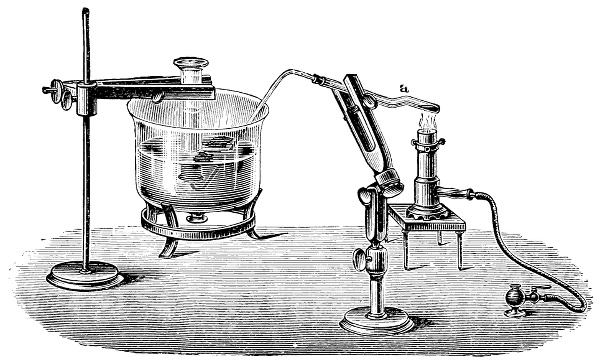
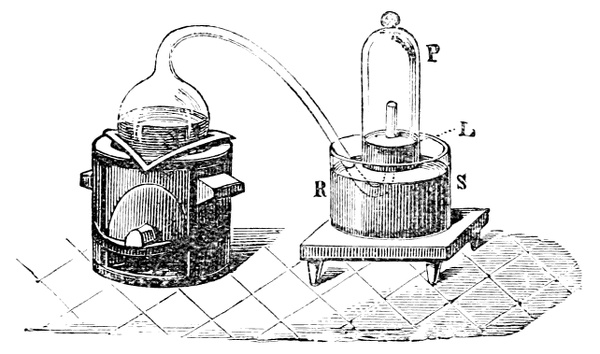
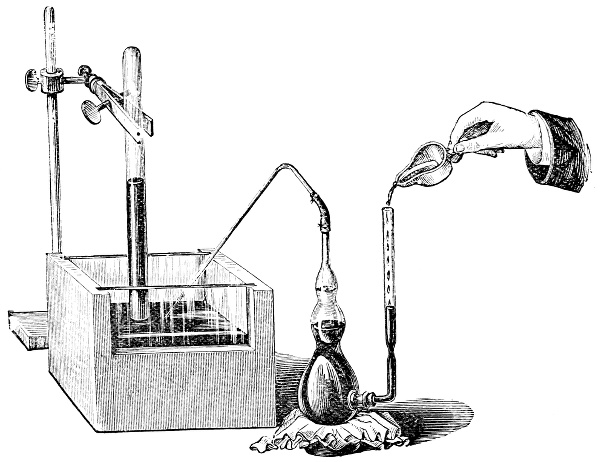
by taking a definite weight of it and measuring the volume of hydrogen
evolved by its action on an excess of acid; it is then easy to calculate
the weight of the hydrogen from its volume.[1] The same result may be
arrived at by determining the composition of the normal salts of the
metal; for instance, by finding the weight of metal which combines
with 35·5 parts of chlorine or 80 parts of bromine.[2] The equivalent of
a metal may be also ascertained by simultaneously (i.e. in one circuit)
decomposing an acid and a fused salt of a given metal by an electric
current and determining the relation between the amounts of hydrogen
and metal separated, because, according to Faraday's law, electrolytes
(conductors of the second order) are always decomposed in equivalent
quantities.[2 bis] The equivalent of a metal may even be found by simply
determining the relation between its weight and that of its salt-giving
oxide, as by this we know the quantity of the metal which
combines with 8 parts by weight of oxygen, and this will be the
equivalent, because 8 parts of oxygen combine with 1 part by weight of
hydrogen. One method is verified by another, and all the processes
for the accurate determination of equivalents require the greatest care
to avoid the absorption of moisture, further oxidation, volatility,
and other accidental influences which affect exact weighings. The
description of the methods necessary for the attainment of exact
results belongs to the province of analytical chemistry.
For univalent metals, like those of the alkalis, the weight of the
equivalent is equal to the weight of the atom. For bivalent metals
the atomic weight is equal to the weight of two equivalents, for n-valent
metals it is equal to the weight of n equivalents. Thus aluminium,
Al = 27, is trivalent, that is, its equivalent = 9; magnesium, Mg = 24,
is bivalent, and its equivalent = 12. Therefore, if potassium or sodium,
or in general a univalent metal, M, give compounds M2O, MHO,
MCl, MNO3, M2SO4, &c., and in general MX, then for bivalent
metals like magnesium or calcium the corresponding compounds
will be MgO, Mg(HO)2, MgCl2, Mg(NO3)2, MgSO4, &c., or in general
MX2.
By what are we to be guided in ascribing to some metals univalency
and to others bi-, ter-, quadri-, ... n-valency? What obliges
us to make this difference? Why are not all metals given the same
valency—for instance, why is not magnesium considered as univalent?
If this be done, taking Mg = 12 (and not 24 as now), not only is
a simplicity of expression of the composition of all the compounds of
magnesium attained, but we also gain the advantage that their composition
will be the same as those of the corresponding compounds of
sodium and potassium. These combinations were so expressed formerly—why
has this since been changed?
These questions could only be answered after the establishment of
the idea of multiples of the atomic weights as the minimum quantities
of certain elements combining with others to form compounds—in
a word, since the time of the establishment of Avogadro-Gerhardt's law
(Chapter VII.). By taking such an element as arsenic, which has
many volatile compounds, it is easy to determine the density of these
compounds, and therefore to establish their molecular weights, and
hence to find the indubitable atomic weight, exactly as for oxygen,
nitrogen, chlorine, carbon, &c. It appears that As = 75, and its compounds
correspond, like the compounds of nitrogen, with the forms
AsX3, and AsX5; for example, AsH3, AsCl3, AsF5, As2O5, &c. It is
evident that we are here dealing with a metal (or rather element) of
two valencies, which moreover is never univalent, but tri- or quinqui-valent.
This example alone is sufficient for the recognition of the
existence of polyvalent atoms among the metals. And as antimony
and bismuth are closely analogous to arsenic in all their compounds,
(just as potassium is analogous to rubidium and cæsium); so,
although very few volatile compounds of bismuth are known, it was
necessary to ascribe to them formulæ corresponding with those ascribed
to arsenic.
As we shall see in describing them, there are also many analogous
metals among the bivalent elements, some of which also give volatile
compounds. For example, zinc, which is itself volatile, gives several
volatile compounds (for instance, zinc ethyl, ZnC4H10, which boils at
118°, vapour density = 61·3), and in the molecules of all these compounds
there is never less than 65 parts of zinc, which is equivalent to
H2, because 65 parts of zinc displace 2 parts by weight of hydrogen; so
that zinc is just such an example of the bivalent metals as oxygen,
whose equivalent = 8 (because H2 is replaced by O = 16), is a representative
of the bivalent elements, or as arsenic is of the tri- and
quinqui-valent elements. And, as we shall afterwards see, magnesium
is in many respects closely analogous to zinc, which fact obliges us to
regard magnesium as a bivalent metal.
Such metals as mercury and copper, which are able to give not one
but two bases, are of particular importance for distinguishing univalent
and bivalent metals. Thus copper gives the suboxide Cu2O and the
oxide CuO—that is, the compounds CuX corresponding with the suboxide
are analogous (in the quantitative relations, by their composition)
to NaX or AgX, and the compounds of the oxide CuX2, to MgX2,
ZnX2, and in general to the bivalent metals. It is clear that in such
examples we must make a distinction between atomic weights and
equivalents.
In this manner the valency, that is, the number of equivalents
entering into the atom of the metals may in many cases be established
by means of comparatively few volatile metallic compounds, with
the aid of a search into their analogies (concerning which see Chapter
XV.). The law of specific heats discovered by Dulong and Petit has
frequently been applied to the same purpose[3] in the history of chemistry,
especially since the development given to this law by the researches of
Regnault, and since Cannizzaro (1860) showed the agreement between
the deductions of this law and the consequences arising from Avogadro-Gerhardt's
law.
Dulong and Petit, having determined the specific heat of a number
of solid elementary substances, observed that as the atomic weights of
the elements increase, their specific heats decrease, and that the product
of the specific heat Q into the atomic weight A is an almost constant
quantity. This means that to bring different elements into a known
thermal state an equal amount of work is required if atomic quantities
of the elements are taken; that is, the amounts of heat expended in
heating equal quantities by weight of the elements are far from equal,
but are in inverse proportion to the atomic weights. For thermal
changes the atom is a unit; all atoms, notwithstanding the difference
of weight and nature, are equal. This is the simplest expression of the
fact discovered by Dulong and Petit. The specific heat measures that
quantity of heat which is required to raise the temperature of one unit
of weight of a substance by one degree. If the magnitude of the
specific heat of elements be multiplied by the atomic weight, then we
obtain the atomic heat—that is, the amount of heat required to raise
the temperature of the atomic weight of an element by one degree. It
is these products which for the majority of the elements prove to be
approximately, if not quite, identical. A complete identity cannot be
expected, because the specific heat of one and the same substance
varies with the temperature, with its passage from one state into
another, and frequently with even a simple mechanical change of
density (for instance by hammering), not to speak of allotropic changes,
&c. We will cite several figures[4] proving the truth of the conclusions
arrived at by Dulong and Petit with respect to solid elementary
bodies.
| |
Li |
|
Na |
|
Mg |
|
P |
| A = |
7 |
|
23 |
|
24 |
|
31 |
| Q = |
0·9408 |
|
0·2934 |
|
0·245 |
|
0·202 |
| AQ = |
6·59 |
|
6·75 |
|
5·88 |
|
6·26 |
| |
Fe |
|
Cu |
|
Zn |
|
Br |
| A = |
56 |
|
63 |
|
65 |
|
80 |
| Q = |
0·112 |
|
0·093 |
|
0·093 |
|
0·0843 |
| AQ = |
6·27 |
|
5·86 |
|
6·04 |
|
6·74 |
| |
Pd |
|
Ag |
|
Sn |
|
I |
| A = |
106 |
|
108 |
|
118 |
|
127 |
| Q = |
0·0592 |
|
0·056 |
|
0·055 |
|
0·0541 |
| AQ = |
6·28 |
|
6·05 |
|
6·49 |
|
6·87 |
| |
Pt |
|
Au |
|
Hg |
|
Pb |
| A = |
196 |
|
198 |
|
200 |
|
206 |
| Q = |
0·0325 |
|
0·0324 |
|
0·0333 |
|
0·0315 |
| AQ = |
6·37 |
|
6·41 |
|
6·66 |
|
6·49 |
It is seen from this that the product of the specific heat of the
element into the atomic weight is an almost constant quantity,
which is nearly 6. Hence it is possible to determine the valency
by the specific heats of the metals. Thus, for instance, the specific
heats of lithium, sodium, and potassium convince us of the fact that
their atomic weights are indeed those which we chose, because by
multiplying the specific heats found by experiment by the corresponding
atomic weights we obtain the following figures: Li, 6·59, Na, 6·75
and K, 6·47. Of the alkaline earth metals the specific heats have been
determined: of magnesium = 0·245 (Regnault and Kopp), of calcium
= 0·170 (Bunsen), and of barium = 0·05 (Mendeléeff). If the same
composition be ascribed to the compounds of magnesium as to the
corresponding compounds of potassium, then the equivalent of magnesium
will be equal to 12. On multiplying this atomic weight by the
specific heat of magnesium, we obtain a figure 2·94, which is half that
which is given by the other solid elements and therefore the atomic
weight of magnesium must be taken as equal to 24 and not to 12.
Then the atomic heat of magnesium = 24 × 0·245 = 5·9; for calcium,
giving its compounds a composition CaX2—for example CaCl2, CaSO4,
CaO (Ca = 40)—we obtain an atomic heat = 40 × 0·17 = 6·8, and for
barium it is equal to 137 × 0·05 = 6·8; that is, they must be counted
as bivalent, or that their atom replaces H2, Na2, or K2. This conclusion
may be confirmed by a method of analogy, as we shall afterwards
see. The application of the principle of specific heats to the determination
of the magnitudes of the atomic weights of those metals, the
magnitude of whose atomic weights could not be determined by
Avogadro-Gerhardt's law, was made about 1860 by the Italian professor
Cannizzaro.
Exactly the same conclusions respecting the bivalence of magnesium
and its analogues are obtained by comparing the specific heats of their
compounds, especially of the halogen compounds as the most simple,
with the specific heats of the corresponding alkali compounds. Thus,
for instance, the specific heats of magnesium and calcium chlorides,
MgCl2 and CaCl2, are 0·194 and 0·164, and of sodium and potassium
chlorides, NaCl and KCl, 0·214 and 0·172, and therefore their molecular
heats (or the products QM, where M is the weight of the molecule) are
18·4 and 18·2, 12·5 and 12·8, and hence the atomic heats (or the
quotient of QM by the number of atoms) are all nearly 6, as with the
elements. Whilst if, instead of the actual atomic weights Mg = 24
and Ca = 40, their equivalents 12 and 20 be taken, then the atomic
heats of the chlorides of magnesium and calcium would be about 4·6,
whilst those of potassium and sodium chlorides are about 6·3.[5] We
must remark, however, that as the specific heat or the amount of heat
required to raise the temperature of a unit of weight one degree[6] is a
complex quantity—including not only the increase of the energy of a
substance with its rise in temperature, but also the external work of
expansion[7] and the internal work accomplished in the molecules
causing them to decompose according to the rise of temperature[8]—therefore
it is impossible to expect in the magnitude of the specific heat
the great simplicity of relation to composition which we see, for instance,
in the density of gaseous substances. Hence, although the specific heat
is one of the important means for determining the atomicity of the
elements, still the mainstay for a true judgment of atomicity is only
given by Avogadro-Gerhardt's law, i.e. this other method can only be
accessory or preliminary, and when possible recourse should be had to
the determination of the vapour density.
Among the bivalent metals the first place, with respect to their
distribution in nature, is occupied by magnesium and calcium, just as
sodium and potassium stand first amongst the univalent metals. The
relation which exists between the atomic weights of these four metals
confirms the above comparison. In fact, the combining weight of
magnesium is equal to 24, and of calcium 40; whilst the combining
weights of sodium and potassium are 23 and 39—that is, the latter
are one unit less than the former.[9] They all belong to the number of
light metals, as they have but a small specific gravity, in which respect
they differ from the ordinary, generally known heavy, or ore, metals (for
instance, iron, copper, silver, and lead), which are distinguished by a
much greater specific gravity. There is no doubt that their low specific
gravity has a significance, not only as a simple point of distinction, but
also as a property which determines the fundamental properties of these
metals. Indeed, all the light metals have a series of points of resemblance
with the metals of the alkalis; thus both magnesium and
calcium, like the metals of the alkalis, decompose water (without the
addition of acids), although not so easily as the latter metals. The
process of the decomposition is essentially one and the same; for
example, Ca + 2H2O = CaH2O2 + H2—that is, hydrogen is liberated
and a hydroxide of the metal formed. These hydroxides are bases
which neutralise nearly all acids. However, the hydroxides RH2O2 of
calcium and magnesium are in no respect so energetic as the hydroxides
of the true metals of the alkalis; thus when heated they lose water,
are not so soluble, develop less heat with acids, and form various salts,
which are less stable and more easily decomposed by heat than the
corresponding salts of sodium and potassium. Thus calcium and
magnesium carbonates easily part with carbonic anhydride when
ignited; the nitrates are also very easily decomposed by heat, calcium
and magnesium oxides, CaO and MgO, being left behind. The chlorides
of magnesium and calcium, when heated with water, evolve hydrogen
chloride, forming the corresponding hydroxides, and when ignited the
oxides themselves. All these points are evidence of a weakening of the
alkaline properties.
These metals have been termed the metals of the alkaline earths,
because they, like the alkali metals, form energetic bases. They are
called alkaline earths because they are met with in nature in a state of
combination, forming the insoluble mass of the earth, and because as
oxides, RO, they themselves have an earthy appearance. Not a few
salts of these metals are known which are insoluble in water, whilst
the corresponding salts of the alkali metals are generally soluble—for
example, the carbonates, phosphates, borates, and other salts of the
alkaline earth metals are nearly insoluble. This enables us to separate
the metals of the alkaline earths from the metals of the alkalis. For
this purpose a solution of ammonium carbonate is added to a mixed
solution of salts of both kinds of metals, when by a double decomposition
the insoluble carbonates of the metals of the alkaline earths are formed
and fall as a precipitate, whilst the metals of the alkalis remain in
solution: RX2 + Na2CO3 = RCO3 + 2NaX.
We may here remark that the oxides of the metals of the alkaline
earths are frequently called by special names: MgO is called magnesia
or bitter earth; CaO, lime; SrO, strontia; and BaO, baryta.
In the primary rocks the oxides of calcium and magnesium are
combined with silica, sometimes in variable quantities, so that in some
cases the lime predominates and in other cases the magnesium. The two
oxides, being analogous to each other, replace each other in equivalent
quantities. The various forms of augite, hornblende, or amphibole, and
of similar minerals, which enter into the composition of nearly all rocks,
contain lime and magnesia and silica. The majority of the primary
rocks also contain alumina, potash, and soda. These rocks, under
the action of water (containing carbonic acid) and air, give up lime
and magnesia to the water, and therefore they are contained in all
kinds of water, and especially in sea-water. The carbonates CaCO3 and
MgCO3, frequently met with in nature, are soluble in an excess of
water saturated with carbonic anhydride,[10] and therefore many natural
waters contain these salts, and are able to yield them when evaporated.
However, one kilogram of water saturated with carbonic anhydride
does not dissolve more than three grams of calcium carbonate. By
gradually expelling the carbonic anhydride from such water, an insoluble
precipitate of calcium carbonate separates out. It may confidently
be stated that the formation of the very widely distributed
strata of calcium and magnesium carbonates was of this nature, because
these strata are of a sedimentary character—that is, such as would
be exhibited by a gradually accumulating deposit on the bottom of
the sea, and, moreover, frequently containing the remains of marine
plants, and animals, shells, &c. It is very probable that the presence
of these organisms in the sea has played the chief part in the precipitation
of the carbonates from the sea water, because the plants
absorb CO2, and many of the organisms CaCO3, and after death give
deposits of carbonate of lime; for instance, chalk, which is almost
entirely composed of the minute remains of the calcareous shields of
such organisms. These deposits of calcium and magnesium carbonates
are the most important sources of these metals. Lime generally predominates,
because it is present in rocks and running water in greater
quantity than magnesia, and in this case these sedimentary rocks are
termed limestone. Some common flagstones used for paving, &c., and
chalk may be taken as examples of this kind of formation. Those
limestones in which a considerable portion of the calcium is replaced by
magnesium are termed dolomites. The dolomites are distinguished by
their hardness, and by their not parting with the whole of their carbonic
anhydride so easily as the limestones under the action of acids.
Dolomites[11] sometimes contain an equal number of molecules of calcium
carbonate and magnesium carbonate, and they also sometimes appear
in a crystalline form, which is easily intelligible, because calcium carbonate
itself is exceedingly common in this form in nature, and is then
known as calc spar, whilst natural crystalline magnesium carbonate is
termed magnesite. The formation of the crystalline varieties of the
insoluble carbonates is explained by the possibility of a slow deposition
from solutions containing carbonic acid. Besides which (Chapter X.)
calcium and magnesium sulphates are obtained from sea water, and
therefore they are met with both as deposits and in springs. It must
be observed that magnesium is held in considerable quantities in
sea water, because the sulphate and chloride of magnesium are very
soluble in water, whilst calcium sulphate is but little soluble, and is
used in the formation of shells; and therefore if the occurrence of considerable
deposits of magnesium sulphate cannot be expected in nature,
still, on the other hand, one would expect (and they do actually occur)
large masses of calcium sulphate or gypsum, CaSO4,2H2O. Gypsum
sometimes forms strata of immense size, which extend over many
hectometres—for example, in Russia on the Volga, and in the Donetz
and Baltic provinces.
Lime and magnesia also, but in much smaller quantities (only to
the amount of several fractions of a per cent. and rarely more), enter
into the composition of every fertile soil, and without these bases the
soil is unable to support vegetation. Lime is particularly important
in this respect, and its presence in a larger quantity generally improves
the harvest, although purely calcareous soils are as a rule infertile.
For this reason the soil is fertilised both with lime[12] itself and with
marl—that is, with clay mixed with a certain quantity of calcium carbonate,
strata of which are found nearly everywhere.
From the soil the lime and magnesia (in a smaller quantity) pass
into the substance of plants, where they occur as salts. Certain of
these salts separate in the interior of plants in a crystalline form—for
example, calcium oxalate. The lime occurring in plants serves as the
source for the formation of the various calcareous secretions which are
so common in animals of all classes. The bones of the highest animal
orders, the shells of mollusca, the covering of the sea-urchin, and similar
solid secretions of sea animals, contain calcium salts; namely, the shells
mainly calcium carbonate, and the bones mainly calcium phosphate.
Certain limestones are almost entirely formed of such deposits.
Odessa is situated on a limestone of this kind, composed of shells.
Thus magnesium and calcium occur throughout the entire realm of
nature, but calcium predominates.
As lime and magnesia form bases which are in many respects
analogous, they were not distinguished from each other for a long
time. Magnesia was obtained for the first time in the seventeenth
century from Italy, and used as a medicine; and it was only in the
last century that Black, Bergmann, and others distinguished magnesia
from lime.
Metallic magnesium (and calcium also) is not obtained by heating
magnesium oxide or the carbonate with charcoal, as the alkali metals
are obtained,[13] but is liberated by the action of a galvanic current
on fused magnesium chloride (best mixed with potassium chloride);
Davy and Bussy obtained metallic magnesium by acting on magnesium
chloride with the vapours of potassium. At the present time (Deville's
process) magnesium is prepared in rather considerable quantities by a
similar process, only the potassium is replaced by sodium. Anhydrous
magnesium chloride, together with sodium chloride and calcium fluoride,
is fused in a close crucible. The latter substances only serve to facilitate
the formation of a fusible mass before and after the reaction, which
is indispensable in order to prevent the access and action of air. One
part of finely divided sodium to five parts of magnesium chloride is
thrown into the strongly heated molten mass, and after stirring the
reaction proceeds very quickly, and magnesium separates, MgCl2 + Na2
= Mg + 2NaCl. In working on a large scale, the powdery metallic
magnesium is then subjected to distillation at a white heat. The distillation
of the magnesium is necessary, because the undistilled metal is
not homogeneous[14] and burns unevenly: the metal is prepared for the
purpose of illumination. Magnesium is a white metal, like silver; it
is not soft like the alkali metals, but is, on the contrary, hard like the
majority of the ordinary metals. This follows from the fact that it
melts at a somewhat high temperature—namely, about 500°—and boils
at about 1000°. It is malleable and ductile, like the generality of
metals, so that it can be drawn into wires and rolled into ribbon; it is
most frequently used for lighting purposes in the latter form. Unlike
the alkali metals, magnesium does not decompose the atmospheric
moisture at the ordinary temperature, so that it is almost unacted on
by air; it is not even acted on by water at the ordinary temperature,
so that it may be washed to free it from sodium chloride. Magnesium
only decomposes water with the evolution of hydrogen at the boiling
point of water,[15] and more rapidly at still higher temperatures. This
is explained by the fact that in decomposing water magnesium forms
an insoluble hydroxide, MgH2O2, which covers the metal and hinders
the further action of the water. Magnesium easily displaces hydrogen
from acids, forming magnesium salts. When ignited it burns, not only
in oxygen but in air (and even in carbonic anhydride), forming a white
powder of magnesium oxide, or magnesia; in burning it emits a white
and exceedingly brilliant light. The strength of this light naturally
depends on the fact that magnesium (24 parts by weight) in burning
evolves about 140 thousand heat units, and that the product of combustion,
MgO, is infusible by heat; so that the vapour of the burning
magnesium contains an ignited powder of non-volatile and infusible
magnesia, and consequently presents all the conditions for the production
of a brilliant light. The light emitted by burning magnesium
contains many rays which act chemically, and are situated in the violet
and ultra-violet parts of the spectrum. For this reason burning
magnesium may be employed for producing photographic images.[16]
Owing to its great affinity for oxygen, magnesium reduces many
metals (zinc, iron, bismuth, antimony, cadmium, tin, lead, copper, silver,
and others) from solutions of their salts at the ordinary temperature,[17]
and at a red heat finely divided magnesium takes up the oxygen from
silica, alumina, boric anhydride, &c.; so that silicon and similar
elements may be obtained by directly heating a mixture of powdered
silica and magnesium in an infusible glass tube.[18]
The affinity of magnesium for the halogens is much more feeble
than for oxygen,[19] as is at once evident from the fact that a solution
of iodine acts feebly on magnesium; still magnesium burns in the
vapours of iodine, bromine, and chlorine. The character of magnesium
is also seen in the fact that all its salts, especially in the presence
of water, are decomposable at a comparatively moderate temperature,
the elements of the acid being evolved, and the magnesium
oxide, which is non-volatile and unchangeable by heat, being left.
This naturally refers to those acids which are themselves volatilised
by heat. Even magnesium sulphate is completely decomposed at
the temperature at which iron melts, oxide of magnesium remaining
behind. This decomposition of magnesium salts by heat proceeds
much more easily than that of calcium salts. For example, magnesium
carbonate is totally decomposed at 170°, magnesium oxide
being left behind. This magnesia, or magnesium oxide, is met with
both in an anhydrous and hydrated state in nature (the anhydrous
magnesia as the mineral periclase, MgO, and the hydrated magnesia
as brucite, MgH2O2). Magnesia is a well-known medicine (calcined
magnesia—magnesia usta). It is a white, extremely fine, and very
voluminous powder, of specific gravity 3·4; it is infusible by heat, and
only shrinks or shrivels in an oxyhydrogen flame. After long contact
the anhydrous magnesia combines with water, although very slowly,
forming the hydroxide Mg(HO)2, which, however, parts with its
water with great ease when heated even below a red heat, and again
yields anhydrous magnesia. This hydroxide is obtained directly as
a gelatinous amorphous substance when a soluble alkali is mixed with
a solution of any magnesium salt, MgCl2 + 2KHO = Mg(HO)2 + 2KCl.
This decomposition is complete, and nearly all the magnesium
passes into the precipitate; and this clearly shows the almost perfect
insolubility of magnesia in water. Water dissolves a scarcely perceptible
quantity of magnesium hydroxide—namely, one part is dissolved
by 55,000 parts of water. Such a solution, however, has
an alkaline reaction, and gives, with a salt of phosphoric acid, a
precipitate of magnesium phosphate, which is still more insoluble.
Magnesia is not only dissolved by acids, forming salts, but it also displaces
certain other bases—for example, ammonia from ammonium
salts when boiled; and the hydroxide also absorbs carbonic anhydride
from the air. The magnesium salts, like those of calcium, potassium,
and sodium, are colourless if they are formed from colourless
acids. Those which are soluble have a bitter taste, whence magnesia
has been termed bitter-earth. In comparison with the alkalis magnesia
is a feeble base, inasmuch as it forms somewhat unstable salts, easily
gives basic salts, forms acid salts with difficulty, and is able to give
double salts with the salts of the alkalis, which facts are characteristic
of feeble bases, as we shall see in becoming acquainted with the different
metals.
The power of magnesium salts to form double and basic salts is
very frequently shown in reactions, and is specially marked as regards
ammonium salts. If saturated solutions of magnesium and
ammonium sulphates are mixed together, a crystalline double salt
Mg(NH4)2(SO4)2,6H2O,[20] is immediately precipitated. A strong
solution of ordinary ammonium carbonate dissolves magnesium
oxide or carbonate, and precipitates crystals of a double salt,
Mg(NH4)2(CO3)2,4H2O, from which water extracts the ammonium
carbonate. With an excess of an ammonium salt the double salt passes
into solution,[21] and therefore if a solution contain a magnesium salt
and an excess of an ammonium salt—for instance, sal-ammoniac—then
sodium carbonate will no longer precipitate magnesium carbonate.
A mixture of solutions of magnesium and ammonium chlorides, on
evaporation or refrigeration, gives a double salt, Mg(NH4)Cl3,6H2O.[22]
The salts of potassium, like those of ammonium, are able to enter into
combination with the magnesium salts.[23] For instance, the double
salt, MgKCl3,6H2O, which is known as carnallite,[24] and occurs in the
salt mines of Stassfurt, may be formed by freezing a saturated solution
of potassium chloride with an excess of magnesium chloride. A saturated
solution of magnesium sulphate dissolves potassium sulphate, and
solid magnesium sulphate is soluble in a saturated solution of potassium
sulphate. A double salt, K2Mg(SO4)2,6H2O, which closely resembles
the above-mentioned ammonium salt, crystallises from these solutions.[25]
The nearest analogues of magnesium are able to give exactly similar
double salts, both in crystalline form (monoclinic system) and composition;
they, like this salt (see Chapter XV.), are easily able (at 140°)
to part with all their water of crystallisation, and correspond with
the salts of sulphuric acid, whose type may be taken as magnesium
sulphate, MgSO4.[26] It occurs at Stassfurt as kieserite, MgSO4,H2O,
and generally separates from solutions as a heptahydrated salt,
MgSO4,7H2O, and from supersaturated solutions as a hexahydrated
salt, MgSO4,6H2O; at temperatures below 0° it crystallises out as a
dodecahydrated salt, MgSO4,12H2O, and a solution of the composition
MgSO4,2H2O solidifies completely at -5°.[27] Thus between
water and magnesium sulphate there may exist several definite and
more or less stable degrees of equilibrium; the double salt
MgSO4K2SO4,6H2O may be regarded as one of these equilibrated
systems, the more so since it contains 6H2O, whilst MgSO4 forms its
most stable system with 7H2O, and the double salt may be considered
as this crystallo-hydrate in which one molecule of water is replaced
by the molecule K2SO4.[28]
The power of forming basic salts is a very remarkable peculiarity
of magnesia and other feeble bases, and especially of those corresponding
with polyvalent metals. The very powerful bases corresponding
with univalent metals—like potassium and sodium—do not
form basic salts, and, indeed, are more prone to give acid salts, whilst
magnesium easily and frequently forms basic salts, especially with feeble
acids, although there are some oxides—as, for example, copper and
lead oxides—which still more frequently give basic salts. If a cold
solution of magnesium sulphate be mixed with a solution of sodium
carbonate there is formed a gelatinous precipitate of a basic salt,
Mg(HO)2,4MgCO3,9H2O; but all the magnesia is not precipitated in
this case, as a portion of it remains in solution as an acid double salt.
If sodium carbonate be added to a boiling solution of magnesium
sulphate a precipitate of a still more basic salt is formed, 4MgSO4
+ 4Na2CO3 + 4H2O = 4Na2SO4 + CO2 + Mg(OH)2,3MgCO3,3H2O.
This basic salt forms the ordinary drug magnesia (magnesia alba), in
the form of light porous lumps. Other basic salts are formed under
certain modifications of temperature and conditions of decomposition.
But the normal salt, MgCO3, which occurs in nature as magnesite
in the form of rhombohedra of specific gravity 3·056, cannot be
obtained by such a method of precipitation. In fact, the formation of
the different basic salts shows the power of water to decompose the
normal salt. It is possible, however, to obtain this salt both in an
anhydrous and hydrated state. A solution of magnesium carbonate in
water containing carbonic acid is taken for this purpose. The reason
for this is easily understood—carbonic anhydride is one of the products
of the decomposition of magnesium carbonate in the presence of
water. If this solution be left to evaporate spontaneously the normal
salt separates in a hydrated form, but in the evaporation of a heated
solution, through which a stream of carbonic anhydride is passed, the
anhydrous salt is formed as a crystalline mass, which remains unaltered
in the air, like the natural mineral.[29] The decomposing influence of
water on the salts of magnesium, which is directly dependent on the
feeble basic properties of magnesia,[30] is most clearly seen in magnesium
chloride, MgCl2. This salt is contained[31] in the last mother-liquors of
the evaporation of sea-water. On cooling a sufficiently concentrated
solution, the crystallo-hydrate, MgCl2,6H2O, separates;[32] but if it be
further heated (above 106°) to remove the water, then hydrochloric
acid passes off together with the latter, so that there ultimately remains
magnesia with a small quantity of magnesium chloride.[33] From what
has been said it is evident that anhydrous magnesium chloride cannot
be obtained by simple evaporation. But if sal-ammoniac or sodium
chloride be added to a solution of magnesium chloride, then the evolution
of hydrochloric acid does not take place, and after complete
evaporation the residue is perfectly soluble in water. This renders it
possible to obtain anhydrous magnesium chloride from its aqueous
solution. Indeed the mixture with sal-ammoniac (in excess) may be
dried (the residue consists of an anhydrous double salt, MgCl2,2NH4Cl)
and then ignited (460°), when the sal-ammoniac is converted into
vapour and a fused mass of anhydrous magnesium chloride remains
behind. The anhydrous chloride evolves a very considerable amount of
heat on the addition of water, which shows the great affinity the salt
has for water.[34] Anhydrous magnesium chloride is not only obtained
by the above method, but is also formed by the direct combination of
chlorine and magnesium, and by the action of chlorine on magnesium
oxide, oxygen being evolved; this proceeds still more easily by heating
magnesia with charcoal in a stream of chlorine, when the charcoal serves
to take up the oxygen. This latter method is also employed for the preparation
of chlorides which are formed in an anhydrous condition with
still greater difficulty than magnesium chloride. Anhydrous magnesium
chloride forms a colourless, transparent mass, composed of flexible
crystalline plates of a pearly lustre. It fuses at a low red heat (708°)
into a colourless liquid, remains unchanged in a dry state, but under
the action of moisture is partially decomposed even at the ordinary
temperature, with formation of hydrochloric acid. When heated in the
presence of oxygen (air) it gives chlorine and the basic salt, which
is formed with even greater facility under the action of heat in the
presence of steam, when HCl is formed, according to the equation
2MgCl2 + H2O = MgOMgCl2 + 2HCl.[34 bis]
Calcium (or the metal of lime) and its compounds in many respects
present a great resemblance to magnesium compounds, but are also
clearly distinguished from them by many properties.[35] In general,
calcium stands to magnesium in the same relation as potassium occupies
in respect to sodium. Davy obtained metallic calcium, like potassium,
as an amalgam by the action of a galvanic current; but neither
charcoal nor iron decomposes calcium oxide, and even sodium decomposes
calcium chloride[36] with difficulty. But a galvanic current easily
decomposes calcium chloride, and metallic sodium somewhat easily
decomposes calcium iodide when heated. As in the case of hydrogen,
potassium, and magnesium, the affinity of iodine for calcium is feebler
than that of chlorine (and oxygen), and therefore it is not surprising
that calcium iodide may be subjected to that decomposition, which the
chloride and oxide undergo with difficulty.[37] Metallic calcium is of a
yellow colour, and has a considerable lustre, which it preserves in
dry air. Its specific gravity is 1·58. Calcium is distinguished by
its great ductility; it melts at a red heat and then burns in the air
with a very brilliant flame; the brilliancy is due to the formation of
finely divided infusible calcium oxide. Judging from the fact that
calcium in burning gives a very large flame, it is probable that this
metal is volatile. Calcium decomposes water at the ordinary temperature,
and is oxidised in moist air, but not so rapidly as sodium.
In burning, it gives its oxide or lime, CaO, a substance which is
familiar to every one, and of which we have already frequently had
occasion to speak. This oxide is not met with in nature in a free
state, because it is an energetic base which everywhere encounters acid
substances forming salts with them. It is generally combined with
silica, or occurs as calcium carbonate or sulphate. The carbonate
and nitrate are decomposed, at a red heat, with the formation of lime.
As a rule, the carbonate, which is so frequently met with in nature,
serves as the source of the calcium oxide, both commercial and pure.
When heated, calcium carbonate dissociates: CaCO3 = CaO + CO2.
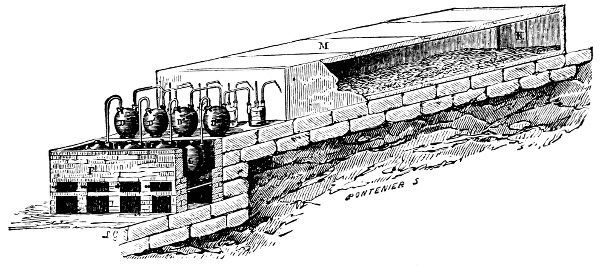
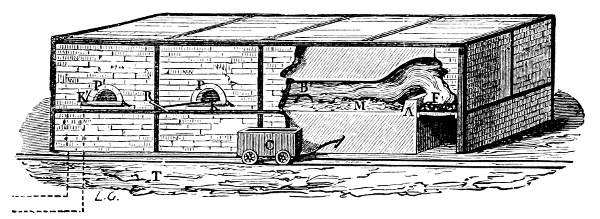
In practice the decomposition is conducted at a bright red heat, in the
presence of steam, or a current of a foreign gas, in heaps or in special
kilns.[38]
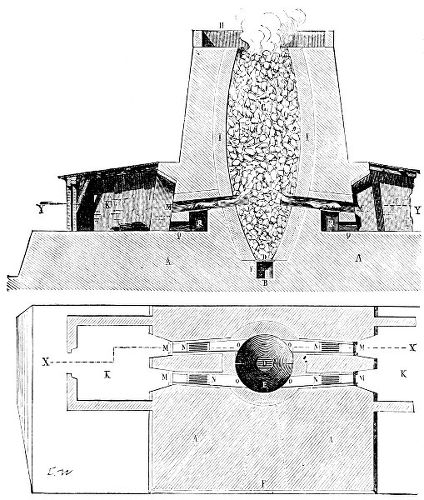
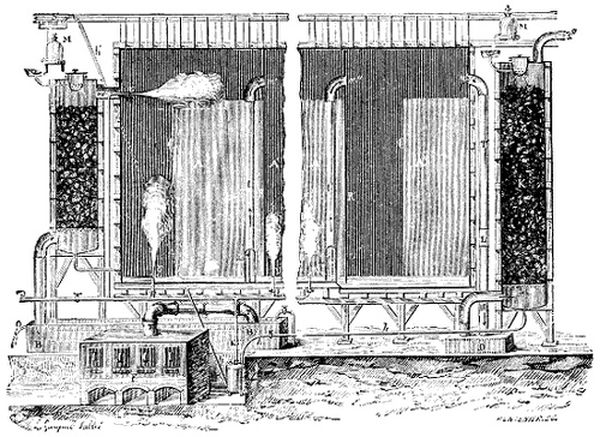
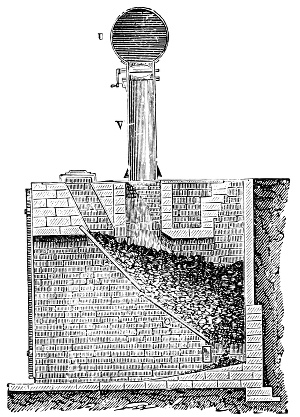
Fig. 78.—Continually-acting kiln for burning lime. The lime is charged from above and calcined by
four lateral grates, R, M. D, fire-bars. B, space for withdrawing the burnt lime. K, stoke-house.
M. fire grate. Q, R, under-grate.
Calcium oxide—that is, quicklime—is a substance (sp. gr. 3·15)
which is unaffected by heat,[39] and may therefore serve as a fire-resisting
material, and was employed by Deville for the construction
of furnaces in which platinum was melted, and silver volatilised by the
action of the heat evolved by the combustion of detonating gas. The
hydrated lime, slaked lime, or calcium hydroxide, CaH2O2 (specific
gravity 2·07) is a most common alkaline substance, employed largely
in building for making mortars or cements, in which case its binding
property is mainly due to the absorption of carbonic anhydride.[40]
Lime, like other alkalis, acts on many animal and vegetable substances,
and for this reason has many practical uses—for example,
for removing fats, and in agriculture for accelerating the decomposition
of organic substances in the so-called composts or accumulations
of vegetable and animal remains used for fertilising land.
Calcium hydroxide easily loses its water at a moderate heat (530°),
but it does not part with water at 100°. When mixed with water,
lime forms a pasty mass known as slaked lime and in a more
dilute form as milk of lime, because when shaken up in water it
remains suspended in it for a long time and presents the appearance
of a milky liquid. But, besides this, lime is directly soluble in water,
not to any considerable extent, but still in such a quantity that lime
water is precipitated by carbonic anhydride, and has clearly distinguishable
alkaline properties. One part of lime requires at the
ordinary temperature about 800 parts of water for solution. At 100°
it requires about 1500 parts of water, and therefore lime-water
becomes cloudy when boiled. If lime-water be evaporated in a
vacuum, calcium hydroxide separates in six-sided crystals.[41] If
lime-water be mixed with hydrogen peroxide minute crystals of
calcium peroxide, CaO2,8H2O, separate; this compound is very unstable
and, like barium peroxide, is decomposed by heat. Lime, as a
powerful base, combines with all acids, and in this respect presents a
transition from the true alkalis to magnesia. Many of the salts of
calcium (the carbonate, phosphate, borate, and oxalate) are insoluble
in water; besides which the sulphate is only sparingly soluble. As
a more energetic base than magnesia, lime forms salts, CaX2, which
are distinguished by their stability in comparison with the salts
MgX2; neither does lime so easily form basic and double salts as
magnesia.
Anhydrous lime does not absorb dry carbonic anhydride at the
ordinary temperature. This was already known by Scheele, and Prof.
Schuliachenko showed that there is no absorption even at 360°. It
only proceeds at a red heat,[42] and then only leads to the formation
of a mixture of calcium oxide and carbonate (Rose). But if the
lime be slaked or dissolved, the absorption of carbonic anhydride
proceeds rapidly and completely. These phenomena are connected
with the dissociation of calcium carbonate, studied by Debray (1867)
under the influence of the conceptions of dissociation introduced
into science by Henri Saint-Claire Deville. Just as there is no
vapour tension for non-volatile substances, so there is no dissociation
tension of carbonic anhydride for calcium carbonate at the ordinary
temperature. Just as every volatile substance has a maximum possible
vapour tension for every temperature, so also calcium carbonate has
its corresponding dissociation tension; this at 770° (the boiling point
of cadmium) is about 85 mm. (of the mercury column), and at 930° (the
boiling point of Zn) it is about 520 mm. As, if the tension be greater,
there will be no evaporation, so also there will he no decomposition.
Debray took crystals of calc spar, and could not observe the least change
in them at the boiling point of zinc (930°) in an atmosphere of carbonic
anhydride taken at the atmospheric pressure (760 mm.), whilst on the
other hand calcium carbonate may be completely decomposed at a
much lower temperature if the tension of the carbonic anhydride be
kept below the dissociation tension, which may be done either by
directly pumping away the gas with an air-pump, or by mixing it with
some other gas—that is, by diminishing the partial pressure of the
carbonic anhydride,[43] just as an object may be dried at the ordinary
temperature by removing the aqueous vapour or by carrying it off in
a stream of another gas. Thus it is possible to obtain calcium carbonate
from lime and carbonic anhydride at a certain temperature above
that at which dissociation begins, and conversely to decompose calcium
carbonate at the same temperature into lime and carbonic anhydride.[44]
At the ordinary temperature the reaction of the first order (combination)
cannot proceed because the second (decomposition, dissociation)
cannot take place, and thus all the most important phenomena with respect
to the behaviour of lime towards carbonic anhydride are explained
by starting from one common basis.[45]
Calcium carbonate, CaCO3, is sometimes met with in nature in a
crystalline form, and it forms an example of the phenomenon termed
dimorphism—that is, it appears in two crystalline forms. When it
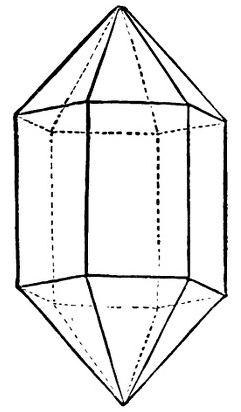
exhibits combinations of forms belonging to the hexagonal system (six-sided
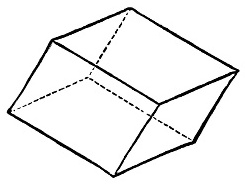
prisms, rhombohedra, &c.) it is called calc spar. Calc spar has a
specific gravity of 2·7, and is further characterised by a distinct cleavage
along the planes of the fundamental rhombohedron having an angle
of 105°. Perfectly transparent Iceland spar presents a clear example
of double refraction (for which reason it is frequently employed in
physical apparatus). The other form of calcium carbonate occurs in
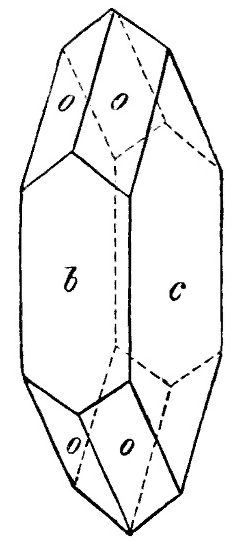
crystals belonging to the rhombic system, and it is then called aragonite;
its specific gravity is 3·0. If calcium carbonate be artificially
produced by slow crystallisation at the ordinary temperature, it appears
in the rhombohedral form, but if the crystallisation be aided by heat it
then appears as aragonite. It may therefore be supposed that calc spar
presents the form corresponding with a low temperature, and aragonite
with a higher temperature during crystallisation.[46]
Calcium sulphate in combination with two equivalents of water,
CaSO4,2H2O, is very widely distributed in nature, and is known as
gypsum. Gypsum loses one and a half and two equivalents of water at
a moderate temperature,[47] and anhydrous or burnt gypsum is then
obtained, which is also known as plaster of Paris, and is employed in
large quantities for modelling.[48] This use depends on the fact that
burnt and finely-divided and sifted gypsum forms a paste when mixed
with water; after a certain time this paste becomes slightly heated and
solidifies, owing to the fact that the anhydrous calcium sulphate, CaSO4,
again combines with water. When the plaster of Paris and water are
first made into a paste they form a mechanical mixture, but when the
mass solidifies, then a compound of the calcium sulphate with two
molecules of water is produced; and this may be regarded as derived
from S(OH)6 by the substitution of two atoms of hydrogen by one atom
of bivalent calcium. Natural gypsum sometimes appears as perfectly
colourless, or variegated, marble-like, masses, and sometimes in perfectly
colourless crystals, selenite, of specific gravity 2·33. The semi-transparent
gypsum, or alabaster, is often carved into small statues. Besides
which an anhydrous calcium sulphate, CaSO4, called anhydrite (specific
gravity 2·97), occurs in nature. It sometimes occurs along with gypsum.
It is no longer capable of combining directly with water, and differs
in this respect from the anhydrous salt obtained by gently igniting
gypsum. If gypsum be very strongly heated it shrinks and loses
its power of combining with water.[48 bis] One part of calcium sulphate
requires at 0° 525 parts of water for solution, at 38° 466 parts, and at 100°
571 parts of water. The maximum solubility of gypsum is at about 36°,
which is nearly the same temperature as that at which sodium sulphate
is most soluble.[49]
As lime is a more energetic base than magnesia, so calcium chloride,
CaCl2, is not so easily decomposed by water, and its solutions only
disengage a small quantity of hydrochloric acid when evaporated, and
when the evaporation is conducted in a stream of hydrochloric acid it
easily gives an anhydrous salt which fuses at 719°; otherwise an
aqueous solution yields a crystallo-hydrate, CaCl2,6H2O, which melts
at 30°.[50]
Just as for potassium, K = 39 (and sodium, Na = 23), there are
the near analogues, Rb = 85 and Cs = 133, and also another, Li = 7, so
in exactly the same manner for calcium, Ca = 40 (and magnesium,
Mg = 24), there is another analogue of lighter atomic weight,
beryllium, Be = 9, besides the near analogues strontium, Sr = 87, and
barium, Ba = 137. As rubidium and cæsium are more rarely met
with in nature than potassium, so also strontium and barium are rarer
than calcium (in the same way that bromine and iodine are rarer than
chlorine). Since they exhibit many points of resemblance with calcium,
strontium and barium may be characterised after a very short acquaintance
with their chief compounds; this shows the important advantages
gained by distributing the elements according to their natural groups,
to which matter we shall turn our attention in the next chapter.
Among the compounds of barium met with in nature the commonest
is the sulphate, BaSO4, which forms anhydrous crystals of the rhombic
system, which are identical in their crystalline form with anhydrite,
and generally occur as transparent and semi-transparent masses of
tabular crystals having a high specific gravity, namely 4·45, for which
reason this salt bears the name of heavy spar or barytes. Analogous to
it is celestine, SrSO4, which is, however, more rarely met with. Heavy
spar frequently forms the gangue separated on dressing metallic ores
from the vein stuff; this mineral is the source of all other barium
compounds; for the carbonate, although more easily transformed
into the other compounds (because acids act directly on it, evolving
carbonic anhydride), is a comparatively rare mineral (BaCO3 forms
the mineral witherite; SrCO3, strontianite; both are rare, the
latter is found at Etna). The treatment of barium sulphate is
rendered difficult from the fact that it is insoluble both in water and
acids, and has therefore to be treated by a method of reduction.[51]
Like sodium sulphate and calcium sulphate, heavy spar when heated
with charcoal parts with its oxygen and forms barium sulphide, BaS.
For this purpose a pasty mixture of powdered heavy spar, charcoal,
and tar is subjected to the action of a strong heat, when BaSO4
+ 4C = BaS + 4CO. The residue is then treated with water, in which
the barium sulphide is soluble.[52] When boiled with hydrochloric acid,
barium chloride, BaCl2, is obtained in solution, and the sulphur is disengaged
as gaseous sulphuretted hydrogen, BaS + 2HCl = BaCl2 + H2S.
In this manner barium sulphate is converted into barium chloride,[53]
and the latter by double decomposition with strong nitric acid or
nitre gives the less soluble barium nitrate, Ba(NO3)2,[54] or with sodium
carbonate a precipitate of barium carbonate, BaCO3. Both these salts
are able to give barium oxide, or baryta, BaO, and the hydroxide,
Ba(HO)2, which differs from lime by its great solubility in water,[55]
and by the ease with which it forms a crystallo-hydrate, BaH2O2,8H2O,
from its solutions. Owing to its solubility, baryta is frequently
employed in manufactures and in practical chemistry as an alkali
which has the very important property that it may be always entirely
removed from solution by the addition of sulphuric acid, which entirely
separates it as the insoluble barium sulphate, BaSO4. It may also be
removed whilst it remains in an alkaline state (for example, the
excess which may remain when it is used for saturating acids) by
means of carbonic anhydride, which also completely precipitates baryta
as a sparingly soluble, colourless, and powdery carbonate. Both these
reactions show that baryta has such properties as would very greatly
extend its use were its compounds as widely distributed as those of
sodium and calcium, and were its soluble compounds not poisonous.
Barium nitrate is directly decomposed by the action of heat, barium
oxide being left behind. The same takes place with barium carbonate,
especially that form of it precipitated from solutions, and
when mixed with charcoal or ignited in an atmosphere of steam.
Barium oxide combines with water with the development of a large
amount of heat, and the resultant hydroxide is very stable in its retention
of the water, although it parts with it when strongly ignited.[55 bis]
With oxygen the anhydrous oxide gives, as already mentioned in
Chapters III. and IV., a peroxide, BaO2.[56] Neither calcium nor
strontium oxides are able to give such a peroxide directly, but they
form peroxides under the action of hydrogen peroxide.
Barium oxide is decomposed when heated with potassium; fused
barium chloride is decomposed, as Davy showed, by the action of a
galvanic current, forming metallic barium; and Crookes (1862) obtained
an amalgam of barium from which the mercury could easily be driven
off, by heating sodium amalgam in a saturated solution of barium
chloride. Strontium is obtained by the same processes. Both metals
are soluble in mercury, and seem to be non-volatile or only very slightly
volatile. They are both heavier than water; the specific gravity
of barium is 3·6, and of strontium 2·5. They both decompose water at
the ordinary temperature, like the metals of the alkalis.
Barium and strontium as saline elements are characterised by their
powerful basic properties, so that they form acid salts with difficulty,
and scarcely form basic salts. On comparing them together and with
calcium, it is evident that the alkaline properties in this group (as in
the group potassium, rubidium, cæsium) increase with the atomic
weight, and this succession clearly shows itself in many of their corresponding
compounds. Thus, for instance, the solubility of the
hydroxides RH2O2 and the specific gravity[57] rise in passing from
calcium to strontium and barium, while the solubility of the sulphates
decreases,[58] and therefore in the case of magnesium and beryllium, as
metals whose atomic weights are still less, we should expect the solubility
of the sulphates to be greater, and this is in reality the case.
Just as in the series of the alkali metals we saw the metals potassium,
rubidium, and cæsium approaching near to each other in their
properties, and allied to them two metals having smaller combining
weights—namely, sodium, and the lightest of all, lithium, which all
exhibited certain peculiar characteristic properties—so also in the case
of the metals of the alkaline earths we find, besides calcium, barium,
and strontium, the metal magnesium and also beryllium or glucinum.
In respect to the magnitude of its atomic weight, this last occupies the
same position in the series of the metals of the alkaline earths as lithium
does in the series of the alkali metals, for the combining weight of
beryllium, Be or Gl = 9. This combining weight is greater than that
of lithium (7), as the combining weight of magnesium (24) is greater
than that of sodium (23), and as that of calcium (40) is greater than
that of potassium (39), &c.[59] Beryllium was so named because it occurs
in the mineral beryl. The metal is also called glucinum (from the
Greek word γλυκύς, ‘sweet’), because its salts have a sweet taste. It
occurs in beryl, aquamarine, the emerald, and other minerals, which
are generally of a green colour; they are sometimes found in considerable
masses, but as a rule are comparatively rare and, as transparent
crystals, form precious stones. The composition of beryl and of the
emerald is as follows: Al2O3,3BeO,6SiO2. The Siberian and Brazilian
beryls are the best known. The specific gravity of beryl is about 2·7.
Beryllium oxide, from the feebleness of its basic properties, presents
an analogy to aluminium oxide in the same way that lithium oxide is
analogous to magnesium oxide.[60] Owing to its rare occurrence in nature,
to the absence of any especially distinct individual properties, and to
the possibility of foretelling them to a certain extent on the basis of the
periodic system of the elements given in the following chapter, and
owing to the brevity of this treatise, we will not discuss at any length
the compounds of beryllium, and will only observe that their
individuality was pointed out in 1798 by Vauquelin, and that
metallic beryllium was obtained by Wöhler and Bussy. Wöhler
obtained metallic beryllium (like magnesium) by acting on beryllium
chloride, BeCl2, with potassium (it is best prepared by fusing
K2BeF4 with Na). Metallic beryllium has a specific gravity 1·64
(Nilson and Pettersson). It is very infusible, melting at nearly
the same temperature as silver, which it resembles in its white
colour and lustre. It is characterised by the fact that it is very difficultly
oxidised, and even in the oxidising flame of the blowpipe is only
superficially covered by a coating of oxide; it does not burn in pure
oxygen, and does not decompose water at the ordinary temperature or
at a red heat, but gaseous hydrochloric acid is decomposed by it when
slightly heated, with evolution of hydrogen and development of a considerable
amount of heat. Even dilute hydrochloric acid acts in the
same manner at the ordinary temperature. Beryllium also acts easily
on sulphuric acid, but it is remarkable that neither dilute nor strong
nitric acid acts on beryllium, which seems especially able to resist
oxidising agents. Potassium hydroxide acts on beryllium as on
aluminium, hydrogen being disengaged and the metal dissolved, but
ammonia has no action on it. These properties of metallic beryllium
seem to isolate it from the series of the other metals described in this
chapter, but if we compare the properties of calcium, magnesium, and
beryllium we shall see that magnesium occupies a position intermediate
between the other two. Whilst calcium decomposes water with great
ease, magnesium does so with difficulty, and beryllium not at all. The
peculiarities of beryllium among the metals of the alkaline earths recall
the fact that in the series of the halogens we saw that fluorine differed
from the other halogens in many of its properties and had the smallest
atomic weight. The same is the case with regard to beryllium among
the other metals of the alkaline earths.
In addition to the above characteristics of the compounds of the
metals of the alkaline earths, we must add that they, like the
alkali metals, combine with nitrogen and hydrogen, and while sodium
nitride (obtained by igniting the amide of sodium, Chapter XII.,
Note 44 bis) and lithium nitride (obtained by heating lithium in nitrogen,
Chapter XIII., Note 39) have the composition R3N, so the nitrides
of magnesium (Note 14), calcium, strontium, and barium have the
composition R3N2, for example, Ba3N2, as might be expected from the
diatomicity of the metals of the alkaline earths and from the relation of
the nitrides to ammonia, which is obtained from all of these compounds
by the action of water. The nitrides of Ca, Sr, and Ba are formed
directly (Maquenne, 1892) by heating the metals in nitrogen. They all
have the appearance of an amorphous powder of dark colour; as
regards their reactions, it is known that besides disengaging ammonia
with water, they form cyanides when heated with carbonic oxide; for
instance, Ba3N2 + 2CO = Ba(CN)2 + 2BaO.[61]
The metals of the alkaline earths, just like Na and K, absorb
hydrogen under certain conditions, and form pulverulent easily oxidisable
metallic hydrides, whose composition corresponds exactly to that
of Na2H and K2H, with the substitution of K2 and Na2 by the atoms
Be, Mg, Ca, Sr, and Ba. The hydrides of the metals of the alkaline
earths were discovered by C. Winkler (1891) in investigating the
reducibility of these metals by magnesium. In reducing their oxides
by heating them with magnesium powder in a stream of hydrogen,
Winkler observed that the hydrogen was absorbed (but very slowly), i.e.
at the moment of their separation all the metals of the alkaline earths
combine with hydrogen. This absorptive power increases in passing
from Be to Mg, Ca, Sr, and Ba, and the resultant hydrides retain the
combined hydrogen[62] when heated, so that these hydrides are distinguished
for their considerable stability under heat, but they oxidise
very easily.[63]
Thus the analogies and correlation of the metals of these two groups
are now clearly marked, not only in their behaviour towards oxygen,
chlorine, acids, &c., but also in their capability of combining with
nitrogen and hydrogen.
END OF THE FIRST VOLUME
PRINTED BY
SPOTTISWOODE AND CO., NEW-STREET SQUARE
LONDON
A
CLASSIFIED CATALOGUE
OF
SCIENTIFIC WORKS
PUBLISHED BY
MESSRS. LONGMANS, GREEN, & CO.
LONDON: 39 PATERNOSTER ROW, E.C.
NEW YORK: 91 & 93 FIFTH AVENUE.
BOMBAY: 32 HORNBY ROAD.
CONTENTS.
| |
PAGE |
| Advanced Science Manuals |
30 |
| Agriculture |
27 |
| Astronomy |
14 |
| Bacteriology |
25 |
| Biology |
25 |
| Botany |
26 |
| Building Construction |
10 |
| Chemistry |
2 |
| Dynamics |
6 |
| Electricity |
11 |
| Elementary Science Manuals |
30 |
| Engineering |
12 |
| Geology |
17 |
| Health and Hygiene |
17 |
| Heat |
8 |
| Hydrostatics |
6 |
| Light |
8 |
| London Science Class-Books |
32 |
| Longmans' Civil Engineering Series |
13 |
| Machine Drawing and Design |
13 |
| Magnetism |
11 |
| Manufactures |
17 |
| Mechanics |
6 |
| Medicine and Surgery |
19 |
| Metallurgy |
14 |
| Mineralogy |
14 |
| Natural History |
18 |
| Navigation |
14 |
| Optics |
8 |
| Photography |
8 |
| Physics |
5 |
| Physiography |
17 |
| Physiology |
25 |
| Practical Elementary Science Series |
32 |
| Proctor's (R. A.) Works |
15 |
| Sound |
8 |
| Statics |
6 |
| Steam, Oil, and Gas Engines |
9 |
| Strength of Materials |
12 |
| Technology |
17 |
| Telegraphy |
12 |
| Telephone |
12 |
| Text-Books of Science |
29 |
| Thermodynamics |
8 |
| Tyndall's (John) Works |
28 |
| Veterinary Medicine, etc. |
24 |
| Workshop Appliances |
14 |
| Zoology |
25 |
CHEMISTRY.
CORNISH.—PRACTICAL PROOFS OF CHEMICAL LAWS:
A Course of Experiments upon the Combining Proportions of the Chemical
Elements. By Vaughan Cornish, M.Sc., Associate of the Owens College,
Manchester. Crown 8vo., 2s.
CROOKES.—SELECT METHODS IN CHEMICAL
ANALYSIS, chiefly Inorganic. By Sir William Crookes, F.R.S., etc. Third
Edition, Rewritten and Enlarged. With 67 Woodcuts. 8vo., 21s. net.
FURNEAUX.—ELEMENTARY CHEMISTRY, Inorganic and
Organic. By W. Furneaux, F.R.C.S., Lecturer on Chemistry, London
School Board. With 65 Illustrations and 155 Experiments. Crown 8vo., 2s. 6d.
GARRETT AND HARDEN.—AN ELEMENTARY COURSE
OF PRACTICAL ORGANIC CHEMISTRY. By F. C. Garrett, M.Sc.
(Vict. et Dunelm.), Assistant Lecturer and Demonstrator in Chemistry, the
Durham College of Science, Newcastle-on-Tyne; and Arthur Harden,
M.Sc. (Vict.), Ph.D., Assistant Lecturer and Demonstrator in Chemistry, the
Owens College, Manchester.
HJELT.—PRINCIPLES OF GENERAL ORGANIC CHEMISTRY.
By Professor E. Hjelt, of Helsingfors. Translated from the
German by J. Bishop Tingle, Ph.D., Assistant in the Laboratory of the
Heriot Watt College, Edinburgh. Crown 8vo., 6s. 6d.
JAGO.—Works by W. JAGO, F.C.S., F.I.C.
INORGANIC CHEMISTRY, THEORETICAL AND
PRACTICAL. With an Introduction to the Principles of Chemical Analysis,
Inorganic and Organic. With 63 Woodcuts and numerous Questions and
Exercises. Fcp. 8vo., 2s. 6d.
AN INTRODUCTION TO PRACTICAL INORGANIC
CHEMISTRY. Crown 8vo., 1s. 6d.
INORGANIC CHEMISTRY, THEORETICAL AND
PRACTICAL. A Manual for Students in Advanced Classes of the Science
and Art Department. With Plate of Spectra and 78 Woodcuts. Crown
8vo., 4s. 6d.
KOLBE.—A SHORT TEXT-BOOK OF INORGANIC
CHEMISTRY. By Dr. Hermann Kolbe. Translated and Edited by T. S.
Humpidge, Ph.D. With 66 Illustrations. Crown 8vo., 8s. 6d.
MENDELÉEFF.—THE PRINCIPLES OF CHEMISTRY.
By D. Mendeléeff. Translated from the Russian (Sixth Edition) by George
Kamensky, A.R.S.M., of the Imperial Mint, St. Petersburg; and Edited by
T. A. Lawson, B.Sc., Ph.D., Fellow of the Institute of Chemistry. With 96
Diagrams and Illustrations. 2 vols. 8vo., 36s.
MEYER.—OUTLINES OF THEORETICAL CHEMISTRY.
By Lothar Meyer, Professor of Chemistry in the University of Tübingen.
Translated by Professors P. Phillips Bedson, D.Sc., and W. Carleton
Williams, B.Sc. 8vo., 9s.
MILLER.—INTRODUCTION TO THE STUDY OF INORGANIC
CHEMISTRY. By W. Allen Miller, M.D., LL.D. With
71 Woodcuts. Fcp. 8vo., 3s. 6d.
MUIR.—Works by M. M. P. MUIR, M.A., Fellow and Prælector
in Chemistry of Gonville and Caius College, Cambridge.
A COURSE OF PRACTICAL CHEMISTRY. (3 Parts.)
Part I., Elementary. Crown 8vo., 4s. 6d.
TABLES AND DIRECTIONS FOR THE QUALITATIVE
CHEMICAL ANALYSIS OF MODERATELY COMPLEX MIXTURES
OF SALTS. Crown 8vo, 1s. 6d.
NEWTH.—Works by G. S. NEWTH, F.I.C., F.C.S., Demonstrator
in the Royal College of Science, London; Assistant
Examiner in Chemistry, Science and Art Department.
CHEMICAL LECTURE EXPERIMENTS. With 224
Diagrams. Crown 8vo., 10s. 6d.
A TEXT-BOOK OF INORGANIC CHEMISTRY. With 146
Illustrations. Crown 8vo., 6s. 6d.
ELEMENTARY PRACTICAL CHEMISTRY: a Laboratory
Manual for Use in Organised Science Schools. With 108 Illustrations and
254 Experiments. Crown 8vo., 2s. 6d.
OSTWALD.—SOLUTIONS. By W. Ostwald, Professor of
Chemistry in the University of Leipzig. Being the Fourth Book, with some
additions, of the Second Edition of Oswald's ‘Lehrbuch der allgemeinen
Chemie’. Translated by M. M. Pattison Muir, Fellow and Prælector in
Chemistry of Gonville and Caius College, Cambridge. 8vo., 10s. 6d.
PAYEN.—INDUSTRIAL CHEMISTRY. A Manual for use in
Technical Colleges and Schools, based upon a Translation of Stohmann and
Engler's German Edition of Payen's Précis de Chimie Industrielle. Edited
by B. H. Paul, Ph.D. With 698 Woodcuts. 8vo., 42s.
REYNOLDS.—EXPERIMENTAL CHEMISTRY FOR
JUNIOR STUDENTS. By J. Emerson Reynolds, M.D., F.R.S., Professor
of Chemistry, University of Dublin; Examiner in Chemistry, University
of London. Fcp. 8vo., with numerous Woodcuts.
Part I. Introductory. Fcp. 8vo., 1s. 6d.
Part II. Non-Metals, with an Appendix on Systematic Testing
for Acids. Fcp. 8vo., 2s. 6d.
Part III. Metals, and Allied Bodies. Fcp. 8vo., 3s. 6d.
Part IV. Carbon Compounds. Fcp. 8vo., 4s.
SHENSTONE.—Works by W. A. SHENSTONE, Lecturer on
Chemistry in Clifton College.
THE METHODS OF GLASS-BLOWING. For the use of
Physical and Chemical Students. With 42 Illustrations. Crown 8vo., 1s. 6d.
A PRACTICAL INTRODUCTION TO CHEMISTRY.
Intended to give a Practical acquaintance with the Elementary Facts and
Principles of Chemistry. With 25 Illustrations. Crown 8vo., 2s.
THORPE.—Works by T. E. THORPE, B.Sc. (Vict.), Ph.D.,
F.R.S., Professor of Chemistry in the Royal College of Science,
South Kensington. Assisted by Eminent Contributors.
A DICTIONARY OF APPLIED CHEMISTRY. 3 vols.
8vo. Vols. I. and II., 42s. each. Vol. III., 63s.
QUANTITATIVE CHEMICAL ANALYSIS. With 88 Woodcuts.
Fcp. 8vo., 4s. 6d.
THORPE AND MUIR.—QUALITATIVE CHEMICAL ANALYSIS
AND LABORATORY PRACTICE. By T. E. Thorpe, Ph.D.,
D.Sc., F.R.S., and M. M. Pattison Muir, M.A. With Plate of Spectra and
57 Woodcuts. Fcp. 8vo., 3s. 6d.
TILDEN.—Works by WILLIAM A. TILDEN, D.Sc. London,
F.R.S., Professor of Chemistry in the Royal College of Science,
South Kensington.
INTRODUCTION TO THE STUDY OF CHEMICAL
PHILOSOPHY. The Principles of Theoretical and Systematic Chemistry.
With 5 Woodcuts. With or without the ANSWERS of Problems. Fcp.
8vo., 4s. 6d.
PRACTICAL CHEMISTRY. The principles of Qualitative
Analysis. Fcp. 8vo., 1s. 6d.
HINTS ON THE TEACHING OF ELEMENTARY
CHEMISTRY IN SCHOOLS AND SCIENCE CLASSES. With 7
Illustrations. Crown 8vo., 2s.
WATTS' (H.) DICTIONARY OF CHEMISTRY. Revised and
entirely Re-written by H. Forster Morley, M.A., D.Sc., Fellow of, and
lately Assistant-Professor of Chemistry in, University College, London; and M.
M. Pattison Muir, M.A., F.R.S.E., Fellow, and Prælector in Chemistry, of
Gonville and Caius College, Cambridge. Assisted by Eminent Contributors.
4 vols. 8vo. Vols. I. and II., 42s. each. Vol. III., 50s. Vol. IV., 63s.
WHITELEY.—Works by R. LLOYD WHITELEY, F.I.C.,
Principal of the Municipal Science School, West Bromwich.
CHEMICAL CALCULATIONS. With Explanatory Notes,
Problems and Answers, specially adapted for use in Colleges and Science
Schools. With a Preface by Professor F. Clowes, D.Sc. (Lond.), F.I.C.
Crown 8vo., 2s.
ORGANIC CHEMISTRY: the Fatty Compounds. With 45
Illustrations. Crown 8vo., 3s. 6d.
PHYSICS, ETC.
EARL.—THE ELEMENTS OF LABORATORY WORK:
a Course of Natural Science. By A. G. Earl, M.A., F.C.S., late Scholar of
Christ's College, Cambridge. With 57 Diagrams and numerous Exercises and
Questions. Crown 8vo., 4s. 6d.
GANOT.—Works by PROFESSOR GANOT. Translated and
Edited by E. ATKINSON, Ph.D., F.C.S.
ELEMENTARY TREATISE ON PHYSICS, Experimental
and Applied. With 9 Coloured Plates and Maps, and 1028 Woodcuts, and
Appendix of Problems and Examples with Answers. Crown 8vo., 15s.
NATURAL PHILOSOPHY FOR GENERAL READERS
AND YOUNG PERSONS; With 7 Plates, 624 Woodcuts, and an Appendix
of Questions. Crown 8vo., 7s. 6d.
GLAZEBROOK AND SHAW.—PRACTICAL PHYSICS. By
R. T. Glazebrook, M.A., F.R.S., and W. N. Shaw, M.A. With 134
Woodcuts. Fcp. 8vo., 7s. 6d.
GUTHRIE.—MOLECULAR PHYSICS AND SOUND. By
F. Guthrie, Ph.D. With 91 Diagrams. Fcp. 8vo., 1s. 6d.
HENDERSON.—ELEMENTARY PHYSICS. By John
Henderson, B.Sc. (Edin.), A.I.E.E., Lecturer in Physics, Manchester Municipal
Technical School. Crown 8vo., 2s. 6d.
HELMHOLTZ.—POPULAR LECTURES ON SCIENTIFIC
SUBJECTS. By Hermann von Helmholtz. Translated by E. Atkinson,
Ph.D., F.C.S., formerly Professor of Experimental Science, Staff College. With
68 Illustrations. 2 vols., crown 8vo., 3s. 6d. each.
Contents.—Vol. I.—The Relation of Natural Science to Science in General—Goethe's
Scientific Researches—The Physiological Causes of Harmony in Music—Ice and Glaciers—The
Interaction of the Natural Forces—The Recent Progress of the Theory of Vision—The Conservation
of Force—The Aim and Progress of Physical Science.
Contents.—Vol. II.—Gustav Magnus. In Memoriam—The Origin and Significance of
Geometrical Axioms—The Relation of Optics to Painting—The Origin of the Planetary System—Thought
in Medicine—Academic Freedom in German Universities—Hermann Von Helmholtz—An
Autobiographical Sketch.
VAN t'HOFF.—THE ARRANGEMENT OF ATOMS IN
SPACE. By J. H. van t'Hoff. Second, Revised, and Enlarged Edition.
With a Preface by Johannes Wislicenus, Professor of Chemistry at the
University of Leipzig; and an Appendix ‘Stereo-chemistry among Inorganic
Substances,’ by Alfred Werner, Professor of Chemistry at the University of
Zürich. Translated and Edited by Arnold Eiloart.
WATSON.—ELEMENTARY PRACTICAL PHYSICS: a
Laboratory Manual for Use in Organised Science Schools. By W. Watson,
B.Sc. Demonstrator in Physics in the Royal College of Science, London;
Assistant Examiner in Physics, Science and Art Department. With 199 Illustrations
and 193 Exercises. Crown 8vo., 2s. 6d.
WORTHINGTON.—A FIRST COURSE OF PHYSICAL
LABORATORY PRACTICE. Containing 264 Experiments. By A. M.
Worthington, M.A., F.R.S. With Illustrations. Crown 8vo., 4s. 6d.
WRIGHT.—ELEMENTARY PHYSICS. By Mark R.
Wright, Professor of Normal Education, Durham College of Science. With
242 Illustrations. Crown 8vo., 2s. 6d.
MECHANICS, DYNAMICS, STATICS, HYDROSTATICS, ETC.
BALL.—A CLASS-BOOK OF MECHANICS. By Sir R. S.
Ball, LL.D. 89 Diagrams. Fcp. 8vo., 1s. 6d.
GELDARD.—STATICS AND DYNAMICS. By C. Geldard,
M.A., formerly Scholar of Trinity College, Cambridge. Crown 8vo., 5s.
GOODEVE.—Works by T. M. GOODEVE, M.A., formerly
Professor of Mechanics at the Normal School of Science, and
the Royal School of Mines.
THE ELEMENTS OF MECHANISM. With 357 Woodcuts.
Crown 8vo., 6s.
PRINCIPLES OF MECHANICS. With 253 Woodcuts and
numerous Examples. Crown 8vo., 6s.
A MANUAL OF MECHANICS: an Elementary Text-Book
for Students of Applied Mechanics. With 138 Illustrations and Diagrams,
and 188 Examples taken from the Science Department Examination Papers,
with Answers. Fcp. 8vo., 2s. 6d.
GRIEVE.—LESSONS IN ELEMENTARY MECHANICS.
By W. H. Grieve, late Engineer, R.N., Science Demonstrator for the London
School Board, etc.
Stage 1. With 165 Illustrations and a large number of Examples. Fcp. 8vo.,
1s. 6d.
Stage 2. With 122 Illustrations. Fcp. 8vo., 1s. 6d.
Stage 3. With 103 Illustrations. Fcp. 8vo., 1s. 6d.
MAGNUS.—Works by SIR PHILIP MAGNUS, B.Sc., B.A.
LESSONS IN ELEMENTARY MECHANICS. Introductory
to the study of Physical Science. Designed for the Use of Schools, and of
Candidates for the London Matriculation and other Examinations. With
numerous Exercises, Examples, Examination Questions, and Solutions, etc.,
from 1870–1895. With Answers, and 131 Woodcuts. Fcp. 8vo., 3s. 6d.
Key for the use of Teachers only, price 5s. 3½d.
HYDROSTATICS AND PNEUMATICS. Fcp. 8vo., 1s. 6d.;
or, with Answers, 2s. The Worked Solutions of the Problems, 2s.
ROBINSON.—ELEMENTS OF DYNAMICS (Kinetics and
Statics). With numerous Exercises. A Text-book for Junior Students. By
the Rev. J. L. Robinson, B.A. Crown 8vo., 6s.
SMITH.—Works by J. HAMBLIN SMITH, M.A.
ELEMENTARY STATICS. Crown 8vo., 3s.
ELEMENTARY HYDROSTATICS. Crown 8vo., 3s.
KEY TO STATICS AND HYDROSTATICS. Crown 8vo., 6s.
TATE.—EXERCISES ON MECHANICS AND NATURAL
PHILOSOPHY. By Thomas Tate, F.R.A.S. Fcp. 8vo., 2s. Key, 3s. 6d.
TAYLOR.—Works by J. E. TAYLOR, M.A., B.Sc. (Lond.),
Head Master of the Central Higher Grade and Science School,
Sheffield.
THEORETICAL MECHANICS, including Hydrostatics and
Pneumatics. With 175 Diagrams and Illustrations, and 522 Examination
Questions and Answers. Crown 8vo., 2s. 6d.
THEORETICAL MECHANICS—SOLIDS. With 163 Illustrations,
120 Worked Examples and over 500 Examples from Examination
Papers, etc. Crown 8vo., 2s. 6d.
THEORETICAL MECHANICS.—FLUIDS. With 122 Illustrations,
numerous Worked Examples, and about 500 Examples from Examination
Papers, etc. Crown 8vo., 2s. 6d.
THORNTON.—THEORETICAL MECHANICS—SOLIDS.
Including Kinematics, Statics, and Kinetics. By Arthur Thornton, M.A.,
F.R.A.S. With 200 Illustrations, 130 Worked Examples, and over 900
Examples from Examination Papers, etc. Crown 8vo., 4s. 6d.
TWISDEN.—Works by the Rev. JOHN F. TWISDEN, M.A.
PRACTICAL MECHANICS; an Elementary Introduction to
their Study. With 855 Exercises, and 184 Figures and Diagrams. Crown
8vo., 10s. 6d.
THEORETICAL MECHANICS. With 172 Examples,
numerous Exercises, and 154 Diagrams. Crown 8vo., 8s. 6d.
WILLIAMSON.—INTRODUCTION TO THE MATHEMATICAL
THEORY OF THE STRESS AND STRAIN OF ELASTIC
SOLIDS. By Benjamin Williamson, D.Sc., F.R.S. Crown 8vo., 5s.
WILLIAMSON AND TARLETON.—AN ELEMENTARY
TREATISE ON DYNAMICS. Containing Applications to Thermodynamics,
with numerous Examples. By Benjamin Williamson, D.Sc., F.R.S., and
Francis A. Tarleton, LL.D. Crown 8vo., 10s. 6d.
WORTHINGTON.—DYNAMICS OF ROTATION: an Elementary
introduction to Rigid Dynamics. By A. M. Worthington, M.A.,
F.R.S. Crown 8vo., 4s. 6d.
OPTICS AND PHOTOGRAPHY.
ABNEY.—A TREATISE ON PHOTOGRAPHY. By Captain
W. de Wiveleslie Abney, F.R.S., Director for Science in the Science and
Art Department. With 115 Woodcuts. Fcp. 8vo., 3s. 6d.
GLAZEBROOK.—PHYSICAL OPTICS. By R. T. Glazebrook,
M.A., F.R.S., Fellow and Lecturer of Trinity College, Demonstrator
of Physics at the Cavendish Laboratory, Cambridge. With 183 Woodcuts of
Apparatus, etc. Fcp. 8vo., 6s.
WRIGHT.—OPTICAL PROJECTION: a Treatise on the Use
of the Lantern in Exhibition and Scientific Demonstration. By Lewis Wright,
Author of ‘Light: a Course of Experimental Optics’. With 232 Illustrations.
Crown 8vo., 6s.
SOUND, LIGHT, HEAT, AND THERMODYNAMICS.
CUMMING.—HEAT TREATED EXPERIMENTALLY. By
Linnæus Cumming, M.A. With 192 Illustrations. Crown 8vo., 4s. 6d.
DAY.—NUMERICAL EXAMPLES IN HEAT. By R. E.
Day, M.A. Fcp. 8vo., 3s. 6d.
EMTAGE.—LIGHT. By W. T. A. Emtage, M.A. With
232 Illustrations. Crown 8vo., 6s.
HELMHOLTZ.—ON THE SENSATIONS OF TONE AS A
PHYSIOLOGICAL BASIS FOR THE THEORY OF MUSIC. By Hermann
von Helmholtz. Royal 8vo., 28s.
MADAN.—AN ELEMENTARY TEXT-BOOK ON HEAT.
For the Use of Schools. By H. G. Madan, M.A., F.C.S., Fellow of Queen's
College, Oxford; late Assistant Master at Eton College. Crown 8vo., 9s.
MAXWELL.—THEORY OF HEAT. By J. Clerk Maxwell,
M.A., F.R.SS., L. and E. With Corrections and Additions by Lord Rayleigh.
With 38 Illustrations. Fcp. 8vo., 4s. 6d.
SMITH.—THE STUDY OF HEAT. By J. Hamblin Smith,
M.A., of Gonville and Caius College, Cambridge. Crown 8vo., 3s.
TYNDALL.—Works by JOHN TYNDALL, D.C.L., F.R.S.
See p. 27.
WORMELL.—A CLASS-BOOK OF THERMODYNAMICS.
By Richard Wormell, B.Sc., M.A. Fcp. 8vo., 1s. 6d.
WRIGHT.—Works by MARK R. WRIGHT, Hon. Inter. B.Sc.,
London.
SOUND, LIGHT, AND HEAT. With 160 Diagrams and
Illustrations. Crown 8vo., 2s. 6d.
ADVANCED HEAT. With 136 Diagrams and numerous
Examples and Examination Papers. Crown 8vo., 4s. 6d.
STEAM, OIL, AND GAS ENGINES.
BALE.—A HANDBOOK FOR STEAM USERS; being Rules
for Engine Drivers and Boiler Attendants, with Notes on Steam Engine and
Boiler Management and Steam Boiler Explosions. By M. Powis Bale,
M.I.M.E., A.M.I.C.E. Fcp. 8vo., 2s. 6d.
BOLTON.—MOTIVE POWERS AND THEIR PRACTICAL
SELECTION. By Reginald Bolton, Associate Member of the Institution
of Civil Engineers, etc. Crown 8vo., 6s. 6d. net.
CLERK.—THE GAS AND OIL ENGINE. By Dugald
Clerk, Associate Member of the Institution of Civil Engineers, Fellow of the
Chemical Society, Member of the Royal Institution, Fellow of the Institute of
Patent Agents. 8vo., 15s.
HOLMES.—THE STEAM ENGINE. By George C. V.
Holmes, Whitworth Scholar, Secretary of the Institution of Naval Architects.
With 212 Woodcuts. Fcp. 8vo., 6s.
NORRIS.—A PRACTICAL TREATISE ON THE ‘OTTO’
CYCLE GAS ENGINE. By William Norris, M.I.Mech.E. With 207
Illustrations. 8vo., 10s. 6d.
RIPPER.—Works by WILLIAM RIPPER, Professor of Mechanical
Engineering in the Sheffield Technical School.
STEAM. With 142 Illustrations. Crown 8vo, 2s. 6d.
STEAM ENGINEERING. [In the press.
SENNETT.—THE MARINE STEAM ENGINE. A Treatise
for the Use of Engineering Students and Officers of the Royal Navy. By
Richard Sennett, R.N., late Engineer-in-Chief of the Royal Navy. With
261 Illustrations. 8vo., 21s.
STROMEYER.—MARINE BOILER MANAGEMENT AND
CONSTRUCTION. Being a Treatise on Boiler Troubles and Repairs,
Corrosion, Fuels, and Heat, on the properties of Iron and Steel, on Boiler
Mechanics, Workshop Practices, and Boiler Design. By C. E. Stromeyer,
Member of the Institute of Naval Architects, etc. 8vo., 18s. net.
BUILDING CONSTRUCTION.
ADVANCED BUILDING CONSTRUCTION. By the Author
of ‘Rivingtons’ Notes on Building Construction. With 385 Illustrations.
Crown 8vo., 4s. 6d.
BURRELL.—BUILDING CONSTRUCTION. By Edward J.
Burrell, Second Master of the People's Palace Technical School, London.
With 303 Working Drawings. Crown 8vo., 2s. 6d.
SEDDON.—BUILDER'S WORK AND THE BUILDING
TRADES. By Col. H. C. Seddon, R.E., Superintending Engineer, H.M.'s
Dockyard, Portsmouth; Examiner in Building Construction, Science and Art
Department, South Kensington; with numerous Illustrations. Medium 8vo.,
16s.
RIVINGTONS' COURSE OF BUILDING CONSTRUCTION.
NOTES ON BUILDING CONSTRUCTION. Arranged to
meet the requirements of the syllabus of the Science and Art Department of the
Committee of Council on Education, South Kensington. Medium 8vo.
Part I. First Stage, or Elementary Course. With 552 Woodcuts,
10s. 6d.
Part II. Commencement of Second Stage, or Advanced Course.
With 479 Woodcuts, 10s. 6d.
Part III. Materials. Advanced Course, and Course for Honours.
With 188 Woodcuts, 21s.
Part IV. Calculations for Building Structures. Course for
Honours. With 597 Woodcuts, 15s.
ELECTRICITY AND MAGNETISM.
CUMMING.—ELECTRICITY TREATED EXPERIMENTALLY.
For the Use of Schools and Students. By Linnæus Cumming,
M.A. With 242 Illustrations. Crown 8vo., 4s. 6d.
DAY.—EXERCISES IN ELECTRICAL AND MAGNETIC
MEASUREMENTS, with Answers. By R. E. Day. 12mo., 3s. 6d.
DU BOIS.—THE MAGNETIC CIRCUIT IN THEORY
AND PRACTICE. By Dr. H. Du Bois, Privatdocent in the University of
Berlin. Translated by E. Atkinson, Ph.D. With 94 Illustrations. 8vo., 12s. net.
EBERT.—MAGNETIC FIELDS OF FORCE: an Exposition
of the Phenomena of Magnetism, Electro-Magnetism and Induction, based on
the Conception of Lines of Force. By H. Ebert, Professor of Physics in the
University of Kiel. Translated by C. V. Burton, D.Sc. Part I. With 93
Illustrations. 8vo., 10s. 6d. net.
GORE.—THE ART OF ELECTRO-METALLURGY, including
all known Processes of Electro-Deposition. By G. Gore, LL.D., F.R.S. With
56 Woodcuts. Fcp. 8vo., 6s.
JENKIN.—ELECTRICITY AND MAGNETISM. By Fleeming
Jenkin, F.R.S.S., L. and E., M.I.C.E. With 177 Illustrations. Fcp. 8vo., 3s. 6d.
JOUBERT.—ELEMENTARY TREATISE ON ELECTRICITY
AND MAGNETISM. Founded on Joubert's ‘Traité Élémentairé d'Electricité’.
By G. C. Foster, F.R.S., and E. Atkinson, Ph.D. With 381 Illustrations.
Crown 8vo., 7s. 6d.
JOYCE.—EXAMPLES IN ELECTRICAL ENGINEERING.
By Samuel Joyce, A.I.E.E. Crown 8vo., 5s.
LARDEN.—ELECTRICITY FOR PUBLIC SCHOOLS AND
COLLEGES. By W. Larden, M.A. With 215 Illustrations, and a Series
of Examination Papers, with Answers. Crown 8vo., 6s.
MERRIFIELD.—MAGNETISM AND DEVIATION OF THE
COMPASS. For the Use of Students in Navigation and Science Schools. By
John Merrifield, LL.D., F.R.A.S., 18mo., 2s. 6d.
POYSER.—Works by A. W. POYSER, M.A., Grammar School,
Wisbech.
MAGNETISM AND ELECTRICITY. With 235 Illustrations.
Crown 8vo., 2s. 6d.
ADVANCED ELECTRICITY AND MAGNETISM. With
317 Illustrations. Crown 8vo., 4s. 6d.
SLINGO AND BROOKER.—Works by W. SLINGO and A.
BROOKER.
ELECTRICAL ENGINEERING FOR ELECTRIC LIGHT
ARTISANS AND STUDENTS. With 346 Illustrations. Crown 8vo., 12s.
PROBLEMS AND SOLUTIONS IN ELEMENTARY
ELECTRICITY AND MAGNETISM. Embracing a Complete Set of
Answers to the South Kensington Papers for the years 1885–1894, and a Series
of Original Questions. With 67 Original Illustrations. Crown 8vo., 2s.
TYNDALL.—Works by JOHN TYNDALL, D.C.L., F.R.S. See
p. 27.
TELEGRAPHY AND THE TELEPHONE.
BENNETT.—THE TELEPHONE SYSTEMS OF CONTINENTAL
EUROPE. By A. R. Bennett, Member of the Institute of
Electrical Engineers; late General Manager in Scotland of the National Telephone
Company, and General Manager and Electrician of the Mutual and New
Telephone Companies. With 169 Illustrations. Crown 8vo., 15s.
CULLEY.—A HANDBOOK OF PRACTICAL TELEGRAPHY.
By R. S. Culley, M.I.C.E., late Engineer-in-Chief of Telegraphs to the Post
Office. With 135 Woodcuts and 17 Plates. 8vo., 16s.
PREECE AND SIVEWRIGHT.—TELEGRAPHY. By W. H.
Preece, C.B., F.R.S., V.P.Inst., C.E., etc., Engineer-in-Chief and Electrician
Post Office Telegraphs; and Sir J. Sivewright, K.C.M.G., General Manager,
South African Telegraphs. With 258 Woodcuts. Fcp. 8vo., 6s.
ENGINEERING, STRENGTH OF MATERIALS, ETC.
ANDERSON.—THE STRENGTH OF MATERIALS AND
STRUCTURES: the Strength of Materials as depending on their Quality and
as ascertained by Testing Apparatus. By Sir J. Anderson, C.E., LL.D.,
F.R.S.E. With 66 Woodcuts. Fcp. 8vo., 3s. 6d.
BARRY.—RAILWAY APPLIANCES: a Description of Details
of Railway Construction subsequent to the completion of the Earthworks and
Structures. By Sir John Wolfe Barry, K.C.B., F.R.S., M.I.C.E. With
218 Woodcuts. Fcp. 8vo., 4s. 6d.
SMITH.—GRAPHICS, or the Art of Calculation by Drawing
Lines, applied especially to Mechanical Engineering. By Robert H. Smith,
Professor of Engineering, Mason College, Birmingham. Part I. With
separate Atlas of 29 Plates containing 97 Diagrams. 8vo., 15s.
STONEY.—THE THEORY OF THE STRESSES ON
GIRDERS AND SIMILAR STRUCTURES. With Practical Observations on
the Strength and other Properties of Materials. By Bindon B. Stoney,
LL.D., F.R.S., M.I.C.E. With 5 Plates and 143 Illustrations in the Text.
Royal 8vo., 36s.
UNWIN.—Works by WILLIAM CAWTHORNE UNWIN,
F.R.S., B.S.C.
THE TESTING OF MATERIALS OF CONSTRUCTION.
Embracing the description of Testing Machinery and Apparatus Auxiliary
to Mechanical Testing, and an Account of the most Important Researches
on the Strength of Materials. With 141 Woodcuts and 5 Folding-out Plates.
8vo., 21s.
ON THE DEVELOPMENT AND TRANSMISSION OF
POWER FROM CENTRAL STATIONS: being the Howard Lectures
delivered at the Society of Arts in 1893. With 81 Diagrams. 8vo.,
10s. net.
WARREN.—ENGINEERING CONSTRUCTION IN IRON,
STEEL, AND TIMBER. By William Henry Warren, Challis Professor
of Civil and Mechanical Engineering, University of Sydney. With 13 Folding
Plates, and 375 Diagrams. Royal 8vo., 16s. net.
MACHINE DRAWING AND DESIGN.
LOW AND BEVIS.—A MANUAL OF MACHINE DRAWING
AND DESIGN. By David Allan Low (Whitworth Scholar), M.I.Mech.E.,
Professor of Engineering, East London Technical College, People's Palace,
London; and Alfred William Bevis (Whitworth Scholar), M.I.Mech.E.,
Director of Manual Training to the Birmingham School Board. With 700
Illustrations. 8vo., 7s. 6d.
LOW.—Works by DAVID ALLAN LOW, Professor of Engineering,
East London Technical College.
IMPROVED DRAWING SCALES. 4d. in case.
AN INTRODUCTION TO MACHINE DRAWING AND
DESIGN. With 97 Illustrations and Diagrams. Crown 8vo., 2s.
MECHANICAL ENGINEER'S POCKET-BOOK. [In the press.
UNWIN.—THE ELEMENTS OF MACHINE DESIGN. By
W. Cawthorne Unwin, F.R.S., Professor of Engineering at the Central
Institute of the City and Guilds of London Institute.
Part I. General Principles, Fastenings, and Transmissive
Machinery. With 304 Diagrams, etc. Fcp. 8vo., 6s.
Part II. Chiefly on Engine Details. With 174 Woodcuts.
Fcp. 8vo., 4s. 6d.
LONGMANS' CIVIL ENGINEERING SERIES.
Edited by the Author of ‘Notes on Building Construction’.
TIDAL RIVERS: their (1) Hydraulics, (2) Improvement, (3)
Navigation. By W. H. Wheeler, M.Inst.C.E., author of ‘The Drainage of
Fens and Low Lands by Gravitation and Steam Power’. With 75 Illustrations.
Medium 8vo., 16s. net.
NOTES ON DOCKS AND DOCK CONSTRUCTION. By C.
Colson, M.Inst.C.E., Assistant Director of Works, Admiralty. With 365
Illustrations. Medium 8vo., 21s. net.
PRINCIPLES AND PRACTICE OF HARBOUR CONSTRUCTION.
By William Shield, F.R.S.E., M.Inst.C.E., and Executive
Engineer, National Harbour of Refuge, Peterhead, N.B. With 97 Illustrations.
Medium 8vo., 15s. net.
CALCULATIONS FOR ENGINEERING STRUCTURES. By
T. Claxton Fidler, M.I.C.E., Professor of Engineering in the University of
Dundee; Author of ‘A Practical Treatise on Bridge Construction’. [In preparation.
PRINCIPLES AND PRACTICE OF CIVIL ENGINEERING.
By L. F. Vernon-Harcourt, M.Inst.C.E., Professor of Civil Engineering at
University College, London. [In preparation.
RAILWAY CONSTRUCTION. By W. H. MILLS, M.I.C.E.,
Engineer-in-Chief, Great Northern Railway, Ireland.[In preparation.
WORKSHOP APPLIANCES, ETC.
NORTHCOTT.—LATHES AND TURNING, Simple, Mechanical
and Ornamental. By W. H. Northcott. With 338 Illustrations.
8vo., 18s.
SHELLEY.—WORKSHOP APPLIANCES, including Descriptions
of some of the Gauging and Measuring Instruments, Hand-cutting Tools,
Lathes, Drilling, Plaining, and other Machine Tools used by Engineers. By
C. P. B. Shelley, M.I.C.E. With an additional Chapter on Milling by R.
R. Lister. With 323 Woodcuts. Fcp. 8vo., 5s.
MINERALOGY, METALLURGY, ETC.
BAUERMAN.—Works by HILARY BAUERMAN, F.G.S.
SYSTEMATIC MINERALOGY. With 373 Woodcuts and
Diagrams. Fcp. 8vo., 6s.
DESCRIPTIVE MINERALOGY. With 236 Woodcuts and
Diagrams. Fcp. 8vo., 6s.
GORE.—THE ART OF ELECTRO-METALLURGY, including
all known Processes of Electro-Deposition. By G. Gore, LL.D., F.R.S.
With 56 Woodcuts. Fcp. 8vo., 6s.
HUNTINGTON AND M'MILLAN.—METALS: their Properties
and Treatment. By A. K. Huntington, Professor of Metallurgy in King's
College, London, and W. G. M'Millan, Lecturer on Metallurgy in Mason's
College, Birmingham. With 122 Illustrations. Fcp. 8vo., 7s. 6d.
RHEAD.—METALLURGY. An Elementary Text Book. By
E. C. Rhead, Lecturer on Metallurgy at the Municipal Technical School,
Manchester. With 94 Illustrations. Fcp. 8vo., 3s. 6d.
RUTLEY.—THE STUDY OF ROCKS: an Elementary Text-book
of Petrology. By F. Rutley, F.G.S. With 6 Plates and 88 Woodcuts.
Fcp. 8vo., 4s. 6d.
ASTRONOMY, NAVIGATION, ETC.
ABBOTT.—ELEMENTARY THEORY OF THE TIDES:
the Fundamental Theorems Demonstrated without Mathematics and the Influence
on the Length of the Day Discussed. By T. K. Abbott, B.D., Fellow
and Tutor, Trinity College, Dublin. Crown 8vo., 2s.
BALL.—Works by Sir ROBERT S. BALL, LL.D., F.R.S.
ELEMENTS OF ASTRONOMY. With 130 Figures and Diagrams.
Fcp. 8vo., 6s. 6d.
A CLASS-BOOK OF ASTRONOMY. With 41 Diagrams.
Fcp. 8vo., 1s. 6d.
CLERKE.—THE SYSTEM OF THE STARS. By Agnes M.
Clerke. With 6 Plates, and numerous Illustrations. 8vo., 21s.
GOODWIN.—AZIMUTH TABLES FOR THE HIGHER
DECLINATIONS. (Limits of Declination 24° to 30°, both inclusive.)
Between the Parallels of Latitude 0° and 60°. With Examples of the Use of
the Tables in English and French. By H. B. Goodwin, Naval Instructor,
Royal Navy. Royal 8vo., 7s. 6d.
HERSCHEL.—OUTLINES OF ASTRONOMY.—By Sir John
F. W. Herschel, Bart., K. H., etc. With 9 Plates, and numerous Diagrams.
8vo., 12s.
LOWELL.—MARS. By Percival Lowell, Fellow American
Academy, Member Royal Asiatic Society, Great Britain and Ireland, etc.
With 24 Plates. 8vo., 12s. 6d.
MARTIN.—NAVIGATION AND NAUTICAL ASTRONOMY.
Compiled by Staff Commander W. R. Martin, R.N. Royal 8vo., 18s.
MERRIFIELD.—A TREATISE ON NAVIGATION. For
the Use of Students. By J. Merrifield, LL.D., F.R.A.S., F.M.S. With
Charts and Diagrams. Crown 8vo., 5s.
PARKER.—ELEMENTS OF ASTRONOMY. With Numerous
Examples and Examination Papers. By George W. Parker, M.A., of
Trinity College, Dublin. With 84 Diagrams. 8vo., 5s. net.
WEBB.—CELESTIAL OBJECTS FOR COMMON TELESCOPES.
By the Rev. T. W. Webb, M.A., F.R.A.S. Fifth Edition,
Revised and greatly Enlarged by the Rev. T. E. Espin, M.A., F.R.A.S. (Two
Volumes.) Vol. I., with Portrait and a Reminiscence of the Author, 2 Plates,
and numerous Illustrations. Crown 8vo., 6s. Vol. II., with numerous Illustrations.
Crown 8vo., 6s. 6d.
WORKS BY RICHARD A. PROCTOR.
OLD AND NEW ASTRONOMY. With 21 Plates and 472
Illustrations in the Text. 4to., 21s.
THE MOON: Her Motions, Aspect, Scenery, and Physical
Condition. With many Plates and Charts, Wood Engravings, and 2 Lunar
Photographs. Crown 8vo., 3s. 6d.
THE UNIVERSE OF STARS: Researches into, and New Views
respecting the Constitution of the Heavens. With 22 Charts (4 Coloured), and
22 Diagrams. 8vo., 10s. 6d.
OTHER WORLDS THAN OURS: the Plurality of Worlds
Studied Under the Light of Recent Scientific Researches. With 14 Illustrations;
Map, Charts, etc. Crown 8vo., 3s. 6d.
OUR PLACE AMONG INFINITIES: a Series of Essays contrasting
our Little Abode in Space and Time with the Infinities around us.
Crown 8vo., 3s. 6d.
MYTHS AND MARVELS OF ASTRONOMY. Crown 8vo.,
3s. 6d.
LIGHT SCIENCE FOR LEISURE HOURS: Familiar Essays
on Scientific Subjects. Natural Phenomena, etc. 3 vols., crown 8vo., 5s. each.
THE ORBS AROUND US; Essays on the Moon and Planets,
Meteors and Comets, the Sun and Coloured Pairs of Suns. Crown 8vo., 3s. 6d.
THE EXPANSE OF HEAVEN: Essays on the Wonders of the
Firmament. Crown 8vo., 3s. 6d.
OTHER SUNS THAN OURS: a Series of Essays on Suns—Old,
Young, and Dead. With other Science Gleanings. Two Essays on Whist,
and Correspondence with Sir John Herschel. With 9 Star-Maps and Diagrams.
Crown 8vo., 3s. 6d.
HALF-HOURS WITH THE TELESCOPE: a Popular Guide
to the Use of the Telescope as a means of Amusement and Instruction. With
7 Plates. Fcp. 8vo., 2s. 6d.
NEW STAR ATLAS FOR THE LIBRARY, the School, and
the Observatory, in Twelve Circular Maps (with Two Index-Plates). With an
Introduction on the Study of the Stars. Illustrated by 9 Diagrams. Crown 8vo.,
5s.
THE SOUTHERN SKIES: a Plain and Easy Guide to the
Constellations of the Southern Hemisphere. Showing in 12 Maps the position
of the principal Star-Groups night after night throughout the year. With an
Introduction and a separate Explanation of each Map. True for every Year.
4to., 5s.
HALF-HOURS WITH THE STARS: a Plain and Easy Guide
to the Knowledge of the Constellations. Showing in 12 Maps the position of
the principal Star-Groups night after night throughout the year. With Introduction
and a separate Explanation of each Map. True for every Year.
4to., 3s. 6d.
LARGER STAR ATLAS FOR OBSERVERS AND STUDENTS.
In Twelve Circular Maps, showing 6000 Stars, 1500 Double Stars, Nebulæ, etc.
With 2 Index-Plates. Folio, 15s.
THE STARS IN THEIR SEASONS: an Easy Guide to a
Knowledge of the Star-Groups. In 12 Large Maps. Imperial 8vo., 5s.
ROUGH WAYS MADE SMOOTH. Familiar Essays on
Scientific Subjects. Crown 8vo., 3s. 6d.
PLEASANT WAYS IN SCIENCE. Crown 8vo., 3s. 6d.
NATURE STUDIES. By R. A. Proctor, Grant Allen, A.
Wilson, T. Foster, and E. Clodd. Crown 8vo., 3s. 6d.
LEISURE READINGS. By R. A. Proctor, E. Clodd, A.
Wilson, T. Foster, and A. C. Ranyard. Crown 8vo., 3s. 6d.
MANUFACTURES, TECHNOLOGY, ETC.
BELL.—JACQUARD WEAVING AND DESIGNING. By F. T.
Bell, Medallist in Honours and Certificated Teacher in ‘Linen Manufacturing’
and in ‘Weaving and Pattern Designing,’ City and Guilds of London Institute.
With 199 Diagrams. 8vo., 12s. net.
LUPTON.—MINING. An Elementary Treatise on the Getting
of Minerals. By Arnold Lupton, M.I.C.E., F.G.S., etc. With 596 Diagrams
and Illustrations. Crown 8vo., 9s. net.
MORRIS AND WILKINSON.—THE ELEMENTS OF COTTON
SPINNING. By John Morris and F. Wilkinson. With a Preface
by Sir B. A. Dobson, C.E., M.I.M.E. With 169 Diagrams and Illustrations.
Crown 8vo, 7s. 6d. net.
SHARP.—BICYCLES AND TRICYCLES: an Elementary
Treatise on their Design and Construction. With Examples and Tables. By
Archibald Sharp, B.Sc., Whitworth Scholar; Associate Member of the Institution
of Civil Engineers. With 565 Illustrations and Diagrams. Crown 8vo., 15s.
TAYLOR.—COTTON WEAVING AND DESIGNING. By
John T. Taylor. With 373 Diagrams. Crown 8vo., 7s. 6d. net.
WATTS.—AN INTRODUCTORY MANUAL FOR SUGAR
GROWERS. By Francis Watts, F.C.S., F.I.C. With 20 Illustrations.
Crown 8vo., 6s.
PHYSIOGRAPHY AND GEOLOGY.
BIRD.—Works by CHARLES BIRD, B.A.
ELEMENTARY GEOLOGY. With Geological Map of the
British Isles, and 247 Illustrations. Crown 8vo., 2s. 6d.
ADVANCED GEOLOGY. A Manual for Students in Advanced
Classes and for General Readers. With over 300 Illustrations, a Geological
Map of the British Isles (coloured), and a set of Questions for Examination.
Crown 8vo., 7s. 6d.
THORNTON.—Works by J. THORNTON, M.A.
ELEMENTARY PRACTICAL PHYSIOGRAPHY (for Section
I. of the New Syllabus of the Science and Art Department). With 215 Illustrations.
Crown 8vo, 2s. 6d.
ELEMENTARY PHYSIOGRAPHY: an Introduction to the
Study of Nature. With 12 Maps and 247 Illustrations. With Appendix on
Astronomical Instruments and Measurements. Crown 8vo., 2s. 6d.
ADVANCED PHYSIOGRAPHY. With 6 Maps and 203
Illustrations. Crown 8vo., 4s. 6d.
HEALTH AND HYGIENE.
BRODRIBB.—MANUAL OF HEALTH AND TEMPERANCE.
By T. Brodribb, M.A. With Extracts from Gough's ‘Temperance
Orations’. Revised and Edited by the Rev. W. Ruthven Pym, M.A., Member
of the Sheffield School Board. Crown 8vo., 1s. 6d.
BUCKTON.—HEALTH IN THE HOUSE; Twenty-five
Lectures on Elementary Physiology. By Mrs. C. M. Buckton. With 41
Woodcuts and Diagrams. Crown 8vo., 2s.
CORFIELD.—THE LAWS OF HEALTH. By W. H. Corfield,
M.A.. M.D. Fcp. 8vo., 1s. 6d.
NOTTER AND FIRTH.—Works by J. L. NOTTER, M.A., M.D.,
and R. H. FIRTH, F.R.C.S.
HYGIENE. With 95 Illustrations. Crown 8vo., 3s. 6d.
PRACTICAL DOMESTIC HYGIENE. With 83 Illustrations.
Crown 8vo., 2s. 6d.
POORE.—Works by GEORGE VIVIAN POORE, M.D.
ESSAYS ON RURAL HYGIENE. Crown 8vo., 6s. 6d.
THE DWELLING-HOUSE. With 36 Illustrations. Crown
8vo., 3s. 6d.
WILSON.—A MANUAL OF HEALTH-SCIENCE: adapted
for use in Schools and Colleges. By Andrew Wilson, F.R.S.E., F.L.S., etc.
With 74 Illustrations. Crown 8vo., 2s. 6d.
NATURAL HISTORY.
FURNEAUX.—Works by WILLIAM S. FURNEAUX, F.R.G.S.
THE OUTDOOR WORLD; or, The Young Collector's Handbook.
With 18 Plates, 16 of which are coloured, and 549 Illustrations in the
Text. Crown 8vo., 7s. 6d.
LIFE IN PONDS AND STREAMS. With 8 Coloured Plates
and 331 Illustrations in the Text. Crown 8vo., 7s. 6d.
BUTTERFLIES AND MOTHS (British). With 12 Coloured
Plates and 241 Illustrations in the Text. 7s. 6d.
HUDSON.—BRITISH BIRDS. By W. H. Hudson, C.M.Z.S.
With 8 Coloured Plates from Original Drawings by A. Thorburn, and 8 Plates
and 100 Figures by C. E. Lodge, and 3 Illustrations from Photographs.
Crown 8vo., 7s. 6d.
STANLEY.—A FAMILIAR HISTORY OF BIRDS. By E.
Stanley, D.D., formerly Bishop of Norwich. With 160 Illustrations. Crown
8vo, 3s. 6d.
MEDICINE AND SURGERY.
ASHBY.—NOTES ON PHYSIOLOGY FOR THE USE OF
STUDENTS PREPARING FOR EXAMINATION. By Henry Ashby,
M.D. Lond., F.R.C.P., Physician to the General Hospital for Sick Children,
Manchester; formerly Demonstrator of Physiology, Liverpool School of
Medicine. Sixth Edition, thoroughly Revised. With 141 Illustrations. Fcp.
8vo., 5s.
ASHBY AND WRIGHT.—THE DISEASES OF CHILDREN,
MEDICAL AND SURGICAL. By Henry Ashby, M.D., Lond., F.R.C.P.,
Physician to the General Hospital for Sick Children, Manchester; and G. A.
Wright, B.A., M.B. Oxon., F.R.C.S., Eng., Assistant Surgeon to the Manchester
Royal Infirmary, and Surgeon to the Children's Hospital. Enlarged
and Improved Edition. With 192 Illustrations. 8vo., 25s.
BENNETT.—Works by WILLIAM H. BENNETT, F.R.C.S.,
Surgeon to St. George's Hospital; Member of the Board of
Examiners, Royal College of Surgeons of England.
CLINICAL LECTURES ON VARICOSE VEINS OF THE
LOWER EXTREMITIES. With 3 Plates. 8vo., 6s.
ON VARICOCELE; A PRACTICAL TREATISE. With 4
Tables and a Diagram. 8vo., 5s.
CLINICAL LECTURES ON ABDOMINAL HERNIA:
chiefly in relation to Treatment, including the Radical Cure. With 12 Diagrams
in the Text. 8vo., 8s. 6d.
BENTLEY.—A TEXT-BOOK OF ORGANIC MATERIA
MEDICA. Comprising a Description of the Vegetable and Animal Drugs of
the British Pharmacopœia, with some others in common use. Arranged
Systematically, and Especially Designed for Students. By Robert Bentley,
M.R.C.S. Eng., F.L.S. With 62 Illustrations on Wood. Crown 8vo., 7s. 6d.
BRODIE.—THE ESSENTIALS OF EXPERIMENTAL PHYSIOLOGY.
For the Use of Students. By T. G. Brodie, M.D., Lecturer on
Physiology, St. Thomas's Hospital Medical School. [In the press.
CABOT.—A GUIDE TO THE CLINICAL EXAMINATION
OF THE BLOOD FOR DIAGNOSTIC PURPOSES. By Richard C.
Cabot, M.D. With 3 Coloured Plates and 28 Illustrations in the Text.
8vo., 16s.
CLARKE.—Works by J. JACKSON CLARKE, M.D. Lond.,
F.R.C.S., Assistant Surgeon at the North-west London and
City Orthopædic Hospitals, late Senior Demonstrator of Anatomy,
Demonstrator of Bacteriology, and Curator of the
Museum in St. Mary's Hospital Medical School, and Pathologist
to St. Mary's Hospital.
SURGICAL PATHOLOGY AND PRINCIPLES. With 194
Illustrations. Crown 8vo., 10s. 6d.
POST-MORTEM EXAMINATIONS IN MEDICO-LEGAL
AND ORDINARY CASES. With Special Chapters on the Legal Aspects
of Post Mortems, and on Certificates of Death. Fcp. 8vo., 2s. 6d.
COATS.—A MANUAL OF PATHOLOGY. By Joseph
Coats, M.D., Professor of Pathology in the University of Glasgow. Third
Edition. Revised throughout. With 507 Illustrations. 8vo., 31s. 6d.
COOKE.—Works by THOMAS COOKE, F.R.C.S. Eng., B.A.,
B.Sc., M.D., Paris, Senior Assistant Surgeon to the Westminster
Hospital.
APHORISMS IN APPLIED ANATOMY AND OPERATIVE
SURGERY. Including 100 Typical vivâ voce Questions on Surface Marking,
etc. Crown 8vo., 3s. 6d.
DISSECTION GUIDES. Aiming at Extending and Facilitating
such Practical work in Anatomy as will be specially useful in connection with
an ordinary Hospital Curriculum. 8vo., 10s. 6d.
DAKIN.—A HANDBOOK OF MIDWIFERY. By William
Radford Dakin, M.D., F.R.C.P., Obstetric Physician and Lecturer on
Midwifery at St. George's Hospital, etc. With 394 Illustrations. Large
crown 8vo., 18s.
DICKINSON.—Works by W. HOWSHIP DICKINSON, M.D.
Cantab., F.R.C.P., Physician to, and Lecturer on Medicine at,
St. George's Hospital, Consulting Physician to the Hospital for
Sick Children.
ON RENAL AND URINARY AFFECTIONS. With 12
Plates and 122 Woodcuts. Three Parts. 8vo., £3 4s. 6d.
THE TONGUE AS AN INDICATION OF DISEASE;
being the Lumleian Lectures delivered at the Royal College of Physicians in
March, 1888. 8vo., 7s. 6d.
OCCASIONAL PAPERS ON MEDICAL SUBJECTS, 1855–1896.
8vo., 12s.
DUCKWORTH.—THE SEQUELS OF DISEASE: being the
Lumleian Lectures delivered in the Royal College of Physicians, 1896.
Together with Observations on Prognosis in Disease. By Sir Dyce Duckworth,
M.D., LL.D., Fellow and Treasurer of the Royal College of Physicians,
etc. 8vo., 10s. 6d.
ERICHSEN.—THE SCIENCE AND ART OF SURGERY;
a Treatise on Surgical Injuries, Diseases, and Operations. By Sir John Eric
Erichsen, Bart., F.R.S., LL.D. Edin., Hon. M.Ch. and F.R.C.S. Ireland,
late Surgeon Extraordinary to H.M. the Queen. Illustrated by nearly 1000
Engravings on Wood. 2 vols. Royal 8vo., 48s.
FOWLER AND GOODLEE.—THE DISEASES AND INJURIES
OF THE LUNGS AND PLEURA. By James Kingston
Fowler, M.A., M.D., F.R.C.B., Physician and Lecturer on Pathological
Anatomy, Middlesex Hospital, etc.; and Rickman J. Goodlee, B.A. Lond.,
M.B., F.R.C.S., etc. With Illustrations. [In the press.
GARROD.—Works by Sir ALFRED BARING GARROD,
M.D., F.R.S., etc., Physician Extraordinary to H.M. the
Queen; Consulting Physician to King's College Hospital; late
Vice-President of the Royal College of Physicians.
A TREATISE ON GOUT AND RHEUMATIC GOUT
(RHEUMATOID ARTHRITIS). Third Edition, thoroughly Revised and
Enlarged. With 6 Plates, comprising 21 Figures (14 Coloured), and 27
Illustrations engraved on Wood. 8vo., 21s.
THE ESSENTIALS OF MATERIA MEDICA AND THERAPEUTICS.
The Thirteenth Edition, Revised and Edited, under the supervision
of the Author, by Nestor Tirard, M.D. Lond., F.R.C.P., Professor
of Materia Medica and Therapeutics in King's College, London, etc.
Crown 8vo., 12s. 6d.
GRAY.—ANATOMY, DESCRIPTIVE AND SURGICAL. By
Henry Gray, F.R.S., late Lecturer on Anatomy at St. George's Hospital.
The Fourteenth Edition, re-edited by T. Pickering Pick, Surgeon to St.
George's Hospital, Inspector of Anatomy in England and Wales, late Member
of the Court of Examiners, Royal College of Surgeons of England. With 705
large Woodcut Illustrations, a large proportion of which are Coloured, the
Arteries being coloured red, the Veins blue, and the Nerves yellow. The
attachments of the muscles to the bones, in the section on Osteology, are also
shown in coloured outline. Royal 8vo., 36s.
HALFORD.—THE LIFE OF SIR HENRY HALFORD, Bart.,
G.C.H., M.D., F.R.S., President of the Royal College of Physicians, Physician
to George III., George IV., William IV., and to Her Majesty Queen Victoria.
By William Munk, M.D., F.S.A., Fellow and late Vice-President of the
Royal College of Physicans of London. With 2 Portraits. 8vo., 12s. 6d.
HALLIBURTON.—Works by W. D. HALLIBURTON, M.D.,
F.R.S., M.R.C.P., Professor of Physiology in King's College,
London; Lecturer on Physiology at the London School of
Medicine for Women.
A TEXT-BOOK OF CHEMICAL PHYSIOLOGY AND
PATHOLOGY. With 104 Illustrations. 8vo., 28s.
ESSENTIALS OF CHEMICAL PHYSIOLOGY. 8vo., 5s.
∵ This is a book suitable for medical students. It treats of the subject in the same way as
Prof. Schafer's “Essentials” treats of Histology. It contains a number of elementary and
advanced practical lessons, followed in each case by a brief descriptive account of the facts
related to the exercises which are intended to be performed by each member of the class.
LANG.—THE METHODICAL EXAMINATION OF THE
EYE. Being Part I. of a Guide to the Practice of Ophthalmology for Students
and Practitioners. By William Lang, F.R.C.S. Eng., Surgeon to the Royal
London Ophthalmic Hospital, Moorfields, etc. With 15 Illustrations.
Crown 8vo., 3s. 6d.
LIVEING.—HANDBOOK ON DISEASES OF THE SKIN.
With especial reference to Diagnosis and Treatment. By Robert Liveing,
M.A. and M.D., Cantab., F.R.C.P. Lond., etc., Physician to the Department
for Diseases of the Skin at the Middlesex Hospital, etc. Fcp. 8vo., 5s.
LONGMORE.—Works by Surgeon-General Sir T. LONGMORE
C.B., F.R.C.S., late Professor of Military Surgery in the Army
Medical School, Officer of the Legion of Honour.
THE ILLUSTRATED OPTICAL MANUAL; OR, HANDBOOK
OF INSTRUCTIONS FOR THE GUIDANCE OF SURGEONS
IN TESTING QUALITY AND RANGE OF VISION, and in Distinguishing
and Dealing with Optical Defects in General.
Illustrated by 74 Drawings and Diagrams by Inspector-General Dr.
Macdonald, R.N., F.R.S., C.B. Fourth Edition. 8vo., 14s.
GUNSHOT INJURIES. Their History, Characteristic Features,
Complications, and General Treatment; with Statistics concerning them
as they have been met with in Warfare. With 78 Illustrations. 8vo.,
31s. 6d.
LUFF.—TEXT-BOOK OF FORENSIC MEDICINE AND
TOXICOLOGY. By Arthur P. Luff, M.D., B.Sc. (Lond.), Physician
in Charge of Out-Patients and Lecturer on Medical Jurisprudence and
Toxicology in St. Mary's Hospital; Examiner in Forensic Medicine in the
University of London; External Examiner in Forensic Medicine in the
Victoria University; Official Analyst to the Home Office. With 13 full-page
Plates (1 in colours) and 33 Illustrations in the Text. 2 vols. Crown 8vo., 24s.
NEWMAN.—ON THE DISEASES OF THE KIDNEY
AMENABLE TO SURGICAL TREATMENT. Lectures to Practitioners.
By David Newman, M.D., Surgeon to the Western Infirmary Out-Door
Department; Pathologist and Lecturer on Pathology at the Glasgow Royal
Infirmary; Examiner in Pathology in the University of Glasgow; Vice-President
Glasgow Pathological and Clinical Society. 8vo., 8s.
OWEN.—A MANUAL OF ANATOMY FOR SENIOR
STUDENTS. By Edmund Owen, M.B., F.R.S.C., Senior Surgeon to the
Hospital for Sick Children, Great Ormond Street, Surgeon to St. Mary's
Hospital, London, and co-Lecturer on Surgery, late Lecturer on Anatomy in
its Medical School. With 210 Illustrations. Crown 8vo., 12s. 6d.
POOLE.—COOKERY FOR THE DIABETIC. By W. H. and
Mrs. Poole. With Preface by Dr. Pavy. Fcap. 8vo., 2s. 6d.
QUAIN.—A DICTIONARY OF MEDICINE; Including
General Pathology, General Therapeutics, Hygiene, and the Diseases of
Women and Children. By Various Writers. Edited by Richard Quain,
Bart., M.D. Lond., LL.D. Edin. (Hon.) F.R.S., Physician Extraordinary to
H.M. the Queen, President of the General Medical Council, Member of the
Senate of the University of London, etc. Assisted by Frederick Thomas
Roberts, M.D. Lond., B.Sc., Fellow of the Royal College of Physicians,
Fellow of University College, Professor of Materia Medica and Therapeutics,
University College, &c.; and J. Mitchell Bruce, M.A. Abdn., M.D. Lond.,
Fellow of the Royal College of Physicians of London, Physician and Lecturer
on the Principles and Practice of Medicine, Charing Cross Hospital, &c. New
Edition, Revised throughout and Enlarged. 2 Vols. Medium 8vo., 40s. net.
QUAIN.—QUAIN'S (JONES) ELEMENTS OF ANATOMY.
The Tenth Edition. Edited by Edward Albert Schäfer, F.R.S., Professor
of Physiology and Histology in University College, London; and George
Dancer Thane, Professor of Anatomy in University College, London.
∵ The several parts of this work form complete Text-books of their respective
subjects.
Vol. I., Part I. EMBRYOLOGY.
By E. A. Schäfer, F.R.S. With
200 Illustrations. Royal 8vo., 9s.
Vol. I., Part II. GENERAL ANATOMY
OR HISTOLOGY. By E.
A. Schäfer, F.R.S. With 291
Illustrations. Royal 8vo., 12s. 6d.
Vol. II., Part I. OSTEOLOGY. By
G. D. Thane. With 168 Illustrations.
Royal 8vo., 9s.
Vol. II., Part II. ARTHROLOGY—MYOLOGY—ANGEIOLOGY.
By G. D. Thane. With 255 Illustrations.
Royal 8vo., 18s.
Vol. III., Part I. THE SPINAL
CORD AND BRAIN. By E. A.
Schäfer, F.R.S. With 139 Illustrations.
Royal 8vo., 12s. 6d.
Vol. III. Part II. THE NERVES.
By G. D. Thane. With 102
Illustrations. Royal 8vo., 9s.
Vol. III., Part III. THE ORGANS
OF THE SENSES. By E. A.
Schäfer, F.R.S. With 178 Illustrations.
Royal 8vo., 9s.
Vol. III., Part IV. SPLANCHNOLOGY.
By E. A. Schäfer,
F.R.S., and Johnson Symington,
M.D. With 337 Illustrations. Royal
8vo., 16s.
Appendix. SUPERFICIAL AND
SURGICAL ANATOMY. By
Professor G. D. Thane and Professor
R. J. Godlee, M.S. With
29 Illustrations. Royal 8vo., 6s. 6d.
RICHARDSON.—VITA MEDICA: Chapters of Medical Life
and Work. By Sir B. W. Richardson, M.A., LL.D., F.R.S. 8vo., 16s.
SCHÄFER.—THE ESSENTIALS OF HISTOLOGY. Descriptive
and Practical. For the Use of Students. By E. A. Schäfer, F.R.S.,
Jodrell Professor of Physiology in University College, London; Editor of the
Histological Portion of Quain's ‘Anatomy’. Illustrated by more than 300
Figures, many of which are new. Fourth Edition, Revised and Enlarged.
8vo., 7s. 6d. (Interleaved, 10s.)
SCHENK.—MANUAL OF BACTERIOLOGY. For Practitioners
and Students. With especial reference to Practical Methods. By Dr.
S. L. Schenk, Professor (Extraordinary) in the University of Vienna. Translated
from the German, with an Appendix, by W. R. Dawson, B.A., M.D.,
Univ. Dub.; late University Travelling Prizeman in Medicine. With 100
Illustrations, some of which are coloured. 8vo., 10s. net.
SMALE AND COLYER. DISEASES AND INJURIES OF
THE TEETH, including Pathology and Treatment: a Manual of Practical
Dentistry for Students and Practitioners. By Morton Smale, M.R.C.S.,
L.S.A., L.D.S., Dental Surgeon to St. Mary's Hospital, Dean of the School,
Dental Hospital of London, etc.; and J. F. Colyer, L.R.C.P., M.R.C.S.,
L. D.S., Assistant Dental Surgeon to Charing Cross Hospital, and Assistant
Dental Surgeon to the Dental Hospital of London. With 334 Illustrations.
Large Crown 8vo., 15s.
SMITH (H. F.). THE HANDBOOK FOR MIDWIVES. By
Henry Fly Smith, B.A., M.B. Oxon., M.R.C.S. Second Edition. With 41
Woodcuts. Crown 8vo., 5s.
STEVENSON.—WOUNDS IN WAR: the Mechanism of their
Production and their Treatment. By Surgeon-Colonel W. F. Stevenson
(Army Medical Staff), A.B., M.B., M.Ch. Dublin University, Professor of
Military Surgery, Army Medical School, Netley. With 86 Illustrations.
8vo., 18s.
TIRARD.—DIPHTHERIA AND ANTITOXIN. By Nestor
Tirard, M.D. Lond., Fellow of the Royal College of Physicians; Fellow of
King's College, London; Professor of Materia Medica and Therapeutics at
King's College; Physician to King's College Hospital; and Senior Physician
to the Evelina Hospital for Sick Children. 8vo., 7s. 6d.
WAKLEY.—THE LIFE AND TIMES OF THOMAS
WAKLEY, Founder and First Editor of the Lancet, Member of Parliament
for Finsbury, and Coroner for West Middlesex. By Squire Sprigge, M.B.
Cantab. With 2 Portraits. 8vo., 18s.
WALLER.—Works by AUGUSTUS D. WALLER, M.D.,
Lecturer on Physiology at St. Mary's Hospital Medical School,
London; late External Examiner at the Victorian University.
AN INTRODUCTION TO HUMAN PHYSIOLOGY. Third
Edition, Revised. With 314 Illustrations. 8vo., 18s.
LECTURES ON PHYSIOLOGY. First Series. On Animal
Electricity. 8vo., 5s. net.
EXERCISES IN PRACTICAL PHYSIOLOGY. Part I.
Elementary Physiological Chemistry. By Augustus D. Waller and W.
Legge Symes. 8vo., 1s. net. Part II. in the press. Part III. Physiology
of the Nervous System; Electro-Physiology. 8vo., 2s. 6d. net.
WEICHSELBAUM.—THE ELEMENTS OF PATHOLOGICAL
HISTOLOGY. With Special Reference to Practical Methods. By Dr.
Anton Weichselbaum, Professor of Pathology in the University of Vienna.
Translated by W. R. Dawson, M.D. (Dub.), Demonstrator of Pathology in
the Royal College of Surgeons, Ireland, late Medical Travelling Prizeman of
Dublin University, etc. With 221 Figures, partly in Colours, a Cromo-lithographic
Plate, and 7 Photographic Plates. Royal 8vo., 21s. net.
WILKS AND MOXON.—LECTURES ON PATHOLOGICAL
ANATOMY. By Sir Samuel Wilks, Bart., M.D., F.R.S., President of the
Royal College of Physicians, and Physician Extraordinary to H.M. the Queen, and
the late Walter Moxon, M.D., F.R.C.P., Physician to, and some time Lecturer
on Pathology at, Guy's Hospital. Third Edition, thoroughly Revised. By
Sir Samuel Wilks, Bart., M.D., LL.D., F.R.S. 8vo., 18s.
VETERINARY MEDICINE, ETC.
STEEL.—Works by JOHN HENRY STEEL, F.R.C.V.S., F.Z.S.,
A.V.D., late Professor of Veterinary Science and Principal of
Bombay Veterinary College.
A TREATISE ON THE DISEASES OF THE DOG; being
a Manual of Canine Pathology. Especially adapted for the use of Veterinary
Practitioners and Students. With 88 Illustrations. 8vo., 10s. 6d.
A TREATISE ON THE DISEASES OF THE OX; being a
Manual of Bovine Pathology. Especially adapted for the use of Veterinary
Practitioners and Students. With 2 Plates and 117 Woodcuts. 8vo., 15s.
A TREATISE ON THE DISEASES OF THE SHEEP; being
a Manual of Ovine Pathology for the use of Veterinary Practitioners and
Students. With Coloured Plate and 99 Woodcuts. 8vo., 12s.
OUTLINES OF EQUINE ANATOMY; a Manual for the use
of Veterinary Students in the Dissecting Room. Crown 8vo., 7s. 6d.
FITZWYGRAM.—HORSES AND STABLES. By Major-General
Sir F. Fitzwygram, Bart. With 56 pages of Illustrations. 8vo.,
2s. 6d. net.
SCHREINER.—THE ANGORA GOAT (published under the
auspices of the South African Angora Goat Breeders' Association), and a Paper
on the Ostrich (reprinted from the Zoologist for March, 1897). By S. C.
Cronwright Schreiner. 8vo.
‘STONEHENGE.’—THE DOG IN HEALTH AND DISEASE.
By ‘Stonehenge’. With 78 Wood Engravings. 8vo., 7s. 6d.
YOUATT.—Works by WILLIAM YOUATT.
THE HORSE. Revised and Enlarged by W. Watson,
M.R.C.V.S. With 52 Wood Engravings. 8vo., 7s. 6d.
THE DOG. Revised and Enlarged. With 33 Wood Engravings.
8vo., 6s.
PHYSIOLOGY, BIOLOGY, BACTERIOLOGY, AND ZOOLOGY.
(And see MEDICINE AND SURGERY.)
ASHBY.—NOTES ON PHYSIOLOGY, for the Use of Students
Preparing for Examination. By Henry Ashby, M.D. With 141 Illustrations.
Fcp. 8vo., 5s.
BARNETT.—THE MAKING OF THE BODY: a Children's
Book on Anatomy and Physiology, for School and Home Use. By Mrs. S. A.
Barnett. With 113 Illustrations. Crown 8vo., 1s. 9d.
BIDGOOD.—A COURSE OF PRACTICAL ELEMENTARY
BIOLOGY. By John Bidgood, B.Sc., F.L.S. With 226 Illustrations.
Crown 8vo., 4s. 6d.
BRAY.—PHYSIOLOGY AND THE LAWS OF HEALTH, in
Easy Lessons for Schools. By Mrs. Charles Bray. Fcp. 8vo., 1s.
CURTIS.—ESSENTIALS OF PRACTICAL BACTERIOLOGY.
By Henry J. Curtis, M.D. With numerous Illustrations. [In the press.
FRANKLAND.—MICRO-ORGANISMS IN WATER. Together
with an Account of the Bacteriological Methods involved in their
Investigation. Specially designed for the use of those connected with the
Sanitary Aspects of Water-Supply. By Percy Frankland, Ph.D., B.Sc.
(Lond.), F.R.S., and Mrs. Percy Frankland. With 2 Plates and Numerous
Diagrams. 8vo., 16s. net.
FURNEAUX.—HUMAN PHYSIOLOGY. By W. Furneaux,
F.R.G.S. With 218 Illustrations. Crown 8vo., 2s. 6d.
HUDSON AND GOSSE.—THE ROTIFERA, or ‘WHEEL-ANIMACULES’.
By C. T. Hudson, LL.D., and P. H. Gosse, F.R.S.
With 30 Coloured and 4 Uncoloured Plates. In 6 Parts. 4to., 10s. 6d. each
Supplement 12s. 6d. Complete in 2 vols., with Supplement, 4to., £4 4s.
LEUMANN.—NOTES ON MICRO-ORGANISMS PATHOGENIC
TO MAN. By Surgeon-Captain B. H. S. Leumann, M.B., Indian
Medical Service. 8vo., 3s.
MACALISTER.—Works by ALEXANDER MACALISTER,
M.D., Professor of Comparative Anatomy and Zoology,
University of Dublin. With 41 Diagrams.
AN INTRODUCTION TO THE SYSTEMATIC ZOOLOGY
AND MORPHOLOGY OF VERTEBRATE ANIMALS. 8vo., 10s. 6d.
ZOOLOGY OF THE INVERTEBRATE ANIMALS. With
59 Diagrams. Fcp. 8vo., 1s. 6d.
ZOOLOGY OF THE VERTEBRATE ANIMALS. With 77
Diagrams. Fcp. 8vo., 1s. 6d.
MORGAN.—ANIMAL BIOLOGY: an Elementary Text-Book.
By C. Lloyd Morgan. With 103 Illustrations. Crown 8vo., 8s. 6d.
SCHENK.—MANUAL OF BACTERIOLOGY, for Practitioners
and Students, with Especial Reference to Practical Methods. By Dr. S. L.
Schenk. With 100 Illustrations, some Coloured. 8vo., 10s. net.
THORNTON.—HUMAN PHYSIOLOGY. By John Thornton,
M.A. With 267 Illustrations, some Coloured. Crown 8vo., 6s.
BOTANY.
AITKEN.—ELEMENTARY TEXT-BOOK OF BOTANY.
By Edith Aitken, late Scholar of Girton College. With 400 Diagrams.
Crown 8vo., 4s. 6d.
BENNETT AND MURRAY.—HANDBOOK OF CRYPTOGAMIC
BOTANY. By Alfred W. Bennett, M.A., B.Sc., F.L.S., Lecturer
on Botany at St. Thomas's Hospital; and George Murray, F.L.S., Keeper
of Botany, British Museum. With 378 Illustrations. 8vo., 16s.
CROSS AND BEVAN.—CELLULOSE: an Outline of the
Chemistry of the Structural Elements of Plants. With Reference to their
Natural History and Industrial Uses. By Cross and Bevan (C. F. Cross, E.
J. Bevan, and C. Beadle). With 14 Plates. Crown 8vo., 12s. net.
CURTIS.—A TEXT-BOOK OF GENERAL BOTANY. By
Carlton C. Curtis, A.M., Ph.D., Tutor in Botany in Columbia University,
U.S.A. With 87 Illustrations. 8vo., 12s. net.
EDMONDS.—Works by HENRY EDMONDS, B.Sc., London.
ELEMENTARY BOTANY, Theoretical and Practical. With
319 Illustrations. Crown 8vo., 2s. 6d.
BOTANY FOR BEGINNERS. With 85 Illustrations. Fcp.
8vo., 1s. 6d.
KITCHENER.—A YEAR'S BOTANY. Adapted to Home
and School Use. By Frances A. Kitchener. With 195 Illustrations.
Crown 8vo., 5s.
LINDLEY AND MOORE.—THE TREASURY OF BOTANY.
Edited by J. Lindley, M.D., F.R.S., and T. Moore, F.L.S. With 20 Steel
Plates and numerous Woodcuts. Two parts. Fcp. 8vo., 12s.
McNAB.—CLASS-BOOK OF BOTANY. By W. R. McNab.
Two Parts.
MORPHOLOGY AND PHYSIOLOGY. With 42 Diagrams.
Fcp. 8vo., 1s. 6d.
CLASSIFICATION OF PLANTS. With 118 Diagrams.
Fcp. 8vo., 1s. 6d.
SORAUER.—A POPULAR TREATISE ON THE PHYSIOLOGY
OF PLANTS. For the use of Gardeners, or for Students of Horticulture
and of Agriculture. By Dr. Paul Sorauer. Translated by F. E.
Weiss, B.Sc., F.L.S. With 33 Illustrations. 8vo., 9s. net.
THOMÉ AND BENNETT.—STRUCTURAL AND PHYSIOLOGICAL
BOTANY. By Otto Wilhelm Thomé and by Alfred W.
Bennett, M.A., B.Sc., F.L.S. With Coloured Map and 600 Woodcuts.
Fcp. 8vo., 6s.
TUBEUF.—DISEASES OF PLANTS INDUCED BY
CRYPTOGAMIC PARASITES. Introduction to the Study of Pathogenic
Fungi, Slime Fungi, Bacteria and Algæ. By Dr. Karl Freiherr von
Tubeuf, Privatdocent in the University of Munich. English Edition by
William G. Smith, B.Sc., Ph.D., Lecturer on Plant Physiology, University
of Edinburgh. With 330 Illustrations. Royal 8vo., 18s. net.
WATTS.—A SCHOOL FLORA. For the use of Elementary
Botanical Classes. By W. Marshall Watts, D.Sc. Lond. Crown 8vo.,
2s. 6d.
AGRICULTURE.
ADDYMAN.—AGRICULTURAL ANALYSIS. A Manual of
Quantitative Analysis for Students of Agriculture. By Frank T. Addyman,
B.Sc. (Lond.), F.I.C. With 49 Illustrations. Crown 8vo., 5s. net.
COLEMAN AND ADDYMAN.—PRACTICAL AGRICULTURAL
CHEMISTRY. By J. Bernard Coleman, A.R.C.Sc., F.I.C., and
Frank T. Addyman, B.Sc. (Lond.), F.I.C. With 24 Illustrations. Crown
8vo., 1s. 6d. net.
COOKE.—THE FOUNDATIONS OF SCIENTIFIC AGRICULTURE.
By Samuel Cooke, A.M., A.M.I.C.E., F.I.C., F.G.S.,
Cor.M.R.H.S., Principal and Professor of Chemistry and Geology, College of
Science, Poona. With 85 Illustrations and a Series of Examination Questions.
Crown 8vo., 4s. 6d.
WEBB.—Works by HENRY J. WEBB, Ph.D., B.Sc. (Lond.);
late Principal of the Agricultural College, Aspatria.
ELEMENTARY AGRICULTURE. A Text-Book specially
adapted to the requirements of the Science and Art Department, the Junior
Examination of the Royal Agricultural Society, and other Elementary Examinations.
With 34 Illustrations. Crown 8vo., 2s. 6d.
AGRICULTURE. A Manual for Advanced Science Students.
With 100 Illustrations. Crown 8vo., 7s. 6d. net.
WORKS BY JOHN TYNDALL, D.C.L., LL.D., F.R.S.
FRAGMENTS OF SCIENCE: a Series of Detached Essays,
Addresses, and Reviews. 2 vols. Crown 8vo., 16s.
Vol. I.—The Constitution of Nature—Radiation—On Radiant Heat in Relation to the
Colour and Chemical Constitution of Bodies—New Chemical Reactions produced by
Light—On Dust and Disease—Voyage to Algeria to observe the Eclipse—Niagara—The
Parallel Roads of Glen Roy—Alpine Sculpture—Recent Experiments on Fog-Signals—On
the Study of Physics—On Crystalline and Slaty Cleavage—On Paramagnetic
and Diamagnetic Forces—Physical Basis of Solar Chemistry—Elementary
Magnetism—On Force—Contributions to Molecular Physics—Life and Letters of
Faraday—The Copley Medallist of 1870—The Copley Medallist of 1871—Death by
Lightning—Science and the Spirits.
Vol. II.—Reflections on Prayer and Natural Law—Miracles and Special Providences—On
Prayer as a Form of Physical Energy—Vitality—Matter and Force—Scientific Materialism—An
Address to Students—Scientific Use of the Imagination—The Belfast
Address—Apology for the Belfast Address—The Rev. James Martineau and the
Belfast Address—Fermentation, and its Bearings on Surgery and Medicine—Spontaneous
Generation—Science and Man—Professor Virchow and Evolution—The
Electric Light.
NEW FRAGMENTS. Crown 8vo., 10s. 6d.
Contents.—The Sabbath—Goethe's ‘Farbenlehre’—Atoms, Molecules, and Ether Waves—Count
Rumford—Louis Pasteur, his Life and Labours—The Rainbow and its Congeners—Address
delivered at the Birkbeck Institution on October 22, 1884—Thomas Young—Life in the
Alps—About Common Water—Personal Recollections of Thomas Carlyle—On Unveiling the
Statue of Thomas Carlyle—On the Origin, Propagation, and Prevention of Phthisis—Old
Alpine Jottings—A Morning on Alp Lusgen.
LECTURES ON SOUND. With Frontispiece of Fog-Syren, and
203 other Woodcuts and Diagrams in the Text. Crown 8vo., 10s. 6d.
HEAT, A MODE OF MOTION. With 125 Woodcuts and
Diagrams. Crown 8vo., 12s.
LECTURES ON LIGHT DELIVERED IN THE UNITED
STATES IN 1872 AND 1873. With Portrait, Lithographic Plate, and 59
Diagrams. Crown 8vo., 5s.
ESSAYS ON THE FLOATING MATTER OF THE AIR IN
RELATION TO PUTREFACTION AND INFECTION. With 24 Woodcuts.
Crown 8vo., 7s. 6d.
RESEARCHES ON DIAMAGNETISM AND MAGNECRYSTALLIC
ACTION; including the Question of Diamagnetic Polarity. Crown
8vo., 12s.
NOTES OF A COURSE OF NINE LECTURES ON LIGHT,
delivered at the Royal Institution of Great Britain, 1869. Crown 8vo., 1s. 6d.
NOTES OF A COURSE OF SEVEN LECTURES ON
ELECTRICAL PHENOMENA AND THEORIES, delivered at the Royal
Institution of Great Britain, 1870. Crown 8vo., 1s. 6d.
LESSONS IN ELECTRICITY AT THE ROYAL INSTITUTION
1875–1876. With 58 Woodcuts and Diagrams. Crown 8vo., 2s. 6d..
THE GLACIERS OF THE ALPS: being a Narrative of Excursions
and Ascents. An Account of the Origin and Phenomena of Glaciers, and
an Exposition of the Physical Principles to which they are related. With
numerous Illustrations. Crown 8vo., 6s. 6d. net.
FARADAY AS A DISCOVERER. Crown 8vo., 3s. 6d.
TEXT-BOOKS OF SCIENCE.
PHOTOGRAPHY. By Captain W. DE
Wiveleslie Abney, C.B., F.R.S.
With 105 Illustrations. Fcp. 8vo.,
3s. 6d.
THE STRENGTH OF MATERIAL
AND STRUCTURES. By Sir J.
Anderson, C.E., etc. With 66
Illustrations. Fcp. 8vo., 3s. 6d.
RAILWAY APPLIANCES. By Sir John
Wolfe Barry, K.C.B., M.I.C.E.
With 218 Illustrations. Fcp. 8vo.,
4s. 6d.
INTRODUCTION TO THE STUDY
OF INORGANIC CHEMISTRY.
By William Allen Miller, M.D.,
LL.D., F.R.S. With 72 Illustrations.
3s. 6d.
QUANTITATIVE CHEMICAL ANALYSIS.
By T. E. Thorpe, F.R.S.,
Ph.D. With 88 Illustrations. Fcp.
8vo., 4s. 6d.
QUALITATIVE ANALYSIS AND
LABORATORY PRACTICE. By
T. E. Thorpe, Ph.D., F.R.S., and
M. M. Pattison Muir, M.A. and
F.R.S.E. With Plate of Spectra
and 57 Illustrations. Fcp. 8vo., 3s. 6d.
INTRODUCTION TO THE STUDY
OF CHEMICAL PHILOSOPHY.
By William A. Tilden, D.Sc.,
London, F.R.S. With 5 Illustrations.
With or without Answers to Problems.
Fcp. 8vo., 4s. 6d.
ELEMENTS OF ASTRONOMY. By
Sir R. S. Ball, LL.D., F.R.S. With
130 Illustrations. Fcp. 8vo., 6s. 6d.
SYSTEMATIC MINERALOGY. By
Hilary Bauerman, F.G.S. With
373 Illustrations. Fcp. 8vo., 6s.
DESCRIPTIVE MINERALOGY. By
Hilary Bauerman, F.G.S., etc.
With 236 Illustrations. Fcp. 8vo., 6s.
METALS: THEIR PROPERTIES
AND TREATMENT. By A. K.
Huntington and W. G. McMillan.
With 122 Illustrations. Fcp. 8vo.,
7s. 6d.
THEORY OF HEAT. By J. Clerk
Maxwell, M.A., LL.D., Edin.,
F.R.SS., L. & E. With 38 Illustrations.
Fcp. 8vo., 4s. 6d.
PRACTICAL PHYSICS. By R. T.
Glazebrook, M.A., F.R.S., and W.
N. Shaw, M.A. With 134 Illustrations.
Fcp. 8vo., 7s. 6d.
PRELIMINARY SURVEY AND ESTIMATES.
By Theodore Graham
Gribble, Civil Engineer. Including
Elementary Astronomy, Route Surveying,
Tacheometry, Curve-ranging,
Graphic Mensuration, Estimates,
Hydrography and Instruments. With
133 Illustrations. Fcp. 8vo., 7s. 6d.
ALGEBRA AND TRIGONOMETRY.
By William Nathaniel Griffin,
B.D. 3s. 6d. Notes on, with Solutions
of the more difficult Questions.
Fcp. 8vo., 3s. 6d.
THE STEAM ENGINE. By George
C. V. Holmes, Secretary of the Institution
of Naval Architects. With 212
Illustrations. Fcp. 8vo., 6s.
ELECTRICITY AND MAGNETISM.
By Fleeming Jenkin, F.R.SS., L.
& E. With 177 Illustrations. Fcp.
8vo., 3s. 6d.
THE ART OF ELECTRO-METALLURGY.
By G. Gore, LL.D.,
F.R.S. With 56 Illus. Fcp. 8vo., 6s.
TELEGRAPHY. By W. H. Preece,
C.B., F.R.S., M.I.C.E., and Sir J.
Sivewright, M.A., K.C.M.G. With
255 Illustrations. Fcp. 8vo., 6s.
PHYSICAL OPTICS. By R. T.
Glazebrook, M.A., F.R.S. With
183 Illustrations. Fcp. 8vo., 6s.
TECHNICAL ARITHMETIC AND
MENSURATION. By Charles
W. Merriefield, F.R.S. 3s. 6d.
Key, by the Rev. John Hunter,
M.A. Fcp. 8vo., 3s. 6d.
THE STUDY OF ROCKS. By Frank
Rutley, F.G.S. With 6 Plates and
88 Illustrations in the Text, Fcp.
8vo., 4s. 6d.
WORKSHOP APPLIANCES, including
Descriptions of some of the Machine
Tools used by Engineers. By C. P.
B. Shelley, M.I.C.E. With 323
Illustrations. Fcp. 8vo., 5s.
ELEMENTS OF MACHINE DESIGN.
By W. Cawthorne Unwin, F.R.S.,
B.Sc., M.I.C.E.
Part I. General Principles, Fastenings
and Transmissive Machinery.
With 304 Illustrations. 6s.
Part II. Chiefly on Engine Details.
With 174 Illustrations.
Fcp. 8vo., 4s. 6d.
STRUCTURAL AND PHYSIOLOGICAL
BOTANY. By Otto Wilhelm
Thomé, and A. W. Bennett, M.A.,
B.Sc., F.L.S. With 600 Illustrations.
Fcp. 8vo., 6s.
PLANE AND SOLID GEOMETRY. By
H. W. Watson, M.A. Fcp. 8vo., 3s. 6d.
ADVANCED SCIENCE MANUALS.
∵ Written specially to meet the requirements of the ADVANCED STAGE of
Science Subjects as laid down in the Syllabus of the Directory of the
SCIENCE AND ART DEPARTMENT, SOUTH KENSINGTON.
BUILDING CONSTRUCTION. By
the Author of ‘Rivington's Notes on
Building Construction’. With 385
Illustrations and an Appendix of
Examination Questions. Crown
8vo., 4s. 6d.
THEORETICAL MECHANICS.
Solids, including Kinematics, Statics,
and Kinetics. By A. Thornton,
M.A., F.R.A.S., With 220 Illustrations,
130 Worked Examples, and
over 900 Examples from Examination
Papers, etc. Crown 8vo., 4s. 6d.
HEAT. By Mark R. Wright, Hon.
Inter. B.Sc. (Lond.). With 136 Illustrations
and numerous Examples and
Examination Papers. Crown 8vo.,
4s. 6d.
LIGHT. By W. J. A. Emtage, M.A.
With 232 Illustrations. Cr. 8vo., 6s.
MAGNETISM AND ELECTRICITY.
By Arthur William Poyser, M.A.
With 317 Illustrations. Crown 8vo.,
4s. 6d.
INORGANIC CHEMISTRY, THEORETICAL
AND PRACTICAL.
A Manual for Students in Advanced
Classes of the Science and Art Department.
By William Jago, F.C.S.,
F.I.C. With Plate of Spectra and 78
Woodcuts. Crown 8vo., 4s. 6d.
GEOLOGY: a Manual for Students in
Advanced Classes and for General
Readers. By Charles Bird, B.A.
(Lond.), F.G.S. With over 300 Illustrations,
a Geological Map of the
British Isles (coloured), and a set of
Questions for Examination. Crown
8vo., 7s. 6d.
HUMAN PHYSIOLOGY: a Manual for
Students in advanced Classes of the
Science and Art Department. By
John Thornton, M.A. With 268
Illustrations, some of which are
Coloured, and a set of Questions for
Examination. Crown 8vo., 6s.
PHYSIOGRAPHY. By John Thornton,
M.A. With 6 Maps, 203 Illustrations,
and Coloured Plate of
Spectra. Crown 8vo., 4s. 6d.
AGRICULTURE. By Dr. Henry J.
Webb, Ph.D., B.Sc. With 100
Illustrations. Crown 8vo., 7s. 6d. net.
HYGIENE. By J. Lane Notter, M.A.,
M.D., Professor of Hygiene in the
Army Medical School, Netley,
Surgeon-Colonel, Army Medical
Staff; and R. H. Firth, F.R.C.S.,
Assistant Professor of Hygiene in
the Army Medical School, Netley,
Surgeon-Major, Army Medical Staff.
With 95 Illustrations. Crown 8vo.,
3s. 6d.
ELEMENTARY SCIENCE MANUALS.
∵ Written specially to meet the requirements of the ELEMENTARY STAGE
OF SCIENCE SUBJECTS as laid down in the Syllabus of the Directory
of the SCIENCE AND ART DEPARTMENT.
PRACTICAL, PLANE, AND SOLID
GEOMETRY, including Graphic
Arithmetic. By I. H. Morris. Fully
Illustrated with Drawings. Crown
8vo., 2s. 6d.
GEOMETRICAL DRAWING FOR
ART STUDENTS. Embracing
Plane Geometry and its Applications,
the Use of Scales, and the Plans and
Elevations of Solids, as required in
Section I. of Science Subject I. By
I. H. Morris. Crown 8vo., 1s. 6d.
TEXT-BOOK ON PRACTICAL,
SOLID, OR DESCRIPTIVE GEOMETRY.
By David Allan Low
(Whitworth Scholar). Part I. Crown
8vo., 2s. Part II. Crown 8vo., 3s.
AN INTRODUCTION TO MACHINE
DRAWING AND DESIGN. By
David Allan Low. With 97 Illustrations.
Crown 8vo., 2s.
BUILDING CONSTRUCTION. By
Edward J. Burrell. With 308
Illustrations and Working Drawings.
Crown 8vo., 2s. 6d.
AN ELEMENTARY COURSE OF
MATHEMATICS. Containing Arithmetic;
Euclid (Book I., with Deductions
and Exercises); and Algebra.
Crown 8vo., 2s. 6d.
THEORETICAL MECHANICS. Including
Hydrostatics and Pneumatics.
By J. E. Taylor, M.A., B.Sc. With
numerous Examples and Answers,
and 175 Diagrams and Illustrations.
Crown 8vo., 2s. 6d.
THEORETICAL MECHANICS—SOLIDS.
By J. E. Taylor, M.A.,
B.Sc. (Lond.). With 163 Illustrations,
120 Worked Examples, and over 500
Examples from Examination Papers,
etc. Crown 8vo., 2s. 6d.
THEORETICAL MECHANICS—FLUIDS.
By J. E. Taylor, M.A.,
B.Sc. (Lond.). With 122 Illustrations,
numerous Worked Examples, and
about 500 Examples from Examination
Papers, etc. Crown 8vo., 2s. 6d.
A MANUAL OF MECHANICS. With
138 Illustrations and Diagrams, and
188 Examples taken from Examination
Papers, with Answers. By T. M.
Goodeve, M.A. Crown 8vo., 2s. 6d.
SOUND, LIGHT, AND HEAT. By
Mark R. Wright. With 160 Diagrams
and Illustrations. Crown 8vo.,
2s. 6d.
METALLURGY: an Elementary Text-Book.
By E. L. Rhead. With 94
Illustrations. Crown 8vo., 3s. 6d.
PHYSICS. Alternative Course. By
Mark R. Wright. With 242 Illustrations.
Crown 8vo., 2s. 6d.
PROBLEMS AND SOLUTIONS IN
ELEMENTARY ELECTRICITY
AND MAGNETISM. By W. Slingo
and A. Brooker. With 67 Illustrations.
Crown 8vo., 2s.
MAGNETISM AND ELECTRICITY.
By A. W. Poyser, M.A. With 235
Illustrations. Crown 8vo., 2s. 6d.
ORGANIC CHEMISTRY: the Fatty
Compounds. By R. Lloyd Whiteley,
F.I.C., F.C.S. With 45 Illustrations.
Crown 8vo., 3s. 6d.
INORGANIC CHEMISTRY, THEORETICAL
AND PRACTICAL.
By William Jago, F.C.S., F.I.C.
With 63 Illustrations and numerous
Questions and Exercises. Fcp. 8vo.,
2s. 6d.
AN INTRODUCTION TO PRACTICAL
INORGANIC CHEMISTRY.
By William Jago, F.C.S., F.I.C.
Crown 8vo., 1s. 6d.
PRACTICAL CHEMISTRY: the
Principles of Qualitative Analysis. By
William A. Tilden, D.Sc. Fcp.
8vo., 1s. 6d.
ELEMENTARY INORGANIC CHEMISTRY,
By W. S. Furneaux,
F.R.G.S. Crown 8vo., 2s. 6d.
ELEMENTARY GEOLOGY. By
Charles Bird, B.A., F.G.S. With
Coloured Geological Map of the
British Islands, and 247 Illustrations.
Crown 8vo., 2s. 6d.
HUMAN PHYSIOLOGY. By
William S. Furneaux, F.R.G.S.
With 218 Illustrations. Crown 8vo.,
2s. 6d.
A COURSE OF PRACTICAL ELEMENTARY
BIOLOGY. By J.
Bidgood, B.Sc. With 226 Illustrations.
Crown 8vo., 4s. 6d.
ELEMENTARY BOTANY, THEORETICAL
AND PRACTICAL.
By Henry Edmonds, B.Sc. With
319 Woodcuts. Crown 8vo, 2s. 6d.
STEAM. By William Ripper, Member
of the Institution of Mechanical
Engineers. With 142 Illustrations.
Crown 8vo., 2s. 6d.
ELEMENTARY PHYSIOGRAPHY.
By J. Thornton, M.A. With 12
Maps and 247 Illustrations. With
Appendix on Astronomical Instruments
and Measurements. Crown
8vo., 2s. 6d.
AGRICULTURE. By Henry J. Webb,
Ph.D. With 34 Illustrations. Crown
8vo., 2s. 6d.
THE LONDON SCIENCE CLASS-BOOKS.
Edited by G. Carey Foster, F.R.S., and by Sir Philip Magnus, B.Sc., B.A.,
of the City and Guilds of London Institute.
ASTRONOMY. By Sir Robert Stawell
Ball, LL.D., F.R.S. With
41 Diagrams. Fcp. 8vo., 1s. 6d.
MECHANICS. By Sir Robert Stawell
Ball, LL.D., F.R.S. With
89 Diagrams. Fcp. 8vo., 1s. 6d.
THE LAWS OF HEALTH. By W.
H. Corfield, M.A., M.D., F.R.C.P.
With 22 Illustrations. Fcp. 8vo.,
1s. 6d.
MOLECULAR PHYSICS AND
SOUND. By Frederick Guthrie,
F.R.S. With 91 Diagrams. Fcp.
8vo., 1s. 6d.
GEOMETRY, CONGRUENT FIGURES.
By O. Henrici, Ph.D.,
F.R.S. With 141 Diagrams. Fcp.
8vo., 1s. 6d.
ZOOLOGY OF THE INVERTEBRATE
ANIMALS. By Alexander
Macalister, M.D. With 59 Diagrams.
Fcp. 8vo., 1s. 6d.
ZOOLOGY OF THE VERTEBRATE
ANIMALS. By Alexander Macalister,
M.D. With 77 Diagrams.
Fcp. 8vo., 1s. 6d.
HYDROSTATICS AND PNEUMATICS.
By Sir Philip Magnus,
B.Sc., B.A. With 79 Diagrams.
Fcp. 8vo., 1s. 6d. (To be had also
with Answers, 2s.) The Worked
Solutions of the Problems. 2s.
BOTANY. Outlines of the Classification
of Plants. By W. R. McNab, M.D.
With 118 Diagrams. Fcp. 8vo, 1s. 6d.
BOTANY. Outlines of Morphology and
Physiology. By W. R. McNab,
M.D. With 42 Diagrams. Fcp.
8vo., 1s. 6d.
THERMODYNAMICS. By Richard
Wormell, M.A., D.Sc. With 41
Diagrams. Fcp. 8vo., 1s. 6d.
PRACTICAL ELEMENTARY SCIENCE SERIES.
ELEMENTARY PRACTICAL PHYSIOGRAPHY.
(Section I.) By
John Thornton, M.A., Head
Master of the Central Higher Grade
School, Bolton. With 215 Illustrations
and a Coloured Spectrum.
Crown 8vo., 2s. 6d.
PRACTICAL DOMESTIC HYGIENE.
By J. Lane Notter, M.A., M.D.,
Professor of Hygiene in the Army
Medical School, Netley, Surgeon-Colonel,
Army Medical Staff; and
R. H. Firth, F.R.C.S., Assistant
Professor of Hygiene in the Army
Medical School, Netley, Surgeon-Major
Army Medical Staff. With
83 Illustrations. Crown 8vo., 2s. 6d.
ELEMENTARY PRACTICAL CHEMISTRY:
a Laboratory Manual for
Use in Organised Science Schools.
By G. S. Newth, F.I.C., F.C.S.,
Demonstrator in the Royal College of
Science, London; Assistant Examiner
in Chemistry, Science and Art Department.
With 108 Illustrations
and 254 Experiments. Crown 8vo.,
2s. 6d.
ELEMENTARY PRACTICAL PHYSICS:
a Laboratory Manual for Use
in Organised Science Schools. By W.
Watson, B.Sc., Demonstrator in
Physics in the Royal College of
Science, London; Assistant Examiner
in Physics, Science and Art Department.
With 119 Illustrations and
193 Exercises. Crown 8vo., 2s. 6d.
OTHER VOLUMES IN PREPARATION.
Transcriber's Note
The half-title was deleted.
Obvious misprints were corrected.
Inconsistant hyphenation was kept as it is.