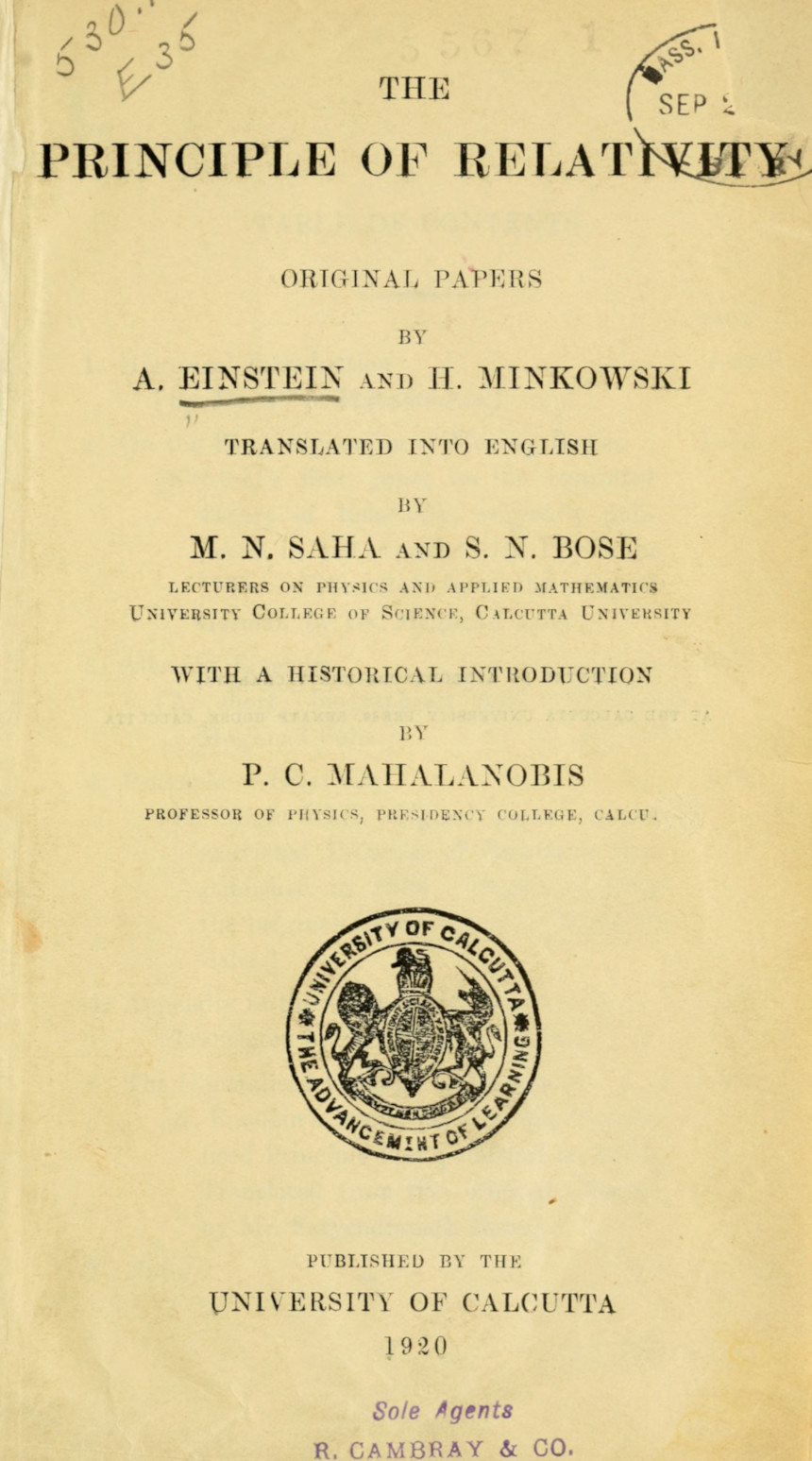
The Principle of Relativity
by Albert Einstein
★★★★★No ratings yet
Language: English
Sign in to rate this book.
Sign in to shelve this book.
About this eBook
- Author
- Minkowski, H. (Hermann), 1864-1909
- Credits
- Richard Tonsing, David King, and the Online Distributed Proofreading Team at www.pgdp.net. (This file was produced from images generously made available by The Internet Archive.)
- Language
- English
- LoC Class
- QC: Science: Physics
- Subject
- Relativity (Physics)
- Category
- Text
- Project Gutenberg
- eBook-No. 66944
- Release Date
- December 14, 2021
- Copyright
- Public domain in the USA.
Contents
- 1.The Principle of Relativity
- 2.TABLE OF CONTENTS
- 3.HISTORICAL INTRODUCTION — Conclusion — Note A.
- 4.On The Electrodynamics of Moving Bodies By A. Einstein. — INTRODUCTION. — I.—KINEMATICAL PORTION. — § 1. Definition of Synchronism. — § 2. On the Relativity of Length and Time. — § 3. Theory of Co-ordinate and Time-Transformation from a stationary system to a system which moves relatively to this with uniform velocity. — § 4. The physical significance of the equations obtained concerning moving rigid bodies and moving clocks. — § 5. Addition-Theorem of Velocities. — II.—ELECTRODYNAMICAL PART. — § 6. Transformation of Maxwell’s equations for Pure Vacuum. — § 7. Theory of Döppler’s Principle and Aberration. — § 8. Transformation of the Energy of the Rays of Light. Theory of the Radiation-pressure on a perfect mirror. — § 9. Transformation of the Maxwell-Hertz Equations. — § 10. Dynamics of the Electron (slowly accelerated).
- 5.ALBRECHT EINSTEIN [ A short biographical note. ]
- 6.Principle of Relativity — INTRODUCTION. — NOTATIONS. — PART I § 2. The Limiting Case. The Fundamental Equations for Äther. — § 3. — § 4. Special Lorentz Transformation. — § 5. Space-time Vectors. Of the 1st and 2nd kind. — § 6. Concept of Time. — PART II. ELECTRO-MAGNETIC PHENOMENA. § 7. Fundamental Equations for bodies at rest. — § 8. The Fundamental Equations. — § 9. The Fundamental Equations in Lorentz’s Theory. — §10. Fundamental Equations of E. Cohn. — §11. Typical Representations of the Fundamental Equations. — §12. The Differential Operator Lor. — § 13. The Product of the Field-vectors f F. — § 14. The Ponderomotive Force. [28]
- 7.APPENDIX Mechanics and the Relativity-Postulate.
- 8.SPACE AND TIME — I — II — III — IV — V
- 9.The Foundation of the Generalised Theory of Relativity By A. Einstein. From Annalen der Physik 4.49.1916. — A Principal considerations about the Postulate of Relativity. — § 1. Remarks on the Special Relativity Theory. — § 2. About the reasons which explain the extension of the relativity-postulate. — § 3. The time-space continuum. Requirements of the general Co-variance for the equations expressing the laws of Nature in general. — § 4. Relation of four co-ordinates to spatial and time-like measurements. — B Mathematical Auxiliaries for Establishing the General Covariant Equations. — 5. Contra-variant and co-variant Four-vector. — § 6. Tensors of the second and higher ranks. — § 7. Multiplication of Tensors. — § 9. Equation of the geodetic line (or of point-motion). — § 10. Formation of Tensors through Differentiation. — §12. The Riemann-Christoffel Tensor. — C. THE THEORY OF THE GRAVITATION-FIELD — §13. Equation of motion of a material point in a gravitation-field. Expression for the field-components of gravitation. — §14. The Field-equation of Gravitation in the absence of matter. — §15. Hamiltonian Function for the Gravitation-field. Laws of Impulse and Energy. — §16. General formulation of the field-equation of Gravitation. — §17. The laws of conservation in the general case. — §18. The Impulse-energy law for matter as a consequence of the field-equations. — D. THE “MATERIAL” PHENOMENA. — §19. Euler’s equations for frictionless adiabatic liquid. — §20. Maxwell’s Electro-Magnetic field-equations. — E. §21. Newton’s theory as a first approximation. — §17. The laws of conservation in the general case. — §18. The Impulse-energy law for matter as a consequence of the field-equations. — D. THE “MATERIAL” PHENOMENA. — §19. Euler’s equations for frictionless adiabatic liquid. — §20. Maxwell’s Electro-Magnetic field-equations. — E. §21. Newton’s theory as a first approximation. — §22. Behaviour of measuring rods and clocks in a statical gravitation-field. Curvature of light-rays. Perihelion-motion of the paths of the Planets.
- 10.NOTES — Note 1. — Note 2. Lorentz Transformation. — Note 3. — Note 4. Relativity Theorem and Relativity-Principle. — Note 5. — Note 6. Field Equations in Minkowski’s Form. — Note 9. On the Constancy of the Velocity of Light. — Note 10. Rest-density of Electricity. — Note 11 (page 17) Space-time vectors of the first and the second kind. — Note 12. Light-velocity as a maximum. — Notes 13 and 14. — Note 15. The vector product ( w f ). (P. 36). — Note 16. The electric-rest force. (Page 37.) — Note 17. Operator “Lor” (§ 12, p. 41).
Community reviews
Sign in to write a review.
No reviews yet.