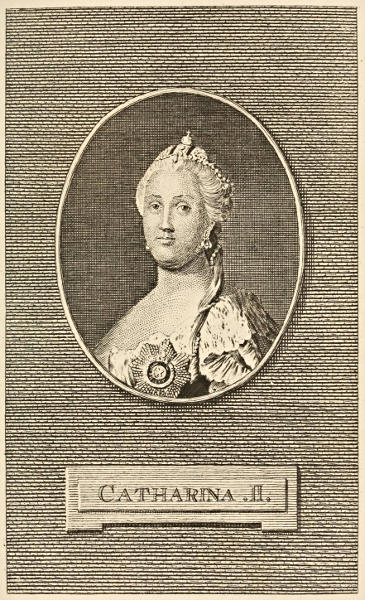
The Empress Ekaterina spent the summer of
1775 in the alentours of Moscow, honouring with
her presence the village of Kolomensk, and
then that of Chërnaya-griaz, which she had
bought from Prince Kantomir. It had been
named in honour of its new mistress Tzaritzin.
She, in buying it, intended it to take the place
of the Muscovite Tzarskoë-selo.
On the borders of a dark forest, in the midst
of fallen maples, a two-storied wooden palace had
been hastily erected, with a few outhouses, some
stables and a poultry yard.
From the windows of her new palace the empress
could admire the extensive and deep clear
lakelets shaded by wooded hills, the boundless
newly-mown plains, with, scattered here and
there, the white shirts of the mowers, and the
blue and red sarafans of the hay-makers. Beyond
these plains others could be seen, yet
untouched by the sickle, sparkling in all their
emerald beauty; and again, beyond these, the
newly-ploughed corn-fields, and behind these, as
far as the eye could reach, green plains and
wooded hills; all this coloured and warmed by a
lovely sun in a blue cloudless sky.
Life here was simple and free. Through the
constantly open windows the scent of the newly-mown
hay and of the forest depths penetrated
everywhere. Often would a blackbird fly in from
the river, and from the plains came the grasshoppers
and the moths. From the early morning
the whole Court would be scattered in the forest,
picking flowers, looking for mushrooms, fishing
or sailing on the lakes, riding and driving in the
neighbourhood. Ekaterina, for the time being
clothed in a simple white morning robe, and
wearing a cap over her simply twisted hair,
would be seated at her writing table, writing
out schemes and drafts of various ukases, or
letters to the Parisian philosopher and publiciste
Baron Grimme. She complained to him that her
servants would not give her more than two quills
a day, as they knew very well that she could not
regard with indifference a piece of white paper
and a well-trimmed quill, but must sit down and
indulge her mania for paper soiling.
At the very time when all the world were
tiring their brains over the politics of the Russian
empress, as to what she would undertake in
regard to Turkey, which she had desolated, or
were discussing the delayed news of that recently-stifled
insurrection on the Volga, the late execution
of Pougachoff, and of the mysterious Princess
Tarakanova arrested lately at Livorno,
Ekaterina was describing to the Baron Grimme
the lives of her pet dogs.
These dogs were called at Court “Sir Tom
Anderson, and his consort” (by second marriage)
“Mimi, Lady Anderson.” They were such tiny,
shaggy little things, with sharp, intelligent noses,
and comical wiry tails, just like brooms. These
dogs had nice little soft mattresses and wadded
silk counterpanes, stitched by the hands of the
Empress herself. Ekaterina wrote to Grimme,
how fond she and Sir Tom were of sitting at the
open window, and how Tom, with his fore-paws
on the window-sill, notwithstanding his contemplation
of nature, would bark and snarl at the
horses towing the barges up the river. “The
views around are lovely, though a trifle monotonous,
and Sir Tom is delighted with the woods,
the hills, and with the lovely quiet gardens and
manors, half buried in bright green, beyond which,
in the far-off blue, you can just distinguish the
tops of the golden Muscovite churches. This
village wilderness and solitude just suit the hearts
of Sir Anderson and his consort. Forgetting the
noise of the city and its gaiety, they admire the
beauties around them, and it is only at a late
hour that they allow themselves to be persuaded
to seek their warm wadded coverlets. The mistress
of the house also likes these solitary Russian
hamlets, forests and plains. I love these
unploughed new places,” wrote Ekaterina to
Grimme, “and I must say that I feel from my
heart that I only fit in where all is untouched
and unspoilt.”
The fresh and clear atmosphere of the Muscovite
environs began to be foggy. Clouds were
gathering, lightning darting, thunder rolling.
The Court also had its storms. Ekaterina had
no easy task in investigating the insurrection of
Pougachoff. He astonished every one by preserving
to the very last minute the firm conviction
that he would be pardoned, that they
would never execute him. “The wretch has not
much sense—he still hopes!” wrote the empress,
after reading the interrogation of the
Pretender. “Human nature is unfathomable.”
Pougachoff was executed in January.[35]
About the middle of May Ekaterina received
information that the squadron under the command
of Greig had anchored at Cronstadt. The
empress sent her whole correspondence with
Orloff about the Pretender to the governor-general
of Petersburg, Prince Galitzin, and gave
him the following order:—“Have the voyageurs
transferred secretly from the ship, and submit
them to the severest interrogation.”
Prince Alexandre Michaelovitch Galitzin, defeated
by Frederick the Great, and afterwards
for his victories over the Turks elected to the
post of field-marshal, seemed a very imposing
personage; but in reality he was the best-hearted
and most modest and just of men, and an entire
stranger to all Court intrigues. He was loved
and respected by all.
On the 24th May the prince summoned an
officer of the Préobrajenski regiment, by name
Tolstoï, made him take an oath of secrecy, and
ordered him to start for Cronstadt to receive the
prisoner who would be given over to him, and
carefully hand her over to the commandant of
the Petropavlovski fortress, André Gavrilovitch
Tchernishoff.
Tolstoï fulfilled his mission on the night of the
25th of May. In a specially manned yacht, he
sailed down the Neva very gently to the fortress,
where he gave up his prisoner. At first she was
lodged hastily in a room just under the apartment
of the commandant. Afterwards she was transferred
to the Ravelin Alexéef. Oushakoff, secretary
to the Prince Galitzin, had already prepared
a report about her from the papers sent by the
empress. Oushakoff was brisk, paunchy, stout,
and always panting and repeating with a knavish
smile in his eyes—“Oh! my dear fellow, so much
to do, so much to do! I only serve the prince
for the honour of it, but I ought long ago to have
taken my abshiede,[36] I am literally worn out.”
The Prince Galitzin pondered long over the
report of Oushakoff, drew up a whole list of
questions, and with a very important mien, which
did not in the least become his good-natured face,
entered the prison of the captive. He was very
much put out by the news which he had just
heard, that on the journey, not far from England,
the captive had nearly escaped; that at Plymouth
she had all at once thrown herself overboard into
a small vessel, which was in readiness for her (as
was easily to be seen), and that it was with great
difficulty and disregard for her cries and groans
that they had managed to get her on board
again. The prince was afraid that some one
might attempt to effect her escape here. The
captive, terrified, confused by all that had happened,
by her gloomy and dismal prison, did not
deny that she was called and was looked upon as
a Russian grand-duchess. She even went so far
as to declare that, recollecting her childhood,
she, on the strength of circumstances, believed
herself to be the grand-duchess of whom mention
was made in the will of the Emperor Peter I.,
which, she said, she had found among her
papers, and which was all in favour of the late
Empress Elizabeth, and by the will of Elizabeth
made in favour of her daughter. A copy of this
interrogation was sent to Moscow to the Empress
Ekaterina, who was very indignant at the impudence
of the captive, and especially when she
found a letter addressed to herself, signed “Elizabeth.”
“Well, that woman is a fieffée canaille,”[37]
exclaimed Ekaterina, crumpling the letter in her
hands, after having read it. Potemkin was at
that time sitting in the study of the empress.
“Of whom are you speaking?” he asked.
“Oh! always about the same vagrant, Batiushka;
about that Italian vagabond.”
Potemkin,—who really pitied Tarakanova, for
two reasons: first, because she was a woman;
and then, because she was the prey of Orloff, to
him hateful,—began to speak in her favour. The
empress, without a word, handed him a whole
parcel of German and French newspapers, and
then told him that he would do better to look and
see for himself all the calumnies spread about her
and this Pretender; whereupon he, snuffling and
grumbling, began to scan the papers with his
short-sighted eyes.
“Well!” asked Ekaterina, looking up from
some papers she had been glancing at.
“Incredible.—So much slander! It’s difficult
to give an opinion.”
“To me, it’s all clear,” said Ekaterina. “Just
a second edition of the Marquis Pougachoff; and
you must agree, prince, with me, that it is impossible
to have any pity for this ‘victim,’ if
you like, ‘of foreign intrigues.’”
Galitzin received another order. He was to
put down the impudence of the adventuress,
especially, as in the words of the English ambassador,
“she was no princess, but the daughter
of an innkeeper of Prague.”
The information of the ambassador regarding
her was told to the Princess, at which she was
very indignant.
“If I only knew who slandered me thus,” she
exclaimed furiously, “I would scratch his eyes
out.”
“Good God! what can all this mean?” she
would cry out, horrified at her position. “I so
ardently, so blindly believed in myself, in my
mission. Can it be that they are right? Is it
possible that under the load of these horrible
proofs which are constantly cropping up, I shall
have to bid adieu to all my convictions, to all my
hopes? Never, that shall never be. I will rise
above all; I will never give in!” That her pride
might be taken down, the captive was treated
much more severely. She was deprived for some
time of the services of her maid, and of many
other little comforts. Her food was much more
simple, almost coarse; but all in vain. Neither
prayers, nor threats to take away from her her
own garments and furnish her with prison
clothes could awaken any repentance in her, or
extort from her the confession that she was an
impostor and not a princess.
“I am not a pretender, do you hear?” she
would scream in furious indignation to Galitzin.
“You are a prince; I only a feeble woman.…
In the name of the All-Merciful God, do
not torment me; have pity upon me.”
The prince, forgetting his orders, would begin
consoling her.
“I am pregnant,” inadvertently said the captive,
crying. “I shall perish, but not alone.…
Send me where you like—to the Eskimos, to the
snows of Siberia, to a convent.… No,
on my word of honour, I’m innocent.…”
Galitzin became thoughtful.
“Who is the father of your unborn child?” he
asked at last.
“Count Alexis Orloff.”
“Again a lie,” said Galitzin. “And why,
what for? Are you not ashamed to answer like
that? To a man whom the empress trusts so
highly, to an old man?”
“It is only the truth. Before God!” answered
the captive, sobbing. “The admiral, the officers,
the whole fleet can bear witness to it.…”
The bewildered Galitzin put a stop to his
interrogation, and sent a report of the new confession
to the empress at Moscow.
“Miserable, impudent wretch!” screamed out
Ekaterina, after reading this report to Potemkin.
“See how this new edition of Pougachoff, sent
to us by the Poles—how she knows how to
slander and calumniate others!”
“Well; but if there should be some truth in
it,” slowly said Potemkin. “It’s so easy to
betray a poor, weak, confiding woman.”
“Oh, that’s impossible!” answered Ekaterina.
“At any rate, Orloff will soon be here. He’ll
soon tell us all about this false Elizabeth.…
And you, prince, in your knightly defence of a
woman, do not forget the most important thing—the
peace of the kingdom. We went through
enough in the last insurrection.”
Potemkin was silent.
From day to day Orloff was expected. He
was hastening from Italy to be present at the
celebration of the peace with Turkey. At this
time Galitzin had received other orders,—to deprive
the captive of everything except what was
strictly necessary, to make her put on prison
clothes, and having sent her maid away, to put
two sentinels as a constant watch over her.
The obstinacy of the captive astonished and
angered Ekaterina very much.
“How is this?” she reasoned. “I have conquered
Turkey; Pougachoff has been caught,
has acknowledged his imposture, and been
publicly executed; … and that miserable,
puny woman, that adventuress, … will not
acknowledge anything, and dares to threaten me,
from her cellar … from her den.”
Potemkin, after having heard from Christianok
all the details of the arrest of the Princess, was
very morose and silent. Ekaterina ascribed it
to his frequent fits of melancholy.
Soon it became known to many of those about
the empress, what means Orloff had employed
to entice and then betray the unfortunate captive,
and these were soon communicated to the
empress through the medium of her maid
Perekousikhin. At first Ekaterina would not
believe any of these rumours, and severely reprimanded
her maid on this account. The
secret report of the honest and incorruptible
Galitzin concerning the position and condition
of the captive, all the courtiers had made known
to the empress. The womanly heart of Ekaterina
was moved with indignation. “Not Radzivill,”
she said; “he, threatened with confiscation of his
enormous estates, did not betray the devoted
woman!”
“Betrayer by nature!” shot through the brain
of Ekaterina, when she recollected the services of
Orloff; … “ready for anything, unscrupulous
in all; stopping at nothing in his own interests,”
and then Ekaterina remembered the phrase,
“Matoushka Tzaritza, pardon. You didn’t think,
you did not guess—”[38]
“Not for nothing do they call him butcher,”
contemptuously murmured Ekaterina. “Oh!
he’ll just say that, out of devotion, he ‘oversalted
it.’ … Well! he’ll soon be here. He must
be made to mend that affair. That fallen one,
without family, nameless, tribeless; a toy in
the hands of the wicked, in his arms she’ll be
powerless.… And she, after selling beer
at Prague, well! how dares she disdain Russian
dignitary or count? Where’s—the mésalliance?”
The calm village scenes of Tzaritzin and Kolomenski,
began to weary Ekaterina. The forests,
the lakelets, the birds and the butterflies no
longer brought her peaceful dreams.
The empress suddenly started for Moscow
alone.
There, in the Chinese city, or Kitaï-Gorod, she
visited the archives of the Minister of the Interior,
where several important papers had been sent
for revision. The director of the archives was
the celebrated author of the “History of Russia”
and of “The Description of the Empire of
Siberia;” late editor of the academical journal,
“Monthly Compositions;” traveller and Russian
historiographer;—the academician Miller. He
was then already seventy. The empress herself
was very fond of history, and knew him very
well, having often had very long conversations
with him about his works, and in general about
history. She found him in his room, near the
archives, busily turning over a heap of old
Muscovite manuscripts.
Miller was very fond of flowers and birds. The
rooms of his governmental department, not very
lofty, were hung all around with cages of blackbirds,
bullfinches, and others of the feathered
tribe, which quite deafened Ekaterina with their
loud whistling and twittering. A glass door
opened from the study of the master of the house
into another room, ornamented with large plants
set in green tubs. The windows were open, but
a net which covered them prevented the birds,
which were flying about, from taking their departure.
The neat and pretty, although simple,
room was filled with the perfume of roses and
heliotropes. The greatest cleanliness reigned
everywhere. The floors were as polished as a
mirror. Miller was writing at his table near the
glass door leading to his aviary. The empress,
passing by, motioned the officious servant away,
and came up to him unnoticed.
“I have come to you, Gerard Feodorovitch,
with a request,” said Ekaterina, on entering the
room.
Miller jumped up, apologising for his morning
costume.
“Command me, your Majesty,” said he, hastily
arranging his dress, and searching with his eyes
for his spectacles, which he missed.
The empress took a seat, invited him to do
the same, and the conversation began.
“Is it true,” she began, after having made
several gracious inquiries after his health, and
that of his large family, “is it true?—it is said
that you have collected evidence, that you are
convinced that it was not a usurper, a pretender
who ascended the throne of Moscow;
that Grishka Otropieff was the real Tzarevitch
Dimitri? You said something about it—to the
English traveller, Cox.”
The good-natured, absent-minded Miller, always
lost in his researches, was very much puzzled
at this question of the empress.
“Where on earth could she have heard that?”
thought he. “Could Cox have blundered it
out?”
“Let us be candid; I’ll help you,” continued
Ekaterina. “You possess a wonderful memory,
and withal you are so very perspicacious in deciphering
and comparing manuscripts. Give me
openly and boldly your opinion. We are alone;
no one can hear us. Is it true that the evidence
for the condemnation of the Pretender was weak,
almost nothing?”
Miller became thoughtful. His grey hair was
ruffled, and his good-natured, intelligent mouth,
which just before the entrance of the empress
had held a half-finished cigar in an amber
mouth-piece, was now unconsciously nervously
twitching.
“Yes, it is true,” he answered, hesitating;
“but, excuse me, that is quite my own personal
opinion, nothing more.”
“But if so, then why do you not publish such
a very important judgment?”
“But, your Majesty,” stammered Miller, looking
about him with a bewildered gaze, pulling at
his waistcoat, “I read the account of the researches
made by Vassili Shouiski at Ouglitch.
He made those researches by order of Godounoff.
It was to his interest to please Boris, and he did
this by bringing to him the evidence only of
those who affirmed that the Tzarevitch had really
been killed. Of course, any one can see that all
other evidence which might have been disagreeable
to Godounoff he would suppress.”
“Which other?” asked Ekaterina.
“That another one was killed, and that the
former was hidden; but of course, you know
yourself, that this very same Shouiski publicly
acknowledged the resuscitated Dimitri.”
“A very witty proof,” said Ekaterina. “Not
for nothing does General Potemkin, great amateur
historian, advise me to have all that
published, if you are really convinced of its
truth?”
“Excuse me, your Majesty,” stammered
Miller; “the will of the empress—is an important
guide; but there’s another, a power still
higher—Russia. I am a Lutheran; the body of
the recognised Dimitri lies in the cathedral of
the Kremlin. What would become of all my
researches, what would become of my own
person, amidst your own nation, if I dared to
assert that not Grishka Otropieff had ascended
the Muscovite throne, but the real Tzarevitch
Dimitri?”
The words of Miller disturbed Ekaterina very
much.
“Well, candid at any rate,” thought she;
“just like a philosopher.”
“Very well,” said the empress; “let the dead
rest in peace; we will talk about the living. I
think General Potemkin has sent you the examination,
and the evidence taken in respect of that
impudent Pretender, the arrest of whom you
have heard about, I suppose?”
“Yes, he sent them,” answered Miller, remembering
at last that the spectacles for which
he had been constantly searching with his eyes
were on his forehead, and wondering how he
could have forgotten that.
“Well, and what have you to say of that
worthy sister of the Marquis Pougachoff?”
asked Ekaterina.
Miller at that very moment caught sight,
through the glass door, of one of his canaries,
a very quarrelsome bird, who had just flown
into another’s nest, the mistress of which was
twittering, flying round, and trying to turn her
out. His eyes also wandered to a sick blackbird
with its leg bound up.
Miller, recollecting himself, and colouring at his
own timidity and absent-mindedness, answered,—
“The Princess, if she is Russian, learnt Russian
history very insufficiently; that’s the main
thing I have to say, after reading her papers;
but of course, that would be more her teacher’s
fault.”
“Well, what do you think? Can it be that
there is a spark of truth in her tale?” asked
Ekaterina. “Do you suppose for one moment
that the Empress Elizabeth might have had
such a daughter, and hidden her from all eyes?”
Miller was just on the point of answering:
“Oh! yes, of course; what is there in all that
so very improbable?” but he remembered at
that minute about the mysterious youth, Alexis
Shkourin, travelling now in foreign parts, and in
his confusion fixed his eyes on the glass door of
his aviary.
“Well, and why do you not answer?” said
Ekaterina, smiling. “Your Lutheranism does
not stand in the way here.”
“Well, everything is possible, your Majesty,”
said Miller, shaking his grey curly head. “People
do say all sorts of things; some of them may
be true.”
“Look here—would it not be strange?” said
Ekaterina. “The late Razoumovski was a very
good man, and although secretly, still he was
the lawful, husband of Elizabeth. Why trample
under foot all the laws of nature? Why this
heartless denial of their own daughter?”
“Then it was one century, now it’s another,”
answered Miller. “Morals differ; if the new
Shouiski-Shouvalovi could hide for so many years
in solitary confinement the, to them, dangerous
Prince John, proclaimed in his infancy emperor,
what is there here so very strange, if, in their
thirst after influence and power, they should
have sent to the end of the earth, or, at any rate,
hidden another infant, this unfortunate Princess?”
“But, Gerard Feodorovitch, you forget the
most important thing—the mother! How could
the empress have borne that? You cannot deny
her heart was in the right place; and then, all
this was not about a strange child, like Ivanushka,
but about her own forsaken daughter.”
“Well! oh, it is very simple,” answered
Miller. “Razoumovski, I should think, had
nothing at all to do with it. The whole intrigue
was brought to bear on the empress—not on the
mother.… Very likely, many reasons were
brought forward, and she consented. This secret
daughter was hidden, sent to the South, and then
over the Urals. In the papers of the Princess
she speaks of poison, of flight from Siberia
to Persia, afterwards to Germany, and then
to France.… The Shouiskis of our days
have repeated the old tragedy. In guarding
the empress, they still kept in readiness for
any emergency, a new refugee, saved by them
from another world.”
Ekaterina here remembered that Orloff, in one
of his letters, had spoken of a Russian traveller,
Ivan Shouvaloff, who was even now in foreign
parts.
“With you, one might go on talking for ever,”
said Ekaterina, rising. “Your memory in itself
is a whole archive, and a priceless one, too; and
Russian history, is it not true? like Russia
itself, is richest virgin-soil. How lovely our
boundless corn-fields! But then, again, the
weeds. Ah, àpropos! I do always admire your
flowers and your birds. Now, do pay me a visit
at Tzaritzin. Grimme has sent me a whole
family of the loveliest cockatoos. One of them
is always repeating ‘où est la vérité?’”
Having with special graciousness thanked
Miller for his information, the empress returned
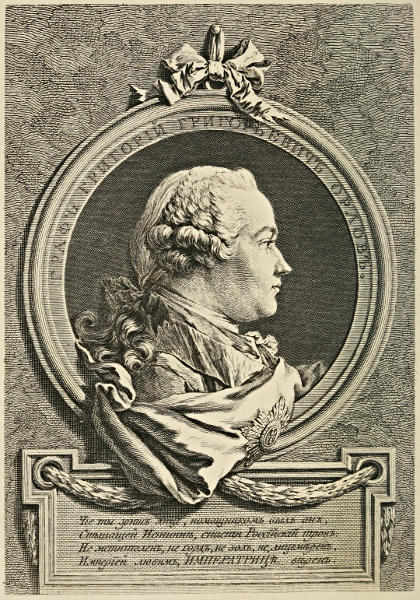
to the palace. Soon after this event, the hero of
Chesma, Orloff, made his appearance.
Alexis Gregorevitch failed to recognise the
court. With new faces, a new order of things
had been introduced. The count did not at
once receive the honour of an interview with the
empress. He was told she was not quite well.
This made him feel very anxious. Well versed
in court life, he scented disfavour in the air. It
became urgent to take measures. Very diffidently,
Alexis Gregorevitch turned to some of
the courtiers to try and get an audience with the
new sun, Potemkin. The interview took place
with great politeness on both sides, but no
geniality. Their old friendship and fraternity
had been left far behind. They conversed till
midnight, but the guest felt he had learnt very
little.
“Yes, now it’s all without measure, all overflowing,”
said Potemkin en passant, speaking
about something. Orloff long pondered over
those words. “Overflowing!”—well, had not he
also filled the measure too full?
In the morning he was invited to go to the
empress, whom he found bathing her dogs.
“Sir Tom Anderson,” who had already been
taken out of the bath and wiped dry, was warming
himself under his coverlet. His consort,
“Mimi,” was still in the water. Ekaterina sat
near, holding ready the warm coverlet. Perekousikhin,
in a large apron, her sleeves rolled up to
the elbows, was very energetically rubbing the
little dog with a sponge and soap. Quite wet,
and white from the soap, Mimi, on seeing the
big goggle-eyed stranger, began barking most
furiously and straining to get at him.
“Ah! from water to water,” said Ekaterina
jokingly. “Welcome back to your native land.
We shall soon be ready.”
Having wrapped Mimi up warmly and put her
in the basket, the empress dried her hands, and
remarked:—
“As you see, friends first of all!” She took
a seat, pointed out a chair to Orloff, and began
questioning him about his journeys, about Italy,
and the Turkish affairs.
“But, oh! Batiushka Alexis Gregorevitch,
you oversalted, oversalted it,” said the empress,
producing her snuff-box, and slowly taking a
pinch.
“In what, your Majesty?”
“In that certain little affair,” smilingly
answered Ekaterina, menacing him with her
finger.
Orloff noticed the smile, but at the same time,
in that very same joke, he noticed a well-known—to
him—bad sign. The round, strong chin of
Ekaterina trembled slightly.
“In what? Matoushka Tzaritza, and in what
is my crime?” he asked, stammering.
“Comment donc, Monsieur? Yes, really oversalted
it,” continued Ekaterina, slowly taking
another pinch from her snuff-box.
At this, Orloff, like a child, lost all self-possession;
his eyes wandered timorously round
the room.
“You know; our captive,” said the empress,—“Oh,
I suppose you’ve heard it; she’ll soon be
two.…”
The athlete Orloff knew not what to do in his
confusion.
“I am lost, completely lost!” thought he;
and his disgrace, his downfall arose before his
eyes. “Mercy, oh God!”
“But that we may arrange, matters may be
mended,” continued Ekaterina. “You might go
to Petersburg, see the captive. To celebrate the
peace, you have returned to her as her bridegroom.”
Orloff knit his brows, bent one knee to the
ground, kissed the hand that was held out to him,
and silently left the room. At the door, he regained
his self-composure.
“Well! what! the empress! What did she
say?” asked the courtiers.
“I have been honoured with a special invitation
to the fêtes,” answered the count, “and now
I am going to Petersburg to arrange my brother’s
affairs.”
Count Orloff tried to seem very elated, very
proud.… He understood that it was better
for him to make haste. It was clear that the
empress was not joking. Under pretence of an
interview with his brother, he hastened the preparations
for his journey, and was soon on his
way to Petersburg.
Worn out with her long sea voyage and imprisonment,
the captive dragged on a miserable existence
in the fortress. An acute fever, a sharp
cough, accompanied by frequent hemorrhage, had
developed into rapid consumption.
The frequent visits and questions of the field-marshal
Galitzin always threw the Princess into
fits of passion.
“What right have you to treat me like this?”
she would say in an imperative voice. “What
reason have I given for such treatment?”
“Written orders from a higher power—the
will of the empress!” answered, panting and
puffing, the secretary, Oushakoff.
In the capacity of secretary to the Commission
which had been appointed, he had large means
placed at his disposal. Therefore, continually
complaining of fatigue, of a mass of occupations,
and even of pains in his spine, he lingered over
the evidence, brought forward a multitude of
facts, began a long correspondence about her
affairs, and in general led the good-natured
Galitzin by the nose, and on the savings made
from the money allotted for the keep of the
captive managed to buy a nice little house in the
courtyard already belonging to him in the Gorokhoviya.[39]
In the interval, the false testament found
among the papers of Tarakanova was shown to
her.
“Well, what have you to say to that?” asked
Galitzin.
“I swear by the Almighty God, by eternal
damnation, that I am the author of none of those
unfortunate papers. I was told all that.”
“But they are in your own handwriting.”
“Perhaps—it interested me.”
“Then you do not wish to confess to anything,
or explain the truth?”
“I’ve nothing to confess. I lived in freedom,
I did harm to no one. I was betrayed, made
prisoner by treason.”
Galitzin began to lose patience. “What a
she-devil they’ve handed over to me!” thought
he. “Extract a secret from a stone like that!”
The prince groaned aloud and rubbed his nose.
“But, your Grace, recollect,” once whispered
the officious Oushakoff, “your hands are unfettered.
In the last ukase it makes mention
of the utmost severity, of investigation without
partiality.”
“Well, of course, one might try,” muttered
the bewildered prince, who was in general averse
to any severe measure. “Shall I try? It won’t
be worse than it is.”
“In the name of the empress,” severely said
the field-marshal to the commandant, in the
presence of the captive, “in view of her obstinacy—deprive
her of everything, except the strictly
necessary clothing and bedding. You hear, everything—books,
and other things, there; and then,
if that does not answer, put her on common
prison food.”
The orders of the prince were carried out.
The poor, ailing girl, brought up in luxury and
comfort, began to receive nothing but black
bread, soldier’s kasha (porridge), and schi (sour
cabbage soup). Although hungry, she would sit
for hours shedding bitter tears over the wooden
bowl, but not touching it. On the way to Russia,
near the shores of Holland, where the squadron
had anchored to take in provisions, she had read
in a newspaper, which had fallen by accident into
her cabin, all the past life of Orloff, and trembling
with passion, she had cursed her folly in having
believed in such a man. But worse misery
awaited her. Two soldiers were assigned to the
captive, and kept watch in her room, night and
day. All this would throw the prisoner into fits
of passion.
“Repent,” Galitzin would say to her. “I pity
you from my heart, but without repentance,
don’t expect forgiveness.”
“I’ll accept every torment, even death, Sir
Marshal; I’ll accept everything,” said the captive.
“But you are mistaken.… Nothing
can make me withdraw my evidence.”
“Think over it.…”
“God is my witness.… My torments will
fall on the heads of my tormentors.”
“She’ll think over it, your Grace!” whispered
Oushakoff, turning over some papers. “One
more experiment. She’ll come round all right.”
The experiment was tried. Her Venetian silk
nightdress was exchanged for one of sackcloth.
“Almighty God! be witness of my most secret
thoughts,” prayed the captive. “What am I to
do, what shall I undertake? I believed in my
past. It all seemed so plain. I was accustomed
to think of it all, to live in that idea. Neither
the treason of that monster, nor my captivity,
has been able to shake my conviction. No, and
not even this iron dungeon, which seems to crush
me, can do that. Death is not far off. Oh!
Mother of God, oh! lowly Jesus, help me. Who
will give me strength, who will guide me, who
will save me—from all these horrors, from this
prison?”
One cold rainy evening, a hired carriage with
the blinds drawn down drove up to the perron of
the commandant of the fortress of Petropavlovski,
André Gavrilovitch Tchernishoff. Half an hour
afterwards, Orloff and the commandant walked
in the direction of the Ravelin Alexéef.
“Failing,” said the commandant, walking on,
“failing rapidly, especially with this dampness.
Yesterday, your Grace, she begged for her own
clothes and books; they were returned to her.”
The sentinels were called out of the room of
the Princess. Orloff entered the room alone.
Tchernishoff remained outside the door. In the
dusk, the count could hardly see the low-ceilinged
room, with two deeply set windows with thick
iron gratings. Between the two windows stood
a small table with two chairs. A few books were
scattered on the table together with some other
things, and, covered with a coarse cloth, stood the
untouched food. On the right-hand side stood a
screen. Behind the screen was a small table
with a water-bottle, a glass, and a cup, and surrounded
by chintz curtains, a small iron bedstead.
On the bed, in a white dressing gown and cap,
lay a girl, so pale, one might think she was dead,
covered with a blue velvet mantilla.
Orloff was struck by the frail look of her, who
such a short time ago had been so stately, and so
charmingly beautiful. There flashed across his
mind remembrances of Italy, tender letters, the
ardent courtship, the journey to Livorno, the feast
on the ship, Ribas and Christianok travestied in
the old clerical vestments. “Oh! why did I
play that comedy with the marriage ceremony?”
thought he. “She was really on board my ship,
in my hands.” And vividly there flashed through
his mind the picture of the arrest of the Princess.
He remembered her cries on deck, and the next
day his message to her through Konsov, a letter
in German, describing his own false sorrow, oaths
of faithfulness till death, and assurances of love.
“What sorrow has fallen upon us”—trying to
write the most tender words, he had said. “We
are both arrested, in chains; but God, the All-merciful,
will not forsake us. Let us put our trust
in Him. As soon as I get my liberty, I’ll search
the whole world till I find you, to guard and
serve you all my life.” “And I have found her;
here she is!” thought Orloff, involuntarily shuddering,
not daring to cross the threshold. At
last he ventured near her, close to the screen.
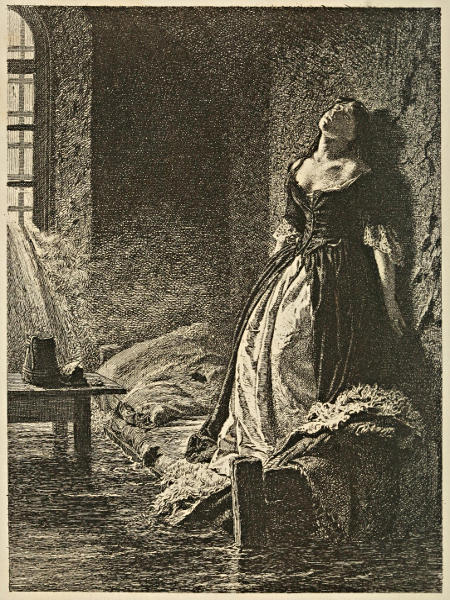
At the sound, the unfortunate girl opened her
eyes, looked at her visitor, and rose. Her auburn
hair, at one time so luxuriant, fell from under her
cap, and half-covered her poor pale face, distorted
by illness and passion.
“You? You—in this room—near me!”
screamed out the Princess, recognising her
visitor, and stretching out both her hands in
front of her, as though driving away some awful
apparition.
Orloff stood motionless.
The words seemed to burst from her throat, and
die upon her lips. She threw herself back on
the bed to the farthest side of the wall, where
with flaming eyes she looked ready to devour
Orloff, who stood gazing at her horror-stricken.
“Yes! we are married, are we not? Ha, ha,
ha! we are man and wife?” said she, but a convulsive
cough cut short her indignation for the
moment. “Where have you been all this time?
You promised, I waited.”
“Look here,” gently said Orloff, “let us forget
the past, let us play comedy no longer. You
must realize by this time that I was the faithful
slave of my sovereign, and that I only obeyed
her commands.”
“Treachery, deceit!” screamed the unhappy
girl; “never will I believe it.… Do you hear
me? The great and powerful Russian empress
would never have had recourse to such perfidy.”
“I swear to you they were her orders.…”
“No, I do not believe one word of it, traitor,”
screamed the unfortunate girl, shaking her fists
at him. “Ekaterina could command anything—demand
my surrender, burn down the town that
gave me refuge, take me by force, but not that.
But you, you yourself, might have pierced me
with a dagger, poisoned me. You knew of
poisons,—but what have you done with me?
what?”
“One moment of calmness, I implore you,” at
last said Orloff. “Answer me one word, only one—and
I promise you, on my word of honour,
that you shall be set free immediately.
“What new invention is that, monster? Speak,
traitor,” said the Princess, recovering some composure,
as shudderingly she drew the blue mantilla,
so well known to the count, closer around
her.
“You have been questioned so long, and with
such persistency,” began Orloff, trying to give
his voice a tender and convincing tone, “tell me
now all—we are alone; God only can see and
hear us.”
“Peter created Russia,
Ekaterina gave her a soul!”
“Gran Dio!” said the unfortunate girl, “he
invokes the name of God,” added she, raising her
eyes to the image of the Saviour which hung on
the wall over the head of her bed; “he! Very
likely you have arranged this slow torture, this
torment! and yet you boasted that torture was
abolished here. The empress, I am sure, knows
nothing of all this. In this matter she has been
deceived, as in everything else.”
“Be calm, be calm.… Tell me, who
are you?” continued Orloff; “hide nothing.
I’ll implore the empress; she will be merciful
to you and to me.…”
“Diavolo! he asks, ‘Who am I!’” she
stammered, half stifled by a new fit of anger.
“But cannot you see I have done with the world?
I am dying; then to what end all this?” She
again began to cough most awfully, and leaning
her head against the wall, was silent.
“There,—she’ll die without having confessed
anything,” thought Orloff, as he stood by her.
“In riches and in happiness,” said she, coming
to herself, “in humiliation and in prison, I repeat
constantly the same thing—and you know it
well. I am the daughter of your late empress,”
proudly said she, rising. “Do you hear me,
miserable, wretched slave, I am your born grand-duchess.…”
A bold idea flashed through
Orloff’s mind.… “Ah! what’s in a word?”
thought he; “she won’t live long, and at one
stroke I’ll please them both.”
He bent on one knee, grasped the frail pale
hand of the captive, and ardently pressed it to
his lips.
“Your Highness!” stammered he. “Elise!
pardon, I swear—yes, I am guilty,—but those
were the orders. I myself was arrested. Only
now have I received my liberty.…”
The poor girl raised her big, astonished eyes
to his face, covering her mouth with her handkerchief
to stop the blood.
“I implore you, I promise you, we will be
really solemnly married,” continued Orloff. “You
shall be my wife—and then, your Highness—my
darling, … my own Elise, rank, riches,
faithfulness, life-long devotion.…”
“Out! away! monster!” screamed the captive,
jumping up. “This bruised hand princes,
kings sought—it’s not for you to touch it,
branded traitor, inquisitor.”
“Well, she doesn’t choose her words,” thought
to himself the Commandant Tchernishoff, who,
standing outside the door, could easily hear the
French abuses and the curses of the prisoner;
“better take myself off. If the count knows all
this has been heard, his little vanity will be
pricked, and it is just possible he may take his
revenge.” The commandant walked off.
The jailer, standing in the long corridor, with
his keys, and also hearing the, to him, quite
unintelligible cries, the stamping of feet, and, as
it seemed to him, the noise of things being thrown
at the visitor, also walked off into a corner, thinking
to himself: “Ha, ha, Mamzoulka (Mademoiselle),
it seems, is asking for better food; it
seems it’s not in the articles. She’s screaming at
the general, oho! Of course it’s not for such as
she, so thin, to eat schi and schi. Yesterday, for
the first time, they gave her milk.” The furious
screams continued. Then came the sound of
broken glass. The door of the dungeon was flung
open rapidly, and Orloff, humbly bending under
the door, too low for his tall person, came out.
His face was purple; he lingered for a moment in
the corridor, and stared about him, as if collecting
his thoughts. Having felt under his arm for
his cocked hat, passed his fingers through his
hair, and pulled down his coat, he briskly and
smartly drew himself up, and silently walked out
in the pouring rain, jumped into the carriage,
and shouted to the coachman, “Général Procureur.”
As he left the fortress behind him, Orloff began
turning over in his mind the details of the
last interview.
“Well, she is a serpent, a viper!” he whispered
to himself, looking out into the streets from the
carriage window; “didn’t she sting!”
Very reservedly, and with plenty of self-composure,
he entered the house of the Prince
Alexander Alexéeovitch Viazimski. It was already
late. The candles were lighted. Orloff
shivered, and rubbed his hands together.
“Take a seat,” said the général procureur.
“What! cold?”
“Yes, prince, a little.”
Viazimski ordered a servant to bring in liqueurs.
The servant soon came, bringing a lovely decanter,
and a silver basket containing ginger biscuits.
“Pray help yourself, count.… Well!
what about our usurper?” continued the général
procureur, putting aside some papers that he had
just been looking over.
“Impudent beyond all bounds; still persists.…”
answered Count Alexis, pouring himself
out a wineglassful of the rich liqueur, and raising
it first to his nose, and then to his lips.
“Well, of course!” said the prince; “she has
no wish to part with her so-called titles and
rights cheaply.”
“Oh! she’ll give plenty of trouble yet; other
measures than those are wanted,” said Orloff.
“But what others, Batienka? Her last minutes
are drawing near.… You would not have
her strangled?”
“And why not?” whispered Orloff, as if to
himself, dipping a biscuit into a fresh glass of
liqueur. “Pity for such like!”
The général procureur threw a side-long glance
from behind the green abat-jour on his visitor.
“And you’re not joking, Alexis Gregorevitch?
It’s your advice?”
“Oh! for the good of my country, and like a
true patriot—not only would I advise, but very
much recommend,” answered Orloff, walking
backwards and forwards, munching the sweet
melting biscuits.
“Mais, c’est un assassin dans l’âme!” thought
to himself the great judge,[40] whose personal appearance
was austere and generally gloomy, as
he listened in horror to the soft, cat-like tread
of Orloff on the carpet; “c’est en lui comme une
mauvaise habitude!”
Orloff took out his eye-glass, and, biting a fresh
biscuit, began to admire a picture of Psyche and
Cupid on the wall.
“Whence came this picture?” asked he.
“It is a gift from the empress.… Count,
when do you think of returning to Moscow?”
“To-morrow morning. I shall not of course
delay my information, but shall instantly report
the fresh obstinacy of that impudent liar.”
Viazimski knit his bushy eyebrows. “Do you
know anything about the information of the
prisoner on your own account?” he grunted out,
turning over some papers.
Orloff let drop his half-eaten biscuit.
“Yes! Now, just fancy; you’ll not deny all
this is disgusting. My faithfulness, devotion,
honour, she has spared nothing.… And
let me tell you what is more astonishing than
everything else, that that she-devil fell over head
and ears in love with me, and invented, goodness
knows what; but even just now the hussy has
had the impudence to bid me acknowledge a
marriage with her.”
“Well! I can only wonder,” said Viazimski;
“that disguise in clerical vestments—excuse me,
what need for such sacrilege? Oh! you’ll have
a deal to answer for, to God, Batiushka Count.…
All that would haunt me.”
Orloff tried to turn it all off as a joke, tried to
go on talking, but the gloomy silence of the bear-like
Procureur showed him that his credit at
court had been long on the decline, and that he,
notwithstanding his late services, might, like useless
old rubbish, hope for only one thing—to be
left alone and forgotten.
“My annals are finishing, it seems. I shall
soon be at the bottom of the river,” thought
Orloff, on leaving Viazimski. “They’ll put me
under hatches somewhere in Moscow, or perhaps
farther. We are grown old, out of fashion; we
must clear the way for new-comers.”
He was so much disturbed by his reception at
the procureur’s that the next morning he had a
special service celebrated in the Church of the
Holy Virgin Mary, and before his departure for
Moscow he even paid a visit to an Armenian
fortune-teller on the Litienaya.
The peace with Turkey was publicly celebrated
at Moscow on July 13th. Galitzin was not forgotten,
and, for having cleared Moldavia of the
Turks, received from Petersburg a rich sword
studded with diamonds. Orloff received a testimonial,
a rich dinner service, one of the Imperial
properties near Petersburg, and the title of
“Chesmenski.”
“Put up on the shelves of the archives, wholly
thrown over!” thought Alexis Gregorevitch. He
was not allowed to follow the court to Petersburg.
From this time Moscow was assigned to him as a
residence, as also to many of the other supporters
of Ekaterina. It would have seemed that the
days of Chesmenski flowed on peacefully and
pleasantly in his splendid Muscovite palace; but
the retainers of the count began to notice that
he often had fits of melancholy—that very often,
without any reason whatever, he would have funeral
masses celebrated, or a special service with
Acathistus,[41] or would call in the gipsy fortune-tellers,
and they would hear him often murmur
and complain of the “Traitress Fortune,” who in
former times had so spoilt him with her favours.
If Count Alexana would drive out his fleet
steeds on a beautiful frosty evening, flying along
the streets, glancing at the passers-by from under
his rich fur cap, thickly studded with frosty
diamonds, his thoughts would carry him back to
other blue, but warm skies, to the azure shores of
the Morea and the Adriatic, to the Roman and
Venetian marble palaces. If in autumn the sleet
were driving, promising a splendid hunt, the
count would ride in the neighbourhood of Otradi
or Niaskouchnavo, and, after having driven the
mother hare out of the birch copse, and started
his favourite harehounds on her track, would
gallop on his gallant Kabardinetz furiously in
pursuit, but all at once he would rein in his
steed and stop. The rain might brush the wet
branches of the birch in his face, the horse
might splash through the pools and mud, but the
count’s thoughts had wandered far away, to that
far-off Italy, to Rome, Livorno, to the unfortunate,
by him betrayed, Tarakanova.
“Where is she? What has become of her?”
he would think. “Has she survived her child’s
birth? Is she still there, or have they hidden
her even farther away?”
After the fall of the favourite, Prince Gregory,
his brother, Count Alexis Chesmenski, retired so
quickly from court that he not only knew
nothing positive, but even dared not try to know
anything positive about the unfortunate beauty
whom he had carried off and betrayed.
That same year, in autumn, rumours were
spread in Moscow that a very important mysterious
personage had been brought over from
Petersburg, and sequestered in the Novo Spaski
Nunnery; that she had been compelled to take
the veil, and had been named Docifé,[42] and was
now locked up in a secluded cell.
The Muscovites whispered loudly that the new
nun was the daughter of the late Empress Elizabeth,
by her secret husband Razoumovski.
What emotions the count underwent, are only
known to himself.
“It is she! it is she!” he would murmur in
his agitation, not knowing that his victim, the
Princess Tarakanova, still hopelessly languished
in the fortress. “It can be no one else; of course
not. She has renounced everything, she has
submitted, she has taken the veil.”
Thoughts of the newly-arrived captive troubled
him so much that he even avoided driving in the
street where the convent was, and if this were
impossible, he would avoid looking up at the
windows.
“Traitor, murderer!” would resound in his
ears, on recollecting his last interview with the
Princess. In bitter anguish he would remember
every detail of that interview, when she had
loaded him with curses, stamped at him, spat in his
face, and passionately flung at him whatever came
near her hand. Once, when the Prince Volkonski
had paid him an unofficial visit, to see over his
stables and horses, Chesmenski tried to bring the
conversation round to the Princess. They had
returned from their walk to the stables, and
were taking tea. The count began in a roundabout
way to refer to foreign and home news, and
rumours, and then, as if merely en passant, asked
who the person was whom report said had been
brought to the convent?
“Why do you ask that?” suddenly interrupted
the prince, Michael Nikititch.
“What?” asked the bewildered Chesmenski.
“Nothing!” answered Volkonski, turning
round, and looking aimlessly out of the window.
“I was just recollecting a little Petersburg incident,
that happened last year at Court.”
“What incident? Honour me, Batiushka
Prince!” said the count, with a smile and a bow.
“You see, here I hear nothing and see nothing
of the new, curious, and to us very often incomprehensible
occurrences in the court regions?”
“Well! as you please,” said Volkonski, clearing
his throat, and continuing to gaze out of the
window. “The incident, if you like, is not very
important, rather comical than otherwise. You
know the wife of the General Major Kojin?
Marie Dimitrievna, who is so lively, so beautiful
and such a chatterbox?”
“Oh, of course, who does not know her? I
often used to meet her, before my departure for
foreign parts.”
“Well! you know, she babbled out, it is
said, somewhere … that some one …
well! we’ll call them the Abaloshoffs, it’s all the
same, I’ve forgotten who—had decided on patronising
the new lucky man, Peter Modrvinoff.…
Of course you know.”
Orloff silently inclined his head.
“Patronise … well! you understand,
trip him up.…”
“Who?” asked Orloff.
“Well! it would seem Gregory Alexandrovitch
Potemkin.”
“Well! and what then?”
“Well! this,” continued the prince. “In
somebody’s private rooms, Stephan Ivanovitch
Sheshkovski was hurriedly called, and the
following orders were given:—‘Batiushka, go
immediately, this very minute, to the masquerade,
find out the Generalsha Kojin. Having found
her, carry her off to the secret department, and
having given her a slight taste of corporal
punishment, as a small token of remembrance,
bring back the aforesaid little lady, with all
honour, and deliver her safely over to the masquerade.”
“And Sheshkovski?”
“Well! he took the little lady, whipped her
soundly, and brought her back, with all honour,
to the masquerade, and she, that no one should
get a hint of this curious little incident, said
nothing, and very wisely and assiduously went
through all the dances to which she had been
invited—every one to the last—minuet, cotillon,
and all.”
Orloff understood well the bitter allusion, and
never mentioned Docifé again.
Neither did the count find any pleasure in his
conversations with his intendant, Terentitch
Cabanoff, who sometimes used to come from
Krenova to Niaskouchnavo. Terentitch was a
serf, but knew how to read and write. He was
always dressed in the latest fashion, with a
pearl-grey kaftan[43] and waistcoat, shoes with
huge steel buckles, ruffles, and a black silk
purse[44] to his powdered pigtail.
The count would pour out for him a goblet
of rich foreign wine, saying, “Taste that, old
fellow.… It’s not wine I’ve poured out,
it’s a man’s life, … elixir.” Terentitch would
refuse.
“No! No nonsense, old man!” would press
the count. “Don’t forget the proverb, ‘Enjoy
life while it lasts.’ Be merry, in that alone lies
happiness. Unfortunately, not for all.”
“Too true, Batiushka Count!” would answer
Cabanoff, drinking off the goblet. “We, well!
we are but serfs; … but you, ought you
to sigh, ought you not to enjoy sweet life in your
own lovely, beautiful manors? The sites are
so dry, so gay, the sloping fields are so fruitful;
springs of water, forests, groves, everywhere.
The serfs so industrious, so hardy, no beggars,
thanks to you, our benefactor. We have noticed
long ago, sir, that you are always very sad, and
have heard something now and then which makes
us all very anxious.”
“Doubt and suspicion, my dear fellow, will
constantly exist,” answered the count. “Last
autumn, you yourself wrote to me, when I was
in foreign parts, praising the coming crops, and
how did they turn out? to be of no account at
all? No, the proverb says, ‘Don’t count your
chickens before they’re hatched!’”
“Yes, it’s the truth you’re saying,” answered
Terentitch, sighing.
“And in all other things,” continued the count.
“I go about a great deal, and many come to me,
and, would you believe it? I know nothing of
what I used to know before. Phylia was high
in favour, every one sought his patronage, but
now, …” the count was silent and thoughtful.
“See there!” thought Cabanoff, looking at
him, “with that strength, those riches, to be
thus slighted.”
“Ah! yes, old man,” continued Orloff, “hard
times are come. I feel as if between two millstones.
My services are ended; no one requires
them any more, and here, at home, there is
nothing but ennui.”
“Count, fire purifies gold,” answered Terentitch,
“misfortune, man. Wood won’t burn without
shavings.… I might look out for some
for you.”
“What?”
“Get married, your Grace.”
“Oh! well, prate about that to others, but not
to me,” answered Chesmenski, remembering that
Konsov had given him the same advice not long
before.
Meanwhile, the position of the Princess Tarakanova
had remained the same. During the
celebration of the peace with Turkey, in Moscow,
she had been forgotten. However, when all had
become quiet again, new points of condemnation
were found against her. She was again cross-examined.
Even Sheshkovski was called, and
let loose on her, and the cross-examinations were
more frequent. Worn out by her illness and
mental anguish, as well as by her miserable and
unusual surroundings, and by the presence of
the two sentinels in her room, she began fading
rapidly. There were even days when her end
was expected every minute. After one of these
terrible days, the unfortunate captive seized a
pen, and wrote a letter to the empress.
“Snatching myself from the arms of death,”
she wrote, “I throw myself at your feet. You
ask, who I am? but can the fact of birth be
made a crime of, for any one? Night and day
men are in my room. My sufferings are such
that my whole being is shaken. In refusing me
mercy, it’s not to me alone you refuse it.” The
empress was very much troubled that she could
not leave Moscow herself and personally see the
captive, who excited in her by turns the deepest
anger, and, involuntarily, the most profound
pity.
In the month of August, Field-Marshal
Galitzin paid the Princess another visit.
“You called yourself a Persian. Then you
said you were born in Arabia; you gave yourself
out next as a Tcherkeshenka; and at last as
our grand-duchess,” he said. “You stated that
you knew the Oriental languages; we gave your
letters to persons who know those languages, but
they could make nothing out of them. Is it
possible—excuse me—that this is also deceit on
your part?”
“Oh! how stupid all that is!” answered
Tarakanova, with a contemptuous smile, and again
coughing. “Do Persians and Arabs teach their
wives to read or write? In my childhood I
learnt a little by myself, and therefore I ought to
be believed more than your readers.”
Galitzin was too sorry for her to go on
questioning her on all the points written down
by Oushakoff.
“Look here,” said he, dashing away a tear,
seeming to recollect something which was a great
deal more serious and important, “there’s no
time for disputes now … your strength is
failing you.… I have not received permission;
yet I will give orders for you to be transferred
into a better and more spacious apartment,
and your food shall be brought you from the
table of the commandant.… Would you
not like a priest … you understand …
we are all in the hands of God … to prepare
you … for.…”
“For death … is it not true?” interrupted
the captive, shaking her head.
“Yes!” answered Galitzin.
“Yes, I feel myself it is true.”
“Whom would you like?” asked the prince,
leaning over her. “A Catholic, a Protestant, or
one of our own faith?”
“I am Russian,” said the Princess, “therefore
send me one of our own faith, if you please.”
“So, everything is finished!” thought she the
next night, sleepless as always; “darkness without
dawn, anguish without end, death …
there it comes. It will soon be here, soon—perhaps
to-morrow. And they’re not yet tired
of questioning.…”
The captive arose, leaned her head on the side
of the bed. “But who am I after all?” she asked
herself, raising her eyes to the image of the
Saviour. “Is it so difficult to sum up everything
in these my last minutes? Perhaps.—Is
it possible that I am not really the one I thought
myself to be? No, I do not acknowledge that!
But why not? Is it from a feeling of disgust
towards them, or from too great a passion; or is
it revenge for a name disgraced, for a woman
crushed?”
And then she tried again to remember all her
past, to recollect its smallest details. Days long
past crowded her memory. Her luxurious gay life,
her successes, her triumphs, her visits and her
levées, her balls. “Courtiers, diplomâts, counts,
even reigning princes; how many adorers I
have had,” thought she. “There must have been
some reason why they should all have courted me
so, offered me their hearts, their riches, sought my
hand.… For what? for my beauty, for
my power of pleasing, for my talents? But there
are many beautiful, talented women far more
wily than I; why did not the Prince Limbourski
go mad over them? Why did he not give
them, as he gave me, his lands, his castles?
Why didn’t he make these over to them instead
of to me, as ‘granted’ estates? Why only to me
did all the ‘Radzivills’ and ‘Pototskis’ cling?
Even the powerful favourite of the Russian
Court, Shouvaloff, sought an interview with me.
Why was I surrounded with such profound,
almost devotional respect? Why was my past
history so eagerly searched out? Yes, I was
selected by Providence for some special end, of
which I myself am ignorant.
“Childhood!—there alone lies the key to it
all,” whispered the poor captive, grasping at
her earliest recollections; “there alone lie the
proofs.”
But it was just that very childhood which was
so bewildering to her own mind. She recollected
the isolated hamlet somewhere in the South, in a
desert, the large shady trees, the low cottage, the
kitchen garden, and beyond, the boundless fields.
A good, kind old woman dressed and took care of
her. Then came the journey in the comfortably
balanced cart, filled with fresh, perfumed hay,
other boundless fields, rivers, mountains, forests.
“But who am I?” she would cry in anguish,
sobbing and striking her poor senseless head!
“They want proofs!—but where are these to
be found? What can I add to what I have
already said? How can I myself separate the
truth from the fiction which life has mixed up together?
And how could a poor, weak, deserted,
helpless child know that one day she would be
called to account for her own birth? The judgment
concerning me is unjust, illegal. It’s not
for me to help to convince my persecutors. Let
them disgrace me; let them hunt me down; let
them finish their work; I am not answerable,
either for my birth, or for my name.… I
am the only living witness of my past; there is
no other. Why are they so furious? God does
many wonders. Is it possible that He, to avenge
a poor, persecuted creature, will not perform a
miracle, will not open the door of this stone coffin,
of this awful fatal dungeon?”
The last warm days of autumn had already
passed, and cold and gloomy November had
brought its rains and mists.
Father Peter Andréef, the high priest of the
Cathedral of Kazan, was a man in the prime of
life, highly educated and well read.
In the autumn of 1775 he was expecting from
Tchernigoff, his niece and god-daughter Vâra.
She had written to her uncle, that she would
arrive in Petersburg with a companion, a young
lady, who was coming in the hope of presenting
personally to the empress a petition on a very
important subject. The little house of Father
Peter, with an entresol,[45] and a perron standing
out in the street, was built behind the cathedral,
and stood by the side of the palace of the
Hetman, Razoumovski. The old oaks and the
lindens threw their shade over its red-tiled roof,
even extending their wide-spreading branches
over the priest’s little yard.
A widower for already several years, the
childless Father Peter led the life of a hermit.
His gates were always closed, and an enormous
watch-dog, Polkan, on hearing the slightest noise
would bark in the most furious fashion. The
few and far between visitors who wished to
speak to the priest always came through the
street-door, which was also kept constantly closed.
The letter of his niece gave a great deal of
pleasure to Father Peter, but he also found in
it something very extraordinary. Vâra wrote to
him, that the young mistress of the neighbouring
estate had a little while ago received from
abroad, together with a letter addressed to her,
a packet of papers covered with writing, which,
as the letter told her, had been found on the sea-shore
in a bottle. “Dear godfather and uncle,
forgive my foolishness,” wrote Vâra to her uncle,
“but after having read these papers together, the
young lady and I have decided on coming to
Petersburg, and we shall soon be there. Whom
could I recommend the unfortunate orphan to
go to if not you. She buried her parents a year
ago. In the papers sent her there is so much
concerning an important person, that before deciding
on speaking about it, there is a great deal
to think over. First, the young lady thought
of sending the papers to Moscow, to the empress,
but on reflection we decided otherwise. You,
dear uncle, know everything. You go everywhere,
you are respected by every one, therefore
you can easily advise us what to do. The
name of the young lady is Irena Lvovna, and
her surname—she is the daughter of the
Brigadier Rakitin.”
“Ah! youth, youth!” thoughtfully shaking
his head, said the priest on reading this letter.
“Ah! the magpies, what crazy ideas! to come
all the way from Tchernigoff to Petersburg to
get my advice.… They’ve fallen—well—they’ve
found some one!”
Every evening, at twilight, Father Peter was
wont to light the candles, and having put on
his house cassock, to walk up and down the
little linen drugget which ran through all the
rooms, from the little hall, through the drawing-room,
dining-room, and into the bedroom. He
would look after his plants, especially his geraniums,
standing on the window-sills; pull off the
dry leaves and pick out the weeds; and would
arrange the books on the table, and gaze at his
favourite blackbird asleep in its cage, at the
“ikons” and images in the corner, at the lighted
lamp, and would begin musing and thinking—when
at last would those rooms be filled
with mirth and life, when would his magpie
come?
The two girls arrived. The house of the priest
became at once bright and lively. The sprightly
gay Vârushka quite bewildered her uncle with
news about his birthplace, their acquaintances, and
journey adventures. Listening to her, Father
Peter thought within himself, “How time flies!
Is it so long ago that she was brought here, a
wild, snub-nosed, and sulky little lass? and now—look
at her, so sprightly, so gay, so clever!
Yes, and her companion, she is a beauty! Those
thick black braids, and what eyes! But quite
in another style to my Vâra; so thoughtful, discreet,
serious and proud!”
After the first joyful questions and answers,
the priest was obliged to celebrate the vesper
service, and his visitors having hastily established
themselves in the attic, took everything that was
necessary, and started for the bath, accompanied
by the cook. On returning home they established
themselves in the corner by the fireside, and
there Father Peter found them, as red as boiled
lobsters, their heads tied up with coloured handkerchiefs,
drinking tea. It was long past midnight
when they at last rose to go to bed.
“Well! my young lady, and where are the
papers you have brought with you?” said Father
Peter, rising. “It interests me also; what is
it all about?”
The girls began searching in their bundles,
found the roll—on it was the inscription, “Diary
of Lieutenant Konsov.”
Father Peter retired to his chamber, drew the
curtains, put the candle on the night-table, threw
himself without undressing on the bed, unrolled
the crumpled manuscript of blue foreign note-paper
with gilt edges, and began reading. He
did not close his eyes till morning.
The whole history of the Princess Tarakanova,
or Princess Wladimirskaya, of which Father Peter
had only heard the most contradictory rumours,
was now open to him, with unexpected details.
“Ah! that is what it is about,” he thought,
on reading the first lines; “about the mysterious
Princess.”
Sometimes he would leave off reading the
manuscripts, and lie with closed eyes, then again
begin to read. “And where now is that poor
unfortunate, betrayed girl?” he asked himself,
on reading the incident of Livorno. “Where is
she now dragging out her miserable existence?
And he, who wrote these lines, was he saved?”
One candle after another burnt out. Father
Peter finished the manuscript, snuffed out the
last little piece of candle, and began walking up
and down on the drugget. He went on walking
till dawn reminded him that he had not slept all
night. “What events! ah! what events! What
an unfortunate tissue of incidents!” whispered
the priest. “Poor martyr! May God help her!”
The blackbird in the cage woke up, and seeing
the very unusual promenade of its master, set
up a loud unwonted scream.
“He’ll wake every one up,” thought the priest.
He returned on tiptoe to his bedroom, threw
himself on his bed, and began reflecting on all
that he had read. His thoughts wandered to the
last reign, to the sea of mysterious and common
events, known to others as well as to him; at
last he fell asleep.
The sound of the bells ringing for morning
service awoke him. The pale November sun
was struggling through the curtains. Father
Peter locked up the manuscript in the drawer of
his table, went to church to celebrate morning
service, and returned home, through the back
door, into the kitchen. On seeing his god-daughter
going up the attic stairs with a hot iron
in her hands he beckoned her.
“Tell me, Vâra,” he whispered; “he who
wrote that diary—Konsov—must, it’s plain, have
been her fiancé?”
Vâra moistened her finger and then touched
the hot iron; it fizzed.
“He did woo her,” she answered, dangling her
iron.
“Well! and what then?”
“Well! Irena Lvovna liked him. Her father
would not hear of it.”
“Then the match was broken off?”
“Of course!”
“And now?”
“Well, what can I say? She is an orphan
now, and of course would be delighted. She is
her own mistress—but where is he?”
“Oh! of course the ship was wrecked,” said
Father Peter.
“And in our wilderness, what could we learn
about it? Uncle, you might go and make some
inquiries of naval people, because, you see, not
only the command was lost, but all the count’s
riches.… Somewhere, you would be sure
to learn something.”
“Who sent your friend this diary?”
“God alone knows. The post brought it;
Irisha received it. On the roll was only
‘Rakitin,’ and the address; and in the note, written
in French, it was merely said that the manuscript
had been found by some fishermen in a bottle
on the sea-shore. Irena is now the only survivor
of Rakitin … and so of course she received it.”
The priest, without saying anything either to
his niece or her friend, began most energetically
to make inquiries in all directions, but his efforts
were fruitless.
The only information he gained at the Marine
Department was that the frigate, The Northern
Eagle, which was laden with the rich collections
of Count Orloff, had been driven along into the
Atlantic Ocean—it had been seen for some time
beyond Gibraltar, near the African coast, not far
off from Tangiers—and that in all probability it
had been shipwrecked and sunk not far from the
Azores or the Canaries. Of the fate of Lieutenant
Konsov nothing could be gathered; it was
not even known for a surety whether he was on
the frigate or not, as the whole of the crew had
perished. The commander of the squadron, and
Admiral Greig, were both now in Moscow, and
there remained no one else to apply to. There
had been some rumours in foreign newspapers
that a disabled ship had been seen somewhere
about on the ocean, but with no crew on board,
as far as could be noticed; it was being driven
by the storm in the direction of the Azores or
Madeira. The violence of the storm had effectually
prevented any efforts being made to rescue it.
“Poor young girl!” thought the priest, looking
at Rakitina; “so clever, so modest, so rich,
and so young. They would have been a couple,
if God had only spared him! No, he must be
dead. Had he been alive, he would have sent
some token to his native land, to his fellow
officers, to his relations.”
Once, when he had some spare time, he took
the opportunity of speaking with Irena.
“Young lady,” said he, “I have heard from
my niece of your loss. Of course, it is plain your
enemies had their own reasons for separating
you from your wooer and giving you another.
Why did it all happen? Why was Konsov
treated with such disdain?”
“I know not myself,” answered Irena. “My
late father was very fond of Pavel Efstafitch, was
always very kind to him, treated him not only as
a near neighbour, but as one dear to him. And
I, what words can describe my love for him? I
lived only in his love.”
“Well, then, how came this separation about?”
“Oh, don’t ask me,” said Irena, covering her
face with her hands. “It is such anguish to me—such
grief. We saw each other often, corresponded;
we used to have meetings. I gave
him my word; we were only awaiting a fitting
time to tell all to my father.”
Rakitina was silent for some minutes.
“Oh, it is dreadful to recollect it all!” she
continued. “I suppose some one must have
calumniated Konsov to my father. All at once—it
was evening—I saw the horses being put to
the carriage. ‘Where to?’ I asked. My father
would answer nothing. My things were carried
out, put into the carriage. At that time a relative
from Petersburg was on a visit to us. We
three took our seats in the carriage. ‘Where
to?’ I again asked my father. ‘Oh, hereabouts,
not very far; we will just have a drive,’ said my
father, joking. Yes; it turned out a nice joke!
We went on with post-horses, without one relay,
as far as our other property, one thousand versts[46]
distant. I could neither write nor send any
message to Konsov for a long time, I was watched
so closely. It was only when my father fell
dangerously ill that I implored him not to break
my heart, but to allow me to write to Konsov.
He began crying bitterly, and said, ‘Forgive me,
Irisha. We have both been deceived cruelly.’
‘What? what?’ I could only ask. ‘Is it possible
that that cousin sought my hand?’
“‘Not your hand, my dear, but the money,’
my father said. ‘He intercepted one of Konsov’s
letters to you, and so stirred up my anger against
him, that I decided on carrying you off. Forgive
me, Irenushka, forgive me. God has punished
him, the wicked one. He borrowed a large sum
from me, lost it at cards in Moscow, and has blown
his brains out. He left a letter … there it
is, read it … I received it a few days ago.’
“My poor father did not live long after this.
I returned to my own property, but of Konsov
I could get no tidings. His grandmother was
also dead. I wrote to Petersburg, whence he had
started, wrote into foreign parts, to the fleet; but
then war was raging, and of course he did not
get my letters. Then his captivity in Turkey
… then … and that is all my sad fate.”
“Pray, my dear young lady, pray,” said the
priest. “Your lot is a bitter one; only the good
God above can help you.”
Meantime, several days passed by. Rakitina,
ceaselessly without respite, went about gathering
all the information she could, regretting neither
time nor money, but all was of no avail.
“I can see, Irena Lvovna,” said Father Peter
to his guest one day, “that you are constantly
going about, first to one, then to another, troubling
yourself and all for nothing. I have heard
it said that the empress will not be here for some
time yet; why should you not write to the
superior officer of Pavel Efstafitch, to Moscow?
may not the Count Orloff know of something?”
“Thank you, Father,” answered Rakitina, bowing.
“Let us pray God that we may learn something
about that unfortunate ship without a crew,
and if no one else were saved, perhaps Konsov.…
Yesterday Count Pânin promised me to
get some information from a foreign Marine
Department—in Spain—in Madeira; Von Viesing,
the author, has also offered his services. Shall
I not hear of something? I shall wait a little
longer; still I ought to be going home, but how
can I go without any hope! Oh! that unfortunate
ship, it haunts me night and day!…”
The evening of the 1st of December, 1775, was
particularly wet and windy. The snow which
had fallen in the morning was now all melted;
there were pools of water everywhere; the few
and far between carriages and pedestrians gloomily
splashed along the streets. There was a storm.
The wind howled over the house of the priest,
shaking the shutters, and bending the enormous
trees in the garden of the Hetman. The Neva
was swollen; an inundation was imminent. From
time to time could be heard the gloomy sound of
the cannon from the fortress.
Father Peter was in the attic with the girls,
and very thoughtful. The conversation could not
be kept up to the accompaniment of the howling
wind; it frequently had to be broken. Vâra was
telling the cards; Irena appeared very displeased,
and was relating with a very discontented face
what leeches the secretaries in the Foreign Department
were, the interpreters, and even the
very scribes. Notwithstanding the orders and
personal interest of Count Pânin, they had as
yet done nothing in Spain or on the islands.
Projects were made on paper, copied, translated,
everything, only to drag on.
“You should just oil a little … through
the servants, or somehow,” said the priest.
“Oh! she gave without stint,” answered Vâra
for her friend.
“Oh! those laggards,” said Father Peter.
“Yes, it’s high time our empress should return
from Moscow. We are badly off without her.”
The rain beat furiously on the windows like
hail. The poor trembling drenched dog had
hidden himself in his kennel, as though acknowledging
that in such a storm, and with the cannon
firing, no one would take the trouble to disturb
him. All at once, after one of the booms of the
cannon from the fortress, the dog began to bark
most angrily, and, above the roar of the wind,
the noise of the shutting of the gate was distinctly
heard. Both girls shivered.
“Axenia is asleep,” said Father Peter, speaking
of the cook. “Some one wants me, I suppose,
and could not make himself heard at the
front door.”
“Uncle, I’ll go and open it,” said Vâra.
“Oh! with your courage! You’d better sit
still.”
The priest, taking the candle in his hand, went
down and opened the door. There entered a not
very tall, but stout man, with a red face. He
had a cocked hat and sword, and seemed as if
he had got rather wet while waiting at the
perron to have the door opened.
“Secretary to the commander-in-chief, Oushakoff,”
said he, shaking himself. “I am come
to you on a secret mission.”
The priest felt a little frightened. He remembered
the papers brought by Rakitina. He shut
the door, and invited his guest into the study,
lighted a second candle, and having given his
visitor a chair, took one himself and sat down
to listen.
“‘The Sermons of Massillon’?” said Oushakoff,
rubbing his cold hands, and looking at the book
of celebrated sermons lying on Father Peter’s
table. “Then I suppose you know the French
language well?”
“I understand it a little,” said the priest,
thinking within himself, “What can he want with
me at this late hour?”
“Very probably, Batiushka, you understand
German also; and, who knows, perhaps Italian?”
“I learnt German, and of course Italian resembles
Latin very closely.”
“Consequently,” continued the stranger, “you
know a little of those languages?”
“Well! here’s a Preceptor come to examine
me,” thought the priest.
“Yes! a little,” he answered.
“Is it not strange, Father Peter, such questions;
especially in the middle of the night?”
said the stranger. “Now, confess; you do find
it strange?”
“Yes! it is rather late,” said the priest, gaping
and looking at him.
Oushakoff crossed one leg over the other, and
looking up to the wall, saw a portrait of the then
disgraced Archbishop Arsénia Matzaevitch, and
thought to himself, “Ah! well, he sympathises
with that scoundrel. I shall have to be very
determined with him, very brusque!”
“I will not delay any longer,” said he. “This
is what it is. His Grace, the commander-in-chief,
desires your Right Reverence to take all
the necessary vessels, and immediately, without
any delay, to follow me … to a foreigner—of
the Grecian Faith.…”
“But what is all this about?”
“To celebrate two Sacraments.”
“But which?”
“Excuse me, but is it necessary for you to
know, beforehand?” answered Oushakoff. “There
must be no hesitation. The orders come from
high powers.”
“I must get everything ready,” answered the
priest, “so I must know which.”
“First Baptism, then Confession, and Holy
Communion,” answered Oushakoff.
“Now, in the night?”
“Just so. A carriage is waiting.”
“May I take the clerk?”
“The orders are, ‘without any witnesses.’”
“Where is it, if I may ask?”
“I cannot answer. You will know all afterwards.
Now, only one thing; there must be no
delay, and the most profound secrecy,” said
Oushakoff, with a haughty inclination of his head,
although in earnest of his request, he pressed
with both his hands his cocked hat, dripping
with the rain, to his breast.
“May I at least tell my household, and allay
their anxiety?”
Oushakoff knit his brows, and silently shook
his head. The priest took the cross and books,
called to Vâra in the attic to shut the door, and
by the time his niece had descended, the carriage
was rolling noisily away in the street. Driving
up to the palings of the church, Father Peter
woke up the clerk, went into the church, and
took the chalice.
The carriage stopped at the house of the Commander-in-Chief
Galitzin. The prince was informed
of the arrival of the priest, and ordered
him to be brought to his bedroom, where he was
awaiting him in his dressing-gown.
“Mille pardons, Batiushka,” said the prince,
hurriedly dressing. “Most important affair;
by orders of the highest authority. You must
first give me your oath that you will be silent
for ever on everything heard and seen this night.
Do you swear?”
“As one offering up a bloodless sacrifice,”
answered Father Peter, “I will be faithful to
my Sovereign, without any oaths.”
Galitzin was a little embarrassed at first, but
he did not insist. He related to the priest a
few of the circumstances concerning the captive.
“Did you ever hear anything of her before?”
he asked the priest.
“Yes! a few rumours did reach me.…”
“Have you heard that she is now in Petersburg?”
“I hear it for the first time.”
Galitzin told him of the anxiety of the empress,
of the several foreign inimical parties, and
of the false wills.
“The doctor has quite given her up,” added
the field-marshal. “Not only her days, but
her hours are numbered.”
Father Peter crossed himself.
“She wishes to be prepared,” continued the
prince, as if choosing his words. “It is not
for me to teach you what to do. Most probably,
like a good shepherd, you will lead her to a full
Confession and Repentance as to who she is,
and if she has taken a name not belonging to
her, and who incited her to do it?… Will
you do this?”
The priest lingered with his answer.
“Give your word that you will help justice.”
“I know my duty and my obligations as
minister of God,” answered Father Peter, drily,
coughing.
“You may go,” said the prince, bowing.
“You will be conducted where you are needed.
As to me, I hope you will excuse the trouble
I have given you at such a late hour.”
The carriage, with the priest and Oushakoff,
took the road to the fortress. At the door of
the commandant’s they noticed another carriage.
The priest was led into a special room, where
he saw the Général Procureur, Prince Viazimski.
Near the prince stood the tall, manly, ruddy-faced
commandant of the fortress, Tchernishoff,
and, near the latter, his still young-looking and
smartly dressed wife.
“Is everything ready?” asked Viazimski,
looking round.
“Everything is ready,” answered the Commandantsha,[47]
trembling and bowing in her
rustling farthingale.
“Be so good as …” said the Prince
Viazimski to the priest.
They all went into the next room, where
candles in the tall silver candlesticks had already
been lighted. Between them stood a font, and
near it a woman, commonly dressed, and holding
in her arms something wrapped in white.
“Begin, Holy Father,” said Viazimski, pointing
to the font and to what the woman held.
Father Peter put on his vestments, took the
censer from the hands of Tchernishoff, opened
the Prayer-Book, and began the ceremony.
The sponsors were the finely dressed, affected
wife of the commandant, and the général procureur
himself.
They gave the newly christened babe the name of
Alexander. The ceremony was finished; the commandantsha,
with the babe in her arms, continued
turning and twisting about, trying with her airs
and graces to attract the attention of the général
procureur to herself and her rustling silk dress.
“Whose child?” asked the priest, lowering his
voice, and respectfully inclining the cross towards
the godfather, who drew near.
Viazimski looked at him, quite taken aback.
“Under what name must I inscribe him in the
register?” asked Father Peter. “Who are the
parents?”
“But is that absolutely necessary?” asked
the général procureur, in a displeased voice.
“As you may order.… By right, the ceremony
requires it. Who knows what may happen
in the future?… We are bound.…”
“Right,” said Viazimski. “Alexander Alexéef,
son of Chesmenski.”
The priest silently, with a trembling hand,
inscribed the name in the baptismal register.
“Now another Sacrament.… Here is your
guide,” said the Prince Viazimski sighing, pointing
to the smart commandant, who was standing
drawn up to his full height. “I hope that
everything will be fulfilled according to orders.”
With these words, he left the room and drove
home.
Father Peter, holding the chalice to his breast,
followed Tchernishoff. His heart beat faster
when, having crossed the little bridge in the
interior, they entered a special yard, surrounded
by a high wall. He at once understood that they
had entered the fatal Ravelin of Alexéef.…
The priest and his guide, mounting a few steps,
entered a long, dimly lighted corridor, and stopped
before a low door.
“She is here,” whispered the priest to himself.
The door led into a rather low but very comfortable
room. There were no sentinels now.
The candle near the bed shed a feeble light on
the other part of the room, through a purposely
arranged silk curtain. The room was close, and
a faint odour of medicine and incense pervaded
it. The priest glanced around, and silently
stepped behind the screen.
The sick girl lay motionless on her bed, but
was quite conscious.
She slowly raised her eyes to the visitor, and
recognising that it was the priest by his dress,
gently sighed, and held out her hand.
“I am very, very glad, Holy Father,” she whispered
in French. “Perhaps you would prefer
German?”
“Oui! Oui, comme il vous plaît,” stammered
Father Peter, shivering involuntarily at the
sound of that deep, broken contralto.
“I am ready; ask,” stammered the captive.
“Pray for me.”
The priest carefully put the chalice on the table,
drew a chair near the bed, passed his fingers
through his bushy hair, and glancing at the
image over the head of the sick girl, gently bent
over her.
“Your name?” he asked.
“Princess Elizabeth.…”
“I conjure you, speak the truth,” continued
Father Peter, trying to recollect the French
words. “Who were your parents, and where
were you born?”
“I swear by the Almighty God that I do not
know,” answered the captive, with a hollow
cough. “I knew and believed only what others
told me.”
She answered all the other questions in a voice
broken and so low as to be scarcely heard. She
touched lightly on her childhood, the South of
Russia, the village where she had lived, Siberia,
her flight to Persia, and her residence in Europe.
“You are a Christian?” asked the priest.
“I was baptized into the Russian faith, and
therefore look upon myself as belonging to the
Russian Church, although until now, for many
reasons, I have been deprived of the blessings
of Confession and Holy Communion.… I
have sinned a great deal. Trying to tear myself
from my awful position, I gave my friendship to
people who only betrayed me.… Oh, how
thankful I am for your visit!”
“Among your papers were found two wills.…
From whom did you receive them, and—hide
nothing from God and from me—by whom was
your Manifesto to the Russian fleet written?”
“All that was sent to me quite ready by persons
quite unknown to me,” said the sick girl.
“I had secret friends who pitied me. They tried
to restore to me my lost rights.”
“But what is this?” thought the bewildered
priest, listening to her. “Is all this fiction or
truth? If this is deceit, my God, at what a
moment!”
“You are on the borders of the grave,” said he,
in a trembling voice; “on the verge of eternity.…
Repent.… Between us there is
only one witness—God.”
The penitent struggled within herself. Her
bosom rose and fell, and her hand convulsively
clutched her handkerchief and held it to her
lips.
“In expectation of God’s judgment and my
near death,” said she, turning her eyes to the
image of the Saviour, “I confess and swear that
all that I have told you and others is the truth.
I know nothing more.…”
“But all this is impossible,” said Father Peter,
in an agitated voice. “All that you have told me
is so very improbable.”
The poor girl closed her eyes, as if from unendurable
acute suffering. Large tears rolled down
her thin and faded cheeks.
“Who were your accomplices?” asked the
priest, after a short pause.
“Oh, no one! Have pity, have mercy; …
and if I, weak, persecuted, without means.…”
The Princess did not finish. A hollow cough
shook her frame. She suddenly raised herself,
clutched at her breast, at the bed, and fell back,
apparently lifeless.
The fainting fit lasted several minutes. Father
Peter, thinking she was dying, began reading the
prayers. The sick girl came to herself.
“Do not agitate yourself; be calm,” said the
priest, noticing she was coming to.
“Oh, I cannot any more! Leave me! Go
away!” murmured the sick girl. “Another time.…
Let me rest.”
“I have just christened your son,” said the
priest, wishing to give her a little courage. “I
wish you joy for him. God is merciful; you may
yet live for him.…”
A faint smile came on the poor parched lips
of the captive. Her eyes wandered aimlessly
around, as though seeing beyond that room, that
fortress, beyond everything surrounding her, far
away.…
Father Peter blessed the poor girl, gazed at her
for some time, took the chalice, and having postponed
the celebration of the Holy Communion,
left the room.
“Well! what?” asked the commandant, who
was waiting for him in the corridor; “has she
confessed, communicated?”
The priest inclined his head, silently bowed to
the commandant, entered the carriage, and left
the Ravelin.
On the morning of the 2nd of December, he
was asked to come to the fortress, and to bring
the Elements of the Eucharist with him. The
sick girl was fading rapidly.
“Think well, my daughter, and ease your soul,
by repentance,” extorted the priest. “I conjure
you, in the name of God, for the sake of the
future life!”
“I am a sinner,” answered the dying girl, in
a strangely quiet voice; “from my very youth
I have sinned against God, and feel myself to be
a great impenitent sinner.”
“I absolve thee from thy sins, my daughter,”
said the priest, devoutly praying and blessing
her; “but thy Pretendership, thy sins against
the empress,—thy accomplices?”
“I am a Russian grand-duchess! the daughter
of the late empress,” faintly murmured the
captive, hardly moving her benumbed lips. The
priest bent over her to administer the Sacrament;
but the captive lay motionless, almost lifeless.
Father Peter returned home in a very agitated
frame of mind. “Is she a usurper?” thought
he. “Of course, man will stick to anything in his
own interests. But dying—almost with her last
breath, after such terrible privations, almost torture!
What if she’s innocent, not an adventuress?
remembers her childhood, repeats always
the same—of course, in all this, she is the only
witness. Is it her fault that her proofs are so
scanty, so insignificant?”
The priest, on coming home, went straight to
his study. Having learnt that the girls were not
at home, he lighted his stove, shut the door, and
once more took the diary of Konsov in his hands.
Having again glanced over the manuscript, he
wrapped it in a sheet of paper, tied it round with
a string, sealed it, and wrote on the outside paper—“To
be opened only after my death.” This
roll he put at the bottom of a trunk, where he
kept many precious documents and manuscripts.
He had hardly shut the lid down, when a knock
was heard at the door.
“Who’s there?”
“Friends!” and his niece entered with Rakitina.
“What is the matter with you, dear uncle,”
asked Vâra, looking at the priest; “you look
agitated—this is the second day you’ve been out
driving?…”
Irena looked at him inquiringly. “Perhaps he
has some news for me,” thought she.
“About other people’s business; of no interest
to you, my dear; and you, Irena Lvovna, be
magnanimous and forgive me,” continued the
priest, turning round to Rakitina. “Times are
troublous, it is now too dangerous to keep the
manuscripts you brought from home. I know
you will soon go away, but the village even is not
safe. You’ll forgive an old man.”
Irena turned pale.
“All sorts of rumours are floating about—search
may be made,” continued Father Peter.
“Scold me, young lady, but your manuscript.…”
“Where is it? oh, you’ve not burnt it?”
cried Irena, involuntarily glancing at the lighted
stove.
Father Peter silently bowed.
Irena clasped her hands.
“Oh! my God!” she cried, unable to keep
back her tears; “the last consolation, the last
token of remembrance, and that is gone! What
shall I carry away with me now?”
Vâra looked reproachfully at her uncle.
“Afterwards, dear young lady; in time you
shall know everything, but now it is better to be
silent,” said the priest in a decided voice. “God’s
ways are not our ways. The enemy’s path is full
of snares. Pray to God; He will have mercy.”
But the priest was not to be left in peace.
That very day he was again called to the commander-in-chief.
“Well, did you get anything from the captive?”
asked Galitzin.
“Excuse me, your Grace,” answered Father
Peter, “but the secrets of the Confession.…
No! I cannot, I dare not.”
Galitzin became embarrassed.
“What a commission!” thought Galitzin, blushing.
“Ah, those counsellors.… Orloff,
you can see, unable to rest, is again inventing
something at Moscow, and I—play the Inquisitor.…”
“Well, Batiushka! that’s my orders from
high.…”
“I cannot, your Grace; ’twould be against
my conscience.”
Galitzin moved his lips, not finding a way out
of his embarrassment.
“Who is she?” said he, trying to look very
important and determined. “Cannot you see this
is a State secret, a most important one. You see
I must send a report. There will be inquiries;
I’m answerable for everything, for order. Here,
I … I alone!”
“One thing I may tell your Grace—while I am
alive, I’ll keep the oath exacted by you.”
The field-marshal was all ears.
“I’ll not let one word fall of what I heard at
the Confession,” continued Father Peter. “You
exacted from me an oath of silence, but I can
inform you of one thing, prince, although it is
my own personal opinion: the captive has been
much calumniated, a great deal has been invented,
… and what if she.…”
“Oh! speak, speak!” said the field-marshal.
“What if the captive were innocent?” said the
priest; “why should she suffer all that?”
If a thunderbolt had fallen at the feet of the
prince, he could not have been more wonderstruck.
“You assure me—do you mean to say, that she
had no accomplices?” said he; “that she was
no traitor? But then, am I to understand that
she is our own truly born grand-duchess! But
is it possible? No, not for one minute can I
think it!”
Father Peter, with his head bent down, was
silent.
“No! you make a mistake, that’s all a dream,
delirium,” cried out the field-marshal, clutching
at the bell rope. “Horses!” he called to the
orderly, who at once came in, “I’ll try; time is
not yet quite lost. I’ll see for myself.”
“Oh! I myself have sinned against her in my
reports,” thought Galitzin, on his way to the
fortress. “I fell under the influence of others,
hastened on everything without judgment. I
grasped at the guessings and conjectures of
others!”
The ice on the surface of the Neva was still
under water, the remains of the previous day’s
inundation. The prince’s carriage drove on very
slowly, and with difficulty through the pools of
water. He did not find the commandant at home.
Ever since evening the latter had been in the
Ravelin. At the door stood Oushakoff with
papers in his hand. He walked up to the prince,
and was beginning—
“As your Grace knows, the expenses for this
person.…”
“Lead me to the captive,” said the prince,
addressing the officer on guard, and turning his
back on Oushakoff. “Umph! found occupation!—And
our sick captive? Is she still conscious?”
“She is dying,” answered the officer.
Galitzin devoutly crossed himself.
On entering the Ravelin, he met Tchernishoff.
The prince did not recognise him. The brave,
fine, spruce officer, Tchernishoff, who was never
once in his life embarrassed by his service, was
now quite bewildered and pale as death.
“Poor thing!” murmured the field-marshal,
following Tchernishoff. “Can it be that she will
die? Has the doctor been?”
“He has not left her since evening; the agony
has already begun, she is quite unconscious. She
is raving!”
“What does she rave about? Speak, speak!”
and the agitated prince leant forward to Tchernishoff.
“Were you there? Did you hear her
ravings?”
“I went in several times,” answered the commandant.
“I only heard some unintelligible
words, amongst them Orloff … Princess …
Gran Dio … Mio caro.…”
“And the child?” asked the prince, dashing
away a tear.
“Is well, your Grace, in the hands of a wet
nurse. My wife found a very good one.”
“See that everything necessary is found—everything.
Do you hear me, sir? everything,”
said the prince very seriously and impressively,
trying to give his voice a most imperious and
commanding tone. “In a Christian manner, do
you understand?… In case, here …
in secret … you understand me? without any
fuss … suffering humanity … a martyr.”
The prince wanted to say something more, but
could only sob. Tears were choking him. He
merely nodded, and, pulling himself together as
well as he could, he briskly walked out on the
perron. Here he glanced at the dismal grey sky,
covered with big heavy clouds. A whole flight
of ravens was whirling round over the Ravelin.
The iron leaves[48] of the roof, half torn away by
the storm, were creaking dismally. The field-marshal
drew his sable collar close round him,
jumped into his carriage, and shouted, “Home!”
“God has had pity on her, poor thing; in past
years, how often these small casemates have been
flooded during the inundations. Yes, of course,
it’s quite clear,” he went on musing. “The unfortunate
girl has only been a toy in the hands of
others. A usurper or not, who can tell? That’s
just what I shall write to Her Imperial Highness—her
death will not be on our heads.”
The carriage rolled along quickly over the
newly-fallen snow, now passing carts loaded with
wood or hay, now an elegant carriage, or a
pedestrian feeling his way carefully through the
pools and the snow,—those very same houses,
churches, the same bridges, ensigns, that the
prince had looked at for so many years, rushed
past unnoticed by the now anxious and gloomy
commander-in-chief of the northern capital.
Then came the Police Department, at the Green
Bridge over the Nevski, and at last the apartment
of the field-marshal. His heart was very heavy.
“Well! and if, after all, she’s no pretender,”
flashed through the mind of the prince, as he
saw the Elizabeth Palace rising in the gloom,
near the bridge on the Moïka, and a little farther
on, on the Nevski, the Anitchkoff Hall, the residence
of Razoumovski.
Galitzin remembered now all the late reign,
the great of that time, his connections, his own
youthful years, and the years and persons that
time had carried away.
On the evening of 4th of December, 1775, the
Princess Tarakanova, Dame d’Azow, Ali Emeté,
and Princess Wladimirskaya, expired. No one
was present at her last moments; she was found
lying still, as though she had fallen asleep. Her
dim open eyes were fixed on the image of the
Saviour. On the next day the invalid watch of
the garrison of the Petropavlovski fortress dug
a grave, with the help of crow-bars[49] and spades,
in the middle of the little yard in the Ravelin
of Alexéef, under the shade of the lindens. And
there, secretly from all, they buried the body of
the unfortunate girl, filling the grave up with
clods of frozen earth. The invalid watchman,
Antipitch, on his own initiative, planted a birch
tree over that grave. The servitors of the Princess,
her maid Meshade, and secretary Charnomski,
as the inquest now was terminated, were sent
away to foreign parts, after having been sworn
to secrecy.
Father Peter guessed at the death of the captive,
from the tears and insinuations of the commandantsha,
and said to himself, “Oh, God! Thou
hast at last delivered the poor unfortunate captive
from her burden, and given rest to her soul.”
And, without any fuss or noise, went immediately
to the church and celebrated a funeral
mass, for the fallen asleep bond-slave of God,
Elizabeth; and at the oblation, remembering her
soul, cut a small piece from the consecrated loaf.
“For whom did you have that funeral mass?”
asked Vâra of her uncle, noticing the loaf on the
breakfast table.
“For that person you know of, that poor
sufferer.”
“But who was she?”
“A slave, and child of a bond-slave,” mysteriously
answered Father Peter. “We are all in the
hands of God, the rich and the poor, the slaves
and the kings.”
The Field-Marshal Galitzin was unable for a
long time to decide on the means of letting the
empress know of the death of Tarakanova. He
would take a pen, write a few lines, dash them
out, and again begin thinking.
“Ah! come what may,” said he to himself,
“the dead will not be called to account, and for
the living, it’s a vindication.”
The prince took out a clean sheet of paper,
dipped his pen in the ink, and began very carefully
to trace, in an old-fashioned hand, the
following words:—
“The person so well known to your Imperial
Highness as having usurped a name and rank
not belonging to her, died on the 4th of December,
an unrepentant sinner, having confessed to
nothing and betrayed no one.”
“And if any of the great should learn anything
about her, and let it out,” thought Galitzin to
himself, “we can set rumours afloat that she was
drowned in the inundation. Just at that very
time, they fired enough cannon from the fortress,
and the lovely Neva played her pranks.”
And this is the origin of the legend of the
drowning of Tarakanova.[50]
Irena Lvovna Rakitina, after having gone about
from department to department, was at last convinced
of the hopelessness of her case, and returned
to her native village accompanied by Vâra.
This was in December, 1775. In Moscow, she
tried to give a personal petition to the empress,
but this was just the day before the departure of
Ekaterina for Petersburg. The petition of Irena
was graciously accepted; but somehow very
likely, in the confusion dependent on the departure
of the Court,—it got lost and was forgotten,
as she never received any answer or resolution.
Irena, while at Moscow, determined to find out
Orloff, but afterward was dissuaded from her
purpose.
On her arrival in Petersburg, the empress
most assiduously questioned Galitzin about the
last days of the captive; and notwithstanding all
the endeavours of the old man to soften his
tale, she understood what an awful tragedy
had overtaken the blind victim of foreign intrigue.
“Yes; you and I, prince, have also ‘oversalted’
it!” said Ekaterina. “Why not more frankness
with me?”
“I am the cause of everything,” decided Irena,
after long hours of doubt and anguish. “I was
the cause of Konsov’s leaving his native land.
It was on my account he gave way to despair,
and tried to help that unfortunate person, and
then perished. I must make amends now for his
broken life, and implore God to forgive me my
share of sins in all this unhappy affair. I am
now alone, and have nothing to expect from the
world.”
In 1776, Rakitina left her estate in the hands
of her father’s serfs, and accompanied by Vâra
(who had that year become engaged to one of the
teachers of the Muscovite Seminary), started for
a small nunnery not far from Kieff, and entered
it as a novice, hoping soon to be able to take the
veil. However much Vâra implored her, or tried
to convince her, to dissuade her from taking such
a step, Irena was firm, and having put on the
hood and nun’s dress, repeated only one thing—“I
am the cause of all, and therefore must pray
for him, and suffer all my life.” But Irena could
not give up all her thoughts to prayer, however
much she wished to.
Five years passed by, and in May, 1780, Rakitina
was again in Petersburg. Her friend Vâra
was already married and in Moscow. Father
Peter was, as before, priest of the Cathedral of
Kazan. Irena went to see him. He was delighted
and eagerly began to ask her about past
and present events.
“Is it possible that you are even till now
waiting and hoping that your fiancé is yet alive?”
he asked. “For how many years you are uselessly
tormenting yourself! Were he alive, be
sure he would have sent some message—I do not
say to you—to his friends, to his relations.”
“Oh! don’t, don’t, Father,” answered Irena,
drying her eyes; “I will give up all, sacrifice
everything.…”
“Young lady, that is a sin; you are tempting
Providence, you are imitating the heathens.”
“But what can I do?” answered Irena; “I
am always seeing such awful prophetic dreams,
one especially. Oh! that dream; it came to me
not long ago, several nights together.”…
Irena was silent.
“What dream was it? Tell me all; confide
in me.”
“It seemed to me that he approached my bedside—he
was not a bit altered—just as he was
the last time I saw him in our village, stately,
handsome, amiable; and he said to me, ‘I am
still alive, Irenushka. Where the sea murmurs,
night and day, I look for you, morning and
evening, thinking perhaps you’ll come, find me,
and set me free.’… Ah! tell me, where must
I look, what must I do, whom must I ask? I
dare not trouble the empress another time.…”
“I often thought of you,” said Father Peter.
“Here I only see one person, and that is—the
Tzarevitch, Pavel Petrovitch;[51] he is Grand-Master
and Protector of the Order of Maltese
Knights—he alone can help you. If he will only
stoop to you, to your petition, he alone can do
something for you. In him you’ll find everything—talent,
honour, always used in the interest of
anything high and noble, secret relations with all
the most powerful and celebrated philanthropists.
And what goodness, what knightly nobility! No;
it is not Tiberius, as his enemies say; it’s the
future beneficent Titus.”
“Yes, I have heard that,” answered Irena.
“You have heard? then go to him, find him
at his manor house, seek for an audience.”
The priest gave Irena all possible information
and advice, as well as a letter to his god-daughter,
housekeeper in the household of the Tzarevitch.
Rakitina hired a kibitka[52] and started for Pavlovski,
the personal property of the grand-duke.
The housekeeper received Rakitina very hospitably.
She took her into her own apartment,
and then, to amuse her a little, pointed out to her
all the curiosities in the garden and park of the
grand-duke; the little cottage Cric-Crac, the hut
of the hermit, the caverns, lakes, and rustic
bridges. It was decided that Irena should first
relate everything to the favourite maid of honour
of the grand-duchess, Ekaterina Ivanovna Nelidova,
who had only just terminated her education
at Smolney Institute.[53]
“When shall we go to see Ekaterina Ivanovna?”
said Irena, longing for the promised
audience.
“We shall have to wait; she is very much
occupied now, learning a hymn on the clavichord.
It’s the favourite piece of the grand-duke; she
is getting it ready for the concert.”
One day Irena was walking in the park with
her hostess. All at once from behind the trees,
a fair lady in a light blue silk dress, without any
hoops, came towards them.
“Who is that?” asked Irena.
“The Tzarevna,” whispered the housekeeper,
bowing very respectfully.
Irena turned faint.
The elegant, though a little inclined to embonpoint,
Grand Duchess Marie Feodorovna was then
twenty-two, and very lovely.
In passing by Irena, she turned her rather
bewildered and short-sighted eyes upon her, as
though astonished at her nun’s dress. The Tzarevna
was followed by a very tall, thin, pock-marked
man in a dark kaftan and cocked hat,
carrying a roll of music and a fiddle under his
arm.
“And who is that?” asked Rakitina, when
they had gone by.
“Paëzsïllo,” answered the housekeeper;
“music master to her Imperial Highness.”
Irena admired the rare beauty of the Tzarevna,
the delicate pink and white complexion, the
splendid golden hair, in which nestled some blue
and red flowers, contained in a tiny bottle of
water to keep them fresh.
The Tzarevna was followed at some distance
by two maids of honour. One of them, a short,
thin, sprightly brunette, struck Irena by the
brightness of her black, sparkling eyes, which
literally seemed to shoot forth sparks. She was
gaily talking with her companion. It was Nelidova.
Mischievously winking at the stout housekeeper,
who was respectfully bowing to her, she
said to her with a charming smile, “I’ve had no
time yet, Anna Romanovna,—always that hymn;
to-morrow morning.”
“Ah! at last, to-morrow,” thought Irena, in
ecstasy, and following with enraptured eyes the
enchanting, elegant fairies, who so unexpectedly
had passed before her eyes. At the appointed
hour, Anna Romanovna took Irena to the
pavilion of the maids of honour, not far from
the guard-house, and led her into the drawing-room.
“It would seem that Ekaterina Ivanovna has
not yet returned from the palace of the grand-duchess,”
she said; “we will wait for her here,
my dear; take off your hood, it’s too warm.”
“It does not matter; I’ll leave it.”
The room was filled with vases, statuettes, and
medallions hung on the walls.
“This is all the work of the grand-duchess,”
said the housekeeper. “Look here, dear,
what talent! how she paints on porcelain!
And look here, in this black cupboard, these
ivory things, that’s her work. She can engrave
also on stones, on gold, lovely paysages; she can
also turn on the lathe, and how fond she is
of Ekaterina Ivanovna! those are all presents
to her. Look, she embroidered this beautiful
cushion for her. Look, what a rose! and this
myrtle! What a delicate design, and the colours,
you might mistake it for a painting.”
Irena gave no answer.
“Why are you so silent, my dear? What are
you thinking about?”
“A rose and a myrtle,” whispered Irena, sighing;
“life and death. What will be the end of
all my efforts, my researches, my hopes?”
At that very minute, the notes of the clavichord
were heard from the room of Nelidova. A
melodious splendid contralto was singing the
very solemn and sad hymn from Glück’s opera,
“Iphigenia in Tauridus.”
“Well, Irena Lvovna, let us go; I suppose
we are too late. Ekaterina Ivanovna is at her
music, and no one will dare disturb her. Very
likely the grand-duchess is with her now.”
Irena made a sign to her companion to wait a
little, and with a beating heart she listened to
the so well known notes of the imploring hymn
of “Iphigenia.” In past days she had herself
sung that to Konsov. “Oh! if I could only
implore them like that; but when will that be?
They have their own cares, they have no time,”
thought she, feeling that her tears were choking
her.
“Let us go, let us go,” said Anna Romanovna,
hastily. They both went out together, went
down the steps, round the pavilion of the maids
of honour, and into the garden. The wicket-gate
banged to.
“Where are you off to?” they heard a voice
gaily calling out.
They both raised their eyes. Looking at them
from the open window was the smiling face of the
black-eyed Nelidova.
“Come in; I’m quite free now. I was waiting
for you, and so began to sing. Come in.”
The visitors retraced their steps.
Anna Romanovna presented her companion to
Nelidova, who made her sit down beside her.
“So young, and yet in such a gloomy dress,”
she said; “speak now, without any ceremony,
tell me all, I am listening.”
Irena began about Konsov, then went on to
the arrest and captivity of Tarakanova. At each
of her words, at each detail of the sad event, the
bright playful face of Nelidova became more and
more troubled and sad.
“Great God! what mysteries, what tragedies!”
thought she, shivering; “and all that in our
days. But it’s the dark middle ages over again,
and no one knowing anything of it.”
“Thank you, Mademoiselle Irena,” said
Ekaterina Ivanovna, after having listened attentively
to Rakitina. “I am very much obliged to
you for all you have related to me; if you will
allow me, I will tell it all again to their Imperial
Highnesses.… I am convinced that the
Tzarevitch, that wise just knight, that angel of
goodness and honour … will do everything
for you. But to whom must he apply?”
“How! to whom?” asked the astonished
Irena.
“You see, I do not know very well how to
explain it,” continued Nelidova; “the Tzarevitch
takes no part in State affairs, he can only ask
others. On whom does all this depend?”
“The Prince Potemkin might …” answered
Irena, remembering the counsels of Father Peter,
that the Prince could send orders to the different
ambassadors and consuls. “Lieutenant
Konsov is perhaps now a prisoner of the Moors
or negroes, on some wild island in the Atlantic
Ocean.”
“Will you remain long here?” asked Nelidova.
“The Mother Superior of the Nunnery where
I live has been summoning me to return this
long while. Every one blames me; calls my
researches sinful.”
“How and where can I send you a message?”
Irena named the convent, and then became
thoughtful, looking at the cushion worked by the
grand-duchess.
“I’ve suffered so much, I’ve waited so long,”
she murmured, stifling her tears. “Do not write
anything—not one word—but, see, send me,
should there be success, a rose; if failure, a
myrtle leaf.”
Nelidova kissed Irena.
“I will do everything I can,” she said gently.
“I will appeal to the grand-duchess, to the
Tzarevitch. There remains nothing more for
you to do here. Better leave, my dear one;
as soon as I learn anything, I will let you
know.”
There was still no news. It was the beginning
of the year 1781. With the retirement of Prince
Gregory Orloff, and the fallen fortunes of the
tutor of the Tzarevitch, Pânin, the new counsellors
of the Empress Ekaterina, having in view
the lessening of the influence of her son, Pavel
Petrovitch, advised her to send the Tzarevitch and
his wife on a long foreign journey, ostensibly
to make the acquaintance of foreign courts.
Irena learnt this with a beating heart from
Vâra’s letter. Their Imperial Highnesses left
the environs of Petersburg on the 19th of September,
1781. Under the name of Count and
Countess “du Nord,” they passed the Russian
frontier of Poland, at the little town of Oukraine,
Vasilkoff, in the middle of October.
A young person, dressed in the dark vestments
of a nun, who arrived the day before by the
Kieff track,[54] was waiting here to meet Nelidova.
She was taken into the apartment of Ekaterina
Ivanovna. Into this room there entered also,
from the garden, the Count and Countess du
Nord, as if by accident, whilst the horses were
being changed. They remained several minutes,
and when they came out, the count was fearfully
pale, and the countess in tears.
“Poor Penelope,” said Pavel to Nelidova,
getting into the carriage, on observing through
the trees the dark figure of Irena.
The conversation of Ekaterina Ivanovna with
the stranger after the departure of the august
travellers was so prolonged that the carriage of
the maid of honour was much behindhand, according
to the marche-route, and the horses had to be
cruelly driven to catch up the Imperial carriages.
“A rose, a rose! Not myrtle!” cried out
Nelidova in French,—very mysteriously to all
around,—to the stranger, to whom she waved her
handkerchief from the carriage window, by way
of encouragement.
“She is truly a sorrowing Penelope,” said
Ekaterina Ivanovna, as, driving away, she lost
sight in the distance of the dark motionless
figure of Irena.
The journey of the Count and Countess du
Nord was very interesting. They travelled
through all Germany, and spent the New Year
in Venice. The 8th of January, 1780, the grand-duke,
Pavel Petrovitch, wrapped in the picturesque
Italian cloak Tabaro, and the grand-duchess,
in the graceful Venetian mantilla and
the Cendadi, visited the picture gallery and the
palace of the Doge in the morning, and in the evening
went to the theatre of the “Prophet Samuel,”
where “Iphigenia in Tauridus,” was to be played
in honour of the august visitors, as it was known
to be their favourite opera. The celebrated
composer Glück himself conducted the orchestra.
After the opera, the public poured out, and
crowded the square of St. Mark, where a national
masquerade had been organised in honour of the
Imperial travellers.
The square was covered with a noisy, vivacious
crowd. Every one noticed that the Count du Nord,
after having led the Countess straight from the
theatre to the palace which had been prepared
for them, was walking, wearing a mask, up and
down, a little out of the way of the crowd, with
a very tall foreigner, also masked, whom Glück
himself had presented to him at the opera.
The full moon shed her silvery light, and all
around there were many coloured fires and lamps.
The noise and chattering of the mixed crowd
failed to attract the attention of the two interlocutors.
“Who is that?” asked a lady of her husband,
turning his attention to the fact that the Count
du Nord was attentively listening to the conversation
of the foreigner by his side. “Don’t you
know him again—the friend of Glück—our celebrated
necromancer, our raiser of ghosts?”
Pavel was very much agitated, and in a bad
humour. He had wanted to make fun of the
stranger, but the recollection of a certain fact had
involuntarily embarrassed him.
“You, Enchanter, living, according to your
own words, an innumerable number of years,”
said he, very politely, although in a slightly
mocking tone; “you are in connection not only
with the living, but with those beyond the tomb.
That is, doubtless, one of your jokes, and I, of
course, do not believe one word of it,” he added,
trying to be very amiable; “it would be silly to
believe such tales. But there are tales and tales,
you understand me?… I should very much
like to question you concerning a certain incident.…”
“I am at your orders,” said the stranger.
“For instance,—and this is quite a conversation
àpropos,” continued the Count du Nord; “I
have always been very much interested in the
supernatural, especially in the inexplicable interference
of supernatural agents in our intellectual
life. I should very much like … I would
ask you, as we have met so unexpectedly, to
explain to me one very mysterious event, a very
strange meeting.…”
“I am quite at your service,” answered the
stranger, politely bowing.
His companion walked on a few steps silently.
Pavel struggled within himself, trying to trip
up the conjurer, and at the same time to stifle
in his own heart something very sad, torturing,
which was perhaps one of his mental tribulations.
Raising his mask, he wiped his brow.
“I once saw a spirit,” he said, hesitatingly,
unable to restrain his emotion; “I saw a shadow,
sacred to me.…”
The stranger bowed slightly, following Pavel,
who turned the corner of the square to the
dimly-lighted river side.
“It was in Petersburg,” again began the
count. He then related to his companion the
celebrated fact, already made known somehow
abroad, of his having seen the spirit of his
ancestor; how, on a certain moonlight night,
walking along the streets with his aide-de-camp,
he had felt that between him and the wall of the
house on the left side there rose all at once
something in a long cloak and old-fashioned
cocked hat—how he had “felt” that apparition,
by the icy cold which had frozen his left side, and
with what horror he had followed step by step
the apparition, which noisily struck the pavement—it
was the noise of stone against stone.
The apparition, invisible to the aide-de-camp,
had addressed Pavel in a sad, reproachful voice:
“Pavel, poor Pavel, poor prince, do not love the
world too much; you will not remain long in it;
fear the reproaches of thy conscience; live by the
laws of justice … in life.…”
“The apparition did not finish,” said the
count. “I still did not understand what it was.
At last I looked up and turned giddy; before me,
in the full moonlight, stood my grandfather,
Peter the Great, just as I remembered him. I
recognised directly his caressing look of love,
fixed on me. I wanted to ask him … but
he disappeared, and I remained leaning against
the bare, cold wall.” Saying these last words,
Pavel again raised his mask, and wiped his face
with his handkerchief; he was pale and very
much embarrassed. It seemed as though before
his eyes there again rose, the dear, sad apparition.
“What do you think, Signor?” asked the count,
after a short pause. “Was it a dream, or did I
really see the spirit of my grandfather?”
“It was his spirit,” answered his companion.
“What did his words mean, and why did he
not finish them?”
“Would you like to know?”
“Of course.”
“Some one disturbed him.”
“But who?” asked Pavel, continuing to walk
along the deserted river side.
“The apparition disappeared at my approach.
I was just leaving at that time your banker,
Sutherland. You did not notice me, but I saw
you both, and I involuntarily startled the apparition
of the great man.”
The count stopped; he was amused, and at the
same time indignant at the impudence of the
magician, and yet there remained something more
to be learnt.
“You are joking,” said he. “How is it you
were in Petersburg, and no one heard anything
of it?”
“I had that pleasure—but for a very short
time. I was received in a very unfriendly
manner. As a foreigner, and one fond of knowledge,
I had expected to obtain more attention.
But the first minister offended me deeply; he
invited me to leave the country. I withdrew my
money from the bankers, and that very same
night left Petersburg.”
“Fool, jackanapes!” thought the count, contemptuously
smiling; “what inventions, what
yarns he can spin.”
“Allow me to offer my apologies for the rudeness
of our ministers,” said the count, with the
most elaborate politeness, slightly touching his
hat with his hand. “But can you explain to me
the meaning of the words of the apparition?”
“It would be better not to seek to know
the meaning of the apparition,” answered the
stranger. “There are things … on which
it is better to let the Fates be silent.…”
At that moment the sounds of a lute came
floating from the great lagoon. Some one seated
in a gondola was singing. Pavel eagerly listened;
it was his favourite hymn. It brought back
to his recollection the Manor of Pavlovski, the
musical mornings at Nelidova’s, and her intercession
for Rakitina.
“Very well,” said he; “let it be so; the future
will reveal the truth. But I have another favour
to ask of you.… A certain person, whom
I wish from my whole heart to help at any cost,
would very much like to know one thing.”
“I shall be most happy,” answered the stranger;
“if I can be of any use to your Highness.”
“A certain person,” continued the count,
“begged me to make inquiries here in Italy, in
Spain, and in general, of seamen, if a certain
naval officer is still living. He was on that ship
which was totally shipwrecked, five years ago,
and of which literally nothing has been heard.”
“A Russian ship?”
“Yes.”
“It was carried away, and dashed to pieces by
the storm in the ocean, not far from Africa?”
“Yes.”
“The Northern Eagle?”
“Yes, but how came you to know?”
“It’s not in vain I’m called an Enchanter.”
“Speak! make haste, was he saved? is he still
alive, this officer?” said the count, impatiently.
At that moment they were both standing on the
water side. The silvery waves gently rippled up
to the stone steps. In the distance, in the dim
twilight, the outline of a ship with her sails
furled was just discernible.
“To-morrow,” said the stranger, “I leave
Venice on that schooner; but before sailing, or
answering your question, I should like—excuse
me—to know … whether the Count du
Nord, on ascending the throne, will be more
indulgent to me than the ministers of his august
parent? Will he allow me then to visit that
country again, whatever the tenor of my answer
concerning that naval officer?”
The deep agitation which Pavel had experienced,
on relating his adventure with the apparition,
had already subsided, and he was regaining
his self-composure. The question of the man
aroused his indignation.
“Impudent, audacious impostor,” thought he,
in a fit of suspicious anger. “What insolence!
and what a turn he has given to the conversation.
Street acrobat! charlatan!…”
Pavel could scarcely contain himself, and
crushed his glove in his hand.
“According to your own words it is rather difficult
to answer for the future,” said he thoughtfully,
after a short pause. “Nevertheless, I am
convinced, that on a second journey to Russia,
you will meet with a reception more polite and
more befitting a foreigner.”
His interlocutor bowed profoundly.
“So you wish to know the fate of that naval
officer?” he said.
“Yes,” answered Pavel, prepared, however, to
hear some tomfoolery, some imposture.
“Send that certain person awaiting your news
a myrtle leaf.”
“How? what did you say? Say it again,”
cried out Pavel. “Myrtle! myrtle? then he is
lost.…”
“He was saved on a fragment of the ship
near the island of Teneriffe, and for some time
remained with the poor monks of the coast.”
“And now? oh! speak, I implore you.”
“A year after he was killed by pirates, who
pillaged the monastery where he was living.”
“How did you learn all this?”
“At that time I was myself living on the isle
of Teneriffe,” he answered. “I was copying an
old Latin manuscript, which was very precious to
me, from the archives of the monastery.”
“But what does all this mean? Is he only a
juggler, or an all-powerful seer?” thought Pavel,
torn with doubts. “A clever diviner, or a bold
charlatan, but from where?… All my most
secret … coast of Africa … the
name of the lost ship … and then that
token, the fatal myrtle. Is it possible Ekaterina
Ivanovna should have betrayed me? But he
never saw her; she is ill, has never been once
out of her room, received no visits, and has been
nowhere.…”
Pavel wanted to say something else, but could
find no words.
Beyond the schooner the dawn was breaking.
“I will accompany your Highness to the
palace,” said the stranger with elaborate politeness
and a cringing bow; “have I your permission?”
Pavel slightly glanced at the tawdry cotton-velvet
bespangled costume of the wizard, looking
so shabby in the morning light, and taking off
his mask, without saying one word more, strode
gloomily and proudly along the deserted shore.
“Poor sorrowing Penelope! unfortunate lovely
Irena!” thought he. “No one has been able to
solve that anguishful enigma—neither ministers,
nor knights, nor ambassadors; let us send her
the myrtle leaf of the Italian wizard and juggler.”
Fifteen years had passed away; the year 1796
was drawing to its end. It was in the beginning
of the reign of Pavel I. All Petersburg was hailing
joyfully the liberation of the celebrated Novikoff
from the fortress, and the return from Siberia
of Radischeff. The emperor, with his august
consort and several courtiers, went to visit the
fortress of Petropavlovski. The chief of the
police, Arharoff, asked the emperor if he would
not like to visit the Ravelin of Alexéef, where
great alterations and repairs were taking place.
One of the dungeons attracted the attention of
the Imperial visitors.
“Were any Italians ever confined here?”
asked the emperor of the commandant.
“Never, your Highness; only schismatics.”
“Well, look here,” and the Emperor pointed to
the window, “here’s an inscription on the glass,
cut with a diamond. ‘O, Dio mio.’”
Arharoff and the commandant both bent towards
the window eagerly. The commandant
was new, and therefore had not yet had time to
become acquainted with all the legends and past
days of the fortress.
“It would be very interesting to know,” said
the Empress Marie Feodorovna. “It’s a woman’s
hand. Poor thing, who could it have been?”
“Was it not Tarakanova?” said Nelidova,
standing by. “Have you forgotten, your Highness,
the unfortunate Konsov, and the young
lady from Little Russia?”
“Tarakanova was drowned here at the time of
the inundation,” said somebody.
Every one was silent; the Empress Marie
Feodorovna alone looked at Nelidova, and pointed
with her eyes out of the window at a solitary
silver birch tree, growing in the middle of the
little neglected garden of the Ravelin.
“That’s her grave,” she whispered. “Do you
remember? But what can have become of the
diary?”
It was plain that the emperor had heard the
words. As he took his seat in the carriage, he
remarked to Arharoff, “At whatever cost this
affair must be looked into; a most painful event
here took place. They were troublous times;
the attempt of Merovitch, the insurrection of
Pougachoff, and then … this unfortunate.…
I saw my mother’s tears; to her very
last days she could not forgive herself for allowing
the poor girl to be interrogated during her
absence from Petersburg.”
The police were all set on foot.
Somewhere in an almshouse they discovered
the poor blind invalid, Antipitch. He had been
watchman in the fortress twenty years before.
The invalid directed them to a gardener, and this
one again to the warden of the cathedral of
Kazan, who said that he had found a trunk filled
with papers after the death of Father Peter, and
that he knew that in it there had been a roll of
very important papers. Search was made for the
family of Father Peter. He had left no direct
heirs, but his grand-niece, the daughter of his
niece Vâra, was found. Arharoff went himself
to see her, but she knew nothing. No one knew
what had become of the trunk of papers of Father
Peter, or whether it had been sent to Moscow with
his other things. Everything was found out in
time. In the poor retired nunnery of the Oukraine,
where Irena had sought refuge, after having taken
the veil, she peacefully died, at an advanced age,
fervently praying for her fiancé, the lost Konsov.
Amongst the effects of the deceased lay a packet
of papers, with the inscription “From Father
Peter,” and there, together with a letter from a
very influential personage, a faded myrtle leaf. A
neighbour, who was very fond of antiquities, had
borrowed these papers from the Lady Superior.
He had subsequently died abroad.
Count Alexis Gregorevitch Orloff-Chesmenski
married, the very year that the Count and
Countess du Nord were travelling abroad. His
illegitimate son by the Princess Tarakanova, Alexander
Chesmenski, died, in the rank of Brigadier,
at the close of the last century. Having survived
the Empress Ekaterina and the Emperor Pavel,
the Count Orloff died in Moscow, in the reign
of the Emperor Alexander I., on Christmas Eve,
1807, leaving an only unmarried daughter, the
well-known Countess Anna Alexéevna. It remains
a secret till now whether his conscience tormented
him for his treachery to Tarakanova, or whether
the stings of remorse had no hold on his hardened
soul. However, it is a well-known fact,
that the agonies of death must have been for
Count Orloff especially terrible, because, in order
to drown the horrible screams and groans of the
dying “Giant of his time,” it was found necessary
to make his private orchestra, at that time learning
a sonata in the neighbouring pavilion, play
as loudly as possible.
THE END.