THE PRINCESS AND THE MICROBE
The Princess Olivera Rinalda Victorine
sat on a stone seat by the mermaid
fountain in the royal gardens, crying
bitterly because she was not a prince. The
sun was warm, the water splashed merrily
over the mermaids' tails, and not far away
two infant counts, an archduckling, and a
baby baroness were playing on the green
grass, but the Princess would have none
of their game of tag. She only howled with
her mouth open, and paused for breath,
and howled again. Then Lady Marie Françoise
Godolphin and the Duchess Louise
of Werthenheim, who were pacing the garden
paths by box hedge and rose bed (Lady
Marie was superb in pink chiffon over
white silk, and the Duchess wore blue
embroidered tulle looped with clusters of
artificial lilies), frowned and whispered to
each other that the naughty child ought to
be punished, which was manifestly unfair,
as it was all their fault. Never would the
Princess Olivera Rinalda Victorine have
thought of being wickedly ungrateful for
the privilege of being a girl, if the following
conversation had not reached her through
the box hedge:—
Lady Marie: His Majesty will be so relieved
that it is a son. Think, the boy will
be Auguste Philippe the Twenty-fourth!
The Duchess: I distinctly remember the
grief of both the King and Queen when the
Princess turned out to be a girl.
It was then that the Princess Victorine,
who had been dandling her doll and gaining
great comfort from this distinctly feminine
occupation, threw this same doll from
her with violence, unconscious of the symbolic
character of the act, and digging her
little fists into her eyes, burst into weeping
so loud that Lady Marie Françoise and
Duchess Louise dragged their buckram-stiffened
trains away over the grass to
escape from their victim's cries.
Presently sobbing became hard work,
and the Princess sat still in the sunshine,
thinking. Her blue eyes had red rims about
them, her yellow hair was dried in wisps
on her forehead, her fat legs hung dejectedly
down. She was reaching back farther
and farther into her dim little consciousness,
trying to remember how she ever came to
make that dreadful initial mistake. She had
disappointed the Queen, her mother—here
the sobs began again, for the Princess loved
that royal lady; she had chosen, though she
could not remember when, and had chosen
wrongly. Then she began to wonder what
it was to be this thing that the King and
Queen and Lady Marie and the Duchess
were so grateful for, a boy. She candidly
thought that she was nicer than the two
little counts and the archduckling, and she
found her riddle hard to read, for no one
had ever before suggested to her, much
less explained, the disgrace of sex.
Crying was difficult, and thinking was
harder still—for the Princess. Presently
she jumped down from her bench and
trotted away almost joyfully, for a happy
thought had struck her. The Princess was
the sweetest, most obliging little soul in the
world, and helpful withal. A way of escape
had suggested itself to her: she would
find out what boys were like and be one.
The Queen, her mother, should be no
longer disappointed in her, nor should any
ladies of the court make invidious remarks
through box hedges. Whatever happened,
she would never again turn out to be a girl.
So, in an unfortunate comparison, made by
two people who could obviously ill afford
to be critics, began the evolution of that
unnatural monster, more "fell than hunger,
anguish, or the sea," a mannish woman.
At first the Princess Victorine prayed
about it. Every night, in her little golden
crib, which had the arms of her house—a
spotless leopard, couchant—embroidered
on the blue satin hangings, she shut her
eyes and begged to be made into a prince
with yellow love-locks and scarlet doublet
and pink hose. Would he be Olivero Rinaldo
Victor the Twenty-fourth, she wondered?
But every morning she wakened
with indignation to the fact that she was
still a girl. As her faith in miracle weakened,
her determination to succeed by her
own efforts grew stronger, and she never
doubted that she could do it if she tried
hard enough. Her face took on an expression
of firmness, "most unfeminine," said
Lady Marie, who was her governess.
"Do not run, my dear—it is so masculine,"
said Lady Marie, often; or "Do not
climb trees, your Highness—such rough
playing is fit only for boys."
Then the Princess would look at her with
non-committal, wide-opened eyes and say
nothing. She had a secret, inner knowledge,
dating from that moment of revelation
in the garden, of the superiority of
being a boy, and henceforward nothing
could take it from her, not precept, nor example,
nor soft insinuation of the beauty
and propriety of womanliness. She knew
that people were trying to deceive her;
she had heard of conspiracies before—but
she never let them see that she knew. On
occasions like this she had a way of looking
stupid which was nearer cleverness than
anything else that she ever did.
Now, there are people for whom one
idea, with variations, will last a lifetime,
and the Princess Olivera Rinalda Victorine
was one of them. As to questions about
the whys and wherefores of things, she
never asked one in her life, nor answered
one. Very systematically she set about her
life-work. As his Highness, her baby
brother, grew up, she imitated him. Once
she was found standing with her sturdy
legs apart and her arms akimbo, whistling.
Lady Marie and the Queen both wept, and
deprived the Princess that day of her bread
and jam, but to no effect. She seemed inspired
by the energy of the small boy or the
demon. Her legs could not keep still; she
ran, she jumped, she leaped, she climbed,
she played all boyish games, and once, but
my ink blushes red in recording this, she
was caught by the Duchess turning somersaults
in the garden. Terrible were the reproaches
heaped upon her, and her misdeeds
seemed greater because they went
unexplained. On this occasion Lady Marie
and the Duchess were both sent to discipline
her. (Lady Marie was attired in rose satin
covered with black lace, and the Duchess
was charming in Nile-green brocade, with
pearls.) When Lady Marie said, with her
scented handkerchief at her eyes: "My
dear, your actions are bringing me into
disrepute; what will their Majesties think
of me?" the Princess, who detested scents,
only turned red and said nothing. Not once
did she retort that she never would have
tried to be a boy if these two had not taught
her the desirability of it; she only trudged
on in her own way toward the longed-for
goal, sure that the scoldings, the reproaches,
and, saddest of all, her mother's tears, came
because she had not tried hard enough and
had not succeeded.
There were times when the Princess
Victorine surpassed Auguste Philippe. One
sunshiny morning, when the two were
playing knight and ogre in the courtyard,
the Prince announced that he meant to
climb the castle wall. He did it only out
of bravado, for, being a boy, with a boy's
common sense, he knew that it was impossible.
"I'm going to climb it, too," said Olivera
Rinalda Victorine stubbornly.
"Pshaw, you can't! You're only a girl,"
said Auguste Philippe, strutting up and
down in his slashed velvet doublet and his
feathered cap.
"And you are only a boy," said the Princess,
meditatively eying him. She did not
say it to be saucy—she was only thinking.
Then she deliberately took the hem of her
embroidered blue satin skirt in her teeth
and began to climb the wall, while Auguste
Philippe watched from below with wrath
and terror in his eyes. By means of a niche
here, a clinging ivy vine there, a window
ledge, and, now and then, a friendly, grinning
gargoyle, the Princess succeeded, and
stood at last triumphant upon the battlements,
waving her blue skirt for a flag.
But all that she got for it was a scolding,
and, to the day of his death, Auguste Philippe
never admitted that it was true. In
fact, he never entirely believed it, though
he had watched every step from the courtyard
below.
Better even than boyish sports, the Princess
loved stories of knightly deeds, and
the very pith and marrow of chivalry entered
into her bones. She could not read,
but that did not matter, for the story-tellers
could not write, but oh! they could tell
tales. Stories of dragons slain and ogres
vanquished, stories of maidens rescued,
enchanters caught and prisoned, stories of
caitiff knights thrust through at the moment
of their greatest villainy by the swords
of heroes, all these the Princess Victorine
drank up with greedy ears and mind, and
her heroic little heart throbbed within her.
Often—it was most unmaidenly—she furtively
felt of her muscle in leg or arm, wondering
when she would be strong enough
to go forth in quest, for not one tale roused
in her the desire to become a teller of stories
herself—she only wanted to act one.
Once she took Auguste Philippe aside,
saying:—
"I'll tell you a secret, if you won't tell."
"Go ahead!" said Auguste Philippe
graciously. He had doubly the air of a
sovereign, being at once a brother and heir
presumptive.
"I'm going out to find and fight a dragon,"
said Princess Victorine.
"Huh!" sneered the Prince. "There
aren't any dragons any more. You are
behind the times."
"Aren't any dragons!" cried the Princess.
"What do you mean?"
"There haven't been any for a long
time," remarked Auguste Philippe nonchalantly,
his hands in his pockets. But the
Princess would not have the foundations
of her faith shaken too easily.
"What do they mean by telling us about
them all the time?" she demanded. "Every
minstrel that comes here does, and so does
old Lord Jean, and the Countess Madeline,
and everybody nice."
"I don't care," asserted the Prince.
"There aren't any—there's only the Microbe."
"What's the Microbe?" gasped the
Princess.
"It's worse than dragons, that's what it
is," said Auguste Philippe viciously.
"What does it do?" asked the Princess.
"It bites," answered the Prince. "It
stays somewhere in the woods and swamps,
and every year it eats a great number of
youths and maidens, and old men and children.
It's always hungry."
"Why doesn't somebody go and kill
it?" said the Princess.
"Dunno!" answered Auguste Philippe.
"What does it look like?"
"It has one great eye," answered the
Prince unhesitatingly, knowing that life
demanded that he should instruct the feminine
mind whether he had information or
not; "it has ten great rows of teeth, and
what it does not bite with one set it bites
with another. It never roars—that makes
it worse than a dragon, for you can't tell
when it is coming. And it has a hundred
thousand claws reaching everywhere."
The Princess went and sat by a rosebush,
wearing her most enigmatical expression.
If she was overawed, she was too plucky to
show it. Prince Auguste Philippe looked at
her, not without remorse. He was aware
that he knew nothing of the Microbe save
its name, but he decided not to confess—it
would only shake a sister's confidence,
so he went away to fly his kite.
Now, years flew past, and every day the
Princess's bosom swelled with knightly
ardor, and every waking thought was of
the slaying of the Microbe. The words of
Auguste Philippe that day by the rosebush
became the second inspiration of her life,
and the second only completed and strengthened
the first. At eighteen, as at six, the
Princess Olivera Rinalda Victorine was
round of face and pink of cheek. Her big
blue eyes, set in the baby fairness of her
face under the yellow hair, had the confiding
look of a little child. All this was very
pretty, but manly sports had developed her
physique far beyond the bounds of feminine
propriety. There were muscles on her
lovely shoulders, and they made her tiring-women
weep. As for her biceps, she had
always to wear loose, flowing sleeves, for
the strong arms broke through the embroidery
of tight ones. She was taller than she
should have been, and her waist refused to
taper. If her sex had been different, the
royal parents would have gloried in her
strength and her agility, but as it was, they
cast down their eyes in her presence and
begged her, if she had any filial reverence,
to talk mincingly and small, at least in their
presence.
One day the Princess Olivera Rinalda
Victorine sought out Lady Marie.
"I am going on a quest, to find and fight
the Microbe," she remarked briefly. Lady
Marie gave her one look, and fainted, and
the Princess revived her by means of her
vinaigrette.
"My dear!" whimpered Lady Marie,
"think how many gray hairs you are bringing
down in sorrow. I do not mean mine,"
she added hastily; and, in truth, hers were
no longer gray.
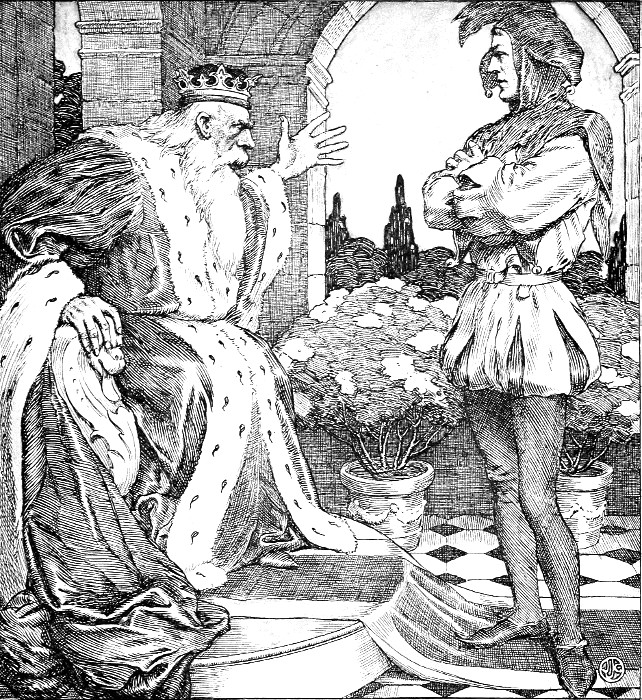
"It's got to be killed," said the Princess
sturdily. "It's a pest."
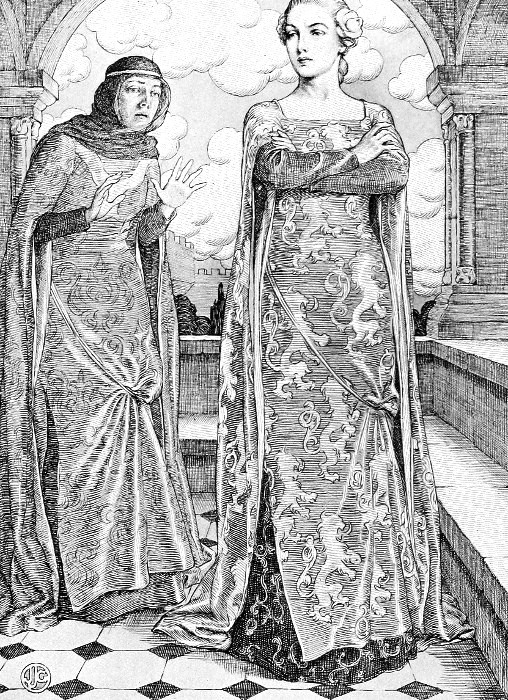
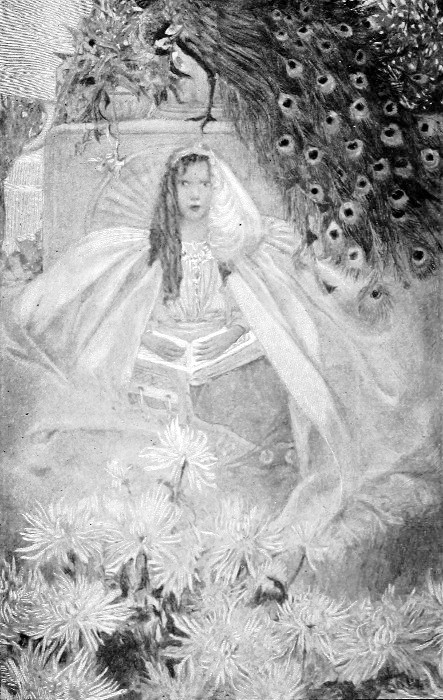
"IT'S GOT TO BE KILLED," SAID THE PRINCESS STURDILY
"But what is it?" whispered Lady
Marie, blushing through her rouge. "Is it
a thing that a young girl ought to know
about?"
There was hubbub in the court for ten
days. Counts, marchionesses, dukes, and
earls gathered in corners and talked under
their breath. Some thought that the Princess
should be imprisoned in a dungeon;
others spoke of her with pity, believing her
mad. One party, headed by old Lord Jean
and the Countess Madeline, said that it was
all nonsense. Everybody knew that there
was no such thing as the Microbe; it was
only a new heresy, wickedly devised to
shake the established faith in dragons. The
Princess might just as well be allowed to
go the way of her folly and find out the
truth. Another faction, made up of believers,
spoke darkly of the mystery that
enshrouded the foe, for he lived in a fog,
and went out to kill veiled in cloud, and
they hinted that if the Princess went to find
him, she would not return alive. His Majesty
and her Majesty, bewildered, agreed
with both parties, wept, protested, but did
not forbid the Princess to go, for fear that
she would not mind. Auguste Philippe
said a bad word.
At first the Princess tried to reason with
them—an unwonted occupation for her.
"It really is a combat that a lady could
very well engage in," she said earnestly.
"It isn't as if it were a dragon, you know."
But they only pooh-poohed and ha-haed
until she shut her lips very tightly together,
and went on her way as usual, unexplained.
Just here attention was diverted from
her, for his Majesty, who had been hurt in
hunting, sickened and died, and amid sobs
and whisperings and discussions, Auguste
Philippe the Twenty-fourth came to the
throne. There were many rumors and
whispers of how the late King had come to
his death: some said that it was a fall from
his steed; others hinted the Microbe, shivering
with horror at the name. No one was
sure of anything, and the court physicians
very cleverly gave out that they could not
explain at length his Majesty's ailment
because nobody knew enough to understand.
But the Princess Victorine, who was not
a person of doubts, was convinced from the
first. With her head held very erect, she
went to the court armorer, and gave orders
that he dared not disobey; then she went
to the royal stables and made her choice,
while all stood still to watch her, spellbound,
no one venturing to lift a hand. Her
Majesty was too much overcome with
grief to care what happened; Lady Marie
and the Duchess were absorbed and happy
getting the court into mourning, and so
there was no one but Auguste Philippe to
say good-by to the Princess when she went
away. He had risen very early, and stood
upon the battlements to see her go.
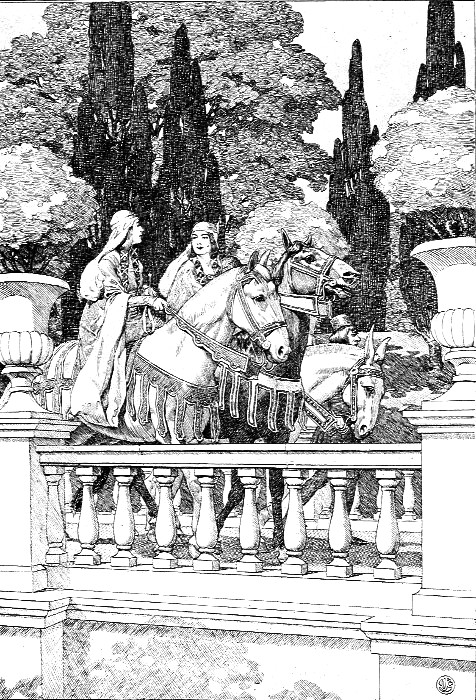
It was one brave June day when the
Princess Olivera Rinalda Victorine, armed
cap-à-pie, went forth to war. She was
mounted on a charger of dapple gray; a
palfrey she would not have. On her head
was a shining steel helmet, through the
back of which her tawny hair floated down
her back—there was not room to do it
high. Through her visor her blue eyes
sparkled with a steady light. On her arm
she carried a blue shield, for even in her
battle mood she could not forget what color
was becoming. It bore the device that she
had chosen for herself, a virgin rampant,
gules. The armor that covered her from
head to foot was of wrought rings of finest
steel, made with a flowing skirt that fell in
protecting folds about her feet. Her right
hand held a spear; with her left she guided
her steed.
"Good-by, dear!" called the Princess,
waving her hand to Auguste Philippe.
"You are a silly thing," he remarked,
affectionately, from the battlements. "You
won't do anything but tear your clothes."
He did not try to stop her. In the strain
of becoming Auguste Philippe the Twenty-fourth
he found that there were many things
he was not so sure of as he had been before.
The flame in his sister's eyes he did not
understand, and he wondered why she was
not content to stay at home and play at
quoits and dance to music, as he was; but
he resolved that Victorine should make a
fool of herself in her own way, and that it
should not cost her too dear. So he stood
long watching her as she went shining across
the great green plain with the light flashing
from a thousand glittering points on her
armor.
Now, the Princess rode by night and day,
and not once did her courage fail or her arm
grow weary. She left behind the green plain
and the pleasant trees, and traveled in a
grievous waste beyond the songs of birds,
and anon she came to a woodland that was
dark and old. She was sorely puzzled as to
the habitat of the Microbe, for in his raids
he came from east and west and north and
south, and no one could tell if he had a permanent
abiding-place. Often in the dusky
shadows of the wood, she stopped to call
a challenge: "What, ho! Come out and
try thy skill!" But that was not his way of
fighting, and he stayed hidden. Sometimes
she inquired at a cottage door or at a shepherd's
hut on the edge of the wood, but all
thought that the lovely lady in armor was
surely mad, wearing such strange clothing
and asking such strange questions. Once
she came upon a witch-wife who was gathering
simples by a swamp in the wood.
"Is the pretty lady looking for the pretty
knight that passed this way yestere'en?"
asked the witch-wife, with a horrible leer
of her sunken eyes.
The Princess elevated her eyebrows
with a look of scorn.
"No," she answered coldly; "I am looking
for the Microbe."
"How?" asked the witch-woman, with
her hand behind her ear.
"The Microbe!" shouted the Princess.
"Is it a man, or a lady, or a place?"
"It's a monster!" shrieked the Princess.
"It kills, and eats, and destroys." And then
followed a faithful repetition of Auguste Philippe's
description of the beast. The witch-wife
laughed and rocked to and fro, her yellow
teeth showing in her shrunken gums.
"Oh, deary, deary, deary!" she said,
"there ain't any such critter, truly there
ain't. I've lived here in the swamp seventy-nine
year; I never saw one, and I sees
pretty nigh everything."
"Who eats the youths and the maidens,
and the old men and the children?" demanded
the Princess sternly.
"How do I know? How do I know?"
cackled the old woman. "I don't."
The Princess Victorine rode away, and
behind her the witch-wife laughed.
"That's the way the pretty knight went,"
she called. "You'll find him further on."
The Princess indignantly turned her
charger and rode in the opposite direction.
That morning came her moment of great
reward, for, by the side of a noxious swamp,
a gray mist met her, blinding her eyes, and
she thought she heard sounds of gurgling
and lashing and clawing. Once she caught
sight of the great shining eye of which
Auguste Philippe had told her, and then
she dimly detected the grin of teeth. Olivera
Rinalda Victorine was sure that she
had met the Microbe at last. With lifted
spear, and with the shout, "A maiden to
the rescue!" she rode into the floating cloud
and thrust it through and through. Her
spear crashed on—something; her charger
seemed to trample a living creature under
foot, and snorted with terror. Thrice came
swift blows upon the Princess's shield, but
whether they were of claws or tail, she could
not tell. Her ears were deafened by the
noise; her armor ripped in the gathers at
the waist; her good steed for a moment
lost his footing in the morass, but she reined
him up, and, mad with the thrill of victory,
struck out again and again with more than
woman's strength. Then, was it fancy, or
did she hear a roar as of mortal pain? Did
she catch the sound of swift retreat of a
hundred thousand wounded legs?
At home, upon the battlements, that
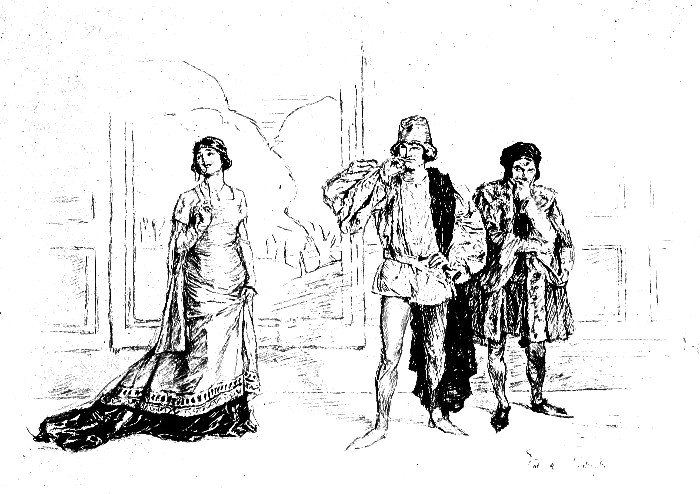
morning, stood Auguste Philippe with some
ladies of the court. (Lady Marie was lovely
in deepest crêpe, and the Duchess was looking
her best in heavy mourning.)
"It was in that direction that she went,
did you say?" sobbed the Duchess, with a
black-bordered handkerchief at her eyes.
The young king nodded.
"How can I bear it?" asked Lady Marie,
raising her clasped hands to heaven. "Oh,
your Highness, send out a searching party!
Send fifty armed knights! Think what may
happen at any moment!"
"Pshaw!" said Auguste Philippe the
Twenty-fourth, "Victorine can take care
of herself. She is four inches taller than
I, and her arms are like iron. Let her be.
She is foolish, but she has got to have her
fling."
"In my day," said Lady Marie, "no
modest girl would have suggested such a
thing."
"I dare say," sighed his Majesty; "but
the thing has got to come; they must sow
their wild oats! She will come back all
right."
Though Lady Marie did not know it,
his Majesty Auguste Philippe then, as
always, spoke the truth.
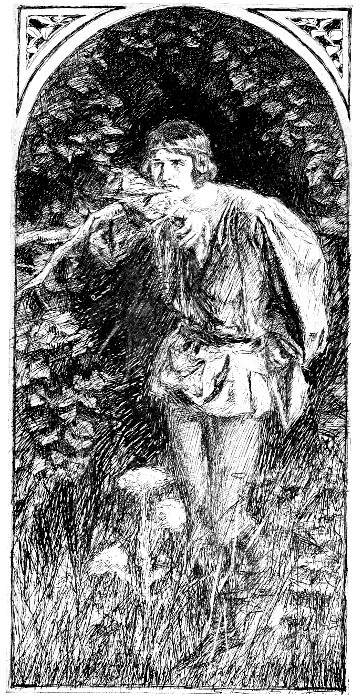
At that very moment, beyond the wide
green plain, and beyond the sandy waste, a
young knight, riding slowly, with his head
bent down upon his breast, came upon a
maiden sitting at the edge of a wood. Near
her, cropping the grass, strayed a gray
charger, with his bridle falling loose upon
his neck. The maiden was curiously clad
in shining armor, only her helmet was off,
and tears were trickling down her cheeks.
Now and then she dried them with strands
of her yellow hair, and then she shuddered,
gazing at a bloody spear that she held in
her left hand.
"Fair lady," said the Knight, riding
toward her, "tell me your trouble, that I
may help you."
The Princess Olivera Rinalda Victorine
looked up at him and sobbed, and her chain
armor rose and fell upon her bosom. She
had not cried this way since that memorable
day on the stone bench in the garden,
twelve years ago.
"I've—I've killed the Microbe!" gasped
Princess Victorine.
"Indeed?" said the Knight, raising his
visor and showing a pleasant smile upon a
pale face. "And are you not glad?"
"Ye-es!" said the Princess, with a great
heave of her bosom as she looked at the
disfigured spear.
The stranger alighted from his horse and
came slowly toward the Princess. He was
tall and strongly built, but he walked as
one to whom every motion brings pain.
"Are you quite sure that the beast is
dead?"
The Princess nodded.
"Quite."
"I wonder," said the Knight meditatively,
"if you brought away his head or a claw?"
"No, I didn't; but I feel very sure. Men
are so skeptical!" said the Princess, with
some heat.
"Not at all," answered the Knight courteously,
"only your quest is the same as
mine, and I should be glad to know that it
is over. I, too, am hunting him."
A beautiful expression swept over the
Princess's face and into her blue eyes. She
looked less like a baby than she had done
at any time for seventeen years.
"I thought men didn't care."
"Some do."
"Auguste Philippe doesn't—he only
laughs, and so does old Lord Jean; but I
think that this will convince them," and
Princess Victorine triumphantly brandished
her spear.
"Ah!" said the Knight, looking at it
with sudden interest, "may I see your
point?" But as he moved to take it, he
gave a sudden groan and fainted at the
Princess's feet.
"Oh, oh, oh!" cried Olivera Rinalda
Victorine. In a trice she unlaced the
Knight's helmet and corselet, and was horrified
to find blood flowing from an open
wound in his shoulder. Hastily she brought
water in her helmet from a spring hard by,
and bathed his forehead and eyes, and then
ran for more to pour on the wound, saying,
as she went, something unpleasant about
her skirt of chain armor, which kept getting
in her way. As she worked, the eyelids
fluttered, and the dark eyes slowly opened.
"Are you hurt?" asked the Princess
eagerly.
"I'm afraid that I am rather badly cut
up," he answered, with a groan.
"Did that—Beast do it?" asked the
Princess.
"It may be," said the Knight.
The Princess rose and put on her helmet.
"Where are you going?" asked the
Knight.
"After It," said Victorine sternly.
"Lovely lady," he said feebly, "don't
you think you ought to wait until I am
better?"
"I'm not a lovely lady, I'm a warrior,"
said the Princess; "but of course I'll stay
if you want me to."
"You are both," said the Knight. "Do
you know I think that it would make me
forget my pain if you should tell me of your
fight."
So the Princess, with a shining face, told
him of her battle in the mist, and of the
monster with the great, glowing eye, and
as she talked, she failed to see that the
wounded man kept looking toward the
spot where his gleaming helmet lay.
"And now," said the Princess reproachfully,
with red flushing her cheeks, "tell
me how you were wounded. Do you mind
explaining how you came to be hurt in the
back?"
"Somebody or something attacked me
from behind," said the Knight, with a smile
half hiding the look of pain on his face.
"The coward!" cried the Princess Victorine,
in great anger.
"It may have been some one who did
not know the rules of the game," said the
Knight.
"That makes no difference," said Princess
Victorine loftily.
"Well, it was a strange combat," remarked
the Knight, "and the blows were
the oddest I ever received. They came
thrashing from all sides, in defiance of all
the laws of fighting. Whether they came
from man or beast I could not see—you
know yourself that it is foggy in the woods,
and I was disabled by the blow in the back."
"I know," nodded the Princess sympathetically.
"You've been fighting that
same monster that I killed." And for the
life of her, she could not help a little feeling
of triumph that the beast had gone down
before her rather than before him.
"When did you kill him?" asked the
wounded man.
"This morning," beamed the Princess.
"When were you hurt?"
"Oh, I believe it was this morning," said
the Knight carelessly.
"I wish, for your sake, I had done it
sooner," said Victorine regretfully. One of
her greatest charms was her slowness in
putting two and two together. Now she
had little time for it, for the Knight fainted
again. For the first time in her life, the
Princess repented of her aversion to smelling-salts.
However, there was plenty of
water in the spring, and she kept her best
lawn handkerchief, which she had carried
up her sleeve, wet upon the sick man's
brow. Through the fever of that day she
watched him, and all night, and again a
second one, and on the third day there was
a look of weariness upon her face that had
never been there before. As the fever
abated, and the Knight was aware of the
tender nursing that he was receiving, he
watched the Princess with eyes full of gratitude.
She had laid aside her armor, and
was becomingly attired in blue brocade,
which she had worn underneath the steel.
The sun shone pleasantly on her yellow
hair, and if the color in her cheeks was
less pink than it had been, it meant, with
the dark shadows under her eyes, only
new beauty. When he spoke his thanks,
she turned red as a boy would have done,
and asked him please to stop, which he
did.
That afternoon the Princess grew confidential.
She was sitting near the invalid,
who was propped up on a mossy pillow,
supported from underneath by her armor
and her shield.
"Just feel my muscle!" said the Princess
impulsively.
"I have!" said the sick Knight gravely.
"Why, when?" demanded the Princess.
"Oh, you mean when I lifted your head.
But look how it stands out."
He did so.
"You see," said Olivera Rinalda Victorine,
"I am so unfeminine. I ought to have
been a boy."
"Never!" cried the Knight vehemently.
The Princess looked at him in surprise.
"I'm very sure," she said gently. "I've
known it ever since I was so high," and
she measured off the stature of six years
by holding her white hand above the
ground.
"I don't agree with you," said the Knight.
"You're not in the least like a boy, really.
You do not look like one, nor use your arms
like one."
"When have you noticed that?" asked
the Princess, in surprise.
"Oh, lots of times," he answered evasively.
"But tell me why you think so."
Sitting beside him, with the beech leaves
making a flickering shade on her face and
throat, the Princess told him all the tragedy
of her life, her discovery of her initial great
mistake, her unavailing efforts to set it
right, and the persecutions she had suffered
because she was not ladylike. It was the
first confidence that she had made in all
her life, and her cheeks flushed deep red.
Overhead sang thrush and sparrow, and a
little breeze came and played with her
floating hair. Suddenly the Knight reached
out and took the white hand in his and
kissed it.
"Why did you do that?" asked the Princess
softly. "To comfort me for not being
a boy?"
"No," growled the sick man.
"Then why?" she persisted, drawing it
away.
"Oh, I can't tell you," he groaned,
"until I know whether I shall get well of
this beastly wound."
But the Princess, taking both hands to arrange
the wet handkerchief, suddenly found
them prisoned and covered with kisses.
"It is because I love you," he moaned.
"Don't you understand?"
Princess Victorine eyed him with curiosity,
and shook her head.
"No," she answered, kneeling down and
looking at him, "I'm afraid I don't. Nobody
ever did before."
The Knight laughed out from the mossy
green pillow.
"That's just what makes you so adorable."
"Won't you try to make me understand?"
said the Princess. "I am very slow, but
when I once learn, I never forget."
"Victorine," said the Knight, fixing his
dark eyes on her, "I love you, and I need
you. I love your hair and your eyes and
the touch of your hands, and I want you to
be my queen. You are a princess, I know,
but then I am a prince."
Olivera Rinalda Victorine was silent a
long time, kneeling on the moss.
"Are you angry?" asked the Knight, at
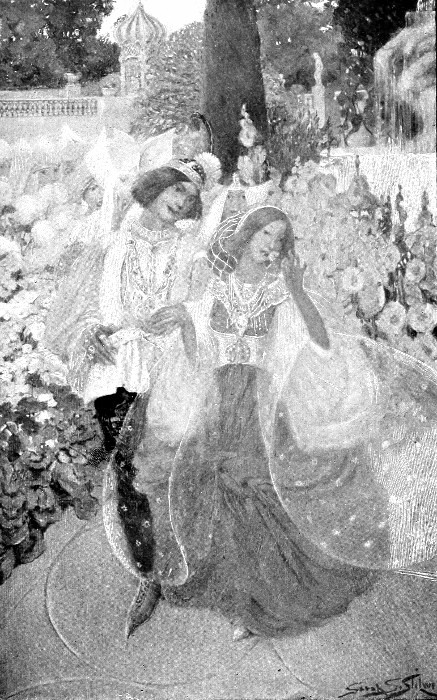
length.
"No," said the Princess, in a whisper.
"I think I like it." Then he smiled up at
her, but did not even touch her hand.
"Tell me truly," said the Princess, "don't
you mind my climbing trees and doing all
those things?"
"Not a bit."
"Nor the device on my shield?"
He laughed and shook his head.
"Nor my wanting to go on a quest, and
do all those unfeminine things?"
"Victorine," said the Knight, "it is the
brave soul of you that I love. We will go
on and fight together."
Then there was a sudden shining that
was neither from the sun nor the Princess's
hair, but from the light that sprang into
her face, and when the wounded man lifted
his arms and drew her toward him, she
bent and kissed him on the eyes, and no
one ever knew, she least of all, where she
had learned that.
Three days more and three nights they
stayed there, and the sick man's strength
came slowly back. In the quiet they talked
of many things in the past and many yet
to come. Only once in all that time did
Princess Victorine looked troubled.
"Dear," she said one day, "there are
moments when I am afraid that you do not
quite believe in me. I am not sure that
you are convinced that I have really killed
the Microbe."
"Beloved," said the Knight, putting down
a piece of his armor, where he had been
idly fitting the point of the Princess's spear
into a great hole, "I believe in you utterly,
only, there may be more than one, you
know, and so our quest is not over."
On the fourth day they put their armor
on, caught their steeds, and rode away.
On the Princess's shield the maiden stood
out bravely against the blue; the stranger
Knight carried the device of an ugly worm
transfixed by a glittering sword, and the
motto was "I search." The maiden knight
and the man looked at each other from
under their visors.
"To the death!" he cried, and he spurred
his steed.
"To the death!" echoed the Princess,
dashing after him, and so they rode gallantly
away. Whether they have found
and fought the Microbe none can say, but
this is known, that they are happy in the
quest.