Christmas passed over at Cheverley Chase in
good old-fashioned orthodox mode. The young
Ingletons, with plenty of evergreens to work
upon, performed prodigies in the way of decorations
at church and home. They distributed
presents at a Christmas-tree for the children of
tenants, and turned up in a body to occupy the
front seats at the annual New Year's concert in
the village. When the usual festivities were finished,
however, time hung a little heavy on their
hands, and one particular morning found them
lounging about the breakfast-room in the especially
aggravating situation of not quite knowing
what to do with themselves.
"It's too bad we can't have the horses to-day!"
groused Dulcie. "I'd set my heart on a
ride, and I can't get on with my fancy work till I
can go to Balderton for some more silks."
"And I want some wool," proclaimed Lilias,
stopping from a rather unnecessary onslaught of
poking at the fire. "There's never anything fit
to buy at this wretched little shop in the village!"
"Except bacon and kippers!" grinned Roland.
"I can't knit with kippers!"
"Fact is, we're all bored stiff!" drawled
Everard from the sofa, flinging away the book he
was reading, and stretching his arms in the luxury
of a long-drawn yawn. "What should you say
to a turn in the car? Wouldn't it be rather
sport, don't you think?"
"If Grandfather would spare Milner to take
us!" said Lilias doubtfully.
"We don't want Milner. I'll drive you! I
can manage a car as well as he can, any day.
Don't get excited, you kids! No, Bevis, I shall
certainly not allow you to try to drive! There's
only going to be one man at that job, and that's
myself!"
"Shall we go and ask Grandfather?" suggested
Dulcie.
"Right you are! No, not the whole of us,"
(as there was a general family move). "Three's
enough!"
So a deputation, consisting of Everard, Lilias,
and Dulcie, promptly presented themselves at the
study door and tapped for admission. As there
was no reply to a second rap, they opened the
door and walked into the room. Grandfather
was rather deaf, and sometimes, when he had
ignored a summons, he would say: "Well, why
didn't you come in?" He was generally to be
found writing letters at this hour in the morning,
but to-day the revolving chair was empty. He
had apparently begun his usual correspondence,
for his desk was littered with papers. Leaning
up against the ink-pot there was a photograph.
The young people, who had walked across the
room towards the window, could not fail to notice
it, for it was tilted in such a prominent place
that it at once attracted their attention. It represented
a very pretty dark-eyed young lady, holding
a baby on her lap, with a slight background
of Greek columns. The decidedly foreign look
about it was justified by the photographer's name
in the corner: "Carlo Salviati, Palermo."
Over the top was written in ink, in a man's handwriting:
"My wife and Leslie, from Tristram."
"Who is it?" asked Everard, gazing at the
portrait with curiosity. "She's rather decent
looking. Never seen her here, though, that I can
remember!"
"It's a ducky little baby! But who is Tristram?"
said Dulcie.
"We had an Uncle Tristram once," answered
Lilias doubtfully.
"Why, but he died years and years ago, when
we were all kids!" returned Everard.
"I know. He was the only Tristram in the
family, though. I can't imagine who these two
can be. Leslie, too! Why, that's Grandfather's
name! Was the baby christened after him?"
"We'll ask Cousin Clare sometime," said Dulcie,
so interested that she could scarcely tear
herself away. "I really want to know most fearfully
who they are."
"Oh, don't bother about photos at present!
Let's find Grandfather!" urged Everard.
"Perhaps he's gone down to the stables, or he
may be in the gun-room."
On further inquiry, however, they ascertained
that a telegram had arrived for Mr. Ingleton, on
the receipt of which he had consulted Miss Clare,
had ordered the smaller car, and they had both
been driven away by Milner, the chauffeur, and
were not expected back until seven or eight o'clock
in the evening. This was news indeed. For a
whole day the heads of the establishment would
be absent, and the younger generation had the
place to themselves. For the next eight hours
they could do practically as they pleased.
Everard stood for a moment thinking. He
did not reveal quite all that passed through his
mind, but the first instalment was sufficient for the
family.
"We'll get out the touring car, take some lunch
with us, and have a joy-ride."
Five delighted faces smiled their appreciation.
"Oh, Everard! Dare we?" Dulcie's objection
was consciously faint.
"Why not? When Grandfather's away, I
consider I've a right to take his place and use the
car if I want. I'm master here in his absence!
I'll make it all right with him; don't you girls
alarm yourselves! Tear off and put on your
coats, and tell Atkins to pack us a basket of lunch,
and to put some coffee in the thermos flasks."
With Everard willing to assume the full responsibility
the girls could not resist such a tempting
offer, while the younger boys were, of course,
only too ready to follow where their elders led.
Elton, the groom, made some slight demur when
Everard went down to the motor-house and began
to get out the big touring-car, but the boy
behaved with such assurance that he concluded
he must be acting with his grandfather's permission.
Moreover, Elton was in charge of the
horses, and not the cars, and Milner, the chauffeur,
who might reasonably have raised objections,
was away driving his master.
The cook, who perhaps considered it was no
business of hers to offer remonstrances, and that
the house would be quieter without the young
folks, hastily packed a picnic hamper and filled
the thermos flasks. A rejoicing crew carried
them outside and stowed them in the car.
It seemed a delightful adventure to go off in
this way entirely on their own. There was some
slight wrangling over seats, but Everard settled
it in his lofty fashion.
"You'll sit where I tell you. I'll have Lilias
in front, and the rest of you may pack in behind.
If you don't like it, you can stop at home. No,
I'm not going to have you kids interfering here,
so you needn't think it."
Everard had been taught by the chauffeur to
drive, and could manage a car quite tolerably
well. He possessed any amount of confidence,
which is a good or bad quality according to circumstances.
He ran the large touring "Daimler"
successfully through the park, and turned
her out at the great iron gateway on to the highroad.
Everybody was in the keenest spirits. It
was a lovely day, wonderfully mild for January,
and the sunshine was so pleasant that they hardly
needed the thick fur rugs. There seemed a hint
of spring in the air; already hazel catkins hung
here and there in the hedgerows, thrushes and
robins were singing cheerily, and wayside cottages
were covered with the blossom of the yellow jessamine.
It was a joy to spin along the good
smooth highroad in the luxurious car. Everard
was a quick driver, and kept a pace which sometimes
exceeded the speed limit. Fortunately his
brothers and sisters were not nervous, or they
might have held their breath as he dashed round
corners without sounding his horn, pelted down
hills, and on several occasions narrowly avoided
colliding with farm carts. A reckless boy of
seventeen, without much previous experience,
does not make the most careful of motorists. As
a matter of fact it was the first time Master
Everard had driven without the chauffeur at his
elbow, and, though he got on very well, his performance
was not unattended with risks.
Towards one o'clock the crew at the back began
to clamor for lunch, and to suggest a halt
when some suitable spot should be reached. The
difficulty was to find a place, for they were driving
so fast that by the time the younger boys had
called out the possibilities of some wood or small
quarry, the car had flown past, and, sooner than
turn back, Everard would say: "Oh, we'll stop
somewhere else!"
By unanimous urging, however, he was at last
persuaded to halt at a picturesque little bridge in
a sheltered hollow, where they had the benefit of
the sunshine and escaped the wind. A small
brook wandered below between green banks
where autumn brambles still showed brown leaves,
and actually a shriveled blackberry or two remained.
There was a patch of grass by the roadside,
and here Everard put the car, to be out of
reach of passing traffic, while its occupants spread
the rugs on the low wall of the bridge, and began
to unpack their picnic baskets. Cook had certainly
done her best for them: there were ham
sandwiches and pieces of cold pie, and jam turnovers,
and slices of cake, and some apples and
oranges, and plenty of hot coffee in the thermos
flasks.
"It's ever so much nicer to have one's meals
out-of-doors, even in January!" declared Bevis,
munching a damson tartlet, and dropping stones
into the brook below. "I believe it's warm
enough to wade. That water doesn't look cold,
somehow!"
"No, you don't!" said Lilias briskly. "You
needn't think, just because Miss Mason isn't here,
you can do all the mad things you like. It's no
use beginning to unlace your boots, for I shan't
let you wade, or Clifford either! The idea! In
January!"
"Why not?" sulked Bevis. "I didn't ask
you, Lilias. Everard won't say no!"
"You can please yourselves," answered his
eldest brother, "but I'm going to take the car on
now. If you stay and wade, you'll have to walk
home, that's all! I certainly shan't came back
for you."
At so awful a threat the youngsters, who had
really meant business where the water was concerned,
hurriedly relaced their boots, and ran to
take their places in the car; the girls finished packing
the remains of the picnic in the basket, and
followed, and soon the engine was started again,
and they were once more flying along the road.
Everard had brought out the family for a joy-ride
without any very particular idea of where
they were going, though he was steering generally
in the direction of the Cleland Hills. To his
mind the chief fun of the expedition lay in simply
taking any road that looked interesting, without
regard to sign-posts. The others trusted implicitly
to his powers of path-finding, and had really
not the slightest idea in what part of the country
they were traveling. After quite a long time,
however, it occurred to Lilias to ask where they
were, and how long it would take them to get
home again.
"We've come such a roundabout route, I
scarcely know," replied Everard. "Those are
the Cleland Hills in front of us, though, and if
we bowl straight ahead, and go over them, we
shall get to Clacton Bridge; then we can get the
straight highroad back to Cheverley."
"We shan't be home before it's dark,
though?"
"Well, no! But the head lights are working
all right—I tried them before we started."
"It will be fun to drive in the dark!" chuckled
the boys behind.
"I hope we shall be back before Grandfather
and Cousin Clare, though," said Dulcie a little
uneasily.
The road over the Cleland Hills was much
wilder than they expected, and it was very stony
and bad. Up and up they went till walls, hedges
and farms had disappeared, and only the lonely
moor lay on either side of the rough track. It
was a place where no motorist in his senses would
have ventured to take a car, the extreme roughness
of the road made steering difficult, and the
strain on the tires was enormous. Instead of
driving cautiously, Everard plunged along with
all the hardihood of youth, bumping anyhow over
ruts and stones. They were just beyond the
brow of the hill when a loud bang, followed by a
grinding sensation, announced the bad news that
one of their tires had burst.
"What beastly bad luck!" lamented Everard,
getting out to inspect the injured cover. "It
might have had the decency to keep up till we had
reached civilization! Well, there's nothing for
it but to put on the spare tire. I've helped Milner
to do it before, so I can manage. It's a
bother we left the spare wheel at home. I shall
want some of you to help me, though."
Everard had indeed rendered some assistance
to the chauffeur on various occasions, but it was
quite another matter to perform the troublesome
operation of changing the tire with only two girls
and three young brothers to lend a hand. In
their inexperienced enthusiasm, they did all the
wrong things, very nearly nipped the tube, mislaid
the tools, and pulled where they should have
pushed. It was only after nearly an hour's work
that Everard at last managed to get the business
finished. The family, warm and excited, packed
once more into the car.
"Well, I hope we shall have no more troubles
now!" exclaimed Lilias, who was growing tired
and longing for home and tea. "What's the
matter, Everard?"
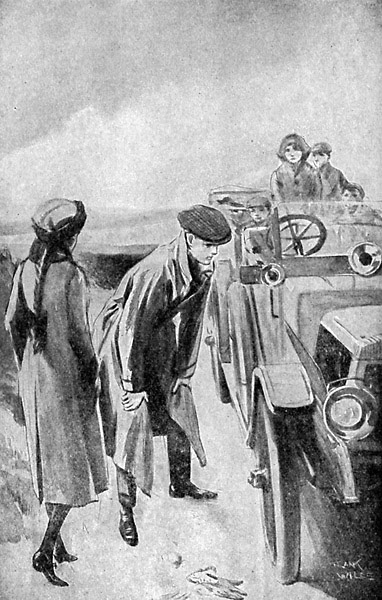
"Matter! Why, she won't start, that's all!"
Here was a predicament! Whether the bumping
up the rough road had thrown some delicate
piece of mechanism out of gear, or the waiting in
the cold had cooled the engine, it was impossible
to say, but nothing that Everard could do would
induce the car to start. He examined everything
which his rather limited knowledge of motorology
suggested might be the cause of the stoppage, but
with no result. After half an hour's tinkering,
he was obliged ruefully to acknowledge himself
utterly baffled.
They were indeed in an extremely awkward
situation, stranded on a wild moor, probably sixty
miles from home, and with the short winter's day
closing rapidly in.
"What are we to do?" gasped Lilias, half-crying.
"We can't stay here all night!"
"Finish our prog and sleep in the car," suggested
Roland.
"No, no! We should be frozen before morning."
"I think we'd better walk on while it's light
enough to see," said Everard. "We shall probably
strike a highroad soon, and we'll stop some
motorist, ask for a lift to the nearest town, and
stay all night at a hotel."
"But what about the car?"
"We must just leave her to her fate. There's
nothing else for it. I don't suppose anybody
will touch her up here. It can't be helped, any
way."
"Let's finish our prog before we set off!" persisted
Roland, opening the picnic basket.
The family was hungry again, so they readily
set to work to dispose of the remains of their
lunch. It might be a long time before they were
within reach of their next meal, and they blessed
Cook for having packed a plentiful supply.
Everard would not let them linger for more than
a few minutes.
"Hurry up, you kids!" he urged. "We
don't know how far we may have to go, and it
will be getting dark soon. Thank goodness we
shall be walking down hill, at any rate."
"what are we to do!" gasped lilias
After whisking along in the car, "Shanks's
pony" seemed a very slow mode of progress;
their breakdown had happened in an out-of-the-way
spot, and it was more than an hour before
they reached a highroad. It was almost dark by
that time, and matters seemed so desperate that
Everard determined to hail the very first passing
motorist who seemed to be able to help them.
Fate brought along no handsome tourist car, but
a rattling motor-lorry, the driver of which stopped
in answer to their united shouts, and, after hearing
of the difficulty they were in, consented to give
them a lift to the town, five miles away, for which
he was bound. Fortunately the lorry was empty,
so the family thankfully climbed in, and squatted
on the floor, while Everard sat in front with the
driver.
It was not a very aristocratic mode of conveyance
for the heir of Cheverley Chase, but Everard
was in no mood to pick and choose just then, and
would have accepted a seat in a coal truck if necessary.
As for the younger ones, they enjoyed
the fun of it. It was a very bumpy performance
to sit on the floor of the jolting wagon, but at any
rate infinitely preferable to walking.
Arrived in Bilstone, their cicerone drove them
to a Commercial Hotel with whose landlady he
had some acquaintance, and that good dame, after
eyeing the party curiously, consented to make up
beds for them for the night.
"I've no private sitting-room to put you in,
and I can't show these young ladies into the commercial
room," she objected; "but I'll have a fire
lighted in one of the bedrooms, and you can all
have some tea up there. Will that suit you?"
Lilias and Dulcie, catching a glimpse through
an open door of the company smoking in the commercial
room, agreed thankfully, glad to find
some safe haven to which they could beat a retreat.
"I wonder what Cousin Clare would say?"
they asked each other.
It was indeed an urgent matter to send some
news of their whereabouts to Cheverley Chase,
where their absence must be causing much alarm.
While the landlady, therefore, ordered the tea,
Everard went out to the public telephone, asked
for a trunk call, and rang up No. 169 Balderton.
He could hear relief in the voice of old Winder,
who answered the telephone. Everard was not
anxious to enter into too many explanations, so
he simply said that they had had a breakdown,
told the name of the town and the hotel where
they were staying, and suggested that Milner
should come over next morning to the rescue. On
hearing his Grandfather's voice, he promptly rang
off. To-morrow would be quite time enough, so
he felt, for giving the history of their adventure.
The unpleasant interview might just as well be
deferred, and he had no wish to listen to explosions
of anger over the telephone.
Tea, tinned salmon, plum and apple jam, and
very indifferent bedrooms were the best that the
Commercial Hotel had to offer, but it was infinitely
better than being benighted on the moor.
In spite of lack of all toilet necessaries, the Ingletons
slept peacefully, worn out with their long day
in the fresh air. Milner, the chauffeur, must have
made an early start, for he arrived at eleven
o'clock next morning in the small car, armed with
his master's instructions. He paid the hotel bill,
chartered a taxi, in which he dispatched Lilias,
Dulcie, Roland, Bevis and Clifford, straight for
home, then, engaging a mechanic from a garage,
and taking Everard as guide, he started up the
hill in the pouring rain to find the abandoned car.
It needed several hours' attention before it could
be induced to start, and it was not until evening
that he was able to place it safely back in the
motor-house at Cheverley Chase.
Everard had expected his peppery grandfather
to be angry, but he was quite unprepared for the
intensity of the storm which burst over his head
on his return.
"Your insolence goes beyond all bounds!"
thundered Mr. Ingleton. "To borrow my car
without leave! And to take your sisters without
a chaperon to a fifth-rate public-house! You deserve
horsewhipping for it! You think yourself
the young Squire, do you? And imagine you can
do just what you like here? While I'm above
ground I'll have you to know I'm master, and nobody
else in this place!"
"I can't see it was anything so out of the way
to take the kids a run in the car, and I never
meant to keep the girls out all night," replied
Everard defiantly. He had a temper as well as
his grandfather, and the pair had often been at
loggerheads before.
"Indeed! There are ways of making people
see! You can just go a little too far sometimes!"
declared the old gentleman sarcastically. "I've
given orders that you don't take either car out
again unless Milner is with you. So you understand?"
"I suppose I do," grunted Everard, turning
sulkily away.
It was only a few days after this that Everard,
Lilias, and Dulcie, returning home across the park
from a walk in the woods, met Mr. Bowden, the
family solicitor, who was riding down the drive
from the Chase. He stopped his motor-bicycle
and got off to speak to them. They knew him
well, for he often came to the house to conduct
their grandfather's business, and he was indeed
quite a favorite with them all. He looked at
Everard keenly when the first greetings were over.
"Been getting yourself into considerable hot
water just lately, haven't you?" he remarked.
Everard colored and frowned, then burst forth.
"Grandfather's quite too ridiculous! Why
shouldn't I take out the car if I want to? I can
drive as well as Milner! He behaved as if I
were a kid! It's more than a fellow can stand
sometimes! He likes to keep everything tight
in his own hands; at his age it's time he began to
stand aside a little and let me look after things!
I shall have to take charge of the whole property
some day, I suppose!"
Mr. Bowden was gazing at Everard with the
noncommittal air often assumed by lawyers.
"I wouldn't make too sure about that," he said
slowly. "I suppose you know your Uncle Tristram
left a child? No! Well, he did, at any
rate. I must hurry on now. I've an appointment
to keep at my office. A happy New Year
to you all. Good-by!"
And, starting his engine, he was off before they
had time to reply.
"What does he mean?" asked Lilias, watching
the retreating bicycle. "Uncle Tristram has been
dead for thirteen years! We never seem to have
heard anything about him!"
"What was that photo we saw on the study
table?" queried Dulcie. "Don't you remember—the
lady and the baby, and it had written on it:
'My wife and Leslie, from Tristram.'"
"I suppose it was Uncle Tristram's wife and
child," replied Everard thoughtfully. "He
must have called the kid 'Leslie' after Grandfather.
They ought to have christened me
'Leslie.' I can't think why they didn't."
"Have we a cousin Leslie, then, whom we
don't know?"
"I suppose we must have, somewhere!"
"How fearfully thrilling!"
"Um! I don't know that it's thrilling at all.
It's the first I've heard of it until to-day. I wish
our father had been the eldest son, instead of
Uncle Tristram!"
"Why? What does it matter?"
"It may matter more than you think. You're
a silly little goose, Dulcie, and, as I often tell you,
you never see farther than the end of your own
nose. Surely, after all these years, though,
Grandfather must——"
"Must what?" asked Lilias curiously.
"Never you mind! Girls can't know everything!"
snapped Everard, walking on in front of
his sisters with a look of unwonted worry upon
his usually careless and handsome young face.