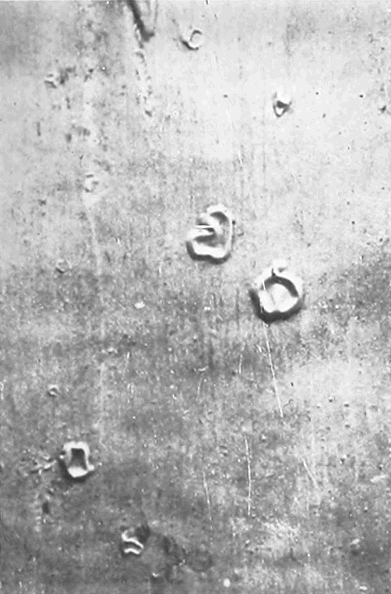
Blistering
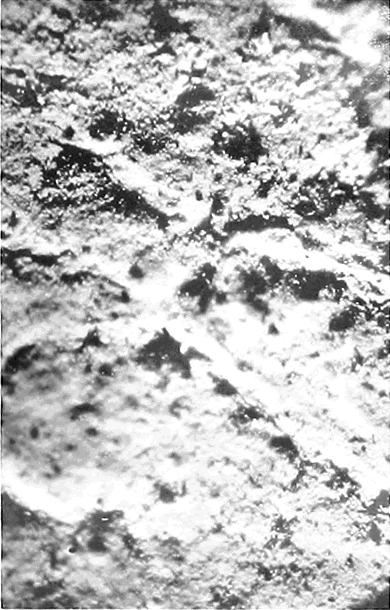
Chalking
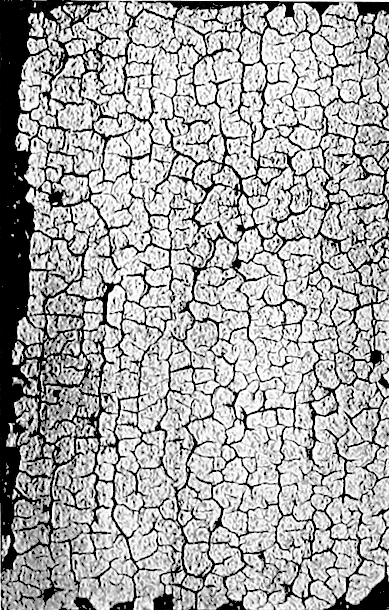
Checking
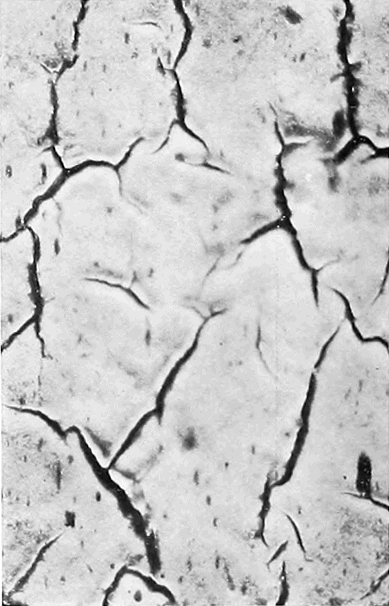
Cracking
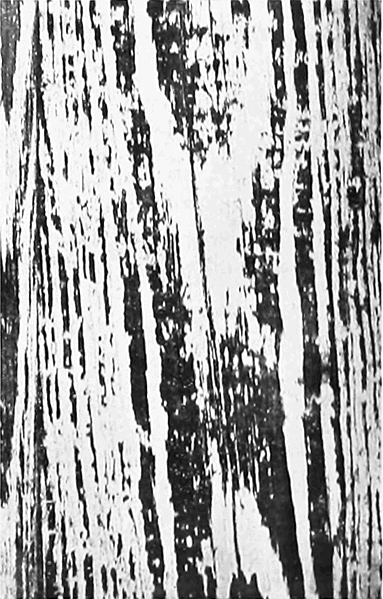
Scaling
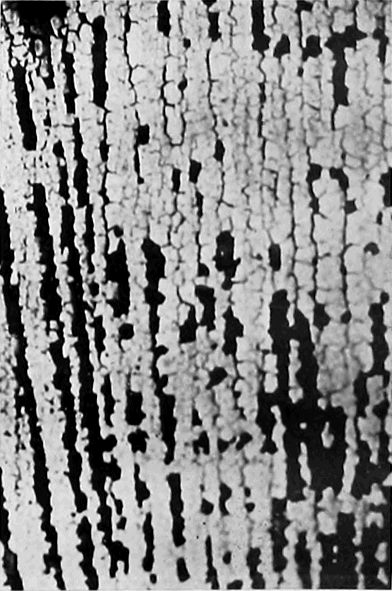
General Disintegration
Signs of Paint Failure: Those who are responsible for
the care and maintenance of property are familiar with the
condition of surface presented by almost all wooden buildings
or structures which have been improperly painted with
inferior paints. "Chalking" or "flouring" are terms used
to describe the condition of a paint surface which has deteriorated
within the paint film. The formation of minute
fissures, generally spoken of as "checking," as well as the
effects best described as cracking, scaling, peeling, and blistering,
are other signs of failure which cause paint coatings
to present an unsightly appearance, and which point inevitably
either to the use of improperly made paints or to
improper application. The cause of these conditions is
not difficult to understand when even a brief study of the
character of the materials entering into the composition of
a paint has been made. It is, however, a fortunate circumstance
that the proper admixture of different types of pigments
enables us to correct the strong tendency exhibited by
special pigments to rapidly deteriorate in an oil film. This
point will be more fully discussed in a later paragraph.
Requisites of a Good Paint: Progressive manufacturers
are aiming to produce a paint which will show, under the
widest range of conditions, good hiding power, adhesiveness,
freedom from internal strains, permanency of color,
relatively high imperviousness to moisture, sufficient elasticity
to prevent scaling or cracking when subjected to expansion
or contraction, and freedom from the chemical
action which results in deep checking or excessive chalking.
Such a product as this cannot be attained, in the writers'
opinion, by the use of any one pigment in linseed oil. In
order to meet all the demands as stated above, there should
be in an economical and durable paint a proper percentage
of the various pigments which, united, will tend to correct
each other's faults, and thus produce a durable paint coating
of maximum efficiency.
The Composition of Paints: As is well known, a paint is
a mixture of one or more pigments and a vehicle which acts
the part of the spreading and binding medium. Up to the
present time the vehicle portion of paints has generally been
made of linseed oil, admixed with some volatile thinner,
such as turpentine. The subject of oils and paint vehicles
will be discussed more fully later on.
Physical Properties of Pigments: The pigment portion
of a paint for use on barns and farm buildings may, if desired,
be composed of properly selected iron oxides or other
colored pigments, even containing in some cases a moderately
high percentage of silica, clay, or other inert materials, and
give perfectly satisfactory results. For the preservation and
decoration of dwellings, however, the pigment portion of
paints is generally made as a whole or in part of the more
expensive white pigments, such as white lead and zinc oxide.
The relative values and properties of these white base pigments
will now be taken up.
White Leads: White lead, either of the corroded or sublimed
type, is perhaps the most generally used of all the
white pigments as a paint base. Corroded white lead is a
basic carbonate of lead, while sublimed white lead is a basic
sulphate of the same metal. Both of these types are white,
and admirably adapted as painting materials. They take
relatively the same amount of oil and spread easily, producing
paint films which are highly opaque and which, therefore,
hide efficiently the surface upon which they are placed.
Sublimed white lead is a relatively finer pigment than corroded
white lead, and seems to show a tendency to chalk
to a greater extent upon exposure to the weather. Corroded
white lead is more alkaline, however, than sublimed
white lead, and when used alone with linseed oil generally
shows a tendency to chalk to a considerable extent in a short
time and to show deep checking, thus permitting the admission
of moisture. The alkaline nature of this pigment produces
considerable action upon certain tinting colors and
results in fading or darkening, when mixed with delicate
greens or blues.
The use of white lead has been condemned in some parts
of this country as well as abroad, because of its alleged
poisonous properties. While it is true that lead poisoning
may occasionally occur in some factories where the workman
and his conditions are not properly safeguarded, it is, nevertheless,
a fact that lead poisoning very seldom occurs among
painters of experience and cleanly habits. Carelessness in
mixing white lead is, fortunately, a practice almost obsolete
among modern painters. The use of paints already ground
in oil by means of machinery to a pasty condition, allowing
easy working and reducing, obviates the danger of lead
poisoning from any such cause as this, even though the percentage
of lead in such paints is in preponderance. Recent
efforts that have been made by the legislatures of certain
States to brand lead paints as poisonous are not only unnecessary,
but show a complete ignorance of the problem.
Zinc Pigments: Another pigment which has proved itself
of great value to the painter is zinc oxide. The use of this
pigment may be said to have almost revolutionized the paint
industry of the world, and its increased consumption during
the last ten years is sufficient evidence of its value as a painting
material. Zinc oxide is produced by oxidation and sublimation
of zinc ores and is not only extremely fine, but of
great whiteness. It has good hiding power, although not
quite so great as that shown by the white leads. It tends to
produce a glossy surface, making it especially valuable for
use on interior work and in enamels. When used alone it
has the effect of hardening the oil film in which it is enveloped,
and upon long exposure causes cracking and scaling.
However, when the sublimed or corroded white leads are
properly combined with zinc oxide, a more durable surface
is produced, the shortcomings of each pigment being overbalanced
by the good properties of the other. The proper
combining properties of zinc oxide with white lead may be
said to vary between 20 to 55 per cent of zinc oxide for
paints designed for exterior use. In the opinion of the authors,
lead and zinc pigments in the above percentage, properly
blended and ground, make paints of far better wearing
value than can be produced with either white lead or zinc
oxide used alone.
Zinc Lead: Zinc lead, a pigment sublimed from mixed
lead and zinc ores and containing about equal proportions of
zinc oxide and lead sulphate intimately combined, as well as
leaded zinc, a produce similarly produced, but with the zinc
oxide running about 75 per cent, are white base pigments of
value, which are used to a considerable extent. They are
generally slightly off color, however, and are therefore used
most largely in paints which are to be tinted in various
colors.
Lithopone: Lithopone, a pigment produced by precipitation,
and consisting of zinc sulphide and barium sulphate, is
of great value in the manufacture of interior paints. On account
of its liability to darken and disintegrate, however, it
is seldom used on exterior work, although recent tests have
shown that when used in combination with zinc oxide and
whiting, it gives very promising results.
Crystalline Pigments and Their Use: Barytes (barium
sulphate), silex (silica), whiting (calcium carbonate), gypsum
(calcium sulphate), asbestine (silicate of magnesia),
and China clay (silicate of alumina) are white crystalline
pigments which, when ground in oil, become transparent.
All of these pigments possess the property of strengthening
a paint film made of white lead and zinc oxide, and often
increase the durability of such a paint. Barytes, silica, and
China clay are especially valuable for this purpose. Asbestine,
because of its needle-like structure and low gravity, prevents
settling and acts as a reinforcer of paint films. Whiting
or calcium carbonate should be used when zinc oxide is
in excess in a paint, so that the hardness of the paint may be
overcome.
A white paint must be possessed of sufficient opacity to
efficiently hide the surface upon which it is placed, when
three coats are applied for new work or two coats for repainting
work. Mixtures of the white leads and zinc oxide,
with the latter pigment running not over 55 per cent, will
easily produce such a result and wear well. It is generally
deemed advisable, however, by most manufacturers to take
advantage of the excessive opacity of such mixtures, which
allows the introduction of moderate percentages of those
inert pigments which give greater strength and other desirable
features to a paint. The percentage of natural crystalline
inert pigments to add to a white paint made of lead and
zinc must, however, be moderate and insufficient to detract
materially from the hiding power of the paint.
Note.—Pigments such as silica, barytes, China clay, and asbestine are
thoroughly inert. Recent investigations have proved that they accelerate
the drying of linseed oil, but this is not due to any chemical action they
exert, but rather to their physical action in distributing the mass of oil in
which they are ground, and thus allowing a greater surface to be exposed
to the oxygen of the air.
It is also possible that some of the inert pigments may stimulate oxidation
by catalytic or contact action, although they are not chemically active
in themselves.
White-Paint Formulas: From these conclusions which
have come from wide experience in the testing of paints
under actual service conditions, there can be recommended
to the buyer of paints and to the manufacturer and master
painter those machine-mixed paints in white, made by reputable
manufacturers, the composition of which will show a
mixture of white lead and zinc oxide, with the latter pigment
within limits of between 15 to 55 per cent, and especially the
same mixtures reinforced with the moderate percentage of
crystalline inert pigments referred to above.
Tinted paints possess greater hiding power than white
paints, and the above proportions would be somewhat
changed for a tinted paint containing any percentage of
coloring material. Tinted paints are, moreover, far more
serviceable than white paints, as will be shown later.
Mill vs. Paddle: The mixtures under consideration should
be ground in linseed oil by the manufacturer, through stone
or steel mills, to a very fine condition, as it is only through
proper grinding that the pigments can be properly blended.
The mixing of paint by hand is, fortunately, to a large extent
a thing of the past. The uneven lumping of hand-mixed
paints are often the cause of their failure. Such ancient
and crude practice should be avoided by every painter,
for it is more economical to obtain semi-paste paints, properly
ground by machinery, to such a condition that they may
be easily broken up and tempered. Such paints may be reduced
to the proper consistency with oil and volatile thinner
for application to any kind of wood.
In the opinion of the writers, a majority of the paints
sold by reputable dealers and made by reputable manufacturers
in this country are not only made from the
best linseed oil and highest-grade pigments obtainable, but
are put up in a form ready for the painter to thin down with
full oil or turpentine reductions, either for priming work
or to be used without reductions for finishing coats. The
large metropolitan painter who wishes to make his own tints
and shades may, however, prefer to have his mixed pigment
paint ground by the manufacturer in heavy paste form for
certain purposes.
Results of Field Tests: A careful analysis of the results
of field tests which have been carried on in different parts of
the country would be far too voluminous for insertion in
this bulletin. The official findings of special committees of
inspection have already been published in special reports.
Whereas there may still remain ground for some difference
of opinion in regard to the interpretation of the results obtained
on the various test fences, there can be no doubt that
considerable information of the highest value has been
yielded, both to the producers and consumers of paints.
One of the principal results obtained from these tests has
led to the opinion expressed above by the writers, that better
results can be obtained by a proper mixture of selected pigments
than by the use of any one pigment in linseed oil.
This conclusion has also been reached by engineers of the
United States Navy, and, as a result, the specifications of the
Bureau of Yards and Docks for paints made of straight white
lead and oil have recently been changed to call for white lead
combined with upwards of 50 per cent of zinc oxide. Many
engineers and master painters have interpreted the results of
the tests in the same way, and the attention of the authors
has been called to a number of opinions which show that the
tendency of demand among those who are properly informed
is for a high-grade combination type of paint rather than for
any single pigment paint.
Color: The selection of the color for a dwelling or other
structure is a matter that depends largely upon the good
judgment and taste of the owner, combined with the advice
of the painter. One point, however, should be impressed
upon the mind of both, namely, that PRACTICALLY ALL
SHADES OR TINTS MADE UPON A GOOD WHITE PAINT BASE,
THROUGH THE USE OF PERMANENT TINTING COLORS, WILL
BETTER WITHSTAND EXPOSURE TO THE ATMOSPHERE THAN
THE WHITE BASE USED ALONE. Owing to the cheerful
effect produced by the use of white paint on dwellings, a
very large quantity of white will continue to be used. If
these white paints are designed in line with the suggestions
brought out above—that is to say, if the white lead bases
are properly reinforced with zinc oxide and other pigmentary
materials—better results will undoubtedly be obtained,
as far as appearance and durability is concerned, than if
white lead had been used alone. The consumer should remember,
however, that more durable results will be obtained
by the use of tinted paints.
Reductions and Thinners: Turpentine, with its sweet
odor, high solvent action, and wonderful oxidizing value,
has always taken first place among the volatile liquids used
for thinning paints. Wood turpentines, produced from the
steam distillation of fine-cut fat pinewood or from the destructive
distillation of stumpage and sawdust, have been
refined in some cases, by elimination of odor and toxic effects,
to such purity that they are equally as good as the purest
grades of gum turpentine, and their use is bound to increase
in the paint industry.
The painter and manufacturer have come to understand
that certain grades of asphaltum and paraffine distillates are
equally as satisfactory as turpentine for use in paints for exterior
purposes. Those volatile oils which are distilled
from crude oil with either a paraffine or asphaltum base and
possessed of boiling point, flash point, color, and evaporative
value approximating similar constants of turpentine,
are excellently suited to partly, and in some cases wholly,
replace turpentine in exterior paints. A little additional
drier added to paints thinned with these materials will cause
oxidation to take place in the proper time.
Prominent master painters[A] have shown that benzol, a
product obtained from the distillation of coal tar, differing
from benzine, a product obtained from the distillation of
petroleum, is a valuable thinner to use in the reduction of
paints for the priming of resinous lumber such as cypress
and yellow pitch pine. The penetrating and solvent
value of benzol is high, and it often furnishes a unison between
paint and wood that is a prime foundation to subsequent
coatings, preventing the usual scaling and sap exudations,
which often appear on a painted surface. Because of
the great solvent action of benzol, however, this material
should never be used in the second and third coatings. These
facts will doubtless interest the Southern painter, who has so
much wood of a refractory nature to paint.
Oils: The increasing cost of linseed oil has raised the interesting
question as to whether or not it is good practice to
use an admixture of other oils in connection with it, in high
grade paint coatings. Strong differences of opinion will
probably be found in regard to this question, and undoubtedly
further investigation work is necessary in order to decide
it. A number of different oils have been proposed for the
purpose, of which, perhaps, soya bean oil is the one which
has been most prominently discussed. No definite formulas,
however, should be recommended until the results of investigations
which are now being carried on are in hand. A systematic
series of test panels is now being erected in Washington,
D. C., on the grounds of The Institute of Industrial
Research, which are designed to gather data covering just
this point.
The flax crop conditions have been most discouraging
during the past two years, and the natural shortage of seed
has caused a rise in the price of linseed oil, which has necessitated
a rise in the price of paint. The added protection to
be secured, however, through the frequent application of
paint far outweighs any increased cost which has been caused
by the rise in price of the raw commodities entering into the
composition of paint.