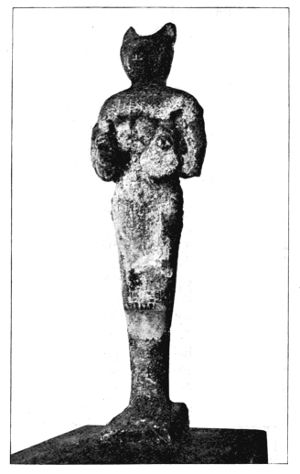
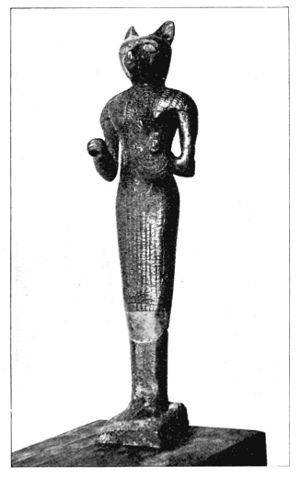
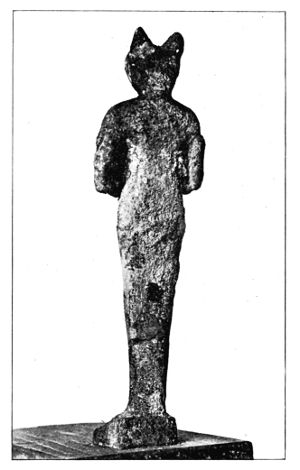
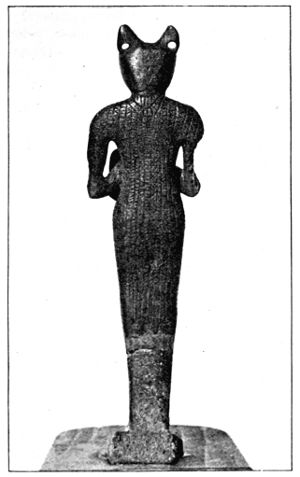
To fix together pieces of broken pottery good Cologne glue
is useful, but it has the disadvantage that it can only be used
when warm. For this reason it is better to use liquid fish-glue
[Syndeticon], which may, if necessary, be thinned with a
little vinegar. Fire-clay dust in waterglass is used in the
Museum at Breslau. A thick ropy solution of shellac[108] may
also be mentioned, for the use of which the opposing surfaces
must be first moistened with alcohol.
Gum arabic and dextrin should not be used, for objects
thus cemented readily fall to pieces unless kept in perfectly
dry rooms. This, however, may also be said of earthenware
which contains salts, if cemented with glue or fish-glue.
Previous steeping would obviate this difficulty.
Chalk, plaster of Paris, brick-dust, or fire-clay dust are
often added to the fish-glue, dextrin, etc. Without giving
additional strength to the cement, these substances may be of
use in filling up small gaps between the fragments to be
cemented.
For filling up larger gaps the “Merkbuch[109]” recommends
stone cement, for the preparation of which it gives the
following prescription:
“Mix 500 grammes of Cologne glue with three sheets
of strong white blotting-paper, or four sheets of white
tissue paper, shredded as small as possible, and boil until
it becomes thick, stirring the whole into a perfectly
smooth pulp. Let it boil thoroughly, and while stirring
continually, and working with a stout wooden rod,
add 21⁄2
kilogrammes of very finely sifted dry purified
whiting. After working this mixture thoroughly, add
80 grammes of linseed oil, which must be also thoroughly
worked in. To preserve the glue add 50 grammes of
Venetian turpentine. This stone cement will take any
shade of colour if mixed with lamp-black or coloured
earths.”
The various methods for the preservation of iron objects
which have been or are still in use may be divided into two
groups. To the one group belong those methods in which the
objects are preserved with their coating of rust, or with the rust
that has penetrated them; to the other group belong those in
which the removal of rust precedes preservation. The former
methods must be applied when the iron has been completely
converted into rust or when the rust has only left a small
metallic core. These methods may of course be used also for
all iron antiquities.
The methods of the second group can be applied to those
objects only which still retain a strong metallic core, in which
case the objects regain the more or less grey or white surface
of fresh unoxidized iron. These methods are at present little
known, and therefore but little used, for owners and the
general public are still accustomed to see in the covering of rust
the evidence of antiquity with which they are loth to part.
In addition to these methods, there are others which are
of an intermediate kind, either special or a combination of
methods from both these groups.
(1) Methods of preserving Objects of Iron
without removal of the Rust.
Impregnation. The earliest processes, which are
to some
extent still in use in some collections, are simple impregnation
methods, in which the object is either painted once or more
with the impregnating medium by means of a brush, or is
placed directly in the medium itself. In either case the
penetrating power of the solution used is directly proportional
to its fluidity.
The following media may be used for the purpose:
(1) Warm size.
(2) Warm isinglass solution.
(3) Solution of waterglass.
(4) Solution of shellac in alcohol.
(5) Rubber solution in carbon bisulphide. The mass
after swelling is dissolved in benzine[110].
(6) Copal varnish diluted with turpentine.
(7) Copal varnish mixed with linseed oil[111].
(8) Linseed oil.
(9) Linseed varnish.
(10) Linseed varnish mixed with an equal quantity of
petroleum.
(11) Bees’-wax dissolved in turpentine.
(12) Bees’-wax dissolved in benzine.
(13) Petroleum.
(14) Vaseline.
(15) Melted paraffin.
(16) Oleate of lead: 100 grammes of olive oil, 100 gr. of
lead oxide, and 100 gr. of water are boiled until all
the water has evaporated and the mass has become
grey. The mass is extracted by shaking it with
alcohol, and the residue is dissolved in absolute
ether, in the proportion of 100 gr. of ether to 5 gr.
of the substance. Before use it should be diluted
with a little ether[112].
(17) Speerschneider’s mixture. This consists of 8 parts of
rape oil, 1 part of bees’-wax, 1 part of pine resin,
and 2 parts of benzene[113].
(18) Collodion, or the mixture used in the Museum at
Donaueschingen, which consists of 30 grammes of
collodion, 2 gr. of camphor, and 1 gr. of oxalic
ether.
In addition to these materials, there are other mixtures of
resin, varnishes, and bees’-wax, with their appropriate solvents,
but they do not possess any special advantages as impregnating
solutions.
After treatment with size or isinglass, iron objects may
be given when dry a coating of linseed oil, linseed varnish,
solution of shellac, etc.
The materials numbered 7 to 10 in the above list should
be applied warm to enable the viscid fluids to penetrate the
rust, for the more readily the solution enters the object the
better is the result obtained. Apart from the fact that they
are easily ignited at a high temperature, they must not be
heated beyond 230°F. [110°C.], otherwise objects which consist
largely of rust will fall to pieces[114].
In the process of impregnation a twofold result is aimed
at, viz. to prevent the rust from crumbling, and to exclude
air from the specimen. The application of heated linseed oil
or linseed varnish is founded upon the supposition that these
substances enter into a chemical combination with ferric
oxide to form a stable compound; this is, however, disputed
by some modern authorities[115]. Neutral substances offer a safer
method for the exclusion of air, and of these melted paraffin
is undoubtedly the best. The paraffin must be quite pure and
free from stearine, as can be ascertained from the melting
point; thus pure paraffin melts at 130°-150°F. [55°-65°C.],
stearine at 160°F. [70°C.]. Paraffin with a melting-point
higher than 65°C. should be looked upon with suspicion.
In many collections the objects are heated before impregnation
with media which are insoluble in water, or they are
exposed to the air for six to twelve months after excavation.
This latter proceeding is, however, certainly inadvisable if the
iron contains chlorine, and if this is the case not one of these
methods produces satisfactory results.
On the other hand, as almost all the iron antiquities which
do not contain chlorine compounds may be treated by the
methods of the second group, simple and direct impregnation
is passing more and more out of use. Before impregnation
all soluble substances, especially chlorine compounds, must be
removed by steeping.
(2) Preservation by Steeping and Subsequent
Impregnation.
Krause’s Method. The water used for steeping
should
be preferably lukewarm, and should be changed every twenty-four
hours. It is even better, at least for the first time, to
lay the object in water and then raise it to boiling-point, a
measure which will allow the more ready penetration of the
water. As in the case of limestones, earthenware, etc. (p.
59),
care must be taken to place the objects as near to the
surface of the water as is possible. Small objects may be
put in glass jars, large ones in wooden troughs, tin vessels, or
wooden boxes lined with zinc or lead. Any little excrescences
on the iron, which are frequently filled with ferrous chloride,
should be punctured to give the water unimpeded and more
speedy access. Crumbling objects should be held together by
tightly wrapping them in muslin. Curators must decide for
themselves how far means such as files, chisels, or small
hammers may be used to remove the rust or earthy material
conglomerated by rust.
Although much recommended, the method of adding soda
or lime water to remove the chlorine as soluble sodium
chloride or calcium chloride is, in our opinion, inadvisable.
Both these substances precipitate the iron from the ferrous
chloride or ferric chloride (which are soluble in water) as
insoluble hydroxide of iron, which more or less closes the
interstices, and thus impedes the access of water to the
interior.
The process of steeping can here again be controlled by
the use of the silver solution (p. 62), for if
there no longer
appears any or only very little cloudiness the steeping may be
considered complete. The length of time required for steeping
depends upon the thickness of the rust and the porosity or
existence of cracks in it, and if the objects are of considerable
size, it may extend over several weeks.
After steeping the object should either be dried in the
open air, and later on a warm stove, or be placed for a
few days in alcohol to remove the water, after which the
rapid evaporation of the alcohol will quickly dry it. The
steeping of iron objects in warm alcohol has been recommended[116],
but if their size is considerable the method is an
expensive one. This method has the advantage that the
alcohol penetrates the rust sooner than does water, and also
prevents oxidation, which may be actually produced by the
water. It may perhaps be advisable to dilute the alcohol, the
usual strength of which is 95% to 96%, with about an equal
volume of water, for some salts are not readily soluble in pure
alcohol. When dry the object is warmed for a few hours in
a mixture of equal parts of good linseed varnish and petroleum.
The petroleum serves to dilute the varnish, which can
thus more quickly permeate the entire mass of iron and rust.
On account of the inflammable nature of the mixture the
warming should be done over a water-bath. For small objects
a cylinder made of ordinary tin-plate, measuring from 6 to 10
inches [15 to 25 cm.] in diameter and 6 in. [15 cm.] in height,
may be used. To increase stability the lower half should be
of a smaller diameter, and fitted into an iron tripod. The
same end is attained by soldering a ring round the middle of
the cylinder, which will rest on the ring of the tripod. The
cover consists of a number of copper rings gradually diminishing
in diameter, which fit closely into one another, thus
enabling porcelain vessels of various sizes to be used. For
larger objects, such as swords, two long rectangular troughs
(Fig. 24) of stronger plate should be used. The
following
sizes will probably be found useful: one about 40 inches
[100 cm.] long by 4 inches [10 cm.] broad, and 4 inches
[10 cm.] deep, and the other slightly larger. Handles should
be fixed at the upper edges. Three iron bars 1 inch
[21⁄2 cm.]
thick and 4 inches [10 cm.] in length are laid across the
bottom of the larger trough, on which the smaller is placed.
The space between the two vessels is filled with water to a
depth of 2 inches [6 cm.]. The trough is warmed on a stove,
or better, where gas can be had, by means of a number of
Bunsen burners fitted with rose or ring burners, over which
the trough may be supported upon tripods. While heating
care must be taken that the water does not boil over, which
can be easily avoided by regulating the gas supply. As the
water evaporates further quantities should be added as
required. After simmering for about two hours, the objects
should be removed and allowed to drain; they should then be
placed on a tripod, or on glass rings, on the warm stove in
cold weather, to accelerate the evaporation of the petroleum
and the setting of the varnish. In summer drying chambers
may be used; these are sold by dealers in physical and
chemical apparatus, or can be made at little cost by a tinsmith.
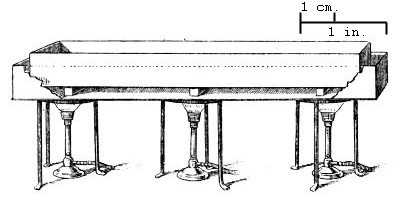
Fig. 24.
Water-bath. 1⁄15
nat. size.
If the objects have been steeped in pure alcohol, or at
least towards the end of the treatment in three changes of
alcohol, so that all the water is replaced by alcohol, they may
be dipped directly without drying in the varnish mixture, for
the alcohol evaporates in the varnish bath which is at a
temperature of 194°-203°F. [90°-95°C.]. As the varnish
hardens, the iron thus treated acquires a glazed surface; other
means of impregnation may therefore appear preferable, e.g.
a solution of gum-dammar or melted paraffin. For impregnation
with the dammar solution the object must first be dried,
and the air-pump used in the way described on p.
68. On
account of the inflammable nature of the benzine heat must
not be applied, nor indeed is it necessary.
When impregnating with pure paraffin[117], specimens may
be lightly wiped with a cloth, but need not be dried. The
paraffin may be heated to 212°-248°F. [100°-120°C.]
without danger, so long as it is kept from direct contact with
the flame. A thermometer should be used, and, as soon as
the paraffin has melted at a temperature of about 60°C., the
object should be placed in it by means of tongs. When
the temperature has risen above 212°F. [100°C.] the water
is converted into steam, and causes a brisk ebullition of the
melted paraffin. The quantity of paraffin used should, therefore,
be such that its level remains at the least 2 inches
[5 cm.] below the upper edge of the vessel.
When the bubbles have ceased to rise, thus showing that
all the water is expelled, the paraffin should be allowed to cool
to a temperature of 180°-190°F. [80°-90°C.]. The iron
should be taken out with tongs, and the liquid allowed to run
off. It should then be wrapped, while still at 80°C., in soft
blotting-paper or in a piece of old linen to absorb the superfluous
paraffin. If the surface of the object is very uneven,
or if there are deep cracks or holes in which the paraffin can
collect, it will, when cold, form a white mass, and should
therefore, while still warm and fluid, be soaked up with filter
paper, or distributed evenly by means of suitable brushes.
The superfluous paraffin may also be absorbed by putting the
object in dry sawdust; any sawdust which remains attached
can be removed when cold with benzine, or it may be scraped
from the spots where it has collected with a knife or spatula.
Any spots where the iron may have become exposed may
be covered with a thin coat of paraffin dissolved in benzine.
Ekhoff’s Method[118]. The objects are laid for two
or three
months in water which is changed every two or three days, a
small quantity of quicklime being added[119]. After this steeping,
and after some of the rust has been removed mechanically,
the object is lightly dried and put into heavy petroleum of
sp. gr. 0·85 to 0·95, which is then heated up to 220°F.
[105°C.].
A thermometer should be used to ensure this temperature.
This temperature being higher than the boiling-point of water,
the water contained in the object evaporates and causes the
petroleum to bubble, as in the method previously described.
When all the water has been replaced by the petroleum
the bubbling ceases. After the fluid has somewhat cooled
down, the iron is taken out and is allowed to remain for about
an hour in sawdust, which absorbs the superfluous oil. Finally,
while gently warming the object over a warm, but not too
hot, stove, it is coated over with a mixture of 1 part of bees’-wax
and 2 parts of turpentine, or better with paraffin dissolved
in benzine. Heavy petroleum, which we have found
by experience to be a suitable material, is preferable to
varnish in so far as the iron is impregnated by a neutral
substance which is practically liquid paraffin, but has the
disadvantage of being highly inflammable and of being
difficult to obtain at so high a specific gravity.
Straberger’s Method. This method, for the
description
of which I am indebted to Herr Straberger, has proved
effective in the preservation of a number of iron antiquities in
the Museum at Linz on the Danube. Even iron objects,
which had been in bad condition and had undoubtedly contained
chlorine, have after treatment by this method shown
no signs of change, while the dull black surface has an agreeable
appearance.
Straberger places the newly-excavated objects immediately
into linseed oil to prevent the access of air. After remaining
in the oil for some time they are taken out, wrapped in cloths
saturated with linseed oil, and removed packed in sawdust.
Upon arrival they are unwrapped and put into water, to which
a small quantity of soda is added to remove the oil more
easily. The water is frequently changed, and the objects are
meanwhile cleaned mechanically with emery paper and hard
brushes. Any blisters are removed by the aid of a small
hammer and chisel. After steeping they are dried and smoked
over a candle flame which is allowed to play over the whole
surface. The soot is then rubbed off with a cloth or soft
brush. Objects with a smooth surface may be rubbed with
india-rubber. The preservative action of this proceeding
depends upon the fact that during the smoking, in addition to
the soot, oily products of combustion are deposited from the
candle flame, which prevent the access of air and moisture to
the iron.
“Objects which are much decayed or cracked should,
when cleaned and thoroughly dry, be again placed into
linseed oil which has been slightly warmed and should
remain therein for a few days before being smoked. Upon
removal from this second oil bath they should be lightly
wiped and dried over a moderately warm stove or in the
sun. Patience is necessary, and nothing further should
be done until the oil has entirely dried in the fine cracks
and crevices and firmly binds the mass. The oil crust on
the surface is then loosened by soaking in a strong soda
solution and wiped off, after which the object is dried,
smoked over the candle flame, and the soot wiped or
brushed off with a soft brush. The smoking and wiping
may be repeated if necessary.”
Herr Straberger states that his treatment has been
successful when impregnation with isinglass and coating
with shellac has failed.
The methods of Hartwich and Jacobi hold an intermediate
place between the above methods and those which will be
subsequently explained. With the former they have this in
common that they do not call for the entire removal of the
rust and that they require the use of linseed oil; on the other
hand their application presupposes the existence of a strong
metallic core, otherwise when the rust is removed they will
show merely a skeleton of the original object. The existence
of a sufficiently substantial metallic core can be easily ascertained
from the weight, for an object, which consists solely or
in great part of the oxide of a metal, is much lighter than one
of the same size which is largely metal. The ring also affords
a test, for an iron object, of which the greatest part is metallic
iron, gives a clearer note when struck than one which is
chiefly rust. A still more certain test is the use of a file or a
drill (comp. page 107).
Hartwich’s Method[120]. This method is intended for
objects of an especially large size, the hard oxide coating of
which does not allow satisfactory steeping. Hartwich heats
the object to redness, allows it to cool slowly, and then
scrapes off the outer layer which has been rendered friable
by this treatment. The subsequent procedure is that of
Krause’s method, viz. warming in linseed varnish.
Jacobi’s Method. The method of preservation of
iron
antiquities used in the Saalburg Museum at Homburg is
described by Jacobi as follows: The object is heated in the
fire of a forge, which causes the chief part of the rust to flake
off, while any rust which still adheres is removed when cold
by water and brushing. The object is again held in the flame
with tongs and heated (smaller objects may be placed on an
iron plate); and during the heating is quickly taken out three
or four times and each time brushed over with linseed oil.
Most of the linseed oil is thus burnt and the deposition of
carbon gives to the iron a black colour, while the oil which
has been partially burnt or hardened by the heat produces
a slight lustre. This process, as carried out at Homburg
by a locksmith, is that which blacksmiths ordinarily use to
blacken iron objects and to protect them from rust. The
preservation has proved permanent, and only in rare cases has
it been found necessary to repeat the process. These good
results are probably due to the fact that the antiquities of iron
preserved in that Museum are for the most part found in
good condition, having very little rust and certainly containing
only a very small amount of chlorine. Iron articles which
contain chlorine but which still have a good metal core, after
washing, drying, and a cautious preliminary application of
heat, are ready for treatment by Jacobi’s method.
Inlaid Iron Objects require especially
cautious treatment.
Although I have not had any personal experience in
the treatment of objects of this kind, good results have been
obtained in several Museums, especially in that at Mainz.
The following quotation from the “Merkbuch” (p. 75)
describes the method which is applied at Mainz, where it
probably originated:
“Objects of this kind which are likely to have been
originally inlaid with silver, gold, copper or brass, as
is frequently the case with objects of the Merovingian
period, are not placed in alcohol after the steeping, but
are warmed and dipped three or four times into a hot
dilute solution of isinglass. The heating is necessary,
otherwise the isinglass will set on the surface and will
not penetrate into the interior. When the object has
been dried and the isinglass has set, the layer of rust
which covers the inlaid ornaments is scraped off with a
graving tool, and any spongy hollow parts are filled up
with a paste made of iron rust and isinglass, before the
inlaid work is cleaned. During the scraping the object
is held in the left hand on a little wooden board covered
with plush or thick chamois leather, to which it is fixed
as firmly as is necessary by means of a vice. In scraping
special care must be taken that the graving tool follows
the lines of the designs, for in scraping across the design
it may slip under the flat silver thread and raise it out of
its place. When the ornamentation has been completely
laid bare, it is rubbed with emery cloth and then
polished with a brush and fine emery powder. The
piece is then dipped into a solution of gum-dammar, and,
when the surface is dry, emery is again used to remove
the varnish, which gives the silver a slightly yellow
colour. The object is then protected from the influence
of air and moisture by the transparent retouching varnish
of Sohnée frères (Paris).”
A modification of Krefting’s method (p. 108) has
proved
eminently successful in the treatment of iron objects inlaid
with silver. Krause[121] recommends that the article be placed,
with the inlaid surface downwards, for 24 hours in a
mixture of
10 grammes of 40% acetic acid,
10 grammes of ammonium chloride,
70 grammes of distilled water,
10 grammes of aluminium powder.
It is then removed from the bath, carefully brushed and
washed, and, if the inlaid work is not yet cleaned, is replaced
in the bath. This is repeated until the inlaid work is completely
exposed. Spots of ferroso-ferric oxide which are
difficult to remove may be ground away by an emery wheel,
care being taken that the inlaid surface is held against the
lower side of the wheel (which must be rotated in the reverse
direction) so that it is always in sight.
All the methods of this group, which have been applied to
many articles in various Museums, exhibit one inherent
defect, for any rust which remains after treatment may cause
the continued oxidation of the iron. The effects of this action
of rust are, I believe, extremely small, and it must at the
same time be admitted that iron antiquities, even if they have
been well steeped and afterwards impregnated, do not always
remain in a permanent and sound state of preservation. If
in such a case the well-known small watery bubbles should
make their appearance, the steeping has undoubtedly been
insufficient. This evil can be remedied by gradually heating
the object to redness to destroy the impregnating material,
and by a careful repetition of the steeping and impregnation.
(3) Preservation of Iron Antiquities by Removal
of the Rust.
Steffensen’s Method (Copenhagen). The objects
are
carefully heated over a flame and are then laid in dilute
sulphuric acid. The sulphuric acid dissolves a certain amount
of the iron, and it is found by experience that the chemical
action is strongest at those spots where any rust remains, and
that this is detached by the hydrogen which is produced.
When the cleaning is sufficient, the iron is laid in a dilute
soda solution to neutralise the acid, and is afterwards well
washed with water and dried in an oven. When dry the
iron is brushed over with a solution of bees’-wax (or better of
paraffin) in benzine, the evaporation of which leaves a protective
coating of bees’-wax or paraffin.
Blell’s Method. The method proposed by Blell and
applied by him to many of the objects in his collection is
distinct from that described above, although in its earlier
stages the principle is the same. The following quotation is
taken from the description of his method which the author
read before the Antiquarian Society[122] at Königsberg:
“If a specimen is found to have a sufficiently strong
core of iron it should be heated in the furnace to bright
redness and then dipped into water. The expansion of
the iron caused by the heat and the subsequent contraction
caused by the sudden cooling thoroughly loosens the
layer of rust. Large iron objects with a strong and
firmly attached incrustation of rust will require a
repetition of the process. By this means not only is the
rust converted into a red powder which is easily rubbed
off, but the object itself is rendered more suitable for the
subsequent treatment. At the same time the heating
process removes any coating of oil, fat, etc., which may
have remained from previous attempts at preservation,
and which would interfere with the further stages of the
process. Smaller or delicate specimens should be treated
in the flame of a spirit-lamp, but special care must be
taken that there is sufficient iron present. Sword blades
and other tools and weapons with sharp edges should be
heated only, for the sudden cooling may cause cracks in
the cutting edges.”
To complete the removal of the incrustation of rust which
has been loosened by the heating process, or by the heating
and sudden cooling, the object should be placed
“in a well-stirred mixture composed of one part by weight
of sulphuric acid in nine parts of water. Bubbles of
hydrogen will immediately rise and the rust will begin
to separate. In freshly prepared acid objects which
are not very rusty will be freed from rust after four
to six hours, those covered with a deeper layer of
rust in about twelve hours, but several days, or even
weeks, may be necessary. The duration of the process
depends upon the strength of the acid and the character
of the rust, viz. whether it is thick and solid, or thin
and porous, and whether the iron is of a soft, or of a
hard character.
When first making use of this method it is advisable
to use dilute acid and to take out the objects several
times in the course of the day and examine them, while
during the night they should be taken out of the acid
and placed in soft water[123].
For the acid bath and for rinsing it will be found
convenient to have two pairs of wooden troughs having
the following internal measurements:
(1) An internal length of 10 inches [25 cm.] by
71⁄2 inches
[19 cm.] in breadth and 43⁄4
inches [12 cm.]
in depth, which will be useful for the larger number
of objects.
(2) For long narrow objects, e.g. sword-blades,
and long spear-heads, the internal measurements should
be 40 inches [100 cm.] long by 4 inches [10 cm.] broad
and 3 inches [8 cm.] deep.
Small fragile objects are most satisfactorily treated
in glass vessels or glazed earthen pots or vases.
The acid must have free access to all parts of the
object; if a sword, for example, lies flat upon the bottom,
the under-surface apparently remains unacted upon by
the acid. This should be remedied by the use of a couple
of small wooden supports.
Frequent rubbing with a cloth and forge scale[124] or
coarse sand greatly helps in removing the rust, but
gentler treatment is required for the smaller and more
fragile objects. The rust is often very firmly attached in
some portions of the object, and in this case those areas
which have been already freed from rust should be coated
over with lard, which is free from salt, to protect them
from further action of the acid, while the pockets of rust
are alternately treated with acid and graving tools. No
particle of rust should be allowed to remain, for sooner
or later it will begin to spread, whatever precautions
may be taken.
The action of the acid becomes less effective if it has
been used for several objects. A little fresh acid should
then be added. The more active the sulphuric acid, the
brighter will be the grey colour of the iron after the rust
has been removed. If old acid has been used the iron
will be of a dirty grey colour, and should then be placed
into fresh acid for a short time until it assumes a clear
light grey colour.
The third part of the process begins with the removal
of the iron from the acid bath and has as its object the
removal of every trace of the acid, otherwise the rust will
very quickly return and cover the whole surface. The
object is therefore immediately and repeatedly rinsed in
soft water and carefully dried; the cheapest material for
this purpose is cotton waste, but ordinary linen-cloth
must be used for objects with jagged edges, for the threads
will catch in the notches and hinder the drying. This
should be done without delay, or a change of the colour
from light grey to yellow will betoken a new formation
of rust. Articles showing a very complicated construction,
which are however rare from the Iron Age,
should be packed in perfectly dry hot pinewood sawdust,
while those which are still more difficult to dry, for
example, coats of chain-mail, after thorough rinsing,
should be immediately put into a pan with melted lard,
free from salt, and boiled until the cessation of bubbling
shows that all the water has been driven off by
evaporation.
They are then rubbed dry or are laid in hot sawdust,
after which they are brushed over with melted lard and
placed in this condition for at least half an hour in a
moderately hot cupboard until the fat has penetrated
into the finest pores of the iron. That this has really
taken place may be proved by the use of a file.
When by this means all trace of sulphuric acid has
been removed the fourth stage of the process is reached,
viz. the removal of the grease from the surface and the
subsequent application of some preparation to prevent
the access of air and moisture. Most of the grease is
removed by placing the objects in a warm place on
blotting-paper. Any grease still remaining on the surface
can be entirely removed with a cloth or paint-brush by
means of benzine. If no restoration or repair is required
nothing more is necessary than to apply the protecting
solution.”
A white varnish has much to recommend it from its
protective power, but as it gives to iron an unsatisfactory
gloss, it is preferable to use a solution of bees’-wax in benzine.
Having made use of Blell’s method in a number of cases
I have a few suggestions and modifications to offer. The
heating should be carried out carefully and gradually, lest
the sudden conversion of the moisture in the rust into steam
should cause small explosions which would scatter pieces of
rust. There is no danger of this if the objects are heated in
an oven; they should not therefore be heated in an open flame.
For smaller objects I use a box six inches [15 centimetres]
square, of strong tin-plate loosely covered with an iron lid,
or with a piece of asbestos sheet; but if the objects are large,
e.g. swords, spearheads, etc., I heat them on a strong piece
of tin-plate bent round to form a channel, and covered with
a long piece of asbestos sheet, the edges of which are bent
over the edges of the channel, to retain the heat as much
as possible.
It is advisable, in my experience, to use the sulphuric
acid well diluted, e.g. in the proportion of 1 to 20, and to
renew it several times if necessary. In mixing concentrated
sulphuric acid with water great caution is required on account
of the evolution of heat. The acid should be poured in a thin
stream into the water, but not vice versâ, and the mixture
should be constantly stirred with a glass rod. If a glass
vessel is used for the mixing, it must not be too thick lest
the heat should cause it to break, but the larger the proportion
of water to the sulphuric acid, the less considerable
will be the rise of temperature.
For boring out rust spots which have eaten deeply into
the iron a dental drill can be used with success, and a great
variety of drills and milling cutters can be obtained. The
rinsing, which Blell carries out by moving the object to and
fro close under the surface in a vessel full of water, may be
sufficient for thin iron objects, such as swords, knives, spear-heads,
and similar objects. Larger specimens should be freed
from the acid by putting them into a still more dilute
solution, and, when necessary, by steeping for a short time
in water. It may also be advisable to put the objects
into dilute soda solution to neutralize the sulphuric acid,
but this does not do away with the necessity for steeping
in water. The brown coating of rust which may possibly
follow the steeping can be removed by the use of steel-wire
brushes, which can now be made of such fine wire that their
softness almost equals that of a moderately soft tooth-brush.
Brass-wire brushes should not be used, on account of the
yellow colour which they give to the iron. I always put the
objects directly after steeping into clean fat heated to 250°F.
[120°C.], for brushing over with fat and warming in a stove
often caused a slight tarnish to cover the surface. I have
also used paraffin wax instead of fat.
For the method of restoring iron antiquities and of filling
up large gaps, the reader should refer to
Blell’s detailed account; it will here
suffice to quote his statement that a
mixture of iron filings with tin filings
can be used for this purpose. These are
melted and applied by the aid of a blowpipe.
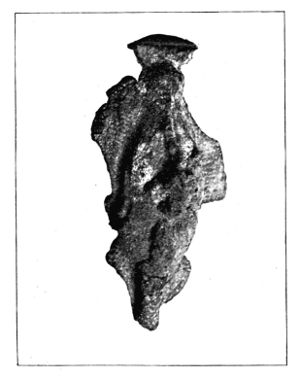
The accompanying illustrations represent
iron antiquities which have been
treated by Blell’s method: the sword
(Fig. 25) proved, after reduction, from
its two ridges to be a scramasax; on the
spear-head (Fig. 26) treatment revealed
a small copper ring at the most constricted
part, while the fibula, which
previously had been a mass of rust, now
shows the spiral which had been totally
disguised.

Fig. 25. Iron sword
treated by Blell’s
method.
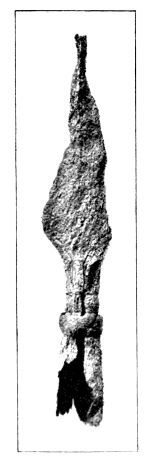
Fig. 26. Iron spear-head
treated by Blell’s method.
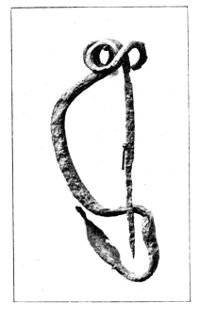
Fig. 27. Iron fibula
treated by Blell’s method.
Krefting’s Method. The electro-chemical
method of Krefting was originally
published in “Aarsberetning fra
Foreningen till Norske Fortidsmindesmaerkers
Bevaring,” 1892 (p. 51), but
in “Finska Fornminnesföreningens Tidskrift[125]”
there is a translation into German
by H. Appelgren, and an additional
series of observations and experiments
by him. His remarks are equally applicable
to Blell’s method, and the following
extracts and quotations from this paper
give Krefting’s method of procedure and
the circumstances under which it should
be applied.
Small fragile objects such as fibulae, thin clasps and
bracelets or those which are much eaten away by rust, are
not suitable for this mode of treatment, thus:
“A knife which is much corroded, and which when
taken out of the earth shows a distinctive form (for
example, that of the Early Iron Age), may lose so much
by the application of the electric current that every
distinct sign of its original character is destroyed. The
characteristic edges of a spear-head or of an axe of the
late Iron Age, or the equally characteristic point of an
iron sword, may, if the rust has eaten deeply into them,
be unrecognisable when removed from the electrolytic
bath. A sword, the hilt of which is inlaid with copper
wire or is plated with silver or gold, or the blade inlaid
with inscriptions in gold, silver, or copper, may be
totally destroyed by incautious treatment; for the ornamentation,
if undermined by rust, may be detached with
the rust from the underlying iron.”
On the other hand, objects of sound metallic iron covered
with an incrustation of rust about 1⁄25 inch [1 millimètre] in
thickness may be easily cleaned in this manner, but if on
using a file the metal does not appear at all, or only at a
depth of 1⁄8 inch
[3 millimètres], great caution must be used.
If there is reason to believe that there is gold or silver inlaid
work undermined by rust, Appelgren recommends that the
object should, as a preliminary, be laid in clean water, which
should be renewed every day. After some time, three weeks
at the most, sufficient rust will have been cleared away by
carefully brushing with a steel brush to lay bare the ornamentation,
at least in part, and it can then be ascertained
whether there is any rust underneath which would, if Krefting’s
method were used, cause the ornamentation to be detached.
The line of treatment is as follows: The metallic iron
core is laid bare by filing in several places. The specimen
is then wrapped with strips of zinc in such a way that the
zinc is in actual contact with the bare metal (Fig.
28). The
whole is then placed into a 5% solution of caustic soda[126].
Appelgren uses a solution of 31⁄
2-41⁄2 lbs.
[11⁄2-2
kilogrammes] of caustic soda in
2 gallons [10 litres] of water. The rust
is cleared away by voltaic action; the
iron forms the negative pole, the zinc the
positive of a voltaic cell, in which the
water is resolved into its constituents,
viz. oxygen and hydrogen. At the negative
pole, i.e. the iron, the hydrogen
rises up in small bubbles and acts in
part by mechanically detaching the rust
as in Blell’s method, in part also by the
chemical conversion of the rust into
metallic iron, or into a compound which
contains a smaller quantity of oxygen
than does ordinary rust. The oxygen
combines with the zinc to form zinc
oxide, which is dissolved in the soda
solution. The process is usually completed
in 24 hours
[127]. The black powder
which is loosely attached to the iron is
best rubbed off with wet sand and fine
wire brushes. Any hard pieces of black
stable rust (Edelrost), magnetic oxide
of iron, which have not yielded to the
electric current should be removed by means of a small chisel.
After rinsing the object thoroughly in water, it should be
placed in melted paraffin at 240°F. [115°C.], which will expel
every trace of moisture. On removal the melted paraffin
should be allowed to drain off, and thus leave when cold a
protective covering upon the iron[128].
The following points should be observed in the application
of the method. Vessels of glass or glazed earthenware should
be used for the reduction, while long swords can be put into tall
glass cylinders or into wooden troughs, the interior of which
must be coated over with paraffin. The soda solution must
be kept in a closed glass bottle[129]. It should be diluted with
water until the specific gravity, as shown by the hydrometer,
is 1·06; the mixture will then contain about 5 per cent.
of caustic soda. During the reduction process the mixture
frequently assumes a brownish colour as the result of the
presence of organic matter associated with the rust. On
account of the dissolved zinc which it contains it cannot be
used a second time, unless regenerated by boiling with quicklime.
The solution is, however, so cheap that this is scarcely
worth the trouble.
The objects should be handled with metal tongs, and
should not be touched with the hand until they have at least
been dipped or rinsed in water, for
the soda solution has an injurious
effect upon the skin. A basin containing
vinegar, dilute hydrochloric
or sulphuric acid should always
be at hand into which the fingers
should be quickly dipped if they
have been in contact with the caustic
soda. These materials will serve
also for cleaning the vessels used
in the reduction process.
The zinc strips should be 1⁄4 to
1⁄3
inch [1⁄2
cm. to 1 cm.] in breadth,
and should be cut out of a piece of
sheet zinc of moderate thickness,
but of sufficient pliability.
Any firmly fixed rust may be removed
by mechanical means, such
as the graver, drill, etc., as has been
previously mentioned. If in rinsing
a slight layer of oxide appears,
although this is rare, it should be
brushed off with a steel-wire brush.
If one portion only of a specimen
requires reduction (the other portion
having, for example, remains of
wood attached, and therefore being
unsuitable for reduction), that portion
only should be wrapped with
the zinc and immersed in the
solution.
The results obtained by Krefting's preservation-process are
quite as surprising as those which are
afforded by Blell’s method. Figure
29, taken from Appelgren’s work,
shows the lower portion of a spear-head
before and after treatment, by
which it became apparent that the
whole socket was plated with silver,
with two engraved and gilded animal
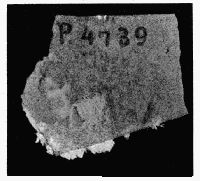
figures. Fig. 34 represents a piece
of a sword, on which an inscription
was brought to light by the reduction
process.
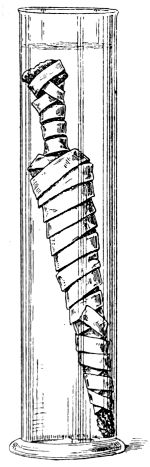
Fig. 28. Krefting’s method.
Iron spear-head wrapped
with strips of zinc.
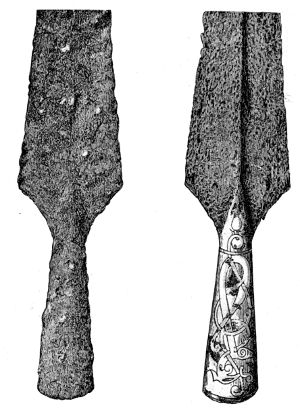
Fig. 29.
Iron spear-head before and after treatment by Krefting’s method.
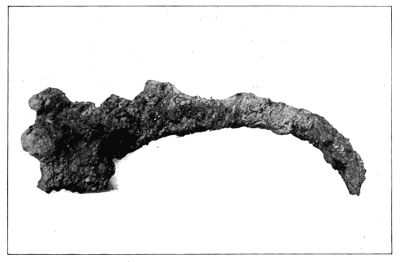
Fig. 30.
Iron pin from “Danes’ Graves,” Yorks. [Cp. Yorks. Phil. Soc. Report,
1897.]
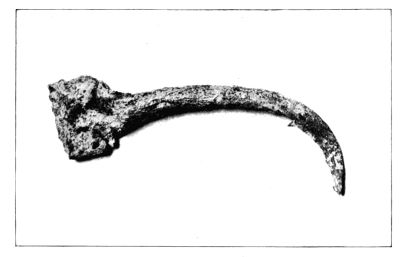
Fig. 31. The same after
treatment by Krefting’s method, still showing
chalky accretions.
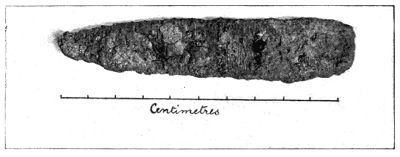
Fig. 32.
Iron object from Lamel Hill[130], York. It appears
to have been originally rivetted to wood or leather.
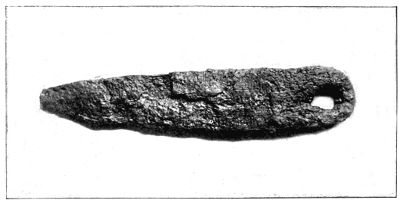
Fig. 33.
After treatment by Krefting’s method.
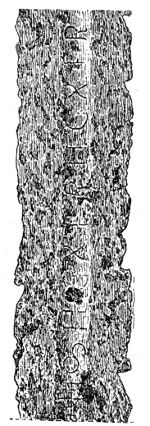
Fig. 34. Piece of iron
sword-blade
showing inscription,
after treatment by Krefting’s
method.
Hartwich’s Reduction Method[131].
This method is only applicable to
small objects, because it necessitates
the subjection of the objects to red-heat
in a glass tube in a current of
hydrogen. By these means the hydrogen
combines with the oxygen of the
oxides, which are thus reduced to
metallic iron. Owing to the explosive
nature of a mixture of hydrogen and
air, this process should only be carried
out by one who is conversant with
chemical methods, for results which
are equally good can be obtained at
less expense by Krefting’s method.
For Hartwich’s method a strong core
of metal is essential, for although
objects which are entirely oxidized
may be thus reduced, the result will be
the formation of a more or less loose
iron powder which is frequently in
such a fine state of division that by union with the oxygen
of the air, in consequence of the great amount of surface
presented, it becomes red-hot with the formation of ferric
oxide as a combustion product.
It is advisable to apply a combination of Blell’s or
Krefting’s method with one of the first group (under certain
conditions) to such iron objects as are found, during the
process of preservation, to be penetrated by black stable rust
to such a degree that the complete removal would only leave
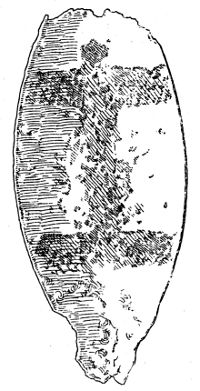
a kind of iron skeleton. Fig. 35 represents such
an iron
dagger-sheath
[132], the dark spots upon it being rust. After
heating and cooling down and a short treatment with acid the
removal of the rust was proceeded with mechanically, but was
not completed. The object was then well steeped, and when
dry was warmed in the varnish-petroleum mixture[133].
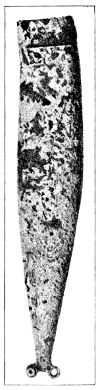
Fig. 35. Iron dagger-sheath
after treatment by a combination
of Blell’s and Krefting’s
methods.
Iron objects, the size of which is inconsiderable, such as
arrow heads, small rings, etc., can be very quickly reduced, if
they still have a well-preserved core, by heating them for a
short time in molten potassium cyanide[134]. The cyanide may
be melted in a porcelain crucible supported by wire gauze
on a tripod over a good-sized Bunsen burner, and the object
introduced by the aid of tongs. The reaction is accompanied
by vigorous effervescence and is soon complete. It is then
taken out and dropped into cold water. By repeatedly boiling
in fresh quantities of water it is thoroughly cleansed, then
treated with paraffin wax, or the water may be expelled by
alcohol. It is then dried, and finally impregnated with zapon.
If the cyanide treatment is insufficient, any remaining rust
may be removed by drills or other suitable tools. Hitherto
this method has only been applied to a small number of
objects, but there is no doubt that its use may be largely
extended. Owing to the poisonous nature of the cyanide this
method should be left to those who possess chemical knowledge.
The disadvantage of the process lies in the difficulty
of fusing large quantities of the potassium cyanide[135].
(4) Preservation of Medieval Iron Objects.
A complete treatise on this subject would be beyond the
limits of a handbook, the following observations, therefore,
will be sufficient for our purpose. The rust spots on objects
of this kind are frequently only superficial and can be removed
either mechanically by rubbing with pumice or emery, etc.,
or chemically by a concentrated solution of sodium sulphide[136].
To prepare this, sodium sulphide is dissolved in water, or
flowers of sulphur are boiled in a solution of caustic soda. If
the object is too large for immersion, the solution may be
applied with a brush, and if the layer of rust is thick, the
application must be repeated. After treatment the object
must be rinsed in water and dried.
Small articles can be freed from rust by immersion in
strong fuming nitric acid[137], for strong acid dissolves the rust
only, while it induces in the iron the so-called “passive[138]”
condition in which it is not acted upon even by dilute acids,
and can be safely washed in water. When thoroughly cleaned,
the most suitable protective is some neutral substance such
as paraffin wax, vaseline, or paraffin dissolved in benzine, but
any of the numerous forms of oil or fat may be used.
Well-preserved bronzes with a stable patina, such as the
highly esteemed glossy stable or “edel” patina, or that which,
although not glossy, covers the bronze with a rough and
often crystalline coating, should not be interfered with. Such
bronzes as need treatment should be subjected either to simple
cleaning or to some appropriate method of preservation.
The Cleaning of Bronzes. Bronzes, the metallic
substance
of which is more or less intact, while the surface is
hidden under earthy or sandy material cemented together by
copper compounds, may be cleaned either by mechanical or
chemical means. When the materials forming the incrustation
are more firmly cemented together than they are to
the material beneath (which often still
retains a polished surface), a small
hammer may be used, but more adherent
portions require the use of
small chisels, which can be made to
order in different shapes or sizes. I
have used with advantage hammers with striking surfaces like
those shown in Fig. 36. The two on the right are
rounded so
that they touch the object at one point or on a line only.
The process may be facilitated by the use of Springer’s method.
A warm thick solution of glue should be spread upon the incrustation
covering the bronze. As the glue dries and becomes
cool it scales off, carrying with it some portion at least of
the crust, thus leaving the metal clean. That part of the
glue which remains can then be readily detached by gentle
strokes with a hammer. The eyes should be protected when
using the hammer, whether on the incrustation or on the glue.
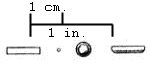
Fig. 36.
Hammer heads, natural size.
Other Methods. Since metallic oxides are
scarcely, if
at all, soluble in water, washing with water, even when a
brush is used, will remove only earth or soil which is loosely
attached. Compounds containing oxygen or oxygen and
chlorine are, however, more or less soluble in ammonia, and,
if they are thin and not too compact, after immersion for
some time can be removed with a brush. Thick compact
layers are loosened with difficulty.
Immersion in 2-5% hydrochloric acid acts more effectively,
while sulphuric acid, nitric acid, and concentrated
acetic acid have the same action. The frequent use of these
reagents is, however, strongly to be deprecated, for it is
impossible to remove the acid by simple washing with water
after the incrustation has been removed. The bronze should
be washed and placed in a very dilute soda solution or in
dilute ammonia, after which it should be again well washed
with distilled water. As has been explained in
Part I., it is to
chlorine compounds that the destruction of bronzes is chiefly
due, and these are actually produced by the hydrochloric
acid treatment. If the bronzes are not thoroughly washed,
and this is no easy matter, sooner or later efflorescences
will make their appearance, and the process of preservation
must be repeated if the destructive action is to be arrested.
Various attempts have been made to remove the incrustation
by raising the bronze to a red heat. This process is not
recommended; for not only does it give to the bronze an
unpleasant appearance, but it detaches any inlaid metal (gold
or silver) or enamel which may be present.
In conclusion, it may be stated that, although the process
is slow and laborious, the best results are obtained by careful
removal of incrustations by mechanical means.
Preservation of Bronze and Copper Objects.
(A.) Methods of Impregnation. The impregnation
of
bronzes, as of the majority of antiquities, has for some time
been carried out by the use of solutions similar to those
already enumerated for iron. These are applied directly or
after the specimen has been either steeped in water or treated
with dilute acids. This latter treatment, as has been already
stated, is to be avoided, and if used all acid must be washed
out before the object is dried. Steeping in water is of little
use, because compounds containing oxygen or chlorine are
often insoluble in water, which will at most only wash off
loosely attached dirt or earthy material. The impregnation
process may therefore be applied directly, and this should be
done in all cases in which the surface is much corroded, warty
(Figs. 7 and 8), or cracked
(Figs. 37 and 38), or in which
there is little or no core of metal. Impregnation is also the
only means of preservation when the formation of oxides has
raised inlaid metals or enamel in such a way that the removal
of the oxides would detach them. The “Merkbuch[140]” recommends
poppy seed oil and benzine mixture (p. 70) or the
gum-dammar
solution. To obtain thorough impregnation this
should be carried out by extraction of the air, as has been
already recommended in the case of limestone (p.
68). The
object must also be perfectly dry, which may be insured
either by exposure to moderate heat or by keeping it for
some time over anhydrous calcium chloride[141]. The object is
placed under a glass bell jar, the edges of which are smeared
with vaseline to ensure contact with the glass plate upon
which it rests. The calcium chloride should be placed in an
open glass vessel, beneath the bronze, but care must be taken
that they are not in actual contact.
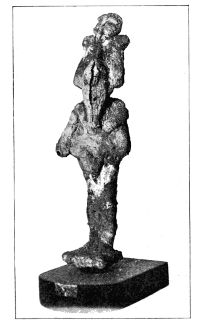
Fig. 37. Osiris showing
cracking and destructive patina.
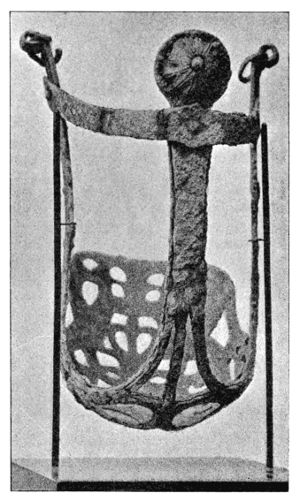
Fig. 38.
Boeotian bridle with cracking patina.
Immersion of bronzes in paraffin wax at 240°F. [115°-120°C.]
gives results which are as good, if not better, than
those obtained by the use of solutions.
Should efflorescences make their appearances upon bronzes
which have been impregnated, their further spread may often
be successfully prevented by smearing fish-glue on the parts
affected. Fish-glue, however, has not proved a satisfactory
material for the complete impregnation or coating of bronzes
which are in the last stages of decay.
(B.) Preservation by Reduction. It has been
previously
explained (pp. 28 et seq.) that the
efflorescences upon bronze
known as creeping or malignant patina which may in time
cause the complete destruction of the metal are due to the
action of sodium chloride. It is found upon all Egyptian
bronzes and upon those from some other localities.
The metal, especially the copper, is converted into the
so-called basic chloride. In the reduction processes an attempt
is made to reduce these compounds again to metal, while the
chlorine thus liberated forms chemical compounds, which may
be subsequently washed out with water. There are two
methods which effect this reduction, viz., that of Finkener
(Berlin) and that of Krefting. The principle of both is
electrolytic, and both bring about the complete removal of
the patina and the restoration of a clean metallic surface.
To complete this portion of the subject a third method
may be mentioned, viz., reduction by heat in a stream of
hydrogen. This method[142] is, however, only applicable to small
objects.
Finkener’s Method. Care must be taken when
examining
the bronze that the metallic-looking mixture of
cuprous oxide with other copper compounds is not mistaken
for metallic copper. When it has been ascertained that the
bronze still has a good metallic core, and that any inlaid
metals which may be present rest on the metal itself and
not upon a crust of oxide, a platinum wire should be tightly
wound round it. This should be connected by an insulated
copper wire to the zinc or negative pole of the first of
3 or 4 Daniell cells, or, better, of two accumulators arranged
in series. The object should then be immersed in a 2%
aqueous solution of potassium cyanide. In the same solution,
as near as possible to the bronze without actual contact,
should be placed a piece of platinum foil connected first
by an emerging platinum wire, and then by an insulated
copper wire to the positive pole. The potassium cyanide
completes the electric circuit and electrolysis takes place,
whereby the water is split up into its constituents. The
oxygen appears in small bubbles upon the platinum foil, but
the hydrogen does not immediately make its appearance at
the other pole, for, by combination with the chlorine and
oxygen contained in the bronzes, free hydrochloric acid
and water are formed. The hydrochloric acid in turn acts
upon the potassium cyanide to form potassium chloride and
hydrocyanic acid, both of which substances are dissolved
in the water of the bath. The hydrocyanic acid can
often be recognised in the room by its characteristic smell
of bitter almonds. The process may be expressed by
the following equations (neglecting the water produced by
the oxygen of the oxide, which is of no importance in the
process):
CuCl2 + 2H = Cu + 2HCl,
HCl + KCN = KCl + HCN.
Although the chief portion of the potassium chloride and
hydrocyanic acid are dissolved in the bath, the remaining
traces of these substances must be removed by very carefully
washing the bronze in water, after which it should be dried,
and if necessary finally subjected to impregnation.
Some further observations may be made in connection
with the practical application of this process.
Of course, other primary batteries may be used instead of
the Daniell cells, but these latter may be specially recommended
for the ease with which they can be procured and for the
steadiness of their action. Information concerning the method
of filling and using them may be obtained at any shop where
they are sold. The copper wire and platinum wire should
not be too thin, but must be at least from 1 to 2 mm. in
thickness: they should be fastened together by binding-screws,
and care must be taken that both the wire ends and the
screws have clean surfaces. Glass vessels or glass cylinders
are most suitable because the process of reduction can be
watched, but large objects will of course require glazed
earthenware baths. If wooden boxes are used they must be
coated inside with paraffin wax. The strength of the cyanide
solution should be 2%. Having a large number of reductions
to carry out, I keep a 20% stock solution in a large bottle,
one part of which is diluted with nine parts of water when
required for use. Potassium cyanide is, as is well known, a
strong poison, and care should therefore be taken to prevent
access to any sore or cut on the hands; this can be done by
the use of india-rubber finger stalls or gloves.
If the bronze object is neither too large nor too heavy it
may be suspended in the bath by looping the platinum wire
over the edge of the vessel. It is a convenient plan to use
different coloured wires to distinguish the negative and
positive poles of the battery, but should any doubt arise as to
which wire should be connected with the bronze or which
with the platinum, the following test will readily decide the
question. Moisten a small piece of white filter paper with a
drop of a solution of potassium iodide[143], and touch the two
conducting wires with it simultaneously: a brown spot will
be seen on the paper at the point of contact with one of the
wires; this is the positive wire, and must therefore be connected
with the platinum. If the current is passing through
the cyanide bath and the bronze, bubbles of gas will appear
upon the platinum foil, or the products of the decomposition
of the potassium cyanide may change the colour of the bath
near the platinum to yellow or brown, while at the same time
cloudy streaks under the bronze will show where the potassium
chloride and hydrocyanic acid, resulting from the reduction
of the copper compounds, are meeting with the cyanide of the
bath. If the platinum wire is not firmly fixed round the
bronze, hydrogen may be formed upon it, and should this
occur the wire should be drawn tighter.
Whilst the reduction is going on it is advisable to renew
the potassium cyanide at least once, or even several times,
if large and greatly oxidized bronzes are under treatment, for
otherwise all the potassium cyanide may be consumed by the
changes in progress; this can be ascertained with certainty
by a smell of chlorine. When the bath requires renewal the
bronze may be taken out with a pair of metal tongs, or if too
large, two strong copper wires should be passed underneath
it, the ends of which are wound round a strong glass rod
or wooden stick. The bronze should then be well rinsed or
brushed with a soft brush before it is put into the fresh
bath.
Bronzes are frequently met with which are much deformed
by an earthy or sandy layer cemented by oxide. These
incrustations can be partly removed by a preliminary treatment
with dilute hydrochloric acid, but the bronze must be
afterwards carefully rinsed with water or even steeped to
prevent unnecessary decomposition of the cyanide by the acid.
Before reduction it is useful to secure thorough penetration
by placing the vessel containing the solution and the bronze
under a bell glass attached to an air pump, as has been
previously explained (p. 68).
During the process of reduction small whitish-green
crystalline needles often collect on the platinum foil, but
although in large numbers they are so minute that it has not
been possible hitherto to determine their composition; they
seem to contain copper and cyanogen. After some time the
platinum becomes covered with a whitish-green or brownish
deposit, which should be removed by rinsing in water and
brushing; if this should not succeed the platinum must be
dipped in hydrochloric acid, rinsed with water, and rubbed
with fine sand. The glass vessel may be cleaned in the same
way.
The reduction is complete when all the chlorine, previously
combined with the metal, has combined with the hydrogen
produced by the electrolysis of the water. There being no
further chlorine with which the hydrogen produced by the
continued action of the current may unite, the completion of
the process is marked by the appearance of bubbles of that
gas upon the surface of the bronze. The bubbles which rise
from beneath often mark out the outlines of the object upon
the surface of the bath.
Before the bronze is washed it should be placed in a
fresh cyanide bath, but of 1% strength only. For large
and especially for thick objects, this bath must be renewed
several times, so as to allow the washing process to begin in
the bath itself whilst the current is still passing through it.
Care should also be taken that every side of the object in turn
faces the platinum foil for some time, for if one side remains
turned toward the platinum throughout the process, it will
sometimes assume the red tint of copper, while the rest of the
bronze retains a somewhat dark colour.
When finally removed from the reducing bath, after the
black metallic powder has been thoroughly cleaned off with
water and a soft brush, the object should be suspended for a
short time in water at the ordinary temperature, or so fixed
that there is a good depth of water beneath it; it should then
be washed in hot water. When the bronze is first placed in
water, whether hot or lukewarm, small bubbles of hydrogen will
continue to rise for some time, while at the same time a whitish,
or sometimes grey, gelatinous precipitate, consisting of a
hydrated oxide of tin[144], will often fall from it. The grey colour
is caused by the admixture of small particles of lead or copper.
At first I renew the water two or three times a day, then
once in twenty-four hours, and finally at longer intervals,
using distilled water throughout for small objects, but for
larger specimens for the final washings only. For the earlier
washings at any rate I use warm water. Cyanides as well as
chlorides give a white precipitate with silver nitrate; this
reagent will therefore serve to indicate the progress of the
operation. If at the end of a fortnight in the case of small
bronzes, or in three to six weeks for large objects, the water
shows no cloudiness, or if upon the addition of yellow
potassium chromate it instantly assumes a red colour (p.
62),
the steeping may be considered complete. Some Egyptian
bronzes, especially those which contain a large proportion of
lead, after steeping exhibit a whitish crystalline coating of
lead carbonate or small hemispherical groups of crystals
scattered over the surface of the metal, especially where the
pores are large; when dry these can easily be removed.
An extended experience points to the conclusion that
bronzes should be dried at once, and as quickly as possible.
They should be wiped with soft cloths and then dried in a
drying chamber or upon glass or metal rings on a stove. A
simple form of drying chamber can be made with copper or
iron plate of sufficient thickness, with a loose lid provided
with a hole fitted with a cork, through which a thermometer
passes. This can be heated over a Bunsen burner, but the
temperature should not exceed 230°F. [110°C.]. Small
objects may be freed from water by immersion in alcohol for
twenty-four hours before drying.
The completion of the process may be gauged by the
yellowish or reddish yellow colour which the bronzes should
assume when they have been dried and wiped with a cloth
or brushed; brushes made of the finest steel wire may be used
for this purpose. A bright colour is but rarely seen on
bronzes which contain lead. Egyptian bronzes frequently
contain as much as 20% of lead, and such bronzes have
nearly always a dull-grey or blackish appearance. A similar
colour is seen on bronzes which contain no lead, but which
are very porous, and are in an advanced state of decomposition.
In such cases the finely divided particles of reduced
metal are retained upon the rough surface of the bronze, and
as all metals, when sufficiently finely divided, form a blackish
powder without any metallic lustre, the whole object then
appears almost black. It is difficult, and in many cases impossible,
to remove this dust, especially that retained in the pores.
Metal dust is injurious to the lungs, and if recourse is had to
brushing, an efficient extractor for the removal of the dust-filled
air is required[145]; but brushing and the use of bellows
in addition frequently prove insufficient. Washing the objects
with benzine is more effectual, but a trustworthy method of
giving the bronze a better appearance is to place it into
melted paraffin wax[146] at 250°to 285°F. [120° to
140°C.]. Yet
the use of paraffin wax should be avoided if possible, for in
spite of the most careful washing blue efflorescences may
sometimes appear upon thick bronzes in the course of a year.
If this should happen they must be washed out at once, and
the bronze can again be submitted to the cyanide-reduction
process. If however paraffin wax had been applied an attempt
would have to be made to remove it by immersing the bronze
in benzine or a mixture of ether and alcohol, or by heating,
before the reduction process could be repeated.
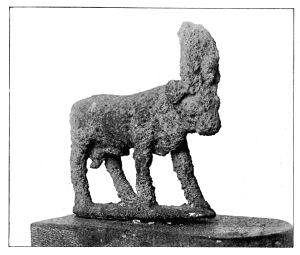
Fig. 39. Bronze bull
showing warty patina.
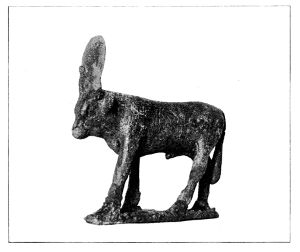
Fig. 40.
The same after reduction by Finkener’s
method[147].
There is no doubt that these bright-blue efflorescences are
the result of an incomplete reduction, which in many cases
can scarcely be remedied, for it is often impossible thoroughly
to wash objects of great thickness. Thin bronzes, bronze
plate, and copper plate remain free from efflorescences. Moreover,
many bronzes, especially Egyptian ones, have a hard,
non-metallic core, which in the casting has been partly fused
or at least hard-burnt, and resists the effects of the washing.
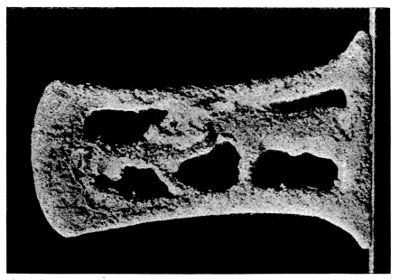
Fig. 41.
Bronze axe-blade before treatment by Finkener’s method
(Aeg. 13203).
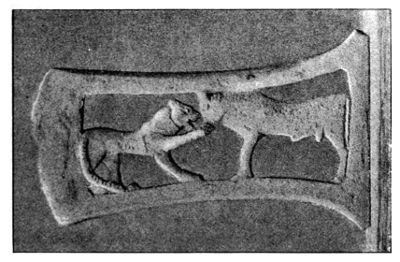
Fig. 42.
The same side after treatment.
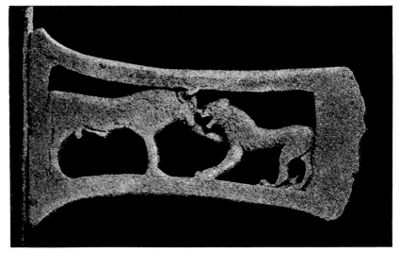
Fig. 43.
Reverse side of axe-blade after treatment.
It is occasionally found that a bronze cannot stand the
process of reduction, either because there is only a thin layer
of metal over a stout core, or because the metal is permeated
with cuprous oxide, which when tested with a file has a
metallic appearance. The bronze must therefore be continually
watched whilst it is in the cyanide bath, and if
necessary should be taken out even before the reduction is
complete. This should be done if large pieces or large
quantities of a powdery precipitate fall from the bronze, or
if it is found that a needle readily pierces the oxidized layer.
A specimen of this kind must be taken from the bath, carefully
steeped, dried, and impregnated[148].
It is not to be expected that bronzes which are in an
advanced state of decomposition (e.g. Figs. 9-12) can be so
transformed by reduction as to appear as they did when they
left the artist’s hand. For, although the decomposed oxidized
layer is now reduced to metal, this no longer forms a coherent
mass, but a loose powder, which, being deprived of its
essential constituents, chlorine, oxygen and carbonic acid,
no longer retains its coherency, but falls to the bottom.
Only in the interior and in the pores is the reduced metal
retained.
In addition to the preservation of articles by the removal
of the injurious chlorine compounds (as is also the case with
Blell’s and with Krefting’s method for iron antiquities), the
process may result in the discovery of inlaid work, inscriptions
or ornamentation, the presence of which was not suspected.
The accompanying illustrations (Figs. 39 and 40) show bronzes
before and after the preservation process, while the axe-blade
shown in Figs. 41-43
illustrates equally clearly the advantages
which accrue from the treatment. Not less striking is the
result of the treatment in the case of the dagger-sheath shown
in Figs. 44 and 45 by which
the design was discovered.
Reference may here be made to a case described elsewhere[149],
in which reduction proved that what had been thought a
single bronze object consisted in reality of two pieces which
did not belong to each other, but were fitted together by
means of a bottle cork of modern date! In another instance
a bronze was found upon reduction to be brazed with a hard
solder containing zinc, which was thus quite inconsistent
with the age ascribed to the object.
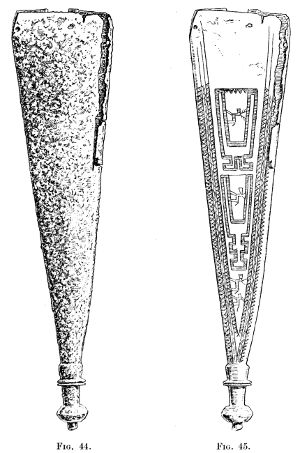
Fig. 44.
and Fig. 45.
Dagger sheath before and after treatment by Finkener’s method.
A short digression may be here made in order to discuss the
question whether the composition of the bronzes undergoes
any alteration. Three analyses[150] of Egyptian bronzes before
and after reduction by Finkener’s method show that the
change in composition is so slight as to be immaterial. It is
of course obvious that greater differences will be seen in the
results of the analyses before and after reduction of bronzes
which are in an advanced state of oxidation, for in this case
chlorine, oxygen, water, and carbonic acid constitute an
appreciable proportion of the total weight. But even in
these cases the analysis made after the reduction shows very
slight variation from that of the original metal.
|
|
Osiris |
Osiris |
Ibis |
|
|
Before |
After |
Before |
After |
Before |
After |
|
|
|
|
Reduction |
|
|
| Tin |
|
2·16 |
2·27 |
4·30 |
4·21 |
8·66 |
8·46 |
| Copper |
|
77·83 |
77·45 |
79·66 |
79·74 |
88·53 |
88·75 |
| Lead |
|
19·23 |
19·86 |
15·51 |
15·58 |
1·69 |
1·95 |
| Iron |
|
0·12 |
0·14 |
0·28 |
0·24 |
0·21 |
0·20 |
Nickel &
Cobalt |
|
0·29 |
0·24 |
0·20 |
0·17 |
0·30 |
0·29 |
| Arsenic |
|
0·17 |
0·23 |
0·17 |
present |
0·32 |
present |
| Antimony |
|
trace |
trace |
trace |
— |
0·20 |
present |
The two latter bronzes were tested qualitatively only for
arsenic and antimony, and when the three objects were
washed the hydrated tin-oxide described on p. 130
was only
found in the case of the Ibis. In this connection it should
not be forgotten that slight differences in the quantities may
be due to errors in the analysis as well as to a want of
homogeneity in the alloy.
Krefting’s Method. This method is similar to
that used
for the reduction of iron (see page 108). The
layer of oxidized
material is removed in several places by filing, hammering, or
rubbing with emery cloth until the metal is exposed. The
object is then wrapped round with strips of zinc, and placed
in a 5% solution of caustic soda. The hydrochloric acid produced
in the process of reduction acts upon the soda to form
sodium chloride. Here too the greatest care must be taken
that the steeping is sufficient.
Personally I prefer Finkener’s method, for potassium
cyanide is more easily washed out than soda, and also, although
poisonous, is less caustic.
Krefting’s method however has proved of considerable
success in some cases, notably in the treatment of some
40-50,000 Roman copper coins at the Berlin Museum. These
were, with few exceptions, covered with a crystalline layer
resembling green malachite or blue azurite and were quite
illegible. Various unsatisfactory attempts were made to clean
them with ammonia, with warm and cold acids of different
kinds, with acid and iron nails, and by electric current both
in an acid solution and in a solution of potassium cyanide.
The following method finally proved satisfactory[151]:
Krefting’s Method Applied to Oxidized Copper
Coins.
“A thin plate of zinc with a bright metallic surface
is perforated with a brad-awl, having a diameter of from
2 to 5 mm., until there are about 50 or 60 holes in each
square metre. This is placed with the sharp edges of the
holes uppermost on a row of glass rings (or crystallizing
dishes will serve the purpose) 20 mm. in height resting
upon the bottom of a large glass vessel. The coins,
which in this case were 20 mm. in diameter, were then
placed on the zinc plate, so that 7 or 8 of them occupy
a space of 1 square decimetre. Another similarly perforated
plate is laid upon them, and upon this more coins
are arranged in the same way, and so on until there are
six or eight double layers. A perforated zinc plate is
then placed on the top with the sharp edges of the holes
turned downwards, and over this a few zinc plates which
have been previously used. The whole pile is surmounted
with weights or stones resting upon glass rings or
inverted glass dishes in order to press the sharp edges
of the holes into the closest possible contact with the
coins. A 5% solution of caustic soda is then poured
over the whole, the immediate result of which is an
evolution of gas. The reduction of the coins is usually
complete in fifteen to eighteen hours, after which they
should be well washed. After several rinsings in cold
water they are placed, about 1000 at a time, in a large
vessel fitted with a perforated false bottom containing
hot water, which should be renewed three or four
times every day. After four days the coins are wiped
with a cloth and thoroughly dried on a warm oven plate
or in a drying chamber at a temperature of about 212°F.
[100°C.]. They are then brushed with a bristle brush
before a dust extractor, a procedure rendered necessary
by the fine metallic dust from the coins, which then
assume a light or dark brown colour such as is seen on
copper coins which are in actual circulation. The practice
of placing the coins whilst still wet into melted paraffin
wax at 260°F. [120°-130°C.], which gives a dark appearance
even to the brightest, has the disadvantage that
the wax prevents the use of sealing-wax for taking
impressions, and is therefore not recommended.
The reaction is analogous to that which occurs in the
reduction of iron. The copper of the coin forms in the
alkaline solution an electric couple with the zinc, and
the hydrogen which forms at the copper end reduces the
copper compounds covering the coins to metallic copper,
and thereby loosens them, while the zinc oxide which is
simultaneously formed is dissolved in the soda solution.
In actual practice a part only of the zinc oxide is dissolved,
while the remainder forms a white coating on
the zinc
[152]. Experience shows that a 4-5% solution is
the most suitable for this method of reduction, which
gives the most favourable results when these details are
followed. If for example the zinc plate is laid immediately
on the bottom of the glass trough, if the coins
are laid too close together on the plate, or if there are
more than 6 to 8 double layers in a trough, the process
of reduction is often incomplete, and it is then necessary
to treat the coins a second time. It is scarcely necessary
to mention that larger coins must be placed at proportionately
greater distances from each other.
The 40-50,000 coins which were thus treated had
originally been tinned, but the tin only remained at a
few places. When the coins were washed immediately
after the reduction, this tin could still be clearly distinguished,
but on further washing, drying, and brushing,
it ceased to be visible on account of the dark colour
imparted to it by the finely powdered copper. In one
or two cases lead appeared on the surface of the coin,
but was easily removed by mechanical means.”
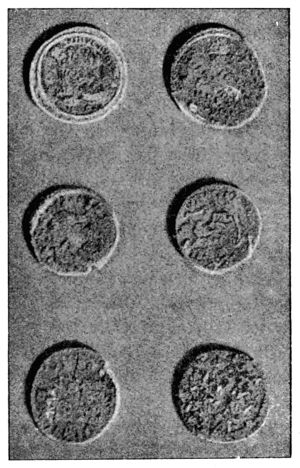
Fig. 46.
Roman coins before treatment.
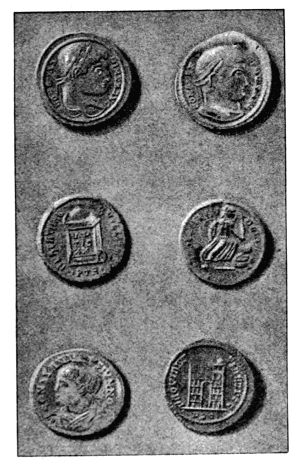
Fig. 47.
Roman coins after treatment by Krefting’s method.
Cleaning Copper Coins by Melted Lead.
Although the results obtained by this method are less
satisfactory than those produced by the preceding, it has the
advantage of simplicity[153].
“Using a pair of tongs, dip the coins one by one
into melted lead until the crackling, which begins at
once, has ceased, which occurs in from 3 to 10 seconds.
The hand should be protected with a glove from the
spluttering molten lead. The coin is then thrown into
cold water, cleaned, and placed until the next day in hot
milk. It may be necessary to repeat the process when
the coin has become cold. By this method an olive
colour is imparted to the coin which many antiquaries
prefer to dark brown, but personally I prefer Krefting’s
method because it renders the inscription and designs
far more distinct. A coin which after the treatment
with melted lead has remained so covered with cupric
oxide as to be still illegible can seldom be improved by a
repetition of the treatment, whereas had the zinc treatment
been applied in the first instance the result would
probably have been satisfactory. This conclusion seems
to be justified by the extremely small percentage of
coins which, in my experience, have remained illegible
after the treatment by electrical methods.”
(C.) Preservation of Bronzes by the Exclusion
of Air.
In those cases in which the advanced state of decomposition
renders the reduction process either inapplicable or
at any rate inadvisable, or in which the decay is not likely
to be arrested by impregnation, a further method of preservation
remains, viz. the complete exclusion of air and moisture.
If air is completely freed from moisture the oxygen can
no longer act in conjunction with the copper chloride upon
the still intact metal (see page 29
et seq.), and the condition
of the bronze will consequently remain unchanged.
A bronze, for example, which shows much decay should
be placed after impregnation under a hermetically sealed
bell glass, and beneath or near it should be placed some
dehydrating agent, of which anhydrous calcium chloride is
the most suitable (see note, p. 123). To exclude
the air completely
the bell glass should have a projecting ground edge,
which should be smeared with vaseline or grease and pressed
firmly upon a thick well polished glass plate. The dehydrating
agent may be placed in a glass vessel or dish in such a
way as to be unseen, or it may be covered with two or three
thicknesses of dark gauze or with black cardboard laid loosely
over it. If an object is too large for a bell glass, or if several
objects are to be exhibited together, a square plate-glass case
with iron framework, made air-tight with putty, may be used
as shown in the illustration (Fig. 48). The lower
part, containing
calcium chloride, is partitioned off by a perforated
plate covered with black gauze[154]. A hygrometer was placed
behind the head, the indicator of which has remained at zero
since it was first fixed several years ago, and the bronze has
not hitherto shown any sign of change, although the inlaid
gold is in parts raised from the metal by a light-green
oxychloride. The cost of these cases is considerable, but for
valuable objects this should not be considered. In the place
of calcium chloride, sticks or lumps of caustic soda may be
used with advantage, for this substance absorbs both moisture
and carbonic acid.
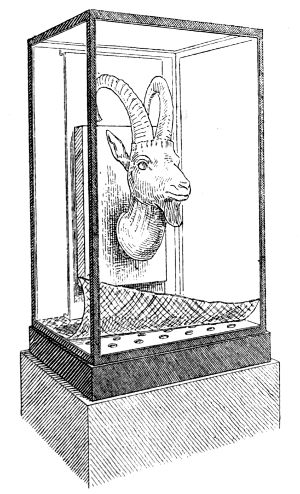
Fig. 48.
Method of mounting objects in air-tight cases.
This method of preservation is of course applicable not
only to decomposed bronzes but to all valuable antiquities,
whatever the material may be.