It is impossible to insulate bees too heavily during the winter.
It is obvious, however, that the beekeeper will not want to put
on more packing than is practically necessary. For a climate such
as that of Washington, D. C., it is found desirable to provide 4
inches of packing underneath the hives, 6 inches on all sides, and 8 or
more inches on top. In warmer climates less will be needed, but the
beekeeper must not think that simply because he lives south of Washington
he can be safe with less packing or none at all. There are
many places farther south than Washington where more packing is
needed, and there are, indeed, few places except along the Gulf or in
southern California where less may be used if the best results are
to be obtained.
For more northern localities more protection is needed. The
amount indicated for Washington has been used with success in
places as cold as northern Ohio and even in Canada, but in these
places the insulation during the coldest seasons is usually augmented
by heavy snows. These are not at hand every winter, or may be
lacking during the coldest part of the winter, and it is, therefore,
wise to provide more packing, especially on the sides and top. For a
climate such as that of New York or Wisconsin, 8 inches of good
packing on the sides and 1 foot on the top probably will be enough
for good wintering every year. The amounts recommended for the
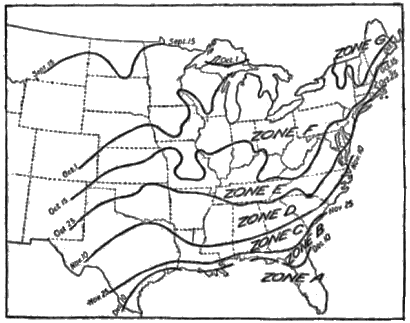
different zones of the United States are given in Table I (p. 15).
A belief is current among many amateur beekeepers that good results
may be obtained by using hives which have 2 inches of packing
built in the sides and somewhat more on top. This amount is
insufficient in winter in all parts of the country except the southern
portions of the Gulf States. A common practice is to wrap some
straw or corn fodder around the hives, but this may do more harm
than good if the wind can blow directly through it. A covering of
roofing paper with perhaps a little paper packing underneath is
practically worthless in insulating value.
There is little difference in the insulating value of the various
materials which may be obtained easily for the packing of hives
in winter. Exaggerated claims have been made by some beekeepers
for such materials as broken cork or certain commercial insulating
materials, but it is safe to say that there is not 25 per cent difference
between the poorest and the best of the available insulating materials,
provided, of course, that obviously poor things such as corn
fodder and straw be eliminated. Sawdust, fine planer shavings,
forest leaves, chaff, broken cork, and such materials may be used, the
choice depending chiefly on the availability of the materials. In
general it may be stated that the smaller and the more numerous the
dead air spaces confined in the packing, the greater will be its efficiency
in insulation. If forest leaves are used they must be gathered
the year before and stored, as the leaves fall some time after the
bees should be packed. If sawdust is used it is best not to pack it
down tight, but if forest leaves or planer shavings are employed it is
essential that they be packed in closely and that the containers be
completely filled. Broken cork, such as is used in the shipping of
certain types of grapes, is good and has the advantage that it does not
hold moisture as does sawdust. In all cases the packing should be
placed in some sort of box which will be rain-proof and thus protect
the insulation from rains and snow, for all insulating materials lose
part of their efficiency when wet.
There has been considerable discussion among beekeepers as to the
value of placing packing material below the bottom boards of the hives.
This is usually provided by placing the hives on 2 by 4 inch supports
or on racks of 4-inch material. Those who have opposed this have
pointed out that "heat rises," overlooking the fact that while warm
air attempts to rise, if this is impossible other avenues of escape of
warm-air currents may be set up. Furthermore, and more important,
they have overlooked the important fact that heat escapes
from the hive not only by convection currents but by conduction and
radiation as well. In an extensive series of experiments performed
by the writers it was found that in hives packed at the top and
sides most of the heat escapes through the bottom boards; in fact,
this was so noticeable that the packing at the top and sides never
served its full purpose so long as heat was escaping rapidly at the
bottoms. It may be stated, therefore, that so long as the bottoms
are unprotected there is little insulating value in materials piled on
the top and sides beyond about 2 inches. This amount is insufficient
for most parts of the United States, therefore bottom packing should
be considered as absolutely essential wherever bees are packed.
To get the value of bottom packing it is absolutely essential that
the entrance be reduced, but it need not be closed. In a long series
of temperature readings on hives packed for several winters, the
authors were able to keep a temperature of 50° F. on the bottom
boards of packed hives directly behind the entrance openings. Those
who have condemned bottom packing have labored under the mistaken
notion that it is impossible to prevent currents of cold air
through the entrance. This is entirely possible if the entrances are
adequately reduced. The conclusion to be drawn from the experiments
performed is that unless the bottoms of hives are well packed,
the beekeeper ought not to imagine that he has packed his hives at
all well.
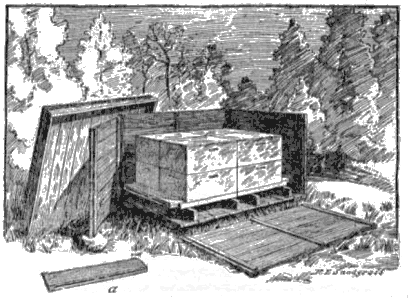
Fig. 2.—The winter packing cases used in the Bureau of Entomology apiary:
a,
Detail of tunnel to hives. In the specifications given in this Bulletin (
p. 9)
provision is made for room for a third hive body to be added in the spring.
There is no virtue in any special type of case, but in all types
there are a few points which must be observed. There must be
provision for abundant packing on the top, bottom, and sides, the
entrances must be small, the case must be rain-proof, and the construction
of the case should be such that it may be taken apart and
put together easily. The parts of various cases used in one series of
apiaries should be interchangeable. The authors have refrained in
the past from giving explicit directions for making a winter packing
case for fear that some beekeepers might think that there may
be peculiar virtue in the case used and recommended by the department
(fig. 2). So many beekeepers, however, have written for exact
dimensions for making the case used in the apiary of the Bureau of
Entomology that it is considered best to give these in this bulletin.
In order that protection adequate for bees in a climate such as
that of Washington may be provided, 4 inches of packing below the
bottom board, 6 inches on all sides, and at least 8 inches on top are
desired. There is advantage in packing several colonies together,
in order that they may warm each other and to reduce the cost of
the case and the labor of putting it on. The bureau, therefore, has
adopted the four-colony type of case which has been much used for
years in all parts of the country. In this case, two colonies face east
and two west. Provision is made for wintering all colonies in two
full-depth hive bodies.
In the following dimensions it is assumed that 13/16-inch tongued-and-grooved
lumber is used, that the 10-frame Langstroth hive is
in use, and that two hive bodies are employed for each colony, with
adequate space above the hive so that, if needed, a third hive body
may be put on before time for the removal of the packing. In this
packing case the sides overlap the ends. For hives of other sizes
the lumber must be cut so as to provide the packing specified in
Table I (p. 15). For zones F and G (fig. 5) provision should be
made for additional packing by increasing the length of all parts 4
inches, and for zone C a correspondingly smaller case may be made.
| Bottom of case |
44 Inches (exact) by 52 Inches (exact). |
| Sides of case |
535/8 Inches (exact) by 355/8 Inches (minimum). |
| Ends of case |
44 Inches (exact) by 355/8 Inches (minimum). |
| Telescope cover of case |
48 Inches by 56 Inches (minimum). |
If 6-inch boards (laying 51/2 inches) are used, it is desirable to use
7 boards for the height of the case; if 8-inch boards (laying 71/2
inches) are used, 5 will be sufficient. In figure 2 only 6 boards, laying
51/2 inches, are shown, but in this case no allowance is made for a
third hive body in the spring. For the telescoping part of the cover,
4-inch boards are used.
As was pointed out earlier, the hives should rest throughout the
summer on the floor of the winter case (fig. 1). The plan of putting
them in groups of four, two facing east and two west, has much to
commend it during the entire year. The bottom therefore should be
made strong enough to stand the weight of four colonies without getting
out of shape. Since this weight may be over 1,000 pounds in a
good year, it is advised that the cleats on the bottom of the case be
of 2 by 4 inch material. The supports of the bottom and the position
of the cleats should be arranged so that the weight will not rest too
largely on the boards, and the stones or bricks used should be directly
under the center of the hives when they are in their summer position.
Obviously the hives will be moved to the outer corners of the bottom
during the summer to facilitate handling.
The sides of the case should be so constructed that the cleats which
hold the boards together will serve to support the overlapping sides
on the bottom. This is clearly shown in figure 2. There
should also be a central cleat on the sides to prevent warping,
for the cases must be rain-proof. If cleats are properly placed as
shown in the illustration, they make the equivalent of a halved joint
at the corners. The sides may be held in place and together by nails
or by any sort of special hook. The entrances for the colonies during
winter should be in the ends of the case, as shown. These will be
discussed later.
The top of the case may be made to telescope over the sides, as
shown in figure 2, or it may be made in any other way desired so that
it is adequate to keep the packing absolutely dry throughout the
winter. The telescope cover has much to commend it, especially in
the case with which the covers may be stored in summer. The top
of the wooden cover should be covered with a roofing paper of first
quality in order that the protection will last for years. If the telescope
type of cover is used, no cleats other than the sides and ends of
the telescoping portion will be needed.
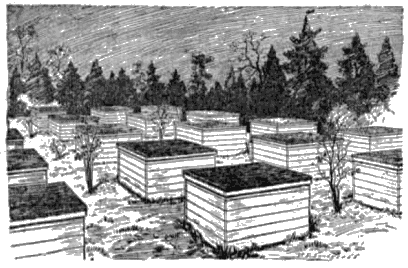
Fig. 3.—An apiary packed for winter in four-colony cases such as are used in the
Bureau of Entomology apiary.
A tunnel (fig. 2, a) is also needed through which the bees may
pass on warm days and to permit ventilation. This is best made of
two boards, one the width of the packing (e. g., 6 inches) and the
other this width loss the extension of the bottom board. In most
cases this extension is 2 inches, so the lower board will be 4 inches
wide. These are held apart by strips three-eighths of an inch thick.
This is the height of the usual hive entrance in winter, and the passage
between the boards is therefore the same height as the hive entrance.
In order that the tunnel may not get out of alignment, these
strips are continued back, as shown in the figure, and these projections
extend into the hive entrances at the corners. The arrangement
for keeping alignment at the outer edge is discussed under "The entrance"
(p. 13).
For those having only a few colonies, it is not always convenient
to build cases for colonies in groups of four. It is not necessary to
give dimensions in detail for those having a few colonies, however,
for they will usually wish to use whatever they have at hand. It is
often possible to arrange a heavy wooden box, such as those used for
shipping dry goods (fig. 4), so as to make a winter case for one colony
which will answer every purpose. It is, of course, necessary that the
salient feature of a good winter case be preserved. If the arrangement
of the apiary makes it inconvenient to have the colonies in
groups of four throughout the year, it is quite possible to make good
cases for two colonies. Anything other than the four-colony case,
however, will probably cost more per colony, or if too many colonies
are put into larger cases there may be trouble from other causes, as
from drifting.
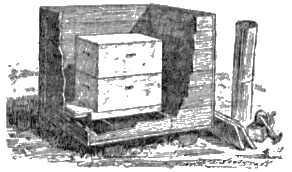
Fig. 4.—An improvised winter case for one colony.