Meaning of “Mound Builders”—Location of Mound Building tribes—All
Mounds not the work of men—Altar Mounds—Objects found on the
Altars—Altar Mounds possibly burial Mounds—Burial Mounds—Mounds
not the only Cemeteries of these tribes—Terraced Mounds —Cahokia
Mound—Historical notice of a group of Mounds—The Etowah group—Signal
Mounds—Effigy Mounds—How they represented different animals—Explanation
of the Effigy Mounds—Effigy Mounds in other localities—Inclosures
of the Scioto Valley—At Newark, Ohio—At Marietta, Ohio—Graded
Ways—Fortified Inclosures—Ft. Ancient, Ohio—Inclosures
of Northern Ohio—Works of unknown import—Ancient Canals in
Missouri—Implements and Weapons of Stone—Their knowledge of
Copper—Ancient mining —Ornamental pipes—Their knowledge
of pottery—Of Agriculture—Government and Religion—Hard
to distinguish them from the Indians.
 past of our race is irradiated here and there by the light of science
sufficiently to enable us to form quite vivid conceptions of vanished
peoples. As the naturalist, from the inspection of a single bone, is
enabled to determine the animal from which it was derived, though there be
no longer a living representative, so the archæologist, by the aid
of fragmentary remains, is able to tell us of manners and times now long
since removed. In the words of another: “The scientist to-day passes up
and down the valleys, and among the relics and bones of vanished people,
and as he touches them with the magic wand of scientific induction, these
ancient men stand upon their feet, revivified, rehabilitated, and proclaim
with solemn voice the story of their nameless tribe or race, the
contemporaneous animals, and physical appearance of the earth during those
prehistoric ages.”2
past of our race is irradiated here and there by the light of science
sufficiently to enable us to form quite vivid conceptions of vanished
peoples. As the naturalist, from the inspection of a single bone, is
enabled to determine the animal from which it was derived, though there be
no longer a living representative, so the archæologist, by the aid
of fragmentary remains, is able to tell us of manners and times now long
since removed. In the words of another: “The scientist to-day passes up
and down the valleys, and among the relics and bones of vanished people,
and as he touches them with the magic wand of scientific induction, these
ancient men stand upon their feet, revivified, rehabilitated, and proclaim
with solemn voice the story of their nameless tribe or race, the
contemporaneous animals, and physical appearance of the earth during those
prehistoric ages.”2
We have already learned that the world is full of mysteries, and though,
by the exertion of scholars, we begin to have a clearer idea of some
topics, yet our information is after all but vague and shadowy. The amount
of positive knowledge in regard to the mysterious tribes of the older
Stone Age, or the barbarians of the Neolithic period, or the struggling
civilization of the early Metallic Ages, is lamentably deficient. On our
Western Continent we have the mysterious remains in the gold-bearing
gravels of the Pacific coast, the significance of which is yet in dispute.
We have the Paleolithic Age of Europe, represented by the remains found in
the gravels of the Delaware at Trenton, New Jersey. When deposited there,
and by what people used, is, perhaps, still enshrouded in doubt.
Leaving now the past, expressed by geological terms, or by periods of
thousands of years, we draw near to our own tribes, near, at least,
comparatively speaking, and behold, here, also, we discern evidence that
an ancient culture, as marked as that which built its cities along the
fertile water-courses of the Old World, had its seat on the banks of our
great rivers; that here flourished in full vigor for an unknown length of
time a people whose origin and fate are yet in doubt, though, thanks to
the combined efforts of many able men, we begin to have clearer ideas of
their social organization. We know them only by reason of their remains,
and as these principally are mounds, we call them the “Mound Builders.”
The name is not a distinguishing one in every sense, since mankind, the
world over, have been mound and pyramid builders. The pyramids of Egypt
and the mound-dotted surface of Europe and Asia bear testimony to this
saying, yet nowhere else in the world are they more plainly divided into
classes, or marked with design than here. In some places fortified hills
and eminences suggest the citadel of a tribe or people. Again, embankments
of earth, mostly circular or square, separate and in combination,
generally inclosing one or more mounds, excite our curiosity, but fail to
satisfy it. Are these fading embankments the boundaries of sacred
inclosures, or the fortification of a camp, or the foundations on which to
build communal houses? Here graded ways, there parallel embankments raise
questions, but suggest no positive answer. We are equally in doubt as to
the purposes for which many of the mounds were built. Some seem to have
been used as places of sepulcher, some for religious rites, and others as
foundation site of buildings. Some may have been used as signal mounds,
from which warning columns of smoke, or flaming fires, gave notice of an
enemy’s approach.
Before coming to details let us, at a glance, examine the picture as a
whole. This country of ours, with its wide plains, its flowing rivers and
great lakes, is said by scholars to have been the home of a people well
advanced in the arts of barbarian life. What connection, if any, existed
between them and the Indians, is yet unsettled. We are certain that many
years before the Spanish discovery of America they made their settlements
here, developed their religious ideas, and erected their singular
monuments. That they were not unacquainted with war, is shown by their
numerous fortified inclosures. They possessed the elements of agriculture,
and we doubt not were happy and contented in their homes. We are certain
they held possession of the fairer portions of this country for many
years.
We must now seek to gather more particular knowledge of them, and of the
remains of their industry. We must not forget that these are the
antiquities of our own country; that the broken archæological
fragments we pick up will, when put together, give us a knowledge of
tribes that lived here when civilization was struggling into being in the
East. It should be to us far more interesting than the history of the land
of the Pharaohs, or of storied Greece. Yet, strange to say, the facts we
have just mentioned are unknown to the mass of our people. Accustomed to
regard this as the New World, they have turned their attention to Europe
and the East when they would learn of prehistoric times. In a general way,
we have regarded the Indians as a late arrival from Asia, and cared but
little for their early history. It is only recently that we have become
convinced of an extended, past in the history of this country, and it is
only of late that able writers have brought to our attention the wonders
of an ancient culture, and shown us the footprints of a vanished people.
We must first try and locate the territory occupied by the remains of the
mound builders. They are not to be found broadcast over the whole country.
We recall, in this connection, that the early civilization of the East
arose in fertile river valleys. This is found to be everywhere the case,
so we are not surprised to learn that the broad and fertile valley of the
Mississippi, with its numerous tributaries, was the territory where these
mysterious people reared their monuments and developed their barbarian
culture. Throughout the greater portion of this area we find numerous
evidences of a prolonged occupation of the country. We are amazed at the
number and magnitude of the remains. Though this section has been under
cultivation for many years, and the plow has been remorselessly driven
over the ancient embankments, yet enough remain to excite our curiosity
and to amply repay investigation.
This portion of the United States seems to have been the home, the seat of
the mound building tribes. We can not expect to find one type of remains
scattered over this entire section of country. Indeed, to judge from the
difference of the remains, they must have been the work of different
people or tribes, who were doubtless possessed of different degrees of
culture.3 We will notice in our examination how these remains
vary in different sections of the country. But it is noticeable that these
remains become scarce and finally disappear as we go north, east, and west
from the great valley. Although they are numerous in the Gulf States, yet
they are not to be found, except in a few cases, in States bordering on
the Atlantic.4 Some wandering bands, perhaps colonies from the
main body of the people, established works on the Wateree River, in South
Carolina,5 In the mountainous regions of North Carolina occur
mines of mica, which article was much prized by the mound builders; and
here also are to be found traces of their early presence.6 We
do not know of any authentic remains in New England States. In Western New
York there exists a class of remains which, though once supposed to be the
work of these people, are now generally considered as the remains of works
erected by the Indians,7 and of a similar origin appears to
have been the singular fortification near Lake Winnipiseogee, in New
Hampshire.8
We have no record of their presence north of the great lakes. Passing now
to the western part of the valley, we do not find definite traces of their
presence in Texas. On this point, however, some authors state the
contrary, apparently basing their views on a class of mounds mentioned by
Prof. Forshey.9 But the very description given of these mounds,
and the statements as to the immense number of them,10 seem to
show they are not the work of men.11 We do not think the West,
and especially the North-west, has been carefully enough explored to state
where they begin. It is certain that the head waters of the Mississippi
and the Missouri were thickly settled with tribes of this people, and some
writers think that they spread over the country by way of the Missouri
Valley from the North-west. Mr. Bancroft quotes from the writings of Mr.
Dean, to show the existence of mounds and inclosures on Vancouver Island,
and in British Columbia. And the statement is made that a hundred miles
north of Victoria there is a group of mounds ranging from five to fifty
yards in circumference, and from a few feet to fifty feet in height.12
The inclosures, however, are described as being very similar to those in
Western New York, and are probably simply fortified sites, common among
rude people the world over, and such as were often erected by Indians. The
remains on the upper Missouri and its tributaries are very numerous, and
to judge from the brief description given us of them, they must be very
interesting.13 This section has, however, been too little
explored to speak with confidence of these works.
As showing how much care should be exercised in this matter, we refer to
the account given by Capt. Wilkes in his journal of the United States
exploring expedition. Speaking of the mounds on the gravelly plains
between the Columbia River and Puget Sound, he tells us that the Butte
Prairies are covered with small mounds at regular distances asunder. Some
of them are thirty feet in diameter, six or seven feet above the level of
the ground, and many thousands in number. He opened some of them, and
found a pavement of round stones, and he thought he could detect an
arrangement of the mounds in groups of five, thus. 
It was his impression that they were the works of men, and had been
constructed successively and at intervals of several years.14
This observation of Capt. Wilkes is referred to by many as evidence of the
former existence of Mound Builders in this section.
More careful research in recent times has established the fact that these
mounds were certainly not erected by human hands, and no one else has been
able to discover the supposed arrangement in groups of five. The pavement
of round stones is common to the whole prairie.
But the greatest objection is the number of the mounds. A population
larger than could have found a living in the country must have been
required to erect them, unless we assume that a great length of time was
consumed in this work. Some other explanation must be given for these
mounds, as well as for those mysterious ones mentioned by Prof. Forshey.
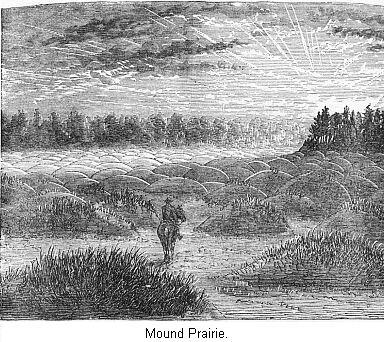
This cut gives us a fair idea of the scenery of this section and the
mounds.15
Within the area we have thus defined are located the works of the people
we call the Mound Builders. What we wish to do is to learn all about these
vanished people. A great many scholars have written about them, and large
collections of the remains of their handiwork have been made. There is,
however, a great diversity of opinion respecting the Mound Builders and
their culture. So we see we have a difficult subject to treat of. In order
to gain a clear understanding of it, we must describe the remains more
closely. About all we can learn of these people is from a study of their
monuments. We can not call to our aid history or tradition, or rock-carved
inscription, but must resort to crumbling mounds, broken down embankments;
study their location, and observe their forms. To the studies in the field
we must add those in the cabinet, and examine the many objects found in
and above the mounds and earth-works, as well as the skeletons of the
builders of the works. Rightly used, we can draw from these sources much
valuable information of the people whose council-fires blazed all along
the beautiful valleys of the Ohio and Mississippi rivers in times far
removed from us.
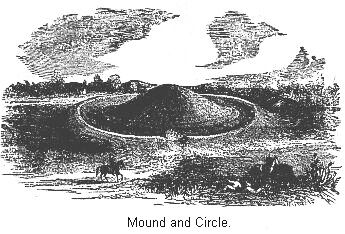
We will first speak of the simplest form of these works, the ordinary
conical mound. This is the one form found all over the extensive area
designated. They exist in great numbers on the banks of the upper
Missouri, as well as the river bottoms of the South. This cut represents a
very fine specimen of a mound, in this instance surrounded by a circular
embankment. We must not forget that mounds are found all over the world.
“They are scattered over India, they dot the steppes of Siberia and the
vast region north of the Black Sea; they line the shores of the Bosphorus
and the Mediterranean; they are found in old Scandinavia, and are
singularly numerous in the British Islands.”16
The principle in human nature which leads to the erection of mounds is
living and active to-day. The shaft which surmounts Bunker Hill is but a
modern way of memorizing an event which in earlier ages would have led to
the erection of a mound, and the polished monument which marks the resting
place of some distinguished man was raised for the same purpose as the
mounds heaped over the chiefs and warriors of another age. The feeling
which moves us to crown with steeples or spires our houses of worship is
evidently akin to that which induced older races to erect a mound on which
to place their temples, their idols, and altars of sacrifice.
If mounds were the only works remaining of these ancient people, we would
not take so great an interest in them, and, as it is, we are not to
suppose that all the mounds are the works of those people we call the
Mound Builders. Recent investigation and historical evidence unite in
showing that some comparatively recent Indian tribes formed and used mound
structures. Early explorers have left abundant testimony to show that in
many cases the Indians resorted to mound-burial. Thus, it seems that it
was the custom of the Iroquois every eighth or tenth year, or whenever
about to abandon a locality, to gather together the bones of their dead
and rear over them a mound. To this custom, which was not confined to the
Iroquois, are doubtless to be ascribed the barrows and bone mounds which
have been found in such numbers in various parts of the country.17
Although it is well to bear these facts in mind, yet it is not doubted
that the larger number, and especially the more massive ones, were erected
by the same people who built the other mysterious works, and so it is
necessary that they be carefully studied.
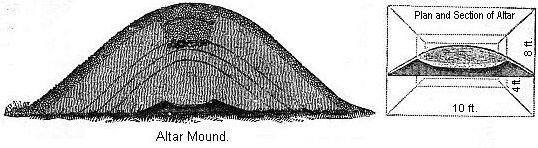
In the valley of the Ohio there have been found a class of mounds known as
Altar Mounds. These, it should be stated, nearly always occur in or near
inclosures. This cut gives us a good idea of mounds of this kind. Near the
top is seen an instance of what is called “intrusive” burial. After the
mound was completed it had been dug into and a body buried near the
surface. This burial was evidently later in time, and had no connection
with the purpose for which the mound was originally built. We also notice
in this mound the different layers of which it was composed. These layers
are of gravel, earth, and sand, the latter being only a few inches thick.
Mounds made in this manner are called stratified mounds, and all altar
mounds are probably of this kind. The lines of stratification have been
described as curving so as to correspond with the shape of the mound, and
such we are told is the general rule.18
The peculiar feature, however, is the altar at the bottom of the mound,
directly above the natural surface of the ground. The small cut gives us a
clear idea of the altar, the light lines running around it showing the
plan. These altars are almost always composed of clay, though some of
stone have been discovered. They are of various shapes and sizes. We
notice the dish-shaped depression on the top of the altar. The clay of
which they are composed seems to have been moulded into shape directly
over the surface of the ground. Sometimes a layer of sand was put down as
a foundation. They are nearly always thoroughly burned, the clay being
baked hard, sometimes to the depth of fifteen or twenty inches. This must
have required intense and long continued heat.
We are at once curious to know the object of this altar. Within the
basin-shaped depression are generally found all manner of remains.
Sometimes portions of bones, or fragments of wood, arranged in regular
order; pieces of pottery vessels, and implements of copper and stone;
spear-heads, arrow-heads, and fragments of quartz and crystals of garnet.
Pipes are a common find, carved in miniature figures of animals, birds,
and reptiles. Two altar-mounds but recently examined near Cincinnati had
altars about four feet square that were loaded down with ornaments.
One especially contained quantities of ornaments of stone, copper, mica,
shells, the canine-teeth of bears and other animals, and thousands of
pearls. They were nearly all perforated, as if for suspension. Several of
the copper ornaments were covered with native silver which had been
hammered out into thin sheets and folded over the copper. One small copper
pendant seems to have been covered with a thin sheet of hammered gold, as
a small piece was still clinging to it. This is the first example of
finding native gold in the mounds.19 On this altar were also
found masses of meteoric iron, and ornaments of the same material. One
piece of mica showed the profile of a face.20
In all cases the articles found on the altars show the action of fire. We
seem justified, then, in supposing that after the altar was formed, fires
were lit on them, and into this fire were thrown the various articles just
enumerated. But what was all this for? This will probably never be very
clear to us, beyond the fact that it was a religious rite. Portions of the
human skeleton have been found on these altars, and it has been suggested
that human victims were at times part of the sacrifice; but as it is known
that this people practised cremation, it may be that the altars were
sometimes used for that purpose, the remains being afterwards gathered and
buried elsewhere.
After the offerings had been flung into the fire, while it was yet glowing
on the altar, earth or sand was heaped over them for a few inches, then
successive layers of earth and sand, or ashes, clay, or gravel. Sometimes
the altars were used several different times, in which case a layer of
clay several inches thick was laid over the old altar. In one case three
layers had been burned in before the final addition of earth and sand were
heaped over it. These strange monuments of a by-gone people hint to us of
mysterious rites. We wish we had more positive knowledge of the ceremonies
they commemorated; but at present we must rest satisfied with conjecture.
The next class of mounds are known as burial mounds, some of which are
stratified, and resemble the so-called altar mounds. A mound explored in
Butler County, Ohio, had in the center a layer of clay an inch thick,
which had been burned until it was red. Underneath this was another layer
of clay, beneath which was found charcoal, burnt cloth, and charred bones.
Mr. Foster thinks that in this mound the body was placed on a rude altar,
fires were lit, and that while yet burning, clay was thrown over it all,
and that then fires were built all over the mound, sufficient to burn the
clay for an inch in thickness.21 We have also a description of
a group of mounds explored near the Mississippi River, in which there were
evident signs of cremation. At least in several mounds fires had been
built close above the bodies. But in cremation other victims may have been
burned to accompany the departed chiefs or warriors. In one mound evidence
of such a custom was observed.
In another mound the center was found to be a mass of burned clay
interspersed with calcined human bones. No less than ten or fifteen bodies
had been burned here. “They must have worshiped some fierce ideal deity,
and the ceremony must have been considered of great importance to have
required so many victims.” This may have been, however, nothing more than
simple cremation.22
Pidgeon has described mounds in Minnesota, in many respects like the altar
mounds. In one case he mentions there was an altar or pavement of stone on
the original surface of the ground, a few feet above which was a layer of
clay, showing the action of fierce and long-continued fires. We
furthermore are told that cremation, especially of chiefs, was more or
less common among the Village Indians of North America, that similar usage
was observed among many of the tribes of Mexico, and that the Mayas, of
Yucatan, burnt the bodies of their lords, and built temples over their
remains. So it may be that the altar mounds are but varieties of funeral
mounds, the remains of the bodies burned here being buried elsewhere.23
The nations that celebrated their mysteries around these mounds have long
since departed; the altar fires long since burned low. We are not sure
that we understand their purport, but we are certain they were regarded as
of great importance, and we can readily imagine that when the fires were
lit on the altars, gathering crowds stood round, and participated in the
religious observance, throwing into the fire their most valued ornaments,
in this manner paying their last respects to the departed chiefs and great
men of their tribe.
The true burial mounds are very numerous, an comprise by far the larger
number of mounds. They are to be found all over the Mound Builders’
territory, and are about the only class of remains found in the prairie
regions of the West. From the upper waters of the Missouri and the great
lakes on the north to the Gulf States on the south, and from west of the
Mississippi to the Alleghenies of the East, in all this vast region they
are the prevailing class of remains, and occur by hundreds, and even
thousands, along the valleys. The mounds themselves are often not very
conspicuous; as a rule they are simply heaps of dirt raised above the
surface and rounded over, and from two or three to fifteen or twenty feet
high, although many are of much larger size. They are seldom found on the
lower, or recent river terrace, but are common on the upper terrace, and
are often built upon the high bluffs bordering the streams, where a wide
stretch of country is exposed to view. Black-bird, an Omaha chief, who
died about the year 1800, desired to be buried on a high bluff overlooking
the Missouri, so that he might see the boats passing up and down the
river. Perhaps from a similar superstitious wish the Mound Builders
sometimes chose the sites of their burial mounds where they could watch
over their country; or it may be that the monuments over the dead were
placed in such conspicuous positions that they might be readily seen by
the people.
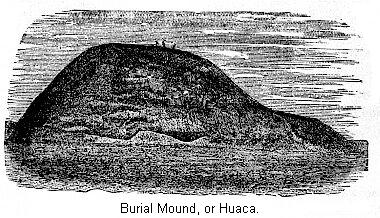
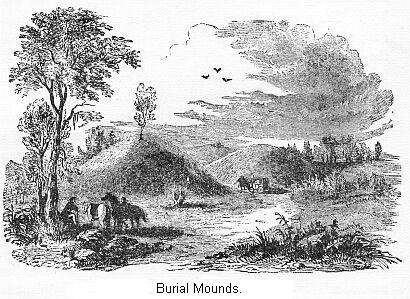
The next cut represents an ordinary burial mound, which was explored by
tunneling in from one side. We notice there are no different layers or
stratifications in this case. In some cases, at least, the building of
such a mound occupied several years. We can see where the dirt was thrown
down in small quantities, averaging about a peck, as if from a basket. In
one case grass had started to grow on the unfinished surface of the mound,
to be covered up by fresh dirt.24
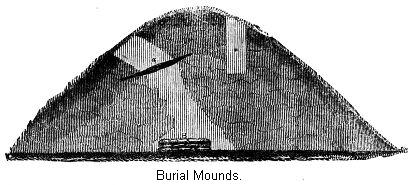
In the majority of cases the mounds contain the remains of but one
individual, with various relics of a rude and barbarous people. Where but
one body was buried, the usual mode of procedure seems to have been to
first clear a space on the surface of the ground; the body was then placed
in the center of this prepared place, and often a rude framework of timber
was placed around it, sometimes a stone chamber was built up. Over this
the mound was erected to the desired height. This description would apply
to nearly all of the many thousands of burial mounds in the country.
In the cut a layer of charcoal is noticed near the top. Nearly all mounds
show evidence of the existence of fire during some period of their
construction. In some cases these fires were fierce and long continued, as
if the object had been to cremate the body. It may have been a part of
their religious belief that it was necessary to keep fires blazing on the
mound for a short length of time to keep off evil spirits, or to comfort
the soul of the departed. Such at any rate was the custom among some
Indian tribes. We are told that among the Iroquois, a “fire was built upon
the grave at night to enable the spirit to prepare its food.”25
In some cases, many individuals were buried in the same mound. These may
be communal burials, such as we have already referred to. Mounds of this
kind have been examined near Nashville, Tennessee. One mound alone was the
burial place of over two hundred persons. Pidgeon describes some
triangular burial mounds in Minnesota, differing in shape only from the
ordinary circular mounds that belong to this division. In general, burial
mounds are not very high, yet there are exceptions to this rule.
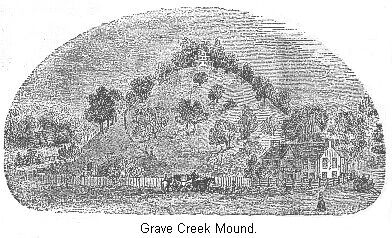
This cut represents one of the largest of these mounds. It is situated at
the junction of Grave Creek and the Ohio River, twelve miles below
Wheeling, in West Virginia. It measures seventy feet in height, and its
base is nearly one thousand feet in circumference. An excavation made from
the top downward, and from one side of the base to the center, disclosed
the fact that the mound contained two sepulchral chambers, one at the base
and one near the center of the mound. These chambers had been constructed
of logs, and covered with stone. The lower chamber contained two
skeletons, one of which is supposed to have been a female. The upper
chamber contained but one skeleton. In addition to these, there were found
a great number of shell beads, ornaments of mica, and bracelets of copper.26
A moment’s thought will show us what a great work such a mound must have
been for a people destitute of metallic tools and domestic animals. The
earth for its construction was probably scraped up from the surface and
brought thither in baskets. A people capable of erecting such a monument
as this, with only such scanty means at their command, must have possessed
those qualities which would sooner or later have brought them
civilization.
Another very interesting mound of this class once stood in the city of St.
Louis. The rapidly growing city demanded its removal in 1869. It was an
oblong mound, one hundred and fifty feet long by thirty in height. In its
removal it was shown that it contained a burial chamber seventy-five feet
long, from eight to twelve feet wide, and from eight to ten feet high, in
which about thirty burials had taken place. The surface of the ground had
first been leveled, then the walls raised to the desired height, made firm
and solid, and plastered with clay. Timbers formed the roof, over which
the mound had been raised to the desired height.
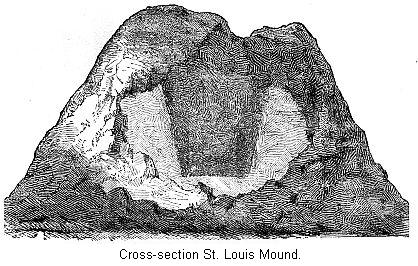
In process of time the roof decayed and fell in, thus giving a sunken
appearance to the top of the mound. This view is a cross section of the
mound as it was revealed by the workmen. We notice where the roof has
fallen in, and the outline of the interior chamber. This burial chamber
was perhaps an exact model of the cabins in which the people lived. Can it
be that this mound was the final resting place of some renowned chief, and
that the other bodies were those of his attendants sent to accompany him
to the other world? This is perhaps as reasonable a conjecture as any.
Certain it is that this tumulus and that at Grave Creek were fit pyramids
for the Pharaohs of the New World.
It is not to be supposed that the mounds were the sole cemeteries of the
people who built them. Like the barrows of Europe, they were probably
erected only over the bodies of the chiefs and priests, the wise men, and
warriors of the tribe. The amount of work required for the erection of a
mound was too great to provide one for every person. The greater number of
the dead were deposited elsewhere than in mounds, but it is doubtful
whether we can always distinguish the prehistoric burial places from those
of the later Indians. An ancient cemetery, discovered near Madisonville,
Ohio, proved to be a most interesting find, as it was thought to be a
burial place of the Mound Builders,27 but it seems there is
strong doubt on this point. One writer thinks this was a cemetery of the
Erie tribe of Indians, and not very ancient in date.28
In Tennessee are to be found numerous burial places known as the
stone-grave cemeteries. Stone graves of a similar character are found in
Kentucky, Ohio, and Missouri. These are as yet but few facts which can be
used as indicating that all the stone graves are of one people. Many of
these cemeteries are of great antiquity, while similar stone graves are of
quite recent date. In some places the cemeteries cover very large areas.
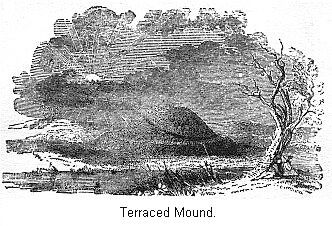
We have now to describe a class of mounds that are always regarded with
great interest, as a number of our scholars think they see in them the
connecting link between the remains in this country and those of Mexico
and the South. These are generally known as “temple mounds,” from the
common impression that they were sites of temples or public buildings. In
general terms, mounds of this class are distinguished by their large size
and regularity of form, and they always have a flat or level top. On one
side there is generally a graded way leading up to the summit, in some
instances several such methods of approach. Sometimes the sides of the
mound are terraced off into separate stages.29
We have already noticed that different sections of country are
distinguished by different classes of mound remains. In the present State
of Ohio are found many altar mounds and inclosures. In the West are large
numbers of burial mounds, but the so-called temple mounds are most
numerous in the South. At one place in Wisconsin is found a low embankment
inclosing four low mounds with leveled tops. But the resemblance between
these and the regular temple mounds is certainly slight. Only a few
instances of these flat-topped mounds are found in Ohio. Of these the
still existing “elevated squares” at Marietta are good examples.
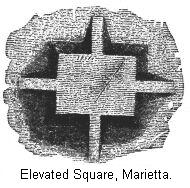 This cut represents the mound preserved in the
park at Marietta. It is ten feet high, one hundred and eighty-eight feet
long, by one hundred and thirty-two feet wide. The platform on the top has
an area of about half an acre. Graded ways lead up on each of the four
sides. These grades are twenty-five feet wide, and sixty feet long.30
This cut represents the mound preserved in the
park at Marietta. It is ten feet high, one hundred and eighty-eight feet
long, by one hundred and thirty-two feet wide. The platform on the top has
an area of about half an acre. Graded ways lead up on each of the four
sides. These grades are twenty-five feet wide, and sixty feet long.30
As we approach the Gulf States, these platform mounds increase in number.
The best representative of this class, the most stupendous example of
mound builders’ work in this country, is situated in Illinois, not far
from St. Louis. The mound and its surroundings are so interesting that
they deserve special mention. One of the most fertile sections of Illinois
is that extending along the Mississippi from the Kaskaskia to the Cahokia
river, about eighty miles in length, and five in breadth. Well watered,
and not often overflowed by the Mississippi, it is such a fertile and
valuable tract that it has received the name of the “Great American
Bottom.” It is well known that the Mound Builders chose the most fertile
spots for their settlements, and it is therefore not surprising to find
the evidence that this was a thickly settled portion of their territory.
Mr. Breckenridge, writing in 1811, says: “The great number of mounds, and
the astonishing quantity of human bones, everywhere dug up or found on the
surface of the ground, with a thousand other appearances, announces that
this valley was at one time filled with habitations and villages. The
whole face of the bluff, or hill, which bounds it on the east, appears to
have been a continuous burying ground.”31
Mounds are numerous in this section. We learn that there are two groups of
mounds or pyramids, one about ten miles above the Cahokia, and the other
about the same distance below it, more than one hundred and fifty in all.
Speaking of the group above the Cahokia, Mr. Breckenridge says: “I found
myself in the midst of a group of mounds mostly of a circular shape, and,
at a distance, resembling enormous hay-stacks scattered through a meadow.
One of the largest which I ascended was about two hundred paces in
circumference at the bottom, the form nearly square, though it had
evidently undergone considerable alteration from the washing of rains. The
top was level, with an area sufficient to contain several hundred men.” He
represents the view from the top of the mound to be a very extensive and
beautiful one. From this elevation he counted forty-five mounds or
pyramids, besides a great number of small artificial elevations. This
group was arranged in the form of a semicircle, about a mile in extent,
the open space being on the river.
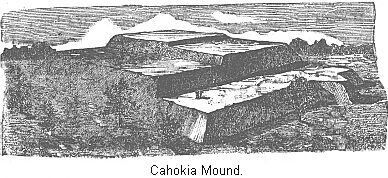
Three miles above occurs the group in which is found the famous big mound.32
This cut gives us a good idea of the mound as it was in its perfect state.
All accounts given of this mound vary. From a cut of the model, as
prepared by Dr. Patrick, the area of the base is a trifle over fifteen
acres.33 The ascent was probably on the south side of the
mound, where the little projection is seen. The first platform is reached
at the height of about fifty feet. This platform has an area of not far
from two and four-fifth acres. Large enough for quite a number of houses,
if such was the purpose for which this mound was erected. The second
platform is reached at about the height of seventy-five feet, and contains
about one and three-fourth acres. The third platform is elevated
ninety-six or ninety-seven feet, while the last one is not far from one
hundred feet above the plain. The area of the last two is about
three-fourths of an acre each. The areas of all the platforms are not far
from six acres. We require to dwell on these facts a moment before we
realize what a stupendous piece of work this is. The base is larger than
that of the Great Pyramid,34 and we must not lose sight of the
fact that the earth for its construction was scraped up and brought
thither without the aid of metallic tools or beasts of burden, and yet the
earth was obtained somewhere and piled up over an area of fifteen acres in
one place to a height of one hundred feet, and even the lowest platform is
fifty feet above the plain. Some have suggested that it might be partly a
natural elevation. There seems to be, however, no good reason for such
suggestions.
What motive induced the people to expend so much labor on this mound? It
is not probable that this was a burial mound, though it may ultimately
prove to be so. The most probable supposition is that the mound was
erected so as to secure an elevated site, perhaps for purpose of defense,
as on these platforms there was abundant room for a large village, and an
elevation or height has always been an important factor in defenses. In
this connection, Prof. Putnam has called our attention to a fact which
indicates that a very long time was occupied in the construction of the
mound, and further, that a numerous population had utilized its platforms
as house sites—that is, that “everywhere in the gullies, and over
the broken surface of the mounds, mixed with the earth of which it is
composed, are quantities of broken vessels of clay, flint chips,
arrow-heads, charcoal, bones of animals, etc., apparently the refuse of a
numerous people.” The majority of writers, however, think that this
elevated site, obtained as the result of so much labor, was utilized for
important public buildings, presumedly the temple of their gods, and no
one can help noticing the similarity between this structure and those
raised by the ancient Mexicans for both religious purposes and town sites.
Mr. Foster thinks that “upon this platform was reared a capacious temple,
within whose walls the high-priests gathered from different quarters at
stated seasons, celebrated their mystic rites, while the swarming
multitudes below looked up with mute adoration.”35 Mr.
Breckenridge, whose writings we have already referred to, at the time of
his first visit, “everywhere observed a great number of small elevations
of earth, to the height of a few feet, at regular distances apart, which
appeared to observe some order: near them pieces of flint and fragments of
earthen vessels.” From this he concludes that here was a populous town,
and that this mound was a temple site. It is doubtful whether we shall
ever pierce the veil that lies between us and this aboriginal structure.
The pyramids of the Old World have yielded up their secret, and we behold
in them the tombs of Egypt’s kings. But this earthen pyramid on the
western prairie is more involved in mystery, and we do not know even its
builders. If the result of religious zeal, we may be sure that a religion
which exacted from its votaries the erection of such a stupendous piece of
work was one of great power.
As before remarked, “temple mounds” increase in numbers and importance as
we go south. In Kentucky they are more frequent than in the States north
of the Ohio River, and in Tennessee and Mississippi they are still more
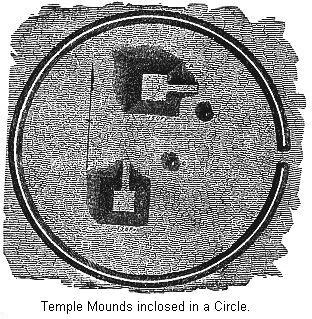
abundant.36 We also learn that they are often surrounded, or
nearly so, with moats or ditches, as if to fortify their location. Our
next cut illustrates such an arrangement—a circular wall of earth
four feet high and two thousand three hundred feet in circumference,
incloses four mounds, two of which are temple mounds. According to the
late Prof. Forshey, temple mounds abound in Louisiana. He described a
group situated in Catahoola County, in which the principal mound has a
base of more than an acre, a height of forty-two feet, and the upper
platform an area of nearly one-third of an acre. The smaller mounds are
arranged around this larger one. This group is defended by an embankment.
From this point for a distance of twenty miles along the river, are
scattered similar groups of mounds; in all cases the smaller ones arranged
around the larger one, which is presumably the site of a temple.
A digression right here may not be devoid of interest. We are not sure but
that the dim, uncertain light of history falls on the origin of this group
of mounds. When the French first commenced their settlement in the lower
Mississippi Valley, the Natchez Indians was the most powerful tribe in all
that section. In the course of time, wars ensued between them and the
French, and in the year 1730 they fled into Upper Louisiana, and settled
at the place where these mounds are now found. But the French followed
them a year or so afterwards, and nearly exterminated. them. Some of our
scholars think that they erected these mounds.37 The historian
of that epoch simply says they had “built a fort there.” It is however
questioned whether they had time to build works of such magnitude. But
they were both a mound-building and a mound-using people, and we are not
prepared to say how long it would take them to do the work, until we know
the number engaged, methods employed, and other considerations.38
If they did not build these works, they doubtless cleared them of trees
and utilized them; and this place was therefore the scene of the final
downfall of the Natchez—a people we have every reason to regard as
intimately connected with the prehistoric mound-building tribes.
The largest temple mound in the South is near Seltzertown, Mississippi.
Its base covers about six acres, and it rises forty feet. This slope was
ascended by means of a graded way. The summit platform has an extent of
nearly four acres. On this platform three other mounds had been reared—one
at each end, and a third in the center. Recent investigation by the Bureau
of Ethnology have shown that the base of this mound is a natural
formation. Lumps of sun-dried, or partially burnt clay, used as plastering
on the houses of the Mound Builders, gave rise to a sensational account of
a wall of sun-dried bricks two feet thick, supporting the mound on the
northern side.39 The famous Messier Mound, in Georgia, is said
to reach a height of ninety-five feet. But a large part of this elevation
is a natural eminence; the artificial part is only a little over fifty
feet.
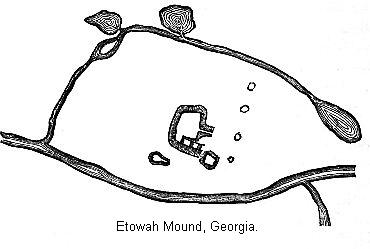
A work of unusual interest occurs on the Etowah River, Georgia. This cut
gives us a plan of the work. We notice, first of all, the moat or ditch by
which they fortified their position. The ditch is still from five to
twenty-five feet deep, and from twenty to seventy-five feet wide. It
connects directly with the river at one end, but stops short at the other.
It surrounds nearly fifty acres of land. At two points we notice
reservoirs, each about an acre in size, and an average depth of not less
than twenty feet. At its upper end is an artificial pond. This ditch, with
its reservoirs and pond, is no slight work. The large mound seen in the
center of the space is one of the largest of the temple mounds. Its shape
is sufficiently shown in the cut. The height of the mound is sixty-five
feet. We call especial attention to the series of terraces leading up the
south side of the mound. Graded ways afford means of access from one
terrace to the other. A pathway is also seen on the eastern side.
To this group of works an interest attaches similar to that of the group
of works mentioned in Louisiana. We are not certain but that we catch a
glimpse of it while it was yet an inhabited Indian town. This is contained
in the brief accounts we have of the wanderings of the unfortunate De Soto
and his command. One of the chroniclers of this expedition La Vega,
describes one of the towns where the weary Spaniards rested, and which we
are sure was somewhere in Northern Georgia, in such terms, mentioning the
graded way leading to the top, that Prof. Thomas, who has spent some time
in this investigation, thinks his description can apply only to the mound
under consideration.40 Whether this conclusion will be allowed
to stand, remains to be seen. But, if true, then the darkness which rests
upon this aboriginal structure lifts for a moment and we see around it a
populous Indian town, able to send five hundred warriors to battle. The
Spaniards marched on to sufferings and death, and darkness again closed
around the Etowah Mound. When the Europeans next beheld it around it was
the silent wilderness; the warriors had departed; the trees of the forest
overspread it.
We have now described the principal mound structures, and shown the
different classes into which they are divided. But a large class of mounds
are found scattered all through the Mound Builders’ territory that were
probably used as signal mounds. Burial mounds were also often used for
this purpose.41 This was because their location was always very
favorable for signal purposes. Signaling by fire is a very ancient custom.
The Indians on our western plains convey intelligence by this means at the
present day. Some tribes use such materials as will cause different shades
of smoke, using dried grass for the lightest, pine leaves for the darkest,
and a mixture for intermediate purposes. They also vary the signal by
letting the smoke rise in an unbroken column, or cover the fire with a
blanket, so as to cause puffs of smoke. The evidence gathered from the
position of the mounds, and traces of fire on their summit, is that the
Mound Builders had a very extensive system of signal mounds.
To illustrate this system, we would state that the city of Newark, Ohio,
was the site of a very extensive settlement of the Mound Builders. This
settlement was in a valley, but on all the surrounding hills were located
signal mounds. And it is further stated that lines of signal mounds can be
traced from here as a center to other and more distant points. The large
mound at Mt. Vernon, twenty miles to the north, was part of this system.
As the settlements of the Mound Builders were mostly in river valleys, we
would expect to find all along on the bluffs fronting these valleys traces
of signal mounds. In the Scioto Valley, from Columbus to Chillicothe, a
distance of about forty miles, twenty mounds “may be selected, so placed
in respect to each other that it is believed, if the country was cleared
of forests, signals of fire might be transmitted in a few minutes along
the whole line.” Some think the chain is much more extensive than this,
and that the whole Scioto Valley, from Delaware County to Portsmouth, was
so provided with mounds that signals could be sent in a very few minutes
the whole distance.42
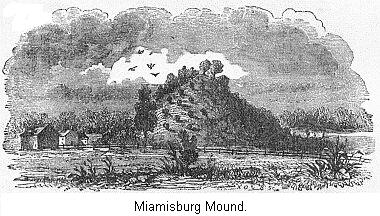
The valley of the Miami River was equally well provided with signal
mounds. This great mound, at Miamisburg, Ohio, rising to the height of
sixty-eight feet, was one of the chain by which signals were transmitted
along the valley. Not only was each river valley thus provided, but there
is evidence that communication was established between different river
systems, so we can easily see how quickly the invasion of their country by
an enemy from any quarter would become known in widely scattered sections.
Immediately across the river from Chillicothe, Ohio, on a hill nearly six
hundred feet high, was located a signal mound. A fire built upon it would
be visible twenty miles up the valley, and an equal distance down. It
would be also visible far down the valley of Paint Creek. Some think that
such a system of lofty observatories extended across the whole State of
Ohio, of Indiana, and Illinois, the Grave Creek mound, on the east, the
great mound at Cahokia, on the west, and the works in Ohio filling up the
line. We do not believe, however, it is safe to draw such conclusions. It
is doubtful whether there was any very close connection between the tribes
in these several sections.
In the State of Wisconsin are found some of the most interesting remains
of the Mound Builders. They are so different from the ordinary remains
found elsewhere that we must admit that the people who built them differed
greatly from the tribes who built the great temple mounds of the South, or
the earthworks of Ohio. The remains in Wisconsin are distinguished not by
their great size or height, but by their singular forms. Here the mound
building instincts of the people were expressed by heaping up the earth in
the shape of animals. What strange fancy it was that led them to mould the
figures on the bluffy banks of the rivers and the high lands about the
lakes of their country, we shall perhaps never know. That they had some
design in this matter is, of course, evident, and if we would try and
learn their secret, we must address ourselves to a study of the remains.
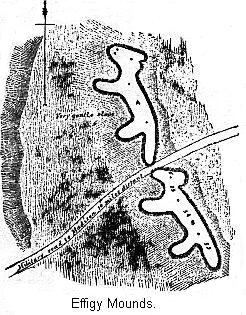 Effigy mounds are almost exclusively confined to the State
of Wisconsin. We, indeed, find effigy mounds in other sections, but they
are of rare occurrence.43 They, however, show that the same
reasons, religious, or otherwise, exists in other localities, while in the
area covered by the southern portion of the State of Wisconsin it found
its greatest expression. This cut affords us a fair idea of effigy mounds.
Here are seen two animals, one behind the other. On paper we can readily
see the resemblance. Stretched out on the ground, and of gigantic
proportions, the resemblance is not so marked, and some might fail to
notice it at first sight. Either of those figures is over one hundred feet
long, and about fifteen feet wide. With few exceptions, effigy mounds are
inconsiderable in height, varying from one to four feet. These mounds have
been carefully studied of late years, and there is no doubt that in many
instances we can distinguish the animals represented.
Effigy mounds are almost exclusively confined to the State
of Wisconsin. We, indeed, find effigy mounds in other sections, but they
are of rare occurrence.43 They, however, show that the same
reasons, religious, or otherwise, exists in other localities, while in the
area covered by the southern portion of the State of Wisconsin it found
its greatest expression. This cut affords us a fair idea of effigy mounds.
Here are seen two animals, one behind the other. On paper we can readily
see the resemblance. Stretched out on the ground, and of gigantic
proportions, the resemblance is not so marked, and some might fail to
notice it at first sight. Either of those figures is over one hundred feet
long, and about fifteen feet wide. With few exceptions, effigy mounds are
inconsiderable in height, varying from one to four feet. These mounds have
been carefully studied of late years, and there is no doubt that in many
instances we can distinguish the animals represented.
We learn, then, that tribes formerly living in Wisconsin had the custom of
heaping up the earth in the shape of the various animals peculiar to that
section. But no effigies are found of animals that have since become
extinct, or of animals that are to be found only in other lands.
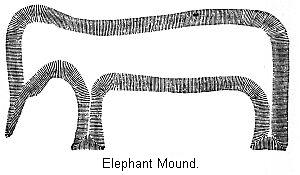 Our next cut represents the famous elephant mound of
Wisconsin, on the strength of which a number of fair theories have been
given relating to the knowledge of the mastodon by the builders of the
mound, and its consequent antiquity. It now bears some resemblance to an
elephant, but we learn that the trunk was probably produced by the washing
of the banks and, from the same cause, a projection above the head,
supposed to represent horns, has disappeared. Taking these facts into
consideration, it is quite as likely that it represented a buffalo.44
One writer even thinks he found a representation of a camel, but the fact
is, the more these effigy mounds are studied, the more certain are we that
they are representations of animals formerly common in that region.
Our next cut represents the famous elephant mound of
Wisconsin, on the strength of which a number of fair theories have been
given relating to the knowledge of the mastodon by the builders of the
mound, and its consequent antiquity. It now bears some resemblance to an
elephant, but we learn that the trunk was probably produced by the washing
of the banks and, from the same cause, a projection above the head,
supposed to represent horns, has disappeared. Taking these facts into
consideration, it is quite as likely that it represented a buffalo.44
One writer even thinks he found a representation of a camel, but the fact
is, the more these effigy mounds are studied, the more certain are we that
they are representations of animals formerly common in that region.
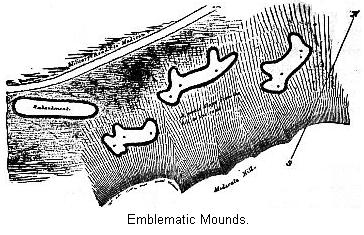
The manner in which they represented the various animals is full of
interest to us. It has been discovered that they worked on a system. The
last cut represents a group of three animals discovered a few miles from
the Blue Mounds in Dane County. We notice at once a difference between the
central animal, with a tail, and the other two. It will also be observed
that the animals are represented in profile, with only two projections for
legs. They are never separated so that we can distinguish the two front
and the two hind feet. Animals so figured are the bear, fox, wolf,
panther, and others. Grazing animals, such as the buffalo, elk, and deer,
are represented with a projection for horns. In the last cut the other two
animals are buffaloes. In various ways the particular kind of animal can
nearly always be distinguished.45
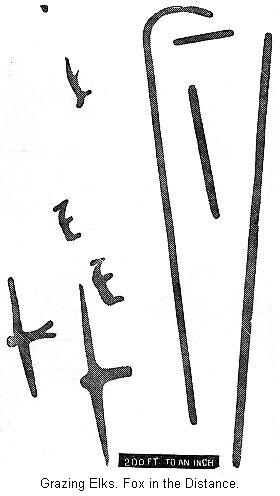
The preceding cut represents two elks grazing, and a fox in the distance.
The long embankments of earth at one side are considered by Mr. Peet as in
the nature of game drives. But we call attention to the expressiveness
with which these figures are delineated. What could be more natural than
the quietly grazing elks, with the suspicious prowling fox in the
distance. In the cut we also see two cross-shaped figures. This was their
method of representing birds, a projection on each side of a central body
denoting wings. These figures are often very expressive.
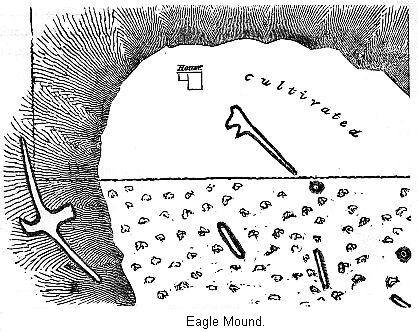
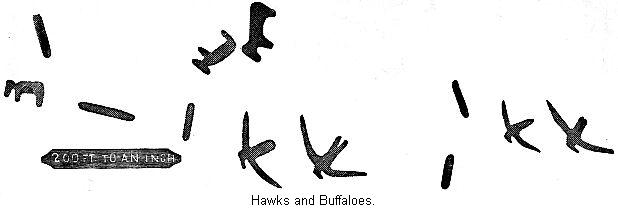
In this cut we have no difficulty in recognizing an eagle. It is
represented as soaring high in the air. On the bluffs above it is a wolf
effigy, and several conical and long mounds. In the cut preceding this the
eagle and the hawk are hovering over the feeding elks, while in this cut a
flock of hawks are watching some buffaloes feeding in the distance. This
group of effigies was found on the banks of the Kickapoo River.
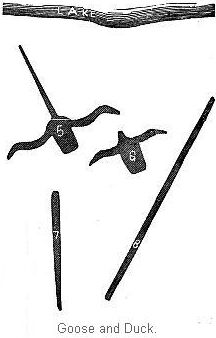 Our next cut represents a wild goose with a long neck and
beak followed by a duck with a short neck, flying towards the lake.
Our next cut represents a wild goose with a long neck and
beak followed by a duck with a short neck, flying towards the lake.
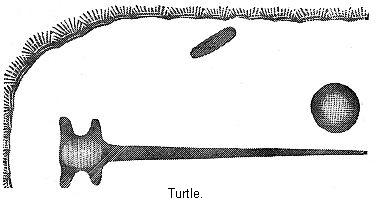
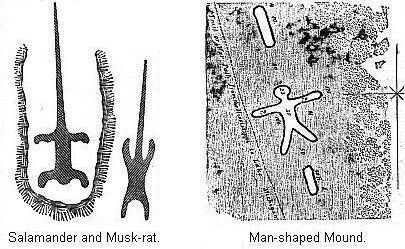
Water-loving animals, such as salamanders and turtles, are represented in
still another way, two projections on each side of a central figure. The
next following cut represents a turtle. The tail was not always added. The
salamander closely resembles the turtle, but notice the difference in the
body, and still different is the cut of the musk-rat (see later). Fishes
are figured as a straight embankment of earth tapering to a point.
The same system that was observed in the location of signal mounds is to
be noticed in the arrangements of these groups of effigy mounds. They are
not alone. One group answers to another on a distant hill, or is in plain
view of another group in the valley below. Distant groups were so related,
each commanding a wide extent of country, and thus group answers to group,
and mound to mound, for miles away, making a complete system throughout
the region.
We notice this as to the location of the mounds. When we examine the
mounds themselves we observe no little skill in the way they represent the
animals. They often impressed on them something more than mere animal
resemblances. “There are groups where the attitudes are expressive of a
varied action. Certain animals, like the weasel or mink, being seen with a
bird so near that, apparently, it might be caught by a single spring; and
still others, like the wolf or wild-cat, are arranged head to head, as if
prepared for combat; and still others, like the squirrel or coon, are in
the more playful attitudes, sometimes apparently chasing one another over
hill or valley; and again situated alone, as if they had just leaped from
some tree, or drawn themselves out of some den or hole.”46
Nor is the effigy of the human form wanting. It is found in several
localities throughout the State. This cut shows us one such effigy. This
was the beginning of a long train of animal mounds, presumably
representing bears, found near the Blue Mounds, Wisconsin.47 We
can not observe that any more importance was ascribed to the effigy of a
human being than to that of an animal.
In casting about for suitable explanation for the erection of these animal
mounds, we find ourselves lost in conjecture as to the motive which
induced these people to prepare these earthen effigies. We may be sure
that it was for some other reason than for amusement, or to give exercise
to an artistic feeling. Only in very few instances do we detect any
arrangements which would imply that they were in the nature of defenses.
In some cases the effigies are so arranged as to form a sort of inclosure,
some portion of the figure being prolonged to an unusual extent and thus
inclosing a space that may have been utilized for a village site. This
group on the Wisconsin River illustrates this point. Here the area thus
partially inclosed, is about an acre. It is a singular fact that these
inclosures are almost always triangular in shape.48 But it is
manifest that a simple earth wall would serve for defense much better than
these forms. They probably were not burial mounds, as few contain human
remains, and it is not yet certain that these remains were not intrusive
burials.49 It seems, therefore that they must have been in some
manner connected with the religious life of the people.
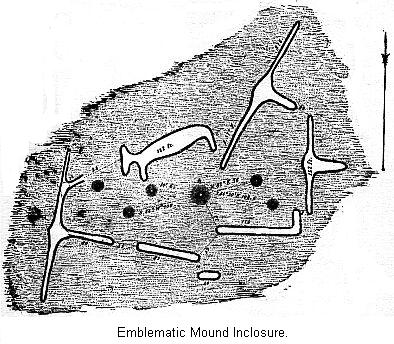
If we examine the various groups scattered throughout the State, this
belief is strengthened. It is found, for instance, in nearly every group,
that some one effigy is the principal one, and is placed in a commanding
position, about which the other forms are arranged. It is also thought
that the same effigy is the principal or ruling effigy over a wide
district. In illustration of this, it can be stated that in the
south-eastern part of the State the turtle is always the ruling effigy. In
any group of effigies it is the principal one. It seems to watch over and
protect the others. In subordination to it are such forms as the lizard,
hawk, and pigeon. Passing to the North, the turtle is no longer the
important figure. It is replaced by the wolf, or wild-cat. This is now the
principal form, and if the turtle is sometimes present, it is of less
importance.
So marked is the fact we have just stated that Mr. Peet says, “that
sometimes this division assumes almost the character of a river system,
and thus we might trace what seems to be the beginning in this country of
that which prevailed on classic soil and in Oriental regions—namely,
river gods and tutelar divinities of certain regions, each tribal divinity
having its own province, over which it ruled and on which it left its own
form or figure as the seal of its power and the emblem of its worship.”50
Looking for some explanation of this, we may find a key in the known
customs of various Indian tribes, and the lower races of men. It is known
that a tribe of Indians is divided into smaller bands, which are called
gens or clans. A gens may consist of several hundred persons, but it is
the unit of organization. It takes the place of a family among civilized
people. These various bands are generally named after some animal. In the
beginning these names may have been of no special significance, but in
course of time each band would come to regard themselves as descendants of
the animal whose name they bore. Hence the animal itself would be
considered sacred in their eyes, and its life would seldom be taken by
members of that gens.
The animal thus honored by the gens was, in the Indian dialect, the totem
of the clan. This organization and custom we find running all through the
Indian tribes. In many tribes the Indians were wont to carve a figure of
their totem on a piece of slate, or even to carve a stone in the shape of
the totem, which carved or sculptured stone they wore as an ornament, or
carried as a charm to ward off evil and bring them good luck.51
We need only suppose that this system was very fully developed among the
Mound Builders of Wisconsin, to see what important bearing it has on these
effigy mounds.
A tribe located on one of the fertile river valleys of Wisconsin was
composed of various gens or clans. On some common point in proximity to
their villages, or some spot which commanded a wide view of the
surrounding country, each gens would rear an effigy of its totem, the
animal sacred to them. In every tribe some gens would be the most
powerful, or for some cause the most respected, and its totem would be
given in the largest effigy, and would be placed in the most commanding
position. In a different locality some other tribe would be located, and
some other totem would be regarded as of the most importance.
In this light effigy-mounds are not mere representatives of animal forms.
They are picture-writings on a gigantic scale, and are the source of much
true history. They tell us of different tribes, the clans which composed
them, the religious beliefs, and the ruling gens of the tribe.
Contemplating them, we seem to live again in the far-off past. The white
man disappears; waving forests claim their ancient domain, and the rivers,
with a more powerful current, roll in their olden channels. The animals
whose forms are imaged here, go trooping through the forest or over the
fertile bottom lands. The busy scenes of civilization give place to the
placid quiet of primeval times, and we seem to see peaceful tribes of
Mound Builders paying a rude veneration to their effigy-gods, where now
are churches of a more soul-satisfying religion.
But there is still another point to be learned from an examination of
these ancient mounds. Not only are they totems of the tribes, but they
were looked on in some sense as being guardian divinities, with power to
protect the homes of the tribe. This is learned by studying the location
in which they are placed. They occupy all points of observation. In other
parts of the Mound Builders’ country, wherever we find signal-mounds we
find corresponding positions in Wisconsin occupied by groups of
effigy-mounds, or if one only is present, it is always the one which, from
the considerations we have stated, was regarded as the ruling effigy of
that section. It is as if their builders placed them as sentinels to guard
the approaches to their homes, to give warning of the arrival of hostile
bands. This is further borne out by finding that mounds placed in such
positions frequently show evidence of the action of intense fire, and so
we conclude they were used as signal stations also. So we need not doubt
but that the region thus watched over by these effigy-mounds, group
answering to group along the river banks, or in the valleys below, was at
times lit up by the signal fires at night; or the warning column of smoke
by day betokening the presence of dancer.52
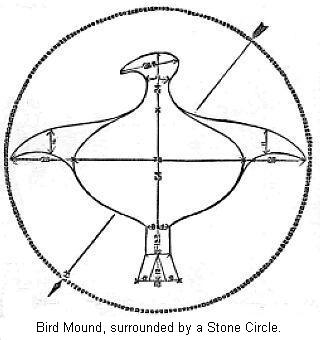
Before leaving the subject of effigy-mounds, we must refer to some
instances of their presence in other localities. This cut is an eagle
effigy discovered in Georgia. Only one other instance, also occurring in
Georgia, is known of effigy-mounds in the South. Measured from tip to tip
of the wings, the bird, in this case, is one hundred and thirty-two feet.
This structure is composed of stones, and a singular feature is the
surrounding circle of stone.53
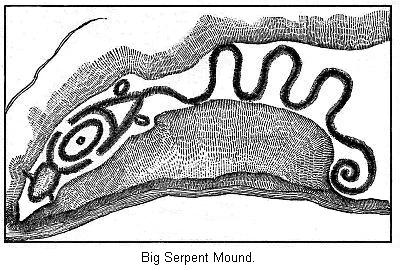
Several examples of effigy-mounds are found in Ohio. The most notable one
is that known as the Great Serpent Mound, in Adanis County. We give an
illustration of it. The entire surrounding country is hilly. The effigy
itself is situated on a tongue of land formed by the junction of a ravine
with the main branch of Brush Creek, and rising to a height of about one
hundred feet above the creek. Its form is irregular on its surface, being
crescent-shaped, with the point resting to the north-west. We give in a
note some of the dimensions. The figure we give of this important effigy
is different from any heretofore presented. We are indebted for the plan
from which the drawing was made to Rev. J. P. MacLean, of Hamilton, Ohio.
Mr. MacLean is a well-known writer on these topics. During the Summer of
1884, while in the employ of the Bureau of Ethnology, he visited the
place, taking with him a thoroughly competent surveyor, and made a very
careful plan of the work for the Bureau. All the other figures published
represent the oval as the end of the works. Prof. Putnam, who visited the
locality in 1883, noticed, between the oval figure and the edge of the
ledge, a slightly raised, circular ridge of earth, from either side of
which a curved ridge extended towards the sides of the oval figure. Mr.
MacLean’s researches and measurements have shown that the ridges last
spoken of are but part of what is either a distinct figure or a very
important portion of the original figure. As figured, it certainly bears a
very close resemblance to a frog, and such Mr. MacLean concludes it to be.
There is both a similarity and a difference between this work and those of
Wisconsin. The fact that it occurs isolated, the other effigies in Ohio
being many miles away, shows that some special purpose must have been
subserved by it. There the great numbers gave us a hint as to their
purpose. In this case, however, nearly all observers conclude that it was
a religious work. Mr. MacLean, after describing these three figures,
propounds this query: “Does the frog represent the creative, the egg the
passive, and the serpent the destructive power of nature?” Not a few
writers, though not acquainted with the presence of the frog-shaped
figure, have been struck with the combination of the egg and the serpent,
that plays such an important part in the mythology of the Old World. We
are told that the serpent, separate or in combination with the circle,
egg, or globe, has been a predominant symbol among many primitive nations.
“It prevailed in Egypt, Greece, and Assyria, and entered widely into the
superstitions of the Celts, the Hindoos, and the Chinese.” “Wherever
native religions have had their scope, this symbol is sure to appear.”54
Even the Indians have made use of this symbol. On Big Medicine Butte, in
Dakota Territory, near Pierre, is a train of stones arranged in the form
of a serpent, which is probably the work of the Sioux Indians. Around
about on the hill is the burying-ground of their chiefs. This was to them
sacred ground, and no whites were allowed near. The stones are about the
size of a man’s head, and are laid in two rows, from one to six feet
apart. The length in all is three hundred and fifty feet, and at the tail,
stones, to represent rattles, are rudely carved. The eyes are formed by
two big red bowlders. No grass was allowed to grow between the two rows of
stone.55
It seems reasonable to suppose that the few isolated effigy mounds we have
outside of Wisconsin were built to subserve a different purpose than those
in that State. Mr. Peet has made some remarks on their probable use that
seem to us to cover the ground, and to do away with any necessity of
supposing on the part of its builders an acquaintance with Old World
mythologies. Nature worship is one of the earliest forms of worship. The
prominent features of a landscape would be regarded as objects of worship.
Thus, for example, the island of Mackinac resembles in its outline the
shape of a turtle; so the island was regarded as sacred to the turtle, and
offerings were made to it. A bluff on the same island at a distance
resembles a rabbit; accordingly, it was called by that name, and offerings
were made to it. It is quite natural that the effigy-mound builders should
seek to perpetuate by effigy some of these early traditions.
In the case of the Big Serpent mound this point is worth considering. The
ridge on which it stands is not only in the midst of a wild, rough region,
but is so situated that it commands a wide extent of country. In shape
this tongue of land is also peculiar. It is a narrow, projecting headland,
and would easily suggest the idea of a serpent or a lizard. “This, with
the inaccessibility of the spot, would produce a peculiar feeling of awe,
as if it were a great Manitou which resided there; and so a sentiment of
wonder and worship would gather around the locality. This would naturally
give rise to a tradition, or would lead the people to revive some familiar
tradition and localize it.”56 The final step would be to make
an effigy.
It seems to us very hazardous to draw any conclusions as to the religious
beliefs of the Mound Builders from this effigy, or combinations of
effigies. It also seems to us reasonable to suppose that but one figure
was intended to be represented. A very slight prolongation of the
serpent’s jaws and the limbs of the frog would connect them, in which case
we would have some amphibious creature with an unduly extended tail, or
perhaps a lizard. We must remember that the whole figure has been plowed
over once or twice, so that we are not sure of the original outlines. We
can not tell why they should represent a portion of the body as hollow,
but neither can we tell why the head of the supposed serpent should be
represented as hollow. We do not find any important earth-works near here.
The hill on which it is placed commands a very extensive view of the
surrounding country. Within the oval a pile of stones showed evidence of a
long-continued fire, which would indicate that this was also a
signal-mound. Prof. Putnam thinks it probable that there was a burial
place between it and the large conical mound not far away.57
In the vicinity of Newark, Ohio, are two examples of effigy mounds. This
cut represents what is called the alligator mound, but it is probably the
effigy of a lizard. The position which this mound occupies is significant.
It is on the very brow of a hill about two hundred feet high, which
projects out into a beautiful valley. The valley is not very wide.
Directly across was a fortified camp, in the valley below it was a
circular work, and a short distance below on another projecting headland
was a strongly fortified hill. The great works at Newark were six miles
down the valley, but were probably in plain view. That it was perhaps a
signal station, is shown by the presence of traces of fire.
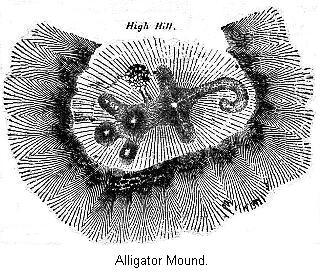
The length of this effigy is two hundred and five feet, the breadth of the
body at its widest part, twenty feet, average height about four feet.58
The effigy mounds of Wisconsin, and the other few examples mentioned, are
among the most interesting objects of aboriginal work. Except in a few
favored instances, they are rapidly disappearing. To the leveling
influence of time is added the assistance of man, and our knowledge of
them will soon be confined to existing descriptions, unless something is
at once done to preserve them from destruction. Interesting mementos of a
vanished race, we turn from their contemplation with a sigh of regret
that, in spite of our efforts, they are still so enwrapped in doubt.
Mounds and effigies by no means complete the description of Mound
Builders’ remains. One of the most interesting and mysterious class of
works is now to be described. Early travelers in Ohio came here and there
upon embankments, which were found to inclose tracts of land of various
sizes. It was noticed that the embankments were often of the form of
perfect circles, or squares, or sometimes octagons, and very often
combinations of these figures. It was further evident that the builders
sought level, fertile lands, along the various river courses. They very
seldom built them on undulating or broken ground. Often have the very
places where civilized man has laid the foundation of his towns proved to
be the sites of these ancient works of the Mound Builders, and thus it has
happened that many of the most interesting works of antiquity have been
ruthlessly removed to make way for the crowded streets and busy marts of
our own times.
The larger number of inclosures are circular, often of a small size. Where
they occur separately they either have no gateway, or but one. Sometimes
the circles are of very large size, surrounding many acres. Sometimes,
though not very often, a ditch was also dug inside the embankment. This
last circumstance is by many regarded as a strong proof that the primary
object of these circles was not for defense.59 But an inclosure
of this kind, even with the ditch on the inside, if surmounted by a row of
pickets or palisades, would prove a strong position against Indian foes
armed with bow and arrow. The Mandans constructed defenses of this kind
around their villages.60 As to the original height of the
walls, in the majority of cases it was not very great, generally from
three to seven feet.
It is estimated that in Ohio alone there are fifteen hundred inclosures,
but a large number of them have nothing especially worthy of mention.
Some, however, are on such a large scale that they call from all more than
a passing glance. In contemplating them, we feel ourselves confronted by a
mystery that we can not explain. The ruins of the old world excite in us
the liveliest feeling of interest, but we know their object, their
builders, and their probable antiquity. The mazy ruins at Newark, and
other places in Ohio, also fill the mind with astonishment, but in this
case we are not certain of their antiquity, their builders are unknown,
and we can not conjecture with any degree of certainty as to their use.
Before so many uncertainties imagination runs riot, and we are inclined to
picture to ourselves a scene of barbaric power and magnificence.
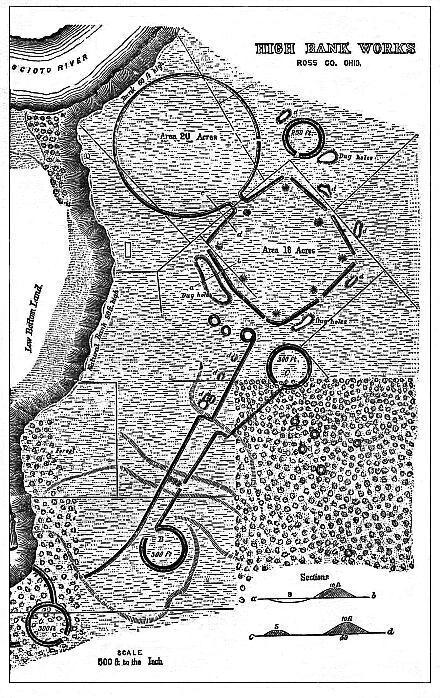
One beautiful specimen of this work is found in this cut. It occurs on the
right bank of the Scioto river, five miles below Chillicothe. Here we
notice a combination of the octagon and the circle. The areas of each are
marked. The octagon is nine hundred and fifty feet in diameter, and nearly
regular in shape. In 1846 its walls were eleven or twelve feet high, by
about fifty feet base. It will be noticed that there is a gate at or near
each angle of the octagon except one, and in front of that angle was a
pit, from which some of the earth to form the walls was taken. Facing each
gateway a mound was placed, as if to guard the entrance.
The circle connected with the octagon is perfect in shape, and is ten
hundred and fifty feet in diameter. Its walls were only about half the
height of the octagon. We notice some other small circular works in
connection with the main work. In this case the parallels are not very
regular, and seem to be connected with one or more circular works. In a
work situated but a few miles from the one here portrayed, the parallels
extend in one direction nearly half a mile, only one hundred and fifty
feet apart. They terminate on the edge of a terrace. The object of such
parallels is as yet unknown. In some cases, after extending some distance,
they simply inclosed a mound.
It is easy enough to describe this work and give its dimensions, but who
will tell us the object its builders had in mind? The walls themselves
would afford but slight protection and if they were for defense, must have
been surmounted with palisades. Works that were undoubtedly in the nature
of fortified camps, are found in this same section, and one of the
strongest was located not more than twelve miles away; but such defensive
works differ very greatly in design from regular structures such as we are
now describing. A very eminent scholar, Mr. Morgan, has advanced the
theory that the walls were the foundations on which communal houses, like
the Pueblos of the West, were erected.61 But this is mere
theory. All traces of such habitations (if they ever existed) are gone,
the usual debris which would be sure to accumulate around
house-sites, is wanting, and the walls themselves seem unfit for such
purpose.62
They may have been embankments surrounding towns and cultivated fields,
but little has yet been found which can be cited as proofs of residence
within the area so inclosed. We should not be surprised, however, if such
would ultimately prove to be the case, since we now know that the Mound
Builders of Tennessee did fortify their villages by means of embankments
and ditches.63 A number of writers think that these regular
inclosures were in some way connected with the superstitions of the
people. In other words, that they were religious in character. Mr. Squier
remarks, “We have reason to believe that the religious system of the Mound
Builders, like that of the Aztecs, exercised among them a great, if not a
controlling, influence. Their government may have been, for aught we know,
a government of the priesthood—one in which the priestly and civil
functions were jointly exercised, and one sufficiently powerful to have
secured in the Mississippi Valley, as it did in Mexico, the erection of
many of those vast monuments, which for ages will continue to challenge
the wonder of men. There may have been certain superstitious ceremonies,
having no connection with the purpose of the mound, carried on in
inclosures especially dedicated to them.”64 Another late writer
to whom we have several times referred, tells us there is no doubt but
what a “religious view” was the controlling influence in the erection of
these works, and that they express a “complicated system of symbolism,”
that we see in them evidence, of a most powerful and wonderful religious
system.65 Still such assertions are easier made than proven,
and until we know somewhat the purpose for which they were used, how are
we to know whether they were sacred or not?
Casting conjectures, for the moment, aside, let us learn what we can from
the works themselves. From their large extent they could only be reared by
the expenditure of great labor. This implies some form of government
sufficiently centralized and powerful to control the labors of large
bodies of men. Moreover, they were sufficiently advanced to have some
standard of measurement and some way of measuring angles. The circle, it
will be remembered, is a true circle, and of a dimension requiring
considerable skill to lay out. The sides of the octagon are equal, and the
alternate angles coincident.
Every year the plow sinks deeper into these crumbling embankments, and the
leveling forces of cultivation are continually at work, and the time is
not far distant when the curious traveler will with difficulty trace the
ruins of what was once, to the Mound Builders, a place of great
importance.
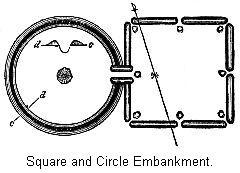 The
more usual combination was that of a square and a circle. An example is
given in this cut, which is a plan on a very small scale, of works which
formerly existed in Circleville. One peculiar feature about this work was
that a double wall formed the circle, with a ditch between the two walls.
In the next cut we notice a peculiar combination of these two figures. The
square is inclosed within the circle. Whatever we may ultimately decide as
to the larger works, it would seem as if this could only be explained as
in the nature of a religious work. We can see no reason for constructing a
defensive work, or inclosing a village, or erecting foundations for houses
of such a shape as this. They must have been in some way connected with
the superstitions of the people.
The
more usual combination was that of a square and a circle. An example is
given in this cut, which is a plan on a very small scale, of works which
formerly existed in Circleville. One peculiar feature about this work was
that a double wall formed the circle, with a ditch between the two walls.
In the next cut we notice a peculiar combination of these two figures. The
square is inclosed within the circle. Whatever we may ultimately decide as
to the larger works, it would seem as if this could only be explained as
in the nature of a religious work. We can see no reason for constructing a
defensive work, or inclosing a village, or erecting foundations for houses
of such a shape as this. They must have been in some way connected with
the superstitions of the people.
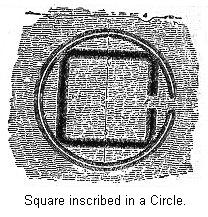
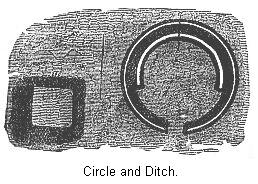 A peculiar feature is also noticed in reference
to some of the smaller circles in this section. The cut at left
illustrates it. The circle has a ditch interior to the embankment, and
also a broad embankment of about the same height with the outer wall,
interior to the ditch, running about half-way around the circle. A short
distance from the circle was one of those elevated squares, one hundred
and twenty feet square at the base, and nine feet high.66 It
may be that this square was the foundation on which stood a temple, in
which case the circle might have been dedicated to religious purposes
also.
A peculiar feature is also noticed in reference
to some of the smaller circles in this section. The cut at left
illustrates it. The circle has a ditch interior to the embankment, and
also a broad embankment of about the same height with the outer wall,
interior to the ditch, running about half-way around the circle. A short
distance from the circle was one of those elevated squares, one hundred
and twenty feet square at the base, and nine feet high.66 It
may be that this square was the foundation on which stood a temple, in
which case the circle might have been dedicated to religious purposes
also.
The great geometrical inclosures are especially numerous in the Scioto
Valley. All the works we have described were in the near neighborhood of
Chillicothe, and works as important as these are scattered all up and down
the valley. We must also recall how well provided this valley was with
signal mounds. All indications point to the fact that here was the
location of a numerous people, ready to defend their homes whenever the
warning fires were lit. Although Mound Builders’ works are numerous in the
valley of the two Miami Rivers, Cincinnati being the site of an extensive
settlement, yet they were not such massive structures as those in the
Scioto. This would seem to indicate that these valleys were the seats of
separate tribes.67 But this Eastern tribe must have occupied an
extensive territory, since works of the most complicated kind are found at
Newark.
All indications point to the fact that near this latter place was a very
important settlement of the Mound Builders. Several fortified works exist
a few miles up the valley; signal-mounds are to be seen on all heights,
commanding a wide view, and the famous alligator mound is placed, as if
with the design of guarding the entrance to the valley. No verbal
description will give an idea of the works, so we refer at once to the
plan. This will give us a good idea of the works as they were when the
first white settlers gazed upon them. They have nearly all been swept away
by modern improvements, excepting the two circular works and the octagon.
Here and there fragments of the other works can still be traced.
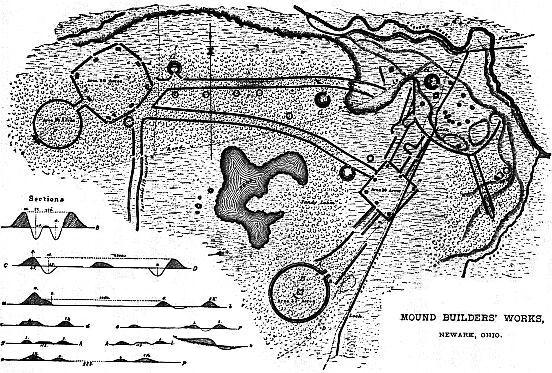
Two forks of the Licking River unite near Newark; the bottom between these
rivers comprising several square miles, was occupied by these ancient
earth-works. By reference to the plan, we see the works consisted of
mounds of various sizes, parallel walls, generally of a low elevation,
small and low embankments, in the form of small circles and half-circles.
There are also several large works consisting of a circle and octagon
combined, one large circle, and a parallelogram. The circular structure at
‘E,’ is undoubtedly one of the best preserved and most imposing in the
State. There are many inclosing larger areas, but none more clearly
defined. As this is now included in the fair-grounds of Licking County, it
is preserved from destruction, and will remain a monument of aboriginal
work long after all traces of the others have disappeared. “At the
entrance, which is towards the east, the ends of the walls curve outwards
for a distance of a hundred feet, leaving a passage way eighty feet wide
between the deep ditches on either hand.” From this point the work, even
now presents an impressive appearance. The walls are twelve feet in
perpendicular height, and about fifty feet base. There is a ditch close
around it on the inside, seven feet deep by thirty-five feet wide. The
area inclosed is about thirty acres.
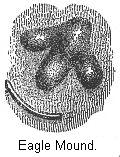 In the center is an effigy-mound, represented by this cut.
It represents a bird on the wing, and is called the Eagle Mound. The long
mound in the body of the bird has been opened, and it was found to contain
an altar, such as has been already described. Was this a place of
sacrifice, and did this wall inclose a sacred area? Our question remains
unanswered. We can dig in the mounds, and wander over the embankments, but
the secret of the builders eludes us.
In the center is an effigy-mound, represented by this cut.
It represents a bird on the wing, and is called the Eagle Mound. The long
mound in the body of the bird has been opened, and it was found to contain
an altar, such as has been already described. Was this a place of
sacrifice, and did this wall inclose a sacred area? Our question remains
unanswered. We can dig in the mounds, and wander over the embankments, but
the secret of the builders eludes us.
A mile to the north-west of the part of the work just described are the
Octagon and works in connection with it. The Octagon is not quite regular,
but the sides are very nearly equal. At each angle is a gateway, interior
and opposite to which is a mound, as if to guard the opening. The cut
gives a view of the Octagon, looking in through one of these gateways. At
present, however, but a small portion is in the forest. Most of it is
under cultivation, but the work can still be easily traced, and is one of
the best preserved in the State. A portion of it, still in the forest,
presents the same appearance to-day as it did to the first explorer. When
a stranger for the first time wanders along the embankment and ascends the
mounds, he can not fail to experience sensations akin to those of the
traveler when he comes upon the ruins of some Old World city. We wish that
for a brief space of time the curtain of the past would up-roll, and let
us view these works while yet their builders flourished here.
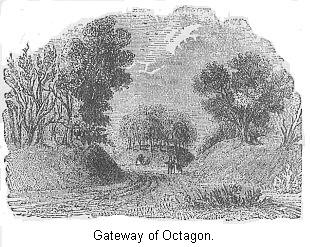
Connected with the Octagon by parallel walls three hundred feet long and
placed sixty feet apart, is the smaller circle, “F.” This is a true
circle, and is upwards of half a mile in circumference. A portion of it
lying in the woods, still retains its primitive form, but the larger part
is now under cultivation. There is no difficulty, however, in tracing its
entire length. The most interesting feature in connection with this part
of the work is immediately opposite the point of entrance from the
octagon, and is represented in our next cut. At this point it seems as if
the builders had started to make parallel walls, but afterwards changed
their design and threw across the opening a large mound. From this mound a
view of the entire embankment could be obtained. It is called the
Observatory Mound. It has been so often dug into that it is now really in
ruins, but is still too steep to be plowed over.
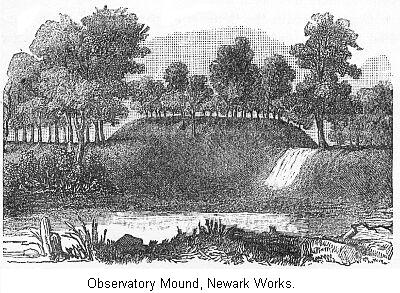
It is scarcely necessary to describe the works further, except to state
that three lines of parallel embankments lead away from the octagon. Those
extending south have been traced for upwards of two miles, and are
gradually lost in the plain. It was the opinion of Mr. Atwater, one of the
earliest investigators, that these lines connected with other works thirty
miles away, in the vicinity of Lancaster.68 Small circles are
numerous in connection with these works. It has been suggested by several
that they mark the sites of circular dwellings. The larger ones, indicated
by the letter “G,” are more pretentious. They have the ditch and
embankment, which we have already described. Many interesting coincidents
in dimensions will be perceived between portions of this work and those
described in the Scioto valley.69
Although we have devoted considerable space to this branch of the Mound
Builders’ work, we must still find space to describe the works at
Marietta, which possessed some singular features. This cut gives us a
correct plan of the works as they were when in 1788 the first settlers
arrived at the mouth of the Muskingum to lay out their town. The growth of
the beautiful town of Marietta has completely destroyed these works,
except the elevated squares, A and B, the large mound and inclosing circle
at X, with a portion of the adjoining embankments, and a small fragment of
the parallel walls forming what has been called the “Graded Way.” The
elevated squares are the finest examples of “temple” mounds remaining in
the Ohio Valley. The circle and ditch with the conical mound inclosed is
also a fine example of that class of works. From the summit of the mound
an extensive view is to be had both up and down the Ohio.
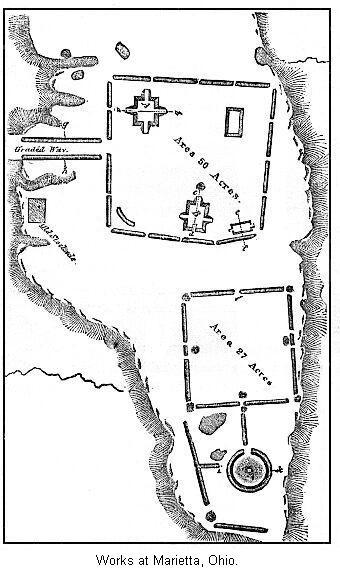
The gateways of the smaller square were guarded by mounds, which were
wanting in the larger one. We would call especial attention to the two
embankments which led from the larger square towards the river. They were
six hundred and eighty feet long, and one hundred and fifty feet apart.70
Some have supposed these walls were designed to furnish a covered way to
the river. But as Mr. Squier remarks, we would hardly expect the people to
go to the trouble of making such a wide avenue for this purpose, nor one
with such a regular grade. Besides, the walls did not reach the river. The
work seems to be simply a passage way, leading from one terrace to the
other, but why the builders should have made such a massive work, we can
not explain. It has been called the “Sacred Way,” and this name may
possibly be applicable, but it is only conjectural. Some twenty years ago
these two massive and beautiful embankments were still preserved, thanks
to the care of the early settlers, who planned a street to pass between
them, which was named the Via Sacra. These words still remain on a
corner signboard; but alas for sentiment! the banks, so long revered, have
been utilized for brick-working.
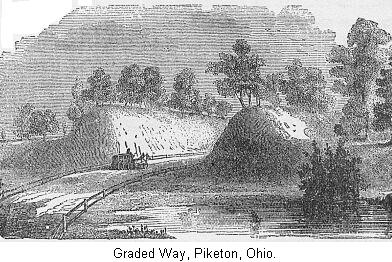
Several instances of these graded streets or ways have been found in
connection with the Mound Builders’ works. Sometimes they lead from one
terrace to another, sometimes directly to the water. One of the latter
kind formerly existed near Piqua, Ohio.71 This cut is a view of
a graded way near Piketon, Ohio. In this case, though the difference in
level between the second and third terrace is but seventeen feet, these
ancient people laid out a graded ascent some ten hundred and eighty feet
long, by two hundred and ten feet average width. The earth was thrown out
on either side, forming embankments. From the left hand embankments,
passing up to the third terrace, there could formerly be traced a low
embankment running for fifteen hundred feet, and connected with mounds and
other walls at its extremity.
Some have supposed that formerly the river flowed at the extremity of this
graded way, and a passage way to the water was thus furnished. Squier
says, in this connection: “It is sufficient to observe that the river now
flows half a mile to the left, and that two terraces, each twenty feet in
height, intervene between the present and the supposed ancient level of
the stream. To assent to this suggestion, would be to admit an almost
immeasurable antiquity to the structure under consideration.” The casual
observer would say that it was intended to afford an ascent from one
terrace to the other. But as the height was only seventeen feet, we can
not see why it was so necessary to have a long passage way of easy grade
from one terrace to the other. It was evidently built in connection with
the obliterated works on the third terrace. This interesting remain is now
utilized as a turnpike, and the passing traveler but little recks he is
going over one of the most ancient causeways in the land. It may be that
ceremonious processions, with stately tread, utilized this causeway in
years long since elapsed. Speculation, always an unsafe guide to follow,
is especially so in this case, and so we leave this memento of a vanished
people as much an enigma to us as to its first explorers.
We have described but a few of the sacred inclosures of Ohio, but enough
have been given to give us a fair idea of all. We wish now to call
attention to another class of remains. We have seen how the works we have
been describing are lacking in defensive qualities. This becomes more
marked, when we learn there are works, beyond a doubt, defensive in
character, in which advantage is taken of all circumstances which would
render the chosen retreat more secure. In the first place, strong natural
positions were selected. They chose for their purpose bluffy headlands
leading out into the river plain. A people surrounded by enemies, or
pressed by invaders, would naturally turn their attention to such heights
as places susceptible of defense. Accordingly, it does not surprise us to
find many heights occupied by strong and complicated works. Generally the
approaches to them were rugged and steep on all but one or two sides, and
there they are guarded by walls of earth or stone.
A fine example of a fortified hill was discovered in Butler County, Ohio,
a few miles below the town of Hamilton. This hill is the highest one in
the immediate vicinity. By reference to the figure, we see that on all
sides, except towards the north, the approach was steep and precipitous,
almost inaccessible.
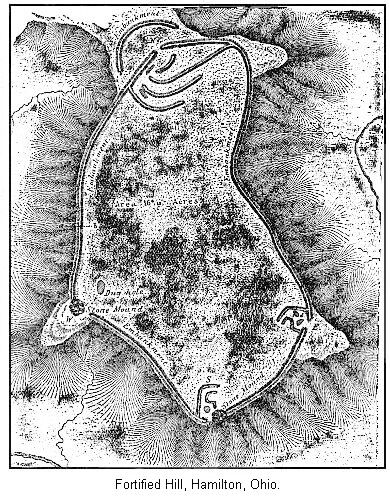
The wall is not of regular shape. It runs around on the very brow of the
hill, except in one or two places, where it cuts across a ridge. In 1843
this wall was still about five feet high and thirty-five feet base. The
earth and stone of which the wall is made were evidently gathered up from
the surface of the hill. In some places holes had been excavated, probably
for the double purpose of securing materials for the wall, and providing
reservoirs for water against a time of need. There are but four openings
in the wall, and each is very carefully guarded. The complicated walls
guarding the main entrance to the north are especially noticeable. There
are no less than four inner walls besides the crescent shaped embankment
on the outside. The signal mound was about five hundred feet to the north
of the main opening. The stones on the surface of the mound all show the
action of fire.
If we were uncertain of the uses of the other class of inclosures, which
have been named Sacred Inclosures, we have no need to hesitate as to the
character of this work. Every thing in reference to it betokens that it
was a defensive work. The valley of the Big Miami, in which it occurs, was
a favorite resort of the Mound Builders. On the opposite side of the
river, to the south, was a square and an ellipse combined, and several
other large works were ranged along the river in the course of a few
miles. We need scarcely doubt that this was a citadel in times of need,
and that when warning columns of smoke or flaming fires showed the
approach of an enemy, the old and the sick, the women and the children,
fled hither for protection, while the warriors went forth to battle for
their homes.
We will call attention to but one more of these fortified hills, but this
is on a magnificent scale. It is known as Fort Ancient, and is situated on
the Little Miami River, about forty miles east of Cincinnati. It was not
only a fort, but was also a fortified village site, and has some features
about it which are regarded as of a religious nature. The hill on which it
stands is in most places very steep towards the river. A ravine starts
from near the upper end on the eastern side, gradually deepening towards
the south, and finally turns abruptly towards the west to the river. By
this means nearly the whole work occupies the summit of a detached hill,
having in most places very steep sides. To this naturally strong position
fortifications were added, consisting of an embankment of earth of unusual
height, which follows close around the very brow of the hill. This
embankment is still in a fine state of preservation, but is now annually
exposed to cultivation and the inroads of cattle, so that it will not be
long before it will be greatly changed if no effort be made to preserve
it.
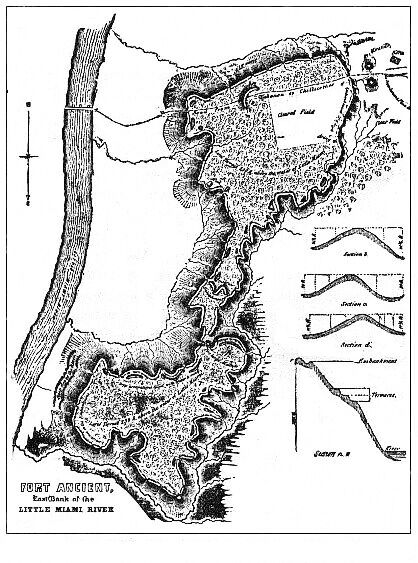
This wall is, of course, the highest in just those places where the sides
of the hill are less steep than usual. In some places it still has a
height of twenty feet. We notice the wall has numerous breaks in it. Some
of these are where it crosses the ravines, leading down the sides of the
hill. In a few cases the embankment may still be traced to within a few
feet of a rivulet. Considerable discussion has ensued as to the origin and
use of these numerous gateways. Mr. Squier thinks that these openings were
occupied by timber work in the nature of blockhouses which have long since
decayed. Others, however, think that the wall was originally entire except
in a few instances, and that the breaks now apparent were formed by
natural causes, such as water gathering in pools, and musk-rats burrowing
through the walls, and we are told that such an opening was seen forming
in the year 1847.72 No regular ditch exists inside the wall,
the material apparently being obtained from numerous dug holes.
It will be seen that the works could be naturally divided into two parts,
connected by the isthmus. More than one observer has pointed out the
resemblance in general outline of this work to a map of North and South
America, but of course the resemblance, if any, is entirely accidental.
Mr. Peet has called attention to the resemblance which the walls of the
lower inclosure bear to two serpents, their heads being the mounds, which
are separated from the body by the opening which resembles a ring around
the neck. Their bodies are the walls, which, as they bend in and out, and
rise and fall, much resembles, he thinks, two massive green serpents
rolling along the summit of this high hill. If any such resemblance
occurs, we think it purely accidental. In relation to the wall across the
isthmus, it has been thought to have been the means of defending one part
of the work should an enemy gain entrance to the other. It has also been
supposed that at first the fort was only built to the cross wall on the
isthmus, and afterwards the rest of the inclosure was added to the work.
The total length of the embankment is about five miles, the area enclosed
about one hundred acres. For most of this distance the grading of the
walls resembles the heavy grading of a railroad track. Only one who has
personally examined the walls can realize the amount of labor they
represent for a people destitute of metallic tools, beasts of burden, and
other facilities to construct it.
Now, what was the object of this work? We think it was not simply a fort,
but rather a fortified village. That it must have required the work of a
numerous body of people, is undoubted, and if they lived elsewhere, where
are the works denoting such a fact? We would further suggest that, if this
was the seat of a tribe, each of the two divisions might have been the
location of a phratry of the tribe, by a phratry, meaning the subdivision
of a tribe. We would call especial attention to the two mounds seen just
outside of the walls at the upper end. From these mounds two low parallel
walls extended in a north-easterly direction some thirteen hundred and
fifty feet, their distant ends joining around a small mound. As this mound
was not well situated for signal purposes, inasmuch as it did not command
a very extensive view, and as the embankments would afford very little
protection, unless provided with palisades, it seems as if the most
satisfactory explanation we have is that it was in the nature of a
religious work.
Mr. Hosea thinks he has found satisfactory evidence that between these
walls there was a paved street, as he discovered in one place, about two
feet below the present surface, a pavement of flat stones.73
From this, as a hint, he eloquently says: “Imagination was not slow to
conjure up the scene which was once doubtless familiar to the dwellers at
Fort Ancient. A train of worshipers, led by priests clad in their sacred
robes, and bearing aloft the holy utensils, pass in the early morning, ere
yet the mists have risen in the valley below, along the gently swelling
ridge on which the ancient roadway lies. They near the mound, and a solemn
stillness succeeds their chanting songs; the priests ascend the hill of
sacrifice and prepare the sacred fire. Now the first beams of the rising
sun shoot up athwart the ruddy sky, gilding the topmost boughs of the
trees. The holy flame is kindled, a curling wreath of smoke arises to
greet the coming god; the tremulous bush which was upon all nature breaks
into vocal joy, and songs of gladness bursts from the throats of the
waiting multitude as the glorious luminary arises in majesty and beams
upon his adoring people. A promise of renewed life and happiness. Vain
promise, since even his rays can not penetrate the utter darkness which
for ages has settled over this people.” Thus imagination suggests, and
enthusiasm paints a scene, but, from positive knowledge, we can neither
affirm nor deny its truth.
Most of the works of the Mound Builders are noticeable for their solidity
and massiveness. We see this illustrated in the great walls of Fort
Ancient. Some of our scholars think this is a distinguishing feature of
the Mound Builders’ work.74 It seems to us that it is difficult
to make this a distinguishing feature, as we have no means of knowing how
much “massiveness” is required in a work to entitle it to be considered a
work of the Mound Builders. Should this distinction be established,
however, we have to notice that while in the western part of the State of
Ohio the Mound Builders’ inclosures are more often of the defensive sort,
the type changes to the eastward, where, as in the Scioto Valley, we find
the so-called sacred inclosures in larger numbers. In the State of Ohio,
then, there were at least two well defined types of works by the Mound
Builders. But if we split the Mound Builders up into tribes, where shall
we draw the line between them and our later Indians?
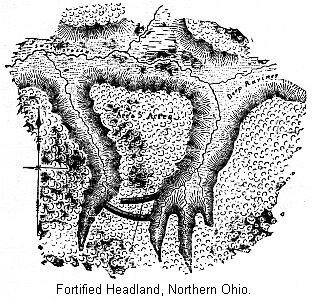
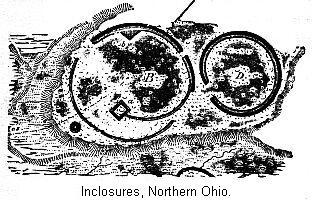
Scattered through Ohio, but especially abundant in the northern part of
the State, is a class of works which has excited considerable comment.
This cut illustrates a work of this kind. It was located near where
Cleveland now stands. The defense consists mainly in the location. The
wall seems to have been rather of a secondary affair. The hill was too
steep to admit approach to it except from the rear, where the double wall
was placed. With both of these works a ditch was dug outside the wall.
These works did not always consist simply of fortified headlands. This cut
is of a portion of the works formerly existing near Norwalk, Ohio. The
circular work, D, is shaped much like the sacred inclosures, though not on
so large a scale. In the larger work, at B, we notice a truncated mound.
The ditch is on the outside of the circles. This cut is of a work formerly
on the banks of the Black River. Here we have a square inclosure, defended
by two embankments and a ditch.
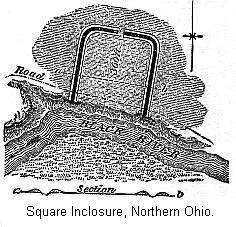
This class of works was formerly common not only in Ohio and Western New
York, but they were also to be observed in other sections of the country.
They existed alike in the valley of the two Miami Rivers, and in that of
the Scioto. They were also found throughout the South. Even Wisconsin, the
home of the effigy Mound Builders, is not destitute of this class of
remains. The peculiar interest attaching to them arises from the fact that
in some places, at least, we have good reason to assign their construction
to Indian tribes. Those of Western New York were very thoroughly studied
by Mr. Squier. When he commenced his investigations, he was under the
impression that he was dealing with the remains of a people very similar,
at least, to those who built the massive works in the Ohio Valley and
elsewhere, but he was led to the conviction that they were the works of
the Iroquois Indians, and as further proof that such was the case, we are
told that since the palisades that once inclosed places known to be
villages of the Iroquois have disappeared, there is no difference to be
observed between the appearance of the ruins of such a village site and
any of the earthworks in Western New York. But we have just stated that
the remains last mentioned are identical with those found in Northern
Ohio, and indeed over a wide extent of country. The conclusion seems to
be, then, that one large class of works in many points resembling Mound
Builders’ works, found widely distributed throughout the Mississippi
Valley, were really the works of Indians.75 But we are
approaching a subject we do not wish to discuss just yet. We simply point
out that not all the remains of prehistoric people in the Mississippi
Valley are referable to the Mound Builders.
We have tried to point out the more important works that are ascribed to
them. It must of necessity occur in a work of this nature that the review
should be very brief, yet we have touched on the different classes of
their works. But before leaving this part of our field we must mention
some anomalous works, and refer to others which, if they can be relied on
as works of the same people, certainly imply a great advance on their
part.
Our next cut is named by Mr. Pidgeon the “Sacrificial Pentagon.” Writing
in 1850, he states, “This remarkable group . . . has probably elicited
more numerous conjectures as to its original use than any other earth-work
yet discovered in the valley of the Mississippi. . . . It is situated on
the west highlands of the Kickapoo River, in Wisconsin.”76 Mr.
Pidgeon claims to have discovered two of these pentagons. We are not aware
that any one else has verified these discoveries, and it is difficult to
decide what value to give to his writings. He claims to have made
extensive researches around the head-waters of the Mississippi as early as
1840, and there to have met an aged Indian—the last of his tribe—who
gave him many traditions as to the mounds in that locality. Most of our
scholars think his writings of no account, whatever, and yet Mr. Conant
says, “He seems to have been a thoroughly conscientious and careful
observer, faithfully noting what he saw and beard.”77
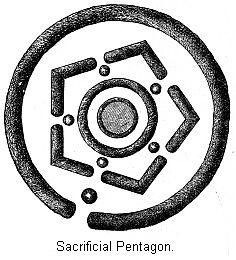
We will briefly describe a few of the earth-works he mentions, notice
their singular form, and give an outline of the traditions in regard to
them, leaving the reader to draw his own conclusions. Of this work the
outer circle is said to have been twelve hundred feet in circumference,
the walls being from three to five feet in height; width on the ground
from twelve to sixteen feet. The walls of the pentagon were from four to
six feet high. The inner circle was of very slight elevation. The central
mound was thirty-six feet in diameter. This singular arrangement of
circle, pentagon, and mounds, is traditionally represented to have been a
sacred national altar—the most holy one known to tradition—and
no foot, save that of a priest, might pass within the sacred walls of the
pentagon after its completion. The sacrifice offered on this altar was
that of human life. Twice each year the offering was made.78
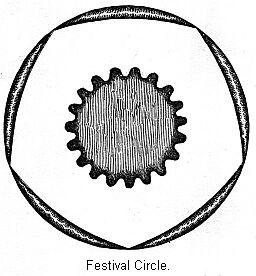
The work represented in the figure at left is stated to have been in the
near neighborhood of the former, and to have been intimately connected
with it. Mr. Pidgeon claims to have found five of these circles and two
pentagons. So far as we know, he is the only authority for their
occurrence, no one else having been so fortunate as to have found them.
This is surely a singular work, and we can not fail to recognize in it a
representation of the sun and the moon. In excavating in the central
mound, we are assured that small pieces Of mica were found abundantly
mixed with the soil. “Had the surface-soil been removed with care, and the
stratum beneath been washed by a few heavy showers of rain, so thoroughly
studded was it with small particles of mica, that under the sun’s rays it
certainly would have presented no unapt symbolic representation of that
luminary.”79
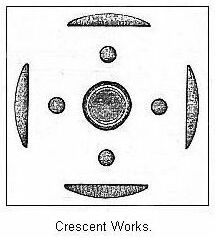
Our next figure is another singular arrangement of crescent-shaped works
and mounds. Lapham says that crescent-shaped works are found in Wisconsin.
Pidgeon says that crescent works are found in Illinois, but works arranged
as shown in this wood-cut he found in but four places in Wisconsin. Could
we verify this author’s statements, this illustration and the preceding
one would be very good evidence of the prevalence of sun-worship among the
effigy Mound Builders of Wisconsin. This would be nothing singular, since
the Indian race almost universally reverenced the sun.80
The figure below represents a group of works which, we are told, were of a
class formerly abundant in Missouri and Iowa. The embankments are stated
to be of varying heights, but all of the same length. They do not quite
meet, but a mound defends the opening. Sometimes a square is so
represented, and sometimes but two walls.
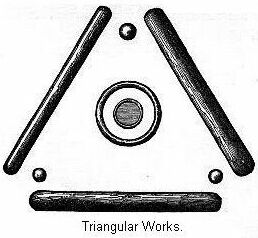
A singular statement is made in reference to a nice proportion said to be
observed between the heights of the embankments and walls. In this case,
for instance, the heights of the embankments are, three, four, and five
feet; the sum of these, twelve feet, was the exact height of the central
mound. Furthermore, the square of the sum of the heights of three
embankments gives us one hundred and forty-four feet, which is the length
of the embankments. We are gravely assured that this same nice proportion
is always observed in works of this kind. The embankments being always of
equal length, but of varying heights, still the sum of these heights,
whether three or four sides, being always equal to the height of the
central mound.81 We do not know of any specimen of this class
of works now existing. If this early explorer’s account be reliable, then
we have in works of this class very good evidence that some of their
inclosures were in the nature of sacred inclosures. The trouble is to
verify Mr. Pidgeon’s account. There is a good deal that is strange and
marvelous in reference to the Mound Builders, and we must use judgment as
to what is told us, unless we are sure there is no mistake, or unless the
reports are vouched for by many observers.
We wish to call attention to some singular works in Missouri, which would
imply that the Mound Builders were possessed of no little engineering
skill. We have every indication that near New Madrid was a very extensive
settlement. The works consist of inclosures, large and small mounds in
great numbers, and countless residence sites. One of fifty acres was
noticed, which had evidently been inclosed by earthen walls. In some
places in the forest, where this wall had been preserved, its height was
found to be from three to five feet, and its base width fifteen feet.82
But the suggestive features about these works are noticed along the edge
of the swamp near which they stood. This swamp in 1811 was a lake, with a
clear, sandy bottom. It is not at all doubted but that it was at one time
the bed of the Mississippi River, and probably this town stood on its
banks. The river is now some eighteen miles away. It must suddenly have
changed its course, leaving behind it a lake, which, in course of time,
became a swamp.
But along the shores of this ancient lake, in front of the inclosure,
small tongues of land have been carried out into the water, from fifteen
to thirty feet in length, by ten, or fifteen in width, with open spaces
between, which, small as they are, forcibly remind one of the wharfs of a
seaport town. The cypress trees grew very thickly in all the little bays
thus formed, and the irregular, yet methodical, outlines of the forest,
winding in and out close to the shore of these tongues of land, is so
marked as to remove all doubt as to their artificial origin.83
The suggestion is made in view of these wharfs, that the Mound Builders
must have had some sort of boats to navigate the waters of the lake.
And the singular part is, that right in this neighborhood are many
evidences of a system of canals. A glance at the map will show that the
portion of Missouri around New Madrid, and to the south of it, is dotted
with swampy lakes and sluggish bayous. The evidence is to the effect that
the ancient inhabitants connected these bayous and lakes with artificial
canals, so as to form quite an extended system of inland water-ways. Right
east of the town of Gayoso, we are told that a canal had been dug that now
connects the Mississippi with a lake called Big Lake. A bayou running into
this lake was joined by a canal with Cushion Lake.
From this last lake, by means of bayous and lakes, a clear course could be
pursued for some miles north, where finally another canal was cut to join
with the Mississippi a few miles below New Madrid. The entire length of
this water way was some seventy miles, but we are not told how much of it
was artificial, neither are the dimensions given. Prof. Swallow speaks of
a canal “fifty feet wide, and twelve feet, deep.” Whether this was one of
this series or not, we do not know.84 This is indeed a singular
piece of work. It would be more satisfactory if we had more definite
information in regard to the same.
With our present knowledge of the state of society among the Mound
Builders, as made evident by the remains of their implements and
ornaments, we are not justified in believing this part of a system of
internal navigation. We have already seen that further south they
sometimes surrounded their village sites with a wide and deep moat or
ditch, as was observed around the inclosure containing the great mound on
the Etowah. We are inclined to believe that a more careful survey would
greatly modify the accounts we have of these canals, if it did not, in
fact, show that they were the works of nature. According to a writer in
the American Antiquarian,85 the whole lower part of the
Mississippi Valley was abundantly supplied with canals, irrigating
ditches, and evidences of a high intelligence. He speaks of observing the
presence of an extensive canal a little north of the section we have
described. He asserts they were dug to convey the surplus waters of the
Mississippi in times of flood to the White and St. Francis Rivers, thus
preventing disastrous overflows. It is needless to caution the reader
against such conclusions. Our information in regard to those canals is far
too limited to support the views advanced.
This finishes our examination of the works of the Mound Builders. Except
in the case of the more massive works, they have become obliterated, but
here and there are left traces of the former presence of these now
vanished people. The antiquary muses over the remains of their inclosures,
their fortified places, their effigies and mounds. By the combined efforts
of scholars in many departments, we may yet hope that the darkness now
enshrouding this race may be dissipated, but at present our positive
knowledge is very limited indeed. It is as if we were asked to reconstruct
a picture which had faded in the lapse of time so that only traces here
and there are visible. Here, perhaps, a hand is seen; there a piece of
foliage; in one place something we think representing water, in another a
patch of sky, or a mountain peak. Until a key is found which shall show us
how to connect these scattered parts, our efforts are useless, since many
pictures could be formed, but we have no surety we are right. So we may
form mental conceptions of the Mound Builders, but they are almost as
varied as the individual explorers. Science may yet discover the key which
will enable us to form a clear mental conception of the race which
flourished here many years ago, and left their crumbling memorials to
excite the curiosity of a later people.
We must now turn our attention to another branch of inquiry and learn what
we can of the culture of the Mound Builders. This is to be determined by
an investigation of the remains of their implements, weapons, and
ornaments. When we know the skill with which they manufactured these
articles, and gain an insight into some of their probable customs, we
shall know where to place them in the scale of civilization. What we have
learned of their works has already convinced us that we are dealing with a
people considerably above the scale of Savagery. The nice proportion
between the parts, the exact circles and coincident angles show
considerable advance in mechanical skill. The character of the works
indicates that the people had permanent places of abode, and were not
subject to the vicissitudes of a hunter’s state of life for subsistence.
This implies that we are dealing with a people living in village
communities, practising agriculture and many other arts, and therefore
entitled to rank in the middle status of Barbarism corresponding to the
Neolithic inhabitants of Europe.86 We will now see how far this
conclusion is sustained by an examination of the remains of the handiwork
of the people.
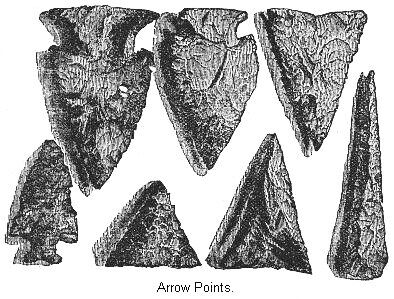
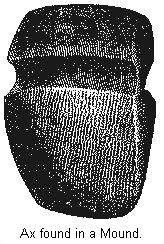
Implements of stone are of course abundant. But men, when in the culture
of the Stone Age, having a common material to work upon, and under the
pressure of common needs, have everywhere provided similar forms. For this
reason it is hard to find distinctive points of difference between
implements of stone of Mound Builders’ work and a series of similar
implements the work of Indians. We are assured, however, that when
examining a series of each, those of the Mound Builders display a superior
finish.87 The preceding wood-cut represents a collection of
arrow-points found in the mounds, but they are not particularly so
distinguishable from specimens found on the surface. Great numbers of
arrow-points are occasionally found on altars. Here we have a view of one
of the stone axes fashioned by the hands that heaped the mounds. It is
certainly a very fine specimen.
The Mound Builders must have had all the varieties of stone implements
common to people in their stage of culture, such as axes, fleshers, and
chisels. They also must have possessed mortars and pestles for grinding
corn, and some implements did duty as hoes and spades. We represent in a
group a collection of weapons and implements from the mounds and stone
graves of Tennessee. All these articles are finely finished. One of the
axes has a hole bored through it. One of them is further provided with a
stone handle, and is characterized as being the “most beautiful and
perfect stone implement ever exhumed from the aboriginal remains within
the limits of the United States.”
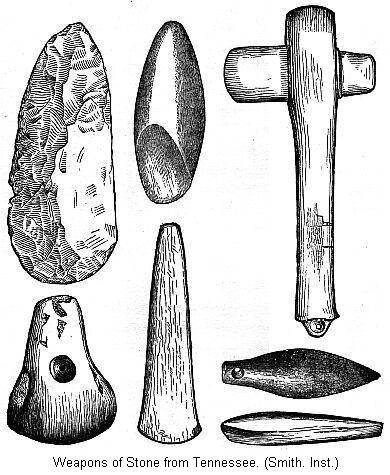
People in the culture of the Stone Age make but very rare use of metal, as
metals are to them simply varieties of stone, much less useful for their
purpose than the different kinds of flints, except for ornaments. From the
altar mounds, near Cincinnati, were taken ornaments of silver, copper,
iron and traces of gold, all of which had been worked into their present
shape by simply hammering. The iron, it should be remarked, was meteoric
iron, which can be hammered as easily as native copper. We have already
remarked that about the only native iron is obtained from such sources.
Copper was utilized for a great variety of purposes.
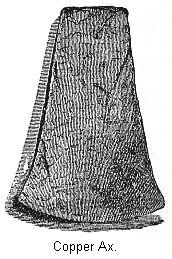
We give a cut of a copper ax found in one of the Ohio mounds. Copper axes
have lately been found quite frequently in mounds near Davenport, Iowa,
and in most cases before being deposited in the mounds, they had been
wrapped in cloth. Copper ornaments are a more common find. Bracelets,
beads, and ear ornaments are numerous. Our next cut represents some very
fine bracelets found in a mound near Chillicothe, Ohio, Copper tools and
weapons have been found quite frequently on the surface, but we are not
sure in this case whether they are not the work of recent Indians. The
early explorers noticed the presence of copper ornaments among the
Indians. “When Henry Hudson discovered, in 1609, the magnificent river
that bears his name, he noticed among the Indians of that region pipes and
ornaments of copper.” The account says: “They had red copper tobacco
pipes, and other things of copper they did wear about their necks.”88
De Soto also noticed among the Southern Indians axes of copper. Other
accounts could be quoted showing that the Indians were well acquainted
with copper.89 The fact is, in this matter also, it is
impossible to draw a dividing line between relics of the Mound Building
tribes and the Indians. However, the Mound Builders were certainly
acquainted with copper, but to their minds it was only a singular stone,
one that they could hammer, into a desired shape.
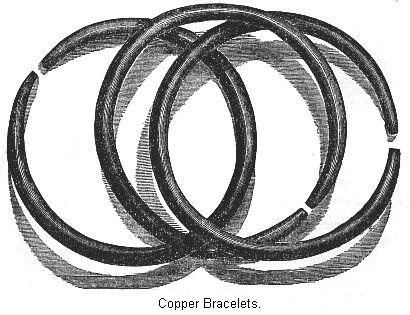
Where did they obtain their copper? We are all aware that in this country
great supplies of pure copper exist near the southern shore of Lake
Superior, and there is a peculiarity about the copper found there, that
is, the presence of small pieces of silver with the copper. This is a very
singular mixture, and we are not aware of its occurrence elsewhere. It
would trouble the best chemists to explain it. From this fact we are
enabled to identify articles of copper derived from that source, and to
that region we can trace the copper from which are formed most of the
copper implements and ornaments found in this country. It is also
noticeable that the nearer we get to this region the more numerous are the
finds of articles of copper. More are reported from Wisconsin than the
rest of the United States put together.
This leads us to a very interesting subject. In 1848 Mr. S. O. Knapp,
agent of the Minnesota Mining Company on the northern peninsula of
Michigan, discovered that the modern miners were but following in the
footsteps of some ancient people who had mined for copper there some time
now far past. The general conclusion is that these old miners were Mound
Builders, but here the evidence of their presence is not found in the
existence of mounds and earthworks, but of pits and excavations, which, by
the slow accumulation of years, had become filled to near the surface with
débris of various kinds. Many had noticed these little pits
and depressions without suspecting they had aught to do with the presence
of man. The hollows made by large trees, overturned by the wind,
frequently left as well marked depressions as these excavations.
We have abundant proof that these old miners were practical workmen. They
evidently did not neglect the most trifling indication of metals. They
made thorough research and discovered the principal lodes. Our present day
miners have long since learned to regard the presence of these ancient
pits as excellent guides in this matter. With modern appliances they
penetrate far beyond the power of the old workmen. At the Waterbury mine
there is in the face of the vertical bluff an artificial opening, which is
twenty-five feet wide, fifteen feet high, and twelve feet deep. The
materials thrown out in digging had accumulated in front, and on this
forest trees common to that region were growing of full size. Some of the
blocks of stone which were removed from this recess would probably weigh
two or three tons, and must have required the use of levers to move them.
Beneath the surface rubbish was discovered the remains of a cedar trough,
by which the water from the mines was conducted away. Wooden bowls were
found, which were probably used to dip the water from the mine into this
trough.
Near the bottom of the pit, shovels, made of cedar, were found, shaped
much like a canoe paddle, but showing by their wear that they were used as
shovels. Although they appeared solid while in water, yet, on drying, they
shrunk up, and were with difficulty preserved. A birch tree, two feet in
diameter, was observed growing directly over one of these shovels. No
marks of metallic tools were observed anywhere about this large pit.
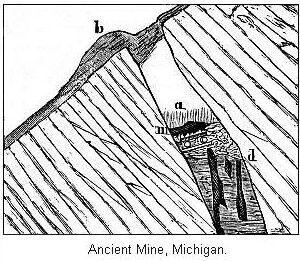
In this case they constructed a sort of a cave, but in many cases they
mined open to the air, that is, they simply dug trenches or pits. A row of
these ancient pits, now slight depressions, indicate a vein. What they
seem to have especially sought after was lumps of copper that they could
easily manage and fashion by hammering. They had not discovered the art of
melting. When they found an unusually large piece, they broke off what
they could by vigorous hammering. In one case they found a mass weighing
about six tons of pure copper. They made an attempt to master this piece.
By means of wedges they had got it upon a cob-work of round logs or skids,
six or eight inches in diameter, but the mass was finally abandoned for
some unknown reason after breaking off such pieces as they could until the
upper surface was smooth. This mass rested on the framework of logs while
the years came and went, until, after the lapse of unknown time, the white
men once more opened the old mine.
On the rubbish in front of this mine was standing the stump of a pine tree
ten feet in circumference. These ancient mines are found not only on the
main-land, but on the islands off the coast as well. The only helps they
seem to have employed was fire, traces of which are found everywhere, and
stone mauls and axes. The mauls consist of oblong water-worn bowlders of
hard tough rock, nature having done every thing in fashioning them except
to form the groove, which was chiseled out around the middle. Some copper
implements were also found.
Col. Whittlesey, from whose writings we have drawn the foregoing,
concludes that these mines were worked by the Mound Builders. As he finds
no traces of graves or houses, or other evidence of a protracted stay, he
thinks they were worked only through the Summer season of the year by
bands of workmen from the south.
As to what caused the abandonment of the works we do not know. It might
have been an impulse of their race hurrying them on to some distant
migration; or, more probably, pressed by foes from without, they were
compelled to abandon their ancient homes. Whatever the cause was, nature
resumed her sway. Forest trees crept up to and grew around the mouths of
the deserted mines. Col. Whittlesey concludes from the group of trees
growing on the top of the rubbish heap that at least five hundred years
passed away before the white man came from the south to resume the work of
his ancient predecessor.90
It is not, however, proven that the Mound Builders were the sole workers
of these ancient mines. It is known that the Indians mined for flint. Some
of the excavations for this purpose, in what is known as Flint Ridge, in
Muskingum County, Ohio, are as marked as the traces of ancient mining in
Michigan. Similar appearances are recorded in Missouri. As copper was in
demand among the Indians, and as it is probable that they obtained much of
it from the North, they may have continued to work the ancient copper
mines until comparatively recent times. Mr. Lapham believes that the
progenitors of the Indian tribes found dwelling in the regions near these
mines, carried on mining operations there. Dr. Rau thinks it probable that
small bands of various Northern tribes made periodical excursions to the
locality, returning to their homes when they had supplied themselves with
sufficient quantities of the much-desired metal. The fact that many of the
modern Indian tribes knew nothing about these mines is not of much weight,
when we reflect how easily a barbarian people forget events, even those of
a striking nature.
We are apt to judge the culture of a people by the skill they display in
works of arts. The article on which the Mound Builder lavished most of his
skill was the pipe. This would show that with them, as with the modern
Indians, the use of the pipe was largely interwoven with their civil and
religious observances. In making war and in concluding peace, it probably
played a very important part. “To know the whole history of tobacco, of
the custom of smoking, and of the origin of the pipe, would be to solve
many of the most interesting problems of American ethnology.”91
The general decoration consisted in carving the bowl of the pipe into the
shape of some animal or bird. In some instances we have carved
representations of the human head. Such as these are of particular
interest and value, as they are probably faithful representations of the
features of the Mound Builders. This is a fine specimen found in one of
the altar mounds in Ohio. The method of wearing the hair is worthy of
notice. The holes placed in a row encircling the forehead and coming down
as low as the ears, were once filled with pearls. In some they still
remained when found, though they had been burned in the fire. The lines
upon the face obviously imitate the custom of tattooing the countenance.
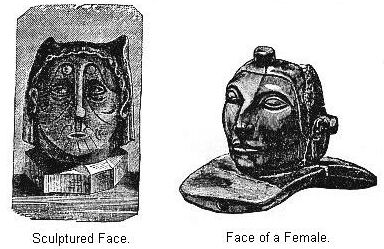
Scholars have called attention to the fact that Humboldt discovered in
Mexico a small statue which he supposed represented an Aztec priestess.
This statue had sculptured upon its forehead a row of pearls, worn in the
same manner as is represented in this pipe. This is another pipe of great
interest, and is supposed to represent the head of a woman. The
countenance is expressive, the eyes prominent, and the lips full and
rounded. We must notice again the headdress. While the faces are of Indian
type, the method of wearing the hair is different from that of the typical
Indian of the North.
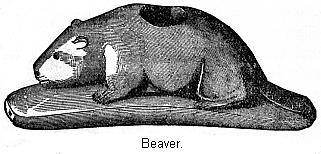
The animal forms into which the pipe-bowls are carved, are also full of
interest. This is not so much on account of animal forms themselves as the
insight we gain as to the artistic skill of the people who fashioned the
pipes, and in various ways learn of bits of customs and manners peculiar
to them. Here we have figured a pipe, the bowl of which is carved to
represent a beaver. No one need hesitate as to the animal which the carver
had in mind. It is represented in a characteristic attitude, and has the
broad, flat tail of its species. It must have required no little skill and
patient labor to work a rough stone into this finished pipe, especially
when we remember that the maker had no edged tools with which to work.
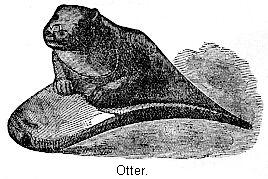
We can not always determine the animal which the artist had in mind. In
this illustration we have figured such a pipe. Considerable discussion has
arisen as to the animal represented. Some cases of this nature have been
thought to show either migration from a distant country on the part of the
maker or else an extended system of trade.
Squier and Davis, who first figured it, supposed it to represent a
manatee, or sea-cow. This animal is essentially a tropical species, the
only known place where it was found in the United States being Florida.
From the presence of this carved specimen, found a thousand miles to the
north, some interesting queries, as the origin of the mound-building
tribes, and the state of life among them, were raised. It is almost
certain, however, that the animal intended to be represented was the
otter.92
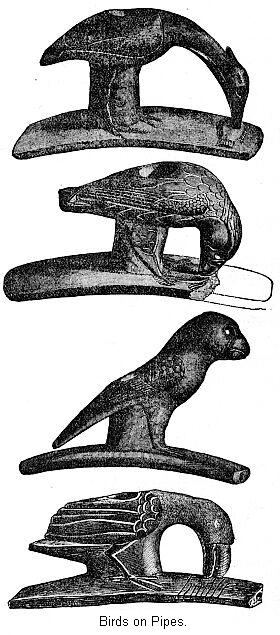
The most general form of sculpture was that of birds, and we find
specimens of almost all the common varieties. In this group we recognize
the tufted heron striking a fish; the eagle, or hawk, tearing a smaller
bird; the swallow, apparently just ready to fly; and in the last figure,
one that has given rise to a good deal of discussion. Some think from the
circumstance of its having a very large bill, toes pointing behind as well
as before, that it represents a toucan, which, if true, would make it a
most interesting specimen. But cautious scholars conclude that the “figure
is not of sufficient distinctness to identify the original that was before
the artist’s mind.” And therefore it is not wise to make this specimen the
subject of a far-reaching speculation.93
It may be of interest to inquire whether the Indians made pipes as
tastefully ornamented as those we have described. We should notice that
all the pipes here described are from one very limited locality in Ohio,
and that is the valley of the Scioto, the same section of country where
were found the great inclosures of a mathematical shape. We have no reason
for supposing that the Mound Builders generally throughout the Mississippi
Valley had this artistic skill. We have seen nowhere any thing to show a
superiority for them in this respect. Whatever conclusion can be drawn
from those pipes, applies only to the tribe in the Scioto Valley. It is
believed they do constitute a peculiar class by themselves. As works of
art, there are but few aboriginal relics of North American origin their
equal.94
We would also refer to the fact that most of these specimens were obtained
from one altar-mound.95 We do not know what ceremonies were
performed around this altar, but if it were a place of burial or
cremation, they might have been the obsequies of some distinguished maker
of pipes. That such a person would be the recipient of honor, is not
singular, for “the manufacture of stone pipes, necessarily a painful and
tedious labor, may have formed a branch of aboriginal industry, and the
skillful pipe carver probably occupied among the former Indians a rank
equal to that of the experienced sculptor in our times.” Among the Ojibway
Indians, we are told, are persons who possess peculiar skill in the
carving of pipes, and make it their profession, or at least the means of
gaining, in part, their livelihood. One “inlaid his pipes very tastefully
with figures of stars, and flowers of black and white stones. But his work
proceeded very slowly, and he sold his pipes at high prices.”96
So we see how cautious we must be about drawing inferences from this
peculiar class of pipes found in one limited locality.
The knowledge of how to manufacture pottery is justly regarded as a
turning point in the advance of primitive man along the weary road that
brings him at last to civilization. At this point he ceases to be a
savage, and enters the confines of Barbarism.97 The skill shown
in using this knowledge is one of the many things we have to take into
consideration in determining the rank of a people in the scale of
enlightenment. The Mound Builders were evidently quite well along in the
potter’s art; and as they have left behind them many examples of their
work, we must try and acquaint ourselves with some of the more important
varieties.
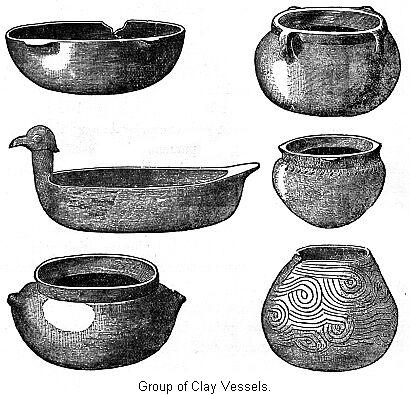
This illustration is of a group of clay vessels of the bowl pattern, found
in mounds in different parts of the Mississippi Valley. In one of these we
see a good example of the style of ornamentation by means of incised
lines. In the duck-headed vessel we have a representation of a class of
vessels common in Missouri and Tennessee. Not unfrequently one or both of
the handles of vessels of this class is in the form of a human head
instead of that of an animal. Our next illustrations represent a group of
such specimens. Judging from the skill with which they imitated animals,
it is not unreasonable to believe that in these faces we have rude
likenesses of the people who made them.
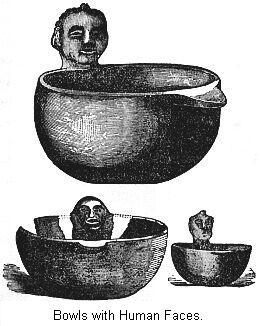
The two bottle-shaped vessels here figured, are from mounds in Louisiana.
As will be noticed, the ornamentation is quite artistic. The ware is of a
good quality, and they are good examples of the Mound Builders’ art. The
form with the long neck is perhaps a water-cooler. When filled with water,
and allowed to stand, some of the water passes through the pores, and
evaporating, keeps the surface of the vessel cool.
They also made some vessels of large size to serve for cooking purposes.
On some of the larger vessels the imprint of woven weeds and willows of a
basket on the outer surface leads to the belief that such vessels were
formed or moulded within baskets. Many large pots and urns, however, were
made without this aid. Some large urns were used for burial purposes. In a
Michigan mound an urn about three feet in height had been so used. It was
standing upright, and into it the whole skeleton of a man had been
compressed, and a closely-fitting lid covered the top.98 Very
large, shallow vessels were used to manufacture salt—that is, they
were filled from some salt-spring, and then the water was evaporated,
leaving the salt. In localities near salt-springs, thick fragments of rude
earthenware have been found that must have come from vessels as large as
barrels.
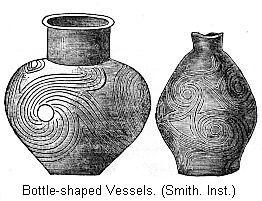
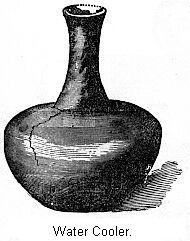
In the next group we have representations of a singular class of vessels.
In some cases the mouth and neck of the vessel is shaped in imitation of
animals. In the smallest one we recognize the head of a man, with an
opening in the back of the head. Many vessels of this form are known, and
a great many different animal heads are represented. The fish-shaped
vessel is a curious one. The one figured evidently represents a sun-fish.
The long vase or jug is in the shape of a child’s leg, with an opening in
the heel.
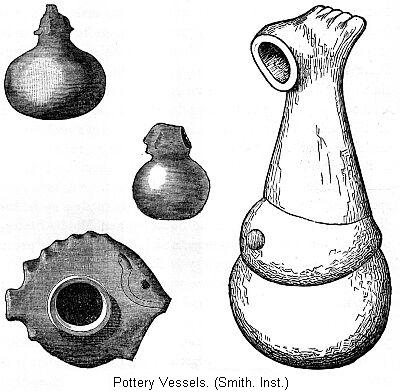
Some very beautiful vessels of the character of those we have figured,
have been found in Missouri. One enthusiastic explorer says, “Perhaps we
have very few modern artists who could equal those ancient pottery makers
in taste, skill, curious design, and wonderful imitation of nature. Birds,
beasts, fishes, even the shells on the river shore, have an exact
counterpart in their domestic utensils.” “While digging in one of these
pottery mounds in Missouri, we unearthed a large tortoise. We thought it
was alive, and seizing it, to cast it into the woods for its liberty, we
were suddenly surprised to find our tortoise was an earthen vessel in that
shape. In the same mound we uncovered a huge shell—the single valve
of a unio. Closer inspection revealed that it was a perfect earthen
vessel. Following these came a perfect fish, exhibiting, to our
astonishment, the scales, fins, and peculiarities of that species of fish
in detail.”99
We must leave this interesting part of our subject. An entire volume would
scarcely do justice to it, but for the sake of comparison, we must inquire
as to the state of this art among the Indian tribes. It seems that before
the arrival of the whites, the Indian tribes throughout North America,
with few exceptions, were apt potters. The whites, however, soon supplied
them with superior utensils of metal, so, that the majority of the Eastern
tribes soon lost the knowledge of the art. It lingered longer among the
tribes of the South, and of the interior, and even to this day the Pueblo
tribes of New Mexico and Arizona make an excellent article of pottery.
Early travelers wrote in high terms of the skill of the Southern Indians
in this matter. Du-Pratz thought so highly of the work of the Natchez
Indians that he had them make him an entire dinner set.
Catlin, speaking of the Mandan Indians, says the women of that tribe made
great quantities of dishes and bowls, modeled after many forms. He says
they are so strong and serviceable that they cook food in them by hanging
them over the fire, as we would an iron pot. “I have seen specimens,” he
continues, “which have been dug up in Indian mounds and tombs in the
Southern and Middle States, placed in our Eastern museums, and looked upon
as a great wonder, when here this novelty is at once done away with, and
the whole mystery: where women can be seen handling and using them by
hundreds, and they can be seen every day in the summer, also, moulding
into many fanciful forms, and passing them through the kilns, where they
are hardened.”
Dr. Rau, speaking of the artistic skill of the Indian potters, as shown by
numerous remains gathered in Illinois, does not hesitate to assert, after
personal examination of Mound Builders’ pottery, that the Indian relics
were in every respect equal to those specimens exhumed from the mounds of
the Mississippi Valley.100 Lapham, speaking of fragments of
Mound Builders’ pottery in Wisconsin, says, “They agree in every respect
with fragments found about the old Indian villages.”
The culture of a people is also determined by their knowledge of
agriculture. The savage depends entirely upon hunting and fishing for
subsistence. A knowledge of horticulture, of domestic animals, and of
agriculture, even though rude, are each and all potent factors in
advancing man in culture. So we must inquire as to the traces of
agricultural knowledge observable among the remains of the Mound Builders.
Some writers speak in quite glowing terms of the enormous crops they must
have raised for their populous cities. The fact is, that while it is
doubtless true that they practiced agriculture, yet we have no reason to
suppose it was any thing more than a rude tillage, such as was practiced
among the village Indian tribes. This is evident from the tools with which
they worked.
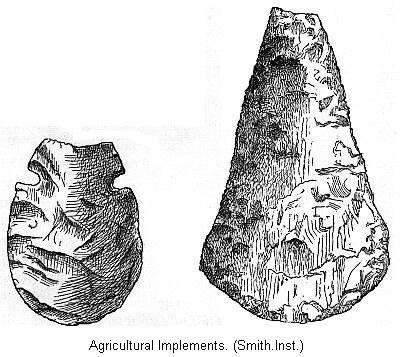
In a few cases copper tools have been recovered which may have served for
digging in the ground, but in most cases their art furnished them nothing
higher than spades, shovels, picks, and hoes made of stone, horn, bone,
and probably wood. In this cut are specimens of such agricultural tools.
These were doubtless furnished with handles of wood. The notched one was
perhaps provided with a handle at right angles to it, so as to constitute
a hoe. That we are right in regarding these implements as agricultural
tools, is shown not only by their large size, but also by the traces of
wear discovered on them. We must admit, however, that agriculture carried
on with such tools as these, must have been in a comparatively rude state.
In this connection we must refer to the garden beds noticed in some
places. We read that in Western Michigan the so-called garden beds are a
distinguishing feature of the ancient occupation, often covering many
acres in a place, in a great variety of forms, both regular and grotesque.101
These seem from the above account to be very similar to the garden beds of
Wisconsin. Dr. Lapham tells us that in the latter State they consist of
low, broad, parallel ridges, as if corn had been planted in drills.
The average four feet in width, and the depth of the walk between them is
six inches. Traces of this kind of cultivation are found in various parts
of the State. We are also referred to the presence of garden mounds in
Missouri, but in this case the low mounds are of the same mysterious class
that Prof. Forshey says occur by millions in the South-west, and may not
be the work of man. Just what the connection is between the garden beds
and the Mound Builders is hard to determine. Mr. Lapham thinks that those
in Wisconsin were certainly later in date than the mounds. He observed
that they were frequently constructed right across the works of the Mound
Builders. This would seem to imply that the makers were not one and the
same people.
As to the government and religion of the Mound Builders, all is
conjecture. On both of these points a great deal has been assumed, but
when we try to find out the grounds on which these theories rest we
quickly see how little real foundation there is for any knowledge on this
subject. If we are right in our views as to the effigy mounds of
Wisconsin, then a sort of animal worship prevailed. Whether the great
inclosures in the Scioto Valley were of a religious nature or not is very
doubtful. The great serpent mound was probably an object of worship. The
assertion is quite frequently made that the Mound Builders were sun
worshipers, which may be correct, but we must observe that we have no
proofs of it in the works they have left. We judge it to be true only
because sun-worship was probably a part of the religion of a large
proportion of the Indian race, and because we find special proofs of its
existence among some of the Southern Indians who are supposed to be
closely related to the Mound Builders.
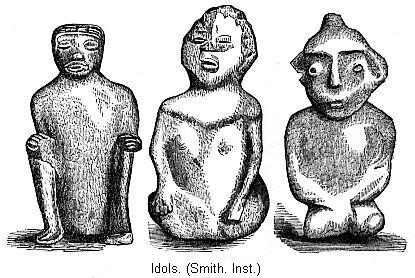
As we approach the South, we meet with what are supposed to be rude and
uncouth idols, but they have not been found under such circumstances as to
make it positive that they belonged to the Mound Builders. In this
illustration we have two idols, considered to be genuine relics of the
stone-grave people of Tennessee. The first one is an Aztec idol found at
Cholula, and introduced here simply for comparison. What position these
idols held in connection with the religion of the race, we are not
prepared to say.
Similar remarks might be made as to the system of government. A number of
writers, taking into account the immense labor involved in constructing
some of the works, have insisted that the people must have lived under a
despotic form of government, one in which the state had unlimited power
over the lives and fortunes of its subjects.102
There is no real foundation for such views, and we think they are
misleading. No one doubts but that the Mound Builders were living in a
tribal state of society. If so, they doubtless had the usual subdivisions
of a tribe. This point we remember afforded us some insight into the
meaning of the effigy mounds of Wisconsin.
This would imply the government by the council, and while the rulers may
have been hereditary, the officers of the tribe were probably elective,
and could be deposed for cause. We do not mean to assert that this is an
exact picture of the state of government of the Mound Builders, because
our knowledge on this point is not sufficient to make such a positive
statement, but it is far more likely to be true than the picture of a
despotic government, ruling from some capital seat a large extent of
country, holding a court with barbaric pomp and circumstances such as some
writers would have us believe.
We hope our readers have not been wearied by this somewhat extended
investigation of the Mound Builders. Every storm that beats upon their
works tends to level them. The demands of our modern life are fast
obliterating the remaining monuments and, indeed, it is now only those
which are situated in favorable localities, or are massive in
construction, that are left for our inspection. But these nearly
obliterated records of the past are of more than passing interest to us as
monuments of the prehistoric times of our own country. We wander over
these ruins and find much to interest us, much to excite our curiosity.
The purposes of many are utterly unknown. Some, by their great
proportions, awaken in us feelings of admiration for the perseverance and
energy of their builders. But when we investigate the objects of stone, of
clay, and of copper this people left behind them, we notice how hard it is
to draw a dividing line between them and the Indians.
In fact, there is no good reason for separating them from the Indian race
as a whole. We do not mean to say that they were not, in many respects,
different from the tribes found in the same section of the country by the
early explorers, though, we ought, perhaps, to confine this remark to the
central portion of the country occupied by these ancient remains. But the
American of to-day differs from the American of early Colonial times. The
miserable natives of Southern California were Indians, but very different
indeed from the ambitious, warlike Iroquois, who displayed so much
statesmanship in the formation of their celebrated league. In another
chapter we shall discuss this part of our subject, as well as the question
of the antiquity of the ruins.
REFERENCES
-
(1) The manuscript of this chapter was submitted to Prof. F. W. Putnam,
curator of the Peabody Museum of Archæology and Ethnology, Harvard
University, for criticism.
-
(2) Conant’s “Footprints of Vanished Races,” p. 122.
-
(3) Force: “Some Considerations on the Mound Builders,” p. 64; “Am.
Antiquarian,” March, 1884, pp. 93-4; “10th Annual Report, Peabody
Museum,” p. 11.
-
(4) Short’s “North Americans of Antiquity”, p. 28.
-
(5) Squier and Davis’s “Ancient Monuments,” p. 105.
-
(6) Foster’s “Prehistoric Paces,” p. 148.
-
(7) Squier’s “Aboriginal Monuments of New York,” Smithsonia Contribution
No. 11, p. 83.
-
(8) Squier’s “Aboriginal Monuments of New York,” Smithsonia Contribution
No. 11, p. 87.
-
(9) Foster’s “Prehistoric Races,” p. 121.
-
(10) “They are numbered by millions.” Ibid.
-
(11) Prof. Forshey could frame no satisfactory hypothesis of their
origin. Ibid, p. 122.
-
(12) “Native Races,” Vol. IV, pp. 739 and 740.
-
(13) Smithsonian Rep., 1870, p. 406.
-
(14) Narrative of U.S. exploring expedition during the years 1838-42,
Vol. IV, p. 334.
-
(15) Prof. Gibbs in Frank Leslie’s Monthly, August, 1883.
-
(16) “Ancient Monuments,” p. 139.
-
(17) Jones’s “Explorations in Tennessee,” p. 15.
-
(18) “Ancient Monuments,” p. 143. Explorers for Bureau of Ethnology so
report it in the South. Prof. Putnam, who has certainly had great
experience, says he has always found the layers to be horizontal.
-
(19) “Sixteenth Annual Report Peabody Museum,” p, 171. An ornament
shaped to resemble the head of a wood-pecker, made of gold, derived from
some Spanish source, was found in a mound in Florida. This particular
mound must have been erected after the discovery of America.
(“Smithsonian Report,” 1877, p. 298, et seq.)
-
(20) “Sixteenth and Seventeenth Report Peabody Museum.” These ornaments
were made of hammered iron. This is the first time that native iron has
been found in the mounds. (Putnam.)
-
(21) “Prehistoric Races,” p. 178.
-
(22) J. E. Stevens’s Paper, read before the Muscatine Academy of
Science, Dec., 1878.
-
(23) That this was at any rate sometimes the case See “Ancient
Monuments,” p. 159.
-
(24) “Peabody Museum Reports,” Vol. II, p. 58.
-
(25) Jones’s “Explorations in Tennessee,” p. 15. See also “First An.
Rep. Bureau of Ethnology,” p. 198.
-
(26) “Ancient Monuments,” p. 169. See also note on same page for another
account of a larger number of skeletons.
-
(27) Short’s “North Americans of Antiquity,” App. A.
-
(28) James’s “Popular Science,” File 1883, p. 445.
-
(29) “Ancient Monuments,” p. 173.
-
(30) “Ancient Monuments,” p. 74.
-
(31) “Views of Louisiana.”
-
(32) This cut represents the mound as it probably was before the
outlines were destroyed by cultivation. It is based on a model prepared
by Dr. Patrick for the Peabody Museum.
-
(33) “Peabody Museum Report,” Vol. II, p.473. As this may include some
of the wash from the mound, perhaps it would be better to give the real
area of the base as over twelve acres.
-
(34) That is, if we follow the plan.
-
(35) “Prehistoric Races,” p. 107.
-
(36) “Ancient Monuments,” p. 174.
-
(37) Pickett’s “History of Alabama,” Vol. I., p. 301.
-
(38) Carr’s “Mounds of the Mississippi Valley,” pp. 91, 92; note, 103.
-
(39) “Ancient Monuments,” p. 117. Note.—For the statement made in
this text we are under obligation to Prof. Thomas, of the Bureau of
Ethnology, who, in answer to a letter of inquiry, kindly furnished the
information.
-
(40) “Am. Antiquarian,” March, 1884, p. 99.
-
(41) It may be that no mounds were built for signaling purposes alone.
The work of erecting mounds was so great that it is quite likely they
were always erected for some other purpose, and used only secondarily
for signal purposes. Such is shown to be the case with many of the
signal mounds in Ohio. Such is the opinion of Mr. MacLean, who has made
extensive researches.
-
(42) Force’s “Some Consideration of the Mound Builders,” p. 65.
-
(43) Similar effigy mounds have been recently observed in Minnesota, but
they have not yet been described. (Putnam.)
-
(44) Peet’s American Antiquarian, May, 1884, p. 184.
-
(45) Peet’s American Antiquarian, January, 1884. We are indebted
to the writings of Mr. Peet in this periodical for the months of
January, May, and July, 1884, for many interesting facts in reference to
the effigy mounds. He has studied them more than any other person, and
his conclusions are consequently of great value.
-
(46) Peet’s “Emblematic Mounds and Totem System of the Indian Tribes.”
-
(47) “Ancient Monuments,” p. 40.
-
(48) American Antiquarian, January, 1883.
-
(49) Putnam, in “Proceedings of American Antiquarian Society,” 1884.
-
(50) Peet’s “Emblematic Mounds and Totem System of the Indian Tribes.”
-
(51) Abbott’s “Primitive Industry,” p. 383.
-
(52) Peet’s “Military Architecture of the Emblematic Mound Builders.”
-
(53) “Smithsonian Report,” 1877, p. 278, et seq.
-
(54) “Ancient Monuments,” p. 97; American Antiquarian, January,
1883, p. 77.
-
(55) This information is communicated by Mr. L. N. Tower, a gentleman in
the employ of C. “&” N. W. E. R., at Tracy, Minn., who, at the
request of the writer visited this locality, made measurements, etc.
-
(56) American Antiquarian, November, 1884, p. 403.
-
(57) The dimensions of this figure vary. Mr. MacLean’s survey makes the
entire length of the serpent part eleven hundred and sixteen feet; the
distance between the extended jaws, one hundred feet. The oval figure is
one hundred and thirteen feet long by fifty feet wide. The frog or head
portion is fifty-five feet. Mr. Squier says, “The entire length, if
extended, would be not less than one thousand feet.” Mr. Putnam’s
measurements make it fourteen hundred and fifteen feet. The writer would
state that he visited this effigy in the summer of 1884. Though there
but a very short time, and not prepared to make careful measurements, he
did notice some points in which the illustrations, previously given, are
certainly wrong. The oval is not at the very extremity of the cliff. The
little projections generally called ears of the serpent are not at right
angles to the body, but incline backwards. The convolutions of the
serpent’s body bend back and forth quite across the surface of the
ridge.
-
(58) Schmuckers.
-
(59) “Ancient Monuments,” p. 47.
-
(60) Foster’s “Prehistoric Races,” p. 175.
-
(61) “Contributions North American Ethnology,” Vol. IV, p. 210. A cut of
this “restored” pueblo is there given.
-
(62) See discussion of this subject in “Proceedings of Am. Antiq.
Society,” Oct., 1883.
-
(63) “Peabody Museum Reports,” Vol. II, p. 205.
-
(64) “Ancient Monuments,” p. 47.
-
(65) Peet: “The Mound Builders.”
-
(66) “Ancient Monuments,” p. 53.
-
(67) Force: “Some Considerations on the Mound Builders,” p. 64.
-
(68) “Archæologia Americana,” Vol. I, p. 129.
-
(69) For words at Newark, consult “Ancient Monuments,” p. 67, et seq.
“American Antiquarian,” July, 1882.
-
(70) “Ancient Monuments,” p. 74.
-
(71) “Ancient Monuments,” p. 88.
-
(72) Mr. Putnam visited the work a few years since, and came to the
conclusion that the larger and old openings were part of the original
design, and that they were places where it was easier to put up log
structures than earthen walls. Just such openings occur in the massive
stone wall around Fort Hill, in Highland County. A few of the openings
at Fort Ancient he thinks are unquestionably of recent origin, in order
to drain the holes inside the embankments.
-
(73) Cincinnati Quart. Journal Science, 1874, p. 294.
-
(74) Peet: “The Mound Builders.”
-
(75) Peet’s “Mound Builders:” “If the reader will compare some of these
last cuts with that of the fortified camp at Cissbury, Eng., p. 183, he
will see how similar this last work is to those just mentioned. Perhaps
the real lesson to be learned is that rude people, whether Indians,
Mound Builders, or Celts, resorted to about the same method of defense.”
-
(76) “Antiquarian Research,” p. 89.
-
(77) Conant’s “Footprints of Vanished Races,” p. 15, et seq. Mr.
Conant refers to Mr. Pidgeon’s work in such a way as to give the
impression that he was convinced of the genuineness of his account.
-
(78) “Traditions of Decodah,” p. 89, et seq.
-
(79) “Antiquarian Research,” p. 190.
-
(80) “The American Indian, so far as known, without the exception of a
single tribe, worshiped the sun.” Carr’s “Mounds of the Mississippi
Valley,” p. 56.
-
(81) Conant’s “Footprints of Vanished Races,” p. 60.
-
(82) Ibid., p. 32. If the explorers are really satisfied this was a
walled town, it ought to throw some light on the inclosures in the Ohio
Valley.
-
(83) Conant’s “Footprints of Vanished Races,” p. 35.
-
(84) Conant’s “Footprints of Vanished Races,” p. 77.
-
(85) Vol. III, p. 290, et seq.
-
(86) Morgan’s “Ancient Society,” p. 11.
-
(87) “Ancient Monuments,” p. 210; also Peet: “The Mound Builders.”
“Their relics are marked by a peculiar finish.”
-
(88) Rau’s “Anthropological Research.”
-
(89) “Proceedings Am. Antiq. Society,” April, 1877, p. 61.
-
(90) “Smithsonian Contribution to Knowledge,” Vol. XIII.
-
(91) Abbott’s “Primitive Industry,” p. 315.
-
(92) “Annual Report of Bureau of Ethnology,” 1880-1, p. 123, et seq.
-
(93) In the “Annual Report of Bureau of Ethnology,” for 1880-1, Mr.
Henshaw has very fully discussed these mound-pipes, and shown that
Messrs. Squier and Davis wore mistaken in a number of their
identifications of the animal forms. He concludes there “are no
representations of birds or animals not indigenous to the Mississippi
Valley.”
-
(94) The recent discoveries by Putnam and Metz, in the Altar-mounds in
the Little Miami Valley, have brought to light many interesting and
important sculptures in stone and terra-cotta, which, as works of art,
are in some respects superior to those from the Scioto Valley, but as
they have not yet been figured, we can only refer to them here in this
brief note.
-
(95) “Number Eight,” Mound City, near Chillicothe, Ohio. “Ancient
Monuments,” p. 152.
-
(96) Rau: “Anthropological Subjects,” p. 130.
-
(97) Morgan’s “Ancient Society,” p. 12.
-
(98) American Antiquarian, 1879, p. 64.
-
(99) McAdams: American Antiquarian, 1880, p. 140.
-
(100) “Smithsonian Report,” 1866. We have gathered these points for
comparison from Dr. Rau’s article in that report.
-
(101) Bella Hubbard, American Antiquarian, 1876, p. 219.
-
(102) Foster’s “Prehistoric Races,” p. 346.
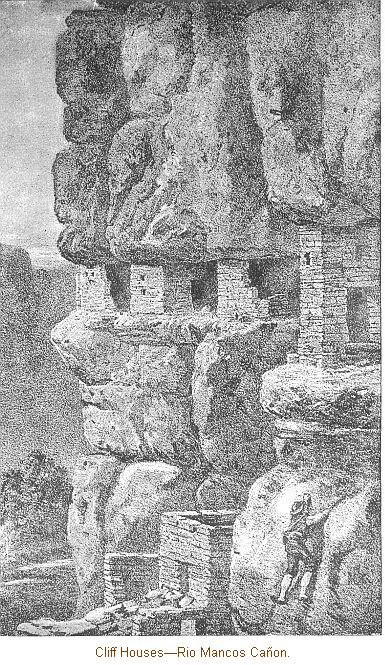


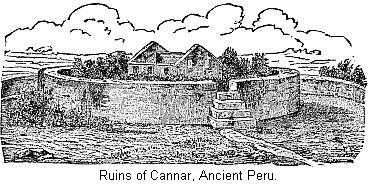
 HOU unrelenting Past!

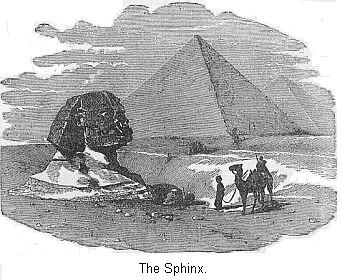
 a
clear understanding of questions relating to early man, a more or less
extensive acquaintance with Geology is required. This is by no means a
difficult task to accomplish. What so interesting as to understand at
least the outlines of the history of life on the globe? To see how,
following a definite plan, the vast continents have grown to their present
size and form; to see how animal and vegetable life have evolved
successively higher and higher forms; to see where in this wondrous drama
of creation, this strange unfolding of life, the first faint, indecisive
traces of man’s presence are to be found; to learn what great changes in
climate, in Geogony, and in life, had occurred before man’s appearance,
let us pass in brief review the history of early geological periods.
a
clear understanding of questions relating to early man, a more or less
extensive acquaintance with Geology is required. This is by no means a
difficult task to accomplish. What so interesting as to understand at
least the outlines of the history of life on the globe? To see how,
following a definite plan, the vast continents have grown to their present
size and form; to see how animal and vegetable life have evolved
successively higher and higher forms; to see where in this wondrous drama
of creation, this strange unfolding of life, the first faint, indecisive
traces of man’s presence are to be found; to learn what great changes in
climate, in Geogony, and in life, had occurred before man’s appearance,
let us pass in brief review the history of early geological periods.
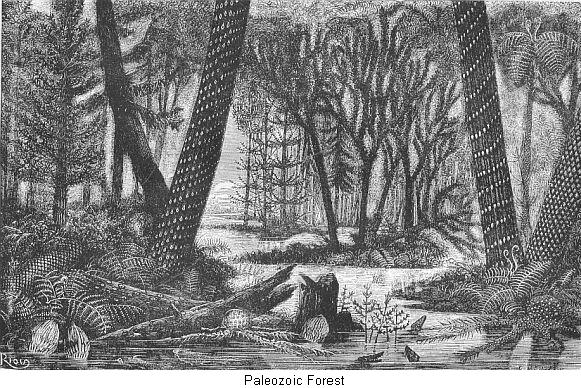
 tertiary age, with its wonderful wealth of animal and plant life,
gradually drew to its close. In our “Outline” we have named the period
that next ensued the Glacial Age.2 This was sufficiently exact
for our purpose then, but we must remember this is the name3
for a long series of years. During this period great changes in climate
occurred. At its commencement, a genial temperate climate prevailed
throughout Europe; and this, as we know, was preceded, during the Miocene
Age, by a warm tropical one.4 This succession, then, shows us
that, for some reason or other, the climate had been gradually growing
colder. This change went forward uninterruptedly. Doubtless very
gradually, from century to century, the seasons grew more and more severe,
until, finally, the Summer’s sun no longer cleared the mountains of the
Winter’s snow. This was the beginning of the Glacial Age proper.
tertiary age, with its wonderful wealth of animal and plant life,
gradually drew to its close. In our “Outline” we have named the period
that next ensued the Glacial Age.2 This was sufficiently exact
for our purpose then, but we must remember this is the name3
for a long series of years. During this period great changes in climate
occurred. At its commencement, a genial temperate climate prevailed
throughout Europe; and this, as we know, was preceded, during the Miocene
Age, by a warm tropical one.4 This succession, then, shows us
that, for some reason or other, the climate had been gradually growing
colder. This change went forward uninterruptedly. Doubtless very
gradually, from century to century, the seasons grew more and more severe,
until, finally, the Summer’s sun no longer cleared the mountains of the
Winter’s snow. This was the beginning of the Glacial Age proper.
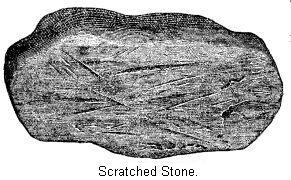
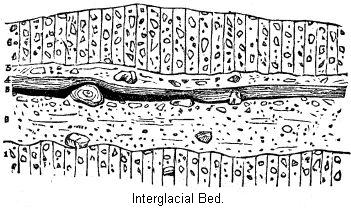
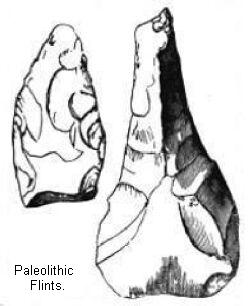
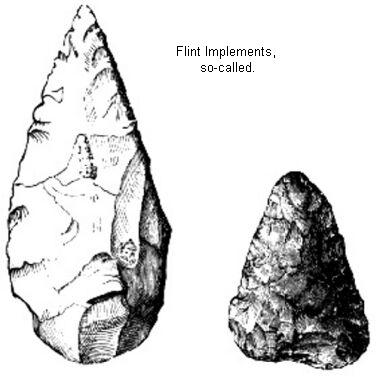
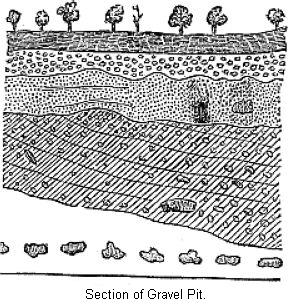
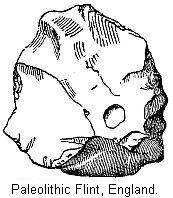
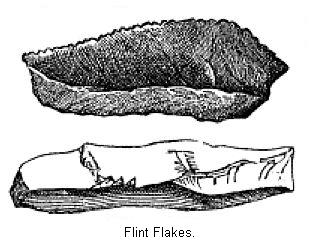
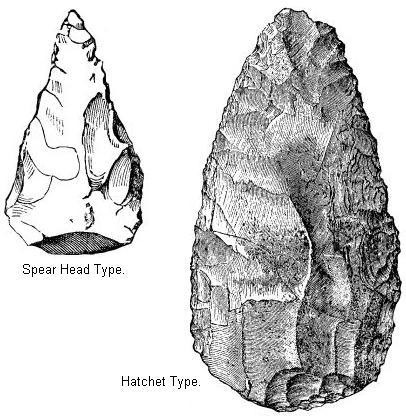
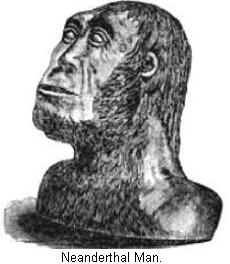
 have been delving, among the sands of ancient river bottoms for a proof of
man’s existence in far remote times. Slight and unsatisfactory as they may
be to some, they are the materials with which we reconstruct a wondrous
story of life and times removed from us by many a cycle of years.
have been delving, among the sands of ancient river bottoms for a proof of
man’s existence in far remote times. Slight and unsatisfactory as they may
be to some, they are the materials with which we reconstruct a wondrous
story of life and times removed from us by many a cycle of years.
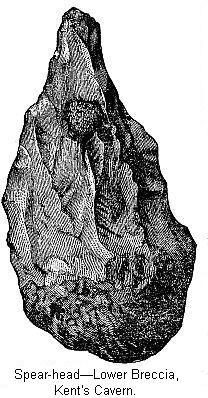
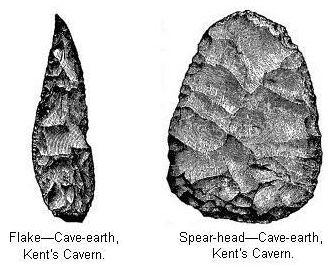
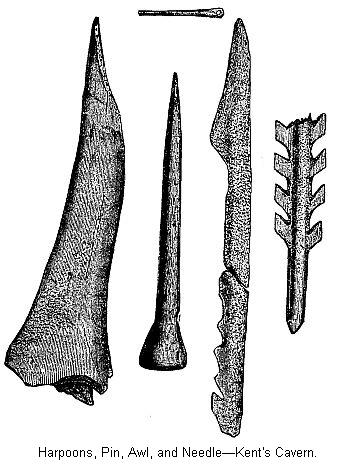
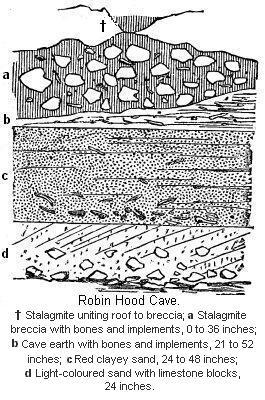
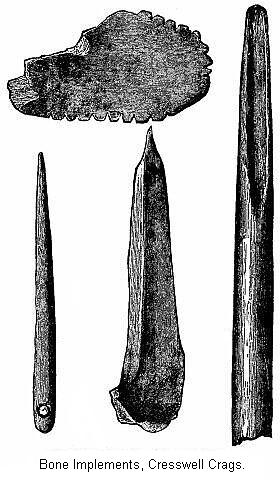
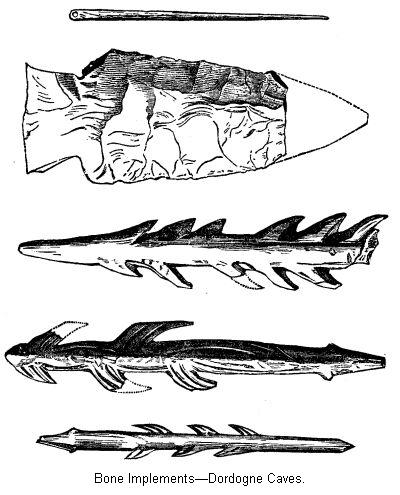
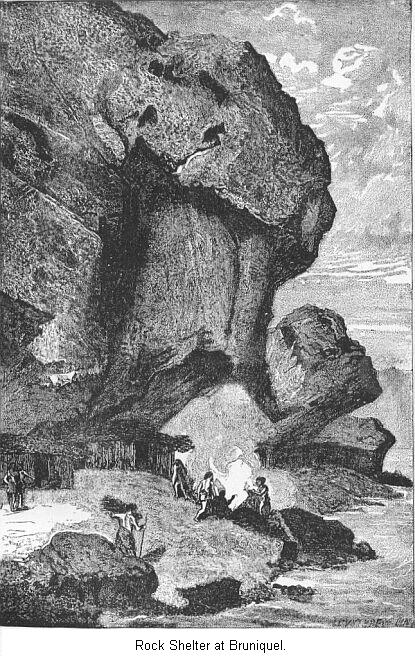
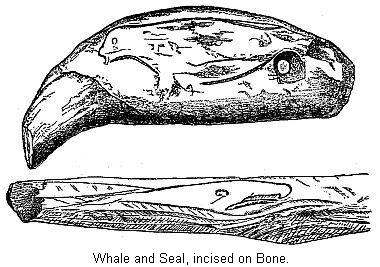
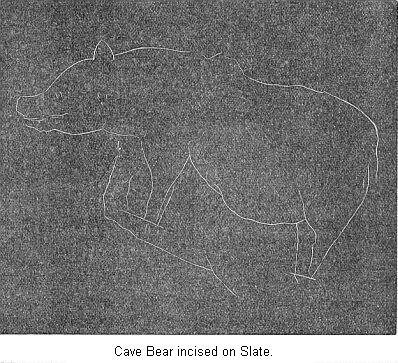
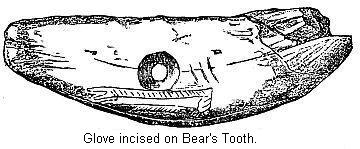
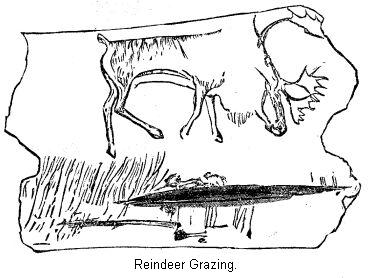
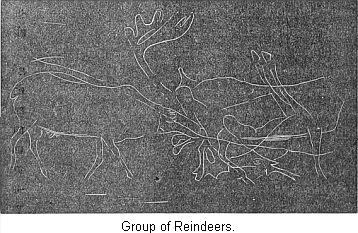
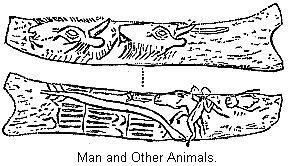
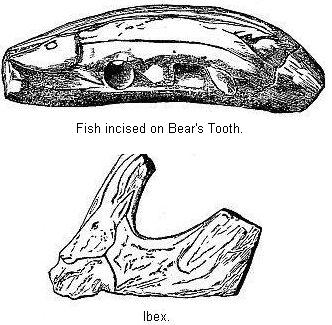
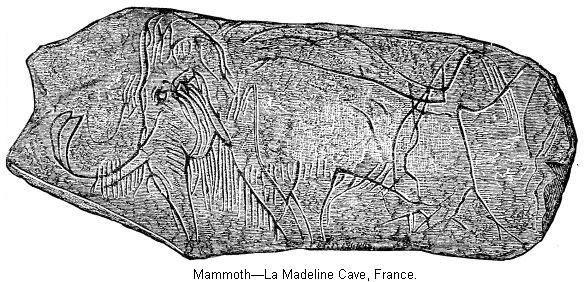
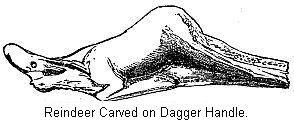
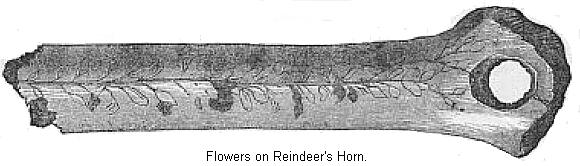
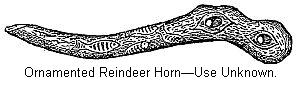
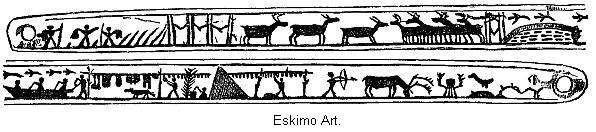
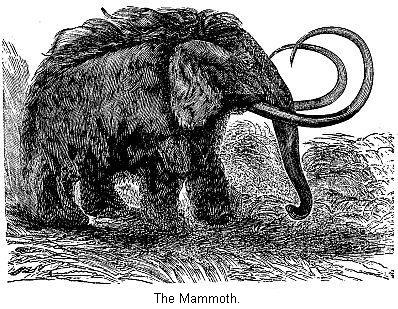
 we
have already remarked, geological periods give us no insight as to the
actual passage of years. To say that man lived in the Glacial Age, and
that we have some faint traces of his presence in still earlier periods,
after all conveys to our minds only vague ideas of a far-away time. The
more a geologist studies the structure of the earth, the more impressed is
he with the magnitude of the time that must have passed since “The
Beginning.” At present, however, there are no means known of accurately
measuring the time that has passed. It is just as well that it is so,
since, were it known, the human mind would be utterly incapable of
comprehending it. But as to the antiquity of man, it is but natural that
we should seek more particularly to solve the problem and express our
answer in some term of years.
we
have already remarked, geological periods give us no insight as to the
actual passage of years. To say that man lived in the Glacial Age, and
that we have some faint traces of his presence in still earlier periods,
after all conveys to our minds only vague ideas of a far-away time. The
more a geologist studies the structure of the earth, the more impressed is
he with the magnitude of the time that must have passed since “The
Beginning.” At present, however, there are no means known of accurately
measuring the time that has passed. It is just as well that it is so,
since, were it known, the human mind would be utterly incapable of
comprehending it. But as to the antiquity of man, it is but natural that
we should seek more particularly to solve the problem and express our
answer in some term of years.
 the
preceding chapters we have sought to learn what we could of the
Paleolithic Age. We have seen what strange people and animals occupied the
land, and have caught some glimpses of a past that has been recovered to
us out of the very night of time. From under the ashes of Vesuvius archæologists
have brought to light an ancient city. We gaze on it with great interest,
for we there see illustrated the state of society two thousand years ago.
But other cities of that time are still in existence, and not only by the
aid of tradition and song, but from the pages of history, we can learn of
the civilization of the Roman people at the time of the destruction of
Pompei; so that, in this case, our knowledge of the past is not confined
to one source of information. But no voice of history or tradition, or of
existing institutions, speaks to us of the Paleolithic Age. Of that remote
time, the morning time of human life, we learn only from the labors of
geologists and archæologists. We are virtually dealing with a past
geological age. The long term of years thus defined drew to its close
amidst scenes of almost Arctic sterility. In all probability, glaciers
reflected the sun’s rays from all the considerable hills and mountains of
Central and Northern Europe, though forming, perhaps, but a remnant of the
great glaciers of the Ice Age. The neighboring seas must have been
whitened by the glistening sails of numerous icebergs. Such was the
closing scene of Paleolithic life.
the
preceding chapters we have sought to learn what we could of the
Paleolithic Age. We have seen what strange people and animals occupied the
land, and have caught some glimpses of a past that has been recovered to
us out of the very night of time. From under the ashes of Vesuvius archæologists
have brought to light an ancient city. We gaze on it with great interest,
for we there see illustrated the state of society two thousand years ago.
But other cities of that time are still in existence, and not only by the
aid of tradition and song, but from the pages of history, we can learn of
the civilization of the Roman people at the time of the destruction of
Pompei; so that, in this case, our knowledge of the past is not confined
to one source of information. But no voice of history or tradition, or of
existing institutions, speaks to us of the Paleolithic Age. Of that remote
time, the morning time of human life, we learn only from the labors of
geologists and archæologists. We are virtually dealing with a past
geological age. The long term of years thus defined drew to its close
amidst scenes of almost Arctic sterility. In all probability, glaciers
reflected the sun’s rays from all the considerable hills and mountains of
Central and Northern Europe, though forming, perhaps, but a remnant of the
great glaciers of the Ice Age. The neighboring seas must have been
whitened by the glistening sails of numerous icebergs. Such was the
closing scene of Paleolithic life.
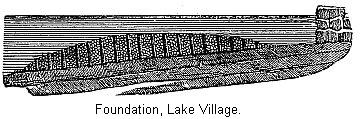
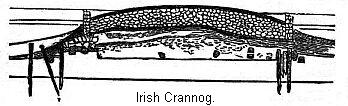
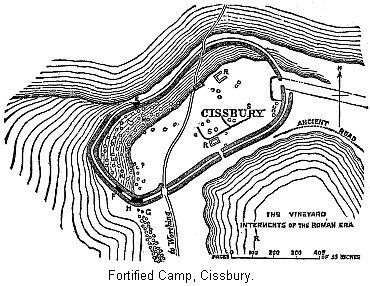
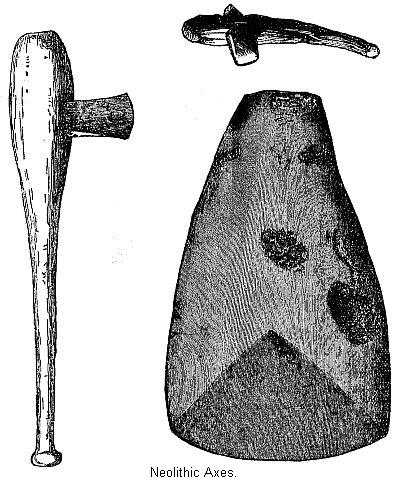
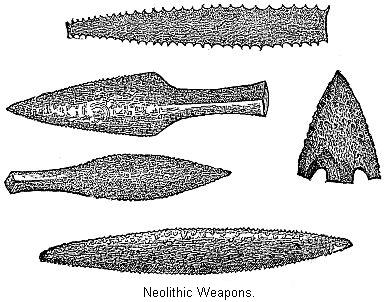
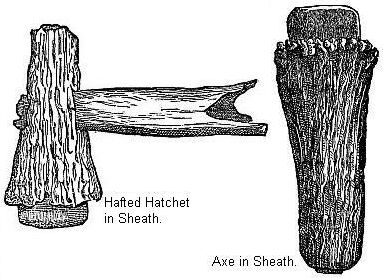
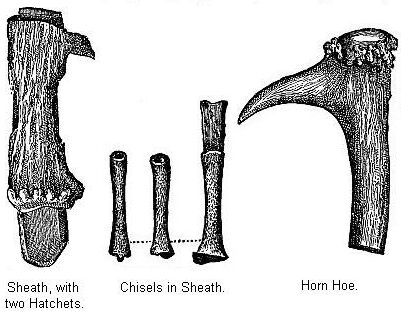
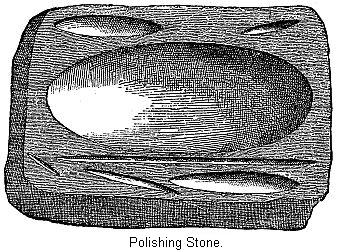
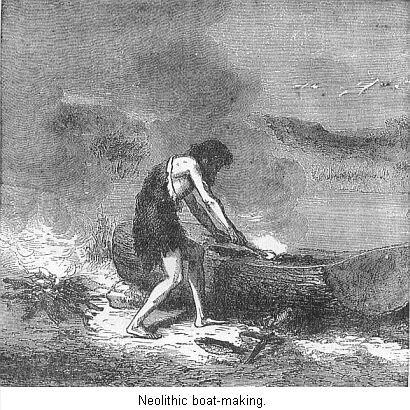
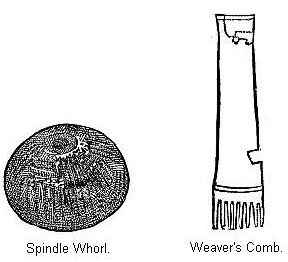
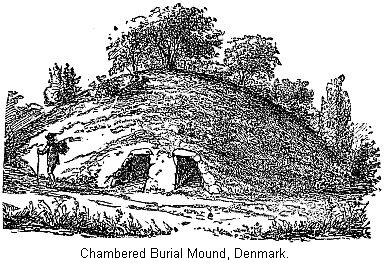
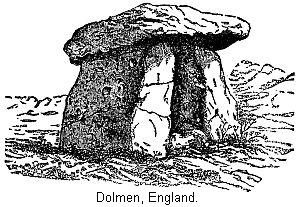
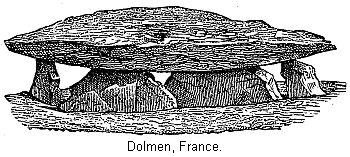
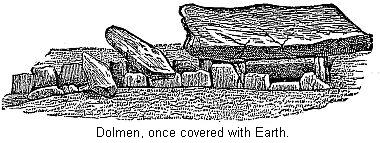
 is
with races of men as with individuals, the progressive growth of youth
soon reaches its limit and maturity of power. While it brings greater
strength, it has not the buoyancy of early years, so the manner of life
becomes fixed, and onward progress stops. They can then only hope to hold
on the even tenor of their way, happy if increasing years do not bring
again their childhood state. The Neolithic people entered Europe early in
the youth of the race which spread their civilization over the globe, but
the race to which they belonged appear to have reached their zenith of
development long ages ago, since which time, whatever higher culture they
have reached has been a gift to them by other people. Their energies
became exhausted, and for a long series of years Europe was filled by the
camps, lake villages and fortified places of Neolithic times.
is
with races of men as with individuals, the progressive growth of youth
soon reaches its limit and maturity of power. While it brings greater
strength, it has not the buoyancy of early years, so the manner of life
becomes fixed, and onward progress stops. They can then only hope to hold
on the even tenor of their way, happy if increasing years do not bring
again their childhood state. The Neolithic people entered Europe early in
the youth of the race which spread their civilization over the globe, but
the race to which they belonged appear to have reached their zenith of
development long ages ago, since which time, whatever higher culture they
have reached has been a gift to them by other people. Their energies
became exhausted, and for a long series of years Europe was filled by the
camps, lake villages and fortified places of Neolithic times.
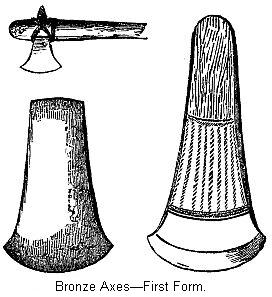
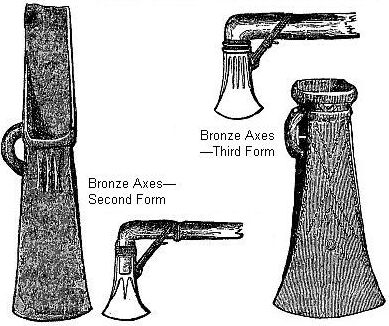
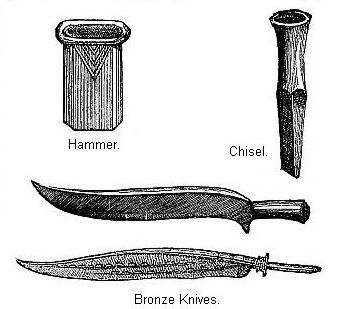
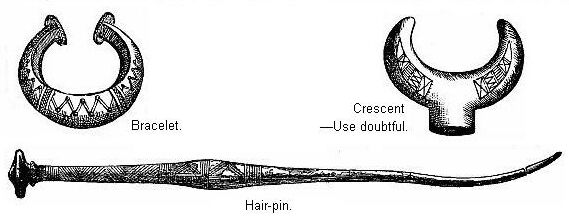
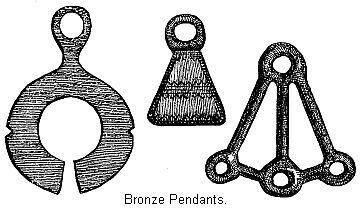
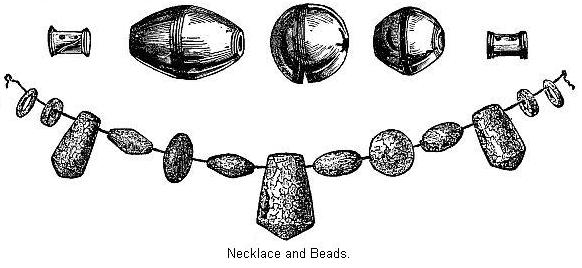
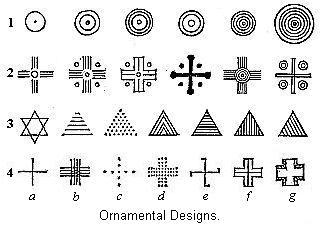
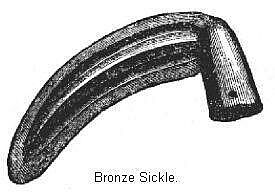
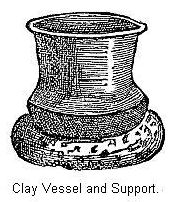
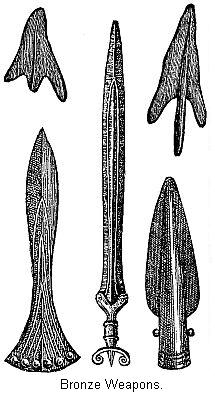
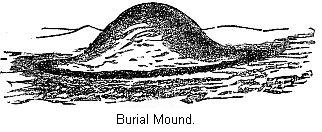
 introduction
of bronze was the harbinger of better days to the various tribes of
Europe. Without metals it is doubtful if man would ever have been able to
raise himself from barbarism. His advance in civilization has been in
direct proportion to his ability to work metals. As long as he knew how to
work bronze only he could not hope for the best results. The trouble was
not in the metal itself, but in the supply; for copper and tin, the
constituents of bronze, are found only in limited amounts. When we reflect
on the multiplicity of purposes for which some metallic substance is
needed, we at once perceive that men require a metal which can not only be
worked cheaply, but must exist in great abundance, so that the needs of a
rich and varied culture may be met.
introduction
of bronze was the harbinger of better days to the various tribes of
Europe. Without metals it is doubtful if man would ever have been able to
raise himself from barbarism. His advance in civilization has been in
direct proportion to his ability to work metals. As long as he knew how to
work bronze only he could not hope for the best results. The trouble was
not in the metal itself, but in the supply; for copper and tin, the
constituents of bronze, are found only in limited amounts. When we reflect
on the multiplicity of purposes for which some metallic substance is
needed, we at once perceive that men require a metal which can not only be
worked cheaply, but must exist in great abundance, so that the needs of a
rich and varied culture may be met.
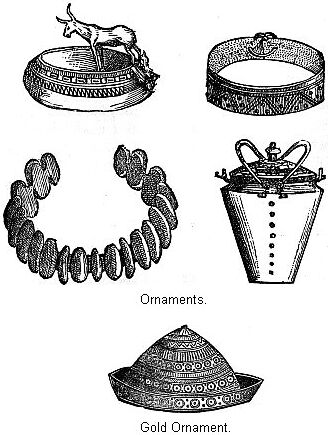
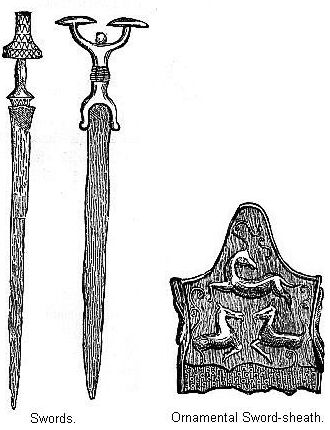
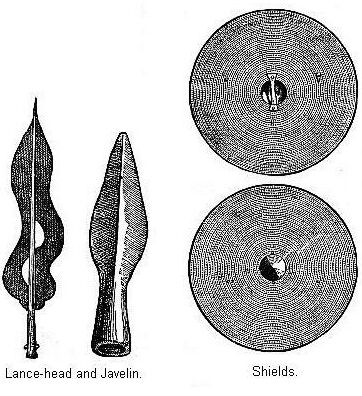
 the energy and skill of Columbus were crowned with success, and the
storm-tossed Atlantic was found to lave the shores of a western continent,
reflecting minds in Europe were much interested in the strange stories
they heard of the inhabitants of the New World. On the one hand Spanish
adventurers told scarcely credited stories of populous cities, temples
glittering with gold and silver ornaments, and nations possessed of a
barbaric civilization scarcely inferior to their own. On the other hand
were accounts of morose savages, cruel and vindictive in nature, depending
on fishing and the chase for a livelihood. Nearly four centuries have
elapsed since that time. The aboriginal inhabitants have nearly
disappeared, leaving their origin and prehistoric life almost as great a
riddle to us as it was to the early colonists.
the energy and skill of Columbus were crowned with success, and the
storm-tossed Atlantic was found to lave the shores of a western continent,
reflecting minds in Europe were much interested in the strange stories
they heard of the inhabitants of the New World. On the one hand Spanish
adventurers told scarcely credited stories of populous cities, temples
glittering with gold and silver ornaments, and nations possessed of a
barbaric civilization scarcely inferior to their own. On the other hand
were accounts of morose savages, cruel and vindictive in nature, depending
on fishing and the chase for a livelihood. Nearly four centuries have
elapsed since that time. The aboriginal inhabitants have nearly
disappeared, leaving their origin and prehistoric life almost as great a
riddle to us as it was to the early colonists.
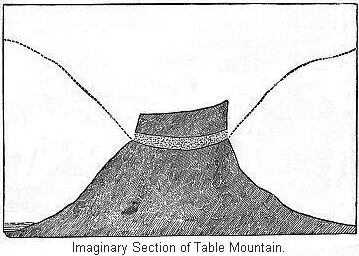
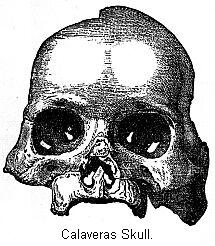
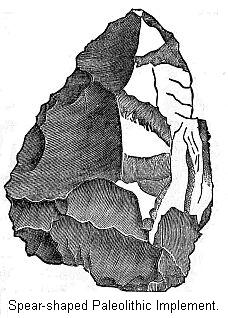
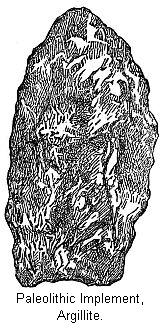
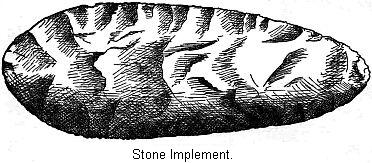
 have hitherto been describing people and tribes that have completely
vanished. We have peered into the mysterious past and sought as best we
could to conjure back the scenes of many years ago. The line between the
known and the unknown, between the historic and prehistoric, is not far
removed from us in the new world. Not yet four centuries have passed since
the veil was lifted, and America, with her savage tribes of the North, and
her rude civilization of the South, was revealed to the wondering eyes of
Europe. But with a knowledge of this new land came also wondrous stories
of wealth, and in consequence an army of adventurers were soon on her
shores. Then follows a short period of war and conquest. The Indian race
could not withstand the whites. European civilization, transplanted to
America, has thriven. But whatever advance the native tribes have made
since the discovery, has been by reason of contact with the whites.
have hitherto been describing people and tribes that have completely
vanished. We have peered into the mysterious past and sought as best we
could to conjure back the scenes of many years ago. The line between the
known and the unknown, between the historic and prehistoric, is not far
removed from us in the new world. Not yet four centuries have passed since
the veil was lifted, and America, with her savage tribes of the North, and
her rude civilization of the South, was revealed to the wondering eyes of
Europe. But with a knowledge of this new land came also wondrous stories
of wealth, and in consequence an army of adventurers were soon on her
shores. Then follows a short period of war and conquest. The Indian race
could not withstand the whites. European civilization, transplanted to
America, has thriven. But whatever advance the native tribes have made
since the discovery, has been by reason of contact with the whites.
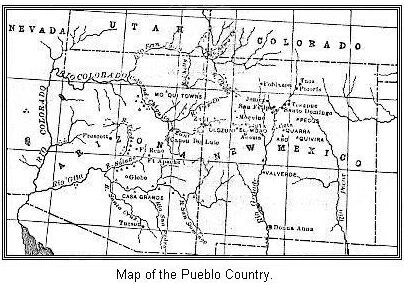
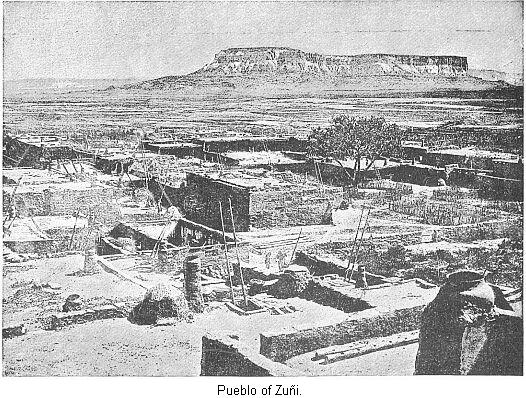
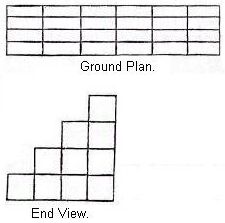 The buildings, or communal houses, for one
house contained sometimes five hundred rooms, are generally from three to
four hundred feet long and about one hundred and fifty feet in width at
the base. The lower story is divided by cross-walls into a mass of
cell-like rooms, as shown in the illustrations which represents the ground
plan of a pueblo having four ranges of rooms. Each story in height has one
less range of rooms, so that, looking directly at the end of this
building, it would present the appearance shown by this cut: The only
means of getting from one terrace to the other is by the aid of ladders.
In some cases these terraces run from both sides of the building; in
others they face the inclosed space; and in others still they face
outside. Most of the inhabited pueblos are built of adobe—that is,
sun-dried bricks. The majority of the ancient ruins were built of stone
set in adobe mortar. With this digression, we will now return to Zuñi.
The buildings, or communal houses, for one
house contained sometimes five hundred rooms, are generally from three to
four hundred feet long and about one hundred and fifty feet in width at
the base. The lower story is divided by cross-walls into a mass of
cell-like rooms, as shown in the illustrations which represents the ground
plan of a pueblo having four ranges of rooms. Each story in height has one
less range of rooms, so that, looking directly at the end of this
building, it would present the appearance shown by this cut: The only
means of getting from one terrace to the other is by the aid of ladders.
In some cases these terraces run from both sides of the building; in
others they face the inclosed space; and in others still they face
outside. Most of the inhabited pueblos are built of adobe—that is,
sun-dried bricks. The majority of the ancient ruins were built of stone
set in adobe mortar. With this digression, we will now return to Zuñi.
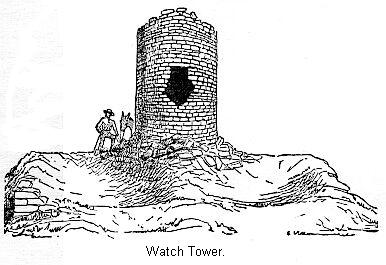
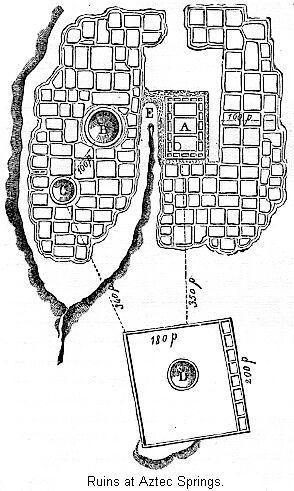 It will be seen that immediately to the right
of the Springs is a large rectangular ruin in better preservation than the
rest. This now “forms a great mound of crumbling rock from twelve to
twenty feet in height, overgrown with artemisia, but showing clearly,
however, its rectangular structure, adjusted approximately to the four
points of the compass.” This house, from its massive walls, must have had
an original height of at least forty feet. “The walls seem to have been
doubled, with a space of seven feet between; a number of cross-walls at
regular intervals indicate that this space has been divided into
apartments, as seen in the plan.” Two low lines of rubbish cross the
square, probably partition walls.
It will be seen that immediately to the right
of the Springs is a large rectangular ruin in better preservation than the
rest. This now “forms a great mound of crumbling rock from twelve to
twenty feet in height, overgrown with artemisia, but showing clearly,
however, its rectangular structure, adjusted approximately to the four
points of the compass.” This house, from its massive walls, must have had
an original height of at least forty feet. “The walls seem to have been
doubled, with a space of seven feet between; a number of cross-walls at
regular intervals indicate that this space has been divided into
apartments, as seen in the plan.” Two low lines of rubbish cross the
square, probably partition walls.
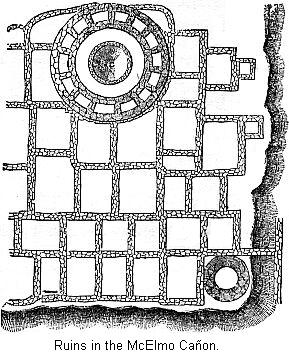 Many groups
of ruins are now in localities where the people could not hope for
subsistence. About six miles to the north of these ruins, about a mile
from the McElmo, is the group of ruins here represented, which may throw
some light on the remains at Aztec Springs. The principal feature is the
triple walled tower, of which a plan is given. The tower has a diameter of
about forty-three feet, and a circumference of about one hundred and
thirty-five feet. The walls are traceable nearly all the way around, and
the space between the two outer ones, which is about five feet, contains
fourteen apartments or cells. The walls about one of these cells were
still standing at the time of Mr. Holmes’s visit, but the cell was filled
with rubbish from the fallen walls. A door-way, opening into this
apartment, could still be seen. The inner wall was probably never very
high. It simply inclosed the estufa.
Many groups
of ruins are now in localities where the people could not hope for
subsistence. About six miles to the north of these ruins, about a mile
from the McElmo, is the group of ruins here represented, which may throw
some light on the remains at Aztec Springs. The principal feature is the
triple walled tower, of which a plan is given. The tower has a diameter of
about forty-three feet, and a circumference of about one hundred and
thirty-five feet. The walls are traceable nearly all the way around, and
the space between the two outer ones, which is about five feet, contains
fourteen apartments or cells. The walls about one of these cells were
still standing at the time of Mr. Holmes’s visit, but the cell was filled
with rubbish from the fallen walls. A door-way, opening into this
apartment, could still be seen. The inner wall was probably never very
high. It simply inclosed the estufa.
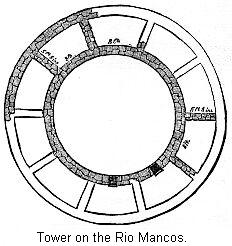 We give a cut of the tower of the ruins of a
similar village, or settlement, to the one just described, which occurs
twenty miles to the southeast in the cañon of the Rio Mancos. Being
so similar, we will mention it here. In this case the tower had only two
walls. Mr. Holmes says the diameter of the outer wall is forty-three feet,
that of the inner twenty-five feet. The space between the two circles is
divided by cross-walls into ten apartments. This tower is placed also in
the midst of a group of more dimly marked ruins or foundations, extending
some distance in each direction from it. Mr. Holmes, however, states that
there are no ruins of importance in connection with this tower, but that
there are a number of ruins in the immediate vicinity. In this case, then,
the citadel (if such it was) was not directly connected with other ruins.
We give a cut of the tower of the ruins of a
similar village, or settlement, to the one just described, which occurs
twenty miles to the southeast in the cañon of the Rio Mancos. Being
so similar, we will mention it here. In this case the tower had only two
walls. Mr. Holmes says the diameter of the outer wall is forty-three feet,
that of the inner twenty-five feet. The space between the two circles is
divided by cross-walls into ten apartments. This tower is placed also in
the midst of a group of more dimly marked ruins or foundations, extending
some distance in each direction from it. Mr. Holmes, however, states that
there are no ruins of importance in connection with this tower, but that
there are a number of ruins in the immediate vicinity. In this case, then,
the citadel (if such it was) was not directly connected with other ruins.
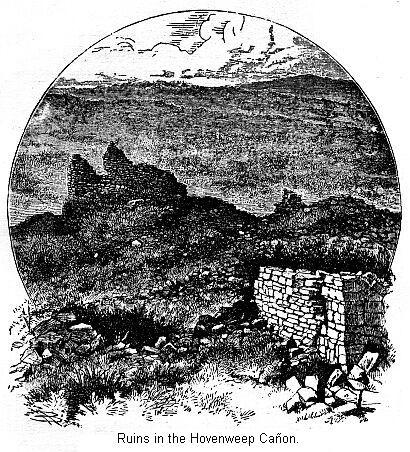
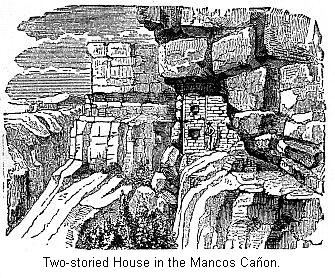
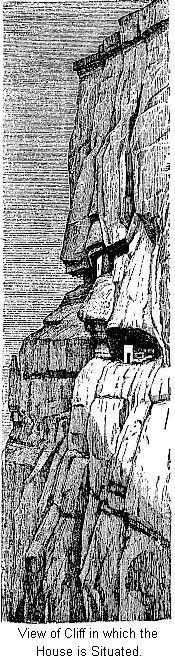 To illustrate
the singular position in which this house was located, we introduce this
cut. It is seven hundred feet above the valley. “Whether viewed from below
or from the heights above, the effect is almost startling, and one can not
but feel that no ordinary circumstances could have driven a people to such
places of resort.” As showing the difficulty an enemy would have to
approach such a house, we give Mr. Jackson’s account of his climb to it:
To illustrate
the singular position in which this house was located, we introduce this
cut. It is seven hundred feet above the valley. “Whether viewed from below
or from the heights above, the effect is almost startling, and one can not
but feel that no ordinary circumstances could have driven a people to such
places of resort.” As showing the difficulty an enemy would have to
approach such a house, we give Mr. Jackson’s account of his climb to it:
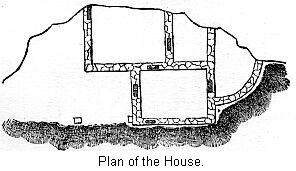
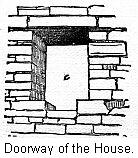
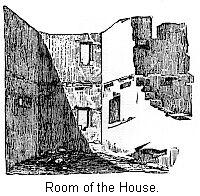 This cliff house could only have been used as a place of
refuge in a time of need. We must observe the care with which it was
hidden away. The walls were plastered on the outside, so as to resemble
the cañon-walls. Then we must notice what a secure place of retreat
it afforded the people. No invading party could hope to storm this castle
as long as there was any one to defend it. This house, with its four small
rooms, could give shelter to quite a band of Indians. Then, besides, it
was not alone. Ruins of half a dozen smaller houses were found near by.
Some had been crushed by the overhanging walls falling upon them, and
others had lost their foothold and tumbled down the precipice.
This cliff house could only have been used as a place of
refuge in a time of need. We must observe the care with which it was
hidden away. The walls were plastered on the outside, so as to resemble
the cañon-walls. Then we must notice what a secure place of retreat
it afforded the people. No invading party could hope to storm this castle
as long as there was any one to defend it. This house, with its four small
rooms, could give shelter to quite a band of Indians. Then, besides, it
was not alone. Ruins of half a dozen smaller houses were found near by.
Some had been crushed by the overhanging walls falling upon them, and
others had lost their foothold and tumbled down the precipice.
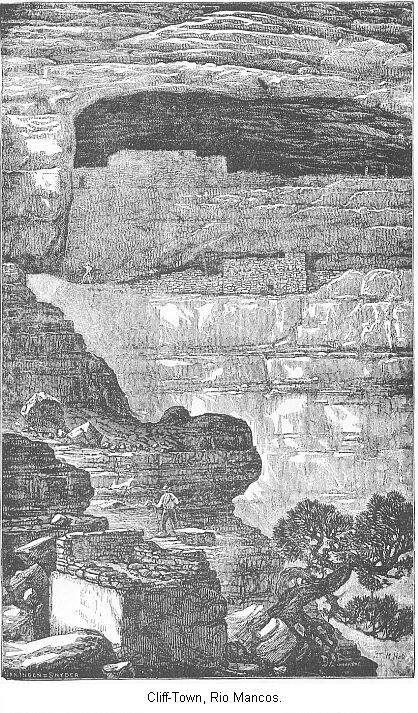
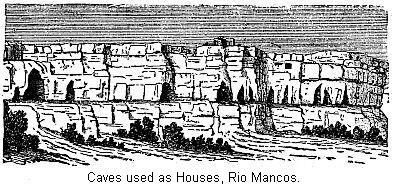
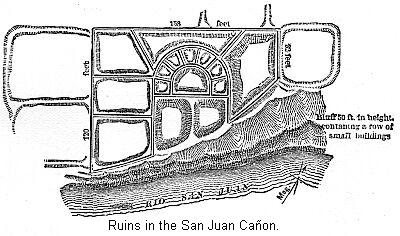
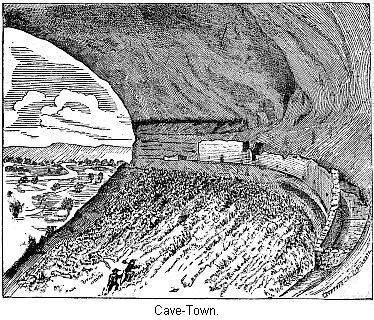
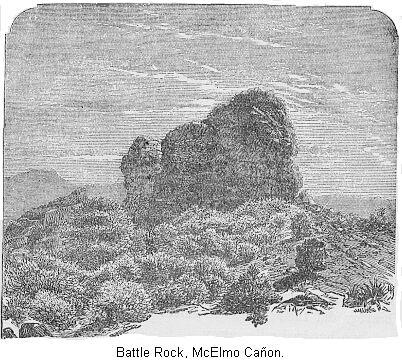
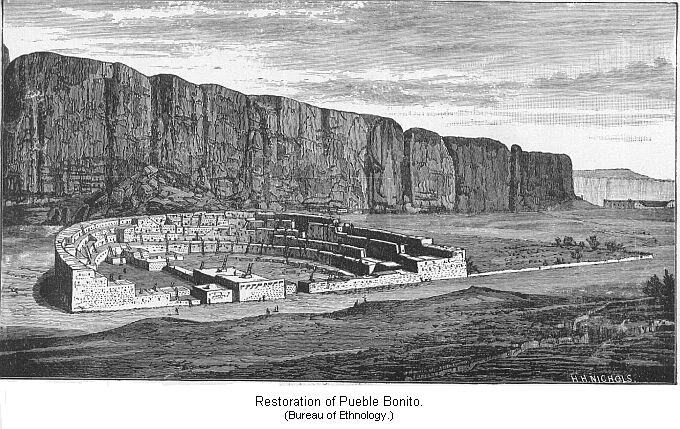
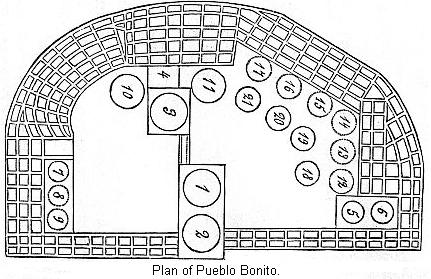
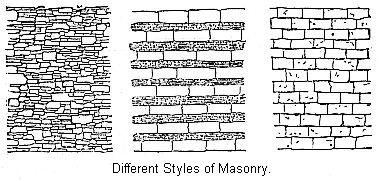
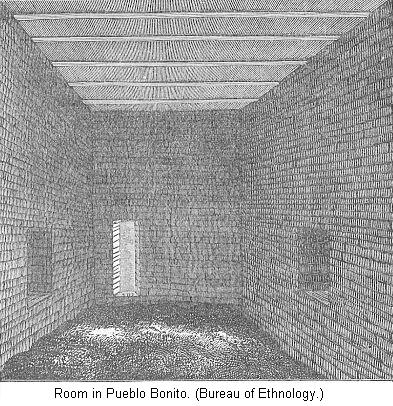
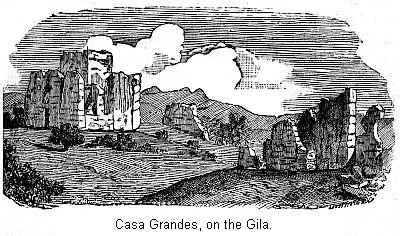
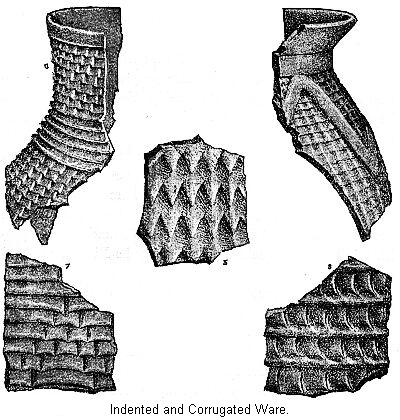
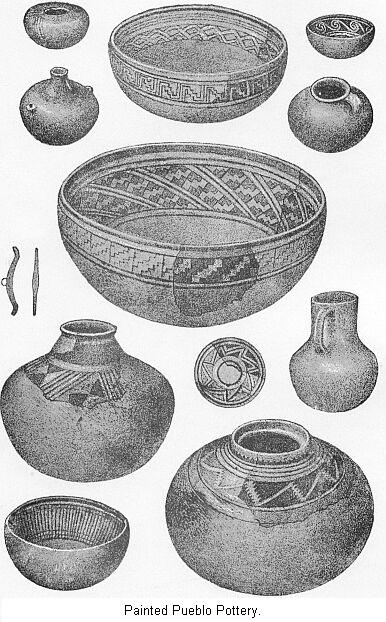
 attempts to explain the origin of the numerous tribes found in possession
of America at the time of its discovery by Europeans have been many and
various. There are so many difficulties attending the solution of this
problem that even at this day no theory has received that full assent from
the scientific world deemed necessary for its establishment as an
ascertained fact. New interest has been thrown around this question by the
discoveries of late years. In our south-western territories we have
clearly established the former wide extension of the village Indians,
remnants of which are still to be found in the inhabited pueblos; and, as
we have seen, the wide expanse of fertile soil, known as the Mississippi
Valley, has undoubtedly been the home of tribes who are generally supposed
to have attained a much higher stage of culture than that of the Indians—at
least, of such culture as we are accustomed to ascribe, whether justly or
not, to Indian tribes. It becomes an interesting question, therefore, to
determine what connection, if any, existed between the Mound Builders and
the Indian tribes on the one hand, and the Pueblo tribes on the other.
attempts to explain the origin of the numerous tribes found in possession
of America at the time of its discovery by Europeans have been many and
various. There are so many difficulties attending the solution of this
problem that even at this day no theory has received that full assent from
the scientific world deemed necessary for its establishment as an
ascertained fact. New interest has been thrown around this question by the
discoveries of late years. In our south-western territories we have
clearly established the former wide extension of the village Indians,
remnants of which are still to be found in the inhabited pueblos; and, as
we have seen, the wide expanse of fertile soil, known as the Mississippi
Valley, has undoubtedly been the home of tribes who are generally supposed
to have attained a much higher stage of culture than that of the Indians—at
least, of such culture as we are accustomed to ascribe, whether justly or
not, to Indian tribes. It becomes an interesting question, therefore, to
determine what connection, if any, existed between the Mound Builders and
the Indian tribes on the one hand, and the Pueblo tribes on the other.
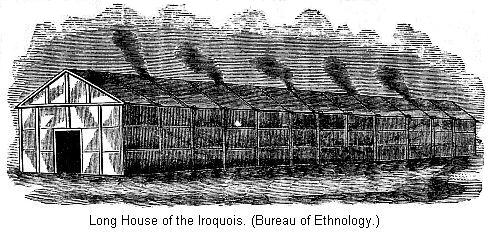
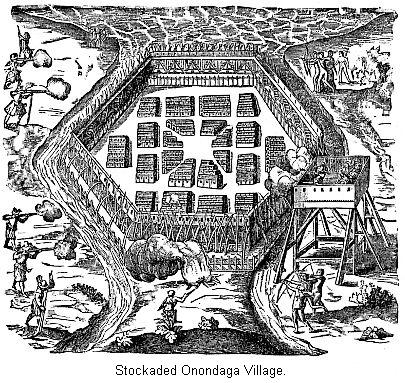
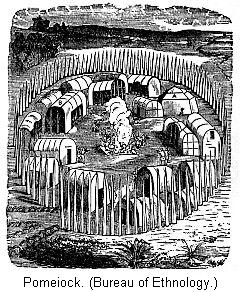 Further south, this method of inclosing a village was also
in use. In 1585 the English sent an expedition to the coast of North
Carolina. An artist attached to this expedition left some cuts, one of
which represents a village near Roanoke. It is surrounded, as we see, by a
row of palisades, and contains seventeen joint tenement houses, besides
the council house. The historians of De Soto’s expedition make frequent
mention of walled and fortified towns. “The village of Mavilla,” from
which comes our name Mobile, says Biedman, “stood on a plain surrounded by
strong walls.” Herrera, in his General History, states that the walls were
formed by piles, interwoven with other timber, and the spaces packed with
straw and earth so that it looked like a wall smoothed with a trowel.
Further south, this method of inclosing a village was also
in use. In 1585 the English sent an expedition to the coast of North
Carolina. An artist attached to this expedition left some cuts, one of
which represents a village near Roanoke. It is surrounded, as we see, by a
row of palisades, and contains seventeen joint tenement houses, besides
the council house. The historians of De Soto’s expedition make frequent
mention of walled and fortified towns. “The village of Mavilla,” from
which comes our name Mobile, says Biedman, “stood on a plain surrounded by
strong walls.” Herrera, in his General History, states that the walls were
formed by piles, interwoven with other timber, and the spaces packed with
straw and earth so that it looked like a wall smoothed with a trowel.
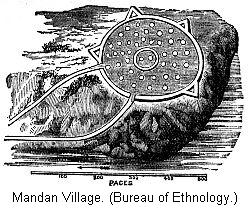 On the Missouri River we find some Indian tribes that have
excited a great deal of interest among archæologists. It has been
surmised that, if their history could be recovered, it would clear up a
great many difficult questions. They were accustomed to fortify their
village’s with ditches, embankments, and palisades. This gives us a cut of
one of their villages. It is to be observed that it has a great likeness
to some of the inclosures ascribed to the Mound Builders.
On the Missouri River we find some Indian tribes that have
excited a great deal of interest among archæologists. It has been
surmised that, if their history could be recovered, it would clear up a
great many difficult questions. They were accustomed to fortify their
village’s with ditches, embankments, and palisades. This gives us a cut of
one of their villages. It is to be observed that it has a great likeness
to some of the inclosures ascribed to the Mound Builders.
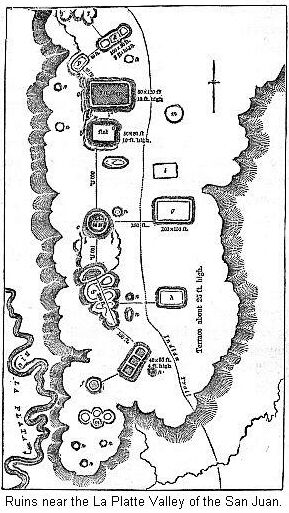 We need not
expect to trace a continuous line of ruins from the San Juan Valley to
that of the Ohio, granting the migration to have taken place, because a
migrating race would not be apt to erect monuments until they reached the
end of their line of migration. Those who take this view of it say that it
is not at all strange that when these migrating tribes reached their new
homes in the Mississippi Valley they erected structures differing from
those they had formerly built, because all their surroundings would be
different, and in the prairie sections they would find neither stone for
building their pueblos nor clay suitable for adobe construction. So they
would do the next best thing, and build a fortified village. This is the
view of that eminent scholar, Mr. Morgan. It must be borne in mind,
however, that the fortified villages of the southern Indians, including
those of the Mississippi Valley, corresponded more nearly with those of
the Atlantic shore, and more northern tribes, than with the pueblo
structures.
We need not
expect to trace a continuous line of ruins from the San Juan Valley to
that of the Ohio, granting the migration to have taken place, because a
migrating race would not be apt to erect monuments until they reached the
end of their line of migration. Those who take this view of it say that it
is not at all strange that when these migrating tribes reached their new
homes in the Mississippi Valley they erected structures differing from
those they had formerly built, because all their surroundings would be
different, and in the prairie sections they would find neither stone for
building their pueblos nor clay suitable for adobe construction. So they
would do the next best thing, and build a fortified village. This is the
view of that eminent scholar, Mr. Morgan. It must be borne in mind,
however, that the fortified villages of the southern Indians, including
those of the Mississippi Valley, corresponded more nearly with those of
the Atlantic shore, and more northern tribes, than with the pueblo
structures.
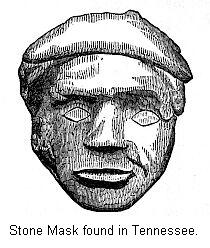
 the ships of the Spanish admiral came to anchor before the Island of San
Salvador, he had indeed discovered a “New World.” It was inhabited by a
race of people living in a state of society from which the inhabitants of
Europe had emerged long before the dawn of authentic history. The animal
and plant life were also greatly different from any thing with which they
were acquainted. The Spaniards little suspected the importance of their
discovery. Columbus himself died in the belief that he had simply explored
a new route to Asia. A quarter of a century elapsed after the first voyage
of Columbus before an expedition coasted along the shores of Mexico. This
was the expedition of Juan De Grijalva, in 1518. He gave a glowing
description of the country he had seen, which “from the beauty and verdure
of its indented shores, and the lovely appearances of its villages, he
called ‘New Spain.’”1
the ships of the Spanish admiral came to anchor before the Island of San
Salvador, he had indeed discovered a “New World.” It was inhabited by a
race of people living in a state of society from which the inhabitants of
Europe had emerged long before the dawn of authentic history. The animal
and plant life were also greatly different from any thing with which they
were acquainted. The Spaniards little suspected the importance of their
discovery. Columbus himself died in the belief that he had simply explored
a new route to Asia. A quarter of a century elapsed after the first voyage
of Columbus before an expedition coasted along the shores of Mexico. This
was the expedition of Juan De Grijalva, in 1518. He gave a glowing
description of the country he had seen, which “from the beauty and verdure
of its indented shores, and the lovely appearances of its villages, he
called ‘New Spain.’”1
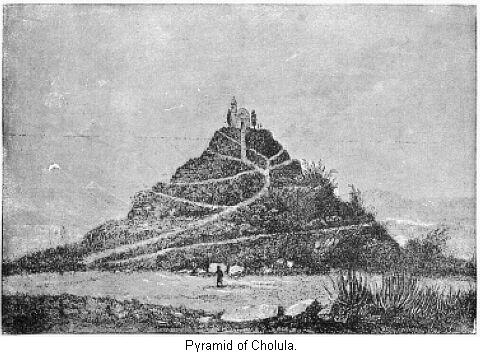
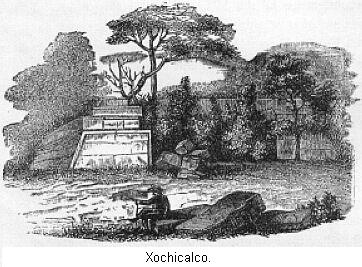
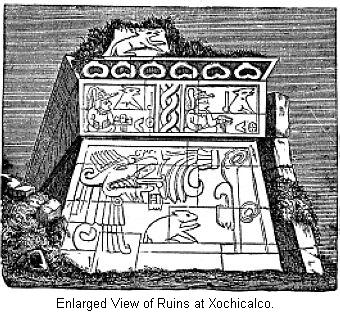
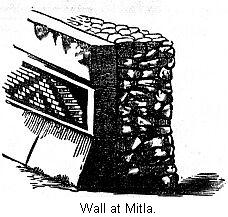 Mr. Bandelier found, besides two artificial hills, traces
of thirty-nine distinct edifices, and, as he thinks these are all the
buildings that ever stood there, it is manifest that this was not a city
in our sense of the word. Two or three of the buildings were constructed
of adobe, plastered, and painted red. The others were built of stone. Of
these latter the greater part stands upon the ground, but a few are built
upon elevated terraces, composed of stone and earth heaped together and
faced with stone. In one group of four buildings the terraced foundation
contained a basement—in one case, at least—in the form of a
cross. The purpose of this cellar or basement left in the artificial
foundation is unknown. Some think they were used for burial purposes but
it is more likely they were general store-rooms. The arrangement of these
buildings was the same as elsewhere. That is, so placed as to inclose a
court. This illustration shows us the method of constructing the walls of
the building. We notice two distinct parts. The inner part is built of
broken stones laid in tolerably regular courses in clay. There was no
mortar used. This inner core is much the same sort of work as the masonry
in the pueblos of Arizona. A facing was put on over this inner core, which
served both for ornament and for strength. This illustration is a corner
of one of these buildings, and gives us in excellent idea of the peculiar
ornamentation employed at Mitla. Mr. Bancroft gives us a clear idea of how
this facing was put on: “First, a double tier of very large blocks are
placed as a base along the surface of the supporting mound, projecting two
or three feet from the line of the wall, the stones of the upper tier
sloping inward. On this base is erected a kind of framework of large, hewn
blocks with perfectly plain, unsculptured fronts, which divide the surface
of the wall into oblong panels of different dimensions.”43
Mr. Bandelier found, besides two artificial hills, traces
of thirty-nine distinct edifices, and, as he thinks these are all the
buildings that ever stood there, it is manifest that this was not a city
in our sense of the word. Two or three of the buildings were constructed
of adobe, plastered, and painted red. The others were built of stone. Of
these latter the greater part stands upon the ground, but a few are built
upon elevated terraces, composed of stone and earth heaped together and
faced with stone. In one group of four buildings the terraced foundation
contained a basement—in one case, at least—in the form of a
cross. The purpose of this cellar or basement left in the artificial
foundation is unknown. Some think they were used for burial purposes but
it is more likely they were general store-rooms. The arrangement of these
buildings was the same as elsewhere. That is, so placed as to inclose a
court. This illustration shows us the method of constructing the walls of
the building. We notice two distinct parts. The inner part is built of
broken stones laid in tolerably regular courses in clay. There was no
mortar used. This inner core is much the same sort of work as the masonry
in the pueblos of Arizona. A facing was put on over this inner core, which
served both for ornament and for strength. This illustration is a corner
of one of these buildings, and gives us in excellent idea of the peculiar
ornamentation employed at Mitla. Mr. Bancroft gives us a clear idea of how
this facing was put on: “First, a double tier of very large blocks are
placed as a base along the surface of the supporting mound, projecting two
or three feet from the line of the wall, the stones of the upper tier
sloping inward. On this base is erected a kind of framework of large, hewn
blocks with perfectly plain, unsculptured fronts, which divide the surface
of the wall into oblong panels of different dimensions.”43
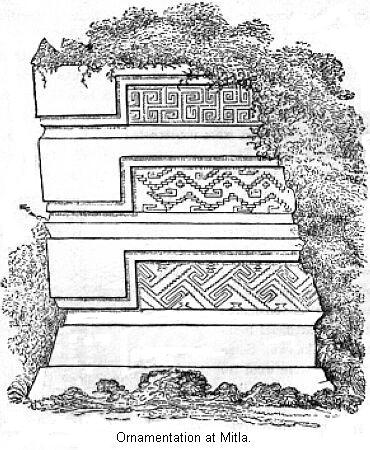
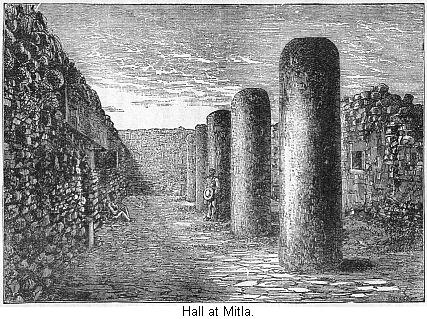
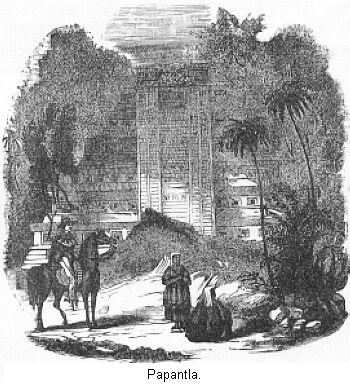
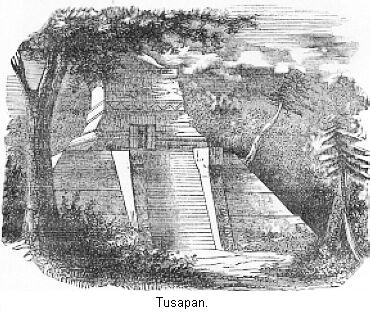
 the
Central American region of the Western Continent are found the ruins of
what are pronounced by all scholars to be the highest civilization, and
the most ancient in time, of any in the New World. There it arose,
flourished, and tottered to its fall. Its glory had departed, its cities
were a desolation, before the coming of the Spaniards. The explorer who
would visit them finds himself confronted with very great difficulties.
Their location is in a section of the country away from the beaten track
of travel. Their sites are overspread with the luxuriant vegetation of
tropical lands, through which the Indian’s machete must carve a passage.
The states in which they are situated are notorious for anarchy and
misrule, and the climate is such that it is dangerous for those not
acclimated to venture thither during a large part of the year. So it is
not strange that but few have wandered among these ruins, and described
them to the world at large.
the
Central American region of the Western Continent are found the ruins of
what are pronounced by all scholars to be the highest civilization, and
the most ancient in time, of any in the New World. There it arose,
flourished, and tottered to its fall. Its glory had departed, its cities
were a desolation, before the coming of the Spaniards. The explorer who
would visit them finds himself confronted with very great difficulties.
Their location is in a section of the country away from the beaten track
of travel. Their sites are overspread with the luxuriant vegetation of
tropical lands, through which the Indian’s machete must carve a passage.
The states in which they are situated are notorious for anarchy and
misrule, and the climate is such that it is dangerous for those not
acclimated to venture thither during a large part of the year. So it is
not strange that but few have wandered among these ruins, and described
them to the world at large.
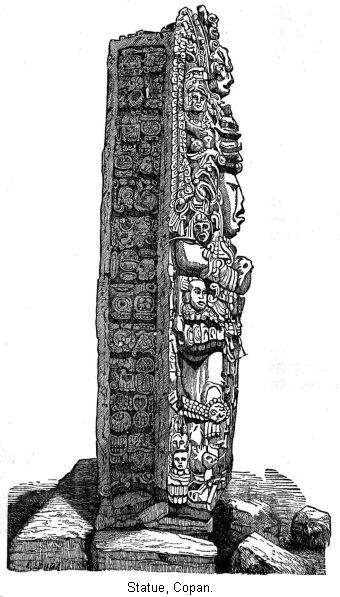
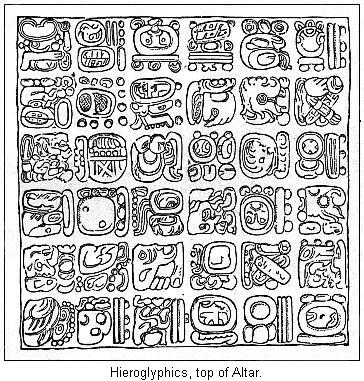
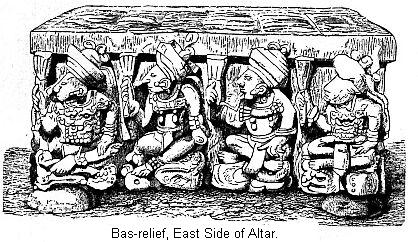
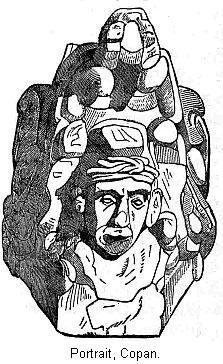
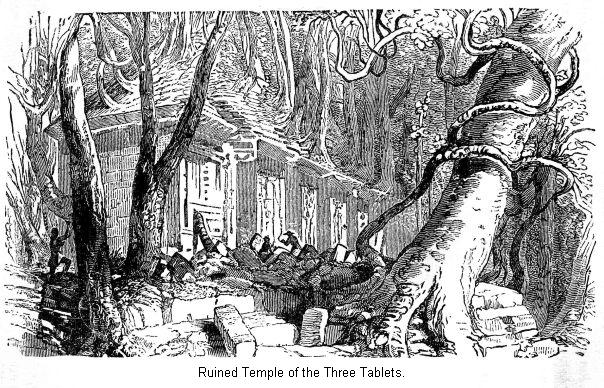
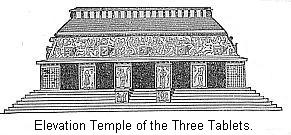
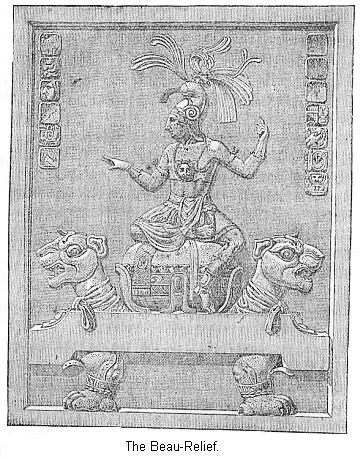
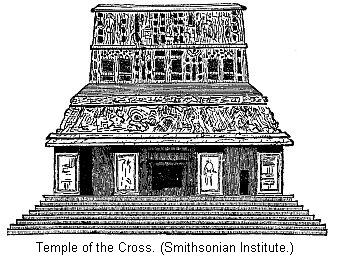
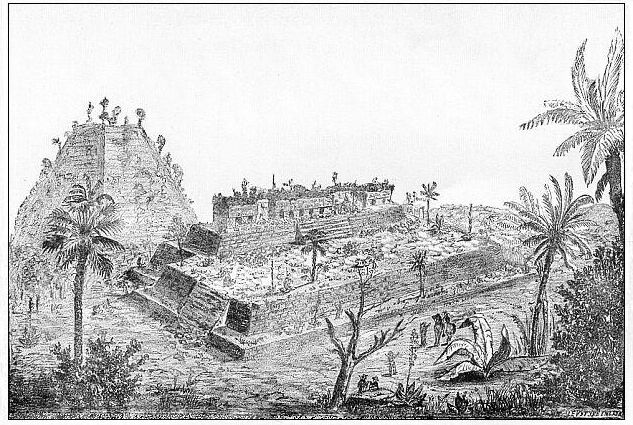
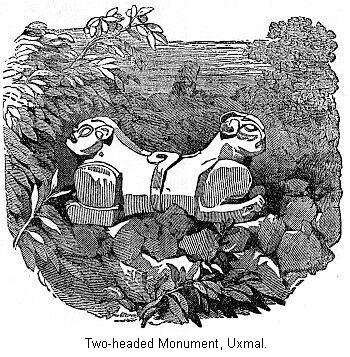
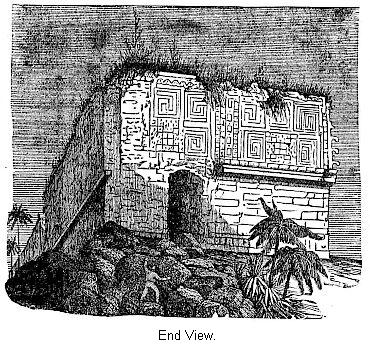

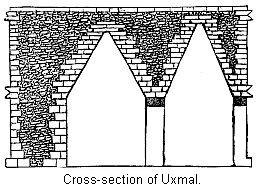
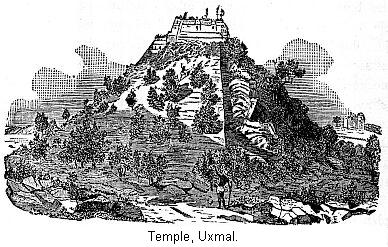
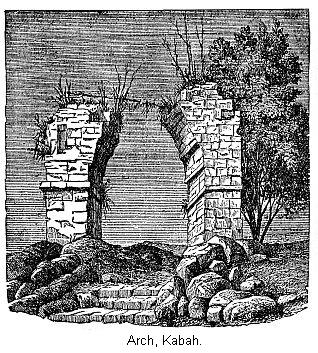
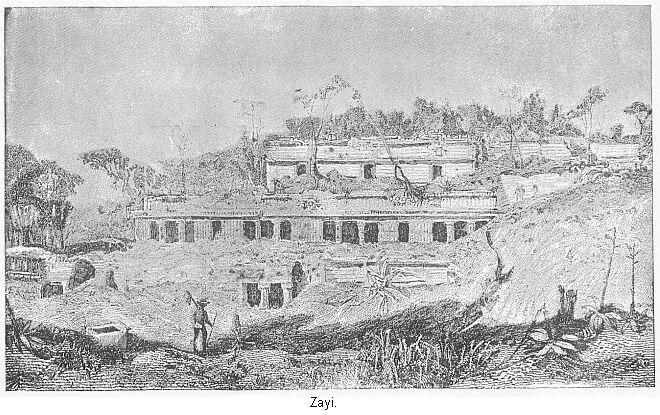
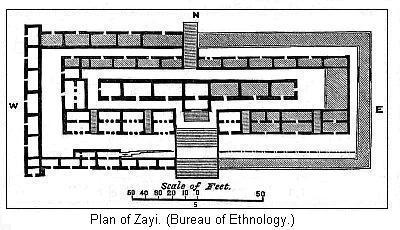
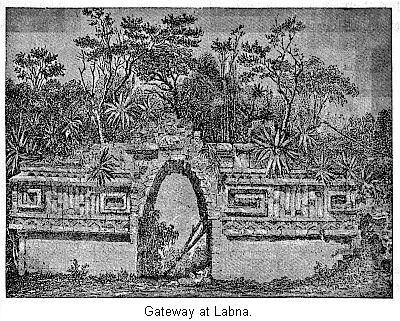
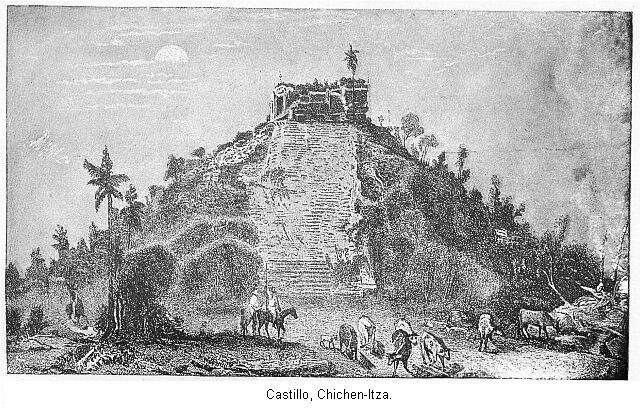
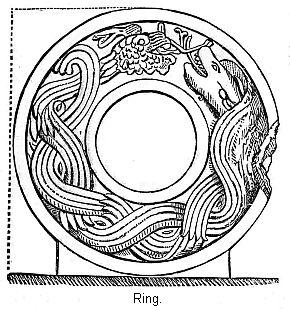
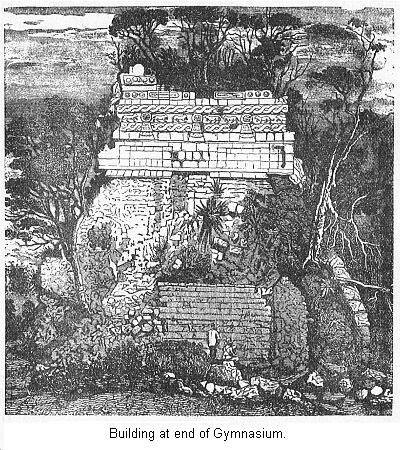
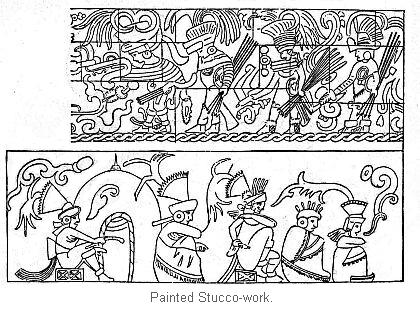
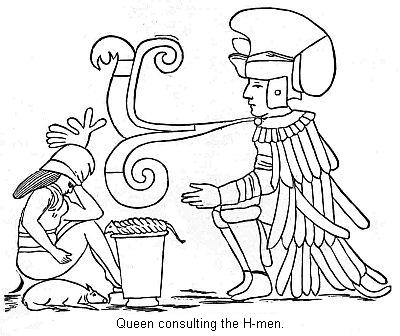
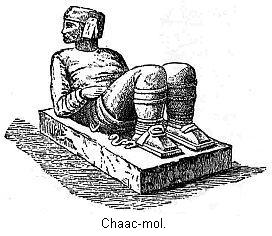
 landscape
presents varied aspects according to the standpoint from which it is
viewed. Here we have a glimpse of hill and dale; there a stretch of
running water. But two persons, standing in the same position, owing to
their different mental temperaments, will view things in a different
light. Where one, an artist born, is carried away with the beautiful
scenery, another, with a more practical turn of mind, perceives only its
adaptability for investments. Education and habits of life are also very
potent factors in determining our views on various questions. Scholars of
wide and extended learning differ very greatly in their views of questions
deeply affecting human interests. We know how true that is of abstruse
topics, such as religion and questions of state polity. It is also true of
the entire field of scientific research. The unknown is a vastly greater
domain than the known, and men, after deep and patient research, adopt
widely different theories to explain the same facts.
landscape
presents varied aspects according to the standpoint from which it is
viewed. Here we have a glimpse of hill and dale; there a stretch of
running water. But two persons, standing in the same position, owing to
their different mental temperaments, will view things in a different
light. Where one, an artist born, is carried away with the beautiful
scenery, another, with a more practical turn of mind, perceives only its
adaptability for investments. Education and habits of life are also very
potent factors in determining our views on various questions. Scholars of
wide and extended learning differ very greatly in their views of questions
deeply affecting human interests. We know how true that is of abstruse
topics, such as religion and questions of state polity. It is also true of
the entire field of scientific research. The unknown is a vastly greater
domain than the known, and men, after deep and patient research, adopt
widely different theories to explain the same facts.