The following extracts from the Landnama,[70] give us the
earliest information on record, in regard to the westward
movements of the Icelanders. The men referred to were
well known, and the mention of their names and exploits
in this great work, than which no higher authority could
be produced, is gratifying. These extracts, which are
given in the order in which they stand in vol. I. of Grönland's
Historiske Mindesmærker, the greater portion of which
work is the labor of Finn Magnusen, have probably never
appeared before in an English dress. The first extract
simply mentions Gunnbiorn and his Rocks; the second
shows that Eric the Red obtained his knowledge of the
existence of Greenland through this person; the third
again gives the name of Gunnbiorn: while the fourth
furnishes a brief account of an early voyage to the Rocks.
It appears from these references, that, previous to the sailing
of Eric the Red, the existence of land at the west was
well understood, the report of Gunnbiorn's adventure having
been quite generally circulated amongst the people.
1. There was a man named Grimkel, [A. D. 876.] son of
Ulf Hreidarson, called Krage, and brother to Gunnbiorn,[71]
after whom Gunnbiorn's Rocks[72] are named. He took possession
of that piece of land that extends from Berevigs
Röin to Ness Röin, and out round the point o£ the cape.
And he lived on Saxahval. He drove away Saxe, a son of
Alfarin Valeson, and he lived on the Röin of Saxahval.
Alfarin Valeson had first taken possession of the cape
between Berevigs Röin and Enne.
2. Eric Red [A. D. 983.] said that he intended to find
the land that was seen by Gunnbiorn,[73] Ulf Krage's son,
when he was driven by a storm west from Iceland, and
found Gunnbiorn's Rocks. [A. D. 876.] At the same time
he said if he did not find the land he would return to his
friends.
3. Two sons of Gunnbiorn, Ulf Krage's son, after whom
Gunnbiorn's Rocks were named, were called Gunstein
and Haldor. They took possession of Skötufiorden, Löigardelen
and Ogursvigen to Mjorfiord. Berse was Haldor's
son, father to Thormod Kalbrunarskald.
Snæbiorn (Holmstein's son), called Galte, owned a ship
[A. D. 970.] that lay in the mouth of Grimsar (in Borgafiorden).
Rolf, from Rödesand, bought a half of the
ship. Each of the parties mustered twelve men. With
Snæbiorn, was Thorkel and Sumarlide, sons of Thorgier
Red, son of Einar, from Stafholdt.
Snæbiorn also took Thorod from Thingness, his step-father
and his five sons, and Rolf took Stærbiorn. The
last named recited the following verse, after he had a
dream:
Both ours
dead I see;
all empty
in Northwestern Sea;
cold weather,
great suffering,
I expect
Snæbiorn's death.[74]
They sought Gunnbiorn's Rocks and found land. Snæbiorn
would not permit any one to go ashore in the night.
Stærbiorn landed, notwithstanding, and found a purse[75]
with money in an earth hole, and concealed it. Snæbiorn
hit him with an axe so that the purse fell down.
They built a cabin to live in, and it was all covered with
snow. Thorkel Red's son, found that there was water on
a shelf that stood out of the cabin window. This was in
the month of Goe.[76] They shovelled the snow away.
Snæbiorn rigged the ship; Thorod and five of his party
were in the hut, and Stærbiorn and several men of Rolf's
party. Some hunted.[77] Stærbiorn killed Thorod, but both
he and Rolf killed Snæbiorn. Red's sons and all the rest
were obliged to take the oath of allegiance to save their
lives. They arrived on their return at Helgeland, Norway,
and later at Vadil in Iceland.[78]
The first document relating to the settlement of Greenland
by the Northmen, is taken from the Saga of Eric the
Red, as given in Professor Rafn's Antiquitates Americanæ.
Besides the history of Eric and his sons, that Saga contains
notices of other voyages. The following are simply
extracts. The whole Saga does not necessarily apply to
the subject under examination—the Discovery of America.
The second extract, which gives more of the particulars,
is from Grönland's Historiske Mindesmærker, vol. ii, p. 201.
The third is also taken from the same great historical
depository.
There was a man named Thorvald, son of Osvald, son
of Ulf-Oexna-Thorerisson. Thorvald and his son were
obliged to leave Jardar[79] and go to Iceland, on account of
manslaughter. At that time Iceland was generally colonized.[80]
They first lived in Drangey, where Thorvald died.
Then Eric married Thorhild, daughter of Jorund and
Thorbiarg Knarrabringa, whom afterwards Thorbiorn of
Haukdale married. Eric moved from the north, and fixed
his abode in Ericstad opposite Vatshorn. The son of Eric
and Thorhold was named Leif. But after Eyulf Soers and
Holm-Gang Rafn's murder, Eric was banished from Haukdale.
Eric went westward to Breidafiord and lived at
Oexney in Ericstad. He lent Thorgest his seat-posts,[81] and
he could not get them again. He then demanded them.
Then came disputes and hostility between him and Thorgest,
which is told in the history of Eric. Styr Thorgrim's
son, Eyulf of Svinoe, the sons of Brand of Aptelfiord and
Thorbiorn Vifilsson plead the cause of Eric; Thorder
Gellurson and Thorgeir of Hitardale plead for Thorgest.
Eric was declared outlawed by the Thing, and prepared his
ship for sea in Eric's Bay. Styr and the others went with
him beyond the island. [A. D. 982.] Then Eric declared
it to be his resolution to seek the land which Gunnbiorn,
Ulf Krage's son, saw [A. D. 876.] when driven into the
Western ocean, where he found Gunnbiorn's Rocks, saying,
that if he did not find the land he would return to his
friends. Eric set sail from Snæfellsjokul, and found land
which from its height he called Midjokul, now called Blaaserk.
Thence he sailed along the shore in a southerly
direction, seeking for the nearest habitable land. The first
winter he passed in Ericseya,[82] near the middle of the east district.
The following year he came into Ericsfiord, where he
fixed his seat. The same summer he explored the western
desert, and gave names to many places. The following
winter he passed on a holm opposite Rafnsgnipa,
and the third year he came into Iceland and brought
his ship into Breidafiord. The land which he found, he
named Greenland, saying that men would be persuaded to
go to a land with so good a name. Eric stayed in Iceland
that winter, and the summer after he went over to the
land which he had found, and fixed his abode in Brattahlid
in Ericsfiord. [A. D. 986.] Men acquainted with affairs,
say, that this same summer in which Eric went to settle in
Greenland, thirty-five ships sailed from Breidafiord and
Bogafjord, of which only fourteen arrived, and the rest
were driven back or lost. This event took place fifteen winters[83]
before the Christian religion was established in Iceland.
The same summer, Bishop Frederick and Thorvold Kodranson
went from Iceland.[84] Among those who emigrated
with Eric and established themselves, were Heriulf Heriulfsfiord
who took Heriulfsness, and abode in Heriulfsness,
Ketil Ketilsfiord, Rafn Rafnsfiord, Solvi Solvidale,
Helgi Thorbrandson Alptafiord, Thorbjornglora Siglefjord,
Einar Einarsfiord, Hafgrim Hafgrimsfiord and Vatnahver,
Arnlaug Arnlaugsfiord; and other men went to the west
district.
And when the sixth[85] winter had passed [A. D. 999.]
since Eric Red went to live in Greenland, Leif, son of Eric,
went over from Greenland to Norway, and in the autumn
arrived in Throndheim and came north to King Olaf Trygvesson,[86]
from Hegeland. He brought his ship to Nidaros
and went at once to King Olaf. The king commanded Leif
and some other pagan men to come to him. They were
exhorted to accept religion, which the king having easily
arranged with Leif, he and all his sailors were baptized,
and passed the winter with the king, being liberally entertained.
Thorvold the son of Usvold, son of Ulf, son of Oexne-Thorer,
and his son, Eric Red, left Jardar in Norway on
account of manslaughter, and took possession of a piece of
land on Hornastrand [Iceland], and lived there at Drangey.
There Thorvold died. Eric then married Thorhild,
daughter of Jorund Atleson and Thorbiarg Knarrabringa,
who was then married to Thorbiorn of Haukdale. Then
Eric went from the north and ploughed the fields in Haukdale.
Then he lived in Ericstadt by Vatshorn. There his
thralls[87] let a piece of rock tumble down over Valthiof's
house in Valthiofstadt. But his relation, Eyulf Söirs, killed
the thralls at Kneide-Brinke above Vatshorn. For this
cause, Eric killed Eyulf Söirs. He also killed Holm-Gang
Rafn at Leikskaale. Geirstein and Odd at Jörund Eyulf
Söirs relations brought a suit against the slayer. Eric was
then banished from Hauksdale, and took possession of the
islands, Brokö and Oexno, but lived in Todum at Sydero,
the first winter. Then he loaned Thorgest his seat-posts.
Then Eric moved to Oexno and lived in Ericstadt. Then
he demanded his seat-posts, but did not get them. Eric
took them thereafter from Bredobolstad, but Thorgest
followed him. They fought near the house at Drangey.
Two sons of Thorgest fell, and some other men. Thereafter
they both kept their followers with them. Styr,
Eyulf of Svino, Thorbrand's sons of Alptefiord, and Thorbiorn
Vifilsson, were of Eric's party. But Thord Gelleirson,
Thorgeir from Hitardale, Aslak of Langedale, and Illuge's
son helped Thorgest. Eric and his party were sentenced
to be banished at Thorsness Thing. He fitted out a ship
in Ericsfiord, but Eyulf concealed him in Dimonsvaag,
while Thorgest and his men sought after him on the
highlands. Thorbiorn, Eyulf and Styr followed with Eric
out to sea beyond the islands. He said that he meant to
seek the land Gunnbiorn, Ulf Krage's son, saw [A. D. 876.]
when he was driven by a storm west from Iceland, and
found Gunnbiorn's Rocks; though he said at the same time
if he discovered the land he would return to his friends.
[A. D. 982.] Eric laid his course to the west from Snæfieldness,
and approached [Greenland] from the sea to
land at Midjokul, in that place that is called Blæsark.
From thence he went along the coast to the south, to see if
the land was fit to live in. The first year he stayed all
winter in Ericksö, nearly in the middle of the west bygd.
In the next spring [A. D. 983.] he went to Ericsfiord, and
there found a dwelling. Next summer he went to the
western bygd, and gave certain names to many places.
The second winter he lived in Ericsholm, at Hvarfo Fiedspidæ,
and at the third summer [A. D. 984.] he went north
to Snæfield, inside of Rafnsfiord. He thought then that
the place where Ericsfiord bent was opposite the place
where he came. He then returned and spent the third
winter in Ericksö opposite the mouth of Ericsfiord. The
next summer [A. D. 985.] he went to Iceland, and landed
at Breidafiord. The next winter he stayed at Holmstater,
with Ingolf. Next spring he fought with Thorgest and
lost the battle. That summer, Eric began to settle the
land which he had discovered [A. D. 986.] and which he
called Greenland, because he said that the people would
not like to move there, if the land did not have a good
name. Learned men say that twenty-five ships went that
summer to Greenland from Breidafiord and Borgafjord,
but only fourteen arrived. Of the rest, some were driven
back and others were wrecked. This happened fifteen
winters before Christianity was introduced into Iceland.
The land some call Greenland, was discovered and
settled from Iceland. Eric the Red was the name of the
Breidafiord man, who [A. D. 986.] went from here [Iceland]
to there, and took possession of that part of the land, which
later was called Ericsfiord. He named the land and called
it Greenland, and said it would encourage people to come
there, if the land had a good name. They found there,
both east and west, ruins of houses and pieces of boats,
and begun stonework. From which it is to be seen what
kind of people have lived in Vinland, and which the Greenlanders
call Skrælings and who had been there. He [Eric]
began to settle the land fourteen or fifteen years before the
introduction of Christianity in Iceland. Afterwards this
was told of Greenland to Thorkel Gelleirson, by a man
who had himself followed Eric Red.
The voyage of Biarne to Greenland was attended by
many hardships. His vessel was blown away from the
course during a storm, at which time he saw the shores of
the American continent, yet he made no attempt to land.
Of this voyage we have two versions. The first is a
translation of a passage from Codex Flatöiensis, given in
Antiquitates Americaæ, p. 17. The second is taken from
Grönland's Historiske Mindesmærker. The date of this
voyage is fixed by the fact that Biarne sailed the same
season that his father settled in Greenland, which, as
we learn from the narrative of Eric, was in the year
985. There is a complete agreement between this account
and the preceding.
Heriulf was the son of Bard, Heriulf's son, who was a
relation of Ingolf the Landnamsman.[88] Ingolf gave Heriulf
land between Vog and Reikianess. Heriulf dwelt first at
Dropstock. His wife was called Thorgird, and their son
was called Biarne. He was a promising young man. In
his earliest youth he had a desire to go abroad, and he
soon gathered property and reputation; and was by turns
a year abroad, and a year with his father. Biarne was
soon in possession of a merchant ship of his own. The
last winter [A. D. 985.] while he was in Norway, Heriulf
prepared to go to Greenland with Eric, and gave up his
dwelling. There was a Christian man belonging to the
Hebudes along with Heriulf, who composed the lay called
the Hafgerdingar[89] Song, in which is this stave:
May he whose hand protects so well
The simple monk in lonely cell,
And o'er the world upholds the sky,
His own blue hall, still stand me by.[90]
Heriulf settled at Heriulfness [A. D. 985.] and became a
very distinguished man. Eric Red took up his abode at
Bratthalid, and was in great consideration, and honored by
all. These were Eric's children: Leif, Thorvold, and Thorstein;
and his daughter was called Ferydis. She was married
to a man called Thorvald; and they dwelt at Gardar, which
is now a bishop's seat. She was a haughty, proud woman;
and he was but a mean man. She was much given to
gathering wealth. The people of Greenland were heathen
at this time. Biarne came over the same summer [A. D.
985.] with his ship to the strand[91] which his father had
sailed abroad from in the spring. He was much struck with
the news, and would not unload his vessel. When his
crew asked him what he intended to do, he replied that
he was resolved to follow his old custom by taking up his
winter abode with his father. "So I will steer for Greenland
if ye will go with me." They one and all agreed to
go with him. Biarne said, "Our voyage will be thought
foolish, as none of us have been on the Greenland sea
before." Nevertheless they set out to sea as soon as they
were ready, and sailed for three days, until they lost sight
of the land they left. But when the wind failed, a north
wind with fog set in, and they knew not where they were
sailing to; and this lasted many days. At last they saw the
sun, and could distinguish the quarters of the sky; so they
hoisted sail again, and sailed a whole day and night, when
they made land. They spoke among themselves what
this land could be, and Biarne said that, in his opinion, it
could not be Greenland. On the question, if he should
sail nearer to it, he said, "It is my advice that we sail up
close to the land." They did so; and they soon saw that
the land was without mountains, was covered with woods,
and that there were small hills inland. They left the land
on the larboard side, and had their sheet on the land side.
Then they sailed two days and nights before they got sight
of land again. They asked Biarne if they thought this
would be Greenland; but he gave his opinion that the land
was no more Greenland, than the land they had seen
before. "For on Greenland, it is said, there are great
snow mountains." They soon came near to the land, and
saw that it was flat and covered with trees. Now, as the
wind fell, the ship's people talked of its being advisable to
make for the land; but Biarne would not agree to it.
They thought that they would need wood and water; but
Biarne said: "Ye are not in want of either." And the
men blamed him for this. He ordered them to hoist
the sail, which was done. They now turned the ship's
bow from the land, and kept the sea for three days and
nights, with a fine breeze from southwest. Then they saw
a third land, which was high and mountainous, and with
snowy mountains. Then they asked Biarne if he would
land here; but he refused altogether: "For in my opinion
this land is not what we want."[92] Now they let the sails
stand and kept along the land and saw it was an island.
Then they turned from the land and stood out to sea with
the same breeze; but the gale increased, and Biarne
ordered a reef to be taken in, and not to sail harder than
the ship and her tackle could easily bear. After sailing
three days and nights, they made, the fourth time, land;
and when they asked Biarne if he thought this was Greenland
or not, Biarne replies: "This is most like what has
been told me of Greenland; and here we shall take to the
land." They did so, and came to the land in the evening,
under a ness, where they found a boat. On this ness
dwelt Biarne's father, Heriulf; and from that it is called
Heriulfness. Biarne went to his father's, gave up sea-faring,
and after his father's death, continued to dwell
there when at home.
A man named Heriulf, son of Bard, son of Heriulf, a
relation to Landnamsman Ingolf, who gave the last named
Heriulf the piece of land that lies between Vaag and Reikianess.
The younger Heriulf went to Greenland, when
Eric Red began to settle there, and on his ship was a
Christian man from the South Islands [the Hebrides] who
was the author of the poem, Havgerdingar, in which was the
following verse:
I to the monk's protector pray
That he will give my voyage luck!
The heaven's great Ruler
Save me from danger.
Heriulf took possession of Heriulfsfiord, and became one
of the chief men. Eric Red took to himself Ericsfiord,
and lived in Brattahlid, and Leif, his son, after his death.
Those men who at the same time went away with Eric
took possession of the following pieces of land: Heriulf
Heriulfsfiord, and he lived in Heriulfness, Ketil Ketilsfiord,
Rafn Rafnsfiord, Sölve Sölvedale, Snorro Thorbrandson
Alptefiord, Thorbiornglora Siglefiord, Einar Einarsfiord,
Havgrim Havgrimsfiord and Vatnahverf, Arnlaug Arnlaugfiord;
but some went to the west bygd. A man named
Thorkel Forsark, cousin to Eric Red on their mother's
side, went to Greenland with Eric, and took possession of
Hvalsöfiord, together with the greater part of the piece of
land between Eyolfsfiord and Einarsfiord, and lived in
Hvalosöfne. From him came the Hvalsöfiord people.
He was very strong. Once Eric Red visited him, and he
would welcome his guest in the best way possible, but he
had no boats at hand which he could use. He was compelled
to swim out to Hvalsö, and get a full-grown sheep,[93]
and carry it on his back home to his house. It was a
good half mile. Thorkel was buried in a cave in the field
of Hvalsöfiord.
This voyage is recorded in the Flatö Manuscript, and is
given in Antiquitates Americanæ, pp. 26-40. It contains the
account of the voyage of Leif, son of Eric the Red, who,
following out the hints of Biarne, sailed to discover the
new land, which he called Vinland, on account of the
quantity of vines that he found growing wild. Several
extracts are appended, because of interest in connection
with the subject.
[A. D. 984.] It is next to be told that Biarne Heriulfson
came over from Greenland to Norway, on a visit to Earl
Eric, who received him well. Biarne tells of this expedition
of his, in which he had discovered unknown land; and
people thought he had not been very curious to get knowledge,
as he could not give any account of those countries,
and he was somewhat blamed on this account. [A. D. 986.]
Biarne was made a Court man of the earl, and the summer
after he went over to Greenland; and afterwards there
was much talk about discovering unknown lands. Leif, a
son of Eric Red of Brattahlid, went over[94] to Biarne Heriulfson,
and bought the ship from him, and manned the
vessel, so that in all, there were thirty-five men on board.
Leif begged his father Eric to go as commander of the
expedition; but he excused himself, saying he was getting
old, and not so able as formerly to undergo the hardship
of a sea voyage. Leif insisted that he among all their
relations was the most likely to have good luck on such an
expedition; and Eric consented, and rode from home with
Leif, when they had got all ready for sea; but when they
were coming near to the ship,[95] the horse on which Eric
was riding, stumbled, and he fell from his horse[96] and hurt
his foot. "It is destined," said Eric, "that I should never
discover more lands than this of Greenland, on which we
live; and now we must not run hastily into this adventure."[97]
Eric accordingly returned home to Brattahlid, but
Leif, with his comrades, in all thirty-five men, rigged out
their vessel. There was a man from the south country
called Tyrker,[98] with the expedition. [A. D. 1000.] They
put the ship in order, and put to sea when they were ready.
They first came to the land which Biarne had last discovered,
sailed up to it, cast anchor, put out a boat and
went on shore; but there was no grass to be seen. There
were large snowy mountains[99] up the country; but all the
way from the sea up to these snowy ridges, the land was
one field of snow, and it appeared to them a country of no
advantages. Leif said: "It shall not be said of us, as it
was of Biarne, that we did not come upon the land; for I
will give the country a name, and call it Helluland."[100]
Then they went on board again and put to sea, and found
another land. They sailed in towards it, put out a boat,
and landed. The country was flat,[101] and overgrown with
wood; and the strand far around, consisted of a white
sand, and low towards the sea. Then Leif said: "We
shall give this land a name according to its kind, and
called it Markland."[102] Then they hastened on board, and
put to sea again with the wind from the northeast, and were
out for two days and made land. They sailed towards it,
and came to an island[103] which lay on the north side
of the land, where they disembarked[104] to wait for good
weather. There was dew upon the grass; and having
accidentally gotten some of the dew upon their hands and
put it in their mouths, they thought that they had never
tasted anything so sweet as it was.[105] Then they went on
board and sailed into a sound[106] that was between the island
and a ness[107] that went out northwards from the land, and
sailed westward[108] past the ness. There was very shallow[109]
water in ebb tide, so that their ship lay dry; and there was
a long way between their ship and the water. They were
so desirous to get to the land that they would not wait till
their ship floated, but ran to the land, to a place where a
river comes out of a lake. As soon as their ship was
afloat they took the boats, rowed to the ship, towed her
up the river,[110] and from thence into the lake,[111] where they
cast anchor, carried their beds out of the ship, and set up
their tents. They resolved to put things in order for
wintering there, and they erected a large house. They did
not want for salmon,[112] both in the river and in the lake; and
they thought the salmon larger than any they had ever
seen before. The country appeared to them of so good a
kind, that it would not be necessary to gather fodder for
the cattle for winter.[113] There was no frost in winter,[114] and
the grass was not much withered. Day and night were
more equal than in Greenland and Iceland; for on the
shortest day the sun was in the sky between Eyktarstad[115]
and the Dagmalastad. Now when they were ready with
their house building, [A. D. 1001.] Leif said to his fellow
travellers: "Now I will divide the crew into two divisions,
and explore the country. Half shall stay at home and do
the work, and the other half shall search the land; but so
that they do not go farther than they can come back in the
evening, and that they do not wander from each other."
This they continued to do for some time. Leif changed
about, sometimes with them, and sometimes with those at
home. Leif was a stout and strong man, and of manly
appearance; and was, besides, a prudent and sagacious
man in all respects.
It happened one evening that a man of the party was
missing; and it was the south country man, Tyrker. Leif
was very sorry for this, because Tyrker had long been in
his father's house, and he loved Tyrker in his childhood.
Leif blamed his comrades very much, and proposed to
go with twelve men on an expedition to find him; but
they had gone only a short way from the station when
Tyrker came to meet them, and he was joyfully received.
Leif soon perceived that his foster father[116] was quite
merry.[117] Tyrker had a high forehead, sharp eyes, with a
small face, and was little in size, and ugly; but was very
dexterous in all feats. Leif said to him, "Why art thou so
late, my foster-father? and why didst thou leave thy comrades?"
He spoke at first long in German, rolled his eyes
and knit his brows; but they could not make out what he
was saying. After a while, and some delay, he said in
Norse, "I did not go much farther than they; and yet I
have something altogether new to relate, for I found vines
and grapes."[118] "Is that true, my foster-father?" said Leif.
"Yes, true it is," answered he, "for I was born where
there was no scarcity of grapes." Now they slept all night,
and the next morning Leif said to his men, "Now we
shall have two occupations to attend to, and day about;
namely, to gather grapes or cut vines, and to fell wood in
the forest to lade our vessel." And this advice was followed.
It is related that their stern boat was filled with
grapes, and then a cargo of wood was hewn for the vessel.[119]
Towards spring they made ready and sailed sway, and Leif
gave the country a name from its products, and called it
Vinland.[120] They now sailed into the open sea and had a
fair wind until they came in sight of Greenland and the
lands below the ice mountains.[121] Then a man put in a
word and said to Leif, "Why do you steer so close on
the wind?" Leif replied: "I mind my helm and tend to
other things too; do you notice anything?" They said
that they saw nothing remarkable. "I do not know,"
said Leif, "whether I see a ship or a rock." Then they
looked and saw that it was a rock. But he saw so much
better than they, that he discovered men upon the rock.
"Now I will," said Leif, "that we hold to the wind, that
we may come up to them if they should need help; and if
they should not be friendly inclined, it is in our power to
do as we please and not theirs." Now they sailed under
the rock, lowered their sails, cast anchor, and put out
another small boat which they had with them. Then
Tyrker asked who their leader was. He said his name
was Thorer, and said he was a Northman;[122] "But what is
your name?" said he. Leif told his name. "Are you the
son of Eric the Red of Brattahlid?" he asked. Leif said
that was so. "Now I will," said Leif, "take ye and all
on board my ship, and as much of the goods as the ship
will store." They took up this offer, and sailed away to
Ericfiord with the cargo, and from thence to Brattahlid,
where they unloaded the ship. Leif offered Thorer and
his wife, Gudrid, and three others, lodging with himself,
and offered lodging elsewhere for the rest of the people,
both of Thorer's crew and his own. Leif took fifteen men
from the rock, and thereafter was called, Leif the Lucky.
After that time Leif advanced greatly in wealth and consideration.
That winter, sickness came among Thorer's
people, and he himself, and a great part of his crew, died.
The same winter Eric Red died. This expedition to
Vinland was much talked of, and Leif's brother, Thorvald,
thought that the country had not been explored enough in
different places. Then Leif said to Thorvald, "You may
go, brother, in my ship to Vinland if you like; but I will
first send the ship for the timber which Thorer left upon
the rock." And so it was done.
The same spring, King Olaf, as said before, sent Gissur[123]
and Hialte[124] to Iceland. The king also sent Leif to
Greenland to proclaim Christianity there. The king sent
with him, a priest, and some other religious men, to baptize
the people and teach them the true faith. Leif sailed
the same summer to Greenland; he took up out of the
ocean, the people of a ship who were on a wreck completely
destroyed, and in a perishing condition. And on this
same voyage he discovered Vinland the Good,[125] and came
at the close of summer to Brattahlid, to his father Eric.
After that time the people called him, Leif the Fortunate;
but his father Eric said that these two things went against
one another; that Leif had saved the crew of the ship, and
delivered them from death, and that he had [brought] that
bad man into Greenland, that is what he called the priest;
but after much urging, Eric was baptized,[126] as well as all
the people of Greenland.
The same winter, Leif, the son of Eric the Red, was in
high favor with King Olaf, and embraced Christianity.
But the summer that Gissur went to Iceland, King Olaf
sent Leif to Greenland, to proclaim Christianity. He sailed
the same summer for Greenland. He found some men in
the sea on a wreck, and helped them; the same voyage,[127]
he discovered Vinland the Good, and came at harvest time
to Greenland. He brought with him a priest and other
religious[128] men, and went to live at Brattahlid with his
father Eric. He was afterwards called, Leif the Fortunate.
But his father Eric said, that these two things were
opposed to one another, because Leif had saved the crew
of the ship, and brought evil men to Greenland, meaning
the priests.
The greater portion of this voyage appears to have been
performed during two summers, the expedition finally
returning to Greenland on account of the death of their
leader. The narrative is taken from Codex Flatöiensis, as
given in Antiquitates Americanæ.
Now Thorvald [A. D. 1002.] made ready for his voyage
with thirty men, after consulting his brother Leif. They
rigged their ship, and put to sea. Nothing is related of
this expedition until they came to Vinland, to the booths
put up by Leif, where they secured the ship and tackle,
and remained quietly all winter and lived by fishing. In
spring [A. D. 1003.] Thorvald ordered the vessel to be
rigged, and that some men should proceed in the long-boat
westward along the coast, and explore it during the
summer. They thought the country beautiful and well
wooded, the distance small between the forest and the sea,
and the strand full of white sand. There were also many
islands and very shallow water. They found no abode
for man or beast, but on an island far towards the west,
they found a corn barn constructed of wood. They found
no other traces of human work, and came back in autumn
to Leif's booths. The following spring, [A. D. 1004.]
Thorvald, with his merchant ship, proceeded eastwards, and
towards the north along the land.[129] Opposite to a cape[130]
they met bad weather, and drove upon the land and broke
their keel, and remained there a long time to repair the
vessel. Thorvald said to his companions: "We will stick
up the keel here upon the ness, and call the place
Kialarness," which they did. Then they sailed away eastward
along the country, to a point of land,[131] which was
everywhere covered with woods. They moored the vessel
to the land, laid out gangways to the shore, and Thorvald
with all his ship's company, landed. He said, "Here it is
beautiful, and I would willingly set up my abode here."
They afterwards went on board, and saw three specks upon
the sand within the point, and went to them and found
there were three skin boats with three men under each
boat. They divided their men and took all of them
prisoners, except one man, who escaped with his boat.
They killed eight of them, and then went to the point and
looked about them. Within this bay they saw several
eminences, which they took to be habitations. Then a
great drowsiness came upon them and they could not keep
themselves awake, but all of them fell asleep. A sudden
scream came to them, and they all awoke; and mixed with
the scream they thought they heard the words: "Awake,
Thorvald, with all thy comrades, if ye will save your lives.
Go on board your ship as fast as you can, and leave this
land without delay." In the same moment an innumerable
multitude, from the interior of the bay, came in skin
boats and laid themselves alongside. Then said Thorvald,
"We shall put up our war screens[132] along the gunwales
and defend ourselves as well as we can, but not use our
weapons much against them." They did so accordingly.
The Skrællings[133] shot at them for a while, and then fled
away as fast as they could. Then Thorvald asked if anyone
was wounded, and they said nobody was hurt. He
said: "I have a wound under the arm.[134] An arrow flew
between the gunwale and the shield under my arm: here
is the arrow, and it will be my death wound. Now I
advise you to make ready with all speed to return; but ye
shall carry me to the point which I thought would be so
convenient for a dwelling. It may be that it was true
what I said, that here would I dwell for a while. Ye shall
bury me there, and place a cross at my head and one at my
feet, and call the place Crossness." Christianity had been
established in Greenland at this time;[135] but Eric Red was
dead[136] before Christianity was introduced. Now Thorvald
died, and they did everything as he had ordered. Then
they went away in search of their fellow voyagers; and
they related to each other all the news. They remained
in their dwelling all winter, and gathered vines and grapes,
and put them on board their ships. Towards spring, they
prepared to return to Greenland, where they arrived with
their vessel, and landed at Ericsfiord, bringing heavy tidings
to Leif.
This version is from Codex Flatöiensis, and is given in
Antiquitates Americanæ, pp. 47-55. The expedition was
wholly unsuccessful, and the leader finally died without
reaching the desired land. One cannot help feeling, notwithstanding
the marvellous events recorded, that the basis
of this account, is formed of solid fact. The main narrative
is not one likely to have been invented by an impostor.
In the meantime it had happened in Greenland, that
Thorstein of Ericsfiord had married, and taken to wife,
[A. D. 1005.] Gudrid, the daughter of Thorbiorn, who
had been married, as before related, to Thorer, the Eastman.[137]
Thorstein Ericsson bethought him now, that he
would go to Vinland, for his brother Thorvald's body.
He rigged out the same vessel, and chose an able and
stout crew. He had with him, twenty-five men, and his
wife Gudrid; and as soon as they were ready he put to
sea, and they quickly lost sight of the land. They drove
about on the ocean the whole summer, without knowing
where they were; and in the first week of winter,[138] they
landed at Lysifiord in Greenland, in the western settlement.
Thorstein looked for lodgings for his men, and got
his whole ship's crew accommodated, but not himself and
wife; so that for some nights they had to sleep on board.
At that time Christianity was but recent in Greenland.
One day, early in the morning, some men came to their
tent, and the leader asked them what people were in the
tent? Thorstein replies, "Two; who is it that asks?"
"Thorstein," was the reply, "and I am called Thorstein
the Black, and it is my errand here, to offer thee and
thy wife lodging beside me." Thorstein said he would
speak to his wife about it; and as she gave her consent,
he agreed to it. "Then I shall come for you to-morrow
with my horses,[139] for I do not want means to entertain you;
but few care to live in my house, for I and my wife live
lonely, and I am very melancholy. I have also a different
religion[140] from yours, although I think the one you have,
the best." Now the following morning he came for them
with horses; and they took up their abode with Thorstein
Black, who was very friendly towards them. Gudrid had
a good outward appearance, and was knowing, and understood
well how to behave with strangers. Early in the
winter, a sickness prevailed among Thorstein Ericsson's
people, and many of his ship men died. He ordered that
coffins should be made for the bodies of the dead, and that
they should be brought on board, and stowed away carefully;
for he said, "I will transport all the bodies to Ericsfiord
in summer." It was not long before sickness broke
out in Thorstein Black's house, and his wife, who was
called Grimhild, fell sick first. She was very stout, and
as strong as a man, but yet she could not bear up against
the illness. Soon after, Thorstein Ericksson also fell sick,
and they both lay ill in bed at the same time; but Grimhild,
Thorstein Black's wife died first. When she was
dead, Thorstein went out of the room for a skin to lay
over the corpse. Then Gudrid said, "My dear Thorstein,
be not long away;" which he promised. Then said
Thorstein Ericsson, "Our housewife is wonderful, for she
raises herself up with her elbows, moves herself forward
over the bed-frame, and is feeling for her shoes." In the
same moment, Thorstein the Goodman, came back, and
instantly, Grimhild laid herself down, so that it made
every beam that was in the house, crack. Thorstein now
made a coffin for Grimhild's corpse, removed it outside,
and buried it. He was a stout and strong man, but it
required all his strength to remove the corpse from the
house. Now Thorstein Ericsson's illness increased upon
him, and he died, which Gudrid his wife took with great
grief. They were all in the room, and Gudrid had set
herself upon a stool before the bench on which her husband
Thorstein's body lay. Now Thorstein the goodman
took Gudrid from the stool in his arms, and set himself
with her upon a bench just opposite to Thorstein's body,[141]
and spoke much with her. He consoled her, and promised
to go with her in summer to Ericsfiord, with her husband
Thorstein's corpse, and those of his crew. "And," said
he, "I shall take with me many servants to console and
assist." She thanked him for this. Thorstein Ericsson
then raised himself up and said, "Where is Gudrid?"
And thrice he said this; but she was silent. Then she
said to Thorstein the Goodman, "Shall I give answer or
not?" He told her not to answer. Then went Thorstein
the Goodman across the room, and sat down in a chair,
and Gudrid set herself on his knee; and Thorstein the
Goodman said: "What wilt thou make known?" After
a while the corpse replies, "I wish to tell Gudrid her fate
beforehand, that she may be the better able to bear my
death; for I have come to a blessed resting place. And this
I have now to tell thee, Gudrid, that thou wilt be married
to an Iceland man, and ye will live long together; and
from you will descend many men, brave, gallant and wise,
and a well pleasing race of posterity. Ye shall go from
Greenland to Norway, and from thence to Iceland, where
ye shall dwell. And long will ye live together, but thou
wilt survive him; and then thou shalt go abroad, and go
southwards, and shall return to thy home in Iceland. And
there must a church be built, and thou must remain there
and be consecrated a nun, and there end thy days."[142] And
then Thorstein sank backwards, and his corpse was put in
order and carried to the ship. Thorstein the Goodman
did all that he had promised. He sold in spring [A. D.
1006.] his land and cattle, and went with Gudrid and all
her goods; made ready the ship, got men for it, and then
went to Ericsfiord. The body was buried at the church.[143]
Gudrid went to Leif's at Brattahlid, and Thorstein the
Black took his abode in Ericsfiord, and dwelt there as
long as he lived; and was reckoned an able man.
This was in many respects the most important expedition
to New England, both as regards the numbers
engaged, and the information and experience derived.
We have three different accounts of this expedition. The
first is from the somewhat lengthy Saga of Thorfinn
Karlsefne, from the Arnæ-Magnæan Collection; the second
is from the Saga of Eric the Red, being called "The
Account of Thorfinn:" while the third is a briefer
relation from Codex Flatöiensis. The two first may be
found in Rafn's Antiquitates Americanæ, pp. 75-200; while
the last is also given in the same work, on pp. 55-64.
The Saga of Karlsefne is occupied largely at the beginning
with accounts of various matters connected with
social life; yet, as such subjects are not essential to the
treatment of the subject, they are all omitted, except the
account of Thorfinn's marriage with the widow of Thorstein
Ericson.
The notes to the narrative of Leif's expedition, which
precedes this in the chronological order, supersede the
necessity of treating a number of important points suggested
again in the present narrative.
It is believed that the principal manuscript of Thorstein
Karlsefne is a genuine autograph by one of his descendants,
the celebrated Hauk Erlander, the Governor or Lagman of
Iceland, in 1295, who was also one of the compilers of the
Landnama-bok. Erlander was the ninth in descent from
Thorfinn. Torfæus, who supposed that this manuscript
was lost, knew it only through corrupt extracts in the collection
of Biörn Johnson.
There will be found a substantial agreement between
the different accounts, notwithstanding they are not the
work of eye witnesses. The differences are evidently such
as would not appear in the case of three writers who had
banded together for the purpose of carrying out a historical
fraud. The Saga of Thorfinn was written in Iceland, while
that of Eric was composed in Greenland. The account
from the Flatö Manuscript, was, of course, written in the
island which bears that name, and is extremely brief,
wanting many essential particulars.
There was a man named Thord, who dwelt at Höfda,
in Höfda-Strand. He married Fridgerda, daughter of
Thorer the Idle, and of Fridgerda the daughter of Kiarval,
King of the Irish. Thord was the son of Biarne
Byrdusmjör,[144] son of Thorvald, son of Aslak, son of Biarne
Ironsides, son of Ragnar Lodbrok. They had a son
named Snorre, who married Thorhild the Partridge, daughter
of Thord Geller. They had a son named Thord Horsehead.
Thorfinn Karlsefne was his son, whose mother's
name was Thoruna. Thorfinn occupied his time in merchant
voyages, and was thought a good trader. One
summer he fitted out his ship for a voyage to Greenland,
attended by Snorre Thorbrandson of Alptafiord, and a crew
of forty men. There was a man named Biarne Grimolfson
of Breidafiord, and another named Thorhall Gamlason of
Austfiord. The men fitted out a ship at the same time, to
voyage to Greenland. They also had a crew of forty men.
This ship, and that of Thorfinn, as soon as they were
ready, put to sea. It is not said how long they were on
the voyage; it is only told that both ships arrived at
Ericsfiord in the autumn of that year. Leif[145] and other people
rode down to the ships, and friendly exchanges were made.
The captains requested Leif to take whatever he desired of
their goods. Leif in return, entertained them well, and
invited the principal men of both ships to spend the
winter with him at Brattahlid. The merchants accepted
his invitation with thanks. Afterwards their goods were
moved to Brattahlid, where they had every entertainment
that they could desire; therefore their winter quarters
pleased them much. When the Yule feast began, Leif
was silent and more depressed than usual. Then Karlsefne
said to Leif: "Are you sick friend Leif? you do not
seem to be in your usual spirits. You have entertained
us most liberally, for which we desire to render you all
the service in our power. Tell me what it is that ails
you." "You have received what I have been able to
offer you," said Leif, "in the kindest manner and there is
no idea in my mind that you have been wanting in
courtesy; but I am afraid lest when you go away, it may be
said that you never saw a Yule[146] feast so meanly celebrated
as that which draws near, at which you will be entertained
by Leif of Brattahlid." "What shall never be the case,
friend," said Karlsefne, "we have ample stores in the ship;
take of these what you wish, and make a feast as splendid
as you please." Leif accepted this offer, and the Yule
began; and so well were Leif's plans made, that all were
surprised that such a rich feast could be prepared in so
poor a country. After the Yule feast, Karlsefne began to
treat with Leif, as to the marriage of Gudrid,[147] Leif being
the person to whom the right of betrothal belonged. Lief
gave a favorable reply, and said she must fulfill that
destiny which fate had assigned, and that he had heard
of none except a good report of him; and in the end it
turned out that Karlsefne married Gudrid, and their wedding
was held at Brattahlid, this same winter.
[A. D. 1007.] The conversation often turned at Brattahlid,
on the discovery of Vinland the Good, and they said
that a voyage there had great hope of gain. And after
this Karlsefne and Snorre made ready for going on a voyage
there, the following spring. Biarne and Thorhall Gamlason,
before mentioned, joined him with a ship. There was
a man named Thorvard, who married Freydis, natural
daughter of Eric Red, and he decided to go with them, as
did also Thorvald, son[148] of Eric. And Thorhall, commonly
called the Hunter, who had been the huntsman of Eric in
the summer, and his steward in the winter, also went.
This Thorhall was a man of immense size and of great
strength, and dark complexion and taciturn, and when he
spoke, it was always jestingly. He was always inclined to
give Leif evil advice, and was an enemy of Christianity.
He knew much about desert lands; and was in the same
ship with Thorvord and Thorvald. These used the ship
which brought Thorbiorn from Iceland. There were in
all, forty men and a hundred.[149] They sailed to the West
district [of Greenland], and thence to Biarney;[150] hence they
sailed south a night and a day. Then land was seen, and
they launched a boat and explored the land; they found
great flat stones, many of which were twelve ells broad.
There were a great number of foxes there. They called
the land Helluland.[151] Then they sailed a day and a night
in a southerly course, and came to a land covered with
woods, in which there were many wild animals. Beyond
this land to the southeast, lay an island on which they slew
a bear. They called the island Bear island,[152] and the land,
Markland. Thence they sailed south two days and came
to a cape. The land lay on the right [starboard] side of
the ship, and there were long shores of sand. They came
to land, and found on the cape, the keel of a ship,
from which they called the place Kiarlarness,[153] and the
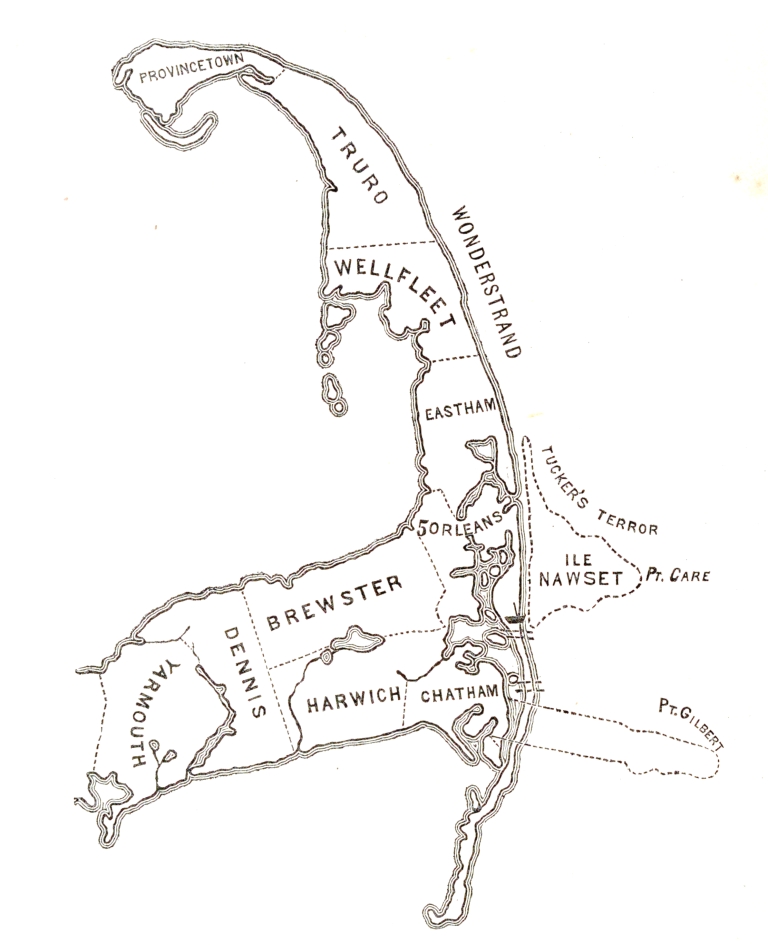
shores they also called Wonder-strand, because it seemed
so long sailing by. Then the land became indented with
coves, and they ran the ship into a bay,[154] whither they
directed their course. King Olaf Tryggvesson had given
Leif two Scots,[155] a man named Haki and a woman named
Hekia; they were swifter of foot than wild animals.
These were in Karlfsefne's ship. And when they had
passed beyond Wonder-strand, they put these Scots ashore,
and told them to run over the land to the southwest,
three days, and discover the nature of the land, and then
return. They had a kind of garment that they called
kiafal, that was so made that a hat was on top, and it was
open at the sides, and no arms; fastened between the legs
with a button and strap, otherwise they were naked.
When they returned, one had in his hand a bunch of
grapes, and the other an ear of corn. They went on
board, and afterwards the course was obstructed by another
bay.[156] Beyond this bay was an island,[157] on each side of
which was a rapid current, that they called the Isle of Currents.[158]
There was so great a number of eider ducks[159] there,
that they could hardly step without treading on their eggs.
They called this place Stream Bay.[160] Here they brought
their ships to land, and prepared to stay. They had with
them all kinds of cattle. The situation of the place[161] was
pleasant, but they did not care for anything, except to
explore the land. Here they wintered without sufficient
food. The next summer [A. D. 1008.] failing to catch
fish, they began to want food. Then Thorhall the Hunter
disappeared.
They found Thorhall, whom they sought three days, on
the top of a rock, where he lay breathing, blowing through
his nose and mouth, and muttering. They asked why he
had gone there. He replied that this was nothing that
concerned them.[162] They said that he should go home with
them, which he did. Afterwards a whale was cast ashore[163]
in that place; and they assembled and cut it up, not
knowing what kind of a whale it was. They boiled it
with water, and devoured it, and were taken sick. Then
Thorhall said: "Now you see that Thor[164] is more prompt
to give aid than your Christ. This was cast ashore as a
reward for the hymn which I composed to my patron
Thor, who rarely forsakes me." When they knew this,
they cast all the remains of the whale into the sea, and
commended their affairs to God. After which the air
became milder, and opportunities were given for fishing;
and from that time there was an abundance of food; and
there were beasts on the land, eggs in the island, and fish
in the sea.
They say that Thorhall desired to go northward around
Wonder-strand to explore Vinland, but Karlsefne wished
to go along the shore south. Then Thorhall prepared
himself at the island, but did not have more than nine
men in his whole company, and all the others went in the
company of Karlsefne. When Thorhall was carrying water
to his ship, he sang this verse:
"People said when hither I
Came, that I the best
Drink would have, but the land
It justly becomes me to blame;
I, a warrior, am now obliged
To bear the pail;
Wine touches not my lips,
But I bow down to the spring."
And when they had made ready and were about to sail,
Thorhall sang:
"Let us return
Thither where [our] country-men rejoice,
Let the ship try
The smooth ways of the sea;
While the strong heroes
Live on Wonder-strand
And there boil whales
Which is an honor to the land."
Afterwards he sailed north to go around Wonder-strand
and Kiarlarness, but when he wished to sail westward,
they were met by a storm from the west and driven to
Ireland, where they were beaten and made slaves. And,
as merchants[165] reported, there Thorhall died.
It is said that Karlsefne, with Snorre and Biarne and
his comrades, sailed along the coast south. They sailed
long until they came to a river flowing out from the land
through a lake into the sea, where there were sandy shoals,
where it was impossible to pass up, except with the
highest tide. Karlsefne sailed up to the mouth of the
river with his folk, and called the place Hop.[166] Having
come to the land, they saw that where the ground was low
corn[167] grew, and where it was higher, vines were found.
Every river was full of fish.
They dug pits where the land began, and where the
land was highest; and when the tide went down, there
were sacred fish[168] in the pits. There were a great number
of all kinds of wild beasts in the woods. They stayed there
half a month and enjoyed themselves, and did not notice
anything; they had their cattle with them. And early
one morning, when they looked around, they saw a great
many skin boats, and poles were swung upon them, and
it sounded like reeds shaken by the wind, and they pointed
to the sun. Then said Karlsefne, "What may this mean?"
Snorre Thorbrandson replied, "It may be that this is a
sign of peace, so let us take a white shield and hold it
towards them." They did so. Thereupon they rowed
towards them, wondering at them, and came to land.
These people were swarthy and fierce, and had bushy hair
on their heads; they had very large eyes and broad cheeks.
They stayed there for a time, and gazed upon those they
met, and afterwards rowed away southward around the ness.
Karlsefne and his people had made their houses above
the lake, and some of the houses were near the lake, and
others more distant. They wintered there, and there was
no snow, and all their cattle fed themselves on the grass.[169]
But when spring came [A. D. 1009.] they saw one morning
early, that a number of canoes rowed from the south
round the ness; so many, as if the sea were sown with
coal; poles were also swung on each boat. Karlsefne and
his people then raised up the shield, and when they came
together they began to trade; and these people would
rather have red cloth; for this they offered skins and real
furs. They would also buy swords and spears, but this,
Karlsefne and Snorre forbade. For a whole fur skin, the
Skrællings took a piece of red cloth, a span long, and
bound it round their heads. Thus went on their traffic
for a time; then the cloth began to be scarce with Karlsefne
and his people, and they cut it up into small pieces,
which were not wider than a finger's breath, and yet the
Skrællings gave just as much as before, and more.
It happened that a bull, which Karlsefne had, ran out of
the wood and roared aloud; this frightened the Skrællings,
and they rushed to their canoes and rowed away toward
the south; and after that they were not seen for three
whole weeks. But at the end of that time, a great number
of Skrælling's ships were seen coming from the south like
a rushing torrent, all the poles turned from the sun, and
they all yelled very loud. Then Karlsefne's people took
a red[170] shield and held it towards them. The Skrællings
leaped out of their vessels, and after this, they went
against each other and fought. There was a hot shower
of weapons, because the Skrællings had slings. Karlsefne's
people saw that they raised up on a pole, a very large
ball, something like a sheep's paunch, and of a blue color;
this they swung from the pole over Karlsefne's men, upon
the ground, and it made a great noise as it fell down.[171]
This caused great fear with Karlsefne and his men, so that
they only thought of running away, and they retreated
along the river, for it seemed to them that the Skrællings
pressed them on all sides; they did not stop until they
came to some rocks, where they made a bold stand. Freydis
came out and saw that Karlsefne's people fell back, and
she cried out, "Why do you run, strong men as you are,
before these miserable creatures, whom I thought you
would knock down like cattle? And if I had arms,
methinks I could fight better than any of you." They
gave no heed to their words. Freydis would go with them,
but she was slower, because she was pregnant; still she
followed after them into the woods. She found a dead
man in the woods; it was Thorbrand Snorreson, and there
stood a flat stone stuck in his head; the sword lay
naked by his side. This she took up, and made ready to
defend herself. Then came the Skrællings toward her;
she drew out her breasts from under her clothes, and
dashed them against the naked sword;[172] by this the Skrællings
became frightened and ran off to their ships, and
rowed away. Karlsefne and his men then came up and
praised her courage. Two men fell on Karlsefne's side,
but a number of the Skrællings. Karlsefne's band was overmatched.
And now they went home to their dwellings
and bound up their wounds; and considered what crowd
that was that pressed upon them from the land side, and
it now seemed to them that it could have hardly been real
people from the ships, but that these must have been
optical illusions. The Skrællings also found a dead man,
and an axe lay by him; one of them took up the axe and
cut wood with it; and then one after another did the same,
and thought it was a fine thing and cut well. After that,
one took it and cut at a stone, so that the axe broke, and
then they thought that it was of no use, because it would
not cut stone, and they cast it away.
Karlsefne and his people now thought that they saw,
although the land had many good qualities, that they still
would always be exposed there to the fear of attacks from
the original dwellers.[173] They decided, therefore, to go
away, and to return to their own land. They coasted
northward along the shore,[174] and found five Skrællings clad
in skins, sleeping near the sea. They had with them
vessels containing animal marrow, mixed with blood.[175]
Karlsefne's people thought that these men had been banished
from the land; they killed them. After that they came
to a ness, and many wild beasts were there, and the ness
was covered all over with dung, from the beasts which had
lain there during the night. Now they came back to
Straumfiord, and there was a plenty of everything that
they wanted to have. [It is thus that some men say, that
Biarne and Gudrid stayed behind, and one hundred men
with them, and did not go farther; but that Karlsefne and
Snorre went southward, and forty men with them, and
were not longer in Hop than barely two months, and the
same summer came back.][176] Karlsefne then went with one
ship to seek Thorhall the Hunter, but the rest remained
behind, and they sailed northward past Kiarlarness, and
thence westward, and the land was upon their larboard
hand. There were wild woods over all, as far as they
could see, and scarcely any open places. And when they
had sailed long a river ran out of the land from east
to west. They sailed into the mouth of the river, and lay
by its banks.[177]
It chanced one morning that Karlsefne and his people
saw opposite in an open place in the woods, a speck which
glittered in their sight, and they called out towards it, and
it was a Uniped,[178] which thereupon hurried down to the
bank of the river, where they lay. Thorvald Ericson
stood at the helm, and the Uniped shot an arrow into his
bowels. Thorvald drew out the arrow and said: "It has
killed me! To a rich land we have come, but hardly shall
we enjoy any benefit from it." Thorvald soon after died[179]
of his wound. Upon this the Uniped ran away to the
northward; Karlsefne and his people went after him, and
saw him now and then, and the last time they saw him, he
ran out into a bay. Then they turned back, and a man
sang these verses:
The people chased
A uniped
Down to the beach.
Behold he ran
Straight over the sea—
Hear thou, Thorfinn!
They drew off to the northward, and saw the country of
the Unipeds; they would not then expose their men any
longer. They looked upon the mountain range that was
at Hop, and that which they now found,[180] as all one, and it
also appeared to be of equal length from Straumfiord to
both places. The third winter they were in Straumfiord.
They now became much divided by party feeling, and the
women were the cause of it, for those who were unmarried
would injure those who were married, and hence arose
great disturbance. There was born the first autumn,
Snorre, Karlsefne's son, and he was three years old when
they went away. When they sailed from Vinland they
had a south wind, and then came to Markland, and found
there, five Skrællings, and one was bearded; two were
females, and two boys; they took the boys, but the others
escaped, and the Skrællings sank down in the ground.[181]
These boys they took with them; they taught them the
language, and they were baptized. They called their
mother Vathelldi, and their father, Uvæge. They said
that two kings ruled over the Skrællings, and that one was
named Avalldania, but the other Valldidia. They said
that no houses were there; people lay in caves or in holes.
They said there was a land on the other side, just opposite
their country, where people lived who wore white clothes,
and carried poles before them, and to these were fastened
flags, and they shouted loud; and the people think that
this was White-man's land, or Great Ireland.[182]
Biarne Grimolfson was driven with his ship into the
Irish ocean, and they came into a worm sea,[183] and soon
the ship began to sink under them. They had a boat
which was smeared with sea oil, for the worms do not
attack that. They went into the boat, and then saw that
it could not hold them all. Then said Biarne: "As the
boat will not hold more than half of our men, it is my
counsel that lots should be drawn for those to go in the
boat, for it shall not be according to rank." This, they
all thought so generous an offer, that no one would oppose
it. They then did so that lots were drawn, and it fell to
Biarne to go in the boat, and the half of the men with him,
for the boat had not room for more. But when they had
gotten into the boat, an Icelandic man that was in the
ship, and had come with Biarne from Iceland, said: "Dost
thou mean, Biarne, to leave me here?" Biarne said: "So
it seems." Then said the other: "Very different was the
promise to my father, when I went with thee from Iceland,
than thus to leave me, for thou said that we should both
share the same fate." Biarne said, "It shall not be thus;
go down into the boat, and I will go up into the ship, since
I see that thou art so anxious to live."[184] Then Biarne
went up into the ship, and this man down into the boat, and
after that they went on their voyage, until they came to
Dublin, in Ireland, and there told these things; but it is
most people's belief that Biarne and his companions were
lost in the worm sea, for nothing was heard of them after
that time.
That same winter [A. D. 1006-7.] there was much discussion
about the affairs of Brattahlid; and they set up the
game of chess, and sought amusement in the reciting of
history,[185] and in many other things, and were able to pass
life joyfully. And Karlsefne and Snorre resolved to seek
Vinland, but there was much discussion about it. But it
turned out that Karlsefne and Snorre prepared their ships
to seek Vinland the following summer. [A. D. 1007.]
And in this enterprise Biarne and Thorhall joined as comrades
with their own ship and crew, who were their
followers. There was a man named Thorvald, a relation[186]
of Eric. Thorhall was called the Hunter; he long had
hunted with Eric in summer, and had the care of many
things. Thorhall was of great stature, large and swarthy
face, of a hard nature, taciturn, saying little of affairs, and
nevertheless crafty and malicious, always inclined to evil,
and opposed in his mind to the Christian religion, from its
first introduction into Greenland. Thorhall indulged in
trifling, but nevertheless Eric was used to his familiarity.
He went in the ship with Thorvald, and was well acquainted
with uninhabitable places. He used the ship in
which Thorbiorn came; and Karlsefne engaged comrades
for the expedition; and the best part of the sailors of
Greenland were with him. They carried in their ships,
forty and a hundred men. Afterwards they sailed to West
bygd and Biarney-isle. They sailed from Biarney-isle
with a north wind, and were on the sea day and night,
when they found land, and sending a boat to the shore,
explored the land, where they found many flat stones of
such great size, that they exceeded in length the size of
two men. There were foxes there. And they gave the
land a name, and called it Helluland. After this, they
sailed a night and a day with a north wind. They came
to a land in which were great woods and many animals.
Southwest, opposite the land, lay an island. Here they
found a bear, and called the island, Bear island. This
land, where there were woods, they called Markland.
After a voyage of a day and a night, they saw land, and
they sailed near the land and saw that it was a cape; they
kept close to the shore with the wind on the starboard side,
and left the land upon the right side of the ship. There
were places without harbors, long shores and sands. When
they went to the shore with a boat, they found the keel of
a ship, and they called the place, Kiarlarness;[187] and they
gave the shore a name, and called it Wonder-strand,
because they were so long going by. Then another bay
extended into the land, and they steered into the bay.[188]
When Leif was with King Olaf Tryggvesson, he sent him
to establish the Christian religion in Greenland; then the
king gave him two Scots-folk, a man named Hake, and a
woman named Hekia. The king told Leif to take them
with his men, if he would have his commands done quickly,
as they were swifter than beasts. These folk, Leif and
Eric gave to Karlsefne, as followers. When they were
come opposite Wonder-strand, they put the Scots on the
shore, and told them to run southward and explore the
country, and return before the end of three days. They
were thus clothed, having a garment called a Biafal;[189] it
was made so that a hat was on top, open at the sides,
without arms, buttoned between the legs, and fastened
with a button and strap; and the rest was bare.
They came to anchor and lay by, until the three days
passed, when they returned, one having in his hand a vine,
and the other, self-sown wheat. Karlsefne said that they
had found a fruitful land. Afterwards they were received
into the ship, and they went on their way until a bay
intersected the land. They steered the ship into the bay.
On the outside was an island, and there was a great tide
around the island. This they called, Straumey.[190] There
was a great number of birds, and it was scarcely possible
to find a place for their feet among the eggs. Then
they steered into a long bay which they called Straumfiord,
where they landed from their ships and began to
prepare habitations. They brought with them all kinds
of cattle, and they found sufficient pasturage. There were
mountains, and the prospect was pleasant. But they
cared for nothing, except to explore the land; there was
a great abundance of grass. Here they wintered, and the
winter was severe, and they did not have stores laid up,
they began to be in want of food, and failed to catch fish.
So they sailed over to the island,[191] hoping that they might
find means of subsistence, either on what they could catch,
or what was cast ashore. But they found but little better
fare, though the cattle were better off. [A. D. 1008.]
Afterwards they prayed to God, to send them food; which
prayer was not answered as soon as desired. Then Thorhall
disappeared, and a search was made, which lasted
three days. On the morning of the fourth day, Karlsefne
and Biarne found him lying on the top of a rock; there he
lay stretched out, with open eyes, blowing through his
mouth, and muttering to himself. They asked him why
he had gone there. He replied that it did not concern
them and not to wonder, as he was old enough to take care
of himself, without their troubling themselves with his
affairs. They asked him to go home with them; this he
did. After that a whale was cast up, and they ran down
to cut it up; nevertheless they did not know what kind it
was. Neither did Karlsefne, though acquainted with
whales, know this one. Then the cooks dressed the
whale, and they all ate of it, and it made them all sick.
Then Thorhall said, "It is clear now that the Red-beard
is more prompt to give aid than your Christ. This food
is a reward for a hymn which I made to my god Thor,
who has seldom deserted me." When they heard this,
none would eat any more, and threw what was left from
the rock, committing themselves to God. After this the
opportunity was given of going after fish, and there was
no lack of food. They sailed into Straumfiord, and had
abundance of food and hunting on the mainland, with
many eggs, and fish from the sea.
And now they began to consider where they should
settle next. Thorhall the Hunter wished to go northward
around Wonder-strand and Kiarlarness to explore Vinland,
but Karlsefne wished to go southwest, thinking
likely that there would be larger tracts of country the
further they went south. Thorhall made ready at the
island, and only nine men went with him, all the rest of
the ship folk went with Karlsefne. One day Thorhall was
carrying water to his ship; he drank it and sang this verse:
"People promised me when hither I
Came, then the best drink
I should have; but the country
I must denounce to all;
Here you are forced by hand
To bear the pail to the water,
I must bend me down to the spring;
Wine did not come to my lips."
Afterwards they left the land, and Karlsefne went with
them to the island. Before they hoisted sail, Thorhall
sang these verses:
"Let us return
Home to our countrymen,
Let the vessel try
The broad path of the sea;
While the persevering
Men, who praise the land
Are building, and boil the whales
Here on Wonder-strand."
Thereupon they sailed northward around Wonder-strand
and Kialarness. But when they wished to cruise westward,
a storm came against them, and drove them to
Ireland, where they were beaten and made slaves. There
Thorhall passed his life.[192]
Karlsefne, with Snorre and Biarne and the rest of his
comrades, sailed south. They sailed long until they came
to a river, which flowed from the land through a lake, and
passed into the sea. Before the mouth of the river were
great islands, and they were not able to enter the river
except at the highest tide.[193] Karlsefne sailed into the mouth
of the river, and called the land Hop. There they found
fields, where the land was low, with wild corn, and where
the land was high, were vines. And every river was full
of fish. They made pits in the sand, where the tide rose
highest, and at low tide, sacred fish were found in these
pits, and in the woods was a great number of all kinds of
beasts. Here they stayed half a month, enjoying themselves,
but observing nothing new. Early one morning,
on looking around, they saw nine skin boats, in which
were poles that, vibrating towards the sun, gave out a
sound like reeds shaken by the wind. Then Karlsefne
said: "What, think you, does this mean?" Snorre said:
"It is possible that it is a sign of peace; let us raise up
a white shield and hold it towards them:" this they did.
Then they rowed towards them, wondering at them, and
came to land. These men were small of stature and fierce,
having a bushy head of hair, and very great eyes and wide
cheeks. They remained some time wondering at them,
and afterwards rowed southward around the cape. They
built dwellings beyond the lake, others made houses near
the mainland, and others near the lake. Here they spent
the winter. No snow fell,[194] and all their cattle fed under
the open sky. They decided to explore all the mountains[195]
that were in Hop; which done, they [A. D. 1009.] went and
passed the third winter in Straum bay. At this time they
had much contention among themselves, and the unmarried
women vexed the married. The first autumn, Snorre,
Karlsefne's son, was born, and he [was three years old]
when they went away. They had a south wind, and came
to Markland, and found five Skrællings, of whom one
was a man, and two women, and two were boys. Karlsefne
took the boys, and the others escaped and sank down
into the earth. They carried the boys away with them,
and taught them the language, and they were baptized.
And the name of their mother was Vatheldi, and their
father, Uvæge. They said that two kings ruled over the
Skrællinger's land, one was named Avalldania, and the
other, Valldidia; that they had no houses, but lived in
dens and caves. In another part of the country, there was
a region where the people wore white clothes, and shouted
loud, and carried poles with flags. This they thought to
be White-man's land. After this they came into Greenland,
and passed the winter with Leif, son of Eric Red.
Biarne Grimolfson was carried out into the Greenland[196] sea,
and came into a worm sea, which they did not observe,
until their ship was full of worm holes. They considered
what should be done. They had a stern boat, smeared
with oil; they say that wood covered with oil, the worms
will not bore. The result of the council was, that as many
should go into the boat as it would hold. It then appeared
that the boat would not hold more than one-half of the
men. Then Biarne ordered that the men should go in
the boat by lot, and not according to rank. And as
it would not hold all, they accepted the proposition, and
when the lots were drawn, the men went out of the ship
into the boat. And the lot was that Biarne should go
down from the ship to the boat with one-half of the men.
Then those to whom the lot fell, went down from the
ship to the boat. And when they had come into the boat,
a young Icelander, who was the companion of Biarne,
said: "Now thus do you intend to leave me, Biarne?"
Biarne replied, "That now seems necessary." He replied
with these words: "Thou art not true to the promise
made when I left my father's house in Iceland." Biarne
replied: "In this thing I do not see any other way;" continuing,
"What course can you suggest?" He said, "I
see this, that we change places and thou come up here
and I go there." Biarne replied: "Let it be so, since I
see that you are so anxious to live, and are frightened by
the prospect of death." Then they changed places, and
he descended into the boat with the men, and Biarne went
up into the ship. And it is related that Biarne, and the
sailors with him in the ship, perished in the worm sea.
Those who went in the boat, went on their course until
they came to land, where they told all these things.
After the next summer, Karlsefne went to Iceland with
his son Snorre, and he went to his own home at Reikianess.
The daughter of Snorre, son of Karlsefne, was
Hallfrida, mother to Bishop Thorlak Runolfson. They
had a son named Thorbiorn, whose daughter was named
Thoruna, mother of Bishop Biarne. Thorgeir was the
name of the other son of Snorre Karlsefne's son, father to
Ingveld, and mother of the first bishop of Brand. And
this is the end of the history.
That same summer came a ship from Norway to Greenland.
The man was called Thorfinn Karlsefne, who steered
the ship. He was a son of Thord Hesthöfde, a son of
Snorre Thordarson, from Höfda. Thorfinn Karlsefne was
a man of great wealth, and was in Brattahlid with Leif
Ericsson. Soon he fell in love with Gudrid, and courted
her, and she referred to Leif to answer for her. Afterwards
she was betrothed to him, and their wedding was held
the same winter. At this time, as before, much was spoken
about a Vinland voyage; and both Gudrid and others
persuaded Karlsefne much to that expedition. Now this
expedition was resolved upon, and they got ready a crew
of sixty men, and five women;[197] and then they made the
agreement, Karlsefne and his people, that each of them
should have equal share in what they made of gain. They
had with them all kinds of cattle,[198] having the intention
to settle in the land, if they could. Karlsefne asked Leif
for his houses in Vinland, but he said he would lend them,
but not give them. Then they put to sea with the ship,
and came to Leif's houses[199] safe, and carried up their goods,
They soon had in hand a great and good prize, for a
whale had been driven on shore, both large and excellent.[200]
They went to it and cut it up, and had no want of food.
Their cattle went up into the land; but soon they were
unruly, and gave trouble to them, They had one bull
with them. Karlsefne let wood be felled and hewed for
shipping it, and had it laid on a rock to dry. They had
all the good of the products of the land, which were these:
both grapes and wood, and other products. After that
first winter, and when summer came, [A. D. 1008.] they
were aware of Skrællings being there; and a great troop of
men came out of the woods. The cattle were near to them,
and the bull began to bellow and roar very loud, and with
that the Skrællings were frightened, and made off with
their bundles—and these were of furs and sables and all
sorts of skins; and they turned and wanted to go into the
houses, but Karlsefne defended the doors. Neither party
understood the language of the other. Then the Skrællings
took their bundles and opened them, and wanted to have
weapons in exchange for them, but Karlsefne forbade his
men to sell weapons. Then he adopted this plan with them,
that he told the women to bear out milk and dairy products
to them; and when they saw these things, they would buy
them and nothing else. And now the trade for the
Skrællings was such, that they carried away their winnings
in their stomachs; and Karlsefne and his comrades got
both their bags and skin goods, and so they went away.
And now it is to be told, that Karlsefne let a good strong
fence be made around the habitation, and strengthened it
for defense. At this time, Gudrid,[201] Karlsefne's wife, lay
in of a male child, and the child was called Snorre. In
the beginning of the next winter, came the Skrællings
again to them, and in much greater numbers than before,
and with the same kind of wares. Then said Karlsefne to
the women, "Now ye shall carry out the same kind of food
as was best liked the last time, and nothing else." And
when they saw that they threw their bundles in over the fence:
and Gudrid sat in the door within, by the cradle of Snorre,
her son. Then came a shadow to the door, and a woman
went in with a black kirtle on, rather short, with a snood
around her head; clear, yellow hair; pale; with large
eyes, so large that none ever saw such eyes in a human
head. She went to where Gudrid was sitting, and said:
"What art thou called?" "I am called Gudrid; and
what art thou called?" "I am called Gudrid, said she."
Then the goodwife, Gudrid, put out her hand to her, that
she might sit down beside her. And at the same time
Gudrid heard a great noise, and the woman had vanished;[202]
and at the same time one of the Skrællings was killed
by one of Karlsefne's house men, because he was about to
take one of their weapons; and they made off as soon as
possible, leaving behind them goods and clothes. No one
had seen this woman but Gudrid. "Now," says Karlsefne,
"we must be cautious, and take counsel; for I think they
will come the third time with hostility and many people.
We shall now take the plan, that ten men go out to the
ness and show themselves there, and the rest of our men
shall go into the woods and make a clearance for our
cattle against the time the enemy comes out of the forest;
and we shall take the bull before us, and let him go in
front." And it happened so that at the place where they
were to meet, there was a lake on the one side, and the forest
on the other. The plan which Karlsefne had laid down,
was adopted. The Skrællings came to the place where
Karlsefne proposed to fight; and there was a battle there,
and many of the Skrællings fell. There was one stout,
handsome man among the Skrællings people, and Karlsefne
thought that he must be their chief. One of the Skrællings
had taken up an axe and looked at it awhile, and
wielded it against one of his comrades and cut him down,
so that he fell dead instantly. Then the stout man took
the axe,[203] looked at it awhile, and threw it into the sea as
far as he could. They then fled to the woods as fast as
they could, and so ended the fight. Karlsefne stayed there
with his men the whole winter; but towards spring he
made known that he would not stay there any longer,
and would return to Greenland.[204] Now they prepared for
their voyage and took much goods from thence—vines,
grapes and skin wares. They put to sea, and their ship
came to Ericsfiord, and they there passed the winter.
The following summer,[205] [A. D. 1011.] Karlsefne went
to Iceland and Gudrid with him, and he went home to
Reikianess. His mother felt that he had made a poor
match, and for this reason Gudrid was not at home the
first winter. But when she saw that Gudrid was a noble
woman, she went home, and they got on well together.
Halfrid was the daughter of Snorre Karlsefnesson, mother
to Bishop Thorlak Runolfson. Their son was named
Thorbiorn, and his daughter, Thoruna, mother to Bishop
Biorne. Thorgeir was the son of Snorre Karlsefnesson,
father to Ingveld, mother of the first Bishop Brand.
Snorre Karlsefnesson had a daughter, Steinun, who married
Einar, son of Grundarketil, son of Thorvald Krok, the son
of Thorer, of Espihol; their son was Thorstein Rauglatr.
He was father to Gudrun, who married Jorund of Keldum.
Halla was their daughter, and she was mother to Flose,
father of Valgerda, who was mother of Herr Erland
Sterka, father of Herr Hauk, the Lagman.[206] Another
daughter of Flose was Thordis, mother of Fru Ingigerd
the Rich; her daughter was Fru Hallbera, Abbess of Stad,
in Reikianess. Many other distinguished men in Iceland
are the descendants of Karlsefne and Thurid, who are not
here mentioned. God be with us. Amen.
This narrative is found in Antiquitates Americanæ, p. 65.
It shows that history, among the Icelanders, was not
made subservient to family interests. At the conclusion
we have a (supplementary) notice of Thorfinn and Gudrid,
after their return to Iceland.
Now the conversation began again to turn upon a Vinland
voyage, as the expedition was both gainful and
honorable. The same summer [A. D. 1010.] that Karlsefne
returned from Vinland, a ship arrived in Greenland from
Norway. Two brothers commanded the ship, Helge and
Finboge; and they remained that winter in Greenland.
The brothers were of Icelandic descent from Earlfiord. It
is now to be told, that Freydis, Eric's daughter, came home
from Garda,[207] and went to the abode of Finboge and
Helge, and proposed to them that they should go to Vinland
with their vessel, and have half with her of all the
goods they could get there. They agreed to this. Then
she went to the abode of her brother Leif, and asked him
to give her the houses he had built in Vinland; and he
answered as before, that he would lend, but not give the
houses. It was agreed upon between the brothers and
Freydis, that each should have thirty fighting men, besides
women. But Freydis broke this, and had five men more,
and concealed them; and the brothers knew nothing of it
until they arrived in Vinland.[208] They went to sea, and had
agreed beforehand to sail in company, if they could do so:
and the difference was little, although the brothers came
a little earlier, and had carried up their baggage to Leif's
houses. And when Freydis came to the land, her people
cleared the ship, and carried her baggage also up to the
house. Then said Freydis: "Why are you carrying your
things in here?" "Because we thought," said they,
"that the whole of the agreement with us should be held."
She said, "Leif lent the houses to me, not to you." Then
said Helge, "In evil, we brothers cannot strive with thee:"
and bore out their luggage and made a shed, and built it
farther from the sea, on the borders of a lake,[209] and set all
about it in order. Freydis let trees be cut down for her
ship's cargo. Now winter set in, and the brothers proposed
to have some games for amusement to pass the time.
So it was done for a time, till discord came among them,
and the games were given up, and none went from one
house to the other; and things went on so during a great
part of the winter. It happened one morning that Freydis
got out of her berth, and put on her clothes, but not her
shoes; and the weather was such that much dew had fallen.
She took the cloak of her husband over her, and went out,
and went to the house of the brothers, and to the door. A
man had gone out a little before and left the door behind
him, half shut. She opened the door, and stood in the
doorway a little, and was silent. Finboge lay the farthest
inside the hut, and was awake. He said: "What wilt
thou have here, Freydis?" She said, "I want thee to get
up and go out with me, for I would speak with thee."
He did so: they went to a tree that was lying under the
eaves of the hut, and sat down. "How dost thou like
this place?" said she. He said, "The country, methinks,
is good; but I do not like this quarrel that has arisen
among us, for I think there is no cause for it." "Thou
art right," says she, "and I think so too; and it is my
errand to thy dwelling, that I want to buy the ship of
your brothers, as your ship is larger than mine, and I
would break up from hence." "I will let it be so," said he,
"if that will please thee." Now they parted so, and she
went home, and Finboge to his bed. She went up into
her berth, and with her cold feet awakened Thorvard, who
asked why she was so cold and wet. She answered with
great warmth, "I went to these brothers," said she, "to
treat about their ship, for I want a larger ship;[210] and they
took it so ill, that they struck and abused me. And, thou,
useless man! wilt neither avenge my affront, nor thy own;
and now must I feel that I am away from Greenland, but
I will separate[211] from thee if thou dost not avenge this."
And now he could not bear her reproaches, and told his
men to rise as fast as possible, and take their weapons.
They did so, and went to the tents of the brothers, and
went in as they lay asleep, and seized them all, bound them,
and led them out bound, one after the other, and Freydis
had each of them put to death, as he came out. Now all
the men were killed; but the women were left, and nobody
would kill them. Then said Freydis, "Give me an axe in
my hand." This was done, and she turned on those five
women, and did not give over until they were all dead.
Now they returned to their own hut after this evil deed;
and the people could only observe that Freydis thought
she had done exceedingly well; and she said to her comrades,
"If it be our lot to return to Greenland, I shall take
the life of the man who speaks of this affair; and we shall
say that we left them here when we went away." Now
they got ready the ship early in spring [A. D. 1011.] which
had belonged to the brothers, with all the goods they could
get on, that the ship would carry, sailed out to sea, and
had a good voyage; and the ship came early in the summer
to Ericsfiord. Karlsefne was there still,[212] and had his ship
ready for sea, but waited a wind; and it was a common
saying that never a richer ship sailed from Greenland than
that which he steered.
Freydis went home now to her house, which had stood
without damage in the meanwhile. She bestowed many
gifts on her followers, that they might conceal her wickedness;
and she remained now on her farm. All were not
so silent about their misdeeds and wickedness, that something
did not come up about it. This came at last to the
ears of Leif, her brother, and he thought this report was
very bad. Leif took three men of Freydis's followers, and
tortured them to speak, and they acknowledged the whole
affair, and their tales agreed together. "I do not care,"
says Leif, "to treat my sister as she deserves; but this I
will foretell them, that their posterity will never thrive."
And it went so that nobody thought anything of them but
evil, from that time.[213] Now we have to say that Karlsefne
got ready his ship, and sailed out to sea.[214] He came on well,
and reached Norway safely, and remained there all winter
and sold his wares; and he, and his wife, were held in
esteem by the best people in Norway. Now in the following
spring, he fitted out his ship for Iceland, and when he
was quite ready, and his ship lay outside the pier waiting
a wind, there came to him a south-country man, from
Bremen, in Saxon land, who would deal with him for his
house-bar.[215] "I will not sell it," said he. "I will give
thee half a mark of gold for it," said the south-country
man. Karlsefne thought it was a good offer, and sold it
accordingly. The south-country man went away with his
house-bar, and Karlsefne did not know what wood it was.
It was massur-wood[216] from Vinland. Now Karlsefne put
to sea, [A. D. 1012.] and his ship came to land north at
Skagafiord,[217] and there he put up his vessel for winter. In
spring he purchased Glambæirland,[218] where he took up his
abode, and dwelt there as long as he lived, and was a man
of great consideration; and many men are descended from
him and his wife Gudrid, and it was a good family.
When Karlsefne died, Gudrid took the management of his
estates, and of Snorre her son, who was born in Vinland.
And when Snorre was married, Gudrid went out of the
country, and went to the south,[219] and came back again to
Snorre's estate, and he had built a church at Glambæ.
Afterwards Gudrid became a nun, and lived a hermit's
life, and did so as long as she lived.[220] Snorre had a son
called Thorgeir, who was father to Bishop Brand's mother,
Ingveld. The daughter of Snorre Karlsefnesson was
called Halfrid. She was mother of Runolf, the father of
Bishop Thorlak. Karlsefne and Gudrid also had a son
called Biörn. He was father of Thoruna, the mother of
Bishop Biörn. Many people are descended from Karlsefne,
and his kin have been lucky; and Karlsefne has
given the most particular accounts of all these travels, of
which something is here related.
MINOR NARRATIVES.