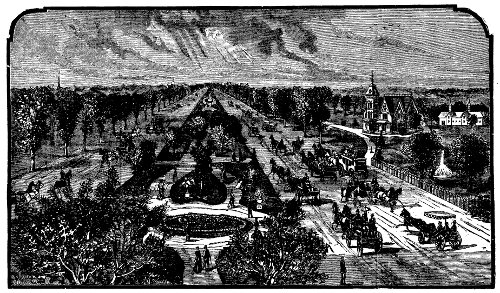
DREXEL BOULEVARD, CHICAGO—DESIGNED BY H. W. S. CLEVELAND.
BY H. W. S. CLEVELAND.
Few persons think of a park as anything
but a place of recreation, a pleasure ground,
and an ornamental appendage of a city.
As a consequence, if it is proposed to create
a park in any city, every suggestion that is
offered in regard to its location is based upon
the fact of its superior natural advantages; its
picturesque character; its command of fine
views, or the features of attractive interest it
combines.
Without denying the value of any of these
elements, I wish to call attention to other objects
which are rarely thought of, and yet are
deserving of careful consideration in determining
the location.
Almost every city comprises within its
limits some portion of territory which is not
adapted for business purposes, and is not attractive
to that class of inhabitants who can
afford to choose the location of their residences.
Such localities are at first left vacant,
but as population increases they are occupied
first by squatters, then by those who can afford
nothing better, and finally become the
site of tenement houses, or dens of resort for
the worst class of human beings, male and
female, that the city contains.
The original cause of the avoidance of the
place may have been that it was low and subject
to malarial influences, or of such topographical
character that it could only be
adapted to residence purposes at very great
cost.
In either of these cases it is obvious that the
first cost of the land will be far less than that
of a tract combining all the features which
render it most attractive as a site for residences.
Let us now consider some of the effects
of improving such sites:
Suppose the area to be low and wet, an unsightly
tract, suggestive of chills and fever,
and too extensive for improvement by its individual
owners. Instead of suffering it to
become the plague spot and breeding place
of moral and physical diseases, as it certainly
will if left to itself, let the city purchase and
improve it as a park, first, by thorough drainage,
and then by such artistic arrangement
as shall make it an attractive resort, and it is
obvious that the result will be not only the
securing of a charming place of recreation
and ornament to the city, but the conversion
of a threatening danger to health, into a chief
source of its promotion. The creation of
such an improvement also invariably changes
the character of its surroundings by rendering
them desirable as residence sites, and
thus repaying the cost by the increased taxable
value of adjacent property. It often happens,
however, that large areas are comprised
within, or adjacent to, a city, which even if
unobjectionable on the score of health are
not available for residence on account of their
topographical character.
The site of the New York Central Park affords
an illustration of my meaning:
At the time of its first inception in 1857—the
whole of that section of the city was a series
of barren ledges of rocks of such forbidding
nature that no individual proprietor could
afford the expense of preparing an area for
residence and providing himself with the
simplest necessities of comfort. The land
had only a nominal value, and its only occupants
(Continued on Page 73.)
One of the greatest banes to the proper enjoyment
of country life is the almost constant
use of salt meats. It is ham for breakfast,
salty, oh, how salty! Then for dinner it
is salt pork, boiled or fried. Then for supper
a cold slice of ham, or boiled cold shoulder,
varied a little by chipped dried beef, which is
within itself a “piller of salt.” Then it is
drink, drink, from morning to night without
abatement.
Now, I know the great difficulties that lay
in the way of a farmer, located miles from
city or town, to procure a daily supply of
fresh meat from the markets, to say nothing
of the unbearable cost of such a proceeding
to those who live close enough to market to
procure a daily supply. Just think of it; we
sell our beef cattle to the butcher for, say
three cents on foot, and pay for the article on
the hook from twelve and a half to twenty
cents per pound, and our mutton and pork
in the same ratio. It is not my purpose, in
this article, to show the relative losses and
profits in these transactions, but to show my
brother farmers how they can have fresh
meat on their tables every day of the year,
and every meal of each day if they will, and
that at their own first cost prices. This plan
of mine is not new; yet, I am safe in saying
that it is not practiced by one per cent of the
farmers in the nation. Why is this? Ignorance
of the way to do it. It can be nothing
else. For there is less labor and work attending
the process of preserving the meats put
up for home consumption, by keeping them
fresh, than there is by salting, smoking, wrapping
in canvas, and packing away, as now
practiced. A second great advantage is, that
the curing of meats in a fresh state can be
accomplished at any season of the year, no
matter how hot, and that without ice.
Then, a third consideration is the saving of
labor to the farmer’s family during the hot
sweltering summer months, in fact, all
through the year.
To enable any person to understand the
matter, I will explain by briefly stating what
we are now doing in the way of preparing
our fresh meat for next summer’s use. In the
first place, we have as many lard or pork
barrels as will be necessary to hold a supply
of meat for the family. These barrels are
clean, sweet, and tight, one end taken out.
They are arranged on a bench in the cellar,
open end up. The pigs are killed and cooled
in the usual way. When the animal heat is
all out they are cut up, cutting off the sausage
and lard, the lard cut up ready to be rendered
out. The shoulders and sides are then
cut up into such sized pieces as may be convenient
for table use. These pieces are
washed cleanly, and boiled in large kettles,
seasoned with salt and pepper to make palatable,
and when sufficiently boiled for table
use they are placed in a barrel closely together,
but not pressed or mashed, thus leaving
each piece as near in the shape cut as
possible. When the barrel is filled within
two inches of the top, we then pour in warm
lard until all the crevices between the pieces
of meat are filled up, covering the top with
one or two inches of the warm lard. Next
day we find that the lard has settled down;
we fill up again to the top and keep filled until
all has become a solid mass of meat and
lard. This is the whole secret. You can fill
any tight vessel from a one gallon jar to a
forty-five gallon barrel in like manner, and
if properly done, and kept in a cool place the
meat will keep fresh and sweet the year
round.
The advantages of this process of keeping
meat are manifold. You can kill a fat hog
at any season of the year, and its own fat
can preserve it, and the fat can be used
for culinary purposes just the same as
when put up in cans for home use. The
shoulders can be thus prepared, and when
cold are far superior to salt meat, even after
being boiled. The sides when cut in square
pieces, with the ribs on, are just as good as
when cooked fresh in the fall of the year.
Hams, whole, when well cooked and seasoned,
retain all their sweetness, and that without
being impaired by the excess of salt necessary
to keep them. Then, there is no trouble with
flies, bugs, or skippers; the meat remains
sweet, wholesome, and palatable until the last
piece is taken from the bottom. All the care
necessary in taking the pieces from the barrel
is to press the lard down closely over
what is left, and thus exclude the air.
There are two great advantages in this
mode of keeping meat; one is, it is fresh,
easily digested, and consequently more
healthy, and decidedly more pleasant to the
taste; and it does not create that burning
thirst that is so hard to quench on a hot harvest
day. Then it is always ready for table
use, and that without requiring your wives,
daughters, and house help to melt over a hot
stove when the mercury is up among the
nineties, a no small saving in threshing time.
The only great drawback that I have found
to this plan is, that I can eat twice the amount
that I can of salted meats; and, therefore, it
requires double the quantity for family use
than under the salting process; but I am persuaded
that the difference is made up in better
health, and smaller doctor bills. Try it
on a small scale, and you will always follow
it.
A. R.
Cape Girardeau, Mo.
I am now fifty-five years old and have always
lived in a good agricultural country.
Having had no rich friends to draw on for
supplies I have had to look to Mother Earth
for my living. Hence I feel that I should
pay homage to the Great Creator of all things
for that fair capacity which has enabled me
to select good lands and grow crops well
adapted to the soils.
While my work has been arduous in the
main, I have not felt it drudgery. In fact,
my farm has not only furnished me a good
living, but in its productions and developments
I have been highly entertained.
I am not different from most of my fellowmen.
I like to manage and dictate, and have
my own way. I manage so as to bring my
lands into subjection. I do it by making them
better. I cultivate and dress them until they
look better and feel better, and I know they
are better.
When I plant my crops I give them such
attention that it seems they have every confidence
that I will remove all obstructions
to hinder their growth, and the young and
tender plants seem to avail themselves of the
situation and spring up as by magic. In their
prosperity I rejoice.
I take a half dozen farm journals and a few
newspapers so as to learn what others are
doing without going from my home, especially
in the winter season. For I find that when
I go from home I can’t always get delicious
fruits and vegetables that I have learned to
be so fond of in my riper years.
Now I come to a point where I will venture
a proposition to my brother farmers:
That we organize a—well I don’t know just
what to name it, but say Farmers Communicative
Society. I mean by this that we select
some farm journal that seems most fitting
and send in our names and addresses, agreeing
to write once a month a short and candid
statement of our plans and successes and failures
in our agricultural and horticultural
pursuits. I am of course intending to get the
best of the bargain as I always try to do in
business. But it must be apparent to all that
we, as farmers, can be more benefited by
commingling our interests together in the
developments of the farm, and learn from
one another in a few years what it will take
each one of us a whole life time to learn
in case we continue to “go it alone” as in
olden times.
Now Mr. Editor, I think you can afford to
second the motion to help organize these practical
old farmers and get them to write for
your journal. I feel that we can give your
readers many practical ideas of benefit to all,
and you agree to clothe our crude thoughts
and make them appear intelligent before the
public, so that no one need be embarrassed to
“speak out in meetin’.”
Now the benefits to be derived from an association
to communicate through the paper
are to my mind much greater than from conventions.
All admit that farmers’ conventions
have accomplished great good in the
different interests, and that they are indispensable.
I am indebted to these conventions
for much of my success in farm life. But I
conclude that as great good, or even greater
good, can be accomplished at much less cost.
For a few hundred farmers can communicate
to each other through a good farm paper like
The Prairie Farmer, so paged that it can
be filed for future reference, and we can, as it
were, have our meetings every week at our
homes and with our families, and impress
the lessons upon our children’s tender minds
so they will not have to wait until they are
of mature age before hearing discussions
as to the best modes practiced in agriculture
and horticulture. I have felt in attending
these conventions like asking those old veterans
who must soon pass away, where are
the young men of our country? For very
few seem to attend these interesting gatherings.
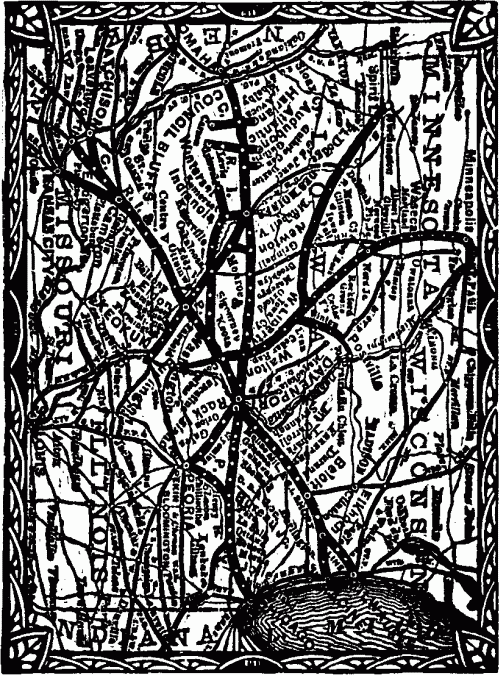
Another reason why I suggest we adopt
The Prairie Farmer is, that The Prairie
Farmer company sends to each of their
patrons a large map of the United States,
which would enable us to know the exact
locality of parties giving useful information,
which is always more satisfactory.
Now I am always trying new things and
looking after new industries, and I have made
a great many observations, some of which I
shall promise to give in farmers’ communications,
in case we can get a fair start so as to
get others to give me their observations, for
that is my prime object, as I stated in the
outset. I am like my Irish friend “I want a
little more than I give.” I am developing our
sweets in Kansas. I have also the finest
fruits of the land and succeeded in both, and
I will tell how I did it.
J. H. W.
Pomona, Kan.
This time I would like to call your attention
to the subject of botany. It might seem
rather odd at this time of year, but you know
that the farmers have more time now than in
summer to read The Prairie Farmer. It
is better for the farmer’s boys to become acquainted
with the laws of nature than to
spend their time in reading novels, or other
books, which bring them little information.
A little knowledge of the nature of plants is
worth infinitely more to the farmer’s son or
daughter, or even to the farmer himself, because
it has special relation to his calling.
And in order to obtain a practical knowledge
it is best to study the plants themselves, their
structure, their habitat and peculiarity of
growth, etc., and in order to do so, it is best
to have some apparatus for the purpose, requisite
for the accomplishment of this object.
The student in botanical science should
give early and persevering attention to the
collection and preservation of specimens of
as many species of plants as he can procure.
The advantages to be derived from such collections,
either in refreshing the memory by
reviewing them, or in instituting a more
thorough examination at one’s leisure, are
such as will afford an abundant compensation
for all the labor requisite in preparing them.
Such a collection of dried specimens of plants
is called an herbarium, or by the more significant
title, hortus siccus (dry garden).
The apparatus requisite for the accomplishment
of this object is, first, a close tin box,
twenty inches in length, and of a portable
form; second, a portable press, consisting of
two boards of light material, twelve by eighteen
inches, opening and shutting by hinges,
like the cover of a book, and secured by
springs (even a large book is a good substitute);
third, a quantity of smooth, bibulous
paper, of large size (a dozen or more quires of
printing paper); fourth, eight or ten boards of
the same size as the paper; fifth, a small screw
press, or several lead weights of various sizes,
from fifteen to thirty pounds each.
In gathering plants for this purpose, or
specimens, as they are called, the smaller and
herbaceous plants should be taken up with a
portion of the roots, while from larger plants
there should be selected a shoot, with complete
representations of the leaves and flowers.
They may be preserved for several days,
without withering, in the tin box, or they
may at once be laid between several thicknesses
of the paper and inclosed in the portable
press. It is always desirable that they be
gathered on a dry day; if not they should be
freed from dampness before being committed
to the paper and press.
In drying the specimens, great care is required,
that they may preserve well their
natural appearance, form, and color. It is
generally recommended that they be carefully
spread out, as nearly in their natural
position as possible, between eight or ten
thicknesses of paper, and then submitted to
pressure between the boards. The degree of
pressure should never be such as to crush
their parts, and may be easily regulated by
the screw, or by the number and size of the
weights used. Cotton-batting may be used to
equalize the pressure.
As often as once a day they should be taken
from the press, transferred to fresh and dry
paper, and returned, until they are thoroughly
dried, when they are ready to be transferred
to the cabinet. The true secret of preserving
specimens with all their colors is to extract
the moisture from them by pressure in an
abundance of dry, bibulous paper as soon as
possible.
The next object with the collector is the
arrangement of his specimens. For this purpose
each one is first to be fastened to a sheet
of firm white paper, about ten by eighteen
inches, either by glue or with loops of paper
of the same kind, or they may be stitched
to the paper with a fine needle. The latter
mode, if done skillfully, is preferable. Then
let all those specimens which belong to the
same genus be collected together and placed
within a folded sheet of colored paper, with
the name of the genus and each species written
on the outside. Each sheet should also
be labeled with the names of the plants, the
locality, time of gathering, habits, etc., etc.
The genera are next to be collected together
into orders, each order being wrapped or
folded in a still larger sheet, of a different
color from that which enfolds the genera,
having the name of the order with a catalogue
of its genera on the outside. Thus arranged,
the orders are to be laid away upon the
shelves of a cabinet, or packed in a chest. To
protect the plants from the attack of insects
pieces of camphor gum are to be laid among
them, or a piece of sponge saturated with the
oil of turpentine. To save them from decay
they should be kept dry and well ventilated.
Fruits and seeds which are too large to be
pressed with the plants, and also truncheons
of wood, are to be pressed separately in a cabinet.
In the above I have closely followed
the directions of Professor Wood in his excellent
work on Botany, which would prove a
profitable pastime for those desiring to improve
their knowledge in this direction.
H. A. P. Wessberge.
Diogenes in this desires to call the attention
of all readers of The Prairie Farmer
to what he deems a very important subject
and a great wrong—one to which they have
heretofore seemed strangely indifferent.
The papers teem of late years with accounts
of sharks passing about among farmers
and others, and under various pretences,
obtaining their signatures to documents, innocent
in themselves—but which eventually
turn up as notes of hand in possession of
third persons. And the result (it is always
so stated) is, that the note is collectable and
has to be paid.
And the papers with one voice unite in
warning their readers against using their
signature in such a way.
Now, Messrs. Editors, and fellow readers,
is it possible that there is such a principle
in our laws—common or statute—that makes
such a thing possible; that legalizes such a
fraud? If so, it is not only unsafe for a man
to sign a contract of any sort, but to write a
letter to a friend. And while I am loth to
believe there is any statute justifying it, I
feel sure there is no common law principle
that will sustain it; or if there is, it is a relic
of barbarism that common sense and common
justice ought long since to have swept into
oblivion.
The theory seems to be acquiesced in on the
ground that innocent parties must not be
made to suffer. But this theory will not hold
good. Thousands of cases occur in which
innocent persons do, and are compelled by
law and by right as well, to suffer loss from
just such frauds. A rogue may steal or borrow
my horse and sell him to a neighbor,
who buys in good faith. The law, and right
and justice, instead of compelling me to lose
my animal, permits me to replevy him and
take him home, and my neighbor pockets his
loss. And this is done daily over the land
without objection; and we hear no newspaper
cautions to the “gullible” farmers not to
lend horses. So with every other species of
property; one can take his own legally wherever
he may find it—in the hands of a rogue
or of an innocent purchaser.
It is strange to me that this thing has been
permitted to go on so long unchallenged. I
do not know whether the courts have ever
sustained such a principle; if they have, unless
there be much more cogent reason for it
than I can conceive of, the sooner it is reversed
the better for honest men and good
government. Will you allow me, through
your widely read pages, to earnestly call the
attention of your readers to the subject matter—and
not only your readers, but your cotemporaries
of the agricultural press as well.
Let the principle be ventilated.
Diogenes.
In passing through Chicago last spring on
my way to Dakota, I called at your office and
paid for The Prairie Farmer. The gentleman
in the office requested me to write you
about Dakota. I have delayed doing so until
now to learn about the winters here, and as it
is now on hand, I write.
The last half of December and the first half
of January we had the cold wave, the mercury
going below zero from 8 to 40 deg. We
have from six to seven inches of snow on the
level. Thermometer now ranging from 10
below to 20 above. We have had some windy
days that make the snow fly. I was in Illinois
before leaving for Dakota some forty-five
years, and I did not in all that time see a
more pleasant winter; but a very few days
that a man could not be at work if he choose.
The wind is no harder nor more frequent
than in Illinois—just the same as near as
could be made. Now for the land, etc.:
Here in Brown county, about twelve to
fifteen miles from the 46 parallel (south) the
land is nicely rolling, just about as any one
would wish. There is very little choice in
location, only as distance from railway stations.
The soil is black sandy loam, good
for small grain, and, judging from experiment
in sod corn, we can raise corn and a
good crop mature if put in in good season,
and of an early variety.
I never say anything against Illinois. It is
good enough, and Dakota is just as good, and
in one-quarter of the time that Illinois was
in developing, Dakota will be up even with
her, the facilities being far in advance of
those of early Illinois. Then we had to team
all of our wheat into Chicago by wagon for
nearly twenty years before we had a canal or
railroad. But here we have the railroads to
start with, and if emigration is as large next
spring as it was the last there will not be a
foot of land to be located. There is not a
quarter section left now in Brown county,
unless it has been overlooked. Towns are
growing up as fast as toad-stools in summer.
We are located six miles from Frederick (600
inhabitants), seven miles from West Port (200),
ten miles from Ordway (500), twenty miles
from Aberdeen (2,000), twenty from Columbia
(1,000), county seat. The land is watered
about the same as Illinois, with the elm and
maple along the Jim river. For wells we dig
from twenty-five to forty feet and get the best
of water.
I think Dakota as good a place for a young
man of small means as can be found. There
are some counties where the land has not
been surveyed yet, where good location may
be made. Our crops were short last year in
Brown county, caused by a short time of dry
weather in June, just as the wheat and oats
were in blossom, at which time these crops
require rain in order to “fill” well.
The only drawback we have is in the matter
of fuel as yet. Soft coal sells at from $7 to
$8 per ton: hard, $12 to $13. Dry-goods and
groceries are as low as in Illinois. Lumber
from $2 to $4 higher. Our vegetables can not
be beaten.
Just a thing or two more. I want to ask
you what are the best kinds of timber for us
to put out on our tree claims. Will the black
walnuts, black and white oaks do well as far
north as we are? How will the Scotch and
Norway pines do? I wish to put out such
timber as will make good lumber when
grown. Cotton wood, box elder, etc., will just
answer the law, that is about all.
A. J. Foord,
Brown Co., Dakota.
In The Prairie Farmer of January 5th,
in report of Illinois Horticultural Society,
Mr. Earle is made to say he used salt on asparagus
and it killed the weeds and most of
the asparagus. This is different from my
limited experience; I have used lake salt at
the rate of one ton to the acre and did not
kill either weeds or asparagus. I am now
making arrangements to use about three and
one-half tons to the acre from the refuse of
pork packing houses.
Will Mr. Earle please give particulars in
The Prairie Farmer: The kind of salt,
time of year it was used, amount per acre,
nature of soil, etc. By so doing he will confer
a favor on many readers.
S. P.
Terre Haute, Ind.
A Washington firm of patent solicitors
write us, as we suppose they have all the agricultural
papers, warning readers against
persons claiming of them a fee of $500 and
upwards for alleged infringements of a patent
upon a so-called “Wire and Picket Fence.”
Our informants say that, “It is quite true that
there are a number of patents for wire and
picket fences, or so-called ‘woven paling
fences,’ but all these patents are limited in
their claims to the detailed construction of
the woven fence, and there is no broad patent
on this class of fence. Indeed it was invented
as long ago as 1829, when Chauncy Hall, of
Meriden, Ct., on November 27th, of that year,
obtained the first patent for a wire and
paling fence. All recent applications for patents
which have endeavored to claim the
woven fence broadly have been rejected,
as we find by an examination of the records
of the United States Patent Office, on the old
patent to James Moore, of Pittsburg, Pa., for
a woven picket fence, which was granted
June 30, 1857, and therefore, expired in 1871,
so that it is now public property. There is
another patent of the same year granted to J. B.
Reyman, of Bloomington, Ill., No. 18,301,
dated September 29, 1857, which, also, shows
a paling and wire fence, or picket and wire
fence. This patent has, also, been frequently
cited as a reference against applications of
subsequent patentees who endeavor to claim
broadly the invention of the combined wire
and picket fence. In 1849, one, Lucius Leavenworth,
obtained a patent for a method of
constructing a fence by fastening pickets or
palings upon the wires by means of a series
of links formed on the connecting wires and
adapted to receive or hold the pickets or palings.
All of these patents have long ago expired,
and are now public property, so that
no person can claim to have a broad patent
on the, so-called, woven picket fence, and any
man who, by virtue of a pretended claim
covering broadly that class of fences, asserts
such a right may be put down as an impostor,
and should receive treatment as such.
Of late years a number of patents have been
granted for this class of fences, but, as soon
stated, the claims of all these patents are confined
to the detailed construction of the fence,
i. e., the precise weaving of the pickets between
the wires. A number of machines
have, also, been patented for constructing
this kind of fence, one of the first being that
which was patented by Fletcher on Nov. 17,
1868.”
We have heard of no trouble from these
patent agents in the West, but give our readers
for what it is worth the information
vouchsafed by the Washington firm.
This fair, as we have before announced, begins
at Chicago on the 8th of September.
The Superintendents of Departments for 1884
are as follows:
Class A, Cattle, Mr. Reynolds; Class B,
Horses, Mr. Lewis; Class C, Sheep, Mr. Vittum;
Class D, Hogs, Mr. Gore; Class E,
Poultry, Mr. Griffith; Class F, Mechanics, Mr.
Chester; Class G, Farm Products, Mr. Skeavington;
Class H, Horticulture, Mr. Haskell;
Class I, Fine Arts, Mr. Pearce; Class K, Textile
Fabrics, Mr. Savage; Class L, Science
and Education, Mr. Rush; Class M, Speed,
Mr. Lewis; Class N, Farm Machinery, Mr.
Schuttler; Marshal of the Ring, Mr. Judy;
Superintendent of Grounds, Mr. Gillham; of
Forage and Stalls, Mr. Virgin; of Press Department,
Mr. David; of Permits and Privileges,
Mr. Washburn; of Purchasing Department,
Mr. Pullen; of Gates and Tickets, Mr.
Dysart. Auditors, Messrs. Funk, Pearce and
David; Committee on Reception, Fair—Messrs.
Landrigan, Scott, Gillham, Reynolds,
Judy, Pearce, Washburn and Vittum; Com.
on Arrangement, Fair, Messrs. Landrigan,
Scott, Gillham, Reynolds, Vittum, Gore, Haskell,
Pullen, Dysart, Washburn, Lewis, Virgin,
Schuttler and Fisher; Com. of Arrangements,
Fat Stock Show, Messrs. Landrigan,
Gillham, Reynolds, Gore, Pullen, Dysart, Vittum,
Funk, Virgin, Schuttler, Savage, Scott,
Washburn and Judy; Com. on Printing,
Messrs. Savage, Dysart and Fisher; Com. on
Finance, Messrs. Pearce, Pullen, Gore, Lewis
and Chester; Com. on Crop Reports, Messrs.
Gore, David, Skeavington and Fisher; Com.
on Agricultural and Industrial Education,
Messrs. Scott, Reynolds, Washburn, David
and Rush; Com. on Museum, Messrs. Gillham,
Scott, Haskell and Savage; Com. on Library,
Messrs. Haskell, Rush and Fisher; Com. on
Transportation, Messrs. Landrigan, Vittum,
Judy, Schuttler, Griffith and Fisher. Jury on
Pedigrees, Class A, Messrs. Reynolds, Dysart,
Judy, Funk and Skeavington; Class B,
Messrs. Lewis, Virgin, Griffith, Pearce and
Chester.
The same arrangement of Superintendents
and Committees is followed in the management
of the Fat Stock Show which takes
place at Chicago in November.
Mild, open winter in this the central part
of Kansas. Very little cold weather. Wheat
and rye looking fine, and very large acreage
sown the past season. Stock doing finely;
but little fodder used as yet. In about ten
days plowing will begin.
We need more settlers of energy and thrift
to fill up the large scope of unoccupied lands.
No homestead lands here but plenty railroad
lands yet for sale. The price ranges from $4
to $8 per acre on long time, with a discount
for cash or short time.
We have good water and grass, and plenty
of the finest limestone building rock.
This is a good place for a man of small
means to get a home. Having been here six
years I know whereof I speak.
In The Prairie Farmer of January 5,
1884, I noticed an article on Meadow Oat
Grass, by J. W. Robson. I would like to
know where the seed can be obtained.
J. D. MC. P.
Alliance, Boston Co., Kans.
—We presume you can get the grass seed
from all our reliable seedsmen. In a few
days The Prairie Farmer will doubtless
be favored with plenty of their advertisements.—[Ed.
Secretary W. A. Armstrong reports
that all the kinds of commercial fertilizers
applied to the alluvial soils cultivated by
members of the Elmira Club proved in every
instance to be “practically worthless.” The
best that can be said is that “some of them
used on uplands in which clay is a constituent,
have fair probability, at least, of yielding
satisfactory returns.”
At the Mississippi Valley Cane-Growers’
meeting at St. Louis, delegates from Illinois,
Iowa, Kansas, Nebraska, and Michigan gave
their experiences in growing cane and making
sirups. In Illinois, Kansas, and Nebraska
good results were generally obtained, but
the season was bad in other States and expectations
were not realized. All concurred,
however, in the belief that the cultivation of
sorghum was a good thing, and would yield
handsome profits.
The New York Tribune: The animated
discussion of the subject at the recent meeting
of the Connecticut Board was unfavorable
to ensilage. Exhibition of a sample of
clover put in a silo when wet called out the
query whether it was fed to cows to make
Limburger cheese. One reporter says it “fairly
howled” through the City Hall, echoing
and reverberating a fearful smell. President
James A. Bell, of the State Agricultural Society,
is quoted as declaring that the free talk
of the occasion “will save the farmers thousands
of dollars by keeping them out of the
silo system.”
At which end should a hoe-handle be the
larger? At which end should a pitch-fork be
the larger? It is not every farmer that thinks
of these things until his attention is called to
them. As Mr. J. J. Thomas remarks, the
laborer who makes with a common hoe 2,000
strokes every hour should not wield a needless
ounce. If any part is heavier than needed
even to the amount of half an ounce only,
he must lift this needless half ounce 2,000
times every hour. A hoe-handle should be
smallest near the hoe and largest near the
other end; a pitch-fork handle the reverse.
Oughtn’t it?
A member of the Oxford (Ohio) Farmers’
Club recently said: We know something how
soil was made, if we do not know much.
The soils in the forests and untilled lands are
better than they were a century ago, or in the
days of our fathers; but, alas, it is not so
with the soils man has cultivated. He thinks
the term “cultivating” means to improve,
make better. We may make our soils better,
but so few do that that we ought never to use
the term “cultivating the soil.” We harass,
and torture, and murder, and starve the soil.
By withholding more than is meet we rob
our best friend.
New York Times: Tobacco is a universal
insecticide. It kills ticks upon sheep; the
troublesome scab insect; its related species
which produces mange and itch; lice, fleas,
and all other insect parasites which infest
and annoy animals; and root-lice, leaf-lice,
and all other pests which injure plants. Just
at this season an application of fine tobacco
dust or snuff may be used effectively to relieve
calves and fowls from the vermin which
keeps them poor and wretched, and a decoction
of tobacco, applied to house or greenhouse
plants with a brush, will destroy the
pestiferous green fly and all other insects
which infest them. The same liquid may
also be poured around the roots of house
plants that are infested with the small white
worms which are the larvæ of a small black
fly that may be found in the pots and upon
the soil in them.
The town of Amenia, in Dutchess county,
N. Y., has tried, with marked success, the
plan of keeping a force of four or five men at
work on highways through most of the year
under the supervision of an experienced and
skillful builder of roads, who gives his attention
constantly to the work. Every part of
the seventy-five miles of highway in the town
is in good condition, and the expense of keeping
it so has been much less than it could
have been by the old method. The new plan
has greatly relieved the farmers, who have
not been called to work on the roads at a time
when other duties demanded their attention.
New York has a law which directs that the
voters of any town may elect to adopt this
plan of hiring a force of men and a competent
commissioner to make and keep in repair
the roads of their town, but the plan,
once adopted, must be followed for not less
than three years. It has been found that by
the method described the roads have been
kept in better condition than ever before, and
that the cost of the work has actually been
less than that of road-making by the old
way.
Correspondent Ohio Farmer: In 1882
I raised a piece of Hubbard squashes. The
ground was manured very heavily with rich
rotten compost, probably at the rate of fifty
tons or more per acre. It is necessary to
make the land very rich to succeed with this
crop, but that isn’t the point I am after. That
same land last year was planted with potatoes,
and it was there that they rolled out so
large and numerous as to yield at the rate of
500 bushels per acre. Just over the fence, on
a part of another lot, where no manure had
been applied for many years, there were only
200 bushels per acre. Difference in soil and
kinds of potatoes might account for some of
this great variation in yield, but I think it
fair to say that 200 bushels per acre of the
best yield was owing to the manure put on
the ground for squashes the previous year.
The potatoes were none of them sold for less
than forty cents a bushel, so we have at least
$80 per acre cash benefit from that heavy
manuring the second year, to say nothing of
$240 an acre which the squashes brought. It
was, of course, a little more trouble to pick up
and market the larger crop, but enough of the
potatoes were sold for over forty cents per
bushel to pay for that.
Brown’s Bronchial Troches for Coughs
and Colds: “There is nothing to be compared
with them.”—Rev. O. D. Watkins, Walton, Ind.
The difficulty with most people is that
they want to sit in the sunshine and have
good fortune come tumbling into their laps.
Nature is an odd dame, however, and does
not give even half a loaf to a man who can
do his own loafing. You must get your
spindle and distaff ready and then Providence
will send you the flax to spin.
MISCELLANEOUS.
Cheapest Farms for Sale in Illinois.
BEST FRUIT REGION IN THE STATE.
Send for my List of Farms and timbered Lands for sale.
DEWITT C. SMITH, Land Agent.
Stone Fort, Saline Co., Illinois.
When you write mention The Prairie Farmer.
Print Your Own Cards
Labels, Envelopes, etc.
with our $3 Printing Press. Larger
sizes for circulars, etc., $8 to $75. For
pleasure, money making, young or old.
Everything easy, printed instructions.
Send 2 stamps for Catalogue of Presses,
Type, Cards, etc., to the factory.
KELSEY & CO., Meriden, Conn.
First-Class Plants
OF BEST VARIETIES OF SMALL FRUITS.
Catalogues free. Address
O. B. GALUSHA,
Peoria, Ill.
We will send you a watch or a chain
BY MAIL OR EXPRESS, C. O. D., to be
examined before paying any money
and If not satisfactory, returned at
our expense. We manufacture all
our watches and save you 30 per
cent. Catalogue of 250 styles free.
Every Watch Warranted. Address
STANDARD AMERICAN WATCH CO.,
PITTSBURGH, PA.
FARM MACHINERY, Etc.
GREAT SAVING FOR FARMERS.
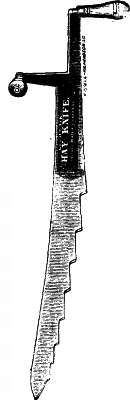
THE
Lightning
Hay Knife!
(Weymouth’s Patent.)
Awarded “FIRST ORDER OF
Merit” at Melbourne Exhibition,
1880.
Was awarded the first premium
at the International Exhibition
in Philadelphia, 1876, and
accepted by the Judges as
Superior to Any Other
Knife in Use.
It is the BEST KNIFE in the
world to cut fine feed from bale,
to cut down mow or stack, to cut
corn-stalks for feed, to cut peat,
or for ditching in marshes, and
has no equal for cutting ensilage
from the silo. TRY IT.
IT WILL PAY YOU.
Manufactured only by
HIRAM HOLT & CO.,
East Wilton,
Me., U. S. A.
For sale by Hardware Merchants and the trade generally
CHICAGO SCALE CO.
2 TON WAGON SCALE, $40. 3 TON, $50.
4 Ton $60, Beam Box Included.
240 lb. FARMER’S SCALE, $5.
The “Little Detective,” ¼ oz. to 25 lb. $3.
300 OTHER SIZES. Reduced PRICE LIST FREE.
FORGES, TOOLS, &c.
BEST FORGE MADE FOR LIGHT WORK, $10.
40 lb. Anvil and Kit of Tools, $10.
Farmers save time and money doing odd jobs.
Blowers, Anvils, Vices & Other Articles
AT LOWEST PRICES, WHOLESALE & RETAIL.
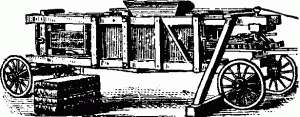
CHAMPION BALING PRESSES.
A Ton per Hour.
Run by two men
and one team.
Loads 10 to 15
tons in car.
Send for descriptive
circular
with prices, to
Gehrt & Co., 216, 218 and 220 Maine St., Quincy, Ill.
“THE BEST IS THE CHEAPEST.”
ENGINES, SAW MILLS, THRESHERS, HORSE POWERS,
(For all sections and purposes.) Write for Free Pamphlet
and Prices to The Aultman & Taylor Co., Mansfield, Ohio.
MISCELLANEOUS.
LIFE LOANS
AT 4 PER CENT.
Principal need never be paid
so long as interest is kept up.
No security required except for interest, and then only personal.
These loans are for poor or men of moderate means, in amounts
of $100, $500 FOR LIFE. Send a cent for particulars.
W. ROBERTS, Manager, 195 W. 5th St. Cincinnati, O.
TO PRESERVE THE HEALTH
Use the Magneton Appliance Co.’s
MAGNETIC LUNG PROTECTOR!
PRICE ONLY $5.
They are priceless to LADIES, GENTLEMEN,
and CHILDREN with WEAK LUNGS; no case of
PNEUMONIA OR CROUP is ever known where
these garments are worn. They also prevent and
cure HEART DIFFICULTIES, COLDS, RHEUMATISM,
NEURALGIA, THROAT TROUBLES, DIPHTHERIA,
CATARRH, AND ALL KINDRED DISEASES.
Will wear any service for three
years. Are worn over the under-clothing.
CATARRH, It is needless to describe the symptoms
of this nauseous disease that
is sapping the life and strength of only too many
of the fairest and best of both sexes. Labor, study,
and research in America, Europe, and Eastern
lands, have resulted in the Magnetic Lung Protector,
affording cure for Catarrh, a remedy which
contains No Drugging of the System, and
with the continuous stream of Magnetism permeating
through the afflicted organs, must restore
them to a healthy action. We
place our price for this Appliance at less than
one-twentieth of the price asked by others for
remedies upon which you take all the chances,
and WE ESPECIALLY INVITE the patronage of
the MANY PERSONS who have tried DRUGGING
THEIR STOMACHS WITHOUT EFFECT.
HOW TO OBTAIN This Appliance. Go to your
druggist and ask for them.
If they have not got them, write to the proprietors,
enclosing the price, in letter at our risk, and
they will be sent to you at once by mail, post paid.
Send stamp for the “New Departure in Medical
Treatment without Medicine,” with
thousands of testimonials,
THE MAGNETON APPLIANCE CO.,
218 State Street, Chicago, Ill.
Note.—Send one dollar in postage stamps or
currency (in letter at our risk) with size of shoe
usually worn, and try a pair of our Magnetic Insoles,
and be convinced of the power residing in
our Magnetic Appliances. Positively no cold feet
where they are worn, or money refunded.
CONSUMPTION.
I have a positive remedy for the above disease; by its use
thousands of cases of the worst kind and of long standing
have been cured. Indeed, so strong is my faith in its efficacy,
that I will send TWO BOTTLES FREE, together with a VALUABLE
TREATISE on this disease, to any sufferer. Give Express
& P. O. address. DR. T. A. SLOCUM, 181 Pearl St., N. Y.
Self Cure Free
Nervous
Debility | Lost
Manhood | Weakness
and Decay |
A favorite prescription of a noted specialist (now retired.)
Druggists can fill it. Address
DR. WARD & CO., LOUISIANA, MO.
FOR SALE—One-half interest in a thoroughly equipped
CREAMERY located in one of the best dairy
districts of Wis. J. G. Snyder & Son., Mt. Hope, Wis.
When you write mention The Prairie Farmer.