In the days of our boyhood the propagating house was, in the more
pretentious nurseries, a very sacred place, under lock and key, and some
of its mysteries supposed to be so profound that prying eyes of other
establishments were not welcome.
Bell glasses in those days were thought to be indispensable, and some of
the plants desired to be propagated were found to require months,
sometimes nearly a year, before they could be transferred from the
cutting pots. The hot-water tanks, and other bottom heat appliances of
the present day were then unknown; and these appliances have resulted in
greater simplicity of management. Still we are bound to admit that the
demands here generally embrace a class of plants that, as a rule, are
found to root the most readily, while those that have always been known
to tax the propagator's skill, as the Heaths, New Holland, and others
called hard wooded plants, are but little called for in this market.
At that time nearly everything was placed in pots of almost pure white
sand, surrounded by the ordinary atmosphere of the house; while nowadays
the establishment must be small indeed if it does not contain some place
where the bed is so arranged that the heat at the bottom is from ten to
fifteen degrees above that of the house proper. Here lies the whole
secret as to whether it is a part of a single green-house or a house
devoted exclusively to propagating purposes. For the purpose of being
able at all times to control the temperature of the top, the propagating
house has often a northern exposure, except in the very dead of winter.
With a bright, clear sun above it is almost impossible in the daytime to
keep down the temperature of the house sufficiently to prevent the young
cuttings from wilting, after which disaster is very likely to follow in
their final rooting. Given a top temperature never above 55 or 65
degrees, with a bottom always from 10 to 15 degrees higher, if the
cuttings are in good shape it is a simple matter to root them in from
seven to fifteen days; though the time it takes depends, of course, upon
the plant and condition of the wood. At first efforts used to be
contrived to get this bottom heat by means of the old flue system, with
plenty of material covering the bricks, to break, in part, the dry
burning nature of the heat.
Then hot water came in and furnished what was thought the acme of a
propagator, and tanks of elaborate workmanship, and made of the finest
material down to the commonest wood, were made so a circulation of hot
water was kept up over as large an area as the necessity of the owner
might require.
The results seemed excellent, but lo, every now and again, disastrous
failures would occur. A material would spread all around called by the
florist the cutting bench fungus, that would sweep through his crop like
a plague; all sorts of theories would be given, and numberless articles
appear in the horticultural periodicals of the day on its cause and
cure. Presently it was found that those who did not use a tank of water,
but had inclosed a space to be heated by hot water pipes, did not seem
to suffer so much from the invidious foe. Much moisture was found an
excellent remedy for the enemy, though it might have been its first
cause, as it could be best warded off by dousing with the once praised
hot water tank.
Whether a house is used exclusively or not, the ordinary hot water pipes
are simply inclosed in a brick or wood space, with ventilators that may
be opened to let off part of the confined heat into the house at
pleasure. The front benches used are about two feet six inches to three
feet in width, over, say four 4-inch pipes, up to within eighteen inches
or two feet of the glass. On this is a platform over which three to six
inches of sand is put, and in this bed are placed the cuttings where,
with the differences before mentioned, they are kept as uniform as
possible, and the sand kept decidedly wet. Almost everything we called
soft wooded, or that can be got from the soft wood, even including most
of our hardy shrubs, can be rooted with almost unerring certainty in the
larger establishments by the hundreds of thousands.
As modern ideas demand large propagating, even in the summer, when it is
next to impossible to keep these proportions of top and bottom heat, if
in an ordinary propagating house, such firms as Miller & Hunt, strike
out with another idea to overcome the difficulty. This is none other
than instead of glass, they have a muslin canvas-covered house, in which
they have again pits, where mild bottom heat can be obtained by the use
of spent hops, tan bark, manure, or other material. Of course, it would
be idle to talk of a summer bottom heat of 60 deg., but instead of that,
they get one of about 80 deg., and depend upon a close, uniform, high,
moist temperature to carry out the same results.
With this, rose plants can be and are raised by the hundreds of
thousands from the single eye to a cutting, with a loss of not five per
cent in the aggregate, and often not one per cent. It is very evident
that with new or scarce plants this is an enormous average, as by its
means firms can import the new European plants in the spring, at perhaps
very high rates, start them into immediate, rapid growth, and from half
a dozen plants to work on, maybe in the next spring markets have
hundreds for sale.
This is all new as managed by us old 'uns in former times, but he who
expects to be up with the present day and cater for that class of
patronage, must take the new and not the old way of doing things, or he
will, in the vernacular of the streets, "get left."
As we are on this particular topic, however, and as the amateur window
plant-grower may want to propagate some little stock as well, even if
not on these "high-falutin" ways, it might not be amiss to say that
beyond the methods of "slipping" here and there cuttings in and among
others growing in pots, or, mayhap, in a pot all by themselves, they can
readily root lots of plants in a water and sand bath, which is nothing
more than taking a deep saucer, putting half an inch of sand in the
bottom, filling up the saucer full of water, and keeping it full; stick
your cuttings into this, place right in the sunniest spot of your
window, and they will grow about as certain, many of them, as if treated
by the florist's more portentious method. Likely the reason of all this
is, the water keeps the cuttings from wilting long enough for them to
put forth their efforts for existence in the shape of new roots,
obtained from the stored up material in the cuttings, and as soon as
this is done they become new individual plants, requiring only to be
transferred into a suitable medium of earth to go on as an independent,
but similar existence to the plant from which they were obtained.
OUR
New Clubbing List
FOR 1884.
THE PRAIRIE FARMER
IN CONNECTION
WITH OTHER JOURNALS.
We offer more liberal terms than ever before to those who desire to
take, in connection with The Prairie Farmer, either of the
following weekly or monthly periodicals. In all cases the order for
The Prairie Farmer and either of the following named journals
must be sent together, accompanied by the money; but we do not require
both papers to be sent to the same person or to the same post-office.
We send specimen copies only of The Prairie Farmer.
Our responsibility for other publications ceases on the receipt of the
first number; when such journals are not received within a reasonable
time, notify us, giving date of your order, also full name and address
of subscriber.
WEEKLIES.
| Price of the two. | The two for |
| Harper's Weekly | $6 00 | $4 60 |
| Harper's Bazar | 6 00 | 4 60 |
| Harper's Young People | 3 50 | 2 55 |
| New York Tribune | 4 00 | 2 50 |
| Toledo Blade | 4 00 | 2 20 |
| Chicago Times | 3 25 | 2 50 |
| Chicago Tribune | 3 50 | 2 50 |
| Chicago Inter-Ocean | 3 15 | 2 50 |
| Chicago Journal | 3 25 | 2 50 |
| Peck's Sun | 3 75 | 3 00 |
| Milwaukee Sentinel | 3 00 | 2 50 |
| Western Farmer (Madison, Wis.) | 3 00 | 2 00 |
| Burlington Hawkeye | 4 00 | 3 00 |
| The Continent (Weekly Magazine) | 6 00 | 5 00 |
| Detroit Free Press, with Supplement | 4 00 | 2 50 |
| Detroit Free Press, State edition | 3 50 | 2 20 |
| Louisville Courier-Journal | 3 75 | 3 00 |
| St. Louis Globe-Democrat | 3 00 | 2 15 |
| St. Louis Republican | 3 00 | 2 15 |
| Scientific American | 5 20 | 4 15 |
| Interior (Presbyterian) | 4 50 | 3 60 |
| Standard (Baptist) | 4 70 | 3 60 |
| Advance (Congregational) | 5 00 | 3 35 |
| Alliance | 4 00 | 3 00 |
| New York Independent | 5 00 | 4 00 |
| Christian Union | 5 00 | 4 00 |
| Boston Pilot (Catholic) | 4 50 | 3 50 |
| American Bee Journal | 4 00 | 3 50 |
| Florida Agriculturist | 4 00 | 2 75 |
| Breeder's Gazette | 5 00 | 3 50 |
| Witness (N.Y.) | 3 50 | 3 00 |
| Methodist (N.Y.) | 4 00 | 3 50 |
| Chicago News | 3 00 | 2 50 |
| Globe (Boston) | 3 00 | 2 75 |
| Youth's Companion | 3 75 | 3 00 |
| Weekly Novelist | 5 00 | 4 25 |
| Ledger (Chicago) | 3 00 | 2 90 |
| American Bee Journal | 4 00 | 3 25 |
MONTHLIES.
| Harper's Monthly | $6 00 | $4 50 |
| Atlantic Monthly | 6 00 | 4 50 |
| Appleton's Journal | 5 00 | 4 25 |
| The Century | 6 00 | 4 50 |
| North American Review | 7 00 | 5 50 |
| Popular Science Monthly | 7 00 | 5 50 |
| Lippincott's Magazine | 5 00 | 4 50 |
| Godey's Lady's Book | 4 00 | 3 00 |
| St. Nicholas | 5 00 | 3 50 |
| Vick's Illustrated Magazine | 3 25 | 2 25 |
| Am. Poultry Journal (Chicago) | 3 25 | 2 75 |
| American Bee Journal | 3 00 | 2 25 |
| Gardener's Monthly | 4 00 | 3 00 |
| Wide Awake | 4 50 | 3 00 |
| Phrenological Journal | 4 00 | 3 00 |
| American Agriculturist | 3 50 | 2 50 |
| Poultry World | 3 25 | 2 75 |
| Arthur's Home Magazine | 4 00 | 3 00 |
| Andrews' Bazar | 3 00 | 2 40 |
| Frank Leslie's Popular Monthly | 5 00 | 4 00 |
| Frank Leslie's Sunday Magazine | 5 00 | 4 00 |
| Frank Leslie's Ladies' Magazine | 4 50 | 4 00 |
| Our Little Ones | 3 50 | 3 00 |
| Peterson's Magazine | 4 00 | 3 30 |
| Art Amateur | 6 00 | 5 00 |
| Demorest's Magazine | 4 00 | 3 00 |
| Dio Lewis' Monthly | 4 50 | 3 50 |
For clubbing price with any publication in the United States not
included in the above list send us inquiry on postal card.
MISCELLANEOUS.
ONE CENT
invested in a postal card and addressed as below
WILL
give to the writer full information as to the best lands in the United
States now for sale; how he can
BUY
them on the lowest and best terms, also the full text of the U.S. land
laws and how to secure
320 ACRES
of Government Lands in Northwestern Minnesota and Northeastern Dakota.
ADDRESS:
JAMES B. POWER,
Land and Emigration Commissioner,
ST. PAUL, MINN.
CONSUMPTION.
I have a positive remedy for the above disease; by its use thousands of
cases of the worst kind and of long standing have been cured. In deed,
so strong is my faith in its efficacy, that I will send TWO BOTTLES
FREE, together with a VALUABLE TREATISE on this disease, to any
sufferer. Give Express & P.O. address. DR. T.A. SLOCUM, 181 Pearl St.,
N.Y.
NOW Is the time to Subscribe for The Prairie Farmer. Price only
$2.00 per year. It is worth double the money.
PUBLISHERS' NOTICE.
THE PRAIRIE FARMER is printed and published by The Prairie Farmer
Publishing Company, every Saturday, at No. 150 Monroe Street.
Subscription, $2.00 per year, in advance, postage prepaid. Subscribers
wishing their addresses changed should give their old as well as new
addresses.
Advertising, 25 cents per line on inside pages; 30 cents per line on
last page—agate measure; 14 lines to the inch. No less charge than
$2.00.
All Communications, Remittances, etc., should be addressed to The
Prairie Farmer Publishing Company, Chicago, Ill.
Entered at the Chicago Office as Second-Class Matter.
CHICAGO, JANUARY 12, 1884.
[Transcriber's Note: Original location of Table of Contents.]
RENEW! RENEW!!
Remember that every yearly subscriber, either new or renewing, sending
us $2, receives a splendid new map of the United States and Canada—58 ×
41 inches—FREE. Or, if preferred, one of the books offered in another
column. It is not necessary to wait until a subscription expires before
renewing.
The Prairie Farmer
PROSPECTUS FOR 1884.
SEE INDUCEMENTS OFFERED
SUBSCRIBE NOW.
For forty-three years The Prairie Farmer has stood at the front
in agricultural journalism. It has kept pace with the progress and
development of the country, holding its steady course through all these
forty-three years, encouraging, counseling, and educating its thousands
of readers. It has labored earnestly in the interest of all who are
engaged in the rural industries of the country, and that it has labored
successfully is abundantly shown by the prominence and prestige it has
achieved, and the hold it has upon the agricultural classes.
Its managers are conscious from comparison with other journals of its
class, and from the uniform testimony of its readers, that it is
foremost among the farm and home papers of the country. It will not be
permitted to lose this proud position; we shall spare no efforts to
maintain its usefulness and make it indispensable to farmers,
stock-raisers, feeders, dairymen, horticulturalists, gardeners, and all
others engaged in rural pursuits. It will enter upon its forty-fourth
year under auspices, in every point of view, more encouraging than ever
before in its history. Its mission has always been, and will continue to
be—
To discuss the most approved practices in all agricultural and
horticultural pursuits.
To set forth the merits of the best breeds of domestic animals, and to
elucidate the principles of correct breeding and management.
To further the work of agricultural and horticultural organization.
To advocate industrial education in the correct sense of the term.
To lead the van in the great contest of the people against monopolies
and the unjust encroachments of capital.
To discuss the events and questions of the day without fear or favor.
To provide information concerning the public domain, Western soil,
climate, water, railroads, schools, churches, and society.
To answer inquiries on all manner of subjects coming within its sphere.
To furnish the latest and most important industrial news at home and
abroad.
To give full and reliable crop, weather, and market reports.
To present the family with pure, choice, and interesting literature.
To amuse and instruct the young folks.
To gather and condense the general news of the day.
To be, in brief, an indispensable and unexceptionable farm and home
companion for the people of the whole country.
The style and form of the paper are now exactly what they should be. The
paper used is of superior quality. The type is bold and clear. The
illustrations are superb. The departments are varied and carefully
arranged. The editorial force is large and capable. The list of
contributors is greatly increased, and embraces a stronger array of
talent than is employed on any similar paper in this country. We
challenge comparison with any agricultural journal in the land.
The Prairie Farmer is designed for all sections of the country.
In entering upon the campaign of 1884, we urge all patrons and friends
to continue their good works in extending the circulation of our paper.
On our part we promise to leave nothing undone that it is possible for
faithful, earnest work—aided by money and every needed mechanical
facility—to do to make the paper in every respect still better than it
has ever been before.
SPECIAL NOTICE
To each Subscriber who will remit us $2.00 between now and February 1st,
1884, we will mail a copy of THE PRAIRIE FARMER for One Year, and one
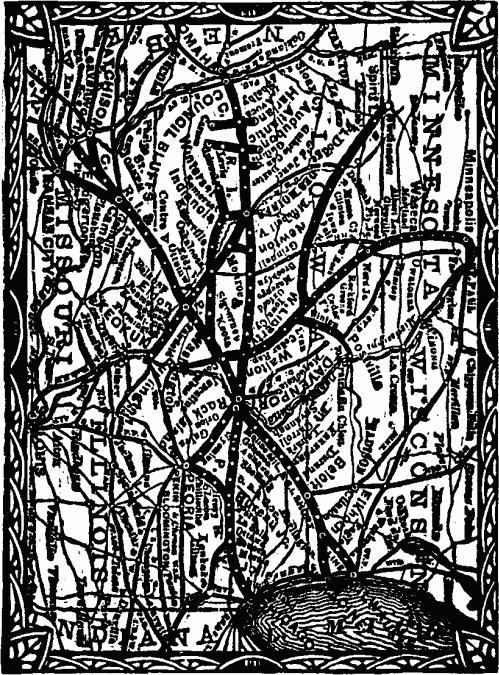
of our New Standard Time Commercial Maps of the United States and
Canada—showing all the Counties, Railroads, and Principal Towns up to
date. This comprehensive map embraces all the country from the Pacific
Coast to Eastern New Brunswick, and as far north as the parallel of 52
deg., crossing Hudson's Bay. British Columbia; Manitoba, with its many
new settlements; and the line of the Canadian Pacific Railway, completed
and under construction, are accurately and distinctly delineated. It
extends so far south as to include Key West and more than half of the
Republic of Mexico. It is eminently adapted for home, school, and office
purposes. The retail price of the Map alone is $2.00. Size, 58 × 41
inches. Scale, about sixty miles to one inch.
READ THIS.
Another Special Offer.
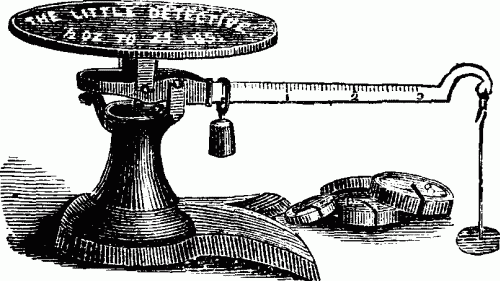
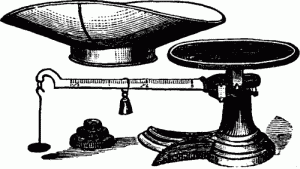
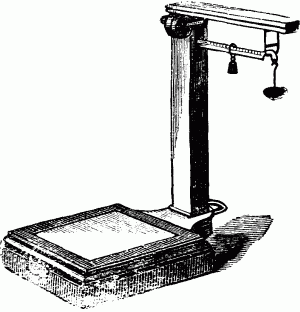
"The Little Detective."
Weighs 1-4 oz. to 25 lbs.
Every housekeeper ought to have this very useful scale. The weight of
article bought or sold may readily be known. Required proportions in
culinary operations are accurately ascertained. We have furnished
hundreds of them to subscribers, and they give entire satisfaction.
During January, 1884, to any person sending us THREE SUBSCRIBERS, at
$2.00 each, we will give one of these scales, and to each of the three
subscribers Ropp's Calculator, No. 1.
The sorghum-growers of Kansas are invited to meet at Topeka,
the second Wednesday in February. The Kansas wool-growers meet on the
15th of this month.
Do not forget the Mississippi Valley Horticultural Society
meeting at Kansas City, January 22-25. This will prove one of the
important horticultural events of the year.
If any of our friends have Vols. I to XIV, and the years 1861,
1863 to 1873, and 1875 to 1883, of The Prairie Farmer, they
would like to dispose of, we should be glad to hear from them.
The fifteenth annual exhibition of the Montana Agricultural,
Mineral and Mechanical Association, will be held at Helena, September
8th-13th, 1884. President, S.H. Crounse; Francis Pope, Secretary.
The twenty-fifth annual fair of the Linn County (Iowa)
Agricultural and Mechanical Society will be held on the fair grounds at
Cedar Rapids, September 9, 10, 11, and 12, 1884. C.G. Greene, Secretary,
Cedar Rapids.
If you are in need of a first-class wind mill, find out all
about the Nichols' Centennial as advertised in our columns by Nichols &
Daggett, and see if you do not think it just fills the bill. It is
strong, durable, steady, and it takes and uses all the wind there is
going.
Hon. E.B. David, member of the Illinois State Board of
Agriculture from Mercer county, made a brief call at The Prairie
Farmer office last week. From him we gathered the facts regarding
the late meeting of the Board mentioned elsewhere. Mr. David has long
been a staunch friend of The Prairie Farmer, and his call was a
very welcome one.
Immigration at the port of New York fell off last year to the
amount of 66,405 persons, or about 14½ per cent from that of 1882.
The total number landed this last year was 388,342. The greatest
decrease was from Sweden and Russia. From England came 30,818; Ireland,
52,555; Germany, 164,036; Italy, 24,101; Norway, 11,536; Hungary,
11,448; Switzerland, 9,447; Denmark, 7,770; Bohemia, 4,652. Last year
the arrivals were 182,893. It is not unlikely that there will be a
greater falling off this year for times are not sufficiently promising
here to greatly stimulate emigration from Europe.
The Crystal Palace Company, of London advertise the holding for
six months, from April 3 next, of an "exhibition of arts, manufactures,
and scientific, agricultural, and industrial products," and invite the
participation of American exhibitors. A court in a central position on
the main floor has been set aside for expected American contributions,
and the ordinary charge for space is two shillings per square foot. This
will probably seem a trifle steep to American exhibitors who are not
accustomed to pay for space in their own exposition buildings.
Last year was not a very surprising one in the matter of
railway extension within the limits of Illinois. The report of the
Railway and Warehouse Commissioners will show that but 135 miles of
track were laid. But there are 10,456 miles of track in use in the
State. The companies among these lines numbering sixty-four, operate
29,370 miles of road or nearly 20,000 miles outside of Illinois. The
total net income of these companies was $81,720,256 and the dividends
amounted to $36,374,474. In 1882 the dividends amounted to but
$29,000,000. The average freight charges in 1883 were 1.09 cents per
mile, while the year before they averaged 1.20 cents, hence it must
follow that the amount of traffic greatly increased over that of 1882.
A lecture course for farmers at the Nebraska Agricultural
College, will be given from February 4-15, by the regular instructors in
the college. One or more lectures will be given on the following topics:
Breeds of cattle and swine; breeding, improving, and care of stock; care
of farm machinery; health on the farm; adulteration of food; economical
farming; tame grapes; ensilage; what to feed; meteorology and plant
growth; sorghum-growth and manufacture; horticulture; principles of
pruning; the digestive organs of domestic animals; injurious insects. A
number of leading farmers of the State have been invited to lecture upon
their specialties. All the facilities of illustration and study owned by
the college will be at the disposal of the students attending the
course. These include several compound microscopes, a good agricultural
library, meteorological apparatus, six breeds of cattle and four of
swine, orchard, nursery, arboretum, vineyard, etc., etc. A limited
number will be boarded at the college farm for a price not to exceed
three dollars per week. Persons attending will be aided in securing
cheap board in the city. Persons expecting to attend or desiring further
information should write to S.R. Thompson, Dean Agricultural College,
Lincoln, Neb.
Some of our readers may wish to paste this item in their scrap
books. It cost to run the United States Government last year the sum of
$251,428,117, expended as follows: To supply deficiencies, $9,853,869;
legislative, executive, and judicial expenses, $20,332,908; sundry civil
expenses, $25,425,479; support of the army, $27,032,099; naval service,
$14,903,559; Indian service, $5,219,604; rivers and harbors,
$18,988,875; forts and fortifications, $375,000; military academy,
$335,557; post-office department, $1,902,178; pensions, $116,000,000;
consular and diplomatic service, $1,256,655; agricultural department,
$427,280; expenses District of Columbia, $3,496,060. The interest on the
public debt amounted to $59,160,131 and the amount of principal paid off
was $134,178,756. The receipts from internal revenue were $144,720,368,
and from custom duties $214,706,496.
The Minnesota State Horticultural Society will hold its
seventeenth annual meeting at the College of Agriculture, Minneapolis,
four days, beginning with January 15th, and with the Minnesota State
Forestry Association on the 18th. A cordial invitation is given to all
persons interested in horticulture and forestry to be present. A large
number of papers and reports are to be read, followed by discussions.
These reports are by persons who possess a thorough practical
acquaintance with the subjects presented, including such men as Peter M.
Gideon, J.C. Plumb, Dr. T.H. Hoskins, Prof. C.W. Hall, Prof. J.L. Budd,
Dr. F.B. Hough, H.J. Joly, J.F. Williams, and others. A number of
premiums are offered for apples, grapes, plants, and flowers,
vegetables, seeds, and miscellaneous objects. John S. Harris, of La
Crescent, is President, and Oliver Gibbs, Jr., of Lake City, is
Secretary.