The cultivated taste of the present age, requiring
a large variety of natural and artificially produced or
embellished material for adornment, employs almost
any kind of bird's feathers, either in their natural coloring
or dyed. None of them, however, are used in the
condition as they are plucked from the body of the live
or dead bird, but all must undergo a cleaning process,
which not only serves to improve their appearance, but
is an exceedingly essential requisite for the preservation
of the material from decay and the attacks
of moth and other insects, and is, above all, the first
condition and indispensable preparatory operation for
dyeing feathers, whether the costly feather of the ostrich
or the common feather of our domestic chicken or
pigeon. The cleaning or washing process is the same
for all kinds of feathers; the ostrich feather, however,
requires drying after every treatment in a bath, and a
special operation for the purpose of opening the fine
flues, which gives the plumage of the ostrich its characteristic
and distinguishing beauty and rich, downy appearance
of luxurious softness.
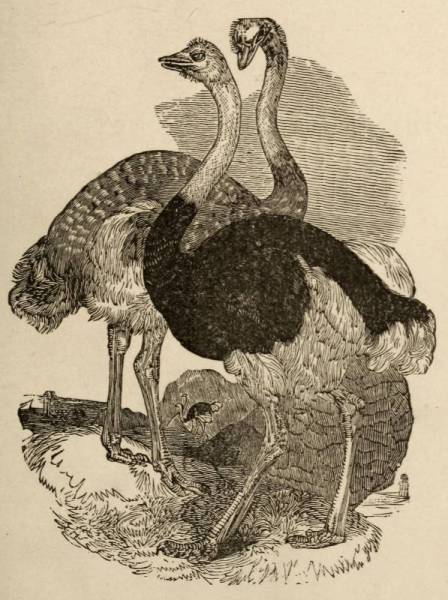
The feathers of the ostrich, which are used for
dress-feathers, are taken from the wings and tail of the
bird, whose spurred wings, by their peculiar construction
render it entirely unfit for flight. The wings
seem rather only fit to serve for the purpose of holding
the body of the bird in equilibrium while running, and
of preventing it from sinking to any depth into the
loose sand of the deserts, which are the home of the ostrich.
The natural colors of the ostrich feathers are
white, black and gray, or rather a dark drab. They are,
therefore, sorted according to their natural color, to be
bleached white, or dyed in light colors, or to be used
for dark shades. Practical men in the general dyeing
business, and in garment dyeing or re-dyeing, hold that
it is unnecessary to bleach, respectively strip, the material
for dyeing dark colors, and garment dyers strip
their material only to a certain extent, so as to leave
upon it a bottom of color which they can advantageously
use for their new dye. This method appears
correct, if as "practical" as all that is designated,
which results in a saving of expense or labor; but it is
evident that a clear color of the highest possible beauty
can never be obtained upon a bottom of a different hue;
the bottom color will always, more or less, show and
impair the purity of the topping color; but compound
or mixed colors can be thus produced in an advantageous
manner and to good effect, if the color of the
bottom enters into their composition. The same is unquestionably
the case with ostrich feathers, and the
dyer is often compelled and must be prepared to bleach
the gray or black and white feathers in order to dye
them any light shade. The bleaching of naturally
purely black feathers is probably but seldom required,
as these are ordinarily left as nature has made them, but
merely cleaned to heighten their beauty and gloss.
Owing to the delicate nature of the material, the dyeing
of ostrich feathers bears much similarity to that of
silk; both being high in price, carelessness and negligence
in their treatment is apt to entail heavy losses.
The utmost cleanliness of all utensils is an absolute requirement;
dyestuffs, drugs and chemicals must never
be added to baths in substance, but always in solution,
and never while the material is in the bath; but the
material must be taken up while the dyestuff or salt,
etc., solution is being added to the bath, and only re-entered
after stirring well. Solutions, as well as decoctions,
must always be filtered, respectively strained,
before adding them to the dye bath, even if they have
been prepared beforehand, because any undissolved or
solid particle of substance deposited upon the feathers
would necessarily produce a spot or mark of a darker or
lighter shade, as the case may be, according to the character
of the undissolved substance. Although alkalies
and heat are applied and necessary for washing or
scouring, that is, cleaning and ungreasing the feathers,
strong alkaline and excessive heat operating together
are as fatal for feathers as they are for any other animal
fibre,—wool or silk,—and strong heat applied to dry
feathers is apt to irretrievably ruin them. The soap with
which feathers are to be treated, must, therefore, be as
neutral as possible, and if recipes speak of "boiling"
the feathers, it must be understood in the sense as in
wool-dyeing, that is, to apply a heat near the boiling
point, when the baths begin to throw up bubbles, but
not actually boil.
That the water used for any purpose in ostrich
feather dyeing, for washing, bleaching, dyeing or rinsing,
must be perfectly clean, needs hardly to be mentioned.
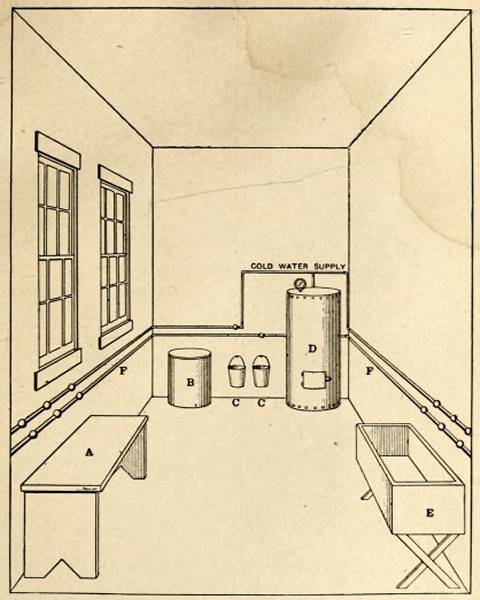
The utensils required for feather dyeing are of a
very simple character, few and inexpensive. For small
establishments an ordinary stove, a common wash-boiler,
to have constantly hot water on hand, an ordinary
wash tub, a white china wash-basin for dyeing, a clean
board for starching and a few bottles, together with a
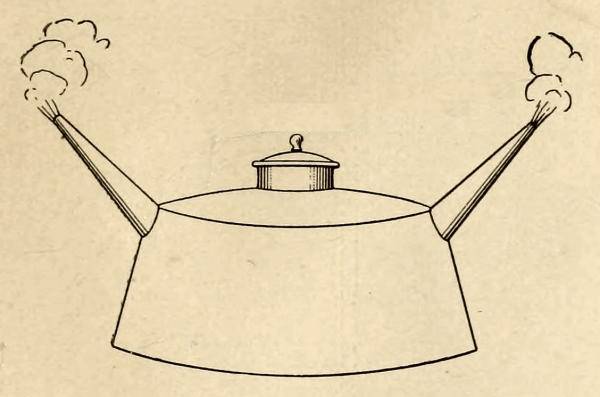
small tin pan or kettle and funnel, for making solutions
and decoctions and filtering them, is all that is necessary
besides the work table. More recently, flat, oval upper
pans, tinned for special purposes, have been introduced
as dye-vessels, which are neatly provided with a moveable
perforated false-bottom, and are heated either upon a
direct fire, or a gas jet, or by direct steam. In large
establishments copper pans are generally used, for the
better grades of ostrich feathers especially, and for ordinary
goods wooden tubs, both heated by steam. Where
wooden tubs are used, several of them are set apart for
the color most in demand, such as black, brown, gray,
mode, etc.
The bundles received from the dealer being opened,
the feathers are sorted according to color and size, and
those for white and light colors, to be bleached, are laid
from those of dark colors, which are ordinarily not
bleached, that is, the black or gray ones. When going
to work the feathers are put on strings, that is, they are
firmly tied singly, about an inch apart from one another,
and about an inch above the end of the quill, 20 or
25 with one string, seldom more, as they would make
the bundle too thick and unhandy. The feathers are then
ready for the steep, which operation ought always and
for any method be the first step of treatment before proceeding
to washing, scouring and bleaching proper.
For this purpose a strong solution of soap is made in
boiling water; when cooled down to about 150° F., it is
well stirred, the feathers entered and left in the bath
over night. The temperature may be kept up over night.
It is necessary, however, to lay the feathers down in the
steep so that the liquid can reach every part of them,
and to keep them well immersed in the steep, for which
purpose it is advisable to weigh them down by clean
sticks of wood or some other means. Instead of soap,
soda may be used for the steep; taking about one and
one-half ounces of soda crystals to one gallon of water.
By the steep the impurities, dirt and grease, covering
the feather are loosened, and thereby the following
cleaning operations materially facilitated.
The ostrich feathers, like all material taken from the
covering of the animal body, wool, hair, etc., which are
embellished by dyeing for the use of man or woman in
dress, contain by nature a certain amount of fat, and in
their raw condition are more or less covered with dust,
dirt and a greasy exudation, which must be removed
for dyeing; that is, they are scoured or washed and then
bleached or whitened, because the feathers, like all other
so-called white animal matter, have always a faint
yellowish tint, sometimes yellowish spots which cannot
be removed without injury to the material, but obliterated
by bleaching, which, in the case of white feathers, is
called bleaching or whitening. The bleaching of gray
and black feathers and the stripping or decoloring of
dyed feathers are different operations.
For scouring or washing, novel methods are recommended,
which, however, differ from one another very
little, and are, on the whole, represented by the following:
Prepare a good handwarm bath (100-120° F.),
in which dissolve two ounces Marseilles soap in per
gallon of water and beat up to a good lather. Enter
feathers and rub them well, string for string, by hand.
They may even be taken upon a wash-board and rubbed
with a brush, which does not hurt them, notwithstanding
their delicate structure, because the soap steep has given
them great elasticity and resistance to the manipulation.
Continue the operations until the tank is exhausted and
dirty; then give another fresh bath of the same composition
and temperature; treat the feathers as in the first
bath and rinse them perfectly clean from every particle
of soap in two or three luke-warm (100°) waters; for,
every trace of soap remaining upon the feathers will
hinder the dye from running up and cause uneven colors,
or, upon white feathers, yellow stains. Then prepare a
cold bath with solution of bioxolate of potash (one-eighth
to one-sixth ounce of salt to one gallon), enter feathers,
pass them in the bath for 15-20 minutes, take up and
rinse them in cold water three to four times to remove
the salt. For feathers which have to remain white, the
latter bath is composed of one and one-quarter ounces
bioxolate of potash and one and one-eighth ounces oxalic
acid to one gallon of water, and the feathers laid down
in it until perfectly white; when they are taken out and
rinsed clean from acid in luke-warm water.
The feathers being rinsed clean from the oxolate of
potash bath, if destined for white, are then whitened, or
rather blued, for the purpose of covering the yellowish
tint above mentioned. To this purpose a cold bath is
prepared with only so much methyl violet or methylene
blue, as to give the water a very faint tint. To ascertain
whether this is the case, a white china plate is held
about a foot below the surface of the bath, when its appearance
will show the shade of blue that will be produced
by the bath. The feathers are then entered and
gently agitated in the bath until they have the desired
tint.
The feathers coming from the bioxolate of potash
bath, after rinsing, or from the blue baths, are squeezed
out by pulling them through the hand, and pressing
them between the laps of a dry clean piece of white
muslin, whereupon they are immediately passed through
a bath of raw starch, that is, unboiled starch, consisting
of about one-half pound of starch to a gallon of water.
After passing them through the hand the feathers are
then again pressed between the cloth; then the waves
are lightly drawn by hand over the stems, and the
feathers either beaten between the hands or upon a clean
board over a stove until dry, or they are agitated by
hand or by a suitable mechanical contrivance before an
open fire or gas-jet, or hung in a warm room and frequently
shaken until dry, that is, until all starch has
dropped out; and finally the remaining starch is beaten
out between the hands or upon the board by means of a
soft brush. By this treatment the feathers are not only
dried, but the flues opened besides. It needs not to be
specially mentioned, that the feathers are dried, or
finished, as it were, in the same manner after dyeing.
In case the flues are not sufficiently opened, although
all the starch has been beaten out, dip the feathers into
clean benzine and swing or agitate them until dry, which
takes place in a few minutes, while the flues are opened
in the most perfect manner. For white feathers the
benzine may be blued, but in this case, they must be
dried between muslin.
The feather dyer is often required to dye light colors
upon naturally gray or even black feathers. As above
remarked, the natural color would show even under dark
colors dyed upon them to a greater or less extent,
unless they are first decolorized, that is, their natural
color destroyed or blackened. Much more necessary is,
therefore, this operation for light colors to be dyed
upon naturally colored ostrich feathers. The only
known chemical agent affecting such a bleach to nearly
white is peroxyd of hydrogen or oxygenated water.
For bleaching ostrich feathers a bath is prepared of
peroxyd of hydrogen to which so much liquid ammonia
is added as to give the bath a sharp pungent odor. The
feathers, which must be previously cleaned as above
mentioned, and well rinsed, are entered and left immersed
in the bath until they have assumed a nearly
white cream color, whereupon the feathers are taken
up and thoroughly rinsed or laid down in running water
until every trace of ammonia has disappeared. It must
be observed, however, that only acid aniline colors can
be dyed upon such decolorized feathers and that in dyeing
only a moderate heat must be applied.
Dr. P. Ebell, of Linden, near Hanover, one of the
first and still largest manufacturers of peroxyd of hydrogen,
writes on the subject of feather bleaching as follows:
The assorted and picked feathers are cleaned
from dirt and fat with soap and water by means of soft
brushes, which operation is continued until the feathers
(after drying) are readily wetted by water; when they
are laid down for some time in pure water. The liquids
are removed from the feathers by a centrifugal machine
or a wringer (the latter is evidently meant for ordinary
feathers, other than ostrich feathers). Mix in a clean
wooden tub twenty litres peroxyd of hydrogen (Kœnigswæter
& Ebell) with four hundred and fifty grammes
ammonia 20° B. (=0.9 sp. gra.) and heat to 34°
C., by a leaden steam pipe at the bottom of the tub.
Enter 5 kilo. cleaned feathers, which work by hand and
turn every hour. In twenty four hours the bleach is
completed. If pure white feathers are wanted, give a
second bath, but for a shorter period. The bleached
feathers are carefully removed from the bleaching bath
and laid down, for an hour and a half, in a cold bath of
one hundred litres water containing one hundred
grammes sulphuric acid 66° B., and then completely
lixiviated in pure, soft water. While moist (after
squeezing) they are then passed through a milk of unboiled
starch which is lightly blued with aniline blue or
violet, and slowly dried, in the air or in a warm room,
under repeated shaking to prevent the flues from sticking
together. After removing the starch by beating,
the feathers are ready for curling, etc.
This most valuable bleaching agent is a contraction
of hydrogen and oxygen, of the formula HO2, sp.
grv. 1.45 (chemically given), or 94.12 per cent. oxygen
with 5.88 per cent. hydrogen. It consists in a limpid,
syrupous liquid, of characteristic color, and when heated
to 15° C., is decomposed into water and oxygen, upon
which property its great bleaching power is based. Experiments
to reduce it to a solid form by refrigeration
and pressure have thus far been unsuccessful. The
commercial article is somewhat modified by the addition
of water to prevent its ready decomposition under the
influence of a warm temperature. For the same reason
it is advisable to always keep it in a cool place.
I. To dye this delicate color well, special care must be
taken in cleaning the feathers, for which purpose only
olive-oil soap of the best quality, with a little ammonia,
ought to be employed. When they are perfectly clean
and no more grease upon the stems, rinse them first in
one or two lukewarm waters, then in cold water until
the last trace of soap is removed. Then fill your basin
or dyeing pan three-quarters full of cold water; put in,
for a dozen feathers, one hundred and eighty grammes
(about eight ounces) of raw starch in a sufficient quantity
of good indigo extract to give the starch-bath the
desired shade. Enter the feathers and work them
gently until they are completely dyed, that is, for about
fifteen or twenty minutes. Then take them out, squeeze
out the starch by putting them between the fingers and
thumb of your hand, and shake them before the stove,
or in a well-warmed chamber until dry. While drying,
beat them from time to time upon the board, or between
the hands to remove the adhering starch.
II. Prepare a lukewarm bath acidulated with a few
drops of sulphuric acid, so as to give a faint sour taste,
to which add, according to shade, solution of methyl
blue B. (Actien Gesellschaft fuer Anilin Fabrikation,
Berlin). Enter the feathers and leave them in the bath
until cold, or until uniformly dyed.
Note.—Some dyers use alkaline blue, which is not,
however, recommendable, because alkaline baths, as
above remarked, are injurious to the feathers and must
be avoided as much as possible.
III. Prepare bath of lukewarm water, dissolve in it
about one-half ounce tartaric acid per one quart, and add
one ounce indigo carmine per quart of liquid; stir well,
enter the feathers and agitate or lay down in the bath
until the required shade is obtained. This color shows
little fastness to light and air, which can be improved,
however, by adding to the dye bath one-quarter ounce
alum per quart. The shade being obtained, take up the
feathers and pass, without rinsing, through raw starch
milk, dry and beat as described.
Light blues, as is easy to understand, can only be
dyed upon white feathers for the most delicate shades;
nearly white, or developed gray feathers may be used
for the shades approaching a light medium blue.
I. For this color naturally gray or semi-bleached
feathers may be used. It requires a mordant, like wool.
For this purpose prepare a bath of forty per cent. (of
the weight of feathers) tannin at 167° F., enter the
feathers and agitate them from time to time for three
hours. Then take them up, drain and squeeze them out,
enter a cold bath of pyrolignite of iron (black liquor)
marking 5° B., and work them for half hour; take them
out, drain and squeeze, and then expose them, well
spread out upon the strings, for one hour to the action
of the air. Then rinse and dye upon a fresh warm bath
with a mixture of aniline blue and a little methyl violet,
using about twenty per cent. of the weight of feathers.
Add the dyestuff in the beginning only in small doses
and slowly in order to prevent the production of a
bronzy, undesirable lustre upon the stem, as is often the
case in dying with aniline dyestuffs if they are added to
the bath in too large doses.
II. Prepare a hot bath, to which add as much indigo
carmine as to bring the color of the bath pretty near the
shade to be produced. Enter the feathers and agitate
them in the bath for one hour. Then take up the
feathers, add alum and a solution of cloth-blue S. to the
bath, re-enter the feathers and work them while raising
the temperature to boiling point, when the steam or
gas is turned off, or the pan removed from the fire, and
the feathers allowed to lie for fifteen or twenty minutes
longer in the bath. They are then taken out, rinsed,
starched and dried and beaten.
III. Have the feathers properly cleaned and well
rinsed from the soap, respectively soda. Gray feathers
may be used unbleached, but a purer color is obtained
upon them when bleached. Prepare a hot bath, to
which so much sulphuric acid is added, that it has a
feeble sour taste; add the solution of two per cent. (of
the weight of feathers), navy blue, one per cent. fast
blue or black, and one-eighth per cent. acid fuchsine.
Stir well, enter the feathers, manipulate while raising
the temperature to boiling point, but not to actual boiling,
continue at this temperature for one half hour; then
stop off the steam, lay the feathers down in the bath
until cool, lift and dry as usual.
This color requires a pure bottom, that is, naturally
white or bleached. After cleaning, respectively washing
in warm soap, which must not even be omitted with
bleached feathers, and thorough rinsing, prepare a bath
and dye as for dyeing light blue with indigo carmine.
Then add some aniline green and navy blue to the bath,
re-enter the feathers which have been taken up before
making the addition, work them well while raising the
temperature to the boiling point; continue at this temperature
for one-half hour longer, lift, rinse, starch and
dry as usual.
I. For this color, which has in itself a subdued tone
of brown, or has the color of gray ostrich feathers, such
naturally colored feathers may be used unbleached, but
well cleaned and rinsed before dyeing. Prepare a luke-warm
bath, to which add about one-half ounce tartaric
acid to per quart of water and solution of methyl violet
6 B., according to shade, with a little aniline ponceau or
fast brown for toning. While working the feathers,
raise the temperature and continue dyeing at nearly
boiling for one-half hour; then take out, wash and
dry.
Or,
II. Prepare a boiling hot bath with alum, sulphuric
acid and tartar; to which add acid fuchsine; enter the
feathers, and dye one-half hour to a blue red, which
tone, by the addition of decoction of logwood, continue
at nearly boiling heat for one-half hour longer, lift, rinse
lightly, starch, beat and dry.
III. Take a hot bath, upon which violet has been
dyed, and refresh it with some solution of methyl violet,
5 B., and a few drops of sulphuric acid, or prepare a
hot bath with the same ingredients, and indigo carmine,
according to shade; or, instead of indigo carmine,
indigo substitute, fast blue B. A., and indigotine; preferably,
however, use indigo carmine, which develops
more slowly, and therefore is surer to give better results,
while the aniline dyestuffs run up more rapidly, and are
apt to dye unevenly, unless their solutions are added
gradually and the feathers handled quickly and carefully.
I. Light yellow is comparatively very little in
demand for ostrich feathers, and scarcely used for trimming
hats of children and young misses as a set-off for
other colors. To produce it, prepare a pretty hot bath
with a little sulphuric acid, so as to give it a slightly
acid taste, add very little quinoline yellow, lay down the
feathers in the bath for one-half hour, turning and agitating
them from time to time, lift, rinse and dry. For
this color, as well as for light blues and roses, the feathers
must be perfectly white. (For this dye the quinoline
yellow manufactured by the Actien Gesellschaft fuer
Anilin Fabrikation, Berlin, is specially suitable). As
the purity of all light shades of delicate colors greatly
depends upon the purity of the water, it is advisable to
bring the bath, before preparing it, to boil with some
bran and chloride of tin and skim it off well.
Various shades of yellow can also be produced with
the old natural dyestuffs, which are not, however, equal
in brilliancy to the foregoing described colors. The
feathers must be bleached for these as well as for any
clear color, which would be materially impaired by an
impure bottom; still developed grays may be employed.
After scouring and thoroughly rinsing the feathers, prepare
a cold bath of alum, about one ounce to one gallon
of clear water, or of acetic acid; lay the feathers down
until well opened, so that the liquid can uniformly act
upon all parts, for one hour. Then take them out,
squeeze and centrifugate them, and dye the shade upon
a fresh warm bath with the required quantity of flavine,
decoction of color or of fustic; lift, rinse and starch as
usual.
Or, dissolve a sufficient quantity of turmeric in boiling
water, filter and enter the feathers while the filtrate
is still well hot. Agitate them for five minutes, then
take them up, add to the bath a small quantity of tartaric
acid, this to promote its dissolution; then re-enter
the feathers, work them again for five minutes, lift, rinse
in cold water, and dry.
If these colors are to have a light reddish or warmer
tone, add, when nearly done, some anotto to the dye
bath.
Bleached grays answer for this color as well as naturally
white feathers. Scour and rinse them well. Prepare
a bath, feebly acidulated with sulphuric acid, and
add the filtered solution of two and one-half per cent. of
the weight of feathers, dark yellow, (manufactured by
the Leipziger Anilin Fabrik, formerly Bayer & Kegel).
Enter the feathers in the cold and work them diligently
until the color is well up, then raise the temperature
slowly to 170° F., dye to shade, lift, rinse in clear cold
water, starch and dry.
II. A new light yellow, which is fast to light and air,
is obtained by products of Leonhardt & Co., at Manheim,
viz: redarine and acme yellow. Add to a hot
bath of 170-190° F., a quite small quantity of redarine
and still less acme yellow; enter the feathers, manipulate
for one-half hour, take out, rinse and dry them with
starch, and beat well out. This color being extremely
sensitive, the purification of the water for the bath is as
necessary as the most scrupulous cleanliness of utensils
and workshops.
I. The feathers being scoured and rinsed clean of
soap, prepare a bath of five per cent., of the weight of
feathers, bisulphate of soda, add solution (filtered) of
azo orange, according to shade. Enter the feathers
at 120° F.; heat up slowly to 170° F., while working
the feathers; lift when the shade is obtained, squeeze
out, starch and dry.
II. Prepare a bath with three per cent. (of the
weight of the feathers) Glauber salt and one per cent.
sulphuric acid. Enter the feathers at 100-120° F., after
adding to the bath the solution of one per cent. golden
yellow S. (of Gust. Doerr, Frankfort-on-Main), work the
feathers repeatedly during one-half hour, when they all
have assumed a rich, nourished color; take up, rinse
lightly; starch and beat them dry.
Have the naturally white or decolorized gray feathers
well washed in soap and rinsed clean from it. Prepare
a hot bath at 170° F., to which add so much aniline
cream as to color it dark reddish yellow. Enter
the feathers and agitate them from five to ten minutes,
according to the shade desired. Then take them up,
add some sulphuric acid to the bath, re-enter the feathers,
work for two minutes; then lift, rinse and dry.
The bath can be preserved for further use.
So unpretending this color appears, so difficult is it
to produce, and it requires a considerable amount of
practice and good judgment to bring out a good color
from the beginning, as very little too much or too little
will spoil a color either in tone or in shade. A very
good logwood gray, which with proper attention seldom
fails to turn out satisfactory, is made as follows: Prepare
a hot bath, to which add a small quantity of decoction
of logwood; enter the feathers and work them in
the bath for fifteen or twenty minutes, according to
shade desired. Then take them up, add to the bath
very little pyrolignite of iron, that is, only as much as
to turn the color of the bath; re-enter the feathers, agitate
them again for fifteen or twenty minutes in the
liquid; then lift, rinse and starch as usual. This color
might be best described as dark ash gray. Instead of
pyrolignite of iron, some solution of copperas may be
used. It will be easily understood, that the more concentrated
the decoction of logwood is, the darker turns
out the color, and it is in that respect particularly that
the dyer has to use good judgment in producing shades
from silver gray to dark ash gray. This color, besides,
presents the advantage, that by topping it with solutions
of blue, brown, yellow or green coal-tar dyestuffs a great
variety of mode colors can be produced.
After scouring and rinsing well, prepare a warm
bath (100-120° F.) with five per cent., of the weight of
feathers, bisulphate of soda, to which add solution of
Victoria blue and of extract of archil, according to
sample. Acid violet may be used, but requires a temperature
near the boiling point, which ought to be
avoided wherever possible in dyeing ostrich feathers.
To be on the safe side, make the solutions of the dyestuffs
of medium concentration, use only the clear of
them, or better filter the same, and add it slowly and
gradually first in small doses, finally by drops, for which
purpose the use of a burette with squeeze-cock is recommendable.
Scour, respectively bleach, and rinse the feathers
well clean, prepare a bath, work the solution of five per
cent., of the weight of feathers, silver gray (Actein
Gesellschaft fuer Anilin Fabrikation, Berlin), feebly
acidulated with sulphuric acid; enter the feathers in the
cold, work well to make the color dye up evenly; then
raise the temperature slowly under diligent working, to
170° F., continue at this temperature for five to ten
minutes, lift, rinse and dry.
The series of brown colors, partly produced by combinations
of spectrum colors, partly of direct brown
dyestuffs, presents a large range of modifications and
shades, from a light rust brown or buff to nearly black,
blueish, yellowish, reddish, olive brown, etc., and is in
this respect only inferior to the non-descript endless
variety of modes. With the exception of the very
lightest shades, which require perfectly white feathers,
they can be dyed upon half-bleached, and the deeper
shades upon unbleached gray feathers; the dyer,
must, however, in the latter case, bear in mind, that the
gray bottom color always influences to a certain degree,
the tone of the color that is to be dyed upon it. Nevertheless,
as to the proportions of the dyestuffs to be employed
for a given tone or shade cannot be given, because
the tinctorial value of artificial dyestuffs is very
changeable and not even constant with the same makers.
Experience, skill and trial dyes must, therefore, guide
the dyer in composing the baths for browns as well as
for modes, the majority of the latter being modifications
of brown. In general the following may be observed:
I. After scouring the feathers and rinsing them perfectly
clean of the scouring material, whether soap or
soda, prepare a bath of 170 to 190° F., to which add
fifteen per cent., of the weight of feathers, bisulphate of
soda, indigo carmine, extract of archil and azo yellow.
According to the proportionally greater or smaller
quantity of either dyestuff added to the dyebath either
browns are obtained, or olives, Russia green, reseda, or
a variety of modes. The trouble with all colors into
whose compositions indigo carmine enters is, that this
dyestuff requires a comparatively high temperature to
run up, preferably a boiling bath, which, however, is
decidedly objectionable with ostrich feathers. To
avoid this difficulty, the new acid Victoria blue is used
instead of indigo carmine, and fuchsine S. instead of
extract of archil. Victoria blue dyes up readily at a
moderate temperature.
II. The feathers being scoured and rinsed clean, prepare
a boiling bath with so much sulphuric acid as to
give a feebly sour taste, and add fast aniline brown,
turmeric, and indigo carmine or cloth-blue S., according
to the tone and shade desired. Prepare the bath so
that it shows exactly this tone of color which is to be
dyed, and bring it to boil in order to produce a perfect
mixture of the three dyestuffs, or rather their filtered
solutions. Then chill the bath to about 120° F., enter
the feathers, while raising the temperature in about fifteen
minutes to near the boiling point; then dye to
shade, lift, rinse and dry.
It is advisable, in order to obtain a level dye, to add
not the whole amount of dyestuff solution required at
one time, but at least in two times; which rule
altogether applies to all aniline dyestuffs, more or less,
as they mostly run up very rapidly and are apt, therefore,
to give uneven dyes.
If a yellowish tint is wanted, use a little azo yellow
or azo orange; picric acid, which was formerly very
freely used for this purpose, has been almost entirely
abandoned.
Clean and rinse them as usual, prepare a bath of
170-190° F., with redarine, a trace of orange O, and
some acid green; enter feathers and work for one-half
hour, then lift, rinse and dry. By varying the proportions
of dyestuffs, a series of modes is obtainable. (Dyestuffs
manufactured by Leonhardt & Co., of Mannheim).
Prepare a slightly acidulated warm bath with three
per cent., of the weight of feathers, fast aniline brown,
one per cent. azo yellow, one percent. extract of indigo,
and a little sulphuric acid; enter the well scoured and
rinsed feathers at 120-140° F., work the feathers for
one-half hour, while slowly raising the temperature to
the boiling point; continue dyeing at that degree of
heat, but not boiling, for five minutes; lift, rinse, starch
and dry.
I. Scour and rinse well; prepare a warm bath, in
which dissolve three per cent., of the weight of feathers,
alum, add twenty-five per cent. extract of archil, one
and one half per cent. azo yellow, and if required for
shade, one-half per cent. indigo carmine; enter at 170°
F., dye to shade while slowly raising the temperature to
near the boiling point, continue at that temperature for
ten to fifteen minutes longer; then lift, rinse and dry.
Instead of indigo carmine, cloth-blue S. may be used,
in which case enter at 120° and raise the temperature
slowly, not above 190° F. Or,
II. Prepare a bath at 190° F., add five per cent. bisulphate
of soda, when dissolved, add solution of extract
of archil, fast yellow and indigo carmine as required
for the shade, and dye at that temperature to
sample. Instead of archil, any red or orange azo dyestuff
may be used, preferably bordeaux.
Have the feathers will cleaned and rinsed, bleaching
being not required, prepare a bath with three per cent.
alum (of the weight of feathers), at 170° F., add indigo
carmine, bordeaux and azo yellow, according to sample,
and dye to shade while slowly raising the temperature
to near the boiling point, but bring not to boil, but continue
until the indigo carmine is well up. A less fast
color is obtained with archil, indigo carmine and picric
acid. When finished dyeing, rinse, starch and dry as
usual.
The dyestuffs for brown being nearly the same for
all shades, while the depth and tone of the color is produced
by differently proportioning the quantities of the
different dyestuffs and the time of dyeing, it is advantageous
to have the solutions of dyestuffs near by on
hand; it is advisable, however, if good work is intended,
to always filter before using solutions which have been
standing for some time. This precaution is necessary,
because from most solutions, if allowed to stand for a
day or longer, some dyestuff which was not dissolved
but only suspended in the liquid, separates out forming
a more or less copious sediment which, if it passes into
the dye bath, settles upon the feathers causing spots or
streaks of a different shade than the rest of the feathers.
Scour and rinse the feathers well; grays can be used
in their natural color without bleaching. Prepare a
warm bath, in which dissolve eighty per cent., of the
weight of feathers, tartaric acid and eighty per cent.
Glauber salt; then add sixteen per cent. aniline fast
brown; eight per cent. azo yellow, and sixteen per cent.
induline or nigrosine, and bring the bath to a boil; after
a few minutes of boiling, chill by the addition of cold
water, enter the feathers and work them at hand-heat
for fifteen or twenty minutes until the color has become
level; then bring the bath again to near the boiling
point; lay the feathers down in the bath, shut off the
steam, or withdraw from the fire, and let the bath cool
down. When cold, that is in about one or two hours,
take out the feathers, rinse and dry.
Prepare a warm bath with five per cent. bisulphate
of soda, add solutions of azo orange, acid violet and
some archil cautiously in several doses until the bath
has the desired color. Enter the scoured and rinsed
feathers and agitate for fifteen or twenty minutes, to
produce a level dye; then raise the temperature slowly
to 190-200° F., dye for a few minutes longer, lift, rinse
and dry.
By varying the proportions of the dyestuffs, drab,
wood brown, lead color, etc., can be obtained, and olives
by increasing the quantity of acid violet and omitting
the extract of archil.
Scour and rinse the feathers well; natural grays may
be used unbleached. Prepare a decoction of one and
one quarter pound cudbear, and six ounces turmeric in
two gallons of water, strain through a cloth and enter
the feathers at hand heat (about 90-100° F.); work
them for twenty or thirty minutes, or until they have
attained a nourished garnet color. Then take them out,
rinse, lay them down for five minutes in a cold solution
of about six ounces copperas in one-half gallon of water,
take them up and rinse in cold water. Then return to
the first bath, operate for fifteen minutes at hand heat,
enter again, after rinsing, the iron bath, and continue
alternately dyeing upon the two baths until the required
shade is obtained. Rinse every time on shifting from
one bath to the other, in clean water, and finally rinse
well, starch and dry.
I. For this color it is advisable to use naturally
white or bleached feathers, scour or wash them clean in
soap and warm water and remove the soap by thoroughly
rinsing in two warm and one cold waters. Prepare
a bath slightly acidulated with sulphuric acid, to
which add eighty per cent., of the weight of feathers,
tartaric acid, eight per cent. azo yellow, six per cent.
fast brown, and three and a quarter per cent. acid green.
Enter the feathers at 100-120° F. and manipulate at
that temperature for ten or fifteen minutes. Then
raise the temperature to the boiling point (but do not
boil), lay the feathers down in the bath for one-half to
one hour, while the bath cools down, lift, starch and
finish as usual.
II. Prepare a bath slightly acidulated with sulphuric
acid, bring to nearly boiling, add a concentrated solution
of orange S. and some acid green, enter the feathers
and dye to shade; then pass them through a week oil-bath,
and dry them, placed straight between several
laps of clean muslin.
III. Prepare a bath of the decoction of twelve and a
half per cent., of the weight of feathers, alum and
twenty-five per cent. turmeric; strain, enter the feathers
at 170-190° F., and let them lie in the bath over night.
On the following day dye, at 100° F., with decoction of
fustet, tone with decoction of logwood or of brazil, according
to sample, starch and dry.
I. For this elegant color take naturally white or
bleached gray feathers, scour and rinse them well.
Prepare a hot bath with five per cent., of the weight of
feathers, bisulphate of soda, to which add, as required,
filtered solutions of fast yellow, indigo carmine and ponceau
G. Enter the feathers at 170° F., work them for
ten or fifteen minutes and raise the temperature slowly
to near the boiling point. Add the dyestuffs in small
quantities gradually, making the additions only when
the dyestuff of the bath has been completely absorbed,
and then by drops so as to be able to correct the color
without waste of dyestuff. Bear in mind, that the indigo
carmine dyes up slowly and requires a high
temperature. An easier process is, therefore, the following:
II. After cleaning and rinsing well, prepare a bath
at 170° F., with four per cent. bisulphate of soda, to
which add gradually in small quantities, as required,
some nigrosine, azo orange and a little mandarin or nigrosine,
alkaline blue and fuchsine S., rinse, starch and
dry.
Scour and rinse the feathers as usual; bleached
grays may be used. Prepare a bath with five per cent.,
of the weight of feathers, bisulphate of soda and the
clear solutions of acid violet, azo orange and fuchsine
S.; add the dyestuff in small portions and finally by
drops, until the bath has the desired shade of color;
then enter the feathers and dye at 170° F. to sample,
squeeze or centrifugate, starch and dry.
I. For this color take either naturally white or well-bleached
gray feathers, scour or wash and rinse them
clean. Prepare pretty thin solutions of aniline orange
(chrysaniline) and violet, add very little of them at a
time and finally by drops to the dyestuffs containing
either five per cent. bisulphate of soda or a small dose
of sulphuric acid; enter the feathers at 145° F. and dye
to shade at the same temperature, which will require
about twenty or thirty minutes; lift, rinse, squeeze and
starch.
II. Have the feathers well cleaned, respectively,
bleached, and rinsed. Prepare a hot bath (170-190°
F.), with a little sulphuric acid, just enough to give it a
slightly sour taste, add a few drops of solution of fast
brown and a little more solution of acid green (both
dyestuffs of the Farbwerke, formerly Meister, Lucius &
Bruening, Hoechst-on-Main); take of them one or
two drops, respectively two or three drops per gallon of
water for a light shade and increase quantities proportionally
for darker shades. Rinse after dying, starch
and dry.
III. Take white feathers or grays very well bleached
to nearly white, scour and rinse them well. Prepare a
bath of warm water, 100-120° F. and some vinegar so
as to give it a distinct sour taste; add to a basin full, or
about one-half gallon of the bath a little solution of fast
brown, one or two drops of indigo carmine, and a trace
of turmeric. Lay the feathers down in the bath for fifteen
or twenty minutes and agitate them repeatedly in
the liquid to make them level.
For a Gray Beige, add a little nigrosine to the bath
and proceed as above.
For the modes it is impossible to give generally applicable
directions, as these colors are of an indefinitely
varying character, consisting in modifications of other
compound or mixed colors which are affected by sometimes
very trifling, unmeasureable additions of a toning
dyestuff, and coloring effects are produced which cannot
be described nor defined by names, but must be judged
by the experienced eye of the dyer. Most of these
colors are derived from grays or browns as above remarked,
and the safest way for the dyer is, to begin
dyeing with light shades of the prevalent characteristic
color and give them the peculiar tone by the addition of
other colors by drops. The proportions of dyestuffs
thus ascertained for light shades, are then easy to increase
for deeper shades. It needs not to be remarked,
that for these colors the feathers must be bleached, especially
for light and medium shades, and that, if unbleached,
grays are to be dyed in dark shades, the effect
of the natural color must be considered in composing
the dye.
In general all modes are dyed upon a bath which is
acidulated with bisulphate of soda, with azo orange, azo
yellow, azo brown, acid violet, indigo carmine, solid
blue or cloth blue, induline or nigrosine, archil or acid
fuchsine. For brown modes, solution of Bismarck
brown may be added at the beginning, in which case the
other dyestuffs serve only for giving the peculiar
tone.
For a yellowish green mode take orange O, azo
yellow, and solid blue (fast blue); for darker shades
add a little violet 6 B., or a few drops sulphate of indigo.
If alizarine dyestuffs are to be employed, use
tartaric acid as mordant, but for neutral dyestuffs add
also a little alum to the dyebath.
For gray modes use the same dyestuffs as above,
excepting the orange, instead of which a blue-red dyestuff
is to be employed, such as azo rubine, bordeaux,
fuchsine, etc., with the addition of a little acid green.
The bath must be acidulated with a little sulphuric acid,
or better with tartaric acid, or tartaric acid and alum,
and after dyeing the feathers must be rinsed, starched
and dried as usual.
For particularly fast modes add only tartaric acid
to the dyebath and no alum, and a few drops of solution
of thio-scarlet, thio-rubine, and thio-brown; for grays
add a little azo yellow and sadden with solid blue.
Alum does not agree with the thio dyestuffs which are
manufactured by Dahl & Co., Barmin, and are fast
against soap and light. Feathers dyed with these dyestuffs
which have become soiled, can be washed, therefore,
with neutral soap without injury to the color, but
must naturally be dressed anew.
Scour the white, respectively bleached feathers and
rinse well. Prepare a bath with five per cent., of the
weight of feathers, bisulphate of soda, to which add
gradually and carefully the filtered solution of acid
violet, fast yellow and fuchsine S., making the additions
from the beginning in small quantities only, until the
desired tone and shade are obtained; then enter and
work the feathers to sample at 173° F.
It is for this dye particularly important that the bisulphate
of soda used be crystallized, that is, pure bisulphate
free from surplus sulphuric acid, while the
commercial article is often nothing but a mixture of
Glauber salt (sulphate of soda) into sulphuric acid,
answer for this dye.
A good reseda is also easily obtained by adding to
the acidulated bath small quantities of decoction of logwood
and turmeric, so as to give a feeble bath. Enter
the scoured and bleached feathers, after rinsing, at 170°
F., work them for about fifteen minutes, until level, and
sadden with a little solution of blue stone. Rinse,
starch and dry as usual.
For two and one-half pounds of feathers boil two
and one-half pounds of fustic for one-half hour with
three quarts of water, pour the decoction off and boil
the chips again for one-half hour with three quarts of
water, mix the two decoctions and strain. Add three
ounces alum and one and one-half ounces tartar, enter
the feathers well scoured and rinsed, and dye to shade
at 170° F. Or, prepare the dyestuffs of decoction of
fustic or turmeric, and indigo carmine, according to
shade, enter at 170° F., work for one-half hour while
slowly raising the temperature to near the boiling
point, and dye to sample; lift, rinse, squeeze and starch
as usual.
I. Scour, respectively bleach, and rinse the feathers.
Prepare a hot bath with the solution of forty per cent.,
of the weight of feathers, tannin, and treat the feathers
in it for 1 hour at 170°F. Prepare a bath with a filtered
solution of methyl green, according to shade, tone, if a
yellowish green is wanted, with the clear solution of
picric acid, and dye to sample at 150° F. Lift, squeeze
and starch without rinsing.
II. A better color is obtained upon a lightly acidulated
bath (with sulphuric acid) with acid green, malachite
green, fast green, etc., that is, with the filtered solutions
of these dyestuff's, added to the bath in quantities
of from ten to twenty per cent. to suit the shade.
Enter at 170° F.; dye for twenty or thirty minutes,
lift, rinse, squeeze and dry with starch. If a yellowish
tone is wanted, add the clear solution of picric acid, or
of acid yellow.
Scour and rinse the feathers well; for dark shades
unbleached grays may be used. Prepare a feebly acidulated
bath with sulphuric acid, at a temperature near
the boiling point; add turmeric freely and Guinea green
G less. Enter the feathers and manipulate at the same
temperature for fifteen or twenty minutes, according to
the desired tone, re-enter and dye to shade.
By varying the proportions of the three dyestuffs, a
great variety of green-brownish modes can be produced,
which approach medium and dark bronzes the more the
fast brown predominates in the composition of the
color.
This color is preferably dyed upon unbleached gray
feathers. Scour and rinse them, prepare a decoction of
green walnut husks or of sumac; lay the feathers down
in it for two hours, working them from time to time;
then add some decoction of logwood and dye to shade
at 170° F., or indigo carmine and dye to shade while
slowly raising the temperature to near the boiling point.
Rinse, squeeze, starch and dry.
Scour, respectively bleach, and rinse the feathers.
Prepare a boiling bath with turmeric and indigo carmine;
chill, enter the feathers at 170° F., dye for one-half
hour, raise the temperature slowly to near the boiling
point and dye to shade, take up, rinse and pass
through a handwarm bath of tartar; lift, squeeze,
starch and dry.
I. Scour the feathers as usual and rinse well. Prepare
a bath slightly acidulated with sulphuric acid, add
two per cent., of the weight of feathers, acid green and
one per cent. aniline navy blue dissolved in warm water
and filtered acid, according to sample, some filtered decoction
of turmeric or solution of fast yellow. Dye at
170° F. to shade, lift rinse and dry with starch.
II. Have the feathers well cleaned and rinsed. Prepare
a bath twenty per cent., of the weight of feathers,
new green, eight per cent. canarine, sixteen per cent.
aniline blue black, sixty per cent. alum, and one-quarter
litre sulphuric acid (for two and a half pounds of
feathers). Bring the bath to a brisk boil, then chill
with cold water, enter the feathers and work them for
one hour; finally sadden and tone by adding some decoction
of fustic and of logwood. Lift, rinse, squeeze,
starch and dry.
III. Prepare a sharp hot bath with a little sulphuric
acid; add Guinea green, according to shade, and tone
by the addition of indigo carmine and turmeric; for
very deep shades add also some nigrosine or fast blue-black,
dissolved and filtered. Enter as hot as the
feathers can be handled, work for one half hour; then
raise the temperature slowly to near the boiling point
and dye to shade.
The bath for deeper shades being not exhausted can
be preserved for further use, refreshed by suitable additions
of dyestuffs as required, but caution must be used
as regards the subsequent additions of sulphuric acid,
that not so much be added as to injure the feathers.
For Russia green, especially the darker shades of it,
naturally gray and even black feathers can be used unbleached.
I. For this delicate color, as well as for the lightest
shades of blue and pure yellow, absolutely white feathers
must be used; scour them carefully and rinse them
perfectly clean from soap or soda, and have the dyestuffs
well dissolved and the solutions filtered. Prepare
a handwarm bath with a little tartaric acid or acetic
acid, to which some solution of eosine, rhodamine, azoeosine,
safranine, coccine or ponceau 6 R. B. or ponceau
R. R. Be particularly cautious in adding the dyestuff
solutions gradually in small quantities, even by drops,
to avoid over-dyeing, as by partly stripping of a too
dark shade, a fine color can never be obtained, and the
nature of the material demands that all unnecessary
handling be avoided. After dyeing, rinse lightly, pass
through starch and dry. The dyes with the ponceaus
are faster than those with eosine or safranine.
II. Prepare a bath at hand heat with carthamine
(extract of safflower), well dissolved and filtered, which
add very gradually in small quantities, taking up the
feathers each time before making a fresh addition, until
the desired shade is nearly obtained, then add a little
tartaric acid to the bath, re-enter the feathers and dye
to shade; or dye first to shade upon the safflower bath,
and then pass through a fresh, handwarm feeble bath of
tartaric acid, which in this case can be used again for
other colors, either as a fixing bath or in the composition
of the dye bath.
Scour and rinse the feathers well; grays must be
bleached as near to white as possible, and these ought
only to be dyed dark shades of red. Prepare a bath
with twenty per cent., of the weight of feathers, bisulphate
of soda, and see, as in all cases, that it is well
crystallized and dry. (Never use the article when it
looks decayed, forms lumps or is moist). Add four to
six per cent. azo red, according to the shade wanted,
raise the temperature to 170° F., enter the feathers and
work to shade; take out, starch and dry.
I. Scour and rinse the white, respectively
bleached gray, feathers and prepare a bath of boiling
water with eight per cent., of the weight of feathers,
alum, four per cent. tartaric acid, two or three per cent.
oxalic acid, and three per cent. alizarine red; let the
bath boil for fifteen minutes, then let the temperature
go down just below the boiling point. Lay down the
feathers in the bath, which keep at near the boiling
point for at least one hour before allowing it to go
down to hand-heat; then continue for two or three
hours longer, agitating the feathers from time to time;
lift, rinse, starch and dry.
By using alizarine acid 2 A. bl. bl., a pure red, similar
to Turkey red is obtained. Alizarine 1 W. S. gives
scarlets. If the feathers are passed, before rinsing,
through a strong soap bath, pretty blue tones are produced.
II. For a fuller red, striking towards bordeau, prepare
a well concentrated boiling bath in the same manner
with three per cent. bichromate of potash, one and one-half
to two per cent. tartaric acid, one per cent. oxalic
acid, and eight per cent. alizarine red 2 A. bl. bl. When
all is dissolved, let the temperature go down below the
boiling point, enter the feathers, and proceed as
above.
I. For this color naturally white feathers are preferably
used, but well bleached grays may also be employed;
scour and rinse well. Then fill your pan with
boiling water, add a few handfuls of bran, let it well
boil up, remove the bran from the bath and rub the
feathers in the bath as in washing; then pass them
three times through clean, cold water. While the
feathers are draining, prepare another fresh bath of
lukewarm water, to which add a little chloride of tin
and, for one pound of feathers, about two pinches of
starch and ninety grammes cochineal; then bring the
bath to boil and let it gently boil for eight or ten minutes,
shut off the steam or remove the pan from the fire,
let it stand for a few minutes. Then lay the feathers
down in the bath, taking care that they are well kept
down in the liquid, work for twenty minutes diligently,
then let them lodge in the bath for six to eight hours.
As the combination of cochineal and the chloride is
readily oxydized and changed to violet by the oxygen
of the air, it is advisable to dye in a tinned pan with
cover to shut out the air.
Then pass through three lukewarm waters, the last
of which contains a little chloride of tin and about a
pinch of cream of tartar.
II. Prepare a hot bath with twenty per cent. (of the
weight of feathers) bisulphate of soda, well crystallized
and dry, and four to six per cent. azo red, according to
shade. Enter the feathers at 170° F., dye to sample in
fifteen or twenty minutes, lift, starch and dry.
According to the brand of azo red which is used,
either scarlet or ponceau is obtained. By mixing the
various brands of azo red, a very fine ponceau is produced.
If a very blue tone is desired, add to the bath
some solution of coccinine (azo red blue touch).
I. Scour and rinse the white, respectively bleached
feathers well. Prepare a nearly boiling bath, acidulated
with sulphuric acid, to which simply add ponceau R. R.
extra. Enter the feathers, operate at boiling heat one-half
hour, then lay down the feathers and let them
lodge until level; lift, rinse, starch and dry.
II. Prepare a sharp handwarm bath with one per
cent. tartaric acid (of the weight of feathers), or with
one per cent. Glauber salt and one-fourth per cent. sulphuric
acid, to which add the filtered solutions of ponceau
R. B., ponceau 6 R. B., and eosine S. extra B.
Enter the feathers and agitate for twenty to thirty minutes,
or until the desired shade is obtained; lift, rinse,
starch and dry.
III. Lay down the feathers for four hours in a cold
bath in which some chloride of tin has been dissolved;
then dye for one-half hour in a hand warm bath of cochineal,
lift and dry.
IV. Prepare a bath with one and one-half per cent.,
of the weight of feathers, saccharic acid, one-quarter
per cent. tin salt, and six to seven per cent. cochineal,
bring the bath to boil for one minute; then chill.
Enter the scoured and rinsed feathers at hand heat, dye
for three-quarters of an hour, take up and expose them
for two hours to the air, rinse, starch and dry.
Scour and rinse the feathers well. Prepare a boiling
hot bath slightly acidulated with sulphuric acid, to
which add a liberal quantity of ponceau 6 R. B., a few
drops solution of aniline blue, and some yellow dyestuff,
such as turmeric, fast yellow, or quinoline yellow, and
bring the bath to boil for a few minutes. Then chill to
sharp hand-heat, enter the feathers and work until
level, and sample; if still too light, add some more of
all these dyestuffs. As the bath shows from the beginning
the color it will produce, it can be corrected before
entering the feathers.
I. Scour and rinse the feathers well clean, grays
ought to be bleached. Prepare the dyebath as for ponceau
(I.), or use an old ponceau bath, and add to it some
aniline cerise (cherry red) and very little extract of indigo,
or solution of fast blue-black. Enter feathers as
hot as possible to handle, work for fifteen to twenty
minutes while raising the temperature to boiling
heat; then stop heating, lay down the feathers, and let
them lodge until level; lift, rinse and dry.
II. Prepare a boiling hot, not boiling, bath of anotto,
according to shade, enter the feathers, work them
well through, then lay them down in the bath for twelve
hours. Take them up, rinse, pass through a moderately
strong alum bath, rinse again, and dye at 170°F., with
either decoction of red wood (brazil, camwood, etc.,) or
fuchsine; lift and dry.
For very deep shades naturally gray feathers may be
used unbleached with proper consideration of the tone
of the bottom color. Have the feathers well cleaned
and rinsed, and add to a bath of two gallons of water,
one and one-quarter pounds cudbear and five ounces turmeric.
Bring the bath to boil, boil for five or ten minutes,
let cool down to 100° F., enter the feathers and
dye to shade. Lift, starch and dry.
Or, utilize a used ruby bath (following) and add to
it five ounces turmeric.
For a good color the feathers must be white, naturally
or bleached; scour and rinse them well. Add to
two gallons of water one and one-half pounds good cudbear,
stir well, enter the feathers and work them, while
slowly heating, as long as the hands can stand it. Then
lay them down until colored to shade, lift, rinse well,
starch and dry.
I. Salmon or "flesh" may be dyed upon bleached
naturally gray feathers, in which case the creamy tint
of the feathers must be taken into consideration and can
be utilized for certain broken tones of the color. Have
the feathers well washed in soap or soda, and rinsed
perfectly clean. For dyeing prepare a bath as for rose,
preferably with ponceau B. R., or utilize an old bath for
rose, according to its strength and the shade to be produced,
and add in either case a suitable, small quantity
of filtered decoction of turmeric. Proceed as stated for
dyeing rose, with the difference only, that the acid may
be added to the dyebath at once, if the bath is made
fresh. Particularly fine shades are obtained with rhodamine
and turmeric, in a bath slightly acidulated with
acetic acid, upon bleached grays.
II. Prepare a bath as for rose, with some solution of
eosine, a little quinoline yellow, according to tone, and
a little acetic acid, just enough to give the bath a
slightly sour taste. Enter the well cleaned, or bleached
feathers after rinsing, at hand heat and agitate them
until the bath is well exhausted, or a level color, according
to sample, obtained, rinse lightly, starch and dry.
After scouring and rinsing, prepare a bath with one
and one-half ounces alum per gallon of water, at 75-80°
F., and lay the feathers down in it over night. On the
next morning rinse them in cold water; then dye them
at hand-heat to nearly boiling heat in a strained decoction
of Brazil wood (or camwood, hypernic, etc.) until
the required shade is obtained, and rinse in warm water
to which some tartar has been added; starch and
dry.
For this color naturally gray feathers may be used
if a deep shade is to be dyed; for light shades they
ought to be bleached. Scour and rinse the feathers
well; then prepare a bath with five per cent., of the
weight of feathers, bisulphate of soda, to which add azo
orange, acid violet and extract of archil. Dissolve the
dyestuffs, each separately in water, filter, add the clear
solutions gradually in small quantities until the shade is
nearly reached, then, in order to correct, by drops, until
the exact depth and tone are obtained. Enter the
feathers and dye to shade at 170° F. Instead of acid
violet indigo carmine may be used; in this case, however,
as the dyestuff runs up slowly and difficultly,
work at 170° F., for twenty to thirty minutes, then
raise the temperature slowly to near the boiling point
and continue at that temperature, without actual boiling,
until the required color is obtained. Then rinse,
squeeze, starch and dry.
Bronze is also produced like drab, that is, with azo
orange, acid violet and fuchsine S., but with greater
quantities of dyestuff. Bronze is also obtained with
the recipe for any dark brown, by making the yellow in
it predominant; particularly good bronzes are in this
manner obtained from dark chestnut brown.
I. Clean the feathers by laying them down for six
hours, or over night, in a weak warm solution of soda
crystals (1° B.) to which add so much ammonia as to
give it a faint odor; take up when completely ungreased
and rinse well in lukewarm and cold waters. Prepare
the dyebath with five per cent., of the weight of feathers,
bisulphate of soda, to which add filtered solutions
of indigo carmine, archil and fast yellow as required for
the sample. As the indigo carmine is slow to dye up
and requires boiling heat or a temperature near it, dye
first the feathers blue with indigo carmine, then let the
bath cool down to 170° F., and add the solutions of archil
and fast yellow in small successive quantities, so as
to be able to give the accurate tone.
Instead of extract of archil, fast red or bordeaux
may be employed.
To avoid any possible injury to the feathers by the
high temperature necessary for indigo carmine to run
up, in its stead a solution of alkaline blue or of acid
Victoria blue. Take up and dry the feathers without
rinsing.
II. Scour well and rinse the feathers, and prepare a
bath with three per cent. alum (of the weight of feathers),
to which add azo orange and some indigo carmine;
enter at 170° F., dye for fifteen or twenty minutes, then
raise the temperature slowly to near the boiling point
and dye to shade. Lift and dry.
By beginning with small quantities of the dyestuffs
and successively increasing them and varying their proportions,
a series of fine shades from light old gold to
the deepest olive, near black can be produced.
III. Prepare a boiling bath, in which dissolve
one per cent., of the weight of feathers, alum, one per
cent. Glauber salt, and add a little sulphuric acid; let
cool down to 170° F., add some fast yellow, a little solution
of archil and of sulphate of indigo, work for fifteen
minutes while raising the temperature to the boiling
point, and sadden with blue black, lift, rinse and dry
with starch.
IV. Prepare a sharp handwarm bath with a little
sulphuric acid, to which add the clear solution of a little
quinoline yellow or turmeric, and acid green; enter the
feathers and work for fifteen minutes, or until they have
taken a sufficiently nourished yellow-green color; then
take them up, add to the bath some solution of fast
brown, as required by the sample and dye at 170° F. to
shade; rinse, squeeze, starch and dry. The brown dyestuff
must be added very carefully in small doses, best
by drops, in order to obtain with certainty any of the
great varieties of shades, from olive green to olive
brown, as required.
Naturally gray feathers may be used unbleached,
but only for very deep shades as the bottom color acts
dulling upon the dye, and brilliant colors can only be
obtained upon a pure white bottom. Scour, respectively
bleach well, and rinse clean. Prepare a hot bath to
which add some filtered solution of methyl violet, according
to tone, that is, more or less blue, enter the
feathers and work until cool, then add gradually more
dyestuff solution according to shade while raising the
temperature to near the boiling point and continue at
this temperature until the desired shade is nearly obtained.
If too blue, tone with a little solution of fuchsine
S. Towards the end of the operation take up the
feathers, add some alum to the bath, and when it is dissolved,
shut off the steam, re-enter the feathers and
work to shade for about ten minutes. Then lift, rinse
and dry.
I. These colors being simply medium and light
shades of violet, proceed as for the latter color, selecting
for heliotrope the bluish brands of methyl violet,
and for lilac the red touch mark. The dyebath is acidified
with a little tartaric acid, so as to give it a feeble
sourish taste and dyeing done at hand-heat until a level
color is obtained with very little solution of the dyestuff,
and more of it gradually added, while the temperature
is raised to nearly boiling, as required for the
shade to be produced. Or,
II. Prepare the dyebath simply of cold water acidulated
with a little sulphuric acid, add a few drops of
the filtered solution of methyl violet (4 B. for heliotrope),
and dye to shade without heating. In both
cases rinse after dyeing, pass through a bath of raw
starch and dye as usual.
I. The lightest shade of this delicate color can be
produced upon naturally gray ostrich feathers by simply
bleaching them; this color, however, is extremely sensitive,
probably because the action of peroxyd of hydrogen
continues under the influence of the oxygen of the air.
Bleached grays require, therefore, dying as well as
naturally white feathers. The feathers being well
scoured and rinsed, prepare in a white basin (preferable
to the copper pans, because the coloring of the dyebath
is easier and more correctly discerned over the white
bottom) a bath of pretty hot water, to which add a
pinch of tartaric acid, and a little decoction of turmeric
or solution of fast aniline yellow or of azo yellow, but
only enough to give the water a light tint; work the
feathers in it for four to six minutes. Then sample and
correct, if necessary, by adding more dyestuff solution.
The shade being obtained, pass through cold water,
starch and dry us usual.
II. Prepare in a white basin a handwarm bath with
three or four drops of sulphuric acid and a few drops
of the filtered solutions of picric acid, fast aniline yellow,
quinoline yellow, or mandaric yellow extra, but
preferably turmeric which dyes up more evenly than the
other dyestuffs. Enter the feathers and agitate them
for fifteen or twenty minutes; then lay them down in
the bath for one-half hour longer to insure a level dye;
lift, draw through lukewarm water, starch and dry.
Science teaches that white is the source of light or
the product of combination of all other colors, because
the light of the sun, which is assumed to be white, when
broken up by means of a prism, shows in its image reflected
upon a white plain, the three primary, and three
secondary colors with the uncounted number of intermediary
products of combinations of fractions of the
primary colors forming the transition from one to the
other, which can be perceived by the eye but not exactly
separated from one another, but may quantitatively
determined to an approximate degree of accuracy.
Black, on the other hand, is described as the absence of
all light, and it is denied, therefore, by theory a place
among the colors.
Practice asserts the direct contrary of the theory
developed by science by way of conclusion. While
philosophers assert that they have succeeded in producing
white light by the combination of lights of the
various colors, for which combination, however, they
give no formula, no dyer with the greatest patience and
with the most subtile proportioning of dyestuffs, giving
pure reproductions of the primary colors as seen in the
spectrum or image of the broken sunbeam, can ever be
able to produce anything of a color approaching white.
But every dyer knows how to produce white by bleaching,
that is, by the destruction of all color. And this
operation is comparatively simple and easy to perform,
since the great achievements of modern chemistry have
placed into the hand of the dyer the most energetic and
effectious color destroying agents. The ostrich
feather dyer of to-day is able to convert naturally gray
and even black feathers into nearly pure white, which
undertaking his father would have called the boast of a
deranged mind and an absolute physical impossibility.
And with the aid of a complementary color dyed upon
the bleached feathers the tint remaining upon them is
obliterated, or neutralized, which operation is generally
called "white dyeing," although certainly white cannot
be "dyed" with a blue or violet dyestuff as little as
blue or violet can be produced with a yellow dyestuff.
Black, on the other hand, although the name and
rank of a color is denied it by the doctrines of theory is,
for the dyer, most essentially a color requiring for its
production the contribution of all colors, as can be
shown by a simple experiment. If, for instance, within
a circle, three equal circles, whose diameters are greater
than half the diameter of the surrounding circle, are
printed, one blue, one red and one yellow, so that the
points of contact with the periphery of the outer circle
are equidistant from one another, or form a regular triangle,
their segments overlapping one another form four
spherical triangles, one violet where red and blue cover
one another, one orange where red and yellow come together,
one green where yellow and blue are mixed, but
the fourth is the centre, where parts of the three differently
colored segments cover one another, is black, but
toned by the color of the greatest intensity. In fact,
black requires for its production more color, and is
more difficult to dye than any color of the spectrum.
It is not strange, therefore, that many more methods
have been proposed and have been tried and adopted to
dye black than for the production of any other color.
Yet all these blacks are more or less tinted and are nothing
more than the deepest shade, which can be produced
with the aid of metallic salts, of blue, brown, gray, violet,
green and even red. The only black upon ostrich
feathers which may be justly called an absolute black is
that produced after the method of Mr. Paul, as described
in the front part of this book (page 53-56). It presents,
besides, the advantage, that it can be completely
done in eighteen minutes, while there are older methods
which require not less than three days. Such, of
course, will find no room here, but only the most reliable
and expeditious, and safest of the older methods
will be selected with due regard both to beauty of color
and preservation of the precious material.
Naturally white ostrich feathers and bleached grays,
like all material taken from the animal realm, retains
even after scouring and bleaching a more or less noticeable
yellowish tint, which becomes visible after some
time even upon such as appear snow-white immediately
after scouring. The cause is, probably, that the fat
which is contained in feathers, as well as in wool and
hair, and a part of which remains after the cleaning process,
is oxydized by the action of the air. To perfectly
and completely extract this remaining small amount of
fat which does not hinder the subsequent dyeing operations,
is not advisable; for, it has been observed that in
that case, the feathers become brittle, and for this
reason, scouring with soap is preferable to scouring
with soda. It has been observed that colored matter
taken from the animal body in the course of time loses
its brilliancy of color and becomes dull; white feathers
turn yellowish, even if perfectly protected against dust.
To prevent this alteration, the bleached feathers are
"dyed white," or rather blued or tinted; that is, the
brilliancy of the white is heightened and the faint yellowish
tinge neutralized by the application of a very
light, scarcely perceptible tint of a complementary
color.
For this purpose, for instance, indigo carmine
(greenish white), indigo carmine with a very small addition
of ammoniacal cochineal (reddish white), induline
or extract of indigo (bluish white), or methyl violet 6 B.
(direct white), are employed, and a few drops of acid
added to the bath, either sulphuric, acetic or oxalic
acid. The acid, however, can be dispensed with, as it
scarcely has anything to act upon, and as only a diminutive
amount of it is employed, the blued feathers are not
rinsed but immediately dried from the blue-bath. The
additions of dyestuff to baths must be made so small
that they do not affect a coloring of the feathers but
only a faint tinting. Rather too little dyestuff may be
added, which defect can at all times be corrected by
adding a few drops more of the coloring solution, than
too much. In the latter case it would become necessary
to bleach the feathers again and go over the whole process
of preparing the raw material for dyeing.
I. Chrome Black.—Black being the most difficult
color to produce, as above remarked, the feathers require
a specially careful preparatory treatment in order
to remove everything that might interfere with the
purity, uniformity and brilliancy of the color, or cause
less dyed, dull spots and streaks. Naturally gray
feathers, however, need not to be bleached or decolorized
but only careful treatment and attention. The
feathers are for twenty-four hours laid down in a solution
of twice their weight of calcined soda, ammonia
soda being preferable for this purpose to Lablanc soda
(old process soda), then taken up and carefully rinsed
clean from the alkaline in warm water, or better, in two
warm waters. In the case of particularly valuable
feathers it is recommendable, before laying them down
in the soda solution, to rub the stains of the feathers off
with a piece of carbonate of ammonia or with a large
soda crystal. After rinsing, the feathers are entered
for one hour, at 170° F., in a bath containing forty per
cent., of the weight of feathers, chromate of potash,
forty per cent. copperas, and twenty per cent. tartar,
and several times turned and agitated during the specified
period while the entering temperature is maintained.
Then the feathers are taken up, and the adhering liquid
squeezed out by hand or by rolling them through a
clothes wringer with rubber roller. In the meantime a
logwood bath of medium concentration is prepared
either with a fresh decoction or with extract of logwood
and twenty per cent. Marsailles soap dissolved in it.
The feathers are entered in this bath at hand-heat, diligently
agitated for twenty or thirty minutes and, if
necessary, while the temperature is raised to 200° F.,
laid down in the bath until the correct shade and a level
dye are obtained. The feathers are then lifted,
squeezed, very thoroughly rinsed in cold water, passed
through starch and dried with frequent shaking, respectively
beating upon the board or between the hands.
It occurs sometimes, that the stems of the feathers
are imperfectly died and present light brown or gray
places. This is attributable to insufficient scouring.
In this case the defective portions of the stems must be
scraped with a sharp penknife and dyed over. This
operation, however, is difficult and requires much practice
and a light hand, as too much scraping removes
the horny glossy surface of the stem and, when dyed
over, the only change effected is, that a dull black mark
takes the place of the discolored or brown spot. Often,
however, the defect can be remedied by touching the
imperfect portions up with a feeble alcoholic solution of
shellac, in which some nigrosine is dissolved. With
properly scoured feathers this mishap does not occur.
Another trouble, however, which is not unfrequent
with blacks, is that the feathers are over-dyed and
become brownish black instead of black. But in this
case the remedy is as simple as its occurrence is frequent;
a quick passage through sulphuric acid diluted
with water to 2° B. strips off the excessive dye and produces
a good color. Besides, this operation gives the
feathers a brilliant lustre. Many dyers, therefore,
methodically avail themselves of this effect of sulphuric
acid and deliberately over dye their feathers (See
IV below) and then apply the sulphuric acid passage
for the purpose of imparting the feathers that peculiar
lustre. A passage through a solution of sodium chloride,
of 2° B. strength, has the same effect as a passage
in sulphuric acid 2° B.
For this purpose lay the feathers down in the warm
sodium chloride solution, until the black cotton strings
with which the feathers have been tied together, as in
the beginning described, begin to turn gray. Then
take up the feathers, rinse them very thoroughly in cold
water, drain, starch and dry.
Sodium chloride can be prepared in a simple way as
follows: rub one-half pound fresh chloride of lime in a
porcelain mortar with a little water into a smooth milk,
which pour into a bucket, dilute with cold water, and
add, under stirring, the solution of one pound Glauber
salt; let settle and use the clear liquid. Instead of
Glauber salt (sodium sulphate), soda crystals (sodium
carbonate) may be used; the latter, however, is a little
higher in price and renders the solution strongly
alkaline.
II. Iron Black.—Lay down the feathers over night
in a warm bath, in which one hundred per cent., of the
weight of feathers, soda crystals have been dissolved.
On the following day take them up, squeeze them out
and lay them down for two hours in a proportionally
strong solution of carbonate of ammonia, take them up
and rinse well in warm water. Lay down for six hours
upon a bath of nitrate of iron 10° B.; take up, rinse,
and dye at 170° F. with the decoction of ten per cent.
logwood in which five per cent. Marseilles soap has been
dissolved. If a dead black is wanted, add some decoction
of quercitron or turmeric to the bath. The desired
depth being obtained, lift, rinse, starch and dry.
In case the color is over-dyed, strip with sodium
chloride (or sulphuric acid) 2° B., as above described,
drain, squeeze and dry.
III. Logwood Black.—Scour and rinse the feathers
well. Prepare a bath with three per cent., of the
weight of feathers, carbonate of lime, six per cent. blue stone,
and five per cent. tartar. Enter the feathers at
170° F., maintain this temperature for one hour; then
let it go down, but leave the feathers in the bath for six
hours longer, agitating them frequently during that
time. Take them up, drain and squeeze, or centrifugate,
and enter a handwarm bath containing some decoction
of logwood, to which some decoction of fustic
is added. Work for fifteen or twenty minutes, then
raise the temperature to nearly boiling heat. Continue
adding decoction of logwood, until a nourished black is
obtained. This dye being hard to correct by the ordinary
means, the additions of logwood decoction must be
made with caution towards the end of the operation, in
order to prevent over-dyeing. If a brownish touch is
desired, add some more decoction of fustic when the
black is nearly done. Then lift, rinse, starch and dry
as usual under continual agitation, beating and shaking
of the feathers. This chrome black is superior to iron
black, because it imparts, to the ostrich feathers, more
lustre.
IV. Whatever kind of feathers are to be dyed,
white, grays or old blacks, wash them perfectly clean in
two or three warm soap baths and remove the soap by
rinsing in two or three warm and several cold waters.
Colored feathers which are to be redyed blacks must be
stripped of their color as much as possible by washing
in hot soap to which some ammonia is added, whereupon
this must be rinsed in several waters absolutely
clear from soap and alkali; it is an erroneous notion to
neutralize the last trace of alkali which may remain, by
a passage through a feeble acid bath. The feathers
thus prepared for dyeing, make a bath of two parts nitrate
of iron to one part hot water at 170° F., enter the
feathers, work them through a few times, and then lay
them down in the bath for twelve hours (over night).
Then lift and rinse the feathers in several (three or
four) cold waters Prepare a pretty strong decoction of
logwood and fustic, for which take two parts of the
former to one part of the latter; let the temperature go
down to about 208-210° F., when enter the feathers and
maintain that temperature for fifteen or twenty minutes.
Then shut off the steam or remove the dye-vessel
from the fire, as the case may be, and let the feathers
cool in the bath. When cold take them out, prepare a
fresh bath of logwood and fustic like the first, enter the
feathers at 208-210° F., after fifteen or twenty minutes
add about a teaspoonful of copperas for one gallon of
water, and leave the feathers in the bath for six or eight
hours longer; then lift and rinse in several cold waters.
The feathers are at this stage black with a strong brown
touch which is removed by a cleaning bath of Eau de
Javelle (sodium chloride). The latter is prepared by
rubbing one-quarter pound chloride of lime to a smooth
milk with a little cold water (in a porcelain or a marble
mortar) and adding this milk to the solution of one-half
pound Glauber salt in three parts water. After good
stirring the mixture is then allowed to settle, when the
clear solution is poured off and put up for use in well
stoppered bottles. Of this liquid so much is added to
a basin or pan full of warm water that it gives a slippery
feel between the fingers, similar to that of a solution of
soda.
In this bath the feathers are agitated for six or
eight minutes, or until the liquid has assumed a yellowish
color. Then the feathers are taken out, rinse in two
or three warm waters, passed through raw starch,
pressed out between several laps of a clean piece of
muslin, and dried either by rubbing them in pulverized
and sifted potato starch or by shaking them before an
open fire or gas-flame.
The nitrate of iron bath can be preserved and used
for the same purpose for eight or ten days, but the first
logwood bath becomes useless and is let out. As above
observed (I) sulphuric acid can also be employed for
correcting the over-dyed feathers and reducing that
brownish color to a pure lustrous black, but a much
shorter passage is given: the feathers are entered by
single strings, well opened, agitated in the sulphuric
acid bath for a few seconds, and immediately rinsed.
Where week work is done, it is advisable to have two
men employed at this operation, one of whom passes the
feathers in the acid bath and hands them over to the
other man for rinsing.
Fashion and fancy sometimes requires the dyer of
ostrich feathers to dye upon one feather two, or even
three contrasting colors, or different shades of the same
color, that is, the tips of the feathers in another color or
shade than that of the lower part of the feather. Generally
in these combinations the tip is dyed the lighter
color or shade, and the lower part considerably deeper
or in a heavier color. Very popular combinations are:
the tip light blue and the bottom brown, the tip rose
and the lower part bordeaux, the tip light orange or
dark yellow and the lower part garnet brown, tip rose
with olive bottom part, or even three colors, such as the
tip rose, the part below it medium olive green, and the
lowest part deep violet. That such combinations are
very handsome cannot be asserted; but fashion dictates,
and fancy sometimes prefers oddity to beauty. More
rational are at any rate the ombrées, or combinations of
two or three shades of the same color upon one feather.
The operation is the same for both styles; but contrasts
are generally dyed only upon single feathers, while
ombrées, being in greater demand, are dyed by strings
or even in greater lots. The feathers being scoured and
rinsed as usual, are first dyed wholly in the lightest
color or shade to be produced, according to recipe, say
light blue for the tip, and dried. Then wrap the top, as
far as it is to be light blue, in paper (some dyers use
for this purpose oiled or waxed paper) and tie the paper
firmly, but not so hard as to injure the feather, with a
string, not so loosely as to allow the paper envelope to
slip out of place during the manipulation. Then, holding
the feathers by the top, dip them into the boiling
hot bath for the other color, or shade, to be dyed, but
only so deep that the paper just touches the surface of
the dye-liquid. This method is the safest for learners
or new beginners. For more experienced workers it is
unnecessary to use the paper wrapping; they simply
first dye the light bottom shade, dry or not, according
to the characters of the two colors (for shadings, half-dry
feathers, that is, drained and squeezed out, are
rather preferable), and loosely hold them in the bath for
the second color, or deeper shade. They have it
thereby in their power to effect a more gradual transition
from one color or shade to the other. As the color
becomes deeper, the longer the feather is immersed in
the bath, it is plain that the dyer can easily produce
upon one feather a complete graduated scale of shades.
Each time, after a shade has been dyed to the required
depth, the feathers are rinsed in cold water and some
more dyestuff solution added to the bath. These additions
require good judgment, because too much dyestuff
added would cause an abrupt, dull contrast instead of a
desirable gradual shaking off, or transition from one
shade to the other. There ought only a little more dyestuff
be added each time, than has been absorbed from
the bath by dyeing the preceding shade. If paper
wrappings are used, they must naturally be untied for
rinsing and replaced by longer pieces before entering
the bath for the following darker shade. After rinsing
the feathers must always be well squeezed out. If two
colors are to be dyed, for instance light blue tip with
brown lower part, dye first the whole feather light blue,
rinse, dry, tie up the tip in paper, and dye the lower
half brown.
It needs not to be mentioned that for dyeing
two or three contrasting colors upon one feather
only such dyes must be chosen as can serve for bottoming
and topping one another without materially altering
the character of the topping color.
For this style of feather dyeing, use feathers of
good quality, with wide and well developed vanes.
They are dyed in two colors and shades only, presenting
one color, mostly of a light shade, or a white "black"
on both sides along the stems, while the outer edges for
the vanes, or ends of the fibres, are dyed in a different
color or darker shade. They make a particularly handsome
effect when curled over the stem, setting off the
edges in a fine contrast against the black showing
through the curls.
To produce edgings an oval pan, as described in the
beginning, or other dye-vessel of greater length than
the feathers, and three or four inches deep must be used.
The well scoured, respectively bleached, and rinsed
feathers are first dyed the color for the middle part, as
usual on strings. After rinsing and drying they are
taken off from the strings and "edged" singly. For
this purpose prepare the dye-bath for the edging color,
heat to the proper temperature, take the tip and quill
respectively between the fore-finger and the thumb of
both hands, dip the feathers edgewise, that is, with the
ends of the fibres on one side of the stem, or the edge
of the vane only, into the dye-bath as deep as the edging
is to be wide, and move the feather in this position
horizontally forward and backward in the bath until the
shade is obtained. Then place the feather between several
laps of clean dry muslin, squeeze it out by passing
the hand over it, and dye the other edge in the same
manner as the first. Finally rinse, starch and dry the
feather as usual.
In this connection a chemical reaction is worthy of
mention, which was discovered about two years ago by
an accident, and may be advantageously employed for
the production of edgings upon ostrich feathers, if further
developed by experiments. In a large feather-dyeing
establishment, in Berlin, a sheet of paper which
had been wetted with ammonia, and had become dry,
had been left on a work-table, when one of the employees,
who was handling a lot of feathers freshly dyed
with methyl violet, inadvertently put one of the feathers,
which was still moist, upon the impregnated paper.
After a while, when the feather was picked up, it was
found that the violet, all round the edge of the feather,
had turned brilliant green, producing a very pleasing
effect. It is rational to suppose that with mixed colors,
in whose composition methyl violet largely enters, similar
effects can be produced by the action of ammonia;
and probably the same is the case with other aniline
dyestuffs.
Gilded and silvered ostrich feathers are but seldom
in demand, and then only for grand evening dresses or
stage effects, and for short seasons, which generally return
far between. Their production is by no means a
dyeing process, but rather an operation of surface ornamentation,
still the dyer is sometimes requested to perform
it. While goose feathers and other feathers of
small value are wholly gilded or silvered, the gilding of
ostrich feathers consists chiefly in a sprinkling with
metallic dots, or sometimes in an edging, or is only applied
to the tip of the feathers, which, from the nature
of the operation, are treated singly. Such ornamented
feathers, white as well as dyed, being only used for
short periods, a permanent fixation of the gold or silver
upon them is not required, but rather undesirable, as
they will soon be redyed for other uses.
For gilding, respectively silvering, a sufficiently adhesive
solution of possibly colorless gum arabic is prepared
and distributed by hand, and by means of a fine
hair-brush, in smaller or larger dots, as required, over
the upper side of the feather or along the edges, and
before the gum solution becomes dry, sprinkled over
with finely divided gold-leaf or silver-leaf. The feather
is then turned over, given a few light taps with the
hand to remove the loose dust of metal, and vigorously
shaken, partly to prevent the fibres from sticking together,
partly to remove the remaining loosely adhering
particles of metal. The operation must be performed
as rapidly as possible to prevent the gum solution from
drying before the metallic dust is shaken off. The
smaller the gum-dots are made, the quicker must the
work be done, but the less is the danger of the fibres
being pasted together, and the more elegant the appearance
of the feather. The dots or spangles are
made of different shapes, in little circles or squares,
and sometimes arranged so as to form angular designs,
according to taste and skill of the operator.
Another very pretty, scarcely more permanent, but
more frequently applied ornamentation of ostrich feathers,
is the following.
For this purpose the feathers are first dyed in a
light or medium shade of any color, the effect of frosting
feathers of a dark color being rather unfavorable.
The feathers are then, after drying, covered on the upper
side with a solution of clear gum arabic, as for gilding,
but more closely, or may even be entirely brushed
over with the gum solution, and are then, before the
gum dries, sprinkled over with finely ground white
glass, or mica, the latter giving the appearance of
frosted silver. The glass powder or mica powder is
then quickly and vigorously shaken off, to open the
fibres and flues as much as possible, while drying.
Finally, to complete the opening of the fibres, the feathers
are steamed at the under side, and shaken in the air
until open and dry.
Great care is required in curling gilded or frosted
feathers, that the metal or glass powder is not rubbed
off in passing the fibres of the vane over the curling-knife.
This operation being extremely difficult and
dangerous, the use of a curling-iron, like that used by
hair-dressers, is preferable to that of the knife. The
iron is moderately heated, so as not to singe the feathers;
then, beginning at the lower end of the feather,
a part of the fibres on one side of the stem are taken by
their ends between the shanks of the iron, the latter
closed and the fibres wound downwards around it, the iron
being carried on the under side of the feather towards
the stem. Then first one side of the vane is successively
curled from the quill up to the tip, when the same
operation is repeated upon the other half of the feather.
If, in this manner, the feather should be curled too
strongly, the fibres are taken between the shanks of the
warm curling-iron at the stem and simply drawn
through the iron.
Numerous ostrich feather dyers and dressers use the
curling-iron altogether, instead of the knife; the only
difficulty for the beginner is to get the proper heat,
which, however, is soon learned.
Very pretty effects are also obtained by dyeing the
feathers a light shade of color, drying, gumming and
sprinkling them with either powdered black glass or
jet.
White ostrich feathers which, by long exposure to
the show-window, or by lying in store for a protracted
time, have lost their whiteness and turned yellow, and
dyed feathers which, from the same causes, have become
dirty, pale and discolored, can be restored to their
former beauty by washing, respectively redyeing, as follows:
I. A washing process, which is ordinarily only applied
to white feathers which have become yellow, is as
follows: Prepare a bath of two gallons of water at
145°F., to which add half a gallon of liquid ammonia
(spirits of sal ammoniac, ammonia water); enter the
feathers, work them once well through with the hands,
and lay them down in the bath over night. On the following
day take them up, wash them once through a
soap-bath at 145°F., pass them again through the first
ammoniacal bath, and rinse well and let them drain.
Then prepare a bath of cold water, to which add so
much of a clear solution of methyl violet 6 B., that a
white china plate held about a foot below the surface of
the water, appears with a faint bluish tint, or such a
blue tone as is desired; and add to the bath so much
sulphurous acid, that it gives the liquid a well defined
odor. When the sulphurous acid mixes with the tinted
liquid, the violet color of the latter disappears and
changes to a greenish tint, which, however, turns again
to blue upon the feathers when they are afterwards exposed
to the action of the air. The feathers are then
passed, singly, if possible, through the blue-bath, well
drained, centrifugated or whizzed, starched and dried
as usual.
Colored feathers which have lost their freshness, and
are to be redyed, are simply washed clean with soap
and rinsed, or they are stripped of their color, as much
as possible, with soap and oxalic acid, or bleached with
peroxyd of hydrogen, as described in the beginning;
whereupon they are dyed and treated like bleached new
feathers, always taking into consideration, however,
what of the old color may remain upon the feathers,
may be utilizable as a bottom for the new color, or
even as a component of it, for instance, in the case of
many modes and several browns.
II. Another method of renovating ostrich feathers
presents the advantages that it is executed without the
application of heat, that it is a simple cleaning process
which attacks no color, and that it leaves the curling of
the feathers intact, which is unavoidably taken out of
them by washing with warm water and soap, or any
other alkaline detergent substance. It is, therefore,
only applied to feathers which have lost their purity of
color by exposure, and whose curling is to be preserved,
or is worthy of preserving. It is, in part, the same
process which is known as "dry washing" among
scourers and dyers of garments, and can be applied to
feathers of any color and shade, white and even black,
without exception.
For this operation fill a basin or small wooden hand-tub
with benzene, add a handful or two of potato flour
(sifted potato starch), enter the feathers and rub them
well through with the starch until clean; then squeeze
then out by hand and press between muslin, finally whiz
or shake them in the air until dry.
This process is partly chemical, in so far as the benzene
loosens the dust and other impurities which have
settled upon the feathers, partly mechanical, as the
numerous fine particles of the potato starch, which do
not dissolve in benzene as soap does in water, rub these
impurities off from the feather. By the combined action
of the benzene and starch, and the friction applied,
the feathers are not only cleaned, but the flues completely
opened, so that the feather thus treated looks
perfectly like new.
A remarkable feature of this process is that the
starch carries nearly all the impurities down with itself
to the bottom of the wash-basin, and becomes soiled,
while the benzene takes up every little of them, and
can, therefore, after settling, be poured off from the
starch sediment, and can be used several times before
it needs to be purified or eventually becomes unfit for
use.
In using benzene, which is a highly combustible substance,
the utmost precaution must be observed that
no open flame or fire be in the work-room, neither
open lamps nor a fire in the stove burning. Even
doors leading to adjoining rooms, where lights or fires
are burning, ought to be kept closed while working
with benzene, because the benzene vapors, which may
be carried to the flame by a draft of air, would inevitably
ignite and cause an explosion and fire. Occurrences
of this kind have been not unfrequently observed.
Feathers which have been cleaned by this process,
as well as new feathers, may be dyed by the following
process.
This process is a real dyeing process, as well as a
renovating process, both, however, to a limited extent,
inasmuch as it can be applied only to white feathers or
to such as are dyed with light and medium shades of
certain colors which are to be freshened up; but it does
not answer for dark colors. It is, however, extremely
simple and easy to execute; besides, almost instantaneous,
and therefore of great utility where rapid work
is required, because it leaves the feathers perfectly in
shape, like the benzene washing process, and does not
affect the curling of the feather, if there is such. Old
feathers which were already dyed cream, rose, salmon,
light blue, light gray, light green, sea green, golden
yellow, heliotrope or beige, can be redyed in the same
colors, but must previously be washed with benzene;
new white feathers do not require such washing.
For this method of dyeing, aniline dyestuffs soluble
in alcohol are used, viz.: for
| Cream, | Curcumine or Aniline Orange, |
| Rose, | Eosine or Ponceau, |
| Salmon, | Curcumine and Eosine, |
| Light Blue, | Water Blue and Methylene Blue, |
| Gray, | Nigrosine, |
| Sea-green, | Malachite Green, |
| Golden Yellow, | Orange and Fast Brown, |
| Heliotrope, | Methyl violet 6 B., |
| Beige, | Methylene Blue, Curcumine and Fast Brown, |
| mixed according to tone and shade. |
Operate as follows: Fill a white basin with a sufficient
quantity of alcohol to completely wet the feathers
in it; add, according to shade, a smaller or greater
quantity of the clear alcoholic solution of the required
dyestuff, or mixture of dyestuffs, pass the feathers
singly, without previously wetting them, three or four
times through the alcohol bath; then press them out
between clean muslin, put a few handfuls of sifted potato
starch upon a clean sheet of paper, and rub the
feathers with it until thoroughly dry; finally, shake out
the starch.
At all times have the feathers, which are to be dyed,
scoured well, that is, washed clean from all externally
adhering impurities, fat, etc.; naturally colored feathers
bleached for all light and medium shades to be dyed
upon them, and rinsed perfectly clean from the scouring
or bleaching bath, first in two or three warm waters
and then in cold water.
On taking the feathers from any bath, always squeeze
the liquid out first by drawing the feathers through the
hand closed upon them, then by placing them straight
between several laps of clean dry muslin and repeatedly
passing the hand with quite a smart pressure over it.
Never transfer the feathers, in any case, from one bath
to another in a wet, but in a moist condition, or nearly
dry.
Never allow the feathers to become dry in the
course of operations. If it is necessary to interrupt
work, or to put feathers to one side for further treatment,
dry them properly by first passing them through a bath
of raw starch, in order to have the flues at all times as
well opened as possible.
In no case let the temperature of a bath, in which
feathers are treated, rise to actual boiling, although for
some dyestuffs a temperature near the boiling point is
required to make them dye up, to become level or to fix
them.
In every instance, where an acid or acid salt is employed,
either in a separate mordanting or fixing bath,
or as a component of the dyebath, rinse well before
drying.
When sulphuric acid is used in the composition of a
bath, add only so much of it as to give the water a very
slight, scarcely perceptible acid taste.
Although some artificial dyestuffs dye up without an
addition of acid to the dye bath (basic dyestuffs), the
addition of sulphuric acid, in a very small quantity, to
the dye-bath is advantageous, rendering the colors
brighter and also faster.
When bisulphate of soda is employed, it is not necessary
to also add sulphuric acid to the dye-bath; if it
is added, however, it must only be in a very small quantity;
careful rinsing in several warm and cold waters
after dyeing is required.
When alum alone is used without any other addition
as mordant, sulphuric acid may be added, but only in
the proportion of one tenth or, at the most, up to one
fifth of the weight of alum, and careful rinsing in several
warm and cold waters is the more indispensably required
the more acid has been employed.
All solutions of dyestuffs, as well as of chemicals,
ought to be carefully filtered, and decoctions of woods,
etc., strained before adding them to the bath; never add
dyestuffs, drugs or chemicals in substance to any bath,
in order to prevent solid particles from settling upon
the feathers.
Never add all the dyestuff probably required or prescribed
by a recipe to the dye-bath at one time, but in
several small quantities, each time after taking up the
feathers, stir the bath after making the addition, re-enter
the feathers and watch the progress of the dyeing
carefully; when approaching the desired shade, add the
dyestuff very cautiously, by drops if necessary, particularly
with mixed colors, such as modes.
Sample in proper time, and take not a whole feather
for it, but pull off two or three fibres from the lower
part of a feather, dry them quickly by squeezing between
dry muslin, match, correct the bath and finish
dyeing.
While drying keep the feathers as much as possible
in constant motion, shake and beat them.
Do not interrupt operations, if it can be avoided,
but do the work rapidly and continuously, without
pausing.
Keep every utensil scrupulously clean.
THE END.