Before we take the reader into the precise and minute instructions
which he will have to study and practice ere he can become
the possessor of the coveted art, it will be necessary to inform him
what Ventriloquism1 is, and in what it consists. In doing so, we
shall endeavor to be as plain and clear as possible. Ventriloquism
may be divided into two sections, or general heads, the
first of which may be appropriately designated as Polyphonism,
and consists of the simple imitation of the voices of human
creatures, of animals, of musical instruments, and sounds and
noises of every description in which no illusion is intended, but
where, on the contrary, the imitation is avowedly executed by the
mimic, amongst which we may classify sawing, planing, door-creaking,
sounds of musical instruments, and other similar imitations.
Secondly, we have ventriloquism proper, which consists in the
imitation of such voices,, sounds, and noises, not as originating in
him, but in some other appropriate source at a given or varying
distance, in any or even in several directions, either singly or together—a
process exciting both wonder and amusement, and
which may be accomplished by thousands who have hitherto
viewed the ventriloquist as invested with a power wholly denied
by nature to themselves. It is needless to observe, that when the
imitations are effected without a movement of mouth, features,
or body, the astonishment of the audience is considerably enhanced.
The terms polyphony, mimicry, or imitation, are employed
to designate results obtained in reference to the first division of
the subject, where no illusion is intended; while the term ventriloquism
distinguishes those under the second division, where
an illusion is palpably produced. The first is much more common
than the latter; indeed, there is scarcely a public school
which does not possess at least one boy capable of imitating the
mewing of a cat, the barking of a dog, or the squeaking voice of
an old woman. On the other hand, from a want of the knowledge
of how to proceed, it is very seldom that even a blundering
attempt at ventriloquism is heard, except from a public platform.
There have been many statements put forward defining ventriloquism,
but we are decidedly of opinion that the theory of two
of the most celebrated of foreign ventriloquists, Baron de Mengen
and M. St. Gille, who were sufficiently unselfish to avow the
secret of their art, is not only the most correct, but it is at once
the most reasonable and the most natural.
From Baron de Mengen’s account of himself, and the observations
made by M. de la Chapelle, in his frequent examinations of
St. Gille, whom we shall afterwards refer to, it seems that the
factitious ventriloquist voice does not (as the etymology of the
word imports) proceed from the belly, but is formed in the inner
parts of the mouth and throat.
The art does not depend on a particular structure or organization
of these parts, but may be acquired by almost any one ardently
desirous of attaining it, and determined to persevere in
repeated trials.
The judgments we form concerning the situation and distance
of bodies, by means of the senses mutually assisting and correcting
each other, seem to be entirely founded on experience; and
we pass from the sign to the thing signified by it immediately, or
at least without any intermediate steps perceptible to ourselves.
Hence it follows that if a man, though in the same room with
another, can by any peculiar modifications of the organs of
speech, produce a sound which, in faintness, tone, body, and
every other sensible quality, perfectly resembles a sound delivered
from the roof of an opposite house, the ear will naturally, without
examination, refer it to that situation and distance; the
sound which he hears being only a sign, which from infancy he
has become accustomed, by experience, to associate with the idea
of a person speaking from a house-top. A deception of this kind
is practised with success on the organ and other musical instruments.
Rolandus, in his “Aglossostomographia,” mentions, that if the
mediastinum, which is naturally a single membrane, be divided
into two parts, the speech will seem to come out of the breast, so
that the bystanders will fancy the person possessed.
Mr. Gough, in the “Manchester Memoirs,” vol. v. part ii. p.
622 London, 1802, investigates the method whereby men judge by
the ear of the position of sonorous bodies relative to their own
persons.
This author observes, in general that a sudden change in direction
of sound, our knowledge of which, he conceives, does not
depend on the impulse in the ear, but on other facts, will be perceived
when the original communication is interrupted, provided
there be a sensible echo. This circumstance will be acknowledged
by any person who has had occasion to walk along a valley,
intercepted with buildings, at the time that a peal of bells is ringing
in it. The sound of the bells, instead of arriving constantly at
the ears of the person so situated, is frequently reflected in a short
time from two or three different places. These deceptions are, in
many cases, so much diversified by the successive interpositions
of fresh objects, that the steeple appears, in the hearer’s judgment,
to perform the part of an expert ventriloquist on a theatre—the
extent of which is adapted to its own powers, and not to those of
the human voice.
The similarity of effect which connects this phenomenon with
ventriloquism, convinced the author, whenever he heard it, that
what we know to be the cause in one instance, is also the cause in
the other, viz., that the echo reaches the ear, while the original
sound is intercepted by accident in the case of the bells but by
art, in the case of the ventriloquist.
It is the business of the ventriloquist to amuse his admirers
with tricks resembling the foregoing delusion; and it will be readily
granted that he has a subtle sense, highly corrected by experience
to manage, on which account the judgment must be cheated
as well as the ear.
This can only be accomplished by making the pulses, constituting
his words strike the heads of his hearers, not in the right
lines that join their persons and his. He must therefore, know
how to disguise the true direction of his voice; because the artifice
will give him an opportunity to substitute almost any echo he
chooses in the place of it. But the superior part of the human body
has been already proved to form an extensive seat of sound, from
every point of which the pulses are repelled as if they diverge from
a common centre. This is the reason why people, who speak
in the usual way, cannot conceal the direction of their voices,
which in reality fly off towards all points at the same instant. The
ventriloquist, therefore, by some means or other, acquires the
difficult habit of contracting the field of sound within the compass of
his lips, which enables him to confine the real path of his voice to
narrow limits. For he who is master of his art has nothing to
do but to place his mouth obliquely to the company, and to
dart his words out of his mouth—if the expression may be used—whence
they will then strike the ears of the audience as that
from an unexpected quarter. Nature seems to fix no bounds to
this kind of deception, only care must be taken not to let the
path of the direct pulses pass too near the head of the person who
is played upon, but the divergency of the pulses make him perceive
the voice itself. Our readers will, therefore, not be surprised
that the French Academy adopted this view of the subject,
and laid down that the art consists in an accurate imitation of any
given sound as it reaches the ear. In conformity with a theory so
incontrovertible, physiologists have suggested a variety of
movements of the vocal organs to explain still further the originating
cause; and some have gone so far as to contend for a
peculiarity of structure in these organs as an essential requirement;
but they have wisely omitted to specify what. Nothing,
however, can be more accurate than the description of
“the essence” of ventriloquy in the “English Cyclopædia”—namely,
that it “consists in creating illusions as to the distance and direction
whence a sound has travelled.” How those sounds are produced,
we shall show in another chapter,
Charles Lamb gave utterance to the thought that it was
“pleasant to contemplate the head of the Ganges,” but the
student of ventriloquism finds it difficult to obtain a view of
the source of his art. In the dim and misty ages of antiquity,
he may trace under various guises the practice of it. Many of
the old superstitions were fostered by its means; from the cradle
of mankind to the birthplace of idolatry, we incidentally
learn of the belief in a familiar spirit—a second voice, which
afterwards took the form of divination.
The various kinds of divination amongst the nations of antiquity
which were stated by the priesthood to be by a spirit, a
familiar spirit, or a spirit of divination, are now supposed to have
been effected by means of ventriloquism. Divination by a familiar
spirit can be tracked through a long period of time. By
reference to Leviticus xx. 27 it will be seen that the Mosaic law
forbade the Hebrews to consult those having familiar spirits, and
to put to death the possessor. The Mosaic law was given about
fifteen hundred years before Christ. Divining by a familiar
spirit was, however, so familiar to the Jews, that the prophet
Isaiah draws a powerful illustration from the kind of voice heard
in such divination, see Isaiah xxix. 4.
There can be little doubt but the Jews became acquainted with
this voice during their compulsory captivity in Egypt. In many
of the mysteries which accompanied the worship of Osiris, the
unearthly voice speaking from hidden depths of unknown heights
was common. Some philosophers have imagined that a series of
tubes and acoustical appliances were used to accomplish these
mysterious sounds. The statute of Memnon will instantly suggest
itself as a familiar instance. The gigantic stone-head was
heard to speak when the first rays of the worshipped sun glanced
on its impassive features. The magic words were undoubtedly
pronounced by the attendant priest, for we find a similar trick
prevalent throughout the whole history of ventriloquism, and
even now the public professors of the art know how much depends
on fixing the attention of their audience on the object or
place from whence the sound is supposed to proceed. The Jews
carried the art with them into Palestine, for we trace the agency
throughout their history.
The Greeks practised a mode of divination termed gastromancy,
where the diviner replied without moving his lips, so that the
consulter believed he heard the actual voice of a spirit speaking
from its residence within the priest’s belly.
In the Acts of the Apostles (xvi. 16), mention is made of a
young woman with a familiar spirit meeting the Apostles in the
city of Philippi, in Macedonia,—St. Chrysostom and other early
Fathers of the Christian Church mention divination by a familiar
spirit as practised in their day. The practice of similar divination
is still common in the East; it lingers on the banks of the
Nile, and is even practised among the Esquimaux. This divination
by a familiar spirit has been practised upwards of three
thousand years.
The earliest notice of ventriloquial illusion, as carried out in
modern times, has reference to Louis Brabant, valet-de-chambre of
Francis I., who is said to have fallen in love with a beautiful and
rich heiress, but was rejected by the parents as a low, unsuitable
match. However, the father dying, he visits the widow; and on
his first appearance in the house she hears herself accosted in a
voice resembling that of her dead husband, and which seemed to
proceed from above. “Give my daughter in marriage to Louis
Brabant, who is a man of great fortune and excellent character.
I now endure the inexpressible torments of purgatory, for having
refused her to him; obey this admonition and I shall soon be
delivered; you will provide a worthy husband for your daughter,
and procure everlasting repose to the soul of your poor husband.”
The dread summons, which had no appearance of proceeding
from Louis, whose countenance exhibited no change, and whose
lips were close and motionless, was instantly complied with; but
the deceiver, in order to mend his finances for the accomplishment
of the marriage contract, applies to one Cornu, an old and
rich banker at Lyons, who had accumulated immense wealth by
usury, and extortion, and was haunted by remorse of conscience.
After some conversation on demons and spectres, the pains of purgatory,
&c., during an interval of silence, a voice is heard, like
that of the banker’s deceased father, complaining of his dreadful
situation in purgatory, and calling upon him to rescue him from
thence, by putting into the hands of Louis Brabant, then with
him, a large sum for the redemption of Christians in slavery with
the Turks; threatening him at the same time with eternal damnation
if he did not thus expiate his own sins. Upon a second interview,
in which his ears were saluted with the complaints and
groans of his father, and of all his deceased relations, imploring
him, for the love of God, and in the name of every saint in the
calendar, to have mercy on his own soul and others, Cornu
obeyed the heavenly voice, and gave Louis 10,000 crowns, with
which he returned to Paris, and married his mistress.
The works of M. L’Abbe La Chapelle, issued 1772, and before
alluded to, contain descriptions of the ventriloquial achievements
of Baron Mengen at Vienna; and those of M. St. Gille,
near Paris, are equally interesting and astonishing. The former
ingeniously constructed a doll with moveable lips, which he
could readily control by a movement of the fingers under the
dress; and with this automaton he was accustomed to hold humorous
and satirical dialogues. He ascribed proficiency in his
art to the frequent gratification of a propensity for counterfeiting
the cries of the lower animals, and the voices of persons with
whom he was brought in contact. So expert, indeed, had practice
rendered him in this way, that the sounds uttered by him did
not seem to issue from his own mouth. La Chapelle, having
heard many surprising circumstances related concerning one M.
St. Gille, a grocer at St. Germainen-Laye, near Paris, whose powers
as a ventriloquist had given occasion to many singular and diverting
scenes, formed the resolution of seeing him. Being seated
with him on the opposite side of a fire, in a parlor on the ground
floor, and very attentively observing him, the Abbe, after half an
hour’s conversation with M. St. Gille, heard himself called, on a
sudden, by his name and title, in a voice that seemed to come from
the roof of a house at a distance; and whilst he was pointing to
the house from which the voice had appeared to him to proceed,
he was yet more surprised at hearing the words, “it was not
from that quarter,” apparently in the same kind of voice as before,
but which now seemed to issue from under the earth at one
of the corners of the room. In short, this factitious voice played,
as it were, everywhere about him, and seemed to proceed from
any quarter or distance from which the operator chose to transmit
it to him. To the Abbe, though conscious that the voice proceeded
from the mouth of M. St. Gille, he appeared absolutely
mute while he was exercising his talent; nor could any change
in his countenance be discovered. But he observed that M.
St. Gille presented only the profile of his face to him while he
was speaking as a ventriloquist.
On another occasion, M. St. Gille sought for shelter from a
storm in a neighboring convent; and finding the community in
mourning, and inquiring the cause, he was told that one of their
body, much esteemed by them, had lately died. Some of their religious
attended him to the church, and showing him the tomb of
their deceased brother, spoke very feelingly of the scanty honors
that had been bestowed on his memory, when suddenly, a
voice was heard, apparently proceeding from the roof of the
choir, lamenting the situation of the defunct in purgatory, and
reproaching the brotherhood with their want of zeal on his account.
The whole community being afterwards convened in the
church, the voice from the roof renewed its lamentations and reproaches,
and the whole convent fell on their faces, and vowed a
solemn reparation. Accordingly, they first chanted a De profundis
in full choir; during the intervals of which the ghost occasionally
expressed the comfort he received from their pious
exercises and ejaculations in his behalf. The prior, when this
religious service was concluded, entered into a serious conversation
with M. St. Gille, and inveighed against the incredulity of
our modern sceptics and pretended philosophers on the article of
ghosts and apparitions; and St. Gille found it difficult to convince
the fathers that the whole was a deception.
M. St. Gille, in 1771, submitted his attainments in this direction
to several experiments before MM. Leroy and Fouchy, Commissioners
of the Royal Academy of Sciences, and other persons of
exalted rank, in order to demonstrate that his mimicry was so
perfect as to reach the point of complete illusion. For this purpose
a report was circulated that a spirit’s voice had been heard at
times in the environs of St. Germain, and that the commission was
appointed to verify the fact. The company, with the exception
of one lady, were apprised of the real nature of the case, the intention
being to test the strength of the illusion upon her. The
arrangement was that they should dine together in the country, in
the open air; and while they were at table, the lady was addressed
in a supernatural voice, now coming from the top of
adjoining trees, then descending until it approached her, next receding
and plunging into the ground, where it ceased. For upwards
of two hours was this startling manifestation continued
with such adroitness that she was convinced the voice belonged
to a person from another world, and subsequent explanation
failed to convince her to the contrary.
M. Alexandre, the famous ventriloquist, had an extraordinary
facility in counterfeiting all the expressions of countenance and
bodily conditions common to humanity. When in London,
his mimetic powers, which he was fond of exercising both in public
and private, made his company in high request among the upper
circles. The Lord Mayor of the City, in particular, received
the ventriloquist with great distinction, and invited him several
times to dine at the Mansion House. But it unluckily happened
that on every occasion when M. Alexandre dined there, he could
not stay to spend the evening, having contracted engagements
elsewhere. The Lord Mayor expressed much regret at this, and
the ventriloquist himself was annoyed on the same account, being
willing to do his best to entertain the guests whom the Lord Mayor
had asked each time to meet him.
At last, on meeting M. Alexandre one day, the Lord Mayor engaged
him to dine at the Mansion House on a remote day. “I fix
it purposely,” said his lordship, “at so distant a period, because
I wish to make sure this time of your remaining with us through
the evening.” Through fear of seeming purposely to slight his
lordship, M. Alexandre did not dare to tell the Mayor that on
that very morning he had accepted an invitation from a nobleman
of high rank to spend at his house the evening of the
identical day so unfortunately pitched on by the civic dignitary.
All the ventriloquist said in reply was, “I promise, my lord to
remain at the Mansion House, till you, yourself think it time for
me to take my leave.” “Ah, well,” said the Lord Mayor, and
he went off perfectly satisfied.
At the appointed day Alexandre sat himself down at the magistrate’s
board. Never had the ventriloquist comported himself
with so much spirit and gaiety. He insisted on devoting bumpers
to each and every lady present.
The toasts went round, the old port flowed like water, and the
artiste in particular seemed in danger of loosing his reason under
its potent influence. When others stopped, he stopped not, but
continued filling and emptying incessantly. By and by, his eyes
began to stare, his visage became purple, his tongue grew confused,
his whole body seemed to steam of wine, and finally he
sank from his chair in a state of maudlin, helpless insensibility.
Regretting the condition of his guest, the Lord Mayor got him
quietly lifted, and conveyed to his own carriage, giving orders for
him to be taken home to his lodgings. As soon as M. Alexandre
was deposited there, he became a very different being. It was
now ten o’clock, and but half an hour was left to him to prepare
for his appointed visit to the Duke of ——’s soiree. The ventriloquist
disrobed himself, taking first from his breast a quantity of
sponge which he had placed beneath his waist coat, and into the
pores of which he had, with a quick and dexterous hand, poured
the greater portion of the wine which he had apparently swallowed.
Having washed from his person all tokens of his simulated intoxication,
and dressed himself anew, M. Alexandre then betook
himself to the mansion of the nobleman to whom he had engaged
himself.
On the following day the fashionable newspapers gave a detailed
account of the grand party at his Grace the Duke of ——’s,
and eulogized to the skies the entertaining performances of M.
Alexandre, who, they said, had surpassed himself on this occasion.
Some days afterwards, the Lord Mayor encountered M.
Alexandre. “Ah, how are you?” said his lordship. “Very
well, my lord,” was the reply. “Our newspapers are pretty
pieces of veracity,” said his lordship. “Have you seen the
Courier of the other day? Why, it makes you out to have exhibited
in great style last Thursday night at his Grace of ——’s!” “It
has but told the truth,” said the mimic. “What? impossible!”
cried the Mayor. “You do not remember, then, the state into
which you unfortunately got at the Mansion House?” And
thereupon the worthy magistrate detailed to the ventriloquist the
circumstances of his intoxication, and the care that had been
taken with him, with other points of the case. M. Alexandre
heard his lordship to an end, and then confessed the stratagem
which he had played off, and the cause of it.
“I had promised,” said Alexandre, “to be with his Grace at
half-past ten. I had also promised not to leave you till you yourself
considered it fit time. I kept my word in both cases—you
know the way.” The civic functionary laughed heartily, and on
the following evening Alexandre made up for his trick by making
the Mansion House ring with laughter till daylight.
Many anecdotes are told respecting M. Alexandre’s power of
assuming the faces of other people. At Abbotsford, during a
visit there, he actually sat to a sculptor five times in the character
of a noted clergyman, with whose real features the sculptor
was well acquainted. When the sittings were closed and
the bust modelled, the mimic cast off his wig and assumed dress,
and appeared with his own natural countenance, to the terror
almost of the sculptor, and to the great amusement of Sir
Walter and others who had been in the secret.
Of this most celebrated ventriloquist it is related that on
one occasion he was passing along the Strand, when a friend desired
a specimen of his abilities. At this instant a load of hay
was passing along near Temple Bar, when Alexandre called attention
to the suffocating cries of a man in the centre of the hay.
A crowd gathered round and stopped the astonished carter, and
demanded why he was carrying a fellow-creature in his hay.
The complaints and cries of the smothered man now became
painful, and there was every reason to believe that he was dying.
The crowd, regardless of the stoppage to the traffic, instantly
proceeded to unload the hay into the street. The smothered
voice urged them to make haste, but the feelings of the people
may be imagined when the cart was empty and nobody was found,
while Alexandre and his friend walked off laughing at the unexpected
results of their trick.
It would be obviously invidious to compare the merits of living
professors. Mr. Maccabe, Mr. Gallagher, Mr. Thurton and
Mr. Macmillan have long been favorites with the public.
Many physiologists aver that ventriloquism is obtained by
speaking during the inspiration of air. It is quite possible to articulate
under these circumstances, and the plan may with advantage
be occasionally adopted; but our own practical experience
and close observation of many public performers, and of not
a few private friends who have attained distinctness and no
small amount of facility in the art, convince us that the general
current of utterance is, as in ordinary speech, during expiration
of the breath. Some imagine that the means of procuring the
required imitation are comprised in a thorough management of
the echoes of sound. Unfortunately, however, for this theory,
an echo only repeats what has been already brought into existence.
Several eminent ventriloquists, including the late Mr.
Matthews, have displayed the vocal illusion while walking in
the streets. Baron Mengen describes as follows his mode of
speaking, when he desired the illusion to take the direction
of a voice emanating from the doll: “I press my tongue against
the teeth, and then circumscribe a cavity between my left check and
teeth, in which the voice is produced by the air held in reserve in the
pharynx. The sounds thus receive a hollow and muffled tone,
which causes them to appear to come from a distance.” The
Baron furthermore mentions that it is essential to have the breath
well under control, and not to respire more than can be avoided.
M. St. Gille was seen to look somewhat exhausted when the vocal
illusion grew less perfect. We ourselves, and all ventriloquists
with whom we have conferred, have acknowledged that
they have experienced fatigue in the chest, and have attributed
it to the slow expiration of the breath. M. St. Gille, with the
majority of ventriloquists, was often compelled to cough during
the progress of his exercitation.
To attain an exact and positive knowledge of the modifications
of voice specified as ventriloquism, it is important to be familiar
with the distinctions of the sounds uttered by the mouth; and to
ascertain how the organs act in producing those vocal modifications,
it is necessary to know how the breath is vocalized in all
distinctions of pitch, loudness, and quality, by the ordinary actions
of the vocal organs. In ordinary language, we speak of
noise, of common sound, and of musical sound-terms employed
by Dr. Thomas Young in illustrating the mechanical agencies of
articulation:—“A quill striking against a piece of wood causes a
noise, but striking successively against the teeth of a wheel, or of
a comb, a continued sound, and, if the teeth of the wheel are at
equal distances, and the velocity of the rotation is constant, a
musical sound. The general terms—pitch, loudness, quality, and
duration, embrace all the distinctions with which the musician
has to deal, and which he uses in his art.”
The distinguishing feature of musical sound is its uniform
pitch throughout its duration, and acoustically musical sound is
composed of an equal number of impulses or noises produced in
equal tones.
The general terms—pitch, loudness, quality, and duration, also
embrace all the distinctions heard in ordinary sounds. These
sounds differ from the musical in the pitch constantly varying
throughout their duration, as the human voice in speaking, and
the voice of quadrupeds. Acoustically such sounds are composed
of an unequal number of impulses or noises produced in equal
tones. And from this circumstance pitch, in the strictly musical
sense, is not a property of ordinary sound.
The general terms—loudness and quality, embrace all the distinctions
heard in a noise, as in the collision of two unelastic
sticks. Pitch and duration can scarcely be considered as belonging
to common noise. Thus we have—(1) noise whose audible
distinctions are comprehended under the general terms loudness
and quality; (2) common sound, whose audible distinctions are
comprehended under the general terms—loudness, quality,
duration, and every varying pitch; (3) musical sound, whose
audible distinctions are comprehended under the general terms—loudness,
quality, duration, and uniform pitch.
Phonation, or the production of voice, is a result of actions
taking place under two distinct classes of laws—namely, the ordinary
mechanical laws of acoustics, and the physiological laws
of muscular movement. The adjustment of the vocal mechanism
to be brought into operation by the current of air, is made by
actions under the latter laws; and phonation is the result of the
reaction of the mechanism on the current of air, by mechanical
movements under the former laws. Now, the pitch of the voice
essentially depends on the tension of the vocal ligaments; the
loudness or the extent of the excursion of these ligaments in their
vibration; the duration on the continuance of the vocalizing
causes; the quality on the organization of the larynx, and also
on the form and size of the vocal tube. The form and size of
this tube can be altered in various ways—for instance, by dilating
or contracting the pharynx; by dilating or contracting the
mouth; by contracting the communication between the pharynx
and mouth, so as to constitute them distinct chambers, or by dilating
the opening so as to throw them into one, which is chiefly
attained by movements of the soft palate; and by altering the
form of the mouth’s cavity, which is effected by varying the position
of the tongue. Each of these modifications of the vocal tube conveys
a peculiarity of quality to the voice,—all, however, being
local or laryngeal sounds. Moreover, sounds can be produced in
the vocal tube, apart from the larynx. These, strictly speaking,
are not vocal sounds, though some of them may be of a definite and
uniform pitch, while others are mere noises—as rustling, whispering,
gurgling, whistling, snoring, and the like. Now, as everything
audible comes under the classes of noise, sound, or musical
sound, and as each variety originates in the vocal apparatus of man,
it is obvious that an ordinary vocal apparatus is all that is required for
the achievement of the feats of ventriloquism.
A person having an ear acutely perceptive to the nice distinctions
of sounds, may, by a little practice, imitate many sounds
with accuracy. Those persons, however, who are highly endowed
with the mental requisites, which consist of an intense desire
to mimic, coupled with the ability to originate mimetic ideas, are
able to imitate sounds at first hearing.
We next proceed to treat of those illusions, where the voice so
perfectly counterfeits the reality intended, that it appears not to
issue from the mimic, but from an appropriate source, in whatever
direction, and at whatever distance the source may be. We
do not hear the distance which a sound has travelled from its
source, but we judge the distance from our former experience, by
comparing the loudness which we hear with the known distance
and known loudness of similar sounds heard on former occasions.
Common experience will prove that we oftener err in estimating
the distance of uncommon than of familiar sounds. In apology
for such an error, the ordinary language is, “It seemed too loud
to come so far,” or “It seemed too near to be so faint a sound,”
as the case may be,—both of which are apologies for an erroneous
judgment, and not for faulty hearing. Near sounds are louder
than distant ones. Now, by preserving the same pitch, quality, and
duration, but with an accurately graduated reduction of loudness, a series
forming a perspective of sounds may be created, which, falling in
succession on the ear, will suggest to the mind a constantly increasing
distance of the sound’s source. The estimate, then,
which is formed of the distance which a sound has travelled before
reaching the ear is a judgment of the mind formed by comparing
a present perception (by hearing) with the remembrance of
a former loudness in connection with its known distance. With
regard to direction, it is observed, “The direction whence a sound
comes seems to be judged of by the right of left ear receiving the
stronger impression, which, however, can only take place when
the sound’s source is in a plane, or nearly so, with a line passing
through both cars. It is familiarly known that a person in a
house cannot by the noise of an approaching carriage judge with
certainty whether it is coming from the right or left. He accurately
judges it to be approaching, passing, or receding, as the
case may be, by the gradations of loudness, but is unable to decide
with certainty whether its approach or recession is from up
or down the street. Enough has been stated to show that we do
not hear, but that we judge the direction a sound has travelled from its
source on reaching the ear.” The ventriloquist indicates, either directly
or indirectly, the direction from which he wishes his
audience to believe the sound is coming. Thus he directly indicates
it by words, such as—“Are you up there?” “He is up the
chimney,” “He is in the cellar,” “Are you down there?” &c.,
as illustrated in the various examples. He indirectly indicates it
by some suggestive circumstance, as an action or gesture, which
is so skilfully unobtrusive and natural as to effect its object without
being discovered. Thus, when the ventriloquist looks or
listens in any direction, or even simply turns towards any point,
as if he expected sound to come thence, the attention of an audience
is by that means instantly directed also to the same place. Thus, before a
sound is produced, the audience expect it to come in the suggested
direction; and the ventriloquist has merely, by his adjustment of
vocal loudness, to indicate the necessary distance, when a misjudgment
of the audience will complete the illusion which he has begun.
The effect which is produced on sound by its travelling from a
distance, is observed to be:—
(1) That its loudness is reduced in proportion to its distance.
(2) That its pitch remains unaltered.
(3) That its quality or tone is somewhat altered.
(4) That its duration remains unaltered.
(5) That the human speech is somewhat obscured, chiefly in the
consonant sounds.
It must be remembered that the ventriloquist makes the sound,
not as it is heard at its source, but as it is heard after travelling from a
distance.
Before entering upon the first and easy lessons, it will be as well
to consider the means by which the effect is produced. The Student
is supposed to have made himself thoroughly acquainted
with the previous chapter, as to the effect to be produced, not on
himself, but on the spectators and audience. And we may assure him,
that if he has a fair range of voice, a diligent observance of the
rules which we are about to lay down, coupled with attention to
the nature of sound as it falls upon the ear, will lead him to such
triumphs as, in all probability, he never imagined he could have
attained—an assurance which we are emboldened to offer from
our own pursuit and practical realization of the art.
The student must bear in mind that the means are simply natural
ones, used in accordance with natural laws. We have given him
the acoustical theory of the effect on the auric nerve, and the
means are the organs of respiration and sound, with the adjoining
muscles. They are the diaphragm, the lungs, the trachea, the
larynx, the pharynx, and the mouth. The diaphragm is a very
large convex muscle, situated below the lungs, and having full
power over respiration. The lungs are the organs of respiration,
and are seated at each side of the chest; they consist of air-tubes
minutely ramified in a loose tissue, and terminating in very small
sacs, termed air-cells. The trachea is a tube, the continuation of
the larynx, commonly called the windpipe: through this the air
passes to and from the lungs. It is formed of cartilaginous rings,
by means of which it may be elongated or shortened. The larynx
is that portion of the air-tube immediately above the trachea: its
position is indicated by a large projection in the throat. In the
interior of this part of the throat are situated the vocal chords.
They are four bands of elastic substance somewhat similar to
India-rubber. The cavity, or opening between these vocal
chords is called the glottis: it possesses the power of expanding
or contracting under the influence of the muscles of the larynx.
The pharynx is a cavity above the larynx, communicating with
the nasal passages: it is partially visible when the mouth is
opened and the tongue lowered. Near this part of the root of the
tongue is situated the epiglottis, which acts as a lid or cover in
closing over the air-tube during the act of swallowing. The mouth
forms a cavity to reflect and strengthen the resonance of the vibrations
produced in the air-tube; it also possesses numberless
minute powers of contraction and modification.
We now proceed to give the instructions to which we have referred—instructions
guaranteed by a proficiency which we are
ever ready to submit to the ordeal of a critical examination, either
in private or in public.
If the student will pay strict attention to the parts printed in
italics, and will practice the voices here specified, he will find that
they are the key to all imitative sounds and voices; and, according to
the range of his voice and the capabilities of his mimetic power,
he will be enabled to imitate the voices of little children, of old
people, and, in fact, almost every sound which he hears.
Too much attention cannot be bestowed on the study of sound as
it falls on the ear, and an endeavor to imitate it as it is heard—for
the “secret” of the art is, that as perspective is to the eye so is
ventriloquism to the ear. When we look at a painting of a landscape,
some of the objects appear at a distance; but we know
that it is only the skill of the artist which has made it appear as
the eye has seen it in reality. In exactly the same manner a ventriloquist
acts upon and deceives the ear, by producing sounds as
they are heard from any known distances.
No. I.
THE VOICE IN THE CLOSET
This is the voice in which Mr. Frederic Maccabe, the celebrated
mimic and ventriloquist, excels, and the clever manner in
which he can adapt it off-hand, as it were, will be best illustrated
by the fact mentioned to us by the gentleman in question, whom
we call Mr. B. in Mr. Maccabe’s presence. Mr. B., who was an
invalid, suffering from some nervous disorder, originating by overwork
and anxiety, was travelling in Ireland in search of health,
and when on his way from Dublin to Cork, he lay exhausted in a
corner of a railway-carriage, muffled up in cloaks and wrappers
in a paroxysm of pain. At Mallow, two gentlemen entered
the carriage, one of whom was in exuberant spirits, and commenced
telling some amusing anecdotes. At length the porter came
to collect the tickets. They were all handed in but one, when the
following colloquy ensued:—
Porter.—A gentleman hasn’t given me his ticket.
Gentleman.—Bill, in the next compartment, has the ticket, (tapping
at the partition). Haven’t you, Bill?
The imaginary Bill, who appeared to be suffering from a severe
cold, replied that he had, and the porter would not take
it. The official went off to find the ticket, but Bill, in the
mean time had vanished. Back came the porter and indignantly
demanded the ticket. He was interrupted by a shrill
voice in the opposite compartment, crying,—“Porter! porter!
why don’t you come and take the ticket! There’s some one
insulting me!” Away went the chivalric porter, to come back
puzzled and chafed to receive the ticket, which was handed to
him. His hand had not reached the coveted piece of pasteboard,
ere the yell of a terrier under the wheels caused the porter to
draw back, amid bursts of laughter, during which the ticket
was thrown out, and the train moved on. And Mr. Frederic
Maccabe stood confessed, but not penitent.
Voice No 1.—To acquire this voice, which we so name for distinction’s
sake, speak any word or sentence in your own natural
tones; then open the mouth and fix the jaws fast, as though you
were trying to hinder any one from opening them farther or shutting
them; draw the tongue back in a ball; speak the same
words, and the sound, instead of being formed in the mouth will
be formed in the pharynx. Great attention must be paid to
holding the jaws rigid. The sound will then be found to imitate
a voice heard from the other side of a door when it is
closed, or under a floor, or through a wall. To ventriloquize
with this voice, let the operator stand with his back to the audience
against a door. Give a gentle tap at the door, and call
aloud in a natural voice, inquiring “Who is there?” This will
have the effect of drawing the attention of the audience to a
person supposed to be outside. Then fix the jaw as described,
and utter in voice No. 1, any words you please, such as
“I want to come in.” Ask questions in the natural voice and
answer in the other. When you have done this, open the door
a little, and hold a conversation with the imaginary person. As
the door is now open, it is obvious that the voice must be altered,
for a voice will not sound to the ear when a door is open the
same as when closed. Therefore the voice must be made to appear
face to face, or close to the ventriloquist. To do this the
voice must not be altered from the original note or pitch, but be
made in another part of the mouth. This is done by closing the
lips tight and drawing one corner of the mouth downwards, or
towards the ear. Then let the lips open at that corner only, the
other part to remain closed. Next breathe, as it were, the words
out of the orifice formed. Do not speak distinctly, but expel the
breath in short puffs at each word, and as loud as possible. By
so doing you will cause the illusion in the mind of the listeners,
that they hear the same voice which they heard when the door
was closed, but which is now heard more distinctly and nearer
on account of the door being open. This voice must always be
used when the ventriloquist wishes it to appear that the sound
comes from some one close at hand, but through an obstacle.
The description of voice and dialogue may be varied as in the following
examples—
Ex. 1. The Suffocated Victim.—This was a favorite illustration
of Mr. Love, the polyphonist. A large box or close cupboard
is used indiscriminately, as it may be handy. The student
will rap or kick the box apparently by accident. The voice will
then utter a hoarse and subdued groan, apparently from the box
or closet.
Student (pointing to the box with an air of astonishment): What
is that?
Voice: I won’t do so any more. I am nearly dead.
Student: Who are you? How came you there?
Voice: I only wanted to see what was going on. Let me
out, do.
Student: But I don’t know who you are.
Voice: Oh yes, you do.
Student: Who are you?
Voice: Your old schoolfellow, Tom, ——. You know me.
Student: Why, he’s in Canada.
Voice (sharply): No he ain’t, he’s here; but be quick.
Student (opening the lid): Perhaps he’s come by the underground
railroad? Hallo!
Voice (not so muffled as described in direction): Now then, give us
a hand.
Student (closing the lid or door sharply): No, I won’t.
Voice (as before): Have pity (Tom, or Jack, or Mr. ——, as the
case may be), or I shall be choked.
Student: I don’t believe you are what you say.
Voice: Why don’t you let me out and see before I am dead?
STUDENT (opening and shutting the lid or door and varying the
voice accordingly): Dead! not you. When did you leave Canada?
Voice: Last week. Oh? I am choking.
Student: Shall I let him out? (opening the door). There’s no
one here.
2. The Milkman at the Door.—This affords a capital opportunity
of introducing a beggar, watercress or milkman, and
may be varied accordingly. We will take Skyblue, the milkman;
and we would impress on the student, that, although we give
these simple dialogues, they are merely intended as illustrations for the
modest tyro, not to be implicitly followed when greater confidence
and proficiency are attained.
Voice: Milk below!
Student: Is it not provoking that a milkman always comes
when he is not wanted, and is absent when we are waiting for
the cream?
Voice: (whistling a bar of “Shoo Fly”).
Student: Oh, yes, always the broken-hearted milkman as if
he was not as happy as a king.
Voice (nearer): Milk below! Why, Sally, where’s the can?
Student: Sally will be long in answering, I think.
Voice: Sally’s gadding with the police. Milk below!
Student (slightly opening the door): We don’t want any milk, my
good man.
Voice: No skim milk for the cat, or cream for tea?
Another Voice: Watercresses!
Student: Really, this is too bad. Go away.
Voice: You owe me ten cents for last week’s milk; I was to
wait.
Student: This is intolerable. I’ll send for the police.
Voice [ironically]: Send for Sally and p’lice, I’ll foller.
Student: Impudent rascal.
Voice: Keep your compliments at home, Master Idlebones.
Student [opining the door]: I’ll report you to your master.
Voice [louder, as the door is opened]: Will you, young Whippersnapper,
pay us the dime, and let us go?
Student offers to pay, while the voice gets weaker in the distance
with “Milk below!” until it becomes inaudible.
A conversation may be held in a similar strain with cellarman:
and, as a rule, the lower notes of the voice will be best for voices
in the basement, and formed as low in the chest as possible.
Student: Thomas, are you coming?
Voice below [gruffly]: I should think I was.
Student: We are waiting for the beer.
Voice [partly aside]: The longer you wait, the greater our honor.
Mary, have another drop.
Student: Why, the scamp is drinking the beer! Thomas!
Who’s there with you?
Voice: Myself. [Aside] Make haste with the pot, Mary; he’s
in such a hurry.
Student: You drinking rascal, how dare you!
Voice: Coming, sir. The barrel’s nearly empty.
Student: I should think so, tippling as you are at it.
Voice: Now don’t be saucy.
Student: The fellow is getting intoxicated. Thomas!
Voice: Wait till I come. I have waited for you many times.
Student: I suppose it is of no use hurrying you?
Voice: No, it isn’t, my young tippler. I’m COMING! coming!!
coming!!!
From this illustration the student may proceed to try the second
voice.
No. II.
Voice No. 2.—This is the more easy to be acquired. It is the
voice by which all ventriloquists make a supposed person speak
from a long distance, or from, or through the ceiling. In the
first place, with your back to the audience, direct their attention to
the ceiling by pointing to it or by looking intently at it. Call loudly,
and ask some question, as though you believed some person to
be concealed there. Make your own voice very distinct, and as
near the lips as possible, inasmuch as that will help the illusion.
Then in exactly the same tone and pitch answer; but, in order that the
same voice may seem to proceed from the point indicated, the words must
be formed at the back part of the roof of the mouth. To do this the lower
jaw must be drawn back and held there, the mouth open, which
will cause the palate to be elevated and drawn nearer to the pharynx,
and the sound will be reflected in that cavity, and appear to come
from the roof. Too much attention cannot be paid to the manner
in which the breath is used in this voice. When speaking to
the supposed person, expel the words with a deep, quick breath.
When answering in the imitative manner, the breath must be
held back and expelled very slowly and the voice will come in a
subdued and muffled manner, little above a whisper, but so as to be
well distinguished. To cause the supposed voice to come nearer
by degrees, call loudly, and say, “I want you down here,” or
words to that effect. At the same time make a motion downwards with
your hand. Hold some conversation with the voice and cause it
to say, “I am coming,” or, “Here I am,” each time indicating the
descent with the hand (see examples). When the voice is supposed to
approach nearer, the sound must alter, to denote the progress of
the movement. Therefore let the voice at every supposed step,
roll, as it were, by degrees, from the pharynx more into the cavity of the
mouth, and at each supposed step, contracting the opening of the mouth,
until the lips are drawn up as if you were whistling. By so doing
the cavity of the mouth will be very much enlarged. This will
cause the voice to be obscured, and so appear to come nearer by degrees.
At the same time, care must be taken not to articulate the
consonant sounds plainly, as that would cause the disarrangement
of the lips and cavity of the mouth; and in all imitation voices the
consonants must scarcely be articulated at all, especially if the ventriloquist
faces the audience. For example; suppose the imitative
voice is made to say, “Mind what you are doing, you bad boy,”
it must be spoken as if it were written “’ind ’ot you’re doing,
you ’ad whoy.”[2] This kind of articulation may be practised,
by forming the words in the pharynx, and then sending them
out of the mouth by sudden expulsions of the breath clean
from the lungs at every word. This is most useful in ventriloquism,
and to illustrate it we will take the man on the roof as an
illustration. This is an example almost invariably successful,
and is constantly used by skilled professors of the art. As we
have before repeatedly intimated, the eyes and attention of the
audience must be directed to the supposed spot from whence the
illusive voice is supposed to proceed.
Student: Are you up there, Jem?
Voice: Hallo! who’s that?
Student: It’s I! Are you nearly finished?
Voice: Only three more slates to put on, master.
Student: I want you here, Jem.
Voice: I am coming directly.
Student: Which way, Jem?
Voice: Over the roof and down the trap. (Voice is supposed
to be moving as the student turns and points with his finger.)
Student: Which way?
Voice (nearer): Through the trap and down the stairs.
Student: How long shall you be?
Voice: Only a few minutes. I am coming as fast as I can.
The voice now approaches the door, and is taken up by the
same tone, but produced as in the first voice. As another illustration,
we will introduce the reader to
The Invisible Sweep.—This is a striking example of the
second voice. Let the student pretend to look up the chimney,
and rehearse the following or some similar colloquy:—
Student: Are you up there?
Voice: Yes. Chimley want sweep?
Student: Really, it is extraordinary. What are you
doing?
Voice: Looking for birds’-nests.
Student: Birds’-nests! There are none there.
Voice: Dick says there be.
Student: Come down!
Voice: I shan’t.
Student: (stirring the fire); I’ll make you show yourself.
Voice: I say, don’t; it’s so hot.
Student: Come down, then.
Voice: Don’t be so stupid. Let I alone.
Student: Will you come down?
Voice: Yes, I will.
Student: What’s your name?
Voice (much nearer): Sam Lillyvite. I say, what do you want
me for among company?
Student: To show yourself,
Voice (nearer): What for?
Student: To let these ladies and gentlemen see that there are
many strange things between heaven and earth, but not Sam
Lillyvite, the sweep.
Another good illustration is to hold a conversation with a
friend who lives on the first floor, and with whom you can converse
on any subject—as the retired and mysterious student—but the
moment the student can master the elementary sounds, he will
not need our assistance in providing him with dialogues, which,
however simple they may be to read, have an extraordinary effect
when properly spoken.
The Tormenting Bee.—It is related that Mr. Love, when
young, took great delight in imitating the buzzing of insects and
the cries of animals; indeed, it is difficult to decide whether he
or Mr. Thurton most excelled in this particular species of mimetic
illusion. In all imitations of insect noises, the bee should be
heard to hum gently at first, so as in a private party not likely to
attract attention till the right pitch is obtained, and be it remembered
that the sound, without being particularly loud, can be
made to penetrate every corner of a large room. The illusion is
greatly increased by pretending to catch the offending and intrusive
insect. The humble bee, the wasp, and the bluebottle fly are
best to imitate, and afford an agreeable relief to the other exercises
of ventriloquial power. To imitate the tormenting bee, the
student must use considerable pressure on his chest, as if he was
about to groan suddenly, but instead of which, the sound must be
confined and prolonged in the throat; the greater the pressure,
the higher will be the faint note produced, and which will perfectly
resemble the buzzing of the bee or wasp.
Now, to imitate the buzzing of a bluebottle fly, it will be necessary
for the sound to be made with the lips instead of the throat;
this is done by closing the lips very tight, except at one corner,
where a small aperture is left, fill that cheek full of wind, but not
the other, then slowly blow or force the wind contained in the
cheek out of the aperture: if this is done properly, it will cause a
sound exactly like the buzzing of a bluebottle fly. These two instances
will show how necessary it is for the ventriloquist to
study minutely the different effects of sound upon his hearers in
all his exploits. And to make the above properly effective, he
should turn his face to a wall; with a handkerchief strike at the
pretended bee or fly, at the same time pretend to follow his victim
first this way and then that, and finally to “dab” his pocket-handkerchief
on the wall as though he had killed it; the sounds
should be at times suddenly louder and then softer, which will
make it appear as it is heard in different parts of the room.
The Spectre Carpenter.—The noise caused by planing and
sawing wood can also be imitated without much difficulty, and it
causes a great deal of amusement. The student must, however,
bear in mind that every action must be imitated as well as the
noise, for the eye assists to delude the ear. We have even seen
ventriloquists carry this eye-deception so far as to have a few
shavings to scatter as they proceed, and a piece of wood to fall
when the sawing is ended. To imitate planing, the student must
stand at a table a little distance from the audience, and appear to
take hold of a plane and push it forward: the sound as of a
plane is made as though you were dwelling on the last part of the
word hush—dwell upon the sh a little, as tsh, and then clip it
short by causing the tongue to close with the palate, then over
again. Letters will not convoy the peculiar sound of sawing—it
must be studied from nature.
Some persons imagine ventriloquism to be an echo; but, as we
have said, an echo only repeats what has been said before—it
could not answer a question.
An echo is reflected sound, and the reflecting body must be at
such a distance that the interval between the perception of the
original and reflected sounds may be sufficient to prevent them
from being blended together. No reflecting surface will produce
a distant echo, unless its distance from the spot where the sound
proceeds is at least 56½ feet, because the shortest interval sufficient
to render sounds distinctly appreciable by the ear is about one-tenth
of a second; therefore, if sounds follow at a shorter interval,
they will form a resonance instead of an echo; and the time
a sound would take to go and return from a reflecting surface, 56½ feet
distance, would be one-tenth of a second.
It would, therefore, be impossible for a ventriloquist to produce
an echo in a room of ordinary size, as the walls, being so near,
would cause the sounds to be blended, and would only produce
one impression on the ear; and yet the skilled ventriloquist can
with ease imitate, in a room, a mountain echo. We will give the
instructions, as it is very amusing.
Turn your back to the listeners; whistle loud several short,
quick notes, just as if you were whistling for a dog; then, as
quick as possible, after the last note, and as softly and subdued as
possible to be heard, whistle about a third the number of notes,
but it must be in the same note or pitch; this will cause the last
whistle to appear just like an echo at a great distance. This imitation,
if well done, never fails to take the listeners by surprise,
and causes astonishment. The same thing can be done by shouting.
Call aloud any sentence, such as—“Holloa, you there!”
Let your voice be formed close to the lips; then quickly, and
mind in the same pitch or note, speak the same words very subdued
and formed at the back of the mouth. This is not difficult, and
is very effective.
In giving the succeeding instructions, it must be borne in mind
that the power and acuteness of hearing is possessed in a greater
or less degree by different individuals, and depends upon the sensibility
of the auric nerves. It will not be out of place nor uninteresting
to show the effect of sound and the manner in which it
is heard by the organs of the ear. It is said that the human ear is
capable of appreciating as many as twenty-four thousand vibrations
in a second, and that the whole range of human hearing,
from the lowest note of the organ to the highest known cry of insects,
as of the cricket, includes nine octaves.
Sound first strikes the drum or tympanum, a thin membrane
which closes the aperture of the ear; when this drum vibrates by
the sonorous undulations of the external air; the vibrations are
communicated by minute bones, muscles, and fluid in the cavity
of the ear, and are then conveyed to the brain; and to show how
absolutely necessary it is that all the organs of the would-be ventriloquist
should be entire and without fault to succeed well, we
will show how the ventriloquist makes that nice distinction of the
gradation of sound, and by which he is enabled to judge whether
he is causing his voice to appear at the proper distance from his
audience or not.
Let any one firmly close both ears by stopping them, then speak
a few words; now, as the cars are stopped, the sound cannot
enter immediately to the drum of the ear, but it takes cognizance
of the sound by a passage called the eustachian tube, which extends
from the back part of the mouth to the cavity immediately
behind the drum of the ear.
The sound vibrations made in the mouth are transmitted along
this tube to the interior part of the organs of hearing. Now it is
by a nice judgment of sound by this tube that the professional
ventriloquist judges the majority of his voices, especially
those greatly obscured or muffled. Not only must the auric nerves
of the would-be ventriloquist be perfect, but he will become more
proficient as he is able to study and understand the human voice.
There is the language of emotion, or natural language. When
we say natural, we mean the language by which the feelings manifest
themselves without previous teaching, and which is recognized
and felt without teaching. Some of them are the scream of
terror, the shout of joy, the laugh of satisfaction, laugh of sarcasm,
ridicule, &c., which are made by man, and understood by fellow-men,
whatever may be the speech or country of the other.
There are also distinct qualities of voice, peculiar to each person,
both in tone and quality, and the best practice is to try and
imitate three or four people’s voices, and let them be of a different
tone and pitch.
The ordinary compass of the voice is about twelve notes, and a
very good practice to the attainment of the art is to call aloud in
a certain note, and then in the octave to that note; do this several times
a day, changing the note, also speak a sentence all in the same
note or pitch, properly called intonation, loud at first, and then by
degrees lower; this kind of practice will enable the ear to judge
of the modulation required to make a voice appear to recede or
come near by degrees.
When the student is acquainted with the voices before described,
he may imitate many others by contraction and expansion of the
glottis, and by modification of the cavity of the pharynx and mouth. The
best way to practice is in a room by himself, to talk loud, and,
while so doing, to make all sorts of contortions with the muscles of the
mouth and jaws—first fixing the jaws in the manner already described,
then drawing the lips inward, next putting them forward, at the same time
putting the tongue in different shapes and positions in the mouth; also by
speaking in the natural voice, and answering in the falsetto pitch,
which is the imitating voice for women and children.
We are confident that enough has been said to enable any one
with a good range of voice to attain proficiency in the art; the
student always remembering (and it cannot be too often repeated)
that to render a voice perspective, the most essential thing is to attend to
the study of sound as it falls upon the ear; then imitate that sound by
the different contractions and expansions of the muscles of the throat,
mouth, face and jaws. During these various contractions and expansions,
draw in a long breath and talk, first rapidly, then slowly,
but always with a slow expiration of breath. Do this a dozen
times consecutively for several days, at the same time taking particular
care to elevate and depress the roof of the mouth, especially the
back part, as this movement will cause the voice to appear near,
or at a distance. Ample directions have been given how all this is
done, but let it be understood that it is most essential. The student
may then practice before a friend, and he will be astonished
to find that he can deceive any listener, as to the point from which
the sound comes; and will be gratified that he has become the
source of great amusement to himself as well as in the circle in
which he moves.
Thus we have acquired a working power in the art which, we
trust, we have now explained to the satisfaction of the reader.
The progress of the student will, of course, be facilitated by an
inherent propensity of mimicry, which often approaches some of
the minor attainments of ventriloquism. In every company some
person may be found who, without any professional instruction,
can give admirable imitations, of the voice, gait, and peculiarities
of a friend or acquaintance; thus proving that Nature, to some
extent, supplies the basis upon which, if we may use the phrase,
the complete superstructure of vocal illusion may be raised. The
possession of this quality would amount, comparatively, to little,
without instruction and perseverance. Here, as in other respects,
practice makes perfect; and, more than that, a diligent application
of our rules will invest the originally defective amateur with
an attainment which the ignorant will attribute to the possession
of a supernatural gift.
All we need say in conclusion is, that the rules propounded will
not only clear away imaginary difficulties from the path of the
student, but entitle him, like ourselves, to an acquirement more
or less near perfection, according to a natural gift of mimicry, and
to the zeal with which he may study and practice the art.
It will be pleasant when the wind is howling without, among
the snow-laden limbs of the trees, to be reminded of the gay summer
by the counterfeit notes of the woodland songsters; or, wandering
among the woods and fields in spring or summer time,
how glorious to challenge the feathered musicians to a contest of
skill with you in their own sweet language. We propose to instruct
the reader in the manufacture of a little instrument by
which the notes of birds, voices of animals, and various peculiar
sounds may be imitated.
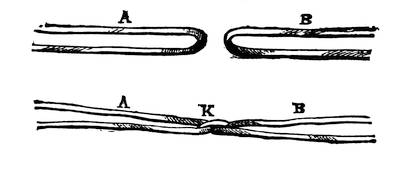
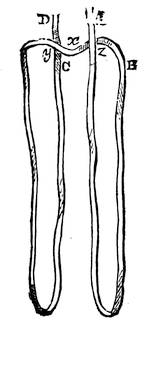
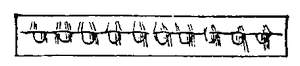
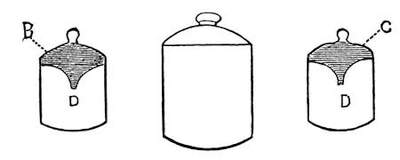
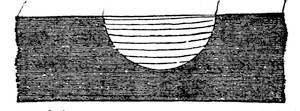
First, look at the annexed diagram, and then procure a leek and
cut off from the green leaf thereof a piece about the size of the
diagram; then lay it on a smooth table, and with the thumb-nail
delicately scrape away a small semi-circular patch of the green
pulpy substance of the leaf [as represented in the diagram], being
careful to leave the fine membrane of outer skin of the leaf uninjured—and
there is the instrument complete. It may require
several experiments to make the first one, but once having discovered
the right way, they are very easily manufactured. The
reader may not be aware of the fact that the leaf of the leek has a
fine transparent outer skin, which is quite tough, but by breaking
and carefully examining one or two leaves, he will soon find out
what we allude to.
The way of using this instrument is to place it in the roof of the
mouth with the side on which is the membrane downwards; then
place it gently in its place with the tongue, and blow between the
tongue and the upper teeth. After the first two or three attempts,
you will be able to produce a slight sound like a mild grunt; then
as you practice it you will find you can prolong and vary the
sound somewhat, so that in the course of a couple of days you can
imitate the barking of a dog and the neighing of a horse. With
two or three weeks’ practice, you will be able to imitate some of
the song birds; but to produce exact counterfeits of the best singing
birds will probably require months of study; the result, however,
will reward you for all your pains, for certainly to be able
to carry a mocking bird, canary, thrush, cat-bird and sucking-pig
in your vest pocket, is no small accomplishment.
When not using the instrument, it should be kept in a glass of
water to prevent its drying.