The telescope is an optical instrument for
viewing objects at a distance. Its name is compounded
of two Greek words,—τηλε, which signifies,
at a distance, or far off, and σχοπειν, to view, or
to contemplate. By means of telescopes, remote
objects are represented as if they were near, small
apparent magnitudes are enlarged, confused
objects are rendered distinct, and the invisible
and obscure parts of very distant scenes are rendered
perceptible and clear to the organ of vision.
The telescope is justly considered as a grand
and noble instrument. It is not a little surprising
that it should be in the power of man to invent
and construct an instrument by which objects, too
remote for the unassisted eye to distinguish,
should be brought within the range of distinct
vision, as if they were only a few yards from our
eye, and that thousands of august objects in the
heavens, which had been concealed from mortals
for numerous ages, should be brought within the
limits of our contemplation, and be as distinctly
perceived, as if we had been transported many
millions of miles from the space we occupy,
through the celestial regions. The celebrated
Huygens remarks, in reference to this instrument,
that, in his opinion, ‘the wit and industry of man
has not produced any thing so noble and so worthy
of his faculties as this sort of knowledge; (namely
of the telescope) insomuch that if any particular
person had been so diligent and sagacious as to
invent this instrument from the principles of
nature and geometry,—for my part, I should have
thought his abilities were more than human; but
the case is so far from this, that the most learned
men have not yet been able sufficiently to explain
the reason of the effects of this casual invention.’
The persons who constructed the first telescopes,
and the exact period when they were first invented,
are involved in some degree of obscurity. It
does not certainly appear that such instruments
were known to the ancients, although we ought
not to be perfectly decisive on this point. The
cabinets of the curious contain some very ancient
gems, of admirable workmanship, the figures on
which are so small, that they appear beautiful
through a magnifying glass, but altogether confused
and indistinct to the naked eye: and, therefore,
it may be asked, if they cannot be viewed,
how could they be wrought, without the assistance
of glasses? And as some of the ancients have
declared that the moon has a form like that of the
earth, and has plains, hills, and valleys in it,—how
could they know this—unless by mere conjecture,
without the use of a telescope? And how could
they have known that the Milky Way is formed
by the combined rays of an infinite number of
stars? For Ovid states, in reference to this zone,
‘its ground-work is of stars.’ But whatever
knowledge the ancients may have possessed of the
telescope or other optical glasses, it is quite evident
that they never had telescopes of such size
and power as those which we now possess; and
that no discoveries in the heavens, such as are now
brought to light, were made by any of the ancient
astronomers; otherwise some allusions to them
must have been found in their writings.
Among the moderns, the illustrious Friar Bacon
appears to have acquired some rude ideas respecting
the construction of telescopes. ‘Lenses and
specula’ says he, ‘may be so figured that one
object may be multiplied into many, that those
which are situated at a great distance may be
made to appear very near, that those which are
small may be made to appear very large, and those
which are obscure very plain; and we can make
stars to appear wherever we will.’ From these
expressions, it appears highly probable, that this
philosopher was acquainted with the general principle
both of telescopes and microscopes, and that
he may have constructed telescopes of small magnifying
power, for his own observation and amusement,
although they never came into general use.
He was a man of extensive learning, and made so
rapid a progress in the sciences, when attending
the university of Paris, that he was esteemed the
glory of that seat of learning. He prosecuted
his favourite study of experimental philosophy
with unremitting ardour; and in this pursuit, in
the course of twenty years, he expended no less
than £2000 in experiments, instruments, and in
procuring scarce books. In consequence of such
extraordinary talents, and such astonishing progress
in the sciences, in that ignorant age, he was
represented, by the envy of his illiterate fraternity,
as having dealings with the devil; and, under
this pretence, he was restrained from reading lectures,
and at length, in 1278, when sixty-four
years of age, he was imprisoned in his cell, where
he remained in confinement for ten years. He
shone like a single bright star in a dark hemisphere—the
glory of our country—and died at
Oxford, in the year 1294, in the eightieth year of
his age. ‘Friar Bacon,’ says the Rev. Mr. Jones,
‘may be considered as the first of English philosophers;
his profound skill in mechanics, optics,
astronomy, and chemistry, would make an honourable
figure in the present age. But he is entitled
to further praise, as he made all his studies subservient
to theology, and directed all his writings,
as much as could be, to the glory of God.
He had the highest regard for the sacred scriptures,
and was persuaded they contain the principles of
all true science.’
The next person who is supposed to have acquired
a knowledge of telescopes, was Joannes
Baptista Porta, of Naples, who flourished in the
sixteenth century. He discovered the Camera
Obscura—the knowledge of which might naturally
have led to the invention of the telescope; but it
does not appear that he ever constructed such an
instrument. Des Cartes considers James Metius,
a Dutchman, as the first constructor of a telescope,
and says, that ‘as he was amusing himself with
making mirrors and burning-glasses, he casually
thought of looking through two of his lenses at a
time, and found that distant objects appeared very
large and distinct.’ Others say that this great
discovery was first made by John Lippersheim, a
maker of spectacles at Middleburg, or rather by
his children, who were diverting themselves with
looking through two glasses at a time, and placing
them at different distances from each other. But
Borellus, who wrote a book ‘on the invention of
the telescope,’ gives this honour to Zacharias
Jansen, another spectacle-maker in the same town,
who, he says, made the first telescope in 1590.
Jansen was a diligent inquirer into nature, and,
being engaged in such pursuits, he was trying
what use could be made of lenses for those purposes,
when he fortunately hit upon the construction.
Having found the arrangement of glasses
which produced the effect desired, he enclosed
them in a tube, and ran with his instrument to
prince Maurice, who, immediately conceiving that
it might be of use to him in his wars, desired the
author to keep it a secret. Such are the rude
conceptions and selfish views of princely warriors,
who would apply every invention in their power
for the destruction of mankind. But the telescope
was soon destined to more noble and honourable
achievements. Jansen, it is said, directed his instrument
towards celestial objects, and distinctly
saw the spots on the surface of the moon, and discovered
many new stars, particularly seven pretty
considerable ones in the Great Bear. His son
Joannes is said to have noted the lucid circle near
the lower limb of the moon, now named Tycho,
from whence several bright rays seem to dart in
different directions. In viewing Jupiter, he perceived
two, sometimes three, and at the most four
small stars, a little above or below him, and
thought that they performed revolutions around
him. This was, probably, the first observation of
the satellites of Jupiter, though the person who
made it was not aware of the importance of his
discovery.17
It is not improbable that different persons
about Middleburgh hit upon the invention, in
different modes, about the same time. Lippersheim
seems to have made his first rude telescope by
adjusting two glasses on a board, and supporting
them on brass circles.18 Other workmen, particularly
Metius and Jansen, in emulation of each
other, seem to have made use of that discovery,
and by the new form they gave it, made all the
honour of it their own. One of them, considering
the effects of light as injurious to distinctness,
placed the glasses in a tube blackened within.
The other, still more cautious, placed the same
glasses within tubes capable of sliding one in
another, both to vary the prospects, by lengthening
the instrument, according to the pleasure of
the observer, and to render it portable and commodious.
Thus, it is probable that different
persons had a share in the invention, and jointly
contributed to its improvement. At any rate, it
is undoubtedly to the Dutch that we owe the
original invention. The first telescope made by
Jansen, did not exceed fifteen or sixteen inches in
length, and therefore its magnifying power could
not have been very great.
The famous Galileo has frequently been supposed
to have been the inventor of the telescope,
but he acknowledges that he had not the honour
of being the original inventor, having first learned
from a German, that such an instrument had
already been made; although, from his own account,
it appears that he had actually re-invented
this instrument. The following is the account, in
his own words, of the circumstances which led
him to construct a telescope. ‘Nearly ten months
ago (namely in April or May 1609) it was reported
that a certain Dutchman had made a perspective
through which many distant objects appeared distinct
as if they were near: several effects of this
wonderful instrument were reported, which some
believed and others denied: but, having it confirmed
to me a few days after by a letter from the
noble John Badoverie, at Paris, I applied myself
to consider the reason of it, and by what means I
might contrive a similar instrument, which I afterwards
attained to by the doctrine of refractions.
And, first, I prepared a leaden tube, to whose extremities
I fitted two spectacle-glasses, both of
them plain on one side, and on the other side, one
of them was spherically convex, and the other
concave. Then applying my eye to the concave,
I saw objects appear pretty large and pretty near
me. They appeared three times nearer and nine
times larger in surface than to the naked eye: and
soon after I made another, which represented objects
about sixty times larger, and eight times nearer;
and, at last, having spared no labour nor expense,
I made an instrument so excellent, as to show
things almost a thousand times larger, and above
thirty times nearer, than to the naked eye.’ In
another part of his writings, Galileo informs us
that ‘he was at Venice when he heard of Prince
Maurice’s instrument, but nothing of its construction;
that the first night, after he returned to
Padua, he solved the problem, and made his instrument
the next day; and soon after, presented
it to the Doge at Venice, who, to do him honour
for his grand invention, gave him the ducal letters
which settled him for life in his lectureship at
Padua; and the Republic, on the twenty-fifth of
August in the same year (1610) more than tripled
his salary as professor.’
The following is the account which this philosopher
gives of the process of reasoning, which
led him to the construction of a telescope:—‘I
argued in the following manner. The contrivance
consists either of one glass or more—one is not
sufficient, since it must be either convex, concave,
or plane; the last does not produce any sensible
alteration in objects, the concave diminishes
them; it is true that the convex magnifies, but it
renders them confused and indistinct; consequently
one glass is insufficient to produce the desired
effect. Proceeding to consider two glasses, and
bearing in mind that the plane glass causes no
change, I determined that the instrument could
not consist of the combination of a plane glass
with either of the other two. I therefore applied
myself to make experiments on combinations of
the two other kinds; and thus obtained that of
which I was in search.’ If the true inventor is
the person who makes the discovery by reasoning
and reflection, by tracing facts and principles to
their consequences, and by applying his invention
to important purposes, then, Galileo may be considered
as the real inventor of the telescope. No
sooner had he constructed this instrument—before
he had seen any similar one—than he directed his
tube to the celestial regions, and his unwearied
diligence and ardour were soon rewarded by a series
of new and splendid discoveries. He descried
the four satellites of Jupiter, and marked the
periods of their revolutions; he discovered the
phases of Venus, and thus was enabled to adduce
a new proof of the Copernican system, and to
remove an objection that had been brought against
it. He traced on the lunar orb, a resemblance to
the structure of the earth, and plainly perceived
the outlines of mountains and vales, casting their
shadows over different parts of its surface. He
observed, that when Mars was in quadrature, his
figure varied slightly from a perfect circle; and
that Saturn consisted of a triple body, having a
small globe on each side—which deception was
owing to the imperfect power of his telescope,
which was insufficient to show him that the phenomenon
was in reality a ring. In viewing the
sun, he discovered large dark spots on the surface
of that luminary, by which he ascertained that
that mighty orb performed a revolution round its
axis. He brought to view multitudes of stars
imperceptible to the naked eye, and ascertained
that those nebulous appearances in the heavens
which constitute the Milky Way, consist of a vast
collection of minute stars, too closely compacted
together to produce an impression on our unassisted
vision.
The results of Galileo’s observations were given
to the world in a small work, entitled ‘Nuncius
Sidereus,’ or, ‘News from the starry regions,’
which produced an extraordinary sensation among
the learned. These discoveries soon spread
throughout Europe, and were incessantly talked
of, and were the cause of much speculation and
debate among the circles of philosophers. Many
doubted; many positively refused to believe so
novel and unlooked-for announcements, because
they ran counter to the philosophy of Aristotle,
and all the preconceived notions which then prevailed
in the learned world. It is curious, and
may be instructive, to consider to what a length
of absurdity, ignorance and prejudice carried many
of those who made pretensions to learning and
science. Some tried to reason against the facts
alleged to be discovered, others contented themselves,
and endeavoured to satisfy others, with the
simple assertion that such things were not, and
could not possibly be; and the manner in which
they supported themselves in their incredulity
was truly ridiculous. ‘O my dear Kepler,’ says
Galileo in a letter to that astronomer, ‘how I wish
we could have one hearty laugh together. Here
at Padua is the principal professor of philosophy,
whom I have repeatedly and urgently requested
to look at the moon and planets through my glass,
which he pertinaciously refuses to do, lest his opinions
should be overturned. Why are you not
here? what shouts of laughter we should have at
this glorious folly! and to hear the professor of
philosophy at Pisa labouring with the Grand
Duke with logical arguments, as if with magical
incantations, to charm the new planets out of the
sky.’ Another opponent of Galileo, one Christmann,
says in a book he published, ‘We are not
to think that Jupiter has four satellites given him
by nature, in order, by revolving round him, to
immortalize the Medici who first had notice of
the observation. These are the dreams of idle
men, who love ludicrous ideas better than our
laborious and industrious correction of the heavens.
Nature abhors so horrible a chaos; and to
the truly wise, such vanity is detestable.’ One
Martin Horky, a would-be philosopher, declared
to Kepler, ‘I will never concede his four new
planets to that Italian from Padua, though I should
die for it;’ and he followed up this declaration, by
publishing a book against Galileo, in which he
examines four principal questions respecting the
alleged planets; 1. Whether they exist? 2.
What they are? 3. What they are like? 4.
Why they are? The first question is soon disposed
of by declaring positively that he has examined
the heavens with Galileo’s own glass, and
that no such thing as a satellite about Jupiter
exists. To the second, he declares solemnly that
he does not more surely know, that he has a soul
in his body than that reflected rays are the sole
cause of Galileo’s erroneous observations. In
regard to the third question, he says, that these
planets are like the smallest fly compared to an
elephant; and finally, concludes on the fourth,
that the only use of them is to gratify Galileo’s
‘thirst of gold,’ and to afford himself a subject of
discussion. Kepler, in a letter to Galileo, when
alluding to Horky, says, ‘He begged so hard to be
forgiven, that I have taken him again into favour
upon this preliminary condition—that I am to
show him Jupiter’s satellites, AND HE IS TO SEE
THEM, and own that they are there.’
The following is a specimen of the reasoning
of certain pretended philosophers of that age
against the discoveries of Galileo. Sizzi, a Florentine
astronomer, reasons in this strain: ‘There
are seven windows given to animals in the domicile
of the head, through which the air is admitted
to the rest of the tabernacle of the body to enlighten,
to warm and to nourish it; two nostrils,
two eyes, two ears, and a mouth; so in the heavens,
or the great world, there are two favourable
stars, two unpropitious, two luminaries, and Mercury
alone undecided and indifferent. From which
and many other similar phenomena in nature,
such as the seven metals, &c., we gather that the
number of planets is necessarily seven. Moreover,
the satellites are invisible to the naked eye,
and therefore can exert no influence on the earth,
and therefore would be useless, and therefore do
not exist. Besides, as well the Jews as other
ancient nations have adopted the division of the
week into seven days, and have named them from
the seven planets. Now, if we increase the number
of the planets, this whole system falls to the
ground.’ The opinions which then prevailed in
regard to Galileo’s observations on the moon, were
such as the following:—Some thought that the
dark shades on the moon’s surface arose from the
interposition of opaque bodies floating between
her and the sun, which prevent his light from
reaching those parts; others imagined that, on
account of her vicinity to the earth, she was partly
tainted with the imperfections of our terrestrial
and elementary nature, and was not of that
entirely pure and refined substance of which the
more remote heavens consist: and a third party
looked on her as a vast mirror, and maintained
that the dark parts of her surface were the reflected
images of our earthly forests and mountains.
Such learned nonsense is a disgrace to our
species, and to the rational faculties with which
man is endowed, and exhibits, in a most ludicrous
manner, the imbecility and prejudice of those
who made bold pretensions to erudition and philosophy.
The statement of such facts, however,
may be instructive, if they tend to guard us against
those prejudices and pre-conceived opinions, which
prevent the mind from the cordial reception of
truth, and from the admission of improvements in
society which run counter to long-established customs.
For the same principles and prejudices,
though in a different form, still operate in society
and retard the improvement of the social state,
the march of science, and the progress of Christianity.
How ridiculous is it for a man, calling
himself a philosopher, to be afraid to look through
a glass to an existing object in the heavens, lest it
should endanger his previous opinions! And how
foolish is it to resist any improvement or reformation
in society, because it does not exactly
accord with existing opinions, and with ‘the
wisdom of our ancestors.’
It is not a little surprising, that Galileo should
have first hit on that construction of a telescope
which goes by his name, and which was formed
with a concave glass next the eye. This construction
of a telescope is more difficult to be understood,
in theory, than one which is composed
solely of convex glasses; and its field of view is comparatively
very small, so that it is almost useless
when attempted to be made of a great length.
In the present day, we cannot help wondering that
Galileo and other astronomers, should have made
such discoveries as they did with such an instrument,
the use of which must have required a great
degree of patience and address. Galileo’s best
telescope, which he constructed ‘with great
trouble and expense,’ magnified the diameters of
objects only thirty-three times; but its length is
not stated—which would depend upon the focal
distance of the concave eye-glass. If the eye-glass
was two inches focus, the length of the instrument
would be five feet four inches; if it was
only one inch, the length would be two feet eight
inches, which is the least we can allow to it—the
object-glass being thirty-three inches focus, and
the eye-glass placed an inch within this focus.
With this telescope, Galileo discovered the satellites
of Jupiter, the crescent of Venus, and the
other celestial objects to which we have already
alluded. The telescopes made in Holland, are
supposed to have been constructed solely of convex
glasses, on the principle of the astronomical
telescope; and, if so, Galileo’s telescope was in
reality a new invention.
Certain other claimants of the invention of the
telescope, have appeared, besides those already
mentioned. Francis Fontana, in his ‘celestial
observations,’ says, that he was assured by a Mr.
Hardy, advocate of the parliament of Paris, a
person of great learning and undoubted integrity,
that on the death of his father, there was found
among his things an old tube, by which distant
objects were distinctly seen, and that it was of a
date long prior to the telescope lately invented,
and had been kept by him as a secret. Mr. Leonard
Digges, a gentleman who lived near Bristol,
in the seventeenth century, and was possessed of
great and various knowledge, positively asserts in
his ‘Stratoticos,’ and in another work, that his
father, a military gentleman, had an instrument
which he used in the field, by which he could
bring distant objects near, and could know a
man at the distance of three miles. Mr. Thomas
Digges, in the preface to his ‘Pantometria,’ published
in 1591, declares, “My father, by his continual
painful practices, assisted by demonstrations
mathematical, was able, and sundry times hath by
proportional glasses, duly situate in convenient
angles, not only discovered things far off, read
letters, numbered pieces of money, with the very
coin and superscription thereof, cast by some of
his friends of purpose, upon downs in open fields,
but also, seven miles off, declared what hath been
done that instant, in private places. He hath
also, sundry times, by the sun-beams, fired
powder and discharged ordnance half a mile and
more distant, and many other matters far more
strange and rare, of which there are yet living
divers witnesses.”
It is by no means unlikely, that persons accustomed
to reflection, and imbued with a certain
degree of curiosity, when handling spectacle-glasses,
and amusing themselves with their magnifying
powers and other properties, might sometimes
hit upon the construction of a telescope; as it
only requires two lenses of different focal distances
to be held at a certain distance from each
other, in order to show distant objects magnified.
Nay, even one lens, of a long focal distance, is
sufficient to constitute a telescope of a moderate
magnifying power, as I shall show in the sequel.
But such instruments, when they happened to be
constructed accidentally, appear to have been
kept as secrets, and confined to the cabinets of
the curious, so that they never came into general
use; and as their magnifying power would probably
be comparatively small, the appearance of the
heavenly bodies would not be much enlarged by
such instruments—nor is it likely that they would
be often directed to the heavens. On the whole,
therefore, we may conclude that the period when
instruments of this description came into general
use, and were applied to useful purposes, was when
Galileo constructed his first telescopes.
Before proceeding to a particular description of
the different kinds of telescopes, I shall first give
a brief description of the Camera Obscura, as
the phenomena exhibited by this instrument tend
to illustrate the principle of a refracting telescope.
The term Camera Obscura literally signifies a
darkened vault or roof; and hence it came to denote
a chamber, or box, or any other place made
dark for the purpose of optical experiments. The
camera obscura, though a simple, is yet a very
curious and noble contrivance; as it naturally and
clearly explains the manner in which vision is
performed, and the principle of the telescope, and
entertains the spectator with a most exquisite picture
of surrounding objects, painted in the most
accurate proportions and colours by the hand of
nature. The manner of exhibiting the pictures
of objects in a dark room is as follows:—In one
of the window-shutters of a room which commands
a good prospect of objects not very distant,
a circular hole should be cut of four or five inches
diameter. In this hole an instrument should be
placed, called a Scioptric ball, which has three
parts, a frame, a ball, and a lens. The ball has
a circular hole cut through the middle, in which
the lens is fixed, and its use is, to turn every way
so as to take in a view of objects on every side.
The chamber should be made perfectly dark; and
a white screen, or a large sheet of elephant paper,
should be placed opposite to the lens, and in its
focus, to receive the image. If then, the objects
without be strongly enlightened by the sun, there
will be a beautiful living picture of the scene delineated
on the white screen, where every object
is beheld in its proportions, and with its colours
even more vivid than life; green objects appear in
the picture more intensely green, and yellow, blue,
red or white flowers appear much more beautiful
in the picture than in nature; if the lens be a good
one, and the room perfectly dark, the perspective
is seen in perfection. The lights and shadows
are not only perfectly just, but also greatly heightened;
and, what is peculiar to this delineation,
and which no other picture or painting can exhibit—the
motions of all the objects are exactly expressed
in the picture; the boughs of the trees
wave, the leaves quiver, the smoke ascends in a
waving form, the people walk, the children at
their sports leap and run, the horse and cart move
along, the ships sail, the clouds soar and shift
their aspects, and all as natural as in the real
objects; the motions being somewhat quicker,
as they are performed in a more contracted scene.
These are the inimitable perfections of a picture,
drawn by the rays of light as the only pencil
in nature’s hand, and which are finished in a
moment; for no sensible interval elapses before
the painting is completed, when the ground on
which it is painted is prepared and adjusted. In
comparison of such a picture, the finest productions
of the most celebrated artists, the proportions
of Raphael, the natural tints and colouring
of Titian, and the shadowing of the Venetians,
are but coarse and sorry daubings, when set in
competition with what nature can exhibit by the
rays of light passing through a single lens. The
Camera obscura is at the same time the painter’s
assistant, and the painter’s reproach. From the
picture it forms he receives his best instructions,
and is shown what he should endeavour to attain;
and hence, too, he learns the imperfections of his
art, and what it is impossible for him to imitate.
As a proof of this, the picture formed in the dark
chamber will bear to be magnified to a great extent,
without defacing its beauty, or injuring the
fineness of its parts; but the finest painted landscape,
if viewed through a high magnifier will
appear only as a coarse daubing.
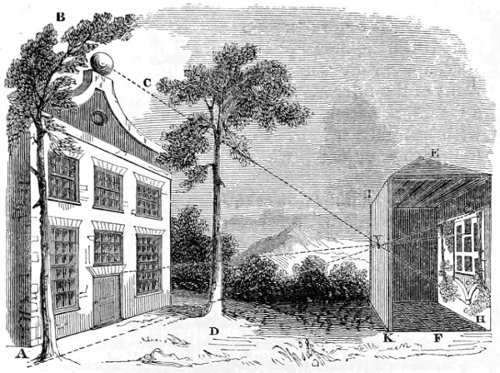
The following scheme will illustrate what has
been now stated respecting the dark chamber.
EF represents a darkened room, in the side of
which, IK, is made the circular hole V, in which,
on the inside, is fixed the scioptric ball. At some
considerable distance from this hole is exhibited
a landscape of houses, trees, and other objects,
ABCD, which are opposite to the window. The
rays which flow from the different objects which
compose this landscape, to the lens at V, and which
pass through it, are converged to their respective
foci, on the opposite wall of the chamber HG or
on a white moveable screen placed in the focus of
the lens, where they all combine to paint a lively
and beautiful picture of the range of objects
directly opposite, and on each side, so far as the
lens can take in.
Though I have said, that a scioptric ball and
socket are expedient to be used in the above experiment,
yet where such an instrument is not at
hand, the lens may be placed in a short tube made
of pasteboard or any other material, and fixed in
the hole made in the window shutter. The only
imperfection attending this method is, that the
lens can exhibit those objects only which lie
directly opposite the window.
figure 37.
Some may be disposed to consider it as an imperfection
in this picture, that all the objects appear
in an inverted position; as they must necessarily
do, according to what we formerly stated respecting
the properties of convex lenses, (p. 72).
There are, however, different modes of viewing
the picture as if it were erect. For, if we stand
before the picture, and hold a common mirror
against our breast at an acute angle with the picture,
and look down upon it, we shall see all the
images of the objects as if restored to their erect
position; and by the reflection of the mirror, the
picture will receive such a lustre as will make it
still more delightful. Or, if a large concave mirror
were placed before the picture at such a distance,
that its image may appear before the mirror, it will
then appear erect and pendulous in the air in the
front of the mirror. Or, if the image be received on
a frame of paper, we may stand behind the frame,
with our face towards the window, and look down
upon the objects, when they will appear as if
erect.
The experiment of the Camera Obscura may
serve to explain and illustrate the nature of a
common refracting telescope. Let us suppose,
that the lens in the window-shutter represents the
object-glass of a refracting telescope. This glass
forms an image in its focus, which is in every
respect an exact picture or representation of the
objects before it; and consequently the same idea
is formed in the mind, of the nature, form, magnitude,
and colour of the object—whether the eye
at the centre of the glass views the object itself,
or the image formed in its focus. For, as formerly
stated, the object and its image are both
seen under the same angles by the eye placed at
the centre of the lens. Without such an image
as is formed in the camera obscura—depicted either
in the tube of a telescope or in the eye itself—no
telescope could possibly be formed. If we now
suppose that, behind the image formed in the
dark chamber, we apply a convex lens of a short
focal distance to view that image, then the image
will be seen distinctly, in the same manner as
we view common objects, such as a leaf or a
flower, with a magnifying glass; consequently, the
object itself will be seen distinct and magnified.
And, as the same image is nearer to one lens than
the other, it will subtend a larger angle at the
nearest lens, and of course, will appear larger than
through the other, and consequently the object
will be seen magnified in proportion. For example,
let us suppose the lens in the camera obscura,
or the object lens of a telescope, to be five feet,
or sixty inches focal distance, at this distance from
the glass, an image of the distant objects opposite
to it will be formed. If now, we place a small
lens two inches focal distance beyond this point,
or five feet two inches from the object-glass, the
objects, when viewed through the small lens, will
appear considerably magnified, and apparently
much nearer than to the naked eye. The degree
of magnifying power is in proportion to the focal
distances of the two glasses; that is, in the present
case, in the proportion of two inches, the
focus of the small lens, to sixty inches, the focus
of the object lens. Divide sixty by two, the
quotient is thirty, which gives the magnifying
power of such a telescope, that is, it represents
objects thirty times nearer, or under an angle thirty
times larger than to the naked eye. If the eye-glass,
instead of being two inches, were only one
and a half inch focus, the magnifying power would
be in the proportion of one and a half to sixty, or
forty times. If the eye-glass were three inches
focus, the magnifying power would be twenty
times; and so on, with regard to other proportions.
In all cases, where a telescope is composed of only
two convex lenses, the magnifying power is determined,
by dividing the focal distance of the object-glass,
by the focal distance of the eye-glass, and
the quotient expresses the number of times the
object is magnified, in length and breadth. This
and various other particulars, will be more fully
illustrated in the sequel.
In performing experiments with the camera
obscura in a darkened chamber, it is requisite that
the following particulars be attended to:—1. That
the lens be well figured, and free from any veins
or blemishes that might distort the picture. 2.
That it be placed directly against the object whose
image we wish to see distinctly delineated. 3.
The lens should be of a proper size both as to its
breadth and focal distance. It should not be less
than three or four feet focal distance, otherwise the
picture will be too small, and the parts of objects
too minute to be distinctly perceived; nor should
it exceed fifteen or eighteen feet, as in this case
the picture will be faint, and of course not so
pleasing. The best medium as to focal distance,
is from five to eight or ten feet. The aperture,
too, or breadth of the glass, should not be too
small, otherwise the image will be obscure, and
the minute parts of it invisible for want of a sufficient
quantity of light. A lens of six feet focal
distance, for example, will require an aperture of
at least two inches. Lenses of a shorter focal
distance require less apertures, and those of a
longer focal distance larger. But if the aperture
be too large, the image will be confused, and indistinct,
by the admission of too much light. 4.
We should never attempt to exhibit the images
of objects, unless when the sun is shining and
strongly illuminating the objects, except in the
case of very near objects placed in a good light.
As one of the greatest beauties, in the phenomena
of the dark chamber, consists in the exquisite
appearance and contrast of light and shadows,
nothing of this kind can be perceived but from
objects directly illuminated by the sun. 5. A
south window should never be used in the forenoon,
as the sun cannot then enlighten the north
side of an object; and besides, his rays would be
apt to shine upon the lens, which would make the
picture appear with a confused lustre. An east
window is best in the afternoon, and a western in
the morning; but a north window is in most cases
to be preferred, especially in the forenoon, when
the sun is shining with his greatest strength and
splendour. In general, that window ought to be
used which looks to the quarter opposite to that
in which the sun is shining.
The picture should be received upon a very
white surface, as the finest and whitest paper, or
a painted cloth, bordered with black; as white
bodies reflect most copiously the incident rays,
while black surfaces absorb them. If the screen
could be bent into the concave segment of a
sphere, of which the focal distance of the double
convex lens which is used, is the radius, the parts
of the picture adjacent to the extremities would
appear most distinct. Sir D. Brewster informs
us that, having tried a number of white substances
of different degrees of smoothness, and several
metallic surfaces, on which to receive the image,
he happened to receive the picture on the silvered
back of a looking-glass, and was surprised at the
brilliancy and distinctness with which external
objects were represented. To remove the spherical
protuberances of the tin foil, he ground the
surface very carefully with a bed of hones which
he had used for working the plane specula of
Newtonian telescopes. By this operation, which
may be performed without injuring the other side
of the mirror, he obtained a surface finely adapted
for the reception of images. The minute parts
of the landscape were formed with so much precision,
and the brilliancy of colouring was so
uncommonly fine, as to equal, if not exceed the
images that are formed in the air by means of
concave specula.
The following additional circumstances may be
stated respecting the phenomena exhibited in the
dark chamber. A more critical idea may be
formed of any movement in the picture here presented
than from observing the motion of the
object itself. For instance, a man walking in a
picture appears to have an undulating motion, or
to rise up and down every step he takes, and the
hands seem to move almost exactly like a pendulum;
whereas scarcely any thing of this kind is
observed in the man himself, as viewed by the
naked eye. Again, if an object be placed just
twice the focal distance from the lens without
the room, the image will be formed at the
same distance from the lens within the room,
and consequently will be equal in magnitude
to the object itself. The recognition of this
principle may be of use to those concerned in
drawing, and who may wish, at any time, to
form a picture of the exact size of the object.
If the object be placed further from the lens than
twice its focal length, the image will be less than
the object. If it be placed nearer, the image will
be greater than the life. In regard to immoveable
objects, such as houses, gardens, trees, &c., we may
form the images of so many different sizes, by
means of different lenses, the shorter focus making
the lesser picture, and the longer focal distance the
largest.
The experiments with the camera obscura, may
likewise serve to illustrate the nature of vision,
and the functions of the human eye. The frame
or socket of the scioptric ball may represent the
orbit of the natural eye. The ball, which turns
every way, resembles the globe of the eye, moveable
in its orbit. The hole in the ball may represent
the pupil of the eye; the convex lens corresponds
to the crystalline humour, which is
shaped like a lens, and contributes to form the
images of objects on the inner part of the eye.
The dark chamber itself, is somewhat similar to
the internal part of the eye, which is lined all
around, and under the retina, with a membrane,
over which is spread a mucous of a very black
colour. The white wall or frame of white paper to
receive the picture of objects, is a fair representation
of the retina of the eye, on which all the
images of external objects are depicted. Such
are some of the general points of resemblance between
the apparatus connected with the dark
chamber, and the organ of vision; but the human
eye is an organ of such exquisite construction, and
composed of such a number and variety of delicate
parts, that it cannot be adequately represented by
any artificial contrivance.
The darkened chamber is frequently exhibited
in a manner somewhat different from what we have
above described, as in the following scheme, (fig.
38) which is termed the revolving camera obscura.
In this construction, KH represents a plane mirror
or metallic reflector, placed at half a right angle
to the convex lens HI, by which, rays proceeding
from objects situated in the direction O are reflected
to the lens, which forms an image of the
objects on a round white table at T, around which
several spectators may stand, and view the picture,
as delineated on a horizontal plane. The
reflector, along with its case, is capable of being
turned round, by means of a simple apparatus
connected with it, so as to take in, in succession,
all the objects which compose the surrounding
scene. But as the image here is received on a
flat surface, the rays fm, en, will have to diverge
farther than the central rays dc; and hence the
representation of the object, near the sides, will
be somewhat distorted; to remedy which, the image
should be received on a concave surface, as ab or
PS. This is the general plan of those Camera
Obscuras, fitted up in large wooden tents, which
are frequently exhibited in our large cities, and
removed occasionally from one town to another.
Were an instrument of this kind fitted up on a
small scale, a hole might be made in one of the
sides, as at E, where the eye could be applied
to view the picture. The focal distances of the
lenses used in large instruments of this kind, are
generally from eight to twelve feet, in which case
they produce a telescopic effect upon distant objects,
so as to make them appear nearer than when
viewed with the naked eye.
figure 38.
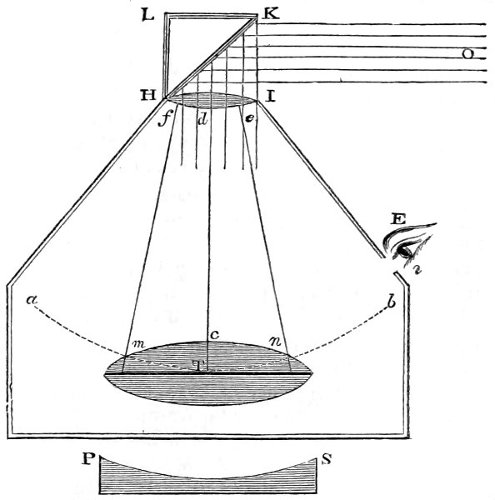
figure 39.
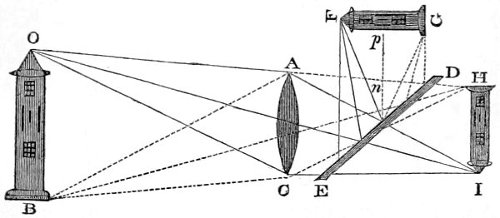
The camera obscura is frequently constructed
in a portable form, so as to be carried about for
the purpose of delineating landscapes. The following
is a brief description of the instrument in
this form. AC is a convex lens placed near the
end of a tube or drawer, which is moveable in the
side of a square box, within which is a plane
mirror DE, reclining backward in an angle of
forty-five degrees from the perpendicular pn.
The pencils of rays flowing from the object OB,
and passing through the convex lens—instead of
proceeding forward and forming the image HI,
are reflected upward by the mirror, and meet in
points as FG, at the same distance at which they
would have met at H and I, if they had not been
intercepted by the mirror. At FG, the image of
the object OB is received either on a piece of
oiled paper, or more frequently on a plane unpolished
glass, placed in the horizontal situation
FG, which receives the images of all objects,
opposite to the lens, and on which, or on an oiled
paper placed upon it, their outlines may be traced
by a pencil. The moveable tube on which the
lens is fixed, serves to adjust the focus for near
and distant objects, till their images appear distinctly
painted on the horizontal glass at FG.
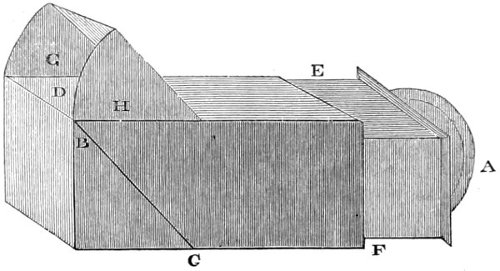
Above is shown the most common form of the box
of this kind of Camera Obscura. A is the position
of the lens, BC, the position of the mirror, D,
the plane unpolished glass on which the images
are depicted, GH a moveable top or screen to
prevent the light from injuring the picture, and
EF, the moveable tube.
figure 40.
The Daguerreotype.—An important, and somewhat
surprising discovery has lately been made,
in relation to the picture formed by the Camera
Obscura. It is found, that the images formed by
this instrument are capable of being indelibly fixed
on certain surfaces previously prepared for the
purpose, so that the picture is rendered permanent.
When a Camera is presented to any object
or landscape strongly illuminated by the sun, and
the prepared ground for receiving the image is adjusted,
and a certain time allowed to elapse till the
rays of light produce their due effect, in a few
minutes or even seconds, a picture of the objects
opposite to the lens is indelibly impressed upon
the prepared plate, in all the accurate proportions
and perspective, which distinguish the images
formed in a dark chamber—which representations
may be hung up in apartments, along with other
paintings and engravings; and will likely retain
their beauty and lustre for many years. These
are pictures of nature’s own workmanship finished
in an extremely short space of time, and with the
most exquisite delicacy and accuracy. The effect
is evidently owing to certain chemical properties
in the rays of light; and opens a new field for
experiment and investigation to the philosopher.
The only defect in the picture is, that it is not
coloured; but, in the progress of experiments on
this subject, it is not unlikely that even this object
may be accomplished, in which case, we should
be able to obtain the most accurate landscapes and
representations of all objects, which can possibly
be formed. This art or discovery goes by the
name of the Daguerreotype from M. Daguerre,
a Frenchman, who is supposed to have been the
first discoverer, and who received a large premium
from the French government for disclosing the
process, and making the discovery public. Several
improvements and modifications, in reference to
the preparation of the plates, have been made since
the discovery was first announced, about the beginning
of 1839; and the pictures formed on this
principle, are frequently distinguished by the name
of Photogenic drawings; and are now exhibited at
most of our public scientific institutions.
This new science or art, has been distinguished
by different names. It was first called Photography,
from two Greek words, signifying writing by
light: it was afterwards called the art of Photogenic
Drawing, or drawing produced by light. M.
Daguerre gave it the name of Heliography, or
writing by the sun, all which appellatives are derived
from the Greek, and are expressive, in some
degree, of the nature of the process. We shall,
however, make use of the term Daguerreotype,
derived from the name of the inventor.
As it does not fall within our plan to give any
minute descriptions of the Daguerreotype process,
we shall just give a few general hints in reference
to it, referring those who wish for particular details,
to the separate treatises which have been
published respecting it. The first thing necessary
to be attended to in this art is, the preparation of
the plate on which the drawing is to be made. The
plate consists of a thin leaf of copper, plated with
silver; both metals together, not being thicker
than a card. The object of the copper is simply
to support the silver, which must be the purest
that can be procured. But though the copper
should be no thicker than to serve the purpose of
support, it is necessary that it should be so thick
as to prevent the plate from being warped, which
would produce a distortion of the images traced
upon it. This plate must be polished;—and for
this purpose, the following articles are required—a
phial of olive oil—some very fine cotton—pumice-powder,
ground till it is almost impalpable, and
tied up in a piece of fine muslin, thin enough to
let the powder pass through without touching the
plate when the bag is shaken. A little nitric acid
diluted with sixteen times, by measure, its own
quantity of water—a frame of wire on which to
place the plate, when being heated—a spirit lamp
to make the plate hot—a small box with inclined
sides within, and having a lid to shut it up close—and
a square board large enough to hold the
drawing, and having catches at the side to keep it
steady.
To the above prerequisites, a good Camera
Obscura is, of course, essentially necessary. This
instrument should be large enough to admit the
plate of the largest drawing intended to be taken.
The lens which forms the image of the object,
should, if possible, be achromatic, and of a considerable
diameter. In an excellent instrument
of this description, now before me, the lens is an
achromatic, about 3 inches diameter, but capable
of being contracted to a smaller aperture. Its
focal distance is about 17 inches; and the box,
exclusive of the tube which contains the lens, is
15 inches long, 13½ inches broad, and 11 inches
deep. It forms a beautiful and well-defined picture
of every well-enlightened object to which it
is directed.
Before the plate is placed in the camera, there
are certain operations to be performed. 1. The
surface of the plate should be made perfectly
smooth, or highly polished. For this purpose, it
must be laid flat, with the silver side upwards,
upon several folds of paper for a bedding; and
having been well polished in the usual way, the
surface must be powdered equally and carefully
with fine pumice enclosed in the muslin bag. Then
taking a little cotton wool, dipped in olive oil, it
must be rubbed over the plate with rounding
strokes, and then crossing them by others which
commence at right angles with the first. This
process must be repeated frequently, changing the
cotton, and renewing the pumice powder every
time. A small portion of cotton must now be
moistened with the diluted nitric acid, and applied
equally to the whole surface. The next thing to
be done is to make the plate thoroughly and
equally hot, by holding the plate with a pair of
pincers, by the corner, over a charcoal fire, and
when the plate is sufficiently hot, a white coating
will be observed on the silver, which indicates that
that part of the operation is finished. An even
cold surface is next wanted, such as a metallic
plate cooled almost to the freezing point by
muriate of soda, and to this the heated plate must
be suddenly transferred.
2. The next operation is to give the plate a
coating of Iodine. This is accomplished by fixing
the plate upon a board, and then putting it
into a box containing a little dish with iodine
divided into small pieces, with its face downward,
and supported with small brackets at the corners.
In this position, the plate must remain till it assume
a full gold colour, through the condensation
of the iodine on its surface—which process should
be conducted in a darkened apartment. The requisite
time for the condensation of the iodine
varies from five minutes to half an hour. When
this process is satisfactorily accomplished, the
plate should be immediately fixed in a frame with
catches and bands, and placed in the Camera; and
the transference from one receptacle to another
should be made as quickly as possible, and with
only so much light as will enable the operator to
see what he is doing.
3. The next operation is to obtain the drawing.
Having placed the Camera in front of the scene
to be represented, and the lens being adjusted to
the proper focus, the ground-glass of the Camera
is withdrawn, and the prepared plate is substituted
for it; and the whole is left till the natural
images are drawn by the natural light from the
object. The time necessary to leave the plate for
a complete delineation of the objects, depends upon
the intensity of the light. Objects in the shade
will require more time for their delineation than
those in the broad light. The full clear light of
the south of Europe, Spain, Italy, and particularly,
the more glowing brilliancy of tropical countries,
will effect the object much more speedily
than the duller luminosity of a northern clime.
Some hours of the day are likewise more favourable
than others. Daguerre states, that ‘the most
favourable, is from 7 A.M. to 3 o’clock P.M., and
that a drawing could be effected in Paris in 3 or
4 minutes, in June and July, which would require
5 or 6, in May and August, and 7 or 8 in April
and September.’ In the progress of this art, at
the present time, portraits and other objects are
frequently delineated in the course of a few
seconds.
4. Immediately after removing the plate from
the Camera, it is next placed over the vapour of
mercury, which is placed in a cup at the bottom
of a box, and a spirit lamp applied to its bottom,
till the temperature rise to 140 of Fahrenheit.
This process is intended to bring out the image,
which is not visible when withdrawn from the
Camera; but in the course of a few minutes a
faint tracery will begin to appear, and in a very
short time the figure will be clearly developed.
5. The next operation is to fix the impression.
In order to this, the coating on which the design
was impressed must be removed, to preserve it
from being decomposed by the rays of light. For
this purpose, the plate is placed in a trough containing
common water, plunging, and withdrawing
it immediately, and then plunging it into a solution
of salt and water, till the yellow coating has
disappeared.
Such is a very brief sketch of the photogenic
processes of Daguerre. Other substances, however,
more easily prepared, have been recommended
by Mr. Talbot, F.R.S., who appears,
about the same time, to have invented a process
somewhat similar to that of Daguerre. The following
are his directions for the preparation of
Photogenic Paper.
The paper is to be dipped into a solution of
salt in water, in the proportion of half an ounce
of salt to half a pint of water. Let the superfluous
moisture drain off, and then, laying the
paper upon a clean cloth, dab it gently with a
napkin, so as to prevent the salt collecting in one
spot more than another. The paper is then to
be pinned down by two of its corners on a drawing
board, by means of common pins, and one
side washed or wetted with the Photogenic fluid,
using the brush prepared for that purpose, and
taking care to distribute it equally. Next dry
the paper as rapidly as you can at the fire, and it
will be fit for use for most purposes. If, when
the paper is exposed to the sun’s rays, it should
assume an irregular tint, a very thin extra wash
of the fluid will render the colour uniform, and at
the same time somewhat darker. Should it be
required to make a more sensitive description of
paper, after the first application of the fluid,
the solution of salt should be applied, and the
paper dried at the fire. Apply a second wash of
the fluid, and dry it at the fire again: employ the
salt a third time, dry it,—and one application more
of the fluid will, when dried, have made the paper
extremely sensitive. When slips of such papers,
differently prepared, are exposed to the action of
day light, those which are soonest affected by the
light, by becoming dark, are the best prepared.
When photogenic drawings are finished in a
perfect way, the designs then taken on the plate
or paper are exceedingly beautiful and correct,
and will bear to be inspected with a considerable
magnifying power, so that the most minute portions
of the objects delineated may be distinctly
perceived. We have seen portraits, finished in
this way by a London artist, with an accuracy
which the best miniature painter could never
attempt—every feature being so distinct, as to
bear being viewed with a deep magnifier. And
in landscapes and buildings, such is the delicacy
and accuracy of such representations, that the
marks of the chisel and the crevices in the stones
may frequently be seen by applying a magnifying
lens to the picture; so that we may justly exclaim,
in the words of the Poet: ‘Who can paint
like nature!.’ That LIGHT—which is the first-born
of Deity, which pervades all space, and
illuminates all worlds—in the twinkling of an eye,
and with an accuracy which no art can imitate,
depicts every object in its exact form and proportions,
superior to every thing that human genius
can produce.
The Photogenic art, in its progress, will doubtless
be productive of many highly interesting
and beneficial effects. It affords us the power of
representing, by an accurate and rapid process,
all the grand and beautiful objects connected with
our globe—the landscapes peculiar to every
country—the lofty ranges of mountains which
distinguish Alpine regions—the noble edifices
which art has reared—the monumental remains of
antiquity—and every other object which it would
be interesting for human beings to contemplate;
so that in the course of time, the general scenery
of our world, in its prominent parts, might be
exhibited to almost every eye. The commission
of the French Chambers, when referring to this
art, has the following remark, ‘To copy the
millions upon millions of hieroglyphics which cover
even the exterior of the great monuments of
Thebes and Memphis, of Carnac, &c., would
require scores of years and legions of designers.
By the assistance of the Daguerreotype, a single
man could finish that immense work.’—This
instrument lays down objects, which the visual
organs of man would overlook, or might be unable
to perceive, with the same minuteness and nicety,
that it delineates the most prominent features of
a landscape. The time-stained excrescences on a
tree, the blades of grass, the leaf of a rose, the
neglected weed, the moss on the summit of a lofty
tower, and similar objects, are traced with the
same accuracy as the larger objects in the surrounding
scene.
It is not improbable, likewise, that this art (still
in its infancy) when it approximates to perfection,
may enable us to take representations of the sublime
objects in the heavens. The sun affords
sufficient light for this purpose; and there appears
no insurmountable obstacle in taking, in this way,
a highly magnified picture of that luminary,
which shall be capable of being again magnified
by a powerful microscope. It is by no means
improbable, from experiments that have hitherto
been made, that we may obtain an accurate
delineation of the lunar world from the moon herself.
The plated disks prepared by Daguerre
receive impressions from the action of the lunar
rays to such an extent as permits the hope that
photographic charts of the moon may soon be
obtained; and, if so, they will excel in accuracy all
the delineations of this orb that have hitherto been
obtained; and if they should bear a microscopic
power, objects may be perceived on the lunar
surface which have hitherto been invisible. Nor
is it impossible that the planets Venus, Mars,
Jupiter and Saturn, may be delineated in this
way, and objects discovered which cannot be
descried by means of the telescope. It might
perhaps be considered as beyond the bounds of
probability to expect that even distant Nebulæ,
might thus be fixed, and a delineation of their
objects produced which shall be capable of being
magnified by microscopes. But we ought to consider
that the art is yet only in its infancy—that
plates of a more delicate nature than those
hitherto used, may yet be prepared, and that
other properties of light may yet be discovered,
which shall facilitate such designs. For, we ought
now to set no boundaries to the discoveries of
science, and to the practical applications of
scientific discovery which genius and art may
accomplish.
In short, this invention leads to the conclusion,
that we have not yet discovered all the wonderful
properties of that Luminous Agent which pervades
the universe, and which unveils to us its
beauties and sublimities—and that thousands of
admirable objects and agencies may yet be disclosed
to our view through the medium of light,
as philosophical investigators advance in their
researches and discoveries. In the present
instance, as well as in many others, it evidently
appears, that the Creator intends, in the course
of his providence, by means of scientific researches,
gradually to open to the view of the inhabitants of
our world the wonders, the beauties and the sublimities
of his vast creation, to manifest his infinite
wisdom, and his superabundant goodness, and to
raise our souls to the contemplation and the love
of Him who is the original source of all that is
glorious and beneficent in the scene of nature.
In order to understand the principle on which
telescopes represent distant objects as magnified,
it may be expedient to explain what is meant by
the angle of vision, and the apparent magnitudes
under which different objects appear, and the same
object, when placed at different distances.
figure 40*.
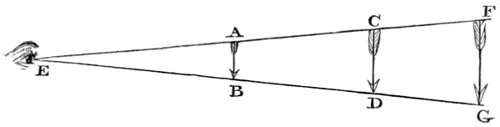
The optical angle is the angle contained under
two right lines drawn from the extreme points of
an object to the eye. Thus AEB or CED (fig.
40*.) is the optical or visual angle, or the angle
under which the object AB or CD, appears to the
eye at E. These two objects, being at different
distances, are seen under the same angle, although
CD is evidently larger than AB. On the retina
of the eye, their images are exactly of the same
size, and so is the still larger object FG.
figure 41.
The apparent magnitude of objects denotes
their magnitude as they appear to us, in contradistinction
from their real or true magnitude, and
it is measured by the visual angle; for whatever
objects are seen under the same or equal angles
appear equal, however different their real magnitudes.
If a half-crown or half-dollar be placed
at about 120 yards from the eye, it is just perceptible
as a visible point, and its apparent magnitude,
or the angle under which it is seen, is very small.
At the distance of thirty or forty yards, its bulk
appears sensibly increased, and we perceive it to
be a round body; at the distance of six or eight
yards, we can see the king or queen’s head engraved
upon it; and at the distance of eight or ten inches
from the eye it will appear so large, that it will
seem to cover a large building placed within the
distance of a quarter of a mile, in other words,
the apparent magnitude of the half-crown held at
such a distance, will more than equal that of such
a building, in the picture on the retina, owing to
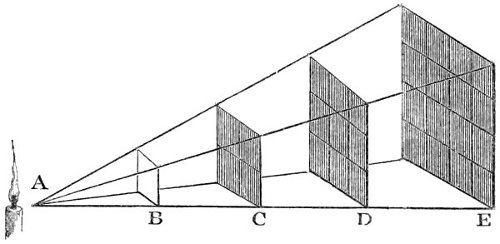
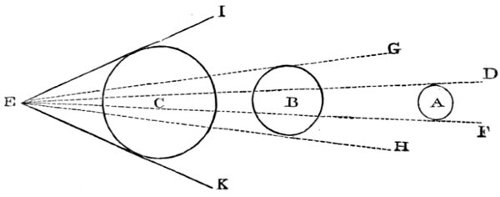
the increase of the optical angle. If we suppose
A (fig. 41.) to represent the apparent size of the
half-crown at nine yards distance, then we say it
is seen under the small angle FED. B will represent
its apparent magnitude at 4½ yards distant
under the angle HEG, and the circle C, its apparent
magnitude at 3 yards distant, under the large
angle KEI.
figure 42.
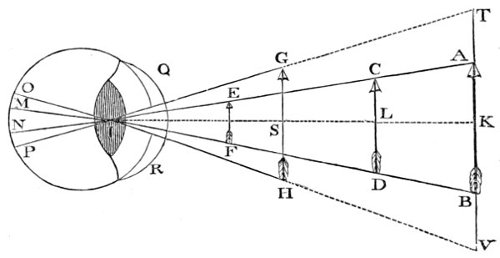
This may be otherwise illustrated by the following
figure. Let AB (fig. 42.) be an object
viewed directly by the eye QR. From each extremity
A and B draw the lines AN,BM, intersecting
each other in the crystalline humour in I:
then is AIB the optical angle which is the measure
of the apparent magnitude or length of the object
AB. From an inspection of this figure, it will
evidently appear that the apparent magnitudes of
objects will vary according to their distances.
Thus AB, CD, EF, the real magnitudes of which
are unequal, may be situated at such distances
from the eye, as to have their apparent magnitudes
all equal, and occupying the same space on
the retina MN, as here represented. In like
manner, objects of equal magnitude, placed at
unequal distances, will appear unequal. The
objects AB and GH which are equal, being
situated at different distances from the eye, GH
will appear under the large angle TIV, or as large
as an object TV, situated at the same place as the
object AB, while AB appears under the smaller
angle AIB. Therefore the object GH is apparently
greater than the object AB, though it is
only equal to it. Hence it appears that we have
no certain standard of the true magnitude of
objects, by our visual perception abstractly considered,
but only of the proportions of magnitude.
In reference to apparent magnitudes, we scarcely
ever judge any object to be so great or so small as
it appears to be, or that there is so great a disparity
in the visible magnitude of two equal bodies
at different distances from the eye. Thus, for
example, suppose two men, each six feet 3 inches
high, to stand directly before us, one at the distance
of a pole, or 5½ yards, and the other at the
distance of 100 poles, or 550 yards—we should
observe a considerable difference in their apparent
size, but we should scarcely suppose, at first sight,
that the one nearest the eye appeared a hundred
times greater than the other, or that, while the
nearest one appeared 6 feet 3 inches high, the
remote one appeared only about three fourths of
an inch. Yet such is in reality the case; and not
only so, but the visible bulk or area of the one is
to that of the other, as the square of these numbers,
namely as 10,000 to 1; the man nearest
us presenting to the eye a magnitude or surface
ten thousand times greater than that of the other.
Again, suppose two chairs standing in a large
room, the one 21 feet distance from us, and the
other 3 feet—the one nearest us will appear 7
times larger both in length and breadth, than the
more distant one, and consequently, its visible area
49 times greater. If I hold up my finger at 9
inches distant from my eye, it seems to cover a
large town a mile and a half in extent, situated at
3 miles distant; consequently, the apparent magnitude
of my finger, at 9 inches distant from the
organ of vision, is greater than that of the large
town at 3 miles distance, and forms a larger picture
on the retina of the eye. When I stand at
the distance of a foot from my window, and look
through one of the panes to a village less than
a quarter of a mile distant, I see, through that
pane, nearly the whole extent of the village, comprehending
two or three hundred houses; consequently,
the apparent magnitude of the pane is
equal to nearly the extent of the village, and all
the buildings it contains do not appear larger than
the pane of glass in the window, otherwise, the
houses and other objects which compose the
village could not be seen through that single pane.
For, if we suppose a line drawn from one end of
the village, passing through the one side of the
pane, and another line drawn from the other end,
and passing through the other side of the pane to
the eye, these lines would form the optical angle
under which the pane of glass and the village
appears. If the pane of glass be fourteen
inches broad, and the length of the village 2640
yards, or half a mile—this last lineal extent is
6,788 times greater than the other, and yet they
have the same apparent magnitude in the case
supposed.
Hence we may learn the absurdity and futility
of attempting to describe the extent of spaces in
the heavens, by saying, that a certain phenomenon
was two or three feet or yards distant from another,
or that the tail of a comet appeared several
yards in length. Such representations can convey
no definite ideas in relation to such magnitudes,
unless it be specified at what distance from the
eye, the foot or yard is supposed to be placed. If
a rod, a yard in length, be held at nine inches
from the eye, it will subtend an angle, or cover a
space in the heavens, equal to more than one
fourth of the circumference of the sky, or about
one hundred degrees. If it be eighteen inches
from the eye, it will cover a space equal to fifty
degrees; if at three feet, twenty-five degrees, and
so on in proportion to the distance from the eye;
so that we can form no correct conceptions of
apparent spaces or distances in the heavens, when
we are merely told that two stars, for example,
appear to be three yards distant from each other.
The only definite measure we can use, in such
cases, is that of degrees. The sun and moon are
about half a degree in apparent diameter, and the
distance between the extreme stars in Orion’s belt,
three degrees, which measures being made familiar
to the eye, may be applied to other spaces of the
heavens, and an approximate idea conveyed of the
relative distances of objects in the sky.
From what has been stated above, it is evident
that the magnitude of objects may be considered
in different points of view. The true dimensions
of an object, considered in itself, give what is called
its real or absolute magnitude; and the opening of
the visual angle determines the apparent magnitude.
The real magnitude, therefore, is a constant
quantity; but the apparent magnitude varies continually
with the distance, real or imaginary; and
therefore, if we always judged of the dimensions
of an object from its apparent magnitude, every
thing around us would, in this respect, be undergoing
very sensible variations, which might lead
us into strange and serious mistakes. A fly, near
enough to the eye, might appear under an angle
as great as an elephant at the distance of twenty
feet, and the one be mistaken for the other. A
giant eight feet high, seen at the distance of twenty-four
feet, would not appear taller than a child two
feet in height, at the distance of six feet; for
both would be seen nearly under the same angle.
But our experience generally prevents us from
being deceived by such illusions. By the help of
touch, and by making allowance for the different
distances at which we see particular objects, we
learn to correct the ideas we might otherwise form
from attending to the optical angle alone, especially
in the case of objects that are near us. By
the sense of touch we acquire an impression of the
distance of an object; this impression combines
itself with that of the apparent magnitude, so that
the impression which represents to us the real
magnitude is the product of these two elements.
When the objects, however, are at a great distance,
it is more difficult to form a correct estimate of
their true magnitudes. The visual angles are so
small, that they prevent comparison; and the
estimated bulks of the objects depend in a great
measure upon the apparent magnitudes; and thus
an object situated at a great distance, appears to
us much smaller than it is in reality. We also
estimate objects to be nearer or farther distant
according as they are more or less clear, and our
perception of them more or less distinct and well
defined; and likewise, when several objects intervene
between us and the object we are particularly
observing. We make a sort of addition of all
the estimated distances of intermediate objects, in
order to form a total distance of the remote object,
which in this case appears to be farther off than
if the intervening space were unoccupied. It is
generally estimated that no terrestrial object can
be distinctly perceived, if the visual angle it subtends
be less than one minute of a degree; and
that most objects become indistinct, when the
angle they subtend at the pupil of the eye is less
than six minutes.
We have deemed it expedient to introduce the
above remarks on the apparent magnitude of objects,
because the principal use of a telescope is
to increase the angle of vision, or to represent
objects under a larger angle than that under
which they appear to the naked eye, so as to render
the view of distant objects more distinct, and
to exhibit to the organ of vision those objects
which would otherwise be invisible. A telescope
may be said to enlarge an object just as many
times as the angle under which the instrument
represents it, is greater than that under which it
appears to the unassisted eye. Thus the moon
appears to the naked eye under an angle of about
half a degree; consequently a telescope magnifies
60 times if it represents that orb under an angle
of 30 degrees; and if it magnified 180 times, it
would exhibit the moon under an angle of 90
degrees, which would make her appear to fill half
of the visible heavens, or the space which intervenes
from the horizon to the zenith.
There are two kinds of telescopes, corresponding
to two modes of vision, namely, those which perform
their office by refraction through lenses, and
those which magnify distant objects by reflection
from mirrors. The telescope which is constructed
with lenses, produces its effects solely by refracted
light, and is called a Dioptric, or refracting telescope.
The other kind of telescope produces its
effects partly by reflection, and partly by refraction,
and is composed both of mirrors and lenses;
but the mirrors form the principal part of the
telescope; and therefore such instruments are
denominated reflecting telescopes. In this chapter
I shall describe the various kinds of refracting
telescopes.
This telescope is named after the celebrated
Galileo, who first constructed, and probably
invented it in the year 1609. It consists of only
two glasses, a convex glass next the object, and a
concave next the eye. The convex is called the
object-glass, and the concave to which the eye is
applied, is called the eye-glass. Let C (fig. 43.)
represent the convex object-glass, presented to
any object in the direction DEI, so that the rays
fall parallel upon it;—if these rays, after passing
through it, were not intercepted by the concave
lens K, they would pass on, and cross each other
in the focus F, where an inverted image of the
object would be formed. But the concave lens
K, the virtual focus of which is at F, being interposed,
the rays are not suffered to converge to
that point, but are made less convergent,19 and
enter the pupil almost parallel, as GH, and are
converged by the humours of the eye to their
proper foci on the retina. The object, through
this telescope, is seen upright, or in its natural
position, because the rays are not suffered to come
to a focus, so as to form an inverted picture. The
concave eye-glass is placed as far within the focus
of the object-glass, as is equal to its own virtual
focus; and the magnifying power is as the focal
length of the object-glass to that of the eye-glass,
that is, as CF to BF. Thus, suppose the focus
of the object-glass to be 10 inches, and the focus
of the eye-glass to be 1 inch, the magnifying
power will be 10 times—which is always found by
dividing the focal length of the object-glass by
that of the eye-glass. The interval between the
two glasses, in this case, will be 9 inches, which is
the length of the telescope, and the objects seen
through it will appear under an angle ten times
greater than they do to the naked eye. These
propositions might be proved mathematically; but
the process is somewhat tedious and intricate, and
might not fully be understood by general readers.
I shall therefore only mention some of the general
properties of this telescope, which is now seldom
used, except for the purpose of opera-glasses.
figure 43
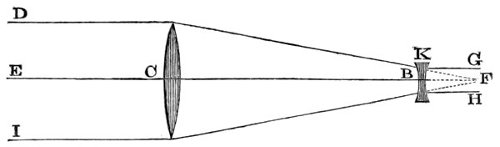
1. The focal distance of the object-glass must
be greater than that of the eye-glass, otherwise it
would not magnify an object: if the focal distance
of the eye-glass were greater than that of the
object-glass, it would diminish objects, instead of
magnifying them. 2. The visible area of the
object is greater, the nearer the eye is to the
glass; and it depends on the diameter of the pupil
of the eye, and on the breadth of the object-glass;
consequently the field of view in this telescope is
very small. 3. The distinctness of vision in this
construction of a telescope exceeds that of almost
any other. This arises from the rays of light proceeding
from the object directly through the
lenses, without crossing or intersecting each other;
whereas in the combination of convex lenses, they
intersect one another to form an image in the
focus of the object-glass, and this image is magnified
by the eye-glass with all its imperfections and
distortions. The thinness of the centre of the
concave lens also contributes to distinctness. 4.
Although the field of view in this telescope is very
small, yet where no other telescope can be procured,
it might be made of such a length as to
show the spots on the Sun, the crescent of Venus,
the satellites of Jupiter, and the ring of Saturn;
and, requiring only two glasses, it is the cheapest
of all telescopes. It has been found that an object-lens
5 feet focal distance, will bear a concave
eye-glass of only 1 inch focal distance, and will
consequently magnify the diameters of the planets
60 times, and their surfaces 3600 times, which is
sufficient to show the phenomena now stated.
And, although only a small portion of the sun and
moon can be seen at once, yet Jupiter and all his
satellites may sometimes be seen at one view; but
there is some difficulty in finding objects with
such telescopes. 5. Opera-glasses, which are
always of this construction, have the object-lens
generally about 6 inches focus and 1 inch diameter,
with a concave eye-glass of about 2 inches
focus. These glasses magnify about 3 times in
diameter, have a pretty large field, and produce
very distinct vision. When adjusted to the eye,
they are about 4 inches in length. To the object
end of an opera-glass there is sometimes attached
a plane mirror, placed at an angle of 45 degrees,
for the purpose of viewing objects on either side
of us. By this means, in a theatre or assembly,
we can take a view of any person without his
having the least suspicion of it, as the glass is
directed in quite a different direction. The
instrument with this appendage is sometimes
called a Polemoscope.
The astronomical telescope is the most simple
construction of a telescope, composed of convex
lenses only, of which there are but two essentially
necessary, though a third is sometimes added to
the eye-piece for the purpose of enlarging the
field of view. Its construction will be easily
understood from a description of the following
figure. Its two essential parts are, an object-glass
AD, and an eye-glass EY, so combined in
a tube that the focus F of the object-glass is
exactly coincident with the focus of the eye-glass.
Let OB (fig. 44.) represent a distant object,
from which rays nearly parallel proceed to
the object-lens AD. The rays passing through
this lens will cross at F, and form an image of the
object at IM. This image forms as it were an
object to the eye-glass EY, which is of a short
focal distance, and the eye is thus enabled to contemplate
the object as if it were brought much
nearer than it is in reality. For the rays, which
after crossing proceed in a divergent state, fall
upon the lens EY, as if they proceeded from a real
object situated at F. All that is effected therefore,
by such a telescope is, to form an image of
a distant object by means of the object-lens, and
then to give the eye such assistance as is necessary
for viewing that image as near as possible, so that
the angle it shall subtend at the eye shall be very
large compared with the angle which the object
itself would subtend in the same situation.
figure 44.

Here it may be expedient to explain, 1. how
this arrangement of glasses shows distant objects
distinctly, and 2. the reason why objects appear
magnified when seen through it. As to the first
particular, it may be proved as follows:—The
rays OA and BD, which are parallel before they
fall upon the object-glass, are by this glass refracted
and united at its focus: In order, then,
to distinct vision, the eye-glass must re-establish
the parallelism of the rays,—which is effected by
placing the eye-glass so that its focus may be at
F, and consequently the rays will proceed from
it parallel to each other and fall upon the eye in
that direction. For distinct vision is produced by
parallel rays. 2. The reason why the object
appears magnified will appear, if we consider that,
if the eye viewed the object from the centre of
the object-glass, it would see it under the angle
OCB; let OC and BC then be produced to the
focus of the glass, they will then limit the image
IM formed in the focus. If then, two parallel
rays are supposed to proceed to the eye-glass EY,
they will be converged to its focus H, and the eye
will see the image under the angle EHY. The
apparent magnitude of the object, therefore, as
seen by the naked eye, is to the magnitude of the
image as seen through the telescope, as OCB to
EHY, or as the distance CF to the distance FG,
in other words, as the focal length of the object-glass
to that of the eye-glass.
It is obvious from the figure, that, through this
telescope, all objects will appear inverted; since
the object OB is depicted by the object-glass in
an inverted position at IM, and in this position
is viewed by the eye-glass EY; and, therefore
this kind of telescope is not well adapted for viewing
terrestrial objects, since it exhibits the tops
of trees, houses, and other objects as undermost,
and the heads of people as pointing downwards.
But this circumstance is of no consequence with
respect to the heavenly bodies, since they are
round, and it can make little difference to an observer
which side of a globular body appears
uppermost or undermost. All astronomical
refracting telescopes invert objects; but they are
preferred to any other telescopes, because they
have few glasses, and consequently more light.
This telescope however, can be transformed into
a common day telescope for land objects, by the
addition of two other eye-glasses, as we shall
afterwards explain; but in this case a quantity of
light is lost by refraction at each lens; for there
is scarcely any transparent substance that transmits
all the rays of light that fall upon it.
The magnifying power of this telescope is
found by dividing the focal distance of the object-glass
by the focal distance of the eye-glass: the
quotient gives the magnifying power, or the number
of times that the object seen through the
telescope, appears larger or nearer than to the
naked eye. Thus, for example, if the focal distance
of the object-glass be 28 inches, and the
focal distance of the eye-glass 1 inch, the magnifying
power will be 28 times. If we would enlarge
the telescope and select an object-glass 10 feet, or
120 inches focus, an eye-glass of 2 inches focal
length might be applied, and then the diameter
of objects would be magnified 60 times, and their
surfaces 3600 times. If we would use an object-glass
of 100 feet, it would be necessary to select
an eye-glass about 6 inches focus, and the magnifying
power would be 200 times, equal to 1200
inches divided by 6. Since, then, the power of
magnifying depends on the proportion of the focal
length of the object and eye-glasses, and this proportion
may be varied to any degree, it may seem
strange to some that a short telescope of this kind
will not answer that purpose as well as a long one.
For instance, it may be asked why an object-glass
of 10 feet focus, may not be made to magnify as
much, as one of 100 feet focal length, by using an
eye-glass of half an inch focus, in which case, the
magnifying power would be 240 times? But it is
to be considered, that if the power of magnifying
be increased, while the length of the telescope
remains the same, it is necessary to diminish the
focal length of the eye-glass in the same proportion,
and this cannot be done on account of the great
distortion and colouring which would then appear
in the image, arising both from the deep convexity
of the lens and the different refrangibility of the
rays of light. It is found that the length of common
refracting telescopes must be increased in
proportion to the square of the increase of their
magnifying power; so that in order to magnify
twice as much as before, with the same light and
distinctness, the telescope must be lengthened
four times; to magnify 3 times as much, 9 times;
and to magnify four times as much, sixteen times;
that is—suppose a telescope of 3 feet to magnify
33 times,—in order to procure a power four times
as great, or 132 times, we must extend the telescope
to the length of 48 feet, or 16 times the
length of the other. Much likewise depends upon
the breadth or aperture of the object-glass. If it
be too small, there will not be sufficient light to
illuminate the object; and if it be too large, the
redundance of light will produce confusion in the
image.
The following table, constructed originally by
Huygens, and which I have re-calculated and corrected,
shows the linear aperture, the focal distance
of the eye-glass, and the magnifying power
of astronomical telescopes of different lengths,
which may serve as a guide to those who wish to
construct telescopes of this description.
| Focal distance of the object-glass. |
Linear aperture of the object-glass. |
Focal distance of the eye-glass. |
Magnifying power. |
| Feet. |
Inch. |
Dec. |
Inch. |
Dec. |
|
| 1 |
0. |
545 |
0. |
605 |
20 |
| 2 |
0. |
76 |
0. |
84 |
20.5 |
| 3 |
0. |
94 |
1. |
04 |
34.6 |
| 4 |
1. |
08 |
1. |
18 |
40 |
| 5 |
1. |
21 |
1. |
33 |
45 |
| 6 |
1. |
32 |
1. |
45 |
50 |
| 7 |
1. |
43 |
1. |
58 |
53 |
| 8 |
1. |
53 |
1. |
69 |
56.8 |
| 9 |
1. |
62 |
1. |
78 |
60.6 |
| 10 |
1. |
71 |
1. |
88 |
63.8 |
| 15 |
2. |
10 |
2. |
30 |
78 |
| 20 |
2. |
43 |
2. |
68 |
89.5 |
| 30 |
3. |
00 |
3. |
28 |
109 |
| 40 |
3. |
43 |
3. |
76 |
127 |
| 50 |
3. |
84 |
4. |
20 |
142 |
| 60 |
4. |
20 |
4. |
60 |
156 |
| 70 |
4. |
55 |
5. |
00 |
168 |
| 80 |
4. |
83 |
5. |
35 |
179 |
| 90 |
5. |
15 |
5. |
65 |
190 |
| 100 |
5. |
40 |
5. |
95 |
200 |
| 120 |
5. |
90 |
6. |
52 |
220 |
In the above table, the first column expresses the
focal length of the object-glass in feet; the second
column, the diameter of the aperture20 of the
object-glass, the third column, the focal distance
of the eye-glass, and the fourth, the magnifying
power, which is found by reducing the feet in the
first column to inches, and dividing by the numbers
in the third column. From this table it
appears that, in order to obtain a magnifying
power of 168 times, by this kind of telescope, it
is requisite to have an object-glass of 70 feet focal
distance, and an eye-glass five inches focus, and that
the aperture of the object-glass ought not to be
more than about 4½ inches diameter. To obtain a
power of 220 times requires a length of 120
feet.
The following is a summary view of the properties
of this telescope. 1. The object is always
inverted. 2. The magnifying power is always in
the proportion of the focal distance of the object-glass
to the eye-glass. 3. As the rays emerging
from the eye-glass, should be rendered parallel for
every eye, there is a small sliding tube next the
eye, which should be pushed out or in till the
object appears distinct. When objects are pretty
near, this tube requires to be pulled out a little.
These circumstances require to be attended to in
all telescopes. 4. The apparent magnitude of an
object is the same wherever the eye be placed,
but the visible area, or field of view, is the greatest
when the eye is nearly at the focal distance
of the eye-glass. 5. The visual angle depends on
the breadth of the eye-glass; for it is equal to
the angle which the eye-glass subtends at the
object-glass; but the breadth of the eye-glass
cannot be increased beyond a certain limit, without
producing colouring and distortion.
If the general principles on which this telescope
is constructed be thoroughly understood, it
will be quite easy for the reader to understand the
construction of all the other kinds of telescopes,
whether refracting or reflecting. A small astronomical
telescope can be constructed in a few
moments, provided one has at hand the following
lenses:—1. A common reading-glass, eight or ten
inches focal distance; 2. A common magnifying
lens, such as watchmakers or botanists use, of
about 1½ or 2 inches focus. Hold the reading-glass—suppose
of ten inches focus—in the left
hand opposite any object, and the magnifying lens
of two inches focus, in the right hand near the
eye, at twelve inches distance from the other in a
direct line, and a telescope is formed which magnifies
five times. I have frequently used this
plan, when travelling, when no other telescope was
at hand.
The Aerial is a refracting telescope of the kind
we have now described, intended to be used without
a tube in a dark night; for the use of a tube is
not only to direct the glasses, but to make the
place dark where the images are formed. It
appears from the preceding table inserted above,
that we cannot obtain a high magnifying power,
with the common astronomical telescope, without
making it of an extreme length, in which case the
glasses are not manageable in tubes—which are
either too slight and apt to bend, or too heavy and
unwieldy if made of wood, iron or other strong
materials. The astronomers of the seventeenth
century, feeling such inconveniences in making
celestial observations with long tubes, contrived a
method of using the glasses without tubes. Hartsocker,
an eminent optician, contrived to fix them
at the top of a tree, a high wall, or the roof of a
house; but the celebrated Huygens, who was not
only an astronomer, but also an excellent mechanic,
made considerable improvements in the
method of using an object-glass without a tube.
He placed it at the top of a very long pole, having
previously enclosed it in a short tube, which was
made to turn in all directions by means of a ball
and socket. The axis of this tube he could command
with a fine silken string, so as to bring it
into a line with the axis of another short tube
which he held in his hand, and which contained
the eye-glass. The following is a more particular
description of one of these telescopes. On the
top of a long pole or mast ab (fig. 45), is fixed a
board moveable up and down in the channel cd:
e is a perpendicular arm fixed to it, and ff is a
transverse board that supports the object glass
enclosed in the tube i, which is raised or lowered
by means of the silk cord rl; gg is an endless
rope with a weight h, by which the apparatus of
the object-glass is counterpoised; kl is a stick
fastened to the tube i; m the ball and socket, by
means of which the object-glass is moveable every
way: and to keep it steady, there is a weight n
suspended by a wire; l is a short wire to which
the thread rl is tied; o is the tube which holds
the eye-glass; q the stick fixed to this tube, s a
leaden bullet, and t a spool to wind the thread
on; u is pins for the thread to pass through; x the
rest for the observer to lean upon, and y the lantern.
Fig. 46 is an apparatus contrived by M. de
la Hire for managing the object-glass; but which
it would be too tedious particularly to describe.
To keep off the dew from the object-glass, it was
sometimes included in a pasteboard tube, made of
spongy paper, to absorb the humidity of the air.
And to find an object more readily, a broad annulus
of white pasteboard was put over the tube
that carried the eye-glass; upon which the image
of the object being painted, an assistant who
perceived it, might direct the tube of the eye-glass
into its place.
figure 45.
fig 46.
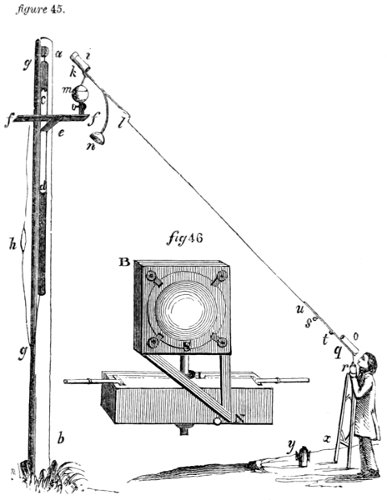
Such was the construction of the telescopes with
which Hevelius, Huygens, Cassini, and other
eminent astronomers of the seventeenth century
made their principal discoveries. With such
telescopes, Huygens discovered the fourth satellite
of Saturn, and determined that this planet was
surrounded with a ring; and with the same kind
of instrument Cassini detected the first, second,
third, and fifth, satellites of Saturn, and made his
other discoveries. When the night was very dark,
they were obliged to make the object-glass visible,
by means of a lantern so constructed as to throw
the rays of light up to it in a parallel direction.
In making such observations, they must have
taken incredible pains, endured much cold and
fatigue, and subjected themselves to very great
labour and expense—which almost makes us
wonder at the discoveries they were instrumental
in bringing to light—and should make modern
philosophers sensible of the obligations they are
under to such men as Newton and Dollond, through
whose inventions such unwieldy instruments are
no longer necessary. Telescopes of the description
now stated were made of all sizes, from 30
to above 120 feet in length. Divini at Rome,
and Campani at Bologna, were famed as makers
of the object-glasses of the long focal distance to
which we have alluded, who sold them for a great
price, and took every method to keep the art of
making them a secret. It was with telescopes
made by Campani, that Cassini made his discoveries.
They were made by the express order of
Louis XIV, and were of 86, 100, and 136 Paris
feet in focal length. M. Auzout made one object-glass
of 600 feet focus; but he was never able to
manage it, so as to make any practical observations
with it. Hartsocker is said to have made
some of a still greater focal length. The famous
aerial telescope of Huygens was 123 feet in focal
length, with six inches of aperture. At his death,
he bequeathed it to the Royal Society of London,
in whose possession it still remains. It required
a pole of more than a hundred feet high, on which
to place the object-glass for general observations.
It was with this glass, that Dr. Derham made the
observations to which he alludes in his preface to
his ‘Astro-Theology.’ When this glass was in
the possession of Mr. Cavendish, it was compared
with one of Mr. Dollond’s forty-six inch treble
object-glass Achromatics, and the gentlemen who
were present at the trial, said that ‘the Dwarf was
fairly a match for the Giant.’ It magnified 218
times, and the trouble of managing it, was said to
be extremely tiresome and laborious.
figure 47.

This telescope is constructed on the same principle
as the astronomical telescope already described,
with the addition of two or three glasses.
In fig. 47, OB represents a distant object, LN,
the object glass, which forms the image IM in its
focus, which is, of course, in an inverted position,
and, if the eye were applied at the lens EE, the
object would appear, exactly as through the astronomical
telescope, every object being apparently
turned upside down. To remedy this inconvenience,
there are added two other glasses FF
and GG, by which a second image is formed from
the first, in the same position as the object. In
order to effect this, the first of these two glasses,
namely FF, is placed at twice its focal distance
from the former glass EE, and the other lens GG,
next the eye, is placed at the same distance from
FF. For all the three glasses are supposed to be
of the same focal distance. Now, the lens FF,
being placed at twice the focal distance for parallel
rays from EE, receives the pencils of parallel
rays after they have crossed each other at X, and
forms an image at i m similar to that at IM and
equal to it, but contrary in position, and consequently
erect; which last image is viewed by
the lens GG, in the same manner as the first
image IM would be viewed by the lens EE. In
this case, the image IM is considered as an object
to the lens FF of which it forms a picture
in its focus, in a reverse position from that of the
first image, and of course, in the same position as
the object.
The magnifying power of this telescope is determined
precisely in the same way as that of the
astronomical telescope. Suppose the object-glass
to be thirty inches focal distance, and each of the
eye-glasses 1½ inch focal distance, the magnifying
power is in the proportion of 30 to 1½, or 20 times,
and the instrument is, of course, considerably
longer than an astronomical telescope of the same
power. The distance, in this case, between the
object-glass and the first eye-glass EE is 31½
inches; the distance between EE, and the second
glass FF, is 3 inches, and the distance between
FF and the glass GG next the eye, 3 inches;
in all 37½ inches, the whole length of the telescope.
Although it is usual to make use of three eye-glasses
in this telescope, yet two will cause the
object to appear erect, and of the same magnitude.
For suppose the middle lens FF taken away, if
the first lens EE be placed at X, which is double
its focal distance from the image IM, it will at
the same distance X m, on the other side, form a
secondary image i m equal to the primary image
IM, and also in a contrary position. But such a
combination of eye-glasses produces a great degree
of colouring in the image, and therefore is seldom
used. Even the combination now described, consisting
of three lenses of equal focal distances, is
now almost obsolete, and has given place to a much
better arrangement consisting of four glasses, of
different focal distances—which shall be afterwards
described.
The following figures, 48, 49, 50 represent the
manner in which the rays of light are refracted
through the glasses of the telescopes we have now
described. Fig. 48 represents the rays of light as
they pass from the object to the eye in the Galilean
telescope. After passing in a parallel direction
to the object-glass, they are refracted by that
glass, and undergo a slight convergence in passing
towards the concave eye-glass, where they enter
the eye in a parallel direction, but no image is
formed previous to their entering the eye, till they
arrive at the retina. Fig. 49 represents the rays
as they pass through the glasses of the astronomical
telescope. The rays, after entering the object-glass,
proceed in a converging direction, till they
arrive at its focus, about A, where an image of the
object is formed; they then proceed diverging to
the eye-glass, where they are rendered parallel,
and enter the eye in that direction. Fig. 50 represents
the rays as they converge and diverge in
passing through the four glasses of the common
day-telescope described above. After passing
through the object-glass, they converge towards
B, where the first image is formed. They then
diverge towards the first eye-glass where they are
rendered parallel; and passing through the second
eye-glass, they again converge and form a second
image at C; from which point they again diverge,
and passing through the first eye-glass enter the
eye in a parallel direction. If the glasses of these
telescopes were fixed on long pieces of wood, at
their proper distances from each other, and placed
in a darkened room, when the sun is shining, the
beam of the sun’s light would pass through them
in the same manner as here represented.
| fig. 48. |
fig. 49. |
fig. 50. |
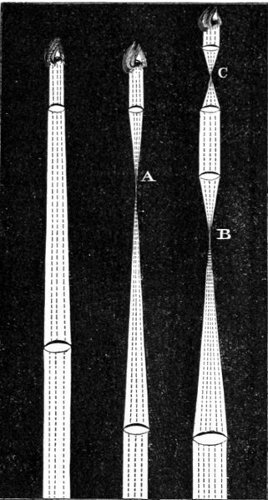 |
This is a species of telescope altogether unnoticed
by optical writers, so far as I know; nor
has the property of a single lens in magnifying
distant objects been generally adverted to or recognised.
It may not therefore be inexpedient to
state a few experiments which I have made in
relation to this point. When we hold a spectacle-glass
of a pretty long focal distance—say, from 20
to 24 inches—close to the eye, and direct it to
distant objects, they do not appear sensibly magnified.
But if we hold the glass about 12 or 16
inches from our eye, we shall perceive a sensible
degree of magnifying power, as if distant objects
were seen at less than half the distance at which
they are placed. This property of a spectacle-glass
I happened to notice when a boy, and, on
different occasions since that period have made
several experiments on the subject, some of which
I shall here relate.
With the object-glass of a common refracting
telescope 4½ feet focal distance, and 2½ inches
diameter, I looked at distant objects—my eye
being at about 3½ feet from the lens, or about 10
or 12 inches within its focus—and it produced
nearly the same effect as a telescope which magnifies
the diameters of objects 5 or 6 times. With
another lens 11 feet focal distance and 4 inches diameter—standing
from it at the distance of about
10 feet, I obtain a magnifying power of about
12 or 14 times, which enables me to read the
letters on the sign-posts of a village half a mile
distant. Having some time ago procured a very
large lens 26 feet focal distance, and 11½ inches
diameter, I have tried with it various experiments
of this kind upon different objects. Standing at
the distance of about 25 feet from it, I can see
distant objects through it magnified about 26 times
in diameter, and consequently 676 times in surface,
and remarkably clear and distinct, so that I can
distinguish the hour and minute hands of a public
clock in a village two miles distant. This single
lens, therefore answers the purpose of an ordinary
telescope with a power of 26 times. In making
such experiments our eye must always be within
the focus of the lens, at least 8 or 10 inches.
The object will, indeed, be seen at any distance
from the glass within this limit; but the magnifying
power is diminished in proportion as we approach
nearer to the glass. Different eyes, too,
will require to place themselves at different distances,
so as to obtain the greatest degree of magnifying
power with distinctness, according as individuals
are long or short-sighted.
This kind of telescope stands in no need of a
tube, but only of a small pedestal on which it may
be placed on a table, nearly at the height of the
eye, and that it be capable of a motion in a perpendicular
or parallel direction, to bring it in a
line with the eye and the object. The principle
on which the magnifying power, in this case, is
produced, is materially the same as that on which
the performance of the Galilean telescope depends.
The eye of the observer serves instead of the concave
lens in that instrument; and as the concave
lens is placed as much within the focus of the
object-glass, as is equal to its own focal distance,
so the eye, in these experiments, must be placed
at least its focal distance within the focus of
the lens with which we are experimenting;
and the magnifying power will be nearly in the
proportion of the focal distance of the lens to the
focal distance of the eye. If, for example, the
focal distance of the eye, or the distance at which
we see to read distinctly, be 10 inches, and the
focal distance of the lens, 11 feet, the magnifying
power will be as 11 feet, or 132 inches to 10, that
is, about 13 times. Let A (fig. 51.) represent
the lens placed on a pedestal; the rays of light
passing through this lens from distant objects
will converge towards a focus at F. If a person
then, place his eye at E, a certain distance within
the focal point, he will see distant objects magnified
nearly in the proportion of the focal distance
of the lens to that of the eye; and when the lens
is very broad—such as the 26 feet lens mentioned
above—two or three persons may look through it
at once, though they will not all see the same
object. I have alluded above to a lens made by
M. Azout of 600 feet focal distance. Were it
possible to use such a lens for distant objects, it
might represent them as magnified 5 or 600 times,
without the application of any eye-glass. In this
way the aerial telescope of Huygens would magnify
objects above 100 times, which is about
half the magnifying power it produced with its
eye-piece. Suppose Azout’s lens had been fitted
up as a telescope, it would not have magnified
above 480 times, as it would have required an eye-glass
of 14 or 15 inches focal distance, whereas,
without an eye-glass, it would have magnified
objects considerably above 500 times. It is not
unlikely that the species of telescope to which I
have now adverted, constituted one of those instruments
for magnifying distant objects which
were said to have been in the possession of certain
persons long before their invention in Holland,
and by Galileo in Italy—to which I have referred
in p. 182. Were this kind of telescope to be
applied to the celestial bodies, it would require to be
elevated upon a pole in the manner represented,
fig. 45, p. 226.
figure 51.
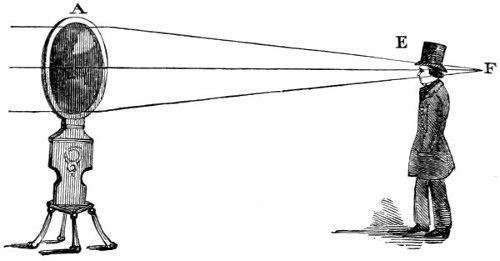
This telescope constitutes the most important
and useful improvement ever made upon telescopic
instruments; and, it is probable, it will, ere long,
supersede the use of all other telescopes. Its
importance and utility will at once appear when
we consider, that a good achromatic telescope of
only 4 or 5 feet in length will bear a magnifying
power as great, as that of a common astronomical
telescope 100 feet long, and even with a greater
degree of distinctness, so that they are now come
into general use both for terrestrial and celestial
observations. There are, indeed, certain obstructions
which prevent their being made of a very
large size; but from the improvement in the
manufacture of achromatic glass which is now
going forward, it is to be hoped that the difficulties
which have hitherto impeded the progress of
opticians will soon be removed. In order to understand
the nature of this telescope, it will be
necessary to advert a little to the imperfections
connected with common refracting telescopes.
figure 52.
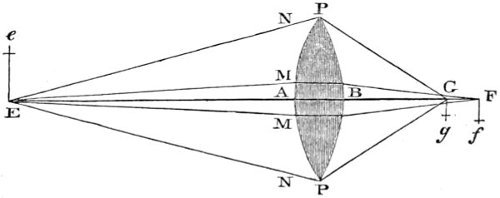
The first imperfection to which I allude is this,
that spherical surfaces do not refract the rays of
light accurately to a point; and hence the image
formed by a single convex lens is not perfectly
accurate and distinct. The rays which pass near
the extremities of such a lens meet in foci nearer
to the lens than those which pass nearly
through the centre, which may be illustrated by
the following figure. Let PP (fig. 52) be a convex
lens and Ee an object, the point E of which corresponds
with the axis, and sends forth the rays
EM, EN, EA, &c., all of which reach the surface
of the glass, but in different parts. It is manifest
that the ray EA which passes through the middle
of the glass, suffers no refraction. The rays EM,
EM, likewise, which pass through near to EA,
will be converged to a focus at F, which we generally
consider as the focus of the lens. But the
rays EN, EN, which are nearer to the edge of the
glass will be differently refracted, and will meet
about G, nearer to the lens, where they will form
another image Gg. Hence, it is evident, that the
first image Ff, is formed only by the union of
those rays which pass very near the centre of the
lens; but as the rays of light proceeding from
every point of an object are very numerous, there
is a succession of images formed, according to the
parts of the lens where they penetrate, which
necessarily produces indistinctness and confusion.
This is the imperfection which is distinguished by
the name of spherical aberration, or the error
arising from the spherical form of lenses.
The second and most important imperfection
of single lenses, when used for the object-glasses
of telescopes, is, that the rays of compounded
light being differently refrangible, come to their
respective foci at different distances from the glass;
the more refrangible rays, as the violet, converging
sooner than those which are less refrangible,
as the red. I have had occasion to illustrate this
circumstance, when treating on the colours produced
by the prism, (see p. 128, and figures 32
and 33,) and it is confirmed by the experiment of
a paper painted red, throwing its image, by means
of a lens, at a greater distance than another paper
painted blue. From such facts and experiments,
it appears, that the image of a white object consists
of an indefinite number of coloured images,
the violet being nearest, and the red farthest from
the lens, and the images of intermediate colours
at intermediate distances. The aggregate, or
image itself, must therefore be in some degree
confused; and this confusion being much increased
by the magnifying power, it is found necessary to
use an eye glass of a certain limited convexity to
a given object glass. Thus, an object glass of 34
inches focal length will bear an eye-glass of only
1 inch focus, and will magnify the diameters of
objects 34 times; one of 50 feet focal distance
will require an eye-glass of 4½ inches focus, and
will magnify only 142 times; whereas, could we
apply to it an eye-glass of only 1 inch focus, as in
the former case, it would magnify no less than
600 times. And were we to construct an object-glass
of 100 feet focal length, we should require to
apply an eye-glass, not less than 6 inches focus,
which would produce a power of about 200 times;
so that there is no possibility of producing a great
power by single lenses, without extending the
telescope to an immoderate length.
Sir Isaac Newton, after having made his discoveries
respecting the colours of light, considered
the circumstance we have now stated as an insuperable
barrier to the improvement of refracting
telescopes; and therefore turned his attention to
the improvement of telescopes by reflection. In
the telescopes which he constructed and partly
invented, the images of objects are formed by
reflection from speculums or mirrors; and being
free from the irregular convergency of the various
coloured rays of light, will admit of a much
larger aperture and the application of a much
greater degree of magnifying power. The reflector
which Newton constructed was only 6 inches long,
but it was capable of bearing a power equal to
that of a 6 feet refractor. It was a long time,
however, after the invention of these telescopes
before they were made of a size fitted for making
celestial observations. After reflecting telescopes
had been some time in use, Dollond made his
famous discovery of the principle which led him
to the construction of the achromatic telescope.
This invention consists of a compound object glass
formed of two different kinds of glass, by which
both the spherical aberration and the errors
arising from the different refrangibility of the rays
of light are, in a great measure corrected. For
the explanation of the nature of this compound
object glass and of the effects it produces; it may
be expedient to offer the following remarks
respecting the dispersion of light and its refraction
by different substances.
The dispersion of light is estimated by the
variable angle formed by the red and violet rays
which bound the solar spectrum;—or rather, it is
the excess of the refraction of the most refrangible
ray above that of the least refrangible ray. The
dispersion is not proportional to the refraction—that
is, the substances which have an equal mean
refraction, do not disperse light in the same ratio.
For example, if we make a prism with plates of
glass, and fill it with oil of Cassia, and adjust its
refracting angle ACB, (fig. 31, p. 127,) so that the
middle of the spectrum which it forms falls exactly
at the same place where the green rays of a spectrum
formed by a glass prism would fall—then we
shall find that the spectrum formed by the oil of
Cassia prism will be two or three times longer
than that of the glass prism. The oil of Cassia,
therefore, is said to disperse the rays of light more
than the glass, that is, to separate the extreme
red and violet rays at O and P more than the
mean ray at green, and to have a greater dispersive
power. Sir I. Newton appears to have made
use of prisms composed of different substances,
yet, strange to tell, he never observed that they
formed spectrums, whose lengths were different,
when the refraction of the green ray was the
same; but thought that the dispersion was proportional
to the refraction. This error continued
to be overlooked by philosophers for a considerable
time, and was the cause of retarding the
invention of the achromatic telescope for more
than 50 years.
Dollond was among the first who detected this
error. By his experiments it appears, that the
different kinds of glass differ extremely with
respect to the divergency of colours produced by
equal refractions. He found that two prisms,
one of white flint glass, whose refracting angle
was about 25 degrees, and another of crown glass
whose refracting angle was about 29 degrees,
refracted the beam of light nearly alike; but that
the divergency of colour in the white flint was
considerably more than in the crown glass; so
that when they were applied together, to refract
contrary ways, and a beam of light transmitted
through them, though the emergent continued
parallel to the incident part, it was, notwithstanding,
separated into component colours. From
this he inferred, that, in order to render the
emergent beam white, it is necessary that the
refracting angle of the prism of crown glass should
be increased, and by repeated experiments he discovered
the exact quantity. By these means he
obtained a theory in which refraction was performed
without any separation or divergency of
colour; and thus the way was prepared for applying
the principle he had ascertained to the construction
of the object glasses of refracting telescopes.
For the edges of a convex and concave
lens, when placed in contact with each other, may
be considered as two prisms which refract contrary
ways; and if the excess of refraction in the one
be such as precisely to destroy the divergency of
colour in the other, a colourless image will be
formed. Thus, if two lenses are made of the
same focal length, the one of flint glass and the
other of crown, the length or diameter of the
coloured image in the first will be to that produced
by the crown glass, as 3 to 2 nearly. Now, if
we make the focal lengths of the lenses in this
proportion, that is, as 3 to 2, the coloured spectrum
produced by each will be equal. But if the
flint lens be concave, and the crown convex—when
placed in contact—they will mutually correct
each other, and a pencil of white light
refracted by the compound lens will remain
colourless.
figure 53.
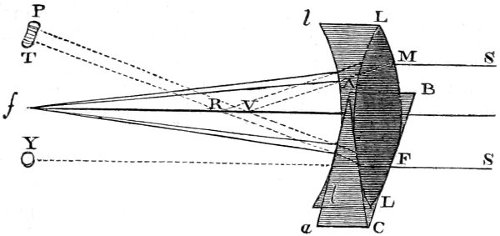
The following figure may perhaps illustrate
what has been now stated. Let LL (fig. 53.)
represent a convex lens of crown glass, and ll a
concave lens of flint glass. A ray of the sun S,
falls at F on the convex lens which will refract it
exactly as the prism ABC, whose faces touch the
two surfaces of the lens at the points where the
ray enters and quits it. The solar ray, SF, thus
refracted by the lens LL, or prism ABC, would
have formed a spectrum PT on the wall, had there
been no other lens, the violet ray F crossing the
axis of the lens at V, and going to the upper end
P of the spectrum; and the red ray FR, going to
the lower end T. But as the flint-glass lens ll, or
the prism AaC which receives the rays FV, FR,
at the same points, is interposed, these rays will
be united at f, and form a small circle of white
light; the ray SF of the sun being now refracted
without colour from its primitive direction SFY
into the new direction Ff. In like manner the
corresponding ray SM will be refracted to f, and
a white and colourless image of the sun will be
there formed by the two lenses. In this combination
of lenses it is obvious that the spherical aberration
of the flint lens corrects to a considerable
degree that of the crown-glass, and by a proper
adjustment of the radii of the surfaces, it may be
almost wholly removed. This error is still more
completely corrected in the triple achromatic
object-glass, which consists of three lenses—a
concave flint lens placed between convexes of
crown glass. Fig. 54 shows the double achromatic
lens, and fig. 55, the triple object-glass, as they
are fitted up in their cells, and placed at the object
end of the telescope. In consequence of their
producing a focal image free of colour they will
bear a much larger aperture and a much greater
magnifying power than common refracting telescopes
of the same length. While a common
telescope whose object-glass is 3½ feet focal distance
will bear an aperture of scarcely 1 inch, the
3½ feet Achromatic will bear an aperture of 3¼
inches, and consequently transmits 10½ times the
quantity of light. While the one can bear a magnifying
power of only about 36 times, the other
will bear a magnifying power for celestial objects
of more than 200 times.
| figure 54. |
figure 55. |
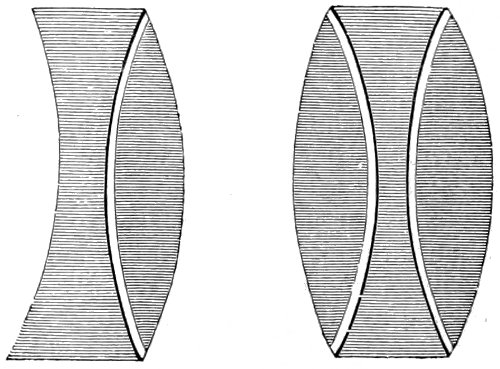 |
The theory of the achromatic telescope is somewhat
complicated and abstruse, and would require
a more lengthened investigation than my limits
will permit. But what has been already stated
may serve to give the reader a general idea of the
principle on which it is constructed, which is all
I intended. The term achromatic by which such
instruments are now distinguished was first given
to them by Dr. Bevis. It is compounded of two
Greek words which signify, ‘free of colour.’
And, were it not that even philosophers are not
altogether free of that pedantry which induces us
to select Greek words which are unintelligible to
the mass of mankind, they might have been contented
with selecting the plain English word
colourless, which is as significant and expressive as
the Greek word achromatic. The crown-glass,
of which the convex lenses of this telescope are
made, is the same as good common window-glass;
and the flint-glass is that species of glass of which
wine-glasses, tumblers, decanters and similar
articles are formed, and is sometimes distinguished
by the name of crystal-glass. Some opticians
have occasionally formed the concave lens of an
achromatic object-glass from the bottom of a
broken tumbler.
This telescope was invented and constructed by
Mr. John Dollond, about the year 1758. When
he began his researches into this subject, he was a
silk weaver in Spitalfields, London. The attempt
of the celebrated Euler to form a colourless telescope,
by including water between two meniscus
glasses, attracted his attention, and, in the year
1753, he addressed a letter to Mr. Short, the optician,
which was published in the Philosophical
Transactions of London, ‘concerning a mistake
in Euler’s theorem for correcting the aberrations
in the object glasses of refracting telescopes.’
After a great variety of experiments on the refractive
and dispersive powers of different substances,
he at last constructed a telescope in which
an exact balance of the opposite dispersive powers
of the crown and flint lenses made the colours
disappear, while the predominating refraction of
the crown lens disposed the achromatic rays to
meet at a distant focus. In constructing such
object glasses, however, he had several difficulties
to encounter. In the first place, the focal distance
as well as the particular surfaces must be
very nicely proportioned to the densities or refractive
powers of the glasses, which are very
apt to vary in the same sort of glass made at
different times. In the next place, the centers of
the two glasses must be placed truly in the common
axis of the telescope, otherwise the desired
effect will be in a great measure destroyed. To
these difficulties is to be added—that there are
four surfaces (even in double achromatic object
glasses) to be wrought perfectly spherical; and
every person practised in optical operations will
allow, that there must be the greatest accuracy
throughout the whole work. But these and other
difficulties were at length overcome by the judgment
and perseverance of this ingenious artist.
It appears, however, that Dollond was not the
only person who had the merit of making this
discovery—a private gentleman, Mr. Chest, of
Chest-hall, a considerable number of years before,
having made a similar discovery, and applied
it to the same purpose. This fact was ascertained
in the course of a process raised against Dollond
at the instance of Watkins, optician at Charing-cross,
when applying for a patent. But as the
other gentleman had kept his invention a secret,
and Dollond had brought it forth for the benefit
of the public, the decision was given in his favour.
There was no evidence that Dollond borrowed
the idea from his competitor, and both were, to
a certain extent, entitled to the merits of the
invention.
One of the greatest obstructions to the construction
of large achromatic telescopes is, the
difficulty of procuring large discs of flint glass
of an uniform refractive density—of good colour,
and free from veins. It is said that, fortunately
for Mr. Dollond, this kind of glass was procurable
when he began to make achromatic telescopes,
though the attempts of ingenious chemists have
since been exerted to make it without much success.
It is also said, that the glass employed by
Dollond in the fabrication of his best telescopes,
was of the same melting, or made at the same
time, and that, excepting this particular treasure,
casually obtained, good dense glass for achromatic
purposes, was always as difficult to be procured
as it is now. The dispersion of the flint glass,
too, is so variable, that, in forming an achromatic
lens, trials on each specimen require to be made
before the absolute proportional dispersion of the
substances can be ascertained. It is owing, in a
great measure, to these circumstances, that a large
and good achromatic telescope cannot be procured
unless at a very high price. Mr. Tulley of Islington—who
has been long distinguished as a maker
of excellent achromatic instruments—showed me,
about six years ago, a rude piece of flint glass
about five inches diameter, intended for the concave
lens of an achromatic object glass, for which
he paid eight guineas. This was before the piece
of glass was either figured or polished, and, consequently,
he had still to perform the delicate
operation of figuring, polishing, and adjusting this
concave to the convex lenses with which it was to
be combined; and during the process some veins
or irregularities might be detected in the flint
glass which did not then appear. Some years before,
he procured a disc of glass from the continent
about seven or eight inches diameter, for
which he paid about thirty guineas, with which
an excellent telescope, twelve feet focal length,
was constructed for the Astronomical Society of
London. It is obvious therefore, that large achromatic
telescopes must be charged at a pretty high
price.
In order to stimulate ingenious chemists and
opticians to make experiments on this subject, the
Board of Longitude, more than half a century
ago, offered a considerable reward for bringing the
art of making good flint glass for optical purposes
to the requisite perfection. But considerable difficulties
arise in attempting improvements of this
kind; as the experiments must all be tried on a
very large scale, and are necessarily attended with
a heavy expence. And although government has
been extremely liberal in voting money for warlike
purposes, and in bestowing pensions on those who
stood in no need of them, it has hitherto thrown
an obstruction in the way of such experiments, by
the heavy duty of excise, which is rigorously exacted,
whether the glass be manufactured into
saleable articles or not; and has thus been instrumental
in retarding the progress of improvement
and discovery. It would appear that experiments
of this kind have been attended with more success
in France, Germany, and other places on the
continent, than in Britain; as several very large
achromatic telescopes have been constructed in
those countries by means of flint glass which was
cast for the purpose in different manufactories,
and to which British artists have been considerably
indebted; as the London opticians frequently purchase
their largest discs of flint glass from Parisian
agents. Guinaud, a continental experimenter,
and who was originally a cabinet maker, appears
to have had his labours in this department of art
crowned with great success. Many years were
employed in his experiments, and he too frequently,
notwithstanding all his attention, discovered
his metal to be vitiated by striæ, spects or
grains, with cometic tails. He constructed a furnace
capable of melting two cwt of glass in one
mass, which he sawed vertically, and polished one
of the sections, in order to observe what had taken
place during the fusion. From time to time, as
he obtained blocks, including portions of good
glass, his practice was to separate them by sawing
the blocks into horizontal sections, or perpendicular
to their axes. A fortunate accident conducted
him to a better process. While his men were
one day carrying a block of this glass, on a hand-barrow,
to a saw mill which he had erected at the
Fall of the Doubs, the mass slipped from its
bearers, and, rolling to the bottom of a steep
and rocky declivity, was broken to pieces. Guinaud
having selected those fragments which appeared
perfectly homogeneous, softened them in circular
moulds, in such a manner, that on cooling, he obtained
discs that were afterwards fit for working.
To this method he adhered, and contrived a way
for clearing his glass while cooling, so that the
fractures should follow the most faulty parts.
When flaws occurred in the large masses, they
were removed by cleaving the pieces with wedges;
then smelting them again in moulds, which give
them the form of discs. The Astronomical
Society of London have made trial of discs made
by Guinaud, and have found them entirely homogeneous
and free from fault. Of this ingenious
artist’s flint glass, some of the largest achromatic
telescopes on the continent have been constructed.
But, it is more than twenty years since this experimenter
took his flight from this terrestrial scene,
and it is uncertain whether his process be still
carried on with equal success.
1. The Dorpat Telescope.—This is one of the
largest and most expensive Refracting telescopes
ever constructed. It was made by the celebrated
Fraunhofer of Munich for the observatory of the
Imperial University of Dorpat, and was received
into the observatory by Professor Struve in the
year 1825. The aperture of the object glass of
this telescope is 9½ English inches, and its solar
focal length about fourteen feet, the main tube
being thirteen French feet exclusive of the tube
which holds the eye pieces. The smallest of the
four magnifying powers it possesses, is 175, and
the largest 700, which, in favourable weather, is
said to present the object with the utmost precision.
‘This instrument,’ says Struve, ‘was sold
to us by Privy-Counsellor Von Utzchneider,
the chief of the optical establishment at Munich,
for 10,500 florins, (about £950 sterling), a price
which only covers the expenses which the establishment
incurred in making it.’ The frame work
of the stand of this telescope is of oak inlaid with
pieces of mahogany in an ornamental manner, and
the tube is of deal veneered with mahogany and
highly polished. The whole weight of the telescope
and its counterpoises is supported at one
point, at the common center of gravity of all its
parts; and though these weigh 3000 Russian
pounds, yet, we are told that this enormous telescope
may be turned in every direction towards the
heavens with more ease and certainty than any
other hitherto in use. When the object end of
the telescope is elevated to the zenith, it is sixteen
feet four inches, Paris measure, above the floor,
and its eye end in this position is two feet nine
inches high. This instrument is mounted on an
Equatorial stand, and clock work is applied to the
Equatorial axis, which gives it a smooth and
regular sidereal motion, which, it is said, keeps
a star in the exact center of the field of view,
and produces the appearance of a state of rest in
the starry regions, which motion can be made
solar, or even lunar, by a little change given to
the place of a pointer, that is placed as an index
on the dial plate. Professor Struve considers the
optical powers of this telescope superior to those
of Schröeter’s twenty-five feet reflector, from
having observed σ Orionis with fifteen companions,
though Schröeter observed only twelve, that he
could count with certainty. Nay, he seems disposed
to place it in competition with the late Sir
W. Herschel’s forty feet reflector. The finder
of this telescope has a focal distance of 30 French
inches, and 2-42 aperture.
2. Sir James South’s Telescope.—About the
year 1829, Sir J. South, President of the London
Astronomical Society, procured of M. Cauchoix
of Paris, an achromatic object glass of 112/10 inches,
clear aperture, and of 19 feet focal length. The
flint glass employed in its construction was the
manufacture of the late Guinaud le Pere, and
was found to be absolutely perfect. The first observation
was made with this telescope, while on a
temporary stand, on Feb. 13, 1830, when Sir J.
Herschel discovered with it a sixth star in the
trapezium in the nebula of Orion, whose brightness
was about one third of that of the fifth star discovered
by Struve, which is as distinctly seen as
the companion to Polaris is in a five feet achromatic.
Sir James gives the following notices of
the performance of this instrument on the morning
of May 14, 1830. ‘At half past two, placed the
20 feet achromatic on the Georgium Sidus, saw
it with a power of 346, a beautiful planetary disc;
not the slightest suspicion of any ring, either perpendicular
or horizontal; but the planet three
hours east of the meridian, and the moon within
three degrees of the planet.’ At a quarter before
three, viewed Jupiter with 252 and 346, literally
covered with belts, and the diameters of his satellites
might have been as easily measured as himself.
One came from behind the body, and the
contrast of the colour with that of the planet’s
limb was striking. At three o’clock viewed Mars.
The contrast of light in the vicinity of the poles
very decided. Several spots on his body well and
strongly marked—that about the south pole seems
to overtake the body of the planet, and gives an
appearance not unlike that afforded by the new
moon, familiarly known as ‘the old moon in the
new moon’s arms.’ Saturn has been repeatedly
seen with powers from 130 to 928 under circumstances
the most favourable; but not any thing
anomalous about the planet or its ring could even
be suspected. This telescope is erected on an
Equatorial stand at Sir J. South’s observatory,
Kensington.
3. Captain Smyth’s Telescope in his private
observatory at Bedford.—This Achromatic telescope
is 8½ feet focal length, with a clear aperture
of 59/10 inches worked by the late Mr. Tulley,
Senior, from a disk purchased by Sir James South
at Paris. It is considered by Captain Smyth to
be the finest specimen of that eminent optician’s
skill, and, it is said, will bear with distinctness, a
magnifying power of 1200. Its distinctness has
been proved by the clear vision it gives of the
obscure nebulæ, and of the companions of Polaris,
Rigel, α Lyræ, and the most minute double stars—-the
lunar mountains, cavities and shadows under
all powers—the lucid polar regions of Mars—the
sharpness of the double ring of Saturn—the gibbous
aspect of Venus—the shadows of Jupiter’s
satellites across his body, and the splendid contrast
of colours in α Hercules, γ Andromedæ and other
superb double stars.
Other large Achromatics.—Besides the above,
the following, belonging to public observatories
and private individuals, may be mentioned. In
the Royal observatory at Greenwich, there is an
Achromatic of 10 feet focal distance, having a
double object glass 5 inches diameter, which was
made by Mr. Peter Dollond, and the only one
of that size he ever constructed. There is also a
46 inch achromatic, with a triple object glass 3¾
inches aperture, which is said to be the most perfect
instrument of the kind ever produced. It
was the favourite instrument of Dr. Maskelyne,
late Astronomer Royal, who had a small room
fitted up in the observatory for this telescope.
The observatory, some years ago erected near
Cambridge, is perhaps the most splendid structure
of the kind in Great Britain. It is furnished with
several very large achromatic telescopes on Equatorial
machinery: but the Achromatic telescope,
lately presented to it by the Duke of Northumberland,
is undoubtedly the largest instrument of
this description which is to be found in this
country. The object glass is said to be 25 feet
focal distance, and of a corresponding diameter,
but as there was no access to this instrument at
the time I visited this observatory, nearly six
years ago, I am unable to give a particular description
of it. In the Royal Observatory at
Paris, which I visited in 1837, I noticed, among
other instruments, two very large Achromatic
telescopes which, measuring them rudely by the
eye—I estimated to be from 15 to 18 feet long,
and the aperture at the object end, from 12 to 15
inches diameter. They were the largest achromatics
I had previously seen; but I could find no
person in the observatory at that time, who
could give me any information as to their history,
or to their exact dimensions, or powers of magnifying.21
The Rev. Dr. Pearson, Treasurer to the Astronomical
Society of London, is in possession of
the telescope formerly alluded to, made by Mr.
Tulley, of twelve feet focal distance and seven
inches aperture, which is said to be a very fine
one. The small star which accompanies the pole
star, with a power of a 100, appears through this
telescope, as distinct and steady as one of Jupiter’s
satellites. With a single lens of 6 inches
focus, which produced a power of 24 times,
according to the testimony of an observer who
noticed it—the small star appeared as it does in
an achromatic of 3 inches aperture, which shows
the great effect of illuminating power in such
instruments. Mr. Lawson, a diligent astronomical
observer in Hereford, possesses a most beautiful
achromatic telescope of about 7 inches aperture,
and 12 feet focal distance, which was made by one
of the Dollonds, who considered it as his chief
d’oeuvre. It is said to bear powers as high as
1100 or 1400; and has been fitted up with
mechanism devised by Mr. Lawson himself, so
as to be perfectly easy and manageable to the
observer, and which displays this gentleman’s inventive
talent. In several of his observations
with this instrument, he is said to have had a
view of some of the more minute subdivisions of
the ring of Saturn. A very excellent achromatic
telescope was fitted up some years ago by
my worthy friend William Bridges, Esq., Blackheath.
Its object glass is 5½ inches diameter,
and about 5½ feet focal length. It is erected upon
Equatorial machinery, and placed in a circular
observatory which moves round with a slight
touch of the hand. The object glass of this instrument
cost about 200 Guineas, the equatorial
machinery on which it is mounted cost 150
Guineas, and the circular observatory in which it
is placed about 100 Guineas; in all 450 Guineas.
Its powers vary from 50 to 300 times.22
Such telescopes as I have alluded to above, are
among the largest which have yet been made on
the achromatic principle; they are, of course,
comparatively rare, and can be afforded only at a
very high price. Few of the object glasses in
the telescopes to which I have referred, would be
valued at less than 200 Guineas, independently of
the tubes, eye pieces and other apparatus with
which they are fitted up. It is so difficult to procure
large discs of flint glass for optical purposes,
to produce the requisite curves of the different
lenses, and to combine them together with that
extreme accuracy which is requisite, that when a
good compound lens of this description is found
perfectly achromatic, the optician must necessarily
set a high value upon it; since it may happen
that he may have finished half a dozen before he
has got one that is nearly perfect. The more
common sizes of achromatic telescopes for astronomical
purposes, which are regularly sold by the
London opticians, are the following:—
1. The 2½ feet Achromatic.—This telescope
has an object glass 30 inches in focal length, and
2 inches clear aperture. It is generally furnished
with two eye pieces, one for terrestrial objects,
magnifying about 30 or 35 times, and one for
celestial objects with a power of 70 or 75 times.
It might be furnished with an additional astronomical
eye-piece—if the object glass be a good
one, so as to produce a power of 90 or 95 times.
With such a telescope, the belts and satellites
of Jupiter, the phases of Venus and the ring of
Saturn may be perceived; but not to so much
advantage as with larger telescopes. It is generally
fitted up either with a mahogany or a brass
tube, and is placed upon a tripod brass stand, with
a universal joint which produces a horizontal
and vertical motion. It is packed, along with
the eye-pieces, and whatever else belongs to it,
in a neat mahogany box. Its price varies, according
as it is furnished with an elevating rack or other
apparatus.
The following are the prices of this instrument
as marked in the catalogue of Mr. Tulley, Terrett’s
Court, Islington, London.
|
£ |
s. |
d. |
| 2½ feet telescopes, brass mounted on plain pillar and claw
stand, with one eye piece for astronomical purposes, and
one for land objects, to vary the magnifying power,
packed in a mahogany box |
10 |
10 |
0 |
| Ditto, ditto, brass mounted on pillar and claw stand, with
elevating rack, 1 eye piece for astronomical purposes, and
1 for land objects, to vary the magnifying power, packed
in a mahogany box |
12 |
12 |
0 |
The following prices of the same kind of telescope
are from the catalogue of Messrs. W. and, S.
Jones, 30, Lower Holborn, London.
|
£ |
s. |
d. |
| The improved 2½ feet achromatic refractor, on a brass
stand, mahogany tube, with three eye pieces, two magnifying
about 40 and 50 times for terrestrial objects, and the
other about 75 times for astronomical purposes, in a
mahogany case |
10 |
10 |
0 |
| Ditto, ditto, the tube all brass, with three eye pieces |
11 |
11 |
0 |
Ditto, ditto, with vertical and horizontal rack work
motions |
15 |
15 |
0 |
2. The 3½ feet Achromatic Telescope.—The
object glass of this telescope is from 44 to 46
inches focal length, and 2¾ inches diameter. It
is generally furnished with four eye-pieces, two
for terrestrial and two for celestial objects. The
lowest power for land objects is generally about
45, which affords a large field of view, and exhibits
the objects with great brilliance. The
other terrestrial power is usually from 65 to 70.
The astronomical powers are about 80 and 130;
but such a telescope should always have another
eye-piece, to produce a power of 180 or 200 times,
which it will bear with distinctness, in a serene
state of the atmosphere, if the object glass be
truly achromatic. The illuminating power in this
telescope is nearly double that of the 2½ feet
telescope, or in the proportion of 7, 56 to 4; and
therefore it will bear about double the magnifying
power with nearly equal distinctness. This telescope
is fitted up in a manner somewhat similar to
the former, with a tripod stand which is placed
upon a table. Sometimes, however, it is mounted
on a long mahogany stand which rests upon the
floor, (as in fig. 58.), and is fitted with an equatorial
motion; and has generally a small telescope
fixed near the eye end of the large tube, called a
finder, which serves to direct the telescope to a
particular object in the heavens when the higher
powers are applied. It is likewise eligible that it
should have an elevating rack and sliding tubes,
for supporting the eye end of the instrument, to
keep it steady during astronomical observations,
and it would be an advantage, for various purposes
which shall be afterwards described, to have fitted
to it a Diagonal Eye Piece magnifying 40 times
or upwards.
The prices of this instrument, as marked in Mr.
Tulley’s Catalogue, are as follows:—
|
£ |
s. |
d. |
| The 3½ feet achromatic telescope 2¾ inches aperture, on
plain pillar and claw stand, 2 eye pieces for astronomical
purposes, and 1 for land objects to vary the magnifying
power, packed in a mahogany box |
21 |
0 |
0 |
| Ditto, ditto, with elevating rack and achromatic finder,
2 eye pieces for astronomical purposes, and 1 for day objects
to vary the magnifying power, packed in a mahogany
box |
26 |
5 |
0 |
The following are the prices as marked in
Messrs. W. and S. Jones’ Catalogue.
|
£ |
s. |
d. |
| The 3½ feet achromatic, plain mahogany tube |
18 |
18 |
0 |
| Ditto, ditto, brass tube |
21 |
0 |
0 |
| Ditto, all in brass, with rack work motions, &c. |
26 |
5 |
0 |
| Ditto, the object glass of the largest aperture, and the
rack motions on an improved principle |
from 37l. 16s. to 42 |
0 |
0 |
| Ditto, fitted up with Equatorial motion, framed mahogany
stand, divided altitude, and azimuth arches, or declination
and right ascension circles, &c. &c. |
from 60l to 80 |
0 |
0 |
This is the telescope which I would particularly
recommend to astronomical amateurs, whose pecuniary
resources do not permit them to purchase
more expensive instruments. When fitted up
with the eye pieces and powers already mentioned,
and with a finder and elevating rack,—price 25
guineas—it will serve all the purposes of general
observation. By this telescope, satisfactory views
may be obtained of most of the interesting phenomena
of the heavens, such as the spots of the
sun—the mountains, vales, and caverns on the
lunar surface—the phases of Mercury and Venus—the
spots on Mars—the satellites and belts of
Jupiter—the ring of Saturn—many of the more
interesting nebulæ, and most of the double stars
of the second and third classes. When the object
glass of this telescope is accurately figured and perfectly
achromatic, a power of from 200 to 230 maybe
put upon it, by which the division of Saturn’s
ring might occasionally be perceived. It is more
easily managed and represents objects considerably
brighter than reflecting telescopes of the same
price and magnifying power, and it is not so apt
to be deranged as reflectors generally are. A
telescope of a less size would not in general be
found satisfactory for viewing the objects I have
now specified, and for general astronomical purposes.
It may not be improper for the information
of some readers, to explain what is meant in
Mr. Tulley’s catalogue, when it is stated that this
instrument has ‘one eye piece for day objects, to
vary the magnifying power.’ The eye piece
alluded to is so constructed, that by drawing out
a tube next the eye, you may increase the power
at pleasure, and make it to vary, say from 40 to
80 or 100 times; so that such a construction of
the terrestrial eye piece (to be afterwards explained)
serves in a great measure, the purpose of separate
eye-pieces. The whole length of the 3½ feet telescope,
when the terrestrial eye piece is applied, is
about 4½ feet from the object glass to the first eye
glass.
When the aperture of the object glass of this
telescope exceeds 2¾ inches its price rapidly advances.
The following is Mr. Tulley’s scale of prices,
proportionate to the increase of aperture:—
|
£ |
s. |
d. |
| 3½ feet telescopes 3¼ inches aperture, with vertical and
horizontal rack work motions, achromatic finder, 3 eye
pieces for astronomical purposes, and one for day objects
to vary the magnifying power, packed in a mahogany box |
42 |
0 |
0 |
| Ditto, ditto, 3¾ inches diameter, mounted as above |
68 |
5 |
0 |
Ditto, with universal Equatorial, instead of pillar and
claw stand |
84 |
0 |
0 |
Here, in the one case, the increase of half an
inch in the diameter of the object-glass, adds
about £16. to the expense; and in the other case
no less than £26. 5s. The proportion of light in
those two telescopes, compared with that of 2¾
inches aperture, is as follows:—The square of the
2¾ object-glass is 7.56; that of 3¼, 10.56, and that
of the 3¾, 14.06; so that the light admitted by
the 3¼ compared with the 2¾ aperture, is nearly as
10 to 7; and the light admitted by the 3¾ object-glass
is nearly double that of the 2¾ aperture, and
will bear nearly a proportional increase of magnifying
power.
3. The 5 feet Achromatic telescope. The focal
length of the object-glass of this telescope is 5
feet 3 inches, and the diameter of its aperture
38/10 inches. The usual magnifying powers applied
to it are, for land objects 65 times; and for celestial
objects, 110, 190, 250, and sometimes one or
two higher powers. The quantity of light it
possesses is not much larger than that of the 3½
feet telescope, with 3¾ inches aperture; but the
larger focal length of this telescope is considered to
be an advantage; since the longer the focus of the
object-glass, the less will be its chromatic and
spherical aberrations, and the larger may be the
eye-glasses, and the flatter the field of view.
The following are the prices of these telescopes
as marked in Mr. Tulley’s catalogue.
|
£ |
s. |
d. |
| 5 feet telescopes 3¾ inches aperture, on an universal equatorial
stand, with achromatic finder, 4 eye pieces for astronomical
purposes, and 1 for day objects to vary the magnifying
power, packed in a mahogany box 100 guineas to |
157 |
10 |
0 |
| 7 feet ditto, 5 inches aperture, on a newly improved
universal equatorial stand, 6 eye pieces for astronomical
purposes, and 1 for day objects to vary the magnifying
power, with achromatic finder, and Troughton’s Micrometer |
207 |
5 |
0 |
The above are all the kinds of achromatic
telescopes generally made by the London opticians.
Those of the larger kind, as 5 and 7 feet
telescopes, and the 3½ feet with 3¾ inches aperture,
are generally made to order, and are not always to
be procured. But the 2½ and 3½ feet achromatics
of 2¾ inches aperture, are generally to be found
ready-made at most of the optician’s shops in
the metropolis. The prices of these instruments
are nearly the same in most of the optician’s shops
in London. Some of them demand a higher price,
but few of them are ever sold lower than what has
been stated above, unless in certain cases, where a
discount is allowed.
figure 57.
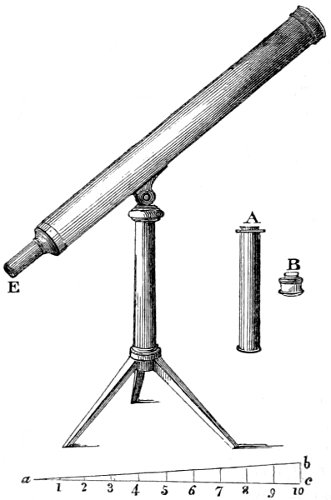
The stands for these telescopes, and the manner
in which they are fitted up for observation are represented
in figures 57, 58, and 59. Fig. 57 represents
either the 2½ or the 3½ feet telescopes
mounted on a plain brass stand, to be placed on a
table. A is the long eye-piece for land objects,
and B the small eye-piece for astronomical observation,
which is composed of two lenses, and represents
the object in an inverted position.
These eye-pieces are screwed on, as occasion requires,
at E, the eye-end of the telescope. The
shorter of the two astronomical eye-tubes which
accompany this telescope, produces the highest
magnifying power. For adjusting the telescope
to distinct vision, there is a brass knob or button
at a, which moves a piece of rack-work connected
with the eye-tube, which must be turned either
one way or the other till the object appears distinctly;
and different eyes frequently require a
different adjustment.
Fig. 58, represents a 5 feet telescope fitted up
for astronomical observations. It is mounted on
a mahogany stand, the three legs of which are
made to close up together by means of the brass
frame aaa, which is composed of three bars, connected
with three joints in the centre, and three
other joints, connected with the three mahogany
bars. It is furnished with an apparatus for equatorial
motions. The brass pin is made to move
round in the brass socket b, and may be tightened
by means of the finger screw d, when the telescope
is directed nearly to the object intended to be
viewed. This socket may be set perpendicular to
the horizon, or to any other required angle; and
the quantity of the angle is ascertained by the
divided arc, and the instrument made fast in that
position by the screw e. If this socket be set to the
latitude of the place of observation, and the plane
of this arc be turned so as to be in the plane of
the meridian, the socket b being fixed to the inclination
of the pole of the earth, the telescope
when turned in this socket, will have an equatorial
motion, so that celestial objects may be always
kept in view, when this equatorial motion is performed.
The two handles at k are connected with
rack-work, intended to move the telescope in any
required direction. The two sets of brass sliding
rods ii are intended to render the telescope as
steady as possible, and to elevate and depress it at
pleasure, and are so constructed as to slide into
each other with the utmost ease.
figure 58.
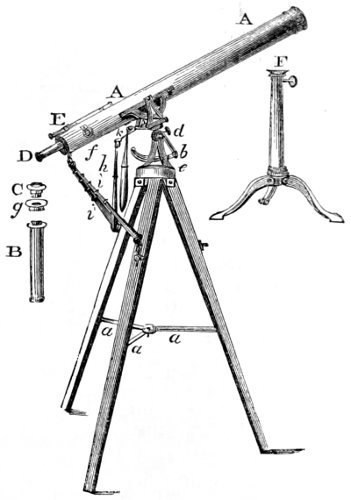
The Finder is placed at AE, either on the top
or the left side of the tube of the telescope.
When high magnifying powers are applied to any
telescope, it is sometimes difficult, on account of
the smallness of the field of view, to direct the
main tube of the telescope to the object. But
the Finder, which is a telescope with a small
power, and consequently has a large field of view—when
directed to any object, it is easily found,
and being brought to the centre of the field,
where two cross hairs intersect each other, it
will then be seen in the larger telescope. B is the
eye-tube for terrestrial objects, containing 4 glasses,
and C, one of the astronomical eye-pieces. A
socket is represented at g, containing a stained
glass, which is screwed to any of the eye-pieces,
to protect the eye from the glare of light, when
viewing the spots of the sun. The brass nut
above f, is intended for the adjustment of the eye-piece
to distinct vision. The 3½ feet telescope is
sometimes mounted in this form.
Fig. 59, represents a 5 or 6 feet telescope,
mounted on a stand of a new construction by
Dollond. It possesses the advantage of supporting
the telescope in two places, which renders it
extremely steady—a property of great importance
when viewing celestial objects with high magnifying
powers. It possesses likewise, the advantage
of enabling the observer to continue seated at the
same height from the floor, although the telescope
be raised to any altitude—the elevation being entirely
at the object end, although it may be changed
from the horizon to the zenith. The frame-work
is composed of bars of mahogany, and rests on
three castors, two of which are made fast to their
respective legs in the usual way, and the third
stands under the middle of the lower horizontal
bar that connects the two opposite legs, so that
the frame has all the advantages of a tripod. As
it becomes very inconvenient to stoop to the eye
end of a telescope, when the altitude of an
object is considerable, and the centre of motion at
the middle of the tube, this construction of a
stand serves to remedy such inconvenience.
figure 59.
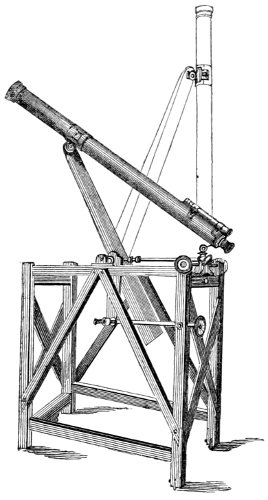
As some ingenious mechanics may feel a desire
to attempt the construction of a compound achromatic
object-glass, I shall here state some of the
proportions of curvature of the concave and convex
lenses, which serve to guide opticians in their
construction of achromatic instruments. These
proportions are various; and even when demonstrated
to be mathematically correct, it is sometimes
difficult to reduce them to practice, on
account of the different powers of refraction and
dispersion possessed by different discs of crown
and flint-glass, and of the difficulty of producing
by mechanical means, the exact curves which
theory requires. The following table shows the
radii of curvature of the different surfaces of the
lenses necessary to form a double achromatic
object-glass—it being supposed that the sine of
refraction in the crown-glass is as 1.528 to 1, and
in the flint as 1.5735 to 1; the ratio of their dispersive
powers being as 1 to 1.524. It is also
assumed that the curvatures of the concave lens
are as 1 to 2, that is, that the one side of this lens
is ground on a tool, the radius of which is double
that of the other. The 1st column expresses the
compound focus of the object-glass in inches; the
2nd column states the radius of the anterior surface
of the crown, and column 3rd, its posterior side.
Column 4th expresses the radius of the anterior
surface of the concave lens, and column 5th its
posterior surface, which, it will be observed, is
exactly double that of the other.
| Focus in inches. |
Radius of anterior surface, convex. |
Radius of posterior surface. |
Radius of anterior surface, concave. |
Radius of posterior surface. |
|
Inc. |
Dec. |
Inc. |
Dec. |
Inc. |
Dec. |
Inc. |
Dec. |
| 12 |
3 |
|
4. |
652 |
4. |
171 |
8. |
342 |
| 24 |
6 |
|
9. |
304 |
8. |
342 |
16. |
684 |
| 30 |
7. |
5 |
11. |
063 |
10. |
428 |
20. |
856 |
| 36 |
9 |
|
13. |
956 |
12. |
513 |
25. |
027 |
| 48 |
12 |
|
18. |
608 |
16. |
684 |
33. |
369 |
| 60 |
15 |
|
23. |
260 |
20. |
856 |
41. |
712 |
| 120 |
30 |
|
46. |
520 |
41. |
712 |
83. |
424 |
From the above table it will be seen, that to
construct, for example, a 30 inch compound object-glass,
the radius of the anterior side of the crown
must be 7½ inches, and that of the posterior side
11.63 inches; the radius of the anterior surface
of the concave 10.428, and that of the posterior
20.856 inches. It may be proper to observe, that
in these computations, the radius of the anterior
surface of the concave is less than the posterior
side of the convex, and consequently admits of
its approach, without touching in the centre—a
circumstance which always requires to be guarded
against in the combination of achromatic glasses.
The following table shows the radii of curvature of
the lenses of a triple object-glass, calculated from
formula deduced by Dr. Robison of Edinburgh.
| Focal length. |
Convex lens of crown glass. |
Concave lens of flint glass. |
Convex lens of crown glass. |
| Inches |
Inc. |
Dec. |
Inc. |
Dec. |
Inc. |
Dec. |
Inc. |
Dec. |
Inc. |
Dec. |
Inc. |
Dec. |
| 6 |
4. |
54 |
3. |
03 |
3. |
03 |
6. |
36 |
6. |
36 |
0. |
64 |
| 9 |
6. |
83 |
4. |
56 |
4. |
56 |
9. |
54 |
9. |
54 |
0. |
92 |
| 12 |
9. |
25 |
6. |
17 |
6. |
17 |
12. |
75 |
12. |
75 |
1. |
28 |
| 18 |
13. |
67 |
9. |
12 |
9. |
12 |
19. |
08 |
19. |
08 |
1. |
92 |
| 24 |
18. |
33 |
12. |
25 |
12. |
25 |
25. |
50 |
25. |
50 |
2. |
56 |
| 30 |
22. |
71 |
15. |
16 |
15. |
16 |
31. |
79 |
31. |
79 |
3. |
20 |
| 36 |
27. |
33 |
18. |
25 |
18. |
25 |
38. |
17 |
38. |
17 |
3. |
84 |
| 42 |
31. |
87 |
21. |
28 |
21. |
28 |
44. |
53 |
44. |
53 |
4. |
48 |
| 48 |
36. |
42 |
24. |
33 |
24. |
33 |
50. |
92 |
50. |
92 |
5. |
12 |
| 54 |
40. |
96 |
27. |
36 |
27. |
36 |
57. |
28 |
57. |
28 |
5. |
76 |
| 60 |
45. |
42 |
30. |
33 |
30. |
33 |
63. |
58 |
63. |
58 |
6. |
40 |
The following table contains the proportions of
curvature, said to be employed by the London
opticians.
| Focal length. |
Convex lens of crown glass. |
Radius of both the surfaces of the concave of flint glass. |
Convex lens of crown glass. |
| Inches |
Inc. |
Dec. |
Inc. |
Dec. |
Inc. |
Dec. |
Inc. |
Dec. |
Inc. |
Dec. |
| 6 |
3. |
77 |
4. |
49 |
3. |
47 |
3. |
77 |
4. |
49 |
| 9 |
5. |
65 |
6. |
74 |
5. |
21 |
5. |
65 |
6. |
74 |
| 12 |
7. |
54 |
8. |
99 |
6. |
95 |
7. |
54 |
8. |
99 |
| 18 |
11. |
30 |
13. |
48 |
10. |
42 |
11. |
30 |
13. |
48 |
| 24 |
15. |
08 |
17. |
98 |
13. |
90 |
15. |
08 |
17. |
98 |
| 36 |
22. |
61 |
26. |
96 |
20. |
84 |
22. |
61 |
26. |
96 |
| 42 |
26. |
38 |
31. |
45 |
24. |
31 |
26. |
38 |
31. |
45 |
| 48 |
30. |
16 |
35. |
96 |
27. |
80 |
30. |
16 |
35. |
96 |
| 54 |
33. |
91 |
40. |
45 |
31. |
27 |
33. |
91 |
40. |
45 |
| 60 |
37. |
68 |
44. |
94 |
34. |
74 |
37. |
68 |
44. |
94 |
From this table it appears, that the two convex
lenses, have the same radii of their respective
sides and that the concave flint lens has its two
surfaces equally concave, so that a triple object-glass
formed according to these proportions, would
require only three pair of grinding tools. The
following are the curves of the lenses of one of
the best of Dollond’s achromatic telescopes, the
focal length of the compound object-glass being
46 inches. Reckoning from the surface next the
object—the radii of the crown-glass were 28 and
40 inches: the concave lens 20.9 inches, and the
inner crown-glass lens, 28.4 and 28.4 inches.
This telescope carried magnifying powers of from
100 to 200 times.
Although I have inserted the above tables, which
might in some measure guide an ingenious artist,
yet on the whole, a private amateur has little
chance in succeeding in such attempts. The
diversity of glasses, and the uncertainty of an
unpractised workman’s producing the precise
curvatures he intends, is so great, that the object-glass,
for the most part, turns out different from
his expectations. The great difficulty in the construction
is to find the exact proportion of the
dispersive powers of the crown and flint glass.
The crown is pretty constant, but there are
hardly two pots of flint glass which have the same
dispersive power. Even if constant, it is difficult
to measure it accurately; and an error in this
greatly affects the instrument; because the focal
distances of the lenses must be nearly as their
dispersive powers. In the two preceding tables,
the sine of incidence, in the crown glass, is supposed
to be to the sine of refraction as 1.526 to 1;
and in the flint glass, as 1.604 to 1. Opticians
who make great numbers of lenses both of flint
and crown glass, acquire, in time, a pretty good
guess of the nature of the errors which may
remain after they have finished an object-glass;
and having many lenses intended to be of the
same form, but unavoidably differing a little from
it, they try several of the concaves with the two
convexes, and finding one better than the rest,
they make use of it to complete the set. In this
way some of the best achromatic telescopes are
frequently formed. I have sometimes found,
when supplying a concave flint glass to a telescope
where it happened to be wanting, that, of four or
five concave lenses which appeared to be the same
as to curvature and other properties, only one
was found to produce a distinct and colourless
image. Should any one, however, wish to
attempt the construction of an achromatic lens,
the best way for preventing disappointments in
the result is, to procure a variety of tables of the
respective curvatures founded on different conditions,
and which, of course, require the surfaces
of the several lenses to be of different curves.
Having lenses of different radii at his command,
and having glass of different refractive or dispersive
powers, when one combination does not exactly
suit, he may try another, and ultimately may succeed
in constructing a good achromatic telescope;
for, in many cases, it has been found that chance,
or a happy combination of lenses by trial, has led
to the formation of an excellent object-glass.
The best achromatic telescopes, when minutely
examined, are found to be in some respects defective,
on account of that slight degree of colour
which, by the aberration of the rays, they give to
objects, unless the object-glass be of small diameter.
When we examine with attention a good
achromatic telescope we find that it does not show
white or luminous objects perfectly free from
colour, their edges being tinged on one side with
a claret-coloured fringe, and on the other with a
green fringe. This telescope, therefore, required
farther improvement, to get rid of these secondary
colours, and Father Boscovich, to whom every
branch of optics is much indebted, displayed much
ingenuity in his attempts to attain this object.
But it is to Dr. Blair, professor of astronomy in
Edinburgh, that we are chiefly indebted for the
first successful experiments by which this end was
accomplished. By a judicious set of experiments,
he proved that the quality of dispersing the rays
in a greater degree than crown-glass, is not confined
to a few mediums; but is possessed by a
great variety of fluids, and by some of these in a
most extraordinary degree. Having observed
that when the extreme red and violet rays were
perfectly united, the green were left out, he conceived
the idea of making an achromatic concave
lens which should refract the green less than the
united red and violet, and an achromatic convex lens
which should do the same, and as the concave lens
refracted the outstanding green to the axis, while
the concave one refracted them from the axis, it
followed, that, by a combination of these two
opposite effects, the green would be united with
the red and violet.
By means of an ingenious prismatic apparatus,
he examined the optical properties of a great
variety of fluids. The solutions of metals and semi-metals
proved in all cases more dispersive than
crown glass. Some of the salts, such as sal-ammoniac,
greatly increased the dispersive power
of water. The marine acid disperses very considerably,
and this quality increases with its
strength. The most dispersive fluids were accordingly
found to be those in which this acid and the
metals were combined. The chemical preparation
called causticum antimoniale, or butter of antimony,
in its most concentrated state, when it has just
attracted sufficient humidity to render it fluid,
possesses the quality of dispersing the rays in an
astonishing degree. The great quantity of the semi-metal
retained in solution, and the highly concentrated
state of the marine acid, are considered as
the cause of this striking effect. Corrosive sublimate
of mercury, added to a solution of sal-ammoniacum
in water, possesses the next place to
the butter of antimony among the dispersive fluids,
which Dr. Blair examined. The essential oils
were found to hold the next rank to metallic solutions,
among fluids which possess the dispersive
quality, particularly those obtained from bituminous
minerals, as native petrolea, pit coal, and
amber. The dispersive power of the essential oil
of sassafras, and the essential oil of lemons, when
genuine, were found to be not much inferior to any
of these. But of all the fluids fitted for optical
purposes, Dr. Blair found that the muriatic acid
mixed with a metallic solution, or, in other words,
a fluid in which the marine acid and metalline
particles, hold a due proportion, most accurately
suited his purpose. In a spectrum formed by
this fluid the green were among the most refrangible
rays, and when its dispersion was corrected
by that of glass, there was produced
an inverted secondary
spectrum, that is, one in which
the green was above, when it
would have been below with a
common medium. He therefore
placed a concave lens of
muriatic acid with a metallic
solution between the two lenses,
as in fig. 60, where AB is the
concave fluid lens, CF a plano-convex
lens, with its plane
side next the object, and ED,
a meniscus. With this object-glass
the rays of different
colours were bent from their
rectilineal course with the same
equality and regularity as in
reflection.
figure 60.
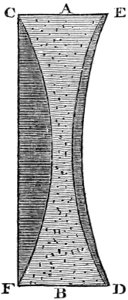
Telescopes constructed with such object-glasses
were examined by the late Dr. Robison and professor
Playfair. The focal distance of the object-glass
of one of these did not exceed 17 inches,
and yet it bore an aperture of 3½ inches. They
viewed some single and double stars and some
common objects with this telescope; and found,
that, in magnifying power, brightness, and distinctness,
it was manifestly superior to one of Mr.
Dollond of 42 inches focal length. They had
most distinct vision of a star, when using an erecting
eye-piece, which made this telescope magnify
more than a 100 times; and they found the field
of vision as uniformly distinct as with Dollond’s
42 inch telescope magnifying 46 times; and were
led to admire the nice figuring and centering of
the very deep eye-glasses which were necessary
for this amplification. They saw double stars
with a degree of perfection which astonished them.
These telescopes, however, have never yet come
into general use; and one reason perhaps, is, that
they are much more apt to be deranged, than
telescopes constructed of object-glasses which are
solid. If any species of glass, or other solid
transparent substance could be found with the
same optical properties, instruments might perhaps
be constructed of a larger size, and considerably
superior to our best achromatic telescopes.23 It
is said that Mr. Blair, the son of Dr. Blair, some
years ago, was engaged in prosecuting his father’s
views, but I have not heard any thing respecting
the result of his investigations.
Professor Barlow, not many years ago, suggested
a new fluid telescope, which is deserving
of attention; and, about the year 1829 constructed
one of pretty large dimensions. The fluid he
employs for this purpose is the sulphuret of
Carbon, which he found to be a substance which
possessed every requisite he could desire. Its
index is nearly the same as that of the best flint
glass, with a dispersive power more than double.
It is perfectly colourless, beautifully transparent,
and although very expansible, possesses the same,
or very nearly the same optical properties under
all circumstances to which it is likely to be exposed
in astronomical observations—except
perhaps, direct observations on the solar disc,
which will probably be found inadmissible. Mr.
Barlow first constructed an object-glass with this
fluid of 3 inches aperture, with which he could
see the small star in Polaris with a power of 46,
and with the higher powers several stars which are
considered to require a good telescope, for example
70, ρ Ophinchi, 39 Bootis, the quadruple star
ε Lyræ, ζ Aquarii, α Herculis, &c. He next
constructed a 6 inch object-glass. With this
instrument the small star in Polaris is so distinct
and brilliant, with a power of 143, that its transit
might be taken with the utmost certainty. As
the mode of constructing these telescopes is somewhat
novel, it may be expedient to enter somewhat
into detail.
In the usual construction of achromatic telescopes,
the two or three lenses composing the
object-glass are brought into immediate contact;
and in the fluid telescope of Dr. Blair, the construction
was the same, the fluid having been
enclosed in the object-glass itself. But in Mr.
Barlow’s telescope, the fluid correcting lens is
placed at a distance from the plate lens equal to
half its focal length; and it might be carried still
farther back, and yet possess dispersive power to
render the object-glass achromatic. By this
means the fluid lens—which is the most difficult
part of the construction—is reduced to one half or
to less than one half of the size of the plate lens;
consequently, to construct a telescope of 10 or
12 inches aperture involves no greater difficulty
in the manipulation, than in making a telescope
of the usual description of 5 or 6 inches
aperture, except in the simple plate lens itself;
and, hence, a telescope of this kind, of 10 or 12
feet length, will be equivalent in its focal power
to one of 16 or 20 feet. By this
means, the tube may be shortened
several feet and yet possess a focal
power more considerable than could
be conveniently given to it on the
usual principle of construction. This
will be better understood from the
annexed diagram. (fig. 61.)
figure 61.

In this figure ABCD represent
the tube of the 6 inch telescope, CD,
the plate object-glass, F the first
focus of rays, de the fluid concave
lens, distant from the former 24
inches. The focal length MF being
48, and consequently, as 48 : 6 ::
24 : 3 inches, the diameter of the
fluid lens. The resulting compound
focus is 62.5 inches. It is obvious,
therefore, that the rays df, ef, arrive
at the focus under the same convergency,
and with the same light as if
they proceeded from a lens of 6
inches diameter, placed at a distance
beyond the object-glass CD (as GH,)
determined by producing those rays
till they meet the sides of the tube
in GH, namely at 62.5 inches beyond
the fluid lens. Hence, it is
obvious, the rays will converge as they would do
from an object-glass GH of the usual kind with a
focus of 10 feet 5 inches. We have thus, therefore,
shortened the tube 38.5 inches, or have at
least the advantage of a focus 38.5 inches longer
than our tube; and the same principle may be
carried much farther, so as to reduce the usual
length of refracting telescopes nearly one half
without increasing the aberration in the first
glass beyond the least that can possibly belong to
a telescope of the usual kind of the whole length.
It should likewise be observed that the adjustment
for focus may be made either in the usual
way, or by a slight movement of the fluid lens, as
in the Gregorian Reflectors, by means of the small
speculum.
Mr. Barlow afterwards constructed another and
a larger telescope on the same principle, the clear
aperture of which is 7.8 inches. Its tube is 11
feet, which, together with the eye-piece, makes
the whole length 12 feet, but its effective focus is
on the principle stated above, 18 feet. It carries
a power of 700 on the closest double stars in
South’s and Herschel’s catalogue, and the stars
are, with that power, round and defined, although
the field is not then so bright as could be desired.
The telescope is mounted on a revolving stand,
which works with considerable accuracy as an
azimuth and altitude instrument. To give steadiness
to the stand it has been made substantial and
heavy; its weight by estimation being 400 pounds,
and that of the telescope 130 pounds, yet its
motions are so smooth, and the power so arranged,
that it may be managed by one person with the
greatest ease, the star being followed by a slight
touch, scarcely exceeding that of the keys of a
piano-forte. The focal length of the plate lens is
78 inches, and of the fluid lens 59.8 inches—which
at the distance of 40 inches produce a
focal length of 104 inches, a total length of 12
feet, and an equivalent focus of 18 feet. The
curves of the parallel meniscus checks for containing
the fluid are—30 inches, and 144 inches,
the latter towards the eye. The curves for the
plate lens are 56.4 and 144. There is an interior
tube 5 inches diameter, and 3 feet 6 inches long,
which carries the cell in which the fluid is enclosed,
and an apparatus by which it may be
moved backwards and forwards, so that the proper
adjustment may be made for colour, in the first
instance, and afterwards the focus is obtained by
the usual rack-work motion. The following is
the mode by which the fluid was enclosed. After
the best position has been determined practically
for the checks forming the fluid lens, these, with
the ring between them ground and polished accurately
to the same curves, are applied together,
and taken into an artificial high temperature, exceeding
the greatest at which the telescope is ever
expected to be used. After remaining here with
the fluid some time, the space between the glasses
is completely filled, immediately closed, cooled
down by evaporation, and removed into a lower
temperature. By this means a sudden condensation
takes place, an external pressure is brought
on the checks, and a bubble formed inside, which
is of course filled with the vapour of the fluid;
the excess of the atmospheric pressure beyond
that of the vapour being afterwards always acting
externally to prevent contact. The extreme
edges are then sealed with the serum of human
blood, or by strong fish-glue, and some thin
pliable metal surface. By this process, Mr.
Barlow says, ‘I have every reason to believe the
lens becomes as durable as any lens of solid glass.
At all events I have the satisfaction of stating,
that my first 3 inch telescope has now been completed
more than fifteen months, and that no
change whatever has taken place in its performance,
nor the least perceptible alteration either in
the quantity or the quality of the fluid.’
The following are some of the observations
which have been made with this telescope, and
the tests to which it has been subjected. The
very small star which accompanies the pole-star is
generally one of the first tests applied to telescopes.
This small point of light appeared brilliant
and distinct; it was best seen with a power
of 120, but was visible with a power of 700. The
small star in Aldebaran was very distinct with a
power of 120. The small star α Lyræ was distinctly
visible with the same power. The small
star called by Sir J. Herschel Debilissima, between
4 ε and 5 Lyræ, whose existence, he says, could
not be suspected in either the 5 or 7 feet equatorial,
and invisible also with the 7 and 10 feet
reflectors of six and 9 inches aperture, but seen
double with the 20 feet reflector, is seen very satisfactorily
double with this telescope. η Persei,
marked as double in South and Herschel’s catalogue,
at the distance of 28´´, with another small
star at the distance of 3´ 67´´, is seen distinctly
sixfold, four of the small stars being within a considerably
less distance than the remote one of η
marked in the catalogue. And, rejecting the
remote star, the principal, and the four other
stars, form a miniature representation of Jupiter
and his satellites, three of them being nearly in a
line on one side, and the other on the opposite.
Castor, is distinctly double with 120, and well
opened and stars perfectly round with 360 and
700: γ Leonis and α Piscium are seen with the same
powers equally round and distinct. In ε Bootis,
the small star is well separated from the larger,
and its blue colour well marked with a power of
360. η Coronæ Borealis is seen double with a
power of 360 and 700. 52 Orionis, ζ Orionis, and
others of the same class are also well defined
with the same powers. In regard to the planets
which happened to be visible—Venus appeared
beautifully white and well defined with a power
of 120, but showed some colour with 360. Saturn
with the 120 power, is a very brilliant object, the
double ring and belts being well and satisfactorily
defined, and with the 360 power, it is still very
fine. The moon also is remarkably beautiful, the
edges and the shadows being well marked, while
the quantity of light is such as to bring to view
every minute distinction of figure and shade.
The principal objections that may be made to
this construction of a telescope are such as these:—Can
the fluid be permanently secured? Will it
preserve its transparency and other optical properties?
Will it not act upon the surface of the
glass and partially destroy it? &c. To such
enquiries Mr. Barlow replies, that experience is
the only test we have; our spirit levels, spirit
thermometers, &c., show that some fluids at least
may be preserved for many years, without experiencing
any change, and without producing any in
the appearance of the glass tubes containing them.
But should any of these happen, except the last,
nothing can be more simple than to supply the
means of replacing the fluid at any time, and by
any person, without disturbing the adjustment of
the telescope. He expresses his hope that,
should these experiments be prosecuted, an achromatic
telescope may ultimately be produced which
shall exceed in aperture and power, any instruments
of the kind hitherto attempted. If the
prejudice against the use of fluids could be removed,
he feels convinced that well-directed
practice would soon lead to the construction of
the most perfect instruments, on this principle, at
a comparatively small expense. ‘I am convinced,’
he says, ‘judging from what has been paid for
large object-glasses, that my telescope, telescope
stand, and the building for observation, with every
other requisite convenience, have been constructed
for a less sum than would be demanded for the
object-glass only, if one could be produced of the
same diameter of plate and flint-glass; and this is
a consideration which should have some weight,
and encourage a perseverance in the principle of
construction.’24
The object of this construction is to render a
small disc of flint-glass available to perform the
office of compensation to a much larger one of
crown-glass, and thus to render possible the construction
of telescopes of much larger aperture
than are now common, without hindrance from
the difficulty at present experienced in procuring
large discs of flint-glass. It is well known to
those who are acquainted with telescopes, that in
the construction of an ordinary achromatic object-glass,
in which a single crown lens is compensated
by a single one of flint, the two lenses admit of
being separated only by an interval too small to
afford any material advantage, in diminishing the
diameter of the flint lens, by placing it in a narrower
part of the cone of rays—the actual amount of
their difference in point of dispersive power being
such as to render the correction of the chromatic
aberration impossible, when their mutual distance
exceeds a certain limit. This inconvenience Mr.
Rogers proposes to obviate, by employing, as a
correcting lens—not a single lens of flint, but a
compound one consisting of a convex crown and
concave flint, whose foci are such as to cause their
combination to act as a plain glass on the mean
refrangible rays. Then it is evident, that by
means of the greater dispersive power of flint
than of crown glass, this will act as a concave on
the violet, and as a convex on the red rays, and
that the more powerfully, according as the lenses
separately have greater powers or curvature. If
then, such a compound lens be interposed between
the object-glass of a telescope—supposed to be a
single lens of plate or crown-glass—and its focus,
it will cause no alteration in the focus for mean
rays, while it will lengthen the focus for violet,
and shorten it for red rays. Now this is precisely
what is wanted to produce an achromatic union of
all the rays in the focus; and as nothing in this
construction limits the powers of the individual
correcting lenses, they may therefore be applied
any where that convenience may dictate; and
thus, theoretically speaking, a disc of flint-glass,
however small, may be made to correct the colour
of one of crown however large.
This construction, likewise, possesses other and
very remarkable advantages. For, first, when
the correcting lens is approximately constructed
on a calculation founded on its intended aperture,
and on the refractive and dispersive indices of its
materials, the final and complete dispersion of
colour may be effected, not by altering the lenses
by grinding them anew, but by shifting the combination
nearer to, or farther from, the object-glass,
as occasion may require, along the tube of
a telescope, by a screw motion, till the condition
of achromaticity is satisfied in the best manner
possible. And secondly, the spherical aberration
may in like manner be finally corrected, by
slightly separating the lenses of the correcting
glass, whose surfaces should for this purpose be
figured to curvatures previously determined by
calculation, to admit of this mode of correction—a
condition which Mr. Rogers finds to be always
possible. The following is the rule he lays down
for the determination of the foci of the lenses of
the correcting glass:—‘The focal length of either
lens of the correcting lens is to that of the object-glass,
in a ratio compounded of the ratio of the
square of the aperture of the correcting lens to
that of the object-glass, and of the ratio of the
difference of the dispersive indices of the crown
and flint glass, to the dispersive index of crown.’
For example, to correct the colour of a lens of
crown or plate glass of 9 inches aperture, and 14
feet focal length (the dimensions of the telescope
of Fraunhofer at Dorpat) by a disc of flint glass 3
inches in diameter, the focus of either lens of the
correcting lens will require to be about 9 inches.
To correct it by a 4 inch disc will require a focus
of about 16 inches each.
Mr. Rogers remarks, that it is not indispensable
to make the correcting glass act as a plane lens.
It is sufficient if it be so adjusted as to have a
shorter focus for red rays than for violet. If, preserving
this condition, it be made to act as a concave
lens, the advantage procured by Mr. Barlow’s
construction of reducing the length of the telescope
with the same focal power, is secured, and
he considers, moreover, that by a proper adaptation
of the distances, foci, &c., of the lenses, we
might hope to combine with all these advantages
that of the destruction of the secondary spectrum,
and thus obtain a perfect telescope.
The above is an abstract of a paper read to the
‘Astronomical Society of London’ in April 1828,
by A. Rogers, Esq.
The reader will easily perceive that the principle
on which Mr. Rogers proposes to construct
his telescope is very nearly similar to that of professor
Barlow, described above, with this difference,
that the correcting lens of the Professor’s telescope
is composed of a transparent fluid, while that of
Mr. Rogers is a solid lens consisting of a convex
crown and concave flint. The general object
intended to be accomplished by both is the same,
namely, to make a correcting lens of a comparatively
small diameter serve the purpose of a large
disc of flint glass, which has hitherto been very
expensive, and very difficult to be procured; and
likewise to reduce the length of the telescope
while the advantage of a long focal power is
secured.—A telescope, on this principle, was constructed
7 or 8 years ago by Mr. Wilson, lecturer
on Philosophy and Chemistry, Glasgow, before he
was aware that Mr. Rogers had proposed a similar
plan. I have had an opportunity of particularly
inspecting Mr. Wilson’s telescope, and trying its
effects on terrestrial objects with high powers, and
was on the whole highly pleased with its performance.
It appeared to be almost perfectly achromatic,
and produced a distinct and well-defined
image of minute distant objects, such as small
letters on sign-posts, at 2, 3 and 4 miles distant.
But I had no opportunity of trying its effects on
double stars or any other celestial objects. The
instrument is above 6 feet long; the object lens
is a plano-convex of crown glass 4 feet focal distance,
and 4 inches diameter, the plain side next
the object.
At 26 inches distant from the object lens is the
compound lens of 2 inches in diameter; and the
two lenses of which it is composed are both ground
to a radius of 3¾ inches. That made of crown
glass is plano-convex, the other, made of flint
glass, is plano-concave, and are placed close together,
the convex side being next the object, and
the concave side next the eye. The greater
refractive power of the flint glass renders the compound
one slightly concave in its effect (although
the radius of curvature is similar in both), and
lengthens the focus to 6 feet from the object-glass;
and this is consequently the length of the instrument.
The compound corrector so placed intercepts
all those rays which go to form the image in
the field of view, producing there an achromatic
image. The concave power of the corrector
renders the image larger than if directly produced
by a convex lens of the same focus. The concavity
of the corrector is valuable also in this respect,
that a very slight alteration in its distance from
the object-glass, changes the focal distance much
more than if it were plain, and enables us to
adjust the instrument to perfect achromatism with
great precision.
SECT. 1.—HISTORY OF THE INVENTION, AND A
GENERAL DESCRIPTION OF THE CONSTRUCTION OF THESE INSTRUMENTS.
Reflecting telescopes are those which represent
the images of distant objects by reflection, chiefly
from concave mirrors.
Before the achromatic telescope was invented,
there were two glaring imperfections in refracting
telescopes, which the astronomers of the 17th
century were anxious to correct. The first was
its very great length when a high power was to
be applied, which rendered it very unwieldy and
difficult to use. The second imperfection was the
incorrectness of the image as formed by a single
lens. Mathematicians had demonstrated that a
pencil of rays could not be collected in a single
point by a spherical lens, and also that the image
transmitted by such a lens would be in some
degree incurvated. After several attempts had
been made to correct this imperfection by grinding
lenses to the figure of one of the conic sections,
Sir I. Newton happened to commence an examination
of the colours formed by a prism; and having,
by the means of this simple instrument, discovered
the different refrangibility of the rays of light—to
which we have several times adverted in the preceding
descriptions—he then perceived that the
errors of telescopes, arising from that cause alone,
were some hundred times greater than such as
were occasioned by the spherical figure of lenses;
which induced this illustrious philosopher to turn
his attention to the improvement of telescopes by
reflection.
It is generally supposed that Mr. James
Gregory—a son of the Rev. John Gregory,
minister of Drumoak in the county of Aberdeen—was
the first who suggested the construction of a
reflecting telescope. He was a young man of
uncommon genius, and an eminent mathematician;
and in the year 1663, at the age of only
24, he published in London, his treatise entitled
‘Optica Promota,’ in which he explained the
theory of that species of reflecting telescope which
still bears his name, and which he stated as being
his own invention. But as Gregory, according to
his own account, was endowed with no mechanical
dexterity, and could find no workman capable of
realizing his invention—after some fruitless
attempts to form proper specula, he was obliged
to give up the pursuit; so that this telescope
remained for a considerable time neglected. It
was several years after Gregory suggested the
construction of reflecting telescopes, till Newton
directed his attention fully to the subject. In a
letter addressed to the secretary of the Royal
Society, dated in February, 1672, he says, ‘Finding
reflections to be regular, so that the angle of
reflection of all sorts of rays was equal to the
angle of incidence, I understood that, by their
mediation, optic instruments might be brought to
any degree of perfection imaginable, providing a
reflecting substance could be found which would
polish as finely as glass, and reflect as much light
as glass transmits, and the art of communicating
to it a parabolic figure be also obtained. Amidst
these thoughts I was forced from Cambridge by
the intervening plague, and it was more than
two years before I proceeded further.’
It was towards the end of 1668, or in the
beginning of the following year, when Newton,
being obliged to have recourse to reflectors, and
not relying on any artificer for making the specula,
set about the work himself, and early in the year
1672, completed two small reflecting telescopes.
In these he ground the great speculum into a
spherical concave, although he approved of the
parabolic form, but found himself unable to
accomplish it. These telescopes were of a construction
somewhat different from what Gregory
had suggested, and though only 6 inches long,
were considered as equal to a 6 feet common
refracting telescope. It is not a little singular,
however, that we hear no more about the construction
of reflectors till more than half a century
afterwards. It was not till the year 1723, that
any reflectors were known to have been made,
adapted to celestial observations. In that year,
Mr. Hadley, the inventor of the reflecting quadrant,
which goes by his name, published in No.
376 of the Philosophical Transactions, an account
of a large reflector on Newton’s plan, which he
had just then constructed, the performance of
which left no room to doubt that this invention
would remain any longer in obscurity. The large
speculum of this instrument was 62⅝ inches focal
distance and 5 inches diameter, was furnished
with magnifying powers of from 190 to 230 times,
and equalled in performance the famous aerial
telescope of Huygens of 123 feet in length.25
Since this period, the reflecting telescope has been
in general use among astronomers in most
countries of Europe, and has received numerous
improvements, under the direction of Short,
Mudge, Edwards and Herschel—the last of whom
constructed reflectors of 7, 10, 20, and even 40
feet in focal length, which far surpassed, in brightness
and magnifying power, all the instruments of
this description, which had previously been
attempted.
I shall now proceed to give a brief sketch of
the nature of a reflecting telescope, and the different
forms in which they have been proposed to be
constructed.
Fig. 62 represents the reflecting telescope as
originally proposed by Gregory. ABEF represents
a tube open at AF towards the object; at
the other end is placed a concave speculum BE,
with a hole CD in its centre, the focus of which
is at e. A little beyond this focus, towards the
object end of the telescope AF, is placed another
small concave mirror G, having its polished face
turned towards the great speculum, and is supported
by an arm GH fastened to a slider connected
with the tube. At the end of the great
tube BE is screwed in a small tube CDKI, containing
a small plano-convex lens IK. Such are
the essential parts of this instrument and their
relative positions. It will be recollected in our
description of the properties of concave mirrors
(see page 92), that, when rays proceed from a
distant object, and fall upon a concave-speculum,
they paint an image or representation of the object
in its focus before the speculum. Now suppose
two parallel rays ab falling on the speculum BE,
in cd; they are reflected to its focus e where an
inverted image of the object is formed. This
image is formed at a little more than the focal
distance of the small speculum from its surface,
and serves as it were for an object on which the
small mirror may act. By the action of this
mirror this first image is reflected to a point about
f, where a second image is formed very large and
erect. This image is magnified in the proportion
of fG to eG, the rays from which are transmitted
to the eye glass IK, through which the eye perceives
the object clear and distinct, after the proper
adjustments have been made.
|
figure 66. |
| fig. 62. |
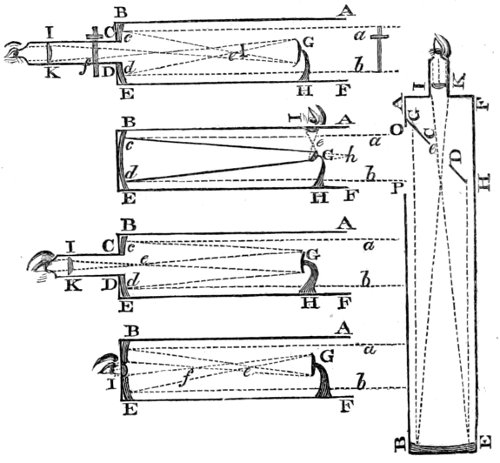 |
| fig. 63. |
| fig. 64. |
| fig. 65. |
Suppose the focal distance of the great mirror
was 9 inches, and the focal distance of the small
mirror 1½ inch—were we to remove the eye piece
of this telescope, and look through the hole of the
great mirror, we should see the image of the
object depicted upon the face of the small speculum,
and magnified, in the proportion of 9 to 1½,
or, 6 times, on the same principle as a common
convex object glass 9 inches focal length, with an
eye glass whose focus is 1½ inch magnifies 6 times.
This may be regarded as the first part of the
magnifying power. If now, we suppose the small
speculum placed a little more than 1½ inch from
the image formed by the great speculum, a second
image is formed about f, as much exceeding the
first in its dimensions as it exceeds it in distance
from the small speculum, on the principle on
which the object glass of a compound microscope
forms a large image near the eye glass. Suppose
this distance to be 9 times greater, then the whole
magnifying power will be compounded of 6 multiplied
by 9, or 54 times. As a telescope it magnifies
6 times, and in the microscope part 9 times.—Such
is a general idea of the Gregorian telescope,
the minute particulars and structure of which can
only be clearly perceived by a direct inspection of
the instrument.
The Newtonian Reflector.—This instrument is
somewhat different both in its form and in its mode
of operation from that of Gregory. It is represented
in fig. 63, where BAEF is the tube, and
BE, the object concave mirror, which reflects the
parallel rays ab to a plane speculum G, placed 45°,
or half a right angle to the axis of the concave
speculum. This small plane reflector must be of
an oval form, the length of the oval should be to
the breadth as 7 to 5, on account of the obliquity
of its position. It is supported on an arm fixed
to the side of the tube; an eye-glass is placed in
a small tube, moveable in the larger tube, so as to
be perpendicular to the axis of the large reflector,
the perpendicular line passing through the centre
of the small mirror. The small mirror is situated
between the large mirror and its focus, that its
distance from this focal point may be equal to the
distance from the centre of the mirror to the
focus of the eye-glass. When the rays ab from a
distant object fall upon the large speculum at cd,
they are reflected towards a focus at h; but being
intercepted by the plane mirror G, they are reflected
perpendicularly to the eye-glass at I, in the
side of the tube, and the image formed near that
position at e is viewed through a small plano-convex
lens. The magnifying power of this telescope
is in the proportion of the focal distance of
the speculum to that of the eye-glass. Thus, if
the focal distance of the speculum be 36 inches,
and that of the eye-glass 1/3 of an inch, the magnifying
power will be 108 times. It was this form
of the reflecting telescope, that Newton invented,
which Sir. W. Herschel adopted, and with which
he made most of his observations and discoveries.
The Cassegrainian Reflector.—This mode of
the reflecting telescope, suggested by M. Cassegrain,
a Frenchman, is represented in fig. 64. It
is constructed in the same way as the Gregorian,
with the exception of a small convex speculum G
being substituted in the room of the small concave
in Gregory’s construction. As the focus of a
convex mirror is negative, it is placed at a distance
from the large speculum equal to the difference
of their foci, that is, if the focal length of
the large speculum be 18 inches, and that of the
small convex 2 inches, they are placed at 16
inches distant from each other, on a principle
similar to that of the Galilean telescope, in which
the concave eye-glass is placed within the focus of
the object-glass by a space equal to the focal
length of the eye-glass. In this telescope, likewise,
instead of two there is only one image
formed, namely that in the focus of the eye-glass;
and, on this account some are of opinion that the
distinctness is considerably greater than in the
Gregorian. Mr. Ramsden was of opinion that
this construction is preferable to either of the
former reflectors, because the aberrations of the
two metals have a tendency to correct each other,
whereas in the Gregorian both the metals being
concave, any error in the specula will be doubled.
It is his opinion that the aberrations in the Cassegrainian
construction to that of the Gregorian is
as 3 to 5. The length of this telescope is shorter
than that of a Gregorian of equal focal length, by
twice the focal length of the small mirror, and it
shows every thing in an inverted position, and
consequently is not adapted for viewing terrestrial
objects.
Dr. Hook’s Reflector.—Before the reflecting
telescope was much known, Dr. Hook contrived
one, the form of which is represented, fig. 65,
which differs in little or nothing from the Gregorian,
except that the eye-glass I is placed in the
hole of the great speculum BE.
Martin’s Reflector.—Mr. Bengamin Martin, a
distinguished writer on optical and philosophical
science, about a century ago, described a new
form of the reflecting telescope, approximating to
the Newtonian structure, which he contrived for
his own use. It is represented in fig. 66. ABEF
is the tube, in which there is an opening or aperture
OP, in the upper part. Against this hole
within the tube is placed a large plane speculum
GH, at half a right angle with the axis or sides
of the tubes, with a hole CD perforated through
its middle. The parallel rays a b falling on the
inclined plane GH are reflected perpendicularly
and parallel on the great speculum BE in the
bottom of the tube. From thence they are reflected
converging to a focus e through the hole
of the plane mirror CD, which being also the
focus of the eye-glass IK, the eye will perceive
the object magnified and distinct.
In the figures referred to in the above descriptions,
only one eye-glass is represented to avoid
complexity; but in most reflecting telescopes, the
eye-piece consists of a combination of two plano-convex
glasses, as in fig. 67, which produces a
more correct and a larger field of view than a
single lens. This combination is generally known
by the name of the Huygenian eye-piece which
shall be described in the section on the eye-pieces
of telescopes.
The following rule has been given for finding
the magnifying power of the Gregorian telescope:—Multiply
the focal distance of the great mirror
by the distance of the small mirror from the image
next the eye; and multiply the focal distance of
the small mirror by the focal distance of the eye-glass;
then divide the product of the former multiplication
by the product of the latter, and the
quotient will express the magnifying power. The
following are the dimensions of one of the reflecting
telescopes constructed by Mr. Short—who
was long distinguished as the most eminent maker
of such instruments, on a large scale, and whose
large reflectors are still to be found in various observatories
throughout Europe.
The focal distance of the great mirror 9.6
inches; or P m, fig. 67, its breadth FD 2.3; the
focal distance of the small mirror L n 1.5—or 1½
inch—its breadth g h 0.6—or 6/10 of an inch; the
breadth of the hole in the great mirror UV, 0.5—or
half an inch—the distance between the small
mirror and the next eye-glass LR, 14.2; the distance
between the two eye-glasses SR, 2.4; the
focal distance of the eye-glass next the metal, 3.8.;
and the focal distance of the eye-glass next the
eye, S a 1.1, or one inch and one tenth. The magnifying
power of this telescope was about 60 times.
Taking this telescope as a standard, the following
table of the dimensions and magnifying powers of
Gregorian reflecting telescopes, as constructed by
Mr. Short, has been computed.
figure 67.
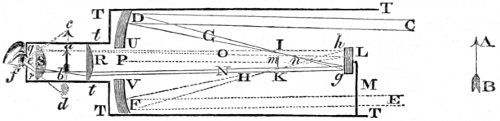
INDEX:
A: Focal distance of the great mirror.
B: Breadth of the great mirror.
C: Focus of the small speculum.
D: Breadth of the hole in the great speculum.
E: Distance between the small speculum and the first eye-glass.
F: Focal distance of the glass next the metals.
G: Focal distance of the glass next the eye.
H: Distance between the plain sides of the two glasses.
I: Magnifying power.
J: Distance between the second glass and the small eye-hole.
| A. |
B. |
C. |
D. |
E. |
| P |
m |
D |
F |
L |
n |
U |
V |
L |
R |
| In. |
Dec. |
In. |
Dec. |
In. |
Dec. |
In. |
Dec. |
In. |
Dec. |
| 5. |
65 |
1. |
54 |
1. |
10 |
0. |
31 |
8. |
54 |
| 9. |
60 |
2. |
30 |
1. |
50 |
0. |
39 |
14. |
61 |
| 15. |
50 |
3. |
30 |
2. |
14 |
0. |
50 |
23. |
81 |
| 36. |
00 |
6. |
26 |
3. |
43 |
0. |
65 |
41. |
16 |
| 60. |
00 |
9. |
21 |
5. |
00 |
0. |
85 |
68. |
17 |
| F. |
G. |
H. |
I. |
J. |
| R |
S |
R |
S |
|
|
|
| In. |
Dec. |
In. |
Dec. |
In. |
Dec. |
In. |
|
|
| 2. |
44 |
0. |
81 |
1. |
68 |
39 |
0. |
41 |
| 3. |
13 |
1. |
04 |
2. |
09 |
39 |
0. |
53 |
| 3. |
94 |
1. |
31 |
2. |
63 |
86 |
0. |
66 |
| 5. |
12 |
1. |
71 |
3. |
41 |
165 |
0. |
85 |
| 6. |
43 |
2. |
14 |
4. |
28 |
243 |
1. |
07 |
Mr. Short—who was born in Edinburgh in
1710, and died near London, 1768—was considered
as the most accurate constructor of reflecting
telescopes, during the period which intervened
from 1732, to 1768. In 1743, he constructed a
reflector for Lord Thomas Spencer, of 12 feet
focal length, for which he received 600 guineas.
He made several other telescopes of the same
focal distance, with greater improvements and
higher magnifiers; and in 1752, finished one for
the king of Spain, for which, with its whole apparatus,
he received £1200. This was considered
the noblest instrument of its kind that had then
been constructed, and perhaps it was never surpassed,
till Herschel constructed his twenty and
forty feet reflectors. High as the prices of large
telescopes now are, Mr. Short charged for his instruments
at a much higher rate than opticians
now do, although the price of labour, and every
other article required in the construction of a
telescope, is now much dearer. But he had then
scarcely any competitor, and he spared neither
trouble nor expense to make his telescopes perfect,
and put such a price upon them as properly
repaid him. The following table contains a statement
of the apertures, powers, and prices of
Gregorian telescopes, as constructed by Mr. James
Short.26
INDEX:
A: Number.
B: Focal length in inches.
C: Diameter of aperture in inches.
D: Prices in guineas.
| A. |
B. |
C. |
Magnifying powers. |
D. |
| 1 |
3 |
1.1 |
1 Power of |
18 times |
3 |
| 2 |
4½ |
1.3 |
1 Power of |
25 times |
4 |
| 3 |
7 |
1.9 |
1 Power of |
40 times |
6 |
| 4 |
9½ |
2.5 |
2 Powers |
40 and 60 times |
8 |
| 5} |
12 |
3.0 |
2 Powers |
55 and 85 times |
10 |
| 6} |
12 |
3.0 |
4 Powers |
35, 55, 85, and 110 times |
14 |
| 7 |
18 |
3.8 |
4 Powers |
55, 95, 130, and 200 times |
20 |
| 8 |
24 |
4.5 |
4 Powers |
90, 150, 230, and 300 times |
35 |
| 9 |
36 |
6.3 |
4 Powers |
100, 200, 300, and 400 times |
75 |
| 10 |
48 |
7.6 |
4 Powers |
120, 260, 380, and 500 times |
100 |
| 11 |
72 |
12.2 |
4 Powers |
200, 400, 600, and 800 times |
300 |
| 12 |
144 |
18.0 |
4 Powers |
300, 600, 900, and 1200 times |
800 |
From this table, it appears that Mr. Short
charged 75 guineas for a 3 feet reflector, whereas
such an instrument is now marked in the London
opticians’ catalogues at £23, when mounted on a
common brass stand, and £39. 18s., when accompanied
with rack-work motions and other apparatus.
It is now generally understood that in the
above table, Short always greatly overrated the
higher powers of his telescopes. By experiment
they were generally found to magnify much less
than here expressed.
General remarks on Gregorian Reflectors.—1.
In regard to the hole UV, of the great speculum—its
diameter should be equal, or nearly so, to
that of the small speculum L, fig. 67. For if it
be less, no more parallel rays will be reflected
than if it were equal to g h, and it may do harm
in contracting the visible area within too narrow
limits. Nor must it be larger than the mirror L,
because some parallel rays will then be lost, and
those of most consequence as being nearest the
centre. 2. The small hole at e to which the eye is
applied, must be nicely adjusted to the size of the
cone of rays proceeding from the nearest lens S. If
it be larger, it will permit the foreign light of the
sky or other objects to enter the eye, so as to prevent
distinct vision; for the eye should receive
no light, but what comes from the surface of the
small mirror L. If the hole be smaller than the
cylinder of rays at e then some of the necessary
light will be excluded, and the object rendered
more obscure. The diameter of this hole may
be found by dividing the aperture of the telescope
in inches by its magnifying power. Thus, if we
divide the diameter of one of Short’s telescopes,
the diameter of whose large speculum is 2.30, by
60, the magnifying power, the quotient will be
.0383, which is nearly the 1/25 of an inch. Sometimes
this hole is made so small as the 1/50 of an
inch. When this hole is, by any derangement,
shifted from its proper position, it sometimes requires
great nicety to adjust it, and, before it is
accurately adjusted, the telescope is unfit for accurate
observation. 3. It is usual to fix a plate
with a hole in it, at a b, the focus of the eye glass
S, of such a diameter as will circumscribe the
image, so as to exhibit only that part of it which
appears distinct, and to exclude the superfluous
rays. 4. There is an adjusting screw on the outside
of the great tube, connected with the small
speculum, by which that speculum may be pushed
backwards or forwards to adjust the instrument to
distinct vision. The hand is applied for this purpose
at T.
Newtonian Telescopes.—These telescopes are
now more frequently used for celestial observations
than during the last century, when Gregorian
reflectors were generally preferred. Sir W. Herschel
was chiefly instrumental in introducing this
form of the reflecting telescope to the more particular
attention of astronomers, by the splendour
and extent of the discoveries which it enabled
him to make. In this telescope there is no hole
required in the middle of the great speculum, as
in the Gregorian construction, which circumstance
secures the use of all the rays which flow from
the central parts of the mirror.
The following table contains a statement of the
apertures and magnifying powers of Newtonian
Telescopes, and the focal distances of their eye-glasses.
The first column contains the focal length
of the great speculum in feet; the second, its
linear aperture in inches; the third, the focal distance
of the single glass in decimals, or in 1000ths
of an inch, and the fourth column, contains the
magnifying power. This portion of the table was
constructed by using the dimensions of Mr. Hadley’s
Newtonian Telescope, formerly referred to, as
a standard—the focal distance of the great mirror
being 62½ inches, its medium aperture 5 inches,
and power 208. The fifth, sixth, and seventh
columns contains the apertures of the concave
speculum, the focal lengths of the eye-glasses and
the magnifying powers, as calculated by Sir D.
Brewster, from a telescope of Mr. Hauksbee,
taken as a standard; whose focal length was 3
feet 3 inches, its aperture about 4 inches, and
magnifying power 226 times.
INDEX:
A: Focal distance of concave metal.
B: Aperture of concave metal.
C: Focal distance of single eye-glass.
D: Magnifying power.
E: Aperture of the concave speculum.
F: Focal length of the eye-glass.
G: Magnifying power.
|
Sir D. Brewster’s Numbers. |
| A. |
B. |
C. |
D. |
E. |
F. |
G. |
| Feet. |
Inch. |
Dec. |
In. |
Dec. |
|
Inch. |
Dec. |
In. |
Dec. |
|
| 0½ |
0. |
86 |
0. |
167 |
36 |
1. |
34 |
0. |
107 |
56 |
| 1 |
1. |
44 |
0. |
199 |
60 |
2. |
23 |
0. |
129 |
93 |
| 2 |
2. |
45 |
0. |
236 |
102 |
3. |
79 |
0. |
152 |
158 |
| 3 |
3. |
31 |
0. |
261 |
138 |
5. |
14 |
0. |
168 |
214 |
| 4 |
4. |
10 |
0. |
281 |
171 |
6. |
36 |
0. |
181 |
265 |
| 5 |
4. |
85 |
0. |
297 |
202 |
7. |
51 |
0. |
192 |
313 |
| 6 |
5. |
57 |
0. |
311 |
232 |
8. |
64 |
0. |
200=1/5 |
360 |
| 7 |
6. |
24 |
0. |
323 |
260 |
9. |
67 |
0. |
209 |
403 |
| 8 |
6. |
89 |
0. |
334 |
287 |
10. |
44 |
0. |
218 |
445 |
| 9 |
7. |
54 |
0. |
344 |
314 |
11. |
69 |
0. |
222 |
487 |
| 10 |
8. |
16 |
0. |
353 |
340 |
12. |
65 |
0. |
228 |
527 |
| 11 |
8. |
76 |
0. |
362 |
365 |
13. |
58 |
0. |
233 |
566 |
| 12 |
9. |
36 |
0. |
367 |
390 |
14. |
50 |
0. |
238 |
604 |
| 13 |
9. |
94 |
0. |
377 |
414 |
15. |
41 |
0. |
243 |
642 |
| 14 |
10. |
49 |
0. |
384 |
437 |
16. |
25 |
0. |
248 |
677 |
| 15 |
11. |
04 |
0. |
391 |
460 |
17. |
11 |
0. |
252 |
713 |
| 16 |
11. |
59 |
0. |
397 |
483 |
17. |
98 |
0. |
256 |
749 |
| 17 |
12. |
14 |
0. |
403 |
506 |
18. |
82 |
0. |
260 |
784 |
| 18 |
12. |
67 |
0. |
409 |
528 |
19. |
63 |
0. |
264 |
818 |
| 19 |
13. |
20 |
0. |
414 |
550 |
20. |
45 |
0. |
268 |
852 |
| 20 |
13. |
71 |
0. |
420 |
571 |
21. |
24 |
0. |
271 |
885 |
One great advantage of reflecting telescopes
above common refractors, is, that they will admit
of eye glasses of a much shorter focal distance,
and consequently, will magnify so much the more,
for the rays are not coloured by reflection from a
concave mirror, if it be ground to a true figure,
as they are by passing through a convex glass
though figured and polished with the utmost
exactness. It will be perceived from the above
table, that the focal length of the eye glasses is
very small, the lowest there stated being only
about 1/10 of an inch, and the highest little more
than ¼ of an inch focal distance. Sir W. Herschel
obtained the high powers which he sometimes put
upon his telescopes, by using small double convex
lenses for eye glasses, some of which did not exceed
the one fiftieth of an inch in focal length.
When the focal length of the concave speculum,
and that of the eye glass are given, the magnifying
power is found by dividing the former by the
latter, after having reduced the focal length of the
concave speculum to inches. Thus the 6 feet
speculum, multiplied by 12, produces 72 inches,
which, divided by Brewster’s number for the
focus of the eye glass = 200, or 1/5 of an inch, produces
a quotient of 360 as the magnifying power.
It has been calculated that, if the metals of a
Newtonian telescope be worked as exquisitely as
those in Sir W. Herschel’s 7 feet reflector, the
highest power that such a telescope should bear
with perfect distinctness, will be found by multiplying
the diameter of the great speculum in
inches, by 74, and the focal distance of the single
eye glass may be found by dividing the focal distance
of the great mirror by the magnifying power.
Thus 6.25—the aperture in inches of Herschel’s
7 feet Newtonian—multiplied by 74 is 462½, the
magnifying power; and 7 multiplied by 12, and
divided by 462.5 is 0.182 of an inch, the focal
distance of the single eye glass required. But it
is seldom that more than one half of this power
can be applied with effect to any of the planetary
bodies. For general purposes the power produced
by multiplying the diameter of the speculum
by 30, or 40, will be found most satisfactory.
The following are the general prices of reflecting
telescopes as made by the London opticians.
|
£ |
s. |
| A four feet, seven inch aperture, Gregorian Reflector; with
the vertical motions upon a new invented principle, as well as
apparatus to render the tube more steady in observation;
according to the additional apparatus of small speculums,
eye-pieces, micrometers, &c. from |
80 to 120 |
0 |
| Three feet long, mounted on a plain brass stand |
23 |
2 |
| Ditto, with rack-work motions, improved mounting, and
metals |
39 |
18 |
| Two feet long without rack-work, and with 4 magnifying
powers, improved |
15 |
15 |
| Ditto with rack-work motion |
22 |
1 |
| Eighteen inch on a plain stand |
9 |
9 |
| Twelve inch Ditto |
6 |
6 |
The above are the prices stated in Messrs. W.
and S. Joneses catalogue.
The following list of prices of the various kinds
of reflecting telescopes is from Messrs. Tulley’s
(of Islington) catalogue.
|
£ |
s. |
| 1 foot Gregorian reflector, on pillar and claw stand, metal
2½ inches diameter, packed in a mahogany box |
6 |
6 |
| 1½ foot ditto, on pillar and claw stand, metal 3 inches
diameter, packed in mahogany box |
11 |
11 |
| 2 feet ditto, metal 4 inches diameter |
16 |
16 |
| Ditto, ditto, with rack-work motions |
25 |
4 |
| 3 feet ditto, metal 5 inches diameter, with rack-work
motions |
42 |
0 |
| Ditto, metal 6 inches diameter, on a tripod stand, with centre
of gravity motion |
68 |
5 |
| 4 feet ditto, metal 7 inches diameter, as above |
105 |
0 |
| 6 feet ditto, metal 9 inches diameter, on an improved iron
stand |
210 |
0 |
| 7 feet Newtonian reflectors, 6 inches aperture, mounted on
a new and improved stand |
105 |
0 |
| Ditto, ditto, metal 7 inches diameter |
126 |
0 |
| 9 feet ditto, metal 9 inches diameter |
210 |
0 |
| 10 feet ditto, metal 10 inches diameter |
315 |
0 |
| 12 feet ditto, metal 12 inches diameter |
525 |
0 |
Comparative brightness of achromatic and reflecting
telescopes. The late astronomer royal,
Dr. Maskelyne, from a comparison of a variety of
telescopes, was led to the following conclusion,—‘that
the aperture of a common reflecting telescope,
in order to show objects as bright as the
achromatic must be to that of an achromatic
telescope as 8 to 5,’—in other words, an achromatic
whose object glass is 5 inches diameter,
will show objects with as great a degree of brightness
as a reflector whose large speculum is 8 inches
in diameter. This result, if correct, must be
owing to the small number of rays reflected from
a speculum compared with the number transmitted
through an achromatic object glass.
Soon after Sir William Herschel commenced his
astronomical career, he introduced a new era in
the history of reflecting telescopes. After he had
cast and polished an immense variety of specula
for telescopes of different sizes-he, at length, in
the year 1782, finished a 20 feet reflector with a
large aperture. Being sensible of the vast quantity
of light which is lost by a second reflection from
the small speculum, he determined to throw it
aside altogether, and mounted this 20 feet reflector
on a stand that admitted of being used without
a small speculum in making front observations—that
is, in sitting with his back to the object, and
looking directly towards the surface of the speculum.
Many of his discoveries and measurements
of double stars were made with this instrument,
till, at length, in the year 1785 he put the finishing
hand to that gigantic speculum, which soon became
the object of universal astonishment, and
which was intended for his forty feet reflecting
telescope; he had succeeded so well in constructing
reflecting telescopes of comparatively small
aperture, that they would bear higher magnifying
powers than had ever previously been applied;
but he found that a deficiency of light could only
be remedied by an increased diameter of the
large speculum, which therefore was his main
object, when he undertook to accomplish a work
which to a man less enterprising, would have
appeared impracticable. The difficulties he had
to overcome were numerous; particularly in the
operative department of preparing, melting,
annealing, grinding, and polishing a mass of
metal that was too unwieldly to be moved without
the aid of mechanical powers. At length, however,
all difficulties having been overcome, this
magnificent instrument was completed with all its
complicated apparatus, and erected for observation,
on the 28th of August, 1789, and on the
same day the sixth satellite of Saturn was detected,
as a prelude of still farther discoveries which were
afterwards made by this instrument, in the celestial
regions.
It would be too tedious to attempt a description
of all the machinery and apparatus connected with
this noble instrument. The reader who wishes to
peruse a minute description of the stairs, ladders,
platform, rollers, and of every circumstance relating
to joiner’s work, carpenter’s work, smith’s work,
and other particulars connected with the formation
and erection of this telescope, will find the details
recorded in the 85th volume of the Philosophical
Transactions of the Royal Society of London, for
1795, in which there are sixty-three pages of
letter press, and eighteen plates illustrative of the
subject. I shall content myself with giving a
short outline of the essential parts belonging to
this instrument.
The tube of this telescope is made of rolled or
sheet iron, joined together without rivets; the
thickness of the sheets is somewhat less than 1/36
part of an inch, or 14 pounds weight for a square
foot; great care was taken that the cylindrical
form should be secured, and the whole was coated
over three or four times with paint, inside and
outside, to secure it against the damp. This tube
was removed from the place in which it was formed
by twenty-four men, divided into six sets; so that
two men on each side, with a pole of 5 feet long
in their hands, to which was affixed a piece of
course cloth, 7 feet long going under the tube,
and joined to a pole 5 feet long, in the hands of
two other men, assisted in carrying the tube. The
length of this tube is 39 feet 4 inches, the diameter
4 feet 10 inches; and, on a moderate computation,
it was ascertained, that a wooden tube of
proper dimensions would have exceeded an iron
one in weight by at least 3000 pounds. Reckoning
the circumference of the tube 15 feet, its
length 39⅓ feet, and 14 lib. for the weight of a
square foot, it must have contained 590 square
feet, and weighed 8,260 pounds. Various hoops
were fixed within the tube, and longitudinal bars
of iron connecting some of them are attached to
the two ends of the tube, by way of bracing the
sheets, and preserving the shape perfect, when the
pulleys are applied to give the necessary elevation
at the upper end, and that the speculum may be
kept secure at the lower end. The lower end of
the tube is firmly supported on rollers that are
capable of being moved forwards or backwards by
a double rack, connected with a set of wheels and
pinions. By an adjustment at the lower extremity
of the tube, the speculum is turned to a
small inclination, so that the line of collimation
may not be coincident with the longitudinal axis
of the tube, but may cross the tube diagonally,
and meet the eye in the air at about two inches
from the edge of the tube, which is the peculiarity
of the construction, that supersedes the necessity
of applying a second reflector. Hence no part
of the head of the observer intercepts the incident
rays, and the observation is taken with the face
looking at the speculum, the back being turned
to the object to be observed.
The large speculum is enclosed in a strong iron
ring, braced across with bars of iron, and an
enclosure of iron and ten sheets makes a case for
it. It is lifted by three handles of iron attached
to the sides of the ring, and is put into and taken
out of its proper place in the tube by the help
of a moveable crane, running on a carriage, which
operation requires great care. The speculum is
made of a metallic composition, and is 49½ inches
in diameter; but the concave polished surface is
only 48 inches, or 4 feet in diameter. Its thickness
is 31 inches; and when it came from the cast
its weight was 2118 pounds. The metals for its
formation were procured at a warehouse in
Thames Street, London, where they kept ingots
of two kinds ready made, one of white, and the
other of bell-metal; and it was composed of two
ingots of bell-metal for one of white. It was not
to be expected that a speculum of such large
dimensions, could have a perfect figure imparted
to its surface, nor that the curve, whatever it
might be, would remain identically the same in
changes of temperature; therefore we are not
surprised when we are told, that the magnifying
powers used with this telescope seldom exceeded
200; the quantity of light collected by so large a
surface being the principal aim of the maker.
The raising of the balcony, on which the observer
stands, and the sliding of the lower end of the
tube, in which the speculum rests, are effected by
separate tackles, and require only occasional motions;
but the elevation of the telescope requires
the main tackle to be employed, and the motion
usually given in altitude at once was two degrees;
the breadth of the zone in which the observations
were made, as the motion of the sphere in right
ascension brought the objects into view. A star,
however, could be followed for about a quarter of
an hour. Three persons were employed in using
this telescope, one to work the tackle, another
to observe, and a third to mark down the observations.
The elevation was pointed out by a small
quadrant fixed to the main tube, near the lower
end, but the polar distance was indicated by a
piece of machinery, worked by a string, which
continually indicated the degree and minute on
a dial in the small house adjoining, while the
time was shown by a clock in the same place,
Miss Herschel performing the office of Registrar.
At the upper end the tube is open, and directed
to the part of the heavens intended for observation,
and the observer, standing on the foot board,
looks down the tube, and perceives the object by
rays reflected from the speculum, through the eye
glass at the opening of the tube. When the
telescope is directed to any objects near the zenith,
the observer is necessarily at an elevation at least
40 feet from the ground. Near the place of the
eye glass is the end of a tin pipe, into which a
mouth-piece may be placed, so that, during an
observation, a person may direct his voice into this
pipe, while his eye is at the glass. This pipe,
which is 1½ inch in diameter runs down to the
bottom of the tube, where it goes into a turning
joint, thence into a drawing tube, and out of this
into another turning joint, from whence it proceeds,
by a set of sliding tubes towards the front of the
foundation timber. Its use is to convey the voice
of the observer to his assistants, for at the last
place, it divides itself into two branches, one going
into the observatory, the other into the workman’s
room, ascending in both places through the floor,
and terminates in the usual shape of speaking
trumpets. Though the voice passes in this manner
through a tube, with many inflections, and through
not less than 115 feet, it requires very little exertion
to be well understood.
To direct so unwieldy a body to any part of the
heavens at pleasure, many mechanical contrivances
were evidently necessary. The whole apparatus
rests upon rollers, and care was previously taken
of the foundation in the ground. This consists
of concentrical brick walls, the outermost 42
feet, the innermost 21 feet in diameter, 2 feet
6 inches deep under ground, 2 feet 3 inches broad
at the bottom, and 1 foot 2 inches at the top,
capped with paving stones 3 inches thick, and
12¾ inches broad.
In the centre is a large post of oak, framed
together with braces under ground, and walled
fast to brick-work to make it steady. Round this
centre the whole frame is moved horizontally by
means of 20 rollers, 12 upon the outer, and 8
upon the inner wall. The vertical motion is
given to the instrument by means of ropes and
pullies, passing over the main beam supported by
the ladders. These ladders are 49 feet long, and
there is a moveable gallery with 24 rollers to ease
its motion. There is a stair-case intended for
persons who wish to ascend into the gallery,
without being obliged to go up the ladder.
The ease with which the horizontal and vertical
motions may be communicated to the tube may
be conceived, from a remark of Sir W. Herschel,
that, in the year 1789, he several times observed
Saturn, two or three hours before and after its
meridian passage with one single person to continue,
at his directions, the necessary horizontal
and vertical motions.
By this telescope the sixth and seventh satellites
of Saturn were discovered, only one of which is
within the reach of the 20 feet reflector, or even
of a 25 feet instrument. The discovery of the
satellites of the planet Uranus, however, was made
by the 20 feet reflector, but only after it had been
converted from the Newtonian to the Herschelian
construction—which affords a proof of the superiority
of the latter construction over the former
when the same speculum is used. Never had the
heavens before been observed with so extraordinary
an instrument as the forty feet reflector. The
nebulosities which are found among the fixed
stars, in various regions of the heavens, appeared
almost all to resolve themselves into an innumerable
multitude of stars; others, hitherto imperceptible,
seemed to have acquired a distinct light.
On the entrance of Sirius into the field of the
telescope, the eye was so violently affected, that
stars of less magnitude could not immediately
after be perceived; and it was necessary to wait
for 20 minutes before these stars could be observed.
The ring of Saturn had always before ceased to
be visible when its plane was directed towards the
earth; but the feeble light which it reflects in
that position was enough for Herschel’s instrument,
and the ring, even then, still remained
visible to him.
It has been generally considered that this telescope
was capable of carrying a power of 6000
times; and perhaps for the purpose of an experiment,
and for trying its effect on certain objects,
such a power may have been applied,—in which
case the eye-glass must have been only 2/25 of an
inch focal distance, or somewhat less than one
twelfth of an inch. But such a power could not
be generally applied, with any good effect, to the
planetary bodies; and I question much whether
any power above 1000 times was ever generally
used. For, it is the quantity of light which the
telescope collects, more than the magnifying
power, that enables us to penetrate, with effect,
into the distant spaces of the firmament: and
hence, as above stated, the power seldom exceeded
200, which on account of the large diameter of
the speculum, would enable the instrument to
penetrate into the distant celestial spaces perhaps
further than if a power of as many thousands of
times had been applied.
Sir John Herschel, who inherits all the science,
skill, and industry of his father, some time ago
ground and polished a new speculum for the 20
feet tube, formerly noticed, which is connected
with a stand, pulleys and other appendages, similar
to those above described, though of smaller dimensions.
This telescope shows the double stars
exceedingly well defined, and was one of the
principal instruments used in forming his catalogue
of these objects which was presented to the Royal
Society, in conjunction with that of Sir James
South, about the year 1828. I suppose, it is
likewise the same telescope with which Sir John
lately made his Sidereal observations at the Cape
of Good Hope.
The largest front view reflecting telescope in
this country—next to Herschel’s 40 feet instrument—is
that which was erected at the Royal
Observatory at Greenwich, in the year 1820, by
Mr. Ramage of Aberdeen. The diameter of the
concave reflector is 15 inches, and its focal length
25 feet. It is erected on machinery which bears
a certain resemblance to that of Herschel’s, which
we have now described; but the mechanical arrangements
are greatly simplified, so that the instrument
is manageable by an observer without
an assistant. The tube is composed of a twelve-sided
prism of deal 5/8 inch thick. At the mouth
is a double cylinder of different diameters on the
same axis; around this a cord is wound by a
winch, and passes up from the small cylinder, over
a pulley, and down through another pulley on to
the large cylinder. When the winch, therefore,
is turned to raise the telescope, the endless cord
is unwound from the smaller cylinder, and wound
on to the larger, the difference of the size of the
two cylinders will be double the quantity raised,
and a mechanical force to any extent may thus be
obtained, by duly proportioning the diameters of
the two cylinders: by this contrivance the necessity
of an assistant is superseded. The view
through this instrument first astonished those observers
who had not been accustomed to examine
a heavenly body with a telescope possessing so much
light; and its performance was deemed quite extraordinary.
But when the first impression had subsided,
and different trials had been made in different
states of the atmosphere, it was discovered
that the central portion of the speculum was
more perfectly figured than the ring bordering on
the extreme edges. When the aperture was
limited to ten or twelve inches, the performance
as to the distinctness in its defining power, was
greatly improved, and the light was so brilliant,
that the Astronomer Royal was disposed to entertain
an opinion, that it might equal that of a good
achromatic refractor of the same dimensions.
When, however, very small and obscure objects
are to be observed, the whole light of the entire
aperture may be used with advantage on favourable
evenings.
The eye-pieces adapted to this telescope have
powers which magnify the object linearly from
100 to 1500 times, which are competent to fulfil
all the purposes of vision when cleared of aberration.
When the telescope is placed in the plane
of the meridian and elevated together with the
gallery, into any required altitude, the meridional
sweeps, formerly practised by Sir W. Herschel,
and continued by Sir John with great success, in
the examination of double stars and nebula, may
be managed with great ease.
Mr. Ramage had a telescope of about the same
size, erected in an open space in Aberdeen, which
I had an opportunity of inspecting when I paid
a visit to that gentleman in 1833; but cloudy
weather prevented my obtaining a view of any
celestial bodies through it. He showed me at that
time two or three large speculums, from 12 to 18
inches in diameter, which he had finished some
time before, and which appeared most beautifully
polished. He told me, too, that he had ground
and polished them simply with his hand, without
the aid of any machinery or mechanical power—a
circumstance which, he said, astonished the opticians
of London, when it was stated, and which
they considered as almost incredible. His experience
in casting and polishing metals of various
sizes, during a period of 15 or 16 years, qualified
him to prepare specula of great lustre, and with
an unusually high polish. It has been asserted
that a fifty feet telescope by Ramage of 21 inches
aperture was intended to be substituted for the
25 feet instrument erected at Greenwich, and the
speculum it is understood, was prepared, and
ready for use, provided the Navy Board was disposed
to defray the expense of carrying the plan
into execution. But, unfortunately, this ingenious
artist was unexpectedly cut off in the midst
of his career, about the year 1835.
A particular description of this telescope was
given in the ‘Edinburgh New Philosophical
Journal’ for April—July, 1826, conducted by
Professor Jameson, the greater part of which was
copied in the ‘London Encyclopedia,’ ] under the
article Telescope. From this description I shall
endeavour to condense a brief account of this instrument
with a few additional remarks.
About the year 1822, an old speculum 27 inches
in focal length, very imperfectly polished happened
accidentally to come into my possession; and
feeling no inclination to fit it up in the Gregorian
form, I formed the resolution of throwing aside
the small speculum, and attempting the front view
notwithstanding the uniform assertion of opticians,
that such an attempt in instruments of a small
size is impracticable. I had some ground for expecting
success in this attempt, from several experiments
I had previously made, particularly from
some modifications I had made in the construction
of astronomical eye-pieces, which have a tendency
to correct the aberration of the rays of light,
when they proceed somewhat obliquely from a
lens or speculum. In the first instance, I placed
the speculum at the one end of a tube of the form
of a segment of a cone—the end next the eye being
somewhat wider than that at which the speculum
was fixed, and its length about an inch shorter
than the focal distance of the mirror. A small
tube for receiving the different eye-pieces was
fixed in the inside of the large tube at the end
next the eye, and connected with an apparatus by
which it could occasionally be moved either in a
vertical or horizontal direction. With the instrument
fitted up in this manner, I obtained some
interesting views of the moon, and of terrestrial
objects. But finding that one side of the tube
intercepted a considerable portion of light from
the object, I determined to throw aside the tube
altogether, and to fit up the instrument on a different
plan.
A short mahogany tube, about 3 inches long,
was prepared, to serve as a socket for holding the
speculum. To the side of this tube an arm was
attached, about the length of the focal distance of
the mirror, at the extremity of which a brass tube
for receiving the eye-pieces, was fixed, connected
with screws and sockets, by which it might be
raised or depressed, and turned to the right hand
or to the left, and with adjusting apparatus by
which it might be brought nearer to or farther from
the speculum. Fig. 69 exhibits a general representation
of the instrument in profile. AB is the
short tube which holds the speculum; CD the
arm which carries the eye-tubes, which consists of
two distinct pieces of mahogany; the part D
being capable of sliding along the under side of
C, through the brass sockets EF. To the under
part of the socket F is attached a brass nut with
a female screw, in which the male screw ab acts
by applying the hand to the knob c, which serves
for adjusting the instrument to distinct vision. G
is the brass tube which receives the eye-pieces.
It is supported by a strong brass wire de, which
passes through a nut connected with another
strong wire, which passes through the arm D. By
means of the nut f this tube may be elevated or
depressed, and firmly fixed in its proper position;
and by the nut d it may be brought nearer to or
further from, the arm D.
figure 69.
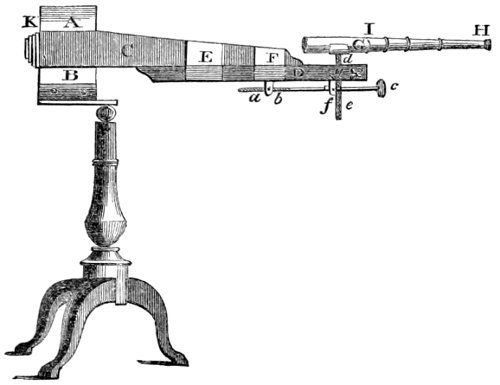
By the same apparatus, it is also rendered capable
of being moved either in a vertical or horizontal
direction: but when it is once adjusted to its
proper position, it must be firmly fixed, and
requires no further attention. The eye-piece represented
in this figure is the one used for terrestrial
objects, which consists of the tubes belonging
to a pocket achromatic telescope. When an astronomical
eye-piece is used, the length of the
instrument extends only to the point I. In looking
through this telescope, the right eye is applied
at the point H, and the observer’s head is understood
to be uncovered, or, at least, tightly covered
with a thin cap. For those who use only the left
eye, the arm would require to be placed on the
opposite side of the tube, or the arm, along with
the tube, be made to turn round 180 degrees.
figure 70.
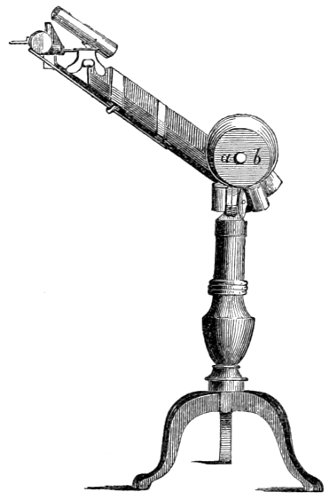
Fig. 70 represents a front, or rather an oblique
view of the instrument, in which the position of
the speculum may be seen. All the specula which
I fitted up in this form, having been originally
intended for Gregorian reflectors, have holes in
their centres. The eye-piece is therefore directed
to a point nearly equi-distant from the hole to
the left hand edge of the speculum, that is, to the
point a. In one of these instruments fitted up
with a four feet speculum, the line of vision is
directed to the point b on the opposite side of the
speculum, but, in this case, the eye-tube is removed
farther from the arm, than in the former
case. The hole in the centre of the speculum is
obviously a defect in this construction of a reflecting
telescope, as it prevents us from obtaining the
full advantage of the rays which fall near the
centre of the mirror; yet the performance of the
instruments, even with this disadvantage, is superior
to what we should previously have been led to
expect.
The principal nicety in the construction of this
instrument, consists in the adjustment and proper
direction of the eye-tube. There is only one
position in which vision will be perfectly distinct.
It must be neither too high nor too low,—it must
be fixed at a certain distance from the arm,—and
must be directed to a certain point of the speculum.
This position must be ultimately determined
by experiment, when viewing terrestrial objects.
A person unacquainted with this construction of
the telescope, would, perhaps, find it difficult, in
the first instance, to make this adjustment; but
were it at any time deranged, through accident or
otherwise, I can easily make the adjustment anew,
in the course of a minute or two.
In pointing this telescope to the object intended
to be viewed, the eye is applied at K, fig, 69, and
looking along the arm, towards the eye-piece, till it
nearly coincide with the object, it will, in most
cases, be readily found. In this way I can easily
point this instrument to Jupiter or Saturn, or to
any of the other planets, visible to the naked eye,
even when a power of 160 or 170 times is applied.
When high magnifying powers, however, are used,
it may be expedient to fix, on the upper part of
the short tube in which the speculum rests, a
Finder, such as that which is used in Newtonian
telescopes. When the moon is the object intended
to be viewed, she may be instantly found by
moving the instrument till her reflected image be
seen from the eye-end of the telescope on the face
of the mirror.
I have fitted up several instruments of the
above description with specula of 16, 27, 35, and
49 inches focal distance. One of these having a
speculum of 27 inches focal length, and an astronomical
eye-piece, producing a magnifying power
of about 90 times, serves as a good astronomical
telescope. By this instrument the belts and satellites
of Jupiter, the ring of Saturn, and the mountains
and cavities of the moon, may be contemplated
with great ease and distinctness. With a
magnifying power of 35 or 40 times, terrestrial
objects appear remarkably bright and well-defined.
When compared with a Gregorian, the quantity of
light upon the object appears nearly doubled, and
the image is equally distinct—although the speculum
has several blemishes, and its surface is but
imperfectly polished. It represents objects in
their natural colours, without that dingy and yellowish
tinge which appears when looking through
a Gregorian. Another of these instruments is
about four feet long. The speculum which
belongs to it is a very old one: when it came into
my possession, it was so completely tarnished, as
scarcely to reflect a ray of light. After it was
cleaned, it appeared to be scarcely half polished,
and its surface is covered with yellowish stains
which cannot be erased. Were it fitted up upon
the Gregorian plan, it would, I presume, be of
very little use, unless when a very small magnifying
power was applied. Yet, in its present form,
it bears, with distinctness, a magnifying power of
130 times, and is equal in its performance to a 3½
feet achromatic. It exhibits distinct and interesting
views of the diversities of shade, and of the
mountains, vales, cavities, and other inequalities
of the moon’s surface. With a power of about
50 times, and a terrestrial eye-piece, it forms an
excellent telescope for land objects, and exhibits
them in a brilliant and novel aspect. The smallest
instrument I have attempted to construct on this
plan, is only 5½ inches focal distance, and 1¾ inch
diameter. With a magnifying power of about 15
times, it shows terrestrial objects with distinctness
and brilliancy. But I should deem it inexpedient
to fit up any instrument of this description with
specula of a shorter focal distance than 20 or 24
inches. The longer the focal distance the more
distinctness may be expected, although the aperture
of the speculum should be comparatively
small.
The following are some of the properties and
advantages peculiar to this construction of the
reflecting telescope.
1. It is extremely simple, and may be fitted up
at a comparatively small expense. Instead of
large and expensive brass tubes, such as are used
in the Gregorian and Newtonian construction,
little more is required than a short mahogany
tube, two or three inches long, to serve as a socket
for the speculum, with an arm connected with it
about the focal length of the speculum. The expense
of small specula, either plain or concave,
is saved, together with the numerous screws,
springs, &c., for centering the two specula, and
placing the small mirror parallel to the large one.
The only adjustment requisite in this construction,
is that of the eye-tube to the speculum; and, by
means of the simple apparatus above described, it
can be effected in the course of a few minutes.
Almost the whole expense of the instrument consists
in the price of the speculum and the eye-pieces.
The expense of fitting up the four feet
speculum, alluded to above—exclusive of speculum
and eye-piece—but including mahogany tube
and arm, brass sockets, screws, eye-tube, brass
joint, and a cast-iron stand painted and varnished,
did not amount to £1 : 8s. A Gregorian of the
same size would have required a brass tube at
least 4½ feet in length, which would cost 5
or 6 guineas, besides the apparatus connected
with the small speculum, and the additional expense
connected with the fitting up of the joint
and stand requisite for supporting and steadying
so unwieldy an instrument. While the one instrument
would require two persons to carry it
from one room to another, and would occupy a
considerable space in an ordinary apartment, the
other can be moved, with the utmost ease, with
one hand, to any moderate distance, and the space
it occupies is extremely small.
2. It is more convenient for viewing celestial
objects at a high altitude, than other telescopes.
When we look through a Gregorian reflector or
an achromatic telescope of 4 or 5 feet in length,
to an object elevated 50 or 60 degrees above the
horizon, the body requires to be placed in an
uneasy and distorted position, and the eye is
somewhat strained, while the observation is continued.
But when viewing similar objects by the
Aerial Reflector, we can either stand perfectly
erect, or sit on a chair, with the same ease as we
sit at a desk when reading a book or writing a
letter. In this way, the surface of the moon or
any of the planets, may be contemplated for an
hour or two, without the least weariness or fatigue.
A delineation of the lunar surface may be taken
with this instrument with more ease and accuracy
than with any other instrument, as the observer
can sketch the outline of the object by one eye
on a tablet placed a little below the eye-piece,
while the other eye is looking at the object.
For the purpose of accommodating the instrument
to a sitting or standing posture a small table was
constructed, capable of being elevated or depressed
at pleasure, on which the stand of the telescope is
placed. When the telescope is 4 or 5 feet long,
and the object at a very high elevation, the instrument
may be placed on the floor of the apartment,
and the observer will stand in an erect position.
3. This instrument is considerably shorter than
a Gregorian telescope whose mirror is of the
same focal length. When an astronomical eye-piece
is used, the whole length of the instrument
is nothing more than the focal length of the speculum.
But a Gregorian whose large speculum is
4 feet focus, will be nearly 5 feet in length, including
the eye-piece.
4. The Aerial Reflector far excels the Gregorian
in brightness. The deficiency of light in the
Gregorians is owing to the second reflection from
the small mirror; for it has been proved by experiment
that nearly the one half of the rays of
light which fall upon a reflecting surface is lost by
a second reflection. The image of the object may
also be presumed to be more correct, as it is not
liable to any distortion by being reflected from
another speculum.
5. There is less tremor in these telescopes than
in Gregorian Reflectors. One cause, among
others, of the tremors complained of in Gregorians
is, I presume, the formation of a second
image at a great distance from the first, besides
that which arises from the elastic tremor of the
small speculum, when carried by an arm supported
only at one end. But as the image formed by
the speculum in the aerial telescope is viewed
directly, without being exposed to any subsequent
reflection, it is not so liable to the tremors which
are so frequently experienced in other reflectors.
Notwithstanding the length of the arm of the 4
feet telescope above mentioned, a celestial object
appears remarkably steady, when passing across
the field of view, especially when it is at a moderate
degree of altitude; and it is easily kept in
the field by a gentle motion applied to the arm of
the instrument.
In prosecuting my experiments in relation to
these instruments, I wished to ascertain what
effect might be produced by using a part of a
speculum instead of the whole. For this purpose,
I cut a speculum, three feet in focal length,
through the centre, so as to divide it into two equal
parts, and fitted up each part as a distinct telescope;
so that I obtained two telescopes from one
speculum. In this case I found that each half of
the speculum performed nearly as well as the
whole speculum had done before, at least there
appeared to be no very sensible diminution in the
brightness of the object, when viewed with a
moderate power, and the image was equally accurate
and distinct; so that if economy were a particular
object aimed at in the construction of these
instruments, two good telescopes might be obtained
from one speculum; or if a speculum happened
to be broken accidentally into large fragments, one
or more of the fragments might be fitted up on
this principle to serve as a tolerably good telescope.
From the experiments I have made in reference
to these instruments, it is demonstrable, that a
tube is not necessary in the construction of a reflecting
telescope—at least on the principle now
stated—whether it be used by day or by night for
terrestrial or celestial objects; for I have frequently
used these telescopes in the open air in
the day time, without any inconvenience from extraneous
light. Therefore, were a reflecting
telescope of 50 or 60 feet in length to be constructed,
it might be fitted up at a comparatively
small expence, after the expense of the metallic
substances, and of casting, grinding, and polishing
the speculum is defrayed. The largest instrument
of this description which has hitherto been constructed
is the 40 feet reflector of Sir W. Herschel.
This complicated and most unwieldy instrument
had a tube of rolled or sheet iron 39 feet 4 inches
in length, about 15 feet in circumference, and
weighed about 8000 pounds. Now, I conceive
that such enormous tubes, in instruments of such
dimensions, are altogether unnecessary. Nothing
more is requisite than a short tube for holding the
speculum. Connected with one side of this tube
(or with both sides were it found necessary), two
strong bars of wood, projecting a few feet beyond
the speculum end, and extending in front as far
as the focal length of the mirror, and connected
by cross bars of wood, iron or brass—would be
quite sufficient for a support to the eye-piece, and
for directing the motion of the instrument. A
telescope of 40 or 50 feet in length, constructed
on this plan, would not require one fifth of the
expense, nor one fourth of the apparatus and
mechanical power for moving it to any required
position, which were found necessary in the construction
of Sir W. Herschel’s large reflecting
telescope. The idea here suggested will perhaps
be more readily appreciated by an inspection of
fig. 71, where A is the short tube, BC and DE
the two large bars or arms, connected with cross
bars, for the purpose of securing strength and
steadiness. At I and K, behind the speculum,
weights might be applied, if necessary, for counterbalancing
the lever power of the long arm. F
represents the position of the eye-piece, and GH
the joint and part of the pedestal on which the
instrument is placed. With regard to telescopes
of smaller dimensions, as from 5 to 15 feet in
focal length—with the exception of the expense
of the specula and eye-pieces—they might be
fitted up for a sum not greater than from 3 to 10
or 15 guineas.
figure 71.
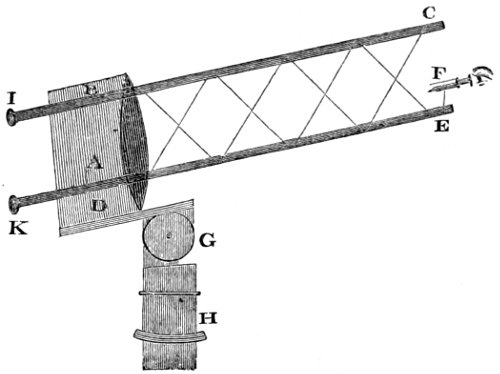
Were any person to attempt the construction
of those telescopes, it is possible he might not
succeed in his first attempts without more minute
directions than I have yet given. The following
directions may perhaps tend to guide the experimenter
in adjusting the eye-tube to the speculum,
which is a point that requires to be particularly
attended to, and on which depends the accurate
performance of the instrument. After having
fixed the eye-piece nearly in the position it should
occupy, and directed the instrument to a particular
object, look along the arm of the telescope, from
K (fig. 69.) to the extremity of the eye-piece at
H, and observe, whether it nearly coincides with
the object. If the object appear lower than this
line of vision, the eye-piece must be lowered, and if
higher, it must be raised, by means of the nuts
and screws at gd and fe, till the object and the line
of vision now stated nearly coincide. The eye-piece
should be directed as nearly perpendicular to the
front of the speculum as possible, but so that the
reflected image of one’s head from the mirror shall
not interfere to obstruct the rays from the object.
An object may be seen with an approximate
degree of distinctness, but not accurately, unless
this adjustment be pretty accurately made. The
astronomical eye-pieces used for these telescopes
are fitted with a brass cap which slides on the end
next the eye, and is capable of being brought
nearer to or farther from the first eye-glass. In
the centre of this cap, next the eye, is a small
hole, about the 1/40th or 1/50th of an inch diameter,
or about as wide as to admit the point of a pin or
a moderate-sized needle. The distance of this
hole from the lens next the eye must be adjusted
by trial, till the whole field of view appear distinct.
A common astronomical eye-piece, without this addition,
does not answer well. I find by experience,
that terrestrial eye-pieces, such as those used in
good achromatic telescopes, are, on the whole,
best adapted to this construction of a reflecting
telescope.
I have sometimes used these instruments for the
purpose of viewing perspective prints, which they
exhibit in a beautiful and interesting manner. If
a coloured perspective be placed at one end of a
large room or gallery, and strongly illuminated
either by the sun or by two candles, and one of
the reflectors furnished with a small magnifying
power, placed at the opposite end of the room—the
representation of a street or a landscape will
be seen in its true perspective, and will appear
even more pleasant and interesting than when
viewed through the common optical diagonal
machine. If an inverting eye-piece be used—which
is most eligible in this experiment—the
print, of course, must be placed in an inverted
position.
That reflecting telescopes of the descriptions now
stated are original in their construction, appears
from the uniform language of optical writers,
some of whom have pronounced such attempts to
be altogether impracticable. Sir David Brewster,
one of the latest and most respectable writers on
this subject, in the ‘Edinburgh Encyclopedia’
art optics, and in the last edition of his appendix
to ‘Ferguson’s Lectures,’ has the following remarks:—‘If
we could dispense with the use of
the small specula in telescopes of moderate length,
by inclining the great speculum, and using an
oblique, and consequently a distorted reflection,
as proposed first by La Maire, we should consider
the Newtonian telescope as perfect; and on a
large scale, or when the instrument exceeds 20
feet, it has undoubtedly this character, as nothing
can be more simple than to magnify, by a single
eye-glass, the image formed by a single speculum.
As the front view is quite impracticable, and
indeed has never been attempted in instruments of
a small size, it becomes of great practicable consequence
to remove as much as possible, the
evils which arise from the use of a small speculum,’
&c.
The instruments now described have effectuated,
in some degree, the desirable object alluded to by
this distinguished philosopher, and the mode of
construction is neither that of Sir W. Herschel’s
front view, nor does it coincide with that proposed
by La Maire, which appears to have been a mere
hint that was never realized in the construction of
reflecting telescopes of a small size. The simplicity
of the construction of these instruments, and
the excellence of their performance, have been
much admired by several scientific gentlemen and
others to whom they have been exhibited. Prior
to the description of them in the Edin. Philos.
Journal, they were exhibited in the Calton Hill
Observatory, Edinburgh, in the presence of Professor
Wallace, and another gentleman, who compared
their performance with that of an excellent
Gregorian. As this instrument is distinguished
from every other telescope, in being used without
a tube, it has been denominated ‘The aerial
reflector.’
This nobleman, unlike many of his compeers,
has, for a considerable number of years past,
devoted his attention to the pursuits of science,
and particularly to the improvement of reflecting
telescopes. He is evidently possessed of high
mathematical attainments, combined with an uncommon
degree of mechanical ingenuity. About
14 or 15 years ago, he engaged in various experiments
with the view of counteracting the effects
of the spherical aberration of the specula of reflecting
telescopes—which imperfection, if it could be
completely remedied, would render the reflecting
telescope almost a perfect instrument, as it is not
affected by the different refrangibility of the rays
of light. His method, we believe, consisted in
forming a large speculum of two or three separate
pieces of metal, which were afterwards accurately
combined into one—a central part which was
surrounded by one or two rings ground on the
same tool. When the images formed by the
separate pieces, were made exactly to coincide,
the image of the object towards which the whole
speculum was directed, was then found to be as
distinct as either image had been when separate.
But at the period referred to, a sufficient number
of experiments had not been made to determine
that his lordship had completely accomplished the
object he intended.
Great interest, however, has of late been excited
by the improvements which his lordship has
made in the formation of specula. Sir W.
Herschel never made public the means by which
he succeeded in giving such gigantic developement
to the reflecting telescope: and therefore
the construction of a large reflector has been considered
as a perilous adventure. But, according
to a report of Dr. Robinson of Armagh, to the
Irish academy, the Earl of Rosse has overcome
the difficulties which have hitherto been met with,
and carried to an extent which even Herschel
himself did not venture to contemplate, the
illuminating power of this telescope, along with
a sharpness of definition little inferior to that of
the achromatic; and it is scarcely possible, he
observes, to preserve the necessary sobriety of
language in speaking of the moon’s appearance
with this instrument, which Dr. Robinson believes
to be the most powerful ever constructed. The
difficulty of constructing large specula, and of
imparting to them the requisite degree of polish,
has hitherto been considered so great, that from
8 to 12 inches diameter has been in general their
utmost size. Indeed, except with the greatest
reluctance, London opticians would not accept of
orders for specula of more than 9 inches in diameter.
It appears, however, that the Earl of Rosse
has succeeded, by a peculiar method of moulding,
in casting object-mirrors of true speculum metal of
three feet in diameter, and of a weight exceeding
17 cwt. He is about to construct a telescope, the
speculum of which is six feet in diameter, fifty
feet focal distance, and of the weight of four tons;
and from what he has already accomplished, it is
not doubted that he possesses the power to carry
his design into effect. These great masses of
metal, which, in the hands of all other makers of
specula would have been as untractable as so
much unannealed flint-glass, the Earl of Rosse
has further succeeded in bringing to the highest
degree of polish, and the utmost perfection of
curvature by means of machinery. The process is
conducted under water, by which means those
variations of temperature, so fatal to the finest
specula hitherto attempted, are effectually guarded
against. To convince Dr. Robinson of the efficacy
of this machinery, the earl took the three feet
speculum out of its telescope, destroyed its polished
surface, and placed it under the mechanical polisher.
In six hours it was taken out with a perfect new
surface as bright as the original. Under the old
system of hand-polishing, it might have required
months, and even years, to effect this restoration.
Even before achieving these extraordinary
triumphs on the solid substance, his lordship had
constructed a six feet reflector by covering a
curved surface of brass with squares of the true
speculum metal, which gave an immense quantity
of light, though subject to some irregularities,
arising from the number of joinings necessary in
such a mosaic work. Of the performance of his
lordship’s great telescope, mounted with this
reflector, those who have seen it speak in terms
of high admiration; but in reference to the
smaller and more perfect instrument, furnished
with the solid three feet speculum, the language
of the Armagh astronomer assumes a tone of
enthusiasm and even of sublimity. By means of
this exquisite instrument, Dr. Robinson and Sir
J. South, in the intervals of a rather unfavourable
night, saw several new stars, and corrected
numerous errors of other observers. For example,
the planet Uranus, supposed to possess a ring
similar to that of Saturn, was found not to have
any such appendage; and those nebulæ, hitherto
regarded, from their apparently circular outline,
as ‘coalescing systems,’ appeared, when tested by
the three feet speculum, to be very far indeed
from presenting a globular appearance; numerous
off-shoots and appendages, invisible by other telescopes,
appearing in all directions radiating from
their edges. Such discoveries, which reflect great
honour on the Earl of Rosse, will doubtless have
great effect on the interests of astronomical
science.27
After making a variety of experiments with
aerial telescopes constructed of metallic specula of
different focal lengths, I constructed a telescope
on the same plan, with a concave glass mirror.
Having obtained a fragment of a very large convex
mirror which happened accidentally to have
been broken, I caused the convex side to be
foliated, or silverised, and found its focal length to
be about 27 inches. This mirror, which was
about 5 inches diameter, I placed in one of the
aerial reflectors, instead of the metallic speculum,
and tried its effects with different terrestrial eye-pieces.
With a power of about 35 or 40 times, it
gave a beautiful and splendid view of distant
terrestrial objects—the quantity of light reflected
from them, being considerably greater than when
a metallic speculum was used, and they appeared
on the whole well-defined. The only imperfection—as
I had foreseen—consisted in a double
image being formed of objects which were remarkably
bright and white, such as a light-house whitened
on the outside, and strongly illuminated by
the sun. One of the images was bright and the
other faint. This was obviously owing to the two
reflections from the two surfaces of the mirror—one
from the convex silverised side, and the other
from the concave side next the eye, which produced
the faint image—which circumstance has
been generally considered as a sufficient reason for
rejecting the use of glass specula in telescopes.
But although very bright objects exhibited a
double image, almost all the other objects in the
terrestrial landscape appeared quite distinct and
without any secondary image, so that a common
observer could scarcely have noticed any imperfection.
When the instrument, however, was
directed to celestial objects, the secondary image
was somewhat vivid, so that every object appeared
double. Jupiter appeared with two bodies, at a
little distance from each other, and his four satellites
appeared increased to eight. The moon likewise
appeared as a double orb, but the principal
image was distinct and well-defined. Such a telescope,
therefore, was not well-adapted for celestial
observations, but might answer well enough for
viewing terrestrial objects.
Considering that the injurious effects of the
secondary image arose from the images reflected
from the two surfaces being formed near the same
point, and at nearly the same focal distance, I
formed a plan for destroying the secondary image,
or at least counteracting its effects, by forming
the concavity of the mirror next the eye of a portion
of a sphere different from that of the convex
side which was silverised, and from which the
principal image is formed. But, for a long time,
I could find no opticians possessed of tools of a
sufficient length of radii for accomplishing my
design. At length a London working optician
undertook to finish a glass speculum, according to
my directions, which were, that the convex surface
of the mirror should be ground on a tool
which would produce a focal distance by reflection
of about 4 feet; and that the concave surface
should have its focal distance at about 3 feet 3
inches, so that the secondary image might be
formed at about 9 inches, within the focal distance
of the silverised side, and not interfere to disturb
the principal image. But, either from
ignorance or inattention, the artist mistook the
radius for the half radius of concavity, and the
speculum turned out to be only 23 inches focal
distance by reflection. This mirror was fitted up
as a telescope, on the aerial plan, and I found, as
I expected, the secondary image completely
destroyed. It produced a very beautiful and
brilliant view of land objects, and even the brightest
objects exhibited no double image. The mirror
was nearly 5 inches in diameter, but the image
was most accurately defined when the aperture
was contracted to about 3 inches. It was fitted
with a terrestrial eye-piece which produced a
magnifying power of about 25 times. When
directed to the moon, it gave a very distinct and
luminous view of that orb, without the least
appearance of a secondary image. But as the
focal distance of the speculum was scarcely half the
length I had prescribed, I did not apply to it any
high astronomical powers; as I find, that these
can only be applied with effect, in this construction,
to a speculum of a considerable focal length.
Happening to have at hand a convex lens 10 feet
focal length, and 4 inches in diameter—the one
side of which had been ground to a certain degree
of concavity—I caused the convex side to be
foliated, which produced a focus by reflection, at
13½ inches distant. To this mirror I applied
terrestrial powers of 15 and 24, with considerable
distinctness. The power of 15 produced a very
brilliant and distinct view of land objects. Had
the mirror been at least 3 times the focal length,
it would have formed an excellent telescope, with
the same aperture.
figure 72.
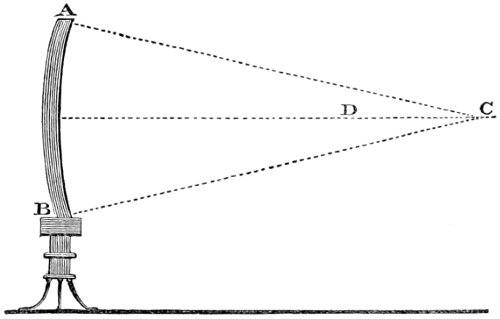
On the same principle as that by which a refracting
telescope may be constructed by means of a
single lens—as represented fig. 51, (page 234)
we may form a telescope by reflection with a
single mirror, and without an eye-piece. Let
AB, fig. 72, represent a large concave speculum,
and C its focus—if an eye be placed at D, about
8 or 10 inches within the focal point C, all the
objects in the direction of C, or behind the spectator,
will be seen magnified by reflection on
the face of the mirror, and strongly illuminated.
The magnifying power, in this case, will be nearly
in the proportion of the focal length of the mirror
to the focal length of the eye for near objects.
If for example, the focal distance of the mirror be
8 feet, and the distance from the eye at which we
see near objects most distinctly, be 8 inches—the
magnifying power will be in the ratio of 8
to 96, or 12 times. I have a glass mirror of this
description, whose focal length is 4 feet 8 inches,
and diameter 6 inches, which magnifies distant
objects about 7 times, takes in a large field of
view, and exhibits objects with great brilliancy.
It presents a very distinct picture of the moon,
showing the different streaks of light and shade
upon her surface; and, in some cases, shows the
larger spots which traverse the solar disc. This
mode of viewing objects is extremely easy and
pleasant, especially when the mirror is of a large
diameter; and the observer is at first struck and
gratified with the novel aspect in which the objects
appear.
Were a concave mirror of this description—whether
of glass or of speculum metal—to be
formed to a very long focus, the magnifying power
would be considerable. One of 50 feet focal
length, and of a corresponding diameter, might
produce a magnifying power, to certain eyes, of
about 75 times; and, from the quantity of light
with which the object would be seen, its effect
would be much greater than the same power
applied to a common telescope. Sir W. Herschel
states, that, on one occasion, by looking with
his naked eye on the speculum of his 40 feet
Reflector, without the interposition of any lens
or mirror, he perceived distinctly one of the satellites
of Saturn, which requires the application of
a considerable power to be seen by an ordinary
telescope. Such an instrument is one of the most
simple forms of a telescope, and would exhibit a
brilliant and interesting view of the moon, or of
terrestrial objects.
PRICES OF REFLECTING TELESCOPES.
1. Prices as stated by Messrs. W. and S. Jones,
Holborn, London.
|
£ |
s. |
| A 4 feet, 7 inch aperture Gregorian reflector, with the
vertical motions upon a new invented principle, as well as
apparatus to render the tube more steady for observation,
according to the additional apparatus of small speculums,
eye-pieces, micrometers, &c. |
from 80l. to 120 |
0 |
| Three feet long, mounted on a plain brass stand |
23 |
2 |
| Ditto with rack-work motions, improved mountings and
metals |
39 |
18 |
| Two feet long without rack-work, and with 4 magnifying
powers, improved |
15 |
15 |
| Ditto improved, with rack-work motions |
22 |
1 |
| Eighteen inch, on a plain stand |
9 |
9 |
| Twelve inch ditto |
6 |
6 |
2. Prices as stated by Messrs. Tulley, Islington.
|
£ |
s. |
| 1 foot Gregorian Reflector, on pillar-and-claw stand, metal
2½ inches diameter, packed in a mahogany box |
6 |
6 |
| 1½ foot ditto on pillar and claw stand, metal 3 inches
diameter, packed in a mahogany box |
11 |
11 |
| 2 feet ditto, metal 4 inches diameter |
16 |
16 |
| Ditto with rack-work motions |
25 |
4 |
| 3 feet ditto, metal 5 inches diameter, rack-work motions |
42 |
0 |
| 4 feet ditto, metal 7 inches diameter, on a tripod stand
with centre of gravity motion |
105 |
0 |
| 6 feet ditto, metal 9 inches diameter |
210 |
0 |
| 7 feet Newtonian, 6 inches aperture |
105 |
0 |
| 12 feet ditto, metal 12 inches diameter |
525 |
0 |
3. Prices stated by Mr. G. Dollond, St. Paul’s
Church Yard.
|
£ |
s. |
| Reflecting telescopes 14 inches long, in a mahogany box |
9 |
9 |
| Ditto, 18 inches |
12 |
12 |
| Ditto 2 feet |
18 |
18 |
| Ditto with 4 different powers, and rack-work stand
supporting the telescope in the centre of gravity |
36 |
15 |
| Ditto 3 feet, with ditto |
50 |
0 |
4. Prices of single speculums and reflecting
telescopes, as made by Mr. Grub, Charlemont
Bridge works, Dublin.
| NEWTONIAN TELESCOPES. |
|
GREGORIAN REFLECTORS. |
| Diameter in inches. |
Focal length in feet. |
Price of Mirrors alone. |
Price of telescope complete without stand. |
|
Diameter in inches. |
Focal length in feet. |
Price of Mirrors alone. |
Price of telescope complete without stand. |
|
|
£ |
s. |
£ |
s. |
|
|
|
£ |
s. |
£ |
s. |
|
|
|
|
|
|
|
6 |
3 |
17 |
10 |
25 |
0 |
| 7 |
7 |
17 |
10 |
27 |
10 |
|
7 |
3 |
25 |
0 |
34 |
0 |
| 9 |
10 |
25 |
0 |
40 |
0 |
|
9 |
4½ |
35 |
0 |
50 |
0 |
| 12 |
12 |
60 |
0 |
90 |
0 |
|
12 |
7 |
70 |
0 |
100 |
0 |
| 15 |
15 |
120 |
0 |
170 |
0 |
|
15 |
9 |
150 |
0 |
200 |
0 |
| 18 |
18 |
200 |
0 |
260 |
0 |
|
18 |
12 |
240 |
0 |
300 |
0 |
Although the performance of telescopes chiefly
depends on the goodness of the object-glass, or
the object-speculum of the instrument, yet it is
of considerable importance, in order to distinct
vision, and to obtain a large and uniformly distinct
field of view, that the eye-piece be properly constructed.
The different kinds of eye-pieces may
be arranged into two general divisions—Astronomical
and terrestrial.
1. Astronomical eye-pieces.—The most simple
astronomical eye-piece is that which consists of a
single convex lens; and when the focal distance
of this lens, and that of the object-glass of the
instrument is accurately ascertained, the magnifying
power may be nicely determined, by dividing
the focal length of the object-lens by that of the
eye-glass. But, as the pencil of white light transmitted
by the object-glass, will be divided by the
eye-glass into its component colours, the object
will appear bordered with coloured fringes, and
the distinctness of vision consequently injured.
Besides, the spherical aberration, when a single
lens is used, is much greater than when two or
more glasses are employed. Hence astronomical
eye-pieces are now formed by a combination of at
least two lenses.
figure 73.
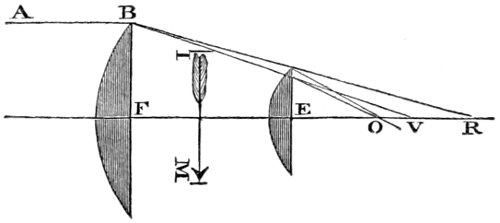
The combination of lenses now generally used
for astronomical purposes, is that which is usually
denominated the Huygenian eye-piece, having been
first proposed by the celebrated Huygens, as a
great improvement on the single lens eye-piece.
The following figure (73) represents a section of
this eye-piece. Let AB be a compounded pencil
of white light proceeding from the object-glass;
BF a plano-convex field-glass, with its plane side
next the eye-glass E. The red rays of the pencil
AB, after refraction would cross the axis in R,
and the violet rays in V, but meeting the eye-glass
E, the red rays will be refracted to O, and
the violet nearly in the same direction, when they
will cross each other about the point O, in the
axis, and unite. The distance of the two glasses
FE, to produce this correction, when made of
crown glass, must be equal to half the sum of
their focal distances nearly. For example, suppose
the focal distance of the largest, or field lens,
to be 3 inches, and the focal distance of the lens
next the eye, 1 inch, the two lenses should be
placed exactly at the distance of 2 inches; the
sum of their focal length being 4, the half of
which is 2. In other words, the glass next the
eye should be placed as much within the focus of
the field-glass as is equal to its own focal distance.
The focal length of a single lens, that has the
same magnifying power as this compound eye-piece—is
equal to twice the product of the focal
lengths of the two lenses, divided by the sum of
the same numbers. Or, it is equal to half the
focal length of the field-glass. Thus, in reference
to the preceding example, twice the product of
the focal length of the two lenses—is equal to 6,
and their sum is 4. The former number divided
by the latter, produces a quotient of 1½, which is
the focal length of a single lens, which would produce
the same magnifying power as the eye-piece;
and 1½ is just half the focal length of the field-glass.
The proportion of the focal lengths of the
two lenses to each other, according to Huygens,
should be as 3 to 1; that is, if the field-glass be
4½ inches, the eye-glass should be 1½; and this is
the proportion most generally adopted. But some
opticians have recommended that the proportions
should be as 3 to 2. Boscovich recommended two
similar lenses; and in this case the distance between
them was equal to half the sum of their
focal distances, as in the Huygenian eye-piece.
The image is formed at IM, at the focal distance
of the lens next the eye, and at the same
distance from the field-glass. When distinct vision
is the principal object of an achromatic telescope,
the two lenses are usually both plano-convex,
and fixed with their curved faces towards the object
glass, as in the figure. Sometimes, however,
they consist of what is called crossed lenses, that
is lenses ground on one side to a short focus, and
on the other side to a pretty long focus, the sides
with the deepest curves being turned towards the
object glass. A diaphragm, or aperture of a
proper diameter, is placed at the focus of the eye
lens, where the image formed by the object-glass
falls, for the purpose of cutting off the extreme
rays of the field lens, and rendering every part of
the field of view equally distinct. This is likewise
the form of the eye-piece generally applied
to Gregorian reflectors. In short, when accurately
constructed, it is applicable to telescopes of
every description. This eye-piece, having the
image viewed, by the eye behind the inner lens,
is generally called the negative eye-piece, and is
that which the optical-instrument makers usually
supply, of three or four different sizes, for so many
magnifying powers, to be applied to different celestial
objects, according to their nature or the state
of the atmosphere in which they are used.
Ramsden’s eye-piece.—There is another modification
of lenses, known by the name of the
Positive, or Ramsden’s eye-piece, which is much
used in Transit instruments, and telescopes which
are furnished with micrometers, and which affords
equally good vision as the other eye-piece. In
this construction the lenses are plano-convex, and
nearly of the same focus, but are placed at a distance
from each other less than the focal distance
of the glass next the eye, so that the image of
the object viewed is beyond both the lenses, when
measuring from the eye. The flat faces of the
two lenses are turned into contrary directions in
this eye-piece—one facing the object-glass, and
the other the eye of the observer; and as the image
formed at the focus of the object-glass, lies parallel
to the flat face of the contiguous lens, every
part of the field of view is distinct at the same
adjustment, or, as opticians say, there is a flat
field, which, without a diaphragm, prevents distortion
of the object. This eye-piece is represented
in fig. 74, where AB and CD are two plano-convex
lenses, with their convex sides inwards. They
have nearly the same focal length, and are placed
at a distance from each other, equal to about two
thirds of the focal length of either. The focal
length of an equivalent single lens is equal to three
fourths the focal length of either lens, supposing
them to have equal focal distances. This eye-piece
is generally applied, when wires of spider’s
lines are used in the common focus; as the piece
containing the lenses can be taken out without
disturbing the lines, and is adjustable for distinct
vision; and whatever may be the measure of any
object given by the wire micrometer, at the solar
focus, it is not altered by a change of the magnifying
power, when a second eye-piece of this construction
is substituted.
figure 74.
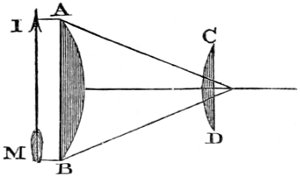
| figure 75. |
figure 76. |
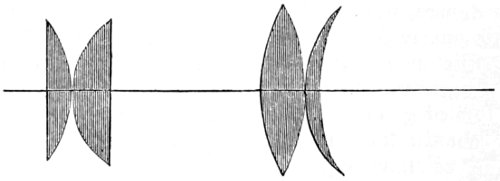 |
Aberration of lenses.—In connection with the
above descriptions, the following statements respecting
the spherical aberration of lenses may
not be inappropriate. Mr. John Dollond, in a
letter to Mr. Short, remarks, that ‘the aberration
in a single lens is as the cube of the refracted
angle; but if the refraction be caused by two
lenses, the sum of the cubes of each half will
be ¼ of the refracted angle, twice the cube of 1
being ¼ the cube of 2. So three times the cube
of 1 is only one ninth of the cube of 3.’ &c.
Hence the indistinctness of the borders of the
field of view of a telescope is diminished by increasing
the number of lenses in an eye piece.
Sir J. Herschel has shown that if two plano-convex
lenses are put together as in fig. 75, the aberration
will be only 0.2481, or one fourth of that
of a single lens in its best form. The focal length
of the first of these lenses, must be to that of the
second as 1 to 2.3. If their focal lengths are equal,
the aberration will be 0.603, or nearly one half.
The spherical aberration, however, may be entirely
destroyed by combining a meniscus and double
convex lens, as shown in fig. 76, the convex sides
being turned to the eye when they are used as
lenses, and to parallel rays, when they are used as
burning glasses. Sir J. Herschel has computed
the following curvatures for such lenses.
| Focal length of the convex lens |
+10.000 |
| Radius of its first surface |
+5.833 |
| Radius of its second surface |
-35.000 |
| Focal length of the meniscus |
+17.829 |
| Radius of its first surface |
+3.688 |
| Radius of its second surface |
+6.294 |
| Focal length of the compound lens |
+6.407 |
On the general principles above stated, a good
astronomical eye-piece may be easily constructed
with two proper lenses, either according to the
plan of Huygens or that of Ramsden; and, from
what has been now stated it is demonstrably certain,
that, in all cases where two glasses are properly
combined, such an eye-piece is superior to
a single lens, both in point of distinctness, and of
the enlargement of the field of view. I lately
fitted up an eye-piece, on Ramsden’s principle,
with two lenses, each about 3 inches focal length,
and 1⅜ inch diameter, placed at half an inch distant,
with their convex surfaces facing each other
as in fig. 74, which forms an excellent eye-piece
for an achromatic telescope, 6 feet 8 inches focal
distance, and 4 inches aperture, particularly for
viewing clusters of stars, the Milky Way, and
the large nebulæ. The field of view is large, the
magnifying power is only between 50 and 60
times, and the quantity of light being so great,
every celestial object appears with great brilliancy,
and it is in general much preferable, when applied
to the stars than any of the higher powers. When
applied to Presepe in Cancer, it exhibits that
group at one view, as consisting of nearly a 100
stars which exhibit a beautiful and most striking
appearance.
It may appear a curious circumstance that any
eye-piece which is good with a short telescope, is
also good with a long one, but that the reverse is
not true; for it is found to be more difficult to
make a good eye-piece for a short than for a long
focal distance of the object-glass.
Celestial eye-pieces are sometimes constructed
so as to produce variable powers. This is effected
by giving a motion to the lens next the eye, so as
to remove it nearer to or farther from the field
lens; for at every different distance at which it is
placed from the other lens, the magnifying power
will either be increased or diminished. The
greatest power is when the two lenses are nearly
in contact, and the power diminishes in proportion
to the distance at which the glass next the
eye is removed from the other. The scale of distance,
however, between the two lenses, cannot
be greater than the focal distance of the field, or
inner glass; for if it were, the lenses would no
longer form an eye-piece, but would be changed
into an inverting opera-glass. For effecting the
purpose now stated, the eye-glass is fixed in a tube
which slides upon an interior tube on which is
marked a scale of distances, corresponding to certain
magnifying powers; and, in this way an eye-piece
may be made to magnify about double the
number of times, when the lenses are in one position
than when they are in another—as, for example,
all the powers from 36 to 72 times may be
thus applied, merely by regulating the distance
between the two lenses. When the glasses are
varied in this manner the eye-piece becomes
sometimes a positive eye-piece, like Ramsden’s,
and sometimes a negative one like that of
Huygens.
Diagonal eye-pieces. The eye-pieces to which
we have now adverted, when adapted to refracting
telescopes, both reverse and invert the object, and
therefore are not calculated for showing terrestrial
objects in their natural position. But as the
heavenly bodies are of a spherical form, this circumstance
detracts nothing from their utility.
When the celestial object, however, is at a high
altitude, the observer is obliged to place his head
in a very inconvenient position, and to direct his
eye nearly upwards; in which position he cannot
remain long at ease, or observe with a steady eye.
To remedy this inconvenience, the diagonal eye-piece
has been invented, which admits of the eye
being applied at the side—or at the upper part of
the eye-piece, instead of the end; and when such
an eye-piece is used, it is of no importance in
what direction the telescope is elevated, as the
observer can then either sit or stand erect, and
look down upon the object with the utmost ease.
This object is effected by placing a flat piece of
polished speculum-metal at an angle of 45
degrees in respect to the two lenses of the eye-piece,
which alters the direction of the converging
rays, and forms an image which becomes erect
with respect to altitude, but is reversed with
respect to azimuth;—that is, in other words,
when we look down upon the objects in the field
of view, they appear erect; but that part of an
object which is in reality on our right hand appears
on our left; and if it be in motion, its apparent
is opposite to its real motion; if it be moving
towards the west, it will seem to move towards
the east.
There are three situations in which the diagonal
reflector in this eye-piece may be placed. It
may be placed either 1. before the eye-piece,—or
2. behind it,—or 3. between the two lenses of
which the eye-piece consists. The most common
position of the reflector is between the lenses; and
this may be done both in the negative and the
positive eye-pieces; but as the distance between
the two lenses is necessarily considerable, to make
room for the diagonal position of the reflector, the
magnifying power cannot be great; otherwise, a
diagonal eye-piece of this construction remains
always in adjustment, and is useful in all cases
where a high power is not required. The following
is a description and representation of a
diagonal eye-piece of this kind in my possession.
figure 77.
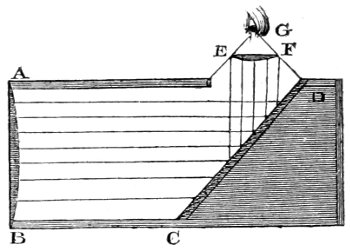
In fig. 77, AB represents the plano-convex lens
next the object, which is about 2 inches in focal
length, and ¾ inch in diameter; CD, a plain
metallic speculum of an oval form, well polished,
and placed at half a right angle to the axis of the
tube; and EF another plano-convex lens, about
1½ inch focal distance. The centre of the speculum
is about 1¼ inch from the lens AB, and about
½ or 1/3 inch from EF; so that this eye-piece is a
positive one, on the principle proposed by Ramsden.
The rays proceeding from the lens AB, and
falling upon the speculum, are reflected in a perpendicular
direction to the lens EF, where they
enter the eye at G, which looks down upon the
object through the side of the tube. The real
size of this eye-piece is much about the same as
that represented in the figure. When applied to
an achromatic telescope of 44½ inches focal distance
it produces a magnifying power of 36 times,
and exhibits a very beautiful view of the whole of
the full moon. It likewise presents a very pleasing
prospect of terrestrial objects, which appear
as if situated immediately below us.
figure 78.
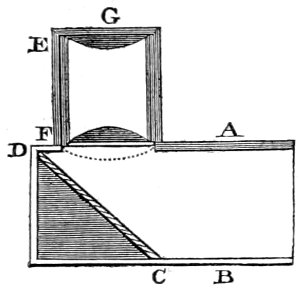
Another plan of the diagonal eye-piece is represented
in fig. 78, where the speculum is fixed
within the sliding tube which receives the eye-piece,
or immediately below it. The part of the
tube at AB slides into the tube of the telescope,
CD is the speculum placed at half a right angle
to the axis of the tube, and EF, the tube containing
the lenses, which stands at right angles to
the position of the telescope, and slides into an
exterior tube, and the eye is applied at G. This
construction of the diagonal eye-piece may be
used with any eye-piece whatever, whether the
Huygenian or that of Ramsden. It will admit of
any magnifying power, and if several different
eye-pieces be fitted to the sliding tube, they may
be changed at pleasure. This form of the diagonal
eye-piece, I therefore consider as the best and the
most convenient construction, although it is not
commonly adopted by opticians.
When any of these eye-pieces are applied to a
telescope, with the lens E on the upper part of it,
we look down upon the object, if it be a terrestrial
one, as if it were under our feet. If we turn the
eye-piece round in its socket a quarter of a circle
towards the left, an object directly before us in
the south, will appear as if it were in the west and
turned upside down. If, from this position, it is
turned round a semicircle towards the right, and
the eye applied, the same object will appear as if
it were situated in the east, and inverted; and if
it be turned round another quadrant, till it be
directly opposite to its first position, and the eye
applied from below, the object or landscape will
appear as if suspended in the atmosphere above
us. This eye-piece, therefore, is capable of exhibiting
objects in a great variety of aspects, and
the use of it is both pleasant and easy for the
observer. But there is a considerable loss of light,
occasioned by the reflection from the speculum,
which is sensibly felt when very high powers are
applied; and therefore when very small stars are
to be observed, such as some of those connected
with double or triple stars, the observer should
not study his own ease so much as the quantity of
light he can retain with a high power, which object
is best attained with an ordinary eye-piece
and a telescope of large aperture.
We have said that a diagonal eye-piece may be
constructed with a reflector before the eye-piece.
In this case, the speculum is sometimes made to
slide before the eye at the requisite angle of
reclination, in which application each eye-piece
must necessarily have a groove to receive it, and
the eye must be applied without a hole to direct
it, but it may be put on and taken off without
disturbing the adjustment for distinct vision, and
is very simple in its application. But, on the
whole, the form represented in fig. 78, is the
most convenient, and should generally be preferred,
as any common astronomical eye-piece can be
applied to it. I have used a diagonal eye-piece
of this kind, with good effect, when a power of
180 has been applied to the sun and other celestial
objects.
Instead of a metallic speculum, a rectangular
prism of glass is sometimes substituted; for the
rays of light are then bent by reflection from the
second polished surface, which ought to be dry,
and undergo two refractions which achromatise
them; and the same effect is thus produced as by
polished metal. Ramsden sometimes gave one of
the polished faces of a right angled prism a curve,
which prism served instead of a lens in an eye-piece,
and also performed the office of a reflector.
A semi-globe, or what has been called a Bull’s
eye, has also been used as a diagonal eye-piece,
and when the curve is well-formed, and the glass
good, it is achromatic, and is said to perform
pretty well, but it is not superior to the forms
already described.
When describing the common refracting telescope,
(p. 228.) I have noticed that three eye-glasses,
placed at double their focal distances
from each other, formerly constituted the terrestrial
eye-piece, as represented in fig. 47. But
this construction, especially for achromatic instruments,
has now become obsolete, and is never
used, except in small pocket spy-glasses formed
with a single object lens. In its place a four
glassed eye-piece has been substituted, which is
now universally used in all good telescopes, and
which, besides improving the vision and producing
an erect position of the images of objects, presents
a considerably larger field of view. During
the progressive stages of improvement made in
the construction of erect eye-pieces by Dollond
and Ramsden, three, four, and five lenses were
successively introduced; and hence, in some of
the old telescopes constructed by these artists, we
frequently find five lenses of different descriptions
composing the eye-piece. But four lenses,
arranged in the manner I am now about to describe,
have ultimately obtained the preference.
In a telescope having a celestial eye-piece of the
Huygenian form, the image that is formed in the
focus of the object glass, is that which is seen
magnified, and in an inverted position; but when a
four glassed eye-piece is used, which produces an
erect view of the object, the image is repeated,
and the second image, which is formed by the
inner pair of lenses AB on an enlarged scale, is
that which the pair of lenses CD at the eye-end
render visible on a scale still more enlarged. The
modern terrestrial eye-piece, represented in fig.
79, is, in fact, nothing else than a compound
microscope, consisting of an object lens, an amplifying
lens, and an eye-piece composed of a pair
of lenses on the principle of the Huygenian eye-piece.
Its properties will be best understood by
considering the first image of an object, which is
formed in the focus of the object glass, as a small
luminous object to be rendered visible, in a magnified
state, by a compound microscope. The object
to be magnified may be considered as placed near
the point A, and the magnified image at i, which
is viewed by the lens D. Hence, if we look
through such an eye-piece at a small object placed
very near the lens A, we shall find that it acts as
a compound microscope of a moderate magnifying
power increasing, in some cases, the diameter
of the object about 10 times, and 100 times in
surface.
figure 79.
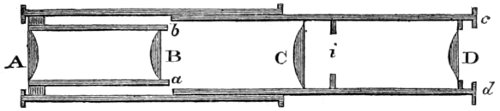
In order to distinguish the different lenses in
this eye-piece, we may call the lens A, which is
next to the first image, the object-lens, the next to
it B, the amplifying-lens, the third, or C, the
field-lens, and the one next the eye, D, the eye-lens.
The first image formed a little before A,
may be denominated the radiant, or the object
from which the rays proceed. Now, it is well
known as a principle in optics, that if the radiant
be brought nearer to the lens than its principal
focus, the emerging rays will diverge, and, on the
contrary, if the radiant be put farther from the
lens than its principal focal distance, the emerging
rays will converge to a point at a distance beyond
the lens, which will depend on the distance of the
radiant from the first face of the lens. In this
place an image of the radiant will be formed by
the concurrence of the converging rays, but in a
contrary position; and the length of the image
will exceed the length of the radiant in the same
proportion, as the distance of the image from the
radiant exceeds that of the radiant from the lens.
This secondary image of the radiant at i, is not
well-defined, when only one lens, as A, is used,
owing to the great spherical aberrations, and
therefore the amplifying lens is placed at the distance
of the shorter conjugate focus, with an intervening
diaphragm of a small diameter at the
place of the principal focus; the uses of which
lens and diaphragm are, first to cut off the coloured
rays that are occasioned by the dispersive property
of the object lens,—and secondly, to bring the
rays to a shorter conjugate focus for the place of
the image, than would have taken place with a
single lens having only one refraction. As the
secondary image is in this way much better defined
and free from colouration, the addition of
this second lens is a great improvement to vision.
For this reason I am clearly of opinion, that the
object glass of a compound microscope, instead of
consisting of a small single lens, should be formed
of two lenses on the principle now stated, which
would unquestionably add to the distinctness of
vision.
With respect to the proportions of the focal
lengths of the lenses in this four glass eye-piece,
Mr. Coddington states, that if the focal lengths,
reckoning from A to D, fig. 79, be as the numbers
3, 4, 4 and 3, and the distances between them on
the same scale, 4, 6, and 5, 2, the radii, reckoning
from the outer surface of A, should be thus:—
| A |
{First surface |
27 } |
nearly plano-convex. |
| {Second surface |
1 } |
| B |
{First surface |
9 } |
a miniscus. |
| {Second surface |
4 }
|
| C |
{First surface |
1 } |
nearly plano-convex. |
| {Second surface |
21 } |
| D |
{First surface |
1 } |
double convex. |
| {Second surface |
24 } |
Sir D. Brewster states, that a good achromatic
eye-piece may be made of 4 lenses, if their focal
lengths, reckoning from that next the object, be
as the numbers 14, 21, 27, 32; their distances
23, 44, 40; their apertures 5.6; 3.4; 13.5; 2.6;
and the aperture of the diaphragm placed in the
interior focus of the fourth eye-glass, 7. Another
proportion may be stated:—Suppose the lens next
the object A, to be 1⅞ inch focal length, then B
may be 2½ inches, C 2 inches, and D 1½; and
their distances AB 2½; BC 3⅝; and CD 2⅜. In
one of Ramsden’s small telescopes, whose object
glass was 8½ inches in focal length, and its magnifying
power 15.4, the focal lengths of the eye
glasses were A 0.775 of an inch, B 1.025, C 1.01,
D 0.79;—the distances AB 1.18, BC 1.83, and
CD 1.105. In the excellent achromatic telescope
of Dollond’s construction which belonged to the
Duc de Chaulnes, the focal lengths of the eye
glasses, beginning with that next the object, were
14¼ lines, 19, 22¾, 14; their distances 22.48 lines,
46.17, 21.45, and their thickness at the centre,
1.23 lines, 1.25, 1.47. The fourth lens was
plano-convex, with the plane side to the eye, and
the rest were double convex lenses. This telescope
was in focal length 3 feet 5½ inches.
The magnifying power of this eye-piece, as
usually made, differs only in a small degree from
what would be produced by using the first or the
fourth glass alone, in which case the magnifying
power would be somewhat greater, but the vision
less distinct, and were the lens next the eye used
alone without the field glass, the field of view
would be much contracted. Stops should be
placed between the lenses A and B, near to B, and
a larger one between C and D, to prevent any
false light from passing through the lenses to the
eye. The more stops that are introduced into a
telescope—which should all be blackened—provided
they do not hinder the pencils of light proceeding
from the object, the better will the instrument
perform.
For the information of amateur constructors of
telescopes, I shall here state the dimensions of
two or three four glassed eye-pieces in my possession,
which perform with great distinctness, and
present a pretty large field of view. In one of
these, adapted to a 44½ inch achromatic, the lens
A, next the object, is 1⅞ inch, focal length, and
about 1 inch diameter, with the plane side, next
the object. The focal length of the lens B 21/10
inches, diameter 7/10 inch, with its plane side next
A; distance of these lenses from each other
24/10 inches. Distance of the field lens C from the
lens B 5½ inches. The small hole or diaphragm
between A and B is at the focus of A, and is
about 1/6 inch diameter, and about 3/8 of an inch from
the lens B. The field lens C is 2 inches focal
length, and 1¼ inch diameter, with its plane side
next the eye. The lens next the eye D is 1 inch
focal distance, ½ inch diameter, and is distant from
the field glass 1¾ inch, with its plane side next
the eye. The magnifying power of this eye-piece
is equivalent to that of a single lens whose focal
length is half an inch, and with the 44½ inch object
glass produces a power of about 90 times.
The lens next the eye can be changed for another
1⅜ inch focal length, which produces a power of
65; and the two glasses CD can be changed for
another set, of a longer focal distance which produces
a power of 45 times. The whole length of
this eye-piece is 11½ inches.
In another eye-piece, adapted to a pocket achromatic,
whose object glass is 9 inches focal length,
the lens A is 1 inch focal length, and ½ inch diameter;
the lens B 1¼ inch, and ½ inch diameter,
their distance 1½ inch, the lens C 11/10 inch focal
length, and 5/8 inch diameter; the eye-lens D 5/8 inch
focal length, and 3/8 inch diameter; distance between
C and D 1⅛ inch. The distance between B
and C 1¾ inch. The whole length of this eye-piece
is 4½ inches, and its power is nearly equal to
that of a single lens of ½ or 6/10 of an inch focal
length, the magnifying power of the telescope being
about 16 times. Another eye-piece of much
larger dimensions, has the lens A of 2½ inches
focal length, and ¾ inch diameter: the lens B 2¾
inches focus and 5/8 inch diameter; and their distance
2¾ inches; the lens C 2⅝ inches focus and
1⅛ inch diameter; the lens D 1¾ inch focus
and ¾ inch diameter; distance from each other
2¾ inches. The distance between the lenses B
and C is 4 inches. The magnifying power is equal
to that of a single lens 1⅛ inch focal distance.
When applied to an achromatic object glass 6 feet
7 inches focal length, it produces a power of about
70 times. This eye-piece has a moveable tube 9
inches in length in which the two lenses next the
eye are contained, by pulling out which, and consequently
increasing the distance between the
lenses B and C, the magnifying power may be
increased to 100, 120 or 140, according to the
distance to which this moveable tube is drawn
out. It has also a second and third set of lenses,
corresponding to C and D of a shorter focal distance,
which produce higher magnifying powers on
a principle to be afterwards explained.
About twenty or thirty years ago, I purchased,
in an optician’s shop in Edinburgh, a small achromatic
telescope, made in Amsterdam, which was
supposed, by the optician, to have been constructed
prior to the invention of achromatic telescopes by
Mr. Dollond. It is mounted wholly of brass, and
in all its parts is a piece of beautiful and exquisite
workmanship, and the utmost care seems to
have been taken to have all the glasses and diaphragms
accurately adjusted. The object glass is
a double achromatic, 6½ inches focal distance and
1 inch diameter, but the clear aperture is only 7/8
inch diameter. It is perfectly achromatic, and
would bear a power of 50 times, if it had
a sufficient quantity of light. The following inscription
is engraved on the tube adjacent to the
object glass:—“Jan van Deyl en Zoon Invenit et
Fecit, Amsterdam, Ao. 1769.” Although Dollond
exhibited the principle of an achromatic
telescope, eight or ten years before the date here
specified, yet it is not improbable that the artist
whose name is here stated, may not have heard of
Dollond’s invention; and that he was really, as he
assumes, one of the inventors of the achromatic
telescope. For, the invention of this telescope by
Dollond was not very generally known, except
among philosophers and the London opticians, till
a number of years after the date above stated.
Euler, in his “Letters to a German Princess”—in
which telescopes are particularly described, makes
no mention of, nor the least allusion to the invention
of Dollond, though this was a subject which particularly
engaged his attention. Now, these letters
were written in 1762, but were not published till
1770. When alluding to the defects in telescopes
arising from the different refrangibility of the rays
of light, in Letter 43, and that they might possibly
be rectified by means of different transparent
substances, he says, ‘But neither theory nor
practice have hitherto been carried to the degree
of perfection necessary to the execution of a
structure which should remedy these defects.’ Mr.
B. Martin, in his ‘Gentleman and Lady’s Philosophy,’
published in 1781, alludes to the achromatic
telescope, but speaks of it as it were but
very little, if at all superior to the common refracting
telescope. And therefore, I think it
highly probable that Jan van Deyl, was really
an inventor of an achromatic telescope, before
he had any notice of what Dollond and others
had done in this way some short time before.
But my principal object in adverting to this
telescope, is to describe the structure of the eye-piece,
which is a very fine one, and which is somewhat
different from the achromatic eye-piece
above described. It consists of four glasses, two
combined next the eye, and two next the object.
Each of these combinations forms an astronomical
eye-piece nearly similar to the Huygenian. The
lens A, next the object, fig. 80, is 5/8 inch focal
distance, and 4/10 inch diameter; the lens B 3/8 inch
focus, and 1/5 inch diameter, and the distance between
them somewhat less than 5/8 inch; the
diameter of the aperture e about 1/15 of an inch.
This combination forms an excellent astronomical
eye-piece, with a large flat field, and its magnifying
power is equivalent to that of a single lens 5/8
or 6/8 focal length. The lens C is ½ inch focal
length, and 4/10 inch diameter; the lens D ¼ inch
focus, and about 1/5 inch diameter; their distance
about ½ inch, or a small fraction
more. The hole at d is about 1/20
or 1/25 of an inch diameter, and the
distance between the lenses B
and C about 1½ inch. The whole
length of the eye-piece is 3¼
inches—exactly the same size as
represented in the engraving.
Its magnifying power is equal to
that of a single lens ¼ inch focal
length; and consequently the
telescope, though only 9½ inches
long, magnifies 26 times, with
great distinctness, though there
is a little deficiency of light when
viewing land objects, which are
not well illuminated.
figure 80.
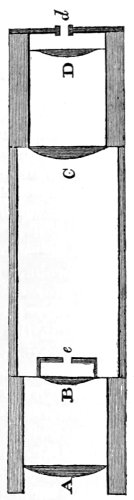
The glasses of this telescope
are all plano-convex, with their
convex-sides towards the object—except
the lens D, which is
double convex, but flattest on the
side next the eye, and they are all
very accurately finished. The two
lenses C and D form an astronomical
eye-piece nearly similar to
that formed by the lenses A and B. The focus of
the telescope is adjusted by a screw, the threads of
which are formed upon the outside of a tube into
which the eye-piece slides. The eye-piece and
apparatus connected with it, is screwed into the
inside of the main tube, when not in use, when
the instrument forms a compact brass cylinder 6
inches long, which is enclosed in a fish-skin case,
lined with silk velvet, which opens with hinges.
The lenses in the eye-pieces formerly described,
though stated to be plano-convexes, are for the
most part crossed glasses, that is ground on tools
of a long focus on the one side, and to a short
focus on the other. The construction of the eye-piece
of the Dutch telescope above described, is
one which might be adopted with a good effect in
most of our achromatic telescopes; and I am persuaded,
from the application I have made of it to
various telescopes, that it is even superior, in distinctness
and accuracy, and in the flatness of field
which it produces to the eye-piece in common use.
The two astronomical eye-pieces of which it consists,
when applied to large achromatic telescopes,
perform with great accuracy, and are excellently
adapted for celestial observations.
From what we have stated, when describing the
common terrestrial eye-piece now applied to achromatic
instruments, (p. 349, fig. 79.), it appears
obvious, that any variety of magnifying powers,
within certain limits, may be obtained by removing
the set of lenses CD, fig. 79, nearer to or farther
from the tube which contains the lenses A and B,
on the same principle as the magnifying power of
a compound microscope is increased by removing
the eye-glasses to a greater distance from the
object-lens. If then, the pair of eye-lenses CD
be attached to an inner tube that will draw out
and increase their distance from the inner pair of
lenses, as the tube a b c d, the magnifying power
may be indefinitely increased or diminished, by
pushing in or drawing out the sliding tube, and
a scale might be placed on this tube, which,
if divided into equal intervals, will be a scale of
magnifying powers, by which the power of the
telescope will be seen at every division, when the
lowest power is once determined.
Sir David Brewster, in his ‘Treatise on New
Philosophical instruments,’ Book i. chap. vii.
page 59, published in 1813, has adverted to this
circumstance, in his description of an ‘Eye-piece
wire micrometer,’ and complains of Mr. Ezekiel
Walker, having in the ‘Philosophical Magazine’
for August, 1811, described such an instrument
as an invention of his own. Dr. Kitchener some
years afterwards, described what he called a Pancratic
or omnipotent eye-piece, and got one made
by Dollond, with a few modifications different from
that suggested by Brewster and Walker, which
were little else than cutting the single tube into
several parts, and giving it the appearance of a
new invention. In fact, none of these gentlemen
had a right to claim it as his peculiar invention, as
the principle was known and recognised long before.
I had increased the magnifying powers of
telescopes, on the same principle, several years
before any of these gentlemen communicated their
views on the subject, although I never formally
constructed a scale of powers. Mr. B. Martin,
who died in 1782, proposed many years before,
such a moveable interior tube as that alluded to,
for varying the magnifying power.
In order to give the reader a more specific idea
of this contrivance, I shall present him with a
figure and description of one of Dr. Kitchener’s
Pancratic eye-pieces, copied from one lately in my
possession. The following are the exact dimensions
of this instrument, with the focal distances,
&c. of the glasses, &c. of which it is composed.
|
In. |
Tenths. |
fig. 81. |
| Length of the whole eye-piece, consisting of
four tubes, when fully drawn out, or the distance
from A to B. fig. 81. |
14 |
4 |
 |
| Length of the three tubes on which the
scale is engraved, from the commencement of
the divisions at B to their termination at C. |
9 |
15 |
| Each division into tens is equal to 3-10ths of an inch. |
|
| When the three inner tubes are shut up to
C, the length of the eye-piece is exactly |
5 |
5 |
| When these tubes are thus shut up, the magnifying
power for a 3½ feet achromatic is 100
times, which is the smallest power. When the
inner tube is drawn out ⅓ of an inch, or to
the first division, the power is 110, &c. |
|
| Focal distance of the lens next the object |
1 |
0 |
| Breadth of Ditto. |
0 |
65 |
| The plane side of this glass is next the object. |
|
| Focal distance of the second glass from the
object |
1 |
5 |
| This glass is double and equally convex, Breadth |
0 |
5 |
| Distance between these two glasses |
1 |
7 |
| Focal distance of the third or field lens,
which is plane on the side next the eye |
1 |
1 |
| Breadth of Ditto. |
0 |
55 |
| Focal distance of the lens next the eye |
0 |
6 |
| Breadth |
0 |
43 |
| This glass is plane on the side next the eye. |
|
| Distance between the third and fourth glasses. |
1 |
1 |
From the figure and description, the reader will
be at no loss to perceive how the magnifying
power is ascertained by this eye-piece. If the
lowest power for a 44 inch telescope be found to
be 100, when the three sliding tubes are shut into
the larger one, then by drawing out the tube next
the eye 4 divisions, a power of 140 is produced;
by drawing out the tube next the eye its whole
length, and the second tube to the division marked
220, a power of 220 times is produced, and drawing
out all the tubes to their utmost extent, as
represented in the figure, a power of 400 is obtained.
These powers are by far too high for
such a telescope, as the powers between 300 and
400 can seldom or never be used. Were the scale
to begin at 50, and terminate at 200, it would be
much better adapted to a 3½ feet telescope. Each
alteration of the magnifying power requires a
new adjustment of the eye-piece for distinct
vision. As the magnifying power is increased,
the distance between the eye-glass and the object-glass
must be diminished. Dr. Kitchener says,
that ‘the pancratic eye tube gives a better defined
image of a fixed star, and shows double stars decidedly
more distinct and perfectly separated than
any other eye tube, and that such tubes will probably
enable us to determine the distances of
these objects from each other, in a more perfect
manner than has been possible heretofore.’
These tubes are made by Dollond, London, and
are sold for two guineas each. But I do not
think they excel, in distinctness, those which
are occasionally made by Mr. Tulley and other
opticians.
The following remarks, chiefly in regard to the
manner of using telescopes, may perhaps be useful
to young observers, who are not much accustomed
to the mode of managing these instruments.
1. Adjustments requisite to be attended to in the
use of telescopes. When near objects are viewed
with a considerable magnifying power, the eye-tube
requires to be removed farther from the
object-glass than when very distant objects are
contemplated. When the telescope is adjusted
for an object, 6, 8, or 10 miles distant, a very
considerable alteration in the adjustment is requisite
in order to see distinctly an object at the distance
of two or three hundred yards, especially if
the instrument is furnished with a high magnifying
power. In this last case, the eye-tube requires
to be drawn out to a considerable distance beyond
the focus for parallel rays. I have found that, in
a telescope which magnifies 70 times, when
adjusted for an object at the distance of two
miles, the adjustment requires to be altered fully
one inch in order to perceive distinctly an object
at the distance of two or three hundred yards;
that is, the tube must be drawn, in this case, an
inch farther from the object-glass, and pushed in
the same extent, when we wish to view an object
at the distance of two or three miles. These
adjustments are made, in pocket perspectives, by
gently sliding the eye-tube in or out, by giving it
a gentle circular or spiral motion till the object
appear distinct. In using telescopes which are
held in the hand, the best plan is to draw all the
tubes out to their full length, and then, looking at
the object, with the left hand supporting the main
tube near the object-glass, and the right supporting
the eye-tube—gently and gradually push in
the eye-piece till distinct vision be obtained. In
Gregorian reflecting telescopes this adjustment is
made by means of a screw connected with the
small speculum; and in large achromatics, by
means of a rack and pinion connected with the
eye-tube. When the magnifying power of a
telescope is comparatively small, the eye-tube
requires to be altered only a very little.
There is another adjustment requisite to be
attended to, in order to adapt the telescope to the
eyes of different persons. Those whose eyes are
too convex, or who are short-sighted, require the
eye-tube to be pushed in, and those whose eyes are
somewhat flattened, as old people, require the tube
to be drawn out. Indeed there are scarcely two
persons whose eyes do not require different adjustments
in a slight degree. In some cases I have
found that the difference of adjustment for two
individuals, in order to produce distinct vision in
each, amounted to nearly half an inch. Hence
the difficulty of exhibiting the sun, moon, and
planets through telescopes, and even terrestrial
objects, to a company of persons who are unacquainted
with the mode of using or adjusting such
instruments—not one half of whom generally see
the object distinctly—for, upon the proper adjustment
of a telescope to the eye, the accuracy of
vision, in all cases, depends; and no one except
the individual actually looking through the instrument,
can be certain that it is accurately adjusted
to his eye, and even the individual himself, from
not being accustomed to the view of certain objects,
may be uncertain whether or not the adjustment
be correct. I have found by experience
that when the magnifying powers are high, as 150
or 200, the difference of adjustment required for
different eyes is very slight; but when low powers
are used, as 20, 30, or 40, the difference of the
requisite adjustments is sometimes very considerable,
amounting to ¼ or ½ of an inch.
2. State of the Atmosphere most proper for
observing terrestrial and celestial objects. The
atmosphere which is thrown around the globe—while
it is essentially requisite to the physical
constitution of our world, and the comfort of its
inhabitants—is found in many instances a serious
obstruction to the accurate performance of telescopes.
Sometimes it is obscured by mists and
exhalations, sometimes it is thrown into violent
undulations by the heat of the sun and the process
of evaporation, and even, in certain cases, where
there appears a pure unclouded azure, there is an
agitation among its particles and the substances
incorporated with them, which prevents the telescope
from producing distinct vision either of terrestrial
or celestial objects. For viewing distant
terrestrial objects, especially with high powers, the
best time is early in the morning, a little after sun-rise,
and, from that period till about 9 o’clock
A.M., in summer; and, in the evening about two
or three hours before sun-set. From about 10
o’clock A.M. till 4 or 5 in the afternoon, in summer,
if the sky be clear and the sun shining, there is
generally a considerable undulation in the atmosphere,
occasioned by the solar rays and the rapid
evaporation, which prevents high powers from
being used with distinctness on any telescope,
however excellent. The objects at such times,
when powers of 50, 70, or 100 are applied, appear
to undulate like the waves of the sea, and, notwithstanding
every effort to adjust the telescope,
they appear confused and indistinct. Even with
very moderate magnifying powers this imperfection
is perceptible. In such circumstances, I
have sometimes used a power of 200 times on
distant land objects, with good effect, a little before
sun-set, when, in the forenoon of the same day, I
could not have applied a power of 50 with any
degree of distinctness. On days when the air is
clear, and the atmosphere covered with clouds,
terrestrial objects may be viewed with considerably
high powers. When there has been a long-continued
drought, the atmosphere is then in a very
unfit state for enjoying distinct vision with high
magnifying powers, on account of the quantity of
vapours with which the atmosphere is then surcharged,
and the undulations they produce. But,
after copious showers of rain, especially if accompanied
with high winds, the air is purified, and
distant objects appear with greater brilliancy and
distinctness than at any other seasons. In using
telescopes, the objects at which we look should, if
possible, be nearly in a direction opposite to that of
the sun. When they are viewed nearly in the
direction of the sun, their shadows are turned
towards us, and they consequently appear dim and
obscure. By not attending to this circumstance,
some persons, in trying telescopes, have pronounced
a good instrument to be imperfect, which,
had it been tried on objects properly illuminated,
would have been found to be excellent. In our
variable northerly climate the atmosphere is not
so clear and serene for telescopic observation as in
Italy, the South of France, and in many of the
countries which lie within the tropics. The undulations
of the air, owing to the causes alluded
to above, constitute one of the principal reasons
why a telescope magnifying above a hundred
times can seldom be used with any good effect in
viewing terrestrial objects—though I have sometimes
used a power of nearly 200 with considerable
distinctness, in the stillness of a summer or
autumnal evening, when the rays of the declining
sun strongly illuminated distant objects.
The atmosphere is likewise frequently a great
obstruction to the distinct perception of celestial
objects. It is scarcely possible for one who has
not been accustomed to astronomical observations,
to form a conception of the very great difference
there is in the appearance of some of the heavenly
bodies in different states of the atmosphere.
There are certain conditions of the atmosphere
essentially requisite for making accurate observations
with powerful telescopes, and it is but seldom,
especially in our climate, that all the favourable
circumstances concur. The nights must be very
clear and serene—the moon absent—no twilight—no
haziness—no violent wind—no sudden change
of temperature, as from thaw to frost—and no
surcharge of the atmosphere with aqueous
vapour. I have frequently found that, on the
first and second nights after a thaw, when a
strong frost had set in, and when the heavens
appeared very brilliant, and the stars vivid
and sparkling—the planets, when viewed with
high powers, appeared remarkably undefined and
indistinct; their margins appeared waving and
jagged, and the belts of Jupiter, which at other
times were remarkably distinct, were so obscured
and ill-defined, that they could with difficulty be
traced. This is probably owing to the quantity
of aqueous vapour, and perhaps icy particles, then
floating in the air, and to the undulations thereby
produced. When a hard frost has continued a
considerable time, this impediment to distinct
observation is in a great measure removed. But
I have never enjoyed more accurate and distinct
views of the heavenly bodies than in fresh serene
evenings, when there was no frost and no wind,
and only a few fleecy clouds occasionally hovering
around. On such evenings, and on such alone,
the highest powers may be applied. I have used
magnifying powers on such occasions with good
effect, which could not have been applied, so as to
ensure distinct vision, more frequently than two or
three days in the course of a year.
Sir William Herschel has observed, in reference
to this point, ‘In beautiful nights, when the outside
of our telescopes is dropping with moisture,
discharged from the atmosphere, there are now
and then favourable hours in which it is hardly
possible to put a limit to the magnifying powers.
But such valuable opportunities are extremely
scarce, and with large instruments it will always
be lost labour to observe at other times. In order
therefore, to calculate how long a time it must
take to sweep the heavens, as far as they are
within the reach of my forty-feet telescope,
charged with a magnifying power of 1000, I
have had recourse to my journals to find how
many favourable hours we may annually hope for
in this climate. And, under all favourable circumstances,
it appears, that a year which will
afford ninety, or at most, one hundred hours is to
be called very productive.’ ‘In the equator,
with my twenty feet telescope, I have swept over
zones of two degrees with a power of 157, but an
allowance of ten minutes in Polar distance must
be made for lapping the sweeps over one another
where they join. As the breadth of the zones
may be increased towards the poles, the northern
hemisphere may be swept in about 40 zones; to
these we must add 19 southern zones; then 59
zones which, on account of the sweeps lapping
over one another, about 5 minutes of time in
right ascension, we must reckon of 25 hours each,
will give 1475 hours. And allowing 100 hours
per year, we find that with the 20 feet telescope,
the heavens may be swept in about 14 years and
three quarters. Now the time of sweeping with
different magnifying powers will be as the squares
of the powers; and putting p and t for the power
and time in the 20 feet telescope, and P = 1000
for the power in the 40 feet instrument, we shall
have p2 : t :: P2 : tP2/p2 = 59840. Then making
the same allowance for 100 hours per year, it
appears that it will require not less than 598
years, to look with the 40 feet reflector, charged
with the above-mentioned power, only one single
moment into each point of space; and even then,
so much of the southern hemisphere will remain
unexplored, as will take up 213 years more to
examine.’28
From the above remarks of so eminent an
observer, the reader will perceive how difficult it
is to explore the heavens with minuteness and
accuracy, and with how many disappointments,
arising from the state of the atmosphere, the
astronomer must lay his account, when employed
in planetary or sidereal investigation. Besides the
circumstances now stated, it ought to be noticed
that a star or a planet is only in a situation for a
high magnifying power, about half the time it is
above the horizon. The density of the atmosphere,
and the quantity of vapours with which it
is charged near the horizon, prevent distinct vision
of celestial objects with high powers, till they have
risen to at least 15 or 20 degrees in altitude, and
the highest magnifiers can scarcely be applied
with good effect, unless the object is near the
meridian, and at a considerable elevation above
the horizon. If the moon be viewed a little after
her rising, and afterwards when she comes to her
highest elevation in autumn, the difference in her
appearance and distinctness will be strikingly perceptible.
It is impossible to guess whether a
night be well adapted for celestial observations, till
we actually make the experiment, and instruments
are frequently condemned, when tried at
improper seasons, when the atmosphere only is in
fault. A certain observer remarks,—‘I have
never seen the face of Saturn more distinctly
than in a night when the air has been so hazy,
that with my naked eye, I could hardly discern a
star of less than the third magnitude.’ The
degree of the transparency of the air is likewise
varying almost in the course of every minute, so that
even in the course of the same half hour, planets
and stars will appear perfectly defined, and the
reverse. The vapours moving and undulating the
atmosphere, even when the sky appears clear to
the naked eye, will in a few instants destroy the
distinctness of vision, and in a few seconds more,
the object will resume its clear and well-defined
aspect.29
3. On the magnifying powers requisite for
observing the phenomena of the different planets—comets—double
stars, &c.
There are some objects connected with astronomy
which cannot be perceived without having
recourse to instruments and to powers of great
magnitude. But it is a vulgar error to imagine
that very large and very expensive telescopes
are absolutely necessary for viewing the greater
part of the more interesting scenery of the heavens.
Most of the phenomena of the planets, comets
and double stars and other objects, are visible
with instruments of moderate dimensions, so that
every one who has a relish for celestial investigations,
may, at a comparatively small expense,
procure a telescope, for occasional observations,
which will show the principal objects and phenomena
described in books on astronomy. Many
persons have been misled by some occasional
remarks which Sir W. Herschel made, in reference
to certain very high powers which he sometimes
put, by way of experiment, on some of his telescopes,
as if these were the powers requisite for
viewing the objects to which he refers. For
example, it is stated that he once put a power of
6450 times on his 7 feet Newtonian telescope of
63/10 inches aperture; but this was only for the
purpose of an experiment, and could be of no
use whatever when applied to the moon, the
planets and most objects in the heavens. Herschel,
through the whole course of his writings, mentions
his only having used it twice, namely on
the stars α Lyræ, and γ Leonis, which stars
can be seen more distinctly and sharply defined
with a power of 420. To produce a power of
6450 on such a telescope, would require a lens of
only 1/77th of an inch in focal distance, and it is
questioned by some whether Herschel had lenses
of so small a size in his possession, or whether it
is possible to form them with accuracy.
Powers requisite for observing the phenomena of
the planets.—The planet Mercury requires a considerable
magnifying power, in order to perceive
its phases with distinctness. I have seldom viewed
this planet with a less power than 100 and 150,
with which powers its half moon, its gibbous, and
its crescent phase, may be distinctly perceived.
With a power of 40, 50, or even 60 times, these
phases can with difficulty be seen, especially as it is
generally at a low altitude, when such observations
are made. The phases of Venus are much more
easily distinguished, especially the crescent phase,
which is seen to the greatest advantage about a
month before and after the inferior conjunction.
With a power not exceeding 25 or 30 times, this
phase, at such periods, may be easily perceived. It
requires, however, much higher powers to perceive
distinctly the variations of the gibbous phase; and if
this planet be not viewed at a considerably high
altitude when in a half-moon or gibbous phase,
the obscurity and undulations of the atmosphere
near the horizon, prevent such phases from being
accurately distinguished, even when high powers
are applied. Although certain phenomena of the
planets may be seen with such low powers as I
have now stated, yet, in every instance, the
highest magnifying powers, consistent with distinctness,
should be preferred, as the eye is not
then strained, and the object appears with a
greater degree of magnitude and splendour. The
planet Mars requires a considerable degree of
magnifying power, even when at its nearest distance
from the earth, in order to discern its spots
and its gibbous phase. I have never obtained a
satisfactory view of the spots which mark the
surface, and their relative position, with a less
power than 130, 160, or 200 times; and even
with such powers, persons not much accustomed
to look through telescopes, find a difficulty in distinguishing
them.
The strongest and most prominent belts of
Jupiter, may be seen with a power of about 45;
which power may be put upon a 20-inch achromatic,
or a 1 foot reflector. But a satisfactory
view of all the belts, and the relative positions
they occupy, cannot be obtained with much lower
powers than 80, 100, or 140. The most common
positions of these belts are—one dark and well-defined
belt to the south of Jupiter’s equator;
another of nearly the same description to the
north of it, and one about his north and his south
polar circles. These polar belts are much more
faint, and consequently not so easily distinguished
as the equatorial belts. The moons of this planet,
in a very clear night, may sometimes be seen with
a pocket 1 foot achromatic glass, magnifying about
15 or 16 times. Some people have pretended
that they could see some of these satellites with
their naked eye; but this is very doubtful, and it
is probable that such persons mistook certain
fixed stars which happened to be near Jupiter for
his satellites. But, in order to have a clear and
interesting view of these, powers of at least 80 or
100 times should be used. In order to perceive
their immersions into the shadow of Jupiter, and
the exact moment of their emersions from it, a
telescope not less than a 44 inch achromatic, with
a power of 150 should be employed. When these
satellites are viewed through large telescopes with
high magnifying powers, they appear with well
defined disks, like small planets. The planet
Jupiter has generally been considered as a good
test by which to try telescopes for celestial purposes.
When it is near the meridian and at a
high altitude, if its general surface, its belts, and
its margin appear distinct and well-defined, it
forms a strong presumptive evidence that the
instrument is a good one.
The planet Saturn forms one of the most
interesting objects for telescopic observation. The
ring of Saturn may be seen with a power of 45;
but it can only be contemplated with advantage
when powers of 100, 150, and 200 are applied to
a 3 or a 5 feet achromatic. The belts of Saturn
are not to be seen distinctly with an achromatic
of less than 2¾ inches aperture, or a Gregorian
reflector of less than 4 inches aperture, nor with a
less magnifying power than 100 times. Sir W.
Herschel has drawn this planet with five belts
across its disk; but it is seldom that above one or
two of them can be seen by moderate-sized telescopes
and common observers. The division of
the double ring, when the planet is in a favorable
position for observation, and in a high altitude,
may sometimes be perceived with a 44-inch
achromatic, with an aperture of 2¾ inches, and
with powers of 150 or 180, but higher powers
and larger instruments are generally requisite to
perceive this phenomenon distinctly; and even
when a portion of it is seen at the extremities of
the ansæ, the division cannot, in every case, be
traced along the whole of the half-circumference
of the ring which is presented to our eye. Mr.
Hadley’s engraving of Saturn, in the ‘Philosophical
Transactions’ for 1723, though taken with a
Newtonian reflector with a power of 228, represents
the division of the ring as seen only on the
ansæ or extremities of the elliptic figure in which
the ring appears. The best period for observing
this division is when the ring appears at its utmost
width. In this position it was seen in 1840, and
it will appear nearly in the same position in 1855.
When the ring appears like a very narrow ellipse,
a short time previous to its disappearance, the
division, or dark space between the rings, cannot
be seen by ordinary instruments.
Sir W. Herschel very properly observes, ‘There
is not perhaps another object in the heavens that
presents us with such a variety of extraordinary
phenomena as the planet Saturn; a magnificent
globe, encompassed by a stupendous double ring;
attended by seven satellites; ornamented with
equatorial belts; compressed at the poles; turning
upon its axis; mutually eclipsing its ring and
satellites, and eclipsed by them; the most distant
of the rings also turning upon its axis, and the
same taking place with the farthest of the satellites;
all the parts of the system of Saturn occasionally
reflecting light on each other; the rings
and moons illuminating the nights of the Saturnian,
the globe and satellites enlightening the dark parts
of the ring; and the planet and rings throwing
back the sun’s beams upon the moons, when they
are deprived of them at the time of their conjunctions.’
This illustrious astronomer states, that
with a new 7 feet mirror of extraordinary distinctness
he examined this planet, and found that the
ring reflects more light than the body, and with
a power of 570 the colour of the body becomes
yellowish, while that of the ring remains more
white. On March 11, 1780, he tried the powers
of 222, 332, and 440 successively, and found the
light of Saturn less intense than that of the ring;
the colour of the body turning, with the high
powers, to a kind of yellow white, while that of the
ring still remained white.
Most of the satellites of Saturn are difficult to
be perceived with ordinary telescopes, excepting
the 4th, which may be seen with powers of from
60 to 100 times. It was discovered by Huygens
in 1655, by means of a common refracting telescope
12 feet long, which might magnify about 70
times. The next in brightness to this is the 5th
satellite, which Cassini discovered in 1671, by
means of a 17 feet refractor, which might carry a
power of above 80 times. The 3rd was discovered
by the same astronomer in 1672, by a longer
telescope; and the 1st and 2nd, in 1684, by
means of two excellent object-glasses of 100 and
136 feet, which might have magnified from 200 to
230 times. They were afterwards seen by two
other glasses of 70 and 90 feet, made by Campani,
and sent from Rome to the Royal Observatory at
Paris, by the King’s order, after the discovery of
the 3rd and 5th satellites. It is asserted, however,
that all those 5 satellites were afterwards
seen with a telescope of 34 feet, with an aperture
of 33/10 inches, which would magnify about 120
times. These satellites, on the whole, except the
4th and 5th, are not easily detected. Dr. Derham,
who frequently viewed Saturn through Huygens’
glass of 126 feet focal length, declares, in the
preface to his ‘Astro-Theology,’ that he could
never perceive above 3 of the satellites. Sir W.
Herschel observes, that the visibility of these
minute and extremely faint objects, depends more
on the penetrating than upon the magnifying
power of our telescopes; and that with a 10 feet
Newtonian, charged with a magnifying power of
only 60, he saw all the 5 old satellites; but the
6th and 7th, which were discovered and were
easily seen with his 40-feet telescope, and were
also visible in his 20-feet instrument, were not
discernible in the 7 or the 10-feet telescopes,
though all that magnifying power can do may be
done as well with the 7-feet as with any larger instrument.
Speaking of the 7th satellite, he says,
‘Even in my 40-feet reflector it appears no bigger
than a very small lucid point. I see it, however,
very well in the 20-feet reflector; to which the
exquisite figure of the speculum not a little contributes.’
A late observer asserts, that in 1825,
with a 12-feet achromatic, of 7 inches aperture,
made by Tulley, with a power of 150, the 7
satellites were easily visible, but not so easily
with a power of 200; and that the planet appeared
as bright as brilliantly burnished silver, and the
division in the ring and a belt were very plainly
distinguished, with a power of 200.
The planet Uranus, being generally invisible to
the naked eye, is seldom an object of attention
to common observers. A considerable magnifying
power is requisite to make it appear in a planetary
form with a well-defined disk. The best
periods for detecting it are, when it is near its
opposition to the sun, or when it happens to
approximate to any of the other planets, or to a
well-known fixed star. When none of these circumstances
occur, its position requires to be
pointed out by an Equatorial Telescope. On the
morning of the 25th January, 1841, this planet
happened to be in conjunction with Venus, at
which time it was only 4 minutes north of that
planet. Several days before this conjunction, I
made observations on Uranus. On the evening of
the 24th, about 8 hours before the conjunction,
the two planets appeared in the same field of the
telescope, the one exceedingly splendid, and the
other more obscure, but distinct and well-defined.
Uranus could not be perceived, either with the
naked eye, or with an opera glass; but could be
distinguished as a very small star by means of a
pocket achromatic telescope magnifying about 14
times. It is questionable whether, under the
most favourable circumstances, this planet can
ever be distinguished by the naked eye. With
magnifying powers of 30 and 70, it appeared as
a moderately large star with a steady light, but
without any sensible disk. With powers of 120,
180, and 250, it presented a round and pretty
well-defined disk, but not so luminous and distinct
as it would have done in a higher altitude.
The Double Stars require a great variety of
powers, in order to distinguish the small stars that
accompany the larger. Some of them are distinguished
with moderate powers, while others require
pretty large instruments, furnished with high
magnifying eye-pieces. I shall therefore select
only a few as a specimen. The star Castor, or
α Geminorum, may be easily seen to be double
with powers of from 70 to 100. I have sometimes
seen these stars, which are nearly equal in size
and colour, with a terrestrial power of 44 on a
44-inch achromatic. The appearance of this star
with such powers is somewhat similar to that
of η Coronæ in a 7 feet achromatic, of 5 inches
aperture, with a power of 500. γ Andromedæ
may be seen with a moderate power. In a 30-inch
achromatic of 2 inches aperture, and a power
of 80, it appears like ε Bootis, when seen in a 5-feet
achromatic, with a power of 460. This star
is said to be visible even in a 1-foot achromatic
with a power of 35. ε Lyræ, which is a quintuple
star, but appears to the naked eye as a single
star,—may be seen to be double with a power of
from 6 to 12 time. γ Leonis is visible in a 44-inch
achromatic, with a power of 180 or 200.
Rigel in a 3½-feet achromatic, may be seen with
powers varying from 130 to 200. The small star,
however, which accompanies Rigel, is sometimes
difficult to be perceived, even with such powers.
ε Bootis is seldom distinctly defined with an achromatic
of less aperture than 3¼ inches, or a reflector
of less than 5 inches, with a power of at
least 250.
These and similar stars are not to be expected
to be seen equally well at all times, even when
the magnifying and illuminating powers are properly
proportioned; as much depends upon the
state of the weather, and the pureness of the
atmosphere. In order to perceive the closest of
the double stars, Sir W. Herschel recommends,
that the power of the telescope should be adjusted
upon a star known to be single, of nearly the
same altitude, magnitude, and colour with the
double star which is to be observed, or upon one
star above and another below it. Thus, the late
Mr. Aubert, the astronomer, could not see the two
stars of γ Leonis, when the focus was adjusted
upon that star itself; but he soon observed the
small star, after he had adjusted the focus upon
Regulus. An exact adjustment of the focus of
the instrument is indispensably requisite, in order
to perceive such minute objects.
In viewing the Nebulæ, and the very small and
immensely distant fixed stars, which require much
light to render them visible, a large aperture of
the object-glass or speculum, which admits of a
great quantity of light, is of more importance
than high magnifying powers. It is light chiefly,
accompanied with a moderate magnifying power,
that enables us to penetrate into the distant regions
of space. Sir W. Herschel, when sweeping the
profundities of the Milky way, and the Hand and
Club of Orion, used a telescope of the Newtonian
form, 20-feet focal length, and 187/10 inches diameter,
with a power of only 157. On applying this
telescope and power to a part of the Via Lactea,
he found that it completely resolved the whole
whitish appearance into stars, which his former
telescopes had not light enough to effect; and
which smaller instruments with much higher magnifying
powers would not have effected. He tells
us, that with this power, ‘the glorious multitude
of stars,’ in the vicinity of Orion, ‘of all possible
sizes, that presented themselves to view, was truly
astonishing, and that he had fields which contained
70, 90 and 110 stars, so that a belt of 15 degrees
long, and 2 degrees broad, which passed through
the field of the telescope in an hour, could not
contain less than fifty thousand stars that were
large enough to be distinctly numbered.’ In
viewing the Milky way, the Nebulæ, and small
clusters of stars, such as Præsepe in Cancer, I
generally use a power of 55 times, on an achromatic
telescope 6 feet 6 inches in focal length, and
4 inches diameter. The eye-piece, which produces
this power—which I formed for the purpose—consists
of two convex lenses, the one next the
eye 3 inches focal length, and 12/10 inch diameter,
and that next the object 3½ inches focus, and 14/10
inch diameter, the deepest convex surfaces being
next each other, and their distance ¼ inch. With this
eye-piece a very large and brilliant field of view is
obtained; and I find it preferable to any higher
powers in viewing the nebulosities, and clusters of
stars. In certain spaces of the heavens, it sometimes
presents in one field, nearly a hundred stars.
It likewise serves to exhibit a very clear and interesting
view of the full moon.
In observing Comets, a very small power should
generally be used, even on large instruments.
These bodies possess so small a quantity of light,
and they are so frequently enveloped in a veil of
dense atmosphere, that magnifying power sometimes
renders them more obscure; and therefore
the illuminating power of a large telescope, with
a small power, is in all cases to be preferred. A
comet eye-piece should be constructed with a very
large and uniformly distinct field, and should magnify
only from 15 to 30 or 40 times, and the lenses
of such an eye-tube should be nearly two inches
in diameter. The late Rev. F. Wollaston recommended
for observing comets, ‘a telescope with an
achromatic object-glass of 16 inches focal length,
and 2 inches aperture, with a Ramsden’s eye-glass
magnifying about 25 times, mounted on a very
firm equatorial stand, the field of view taking in
2 degrees of a great circle.’
In viewing the moon, various powers may be
applied according to circumstances. The best
periods of the moon for inspecting the inequalities
on its surface, are either when it assumes a
crescent or a half-moon phase, or two or three
days after the period of half-moon. Several days
after full-moon, and particularly about the third
quarter, when this orb is waning, and when the
shadows of its mountains and vales are thrown in
a different direction from what they are when on
the increase,—the most prominent and interesting
views may be obtained. The most convenient
season for obtaining such views is during the
autumnal months, when the moon, about the
third quarter, sometimes rises as early as 8 o’clock
P.M., and may be viewed at a considerably high
altitude by ten or eleven. When in the positions
now alluded to, and at a high altitude, very high
magnifying powers may sometimes be applied with
good effect, especially if the atmosphere be clear
and serene. I have sometimes applied a power,
in such cases, of 350 times, on a 46-inch achromatic,
with considerable distinctness; but it is
only two or three times in a year, and when the
atmosphere is remarkably favourable, that such a
power can be used. The autumnal evenings are
generally best fitted for such observations. The
full moon is an object which is never seen to
advantage with high powers, as no shadows or
inequalities on its surface can then be perceived.
It forms, however, a very beautiful object, when
magnifying powers not higher than 40, 50, or
60 times are used. A power of 45 times, if properly
constructed, will show the whole of the moon
with a margin around it, when the darker and
brighter parts of its surface will present a variegated
aspect, and appear somewhat like a map to
the eye of the observer.
4. Mode of exhibiting the Solar spots.
The solar spots may be contemplated with
advantage by magnifying powers varying from 60
to 180 times; about 90 times is a good medium
power, though they may sometimes be distinguished
with very low powers, such as those
usually adapted to a one-foot telescope, or even
by means of a common opera-glass. The common
astronomical eye-pieces given along with achromatic
telescopes, and the sun-glasses connected
with them, are generally ill-adapted for taking a
pleasant and comprehensive view of the solar spots.
In the higher magnifying powers, the first eye-glass
is generally at too great a distance from the
eye, and the sun-glass which is screwed over it,
removes it to a still greater distance from the
point to which the eye is applied, so that not
above one third of the field of view can be taken
in. This circumstance renders it difficult to point
the instrument to any particular small spot on the
solar disk which we wish minutely to inspect; and
besides, it prevents us from taking a comprehensive
view of the relative positions of all the spots
that may at any time be traversing the disk. To
obviate this inconvenience, the sun-glass would
require to be placed so near to the glass next the
eye as almost to touch it. But this is sometimes
difficult to be attained, and, in high powers,
even the thickness of the sun-glass itself is sufficient
to prevent the eye from taking in the whole
field of view. For preventing the inconveniences
to which I now allude, I generally make use of a
terrestrial eye-piece of a considerable power, with
a large field, the sun-glass is fixed at the end of a
short tube which slides on the eye-piece, and permits
the coloured glass to approach within a line
or two of the lens next the eye, so that the whole
field of the telescope is completely secured. The
eye-piece alluded to carries a magnifying power
of 95 times for a 46-inch telescope, and takes in
about three fourths of the surface of the sun, so
that the relative positions of all the spots may
generally be perceived at one view. Such a power
is, in most cases, quite sufficient for ordinary observations;
and I have seldom found any good
effect to arise from attempting very high powers,
when minutely examining the solar spots.
But, the most pleasant mode of viewing the
solar spots—especially when we wish to exhibit
them to others—is to throw the image of the sun
upon a white screen, placed in a room which is
considerably darkened. It is difficult, however,
when the sun is at a high altitude, to put this
method into practice, on account of the great
obliquity with which his rays then fall, which
prevents a screen from being placed at any considerable
distance from the eye-end of the telescope.
The following plan, therefore, is that
which I uniformly adopt as being both the easiest
and the most satisfactory. A telescope is placed
in a convenient position, so as to be directed to
the sun. This telescope is furnished with a diagonal
eye-piece, such as that represented, fig. 77,
(p. 344.) The window-shutters of the apartment
are all closed, excepting a space sufficient
to admit the solar rays; and, when the telescope
is properly adjusted, a beautiful image of the
sun, with all the spots which then happen to diversify
his surface, is thrown upon the ceiling of the
room. This image may be from 12 to 20, or 30
inches or more in diameter, according to the distance
of the ceiling from the diagonal eye-piece.
The greater this distance is, the larger the image.
If the sun is at a very high altitude, the image
will be elliptical; if he be at no great distance
from the horizon, the image will appear circular
or nearly so; but in either case the spots will be
distinctly depicted, provided the focus of the telescope
be accurately adjusted. In this exhibition,
the apparent motion of the sun, produced by the
rotation of the earth, and the passage of thin
fleeces of clouds across the solar disk, exhibit a
very pleasing appearance.
By this mode of viewing the solar spots we may
easily ascertain their diameter and magnitude, at
least to a near approximation. We have only to
take a scale of inches, and measure the diameter
of any well-defined and remarkable spot, and then
the diameter of the solar image; and, comparing
the one with the other, we can ascertain the
number of miles either lineal or square, comprehended
in the dimensions of the spot. For
example, suppose a spot to measure one half-inch
in diameter, and the whole image of the sun 25
inches, the proportion between the diameter of
the spot and that of the sun will be as 1 to 50, in
other words, the one fiftieth part of the sun’s
diameter. Now, this diameter being 880,000
miles, this number, divided by 50, produces a
quotient of 17,600 = the number of miles which
its diameter measures. Such a spot will therefore
contain an area of 243,285,504, or more than two
hundred and forty-three millions of square miles,
which is 46 millions of miles more than the
whole superficies of the terraquous globe. Again,
suppose the diameter of a spot measures 3/10 inch,
and the solar image 23 inches, the proportion of
the diameter of the spot to that of the sun is as 3 to
230 = the number of tenths in 23 inches. The
number of miles in the spot’s diameter will therefore
be found by the following proportion: 230 :
880,000 :: 3 : 11,478; that is, the diameter of
such a spot measures eleven thousand four hundred
and seventy-eight miles. Spots of such sizes are
not unfrequently seen to transit the solar disk.
By this mode of viewing the image of the sun,
his spots may be exhibited to twenty or thirty
individuals at once without the least straining or
injury to the eyes; and as no separate screen is
requisite, and as the ceilings of rooms are generally
white, the experiment may be performed in half
a minute without any previous preparation, except
screwing on and adjusting the eye-piece. The
manner of exhibiting the solar spots, in this way,
is represented in fig. 82.
figure 82.
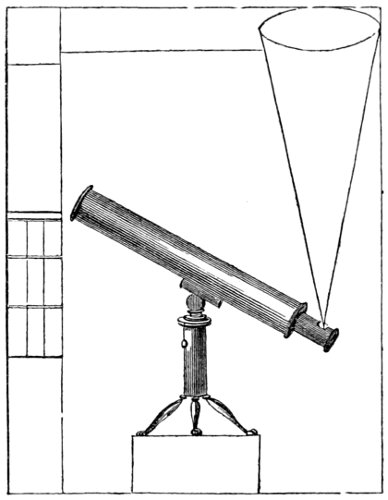
5. On the space-penetrating power of telescopes.—The
power of telescopes to penetrate into the
profundity of space is the result of the quantity
of light they collect and send to the eye in a state
fit for vision. This property of telescopes is
sometimes designated by the expression Illuminating
Power.
Sir W. Herschel appears to have been the first
who made a distinction between the magnifying
power, and the space-penetrating power of a
telescope; and there are many examples which
prove that such a distinction ought to be made,
especially in the case of large instruments. For
example, the small star, or speck of light, which
accompanies the pole-star, may be seen through a
telescope of large aperture, with a smaller magnifying
power than with a telescope of a small aperture
furnished with a much higher power. If the
magnifying power is sufficient to show the small
star completely separated from the rays which
surround the large one, this is sufficient in one
point of view; but in order that this effect may
be produced, so as to render the small star perfectly
distinguishable, a certain quantity of light
must be admitted into the pupil of the eye—which
quantity depends upon the area of the
object-glass or speculum of the instrument, or, in
other words, on the illuminating power. If we
compare a telescope of 2¾ inches aperture with
one of 5 inches aperture, when the magnifying
power of each does not exceed 50 times for terrestrial
objects, the effect of illuminating power is
not so evident; but if we use a power of 100 for
day objects, and 180 for the heavenly bodies, the
effects of illuminating power is so clearly perceptible,
that objects not only appear brighter, and
more clearly visible, in the larger telescope, but
with the same magnifying power, they also appear
larger, particularly when the satellites of Jupiter
and small stars are the objects we are viewing.
Sir W. Herschel remarks, that ‘objects are
viewed in their greatest perfection, when, in penetrating
space, the magnifying power is so low as
only to be sufficient to show the object well—and
when, in magnifying objects, by way of examining
them minutely, the space-penetrating power is no
higher than what will suffice for the purpose; for in
the use of either power, the injudicious overcharge
of the other will prove hurtful to vision.’ When
illuminating power is in too high a degree, the
eye is offended by the extreme brightness of the
object. When it is in too low a degree, the eye
is distressed by its endeavours to see what is
beyond its reach; and therefore it is desirable,
when we wish to give the eye all the assistance
possible, to have the illuminating and the magnifying
powers in due proportion. What this proportion
is, depends, in a certain degree, upon the
brightness of the object. In proportion to its
brightness or luminosity, the magnifying power
may, to a certain extent, be increased. Sir W.
Herschel remarks, in reference to α Lyræ, ‘This
star, I surmise, has light enough to bear being
magnified, at least a hundred thousand times, with
no more than six inches of aperture.’ However
beautifully perfect any telescopes may appear, and
however sharp their defining power, their performance
is limited by their illuminating powers—which
are as the squares of the diameters of the
apertures of the respective instruments. Thus, a
telescope whose object-glass is 4 inches diameter
will have four times the quantity of light, or illuminating
power, possessed by a telescope whose
aperture is only 2 inches, or in the proportion of
16 to 4,—the square of 4 being 16, and the square
of 2 being 4.
The nature of the space-penetrating power, to
which we are adverting, and the distinction between
it, and magnifying power, may be illustrated from a
few examples taken from Sir W. Herschel’s observations.
The first observation which I shall notice refers
to the nebula between η and ζ Ophiuchi, discovered
by Messier in 1764. The observation was made
with a 10 feet reflector, having a magnifying
power of 250, and a space-penetrating power of
28.67. His note is dated May 3, 1783. ‘I see
several stars in it, and make no doubt a higher
power and more light will resolve it all into stars.
This seems to me a good nebula for the purpose
of establishing the connection between nebulæ and
clusters of stars in general.’—‘June 18, 1784.
The same nebula viewed with a Newtonian 20
feet reflector; penetrating power 61, and a magnifying
power of 157; a very large and a very
bright cluster of excessively compressed stars.
The stars are but just visible, and are of unequal
magnitudes. The large stars are red, the cluster
is a miniature of that near Flamstead’s forty-second
Comæ Berenices; Right ascension 17h 6m 32s
Polar distance 108° 18´´’ In this case, a penetrating
power of about 28, with a magnifying
power of 250, barely shewed a few stars; when in
the second instrument the illuminating power of
60 with the magnifying power of only 157 showed
them completely.
Subsequently to the date of the latter observation,
the 20 feet Newtonian telescope was converted
into an Herschelian instrument, by taking
away the small speculum, and giving the large one
the proper inclination for obtaining the front view;
by which alteration the illuminating power was
increased from 61 to 75, and the advantage derived
from the alteration was evident in the discovery of
the satellites of Uranus by the altered telescope,
which before was incompetent in the point of
penetration, or illuminating power. ‘March 14,
1798, I viewed the Georgian planet (or Uranus)
with a new 25 feet reflector. Its penetrating
power is 95.85, and having just before also viewed
it with my 20 feet instrument, I found that with
an equal magnifying power of 300, the 25 feet
telescope had considerably the advantage of the
former.’ The aperture of the 20 feet instrument
was 18.8 inches, and that of the 25 feet telescope,
24 inches, so that the superior effect of the latter
instrument must have been owing to its greater
illuminating power. The following observations
show the superior power of the 40 feet telescope
as compared with the 20 feet.—‘Feb. 24, 1786, I
viewed the nebula near Flamstead’s fifth Serpentis,
with my 20 feet reflector, magnifying power 157.
The most beautiful extremely compressed cluster
of small stars; the greatest part of them gathered
together into one brilliant nucleus, evidently
consisting of stars, surrounded with many detached
gathering stars of the same size and colour. R.A.
15h 7m 12s. P.D. 87° 8´´’—‘May 27, 1791, I
viewed the same object with my 40 feet telescope,
penetrating power 191.69, magnifying power 370.
A beautiful cluster of stars. I counted about 200
of them. The middle of it is so compressed, that
it is impossible to distinguish the stars.’—‘Nov.
5, 1791, I viewed Saturn with the 20 and 40 feet
telescopes. Twenty feet. The fifth satellite of
Saturn is very small. The first, second, third,
fourth and fifth, and the new sixth satellites are in
their calculated places. Forty feet. I see the
new sixth satellite much better with this instrument
than with the 20 feet. The fifth is also
much larger here than in the 20 feet, in which it
was nearly the same size as a small fixed star, but
here it is considerably larger than that star.’
These examples, and many others of a similar
kind, explain sufficiently the nature and extent of
that species of power that one telescope possesses
over another, in consequence of its enlarged
aperture; but the exact quantity of this power is
in some degree uncertain. To ascertain practically
the illuminating power of telescopes, we must try
them with equal powers on such objects as the
following,—the small stars near the pole-star, and
near Rigel and ε Bootis—the division in the ring
of Saturn—and distant objects in the twilight or
towards the evening. These objects are distinctly
seen with a 5 feet achromatic of 38/10 inches aperture,
and an illuminating power of 144, while they
are scarcely visible in a 3½ feet with an aperture
of 2¾ inches, and an illuminating power of 72,
supposing the same magnifying power to be applied.
The illuminating power of a telescope is best
estimated, in regard to land objects, when it is
tried on minute objects, and such as are badly
lighted up; and the advantage of a telescope with
a large aperture will be most obvious, when it is
compared with another of inferior size in the close
of the evening, when looking at a printed bill
composed of letters of various sizes. As darkness
comes on, the use of illuminating power becomes
more evident. In a 5 feet telescope some small
letters will be legible, which are hardly discernible
in the 3½ feet, and in the 2½ feet are quite undefinable,
though the magnifying powers be equal.
Sir W. Herschel informs us, that in the year 1776,
when he had erected a telescope of 20 feet focal
length of the Newtonian construction, one of its
effects by trial was, that when towards evening, on
account of darkness, the natural eye could not
penetrate far into space, the telescope possessed
that power sufficiently to show, by the dial of a
distant church steeple, what o’clock it was, notwithstanding
the naked eye could no longer see
the steeple itself.
In order to convey an idea of the numbers by
which the degree of space-penetrating power is
expressed, and the general grounds on which they
rest, the following statements may be made. The
depth to which the naked eye can penetrate into the
spaces of the heavens, is considered as extending
to the twelfth order of distances—in other words,
it can perceive a star at a distance 12 times farther
than those luminaries, such as Sirius, Arcturus or
Capella, which, from their vivid light, we presume
to be nearest to us. It has been stated above, that
Herschel calculated his 10 feet telescope to have
a space-penetrating power of 28.67, that is, it
could enable us to descry a star 28 times farther
distant than the naked eye can reach. His 20
feet Newtonian was considered as having a similar
power of 61; his 25 feet, nearly 96, and his 40
feet instrument, a power of 191.69. If each of
these numbers be multiplied by 12, the product
will indicate how much farther these telescopes
will penetrate into space than the nearest range of
the fixed stars, such as those of the first magnitude.
For instance, the penetrating power of the
40 feet reflector being 191.69, this number multiplied
by 12, gives a product of 2,300, which
shows, that were there a series of two thousand
three hundred stars extended in a line beyond
Sirius, Capella and similar stars—each star separated
from the one beyond it, by a space equal to
the distance of Sirius from the earth—they might
be all seen through the 40 feet telescope. In
short, the penetrating power of telescopes is a
circumstance which requires to be particularly
attended to in our observations of celestial phenomena,
and in many cases, is of more importance
than magnifying power. It is the effect produced
by illuminating power that renders telescopes,
furnished with comparatively small magnifying
powers, much more efficient in observing comets
and certain nebulæ and clusters of stars, than when
high powers are attempted. Every telescope may
be so adjusted, as to produce different space-penetrating
powers. If we wish to diminish such a
power, we have only to contract the object-glass
or speculum, by placing circular rims, or apertures
of different degrees of breadth, across the mouth
of the great tube of the instrument. But we cannot
increase this illuminating power beyond a
certain extent, which is limited by the diameter
of the object-glass. When we wish illuminating
power beyond this limit, we must be furnished
with an object-glass or speculum of a larger size;
and hence, the rapid advance in price of instruments
which have large apertures, and consequently
high illuminating powers. Mr. Tulley’s
3½ feet achromatics of 2¾ inches aperture, sell at
£26 5s. When the aperture is 3¼ inches, the
price is £42. When 3¾ inches, £68 5s. The
following table contains a statement of the ‘comparative
lengths, apertures, illuminating powers,
and prices, of Achromatic Refractors, and Gregorian
Reflectors,’ according to Dr. Kitchener.
| ACHROMATIC REFRACTORS. |
| Length and name they are called by. |
Diameter of aperture. |
Illuminating power. |
Price. |
| Feet. |
In. |
Th. |
|
£ |
s. |
| 2 |
1. |
6 |
25 |
4 |
4 |
| 2½ |
2 |
|
40 |
12 |
12 |
| 3½ |
2. |
7 |
72 |
21 to
42 |
| 5 |
3. |
8 |
144 |
105 to
150 |
|
| 7 |
5 |
|
250 |
250 |
|
| 7 |
6 |
|
360 |
360 |
|
|
| GREGORIAN &c. REFLECTORS. |
| Length and name they are known by. |
Diameter of Aperture. |
Illuminating power. |
Price. |
| Feet. |
In. |
Th. |
|
£ |
s. |
| 1 |
2. |
5 |
62 |
7 |
7 |
| 1½ |
3. |
|
90 |
12 |
12 |
| 2 |
4. |
5 |
202 |
20 |
|
| 3 |
5. |
5 |
302 |
50 |
|
| 4 |
7 |
|
490 |
105 |
|
| 7 Newtonian |
7 |
|
490 |
126 |
|
| 5 Gregorian |
9 |
|
810 |
200 |
|
| 10 Newtonian |
10 |
|
1000 |
315 |
|
The illuminating powers stated in the above
table are only comparative. Fixing on the number
25 as the illuminating power of a 2 feet telescope,
16/10 inch aperture, that of a 2½ feet 2 inches
inches aperture, will be 40, of a 5 feet 38/10 inch
aperture, 144, &c. If the illuminating power of
a Gregorian 1½ foot, and 3 inches aperture, be
90, a 5 feet, with 9 inches aperture, will be 810,
&c.
6. On choosing Telescopes, and ascertaining
their properties.
It is an object of considerable importance, to
every astronomical observer, that he should be
enabled to form a judgment of the qualities of his
telescope, and of any instruments of this description
which he may intend to purchase. The
following directions may perhaps be useful to the
reader in directing him in the choice of an achromatic
refracting telescope.
Supposing that an achromatic telescope of 3½
feet focal length, and 3¼ inches aperture were
offered for sale, and that it were required to ascertain
whether the object-glass, on which its excellence
chiefly depends—is a good one and duly
adjusted;—some opinion may be formed by laying
the tube of the telescope in a horizontal position,
on a firm support, about the height of the eye,—and
by placing a printed card or a watch glass
vertically, but in an inverted position, against some
wall or pillar, at 40 or 50 yards distant, so as to
be exposed to a clear sky. When the telescope
is directed to this object, and accurately adjusted
to the eye—should the letters on the card, or the
strokes and dots on the watch-glass appear clearly
and sharply defined, without any mistiness or
coloration, and if very small points appear well
defined—great hopes may be entertained that the
glass will turn out a good one. But a telescope
may appear a good one, when viewing common
terrestrial objects, to eyes unaccustomed to discriminate
deviations from perfect vision, while it
may turn out to be an indifferent one, when
directed to certain celestial objects. Instead therefore
of a printed card, fix a black board, or one
half of a sheet of black paper, in a vertical position
at the same distance, and a circular disk of
white writing paper, about ¼ of an inch in diameter,
on the centre of the black ground. Then
having directed the telescope to this object, and
adjusted for the place of distinct vision, mark with
a black-lead pencil the sliding eye-tube, at the
end of the main tube, so that this position can
always be known; and if this sliding tube be
gradually drawn out, or pushed in, while the eye
beholds the disk, it will gradually enlarge and lose
its colour, till its edges cease to be well-defined.
Now, if the enlarged misty circle is observed to
be concentric with the disk itself, the object-glass
is properly centered, as it has reference to the
tube; but if the misty circle goes to one side of
the disk, the cell of the object-glass is not at right
angles to the tube, and must have its screws removed
and its holes elongated, by a rattailed file,
small enough to enter the holes. When this has
been done, the cell may be replaced, and the disk
examined a second time, and a slight stroke on
one edge of the cell, by a wooden mallet, will
show by the alteration made in the position of the
misty portion of the disk, how the adjustment is
to be effected, which is known to be right when a
motion in the sliding tube will make the diluted
disk enlarge in a circle concentric with the disk
itself. When the disk will enlarge so as to make
a ring of diluted white light round its circumference,
as the sliding tube holding the eye-piece is
pushed in or drawn out, the cell may be finally
fixed by the screws passing through its elongated
holes.
When the object-glass is thus adjusted, it may
then be ascertained whether the curves of the
respective lenses composing the object-glass are
well-formed and suitable for each other. If a
small motion of the sliding tube of about 1/10th of an
inch in a 3½ feet telescope, from the point of distinct
vision, will dilute the light of the disk and
render the appearance confused, the figure of the
object-glass is good; particularly if the same effect
will take place at equal distances from the point of
distinct vision, when the tube is alternately drawn
out and pushed in. A telescope that will admit
of much motion in the sliding tube without sensibly
affecting the distinctness of vision, will not
define an object well at any point of adjustment,
and must be considered as having an imperfect
object-glass, inasmuch as the spherical aberration
of the transmitted rays is not duly corrected. The
due adjustment of the convex lens, or lenses, to
the concave one, will be judged of by the absence
of coloration round the enlarged disk, and is a
property distinct from the spherical aberration;
the achromatism depending on the relative focal
distances of the convex and concave lenses, is
regulated by the relative dispersive powers of the
pieces of glass made use of; but the distinctness
of vision depends on a good figure of the computed
curves that limit the focal distances. When
an object-glass is free from imperfection in both
these respects, it may be called a good glass for
terrestrial purposes.
It still, however, remains to be determined how
far such an object-glass may be good for viewing
a star or a planet, and can only be known by
actual observations on the heavenly bodies. When
a good telescope is directed to the moon or to
Jupiter, the achromatism may be judged of, by
alternately pushing in, and drawing out the eye-piece,
from the place of distinct vision. In the
former case, a ring of purple will be formed round
the edge; and in the latter, a ring of light green,
which is the central colour of the prismatic spectrum;
for these appearances show, that the extreme
colours red and violet are corrected.
Again, if one part of a lens employed have a
different refractive power from another part of it,
that is, if the flint-glass particularly is not homogeneous,
a star of the first and even of the second
magnitude will point out the natural defect by
the exhibition of an irradiation, or what is called
a wing, at one side, which no perfection of figure
or of adjustment will banish, and the greater the
aperture the more liable is the evil to happen.
Hence caps with different apertures are usually
supplied with large telescopes, that the extreme
parts of the glass may be cut off, in observations
requiring a round and well-defined image of the
body observed.
Another method of determining the figure and
quality of an object-glass is by first covering its
centre by a circular piece of paper, as much as
one half of its diameter, and adjusting it for distinct
vision of a given object, such as the disk
above mentioned, when the central rays are intercepted—and
then trying if the focal length remains
unaltered when the paper is taken away, and an
aperture of the same size applied, so that the
extreme rays may in their turn be cut off. If the
vision remains equally distinct in both cases, without
any new adjustment for focal distance, the
figure is good, and the spherical aberration cured,
and it may be seen by viewing a star of the first
magnitude successively in both cases, whether the
irradiation is produced more by the extreme or
by the central parts of the glass. Or, in case the
one half be faulty and the other good, a semicircular
aperture, by being turned gradually round in
trial, will detect what semicircle contains the
defective portion of the glass; and if such portion
should be covered, the only inconvenience that
would ensue, would be the loss of so much light
as is thus excluded. When an object-glass produces
radiations in a large star, it is unfit for the
nicer observations of astronomy, such as viewing
double stars of the first class. The smaller a
large star appears in any telescope, the better is
the figure of the object-glass, but if the image of
the star be free from wings, the size of its disk is
not an objection in practical observations.30
Some opticians are in the habit of inserting a
diaphragm into the body of the large tube, to cut
off the extreme rays coming from the object-glass
when the figure is not good, instead of lessening
the aperture by a cap. When this is the case, a
deficiency of light will be the consequence beyond
what the apparent aperture warrants. It is therefore
proper to examine that the diaphragm be not
placed too near the object-glass, so as to intercept
any of the useful rays. Sometimes a portion of the
object-glass is cut off by the stop in the eye-tube.
To ascertain this, adjust the telescope to distinct
vision, then take out the eye-glasses, and put
your finger on some other object on the edge of
the outside of the object-glass, and look down
the tube; if you can see the tip of your finger, or
any object in its place, just peeping over the edge
of the object-glass, no part is cut off. I once had
a 3½ feet telescope whose object-glass measured 3
inches diameter, which was neither so bright, nor
did it perform in other respects nearly so well as
another of the same length whose object-glass was
only 2¾ inches diameter; but I found that a
diaphragm was placed about a foot within the
end of the large tube, which reduced the aperture
of the object-glass to less than 2½ inches; and
when it was removed the telescope was less distinct
than before. The powers given along with
this instrument were much lower than usual—none
of them exceeding 100 times. This is a
trick not uncommon with some opticians.
Dr. Pearson mentions that an old Dollond’s
telescope of 63 inches focal length, and 3¾ inches
aperture, supposed to be an excellent one, was
brought to Mr. Tulley, when he was present, and
the result of the examination was that its achromatism
was not perfect. The imperfection was
thus determined by experiment. A small glass
globe was placed at 40 yards distance from the
object-end of the telescope when the sun was
shining, and the speck of light seen reflected from
this globe formed a good substitute for a large
star, as an object to be viewed. When the focal
length of the object-glass was adjusted to this
luminous object, no judgment could be formed of
its prismatic aberrations, till the eye-piece had
been pushed in beyond the place of correct vision;
but when the telescope was shortened a little, the
luminous disk occasioned by such shortening was
strongly tinged with red rays at its circumference.
On the contrary, when the eye-piece was drawn out,
so as to lengthen the telescope too much, the disk
thus produced was tinged with a small circle of
red at its centre, thereby denoting that the convex
lens had too short a focal length; and Mr.
Tulley observed, that if one or both of the curves
of the convex lens were flattened till the total
focal length should be about 4 inches increased,
it would render the telescope quite achromatic,
provided in doing this the aberration should not
be increased.
The following general remarks may be added.
1. To make anything like an accurate comparison
of telescopes, they must be tried not only at the
same place, but as nearly as possible at the same
time, and, if the instruments are of the same
length and construction, if possible, with the
same eye-piece. 2. A difference of 8 or 10 times
in the magnifying power, will sometimes, on
certain objects, give quite a different character to
a telescope. It has been found by various experiments
that object-glasses of two or three inches
longer focus will produce different vision with the
same eye-piece. 3. Care must be taken to ascertain
that the eye-glasses are perfectly clean and
free from defects. The defects of glass are either
from veins—specks—scratches—colour, or an incorrect
figure. To discover veins in an eye or an
object-glass, place a candle at the distance of 4
or 5 yards; then look through the glass, and
move it from your eye till it appear full of light—you
will then see every vein, or other imperfection
in it which may distort the objects and render
vision imperfect. Specks or scratches, especially
in object-glasses, are not so injurious as veins, for
they do not distort the object, but only intercept
a portion of the light. 4. We cannot judge
accurately of the excellence of any telescope by
observing objects with which we are not familiarly
acquainted. Opticians generally try an instrument
at their own marks, such as the dial-plate of
a watch, a finely engraved card, a weather-cock,
or the moon and the planet Jupiter, when near
the meridian. Of several telescopes of the same
length, aperture and magnifying power, that one
is generally considered the best with which we
can read a given print at the greatest distance,
especially if the print consists of figures, such as
a table of logarithms, where the eye is not apt to
be deceived by the imagination, in guessing at the
sense of a passage, when two or three words are
distinguished.
There is a circumstance which I have frequently
noticed, in reference to achromatic telescopes,
particularly those of a small size, and which I
have never seen noticed by any optical writer. It
is this,—if the telescope, when we are viewing
objects, be gradually turned round its axis, there
is a certain position in which the objects will
appear distinct and accurately defined; and if it
be turned round exactly a semicircle from this
point, the same degree of distinctness is perceived;
but in all other positions, there is an evident want
of clearness and defining power. This I find to
be the case in more than ten 1 foot and 2 feet
telescopes now in my possession; and therefore I
have put marks upon the object-end of each of
them, to indicate the positions in which they
should be used for distinct observation.—This is a
circumstance which requires, in many cases, to be
attended to in the choice and the use of telescopical
instruments, and in fixing and adjusting
them on their pedestals. In some telescopes this
defect is very striking, but it is in some measure
perceptible in the great majority of instruments
which I have had occasion to inspect. Even in
large and expensive achromatic telescopes this
defect is sometimes observable. I have an achromatic
whose object-glass is 41/10 inches diameter,
which was much improved in its defining power,
by being unscrewed from its original position, or
turned round its axis—about one-eighth part of
its circumference. This defect is best detected by
looking at a large printed bill, or a sign-post at a
distance, when, on turning round the telescope
or object-glass, the letters will appear much better
defined in one position than in another. The
position in which the object appears least distinct
is when the upper part of the telescope is a
quadrant of a circle different from the two positions
above-stated, or at an equal distance from
each of them.
7. On the mode of determining the magnifying
power of Telescopes.
In regard to refracting telescopes, we have
already shown that, when a single eye-glass is
used, the magnifying power may be found by
dividing the focal distance of the object-glass by
that of the eye-glass. But when a Huygenian
eye-piece, or a four-glass terrestrial eye-piece such
as is now common in achromatic telescopes, is
used, the magnifying power cannot be ascertained
in this manner; and in some of the delicate
observations of practical astronomy, it is of the
utmost importance to know the exact magnifying
power of the instrument with which the observations
are made, particularly when micrometrical
measurements are employed to obtain the desired
results.—The following is a general method of
finding the magnifying powers of telescopes when
the instrument called a dynameter is not employed;
and it answers for refracting and reflecting telescopes
of every description.
Having put up a small circle of paper, an inch
or two in diameter, at the distance of about 100
yards, draw upon a card 2 black parallel lines,
whose distance from each other is equal to the
diameter of the paper circle. Then view through
the telescope the paper circle with one eye, and
the parallel lines with the other; and let the
parallel lines be moved nearer to or further from,
the eye, till they seem exactly to cover the small
circle viewed through the telescope. The quotient
obtained by dividing the distance of the paper
circle by the distance of the parallel lines from the
eye, will be the magnifying power of the telescope.
It requires a little practice before this experiment
can be performed with accuracy. The one eye
must be accustomed to look at an object near at
hand, while the other is looking at a more distant
object through the telescope. Both eyes must be
open at the same time, and the image of the
object seen through the telescope must be brought
into apparent contact with the real object near at
hand. But a little practice will soon enable any
observer to perform the experiment with ease and
correctness, if the telescope be mounted on a firm
stand, and its elevation or depression produced by
rack-work.
The following is another method, founded on
the same principle:—Measure the space occupied
by a number of the courses, or rows of bricks in
a modern building—which, upon an average, is
found to have 8 courses in 2 feet, so that each
course or row, is 3 inches. Then cut a piece of
paper 3 inches in height, and of the length of a
brick—which is about 9 inches—so that it may
represent a brick, and fixing the paper against
the brick wall, place the telescope to be examined
at the distance of about 80 or 100 yards from it.
Now, looking through the telescope at the paper
with one eye, and at the same time, with the other
eye, looking past the telescope, observe what extent
of wall the magnified image of the paper appears to
cover, then count the courses of bricks in that extent,
and it will give the magnifying power of the telescope.
It is to be observed, however, that the magnifying
power determined in this way, will be a fraction
greater than for very distant objects, as the focal
distance of the telescope is necessarily lengthened
in order to obtain distinct vision of near objects.
In comparing the magnifying powers of two
telescopes, or of the same telescope, when different
magnifying powers are employed, I generally use
the following simple method. The telescopes are
placed at 8 or 10 feet distant from a window, with
their eye-ends parallel to each other, or at the
same distance from the window. Looking at a
distant object, I fix upon a portion of it whose
magnified image will appear to fill exactly two or
three panes of the window. Then putting on a
different power, or looking through another telescope,
I observe the same object, and mark exactly
the extent of its image on the window-panes, and
compare the extent of the one image with the
other. Suppose for example, that the one telescope
has been previously found to magnify 90
times, and that the image of the object fixed upon
exactly fills three panes of the window, and that
with the other power or the other telescope, the
image fills exactly two panes, then the magnifying
power is equal to two thirds of the former, or 60
times; and were it to fill only one pane, the
power would be about 30 times. A more correct
method is to place at one side of the window, a
narrow board, two or three feet long, divided into
15 or 20 equal parts, and observe how many of
these parts appear to be covered by the respective
images, of the different telescopes. Suppose, in
the one case, 10 divisions to be covered by the
image, in a telescope magnifying 90 times, and
that the image of the same object in another
telescope, measures 6 divisions, then its power is
found by the following proportion, 10 : 90 : 6 : 54 :
that is, this telescope magnifies 54 times.
Another mode which I have used for determining,
to a near approximation, the powers of telescopes,
is as follows:—Endeavour to find the focus
of a single lens which is exactly equivalent to the
magnifying power of the eye-piece, whether the
Huygenian or the common terrestrial eye-piece.
This may be done by taking a small lens, and
using it as an object-glass to the eye-piece. Looking
through the eye-piece to a window and holding
the lens at a proper distance, observe whether the
image of one of the panes exactly coincides with
the pane, as seen by the naked eye; if it does,
then the magnifying power of the eye-piece is
equal to that of the lens. If the lens be ½ inch
focal length, the eye-piece will produce the same
magnifying power, as a single lens when used as
an eye-glass to the telescope, and the magnifying
power will then be found by dividing the focal
distance of the object-glass by that of the eye-glass.
But if the image of the pane of glass does
not exactly coincide with the pane as seen by the
other eye, then proportional parts may be taken
by observing the divisions of such a board as described
above, or we may try lenses of different
focal distances. Suppose, for example, that a
lens 2 inches focal length had been used, and that
the image of a pane covered exactly the space of
two panes, the power of the eye-piece is then
equal to that of a single lens 1 inch focal distance.
The following is another mode depending on the
same general principle. If a slip of writing-paper
one inch long, or a disk of the same material
of one inch diameter, be placed on a black ground
at from 30 to 50 yards distance from the object-end
of the telescope, and a staff painted white,
and divided into inches and parts by strong black
lines, be placed vertically near the said paper or
disk; the eye that is directed through the telescope
when adjusted for vision, will see the magnified
disk, and the other eye, looking along the outside
of the telescope, will observe the number of inches
and parts that the disk projected on it will just
cover, and as many inches as are thus covered will
indicate the magnifying power of the telescope—at
the distance for which it is adjusted for distinct
vision. The solar power, or powers for very distant
objects, may be obtained by the following
proportion:—As the terrestrial focal length, at the
given distance: is to the solar focal length :: so
is the terrestrial power, to the solar power. For
example, a disk of white paper one inch in diameter,
was placed on a black board, and suspended
on a wall contiguous to a vertical black staff that
was graduated into inches by strong white lines, at
a distance of 33 yards 2½ feet, and when the adjustment
for vision was made with a 42 inch telescope,
the left eye of the observer viewed the
disk projected on the staff, while the right eye
observed that the enlarged image of the disk
covered just 58½ inches on the staff, which number
was the measure of the magnifying power, at the
distance answering to 33 yards 2½ feet—which in
this case exceeded the solar focus by an inch and a
half. Then according to the above analogy, we
have, as 43.5 : 42 :: 58.5 : 56.5 nearly. Hence
the magnifying power due to the solar focal length
of the telescope in question is 56.5, and the distance
33 yards 2½ feet, is that which corresponds
to an elongation of the solar focal distance an
inch and a half.31 If we multiply the terrestrial
and the solar focal distances together, and divide
the product by their difference, we shall again
obtain the distance of the terrestrial object from
the telescope. Thus, (43.5 + 42)/1.5 = 1218 inches =
101.5 feet, or 33 yards 2½ feet.
The magnifying power of a telescope is also
determined, by measuring the image which the
object-glass or the large speculum of a telescope
forms at its solar focus. This is accomplished by
means of an instrument called a Dynameter.
This apparatus consists of a strip of mother-of-pearl,
marked with equal divisions, from the 1/100th
to the 1/1000th of an inch apart, according to the
accuracy required. This measure is attached to a
magnifying lens in its focus, in order to make the
small divisions more apparent. When the power
of a telescope is required, the person must measure
the clear aperture of the object-glass, then holding
the pearl dynameter next the eye-glass, let him
observe how many divisions the small circle of
light occupies, when the instrument is directed to
a bright object. Then by dividing the diameter
of the object-glass by the diameter of this circle
of light, the power will be obtained.32 The most
accurate instrument of this kind is the Double
Image Dynameter invented by Ramsden, and
another on the same principle now made by
Dollond, a particular description of which may be
found in Dr. Pearson’s ‘Introduction to Practical
Astronomy.’ The advantage attending these dynameters
is that they do not require any knowledge
of the thickness and focal lengths of any of the
lenses employed in a telescope, nor yet of their
number or relative positions; neither does it make
any difference whether the construction be refracting
or reflecting, direct or inverting. One operation
includes the result arising from the most complicated
construction.
I shall only mention farther the following
method of discovering the magnifying power,
which is founded on the same general principle as
alluded to above. Let the telescope be placed in
such a position opposite the sun, that the rays of
light may fall perpendicularly on the object-glass;
and the pencil of rays may be received on a piece
of paper, and its diameter measured. Then, as
the diameter of the pencil of rays is to that of the
object-glass, so is the magnifying power of the
telescope.
8.—On cleaning the lenses of telescopes.—
It is necessary, in order to distinct vision, that
the glasses, particularly the eye-glasses of telescopes
be kept perfectly clean, free of damp, dust,
or whatever may impede the transmission of the
rays of light. But great caution ought to be
exercised in the wiping of them, as they are apt
to be scratched, or otherwise injured by a rough
and incautious mode of cleaning them. They
should never be attempted to be wiped unless
they really require it; and, in this case, they
should be wiped carefully and gently with a piece
of new and soft lamb’s-skin leather. If this be
not at hand, a piece of fine silk paper, or fine
clean linen may be used as a substitute. The
lens which requires to be most particularly attended
to is the second glass from the eye, or the
field-glass; for if any dust or other impediment be
found upon this glass, it is always distinctly seen,
being magnified by the glass next the eye. The
next glass which requires attention is the fourth
from the eye, or that which is next the object.
Unless the glass next the eye be very dusty, a few
small spots or grains of dust are seldom perceptible.
The object-glass of an achromatic should
seldom be touched, unless damp adheres to it.
Care should be taken never to use pocket handkerchiefs
or dirty rags for wiping lenses. From
the frequent use of such articles, the glasses of
seaman’s telescopes get dimmed and scratched in
in the course of a few years. If the glasses be
exceedingly dirty, and if greasy substances are
attached to them, they may be soaked in spirits
and water, and afterwards carefully wiped. In
replacing the glasses in their socket, care should
be taken not to touch the surfaces with the fingers,
as they would be dimmed with the perspiration:
they should be taken hold of by the edges only,
and carefully screwed into the same cells from
which they were taken.
It appears to have been almost overlooked by
opticians and others, that telescopes may be constructed
so as to exhibit a beautiful and minute
view of very near objects, and to produce even a
microscopic effect, without the least alteration in
the arrangement of the lenses of which they are
composed. This object is effected simply by making
the eye-tube of a telescope of such a length
as to be capable of being drawn out 12 or 13
inches beyond the point of distinct vision for distant
objects. The telescope is then rendered
capable of exhibiting with distinctness all kinds of
objects, from the most distant to those which are
placed within 3 or 4 feet of the instrument—or
not nearer than double the focal distance of the
object-glass. Our telescopes, however, are seldom
or never fitted with tubes that slide farther than
an inch or two beyond the point of distinct vision
for distant objects, although a tube of a longer
size than usual, or an additional tube would cost
but a very trifling expence.
The following, among many others, are some of
the objects on which I have tried many amusing
experiments with telescopes fitted up with the
long tubes to which I allude. The telescope to
which I shall more particularly advert is an achromatic,
mounted on a pedestal, having an object-glass
about 19 inches focal length, and 1⅝ inch
diameter, with magnifying powers for distant
objects of 13 and 20 times. When this instrument
is directed to a miniature portrait, 3½ inches
in length, placed in a good light, at the distance
of about 8 or 10 feet, it appears as large as an
oil-painting four or five feet long, and represents
the individual as large as life. The features of
the face appear to stand out in bold relief: and
perhaps there is no representation of the human
figure that more resembles the living prototype,
than in this exhibition, provided the miniature is
finely executed. In this case the tube requires to
be pulled out four or five inches from the point of
distinct vision for distant objects, and consequently
the magnifying power is proportionally increased.
Another class of objects to which such a telescope
may be applied is Perspective prints, either of
public buildings, streets or landscapes. When
viewed in this way they present a panoramic appearance,
and seem nearly as natural as life—just
in the same manner as they appear in the Optical
Diagonal Machine, or when reflected in a large
concave mirror—with this advantage, that, while
in these instruments the left hand side of the
print appears where the right should be,—the
objects seen through the telescope appear exactly
in their natural position. In this case, however,
the telescope should have a small magnifying
power, not exceeding 5 or 6 times, so as to take
in the whole of the landscape. If an astronomical
eye-piece be used, the print will require to be inverted.
Other kinds of objects which may be viewed
with this instrument, are trees, flowers, and other
objects in gardens immediately adjacent to the
apartment in which we make our observations. In
this way we may obtain a distinct view of a variety
of rural objects, which we cannot easily approach,
such as the buds and blossoms on the tops of trees,
and the insects with which they may be infested.
There are certain objects on which the telescope
may be made to produce a powerful microscopical
effect, such as the more delicate and beautiful
kinds of flowers, the leaves of trees, and similar
objects. In viewing such objects, the telescope
may be brought within little more than double
the focal distance of the object-glass from the
objects to be viewed, and then the magnifying
power is very considerably increased. A nosegay
composed of a variety of delicate flowers, and even
a single flower, such as the sea-pink, makes a
splendid appearance in this way. A peacock’s
feather, or even the fibres on a common quill,
appear very beautiful, when placed in a proper
light. The leaves of trees, particularly the leaf of
the plane-tree, when placed against a window-pane,
so that the light may shine through them—appear,
in all their internal ramifications, more
distinct, beautiful and interesting, than when
viewed in any other way; and in such views a
large portion of the object is at once exhibited to
the eye. In this case, the eye-piece of such a
telescope as that alluded to requires to be drawn
out 12 or 14 inches beyond the point of distinct
vision for objects at a distance—and the distance
between these near objects and the object-end of
the telescope, is only about 3½ feet.
A telescope having a diagonal eye-piece presents
a very pleasant view of near objects in this
manner. With an instrument of this kind, I
have frequently viewed the larger kind of small
objects alluded to above, such as the leaves of
shrubs and trees, flowers consisting of a variety
of parts, the fibres of a peacock’s feather and
similar objects. In this case the object-glass of
the instrument, which is 10½ inches focal length,
was brought within 22 inches of the object, and
the eye looked down upon it, in the same manner,
as when we view objects in a compound microscope.
A common pocket achromatic telescope
may be used for the purposes now stated, provided
the tube in the eye-piece containing the two lenses
next the object, be taken out, in which case the
two glasses next the eye form an astronomical
eye-piece, and the tubes may be drawn out 5 or 6
inches beyond the focal point for distant objects,
and will produce distinct vision for objects not
farther distant than about 20 or 24 inches. But,
in this case, the objects to be viewed must be
inverted, in order that they may be seen in their
natural positions when viewed through the instrument.
Telescopes of a large size and high magnifying
powers may likewise be used with advantage
for viewing very near objects in gardens
adjacent to the room in which the instruments
are placed, provided the sliding-tube next the eye
has a range of two or three inches beyond the
point of vision for distant objects. In this case,
a magnifying power of 100 times on a 3½ or a 5
feet achromatic produces a very pleasant effect.
In making the observations to which I have now
alluded, it is requisite in order to distinct vision,
and to obtain a pleasing view of the objects, that
the instrument should be placed on a pedestal,
and capable of a motion in every direction. The
adjustment for distinct vision may be made either
by the sliding-tube, or by removing the telescope
nearer to or farther from the object.
Light is one of the most wonderful and beneficial,
and at the same time one of the most mysterious
agents in the material creation. Though
the sun from which it flows to this part of our
system is nearly a hundred millions of miles from
our globe, yet we perceive it as evidently, and
feel its influence as powerfully, as if it emanated
from no higher a region than the clouds. It
supplies life and comfort to our physical system,
and without its influence and operations on the
various objects around us, we could scarcely
subsist and participate of enjoyment for a single
hour. It is diffused around us on every hand from
its fountain the sun; and even the stars, though
at a distance hundreds of thousands of times
greater than that of the solar orb, transmit to our
distant region a portion of this element. It gives
beauty and fertility to the earth, it supports the
vegetable and animal tribes, and is connected with
the various motions which are going forward
throughout the system of the universe. It unfolds
to us the whole scenery of external nature—the
lofty mountains and the expansive plains, the
majestic rivers and the mighty ocean; the trees,
the flowers, the crystal streams, and the vast
canopy of the sky adorned with ten thousands of
shining orbs. In short there is scarcely an object
within the range of our contemplation, but what
is exhibited to our understanding through the
medium of light, or at least bears a certain relation
to this enlivening and universal agent. When we
consider the extreme minuteness of the rays of
light, their inconceivable velocity, the invariable
laws by which they act upon all bodies, the multifarious
phenomena produced by their inflections,
refractions and reflections, while their original properties
remain the same; the endless variety of
colours they produce on every part of our terrestrial
creation, and the facility with which millions
of rays pass through the smallest apertures, and
pervade substances of great density, while every
ray passes forward in the crowd without disturbing
another, and produces its own specific impression—we
cannot but regard this element as the most
wonderful, astonishing and delightful part of the
material creation. When we consider the admirable
beauties and the exquisite pleasures of which
light is the essential source, and how much its
nature is still involved in mystery, notwithstanding
the profound investigations of modern philosophers,
we may well exclaim with the Poet:—
“How then shall I attempt to sing of Him
Who, light himself, in uncreated light
Invested deep, dwells awfully retired
From mortal eye or angel’s purer ken;
Whose single smile has, from the first of time,
Filled, overflowing, all yon lamps of heaven,
That beam for ever through the boundless sky.”—Thomson.
The eye is the instrument by which we perceive
the beautiful and multifarious effects of this universal
agent. Its delicate and complicated structure,
its diversified muscles, its coats and membranes,
its different humours possessed of different
refractive powers, and the various contrivances
for performing and regulating its external and
internal motions, so as to accomplish the ends
intended—clearly demonstrate this organ to be a
master-piece of Divine mechanism—the workmanship
of Him whose intelligence surpasses conception,
and whose Wisdom is unsearchable. ‘Our
sight (says Addison) is the most perfect and delightful
of all our senses. It fills the mind with
the largest variety of ideas, converses with its
objects at the greatest distance, and continues the
longest in action, without being tired or satiated
with its proper enjoyments. The sense of feeling
can indeed give us a notion of extension, shape,
and all other ideas that enter the eye, except
colours; but at the same time it is very much
strained, and confined in its operation to the
number, bulk and distance of its particular objects.
Our sight seems designed to supply all these
defects, and may be considered as a more delicate
and diffusive kind of touch that spreads itself over
an infinite multitude of bodies, comprehends the
largest figures, and brings into our reach some of
the more remote parts of the universe.’
Could we suppose an order of beings endued
with every human faculty but that of sight, it
would appear incredible to such beings—accustomed
only to the slow information of touch—that
by the addition of an organ consisting of a ball
and socket, of an inch diameter, they might be
enabled, in an instant of time, without changing
their place, to perceive the disposition of a whole
army, the order of a battle, the figure of a magnificent
palace, or all the variety of a landscape.
If a man were by feeling to find out the figure of
the Peak of Teneriffe, or even of St. Peter’s
church at Rome, it would be the work of a lifetime.
It would appear still more incredible to
such beings as we have supposed, if they were
informed of the discoveries which may be made
by this little organ in things far beyond the reach
of any other sense—that, by means of it we can
find our way in the pathless ocean—that we can
traverse the globe of the earth, determine its
figure and dimensions, and delineate every region
of it—yea, that we can measure the planetary orbs,
and make discoveries in the sphere of the fixed
stars. And, if they were farther informed that,
by means of this same organ, we can perceive the
tempers and dispositions, the passions and affections
of our fellow-creatures, even when they
want most to conceal them—that when the tongue
is taught most artfully to lie and dissemble, the
hypocrisy should appear in the countenance to a
discerning eye—and that by this organ we can
often perceive what is straight and what is crooked
in the mind as well as in the body—would it not
appear still more astonishing to beings such as we
have now supposed?33
Notwithstanding these wonderful properties of
the organ of vision, the eye, when unassisted by
art, is comparatively limited in the range of its
powers. It cannot ascertain the existence of certain
objects at the distance of three or four miles,
nor perceive what is going forward in nature or
art beyond such a limit. By its natural powers
we perceive the moon to be a globe about half a
degree in diameter, and diversified with two or
three dusky spots, and that the sun is a luminous
body of apparently the same size—that the planets
are luminous points, and that about a thousand
stars exist in the visible canopy of the sky. But
the ten thousandth part of those luminaries, which
are within the reach of human vision, can never
be seen by the unassisted eye. Here the TELESCOPE
interposes, and adds a new power to the
organ of vision, by which it is enabled to extend
its views to regions of space immeasurably distant,
and to objects, the number and magnitude of
which could never otherwise have been surmised
by the human imagination. By its aid we obtain
a sensible demonstration that space is boundless—that
the universe is replenished with innumerable
suns and worlds—that the remotest regions of immensity,
immeasurably beyond the limits of unassisted
vision, display the energies of Creating
Power, and that the Empire of the Creator extends
far beyond what eye hath seen or the human
imagination can conceive.
The telescope is an instrument of a much more
wonderful nature than what most people are apt
to imagine. However popular such instruments
now are, and however common a circumstance it
is to contemplate objects at a great distance which
the naked eye cannot discern, yet, prior to their invention
and improvement, it would have appeared
a thing most mysterious, if not impossible, that
objects at the distance of ten miles could be made
to appear as if within a few yards of us, and that
some of the heavenly bodies could be seen as
distinctly as if we had been transported by some
superior power, hundreds of millions of miles
beyond the bounds of our terrestrial habitation.
Who could ever have imagined—reasoning a
priori—that the refraction of light in glass—the
same power by which a straight rod appears
crooked in water, by which vision is variously distorted,
and by which we are liable to innumerable
deceptions—that that same power, or law of
nature, by the operation of which the objects in
a landscape appear distorted when seen through
certain panes of glass in our windows, that that
power should ever be so modified and directed as
to extend the boundaries of vision, and enable us
clearly to distinguish scenes and objects at a distance
a thousand times beyond the natural limits
of our visual organs? Yet such are the discoveries
which science has achieved, such the powers
it has brought to light, that by glasses ground into
different forms, and properly adapted to each
other, we are enabled as it were to contract the
boundaries of space, to penetrate into the most
distant regions, and to bring within the reach of
our knowledge the most sublime objects in the
universe.
When Pliny declared in reference to Hipparchus,
the ancient astronomer, ‘Ausus rem Deo
improbam annumerare posteris stellas,’—that ‘he
dared to enumerate the stars for posterity, an
undertaking forbidden by God,’ what would that
natural historian have said, had it been foretold
that in less than 1600 years afterwards, a man
would arise who should enable posterity to perceive,
and to enumerate ten times more new stars
than Hipparchus ever beheld—who should point out
higher mountains on the moon than on the earth, who
should discover dark spots, as large as our globe, in
the sun, the fountain of light—who should descry
four moons revolving in different periods of time
around the planet Jupiter, and could show to
surrounding senators the varying phases of Venus?
and that another would soon after arise who should
point out a double ring of six hundred thousand
miles in circumference, revolving around the planet
Saturn, and ten hundreds of thousands of stars
which neither Hipparchus nor any of the ancient
astronomers could ever descry? Yet these are
only a small portion of the discoveries made by
Galileo and Herschel, by means of the telescope.
Had any one prophetically informed Archimedes,
the celebrated geometrician of Syracuse, that
vision would, in after ages, be thus wonderfully
assisted by art—and further, that one manner of
improving vision would be to place a dark opake
body directly between the object and the eye—and
that another method would be, not to look
at the object, but to keep the eye quite in a different,
and even in an opposite direction, or to
stand with the back directly opposed to it, and to
behold all the parts of it, invisible to the naked
eye, most distinctly in this way—he would, doubtless
have considered the prophet as an enthusiastic
fool or a raving madman. Yet these things have
been realized in modern times in the fullest extent.
In the Gregorian reflecting telescope an
opake body, namely the small speculum near the
end of the tube, interposes directly between the
eye and the object. In the Newtonian Reflector,
and in the diagonal eye-pieces formerly described,
the eye is directed in a line at right angles to the
object, or a deviation of 90 degrees from the direct
line of vision. In Herschel’s’ large telescopes, and
in the Aerial Reflector formerly described (in pp.
311-325) the back is turned to the object, and the
eye in an opposite direction.
These circumstances should teach us humility
and a becoming diffidence in our own powers;
and they should admonish us not to be too dogmatical
or peremptory in affirming what is possible
or impossible in regard either to nature or art, or
to the operations of the Divine Being. Art has
accomplished, in modern times, achievements, in
regard to locomotion, marine and aërial navigation,
the improvement of vision, the separation and
combinations of invisible gases, and numerous
other objects, of which the men of former
ages could not have formed the least conception.
And even yet, we can set no boundaries
to the future discoveries of science and the improvements
of art; but have every reason to
indulge the hope that, in the ages to come, scenes
of Divine mechanism in the system of nature will
be unfolded, and the effects of chemical and
mechanical powers displayed, of which the human
mind, in its present state of progress, cannot form
the most imperfect idea. Such circumstances
likewise should teach us not to reject any intimations
which have been made to us in relation to
the character, attributes, and dispensations of the
Divine Being, and the moral revelations of his
will given in the Sacred Records, because we are
unable to comprehend every truth and to remove
every difficulty, which relates to the moral government
of the Great Ruler of the universe. For,
if we meet with many circumstances in secular
science, and even in the common operations of
nature, which are difficult to comprehend—if even
the construction of such telescopes as we now
use, would have appeared an incomprehensible
mystery to ancient philosophers—we must expect
to find difficulties almost insurmountable to such
limited minds as ours, in the eternal plans and
moral arrangements of the “King Immortal and
Invisible,” as delineated only in their outlines,
in the Sacred Oracles—particularly those which
relate to the origin of physical and moral evil, the
ultimate destiny of man, and the invisible realities
of a future world.
The UTILITY of the telescope may be considered
in relation to the following circumstances.
In the first place, it may be considered as an
instrument or machine which virtually transports
us to the distant regions of space. When we look
at the moon through a telescope which magnifies
200 times, and survey its extensive plains, its lofty
peaks, its circular ranges of mountains, throwing
their deep shadows over the vales, its deep and
rugged caverns, and all the other varieties which
appear on the Lunar surface, we behold such objects
in the same manner as if we were standing
at a point 238,800 miles from the earth in the
direction of the moon, or only twelve hundred
miles from that orb, reckoning its distance to be
240,000 miles. When we view the planet Saturn
with a similar instrument, and obtain a view of
its belts, and satellites, and its magnificent rings,
we are transported, as it were, through regions of
space, to a point in the heavens more than nine
hundred millions of miles from the surface of our
globe, and contemplate those august objects, as if
we were placed within five millions of miles of the
surface of that planet.34 Although a supernatural
power, sufficient to carry us in such a celestial
journey, a thousand miles every day, were exerted—it
would require more than two thousand four
hundred and sixty years, before we could arrive at
such a distant position; yet the telescope, in a
few moments, transports our visual powers to that
far distant point of space. When we view, with
such an instrument, the minute and very distant
clusters of stars in the Milky Way, we are
carried in effect through the regions of space to
the distance of five hundred thousand millions of
miles from the earth; for we behold those luminaries
through the telescope nearly as if they were
actually viewed from such a distant point in the
spaces of the firmament. These stars cannot be
conceived as less than a hundred billions of miles
from our globe, and the instrument we have supposed
brings them within the two hundredth part
of this distance. Suppose we were carried forward
by a rapid motion towards this point, at the
rate of a thousand miles every hour, it would
require more than fifty-seven thousand years, before
we could reach that very distant station in
space to which the telescope, in effect, transports
us. So that this instrument is far more efficient
in opening to our view the scenes of the universe
than if we were invested with powers of locomotion
to carry us through the regions of space,
with the rapidity of a cannon ball at its utmost
velocity; and all the while we may sit at ease in
our terrestrial apartments.
In the next place, the telescope has been
the means of enlarging our views of the sublime
scenes of creation, more than any other instrument
which art has contrived. Before the invention
of this instrument the universe was generally
conceived as circumscribed within very narrow
limits. The earth was considered as among the
largest bodies in creation; the planets were
viewed as bodies of a far less size than what they
are now found to be; no bodies similar to our
moon were suspected as revolving around any of
them; and the stars were supposed to be little
more than a number of brilliant lamps hung up to
emit a few glimmering rays, and to adorn the
canopy of our earthly habitation. Such a wonderful
phenomenon as the Ring of Saturn was
never once suspected, and the sun was considered
as only a large ball of fire. It was suspected, indeed,
that the moon was diversified with mountains
and vales, and that it might possibly be a
habitable world; but nothing certainly could be
determined on this point, on account of the limited
nature of unassisted vision. But the telescope
has been the means of expanding our views of the
august scenes of creation to an almost unlimited
extent. It has withdrawn the veil which formerly
interposed to intercept our view of the distant
glories of the sky. It has brought to light five
new planetary bodies, unknown to former astronomers,
one of which is more than eighty times
larger than the earth—and seventeen secondary
planets which revolve around the primary. It has
expanded the dimensions of the solar system to
double the extent which was formerly supposed.
It has enabled us to descry hundreds of comets
which would otherwise have escaped our unassisted
vision, and to determine some of their trajectories
and periods of revolution.
It has explored the profundities of the Milky
Way, and enabled us to perceive hundreds of
thousands of those splendid orbs, where scarcely
one is visible to the naked eye. It has laid open
to our view thousands of Nebulæ, of various descriptions,
dispersed through different regions of
the firmament—many of them containing thousands
of separate stars. It has directed our investigations
to thousands of double, treble and multiple
stars—suns revolving around suns, and systems
around systems, and has enabled us to determine
some of the periods of their revolutions. It has
demonstrated the immense distances of the starry
orbs from our globe, and their consequent magnitudes;
since it shows us that, having brought
them nearer to our view by several hundreds or
thousands of times, they still appear only as so
many shining points. It has enabled us to perceive
that mighty changes are going forward
throughout the regions of immensity—new stars
appearing, and others removed from our view, and
motions of incomprehensible velocity carrying forward
those magnificent orbs through the spaces
of the firmament. In short, it has opened a vista
to regions of space so immeasurably distant, that
a cannon ball impelled with its greatest velocity,
would not reach tracts of creation so remote in
two thousand millions of years, and even light itself,
the swiftest body in nature, would require more
than a thousand years before it could traverse this
mighty interval. It has thus laid a foundation for
our acquiring an approximate idea of the infinity
of space, and for obtaining a glimpse of the
far distant scenes of creation, and the immense
extent of the universe.
Again, the telescope, in consequence of the
discoveries it has enabled us to make, has tended
to amplify our conceptions of the attributes and
the Empire of the Deity. The amplitude of our
conceptions of the Divine Being bears a certain
proportion to the expansion of our views in
regard to his works of creation, and the operations
he is incessantly carrying forward throughout
the universe. If our views of the works of God,
and of the manifestations he has given of himself
to his intelligent creatures, be circumscribed to a
narrow sphere, as to a parish, a province, a kingdom,
or a single world, our conceptions of that
Great Being, will be proportionably limited. For
it is chiefly from the manifestation of God in the
material creation that our ideas of his Power, his
Wisdom, and his other natural attributes, are
derived. But in proportion to the ample range
of prospect we are enabled to take of the operations
of the Most High, will be our conceptions of
his character, attributes, and agency. Now, the
telescope—more than any other invention of man—has
tended to open to our view the most magnificent
and extensive prospects of the works of
God. It has led us to ascertain that, within the
limits of the solar system, there are bodies which,
taken together, comprise a mass of matter nearly
two thousand five hundred times greater than that
of the earth—that these bodies are all constituted
and arranged in such a manner as to fit them for
being habitable worlds—and that the sun, the
centre of this system, is five hundred times larger
than the whole. But, far beyond the limits of this
system, it has presented to our view a universe
beyond the grasp of finite intelligences, and to
which human imagination can assign no boundaries.
It has enabled us to descry suns clustering
behind suns, rising to view in boundless perspective,
in proportion to the extent of its magnifying
and illuminating powers—the numbers of which
are to be estimated, not merely by thousands,
and tens of thousands, and hundreds of thousands,
but by scores of millions—leaving us no room
to doubt that hundreds of millions more, beyond
the utmost limits of human vision, even when
assisted by art, lie hid from mortal view’s in the
unexplored and unexplorable regions of immensity.
Here, then, we are presented with a scene which
gives us a display of Omnipotent Power which
no other objects can unfold, and which, without the
aid of the telescope, we should never have beheld—a
scene which expands our conceptions of the
Divine Being, to an extent which the men of
former generations could never have anticipated—a
scene which enables us to form an approximate
idea of Him who is the “King Eternal, Immortal,
and Invisible,” who “created all worlds, and for
whose pleasure they are, and were created.” Here
we behold the operations of a Being whose power
is illimitable and uncontrollable, and which far
transcends the comprehension of the highest
created intelligences—a power, displayed not only
in the vast extension of material existence, and
the countless number of mighty globes which the
universe contains—but in the astonishingly rapid
motions with which myriads of them are carried
along through the immeasurable spaces of creation,—some
of those magnificent orbs moving
with a velocity of one hundred and seventy thousand
miles an hour. Here, likewise, we have a
display of the infinite Wisdom and Intelligence of
the Divine Mind, in the harmony and order with
which all the mighty movements of the universe
are conducted—in proportionating the magnitudes,
motions and distances of the planetary worlds—in
the nice adjustment of the projectile velocity to
the attractive power—in the constant proportion
between the times of the periodical revolution of
the planets and the cubes of their mean distances—in
the distances of the several planets from the
central body of the system, compared with their
respective densities—and in the constancy and
regularity of their motions, and the exactness
with which they accomplish their destined rounds—all
which circumstances evidently show that He
who contrived the universe is “the only Wise
God,” who is “wonderful in counsel and excellent
in working.” Here, in fine, is a display of
boundless benevolence. For we cannot suppose,
for a moment, that so many myriads of magnificent
globes, fitted to be the centres of a countless
number of mighty worlds, should be nothing else
than barren wastes, without the least relation to
intelligent existence. And if they are peopled
with intellectual beings of various orders—how
vast must be their numbers, and how overflowing
that Divine Beneficence which has provided for
them all, every thing requisite to their existence
and happiness!
In these discoveries of the telescope, we obtain
a glimpse of the grandeur and the unlimited extent
of God’s universal empire. To this empire
no boundaries can be perceived. The larger, and
the more powerful our telescopes are, the further
are we enabled to penetrate into those distant and
unknown regions; and however far we penetrate
into the abyss of space, new objects of wonder
and magnificence still continue rising to our view—affording
the strongest presumption, that were
we to penetrate ten thousand times farther into
those remote spaces of immensity, new suns, and
systems, and worlds would be disclosed to our
view. Over all this vast assemblage of material
existence, and over all the sensitive and intellectual
beings it contains, God eternally and unchangably
presides; and the minutest movements,
either of the physical or the intelligent system,
throughout every department of those vast dominions,
are at every moment “naked and open”
to his Omniscient eye. What boundless Intelligence
is implied in the Superintendence and
arrangement of the affairs of such an unlimited
empire! and what a lofty and expansive idea does
it convey of Him who sits on the throne of Universal
Nature, and whose greatness is unsearchable!
But without the aids of the telescopic tube, we
could not have formed such ample conceptions
of the greatness, either of the Eternal Creator
himself, or of the universe which he hath brought
into existence.
Besides the above, the following uses of the
telescope, in relation to science and common life,
may be shortly noticed:—
In the business of astronomy, scarcely any
thing can be done with accuracy without the assistance
of the telescope. 1. It enables the astronomer
to determine with precision the transits of
the planets and stars, across the meridian; and
on the accuracy with which these transits are obtained,
a variety of important conclusions and
calculations depend. The computation of astronomical
and nautical tables for aiding the navigator
in his voyages round the globe, and facilitating
his calculations of latitude and longitude, is derived
from observations made by the telescope, without
the use of which instrument, they cannot be made
with precision. 2. The apparent diameters of the
planets can only be measured by means of this
instrument, furnished with a micrometer. By the
naked eye no accurate measurements of the diameters
of these bodies can be taken; and without
knowing their apparent diameters, in minutes or
seconds, their real bulk cannot be determined,
even although their exact distances be known.
The differences, too, between their polar and equatorial
diameters cannot be ascertained without
observations made by powerful telescopes. For
example, the equatorial diameter of Jupiter
is found to be in proportion to the polar as 14
to 13, that is, the equatorial is more than 6000
miles longer than the polar diameter, which could
never have been determined by observations made
by the naked eye. 3. The parallaxes of the
heavenly bodies can only be accurately ascertained
by the telescope; and it is only from the knowledge
of their parallaxes, that their distances from
the earth or from the sun can be determined. In
the case of the fixed stars, nothing of the nature
of a parallax could ever be expected to be found
without the aid of a telescope. It was by searching
for the parallax of a certain fixed star, that the
important fact of the Aberration of light was discovered.
The observations, for this purpose, were
made by means of a telescope 24 feet long, fixed
in a certain position. 4. The motions and revolutionary
periods of Sidereal systems, can only be
determined by observations made by telescopes
of great magnifying and illuminating powers.
Without a telescope the small stars which accompany
double or treble stars cannot be perceived,
and much less their motions or variation of their
relative positions. Before the invention of the
telescope such phenomena—now deemed so wonderful
and interesting—could never have been
surmised. 5. The accurate determination of the
longitude of places on the earth’s surface is ascertained
by the telescope, by observing with this
instrument the immersions and emersions of the
satellites of Jupiter. From such observations,
with the aid of a chronometer, and having the time
at any known place, the situation of any unknown
place is easily determined. But the eclipses of
Jupiter’s moons can be perceived only by telescopic
instruments of considerable power. 6. By
means of a telescope, with cross hairs in the focus
of the eye-glass, and attached to a Quadrant,
the altitude of the sun or of a star, particularly
the pole-star, may be most accurately taken;
and, from such observations, the latitude of
the place may be readily and accurately deduced.
Again, in the Surveying of land, the telescope
is particularly useful; and for this purpose it is
mounted on a stand with a horizontal and vertical
motion, pointing out by divisions the degrees and
minutes of inclination of the instrument. For
the more accurate reading of these divisions, the
two limbs are furnished with a Nonius, or Vernier’s
scale. The object here is to take the
angular distances between distant objects on a
plane truly horizontal; or else the angular elevation
or depression of objects above or below the
plane of the horizon. In order to obtain either
of those kinds of angles to a requisite degree of
exactness, it is necessary that the surveyor should
have as clear and distinct a view as possible of the
objects, or station-staves, which he fixes up for his
purpose, that he may with the greater certainty determine
the point of the object which exactly corresponds
with the line he is taking. Now, as
such objects are generally at too great a distance
for the surveyor to be able to distinguish with the
naked eye, he takes the assistance of the telescope,
by which he obtains, 1. A distinct view of the
object to which his attention is directed, and 2.
he is enabled to determine the precise point of the
object aimed at, by means of the cross hairs in the
focus of the eye-glass. A telescope mounted for
this purpose is called a Theodolite, which is derived
from two Greek words θεομαι to see, and οδος,
the way or distance.
In the next place, the telescope is an instrument
of special importance, in the conducting of
Telegraphs, and in the conveyance of signals of
all descriptions. Without its assistance telegraphic
dispatches could not be conveyed with accuracy
to any considerable distance, nor in quadruple
the time in which they are now communicated,
and the different stations would need to be exceedingly
numerous. But by the assistance of the
telescope information may be communicated, by a
series of telegraphs, with great rapidity. Twenty-seven
telegraphs convey information from Paris to
Calais—a distance of 160 miles—in 3 minutes;
twenty-two from Paris to Lisle in 2 minutes;
forty-six from Strasburg to Paris in 4½ minutes;
and eighty from Paris to Brest in 10 minutes. In
many other cases which occur both on land and
on sea, the telescope is essentially requisite for
descrying signals. The Bell-Rock Light House,
for example, is situated 12 miles from Arbroath,
and from every other portion of land, so that the
naked eye could not discern any signal which
the keepers of that light could have it in their
power to make; but by means of a large telescope
in the station-house in Arbroath, the hoisting
of a ball every morning at 9 A.M.—which
indicates that ‘All is well’—may be distinctly
recognised.
Many other uses of this instrument, in the
ordinary transactions of life, will readily occur to
the reader; and therefore I shall only mention
the following purpose to which it may be applied,
namely,—
To measure the distance of an object from one
station. This depends upon the increase of the
focal distance of the telescope in the case of near
objects. Look through a telescope at the object
whose distance is required, and adjust the focus
till it appear quite distinct; then slide in the
drawer, till the object begins to be obscure, and
mark that place of the tube precisely. Next
draw out the tube till the object begins to be
again obscured, and then make another mark as
before. Then take the middle point between
these two marks, and that will be the point where
the image of the object is formed most distinctly;
which is to be nicely measured from the object
lens, and compared with the solar focus of the
lens or telescope, so as to ascertain their difference.
And the rule for finding the distance is,—‘As
the difference between the focal distance of the
object, and the solar focal distance : Is to the solar
focal distance :: So is the focal distance of the object
: To its true distance from the object lens.’
An example will render this matter more perspicuous.
figure 84.
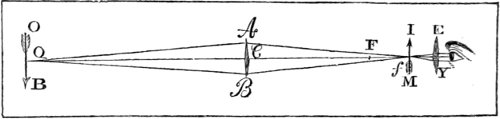
Let AB (fig. 84.) be the object lens, EY the
eye-glass, FC the radius, or focus of the lens AB,
and Cf the focal distance of the object OB, whose
distance is to be measured. Now suppose CF =
48 inches, or 4 feet, and that we find by the
above method that Cf is 50 inches, then Ff is 2
inches; and the analogy is:—As Ff = 2, is to
CF = 48, so is Cf = 50, to CQ = 1200 inches,
or 100 feet. Again, suppose Cf = 49 inches,
then will Ff = 1 inch; and the proportion is,
1 : 48 :: 49 : 2352 = QC, or 196 feet. A telescope
of this focal length, however, will measure
only small distances. But, suppose AB a lens
whose solar focus is 12 feet, or 144 inches; and
that we find, by the above method, that Cf, or
the focal distance of the object, is 146 inches;
then will Ff be 2 inches, and the proportion will
be, as 2 : 144 :: 146 : 21024 inches, or 1752
feet = the distance QC. If with such a large
telescope, we view an object OB, and find Ff
but 1/10th of an inch, this will give the distance of the
object as 17292 feet or nearly 3⅓ miles.
Since the difference between the radius of the
object lens and the focal distance of the object is
so considerable as 2 inches in a tube of 4 feet,
and more than 12 inches in one of 12 feet, a
method might be contrived for determining the
distance of near objects by the former, and
more distant objects by the latter, by inspection
only. This may be done by adjusting or drawing
a spiral line round the drawer or tube, through
the two inch space in the small telescope, and by
calculation, graduate it for every 100 feet, and
the intermediate inches, and then, at the same
time we view an object, we may see its distance
on the tube. In making such experiments, a
common object-glass of a long focal length, and
a single eye-glass, are all that is requisite; since
the inverted appearance of the object can cause no
great inconveniency.
I originally intended to enter into particular
details on this subject, for the purpose of gratifying
those mechanics and others who wish to amuse
themselves by constructing telescopes and other
optical instruments for their own use; but, having
dwelt so long on the subject of telescopes, in the
preceding pages, I am constrained to confine myself
to a very general sketch.
1. To grind and polish lenses for eye-glasses,
microscopes, &c.
First provide an upright spindle, at the bottom
of which a pulley is fixed, which must be turned
by a wheel by means of a cord and handle. At
the top of the spindle make a screw the same as a
lathe-spindle, on which you may screw chocks of
different sizes, to which the brass tool in which
the lens is to be ground, may be fixed. Having
fixed upon the breadth and focal length of the
lens, and whether it is to be a plano, or a double
convex—take a piece of tin-plate or sheet copper,
and, with a pair of compasses, draw an arch upon
its surface, near one of its extremities, with a
radius equal to the focal distance of the lens, if
intended to be double convex, or with half that
distance, if it is to be plano-convex. Remove
with a file that part of the copper which is without
the circular arch, and then a convex gage is
formed. With the same radius strike another
arch, and having removed that part of the copper
which is within it, a concave gage will be obtained.
The brass tool, in which the glass is to be ground,
is then to be fixed upon a turning-lathe, and
turned into a portion of a concave sphere, so as
to correspond to the convex gage. In order to
obtain an accurate figure to the concave tool, a
convex tool of exactly the same radius is generally
formed, and they are ground one upon another
with flour emery; and when they exactly coincide,
they are fit for use. The convex tool will
serve for grinding concave glasses of the same
radius—and it should be occasionally ground in
the concave tool to prevent it from altering its
figure.
The next thing to be attended to is, to prepare
the piece of glass which is to be ground, by chipping
it in a circular shape, by means of a large
pair of scissors, and removing the roughness from its
edges by a common grind-stone. The faces of the
glass near the edges should likewise be ground on
the grind-stone, till they nearly fit the concave gage,
by which the labour of grinding in the tool will
be considerably saved. The next thing required
is to prepare the emery for grinding, which is
done in the following manner. Provide four or
five clean earthen vessels; fill one of them with
water, and put into it a pound or half a pound of
fine emery, and stir it about with a stick; after
which let it stand 3 or 4 seconds, and then pour
it into another vessel, which may stand about 10
seconds; then pour it off again into the several
vessels till the water is quite clear; and by this
means, emery of different degrees of fineness is
obtained, which must be kept separate from each
other, and worked in their proper order, beginning
at the first, and working off all the marks
of the grind-stone; then take of the second, next
of the third, &c.,—holding the glass upon the pan
or tool with a light hand, when it comes to be
nearly fit for polishing. The glass in this operation
should be cemented to a wooden handle, by means
of pitch or other strong cement. After the finest
emery has been used, the roughness which remains
may be taken away, and a slight polish given by
grinding the glass with pounded pumice-stone.
Before proceeding to the polishing, the glass
should be ground as smooth as possible, and all
the scratches erased, otherwise the polishing will
become a tedious process. The polishing is performed
as follows: Tie a piece of linen rag or of
fine cloth about the tool, and with fine putty,
(calcined tin), or colcothar of vitriol (a very fine
powder, sometimes called the red oxide of iron)
moistened with water, continue the grinding motion,
and in a short time there will be an excellent
polish.
In order to grind lenses very accurately for the
finest optical purposes, particularly object-glasses
for telescopes—the concave tool is firmly fixed to
a table or bench, and the glass wrought upon it
by the hand with circular strokes so that its centre
may never go beyond the edges of the tool. For
every 6 or 7 circular strokes, the glass should receive
2 or 3 cross ones along the diameter of the
tool, and in different directions; and while the
operation is going on, the convex tool should, at
the end of five minutes, be wrought upon the
concave one for a few seconds, in order to preserve
the same curvature to the tools and to the
glass. The finest polish is generally given in the
following way. Cover the concave tool with a
layer of pitch hardened by the addition of a little
rosin, to the thickness of 1/15th of an inch. Then,
having taken a piece of thin writing paper, press
it upon the surface of the pitch with the convex
tool, and pull the paper quickly from the pitch
before it has adhered to it; and if the surface of
the pitch is marked every where with the lines of
the paper, it will be truly spherical. If any
paper remains on the surface of the pitch, it may
be rubbed off by soap and water, and if the marks
of the paper should not appear on any part of it,
the operation must be repeated, till the polisher
or bed of pitch is accurately spherical. The glass
is then to be wrought on the polisher by circular
and cross strokes with the putty or colcothar, till
it has received a complete polish. When one side
is finished, the glass must be separated from its
handle, by inserting the point of a knife between
it and the pitch, and giving it a gentle stroke.
The pitch which remains upon the glass may be
removed by rubbing it with a little oil or spirits
of wine. The operation of polishing on cloth is
slower, and the polish less perfect than on pitch;
but it is a mode best fitted for those who have
little experience, and who would be apt, in the
first instance, to injure the figure of the lens by
polishing it on a bed of pitch.
2. On the method of casting and grinding the
Specula of Reflecting Telescopes.
The first thing to be considered in the formation
of reflecting telescopes, is the composition of the
metal of which the specula are made. The qualities
required are—a sound uniform metal, free
from all microscopic pores—not liable to tarnish
by absorption of moisture from the atmosphere—not
so hard as to be incapable of taking a good
figure and polish—nor so soft as to be easily
scratched, and possessing a high reflecting power.
Various compositions have been used for this purpose,
of which the following are specimens:—Take
good Swedish copper 32 ounces, and when
melted, add 14½ ounces of grain tin to it; then,
having taken off the scoria, cast it into an ingot.
This metal must be a second time melted to cast a
speculum; but it will fuse in this compound state
with a small heat, and therefore will not calcine
the tin to putty. It should be poured off as soon
as it is melted, giving it no more heat than is absolutely
necessary. The best method for giving the
melted metal a good surface is this: the moment
before it is poured off, throw into the crucible a
spoonful of charcoal-dust; immediately after which
the metal must be stirred with a wooden spatula
and poured into the moulds.—The following is
another composition somewhat similar. Take 2
parts copper as pure as it is possible to procure;
this must be melted in a crucible by itself. Then
put, in another crucible, 1 part of pure grain tin.
When they are both melted, mix and stir them
with a wooden spatula, keeping a good flux on the
melted surface to prevent oxidation, and then pour
the metal quickly into the moulds, which may be
made of founder’s loam.
The composition suggested, more than half a
century ago, by the Rev. Mr. Edwards, has often
been referred to with peculiar approbation. This
gentleman took a great deal of pains to discover
the best composition, and to give his metals a fine
polish and the true parabolical figure. His telescopes
were tried by Dr. Maskelyne, the Astronomer
Royal, who found them greatly to excel in
brightness, and to equal in other respects those
made by the best artists. They showed a white
object perfectly white, and all objects of their
proper colour. He found, after trying various
combinations, the following to be the best: namely
32 ounces of copper, with 15 or 16 ounces of grain
tin, (according to the purity of the copper) with
the addition of one ounce of brass, one of silver,
and one ounce of arsenic. This, he affirms, will
form a metal capable, when polished in a proper
manner, of reflecting more light than any other
metal yet made public.
The Rev. J. Little, in his observations on this
subject in the ‘Irish Transactions,’ proposes the
following composition, which he found to answer
the purpose better than any he had tried, namely—32
parts of best bar copper, previously fluxed
with the black flux, of two parts tartar and one
of nitre, 4 parts brass, 16 parts tin, and 1¼
arsenic. If the metal be granulated, by pouring
it, when first melted, into water, and then fused
a second time, it will be less porous than at first.
In this process, the chief object is, to hit on the
exact point of the saturation of the copper, &c.,
by the tin. For, if the latter be added in too
great quantity, the metal will be dull coloured
and soft; if too little, it will not attain the most
perfect whiteness, and will certainly tarnish.35
When the metal is cast, and prepared by the
common grind-stone for receiving its proper
figure—the gages and grinding-tools are to be
formed in the same manner as formerly described
for lenses, with this difference, that the radius of
the gages must always be double the focal length
of the speculum, as the focus of parallel rays by
reflection is at one half the radius of concavity.
In addition to the concave and convex tools—which
should be only a little broader than the
metal itself—a convex elliptical tool of lead and
tin should be formed with the same radius, so that
its transverse should be to its conjugate diameter
as 10 to 9, the latter being exactly equal to the
diameter of the metal. The grinding of the
speculum is then to be commenced, on this tool,
with coarse emery powder and water, when the
roughness is taken off, by moving the speculum
across the tool, in different directions, walking
round the post on which the tool is fixed, holding
the speculum by the wooden handle to which it is
cemented. It is then to be wrought with great
care on the convex brass tool, with circular and
cross strokes, and with emery of different degrees—the
concave tool being sometimes ground upon
the convex one, to keep them all of the same
radius, and when every scratch is removed from
its surface, it will be fit for receiving the final
polish.
When the metal is ready for polishing, the
elliptical tool is to be covered with black pitch
about 1/20th of an inch thick, and the polisher formed
in the same way as in the case of lenses, either
with the concave brass tool or with the metal
itself. The colcothar of vitriol should then be
triturated between two surfaces of glass, and a
considerable quantity of it applied at first to the
surface of the polisher. The speculum is then to
be wrought, in the usual way, upon the polishing
tool, till it has received a brilliant lustre, taking
care to use no more of the colcothar, if it can be
avoided, and only a small quantity of it, if it
should be found necessary. When the metal
moves stiffly on the polisher, and the colcothar
assumes a dark muddy hue, the polish advances
with great rapidity. The tool will then grow
warm, and would probably stick to the speculum,
if its motion were discontinued for a moment. At
this stage of the process, therefore, we must proceed
with great caution, breathing continually on
the polisher, till the friction is so great, as to
retard the motion of the speculum. When this
happens, the metal is to be slipped off the tool at
one side, cleaned with soft leather, and placed in a
tube for the purpose of trying its performance;
and if the polishing has been conducted with care,
it will be found to have a true parabolic figure.36
It was formerly the practice, before the speculum
was brought to the polisher, to smooth it on
a bed of hones, or a convex tool made of the best
blue stone, such as clockmakers use in polishing their
work, which was made one fourth part larger than
the metal which was to be ground upon it, and
turned as true as possible to a gage. But this tool
is not generally considered as absolutely necessary,
except when silver and brass enter into the
composition of the metal, in order to remove
the roughness which remains after grinding with
the emery.
To try the figure of the metal.—In order to this,
the speculum must be placed in the tube of the
telescope for which it is intended; and, at about
20 or 30 yards distant, there should be put up a
watch-paper, or similar object, on which there are
some very fine strokes of an engraver. An annular
kind of diagram should be made with card-paper,
so as to cover a circular portion of the
middle part of the speculum, between the hole
and the circumference, equal in breadth to about
1/8 of its diameter. This paper ring should be
fixed in the mouth of the telescope, and remain so
during the whole experiment. There must likewise
be two other circular pieces of card-paper
cut out, of such sizes, that one may cover the
centre of the metal, by completely filling the hole
in the annular piece now described: and the
other such a round piece as shall exactly fill the
tube, and so broad as that the inner edge just
touches the outward circumference of the middle
annular piece. All these pieces together will
completely shut up the mouth of the telescope.
Let the round piece which covers the centre of
the metal be removed, and adjust the instrument
so that the image may be as sharp and distinct as
possible. Then replace the central piece, and
remove the outside annular one, by which means
the circumference only of the speculum will be
exposed; and the image now formed will be from
the rays reflected from the exterior side of the
metal. If the two images formed by these two
portions of the metal be perfectly sharp and
equally distinct, the speculum is perfect and of
the true parabolic curve. If, on the contrary, the
image from the outside of the metal should not be
distinct and that it should be necessary to bring
the little speculum nearer by the screw, the metal
is not yet brought to the parabolic figure; but if,
in order to procure distinctness, we be obliged to
move the small speculum farther off, then the
figure of the great speculum has been carried
beyond the parabolic, and has assumed the hyperbolic
form.
To adjust the eye-hole of Gregorian Reflectors.—If
there is only one eye-glass, then the distance
of the small hole should be as nearly as possible
equal to its focal length. But in the compound
Huygenian eye-piece, the distance of the eye-hole
may be thus found:—Multiply the difference
between the focal distance of the glass next to the
speculum, and the distance of the two eye-glasses,
by the focal distance of the glass nearest the eye;
divide the product by the sum of the focal distances
of the two lenses, lessened by their distance,
and the quotient will be the compound
focal distance required. Thus, if the focal distance
of the lens next the speculum be 3 inches,
that of the lens next the eye 1 inch, and their
distance 2 inches, then the compound focal distance
from the eye-glass will be (3 - 2 × 1)/(3 × 1 - 2) = ½ inch.—The
diameter of the eye-hole is always equal to
the quotient obtained by dividing the diameter of
the great speculum by the magnifying power of
the telescope. It is generally from 1/25th to 1/50th of an
inch in diameter. It is necessary, in many cases,
to obtain, from direct experiment, an accurate
determination of the place and size of the eye-hole,
as on this circumstance depends, in a certain
degree, the accurate performance of the instrument.
To center the two specula of Gregorian Reflectors.—Extend
two fine threads or wires across the
aperture of the tube at right angles, so as to
intersect each other, exactly in the axis of the
telescope. Before the arm is finally fastened to
the slider, place it in the tube, and through the
eye-piece (without glasses) the intersection of the
cross wires must be seen exactly in the centre
of the hole of the arm. When this exactness is
obtained, let the arm be firmly riveted and soldered
to the slider.
To centre lenses.—The centering of lenses is of
great importance, more especially for the object-glasses
of achromatic instruments. The following
is reckoned a good method:—Let the lens to be
centered be cemented on a brass chuck, having
the middle turned away so as not to touch the
lens, but near the edge, which will be hid when
mounted. This rim is very accurately turned flat
where it is to touch the glass. When the chuck
and cement is warm it is made to revolve rapidly:
while in motion a lighted candle is brought before
it, and its reflected image attentively watched. If
this image has any motion, the lens is not flat or
central; a piece of soft wood must therefore be
applied to it in the manner of a turning tool, till
such time as the light becomes stationary. When
the whole has cooled, the edges of the lens must
be turned by a diamond, or ground with emery.
For more particular details in reference to grinding
and polishing specula and lenses, the reader is
referred to Smith’s ‘Complete system of Optics’—Imison’s
‘School of Arts’—Huygenii Opera—Brewster’s
Appendix to ‘Ferguson’s Lectures’—‘Irish
Transactions,’ vol. X., or ‘Nicholson’s
Journal,’ vol. XVI., Nos. 65, 66, for January and
February, 1807.