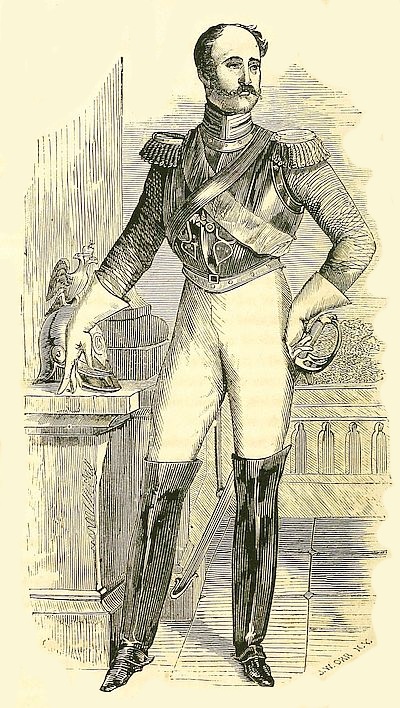
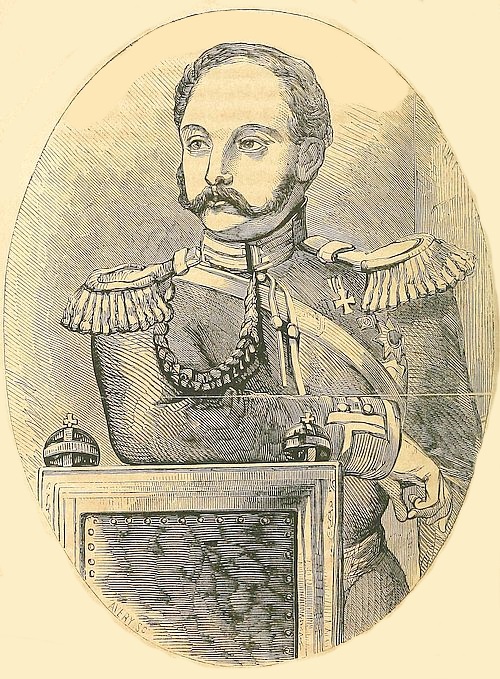
Summary survey of Europe—Aristocracy of France—France previous to
the Revolution—Revolutionary Symptoms—The Great Powers, 1792–6—William
Pitt—Execution of Louis XVI.—The Allies against France—Siege
of Toulon—Invasion of Holland—Napoleon—His early youth—Thirteenth
Vendemiaire—The Campaign in Italy—Rapid victories of
Bonaparte—Expedition to Egypt—Return of Bonaparte—First Consulate—The
passage of the Alps—Second Campaign in Italy—Napoleon
Emperor—War with England—Alliance between the Great Powers,
1805—Indecision of Prussia—Alexander visits the tomb of Frederick the
Great—Battle of Austerlitz—Treaty of Tilsit—Secret understanding
respecting Turkey—British orders in Council—Battle of Wagram—Annexation
of Finland—Campaign of Moscow—The Grand Alliance,
1813—Battle of Leipsic—Allies enter Paris.
“The fate of the East depends upon yon petty town,”
was the exclamation of Bonaparte to Murat, as he pointed
towards Acre, which even his military genius was unable
to subdue. Repeated and desperate assaults proved that
the consequence which he attached to the taking of it was
as great as the words expressed. The imagination reverts
from the position of the army of Egypt before that oriental
city, and rapidly traversing the events of succeeding
history, runs down to the position of the army of the successor
of Bonaparte, and of his English and Turkish allies,
who, on nearly the precise parallel of longitude, are unitedly
engaged in besieging one of the first strongholds of
Europe.
In recounting some of the great events of the times
which have filled the world with their grandeur, and
whose present and future place in history overshadows the
preceding ages, a rapid resumé of the situation of Europe,
just previous to and at the commencement of the great
drama, may be useful, and serve to recall facts and events
which may to the general reader have been known but
forgotten.
One who stands amid the gardens and grounds of Versailles,
and contemplates the enormous luxury and expenditure
of its builder, while he recalls his vast wars, his
policy, and his intrigues, can better understand the declaration
of Louis XIV. to his assembled parliament. “The
State! I am the State!” And such an observer can also
discover the truth of that statement, that it was that builder
who laid the foundations of the French Revolution
with the stones of Versailles. The keen sagacity of the
polite Chesterfield could detect that approaching revolution
a quarter of a century before it took place; and his
remarkable prediction shows how rapidly the signs of the
gathering storm must have accumulated in the years succeeding
the Augustan age of France. The energies of the
nation had been devoted to the service and pleasure
of the monarch; they now began to be directed to their
proper end, the examination of their own interests. From
the theatre and the pulpit the genius of the French
people hurried precipitately into morals and politics, a
sudden revolution took place in the minds of all, and the
conflict it produced lasted during a whole century.
The exclusive privileges of the aristocracy, who monopolised
every official position, and who alone were eligible
to rank in the army, choked the development of the great
body of the people; and while they consumed the revenues
of the State they were in a great measure exempt
from taxation. Cradled in the luxury of courts, the aristocracy
were sunk in vice and effeminacy. And they
looked upon the great body of the people as only a necessary
appendage to a government in which they had neither
right nor control.
In the most martial nation of Europe the private soldier
could not, by the greatest daring or genius, elevate himself,
because only the aristocracy could obtain rank. The
effects of the opposite system were afterwards seen with
Napoleon, who boasted that he conquered Europe with the
bivouac; with generals raised from the ranks.
The oppressions of the feudal tenure in France exceeded
belief; the people were even obliged to grind corn at the
landlord’s mill, press their grapes at his press, and bake
their bread at his oven on his own terms.
The fermentation which had long been going on in the
public mind; “the revolt against eighteen centuries of
oppression” began to develop itself rapidly. Yet the
monopolizers of all the national rights continued to dispute
for a worn out authority. The court, careless and tranquil
in the midst of the struggle, were wasting the property of
the people while surrounded by the most frightful disorders.
When it was told to the effeminate and dissolute
Louis XV. that the nation could not suffer much longer,
he characteristically said, “Never mind, if it last my time
it is sufficient for me!” Such was the eighteenth century.
It was during the years 1787 and ’88, that the French
nation first conceived the idea of passing from theory to
practice. The weak and vacillating Louis XVI., the least
fitted of all men to guide the destinies of a nation in the
throes of political convulsion, had successively tried
ministry after ministry, and one expedient after the other;
yet the ship of state was swiftly approaching the vortex
of the whirlpool in which it had entered.
“Upon what trivial events often depend the most important
affairs. The mistake of a captain, who bore away
instead of forcing his passage to the place of his destination,
has prevented the face of the world from being
totally changed,” said Napoleon. “Acre,” continued he,
“would otherwise have fallen: I would have flown to Damascus
and Aleppo; and in the twinkling of an eye,
would have been at the Euphrates. I would have reached
Constantinople and the Indies, and would have changed
the face of the world.” It was thus in the assembly of
the Notables, called by the intelligent, brilliant, and careless
Calonne, then minister of state, that a member, complaining
of the prodigality of the court, demanded a
statement of the expenses. Another member, punning
on the word, exclaimed, “It is not statements, but States
General that we want.” This single random expression
struck every one with astonishment, and seized by the
people was immediately acted upon; the States General
were called, and the public mind was filled with the wildest
fermentation: France and Europe were to be immediately
regenerated; visionary schemes without number were
formed; and that general unhinging of opinions took place,
which is the surest prelude of revolution. That revolution
now came, and in its tumults and convulsions the Ancient
French Monarchy rapidly approached its extinction.
Amid frightful disorders, famine appeared; the elements
seemed to partake of the savagery of the times; and the
severity of the tempests of summer which destroyed the
harvests, was succeeded by a winter, 1788–9, of unparalleled
rigor. Soon began that vast emigration of the nobility,
which was afterwards succeeded by the attempted
flight of the king; while all authority but that of the Sans
Culottes seemed abolished. Foreign affairs became daily
more menacing; the young Emperor, Francis II. of Austria,
was gathering his armies, and soon demanded the reëstablishment
of the monarchy on its ancient footing.
All classes in France now anxiously desired war; the
aristocracy hoped to regain their lost privileges with the
assistance of Germany; the democracy hoped, amid the
tumult of victorious campaigns, to establish their principles.
At length, on the 20th of April, 1792, oppressed with
the solemnity and grandeur of the occasion, the declaration
of war against Austria was received by the National
Assembly of France in solemn silence. Thus commenced
the greatest, the most bloody, and the most interesting
war which has agitated mankind since the fall of the
Roman Empire. Rising from feeble beginnings, it at
length involved the world in its conflagration; rousing
the passions of every class, it brought unheard of armies
into the field; and it was carried on with a degree of exasperation
unknown in modern times. “A revolution in
France,” says Napoleon, “is always followed, sooner or
later, by a revolution in Europe.” Situated in the centre
of modern civilization, it has in every age communicated
the impulse of its own changes to the adjoining states
Thus, the great changes which had taken place in France
had excited all Europe, and spread the utmost alarm in
all her monarchies.
Austria, Russia, Prussia, and England were at that
period, as now, the great powers of Europe, and they were
the principal actors in the desperate struggle which ensued.
They were in a situation capable of great exertion; years
of repose had fitted them to enter upon a gigantic war.
England, although she had lost one empire in the west,
had gained another in the east; and the wealth of India
began to pour into her bosom. The public funds had
risen from 57, at the close of the American War, to 99.
Her army consisted of 32,000 men in the British Isles, besides
an equal force in the East and West Indies; but these
forces were rapidly augmented after the commencement
of the war, and before 1796, the regular force amounted
to 206,000 men, including 42,000 militia. Yet experience
proves that Britain could never collect above 40,000 men
upon any one point of the continent of Europe. But her
real strength consisted in her great wealth, in the public
spirit and energy of her people, and in a fleet of 150
ships of the line, which commanded the seas.
England, like other monarchies, had slumbered on contented
and prosperous, and for the most part inglorious,
during the eighteenth century. A great writer observed,
that while America was doubling her population
every twenty-five years, Europe was lumbering on with
an increase, which would hardly arrive at the same result
in five hundred; and Gibbon lamented that the age of
interesting incidents was past, and that the modern historian
would never again have to record the moving events,
and dismal catastrophes of ancient story. Such were the
anticipations of the greatest men on the verge of a period
that was to usher in a new Cæsar, and to be illustrated
by an Austerlitz and a Trafalgar, a Wellington and a
Waterloo; and the human race, mowed down by unparalleled
wars, was to spring up again with an elasticity
before unknown. William Pitt was the great Prime
Minister of England at this time, and modern history cannot
exhibit a statesman more fertile in resources, and whose
expedients seemed as exhaustless as his great abilities.
Fox and Burke, each distinguished by a high order of intellect,
filled the British Parliament with their reasoning
and eloquence.
The great Austrian empire contained at that time nearly
25,000,000 of inhabitants, with a revenue of 95,000,000
florins, and numbered the richest and most fertile districts
of Europe among its provinces. The wealth of Flanders,
the riches of Lombardy, and the valor of the Hungarians
added to the strength of the Empire. Her armies had
acquired immortal renown in the wars of Maria Theresa.
At the commencement of the war, her force amounted to
240,000 infantry, 35,000 cavalry, and 100,000 artillery.
Her court, the most aristocratic in Europe, was strongly
attached to old institutions, and the marriage of Maria
Antoinette to Louis XVI. gave the Austrian court a family
interest in the affairs which preceded and followed the
French Revolution.
The military strength of Prussia, raised to the highest
pitch by the genius of Frederic the Great, had rendered
her one of the first powers of Europe; her army of 165,000
strong was in the highest state of discipline and equipment,
and by a system of organization the whole youth
of the kingdom were compelled to serve a limited number
of years in the army, so that she had within herself an inexhaustible
reserve of men trained to arms. Her cavalry
was the finest in Europe.
The majesty and power of Russia was beginning to fill
the north with its greatness, and in her struggles and battles
from the time of Peter the Great, through her wars
with Sweden, with Frederic and with the Turks, she had
constantly advanced with gigantic strides towards the
Orient and the West. Her immense dominions comprehended
nearly the half of Europe and Asia; while she
was secure from invasion by her position, and by the
severity of her climate. The Empress Catharine, endowed
with masculine energy and ambition, had waged a bloody
war with Turkey, in which the zeal of a religious crusade
was directed by motives of policy and desire for the
acquisition of new territory which should pave the way
for that future expected conquest of the whole of European
Turkey, and which should give Russia the shores of
the Bosphorus and the Sea of Marmora as her southern
boundary, and should make Constantinople, the seat of her
commerce and her power over the Mediterranean and
the East, the centre through which she might command
the world. The infantry of Russia has long been celebrated
for its invincible firmness, and the cavalry, though
greatly inferior to its present state of discipline and
equipment, was formidable. The artillery, now so splendid,
was then only remarkable for its cumbrous carriages
and the obstinate valor of its men. Inured to hardship
from infancy, the Russian soldier is better able to bear
the fatigues of war than any in Europe; he knows no
duty so sacred as obedience to his officers. Submissive to
his discipline as to his religion, no privation or fatigue
makes him forget his obligations. The whole of the
energies of the Empire are turned to the army. Commerce,
the law, and civil employment are held in no
esteem. Immense military schools, in different parts of
the Empire, annually send forth the flower of the population
to this dazzling career. Precedence depends entirely
upon military rank, and the heirs of the greatest families
are compelled to enter the army at the lowest grade.
Promotion is open equally to all, and the greater part of
the officers have risen from inferior stations of society.
The military strength of France, which was destined to
oppose and triumph over these immense forces, consisted
at the commencement of the struggle of 165,000 infantry,
35,000, cavalry and 10,000 artillery. But her troops had
relaxed their discipline during the revolution, and her soldiers
had been so accustomed to political discussion, that it
had introduced a license unfavorable to discipline. At first
they lacked steadiness and organization, but these defects
were speedily remedied by the pressure of necessity, and
by the talent which emerged from the lower classes of
society.
Such was the state of the principal European powers at
the commencement of the war. The celebrated 10th of
August, 1792, came, and the throne was overturned, the
royal family put in captivity, while the massacres of September
drenched Paris with blood. The victories of
Dumourier rolled back the tide of foreign invasion to the
Rhine. War was declared against Sardinia, 15th September,
and Savoy and Nice were seized and united to
the French Republic.
“The die is thrown, we have rushed into the career;
all governments are our enemies, all people are our
friends; we must be destroyed or they shall be free,”
exclaimed the orator of the convention. Geneva surrendered
to the French without a blow, and the Convention
declared it would grant its assistance to all people who
wished to recover their liberty. Flanders was overrun
by the French in a fortnight, and they committed an
aggression on the Dutch by opening the Scheldt, and by
pursuing the fugitive Austrians into Dutch territory.
While the tide of Austrian and Prussian invasion was
rolled back to the Rhine, the great frontier city of Germany
was wrested from Austria almost under the eyes of
the imperial armies; and although the campaign commenced
only in August, under the greatest apparent disadvantage
to the French, yet before the close of December
all this had been accomplished. The execution of
Louis XVI. on the 21st Jan., 1793, completed the destruction
of the French monarchy, accelerated the Reign of
Terror, and brought the accession of England to the
league of the Allied Sovereigns; Chauvelin, the French
Ambassador, received orders immediately to quit London;
and this was succeeded in a few days by a declaration of
war, 1st February, 1793, by France against England,
Spain, and Holland. The audacity of the Convention,
which thus threw down the gauntlet to nearly all of
Europe, excited universal astonishment. The feeling of
national honor, in all ages so powerful among the French,
was awakened to its highest pitch. Every species of
requisition was cheerfully furnished under the pressure of
impending calamity; and in the dread of foreign subjugation
the loss of fortune and employment was forgotten
only one path, that of honor, was open to the brave. The
Jacobins, the ruling power in France, were no longer
despised but feared by the European powers, and terror
prompts more vigorous efforts than contempt. No sooner
did the news of the execution of Louis reach St. Petersburg
than the Empress Catharine took the most decisive
measures, and all Frenchmen who did not renounce the
principles of the revolution were ordered to quit her
territory; the most intimate relations were established
between the courts of London and St. Petersburg; and a
treaty between them, which laid the basis of the Grand
Alliance, was signed, 25th March, in which they engaged
to carry on the war against France, and not to lay down
their arms without restitution of all the conquests which
France had made from either of them, or such states and
allies to whom the benefit of the treaty should extend.
Treaties of the same nature were made with Sardinia and
Portugal, and thus all Europe was arrayed against France.
A congress of the allies assembled at Antwerp, which
came to the resolution of totally altering the objects of the
war; and it was openly announced there that the object
was to provide indemnities and securities for the allied
powers by partitioning the frontier territories of France
among the invading states. Soon after, when Valenciennes
and Condé were taken, the Austrian flag, and not
that of the Allies, was hoisted on the walls. The Prussians
and Austrians, numbering 100,000, were on the Rhine
early in the spring, and the Ring of Prussia crossed in
great force. The French army, inferior in numbers and
discipline, retreated. Mentz capitulated to the Allies after
a long and dreadful siege, and the French continued to
retreat in disorder. But the Allies wasted their splendid
opportunity. The French retreated to their entrenched
camp before Arras, after which there was no place capable
of defence on the road to Paris. The Republican
authorities took to flight, the utmost consternation prevailed,
and a rapid advance of the Allies would have
changed the history of Europe. But from this time dissension
began among them; and from this period may
be dated a series of disasters to them, which went on constantly
increasing until the French arms were planted on
the Kremlin, and all Europe, from Gibraltar to the North
Cape; had yielded to their arms.
The mighty genius of Carnot, who, in the energetic language
of Napoleon, “organized victory,” soon appeared at
the head of the military department of France. Austere
in character, unbending in discipline, and of indefatigable
energy, he resembled the great patriots of antiquity more
than any other statesman of modern times, and in the midst
of peril and disaster he infused his unparalleled vigor into
his department, and France became one vast workshop of
arms, resounding with the note of military preparation.
The roads were covered with conscripts hastening to their
destination; and fourteen armies, and 1,200,000 men, were
soon under arms. The siege of Dunkirk, undertaken by
the English, was raised, and the Austrian and Prussian
armies were driven back to the Rhine.
The siege of Toulon, whose inhabitants had revolted
from the horrors of the Reign of Terror, was remarkable
for the horrible carnage with which it was accompanied,
as well as for the appearance of a young officer of artillery,
then chief of battalion, Napoleon Bonaparte. Its capture,
which was owing to his genius, was accompanied by the
destruction of nearly the whole French fleet in its harbor
by the retreating English. At eight in the evening a fire-ship
was towed into the harbor; soon the flames arose
in every quarter, and fifteen ships of the line and eight
frigates were consumed. The volume of smoke which
filled the sky, the flames which burst as it were out of the
sea, the red light which illuminated the most distant mountains,
and the awful explosions of the magazines formed,
says Napoleon, “a grand and terrible spectacle.” The
arms of France, on the frontiers of Flanders and elsewhere,
now began to be successful, while the dubious conduct or
evident defection of Prussia paralysed all operations on
the Rhine; and before the close of 1794 the Republican
armies, in a winter campaign, invaded Holland and subdued
almost the whole of that rich country without a
battle. Amsterdam, which had defied the whole power
of Louis XIV., was conquered; these successes were followed
by others still more marvellous. On the same day
on which General Dandels entered Amsterdam, the left
wing of the army made themselves masters of Dordrecht,
containing six hundred pieces of cannon, ten thousand
muskets, and immense stores of ammunition. The same
division passed through Rotterdam and took possession of
the Hague, where the States General were assembled;
and to complete the wonders of the campaign, a body of
cavalry and flying artillery crossed the Zuyder Zee on the
ice, and summoned the fleet lying frozen up at the Texel;
and the commander, confounded at the hardihood of the
enterprise, surrendered his ships to this novel species of
assailant; and at the conclusion of the campaign, the Spaniards,
defeated, were suing for peace. The Piedmontese
were driven over the Alps; the Allies had everywhere
crossed the Rhine; Flanders and Holland were subjugated;
La Vendée pacificated; and the English fled for
refuge to Hanover; 1,700,000 men had combated under
the banners of France; and peace was concluded soon
after between France, Spain, and Prussia.
Napoleon Bonaparte was born at Ajaccio, in Corsica,
on the 15th of August, 1769. Corsica is essentially
Italian, and to this day a state of society prevails which
differs from that of any other part of Europe. The
wildest and most deadly feuds are common among its
principal families. The people are turbulent and excitable.
Napoleon was too great a man to derive distinction
from any adventitious advantages, and when the Emperor
of Austria, after he became his son-in-law, endeavored to
trace his connexion with the obscure Dukes of Treviso,
he answered that he was the Rudolph of Hapsburg of his
family, and that his patent of nobility dated from the battle
of Montenotte. His mother, a woman of no common
beauty, being at the festival of the Assumption on the
day of his birth, was seized with her pains during high
mass. She was brought home and hastily laid upon a
couch covered with tapestry representing the heroes of the
Iliad, and there the future conqueror was brought into
the world. The winter residence of his father was usually
at Ajaccio; but in summer the family retired to a villa
near the isle of Sanguinere, once the residence of a relation
of his mother’s, situated on a romantic spot near the
sea shore. The house is approached by an avenue overhung
by the cactus, acacia, and other shrubs, which grow
luxuriantly in a southern climate. It has a garden and
lawn showing vestiges of neglected beauty, and surrounded
by a shrubbery permitted to run to a wilderness.
There, enclosed by the cactus, the clematis, and the wild
olive, is a singular and isolated granite rock, beneath
which the remains of a small summer-house are still visible.
This was the favorite retreat of young Napoleon,
who early showed a love of solitary meditation, during
the period when his school vacations permitted him to
return home. And it may be supposed, perhaps, that
here the magnificence of his oriental imagination formed
those visions of ambition and high resolves, for which the
limits of the world were, ere long, felt to be insufficient.
At an early age he was sent to the military school at
Brienne; his character there underwent a rapid alteration;
he became thoughtful, studious, and diligent in the
extreme.
On one occasion, while the youths were playing the
death of Cæsar in their theatre, the wife of the porter,
well known to the boys, presented herself at the door, and
being refused admittance made some disturbance; the
matter was referred to the young Napoleon, who was the
officer in command on the occasion. “Remove that woman
who brings here the license of camps!” said the future
ruler of the revolution. At the age of fourteen he was sent
to the military school at Paris, and at sixteen he received a
commission in a regiment of artillery. When the revolution
broke out he adhered to the popular side. After the
siege of Toulon, Dugommier, the general in command,
wrote to the Convention, “Reward and promote that young
man, for if you are ungrateful to him he will raise himself
alone.” He commanded the artillery in 1794 during the
campaign in Italy. Dumbion, in command of the army,
who was old, submitted the direction of affairs principally
to Bonaparte. His intimacy with the younger Robespierre,
and his refusal of a command in La Vendée in the
civil insurrection, led to his being deprived of his rank as
a general officer, and he was reduced to private life. But
his talents being known led to his being called to the command
of the forces in Paris, which triumphed over the
sections; his decision saved the Convention. The story of
his introduction to and marriage of Josephine is too well
known to need repetition.
In 1796 Bonaparte took command of the forces destined
to operate against Italy. With an army destitute of almost
every thing, he, in a short time, overran Piedmont, conquered
a peace with Sardinia, passed the Po and crossed
the Adda at the Bridge of Lodi. The nervous eloquence
of Napoleon, in his address to his soldiers, and the splendor
of his success, intoxicated Paris with joy. The first
day, they heard that the gates of the Alps were opened;
the next, that the Austrians were separated from the Piedmontese
army; the third that the Piedmontese army was
destroyed and the fortresses surrendered. The rapidity
of this success, the number of prisoners, exceeded all that
had yet been witnessed. Every one asked, who was this
young conqueror whose fame had burst forth so suddenly,
and whose proclamations breathed the spirit of ancient
glory?
“The 13th of Vendemiaire and the victory of Montenotte,”
said Napoleon, “did not induce me to think
myself a superior character. It was after the passage of
Lodi that the idea shot across my mind that I might
become a decisive actor on the political theatre; then arose
for the first time the spark of great ambition.”
With pomp and splendor Napoleon made his triumphal
entry into Milan, to the sound of military music and the
acclamations of an immense concourse of spectators. The
rapidity of the French victories in Italy, and the destruction
of the Austrian armies, sent to oppose them, crowned
Napoleon as the greatest chieftain of his time. The
marshes of Arcola, the heights of Montebello, and the
plain of Rivoli witnessed his successive glories. But
while the arms of Republican France were conquering in
Italy, they suffered reverse and defeat under Moreau on
the frontiers and the Rhine; and the Archduke Charles
drove back the French legions who had dared to penetrate
Germany. At the close of the year the death of the
great Empress, Catharine of Russia, and the accession of
Paul to the throne, changed, in many important respects,
the fate of the war.
In the midst of threatened invasion from France, a
general panic seized England, and while the public funds
had fallen from 99 to 51, a run commenced on the Bank
of England, which was on the verge of bankruptcy. This
caused those orders in Council in February, 1797—suspending
specie payments, which, although only considered
temporary at the time, continued a quarter of a century.
The defeat of the Spanish fleet at St. Vincent, by Nelson and
Collingwood, soon quelled the fear of invasion in England.
The army of Napoleon in Italy opened the campaign
of 1797 by attacking, early in March, the Archduke
Charles before he had received his reinforcements. Napoleon
arrived by rapid marches, with his army in front
of the Austrians, who had chosen, on the line of the Julian
Alps, the river Tagliamento on which to oppose the
French. By a feint, Napoleon deceived the Austrians,
crossed the river, charged them with fury, and drove them
back with considerable loss. They retreated by the blue
and glittering waters of the Isonza, and in twenty days
the army of Charles was driven over the Julian Alps,
and the French were within sixty leagues of Vienna;
pushing forward, they came within sight of its steeples.
But unsupported, and with Italy in insurrection behind
his back, Napoleon proposed peace to Austria. Delay
after delay occurring in the negotiation, Napoleon declared
if the ultimatum of the Directory was not accepted
in twelve hours, he would commence hostilities. The
time having expired, he entered the presence of the
Austrian ambassador, and taking up a porcelain vase of
great value, and which had been presented by the Empress
Catharine to the ambassador, he declared energetically,
“The die is cast, the truce is broken, war is declared.
But mark my words, before the end of autumn I will
break in pieces your monarchy, as I now destroy this
porcelain;” and with that he dashed it in pieces on the
ground. Bowing, he retired, mounted his carriage, and
despatched a courier to the Archduke, to announce that
hostilities would commence in twenty-four hours. The
Austrian plenipotentiary, thunderstruck, forthwith agreed
to the ultimatum, and the celebrated treaty of Campo
Formio was signed the next day; and thus terminated the
Italian campaign of Napoleon, the most memorable in his
military career.
Returning to Paris, Napoleon was soon anxious to
resume those schemes of ambition which continually
occupied his mind. The expedition for the conquest of
Egypt sailed with pomp from Toulon, and after occupying
Malta, and narrowly escaping the English fleet under
Nelson, the French army landed at Alexandria. Victory
after victory soon completed the subjugation of the Land
of the Pharaohs, while at the battle of the Nile the
French fleet was almost entirely destroyed by Nelson.
Cut off by this disaster from Europe, Napoleon projected
that expedition to Syria, which, unsuccessful at
Acre, returned to Egypt in time to destroy the Turkish
army, which had landed at Aboukir. Reverses in the
Alps, the loss of Italy, the retreat of the French to Zurich,
and the capture of Corfu by the Russians and English,
determined Napoleon to return to France, which he
accomplished in a small frigate, which escaped the English
cruisers. Arrived in Paris, he found the government in
disorder, and without a head, and, while disaster surrounded
the country, its armies had been beaten, and its
finances were in hopeless confusion.
On the celebrated 18th Brumaire (8th November),
Napoleon having command of the troops in Paris, accomplished
that sudden revolution which placed him at the
head of affairs. His schemes of ambition began now to
ripen, and France soon felt in all her departments the
energy of his mighty genius. One of his first acts was to
propose peace with England. Disregarding the ordinary
rules of negotiation, Napoleon addressed a letter personally
to George III., proposing peace. This letter was
replied to by Lord Grenville, the Prime Minister, who
declined the proposition.
Disappointed in his hopes of negotiating peace, Napoleon
prepared with renewed vigor for war. The campaign
was the most important of his life. Its daring and
success are almost unparalleled in history.
Crossing the Alps, the highest chain of mountains in
Europe, without roads, his artillery had to be dragged
over narrow foot-paths, up the rugged sides of frowning
mountains, and on the brink of awful precipices covered
with snow; while provisions and stores for a whole
army had to be carried by sheep-paths on the backs of
men. Arrived at Geneva, having deceived the Austrians as
to his intentions, he asked General Marescot, whom he
had despatched to survey Mont St. Bernard, “Is the route
practicable?” “It is barely possible,” replied the engineer.
“Let us press forward then,” said Napoleon. Arrived at
the little village of St. Pierre, everything resembling a
road ended. An immense and apparently inaccessible
mountain reared its head amidst general desolation and
eternal frost, while precipices, glaciers, and ravines appeared
to forbid access to all living things. Yet, surmounting
every obstacle, the passage was accomplished;
and a French army of 30,000 men precipitated themselves,
apparently from the clouds, on the plains of Italy, and
appeared to the thunderstruck Austrians, cutting off their
retreat from Genoa, and completely dividing their forces;
speedily marching upon Milan, leaving the Austrian army
under Melas, behind him, he returned to attack them,
and at the battle of Marengo gained the most important
of his victories. By the close of 1801 the continental
states had all concluded peace with France, leaving her
with the most enormous aggrandizements of territory. A
short interval of peace occurred with England in 1802,
which was broken by a declaration of war in June, 1803,
and all the English residents between the ages of eighteen
and sixty were detained as hostages. Hanover was seized
by the French, and the English retaliated by blockading
the Elbe and the Weser.
The war with Great Britain, and a conspiracy to overthrow
the authority of the First Consul, which was discovered,
served as a ladder for Napoleon to mount from the
Consulate to the Imperial Dignity; and on the 3d May,
1804, the senate communicated to Napoleon this address:
“We think it of the last importance to the French people
to confide the government of the Republic to Napoleon
Bonaparte—Hereditary Emperor.”
The Empire was proclaimed at St. Cloud, 18th May,
1804; and Napoleon was crowned by Pope Pius VII.,
on the 2d December, in the church of Notre Dame. War
was declared by Spain against England, after she had unwarrantably
attacked and seized four large Spanish frigates
filled with cargoes of immense value. The rising hostility
of Russia and Sweden at this moment incensed the French
government still more against England, to whose influence
she attributed their conduct. All appearances foretold
the beginning of another general eruption.
On the 11th of April, 1805, a treaty offensive and defensive
was formed between Russia and England, the
object of which was to put a stop to what they considered
the encroachments of the French government, and to
form a general league of the states of Europe.
The accession of Austria was finally obtained to the
alliance, after great difficulty and delay: the deplorable
state of her finances, and the vacillating policy of her
government, being (then as now) stumbling-blocks in the
way of negotiation. On the 31st of August, Sweden was
also included. But notwithstanding all the efforts of
England and Russia, it was found impossible to overcome
the scruples of Prussia, who inclined towards the French
in hopes of obtaining Hanover, promised her by France
as a reward for her neutrality. For ten years Prussia had
flattered herself that by keeping aloof she would avoid
the storm, that she would succeed in turning the desperate
strife between France and Austria to her own benefit by
enlarging her territory, and augmenting her consideration
in the North of Germany; but at once all her prospects
vanished, and it became apparent, even to her own ministers,
that this vacillating policy was ultimately to be as
dangerous as it had already been discreditable. On the
25th of Oct., the Emperor Alexander arrived at Berlin,
and employed the whole weight of his great authority,
and all the charms of his captivating manners, to induce
the King to embrace a more manly and courageous policy;
and on the 3rd of November a secret convention was
signed between the two monarchs for the regulation of
the affairs of Europe, and the erection of a barrier against
the ambition of the French Emperor. The conclusion of
the Convention was followed by a scene as remarkable as
it was romantic. Inspired with a full sense of the dangers
of the war, the ardent and chivalrous mind of the Queen
conceived the idea of uniting the two sovereigns by a
bond more likely to be durable than the mere alliances
of cabinets with each other. This was, to bring them
together at the tomb of the great Frederick. The Emperor
who was desirous of visiting the mausoleum of that
illustrious hero, accordingly repaired to the church at
Potsdam, where his remains are deposited.
And at midnight the two monarchs proceeded together
by torchlight to the hallowed grave. Uncovering when
he approached the spot, the Emperor kissed the pall, and
taking the hand of the King of Prussia, as it lay on the
tomb, they swore an eternal friendship to each other, and
bound themselves by the most solemn oaths to maintain
their engagements inviolate in the great contest for
European independence in which they were engaged.
It would have been well for the Allies, if, when Prussia
had thus taken her part, her cabinet had possessed sufficient
resolution to have taken the field instead of continuing
in her old habit of temporizing, and thus permitting
Napoleon to continue without interruption his advance on
Vienna. But her long indecision had been her ruin.
Her territory had been violated by France, who, while
apparently her ally, was reserving for her only the melancholy
privilege of being last destroyed.
In the meantime, a combined force of English, Russians,
and Swedes, thirty thousand strong, had been landed in
Hanover, and the Prussian troops occupying that Electorate
had offered no resistance—a sure proof to Napoleon
of a secret understanding between the Cabinet of Berlin
and that of London.
While she was thus giving daily proofs of her indecision
and treachery, the ever-vigilant Bonaparte was pouring
his armies through Bavaria into Austria and concentrating
his divisions for the sweeping victory which was so soon
afterwards destined to scatter to the winds the opposing
allies.
We now come to the campaign of Austerlitz; the
most remarkable, in a military point of view, which the
history of the war afforded.
In the beginning of August the French army was
cantoned on the heights of Boulogne; and by the first
week of December, Vienna was taken, and the strength
of Austria and Russia prostrated.
The allied armies presented a total of 80,000 men, including
a division of the imperial guard under the Grand
Duke Constantine, brother of the Emperor of Russia.
The forces which Napoleon had to resist this great
array hardly amounted to 70,000 combatants.
On the 30th November, 1805, the light troops of the
Allies were seen from the French outposts marching
across their position towards the right of the army. Napoleon
spent the whole of both days on horseback at the
advanced posts watching their movements. At length on
the morning of the 1st Dec. the intentions of the enemy
were clearly manifested, and Napoleon beheld with “inexpressible
delight” their whole columns dark, and massy,
moving across his position at so short a distance as rendered
it apparent a general action was at hand. Carefully
avoiding the slightest interruption to their movement,
he merely watched with intense anxiety their
march, and when it became evident that the resolution
to turn the right flank of the French army had been
decided upon, he exclaimed, prophetically—“To-morrow,
before night-fall, that army is mine.”
At four in the morning the Emperor was on horseback.
All was still among the immense multitude concentrated
in the French lines. Buried in sleep the soldiers forgot
alike their triumphs and the dangers they were about to
undergo. Gradually, however, a confused murmur arose
from the Russian host, and all the reports from the outposts
announced that the advance had already commenced
along the whole line.
Gradually the stars which throughout the night had
shone clear and bright began to disappear, and the ruddy
glow of the east announced the approach of day. At
last, the “Sun of Austerlitz” rose in unclouded brilliancy
on that field of blood.
The French army occupied an interior position, from
whence their columns started like rays from a centre,
while the allies were toiling in a wide semicircle round
their outer extremity.
His marshals, burning with impatience, stood around
Napoleon, awaiting the signal for attack. At last the
word was given, and on they rushed to the onslaught.
The results of the conflict in different sections of the
battle-field were various, the Russians and French alternately
being victorious, till Napoleon, seeing there
was not a moment to be lost, ordered Marshal Bessières
with the cavalry of the guard to arrest a terrible onslaught
of Russian cuirassiers of the guard, two thousand
strong, which had already trampled under foot three
battalions of the French. Instantly spurring their chargers,
the French precipitated themselves upon the enemy.
The Russians were broken and driven back over the
dead bodies of the square they had destroyed.
Rallying, however, they returned to the charge, and
both imperial guards met in full career! The shock was
terrible! and the most desperate cavalry action that had
taken place during the war ensued. The infantry on
both sides advanced to support their comrades. The
resolution and vigor of the combatants were equal.
Squadron to squadron, company to company, man to
man, fought with invincible firmness. At length, however,
the stern obstinacy of the Russian yielded to the
enthusiastic valor of the French. The cavalry and infantry
of the guard gave way, and after losing their artillery
and standards, were driven back in confusion almost
to the walls of Austerlitz, while from a neighboring eminence
the Emperors of Russia and Germany beheld the
irretrievable rout of the flower of their army.
This desperate encounter was decisive of the fate of the
day. The Russians no longer fought for victory, but for
existence. Great numbers sought to save themselves by
crossing with their artillery and cavalry a frozen lake
adjoining their line of march. The ice was already beginning
to yield under the enormous weight, when the
shells from the French batteries bursting below the surface,
caused it to crack with a loud explosion. A frightful
yell arose from the perishing multitude, and above two
thousand brave men were swallowed up in the waves. At
noon the allies gave way, and commenced their retreat in
the direction of Austerlitz.
Those who escaped being made prisoners succeeded
before nightfall in reaching Austerlitz, already filled with
the wounded, the fugitives and the stragglers from every
part of the army.
Thus terminated the battle of Austerlitz.
The loss of the allies was immense. Thirty thousand
(30,000) men were killed, wounded, or made prisoners.
Of the latter were 19,000 Russians, and 6,000 Austrians,
most of whom were wounded. Almost the whole of their
baggage fell into the hands of the victors. One hundred
and eighty pieces of cannon, four hundred covered
wagons, and forty-five standards, were taken, and the
disorganization of the combined forces was complete.
Twelve thousand French had been killed and wounded,
making the frightful sum total of that dreadful day’s carnage,
42,000 men.
On the 6th of Dec. an armistice was concluded at Austerlitz,
and Alexander sent to Berlin the Grand Duke
Constantine to ascertain if the Prussian King was prepared
to join with him, according to the principles which
he had sworn to adhere to at the tomb of the great Frederick,
in the vigorous prosecution of the war. But the
disaster of Austerlitz had wrought a perfidious change in
the policy of the Prussian Cabinet.
An ambassador was sent to Napoleon to congratulate
him upon his success, and to propose a treaty. Napoleon
broke out into a vehement declamation against the policy
of the Prussian Cabinet, and expressed his determination
now to turn his whole forces against them; but at last
yielding, the treaty was concluded, and a new alliance
entered into between Prussia and France, the former
receiving as a reward Hanover, with all the other continental
dominions of his Britannic Majesty.
During the year 1807, disagreements sprang up between
France and Prussia, which resulted at the battle of Jena,
(Oct. 14th) in the total discomfiture of the latter, and
triumph of Napoleon, who now became master of the
whole country from the Rhine to the Vistula. Passing
the sanguinary contests of Eylau and Friedland, we come
to the treaty of Tilsit, the arrangement of which took
place under circumstances eminently calculated to impress
the imagination of mankind.
Certain misunderstandings having arisen between England
and Russia, and the latter power being somewhat
crippled for the moment by numerous defeats, an armistice
was proposed by Alexander, and accepted by Napoleon,
on the 22d of June, which ended in the treaty of
Tilsit.
There was little difficulty in coming to an understanding,
for France had nothing to demand of Russia, except
that she should close her ports against England! Russia
nothing to ask of France but that she should withdraw
her armies from Poland, and permit the Emperor to
pursue his long cherished projects of conquest in Turkey.
The armistice having been concluded, it was agreed
that the two Emperors should meet, to arrange, in a private
conference, the destinies of the world.
It took place accordingly on the 25th June. On the
river Niemen, which separated the two armies, a raft of
great dimensions was constructed. It was moored in the
centre of the stream, and on its surface a wooden apartment
surmounted by the eagles of France and Russia, was
framed with all the magnificence which the time and
circumstances would admit.
This was destined for the reception of the Emperors
alone; at a little distance was stationed another raft less
sumptuously adorned, for their respective suites.
The shore on either side was covered with the Imperial
Guard of the two monarchs, drawn up in triple lines.
At one o’clock precisely, amid the thunder of artillery,
each Emperor stepped into a boat on his own side of the
river, accompanied by a few of his principal officers.
The splendid suite of each monarch followed in another
boat immediately after.
The bark of Napoleon advanced with greater rapidity
than that of Alexander. He arrived first at the raft,
entered the apartment, and himself opened the door on
the opposite side to receive the Czar; while the shouts of
the soldiers drowned even the roar of the artillery.
In a few seconds Alexander arrived, and was received
by the Conqueror at the door on his own side. Their
meeting was friendly, and Alexander expressed his dissatisfaction
with his ally, the Government of Great Britain.
“I hate the English,” said he, “as much as you do, and
am ready to second you in all your enterprises against
them.” “In that case,” replied Napoleon, “everything
will be easily arranged, and peace is already made.”
And peace was made. A treaty was concluded between
France and Russia, also between France and Prussia, by
which the latter ceded to Napoleon about half her dominions,
and Alexander and Napoleon, deeply impressed
with the genius of each other, became, for the time being,
intimate friends. By the provisions of this celebrated
treaty, Russia was assigned the Empire of the East, while
France acquired absolute sway in the Kingdoms of the
West, and both united in cordial hostility against Great
Britain.
France being the ally of Turkey, Napoleon could do no
less than arrange for the evacuation of Moldavia and
Wallachia (at that time occupied by Russian troops);
but it is supposed there was a secret understanding between
the two Emperors, that ultimately, Wallachia,
Moldavia, and Bulgaria were to fall into the possession of
Russia, while France was to arrange to her liking, the
affairs of Greece and the Spanish Peninsula.
But the sagacity of Napoleon would not permit him to
agree to the cession of Constantinople and Roumelia,
and rivalry for the possession of that Capitol was one of
the principal causes which afterwards brought about the
disastrous campaign of Moscow.
As a consequence of the downfall of Prussia, the neutrality
of Austria, and the accession to the confederacy of
Alexander at Tilsit, Napoleon was emboldened to attempt
the carrying out of his long cherished “Continental System”
of combining all the Continental States into one
great alliance against England, and to compel them to
exclude the British Flag and British merchandise from
their harbors.
It was at this time that he promulgated the famous
Berlin Decree, which declared the British Islands in a
state of blockade, and subjected all goods of British produce
or manufacture, to confiscation within his dominions,
or those of the countries subject to his control, and prohibited
all vessels from entering any harbor, which had
touched at any British port.
As a retaliatory measure the celebrated Orders in
Council were issued by the British Government (on the
11th Nov. 1807), which proclaimed France and all the
Continental States in a state of blockade, and declared
all vessels good prize, which should be bound for any of
their harbors, excepting such as had previously cleared
out from or touched at a British harbor.
This was followed on the 17th December, by the Milan
Decree, which declared that any vessel, of whatever
nation, which shall have submitted to be searched by
British cruisers, shall be considered and dealt with as
English vessels, and every vessel of whatever nation,
coming from or bound to any British harbor, shall be
declared good prize.
England, being mistress of the seas, enforced with
unfeeling rigor her orders in council, entailing immense
losses upon the commerce of neutral States, but more
particularly upon America, which ultimately brought
about the war between herself and the great Republic;
while France, comparatively powerless on the ocean,
invoked the aid of privateers and seized upon all British
persons and property within her grasp.
Since the defeat of Austria at Austerlitz, in 1805, the
Cabinet of Vienna had adhered with cautious prudence
to a system of neutrality. Still the Imperial Government
had been successfully at work to fill up the ranks of their
decimated armies, and to place themselves again in a
position of strength.
Napoleon was no sooner informed of these military
preparations than he demanded an explanation of their
import.
Austria made professions of pacific intentions, but still
continued to arm herself; the war in Spain, which Napoleon
had at this time on his hands, leading her to suppose
that he would not for so slight a cause undertake
another contest.
In the meantime, the wily Metternich, Austrian Ambassador
at Paris, was endeavoring to maintain apparently
amicable relations with the French government, while
every effort was made to induce Alexander to join with
Austria; but the Czar had pledged his word to Napoleon,
and was not inclined to break a personal engagement of
such importance.
The French ambassador left Vienna finally, on the
28th Feb., 1809, and in April active hostilities broke out
thus kindling again the flames of war.
Warsaw, garrisoned by the French, was taken by the
Austrians, at which time occurred an event of significant
importance.
In pursuing the Austrians, a courier was taken with
despatches from the Russian General Gortschakoff to the
Austrian Arch-Duke, congratulating him on the capture
of Warsaw, and breathing a wish that he might soon join
his armies to the Austrian Eagles.
This letter was immediately forwarded to Napoleon,
who remarked, “I see, after all, I must make war upon
Alexander.”
The Czar disavowed the letter, and attempted explanations,
but a breach was opened which was never again
healed.
Austria endeavored to win Prussia to her side after the
battle of Aspern (unfavorable to Napoleon), and secret
negotiations were carried on. But the Prussian government
replied to Austria’s overtures, that they had every
disposition to assist her, but could not take part in the
contest till the views of Russia in regard to it were
known.
In the meantime the struggle continued, and after a
great number of contests, in some of which Napoleon’s
chances were desperate, finally, on the 5th of July, 1809,
was fought the celebrated battle of Wagram, under the
walls of Vienna, which resulted in victory to Napoleon,
though at so dear a price as almost to equal a defeat.
50,000 men were killed and wounded.
The peace of Vienna followed on the 14th of October,
and was of so humiliating a nature that it was received
with marked disapprobation by the Cabinet of St. Petersburg,
and was attended with a most important effect in
widening the breach which was already formed between
the two Emperors.
The Turkish empire at this time was in a state of
decay, and the people, from the inefficiency of the
government, and the constantly recurring insurrections,
in a state of misery.
But amid the general decay, the matchless situation of
Constantinople still attracted a vast concourse of inhabitants,
and veiled under a robe of beauty the decline of
the Queen of the East.
This celebrated capital, the incomparable excellence of
whose situation attracted the eagle eye of Alexander, had
long formed the real object of discord between the Courts
of Paris and St. Petersburg.
War had been formally declared by Russia against
Turkey, in Jan., 1807, in consequence of a dispute about
the hospodars, or governors, of Wallachia and Moldavia.
Soon after, the conspiracy of the Janizaries broke out
against the reforms of the Sultan, assisting materially
Russia’s designs.
In the beginning of the year 1810 an Imperial Ukase
appeared, annexing Moldavia and Wallachia, which for
three years had been occupied by their troops, to the
Russian Empire, and declaring the Danube, from the
Austrian frontier to the Black Sea, the southern European
boundary of their mighty dominion.
A bloody war was the consequence, in which both
parties made prodigious efforts, and neither gained decisive
success, until the peace of Bucharest was concluded
on the 28th of May, 1812.
Russia was as anxious as Turkey for the cessation of
hostilities, being desirous of withdrawing her armies from
the Danube to engage in the formidable contest which
was impending over them with Napoleon.
Sweden was summoned to join in the alliance against
Great Britain, to which the Swedish monarch did not
accede. Alexander consequently declared war, and on
the 28th of March, 1808, the following Imperial Ukase
appeared at St. Petersburg:
“We unite Finland, conquered by our arms, for ever to
our Empire, and command its inhabitants forthwith to
take the oath of allegiance to our throne.”
The Swedish Monarch, however, not being willing to
surrender so important a portion of his dominions, was
forced to abdicate; and his successor endeavored to conclude
a peace with Russia, and to retain Finland through
appeals to Napoleon.
The latter was, however, bound to Alexander by the
treaty of Tilsit, and refused to interfere. The Czar, determined
to retain his conquest, marched an army across
the gulf of Bothnia, on the ice, in March, 1809, and arrived
by the middle of that month on the Swedish side,
en route for Stockholm.
This had the effect to intimidate the court of Stockholm,
who therefore ceded Finland, and peace was concluded
Sept. 17, 1809.
On the 13th Dec., 1810, Napoleon formally annexed to
the French Empire the Hanse towns and the Duchy of
Oldenburg. This measure irritated Alexander, who now
grew apprehensive lest some of his ill-gotten gains should
be wrested from him, and that the restoration of Poland
might next be thought of.
A convention was drawn up at St. Petersburg, and
signed by the representatives of France and Russia, by
which it was stipulated, that “The kingdom of Poland
shall never be reëstablished; and the name of Poland and
Poles shall never in future be applied to any of the districts,
or inhabitants; and shall be effaced for ever from
every public and official act.”
Napoleon, however, refused to ratify it, and thus again
exasperated the Czar, who commenced to place Poland
in a state of defence, which, in its turn, excited the jealousy
of the French Emperor.
Alexander, therefore, published, on the 31st of Dec.,
1810, an order, containing a material relaxation of the
rigour of the decrees hitherto in force in the Russian Empire
against English commerce.
On the 24th Feb., 1812, the Cabinet of Prussia concluded
a treaty offensive and defensive with France; and a
royal edict appeared prohibiting the introduction of colonial
produce, on any pretence, from the Russian into the
Prussian territory. Austria being at this time in close
alliance with France, another treaty was concluded March
14, 1812, between them, placing a considerable part of her
resources at Napoleon’s command.
In consequence of the overbearing demands of Napoleon,
the Swedish Government allied itself with Russia on the
5th of April (1812), and with Great Britain on the 12th
of July following.
The differences between Alexander and Napoleon had
now become so serious, that war was inevitable. But
Napoleon knew the foe he had to grapple with, and proposed
terms of peace to Great Britain on the 17th of April,
hoping to be left to meet the Russians single-handed, and
thus humble the overweening pride of the Czar. His proposals
were, however, rejected.
Down to the very commencement of hostilities, notes
continued to be interchanged between the representatives
of the two Emperors, which did little more than recapitulate
the mutual grounds of complaint of the two cabinets
against each other. Finally, on the 24th of April, Alexander
sent to Napoleon his ultimatum, offering an accommodation
on condition that France would evacuate Prussia,
and come to an arrangement with the king of Sweden
which remained without any answer, on the part of the
French Government.
Both prepared for the worst, and on the 23d of June,
Napoleon arrived on the banks of the Niemen, with his
countless hosts, for the invasion of Russia.
The armies at his command, at this time, amounted in
the aggregate, to the enormous sum of 1,250,000 men;
and the force which entered Russia, during the year 1812,
was 647,158 men—187,111 horses, and 1372 cannon.
The regular forces of the Russians amounted, at the close
of 1811, to 517,000 men, 70,000 of whom were in garrison,
and the remainder dispersed over an immense surface.
To oppose the invasion of the French, the Russians had
collected about 200,000 men, and upwards of 800 pieces
of cannon. The forces of the French, therefore, exceeded
those of the Russians, by nearly 300,000 men; but the
former were at an immense distance from their resources,
and had no means of recruiting their losses; whereas the
latter were in their own country, and supported by the
devotion of a fanatical and patriotic people.
The face of the country on the Western frontier of Russia
is in general flat, and in many places marshy; vast
woods of pine cover the plains, and the rivers flow in some
places through steep banks, in others stagnate over extensive
swamps, which often present the most serious obstacles
to military operations. The villages are few and miserable.
The wants of such a prodigious accumulation of troops
speedily exhausted all the means of subsistence which the
country afforded, and the stores they could convey with
them. Forced requisitions from the peasantry became,
therefore, necessary, and so great was the subsequent misery
that the richest families in Warsaw were literally in danger
of starving, and the interest of money rose to 80 per cent.
Napoleon reached Wilna on the 28th of June, the Russians
receding as he advanced, and destroying everything
before them. On the 15th of August, the starving army
reached the city of Smolensko, which was burned by the
Russians, and abandoned on the 18th.
The losses in the meantime by battle, exposure, want,
and sickness, were fast decimating the French ranks.
The soldiers were seized with disquietude as they contrasted
their miserable quarters amid the ruins of Smolensko,
with the smiling villages they had abandoned in their
native land; but amid the universal gloom, their Emperor
was ever present, and by words and deeds of kindness,
sustained their drooping spirits.
Leaving Smolensko, Napoleon pressed forward, and on
the 5th of September, arrived at Borodino where the Russians
had made a stand to oppose their march upon Moscow.
On the 7th, two days subsequently, was fought the bloody
battle of Borodino, the most murderous and obstinately
contested of which history has preserved a record.
The Russian force was 132,000 men, with 640 pieces of
artillery.
The French consisted of 133,000 men, with 590 pieces
of cannon.
There were killed 15,000 Russians and 12,000 French,
besides upwards of 70,000 wounded on both sides, making
a total loss of 100,000 men in this one battle.
The French were, however, victorious, and reached
Moscow on the 14th. The Holy City was found to be
evacuated, not only by the Russian army, but by the
inhabitants, and as the French hosts defiled through the
silent streets, it was like entering a city of the dead.
Not a sound was to be heard in its vast circumference!
the dwellings of three hundred thousand persons seemed
as silent as the wilderness.
Evening came on! With increasing wonder the French
troops traversed the central parts of the city, recently so
crowded with passengers, but not a living creature was to
be seen to explain the universal desolation. Night approached!
an unclouded moon illuminated those beautiful
palaces, those vast hotels, those deserted streets—all
was still!
The officers broke open the doors of some of the principal
mansions in search of sleeping quarters. They
found every thing in perfect order; the bedrooms were
fully furnished as if guests were expected; the drawing-rooms
bore the marks of having been recently inhabited;
even the work of the ladies was on the tables, the keys in
the wardrobes—but still not an inmate was to be seen.
By degrees a few of the lowest slaves emerged pale and
trembling from the cellars, and showed the way to the
sleeping apartments, and laid open every thing which
these sumptuous mansions contained; but the only account
they could give was that the whole of the inhabitants had
fled, and that they alone were left. The persons intrusted
with the duty of setting fire to the city, only awaited the
retreat of their countrymen to commence the work of
destruction. The terrible catastrophe soon commenced.
On the night of the 13th a fire broke out in the bourse,
and spread to the streets in the vicinity. At midnight, on
the 15th, a bright light was seen to illuminate the northern
and western parts of the city; fresh fires were then seen
breaking out every instant in all directions, and Moscow
soon exhibited the spectacle of a sea of flame agitated by
the wind. But it was chiefly during the nights of the
18th and 19th that the conflagration attained its greatest
violence. At that time the whole city was wrapped in
flames, and volumes of fire of various colors ascended to
the heavens in many places, diffusing a prodigious light
on all sides, and attended by an intolerable heat. These
balloons of flame were accompanied in their ascent by a
frightful hissing noise, and loud explosions, the result of
the vast stores of oil, tar, rosin, spirits, and other combustible
materials, with which the greater part of the shops
were filled. The wind, naturally high, was raised by the
sudden rarefaction of the air to a perfect hurricane. The
howling of the tempest drowned even the roar of the
conflagration; the whole heavens were filled with the
whirl of the burning volumes of smoke, which rose on all
sides, and made midnight as bright as day, while even
the bravest hearts, subdued by the sublimity of the scene,
and the feeling of human impotence in the midst of such
elemental strife, sank and trembled in silence. Imagination
cannot conceive the horrors into which the remnant
of the people who could not abandon their homes were
plunged. Bereft of every thing, they wandered amid the
ruins eagerly searching for a parent or a child: pillage
became universal, and the wrecks of former magnificence
were ransacked alike by the licentious soldiery and the
suffering multitude.
In addition to the whole French army, numbers flocked
in from the country to share in the general license; furniture
of the most precious description, splendid jewellery,
Indian and Turkish stuffs, stores of wine and brandy, gold
and silver plate, rich furs, gorgeous trappings of silk and
satin were spread about in promiscuous confusion, and
became the prey of the least intoxicated among the multitude.
A frightful tumult succeeded to the stillness
which had reigned in the city when the troops first
entered. The French soldiers, tormented by hunger and
thirst, and loosened from all discipline by the horrors
which surrounded them, often rushed headlong into the
burning edifices to ransack their cellars for wines and
spirits, and beneath the ruins great numbers miserably
perished, the victims of intemperance and the surrounding
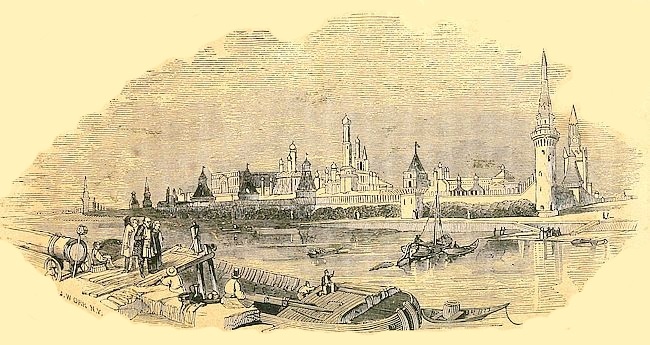
fire. Napoleon abandoned the Kremlin on the evening
of the 16th. Early on the following morning, casting a
melancholy look to the burning city, which now filled
half the heavens with its flames, he exclaimed after a long
silence, “This sad event is the presage of a long train of
disasters.”
Thus vanished the hopes of those indefatigable soldiers
who had endured so much, and fought so well. To reach
the fabulous city whose domes and minarets were now
fallen—had been the dream of their ambition—the goal
which once attained, would give rest and food to their
weariness and hunger.
Thus Napoleon found himself possessed of a heap of
burning ruins without food for his famishing soldiers and
horses.
All negotiations with the Russian authorities having
failed, a retreat was decided upon, and the Emperor left
Moscow on the 19th of October, at the head of 105,000
combatants. The disasters of that retreat are too well
known to require recapitulation.
Suffice it to say that the survivors of the French army,
who entered Russia 500,000 strong, were but 20,000. The
total loss of the campaign, in killed, prisoners, died from
cold, fatigue, and famine, was over 450,000. And on
the 13th of December, the wretched remnant of the
French army passed the bridge of the Niemen. The
losses of the Russians were also so great that at the end of
the campaign not above 30,000 men could be assembled
around the head-quarters of the Emperor Alexander.
On the 10th Dec., early in the morning, a travelling
carriage in great haste drove into the Hotel d’Angleterre,
at Warsaw. It was a small travelling britschka placed
without wheels on a coarse sledge, made of four pieces of
rough fir-wood, which had been almost dashed to pieces
in entering the gateway. The travellers were ushered
into a small dark apartment, with the windows half-shut,
and in a corner of which a servant girl strove in vain to
light a fire with green damp billets of wood, which, after
kindling for a moment, gradually went out, leaving those
in the apartment to shiver with cold during three hours
of earnest conversation.
The travellers were Napoleon and his friend Caulaincourt,
who five days previously had bidden the remnant
of his retreating army, in Russia, an affectionate farewell,
and started for Paris.
At length, it being announced that the carriage was
ready, they mounted the sledge, and were soon lost in
the gloom of a Polish winter. Outstripping his couriers
in speed, on the 18th Dec., at 11 at night, the Emperor
arrived at the Tuileries, before the Imperial government
was even aware that he had quitted the army. And
early next morning, while the streets of Paris were yet
vacant, he was buried in state papers, investigating and
arranging the disorganized affairs of the empire.
Napoleon’s power being no longer dreaded, Prussia became
disaffected, and on the 28th of February, 1813,
entered into an alliance offensive and defensive with
Russia, called, the treaty of Kalisch, which was the
foundation stone of that grand alliance which finally
overthrew the French Emperor. Great efforts were
made to induce Saxony to join the league; but she remained
permanently attached to the fortunes of Napoleon.
Meanwhile Alexander despatched a confidential agent
to Vienna, in order to sound the Imperial Cabinet on the
prospect of a European alliance against France, and it
was soon after discovered that, notwithstanding Austria’s
professed friendship for Napoleon, there was a secret understanding
existing between the Cabinets of St. Petersburg
and Vienna, as also with the King of Prussia.
The accession of Sweden was received on the 3d of
March.
During the month of April a convention took place between
Great Britain, Russia, and Prussia, when England,
in addition to the immense supplies of arms and military
stores which she was furnishing, agreed to advance two
millions sterling ($10,000,000) to sustain the operations of
the Prince Royal of Sweden in the north of Germany,
and a like sum to enable Russia and Prussia to keep up
their vast armaments in Saxony.
On the 14th of June another treaty was signed stipulating
that England should pay to Prussia, for the six
remaining months of the year, about £700,000, in consideration
of which, the latter was to keep in the field an
army of 80,000 men.
By another treaty, signed the day after, between Russia
and Great Britain, it was stipulated that Great Britain
should pay to its Emperor, till January, 1814, £1,333,334
in monthly instalments, by which he was to maintain
160,000 men in the field, independent of the garrisons of
strong places. On the 27th of July Austria joined the
alliance (against their Emperor’s son-in-law), England
agreeing to pay her equal to one million sterling, in the
event of her taking part in the war; thus completing the
formidable alliance of Great Britain, Russia, Prussia,
Austria, and Sweden.
While the accession of new and formidable powers to
the league was taking place, the energy of Napoleon
seemed to rise with the difficulties against which he had
to contend, and to acquire an almost supernatural degree
of vigor.
His shattered armies were reinforced, and, undiscouraged
by the recollection of Moscow, he prepared
again to make his power felt against the formidable odds
which the energies of five empires were concentrating for
his destruction.
Already again in the month of April was he in the
field, and in May occupied Dresden, driving his enemies
before him.
In August, however, the allies having been strongly
reinforced, made their first attack upon that city. Through
August and September there were constantly recurring
battles, by which the French were so harassed that Napoleon
at length resolved to retreat in the direction of
Leipsic, and on the 15th of October his army, consisting
of 175,000 men and 720 pieces of cannon, occupied
that city, and encamped around it. The allies followed
with 290,000 men and above 1300 guns. The 18th
dawned, and the last hour of the French Empire began to
toll. The celebrated battle of Leipsic was fought. The
conflict of such masses was terrible, and was so disastrous
to the French, that a retreat was resolved upon, which
commenced the next morning, the allies entering the city
as the French retired across the river.
The battle of Leipsic was, perhaps, the most unfortunate
in its results which Napoleon ever experienced; and the
subsequent retreat of his army to the Rhine partook, in a
measure, of the horrors of that from Moscow.
While the discomfited French were retiring across the
Rhine at Mayence, the allied troops followed closely on
their footsteps, and Alexander entered Frankfort on the
5th of November. Napoleon had left on the 1st, remaining
six days with his army on the opposite shores of the
river, and reached Paris on the 9th.
The day after, in the council of state, he unfolded the
danger of his situation with manly sincerity, and with
nervous eloquence referred to the invasion by Wellington
of his southern frontiers, while the allies menaced the
north. A levy by conscription was made of 600,000
men, and preparations to resist the invasion were immediately
ordered.
On the 1st of Dec. the allied sovereigns published a
declaration from Frankfort, offering peace to France on
condition that she would confine her limits between the
Rhine, the Alps, and the Pyrenees.
But the negotiation was protracted by Napoleon to
gain time, until the impatient allies crossed the Rhine,
and Denmark, Naples, and the Rhenish Confederation,
joined the alliance.
The allies had now accumulated forces so prodigious,
for the invasion of France, that nothing in ancient or
modern times had ever approached to their magnitude.
Including 80,000 Austrians, destined to act in the north
of Italy, and a hundred and forty thousand British, Portuguese,
and Spaniards, who, under the guidance of Wellington,
were assailing the south, the whole force of the allies
formed a mass of a million and twenty-eight thousand
men, which was prepared to act against the French empire.
The French army was so reduced, that the Emperor
could not, with the utmost exertion, reckon upon more
than 350,000 men to defend the frontiers of his widespread
dominions. Of these, 100,000 were blockaded in
Hamburg and on the Oder, 50,000 were maintaining a
painful defensive against the Austrians in the north of
Italy, and 100,000 were struggling against the superior
armies of Wellington on the Spanish frontiers. So that
the real army which the Emperor had at his disposal to
resist the invasion on the Rhine did not exceed 110,000.
On the 31st of Dec., 1813, the united and victorious
allies crossed that river. Numerous battles ensued. At
length a conference was held, and the allied sovereigns
offered to conclude peace, and recognize Napoleon as
Emperor of France, on certain conditions, which would
have left him an empire greater than that over which his
nephew now reigns. This did not, however, satisfy his
ambition. The overtures were refused, and on the 30th
of March, 1814, after numerous sanguinary engagements,
and the storming of the city, the allies entered Paris,
which had been forced to capitulate.
On the 11th of April Napoleon signed his abdication at
Fontainbleau, and on the 28th of the same month, at eight
at night, set sail from Frejus for the island of Elba, on
board the English frigate “The Undaunted.”
On the 1st of March, 1815, having escaped from Elba,
he again entered France, with a few hundred men, and
was everywhere received with acclamation and shouts of
joy, which resounding throughout the land, were echoed
to the Tuileries, and caused such consternation, that the
court became alarmed, and at midnight, on the 19th,
Louis XVIII. and the royal family, left Paris, and
escaped into Belgium, while at nine o’clock in the evening
of the next day Napoleon entered the vacated palace.
The allies became alarmed, and on the 25th of March,
Russia, Prussia, Austria, and Great Britain, concluded a
treaty, engaging to unite their forces against Bonaparte,
with a secret stipulation that the high contracting parties
should not lay down their arms till the complete destruction
of Napoleon had been effected. Such, however, was
the poverty at this time of the Continental powers, that
they were unable to put their armies in motion without
pecuniary assistance. And a treaty was entered into at
Vienna on the 30th of April, by which England agreed
to furnish Austria, Russia, and Prussia, the necessary
means for the prosecution of the war, and actually paid
to foreign powers during the year above £11,000,000
($55,000,000).
Napoleon left Paris on the morning of the 12th of
June, and joined his army, which had been concentrated
near the frontiers of Belgium, on the 13th. The returns
on the evening of the 14th, gave 122,400 men under
arms, and at day-break on the 15th his army crossed the
frontier.
Various conflicts ensued between different portions of
his forces, directed to different points, and those of the
allies, who, under Wellington, were in occupation of
Brussels.
At length, the morning of the 18th dawned upon the
battle field of Waterloo, and its evening witnessed the
annihilation of the French army, and flight of Napoleon.
On the 17th of July, the victorious allies, headed by
Wellington, a second time entered Paris; and on the
following day, Louis XVIII. made his public entry into
that gay capital, escorted by the national guard.
On the 29th of June, Napoleon had left Malmaison (the
home of his lost Josephine) for Rochefort, arriving at that
harbor on the 3d of July, from whence he was anxious to
embark for America.
But the blockade of English cruisers was so vigilant
that there was no possible chance of avoiding them.
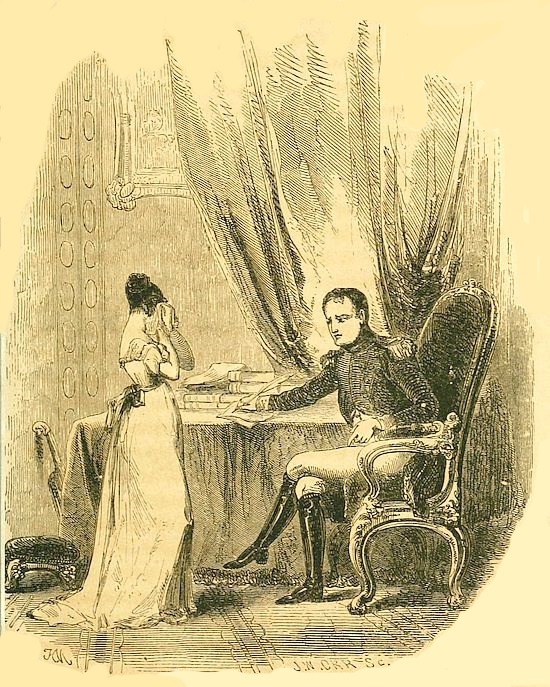
NAPOLEON AND JOSEPHINE
Under these circumstances, he at length adopted the
resolution of throwing himself upon the generosity of the
British government; and on the 14th of July embarked
on board the “Bellerophon,” which set sail immediately
for England,—and Napoleon looked for the last time
upon the receding shores of that land which had been
the home of his greatness.
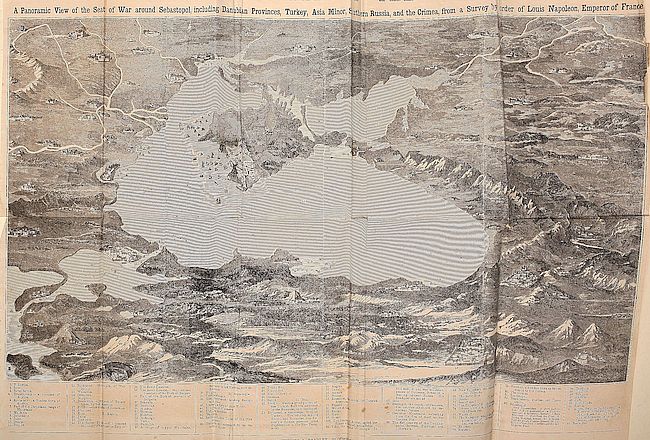 View Larger Image Here.