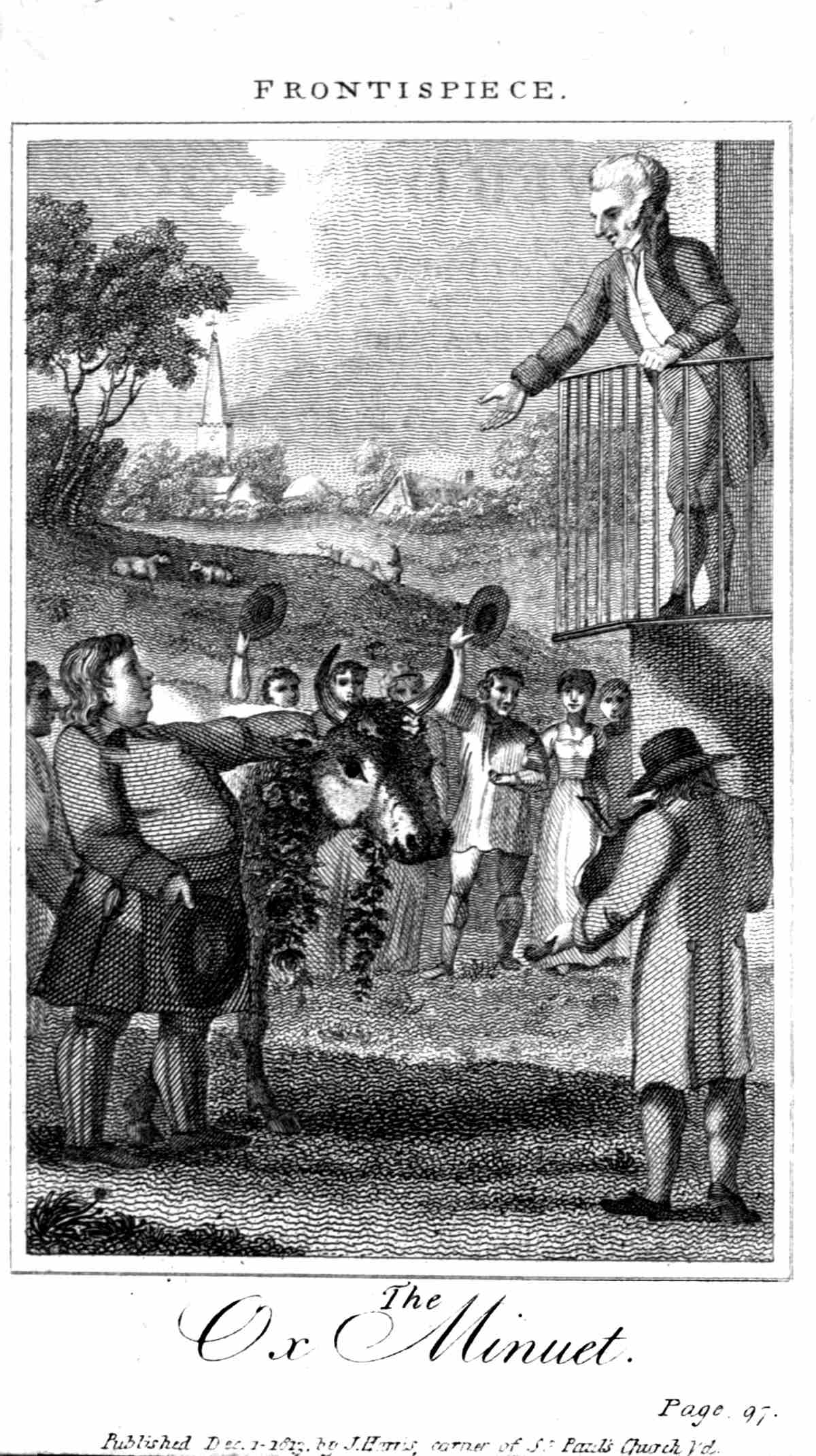
The Ox Minuet.Page 97. Published Dec. 1-1813, by J. Harris, corner of St. Paul’s Church Yd.]
IN WHICH IS SHOWN,
BY A VARIETY
OF PLEASING AND INSTRUCTIVE
ANECDOTES,
THE EFFECTS IT HAS ON
Man and Animals.
LONDON:
PRINTED FOR J. HARRIS,
CORNER OF ST. PAUL’S CHURCH-YARD.
1814.
CONVULSIONS RELIEVED BY MUSIC
THE
POWER OF MUSIC, &c. &c.
The following extraordinary instance
of the effects of music, is related by
M. Menuret.
“An unmarried lady, about thirty
years of age, in consequence of violent
grief in her youth, experienced various
derangements in the natural functions,
and was afterwards attacked by convulsions,
which, at first, returned every
month, and in the sequel, became
more frequent. Medicines of every
kind seemed only to aggravate the disorder;
the fits recurred, not only every
day, but several times a day, and were
marked by an involuntary agitation of the
limbs, by their rigidity, gnashing of the
teeth without foam, and insensibility,
Their duration was unequal: sometimes
a quarter of an hour, but more frequently
several hours; and concluded by an
abundant discharge of tears. No expedient
could be devised for her relief
during these fits, nor did any remedy
appear capable of preventing them, or
of diminishing their violence, or their
frequency: the most affectionate attention,
travelling, diversions, amusements,
were equally ineffectual.—Among
the means that were tried on
this occasion, was, fortunately, a concert,
during which the young patient
seemed highly delighted, and uncommonly
well: she not only remained free
from any convulsive fit while it lasted,
but it afterwards returned later than
usual. This method was repeated with
the same result. The medical men by
whom she was attended, availed themselves
of the intervals of composure
which it produced, to have recourse to
other remedies. Long experience demonstrated
their inutility; and repeated
trials having proved the exclusive
efficacy of music, her father, being obliged
to return into the country, where
he resided, engaged a musician to accompany
and live with him. The soft
melody of the violin or the piano forte,
skilfully adapted to the taste and state
of the patient, and often repeated, frequently
prevents the convulsive fits, or
abates their violence. This treatment,
which has been solely employed for
the last three years, has been attended
with such success, that all the functions
are restored to their natural state;
and, for a year, the attacks are rare,
and so slight, that the shortness of
their duration does not always render
it necessary to have recourse to the
agreeable specific.”
Monthly Magazine, Vol. xxii. p. 65.
RECOVERY OF THE VOICE BY MUSIC.
“In the beginning of December,
1801, Elizabeth Sellers, a scholar in the
Girls’ Charity School, at Sheffield,
aged 13, lost her voice: so that she
was unable to express herself on any
occasion, otherwise than by a whisper.
She, however, enjoyed very good
health, and went through several employments
of the school, such as knitting,
sewing, spinning, on the high and
low wheel, &c. without any indulgence.
Read audibly she could not; and her
infirmity resisted, without intermission,
all medical assistance, till, in the evening
of the 20th of March, 1803, she,
hearing some of her schoolfellows singing
a hymn, in which she wished to
join, went up to one Sarah Milner, and
whisperingly begged that she would
shout down her throat. Milner, at
first, was shocked at the proposal, and
refused to comply with her request.
But, at length, through her repeated
solicitations, she consented, and shouted
down her throat with all her might;
upon which Sellers immediately regained
her voice, and, to the astonishment
of the whole school, wept and sung,
as if she had been almost in a state of
derangement, and has continued in
possession of her voice ever since.”
Gentleman’s Magazine, 1803, p. 524.
THE EFFECT OF MUSIC ON A HARE.
The following anecdote was communicated,
some years since, by Mr.
James Tatlow, of Wiegate, near Manchester,
who had it from those who
were witnesses of the fact.
“One Sunday evening, five choristers
were walking on the banks of the
river Mersey, in Cheshire, after some
time, they sat down on the grass, and
began to sing an anthem. The field
in which they sat, was terminated, at
one extremity, by a wood, out of which,
as they were singing, they observed a
hare to pass with great swiftness towards
the place where they were sitting,
and to stop at about twenty yards
distance from them. She appeared
highly delighted with the music, often
turning up the side of her head to listen
with more facility.
“As soon as the harmonious sound
was over, the hare returned slowly towards
the wood; when she had reached
nearly the end of the field, they began
the same piece again; at which
the hare stopped, turned about, and
came swiftly back again, to about the
same distance as before, where she
seemed to listen with rapture and delight,
till they had finished the anthem,
when she returned again, by a slow
pace, up the field, and entered the
wood.—The harmony of the choristers,
no doubt, drew the hare from her seat
in the wood.”
Eastcott’s Sketches of the Origin and
Effects of Music.
THE POWER OF MUSIC ON THE ELEPHANT.
“At Paris, some curious experiments
have been lately made on the power of
music, over the sensibility of the elephant.
A band of music went to play
in a gallery, extending round the upper
part of the stalls, in which were
kept two elephants, distinguished by
the names Margaret and Hans. A
perfect silence was procured; some
provisions, of which they were very
fond, were given them to engage their
attention, and the musicians began to
play. The music no sooner struck
their ears, than they ceased from eating,
and turned, in surprise, to observe
whence the sounds proceeded. At the
sight of the gallery, the orchestra, and
the assembled spectators, they discovered
considerable alarm, as though they
imagined there was some design against
their safety. But the music soon overpowered
their fears, and all other emotions
became completely absorbed in
their attention to it. Music, of a bold
and wild expression, excited in them
turbulent agitations, expressive, either
of violent joy, or of rising fury. A soft
air, performed on the bassoon, evidently
soothed them to gentle and tender
emotions. A gay and lively air moved
them, especially the female, to demonstrations
of highly sportive sensibility.
Other variations of the music produced
corresponding changes in the emotions
of the elephants.”
Bingley’s Animal Biography.
THE EFFECT OF MUSIC ON A PERSON WHILE ASLEEP.
Dr. Burney, in his Present State of
Music, relates the following story.
“Among the anecdotes,” says he,
“relative to the strange effects of music,
which were given to me by Lord
Marshal, he told me of a Highlander,
who always cried, upon hearing a certain
slow Scots tune, played upon the
bagpipe. General G. whose servant
he was, stole into his room one night,
when he was fast asleep, and playing
the same tune to him very softly, on
the German flute, the fellow, without
waking, cried like a child.”
CONTRARY EFFECTS OF ITALIAN AND FRENCH MUSIC ON A GREEK LADY.
“A young Greek lady being brought
from her own country, to Paris, some
years since, was, soon after her arrival
in that city, carried to the opera by
some French ladies, supposing, as she
had never heard any European music,
that she would be in raptures at it; but,
contrary to these expectations, she declared,
that the singing only reminded
her of the hideous howlings of the Calmuc
Tartars; and, as to the machinery,
which it was thought would afford her
great amusement, she declared her dislike
of many parts of it, and was particularly
scandalized, by what she called,
the impious and wicked imitation
of God’s thunder. Soon after this experiment,
she went to Venice, where
another trial was made upon her uncorrupted
ears, at an Italian opera, in
which the famous Gizziello sung; at
whose performance she was quite dissolved
in pleasure, and was ever after
passionately fond of Italian music.”
Dr. Burney’s Present State of Music.
ANECDOTE OF ZAMPERINI.
About the year 1775, Zamperini, one
of the actresses at the opera, returning
from Lisbon by sea, was so terrified by
a storm, that she fell into a state of
stupidity, from which nothing could
relieve her. Upon her arrival at Venice,
among her family, she received
every assistance which medicine could
give, but in vain. She ate, drank,
slept, and performed all the functions
of animal life; but she knew nobody,
took no interest in any thing, and
seemed to be sunk into the most profound
state of unconsciousness. Some
persons recommended that a harpsichord
should be played in her presence:
she was immediately affected; shortly
after, she appeared so far sensible, as
to take a part in the music, and even
sung some favourite airs which were
played to her. This was repeated
frequently, during six months, and always
with the same symptoms and the
same effects. At first sight, any one
would have taken her for an idiot: as
soon as the harpsichord was touched
her countenance changed, and, by degrees,
she sang with as much expression
and fire as ever; but, in a moment
after, she relapsed into her former state
of insensibility. Madame Durazzo,
the lady of the imperial ambassador at
Venice, had the curiosity to see her:
she was moved with her situation, took
her to her own house, and by care, medicine,
and above all, by music, had the
satisfaction of seeing her, in two years,
completely restored to her original
state of health and rationality: and in
1778, she appeared upon the stage at
Venice, with the greatest success.
EFFECTS OF MUSIC ON MICE AND SPIDERS.
An officer of state, being shut up in
the Bastile, obtained permission to carry
with him a lute, on which he was
an excellent performer; but he had
scarcely made use of it, for three or
four days, when the mice, issuing from
their holes, and the spiders, suspending
themselves from the ceiling by their
threads, assembled around him to participate
in his melody. His aversion
to these animals, made their visit at
first disagreeable, and induced him to
lay aside this recreation; but he soon
was so accustomed to them, that they
became a source of amusement.
Dr. Burney’s History of Music.
ANECDOTE OF STRADELLA.
Stradella, the celebrated composer,
having carried off the mistress of a Venetian
musician, and retired with her
to Rome, the Venetian hired three desperadoes
to assassinate him; but, fortunately
for Stradella, they had an ear
sensible to harmony. These assassins,
while waiting for a favourable opportunity
to execute their purpose, entered
the church of St. John de Latran,
during the performance of an oratorio,
composed by the person whom they
intended to destroy; and were so affected
by the music, that they abandoned
their design, and even waited
on the musician, to forewarn him of his
danger. With regret we state, that
Stradella, however, was not always so
fortunate; for other assassins, who had
no ear for music, stabbed him some
time after, at Genoa: this event took
place about the year 1670.
A MODERN TIMOTHEUS.
Modern music has had its Timotheus,
who could excite or calm, at his pleasure,
the most impetuous emotions.—
Henry III. King of France, having
given a concert, on occasion of the
marriage of the Duke de Joyeuse, Claudin
le Jeune, a celebrated musician of
that period, executed certain airs,
which had such an effect on a young
nobleman, then present, that he drew
his sword, and challenged every one
near him to combat; but Claudin,
equally prudent as Timotheus, instantly
changed to an air, apparently sub-Phrygian,
which appeased the furious
youth.
TIMOTHEUS THE MELISIAN.
Timotheus was so excellently skilled
in music, that, one day, when he played
and sung a song, composed in honour
of Pallas, in the presence of
Alexander the Great, the prince, as
one transported with gallantry and the
martial humour of the air, started up,
and being stirred in every part, called
for his armour, and was going to attack
his guests; when the musician immediately
changed into more sedate and
calmer notes, sounding, as it were, a retreat;
the impetuous prince was calmed,
and sat quiet and still.
THIRTY THOUSAND PERSONS SAVED BY THE WONDERFUL EFFECTS OF MUSIC.
“Sultan Amurath, having laid siege
to Bagdad, and taken it, ordered thirty
thousand Persians to be put to death,
though they had submitted, and laid
down their arms. Amongst these unfortunate
victims, was a musician. He
besought the officer, who had the command
to see the Sultan’s orders executed,
to spare him but for a moment,
and permit him to speak to the Emperor.
The officer indulged him, and, being
brought before the Sultan, he was suffered
to give a specimen of his art. He took
up a kind of psaltry, which resembles a
lyre, and has six strings on each side,
and accompanied it with his voice. He
sung the taking of Bagdad, and the triumph
of Amurath. The pathetic tones
and exulting sounds of the instrument,
together with the alternate plaintiveness
and boldness of his strains, melted
even Amurath; he suffered him to
proceed, till, overpowered with harmony,
tears of pity gushed forth, and he
revoked his cruel orders. In consideration
of the musician’s abilities, he
not only ordered those of the prisoners,
who remained alive, to be spared, but
gave them their liberty.”
Prince Cantimer’s Account of the Transactions
of the Ottomans.
PHILIP V. KING OF SPAIN.
Philip V. King of Spain, being seized
with a total dejection of spirits, which
made him refuse to be shaved, and rendered
him incapable of attending council,
or transacting affairs of state, the
queen, who had, in vain, tried every
common expedient, that was likely to
contribute to his recovery, determined
that an experiment should be made of
the effects of music, upon the king, her
husband, who was extremely sensible
to its charms. The celebrated Farinelli
being then at Madrid, of whose extraordinary
performance, an account had
been transmitted from several parts of
Europe, but, particularly from Paris, her
majesty contrived that there should be a
concert in a room adjoining to the king’s
apartment, in which this singer performed
one of his most captivating
songs. Philip appeared, at first, surprised,
then moved; and, at the end of
the second air, made the virtuoso enter
the royal apartment, loading him with
compliments and caresses; asked him
how he could sufficiently reward such
talents; assuring him, that he could refuse
him nothing. Farinelli, previously
instructed, only begged that his majesty
would permit his attendants to
shave and dress him, and that he would
endeavour to appear in council as usual.
From this time, the king’s disease
gave way to medicine; and the singer
had all the honour of the cure, and,
by singing to his majesty every evening,
his favour increased to such a degree,
that he was regarded as first minister.
Burney’s History of Music.
THE MUSICAL PIGEON.
Mrs. Piozzy, in her Observations in a
Journey through Italy, relates the following
singular anecdote.
“An odd thing,” says she, “of which
I was this morning a witness, has called
my thoughts away to a curious train
of reflections upon the animal race,
and how far they may be made companionable
and intelligent. The famous
Bertoni, so well known in London,
by his long residence among us,
and, from the undisputed merit of his
compositions, now inhabits this, his native
city; and, being fond of dumb
creatures, as we call them, took for his
companion, a pigeon; one of the few
animals which can live at Venice,
where scarcely any quadrupeds can be
admitted, or would exist with any degree
of comfort to themselves.
“This creature has, however, by
keeping his master company, obtained
so perfect an ear and taste for music,
that no one, who sees his behaviour,
can doubt for a moment of the pleasure
he takes in hearing Mr. Bertoni play
and sing: for, as soon as he sits down
to the instrument, Columbo begins
shaking his wings, perches on the piano
forte, and expresses the most indubitable
motions of delight. If, however,
he, or any one else, strikes a note false,
or makes any kind of discord upon the
keys, the pigeon never fails to show
evident tokens of anger and distress;
and, if teased too long, grows quite enraged;
pecking the offender’s legs and
fingers, in such a manner, as to leave
no doubt of the sincerity of his resentment.”
Signora Cecilia Guiliani, a scholar
of Bertoni’s, who has received some
overtures from the London Theatres
lately, will, if ever she arrives there, bear
testimony to the truth of an assertion
very difficult to believe, and to which
I should hardly myself give credit, were
I not a witness to it every morning
that I choose to call and confirm my
own belief. A friend, present, protested
he should be afraid to touch the
harpsichord before so nice a critic; and,
though we all laughed at the assertion,
Bertoni declared he never knew the
bird’s judgment fail; and that he often
kept him out of the room, for fear of
affronting or tormenting those who
came to take musical instructions.
“With regard to other actions of life,
I saw nothing particular in the pigeon,
but his tameness and strong attachment
to his master: for, though not unwinged,
and only clipped a little, he never
seeks to range way from the house, or
quit his master’s service, any more than
the Dove of Anacreon.
While his better lot bestows
Sweet repast and soft repose;
And, when feast and frolic tire,
Drops asleep upon his lyre.”
Mrs. Piozzy.
THE MUSICAL DOG.
Signor Morelli, the celebrated Opera
singer, has a dog, who, aided by the
well-known comic powers of his master,
is productive of much amusement,
by his attempts to sing, when called
upon in company. On his master’s
summons for that purpose, he seats
himself on the chair left for him, and,
with great earnestness, tries to follow
the tones of his master’s voice; plaintively
whining when he hears the high
tones, and growling when the low ones
are sounded. Signor Morelli pretends
to be in raptures, when his singular pupil
performs well; and his gentle reproofs,
when he proceeds to an unmusical
bark, are highly comic and entertaining
to the company.
THE EXTRAORDINARY EFFECTS OF MUSIC ON A BULL.
A few years ago, a man who lived at
Allerton, near Liverpool, by trade a
tailor, but who could occasionally handle
his fiddle, as well as his needle, on
his way home, from whence he had
been exercising his musical talents, for
the entertainment of his country neighbours,
in passing through a field, about
three o’clock, in the morning, in the
month of June, he was attacked by a
bull. After several efforts to escape,
he attempted to ascend a tree; not,
however, succeeding in the attempt, a
momentary impulse directed him to
pull out his fiddle, and, fortifying himself
behind the tree as well as he could,
began to play; upon which the enraged
animal became totally disarmed of
his ferocity, and seemed to listen with
great attention. The affrighted tailor,
finding his fierce and formidable enemy
so much appeased, began to think of
making his escape, left off playing, and
was moving forward. This, however,
the bull would not suffer, for, no sooner
had the tailor ceased his fascinating
strain, than the bull’s anger appeared
to return with as much rage as before:
he, therefore, was glad to have recourse
a second time to his fiddle, which instantly
operated again, as a magic
charm upon the bull, who became as
composed and attentive as before. He afterwards
made several more attempts to
escape, but all in vain; for no sooner did
he stop his fiddle, than the bull’s anger
returned, so that he was compelled to
keep fiddling away, till near six o’clock,
(about three hours,) when the family
came to fetch home the cows, by which
he was relieved and rescued from a
tiresome labour and frightful situation.
This is, perhaps, the first man upon record,
who may be really said to have
fiddled for his life, and, who so truly
fulfilled the poet’s idea, that
“Music hath charms to soothe a savage breast.”
It is proper, and farther curious, to
observe, that this man lodged at the
farm-house where the bull was kept;
and that, as he frequently played upon
the fiddle, in an evening, to amuse the
family, he had observed the bull, (who
always attended the cows home to be
milked,) constantly endeavoured to get
as near as possible to that part of the
house where he happened to be playing,
and always appeared to listen, with
the greatest attention, which, fortunately
struck him with the idea of having
recourse to his fiddle, and, in all probability,
preserved his life.
THE DYING MAN AND THE PIANO.
Died lately, aged 85, Mr. William
Anthony de Luc. His passion for music
was so predominant, in his latter
days, that a piano forte was placed by
his bedside, on which his daughter
played a great part of the day. The
evening of his death, seeing her father
ready to sink into a slumber, she asked
him, “Shall I play any more?”—“Keep
playing,” said he, “keep playing!”—He
slept, but awoke no more!
Mr. W. A. de Luc had explored many
volcanic countries, whence he had
brought choice specimens of their productions,
in which his cabinet was, perhaps,
the richest in Europe.
THE POWER OF MUSIC ON ANIMALS, IN THE WEST OF ENGLAND.
The style of driving an ox-team in Devonshire
is remarkable, indeed, cannot
pass unnoticed by a stranger. The
language, though in a great degree
peculiar to the country, does not arrest
the attention, but the tone, or rather
tune, in which it is delivered. It resembles,
with great exactness, the
chantings, or recitative of the cathedral
service. The plowboy chants
the counter-tenor, with unabated ardour,
through the day; the plowman,
throwing in, at intervals, his hoarser
notes. It is understood that this chanting
march, which may sometimes be
heard at a considerable distance, encourages
and animates the team, like
the music of a marching army, or the
song of the rowers.
TWO INSTANCES OF THE SURPRISING EFFECTS OF MUSIC, AS RELATED IN THE HISTORY OF THE ROYAL ACADEMY OF SCIENCES, AT PARIS.
A famous musician, and great composer,
was taken ill of a fever, which
gradually increased, till the 7th day,
when he was seized with a violent delirium,
almost constantly accompanied
by cries, tears, terrors, and a perpetual
watchfulness. The third day of his
delirium, one of those natural instincts,
which makes, as it is said, sick animals
seek out for the herbs that are proper
for their case, set him upon desiring
earnestly to hear a little concert in his
chamber. His physician could hardly
be prevailed upon to grant his request.
Some cantatas, however, were sung to
him. On hearing the first modulations,
his countenance became serene, his
eyes sparkled with joy, his convulsions
absolutely ceased, he shed tears of
pleasure, and was then possessed with
a sensibility for music, which he never
had before, nor after his perfect recovery.
He had no fever during the
whole concert, but, when it was over,
he relapsed into his former condition.
The use of a remedy, of which the success
had been so unexpected, and yet
so fortunate, was continued. The fever
and delirium were always suspended
during the concerts, and music was
become so necessary to the patient,
that, at night, he obliged a female relation,
who sometimes sat up with him,
to sing, and even to dance, and who,
found some difficulty in gratifying him
in such a point of complaisance. One
night, among others, having none but
his nurse to attend him, who could sing
nothing better than some wretched
country ballads, was obliged to take up
with them, and even appeared satisfied,
and found some benefit from the same.
At length, ten days of music entirely
cured him, without any other assistance,
than being bled in the foot,
which was prescribed for him as necessary.
This account was communicated
to the Academy, by Monsieur Dodart,
who had it well authenticated.
He does not pretend that it may serve
as an example or rule, in all similar
cases, but observes, it is curious to notice,
how musical sounds could have
restored the spirits to their natural
course, in a man who had so long been
habituated to music.
The second instance of the extraordinary
effect of music, is related of a
dancing-master of Alais, in the province
of Languedoc. Being once over
fatigued, in Carnival time, by the exercise
of his profession, he was seized
with a violent fever, and, on the fourth
or fifth day, fell into a lethargy, which
continued upon him for a considerable
time. On recovering out of it, he was
seized with a furious and mute delirium,
wherein he made continual efforts to
jump out of the bed; threatened, with
a shaking of the head, and an angry
countenance, those that hindered him,
and even all that were present; and he,
besides, obstinately refused, though
without speaking a word, all the remedies
that were presented to him. One
of the assistants bethought himself, that
music, perhaps, might compose so disordered
an imagination. Accordingly,
he proposed it to his physician, who
did not disapprove the thought, but feared
the ridicule that might take place,
should the patient happen to die during
the performance of such a remedy. A
friend of the dancing-master being present,
who seemed regardless of the physician’s
measures, and who knew how
to play on the violin, seeing the patient’s
hang up in the chamber, laid
hold of it, and played directly to him,
the airs that were most familiar to him.
He was cried out against, as a greater
madman than the poor sick prisoner in
bed, and some were going to make him
desist, when the patient immediately
jumped up, and appeared agreeably surprised,
and specified, by the motion of his
head, the pleasure he felt. By degrees,
he appeared so much recovered, that
those who held his arms, being sensible
of the effects the violin had on him, remitted
something of their force in keeping
him down, and at last yielded to
the motions he was desirous to give
them, when, in so doing, they found his
furious fits quite abated. In short, in
a quarter of an hour’s time, the patient
fell into a profound sleep, and shortly
after was perfectly recovered.
INTERESTING PARTICULARS OF MONSIEUR MOZART.
“Mozart, the celebrated German
musician, was born at Salzburg, in the
year 1756. His father was also a musician
of some eminence, but not to be
compared with the son, of whom we
have the following account, in one of
the Monthly Miscellanies, taken by Mr.
Busby, from some biographical sketches,
of two eminent German professors.
“At the age of three years, young
Mozart, attending to the lessons which
his sister, then seven years old, was receiving
at the harpsichord, he became
acquainted with harmony, and when
she had left the instrument, he would
instantly place himself at it, find the
thirds, sound them with the liveliest
joy, and employ whole hours at the
exercise. His father, urged by such
early and striking indications of genius,
immediately began to teach him some
little airs; and soon perceived that his
pupil improved even beyond the hopes
he had formed of him. Half an hour
was generally sufficient for his acquiring
a minuet, or a little song, which,
when once learned, he would of himself
perform with taste and expression.
“At the age of six years, he made
such a progress, as to be able to compose
short pieces for the harpsichord,
which his father was obliged to commit
to paper for him. From that time,
nothing made any impression upon
him but harmony; and infantine amusements
lost all their attractions, unless
music had a share in them. He advanced
from day to day, not by ordinary
and insensible degrees, but with a
rapidity, which hourly excited new
surprise in his parents—the happy witnesses
of his progress.
“His father, returning home one
day with a stranger, found little Mozart
with a pen in his hand. “What
are you writing?” said he.—“A concerto
for the harpsichord,” replied the
child. “Let us see it,” rejoined the
father, “it is a marvellous concerto,
without doubt.”—He then took the paper,
and saw nothing at first, but a mass
of notes mingled with blots of ink, by
the mal-address of the young composer,
who, unskilled in the management of
the pen, had dipped it too freely in the
ink; and having blotted and smeared
his paper, had endeavoured to make
out his ideas with his fingers; but, on a
closer examination, his father was lost
in wonder, and his eyes, delighted and
flowing with tears, became riveted to
the notes.—“See!” exclaimed he, to
the stranger, “how just and regular it
all is! but it is impossible to play it; it
is too difficult.”—“It is a concerto,”
said the child, “and must be practised
till one can play it. Hear how this
part goes.” He then sat down to perform
it; but was not able to execute
the passages with sufficient fluency, to
do justice to his own ideas. Extraordinary
as his manual facility was universally
allowed to be, for his age, it
did not keep pace with the progress
of his knowledge and invention. Such
an instance of intellectual advancement,
in a child only six years of age, is so
far out of the common road of nature,
that we can only contemplate the fact
with astonishment, and acknowledge,
that the possible rapidity of mental
maturation is not to be calculated.
“In the year 1762, his father took
him and his sister to Munich, where
he performed a concerto before the
elector, which excited the admiration
of the whole court; nor was he less applauded
at Vienna, where the emperor
called him the little sorcerer.
“His father gave him lessons only on
the harpsichord; but he privately taught
himself the violin; and his command
of the instrument afforded the elder
Mozart the utmost surprise, when he
one day, at a concert, took a second
violin, and acquitted himself with more
than passable address. True genius
sees no obstacles. It will not, therefore,
excite our wonder, if his constant
success, in whatever he attempted, begot
an unbounded confidence in his
own powers; he had even the laudable
hardihood to undertake to qualify himself
for the first violin, and did not long
remain short of the necessary proficiency.
“He had an ear so correct, that he
felt the most minute discordancy; and
such a fondness for study, that it was
frequently necessary to take him by
force from the instrument. This love
of application never diminished. He
every day passed a considerable time
at his harpsichord, and generally practised
till a late hour at night. Another
characteristical trait of real genius, always
full of its object, and lost as it
were in itself.
“It is lamentable that premature
genius too rarely enjoys a long career.
The acceleration of nature in the mental
powers seems to hurry the progress
of the animal economy, and to anticipate
the regular close of temporal existence.
“In the year 1791, Mozart, just after
he had received the appointment of
Maitre-de-Chapelle of the church of
St. Peter, and when he was only thirty-five
years of age, paid the last tribute,
and left the world at once to admire
the brilliancy, and lament the shortness
of his earthly sojournment.
“Indefatigable, even to his death,
he produced, during the last few
months of his life, his three great master-pieces,
La Flute Enchantée, La
Clemence de Titus, and a Requiem, his
last production. La Flutte Enchantée
was composed for one of the theatres
at Vienna; and no dramatic olio could
ever boast of a greater success. Every
air struck the audience with a new and
sweet surprise; and the tout-ensemble
was calculated to afford the deepest
and most varied impressions. This
piece had, in fact, so great a number
of successive representations, that, for a
long time, it was unnecessary to consult
the opera bill, which only announced
a permanent novelty. And
the airs selected from it, and repeated
throughout the empire, as well in the
cottage as in the palace, and which
the echoes have resounded in the most
distant provinces, favoured the idea,
that Mozart had actually the design to
enchant all Germany with his Flutte
Enchantée.
“La Clemence de Titus was requested
by the states of Bohemia, for the
coronation of Leopold. The composer
began it in his carriage, during his
route to Prague, and finished it in
eighteen days.
“Some circumstances attending his
last composition, the Requiem, the last
effort of his genius, are too interesting
to be omitted. A short time before his
death, a stranger came to him, with
the request, that he would compose, as
speedily as possible, a Requiem for a
Catholic prince, who, perceiving himself
on the verge of the grave, wished,
by the execution of such a piece, to
sooth his mind, and familiarize it to the
idea of his approaching dissolution.
Mozart undertook the work; and the
stranger deposited with him, as a security,
four hundred ducats, though the
sum demanded was only two hundred.
The composer immediately began the
work, and during its progress, felt his
mind unusually raised and agitated.
He became, at length, so infatuated
with his Requiem, that he employed,
not only the day, but some hours of the
night, in its composition. One day,
while he was conversing with Madame
Mozart on the subject, he declared to
her, that he could not but be persuaded
that it was for himself he was writing
this piece. His wife, distressed at her
inability to dissipate so melancholy an
impression, prevailed on him to give
her the score. He afterwards appearing
somewhat tranquillized, and more
master of himself, she returned the
score to him, and he soon relapsed into
his former despondency. On the day
of his death, he asked her for the Requiem,
which was accordingly brought
to his bed. “Was I not right,” said
he, “when I declared, that it was for
myself I was composing this funeral
piece?” And the tears trickled from
his eyes. This production, of a man
impressed, during its composition, with
a presentiment of his approaching
death, is unique in its kind, and contains
passages which have frequently
drawn tears from the performers.
“Only one complaint escaped him
during his malady. ‘I must quit life,’
said he, ‘precisely at the moment
when I could enjoy it, free from care
and inquietude, at the very time, when
independent of sordid speculations, and
at liberty to follow my own inclinations,
I should have to write from the
impulses of my own heart; and I am
torn from my family, just when in a situation
to serve it.’ Mozart, at the
time of his death, was considerably involved
in debt; but Vienna and Prague
disputed the honour of providing for his
widow and children.”
Encyclopædia Britannica.
G. F. HANDEL, ESQ.
Handel’s government of the fingers
was somewhat despotic; for, upon Cuzzoni’s
(a famous singer of his time) insolently
refusing to sing his admirable
air, Falsa Imagine, in Otho, he told her,
that he always knew she was a very devil;
but that he should now let her
know, in his turn, that he was Belzebub,
the prince of the devils; and then,
taking her up by the waist, swore, if
she did not immediately obey his orders,
he would throw her out of the window.
TARTINI, AN ITALIAN MUSICIAN.
Tartini was a celebrated musician,
born at Pirano, in Istria, and being
much inclined to the study of music in
his early youth, dreamed one night,
that he made a compact with the Devil,
who promised to be at his service
on all occasions: and during this vision,
every thing succeeded according to his
mind: his wishes were prevented, and
his desires always surpassed, by the assistance
of this new servant. At last,
he imagined that he presented the Devil
with his violin, in order to discover
what kind of a musician he was; when,
to his great astonishment, he heard him
play a solo, so singularly beautiful, and
which he executed with such superior
taste and precision, that it surpassed all
the music which he had ever heard or
conceived in his life. So great was his
surprise, and so exquisite was his delight
upon this occasion, that it deprived
him of the power of breathing. He
awoke with the violence of his sensations,
and instantly seized his fiddle, in
hopes of expressing what he had just
heard, but in vain: he, however, then
composed a piece of music, which is,
perhaps, the best of all his works, and
called it, the Devil’s Sonata; but it
was so far inferior to what he had produced
in his sleep, that he declared he
would have broken his instrument, and
abandoned music for ever, if he could
have found any other means of subsistence.
MR. HANDEL.
When Handel went through Chester,
in his way to Ireland, in 1741, he
applied to Mr. Baker, the organist, to
know whether there were any choirmen
in the cathedral who could sing
at sight, as he wished to prove some
books that had been hastily transcribed,
by trying the chorusses, which he intended
to perform in Ireland. Mr.
Baker mentioned some of the most likely
singers then in Chester; and, among
the rest, a printer, of the name of Janson,
who had a good bass voice, and
was one of the best musicians in the
choir. A time was fixed, for the private
rehearsal, at the Golden Falcon,
where Handel was quartered: but,
alas! on trial of the chorusses in the
Messiah, “And with his stripes are we
healed,” poor Janson, after repeated
attempts, failed so egregiously, that
Handel let loose his great bear upon
him; and, after swearing, in four or
five different languages, cried out, in
broken English, “You schauntrel! did
not you tell me dat you could sing at
soite?” ‘Yes, Sir,’ says the printer,
‘and so I can, but not at first sight.’
FARINELLI AND HIS TAYLOR.
“The following story,” says Dr. Burney,
“was frequently told, and believed
at Madrid, during the first years of
Farinelli’s residence in Spain. This
singer, having ordered a superb suit of
clothes for a gala at court, when the
taylor brought it home, he asked him
for his bill. “I have made no bill,
Sir,” says the taylor, “nor ever shall
make one. Instead of money,” continues
he, “I have a favour to beg. I
know that what I want is inestimable,
and only fit for monarchs; but, since
I have had the honour to work for a
person, of whom every one speaks with
rapture, all the payment I shall ever
require, will be a song.” Farinelli
tried in vain, to prevail on the taylor to
take his money. At length, after a
long debate, giving way to the humble
entreaties of the trembling tradesman,
and flattered, perhaps, more by the
singularity of the adventure, than by
all the applause he had hitherto received,
he took him into his music room,
and sung to him some of his most brilliant
airs, taking pleasure in the astonishment
of his ravished hearer; and,
the more he seemed surprised and affected,
the more Farinelli exerted himself,
in every species of excellence.
When he had done, the taylor, overcome
with ecstacy, thanked him in the
most rapturous and grateful manner,
and prepared to retire. “No,” says
Farinelli, “I am a little proud; and,
it is, perhaps, from that circumstance,
that I have acquired some small degree
of superiority over other singers; I have
given way to your weakness, it is but
fair, that, in your turn, you should indulge
me in mine;” and, taking out
his purse, he insisted on his receiving a
sum, amounting to nearly double the
worth of the suit of clothes.”
MR. ABELL.
Mr. John Abell was one of the
Chapel Royal, in the reign of King
Charles II. He was celebrated for a
fine counter-tenor voice, and for his
skill in playing on the lute. The king
admired his singing, and was desirous
of sending him, with the subdean of
his chapel, Mr. Gostling, to the Carnival
of Venice, to show the Italians
what good voices were produced in
England: but the latter expressing an
unwillingness to go, the king desisted
from his purpose. Mr. Abell continued
in the chapel till the time of the
Revolution, when he was discharged
in consequence of being a Roman Catholic.
He then went abroad, travelled
through Holland, and acquired
considerable sums of money, by singing
in public, at Hamburgh and other
places. During this period, he lived in
great profusion, and affected the expense
of a man of quality, frequently travelling
in his own equipage, though, at times,
he was so reduced, as to walk through
whole provinces with his lute slung at
his back. Rambling through Poland, he
arrived at Warsaw; of which the king having
notice, sent for him to court. This
honour Abell at first declined, on some
frivolous excuse; but, dreading the royal
displeasure, he made an apology, and
attended the king on the following day.
Upon his arrival, he was seated in a
chair in the middle of a great hall, and
immediately drawn up to a considerable
height; soon after, the king appeared
in an opposite gallery, when a
number of wild bears were turned in,
and poor Abell was left to his choice,
either to sing, or be let down among
them. Of these alternatives, it may
seem unnecessary to say, that Abell
preferred the former; and he afterwards
constantly declared that he never sung
so well in all his life.
About the latter end of Queen
Anne’s reign, Abell was at Cambridge,
with his lute, where he met with but
little encouragement. It is uncertain
how long he lived after this period, but
he appears to have required assistance
from his friends for support, though he
preserved the tone of his voice to an
extreme old age.
Harrison’s Musical Magazine.
HANDEL.
George Frederick Handel, unquestionably
the greatest master of
music the world has ever known, was
born at Halle, in Upper Saxony, on
the 24th of February, 1684. Scarcely
could he speak, before he articulated
musical sounds; and his father, a physician,
then upwards of sixty, having
destined him for the law, grieved at
the child’s propensity to music, banished
from his house all musical instruments.
But the immortal spark
of genius, which Heaven had kindled
in the infant’s bosom, was not to be extinguished
by the caprice of a mistaken
parent. The child contrived to get a little
clavichord into a garret; where, applying
himself after the family retired
to rest, he soon found means to produce
both melody and harmony.
Before he was seven, the Duke of
Weisenfels accidentally discovering his
genius, prevailed on the father to cherish
his inclination. He was accordingly
placed with Zackan, organist of
Halle Cathedral; and, for three years,
from the age of nine, composed a new
church-service every week.
In 1698, he went to Berlin; but,
losing his father, he thought he could
best support his aged mother, by repairing
to Hamburgh, where he soon
attracted general notice. Yet this
wonderful musician was a stripling of
fourteen! At this premature age, he
composed Almeria, his first opera.
Having quitted Hamburgh, he travelled
six years in Italy, where he gave
a new display of his wonderful ability,
and was pensioned by the Elector of
Hanover, afterwards George I.
In 1710, he came to London, where
his opera of Rinaldo was admired, like
his preceding miracles, and the necessity
of his departure became the subject
of general regret.
In 1712, he again visited England:
but, seduced by the favour and fortune
that overwhelmed him, he forgot to return;
and when, on the death of Queen
Anne, the Elector was called to the
throne, he was afraid to appear at
court, till an ingenious stratagem restored
him to favour.
Queen Anne’s pension of £200,
was now doubted by George I., and
the nobility having formed an Academy
of Music, under his direction, it flourished
ten years, when a quarrel between
him and Senesino dissolved the
institution, and brought on a contest
which ruined his fortune and his health.
Restored by the baths of Aix la Chapelle,
he determined to chuse sacred
subjects for the future exercise of his
genius. This resolution produced those
noble compositions, his truly divine
Oratorios; which were performed at
Covent Garden till his death, in 1759.
He was buried in Westminster Abbey
with suitable pomp; where his genius
has been since commemorated with
little less than divine honours.
DR. ARNE.
The father of this celebrated composer,
and the still more celebrated Mrs. Cibber,
was an upholder and undertaker
in King Street, Covent Garden, with
whom the doctor, when a young man,
resided.
At this time, there was a gentleman,
of much celebrity in the musical world,
employed at Drury Lane Theatre.—Many
may still remember Mr. John
Hebden, who, for almost half a century,
stood in a corner of the orchestra, and performed
on the bassoon and the bass viol, on
which two instruments he was unrivalled.
He was also of the band of his late, and
a few years of his present, Majesty.
One Sunday morning he called upon
Tom Arne, to whom he occasionally
gave lessons. He found him in the
undertaker’s shop, practising upon the
violin, his music desk and book placed
upon a coffin.
Hebden, shocked at this want of
sensibility in his pupil, observed, that
it was impossible for him to practise in
such a situation, as, from the solemn
thoughts which the coffin naturally excited,
he should be impressed with the
idea that it contained a corpse.
“So it does!” cried Arne: and shoving
back the lid, discovered that this
was a fact.
Hebden, disgusted at the sight of a
dead body so improperly introduced,
and, perhaps, equally shocked at the
insensibility of his pupil, left the shop
with great precipitation, and never
could be prevailed on to renew his visits
to him, while he remained in that
situation.
JEREMIAH CLARKE.
Jeremiah Clarke was originally bred
to music, and had his education in the
Chapel Royal, under the celebrated
Dr. Blow, who seems to have had a
paternal affection for him. Early in
life, Clarke was so unfortunate as to
conceive a violent and hopeless passion
for a very beautiful and accomplished
lady, of a rank far superior to his own;
and his sufferings, on this account, became
so intolerable to him, that he resolved
to put an end to his existence.
He was at the house of a friend, in
the country, where he took up this fatal
resolution, and suddenly set off for
London. His friend, observing his dejection,
without knowing the cause,
furnished him with a horse, and a servant
to attend him.
In his way to town, a fit of despair
suddenly seized him, he alighted, and,
giving his horse to the servant, went
into an adjoining field, in the corner of
which was a pond, surrounded with
trees, which pointed out to his choice
two ways of getting rid of life. Hesitating
for some time, which to take,
he at last determined to leave it to
chance, and taking a piece of money
out of his pocket, tossed it up in the
air to decide it. The money, however,
falling on its edge in the clay, seemed
to forbid both ways of destruction; and
it had such an effect upon him, that he
declined it for that time, and, regaining
his horse, rode to town.
His mind, however, was too much
disordered to receive comfort, or take
any advantage from the above omen:
and, after a few months, worn out in
the utmost dejection of spirits, he shot
himself, in his own house, in St. Paul’s
Church-yard.
The late Mr. John Reading, organist
of St. Dunstan’s Church, a scholar
of Dr. Blow, and master to the late
Mr. Stanley, the well-known blind organist,
who was intimately acquainted
with Clarke, happened to be passing
by the door as the pistol went off; and,
upon entering the house, found his
friend and fellow-student in the agonies
of death.
This unfortunate man was the original
composer of that beautiful air,
“’Tis woman that seduces all mankind.”
and many other, then, popular pieces;
among them was Dryden’s celebrated
Ode on St. Cecilia’s Day, which was
afterwards recomposed by Handel, in
1736.
HANDEL.
One night, while Handel was in Dublin,
Dubourg, having a solo part in a
song, and a close to make at his pleasure,
he wandered about in different
keys a great while, and seemed a little
bewildered, and uncertain of his
original key; but, at length, coming
to the shake which was to terminate
this long close, Handel, to the great
delight of the audience and augmentation
of applause, cried out, loud
enough to be heard in the most remote
part of the theatre, “You are welcome
home, Mr. Dubourg!”
In 1749, Theodora was so very unfortunately
abandoned, that he was
glad if any professors, who did not
perform, would accept of tickets or orders
for admission. Two gentlemen of
that description, now living, having
applied to Handel, after the disgrace
of Theodora, for an order to hear the
Messiah, he cried out, “Oh, your sarvant!
you are tamnaple tainty! you
would not co to Theodora—there was
room enough to tance dere when dat
was perform.”
Sometimes, however, I have heard
him as pleasantly, as philosophically,
console his friends, when, previous to
the curtain being drawn up, they have
lamented that the house was so empty,
by saying, “Nevre moind, de moosic
vil sound de petter.”
MR. BROWN.
The late Mr. Brown, leader of his Majesty’s
band, used to tell several stories
of Handel’s love of good cheer, liquid
and solid, as well as of his impatience:
of the former he gave an instance,
which was accidentally discovered, at
his own house, in Brook Street, where
Brown, in the Oratorio Season, among
other principal performers, was at dinner.
During the repast, Handel often
cried out——“O, I have de taught,
(thought),” when the company, unwilling
that, out of civility to them, the
public should be robbed of any thing
so valuable as his musical ideas, begged
he would retire and write them
down; with which request, however,
he so frequently complied, that, at last,
one of the most suspicious had the
ill-bred curiosity to peep through the
key-hole, into the adjoining room,
where he perceived that dese taughts
were only bestowed on a fresh hamper
of Burgundy, which, as was afterwards
discovered, he had received in a present
from his friend, the late Earl of
Radnor, while his company was regaled
with more generous and spirited
port.
Burney’s Life of Handel.
LULLI.
This fortunate musician, the son of
a peasant in the neighbourhood of
Florence, was born in 1633. He had
a few instructions in music from a cordelier.
His first instrument was the
guitar, to which he was always fond of
singing. The Chevalier de Guise
brought him into France, in 1646, as
a present to his sister, Mademoiselle de
Guise, who placed him among the assistants
of her kitchen, where he was
assigned the honourable office of sous
marmiton[1].
In his leisure hours, being naturally
fond of music, he used to be scraping
on a miserable violin, to the great annoyance
of his fellow-servants. However,
his disposition for music being discovered,
his patroness had him taught
the violin by a regular master, under
whom he made so rapid a progress,
that he was admitted among the violins
of the king’s band; where he distinguished
himself so much, that he was
employed to compose the music for the
court ballads, in which Louis XIV., at
this time very young, used to dance.
But though Lulli approached the royal
presence, early in life, it was by slow
degrees, that he arrived at solid preferment.
In 1652 he was appointed superintendent
or master of the king’s
new band of violins, which, if we may
judge by the business assigned them
afterwards, by Lulli in his operas, was
composed of musicians not likely, by
their abilities, to continue the miraculous
powers ascribed to Orpheus and
Amphion.
Lulli married the daughter of Lambert,
the celebrated musician and singing
master of his time, who lived till
the year 1720. Having composed a
Te Deum for the king’s recovery, after
a dangerous illness, in 1687, during the
performance, at the Church of the Feuillans,
in the animation of beating time,
and difficulty in keeping the band together,
by striking his foot, instead of
the floor, with his cane, he occasioned
a contusion, that, from a bad habit of
body, brought on a mortification, which
was soon pronounced to be incurable.
Every expedient that was tried, in order
to stop the progress of the malady, being
ineffectual, he was informed of his situation.
His confessor refusing to give
him absolution, unless he would burn
the opera of Achilles and Polixene,
which he was composing for the stage;
he consented; and this new music was
committed to the flames. A few days
after, being a little better, one of the
young princes of Vendome went to see
him. “Why, Baptiste,” says he,
“have you been such a fool as to burn
your new opera, to humour a gloomy
priest?” ‘Hush, hush!’ says Lulli,
‘I have another copy of it.’ However,
a few days after, he was not only
obliged to submit to the will of his confessor,
but of Death himself, who terminated
his existence, March the 22d,
1687, at fifty-four years of age.
MADAME LE MAUPIN.
This celebrated lady seems to have
been the most extraordinary personage
of all the siren troup, instructed by
Lulli. She was equally fond of both
sexes, fought and loved like a man,
and resisted and fell like a woman.
Her adventures are of a very romantic
kind. Married to a young husband,
who was soon obliged to absent himself
from her, to enter on an office he had
obtained in Provence, she ran away
with a fencing-master, of whom she
learned the small sword, and became
an excellent fencer, which was afterwards
a useful qualification to her, on
several occasions. The lovers first retreated,
from persecution, to Marseilles;
but necessity soon obliged them to solicit
employment there, at the Opera;
and as both had, by nature, good voices,
they were received without difficulty.
But soon after this, she was
seized with a passion for a young person
of her own sex, whom she seduced,
but the object of her whimsical affection,
being pursued by her friends and
taken, was thrown into a convent at
Avignon, where Maupin soon followed
her; and having presented herself as a
novice, obtained admission. Some time
after, she set fire to the convent, and,
availing herself of the confusion she
had occasioned, carried off her favourite.
But, being pursued and taken,
she was condemned to the flames for
contumacy: a sentence, however, which
was not executed, as the young Marseillaise
was found, and restored to her
friends. She then went to Paris, and
made her first appearance on the Opera
stage in 1695, when she performed
the part of Pallas, in Cadmus, with the
greatest success. The applause was
so violent, that she was obliged, in her
car, to take off her casque to salute and
thank the public, which redoubled their
marks of approbation. From that time,
her success was uninterrupted. Dumeni,
the singer, having affronted her, she
put on men’s clothes, watched for him
in the Place des Victoires, and insisted
on his drawing his sword, and fighting
her, which he refusing, she caned
him, and took from him his watch and
snuff-box. Next day, Dumeni having
boasted at the Opera-house, that he
had defended himself against three
men, who attempted to rob him, she
related the whole story, and produced
his watch and snuff-box, in proof of her
having caned him for his cowardice.
Thevenard was nearly treated in the
same manner, and had no other way of
escaping her chastisement, than by
publicly asking her pardon, after hiding
himself at the Palais Royal, during
three weeks. At a ball, given by Monsieur,
the brother of Louis XIV. she
again put on man’s clothes, and having
behaved impertinently to a lady, three
of her friends, supposing her to be a
man, called her out. She might easily
have avoided the combat, by discovering
her sex, but she instantly drew,
and killed them all three. Afterwards,
returning very coolly to the ball, she
told the story to Monsieur, who obtained
her pardon. After other adventures,
she went to Brussels, and there became
the mistress of the Elector of Bavaria.
This prince, quitting her for the Countess
of Arcos, sent her by the count,
the husband of that lady, a purse of
40,000 livres, with an order to quit
Brussels. This extraordinary heroine
threw the purse at the count’s head,
telling him it was a recompense worthy
of such a scoundrel and—— as himself.
After this, she returned to
the Opera stage, which she quitted in
1705. Being at length seized with a
fit of devotion, she recalled her husband,
who had remained in Provence,
and passed with him the last years of
her life, in a very pious manner, dying
in 1707, at the age of thirty-four.
ARCHANGELO CORELLI.
That this celebrated composer was a
man of humour and pleasantry may be
inferred from the following story, related
by Walther, in his account of Nicholas
Adam Strunck, violinist to Ernestus
Augustus, Elector of Hanover.
This person being at Rome, upon his
arrival, made it his business to see Corelli:
upon their first interview, Strunck
gave him to understand that he was a
musician. “What is your instrument?”
asked Corelli. “I can play,” answered
Strunck, “upon the harpsichord,
and a little on the violin; and should
esteem myself extremely happy, might
I hear your performance on this latter
instrument, on which, I am informed,
you excel,” Corelli very politely condescended
to this request of a stranger.
He played a solo, Strunck accompanied
him on the harpsichord, and afterwards
played a foccata, with which
Corelli was so much taken, that he laid
down his instrument to admire him.
When Strunck had done at the harpsichord,
he took up the violin, and began
to touch it in a very careless manner;
upon which Corelli remarked, that he
had a good bow-hand, and wanted nothing
but practice to become a master
of the instrument. At this instant,
Strunck put the violin out of tune; and,
applying it to its place, played on it with
such dexterity, attempering the dissonances
occasioned by the mistuning of the
instrument with such amazing skill and
dexterity, that Corelli cried out, in broken
German, “I am called Arcangelo,
a name that, in the language of my country,
signifies an Archangel; but let me
tell you, that you, Sir, are an arch-devil.”
Sir John Hawkins’s History of Music.
HENRY PURCELL, ESQ.
Mr. Purcell received his professional
education in the school of a choir; it is
therefore not very surprising, that the
bent of his studies was towards church
music. Services he seemed to neglect,
and to addict himself to the composition
of anthems, a kind of music which,
in his time, the church stood greatly in
need of.
The anthem, “They that go down
to the sea in ships,” was composed by
him, on the following extraordinary
occasion.
“King Charles II. had given orders
for building a yatch, which, as soon as
it was finished, he named the Fubbs,
in honour of the Duchess of Portsmouth;
who, we may suppose, was, in
her person, rather full and plump. Soon
after the vessel was launched, the king
made a party, to sail in his yatch down
the river, and round the Kentish coast:
and, to keep up the mirth and good
humour of the company, Mr. Gostling,
was requested to be of the number.
They had got as far as the North Foreland,
when a violent storm arose, in
which the King and the Duke of
York were necessitated, in order to
preserve the vessel, to hand the sails,
and work like common seamen; by
good providence, however, they escaped
to land: but the distress they
had been in, made such an impression on
the mind of Mr. Gostling as could never
be effaced. Struck with a just sense
of the deliverance, and the horror of
the scene which he had lately viewed,
upon his return to London, he selected
from the Psalms those passages which
declare the wonders and terrors of the
deep, and gave them to Mr. Purcell,
to compose as an anthem, which he
did; adapting it so peculiarly to the
compass of Mr. Gostling’s voice, which
was a deep bass, that hardly any person
but himself was then, or has since,
been able to sing it: but the king did
not live to hear it performed. This
Anthem is taken from the 107th Psalm,
the first two verses of the Anthem are
the 23d and 24th of the Psalm. “They
that go down to the sea in ships, and
occupy business in great waters. These
men see the works of the Lord, and his
wonders in the deep.”
Among the Letters of Tom Brown,
from the Dead to the Living, is one
from Dr. Blow, to Mr. Purcell, in which
it is humourously observed, that persons
of their profession are subject to an
equal attraction of the church and the
play-house; and are, therefore, in a situation
resembling that of Mahomet, which
is said to be suspended between heaven
and earth. This remark of Brown
was truly applicable to Purcell; and it
is more than probable, his particular
situation gave occasion to it, for he
was scarcely known to the world, before
he became, in the exercise of his
profession, so equally divided between
both, the church and the theatre, that
neither the church, the tragic, nor the
comic Muse, could call him her own.
THE QUEEN OF SWEDEN.
In the extracts from the Duchess of
Orlean’s Letters, we find, that Queen
Christina, of Sweden, (who was as peculiar
in her night dress, as in almost
every thing else, and who, instead of a
night-cap, made use of an uncouth
linen wrapper,) having spent a restless
day in bed, ordered a band of Italian
musicians, from the opera, to approach
near to her curtains, which were close
drawn, and strive to amuse her. After
some time, the voice of one of the performers
striking her with singular pleasure,
she suddenly thrust her homely,
stern, ill-dressed head from behind the
curtains, exclaiming loudly, “Mort
Diable! comme il chante bien!” (Death
and the Devil! how well he sings!)
The poor Italians, not used to such
rough applause, from a figure so hideous,
were unable to proceed, from
the terror which they felt, and the
whole concert was at a stand for several
minutes.
THE ORIGIN OF CHANTING IN CATHEDRALS.
St. Austin, who was originally a
monk at Rome, and was sent about the
year 596, by Gregory I. at the head
of forty other monks, to convert the
English to Christianity, was the first
who introduced chanting in the Divine
Service, which is still continued in our
cathedrals. His desire was to induce
converts; and he strove, not only by
argument, to effect his object, but by
every other laudable means he could
devise; hence he endeavoured, as much
as possible, to render the Divine Service
interesting, as well as instructive.
This practice of chanting, or singing,
made rapid increases. Our Saxon forefathers
were so enthusiastically fond of
it, that one continued strain was kept
up night and day, by a succession of
priests; even their penances could be
redeemed by the singing of a certain
number of Psalms, or by a frequent repetition
of the Lord’s Prayer. He was
very successful in his endeavours, and,
among others, King Ethelbert himself
became a convert. St. Austin resided
principally at Durovernum, (Canterbury,)
and died May 26, 607.
ORIGIN OF THE CELEBRATED OX MINUET, BY SIGNOR HAYDN.
Haydn saw with surprise a butcher
call upon him one day, who being as
sensible to the charms of his works as
any other person, said freely to him,
“Sir, I know you are both good and
obliging, therefore I address myself to
you with full confidence;—you excel
in all kinds of composition; you are
the first of composers: but I am particularly
fond of your minuets. I stand
in need of one, that is pretty, and quite
new, for my daughter’s wedding, which
is to take place in a few days, and I
cannot address myself better than to
the famous Haydn.”—Haydn, always
full of kindness, smiled at this new homage,
and promised it to him on the
following day. The amateur returned
at the appointed time, and received
with joyful gratitude the precious gift.
Shortly after, the sound of instruments
struck Haydn’s ear.—He listened, and
thought he recollected his new minuet.
He went to his window, from whence
he saw a superb Ox, with gilded horns,
adorned with festoons and garlands, and
surrounded by an ambulating orchestra,
stopping under his balcony. Haydn
was roused from his reverie by the butcher,
who made his appearance in his
apartment, and again expressed his
sentiments of admiration, and concluded
his speech, by saying, “Dear Sir, I
thought that a butcher could not express
his gratitude for so beautiful a
minuet better than by offering you the
finest Ox in his possession.”—Haydn
refused—the butcher entreated, till at
length Haydn, affected at the butcher’s
frank generosity, accepted the present,
and from that moment the minuet was
known throughout Vienna by the
name of the Ox Minuet, and has lately
been introduced as a musical curiosity
in England.
MUSICAL BATTLE.
On Monday evening, June 2, 1783, one
of the most extraordinary attempts to
prove the power of music, that ever yet
has been made in this kingdom, was
exhibited, in the style, and under the
title of a concert, at the Assembly
room, King Street, St. James’s, Westminster.
The idea was that of representing
the martial music, din, and horrors of
an embattled army, so that the tones
of the different instruments should
cause the ear to believe a reality of the
action, whilst the eye was convinced of
the inimitable deception.
The entertainment commenced with
a grand overture, composed for two orchestras,
and divided into allegro, andante,
and presto parts, as a prologue
to the battle.
The call to arms followed; and several
random cannon and musket shots,
interchanged between the two orchestras,
were so distinctly imitated in
music, that we were led to imagine the
actual presence of the bursting powder,
and the real noise of the whistling
ball. These gradually increased, as the
armies were supposed to near their distance,
until an allegro moderato gave
the thunder of the artillery, the regular
fire of the platoons, the press from one
army on the redoubt of the other, the
final attack upon the first line with
musketry, and then carrying the redoubt
by storm. Here followed a representation
of a tempest, attended
with thunder and lightning, which afforded
a temporary rest to the two orchestran
armies.
A recitative, with accompaniments,
expressed a council of war, after which
the signal was given for the cavalry of
the conquering army to attack; then,
a most perfect and harmonious imitation
of the galloping and trotting of
the horses, the discharge of the carbines
and pistols, and the clashing of
swords, followed.
Here the supposition of a defeat
gave further scope to the inventive faculties
of the designer, and proved the
executive powers of the band to imitate
the total rout of the conquered
army, the sound of the retreat, the signal
to pursue, with the bustle, noise,
and clamour, naturally attending, until
the victorious troops beat a halt, in
consequence of the brave resistance of
that division, which covered the retreat
of the vanquished army.
The straggling shots in the pursuit
conveyed a most beautiful harmony in
the corresponding music from one orchestra
to the other; which, with the
plaintive tones of the wounded, and
the lamentations of the expiring soldier,
so naturally expressed, had a most
powerful effect on the auditors.
The whole concluded with a lively
and spirited allegory, three times repeated
by the victors, in which was introduced
a feu de joye, imitating artillery
and musketry.
The invention, we understand, is
due to Mr. Kloeffler, a professor of
music, and musical director to the
reigning Prince Bentheim, Steinfurth,
&c., and the bands were under the direction
of Messrs. Cramer and Solomon.
There were upwards of three hundred
persons present, mostly of the first
rank, among whom were the foreign
ambassadors. The company expressed
the highest satisfaction, and retired
perfectly delighted with their evening’s
entertainment.
THE MEDICINAL EFFECTS OF MUSIC.
The medicinal effects attributed to
music are so numerous, and some of
them so well authenticated, that to
reject them totally would be to deny
credibility to many respectable historians,
philosophers, and physicians.
Martinus Capella assures us, that fevers
were removed by song, and that Asclepiades
cured deafness by the sound of
the trumpet. Plutarch says, that Thetales,
the Cretan, delivered the Lacedemonians
from the pestilence, by the
sweetness of his lyre. Many of the
Ancients speak of music as a receipt
for every kind of malady. M. Buretti,
an eminent physician, who made the music
of the ancients his particular study,
thinks it not only possible, but even probable,
that music, by repeated strokes
and vibrations given to the nerves, fibres,
and animal spirits, may sometimes
alleviate the sufferings of epileptics and
lunatics, and even overcome the most
violent paroxysms of those disorders.—Buretti
is by no means singular in his
opinion, for many modern philosophers
and physicians, as well as ancient poets
and historians, have declared that they
had no doubt, but that music has the
power, not only of influencing the
mind, but of affecting the nervous system,
in such a manner, as will, in certain
diseases, proceed by slow degrees,
from giving temporary relief, to effecting
a perfect cure. In the Memoirs
of the Academy of Sciences, for 1707,
and the following year, are recorded
many accounts of diseases, which, having
obstinately resisted all the remedies
prescribed by the most able of the
faculty, at last submitted to the powerful
impression of harmony. M. de
Marian, in the Memoirs of the same
academy, speaking of the medicinal
powers of music, says, that it is from
the mechanical involuntary connection
between the organs of hearing and the
consonances excited in the outward air,
joined to the rapid communication of
the vibrations of these organs, to the
whole nervous system, that we owe the
cure of spasmodic disorders, and of fevers,
attended with a delirium and convulsions,
of which the Memoirs give
many examples. Dr. Bianchina, professor
of physic at Udina, who has
searched numerous ancient authors,
and collected all the passages relative
to the medicinal application of music
by Asclepiades, says, that it was considered
by the Egyptians, Grecians,
and Romans, as a remedy both in
acute and chronical disorders; and he
adds, that he himself had seen it applied,
in several cases, with great effect.
ODE TO MUSIC, BY THE LATE DR. WHARTON.
Queen of ev’ry moving measure,
Sweetest source of purest pleasure,
Music; why thy pow’rs employ,
Only for the sons of joy?
Only for the smiling guests,
At natal or at nuptial feasts;
Rather thy lenient numbers pour
On those whom secret griefs devour;
Bid be still the throbbing hearts
Of those, whom death or absence parts;
And, with some softly whisper’d air,
Oh! smooth the brow of dumb despair.
THE MUSICAL PRODIGY.
In the public prints for February,
1807, appeared the following account
of an infant musician.
“Miss Randles, who astonishes the
world with her wonderful performance
on the piano-forte, was born at Wrexham,
in Denbeighshire, North Wales,
in August, 1799. Her father (an organist,
and the celebrated lyrist, mentioned
by Miss Seward, in her beautiful
poem, called Llangollen Vale,) was
deprived of his sight by the smallpox,
at the age of three years. When Miss
Randles was but sixteen months old,
she discovered her wonderful talents,
by going to the piano-forte, and instinctively
playing, “God save the
King” and the “Blue Bells of Scotland;”
her father was astonished, and
endeavoured, by signs, (for she could
not yet speak,) to make her repeat the
tunes, which she did. He then sung
another simple air, “Charley o’er the
water,” which her ear caught, and she
played it instantly. Mr. Randles then
put her left hand upon the corresponding
bass note, and, as well as he could
make her understand, told her that she
should strike that note, while she played
the melody with her right hand;
she found this grateful to her ear, and,
in a short time, played a great many
little tunes; and, at the age of two
years, could tell the name of any note
on the instrument, when it was struck,
though she was in another room. Her
father, of course, was very proud of his
little Cecilian, and composed several
variations to favourite airs, which she
no sooner heard than played, with both
hands, correctly. She continued to
improve daily; and, in June, 1803, had
the honour of performing under the
patronage of his Royal Highness the
Prince of Wales, before their Majesties,
and all the royal family. His
Majesty made her a present of a hundred
guineas. She performed at Cumberland
Gardens, and there were about
five hundred of the first people of rank
and distinction in the kingdom present,
who were no less astonished than delighted,
at her truly great execution and expression.
In 1805, she was taught her
notes, and, in a very short time, could
play several of Pleyel’s, Desseck’s, and
Clementi’s Sonatas in a surprising manner.
“Towards the latter end of 1805,
she and her father took a tour through
the north of England, and received the
greatest encouragement and applause.
Fearing that her health might suffer
from too much fatigue, Mr. Randles
returned home, and, in September
last, set off towards Buxton, &c. Since
that time, this fascinating infant has
performed at most of the principal
places in the kingdom; and has passed,
with additional honour and fame, the
criticism of Bath, where she has been
performing with universal applause,
accompanied by her father on the
harp, and her uncle, Mr. Parry, who
plays duets and trios, on flageolets,
which altogether form a truly novel and
interesting little band. They are now
on their way to the west of England,
where they intend giving concerts.
Miss Randles now plays the most
scientific compositions, at sight, and
sings delightfully. The only motive
her father has, in taking her about, is
to procure the means to give her the
best education. She is to appear once
more in the metropolis under illustrious
patronage. Her age is now seven
years and six months.”
Taunton, February 9, 1807.
MASTER WILLIAM CROTCH, THE MUSICAL PHENOMENON.
This very extraordinary child, who now
(in June 1779,) daily attracts the notice
and attention not only of persons of the
first distinction, but of all lovers of natural
genius, is the son of Michael and
Isabella Crotch: he was born at Norwich,
on the 5th of July 1775. His father
being an ingenious carpenter, built
an organ for his own amusement; and
it was owing to this incidental circumstance
that the musical talents of his
little son William were discovered so
early: they might have lain dormant
for years, if Mrs. Lullman, who teaches
music at Norwich with great reputation,
and was intimately acquainted
with his parents, had not played upon
this organ, and accompanied it with
her voice before the child.
One evening in particular, about the
beginning of August 1777, he sat in
his mother’s lap while Mrs. Lullman
played and sung a considerable time.
After that lady was gone, the child
cried, and was remarkably fractious:
his mother attributed it to a pin, or
some inward pain; she undressed him,
and endeavoured to find out the cause,
but in vain: however, as she was carrying
him to bed, she passed near the organ,
and he stretched out his little
hands towards it: upon which Mrs.
Crotch set him down to the keys, and
he instantly struck them, seemingly in
great ecstasy: he played a few minutes;
but imagining it to be only the
humour of an infant, she paid no regard
to his manner of touching the instrument,
and he was soon put to bed,
to all appearance perfectly satisfied.
The next morning, after breakfast,
while Mrs. Crotch was gone to market,
his father, willing to indulge his
own curiosity, put the child to the organ,
and was astonished to hear him
play great part of the tunes of God
save the King, and Let Ambition fire thy
Mind. The first Mr. Crotch had attempted
several times in the child’s
hearing, but was not perfect in it.
The last, Mrs. Lullman had performed
in his presence. Upon his mother’s return,
this surprising event being related
to her, she could hardly credit it:
but Billy did not keep her long in suspence,
and Mrs. Crotch communicating
the intelligence to their friends,
she was advised to let him play according
to his own fancy, whenever he expressed
a desire for it.
He was now two years and three
weeks old, and, from this time, all persons
who had any taste for music, and
all the performers in Norwich, resorted
to the house: he played almost every
day, and acquired more tunes; and,
in the midst of performing them, would
strike out little airs of his own in harmony;
for it is remarkable, that he
never plays discord, neither will he
bear it in others, without expressing
disgust.
He performed before full assemblies at
different places and at sundry times, at
Norwich, till the beginning of November,
when he was carried, by his mother,
to Cambridge, where he played
on all the College and church organs,
to the astonishment of the gentlemen
of the University.
About the middle of December, he
arrived in London, but no public exhibition
was made of his performance,
till they had been heard by their Majesties,
to whom he and his mother
were presented, by Lady Hertford, at
the Queen’s Palace, on the 7th of February,
when he played on the organ
in the presence of their Majesties and
the Royal Family, who were graciously
pleased to express their approbation.
On the 13th of the same month they
waited on their Royal Highnesses, the
Duke and Duchess of Gloucester, and
performed to their entire satisfaction.
On the 26th he played on the organ
of the chapel royal of St. James’s, after
morning service was over, their Majesties
being present.
From this time he has continued
playing every day, between the hours
of one and three, in public, at Mrs.
Hart’s, milliner, in Piccadilly, opposite
Dover Street.
Master William Crotch is now three
years and nine months old: is a lively,
active child, has a pleasing countenance,
rather handsome, having fine
blue eyes and flaxen hair. A large
organ is placed about the centre of the
room, against the wainscot: it is raised
upon a stage about two feet from the
floor, and a semicircular iron rod is fixed
so as to secure him in his seat, and
separates him from the company. An
arm chair is placed upon this stage,
and in it a common, very small matted
chair, which his mother fastens behind
with a handkerchief to the other, that
he may not fall out, for he is wanton
and full of tricks, in the short intervals
from playing. A book is placed before
him, as if it was a music book, and
strangers in a distant part of the room
may mistake it for such; but it is no
more than a magazine, or some other
pamphlet, with an engraved frontispiece:
this, he looks at, and amuses
himself with the figures in the plate,
while he is playing any tune, or striking
into his own harmony. In short
he laughers, prattles, and looks about at
the company, at the same time keeping
his little hands employed on the
keys, and playing with so much unconcern,
that you would be tempted
to think he did not know what he was
doing.
He appears to be fondest of solemn
tunes, and church music, particularly
the 104th Psalm. As soon as he has
finished a regular tune, or part of a tune,
or played some little fancy notes of his
own, he stops, and has the pranks of a
wanton boy: some of the company
then generally give him a cake, an apple,
or an orange, to induce him to play
again; but it is nine to one, if he plays
the tune you desire, unless you touch
the pride of his little heart, by telling
him he has forget such a tune, or he
cannot play it: this seldom fails of producing
the effect, and he is sure to
play it with additional spirit.
After playing more than an hour,
he desired to be taken down, and to
have a piece of chalk. He then entertained
himself, and the company,
with drawing the outlines of a grotesque
head on the floor: his mother said it
resembled an old grenadier he had seen
in the park that morning. He seems
to have strong imitative powers; and,
as every trivial incident of such a child
ought to be noticed, the following instance
of an apt idea, uncommon to
his age, is mentioned, as it struck the
writer.
A lady gave him a remarkable large
orange: after looking at it a moment,
with admiration, “Ah! (says he,) this
is a double orange.” Some have reported
that he is humoursome: it is
true, he will not always continue playing
on in a regular manner during the
time allotted for company to see him;
nor can it be expected, he is not of an
age to be reasoned with, and humanity
forbids compulsion: it is, in fact, rather
surprising that he can be brought
to play everyday, without growing tired,
and disappointing the company.
We forgot to observe, that if any person
plays a tune he never heard, with
the right hand on his organ, he will
put a bass to it with his left hand. He
will also name every note that is struck
on an organ, or any other instrument,
and always knows if any person plays
out of tune.
Literary Miscellany, for June, 1779.
ACCOUNT OF MADEMOISELLE THERESA PARADIS, OF VIENNA, THE CELEBRATED BLIND PERFORMER ON THE PIANO-FORTE.
The following account of this wonderful
woman appeared in one of the periodical
papers for March, 1785.
“This young person, equally distinguished
by her talents and misfortunes,
is the daughter of M. Paradis, secretary
to his Imperial Majesty, in the
Bohemian department, and god-daughter
to the Empress Queen.
“At the age of two years and eight
months, she was suddenly deprived of
sight, by a paralytic stroke, or palsy
in the optic nerves.
“At seven years old, she began to
listen with great attention to the music
she had heard in the church, which
suggested to her parents, the idea of
having her taught to play on the piano-forte,
and soon after to sing. In three
or four years time, she was able to accompany
herself on the organ, in the
Stabat Mater of Pergolesi, of which she
sung the first soprano, or upper part,
in the church of St. Augustin, at Vienna,
in the presence of the Empress
Queen; who was so touched with her
performance and misfortune, that she
settled a pension on her for life.
“After learning of several masters
at Vienna, she pursued her musical
studies under the care of Kozeluch,
who has composed many admirable
lessons and concertos, on purpose for
her use, which she plays with the utmost
neatness and expression.
“At the age of thirteen, she was
placed under the care of the celebrated
empyric, Dr. Mesmer, who undertook
to cure every species of disease by Animal
Magnetism. He called her disorder
a perfect gutta serena, and pretended, after
she had been placed in his house, as
a boarder, for several months, that she
was perfectly cured; yet, refusing to let
her parents take her away, or even visit
her, after some time; till, by the advice
of the Barons Stoerk and Wenzel,
Dr. Ingenhous, Professor Barth, the
celebrated anatomist, and by the express
order of her late Imperial Majesty,
she was taken out of his hands by
force; when it was found, that she
could see no more than when she was
first admitted as Mesmer’s patient.
However, he had the diabolical malignity
to assert, that she could see very
well, and only pretended blindness, to
preserve the pension granted to her by
the Empress Queen; and, since the
decease of this princess, the pension of
Madame Paradis has been withdrawn,
indiscriminately with all other pensions
granted by her Imperial Majesty.
“Last year Madame Paradis quitted
Vienna, in order to travel, accompanied
by her mother, who treats her
with extreme tenderness, and is a very
amiable and interesting character. After
visiting the principal courts and
cities of Germany, where her talents
and misfortunes procured her great attention
and patronage, she arrived at
Paris early last summer, and remained
there five or six months; and likewise
received every possible mark of approbation
and regard in that capital, both
for her musical abilities and innocent
and engaging disposition.
“When she arrived in England, the
beginning of this winter, she brought
letters from persons of the first rank to
her Majesty, the Prince of Wales, the
Imperial Minister, Count Kaganeck,
Lord Stormont, and other powerful patrons,
as well as to the principal musical
professors in London. Messrs.
Cramer, Abel, Solomon, and other
eminent German musicians, have interested
themselves very much in her
welfare; not only as their country-woman
bereaved of sight, but as an admirable
performer.”
She has been at Windsor, to present
her letters to the Queen, and has had
the honour of playing there to their
Majesties, who were extremely satisfied
with her performance; and treated
her with that condescension and kindness,
which all those who are so happy
as to be admitted into the presence of
our gracious sovereigns, in moments of
domestic privacy experience, even when
less entitled to it, by merit and misfortunes,
than Madame Paradis. Her
Majesty was not only graciously pleased
to promise to patronize and hear
her frequently again, in the course of
the winter, but to afford her all the
protection in her power: as did his
Royal Highness the Prince of Wales,
to whom she has since performed, at a
grand concert at Carlton-house, to the
entire satisfaction and wonder of all
who heard her.
Besides her musical talents, which
are indisputable, for neatness, precision,
and expression, particularly in the great
variety of admirable pieces she executes
of her master’s, Kozeluch, Mademoiselle
Paradis has been extremely
well educated, and is very ingenious
and accomplished: as she is able, almost
as quick as if she could write, to
express her thoughts on paper, with
printing types. She understands geography
by means of maps, prepared for
her use, in which she can find and
point out any province or remarkable
city in the world; and is likewise able,
by means of tables, formed in the manner
of draught boards, to calculate
with ease and rapidity any sums, or
numbers, in the first five rules of arithmetic.
She is likewise said to distinguish
many colours and coins by the
touch: plays at cards, when prepared
for her, by private marks, unknown to
the company; and, in her musical studies,
her memory and quickness are
wonderful; as she learns, in general,
the most difficult pieces for keyed instruments,
however full and complicated
the parts, by hearing them played
only on a violin: and, since her arrival
in this kingdom, she has been enabled,
in this manner, to learn to perform some
of Handel’s most elaborate and difficult
organ fugues and movements, in his
first book of lessons, as well as his Coronation
Anthem, and more popular
compositions.
THE LEGEND OF ST. CECILIA.
As this celebrated patroness of music
has given rise to some of the most beautiful
poetic productions in our language,
the Legend of the said lady,
not being generally known, the following
particulars of her life and martyrdom,
it is presumed, will prove highly
acceptable to our readers.
“St. Cecilia, among Christians, is
esteemed the patroness of music: for
the reasons whereof, we must refer to
her history, as delivered by the notaries
of the Roman church, and from them
transcribed into the Golden Legend,
and other books of the like kind. The
story says, that she was a Roman lady,
born of noble parents, about the year
225; that, notwithstanding she had
been converted to Christianity, her parents
married her to a young Roman
nobleman, named Valerianus, a Pagan,
who, going to bed to her on the wedding
night, (as the custom is, says the
book) was given to understand by his
spouse, that she was nightly visited by
an angel, and that he must forbear to
approach her, otherwise the angel
would destroy him. Valerianus, somewhat
troubled at these words, desired
that he might see his rival, the angel;
but his spouse told him that was impossible,
unless he would be baptised, and
become a Christian, which he consented
to. After which, returning to his wife,
he found her in her closet, at prayer;
and by her side, in the shape of a beautiful
young man, the angel clothed
with brightness. After some conversation
with the angel, Valerianus told
him, that he had a brother, named Tiburtius,
whom he greatly wished to see
a partaker of the grace, which he himself
had received: the angel told him,
that his desire was granted, and that
shortly they should be both crowned
with martyrdom. Upon this the angel
vanished, but soon after showed
himself as good as his word. Tiburtius
was converted, and both he and his
brother Valerianus were beheaded. Cecilia
was offered her life, upon condition,
that she would sacrifice to the
deities of the Romans, but she refused;
upon which, she was thrown into a
cauldron of boiling water, and scalded
to death: though others say, she was
stifled in a dry bath, i. e. an inclosure
from whence the air was excluded, having
a slow fire underneath it; which
kind of death was sometimes inflicted,
among the Romans, upon women of
quality who were criminals.
“Upon the spot where her house
stood, is a church, said to have been
built by Pope Urban I. who administered
baptism to her husband and his
brother; it is the church of St. Cecilia,
in Trastevere. Within is a most curious
painting of the saint, as also a
most stately monument, with a cumbent
statue of her, with her face downwards.
“St. Cecilia is usually painted playing
either on the organ, or on the harp,
singing as Chaucer relates, thus,
[2] See the second Nonne’s Tale, in Chaucer;
the Golden Legend, printed by Caxton; and the
Lives of Saints, by Peter Ribadeneyra, a priest
of the Society of Jesus, printed at St. Omers, in
1699.
“Besides this account, there is a
tradition of St. Cecilia, that she excelled
in music, and that the angel, who
was thus enamoured of her, was drawn
down from the celestial mansions, by
the charms of her melody: this has
been deemed authority sufficient for
making her the patroness of music and
musicians.
“The lovers of music, residing in this
metropolis, had a solemn annual meeting,
at Stationers’ Hall, on the 22d day
of November, being the anniversary of
the martyrdom of St. Cecilia, from the
rebuilding of that edifice after the fire
of London. These performances, being
intended to celebrate the memory of
the tutelar saint and patroness of music,
had every possible advantage that
the times afforded, to recommend them.
Not only the most eminent masters in
the science contributed their performance,
but the gentlemen of the King’s
Chapel, and of the choirs of St. Paul’s
and Westminster, lent their assistance,
and the festival was announced in the
London Gazette.
“For the celebration of this solemnity,
Purcell composed his Te Deum and
Jubilate; and Dr. Blow also composed
a musical entertainment for the same
anniversary, the following year.
“The Legend of St. Cecilia has given
frequent occasion to painters and
sculptors to exercise their genius in representations
of her playing on the organ,
and sometimes on the harp. Raphael
has painted her singing, with a
regal in her hands; and Dominichino
and Mignard singing and playing on
the harp. And, in the vault under the
choir of St. Paul’s Cathedral, against
one of the middle columns, on the south
side, is a fine white marble monument,
for Miss Wren, the daughter of Sir
Christopher Wren, wherein the young
lady is represented, on a bass relief,
the work of Bird, in the character of
St. Cecilia, playing on the organ, a boy
angel sustaining her book, under which
is the following inscription:
“Here lies the body of Mrs. Jane
Wren, only daughter of Sir Christopher
Wren, Knight, by Dame Jane, his
wife, daughter of William Lord Fitz-William,
Baron of Lifford, in the Kingdom
of Ireland. Ob. 29th Dec. 1702,
ætat. 26.”
From Sir John Hawkins.
CLINIAS, THE PYTHAGOREAN.
“This philosopher was a person very
different, both in his life and manners,
from other men. If it chanced at any
time that he was inflamed with anger,
he would take his harp, play upon, and
sing to it; saying, as often as he was
asked the cause of his so doing, ‘That
by this means he found himself reduced
to the temper of his former mildness.’”
Treasury of Ancient and Modern Times.
THE SPARTAN POET TYRTŒUS.
Tyrtœus, the Spartan poet, having
first rehearsed his verses, and afterwards
made them to be sung with flutes, well
tuned together, he so stirred and inflamed
the courage of the soldiers
thereby, that, whereas, they had before
been overcome in divers conflicts, being
then transported with the fury of the
Muses, they remained conquerors, and
cut in pieces the whole army of the
Messinians.
THE RAGE OF THE EMPEROR THEODOSIUS SUBDUED BY MUSIC.
At such time as the tyrant Eugenius
raised that perilous war in the East,
and that money grew short with the
Emperor Theodosius, he determined to
raise subsidies, and to gather, from all
parts, more than before he had ever
done: the citizens of Antioch bore this
exaction with so ill a will, that, after
they had uttered many outrageous
words against the Emperor, they pulled
down his statues, and those also of
the Empress, his wife. A while after,
when the heat of their fury was past,
they began to repent themselves of
their folly, and considered into what
danger they had cast themselves and
their city. Then did they curse their
rashness, confess their fault, implore
the goodness of God, and that with
tears, “That it would please him to
calm the Emperor’s heart.” These
supplications and prayers were solemnly
sung with sorrowful tunes, and lamenting
voices. Their bishop, Flavianus,
employed himself valiantly, in
this needful time, in behalf of the city,
made a journey to Theodosius, and
did his utmost to appease him: but
finding himself rejected, and knowing
that the Emperor was devising some
grievous punishment; and, on the other
side, not having the boldness to speak
again, and yet much troubled in his
thoughts because of his people, there
came this device into his head. At
such time as the Emperor sat at meat,
certain young boys were wont to sing
musically unto him. Flavianus wrought
so, that he obtained of those that had
the charge of the boys, that they would
suffer them to sing the supplications
and prayers of the city of Antioch.
Theodosius, listening to that grave
music, was so moved with it, and so
touched with compassion, that having
the cup in his hand, he, with his warm
tears, watered the wine that was in it,
and forgetting all his conceived displeasure
against the Antiochians, freely
pardoned them and their city.
THE BISHOP OF ORLEANS RESTORED FROM PRISON BY MUSIC.
The sons of Ludovicus I. then Emperor,
had conspired against him, and
amongst divers of the bishops that were
confederate with them, was Theodulphus,
Bishop of Orleans, whom the
Emperor clapped up in prison in Anjou.
In this place, the Emperor kept
his Easter, and was present at the procession
on Palm Sunday, in imitation
and honour of Christ’s entrance into
Jerusalem. All the pomp was passing
by the place where Theodolphus was
under restraint; the Bishop, in sight of
that solemnity, had prepared a most
elegant hymn in honour of that procession;
and, as the Emperor passed by,
opening his casement, with a clear and
musical voice he sung it, so as to be
heard of the multitude that passed by:
the Emperor enquired, “What voice
that was, and who that sung?” It was
told him, “The captive Bishop of Orleans.”
The Emperor diligently attending
both the purport of the verses and
the sweetness of the voice, was therewith
so delighted, that he restored the
prisoner forthwith to his liberty.
A WOMAN PREVENTED FROM STARVING HERSELF TO DEATH, BY MUSIC.
Among the many anecdotes related of
persons whose lives have been preserved
by music, is the following.
“A woman, being attacked for several
months with the vapours, and
confined to her apartment, had resolved
to starve herself to death. She was,
however, prevailed on, but not without
difficulty, to see a representation of the
Servo Padrona (a musical piece so called.)
At the conclusion of which she
found herself almost cured; and, renouncing
her melancholy resolution,
was entirely restored to health by a few
more representations of the same kind.”
REMARKABLE EFFECTS OF A SWISS AIR.
There is a celebrated air in Switzerland,
called, Rans des Vaches, which
had such an extraordinary effect on
the Swiss troops in the French service,
that they always fell into a deep melancholy
when they heard it. Louis
XIV. therefore forbade it ever to be
played in France, under the pain of a
severe penalty.
We are told also of a Scotch air
(Lochaber no more) which had a similar
effect on the natives of Scotland.
THE DENMARK MUSICIAN.
There was a musician, formerly in
Denmark, that so excelled in the art
of music, that he used to boast, that he
could, with his performance, set his
hearers beside themselves, or make
them merry, pensive, or furious, as he
pleased. This he performed upon trial
at the command of Ericus II. surnamed
the Good, King of Denmark.
WONDERFUL POWER OF MUSIC ON MADAME DE LA MARCH.
Madame de la March, a young lady
of beauty and virtue, (near to Garet,)
upon report of her husband’s inconstancy,
fell into such a fury, that, on
the sudden, she would throw herself into
the fire, or out at the window, or
into a fish-pond, near her house, out of
which she had been twice rescued: but
was afterwards more diligently watched.
The physicians attended her to no
purpose, notwithstanding all their endeavours;
but a Capuchin passing that
way to crave alms, and hearing what
had befallen her, advised that some
skilful and experienced performer on
the lute should be sent for, and continue
to play by her, day and night,
as occasion might require. This was
accordingly done, and, in less than
three months, the violent passion forsook
her, and she remained, ever after,
sound both in body and mind.
A RHODIAN MUSICIAN’S REPLY TO APOLLONIUS.
When Apollonius was inquisitive of
Canus, a Rhodian musician, “What
he could do with his instrument?” He
told him, ‘that he could make a melancholy
man merry, and him that was
merry, much merrier than he was before:
a lover more enamoured, and a
religious man more devout, and more
attentive to the worship of the gods.
EXTRAORDINARY EFFECTS OF MUSIC ON SNAKES AND SERPENTS.
In the month of July, 1791, (says an
eminent historian,) we were travelling
in Upper Canada, with several families
of savages, belonging to the nation of
the Onontagues. One day, when we
had halted in a spacious plain on the
bank of the river Genesse, a rattlesnake
entered our encampment.—
Among us was a Canadian who could
play on the flute, and who, to divert
us, advanced against the serpent with
his new species of weapon. On the
approach of his enemy, the haughty
reptile curls himself into a spiral line,
flattens his head, inflates his cheeks,
contracts his lips, displays his envenomed
fangs, and his bloody throat: his
double tongue glows like two flames
of fire; his eyes are burning coals: his
body, swollen with rage, rises and falls
like the bellows of a forge: his dilated
skin assumes a dull and scaly appearance:
and his tail, whence proceeds the
death-denouncing sound, vibrates with
such rapidity as to resemble a light
vapour.
The Canadian now begins to play
upon his flute; the serpent starts with
surprise, and draws back his head. In
proportion as he is struck with the magic
effect, his eyes lose their fierceness,
the oscillations of his tail become slower,
and the sound which it emits grows
weaker, and gradually dies away. Less
perpendicular upon their spiral line,
the rings of the charmed serpent are,
by degrees, expanded, and sink, one
after another, upon the ground in concentric
circles. The shades of azure,
green, white, and gold, recover their
brilliancy on his quivering skin; and
slightly turning his head, he remains
motionless, in the attitude of attention
and pleasure.
At this moment, the Canadian advanced
a few steps, producing, with
his flute, sweet and simple notes. The
reptile, inclining his variegated neck,
opens a passage with his head, through
the high grass, and begins to creep after
the musician; stopping when he
stops, and beginning to follow him
again as soon as he moves forward. In
this manner he was led out of our
camp, attended by a great number of
spectators, both savages and Europeans,
who could scarcely believe their eyes
when they witnessed this wonderful effect
of harmony. The assembly unanimously
decreed, that the serpent
which had so highly entertained them,
should be permitted to escape.
M. de Chateaubriand.
THE DANCING SNAKES.
The dancing snakes are carried in
baskets throughout Indostan, and procure
a maintenance for a set of people,
who play a few simple notes on the flute:
with which these snakes seem much
delighted, and keep time by a graceful
motion of the head, erecting about half
their length from the ground, and following
the music with gentle curves,
like the undulating lines of a swan’s
neck. It is a well attested fact, that
when a house is infested with these
snakes, and some others of the coluber
genus, which destroy poultry and
small domestic animals, as also by the
larger serpents of the boa tribe, the
musicians are sent for; who, by playing
on a flageolet, find out their hiding
places, and charm them to destruction:
for no sooner do the snakes hear the
music, than they come softly from
their retreat, and are easily taken. It
is imagined, that these musical snakes
were known in Palestine, from the
Psalmist comparing the “ungodly to
the deaf adder, which stoppeth her
ears, and refuseth to hear the voice of
the charmer, charm he never so wisely.”
When the music ceases, the snakes
appear motionless, but, if not immediately
covered up in the basket, the
spectators are liable to fatal accidents.
M. de Chateaubriand.
CURIOUS CONTEST ABOUT THE ERECTION OF THE CELEBRATED ORGAN IN THE TEMPLE CHURCH, LONDON.
After the Restoration, the number
of workmen in England being found
too few to answer the demand for organs,
it was thought expedient to make
offers of encouragement for foreigners
to come and settle here; these brought
over from Germany Mr. Bernard
Schmidt and—— Harris; the former
of these, for his excellence in his
art, and the following particulars respecting
him, deserves to live in the
remembrance of all such as are friends
to it.
Bernard Schmidt, or, as we pronounce
the name, Smith, was a native
of Germany, but of what city or province
is not known. He brought with
him two nephews, the one named Gerrard,
the other Bernard; and to distinguish
him from these, the elder had the
appellation of Father Smith. Immediately
upon their arrival, Smith was
employed to build an organ for the
Royal Chapel, at Whitehall; but, as it
was built in great haste, it did not answer
the expectations of those who
were judges of his abilities. He had
been but a few months here, before
Harris arrived from France, bringing
with him a son, named Renatas, who
had been brought up in the business of
organ making under him; they met
with but little encouragement, for Dallans
and Smith had all the business of
the kingdom: but upon the decease of
Dallans, in 1672, a competition arose
between these two foreigners, which
was attended with some remarkable
circumstances. The elder Harris was
in no degree a match for Smith; but
his son, Renatus, was a young man of
ingenuity and spirit, and succeeded so
well in his endeavours to rival Smith,
that, at length, he got the better of
him.
The contest between Smith and
the younger Harris was carried on with
great spirit; each had his friends and
supporters, and the point of preference
between them was hardly determined
by that exquisite piece of workmanship
of Smith, the organ now standing in
the Temple Church, of the building
thereof, the following is the history, as
related by a person who was living at
the time, and intimately acquainted
with both Smith and Harris.
Upon the decease of Mr. Dallans,
and the elder Harris, Mr. Renatus
Harris, and Father Smith, became
great rivals in their employment, and
several trials of skill were betwixt them
on several occasions; but the famous
contest between these two artists was
at the Temple Church, where a new
organ was going to be erected, towards
the latter end of King Charles II.’s time.
Both made friends for that employment;
but, as the Society could not
agree about who should be the man,
the Master of the Temple, and the
Benchers, proposed they both should
set up an organ on each side of the
church; which, in about half a year,
or three quarters of a year, was done
accordingly. Dr. Blow and Mr. Purcell,
who was then in his prime, showed
and played Father Smith’s organ,
on appointed days, to a numerous audience;
and, till the other was heard,
every body believed that Father Smith
would certainly carry it.
Mr. Harris brought Mr. Lully, organist
to Queen Catharine, a very eminent
master, to touch his organ, which
brought it into such vogue, that they
thus continued vieing with each other
near a twelvemonth.
Then Mr. Harris challenged Father
Smith to make additional stops against
a set time; these were the Vox Humane,
the Cremona, or Violin Stop, the double
Courtel, or Bass Flute, and others.
These stops, as being newly invented,
gave great delight and satisfaction
to a numerous audience, and were so
well imitated on both sides, that it was
hard to judge the advantage to either.
At last it was left to my Lord Chief
Justice Jeffries, who was of that house,
and he put an end to the controversy,
by pitching upon Father Smith’s organ;
so Mr. Harris’s organ was taken
away without loss of reputation, and
Mr. Smith’s remains to this day.
Now began the setting up of organs
in the chief parishes of the city of
London, for the most part Mr. Harris
had the advantage of Father Smith,
making, I believe, two for his one;
among them some are reckoned very
eminent; viz. the organ at St. Bride’s,
St. Lawrence, near Guildhall, St. Mary
Axe, &c.
Notwithstanding this success of
Mr. Harris, Smith was considered as an
able and ingenious workman, and, in
consequence of this character, he was
employed to build an organ for the cathedral
of St. Paul.
The organs made by him, though in
respect of workmanship they are far
short of those of Harris, and even of
Dalian’s, are justly admired; and, for
the fineness of their tone, have never
yet been equalled.
Harris’s organ was afterwards purchased
for the cathedral of Christ
Church, at Dublin, and set up there;
but, some years back, Mr. Byfield was
sent for, from England, to repair it,
which he objected to, and prevailed on
the Chapter to have a new one, made
by himself, he allowing for the old one
in exchange. When he had got it, he
would have treated with the parishioners
of Lynn, in Norfolk, for the sale of it;
but they, disdaining the offer of a second-hand
instrument, refused to purchase
it, and employed Snetzlor to build them
a new one, for which they paid him
seven hundred pounds. Byfield dying,
his widow sold Harris’s organ to the
parish of Wolverhampton for five hundred
pounds, and there it remains at this
day (i. e. 1778.) One of two eminent
masters, then living, were requested by
the churchwardens of Wolverhampton
to give their opinions of this instrument,
who declared it to be the best
modern organ he had ever touched.
Sir John Hawkins’s Memoirs.
QUEEN MARY AND MR. PURCELL.
The famous old ballad, “Cold and
raw,” was greatly admired by Queen
Mary, consort of King William; and
she once affronted Mr. Purcell, by requesting
to have it sung to her, he being
present. The story is as follows:
The Queen, having a mind, one afternoon,
to be entertained with music,
sent to Mr. Gostling, then one of the
Chapel, and afterwards subdean of St.
Paul’s; to Mr. Henry Purcell, and Mrs.
Arabella Hunt, who had a very fine
voice, and an admirable hand on the
lute, with a request to attend her. Mr.
Gostling and Mrs. Hunt sung several
compositions of Purcell, who accompanied
them on the harpsichord. At
length the queen, beginning to grow
tired, asked Mrs. Hunt, if she could
not sing the old Scotch ballad, “Cold
and raw?” Mrs. Hunt answered yes,
and sung it to her lute. Purcell was
all the while sitting at the harpsichord
unemployed, and not a little nettled at
the queen’s preference of a vulgar ballad
to his music; but, seeing her majesty
delighted with this tune, he determined
that she should hear it upon
another occasion, and accordingly, in
the next birth-day song, viz. that for
the year 1692, he composed an air
to the words, “May her bright example
chace vice in troops out of the land,”
the bass whereof is the tune to Cold
and Raw. It is printed in the Orpheus
Britannicus, and is note for note the
same with the Scotch tune.
THE HIGHLAND CHARGING TUNE.
In one of the late battles in Calabria,
a bagpiper of the 78th regiment, when
the light infantry charged the French,
posted himself on their right, and remained
in his solitary situation during
the whole of the battle, encouraging
the men with a famous Highland charging
tune; and actually, upon the retreat
and complete rout of the French,
changed it to another, equally celebrated
in Scotland upon the retreat of and
victory over an enemy. His next hand
neighbour guarded him so well, that he
escaped unhurt. This was the spirit of
the “Last Minstrel,” who infused
courage among his countrymen, by
possessing it in so animated a degree,
and in so venerable a character.
Curiosities of Literature.
EFFECTS OF FOREIGN MUSIC ON DIFFERENT ANIMALS.
Sir William Jones, in his curious
Dissertation on the musical Modes of
the Hindus, relates the following story.
“After food, when the operations of
digestion and absorption give so much
employment to the vessels, that a temporary
state of mental repose must be
found, especially in hot climates, essential
to health, it seems reasonable to
believe that a few agreeable airs, either
heard or played without effort, must
have all the good effects of sleep, and
none of its disadvantages: putting the
soul in tune, as Milton says, for any
subsequent exertion; an experiment
often made by myself. I have been
assured by a credible eye-witness, that
two wild antelopes used often to come
from their woods to the place where a
more savage beast, Sirajuddaulah, entertained
himself with concerts, and
that they listened to the strains with
an appearance of pleasure, till the
monster, in whose soul there was no
music, shot one of them, to display his
archery. A learned native told me,
that he had frequently seen the most
venomous and malignant snakes leave
their holes upon hearing tunes on a
flute, which, as he supposed, gave
them peculiar delight. An intelligent
Persian declared he had, more than
once, been present, when a celebrated
lutanist, surnamed Bulbul, (i. e. the
nightingale,) was playing to a large
company, in a grove near Schiraz,
where he distinctly saw the nightingales
trying to vie with the musician,
sometimes warbling on the trees, sometimes
fluttering from branch to branch,
as if they wished to approach the instrument,
and, at length, dropping on
the ground, in a kind of ecstacy, from
which they were soon raised, he assured
me, by a change of the mode.”
EFFECT OF MUSIC ON LIZARDS.
A modern traveller assures us, that
he has repeatedly observed, in the island
of Madeira, that the lizards are attracted
by the notes of music, and that
he has assembled a number of them by
the powers of his instrument. He tells
us also, that when the negroes catch
them, for food, they accompany the
chase, by whistling some tune, which
has always the effect of drawing great
numbers towards them.
Stedman, in his expedition to Surinam,
describes certain sibyls among
the negroes, who, among several singular
practices, can charm or conjure
down from the tree certain serpents,
who will wreath about the arms,
neck, and breast of the pretended sorceress,
listening to her voice. The sacred
writers speak of the charming of
adders and serpents; and nothing, says
he, is more notorious than that the
eastern Indians will rid the houses of
the most venomous snakes, by charming
them with the sound of a flute,
which calls them out of their holes.
MUSICAL ANECDOTE FROM MARVILLE.
Marville has given us the following
anecdote. He says, “that doubting
the truth of those who say it is natural
for us to love music, especially the
sound of instruments, and that beasts
themselves are touched with it, being
one day in the country, I enquired into
the truth; and, while a man was
playing on the trump-marine, made
my observations on a cat, a dog, a
horse, an ass, a hind, cows, small
birds, and a cock and hens, who were
in a yard, under a window on which I
was leaning.
“I did not perceive that the cat was
the least affected, and I even judged,
by her air, that she would have given
all the instruments in the world for a
mouse, sleeping in the sun all the
time. The horse stopped short, from
time to time, before the window, raising
his head up now and then, as he
was feeding on the grass. The dog
continued for above an hour seated on
his hind legs, looking stedfastly at the
player. The ass did not discover the
least indication of his being touched,
eating his thistles peaceably. The
hind lifted up her large wide ears, and
seemed very attentive. The cows
slept a little, and, after gazing, as
though they had been acquainted with
us, went forward. Some little birds,
who were in an aviary, and others on
the trees and bushes, almost tore their
little throats with singing: but the
cock, who minded only his hens, and
the hens who were solely employed in
scraping a neighbouring dunghill, did
not show, in any manner, that they
took the least pleasure in hearing the
trump-marine.”
ACCOUNT OF THE RECITATION OF THE BOATMEN OF VENICE.
It is well known, observes a celebrated
literary character that, in Venice, the
gondoliers know by heart long passages
from Ariosto and Tasso, and are wont
to sing them in their own melody. But
this talent seems at present on the decline:—at
least, after taking some
pains, I could find no more than two
persons who delivered to me, in this
way, a passage from Tasso.
There are always two concerned,
who alternately sing the strophes. We
know the melody eventually by Rousseau,
to whose songs it is printed; it
has properly no melodious movement,
and is a sort of a medium between the
canto fermo and the canto figurato; it
approaches to the former by recitativical
declamation, and to the latter by
passages and course, by which one syllable
is detained and embellished.
I entered a gondola by moonlight;
one singer placed himself forwards, and
the other aft, and thus proceeded to
St. Georgio. One began the song:
when he had ended his strophe, the
other took up the lay, and so continued
the song alternately. Throughout the
whole of it, the same notes invariably
returned; but, according to the subject
matter of the strophe, they laid a
greater or a smaller stress, sometimes
on one, and sometimes on another
note, and indeed changed the enunciation
of the whole strophe, as the object
of the poem altered.
On the whole, however, their sounds
were hoarse and screaming: they seemed
in the manner of all rude, uncivilised
men, to make the excellency of
their singing in the force of their voice:
one seemed desirous of conquering the
other by the strength of his lungs, and
so far from receiving delight from this
scene, (shut up as I was in the box of
the gondola) I found myself in a very
unpleasant situation.
My companion, to whom I communicated
this circumstance, being very
desirous to keep up the credit of his
countrymen, assured me that this singing
was very delightful, when heard at
a distance. Accordingly we got out,
upon the shore, leaving one of the singers
in the gondola, while the other
went to the distance of some hundred
paces. They now began to sing against
one another, and I kept walking up
and down between them both, so as
always to leave him who was to begin
his part. I frequently stood still and
hearkened to the one and to the other.
Here the scene was properly introduced.
The strong declamatory, and,
as it were shrieking sound met the ear
from far, and called forth the attention:
the quickly succeeding transitions,
which necessarily required to be
sung in a lower tone, seemed like plaintive
strains succeeding the vociferations
of emotion or of pain. The other,
who listened attentively, immediately
began where the former left off, answering
him, in milder or more vehement
notes, according as the purport of the
strophe required. The sleepy canals,
the lofty buildings, the splendour of
the moon, the deep shadows of the few
gondolas, that moved like spirits, hither
and thither, increased the striking peculiarity
of the scene, and, amidst all
these circumstances, it was easy to confess
the character of this wonderful
harmony.
It suits perfectly well with an idle,
solitary mariner, lying at length in his
vessel, at rest on one of these canals,
waiting for his company, or for a fare,
the tiresomeness of which situation is
somewhat alleviated by the songs and
poetical stories he has in memory. He
often raises his voice as loud as he can,
which extends itself to a vast distance
over the tranquil mirror, and, as all is
still around, he is, as it were, in a solitude,
in the midst of a large and populous
town. Here is no rattling of carriages,
no noise of foot passengers: a
silent gondola glides now and then by
him, of which the splashing of the oars
are scarcely to be heard.
At a distance he hears another,
perhaps utterly unknown to him. Melody
and verse immediately attach the
two strangers; he becomes the responsive
echo to the former, and exerts
himself to be heard, as he had heard
the other. By a tacit convention, they
alternate, verse for verse; though the
song should last the whole night
through, they entertain themselves without
fatigue; the hearers, who are passing
between the two, take part in the
amusement.
This vocal performance sounds best
at a great distance, and is then inexpressibly
charming, as it only fulfils its
design in the sentiment of remoteness.
It is plaintive, but not dismal, in its
sound, and, at times, it is scarcely possible
to refrain from tears. My companion,
who otherwise was not a very
delicately organised person, said, quite
unexpectedly:—“e singolare come quel
canto intenersce, e molto più quando lo
cantano meglio.”
I was told that the women of Libo,
the long row of islands that divides the
Adriatic from the Lagouns, particularly
the women of the extreme districts
of Malamocca and Palestrina, sing in
like manner the works of Tasso to these
and similar tunes.
They have the custom, when their
husbands are fishing out at sea, to sit
along the shore, in the evenings, and vociferate
these songs, and continue to do
so with great violence, till each of them
can distinguish the responses of her
own husband at a distance.
How much more delightful and
more appropriate does this song show
itself here, than the call of a solitary
person, uttered far and wide, till another
equally disposed shall hear and answer
him! It is the expression of a vehement
and hearty longing, which yet is
every moment nearer to the happiness
of satisfaction.
Curiosities of Literature.
THE END.
INDEX.
A.
Amurath, Sultan of the East, saves the lives of 30,000 persons, by music, 23.
Animals in the West of England, stimulated by music, 37.