Larger versions of most illustrations may be seen by right-clicking them
and selecting an option to view them separately, or by double-tapping and/or
stretching them.
Cover created by Transcriber
and placed into the Public Domain.
OTHER BOOKS
BY THE SAME AUTHOR
Fiction
Parnassus on Wheels The Haunted Bookshop Kathleen Tales from a Rolltop Desk Where the Blue Begins
Essays
Shandygaff Mince Pie Pipefuls Plum Pudding Travels in Philadelphia
Poetry
Songs for a Little House The Rocking Horse Hide and Seek Chimneysmoke Translations from the Chinese
THE POWDER OF
SYMPATHY
BY
CHRISTOPHER MORLEY
Strange, when you come to think of
it, that of all the countless folk who
have lived before our time on this planet
not one is known in history or in
legend as having died of laughter.
—Max Beerbohm
ILLUSTRATED
BY
WALTER JACK DUNCAN
GARDEN CITY NEW YORK DOUBLEDAY, PAGE & COMPANY
1923
COPYRIGHT, 1923, BY
DOUBLEDAY, PAGE & COMPANY
ALL RIGHTS RESERVED, INCLUDING THAT OF TRANSLATION
INTO FOREIGN LANGUAGES, INCLUDING THE SCANDINAVIAN
COPYRIGHT, 1921, 1922, BY THE NEW YORK EVENING POST, INC.
COPYRIGHT, 1921, BY THE OUTLOOK COMPANY
PRINTED IN THE UNITED STATES
AT
THE COUNTRY LIFE PRESS, GARDEN CITY, N. Y.
First Edition
DEDICATION
TO FELIX RIESENBERG and FRANKLIN ABBOTT
Dear Felix, dear Frank:—It is a pleasant circumstance
that as one sets about collecting material
for a book, scissoring night after night among scrapbooks
to determine what may or may not be worth
revisiting the glimpses of the press, there comes to
mind with perfect naturalness who should carry the
onus of the dedication. For a book is a frail and
human emanation, and has its own instinctive disposition
toward a certain kind of people. These
Powders of Sympathy I hopefully sprinkle in your direction.
Another good friend warned me seriously, some time
ago, against the danger of being too apologetic in a
preface. For, said he, people always read prefaces
and dedications, even if nought else; if you deprecate,
you at once persuade them to the same attitude. And
to you two, of all readers, I need not explain just how
these pieces were written, day by day, out of the pressure
and hilarity and contention of the mind. I
have made no attempt to conceal their ephemeral origin.
They were almost all written for a newspaper, and
contain many references to journalism. And, if I
may speak my inmost heart, I have had a sincere hope
that they might, in collected form, play some small
part in encouraging the youngest generation of journalists
to be themselves and set things down as they
see them. If these powders have any pharmacal virtue—other
than that of Seidlitz—it is likely to be relative,
not absolute. I mean, it is remarkable that they
should have been written at all: remarkable that any
newspaper should take the pains to offer space to
speculations of this sort. I have not scrupled, on occasion,
to chaff some of the matters newspapers are
supposed to hold sacred. And it is my privilege, by
the way, to say my gratitude and affection to Mr.
Edwin F. Gay, editor of the New York Evening Post,
under whose jurisdiction these were written. With
the generosity of the ideal employer he has encouraged
my ejaculations even when he did not agree with
them.
But a columnist (it is frequently said) is not a real
Newspaper Man: he is only a deboshed Editorial
Writer, a fallen angel abjected from the secure heaven
of anonymity. That is true. The notable increase,
in recent years, of these creatures, has been held to be
a sign that the papers required more scapegoats, or
safety valves through whom readers might blow off
their disrespect. And that by posting these innocent
effigies as decoys, the wicked press might go about its
privy misdeeds with more security, and conspire unobserved
with the dangerous minions of Capital (or
Labour, or the Agrarian Bloc).
However that may be, and unsuspecting whether
intended by his scheming employer as a decoy, or a
doormat, or a gargoyle, or a lightning rod (how is he
to know, never having been given instruction of any
sort except to go ahead and write as he pleases?)
the columnist pursues his task and gradually distils
a philosophy of his own out of his duties. Oddly
enough, instead of growing more cautious by reason of
his exposure, he becomes almost dangerously candid.
He knows that if he is wrong he will be set right the
next morning by a stack of letters varying in number
according to the nature of his indiscretion. If he is
wrong about shall and will, he will get five letters of
reproof. If about some nautical nicety, ten letters.
If about the Republican Party, twenty letters. If
about food, thirty-two. If about theology or Ireland,
sixty to seventy. In all cases most of these
letters will be wittier and wiser than anything he
could have composed himself. Surely there is no other
walk of life in which mistakes are so promptly retrovolant.
I have christened these soliloquies after dear old
Sir Kenelm Digby’s famous nostrum, the Powder of
Sympathy. But in spite of its amiable name and
properties that powder was not a talcum. Its basis
was vitriol; and I fear that in some of these prescriptions
I have mixed a few acid crystals. It was either
Lord Bacon or Don Marquis (two deep thinkers whose
maxims are occasionally confounded in my mind)
who told a story about a dog of low degree who
made his reputation by biting a circus lion—thinking
him only another dog, though a large one. Two or
three times herein I have snapped at circus lions; and
probably escaped only because the lion was too proud
to return the indenture. Let it be remembered,
though, that often you may love a man even while you
dispute with him.
But the chief consideration (Frank and Felix) that
seems to emerge from our friendship is that the eager
squabbles of critics and littérateurs are of minor account;
that the great thing is to circulate freely in the
surrounding ocean of inexhaustible humanity, enjoying
with our own eyes and ears the gay and tragic richness
of life. We have had expeditions together, not commemorated
in print, that have been both doctrine
and delight. The incident of the Five-Dollar Bill we
hid in a certain bookshop will recur to your minds; the
day spent in New York Harbour aboard Tug Number
18, and her skipper’s shrewd, endearing sagacity.
Then consider the Mystery of the House on 71st Street;
the smell of Gorgonzola cheese on a North River pier;
the taste of asti spumante; the arguments on the Test
of Courage! These are matters it pleases me to set
down, just as a secret among us. And though I am
(you are aware) no partisan of the telephone, there are
especially two voices I have learned to hear with a
thrill. They say: “Hello! This is Frank;” or “Hello!
This is Felix!” And I reply with honest excitement,
for so often those voices are an announcement of Adventure.
When in October, 1910, we arrived, in a hansom,
at the sombre gate of New College, Oxford; trod
for the first time through that most impressive of all
college doorways, hidden in its walled and winding
lane; timidly accosted Old Churchill, the whiskered
porter, most dignitarian and genteel of England’s Perfect
Servants; and had our novice glimpse of that noble
Front Quad where the shadow of the battlemented roof
lies patterned across the turf—we were as innocently
hopeful, modestly anxious for learning and eager to do the
right thing in this strange, thrilling environment as ever
any young American who went looking for windmills.
No human being (shrewd observers have remarked) is
more beautifully solemn than the ambitious Young
American. And, indeed, no writer has ever attempted
to analyze the shimmering tissue of inchoate excitement
and foreboding that fills the spirit of the juvenile
Rhodes Scholar as he first enters his Oxford college.
He arrives with his mind a gentle confusion of hearsay
about Walter Pater, Shelley, boat races, Mr. Gladstone,
Tom Brown, the Scholar Gypsy, and Little Mr. Bouncer.
Kansas City or Sheboygan indeed seem far away
as he crosses those quadrangles looking for his rooms.
But even Oxford, one was perhaps relieved to find,
is not all silver-gray mediæval loveliness. The New
Buildings, to which Churchill directed us, reached
through a tunnel and a bastion in a rampart not much
less than a thousand years elderly, were recognizably
of the Rutherford B. Hayes type of edification. Except
for the look-off upon gray walls, pinnacles, and a green
tracery of gardens, and the calculated absence of plumbing
(a planned method of preserving monastic hardiness
among light-minded youth), the immense cliff of New
Buildings might well have been a lobe of the old Johns
Hopkins or a New York theological seminary. At the
top of four flights we found our pensive citadel. Papered
in blue, upholstered in a gruesome red, with yellow
woodwork, and a fireplace which (we soon learned) was
a potent reeker. It would be cheerful to describe those
two rooms in detail, for we lived in them two years.
But what first caught our eye was a little green pamphlet
lying on the red baize tablecloth. It was lettered
NEW COLLEGE, OXFORD
Information and Regulations Revised October, 1910
Our name was written upon it in ink, and we immediately
sat down to study it. Here, we thought, is our
passkey to this new world of loveliness.
First we found the hours of college chapel. Then,
“All Undergraduates are required to perform Exercises.”
In our simplicity we at first supposed this to
be something in the way of compulsory athletics, but
then discovered it to mean intellectual exercises. Fair
enough, we thought. That is what we came for.
“Undergraduates are required, as a general rule, to
be in College or their Lodgings by 11 p. m., and to
send their Strangers out before that time....
No Undergraduate is allowed to play on any musical
instrument in College rooms except between the hours
of 1 and 9 p. m., unless special leave has been obtained
beforehand from the Dean.... No games are
allowed in the College Quadrangles, and no games except
bowls in the Garden.” Excellent, we meditated;
this is going to be a serious career, full attention to the
delights of the mind and no interruption by corybantic
triflers.
“A Term by residence means pernoctation within
the University for six weeks in Michaelmas or in Hilary
Term, and for three weeks in Easter or in Trinity (or
Act) Term.”... We felt a little uncertain as to
just what time of year Hilary and Act happened. But
we were not halting, just now, over technicalities. We
wanted to imbibe, hastily, the general spirit and flavour
of our new home.... “Every member of the
College is required to deposit Caution-money. Commoners
deposit £30, unless they signify in writing their
intention to pay their current Battels weekly; in this
case they deposit £10. An undergraduate battling
terminally cannot withdraw part of his Caution-money
and become a weekly battler without the authority of
his parent or guardian.” We at once decided that it
was best to be a weekly battler. Battling, incidentally,
is a word that we believe exists only at Eton and
Oxford; dictionaries tell us that it comes from “an
obsolete verb meaning to fatten.” Sometimes, however,
in dispute with the Junior Bursar, it comes near
its more usual sense. We wondered, in our young
American pride, whether we were a Commoner? We
were pleased to note, however, that the alternative
classification was not a Lord but a Scholar.
We skimmed along through various other instructions.
“A fine of 1s. is charged to the owner of any
bicycle not put away before midnight.” The owner, or
the bicycle, we mused? Never mind—we would soon
learn. Coals and faggots, we noted, were variable in
price. “The charge for a cold bath is 2d., for a hot
4d., inclusive of bath-towel.” The duties of a mysterious
person named as the Bedmaker (but always, in
actual speech, the Scout) were punctually outlined.
But now we found ourself coming to Kitchen, Buttery,
and Store-Room Tariffs. This, evidently, was the
pulse of the machine. With beating heart we read on,
entranced:
Beer, Mild
half-pint
1½
Beer, Mixed
“
2
Beer, Strong
“
2½
Beer, Treble X
glass
3
Beer, Lager
pint
6
Stout
half-pint
2
Cider
“
1½
There was something significant, we felt by instinct,
in the fact that Treble X was obtainable only by the
glass. Vital stuff, evidently. Our education was
going to come partly in casks, perhaps? In the Kitchen
Tariff we read, gloatingly, magnificent syllables. Grilled
Sausages and Bacon, commons, 1/2. Devilled Kidneys,
commons, 1/. (A “commons,” we judged, was a
large portion; if you wanted a lesser serving, you ordered
a “small commons.”) Chop with Chips, 11d.
Grilled Bones, 10d. Kedgeree, plain or curried, commons,
9d. (Oh noble kedgeree, so nourishing and inexpensive,
when shall we taste your like again?)
Herrings, Bloaters, Kippers, each 3d. (To think that,
then, we thought the Junior Bursar’s tariff was a bit
steep.) Jelly, Compôte of Fruit, Trifle, Pears and
Cream. Creams ... commons, 6d. “Gentlemen’s
own birds cooked and served ... one
bird, 1/. Two birds, 1/6.”
We went on, with enlarging appreciation, to the
Store Room and Cellar Tariffs: Syphons, Seltzer or
Soda-water, 4½d. Ginger-beer, per bottle, 2d. Cakes:
Genoa, Cambridge, Madeira, Milan, Sandringham,
School, each 1/. Foolscap, per quire, 10d. Quill
Pens, per bundle, 1/6. Cheroots, Cigars, Tobacco,
Cigarettes—and then we found what seemed to be the
crown and cream of our education, LIST OF WINES.
Port, 4/ per bottle. Pale Sherry, 3/. Marsala, 2/.
Madeira, 4/. Clarets: Bordeaux, 1/6. St. Julien, 2/.
Dessert, 4/. Hock or Rhenish Wine: Marcobrunner,
4/. Niersteiner, 3/. Moselle, 2/6. Burgundy, 2/ and
4/. Pale Brandy, 5/. Scotch Whisky, 4/. Irish
Whisky, 4/. Gin, 3/. Rum, 4/.
It is really too bad to have to compress into a few
paragraphs such a wealth of dreams and memories.
We sat there, with our little pamphlet before us, and
looked out at that great panorama of spires and towers.
We have always believed in falling in with our environment.
The first thing we did that afternoon was to go
out and buy a corkscrew. We have it still—our symbol
of an Oxford education.
SCAPEGOATS
The man who did most (I am secretly convinced)
to deprive American literature of some really
fine stuff was Mr. John Wanamaker. It was in his
store, some years ago, that I bought a kind of cot-bed or
couch, which I put in one corner of my workroom and
on which it is my miserable habit to recline when I
might be getting at those magnificent writings I have
planned. Every evening I pile up the cushions and
nestle there with The Gentle Grafter or some detective
story (my favourite relaxation), saying to myself:
“Just ten minutes of loafing”....
But perhaps Messrs. Strawbridge and Clothier (also
of Philadelphia) are equally at fault. When I wake up,
on my Wanamaker divan, it is usually about 2 A. M.
Not too late, even then, for a determined spirit to make
incision on its tasks. But I find myself moving
towards a very fine white-enamelled icebox which I
bought from Strawbridge and Clothier in 1918. With
that happy faculty of self-persuasion I convince myself
it is only to see whether the pan needs emptying or the
doors latching. But by the time I have scalped a
blackberry pie and eroded a platter of cold macaroni
au gratin, of course work of any sort is out of the
question.
So do the Philistines of this world league themselves
cruelly against the artist, plotting temptation for his
carnal deboshed instincts, joying to see him succumb.
Once the habit of yielding is established, Wanamaker,
Strawbridge and Clothier (dark trio of Norns) have it
their own way. Just as surely as robins will be found
on a new-mown lawn, as certainly as bonfire smoke
veers all round the brush pile to find out the eyes of the
suburban leaf burner, so inevitably do the Divan and
the Icebox exert their cruel dominion over us when we
ought to be pursuing our lovely and impossible dreams.
Wanamaker and Strawbridge and Clothier have blueprints
of the lines of fissure in our frail velleity. As
William Blake might have said:
Let Flesh once get a lead on Spirit,
It’s hard for Soul to reinherit:
When supper’s laid upon a plate
Mind might as well abdicate.
But one of the things I think about, just before I
drop off to sleep on that couch, is My Anthology. Like
every one else, I have always had an ambition to compile
an anthology of my own; several, in fact. One of
them I call in my own mind The Book of Uncommon
Prayer, and imagine it as a kind of secular breviary,
including many of those beautiful passages in literature
expressing the spirit of supplication. This book, however,
it will take years to collect; it will be entirely
non-sectarian and so truly religious that many people
will be annoyed. People do not care much for books of
real beauty. That anthology edited by Robert Bridges,
for instance—The Spirit of Man—how many readers
have taken the trouble to hunt it out?
But the Uncommon Prayer Book is not the kind
of anthology I have in mind at the moment. What I
need is a book that would boil down the best of all the
books I am fond of and condense it into a little bouillon
cube of wisdom. I have always had in mind the
possibility that I might go travelling, or the house
might burn down, or I might have to sell my library,
or something of that sort. I should like to have the
meat and essence of my favourites in permanent form,
so that wherever I were I could write to the publisher
and get a fresh copy.
This thought came with renewed emphasis the other
day when I was talking to Vachel Lindsay. He was
saying that he had lately been rereading Swinburne, for
the first time in nearly twenty years, and was grieved
to see how the text of the poet had become corrupted in
his memory. He had been misquoting Swinburne for
years and years, he said, and the errors had been growing
more and more firmly into his mind. That led
me to think, suppose we had only memory to rely on,
how long would the text of anything we loved remain
unblurred? Suppose I were on a desert island and
yearned to solace myself by spouting some of the sonnets
of Shakespeare? How much could I recapture?
Honestly, now, and with no resort to the book on the
shelf at my elbow, let me try an old friend:
Let me not to the marriage of true minds
Admit impediments. Love is not love
That alters when it alteration finds
Or bends with the remover to remove.
Oh no, it is an ever-fixed mark
That looks on tempests and is never shaken—
Love is the star to every wandering bark
Whose worth’s unknown, although his height be taken.
Then there’s something about a sickle, but I can’t
for the life of me quite get it. Presently I’ll look it up
in the book and see how near I came.
Before opening the Shakespeare, however, let’s have
one more try:
When to the sessions of sweet silent thought
I summon up remembrance of things past,
I wail the lack of many a thing I sought
... my dear time’s waste——
And all the rest of that sonnet that I can think of is
something about “death’s dateless night.” A pretty
poor showing. Of course, I should do better on a
desert island: there would be the wide expanse of
shining sand to walk upon, and I could throw myself
into it with more passion and fury. The secret of remembering
poetry is to get a good barytone start and
obliterate the mind of its current freight of trifles. The
metronomic prosody of the surf would help me, no
doubt, and the placid frondage of the breadfruit trees.
But even so, the recension of Shakespeare’s sonnets
that I would write down upon slips of bark would be a
very corrupt and stumbling text. Favourite lines
would be scrambled into the wrong sonnets, and the
whole thing would be a pitiful miscarriage of memory.
The only sagacious conduct of life is to prepare for
every possible emergency. I have taken out life insurance,
and fire insurance, and burglary insurance, and
automobile insurance. I have always insured myself
against losing my job by taking care not to work too
hard at it, so I wouldn’t miss it too bitterly if it were
suddenly jerked from under me. But what have I
done in the way of Literary Insurance? Suppose, to-morrow,
Adventure should carry me away from these
bookshelves? How pleasant to have a little microcosm
of them that I could take with me! And yet, unless I
can shake off the servitude of those three Philadelphia
mandarins, Wanamaker and Strawbridge and Clothier,
I shall never have it.
When I think of the plays that I would have written
if it weren’t for those three rascals.
TO A NEW YORKER A HUNDRED YEARS HENCE
I wonder, old dear, why my mind has lately been
going out towards you? I wonder if you will ever
read this? They say that wood-pulp paper doesn’t last
long nowadays. But perhaps some of my grandchildren
(with any luck, there should be some born, say
twenty-five years hence) may, in their years of tottering
caducity, come across this scrap of greeting, yellowed
with age. With tenderly cynical waggings of their
faded polls, perhaps they will think back to the tradition
of the quaint vanished creatures who lived
and strove in this city in the year of disgrace, 1921.
Poor old granfer (I can hear them say it, with that
pleasing note of pity), I can just remember how he
used to prate about the heyday of his youth. He
wrote pieces for some paper, didn’t he? Comically
old-fashioned stuff my governor said; some day I
must go to the library and see if they have any record
of it.
You seem a long way off, this soft September morning,
as I sit here and sneeze (will hay fever still exist in
2021, I wonder?) and listen to the chime of St. Paul’s
ring eleven. Just south of St. Paul’s brown spire the
girders of a great building are going up. Will that
building be there when you read this? What will be
the Olympian skyline of your city? Will poor old
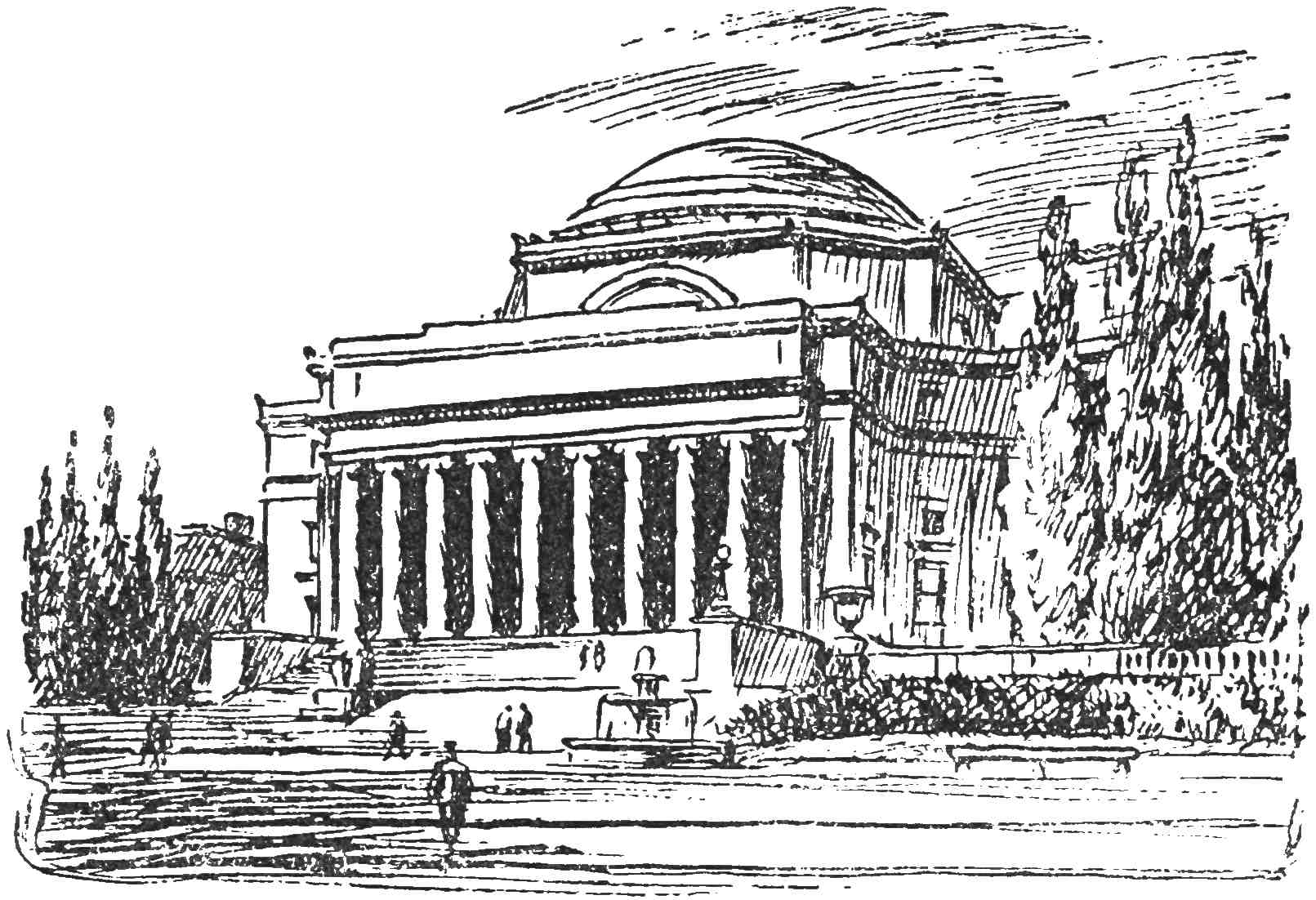
Columbia University be so far downtown that you will
be raising money to move it out of the congested slums
of Morningside? Will you look up, as I do now, to
the great pale shaft of Woolworth; to the golden boy
with wings above Fulton Street? What ships with
new names will come slowly and grandly up your
harbour? What new green spaces will your street
children enjoy? But something of the city we now love
will still abide, I hope, to link our days with yours.
There is little true glory in a city that is always changing.
New stones, new steeples are comely things; but
the human heart clings to places that hold association
and reminiscence. That, I suppose, is the obscure
cause of this queer feeling that impels me to send you
so perishable a message. It is the precious unity of
mankind in all ages, the compassion and love felt by the
understanding spirit for those, its resting kinsmen,
who once were glad and miserable in these same scenes.
It keeps one aware of that marvellous dark river of
human life that runs, down and down uncountably, to
the unexplored seas of Time.
You seem a long way off, I say—and yet it is but an
instant, and you will be here. Do you know that
feeling, I wonder (so characteristic of our city) that a
man has in an elevator bound (let us say) for the
eighteenth floor? He sees 5 and 6 and 7 flit by, and he
wonders how he can ever live through the interminable
time that must elapse before he will get to his stopping
place and be about the task of the moment. It is only
a few seconds, but his mind can evolve a whole honeycomb
of mysteries in that flash of dragging time. Then
the door slides open before him and that instantaneous
eternity is gone; he is in a new era. So it is with the
race. Even while we try to analyze our present curiosities,
they whiff away and disperse. Before we have
time to turn three times in our chairs, we shall be the
grandparents and you will be smiling at our old-fashioned
sentiments.
But we ask you to look kindly on this our city of
wonder, the city of amazing beauties which is also
(to any man of quick imagination) an actual hell of
haste, din, and dishevelment. Perhaps you by this
time will have brought back something of that serenity,
that reverence for thoughtful things, which our generation
lost—and hardly knew it had lost. But even Hell,
you must admit, has always had its patriots. There is
nothing that hasn’t—which is one of the most charming
oddities of the race.
And how we loved this strange, mad city of ours,
which we knew in our hearts was, to the clear eye of
reason and the pure, sane vision of poetry, a bedlam
of magical impertinence, a blind byway of monstrous
wretchedness. And yet the blacker it seemed to the
lamp of the spirit, the more we loved it with the troubled
eye of flesh. For humanity, immortal only in misery
and mockery, loves the very tangles in which it has
enmeshed itself: with good reason, for they are the
mark and sign of its being. So you will fail, as we have;
and you will laugh, as we have—but not so heartily,
we insist; no one has ever laughed the way your tremulous
granfers did, old chap! And you will go on about
your business, as we did, and be just as certain that
you and your concerns are the very climax of human
gravity and worth. And will it be any pleasure to you
to know that on a soft September morning a hundred
years ago your affectionate great-grandsire looked
cheerfully out of his lofty kennel window, blew a whiff
of smoke, smiled a trifle gravely upon the familiar
panorama, knew (with that antique shrewdness of his)
a hawk from a handsaw, and then went out to lunch?
A CALL FOR THE AUTHOR
But who will write me the book about New York
that I desire? The more I think about it, the
more astonished I am that no one attempts it. I don’t
mean a novel. I would not admit any plot or woven
tissue of story to come between the reader and my royal
heroine, the City herself. Not to be a coward, should I
try to write it myself? It is my secret dream; but,
better, it should be written by some sturdy rogue of a
bachelor, footfree, living in the very heart of the
uproar. Some fellow with a taste and nuance for the
vulgar and vivid; a consort of both parsons and bootleggers;
a Beggar’s Opera kind of rascal. I can think of
three men in this city who have magnificent powers
for such a book; but they are getting perhaps a little
elderly—yes, they are over forty! Ginger must be
very hot in the mouth of my imagined author. He
must be young (dashed if I don’t think about 32 is the
ideal age to write such a book), but not one of the Extremely
Brilliant Young Men. They are too clever;
and they are not lonely enough. For this is a lonely
job. It’s got to be done solus, slowly, with an eye only
upon the subject. It has got to show the very tremble
and savour of life itself.
The man who will write this book will not necessarily
enjoy it. To get into the secret of Herself he has got
to have a peculiar feeling about her. For years he
must have wrestled with her almost as a personal antagonist.
He must have vowed, since he first saw her
imperial skyline serrated on blue, to make her his own;
a mistress worthy of him, and yet he himself her master.
But he must know, in his inward, that in the end she
triumphs, she tramples down mind and heart and
nerve. Loveliest enemy in the world, implacable victor
over reason and peace and all the quieter sanities of the
spirit, her mad, intolerable beauty crazes or silences
the sensitive mind that woos her. If you think this
is only fine writing and romantic tall-talk, then you
know her only with the eye, not with the imagination.
With good reason, perhaps, her poets have, for the most
part, kept mum. Enough for them to see and cherish
in imagination her little sudden glimpses. A girl,
slender, gayly unconscious of admiration, poises on one
foot at the edge of the subway platform, leaning over to
see if the train is coming. That gallant figure is perhaps
something of a symbol of the city’s own soul.
There must be many who feel about Herself as I do—and,
more wisely, are tacit. There are many whose
minds have trembled on the steep sills of truth, have
felt that golden tremble of reality almost within touch,
and rather than mar the half-apprehended fable, have
turned troubled away. But there is such poetry in her,
and such fine, glorious animal gusto—why is there not
some determined attempt to set it down, not with
“rhetoricating floscules,” but as it is? Day after day
one comes to the attack; and returning, as the sloping
sunlight and fresh country air flood the dusty red plush
of the homeward smoking-car, readmits the expected
defeat. Here is a target for you, O generation of
snipers. Let us have done with pribbles and prabbles.
Who is the man who will write me the book I crave—that
vulgar, jocund, carnal, beautiful, rueful book!
MR. PEPYS’S CHRISTMASES
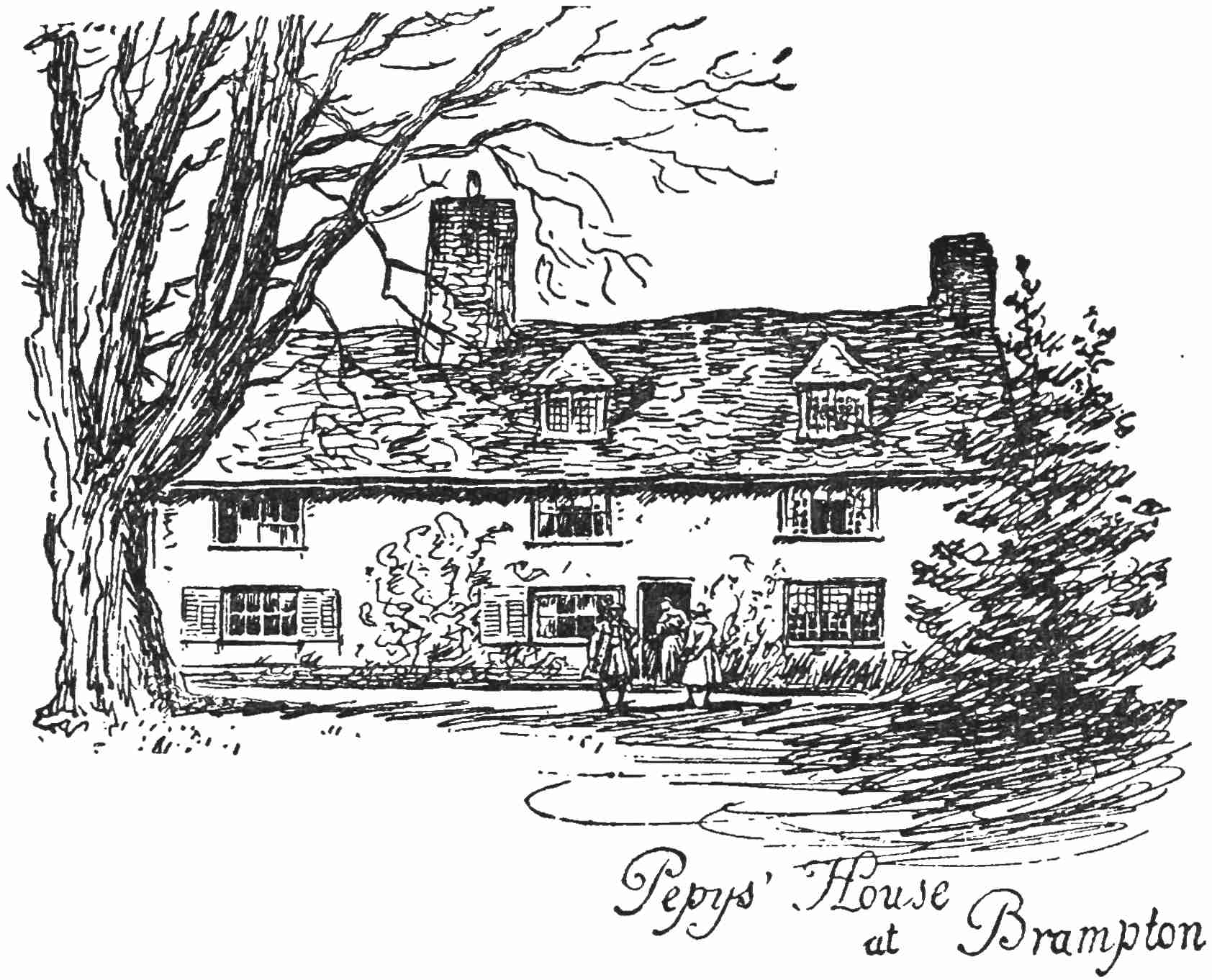
Pepys’ House at Brampton
Christmas being the topic, suppose we call
upon Mr. Samuel Pepys for testimony. The imperishable
Diarist had as keen a faculty of enjoyment
as any man who ever lived. He wrote one of the
world’s greatest love stories—the story of his own
zealous, inquisitive, jocund love of life. Surely it is not
amiss to inquire what record be left as to the festival
of cheer.
On seven of the nine Christmases in the Diary, Mr.
Pepys went to church—sometimes more than once,
though when he went twice he admits he fell asleep.
The music and the ladies’ finery were undoubtedly part
of the attraction. “Very great store of fine women
there is in this church, more than I know anywhere else
about us,” is his note for Christmas, 1664. But in that
generously mixed and volatile heart there was a valve
of honest aspiration and piety. One can imagine him
sitting in his pew (on Christmas, 1661, he nearly left the
church in a huff because the verger didn’t come forward
to open the pew door for him), his alert mind
giving close attention to the sermon of his favourite
Mr. Mills, busy with sudden resolutions of virtue and
industry, yet happily conscious of any beauty within
eyeshot.
The giving of presents was not a large part of Christmas
in those days. In 1662 Mr. Gauden gave Pepys
“a great chine of beef and three dozen of tongues,”
but this had its drawbacks. Pepys had to give five
shillings to the man who brought it and also half a
crown to the porters. Drink and food were the important
part of the festival. At Christmas, 1660, Mr.
and Mrs. Pepys, with Tom Pepys as guest, enjoyed
“a good shoulder of mutton and a chicken.” This was
a brave Christmas for Mrs. Pepys—she had “a new
mantle.” We must remember that the fair Elizabeth,
though already married five years, was then only
twenty years old. Not all Mrs. Pepys’s Christmases
were as merry as that, I fear. On Christmas, 1663, she
was troubled by anxious thoughts——
My wife began, I know not whether by design or
chance, to enquire what she should do, if I should by any
accident die, to which I did give her some slight answer,
but shall make good use of it to bring myself to some
settlement for her sake.
Why haven’t the ingenious life insurance advertisers
made use of this telling bit of copy?
Christmas, 1668, seems to have been poor Mrs.
Pepys’s worst Yule, but perhaps it was only her natural
feminine frivolity that caused the sadness. Samuel
says:
Dinner alone with my wife, who, poor wretch! sat
undressed all day, till 10 at night, altering and lacing of
a noble petticoat.
This noble petticoat was perhaps to be worn at the
play they attended the next day, “Women Pleased.”
What a pleasant Christmas card that scene would
make: Mrs. Pepys sitting, négligée, over the niceties
of her needlework, with Samuel beside her “making
the boy read to me the Life of Julius Cæsar.” But
we do not “get” (as the current phrase is) Mrs. Pepys
at all if we think of her as merely the irresponsible girl.
For, at Christmas, ’66, we read:
Lay pretty long in bed, and then rose, leaving my
wife desirous to sleep, having sat up till 4 this morning
seeing her maids make mince-pies.
Ah, we have no such mince pies nowadays. Mrs.
Pepys’s mince pies were evidently worthy the tradition
of that magnificent delicacy, for at Christmas, 1662,
when Elizabeth was ill abed, Samuel records—with
an evident touch of regret—that he had to “send
abroad” for one.
* * * * *
Which brings us back to the Christmas viands. In
1662, besides the mince pie from abroad, he “dined
by my wife’s bedside with great content, having a
mess of brave plum-porridge and a roasted pullet.”
We are tempted to think 1666 was Samuel’s best
Christmas. Parson Mills made a good sermon.
“Then home and dined well on some good ribs of beef
roasted and mince pies; only my wife, brother, and
Barker, and plenty of good wine of my own, and my
heart full of true joy.” After dinner they had a little
music; and he spent the evening making a catalogue of
his books (“reducing the names of all my books to an
alphabet”), which is probably the happiest task a man
of Pepys’s temperament could enjoy.
Christmas Eve, 1667, was evidently a cheerful evening.
Mr. Pepys stopped in at the Rose Tavern for
some “burnt wine”; walked round the city in the moonlight,
and homeward early in the morning in such content
that “I dropped money in five or six places, which
I was the willinger to do, it being Christmas Day, and
so home, and there find my wife in bed, and Jane and
the maid making pies.” The evening of that Christmas
Mrs. Pepys read aloud to him—The History of the
Drummer of Mr. Mompesson, apparently a kind of
contemporary Phillips Oppenheim—“a strange story of
spies, and worth reading, indeed.” It was only in 1660
that the Christmas cheer was a little too much for our
Diarist. December 27, 1660, “about the middle of
the night I was very ill—I think with eating and drinking
too much—and so I was forced to call the maid,
who pleased my wife and I in her running up and down
so innocently in her smock.”
* * * * *
It is painful to this tracker of Mr. Pepys’s vestiges to
note that on Christmas Day, 1662, Bishop Morley at the
Chapel Royal “made but a poor sermon.” The
Bishop apparently rebuked the levity of the Court.
“It was worth observing how far they are come from
taking the reprehensions of a Bishop seriously, that
they all laugh in the chapel when he reflected on their
ill-actions and courses. He did much press us to joy
in these public days of joy, and to hospitality; but one
that stood by whispered in my ear that the Bishop do
not spend one groat to the poor himself.” In 1665
we fear that Samuel indulged himself in church with
some rather cynical thoughts:
Saw a wedding in the church, and the young people
so merry one with another; and strange to see what delight
we married people have to see these poor fools
decoyed into our condition, every man and woman gazing
and smiling at them.
One could continue for some space recounting the
eupeptic Pepys in his Christmas merriments—so large
an edifice of pleasing conjecture can be built upon even
his slightest notes. One observes, for instance, that on
December 27, 1664, when “my wife and all her folks”
came “to make Christmas gambols,” Samuel left the
party and went to bed. This was very different from
his usual habit when there was fun going. He was
annoyed also that on this occasion his wife revelled all
night, not coming to bed until 8 the next morning,
“which vexed me a little, but I believe there was no
hurt in it at all, but only mirth.”
So we take leave of the Christmases of the Pepyses;
1668 is the last one recorded—the time when Elizabeth
stayed at home all day altering her petticoat. After
supper, the boy played some music on the lute, and
Samuel’s mind was “in mighty content.” Let us
think kindly of the good fellow; and not forget that he
coined one of the enduring phrases of English literature—a
phrase that is no such ineffective summary of all the
lives of men—And so to bed.
CHILDREN AS COPY
Titania said: “You haven’t written a poem about
the baby yet.”
It is quite true. She is now thirteen months old,
and has not yet had a poem written about her. Titania
considers this deplorable. The first baby was hardly a
week old before all sorts of literary studies were packing
the mails, speeding to such editors as were known to
be prompt pay. (I hope, indeed I hope, you never
saw that astounding essay—published anonymously in
Every Week which expired soon after—called “The
Expectant Father,” which was written when the poor
urchin was some twenty-four hours old. It was his
first attempt to earn money for his parent. If any
child ever paid his own hospital bills—C. O. D., as you
might say—it was he. I believe in bringing up my
children to be self-supporting.)
And the second baby was only three weeks old when
the first poem about her was written.
But here is this third morsel, thirteen months old
and no poem yet. Titania, I say, considers this a kind
of insult to the innocent babe. No, not at all, my dear.
I admit that it would be very helpful if H. (I will call
her that, for baby is a word that cannot be repeated in
print very often without all hands growing maudlin;
and I don’t like to use her own name, which seems too
personal; just remember, then, that H. stands for a
small brown-eyed creature who is still listed in the
Bureau of Records of the Department of Health [certificate
No. 43515, anno 1920] as Female Morley, because
when the birth was registered by the doctor her name
had not been decided, and ever since then I have been
too busy to go round to call on Dr. Copeland, the Health
Commissioner, and ask him to have her more specifically
enrolled)—I admit it would be very helpful if she
were to turn to and lend a hand in paying the coal bill
by having some verses written about herself. I have
looked at her with admiration every day for these thirteen
months, trying, as one might say, to get some
angle on her that would lead to a poem. She does not
seem very angular.
I insist that my not having written a poem about her
is really very creditable. Titania seems to think that
it implies my having become, in some sense, blasé
about children. Again, not so, not so at all. I must
confess that in my enthusiasm I rather made use of the
two older urchins as copy. But H., droll infant that
she is, is too subtle for me. I’ll come to that in a
minute.
I talked all this matter over (being of a cautious turn,
and fond of getting experienced advice) with two eminent
author-parents—Mr. Tom Masson and Mr. Tom
Daly—long ago, before Titania and I began putting on
heirs. Both these gentlemen have made a lot of use of
their children in earning, or at any rate gaining, a living.
Their advices coincided. I myself was worried,
but Mr. Tom Masson insisted that there was nothing
like having offspring as a source of copy; he said that he
would pay ten cents a word, in Life, for anything
about the then shortly arriving urchin. (He said it
would be fifteen cents a word if it was a girl, because
girls cost you so much more later on. He has had experience
in that matter, I believe.) Mr. Tom Daly,
who has run rather to boys, said very much the same
thing; but he was not in a position to buy my stuff, so
I paid less attention to him.
But to get back to H. There never was a more enchanting
infant. Mr. Walter de la Mare, who is also
an authority, has written me delightful letters about her,
although he has never seen her. But even a prose
letter from a poet like Mr. de la Mare is more valuable,
I think, than an actual poem from most other poets, so
darling H. cannot say she has been neglected. But she
is much too delicious for me to be able to sit down easily
and write something that would do her justice. The
night before she was born her mother and I did two
things. We went to Huyler’s for chocolate ice-cream
soda, and we read aloud Bernard Shaw’s autobiography,
which is printed in Frank Harris’s Contemporary
Portraits. I dislike to bring Mr. Harris into this,
for certainly I can think of no one who has less in common
with H., that celestial nugget. But I have to tell
the truth, don’t I? Mr. Harris wrote an essay about
Shaw; and Shaw, feeling that it was not adequate,
wrote a really amusing sketch to show how Harris
should have done it. Well, there is something symbolic
about this, for H. is as sweet as anything Huyler ever
compounded; and she is even more enigmatic than
Shaw. (I can see now it should have been Page and
Shaw instead of Huyler.)
But I feel that pretty soon I shall be writing a poem
about her. I have felt it coming for some time. But it
has got to come; I am not going to bring it. That shows
how I have matured by associating with H. Sometimes
I wish I could hire a really great poet to write about her.
Swinburne might do for the rough draft. “Oh, what
a bee-yootiful babby!” he used to cry when he saw them
in their prams up at Putney—so, I think, Max Beerbohm
describes. But I should want to have his rough
draft polished and refined by someone else. I can
only think of Mr. Walter de la Mare. He alone has
just the right insight. For babies thirteen months old—the
best age of all—must not be treated condescendingly,
nor fulsomely, nor adoringly, nor sugarishly.
William Blake, if left alone in the room with H., would
have understood her. What an infant, I give you my
word! Living with children is largely a contest of endurance.
It is a question of which one can tire the other
out first. (This is a great secret; never before made
plain.) Start in early in the morning, and take things
with a rush. If you are strong, austere, resolute, you
may be able to wear them down and exhaust them by
dusk. If you can do so, without prostrating yourself,
then you may get them to bed safely and have a few
hours of cheerful lassitude. But take every possible
advantage. Let them run and frolic, yourself sitting
down as much as you can. Favour yourself, and snatch
a little rest while they are not looking. Even so, the
chances are you will crack first.
This applies to older children; after they gain the
use of their limbs and minds. But H. has not reached
that harrowing stage. Placable, wise, serene, she sits
in her crib. She has four teeth (beauties). To hear
her cry is so rare that I hardly know what her voice of
sorrow sounds like. Sometimes, for an instant, she
looks a little frightened. Then I like her best, for I
know she is human, and has in her the general capsule
of frailty.
You may be quite sure of one thing, I shall never
print that poem unless I feel that it comes somewhere
near doing her justice.
HAIL, KINSPRIT!
The keenest pleasure in life, of course, is to find a
Kindred Spirit—one whose mind glows and teeters
with delight at the same queer things that rouse us to
excitement. We have just found one, and yet we shall
never know him, except by his address, which is Y.
1926, the Times, E. C. 4, London. For we are much too
busy to write to any one, even to a Kindred Spirit.
We will tell you why we feel sure he is a Kindred
Spirit; but in parenthesis, it was Mr. Pearsall Smith
who lamented the fact that the English language contains
no satisfactory word for “a person who is enthusiastic
about the same things that you are enthusiastic
about.” It is too grossly clumsy to say fellow-fan
or co-enthusiast; so Mr. Smith, a philologist of charming
finesse (have you read his little book The English
Language published by Henry Holt?) boldly proposed
to fill the vacancy by coining the word milver. This, he
said, would be useful to poets, since there is no rhyme
in English for silver.
The word milver, alas, leaves us cool, in spite of its
usefulness as a rhyme. It does not strike down in the
great subsoil of the language—the dark deep skein of
inherited word-roots from which our present meanings
blossom and put forth. We suggest—without much
thought—a mere contraction. How would kinsprit do?
We rather like the look of it; it has a droll, benign,
elvish appearance as we put it down. A couplet occurs
to us—
They pledged their bond with joyful oath—
A kinsprit passion knit them both.
That shows you it could be used as an adjective as well.
Come, now, if we all pull together very likely we can
get Messrs. Merriam to put it in the next edition of
Webster:
Kinsprit, n and a. (orig. obscure: perh. contracted
from kin[dred] sprit[e])—A fellow-enthusiast, one
impassioned with the same zeal or hobby or enthusiasm.
The reason why we know that Y. 1926 is a kinsprit
is in the following notice in the Personal column of the
London Times:
Lost in Taxi last week, SMALL PORTFOLIO containing
colour diagrams and newspaper print of Lamb’s portrait
of Lytton Strachey. Finder rewarded. Y. 1926,
The Times, E. C. 4.
Well, well, we say to ourself: then there is one other
person in the world who felt just as we did about that
gloriously entertaining portrait of Mr. Strachey, and
who carried it about with him just as we did ours,
clipped from the Manchester Guardian. But we are
luckier than poor Y. 1926, because in an access of enthusiasm
we wrote to Mr. Henry Lamb, the artist, and
begged from him a photo-print of the picture, which is
in front of us now. We think that Mr. Alfred Harcourt,
Mr. Strachey’s publisher, should implore the loan of
the canvas for a few months, and have it exhibited in a
Fifth Avenue window where we could all have a good
look at it.
We are consumed with curiosity to know more about
Y. 1926—where he was going in that taxi, and what the
colour diagrams were (they sound interesting) and
what are his general comments on life?
ROUND MANHATTAN ISLAND
We were talking with an American who had just
come back after living several years in Europe.
He expressed with some dismay his resensitized impression
of the furious ugliness and clamour of American
life; the ghastly wastes of rubbish and kindling-wood
suburbs fringing our cities; and suggested that the
trouble is that we have little or no instinctive sense of
beauty.
To which we replied that perhaps the truth of it is
that the American temperament is more likely to see
opportunities for beauty in large things than in small.
But we were both talking bosh. Only an extraordinarily
keen and trained philosophic perception—e. g.,
a Santayana—can discuss such matters without gibbering.
A recent book on young American intellectualism
recurs to us as an example of the futility of undigested
prattle about æsthetics. Even the word æsthetics
itself has come to have a windy savour by reason of
much sophomore talk.
But, though we have laid by our own copy of that
particular book as a permanent curio in the realm of
well-meant gravity, its author was obeying a sound and
praisable instinct in trying to think about these things—beauty,
imagination, the mind’s freedom to create, the
meaning of our civilization. We are all compelled to
such an attempt: shallow, unversed, clumsily intuitive,
we grope into them because we are sincerely hungry to
understand. The same wise, brave, gracious spirit
that moved Mr. Montague to write his exquisite book
Disenchantment is tremulously and tentatively alert
in thousands of less competent minds. And we, for
our own part, grow just a little impatient with those
who are quick to damn this wildly energetic and thronging
civilization because it shows a poverty of settled,
tranquil loveliness. We look out of our window into
this morning where Mrs. Meynell’s “wind of clear
weather” tosses the Post Office flags and the rooftop
plumes of steam; we see the Woolworth pinnacle hanging
over our head—and ask, is it possible that this great
spectacle breathes from her towers only the last enchantments
of a muddled age?
Aristotle remarked that “the flute is not an instrument
which has a good moral effect; it is too exciting.”
And very likely New York civilization falls under the
same reproach. But even if it is all madness, what a
gallant raving! You cannot see the beauty in anything
until you love it for its own sake. Take the sightseeing
boat round Manhattan if you want to get a mental
synthesis of this strangest of islands. From a point in
the East River off Coenties Slip you will see those
cubed terraces of building rising up and upward, shelves
and ledges of rectangular perspective like the heaven of
a modernist painter. Nor do we deny the madness
and horror. Farther up the river you will see the
ragged edges of the city, scows loading their tons of
jetsam and street scourings, wizened piers, grassless
parks, all the pitiful makeshift aquatics of the Harlem
region. And yet, all along that gruesome foreshore,
boys—and girls, too—bathing gayly in the scum-water,
flying ragged kites from pier-bollards, merry and
naked on slides of rock or piles of barrels. Only on the
three grim islands of Blackwell, Ward, and Randall will
you see any touch of beauty. There, grass and trees
and beds of canna and salvia (the two great institutional
flowers) to soothe the criminal and the mad. When
your mind or your morals or your muscles give way,
the city will allow you a pleasant haven of greenery
and air. It is odd to see the broad grounds of the
Children’s Hospital—on Randalls Island, is it?—with
no child in sight; but across the river the vile and
scabby shore is thick with them. And the bases of
the Harlem swing-bridges, never trod by any one, are
carefully grassed and flowered.
So the history of every modern city consists of a
painful, slow retracing of its errors, an attempt to undo
painfully and at vast expense the slattern stupidities
it has allowed to accumulate. But to see only these
paradoxes and uglinesses is to see less than the whole.
He cannot have lived very long or thoughtfully with
humanity for neighbour who does not ruefully accept
greeds and blindnesses as part of its ineradicable habit.
It takes a strong stretch of the imagination to grasp
this island entire; to see, even in its very squalors and
heedlessnesses, an integral portion of its brave teeming
life. You must love it for what it is before you have
a right to love it for what it may be. We have never
been able to think this thing out, but there seems to us
to be some vital essence, some miraculous tremor of
human energy and folly in the whole scene that condones
and justifies the ugliness. It is queer, but the
hideous back-lots of the city do not trouble us so
greatly: we have a feeling that they are on their way
towards being something else. We do not praise them,
but we feel in an obscure way they are part of the picture.
Zealous passion and movement always present,
to the eye of dispassion, aspects either grotesque or
terrible, according to that eye’s focus. In this ugly
hurly-burly we feel daily (though we cannot define it)
that there is a beauty so overriding that it does not
depend on beautiful particulars. And, to feel that
beauty fully, one must discard all hankerings to improve
humanity, or to preach to it, or even understand it—simply
(as Uncle Remus said) “make a great ’miration”—accept
it as it thrillingly is, and admire.
THE UNKNOWN CITIZEN
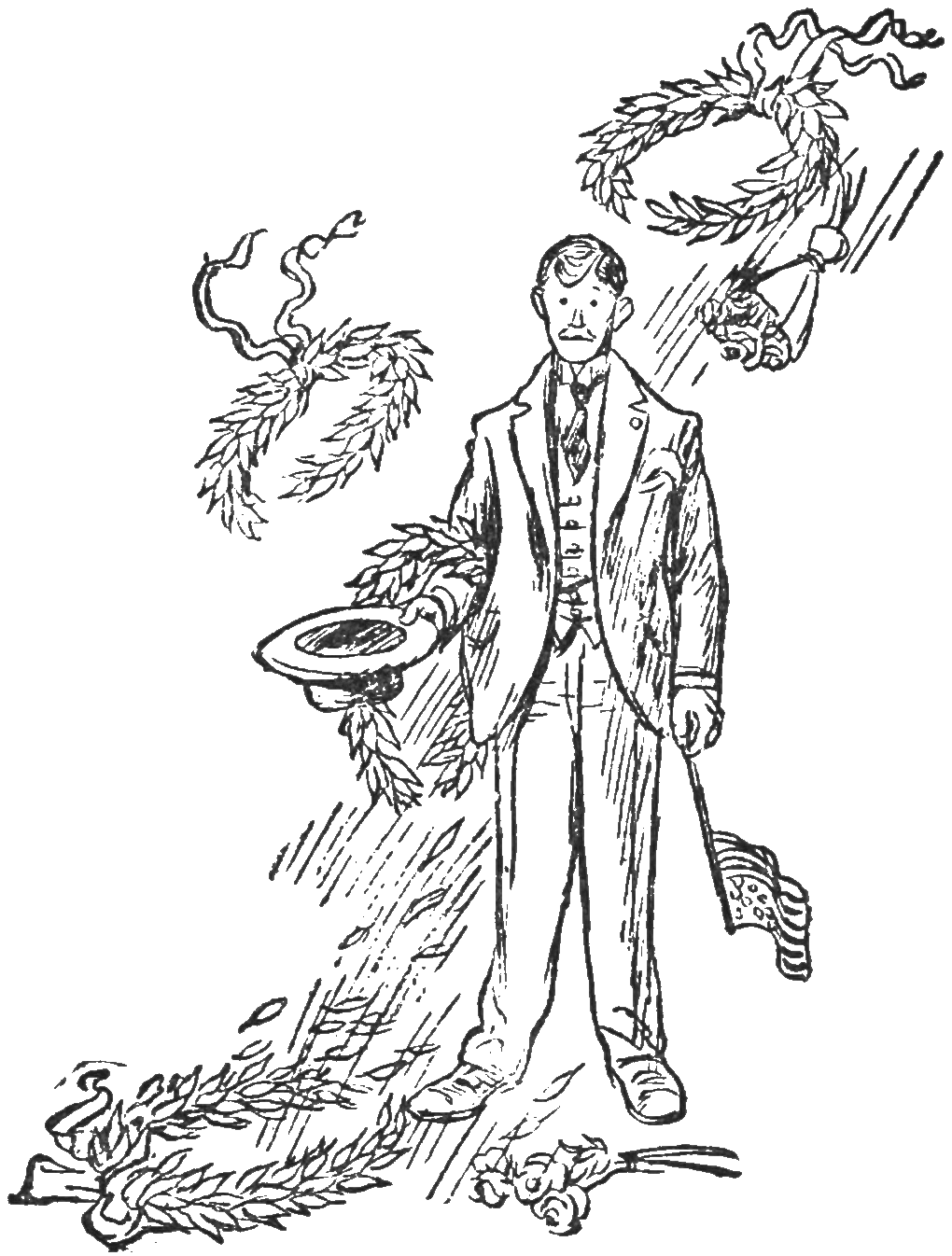
We shall never forget being in Washington
when the great celebration was held in honour of
the Unknown Citizen.
The day was proclaimed a National Fête. On that
day the Unknown Citizen—chosen after long investigation
by a secret committee sworn to silence—arrived
at the Union Station. He and his wife had been
quietly lured away from their home on a plausible pretext
and then kidnapped into a gaudy special train,
where everything had been explained to them. Halts
had been made at big cities en route for the crowds to
pay homage.
It would take too long to describe the clever selective
process by which the Citizen had been chosen. Suffice
it to say that he was a typical homo Americanus—a
worthy and slightly battered creature, who had raised
a family of four children and plugged along at his job
and paid his taxes and cranked his flivver and set up a
radio on the roof and planted sunflowers in the back
yard and lent his wife a hand at the washing and frequently
mended the kitchen stove-pipe. He had never
broken open the china pigs containing the children’s
money.
We saw him arrive at the great station in Washington.
He was strangely troubled and anxious, a bit
incredulous, too, believing this was all some sort of put-up
job. Also, somewhere on the train he had lost one
of his elastic sleeve-suspenders, and one cuff kept on
falling round his wrist. He walked uneasily along the
red velvet carpet and was greeted by President Harding
and the Ambassadors of Foreign Powers. Mr. Sousa’s
band was there, and struck up an uproarious anthem
composed for the occasion. The tactful committee of
Daughters of the American Bourgeoisie had made all
arrangements and taken all possible precautions. It
had been feared that perhaps the Citizen’s Wife might
be overcome, and an ambulance was waiting behind
potted palms in case of any emergency. But it is always
the unexpected that happens. It was Senator
Lodge, who had been appointed to read the telegrams
from prominent people, who swooned. President
Harding, with kindly readiness, stepped into the breach.
As they were handed to him he read aloud the messages
from M. Clemenceau, Mr. Lloyd George, William Allen
White, Samuel Gompers, Dr. Frank Crane, President
Ebert, Paul Poiret, M. Paderewski, M. Venizelos, the
Archbishop of Canterbury, and Isaac Marcosson. Mr. Harding
then spoke in the most friendly and charming
way, appraising the value of preserved nationality, the
solid virtue of the Founding Fathers, and the services
of the Unknown Citizen to his country.
For a moment there was an awkward pause, but the
Citizen’s Wife, evidently a strong-minded woman,
nudged him sharply, and the Citizen tottered forward.
Fortunately some New York newspaper men had been
on the train with him, and had written a little speech
for him to deliver. He read it, a bit tremulously. It
stated that he was aware this tribute was not meant for
him personally, but for the great body of middle-class
citizenship he had been chosen to represent. There
was great speculation in the audience as to what part
of the country the Citizen came from: his accent was
perhaps a trifle Hoosierish, but wiseacres insisted that
his general fixings were plainly Sears-Roebuck and not
identifiable with any section.
Accompanied by a troop of cavalry and the national
colours, the Unknown Citizen was taken to the Capitol,
where Congress, convened in joint session, awaited to
do him honour. He was presented to the great body
by Senator Lodge, who had now completely recovered.
After being introduced, the Citizen stammered a few
words of embarrassment. During the buffet lunch in
the lobbies, however, he began to pluck up heart, for he
found the Congressmen very human. He even ventured
to express, very politely, a few sentiments about
the bonus, the tariff, the income tax, the shipping subsidy,
and the coal strike. Gathering confidence, he
might have grown almost eloquent over these topics,
but the Senatorial committee, foreseeing trouble,
hastened him along to see the gifts that had been sent
from all over the world. They were all laid out for inspection.
Henry Ford had sent a new sedan, with a
self-starter and the arms of the United States gilded on
the door. William Randolph Hearst had sent a bound
volume of Arthur Brisbane’s editorials. The Prince of
Wales, perhaps misunderstanding the exact nature of
the ceremony, had sent a solid gold punch bowl engraved
Dieu et Mon Drought. The Premier of New
Zealand had sent a live kangaroo. The Bailiff of Angora
had sent a large silky goat. Mayor Hylan had
sent a signed photograph of himself wearing overalls.
The Shipping Board had sent a silver flask. But we
have not space for the full list of presents.
Tea was served at the White House. All the corps
diplomatique were there, and were presented to the
Citizen and his Wife. It was a great afternoon. The
Marine Band played in the garden; Senator Borah and
William Jennings Bryan, beginning to see a sort of
prickly heat burn out upon the Unknown Citizen’s forehead,
tactfully played a tennis match to keep the crowd
in good humour. Laddie Boy, wagging his tail vigorously,
kept at the Unknown Citizen’s heels and did
much to cheer him. The Unknown Citizen liked Mr.
Harding greatly and found him easy to talk to; but
some of the Special Representatives from abroad, such
as Mr. Balfour and M. Tardieu, he found difficult.
The monument in Potomac Park was dedicated at
sunset. After that the committee on Savoir Faire,
observing the wilted collar of the Unknown Citizen,
thought it the truest courtesy to let him escape. We
ourself managed to follow him through the crowds. He
and his wife looked nervously over their shoulders now
and then, but they had shaken off pursuit. At a little
stationery store they bought some postcards. Then they
went to the movies.
SIR KENELM DIGBY — TO MAKE ALE DRINK QUICK — ANOTHER CLOUTED CREAM — TO MAKE EXCELLENT MEATHE — TEA WITH EGGS
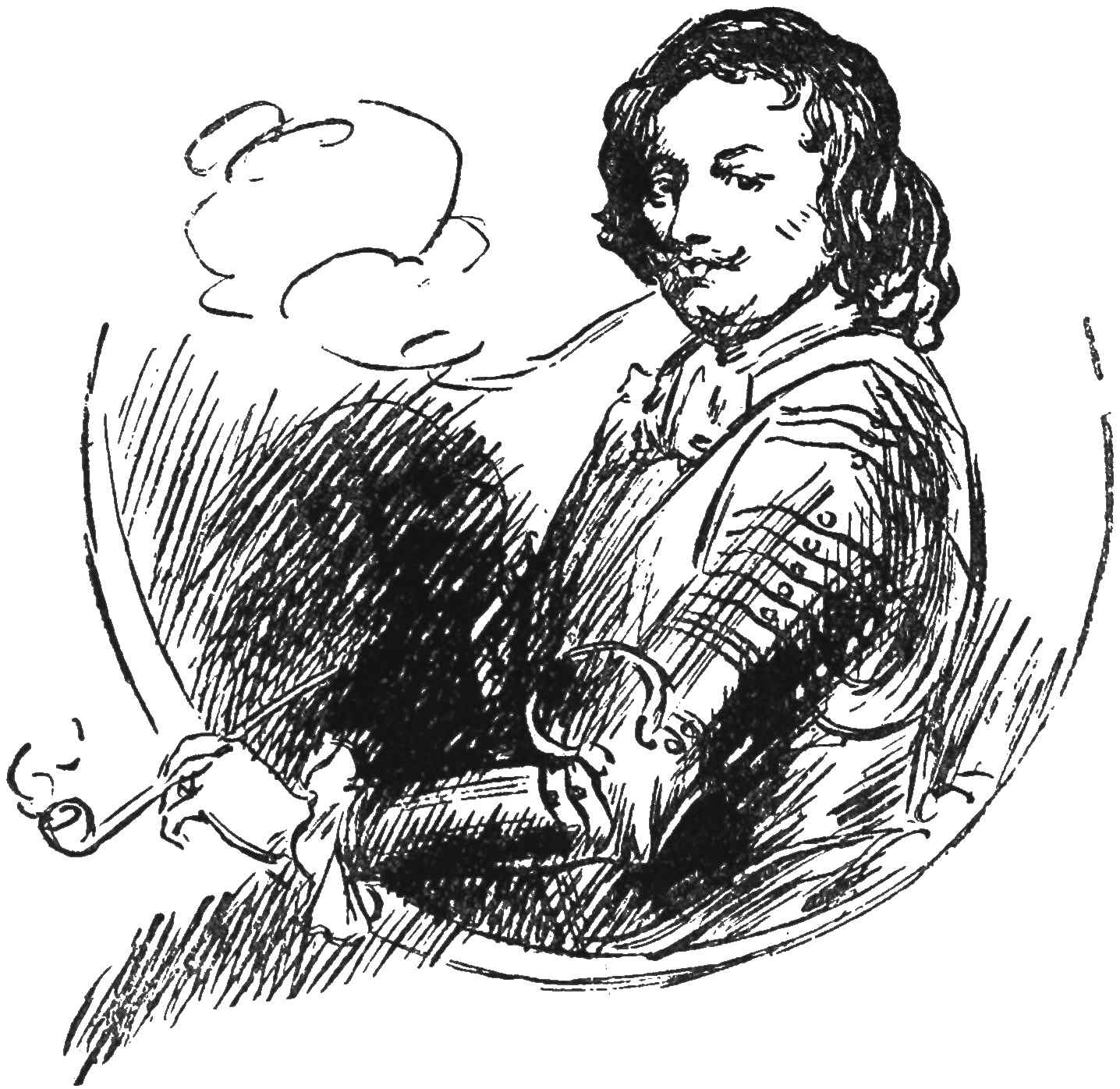
Sir Kenelm Digby, of whose acquaintance all his contemporaries
seem to have been ambitious.
—Dr. Johnson, Life of Cowley.
Prohibition, I dare say, is going to make
fashionable the private compilation of just such delightful
works as The Closet of the Eminently Learned
Sir Kenelme Digbie Opened; London, at the Star in
Little Britain, 1669. Sir Kenelm, “the friend of kings
and the special friend of queens,” crony of such diverse
spirits as Bacon, Ben Jonson, and Oliver Cromwell,
kept this notebook of his jocund experiments in home
brewing and cookery. Just as nowadays a man will
jot down the formula of some friend’s shining success in
the matter of domestic chianti, so did the admirable
Kenelm record “Sir Thomas Gower’s Metheglin for
Health,” or “My Lord Hollis’ Hydromel,” or “Sir
John Colladon’s Oat-Meal Pap,” or “My Lady Diana
Porter’s Scotch Collops;” and adding, of course, his
own particular triumphs—e. g., “Hydromel as I Made
it Weak for the Queen Mother,” “A Good Quaking
Bag-Pudding,” and “To Fatten Young Chickens in a
Wonderful Degree.” Sir Kenelm’s official duty at the
court of Charles the First was Gentleman of the Bed-chamber;
but if I had been Charles, I should have transferred
him to the Pantry.
The Closet Opened (which was not published until
after Sir Kenelm’s death; he was born 1603, died 1665)
is the kind of book delightfully apt for the sad, sagacious,
and solitary, for one cannot spend an hour in it
without deriving a lively sense of the opulence and
soundness of life. The affectionate attention Sir
Kenelm pays the raisin makes him seem almost a Volsteadian
figure: in his pages that excellent and powerful
fruity capsule plays, perhaps for the first time in
history, a heroic and leading rôle. Consider this:
When small Ale hath wrought sufficiently, draw into
bottles; but first put into every bottle twelve good
raisins of the Sun split and stoned. Then stop up the
bottle close and set it in sand (gravel) or a cold dry
Cellar. After a while this will drink exceedingly quick
and pleasant. Likewise take six Wheat-corns, and
bruise them, and put into a bottle of Ale; it will make it
exceeding quick and stronger.
Kenelm was not only a good eater; he was a devilish
good writer. The fine lusty root of English prose was
in him. If this is not true literature, we know it not:
Milk your Cows in the evening about the ordinary
hour, and fill with it a little Kettle about three quarters
full, so that there may be happily two or three Gallons
of Milk. Let this stand thus five or six hours. About
twelve a Clock at night kindle a good fire of Charcoal,
and set a large Trivet over it. When the fire is very
clear and quick, and free from all smoak, set your Kettle
of Milk over it upon the Trivet, and have in a pot by a
quart of good Cream ready to put in at the due time;
which must be, when you see the Milk begin to boil
simpringly. Then pour in the Cream in a little stream
and low, upon a place, where you see the milk simper....
To simper—a word of sheer genius! There are many
such in his recipes.
We find the raisin again at work in his directions:
To every quart of Honey, take four quarts of water.
Put your water in a clean Kettle over the fire, and with
a stick take the just measure, how high the water
cometh, making a notch, where the superficies toucheth
the stick. As soon as the water is warm, put in your
Honey, and let it boil, skiming it always, till it be very
clean; Then put to every Gallon of water, one pound
of the best Blew-raisins of the Sun, first clean picked
from the stalks, and clean washed. Let them remain
in the boiling Liquor, till they be throughly swollen and
soft; Then take them out, and put them into a Hair-bag,
and strain all the juice and pulp and substance from
them in an Apothecaries Press; which put back into
your liquor, and let it boil, till it be consumed just to
the notch you took at first, for the measure of your water
alone. Then let your Liquor run through a Hair-strainer
into an empty Woodden-fat, which must stand
endwise, with the head of the upper-end out; and there
let it remain till the next day, that the liquor be quite
cold. Then Tun it up into a good Barrel, not filled
quite full, and let the bung remain open for six weeks.
Then stop it up close, and drink not of it till after nine
months.
This Meathe is singularly good for a Consumption,
Stone, Gravel, Weak-sight, and many more things. A
Chief Burgomaster of Antwerpe, used for many years
to drink no other drink but this; at Meals and all times,
even for pledging of healths. And though He were an
old man he was of an extraordinary vigor every way,
and had every year a Child, had always a great appetite
and good digestion; and yet was not fat.
One of good Sir Kenelm’s most famous instructions,
which has become fairly well-known, does honour not
only to his delicate taste but also to his religious devotion.
It is his advice on the brewing of tea—“The
water is to remain upon it no longer than whiles you
can say the Miserere Psalm very leisurely.” This advice
occurs in the recipe
The Jesuite that came from China, Ann. 1664, told
Mr. Waller, That there they use sometimes in this manner.
To near a pint of the infusion, take two yolks of
new laid-eggs, and beat them very well with as much
fine Sugar as is sufficient for this quantity of Liquor;
when they are very well incorporated, pour your Tea
upon the Eggs and Sugar, and stir them well together.
So drink it hot. This is when you come home from attending
business abroad, and are very hungry, and yet
have not conveniency to eat presently a competent
meal. This presently discusseth and satisfieth all rawness
and indigence of the stomack, flyeth suddainly
over the whole body and into the veins, and strengthenth
exceedingly and preserves one a good while from
necessity of eating. Mr. Waller findeth all those effects
of it thus with Eggs. In these parts, He saith, we let
the hot water remain too long soaking upon the Tea,
which makes it extract into itself the earthy parts of
the herb. The water is to remain upon it no longer
than whiles you can say the Miserere Psalm very
leisurely. Thus you have only the spiritual parts of
the Tea, which is much more active, penetrative, and
friendly to nature.
Sometimes, it is true, one suspects Sir Kenelm of a
tendency to gild the lily. In the matter of perfuming
his tobacco, this was his procedure:—
Take Balm of Peru half an ounce, seven or eight
Drops of Oyl of Cinamon, Oyl of Cloves five drops,
Oyl of Nutmegs, of Thyme, of Lavender, of Fennel, of
Aniseeds (all drawn by distillation) of each a like
quantity, or more or less as you like the Odour, and
would have it strongest; incorporate with these half a
dram of Ambergrease; make all these into a Paste;
which keep in a Box; when you have fill’d your Pipe
of Tobacco, put upon it about the bigness of a Pin’s
Head of this Composition.
It will make the Smoak most pleasantly odoriferous,
both to the Takers, and to them that come into the
Room; and ones Breath will be sweet all the day after.
It also comforts the Head and Brains.
It is a great temptation to go on quoting these seductive
formulæ. I feel sure that my tenderer readers
would relish instructions for the Beautifying Water or
Precious Cosmetick,—for the secret of which ladies
of high degree pursued Sir Kenelm all over Europe.
(He does not include in the Closet any details of the
Viper Wine for the Complection which was said to have
caused the death of Lady Digby—a rather painful
scandal at the time.) But I fear to trespass on your
patience. Let me only add that the ambition of the
Three Hours for Lunch Club has long been to hold a
DIGBY DINNER, at which all the dishes will be prepared
as nearly as possible according to Sir Kenelm’s prescriptions.
The project offers various perplexities, and
might even have to be consummated at sea, beyond
the hundred-fathom curve. But if it ever comes to
pass, the following menu, carefully chosen from Sir
Kenelm’s delicacies, seems to me promising:—
Portugal Broth, As It Was Made for the Queen
Sack with Clove Gillyflowers
Sucket of Mallow Stalks
A Herring Pye
A Smoothening Quiddany of Quinces
My Lady Diana Porter’s Scotch Collops
Mead, from the Muscovian Ambassador’s Steward
The Queen Mother’s Hotchpot of Mutton
Pease of the Seedy Buds of Tulips
Boiled Rice in a Pipkin
Marmulate of Pippins
Dr. Bacon’s Julep of Conserve of Red Roses
Excellent Spinage Pasties
Pleasant Cordial Tablets, Which Strengthen Nature
Small Ale for the Stone
A Nourishing Hachy
Plague Water
Marrow Sops with Wine
My Lord of Denbigh’s Almond Marchpane
Sallet of Cold Capon Rosted
My Lady of Portland’s Minced Pyes
The Liquor of Life
A Quaking Bag-Pudding
Metheglin for the Colic
But I must not mislead you into thinking that Sir
Kenelm was merely a convivial trencherman. His
biography as related in the Encyclopædia Britannica
is as diverting as a novel—more so than many. Infant
prodigy, irresistible wooer, privateer, scientist, religious
controversialist, astrologer, and a glorious talker,
he made a profound impression on the life of his time.
But, as so often happens, his name has been carried
down to posterity not by the strange laborious treatise
he regarded as his opus maximum, but by his chance
association with one of the great books of all time.
When Digby was under honorable confinement (as a
“Popish recusant”) at Winchester House, Southwark, in
1642, he was busy there with chemical experiment
and the MS. of his Of Bodies and Mans Soul (of which
more in a moment). Apparently they treated political
prisoners with more indulgence in those days. One
evening he received a letter from his friend the Earl
of Dorset, urging him to read a book that was making
a stir among the intellectuals. One may think it was
perhaps a trifle niggardly of Dorset merely to have
recommended the book. To a friend in jail, surely he
might (and it was just before Christmas) have sent a
copy as a present. But the liberality of the Earl is not
to be called in question: he had made Sir Kenelm at
least one startlingly gracious gift—viz. Lady Digby
herself, previously Dorset’s mistress. This oddly
amusing story, or gossip, may be pursued in Aubrey’s
Brief Lives, a fascinating book (published by the Oxford
Press)—a sort of Social Register of seventeenth century
England.
“Late as it was” when Sir Kenelm received the letter
from his benefactor and colleague, he sent out at once
(mark the high spirit of the true inquirer; also the sagacity
of seventeenth century booksellers, who kept open at
night)—
To let you see how the little needle of my
Soul is throughly touched at the great Loadstone
of yours, and followeth suddenly and strongly,
which way soever you becken it.... I sent
presently (as late as it was) to Pauls Church-yard,
for this Favourite of yours, Religio Medici: which
found me in a condition fit to receive a Blessing; for
I was newly gotten into my Bed. This good
natur’d creature I could easily perswade to be my
Bed-fellow, and to wake with me, as long as I had
any edge to entertain my self with the delights I
sucked from so noble a conversation.
Rarely have the pleasures of reading in bed had such
durable result. The following day he spent in pouring
out a long, spirited and powerful letter to Dorset (75
printed pages) which has become famous as Observations
upon Religio Medici, and a few years later was
included as a supplement to that book—where it still
remains in most editions. In this tumbling out of
his honourable meditations and excitements, Sir Kenelm
took issue pretty smartly with Dr. Browne on a number
of points, particularly in regard to his own special hobby
of Immortality. He, just as much as the Norwich
physician, loved to lose himself in an Altitudo; but in
some cloudlands of airy doctrine Browne seemed to
him too precise. “The dint of Wit,” Digby remarked
felicitously of some theological impasse, “is not forcible
enough to dissect such tough matter.”
These Observations are of more than casual importance.
Dorset, apparently, took steps (unknown to
Digby) to have them published; and report of this coming
blast roused Browne to protest courteously against
“animadversions” based upon the unauthorized and
imperfect version of his book—his own “true and intended
Originall” being by this time in the printer’s
hands. Digby had written his observations without
knowing who the author of Religio was. The letters
that now passed between him and Browne are an exhilarating
model of controversy goldenly conducted
between gentlemen of the grand manner. “You shall
sufficiently honour me in the vouchsafe of your refute,”
writes Browne, “and I obliege the whole world in the
occasion of your Pen.” To which Digby, avowing that
his comments were written without thought of print
and merely as a “private exercitation,” charmingly
disclaims any ambition to enter public argument with
so superior a scholar. “To encounter such a sinewy
opposite, or make Animadversions upon so smart a
piece as yours is, requireth such a solid stock and exercise
in school learning. My superficial besprinkling will
serve only for a private letter, or a familiar discourse
with Lady auditors. With longing I expect the comming
abroad of the true copy of the Book, whose false
and stoln one hath already given me so much delight.”
The delightful remark about lady auditors causes one
to suspect that even in that day the germ of the lecture
passion was moving in circles of high-spirited females.
Digby and Browne were evidently kinsprits. They
were nearly of an age; Browne was a physician, and
Digby—though many considered him a mountebank
and charlatan—had a genuine scientific zeal for medical
dabblings. His Powder of Sympathy, a nostrum
for healing wounds at a distance, has been a
cause of merriment among later generations; but Sir
Kenelm was no fool and I am not at all sure that there
wasn’t much excellent sense in his procedure. The
injury itself was washed and kept under a clean bandage.
The Powder of Sympathy was to be prepared
from a paste of vitriol, and the instructions included
necessity for mixing and exposing it in sunshine. Sir
Kenelm was quite aware of the public appetite for
hocus-pocus, and surely there was a touch of anticipatory
Christian Science and Coué in his idea of keeping
the patient’s mind off the trouble and giving him this
harmless amusement in the open air. For the sympathetic
powder, please note, was never to be applied to
the wound itself, but only to something carrying the
blood of the injured person—a stained bandage, a
garment, or even the weapon with which the damage
was done. The injury was left to the curative progress
of Nature. This theory of treating not the wound but
the weapon might well be meditated by literary critics.
For instance, when some toxicated energumen publishes
an atrocious book, the best course to pursue is not to
attack the author but to praise Walter de la Mare or
Stella Benson. This may be termed the allopathic
principle in criticism; but few of us are steadfast enough
to adhere to it.
Digby’s Memoirs—not published until 1827—exhibit
him as the swashbuckler, and amorist by no means
faint. They are amusing enough but give only a carnal
silhouette. Perhaps he did not write the book himself:
there is a vein of burlesque in the narrative that makes
me suspicious. It purports to be an account of Sir
Kenelm’s fidelity to his wife, the lovely Venetia; and we
are told that the account was written under Antonian
pressure. Importuned by ladies of much personal
generosity and recklessness, Sir Kenelm austerely retires
to a cave and pens this confession of uxorious
loyalty. When you consider that the relations of Sir
Kenelm and Lady Venetia were one of the fashionable
uproars of the day, you begin to guess that the Memoir
(in which all the characters are concealed by romantic
pseudonyms) was an elaborate skit intended for private
circulation, probably the work of some satirical friend.
Exactly so, when any great scandal nowadays is riding
on the front pages of the newspapers, do City Room reporters
compose humorous burlesques of the printed
“stories,” and these have delightful currency round the
office.
So you will still find legends in print suggesting that
Sir Kenelm was a blend of Casanova and Dr. Munyon.
He has been attributed what historians used to call
“Froude’s disease”—an insufficient curiosity as to the
total of 2 and 2 when added together. But a man whose
memory still makes a page and a half of the Encyclopædia
Britannica such lively reading, must have had
more than mere animal spirits in his make-up. It is
easy to find testimony to his potent social and military
accomplishments. But the man himself, his earnest
scientific passions, his valiant speculation on human
destinies, does not emerge from the entries in encyclopædias.
For that you must look into his great
book Two Treatises: The Nature of Bodies, and The
Nature of Mans Soul (1658). By the kindness of Mr.
Wilbur Macey Stone, generous and astonishingly
Elizabethan explorer of old books, I have an original,
tawny and most aromatic copy of this queer treasure.
The title page of the Second Treatise is endorsed, with
a charming use of the aspirates—
Samuel Mellor’s Book, December 22th 1792.
Samuel Mellor his my Name
and Cheshire is my Nation
and Burton is my Dwellings
Place and Christ is my
Salvation
this Book geven
has A Gift to Samuel Mellor
Sir Kenelm dedicates the volume to his son, in a
touching and honourable letter dated “Paris the last
of August 1644.” “The calamity of this time” (he
says) “hath bereft me of the ordinary means of expressing
my affection to you; I have been casting about, to
find some other way of doing that in such sort, as you
may receive most profit by it. Therein I soon pitched
upon these Considerations; that Parents owe unto
their children, not only material subsistence for their
Body, but much more, spiritual contributions to their
better part, their Mind.” Accordingly, with perfect
gravity and that sombre and Latinized eloquence which
was the peculiar gift of his century, he proceeds to expound
in nearly 600 dense pages his observations on
what we would call nowadays physics and psychology.
It would be agreeable enough, if I did not fear to weary
you, to copy down some of Sir Kenelm’s delightful
shrewd comments. A few of his section headings will
serve to give an idea of his matter. For instance:—
The experience of burning glasses, and of soultry gloomy
weather, prove light to be fire.
Philosophers ought not to judge of things by the rules
of vulgar people.
The reason why the motion of light is not discerned
coming towards us, and that there is some real tardity
in it.
The true sense of the Maxim, that Nature abhorreth from
vacuity.
The loadstone sendeth forth its emanations spherically.
Which are of two kinds: and each kind is strongest in that
hemisphere, through whose polary parts they issue out.
The reason why sometimes the same object appears
through the prism in two places: and in one place more
lively, in the other place more dim.
How the vital spirits sent from the brain, do run to the
intended part of the body without mistake.
Of the rainbow, and how by the colour of any body, we
may know the composition of the body it self.
How things renewed in the fantasie, return with the
same circumstances that they had at first.
Why divers men hate some certain meats, and particularly
cheese.
Here, you will agree, was a man who even when he
seems naïf, examined phenomena with his own eyes and
with notable sharpness. Delving into the “crooked
narrow cranies & restrayned flexuous rivolets of
corporeal things” was, he insisted, a “difficult & spiny
affaire;” he was eager to avoid “meer Chymeras and
wild paradoxes,” hoped that “by strong abstraction,
and by deep retirement into the closet of judgment”
he might win “a favourable doom” from his readers.
There is no naïveté so dangerous as that of underestimating
the power of another man’s mind. Behind
some of his fanciful suggestions there is an astonishing
agility of conjecture. On the subject of physiology he
is delicious. Hear him (pared down to stark brevity)
on the brain:—
We may take notice that it containeth, towards the
middle of its substance, four concavities, as some do
count them: but in truth, these four, are but one great
concavity, in which four, as it were, divers roomes, may
be distinguished.... Now, two rooms of this
great concavity, are divided by a little body, somewhat
like a skin, (though more fryable) which of itself is
clear; but there it is somewhat dimmed, by reason that
hanging a little slack, it somewhat shriveleth together:
and this, Anatomists do call Septum lucidum, or speculum....
This part seemeth to me, to be that and onely that, in
which the fansie or common sense resideth ... it
is seated in the very hollow of the brain; which of necessity
must be the place and receptacle where the species
and similitudes of things doe reside, and where they
are moved and tumbled up and down, when we think
of many things. And lastly, the situation we put
our head in, when we think earnestly of any thing,
favoureth this opinion: for then we hang our head forwards,
as it were forcing the specieses to settle towards
our forehead, that from thence they may rebound, and
work upon this diaphanous substance.
But it is in the Second Treatise (“Declaring the Nature
and Operations of Mans Soul; out of which,
The Immortality of Reasonable Souls, is Convinced”)
that the darling man rises to really dazzling heights.
In this mystical, ecstatic and penitential essay he (in
Burton’s phrase) rectifies his perturbations. He is no
longer channeled in the “crooked narrow cranies of
corporeal things;” he works from withinward and
spirals in happy ether:—
To thee then my soul, I now address my speech. For
since by long debate, and toilsom rowing against the
impetuous tides of ignorance, and false apprehensions,
which overthrow thy banks, and hurry thee headlong
down the stream, whiles thou art imprisoned in thy
clayie mansion; we have with much ado arrived to aim
at some little attome of thy vast greatness; and with the
hard and tough blows of strict and wary reasoning, we
have strucken out some few sparks of that glorious light,
which invironeth and swelleth thee: it is high time, I
should retire my self out of the turbulent and slippery
field of eager strife and litigious disputation, to make my
accounts with thee; where no outward noise may distract
us, nor any way intermeddle between us, excepting
onely that eternal verity, which by thee shineth upon my
faint and gloomy eyes.... Existence is that
which comprehendeth all things: and if God be not
comprehended in it, thereby it is, that he is incomprehensible
of us: and he is not comprehended in it, because
himself is it.... Which way soever I look, I lose
my sight, in seeing an infinity round about me: Length
without points: Breadth without Lines: Depth without
any surface. All content, all pleasure, all restless
rest, all an unquietness and transport of delight, all an
extasie of fruition.
So don’t let any one tell you that Sir Kenelm was only
a seventeenth century epicure and bootlegger.
FIRST IMPRESSIONS OF AN AMIABLE VISITOR
We thought of telling you about the things
that most interested a British friend of ours during
the first hours of his first visit to this country.
Perhaps first of all we should give you an inkling of
what kind of chap he is. He’s a Welshman, an Oxford
man, served in the war as a captain in the Highland
Light Infantry, was awarded the Military Cross, is
now in the wholesale tobacco business, is an ardent
reader, and we daren’t mention his name. He’s over
here to study conditions in the world of tobacco.
We went down the bay and boarded the Baltic in
the Narrows. We stood with our friend on what a
landsman might call the roof while the ship came up
the harbour. We pointed out Liberty, as she emerged
from the sunlit wintry haze. At first glimpse, coming
in from sea, she has rather a forbidding mien—her gesture
seems one of warning. Then, as you come nearer,
she seems to be holding up a cocktail shaker. But we
promised to give our friend’s impressions, not our own.
The first things he wanted to have pointed out to
him were the Woolworth Tower and the Brooklyn
Bridge. Brooklyn engaged his fancy more than the
Jersey shore—probably on account of the Walt Whitman
tradition. “I have rather a feeling for Whitman,”
he said. He was quiet as we passed the long profile of
downtown skyscrapers, but we saw that he was inwardly
meditating. He wanted to know about all the
water tanks on top of the buildings, especially on the
Jersey side. “You people seem very keen about
water,” he said. He was hugely pleased with the way
the tugs got the Baltic into her berth.
He wondered whether, before landing, we had better
dispose of a little toddy he had in his pocket flask. He
had heard that if any usquebaugh were found, the
officials would confiscate the flask. We agreed that
it would be better not to take any chances on this
matter. He was greatly surprised and delighted with
the rapidity and courtesy of the customs examination.
We got away from the pier with no more trouble, he
said, than we would have had in arriving at a railway
terminal in London.
We took a taxi, bound for Penn. Station, and then
decided to prolong the ride by going down Fifth Avenue
to Washington Square, and up again. He remarked
that the street paving near the docks was no better
than it is in Liverpool. He was charmed by the chauffeur’s
air of camaraderie. The latter, hearing through
the open window that this was an exploring expedition,
began offering most friendly suggestions as to nice long
rides we might take, to Central Park, for instance.
“Take him to see the skaters, he’ll enjoy that,” said
the chauffeur. This friendly informality on the part
of brakemen, soda jerkers, cab drivers, ticket choppers,
shop girls, and all such public servants delighted him.
Madison Square appealed to him, for he is an admirer
of O. Henry. “That’s where the old tramps sit on the
benches, isn’t it?” he said. He was anxious to see a
“surface car,” for he had read about them in The
Four Million. The L did not seem to interest him so
much. In a drug store, he was excited by the little
whirling instrument that mixed our “frosted chocolate.”
The lighting, spaciousness, and attractive display in
the department stores tickled him. The Penn. Station
gave him extraordinary pleasure. Chiefly, we thought,
he was struck by a general spaciousness and lack of
hurry everywhere, in the traffic, in the shops, etc.
When we asked him what he wanted to see, he said, “I
want to see some of you hustling.” We looked everywhere,
but could find no one hustling. Like a candid
observer, however, he noticed one thing which is not
beneath the attention of any student of human manners.
“Your people have rather a fine line in legs,” he said.
We pointed proudly to the Public Library (but could
not bear to tell him that the City has again cut its appropriation
for buying new books). He praised the
large windows at the backs of the taxicabs, making it
possible to see what was going on behind the car. In
Madison Square he was particularly delighted by Diana,
who seemed just then to be aiming her gilded arrow at
the pale, low-swimming daylight moon. He asked us
whether we thought he should subscribe to the Saturday
Evening Post and the Literary Digest. Both these
journals, in some way or other, had come prominently
to his attention at his home in Cheshire. Harper’s
and The Century, he said, he frequently reads.
He thought it was a bit unfair of the advertisers
(this was in the Long Island train) to take advantage
of public attention by issuing a card with the announcement
NOTICE TO PASSENGERS, looking very like
official information, which turned out to be a chewing
gum ad. We told him about the card in the subway
which says PASSENGERS CHANGE HERE and then
adds “to —— Union Suits.” This amused him, but
we could see that he didn’t think it quite sporting. He
was highly diverted by the little signs at the subway
ticket booths—Sing Out How Many and The Voice
with the Smile Wins. He was quite startled to
learn that the author of Trivia (one of his favourite
books) is an American. He was pleased by the informality
of the Long Island conductor, who, seeing a
lady friend among the passengers, sat down with her
between stations and had a social chat.
Standing at the front of a subway train as it roared
through the tunnel from Brooklyn seemed to give him
innocent happiness. Again he commented, in the
downtown region, on the general air of order and good
management in the conduct of the traffic. He could
see none of the brutal scurry that he had been taught
to expect. Going up the Woolworth Tower was the
greatest adventure of these few hours. This, we think,
he will not soon forget. He was greatly pleased, being
himself a householder, with the American kitchen. He
thought it very well planned. Jericho cider he praised
without reserve. A revolving apparatus for airing
clothes in the back garden pleased him mightily. Delightful
fellow, blessings upon him!
It is visits such as his that add to the stock of true
international understanding.
IN HONOREM: MARTHA WASHINGTON
An American figure of national consequence has
passed away from the scene of her many glories.
We refer to Martha Washington, the Independence
Hall cat.
When we worked in the old Philadelphia Ledger
office, and paragraphs were scarce, we had an unfailing
recourse. We would go over to the State House (as
they call it in its home town), descend to the cool delightful
old cellar underneath the hall, and call on Fred
Eckersberg, the engineer. We would see Martha sleeking
herself on the flagstones by the cellar steps (she was
the blackest cat we ever knew, giving off an almost
purple lustre in hot sunlight) or perhaps we would have
to search her out among the coal bins where she was
fixing a layette for the next batch of kittens. In any
case, Martha having been duly admired, Fred Eckersberg
would gladly talk about her and tell us what were
the latest adventures of her historic life. Which was
always good copy, for Fred, having been on friendly
terms with Philadelphia reporters for many years, knew
the kind of anecdotes that would please them. One of
Fred’s unconscious triumphs was the time he told us
of his perplexity about ringing in the New Year in the
Independence Hall belfry. It was about Christmas
time, 1919. “Last January,” he said, “I rang One-Nine-One-Nine
to welcome in the New Year. But
what am I going to do this time? How can I ring
One-Nine-Two-Nought?” We told him we saw no
way out of it but to start early in the afternoon of New
Year’s Eve and ring the whole One Thousand Nine
Hundred and Twenty tolls.
We could say a good deal about Martha Washington:
her kittens are surely the most noble in the land, charter
members of the Colonial Felines of America, all born
in the Hall, directly underneath the lobby where the
Bell stands. When the most famous brood of all were
swaddled, four fine jetty daughters born in November,
1918, Fred christened them Victory, Freedom, Liberty,
and Independence. He paid us the greatest compliment
of our life by offering us Victory, but at that time
we were living in a small apartment in the city and we
didn’t think it would be a sufficiently dignified home for
such a kitten, who deserved nothing less than a residence
on the Main Line (Oh, Philadelphia!), with
scrapple made on the premises.
But it is time to get down to the point of our story.
Martha has left the Hall. Poor Fred, in his bereavement,
has taken pen in hand. We can see him, sitting
at his desk down there in the ancient cellar, with all his
emblems, souvenirs, and clippings posted up above him
and an oblong of gold-and-green brightness shining down
through the doorway from the leafy sunshine of the
Square. We can see him talking it over with his
comrades “the boys”—the State House carpenter and
the gardeners, as they sit at their lunch in the cellar.
There is the empty saucer, dry and dusty now; in the
good old days Fred always brought in a little bottle of
milk every morning for Martha. And this is what
Fred writes us, word for word:
Phila Aug 3, 21.
Dear Friend: I thought I would write you a few
lines to let you know that I am still at the Hall but the
Black cat is gone—without a press agent Martha just
became a cat the boys miss her as we had a bag of grass
seed the mice got in and they have to hang their lunch
on a string but we have a pair of Robbins that sing in the
square they would not be long there if Martha was strolling
around. We kept one of her kittens when I was on
my vacation it was sent to the Morris Refuge with one
of the men, on a Friday the next day he got a yellow
slip (good bye). Lot of people ask me about her and a
Friend of yours left this card: Dear friend It looks as if
Martha is going to have a family—Will you save me two
kittens if they are black like their ma! But she did not
have a black kitten so he did not get one.
She left them for a few days came back when they
were sent away this was what got her in wrong, but
when a fight between two Thomas cats on the lawn was
pulled off Martha’s doom was sealed. She had the
same sleek black coat the same bright eyes but she was
in wrong with our Superintendant so I called up and
had a boy from the cat home call for her they said it
would cost 50 cents so I left the cents and the job of
putting her in the basket to one of the men, but her
picture is still on the wall.
We are making changes and repairs about the buildings
if the tower would interest you would be pleased
to take you up when over in Phila had a party from
New York up and they said they knew you.
The old janitor lived in the tower because he had to
ring the bell for fires funerals and most everything that
went on they tell me one son was born there he had three
children, the rafter alongside the open fireplace is burned
and we found some old shoes worn by children under
the floor, and some bones we thought ment a Crime but
upon investigation turned out to be soup bones from
Sheep Legs. This is about all. Your Friend
Fred Eckersberg
Engineer, Independence Hall.
ACCORDING TO HOYLE
“If it be true” (remarks old John Mistletoe, in his
little known Life of Edmund Hoyle) “that a
happy life leaves behind it little material for the biographer,
and only those whose careers have been
marked by the pangs of ambition and the wearinesses
of achievement offer maxims for the moralist, then
there is little to be said of Edmund Hoyle. And yet
it is odd that a man whose name has become proverbial,
who lived to the age of close upon a century (1672–1769),
and who standardized and codified the chief
social amusement of his age into an etiquette which remained
unchanged for six generations—it is odd, I
say, that this great peaceful benefactor has left so
slight a trace in biographical annals. For I ask you,
which of Hoyle’s contemporaries conferred a more
placable and sedentary boon upon the world than
he?”
“Hoyle” (continues Mr. Mistletoe) “was a man of
very speechless humour. It was his wont to say that he
had been lured into the study and metaphysic of whist
because it was a silent game. As is well known, the
game was originally called whisk; it was Mr. Hoyle who,
by his continual utterance of the imperative and hushing
monosyllable Whist! when gaming with those whose
tongues were apt to wag irrelevantly, caused the diversion,
at first only in sport, and then in genuine earnest,
to be rechristened. It was a sight not to be forgotten,
by contemporary account, to see the Master
(as he was known) sitting down at the Three Pigeons
tavern for his afternoon rubber. The mornings he
spent in tutoring wealthy ladies in the rudiments of the
fashionable game, this being the chief source of his
income. He was very particular, moreover, as to the
standing and rank of his pupils; he was much in demand,
and could afford to take only such students as
satisfied his fastidious taste for youth and beauty.
In fact, he anticipated the doctrine announced many
years later by John Keats, who remarked, ‘I intend
henceforth to have nothing to do with the society of
ladies unless they be handsome. You lose time to no
purpose.’
“It was, I repeat, an agreeable spectacle to witness
the Master driving up to the Three Pigeons about the
hour of (as we would now say) luncheon, in his white
hackney coach with his emblem—the Ace of Hearts—blazoned
on the panel. Before the gaming began he
would always take a leisurely meal; indeed, it was his
habit to say that no gentleman would ever spend less
than three hours at the table. One of his humours
was to insist that warm weather was dangerous to his
constitution, and that in summer it was desirable to
eat sparingly and with deliberation. On days that had,
as someone has put it, the humidity of Uriah Heep, this
was an example of his menu, which I have found filed
in the old papers kept in the vaults of the Three Pigeons:
Service to Mr. Edmund Hoyle, this 28th July 1730, on
acct:
A capon broth, with toasted bread
A flagon of small ale
Fricassee of sweetbreads, with currant jelly
A flask of cool Canary
Rosted wild ducks, with cheesecake and parsnips
A jugg of malmsey, from the special butt
A sallet of shrimpes and candyed cherries
A hot rabbit pye, with buttered pease and a pottle of
mulled claret
Rhubarbe pasty, with barley wine to ease Mr. Hoyle’s
digestions
Plague water for the hott weather
“Having done suitable homage to this judicious
nourishment” (Mr. Mistletoe proceeds), “Mr. Hoyle
would have brought to him his own yard of clay, which
he would leisurely fill with the best pure Virginia leaf,
gazing about him the while upon the impatient faces of
his friends who were anxious to get to the cards. ‘Never
indulge the carnal appetites immoderately in hot
weather,’ he would say, blowing out a long blue whiff
into the cool twilight of the old taproom, panelled in
magnificent dark walnut. This was the last word
uttered, for when the Master took his seat at the card
table no man dared speak. A sacred quiet filled the
place as he reached for the pasteboards and deftly cut
for the deal, tossing back his lace cuffs over his lean
yellowish wrists, the colour (he was something bilious)
of old piano keys. The rest was silence, with only the
fall of the cards and the occasional clink of a bottle
when Mr. Hoyle refilled his vase of Burgundy, which
he always drank while gaming. A life of abstemious
control, he said, was needful for one who must keep his
wits alert.”
L. E. W.
We are continually obtaining new and piercing
glimpses into human life and character. We are
now able to assert, without fear of rebuttal, that even
men of unblemished intellect and lofty, serene understanding
have always some particular point of frailty
at which morals, virtue, and integrity collapse in a dark
confusion of spiritual wreckage.
Reconsidering the above sentence it seems to need
a little clarification. We shall have to explain what we
mean, and can only do so by referring, with painful
verity, to the Leading Editorial Writer.
L. E. W. came into our kennel yesterday morning
and saw lying on our desk a newly published detective
novel that a publisher had sent us. “Oh,” he said,
“What’s this?” and began looking it over. We were
rather busy at the moment, and paid no particular
heed, but looked up a minute later to see him slipping
out of our hutch with the book under his arm.
“Here!” we cried, “what are you doing with that
book?”
“I’m going to read it,” he said, with bland composure.
“Nothing doing,” we asserted sternly. “We began
to read that in the subway this morning, and we’re just
getting interested in it. You’ll have to wait until
we’ve finished it.”
“But you can’t read it in the office,” he said; “you’re
too busy.”
“So are you,” we replied; “but we’re going to read
it to-night; after an exhausting day we shall need an
innocent diversion of that sort.”
We did not think of it at the time, but we now remember
that there was a curious evasive lustre in his
eye. We wish we could make it plain to you how
this person, generally a highly cultivated and responsible
citizen, occasionally exhibits himself as naïvely
unscrupulous, in a way so charming and unashamed
that, with lesser men than ourself, he successfully gets
away with it.
A little later in the day, again comes L. E. W. into
our nook. He looks about in an absent-minded way,
giving much the appearance of the animula vagula
blandula the Roman emperor told about. He made
one or two random remarks, and seemed to be pretending
that he had intended to say something important
but had forgotten what it was. We may say
that we penetrated his game immediately. We kept an
eye on him, and as soon as he had retired we took
the detective story and put several newspapers on top
of it.
But after all, one cannot sit around the office all day
watching the book one is saving for evening reading.
By and by we had to go out to lunch, and thought no
more of the matter until 5 o’clock. Then, hastily
gathering our effects for the trek uptown, we looked
for the novel. It was gone.
We could not quite believe it, at first. We thought
we must have mislaid it somewhere on top of our desk.
We rummaged briskly. No sign of it. With a sudden
vile suspicion we ran to L. E. W.’s room. He was
gone, too.
Well, we had to console ourself on the ride uptown
by reading something else; but you know how it is—when
you have set your heart on finishing a particular
story....
This morning L. E. W. has just come into our coop,
with his usual enigmatic smile, and laid the book before
us. We assailed him with bitter reproach and contumely.
But we made no impression on him. There
is some mysterious knot of villainy in his bosom that
leads him to believe that any detective story left within
his reach.... Of course it is true that writing
Leading Editorials for a number of years may well
undermine a man’s character. But that is what we
mean when we say that even men of unblemished intellect
and lofty, serene understanding have always
some particular point of frailty at which morals,
virtue, and integrity collapse in a dark confusion of
spiritual wreckage.
We haven’t mentioned the title of the book, because
L. E. W. says it isn’t much good. But we are not certain
whether that is not just his quaint way of trying
to minify the gruesomeness of his offence. It is a perverted
form of conscience: he thinks that if he tells us
the book is punk we will not regret that our reading
was brutally postponed. But we are going to tell him
that he missed a trick there. It would have been much
more in line with the delightful humour for which he is
famous if he had said: “It’s a great yarn. You ought
to read it.”
OUR EXTENSION COURSE
This has been a pleasantly serene quiet morning
in the office, and we have been sitting here tenderly
educating ourself by studying the catalogue of University
Extension Courses given at Columbia. We may
not have admitted it before, but we are rather ambitious,
and find a great deal in this fasciculus that appeals to
our necessities.
Among the courses we should like to enroll in, first
we come to Business e163—Personnel methods for office
executives (Fee $24). This would be highly advantageous
to us, to teach us how to get along tactfully with
office boys, proof-readers, leading editorial writers, and
sudden, unexpected telephone calls. We look somewhat
wistfully upon Business e13—Advertising Display
and Mechanics, and Business e17—Salesmanship. (“The
student is given a grounding in the principles of selling
and practice in the presentation of a selling proposition
from its inception in the customer’s mind throughout its
development and final consummation as a sale.”) But
the course for us, austerely denying ourself the lectures
on Advanced Advertising Writing, is Business e19-20—Sales
promotion (Fee $24). This “includes a thorough
study of merchandising, direction of a sales force,
methods of breaking down sales resistance.” It
specializes in “dealer helps” and regards “consumer
advertising” as only secondary. We agree.
The Graduate Courses in Psychology of Advertising
and Selling we feel are probably too advanced for us.
So we pass eagerly on to literary topics. English
elf-2f has an agreeably elvish sound—Advanced short
story writing; but it’s a bit expensive (Fee $48. We
might not get that much for the story after we had
written it.). Juvenile story writing is only $32; but we
elect English e3f-4f—Play Production. The fee for that
is only $24, which shows you how much money a lot of
theatrical managers waste; moreover, it is held in the
Attic of Hamilton Hall, which sounds very jolly. The
Attic playwrights were always pretty good. And certainly
we must have English e11-12—Public speaking,
which is only $16, and gives us “drill in breathing,
articulation, gesture and reading aloud, after-dinner
speaking; how to stir the emotions and move to action.”
Philosophy, of course, must not be neglected: we rather
like the look of Philosophy e135—Radical, conservative,
and reactionary tendencies in present-day morals, which
seems to cover the ground. (Fee $24.) Photoplay
composition e3—Advanced course “deals with the finer
phases of character delineation” (Fee $24) and ought
to be a pleasant relaxation, for “Scenario editors and
directors will address the students from time to time.”
Physical education eY1-Y2—Swimming ($16) will very
happily conclude that part of our course.
A great need in our life would obviously be filled by
Secretarial Correspondence e2—Letter writing (Fee $24).
This studies the methods adopted by “Huxley, Lanier,
Lowell, Henry James, William James, Mark Twain,
Cicero, Pliny the Younger, and the letter writers of the
World War” in dealing with their correspondence. But
we are anxious to get on to even more congenial subjects.
Cookery e3L—General Principles of cookery
and their application. Lectures and laboratory work
(Fee $30) appeals to us. Also Cookery 41xL—Principles
of candy making ($10) and Cookery e75L—Large quantity
cookery (Fee $30). The only difficulty here is that the
costume required for laboratory courses in cooking is
“white cotton clothing, plain skirt; tailored waist;
plain white collar; long plain white apron with bib.”
That presents difficulties.
We thought that we had outlined a very full curriculum
for ourself, but then we see that our old friend
Professor Roger Loomis is giving a course (English
eB10) on Argumentative writing, “planned especially
for those interested in the writing of editorials and controversial
articles.” That certainly we must also have
(Fee $24).
The total seems to be $270, and certainly the excitement
sounds well worth it.
SOME RECIPES — I. MULLED CIDER — II. STEWED RHUBARB — III. HAGGIS AND BAGPIPES
On a clear, cold afternoon towards the end of October
go to the Cider Mill at Jericho, Long Island,
and obtain a gallon jug of cider.
Take this home and put in a cool place in the cellar,
away from observation. Cider is rather a bold and
forward beverage: ever since Eden was first established
in an apple orchard the fruit has been tainted with a
secret capsule of sin: it is well to let the jug work (in the
fine old brewmaster’s sense of that word) in private,
where its conduct need not be a source of scandal.
Drive the cork in as tightly as possible; but, since
Man is no match for Nature, it will not be possible to
prevent its extrusion. The best way to deal with this
problem is to keep chained in the cellar a trained
Cider Hound, a breed of dog known only on the North
Shore of Long Island. This is an animal which, by
long instruction, has been taught to howl when he
hears the whoop of a cider cork blown out by accumulating
gases. When the dog howls hasten to the
cellar, restopper the jug, fondle the animal, and give
him a small piece of Roquefort cheese to keep him
keen.
Continue this process until the cider has worked for
five days—not longer, or you may (like Faust) unchain
dark forces with which you cannot cope. At the end
of the Fifth Day release the animal and carry the jug
upstairs.
Late that night, after the family has retired, pour a
pint of cider into a saucepan and heat it—preferably
over the glowing logs of a wood fire—until it steams.
Then stir in three tablespoons of granulated sugar. Do
not be startled by the violence of the foaming and hissing
that ensues—this is only Nature at her inscrutable
tasks of making life puzzling for dogmatists.
Into the steaming sweetened cider pour as much
brandy from the family medicine chest as you think
you can spare. If brandy is not obtainable, whiskey
will serve. If whiskey is not obtainable, invite some
friend who has recently made a transatlantic voyage
and ask him to breathe gently upon the saucepan while
it is heating.
Serve the beverage hot, and, while drinking, utter
any toast or sentiment that is a favourite in your family.
Reckon quantities at the rate of not more than one pint
per person. Mulled cider is recommended during years
of coal shortage, when the house may be chilly; but it
is not to be trifled with save by the most hardy.
Before retiring walk three times round the house and
try to name all the constellations. If you don’t know
the names, give them new ones. This quiets the pulse.
(P. S.—This is an old recipe, swallowed down through
several generations, which accounts for some of its anachronisms.)
Early in the spring buy a rhubarb root on Vesey
Street. The root itself, an uncouth, gnarled object, is
not beautiful, but it bears small red and yellow shoots
that are highly decorative, like little Spanish flags.
This root must be planted in a churchyard, preferably
Episcopalian, which gives the rhubarb a pleasantly
Athanasian flavour, much esteemed by connoisseurs.
We specially recommend St. Paul’s churchyard, partly
because the high buildings round about keep the sharp
winds of early spring away from the tender sprouts,
but also because the pleasant hum of young women
reading Keable and Ruby M. Ayres aloud at lunch
time on the benches encourages the plant and hastens
its growth.
The stalks must not be picked prematurely. Wait
until they are a brilliant red. The best way to get this
right is to test them with a leather-bound copy of one
of Kipling’s books, in that scarlet leather edition. When
the stalks are exactly the same colour as Stalky & Co.,
pick them.
Take them home, wash them, cut them into cylindrical
lengths, and have them stewed in the usual
manner.
Haggis should always be served with bagpipes. The
reason for this will be explained later.
In our recipes we always try to give the easiest way
in which our favourite dishes may be attained. The
easiest way to enjoy Haggis is to enlist the assistance
of a number of Scotsmen, who by tradition, training,
temperament, and centuries of romantic strife have
fitted themselves to prepare and eat this sovereign
piece of resistance.
Make friends, therefore, with as many prominent
local Scots as possible. Season the mixture by adding a
few directors of some well-known Scottish steamship
companies. These friendships must be cultivated
gently and cannot be unduly hurried. Subscribe to the
Caledonian or some other Scottish-American magazine.
Eventually, if all goes well, you may be invited to a
dinner of the Caledonian Club or the St. Andrews Society,
or a luncheon on an Anchor Line steamship. At
this dinner The Haggis will be served.
The bagpipes are for the purpose of muffling any
metaphysical argument that may arise round the tables,
and also to drown out any stories that begin “There was
a man frae Aberdeen——”
Do not ask your neighbour at table why it is that the
pipes always play the same tune. If you do, you will
not be invited again. It is better to garnish the occasion
with a few carefully chosen Scottish phrases—such
as ’Tis a braw day the day; I’ll no can keep that
appointment for three o’clock; Let the world gang tapsalteerie;
Whaur’s Wullie Shaksper noo?
ADVENTURES OF A CURRICULAR ENGINEER
Having made up our mind to become an engineer,
we thought it would be a mistake not to take advantage
of all possible aid. We were passing the corner
of Church and Fulton streets just now when we saw, in
a drugstore, a fair young lady sitting in the window
conducting a demonstration of Violet Rays. She wore
a most appealing expression, held in her hand a glass
tube with a bulbous end which was filled with pale blue
electrical excitement, and was displaying various placards
inviting the public to enjoy a free treatment of
the Violet Ray. This Ray, her placards said, confers
all imaginable pleasures and animations upon the user.
It subdues inflammations and tumescences; it imparts
the vigorous glow of health and beauty; it dispels
lethargy and that Omar Khayyám kind of feeling that
we get on a warm day in spring; it confers (so we gathered)
all the benefits of Pelmanism without having to
read George Creel’s little essays.
A large crowd of loitering gentry stood at the window
watching the lady who was applying the Violet Ray to
her own person and getting more seemly every moment.
But none of them, self-satisfied chaps apparently,
seemed eager to try the effect of the sparks when she
pushed them towards the pane. But we, in our humility,
feeling the need of greater ambition and resoluteness,
offered our hand to the thunder-stone and
absorbed as much of the life-giving current as she was
willing to give away. We felt sure, somehow, that the
Violet Ray would help us in learning to understand our
new self-propelled vehicle. (We have to call it that,
for to call it a car is a little too imposing; and to call it a
flivver is a little too degraded; besides, it isn’t. Hereafter
we shall call her by her given name, which is Dame
Quickly.)
Our first adventures with Dame Quickly, by the way,
were not devoid of excitement. One who on his
second day as a curricular engineer, navigates the main
roads of Long Island on Decoration Day may be said
to be a daring soul. Titania, who was with us, says
that our publisher passed by in his limousine and looked
annoyed because we did not acknowledge his friendly
gesture; but, indeed, all the concentrated powers of our
retinal system were focussed upon the highway, and
even if he docks our royalties for rudeness we cannot
help it. We noticed, however, that the drivers who
overhauled us as we prowled cautiously along had a way
of looking sideways at us in a fixed, not exactly hostile,
but at any rate curious gaze, as though to reassure themselves
as to what kind of person this was. We remained
bland and undismayed, for we are still a driver without
spirit; we will give any man as much of the road as he
wants; we have no sense of humiliation, nor any competitive
lust. Any collisions that Dame Quickly suffers
will occur only in her rearward parts.
Oyster Bay, we aver, is a dangerous place to be on
the afternoon of Decoration Day. We reached that
amiable town around two hours post meridiem, exceedingly
hungry from our anxieties en route. As we unobtrusively
trundled along the main street our general
nervousness was not allayed by the spectacle of a motor
fire engine rushing towards us at full speed. Our
general idea was to attract as little attention as possible,
so we made a bashful détour among back ways. To
our horror, there was another fire engine, also roaring
along at a furious pace. The whole town of Oyster
Bay is burning up, was our thought; however, that is a
small matter compared to getting this vehicle to a safe
place where we can eat lunch and at the same time
watch her with a paternal eye. (Our neighbour in
Salamis had said something about new cars getting
stolen, and we had a dreadful vision of being trailed
along the highways by an experienced crook who would
get away with Dame Quickly if we left her unwatched
for five minutes.) But every time we approached the
main street, trying to slip in unobserved, either a man
on a motor bike would rush up and shout something
quite unintelligible or else we would hear the roar of
another fire engine dashing about. Gradually we divined
that a number of Long Island fire departments
were having their annual competition; but the fact that
it was only a game, and not a real fire, made things
worse. No fire engine would go to a real fire with the
furious zest with which those fellows sped up and down
the street. So, chivvied about by fire engines and cops,
we had to take lunch at the only place we could approach
unobserved, a very small hash-house which,
since we cannot praise, we will not mention.
However, we had cause, later, to be grateful to these
fire engines that had so terrified us. For, after some
delightful rambling by blue watersides and under green
colonnades of ancient trees, we found ourselves endeavouring
to shake off the pursuing traffic on a remote and
hilly byroad. We shall not go into the why and how
of this matter, but the fact is that at one moment the
honourable and shining Dame Quickly might have been
seen docilely purring along the road; and then, a few
minutes later, she was insecurely suspended half over
the slope of a steep ravine, quite immovable. The curricular
engineer wrung his hands. This, he asserted,
is the End. With beaded brow he made some amateurish
play with logs of wood that he found in that
solitary woodland; but the back wheels of the beautiful,
the lovely, the spirited Dame Quickly only revolved
grindingly in the sand, and her commodious form hung
inert, not to say in peril. Then did the engineer realize
that, even on such short acquaintance, he loved her already;
and the thought of intrusting her sweet body to
the harsh hands of an alien garage man was poisonous.
And if we leave her to go back to a garage, we thought,
the earth will give; she will plunge to her doom. Titania,
we think, prayed.
And then, gods from the machine, here came the Glen
Cove Fire Department, some twenty strong, merrily
speeding past. What they were doing up this bosky bypath
we did not halt to inquire. The hand of Providence,
patently, was at work. When the hand of
Providence appears, one does not stop to inquire into its
palmistry. We laid, bashfully, our case before these
great-hearted lads. With a shout they seized our dear
Mrs. Quickly; strong arms and gallant hearts of Glen
Cove bore her up the perilous precipice; she stood
again on level roadway, catching the sun on her noble
enamel. The task accomplished, the Glen Cove Fire
Department, with their two red engines behind them,
looked humorously at us and seemed tacitly to inquire
how any sane man would get into such a position. We
said, sheepishly, a word of explanation. They roared
with laughter.
SANTAYANA IN THE SUBWAY
To confess one’s self to have had a seizure of
pure happiness is, by one theory, to admit one’s self
a boob.
And yet we do not know when we have been more
happy—in our own secret definition of that state—than
when we set off for the subway yesterday noon-time.
A more timid or more subtle spirit, perhaps,
would not dare the envy of the gods by mentioning it.
A fig for the gods!
For, in the first place, that clear pearly light, the
patchwork of sun and shadow down the harsh channel
of Broadway, the close embrace of wintry air (so dartingly
cold that it seemed to enfold and surround one
as water does the bather) and the great Singer tower
lifting above the cliffs in a tender wash of blue—these
were enough of themselves to make one lively. Again,
we were bound uptown on an errand of pure generosity,
to turn over to a publisher the MS. of a book written
by a friend of ours, which we believe to be a fine book.
Further, we even considered it possible that the publisher
might buy our lunch.
We went down into the subway, and clanked through
the turnstile. The thought occurred to us that it seems
pretty poor sportsmanship to make merry—as some of
the papers have been doing—over the fact that many
people have devised ways of bilking the turnstiles. We
suppose we shall be accused of having been bought
with mickle gold, but we must admit that we have
never had any hankering to cheat the subway. There
are many corporations we would cheat without a qualm,
but the subway is not one of them. It gives us more
for a nickel—not only in the way of transportation,
but also privacy, mental relaxation, and scrutiny of the
human scene—than anything else we know.
We stood in the subway express, about to open a
book. We noticed, sitting a little farther along, a
young woman whose hat interested us. It was pierced
in front by a pin of silver and brilliants, zigzag in shape,
representing (we supposed) a bolt of lightning. It was
emblematic, we opined, of high-spirited humanity itself,
that toys with lightning in more ways than one.
This of itself, while valuable for meditation, was not
the cause of our happiness. We had a book with us, a
book that we have wanted to read for some time. We
began to read it.
It was not necessary to travel more than a few lines
to be perfectly happy. Why were we happy? We
could write many pages to try to explain it to you, and
even then should probably fail. This is what we read:
About the middle of the nineteenth century, in the
quiet sunshine of provincial prosperity, New England
had an Indian summer of the mind; and an agreeable
reflective literature showed how brilliant that russet
and yellow season could be. There were poets, historians,
orators, preachers, most of whom had studied
foreign literatures and had travelled; they demurely
kept up with the times; they were universal humanists.
But it was all a harvest of leaves; these worthies
had an expurgated and barren conception of life; theirs
was the purity of sweet old age. Sometimes they
made attempts to rejuvenate their minds by broaching
native subjects; they wished to prove how much matter
for poetry the new world supplied, and they wrote
“Rip van Winkle,” “Hia——”
That was exactly the first page, as we read it; we
needed to go no further to have cause for complete and
unblemished satisfaction. There was the kind of writing
that we understand, that speaks to us. There,
barring the fact that Rip was not written in New England,
was that exact, humorous, and telling use of every
word—“demurely kept up with the times”; “the purity
of sweet old age”—if you don’t get pleasure out of that
sort of thing, then there is no use trying to labour it in.
And there, in every line and syllable, was exactly what
we had expected to find—a genuine Intellect speaking,
and not a pseudo and jejuvenile “Young Intellectual.”
There were urbanity, charm, the word well-weighed, the
strong, reticulated thought. To go into private minutiæ,
we even had additional pleasure from the fact that the
usage of the semicolons (a matter of great delight to
some enthusiasts) conformed to our own private sense
of felicity. And we gazed about the car in a tranquil
ecstasy.
The book was George Santayana’s Character and
Opinion in the United States.
We said to ourself, in a kind of anger (for truly a
certain ingredient of anger is necessary for complete
happiness; a zealous espousal of what one believes to be
worth while carries with it the most cheerful flush of
irritation towards those who have not, one thinks, sufficiently
espoused it)—we said, Why is it that no one has
hitherto driven in upon our mind that this book (published
a year ago) is one that we could not possibly
get along without? Why is it that our admirable colleague
L. E. W., from whom we borrowed it, did not
long ago come and sit on our desk and talk to us, endlessly,
calmly, suasively, about it and about?
We went on reading, and stood there in as perfectly
felicitous an absorption as we have ever enjoyed. We
could have said to that golden instant, as Mephistopheles
promised Faust he would be able to say, “Verweile
doch, du bist so schön!” We had committed Grand
Larceny. We had achieved what the news headlines
daily describe as a “Daring Robbery.” We had stolen,
from uncajolable and endless Time, a Perfect Moment.
We see you smile gravely, and perhaps pityingly, at
our simplicity. Never mind. We shall never forget
the mood of serene peacefulness and cheer in which
we then turned to Mr. Santayana’s preface and began
to read:
Civilization is perhaps approaching one of those long
winters that overtake it from time to time. Romantic
Christendom—picturesque, passionate, unhappy episode—may
be coming to an end. Such a catastrophe
would be no reason for despair....
Ah, we said to ourself, that is the kind of writing
that makes us truly happy!
We cannot remember when we have marvelled more
truly at the pregnancy, the wit, and the exquisite under-piercing
insight of any book. We should like to ask
those competent to speak—certainly we ourself are not
competent; and it is the sheerest bumptiousness for us
even to offer an opinion on a book so consummately
wise and lovely—whether there has ever been written
any more thrillingly potent examination of a whole
civilization? In a book so packed and rifted with gold
one knows not where to start quoting; but almost at
random we seize this passage—not by any means one
of the subtlest, but it will serve to begin with:
... The American is imaginative; for where life
is intense, imagination is intense also. Were he not
imaginative he would not live so much in the future.
But his imagination is practical, and the future it forecasts
is immediate; it works with the clearest and least
ambiguous terms known to his experience, in terms of
number, measure, contrivance, economy, and speed.
He is an idealist working on matter. Understanding as
he does the material potentialities of things, he is successful
in invention, conservative in reform, and quick
in emergencies. All his life he jumps into the train
after it has started and jumps out before it has stopped;
and he never once gets left behind, or breaks a leg.
Or, if you prefer, consider this:
That philosophers should be professors is an accident,
and almost an anomaly. Free reflection about everything
is a habit to be imitated, but not a subject to expound;
and an original system, if the philosopher has
one, is something dark, perilous, untested, and not ripe
to be taught, nor is there much danger that any one
will learn it. The genuine philosopher—as Royce
liked to say, quoting the Upanishads—wanders alone
like the rhinoceros.... If philosophers must
earn their living and not beg (which some of them have
thought more consonant with their vocation), it would
be safer for them to polish lenses like Spinoza, or to sit
in a black skull-cap and white beard at the door of some
unfrequented museum, selling the catalogues and taking
in the umbrellas; these innocent ways of earning
their breadcard in the future republic would not prejudice
their meditations and would keep their eyes
fixed, without undue affection, on a characteristic bit
of that real world which it is their business to understand....
At best, the true philosopher can fulfil
his mission very imperfectly, which is to pilot himself
or at most a few voluntary companions who may find
themselves in the same boat. It is not easy for him to
shout, or address a crowd; he must be silent for long
seasons; for he is watching stars that move slowly and
in courses that it is possible though difficult to foresee,
and he is crushing all things in his heart as a winepress
until his life and their secret flow out together.
You understand (don’t you?) that we do not necessarily
recommend Santayana for you. As we grow,
painfully, in sagacity, we realize the absurdity of recommending
anything to anybody. We are simply saying
that for us he fulfils (both in what we agree with and
what we dissent from) most of the requirements of our
private conception of beauty and happiness.
It is a book that quickens the mind. Continuing it
on the train, as the smoking car spins through those
green Long Island meadows, we look round on our fellow
travellers with renewed amazement. Somehow it
gives us a strange pleasure to see them immersed in the
Evening Journal or the Evening World, those grotesque
monuments of human frailty. How damnable it would
be if they were all reading Santayana. How we should
hate them! We know that all humanity are precious
fools, and ourself the most arrant of the lot; but we
like them that way. It adds to the cheerful comedy of
the scene.
Certainly you would have said that two names that
sound something alike are at opposite ends of the intellectual
spectrum—Santayana and Pollyanna. And
yet, oddly enough, the thought has come to us that the
foundations of the two philosophies interlock. Santayana’s
method of extracting happiness from life; his
perfection of cool, tender, smiling, grave, cruel, and
imperturbable resignation; the exquisitely sophisticated
contentment of his solitude, flight from needless
buzbuz, reverie in places haunted by old association;
his noble ridicule of destiny—all this brings to a reasonably
sophisticated mind the same kind of heavenly
refreshment and sense of truth that simpler people find
in literature of the Pollyanna sort.
We vented this tentative idea to some colleagues of
ours, and they leapt upon us with shouts of anger and
contradiction.
Yet we think there is something in it. There is no
way of assessing the operations of other people’s minds.
But we are inclined to think that very possibly the pure
happiness we experience in Mr. Santayana’s calm,
humorous, disillusioned, and poetic reveries is not essentially
different from the cheerful exaltation some
young woman feels reading either of the Mrs. Porters
in the Y. W. C. A.
MADONNA OF THE TAXIS
Speaking of commuting, the Long Island Railroad
owes us $7, and we are wondering how long
it will take us to collect it.
The incident, tragic as it was, will prove a lesson to
us never again to be unfaithful to our beloved Brooklyn.
On Wednesday evening we had to decide whether we
would take the train for Salamis from the Penn. Station
or from Brooklyn. We decided we would take it from
Penn. Station, because we were without reading matter,
and knew that at Penn. Station we could stop in at the
bookshop in the Arcade and get something to amuse us
en route. All began merrily. We got to the station
at 9 o’clock, bought an Everyman edition of Kit
Marlowe’s plays, and, well supplied with tobacco, we
set sail on the 9:10 vehicle. How excellent are the resources
of civilization, said we to ourself, as we retraced
the sorrows of Dr. Faustus. Here we are, we cried,
sitting at ease in a brilliantly lighted smoker reading
“Cut is the branch that might have grown full straight,”
and in fifty minutes we will greet again the shabby but
well-loved station at Salamis. We even meditated
writing a little verse in Marlowe’s own vein, to be called
“The Passionate Long Islander to His Love”:
Come live with me and be my love
And we will all the pleasures prove
That Patchogue, Speonk, Hempstead fields,
Ronkonkoma or Yaphank yields.
At this moment, which was 9:15, and just issuing
from the tunnel, the train stopped, all lights went out,
and we sat gazing at the dreary dormitory of Pullman
cars in Long Island City.
For thirty-six minutes we sat so. Occasionally there
would be the sound of a heavy sigh, a long-drawn suspiration
of some mentally troubled commuter whose
feels (in the language of Opal Whiteley) were not satisfaction
feels; but commuters are a tested and toughened
lot. The time lagged heavily and darkly by, but there
was no shrill outcry, no futile beating of the breast.
One shining thought there was to console, and the conductor
ratified it (we asked him ourself). “Oh, yes,”
he said, “the Oyster Bay connection waits for this train
at Jamaica.” We envisaged the picture of that battered
and faithful old Oyster Bay loco, waiting patiently
for its lovers along the windy platform, and we were
heartened.
But when we got to Jamaica, the old harridan steam
train had gone.
Then, indeed, hearts were broken. Then there was
scudding to and fro, and voices raised in menace and
imprecation. The next train to Oyster Bay, said the
officials, leaves at 12:10. The mourners gathered in
little groups, drawn by their several affinities. Those
who yearned for Garden City formed one posse. Those
who yearned for Babylon and Bayshore, another. But,
let it proudly be said, the Oyster Bay group were the
loudest in outcry, the angriest in mood. We have a
pride of our own on the Oyster Bay branch. (“Cut
was the branch that might have gone full straight.”)
In Salamis alone, Gen. Pershing is living there, and
Dorothy Gish visits sometimes. Are we to be trifled
with? Off went the Oyster Bay contingent, some
twenty angry, to see the Station Master. Words were
passed, without avail.
We ourself are a realist at such moments. We saw
that the Station Master held no balm for the sufferers.
We fled from the brutal scene. Downstairs one taxi,
the only one, was just embarking a passenger and wheeling
off. For an instant (we confess it) our nerve was
shaken. We screamed, and there was in that scream
the dreadful keening note of a lioness balked of her
whelps or a commuter ravished of his train. Ha! the
taxi halted. It was, strangely enough, a lady chauffeur,
and tender of heart. No man chauffeur would have
halted at such a time, but this madonna of taxi drivers
had a bosom of pity. Her fare, already in situ, was
bound for Garden City. They agreed to take us along,
and after Garden City had been made she would steer
for Salamis.
O Lady Taxi Driver of Jamaica, a benison befall thee.
The wind roared stiffly across the plains, and the small
henry made leeway. The small henry scuttled like a
dog, half sideways, nosing several points upward into
the gale in order to pursue a straight course. The other
passenger was plainly a Man of Large Affairs, sunk in a
generous melancholy. There was little talk. We sat,
or, when the roadway required it, leaped aloft like striking
trout. Garden City was duly reached, and then,
by and by, the woody glens of Salamis Heights. The
fare we paid our saviour was $7. We did not grudge it
her. She has a seven-year-old boy, and all day she
keeps house, all night she runs her taxi. But, in candour,
we think the railroad owes us that $7. It has ever been
held a point of honour that the Oyster Bay train shall
wait for its children. When there are only two after-dinner
trains, that seems not much to ask.
If we had gone from Brooklyn, all would have been
well.
MATTHEW ARNOLD AND EXODONTIA — I — II
This year (1922) brings the centennial of Matthew
Arnold’s birth. Except for a few of his more important
poems, we confess to an affectionate ignorance
about Arnold. Of course, we remember taking notes
during a number of lectures about him when we were at
college; a few catchwords about culture and anarchy;
sweetness and light; seeing life steadily and seeing it
whole; Barbarians, Philistines, and Populace—a few
faded buntings of this sort flutter rather dingily from
the halliards of our memory; and we remember that he
had exceptionally fine whiskers. We used to speculate,
in the jejune manner of youth, as to whether Matt, as
Rugby boy and Oxford undergraduate, was not a rather
amusing contrast to the robust Tom Brown whom his
father made famous. But, as you will see, Arnold has
never been more than an interesting and gracious
wraith in our mind. Those of his essays that we were
told to reread we have forgotten, or else (more likely)
we never opened.
But rambling not long ago in the cellar of Mr. Mendoza’s
bookshop on Ann Street we found, with a shock
of excitement, a little book published in Boston in 1888,
called Civilization in the United States: First and Last
Impressions of America, by Matthew Arnold. We
wondered whether this little book had ever been perused
by any of the vigorous skeptics who published a recent
large volume with the same title. They made, as
far as we can recall, no allusion to it. Yet they would
have found in it much nourishing meat.
Matthew Arnold’s analysis of American life is interesting
to read now. Much of his estimate he would
certainly wish to revise. We forget just when it was
that he travelled over here—in the 80’s, we suppose—but
his general comment was that American civilization
was not interesting. He used the word in a very special
sense, apparently; he explains it by mentioning the
sense of beauty and the sense of distinction. He found
American life lacking in charm and in those elements
of beauty which appeal to the tranquil and more reflective
emotions. It is entertaining—in view of later developments—to
hear him say that “the American cities
have hardly anything to please a trained or a natural
sense for beauty ... where the Americans succeed
best in their architecture—in that art so indicative and
educative of a people’s sense for beauty—is in the fashion
of their villa-cottages in wood.” One cannot help
putting a little covey of exclamation marks in the margin
at that point. Those “villa-cottages in wood” of
the 1880’s are now the jest and rapidly vanishing pox
of our suburbs. Even to Abraham Lincoln, by the way,
he denies “distinction.” He says, “shrewd, sagacious,
humorous, honest, courageous, firm; a man with qualities
deserving the most sincere esteem and praise, but
he has not distinction.” We have read somewhere (it
is an unforgettable crumb of human oddity) that Arnold
was chiefly interested in Lincoln’s assassination because
the murderer shouted in Latin as he leapt on the stage.
There is much that might be said about a point of
view so sincere, so sympathetic, so bravely honest, and
yet so lacking in some qualities of imagination as that
we seem to find in Arnold’s book. But what we want
to quote is a portion of his comment on the American
newspapers. Perhaps it is more nearly true still—and,
since Northcliffe, more nearly true of British newspapers
also—than any other part of his remarks. But we wish
to quote it without either assent or denial. He wrote:
You must have lived amongst their newspapers to
know what they are. If I relate some of my own experiences,
it is because these will give a clear enough
notion of what the newspapers over there are, and one
remembers more definitely what has happened to oneself.
Soon after arriving in Boston I opened a Boston
newspaper and came upon a column headed: “Tickings.”
By tickings we are to understand news conveyed
through the tickings of the telegraph. The first “ticking”
was: “Matthew Arnold is sixty-two years old”—an
age, I must just say in passing, which I had not then
reached. The second “ticking” was: “Wales says,
Mary is a darling”; the meaning being that the Prince
of Wales expressed great admiration for Miss Mary Anderson.
This was at Boston, the American Athens. I
proceeded to Chicago. An evening paper was given
me soon after I arrived; I opened it, and found under a
large-type heading, “We have seen him arrive,” the following
picture of myself: “He has harsh features, supercilious
manners, parts his hair down the middle, wears
a single eyeglass and ill-fitting clothes.” Notwithstanding
this rather unfavourable introduction, I was
most kindly and hospitably received at Chicago. It
happened that I had a letter for Mr. Medill, an elderly
gentleman of Scotch descent, the editor of the chief
newspaper in those parts, the Chicago Tribune. I
called on him, and we conversed amicably together.
Some time afterwards, when I had gone back to England,
a New York paper published a criticism of Chicago
and its people, purporting to have been contributed by
me to the Pall Mall Gazette over here. It was a poor
hoax, but many people were taken in and were excusably
angry, Mr. Medill of the Chicago Tribune amongst
the number. A friend telegraphed to me to know if I
had written the criticism. I, of course, instantly telegraphed
back that I had not written a syllable of it.
Then a Chicago paper is sent to me; and what I have
the pleasure of reading, as the result of my contradiction,
is this: “Arnold denies; Mr. Medill refuses to accept
Arnold’s disclaimer; says Arnold is a cur.”
There were California boosters even then, we note.
Arnold quotes a Coast newspaper which called all Easterners
“the unhappy denizens of a forbidding clime,”
and added: “The time will surely come when all roads
will lead to California. Here will be the home of art,
science, literature, and profound knowledge.”
You probably thought (and justly) that we cut off
Matthew Arnold rather abruptly yesterday. Well, we
did; but there’s always a reason for everything. We
had to hurry uptown, by order of Dr. James Kendall
Burgess, the philosophical dentist, to call on Dr. Hillel
Feldman for some exodontia. In the old days, we dare
say, it would have been called having a tooth pulled,
but we like the word exodontia much better.
Now, since we have always been candid with our
clients, we will admit that we were a bit nervous. Of
course, we knew that these operations rarely turn out
fatally; but still, we could see, as soon as we got into
that medical office building at 616 Madison Avenue,
that we were out of our element. Everywhere there
were trained nurses in uniform—going about on “errands
of mercy,” we supposed. There was one near the
elevator downstairs; there was another in the corridor
upstairs; and the soothing, tender way they asked
what we wanted made us, somehow, even more conscious
of the painful nature of our errand.
However, another of our habits came somewhat to
our rescue when we found ourself sitting in Dr. Feldman’s
chair. We are timid, we admit; but we are also
inquisitive and like to know the details of what’s going
on. We could see right away that Dr. Feldman is a
tactful man, for he keeps his instruments under a neat
little napkin so that you don’t have a chance to be
alarmed by all those interesting gouges and pincers.
Dr. Feldman immediately pierced our jaw with some
stuff he called novocaine, and then, quite as though this
was a very commonplace proceeding, began to chat
leisurely. “You know,” he said, “a fellow can’t read
your things in the paper just for a laugh. Those other
fellows’ columns, you can read them and get some
fun out of it; but your stuff, you have to read carefully
and wade through a long slab to see what it’s all
about.”
“Yes,” we said, “we’re like you, Doctor. We believe
in giving our patients discipline—making them suffer.”
Now, of course, we said this hoping to give Dr. Feldman
a chance to say right away, “Oh, I’m not going to
make you suffer. This won’t hurt a bit.”
He didn’t say it, however. He chuckled in a way
that seemed to us a trifle threatening. We hastened to
appease him by saying some complimentary things
about his shining, complicated apparatuses. To our
displeasure we found that our jaw now had a numb and
frozen feeling, so that we could not talk properly. We
could only mumble.
The calm, genial way in which Dr. Feldman sized us
up as we sat there with our jaw getting more and more
queer—a curious sensation of mingled freezing and heat—reassured
us a little. “Does the novocaine make perspiration
come out on your forehead like that?” he
asked, with a sort of intellectual curiosity. “No, no,”
we hastened to say, out of the other side of our mouth.
“We’ve been hurrying to get here, Doctor. Didn’t
want to keep you waiting.” That was true; but we
were afraid he would think we were scared. He began
to toy gently with the corner of the napkin on his instrument
stand. We were tremendously eager to see what
kind of tools he had concealed there. But he outwitted
us. He suddenly uttered the excellent words we
had been hoping for. “This’ll be absolutely painless,”
he said, and then with great gusto and alacrity he
sprang upon us. There was a sound rather like grinding
out a stone that is imbedded in a frozen pond. It
was very interesting. We think the adverb absolutely
perhaps was a trifle too strong: perhaps a precisian in
words might substitute almost; but at any rate our sense
of excitement far outweighed any small twinges. By the
time we thought that he was getting well started,
“That’s all,” he said. “Perhaps you’d better have a
little stimulant.”
Well, naturally, by this time we felt that Dr. Feldman
was one of the best friends we had ever had. We
shook his hand warmly and assured him we wouldn’t
have missed the adventure for anything. Then we
went to browse for a few minutes in the second-hand
bookshops on Fifty-ninth Street to think it over. We
called on Mr. Mitchell Kennerley at the Anderson
Galleries. As our jaw was still very much frostbitten,
we couldn’t talk very clearly, and we had to hold our
pipe in an unaccustomed corner of our mouth. We fear
he misunderstood our condition; but he was too polite
to say so. Our mind went back to Matthew Arnold.
Matthew Arnold, as we were saying, complained that
American civilization was not interesting. A silly thing
to say, it seems to us. He meant, evidently, that it did
not supply the kind of interest to which he was accustomed,
or for which he yearned. For surely, to any
one ready to lay aside preconceptions, interesting is exactly
what American life has always been. We reflected
that the one word we instinctively used in
explaining to Dr. Feldman how we had enjoyed our
visit to him was just that—interesting. We feel that if
Arnold had been a little more courageously imaginative
he might have felt the same way about America. It
may very truly have troubled some of his sensitive
nerves; it may have caused him terror and shuddering;
it may have seemed violent and tragic; but surely he
might have seen that it was a teeming laboratory of life
and amazement. We believe, by the way, that it was
1883 when he was first here; for we have just noticed in
Mendoza’s bookshop a copy of Arnold’s poems autographed
by him for a lady, and dated 1883. It was an
American edition, so probably he signed it while in this
country.
Mr. Arnold’s comments on American newspapers,
we should like to add, were perhaps just a little scarce
in humour. It is all very well to stand aghast at the
jocular irreverence of much newspaper writing; but
evidently it never occurred to Arnold that much of it
is not mere vulgarity but expresses a national sense of
gusto and hilarity that is far from a bad thing.
We cannot resist concluding this too brief excursus
by quoting a letter which came to us from a mysterious
correspondent—whom we know only by the initials
N. O. N. P. It seems to us the most charming portrait
of Arnold that we have ever seen. N. O. N. P. wrote:
There is no art to read the mind’s construction in the
face; but it is possible to see the correspondence, after
the cypher has been well de-coded. Matthew Arnold—a
plain face—a plain brow—dark hair, parted exactly
in the middle—and cheek whiskers! A long nose,
slightly thick, and drooping—a wide plaster of mouth,
firm but highly sensitive—a six-foot stature and slim
build—a scholastic figure and face and cut—tutorial,
perhaps; and in that plain face the expression of impression—that
is, the visible result of sensitiveness. Every
pre-natal and post-natal fineness of his rarely fine, high,
sincere mind pervaded the texture of his countenance
and gave its stamp of authentic quality to render
nugatory anything that might seem superficially to
counteract the inherent integrity. Superficially, it
might have seemed (perhaps) a smug face or a supercilious
one; not inwardly. Inward daintiness might
have been there, as there certainly was fastidiousness,
if not a frigidity. But a warm heart corresponded to
that mouth, which was thick without seeming sensual,
and back of that face was a just, a clear, a steady mind,
a heat for right and truth, a manly spirit with a manly
intellect, a manly sense of clean beauty—and with
whatever æsthetic narrowings (if they existed), a
broad, direct, noble simplicity and humanity. I hope
he will verily have his reward, for in his brave, unwhining,
spotless life, he did most valuable, intelligent drudgery
for his bread; and out of a beautiful gift composed
the loftiest, simplest, broadest, gravest, most reserved
and felt, and perhaps most musical and moving poem
(as pure poem) of his generation—Sohrab and Rustum.
It lacks all the prettinesses of his contemporaries, but is
the sole product of his time, in “The Grand Style”—this,
however, being of course only the individual opinion
of the present commenter.
If a man, one hundred years after his birth, still
evokes such graceful and pensive homage, he has evidently
some durable claim upon our hearts. Ever
since our teens we have wondered what Sohrab and
Rustum was about and why it was always assigned as
required study for College Entrance. Now we intend
to read it.
DAME QUICKLY AND THE BOILROASTER
Something had happened to Dame Quickly’s
storage battery, and all the amperes seemed to
have escaped. An extremely friendly and cheerful
young man came up from Fred Seaman’s garage, with
mysterious medical-looking instruments, to grant a
consultation. In the course of the chat he remarked,
“If you once ride in a Boilroaster car, you’ll never be
satisfied with any other.”
His energetic hands were at that moment deep in our
loved Dame Quickly’s mechanisms; she was wholly at
his mercy; naturally we did not feel like contradicting
him or saying anything tactless. We wondered, but
only privately, whether the fact that Fred Seaman is
the local agent for the Boilroaster had anything to do
with this comment? Or perhaps, we thought to ourself,
our friend the battery expert really is a convinced
enthusiast for the Boilroaster, and felt that way about
it before he took a job at Fred Seaman’s establishment?
We were sorry that William James was dead, for we
felt that the author of The Will to Believe would be the
man to whom to submit this philosophical problem.
We were puzzled, because only a few days earlier another
man had said to us (with an equal accent of decisiveness
and conviction) that he would rather have a
Dame Quickly than any Boilroaster ever made. “They
stand up better than any of ’em,” he had said. Suddenly
it occurred to us how useful it would be if there
were some kind of spiritual gauge—like the hydrometer
our friend was plunging into the cells of the Dame’s
battery—which one could dip into a man’s mind to
test the intellectual mixture of his remarks; to evaluate
the proportions of those various liquids (the strong
acid of self-interest, the mild distilled water of candour,
etc.) which electrify his mental ignition.
Well, how about the Boilroaster, we said—(searching
for a technical term that would show him we are a practical
man)—Do they stand up?
He suggested that we get into his own Boilroaster,
which stood grandly overshining the dusty Dame (reminding
us of those pictures where a silhouette of the
new Majestic is placed behind a little picture of the
Teutonic or some other humble ship of older days) and
take a run around Salamis while he tinkered with the
battery.
Oh, no, we said nervously. Dame Quickly is the
only car we know how to run, and besides the gear
shift is different in the Boilroaster; we might get confused
and have to come all the way home in reverse,
which would be bad for our reputation in the village.
Have you ever ridden in the Boilroaster? he asked.
Yes, we said—Fred Seaman took us over to Locust
Valley the other evening. (Suddenly a horrid thought
struck us. We had thought that Fred had given us
that lift over to Locust Valley just in the goodness of his
heart. But now we wondered——)
When he left, he put in our hand a handsome book
all about the Boilroaster. That, we felt, was the first
step in breaking down our “sales resistance,” as they
say in the Business e19 Course up at Columbia.
We’ve been reading that book, and we want to say
that the chaps who write that sort of literature are
cunning fellows, and masters of a very insinuating prose
style. They begin with a very pretty frontispiece of a
Boilroaster car standing, all alone and dazzling-new, in
a magnificent landscape of snow-clad peaks and clear
lakes. How the Boilroaster got way up there (evidently
somewhere near Banff) without any one driving her,
and without even a speck of dust on her fenders, is a
mystery. But there she is. Perhaps the man who
drove her all those miles from the nearest distributing
agency is at the bar of the C. P. R. Hotel, off behind
those pine forests.
All the highbrow critics will tell you that the truly
great writers are lovers of Beauty. Well, the anonymous
author of the Boilroaster book is as keen a champion
of Beauty as any one we ever heard of. And not
only beauty, but refinement, too. There are two whole
pages giving little pictures of “refinements.” This is a
book, we think, that could be put in the hands of the
young without any hesitation. In fact, that is just
where we did put it, for the urchin is cutting out the
pictures of Boilroasters at this very minute. The whole
trend of Advertising nowadays (we wonder if they mention
this in the lectures on Advertising Psychology up
at Columbia) is to give delight to children. We would
hate to tell the Cunard Line and the International Mercantile
Marine Company how many of their folders our
juveniles have scissored up with shouts of delight.
The Boilroaster book is going to be a lesson to us.
We don’t know if we will ever own a Boilroaster, but we
are certain that before we do we have got to spruce up
and be a bit more genteel. At present, we would be a
bit of anticlimax riding in a car like that. There is
“new beauty in its double bevel body line.” We want
to look a bit more streamline ourself before we go in for
one. There are “massive head lamps, graceful cowl
lights, the louvres are more in number and their edges
show a smart touch of gold.” There is “a courtesy
light illuminating the left side of the car,” and a ventilator
in the cowl. We don’t know exactly what the cowl
is, or the louvres, or at any rate we’ve never discovered
them in Dame Quickly.
Just as we are writing this, we see a headline in the
papers (in the Evening Post, to be accurate) about Sir
Charles Higham, who “Sees Advertising as a Great
Moral Force.” We know of no writer who has a more
solid appreciation of moral forces than the author of
our Boilroaster brochure. What he has to say about
“sheer merit,” “sound principles,” “elimination of
waste,” “combination of beauty and utility,” “superiority
and refinement,” “good taste” and “harmony of
colour” makes this work a genuine essay in æsthetics.
Moreover, we like his rational eclecticism. When the
car has a 126-inch wheelbase, it makes it very easy
riding and gives it charming “roadability.” When it
has a 119-inch wheelbase, it “gives a short turning
radius which makes it remarkably easy to handle.”
Even in the least details, our author has an eye for
loveliness. He confesses himself struck by “the attractive
grouping of instruments on the dash, which
emphasizes Boilroaster individuality.” The upholstery,
he says, is “restful.” The folding seat for the extra
passenger is “in reality a comfortable chair.” And
when we learn that the opalescent dome and corner
lamps “provide enough light for reading,” our only
regret is that he doesn’t add a suggested list of readings
for tenants of a Boilroaster Enormous Eight.
Unhappily space is lacking to tell you in detail what
a competent and winning fellow this author is. In the
scientific portions of the work he rivals Fabre—in regard
to the clutch, he says “the driven member is a
single spider rotating between two rings.” His passion
for elegance, comfort, simplicity, and economy has
never been surpassed—no, not by Plato or Walter
Pater. The only drawback about his essay is that we
feel we could never live up to the vehicle he describes.
VACATIONING WITH DE QUINCEY — I — II — III — IV
Having severed our telephone wire and instructed
the office boys to tell all callers that we are out at
lunch, we look forward to a happy summer. We are
going to begin enjoying ourself by systematically exploring
the books in the library of the Evening Post.
On a top shelf, well sprinkled with dust, we have found
the excellent collected edition of De Quincey, in fourteen
volumes, edited by David Masson. It is true that
the first four volumes seem to have disappeared; but
even if we begin at Volume V we calculate we shall find
enough to keep us entertained for some time.
After we have finished De Quincey we are going to
tackle P. T. Barnum’s Struggles and Triumphs, a book
that has long tempted us. We think kindly of the
Founding Fathers of the Post for having assembled all
these interesting volumes for our pleasure.
We have begun De Quincey with Volume V—Biographies
and Biographic Sketches. Some of this—particularly
the Joan of Arc—has a faintly familiar taste:
perhaps we were made to read it at school. But we do
not think we ever read before the magnificent essay
on Charles Lamb. There is a long interpolated passage
about Joan of Arc which does not seem to have anything
to do with Lamb. Perhaps the North British Review
(in which the essay first appeared in 1848) paid its
contributors on a space basis. But, ejecting this parenthesis,
it is certainly noble stuff. Moreover, it is interesting
to note that at the time De Quincey wrote,
Lamb was by no means established on the pinnacle of
security as a permanent brightness in our literature.
De Quincey writes as though consciously contradicting
some opposition. It seems odd to hear him speak of
people who “regard him [Lamb] with the old hostility
and the old scorn.”
We had intended not to introduce any quotations,
for in this very volume De Quincey makes some stinging
remarks about people who pad out their copy by interlarding
material from stronger fists. But indeed the
following passage seems to us so near the top of prose
felicity that we lapse from grace:
In regard to wine, Lamb and myself had the same
habit, viz., to take a great deal during dinner, none after
it. Consequently, as Miss Lamb (who drank only
water) retired almost with the dinner itself, nothing
remained for men of our principles, the rigour of which
we had illustrated by taking rather too much of old port
before the cloth was drawn, except talking; amœbean
colloquy, or, in Dr. Johnson’s phrase, a dialogue of
“brisk reciprocation.” But this was impossible; over
Lamb, at this period of his life, there passed regularly,
after taking wine, a brief eclipse of sleep. It descended
upon him as softly as a shadow. In a gross person,
laden with superfluous flesh, and sleeping heavily, this
would have been disagreeable; but in Lamb, thin even
to meagreness, spare and wiry as an Arab of the desert
or as Thomas Aquinas wasted by scholastic vigils, the
affection of sleep seemed rather a network of aërial
gossamer than of earthly cobweb—more like a golden
haze falling upon him gently from the heavens than a
cloud exhaling upwards from the flesh. Motionless in
his chair as a bust, breathing so gently as scarcely to
seem certainly alive, he presented the image of repose
midway between life and death, like the repose of
sculpture; and, to one who knew his history, a repose
affectingly contrasting with the calamities and internal
storms of his life.
De Quincey’s essay on Lamb, like so many of the great
critiques of the early nineteenth century, was originally
written as a book review. We like to imagine what a
Blackwood or Edinburgh reviewer would have said if the
editor (in the manner of to-day) had told him to deal
with a volume in 500 or 1,000 words. The nineteenth
century reviewer took a spacious view of his job. Of
this particular essay, which purported to be a notice
of Talfourd’s Final Memorials of Charles Lamb (1848),
De Quincey said (very nobly):
Liberated from this casual office of throwing light
upon a book, raised to its grander station of a solemn
deposition to the moral capacities of man in conflict
with calamity—viewed as a return made into the chanceries
of heaven upon an issue directed from that court
to try the amount of power lodged in a poor desolate
pair of human creatures for facing the very anarchy of
storms—this obscure life of the two Lambs, brother
and sister (for the two lives were one life), rises into
grandeur that is not paralleled once in a generation.
Of course, De Quincey was a celestial kind of reviewer.
Not even opium could make most of us write like that.
Also he had the right idea about dealing with correspondence
and accumulated papers. He used to live
in one set of lodgings until the mass of miscellaneous
matter filled the room. Then he would move to other
quarters, leaving the pile in charge of the landlady. He
always took care not to inform her of the new address.
There is a great deal more to be said about this
Volume V, but we must skip along. (There is no reason,
you know, why you shouldn’t look up the book
for yourself.) We will just be generous enough to
pass on De Quincey’s anecdote about how Coleridge
first became a great reader. Coleridge, as a child, was
going down the Strand in a day dream, imagining himself
swimming the Hellespont. Moving his hands as
though swimming, he happened to touch a gentleman’s
pocket. The latter thought him a young pickpocket.
“What! so young and yet so wicked?” The boy,
terrified, sobbed a denial, and explained that he had
been imagining himself as Leander. The gentleman
was so pleased that he gave him a subscription to a
circulating library.
The next volume of De Quincey that we intend to
study is X, in which we find Letters to a Young Man
Whose Education Has Been Neglected. We are rather
stricken to note that these were addressed to a young
man who was exactly the same age as ourself.
The first of these letters was evidently in the nature
of a Christmas present to the young gentleman, known
to us only as Mr. M. It is dated December 24, 1824.
Whether Mr. M. was an actual person and drew this
letter from his stocking on Christmas morning we are
not informed. Our own conjecture is that he was as
mythical as his sister-in-lore Miss M., of Walter de la
Mare’s Memoirs of a Midget. Somehow there is a
humorous lack of reality in the way De Quincey introduces
him. Mr. M. is in possession of “great opulence,
unclouded reputation, and freedom from unhappy connexions.”
Also he had “the priceless blessing of unfluctuating
health.” And yet he exhibited “a general
dejection.” This, a young lady of seventeen told De
Quincey, “was well known to arise from an unfortunate
attachment in early life.” But finally De
Quincey exhumed the truth. Mr. M. had been defrauded
of education. And Mr. M.’s first inquiry is
whether at his present age of 32 it would be worth his
while to go to college.
No, indeed, is De Quincey’s unhesitant reply. Mr.
M. would be 12 or 14 years older than his fellow-students,
which would make their association “mutually
burthensome.” And as for the value of college lectures—
These whether public or private, are surely the very
worst modes of acquiring any sort of accurate knowledge,
and are just as much inferior to a good book on
the same subject as that book hastily read aloud, and
then immediately withdrawn, would be inferior to the
same book left in your possession, and open at any hour
to be consulted, retraced, collated, and in the fullest
sense studied.
It appears that the dejected young man, despite—or
perhaps on account of—his lack of education,
nourished a secret desire to be a writer. He had been
reading Coleridge’s Biographia Literaria, particularly
the chapter called An Affectionate Exhortation to Those
Who in Early Life Feel Themselves Disposed to Become
Authors. According to De Quincey, Mr. M. asks his
opinion on Coleridge’s views of this topic. Alas! now
we are more convinced than ever that Mr. M. is only a
phantom: unquestionably De Quincey, the canny
super-journalist, wafted him from the opium flagon as
an ingenious target for some anti-Coleridge banter.
His chaff directed at Coleridge is gorgeous enough. It
is double-decked chaff, too; for he not only affectionately
twits his fellow opium-eater in propria persona,
but introduces for discussion an anonymous “eminent
living Englishman,” who is plainly also Coleridge. He
compares C. with Leibnitz for his combination of fine
mind with a physique of equine robustness. This passage
somehow causes us to chuckle aloud—
They were centaurs—heroic intellects with brutal
capacities of body. What partiality in nature! In
general, a man has reason to think himself well off in
the great lottery of this life if he draws the prize of a
healthy stomach without a mind; or the prize of a fine
intellect with a crazy stomach; but that any man should
draw both is truly astonishing.
The first letter concludes with a charmingly humorous
discussion of the problem (valid now as then) how
a man of letters may get any creative work done and at
the same time keep his wife and children happy.
Old Bill Barron, up in the composing room, asks us
when we are going to take our Vacation. We are taking
it now, we reply, reading De Quincey. Certainly
we can’t imagine why any one with as pleasing a job
as ours should have any right to go off on holiday.
There are so many people in this town who have to
spend their time reading the new books: we are going to
enjoy ourself by dipping into the old ones. With one
exception. We have found, in the office of the Literary
Review, and immediately made off with, L’Extravagante
Personnalité de Jacques Casanova, by Joseph Le Gras
(Paris: Bernard Grasset). We read the first sentence—
Emporté dans une berline confortable, dont les coffres
sont abondamment pourvus de viandes, de pâtés et de
vins; une femme sur les genoux, une autre parfois à
ses côtés qui se frotte amoureusement à lui; vêtu de
riches vêtements, le jabot et les manchettes enjolivés
de fines dentelles, les goussets garnis de montres précieuses,
le ventre chatouillé de breloques, les doigts étincelants
de bagues, les poches tintant d’or et le mollet
caressé dans la soie; réclamant à grand bruit les meilleurs
chevaux aux relais, la plus belle chambre dans les
auberges, jetant sa bourse à l’hôtelier et repartant au
milieu des révérences et des courbettes; tel nous apparaît,
en une attitude un peu conventionelle, l’aventurier
Casanova au temps de sa splendeur.
That, of course, is one way of taking a Vacation.
We remember, with a small behind-the-arras chuckle,
one of Pearsall Smith’s Trivia called “Lord Arden,”
which deliciously hits off the buried Casanova in all of
us. At any rate, we shall read this book about Extravagant
Jack.
But we must get back to De Quincey, or you’ll think
we are purposely avoiding the topic. We hardly know
where to resume our prattle about this glorious creature.
Perhaps the first thing to note is an advisable shift in
viewpoint. Nowadays we are all introduced to De
Quincey at school, so his name comes to us with a
peculiar mixture of sublimity and painful awe—for
we learn that he was a wicked opium eater. We do not
realize that a number of his contemporaries regarded
him as a low-down dog of a journalist. Southey, for
instance, called him “one of the greatest scoundrels
living,” and urged Hartley Coleridge to go to Edinburgh
with a strong cudgel and give De Quincey a public
drubbing as “a base betrayer of the hospitable
social hearth.” What was the cause of this peevishness?
Why, of course, the Reminiscences of the
English Lake Poets, a book whose social indiscretion
is exceeded only by its magnificently fecund humour;
told, like all De Quincey’s waggishness, with a rich
sonorous volubility and luxurious plenitude of verbal
skill. There is a subtle wickedness of amusement in
the apparent solemnity of De Quincey’s polysyllables.
The indignation caused latterly by such books as Margot
Asquith’s was nothing compared to the anger of the
Lake Poets when they found their innocent privacies
laid bare by the Opium Eater’s pen. The Lakers took
themselves as seriously as groups of humanitarians always
do. And they were quite right. Francis Thompson
complains that Milton never forgot he was Milton—“but
we must admit it was worth remembering.”
Yet the domestic affairs of Wordsworth, Coleridge, and
Southey were indeed irresistibly comic. We have not
forgotten that Hartley Coleridge, whose childhood was
so charmingly enshrined in a poem by Wordsworth—
Thou fairy voyager, that dost float
In such clear water that thy boat
May rather seem
To brood on air than on an earthly stream—
also floated in liquids more ruddy. He was removed
from his fellowship at Oxford on the charge of drinking
too much—which must have been a very great deal
in the Oxford of those days.
Reminiscences of the Lake Poets is the kind of
book (Boswell’s Tour to the Hebrides is another)
that causes indignation to the victims, but intense delight
to posterity. Posterity always has the best of us,
anyhow. The anecdote of Coleridge’s father and the
protruding shirt has always seemed to us one of the most
disgracefully amusing minutiæ in literature—and yet
even now, after a hundred years of sanctity, we are not
sure whether we ought to reprint it. Well, you can buy
Reminiscences of the Lake Poets in the Everyman
Series.
The next thing to be said about De Quincey is that
he would have been a glorious editor for one of Mr.
Hearst’s newspapers. He wrote a good deal better than
Mr. Arthur Brisbane; but he had the same acute instinct
as to what the public is really interested in. We
believe it was James L. Ford who described the
Hearstian doctrine of newspaper policy as “Plenty of
crime and plenty of underclothes.” De Quincey was a
glutton for crime. Did you know that he lost his job
as editor of the Westmoreland Gazette because for sixteen
months he filled its columns mainly with news of local
lawbreaking? His employers did not appreciate genius.
His instinct was absolutely sound. In spite of
the disclaimers of refined people, crime news, when
written not merely vulgarly but with earnestness and
art, is one of the most valuable features of any
journal. If we were running a newspaper we would
begin by scouring the press clubs for a young De Quincey.
He had, we say, the newspaper man’s instinct.
Writing of the appalling Williams murders in 1811, he
complains that though the outrage was committed
shortly after midnight on Sunday morning, nothing
reached the papers until Monday. “To have met the
public demand for details on the Sunday, which might so
easily have been done by cancelling a couple of dull columns
and substituting a circumstantial narrative ...
would have made a small fortune. By proper handbills
dispersed through all quarters of the infinite metropolis,
250,000 extra copies might have been sold.”
This occurs in the postscript to Murder as One of
the Fine Arts. In that immortal essay itself the
macabre humour and the sledge-hammer impact of
irony are probably a bit too grim and a bit (also) too
learned and crushing for the gentler sort of reader. But
the postscript, dated 1854, is the kind of horrific febrifuge
that turns the heart to an Eskimo patty. We suggest
that you try reading it aloud to a house party if
you want to see blenching and shudders. The ultimate
tribute to any writing of the narrative kind is to
read it perpetually running ahead, in a horrid tension of
eagerness, meanwhile holding one’s proper “place”
with a finger until one can force the eye back to pursue
a methodical course. We ourself read that postscript
thus, late at night in a lonely country house; and, by
a noble summation of horror, Gissing began to growl
and bristle as we reached the climax. We should hate
to admit with what paltry quaverings we went forth
into the night, where the trees were smoke-colour in a
pallid moonglow, to see what was amiss. It was only
a wandering dog prowling about. But for a few moments
we had felt certain that our harmless Salamis
Estates were thickly ambushed with assassins. It
then required a trip to the icebox, and a considerable
infare upon a very ammoniac Roquefort cheese, to
restore tranquillity.
But we were talking about De Quincey. Yesterday
was by no means a day wasted, for we got our amiable
friend Franklin Abbott into our clutches, made him
take a note of Reminiscences of the English Lake
Poets (in the Everyman Series, we repeat) and insisted
to him that for a man of genteel tastes this is one of the
most entertaining works ever printed. And also by
mere chance, which so often disposes the bright fragments
of life into a ruddy and high-spirited pattern, we
stopped in at a bookshop on Church Street just to say
howdy to the eccentric Raymond Halsey. Happening
to remark that it is now just a hundred years since
the Confessions of an English Opium-Eater was published,
Raymond disappeared with a rabbit-like scuttling
motion; was heard digging among shelves at the
rear, and returned with the smile of one who thinks
he foresees a sale. It was a first edition of the Opium
Eater with the magical imprint of Taylor & Hessey.
Was there ever a more sacred name among publishers?
We don’t need to remind you they were Keats’s publishers,
too. “Only fifty dollars,” said Raymond,
but it was lunch time and we had to leave.
In the dark rear chamber of a Cedar Street tavern,
in that corner underneath the photographs of the
“Cheshire Cheese,” something happened that seemed to
us almost as pretty as anything published by the vanished
Taylor & Hessey. Frank spied an old friend of his,
a fellow Pittsburger, and the latter halted at our table
on his way out. We complimented him upon the fine
bronze patina of his countenance, to which he replied
that he had been salmon fishing. “You know,” he said,
“there are only three salmon-flies that I care a continental
for,” and from his pocket he drew a small pink
envelope. With a tender hand he slid its contents onto
the board. “There they are,” he said. His voice
seemed to change. “Dusty Miller, Durham Ranger,
and Jock Scott.” The little feathery trinkets, glowing
with dainty treacheries, lay there on the ale-bleached
wood. Certainly it seemed to us there was poetry in
that moment. “I go to Bingham, Maine,” he said, “and
drive eighteen miles up the Kennebec.” (A small
postern door opened gently upon another world.) “Old
So-and-so is waiting at the station. He’s always there.
I could leave to-night; he’d be sure to be there when the
train got in.”
We had a perfectly vivid picture of old So-and-so
waiting at the Bingham station. Yes, we could see him.
Then the postern door closed, gently but definitely,
with that strong pneumatic piston that is attached to
all our doors.
We were saying, however, that De Quincey’s Reminiscences
of the Lake Poets caused great indignation
among the Grasmere coterie. This was due not to any
malice in De Quincey’s manner of writing, which was
affectionate and admiring throughout. It was due to
something far more painful than malice—the calm,
detailed, candid, and minute dissection of their lives.
There was truly something astoundingly clinical in this
microscopy. For instance, to take the case of Wordsworth’s
household, these are some of the comments De
Quincey makes:
(1) That Mrs. Wordsworth—whose charm and simplicity
he adores—was cross-eyed.
(2) That Dorothy—Wordsworth’s sister—was a
fervid and noble character, but stammered and was
ungraceful.
(3) That Wordsworth’s appearance grew less attractive
with advancing age.
(4) That his legs were very ill-shapen and “were
pointedly condemned by all female connoisseurs in legs.”
And that his shoulders were drooping and narrow.
(5) “The mouth, and the whole circumjacencies of
the mouth, composed the strongest feature in Wordsworth’s
face.” In fact, they reminded De Quincey of
Milton.
(6) That he aged very rapidly—when thirty-nine
he was taken to be over sixty.
(7) That his brother John, a sea captain, had lost
his ship while drunk.
(8) That Wordsworth cannot have been amiable
as a child.
(9) That the only time Wordsworth was drunk was
as an undergraduate at Cambridge on visiting the
rooms once occupied by Milton.
(10) That he had not the temperament ever to be
an attractive wooer, and that it was “perplexing” that
he had ever married.
(11) That he had had astonishing good luck in financial
matters.
(12) That the Wordsworth menage was excessively
plain and severe in simplicity.
(13) That Wordsworth and Southey did not really
like each other.
(14) That Wordsworth treated books very barbarously,
and used to cut the pages with a butter-smeared
knife.
(15) That Wordsworth’s library was meagre and
insignificant compared to Southey’s.
These are only a few of De Quincey’s remarks,
digested to their naked gist; by which they lose all the
amusing complexity of comment wherein they are
folded. But the précis will suffice to show that,
whether consciously or not, they were exactly calculated
to wound, with very deep incision, the most delicate
sensibilities of an austere, somewhat humourless and
extremely self-regarding man.
On the 13th of February, 1848, De Quincey received
a letter asking him to contribute a writing of some sort
for an “album,” to be sold at a Ladies’ Bazaar. This
was to be held in March of that year, for the benefit of
the Library of the Glasgow Athenæum, and the ladies
begged him to reply by “return of post.” This incident
in itself sounds contemporary enough to give us a fellow
feeling with De Quincey.
He had nothing available to send to the bazaar, but
there was one unfailing resource—his bathtub. Let
him describe it:
In my study I have a bath, large enough to swim in,
provided the swimmer, not being an ambitious man, is
content with going ahead to the extent of three inches
at the utmost. This bath, having been superseded
(as regards its original purpose) by a better, has yielded
a secondary service to me as a reservoir for my MSS.
Filled to the brim it is by papers of all sorts and sizes.
Every paper written by me, to me, for me, of or concerning
me, and, finally, against me, is to be found, after an
impossible search, in this capacious repertory. Those
papers, by the way, that come under the last (or hostile)
subdivision are chiefly composed by shoemakers and
tailors—an affectionate class of men, who stick by one
to the last like pitch-plasters.
De Quincey decided that the only thing to do was
to draw something at random from the bathtub for the
ladies’ album. Accordingly, he made a little ceremony
of it. “Three young ladies, haters of everything unfair,”
were called in as referees; and a young man to do
the actual dipping. There were to be four dips into
the tub, and, for some reason not quite clear to us, the
young man was made to attire himself in a new potato-sack,
with holes cut for his legs and only his right arm
free. It would have been more to the purpose, we should
have thought, to blindfold him; but he was instructed
to dip at random, holding his face “at right angles to
the bath.” He was to be allowed one minute to rummage
at random among “the billowy ocean of papers,”
and at the command Haul Up! was to come forth with
whatever his fingers approved. Before the ceremony
began a glass of wine was brought. De Quincey proposed
the health of the ladies of the Athenæum, and
pledged his honour that whatever MS. should be
dredged up would be sent off to the bazaar. And this,
he protested, though somewhere buried in the bath
there lay a paper which he valued as equal to the half
of his possessions.
But he was compelled to depart from the strict rigour
of his scheme. For let us see what the young man discovered
in the bathtub. The first dip brought up a
letter still unopened. It proved to be a dinner invitation
for the 15th of February. De Quincey was congratulating
himself on the success of his raffle, which
had thus enabled him to answer this letter without
irreparable breach of manners, when the young lady
referees discovered that the letter was four years old.
Number 2 was a “dun.” The young man was, to De
Quincey’s dismay, dredging in a portion of the tub
rich in overdue bills. “It is true,” he says, “that I had
myself long remarked that part of the channel to be
dangerously infested with duns. In searching for literary
or philosophic paper, it would often happen for an
hour together that I brought up little else than variegated
specimens of the dun.” And so Number 3 was
also a dun.
Number 4 turned out “a lecture addressed to myself
by an ultra-moral friend—a lecture on procrastination,
and not badly written.” And this also De Quincey refused
to allow to be sent to the Athenæum. So everything
hinged on the fifth and extra dip, which was committed
to one of the young ladies. She blushed rosily
(De Quincey assures us) at the responsibility, and
earnestly “ploitered” among the papers for full five
minutes. “She contended that she knew, by intuition,
the sort of paper on which duns were written: and,
whatever else might come up, she was resolved it should
not be a dun.” “Don’t be too sure,” said De Quincey;
but when the paper was finally drawn out it was a
blank sheet.
This, the referees maintained, was a judgment on
De Quincey, and meant that he should use the empty
page to begin a new and original contribution for the
ladies of Glasgow. Which he did, and turned out a
little essay, suggested by their recent sport, on Sortilege
and Astrology. We have tried to read it, but so
far without success.
We are interested to note that others besides ourself
have been turning back to De Quincey. In a recent
Fortnightly Review there is an article by H. M. Paull,
sound enough in its observations, but grievously lacking
in style. Mr. Paull, moreover, seems to us to shoot too
far when he says that “to modern readers De Quincey’s
efforts to be sprightly only cause annoyance.” It is
true that sometimes his astonishing verbosity and his
passion for footnotes outrun a hasty temper; but for our
part we find something notably odd and agreeable in
his queer, preposterous humour. His habit of calling
great men familiarly by their first names—Dr. Johnson
is “Sam,” and even the learned and ancient Josephus
becomes “Joe,” and Thomas à Kempis “Tom”—is
deplored by Mr. Paull; but this habit, we fear, has been
inherited by columnists, and we had better not defend
it too vigorously. The bathtub anecdote, which we
have pared down until it loses most of its gusto, is, in the
original, not devoid of humour. (Volume XIII of the
collected works.)
And De Quincey’s ramified and rambling way of
narrative offers surprising delights in unexpected parentheses.
For instance, in the Opium Eater he happens
to mention a murder that had been committed on
Hounslow Heath. “The name of the murdered person
was Steele, and he was the owner of a lavender plantation
in that neighbourhood.” A lavender plantation!
There is a fragrant circumstance for the mind of a poet
to dwell on. Think of the chance immortality of the
unlucky Steele—deathless now, because (poor devil) he
was murdered and had a lavender plantation.
THE SPANISH SULTRY
Turning up masterpieces of unintentional humour
is a pleasant diversion of most writers.
Everyone has his own favourites—on this side Atlantic
many students vouch for The Balsam Groves of
Grandfather Mountain (by Shepherd M. Dugger) as
the most amusing book written in America; in Britain
a few diligent explorers beat the drum for Irene
Iddesleigh, a novel written by Mrs. Amanda McKittrick
Ros (of Belfast). Neither of these books, unhappily,
is easy to lay hand upon. But as a possible
competitor, how do you like The Spanish Sultry, by
Ambrose Dargason (Harrisburg, 1905)? We have no
copy, but once we took down some extracts.
Mr. Dargason’s hero was a window-glass merchant
“whose nature was as transparent and reflective as the
goods he throve in.” This merchant’s name was Wilbert
Vocks; after his retirement from merchandise he
spent his time in travelling about looking for a suitable
wife to inherit his fortune. Unhappily, his inherent
caution always caused him to sheer off just when the
reader was expecting the happy nuptials. The scene
on the park bench in Harrisburg, one moony evening,
is a favourite of ours:
In the anæmic brightness of the crescendo moon
Frederica’s eyes were gilded with the splendor of her
sex’s softest charms. They were frosted bulbs of allure,
and Wilbert trenched delicately upon her French-shod
toes as a symbol of hardy waxing tenderness.
“Oh, Mr. Vocks,” said she, the beautiful coamings
of her orbs brimming over with cheer, “how many
equinoxes will hereafter wax and wane, search through
this garden, but for one in vain.”
“You are quoting the Rubaiyat,” said he, “but with
indifferent adhesion to the text.”
“Adhesion,” she replied, “was never one of my frailties,”
and a trifle peaked [sic] withdrew to the distant
angle of the iron settee.
Wilbert’s momentary harshness had already dissipated
and he regretted this intrusion of pedantic nicety
upon the moonlit promise of their double entente.
“I bespeak a rapproachment,” he gallantly murmured
and, sliding deftly along the parallel rods of metal
subforming the trysting bench, found himself chilled
by coming en rapport with a section of the seat not
warmed by humane contact.
“But you must not reproach me,” she taunted shyly.
“It is too plain that you were not brought up in Harrisburg,
where men speak chivalrously to women and good
breeding is a native filament of the tender air.”
“Probably you are cold on that hitherto unfrequented
segment of iron slatting,” he said, shrivelling his inward
tremolo by an affection of stern brusque. “Why not
slide over this way a little, and chivalry commends my
sheltering you from the sharp fidgetings of frost which,
however commendable to coal dealers, betray the softer
passions to gooseflesh and eventual snivel.”
Womanly, without further quibble, she responded,
and the beauty of that unsophisticated face was shielded
soon from external examination by the protective polygon
of his arm and elbow. It was a generous moment,
and in harmony with all the higher laws of human sentiment.
The delighted reader might be pardoned for thinking
that in this idyllic scene the restless affections of Mr.
Vocks had found satisfaction. But Frederica, after
several evenings of intellectual interchange, proved too
shallow for his deep-laden mind. As Mr. Dargason put
it (his taste for oddly mixed nautical metaphors was
rather extreme):
He grounded upon the shoals of her mentality and,
after striving vainly to warp off into deeper areas of
thought and sentiment, was forced to broach his cargo
of affection upon the outgoing tides. Only thus, by
careening and jettisoning his rich hatches of emotional
freight, and scudding forth under bare poles and jury
rigging, was he able to win clear to the open sea of freedom,
escaping the lee shores of an uncongenial union.
The bright occulting lamps of her eyes shone like desperate
beacons, but he remembered that lighthouses are
intended not to allure the cautious mariner, but to
warn him away. He reefed his binnacle gravely, and
with only an aching heart throbbing in the empty
hatches of his personality determined henceforward
to steer by the unquestionable stars of intuition. Her
soundings were too easily fathomed. In a word, she
was not deep enough.
To quiet his melancholy, Mr. Vocks returns into the
busy world of trade. We have not space for very full
quotation, but his discussion with his business associates
is worth a brief extract:
As surely as my name is Wilbert Vocks (he said), I
intend that this business shall be conducted in accord
with all principles of integrity and without demurrage
to trickery. I have been allowed by fortune to make
a frugal and circumstantial inspection of the general
laws and accidents of life, and it is my conviction that
by exploring the estuaries of remorse no bill of lading
was ever brought to consummation. My rudder is uncompromisingly
turned to the favoring gales of expedience,
and we will sail a vigorous course into the
latitudes of magnetism.
In this admirable resolution Mr. Vocks was strengthened
by his partner (Mr. Henry Shingle), who is described
as “a thrifty man the colour of a glass of light
beer, bleached brown by an open-air youth in Monongahela
County, but surmounted spiritually by the bright
bubbles of aspiration and elasticity. His clothes were
neat and his habits orderly; of his meditative components
it is not necessary to surmise. He had not made
a habit of thinking profoundly, for he knew that any
thought he might have could easily be rebutted by more
carefully trained men; therefore he spared himself the
embarrassment of argument. His management of the
Sales Department, however, was not to be criticized.”
We wish we had taken the trouble to copy out more
of The Spanish Sultry while we were about it. The
Sultry herself was the lady to whom Mr. Vocks finally
succumbed: she caused the fracture of the window-glass
business. As the author put it: “Hers was not the
clear transparence of Mr. Vocks’s glassy nature; she
was stained with violent and ominous colours, and
through the panes of her vehement character there
burst downpours of scarlet and lavender trouble.”
WHAT KIND OF A DOG?
“What kind of a dog is he?” said the Sea Cliff veterinary
over the phone.
We must confess we were stumped. All we could
say was that he is—Oh, well just a kind of a dog. We
didn’t like to say that he is a Synthetic Hound, and
that his full name is Haphazard Gissing I. We didn’t
like to admit, at any rate over the telephone, that one
of his grandmothers may have been a dachshund and
that certainly one of his brothers-in-law is an Airedale.
But at any rate it was fixed that we should take our
excellent Gissing over to the kennels to be boarded
while we were in the city.
Gissing’s behaviour was odd. He seemed, in some
inscrutable way, to suspect that something was going
to happen. The night before his departure he disappeared,
and was away all night—saying good-by to his
cronies, we suppose. When we came home early in the
afternoon to convoy him to Sea Cliff he was nowhere
to be found. But about suppertime he turned up,
looking more haggard and disreputable than ever.
There was a fresh scar on his face, and he was very
hungry. He ate his supper hurriedly, with no dignity
at all. As soon as he heard the rattle of his chain
his spirits went very low.
But the admirable creature was docile. Dogs are
profoundly religious at heart: they put their trust in
their deities. Unlike cats, who are determined atheists
and fight to the last against fate, dogs accept calmly
what they see is ordered by the gods. Gissing hopped
into Dame Quickly without protest and sat in silence
during the ride. His nose was unusually cold, but then
that may have been only the winter evening. He had
somewhat the bearing of one who is going to the dentist.
Dog fanciers are always baffled and set at naught
when they see Gissing. But the Sea Cliff veterinarian
made the most penetrating remark when we arrived.
He is accustomed, indeed, to dogs of high degree—such
dogs as are favoured by the North Shore of Long Island,
and Gissing was rather a shock to him. After a long
look, “What is his name?” he said. “Gissing,” we
replied, with just a little of that embarrassment we
always feel when such questions are asked; for it is
generally shown in the manner of the inquirer that
Gissing is an unusual name, particularly for a dog who
looks as though he ought to be called Rover. So we
said, perhaps a little defiantly, “Gissing.” But the
Doctor misunderstood it. “Guessing!” he said dubiously,
and looked again at the abashed quadruped.
“That’s because he keeps you guessing what breed he
is.”
It amuses us the more to have Gissing staying
there, associating with the lordly dogs of Long Islanders
who are spending the snow season in Florida, because
we feel that it is rather like sending a child to a fashionable
boarding school. It is probably useless as far
as education is concerned, but it ought to be an interesting
experience, and he may pick up a little polish.
Gissing may make friends with some influential dogs
who will be of help to him in future life; who knows?
It is expensive, we admit; but since we paid nothing
for him in the first place, and have used him liberally
for copy, we feel that we owe Gissing this opportunity
to improve himself. At any rate, he has promised to
write us a letter from time to time, and we shall see
how he gets on.
A LETTER FROM GISSING
Sea Cliff, L. I., February 13.
Dear Friend, I thought that as to-morrow is
Valentine’s Day I had better send you a line to report
progress and to wish you my respectful greeting.
This Dr. R with whom I am living is a fine man and
he smells good to me I heard him say something about a
Dog Show being on in New York now and I thought I
ought to tell you what the old veterans in this veterinary
hotel say, they say not to go to any such show
because those things there are not Regular Dogs, not
Red Blooded He Dogs not Dogs as you might say with
the Bark On. Of course at first it was a bit hard for
me here being as I am a self-made dog so to say and not
accustomed to associate with pedigree folks and I rather
wish you would send me a new collar, that old strap is
about wore out and to tell you the truth there is a little
Airedale flapper in the next cage that I would like to
make an impression on, some of the boys have those
collars that are studded with brass spikes and look
mighty fine don’t forget my size is 16. As I was
saying, at first things were a bit unpleasant, there is
a big collie who looked me over the first morning I
was here and said “Ye men, how do they get that
way? Who let this mutt in here among cultivated
animals?” Well, I wasn’t going to stand for that
stuff, so I talked right back to him and asked him if
he had ever been in print, but I didn’t get it across
very big because he was so ignorant he didn’t seem
to realize what it means to have been written up
right along in the Evening Post. By the way, I get
kennel-sick for the old paper, out here they all read
the sensational sheets and I wish you would tell the
Circulation Manager to put me down for a two-months’
subscription. All the other fellows here gave me the
razz when I told them my name, Gissing, what kind
of a name is that for a dog they said? I told them
I was named after a Writer but none of the roughnecks
ever heard of him. But I noticed right away
that the little Airedale kid was interested, she seems
to have some imagination her name is Mistress Zephine
IV and I understand that the Airedales are a very
fine family. I told her that it had been suggested by
some that I had some Airedale in me too, and she laughed
and looked a bit scandalized. Either you are an Airedale
or you aren’t, she said; there’s no half and half measures.
Live and learn, I told her. Anyway she and
I go out for a walk together with one of the men every
morning, and I have got her quite interested in books,
she has promised to write me when she gets home and
tell what kind of books her master reads. When you
write, send me a cake of flea soap, I want to make myself
solid with this dame. There is a whole lot I could
write about, but this is just to say that You are my
Valentine. These dogs here all have three-barrelled
names so I will sign myself in full,
Your affectionate dog, Haphazard Gissing I.
P. S. Please write right away and tell me what is
the name of your publisher, I want to give one of
your books to Zephine, when I told her you were a
Writer she wouldn’t believe it, I am talking you up
big all the time here, but it is hard work to get away
with it because appearances are against us; never
mind, some day we will knock them cold; and what
is the name of your car, one of these fellows here says
he rides around in a Rolls Royce and I told him yours
was a Dame Quickly and he says there isn’t any such
boat, it’s an imported car I told him. Yes, he says,
imported from Detroit; never mind, I’ve got them all
guessing, they’re all keen to see what kind of a guy you
are, I told them the story about the old trousers, I
guess it was a mistake.
H. G. I.
JULY 8, 1822
It is to-day a hundred years since that sultry afternoon
when Edward John Trelawny, aboard Byron’s
schooner-yacht Bolivar, fretted anxiously in Leghorn
Harbour and watched the threatening sky. The thunderstorm
that broke about half-past six lasted only
twenty minutes, but it was long enough to drown both
Shelley and his friend Williams, very haphazard yachtsmen,
who had set off a few hours earlier in their small
craft. It was only some foolish red tape about quarantine
that had prevented Trelawny from convoying
them in the Bolivar; in which case, probably, that
dauntless and all-competent adventurer could have
saved them. He was already dubious of their navigating
skill. So, if there is any comfort in the thought, one
may conclude that Shelley—though of course doomed
to some tragic end, for skylarks do not die in nests—was
partly the victim of that invincible social and
bureaucratic stupidity against which he had always
nobly chafed.
Those of our clients who care to devote this week-end
to some meditation on Shelley and what he still
means to us can well begin with Professor Firkins’s excellent
essay. Mr. Firkins, with his usual clarity, lays
pen upon a number of considerations that have always
occurred to Shelley’s readers, but are not often carefully
thought out. For our own part, we also have a mind to
reread Francis Thompson’s essay, which remains in our
memory as a prismatic dazzle of metaphor. But there
are two items which, if our high-spirited clients have
not read, they should certainly take steps to meditate.
Hogg’s description of Shelley at Oxford is as lovely
a picture of youthful genius as one is likely to find:
and Trelawny’s Recollections of the Last Days of Shelley
and Byron gives the other panel of the portrait. It
is surely not often that chance bequeaths us such
sympathetic observers for both beginning and end of
a great life. And then, of course, it is not impossible
for our clients to recruit their imaginations by reading
some of Shelley himself. If your hearts are what we
like to think they are, you may
Rise like Lions after slumber
In unvanquishable number.
But, for information about Shelley, Trelawny is the
darling of all hearts. There is something indescribably
manly in his rough, cheery, potent narrative, with its
amazing vigour and humour. “As a general rule,” says
he, “it is wise to avoid writers whose works amuse or
delight you, for when you see them they will delight
you no more.” But Shelley, he adds, was a grand
exception to this very wise rule. One could happily
spread several pages with excerpts from his good-humoured,
observant companionship with Shelley and
Byron. But, to commemorate the date now here, we
intend to copy out part of his description of the burning
of Shelley’s body on the Italian coast. Fine and
gruesome as it is, we cannot help believing it not well
enough known among those younger clients whom we
daily cudgel towards virtue. Trelawny says:
The lonely and grand scenery that surrounded us so
exactly harmonized with Shelley’s genius that I could
imagine his spirit soaring over us. The sea was before
us ... not a human dwelling was in sight. As I
thought of the delight Shelley felt in such scenes of
loneliness and grandeur whilst living, I felt we were no
better than a herd of wolves or a pack of wild dogs, in
tearing out his battered and naked body from the pure
yellow sand that lay so lightly over it, to drag him back
to the light of day; but the dead have no voice, nor had
I power to check the sacrilege.... Even Byron
was silent and thoughtful. We were startled and
drawn together by a dull hollow sound that followed the
blow of a mattock; the iron had struck a skull, and
the body was soon uncovered. Lime had been strewn
upon it; this, or decomposition, had the effect of staining
it of a dark and ghastly indigo color. Byron asked
me to preserve the skull for him; but remembering
that he had formerly used one as a drinking-cup, I was
determined Shelley’s should not be so profaned. The
limbs did not separate from the trunk, as in the case of
Williams’s body, so that the corpse was removed entire
into the furnace. I had taken the precaution of having
more and larger pieces of timber, in consequence of my
experience of the day before of the difficulty of consuming
a corpse in the open air with our apparatus. After
the fire was well kindled we repeated the ceremony of
the previous day; and more wine was poured over
Shelley’s dead body than he had consumed during his
life. This with the oil and salt made the yellow flames
glisten and quiver. The heat from the sun and fire
was so intense that the atmosphere was tremulous and
wavy. The corpse fell open and the heart was laid
bare. The frontal bone of the skull, where it had been
struck with the mattock, fell off; and, as the back of the
head rested on the red-hot bottom bars of the furnace,
the brains literally seethed, bubbled, and boiled as in a
cauldron, for a very long time.
Byron could not face this scene; he withdrew to the
beach and swam off to the Bolivar. Leigh Hunt remained
in the carriage. The fire was so fierce as to
produce a white heat on the iron, and to reduce its contents
to grey ashes. The only portions that were not
consumed were some fragments of bones, the jaw, and
the skull, but what surprised us all, was that the heart
remained entire. In snatching this relic from the fiery
furnace, my hand was severely burnt; and had any one
seen me do the act I should have been put into quarantine.
After cooling the iron machine in the sea, I collected
the human ashes and placed them in a box, which I took
on board the Bolivar.
There are those still living who have shaken the
hard, quick hand that snatched Shelley’s heart from the
coals. Sir Sidney Colvin, for instance, who tells much
about Trelawny in his Memories and Notes of Persons
and Places. And ghastly as the above account may
seem to those of tender sensibility, the parable it implies
is too rich to be omitted. Lo! were they not words
of Shelley’s that winged the greatest popular success
in recent fiction?A And, though lulled long ago by the
blue Mediterranean—
The blue Mediterranean, where he lay,
Lulled by the coil of his crystalline streams—
that burning, reckless heart survives to us little corrupted
by time—survives as a symbol of poetic energy
superior to the common routines of life. “Mighty
meat for little guests, when the heart of Shelley was laid
in the cemetery of Caius Cestius!”
In midsummer the morning walk to the station is
one long snuff of green and gold. On the winding
stony lane through the Estates, before you reach the
straight highway to the railroad, it is a continual sharp
intake through the nostrils, an attempt to savour and
identify the rich, moist smells of early day. That tangle
of woodland we would like to call by the good old English
word spinney, if only to haul in an equally ancient pun.
It is in the spinney that you get the top of the morning.
Dew is on the darkening blackberries. Little gauzy
cobwebs are spread everywhere on grass and bushes,
suggesting handkerchiefs dropped by revelling midnight
dryads. The little handkerchiefs are all very soppy—do
the dryads suffer from hay fever? As you emerge
onto the straight station road, it is comforting if you
see, not far away, some commuter whose time-sense is
reliable trudging not too far ahead. When that long
perspective is empty anxiety fills the breast. Across
the level Long Island plain come occasional musical
whistles from trains on the other line—the Westbury
branch. But the practiced commuter knows his own
whistle and alarms not at alien shrillings.
In midsummer the subaltern life around us is grown
lusty. The spider is in his heyday and cannot be
denied. Even indoors he shrewdly penetrates. Looking
for a book along the shelves, our eye was caught by
the hasty climb of one small spinner, who had been
hanging on his airy cord apparently also scanning the
titles. To the top of the case he retired, beyond reach.
We wish him luck and hope no domestic besom may
find him. The young lumpish robins that used to
flutter heavily across the road, easily within grasp,
fat paunches of feathers upon incapable wings—these
are now strong of flight and cat-safe. The young
rabbits with whom our woods are crowded no longer
stand curiously in the roadway almost until our foot
is on them. They too are maturing and have learned
wise suspicion. The mole nightly increases his meandering
subway, which looks like a zigzagging varicose
vein on the surface of the lawn. And Gissing, untaught
by menace or thrashing, every night buffets down more
of the phlox plants so carefully set out by Titania, in
his caperings with a roving Airedale from no one knows
where. Only the pond noises seem to have lessened in
vitality. The frogs are growing cynical, perhaps. In
the sylvester midnight—thanks to Mr. C. E. Montague
for that pretty phrase—they utter only an occasional
disillusioned twangle, like the pluck of a loose bass
string.
But there are signs that the Salamis Estates, so
long a rustic Nirvana, are going to fall under the hand
of civilization. Which will, one doubts not, have its
advantages. It will be helpful to have gas to cook
with; and sidewalks are enjoyable for baby carriages
and velocipedes. But we shall never forget the happy
Salamis Estates as they still are—the lonely roads
through virgin woods; the little hidden lakes; the old
abandoned orchard buried in overgrowth of vines and
forest; solitude and sanctuary. It is our darling old
horror of a Salamis railway station that has spared us
the evils of “development.” The casual passenger
looking out on that gruesome pagoda of claret-coloured
brick and the huddle of wooden shacks around it, can
only think of Salamis as a place damned and forgotten.
When some of our neighbours grunt about that station
we think inwardly of it with affection. It has spared
us much. There are some people, of course, who really
like to live in an artificed toy park like Nassau Boulevard
or Garden City. We were raised on the books of
Mayne Reid and Du Chaillu; we are for the jungle.
Yet we would not admit impediments to progress,
if it does not rob our rustic Eden of all its wilderness
charm. And anyhow progress is coming willynil. Actually,
in the past six months, we have seen several
houses built on the outskirts of our region. The new
Methodist kirk, though apparently halted temporarily
while our good dominy raises some more funds, is
already shoulder-high. Another church, years ago
foundered to the status of a saloon, now does brisking
business as garage. The little empty lodge at the
entrance to the Estates, where we vote on election days,
will some day be a tea-room, we suspect. It is ideal
for that purpose, with its big open fireplace. In fact,
we have heard influential Salamites say that it could
be had almost rent-free by some really refined lady as
a pekoe-saloon. Those who move the destinies of the
Estates think that a nice tea-room there would help
the tone of the neighbourhood. We pass this information
on to ambitious ladies, on condition we are allowed
to have three lumps and an extra pat of butter.
It is all very interesting, because we are going to
have a unique opportunity to see exactly how civilization
works. We have watched new signboards go up
at the front and back entrances to the Estates. Not
long ago a hundred thousand people might have gone
by and never known our little world was there. We
study the new board of a Mortgage Company announcing
Desirable Plots. Yes, we can see a plot. Civilization
is plotting to take us under its wing. We are going
to have a good look at this thing they call civilization
and see how it goes about it. Five years from now
will we be able to see cows being driven home from
their daily pasture near our Green Escape? We are
not blind to omens. Just as lightning glimmers even
through eyelids closed in bed, so behind the leafy screen
of our still scatheless sanctum we can see the bright
eyes of Real Estate men blazing in the sky. Well
... there are compensations. Our title is clean
and clear, and our second mortgage sticks to us closer
than a shinplaster. Wait till they try to buy us out;
we’ll get some of our own back.
So we meditate, partly as poet and partly as Man
of Affairs, as we walk homeward up the hill. The
singing peanut-wagon of George Vlachos, steaming its
thin, pensive tune, comes clopping wearily down the
road, the white horse shambling a bit after a long day
on the highways. Fresh Rosted Peanuts, Candy,
Ice Cream, says the legend. We note the pile of fresh
shingles beside the little house going up near the station;
we sniff the tang of mortar where our good friend
Mr. Corliss will next year be preaching the word of
God in his new steeple-house (as George Fox would
have called it). We wonder where the Salamis Heights
movie will be, when it comes? That, and an occasional
street-lamp up in our tangled knolls, will make it easier
to keep servants, very likely. And think of having gas
to cook with instead of those oil stoves.... Yes,
perhaps civilization will have merits.
THE STORY OF GINGER CUBES — I — II — III — IV — V — VI — VII — VIII — IX — X — XI — XII — XIII — XIV — XV — XVI — XVII — XVIII — XIX — XX — XXI — XXII
[A letter from the Proprietor of the Ginger Cubes to his
Advertising Manager, who is ill in hospital.]
Dear Russell: When I heard that you had been
taken to the hospital with a badly dislocated sense of
proportion and exhaustion of the adjective secretions,
I was worried. The doctor said that you were suffering
from a severe attack of deprecation and under-statement,
and I feared that would mean you would be
quite unfit to help me in the forthcoming campaign for
Ginger Cubes. But I hear now that a few weeks of
silence and relaxation will bring you round. I have
ordered the Police Gazette and The Nation to be
sent you. Each in its own way is highly entertaining.
In our last conference, just before you were taken
ill, you tried with your usual energy and bullheaded
vitality to persuade me to say a word about the Ginger
Cubes at the Paperhangers Convention. You made a
great deal of the point that this would be a vast gathering,
and that it would be excellent business for me to
give them a “message.”
I ask you to meditate this thought: give me a small
group of folks who are more or less interested in the
same sort of thing that I am, and I will “talk my
head off.” But speaking to large, miscellaneous audiences,
many of whom are only incubating there to pass
away the time until the theatres open, is my idea of loss
of compression.
We have appropriated a fine promotion budget for
the Ginger Cubes, but I am holding up any action until
I can argue the situation with you. About newspaper
advertising, for instance—I want your opinion as to
the papers which are read (1) most carefully, (2) by
the class of people to whom the Ginger Cubes are likely
to appeal, (3) at the time of day when their minds (and
palates) are receptive—i. e., morning or evening? For
instance, do you think that people will be likely to be
tempted by the Cubes in the morning, just after breakfast?
I think not. I believe that the evening, in that
faintness and debility that are supposed to attack office-workers
on their way home (especially in the subway)
is the psychological zero hour for the Ginger Cubes.
Miss Balboa, to whom I am dictating this, says that
she never noticed any sign of weakness or lack of energy
in the evening rush on the subway. I believe it is worth
while to get the feminine reaction on this matter before
we make any decisions. One thing I have always regretted
about you as an Advertising Manager is that
you are not married. Wives are often very helpful in
these questions of merchandising strategy. But perhaps
you can question some of the nurses at the hospital
and get their reaction.
In regard to these mediums, the question of circulation
does not cut any ice in my cynical and querulous mind.
It is not a matter of circulation, but of penetration, that
excites me.
The chemical laboratory reports that the Cubes
will positively have a soothing and tonic effect upon
the digestive organs, and that we are justified in saying
so. Unfortunately they say that the Cubes cannot
possibly be of any value in combating “pyorrhea,” so
we cannot go riding on the other folks’ toothpaste copy.
For your amusement, I have thought up this slogan:
WHY NOT INVEST IN
A NEW INTESTINE?
TRY GINGER CUBES
Which is probably too startling. But anyhow, when
we have decided, I wish our copy to be Cumulative,
Concise, and Continuous. Then, ho for the Ginger
Cubes!
Yours, Nicholas Ribstone,
President The Ginger Cubes Corporation.
N.R./D.B.
[A letter from the Proprietor of the Ginger Cubes to his
Advertising Manager, who is ill in hospital.]
Dear Russell: I am glad to hear from Dr. Nichevo
that you are doing well. He reports that in your
delirium you had visions of nothing but full page
insertions, so I realize that you must have been a
very sick man. I am glad you are coming out of it.
The Doctor says that a little quiet meditation on business
problems will help to bring you back to “normalcy.”
So you might think this over. I have just been
telling the boys at our conference this morning that
I want our advertising matter for the Ginger Cubes to be
distinguished. I’ve been much impressed, for instance,
by those ads that Childs restaurants have been running
for some time, in which they make use of historians,
philosophers, poets, and what not, to introduce the
topic of food. I am wondering whether, in your extensive
reading, you have come across any literature in
which Ginger or Cubes have been written about in a
pleasing, sentimental strain? Miss Balboa thinks that
Shakespeare said something about Ginger being “hot
in the mouth,” but I am a little afraid of that word
hot. How about
THESE CUBES FROM THE SOUTH
ARE WARM IN THE MOUTH
What I want you to do is tell me what the resources
of literature are in the way of quotations about Ginger.
Some of the boys are much taken by a suggestion
that has come in from the Gray Matter Advertising
Agency, who somehow got wind of our plans. Mr.
Gray, the Psychology Director of Gray Matter Agency,
wants us to mark the cubes with little spots of white
sugar, so that they look like dice. Here’s the joker:
he wants us to pack them in little boxes in which
half the cubes will be marked as five-spots and half
as deuces, using the slogan, They Always Turn Up
Seven.
That seems to me a bit complicated, but I must admit
that I’m rather struck by the idea of advertising the
Cubes as Digestive Dice. I’m having the idea of marking
them with sugar spots looked into, to see what it
will cost. I visualize a subway poster showing the
cubes tumbling out of a dice shaker, with the words
Throw These for Good Health. Do you think that
is too distinctly masculine an appeal? But think of
getting this idea across to the lunching public, of always
carrying a box of the Ginger Cubes in their vest pocket
(we could have the box shaped like a little dice-shaker,
hey?), they can use them to throw for who is to pay the
check, and then eat them. Can you put that thought
in twelve words?
What a pity that neither of us is married, and has no
wife to fall back on for advice in this delicate matter.
Miss Balboa, my new stenographer, thinks that women
would not be attracted by this gambling note; she says
that women are born Dutch-treaters, and do not fall
for the idea of settling the lunch-check by mere chance.
Please see what the hospital nurses think about this.
This man Gray, from the Gray Matter Agency, is a
whirlwind. He has shot in some suggestive layouts
for car-cards that make my head spin. These are some
of his aspirations—
DIGESTIVE DICE
MEAN LUCK FOR THE LIVER
TRY GINGER CUBES
FOR A CHEW IN THE TUBES
CHOOSE GINGER CUBES
And he has doped out a map showing the whole digestive
apparatus laid out like a subway system, and the
Ginger Cubes keep traffic moving.
All this seems to me a bit too unconventional, although
I confess I am amused by the originality. Tell
me what your reaction is. I’m sending you some of the
Cubes to distribute among the nurses.
Yours, Nicholas Ribstone,
President The Ginger Cubes Corporation.
N.R./D.B.
[A letter from Miss Candida Cumnor, one of the nurses
at the Hippocrates Hospital, to Mr. Nicholas Ribstone,
President of the Ginger Cubes Corporation.]
Dear Mr. Ribstone: Poor Mr. Russell is still very
weak, and has not been able to write to you himself.
Dr. Nichevo says that he has never seen a more interesting
case of complete exhaustion of the salesmanship
glands. He thinks that the patient must have been
under a very severe strain for a long time preceding the
breakdown. I gathered from what Mr. Russell said in
his period of delirium that he had been trying to sell by
mail order a complete set of Tolstoy’s works, but by
some mistake had bought the wrong mailing list from
one of the houses that deal in such things. They gave
him a list of members of the Ku Klux Klan, and the
returns on his effort were so disheartening that it broke
him all up. He was very queer for a while. But one
delusion helped a great deal. He had a fixed idea that
the temperature chart at the end of his bed was a sales
graph, and the more peaks there were in it the better
he was pleased, for he thought that at last the K. K. K.
were beginning to fall for Tolstoy.
At any rate, he is much better now, and asks me to
write to you for him. I must say that I think you
picked a fine Advertising Manager for your Ginger
Cubes: I have never seen such an enthusiastic fellow.
The specimen drawings for car cards that you sent him
are pinned up on a screen beside the bed, and he hardly
takes his eyes off them. He has had all the nurses in
the ward munching the Ginger Cubes, or Digestive
Dice as he likes to call them, and is asking me to make
a note of their opinions. He says he plans an interesting
lay-out under the caption
COMMENTS OF THE MEDICAL PROFESSION
ON THE GINGER CUBES
I must admit that I find the Cubes very tasty and refreshing.
To show you that he is really picking up, I will tell
you that this morning he asked me to send out to the
nearest newsstand for a number of magazines and
papers, which he has been looking through with close
attention.
But I must not deceive you. In spite of his enthusiasm
he is still very weak, and it will take a lot of
building up before his merchandising centres are up to
par. It would do no harm if you were to send him some
stimulating books to read, such as Orison Swett Marden
or Dr. Crane.
By the way, Mr. Ribstone, someone in your office
has made a mistake in addressing letters to this hospital,
the name of which is not Hypocrites but Hippocrates;
the spelling is nearly the same but the pronunciation
is different, after the name of a famous doctor
of old times. Now I must draw to an end, for the patient
needs attention; this is a long letter but he wanted
you to know all about him.
Yours sincerely, Candida Cumnor.
[A telegram from the National Drug Novelties Company
to Nicholas Ribstone.]
Chicago, April 11, 1922.
Hear interesting rumour about new lozenge Ginger
Cubes to be marketed by you would you consider entrance
of outside capital in this venture or sell outright
trade name formula and goodwill. Believe you have a
winner.
Edward Gartenbaum,
President National Drug Novelties.
[A telegram from Nicholas Ribstone, president of the
Ginger Cubes Corporation, to Edward Gartenbaum of the
National Drug Novelties Company.]
Decline discuss selling interest in Ginger Cubes distribution
plans perfected watch our smoke.
Ribstone.
[A memorandum sent to heads of departments of the
National Drug Novelties Company, Chicago.]
OFFICE BULLETIN No. 38946 (Series B).
Minutes of Conference Held in Directors’ Room,
April 12.
Mr. Gartenbaum reported that he had had a telegram
from Ribstone declining assistance in financing
the Ginger Cubes. Mr. Gartenbaum thought the
matter important enough to warrant calling the directors
together. Was it possible that Ribstone had
access to new sources of capital hitherto unemployed
in the drug trade? This seemed unlikely in view of
their own recent canvass. Mr. G. asked Mr. O’Keefe,
who had just come back from New York, whether
he had been able to find out anything definite about the
plans for Ginger Cubes.
Mr. O’Keefe said that he had found the trade
greatly interested in the rumours that had been current.
It was said everywhere that Ribstone had got
hold of a formula that was a knockout, and that the
Ginger Cubes had caused more talk in pharmacist and
confectionery circles than anything since the Smith
Brothers sold their razors. He had not been able to
get any very definite dope about the distribution plans,
but it was common talk that Ribstone intended to spend
half a million in the New York newspapers. He had
heard that the Gray Matter Advertising Agency was to
handle the account. Mr. O’Keefe said that Mr. Gray
was an old friend of his, but going to Gray’s office to
inquire he found the reception room so choked with
solicitors from the newspapers that he did not wait.
Mr. Oldham asked if this man Ribstone had had previous
experience in the drug specialty line which would
warrant their believing he could make a go of the so-called
Ginger Cubes.
Mr. Gartenbaum said that Ribstone had had no
experience in that field, so far as he knew, but that he
was a very clever merchandiser and had done big
things with the Ribstone Memory Course several years
ago.
Professor Devonshire of the laboratory department
was called upon to ask if he had any idea what the
formula of the Ginger Cubes might be, and whether it
could be easily duplicated or improved. Professor
Devonshire said that, speaking as a chemist, ginger
had many possibilities as a popular drug staple, that its
principal constituents are starch, volatile oil, and resin;
that it has carminative and purgative values, especially
for dyspepsia and flatulence, and is helpful for seasickness,
headache, and toothache. He said that as soon
as the Cubes themselves were on the market he could
analyze them and suggest a variation in the formula.
Mr. O’Keefe said that he had tried to get hold of
some of the Cubes, but that they were being carefully
kept under cover. He believed that Ribstone’s plans
were still in the air until his advertising man, Russell,
was out of hospital.
Mr. Gartenbaum asked if Mr. Russell was in hospital
because he had been trying some of the Ginger
Cubes.
Mr. Oldham said that he had been greatly impressed
by the amount of gossip in the trade about the Ginger
Cubes, but he believed the value of the thing lay not
in any unique formula but in the cleverness of the name
Ginger Cubes, and particularly the additional name
Digestive Dice.
Mr. Gartenbaum agreed and submitted it to the
meeting that it would be well worth while to ride on
Ribstone’s effort by putting out a similar product
with an equally catchy name. He instanced the way
Eskimo Pie was followed immediately by a dozen imitations,
all very nearly as successful.
Mr. Sombre of the Promotion Department asked if
Mr. Gartenbaum had thought of any name as appealing
as Ginger Cubes.
Mr. Gartenbaum admitted he hadn’t, but said that
his mind was working on this matter and the only
thing he had thought of so far was Ginger Blocks.
Mr. Sombre said he thought that was too similar
to Ginger Cubes and might mean legal proceedings.
Mr. O’Keefe suggested Tingling Squares.
After a good deal of discussion, Mr. Gartenbaum adjourned
the meeting, ordering these minutes to be sent
confidentially to heads of departments. Another conference
to be held to-morrow at which suggestions for a
rival name would be brought in.
By E. K. R.,
Stenographer.
[A letter from Allan Russell, Advertising Manager of
the Ginger Cubes Corporation, to Nicholas Ribstone.]
Hippocrates Hospital, April 14.
Dear Boss, I’m still a bit seedy but am getting better
every minute thanks to the care these “good people”
have taken of me. This is my first letter and it will
have to be short. Just wanted to say that if you still
need an assistant in the office I’d like to recommend
Miss Cumnor, one of the nurses here, who has been
taking care of me. She is tired of the nursing job and
wants to get into a “business position.” Certainly
she’s a mighty capable girl and her medical knowledge
would be of great value to us in marketing the Cubes.
She is 23 years old and ambitious.
I’ll be out of here pretty soon now, I hope, and am
keen to get into the thick of the fight for the good old
Cubes.
Yours always Russell.
[A letter from Nicholas Ribstone to Allan Russell.]
Ginger Cubes Corporation
Nicholas Ribstone, President.
Theodore Carbo, Vice-President.
Arthur MacCready, Treasurer.
Simon Haggard, Secretary.
Allan Russell, Advertising Mgr.
Executive Offices
2216 Duane Street
New York
Cable Address: Gincubes
April 14, 1922.
Dear Russell: Here are our letterheads. How do
you like them? I am sending some to the hospital
so you can use them for any letters you may need to
write. Show them to the nurses and get their reaction.
The more they circulate, the better.
This is just to tell you that I am going out of town
for a little rest over the week-end. We have got
things pretty well lined up so far. I shall be glad
when you get back so we can visit together for I want
your advice. You understand advertising men better
than I do, I guess. To me, a great deal of their jargon
is a mystery. What, for instance, do you think of the
enclosed one that has just come to me from the Gray
Matter Agency? Does it mean anything?
Miss Balboa, by the way, is somewhat upset by a
remark made by your Miss Cumnor, about our error
in spelling the name of the Hospital. I’m afraid the
mistake was due to my wrong pronunciation, which
she misunderstood.
As ever, Nicholas Ribstone.
N.R./D.B. (Encl.)
[Enclosure, sent by Mr. Ribstone to Mr. Russell, being a
letter from the Gray Matter Advertising Agency.]
My dear Mr. Ribstone: Obviously you intend,
ultimately at any rate, to have a nation-wide, or even
world-wide, distribution for the Ginger Cubes. You
are going to need a large merchandising staff. I wish
to enlist your interest in our newly created Department
of Salesmanizing. Let us train your representatives
before they go on the road, and instil into the personnel
just those qualities of enthusiasm and confidence that
go to make not mere salesmen, but Ambassadors of
Commerce.
I solicit the pleasure of convincing you on this topic;
in the meantime let me briefly state the nutshell of our
theory.
In our Salesmanizing School, which is really a kind of
Graduate College of the Selling Arts, we seek to drive
out from the student all negative and minus thoughts,
ideas of possible failure, business depression, etc., and
to substitute robust energizing concepts, positive and
plus in their nature. Many a man has come to us
doubtful about his own selling abilities, doubtful about
the general condition of trade, doubtful about economics
and literature and even theology. When they leave
us, after a three weeks’ course under Mr. Harvey K.
Tidaholm, they have pronounced convictions.
You wish to have your product—the Ginger Cubes—marketed
swiftly, cleanly, universally. There are
four steps in this process. The commodity must be
[A letter from Nicholas Ribstone to George W. Gray.]
Dear Mr. Gray: I am just leaving town for a few
days rest. All decisions have been postponized until
my advertising manager returns. He is now hospitalized.
I will confer with you as soon as I am re-urbanized.
Yours truly, (Signed, in absence, with rubber stamp.) Nicholas Ribstone.
N.R./D.B.
[An article in LOZENGE AND PASTILLE, the
weekly trade journal of the throat tablet trade.]
The Value of the Cubical Form for
Medicated Candies
BY BEN F. MENTHOL,
Secretary of National Lozenge Men’s Chamber of Commerce.
A great deal of talk has been roused in lozenge
circles by the formation of the Ginger Cubes Corporation,
to manufacture and distribute a new product
called the Ginger Cubes. Mr. Nicholas Ribstone, the
head of the enterprise, while reticent as to details,
admits that he hopes to spring a surprise on the world
of bronchial tablets and breath-perfumers. We understand
that the Ginger Cubes, while more in the general
nature of a confection than a medical preparation, are
based on a careful pharmacal formula, and will go before
the public on an appeal at least partly therapeutic.
But what interests us is, that Mr. Ribstone’s venture
again brings up the necessity of standardizing the
shape of the medicated sweet, if lozenge men are ever
to get back to genuine prosperity. At present the
lozenge and jujube world is in a state of wild disorder
and lack of intelligent coöperation. Post-war deflation
has not been followed by anything constructive. Lozenge
men are cutting one another’s throats instead
of healing the public’s. Mr. Ribstone, unconsciously,
has put his finger on a vital spot in the lozenge industry.
Hitherto the trade has manufactured its products
mainly in four shapes:
It will be evident, however, that for close packing
and neat appearance, the cube is undoubtedly an attractive
shape. It is well worth consideration on the
part of the trade whether a general adoption of the cube
would not be advantageous. Moreover, a great economy
could be effected by standardizing cartons and containers.
How can the present debilitating fluctuations
be ironed out while the whole industry is proceeding on
a basis of mere individualism? We do not wish to
disparage competition, which is the life of trade, but to
advocate a higher form of coöperating competition.
The lozenge trade owes it as a duty to humanity to take
its part in the general stabilizing and soothing movement.
The inflamed throat of Commerce can never
be healed until lozenge men get together. There is
no reason why the breath-sweetener clique should
be so jealous of the digestive wing, both suspicious
of larynx and bronchial men. We hope that at the convention
in June these matters can be taken up and
constructively dealt with.
[A letter from Mr. Gray of the Gray Matter Advertising
Agency to Nicholas Ribstone, proprietor of the Ginger
Cubes.]
My dear Mr. Ribstone: I do not wish to seem too
insistent, but I am so interested in the success of the
Ginger Cubes that I feel it is my duty to inform you
of the tested methods in which prosperity has been
attained by other manufacturers.
I am so confident of your eventually deciding to
place your advertising account in our hands that I
went ahead last week and had our Laboratory of Merchandising
Survey conduct a preliminary clinic in the
local field. Of course, you understand that you are
not obligated in any way; but I felt that this was the
most useful mode of helping you to envisage your
problem.
Just a word about our Merchandising Survey work,
which is headed by Mr. Henry W. Geniall. Mr.
Geniall is a man who knows how to talk to dealers in
their own language; he is a born sales engineer. He
began selling in 1892 and has never stopped; though
now he sells service instead of commodities. He is
the author of a book which has run through fifteen
editions, including the Scandinavian, entitled How
to Meet and Dominate Your Fellow Men, an autographed
copy of which I am having forwarded to you.
The principle of our Merchandising Survey is to
conduct a preliminary investigation of markets, in a
representative field and on the highest plane of detached
observation. Our Merchandising Surveyors
are not to be confused with the street men employed
by the less professional agencies. Most of them are
college graduates; they are so tactful and genteel
that they are welcomed by the dealers as valuable
counsellors and coöperators; very often they are
asked to stay to supper.
The survey we conducted shows conclusively that
there is going to be a big market for Ginger Cubes
if they are well publicized. We drew up the inclosed
printed blank and questionnaired 100 druggists in
the uptown section, just as a preliminary test. I have
selected the inclosed at random from the returns, to
show you the kind of thing. The others are being
bound in a folder, which I will have much pleasure to
lay before you on your return to the office, together
with a tabulated analysis.
It is a pleasure to be able to put at your disposal all
the resources of Gray Matter Service.
To What Does Dealer Attribute Success of These Best
Sellers? Newspaper Advertising.
Does He Push Any Particular Brands? If so,
Which? No Answer.
What Methods of Manufacturers’ Promotion Produces
Best Result for the Dealer? Newspaper Advertising.
What per cent. of his customers suffer from Sore Throat?
Ten per cent. in winter.
What per cent. from bad digestion? No answer.
What per cent. from cacopneumonia (bad breath)?
No answer.
What per cent. prefer a doctor’s prescription to a patent
medicine? Fifty per cent.
What Does Dealer think of prospects of Ginger Cubes?
Excellent; thinks name very “catchy.”
Does Dealer approve the subtitle “Digestive Dice”?
Yes.
Will He Use Window Display Material? Sure.
General Remarks—Dealer suggests we investigate
what effect the Ginger Cubes will have on smokers’
tongue; says ginger bites the tongue after smoking,
would not have percentage of ginger too powerful.
Name of Surveyor—Richmond Brown.
Analyzed by Henry W. Geniall.
[A letter from Allan Russell, Advertising Manager of
the Ginger Cubes Corporation, to his employer, Mr.
Nicholas Ribstone.]
Hippocrates Hospital, April 18.
Dear Boss: This is just to say that I am so much
better I expect to get out of here in a few days, and
hope to be back “on the job” next week. Dr. Nichevo
says that I have made surprising progress and
thinks it is due to Miss Cumnor’s fine care. She is
certainly some nurse. She and I have gone over those
papers you sent me, from the Gray Matter people,
very carefully. Miss Cumnor’s reaction is that we
ought to go slow about signing up with them. She
thinks, and I am inclined to agree with her, that they
talk tripe. By the way, you didn’t reply to my suggestion
about our giving her a job in the office. She is
certainly a remarkable woman.
Yours always, Russell.
[A letter from Mr. Nicholas Ribstone to his secretary,
Miss Daisy Balboa.]
Kill Kare Kountry Klub,
Wayanda, Conn., April 18.
Dear Miss Balboa: I have decided to stay here a
few days longer for the fishing. Nothing much can be
done in the office until Mr. Russell returns, and it just
happens that one of the big drug jobbers is staying at
this place and it will do no harm for me to get to know
him in a social way. Thanks for telling me about the
Gray Matter portfolio. I am interested to know that
you are impressed by their enthusiasm. But every one
is enthusiastic when they go out fishing for a big one.
Look here, instead of mailing the Gray Matter stuff,
why not run up here with it yourself? I will get you
a reservation at the Bonhomie Inn, which is near this
club, and then we can go over the papers together.
There’s a train that leaves Grand Central at 4:20.
The little change would do you good, and there are
several matters on which I wish to get your reaction.
Sincerely yours, Nicholas Ribstone.
[A letter from Miss Balboa to Mr. Russell.]
Dear Mr. Russell: Mr. Ribstone is still away, but
I am going up to the country this afternoon to take
him some papers, including your letter of yesterday.
We’ll all be mighty glad to see you when you get back.
Faithfully yours, Daisy Balboa.
[A letter from Mr. Gray, of Gray Matter Service, to Mr.
Ribstone, proprietor of the Ginger Cubes.]
My dear Mr. Ribstone: I was glad to get your
note from Kill Kare Kountry Klub, and to hear that
you have been taking a few days’ recreation. You
will return, I am confident, much refreshed and eager
to take up the problems that confront us.
I have been a little disappointed at not getting a
definite authorization from you to go ahead with our
plans. We have had tentative advances from other
possible clients in this same general field, but I have
put them off, desiring not to take on any accounts that
might possibly conflict with the Ginger Cubes. To be
perfectly frank, the thing that has appealed to me about
Ginger Cubes is the bully opportunity for public service
in a big way, and the chance to institutionalize a product
whose possibilities have filled the members of our
organization with unusual enthusiasm.
Ever since we first began talking institutional advertising
for Ginger Cubes, a real thought impression
has been epitomizing itself in my mind, and our Department
of Cumulative Service has been giving the
matter special study and analytical constructive investigation.
We have been going right back to fundamentals
on this proposition, studying the different sides
of the problem along all its different angles. It will
indeed be a source of satisfaction if we are accorded the
opportunity to work with you. Our Mr. Geniall was
saying in conference yesterday, “I am convinced I
would rather be associated with the Ginger Cubes Corporation
than any other company I know of, because
what I have heard of the quality of men that make up
that organization and the quality of service they would
expect convinces me it would be an educative experience
to coöperate with that firm. The product-attributes
of their Ginger Cubes fill me with enthusiasm, and I
feel that if they were our clients we could work for them
as personal friends, and not in any cold-blooded businesslike
fashion.”
That is the way we want you, Mr. Ribstone, to feel
towards our organization.
It is not our desire to merely build a number of advertisements
which may be combined together in a
more or less connected series by some such device as art
treatment. Art is all very well as a handmaiden of
advertising, but for a monumental campaign you need
the inspiration of a Big Idea, a genuinely dominating
thought that will clarionize every piece of copy and tie
the whole together in a culminating increment of public
consciousness.
Advertising is either Product-Advertising or Institutional-Advertising.
The functions of the first are
obvious—
A. Function is to sell product
B. Means of accomplishment are
(1) Directly presenting the product to the
market
(2) Urging the market to accept the product
But Institutional-Advertising is far more psychological.
Here enters the supreme function of the merchandising
arts, to create consumer “good-will.” This
may be defined as encouraging consumer-benevolence,
that is, educating the public to a sense of subjective interest
in the entire business, and a conscious awareness
of benefit therefrom. A feeling of friendly satisfaction
engendered by Knowledge, Understanding and Appreciation
is the inception of this consumer-benevolence.
The various factors that jointly and severally enter
into these great merchandising truths I will not insist
upon. But it would give me great satisfaction if you
and Mr. Russell would meet the members of our organization
and talk the whole matter over frankly and
fully. Mr. Russell and your good self and the writer
ought to get together in the near future for a long,
serious talk on the whole proposition. We could not
do nearly so well for you if our headquarters were not
in New York, where we can have daily intimate conference
with your organization headquarters. Our
psychological director for the Chicago Territory, Mr.
Alfred Ampere, has been so stimulated by what he has
heard of your plans, that he wires me asking to be transferred
to New York if our proposition goes through. I
am inclined to favour appointing him as chief contact
man, so that he could be summoned at any time within
twenty minutes if a conference were called.
The objectives are all clearly defined, and we are
ready to go to work. This is simply to assure you of
my own personal appreciation of the splendid energy
and fighting spirit your organization exhibits, and to
hope that from the very inception of the Ginger Cubes
we may be accorded an opportunity to coöperate in
the public educationalization which is the real satisfaction
of the advertising profession.
[Story in the New York Lens, April 23, written by the
star humorous reporter.]
Cupid Comes to Doctors’ Aid
Hospital Romance Culminates
In Patient Wedding
Pretty Nurse
Allan Russell, advertising man, left Hippocrates
Hospital yesterday afternoon, completely cured of a
stubborn case of nervous debility that at first puzzled
the doctors. With him, in a taxicab, was Miss Candida
Cumnor, one of the nurses, still in her uniform. They
went to the Little Church Around the Corner and were
married. After the ceremony, Mrs. Russell took her
husband’s temperature with a clinical thermometer.
It was Centigrade A, or whatever the normal reading is.
She did not test his pulse, which was probably excusably
fluttered. Even a hardened reporter, who horned in on
this story by accident, was stirred by the sight of the
bride in her crisp white linen. She has golden-bronzy
hair and indigo eyes, or they looked that way in the
twilight of the church. But what’s the use? She is now
Mrs. Russell.
During Mr. Russell’s illness Miss Candida had charge
of the case. She sympathized with his business problem—Dr.
Nichevo, the Hippocrates expert on nervous
mechanics, said that he had been run down by too constant
intercourse with advertising agencies. She took
his temperature soothingly with that cold little glass
tube. But what she took away with one hand she gave
back with the other. When her palm floated like a
water-lily across his commerce-heated brow his mind
grew calm, but his heart was caloric. As he became
stronger she assisted him with advertising layouts which
were spread on the bed, and they pored over them together.
Why is it, we wonder, that reporters never
have time to be taken ill?
Mr. Russell is Advertising Manager of the Ginger
Cubes Corporation. He and his wife expect to spend
their honeymoon hunting an apartment.
“Cupid is the best doctor,” said Mr. Russell as
they left the church. “I intend to keep the thermometer
as a souvenir.”
[A letter from Nicholas Ribstone, proprietor of the
Ginger Cubes, to Allan Russell.]
Bonhomie Inn, April 23.
Dear Russell: Forgive my delay in writing, but I
have exciting news for you. Miss Balboa and I have
decided to get married. You know that I have always
felt we laboured under a handicap in not being able
to get disinterested feminine reaction on the Cubes.
Miss Balboa’s excellent sense will be a great help. I
dare say you will be surprised—I am, myself. I had
thought I was too old to become a Benedictine, but Miss
Balboa has quite carried me off my feet. I must not
be sentimental, however. We are going to be married
here, to-morrow, very quietly.
I should have written to you before about Miss
Cumnor. I thought rather well of your suggestion,
but Miss Balboa has convinced me that it is better not
to add to our staff just now, at any rate until we get
things going.
I’m sending this to the office, as I guess you have
left the hospital by now. Mr. and Mrs. Nicholas
Ribstone will be back in a few days.
Yours always, Nicholas Ribstone.
[Another letter from Mr. Ribstone.]
Bonhomie Inn, April 24.
Dear Russell: Just got your wire. Congratulations.
It reaches me on the brink of the altar myself.
My Lord, man, you should have tipped me off beforehand.
It wasn’t necessary for both of us to get married
in order to get wifely reactions on the Cubes. If I had
known sooner—but anyhow, it’s all arranged now.
Miss Balboa has just about convinced me that we
will do well to accept Gray Matter’s proposition. I
wish I could consult you about this. Perhaps you
had better get in touch with Gray and have the papers
ready for signing when I get to the office.
We can exchange wedding presents later on. At the
moment I’m too flustered to know just what happens
next.
Yours, from the jumping-off place, Nicholas Ribstone.
[A letter from Allan Russell to an old friend, known to
us only as Bob.]
Dear Bob: There’s the devil to pay in this office.
I’ve just heard that old Ribstone has married Miss
Balboa, his stenographer, in order to get her unbiassed
reactions on business. Now I know very well that
Candida and Mrs. Balboa-Ribstone will never get on
together. This Balboa person, for instance, has
argued old Rib into believing that the Gray Matter stuff
is real. Candida doesn’t fall for it, says it’s the bunk.
I won’t go on as Ad. Mgr. if Ribstone accepts the Gray
Matter contract. I just want to ask you if there’s
anything in your office that I could take a hand in.
You know my experience and qualifications. Let me
have a line.
Yrs. in haste,
A. R.
[An editorial in LOZENGE AND PASTILLE.]
We hear that Nicholas Ribstone, of the Ginger
Cubes Corporation, has sold out his entire interest in
the much-touted Cubes to the National Drug Novelties
Company. This comes as quite a surprise to the trade,
as no specialty in recent years had aroused so much
advance interest as the Ginger Cubes. The figure
paid by National Drug Novelties for the formula,
stock in hand, and jobbing contracts already arranged,
is said to be half a million dollars. We await with
interest to hear just how Gartenbaum and his associates
will develop this property. In the meantime the
affair suggests some meditations on the desirability of
guarding the medicated confectionery industry against
the machinations of mere adventurers and speculators.
(Walk, Not Run,
to Nearest Exit)
THE EDITOR AT THE BALL GAME
(WORLD’S SERIES OPENING, 1922)
At the Polo Grounds yesterday $119,000 worth of
baseball was played. Of that, however, only a
meagre $60,000 or so went to the players. We wonder
how much the accumulated sports writers got for writing
about it. They are the real plutocrats of professional
athletics.
We have long intimated our inflexible determination
to learn how to be a sports writer—or, as he is usually
called, a Scribe. This is to announce progress. We
are getting promoted steadily. In the 1920 World’s
Series we were high up in the stand. At the Dempsey-Carpentier
liquidation we were not more than a parasang
from the ring. We broke into the press box at the
1921 World’s Series, but only in the rearward allotments
assigned to correspondents from Harrisburg and Des
Moines.
But our stuff is beginning to be appreciated. We are
gaining. Yesterday we found ourself actually below
the sacred barrier—in the Second Row, right behind the
Big Fellows. Down there we were positively almost
on social terms (if we had ventured to speak to them)
with chaps like Bill McGeehan and Grant Rice and
Damon Runyon and Ring Lardner. Well, there are a
lot of climbers in the world of sporting literature.
One incident amused us. We heard a man say,
“Which one is Damon Runyon?” “Over there,” said
another, pointing. The first, probably hoping to wangle
some sort of prestige, made for Mr. Runyon. “Hullo,
Damon!” he cried genially. “Remember me?”
It must have been Pythias.
So far we have only been allowed to shoot in a little
preliminary patter—what managing editors call “human
interest stuff.” When the actual game starts
they take the wire away from us, quite rightly, and turn
it over to the experts. But, being inexorably ambitious,
we sit down now, after the game is over, to tell
you exactly how we saw it. Because we had a unique
opportunity to study a great journalist and see exactly
how it’s done. It was just our good luck, sitting in the
second row. The second sees better than the first—it’s
higher. You have to use your knee for writing desk,
and you have to pull up your haunches every few minutes
to let by the baseball editor of the Topeka Clarion
on his way back to Harry Stevens’s Gratis Tiffin for
another platter of salad. But the second row gave us
our much needed opportunity to watch the leaders of
our craft.
It was just before the game began. The plump
lady in white tights (a little too opulent to be Miss
Kellermann, but evidently a diva of some sort) was
about to begin the walking race around the bases
against the athletic-looking man. She won, by the
way—what a commutrix she would make. Suddenly
we recognized a very Famous Editor climbing into the
seat directly in front of us. He was followed by two
earnest young men. One of these respectfully placed a
Noiseless typewriter in front of the Editor, and spread
out a thick pile of copy paper.
This young man had shell spectacles and truncated
side-whiskers. Both young men were plainly experts,
and were there to tell the Editor the fine points of what
was happening. The Famous Editor’s job was to whale
it out on the Noiseless, with that personal touch that
has made him (it has been said) the most successful
American newspaper man.
This, we said to ourself, is going to be better than any
Course in Journalism.
We admired the Editor for the competent businesslike
way he went to work. He wasted no time in talking.
After one intent glance round through very
brightly polished spectacles, he began to tick—to
“file,” as we professionals say. Already, evidently,
he felt the famous “reactions” coming to him. He
looked so charmingly scholarly, like some well-loved
college professor, we could not help feeling it was just a
little sad to see him taking all this so seriously. He
never paused to enjoy the scene (it really is a great sight,
you know), but pattered along on the keys like a well-trained
engine.
The two young men fed him facts; with austere and
faintly indignant docility he turned these into the well-known
pseudo-philosophic comment. It was beautifully
efficacious. The shining, well-tended typewriter,
the plentiful supply of smooth yellow paper, the ribbon
printing off a clear blue, these were right under our
eyes; we couldn’t help seeing the story rolling out
though most of the time we averted our eyes in a kind
of shame. It seemed like studying the nakedness of
a fine mind.
“Jack Dempsey’s coming in,” said the young man.
Or, “Babe Ruth at bat.” The Editor was too busy to
look up often. One flash of those observant (and
always faintly embittered, we thought) eyes could take
in enough to keep the mind revolving through many
words. “I’ll take them, and correct the typographical
errors,” remarked young Shellspecs, gathering up the
Editor’s first page. Thereafter the Editor passed over
his story in “takes” and young Shellspecs copyread it
with a blue pencil. Once the Editor said, a little
tartly: “Don’t change the punctuation.” From Shellspecs
the pages went smoothly to the silent telegraph
operator who sat between them.
Our mind—if we must be honest—was somewhat
divided between admiration and pity. Here, indeed,
is slavery, we said to ourself, watching the great man
bent over his work. Babe Ruth came to the plate.
Judge Landis is named after a mountain, but Ruth looks
like one. There was pleasant dramatic quality in the
scene: the burly, gray figure swinging its bat, the agile
and dangerous-looking Mr. Nehf winding up for delivery,
the twirl of revolving arms against a green background,
the flashing, airy swim of the ball, the turbine
circling of the bat, the STRIKE sign floating silently
upon the distant scoreboard ... but did the
Editor have time to savour all this? Not he! One
quick wistful peer upward through those clear lenses,
he was back again on his keyboard—the Noiseless keyboard
carrying words to the noisiest of papers.
And yet, we had to insist, here was also genius of a
sort. The swiftness with which he translated it all
into a rude, bright picture! But he was going too consciously
on high, we thought. Proletarianizing it,
fitting the scene into his own particular scheme of
thinking, instead of genuinely puzzling out its suggestions.
He was honest enough to admit that the game
itself was mostly rather dull—and in so far he was much
above most of the Sporting Writers, those high-spirited
lads who come back from a quite peaceable game and
lead you to believe that there have been scenes of
thunder and earthquake.
But, like most of us, he tended to exaggerate those
things he had decided upon beforehand. He made
much of the roaring of the crowd—which, after all,
was not violent as crowds go; and he wrote cheerily of
the bitterness of hatred manifested towards the umpires,
the deadly glances of players questioning close
decisions. He seemed to view these matters through a
pupil dilated with intellectual belladonna (if that’s
what belladonna does).
He wrote something about the perfect happiness of
the small boy who was the Giant mascot. Heaven, he
said, would have to be mighty good to be better than
this for that urchin. But to us the boy seemed totally
calm, even sombre. What does baseball mean to him?
More interesting, and more exact, we thought, would
have been to note the fluctuating sounds of the spectators;
a constant rhythm of sound and silence—the
hush as the pitcher winds up, the mixed surge of comment
as the ball flicks across, the sudden unanimous
outcry at some dramatic stroke. Or the ironical
cadenced clapping and stamping that break out spontaneously
at certain recognized moments of suspense.
But the Editor was going strong, and we felt a kind
of admiring affection for him as we saw him so true to
form. He picked reactions out of the ether, hit them
square on the nose, and whaled them to Shellspecs.
Shellspecs recorded faultless assists, zooming them in
to Western Union.
In the third inning the Editor hoisted a paragraph
clean over the heads of the bleachers by quoting the
Bible. Mr. Bush, the red-sleeved Yankee pitcher, was
at bat and lifted a midfield fly. Bancroft made a superb
tergiversating catch going at full speed. It was
beautifully done.
For the second time, we thought, history has been
made in America by a Bancroft. “The human body is
a wonderful machine,” ticked the busy Editor. We
watched Mr. Bancroft more carefully after that. A
small agile fellow, there was much comeliness in the
angle of his trunk and hips as he leaned forward over
the plate, preparing for the ball.
In the fourth inning the Editor was already at page
13 of his copy. The young man with truncated side-whiskers
then drew the rebuke for inserting commas
into the story. The other young man, sitting behind,
kept volleying bits of Inside Stuff. Scott came to bat.
“This fellow,” said Inside Stuff, “is known as the Little
Iron Man; he’s played in one thousand consecutive
games.” This was faithfully relayed to the Editor by
Shellspecs, and went into the story. But the Editor
changed it to “almost a thousand.” This pleased us,
for we also felt a bit skeptical about that item.
By this time, having noted the quickness of the
Editor at “reactionizing,” we were very keen to get
something of our own into his story. An airplane came
over. Inside Stuff announced that the plane was
taking pictures to be delivered in Cleveland in time for
the morning papers. How he knew this, we can’t
guess—very likely he didn’t. This also faithful Shellspecs
passed on. The plane was a big silvery beauty—we
remarked, loudly, to our neighbour that she
looked as though made of aluminum. A moment later
the Editor, having handed a page to Shellspecs, said:
“Add that the plane was aluminum.” Shellspecs
wrote down in blue pencil: “It’s an aluminum flying
machine.” But we mustn’t be unjust. Very likely
the Editor got the reaction just as we did. It was
fairly obvious.
Sixth Inning—The Editor hit a hot twisting paragraph
to the outposts of his syndicate, but troubled
Shellspecs by saying—Mr. Whitey Witt’s name having
been mentioned—“Is he a Yankee or a Giant?”
“He’s an albino, has pink eyes,” volunteered indefatigable
Inside Stuff. The flying keys caught it and in it
went, somewhat philosophized: “Lack of pigment in hair,
skin, and retina seems not to diminish his power.” Inside
Stuff: “It’s the beginning of the Seventh and they’re
all stretching. It’s the usual thing.” But no stretching
for the Editor. He goes on and on. Twenty pages now.
When his assistants put a fact just where he likes it his
quick mind knocks it for five million circulation.
“Stengel, considered a very old man in baseball,”
says the cheery mentor. “He’s thirty-one years old.”
To none of these suggestions does the Editor make any
comment. He wastes no words—orally, at least. He
knows what he wants—sifts it instanter.
We left at the end of the Eighth. The Editor was
still going strong. He didn’t see the game, but we
think he was happy in his own way.
We hope we haven’t seemed too impertinent. We
want to be a Scribe—not a Pharisee. But our interest
in the profession is greater than our regard for any
merely individual sanctity. We’ve given you a faithful
picture of what has been called supreme success in
journalism. Take a good look at it, you students of
newspapers, and see how you like it. We’ll tell you a
secret. It’s pretty easy, if that’s the sort of thing you
hanker for. In a way, it’s rather thrilling. But
(between ourselves) it’s also a Warning.
THE DAME EXPLORES WESTCHESTER
We fear that the Salamis dealer in cigars, newspapers,
and ice cream cones thinks we are a low-spirited
fellow. For ten days or so preceding the
Fourth of July he urged us every day not to forget to
buy our supply of firecrackers from him. Finally he
grew so insistent that we had to tell him the truth. We
don’t believe in firecrackers for small children, we told
him. Well, how about some nice rockets, balloons,
Roman candles? he cried. No, we said firmly; Mr.
Mackay, up on Harbour Hill, shoots off about five
thousand dollars’ worth of very lovely fireworks every
Fourth of July evening for the pleasure of the villagers;
why should we attempt vainly to compete?
But of course, something had to be done to celebrate
the Fourth. It would be only just, we thought, to have
an adventure that would give pleasure to Dame
Quickly, who has given us more innocent cheer than
any one else during the past year. Besides, she had
just attained the dignity of having travelled more than
8,000 miles. Excepting for two or three tentative and
brief excursions upon Manhattan, she had never been
off Long Island. We had heard, from time to time,
that across the Sound there lay a region of mystery
and heyday called Westchester County—a land supposed
to be more aristocratic and splendid than anything
our lowly Paumanok could show. A land, they
said, flowing with gasolene and Eskimo Pie. But, in
our timid and non-temerarious disposition we had
never ventured. The ferry from Sea Cliff to New Rochelle
ceased running during the war and has never
resumed. The ferry from Oyster Bay to Greenwich—well,
we had once made inquiry as to the prices; 25
cents per foot, measured over all, for the vehicle alone,
to say nothing of the fare for the occupants. But,
then, we had heard rumour of a humbler craft plying
between College Point and The Bronx. This, we had
an instinctive prompting, would be the caper. We
determined to make the attempt.
No one has yet (so far as we know) properly uttered
the fine poetry of a car that feels herself turned loose
for the day upon unknown paths. That strong,
rigorous hum underneath the bonnet, the intelligent
questing look of her hood as it goes snouting along the
road—these are potent mystery. The Younger Generation,
duly caparisoned for either shine or rain, were
installed, and ejaculated innocent defiance. Two
small and quite useless wooden rabbits accompanied
them, emblems of fortune and also of the Occupational
Therapy Society (from whom they were purchased).
The Urchin and Urchiness were hopeful of storm; they
enjoy seeing a parent hustle to rig up the curtains.
Some day we shall fool them by getting a sedan. We
have a name already chosen for her. She will be Diana
of the Crossways. The Microcosm, still too young to
care what happens to her, was a nugget of plump, regardless
cheer. Titania wore her khaki breeks, which
are astoundingly comely. This had all the earmarks
of a Foray against Relentless Destiny.
So, without hap—save for two grievous motor-bikers
near Willets Point, who had jammed their clutch and
halted the Dame to beg the borrow of a screwdriver—the
equipage proceeded mildly to College Point. Here
there was secret applause when the official said that
only 50 cents would be necessary. That excellent
ancient vessel the Steinway was already waiting. The
Dame, with an air of skittish enterprise, trundled
aboard. Befitting a boat of such orchestral name, a
person with the word Musician embroidered on his cap
played a powerful concertina. Already it seemed a
literary excursion, for the chauffeur, studying his map,
learned that not far away was a region of The Bronx
called Casanova. Let this be a reminder, he said to
himself, to read the frequently but enigmatically commended
memoirs of De Seingalt. The chevalier himself,
it is said, was once reduced to playing a fiddle in a
cabaret: perhaps this concertina person is also a virtuoso
of quality in an ad interim embarrassment. In
the brass bowl ingeniously affixed to the machine of
melody the chauffeur contributed a nickel as cautious
largesse to Art.
On such occasions, adventuring in little-known parts
of this great panorama of surprise known as New York,
we reflect sadly on our own lack of enterprise in exploring
its grim hilarities. Indeed we always intend to
spend all our time on the streets, where we are endlessly
happy and entertained; it is only a lack-lustre
and empty resolution towards answering letters that
brings us to the office. By this time, however, the
Steinway had reached Clason Point, and with a keen
sense of excitement we set forth to examine new lands
and strange.
The first thing to do was to lay in some lunch. On
Westchester Avenue our eye was caught by the sign
Bible & Son, Undertakers and Real Estate; right next
door was a meritorious-looking delicatessen shop, which
we invaded. The young man in charge was much
pleased. All his family had gone away for a three days’
holiday and had left him to run the store; the Fourth
was proving shockingly tranquil, he said; he was so
gratified by getting our trade that he gave us a bottle
opener for the near-beer. We thought we were doing
very well in our purchasing when Titania entered and
revised it, saying that sardines would not do for the
Younger Generation. Turning north at a venture, we
found the Williamsbridge Road, where lunch was enjoyed
beside a damp, quiet woodland.
But it was after lunch, when we turned into the
Boston Post Road, that the real thrills began. On that
famous highway Dame Quickly seemed to feel herself
really in swell company. But we were glad we had not
attempted it in our freshman days as a driver. Off in
the distance we could see Long Island, a quiet, blue
profile: how calm it looked. A vast vanload of elated
coloured folk, packed ecstatically on lurching camp
stools, groaned uphill on low gear. All subsequent
traffic was stalled by this vehicle’s sudden halt, and we
found an impulsive flivver browsing along our fender.
We began to wonder whether Westchester was as élite
as they had told us. We were startled, also, by the
number of kennels offering chows and those animals
called Pekingese. We were glad Gissing had not accompanied
us: we fear his hardy, vulgar soul would
have scoffed.
New Rochelle seemed an almost unnecessarily large
town; much larger than Long Islanders are used to.
Larchmont is evidently very civilized. In Mamaroneck,
when we sought the waterfront, we found ourself
embarrassingly arriving at the front door of a private
mansion. On such occasions Dame Quickly, who is
really a very noble creature, looks suddenly paltry and
shameful. We turned towards home, though we were
sorry to leave the view of the rocks called Scotch
Caps. These appealed to all our instincts as a printer.
And by the way: the low tide seems to go much lower
over there than it does along Paumanok. Real estate
men, we are told, always take care to bring their clients
out that way at high water.
Titania had an eagerness to see Neptune Avenue in
New Rochelle, where she had lived as an urchin. She
hadn’t been there for more than twenty years and said
it was much changed. Trying to discover which had
been the house, we found one for sale, and the door
yielded to pressure. Inside, in an empty room, was a
gilt sword blazoned with emblems of the Knights of
Pythias or the Knights Templars or something of that
sort. Somehow this seemed like an ideal setting for
a humorous mystery story. We hoped that a crime
had been committed; and yet the sword was very
blunt.
We are still a confirmed Long Islander.
THE POWER AND THE GLORY
Dear old Dr. Johnson used to pray to be delivered
from “vacillation and vagrancy of mind, mental
vellications and revulsions.” These are also our most
painful infirmity. The conflict of ambitions in the
mind is no easy problem. When one considers the
career of a man like Lord Northcliffe it is fairly evident
that he knew more or less clearly what he wanted, and
went after it. He wanted to be a Great Newspaper
Proprietor, and he wanted to be a figure behind the
scenes (but the scenes need not be too opaque) in politics.
He succeeded very powerfully in all this, as competent
and dogged men do when they have a clearly
defined objective. And in order to succeed in this
manner, it is fairly plain that he did not mind failure in
the other realms of life. Poetry, peaceful privacy,
philosophy, and all the other pensive pleasures that
begin with a p, he was content (we imagine) to ignore.
This business of making up one’s mind among the
various ambitions that an exciting planet offers is
highly perplexing. There is one part of our mind that
hankers only for seclusion, rambling by lonely watersides,
and plenty of ink and paper. There is another
unregenerate lobe of our brain that would find a life of
important trivial bustling like Northcliffe’s highly diverting
and agreeable. It must be interesting (we
sometimes ponder) to have a steam yacht, play golf
with Premiers, talk choppily and brusquely over the
telephone to a hireling Editor, and persuade oneself
that the great laws of life are coming to heel very nicely.
There is no doubt about it, the business of being a
Public Figure probably has in it a great deal of exhilarating
excitement that keeps the mind from brooding
and painful activity.
We were interested to read in one of the papers not
long ago a piece about how a conscientious young man
of wealth is studying to fit himself for “public life”—which
means, presumably, politics. It would be profitable
to hear a discussion from the local magi as to what
constitutes the best training for a political career.
Aristotle made some comment—didn’t he?—about educating
a special class of public servants—we must look
it up in the Politics. We cannot rid ourself of the
idea that the most important feature of such a training
would be a considerable period of travel, to instil into
the mind of the intending statesman that no one country
has any monopoly of wisdom, humour, scenery, or
good cooking. We have been much struck by the fact
that since the war young graduates of British universities
who would in earlier times have made their
Grand Tour on the mainland of Europe have been
trooping hither in astonishing numbers to have a look
at the American scene. It has evidently penetrated
the mind of the British political-minded classes that
social phenomena over here are important and interesting
enough to merit observation.
Almost every reasonably high-minded young man
has, we suppose, thought at one time or another about
the duty of going into politics—and then, if he has any
tincture of sensitiveness, has sheered off in alarm
after seeing the dreadful antics that the ambitious underling
has to perform. He has seen, perhaps, a current
event movie of an Assistant Secretary of the Navy
marching gayly in a parade of The Elks at Atlantic
City; or, driving quietly past a Long Island picnic
glade, has noticed a gathering in motor trucks—Greenpoint
Nest No. 653, Fraternal Order of Owls—being
harangued, preliminary to hot dogs and Eskimo
Pie, by a perspiring young man in white flannel trousers
who hopes for a job as Assemblyman. Do not misunderstand
us: we are not mocking these necessary
small jobs at the foot of the political ladder. They
have to be done, and it is only right that they should be
done by those zealous fellows who can get some fun
out of them. The life of politics, which we study with
increasing amazement, must be an exhausting and
exciting one, very foreign to the placid instincts of the
philosophic observer. The latter, if he is wise, will
restrain his impulse to mock, and will try to preserve
that mood of affectionate scrutiny which is the only
permanently valuable attitude towards human affairs.
But sometimes he will think that newspaper
men ought to be drafted, by an occasional compulsory
legislation, into Government service. After several
years of unrebuked privilege to snap and snigger at
public men the tables ought to be turned. Some of us
who show, in our unmolested kennels, such sweet untested
wisdom, might well be hounded out to take a
share in the difficult, damnable business of making the
machinery go. But the electorate need not be alarmed.
There is no real danger. At the first tread on the stair
the editor would be out by the window.
But we were speaking of Lord Northcliffe. We have
never made a careful study of his career, but oddly
enough we have always had a sort of sneaking affection
for the man himself while regarding that type of person
in general as extremely mischievous. We do not
care at all for these people who accumulate newspapers
much as they would a number of suits of clothes, and
who hire editors to traipse round the world with them
as a kind of subservient mouthpiece. We are being
told by all the papers that Northcliffe “wielded terrific
power.” Well, in a way, we suppose he did; but it was
a power that dealt mainly in ephemeral and unimportant
things. Even his greatest triumph, the Premiership
of Lloyd George, he could not permanently control.
It was one of the oddities of coincidence that on the
day of Northcliffe’s death a cable dispatch comes in
telling us that four of Mr. George’s goats have won
prizes at a goat show. Mr. George has a goat farm,
it appears. If it would not seem heartless, we should
say that Lord Northcliffe died rather than have to read
Mr. Lloyd George’s memoirs. He had a great spirit
and a huge ambition; but we cannot see in his career any
evidence that Public Life and power necessarily develop
the finer and more sensitive parts of man.
GISSING JOINS A COUNTRY CLUB
A number of our clients have been asking for news
of Haphazard Gissing, the Synthetic Dog. Since
we have always been so candid with our patrons, we
shall have to tell the unvarnished story of the latest
surprising chapter in that romantic animal’s career.
We say it with reluctance, and we say it with unfeigned
sadness: we have had to deport Gissing. Admirable
creature though he was, active, agile (you
should have seen him play catch with a rubber ball),
sonorous at night when he suspected alien footstep,
highly intelligent and not devoid of a rude houndish
comeliness—with all these gifts, he was not congenial
among children. We do not know whether it was due
to some dark strain of philosophy in him that rendered
him too introspective to understand the ways of juveniles,
or whether it was a blend of hot cavalier jealousy—at
any rate, he never seemed able to unbend properly
among the extremely young. The terror that he inspired
in icemen and tinsmiths could be countenanced,
but when he bristled and showed his teeth at neighbouring
children something had to be done. It was the
familiar problem of literature and life: here is an
amiable creature, well beloved, possessed (by some kink
of breeding) with an unexorcisable deviltry. We can
leave it at that, and not harmonize the theme with
sentimental arpeggios.
Of course the first thing to be done was to find a
good home for the exile. We consulted Dr. Rothaug,
the kindly veterinarian of Sea Cliff, at whose establishment
Gissing took a cultural course last winter.
Dr. Rothaug told us of a farmer in that pretty suburb
of Glen Cove which is miscalled Skunk’s Misery, who
was said to be looking for a fierce watch-dog to guard
his chickens. Thither we went, and found the farmer
milking at a barn on the lonely hillside. But just the
night before he had been given a tramp collie. We
liked the look of the farm at Skunk’s Misery; it was
the kind of place where Gissing would have been well
content, but the farmer said that one dog was enough.
That night, very late, we let Gissing indoors, and
shared a Last Supper with him at the icebox. Perhaps
we shall remember that he seemed just a little surprised
at the beef-bone and the arrowroot biscuits spread with
Roquefort cheese. Well, we said to ourself defensively,
he was always fond of Roquefort; there’s only a scrap
of it left; and very likely he’ll never taste it again.
We refuse to be stampeded into any sentiment about
this matter; we always thought that Gissing, as he
matured, was developing a touch of the Thomas Hardy
fatalism; he would be annoyed if we tried to over-dramatize
this incident.
The next day the whole family was mustered to pay
parting honours; all hands were embarked in Dame
Quickly; the condemned dog ate a hearty breakfast,
and with a bight of clothesline about his neck was
escorted to the chariot, his long unused hawser having
vanished since the Urchin used it to moor a full-rigged
ship to a neighbouring sapling. By this time the
victim had suspected something amiss; his deeply
stricken cider-coloured eye was painfully interrogative.
The Dame, however, seemed to us a trifle heartless.
Off she went, her cylinders drumming with their usual
alacritous smoothness. To a wedding or a funeral, all
one to her. Gissing, now probably reviewing inwardly
the tale of his errors (there must have been many of
which we are ignorant: we never did know where he
went on those long daily expeditions) was (we are
pleased to record it) too honourable to attempt any insincere
repentances. He kept climbing into the laps
of his guardians, but the ironist insists that this was
not all affection, but rather that the vibration of the
floorboards tickled his pads. There was an occasional
secret caress, both given and taken, but we know our
clients are too stiff in the bosom to want to hear about
such matters. The younger generation, in the back
seat, were eager to see the country club that Gissing
was going to join. So had the matter been explained
to them.
Across those autumn-tinted fields of central Long
Island—all colours of pink and fawn and panther with
the weathered shrivelling corn-shocks like old ghost-Indian
tepees, and the pumpkins bright in the stubble—we
proceeded to the Bide-a-Wee Home, which
lies tucked away in the woods near Wantagh. This
place had been to us only a name, and indeed we knew
not exactly what to expect. Great was our pleasure
to find a charming old farmhouse with great barns and
outhouses, and an immediate clamour from hundreds of
dogs running gayly in fenced inclosures, and lesser
dogs, both hale and cripple, about the yard. Gissing
hopped out blithely: his tail lifted sharply over his
back, feathering downward as it curved: the warm
October air, one supposes, came to him sharply barbed
with the aromas of innumerable congenials. He was
very much alive, and walked nimbly on cushion toes.
Holding the rope, we walked among the barns, saluted
by prodigious applause from all sides. Even an inclosure
full of cats showed gracious interest. The conclusion
drawn by the Younger Generation was that
Gissing’s friends were glad to see him. Then came a
genial curator, Gissing was led to a wire gate, and introduced
into an orchard plot among about thirty more
or less his own size. There was a good deal of bristling
and growling, but he stood his ground calmly while a
dozen or so of his new clubmates inquired into his
credentials.
We had been somewhat troubled by the signboard
of the Bide-a-Wee, which calls itself a Home for Friendless
Animals. We wished to impress upon the curator
that Gissing was far from friendless, but we soon found
that the legend on the board was inaccurate. Many
very well-loved animals go there, for one reason or
another; the organization tries to find a suitable home
for all the beasts in its care; the name and characteristics
of each are entered in a ledger when it arrives,
and, if he so desires, the previous owner is notified when
the animal goes to its new home. We were pleased to
learn also that much of the broken bread from the
Waldorf and Vanderbilt Hotels is shipped out to the
Bide-a-Wee; so, if you are lunching there and don’t
finish your roll, perhaps Gissing will get it. (He is
particularly fond of the crescent-shaped ones, with little
black specks on them.) The Home is supported by
voluntary contribution. In the record book we inscribed
Gissing’s biography very briefly:
Gissing: origin doubtful: two years old: has always
had a good home. A fine watch-dog, but not good with
children.
We would have liked to go on, for much more might
have been said. We would have liked to tell the
friendly curator that this very week (by the quaint
irony of circumstance) a book is to be published of
which Gissing—somewhat transformed—is the hero.
But we thought it best not to mention this, lest it get
around among the other members and they taunt
Gissing about it. We were happy to leave him in so
congenial and friendly a home. And if any of our
clients happen to need a good dog for a lonely country
place—a dog who is perhaps too intellectual and excitable
for children, but a tocsin of excellent acoustic
strength—there you’ll find him. He has promised to
write to the Urchiness, provided she eats her cereal a
little faster.
As we left, Gissing was standing on his hind legs
looking through the fence. He wailed just a little. It
would be less than justice (to both sides) not to admit
it. Like Milton’s hero leaving the Garden, “a few
natural tears he shed, but dried them soon.” As the
friendly curator said, “By to-morrow he’ll think he’s
lived here all his life.” On the way home, there being
more room in the Dame, a supply of cider was laid in
for consolation. Last night it seemed just a little
strange to visit the icebox all alone. To-morrow, perhaps,
we shall take lunch at the Waldorf.
THREE STARS ON THE BACK STOOP
Before starting on our new notebook we have
been looking over the old one. We are painfully
astonished to see so many interesting ideas that we
never turned to account.
We see no reason for being ashamed of using a memorandum
book to jot down casual excitements in the
mind. If you are really interested in what goes on
inside your head, that is the only possible way to
keep track of those flittermice of thought. Astronomers
spend much time examining the Great Nebula
in Orion, and other pinches of star dust that circumspangle
the universe. It is equally important to scrutinize
those dim patches of mental shining where, once
in a while, one suspects the phosphorescent emergence
of Truth. Unhappily, most of the ideas jotted down for
sonnets and meditations never get anything done to
them. They lie there unexercised, and once a year
or so, when we run through the pile of old notebooks
just to cheer ourself up, we are newly gratified
to see how many occasions for thought the world suggests.
Often, however, we aren’t quite certain just
what we meant. For instance, scattered through our
now discarded memoranda we find the following cryptic
entries:
The army of unalterable bunk.
Prayers for newspaper men.
Nesting season for mares.
Who wrote the line “A rose-red city half as old as
time”?
The current fetiches, taboos, and hokums are as hard to
expel from the mind as the deboshed melody of
some vulgar popular song.
As a child, the phrase “civil engineer” puzzled me—the
civility or civics of engineering I could not comprehend.
It’s a mistake to conclude that the result of an action
was necessarily included in the purpose: i. e. Effects
overlap Causes, e. g. The Tariff.
If every day we are surrounded by astonishment and
unexpected adventures in the actual realm, why
may it not also be true in the spiritual?
Kipling is the kind of man who, after half a dozen visits
to the dentist, would have been able to write a story
filled with accurate technical details of dental science.
Sign on Italian restaurant on Park Place: If your
wife can’t cook don’t divorce her—Keep
her as a pet, and eat here.
Sign on a Manicure Parlour: Special Attention Paid
to Other Girls’ Fellows.
Potboiling—the crackling of a crown of thorns under a
pot.
Biography is impossible. There’s no such thing.
Well, the preceding items, lifted more or less at
random from one of these notebooks, are sufficient to
explain the sense of mystification with which one examines
old memoranda. And yet one always hopes
that he may chance upon some germ of thought which
is worth the fun of expanding it. It reminds us rather
of the Janitor Emeritus of the Post, an elderly and pensive
darkness, who has a fixed idea that some day he
is going to find something precious in the various rubbish
of the office, and is to be seen gravely poking into
baskets and canisters of jetsam in the hope of motion
picture magazines, tobacco, and detective stories.
But among these fugitive and sudden scribbles we
did find one notation that brings back to us more or
less clearly what we had in mind. It was written thus:
People in N. Y. no rooted sense of place.
We had been thinking of the curious life of those
who dwell in city apartments. We are a great lover of
apartments every now and then, for a briefly adventurous
term; and certainly every one who has read
Simeon Strunsky’s admirable book Bellshazzar Court
will have realized how fecund with human episode these
great, dense barracks are. But there can be no good
life for very long unless one has an opportunity to
plant feet on actual soil; to be close witness of earth’s
colours and seasons; to be able (sovereign pleasure of
all) to go out at night and make the circuit of one’s
terrain and recognize a few stars. There are three
stars, for instance, that we see (at certain seasons) from
the back stoop when we visit the icebox towards midnight.
We suspect them of being the trio known as
Orion’s Belt. Anyhow, part of our pleasure in life is
to notice them occasionally and know that they are
still there, or were still there when those agile beams
left them to vibrate across all the light-years between
us.
Orion’s Belt, by the way, seems to be a Sam Browne,
for it is tilted up diagonally. We will show you exactly
what his starry girth looks like, so you can recognize
it:—
*
* *
The simple and sensuous pleasures of place are not
so easy to enjoy in the city. There is a feeling of unreality,
of human and mechanical interposition, when
you are snugly nested in a niche of a stone cliff fifteen
stories high. Something stands between you and the
realization of earth. That something may be fine,
comfortable, reassuring, it may be highly stimulant for
the mind; but there is also a loss to the spirit. It is a
loss not to be able to see exactly how Nature tints her
tapestry curtain of gold and bronze, behind which she
quietly shifts the scenes for the next act; and then suddenly
the curtain is shredded away; the landscape
widens and is transvisible to the eye; going out on the
porch at night you find the trees full not of leaves but
stars.
This is a large topic: we can only hint at it. Science,
criticism, ethics, these are urbane. Poetry and religion
are rustic. Poetry particularly—whether the
writing or the reading of it—thrives best where there is
silence and the foundation on earth. The solid satisfaction
of visiting one’s own cellar and the brightness
of one’s own furnace grate, actually set down inside
the shell of earth’s crust; of knowing one’s own chimney
shaft open topward to the sky; the fall of autumn
acorns rattling on the roof—are sentiments felt rather
than understood. But from that quiet fertility of feeling
understanding grows gradually. You must be
quiet with things before you can love them; and you
must love them before you can write about them.
But very likely these fragmentary ideas are true
only for those who believe them. It is a way ideas
have.
A CHRISTMAS CARD
[December, 1921]
As the Christmas season approaches, it sits
heavily upon our mind that there are some to
whom we should like to say a word of respectful admiration.
First of these is Woodrow Wilson. This, you
may think, is a gesture both irrelevant and impertinent
on our part. We cannot help it. We feel, as the
Friends say, a “concern.” The conjunction of the
Christmas month, the Conference on Limitation of
Armaments, the hopes and memories of all honest men,
Mr. Wilson’s coming birthday, makes the occasion irresistible.
There are some things that must be said.
Woodrow Wilson has found the peace he sought.
Never before, perhaps, did a public man enjoy such
posthumous privilege in his own lifetime. He has
joined (in Melville’s noble phrase) “the choice hidden
handful of the divine inert.” This phrase requires
scrutiny. The divinity is not ascribed to Mr. Wilson,
but to inertia. Silence, thought, withdrawal from the
maddening struggles of mankind—these are divine;
these are godlike. If there were ever any doubt as
to his having qualities of true greatness, consider the
patience and decency of his present silence. It is a
silence, one feels, not of bitterness but of honourable
dignity.
Sometimes, tucked away in the papers, one finds a
single line or so that gives us more to ponder than all
the rest of the day’s news. Such an item was the
following, quoted lately by Mr. Tumulty as having
been said by Mr. Wilson to one of his advisers at the
Paris Conference:
“M. Clemenceau called me a pro-German and
abruptly left the room.”
They said this man was impatient and stubborn.
Yet he endured insult calmly in the pursuit of his
strangely hoped-for peace.
The post-Armistice career of Mr. Wilson has been
called a tragedy. We do not see it so. The Paris
Conference—it is easy to see it now—was foredoomed
to a certain measure of failure. On sand one puts up a
tent, not a house. Moreover, in so far as that Conference
is concerned, Mr. Wilson has suffered a double
fatality. He has never spoken candidly for himself;
he has been unfortunate in those who have spoken for
him. It has been the habit of those naïf and loyally
affectionate souls who have been closest to him to
assure us of his subtlety and quicksilver craft. We
cannot see it. He has seemed to us, always, a man of
genuine simplicity—what would have been called, at
one time, a righteous man.
It is an odd thing that when you say a character is
rooted in simplicity and piety some will conclude that
you are sneering. His character is a great character.
Those influences which shake and unsettle men’s fibre
more than anything else it has endured in full measure—adulation
and hatred. The anger and mockery
which were lavished upon Wilson are interesting to
contemplate. But, so far as one can see, they did not
trouble that stubborn zeal. There was a Cromwellian
grimness and singleness of heart in his battle with
Europe. You remember what Cromwell said (if
Carlyle can be trusted as a reporter)—
“Would we have Peace without a Worm, lay we
Foundations of Justice and Righteousness.”
For that he struggled, burdening himself beyond
human strength. For that he compromised, as all men
do. For that he incurred the malice of all aspirants—both
the pure and the impure.
It is amazing to remember the power and depth of
that malice. In a perverse way, it is almost encouraging
to remember it: it proves so excellently that this
earth is still the fallen star, the cindered Eden, in
which merely human failings incur more than human
angers. What a gruesome life that of politics must be!
And yet when, in our recent history, were more positive
virtues and high-minded hopes brought into the
muddled ferment of national politics? Do you remember
how this man lay at death’s door for many
silent months, and how ill suppressed were the satisfaction
and the sneer? What was his crime? We
used to wonder. Only that he had believed the world
was ripe for some strokes of simplicity and unselfishness.
Little by little the minds of fair-hearted men are returning
to realization and gratitude. There is nothing
now accomplished, or even accomplishable, in matters
of international dealing, that Woodrow Wilson was not
fighting for three years ago. The granolithic minds of
the old stand-patters and the luxurious sniffs of young,
hot doctrinaires formed for a while a quaint partnership
of scorn. Nor would we ourself deny that there
were many things to lament. But the world still waits
for a competent, understanding, and judicial expression
of Woodrow Wilson’s service to men. It was not a
perfect service, for it was marred by necessary mortal
blunders and qualms. For that perhaps we reverence
it the more. And when the just tribute comes, perhaps
it will come from the hand of some great writer to whom
the puerilities of partisan squabble fade into their
deserved shadow; to whom the humour and the pathos
will be evident; and most evident of all, the dignity
and austerity of a great human hope, frustrated and
postponed, but an addition to the honour of the race.
Perhaps it will come from the hand of some great
dramatist, with the dramatist’s art that can revive
great figures, great moments; can purge the occasion
of what was merely peevish and fortuitous, and remind
us of truths and visions we lost in the hurly-burly of
the time.
It is sheer selfishness on our part to hope that some
such expression may come soon. We are jealous for
the credit of this generation. We are proud to have
lived in days when men suffered so hideously and yet
did and said and wrote great things. We would like
it to be said of this generation that it recognized greatness
in its own time. That would be an honourable
thing to be able to say. Have we erected, from our
imagination, a figure that is not really there? We
think not. And so, with humility and hesitation, but
impelled by a motive we cannot resist, we would like
to say to Woodrow Wilson that there are many who
gratefully wish him Merry Christmas.
SYMBOLS AND PARADOXES
We always suspected, after reading The Flying
Inn, that G. K. Chesterton is fond of dogs.
And now, reading his book, The New Jerusalem (which
is full of very gorgeous matter), we learn that at
his home in Beaconsfield he is host to both a dog (called
“Winkle”) and a donkey (called “Trotsky”). Very
genial is his picture of the start of his pilgrimage to
Palestine and his last farewell to these beasts:
The reader will learn with surprise that my first feeling
of fellowship went out to the dog; I am well aware
that I lay open my guard to a lunge of wit.... He
jumped about me, barking like a small battery, under
the impression that I was going for a walk; but I
could not, alas, take him with me on a stroll to Palestine....
The dog’s very lawlessness is but an extravagance
of loyalty; he will go mad with joy three
times on the same day at going out for a walk down the
same road. We hear strangely little of the real merits
of animals; and one of them surely is this innocence of
all boredom; perhaps such simplicity is the absence
of sin. I have some sense myself of the sacred duty of
surprise; and the need of seeing the old road as a new
road. But I cannot claim that whenever I go out for
a walk with my family and friends, I rush in front of
them volleying vociferous shouts of happiness; or even
leap up round them attempting to lick their faces. It
is in this power of beginning again with energy upon
familiar and homely things that the dog is really the
eternal type of the Western civilization.
The only thing that bothers us in this: If it had occurred
to G. K. C. to prove that the scraper on his
doorstep, or the radish growing in the garden, was the
“eternal type” of Western civilization, would he not
have made out an equally agreeable and convincing
case for it? In fact, only a few steps away from his
home, he came to the crossroads (and well we remember
that crossroads, and the pub thereby—which is it, Mr.
Chesterton: the Saracen’s Head, or the Royal White
Hart?) and there decided that they were the symbol of
civilization which had lost its way. And then, a few
minutes later (in the train, we suppose) the glorious
creature was noticing the heavy clouds that lay over
the landscape, and decided that they were the emblem
of our civilization. It takes a good deal of agility to
pursue our pilgrim through this book, for every olive
tree, signboard, sunset, gateway, proves to be a magnificent
symbol of some spiritual gorgeousness.
We were sorry that Mr. Chesterton, when leaving
Beaconsfield, did not find some symbolism in a
thing which impressed us when we went pilgriming in
those parts. Edmund Burke lived there at one time,
and we remember reading in some guide-book that his
home was “bounded in front by a ha-ha.” We thought
to ourself at that time, how excellently symbolic it
would have been if G. K. C. had bounded his own house
in the same way. In fact, we often went along his road
to listen for it.
There was another bit of symbolism that used to
impress us (it is surprising how quickly one can pick
up the habit of symbolizing) when we dallied around
Beaconsfield. That was that Edmund Waller is
buried under the big walnut tree in the churchyard:
Edmundi Waller hic jacet
id quantum morti cessit
And we thought it pleasant that Mr. Chesterton should
have settled in the village sacred to the poet who wrote
the loveliest poem ever written on girth—or, rather, on
slenderness. You remember, of course, his “On a
Girdle.”
The average person dearly loves a label—also a
libel: and Mr. Chesterton’s gnomes—which are sometimes
nuggets, sometimes merely nugæ, but always
golden—are ticketed as “paradoxes” by those who have
small inkling of what a paradox really is. The best
definition was that of Don Marquis, our happiest native
contemporary practitioner in this art, when he said
that if the positive and negative poles of a truth are
bent until they meet (or approach) a spark flashes
across.
The paradox is the oldest outcry of the philosopher
on contemplating the absurdity of the world. Originally
a paradox was simply a surprise—a statement contrary
to generally accepted opinion, and very likely
untrue. As Hamlet said: “This was sometime a paradox,
but now the time gives it proof.” But latterly
we do not grant the virtue of paradox unless the epigram
fulfils a double requirement: it must seem absurd;
it must be true, or at any rate true enough to give the
mind a sense of cheerful satisfaction. Its essence is
that of surprise—which is the essence of humour.
The intellectual growth of humanity is shown by its
increasing tolerance of the paradox. The greatest of
all Paradoxers was crucified. Every true paradox is a
little parable of human fallibility. A parabola is a
conic section; a parable, one might say, is a comic
section.
Mr. Chesterton once, in a delightful essay called
“Christmas,” said something that lingers in our mind
as an exhibition of the paradox both in its strength
and weakness. He wrote:
It is not uncommon nowadays for the insane extremes
in reality to meet. Thus I have always felt that brutal
Imperialism and Tolstoian nonresistance were not only
not opposite, but were the same thing. They are the
same contemptible thought that conquest cannot be
resisted, looked at from the two standpoints of the conqueror
and the conquered. Thus again teetotalism
and the really degraded gin-selling and dram-drinking
have exactly the same moral philosophy. They are
both based on the idea that fermented liquor is not a
drink, but a drug.
Now a moment’s thought will show the reader that
while these two paradoxes are equal in wit, they are
not equal in truth. The second is gloriously true; the
first, delightfully acute as it is, begs the question. For
the Tolstoian will retort that he does not maintain that
conquest cannot be resisted; but that, on the contrary,
it is resisted and defeated by passive oppugnance.
The paradox holds the mirror up to nature, but it
is not a plane mirror. It dignifies human nature by
assuming that the mind is capable of viewing itself in
the refraction of absurdity. Thoughtless people speak
of the paradox as a reduction to absurdity. That is not
so. There are some subjects that have to be elevated
to absurdity.
In conclusion: it is a dangerous tool. It must be
gingerly handled lest it become—like the pun—a mere
verbicide. And towards the fair sex, beware of paradoxes.
They esteem but rarely its prankish tooth.
Was not Hamlet’s downfall—and his betrothed’s also—occasioned
when he practiced paradoxes on Ophelia?
THE RETURN TO TOWN
It was with somewhat a heavy heart that we prepared
to leave Salamis for the winter. Yet inscrutable
lust of adventure spurred us on; the city, also, is
the place for work. In the country one is too comfortable,
and there are too many distractions. Either
cider, or stars, or the blue sparkle of the furnace fire—all
these require frequent attentions. But it was hard
to part with Long Island’s charms in November,
loveliest of months. The copper-coloured woods, the
chrysanthemums, the brisk walk to the morning train,
the yellow crackle of logs in the chimney, the chill dry
whisper of the neighbouring belt of trees heard at midnight
from an airy veranda—these are some of the excitements
we shall miss. Most of all, perhaps, that
stony little unlit lane, traversed in pitch darkness towards
supper time, until, coming clear of the trees, you
open up the Dipper, sprawled low across the northern
sky.
It was hard, too, to leave Salamis just when its
winter season of innocent gayeties was commencing.
You would hardly believe how much is going on! Did
you know that that deathless old railroad station is
being (as they say of ships) reconditioned? And there’s
going to be a drug store in Salamis Heights. The new
Methodist church is nearly finished—and, most
glamorous of all, we now have an actual tea-room at
the entrance to the Salamis Estates. When you are
motoring out that way you can see if we don’t speak the
truth. In another five years, most likely, we shall
have street lights along our lonely wood road to Green
Escape—and pavements—and gas to cook with. But
there never will be quite as many fairies in the woods
as there have been these past three years.
But, perhaps fortunately, the day set for moving into
town was wet and drizzly. And the labour of piling
into Dame Quickly various baggages, hampers, toys, a
go-cart, and the component railings, girders, rods,
springs and mattresses of two cribs was lively enough
to oust from the mind any pangs of mere sentiment.
The mind of one who has accomplished that task, in
shirt-sleeves under a dripping weather, is heated enough
to make him ready for any sort of adventurous foray.
The Dame, also, grossly overloaded, and travelling
smartly on greasy ways, was skiddish. As is ever our
fortune, we found the road through Astoria torn up for
repairs. This involved a circuit along a most horrible
bypath, where our ill-adjusted freight leaped crazily
with every lurch, go-cart and mattresses descended on
our neck, and the violence of the bumping caused the
crib-girders to burst through the rear of the Dame’s
canopy. Also we incurred, and probably deserved, a
stern rebuke from a gigantic policeman on Second
Avenue. To tell the truth, in a downshoot of rain and
peering desperately through a streaming wind-shield,
we did not know he was a policeman at first. We
thought he was an L pillar.
Yet, when both voyages were safely accomplished—one
for the baggage, and one for the household: it
would be harder to say which lading was the tighter
squeeze—what an exhilaration to move once more in
the city of our adoring. It is true that we began by
making an immediate enemy in the apartment house,
for, as we were quite innocently taking a trunk upstairs
in the elevator, assisted by the cheerful elderly
attendant, a lady living in the same house entered by
chance and burst into violent reproach because her
baggage had had to go aloft in the freight elevator.
She accused the attendant of favouritism; to which he,
quite placidly, explained that this particular baggage
had been delivered at the front door in a private car.
This compliment to the Dame pleased us, but knowing
nothing of the rules, and being wet and pensive, we
pretended to be an expressman and said naught. The
only other shock was when we took the Dame to a
neighbouring garage to recuperate for a few days. (We
were glad, then, it had been raining, for the well-loved
vehicle looked very sleek and shiny, and it was
too dark for the garage man to notice the holes in her
top. We wouldn’t want him to sneer at her, and his
garage, we observed, was full of very handsome cars.)
When he said it would cost the Dame $1.50 a night to
live there we were a little horrified. That, we reflected,
was what we used to pay ourself at the old Continental
Hotel in Philly, the inn where the Prince of Wales (the
old one) and Dickens and Lincoln and others stayed.
We now look with greater and greater astonishment
at all the cars we see in New York. How can any one
afford to keep them?
We were dispatched to do some hasty marketing, in
time for supper. We made off to our favourite shopping
street—Amsterdam Avenue. Delightedly we
gazed into those alluring windows. In a dairy, a young
lady of dark and appealing loveliness made us welcome.
When we ordered milk and laid in a stock of groceries,
making it plain to her (by consulting a list) that we
were speaking on behalf of the head of the house, she
urged us to advise Titania to open an account. Money
she seemed loath to accept: it could all be paid for at
the end of the month, she said. It is well to shop referring
perplexedly to a little list. This proves that
you are an humble, honest paterfamilias, acting only
under orders. To such credit is always lavish, and
fair milkmaids generously tender.
Various tradesmen in that neighbourhood were surprised,
in the tail end of a wet and depressing day, by
unexpected increments of traffic. “Just nick the
bone?” inquired the butcher, when, from our list, we
read him the item about rib lamb chops. “Yes, just
nick the bone,” we assented, not being very definite on
the subject. We were interested in admiring the thick
sawdust on the floor, very pleasant to slide the foot
upon. The laundry man was just closing when we arrived
with our bundle. “Here’s a new customer for
you,” we announced. Whatever private sorrows he
has were erased from his manly forehead. He told us
that he also does tailoring. Cleaning and pressing, he
insisted. We had a private feeling, a little shameful,
that he hasn’t got as good a customer as he imagines.
Next door to the tailor, by the way, and right opposite
the apartment house, is a carpenter who advertises his
skill at bookshelves.
How different it is from Salamis nights. Hanging
out of the kitchen window (having gone to the rear of
the apartment to see what the icebox is like: it’s a
beauty)—instead of Orion’s Belt and the dry rustle of
the trees, we see those steep walls of lighted windows,
discreetly blinded, hear sudden shrills of music from
above and below. Just through the wall, as we lie
abed, we can hear the queer droning whine of the elevator;
through the open window, the clang of trolleys
on Broadway. Hunting through the books that belong
in the furnished apartment, after startling ourself by
reading Mr. D. H. Lawrence’s poems called Look! We
Have Come Through! we found an old Conan Doyle—always
our favourite bedtime author. The Adventures
of Gerard, indeed, and we are going to have a go at it
immediately.
Yes, it’s very different from Salamis; but Adventure
is everywhere, and we like to take things as we find
them. We have never been anywhere yet, whether in
the steerage of the Mauretania or in a private lunch-room
at the Bankers’ Club, where there wasn’t more
amusement than we deserved.
MAXIMS AND MINIMS — KINSPRITS — JOURNALISM AND LITERATURE — HOBBES — LADIES AT THE PHONE — OF STREET CLEANING — DR. OSLER — THE MOST EXCITING BOOK — A SUGGESTION — ADVICE TO YOUNG WRITERS — A GREAT REPORTER — AN UNFAIR ADVANTAGE — CARAWAY SEEDS — BLUNT’S DIARIES — GENIUS — EMBARRASSMENTS — AN IDEA — ALGEBRA FOR URCHINS — A MODEST SCAFFOLD FOR PHILOSOPHERS — ICI ON PARLE — ASTONISHMENT — SPIDERS — PERNICIOUSNESS OF MR. LEAR — THE SEDAN — BAD VERSE
You know how it is: there are books that magically
convey a secret subtle intimation that you are
the only reader who has ever, will ever, wholly grasp
their elusive wit and charm. So it is with certain
people. I think of my friend Pausanias. He is quiet,
shy; he makes his points so demurely, so quaintly,
that you sometimes think, sadly, of all the occult little
japes he may be making in the weeks that elapse when
you don’t see him ... and no one, perhaps,
“gets” them. Folly, of course—and yet I have seen
his eye widen and brighten as it caught mine across the
dinner table, and I knew that he and I, secretly, had
both caught some faint, delicious savour of absurdity
and human queerness—something that no one else
there (I strongly believed it) had quite so sharply
tasted. Yes, you can catch his eye—no word is necessary.
Just a slow, enjoying, gentle grin. Across the
great clamour of blurb and bunk, across the huge
muddle of beauty, weariness, and frustration that makes
up our daily life—I am always catching his eye.
* * * * *
Art is the only human power that can make life
stand still. Each of us, desperately clutching his
identity amid the impalpable onward pour of Time and
Thought, finds only in art—and chiefly in written art—a
means to halt that ceaseless cruel drift. Literature
was invented to halt life, to hold it still for us to examine
and admire.
Here you may see the essential distinction between
literature and journalism. For journalism was devised
to hurry life on even faster, to give the already
whirling wheel an insane accelerating fillip. Journalism
is, actually, a pastime; literature, a stoptime. I refer,
of course, not to the journalism of facts, which is a department
of government rather than of letters; but
to the journalism of fancy. In great books life (however
troubled and violent in itself) stands pure and
unvexed, unfretted by time and interruption.
There are many schools of journalism; for journalism,
being only a hasty knack, can readily be taught. There
are no schools of literature, for that is born in your own
hearts only, and by manifold joys and disgusts. If it
is in you, you shall know; the disease will grow more
and more potent. If it is in you, you shall be dedicated
to misery unguessed by the easy minds beside you. A
great poet spoke of hovering between two worlds, one
dead, one powerless to be born. That shall be your
mental lot. You shall realize, more and more, that the
bustling cheery life of the general is, in some seizures,
dead to your spirit: and yet that new brave world of
imagination, which travails in your heart, can never
quite come to paper. Would you know the mood and
emotion that move behind literature, read Arnold’s
Scholar Gipsy. I love journalism and honour it; but it
must be added that it inhabits a different world from
literature, and does not even faintly understand the
language that literature speaks.
* * * * *
There are some famous books which are the delight
of scholars but hardly at all known to the amateur
reader. Of such, we think of Thomas Hobbes’ Leviathan.
It is so nobly sagacious and entertaining that
with a little trouble spent on rephrasing his stuff and
giving it snappy captions we could probably sell it to a
long chain of newspapers and enter into competition
with the Syndicated Spinozas who prey upon the
public appetite for aphorisms.
Hobbes’ wisdom is of the shrewd and nipping sort.
If we had to choose but one passage, to show a seventeenth-century
mind at its best, we should pluck his
remarks on Laughter—famous indeed, but probably
little known to casual readers. See the clear stream of
the mind flowing in a channel of granite prose:—
Sudden glory is the passion which maketh those
grimaces called laughter; and is caused either by some
sudden act of their own that pleaseth them, or by the
apprehension of some deformed thing in another by
comparison whereof they suddenly applaud themselves.
And it is incident most to them that are conscious of the
fewest abilities in themselves: who are forced to keep
themselves in their own favour by observing the imperfections
of other men. And therefore much laughter
at the defects of others is a sign of pusillanimity. For
of great minds one of the proper works is to help and
free others from scorn, and compare themselves only
with the most able.
On the contrary, sudden dejection is the passion that
causeth weeping, and is caused by such accidents as
suddenly take away some vehement hope or some prop
of their power; and they are most subject to it that
rely principally on helps external, such as are women
and children. Therefore some weep for the loss of
friends, others for their unkindness, others for the
sudden stop made to their thoughts of revenge by reconciliation.
But in all cases, both laughter and weeping
are sudden motions, custom taking them both away.
For no man laughs at old jests, or weeps for an old
calamity.
The vain-glory which consisteth in the feigning or
supposing of abilities in ourselves which we know are
not is most incident to young men, and nourished by
the histories or fictions of gallant persons, and is corrected
oftentimes by age and employment.
* * * * *
There is a certain department store on the slope of
Murray Hill which has in it a gallery much frequented
by ladies for meeting their friends. Once in a while we
have an appointment there to wait for Titania, and always
we find it an entertaining corner of the world.
Along one side of the gallery is a long line of telephone
booths, and we know nothing more amusing than to
stroll past the glass doors, with apparently abstracted
and meditative air, to watch the faces of the fair captives
within. How admirable a contrivance is the
feminine face for reflecting the emotions! Some you
will see talking animatedly, with bright colour, sparkling
eyes, every appearance of mirth and merry cheer.
Others are waiting, all anguish and grievance, for some
dilatory connection; their small brows heavy with perplexity.
Often it seems to be necessary, for some mysterious
sharing of secrets or shopping plans, for two
ladies to occupy the same booth at a time; how they do
it we cannot guess; but they sit demurely squeezed
upon one another and their faces appear side by side,
both apparently talking at once into the receiver.
Through the glass pane this offers a curious sight, apparently
a lady with two heads; muffled by the barrier,
shrill squeaks and conjectures are dimly heard. There
are ladies, generous of physique, who find it hard
enough to press in singly; when they seek to arise they
are held tightly by the cage and a great wrench and
backing outward are necessary. Particularly on a
Saturday, shortly before matinée time, are these lively
creatures full of animation and derring-do. A gay and
vivid panorama of human frailty, only surpassed in
quaint absurdity by a similar row of men in the phone
booths of a large cigar store.
* * * * *
(By Our Own Lord Bacon)
Snow is a deposit fair in itself, but a shrewd thing in
a city. Where ways be crowded and traffic insisteth,
let there be alacrity and stirring on the part of the city
servants, lest the public have occasion of murmuring.
Of streets which need purifying, there be three kinds:
as Broadway, which is treacle; Fifth Avenue, syrup;
and uptown, which is soup and all manner of beastliness.
So also of snow there be three sorts, the dry and powdery;
the wet and slushy, liquefying soon; the granular
and sleety, whereof the latter adhereth long and occasioneth
sudden prostrations, unwholesome to human
dignity but opportunity of sport to the vulgar. When
men are checked in their desires to pass to and fro
without let or stoppage, then must the prince be wary
to reason with the commuters, who being ever great
self-lovers, sui amantes sine rivali, are like to be disproportionate
in outcry. And for the most part, the
subway will be still current, but small praise accrueth
thereto from citizens, sudden cattle in protest but
tardy to acknowledge favour. This is not handsome.
Of the surface cars I will not speak; let them be, for the
occasion, as though they existed not. For though there
be some talk about revival of the service when the
Broadway slot be picked and scalded by hand, yet is
this but vaunting and idle boast. There is no impediment
in the streets but may be wrought out by resolute
labour. Of block parties, flame throwers, tractors,
steam-ploughs and other ingenuities, I like them not.
These be but toys. Let men toil with wit and will, by
pick and shovel and horse-cart. This is best for the
public.
* * * * *
“In seventy or eighty years” (said Thomas Browne,
M. D.) “a man may have a deep Gust of the World,
know what it is, what it can afford, and what ’tis to
have been a Man. Such a latitude of years may hold a
considerable corner in the general Map of Time.”
Surely no modern thinker has taken a deeper gust
of life or pondered more charitably over the difficult
problems of the race than Sir William Osler, a true
follower and kinsprit of the wise physician of Norwich.
“The Old Humanities and the New Science,”
his last public address (given in Oxford, May 16, 1919),
was the capsheaf of that long series of writings and
speakings in which Dr. Osler unlocked his generous,
humane heart and gave inspiring counsel to his fellows.
It was an occasion that even the most severe brevity
must describe as of happy import. Osler, a physician
and a man of science, had been honoured by the presidency
of the Classical Association, Great Britain’s most
distinguished gathering of the men who have made the
culture of the antique world their touchstone in life.
And Dr. Osler, himself a keen classical student, did not
permit himself merely gracious and suave messages.
Pleading for a new bridal of science and the classics,
in that delightful and urbane chaff which he knew
so well to administer, he pointed out the barrenness of
the tradition that has made the famous “More Humane
Letters” of Oxford entirely neglect the workings and
winnings of the science that has transformed the world.
Dr. Osler, in his great career, perhaps never spoke with
more convincing persuasion than when he pointed out
that even in their own province of the classical tongues
the modern humanists have passed over the scientific
work of the ancients, as for instance in Aristotle and
Lucretius.
Among men who err and are baffled, but still blunder
eagerly and hopefully in the magnificent richness of the
natural world, there arise ever and again such figures as
Osler’s, a pride and a consolation to their comrades.
Men, alas! are slow in finding the treasures that lie close
about them. Dr. Osler’s essays are too little known
among general readers. His all-embracing humanity,
his mind packed with wisdom and beauty, his humour
and his sagacious and persistent method in the conduct
of a crowded life, make him a figure exceptionally helpful
to contemplate. This last of his essays needs to be
read not only by all educators, but by all who have any
rational ideals of life, and who need, every now and
then, to surmount the troubled stream of quotidian
affairs and focus their visions more clearly.
No sensible man doubts that, if haste and confusion
and greed do not overcome us, the world should stand
to-day on the sill of a new Renaissance, a new empire of
the mind, in which the old foolish antagonism of science
and the so-called “humanities” will be only a vain and
dusty rumour. What are “liberal” studies, one may
ask? Why, surely, studies that liberate—that set the
spirit free from the oppression of sordid and small motives,
that stir and urge it toward generous achievement
and the assistance of misfortune. When did
letters arrogate to themselves the heavenly adjective
belles? Are there not the belles sciences also? And is
the biplane now soaring over the olive-shining Hudson
any less lovely than the most precious sonnet ever
anchored and flattened in persisting ink?
This essay of Dr. Osler’s shows one the pulse and
heartbeat of modern science, the tender spirit of idealism
that urges so much of the technical investigation
of our time. In Dr. Osler, as in hundreds of other
scientists less known and perhaps less gifted in public
utterance, there is the union of the two Hippocratic
ideals which the great Canadian physician laid before
himself as his guides in life—the union of philanthropia
and philotechnia—a love of humanity joined to a love of
his craft.
To infect the average man with the spirit of the humanities,
Dr. Osler said, is the highest aim of education.
And this brilliant address of his is a crowning instance
of the way in which, in his mind, the practical service
of science was beautified by the liberal and imperishable
spirit of classical thought.
* * * * *
We have just been reading what we honestly believe
is the most fascinating book in the world. It is, we
must confess, very much in the vein of this modern
realism, because it is written in a terse, staccato, and
even abrupt style, although always well balanced. The
general effect, we admit, is depressing, though that may
be only our own personal reaction, because the plot is
one with which we are intimately familiar. Every now
and then the action rises to a climax when we think it
is going to end happily after all; but then something
always occurs to sadden us. Occasionally it gives us
moments of gruesome suspense, followed by flashes of
temporary optimism. The general technique is distinctly
that of the grieving Russian prose writers, for
the total effect is gloomy and grim. The critics have
had nothing to say about this book, but for us it has
cumulating interest.
We find we forgot to mention the title of the above
volume, which is issued in very handy format, bound
in limp brown leather. We mean, of course, our bank
book.
* * * * *
We have been looking over the catalogue of Coventry
Patmore’s library, issued by Everard Meynell at “The
Serendipity Shop,” London. The following note interested
us; some of our vigorous readers, now that the
wooing season is toward, may find in it a gentle technical
hint:
Patmore told Dr. Garnett that during his courtship,
wishing to be sure that a congeniality of taste existed
between himself and Emily Andrews, he lent her Emerson’s
Essays, asking her to mark the passages that
most struck her, and on getting the book back was delighted
to find that the marks were those which he
would have made for himself.
According to Mr. Meynell’s catalogue, the copy of
Emerson referred to is inscribed, in Patmore’s hand:
“Emily Andrews, June 24, 1847.” Emerson’s efficacy
in the rôle of Cupid may be judged from the fact that
the two were married September 11, 1847.
One wonders if Patmore applied the same test before
his two subsequent marriages (1864, 1881).
* * * * *
A gentleman asks us to give some advice to young
men intending to enter journalism. Well, we would
say, get a job as a sporting writer. That is where the
real fun lies. Being a sporting writer is hot stuff; it
keeps you out in the open air, you are respected and
even admired by the least easily impressionable classes,
such as policemen, car conductors, and office boys; you
have immense fun inventing new ways of saying things
(which is the groundwork of good literature), get a great
many free meals, have your expenses paid, meet people
who have high-powered cars and put them at your disposal,
and your lightest word is deemed important
enough to be put on a telegraph wire and flashed to the
office for an Extra. If you write about such minor
matters as war and peace, poetry, books, or the beauty
of this, that, and the other, you will be hidden demurely
away on an inside page and there is no particular hurry
about it.
The other day at the Polo Grounds we noticed a hard-boiled
fan leaving the stand after the game. As he
passed out onto the field he suddenly saw the gang of
reporters finishing up their stories and the instruments
clattering beside them. “Gee,” he cried, “look at all the
writers!” And with a real awe he turned to his companion
and said: “Their stuff goes all over the world.”
We contend that Joseph Conrad, Thomas Hardy,
James Branch Cabell, Joe Hergesheimer, Bernard Shaw,
Rudyard Kipling, and Lord Dunsany, sitting side by
side on a bench writing short stories for a wager, would
not have elicited such a gust of reverent admiration
from our friend.
We are not joking. You can have more fun, and get
better paid for it, as a sporting reporter than in any
other newspaper job. And there is in it a bigger opportunity
for men of real originality.
* * * * *
We have been reading—for the first time, we blush
to admit—the Journal of a Tour to the Hebrides, in
the magnificent ten-volume edition of Boswell published
by Gabriel Wells. It is the ideal book for
reading on the train, and causes us to reassert that
Jamie was one of the world’s greatest reporters. If
we were running a newspaper we would give a copy
of this book to every man on the news staff. Professor
Tinker in his introduction calls it “perhaps
the sprightliest book of travels in the language.”
Indeed, this is Boswell in excelsis, and it warms us to
note the magnificent zest and gusto and triumphant
happiness that peep between all his paragraphs.
Happy, happy man, he had his adored Doctor to himself;
he had him, at last, actually in Scotland; they were on
holiday together! “Master of the Hebridean Revels,”
Tinker charmingly calls him. What an immortal
touch is this, of the somewhat baffled Mrs. Boswell, who
must have thought the expedition a perverse absurdity.
This is on the day Johnson and Boswell left Edinburgh—
She did not seem quite easy when we left her; but
away we went!
Perfect, perfect—even down to the exclamation point.
We have not got very far in the Tour—only some
fifty pages—but we are drowned deep in the engulfing
humour and fecund humanity of the book. What an
appetite for life, what a glorious naïf curiosity! What
a columnist Boswell would have made! He quotes
Johnson to this effect—
I love anecdotes. I fancy mankind may come, in
time, to write all aphoristically, except in narrative;
grow weary of preparation, and connection, and illustration,
and all those arts by which a big book is made.
Boswell, with superb dramatic instinct, unconsciously
adopted the most triumphant subtlety of
manœuvre. He put himself in the posture of a boob in
order to draw out the characteristic good things of the
great men he admired. He fished passionately for
human oddity, and used any bait at all that was to
hand—even himself. To see the two together on Boswell’s
artfully contrived stage—Scotland, which he
knew would elicit the Doctor’s most genuine humours,
prejudices, shrewd manly observations—and in the
bright light of a junketing adventure—ah, here is a
bellyful of art. What a pair: the subtle simpleton, the
simple-minded sage!
* * * * *
Of course, it’s the oldest spoof in the world; and
also it isn’t quite fair; but we felt that (for private
reasons) we owed it to ourself to chaff a certain publisher
friend. So we diligently typed out the first dozen
or so of Shakespeare’s sonnets, and, making use of a
borrowed name and address kindly lent us by a colleague,
submitted them to the publisher.
We accompanied them by a pseudonymous letter
which we truly think was something of a work of art,
it was so amiably true to the sort of thing that publishers
are accustomed to receive. We explained that
these were the first of a series of 154 sonnets, and added
that though many of our friends thought them good,
we feared their affectionate partiality. We were submitting
only a few, we said, in the hope of frank criticism
from a great publishing house. If we were lucky
enough to have them accepted the rest would be forthcoming;
and the volume (we hoped) would be bound in
red leather with very wide margins and a blank page
at the front for autographing. And a good deal more
innocent and hopeful meditation.
We had to wait some time for the reply—and had
even begun to fear that the publisher had spotted our
jape. But no—here is the answer that came:
We are sorry that after a careful consideration of
your “Sonnets” we cannot make a proposal for publication.
We fear that we are lacking in a real enough
enthusiasm to push the book as it must be pushed to
bring about any success.
We regret, too, that we cannot comply with your
request to criticise the work, but it is against our policy
to offer criticism on material which we cannot accept
for publication. We handle so many manuscripts that
we could not do the work justice, and then, too, we are
diffident about offering suggestions when you may find
a publisher who will like your work just as it stands. In
general, however, we may say that, so far as we can
judge, we thought that the work was not up to standard.
Thank you for giving us the opportunity of considering
your manuscript. It is being returned to you by
mail.
We now lay this before a candid world and ask our
friend how much blackmail we can get out of him to
refrain from publishing his identity?
Yet we admit it wasn’t quite fair. A knowledge of
Shakespeare’s Sonnets is no necessary equipment for
successful publishing. And some of them, if you are
taken unawares, do sound a bit preposterous.
* * * * *
It seemed to us that we saw a deep significance in
the fact, told by Lytton Strachey in his Queen Victoria,
that the Queen’s pious governess, Lehzen, was a
fanatic about caraway seeds. Mr. Strachey says:
Her passion for caraway seeds, for instance, was uncontrollable.
Little bags of them came over to her
from Hanover, and she sprinkled them on her bread
and butter, her cabbage, and even her roast beef.
Surely throughout the whole Victorian era the attentive
observer can discern the faint but pungent
musk of the mild, bland, uncandid caraway. We ourself,
in our early youth, crossed the trail of that seed
more than once, in small cakes and patties, and instinctively
revolted from it. If there is any emblem
symbolic of the Victorian age, perhaps it is the caraway
seed, a thing that Greenwich Village, we dare say, has
never encountered even in its most enterprising tea-room.
The kingdom of Victoria, we suggest, was like a
grain of caraway seed; but it became a tree so vast that
the fowls of the air lodged in the branches thereof.
* * * * *
We have a fear that the two volumes of Wilfrid
Scawen Blunt’s Diaries—published here last year by
Alfred Knopf—are not as widely known as they should
be. This is natural, for the two big volumes are expensive,
but they are a mine of most interesting material.
They are a liberal education in the truth quot
homines tot sententiæ—in other words, that there are
infinite matters of difference among honourable men.
Blunt was a gallant dissenter and whole-hearted
skeptic about civilization. Of course these aristocratic
rebels, who have never had to pass through the gruelling
discipline of middle-class life; who have always
been free to travel, to ramble about to witty week-end
parties at country houses, ride blooded horses, sit up
all night drinking port wine and talking brilliantly
with Cabinet Ministers, have (or so it seems to us)
a fairly easy time compared to the humdrum plod who
wambles through a stiff continuous stint of hard work
and still keeps a bit of rebellion in his heart. And of
course, since Blunt condemned almost everything in
European politics throughout his lifetime, one begins to
suspect that he was almost too pernickety. Of the
unnumbered British statesmen whom he roasted, not
all can have been either fools or knaves. The law of
average forbids. But a protestant of that sort is a
magnificently healthy and useful person to have about.
He had a habit of assuming that Egypt, India, Ireland,
Turkey, Germany, were always right, and England
necessarily wrong. When a country has a number of
citizens like that and regards them affectionately, it
is a sign that it is beginning to grow up. One of Blunt’s
remarks to Margot Asquith is worth remembering:
“There is nothing so demoralizing for a country as to
put people in prison for their opinions.”
But the casual reader ought to have a go at Blunt’s
Diaries because they are a rich deposit of pithy human
anecdote. We see him, at the age of sixty-six or thereabouts,
attending a performance of Hippolytus, translated
by Murray. “At the end of it we were all moved
to tears, and I got up and did what I never did before in
a theatre, shouted for the author, whether for Euripides
or Gilbert Murray I hardly knew.” With Coquelin
père he goes to have lunch with Margot Asquith. Her
little daughter, twelve years old (now, of course,
Princess Bibesco, whose short stories are well worth
your reading), dressed in a Velasquez costume, was
called on to recite poems. “Coquelin good-naturedly
suggested that ‘perhaps Mademoiselle would be shy,’
but Margot would not hear of it. ‘There is no shyness,’
she said, ‘in this family.’” Any lover of the
human comedy will find intense joy in Blunt’s comments
on Edward VII, for instance. When his antipathies
were aroused, Blunt lived up to his name.
Roosevelt’s speech in Cairo in 1910 praising British
rule in Egypt was a red rag to the elderly skeptic, who
considered that Britain had no business anywhere
on earth outside her own island. His comment in
his journal was: “He is a buffoon of the lowest American
type, and roused the fury of young Egypt to the
boiling point ... he is now at Paris airing his
fooleries, and is to go to Berlin, a kind of mad dog
roaming the world.” It is quaint that the humanitarians
and intense lovers of their kind are always the
most brutal in attack upon those with whom they disagree.
There are also innumerable snapshots of men of letters
in mufti. Rossetti, for instance, throwing a cup
of tea at Meredith’s face. Most of Meredith, Blunt
found unreadable. His picture of Francis Thompson’s
last days is unforgettable. For our own part we find
particular amusement in the little sideviews of Hilaire
Belloc—a neighbour in Sussex in the later years. It is
disconcerting to learn that Belloc’s horse “Monster,”
of whom the hilarious Hilaire speaks so highly in a
number of essays, is “a very ancient mare which he
rides in blinkers. He is no great horseman.” Belloc
coming to picnic with a bottle of wine in his pocket;
Belloc out-talking Alfred Austin, Arthur Balfour, and
indeed everyone else; Belloc wondering if he would be
given a peerage; Belloc groaning because he has sworn
off liquor during Lent, and Belloc delightfully and extremely
wrong in the days just preceding the war—insisting
that Germany was unprepared and afraid of
France—these are the sort of things that cannot by any
stretch of exaggeration be called malicious tattle; they
are the genial byplay of civilization that keeps us reminded
that those we love and admire may be not less
absurd than ourselves.
There is much real beauty in the book, too. Blunt
was a poet of very considerable charm, and a little
story told by a former schoolmate of his seems rather
characteristic. When a child he used to keep caterpillars
in paper boxes; but he always pricked holes in
the lids in the form of the constellations—so that the
imprisoned caterpillars might think they were still out
of doors and could see the stars.
It’s a queer thing. Those caterpillars, somehow or
other, make us think of newspaper men.
* * * * *
Occasionally we have fired off a culverin or two in
honour of Stella Benson, that remarkably agile and
humorous creature, who is, with May Sinclair and
“Elizabeth,” one of our favourite female novelists. So
we are particularly pleased to have F. H. P. recall to
us a passage about the Dog David, in Living Alone:
David Blessing Brown, a dog of independent yet
loving habit, had spent about four-fifths of his life in
the Brown family. He was three years old and
though ineligible for military service made a point of
wearing khaki about his face and in a symmetrical heart-shaped
spot near his tail. To Sarah Brown he was the
Question and the Answer, his presence was a constant
playtime for her mind; so well was he loved that he
seemed to her to move in a little mist and glamour of
love....
I believe that Sarah Brown had loved the Dog
David so much that she had given him a soul. Certainly
other dogs did not care for him. David said that
they had found out that his second name was Blessing
and that they laughed at him for it. His face was
seamed with the scars of their laughing. But I know
that the enmity had a more fundamental reason than
that. I know that when men speak with the tongues
of angels they are shunned and hated by men, and so
I think that when dogs approach humanity too nearly
they are banished from the love of their own kind.
If you do not recognize, even in that little random
passage, the curious quality of Stella Benson’s talent,
then we fear (brave friends) we can never agree about
literature. In her writing we always seem to see that
special and bewildering richness that we prize most
of all; something that does not lie in any particular
nicety or adornment of words, but in an underrunning
flavour and queer subtlety of meaning. Is there any
subject in the world more trite, more shopworn, and
defaced by acres of blab than Dogs and their relations
to mankind? There is not. And yet see how Stella
Benson, without one pompous or pretentious word,
and with a humour both mocking and tender, has not
only said something new, but something which, as soon
as it is said, becomes old, because it is permanent.
That is what, in lieu of a better word, we are inclined
to call genius, and we have never read a page of Miss
Benson’s work which did not show it.
* * * * *
Among our numerous embarrassments we don’t
know any more painful than being compelled, the other
day, to expose our theory of rolltop housekeeping to an
insurance man. Old Henry Sonneborn, Jr., of Philadelphia
(who is, let us explain, the only insurance man with
whom we ever do business) came over to arrange some
alterations in our complicated scheme of “protection.”
But he caught us unawares, and when he wanted to see
some of our receipts we had to go hunting through our
desk while he was sitting right there watching us.
We explained our theory. Now, Henry, we said,
there are only three places where that missing receipt
can possibly be. It may be in one of the pigeonholes
that run due east of the foc’s’le of the desk. If it isn’t
there, it will be in the right-hand front corner of the
principal drawer, where we put things while waiting for
a chance to file them. If it isn’t there, it will be in the
tin tobacco box that we keep hidden under the unanswered
letters. We feared that Henry would think
us very unbusinesslike, but he was polite and kind, as
always.
We went through the drawer first. Henry was a bit
disconcerted to find it so dusty; and so were we. We
found a clay pipe that we hadn’t seen for a long time;
we found some foreign stamps that we have been saving
to send to a small boy in Philadelphia. We tried with
these to distract Henry’s attention from the object of
search. We asked him if his little boy was a stamp
collector. But Henry kept bringing us back to the receipt,
which was necessary for some reason. He said
he needed that receipt to complete some scheme he had
for reducing our overhead; the best authorities on
finance, he said, are agreed that no man has any right
to attempt to save money before he is 40; no, he should
put it into insurance. We tried to keep Henry talking
while we were scuffling about through the back of the
desk. We thought that perhaps the receipt would turn
up unexpectedly; we didn’t want him to notice that
we were looking in parts of the desk where we had explained
it could not possibly be.
Damnation, Henry, we said; it isn’t our fault that
this desk is in such a mess; we have the most orderly
instincts, but our clients keep dumping stuff on us
so fast that we can’t ever catch up with it.
It was a queer coincidence, we thought, that when
we went out to lunch that day we noticed at 56 Wall
Street a tablet in honour of Morris Robinson, who
“established on this spot the business of modern life
insurance.” He was a Canadian, the tablet says.
We’re glad he wasn’t an American.
In the meantime we are going to have another look
through those pigeonholes.
* * * * *
We do not often spend time thinking up ways of surprising
humanity with kindness; yet when we stand in
line at the bank while a queue of merry merchants ahead
of us are drawing out huge payroll sums which take
about five minutes each to be counted and recounted, a
blithe thought comes our way. It is this: On some Saturday
morning, when banking traffic is particularly
heavy, we will gather half a dozen friends of ours who
have nothing to do. We will go round to the bank and
stand in line, all seven of us. As we draw nearer and
nearer to the window we will watch the anguished faces
of those behind, despairingly counting the number of
people that still stand between them and the cherished
teller. Then just as the first of our seven gets up to
the window we will all slip deftly away and enjoy ourselves
by watching the joyous elation of the man who
thought himself eighth in line and now finds himself
next to the grill. All down the impatient throng passes
a tremor of surprised pleasure. Then we will move on
to the next bank and do the same thing.
* * * * *
We wish we weren’t so rusty in our mathematics.
One of our favourite projects has always been to write
an algebra book for the use of the Urchin when he gets
a little older. This algebra would be in the form of a
story in which the problems would be introduced naturally
into the movement of the tale, and each one would
be (if we could persuade him to do it) illustrated by
Fontaine Fox.
The problems, moreover, would deal with facts and
topics familiar to the Urchin. One problem, for instance,
would run something as follows:
Riding in Dame Quickly along the North Hempstead
turnpike, the Urchin notices that a man is walking on
the sidewalk but at just such a pace that a telephone
pole prevents him from being recognized. Attempting
to see who the pedestrian is, and foiled by the fact that
the simultaneous motions of Dame Quickly and the
man on the sidewalk keep the pole constantly in the
line of sight, the Urchin becomes interested in the problem.
He notes that the speedometer indicates 22 miles
an hour. He persuades his father to stop the car and
measure the width of the road and the sidewalk. Dame
Quickly stops opposite the pole and the measurements
are taken. It is 24 feet from the Dame to the pole.
The line along which the man was walking, down the
middle of the sidewalk, was three feet from the pole.
How fast was the man walking?B
B The answer, if you care to work it out, seems to be 2¾ miles per
hour.
* * * * *
We have been meditating on the dissimilar conduct
of cats and dogs, since we added a kitten (named
Pepys) to our household roster.
The dog, plainly, is a boob, for he tries so hard to
please and ingratiate the Masters of the Event, his
deities. Whereas the cat, while calmly recognizing the
paramountcy of the gods, goes ahead in every way
within his power to circumvent and outwit their control.
The dog, poor honest simpleton, shows his genuine
and unselfish affection for his deities; the cat
never makes up to them unless he wants something
from them, or feels that a little friendly caressing
would be agreeable. The cat is 100 per cent. pro-feline.
The dog, we reckon, is at least 30 per cent. pro-human.
You open the back door. If the cat wants to go
abroad, he will streak through without an instant’s
hesitation; but the dog will wait, politely, until he is
sure whether you wish him to go out. Question, then,
for philosophic ruminators—Do not the domestic gods
secretly respect the cat a little more because they know
he is inwardly hostile and contemptuous and a perfect
ego? A whole rationale of heaven and hell may be
quizzed out of this matter.
* * * * *
We have been considerably humiliated lately by the
fact that although we once studied French with some
persistence, and enjoy nothing more than reading such
demi-gods as the chrysostom Bourget (a celestial ironist
far too little known in this country)—humiliated,
we repeat, that our spoken French is so appalling.
Lately, as the surprising result of an advt. in the Herald,
Titania landed an elderly female French cook who
speaks no word of English. And if you speak French
no better than we do, figure to yourself the complexities
of trying to explain to Celeste the workings of a kerosene
water-heater (we have no gas in the rustic Salamis
Estates) while Titania (whose French is better than
ours) stands by squeaking with cruel mirth. Comme
ça:
Voyez vous, Celeste, l’huile—comment dit-on en
français le liquide?—le petrole? Ah, oui—eh bien, le
petrole entre par là, dans le petit cylindre, vous prenez
moi, hein?—et donc on place le cylindre comme ça—mais
pas comme ça, comprenez?—et donc le petrole
marche (quand le—comment appelle-t-on le wick? le
petit toile ici—le mèche? ah oui!—quand le mèche
est en ordre laborieux—telle quelle ce n’est pas maintenant)—ye
gods, Titania, give me a hand with this explanation—le
petrole marche en haut—mais voyez vous, ceci
n’est pas un mèche honnete-à-dieu; c’est d’asbeste; on
place le soi-disant mèche—(le burner on dit en anglais)
comme ainsi ici bas, et donc on allume une allumette
et vous directez le feu par ici, par là, et après le feu
s’eteint vous reallumez avec patience. Du patience,
toujours, avec ces poêles à l’huile,—et prenez garde,
ne replacez pas ces cylindres à flamme auparavant
que le feu a monté, et exhibite quelque vitalité, vous
voyez?
Eh bien; en une heure peut-etre vous rattrapez de
l’eau chaud, si le feu n’evanouie pas et le backdoor—la
porte de derrière—n’est pas ouverte et le vent ne siffle
pas trop forte....
Celeste: Ah oui, Monsieur, c’est bien simple!
* * * * *
One of the most astounding scenes in the local
panorama of human oddity is a news-stand at one of
the big terminals when the homeward-bound commuters
are buying their evening papers. Those who believe
there is no hustle in New York might contemplate
that spectacle—the continual patter of hurried
people scampering up to the counter to seize a paper,
throw down their money, and bound away. Indeed, if
you stand for a while near the news-stand and watch,
you will gradually become aware that there is something
pathologic about the matter; that the great mass of
newspaper readers crave and swallow their daily potion
much as they would a familiar drug or anodyne. The
absolute definiteness of the traffic is another curious
feature: the news dealer can tell you, almost to a figure,
how many of each paper he will sell each evening. As
the commuters hurry up to the counter, you will never
see them hesitate, ponder, and ask themselves, “Well,
which paper shall I read to-night?” No; they grab
the usual sheet, and off they go.
* * * * *
We wroteC something about the spider’s “struts and
cantilevers,” and were gently chaffed by some friendly
correspondents. Well, the spider is not only a marvellous
engineer, he also seems a persistent patriot.
There is one on our front lawn who still celebrates the
Spanish-American war. Every morning, among the
sun-sparkled shrubbery, we find he has erected a
dewey arch.
C You can refer, if you insist, to a book called Plum Pudding.
One of the most exciting things we know is a series
of dainty models at the Natural History Museum in
New York, showing the various stages in a spider’s
web. Did you know, for instance, that often a preliminary
spiral is blocked in, to hold the web together
during construction? This is afterward carefully removed
to make room for the sticky spiral which does
the fly-catching. So at any rate we remember the
Museum’s models. If you find being stricken with
astonishments a pleasing humiliation, the Museum is
the place to visit. We always think to ourself, how old
Sir Kenelm Digby would have enjoyed it.
Then, of course, you mustn’t omit to read Fabre’s
glorious Life of the Spider. The microscopic Archimedes
can much more than mere tenuous trusses and
gossamer girders. M. Fabre tells us that the triumph
of the spider’s unconscious art (for the creature works
divinely, without reason or calculation) is the logarithmic
spiral. So if by chance you have ever fallen
into that meanest absurdity of the unthinking and
asserted that “Mathematics is uninteresting,” consider
Fabre’s words:—
Geometry, that is to say, the science of harmony in
space, presides over everything. We find it in the arrangement
of the scales of a fir-cone, as in the arrangement
of an Epeira’s lime-snare; we find it in the spiral
of a Snail-shell, in the chaplet of a Spider’s thread, as
in the orbit of a planet; it is everywhere, as perfect in
the world of atoms as in the world of immensities. And
this universal geometry tells us of a Universal Geometrician,
whose divine compass has measured all
things.
The mathematician, let us add for our own part, is
the greatest of poets, the greatest of priests.
But a study of M. Fabre’s magnificent books will not
necessarily add consolations to the Pollyanna brand
of religious thought. You will find, in his discussion
of the appalling married life of insects, gruesome considerations
which will furnish merriment to the cynic
and painful grief to the old-fashioned. M. Maeterlinck
says, in his eloquent preface to The Life of the
Spider:
Nothing equals the marriage of the Green Grasshopper,
of which I cannot speak here, for it is doubtful
whether even the Latin language possesses the words
needed to describe it as it should be described.
The fiercest realist yet produced by the younger
generations of Chicago and Greenwich Village is a mere
trifler compared to the immortal Fabre.
* * * * *
We are rather startled to find, on beginning to read
Edward Lear’s immortal Nonsense Books to our
Archurchin, that liquor plays a considerable rôle in his
waggishness. This phase of Lear’s works we had quite
forgotten, although it may have played a subtle part in
undermining our character when young. But what are
we to do, we ask, when, in reading aloud we come upon
such distressing testaments as this:
B was a Bottle blue,
which was not very small;
Papa he filled it full of beer,
And then he drank it all.
Or this:
There was an Old Man with an Owl,
Who continued to bother and howl;
He sat on a rail, and imbibed bitter ale,
Which refreshed that Old Man and his Owl.
Or this:
There was an old person of Sheen,
Whose expression was calm and serene;
He sate in the water, and drank bottled porter,
That placid old person of Sheen.
Now, of course, in reading these passages we can
improvise variations: we can say that Papa’s blue
bottle was filled with tea; we can substitute “ginger ale”
for “bitter ale”; we can make the old person of Sheen
sit in the porter and drink bottled water; but before
very long our audience will begin to read the book for
himself, and when he finds that we have implanted a
false version in his mind there will be a swift succession
of logical inquiries. The Old Soak’s problem is far
easier: his sons are grown up and become “revenooers”;
their minds were long since formed on this topic. But
what is the comparatively Young Soak to do in the
matter of explaining literature to his offspring?
Only in one place, as far as we can see, does Mr.
Lear refer to drink with any tinge of moral or reprobatory
feeling. Thus:
Twas a tumbler full
Of Punch all hot and good;
Papa he drank it up, when in
The middle of a wood.
We shall have to lean heavily upon that cautionary
stanza in reading to the Urchin. We will not try to
bias him, of course; but by grave and solemn repetition
surely the idea will pierce his meninges—that no matter
how excellent the libation, it must be performed in
secret and far from scrutiny.
* * * * *
Not long ago, in the garage at Salamis run by our
friend Fred Seaman, we were admiring and examining a
very beautiful sedan. Not that we had any idea of
ever abandoning our cherished Dame Quickly, who
means more to us than any other vehicle ever will or
can. But, just in a contemplative spirit, and as a
frustrated lover of luxury, we were admiring this
sedan, and saying to ourself that if we were a person of
wealth and standing that would be just about the kind
of car we would like to own. And we gazed entranced
at its opulent upholstery, its cut-glass carnation-vase,
its little 8-day clock, cigar-holder, and all the other
gauds and trinkets. Just in idle curiosity we inquired
the price. Then we went over the hill to our home.
A day or so later a cheerful Polish friend of ours, who
is so kind as to call for the washing weekly, and who
used to do odd jobs round our estate, and with whom
we boarded our admirable cat Pepys while we were in
town, called at our house. Titania had always represented
this person to us as being in the last agony of
financial dissolution and a worthy object of charity.
“I want to show you my new boat,” said he.
We thought at first that he meant an actual boat,
down in the harbour, and were interested. But he
pointed out to the front of the house. There was the
very sedan we had admired. He insisted on our going
down to listen to the engine. “Paid all cash for it,” he
said proudly.
When we see a large, glimmering limousine pass us
on the road, hereafter, we shall always wonder whether
it is some thrifty washerman and his family.
* * * * *
Really thoroughly bad verse (as Mr. Hilaire Belloc
pointed out in an essay) has a magic and an attraction
all its own. It has (he said) “something of the poignant
and removed from common experience which you
get also in poetry. Great pits strike one with horror,
as do the mountains with their sublimity.”
A philosophic friend of ours, whose dolorous task it
is to examine manuscripts for a large publishing house,
sent us the other day a collection of verses that had
been submitted to his firm. We have had considerable
diversion in examining them; though compositions of
this sort lead one also to melancholy. It is sad to
think that the accident of rhyme, which has been the
occasion of so much verbal loveliness, has also been
responsible for so many atrocities.
We shall not say who wrote the verses in question,
except that he lives in a Southern State, but we will
quote a few stanzas from a poem called “Love’s Progress.”
After several pages describing the sorrows of a
pair of lovers, we arrive at this:
They broke to break their breaking breach,
Which both have caused, because of each
Failing to procure, or reach,
The longing goal they did beseech.
They sought to seek their seeking truth,
Which all do crave, and never boot;
They kept their cadence to a flute,
Which only wisdom seeks to mute.
They slid to slide their sliding sleigh
Toward goals, but met a fray;
And, striking, struck the striking broil;
And found themselves to winds a spoil.
They swung to swing their swinging life
To higher spheres and lusty fife;
But flung against the sturdy cliff,
And sunk beneath the brutal grief.
They shed their shedding tears in vain,
Fruitless as the dismal rain;
And pined their pine, and pined it more;
And reaped their crop they sowed to store.
Defying fies have they defied;
Lying lies have they belied;
Brisky thought did both deride;
Happy hope had both denied!
You see how low rhyme can bring a man.
Of the following, our friend the publisher’s reader
observes: “Alas, poor Henley—’twas an excellent fellow:
I knew him well!”
I Am
I am the tutor of my mind;
I am the pastor of my soul;
All that pass, I leave behind,
And focus straight upon my goal.
Until we read that we felt sorry for the author; but
indeed it takes him out of the sphere of charity.
TWO REVIEWS — I — II
(New York Evening Post, July, 1922)
It is curious that the agencies for letting people know
about the things that really matter are so feeble and
ineffective. There was published in England, last
February, a book called Disenchantment, by C. E.
Montague. It seems to us perhaps the first book we
have seen that tells truth about the war, tells it beautifully,
with a power and humour and tenderness that are
palpable on every page. Five months have elapsed,
and yet we have heard no word as to its being published
over here. Worse still, we learn that more than one
New York publisher, after reading the book, reluctantly
declined it. Sometimes one fears that publishers are
not unerring judges of what we all desire to read.
What does a man need to do to deserve well of his
generation? Suppose he had written a book that with
quiet dignity and restraint summed up the “ardours and
endurances” of earth’s greatest crisis; a book that
showed sane and sweet knowledge of our poor, frail,
tough, bedevilled human nature; a book so delicately
and firmly written that the manner of it was no less
potent than the matter; a book that dealt with furious
subjects calmly; that reviewed passion and misery with
reason and candour; a book that was bitter where bitterness
was needed, but with the bitterness of antiseptic.
C. E. Montague has written such a book. And
even though it may be bad manners to speak about it
publicly before it has been published here, we venture
do so in the hope of speeding its coming. To confess a
personal incident, when we were half way through it we
encountered one of our friends who is a sagacious devourer
of books. “What’s worth reading?” he said.
“Sit down at your desk and let me dictate a letter to
you,” we replied. With admirable docility this fine
creature obeyed. We happened to know that he has
an account at Brentano’s, so we dictated thus: “Brentano’s,
New York. Gentlemen: Please order for me
from Chatto & Windus, London, three copies of Disenchantment,
by C. E. Montague, and charge to my
account.” We watched carefully while our friend
signed his name, addressed and stamped the envelope,
and dropped it down the chute.
By the time we had read him half a page of the book
he had already decided to whom he would give his two
extra copies. He will never regret the transaction, we
swear.
We are anxious to put a brake on ourself in speaking
of this book: if we tried to tell you how deeply moving
and true we found it, you might be alarmed. We admit
that we came to it favourably prejudiced, for Mr.
Montague’s name has been honourable to us ever since
we read his novel The Morning’s War, published in
1913. We had heard, also, of his gallant record in the
war: that in spite of his age (born in 1867), and an occupation
(he is one of the editors of the Manchester
Guardian) that many found a full excuse for non-combatancy,
he enlisted as a private in 1914, rose
through the ranks to a captain’s commission, and was
three times mentioned in dispatches. We also knew
(from Who’s Who) that his recreation was mountaineering,
and that he had been awarded a medal “for
saving life from drowning.” But we found in this
book so much more than we had imagined possible that
we are at a loss to describe it. It is the kind of book
that, like its author, “saves life from drowning.” It
may save some foundering reason from the dark tide of
cynicism and disorder that is the natural result of the
war years. Even if we only persuaded every newspaper
man in America to read this book, we would
have done a good stroke of achievement. It is a book
peculiarly necessary for journalists to meditate.
It is very plain that the world to-day has a bad case
of acid mouth, and Mr. Montague’s book (to use a very
humble metaphor) is a kind of litmus paper that shows
the extent of our palate’s embitterment. His reminiscent
synopsis of the war’s moods and its increasing
disillusions and perplexities is the first account that
seems to us to fit in with those troubled, enigmatic, and
fragmentary confessions that one hears from those who
saw the trouble from the under side; who are not always
very articulate, but spasmodically ejaculate that “The
war didn’t get into the papers.” The book deals with
the greatest topic of our age in a spirit of commensurate
greatness. Of course we think we can guess why some
American publishers have been timid about it. In this
country we have not been anywhere nearly so close to
the war as Britain was. The war was still bullish with
us when it suddenly ended. As a nation, we had not
been in it long enough to feel that infernal douche of
skepticism. England has been far, far more bitterly
disillusioned. The war left us economically troubled,
but spiritually much the same. The old bunkums, one
suspects, still pass current here as they do not any
longer in England. And perhaps this book, conceived
in suffering and weariness, can be relished only by those
who have been more deeply immersed in horror than
most of us. Even in England, we hear, its sale has not
been very large.
For, after all, humanity has an uncanny instinct to
avoid truth as long as it can. As we read this book of
Mr. Montague’s we had a sudden vision of it selling
as well as H. G. Wells does—passing from hand to
hand, quoted, sermonized, becoming the fashionable
topic of the season. It even made our beloved Santayana
seem dim and pale, in a way; for it is so close and
actual to our present moods and troubles. But then,
with a sigh, we abandoned that vision. Why, if this
book were really seized upon, gloried in as it deserves
to be, if its eloquent humour and generous brave spirit
were really acclaimed.... No, we can’t quite see
it! The book is too beautiful, too true.
(New York Herald, October, 1922)
They don’t come very often, the books that speak so
generously and beautifully to the inner certainties of
the mind. And when they do, it is desirable not to do
them dishonour by words too clumsy or sweeping.
But that Mr. Montague’s Disenchantment has come
to us in just the way that it has is a curiously
mixed satisfaction and disappointment to the present
reviewer. Satisfaction, in that for the past several
years I have been saying to every publisher who was
going abroad: “Why the devil do you go only to London
and nowhere else? Are you aware that there are
very exciting centres of literary activity in Glasgow,
Edinburgh, Manchester, Birmingham—all sorts of
places outside London. Some day” (I kept saying to
publishers) “one of the great books will bob up a long
way from London. You might remember, for instance,
Stevenson and Barrie. Now when you are in England
why don’t you go to call on Mr. Montague at the
Manchester Guardian? He’d know what was going on.
Very likely he could tell you of someone who was writing
a fine book—someone London wouldn’t know
about.”
I take no particular credit for saying this: it was obviousness
itself to any one who had noticed Mr. Montague’s
earlier books. But the publishers, with their
stereotyped habit of calling on a few literary agents in
London, and thinking they have then done their possible,
paid no attention. One of the odd things about
publishers is that they have so little adventurous spirit
about spooring for the really fine stuff.
Well, the book, quietly written and published, turned
out to be by Mr. Montague himself. Half a year went
by, but we in America heard nothing about it. There
are always wide and well-polished alleys for the transmission
of information amusing or trivial. Comparatively
unimportant news spins along the parquet
floor, and a crash resounds like that of tenpins tumbling.
But humanity, probably with a wise instinct, averts its
ear from matters that require meditation. The American
publishers, seriatim, had their look at the sheets of
Disenchantment. All apparently agreed that it was
magnificent, but with their cheery assumption of knowledge
as to what we want to read opined that it was too
British or too full of intricate allusion or too much
about the war, of which we were asserted to be weary.
Or that the British publisher was asking an unwarrantable
price for it; that only a few readers here would
appreciate it; that it would be impossible to come clear
on the expense.
These are all sound, sagacious reasonings. The one
thing our publisher friends did not realize was that it is
by publishing, every now and then, a book of this sort
that they save their souls. It is an honour to put such
a book on one’s list, even if it should prove presently
unprofitable.
Disenchantment is an enchanting book. It is an
Anatomy of Melancholy in the exact sense. It is a
spiritual history of the war: a penetrating, intellectual,
richly allusive, wise, sober, and compassionate
study of that slow process of disintegrating certainty
that marked every mind capable of independent action.
People who have never read it probably imagine that
the Anatomy of Melancholy is a dismal and grievous
work. It is, however, one of the most richly amusing of
all books; and it is only fair to say (accepting the
danger of being misconceived) that Mr. Montague’s
delicious humour makes Disenchantment one of the
most witty of contemporary writings. For war, after all,
is a human institution and subject to the complexity of
all planetary matters. It has, in Mr. Robert Nichols’s
great phrase, its ardours and endurances; also its selfishnesses,
stupidities, and laughters. It is not to be supposed
that men who are pompous and silly and hilarious
and craven in business, book reviewing, education and
theology will be otherwise when they go to war.
So Mr. Montague, in anatomizing the melancholy
that has fallen upon the world, employs, with perfect
skill and perfect restraint, every shaft in the quiver of a
literary artist. The old devil of herd-poison lingers
among us yet: there will be some simple spirits who
will think this book bitter, some who will think it
blasphemous; some who will maintain that it plays into
the hand of Apollyon (whose residence, they will probably
insist, is somewhere along Unter den Linden).
But there will also be some, and not few I think, who
will see in this book the breadth and burning spirit of
one who has long gone beyond the conception of war as
a merely national matter; who looks upon it as a movement
of tragedy among men where the innocent suffer
no less outrage than the guilty. And yet even those
who may find Mr. Montague’s disrobing of official
frailty almost too disturbing will take pleasure in the
beauty of his text. Let no one prate to you of the
luxuriant splendour of some of our accredited stylists.
The deity of prose moves in Mr. Montague’s pages.
His savoury marrow of allusion—Shakespeare, for instance,
has become part of his actual thinking tissue—will
be undigested by some unpracticed readers. He
will be, we might say, shrimp to the sundry; but no
harm will ensue: the casual reader will merely pay Manchester
compliment for what belongs first to Stratford.
And Mr. Montague deserves all the compliment that
is possible in an uncourtly world.
This book could only have been written by a man who
has been through the scorching and weariness. Its
simplicity, its calm, temperate understanding of human
weakness, the optical vividness of its narrative passages,
the generous sympathy that moulds even its ironies—these
are the possession of experience. And it occurs
to me to ponder the courage and fortitude of one who
could sit down, in the sobriety of retrospect, to write a
book recalling beauties and sufferings that most of us
would have been glad to let slide into the discard of
memory. There could have been only one motive, and
only one sustaining power, potent enough to carry the
hand through so bitter a task. A love of humanity and
a generous hope of humanity’s increase of sanely innocent
happiness could beget a book as noble as this; no
other emotion could avail.
And still the troubled reviewer feels—this being
three months after his reading of the book, and no mere
snapped off opinion—that he has not done justice to
the subject. For this book is not merely one of the
noblest passages of political writing that he knows of,
and not merely one of the most clearly and beautifully
moving exhibitions of honest thinking. It is a book
that is sanative and antitoxic for the present time. He
is a shallow observer indeed who does not see, in the
post-bellum world, muddy currents of cynicism and
discontent; revulsive twitchings, literature no less
jangled than politics. Mr. Montague does not disenchant
us from any enchantments that were worth
keeping. Except the politicians and the ultra-parsonical
parsons, we had slipped their leash long ago. He
offers a lucid enlarging mirror of truth and sense in
which a thoughtful reader may see enlarged and
brightly snuffed the small sooty flame of his own
natural candle, as William Penn called the inward
spirit. He magics us for the moment by his charm and
the lovely humanity of his vision into thinking that we,
too, can, if we will, be just, liberal, and humane.
BUDDHA ON THE L
In Frank Shay’s bookshop we found A Buddhist
Catechism, by Subhadra Bhikshu. We have
never known much about the Buddha—so little, in
fact, that we thought that was his name. (His name
was Prince Siddhartha Gotama.) But we have always
felt that he was a kinsprit.
We opened the book at random and the first thing we
saw was:
95. Did not the Buddha give us any information
concerning the first beginning and ultimate
destiny of the Universe?
No;
96. Did he know nothing about it?
He knew, but he taught us nothing.
There was a subtlety about that that pleased us
greatly. It reminded us of a Chinese mandarin of our
acquaintance who says that the universe was Dictated
but not Signed. Immediately we forked out $1.25 to
Frank Shay and took the book. Frank was so pleased
to sell a book (business is said to be at a very meagre
pulse in Greenwich Village in midsummer) that he at
once responded by buying our lunch. We retorted generously
enough by buying a copy of Anatole France’s
L’Ile des Pingouins, which we have been hearing about
for ten years or so. We were interested to note
that our copy is the “Cent Quatre-Vingt-Sixième Edition.”
Considering the book was published only fourteen
years ago, that seems good progress.
Coming back downtown on the L we went at Buddha
hard and with great satisfaction. We learned that
Buddha is not a name but means a state of mind, or
Enlightenment. We learned the answers to the following
questions:
129. Why has the upright and just man often so much
to suffer here on earth?
130. How is it that the wicked and unjust man often
enjoys pleasures and honours?
118. What is a meritorious action?
109. Why is not a layman able to reach Nirvana?
We can hear you clamouring to know the answers to
these exciting questions; they are right here before us; but
our duty is not to solve problems, only to propound them.
But you must get it clearly in your minds that the
Buddha is not a God. The Buddhist Catechism expressly
rejects “a personal God-Creator,” and “distinctly
denies the doctrine of a creation out of nothing.
Everything owes its origin and development to its own
inherent vitalism, or, what comes to the same, its own
will to live.” The Buddha was not a God, but “a man
far superior to ordinary men, one of a series of self-enlightened
sublime Buddhas, who appear at long intervals
in the world, and are morally and spiritually so
superior to erring, suffering mankind, that to the
childlike conceptions of the multitude they appear as
Gods or Messiahs.”
This is all tremendously exciting and leads to many
pure and thrilling speculations that are much too
honourable to pursue here. They would get us into
horrible trouble, we feel sure. Indeed we are not at all
certain whether both Frank Shay and ourself are not already
subject to possible legal duress for vending and
discussing so dangerous a book. But a noble analogy
occurs to us which we venture with humility. Charley
Chaplin is a great comedian. But the simple-minded
drama critics are not content to leave it at that. They
will have it (although it is now vieux jeu) that he is
really a Great Tragic Artist. And so the tradition will
go down to posterity that he was a Secret Hamlet, an
Edgar Poe in clown’s trousers. Charley himself, finding
that his intellectual disciples insist upon this, perhaps
acquiesces in the idea. Only by doing so, he may
feel, can he get his stuff across.
It is really very astonishing; at this moment our
Employer brings in to us a letter he has had from
a publisher, which begins:
Do you agree with me that there is a need for a book on
the fundamentals of public opinion, for a book that will
endeavor to define the new profession of public relations
counsel, its scope and its functions and its relations
specifically to the press and to the public generally?
A Public Relations Counsel, of course, is simply the
post-war name for a Press Agent. But we mustn’t be
ribald. The press agent, if conscientious, may contribute
a valuable function. We ourself have worked
as a free-lance Press Agent for George Fox, Sir Thomas
Browne, Herman Melville, Thoreau, Lao-Tse, Pearsall
Smith, and various other people who have seemed to us
to have the Right Idea. But one of the troubles is that
there have been (and always will be) a lot of unauthorized
Public Relations Counsels who get the ear of the
crowd and limn upon the great canvas of the public a
portrait of the Prophet which is very different from
what that poor dreamer himself may have wished. Even
the humblest of authors has frequently cursed the publisher’s
man who writes the copy for his book-jacket.
If you want a really pregnant speculation, weigh in your
mind how many Public Relations Counsels there have
been in the world of religion, and how amazingly they
have interpreted and toned down the simple dissolvents
of the founders of their creeds.
C. E. Montague, in Disenchantment, puts it beautifully:
Ever since those disconcerting bombs [i. e., the words
of Christ] were originally thrown courageous divines and
laymen have been rushing in to pick them up and throw
them away, combining as well as they could an air of
respect for the thrower with tender care for the mental
ease of congregations occupied generally in making
money and occasionally in making war. Yet there
they lie, miraculously permanent and disturbing, as if
just thrown. Now and then one will go off, with seismic
results, in the mind of some St. Francis or Tolstoy.
The Buddha, sitting under his Bo Tree (ficus religiosa—and
it is fairly obvious why so many philosophers
have chosen fig trees to sit under; a really lusty
fig will bear, according to the New International Encyclopædia,
three crops of fruit in a season, thus keeping
the eremite well fed; and a fig, L. E. W. says, is
what he doesn’t give for the ideas of rival magi) is to us
an enviable vision. We wonder how his meditations
would have fared if there had been a telephone at the
foot of the tree.
The only drawback, as far as we are concerned, to
becoming a Buddhist is the vow to abstain from intoxicating
liquors. In this respect the Western religions
seem to us more liberal. We have meditated
long and earnestly on the subject and still have never
been able to understand why an occasional exhilarating
drink should be contrary to any wise man’s ethic. Indeed,
if Nirvana (or Perfect Release from Struggle) is
the object of life, we have seen it well attained by three
or four juleps or Tom-and-Jerries. The lay Buddhist
has to take five vows; the Bhikshus (or Brotherhood of
the Elect) take ten. Some of these additional vows required
of the Bhikshu are:
I vow and promise not to eat food at unseasonable
times—that is, after the midday meal.
I vow and promise not to dance, sing light songs, frequent
public amusements, and, in short, to avoid worldly
dissipation of every kind.
I vow and promise not to wear any kind of ornament,
nor to use any scents or perfumes, and, in short, to avoid
whatever tends to vanity.
I promise and vow to give up the use of soft bedding
and to sleep on a hard, low couch.
These, we admit, present some difficulties. Frequenting
“public amusements” offers too many opportunities
for quibble. In one sense every possible mingling
with the world is a public amusement. If there
is anything more amusing than a smoking car full of
men or a Broadway pavement at lunch time we don’t
know what it could be. Sleeping on a hard, low couch
is easy enough—we can sleep anywhere with equal
satisfaction, even on the floor. The queer thing that we
always notice about every kind of moral code is that,
sooner or later, it begins to lose sight of the distinction
between essentials and non-essentials. Such matters
as intoxicating drink and public amusements should
not be (for the Western philosopher) subject to prescriptive
legislation. The individual may very rightly
impose restraints upon himself in non-essential matters;
but to lay them upon him from above is to stultify the
whole purport of ethics—which, if we understand it, is
to encourage and develop a worthy personal will. And
the Buddhist Catechism recognizes this in a very potent
phrase—“Every one of us must become his own redeemer.”
But Buddhism seems to have a firm grasp on one
very essential and valuable idea, which is comparatively
rare among religions. Thus the Catechism:
43. Does Buddhism teach its followers to hate, despise,
or persecute non-believers?
Quite the reverse. It teaches us to love all men
as brethren, without distinction of race, nationality,
or creed; to respect the convictions of men of
other beliefs, and to be careful to avoid all religious
controversy. The Buddhist religion is imbued with
the purest spirit of perfect toleration. Even where
dominant, it has never oppressed or persecuted
non-believers, and its success has never been
attended with bloodshed. The true Buddhist does
not feel hatred, but only pity and compassion for
him who will not acknowledge or listen to the
truth, to his own loss and injury only.
Of course, all forms of human attempt to unscrew
the inscrutable are fascinating and full of interest.
The Westerner, however, is a bit troubled when he finds
“Love of life on earth” listed among the “ten fetters”
which, according to the Buddha, prevent the soul from
receiving full freedom and enlightenment. That seems,
to our earth-bound and muddied conceptions, a shabby
doctrine. Even the most timid tincture of good manners
suggests that a life so exciting, so amusing, so
painful, so perplexing, and so variously endowed with
unearned beauty and amazement deserves at least a
courteous gratefulness on our part. Mr. C. E. Montague
(if you will allow us to quote him once more),
explains what we mean:
Among the mind’s powers is one that comes of itself
to many children and artists. It need not be lost, to
the end of his days, by any one who has ever had it.
This is the power of taking delight in a thing, or rather
in anything, everything, not as a means to some other
end, but just because it is what it is.... A child
in the full health of his mind will put his hand flat on
the summer turf, feel it, and give a little shiver of
private glee at the elastic firmness of the globe. He is
not thinking how well it will do for some game or to feed
sheep upon.... No matter what the things may
be, no matter what they are good or no good for, there
they are, each with a thrilling unique look and feel of its
own, like a face; the iron astringently cool under its
paint, the painted wood familiarly warmer, the clod
crumbling enchantingly down in the hands, with its
little dry smell of the sun and of hot nettles; each common
thing a personality marked by delicious differences.
It is this sensuous cheerfulness in mere living, apparently,
that the Buddhist would have us cast away.
You remember Rupert Brooke’s fine poem The Great
Lover. Western students may be pardoned for wondering
whether “Love of life on earth,” whatever that
life’s miseries, ills, and absurdities, is not too precious
to be tossed lightly aside.
INTELLECTUALS AND ROUGHNECKS — I — II
We look forward with keen interest to reading
Civilization in the United States, the work of
thirty-three independent observers commenting upon
various phases of the American scene. So far we have
only glanced into it, and have already found much that
looks as though it needed contradiction. It is obviously
going to be a gloomy book, rather strongly flavoured
with intellectual ammonia. Of course, it is a healthy
thing that some of our Intellectuals are so depressed
about America. It is a good thing for a nation, as it is
for an individual, occasionally to go home at night
cursing itself for being a boob, a numbskull, and a mental
flounder. But we feel about some of our Extreme
Intellectuals as we do about the Physical Culture restaurants.
The people in these restaurants eat nothing
but vitamines and plasms and protose; they live in an
atmosphere of carefully planned Scandinavian hygiene;
yet most of them look mysteriously pallid. And some
of our most Conscientious Brows, in spite of leading
lives of carefully regulated meditation, don’t seem any
too robust in the region of the wits.
However, we shall study this book with care. It
contains articles by a number of people whom we admire
specially. What we have been wondering is
whether among its rather acid comments it gives any
panoramic picture of the America we see daily and
admire—an America which, in spite of comical simplicities
and tragic misdirections of energy, seems to us,
in vitality, curiosity, and surprising beauty, the most
thrilling experiment of the human race.
In one article in this book we find the following:
Everything in our society tends to check the growth
of the spirit and to shatter the confidence of the individual
in himself. Considered with reference to its
higher manifestations, life itself has been thus far, in
modern America, a failure. Of this the failure of our
literature is merely emblematic. Mr. Mencken, who
shares this belief, urges that the only hope of a change
for the better lies in the development of a native aristocracy
that will stand between the writer and the
public, supporting him, appreciating him, forming as it
were a cordon sanitaire between the individual and the
mob.
Well, our confidence in ourself is not yet wholly
shattered, in spite of the grinding horror of American
life. We feel confident enough to venture that this
theory is dubious. Greatness in literature does not
need to be protected from the insanitary infection of
the mob. How Charles Dickens would have roared
at such a timid little bluesock doctrine! Great writers
do not need any clique of private appreciators or supporters.
They are not produced by plaintive patter
about ideals and the pride of the “artist.” They arise
haphazard, and they carry in them an anger, an energy,
and a fecundity that deny all classroom rules. And
the mob, heaven help us! is the ground and source of
their strength and their happiness. Nothing can
“check the growth of their spirit,” because the spirit is
big enough to turn everything to its own inscrutable
account. You might as well say that Shakespeare
couldn’t write great plays because the typewriter hadn’t
been invented.
Of course, if by “a native aristocracy that will stand
between the writer and the public,” we are to understand
an efficient service of tactful office boys and mendacious
telephone girls to keep the chance caller from
cutting the mortal artery of Time, we applaud. But we
fear that is not meant.
When we get weary of upstage comments about
literature we go aloft and have a talk to the fellows in
the composing room (who, by the way, are all reading
Moby Dick nowadays). There is no priggishness in
their criticism. They have the sound, sober, sincere
instinct—as when one of them tells us, with magnificent
insight, that Moby Dick is “Hamlet stuff.” When
professional connoisseurs can teach us as much as the
composing room can about the human values that lie
behind literature, then we will mend our manners.
The more we think about it, the more we are staggered
by the statement that American life “tends to
check the growth of the spirit.” To us the exact opposite
seems true. American life as we see it all round
us seems to be crying aloud for a spirit great enough
to grasp and express it. It seems the most prodigious
and stimulating material that any writer ever had for
his contemplation. It is a perpetual challenge to the
imagination—a challenge that hardly any one since
Whitman has been great enough, or daring enough, to
deal with; but to say that it stunts the spirit can only be
valid as a personal opinion. It is to say that a hungry
man going into a restaurant loses his appetite.
We have ventured a little further into Civilization
in the United States (which someone has said should
really be called “Civilization between Fourteenth
Street and Washington Square”) and, to tell the truth,
we are astounded. This time we are astounded by the
extraordinary mellow gravity of the Young Intellectual.
It is sad, by the way, that the editor of the
volume is actually not much younger than ourself; but
indeed he makes us feel immeasurably aged and decadent.
There are, of course, admirable things in the book.
Mr. Mencken is at his best in his attack upon Congressional
mediocrity. Messrs. Macy, Van Loon,
Lardner, and Ernest Boyd carry us with them, as they
very often do. Mr. Henry Longan Stuart’s “As an
Englishman Sees It” is the most quietly pregnant of the
essays we have read. But we must confess that when
the editor (Mr. Harold Stearns) writes on “The Intellectual
Life” he leaves us puzzled and unhappy.
Perhaps Professor Colby’s contribution on “Humour”
affords a clue. At first we did not quite “get” it; we
did not realize that Mr. Colby was having his little joke
at the expense of some of the masculine Hermiones who
met fortnightly (so Mr. Stearns assures us) at the
editor’s home “to clarify their individual fields, and
contribute towards the advance of intellectual life in
America.” After reading the appalling solemnities of
Mr. Stearns’s Preface we realize how charmingly Mr.
Colby is (as becomes a veteran) chaffing the young
pyrophags. He remarks that the “upper literary
class” in America is utterly devoid of humour. This
intramural stab he must have meditated at one of those
fortnightly meetings while the chairman was remarking
that “the most moving and pathetic fact in the social
life of America to-day is emotional and æsthetic starvation.”
When young men of thirty or so begin to talk about
“contributing to the advance of intellectual life in
America” they should do it with a smile. Otherwise
someone else will have to do the smiling for them.
Consider the weight of the Great Problems faced by
the editor of Civilization in America at those fortnightly
meetings, while (let us hope) the elder members,
such as Jack Macy and Professor Colby, smiled a trifle
wanly—
... “These larger points of policy were decided
by common agreement or, on occasion, by
majority vote, and to the end I settled no important
question without consultation with as many members
of the group as I could approach within the limited time
we had agreed to have this volume in the hands of
the publisher. But with the extension of the scope of
the book, the negotiations with the publisher, and the
mass of complexities and details that are inevitable in
so difficult an enterprise, the authority to decide specific
questions and the usual editorial powers were delegated
as a matter of convenience to me, aided by a committee
of three.”
But you must read that Preface entire, to get the full
humour of the matter, to get the self-destroying seriousness
of the Young Intellectual. It ought to be reprinted
as a pamphlet for the warning of college students.
Consider the syntax of the first sentence quoted above,
as a “contribution to intellectual life in America.”
For our own part, after reading that Preface we couldn’t
help turning to the quiet and modest little prefaces of
some of the great books, e. g., Leviathan and Religio
Medici.
We must not be ill humoured. The editor of the
volume, we are told, has made his own contribution to
the intellectual life in America by leaving for Paris as
soon as the proofs were corrected. He is perhaps a
victim of that oldest of American sophomore superstitions—the
idea that Paris is the only city of the world
where men of letters may enjoy true freedom of the
body and the spirit. Mr. Stearns has for some time
been threatening that the sterility and coarseness of
American life will drive our sensitive young men overseas.
Well, the rest of us must shuffle along as best we
can, and see what we can do with this poor tawdry
civilization of ours. And incidentally, as a gesture of
divorce from American crassness, going to Paris and
taking a job on the Parisian edition of the New York
Herald seems to us inadequate. We are reminded of
another Young Intellectual—in Chicago this time—who
greatly yearned to write a masterpiece of obscenity,
but could not spell Messalina correctly.
Mr. Stearns speaks of himself and his friends as “unhappy
intellectuals educated beyond our environment.”
There is a roaring risibility in this that leaves us
prostrate. The tragedy is that they apparently mean
it. We admire their sincerity, their high-mindedness,
and all that, but even at the risk of seeming argumentative
we cannot, as long as honesty and clear thinking
mean anything, let that sort of remark go by unprotested.
It is impossible for any man to be educated
beyond his environment—whatever that environment
may be. For no man can be greater than Life itself,
and in whatever field of life he may be placed, if he has
the true insight and the true humility, he will find material
for his art. The extraordinary panorama of
American life, whatever its cruelties and absurdities,
should be glowing material for any artist with the
genuine receptive and creative gift. The real “artist”
(since our Intellectuals love that term) will not timidly
crawl into a corner and squeak; nor need he run away to
some imagined Utopia abroad.
Perhaps this is a more serious matter than we had
supposed. We are one of the stoutest—one of the sincerest,
let us say, to avoid misunderstanding—partisans
of the Young Intellectual. We used to like, in our
wilder moments, to think ourself almost one of them.
But it looks now as though we should have to organize
a new clique—the Young Roughnecks. The Young
Intellectuals are too easily pleased with themselves.
In the first place, we honestly believe that few men have
any real critical balance and judgment before they are
forty. In the second place, the Young Intellectuals are
perilously devoid of humour. Of that rich, magical,
grotesque, and savoury quality they have far too little.
They have it, but it works spasmodically.
We welcome a book like Civilization in America
because it shows in a clear cross-cutting what is wrong
with a great many excellent young minds. They are
quick to scoff, but they are not humorous; they are
eager for human perfection, but want to escape from
humanity itself. They say a great many admirable
things, true things; but so condescendingly that, by
some quaint perversion, they impel us to fly to the opposite
view. Life itself, apparently, is too multitudinous,
too terrible for them. They enjoy pouring
ridicule upon the world of business and upon the business
man. We should like to see them tackle their own
tasks with the same devotion and lack of parade that
the business man shows. Some of the most amazing
beauties of American life have been the work of quiet
business men who were not clamouring for admiration
as “artists.” Our friends the Intellectuals keep shouting
that the “creative class” (so they call themselves) must
be more admired, more respected, more appreciated.
We answer, they are already respected and applauded
as much as—perhaps more than—is good for them.
Let them cease to consider themselves a class above and
apart. They are too painfully conscious of being
“artists.” They make us feel like gathering a group
of Young Roughnecks—let us say Heywood Broun and
H. I. Phillips for a nucleus—and going off in a corner
to be constructively and creatively vulgar.
THE FUN OF WRITING
On the way to the station this warm / chilly morning
[Note to Linotype Man: Please kill the inappropriate
adjective; we like to be accurate, and this April
weather is so inconstant] we were thinking how little
appreciated is the true pleasure of writing.
Writing is an art (or, if you prefer, a trade) never
wholly and properly enjoyed except by the intensely
indolent. What we mean is this: there are a lot of
things in life that are not at all as they should be. But
the writer, by magnificent pretence, improves all that.
Gardening, for instance. No one enjoys seeing beds
thickly decorated with bright flowers and superb vegetables
more than we do. But the grubby and tiresome
task of groping about with trowels and quicklime
and all the other fertilizers is distasteful. Getting
sweet peas to climb is a noxious business. Somehow
the seedsman always palms off on us a kind of horizontal
sweet pea that runs lowly along the ground and
never blossoms at all. But take up the pen, or typewriter,
and how quickly everything is rectified. When
you set to work to compose a story, how easy it is to
have things nice and genteel. Thus:
Out in the bland freshness of the suburban morning,
Mr. Frogbones was enjoying his garden. In twin beds
under the tall French windows the gardenias and sunflowers
were just opening towards the violent orb.
Sweet peas and daffodils and vast claret-coloured roses
aspired upon a green trellis. “How I love a little nosegay,”
he said, as he clipped off a couple of dozen of the
great cider-tinted chrysanthemums, and bore them indoors
to his wife. In the breakfast room a well-trained
maid servant was putting the fragrant coffee on the
table and the children were drinking their morning
milk with neatness and gusto. “Elise,” said Mrs.
Frogbones to the maid, “you may bring in the sausages,
kidneys, bacon, scrambled eggs, anchovy toast, marmalade,
grape fruit, porridge, raisin bread, and gooseberry
jam. Mr. Frogbones is ready for breakfast.”
Now what could be easier, what could be more agreeable,
than to write that? And yet not a word of it is
true. We know Henry Frogbones well: his garden is
contemptible; the maid’s coffee is execrable, and she
is going to leave at the end of the week anyway; his
children roar with anguish when they see a mug of
milk, which they detest. But how pleasant it is to
lend a hand to the travailing universe when you are
writing.
As Henry Frogbones finished his ample breakfast the
large absinthe-coloured limousine rolled with a quiet
crunch across the terrace which was pebbled with small
blue gravel. He slipped on his new herringbone surtout,
lit a fine black cheroot, hitched up one spat which
had got twisted, and rolled away to town. Ambrose,
the chauffeur, was accustomed to his employer’s ways:
he drove gently so that Mr. Frogbones could read the
morning paper with comfort. After an hour’s ride
through exquisite scenery [if the editor pays more than five
cents a word, it may be well to describe this scenery] Mr.
Frogbones reached his office, where the morning mail
had already been opened and classified by a competent
assistant. In the anteroom a number of callers were
waiting, held in check by a respectful young man who
was explaining to them that no one can possibly disturb
Mr. Frogbones until his morning article is written....
As a matter of fact, we don’t feel that we can go on
with this any further; it is beginning to seem too unlikely.
But it only seems unlikely to us, because we
know the truth about old Frogbones. The average
magazine reader would swallow it without cavil. That
is why we say that writing is huge fun, because you can
solve all the perplexities and distractions of life as you
go along, and really enjoy yourself at the same time,
and (most remarkable of all) get paid for it.
A CHRISTMAS SOLILOQUY — I — II
In the most peaceful spot known to American life—a
railroad train—we had several hours of that pleasure
which offices are devised to prevent, viz., meditation;
or even (if we may dare so high) thought. Our
thoughts, or whatever they are that go round inside you
when you are sitting passively in a train, were tinged
by the approach of Christmas.
There was evidently something in the bright air and
pre-Christmas feeling of that December afternoon that
even softened the heart of the news butcher, for we
noticed as the train hastened along the Connecticut
shore his manner became more and more fond. He began,
at Grand Central, in a mood of formality, even
austerity. “Lots of nice reading matter here, gentlemen,”
he cried. “Get a nice short story book” (by
“book” he meant, of course, magazine) “to kill time
for a coupla hours.” We thought, perhaps a little
sadly, of the irony of begging men to annul Time when
they had happily reached almost the only place in
America where it can be enjoyed, examined, taken
apart, and looked at. But, perhaps due to a niggardly
spirit among his congregation in the smoker, the agent
gradually became more fraternal. His manner was
almost bedside by the time we had got to New Rochelle.
“Choclut pepmints, figs, and lemon drops, fellas!”
And at Stamford he was beginning to despair. “Peanuts:
they’re delicious, boys.” We made up our mind,
by the way, as to the correct answer to our old question,
Where does New England begin? The frontier is at
South Norwalk, for there we saw a sign The New England
Cereal Company. And just about there, also,
begin the billboards urging Codfish, surely the authentic
image and superscription of New England.
Of course there is a great deal to think about in the
signs you see along the track. There is that notice:
DANGEROUS
LIVE WIRES
KEEP AWAY
which is a good advice socially as well as electrically.
But we thought that these warnings were a bit unfair to
New England, where there are fewer human Live Wires
than there are south of the Harlem Strait. We remembered
a certain club in Philadelphia of which the bitter-minded
used to say it was the only organization in the
world whose membership was 100 per cent. Live Wires,
Regular Fellows, and Go-Getters.
As we went through Greenwich, Riverside, Westport,
we admired the blue shore of Long Island
lying so placidly across the Sound. And it struck
us almost with a sense of shock that there are a
great many people to whom Long Island is only a dim,
unreal haze on the horizon. Yes, foreign travel is a
brisk aperient to the mind. We remembered, as we
always do when travelling on the New Haven, Robert
Louis Stevenson’s delight when he first went that way.
In one of his letters he speaks of the succession of
beautiful rocky coves that saluted his eye. “Why,” he
wrote, “have Americans been so unfair to their own
country?”
It would be impossible to tell you all the things we
thought about: they have already faded. We did
not forget our duty, as a travelling mandarin, to be a
little magisterial when occasion seemed to require it.
In the station at New Haven, for instance, there is a
young woman, most remarkably coifed, who presides
at the tobacco counter. She seemed of a notably cheerful
and lenient disposition, and we ventured a remark
upon the weather. She said she wished it would snow,
so that she could have some real fun, by which she
meant, we dare say, a little bobsledding with the
youths of Yale College. We thought that this showed
a dangerous inappreciation of her general opulent good
fortune in being young, comely, and attached to a tobacco
traffic. We looked at her quite sternly and said,
“Young women can always have a good time, no matter
what the weather.” To our regret, as we hastened on
toward the Springfield train, we heard her squeaking
with mirth.
But the starting point of our meditation was an attempt
to describe and dissect this curious pre-Christmas
feeling, which is one of the most subtle and genuine
adventures of the whole year. When we try to examine
it in its components we see that the whole thing is too
delicate and pervasive for analysis. What are its ingredients?
we said to ourself. We thought of the little
shrill tingling bells of the Salvation Army; we thought
of the warm juicy smell of roasting chicken that out-gushes
from a certain rotisserie in Jamaica, Long Island.
We thought of the bright colours and toys in the windows
of that glorious main street in Jamaica, which is
where we do our Christmas shopping. We thought of
all the sparkle, the chill, clear air, the general bustle of
the streets, that one associates with the Christmas
season; and of the undercurrent of dumb and troubled
realization of human misery and stupidity and frustration
that comes to some more clearly now than at any
other time. And we thought also of the mockers and
the cheerful skeptics, to whom any candid expression
of a simple human emotion is cause for nipping laughter.
Never mind, we said to ourself, there is at least
one time of year when they can all afford to put away
their shining paradoxes and their gingerbread cynicisms—like
the gilded circus wagons we saw shut up in winter
quarters at Bridgeport.
Probably the most sensitive and complex of human
sensations is the pre-Christmas feeling: because it is
not merely personal but communal; not merely communal
but national; not merely national but even international.
We know then that for a few weeks a
great part of the world is busily thinking of the same
things: how it can surprise its friends, how it can encourage
the miserable, how it can amuse the harmless.
Even the dingiest street has its pathetic badges of
colour. It is a great thing to have such a widespread
community of sentiment, which, however varying in
expression, is identical in essence. One may be amused
when he sees the Christmas Annuals published by
Australian magazines and finds under the title A Happy
Christmas in New South Wales a photograph of girls
in muslin enjoying themselves by picnicking along
shady streams with canoes and mosquito nettings.
That kind of Christmas, we think, would seem very
grotesque for us, but our friends the New South Welsh
evidently find it exhilarating.
But it is that mysterious and agreeable pre-Christmas
feeling which is the best of the whole matter. Christmas
Day itself is sometimes almost too feverish a business
of picking up blizzards of wrapping paper, convincing
the Urchin that his own toys are just as interesting as
the Urchiness’s, and treading on tiptoe for fear of walking
on the clockwork train or the lurking doll. At
Christmas time we always think—probably we are the
only person who does—of the late admirable William
Stubbs, once Bishop of Oxford and Regius
Professor of history, the author of those three fat
mulberry coloured volumes The Constitutional History
of England, a work far from easy to read, and which,
when we were compelled to study it, seemed of an intolerable
dullness. Bishop Stubbs, in the dreadful
words of the Dictionary of National Biography,
“never forgot that he was a clergyman.” It is also
said that “his lectures never attracted a large audience.”
But what we are getting at is this, that on
Christmas Day, 1873, the excellent Bishop retired from
the gambols and gayeties of his five sons and one daughter
and wrote the preface to his History. We love to
think of him, worthy man, shutting himself up from the
Yuletide riot in roomy old Kettel Hall (now a part of
Trinity College, Oxford) and sitting down to write those
words, “The History of Institutions cannot be mastered—can
scarcely be approached—without an effort.”
Now that we are somewhat matured, we think that we
could probably reread his Constitutional History with
much profit. In that Christmas Day preface, written
while the young Stubbses were (we suppose) filling the
house with juvenile clamour, there is one phrase that
catches our eye as we take the book down for its annual
dusting:
“Constitutional History reads the exploits and characters
of men by a different light from that shed by
the false glare of arms. The world’s heroes are no
heroes to it.”
We shall remember the Christmas of 1921, partly,
at any rate, by the wonderful succession of pellucid,
frosty, moonlit nights that preceded it. We walked
round and round our rustic grange trying to focus just
what we wanted to say to our friends as a Christmas
greeting. A curious misery was upon our spirit, for we
felt that in many ways we had been recreant to the
spirit of friendship. When we think, for instance, of
the unanswered letters.... We have sinned
horribly. Yet we wanted to give ourself the selfish
pleasure of saying a word of affection to those who have
been kind to us, and to whom, in the foolish but unavoidable
hurry of daily affairs, we have been discourteous.
(The way to love humanity, we said to
ourself, is not to see too much of it.) Moreover, to
write a kind of Christmas sermon is, apparently, to put
one’s self into the loathsome false position of seeming to
assume those virtues one praises.
We remember the first clergyman who made an impression
upon our childish mind. It was in a country
church in a village where we were visiting some kinsmen.
This parson was a great bearded fellow, long
since gone the way of flesh. He was a bit of a ritualist;
his white surplice and embroidered streamers of red
and gold impressed us enormously. He came very close
to our idea of Divinity itself. We used to sit and hear
him booming away and think, vaguely, how wonderful
to be as virtuous as that. When the organ throbbed
and his vast gray beard rose ecstatically above his
white-robed chest we thought that here was Goodness
incarnate. Years later we asked what had become of
him. We heard that he had lost his job because he
drank too much. The more we think about that the
tenderer our feeling is towards his memory. Only the
sinner has a right to preach.
Thinking about this pre-Christmas feeling, and
wanting to say something about it, but not knowing
how, we got (as we started to tell you) on a train. We
went, for a few hours, to another city. There we saw,
exhilaratingly different, but fundamentally the same,
the shining business of life going forward. The people
in that city were carrying on their own affairs, were
hotfoot upon their own concerns; we saw their eager,
absorbed faces, and what struck us was, here are
all these people, whose lives are totally sundered
from our own, but they have, at heart, the same
hopes and aspirations, the same follies, weaknesses,
disgusts, and bitternesses as ourself. And the same
would be so of a thousand cities, and of a hundred
thousand. Then we got into one of those things called
a sleeper, which ought to be called a thinker. An ideal
cloister for meditation. All down the dark aisle we
could hear the innocent snores of our fellows, but we
ourself lay wakeful. We felt rather like the mystic
Russian peasant who goes to bed in his coffin. We were
whirled along through a midnight landscape of transparent
white moonlight, and, quite as cheerful as the
dead child in Hans Andersen borne through starry
space by the angel, we made our peace with everything.
We claim no credit for this. We would have
slept if we could. There was a huge bump in the middle
of the berth, and there was a vile cold draught.
We read part of Stephen Crane’s magnificent sketch
The Scotch Express. But those miserable little dim
lamps——
And then, strangely enough, there came a sudden
realization of the amazing richness and fecundity of
life. Every signboard along the railroad track is an
illustration of it. Hideous enough, still it is a kind of
endless vista into the huge jumble of human affairs.
Here is a billboard crying out something about a Spark
Plug, or about the Hotel Theresa; or on the side of a
little shabby brick tenement a painted legend about
Bromo Seltzer. Someone worked to put that advertisement
up; someone had sufficient credulity or gambling
audacity to pay for it; somewhere children are fed
and clothed by that spark plug. Christmas itself
suddenly seemed a kind of spark plug that ignites
the gases and vapours of selfishness and distrust
and explodes them away. Everything seemed extraordinarily
gallant and exciting. Take the Hotel
Theresa, for instance. We had never heard of it before.
It is on 125th Street, we gathered. We would
like to wager that all sorts of adventures are lying in
wait up there, if we can slip away and go looking for
them.
As we were lying in our cool tomb (Carl Sandburg’s
phrase) in the thinking car, we meditated something
like this: Christmas is certainly a time when a reasonable
man should overhaul his religion and see if it
amounts to anything. Christmas is a time when millions
of people are thinking of the same thing. Humanity
is so constituted that you can never get the
world to agree about things that have happened; but
it is happily at one about something that probably
never happened—the Christmas story as told in the
Gospels. If millions of simple people believe a thing,
that doesn’t make it true; but perhaps it makes it
better than true: it makes it Poetry, it makes it Beauty.
Stephen Graham says, in that moving book With
Russian Pilgrims to Jerusalem (which certainly ought
to be read by every one who is at all interested in religion;
it is published by Thomas Nelson & Sons; you
may have to get it from London, we don’t believe it is
in print over here)—Stephen Graham says:
True Religion takes its rise out of Mystery, and not
out of Miracle.
Religion, which has proved to be one of the greatest
dividing and hostilizing forces in the world, is in its
essence just the opposite. Surely, in the origin of the
word, religion means a binding together, a ligament.
Now take the most opposite people you can think of—say
Babe Ruth and the Sultan of Turkey (is there still
a Sultan?); or say Mr. Balfour and the chap who runs
the elevator in this office. No matter how different
these may be in training and outlook, there will be
some province of human thought and emotion, some
small, sensitive spot of the mind, in which they can
meet and feel at one. We can imagine them sitting
down together for lunch and having a mutually improving
time, each admiring and enjoying the other.
Widen the incongruity of the individuals as much as
you like: imagine Mr. Joseph Conrad and Dr. Berthold
Baer; or Mr. James W. Elliott (the Business Builder)
and Mahatma Gandhi—we care not who they are, if
they can make their thoughts intelligible to each other
they can find that remote but definite point of tangency
where any experienced mind can meet and sympathize
with any other human mind, discussing the problems
of destiny which are common to all. It is this Common
Multiple of humanity, this sensitive pulse in the
mind, this realization of a universal share in an overburdening
mystery too real to be ignored, but too
terrific to be defined or blurbed about, that is the
province of religion.
And then the devil of it (for there is always a Devil
in every sensible religion) is that the best way to be
sure there is this possible point of junction is not to
attempt to find it. Both Mr. Balfour and the cheerful
elevator boy would probably pray heartily to be delivered
from sitting down to lunch together. This
mysterious mental sensitive spot that we speak of remains
sensitive only as long as it remains private and
secret. Perhaps religion can be defined as a sense of
human fellowship that is best preserved by not being too
companionable.
We were thinking, too, how extremely modern and
contemporary the Christmas story seems. It is appropriate
that the final instalment of the Income Tax
falls just before Christmas. The same thing happened
1921 years ago. “There went out a decree that all
the world should be taxed,” says Luke. That was why
Joseph and Mary went to Bethlehem—to pay their
tax. And we can imagine that the Bethlehem Evening
Star, if there had been newspapers at that time, would
have had a column of social notes just similar in spirit
to those of our own press to-day. The arrival of Joseph
and Mary would not have been noticed. We
might have read:
Mr. and Mrs. Pharisee of “White Sepulchre,” Galilee,
are spending the winter at the Tiberius Hotel.
The Hon. Pontius Pilate, Governor of Judæa, is enjoying
a week-end visit with Tetrarch and Mrs. Herod
at the tetrarchal mansion.
Mr. and Mrs. Philip Herod are travelling in Syria for
the winter. Mrs. Herod was before her marriage Miss
Herodias, socially prominent.
Prof. Melchior, Prof. Balthazar, and Prof. Gaspar
arrived last night from the West. They are said to be
in town for some astronomical investigations. The
professors had great trouble in securing hotel accommodations,
the city being so crowded.
Rev. Caiaphas, one of the most respected High Priests
in this diocese, has an apartment for the winter at
Philactery Court.
The train pursued its steady way through the moonlight,
and the silvered loveliness of earth and trees
made us think generously of our own country. We
are still foolish enough to love this America of ours with
a dumb queer love. We still believe that in spite of
Senates and Live Wires, in spite of the antics of some
of the half-educated and well-meaning men who “govern”
us, this country has a unique contribution to make
to the world in future years. There should be international
Christmas cards: there should be some way
of one nation surprising another with a friendly message
on the Morning of Mornings. We believe (perhaps
we are not impartial) that the English-speaking
race, by its contributions to human liberty, has a
right to a leading place in the world’s affairs; but if it
gives way to its characteristic vice of arrogance, we
weary of it. We think of the feminine brilliance,
charm, and emotional volatility of France; of the
beautiful sensibility and self-control of Japan; of the
melancholy idealism of Russia; of the sober industry
of Germany. Have we, then, nothing to learn from
these? Printers’ ink is scattered about these days
with such profusion that it becomes almost meaningless.
Sitting in the subway, and raising our eye plaintively
from a newspaper to an advertising card, we
have wondered which was the greater menace, Pyorrhea
or Japan? Both were said to be menaces. It is our
own conviction that nothing can be a menace to America
but itself.
This seems a dismal kind of Christmas homily, but
we enjoyed ourself immensely while we were meditating
it in our lower berth. Very likely if it had been an
upper berth the result would have been different. In
any case, we take the liberty of wishing our friends—who
are, by this time, too indurated to feel surprise
or chagrin at anything we may say—a Merry Christmas.
We wish for them a cheerful and laborious New
Year, with good books to read, and both the time and
the inclination to think. We even wish for them occasional
eccentric seizures, such as we feel at the present;
when we have a dim suspicion that behind the
noble and never sufficiently praised comedy of life there
lies some simple satisfying answer to many gropings.
A simple thing, but too terrible and far-reaching ever
to be wholly put into practice by puzzled and compromising
mankind. We mean, of course, the teachings
of Christ. Consider the German generals and
military men, who lost everything. But the German
toymakers conquered the world.
THE END
Transcriber’s Notes
Punctuation, hyphenation, and spelling were made
consistent when a predominant preference was found
in the original book; otherwise they were not changed.
Simple typographical errors were corrected; unbalanced
quotation marks were remedied when the change was
obvious, and otherwise left unbalanced.