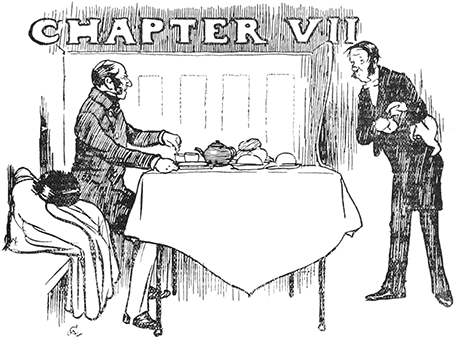
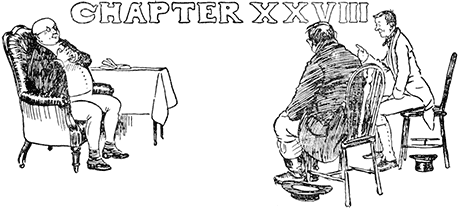
Is wholly devoted to a Full and Faithful Report of the Memorable
Trial of Bardell against Pickwick
“I wonder what the foreman of the jury, whoever
he’ll be, has got for breakfast,” said Mr.
Snodgrass, by way of keeping up a conversation
on the eventful morning of the fourteenth of
February.
“Ah!” said Perker, “I hope he’s got a good one.”
“Why so?” inquired Mr. Pickwick.
“Highly important; very important, my dear sir,” replied
Perker. “A good, contented, well-breakfasted juryman, is a capital
thing to get hold of. Discontented or hungry jurymen, my dear
sir, always find for the plaintiff.”
“Bless my heart,” said Mr. Pickwick, looking very blank; “what
do they do that for?”
“Why, I don’t know,” replied the little man, coolly; “saves
time, I suppose. If it’s near the dinner-time, the foreman takes out
his watch when the jury has retired, and says, ‘Dear me, gentlemen,
ten minutes to five, I declare! I dine at five, gentlemen.’ So
do I,’ says everybody else, except two men who ought to have dined
at three, and seem more than half disposed to stand out in consequence.
The foreman smiles, and puts up his watch:—‘Well,
gentlemen, what do we say, plaintiff or defendant, gentlemen? I
rather think, so far as I am concerned, gentlemen,—I say, I rather
think,—but don’t let that influence you—I rather think the
plaintiff’s the man.’ Upon this, two or three other men are sure
to say that they think so too—as of course they do; and then
they get on very unanimously and comfortably. Ten minutes past
nine!” said the little man, looking at his watch. “Time we were
off, my dear sir; breach of promise trial—court is generally full in
such cases. You had better ring for a coach, my dear sir, or we
shall be rather late.”
Mr. Pickwick immediately rang the bell; and a coach having
been procured, the four Pickwickians and Mr. Perker ensconced
themselves therein, and drove to Guildhall; Sam Weller, Mr.
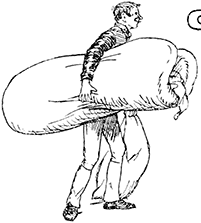
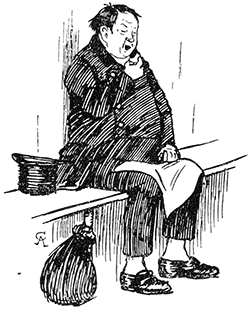
Lowten, and the blue bag, following in a cab.
“Lowten,” said Perker, when they reached the outer hall of the
court, “put Mr. Pickwick’s friends in the students’ box; Mr. Pickwick
himself had better sit by me. This way, my dear sir, this
way.” Taking Mr. Pickwick by the coat-sleeve, the little man led
him to the low seat just beneath the desks of the King’s Counsel,
which is constructed for the convenience of attorneys, who from
that spot can whisper into the ear of the leading counsel in the
case, any instructions that may be necessary during the progress of
the trial. The occupants of this seat are invisible to the great
body of spectators, inasmuch as they sit on a much lower level
than either the barristers or the audience, whose seats are raised
above the floor. Of course they have their backs to both, and
their faces towards the judge.
“That’s the witness-box, I suppose?” said Mr. Pickwick, pointing
to a kind of pulpit, with a brass rail, on his left hand.
“That’s the witness-box, my dear sir,” replied Perker, disinterring
a quantity of papers from the blue bag, which Lowten had
just deposited at his feet.
“And that,” said Mr. Pickwick, pointing to a couple of enclosed
seats on his right, “that’s where the jurymen sit, is it not?”
“The identical place, my dear sir,” replied Perker, tapping the
lid of his snuff-box.
Mr. Pickwick stood up in a state of great agitation, and took a
glance at the court. There were already a pretty large sprinkling
of spectators in the gallery, and a numerous muster of gentlemen
in wigs, in the barristers’ seats: who presented, as a body, all that
pleasing and extensive variety of nose and whisker for which the
bar of England is so justly celebrated. Such of the gentlemen as
had a brief to carry, carried it in as conspicuous a manner as
possible, and occasionally scratched their noses therewith, to impress
the fact more strongly on the observation of the spectators.
Other gentlemen, who had no briefs to show, carried under their
arms goodly octavos with a red label behind, and that under-done-pie-crust-coloured
cover, which is technically known as “law calf.”
Others, who had neither briefs nor books, thrust their hands into
their pockets, and looked as wise as they conveniently could;
others, again, moved here and there with great restlessness and
earnestness of manner, content to awaken thereby the admiration
and astonishment of the uninitiated strangers. The whole, to the
great wonderment of Mr. Pickwick, were divided into little groups,
who were chatting and discussing the news of the day in the most
unfeeling manner possible,—just as if no trial at all were coming on.
A bow from Mr. Phunky, as he entered, and took his seat behind
the row appropriated to the King’s Counsel, attracted Mr. Pickwick’s
attention; and he had scarcely returned it, when Mr.
Serjeant Snubbin appeared, followed by Mr. Mallard, who half
hid the Serjeant behind a large crimson bag, which he placed on the
table, and after shaking hands with Perker, withdrew. Then there
entered two or three more Serjeants; and among them, one with a
fat body and a red face, who nodded in a friendly manner to Mr.
Serjeant Snubbin, and said it was a fine morning.
“Who’s that red-faced man, who said it was a fine morning,
and nodded to our counsel?” whispered Mr. Pickwick.
“Mr. Serjeant Buzfuz,” replied Perker. “He’s opposed to us;
he leads on the other side. That gentleman behind him is Mr.
Skimpin, his junior.”
Mr. Pickwick was on the point of inquiring, with great abhorrence
of the man’s cold-blooded villainy, how Mr. Serjeant Buzfuz,
who was counsel for the opposite party, dared to presume to tell
Mr. Serjeant Snubbin, who was counsel for him, that it was a fine
morning, when he was interrupted by a general rising of the
barristers, and a loud cry of “Silence!” from the officers of the
court. Looking round, he found that this was caused by the
entrance of the judge.
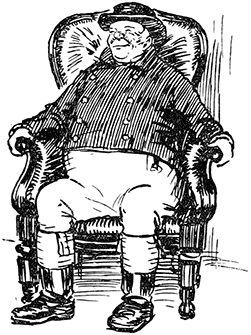
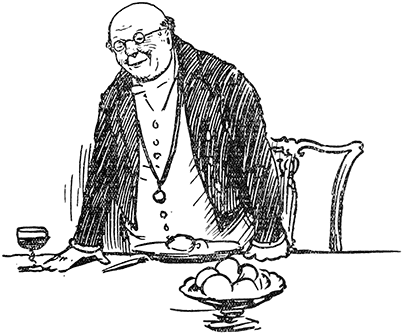
Mr. Justice Stareleigh (who sat in the absence of the Chief
Justice, occasioned by indisposition), was a most particularly short
man, and so fat, that he seemed all face and waistcoat. He rolled
in, upon two little turned legs, and having bobbed gravely to the
bar, who bobbed gravely to him, put his little legs underneath his
table, and his little three-cornered hat upon it; and when Mr.
Justice Stareleigh had done this, all you could see of him was two
queer little eyes, one broad pink face, and somewhere about half of
a big and very comical-looking wig.
The judge had no sooner taken his seat, than the officer on the
floor of the court called out “Silence!” in a commanding tone,
upon which another officer in the gallery cried “Silence!” in an
angry manner, whereupon three or four more ushers shouted
“Silence!” in a voice of indignant remonstrance. This being done,
a gentleman in black, who sat below the judge, proceeded to call
over the names of the jury; and after a great deal of bawling, it
was discovered that only ten special jurymen were present. Upon
this, Mr. Serjeant Buzfuz prayed a tales; the gentleman in black
then proceeded to press into the special jury, two of the common
jurymen; and a greengrocer and a chemist were caught directly.
“Answer to your names, gentlemen, that you may be sworn,”
said the gentleman in black. “Richard Upwitch.”
“Here,” said the greengrocer.
“Thomas Groffin.”
“Here,” said the chemist.
“Take the book, gentlemen. You shall well and truly try——”
“I beg this court’s pardon,” said the chemist, who was a tall,
thin, yellow-visaged man, “but I hope this court will excuse my
attendance.”
“On what grounds, sir?” said Mr. Justice Stareleigh.
“I have no assistant, my Lord,” said the chemist.
“I can’t help that, sir,” replied Mr. Justice Stareleigh. “You
should hire one.”
“I can’t afford it, my Lord,” rejoined the chemist.
“Then you ought to be able to afford it, sir,” said the judge,
reddening; for Mr. Justice Stareleigh’s temper bordered on the
irritable, and brooked no contradiction.
“I know I ought to do, if I got on as well as I deserved, but I
don’t, my Lord,” answered the chemist.
“Swear the gentleman,” said the judge, peremptorily.
The officer had got no further than the “You shall well and
truly try,” when he was again interrupted by the chemist.
“I am to be sworn, my Lord, am I?” said the chemist.
“Certainly, sir,” said the testy little judge.
“Very well, my Lord,” replied the chemist, in a resigned manner.
“Then there’ll be murder before this trial’s over; that’s all. Swear
me, if you please, sir;” and sworn the chemist was, before the
judge could find words to utter.
“I merely wanted to observe, my Lord,” said the chemist, taking
his seat with great deliberation, “that I’ve left nobody but an
errand-boy in my shop. He is a very nice boy, my Lord, but he
is not acquainted with drugs; and I know that the prevailing impression
on his mind, is that Epsom salts means oxalic acid; and
syrup of senna, laudanum. That’s all, my Lord.” With this, the
tall chemist composed himself into a comfortable attitude, and,
assuming a pleasant expression of countenance, appeared to have
prepared himself for the worst.
Mr. Pickwick was regarding the chemist with feelings of the
deepest horror, when a slight sensation was perceptible in the body
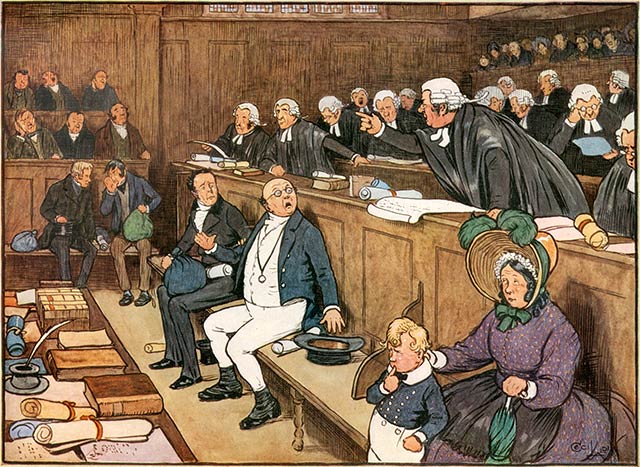
of the court; and immediately afterwards Mrs. Bardell, supported
by Mrs. Cluppins, was led in, and placed, in a drooping state, at
the other end of the seat on which Mr. Pickwick sat. An extra-sized
umbrella was then handed in by Mr. Dodson, and a pair of
pattens by Mr. Fogg, each of whom had prepared a most sympathising
and melancholy face for the occasion. Mrs. Sanders then
appeared, leading in Master Bardell. At sight of her child, Mrs.
Bardell started; suddenly recollecting herself, she kissed him in a
frantic manner; then relapsing into a state of hysterical imbecility,
the good lady requested to be informed where she was. In reply
to this, Mrs. Cluppins and Mrs. Sanders turned their heads away
and wept, while Messrs. Dodson and Fogg entreated the plaintiff to
compose herself. Serjeant Buzfuz rubbed his eyes very hard with
a large white handkerchief, and gave an appealing look towards the
jury, while the judge was visibly affected, and several of the beholders
tried to cough down their emotions.
“Very good notion that, indeed,” whispered Perker to Mr.
Pickwick. “Capital fellows those Dodson and Fogg; excellent
ideas of effect, my dear sir, excellent.”
As Perker spoke, Mrs. Bardell began to recover by slow degrees,
while Mrs. Cluppins, after a careful survey of Master Bardell’s
buttons and the button-holes to which they severally belonged,
placed him on the floor of the court in front of his mother,—a
commanding position in which he could not fail to awaken the
full commiseration and sympathy of both judge and jury. This
was not done without considerable opposition, and many tears, on
the part of the young gentleman himself, who had certain inward
misgivings that the placing him within the full glare of the judge’s
eye was only a formal prelude to his being immediately ordered
away for instant execution, or for transportation beyond the seas,
during the whole term of his natural life, at the very least.
“Bardell and Pickwick,” cried the gentleman in black, calling on
the case, which stood first on the list.
“I am for the plaintiff, my Lord,” said Mr. Serjeant Buzfuz.
“Who is with you, brother Buzfuz?” said the judge. Mr.
Skimpin bowed, to intimate that he was.
“I appear for the defendant, my Lord,” said Mr. Serjeant
Snubbin.
“Anybody with you, brother Snubbin?” inquired the court.
“Mr. Phunky, my Lord,” replied Serjeant Snubbin.
“Serjeant Buzfuz and Mr. Skimpin for the plaintiff,” said the
judge, writing down the names in his note-book, and reading as he
wrote; “for the defendant, Serjeant Snubbin and Mr. Monkey.”
“Beg your Lordship’s pardon, Phunky.”
“Oh, very good,” said the judge; “I never had the pleasure of
hearing the gentleman’s name before.” Here Mr. Phunky bowed
and smiled and the judge bowed and smiled too, and then Mr.
Phunky, blushing into the very whites of his eyes, tried to look as
if he didn’t know that everybody was gazing at him: a thing
which no man ever succeeded in doing yet, or, in all reasonable
probability, ever will.
“Go on,” said the judge.
The ushers again called silence, and Mr. Skimpin proceeded to
“open the case;” and the case appeared to have very little inside
it when he had opened it, for he kept such particulars as he knew,
completely to himself, and sat down, after a lapse of three minutes,
leaving the jury in precisely the same advanced stage of wisdom as
they were in before.
Serjeant Buzfuz then rose with all the majesty and dignity which
the grave nature of the proceedings demanded, and having whispered
to Dodson, and conferred briefly with Fogg, pulled his gown
over his shoulders, settled his wig, and addressed the jury.
Serjeant Buzfuz began by saying, that never, in the whole course
of his professional experience—never, from the very first moment
of his applying himself to the study and practice of the law—had
he approached a case with feelings of such deep emotion, or with
such a heavy sense of the responsibility imposed upon him—a
responsibility, he would say, which he could never have supported,
were he not buoyed up and sustained by a conviction so strong,
that it amounted to positive certainty that the cause of truth and
justice, or, in other words, the cause of his much-injured and most
oppressed client, must prevail with the high-minded and intelligent
dozen of men whom he now saw in that box before him.
Counsel usually begin in this way, because it puts the jury on
the very best terms with themselves, and makes them think what
sharp fellows they must be. A visible effect was produced immediately;
several jurymen beginning to take voluminous notes
with the utmost eagerness.
“You have heard from my learned friend, gentlemen,” continued
Serjeant Buzfuz, well knowing that, from the learned friend
alluded to, the gentlemen of the jury had heard just nothing at all—“you
have heard from my learned friend, gentlemen, that this is an
action for a breach of promise of marriage, in which the damages are
laid at £1500. But you have not heard from my learned friend,
inasmuch as it did not come within my learned friend’s province to
tell you, what are the facts and circumstances of the case. Those
facts and circumstances, gentlemen, you shall hear detailed by me
and proved by the unimpeachable female whom I will place in
that box before you.”
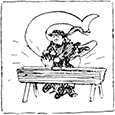
Here Mr. Serjeant Buzfuz, with a tremendous emphasis on the
word “box,” smote his table with a mighty sound, and glanced at
Dodson and Fogg, who nodded admiration of the serjeant, and
indignant defiance of the defendant.
“The plaintiff, gentlemen,” continued Serjeant Buzfuz, in a soft
and melancholy voice, “the plaintiff is a widow; yes, gentlemen,
a widow. The late Mr. Bardell, after enjoying, for many years,
the esteem and confidence of his sovereign, as one of the guardians
of his royal revenues, glided almost imperceptibly from the world,
to seek elsewhere for that repose and peace which a custom-house
can never afford.”
At this pathetic description of the decease of Mr. Bardell, who
had been knocked on the head with a quart-pot in a public-house
cellar, the learned serjeant’s voice faltered, and he proceeded with
emotion:
“Some time before his death, he had stamped his likeness upon
a little boy. With this little boy, the only pledge of her departed
exciseman, Mrs. Bardell shrunk from the world, and courted the
retirement and tranquillity of Goswell Street; and here she placed
in her front parlour window a written placard, bearing this inscription—‘Apartments
furnished for a single gentleman. Inquire
within.’” Here Serjeant Buzfuz paused, while several gentlemen
of the jury took a note of the document.
“There is no date to that, is there, sir?” inquired a juror.
“There is no date, gentlemen,” replied Serjeant Buzfuz: “but
I am instructed to say that it was put in the plaintiff’s parlour-window
just this time three years. I entreat the attention of the
jury to the wording of this document. ‘Apartments furnished for
a single gentleman’! Mrs. Bardell’s opinions of the opposite sex,
gentlemen, were derived from a long contemplation of the inestimable
qualities of her lost husband. She had no fear, she had
no distrust, she had no suspicion, all was confidence and reliance.
‘Mr. Bardell,’ said the widow; ‘Mr. Bardell was a man of honour,
Mr. Bardell was a man of his word, Mr. Bardell was no deceiver,
Mr. Bardell was once a single gentleman himself; to single gentlemen
I look for protection, for assistance, for comfort, and for
consolation; in single gentlemen I shall perpetually see something
to remind me of what Mr. Bardell was, when he first won my
young and untried affections; to a single gentleman, then, shall
my lodgings be let.’ Actuated by this beautiful and touching
impulse (among the best impulses of our imperfect nature, gentlemen),
the lonely and desolate widow dried her tears, furnished the
first floor, caught the innocent boy to her maternal bosom, and
put the bill up in her parlour-window. Did it remain there long?
No. The serpent was on the watch, the train was laid, the mine
was preparing, the sapper and miner was at work. Before the bill
had been in the parlour-window three days—three days—gentlemen—a
Being erect upon two legs, and bearing all the outward
semblance of a man, and not of a monster, knocked at the door of
Mrs. Bardell’s house. He inquired within; he took the lodgings;
and on the very next day he entered into possession of them.
This man was Pickwick—Pickwick, the defendant.”
Serjeant Buzfuz, who had proceeded with such volubility that
his face was perfectly crimson, here paused for breath. The silence
awoke Mr. Justice Stareleigh, who immediately wrote down something
with a pen, without any ink in it, and looked unusually
profound, to impress the jury with the belief that he always thought
most deeply with his eyes shut. Serjeant Buzfuz proceeded:
“Of this man Pickwick I will say little; the subject presents
but few attractions; and I, gentlemen, am not the man, nor are
you, gentlemen, the men, to delight in the contemplation of
revolting heartlessness, and of systematic villainy.”
Here Mr. Pickwick, who had been writhing in silence for some
time, gave a violent start, as if some vague idea of assaulting
Serjeant Buzfuz, in the august presence of justice and law, suggested
itself to his mind. An admonitory gesture from Perker
restrained him, and he listened to the learned gentleman’s continuation
with a look of indignation, which contrasted forcibly
with the admiring faces of Mrs. Cluppins and Mrs. Sanders.
“I say systematic villainy, gentlemen,” said Serjeant Buzfuz,
looking through Mr. Pickwick and talking at him; “and when I
say systematic villainy, let me tell the defendant Pickwick, if he be
in court, as I am informed he is, that it would have been more
decent in him, more becoming, in better judgment, and in better
taste, if he had stopped away. Let me tell him, gentlemen, that
any gestures of dissent or disapprobation in which he may indulge
in this court will not go down with you; that you will know how
to value and how to appreciate them; and let me tell him further,
as my lord will tell you, gentlemen, that a counsel, in the discharge
of his duty to his client, is neither to be intimidated nor bullied, nor
put down; and that any attempt to do either the one or the other,
or the first or the last, will recoil on the head of the attempter, be
he plaintiff or be he defendant, be his name Pickwick, or Noakes,
or Stoakes, or Stiles, or Brown, or Thompson.”
This little divergence from the subject in hand had, of course,
the intended effect of turning all eyes to Mr. Pickwick. Serjeant
Buzfuz, having partially recovered from the state of moral elevation
into which he had lashed himself, resumed:
“I shall show you, gentlemen, that for two years Pickwick
continued to reside constantly, and without interruption or intermission,
at Mrs. Bardell’s house. I shall show you that Mrs.
Bardell, during the whole of that time, waited on him, attended to
his comforts, cooked his meals, looked out his linen for the washerwoman
when it went abroad, darned, aired, and prepared it for
wear, when it came home, and, in short, enjoyed his fullest trust
and confidence. I shall show you that, on many occasions, he gave
halfpence, and on some occasions even sixpences, to her little boy;
and I shall prove to you, by a witness whose testimony it will be
impossible for my learned friend to weaken or controvert, that on
one occasion he patted the boy on the head, and, after inquiring
whether he had won alley tors or commoneys lately (both of which
I understand to be a particular species of marbles much prized
by the youth of this town), made use of this remarkable expression:
‘How should you like to have another father?’ I shall prove to
you, gentlemen, that about a year ago, Pickwick suddenly began
to absent himself from home, during long intervals, as if with the
intention of gradually breaking off from my client; but I shall
show you also, that his resolution was not at that time sufficiently
strong, or that his better feelings conquered, if better feelings he
has, or that the charms and accomplishments of my client prevailed
against his unmanly intentions; by proving to you, that on
one occasion, when he returned from the country, he distinctly and
in terms, offered her marriage: previously, however, taking special
care that there should be no witness to their solemn contract;
and I am in a situation to prove to you, on the testimony of three
of his own friends—most unwilling witnesses, gentlemen—most
unwilling witnesses—that on that morning he was discovered by
them holding the plaintiff in his arms, and soothing her agitation
by his caresses and endearments.”
A visible impression was produced upon the auditors by this
part of the learned serjeant’s address. Drawing forth two very
small scraps of paper, he proceeded:
“And now, gentlemen, but one word more. Two letters have
passed between these parties, letters which are admitted to be in
the handwriting of the defendant, and which speak volumes
indeed. These letters, too, bespeak the character of the man.
They are not open, fervent, eloquent epistles, breathing nothing
but the language of affectionate attachment. They are covert,
sly, underhanded communications, but, fortunately, far more
conclusive than if couched in the most glowing language and
the most poetic imagery—letters that must be viewed with a
cautious and suspicious eye—letters that were evidently intended
at the time, by Pickwick, to mislead and delude any third parties
into whose hands they might fall. Let me read the first:—‘Garraway’s,
twelve o’clock. Dear Mrs. B.—Chops and Tomato
sauce. Yours, Pickwick.’ Gentlemen, what does this mean?
‘Chops and Tomato sauce. Yours, Pickwick!’ Chops! Gracious
heavens! and Tomato sauce! Gentlemen, is the happiness of a
sensitive and confiding female to be trifled away by such shallow
artifices as these? The next has no date whatever, which is in
itself suspicious. ‘Dear Mrs. B., I shall not be at home till to-morrow.
Slow coach.’ And then follows this very remarkable
expression. ‘Don’t trouble yourself about the warming-pan.’
The warming-pan! Why, gentlemen, who does trouble himself
about a warming-pan? When was the peace of mind of man or
woman broken or disturbed by a warming-pan, which is in itself a
harmless, a useful, and I will add, gentlemen, a comforting article
of domestic furniture? Why is Mrs. Bardell so earnestly entreated
not to agitate herself about this warming-pan, unless (as is no
doubt the case) it is a mere cover for hidden fire—a mere substitute
for some endearing word of promise, agreeably to a preconcerted
system of correspondence, artfully contrived by Pickwick with a
view to his contemplated desertion, and which I am not in a condition
to explain? And what does this allusion to the slow coach
mean? For aught I know, it may be a reference to Pickwick himself,
who has most unquestionably been a criminally slow coach
during the whole of this transaction, but whose speed will now be
very unexpectedly accelerated, and whose wheels, gentlemen, as
he will find to his cost, will very soon be greased by you!”
Mr. Serjeant Buzfuz paused in this place, to see whether the
jury smiled at his joke; but as nobody took it but the greengrocer,
whose sensitiveness on the subject was very probably occasioned
by his having subjected a chaise-cart to the process in question on
that identical morning, the learned serjeant considered it advisable
to undergo a slight relapse into the dismals before he concluded.
“But enough of this, gentlemen,” said Mr. Serjeant Buzfuz; “it
is difficult to smile with an aching heart; it is ill jesting when our
deepest sympathies are awakened. My client’s hopes and prospects
are ruined, and it is no figure of speech to say that her occupation
is gone indeed. The bill is down—but there is no tenant. Eligible
single gentlemen pass and repass—but there is no invitation for
them to inquire within or without. All is gloom and silence in the
house; even the voice of the child is hushed; his infant sports are
disregarded when his mother weeps; his ‘alley tors’ and his ‘commoneys’
are alike neglected; he forgets the long familiar cry of
‘knuckle-down,’ and at tip-cheese, or odd and even, his hand is out.
But Pickwick, gentlemen, Pickwick, the ruthless destroyer of this
domestic oasis in the desert of Goswell Street—Pickwick, who has
choked up the well, and thrown ashes on the sward—Pickwick, who
comes before you to-day with his heartless Tomato sauce and
warming-pans—Pickwick still rears his head with unblushing
effrontery, and gazes without a sigh on the ruin he has made.
Damages, gentlemen—heavy damages—is the only punishment
with which you can visit him; the only recompense you can award
to my client. And for those damages she now appeals to an enlightened,
a high-minded, a right-feeling, a conscientious, a dispassionate,
a sympathising, a contemplative jury of her civilised
countrymen.” With this beautiful peroration, Mr. Serjeant Buzfuz
sat down, and Mr. Justice Stareleigh woke up.
“Call Elizabeth Cluppins,” said Serjeant Buzfuz, rising a
minute afterwards, with renewed vigour.
The nearest usher called for Elizabeth Tuppins; another one,
at a little distance off, demanded Elizabeth Jupkins; and a third
rushed in a breathless state into King Street, and screamed for
Elizabeth Muffins till he was hoarse.
Meanwhile Mrs. Cluppins, with the combined assistance of Mrs.
Bardell, Mrs. Sanders, Mr. Dodson, and Mr. Fogg, was hoisted into
the witness-box; and when she was safely perched on the top step,
Mrs. Bardell stood on the bottom one, with the pocket-handkerchief
and pattens in one hand, and a glass bottle that might hold about
a quarter of a pint of smelling salts in the other, ready for any
emergency. Mrs. Sanders, whose eyes were intently fixed on the
judge’s face, planted herself close by, with the large umbrella:
keeping her right thumb pressed on the spring with an earnest
countenance, as if she were fully prepared to put it up at a moment’s
notice.
“Mrs. Cluppins,” said Serjeant Buzfuz, “pray compose yourself,
ma’am.” Of course, directly Mrs. Cluppins was desired to
compose herself she sobbed with increased vehemence, and gave
divers alarming manifestations of an approaching fainting fit, or,
as she afterwards said, of her feelings being too many for her.
“Do you recollect, Mrs. Cluppins,” said Serjeant Buzfuz, after
a few unimportant questions, “do you recollect being in Mrs.
Bardell’s back one pair of stairs, on one particular morning in July
last, when she was dusting Pickwick’s apartment?”
“Yes, my Lord and Jury, I do,” replied Mrs. Cluppins.
“Mr. Pickwick’s sitting-room was the first-floor front, I
believe?”
“Yes, it were, sir,” replied Mrs. Cluppins.
“What were you doing in the back room, ma’am?” inquired
the little judge.
“My Lord and Jury,” said Mrs. Cluppins, with interesting
agitation, “I will not deceive you.”
“You had better not, ma’am,” said the little judge.
“I was there,” resumed Mrs. Cluppins, “unbeknown to Mrs.
Bardell; I had been out with a little basket, gentlemen, to buy three
pound of red kidney purtaties, which was three pound tuppense
ha’penny, when I see Mrs. Bardell’s street door on the jar.”
“On the what?” exclaimed the little judge.
“Partly open, my Lord,” said Serjeant Snubbin.
“She said on the jar,” said the little judge, with a cunning
look.
“It’s all the same, my Lord,” said Serjeant Snubbin. The
little judge looked doubtful and said he’d make a note of it. Mrs.
Cluppins then resumed:
“I walked in, gentlemen, just to say good mornin’, and went, in
a permiscuous manner, up-stairs, and into the back room. Gentlemen,
there was the sound of voices in the front room, and——”
“And you listened, I believe, Mrs. Cluppins?” said Serjeant
Buzfuz.
“Beggin’ your pardon, sir,” replied Mrs. Cluppins, in a majestic
manner, “I would scorn the haction. The voices was very loud,
sir, and forced themselves upon my ear.”
“Well, Mrs. Cluppins, you were not listening, but you heard the
voices. Was one of these voices Pickwick’s?”
“Yes, it were, sir.”
And Mrs. Cluppins, after distinctly stating that Mr. Pickwick
addressed himself to Mrs. Bardell, repeated by slow degrees, and
by dint of many questions, the conversation with which our readers
are already acquainted.
The jury looked suspicious, and Mr. Serjeant Buzfuz smiled and
sat down. They looked positively awful when Serjeant Snubbin
intimated that he should not cross-examine the witness, for Mr.
Pickwick wished it to be distinctly stated that it was due to her to
say, that her account was in substance correct.
Mrs. Cluppins having once broken the ice, thought it a favourable
opportunity for entering into a short dissertation on her own
domestic affairs; so, she straightway proceeded to inform the court
that she was the mother of eight children at that present speaking,
and that she entertained confident expectations of presenting Mr.
Cluppins with a ninth, somewhere about that day six months. At
this interesting point, the little judge interposed most irascibly;
and the effect of the interposition was, that both the worthy lady
and Mrs. Sanders were politely taken out of court, under the
escort of Mr. Jackson, without further parley.
“Nathaniel Winkle!” said Mr. Skimpin.
“Here!” replied a feeble voice. Mr. Winkle entered the
witness-box, and having been duly sworn, bowed to the judge with
considerable deference.
“Don’t look at me, sir,” said the judge, sharply, in acknowledgment
of the salute; “look at the jury.”
Mr. Winkle obeyed the mandate, and looked at the place where
he thought it most probable the jury might be; for seeing anything
in his then state of intellectual complication was wholly out
of the question.
Mr. Winkle was then examined by Mr. Skimpin, who, being a
promising young man of two or three and forty, was of course
anxious to confuse a witness who was notoriously predisposed in
favour of the other side, as much as he could.
“Now, sir,” said Mr. Skimpin, “have the goodness to let his
Lordship and the jury know what your name is, will you?” and
Mr. Skimpin inclined his head on one side to listen with great
sharpness to the answer, and glanced at the jury meanwhile, as if
to imply that he rather expected Mr. Winkle’s natural taste for
perjury would induce him to give some name which did not belong
to him.
“Winkle,” replied the witness.
“What’s your Christian name, sir?” angrily inquired the little
judge.
“Nathaniel, sir.”
“Daniel,—any other name?”
“Nathaniel, sir—my Lord, I mean.”
“Nathaniel Daniel, or Daniel Nathaniel?”
“No, my Lord, only Nathaniel; not Daniel at all.”
“What did you tell me it was Daniel for, then, sir?” inquired
the judge.
“I didn’t, my Lord,” replied Mr. Winkle.
“You did, sir,” replied the judge, with a severe frown. “How
could I have got Daniel on my notes, unless you told me so, sir?”
This argument was, of course, unanswerable.
“Mr. Winkle has rather a short memory, my Lord,” interposed
Mr. Skimpin, with another glance at the jury. “We shall find
means to refresh it before we have quite done with him, I dare say.”
“You had better be careful, sir,” said the little judge, with a
sinister look at the witness.
Poor Mr. Winkle bowed, and endeavoured to feign an easiness
of manner which, in his then state of confusion, gave him rather
the air of a disconcerted pickpocket.
“Now, Mr. Winkle,” said Mr. Skimpin, “attend to me, if you
please, sir; and let me recommend you, for your own sake, to bear
in mind his Lordship’s injunction to be careful. I believe you
are a particular friend of Pickwick, the defendant, are you
not?”
“I have known Mr. Pickwick now, as well as I recollect at this
moment, nearly——”
“Pray, Mr. Winkle, do not evade the question. Are you, or are
you not, a particular friend of the defendant’s?”
“I was just about to say that——”
“Will you, or will you not, answer my question, sir?”
“If you don’t answer the question you’ll be committed, sir,”
interposed the little judge, looking over his note-book.
“Come, sir,” said Mr. Skimpin, “yes or no, if you please.”
“Yes, I am,” replied Mr. Winkle.
“Yes, you are. And why couldn’t you say that at once, sir?
Perhaps you know the plaintiff, too? Eh, Mr. Winkle?”
“I don’t know her; I’ve seen her.”
“Oh, you don’t know her, but you’ve seen her? Now, have the
goodness to tell the gentlemen of the jury what you mean by that,
Mr. Winkle.”
“I mean that I am not intimate with her, but I have seen her
when I went to call on Mr. Pickwick in Goswell Street.”
“How often have you seen her, sir?”
“How often?”
“Yes, Mr. Winkle, how often? I’ll repeat the question for you
a dozen times if you require it, sir.” And the learned gentleman,
with a firm and steady frown, placed his hands on his hips, and
smiled suspiciously at the jury.
On this question there arose the edifying brow-beating, customary
on such points. First of all, Mr. Winkle said it was quite
impossible for him to say how many times he had seen Mrs. Bardell.
Then he was asked if he had seen her twenty times, to which he
replied, “Certainly,—more than that.” Then he was asked
whether he hadn’t seen her a hundred times—whether he couldn’t
swear that he had seen her more than fifty times—whether he didn’t
know that he had seen her at least seventy-five times—and so forth;
the satisfactory conclusion which was arrived at, at last, being, that
he had better take care of himself, and mind what he was about.
The witness having been by these means reduced to the requisite
ebb of nervous perplexity, the examination was continued as follows:
“Pray Mr. Winkle, do you remember calling on the defendant
Pickwick at these apartments in the plaintiff’s house in Goswell
Street, on one particular morning, in the month of July last?”
“Yes, I do.”
“Were you accompanied on that occasion by a friend of the
name of Tupman, and another of the name of Snodgrass?”
“Yes, I was.”
“Are they here?”
“Yes, they are,” replied Mr. Winkle, looking very earnestly
towards the spot where his friends were stationed.
“Pray attend to me, Mr. Winkle, and never mind your friends,”
said Mr. Skimpin, with another expressive look at the jury. “They
must tell their stories without any previous consultation with you,
if none has yet taken place (another look at the jury). Now, sir,
tell the gentlemen of the jury what you saw on entering the defendant’s
room, on this particular morning. Come; out with it,
sir: we must have it, sooner or later.”
“The defendant, Mr. Pickwick, was holding the plaintiff in his
arms, with his hands clasping her waist,” replied Mr. Winkle, with
natural hesitation, “and the plaintiff appeared to have fainted
away.”
“Did you hear the defendant say anything?”
“I heard him call Mrs. Bardell a good creature, and I heard him
ask her to compose herself, for what a situation it was, if anybody
should come, or words to that effect.”
“Now, Mr. Winkle, I have only one more question to ask you,
and I beg you to bear in mind his lordship’s caution. Will you
undertake to swear that Pickwick, the defendant, did not say on the
occasion in question, ‘My dear Mrs. Bardell, you’re a good creature;
compose yourself to this situation, for to this situation you must
come,’ or words to that effect?”
“I didn’t understand him so, certainly,” said Mr. Winkle,
astounded at this ingenious dove-tailing of the few words he had
heard. “I was on the staircase, and couldn’t hear distinctly; the
impression on my mind is——”
“The gentlemen of the jury want none of the impressions on
your mind, Mr. Winkle, which I fear would be of little service to
honest, straightforward men,” interposed Mr. Skimpin. “You
were on the staircase, and didn’t distinctly hear; but you will not
swear that Mr. Pickwick did not make use of the expressions I have
quoted? Do I understand that?”
“No, I will not,” replied Mr. Winkle; and down sat Mr.
Skimpin with a triumphant countenance.
Mr. Pickwick’s case had not gone off in so particularly happy
a manner, up to this point, that it could very well afford to have
any additional suspicion cast upon it. But as it could afford to be
placed in a rather better light, if possible, Mr. Phunky rose for the
purpose of getting something important out of Mr. Winkle in
cross-examination. Whether he did get anything important out
of him will immediately appear.
“I believe, Mr. Winkle,” said Mr. Phunky, “that Mr. Pickwick
is not a young man?”
“Oh no,” replied Mr. Winkle; “old enough to be my father.”
“You have told my learned friend that you have known Mr.
Pickwick a long time. Had you ever any reason to suppose or
believe that he was about to be married?”
“Oh no; certainly not;” replied Mr. Winkle with so much
eagerness, that Mr. Phunky ought to have got him out of the
box with all possible despatch. Lawyers hold that there are two
kinds of particularly bad witnesses: a reluctant witness, and a too-willing
witness; it was Mr. Winkle’s fate to figure in both characters.
“I will even go further than this, Mr. Winkle,” continued Mr.
Phunky in a most smooth and complacent manner. “Did you ever
see anything in Mr. Pickwick’s manner and conduct towards the
opposite sex, to induce you to believe that he ever contemplated
matrimony of late years, in any case?”
“Oh no; certainly not,” replied Mr. Winkle.
“Has his behaviour, when females have been in the case, always
been that of a man who, having attained a pretty advanced period
of life, content with his own occupations and amusements, treats
them only as a father might his daughters?”
“Not the least doubt of it,” replied Mr. Winkle, in the fulness
of his heart. “That is—yes—oh yes—certainly.”
“You have never known anything in his behaviour towards
Mrs. Bardell, or any other female, in the least degree suspicious?”
said Mr. Phunky, preparing to sit down; for Serjeant Snubbin was
winking at him.
“N—n—no,” replied Mr. Winkle, “except on one trifling
occasion which, I have no doubt, might be easily explained.”
Now, if the unfortunate Mr. Phunky had sat down when
Serjeant Snubbin winked at him, or if Serjeant Buzfuz had stopped
this irregular cross-examination at the outset (which he knew
better than to do; observing Mr. Winkle’s anxiety, and well
knowing it would, in all probability, lead to something serviceable to
him), this unfortunate admission would not have been elicited.
The moment the words fell from Mr. Winkle’s lips, Mr. Phunky
sat down, and Serjeant Snubbin rather hastily told him he might
leave the box, which Mr. Winkle prepared to do with great readiness,
when Serjeant Buzfuz stopped him.
“Stay, Mr. Winkle, stay!” said Serjeant Buzfuz. “Will your
Lordship have the goodness to ask him, what this one instance of
suspicious behaviour towards females, on the part of this gentleman,
who is old enough to be his father, was?”
“You hear what the learned counsel says, sir,” observed the
judge, turning to the miserable and agonised Mr. Winkle. “Describe
the occasion to which you refer.”
“My Lord,” said Mr. Winkle, trembling with anxiety, “I—I’d
rather not.”
“Perhaps so,” said the little judge; “but you must.”
Amid the profound silence of the whole court, Mr. Winkle
faltered out that the trifling circumstance of suspicion was Mr.
Pickwick’s being found in a lady’s sleeping apartment at midnight;
which had terminated, he believed, in the breaking off of the
projected marriage of the lady in question, and had led, he knew,
to the whole party being forcibly carried before George Nupkins,
Esq., magistrate and justice of the peace for the borough of Ipswich!
“You may leave the box, sir,” said Serjeant Snubbin. Mr.
Winkle did leave the box, and rushed with delirious haste to the
George and Vulture, where he was discovered some hours afterwards
by the waiter, groaning in a hollow and dismal manner,
with his head buried beneath the sofa cushions.
Tracy Tupman, and Augustus Snodgrass, were severally called
into the box; both corroborated the testimony of their unhappy
friend; and each was driven to the verge of desperation by excessive
badgering.
Susannah Sanders was then called, and examined by Serjeant
Buzfuz, and cross-examined by Serjeant Snubbin. Had always
said and believed that Pickwick would marry Mrs. Bardell; knew
that Mrs. Bardell’s being engaged to Pickwick was the current topic
of conversation in the neighbourhood, after the fainting in July;
had been told it herself by Mrs. Mudberry which kept a mangle, and
Mrs. Bunkin which clear-starched, but did not see either Mrs.
Mudberry or Mrs. Bunkin in court. Had heard Pickwick ask the
little boy how he should like to have another father. Did not
know that Mrs. Bardell was at that time keeping company with the
baker, but did know that the baker was then a single man and is
now married. Couldn’t swear that Mrs. Bardell was not very fond
of the baker, but should think that the baker was not very fond of
Mrs. Bardell, or he wouldn’t have married somebody else. Thought
Mrs. Bardell fainted away on the morning in July, because Pickwick
asked her to name the day: knew that she (witness) fainted away
stone dead when Mr. Sanders asked her to name the day, and believed
that everybody as called herself a lady would do the same,
under similar circumstances. Heard Pickwick ask the boy the
question about the marbles, but upon her oath did not know the
difference between an alley tor and a commoney.
By the Court—During the period of her keeping company
with Mr. Sanders had received love-letters, like other ladies. In
the course of their correspondence Mr. Sanders had often called
her a “duck,” but never “chops,” nor yet “tomato sauce.” He
was particularly fond of ducks. Perhaps if he had been as fond of
chops and tomato sauce, he might have called her that, as a term
of affection.
Serjeant Buzfuz now rose with more importance than he had
yet exhibited, if that were possible, and vociferated: “Call Samuel
Weller.”
It was quite unnecessary to call Samuel Weller; for Samuel
Weller stepped briskly into the box the instant his name was pronounced;
and placing his hat on the floor, and his arms on the
rail, took a bird’s-eye view of the bar, and a comprehensive survey
of the bench, with a remarkably cheerful and lively aspect.
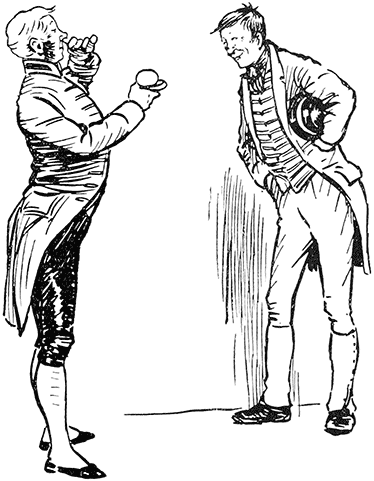
“What’s your name, sir?” inquired the judge.
“Sam Weller, my Lord,” replied that gentleman.
“Do you spell it with a ‘V’ or a ‘W’?” inquired the judge.
“That depends upon the taste and fancy of the speller, my
Lord,” replied Sam; “I never had occasion to spell it more than
once or twice in my life, but I spells it with a ‘V’.”
Here a voice in the gallery exclaimed aloud, “Quite right,
too, Samivel, quite right. Put it down a ‘we,’ my Lord, put it
down a ‘we’.”
“Who is that who dares to address the court?” said the little
judge, looking up. “Usher!”
“Yes, my Lord.”
“Bring that person here instantly.”
“Yes, my Lord.”
But as the usher didn’t find the person, he didn’t bring him;
and, after a great commotion, all the people who had got up to
look for the culprit sat down again. The little judge turned to the
witness as soon as his indignation would allow him to speak, and said,
“Do you know who that was, sir?”
“I rayther suspect it was my father, my Lord,” replied Sam.
“Do you see him here, now?” said the judge.
“No, I don’t, my Lord,” replied Sam, staring right up into the
lantern in the roof of the court.
“If you could have pointed him out, I would have committed
him instantly,” said the judge.
Sam bowed his acknowledgments and turned, with unimpaired
cheerfulness of countenance, towards Serjeant Buzfuz.
“Now, Mr. Weller,” said Serjeant Buzfuz.
“Now, sir,” replied Sam.
“I believe you are in the service of Mr. Pickwick, the defendant
in this case. Speak up, if you please, Mr. Weller.”
“I mean to speak up, sir,” replied Sam; “I am in the service of
that ’ere gen’l’m’n, and a wery good service it is.”
“Little to do, and plenty to get, I suppose?” said Serjeant
Buzfuz, with jocularity.
“Oh, quite enough to get, sir, as the soldier said ven they
ordered him three hundred and fifty lashes,” replied Sam.
“You must not tell us what the soldier, or any other man, said,
sir,” interposed the judge, “it’s not evidence.”
“Wery good, my Lord,” replied Sam.
“Do you recollect anything particular happening on the morning
when you were first engaged by the defendant; eh, Mr. Weller?”
said Serjeant Buzfuz.
“Yes I do, sir,” replied Sam.
“Have the goodness to tell the jury what it was.”
“I had a reg’lar new fit out o’ clothes that mornin’, gen’l’m’n of
the jury,” said Sam, “and that was a wery partickler and uncommon
circumstance vith me in those days.”
Hereupon there was a general laugh; and the little judge,
looking with an angry countenance over his desk, said, “You had
better be careful, sir.”
“So Mr. Pickwick said at the time, my Lord,” replied Sam;
“and I wos wery careful o’ that ’ere suit o’ clothes; wery careful
indeed, my Lord.”
The judge looked sternly at Sam for full two minutes, but Sam’s
features were so perfectly calm and serene that the judge said
nothing, and motioned Serjeant Buzfuz to proceed.
“Do you mean to tell me, Mr. Weller,” said Serjeant Buzfuz,
folding his arms emphatically, and turning half-round to the
jury, as if in mute assurance that he would bother the witness
yet: “Do you mean to tell me, Mr. Weller, that you saw nothing
of this fainting on the part of the plaintiff in the arms of the defendant,
which you have heard described by the witnesses?”
“Certainly not,” replied Sam, “I was in the passage till they
called me up, and then the old lady was not there.”
“Now, attend, Mr. Weller,” said Serjeant Buzfuz, dipping a
large pen into the inkstand before him, for the purpose of frightening
Sam with a show of taking down his answer. “You were in the
passage, and yet saw nothing of what was going forward. Have you
a pair of eyes, Mr. Weller?”
“Yes, I have a pair of eyes,” replied Sam, “and that’s just it.
If they wos a pair o’ patent double million magnifyin’ gas microscopes
of hextra power, p’raps I might be able to see through a
flight o’ stairs, and a deal door; but bein’ only eyes, you see, my
wision’s limited.”
At this answer, which was delivered without the slightest
appearance of irritation, and with the most complete simplicity and
equanimity of manner, the spectators tittered, the little judge
smiled, and Serjeant Buzfuz looked particularly foolish. After a
short consultation with Dodson and Fogg, the learned Serjeant
again turned towards Sam, and said, with a painful effort to conceal
his vexation, “Now, Mr. Weller, I’ll ask you a question on another
point, if you please.”
“If you please, sir,” rejoined Sam, with the utmost good-humour.
“Do you remember going up to Mrs. Bardell’s house, one night
in November last?”
“Oh yes, wery well.”
“Oh, you do remember that, Mr. Weller,” said Serjeant Buzfuz,
recovering his spirits; “I thought we should get something
at last.”
“I rayther thought that, too, sir,” replied Sam; and at this the
spectators tittered again.
“Well; I suppose you went up to have a little talk about this
trial—eh, Mr. Weller?” said Serjeant Buzfuz, looking knowingly
at the jury.
“I went up to pay the rent; but we did get a talkin’ about the
trial,” replied Sam.
“Oh, you did get a talking about the trial,” said Serjeant Buzfuz,
brightening up with the anticipation of some important discovery.
“Now what passed about the trial; will you have the goodness to
tell us, Mr. Weller?”
“Vith all the pleasure in life, sir,” replied Sam. “Arter a few
unimportant obserwations from the two virtuous females as has
been examined here to-day, the ladies gets into a wery great state
o’ admiration at the honourable conduct of Mr. Dodson and Fogg—them
two gen’l’m’n as is settin’ near you now.” This, of course,
drew general attention to Dodson and Fogg, who looked as virtuous
as possible.
“The attorneys for the plaintiff,” said Mr. Serjeant Buzfuz.
“Well! They spoke in high praise of the honourable conduct of
Messrs, Dodson and Fogg, the attorneys for the plaintiff, did they?”
“Yes,” said Sam, “they said what a wery gen’rous thing it
was o’ them to have taken up the case on spec, and to charge nothing
at all for costs, unless they got ’em out of Mr. Pickwick.”
At this very unexpected reply, the spectators tittered again,
and Dodson and Fogg, turning very red, leant over to Serjeant
Buzfuz, and in a hurried manner whispered something in his ear.
“You are quite right,” said Serjeant Buzfuz aloud, with affected
composure. “It’s perfectly useless, my lord, attempting to get at
any evidence through the impenetrable stupidity of this witness.
I will not trouble the court by asking him any more questions.
Stand down, sir.”
“Would any other gen’l’m’n like to ask me anythin’?” inquired
Sam, taking up his hat, and looking round most deliberately.
“Not I, Mr. Weller, thank you,” said Serjeant Snubbin,
laughing.
“You may go down, sir,” said Serjeant Buzfuz, waving his
hand impatiently. Sam went down accordingly, after doing
Messrs. Dodson and Fogg’s case as much harm as he conveniently
could, and saying just as little respecting Mr. Pickwick
as might be, which was precisely the object he had had in view all
along.
“I have no objection to admit, my Lord,” said Serjeant Snubbin,
“if it will save the examination of another witness, that Mr. Pickwick
has retired from business, and is a gentleman of considerable
independent property.”
“Very well,” said Serjeant Buzfuz, putting in the two letters to
be read. “Then that’s my case, my Lord.”
Serjeant Snubbin then addressed the jury on behalf of the
defendant; and a very long and a very emphatic address he
delivered, in which he bestowed the highest possible eulogiums on
the conduct and character of Mr. Pickwick; but inasmuch as our
readers are far better able to form a correct estimate of that gentleman’s
merits and deserts, than Serjeant Snubbin could possibly
be, we do not feel called upon to enter at any length into the
learned gentleman’s observations. He attempted to show that
the letters which had been exhibited, merely related to Mr. Pickwick’s
dinner, or to the preparations for receiving him in his apartments
on his return from some country excursion. It is sufficient
to add in general terms, that he did the best he could for Mr.
Pickwick; and the best, as everybody knows, on the infallible
authority of the old adage, could do no more.
Mr. Justice Stareleigh summed up, in the old-established and
most approved form. He read as much of his notes to the jury as
he could decipher on so short a notice, and made running comments
on the evidence as he went along. If Mrs. Bardell were right, it
was perfectly clear that Mr. Pickwick was wrong, and if they
thought the evidence of Mrs. Cluppins worthy of credence they
would believe it, and, if they didn’t, why they wouldn’t. If they
were satisfied that a breach of promise of marriage had been committed,
they would find for the plaintiff with such damages as
they thought proper; and if, on the other hand, it appeared to
them that no promise of marriage had ever been given, they would
find for the defendant with no damages at all. The jury then
retired to their private room to talk the matter over, and the judge
retired to his private room, to refresh himself with a mutton chop
and a glass of sherry.
An anxious quarter of an hour elapsed; the jury came back;
the judge was fetched in. Mr. Pickwick put on his spectacles, and
gazed at the foreman with an agitated countenance and a quickly
beating heart.
“Gentlemen,” said the individual in black, “are you all agreed
upon your verdict?”
“We are,” replied the foreman.
“Do you find for the plaintiff, gentlemen, or for the defendant?”
“For the plaintiff.”
“With what damages, gentlemen?”
“Seven hundred and fifty pounds.”
Mr. Pickwick took off his spectacles, carefully wiped the glasses,
folded them into their case, and put them in his pocket; then having
drawn on his gloves with great nicety, and stared at the foreman
all the while, he mechanically followed Mr. Perker and the blue
bag out of court.
They stopped in a side room while Perker paid the court fees;
and here, Mr. Pickwick was joined by his friends. Here, too, he
encountered Messrs. Dodson and Fogg, rubbing their hands with
every token of outward satisfaction.
“Well, gentlemen?” said Mr. Pickwick.
“Well, sir?” said Dodson: for self and partner.
“You imagine you’ll get your costs, don’t you, gentlemen?”
said Mr. Pickwick.
Fogg said they thought it rather probable. Dodson smiled, and
said they’d try.
“You may try, and try, and try again, Messrs. Dodson and
Fogg,” said Mr. Pickwick vehemently, “but not one farthing of
costs or damages do you ever get from me, if I spend the rest of my
existence in a debtor’s prison.”
“Ha, ha!” laughed Dodson. “You’ll think better of that,
before next term, Mr. Pickwick.”
“He, he, he! We’ll soon see about that, Mr. Pickwick,”
grinned Fogg.
Speechless with indignation, Mr. Pickwick allowed himself to be
led by his solicitor and friends to the door, and there assisted into
a hackney-coach, which had been fetched for the purpose, by the
ever-watchful Sam Weller.
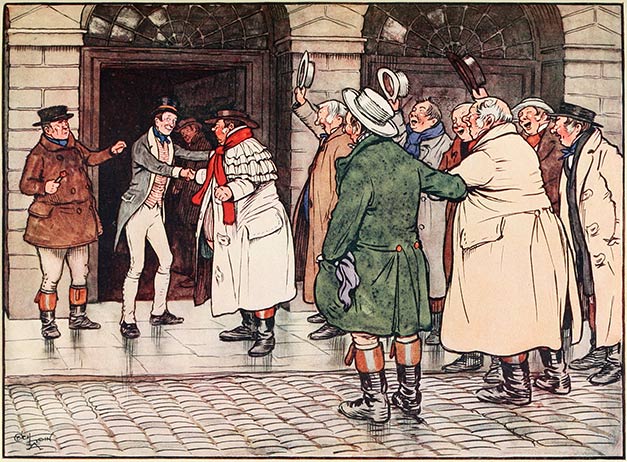
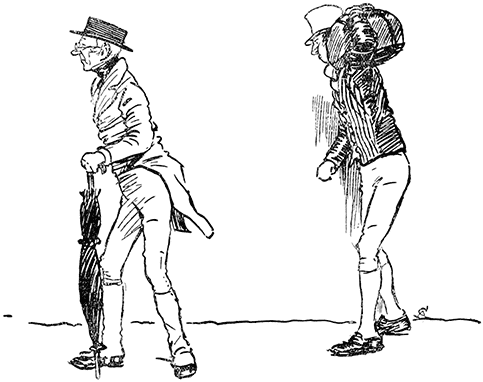
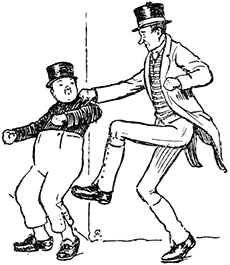
Sam had put up the steps, and was preparing to jump upon the
box, when he felt himself gently touched on the shoulder; and
looking round, his father stood before him. The old gentleman’s
countenance wore a mournful expression, as he shook his head
gravely, and said, in warning accents:
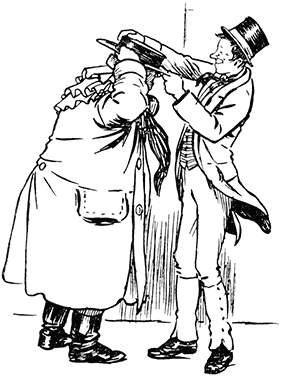
“I know’d what ’ud come o’ this here mode o’ doin’ bisness.
Oh Sammy, Sammy, vy worn’t there a alleybi!”