The First Day’s Journey, and the
First Evening’s Adventures;
with their Consequences
The First Day’s Journey, and the
First Evening’s Adventures;
with their Consequences
That punctual servant of all work, the sun,
had just risen, and begun to strike a light
on the morning of the thirteenth of May,
one thousand eight hundred and twenty-seven,
when Mr. Samuel Pickwick burst like
another sun from his slumbers, threw open
his chamber window, and looked out upon
the world beneath. Goswell Street was at his feet, Goswell
Street was on his right hand—as far as the eye could reach,
Goswell Street extended on his left; and the opposite side of
Goswell Street was over the way. “Such,” thought Mr. Pickwick,
“are the narrow views of those philosophers who, content
with examining the things that lie before them, look not to the
truths which are hidden beyond. As well might I be content
to gaze on Goswell Street for ever, without one effort to penetrate
to the hidden countries which on every side surround it.”
And having given vent to this beautiful reflection, Mr. Pickwick
proceeded to put himself into his clothes, and his clothes into
his portmanteau. Great men are seldom over-scrupulous in the
arrangement of their attire; the operation of shaving, dressing, and
coffee-imbibing was soon performed: and in another hour, Mr.
Pickwick, with his portmanteau in his hand, his telescope in his
great-coat pocket, and his note-book in his waistcoat, ready for the
reception of any discoveries worthy of being noted down, had
arrived at the coach-stand in St. Martin’s-le-Grand.
“Cab!” said Mr. Pickwick.
“Here you are, sir,” shouted a strange specimen of the human
race, in a sackcloth coat, and apron of the same, who with a brass
label and number round his neck, looked as if he were catalogued
in some collection of rarities. This was the waterman. “Here
you are, sir. Now, then, fust cab!” And the first cab having
been fetched from the public-house, where he had been smoking
his first pipe, Mr. Pickwick and his portmanteau were thrown into
the vehicle.
“Golden Cross,” said Mr. Pickwick.
“Only a bob’s vorth, Tommy,” cried the driver, sulkily, for
the information of his friend the waterman, as the cab drove off.
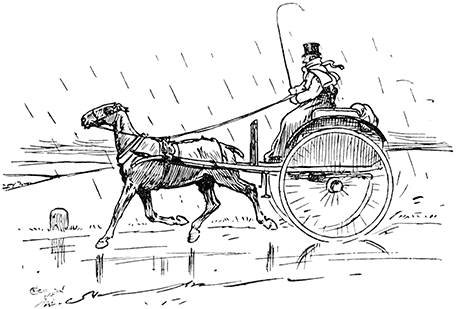
“How old is that horse, my friend?” inquired Mr. Pickwick,
rubbing his nose with the shilling he had reserved for the fare.
“Forty-two,” replied the driver, eyeing him askant.
“What!” ejaculated Mr. Pickwick, laying his hand upon his
note-book. The driver reiterated his former statement. Mr.
Pickwick looked very hard at the man’s face, but his features were
immovable, so he noted down the fact forthwith.
“And how long do you keep him out at a time?” inquired
Mr. Pickwick, searching for further information.
“Two or three veeks,” replied the man.
“Weeks!” said Mr. Pickwick in astonishment—and out came
the note-book again.
“He lives at Pentonwil when he’s at home,” observed the
driver coolly, “but we seldom takes him home, on account of his
veakness.”
“On account of his weakness!” reiterated the perplexed Mr.
Pickwick.
“He always falls down when he’s took out o’ the cab,” continued
the driver, “but when he’s in it, we bears him up wery tight,
and takes him in wery short, so as he can’t wery well fall down;
and we’ve got a pair o’ precious large wheels on, so ven he
does move, they run after him, and he must go on—he can’t
help it.”
Mr. Pickwick entered every word of this statement in his note-book,
with the view of communicating it to the club, as a singular
instance of the tenacity of life in horses, under trying circumstances.
The entry was scarcely completed when they reached
the Golden Cross. Down jumped the driver, and out got Mr.
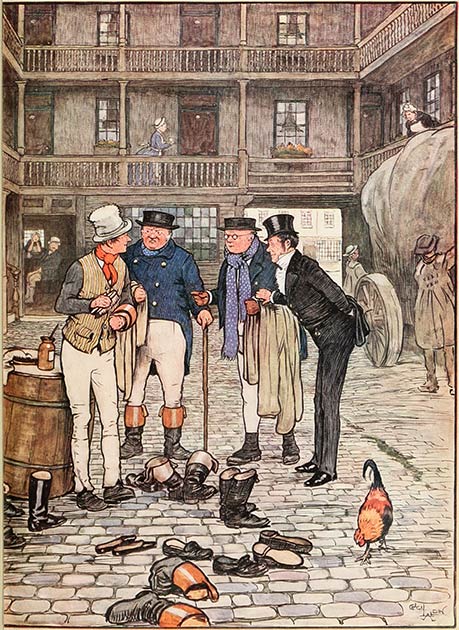
Pickwick. Mr. Tupman, Mr. Snodgrass, and Mr. Winkle, who had
been anxiously waiting the arrival of their illustrious leader,
crowded to welcome him.
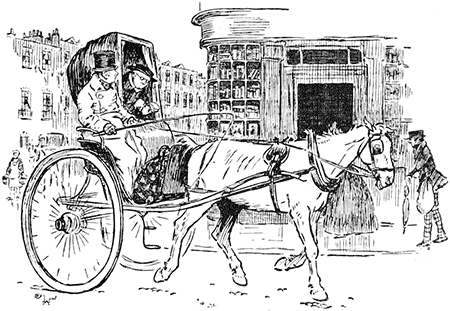
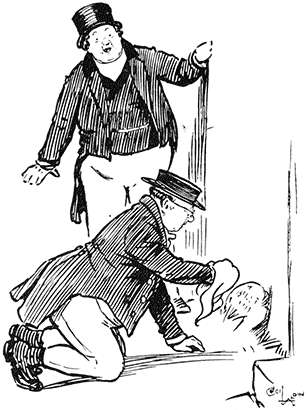
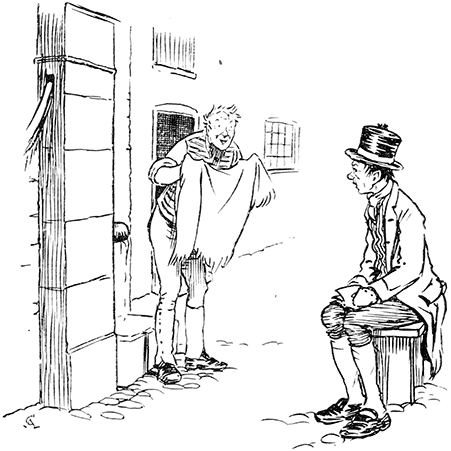
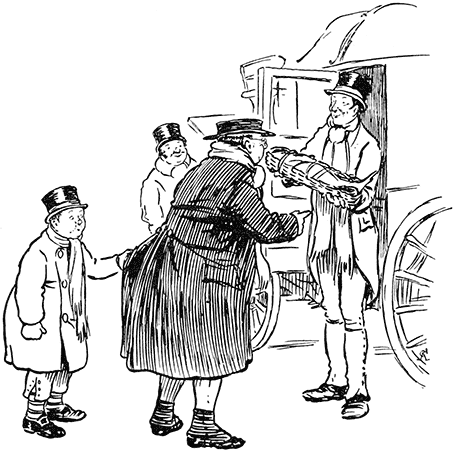
“Weeks!” said Mr. Pickwick in astonishment—and out came
the note-book again
“Here’s your fare,” said Mr. Pickwick, holding out the shilling
to the driver.
What was the learned man’s astonishment, when that unaccountable
person flung the money on the pavement, and requested
in figurative terms to be allowed the pleasure of fighting him
(Mr. Pickwick) for the amount!
“You are mad,” said Mr. Snodgrass.
“Or drunk,” said Mr. Winkle.
“Or both,” said Mr. Tupman.
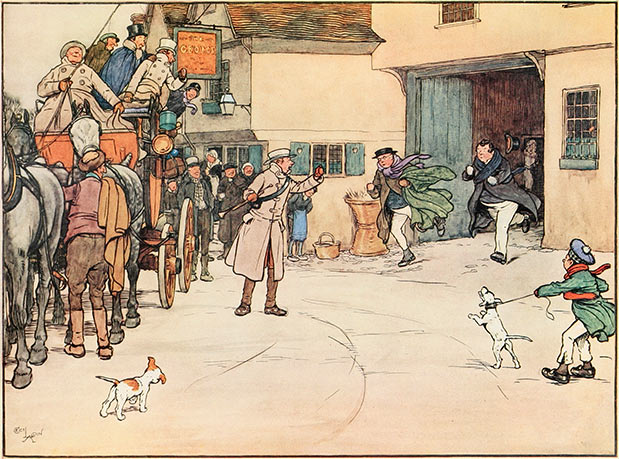
“Come on!” said the cab-driver, sparring away like clock-work.
“Come on—all four on you.”
“Here’s a lark!” shouted half-a-dozen hackney coachmen.
“Go to vork, Sam,”—and they crowded with great glee round
the party.
“What’s the row, Sam?” inquired one gentleman in black
calico sleeves.
“Row!” replied the cabman, “what did he want my number
for?”
“I didn’t want your number,” said the astonished Mr. Pickwick.
“What did you take it for, then?” inquired the cabman.
“I didn’t take it,” said Mr. Pickwick, indignantly.
“Would anybody believe,” continued the cab-driver, appealing
to the crowd, “would anybody believe as an informer ’ud go
about in a man’s cab, not only takin’ down his number, but ev’ry
word he says into the bargain” (a light flashed upon Mr. Pickwick—it
was the note-book).
“Did he though?” inquired another cabman.
“Yes, did he,” replied the first; “and then arter aggerawatin’
me to assault him, gets three witnesses here to prove it. But I’ll
give it him, if I’ve six months for it. Come on!” and the cabman
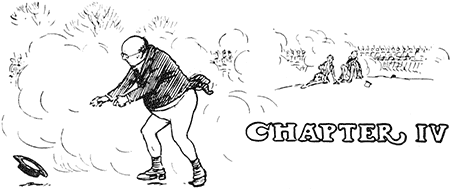
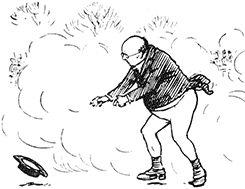
dashed his hat upon the ground, with a reckless disregard of his
own private property, and knocked Mr. Pickwick’s spectacles off,
and followed up the attack with a blow on Mr. Pickwick’s nose,
and another on Mr. Pickwick’s chest, and a third in Mr. Snodgrass’s
eye, and a fourth, by way of variety, in Mr. Tupman’s waistcoat,
and then danced into the road, and then back again to the
pavement, and finally dashed the whole temporary supply of breath
out of Mr. Winkle’s body; and all in half-a-dozen seconds.
“Where’s an officer?” said Mr. Snodgrass.
“Put ’em under the pump,” suggested a hot-pieman.
“You shall smart for this,” gasped Mr. Pickwick.
“Informers!” shouted the crowd.
“Come on,” cried the cabman, who had been sparring without
cessation the whole time.
The mob had hitherto been passive spectators of the scene, but
as the intelligence of the Pickwickians being informers was spread
among them, they began to canvass with considerable vivacity the
propriety of enforcing the heated pastry-vendor’s proposition; and
there is no saying what acts of personal aggression they might have
committed had not the affray been unexpectedly terminated by
the interposition of a new comer.
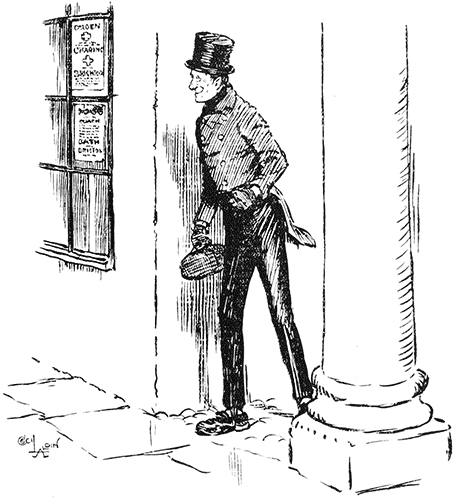
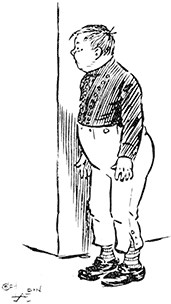
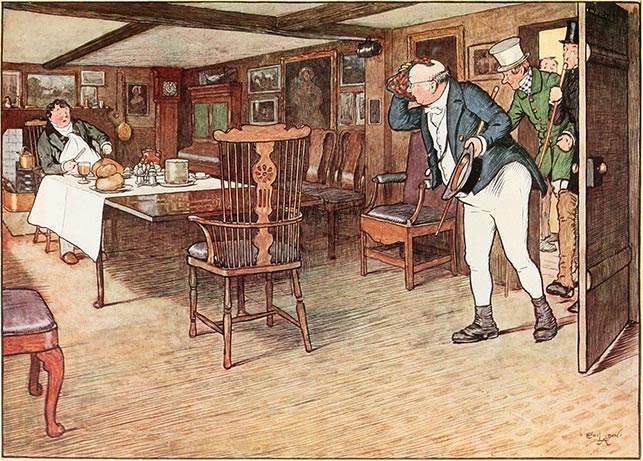
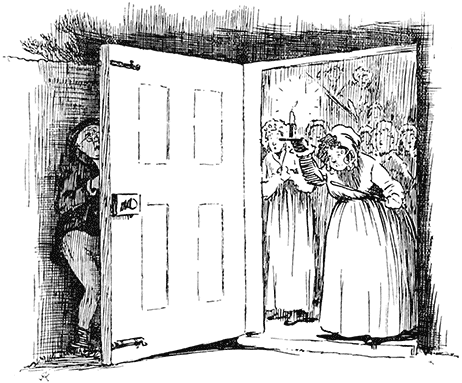
“What’s the fun?” said a rather tall thin young man
“What’s the fun?” said a rather tall thin young man, in a
green coat, emerging suddenly from the coach-yard.
“Informers!” shouted the crowd again.
“We are not,” roared Mr. Pickwick, in a tone which, to any
dispassionate listener, carried conviction with it.
“Ain’t you, though,—ain’t you?” said the young man, appealing
to Mr. Pickwick, and making his way through the crowd by
the infallible process of elbowing the countenances of its component
members.
That learned man in a few hurried words explained the real
state of the case.
“Come along, then,” said he of the green coat, lugging Mr.
Pickwick after him by main force, and talking the whole way.
“Here, No. 924, take your fare, and take yourself off—respectable
gentleman—know him well—none of your nonsense—this
way, sir,—where’s your friends?—all a mistake, I see—never mind—accidents
will happen—best regulated families—never say die—down
upon your luck—pull him up—put that in his pipe—like
the flavour—damned rascals.” And with a lengthened string of
similar broken sentences, delivered with extraordinary volubility,
the stranger led the way to the travellers’ waiting-room, whither
he was closely followed by Mr. Pickwick and his disciples.
“Here, waiter!” shouted the stranger, ringing the bell with
tremendous violence, “glasses round,—brandy and water, hot
and strong, and sweet, and plenty,—eye damaged, sir? Waiter!
raw beef-steak for the gentleman’s eye,—nothing like raw beef-steak
for a bruise, sir; cold lamp-post very good, but lamp-post
inconvenient—damned odd standing in the open street half-an-hour,
with your eye against a lamp-post—eh,—very good,—ha!
ha!” And the stranger, without stopping to take breath, swallowed
at a draught full half-a-pint of the reeking brandy and water, and
flung himself into a chair with as much ease as if nothing uncommon
had occurred.
While his three companions were busily engaged in proffering
their thanks to their new acquaintance, Mr. Pickwick had leisure
to examine his costume and appearance.
He was about the middle height, but the thinness of his body,
and the length of his legs, gave him the appearance of being much
taller. The green coat had been a smart dress garment in the
days of swallow-tails, but had evidently in those times adorned a
much shorter man than the stranger, for the soiled and faded
sleeves scarcely reached to his wrists. It was buttoned closely up
to his chin, at the imminent hazard of splitting the back; and an
old stock, without a vestige of shirt collar, ornamented his neck.
His scanty black trousers displayed here and there those shiny
patches which bespeak long service, and were strapped very tightly
over a pair of patched and mended shoes, as if to conceal the dirty
white stockings, which were nevertheless distinctly visible. His
long black hair escaped in negligent waves from beneath each side
of his old pinched-up hat; and glimpses of his bare wrists might
be observed between the tops of his gloves and the cuffs of his
coat sleeves. His face was thin and haggard; but an indescribable
air of jaunty impudence and perfect self-possession pervaded the
whole man.
Such was the individual on whom Mr. Pickwick gazed through
his spectacles (which he had fortunately recovered), and to whom
he proceeded, when his friends had exhausted themselves, to return
in chosen terms his warmest thanks for his recent assistance.
“Never mind,” said the stranger, cutting the address very
short, “said enough,—no more; smart chap that cabman—handled
his fives well; but if I’d been your friend in the green jemmy—damn
me—punch his head,—’cod I would,—pig’s whisper—pieman
too,—no gammon.”
This coherent speech was interrupted by the entrance of the
Rochester coachman, to announce that “The Commodore” was
on the point of starting.
“Commodore!” said the stranger, starting up, “my coach,—place
booked,—one outside—leave you to pay for the brandy
and water,—want change for a five,—bad silver—Brummagem
buttons—won’t do—no go—eh?” and he shook his head most
knowingly.
Now it so happened that Mr. Pickwick and his three companions
had resolved to make Rochester their first halting-place
too; and having intimated to their new-found acquaintance that
they were journeying to the same city, they agreed to occupy the
seat at the back of the coach, where they could all sit together.
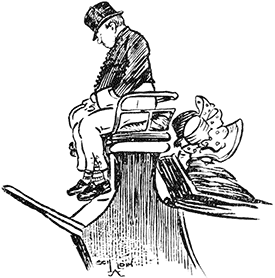
“Up with you,” said the stranger, assisting Mr. Pickwick on
to the roof with so much precipitation as to impair the gravity of
that gentleman’s deportment very materially.
“Any luggage, sir?” inquired the coachman.
“Who—I? Brown paper parcel here, that’s all,—other
luggage gone by water,—packing cases, nailed up—big as houses—heavy,
heavy, damned heavy,” replied the stranger, as he forced
into his pocket as much as he could of the brown paper parcel,
which presented most suspicious indications of containing one
shirt and a handkerchief.
“Heads, heads—take care of your heads!” cried the loquacious
stranger, as they came out under the low archway, which in those
days formed the entrance to the coach-yard. “Terrible place—dangerous
work—other day—five children—mother—tall lady
eating sandwiches—forgot the arch—crash—knock—children look
round—mother’s head off—sandwich in her hand—no mouth to
put it in—head of a family off, shocking, shocking! Looking at
Whitehall, sir?—fine place—little window—somebody else’s head
off there, eh, sir?—he didn’t keep a sharp look-out enough either—eh,
sir, eh?”
“I am ruminating,” said Mr. Pickwick, “on the strange
mutability of human affairs.”
“Ah! I see—in at the palace door one day, out at the window
the next. Philosopher, sir?”
“An observer of human nature, sir,” said Mr. Pickwick.
“Ah, so am I. Most people are when they’ve little to do and
less to get. Poet, sir?”
“My friend Mr. Snodgrass has a strong poetic turn,” said
Mr. Pickwick.
“So have I,” said the stranger. “Epic poem,—ten thousand
lines—revolution of July—composed it on the spot—Mars by day,
Apollo by night,—bang the field-piece, twang the lyre.”
“You were present at that glorious scene, sir?” said Mr.
Snodgrass.
“Present! think I was;3 fired a musket,—fired with an idea,—rushed
into wine shop—wrote it down—back again—whiz, bang—another
idea—wine shop again—pen and ink—back again—cut
and slash—noble time, sir. Sportsman, sir?” abruptly turning
to Mr. Winkle.
“A little, sir,” replied that gentleman.
“Fine pursuit, sir,—fine pursuit.—Dogs, sir?”
“Not just now,” said Mr. Winkle.
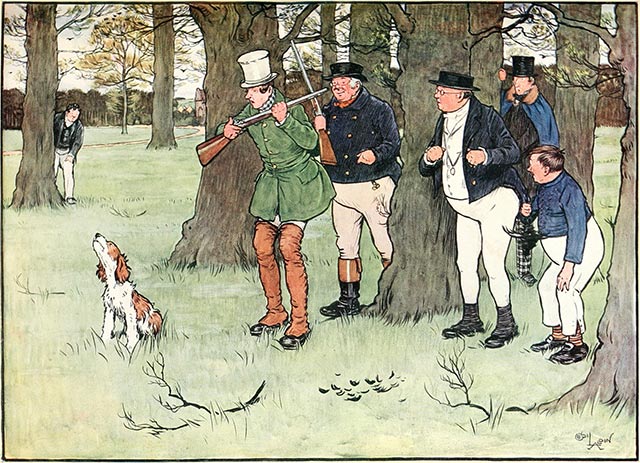
“Ah! you should keep dogs—fine animals—sagacious creatures—dog
of my own once—Pointer—surprising instinct—out shooting
one day—entering enclosure—whistled—dog stopped—whistled
again—Ponto—no go; stock still—called him—Ponto, Ponto—wouldn’t
move—dog transfixed—staring at a board—looked up,
saw an inscription—‘Gamekeeper has orders to shoot all dogs
found in this enclosure’—wouldn’t pass it—wonderful dog—valuable
dog that—very.”
“Singular circumstance that,” said Mr. Pickwick. “Will you
allow me to make a note of it?”
“Certainly, sir, certainly—hundred more anecdotes of the same
animal.—Fine girl, sir” (to Mr. Tracy Tupman, who had been
bestowing sundry anti-Pickwickian glances on a young lady by
the roadside).
“Very!” said Mr. Tupman.
“English girls not so fine as Spanish—noble creatures—jet hair—black
eyes—lovely forms—sweet creatures—beautiful.”
“You have been in Spain, sir?” said Mr. Tracy Tupman.
“Lived there—ages.”
“Many conquests, sir?” inquired Mr. Tupman.
“Conquests! Thousands. Don Bolaro Fizzgig—Grandee—only
daughter—Donna Christina—splendid creature—loved me to
distraction—jealous father—high-souled daughter—handsome
Englishman—Donna Christina in despair—prussic acid—stomach
pump in my portmanteau—operation performed—old Bolaro in
ecstasies—consent to our union—join hands and floods of tears—romantic
story—very.”
“Is the lady in England now, sir?” inquired Mr. Tupman,
on whom the description of her charms had produced a powerful
impression.
“Dead, sir—dead,” said the stranger, applying to his right eye
the brief remnant of a very old cambric handkerchief. “Never
recovered the stomach pump—undermined constitution—fell a
victim.”
“And her father?” inquired the poetic Snodgrass.
“Remorse and misery,” replied the stranger. “Sudden disappearance—talk
of the whole city—search made everywhere—without
success—public fountain in the great square suddenly
ceased playing—weeks elapsed—still a stoppage—workman employed
to clean it—water drawn off—father-in-law discovered
sticking head first in the main pipe, with a full confession in his
right boot—took him out, and the fountain played away again,
as well as ever.”
“Will you allow me to note that little romance down, sir?”
said Mr. Snodgrass, deeply affected.
“Certainly, sir, certainly,—fifty more if you like to hear ’em—strange
life mine—rather curious history—not extraordinary,
but singular.”
In this strain, with an occasional glass of ale, by way of parenthesis,
when the coach changed horses, did the stranger proceed,
until they reached Rochester bridge, by which time the note-books,
both of Mr. Pickwick and Mr. Snodgrass, were completely filled
with selections from his adventures.
“Magnificent ruin!” said Mr. Augustus Snodgrass, with all
the poetic fervour that distinguished him, when they came in sight
of the fine old castle.
“What a study for an antiquarian!” were the very words
which fell from Mr. Pickwick’s mouth, as he applied his telescope
to his eye.
“Ah! fine place,” said the stranger, “glorious pile—frowning
walls—tottering arches—dark nooks—crumbling staircases—Old
cathedral too—earthy smell—pilgrims’ feet worn away the old
steps—little Saxon doors—confessionals like money-takers’ boxes
at theatres—queer customers those monks—Popes, and Lord
Treasurers, and all sorts of old fellows, with great red faces, and
broken noses, turning up every day—buff jerkins too—matchlocks—Sarcophagus—fine
place—old legends too—strange stories:
capital;” and the stranger continued to soliloquise until they
reached the Bull Inn, in the High Street, where the coach stopped.
“Do you remain here, sir?” inquired Mr. Nathaniel Winkle.
“Here—not I—but you’d better—good house—nice beds—Wright’s
next house, dear—very dear—half-a-crown in the bill if
you look at the waiter—charge you more if you dine at a friend’s
than they would if you dined in the coffee-room—rum fellows—very.”
Mr. Winkle turned to Mr. Pickwick, and murmured a few
words; a whisper passed from Mr. Pickwick to Mr. Snodgrass,
from Mr. Snodgrass to Mr. Tupman, and nods of assent were
exchanged. Mr. Pickwick addressed the stranger.
“You rendered us a very important service this morning, sir,”
said he, “will you allow us to offer a slight mark of our gratitude
by begging the favour of your company at dinner?”
“Great pleasure—not presume to dictate, but broiled fowl
and mushrooms—capital thing! what time?”
“Let me see,” replied Mr. Pickwick, referring to his watch,
“it is now nearly three. Shall we say five?”
“Suit me excellently,” said the stranger, “five precisely—till
then—care of yourselves;” and lifting the pinched-up hat a few
inches from his head, and carelessly replacing it very much on
one side, the stranger, with half the brown paper parcel sticking
out of his pocket, walked briskly up the yard, and turned into the
High Street.
“Evidently a traveller in many countries, and a close observer
of men and things,” said Mr. Pickwick.
“I should like to see his poem,” said Mr. Snodgrass.
“I should like to have seen that dog,” said Mr. Winkle.
Mr. Tupman said nothing; but he thought of Donna Christina,
the stomach pump, and the fountain; and his eyes filled with tears.
A private sitting-room having been engaged, bed-rooms inspected,
and dinner ordered, the party walked out to view the
city and adjoining neighbourhood.
We do not find, from a careful perusal of Mr. Pickwick’s notes
on the four towns, Stroud, Rochester, Chatham, and Brompton,
that his impressions of their appearance differ in any material
point from those of other travellers who have gone over the same
ground. His general description is easily abridged.
“The principal productions of these towns,” says Mr. Pickwick,
“appear to be soldiers, sailors, Jews, chalk, shrimps, officers,
and dockyard men. The commodities chiefly exposed for sale in
the public streets are marine stores, hard-bake, apples, flat-fish,
and oysters. The streets present a lively and animated appearance,
occasioned chiefly by the conviviality of the military. It is
truly delightful to a philanthropic mind, to see these gallant men
staggering along under the influence of an overflow, both of animal
and ardent spirits; more especially when we remember that the
following them about, and jesting with them, affords a cheap and
innocent amusement for the boy population. Nothing (adds
Mr. Pickwick) can exceed their good humour. It was but the day
before my arrival that one of them had been most grossly insulted
in the house of a publican. The bar-maid had positively refused
to draw him any more liquor; in return for which he had (merely
in playfulness) drawn his bayonet, and wounded the girl in the
shoulder. And yet this fine fellow was the very first to go down
to the house next morning, and express his readiness to overlook
the matter, and forget what had occurred.
“The consumption of tobacco in these towns (continues Mr.
Pickwick) must be very great: and the smell which pervades the
streets must be exceedingly delicious to those who are extremely
fond of smoking. A superficial traveller might object to the dirt,
which is their leading characteristic; but to those who view it as an
indication of traffic and commercial prosperity, it is truly gratifying.”
Punctual to five o’clock came the stranger, and shortly afterwards
the dinner. He had divested himself of his brown paper
parcel, but had made no alteration in his attire, and was, if possible,
more loquacious than ever.
“What’s that?” he inquired, as the waiter removed one of
the covers.
“Soles, sir.”
“Soles—ah!—capital fish—all come from London—stage-coach
proprietors get up political dinners—carriage of soles—dozens of
baskets—cunning fellows. Glass of wine, sir?”
“With pleasure,” said Mr. Pickwick, and the stranger took wine,
first with him, and then with Mr. Snodgrass, and then with Mr.
Tupman, and then with Mr. Winkle, and then with the whole
party together, almost as rapidly as he talked.
“Devil of a mess on the staircase, waiter,” said the stranger.
“Forms going up—carpenters coming down—lamps, glasses, harps.
What’s going forward?”
“Ball, sir,” said the waiter.
“Assembly, eh?”
“No, sir, not Assembly, sir. Ball for the benefit of a charity,
sir.”
“Many fine women in this town, do you know, sir?” inquired
Mr. Tupman, with great interest.
“Splendid—capital. Kent, sir—everybody knows Kent—apples,
cherries, hops, and women. Glass of wine, sir?”
“With great pleasure,” replied Mr. Tupman. The stranger
filled, and emptied.
“I should very much like to go,” said Mr. Tupman, resuming
the subject of the ball, “very much.”
“Tickets at the bar, sir,” interposed the waiter; “half a guinea
each, sir.”
Mr. Tupman again expressed an earnest wish to be present at
the festivity, but meeting with no response in the darkened eye of
Mr. Snodgrass, or the abstracted gaze of Mr. Pickwick, he applied
himself with great interest to the port wine and dessert, which had
just been placed on the table. The waiter withdrew, and the
party were left to enjoy the cosy couple of hours succeeding dinner.
“Beg your pardon, sir,” said the stranger, “bottle stands—pass
it round—way of the sun—through the button-hole—no
heeltaps,” and he emptied his glass, which he had filled about two
minutes before, and poured out another, with the air of a man who
was used to it.
The wine was passed, and a fresh supply ordered. The visitor
talked, the Pickwickians listened. Mr. Tupman felt every moment
more disposed for the ball. Mr. Pickwick’s countenance glowed
with an expression of universal philanthropy, and Mr. Winkle and
Mr. Snodgrass fell fast asleep.
“They’re beginning up-stairs,” said the stranger—“hear the
company—fiddles tuning—now the harp—there they go.” The
various sounds which found their way down-stairs announced the
commencement of the first quadrille.
“How I should like to go,” said Mr. Tupman again.
“So should I,” said the stranger,—“confounded luggage—heavy
smacks—nothing to go in—odd, an’t it?”
Now general benevolence was one of the leading features of the
Pickwickian theory, and no one was more remarkable for the
zealous manner in which he observed so noble a principle than Mr.
Tracy Tupman. The number of instances recorded on the Transactions
of the Society, in which that excellent man referred objects
of charity to the houses of other members for left-off garments,
or pecuniary relief, is almost incredible.
“I should be very happy to lend you a change of apparel for
the purpose,” said Mr. Tracy Tupman, “but you are rather slim,
and I am——”
“Rather fat—grown up Bacchus—cut the leaves—dismounted
from the tub, and adopted kersey, eh?—not double distilled, but
double milled—ha! ha! pass the wine.”
Whether Mr. Tupman was somewhat indignant at the peremptory
tone in which he was desired to pass the wine which the
stranger passed so quickly away, or whether he felt very properly
scandalised at an influential member of the Pickwick Club being
ignominiously compared to a dismounted Bacchus, is a fact not
yet completely ascertained. He passed the wine, coughed twice,
and looked at the stranger for several seconds with a stern intensity;
as that individual, however, appeared perfectly collected,
and quite calm under his searching glance, he gradually relaxed,
and reverted to the subject of the ball.
“I was about to observe, sir,” he said, “that though my apparel
would be too large, a suit of my friend Mr. Winkle’s would perhaps
fit you better.”
The stranger took Mr. Winkle’s measure with his eye, and that
feature glistened with satisfaction as he said—“Just the thing.”
Mr. Tupman looked round him. The wine, which had exerted
its somniferous influence over Mr. Snodgrass and Mr. Winkle, had
stolen upon the senses of Mr. Pickwick. That gentleman had
gradually passed through the various stages which precede the
lethargy produced by dinner, and its consequences. He had
undergone the ordinary transitions from the height of conviviality
to the depth of misery, and from the depth of misery to the height
of conviviality. Like a gas lamp in the street, with the wind in
the pipe, he had exhibited for a moment an unnatural brilliancy:
then sunk so low as to be scarcely discernible: after a short interval
he had burst out again, to enlighten for a moment, then flickered
with an uncertain, staggering sort of light, and then gone out
altogether. His head was sunk upon his bosom, and perpetual
snoring, with a partial choke occasionally, were the only audible
indications of the great man’s presence.
The temptation to be present at the ball, and to form his first
impressions of the beauty of the Kentish ladies, was strong upon
Mr. Tupman. The temptation to take the stranger with him was
equally great. He was wholly unacquainted with the place and
its inhabitants, and the stranger seemed to possess as great a knowledge
of both as if he had lived there from his infancy. Mr. Winkle
was asleep, and Mr. Tupman had had sufficient experience in such
matters to know that the moment he awoke he would, in the
ordinary course of nature, roll heavily to bed. He was undecided.
“Fill your glass, and pass the wine,” said the indefatigable
visitor.
Mr. Tupman did as he was requested, and the additional
stimulus of the last glass settled his determination.
“Winkle’s bedroom is inside mine,” said Mr. Tupman; “I
couldn’t make him understand what I wanted if I woke him now,
but I know he has a dress suit in a carpet bag, and supposing you
wore it to the ball, and took it off when we returned, I could
replace it without troubling him at all about the matter.”
“Capital,” said the stranger, “famous plan—damned odd
situation—fourteen coats in the packing cases, and obliged to
wear another man’s—very good notion, that—very.”
“We must purchase our tickets,” said Mr. Tupman.
“Not worth while splitting a guinea,” said the stranger, “toss
who shall pay for both—I call; you spin—first time—woman—woman—bewitching
woman,” and down came the sovereign, with
the Dragon (called by courtesy a woman) uppermost.
Mr. Tupman rang the bell, purchased the tickets, and ordered
chamber candlesticks. In another quarter of an hour the stranger
was completely arrayed in a full suit of Mr. Nathaniel Winkle’s.
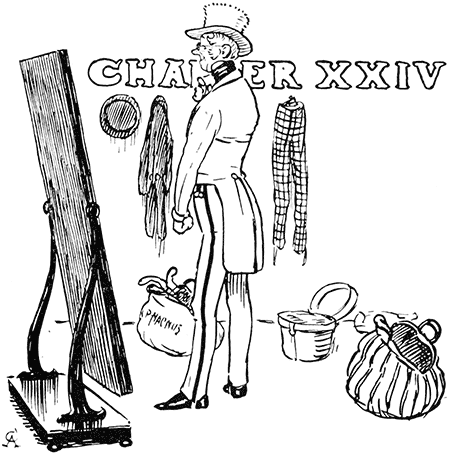
“It’s a new coat,” said Mr. Tupman, as the stranger surveyed
himself with great complacency in a cheval glass, “the first that’s
been made with our club button,” and he called his companion’s
attention to the large gilt button which displayed a bust of Mr.
Pickwick in the centre, and the letters “P. C.” on either side.
“P. C.,” said the stranger—“queer set out—old fellow’s likeness,
and ‘P. C.’—What does ‘P. C.’ stand for—Peculiar Coat, eh?”
Mr. Tupman, with rising indignation and great importance,
explained the mystic device.
“Rather short in the waist, an’t it,” said the stranger, screwing
himself round to catch a glimpse in the glass of the waist buttons,
which were half way up his back. “Like a general postman’s coat—queer
coats those—made by contract—no measuring—mysterious
dispensations of Providence—all the short men get long coats—all
the long men short ones.” Running on in this way, Mr. Tupman’s
new companion adjusted his dress, or rather the dress of Mr.
Winkle; and, accompanied by Mr. Tupman, ascended the staircase
leading to the ball-room.
“What names, sir?” said the man at the door. Mr. Tracy
Tupman was stepping forward to announce his own titles, when
the stranger prevented him.
“No names at all;” and then he whispered Mr. Tupman,
“Names won’t do—not known—very good names in their way,
but not great ones—capital names for a small party, but won’t
make an impression in public assemblies—incog. the thing—Gentlemen
from London—distinguished foreigners—anything.” The
door was thrown open; and Mr. Tracy Tupman and the stranger
entered the ball-room.
It was a long room, with crimson-covered benches, and wax
candles in glass chandeliers. The musicians were securely confined
in an elevated den, and quadrilles were being systematically got
through by two or three sets of dancers. Two card-tables were
made up in the adjoining card-room, and two pair of old ladies,
and a corresponding number of stout gentlemen, were executing
whist therein.
The finale concluded, the dancers promenaded the room, and
Mr. Tupman and his companion stationed themselves in a corner
to observe the company.
“Charming women,” said Mr. Tupman.
“Wait a minute,” said the stranger, “fun presently—nobs not
come yet—queer place—Dock-yard people of upper rank don’t
know Dock-yard people of lower rank—Dock-yard people of lower
rank don’t know small gentry—small gentry don’t know tradespeople—Commissioner
don’t know anybody.”
“Who’s that little boy with the light hair and pink eyes, in a
fancy dress?” inquired Mr. Tupman.
“Hush, pray—pink eyes—fancy dress—little boy—nonsense—Ensign
97th—Honourable Wilmot Snipe—great family—Snipes—very.”
“Sir Thomas Clubber, Lady Clubber, and the Miss Clubbers!”
shouted the man at the door in a stentorian voice. A great
sensation was created throughout the room by the entrance of a
tall gentleman in a blue coat and bright buttons, a large lady in
blue satin, and two young ladies, on a similar scale, in fashionably-made
dresses of the same hue.
“Commissioner—head of the yard—great man—remarkably
great man,” whispered the stranger in Mr. Tupman’s ear, as the
charitable committee ushered Sir Thomas Clubber and family to
the top of the room. The Honourable Wilmot Snipe and other
distinguished gentlemen crowded to render homage to the Miss
Clubbers; and Sir Thomas Clubber stood bolt upright, and looked
majestically over his black neckerchief at the assembled company.
“Mr. Smithie, Mrs. Smithie, and the Misses Smithie,” was the
next announcement.
“What’s Mr. Smithie?” inquired Mr. Tracy Tupman.
“Something in the yard,” replied the stranger. Mr. Smithie
bowed deferentially to Sir Thomas Clubber, and Sir Thomas
Clubber acknowledged the salute with conscious condescension.
Lady Clubber took a telescopic view of Mrs. Smithie and family
through her eye-glass, and Mrs. Smithie stared in her turn at Mrs.
Somebody else, whose husband was not in the Dock-yard at all.
“Colonel Bulder, Mrs. Colonel Bulder, and Miss Bulder,” were
the next arrivals.
“Head of the Garrison,” said the stranger, in reply to Mr.
Tupman’s inquiring look.
Miss Bulder was warmly welcomed by the Miss Clubbers; the
greeting between Mrs. Colonel Bulder and Lady Clubber was of
the most affectionate description; Colonel Bulder and Sir Thomas
Clubber exchanged snuff-boxes, and looked very much like a pair
of Alexander Selkirks—“Monarchs of all they surveyed.”
While the aristocracy of the place—the Bulders, and Clubbers,
and Snipes—were thus preserving their dignity at the upper end of
the room, the other classes of society were imitating their example
in other parts of it. The less aristocratic officers of the 97th
devoted themselves to the families of the less important functionaries
from the Dock-yard. The solicitors’ wives and the wine-merchant’s
wife headed another grade (the brewer’s wife visited
the Bulders); and Mrs. Tomlinson, the post-office keeper, seemed
by mutual consent to have been chosen the leader of the trade party.
One of the most popular personages in his own circle present
was a little fat man, with a ring of upright black hair round his
head, and an extensive bald plain on the top of it—Doctor Slammer,
surgeon to the 97th. The Doctor took snuff with everybody,
chatted with everybody, laughed, danced, made jokes, played
whist, did everything, and was everywhere. To these pursuits,
multifarious as they were, the little Doctor added a more important
one than any—he was indefatigable in paying the most unremitting
and devoted attention to a little old widow, whose rich
dress and profusion of ornament bespoke her a most desirable
addition to a limited income.
Upon the Doctor, and the widow, the eyes of both Mr. Tupman
and his companion had been fixed for some time, when the
stranger broke silence.
“Lots of money—old girl—pompous Doctor—not a bad idea—good
fun,” were the intelligible sentences which issued from his
lips. Mr. Tupman looked inquisitively in his face.
“I’ll dance with the widow,” said the stranger.
“Who is she?” inquired Mr. Tupman.
“Don’t know—never saw her in all my life—cut out the Doctor—here
goes.” And the stranger forthwith crossed the room; and,
leaning against a mantelpiece, commenced gazing with an air of
respectful and melancholy admiration on the fat countenance of
the little old lady. Mr. Tupman looked on, in mute astonishment.
The stranger progressed rapidly; the little Doctor danced with
another lady; the widow dropped her fan, the stranger picked it
up, and presented it,—a smile—a bow—a curtsey—a few words of
conversation. The stranger walked boldly up to, and returned
with, the master of ceremonies; a little introductory pantomime;
and the stranger and Mrs. Budger took their places in a quadrille.
The surprise of Mr. Tupman at this summary proceeding,
great as it was, was immeasurably exceeded by the astonishment
of the Doctor. The stranger was young, and the widow was
flattered. The Doctor’s attentions were unheeded by the widow;
and the Doctor’s indignation was wholly lost on his imperturbable
rival. Doctor Slammer was paralysed. He, Doctor Slammer, of
the 97th, to be extinguished in a moment, by a man whom nobody
had ever seen before, and whom nobody knew even now! Doctor
Slammer—Doctor Slammer of the 97th rejected! Impossible!
It could not be! Yes, it was; there they were. What! introducing
his friend! Could he believe his eyes! He looked again,
and was under the painful necessity of admitting the veracity of
his optics; Mrs. Budger was dancing with Mr. Tracy Tupman,
there was no mistaking the fact. There was the widow before
him, bouncing bodily, here and there, with unwonted vigour; and
Mr. Tracy Tupman hopping about, with a face expressive of the
most intense solemnity, dancing (as a good many people do) as if a
quadrille were not a thing to be laughed at, but a severe trial to
the feelings, which it requires inflexible resolution to encounter.
Silently and patiently did the Doctor bear all this, and all the
handings of negus, and watching for glasses, and darting for
biscuits, and coquetting, that ensued; but, a few seconds after the
stranger had disappeared to lead Mrs. Budger to her carriage, he
darted swiftly from the room with every particle of his hitherto-bottled-up
indignation effervescing, from all parts of his countenance,
in a perspiration of passion.
The stranger was returning, and Mr. Tupman was beside him.
He spoke in a low tone and laughed. The little Doctor thirsted
for his life. He was exulting. He had triumphed.
“Sir!” said the Doctor, in an awful voice, producing a card,
and retiring into an angle of the passage, “my name is Slammer,
Doctor Slammer, sir—97th Regiment—Chatham Barracks—my
card, sir, my card.” He would have added more, but his indignation
choked him.
“Ah!” replied the stranger, coolly, “Slammer—much obliged—polite
attention—not ill now, Slammer—but when I am—knock
you up.”
“You—you’re a shuffler! sir,” gasped the furious Doctor,
“a poltroon—a coward—a liar—a—a—will nothing induce you
to give me your card, sir!”
“Oh! I see,” said the stranger, half aside, “negus too strong
here—liberal landlord—very foolish—very—lemonade much better—hot
rooms—elderly gentlemen—suffer for it in the morning—cruel—cruel;”
and he moved on a step or two.
“You are stopping in this house, sir,” said the indignant little
man; “you are intoxicated now, sir; you shall hear from me in
the morning, sir. I shall find you out, sir; I shall find you
out.”
“Rather you found me out than found me at home,” replied
the unmoved stranger.
Doctor Slammer looked unutterable ferocity, as he fixed his hat
on his head with an indignant knock; and the stranger and Mr.
Tupman ascended to the bed-room of the latter to restore the
borrowed plumage to the unconscious Winkle.
That gentleman was fast asleep; the restoration was soon made.
The stranger was extremely jocose; and Mr. Tracy Tupman, being
quite bewildered with wine, negus, lights, and ladies, thought the
whole affair an exquisite joke. His new friend departed; and,
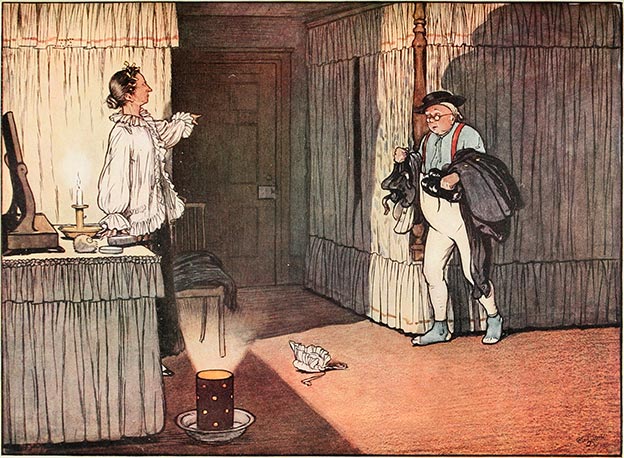
after experiencing some slight difficulty in finding the orifice in his
night-cap, originally intended for the reception of his head, and
finally overturning his candlestick in his struggles to put it on, Mr.
Tracy Tupman managed to get into bed by a series of complicated
evolutions, and shortly afterwards sank into repose.
Seven o’clock had hardly ceased striking on the following
morning when Mr. Pickwick’s comprehensive mind was aroused
from the state of unconsciousness in which slumber had plunged it,
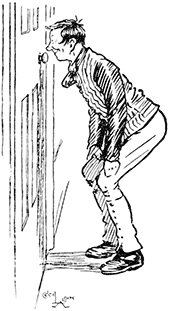
by a loud knocking at his chamber door.
“Who’s there?” said Mr. Pickwick, starting up in bed.
“Boots, sir.”
“What do you want?”
“Please, sir, can you tell me which gentleman of your party
wears a bright blue dress coat, with a gilt button with P. C. on it?”
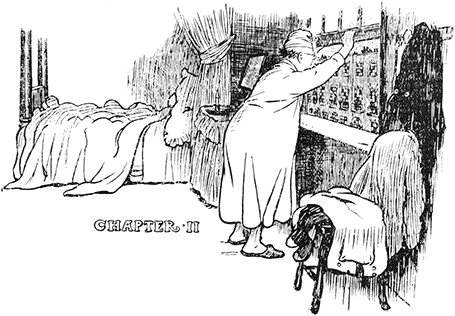
“It’s been given out to brush,” thought Mr. Pickwick, “and
the man has forgotten whom it belongs to. Mr. Winkle,” he
called out, “next room but two, on the right hand.”
“Thank’ee, sir,” said the Boots, and away he went.
“What’s the matter?” cried Mr. Tupman, as a loud knocking
at his door aroused him from his oblivious repose.
“Can I speak to Mr. Winkle, sir?” replied the Boots from the
outside.
“Winkle—Winkle!” shouted Mr. Tupman, calling into the
inner room.
“Hallo!” replied a faint voice from within the bed-clothes.
“You’re wanted—some one at the door—” and having exerted
himself to articulate thus much, Mr. Tracy Tupman turned round
and fell fast asleep again.
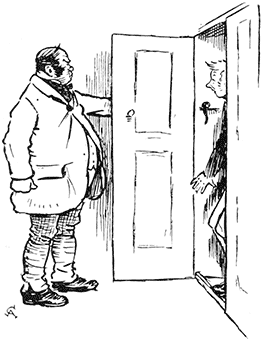
“Wanted!” said Mr. Winkle, hastily jumping out of bed, and
putting on a few articles of clothing; “wanted! at this distance
from town—who on earth can want me?”
“Gentleman in the coffee-room, sir,” replied the Boots, as Mr.
Winkle opened the door and confronted him; “gentleman says
he’ll not detain you a moment, sir, but he can take no denial.”
“Very odd!” said Mr. Winkle; “I’ll be down directly.”
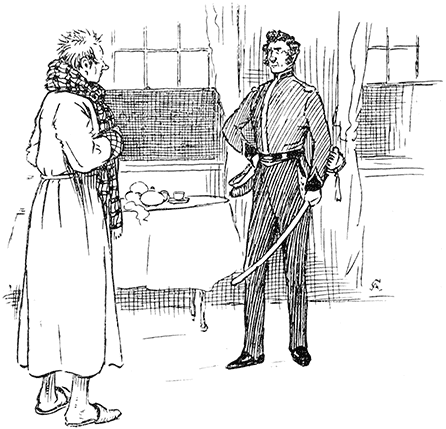
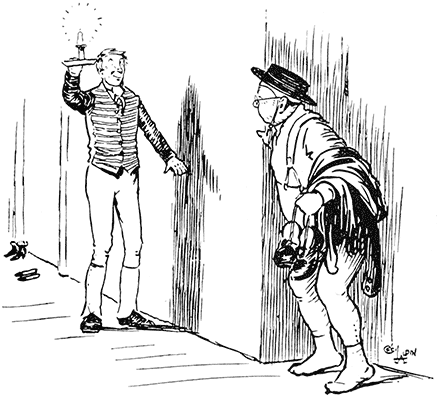
He hurriedly wrapped himself in a travelling-shawl and dressing-gown,
and proceeded down-stairs. An old woman and a couple of
waiters were cleaning the coffee-room, and an officer in undress
uniform was looking out of the window. He turned round as Mr.
Winkle entered, and made a stiff inclination of the head. Having
ordered the attendants to retire, and closed the door very carefully,
he said, “Mr. Winkle, I presume?”
“My name is Winkle, sir.”
“You will not be surprised, sir, when I inform you that I have
called here this morning on behalf of my friend, Dr. Slammer, of
the Ninety-seventh.”
“Doctor Slammer!” said Mr. Winkle.
“Dr. Slammer. He begged me to express his opinion that your
conduct of last evening was of a description which no gentleman
could endure: and (he added) which no one gentleman would
pursue towards another.”
Mr. Winkle’s astonishment was too real, and too evident, to
escape the observation of Dr. Slammer’s friend; he therefore proceeded—“My
friend, Doctor Slammer, requested me to add,
that he was firmly persuaded you were intoxicated during a portion
of the evening, and possibly unconscious of the extent of the
insult you were guilty of. He commissioned me to say, that
should this be pleaded as an excuse for your behaviour, he will
consent to accept a written apology, to be penned by you, from
my dictation.”
“A written apology!” repeated Mr. Winkle, in the most
emphatic tone of amazement possible.
“Of course you know the alternative,” replied the visitor
coolly.
“Were you entrusted with this message to me by name?”
inquired Mr. Winkle, whose intellects were hopelessly confused by
this extraordinary conversation.
“I was not present myself,” replied the visitor, “and in consequence
of your firm refusal to give your card to Doctor Slammer,
I was desired by that gentleman to identify the wearer of a very
uncommon coat—a bright blue dress coat, with a gilt button
displaying a bust, and the letters ‘P. C.’”
Mr. Winkle actually staggered with astonishment as he heard
his own costume thus minutely described. Doctor Slammer’s
friend proceeded—“From the inquiries I made at the bar, just
now, I was convinced that the owner of the coat in question arrived
here, with three gentlemen, yesterday afternoon. I immediately
sent up to the gentleman who was described as appearing the head
of the party, and he at once referred me to you.”
If the principal tower of Rochester Castle had suddenly walked
from its foundation, and stationed itself opposite the coffee-room
window, Mr. Winkle’s surprise would have been as nothing compared
with the profound astonishment with which he had heard
this address. His first impression was, that his coat had been
stolen. “Will you allow me to detain you one moment?” said he.
“Certainly,” replied the unwelcome visitor.
Mr. Winkle ran hastily up-stairs, and with a trembling hand
opened the bag. There was the coat in its usual place, but exhibiting,
on a close inspection, evident tokens of having been worn
on the preceding night.
“It must be so,” said Mr. Winkle, letting the coat fall from his
hands. “I took too much wine after dinner, and have a very
vague recollection of walking about the streets and smoking a
cigar afterwards. The fact is, I was very drunk;—I must have
changed my coat—gone somewhere—and insulted somebody—I
have no doubt of it; and this message is the terrible consequence.”
Saying which, Mr. Winkle retraced his steps in the direction of the
coffee-room, with the gloomy and dreadful resolve of accepting the
challenge of the warlike Dr. Slammer, and abiding by the worst
consequences that might ensue.
To this determination Mr. Winkle was urged by a variety of
considerations, the first of which was, his reputation with the club.
He had always been looked up to as a high authority on all matters
of amusement and dexterity, whether offensive, defensive, or inoffensive;
and if, on this very first occasion of being put to the
test, he shrunk back from the trial, beneath his leader’s eye, his
name and standing were lost for ever. Besides, he remembered
to have heard it frequently surmised by the uninitiated in such
matters that by an understood arrangement between the seconds,
the pistols were seldom loaded with ball; and, furthermore, he
reflected that if he applied to Mr. Snodgrass to act as his second,
and depicted the danger in glowing terms, that gentleman might
possibly communicate the intelligence to Mr. Pickwick, who would
certainly lose no time in transmitting it to the local authorities,
and thus prevent the killing or maiming of his follower.
Such were his thoughts when he returned to the coffee-room,
and intimated his intention of accepting the Doctor’s challenge.
“Will you refer me to a friend, to arrange the time and place
of meeting?” said the officer.
“Quite unnecessary,” replied Mr. Winkle; “name them to me,
and I can procure the attendance of a friend afterwards.”
“Shall we say—sunset this evening?” inquired the officer, in a
careless tone.
“Very good,” replied Mr. Winkle, thinking in his heart it was
very bad.
“You know Fort Pitt?”
“Yes; I saw it yesterday.”
“If you will take the trouble to turn into the field which borders
the trench, take the foot-path to the left when you arrive at an
angle of the fortification, and keep straight on, till you see me, I
will precede you to a secluded place, where the affair can be conducted
without fear of interruption.”
“Fear of interruption!” thought Mr. Winkle.
“Nothing more to arrange, I think,” said the officer.
“I am not aware of anything more,” replied Mr. Winkle.
“Good morning.”
“Good morning:” and the officer whistled a lively air as he
strode away.
That morning’s breakfast passed heavily off. Mr. Tupman was
not in a condition to rise, after the unwonted dissipation of the
previous night; Mr. Snodgrass appeared to labour under a poetical
depression of spirits; and even Mr. Pickwick evinced an unusual
attachment to silence and soda-water. Mr. Winkle eagerly watched
his opportunity; it was not long wanting. Mr. Snodgrass proposed
a visit to the castle, and as Mr. Winkle was the only other
member of the party disposed to walk, they went out together.
“Snodgrass,” said Mr. Winkle, when they had turned out of
the public street, “Snodgrass, my dear fellow, can I rely upon your
secrecy?” As he said this, he most devoutly and earnestly hoped
he could not.
“You can,” replied Mr. Snodgrass. “Hear me swear——”
“No, no,” interrupted Winkle, terrified at the idea of his
companion’s unconsciously pledging himself not to give information;
“don’t swear, don’t swear; it’s quite unnecessary.”
Mr. Snodgrass dropped the hand which he had, in the spirit of
poesy, raised towards the clouds as he made the above appeal, and
assumed an attitude of attention.
“I want your assistance, my dear fellow, in an affair of honour,”
said Mr. Winkle.
“You shall have it,” replied Mr. Snodgrass, clasping his friend’s
hand.
“With a Doctor—Doctor Slammer, of the Ninety-seventh,”
said Mr. Winkle, wishing to make the matter appear as solemn as
possible; “an affair with an officer, seconded by another officer,
at sunset this evening, in a lonely field beyond Fort Pitt.”
“I will attend you,” said Mr. Snodgrass.
He was astonished, but by no means dismayed. It is extraordinary
how cool any party but the principal can be in such cases.
Mr. Winkle had forgotten this. He had judged of his friend’s
feelings by his own.
“The consequences may be dreadful,” said Mr. Winkle.
“I hope not,” said Mr. Snodgrass.
“The Doctor, I believe, is a very good shot,” said Mr. Winkle.
“Most of these military men are,” observed Mr. Snodgrass,
calmly; “but so are you, an’t you?”
Mr. Winkle replied in the affirmative; and perceiving that he
had not alarmed his companion sufficiently, changed his ground.
“Snodgrass,” he said, in a voice tremulous with emotion, “if
I fall, you will find in a packet which I shall place in your hands a
note for my—for my father.”
This attack was a failure also. Mr. Snodgrass was affected, but
he undertook the delivery of the note as readily as if he had been
a Twopenny Postman.
“If I fall,” said Mr. Winkle, “or if the Doctor falls, you, my
dear friend, will be tried as an accessory before the fact. Shall I
involve my friend in transportation—possibly for life!”
Mr. Snodgrass winced a little at this, but his heroism was
invincible. “In the cause of friendship,” he fervently exclaimed,
“I would brave all dangers.”
How Mr. Winkle cursed his companion’s devoted friendship
internally, as they walked silently along, side by side, for some
minutes, each immersed in his own meditations! The morning
was wearing away; he grew desperate.
“Snodgrass,” he said, stopping suddenly, “do not let me be
baulked in this matter—do not give information to the local
authorities—do not obtain the assistance of several peace officers,
to take either me or Doctor Slammer, of the Ninety-seventh
Regiment, at present quartered in Chatham Barracks, into custody,
and thus prevent this duel;—I say, do not.”
Mr. Snodgrass seized his friend’s hand warmly, as he enthusiastically
replied, “Not for worlds!”
A thrill passed over Mr. Winkle’s frame as the conviction that
he had nothing to hope from his friend’s fears, and that he was
destined to become an animated target, rushed forcibly upon him.
The state of the case having been formally explained to Mr.
Snodgrass, and a case of satisfaction pistols, with the satisfactory
accompaniments of powder, ball, and caps, having been hired
from a manufacturer in Rochester, the two friends returned to
their inn; Mr. Winkle to ruminate on the approaching struggle,
and Mr. Snodgrass to arrange the weapons of war, and put them
into proper order for immediate use.
It was a dull and heavy evening when they again sallied forth
on their awkward errand. Mr. Winkle was muffled up in a huge
cloak to escape observation, and Mr. Snodgrass bore under his the
instruments of destruction.
“Have you got everything?” said Mr. Winkle, in an agitated
tone.
“Everything,” replied Mr. Snodgrass; “plenty of ammunition,
in case the shots don’t take effect. There’s a quarter of a pound
of powder in the case, and I have got two newspapers in my pocket
for the loadings.”
These were instances of friendship for which any man might
reasonably feel most grateful. The presumption is, that the
gratitude of Mr. Winkle was too powerful for utterance, as he said
nothing, but continued to walk on—rather slowly.
“We are in excellent time,” said Mr. Snodgrass, as they climbed
the fence of the first field; “the sun is just going down.” Mr.
Winkle looked up at the declining orb and painfully thought of
the probability of his “going down” himself, before long.
“There’s the officer,” exclaimed Mr. Winkle, after a few
minutes’ walking.
“Where?” said Mr. Snodgrass.
“There;—the gentleman in the blue cloak.” Mr. Snodgrass
looked in the direction indicated by the forefinger of his friend,
and observed a figure, muffled up, as he had described. The officer
evinced his consciousness of their presence by slightly beckoning
with his hand; and the two friends followed him at a little distance,
as he walked away.
The evening grew more dull every moment, and a melancholy
wind sounded through the deserted fields, like a distant giant
whistling for his house-dog. The sadness of the scene imparted a
sombre tinge to the feelings of Mr. Winkle. He started as they
passed the angle of the trench—it looked like a colossal grave.
The officer turned suddenly from the path, and after climbing a
paling, and scaling a hedge, entered a secluded field. Two gentlemen
were waiting in it; one was a little fat man, with black hair;
and the other—a portly personage in a braided surtout—was
sitting with perfect equanimity on a camp-stool.
“The other party, and a surgeon, I suppose,” said Mr. Snodgrass;
“take a drop of brandy.” Mr. Winkle seized the wicker
bottle which his friend proffered, and took a lengthened pull at the
exhilarating liquid.
“My friend, sir, Mr. Snodgrass,” said Mr. Winkle, as the officer
approached. Doctor Slammer’s friend bowed, and produced a
case similar to that which Mr. Snodgrass carried.
“We have nothing farther to say, sir, I think,” he coldly remarked,
as he opened the case; “an apology has been resolutely
declined.”
“Nothing, sir,” said Mr. Snodgrass, who began to feel rather
uncomfortable himself.
“Will you step forward?” said the officer.
“Certainly,” replied Mr. Snodgrass. The ground was
measured, and preliminaries arranged.
“You will find these better than your own,” said the opposite
second, producing his pistols. “You saw me load them. Do you
object to use them?”
“Certainly not,” replied Mr. Snodgrass. The offer relieved
him from considerable embarrassment, for his previous notions of
loading a pistol were rather vague and undefined.
“We may place our men, then, I think,” observed the officer,
with as much indifference as if the principals were chess-men, and
the seconds players.
“I think we may,” replied Mr. Snodgrass; who would have
assented to any proposition, because he knew nothing about the
matter. The officer crossed to Doctor Slammer, and Mr. Snodgrass
went up to Mr. Winkle.
“It’s all ready,” he said, offering the pistol. “Give me your
cloak.”
“You have got the packet, my dear fellow,” said poor Winkle.
“All right,” said Mr. Snodgrass. “Be steady, and wing him.”
It occurred to Mr. Winkle that this advice was very like that
which bystanders invariably give to the smallest boy in a street
fight, namely, “Go in, and win:”—an admirable thing to recommend,
if you only know how to do it. He took off his cloak, however,
in silence—it always took a long time to undo that cloak—and
accepted the pistol. The seconds retired, the gentleman on
the camp-stool did the same, and the belligerents approached
each other.
Mr. Winkle was always remarkable for extreme humanity. It
is conjectured that his unwillingness to hurt a fellow-creature intentionally
was the cause of his shutting his eyes when he arrived
at the fatal spot; and that the circumstance of his eyes being
closed, prevented his observing the very extraordinary and unaccountable
demeanour of Doctor Slammer. That gentleman
started, stared, retreated, rubbed his eyes, stared again; and
finally shouted “Stop, stop!”
“What’s all this?” said Doctor Slammer, as his friend and
Mr. Snodgrass came running up. “That’s not the man.”
“Not the man!” said Dr. Slammer’s second.
“Not the man!” said Mr. Snodgrass.
“Not the man!” said the gentleman with the camp-stool in
his hand.
“Certainly not,” replied the little Doctor. “That’s not the
person who insulted me last night.”
“Very extraordinary!” exclaimed the officer.
“Very,” said the gentleman with the camp-stool. “The only
question is, whether the gentleman, being on the ground, must not
be considered, as a matter of form, to be the individual who
insulted our friend, Dr. Slammer, yesterday evening, whether
he is really that individual or not:” and having delivered this
suggestion, with a very sage and mysterious air, the man with the
camp-stool took a large pinch of snuff, and looked profoundly
round, with the air of an authority in such matters.
Now Mr. Winkle had opened his eyes, and his ears too, when he
heard his adversary call out for a cessation of hostilities; and
perceiving by what he had afterwards said, that there was, beyond
all question, some mistake in the matter, he at once foresaw the
increase of reputation he should inevitably acquire by concealing
the real motive of his coming out: he therefore stepped boldly
forward, and said—
“I am not the person. I know it.”
“Then, that,” said the man with the camp-stool, “is an affront
to Dr. Slammer, and a sufficient reason for proceeding immediately.”
“Pray be quiet, Payne,” said the Doctor’s second. “Why
did you not communicate this fact to me this morning, sir?”
“To be sure—to be sure,” said the man with the camp-stool,
indignantly.
“I entreat you to be quiet, Payne,” said the other. “May I
repeat my question, sir?”
“Because, sir,” replied Mr. Winkle, who had had time to
deliberate upon his answer, “because, sir, you described an intoxicated
and ungentlemanly person as wearing a coat which I
have the honour, not only to wear, but to have invented—the
proposed uniform, sir, of the Pickwick Club in London. The
honour of that uniform I feel bound to maintain, and I therefore,
without inquiry, accepted the challenge which you offered me.”
“My dear sir,” said the good-humoured little Doctor, advancing
with extended hand, “I honour your gallantry. Permit me to say,
sir, that I highly admire your conduct, and extremely regret having
caused you the inconvenience of this meeting, to no purpose.”
“I beg you won’t mention it, sir,” said Mr. Winkle.
“I shall feel proud of your acquaintance, sir,” said the little
Doctor.
“It will afford me the greatest pleasure to know you, sir,”
replied Mr. Winkle. Thereupon the Doctor and Mr. Winkle
shook hands, and then Mr. Winkle and Lieutenant Tappleton (the
Doctor’s second), and then Mr. Winkle and the man with the
camp-stool, and finally, Mr. Winkle and Mr. Snodgrass—the last-named
gentleman in an excess of admiration at the noble conduct
of his heroic friend.
“I think we may adjourn,” said Lieutenant Tappleton.
“Certainly,” added the Doctor.
“Unless,” interposed the man with the camp-stool, “unless
Mr. Winkle feels himself aggrieved by the challenge; in which
case, I submit, he has a right to satisfaction.”
Mr. Winkle, with great self-denial, expressed himself quite
satisfied already.
“Or possibly,” said the man with the camp-stool, “the gentleman’s
second may feel himself affronted with some observations
which fell from me at an early period of this meeting: if so, I
shall be happy to give him satisfaction immediately.”
Mr. Snodgrass hastily professed himself very much obliged with
the handsome offer of the gentleman who had spoken last, which
he was only induced to decline by his entire contentment with the
whole proceedings. The two seconds adjusted the cases, and the
whole party left the ground in a much more lively manner than
they had proceeded to it.
“Do you remain long here?” inquired Dr. Slammer of Mr.
Winkle, as they walked on most amicably together.
“I think we shall leave here the day after to-morrow,” was
the reply.
“I trust I shall have the pleasure of seeing you and your friend
at my rooms, and of spending a pleasant evening with you after
this awkward mistake,” said the little Doctor; “are you disengaged
this evening?”
“We have some friends here,” replied Mr. Winkle, “and I
should not like to leave them to-night. Perhaps you and your
friend will join us at the Bull?”
“With great pleasure,” said the little Doctor; “will ten
o’clock be too late to look in for half an hour?”
“Oh dear no,” said Mr. Winkle. “I shall be most happy to
introduce you to my friends, Mr. Pickwick and Mr. Tupman.”
“It will give me great pleasure, I am sure,” replied Dr. Slammer,
little suspecting who Mr. Tupman was.
“You will be sure to come?” said Mr. Snodgrass.
“Oh, certainly.”
By this time they had reached the road. Cordial farewells
were exchanged, and the party separated. Doctor Slammer and
his friends repaired to the barracks, and Mr. Winkle, accompanied
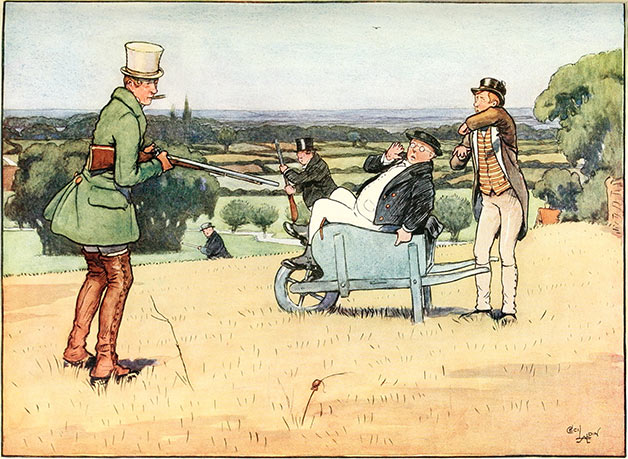
by Mr. Snodgrass, returned to their inn.