The Abyssinian Expedition.
At the end of September, 1867, the Postmaster-General,
Bombay, reported that a reconnoitring party under
Colonel Merewether, Political Agent, had left for
Abyssinia and a Field Force was shortly to follow. A
post office under Mr. J. Gardiner as Inspecting Postmaster sailed
for Abyssinia on the 25th November along with the second
detachment of the Expeditionary Force. A portion of the staff
was left at Massowah, where the troops disembarked, and the rest
was ordered to advance with the Army. Having fallen ill through
overwork, Mr. Gardiner was replaced by Mr. E. de C. Williams
on the 1st March, 1868.
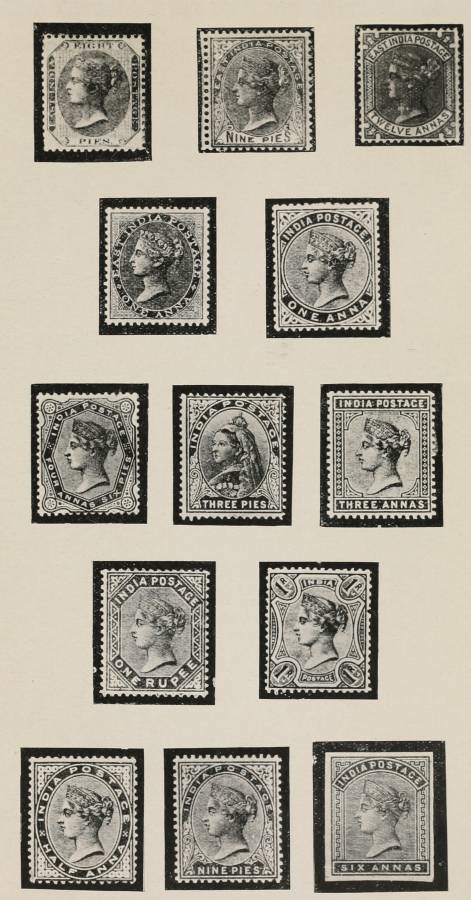
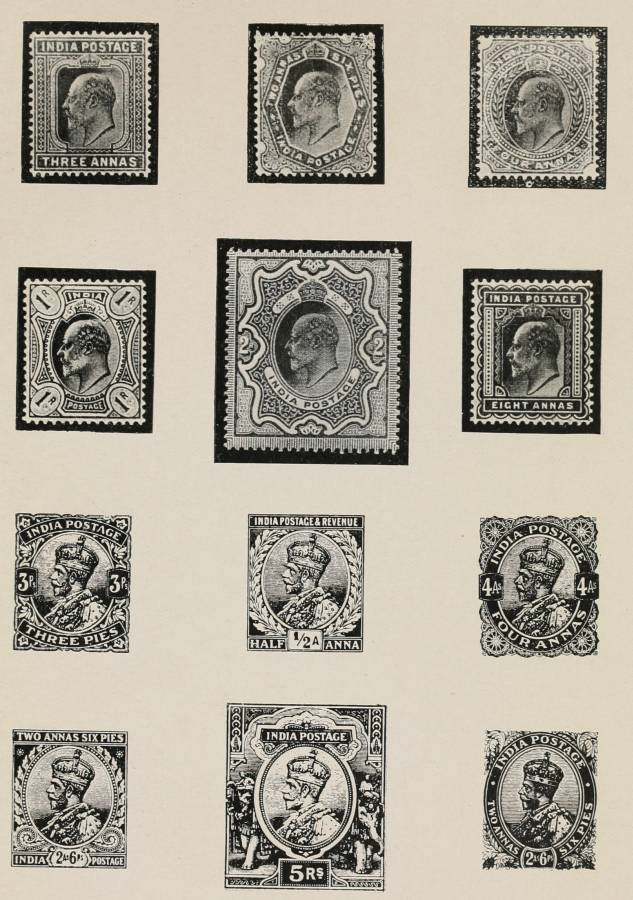
Ordinary postage stamps were used, the denominations of the
stamps supplied for the Field Force being ½ anna, 1 anna, 2 annas,
4 annas, 6 annas 8 pies, and 8 annas 8 pies. The postage payable
on articles for members of the Expeditionary Force was as follows:
Letters—4 annas for every ½ oz., 8 annas for 1 oz. and
8 annas for every additional oz. in excess of the first oz.
Newspapers—8 pies for 4 ozs., 1 anna 4 pies for 8 ozs.
Books—2 annas for 4 ozs., 4 annas for 8 ozs. and 4 annas
for every additional 8 ozs.
Prepayment in the latter two cases being compulsory. It does not
appear that parcels or money orders were exchanged or Savings
Bank transactions allowed.
The postal officials began to return from Abyssinia by the end
of June, 1868, the last batch arriving at Bombay on the 4th July.
The Afghanistan Expedition.
The war broke out in November, 1878, and Mr. J. H. Cornwall
was appointed to take charge of postal arrangements with the
column under the command of General Stewart, Mr. W. T. van
Someren with the column under the command of Major-General
F. S. Roberts, and Mr. J. L. Fendal with the Peshawar column.
The approximate strength of the whole force was about 45,000
fighting men and 60,000 camp followers. The mails between
Quetta and Kandahar were conveyed under the control of the
Political Agent and the military authorities.
When General Roberts moved out, a hill cart service was opened
from Kohat to Thull, a distance of sixty-four miles, in the Kurram
Valley. The principal difficulty was the work of organizing and
maintaining the mail lines, which were also used for conveying
military stores. Apart from the work done at the Post Office
workshops at Aligarh, workshops had to be opened at Rawalpindi,
Jund, Thull and other places for the construction and repair of
carts. In this expedition non-commissioned officers were taught
to do postal work, and whenever they were required to do so they
were allowed a postal salary of Rs.30 a month.
The control of the whole postal arrangements devolved upon
Colonel W. M. Lane, Postmaster-General, Punjab, and it was due
to his exertions that the arrangements met with success.
Malta Expeditionary Force.
In April, 1878, it was decided to send an Expeditionary Force
to Malta under Major-General J. Ross, C.B., and at the instance
of the military authorities a small postal staff, consisting of a postmaster
(Mr. Dinshaw Jijibhoy) with a clerk and three peons, was
selected to accompany the troops. The postal arrangements were
made under the direction of the Postmaster-General, Bombay, and
the Expeditionary Force started from Bombay on the 1st May,
1878.
When the island of Cyprus was ceded to Great Britain by
Turkey the Indian Contingent went to occupy it, and the postal
staff was accordingly ordered to embark for Cyprus. A British
post office was opened at Larnaka and Mr. Dinshaw was placed
in charge of it, and there he worked conjointly with the British
postal staff till his return to India on the 22nd August, 1878.
Shortly after Sir Garnet Wolseley came out from England as
Governor, and the island was then divided into six parts, each
with a Civil Commissioner and garrisoned by a regiment. The
Commissioners were ex-officio postmasters of their respective
divisions, and there was no regular arrangement between these
divisions for the exchange of mails, which were occasionally conveyed
by means of Japties or policemen. When Cyprus was first
occupied there was only a fortnightly communication with India
by means of the Austrian Lloyd Steam Navigation Company's
steamers; subsequently a weekly service was also established by
the Bells Asia Minor Line of steamers. A small Austrian post
office at Larnaka was permitted, and this served the entire island.
The field post office was opened at Malta on the 27th May and
closed at Cyprus on the 22nd August, 1878.
Egypt Expeditionary Force.
In the beginning of July, 1882, the Government of India
directed an Expeditionary Force of about 7000 men of all arms
for service in Egypt under the command of Major-General Sir
H. Macpherson, V.C., K.C.B.
The postal arrangements were made by Mr. Fanshawe, Postmaster-General,
Bombay, and Mr. J. H. Cornwall, who had special
experience of the management of field post offices in Afghanistan,
was selected as the Chief Superintendent of Field Post Offices.
The Indian field post office establishment started from Bombay
on the 22nd August, 1882, and returned there on the 31st October
of the same year.
Kalahandi Expedition.
The rising of Khonds in Kalahandi, an important feudatory
State in the Chattisgarh Division in Central Provinces, necessitated
the despatch of troops. In June, 1882, the Deputy Postmaster-General,
Central Provinces, reported that the rising was of
a serious character and that the country was not likely to be quiet
for some time. The troops marched from Sambalpur and Raipur,
and three field post offices were opened to serve them.
Mr. P. Gorman, Superintendent of the Division, was in entire
charge of the postal arrangements. The expedition lasted for only
a short time, but the communications had to be maintained till
about the end of the year.
Suakim Field Post Office, 1885.
In February, 1885, it was decided to send an Expeditionary
Force composed of Indian troops to Egypt, and the Director-General
was asked to make arrangements for a field post office to
accompany it. Mr. O'Shea, as Chief Superintendent, was in
charge of the postal staff, under the direction of the Postmaster-General,
Bombay.
The strength of the Expeditionary Force was 10,517, including
followers, and General Hudson, C.B., was in command of the
force. The postal staff started from Bombay on the afternoon of
the 24th February, 1885, and on the 7th March, 1885, arrived at
Suakim, where the Base post office was opened on the 8th current.
Mails were exchanged between Egypt and India by Government
transports and P. & O. packets. Only two officers, Messrs. O'Shea
and Lalkaka, received medals, and none were granted to the
subordinate postal staff. The field post office was closed in
November, 1885.
The Upper Burma Expedition.
On the 23rd October, 1885, the Government of India asked the
Director-General to make the postal arrangements for the Expeditionary
Force in Upper Burma. The strength of the Force
consisted of 10,000 fighting men and 2000 followers, besides 1000
dhooly bearers and 3000 coolies. On the 10th November, 1885,
the Expedition, under the command of Major-General H. N. D.
Prendergast, C.B., V.C., left Rangoon for Upper Burma by
steamers up the Irrawaddy river to Thayetmyo and thence by the
land route to Mandalay. Mr. G. Barton Groves, Deputy Postmaster-General,
Burma, was called on to organize the service and
accompany the Force as Deputy Postmaster-General in charge.
The Rangoon, Prome and Thayetmyo post offices were strengthened,
and the last-named was converted into a Base office. Five
field post offices were also opened on board the head-quarters
steamers of each of the five brigades which composed the force.
The Pishin Field Force.
In March, 1885, the Governor-General in Council decided to
increase the garrison in Baluchistan to a strength of three divisions
comprising about 25,000 men and 20,000 followers, and the necessary
postal arrangements had to be made. Mr. J. Short, Deputy
Postmaster-General, Sind and Baluchistan, was in charge, assisted
by Mr. E. Walker, Inspector of post offices.
In April, 1885, a head office was opened at Rindli, in Baluchistan,
which was designated the "Pishin Force Frontier Office," and the
Quetta post office was strengthened. Nine camp post offices were
also opened, and mails were carried to these offices by camels and
sowars.
Sikkim Expedition.
The orders for the despatch of a force for operations in Sikkim
were notified in the Gazette of India of the 3rd March, 1888.
Shortly after the commencement of hostilities the Government
of Bengal requested Mr. H. M. Kisch, Postmaster-General, Bengal,
to open a runners' line from Siliguri to Kalimpong, a distance of
thirty-seven miles. This line was used only for transmission of
letter mails, parcel mails being conveyed by the old route from
Darjeeling via Ghum and Pasok. On the 24th March the Padong
post office was converted into a sub-office, and from that date it
was constituted a Base office for the expedition.
On the 16th March the force, which concentrated at Padong,
moved out in two columns, one under Brigadier-General T.
Graham, R.A., commanding the expedition, and the other under
Colonel Michel, of the 13th Bengal Infantry, the former advancing
towards Fort Lingtu and the other towards the Rhenok Bazar.
With the advance of troops the post office opened at Dulapchin
was shortly removed to Ranglichu. Other post offices were opened
at Gnatong, Sedonchin, Gangtok, Rhenok Bazar and Pakyong.
The mail lines connecting these offices were under the management
of the Post Office as far as Ronglichu and Pakyong, but the
lines beyond were under the Political authorities.
The Black Mountain or Hazara Field Force.
Towards the beginning of September, 1888, the Home Government
having decided to send a punitive expedition against the
tribesmen of the Black Mountain, a Field Force was organized on
the Hazara frontier. The object of the expedition was to punish
the Khan Khel Hassanzai and the Akazai tribes. Brigadier-General
J. W. McQueen, C.B., Commanding the Punjab Frontier
Force, directed the expedition. On the 8th September, 1888,
Mr. W. T. van Someren, Superintendent of post offices, Rawalpindi
Division, was deputed to make the postal arrangements with
the force. Haripur was constituted a Base office for the Derband
column, and Abbottabad for the Oghi column. The tonga service
from Hassan Abdal to Abbottabad was strengthened and extended
to Mansera, and a mixed tonga and horse service was established
between Abbottabad and Oghi. A runners' line was opened from
Haripur to Derband. A railway sorting office, under the supervision
of Mr. N. G. Wait, was also opened at Hassan Abdal for
the sorting and onward transmission of articles for the Field Force.
The Chin Expedition, Burma.
In December, 1888, a small force of about 1200 men, besides
civil officers and followers, headed by Brigadier-General Faunce,
started for the Chindwin Division to quell a rising of Burmans
and to reduce to order the country which was then infested with
dacoits. The expedition was undertaken very suddenly, and the
Quartermaster-General in India asked the Deputy Postmaster-General,
Burma, to arrange for the opening of a field post office
at Kalemyo at a distance of twenty-seven miles from the base of
operations at Kalewa. About July, 1889, the country was brought
to a normal state and the troops were withdrawn.
The Lushai Expedition.
In 1888 the Government of India having decided to send a
punitive expedition against the Shendus and other tribes in the
Chitagong Hill Tracts, a small force under Colonel V. W. Tregear
was organized and concentrated at Demagiri. The force was
styled the "Lushai Expeditionary Force," and consisted of about
1200 men besides followers and coolies. An inspector was deputed
to make the postal arrangements. The boat line from Rangamati
to Demagiri, which was maintained by the Frontier Police, was
strengthened, also the post offices at Rangamati and Demagiri, the
latter being constituted a base office, and a post office was opened
at Barkul—half-way between Rangamati and Demagiri—where
there was a stockade of military police. The troops kept the field
for about four months and came back at the end of April, 1889.
The Chin Lushai Expedition.
In 1889 two armies operated in this expedition, one from Burma
and the other from Chittagong. The troops in Burma were
divided into two columns, one operating from Fort White as a
base against the Syins and other tribes, and the other starting
from Gangaw as a base and advancing via Yokwa on Haka. The
Chittagong force advanced from Fort Lungleh on Haka. Brigadier-General
W. P. Symons commanded the operations on the
Burma side, and Colonel Tregear commanded the Chittagong
column. The strength of the force concentrated at Gangaw
consisted of about 40 officers, 1200 European and Indian troops
and 2500 followers. The strength of the Chittagong column consisted
of about 3500 men besides followers and coolies.
On the Burma side much difficulty was experienced by the
supervising officers in organizing and maintaining the lines, which
lay over sandy beds of rivers, hillocks and jungles and on the
Chittagong side, on account of constant illness and the consequent
change of officials deputed. Mr. J. W. McCrea, Superintendent
of post offices, Burma Circle, was deputed to make postal arrangements
for the force under the direction of Mr. G. J. Hynes,
Deputy Postmaster-General, Burma. On the other side postal
arrangements were made by Mr. G. S. Clifford, Superintendent
of post offices, under the direction of Mr. G. Barton Groves,
Deputy Postmaster-General, Eastern Bengal.
The Zhob Expedition.
The object of the expedition was to explore the borders of the
Zhob Valley and to take steps either to capture the outlaw Dost
Muhammad or to expel him from the Kakar country and to coerce
the Khiddarzai Shirani tribe into submission.
Towards the middle of September, 1890, intimation was received
from the Quartermaster-General in India that a force of
about 2000 men, besides camp followers, was about to start for
the Zhob Valley, and on the 27th of that month a small field post
office, consisting of a sub-postmaster and two peons, started from
Quetta with a portion of the troops for Hindubagh, which was
to be the general rendezvous. The expedition was commanded
by Sir George White.
The Black Mountain Expedition.
In 1891 a force was sent for operations against the Hassanzai
and Akazai tribes of the Black Mountains. The strength of the
force, which was under the command of Major-General Elles, C.B.,
was about 6800 men, and it advanced from Darband in two
columns—one marching via Baradar and Pailam to Tilli, and the
other along the river route via Kotkai and Kunhar. The postal
arrangements were made by Mr. W. T. van Someren under the
direction of Mr. G. J. Hynes, Postmaster-General, Punjab.
The Chin Hills Expedition.
The Government of India sanctioned military operations in the
north and east frontier of the Bhamo district and Chin Hills
during the cold season of 1891-92. In the Bhamo direction the
object of the expedition was to explore the amber and jade mines,
the Hukong Valley and the country on the east and north-east
frontier above the Taeping river on the Chinese border. The
expedition had a quasi-military character, and about 5000 troops,
including police battalions, operated in various columns, under
the direction of Major-General R. C. Stewart, commanding the
Burma districts.
Mr. F. McCrea, Inspector of post offices, Eastern Division, was
deputed to organize and supervise the arrangements.
The Manipur Expedition.
The outbreak in Manipur in 1891, and the consequent massacre
of Mr. Quinton, the Chief Commissioner of Assam, and his party,
necessitated the despatch of troops to quell the rebellion. The
force was designated the "Manipur Field Force," and about
2500 men, including followers, operated from the Tammu side
and about the same number from Kohima and Silchar. Mr. W.
Roussac was in charge of the postal arrangements with the Tammu
column, and Mr. F. P. Williams, assisted by an inspector, with the
Kohima column. All correspondence for the Tammu column was
sent from India to Rangoon and thence by boats to Kindat.
From Kindat to Tammu the mails were conveyed by runners, and
a runners' line was opened from Tammu to Manipur. These
arrangements worked for a very short time on account of the rapid
advance of troops and their immediate return.
The Miranzai Expedition.
The object of the expedition, which was under the command
of Brigadier-General Sir William Lockhart, K.C.B., was to overawe
the recalcitrant Samil clans of the Urakzai tribe in the
Miranzai Valley. The force was ordered to the front in January,
1891, and advanced in three columns, the first column having its
base at Shahu Khel, the second at Tog and the third at Hangu.
Mr. A. Bean, Superintendent of post offices, Peshawar Division,
was placed in charge of field postal arrangements connected with
the force in addition to his own duties.
The Wuntho Expedition.
On the 15th February, 1891, the station of Kawlin was suddenly
attacked by a party of rebels from the Wuntho State, in Upper
Burma, and a few police who formed the garrison of the place
had to evacuate it. The post office had to be abandoned and the
sub-postmaster had to come away along with the other officials.
A combined force of police and military, consisting of about 2500
men, was at once organized and advanced on Wuntho from
Shwebo, Katha and Tigyaing to put down the rebellion and bring
the country under permanent occupation. The troops employed
were not designated a Field Force, and the postal arrangements
were therefore carried out on ordinary scale and not according to
the rules of the Field Service Manual.
The Isazai Field Force.
In September, 1892, the Government of India decided to
send out an expedition under Major-General Sir William Lockhart
to punish certain villages of the trans-Indus Isazai clans
who had harboured Hashim Ali Khan of Seri in contravention
of their agreement entered into at Seri in May, 1891. A
force of about 4000 men of all arms concentrated at Derband and
was styled the "Isazai Field Force." On the 17th September,
1892, Mr. C. J. Dease, Superintendent of post offices, was deputed
to make the special arrangements for the force with the assistance
of an inspector.
Kurram Field Force.
In the beginning of October, 1892, the Government of India
decided to depute a Political officer at the head of a force in the
Lower Kurram Valley. The object was to expel the Chikkai tribes
from the valley and to effect a thorough settlement of the country.
The force which accompanied the Political officer, Mr. W. R. H.
Merk, C.S.I., consisted of about 2500 men, including followers.
Mr. P. Sheridan, Postmaster-General, Punjab, arranged for field
post offices, and the Superintendent of post offices, Peshawar
Division, was placed in charge. By the end of October the presence
of troops in Kurram was no longer necessary, and the field
offices were closed with the exception of the head-quarters office,
which was retained for the use of the garrison.
The Wano Expedition.
In August, 1892, owing to disturbances in Afghanistan, a detachment
of troops had to be sent beyond the frontier to take up
position at Kajuri Kuch in the Wano country, thirty miles beyond
the Gomal Pass. As there was no post office at the place, arrangements
were made by the Superintendent of post offices, Derajat
Division, to send and receive mails via Gomal post office. In
September, however, owing to the despatch of further troops, the
Post Office was called upon to make arrangements. By the end
of April, 1893, the strength of the Kajuri and Jandola forces was
considerably reduced, and the postal establishments were gradually
abolished.
The Abor Expedition, 1894.
The only postal arrangements made in connection with this
expedition, which lasted for a very short time, were the opening
of a runners' line from Sadiya to Bomjur and the strengthening
of the delivery staff of Sadiya post office by an additional postman.
The Waziristan Field Force.
In August, 1894, the Government of India sanctioned the
despatch of troops to accompany the British Commissioner in
connection with the Afghan boundary demarkation. Pundit Shiv
Pal, the Superintendent of post offices, Derajat Division, was
placed in charge assisted by two inspectors, till he was relieved by
Mr. W. T. van Someren, who was placed on special duty in this
connection. The post office at Tank was temporarily converted
into a Base head office, and three field post offices were opened to
move with the force.
On the 3rd November the Mushud Waziri made a determined
night attack on the British camp at Wano, and, although the
attack was repulsed, it resulted in 120 casualties. In the beginning
of December, 1894, the Government of India having sanctioned
active operations in Waziristan, Lieutenant-General Sir William
Lockhart, who was now placed in command, asked for an
additional Superintendent, and Mr. A. Franks Ryan was placed
on special duty with the force.
The Chitral Relief Force.
In the middle of March, 1895, a scheme was prepared for field
operations in Chitral, the object of which was to compel Umra
Khan of Jandol to withdraw from the Chitral country, and the
Director-General was requested to make postal arrangements for
the force, which consisted of about 20,000 troops of all arms and
about 30,000 camp followers. This was the largest force mobilized
in India since the Afghan War of 1879, and the postal arrangements
had therefore to be made on a proportionately large scale.
The expedition was titled "The Chitral Relief Force" and was
commanded by Major-General Sir Robert Low, K.C.B.
On the 18th March, 1895, Mr. P. Sheridan, Postmaster-General,
Punjab, was requested by the Director-General to arrange field
post offices, and by the end of the month the postal staff, who were
collected at Nowshera, were in readiness to start. Mr. A. Franks
Ryan was the senior Superintendent in charge. In the early
stages of the campaign considerable difficulty was experienced by
the supervising officers in organizing lines for the conveyance of
mails. Mule transport being very limited, pack bullocks had to
be used for the first few days, and when those were withdrawn a
temporary runners' line had to be opened. Information, however,
was shortly received that the country was open as far as Durgai,
a distance of forty-one miles from Nowshera, and arrangements
were made with Messrs. Dhanjibhoy to open a tonga line.
On the 30th March the force moved out to Mardan and the
head-quarters field post office went with it. On the 22nd April,
1895, information was received that Colonel Kelly had succeeded
in reducing the Chitral fort from the Gilgit side, and a further
hasty advance of troops was therefore no longer necessary. With
the occupation of the Chitral territory by the 3rd Brigade the
expedition practically came to an end. The Abbottabad Force
was broken up on the 31st May, 1895.
Suakim Expedition, 1896.
In May, 1896, under orders from the Home Government, an
Expeditionary Force, 3000 strong, was sent to Suakim under the
command of Brigadier-General C. C. Egerton, C.B., D.S.O., and
a field post office was ordered to accompany it. The chief of the
postal staff was Mr. Bennett, who, however, did not hold the rank
of Chief Superintendent as the Force was too small. It started
on the 22nd May, 1896, and arrived on the 1st June at Suakim,
where the Base office was opened. Subsequently a sub-office was
opened at Tokar, and the exchange of mails between this office
and the Base office was carried on by camel dak twice a week.
There was fortnightly communication between India and Suakim
by Egyptian steamers, and parcel and letter mails were conveyed
by these and by P. & O. steamers. The field post office was closed
on the 8th December, 1896.
The Malakand Field Force.
On the 31st July, 1897, the Adjutant-General in India forwarded
to the Director-General a scheme for operations in the
Malakand country, and Mr. P. Sheridan, Postmaster-General,
Punjab and N.-W.F., was requested to make special postal arrangements
for the force. Mr. H. C. Sheridan, Assistant Director-General
of the Post Office, was placed in charge.
By the middle of August all the troops forming the 1st and 2nd
Brigades went across the Malakand to the Swat Valley. In the
meantime, fresh trouble having arisen round and about Peshawar,
the Government of India issued orders for punitive operations
against the Mohmands, who had invaded British territory and
attacked the village and fort of Shabkadar, nineteen miles from
Peshawar. Accordingly a strong force was concentrated about the
place, and Mr. C. A. Stowell was deputed to Peshawar to make
special postal arrangements for this force. "The Mohmand Field
Force," under Major-General Ellis, left Shabkadar on the 15th
September and returned to Peshawar on the 8th October, 1897.
During the expedition a small force was sent to Abazai to guard
the works of the Swat Canal, and a field post office accompanied
it.
On New Year's day of 1898 orders were issued for an advance
to Buner, and the 2nd Brigade marched to Katlang, which was at
once connected with Mardan by an ekka service, later extended to
Sanghao. There were now two ekka services—one from Mardan
to Rustam, a distance of nineteen miles, and the other from
Mardan to Sanghao, a distance of twenty-one miles. On the 9th
January the name of the force was changed to the "Buner Field
Force." The postal arrangements for this force, which was not
in existence for more than a fortnight, were in the hands of
Mr. N. M. Cama, Superintendent of post offices.
The Malakand Field Force began to be demobilized on the 22nd
January, 1898, but only a small portion of the troops returned to
India. The rest went forward and became part of the Swat
garrison. In this expedition arrangements were made for the first
time for the sale of newspapers by field post offices, a service which
was greatly appreciated. So efficient were the postal arrangements
and the regularity of the tonga service that the mails to and from
the front travelled with a punctuality which would compare
favourably with any long-established line in India.
The Tirah Expedition.
On the 17th September, 1897, the Director-General was asked
to make arrangements for a postal service for the Expeditionary
Force to be sent against the Afridi and Orakzai tribes on the
Kohat and Peshawar frontier. The Postmaster-General, Punjab
and N.-W.F., Mr. P. Sheridan, was immediately communicated
with, and Mr. van Someren was appointed Chief Postal Superintendent
with the expedition.
The Base post office for the main force was at first situated at
Kohat, and the Base office for the Peshawar column at Peshawar.
When the troops marched through Tirah and took up their position
for the winter in the Bara Valley, the Khyber Pass and the neighbourhood
of Peshawar, Messrs. Dhanjibhoy established two tonga
services connecting Peshawar with Bara and Jamrud, while beyond
these places they arranged for the carriage of mails by a
horse post. The mail service for the Peshawar column previous
to this had been carried on by the Afridi horse contractors, and
as the roads were improved the tonga services were extended up
to Landi Kotal in the Khyber Pass and Gandao in the Bara
Valley.
The postal arrangements lasted for a period of six months. On
this occasion, too, the field post offices were specially authorized
to sell newspapers to the troops and were allowed a commission
on the sales.
The Tochi Field Force.
The postal arrangements in connection with the Tochi Field
Force lasted for a period of about eight months, from July, 1897,
to February, 1898.
The base of the operations was Bannu, which is 111 miles away
from the railway at Khushalgarh, and, as soon as it was known
that a force was to be mobilized at Bannu, arrangements were
made for the introduction of an efficient tonga service from
Khushalgarh to that place and for a proper railway connection
between Golra and Khushalgarh. Between Khushalgarh and
Kohat a feeble tonga service was already in existence under the
management of the District Board of Kohat, while for the local
demands an ekka service had been established between Kohat and
Bannu. Neither of these lines could be relied upon to meet the
special requirements for mails and passengers caused by the expedition,
and Mr. Dhanjibhoy, the mail contractor of the Rawalpindi-Srinagar
line, established a complete and efficient tonga
service over the entire distance.
The postal arrangements were carried out very satisfactorily.
Mr. W. T. van Someren was in charge of the actual arrangements
in the field from the beginning till September, 1897, when he was
relieved by Mr. F. O'Byrne, who remained in charge during the
remainder of the operations.
The Tochi Valley Field Force.
After the breaking up of the Tochi Field Force in December,
1897, it was decided to retain in the valley a brigade of troops on
field service scale under the command of the General Officer
Commanding, Tochi. The troops were quartered in six military
posts, and camp post offices were opened to serve them. During
the Tochi Expedition there was a tonga service between Edwardesabad
and Bannu, but this having been discontinued a new
arrangement had to be made for a tonga service with Messrs.
Dhanjibhoy and Sons for the conveyance of mails between
Khushalgarh and Kohat and an ekka service between Edwardesabad
and Miranshah and Datta Khel.
The Swat Valley Column.
When the second division of the Tirah Force was demobilized
it was decided to retain a strong column in the Swat Valley to
take up positions in Dir territory for the protection of the line
of communications and the route of the relieving and relieved
Chitral Force. The arrangement necessitated the opening of three
field post offices from the 1st May, 1898, and from the same date
the Swat Sorting Office at Nowshera was strengthened. It was
also decided to retain the services of a Superintendent to accompany
the column up to Dir territory and return with the relieved
troops from Chitral.
The postal arrangements had to be maintained till the end of
June, when the column having been considerably reduced, two
field offices were abolished and only one was retained till the 15th
July, 1898.
The Mishmi Expedition.
In November, 1899, the Director-General was requested to open
a field branch post office at Bonjur and connect it by a runners'
line (twenty-four miles long) with Sadiya, where there was a civil
post office. This place was made the base of operations of the
Mishmi Field Force. About 200 military police and 1000 regular
troops operated in this expedition, which began in December,
1899, and ended in January, 1900. The Bonjur office was opened
on the 1st December, 1899, and closed on the 9th February, 1900.
The China Expeditionary Force.
At the request of the Home Government, a force entitled
"The China Expeditionary Force" was mobilized in India for
service in China under the command of General Sir A. Gaselee.
The first intimation of the despatch of the army was received on
the 29th June, 1900. This, however, referred only to one brigade
of troops of all arms; but on the 25th June intimation was received
that a force of two brigades with divisional troops were
under orders for China. The control of the field postal arrangements
was in the hands of Mr. Stewart-Wilson, Postmaster-General,
Punjab, under whose orders the postal staff was mobilized
and equipped. At first it was decided to fit out twelve field post
offices to accompany the force. Mr. W. T. van Someren was
appointed Chief Superintendent, and Mr. A. Bean and Mr. A. B.
Thompson were selected to work under him.
By the end of August, 1900, the force in China was strengthened
by a cavalry brigade, one infantry brigade and three large coolie
corps, and the postal staff had to be supplemented. Thus by the
end of the year there were in China:
| 1 | Chief Superintendent. |
| 4 | Superintendents. |
| 4 | Inspectors. |
| 1 | Postmaster. |
| 2 | Deputy Postmasters. |
| 20 | Sub-Postmasters. |
| 53 | Clerks. |
| 76 | Followers. |
On the 29th June, 1900, a notification was issued regarding the
conditions under which postal articles could be exchanged with
the China Expeditionary Force. The Indian Base office was at
first opened at Linkung-tao (Wei Hai Wei), but was shortly transferred
to Hongkong. Articles for the force were despatched by
the steamers of the B.I.S.N. Company, the Messageries Maritimes
and also by the Opium steamers to Hongkong. The Colonial
post office at Hongkong had an arrangement with all merchant
vessels binding them to carry mails as far as Shanghai, and owing
to the courtesy of the Postmaster-General, Hongkong, this concession
was made use of to carry the mails of the Field Force.
North of Shanghai the mails were carried by transports and
men-o'-war. Later on the Chinese Imperial Postal Authorities
carried our mails from Shanghai to Taku and back free of charge
until the latter port was closed by the winter ice. Another route
had then to be chosen for the North China mails, and once more
we had to resort to the kindness of the Imperial Chinese Post Office,
who agreed to supply transport from Chifu to Chaingwantao twice
a week on condition that half the cost of the coal used should be
paid. Thus the mails were conveyed from Hongkong to Shanghai,
from Shanghai to Chifu and from Chifu to Chaingwantao and
thence to Tientsin. The chief postal land routes were (1) Taku
to Pekin and (2) Tientsin to Shanhaikwan.
Dollar currency was used in the field offices, the rate of a dollar
being fixed at 1s. 11d., equivalent to Rs.1.7.0. The first postal
detachment took with them a full supply of postage stamps, postcards,
etc., but it was found inadvisable to use them owing to the
fact that it would be impossible to sell them at a price exactly equivalent
to face value. At Hongkong the postal equivalent for
10 centimes, i.e. 1 anna, is 4 cents. It followed, therefore, that
twenty-five 1-anna stamps could be bought for a dollar and that
the purchaser would be able to make 2 annas for every dollar spent
on stamps, and it was feared that advantage would be taken of
this to buy up Indian stamps wholesale for remittance to India.
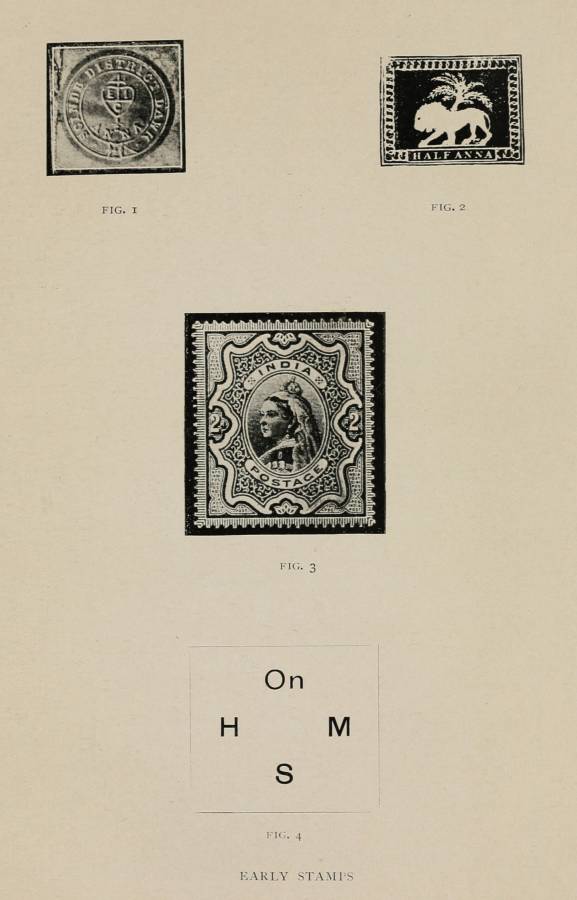
The postage stamps were therefore overprinted with the letters
"C.E.F.," i.e. "China Expeditionary Force," so that their use
would be localized, and the surcharged stamps came into circulation
about the middle of August, 1900. In order to confine the
use of field offices to the members of the force, orders were issued
that our postage stamps should not be sold except to soldiers and
officers in uniform. The rates of postage fixed for all purposes
were those in force in India, the postage to India being reckoned
at Indian inland rates.
Difficulty had all along been felt in supplying postal facilities
to the small bodies of troops stationed at or near railway stations
where there were no post offices. Mr. van Someren removed this
difficulty by introducing a combined Post and Railway Mail
Service between Pekin and Taku and Tientsin and Shanhaikwan,
a scheme which was a new one in the history of the field postal
service. Postal clerks had not only to sort letters in the trains, but
also to receive and deliver letters and sell postage stamps at each
railway station. By August, 1901, there was a reduction of the
number of troops in China and fourteen field post offices were
closed, the supervising staff being reduced to a Chief Superintendent
and an inspecting postmaster in North China and a
Superintendent and an inspecting postmaster at Hongkong. Mr. van Someren
left China on the 5th August, 1901, leaving Mr. Thompson
in charge.
This was the first occasion that a large postal establishment had
to be sent out with a military expedition overseas to a foreign
country. The force consisted of over 37,000 men stationed at
various places from Shanghai to Taku and Taku to Pekin. The
harmonious relations with the Chinese Imperial Postal Administration
and the material assistance which it rendered on every
possible occasion greatly helped to the success of the Indian Field
Post Office administration in China.
The Somaliland Field Force.
The postal arrangements made to serve the Somaliland Field
Force extended over a period of nearly two years from January,
1903, to November, 1904. Mr. Wynch, who was appointed Chief
Superintendent, remained till June, 1904, when he was invalided
and relieved by Mr. A. J. Hughes, who held charge until the end
of the operations. The strength of the force was 3000, and at
first one base office and one field post office, with one postmaster,
five clerks and four packers, were provided. Mails were exchanged
between India and Somaliland by Government transports. The
field post offices were closed on the 25th November, 1904.
The Tibet Mission.
In 1903 the Government of India decided to send a small force
to escort the Tibet Frontier Commission. At first a number of
temporary post offices and lines were opened under the control of
the Superintendent of post offices, Jalpaiguri Division, to serve
the Mission, but it was not until it was decided that the Mission
should advance into the Chumbi Valley that field post offices and
lines were required. The Mission was headed by Colonel Younghusband
and the escort was commanded by General MacDonald,
with Mr. H. Tulloch as Chief Superintendent.
The rapid development of field post offices necessitated the
appointment of a second Superintendent, and Mr. A. Bean was
deputed to field service. On the 6th January, 1904, Mr. Bean
took over charge of the Base Division, but shortly after died of
heart disease on the 3rd March, 1904. The entire arrangements
then devolved again on Mr. Tulloch until the 1st April, 1904,
when Mr. C. J. Dease took over charge of the Base Division.
The Mission advanced on Gyantse on the 4th April. From
Tuna to Gyantse the mail arrangements were in the hands of the
military authorities, and only one postal clerk, whose duty it was
to distribute letters, was sent up with the escort. The Mission
reached Gyantse on the 14th May, and a field post office had to
be opened there and at several other places on the lines of communications.
The force remained at Lhassa from the 3rd August
to the 23rd September and returned to Gyantse on the 6th
October, 1904. There was by this time at Gyantse an accumulation
of over 1100 parcels addressed to the members of the Lhassa
column, but Mr. Angelo, who was then placed in charge of the
advance division, disposed of them in three days before the troops
left on their return march. The demobilization of the force began
by the end of October, and the postal officials were ordered to
leave Chumbi on the 26th and to close the field post offices between
Chumbi and Gangtok on their way down. Mr. Tulloch relinquished
charge of the F.P.O.'s on the 28th November, 1904.
The Bazar Valley Field Force.
The postal arrangements made to serve the Bazar Valley Field
Force extended over a period of twenty-five days, from the 13th
February to the 8th March, 1908. On the night of the 12th
February the Chief of the Staff informed the Postmaster, Peshawar,
that the force would leave the station the next morning. A
base office, four first-class field post offices and three second-class
field post offices were sent to the front, and on receipt of the
scheme for the organization and mobilization of the force on
the 14th February this establishment was reduced considerably.
The work of the field post offices on this occasion was limited
almost entirely to the disposal of articles of the letter and packet
mails.
The Mohmand Field Force.
The postal arrangements made to serve the Mohmand Field
Force extended over a period of thirty-eight days, from the 28th
April to the 4th June, 1908. The first intimation that an expedition
would take place was received on the 23rd April, and the
Postmaster-General, Punjab and N.-W.F., was at once directed to
make all arrangements to serve the troops that were concentrating
on the frontier. Mr. McMinn, who was Chief Superintendent
of post offices with the Bazar Valley Field Force, was placed in
charge.
The Abor Expeditionary Force, 1911-12.
The postal arrangements made to serve the Abor Expeditionary
Force extended over a period of about one year, from May, 1911,
to May, 1912. A temporary post office was first opened on the
15th May, 1911, at Saikwaghat, a terminus of the Dibru-Sadiyah
Railway, to serve the troops making preparations there for the
expedition. The office was under the control of the Superintendent
of post offices, Upper Assam Division. It was not until
September, 1911, when the force advanced towards Kobo, that
the Department was called upon to organize a field postal service.
The arrangements were placed under the control of the Postmaster-General,
Eastern Bengal and Assam, and for the supervision
of the work in the field Mr. A. J. Faichnie, Superintendent of post
offices, Upper Assam Division, was, in addition to his own duties,
appointed Superintendent of Field Post Offices, assisted by an
inspector.