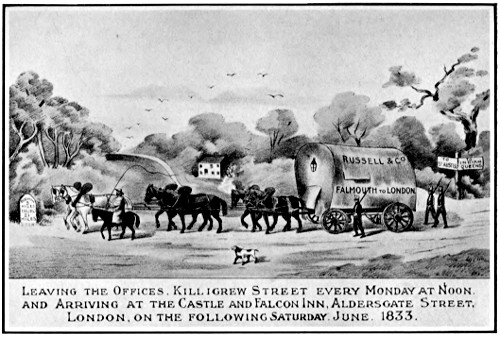
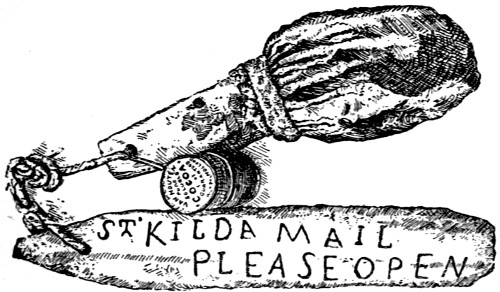
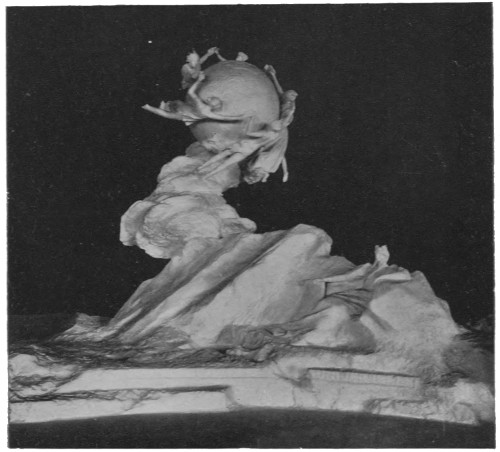
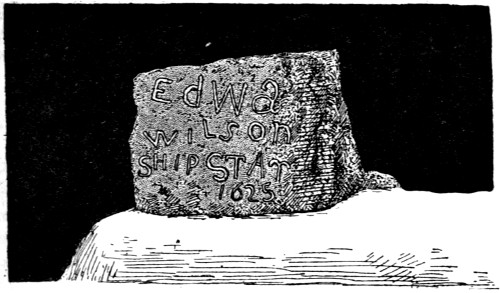
Footnotes have been collected at the end of each chapter, and are
linked for ease of reference. Most illustrations are full-page
photographs. These were described by a simple caption as well as a
brief paragraph. They have been moved slightly to avoid falling on
a paragraph break. These pages, and their blank reverse, were not
counted in the pagination of the book.
Minor errors, attributable to the printer, have been corrected. Please
see the transcriber’s note at the end of this text
for details regarding the handling of any textual issues encountered
during its preparation.
Any corrections are indicated using an underline
highlight. Placing the cursor over the correction will produce the
original text in a small popup.
Any corrections are indicated as hyperlinks, which will navigate the
reader to the corresponding entry in the corrections table in the
note at the end of the text.
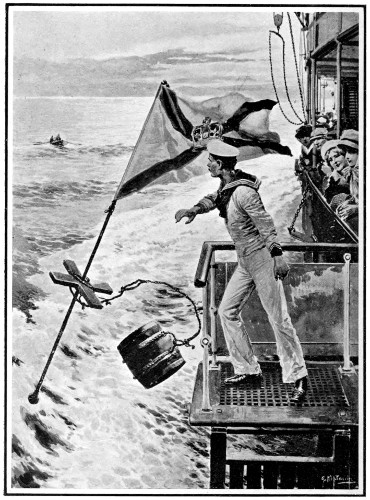
Heaving Overboard the Mails.
Fernando Noronha is a little island in the South Atlantic Ocean, and when a vessel does not call there the letters are enclosed in a cask, to which a flag is attached; this is cast into the sea and there left floating until a boat from the island picks it up. The island is sighted by perhaps more ships and visited by fewer than any other spot on the globe.
ITHE POST OFFICE
AND ITS STORY
AN INTERESTING ACCOUNT OF
THE ACTIVITIES OF A GREAT GOVERNMENT
DEPARTMENT
BY
EDWARD BENNETT
With 31 Illustrations
LONDON
SEELEY, SERVICE & CO. LTD.
38 Great Russell Street
1912
IITHE SCIENCE OF TO-DAY SERIES
With many illustrations. Extra Crown 8vo. 5s. net.
BOTANY OF TO-DAY. A Popular Account of the Evolution
of Modern Botany. By Prof. G. F. Scott Elliot, M.A.,
B.Sc., Author of “The Romance of Plant Life,” &c. &c.
“One of the books that turn botany from a dryasdust into a fascinating
study.”—Evening Standard.
AERIAL NAVIGATION OF TO-DAY. A Popular
Account of the Evolution of Aeronautics. By Charles C.
Turner.
“Mr. Turner is well qualified to write with authority on the subject.
The book sets forth the principles of flight in plain non-technical language.
One is impressed by the complete thoroughness with which the subject is
treated.”—Daily Graphic.
SCIENTIFIC IDEAS OF TO-DAY. A Popular Account,
in Non-technical Language, of the Nature of Matter, Electricity,
Light, Heat, Electrons, &c. &c. By Charles R.
Gibson, F.R.S.E., Author of “Electricity of To-Day,” &c.
“Supplies a real need.... Mr. Gibson has a fine gift of exposition.”—Birmingham
Post.
ASTRONOMY OF TO-DAY. A Popular Introduction in
Non-technical Language. By Cecil G. Dolmage, LL.D.,
F.R.A.S. With frontispiece in colours, & 45 other illustrations.
“Dr. Dolmage has absolutely kept to his promise to introduce the
reader to an acquaintance with the astronomy of to-day in non-technical
language.”—Saturday Review.
ELECTRICITY OF TO-DAY. Its Work and Mysteries
Explained. By Charles R. Gibson, F.R.S.E.
“Mr. Gibson has given us one of the best examples of popular
scientific exposition that we remember seeing. His book may be
strongly commended to all who wish to realise what electricity means
and does in our daily life.”—The Tribune.
ENGINEERING OF TO-DAY. A Popular Account of the
Present State of the Science, with many interesting Examples,
described in Non-technical Language. By Thomas W.
Corbin. With 73 illustrations & diagrams.
“Most attractive and instructive.”—Record.
“The descriptions which are given of various types of engineering
structures and work are excellent.”—Yorkshire Observer.
“Altogether a most delightful book.”—Literary World.
MEDICAL SCIENCE OF TO-DAY. A Popular Account
of the more recent Developments in Medicine & Surgery.
By Willmott Evans, M.D., B.S., B.Sc. (Lond.), F.R.C.S.
(Eng.), Surgeon to the Royal Free Hospital.
MECHANICAL INVENTIONS OF TO-DAY. An
Interesting Description of Modern Mechanical Inventions told
in Non-technical Language. By Thomas W. Corbin, Author
of “Engineering of To-Day.” With 95 illustrations &
diagrams.
SEELEY, SERVICE & CO. LIMITED
AUTHOR'S NOTE
v
A great deal has been written about the General Post
Office in newspapers and magazines, but the books on
the subject are comparatively few. And these volumes
are either exhaustive historical treatises, such as Mr.
Herbert Joyce's History of the Post Office, or more popularly
written descriptions of Post Office life and work
of the character of Lewin's His Majesty's Mails or
J. W. Heyde's Royal Mail. Mr. Joyce's work, however,
carries us no farther than the eve of penny postage,
while the other books were written too long ago to be
a guide to the Post Office of to-day. It is within the
last twenty years that the Department has made the
most rapid strides in the extension of its activities,
and it is this period especially which is without an
historian.
What I have attempted to do is to tell the story of
the Department, briefly in its early beginnings, more
fully in its modern developments, and in such a way as
to give the reader the impression that the Post Office is
alive, that it is in close touch with the needs of the
nation, and is in less danger of being strangled with
red-tape methods than at any time of its existence.
A book on the Post Office written for the student
should contain abundant references to authorities and
exhaustive tables of figures and estimates, but in the
interest of the general reader I have omitted these
aids to reflection. Mark Twain, when he published one
viof his novels, said he had omitted all descriptions of
scenery in the story, but those who liked that sort of
thing would find it in the appendix. I have dispensed
even with an appendix, and those who really want
figures and estimates must be referred to the Postmaster-General's
Annual Reports.
Of course I am largely indebted to the volumes I
have mentioned and to others for the historical portions
of my book. To Sir Rowland Hill's Life, written by his
daughter, I owe many of the facts contained in my
chapter on “The Penny Post.”
The staff of the General Post Office have during
the last twenty-one years conducted a magazine entitled
St. Martin's le Grand, the volumes of which have been of
great assistance to me, as they will be in the future to a
more serious historian of the Post Office than I can
claim to be. Among the writers to this magazine whose
contributions I have found of great use are A. M.
Ogilvie, J. A. J. Housden, C. H. Denver, R. C. Tombs,
I.S.O., and R. W. Johnston. Mr. Johnston, who had
held during a long life several important posts in the
Department, took a keen interest in this book in its early
stages, but, to my great regret, died before it was completed.
Articles by J. G. Hendry and W. C. Waller
helped me considerably in my chapter on “The Travelling
Post Office.” Mr. E. Wells and Mr. A. Davey gave
me their kind help on the subject of “Motor Mails” and
“The Parcel Post,” and to my friend Mr. A. W. Edwards
I am indebted for most valuable assistance in the writing
of my chapters on “The Telegraph.” I have also to
thank another friend, Mr. R. W. Hatswell, for advice and
help in many directions.
My acknowledgments are due to Messrs Jarrold
and Sons of Norwich and Warwick Lane, E.C., for their
viikind permission to include a schoolboy's essay on the
postman in my chapter dealing with that official. The
essay is to be found in a book entitled The Comic Side of
School Life, by H. J. Barker.
The Post Office has many critics, friendly and unfriendly,
but it counts itscounts its friends in millions, and I have
written this book with the belief that a closer knowledge
of the Department with which we all have dealings
will be acceptable.
A schoolboy who was given the task of writing an
essay on the Post Office used these words: “The Post
Office contains the whole world's circumstances, or
welfare, day after day, as a mother shuts all her chickens
under her wings. A man would not reveal his very
secreate words to his wife or to any one, but he trusts
them to a weak envelope in the Post Office.” This boy
was perhaps wiser than he knew. For there is no institution
existing in the country which comes so near to the
hearts and homes of the British people as the General
Post Office. Created primarily for the despatch and
delivery of letters, it has developed into a vast organisation
which is at once the carrier of the people's correspondence
and parcels, the people's bank, and the
agency by which all communications by telegraph and
telephone are conducted. To tell the story of that
organisation, how from the smallest beginnings in the
Middle Ages it developed into the Post Office of the
present day, would be a delightful task, but my intention
is rather to relate its modern triumphs and to deal
18with its history so far as it helps us to understand the
position of things to-day.
It is usual, in telling the story of the Post Office, to go
as far back as Greek, Roman, and Jewish times. In
almost every book and article on the subject we are
reminded that Ahasuerus sent letters into all provinces
concerning his wife Vashti, and that Queen Jezebel has
at least one urbane action to her credit in that she
despatched the first recorded circular letter. Then we
are reminded that Cicero and Pliny were accomplished
correspondents, and that St. Paul wrote letters which
have had a wide circulation. But these instances usually
belong to the history of letter-writing and have little
relation to our subject. It is obvious that so soon as
letters began to be written in any nation they must have
been despatched by some means or other to the persons
for whom the communications were intended. Ancient
history has many instances of posts specially created for
the delivery of perhaps only one letter. The story of the
Post Office can only properly begin at the time when
the first efforts were made to systematise what was
already a prevailing habit of the people.
The history of the British Post Office as a system can
be divided into three periods. There was the age of the
post-horses and postboys, extending from the time of
the Tudors far into the eighteenth century. There was
the age of the mail coaches, the romantic age of the
General Post Office, full of stirring deeds and adventures.
Indeed the title “His Majesty's Mails” would have
accurately described the whole of the business transacted
by the British Post Office during these centuries.
Lastly there is the age in which we are living, the age
of the mail train, which has produced a wide extension
of the duties of the Department, and the despatch and
delivery of letters is now only one of its activities.
19There is possibly another age in the near future of
which we can already distinguish the dawn, that of the
airship and aeroplane, but we are dealing in these pages
with only accomplished facts.
There is little doubt that the first posts organised
in this country were simply for the transmission of
public despatches, and though from time to time attempts
were made by private individuals to organise posts of
their own, these efforts met with but little success, and
in 1637 it was ordered by proclamation that no other
messengers or foot posts were to carry letters except
those employed by the King's Postmaster-General, unless
to places untouched by the King's posts. This order
marked the beginning of the monopoly which ever since
has been in the hands of the Government.
The word “post” comes to us from the French; in
early English records the carrier of the post is called
a runner or a messenger. We assimilated the word
under the Tudors, and the first man to be described
as Master of the Posts was Brian Tuke, appointed by
Henry VIII. in 1509. In this reign there was a service
more or less regular between London and Berwick and
between London and Calais. The Dover road is probably
the oldest mail route in the kingdom. During
the sixteenth and seventeenth centuries services were
gradually extended to Scotland, Ireland, and the West
of England.
The posts were slow and unreliable. The roads of
this country were for several centuries in a wretched
condition, and travelling was difficult and dangerous.
The causeway or bridle-track ran down the middle
of the road, while “the margin on either side was
little better than a ditch, and being lower than the
adjoining soil and at the same time soft and unmade,
received and retained the sludge.” The authorities
20were chiefly concerned to preserve the causeway, for
the mails were carried by runners or postboys on
horseback. The maximum speed for the postboys
allowed by the Master of the Posts was seven miles
an hour: there was no authorised minimum, and the
speed, including stoppages, rarely exceeded four miles
an hour. Moreover the postboys were undisciplined
and a source of infinite trouble to their employers.
The postmaster on the other hand frequently considered
that any horse was good enough to carry the mails,
and the animals he supplied were a disgrace to the
service. The temptations of the wayside inn often also
explained the long delays. An official in the early part
of the eighteenth century complained that “the gentry
doe give much money to the riders whereby they be
very subject to get in liquor which stops the males.”
The words, “Haste, Post, haste,” have been found
on the backs of private letters written at the close of
the fifteenth century, and this was no formal endorsement
but an urgent appeal to the lazy postboy to hurry
up. “Ride, villain, ride,—for thy life—for thy life—for
thy life,” appeared also on letters with sketches of a
skull and cross-bones or of a man hanging from a
cross-bar. It was thought desirable to frighten the
servant of the Government into the performance of
his duties.
The towns on the route were bound to supply the
horses for the King's posts. The postmasters in each
town were the persons immediately responsible for this
business, and it is interesting to know that one of the
qualifications for the situation was the ability of the
candidate to furnish a certificate under the hand and
seal of the Bishop of the diocese that he was conformable
to the discipline of the Church of England, and
he was required to receive the Sacrament of the Lord's
21Supper three months after admittance to office. The
postmaster was frequently the innkeeper: he was the
person best able to supply horses; and though his salary
was small, the position was probably remunerative, as
travellers were drawn to his house.
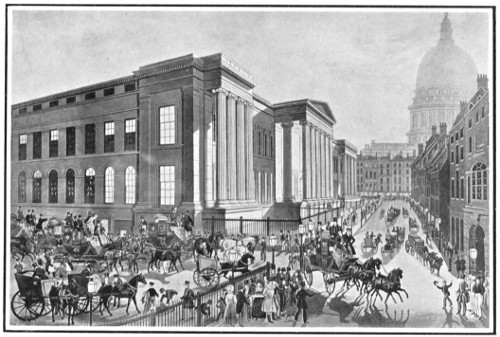
The Mail Coaches Leaving London.
In the early part of the nineteenth century one of the sights of London was the departure from St. Martin's le Grand every
evening of the mail coaches bound for all parts of England.
But we must not forget the foot posts in the old days, or
runners as they are usually called. In the year 1715 there
was not a single horse post in Scotland, all the mails
being conveyed by runners on foot. Cross posts were
frequently undertaken by runners, and the runners were
not extravagantly paid for their services. A post-runner
travelled from Inverness to Lochcarron—a distance,
across country, of about fifty miles—making the journey
once a week, for which he was paid five shillings.
Naturally there was much difficulty with them, and they
were continually at the mercy of highwaymen. Moreover,
in spite of the penalty of capital punishment
being visited on those who robbed his Majesty's mails,
the postman himself was a frequent offender.
The difficulties of travelling in the seventeenth
century are illustrated by the fact that in 1626 nearly
£60 was spent in setting up wooden posts along the
highway and causeway, near Bristol, for the guidance
of travellers and runners. A Government running
post then existed from London to Bristol. There is a
spirited description in Cowper's Task of the arrival of
the mail which would have been applicable during the
whole of the postboy period:—
“Hark, 'tis the twanging horn! O'er yonder bridge,
That with its wearisome but needful length
Bestrides the wintry flood, in which the moon
Sees her unwrinkled face reflected bright,
He comes the herald of a noisy world,
With spattered boots, strapped waist and frozen locks,
News from all nations lumbering at his back.
22True to his charge, the close packed load behind,
Yet careless what he brings, his one concern
Is to conduct it to the destined inn,
And having dropped the expected bag, pass on.”
Such was the service with which our forefathers
were more or less contented during the greater part
of two centuries. At the end of the seventeenth
century there were weekly posts to many parts of the
country: there was a mail six days a week along the
Kent road: at any place where the Court happened to
be in residence a daily post was at once created, and
during the season at Bath and Tunbridge Wells the
visitors enjoyed the privilege of a daily despatch and
delivery of letters.
It was not until late in the eighteenth century that
any radical alteration in the system took place. For
many years it had become a reproach against the Post
Office that it had not kept pace with the travelling
capacities and requirements of the time. What were
called “Flying Coaches” had been established in the
seventeenth century to many towns in the Kingdom,
and while these conveyances were increasing in speed
and comfort the Post Office was still satisfied with its
four or five miles an hour. The slowness of the posts
was in fact becoming intolerable to the people. The
General Convention of the Royal Burghs of Scotland
called the attention of the Postmasters-General to the
slowness of the posts on the Great North Road. “Every
common traveller,” they wrote, “passed the King's
mail on the first road in the kingdom,” and complaints
were made, generally by traders and professional men,
that business was hampered by the backwardness of
the Post Office.
To John Palmer, proprietor of the theatre at Bath,
belongs the credit of the proposal to use the coach for
23the carriage of the mails. He was remorseless in his
description of the system he wished to abolish. The
correspondence, he said, “was entrusted to some idle
boy without character mounted on a worn-out hack,
who so far from being able to defend himself against
a robber, was more likely to be in league with one.”
Palmer's duties carried him into many parts of the
country, and he thought letters should be conveyed at
the same pace at which it was possible to travel in a
chaise. He submitted his plan to Pitt, who was Prime
Minister, and this statesman gave his warm approval to
a trial of the scheme. On the 2nd August 1784 the first
mail coach started from Bristol, and so successful was
the experiment that in the following year there were
coaches running to all parts of the Kingdom. Then
ensued a period of great activity on the part of the
General Post Office. There was competition with the
private coaches, and year after year there were attempts
to make records and to accelerate the mails.
The mail-coaching period extended a little over fifty
years, and it marked as great an advance on the service
of the past as the mail train has since shown compared
with the mail coach. For instance, in 1715 the time
allowed for the mail between London and Edinburgh
was six days. Eighty years later a great advance had
taken place. In 1798 Lord Campbell relates: “I was
to perform the journey by mail coach to Edinburgh,
and was supposed to travel with marvellous velocity,
taking only three nights and two days for the whole
distance from London. But this speed was thought to
be highly dangerous to the head, independently of all
the perils of an overturn, and stories were told of men
and women who, having reached London with such
celerity, died suddenly of an affection of the brain.
My family and friends were seriously alarmed for me
24and advised me at all events to stay a day at York
to recruit myself.” The fares he mentions were £10
from Edinburgh to London; to York, £4, 15s.; and
from York to London, £5.
In 1836 the speed of some of the mail coaches was
nearly ten miles an hour including stoppages, and this
was kept up over very long distances. From Edinburgh
to London, a distance of 400 miles, the time allowed was
forty-five and a half hours; from London to York, 197
miles, twenty hours; from London to Holyhead, 259
miles, twenty-seven hours. The time-bills of the old
mail coaches are most interesting, and they show how
complete was the organisation of the service. There
was a column for the distance between each place,
another column for the time allowed, and another
column for the actual arrival and starting times. The
numbers of the coach and the timepiece which it
carried were recorded, and the delivery of the timepiece
“safe” was always signed for at the conclusion
of the journey.
The coachman, though not a Post Office servant—he
was employed by the contractors—always wore a
brilliant uniform; and the mail guard, an officer of the
Postmaster-General, also arrayed in bright uniform,
carried firearms. The mail guard had to see that time
was kept, and especially that there was no delay in the
time allowed for refreshments. The instructions to
guards bring home to us the ways of the road a hundred
years ago. At the beginning of the last century
the chief superintendent of mail coaches was Thomas
Hasker, an official of the Post Office. His instructions,
written in homely language, seem to be instinct
with a vitalising influence which was speeding up the
whole system. What to him was the safety of mere
passengers compared with the punctual delivery of his
25Majesty's mails? To the postmaster of Ipswich he
wrote: “Tell Mr. Foster to get fresh horses immediately,
and that I must see him in town next Monday.
Shameful work—three hours and twenty minutes coming
over his eighteen miles!” On the Exeter road the mail
guards were instructed by him as follows: “You are
not to stop at any place whatever to leave any letters
at, but to blow your horn to give the people notice
that you have got letters for them. Therefore if they
do not choose to come out to receive them don't you
get down from your dicky, but take them on to Exeter
and bring them back with you on your next journey.”
Again an instruction to the mail guards reads: “If the
coachman go into a public-house to drink, don't you go
with him and make the stop longer, but hurry him
out.”
The halt for refreshments was always an annoying
necessity to Hasker. A guard had attempted to hurry
out the passengers as well as the driver. And the passengers
had complained. “Sir,” wrote Hasker, “stick
to your bill and never mind what passengers say respecting
waiting overtime. Is it not the fault of the
landlord to keep them so long? Some day when you
have waited a considerable time (suppose five or eight
minutes longer than is allowed by the bill), drive away
and leave them behind.” We can imagine a guard
acting on this instruction and losing his tips!
The guards were expected to be as regular as clock-pieces,
but even Mr. Hasker had sometimes to reckon
with them as human beings. “The superintendents,”
he writes in another memorandum, “will please to
observe that Mr. Hasker does not wish to be too hard
on the guards. Such a thing as a joint of meat or a
couple of fowls or any other article for their own
family in moderation he does not wish to debar them
26from the privilige of carrying.” But he was against
the guards assisting the poachers.
Even in those days Post Office servants were obliged
to give written explanation of their misdeeds, and they
occasionally scored against their fault-finders. A mail
guard had been reported for impertinence by certain
contractors who were notorious for the indifferent lights
with which they supplied their coaches. The mail
guard admitted his offence, “but,” he slyly added,
“perhaps something may be said for the feelings of
a guard that hears the continual complaints of passengers
against bad lights and the disagreeable smell
of stinking oil, especially when through such things the
passengers withhold the gratuity which the guard expects.”
There is some dignity in this way of putting
the matter.
The mails were of course the first consideration on
the coaches. The available room after the loading of
the mails was given to passengers' luggage, and this
had frequently to be reduced by the passenger himself
before starting. The great trouble with the guards was
the temptation to overload the coaches. A contributor
to the Quarterly Review in 1837 said: “Yet notwithstanding
the moral improvement of the drivers, the improved
state of the high roads throughout the kingdom, stage-coach
travelling is more dangerous than it was before
owing to the unmerciful speed of the swift coaches and
the unmerciful loads which are piled upon the others
like Pelion upon Ossa, or suspended from them, wherever
they can be hung on. 'Coachman,' said an outside
passenger who was being driven at a furious rate
over one of the most mountainous roads in England,
'have you no consideration for our lives and limbs?'
'What are your lives and limbs to me?' was the reply,
'I'm behind my time.'” Sometimes the driver himself
27suffered after a spell of bad weather which had rutted
the roads. Mr. Hasker reported that “the York coachman
and guard were both chucked from their seats
going down to Huntingdon last journey, and coming
up the guard is lost this morning, supposed from the
same cause, as the passengers say he was blowing
his horn just before they missed him.” These were
strenuous days, and weather conditions, especially after
a fall of snow, were formidable enemies to the timekeeping
of the guards. Robberies of the mail were
far less frequent than in the days of the post-horses,
and the roads, thanks to the splendid efforts of the
great engineers Telford and Macadam, were immensely
improved, but snow and flood were still to be reckoned
with. It was one of the sights of London to see the
mail coaches start at night from the Swan with Two
Necks and the Bull and Mouth in Aldersgate Street.
A small crowd was usually to be seen at Hyde Park
Corner watching the westward-bound coaches go by
on their night journey.
The great coaching event of the year was the procession
of mail coaches which took place in London
on the King's Birthday, and heading the procession
was usually the oldest established mail, the Bristol
coach. In 1834 there were twenty-seven coaches in
the procession. At the start from Millbank “the bells
of the churches rang out merrily, continuing their rejoicing
peals till the coaches arrived at the General
Post Office.” I quote from a book, Annals of the Road:
“In the cramped interior of the vehicle were closely
packed buxom dames and blooming lassies, the wives,
daughters, or sweethearts of the coachmen or guards,
the fair passengers arrayed in coal-scuttle bonnets and
in canary-coloured or scarlet silk. But the great feature
after all was that stirring note so clearly blown and
28well drawn out, and every now and again sounded by
the guards and alternated with such airs as 'The
Days when we went Gipsying,' capitally played on a
key-bugle. Should a mail come late, the tune from a
passing one would be, “Oh dear! what can the matter
be?”
I have already spoken of the mail-coach era as the
romantic age of the General Post Office. English
literature and English art have drawn upon the real
and legendary history of the period for much of their
inspiration. Nobody has revealed to us with more
vivacity the humours of the mail coach than Charles
Dickens—did not Mr. Tony Weller drive a coach?—nobody
has written of the glories of the mail coach
with greater power than Thomas de Quincey. De
Quincey has described one journey in particular which
lives in our literature. The mail was carrying with it
into the country districts the news of a great victory.
“From eight P.M. to fifteen or twenty minutes later,
imagine the mails assembled on parade in Lombard
Street, where at that time and not at St. Martin's le
Grand was seated the General Post Office. In what
exact strength we mustered I do not remember, but
from the length of each separate attelage we filled the
street, though a long one, and though we were drawn
up in double file. On any night the spectacle was
beautiful. The absolute perfection of all the appointments
about the carriages and the harness, their
strength, their brilliant cleanliness, their beautiful simplicity—but
more than all, the royal magnificence of
the horses—were what might first have fixed the attention.
Every carriage on every morning in the year
was taken down to an official inspector for examination,
wheels, axles, linchpins, pole, glasses, lamps were
all critically probed and tested.... But the night
29before us was a night of victory, and behold! to the
ordinary display what a heart-shaking addition!—horses,
men, carriages, all are dressed in laurels and flowers,
oak-leaves and ribbons.” Then De Quincey describes
how in every village they pass through there are people
waiting for the news; how the cheers are taken up all
along the road, as the mail coach in the days before
the telegraph carried the good tidings through the
Kingdom. The coach bore not only letters but newspapers,
and these were increasing every year. What a
change from the time of the old postboys! Sir Walter
Scott said that a friend of his remembered the letter-bag
arriving in Edinburgh during the year 1745 with
but one letter in it!
There is something quite tragic in the fact that at
the very time when travelling by road had reached
its perfection in this country as regards speed and
punctuality, a new force was at work which was to
overthrow the mail coach not gradually, but within
a few years. On the introduction of the railway in
any district the coach service collapsed almost immediately
as a medium for carrying the mails. And
the great main roads of the country were for thirty
years or more almost abandoned except by the local
traffic in the districts which they passed through.
Telford, the great engineer, had only recently reconstructed
the magnificent road which runs from
Shrewsbury to Holyhead, which was to be the means
of beating all records in the speeding up of the Irish
mail, but the railway gave it the appearance of a
white elephant. For a long time grass could be seen
growing in places in the centre of the road. “The
calamity of railways has fallen upon us,” said Macadam,
the great engineer of the main roads.
There was undoubtedly an appeal to the spirit of
30romance and adventure in early Post Office methods.
De Quincey tells us that when travelling by train to
York he was not personally aware that he had been
going forty or fifty miles an hour. But on a coach
he knew he was going at a rollicking speed: “the
sensibility of the horse uttering itself in the maniac
light in his eye: we heard our speed: we saw it: we
felt it as a thrilling, and this speed was not the product
of blind insensate agencies.”
Then there was the fascination of the great high-way—the
thin white line, sometimes straight, sometimes
winding—which was human and alive in a way
that a railway track can never be. Men were not
then simply driven or shot into places; they drove
through places; and they touched life at every point of
the road.
The Post Office is, however, not administered by
poets and artists, but by men of the type of Thomas
Hasker. And to men like him the coming of the
mail train was a matter for official rejoicing. For it
meant the speeding up still further of his Majesty's
mails.
CHAPTER II THE PENNY POST
31
It would be unjust to the memory of a great postal
reformer to say that George Stephenson was the real
author of Penny Postage, but it is quite fair to submit
that it was the coming of the mail train which made
Sir Rowland Hill's reform the great success which it
ultimately became. It is true Sir Rowland Hill worked
out his scheme when the mail coaches were still
running, and it was a part of his case that the reform
could be carried through with existing methods of
carrying the mails, but it is open to serious doubt
whether he could have succeeded had not the vast
possibilities of the railway as an agent of the Post
Office been before the minds of the people of this
country when the plan was being discussed in Parliament
and in the country. That the coming of the
mail train was a probability in Sir Rowland Hill's own
mind and was an incentive to his efforts while he was
working out his scheme, is suggested by a comparison
of dates. Sir Rowland Hill's plan was published in
1837. In September 1830 the Liverpool and Manchester
Railway was opened: in 1833 the London and
Birmingham, now the London and North-Western,
opened its first section, and by the year 1837 there
were in existence the beginnings of the South-Eastern,
the London and South-Western, the Great Western,
and the Great Eastern Railways, all known at that
date under much less ambitious titles. Mr. F. E.
32Baines, C.B., in his vivid and entertaining book, Forty
Years at the Post Office, has described the death of
the old and the birth of the new system on the Great
North Road. As late as April 1838 the high-road held
its traffic, but from the date of the opening from London
of the first considerable section of the Birmingham railway
the fate of the highway was settled, “for then
began this fell opponent to sap the long traffic of the
Great North Road.”
It is curious now to know that one of the objections
raised to the mails going by railway was the doubt that
trains could journey by night. No less a person than
the President of the Society of Engineers at that time
said, “If mails and passengers were conveyed, policemen
would be required along the line during the night.”
Policemen, indeed, were stationed on the Leeds and
Selby line until the night train had passed. Other
authorities were of opinion that the lines would have
to be lit up throughout with gas or other lights.
The agitation for Penny Postage arose out of the
excessive and unequal charges and the abuses which
had grown up in order to evade the charges. The Post
Office had achieved wonders during the early years of
the nineteenth century in speeding up the mails and
in the organisation of the service. But there had been
no attempt during that time to change materially the
system of charging letters and newspapers sent by post.
The root idea at the back of the old system was payment
by distance and on delivery of the posted packet.
It is unnecessary to give a table of the different charges
which were in existence; it is enough to supply only
two illustrations. A single letter between London and
Edinburgh or Glasgow cost 1s. 3½d. The average produce
of a letter in 1837 was about 7d.
To a large proportion of the poorer people of this
33country the charges were an almost prohibitive burden.
Weight, of course, was also a considerable factor in
determining the rate, and there is an instance of a
packet weighing 32 ounces which was sent from Deal
to London and the postage was £6, four times as much
as the charge for an inside place by the coach. A
large amount of irregular carriage of letters was continually
going on; and there were other means of
evading the charges. There is the familiar instance
of Coleridge, who, when wandering through the Lake
District one day, saw a poor woman refuse a letter
which the postman offered her. Coleridge, out of
sympathy for the poor woman, paid the money she
could not raise, but the letter when opened proved to
be a blank sheet of paper not intended for acceptance
but sent by her son, according to preconcerted agreement,
as a sign that he was well. Smuggling in letters
was practised almost openly, not only by private individuals
but by large firms. A publisher and school
agent openly boasted that he adopted evasions of the
postal laws which enabled him to receive letters from
Glasgow for 2d. on which the Post Office would have
levied at least 1s. 1d. Out of every 236 private letters
which he received, 169 came to him otherwise than
by post. A man starting on a tour in Scotland
arranged with his family a plan for informing them
of his progress and state of health without putting
them to the expense of postage. It was managed
in this way. He carried with him a number of old
newspapers, one of which he put into the post daily.
The postmark with the date showed his progress,
and the state of his health was shown by the
selection of the names from a list previously agreed
upon with which the newspaper was franked. Sir
Rowland Hill told the story, and he said he remembered
34that the name of Sir Francis Burdett
denoted “Vigorous health.”
Then there was the franking privilege, by means of
which all letters franked by peers and members of
Parliament went free. Members of Parliament sometimes
signed franks by the packet and gave them to
constituents and friends. A trade was actually carried
on in franks by the servants of members of Parliament,
and their practice was to ask their masters to sign the
franks in great numbers at a time. Forgery of franks
was a frequent offence. About seventy years ago an old
Irish lady informed a Post Office servant that she seldom
paid any postage for letters, and that her correspondence
never cost her friends anything. The official
asked her how she managed this. “Oh,” she said, “I
just wrote 'Fred. Suttie' in the corner of the cover of
the letter and then, sure, nothing more was charged
for it.” She was asked, “Were you not afraid of being
hanged for forgery?” “Oh, dear, no,” she replied,
“nobody ever heard of a lady being hanged in Ireland,
and troth I did just what everybody else did.”
The system of payment on delivery of a letter was the
cause of perpetual delays and numerous frauds. When
a postman was obliged to collect at every house the
necessary postage, it was extremely difficult to regulate
his rounds. The temptation to defraud the Post Office,
his master, was also frequently yielded to by him.
A large amount of money was every year obviously
being lost to the Post Office in these different ways.
A public opinion was in existence that the charges of
the Post Office were unjust and excessive, and the
moral sense of the community was not always alive
enough to recognise any wrong in dodging the Government.
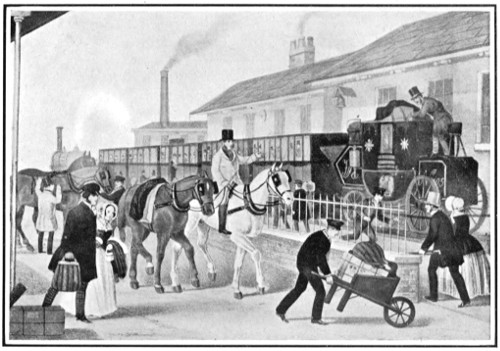
Mail Coach and Train.
When railways were in their infancy part of the journey of a mail was sometimes performed by coach and part by train.
At the point where the railway began the coach was placed on a truck, which was coupled to the train.
To put the matter briefly, the rate for a single inland
35letter in 1837 was 4d. for 15 miles, 6d. for 30 miles,
7d. for 50 miles, and so on up to 1s. for each additional
hundred miles: in certain places only was there a local
penny post, and in London there were twopenny and
threepenny posts. Each person in the United Kingdom
received on an average only five posted packets
a year. This was the year when the change from mail
coach to mail train was most marked. A mail was conveyed
from London to Liverpool and Manchester in
16½ hours: the secret of the speed was that the mail
was carried by coach from London to Birmingham,
and there put on the railway which was open to Liverpool
and Manchester. The last of the mail coaches,
that from Norwich and Newmarket, arrived in London
on the 6th January 1846.
The Reform Bill had been passed, a reforming
Government was in power, and measures of social
amelioration were being discussed in all quarters. Trade
and commerce were making strides, the habit of travel
was growing with the people, and the need for simpler
and easier methods of communicating with one another
was urgent. There was a grand opportunity for a
postal reformer. And the need of the time brought
forth the man.
There had been postal reformers before Rowland
Hill. First of all in time and distinction was Witherings,
who lived in the middle of the seventeenth century. He
became Master of the Posts in 1637, and he introduced
a far-reaching system of postal rates, which before
had been extremely casual and excessive. He made
the Post Office a paying concern. He created the
Post Office as we know it to-day. Then there was
Dockwra, who established a penny post for the London
district which existed 120 years. Only in the price
had this reform any relation to Sir Rowland Hill's
36scheme, which was based on the idea that a uniform
charge should cover any distance travelled. Dockwra's
system was of course limited to short distances. Another
great name in Post Office history is Ralph Allen,
the Postmaster of Bath in 1719, who organised a system
of cross posts all over the country. And in the first
chapter I mentioned the achievements of Palmer, who
established the mail-coach service.
Rowland Hill was born in 1795 at Kidderminster, and
he began life as a schoolmaster. Very early he showed
great talents as an organiser: his bent was towards
mathematics, and he became secretary of Gibbon
Wakefield's scheme for colonising South Australia. In
this capacity his attention was specially directed to
the abuses of our postal system. He approached
the study of the system as an outsider: indeed until
after his reform had been carried he had not been inside
the walls of the General Post Office. He collected
statistics, and it was the discovery that the length of a
letter's journey made no appreciable difference to the
cost of that journey which led him to think of uniformity
of rates. He showed, for instance, that the
cost of the mail-coach service for one journey between
London and Edinburgh was about £5 a day. He then
worked out the average load of the mail at six hundredweight,
the cost of each hundredweight being therefore
16s. 8d. Taking the average weight of a letter at a
quarter of an ounce, the cost of carriage over the 400
miles was 1/36 part of a penny. Yet the actual postal
charge was 1s. 3½d.
From the first the plan of Rowland Hill gained the
support of the people, but he had to face a long and
bitter opposition from the official chiefs of the Post
Office and from the vested interests which were threatened
by his action. Lord Lichfield, the Postmaster-General
37at the time, said, as an argument against the
idea, that the mails would have to carry twelve times
as much in weight as before, and therefore the cost
would be twelve times the amount they paid. “The
walls of the Post Office,” he exclaimed, “would burst,
the whole area in which the building stands would
not be large enough to receive the clerks and letters.”
Increase of business would mean a loss, not a gain,
and Lord Lichfield had not the optimism of the old
Irishwoman who, when endeavouring to sell her fowls,
exclaimed, “I lose on every fowl I sell, but thank the
Lord I sell a lot.”
Sir Rowland Hill asked Lord Lichfield very pertinently
whether the size of the building should be regulated
by the amount of correspondence or the amount
of correspondence by the size of the building.
One of the most curious arguments was that the
British public would object to prepayment, that it was
contrary to their habits and customs. There was no
doubt something to be said for the idea that when
you wrote a letter you had all the trouble, and you were
conferring a benefit on your friend, who ought to be
prepared to pay for it.
The plan triumphed. The Committee appointed to
consider it recommended its adoption, and it was
incorporated in the Budget of 1839. Lord Melbourne
was the Prime Minister, and though not enthusiastic,
was favourable. The strong feelings aroused in official
circles are suggested by Lord Melbourne's remark after
interviewing the Postmaster-General the day before
the Bill was introduced into the House of Lords.
“Lichfield has been here,” said Lord Melbourne. “Why
a man cannot talk of penny postage without getting
into a passion, passes my understanding.”
The Bill received the royal assent on the 17th August
381839, and after a preliminary experiment had been tried
of a uniform rate of 1d. for London and 4d. for the
rest of the country, in order to accustom the clerks
to the system, a uniform rate of 1d. for letters not
exceeding half an ounce was introduced on the 10th
January. This was a busy day at post offices all over
the country, and the opportunity was seized by hundreds
of people to write letters to one another in honour
of the occasion. About 112,000 packets were posted
in London. A large number of letters were also written
to Rowland Hill himself from all parts of the country,
congratulating him and thanking him for his efforts.
Tradesmen and business men were especially grateful
for the Bill. Moreover the reform opened the doors
of the Post Office to the poorer classes. The postman
after 1840 was, it was said, “making long rounds through
humble districts where heretofore his knock was rarely
heard.”
Rowland Hill was appointed to a post at the Treasury
in 1840, in order to superintend the introduction of
his scheme. He retired, however, in 1842, after Lord
Melbourne's Ministry went out of office. On the return
of the Liberals to power in 1846 he was appointed
one of the Secretaries to the Postmaster-General, and
in the same year he was presented by the public with
£13,360 in gratitude for his services. In 1854 he was
made Chief Secretary of the Post Office, and in 1862
he received the honour of knighthood. When he retired
from the Post Office in 1864 he received from Parliament
a grant of £20,000, and he was also allowed to retain
his full salary of £2000 a year as retiring pension. In
1864 he received the degree of D.C.L. from the University
of Oxford, and in 1879 he was granted the freedom
of the City of London. He died in August of the
same year, and was buried in Westminster Abbey.
39Many and great were the reforms introduced into
the Post Office during Sir Rowland Hill's period of
service as Secretary. In his letter of retirement addressed
to the Lords of the Treasury in 1864, he gave
an account of his stewardship in a statement entitled
“Results of Post Office Reform.” If we quote largely
from this document it will be to show what Sir
Rowland Hill claimed to have done, and it will also
help the reader to understand from his own experience
how far the Post Office has advanced since Sir
Rowland Hill's day. First of all, Sir Rowland claimed
“a very large reduction in the rates of postage on
all correspondence, whether inland, foreign, or colonial.
As instances in point it may be stated that letters
are now conveyed from any part of the United
Kingdom to any other part—even from the Channel
Islands to the Shetland Isles—at one-fourth of the
charge previously levied on letters passing between
post towns only a few miles apart, and that the rate
formerly charged for the slight distance—viz. fourpence—now
suffices to carry a letter from any part of
the United Kingdom to any part of France, Algeria
included.”
Then Sir Rowland claimed “the almost universal
resort to prepayment of correspondence, and that by
means of stamps,” the establishment of the book post,
the reduction in the fee for registered letters from 1s.
to 4d., a reduction in the price of money orders combined
with a great extension and improvement of
the system, a more frequent and more rapid communication
between the Metropolis and the larger provincial
towns, as also between one provincial town
and another, a vast extension of the rural distribution,
and many other facilities for the public, including
the establishment of Post Office Savings Banks. He
40goes on to say: “The expectations I held out before
the change were that eventually under the operation
of my plans the number of letters would increase fivefold,
the gross revenue would be the same as before,
while the net revenue would sustain a loss of about
£300,000. The actual figures show that the letters
have increased not fivefold but nearly eight and a
half fold, that the gross revenue, instead of remaining
the same, has increased by about £1,500,000; while the
net revenue, instead of falling £300,000, has risen more
than £100,000.”
This was written more than twenty years after the
introduction of penny postage, but it must not be
supposed that the reform was an immediate financial
success. The last complete year (1839) of the old
system of high rates yielded a profit of £1,659,000.
The first complete year of the new system produced
only £500,789. But in two years the number of
chargeable letters passing through the post had increased
from 72,000,000 per annum to 208,000,000,
and in a few years the profit of 1839 had been
passed.
Sir Rowland was a fighter and reformer to the last.
Like all men who accomplish great things, he was
exceedingly self-confident and impatient of opposition.
The official mind works from precedent to precedent,
and Sir Rowland proposed to make all things new.
Effort after effort was made to push him aside without
any lasting success. He was dismissed from the
Treasury in the second year of penny postage, at a
time when its very success seemed to depend on friends,
not foes, directing the organisation. Thomas Hood
wrote to him: “I have seen so many instances of folly
and ingratitude similar to those you have met with
that it would never surprise me to hear of the
41railway people, some day, finding their trains running
on so well, proposing to discharge the engines.” It
was more in obedience to the feeling of the country
than to any liking for the reformer that the Government
of the day appointed him to the Post Office four years
after his dismissal from the Treasury.
Sir Rowland was always perhaps a little uncomfortable
as a Post Office chief. He was in the midst of
men against whom he had been working for years,
and there are many stories in existence of his caustic
way of dealing with his staff. Anthony Trollope, who
was in the service of the Post Office at the time,
ventured one day to point out to Sir Rowland that
the language in a certain report, if literally construed,
might be held to mean what was not intended. Sir
Rowland replied: “You must be aware, Mr. Trollope,
that a phrase is not always intended to bear a literal
construction. For instance, when I write to one of
you gentlemen, I end my letter with the words, 'I am,
Sir, your obedient servant,' whereas you know I am
nothing of the sort.” Indeed nobody could have used
this official phrase with less sincerity than Sir Rowland
Hill.
But I like best this story of Rowland Hill in the
evening of his days, after he had retired from the
Post Office. It is pleasant to think of him still absorbed
in the subject which had made his name a
household word. His daughter, in her biography of
him, tells us that whenever he met any foreign visitors,
he was bound sooner or later to ask them about postal
matters in their own country. He met Garibaldi at
a banquet, and the inevitable question was put to him,
but Sir Rowland could not work up any interest on
the part of the Italian statesman in the matter. Sir
Rowland complained to his brother of his disappointment
42in Garibaldi; he evidently thought him an over-rated
man, especially in the matter of intelligence, and
the brother replied, “When you go to heaven I foresee
that you will stop at the gate to inquire of St. Peter
how many deliveries they have a day, and how the
expense of postal communication between heaven and
the other place is defrayed.”
It was of course this absorption in his subject which
gave him the victory. Penny Postage was probably
inevitable, even if there had been no Rowland Hill
in this country. Railways alone made a change in the
postal service necessary, but it is to the lasting credit
of Sir Rowland that he obtained the reform years before
it would otherwise have been achieved. He carried
the reform by assault, and the nation might have waited
long years before the vested interests in the old system
had given way to the needs of the nation. “Loss to
the revenue” was the argument chiefly directed against
Sir Rowland Hill's scheme: it is the argument still used
when further concessions are asked for by the public.
The reply that the Post Office exists for the convenience
of the public is not always appreciated by
the Chancellor of the Exchequer for the time being.
He looks to the Post Office to provide him annually
with a substantial sum of money. Perhaps the complete
vindication of Sir Rowland Hill lies in the fact
that roughly speaking the whole of the annual surplus
from the Post Office at the present day is derived from
the writer of the penny inland letter.
CHAPTER III LOMBARD STREET AND ST. MARTIN'S LE GRAND
43
Nothing will give the reader a better idea of the
advances made by the Post Office during the last two
hundred years than a comparison of the various buildings
which have from time to time been the home of
the General Post Office in London. The story of the
buildings is one of continued growth and expansion
right down to the present day. The General Post
Office is always becoming too small and inconvenient
for its work. And there has scarcely been any period
when it was not necessary to rent overflow premises
to meet the growing needs of the times.
As I have already pointed out, the system of posts
in the time of the Tudors was used chiefly for the
conveyance of Government despatches. The Master of
the Posts was a Court official, and there was no need
for a public office in London. The extension of postal
business, especially between London and the Continent,
required, however, in the later years of the sixteenth
century, an office in the City of London, and according
to Stow's Survey a post office was first established in
Cloak Lane, near Dowgate Hill. This is the hill on
which Cannon Street Station now stands, and it was
also the centre of Roman London. The necessity of
the foreign post was one of the reasons for the creation
of the office, and it is a link between this time and
our own that the continental mail train now starts
44from Cannon Street Station. Scarcely anything is
known of this post office except the bare fact of its
existence.
From Dowgate Hill the General Post Office was removed,
at some date in the first half of the seventeenth
century, to the sign of the Black Swan in Bishopsgate.
These were most probably what we now call licensed
premises: at any rate Pepys has recorded that on one
occasion he went “to the musique-meeting at the Post
Office.” Then happened the Great Plague of 1664-1665,
and we have the benefit of a report from the senior
officer as to the way in which the visitation affected
the Post Office. “That dureing the late dreadfull sickness
when many of the members of the office desert
the same and that betweene 20 and 30 of the members
dyed thereof, your petitioner, considering rather the
dispatch of your Majesty's service than the preservation
of himself and family, did hazard them all, and
continued all that woefull tyme in the said office to
give dispatch and conveyance to your Majesty's letters
and pacquetts, and to preserve your revenue arising
from the same.” The writer was evidently a pushful
official who expected recognition of his services, and
in yet a fuller petition for a reward for keeping the
Post Office open during the Plague he begs that he
may have an order to the Commissioners of Prizes to
deliver to him some brown and white sugar granted to
him by His Majesty from the ship Espérance of Nantes,
condemned as a prize at Plymouth. I hope he obtained
his sugar: in our days we should have made
him a K.C.B. Then came the Great Fire of 1666, and
the Post Office was burnt out. In an old newspaper
of 1666 may be seen this advertisement: “The General
Post Office is for the present held at the Two Black
Pillars in Bridges Street over against the Fleece Tavern,
45Covent Garden, till a more convenient Place can be
found in London.”
As soon as the City was rebuilt “the more convenient
Place” was found in a house in Lombard Street,
and by the year 1680, if not earlier, the General Post
Office moved into its new premises. The house had
been the private residence of Sir Robert Viner, a city
dignitary who had been Lord Mayor of London, and
it was rented from him. This was the home of the
Head Office for nearly 150 years. Comparatively little
is known of the history of this office, and a writer to
whom I am indebted for much of my information
writes justly “that one cannot escape a feeling half of
wonder and half of shame that so few records should
remain of an office where possibly Milton and certainly
Dryden posted their letters.” But what we do know
about this office is exceedingly interesting.
There were officials occupying positions which go
by the same name as at the present day. There were
the Postmasters-General, a dual office which in the
early part of the eighteenth century was non-political,
and the Postmasters-General were entitled to live at
the General Post Office and to have free coals, candles,
and tinware. There was a Receiver-General with a
salary of £150, an Accountant-General with a salary
of £200, a Comptroller of the Inland Office, six Clerks
of the Roads, a Secretary to the Postmaster-General,
and a Postmaster-General's Clerk. Positions which
are not known in these days were Windowman and
Alphabet Keeper—this man handed out letters to
callers, and his other title probably referred to the
pigeon-holes in which the letters were kept. There
was a “Mail Maker”—a maker of leather bags for
letters—the Stores Department in its early beginnings—and
there were three Letter Bringers. One official
46known as the Ratcatcher received £1 a year for his
useful services, another man described as a “Scavenger”
received £3, 6s. a year and was in charge of the drainage,
which was probably below suspicion.
But perhaps the difference between these times and
our own is most directly marked by two entries in
the accounts of the period. There were two allowances
of £30 each for beer for clerks and sorters, and once
a year at least £20 was allowed for a feast for the
resident clerks. This was usually held on the King's
Birthday, and “the musique-meeting” at the Post Office
which Pepys attended may have been one of these feasts.
In an old newspaper of 1708 there is an account of
one of the feasts, and the text of one of the songs is
given. The writer says: “Some of the songs were made
up as letters, and the Postboy blowing his horn rode
into the Hall to the surprise of all that were present
and distributed his letters from Parnassus. Indeed
the people might very well be surprised, it being a
country where hardly any one could think we held any
correspondence. At the same time that the boy sounded
his horn, Mr. —— rose up and sung the song.” The
author of the particular song, extracts from which we
give, was stated to hold “a very genteel place in the
General Post Office relating to the Foreign letters,
being master of several languages.” Truth, however,
compels us to state his salary was only £40 a year.
Here are two verses of “A Song Performed at the
Post Office Feast on Her Majesty's Birthday 1708.
Written by Mr. Motteux, set by Mr. Leveridge:”—
“Room, room for the Post, who with zeal for the Queen
Like Pegasus flies, tho' his scrub is but lean,
Tho' dirty or dusty,
Tho' thirsty yet trusty,
47The restless knight-errant,
While Anna's his warrant,
(True knight of the road) of high honours can boast,
The greatest of subjects give way to the post.
Chorus
With a twee-we-we, twee-we-we think it no scorn,
Cits, soldiers, and courtiers give way to the horn.
The secrets we hand, of the fair and the great,
And join, spite of distance, each region and state,
All nations and quarters,
Dutch, Irish, and Tartars,
The bonny North Briton,
And more I can't hit on.
Of all our Queen's subjects none serve her so fast,
For still in her service we're all in post haste.
Chorus
With a twee-we-we, twee we-we, &c.”
In a little book entitled A Picture of London in 1808
I have found the following delightful passage relating
to the London Post Office: “It is the most important
spot on the surface of the globe. It receives information
from the Poles.” This is rather wide of the
mark, seeing that both Poles were then undiscovered.
The next statement may have been nearer the truth:
“It distributes instructions to the Antipodes.” And
we seem to get out of our depth farther on: “It is
in the highest degree hitherto realised the seat of terrestrial
perceptions and volition. It is the brain of the
whole earth.” But all this tall language was used for
a purpose. The object was to draw attention to a
public scandal and to bring before the notice of people
the miserable accommodation which the State provided
for her wise and brainy servants. For the writer asks
48us to look on the other side of the picture. “The
building is hidden in a narrow alley, misshapen even
to deformity, and scarcely accessible to the very mail
coaches which collect there for their nightly freights.”
It was indeed the introduction of the mail coach
which made the Lombard Street office unsuitable for
its purpose. The coaches were obliged to stand in
the street itself, and only two or three could be in place
at the same time. Various sites were suggested for
the new office, and as increased space was the great
necessity, it was decided to clear away the rookeries
which existed in the liberty of St. Martin's and to build
there. The district had deteriorated lamentably since
the days of the College of St. Martin's le Grand which
stood there for several centuries, and which has an
interesting and distinguished history. The district
has older associations still, and during the clearing
of the sites for the Post Office buildings many interesting
remains of the Roman occupation of London
were found. In 1818 a very ancient vaulted chamber,
built in part of Roman materials, which had been
previously concealed beneath the more modern houses,
was exposed to view. Sections of the Roman wall
have also been discovered, and many other remains,
probably of a later date, built out of Roman materials.
The College of St. Martin's le Grand possessed the
privilege of sanctuary, and this fact may have explained
the evil repute of the neighbourhood. It became a
rogues' quarter, and great must have been the relief
of Londoners when a statute of James I. abolished all
privileges of sanctuary. Yet the inhabitants seem
to have been able to retain many privileges. They
retained their own court for the trial of minor offences:
they could keep the place as filthy as they liked until
it became a breeding-place for the plague, which
49regularly broke out at intervals during the seventeenth
century, and they appointed their own police or
watchmen.
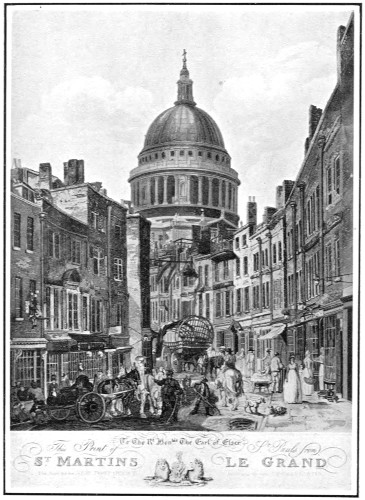
St. Martin's le Grand
A street at St. Martin's le Grand before the clearances were made for the General
Post Office. The district originally possessed the privilege of sanctuary, and was, in
the early part of the nineteenth century, one of the most disreputable localities
in London.
The site was purchased by the City with duties levied
on coals brought into London. And the Government
obtained the property from the City at a cost of
£240,000.
It is amusing to notice, in the report of the Committee
which considered the question of the new
building, how afraid its members were that in the
desire for beauty of style the question of utility would be
neglected. Post Office architects have seldom needed
this caution. “Ornamental decorations introduced for
the mere purpose of embellishment, and unconcerned
with utility, while they prodigiously enhance the cost,
rarely produce an effect in point of elegance and
grandeur which can compensate for it.” And yet
again, “an office for the receiving and delivery of
letters which should be concealed behind a front fit
for a palace, and flanked by triumphal arches, would
present an incongruity no less offensive to good taste
than inconsistent with rational economy.” Here
speaks the voice which in the early years of the nineteenth
century produced so many evil results in street
architecture.
The architect of the new building was Mr. Smirke,
and it is certainly to his credit that he was not unduly
influenced by the recommendations of the Committee.
The site covered two acres, and the clearance displaced
a thousand inhabitants. It swept away numbers of
alleys and courts, and when the building itself was
opened in 1829 it at once took its place as a great
addition to the architectural beauty of the City of
London. Everybody who has visited London must be
familiar with at least the exterior of the building. It was
50designed to meet the needs of the mail coach service,
yet no sooner was the building opened than the sound
of railways began to be heard in the land. But for
nearly ten years the mail coaches started from St. Martin's
le Grand, and traces of this era can be seen in the drive
which goes round the building with an open courtyard
at the north end. The Bull and Mouth Yard where
the coaches were made up was opposite.
One of the features of the building was a lofty central
hall, and through it was a public thoroughfare to Foster
Lane. The letters were posted in this hall, and the
scene at six o'clock was always one of great animation.
Little by little as the needs of the service became different
and more pressing, the internal architecture of St.
Martin's le Grand was altered almost beyond recognition.
The great hall was closed, and the space thrown into the
Sorting Office. “No indignity that can possibly be heaped
on the poor old thing can add to its disfigurement,”
wrote Mr. R. W. Johnston, an admirer of the original
building. And he added: “The place has been practically
disembowelled, and what has been taken out of the
bottom has been placed on the top, with the result that
an absolutely pure design has been converted into
a nondescript of the most extraordinary character.”
This was inevitable from the point of view of utility, but
the constant patching up could not go on indefinitely.
In later years the letter and newspaper branches of the
service monopolised the whole of the old building, but
in its early days it took in practically the whole of the
Head Office. Here worked Colonel Maberley, who had
been Sir Rowland Hill's chief official opponent; here
worked later the two men together rather uncomfortably,
and with little in common.
Just as in the case of Lombard Street, the story of
St. Martin's le Grand would be incomplete without some
51attempt to realise the human elements which went
to make up its life during the years of its prime. The
Post Office has always suffered in reputation both in
the eyes of the public and of the Treasury from the
accepted idea that its duties are mainly confined to
sorting letters. Gentlemen high up in the Secretarial
Department have sometimes been asked seriously by
their friends whether they had noticed some particular
letter in the course of its transmission through the
post. The public scarcely realise the amount of financial
and technical knowledge required on the part of men
who have to organise the service, to enter into contracts
with railways and steamship companies, or to preserve
the discipline of the vast staff in town and country.
This was the kind of work done at St. Martin's le Grand,
and the men of the early and mid-Victorian period
were workers in the full sense of the word.
The old riddle, “Why are Civil Servants like the
fountains in Trafalgar Square?” with the answer,
“Because they play from ten to four,” has never applied
to the Post Office. The needs of the service forbade
any slackness, and punctuality has always been a realised
ideal. West End offices have frequently looked on
aghast at the zeal and industry of St. Martin's le Grand.
I remember a post office clerk telling me one day
of an official call he had to make at the Colonial Office
in the days before Mr. Chamberlain put new life into
that Department. “I arrived there at a quarter to eleven,
and found the door shut, and as I was hunting around
to find the visitors' bell, a milkman bore towards me
and said, 'I don't think they're up yet, sir,' so I took
a turn round the Park and at ten minutes past eleven
I went back again, and finding the charwoman had
just started work, I explained to her my errand, and
asked her to tell the Secretary of State that I was on
52the mat. ‘Oh,’ said she, ‘I don’t‘Oh,’ said she, ‘I don’t think anybody's come
yet. We don't begin till eleven.’eleven.’ But I merely ventured
to point out that the Horse Guards’ clock was nearly
a quarter past eleven. Then this pampered menial drew
herself up, and with a look of scorn, replied, daresaydaresay
you are right, young man, but the gentlemen in this
orfis don’t bind theirselves to be ’ere on the stroke
of the hour.’hour.’ That was the difference between the
City and the West End; the gentlemen of the Post
Office bound themselves to be at their posts at the
hour, and to come early and to stay late.
Officials have worked at St. Martin's le Grand who
were men of letters in two senses of the word. Anthony
Trollope began his career as a post office clerk here,
and the insistence on punctuality was his chief difficulty.
He could not be punctual, and though he said he could
write official letters rapidly, correctly, and to the purpose,
the steady, young, punctual but much less efficient clerk
was usually preferred before him. But Trollope was
a very difficult official to deal with. He says in his
Autobiography: “I have no doubt that I made myself
disagreeable. I know that I sometimes tried to be so.”
And yet for many years he was an exceedingly useful
public servant, and was frequently engaged on special
work for the department. An old colleague of his has
described Trollope's method of doing his official work.
“I have seen him slogging away at papers at a stand-up
desk with his handkerchief stuffed into his mouth and
his hair on end, as though he could barely contain
himself.” He was very overbearing and intolerant in
his manner, and was certainly not popular at the Post
Office. There is on record, however, one occasion when
he must have been unusually pleasant. He was the
clerk in waiting one evening, and a message came to
him that the Queen of Saxony wanted to see the night
53mails sent out by the mail coaches. This was one of
the sights of London at the time, and Trollope acted
the part of showman. When he had finished he was
handed half-a-crown by one of the suite. This, he said,
was a bad moment for him.
“Why don't you pay an old woman sixpence a
week to fret for you?” he said to a postmaster who
came to him with grievances. The postmaster left his
presence with an additional grievance that Mr. Trollope
was a brute.
Sir Rowland Hill might have agreed with this postmaster,
for he could never get on with Trollope.
We can scarcely be surprised. In his Autobiography,
Trollope says of Sir Rowland that “it was a pleasure
to me to differ from Sir Rowland Hill on all occasions,
and looking back now, I think that in all such differences
I was right.” Such a confession explains much
of Trollope's unpopularity. There is no place where
omniscience is less appreciated than in a Government
office. Mr. O'Connor Morris, who was the Postmaster-General
of Jamaica when Trollope visited the island
in 1858, has left on record this judgment on the
novelist's official conduct to him. “I believe Mr.
Trollope had a thousand good qualities of head and
heart, which were disguised in a most unfortunate
and repelling manner.”
Edmund Yates also worked at St. Martin's le Grand,
and he has described very graphically the kind of
scene which usually took place when Trollope was
interviewing Sir Rowland Hill. “Trollope would bluster
and rave and roar, blowing and spluttering like a
grampus, while the pale old gentleman opposite him,
sitting back in his arm-chair and regarding his antagonist
furtively under his spectacles, would remain
perfectly quiet until he saw his chance, and then
54deliver himself of the most unpleasant speech he
could frame in the hardest possible tone.”
There is a good story told of Yates himself. The
Post Office Library was founded in 1858. There
were many unredressed grievances among the clerical
staff in those days, and when Mr. Rowland Hill undertook
to give a lecture on astronomy to the Library
subscribers, a practical if somewhat unfair opportunity
seemed given to the clerks to bring their necessities
before the chief. Mr. Hill asked for a shilling from
his audience in order to illustrate an eclipse. He
wished to pass it between the eye and a lamp. Busy
fingers went diving into purses and pockets for moons.
After two or three minutes waiting Mr. Hill beheld
an array of blank faces and shaking heads, and he
naturally looked puzzled. Then Edmund Yates arose.
“I beg to explain, sir, that we are all very anxious
to try the experiment which you suggest, but unfortunately
we cannot find a shilling among us.” On
the whole we may wonder what type of man Sir
Rowland Hill found the most trying to deal with at
the Post Office, the man of genius or the hidebound
official.
In the days before competitive examinations and
the abolition of patronage, there were more “characters”
and “individualities” in the Post Office service
than in these degenerate days. St. Martin's le Grand
has had its share of officials who were men of the
world, men of letters, and eccentric men. Frank Ives
Scudamore, the author of Day Dreams of a Sleepless
Man and much light verse, will always be remembered
at the Post Office as a chief who did everything
magnificently and on the grand scale: even in his
failures he was great. And everybody who worked
under him seemed to catch his enthusiasm for work.
55But we must leave these personal matters and get
back to the buildings. With the acquirement of the
telegraphs by the State, and the necessity for devoting
an entire building to the London Postal Service, the
erection of another big office became imperative. The
building known as G.P.O. West was completed in
1873, and for a long time it provided accommodation
for the Secretary's, Solicitor's, Engineer-in-chief's, and
Central Telegraph Offices, together with a portion of
the Receiver and Accountant Generals' Department.
In twenty years the need for extension became again
pressing, and in 1895 the huge building known as
G.P.O. North was opened. G.P.O. West was then
given up to the Telegraph Service, and all the administrative
offices were transferred to G.P.O. North. But
these three immense buildings even in 1894 were by
no means large enough to hold all the activities of the
Post Office. The Parcel Post, the Money and Postal
Order Departments, and the Post Office Savings Bank
Department were all housed in other parts of the City
of London, and there were overflow premises in streets
near St. Martin's le Grand.
In this chapter we are only concerned with St. Martin's
le Grand, and it is not without regret for the severance
of old ties that Londoners witnessed in 1910 the closing
of Smirke's fine post office, and the migration of the
staff to King Edward's Building, henceforth to be the
home of the London Postal Service. Not a hundred
years had passed since the move from Lombard Street,
and the Post Office had become a small nation of itself.
And this body of men and women has for years regarded
St Martin's le Grand as the metropolis of their
nation, and when they have stood under the big clock
which has seen so many mails arrive and depart, they
have felt that they were citizens of no mean city.
CHAPTER IV KING EDWARD'S BUILDING
56
In every big town the post office is now one of the
most important, while in some cases it is the most
imposing of all the local public buildings. Here the
head postmaster is to be found, and here all the post
office business of the district is administered. People
have often asked me, “Who is the postmaster of
London?” They understand that the Postmaster-General
and the Secretary have their offices at St.
Martin's le Grand, but it is evident that these gentlemen
are the supreme heads of the whole Post Office
system, and are not specially concerned with London.
“Is there not a postmaster of London, just as there is
one of Birmingham and of Liverpool?” The answer
is that there is a London head postmaster, but his
official title is Controller of the London Postal Service.
Until a comparatively recent period he shared a building
with the Postmaster-General and Secretary, and
the dignity of his office was perhaps a little obscured
by the presence of the greater luminaries. Latterly,
however, the old building at St. Martin's le Grand
became practically the chief London post office, and
all the big administrative departments moved to the
other side of the road. But old associations take long
to die, and I do not think that even Post Office servants
have ever looked upon the old building as belonging
specially to London; they have thought of it still as
a portion of the big administrative department which
57has monopolised so much of the district of St. Martin's
le Grand.
It is not therefore merely a fancy of my own that
for the first time London possesses in King Edward's
Building a head post office which is worthy of her,
and which bears the same relations to the London
district as the post office in Liverpool does to the
Liverpool district. London is the biggest city in the
world; it now possesses the biggest post office in the
world. That is as it should be. It is London's chief
office in a way that the old building never was. It
has been built for London, and is fitted up entirely
to meet the needs of London. Nobody who knows
the old building could have said this of the inconvenient
and out-of-date structure which was built for other
times and other purposes.
The site of the new building covers ground which
up to the beginning of the thirteenth century was one of
the numerous vacant spaces in the north-west portion
of the area enclosed by the Roman wall which went
round the City of London. This wall, it is conjectured,
was built between A.D. 350 and A.D. 369, only about
half a century before Rome withdrew her legions from
Britain. It belongs, therefore, to the later period of
the Roman occupation of this country. A large section
of this wall was discovered by the workmen when
digging the foundations for King Edward's building,
and it extended for about 400 feet. Most of this had
to be destroyed and carried away, but a fine bastion
at the western angle has been preserved, and can be
inspected by visitors. The wall is built in the usual
Roman method, and is composed of Kentish ragstone
from the Maidstone district. In the ditch which ran
outside the wall were discovered a number of Norman
and mediæval relics, and within the wall many Roman
58remains. The section of wall laid bare by the workmen
was found underneath the playground and dining-hall
of Christ's Hospital, known to us all as the Bluecoat
School. The school removed from the building some
years ago into the country, and the site was then sold
and divided between Bartholomew's Hospital and the
General Post Office.
The foundation stone of the new post office was
laid by King Edward VII. on the 10th October 1905,
and it was opened for public business on the 7th
November 1910. The building is constructed of Portland
cement concrete, strengthened by bars of steel, on
what is known as the Hennibique reinforced concrete
system, and it is the largest building that has yet been
erected on this plan. It is an all-in-one-piece building,
fashioned out of Thames ballast and cement. Not
a single steel joist has been used in the centre construction.
Barge after barge from Rotherhithe landed
at Blackfriars the mud chalk and gravel which dredgers
had scooped up in the lower reaches of the Thames.
This ballast was carted direct to King Edward Street,
passed through a machine which sorts the stones into
various sizes, and then turned into liquid concrete by
another wonderful machine which mixes sand, cement,
and stones together at a rapid rate. The steel rods
and bars interlacing one another extend in a network
throughout the building like the skeleton of an
animal, while the entire system is embedded in a perfectly
connected sheath of concrete. The great feature in this
system is the immense reduction in wall thickness. The
effect is seen in the lightness and airy nature of the
building; one's first impression is that it is certainly not
built for eternity, as somebody said the granite structures
of Aberdeen are.
But this is an illusion: the concrete increases in
59strength as time goes on, and the passing years only
make the building stronger and more capable of
resisting weather and the strain of the loads which it
has daily to carry.
Wattles and mud were the building materials of our
remote ancestors, and it has been said that we are
reverting to the old method, only British mud has given
place to British concrete, concrete of Thames ballast
and Portland cement. The outer walls are only 7
inches thick, but the frontages to King Edward Street
and Newgate Street are faced with Portland stone with
granite plinths. To see fully the effect of the reinforced
concrete in building one has to examine the
back elevations, where there are no stone facings. But
even with its false but ornamental front the building
has nothing of “the solemn and spacious Greek charm
of the delightful old front in St. Martin's le Grand.”
The Post Office gains in spaciousness and utility what
it loses in architectural beauty.
The building consists at present of two parts, a
block facing King Edward Street which contains, on
the ground floor, the new Public Office, and on the
four upper floors the offices of the Controller of the
London Postal Service. The other is a much larger
block containing the main sorting offices both for
foreign and colonial correspondence, and for the
E.C. or City district.
The actual foundation is only 3 feet in depth, and
not one of the floors is more than 3½ inches in
thickness.
Between the two blocks is a loading and unloading
yard for the mails, and on the west side of the second
block is a large yard and unoccupied space left for
such future additions as may be required for growth of
work. The Post Office is learning from experience
60the value of the margin, and that there is no finality in
its advances. It is in this open space below the level of
the ground where is to be found the section of the
Roman wall which I have described.
The public office is the central office in London
for the transaction by the public of all classes of
postal and telegraphic business. It is the largest public
post office in the country, and measures 152 feet by
52 feet, with a counter running the whole length. The
inside walls are lined throughout with marble; a green
Irish marble being used for the dado, pilasters, panels,
door architraves, and the front of the counter, and a
light Italian marble for the remainder. The pilasters
and piers have bases and capitals of bronze, and bronze
is also used for the counter edges, table edges, and
electric light fittings.
All this is unaccustomed magnificence for a London
post office, and he must be a man singularly deficient
in a sense of the fitness of things who can enter these
marble halls and boldly go up to the bronze-edged
counter and ask for a halfpenny stamp.
Under the public office is the posting room, into which
falls the correspondence posted in the big letter-boxes
by the public. It is interesting to stand in this room
and watch the postal packets pouring down the shoot
from the letter-boxes. There begins the first stage
of the travels of a letter. Everything that machinery
and science can do to economise labour and to facilitate
delivery and despatch is brought into play. Sorting
is simply continual subdivision, and it is interesting to
watch the journeyings of the letters from the moment
of posting in the big letter-box. There is very little
carriage from one place to another by hand. Cable
conveyors and band conveyors, worked much on the
same principle as the moving platforms we have all
61seen at exhibitions and great emporiums, carry the
letters from point to point until each letter finds its
appointed bag, and is either taken out of the building
by the City postman or deposited in a mail cart which
takes it to the railway station or district office.
A band conveyor takes the letters from the posting
room which are addressed to places in London or
abroad, to the ground floor of the building in baskets,
and the empty baskets are sent down by a return band.
The correspondence for the provinces, which is dealt
with at a large sorting office at Mount Pleasant, nearly
a mile away, is put into bags, and another band conveyor
takes these bags to the departure platform at the
west end of the sorting office. There is a third band
conveyor suspended from the ceiling of the same floor,
which is for the conveyance of bags of mails from the
east to the west of the sorting office.
The London letters and those for abroad are conveyed
to the ground floor, which is occupied by the E.C.
district sorting office. The letters are brought to the
eastern end of the immense room and with them are
bags of letters which have arrived from provincial offices
and abroad, amounting altogether to upwards of five
millions weekly.
The posted letters are arranged in order for stamping
on what are called facing tables, on which running
bands are placed, and at the end of these tables are
electric stamping machines which can obliterate the
stamps on the letters up to a rate of 700 or 800 per
minute. Then the letters pass into two main divisions.
On the northernnorthern side correspondence for all parts
of London, except the E.C. district, is dealt with, and
direct despatches are made to every chief district and
sub-district delivery office in London for every delivery
during the day. On the southern side the postmen prepare
62the correspondence for the twelve daily deliveries
in the E.C. district. Upwards of 1400 postmen are
attached to this office. A noticeable feature of the
work of sorting is that the letters travel from east
to west always, and at the west end is the platform from
which bags for other offices are despatched.
The first floor is entirely devoted to the treatment
of correspondence for the Colonies and abroad. About
900 officers of all grades are employed upon the work
and about 400,000 articles are despatched weekly. The
work is brought up by lifts from the eastern platform.
The principle here is also continual subdivision, and
there are upwards of 1000 different post offices for
which direct bags are made up nightly in the Foreign
Section. A striking feature of this section to the visitor
is the varied colouring of the big mail bags intended
for over-sea mails. If the foreign sailor cannot read
he can appreciate colour, and he will know the destination
of a mail bag by its colour.
A band conveyor from east to west conveys the bags
from the Foreign Section to the top of a special shoot
at the west end of the building, whence they are shot
down to the departure platform on the ground floor.
All the letters everywhere are “stepping westward,”
and everything goes even on the busiest night with
something like the regularity of clock work.
Photo
Clarke & Hyde
The Blind Section.
These men are dealing with badly and insufficiently addressed letters. They have directories in front of them, and
every effort is made to put the letters into circulation again.
An interesting feature of the Sorting Office is the
Blind Section. Here at all hours of the day you will
find a row of men sitting at a long table over which is
a bookshelf full of up-to-date directories, guides, and
other manuals of topographical information. These
men are doing their best to put in the way of delivery
the imperfectly and indistinctly written packets. If
they fail the letter goes to the Returned Letter Office
to submit to more expert treatment. Experience counts
63for much with these men. The badly spelt addresses
are perhaps the easiest of these puzzles. “Saintlings,
Hilewite,” is at once decided to be “St. Helens, Isle
of Wight” “Has bedallar—such” even a schoolboy
would recognise as Ashby-de-la-Zouch; but it requires
the specialist in puzzles addresses to arrange for the
delivery of a letter addressed simply as 25th March
to Lady Day, the wife of the judge of that name.
Whenever we speak of the activities of London we have
to deal with big figures, and comparative tables of growth
and development are a little wearisome to the modern
reader, simply because they have lost all the charm of
unexpectedness. We know there must be a huge staff
employed at the Head Office in London; the statement
that 20,000 is the actual number leaves us unaffected:
perhaps even we guessed it was 40,000. We are fully
prepared to hear that billions of letters are delivered in
the City of London weekly; we are even a little disappointed
when we know that up to the present the
average is about 5½ millions. If we have been interested
in the new building itself and what it is expected to
bear in the way of work, we may at least like to know
that the total weight of the weekly correspondence
passing through its walls is about 366 tons.
I expect that if we were asked in a newspaper competition
to state how many post offices and posting
receptacles there were in London, we should make a
wild guess and say perhaps 15,000 or even 20,000. The
actual number is 4650. The fact is the average human
mind is incapable of realising facts when stated in
thousands. Only very experienced men can tell the
approximate numbers at a Hyde Park meeting or a
royal procession. Post office numbers are bewildering;
we simply cannot realise that they are human life expressed
in terms of figures. In order to help our
64limited human faculties, Mr. J. Holt Schooling has estimated
that if one man were given the task of sorting
all the postal packets delivered in the United Kingdom
in one year—and supposing him to work at the rate
of sixty a minute—he would have had to begin nearly
one hundred and sixty years ago, in the reign of George
II., before the conquest of India began under Lord
Clive, in order to complete his task by the year 1910.
Mr. Schooling gives him no time for sleep or meals;
he goes on without stopping. This is indeed harder
to realise than the actual number of the postal packets,
which is something over 5,000,000,000.
It is perhaps interesting to know that 32 per 100
of all letters delivered in England and Wales are
proper to the London district, nearly one-third. The
outgoing letters from the London district also show
somewhat similar results. A City firm has posted
as many as 132,000 letters at one time.
It is also an interesting fact that we send out of
this country a great many more letters than we receive
from all the five continents. Even in the case of
America, the excess is something like 80,000, but one
portion of America, viz., the United States, sends us more
letters than we send to that country.
The following estimate will not perhaps test severely
the brains which rebel at large sums. According to
Mr. Schooling, whom we have quoted before, the number
of letters, post cards, halfpenny packets, and newspapers
delivered during a year in this country works out for
each individual as 65 letters, 19 post cards, 21 halfpenny
packets, and 4 newspapers. A moment's consideration
of these figures will convince us of the vast number
of folk still living with whom the receipt of a letter
must be an event in the year.
It is only a little over eighty years since the comparatively
65small office at Lombard Street housed the
whole staff of the London chief office. The change
has been tremendous, but no more in proportion to
the population than other activities of life. Post Office
servants often point with pride to what their Department
has achieved, but the truth must be told, and it
is that the credit cannot be claimed by the officials.
We might almost say that, as far as the Department
is concerned, the increase is mostly unearned increment.
The increase in population, and especially the advance
in the means of communication, are the two chief
causes; it is the people who have made the Post
Office, not the officials. A retiring postmaster, or even
a retiring Postmaster-General, will sometimes tell us
in round figures what has been accomplished under
his rule. “Alone I did it” is sometimes the burden
of these valedictory speeches. But the true explanation
lies often in the birth-rate or in the opening of a new
railway, and the Post Office reaps what others have
sown. And there have been times when the Post
Office administrator, proud of what he has done
and what his Department is doing, has tried to say
“Thus far shalt thou go and no further” to the
reformers. “Why not remain satisfied with the perfection
I have been the humble means of securing?”
The official mind usually requires some driving force
from outside before it can see the necessity for another
advance.
Still, do not let us forget the huge army which serves
the nation in postal matters. The counter-clerk who
sells the stamp and the postman who delivers the
letter are the two officials who are known to the public,
and the different officers who conduct the operations
which come between the buying of the stamp and the
delivery of the letter are almost unknown outside the
66walls of their own offices. And it is a matter for
congratulation that in King Edward's Building the
health and bodily needs of the staff have been considered
in a way which twenty or thirty years ago would
have been regarded as quixotic and as grandmotherly
administration.
Ducts have been provided in the main building for
mechanically ventilating the three lower floors, and
uptakes are led from these into fan-houses situated on
the roof. The fans which have been installed are
directly coupled to motors of variable speed, and are
designed to move large quantities of air. Fresh air is
admitted through windows and ventilating radiators,
and the vitiated air is discharged on the roof. The
ventilation of the Bag Room has been separately
treated; here a considerable quantity of dust is
liberated by the handling of mail bags, and dust,
we are beginning to learn, is the great enemy to
health. Arrangements have been made for concentrating
this at one point near a collecting hopper,
through which the dust-laden air passes and is discharged
on the roof.
The third floor is entirely devoted to kitchen and
refreshment-room accommodation and retiring-rooms
for the various classes of the staff. Each officer has a
long locker for his belongings. As the work goes on
during the whole of the twenty-four hours, the refreshment
branch is practically always open. A very large
business is done here. Three thousand dinners can be
prepared every day.
The roof is flat, and on it two miniature rifle ranges,
one of 25 yards and one of 50 yards, have been constructed.
Here are to be seen the large ventilating
fans for securing a constant supply of fresh air to the
rooms below.
67The new-comer into the service speedily takes all these
conveniences and comforts for granted, and perhaps is
aggrieved because arm-chairs and lounges are not yet
provided; but the middle-aged official, who remembers
times when nothing apart from his work was ever considered
by his chiefs, rubs his eyes sometimes and
wonders whether it is all a dream.
King Edward's Building is in keeping with all the
traditions of the City of London. Charlotte Brontë in
Villette says: “I have seen the West End, the parks,
the fine squares: but I love the City far better. The
City seems so much more in earnest: its business, its
rush, its roar are such serious things, sights, sounds.
The City is getting its living—the West End but enjoying
its pleasure. At the West End you may be amused,
but in the City you are deeply excited.” That is the
mood which will possess the visitor as he leaves the
new building.
Here is a list of the huge buildings which now make
up the London General Post Office:—
1. G.P.O. North. For the Postmaster-General and
the offices of the Secretary, Accountant-General,
and Solicitor.
2. G.P.O. West. For the Central Telegraph Office
and Engineering Staff.
3. G.P.O. South (Queen Victoria Street). For the
Telephone Department.
4. King Edward's Building. For the Controller of
the London Postal Service and his staff and for
the E.C. and Foreign Sections of the Sorting
Office.
5. Mount Pleasant. For the Inland Letter and Parcel
Sections of the Sorting Office, Returned Letter
Office, Telegraph Factories, &c.
686. West Kensington. For the Post Office Savings
Bank.
7. Studd Street, N. For the Stores Department.
8. Holloway, N. For Money Order and Postal Order
Departments.
The staff working in these eight buildings is about
20,000, of whom 4300 are in King Edward's Building.
CHAPTER V THE TRAVELLING POST OFFICE
69
Something of the old romance of the service lingers
about the Travelling Post Office. To those who work
it there is always a possibility of adventure, not to
mention the risk to life and limb, while to those who
watch its operations there is that indefinable element
which makes an appeal to the imagination. Moreover,
in more than one of its features it links up our
time with the old mail coach days. There are pictures
in existence of the mail coach passing through a village
or hamlet, and the mail bag is being handed out from
the upper windows of the local post office to the guard
of the coach. The driver is reducing his speed while
the exchange is taking place, and the suggestion of
the picture is that no time is to be lost. The same
idea is carried out to-day by means of mechanical
appliances. Indeed, so soon as the mail train came
into being, the minds of officials were at once
exercised how to maintain the old system of exchange
under altered conditions. The early effects were
scarcely ingenious, and were obviously dangerous.
The experiment was tried of hoisting up the bags
towards the railway guards on long poles, but after
one guard had had his eye poked out, and others
had suffered from severe falls while endeavouring to
secure the bags, it was felt that the business placed
too severe a strain on human endeavour. Under this
clumsy arrangement it was necessary for the train
70to reduce its speed, and it was not only, I am afraid,
to preserve the guards from injury, but also to prevent
delay during the process of exchange, that the
efforts of inventors were directed. But before I proceed
to describe the ingenious apparatus which is in
operation to-day, and which is on practically the
same lines as that invented more than seventy years
ago, I must deal with the Travelling Post Office
itself.
As early as 1837, when railways were yet in their
infancy, it was suggested to the Post Office by
Frederick Karstadt, a son of one of the surveyors of
the Department, that much time would be saved if
some of the necessary business of sorting and preparation
for delivery of letters were performed on
the train. On the 6th January 1838, a carriage was
run as an experiment on the railway between Birmingham
and Liverpool. The carriage used for the
purpose was simply a horse-box temporarily fitted up
as a sorting office. The experiment was decided to
be a success, not only by officials, but by the press
and the public. In the words of an enthusiastic
writer at the time, “Here is a specimen of the exhaustless
ingenuity which bids fair to annihilate time
and space, an improvement which enables the Post
Office to work practically double tides—in other words,
to duplicate time by travelling and working at the
same instant.” We smile at writing of this kind in
these days, when the familiarity of the operations has
robbed us of all sense of wonder, but the language
is not very different from what we frequently hear
to-day when the achievements of the aeroplane or
wireless telegraphy are recorded. To our grandfathers
the Travelling Post Office was a miracle of the day,
and it is not difficult, if we know the social life of
71that time, to understand the way in which they must
have speculated on its possibilities.
Photo
Herbert Lazenby.
The Travelling Post Office.
This is the interior of the most recently constructed Great Northern Railway
travelling post office. Notice the exchange apparatus fittings behind the sorters.
It was the idea of being able to carry on the
ordinary business of life while travelling from one
place to another which appealed to the imaginations
of men whose experiences of travel had been limited
to the cramped conditions of the mail coach. But I
doubt whether they could have conceived of a time
when we should breakfast, lunch, dine, and have comfortable
beds on trains running at fifty miles an hour.
And one of the latest developments of all, the providing
of lady typists on trains for the benefit of
business men travelling to and from London, would
certainly have justified the enthusiastic prose of an
earlier day. We take these things in a more complacent
fashion; we talk of the increased economy
and convenience as meeting a public demand, and
we grumble at the railway which withholds luxuries
from us.
There is no doubt, however, that the success of the
Travelling Post Office was the first revelation to the
railway companies, and to the public, of what could
be done on a train while in motion, but much was
needed in the direction of improving the permanent
way and the springs and general make-up of the rolling
stock before any further advances could take place.
Perhaps on this ground alone we can spare a little
sympathy for the Post Office servants, who during
the long years when railway travelling was neither
smooth nor comfortable, had to keep their heads and
their feet while the train raced across country.
The first permanent sorting carriage was built by
the Grand Junction Railway Company, and this carriage
was fitted with an apparatus for exchanging mail bags
en route. The appliance consisted of an iron frame
72covered with netting, and was fixed to the near side
of the carriage. It was made to open out for the
purpose of receiving a bag suspended from the arm
of a standard erected beside the railway line. Simultaneously
with the delivery of a bag into the carriage
net, a bag was dropped on to the bare ground by
another mechanical contrivance, guard boards being
fixed by the side of the permanent way to prevent
the bag from getting under the wheels of the carriage.
This apparatus was first tried in 1838 on the London
and Birmingham Railway at Boxmoor. On the 17th
September 1838, the London and Birmingham Railway
was opened throughout its entire length, and the
Travelling Post Office was permanently established on
that line. Two mails were despatched from Euston
daily, the first a day mail at 11 A.M. and the night
mail at 8.30 P.M.
The immediate effect of the introduction of the
Travelling Post Office was to render unnecessary the
making up of some 800 or 900 bags. Each town now
made up one bag for the train, instead of the fourteen
or fifteen which had to be made up for the mail coach,
and the Travelling Post Office re-sorted the letters
and made up bags for the various towns which it
served. In the year 1843 the number of bags made
up in the London and Preston Travelling Post Office
down mail was 51 and in the up mail 44. The number
of bags at present made up in the same Travelling
Post Office, which now runs from London to Aberdeen,
is nearly 400 on the down journey and about 300 on
the up journey. In 1910 there were in Great Britain
no less than 73 separate Travelling Post Offices, composed
of 150 specially constructed carriages.
In 1848 the apparatus for exchanging letters was
considerably altered and simplified. For the first time
73nets were fixed by the side of the permanent way in
which were caught the bags delivered from the Travelling
Post Office, and a new variety of winged carriage
net was provided with detaching lines, which were used
to grip and detach the pouch from the arm in which
it was held. Many alterations have since been made
in the working of this apparatus, but the principle of
the thing remains the same.
In 1859 as a further means of accelerating the mails
“the limited mail” train was started. Many people
have doubtless wondered at this definition of an express
train: they have probably connected it in some way
with the idea of speed, but in reality it was nothing
more than the application of the old regulation of the
mail coach days to railway traffic. That is to say,
the mails were to be the first consideration, and the
passenger traffic was to be limited on these trains to
the point where the speed or the availability of the
train for mail purposes would not be interfered with.
The first limited mail to run was the night train to
Scotland.
An advance on the idea of the limited mail was made
in 1885, when a special mail train was established on
the London and North-Western and Caledonian Railways.
This is a train devoted entirely to the mail
service, and it runs in both directions between London
and Aberdeen. Similar special trains run on the
Great Western Railway between London and Penzance.
One of the latest developments of the system is the
provision of a late-fee box on the side of the carriage.
The letter-box on the side of the carriage next to
the platform is kept open while the train is standing
in a station. The up-to-date sorting carriages are an
immense improvement on those of the old pattern in
the matter of easy movement. They are constructed
74with a view to reduce vibration to a minimum. All
projections and angles are well padded, and this precaution
is at all times necessary, as turning a curve
at high speed frequently takes the sorters off their feet
and sends them flying into corners or against the sides
of the carriage.
In the new sorting carriages plate-glass bottoms are
provided for the letter-sorting frames to enable the
sorters to see at a glance that they have removed all
the correspondence from each box at the time of
despatch. This prevents letters being carried beyond
their destination or left in the carriage at the journey's
end.
The duty of each officer is laid down in detail in
the “duty book,” as is also “the plan” or “alphabet”
he is to use in sorting the correspondence, and the
order in which the bags are to be hung. Every man
knows exactly what he has to do, and that he must
depend upon his own exertions for the completion
of his duty over every stage of the journey. Space is
necessarily limited. Along one side of the letter-vans
are pigeon-holes for sorting purposes, while the opposite
side is fitted with pegs for holding the bags and with
the machinery used for the exchange apparatus.
Upwards of 3,000,000 miles are run annually by
Travelling Post Offices in this country. The largest
number are run on the London and North-Western
and Caledonian Railways, amounting in all to 1,800,000
miles. The London night mail is the heaviest mail
in the course of the twenty-four hours. Day mails and
mid-day mails are merely subsidiaries to the larger
service. It has been said that “the principal mail
train in the kingdom, perhaps in the whole world, is
the Down Postal Express which leaves Euston every
night at 8.30.” It consists entirely of postal vehicles,
75and carries thirty Post Office officials, the only representatives
of the railway company being the driver,
fireman, and guard. At Tamworth connection is made
with the Midland Travelling Post Office going north
and south and with the Lincoln sorting carriage. At
Carlisle the Caledonian Railway takes on the running.
The London officers are relieved here, and Glasgow
and Edinburgh sorters take over the carriages journeying
to these cities. At Perth the train is on the Highland
Railway system, and has a direct run to Aberdeen.
At most important points on the road it connects with
cross-country routes.
The Great Western Railway has a similar train
which leaves Paddington at 9.5 P.M. and is due at
Penzance at 6.45 A.M. The mail is divided for sorting
purposes into five divisions, the fifth being known as
the Cornwall Section. At Reading a large number of
bags are exchanged for the South and Midlands. The
London and South-Western Travelling Post Office is
connected here with the Paddington mail.
Travelling Post Offices are attached to the night
trains on other lines from London, and these trains
also carry passengers. At 9.13 P.M. there is a carriage
from London Bridge for Brighton and south coast towns.
The Great Eastern trains leaving Liverpool Street for
Ipswich and Norwich at 8.50 P.M. and 10.7 P.M. have
sorting carriages attached to them. The continental
night mail leaves Cannon Street at 9.5 P.M., and is
followed at 10 P.M. by the South-Eastern Travelling
Post Office. There is also a night mail between Holborn
Viaduct and Folkestone in connection with the
Flushing route to the Continent.
The working of the mail bag exchange apparatus is
perhaps to the public the most interesting feature in
the Travelling Post Office. I make no apology, therefore,
76in giving a detailed description of the contrivance. The
net is made of hemp, the end of which is strengthened
by stout manilla rope in order to enable it better to
withstand the shock subsequent upon the receipt of
the pouches. The iron frame of the net is hinged in
two pieces, called the bed and the wing. When extended
for use the net is about two feet seven inches from the
panel of the carriage, and the apex of the wing some nine
feet eight inches above rail level. When not in use the
net pulls up nearly flat against the side of the carriage,
and it is lowered into position and raised again by the
action of a lever inside the carriage. The delivery arms
are fitted in the doorways of the carriage, and are
hinged to strong iron tubes containing spiral springs
which, when the arms are not required for use, retain
them in an upright position by the door pillars. When
a despatch has to be made the arm is drawn into the
carriage, a sort of convex shield, technically called “a
sweep,” determining the angle to which it must be
brought before it can be drawn from its perpendicular
position. The mail bags for delivery are enclosed in
a leather pouch for protection against concussion, and
to keep them in a fairly square position when suspended.
Affixed to the pouch is a thick strap about ten inches
long, known as a “drop strap,” and at one end of this
there is an eyelet which, when the arm is drawn into
the carriage, is passed on to a pin forming a portion of
the head or box of the arm, which is protected by a
spring cover. The carriage net has to be lowered and
the pouches put out for delivery some distance before
the roadside apparatus is reached, and in order to
perform these operations properly an officer has to be
well acquainted with the different landmarks along
the permanent way. All sorts of immovable marks
serve for this purpose—houses, churches, bridges, gates,
77and clumps of trees. There is a tale told of a white
horse which was seen so regularly every day in a
field beside the railway that the animal became a mark
for the official working the apparatus. One day the
horse died, and there were then several bag failures
at the particular station.
Photos by
Herbert Lazenby.
The Travelling Post Office.
(1) The official placing the suspended pouch in position to be taken up
by the passing train.
(2) The pouch suspended and the net open to receive the pouch from
the approaching train.
(3) The pouch has been received into the travelling post office by means
of the net attached to it, while the one received from the train is seen in
the wayside net.
The work of the officer in charge has to be done
in less than twenty seconds, when the train is going
fifty or sixty miles an hour; in this time he has to lower
two pouches, extend the net, and raise it again after
the receipt of the pouch.
The roadside receiving apparatus is made up of
a net of stout manilla rope attached to a framing
which consists of a fixed wooden upright and a
hinged iron frame. Both stand up some four feet
above the rail level, and when in position are kept
apart by a cross-bar. To this bar the angle end of
a double piece of rope is fastened by means of straps,
and the other ends of the rope are attached, one to the
top of the fixed wooden framing and one to the top of
the iron frame, forming a V. This is struck by the drop
strap of the pouch suspended from the delivery arm
of the carriage, and the pouch itself is released, not
the net. The weight of a single pouch, including the
bags which it protects, must not exceed 50 lbs.
when despatched from a roadside standard, or 60 lbs.
when despatched from a carriage arm. The man
stationed at the roadside apparatus has to be as alert
and careful as the man on the train, and considering
the delicate nature of the work it is wonderful
how few misses or accidents occur. Parcels are, of
course, never exchanged in this way.
The blow sustained by the pouch containing the
mail bags at the moment of delivery when the train is
travelling at high speed is exceedingly severe, and
78sometimes causes danger to postal packets of a fragile
nature. This explains the following complaint from a
member of the public: “I am sorry to return the bracelet
to be repaired. It came this morning with the box
smashed, the bracelet bent, and one of the cairngorms
forced out. Among the modern improvements of the
Post Office appears to be the introduction of sledgehammers
to stamp with.” But this sort of thing
seldom happens. Occasionally, however, the pouches
miss the nets and are sent bounding over hedges.
Bags have been found at the end of a journey
hanging on to a buffer or on the carriage roof. On
one occasion, at least, the apparatus has been the
means of perhaps saving life. A lamplighter was
carried away on the roof of a compartment, and after
he had travelled twenty miles in this uncomfortable
fashion it occurred to him to knock on the roof-light
of the Travelling Post Office. The net was at once
lowered, and the man obtained access to the interior
of the carriage.
One of the most curious accidents recorded was
that which happened to an engine driver who climbed
out on to his foot-plate on a dark night to oil his
engine. He had forgotten he was near an apparatus
station, and was struck violently against the net. He
was in a second hurled into it, and the mail bag
from his own train came banging in on top of him.
He was badly hurt, while the man at the apparatus
station must have received a severe mental shock at
the delivery of a male which he had not expected
that night.
The Travelling Post Office.
The pouch which has been discharged from the wayside
standard into the net attached to the train.
The Travelling Post Office.
The apparatus on the exterior of a mail carriage. Two pouches are extended for
despatch and the net lowered into position for the receipt of incoming pouches.
The history of the Travelling Post Office is not
without its stories of more serious disasters. One of
the most awful railway accidents which have happened
in this country was the collision of the Irish
79mail train with some runaway waggons at Abergele
on the 20th August 1868. There were barrels of
petroleum on the waggons, and these became ignited,
setting fire to the train. Among the burning carriages
was the Travelling Post Office, and the two officers
working in it were seriously injured. The conduct of
Woodroffe, one of the two, whose injuries were not
so severe as those of his colleague, was in accordance
with the best traditions of the postal service. Woodroffe,
though badly hurt, carried his brother officer,
who was insensible from the collision, to the side of the
railway line, and after laying him there proceeded himself
to save the mails so far as it was possible.
Another railway tragedy which will long be remembered
in the postal service was that which took
place outside Shrewsbury Station on the 15th October
1907. This was the severest accident that has occurred
in the whole history of the Travelling Post Office. No
less than three Post Office men were killed while on
duty, and others were injured.
It will be perhaps interesting at this stage to trace
the travels of a letter to the furthest point in the
British Isles. On this route we can bring out clearly
the fact that in many parts of Great Britain and
Ireland the Post Office, in spite of mail trains and
ingenious mechanical contrivances, is still dependent
on quite primitive means for conducting its business.
Moreover, directly we get away from the main lines
of traffic, considerations of weather still affect postal
operations almost as much as they used to do in the
old coaching days. Let us address a letter to the
Muckle Flugga Lighthouse, which is situated to the
north of the island of Unst in Shetland. Let us post
the letter at King Edward's Building on a Sunday
night at 6 P.M., and given favourable conditions of
80weather it will be delivered at the Muckle Flugga
Lighthouse on Thursday morning. The letter is
sorted into the Scottish division, is subsorted into a
pigeon hole, and afterwards into a bundle labelled
“Aberdeen forward.” The bundle is dropped into
a bag inscribed with the words “London to Aberdeen,”
and one of the familiar red vans conveys the bag to
the London terminus. On Sunday nights this would
be Euston. The bag is handed over to the sorters in
charge of the Travelling Post Office, on which there
is a mail carriage which runs direct to Aberdeen.
Aberdeen is reached at 7.35 on Monday morning. So
far the process of the letter has been simple and
rapid.
The bag containing the letters is conveyed to the
Aberdeen Post Office, where it is opened, and the
letters are again subsorted. The letter for Muckle Flugga
is placed in a pigeon hole labelled “Lerwick,” and a
sorter then checks all the postal packets very carefully,
because, in consequence of the remoteness of the islands,
serious delay would happen if any were mis-sent. Then
they are tied in separate bundles and are placed in
a strong waterproof sack labelled “Lerwick.” The
Monday steamer goes to Scalloway on the west side of
Shetland, other steamers during the week go to Lerwick
via Orkney, the steamer on Thursdays from Aberdeen
sailing to Lerwick direct. But our letter is going to
Scalloway, and it can arrive there about 2 P.M. on the
Tuesday. The mails are then placed on a mail cart
for conveyance to Lerwick on the east side of the island,
six miles distant. At Lerwick the letter is again subsorted,
and placed in another bag labelled “Lerwick
to Haroldswick.” This place is on the island of Unst.
The bag is conveyed by mail car leaving Lerwick at
9.15 P.M. on Tuesday, and this stage means a long drive
81of many miles north, with a break of a few hours at
Voe. Mossbank, which is on Yell Sound, the dangerous
channel which separates the island of Yell from the
Shetland mainland, is reached at 7.30 A.M. on Wednesday.
The bag for Haroldswick is here placed in a ferry-boat
which starts at 8 A.M. and is due to reach the other side
in an hour, the distance being three miles. The tide in
Yell Sound has a speed of nine miles an hour, and in a
gale of wind is the worst crossing in the British Isles.
Ulsta is the landing-place on the other side, and a mail
car takes the letter for the lighthouse five and a half
miles to Burravoe, then another car takes it to Cullivoe,
twenty miles further on, and the letter is opposite
the island of Unst at 3 P.M. on Wednesday. Here is
another ferry between the islands of Yell and Unst,
across a channel one mile in width, and the ferryman
should arrive at Tranavoe in Unst about 3.30 P.M.
There a mail car takes the letter, and carries it eleven
and a half miles across the island, and it arrives at
Haroldswick the same evening at 6.30. Here the letter
rests until the following morning, when a foot-postman
starts for the shore station of the Muckle Flugga Lighthouse.
But it may be here for weeks before the people
on the shore can communicate with those on the lighthouse.
The British Isles in these northern latitudes
end in magnificent and dangerous rocks, and it is upon
one of these, rising to a height of 200 feet, that the
Muckle Flugga lighthouse is erected.
The letter has travelled practically the length of the
British Isles from south to north, and in less than
the same time another letter might have travelled
from London to Athens, Cadiz, Gibraltar, Madeira or
Tangiers. The Mauretania will probably reach New
York on most of her voyages sooner than a passenger
will travel the length of the British Isles. And that
82is simply because we use the old means of conveyance
over a considerable portion of the distance. The Post
Office owes much to the railway companies for the
advances made in the quality of the rolling stock and
in the condition of the permanent way. It was always
possible to sort letters after a fashion while the train
was in motion. But it is now possible to write and
to type letters on the train, and we have come to
this, that all the stages of a letter can be completed
during a single journey. Yet directly we get away
from the railway system in any part of the country
we are back again in the eighteenth century, dependent
on postboys, mail carts, the weather, and the state of
the roads. The country is still full of samples of the
travelling arrangements of all the centuries. There
is no Travelling Post Office in the Hebrides or the
Shetlands.
CHAPTER VI THE PARCEL POST
83
Out of very small beginnings many great commercial
enterprises have arisen, and the Parcel Post is not the
only big business which sprang into being in a cellar.
In the basement of the old General Post Office at St.
Martin's le Grand in the year 1883 the Parcel Post
began its work, and though it speedily outgrew this
limited accommodation, not even the most optimistic
of its supporters could have dreamed that in less than
thirty years the General Post Office would be dealing
annually with 118 million parcels, and that instead of
a basement, many great buildings would be required
in which to transact the business.
In 1880 a Postal Conference was held at Paris with
the view of creating an International Parcel Post, and
at that Conference the British Post Office was represented,
although, having then no Inland Parcel Post,
it was unable to enter into any international agreement.
But the example of foreign nations undoubtedly stimulated
the energies of English officials, and in the two
following years negotiations were carried on with the
railway companies which finally resulted in an arrangement,
to which legal effect was given by an Act of
Parliament passed on the 18th August 1882, that the
companies should receive eleven-twentieths of the
postage collected upon all parcels carried by railway.
It was from the outset intended to link the Inland to the
International Parcel Post as soon as might be possible.
84In the early days no parcel weighing over 7 lbs. could
be sent by Parcel Post, and the charge for a parcel
of this weight was 1s. To-day a 7 lb. parcel can be
sent for 7d., and parcels weighing up to 11 lbs. are
accepted. The charge for 11 lbs. is now 11d. The
reduction in charges was a part of the Diamond Jubilee
Reforms of 1897. The minimum charge of 3d. for a
parcel not weighing over 1 lb. has remained unchanged
since 1883.
The dimensions of a parcel must not exceed 3 feet
6 inches in length nor a total of 6 feet in length and
girth combined. Ladies' hats are sent by the Parcel Post
in large numbers, and grave fears were at one time entertained,
when the hats were growing larger week by week,
that the General Post Office would have to close its doors
to these enormities. They were approaching perilously
near the limit of 6 feet length and girth combined.
It is difficult at all times to find out what determines
a change of fashion; it is possible in this instance that
the Parcel Post regulations may have influenced those
mysterious individuals who decide what ladies are to
wear; anyhow, the situation was saved by the introduction
of “the pudding basin” hat, and though the
large hat did not disappear, high tide in size had been
reached.
In its early beginnings the Parcel Post was confined
to the United Kingdom, but in 1885 it was extended to
some of the Colonies and British dependencies, to India,
Gibraltar and Egypt, to Malta, the Straits Settlements,
Hong Kong, some of the West Indies, and South Africa.
In the following year business was begun with Germany.
Belgium, and Constantinople, and other continental
countries were soon added to those we exchanged
parcels with. Canada joined the system also in 1886,
These foreign extensions were not always considered
85successes by the public. An indignant business man,
complaining of the loss of parcels sent by him to Persia,
wrote: “The Parcel Post Service was evidently established
in Persia with the object of providing the officials
of that country with food and clothing. The only
articles which appear to reach their destination are the
publications of the Religious Tract Society.”
We are accustomed to see in the windows of suburban
houses cards bearing the letters C.P. or L.P.D., indicating
that the carts of certain carrying agencies are
required to call, but we should probably experience
something in the nature of a shock if we saw in the
windows a card lettered P.P. or G.R. to indicate that
the Parcel Postman was to call. There is an accepted
tradition with the public as well as with officials that
the Post Office does not advertise. Mr. Fawcett was
Postmaster-General when the Parcel Post was organised,
and he broke through that tradition not only as regards
the Parcel Post but also in dealing with the Post Office
Savings Bank; and in the early days of the Parcel
Post, cards were distributed to householders with the
request that they should be placed in the windows
when the Parcel Post cart was required to call. The
cards were coloured with the Post Office red, and the
lettering was white.
The chief Parcel Office is at Mount Pleasant, Clerkenwell.
It is a district rich in historical associations. Here
was the famous Bagnigge Wells, where Londoners used
to stroll on summer evenings to drink a dish of tea and
to enjoy the humours and fashions of the town. Here
also stood the Coldbath Fields Prison, and gradually, as
buildings surrounded the jail, the district lost prestige
as a health resort. The prison authorities doubtless
realised this, and decided to seek purer air for their
2000 visitors, and they removed their headquarters
86further into the country. The prison was thus thrown
on the market, and after a period of negotiations the
General Post Office took possession with the intention
of erecting a pile of Government buildings on the site.
The Parcel Post had rapidly outgrown its cramped
quarters at St. Martin's le Grand, and in 1887 the
business was transferred to the prison buildings. For
some years the chief Parcel Sorting Office in Great
Britain was located in the old prison treadwheel house
behind massive and gloomy walls. The khaki-clad,
barefaced gentry had departed to their country residence,
and the huge treadwheels had been removed to
make way for the Parcel Post.
But the prison was very quickly demolished and gave
way to a handsome Sorting Office, the floor space of
which when completed was to cover two acres. The
Parcel Post took possession of the new building in
October 1892. It is always difficult to transact any
business in a building constructed for quite another
purpose, and the conditions of service in the prison
buildings had not been exactly comfortable. Spacious
yards surround the Post Office buildings, and in these
yards platforms have been built giving direct access to
the Sorting Office. Post Office vans arrive in one yard
loaded with receptacles containing parcels collected
from post offices in the City and other parts of London,
or sent up from the provinces and brought here from
the railway termini. The loads are discharged on to
the platform and conveyed by porters into the Sorting
Office. In another yard on the opposite side of the
building other vans arrive empty, and back up to the
platform to receive their loads of parcels for conveyance
to other parts of London or to railway stations for
despatch to provincial towns.
In the early days the parcels were chiefly packed in
87wicker hampers with heavy fastenings, but the weight
and cost of these receptacles rendered it necessary
to find something lighter. Many experiments were
made, and at last a receptacle was adopted with a
wicker body and a canvas top, which required no
metal fastenings, as the canvas top was tied with
string and sealed with wax. The latest improvement
on this is the substitution of a leaden seal for the old
wax sealing. Even this much lighter receptacle is
considered too heavy and costly for the conveyance
of ordinary parcels, and canvas sacks of extra durability
are now being generally used for the conveyance of
parcels across London and to and from provincial
towns. Parcels of a fragile nature when sent by railway
are still packed in wicker receptacles for greater
security.
The public are advised to affix a label marked
“Fragile” to any parcel which requires more than
ordinary care in handling, and from time to time
wonderful examples of fragile parcels have been met
with. A pair of boots wrapped in brown paper has
been so described, so have a plum pudding in a cloth,
a basket of fish, a box of butter, a volume of the
Encyclopedia Britannica, a York ham, an iron bolt
wrapped in corrugated paper, and a roll of blankets.
Wicker receptacles are not suitable for the service
with the Colonies: the parcels would not be sufficiently
protected during the long voyage and railway journey.
For this traffic parcels are packed in tightly fitting
boxes unless the contents can safely be sent in sacks
made of double canvas.
As the practice increased of packing parcels in
canvas sacks rather than in wicker baskets, difficulties
were experienced in finding supports for the sacks
during the process of packing. Every schoolboy
88knows that a basket stands on its own bottom, but
an empty sack falls flat. Officials with a mechanical
turn of mind vied with one another in suggesting how
to evade or to get round this natural law—in other
words, how to support the sacks—and eventually the
Dockree support was chosen. This consists of four
iron arms extended at right angles from a pedestal,
each arm being constructed to support a sack at full
length and with the mouth open. An improved pattern
of this holder, capable of supporting eight open-mouthed
sacks at one time, has recently been introduced. A
sorter is thus able to sort into eight mouths at once
without any of the stooping which was unavoidable
when the sacks lay limp on the floor.
Let me now explain the system of sorting. The
majority of people probably never give a thought as to
the happenings of a parcel which they have posted:
they leave it in faith on the counter and the wonderful
Post Office sends it direct to its destination. That is
probably their idea. Supposing you have left your
parcel on the public counter of King Edward's Building,
what happens next? The parcel is taken to the despatching
room to wait the arrival of the van which
will convey it in a sack to the Parcel Office at Mount
Pleasant. It will there be turned out on a long sorting-table
which has a sunken surface, after the fashion of
a scullery sink, the well of which is lined with zinc.
Your parcel is in the company of others, intended for
all parts of the world, and the first step is to get the
parcels to the various parts of the office from which
they will be despatched to other destinations. Along
the whole length of one side of the table is a wooden
framework or sack holding the empty baskets. These
ten baskets are labelled Scotch, Irish, Paddington,
Foreign and Colonial, Delivery, Liverpool Street,
89Euston, King's Cross, Waterloo and London Bridge,
Town, and the sorters stand between these baskets
and the table laden with parcels. They pick up the
parcels from the table and place them in the respective
baskets. Full baskets are carried by a porter to
another part of the office, where the second stage of
the sorting is to be gone through. Here the parcels
are turned out on to another table similar to the one
already described. Let us suppose that your parcel
is in the basket labelled “Euston.” There are twelve
baskets on the sorting rack at the Euston division
table, and they are labelled to the large centres known
as “Roads” and also to the “Aylesbury Coach” and
to “Blind” as follows: Chester, Carlisle, Preston,
Rugby, Stafford, Blind, Watford, Manchester, Birmingham,
Liverpool, Shrewsbury, Aylesbury Branch.
Each of these centres or “Roads” contains a group
of towns, and the Aylesbury Coach “Road” covers all
places served by the coach. The basket labelled
“Blind” is to receive all parcels which have reached
the Euston division table in error, through having
been mis-sorted at the first stage, and also any parcels
which bear insufficient or doubtful addresses. The
business of the sorter at this stage is to put the parcels
on to the proper “Road,” and unless he has thoroughly
learnt not only the groups of towns on each “Road”
but also the numerous smaller places subordinate to
these towns, he will cause trouble at the third or final
stage of the sorting. When these baskets are filled
with parcels they are taken to their respective “Roads,”
and then the final process of making up the mails
takes place. The sorter at “the Road” receives the
basket of parcels proper to his centre, and then he
sorts the parcels for the various towns included in
his district. He may have as many as a dozen mails
90to prepare for despatch within a few minutes of
each other, and this means that he has to sort his
parcels into twelve different receptacles. These are
close round him, and the advantage to the sorter of
having his sacks supported at full length will now be
understood.
Any parcels which have been mis-sorted to the
officer on “the Road” have to be placed on a shelf,
and are subsequently returned to the sorting-table to
be put into their proper channel. This means that
they may miss their proper mail, and the importance
of obtaining reliable men for the sorting of the second
stage is great.
The sorter at “the Road,” having packed his sacks
or hampers, has to prepare a bill for each receptacle,
and this bill, when filled up, is put in a pocket provided
in the receptacle. The receptacle is then tied, sealed,
and sent off. The bill gives particulars of the number
of the receptacle, the offices of despatch and destination,
the time of despatch, and also an account of any registered
or valuable parcels which there may be in the
mail. Registered parcels are not placed on the ordinary
sorting-tables, but are treated individually from the
moment they enter the Sorting Office to the time when
they are packed ready for despatch. They are passed
from hand to hand, and signed for at each transfer.
“Blind” parcels are those which are incorrectly or
incompletely addressed. All such parcels have to be
examined at comparative leisure, and the public would
be surprised to learn what a large amount of time is
spent by the Post Office in making good the many
defects and shortcomings in addresses on parcels and
other postal packets. The Parcel Post comes in for
many kicks from the public, but in justice it must be
said that the officials spare no pains to trace the proper
91addresses of parcels. They exercise, too, great ingenuity
in the task, and books of reference are in constant use.
Bad spelling in addresses was formerly a very common
source of trouble to sorters, but it is less noticeable
now, and possibly this may be one of the results of
universal education. I will give some instances of
addresses of this kind which have been successfully
dealt with by the Post Office staff:—
Sir
lordmear
=
The Lord Mayor of London
of London
Mansion House
manchouse
Mr. Rosenheim
21 Rusſelstreet
=
21 Russell Street
Komerseldok
Commercial Dock
Michael Kelly
Little elfet
=
St. Nicholas
Sir Nicolas Dusty
Industrial School
School
Little Ilford
Tom Jenkins
Haselbeach
=
Haselbeach
in no Jamtshere
Northamptonshire
Mr. Wallace
=
Messrs. Wallis & Co.
Drapers
Drapers
Iobin
High Holborn
Ferar & Son
=
H. B. Fearon & Son
Obanvidock
Holborn Viaduct
Then there are instances of extraordinary abbreviations
in addresses. For instance:—
Messrs. CSSA
=
Civil Service Supply Association
Qvst
Queen Victoria Street
People, too, sometimes address their parcels with
92word pictures instead of written characters, and of
course the funny man who sends a parcel is also in
evidence.
Messrs. Parsons & Co.
Cocks and Hens
London, E.,
which is obviously intended for Poultry, E.C.
Of insufficiently addressed parcels there are a great
number, and the difficulties with these are not lessened
by the number of towns bearing the same name. For
instance, there are as many as 24 places in the United
Kingdom alone bearing the name of Newton, 12 named
Milton, 16 Middleton, 20 Newtown, 12 Newport, 9
Mount Pleasant, and so on.
The covers of some packages are embellished with
drawings, pen-and-ink sketches, and even paintings,
and the monotony of the sorter's duties is relieved,
though when the address of the parcel is hidden among
the foliage of a landscape or written in small characters
on a boulder by the sea-shore his difficulties are not
lessened.
Some years ago, before the Parcel Post was established,
and when the difference between the book rate
of postage and the letter rate was much greater than
it is at present, a poor woman sent a pair of trousers
through the post to her son, and paid only at the book
rate. When the parcel was delivered, a heavy charge
was demanded and paid. The woman then appealed
to the Secretary, and a reply was sent explaining the
regulations and pointing out that the Book Post was
not intended for the transmission through the post
of articles of clothing: this she would see if she
consulted the Post Office Guide. The woman replied
that she had consulted the Guide before despatching
93the parcel, and had found that anything open at both
ends could go by Book Post. She therefore asked for
the return of the surcharge.
One Christmas parcel consisted of a hare stuffed
with packets of tea, raisins, sweets, rashers of bacon,
a roll of tobacco, a briar pipe, a small toothed comb,
all wrapped in a red handkerchief. And here is another
instance from a provincial Parcel Post Hospital.
A flimsy hat-box with the lid secured by tape. From
it flows a thick and viscid stream of egg yolk and
albumen. When opened it reveals a silk top hat,
inside which is packed a damp goose, the spaces between
the goose and the lining of the hat being packed
with eggs. This parcel had travelled by coach, steamer,
and rail via Holyhead to Leeds!
Bad packing, indeed, on the part of senders of parcels
causes an infinity of trouble. Only three days after
the establishment of the Parcel Post in 1883 the Post
Office found it necessary to issue notices to the public
throughout the country, warning them of the risk of
damage to the contents of parcels through thoughtless
and careless packing. A man sent bullion from abroad
consisting of 400 sovereigns placed loosely in a light
wooden box. The shaking on the journey forced the
sides of the box open, and the sovereigns were scattered
among the other parcels in the same sack. Umbrellas
and sunshades are often sent by post wrapped up
merely in brown paper. Now brown paper is just
sufficient covering to be worse than none at all. In
the case of an umbrella it hides the nature of the
article, and without any covering at all it would stand
a better chance of travelling safely. It is surprising,
too, that china and glass ware are so frequently sent
through the post with the barest protection. Perhaps
a piece of cardboard or a small piece of corrugated
94paper without shavings is all that is wrapped round
a breakable article.
It has often been noticed that if a bottle of hair-wash
or cod liver oil is broken in transit there is generally
no difficulty in recovering a substantial portion
of the contents to be poured into another bottle, but
when a bottle of champagne or of whisky is broken
none of the contents ever remain to be deposited
in another vessel.
Ireland is a great country for dairy produce, and
she sends many parcels of butter to England, but
such parcels require careful packing. A parcel
wrapped only in grease-proof paper, with an outer
wrapper of linen, looks beautifully firm at the beginning
of its journey, but in warm weather deterioration
sets in quickly, and only the wrappers are left by
the end of the journey. The tale is told by the other
parcels in the receptacle. They have all been anointed
with oil. One parcel may be a silk dress, another
a gentleman's white shirt, another an album or the
latest thing in millinery.
Who is responsible for lost parcels? In 99 cases
out of 100 it may be confidently answered that the
sender is the culprit. The parcel is probably sent
with only a tie-on label, and this gets detached in
transit. Tie-on labels ought never to be attached
unless the address is also on some part of the parcel
itself. Parcels of game and poultry are often sent
with merely a paper label tied round the necks of
the birds. Post Office servants do their best, but
such labels will get torn off sometimes, and the birds
then find their way to the Returned Parcel Office.
Here they are only kept for a day or two, as they
are perishable matter. They are sold at a sacrifice
to outside tradesmen. Articles not of a perishable
95nature are kept for some months in case they may
be claimed. In the Returned Parcel Office there is
a motley collection of all kinds of articles awaiting
claimants. An elaborate register is kept of these
articles, and a history is furnished of all that is known
respecting them.
Photo
Clarke & Hyde.
The Parcel Post Hospital.
This is a section of the Parcel Post Hospital. The official is busy packing up again a parcel which has been carelessly posted.
The baskets are behind him, and all manner of strange articles are sometimes found loose in them.
Rats are occasionally very troublesome visitors in
the Sorting Office: they are doubtless attracted by the
many toothsome morsels contained in the parcels. It
would seem, therefore, that cats should form a portion
of the staff of every Parcel Office. The cat, however,
is an animal capable of rapid demoralisation. It has
been found from experience that a lazy cat will find it
less irksome to feed off a pair of partridges or a pair of
soles not properly packed than to wait and watch in
holes and corners for rats. Besides, rats are everyday
food. I am afraid that when the only thing which
can be delivered to the addressee is a label with the
intelligence on the back, “Found loose in Parcel
Office,” the cat knows something of the contents.
What is the answer of the Department to unreasonable
people who, not satisfied with the explanation on
the label, demand their parcels? Something to this
effect: “Exhaustive inquiry has been made, but the parcel
cannot be traced. There is no legal obligation to pay
compensation for any loss or damage to unregistered
parcels, but the Postmaster-General voluntarily, and
as an act of grace, has seen fit to pay compensation in
this particular instance up to cost price of the goods.”
Such compensation in unregistered parcels must never
exceed £2.
The Department takes great pains to repair damaged
parcels where repair is at all practicable, and every
Parcel Sorting Office has a hospital for dealing with
parcels in all stages of dilapidation. Frequently the
96only damage consists in a torn paper cover or a box
with a broken lid, or a cracked bottle, the contents
of which are beginning to leak out. In such cases
repair is easy, but when the damage consists in a
broken violin bow, smashed lantern slides, a piece of
carving with some of the figures knocked off, or a
dress with grease stains, the matter has to be referred
to the sender or addressee, and negotiations
follow.
All the railway companies convey parcels over
their lines, and they receive a percentage on every
parcel carried. The Parcel Mail Coaches I am dealing
with in a subsequent chapter.
The disposal of parcels is not always a simple
matter. Many towns and villages are far removed
from the main lines of railway, and a parcel has
sometimes to be sent to two or three intermediate
towns before it can reach its destination. The journey,
in fact, has to be done in stages. Owing to most of
the main lines converging on London, that city has
better facilities than any other for disposing of parcels.
It is often quicker to send through London a parcel
from a town in the Midlands or in the West addressed
to a town in the Eastern counties.
An important development in connection with the
Parcel Post has been the Express Delivery Service.
On payment of a special fee a parcel can either be sent
out in advance of the ordinary delivery after travelling
by the ordinary mail, or it can be sent by express
messenger all the way from the place of posting to the
addressee.
One of the rules of the Parcel Post is that living
creatures are not to be sent without the Postmaster-General's
direct sanction, but in the express service by
messenger all the way, this is allowed. Dogs on chain
97and cats in baskets and other live stock are sent out
in charge of express messengers. On one occasion a
man who had lost his way in London went into a post
office, paid the express fee, and asked to be taken to
his destination by Express Post. This was at once
arranged.
Photo
Clarke & Hyde.
The Custom House Officers at Work.
Dutiable articles sent through the Post Office are opened and examined by the Custom House officials. Cigars, wines,
cigarettes, etc., are shown here.
It may seem strange to have Customs officers working
in a Parcel Sorting Office, but these individuals may
be seen at all hours of the day at Mount Pleasant,
at Liverpool, and other seaports. The officials are
present at the offices to examine parcels coming into
the United Kingdom from abroad. All parcels from
the Colonies or foreign countries are liable to Customs
examination, and every parcel coming into the country
has therefore to be accompanied by papers declaring
the contents of the parcel. Many tales could be told
of the discrepancies between declared and actual contents:
the smuggling habit seems to be ingrained in
the human race.
It is a melancholy fact that a large number of the
public cannot be trusted to send a parcel honestly,
that a still larger number cannot be relied on to address
one correctly, and that a yet larger number cannot
pack a parcel. If the faults of the public in these
respects could be remedied to any great extent, the
force at Mount Pleasant could be reduced considerably,
and there would be a substantial gain to the revenue.
CHAPTER VII MOTOR MAILS
98
In my first chapter I made a point of the fact that at
the moment when travelling by mail coach had reached
its highest point of excellence the coming of the railway
gave the death-blow to the whole system. The
long-distance traffic of this country was in the course
of a few years diverted from the main roads, and for
thirty years these thoroughfares, save for the local
traffic between neighbouring places, were silent and
unused. Nowhere was this revolution more noticeable
than in the district round London. The Great North
Road was perhaps the busiest of all the coach routes,
and in 1832 no fewer than between fifty and sixty
coaches, twenty of them mail coaches, ran on this road
alone. At Barnet, the first stage out of London, the
double trips resulted in a coach passing through the
town in one direction or the other every quarter of an
hour.
The coaching inn with its courtyard and fine stabling
fell from its high estate, and a younger generation
marvelled at the number of public-houses on a road
with little or no traffic. They wondered, too, at the
fine wide thoroughfares running through the country
towns. Where was the traffic? Why the extravagance
of space?
I suppose that as late as the year 1870 the life of
the road appeared dead beyond recall, and nothing
seemed more unlikely than that the coaching inn would
99come into favour again. The whole tendency of the
time seemed to be to develop the traffic on the railway.
Even walking appeared to be in danger of becoming
a lost art.
Then in the early seventies began a little stream of
bicycles along the forsaken highways: the stream
grew and grew: tricycles came in, then safety bicycles,
and ladies took to the wheel. Wayside inns began
to find their use once more, and the road was alive
again. Then arrived the motor, and we have now the
astonishing result that on many routes out of London
the quieter and least dangerous thoroughfare for foot
passengers to cross is the railway.
But I am anticipating. I want to tell the story of
the return of the Post Office to the road, and to draw
an interesting parallel between the traffic of a hundred
years ago and that of to-day. The first of John Palmer's
mail coaches began to run in 1784, and the system
lasted nearly sixty years. The determining cause which
induced the Post Office to take to the road again was
the introduction of the Parcel Post. The railway
company receives 55 per cent. of the stamp value of
every parcel, and as the collecting, sorting, and distributing
expenses are heavy, the cost of transmitting
parcels in this manner is considerable. The Post Office
naturally dislikes to hand over to the railway companies
postage which it can economically retain in its own
hands, and it was to avoid the railway charges that
road services, extending to places not exceeding fifty
miles or thereabouts from London, were instituted. On
the 1st June 1887, the revival of the road began for
the Post Office, and a parcel mail coach service was
started between London and Brighton. This was the
Jubilee year, and the running of the new service attracted
a great deal of public attention. In a short time there
100were coaches running from London Bridge to Tunbridge
Wells and Chatham, and from Mount Pleasant to
Watford, Colchester, Hertford, Ware with branches.
There was a coach to Bedford with a branch to Cambridge,
another from Paddington to Oxford via Reading,
and yet others to Windsor and Guildford with services
to Epsom and Leatherhead. These coaches, drawn
by three or four horses, were in charge of guards who
carried arms; and for more than ten years the resemblance
between the old and the modern mail service
was striking. The difference, and of course a very
notable one, was that the modern coach carried no
passengers. But it carried with it all the prestige of
“His Majesty's Service,” and it maintained all the old
traditions of speed and punctuality—so much so that the
villagers on the route set their clocks when the mail
passed.
The coming of the motor brought about another
revolution. Many of my readers will remember the
14th November 1896, when a large number of motor
carriages and vans assembled at Northumberland
Avenue, Charing Cross, to celebrate by a run to Brighton
the passing of the Act of Parliament which regulated
the use of these vehicles. The Act came into operation
on that day. Many of these motors never reached
Brighton; they broke down at various points on the
route; but the trip was an object-lesson to the British
public of the possibilities of motor traffic. It impressed
the Post Office authorities, who were among the first
of the large business concerns in this country to adopt
motor traction. As early as 1897 experimental trials
were made between the General Post Office and the
South-Western District Office, and between the latter
office and Kingston-on-Thames. During the same year
a steam motor was tried between London and Redhill,
101a distance of about 46 miles there and back. Experiments
were also made with electric motors in different
parts of the country at the same time.
There was a difficulty at the outset owing to the
Board of Trade regulations which prohibited vans
weighing more than 1½ tons (unladen) from travelling
more than 8 miles an hour. Difficulty was experienced
in constructing cars of sufficient carrying capacity which
should be within the limit of weight. This restriction
was afterwards removed, so that it has been possible to
build much larger motors, timed to travel at a faster
rate of speed.
In spite, however, of the numerous improvements in
the mechanism of motors, the new method of traction
was far from perfect for several years, and as late as
1902 the official report was, “So far no motor vehicle
which has been found can be relied on to carry heavy
mails with the same regularity as vans drawn by horses.”
Even two years later, in 1904, the opinion held was
“that motor vans were not so reliable as horse-drawn
vehicles.”
It is obvious that what the Post Office required was
regularity and certainty rather than speed for their
parcels traffic, and so long as the motor was constantly
liable to breakdowns and maintained uncertain speeds
it was unsuitable.
The steam motor service between London and Redhill
was only an experiment, and the horse-drawn
vehicle maintained its old position on that route until
1902, when the improvements in motors justified the
Post Office in starting a motor service. Since 1902
the London and Redhill service has been performed
by motors. Since 1905 the Brighton service has been
worked by motor van, the daily journey there and back
being 109 miles. In the following year motor vans
102ran to Hastings, Tunbridge Wells, and Eastbourne.
Then followed in three succeeding years new motor
services to Ipswich, Southampton, Cambridge, Reading,
Portsmouth, Oxford, Birmingham, Stony Stratford and
Leicester, Tilbury, Aylesbury, Dover, and Ramsgate. In
addition there were cross services between Manchester
and Liverpool, Birmingham and Warwick and Worcester,
Leeds and York, and a number of other
places.
The distance covered by Post Office motor vans
runs into several thousands of miles daily.
Motor vans can travel much faster than the old
four-horse coaches. Palmer's idea of the ultimate
speed of the mail coach was 10 miles an hour. This
speed was often attained before 1840, but no doubt
the average all over the country was more like 7 or
8 miles an hour. And this was the average speed
of the Parcel Post horse-drawn coaches. The usual
rate of the motor coaches is 10 miles an hour.
Another advantage claimed by motor vans compared
with horse-drawn coaches is that they can carry heavier
loads. The larger night vans can take a load of 2¼
tons as compared with 1½ tons, the carrying capacity
of the old horse coaches.
Most of these motor mail coaches travel during
the night. In the case of the long-distance services,
such as London and Brighton, two vehicles are used,
starting from each end of the journey, meeting half
way. It is remarkable how little the place of meeting
varies each journey. De Quincey, in a footnote to
his essay on The English Mail Coach, remarks upon
this same feature in the early years of the last century.
“One case was familiar to mail coach travellers when
two mails in opposite directions, north and south,
starting at the same minute from points six hundred
103miles apart, met almost constantly at a particular
bridge which bisected the total distance.”
These night motor coaches are timed to arrive at
their destination so that the mails conveyed can be
distributed by the first morning delivery. A guard
accompanies most of the coaches, and in addition to
looking after the safety of the mails and assisting in
loading and unloading, he sorts parcels received from
places en route for places served by the coach. These
vehicles serve, therefore, a similar function to the Travelling
Post Office.
The guards used to carry arms for defence in case
of attack, but they are now only supplied with a
truncheon and whistle.
The motor coaches are met at the more important
cross roads by smaller motors and carts, with which
they exchange mails. There is in this way a network
of van services stretching over the whole country.
The silent highway is stirred into a sudden activity
when the Post Office night motor van appears.
Hundreds of haycarts make their way to London
during the night-time along some of the Essex roads.
The drivers of these carts work very long hours and
often fall asleep. The horses sometimes stop and go
to sleep also. These carts standing in the centre
of the highway are often a source of danger to the
motor mail vans, and we can imagine the feelings
of a driver of one of the carts when awakened from
a long sleep by the hoot of the motor, and perhaps
realising that he is miles farther from his destination
than he should be.
Hop-pickers in Kent frequently sleep at night with
their heads under a hedge and their feet stretching
into the roadway. Accidents have only been avoided
through the alertness of the mail van drivers.
104A great difference between driving a horse mail
coach and a motor vehicle is that, in the case of the
former, the horses can be trusted to find their own
way if the driver dozed off for a moment. With motors,
however, a similar lapse on the driver's part would spell
disaster.
An old mail cart driver whom I once interviewed
told me this story. “I was driving the mail one night
from Chesham to Taplow, and arriving at Beaconsfield,
which is nearly half way, I got down from my seat
and went into the inn, saying to the Post Office official
who was in attendance that he could take out the
bag himself from the back of the car. He did so, and
then shut down the lid of the mail box with a bang.
This was sufficient notice to the horse that all was
ready to start, and off he trotted without his driver,
in the darkness of the night. Ten and a half miles
was the distance he had to travel, and the horse knew
his business as well as the required pace, and he trotted
into Taplow station within a minute of his scheduled
time.”
I asked the man if he got into trouble for the
apparent neglect of his Majesty's mails. His face
brightened up as the face of every official does when
he recollects the sins he has committed which have
not been found out.
“You see, sir, a porter was waiting for me at the
station, and he wondered, but determined not to give
the show away. He unloaded the mails as if nothing
extraordinary was happening. Then he went in search
of me. I walked the distance, full of terrible thoughts
and gloomy fears.” And he added, “I wonder if these
much-talked-of motor cars are likely to be of such
service to the Post Office as my good old horse.”
Some time ago a motor mail van was coasting down
105a Kentish hill on a dark night, and at a bend of the
road, the bright lights of the motor revealed a dark
object lying right across the roadway. The powerful
brakes were quickly applied, and the vehicle was pulled
up just in time to avoid an accident. The obstacle
was a railway sleeper, which had apparently been placed
there by some miscreant with the idea of wrecking the
mail. Several men were seen disappearing across the
fields skirting the road when the motor stopped.
On another night a shot was fired at the same motor
coach, only narrowly missing the driver, for the bullet
passed through the glass window at his side. Both
outrages are supposed to have been the work of the
same persons, who had some grievance against the
motor. They were perhaps making a last stand on
behalf of their friends the horses. Country folk are
conservative above all other people. The horse and
cart is to them almost the divinely appointed means
of transit, and to attempt to overthrow it is sacrilege.
All other forms of locomotion are distasteful to the
true countryman. “How did you like foreign parts?”
asked a Kentish farmer of his labourer, who had been
across to Boulogne. “Furrin parts was all right,”
replied the labourer, “but that boat! Give me 'orse
and cart, sir.”
One night a motor mail driver suddenly pulled up
at what appeared to be an ordinary walking-stick
lying across the road. On approaching nearer, to the
consternation of the driver it glided rapidly away.
The guard simply said “Snakes,” and this was the
explanation.
The only light along the road for a great part of
the way is that afforded by the motor's own lamps.
Wonderful effects on the eye are often produced between
lamplight and darkness, and commonplace objects
106often assume uncanny shapes and sizes. A number
of heaps of stones intended for road-mending purposes
had lain alongside a certain road for weeks. One night
a motor van driver was startled by what appeared to
be one of these heaps rising suddenly and approaching
the coach. His heart went into his mouth, and he
applied his brake, ready for a struggle with animated
stones. And then to his relief—he was not anxious
for miracles—an old white cow looked into his face;
she had strayed on to the road; he had mistaken her
for stones.
On some routes the guards of the motors have been
employed for many years. These men seem to have
inherited the superstitions common to the old postboys.
On one of the roads out of London the following
story is implicitly believed. A mail van travelling one
night knocked down an old man with a long white
beard, seriously injuring him. As the coach was fully
loaded with the mails, there was no room for the injured
man, so he was carefully laid by the roadside out of
harm's way and the coach hastened away for assistance.
Returning in a very short time to the spot, the old
man was nowhere to be found, although there were
traces of blood round about. He was never heard
of again. At the same spot two drivers, neither of
whom had heard of the previous occurrence, pulled
up their coaches under the firm conviction that they
had knocked down an old man with a long white
beard. No trace could be found of the individual, nor
anything which would explain the strange circumstance.
The drivers, however, stick to their stories, and they
tell them to you with the evident conviction that
there are more things in heaven and earth than are
dreamt of in your sceptical philosophy. Anyhow, it
is a relief to think that the motors have not driven away
107the supernatural from the roads. The spirits are there
still, and though men drive motors instead of horses,
they see ghosts just in the same old way as their fathers.
Motor men have not yet established a character of their
own, as was the case with the coach-drivers. There
was, years ago, a mail contractor and wagoner who
was stated to be worth £100,000, but he always dressed
in a white smock frock. He bore the delightful name of
Jolly. One winter there was a great deal of snow, and
Mr. Jolly thought he ought to be paid extra for the additional
work, but the Department would not hear of it.
So he memorialised the Postmaster-General in a very
unconventional manner, but characteristic of his profession.
“My Lord,—I, John Jolly, of ——, have conveyed
her Majesty's mails over hedges, ditches, and stone walls,
and I, John Jolly, have never been properly paid for
the same.” (Here it is thought he lost his temper and
his limited vocabulary of decent words.) “And I, John
Jolly, will see the Postmaster-General damned before I,
John Jolly, do it again.”
Many Post Office memorialists probably mean this
when they approach the Postmaster-General as “obedient
servants,” but they have not been trained on the
road.
CHAPTER VIII THE UNDELIVERED POSTAL PACKET
108
It is often brought as a reproach against the General
Post Office that while it occasionally fails to deliver a
letter which is only slightly incorrect in its address, it
frequently succeeds if the address is entirely wrong or
is more or less unintelligible to the average reader.
But Post Office men and women have the ordinary
human point of view, and we must not blame them for
sometimes despising the solution of simple difficulties
and laying themselves out to solve the larger problems
of official life. Like Naaman, they prefer to be asked
to do some great thing. For one reason, both their
chiefs and the public will give them more credit for
solving an apparently hopeless puzzle than for suggesting
a way out of an easy difficulty. They may have
in the one case a paragraph all to themselves in the
Daily Mail: in the other case they will not even be
thanked by the man who receives the letter, and who
is not modest enough to be surprised because he is
known to the Post Office in spite of an imperfect
address.
None the less, the failure of the Post Office to deliver
a letter often means a loss of self-respect to the member
of the Department whose duty it is to find an owner
for the packet, and he will make great efforts to save
his reputation.
The Department which deals with the undelivered
letters is called the Returned Letter Office, but the older
109and more striking name was the Dead Letter Office.
This name, however, gave rise to some misunderstanding
on the part of the simple-minded British public. Many
thought that this office was a place where they could
learn all about dead and missing friends and relatives.
Descriptions were frequently sent as to the age and
appearance of lost fathers, husbands, uncles, &c. For
instance, information was required of the whereabouts
of “R——, a carpenter by trade, 5 feet 10½, blue eyes,
brown hare, and a cut on the forreid, a lump on the
smorle of his back, and no whiskers.” A lady wrote
this letter: “To the Dead Office Post Office, London.
I, the mother of Michael Roach, beg leave to write to
you trusting that you will kindly send me the necessary
information regarding the death of my son, and
if dead you as a gentleman will kindly send me an
answer to this, whether dead or living.”
Other folk who are influenced by superstitious considerations
disliked the gruesome suggestiveness of the
title. Hence this letter: “To the Dead Letter Office.
If any of my letters should come to your office that
I have not sent since the last, will you be so kind as to
burn them and never send them back to me. After that
one came, as many as 21 persons have died and been
buried in this little place, and I don't know what will
be the end of it. I think this will be my last.”
Communications of this nature may have brought
about the change in name, but I am inclined to think
that this was induced by the reluctance of the staff to
admit the deadness of any postal packet which passed
through their hands.
At one time there were Dead Letter Offices only in
London, Edinburgh, and Dublin, but now the chief towns
in the Kingdom have their own Returned Letter Offices,
and they deal with the business in their own districts.
110Our first thought will probably be that the work of
these offices must be of a somewhat simple character,
but this idea will not survive many minutes' consideration.
A large proportion of the letters are found to
contain enclosures of varying value which require
special treatment. Among them are bank notes,
cheques, bills of exchange, letters of credit, circular
notes, dividend warrants, money and postal orders,
stamps, jewellery, and countless articles of value.
All these different items have to be accounted for,
and care taken that none but the rightful owners shall
possess them.
The figures relating to these undelivered postal
packets are positively startling. They show an amount
of carelessness on the part of the British public which
in these days of universal education is almost unexplainable.
During the year ending March 1910 the
total number of undelivered packets of all kinds, including
packets entirely unaddressed and articles found
loose, is estimated to have reached a total of 31,241,000.
The curious thing about these figures is that they include
nearly 400,000 packets containing articles of
value. The total amount of money found in addressed
and unaddressed packets was £647,832, of which
£15,127 was in cash and bank notes and £632,705 in
bills, cheques, money orders, postal orders, and postage
stamps. These figures, of course, do not include the
value of remittances which may have been enclosed
in packets returned unopened to the senders or the
value of miscellaneous property dealt with as undeliverable.
The number of packets of all descriptions posted
during the same year without any address and of
articles found loose in the post was 427,000. Among
these were bank notes and cash to the value of about
111£1500, and bills, cheques, and other forms of remittance
to the value of about £16,000.
Photo
Clarke & Hyde.
The Sorting Office.
The final sorting of the letters, which pass through the hands of three different sets of sorters. The last set sort them into
thoroughfares ready for delivery. Notice the labels above the shelves. The term “Road” is an interesting survival from the old
coaching days.
It would almost seem as if we had been instructing
our people in the higher branches of education and
that large numbers were still in ignorance how to
address a letter properly or to see that it is stuck down
effectively before it is despatched. The only other
explanations must be that hustling and hurry in
business are on the increase, and that absent-mindedness
is a widespread disease.
But sometimes the reasons for the apparent negligence
may be quite different. A heavy letter packet was
received as a “Dead Letter” from Australia. It had
been posted in London some three or four years
before. On opening the packet it was found to contain
an old leather pocket-book filled with sovereigns
to the number of one hundred. It contained no
name of the sender and no communication whatever.
It was kept in the safe for three years, was not
claimed, and the money was eventually paid into the
Revenue.
Another packet mailed “Advertised but not claimed”
was returned from the United States. It contained a
valuable gold watch embedded in a book. A round
well had been cleverly cut through all the pages, and
in that the watch had been so tightly deposited that
it was difficult to extract it. There was no writing
nor any clue to the sender with it. This was never
inquired for.
It is possible that both these packets were the
fruits of robberies, and the thieves, to avoid the risk
of being found with these hauls on them, had made
them up into postal packets and addressed them to
places where they intended to follow, but their plans
had been frustrated.
112Here is a curious example of carelessness on the
part of a member of the public:—
A registered parcel which reached one of the
Returned Letter Branches as undeliverable was found
to contain jewellery the value of which must have
exceeded £2000. The contents included a pearl and
diamond necklace which was valued, according to
a letter found in the parcel, at £1100. The sender
was advised in the usual course, and in reply she
stated that the parcel was of great importance, and
she requested that it might be forwarded at once to
the correct address (which she furnished), adding that
the amount of postage required for re-direction was
enclosed. The stamps for fresh postage were not,
however, enclosed, but were afterwards received in
a registered letter, with a note that the sender had
forgotten to enclose them in the first letter. We
should not be surprised if we heard that the lady was
an authoress.
It is no uncommon occurrence for valuable documents
to be found in pillar boxes. Here are a few
examples:—Bonds to bearer of the nominal value of
£800 were posted inadvertently with their correspondence
by a firm of brokers; an unaddressed
letter from a marquis enclosing a cheque for £3000;
a letter of credit for £1000 posted without address.
A watch and chain, and several articles of personal
jewellery such as might fittingly adorn the person of
a gentleman in easy circumstances, were found in a
pillar box, and the why and the wherefore remained
for some time a mystery. Eventually a nurse wrote
up to the Head Office about them, and it then appeared
that the articles belonged to a poor fellow of weak
intellect who, on this particular day, escaped from his
113keeper, and was subsequently found wandering about
in a state of partial undress.
A small bottle of white powder was found loose in
the post some years ago. It presented no uncommon
feature, and was placed with a number of similar and
more or less valuable articles to await inquiry. There
was some astonishment when, a few days later, an
inquiry came from a professor at an English college
describing the contents of the phial as a compound
of radium, and stating that the insignificant white
powder was almost priceless.
There have been many instances of letters having
been posted in the receptacles used by scavengers in
cleansing the streets. One old lady complained that
letters sent by her were not reaching their destination.
On inquiry it was found that she had been in the
habit of posting them in a drain outside the post
office. But her action was quite intelligent when
compared with that of a servant girl who had recently
arrived from a rural district, and was sent by her
mistress to the bank with a pass-book and cash to
the value of £38. The maid, it seems, had possessed
from childhood a money-box in the shape of a miniature
pillar-box which she always called her bank, and
seeing a duplicate of her treasure standing in the
street she immediately concluded this was the bank
of her mistress; its greater size compared with hers
seemed to be evidence of the fact, in that her mistress
was a woman of ample means. She then posted both
pass-book and money in the pillar-box. On her
return she was asked for the pass-book, and replied
that she had put it in with the money. “Whom did
you see?” asked the mistress. The girl replied, “I
couldn't see no one, ma'am, although I looked for a
long time in the hole.”
114Now let me give a delightful facsimile of the posted
packet which is despatched unaddressed.
A lady, almost overcome with indignation, seized a
postcard and wrote an angry note to her butcher. In
her wrath she thought only of the strong words she
wanted to use, and she wrote these on the address
portion and then posted the card, omitting altogether
the name and address of the butcher.
The notorious “Spanish Swindle” sometimes comes
under notice in the Returned Letter Offices. One letter
addressed “to Don X. Y. Z., Madrid,” which fortunately
for the sender was returned from Spain as undeliverable,
was found to contain £185 in bank notes. The sender
was an illiterate man who had raised all the money he
could in the hope of gaining £10,000.
One of the curious incidents of the office was the
return of a letter from Italy in 1905 marked “undeliverable”
which had been posted in Ireland in 1862. The
letter contained a Second of Exchange for £600.
115As a rule the public trusts the Post Office too much.
They have a kind of impression that it can work miracles,
and very little assistance in consequence is needed on
their part. How else can we explain an address such
as this? “To my dear Father in Yorkshire at the
white cottage with green palings.” This was the
address of a packet containing a pair of steel spectacles
which a poor girl was sending to her father, implicitly
believing that the Post Office would deliver it. Of
course it could not be delivered neither could it be
returned.
I cannot deny that the Post Office frequently encourages
people in the idea that it can do great things. An
Aberystwith postman managed to deliver to the proper
person a letter bearing the address, “Mrs. Brown, Wearing
a Large Bear Boa, Violet Flowers in Bonnet.
Promenade mornings, Aberystwith.” The letter was
from the lady's son, who had mislaid his mother's seaside
address. This was a comparatively easy puzzle, and
probably any observant man would have found the lady.
The following was perhaps a little more difficult.
An American gentleman arrived in England, and not
knowing where a sister was residing at the time, addressed
a letter to her previous residence thus—
“Upper Norwood
or Elsewhere.”
The letter was delivered to the lady on the top of
a coach in Wales, and in thanking the Department for
what had been done the gentleman said, “that no other
country can show the parallel or would take the trouble
at any cost.”
Here is another quaint address: “To the military
gentleman who arrived from Aldershot on Thursday,
116who often stays at the Queen's Hotel, and who wears
a long fawn overcoat and light cap. Queen's Hotel.”
I am afraid a great many people furnish puzzle
addresses with malice aforethought, and the Department
does its best to discourage such attempts to waste its
time. An official may sometimes make an effort to
deliver such packets, but there is no call upon him
to do so. For instance, a letter was posted in London
addressed as follows:—
“From an old Bachelor
To a Young Lady,
The Youngest of Three,
Who lives in a house
Close down by the sea.
The house is quite large,
Part of it used for a shop,
Where the relatives
Deal in tea, bacca, and soap,
In the scraggy tail end of the British Isles.”
The letter was passed on from one sorter to another,
and was finally hung up. Then a sorter wrote in blue
pencil across it—
“Now, postal officials, don't curse so;
It's probably intended for Thurso.”
Away went the letter to the extreme north, but Thurso
did not own to the young lady. Kirkwall was then
tried, and eventually the packet found an owner in a
village in the Shetland Islands. This was evidently
more than the writer deserved.
A letter was returned undelivered with unmistakable
signs on the address portion of the efforts that
had been made by the Department to effect its delivery.
“Not Cæsar,” “Try Hannibal,” “Not in Jupiter,”
“Try Mars,” were the sorters' and postmen's notes,
117showing that the universe, seen and unseen, had
apparently been searched in vain. Yet the owner of
the letter was simply an able-bodied seaman attached
to the Channel Fleet. Many people will doubtless
think what an amusing place the Returned Letter Office
must be, and how interesting must be the duty of reading
the undelivered letters. But they have only to
realise the number which pass through the office daily
to understand that very little time can be given to
reading other people's correspondence. Moreover,
most of it is terribly dull and uninteresting to strangers.
Now and then the eye of the clerk spots something
good, but he is usually thinking more of correct
addresses than jokes. These lines were found in a
lost letter written from a wife to her husband at sea:—
“Darling, there is a promise in your eye:
I will tend you while I'm living,
You will whack me while I die—
And if death kindly leads me
To the blessed shades on high
What a hundred thousand welcomes
Shall await you in the sky.”
The man who supplied me with these verses says the
lady mis-spelt “watch” as “whack,” but I see no
reason why her sentiments should be explained away.
I am sorry to say that the complaints of the public
respecting the non-delivery of their letters are not
always politely expressed. No allowance is made for
possible errors on the part of the person sending the
letter. The following letter is at least outspoken:—
“To Dead Letter Office
“If I don't get an anser to this I shall say there as
been rogery at work somewhere. I wont be rob out
of my money not by no one. I sent a P.O. for a pound
118and it is hard I should waste my time here. If I dont
receive a anser on Tuesday morning some one will
receive vitrol in their face, if others be rogues I will
be villain. i dont mind penal servitude send a anser
as soon as possible if you receive same.”
This is, I suppose, what is called being quits.
The following letter was received by the Postmaster-General,
and I have seldom seen a case in which the
accuser comes into court with dirtier hands:—
“Enclosed please find wrongly addressed envelope
which was sent after I had given my correct address
to you. Such careless mistakes are deeply to be deplored,
and I trust they will not occur again.
“Is there in your Dead Letter Office a post-card
addressed to Mr. J. M., 35 —— Villas? If so please
return it, as I put the wrong address on it. It was
posted three weeks ago.”
There is more justice in the complaint of a
man who claimed £2 compensation because a letter
containing no value from the woman he was engaged
to marry had failed to reach him. In his own words:
“That letter I would not have missed for anything—through
that I lost a wife. After returning from a nine
months' voyage my intended wife was not to be found,
and I do not consider £2 full compensation.” There
is no doubt, however, that such a sum would have
gone a considerable way towards repairing the loss, but
the Department was obliged to inform the man that the
Postmaster-General could not be held responsible for
the loss of the lady. She was not a registered packet.
The form of inquiry which is handed to applicants
for missing postal packets does not err by asking too
little. A man had carefully and laboriously filled up
answers to all the questions relevant and irrelevant
119to his particular loss, and then he came to the concluding
sentence: “Any other observations should
be made here.” At this point, his pent-up feelings
got the better of him, and he wrote simply “Damn.”
Another story bearing on the complexity of this same
form tells of the case of a man who in filling up the form
had omitted certain important particulars. The form was
returned for completion, only to come back from the
postmaster to this effect, that “Mr. —— after filling up
the form (in the first instance) had had a fit and died.”
Some postmasters take themselves and their duties
very seriously: they will even pursue a missing packet
after it has been found. Application had been made
respecting a missing letter, and in the course of the
official inquiries the papers were referred to the postmaster
at the office of posting with a request for
precise particulars of posting. Directly afterwards a
communication was received from the sender saying
that the letter inquired for had been found. This
communication was sent forthwith to the postmaster,
who it was assumed would understand that the inquiry
was at an end. But the postmaster was misjudged:
he went on with the case. He kept the case for about
six weeks, trying to obtain from the exasperated sender
particulars of the posting of the letter. He then returned
the papers, confessing that he had been baffled,
and that the case was incomplete.
Every Christmas brings a number of letters from
children addressed to Santa Claus. One such letter,
addressed “Santa Claus, Chimney Corner, Heaven,”
was sent by a playful sorter to Hever, Edenbridge,
for trial. It is pathetic to think that the destination
of all letters so addressed is the prosaic Returned Letter
Office. A spinster lady who lived in a county town
at a house delightfully named “The Haven” wrote to
120the Postmaster-General to complain that an official
letter had been sent to her bearing a wrong address.
The abode with the restful name had actually been
described as “The Harem”! No wonder the lady's
deepest feelings were aroused, and she was scarcely
consoled by the expression of the Postmaster-General's
regret that the envelope had been inadvertently addressed
in this way.
Here is the facsimile of another envelope:—
For dearie Mrs Hibbert
The Cottage by the Wood
Mr Thomas Hibbert's
Farmer and all the rest of it
if you take the Carrage Drive
you'n find it to th right on you
Mr Postman titherington
Addresses are sometimes obviously taken from invoices
or memoranda forms. “Messrs. Hair cut by machinery,”
and
“Mr. Richard Funerals
at shortest notice
Mile End,”
are of this kind. This sort of thing is often done by
foreigners.
121People of the same name living in the same place
constantly embarrass the officers of the Department.
Two gentlemen, one a Minor Canon and the other an
Independent Minister, each bearing the same Christian
name and surname, lived in a city on the west coast of
England, and it sometimes happened that a letter or
parcel intended for the one was delivered to the other,
who sent it on to its rightful owner with an apology.
These mistakes never caused any misunderstanding
until a parcel of game for the Minor Canon was delivered
at the house of the Independent Minister, and
in his absence was unopened. As soon as he returned
home he discovered his mistake and sent the game,
which was past eating, to the Minor Canon with a
letter of apology. But the loss of the game so upset
the Churchman that he wrote to the Dissenter, “If you
had not assumed the title of Reverend, to which you
have no right, this mistake would not have occurred.”
Soon afterwards another parcel was delivered to the
Independent Minister, who found the contents to be
manuscript sermons that had been ordered by the
Minor Canon from an agent who supplied sermons to
preachers unable or unwilling to write them. The
sermons were at once repacked and sent to their owner
with a note: “Sir, if you had not assumed an office
for which you have no qualifications, this mistake
would not have occurred.”
The Post Office is always delighted to hear of its
difficulties being adjusted by the complainants themselves:
it can rarely speak out its own mind to the
obtuse, the ignorant, and the careless. And it is not
the uneducated folk who give the most trouble. In
the autumn of 1910 there appeared in the Morning
Post a letter signed “John Brown,” and he described
himself as “senior partner in the firm of Brown, Jones,
122and Robinson, Dumpington House, Little Britain.”
The letter was obviously written sarcastically, and was a
protest from a typical Briton's point of view against
compulsory service, on the ground that it would mean
interference with his profit-mongering and the curtailment
of many of his luxuries. This is the kind of
argument he used. “I have often to sign my name
fifty times in the course of the day—a hard-working
man of business. I must have some relaxation, and how
could I obtain this if I were forced to sell my yacht
and give up my moor in Scotland, to say nothing of
my fishing in Norway. What, again, would my wife
and family do without the little villa in the Riviera
to fly to from the rigours of an English winter. And
what, I should like to know, would my friends say, and
how long should I retain them, if I had to make these
enormous sacrifices, and all to please a parcel of
scaremongers with no knowledge of business, no sense
of duty, no appreciation of the claims of a man who
would get on in the world and make a figure in the
social life of the community?”
A retired military officer read this obviously faked-up
letter and boiled over with indignation. He replied
“direct,” as he said in a letter to the Department, “to
Mr. Brown at the address furnished; but to my surprise
my envelope and enclosure were returned through the
Dead Letter Office and marked, as you will see on the
envelope, 'Not known.' I shall be glad if you will say
why my letter was returned. As regards the address,
Little Britain, our local postmaster here told me that
Little Britain was London, E.C., and further that as
a Londoner he knew it quite well.”
The Department never laughs, and rarely gives a reply
to anybody without some qualification. The cautious
officer dealing with the case replied: “The address
123in question appears to be fictitious. It is regretted that
no assistance can be given you in the matter.” This
last sentence may of course have been intentionally
subtle, because the assistance which the military
gentleman required was evidently in the direction of
the surgical operation recommended by Sydney Smith
to obtuse North Britons.
The Department was called upon to explain a joke
in another instance. The following note appeared outside
a wrapper, addressed from Canada to this country:—
“This package contains a pair of undressed kids,
size 6¾, colour black finish, extra fine: trade No., 23;
manufactured in Paris, France, by Lemoine Fils & Co.
To Mrs. J. Smith.”
The recipient, on receipt of the packet, addressed
this letter to the Postmaster-General:—
“Dear Sir,—The addressee of the enclosed envelope
was the recipient recently of the empty envelope and
fillings which I beg to enclose for your inspection.
The packet originally contained a pair of black kid
gloves sent by Mr. J. Jones, Montreal. The gloves
were evidently abstracted in Montreal, as a paper filling,
a Montreal newspaper, was used as a blind to fill up the
package. I can assure you that it could not have been
the nature of a joke. If you can help me in this matter
you will confer a favour on yours truly, ——”
Notice the Sherlock-Holmes-like touch in tracing
the theft to Montreal. The Post Office again “helped”
with this letter. “Inquiry will certainly be made on
the receipt of a description from the sender of any
article missing from the packet. It is, however, pointed
out that the postage prepaid is only sufficient for the
present contents and would not carry a pair of gloves,
124that the cover bears the name of a toy company, and
that the superscription may perhaps be a jocular
allusion to the black figures of undressed children enclosed
in the envelope.”
Every year the Postmaster-General makes the same
appeal to the erring British public; he tells them the
same pitiful tale of undelivered letters and parcels;
he begs that ordinary care and discretion may be
observed; and yet the trouble goes on. It is curious
how the educated public as well as the uneducated
fail in this matter.
CHAPTER IX MONEY ORDERS AND POSTAL ORDERS
125
The first business undertaken by the General Post
Office, other than that of the despatch and delivery
of correspondence, was the Money Order system. This
has existed for considerably more than a century,
but it was not taken over by the Post Office until the
year 1838. It is not difficult to understand why the
need for the system became urgent in carrying on
the service of the posts. The sending of letters containing
money was a constant and almost necessary
practice, and the frequent thefts of letters of this kind
became a public scandal. In 1791 a scheme was proposed
to the Postmaster-General, but the legal adviser
of the Department raised difficulties, and eventually it
was decided that the business could not be officially
adopted. Then followed the curious history of a
private undertaking sanctioned and encouraged by the
Postmaster-General. The six Clerks of the Roads, who
were already conducting a large newspaper business
for their own advantage, came forward with a proposal
to undertake a Money Order plan, or as it was then
called a “Money Letter” plan, and the Postmaster-General
decided to give it official countenance. That
is to say, he bore the cost of advertising it and allowed
the advices of the Money Orders to go free by post
under the frank of the Secretary of the Post Office.
The Clerks of the Roads traded under the name of
a private firm. They issued orders and advices very
126much as at present, the amounts paid and received
being accounted for quarterly with the Clerks of the
Roads.
The theory of those opposed to the Postmaster-General
undertaking directly the business, was that
the money used by the country postmasters in the
business was not the public revenue, but money which
they had received as agents for the Clerks of the Roads
in their newspaper business.
The scheme came into operation on 1st October 1792,
and the limit of a Money Order was fixed at £5, 5s.,
and the commission charged was at first 6d. in the
£1, of which the payee contributed half. The commission
was reduced in 1793 to 4d. for Orders to and
from London, while it remained at 6d. between country
towns. Subsequently the commission rose to 8d. in
the £1 for all Orders, in addition to stamp duty.
Over and above the commission on the Orders and
the stamp duty the persons making use of them were
obliged to pay the high postage of double letters, as
the packet would contain both a letter and a Money
Order. This was felt to be such a burden that in 1837
the Orders were printed at the top of a large sheet of
paper on which a letter might be written, and the whole
might pass for a single postage.
The capital embarked originally in the Money Order
business by the Clerks of the Roads was £1000, and
it does not seem to have been, even with the countenance
of the Post Office, a paying concern, for in 1798
the Clerks of the Roads abandoned it, their loss on
the six years' trading being £298. Three of the clerks,
however, continued the business as a private speculation,
and the anomaly of the arrangement came in for
a great deal of adverse criticism. At last, in 1829, a
Commission reported that they entirely disapproved
127of such a concern being carried on by private persons
for their own profit, and they recommended “that its
management should be directly controlled by proper
officers of the Department, and that the produce be
appropriated to the Revenue.” It was nine years, however,
after the Commission reported before the Postmaster-General
was able to act on the suggestion, and
to compensate the officers whose vested interests in
the business had to be considered.
The London Postman. (Old Style.)
The London postman of seventy or eighty years ago had to collect and account
for the charge made on every letter, and there were no letter-boxes in front doors
where he could discharge his correspondence.
A large amount of coin was still sent by post, and
with the intention of taking away all inducements to
remit money in this way the commission was reduced
in 1840 to 3d. and 6d. The number of Orders issued
from 1797 to 1800 averaged 11,880 a year; in 1839, when
the Post Office had taken over the business, the numbers
rose to 188,000; and in the following two years after
the rates were reduced the numbers were 587,000 in
1840 and 1,500,000 in 1841.
The Penny Postage reform gave a tremendous impetus
to the use of Money Orders, and by the year
1853 the number had reached 5,000,000. Further
reductions and adjustments of rates were made, and
by 1870 the number stood at 9,750,000 Orders issued
during one year; and in 1878 the highest number on
record was reached, viz. 18,000,000. On sums of 10s.
and under, only 1d. had been charged since 1871, and
this low charge was found to be unremunerative.
There was a loss on the whole business, and the rates
were raised again in 1878. The introduction of Postal
Orders in 1881 led to a diversion of much of the
Money Order business, especially in the matter of small
sums.
There are many stories in existence of the early
days of the Money Order Office. All public offices
have a sort of atmosphere of their own, a tradition of
128work and the manner of work which lingers persistently
under altering conditions. When the Money
Order Office came under the direct control of the
Post Office it was a long time before it was able to
shake off the traditions of its early history as a private
concern. Those were the days before competitive
examinations, and when men could be pitchforked
into high positions in the Civil Service from outside
without official experience. In 1841 a President was
appointed to the new Money Order Office, and his
claim to the post seems to have been that he lent
the premises which he occupied as a timber-merchant
for political purposes. These were burnt down, and
as compensation for disturbance his political friends
rewarded him with a position at the Post Office.
If all the stories are true this ex-timber-merchant was
a remarkable man and a still more remarkable official.
Hourly his bell was rung. The messenger appeared.
“What did I have last?” “Half a pint of stout, sir.”
“Then bring me half a pint of bitter.” Another hour
passed and the same form was gone through. “What
did I have last?” “Half a pint of bitter, sir.” “Then
bring me half a pint of stout.”
It was said that until the Money Order Office was
taken in hand seriously by the Department, the most
conspicuous article of office furniture was the pewter
pot. At about 11 A.M. the potman from the old “Raglan”
opposite used to come over with a great tray full of pints
and half-pints, and the clerks drank the health of their
friends and themselves before tackling the arduous
business of the day. The potman grew to consider
himself a member of the Post Office staff, and he is
said on one occasion to have sharply reprimanded the
Secretary of the Post Office in language peculiar to his
class, for not making way for the pots to pass him on
129the stairs. In the potman's eyes it was as big a crime
as to delay the advance of his Majesty's mails.
This first President was said to be very amenable
to the softening influence of a judicious present. The
clerk who wanted a holiday would call in at Sweeting's
and buy a brace of pheasants. Then he would put
in his application for leave with the pheasants. Things
were very lax indeed. One man was asked to explain
his absence on a Saturday morning, and he replied:
“My absence to-day was really not intended on my
part. I mistook the day of the week, and thought
the day was Sunday.” I do not know whether it was
in finding the door of his parish church closed that
he discovered his mistake.
A man absented himself from the Office during the
first three days of the week, and then calmly explained
on the Thursday morning that he had overslept himself;
in no other way could he explain the passing of the
three days.
In those days, when a new Postmaster-General had
an opportunity of using his patronage, new officers used
to come up from the country in batches. Three or
four Cumberland men, newly appointed as clerks, arrived
at the Money Order Office one morning in a farmer's
cart, in which they had been driven up to town from
the north. They had saved their coach fares, and were
mightily proud of their achievement.
The Office was moved in 1847 from St. Martin's le
Grand to an ugly and lofty building in Aldersgate Street.
It was frankly stated at the time that “the building was
not intended to be an ornament to the City, but only
the Money Order Office.” Those who remember this
unsightly building do not require the unnecessary
explanation.
In 1850 a new President was appointed, and he proved
130to be a different man from his predecessor, and to the
astonishment of his subordinates he declined pheasants
and refused special leave. The Office had now grown
considerably, and there were no less than 160 clerks.
In 1854 a Commission, of which the late Sir Stafford
Northcote was chairman, made a thorough investigation
into the working of the Office, and many of the old
abuses were swept away. One of the reforms which
affected the public was to allow crossed Orders to be
paid through banks without the usual formalities over
a post office counter.
Almost from the first the Office undertook the free
payment of Orders issued by the spending departments
at Whitehall, the greater part of which consisted of
Orders issued by the Admiralty and War Office in
payment of pensions to soldiers and sailors. No payment
is made to the Post Office for the work, but the
advantages to the pensioner are great and obvious. By
means of Money Orders they obtain payment at the
nearest offices to their homes instead of having to attend
personally at central pay offices and running the risk
of being swindled by sharpers.
The Foreign Order system came into operation
during the Crimean War. The British army in the
East, and especially the civilian element of the expedition,
who had not, like the soldiers, a regular
official means of remitting money home, felt the need
of some special arrangements for this purpose. Miss
Nightingale remitted for these people no less a
sum than £50 a week during 1855, and at the end
of the year it was decided that the Army Post
Office should issue Money Orders at inland rates at
Constantinople, Scutari Headquarters, and Balaclava.
The system began in January 1856, and during the
first eight weeks more than £13,000 was remitted.
131The total amount sent home during the war was
£106,000.
In 1859 a Money Order Convention was arranged
with Canada. The Postmaster-General reported on
this as follows: “The enlargement of the Money Order
system has worked very satisfactorily, and will, I hope,
lead to the extension to other Colonies. Such an
extension would, I am convinced, be productive of much
good, would save much money that now probably runs
to waste, would afford great relief to many weak and
aged persons, separated by the broad ocean from the
younger and more vigorous members of the family,
and would materially promote self-supporting immigration.”
The Money Order system was extended in 1862
and 1863 to Cape Colony, to the Australian and several
of the West Indian Colonies. The rest of the Colonies
soon followed the example.
Switzerland began to exchange Orders with us in
1869. Six months later Belgium followed, and then
Germany came into the system in 1871. The United
States and France followed suit a few years later. Spain
and some of the States of Central and South America
are now the only countries of importance with which
this country does not exchange Money Orders.
The Foreign and Colonial Branch of the Office
conducts a most complicated business. It is supposed
to have the world's geography at its fingers' ends, to
be able to find the whereabouts of every remote hamlet
in South Africa or North America, to read half-a-dozen
foreign languages, and to understand a score
of systems of currency. The clerks are expected to
be able to pacify hungry and ill-looking Poles and
Italians, whose ignorance of the English language is
only equal to their inability to grasp our system.
132Some years ago, in a discussion on the attitude of
the Church of Rome towards the Church of England,
Mr. Gladstone wrote a letter to the Times on the
subject which was very much quoted in other journals.
Several poor foreigners from the East End called at
the Money Order Office in great distress. They had sent
money abroad in postal notes and orders, and inquired
anxiously as to their safety, as they had been alarmed by
hearing that the Roman Catholic Archbishop had denied
in the papers “the validity of Anglican orders.” This is
a good story even if it is not true.
I am reminded of a joint application to the Department
by a clergyman and an official of the Bank of
England. The occupations of the two were described
as “Clerks in Holy Orders and in Bank of England.”
In justice to the clergyman, the description is in the
writing of the Bank of England clerk.
Telegraph Money Orders were first introduced in
1889, and several years later the system was extended
to most of the European countries.
Postal Orders were first issued in 1881, and from the
first were a huge success. Nearly 650,000 were sold
during the first three months, and the immediate effect
was a reduction in the issue of Money Orders. The
Postmaster-General in one of his reports was able to
say that “Money Orders are often lost and often stolen,
but the departmental check is so complete that not
more than one in every hundred thousand of the Orders
issued is paid to other than the lawful owner.” That
was a proud but justifiable boast, but of course it is a
different matter altogether with the Postal Order. Still
its cheapness and handiness outweighed all risks, and
its popularity has never diminished. The total number
of Orders issued during 1910 was 125,855,000, and the
commission on them realised £483,421.
133The competitions arranged of late years by magazines
and newspapers in the shape of missing words, Limericks,
and puzzles have been felt nowhere more keenly than
in the Postal Order branch. Some years ago a member
of the staff in a private letter gave her experiences of
a time of stress of this kind. “We are at present
inundated with Pearson's Weekly. It is like the charge
of the Light Brigade. Bundles to the right of us,
bundles to the left of us, upstairs and downstairs.
Pearson says in some interview that one of his female
clerks counts the Postal Orders at the rate of 14,000
an hour with very few mistakes. The ordinary rate
for the Post Office clerks who have had a good deal
of experience, and who do it all day long, is between
3000 and 4000 per hour, and there are very few mistakes.
I think any one who tried to count more than
that would be a raving lunatic soon, and at any rate
would not be able to continue at that speed (viz. 14,000
an hour) for six or seven consecutive hours. On one
Tuesday morning a postmaster sent his ordinary requisition
for a fortnight's supply, and over and above
this asked for 250 at 1s. for some gentlemen who had
already paid for them and wanted them urgently by
Wednesday. When the competitions were announced
to end several postmasters wrote asking for their stock
to be taken back, as they were now overstocked. We
ourselves helped to swell the number, and we have won
occasionally, so that on the whole we don't mind the
rush very much. There was one gentleman we heard
of who having already sent up several words in one
competition, thought of another at the last moment.
He rushed out to the nearest post office, and asked a
flaxen-haired damsel behind the counter for the necessary
shilling Order. She had a scared look in her face,
and she did not reply to the gentleman. She simply
134called out despairingly, 'Father, here's another,' and
fled. And the father put the shutters up, turned the
gas out, and the word never reached Pearson's.”
In the Postmaster-General's report for 1908 reference
is made to the demand during 1907 for sixpenny orders
in connection with “Limerick” competitions. The
Postmaster-General is never flippant, nor does he feel
bound as the head of a big business to deprecate this
particular form of gambling: indeed there is almost a
note of jubilation in the way he records an advance
in the sales of Postal Orders of 23,000,000, largely due,
as he says, to the competitions. And in his report for
1909 there is just a shade of disappointment in his
manner of stating that the falling off in the sale of
Orders, amounting to more than 10,000,000, is due to the
passing away of the “Limerick” competitions.
Both in the Money Order and Postal Order Departments
a great deal of the seamy side of our social
life is revealed. Considerable numbers of Money
Orders are sent to various lottery agents abroad, not
a few go to firms of horse-racing bookmakers. Sometimes
the public is unreasonable; it is curious how
inquiries about money are usually expressed angrily and
suspiciously. A payee was asked for full particulars
of his Order, merely in order to trace it and help him
to his lost property. His reply was on a postcard:
“Why this humbug? I want my money.”
One man had sent an Order to purchase a performing
dog, but wanted his money back, because “the dog
that played tricks was a fraud, and could no more
sham death than a dying duck in a thunderstorm
could sing the National Anthem.” There was a twist
in the man's mind which somehow led him to associate
the Post Office with the dog having been palmed
off on him.
135A small boy altered the amount on an Order, and
on being found out wrote up to the Secretary, “I am
a Sunday School scholar, and have been to Sunday
School all the days of my life,” and he wound up with,
“O Lord, forgive me.” The father undertook to administer
the cane to the young scholar, and the Secretary
did not pursue the matter.
In spite of the huge number of posted Orders which
are issued, a small percentage only go astray. Extra
commission is charged on Orders not presented within
a given time, and there are often cases when on an
Order being presented it is found that this extra commission
amounts to more than the value of the Order. In
every recorded instance of this sort the payee has
preferred to retain the Order! People have sometimes
inadvertently thrown Orders on the fire, and
have then collected the ashes in a little tin box, which
they have sent to the Department as a guarantee of
their good faith, and not with any hope that the Order
can be identified from the ashes. Applications have
even been received respecting Orders which have accidentally
been “sent to the wash,” but the cleansing
process has not been successful enough to obliterate
the printing, and the Order can be cashed.
“They told me at the Post Office to go to the
devil, and so I have come to you about my missing
Order,” exclaimed an excitable gentleman as he entered
the Inquiry Office.
We hear many complaints of the incivility of Post
Office clerks, but there is often another side to the
matter. Some day, perhaps, a literary counter clerk
will give us his opinions on the civility of the British
public. Think of the numerous inquiries and complaints
which are addressed in an hour to the busy
man or woman behind the counter on every conceivable
136subject of Post Office business, and we may
wonder sometimes at the tempers which are not lost.
In Household Words, many years ago, there was a
description of the scene at a Money Order counter.
“The clerks in this office ought to rival the lamented
Sir Charles Bell in their knowledge of the expression
of the hand. The varieties of hands that hover about
the grating and are thrust through the little doorways
in it are a continual study for them—or would be if
they had time to spare, which assuredly they have not.
The coarse-grained hand, which seems all thumb and
knuckle and no nail, and which takes up money or
puts it down with such an odd, clumsy, lumbering
touch: the retail trader's hand, which clinks it up and
tosses it over with a bounce: the housewife's hand,
which has a lingering propensity to keep some of it
back, and to drive a bargain by not paying in the last
shilling or so of the sum for which her Order is
obtained: the quick, the slow, the coarse, the fine, the
sensitive and dull, the ready and unready—they are
always at the grating all day long.” And the Post
Office man or woman has to humour the possessors
of these hands, to be patient with the foolish, to be
restrained with the impatient, “to be merciful towards
the absurd,” and to pay out or receive money all the
time. Not all men and very few women understand
the mysteries of change and commissions, and when
they don't understand they suspect, and when they
suspect they become unreasonable. It is difficult to
say whether the public is most touchy when cashing
or purchasing an Order. But in both cases it thinks
it is being done by the long-suffering individual behind
the counter.
CHAPTER X THE POST OFFICE SAVINGS BANK
137
The extension of banking facilities for the upper and
middle classes of this country during the eighteenth
and nineteenth centuries only benefited the working
classes indirectly. If they wished to save anything out
of their earnings they were either obliged to resort to
the time-honoured expedient of hiding their money in
out-of-the-way corners of their houses or gardens or
they entrusted it to the care of private individuals or
institutions, and were in consequence without adequate
security. Even in these days the old method of hiding
their savings is adopted by many people, but the treasure
is now not always money but the Savings Bank
deposit book. A man once wrote to the Controller of
the Post Office Savings Bank to explain the loss of his
deposit book, and he said: “How I came to lose my
book was, in a fright I buried it in my garden with
other valuables. The garden, unfortunately for me, is
very large, and I could never remember afterwards in
what part I put it. Within the last month I have sold
the premises, and being so deep it is not likely to be
found by any one.” The value of the Savings Bank
came home to him when he realised that in burying
his book he had not hidden his money. A new book
was all that he required.
I believe that the first recorded instance of the establishment
of a Savings Bank in the United Kingdom was in
the year 1810, in the little village of Ruthwell in Scotland.
138The minister of the church, the Rev. Henry Duncan, D.D.,
conceived the idea for the benefit of his parishioners,
but found at first great difficulty in persuading people
to entrust their money to him. To meet the difficulty
a box was provided with three padlocks, which could
only be opened in the presence of the three different
holders of the keys. This box is still in existence, and
was produced at the centenary of the opening of
Savings Banks held at Edinburgh in 1910.
In 1817 Trustee Savings Banks were established in
certain towns under regulations fixed by Act of Parliament,
and for nearly half a century these institutions
provided a means by which the small savings of the
public could be deposited at a fixed rate of interest.
But these were local banks, and there were still vast
areas of population unprovided for in the matter of
banking facilities. What was wanted was a system for
the whole of the country, something which could really
be regarded as a People's Bank.
The rapid extension of the Money Order system, and
the creation in every town and in almost every village
of a post office where business other than that of the
receipt and despatch of correspondence was conducted,
suggested to Mr. C. W. Sikes, a bank official of Huddersfield,
that here was the organisation for the purpose.
He wrote in 1860 an open letter to Mr. Gladstone, who
was at the time Chancellor of the Exchequer, in which
he pointed out that there were eighteen counties and 2000
towns without a Savings Bank of any kind. He directed
Mr. Gladstone's attention to the success of the Money
Order system, and he urged him to use the same
medium for savings, “for thereby you bring the Savings
Bank within less than an hour's walk of the fireside of
every working man in the Kingdom.” The appeal was
successful. Mr. Gladstone with characteristic enthusiasm
139adopted the plan, and carried a Bill through Parliament
to give effect to the proposals. On the 16th September
1861 Post Office Saving Banks were opened in 300 towns,
and from that date onwards the story has been one
of continued progress. According to the Postmaster-General's
report of 1910 the number of Post Office
Savings Bank accounts, excluding those which experience
has shown are dormant, was 7,913,295, and
the amount of money standing to the credit of depositors
was £164,596,065. The average amount of each
deposit was £2, 7s. 9d.
Here, therefore, we have a People's Bank actually
established in our midst, and the best excuse of the
improvident no longer exists.
During the fifty years of its existence, remarkable
developments have taken place in the working of the
Post Office Savings Bank. The facilities for the public
have been increased enormously, so much so that the
old idea of a bank existing simply for the encouragement
of thrift has been considerably modified. The
ease with which withdrawals can now be made, and
the extension in the limits of money which may be
deposited annually, have provided the man or woman
of small means with most of the advantages to be
obtained from the possession of a current account at
a private or joint-stock bank. And he obtains one
additional advantage, in that on any sum from £1
upwards he obtains 2½ per cent. interest. These increased
facilities are looked upon with disfavour by
those who consider that the slight difficulties which
were for many years placed in the way of those
who wished to withdraw money, were created in the
interests of the depositors themselves.
In order to bring out clearly what are the benefits
of which I have spoken, let me state briefly the
140possibilities which are open to a man who becomes
a depositor. He goes to any post office where
Savings Bank business is transacted, and after signing
a declaration and depositing any sum, not containing
fractions of a shilling, up to £50, a book is handed
to him in which his transactions are recorded. That
book can be used at any Post Office Savings Bank
in the United Kingdom for deposits or withdrawals.
He can deposit £50 in any year until a total of £200
is reached, and in addition he can replace the amount
of one withdrawal made during any year. Further,
he can invest in six different kinds of Government
Stock to the amount of £200 Stock in a year, or £500
Stock in all, and he can make special deposits to cover
his investments, irrespective of the limits fixed for his
deposit account. Roughly speaking, he can therefore
hold £200 in his deposit account and at the same
time be the possessor, through the medium of the Post
Office, of Stock of the nominal value of £500. The
smallest amount of Stock he can purchase is one
shilling. Means are provided by which he can transfer
his Stock from time to time to the books of the Bank
of England, and so enable him to continue purchasing
Stock by means of his deposit account. Or he can
buy a Stock certificate with coupons for dividends
annexed. The commission on every transaction is considerably
below that charged by a stockbroker.
Occasionally there appears in the press a demand
for the popularisation of Consols, and it is suggested
that the Post Office should be the medium of selling
across the counter to the British public scrip for
small amounts of Government Stock. There should
be no book transactions with the public, and the scrip
could be disposed of at the price of the day, when
the owner wished to sell. The people who make this
141demand usually show a lamentable amount of ignorance
as to what the Post Office does in this matter. They
argue as if there were no opportunities for the British
public to invest in Consols in small amounts, as the
French do in their own Government securities. It
may come as a surprise to many people, who are
inclined to entertain favourably the proposals I have
mentioned, that considerably over £23,000,000 Stock
is held already by depositors in the Post Office Savings
Bank, and that the average amount credited to each
person is about £140 Stock. The facilities for purchase
and sale are as easy as it is possible to arrange.
There is also another consideration which should
make the present system more valuable to the man
of small means or the workman who wishes to invest
in Government Stock. The purchase is registered in
his name in the Stock registers of the Post Office.
If he were to buy the Stock across the counter he
would be handed the scrip or bond, and he would have
the great responsibility on his shoulders of keeping
it in a safe place. A great deal of the value of the
Savings Bank to the working classes is that it takes
care of their property: they get the money out of
the house, where its presence is always an anxiety.
Under the proposed arrangement the man would have
to look after his scrip. A poor woman was asked why
she despatched £100 in bank notes direct to the Controller
of the Post Office Savings Bank without her
book or any letter showing what she wanted done, or
without even indicating whether she held an account
at all. She simply replied, “I wanted to get it out of
the house: the anxiety was wearing me to pieces lest
it should be stolen, and I was told the Controller would
take care of it for me.” That is surely the supreme
advantage which the Post Office system offers, and
142it is a backward step to ask poor people to become
again their own bankers, and in fact force them once
more to the hiding of their treasure in the back garden
or under the floors.
It is interesting to know that the small investors
of the Post Office Savings Bank follow the rise and fall
in the Stock markets with considerable keenness. A
fall in price means an immediate increase in the number
of investments, and of course with a rise the sales are
similarly affected. Many, however, unfortunately invest
in sheer ignorance of what they are doing, and the
reputation of the Post Office suffers in their eyes when
they lose by the transaction.
But let us get back to our imaginary depositor. If
he wishes to withdraw from his deposit account a sum
not exceeding £1, he can obtain it on demand from
any post office on production of his book, and on his
satisfying the paying officer of his identity as the
depositor in the account. If he wishes to withdraw
any sum by the ordinary means he forwards a notice
of withdrawal to the Head Office in London, and he
receives a warrant for the amount payable at any post
office named by him.
If he is in urgent need of any sum not exceeding £10
he can, instead of forwarding by post a notice of withdrawal,
telegraph for the money to the Head Office,
and instructions will be sent by telegram to the local
postmaster to pay him on production of his book and
proof of identity. In out-of-the-way villages the paying
officer is often a small tradesman who has a limited
vocabulary and does not readily grasp the meaning
of his instructions from headquarters. The meaning
of the word “identity” was evidently misunderstood
by one postmaster, who replied to the Head Office after
paying money to a depositor, “The postmaster is quite
143satisfied with the depositor, and finds no identity in him
whatever.” I cannot imagine to what ignominious
examination the depositor was subjected, but as he
was paid his money without establishing his identity, I
presume he as well as the postmaster was satisfied.
A depositor can also purchase an Immediate or
Deferred Annuity through the Post Office Savings
Bank, and payments are made to him at his local post
office. He can insure his life, and his premiums are paid
by deductions from his deposit account. But this cannot
be said to be a prosperous business. The Post
Office is at a disadvantage compared with more popular
Industrial Insurance Societies because of its steady
refusal to employ canvassers.
Broadly speaking, these represent the chief advantages
of an account in the Post Office Savings Bank,
and the great principle which underlies the whole of
the undertaking is that every transaction, in whatever
corner of the United Kingdom it takes place, has to
be registered at the Head Office in London. Every
depositor's account is entered in a ledger, and the
account must correspond exactly with his deposit book.
The average cost to the Department of every transaction
is now about 5d., and it will readily be seen that
after payment of 2½ per cent. interest, and allowing for
thousands of small deposits and withdrawals, there is
not much room for profit to the Government out of
the business. For the funds of the Savings Bank are
invested in Consols, and the reduction in the rate of
interest on Consols from 3 per cent. to 2¾ per cent.
and again to 2½ per cent. has seriously affected its
revenue-producing capacity. But previous to 1896 a
different tale was annually told, and the total surplus
up to that year amounted to £1,598,767. Then in the
years immediately preceding the South African War,
144the price of Consols rose considerably above par, and
the day of annual deficits began. A slight profit was
again made in the years 1900-1902, but the rate of
interest on Consols was then reduced to 2½ per cent.,
and there has been no appreciable recovery since.
No Government seems inclined to make the obvious
but unpopular move of reducing the interest allowed
to depositors.
There is, however, another way of looking at the
matter, which perhaps disposes us less to insist on
the Department being managed entirely as a revenue-producing
institution. The advantages to the public
outweigh the comparatively small annual loss which
is now sustained—the loss in 1909 was £50,481—and
the primary object of the founders of Savings Banks
was benevolence. The Post Office Savings Bank makes
no such claim, but it does aspire to be a convenience
to the people of this country.
The depositors are drawn from all classes of the
country. Though originally intended for the benefit
of the working classes, the conveniences provided
appeal to almost everybody. The Post Office is always
at hand in every village or town to receive small sums.
Cheques are accepted for deposit, and it is found that
many people use their accounts chiefly as a means
by which they can dispose of crossed cheques received
by them.
At the back of this huge undertaking is the credit
of the nation: there is complete security for every
depositor, and it is difficult to conceive of a run on
the Savings Bank, although a very large number of
the depositors are of that class which most readily
succumbs to a panic.
The Head Office is at Blythe Road, West Kensington,
and the size of the building can be imagined when
145I say that the staff consists of 3263 persons, of whom
1826 are women. The Ledger Branch, in which
every depositor's account is kept, is managed entirely
by female clerks. The Correspondence and Account
Branches are in the hands of the men clerks, and to them
falls the duty of directing and advising the depositors
as to their transactions. Much of the work provides
an admirable index of the ways of the British people.
It has been said that a man lays by money for a rainy
day, but the experience of the Controller of the Post
Office Savings Bank is that he more often lays money
by for a fine day. Large sums are annually deposited,
only to be withdrawn at the different Bank Holidays.
At Christmas time the largest amounts are usually
withdrawn, and then immediately afterwards, during
the first weeks of January, under the influence of the
good resolutions which are usually formed at this
period, vast sums are deposited, and the largest number
of new accounts are opened.
To the outsider the business of the Department may
seem to consist mainly of the simple work of receiving
and paying away money, but the correspondence with
the public on matters arising out of their accounts is
a huge item in the day's work. Correspondence is
necessary on such subjects as depositors insane, depositors
abroad, depositors married, husbands' claims,
depositors deceased, lost deposit-books, fraudulent withdrawals,
and “depositors apprehensive.” The difficulties
and perplexities of the British public on the
subject of money are known to no person more fully
than the Controller of the Post Office Savings Bank. He
is sometimes tempted to wonder what are the benefits
achieved by the Compulsory Education Acts. For
instance a depositor writes: “I received from your
General Post Office a paper containing all about Stock,
146and I do not quite understand it, whether it is for
land, corn, or silk stuffs. As I am taking up in it will
you kindly write and let me know.” Many farmers
who are familiar only with one application of the word
“Stock” have desired to make purchases of cattle through
the medium of the Post Office. And one lady who had
exceeded the amount allowed in her deposit account
was asked if she would like to invest the excess in Stock,
and she replied regretfully that her garden was already
full up, and she had no room for more.
A depositor who had presumably suffered from recent
fluctuations of price in the Stock market wrote a letter
to the Controller and addressed the envelope: “The
Roleing Stock Department, General Post Office.” It
was delivered in the first place, of course, to the Stores
Department, General Post Office.
A large proportion of the depositors are still unable
to read or write. A man, not connected with any
Savings Bank account himself, wrote on behalf of a
depositor and explained his action in this way: “I 'ad
the whole business thro' my 'and cos he was an ilitrate.”
This is clearly a case where a little knowledge may
produce a swollen head.
“I am married and wish to carry on as before,” wrote
a lady depositor. This is not the first time a daughter
of Eve has made the effort to eat her cake and have it.
Friendly Societies, Provident and Charitable Societies,
and Penny Banks are allowed to deposit under special
concessions as regards limits, and vast sums are dealt
with annually in this way. Large numbers of these
societies are managed entirely by the working people
themselves, and the rules which are drawn up have
to be approved by the Department before any money
can be accepted. An application was once received
from three trustees of a Friendly Society addressed to
147the Postmaster-General, who was at the time Lord
Wolverton. From the alterations in the letter it was
apparent that much discussion had arisen as to the
proper manner in which a letter to his Lordship signed
by three persons should be commenced. “My Lord”
was evidently considered ungrammatical, and the letter
eventually started with the words “Our Lord.” The
effort to construct rules which shall pass muster with
the Postmaster-General often appears to tax the members
of the working class clubs considerably. Some try
the grand style. “The objects of this club are the glory
of God, the honour of the King, and the decent interment
of our members.” Not so bad for a small burial club.
Better, perhaps, still is this from musicians: “That the
objects of the band shall be to work for Christ's Kingdom,
the Bankshire and West Mercia Tabernacle to
have first claim on its services.” Others endeavour to
imitate legal phraseology with wonderful results. “Any
member while on the funds carrying on his proper
or improper occupation shall forfeit his benefit.” It
would evidently be no use to plead that though you
had earned other money while receiving benefits your
luck was due to having successfully backed a winner.
But in most cases the rules are drawn up in the people's
own idioms. For instance, “Our Society is in case if a
member should have a Pig Die with the Swine Fever or
any unnateral death so as to receive the worth of the Pig
out of the Fonds of this Society. We are cheefly agriculteral
laberers.” I like the last touching confession. I like
also the quiet assumption that the Postmaster-General
will know what is the natural death of a pig.
“All our transactions with the General Post Office
have been straight and above-board so far,” wrote the
secretary of a society, thus holding out grim possibilities
of what might be expected in the future.
148“Any member who has a complaint can give it to
the under-mentioned gentlemen who were elected at
the committee.” So runs a rule of a working man's
sick club, and it seems to me a far simpler plan than
sending for the doctor.
“Help one another Infectious Diseases Club,” is the
pleasant name of another society.
But perhaps the most human documents of all are
to be found in the correspondence relating to the
claims of deceased depositors' representatives. In
hundreds of cases there are to be found tragedy and
comedy, and glimpses of what the struggle of life
means to the working populations. All accounts
under £100 of deceased depositors who have left no
will have to be distributed by the Postmaster-General
under the Statutes of Distribution, and a difficult
matter this is sometimes in the case of large families.
Payment of these small sums is also made on production
of a will, and these documents are often
pathetic as well as amusing. Here is one: “I leave
everything to my wife. I did not know it was wrong
to sell those hens. I will be a teetotaller as near as
possible. I have said things which had no meaning.”
This was evidently written when the man was seriously
ill, and we seem to understand at once his own little
weaknesses as well as the trials of his wife. One likes
especially the way he hedges about the drink question:
there is evidently a chance of his recovery from the
illness.
A mother on claiming the money deposited by her
dead son was asked if the father were alive. “Father
living but insignificant,” was her illuminating reply.
A claimant to the money of a deceased depositor
explained his omission to furnish a correct list of the
next of kin in this way: “Her relations are robbing
149me through thick and thin, and I think it is my turn
to start.” The Department declined to admit the
cogency of the argument.
A person on applying for an insurance through the
Post Office Savings Bank was asked among other
questions to state the cause of his father's death. His
answer was: “I don't know; I can't remember; but
it was nothing serious.”
The son of a depositor claimed his father's money,
but inquiries made by the Department revealed the
fact that he was born before marriage, and consequently
could not claim as next of kin. The claimant
was delicately informed of his disqualification. He
then tried to establish a claim as creditor of his
father's estate, and sent in a bill containing the following
item: “Shock to system on learning of my
illegitimacy, £2, 5s.” This is what the late President
Kruger would have called “moral and intellectual
damage.”
Here is a bill for an Irish wake charged against the
estate of a deceased depositor:—
Bought of —— Grocer, &c.
6 gallons of whisky
£5
8
0
12 bottles cordial
0
3
0
½ lb. tobacco
0
2
0
½ lb. tea
0
1
6
Drinks
0
0
8
——
——
——
£5
15
2
====
====
====
Nobody can complain of the last charge being excessive,
but we are curious to know to what use if not
for drinking purposes the other liquids were put.
A man of advanced years applied in the Inquiry Office
150of the Department for an annuity, and he was asked to
produce some evidence of his age in the shape of a
certificate of birth or of baptism. He said he had no
certificate of birth in his possession, but it might be
possible for him to obtain a certificate of his baptism.
The official told him this would meet the case, and
the man departed. At the end of a fortnight the old
man returned with a certificate of his baptism; he had
complied with the instructions, although the certificate
showed that the ceremony had only taken place the
preceding day. When the poor man realised that this
did not remove the difficulty he was most unhappy:
he said he had had great difficulty in obtaining the
certificate, and certainly the commercial value he
attached to the rite seemed to justify the clergyman's
reluctance to baptize this man “of riper years.”
The same unconsciousness of the importance of a
religious ceremony is often observed in the case of
people who consider themselves married though they
have no certificate.
Many of the old Trustee Savings Banks have during
the last twenty years transferred their funds to the Post
Office, and when any particular bank is closing its doors
officials from the Post Office Savings Bank attend to advise
depositors who consent to their moneys being handed
over. Here is a true conversation which took place when
the Whitechapel Savings Bank was closing. There
entered the bank a working man and a working woman.
Working Man. Mornin', sir; what I came to see
yer abaht is just this 'ere. If I puts my little bit in
the Post Horfice 'ow abaht 'er (pointing to the lady)
when I dies? Will there be any trouble abaht payin'
'er? There ain't no kids.
Clerk. Of course you are married: in that case it
would be all right.
151Working Man (doubtfully). Married! don't exactly
understand, sir.
Clerk. Well, have you got any marriage lines?
Working Man to Working Lady. 'Ave, we, Sal?
Working Lady (confidently). Na, not likely.
Working Man. Well, young man, it's like this 'ere;
we've lived together twenty year: she's my missus, I'm
'er 'usband, and I wants 'er to 'ave my little bit when
I goes aloft. Ain't that it, Sal?
Working Lady (coyly). Yus.
Clerk. Well, did you go to church to be married?
Working Lady. Get out; not likely.
Clerk. Did you go to a Registry Office?
Working Lady (indignantly). Not me.
Clerk. Well, you'll excuse me saying so, but you are
not married.
Working Man (puzzled). I dunno; yer see my missus
and I 'ave been twenty years together, and it's 'ard on
'er if she can't get this 'ere brass. Can't say as it ever
occurred to us to go to church or a Horfice. What am
I to do, young man?
Clerk. Why don't you get married?
Working Lady. 'Ow much does it cost?
Clerk. Oh, only a few shillings.
Working Man. Well, Sal, what do you think?
Working Lady (tossing her head). Oh, if it won't do
us no 'arm, I 'spose we'd better.
Working Man. It'll make the money right for you,
Sal.
Working Lady. Well, come on: it's all them thievish
lawyers—it's another do to get money out of yer.
The idea for the likes of us to go to church. Oh
my!
But a week or two afterwards the couple returned
and produced their marriage lines.
152Working Man. Well, it's all right; we planked our
money down, and we're wery much oblig'd to you
for the suggestion. Sal's been a good 'un to me these
'ere twenty years, but it never occurred to us, or we'd
'a done it before. It jest made us both laugh outright
when the parson chap harsks me if I'll 'ave 'er. It do
seem ridic'lous, but the law is the law, and we ain't
none the worse. Much obliged for the suggestion.
Will you 'ave anythink, young man?
But the clerk with stern probity declined, and said
magnificently, “I am glad you have done the right
thing: it is what you ought to have done twenty years
ago.” The man he had evidently converted to a partial
recognition of the value of Holy Matrimony, but he
saw that the lady was hopeless from the first. The
Savings Bank is evidently a powerful lieutenant to the
Church in its insistence on the commercial benefits to
be derived from baptism and matrimony.
The lost book is often a fruitful source of curious
explanations and experiences. The moment when we
start saving any money is of course one for much
personal satisfaction. In some cases it may even
induce wild exhilaration. A lady wrote to the Controller
this delightful letter: “Having joined your
Bank I put my Bank Book in the fire. Will you please
see to it.” Another depositor writes: “My wife and
me was having some words and she broke the book in
pieces.” And yet another in the same vein: “Through
a falling out with my wife she tore the Bank Book. I
enclose the Relics.” The husbands, however, do not
always have it their own way, and one wife writes as
follows: “I had a quarrel with my husband on the
day I lost the book. He stole my book once before.
He denied the same as he does now.” We must admit
that the evidence against him is merely circumstantial.
153Another man takes a morbid view of the characters of
church-goers. “As I left it in church I do not expect
ever to get it back with some other matters.” People
have often complained of the want of privacy at our
post offices when we desire to transact confidential
business there. But we do not all suffer from shyness
or modesty. A lady writes: “I was not aware that
any leaves came out of my book. I was travelling
about so much that I sewed it up in my stayes, and
I never took it out except in the Post Office.”
An old lady informed the Department that she had
lost her book, which she said stood in her maiden
name. When asked for her marriage certificate, she
said she was not married, and explained, “I used to
take very strong tea, which has made my memory bad.”
Perhaps it was a case of love's old dream.
Then the explanations which have to be furnished
for differences of handwriting are often very human
and amusing. For instance: “I am instructed by my
Father to write and state the difference between
his handwritings may have been the cause of his
rheumatics.” Those who saw the handwriting were
not surprised. Another writes: “The difference in the
riten is that I have been promoted.” He was clearly
not examined in orthography before his advancement.
Another application for an explanation of difference
in handwriting was met in a rather cryptic fashion. A
medical certificate was forwarded: “This to certify that
J. S., residing at——, is suffering from an inflamed
foot.”
I have given enough instances to show how closely
the Savings Bank comes into touch with the people.
Indeed it is the most human, in its relations, of all
the departments of the General Post Office. It looks
more closely into the inner life of the man and woman:
154it possesses also the people's secrets, which are safe
in its keeping.
Efforts have often been made to compare the saving
habits of the British people with those of other countries,
but little reliable guidance can be obtained from
the comparative statistics of the various Postal Savings
Banks. In some countries, there are more facilities
for saving money in private institutions and public
concerns; in others there are considerably less than
in England. Still it is to be feared that the younger
generation, especially in our large towns, do not save
to any great extent. The temptations to spend are
at every corner, and perhaps the best recommendation
of the Post Office Savings Bank, in the eyes of the
masses, is that withdrawals are easy. Many people
would, however, like to see the old idea of a Savings
Bank more strongly emphasised, not only by the
people, but by the management. But this is a question
of policy with which we have no concern.
I ought to add that the example of Great Britain
in establishing Post Office Savings Banks has been
followed in our colonies and in foreign countries.
Many countries have systems modelled largely on our
own, and in the case of several of our colonies, arrangements
exist by means of which accounts can be transferred
from the Savings Bank of the mother country
to that of the colony.
Nor must I omit to mention the introduction of “Home
Safes.” The depositor places his small savings in the
safe, the key of which is kept at the post office. When
the amount has reached a substantial sum it is deposited
in his Savings Bank account. This means increased
opportunities for saving to the depositor, and economy
to the Department.
CHAPTER XI THE TELEGRAPH
155
The modern world is almost losing its capacity for
astonishment. The rapid advances of applied science,
more particularly in the manipulation of that force to
which we have given the name of electricity, but the
origin and essence of which are unknown and wrapped
in the deepest mystery, almost took away the breaths
of a previous generation, but they leave us comparatively
unmoved. We feel, perhaps, that we are only
on the eve of still more astounding discoveries.
Applied telegraphy dates practically from the year
1835, when Messrs Cooke and Wheatstone collaborated
and presented to the world their five-needle telegraph
system, requiring five-line wires, and since then rapid
strides have been made, chiefly in connection with
telegraphic apparatus. The five-needle system soon
gave place to the double needle, an exceedingly useful
instrument with two-line wires, and to the single needle
with one wire. Then followed at successive intervals
the Wheatstone A B C, Bright's Bell, Morse's Printer
and Sounder (the most generally adopted handworked
system of to-day), the Wheatstone Automatic,
the Hughes Recorder, the Baudot, and other and more
recent systems of direct printing telegraphy, such as
the Creed and the Murray Multiplex. Finally wireless
telegraphy was introduced, and its uses and capacities
are in process of development. At first the use of the
telegraph was almost entirely confined to railways, and
156it was not until 1846 that a private company was formed
to undertake the business of transmitting telegrams.
Various other companies followed in succeeding years,
but considerable dissatisfaction was felt at the inequalities
of service and rates which prevailed. Small
towns were neglected, and as the telegraph lines
followed the railways, many places were not served
at all. It was becoming more and more evident that
a uniform system under one administration was a
public need.
In the year 1868 an Act was passed empowering
her Majesty's Postmaster-General to acquire, work,
and maintain electric telegraphs, and two years later
the business and interests of the several telegraph
companies were taken over by the State. There can
be no question that this measure, which entailed a
considerable monetary outlay at the commencement,
has been of immense value to the general public. The
purchase of the telegraphs by the State was a huge
undertaking, but in many respects it was mismanaged
by Parliament as well as by officials. For instance,
the story of the cable to Scilly is a concrete example
of how the public were fleeced. All inland telegraphs
in existence on a given day were to be taken over on
the terms and conditions laid down in the Act of Parliament.
Three joint-stock companies were immediately
formed—the Guernsey and Jersey, the Shetland,
and Scilly Islands Companies; and they went to work
“hammer and tongs” to get their cables laid before
they could be stopped by the provisions of the Bill
which was then being carried through Parliament.
It was touch and go with these bastard companies,
and the effort made to lay the Scilly cable is very
amusing reading. Owing to bad pilotage every inch
of the cable was expended before the operators got
157within five miles of the islands. Now unless the cable
could be laid and certified as being in working order
within a given number of days they would not be
allowed to land at all. The electrician in charge cut
the cable a few fathoms from the ship and steamed
into Scilly towing the “fag end” behind. “It was
a gala day with the Scillonians.” It was the dawn
of a new era to them. They kept high festival, and the
shore end was landed and hauled up over the cliffs
by willing hands. And then, wonderful to relate, with
the two ends of the cable lying several miles apart at
the bottom of the Channel, the clever electrician produced
messages printed in plain characters on the
Morse slip, and on the faith of these signals the contractors
issued their certificate. The inventive genius
of the electrician had saved the situation. The Scilly
cable was “in being,” and would have to be reckoned
with when the time came for purchase.
The Woodpecker and the Telegraph Post.
Several instances occurred some time ago of injury to telegraph poles in the neighbourhood
of Shipston on Stour, caused by large holes being driven into and almost through
them. The offender was discovered to be simply a woodpecker. The bird is thought to
have imagined that the humming of the wires indicated insects.
The united cost of the transfer had been seriously
under-estimated, and the telegraph service has always
been more or less burdened by the expenditure incurred
at the outset. The transfer, however, has been
a great boon to the nation, and has enabled the postal
and telegraph system of Great Britain and Ireland to
become the largest and most complete organisation
for the transmission of messages in the world. The
immense increase in business would, however, have
been impossible but for the advances made since the
transfer in telegraphic apparatus, and in wire values,
such as the introduction of the duplex, quadruplex, and
multiplex systems, which allow of a single wire being
electrically split up for the simultaneous transmission
of a number of currents.
Previous to 1870 the number of telegraph offices
in the United Kingdom was approximately 3000, as
158against 13,520 at the present day. The total number
of messages dealt with in the time of the companies
amounted to between six and seven millions annually.
At the present time upwards of eighty-six million
telegrams are dealt with annually.
The charges were high compared with the present
time, as much as 7s. 6d. being required for a twenty-word
telegram to Liverpool in the fifties, and later
the average cost of a telegram to the public was 2s. 2d.
per message.
On the transfer of the telegraph to the State a uniform
rate of 1s. was introduced, and on the 1st October
1886 a further reduction to a minimum charge of 6d.
for twelve words was made. The average cost to
the public now is about 7¾d. per message. But the
reduction to 6d., great as the gain to the public has
been, is not profitable to the Department, and the revenue
has suffered considerably. The transfer was also
responsible for a considerable reduction in the rates
for the Press, 1s. being charged for every 100 words
transmitted between 6 P.M. and 9 A.M., and 1s. for
every 75 words between 9 A.M. and 6 P.M., with 2d.
for 100 or 75 words for each additional address.
In the days before the transfer, clerks in charge of
telegraphic stations were forbidden to forward telegrams
for the Press unless they were prepaid at the
ordinary message rates, or unless they had received
written instructions from the Secretary of the Company
to allow certain messages to go at a different
rate, or without prepayment. There was uncertainty
and inequality of treatment everywhere, and the Press
has perhaps gained more by the transfer than even
the public. Foreign rates were also very high compared
with those in existence to-day.
In the time of the companies a free delivery of a
159telegram extended only to a distance of half a mile.
For distances beyond and within a mile a porterage
fee of 6d. was charged, with 6d. for every additional
mile, with increased rates for express delivery.
At the present time telegrams are delivered free
within three miles of the office nearest the address,
which is called the Terminal Office, and when that
office is a Head Post Office, no charge is made for
delivery within the town postal area, even if that extends
for more than three miles. No charge is therefore
made for delivery within the whole of the London
postal area, which extends as far as Southgate, Woodford,
Lee, South Norwood, Wimbledon, Hanwell, and
Wheatstone.
Before the transfer, important towns such as
Bournemouth, Dundee, Exeter, Inverness, Limerick,
Scarborough, or Wolverhampton did not work directly
to London, and as a consequence communication had
to be gained by a number of re-transmissions and transferences
over the various companies' lines. Serious
delay often ensued. Now, however, the Central Telegraph
Office in London, which is more particularly a
transmitting centre, has direct communication with
every town of importance in the United Kingdom,
and with every telegraph office in the metropolis.
The direct communication between provincial towns
has also greatly increased. Even now, when there
are breakdowns, the transmitting of messages sometimes
exhibits curious results in re-transmission. Mr.
Baines remembers messages being sent during a breakdown
from London to Carlisle through Sligo thus:
London to Dublin via Haverfordwest and Waterford,
Dublin to Sligo, Sligo to Belfast, Belfast to Glasgow,
and Glasgow to Carlisle. There is also a legend in
the Central Telegraph Office that the wires to the
160North being stopped on one occasion, an urgent
message from London to Newcastle was forwarded by
way of Hamburg. Another story is of a special correspondent
who, being unable to gain admittance into
a newspaper office in Fleet Street, went to the Central
Telegraph Office, and telegraphed to the Irish end of
the special telegraph wire worked from the newspaper
office to Ireland, requesting the Irish clerk to tell the
Fleet Street clerk to come down and open the door.
Direct communication has also been considerably
extended to continental towns. In 1889 the Post
Office took over the working of the Submarine Company's
cables, and direct communication is now
established with a large number of foreign towns. At
the present time there are some sixty wires with an
aggregate of ninety-five available channels to the
Continent. Five additional wires (six channels) are
worked from Liverpool to towns in Belgium, France,
and Germany, two wires are leased to the Anglo-American
Telegraph Company for working to Belgium
and Holland, and two to the Indo-European Telegraph
Company for transmission of their traffic to South
Russia, India, and countries beyond, via Germany.
The remainder are worked from the cable room of
the Central Telegraph Office in London to Austria,
Hungary, Belgium, France, Germany, Holland, Italy and
Switzerland.
The Hughes simplex and duplex apparatus is chiefly
used for cable working. Some of the Hughes duplex
circuits not infrequently deal with 150 telegrams hourly,
and even this number has been exceeded. A Baudot
circuit working four “arms” has at times of pressure disposed
of from 250 to 300 telegrams in an hour. The
annual daily traffic in telegrams to and from the Continent
about the year 1870 was between 4000 and 5000:
161at the present time it is from 24,000 to 26,000 telegrams.
In addition to this, some 3500 telegrams are daily
handed over to the cable companies, with whose offices
in London there are connecting pneumatic tubes.
Now to deal successfully with the vast amount of
telegraph traffic which passes throughout the United
Kingdom and to and from the Continent it is of course
essential that there should be one large depôt to act as
the chief transmitting centre. This is naturally London,
the capital of the British Isles. The first Central
Telegraph Station was established about the year 1850
by the Electric Telegraph Company in Founder's
Court, Lothbury. In 1860 larger premises were built in
Telegraph Street, just off Moorgate Street, E.C., and
at the time of the transfer, and up to January 1874,
this building remained the Central Office. The rapid
extension of business soon made a move necessary, and
the staff and wires were transferred in 1874 to the
new building in St. Martin's le Grand. It was thought
that the spacious third floor in that building would be
more than sufficient for that purpose for many years,
but at the present time almost every portion of the
big building is devoted to telegraphs.
The large central hall facing the main entrance to
the building is set apart for the circulation of telegrams
received from the various branch offices connected
with the Central Office by pneumatic tube, and in the
reverse directions for delivery from these offices. A
large staff of telegraphists is engaged upon this work.
The pneumatic tubes used for forwarding and receiving
telegrams to and from certain branch offices in the
city, western central, and western district offices, and
so obviating telegraphic transmissions, are led into this
hall. These tubes are laid at the depth of about
two feet underground. They extend as far distant as
162Billingsgate on the eastern side, House of Commons
and West Strand on the south-western side, and the
western district office on the western side, and allow
of the rapid collection and distribution of telegrams
over a very busy area. The tubes make the various
offices arms practically of the Central Station so far as
telegrams are concerned. The message forms are enclosed
in gutta-percha carriers covered with felt, and
having attached to their forward ends a number of felt
discs which exactly fit the internal circumference of
the tubes and prevent any escape of air around them.
An elastic band at the mouth of the carrier prevents
the messages from escaping. The outgoing carriers
containing the messages are propelled through the tubes
from the Central Office by forcing compressed air into
the tubes behind them at a pressure of about 10 lbs.
to the square inch, the incoming carriers being drawn
through by vacuum, so that the normal atmosphere
exerts behind them a pressure of about 7 lbs. to the
square inch.
All the tubes are worked on the block system, and
by an electrical contrivance the traffic is regulated.
In long-distance tubes delay would arise if it were only
possible for one carrier to be in the tube at one time,
and to meet this intermediate automatic signallers
are inserted at various distances in the tube, so that
as soon as a carrier passes one section, it automatically
notifies the sending section, enabling a second carrier
to be inserted. Thus several carriers equidistant
from each other may be passing through the one tube
at the same time. The power by which these tubes
are worked is derived from large compound pneumatic
pumping engines fitted in the basement, but eventually
the power station which has recently been established
at Blackfriars will supply the power required. There
163are at present thirty-seven pneumatic tubes connecting
the various branch offices with the Central Office, in
addition to seven which connect the offices of the
various cable companies with the cable room.
Adjoining the central hall are the phonogram and
the tube switch rooms. The former is set apart for
telephone telegram business, and by its means telephone
subscribers may speak direct into the head telegraph
office. In this way they can dictate telegrams by telephone
for subsequent transmission by telegraph. Telegrams
are also sent in the opposite direction to certain
subscribers who desire to receive their telegrams by
telephone instead of by hand delivery from the nearest
delivery office. The telephone circuits connecting the
Post Office Savings Bank at West Kensington with
St. Martin's le Grand, and used in connection with
Savings Bank withdrawal telegrams, are also situated
in this room.
In the tube switch room are placed circuits which
enable telegrams received by pneumatic tube from the
various branch offices to be signalled to officers in
the Metropolitan District through the medium of the
inter-communication switch which I shall mention
later on. It also allows for the reception of telegrams
originating at offices of the Metropolitan District intended
for delivery from those offices connected to the
Central Telegraph Office by tube.
The counter and delivery rooms are also on this floor.
The first floor, with the exception of one large room
used as the telegraph school of instruction, is mainly
occupied with the offices of the engineer-in-chief and
his staff and the chief medical officer and his staff.
The second floor provides for the telegraph administrative
offices, the cable room, and for wires working
to provincial offices.
164The third floor is devoted to the large central gallery
and its wings, and here are placed the greater number
of the provincial circuits. In addition the wires set
apart for news working and for special events, to grand
stands at race-courses, &c., are located here.
The Metropolitan and Home District circuits are on
the fourth floor.
Now in order to combine the various floors so as to
form practically one immense gallery, it is of course
necessary that there should be a rapid means of communication
between them. This is provided for by an
extensive system of pneumatic house tubes, which makes
it possible for telegrams to be circulated from point to
point in the various galleries. For instance, it is assumed
that a telegram is handed in at the Fenchurch Street
branch office for transmission to Birmingham. This
would in the first instance reach the tube hall on the
ground floor by pneumatic tube. It would then be
placed on the sorting table and taken to the tube connected
with the central circulation table in the provincial
gallery on the third floor. On arrival there it would
be further sorted and taken to the section in which
the Birmingham circuits are placed, and take its turn
with other messages awaiting transmission to that town.
The area of each floor is so great that it is essential
that the various circulation tables at particular points
thereon should be directly connected by tube, thus
allowing of the rapid transit of the traffic and preventing
the confusion which would attend carriage by
hand from point to point. In all sixty-eight house
pneumatic tubes are worked throughout the day. In
addition, continuous aerial cord carriers worked by
electric motors are used for the conveyance of telegrams.
For the purposes of circulation, and for staffing and
165effective supervision, the three floors or galleries are
divided into sections or divisions. For instance, the
provincial galleries are composed of seven divisions,
named respectively A to G, and the various circuits
are grouped as geographically as possible in these
divisions. The A Division embraces such south-easterly
and south-westerly towns as Dover, Folkestone,
Brighton, Bournemouth, Basingstoke, and Ventnor,
and so on. In addition to these divisions there
are the News Division, the Special Section, and the
Intelligence Section. The former contains the news
circuits over which press work is disseminated throughout
the Kingdom. The apparatus in use for this
class of traffic is the Wheatstone Automatic, which
in the course of years has been so improved that
whereas in 1870 it was only capable of transmitting
some 80 or 100 words per minute, it is now possible,
given good wire conditions, to attain a speed of 400
words per minute, although for working purposes it
is not usual to exceed an average speed of from 200
to 250. This system is specially adapted for the transmission
of general news, one batch of which, on
specially prepared slips, is often forwarded to many
different towns. A large proportion of this particular
traffic is classified, being news of general interest, and
is handed to the Department by the different news
agencies, such as the Press Association, the Central
News, the Exchange Telegraph Company, &c., for
dissemination to the various subscribers in different
towns.
Air pressure is largely employed in perforating
with the requisite Morse characters the slips by which
the Wheatstone transmitters are fed, and by this means
a number of duplicate slips can be prepared at one
operation. Stick punching is also employed, but
166more recently other systems have been introduced,
such as the Creed and the Gell. These have keyboards
similar to that of a typewriter with increased
signs, &c.; but whereas, in using the ordinary hand
perforator, each dot and dash of the Morse characters
require to be separately made by the operator, the
improved systems provide the required perforated
Morse signals complete for every letter of the alphabet
on the slip or ribbon, as each letter of the keyboard
is depressed. The power employed is obtained by
means of electric motors.
In the Special Section are placed spare sets of
apparatus, and when race meetings, important political
meetings, and other events of a special nature, such
as a football final, university boat race, &c., are being
held, the wires connecting the various towns and
places of venue are temporarily joined to these spare
sets, and the work is thus specialised and dealt with
in this particular section. By this means it is promptly
and effectively handled.
Adjoining the Special Section is the Intelligence
Section, and here all the classified news work is dealt
with.
It should perhaps be mentioned, that at many of
the important race meetings, and special events, what
is called the YQ system is adopted at the grand stand
office, or telegraph office, in the town where the event
is taking place. For instance, at the Ascot races a
YQ wire would be fitted to several important towns,
and those towns would be simultaneously served with
the news supply, thus obviating re-transmission to
London. A “special event” staff is withdrawn from
London and other of the more important provincial
offices and drafted to the place where the race or
meeting is taking place. During such times as they are
167withdrawn from headquarters the various officers receive
special per diem allowances.
Mention has already been made of the increased wire
values obtained by the introduction of the duplex and
quadruplex systems. Duplex and quadruplex allow of
two and four messages respectively being signalled at
the same time over one wire, one message in each direction
in the case of duplex and two each way in that
of quadruplex. The “Baudot” system, which in addition
to being made use of for continental working has
been recently introduced for inland working between
London and Birmingham, allows of six telegrams being
signalled simultaneously over one wire. This system,
like the Hughes, which is also now used for inland working
to Liverpool, Manchester, and Glasgow, ensures
direct printing and does away with the transcription of
Morse characters. There is little doubt that the use of
the “Baudot” system will be extended between London
and the more important towns and to continental working.
The Wheatstone Automatic system has recently
been arranged for continuous working, and is now in
operation between London and a number of large towns.
Another system, the Creed, an adaptation of the
Wheatstone transmitter and typewriter, has been introduced.
This is also a direct printing apparatus, and
does away with the hand transcription of Morse
signals.
Long-distance telegraphy has been considerably
improved by means of repeaters placed at convenient
intervals along the line, and these automatically retransmit
the signals.
Up to the year 1903 all the circuits in the Metropolitan
District worked directly into the Central Telegraph Office,
and it was essential for a telegram handed in, say, at
Shepherd's Bush for delivery at Leytonstone to be
168signalled to the Central Office, transcribed there,
circulated to the Leytonstone circuit, and transmitted
from there. This necessitated a number of handlings
at the Central Office. On the 5th January 1903, however,
a system of through switching was inaugurated,
and re-transmission obviated, so that now all that has
to be done is for the office of origin to be switched
through at the Central Office to the delivery office, and
the telegram from one office to the other is signalled
direct. The system of inter-communication has been
very successful, and has not only greatly facilitated the
transmission of this class of traffic, but has effected
considerably economy in staff, stationery, &c. Direct
switching of Metropolitan offices on to working sets
in the provincial galleries has also been established.
This enables telegrams to be received therein for
onward transmission to provincial offices and vice
versâ, so doing away with the greater portion of the
local tubing and circulation which was necessary when
all Metropolitan telegrams were received at the Central
Telegraph Office on one floor only.
Recently two concentrator switches have been
established in the “H” and “I” Divisions on the fourth
floor, and the wires connecting a large number of offices
within a limited distance of London have been led
thereto. The arrangement is as follows. Assuming
Hatfield has a telegram with destination Leeds, the
Central Office is called. This call is indicated on the
concentrator by a glow light, and the board operator
plugs the sending office through to one of the adjacent
working sets of apparatus, where the telegram is received,
circulated to the Leeds circuit, and transmitted.
This system, by obviating separate apparatus and staff
for each circuit, has resulted in considerable economy.
On the closing of a large number of the less important
169wires at night, and on Sundays, it is essential for reasons
of economy that the circuits then open should not
extend over so large an area as at busy times. They
are therefore grouped together in small sections, the
provincial offices on the third, and the Metropolitan on
the fourth floor.
The current by which the whole of the circuits are
worked at the Central Telegraph Office is generated at
the Blackfriars Power Station, and conveyed by mains
to the basement of the building, where the accumulators
are charged, and the current distributed from these to
the circuits.
I have been obliged to give a large number of somewhat
technical details, and it would be almost impossible
to describe the work of the Central Telegraph Office
in any other way. But enough has been said in this
chapter to bring out clearly the fact that in working
the telegraphs the servants of the General Post Office
keep in touch with the advance of science, and are
not slow to avail themselves of every discovery which
will benefit and add to the efficiency of the Service.
CHAPTER XII THE TELEGRAPH ( continued )
170
A very important matter in connection with the Service
is the timing of telegrams, and in order to provide for
their correct and uniform timing throughout the United
Kingdom, Greenwich mean time, which is received from
the Observatory hourly, is distributed from the Central
Office at 9 and 10 A.M. daily. To enable this to be done,
one circuit to every office excepting certain principal
towns is stopped just before 9 or 10 A.M. daily, and, as
the gong sounds at these hours, the signal “nine” or
“ten” is transmitted to the offices in direct communication
with the Central Office, and these offices retransmit
the signal to the smaller offices connected
with them by telegraph. The exceptions I have mentioned
are served by means of the chronefer. Two such
instruments are situated on the third floor provincial
gallery, and daily transmit automatically a current
received directly from Greenwich Observatory, one to
the principal towns at 10 A.M., and the other to certain
selected towns at 1 P.M.
Magnetic clocks are now used throughout the
galleries, and allow of uniformity of timing.
Now let me deal with the practical working of the
Service. The introduction of the sixpenny minimum
rate for inland telegrams in 1885 led to an immediate
large increase, particularly in the social class of telegrams.
The average number dealt with during the
month previous to the reduced rate was 52,000. A
171month later, the total reached 70,000, and these numbers
have gone on increasing until at the present time the
daily number dealt with ranges between 120,000 and
165,000. On certain occasions these totals are greatly
exceeded. For instance, on the 25th June 1902, the date
when it was announced that the coronation of King
Edward was postponed, the record total of 314,116 was
reached. These totals represent ordinary telegrams, but
in addition a considerable quantity of news or press
matter is dealt with, and frequently, on busy parliamentary
nights, as many as half a million words are dealt with.
For many years the news record for any one night was
1,050,000 words, the occasion being the introduction
of Mr. Gladstone's first Home Rule Bill in 1886; but
on the 5th December 1910, just before the General
Election, as many as 1,885,400 words were estimated
to have been dealt with. They were chiefly speeches
delivered in various parts of the country by parliamentary
candidates. The total number of telegrams
dealt with at the Central Telegraph Office during the
year 1910, including continental and press messages, was
upwards of 42,000,000.
A General Election, as may be imagined, throws an
enormous quantity of work upon the postal telegraphs
and the Central Telegraph Office, the chief transmitting
and delivering office in particular. At the beginning of
the election campaign the leaders of each party address
meetings in various parts of the country, and as each
speech for reporting purposes varies from a half to
several columns of a newspaper, the reception and
distribution to the London and provincial newspapers
requires very careful and extensive arrangements. A
special staff, fast-speed apparatus, and extra wires have
very frequently to be provided for the particular town
in which each speech is delivered.
172It sometimes happens that more than twenty speeches
are delivered throughout the country on the same night.
On their receipt at the Central Office they have to be
transcribed for delivery to the various London subscribers,
and for transmission to the principal towns
in the United Kingdom for the newspapers. Sometimes
it is found possible to relieve the Central Office
of some portion of the re-transmitted work by utilising
the YQ system, and distributing the traffic to the
principal centres in the Kingdom. During the first
two weeks of the General Election of December 1910,
15,210,600 words were dealt with at the Central Office.
The reception and transmission of polling results
require careful treatment. The results are received by
carefully skilled operators, and immediately taken in
hand for distribution to a large number of towns for
delivery to press agencies, subscribers, newspapers,
clubs, &c. The making up of direct wires to the polling
towns when required, in order that the result may
be received in London in the shortest possible time,
involves care and forethought. As an example of the
celerity with which such messages are dealt with, the
telegram conveying a result was handed in at Listowel,
in the West of Ireland, at 9.15 P.M., and delivered to
the press agents in London at 9.20 P.M.
Apart from the press work dealt with in the manner
I have described, arrangements have been made by
certain provincial newspapers for the leasing at a fixed
rental of special or private wires from their London
offices direct into the editorial offices, over which a
vast amount of press matter is transmitted nightly.
Previous to 1885 the addresses of telegrams were
signalled free. On the introduction of the sixpenny
rate with charge for each word in the address, the
public quickly recognised the advantage of registered
173addresses. At the present time, in London alone there
are no less than 31,000 registered telegraphic addresses.
Photo
Clarke & Hyde
Telegrams on Telephone Wires.
To save delay, while one subscriber is speaking on a line by telephone, the next call
is being arranged by telegraphic communication over the same line, neither operation
interfering with the other.
The increase in the staff has of course been tremendous
since the Post Office took over the telegraphs.
At the time of the transfer the force consisted of 497
persons. At the present time the authorised staff is
4596 officers of all ranks, of whom 1214 are women.
The scales of pay for telegraphists in the Inland
Section range from 16s. to 65s. per week for men, and
from 14s. to 40s. for women. In the cable room, the
men obtain an additional allowance of 2s. 6d. a week
for knowledge of languages. An allowance of 3s. per
week is granted to all telegraphists at twenty-five years
of age who obtain first-class certificates in magnetism
and electricity, and telegraphy or telephony, and who
pass a certain degree of manipulative skill. In the
case, however, of the cable room telegraphists the
2s. 6d. allowance is merged in that of the 3s. allowance.
While undergoing training in the telegraph school, male
learners receive 8s. and female learners 7s. a week.
The scales of pay for overseers and supervising officers
are of course higher. Salaries and wages absorb
approximately half a million pounds annually.
The Stock Exchange and Threadneedle Street branch
offices, which for all practical purposes are one and the
same office, do a very considerable amount of business
direct from the floor of “the House,” and during times
of exceptional activity of the Stock markets between
3000 and 5000 telegrams are handed in from the Stock
Exchange between 11 A.M. and noon for onward
delivery. The Threadneedle Street office is the busiest
branch in the City.
In dealing with the vast number of telegrams which
pass between the different offices in the United Kingdom
it would, of course, not be humanly possible for all
174to reach their destination without error. Everything
possible is done to reduce the risk of telegraphic errors
and failures, but where the condition of a wire is to
some extent affected by climatic conditions, it is obvious
that errors and failures may arise. On the whole,
however, the percentage of errors to the number of
telegrams dealt with is extremely small. Bad writing
is often a source of error, and for this the senders
are often to blame. To this cause might be attributed
such an error as “Reserve me two stalls,” being rendered
to the addressee as “Reserve me two stables.” But
such an error as “Send three dog pies” instead of “Send
three doz. pies” might have been caused either by bad
writing, or by the failure of a dot in the signals for the
last letter of the word.
While such errors have their humorous side, there
are some which are distinctly tragic. For instance,
the rendering of a message “Child dead” for “Child
bad” is due to the signals for “de” being run together
or inaccurately spaced.
Other sources of error are the incorrect transcribing
of telegrams. For instance, in Cornwall there is a parish
named Helland. The vicar was going to town, and
hoped that his archdeacon could be induced to take
the duty. The negotiations were entrusted to a brother
clergyman and all went well. The latter despatched
this telegram: “The Archdeacon of Cornwall is going
to Helland. You need not return.” The vicar received
with astonishment this message: “The Archdeacon of
Cornwall is going to Hell, and you need not return.”
There is probably still a vast amount of ignorance
prevailing as to the modus operandi of the telegraph.
The use of the poles was once described as to hold up
the wires and of the wires to hold up the poles. A
simple maiden once said to her mother, “How do
175the messages get past the poles without being torn?”
And the knowing mother replied, “They are sent in
a fluid state, my dear.”
An old woman presented herself at the telegraph
office at Waterloo Station and asked the clerk to write
down a message to her son at Portsmouth. When
this was done, she said, pointing to an advertisement
in large type hanging in the office, “Would you mind
sending it in print like that, as my son cannot read
very well.” I suppose many of us have as children
watched the telegraph wires to see if we could detect
any movement. The nursemaid of a telegraph official
said to her mistress one day, “I do not think they are
very busy where master is employed, because I have
been standing on the railway bridge a long time without
seeing one message go by.” A young woman who was
about to despatch a telegram was heard to remark to
her companion, “I must write this out afresh, as I don't
want Mrs. M—— to receive this untidy telegram.”
When telegraph business was recently introduced
into a village in Northamptonshire, most of the inhabitants
spent a good portion of their time in watching
the newly-erected wires. At length one old lady who
had been especially diligent in her vigilance, was overheard
remarking: “Wal, that's a rum un. I can hear
them eer wires a hummin, but I ain't seen one of them
eer yaller envelopes come up yet.”
The limitation of twelve words for sixpence is often
a severe lesson in brevity and compression. A happy
lover was once cast into the deepest despair on receiving
this telegram: “Come as soon as you can; I am dying—Kate.”
He went, found Kate alive and well, and she
explained she had wanted to say she was dying to
see him, but her twelve words had been exhausted:
she thought he would understand.
176To give another instance of a telegraphic error, a
pleasure party telegraphed to some friends that they
had arrived “all right,” but the message was delivered
as “all tight.” And yet another story. A merchant
away from home, learning of the illness of his wife,
telegraphed to his family doctor for particulars. He
received the following reply: “No danger; your wife
has had a child. If we can keep her from having
another to-night she will do well.” Of course the letter
“d” in child had been substituted for “l.” The lady
was suffering from a chill.
Many of the questions asked of the Secretary of the
General Post Office in respect to the telegraph are
not from bona-fide seekers after postal information,
but are sometimes evidently from those who are
engaged in newspaper competitions. For instance, the
Secretary was thought the right and proper person to
answer this question: “How long was the cable news
being transmitted from England to America with the
news of Iroquois winning the English Derby 1881?”
But the Department provides special telegraphic
facilities at race meetings, and the man may have
thought that the Secretary was ex officio a racing
man.
Another man wrote: “Sir, please would you kindly
inform me what is the length of the highest telegraph
pole under the General Post Office.” The inquirer
was found to be a foreman who had had a dispute
on the subject with a number of his gang.
Telegraphy has held undisputed sway for a number
of years, but latterly the telephone has entered largely
into competition, and there can be little doubt that
telephoning is and will become its very dangerous
rival. While some considerable time may elapse before
the effect of the trunk line telephony will make
177itself felt in competition with telegraphy to provincial
offices because of its somewhat high rates, it is possible
that as these rates are reduced it will show its
effects upon telegraphy. With regard to local telegrams,
telephony has undoubtedly already brought about a
diminution in the number dealt with by its vigorous
competition, and unquestionably local telegraphy will
have to look to its laurels now that the Government
has taken over the National Telephone Company's
system. At present, however, there is room for both
services, and with the efforts which are continually
being made to accelerate the telegraph service it is
more than probable that both telegraphs and telephones,
each serving the public in its own particular sphere,
will together thrive and flourish for a long time yet.
Another company has recently sprung into existence
and into competition with telephone telegraphy. This
is the National Telewriter Company, which under
licence by the Postmaster-General has rented junction
lines enabling its subscribers to send telegrams from
their offices direct into the Central Office for transmission
onward, and also to receive them in the
opposite direction, thus obviating the counter and
hand delivery stages. This is on identical lines with the
direct telephoning of telegrams, but whereas these are
orally communicated, the telewriter instrument enables
a facsimile reproduction of the sender's handwriting
to be received. With this in use the joke in the young
lady's remark about the untidiness of her telegram
loses its point. The untidiness is reproduced. The
company has at present six metallic currents with the
Central Office, and in addition three wires are rented
exclusively by private firms through the company,
worked with telewriter apparatus.
Not many years ago the statement that before long
178it might be possible to transmit and receive telegrams
to and from ships at sea would have been received with
incredulity. Wireless telegraphy, which is defined to
mean any system of communication by telegraph without
the aid of any wire connecting the points from
and at which the messages are sent and received, has,
however, made this possible, and to-day communication
may be had through the General Post Office with
ships passing round the coast by means of the Radio-Telegraphic
service. Such telegrams can be accepted
at any telegraph office for transmission to ships equipped
with wireless apparatus through a number of coast
stations in the United Kingdom and also through coast
stations abroad. The charge for a “radio” sent
through a British coast station is, with certain exceptions,
10½d. a word. Radio-telegrams can also be sent
to certain ships through the long-distance stations of
the Marconi Company at Clifden and Poldhui. This
company retains its licence for its long-distance stations
at these places, which are primarily intended for communication
with America.
The number of radio-telegrams dealt with during the
year ending 31st March 1910, at stations now in the
hands of the Post Office, was in the outward direction
to ships 3266, and inward from ships 27,727.
In addition to wireless communication with ships,
there is also electrical communication with lighthouses,
lightvessels, &c., round the coast, and shipping casualties
at sea can now be reported to owners of ships from
certain lighthouses and lightvessels.
Formerly all land lines were aerial, but more recently,
in order to obviate the risk of interruption of wires by
storms, it was decided to lay underground cables, and
considerable progress has already been made in this
direction. The underground backbone system extends
179from London to the north via Birmingham, Warrington,
Carlisle to Glasgow, thence to Edinburgh, and westward
from London to Bristol, Exeter, Plymouth, and
Penzance. From Warrington the system has been
extended to Liverpool on the one side, and Manchester,
Bradford, and Leeds on the other. Another section of
underground cable has been laid between Newcastle
and Stockton, and this will in course of time be extended
to link up Leeds and Sheffield with the main
system. It is possible that in the not very distant
future the telegraph pole will go the way of the windmill
and the tollgate, and be regarded by our children
as a clumsy device of a comparatively dark age.
What is the future of communication by electricity?
Who can tell? Let me quote some words of Sir
William Preece, who as Engineer-in-Chief of the General
Post Office for many years, was responsible for many
advances in telegraphy which I have described. “One
cannot help speculating as to what may occur through
planetary space. Strange mysterious sounds are heard
on all long telephone lines when the earth is used as
a return, especially in the calm stillness of night. Earth
currents are found in telegraph circuits, and the Aurora
Borealis lights up our northern sky when the sun's
atmosphere is disturbed by spots. The sun's surface
must at such times be violently disturbed by electrical
storms, and if oscillations are set up and radiated
through space in sympathy with those required to affect
telephones, it is not a wild dream to say that we may
hear on this earth a thunderstorm in the sun. If any
of the planets be populated with beings like ourselves,
having the gift of language and the knowledge to adapt
the great forces of Nature to their wants, then, if they
could oscillate immense stores of electrical energy to
and fro in telegraphic order, it would be possible for
180us to hold commune by telephone with the people of
Mars.” If this condition of things does come to pass,
I am quite sure that the General Post Office will be
equal to the situation: they will add another floor to
the building in St. Martin's le Grand to deal with the
new business, and will issue regulations both for our
guidance and that of the good people of Mars.
CHAPTER XIII THE TELEPHONE
181
If there was one thing more than another which must
have seemed to our forefathers essential to conversation
it was the presence of two or more individuals within
what we call speaking distance of one another. Even
in the cases where men have believed themselves to
be in communication with the unseen world, the spirit
with whom they held intercourse has been with them
or near them. The one thing of which they could
never have dreamed was, that in London you could
talk rationally to a friend in Paris on the price of
Consols or the state of the weather.
Yet the idea of the telephone is older than many
of us think. Robert Hooke in 1667 described how by
the aid of a tightly drawn wire bent in many angles,
he propagated sound to a very considerable distance.
Wheatstone in 1821 actually invented an instrument
which he called a telephone, and in a criticism of
this a journal made the remarkable prophecy: “And
if music be capable of being thus conducted, perhaps
words of speech may be susceptible of the same means
of propagation.” A still more significant prophecy
was made by Charles Bousseul, a Frenchman, who
said: “It is certain that in a more or less distant future
speech will be transmitted by electricity. I have made
experiments in this direction: they are delicate, and
demand time and patience, but the approximations
obtained promise a favourable result.” Experiments
182went on, the musical telephone was advanced considerably
in effectiveness, but it was not until 1876,
when Graham Bell patented his invention in the
United States, that the speaking telephone was actually
born.
It is a curious fact that Graham Bell's father, Alexander
Melville Bell, was a teacher of elocution in Edinburgh;
he was the author of numerous text-books
on the art of speaking correctly. He was also the
author of an ingenious sign language which he called
“Visible Speech.” Every letter in the alphabet of this
language represented a certain action of the lips and
tongue, and a new method was provided for those
who wished to learn a foreign language or to speak
their own language correctly. The son became, like
his father, a teacher of elocution, learned in the art
of voice production. He came to London, met among
others Sir Charles Wheatstone, and was fired with
ambition to follow in that great man's footsteps. He
went to America, devoted himself to scientific study,
fell in love, neglected his professional duties, and his
future father-in-law refused his consent to the marriage
unless he abandoned his “foolish telephone.” Bell was
not perhaps in the eyes of many of the fair sex an ideal
lover, for he worked on and on until the great day of the
10th March 1876, when “the apparatus actually talked.”
He was too poor to pay for his own railway ticket
to the Centennial Exposition in PhiladelphiaPhiladelphia to show
off his instrument. It attracted at first but little attention
until, such is the veneration for crowned heads
in a republican country, it received notice from a royal
visitor. Dom Pedro, the Emperor of Brazil, took up
the receiver, and Bell went to the transmitter. In a
few moments Dom Pedro exclaimed, with a look of
utter amazement, “My God! it talks.” This is what
183everybody repeated who made the same experiment;
it is what many are still saying to-day.
Photo
Clarke & Hyde.
The Telephone Detective.
The observation table at the great telephone exchange at the General Post Office. An observer is sitting with a split second stop watch
in front of him. He records the exact time taken by operators to establish connection between subscribers, together with their treatment
of subscribers.
At the meeting of the British Association in the same
year, Sir William Thomson gave his experiences at
the Philadelphia Exhibition. “In the Canadian Department
I heard 'To be or not to be ... there's the rub'
through an electric wire: but scorning monosyllables,
the electric articulation rose to higher flights, and gave
me passages taken at random from the New York newspapers.
'S.S. Cox has arrived' (I failed to make out the
S.S. Cox). 'The City of New York,' 'Senator Morton,'
'the Senate has resolved to print a thousand extra copies.'
'The Americans in London have resolved to celebrate
the coming 4th of July.' All this my own ears heard
spoken to me with unmistakable distinctness by the
then circular disc-armature of just such another little
electro-magnet as I hold in my hand.”
Mr. William Preece, who was in after years knighted,
and who was at the time Divisional Engineer to the
General Post Office, exhibited at this same meeting
Bell's telephone, which he had brought from the United
States, and Graham Bell himself gave further illustrations.
Mr. Preece was at that time watching the progress
of the telephone with a keen eye for the interests of
the Post Office, but so also were business men who
saw a profitable opening for private enterprise. To
put the matter briefly, the instrument was at once
captured by private speculators and exploited for all
it was worth and a good deal more besides. The
Telephone Company, Limited, was formed in 1878 to
acquire Bell's patent, and in 1879 the Edison Telephone
Company of London was formed. By this time
it was being generally discussed whether these people
were not poaching on the manor of the Postmaster-General.
184That official asked Parliament to insert a
clause in a Telegraph Bill which was under discussion
declaring that “the term 'telegraph' included any apparatus
for transmitting messages or other communications
with the aid of electricity, magnetism, or any like
agency.” But Parliament has usually a very tender
heart for the private speculator, and refused to agree
to this proposal. It is a habit with many ill-informed
people to blame the officials of the Post Office for
not collaring the telephone from the first, but if there
were any blame attached to them it must be shared
by Parliament. There was possibly in official circles
a little jealousy of this new rival to the telegraph: it
must be remembered that State telegraphs were yet in
their infancy, and officials were still at work organising
the new system all over the country at great expense
to the State. We have seen in a previous chapter that
just at the time when the mail coach service had been
magnificently organised, and vast sums of money had
been spent on improving the roads, the steam engine
upset all the calculations of the postal officials. Something
of the same kind seemed to be likely to happen
in the case of the telephone and telegraph. It is easy
to be wise after the event, but the telegraph was still
a new toy in the hands of the postal officials, and their
strongest efforts were being directed to improve this
branch of the service.
But if the Post Office was not over enthusiastic in
its welcome of the new medium it was at any rate
keen in the assertion of its own rights. When the
Edison Company announced its intention to start
telephone business in London the Postmaster-General
at once instituted proceedings against the company
for infringement of his monopoly rights under the
Telegraph Act of 1869. This was a test action, and
185Mr. Justice Stephen, who was the judge, decided that
the telephone was in the meaning of the Act a telegraph,
and that telephone exchange business could not
legally be carried out except by the Postmaster-General
or with his consent. The decision covered also
future inventions in regard to “every organised system
of communication by means of wires according to any
preconcerted system of signals.” This, it has been said,
was the psychological moment when the Government
might then and there have taken advantage of its
position and have incorporated the telephone with the
telegraph system. But Great Britain acts cautiously in
these matters, and as I have said she has an intense
respect for private enterprise. It is only when competition
between rival companies obviously fails to
meet the wants of the public that she consents to
allow her Government to step in and do the work
itself. It was characteristic of our nation that divided
counsels should so long have been allowed to continue
over the telephone business; it was characteristic of
our officials also, that they were not prepared to
launch out into any fresh expenditure of public money
with the purchase of the telegraphs still weighing
heavily on their consciences.
Public opinion would not have allowed the Post
Office to act the dog in the manger over the business,
even if it desired to do so, and it proceeded to grant
licences to the telephone companies to work within
certain areas. In 1883 the Post Office did in fact
propose to engage in active competition with the
companies, but the Treasury opposed the policy on
the ground that the State should at most be ready to
supplement and not to supersede private enterprise.
The various telephone companies united in 1889
under the name of the National Telephone Company,
186but their work was carried on under many restrictions.
They were not allowed to lay wires underground, and
for a long time they were not permitted to establish
trunk lines. The Post Office was perhaps still inspired
too much with the idea that it was a profit-making
institution, and it was making a fight for the telegraph,
with which the telephone was now in serious competition.
Another opportunity for the Post Office to
step in and buy out the companies happened in 1890,
but it was not taken. But in 1892 the Post Office
compelled the company to sell their trunk lines to the
Government, leaving the local exchanges in the hands
of the company. So things went on until 1898, when
a Select Committee was appointed by Parliament to
consider whether the telephone service is calculated to
become of such general benefit as to justify its being
undertaken by municipal and other local authorities,
and if so, under what conditions. The decision of
the Committee was that so long as the telephone
service was not likely to become of general benefit the
present practical monopoly in the hands of a private
company should continue. The telephone, we see, was
still considered only a luxury for the few, and although
certain foreign countries were making great strides in
the direction of a general use of the system, Parliament
was not yet prepared to sacrifice the private speculator.
The committee, however, recommended competition by
the Post Office and local authorities, and in pursuance
of this policy the Post Office in 1899 decided to
establish a telephone system in London in competition
with the company.
Thus began the first direct connection of the Post
Office with the working of the telephone. But there
is always something unsatisfactory and not in accord
with the fitness of things when the State enters into
187competition with any of its members in business undertakings,
and this attempt was certainly not advantageous
to anybody. In 1901 the Post Office came to an
agreement with the company in regard to the London
business. The company agreed to free intercommunication
between its subscribers and those of the Post
Office, and undertook to charge rates identical with
those fixed by the Department. The long struggle of
the company to obtain permission to lay underground
wires was settled by the Post Office agreeing to provide
these wires for the company at a rental. Finally the
Post Office undertook to buy out the National Telephone
Company in the year 1911.
Briefly stated, this is the story of how the Post Office
came to possess, as was already the case with the
telegraph, the working of the telephone. Even now
there are persons who are of opinion that although
there should be one single authority to work the telephone,
this should not be the Post Office. Let me
submit a few considerations why I think the right
policy has been adopted. The telephone has undoubtedly
become a formidable competitor to the
telegraph, and it is desirable, with a view to the
economical adjustment of facilities, that both systems
should be under one direction. In this case the one
service becomes the natural complement to the other,
and one or the other can be developed or reduced as
circumstances demand. Moreover, there are hundreds
of miles of underground pipes all over the country laid
at an expense of a million and a half, and a single cable
may contain from 100 to 200 wires used indiscriminately
for telegraph and telephone services. Many thousands
of miles of route are furnished with poles used for both
services.
Then there is the familiar illustration of the post
188office existing in every village and town. What other
authority would think of touching the unremunerative
parts of the country, or would think it worth while to
take up the business which the Post Office now undertakes
as a matter of course? If the two services were
separated all this plant and accommodation would
have to be duplicated (or dropped) for telephones.
All the work would have to be controlled by officials
just as at present, with this difference, that they would
be entirely free from the effects of popular criticism
and control. Everybody claims the right to attack a
Department of the State, and if their grievances are not
attended to, the member of Parliament for their constituency
can ask a question in the House of Commons.
The Postmaster-General is considered fair game for
attack by every telephone subscriber; far less satisfaction
would be got out of a dispute with an official not
directly responsible to Parliament.
A telephone subscriber, writing from the Junior
Constitutional Club in reply to a pressing request for
payment of subscription, wrote: “Anyhow, £5 is more
easily paid than £8 at the present moment. I don't
suppose the P.M.G. is quite so short for a day or two
as I am.”
And in a further letter he said: “It would be an act
of grace on the part of an exalted and powerful man
like the P.M.G. to show clemency under the cruel
circumstances and forego his rights.”
There would be no satisfaction in writing such letters
from your club to the secretary of a company. To
have the opportunity to be saucy to a member of his
Majesty's Government is only given to some people
when they make use of the Post Office.
Men point to the loss to the Post Office in working
the telegraphs. “Is this not a proof of the inefficiency
189of the permanent official?” But certain things should
be remembered before making such accusations. What
are the chief causes of the loss? Parliament insisted
upon sixpenny telegrams, and they are certainly not
remunerative; no private company would touch them
at that price, except perhaps to certain towns and
districts where the business would pay its way. The
Post Office telegraphs everywhere at that price. Parliament
also insisted upon cheap Press telegrams, which
are a loss to the Post Office, though a great gain to
the public. And as a contributory cause to the loss
must be mentioned the telephone itself, which has to
a certain extent destroyed the most remunerative
portion of telegraph work, the transmission of short
messages. Nearly every village has its telegraph.
Numbers of offices are kept open all night. The railway
companies have an immense free service over the
whole Post Office system. But the man whose telephone
service has for the moment gone wrong forgets
all this, and in his indignation he attacks the whole
system.
The United States is practically the only country of
any importance in which the telephone system is not
owned and worked by the State. The General Manager
of the Post Office Telephone Service, who paid an
official visit to the United States in 1910, in answer to
an inquiry as to whether the service in New York is
as good as it is usually represented to be, stated frankly
that “the service given in New York City, where the
telephone problems are similar to those that confront
us in London, is unquestionably superior to ours.
But,” he added, “I believe that we are rapidly catching
up, and I feel sure that at no distant date it will be
commonly acknowledged that the service in London
is equivalent to that of New York.”
190As regards the trunk lines and long-distance business
in the United States, there are often complaints of high
charges and other inconveniences, but the telephone
service is developed there much more extensively than
in Great Britain. The Americans suffer more than we
do from cyclones and storms and interruptions to their
telephone system. Everything is on a magnificent
scale, even the weather. My readers may remember
the story of the Scot who was explaining to an American
what severe winters they experienced in his native
country. “Why, it is nothing at all to the cold we
have in the States,” said the American. “I recollect
one winter when a sheep jumping from a hillock to a
field; became suddenly frozen on the way, and stuck
in the air like a mass of ice.” “But,” said the solemn
Scot, whose first consideration is always love of the
naked fact, “the law of gravity would not allow that.”
“I know that,” was the ready answer, “but the law of
gravity was frozen too.” No wonder, with such possibilities,
the American long-distance telephone service
occasionally breaks down.
Technical terms are difficult to understand in this
country, but America often helps us out of difficulties
by her picturesque language. For instance, a “snooper
in” is a person who listens to other people's conversations
on the telephone. And “the trouble man” is an
excellent name for the individual who investigates faults
on a wire.
It is the long-distance calls which appeal most
strongly to our sense of the marvellous. Owing to our
insular position the extension of the range of telephonic
speech has always been a difficult engineering problem,
as the insertion of a length of submarine or underground
cable in a telephone circuit has a “choking” effect, and
materially limits the distance over which speech is
191possible. In order to minimise this difficulty, which
affects Great Britain so adversely, a cable treated with
loading coils was laid in 1909 between Abbot's Cliff,
Dover, and Cape Grisnez on the French coast. It is
the resistance capacity and induction of a circuit which
decides whether a long-distance conversation will be
satisfactory or not, and the insertion of “loading coils”
in a cable artificially increases the induction, thus increasing
the volume and improving the quality of speech
received at the end of a circuit in such a cable.
There are sometimes difficulties in the maintenance
of a cable in a busy waterway like the English Channel,
as it is no uncommon occurrence for vessels to foul
cables with their anchors, and sometimes even in lifting
the anchor the cable is heaved to the surface.
Everybody asks the question, “How far can I speak
on the telephone?” In this country at least that will
ultimately depend on the way the difficulties of the
submarine cable are surmounted. You can talk in
England to Paris and Brussels and many provincial
towns in France and Belgium. The new cable has
enabled telephonic communication to be made between
Paris and Glasgow: Manchester can speak to Paris,
Nottingham to Lyons, and Ipswich to Bordeaux. The
engineers of the Post Office talk of the possibility of
a conversation between London and Astrachan.
The scene at a large telephone exchange is very
curious and striking. The Daily Chronicle some time
ago gave a very vivid description of what meets the
eye and ear when you enter the room. “A low, confused
murmur falls pleasantly on the ear, with a dim
suggestiveness of activity in being. It is like the
hubbub of a far-off multitude or an echo of Babel
heard through the electrophone. It is the negation
of noise, and yet it bespeaks energy and meaning.
192Around the room many girls are seated with their
faces to the wall. On their heads a bright metal band
is fastened, and against the hair of the brunettes it
gleams like a barbaric ornament. With the intuition of
womanhood these young ladies must be aware that
this implement of their toil becomes them, for they
carry it with a certain grace and coquetry. But they
have no eyes for the intruder. All the time they are
intent on something else, listening constantly to the
voices of the unseen. All London is speaking to them—nay,
all England. Though the voices are those of
strangers, they respond readily and reply promptly to
the words they hear. They are the intermediaries of
communication, and they bring together millions who
are miles apart. Heaven knows how much purposeless
chatter they encourage, yet they also make possible
the most momentous conversations, fraught with grave
consequences to individuals and communities. Yet
all the while they are calm and unmoved, speaking
in a voice that is ever soft, gentle, and low—'an
excellent thing in woman'—and they deftly handle
coloured cards and push plugs into thousands of small
holes in the framework before them. A few soft-footed
superintendents walk up and down the room,
but there is no sound to conflict with the murmurous
harmony of subdued speech.”
There are as many jokes about the use of strong
words on the telephone as there are about golf and bad
language. The telephone is always a trial to the impatient
person. “Is there a doddering idiot on this
telephone?” shouted an irascible old gentleman down
the transmitter. “Not at this end,” came the ready
reply of the young lady at the exchange.
The ordinary rules which govern the art of conversation
in polite circles do not fit in with the telephonic
193talk. When the conversation is to be abruptly broken
off in three minutes it is something like endeavouring
to pour out your soul on a sixpenny telegram.
Photo
Clark & Hyde
Three Minutes’ Conversation by Telephone.
The calculagraph is a clock which registers the exact time occupied by each conversation. The operator depresses the handle on one
side when the conversation begins, and depresses the other when the conversation is finished.
The Daily Mail once published an article entitled
“Learning Languages by Telephone,” which laid the
newspaper open to Punch's obvious retort that “telephone
girls, we understand, have learnt quite a lot of
language that way.”
An employer and his office boy were having a conversation
over the telephone, in the course of which
the employer found it necessary to remonstrate with
his employé and to express somewhat forcibly his
opinion of the latter's actions or behaviour. At the
conclusion of his master's remarks the boy inquired:
“Are you done? Are you quite sure you are done?
Well, all them names you called me you is.”
The possibilities of the Post Office Telephone Service
when fully developed are enormous. In the United
States, for instance, there are to-day more telephones
in use by farmers than the whole number in use
by commercial and all other classes in the United
Kingdom. And these telephones are found to add
to the profits and comfort of the farmers to an
extent which makes the cost of the telephone seem
negligible.
The British Post Office, following the American
example, has arranged that if a sufficient number of
subscribers living on or near a country road leading
to a town where there is a telephone exchange will
agree to use one line, they can telephone as much as
they please to people on that exchange for the moderate
charge of £3 a year.
A British farmer can speak from his farm to all the
country round. The telephone saves him inconvenient
and expensive journeys to neighbouring towns, while
194he and his family can talk to their friends and neighbours
and can arrange social functions.
The proverbial dulness of the country-side may be
relieved considerably by the development of the telephone
system, and curious results may eventually be
seen in our national habits in the future. With a talking
instrument installed at every post office and perhaps
every house, the whole nation may gradually accustom
itself to social intercourse over the wires. The Scotsman
may lose some of his reserve, and the Englishman much
of his class feeling. On the other hand, the Irishman
will find increased opportunities for his natural eloquence.
Shall we require in such circumstances to visit one
another so frequently? Will railway receipts fall off?
Will the taxi-cab wait in vain for a call? There is one
certain thing the popularising of the telephone will
effect—it will test the sincerity of our friend who protests
that he is anxious to see us, and to be in our company.
If this sentiment, as is often the case, arises merely out
of a desire to hear himself talk, the man may simply
use the telephone. We, too, have an advantage: we
can cut him off.
CHAPTER XIV ENGINEERS, STORES AND FACTORIES
195
(a) The Engineers
In writing of the activities of the General Post Office,
it is difficult to know where to stop, or in that slaughter
of the innocents which must always take place when
space is not available, to decide who is to be spared.
We certainly cannot leave out the Post Office engineer.
He often works unseen and unappreciated by the
general public, but he has this consolation, that he
is indispensable, and in the Post Office of the future
he may become the most important man in the service.
Sometimes, perhaps, our eye may have been arrested,
when passing along a street, by the spectacle of a man
apparently attempting acrobatic feats on the top of
a telegraph pole, and he will often attract the same
curious attention from a London crowd as a fallen
horse or a motor car in difficulties. He is probably
an employé of the Post Office, and belongs to the
Engineer's Department.
For several centuries the Post Office was simply a
carrier of letters, and it is difficult to realise that a
larger portion of its effective work depends at the
present day on the skill of the engineer. Since 1870
a sum of over £100,000,000 has been expended in the
purchase, maintenance, and extension of telegraph and
telephone business, and the expenditure on telephone
maintenance alone up to the end of 1908 amounted
to nearly £8,000,000.
196The engineers have during recent years provided
a large mileage of underground wires, connecting
London with Edinburgh, with the west of England,
the Midlands and the south-eastern counties. The
need for the engineer's work in the postal service is
felt more and more every day. All round our coasts
he is erecting and maintaining stations for wireless
telegraphy, and if the aeroplane becomes the carrier
eventually of our letters, the engineer will be the chief
official in the postal as well as the telegraph work of
the Post Office. Even now there is an increasing
demand for mechanical appliances in postal work.
There are the conveyors and stamping machines used
in sorting office work, and new developments in this
direction are probable in the future.
The Engineer-in-Chief's staff numbers about 300,
but the Department controls a vast army of men,
totalling 10,000, engaged in the manual labour connected
with telegraph and telephone business. The
importance of the Department is scarcely yet recognised
even by the Administration of the General Post Office,
which is, naturally, still disposed to run the business
on non-mechanical lines, and possibly more importance
is attached to old-established branches of the
service. But the day of the engineer is arriving, and
he will enter into his own before many years are over.
Some day, perhaps, the Chief Engineer will be ex-officio
the Chief Secretary. And when calculating machines
become universal, he may easily become the Accountant-General
also.
A mere layman, unversed in electrical science and
technical terms, finds it extremely difficult to understand,
except in the broadest outlines, the engineering work
of the Post Office. The technicalities of the telegraph
and the telephone are very difficult to explain, without
197the use of scientific terms. We sympathise with the
lady who was being told by a member of the Ordnance
Survey how marvellously accurate were the results
achieved by his Department. He spoke with enthusiasm,
and told her how they started with a measured base
several miles in length on Salisbury Plain, how they
triangulated over the whole of England and Scotland,
and finally had a similar base in Ireland. They then
compared the actual length of that base with the length
it should have had according to their calculations, and
in a most impressive manner the Ordnance Survey man
informed his companion that there was found a difference
between them of nine inches.
The lady had listened with intentness, and with that
appearance of understanding which is assumed so much
more convincingly by a woman than by a man. “And
did they have to do it all over again?” was the question
she put to the engineering enthusiast!
If we are conducted through the instrument rooms
of the General Post Office, we want to ask heaps of
questions, probably, but we are like folk who have learnt
enough of a foreign language to ask a question but not
enough to understand the answer.
An engineer's work is not, however, wholly technical.
In planning and organising telegraph or telephone
routes many varied duties fall to his lot. What is
called “wayleave getting” has in the past provided
him with abundance of opportunities to show his skill
in diplomacy. This particular work is the obtaining
permission from owners of property and local authorities
for telegraph lines and poles to be erected. When
a member of the British public thinks the Government
require something from him he may feel flattered,
but he certainly hardens his heart and makes an
effort to take advantage of the needs of the State. I
198will give an instance of the sort of reception an
engineer experiences when he is wayleave getting. A
jobbing carpenter and coffin maker was approached
with the idea of permitting a telegraph pole to be
erected in his back garden. He did not particularly
object to the pole, but he put up his back immediately
when hearing of the sum offered by the Post Office.
The engineer was eloquent about the matter being
for the public good, but the man was inexorable. It
was pointed out to him further that the Department
paid a guinea for each of its poles, and that to give
what the man demanded would be ruinous, especially
as the telegraph branch was making no profit. The
man replied, “Then all I can say is you look damned
well on a concern as don't pay.”
Another man did not particularly care to have the
pole, but eventually consented. He said, however, that
it would not be worth his while to collect the shilling
which would be due to him. He was told he need
not trouble to collect it himself, as the postman would
bring it round. It was the Christmas season, and the
man's indignation was aroused at the apparent slimness
of the Post Office. “Ah, I see; I take with one
hand and give it back with the other, to the postman
for his Christmas box.”
An engineer, seeing a man who appeared to be the
proprietor of an estate, where some trees were interfering
with the wires, asked permission of him to
trim the branches. “No objection at all, my dear
fellow; trim away as much as you like.” This the
officer did until the real proprietor came out and wanted
to shoot the engineer. The other man, who was a
stranger to the neighbourhood, in the meantime escaped.
Photo
Clarke & Hyde
Underground Telephone Wires.
Underneath the streets of London are miles and miles of telephone wires. This is a section of the lines running beneath
the Kingsway, and the operators are at work repairing the wires.
Some people give way handsomely when they find
there is no chance of standing out successfully. Under
199the Telegraph Construction Act (1908) the Department
has certain powers of compulsion. Representations were
made to a lady but she took no heed of them, and a
notice was served on her by the Solicitor of the Department.
She replied: “With reference to your communication
respecting the erection of telegraph poles,
&c., I am afraid I have not taken much interest in
the matter, and I thought it was all finished long ago.
The absurd fuss that was made some time ago seemed
to cause my husband much amusement, and as he is
letter scribbling, and has nothing else to do or think
about, I handed the affair over to him to see to, as
I did not think it of any importance. As far as I am
concerned you can put 40,000 poles or anything else
you like up down or all over the road: it is a matter
of absolute indifference to me.”
The laying of underground wires is, however, developing
fast, but it is usually cheaper to keep the
wires overhead, and in the present state of electrical
science the effectiveness of a telephone wire is reduced
when laid underground. In the Postmaster-General's
Report for 1906 he deplored the differences
into which he was forced with landowners, and “with
those valuable associations whose care it is to preserve
the natural beauty of the country. In the case
of Hindhead I am glad to say that, thanks to the
consideration shown by the Directors of the London
and South-Western Railway, I was able to take the
poles by another route.” It is pleasant to find consideration
for the beauty of the country influencing
the policy of the Post Office. The Postmaster-General
went on to say that “means of overcoming the present
difficulties are urgently required; for it is most unsatisfactory
that important towns should go for years
with inadequate trunk telephone facilities because it
200has not been possible to overcome some difficulty of
wayleave many miles away.” This was written before
the Telegraph Construction Act of 1908 was passed,
but even with increased powers the Department experiences
great opposition from local authorities and
others to the erection of overhead wires, and the wayleave
getter's task is still difficult in many districts.
Another of the works carried out by the Engineer's
Department is the establishment of a system of synchronisation
of clocks by means of ingenious automatic
appliances, and in this matter the Post Office
has given a lead to the nation. At no distant date,
if the example of the Post Office is followed, we
may be spared the experience which frequently occurs
in a London street, of finding a difference of time in
almost every clock we pass. The Post Office clocks
are like Wordsworth's cloud, they move together if
they move at all.
(b) Stores and Factories
The Stores Department is another branch of the
service which does not come under the direct notice
of the public. But it is as necessary to the Post
Office as the stoker is to the railway train. Stop the
supplies and every post office in the country will feel
the effect very quickly. Nothing is too small or insignificant
to be supplied by the Stores. If a department
wants a packet of pins it applies to the Stores:
if it requires a safe or a telegraph pole the Stores
will supply the article. If an official requires a uniform
the Stores will fit him as well as a West End tailor.
The business done is colossal; the figures of the
Stores Department are in some respects the most
interesting in the Post Office. They would move to
envy firms like Selfridge's or Harrod's. For instance,
201in one year 1,250,000 pens were supplied to the Postmaster-General,
and yet, as Mr. Sydney Buxton complained
pathetically when mentioning this fact publicly,
his handwriting was no better. During the year 1909
more than £1,300,000 of goods were purchased by
the Post Office, and £800,000 of this represented the
cost of engineering stores.
Everything that is required in connection with postal
and telegraph work is examined and tested before delivery.
No fewer than 1,035,720 separate consignments
of stores, weighing 6223 tons, are despatched from the
Studd Street depôt annually. About 100,000 persons
in the United Kingdom are supplied with uniform,
and the total number of garments issued annually is
about 420,000. The annual value of all this clothing
amounts to about £210,000. As a rule everybody
is allowed two suits, one for summer and one for
winter wear, and they are made according to standard
sizes. The method adopted is called the Fitting Sizes
Scheme, and I shall refer to it in more detail in my
chapter on the Postman.
The Department always holds large stocks of cloths,
linings, tapes, braids, and buttons, and it issues them
from time to time to its tailoring contractors. Think
of a supply of three or four million buttons! The
percentage of misfits is two.
Mail bags, parcel post receptacles, official bicycles,
and telegraph instruments are supplied in large quantities.
Over 11,000 bicycles, carriers, and trailers are in use
throughout the Kingdom, and the mileage covered by
them amounts to 150 million miles per year.
Miscellaneous postal stores, such as stamps, seals,
scales, weights, telegraph paper, string, sealing-wax,
are purchased by the Stores for the Post Office.
Printed matter, pens, ink, paper, and office requisites,
202though stocked and distributed by the Stores, are
supplied by the Stationery Office, Whitehall. Household
stores, that is materials for cleansing and cooking
purposes, are supplied to the Post Office by the Board
of Works. The Stores supply the General Post
Office with red tape to the extent of 1,000,000 yards
annually. The amount will not come as a surprise
to many people, who may perhaps be inclined to say
that the exports of red tape by the Post Office even
exceeds the big import. Needless to say, the Stores
only supply the article in its material form: they are
content to allow the administrative branches to manufacture
the other kind. Pencils are supplied to the
tune of 1,000,000, and pens I have already mentioned.
Again the critic may step in and say that if the average
post office pen were renewed as often as it ought to
be the order from the Stores would be still larger than
it is. The stationery supplies are of course stupendous.
Here are a few figures covering one year: 2200 gallons
of gum, 4800 gallons of writing ink, 11,000 boxes of
paper-fasteners, 4800 quires of blotting-paper. And
you can get sealing wax in three qualities, and in
hundredweights. But if I continue in this strain I
shall turn the heads of my readers.
Closely allied to the Stores are the factories. Speaking
broadly, the Post Office does not make the goods
which it requires; it gets them for the most part
from other firms: the goods are brought into the
factories to be examined and tested, and the Stores
distributes them throughout the Kingdom. A certain
amount of manufacture does, however, take place at
the factories. A quantity of telegraphic apparatus is
made here: the supply and upkeep of thousands of
miles of telegraphs and telephone lines has to be provided
for. In one place you will find a machine, the
203work of which consists in installing wires into cables:
in another you will find a machine doing exactly the
opposite kind of work, pulling cables to pieces that
have had their day; the wires are untwisted, and the
gutta-percha is stripped off. The insulators for the
telegraph poles all come into the factory, and the arms
on which they are to be fixed for the support of the
wires are made here. They are of British oak or
Australian karri-wood. All kind of fittings for postal
and telegraph work, including silence cabinets for the
telephone business, are constructed in the factory.
Repairs form a large part of the work. Here are
awaiting repair, straps, postmen's bags and pouches,
and the great bull hides—envelopes as they are called—in
which the mail bags are wrapped to be dropped by
the Travelling Post Office. Many of these are continually
being brought into the factories to be repaired, rent
and split up all to pieces, indicating the violence of
the action which often takes place during the exchange
of the bags.
Leather is used very much in postal appliances, and
a large staff is employed making and repairing articles.
Powerful sewing-machines are employed for the purpose.
One curious industry is the making of the little
felt and leather carriers which are used for the transmitting
written telegrams and other papers through
the pneumatic tubes. These are made by women.
There are, as I have already pointed out, miles of these
pneumatic tubes under the streets of London.
Here is a paint shop, also a smith's shop with steam
blast and hammer. Basket-mending is very much in
evidence. The Post Office uses thousands of baskets,
many of which used to be made in prisons. The bulk,
however, come from contractors, but the mending is
done here.
204When the articles have been tested the Stores undertake
the delivery throughout the country.
One of the burning questions of the Post Office is
the supply of telegraph poles. In the Post Office
Circular of the 8th December 1908, the Postmaster-General
invited his staff throughout the country to
acquaint him of any promising sources of home-supplied
timber. There was a time when the needs of the
British Post Office were met solely from Norway.
From the Norwegian forests came the poles which
supported the overhead telegraphs of the United
Kingdom. But at the present time there is a shrinkage
in the supply from that quarter. The Post Office
requires 40,000 poles per annum. Sweden has supplied
us, and now Russia with her interminable and primeval
forests sends us the poles. There are virgin forests
in Russia in the White Sea Hinterland, but these are
very dense, and it is sometimes very difficult to get
out of them anything longer than 40 feet. The timbers
used for telegraph “arms” are, however, imported from
Australia.
An interesting fact about the supply of telegraph
stores is that a General Election decided on at short
notice involves an immediate order for 2600 instruments
with accessory stores. The additional telegraph
forms required reach high figures.
Arrangements are made to meet emergency requisitions
due to telegraphic breakdowns, naval or
military manœuvres, &c., and officers are frequently
called from their home at night to despatch by the
first means at their disposal the necessary instruments.
The returned stores form a large item of the
business. Instruments get out of date as well as out
of repair. These are examined by an officer, who
decides whether they shall be sold complete, or broken
205up and sold as brass, ebonite, &c. It pays to break
up instruments, if, for example, they contain platinum,
but on the other hand, for instruments such as bells,
switches, &c., there is a limited demand, and these are
sold in small lots by auction. It is a matter of some
difficulty to determine, and it has frequently to be
decided by experiment, what instruments can be broken
up, and as the demand is very limited, how many complete
instruments can be released from stock without
affecting the price.
Storeboys do most of the breaking up of instruments,
and useful parts are retained for stock. Nobody can
be relied on to break up anything with more of the
joy of life than a boy. Lead-covered cable is stripped
in the factories for sale as copper and lead, and
gutta-percha for sale as copper wire and gutta-percha
strippings. Superintending Engineers throughout the
country are allowed to sell locally certain stores such
as old iron, iron wire, and poles, but other valuable
stores are sent to London for disposal.
There are two or three general tender sales of old
stores in the year, and special sales of copper and lead
are arranged whenever the accumulations or the state
of the market require it. But the scrap-heap of the
Post Office is of the dimensions of a mountain.
There are also returned postal stores, which come
under the name of condemned material. These are
sold for what they will fetch. In one year the Department
obtained £1800 for clothing and rags, £850 for
string, and £700 for boots. Accumulations of used string
are disposed of also locally by certain postmasters.
Here is indeed an example in domestic economy.
The Stores supply in response to requisitions a quantity
of postal stores to the Colonies and British post offices
abroad. There are British post offices at Ascension,
206Beyrout, Constantinople, Panama, Salonica, Smyrna,
and Tangier.
I must not omit to mention the Awards Committee of
the Post Office, which exists to encourage workmen and
other Post Office servants to bring forward suggestions
for improvements in machinery, tools, apparatus, &c.,
and lists of the awards are published from time to time
in the Post Office Circular. The Postmaster-General, in
a recent report, stated that “since the operations of
the Committee began, the Post Office workmen have
displayed greater interest in their work.”
There is a systematic inspection of the conditions
of employment under Post Office contractors. The
amended Fair Wages Resolution passed by the House
of Commons on the 10th March 1909 is now inserted
in all contracts for Post Office stores, and firms desiring
to be added to the official lists of contractors are
required to give an undertaking that they will conform
strictly to the conditions of this Resolution. A clause
is also introduced into head-dress and clothing contracts
prescribing minimum wages for women and girl
workers.
The labour conditions of the Post Office in other
respects are sometimes not so satisfactory. A Superintending
Engineer recently sent in a claim for a double
extra allowance for certain of his men who had performed
seventy-six hours' extra duty each in a week, and
he explained that one of the men had worked for eighteen
of these hours “under somewhat discouraging conditions,
being head downwards in a manhole.” Many
of us would prefer to take the risk of balancing ourselves
on the top of a telegraph pole.
The work of the Stores Department is, it will be seen,
of a singularly responsible character. Dealing as it
does with contractors in a very large way, it requires
207in its officers not only judgment and experience but
the highest commercial probity as well. Dealing also
with large numbers of workmen, it has opportunities
of earning for the State a reputation for fair treatment,
and for setting an example to private firms. No doubt
the popular view would be that the Stores only supply
telegraph poles, sealing-wax, and things of that sort,
and any salesman in Oxford Street could do the work.
The Stores Department suffers from its name: the man
in the street connects it in his mind with the Civil
Service Stores, and he knows what goes on in those
premises. But if he were to visit the offices of the
Department, he would find the difference rather striking,
and he would for ever afterwards have a wondering
respect for “the man from the Stores” who buys and
sells articles by the million, and who will probably ask
you for the loan of a pencil or a stick of sealing-wax,
as his personal supply of these articles has run short.
CHAPTER XV OCEAN MAILS
208
The change which has taken place in the carriage of
oversea mails during the last hundred years is as
great as the revolution which happened in the case
of the inland postal service. And in both instances,
of course, it was the discovery of the steam engine
which accounted for the change. In both instances,
also, it meant the closing of a period during which
romance and adventure were the usual accompaniments
of service in the Post Office. The sailing vessel, beautiful
to look at and with her capacity to carry his
Majesty's mails speedily and punctually depending
largely on a fair wind and freedom from capture by
his Majesty's enemies, is a more inspiring subject for
the writer than the crossing of the Atlantic within
five days of the Mauretania in spite of wind and
weather. Neither poetry nor art has found much inspiration
in mere speed. It is only a prosaic ideal
of the modern Post Office.
In a previous chapter I have stated that the Dover
Road is probably the oldest mail route in the kingdom.
The reason is obvious, because it was the road by which
the foreign mails travelled. The correspondence between
the Court and foreign governments was of no
small account in the time of the Tudors and Stuarts,
and “ocean mails” in those days were probably considered
of greater importance than inland posts. But
all the mails except those to Ireland went eastward.
209“Stepping Westward” in those days was to be an
adventurer or discoverer. The Atlantic was not yet
a ferry: it was the Great Unknown. Dover, Ramsgate,
Harwich, and Yarmouth shared in the duty of providing
packets for the mails. During every French war
Dover was useless as a packet station, and the correspondence
then went by Harwich or Yarmouth. It
was partly owing to the necessity for obtaining a port
of departure less liable to the dangers from foreign
enemies that in 1688 Falmouth, an extreme westerly
port, was selected for the headquarters of the Post
Office Packet Service. Gradually this port became
the most important station of the service, and it not
only served Southern Europe but the United States
and America. The story of this service has been admirably
told by Mr. A. H. Norway, and it is not my purpose
here to do anything more than summarise briefly
the life of the old days. It is a tale of stirring adventures
and sea fights. In times of war and sometimes
even of peace there was constant risk of seizure, and
every packet was armed to meet emergencies of this
kind. The instructions to the captains of these vessels
were to run while they could, to fight when they could
no longer run, and to throw the mails overboard when
fighting was no longer possible. Within these instructions
there was abundant scope for exciting voyages.
These were great days for Falmouth, and her position
as a mail port gave her an advantage over the rest
of the Kingdom. She knew of wars and revolutions
before even London could be in possession of the facts.
The packets brought also bullion in large quantities,
and on reaching Falmouth the treasure was despatched
by road to London in vehicles which were known as
Russell's Wagons. A walking pace of about three
miles an hour was kept up throughout the long journey,
210but there were many people to whom the high coach
fares were prohibitive, and who were ready to travel
by these wagons, sleeping by night beneath the tilt.
The drivers were armed, and when treasure was on
board a guard of soldiers marched with the wagons.
It was a tedious but picturesque way of travelling to
London, and in the old days, when the roads were
bad, and exposed to attacks from highwaymen, there
was perhaps very little enjoyment to be obtained out
of the journey. Still these wagons continued, not to
run but “to stroll,” long after the introduction of
railways, and Mr. Norway tells us that it is only fifty
years since they “might have been met toiling at their
leisurely pace along the western road.”
Mr. Norway quotes from a letter written by a Spanish
traveller who visited England in 1808. What he says
will help us to realise how much the Packet Service
meant to Falmouth. Don Manuel Alvarez Espriella
was the traveller, and he had just arrived by the
packet at Falmouth when he wrote the letter. This
is what he says: “The perpetual stir and bustle in
this inn is as surprising as it is wearisome. Doors
opening and shutting, bells ringing, voices calling to
the waiter from every quarter, while he cries 'Coming'
to one room and hurries away to another. Everybody
is in a hurry here: either they are going off in the
packets and are hastening their preparations to embark,
or they have just arrived and are impatient to be on
the road homeward. Every now and then a carriage
rattles up to the door with a rapidity which makes
the very house shake. The man who cleans the boots
is running in one direction, the barber with his powder-bag
in another. Here goes the barber's boy with his
hot water and razors: there comes the clean linen
from the washerwoman, and the hall is full of porters
211and sailors bringing up luggage or bearing it away.
Now you hear a horn blow because the post is coming
in, and in the middle of the night you are awakened
by another because it is going out. Nothing is done
in England without a noise, and yet noise is the only
thing they forget in the bill.”
How Treasure was Brought to London about the Beginning of Last Century.
Bullion in large quantities was often landed at Falmouth by the mail packets for despatch by land to London. It was
placed on wagons, which journeyed the whole distance to London at a walking pace guarded by soldiers.
This extract is extremely interesting, not only for
the picture which it gives us of Falmouth a hundred
years ago, but because it bears out the experience of
most travellers from the Continent at the present day.
The more leisurely ways of Spain in particular are as
sharply contrasted at the present time with those of
England as they evidently were in 1808.
There was considerable progress made in the building
of sailing ships during the seventeenth and eighteenth
centuries. A ship performing the Packet Service in
1693 was described as one of “eighty-five tons and
fourteen guns, with powder and shot and firearms, and
all other munitions of war.” The sailors were not
extravagantly paid for their services, but there were
many recognised and unrecognised ways of improving
their income. One of the recognised ways was the
permission to take prizes if such fell in their way. There
are in existence curious records showing also that the
sailors received donations and pensions for wounds
obtained in action. With that passion for precision
and organisation which has always characterised the
Post Office, a financial value was attached to almost
every part of the human body. “Each arm or leg
amputated above the elbow or knee is £8 per annum;
below the knee is 20 nobles. Loss of the sight of one
eye is £4, of the pupil of the eye £5; of the sight of
both eyes £12, of the pupils of both eyes £14; and
according to these rules we consider also how much
the hurt affects the body, and make the allowances
212accordingly.” And we find that Edward James had
a donation of £5 because a musket shot had grazed
on the tibia of his left leg, and Thomas Williams had
£12 because a Granada shell had stuck fast in his left
foot. Such were some of the inducements and special
increments offered to men to join the Post Office
Packet Service.
With the peace which followed Waterloo the fighting
times of the Packet Service came to an end, and
in a few years the introduction of steam navigation
began a completely new order of things. The Post
Office gave up her packets, Falmouth was given up
as a mail station, and the era of mail contracts began;
and if we measure distance by time instead of mileage,
the shrinkage of the world became more marked year
by year. It is interesting to trace this in the story of
what is now called the Atlantic Ferry. The first vessel
to cross the Atlantic by steam was the Savannah in
1819, but she was partly under sail, and she took thirty-five
days to make the passage. The Royal William
crossed under steam in 1831; but she took forty days
over the voyage. Up to that date, therefore, steam
power was scarcely a rival to the sailing vessel. Indeed
there were cases in which sailing vessels had crossed
the Atlantic under favourable conditions in less than
fourteen days. In 1838, however, a great advance was
made. First the Sirius and then the Great Western in
that year made record passages, the one in eighteen
and a half days, the other in thirteen and a half days.
The latter vessel made passages for several years, and
her average per voyage was fifteen days and a half.
Then in 1840 came the contract with the Cunard
Company to carry the mails for the British Government,
and the history of that company has been a
continuous breaking of records and of improvement
213in services. The names of the huge vessels belonging
to this company which have successively lowered the
Atlantic record are familiar to most of us, and they
belong in a special way to the story of the Post Office.
There was the Britannia in 1840, which began with a
voyage of fourteen days, and the China in 1862 and
the Batavia in 1870 reduced this record considerably.
Then followed in 1881 the Servia, the first of the
modern type of vessel; in 1884 the Umbria and Etruria
with speeds of 19 knots an hour; in 1893 the Campania
and Lucania with 22 knots; and in 1895 the Lusitania
and Mauretania with 25 knots. The record has now
been reduced to considerably under five days. The
present contract is for a weekly service to the United
States via Liverpool and New York. The British Post
Office only pays its contractors for the weight of mails
actually carried, and reserves the right to send specially
addressed letters by foreign ships: most famous among
these are the vessels of the Hamburg-American line,
which have at different times held the Atlantic record.
The White Star line has also since 1877 been regularly
employed by contract to carry the mails between
Liverpool and New York, and the Teutonic and the
Majestic, completed in 1889 and 1890, were the first
merchant ships constructed with a view to their use
as auxiliaries to the British navy.
The idea of the Travelling Post Office is especially
suited to overseas mails, and on these liners sea post
offices are established, where the mails are sorted in
transit and made ready for delivery at the completion
of the voyage. The sorters are at work during the
whole of the voyage; as many as 250 bags are often
opened, and the number in an exceptional mail has
often reached 700. The sorters are required to wear
uniform, and are regarded as officers subject to the
214discipline of the ship, but they take their meals in the
first class saloon. They have two or three days in
New York before the return voyage: it is a popular
branch of the service, and there is considerable eagerness
to join it, in spite of the fact that the Transatlantic
mails are sometimes extraordinarily heavy.
I can only deal with the chief steamship companies
which contract with the British Government for the
carriage of the mails. And chief among these is the
Peninsular and Oriental Steamship Company, which,
during almost the whole of its career, has acted as the
agent of the Government in the conveyance of mails
to the East. Until 1835 all our mails for India were
carried round the Cape of Good Hope, and the approximate
time occupied was four months. In that year a
change was made, and the mail was sent via Egypt.
The first contract with the P. & O. Company dates from
1837, and this was an arrangement for a monthly
service between Falmouth and Vigo, Oporto, Lisbon,
and Gibraltar. The company obtained a charter of
incorporation in 1840, and one of the conditions was
that steam communication with India should be established
within two years. This condition was fulfilled,
and the Hindustan was despatched to India, via the Cape
of Good Hope, on the 26th September 1842. But the
advantages of the route across the Isthmus of Suez, even
before the opening of the Canal, were sufficiently obvious
to the directors of the company, and they practically
organised what came to be known as the Overland
Route. But the man who first established a service
along this route was an officer of the East India Company
named Lieutenant Waghorn. He deserves honourable
mention in any account of the service to India.
He believed in this route, and worked hard to make it
practicable in face of innumerable obstacles. He was
215a man of indomitable energy and of extraordinary
stature. There is a story told of his visit to a country
fair with a friend. He endeavoured to enter one of
the shows and was refused admission twice. The friend
sought an interview with the proprietor. The only
reply was, “I pray you, sir, take that gentleman away.
The fact is he is two inches taller than my giant.”
Waghorn lived long enough to see the Peninsular
and Oriental Company establish a regular service across
the isthmus. This meant an uncomfortable passage by
canal boat and steamer to Cairo, then by a two-wheeled
omnibus for ninety miles across the desert of Suez.
For many years camels carried the mails from Cairo
to Suez, where the P. & O. steamers again resumed
charge. The first mail service to Australia via the
Isthmus of Suez was opened in 1852. In 1859 a railway
was made across the isthmus, and this considerably
simplified the journey. Then in 1869 the Suez Canal
was opened, but owing to difficulties raised by the
British Government it was not until many years after
that the mails were permitted to pass through the Canal.
Since 1888 the direct sea mail service between England
and India, China, and the Australian colonies has been
continuous.
The mails leaving London on Friday nights are
despatched from Brindisi in specially designed twin
screw vessels, which arrive at Port Said about ninety-six
hours after the mails have been despatched from
London. On this service the Osiris and Iris are employed,
and there is the curious fact concerning them
that they are the only vessels in the mercantile marine
which cross the sea with mails and passengers only.
At Port Said the mails are transferred to the big liner
which has come from London via the Straits of Gibraltar.
The service is weekly to Bombay, to Shanghai and
216Australia fortnightly, but since 1888 a contract with
the Orient Company for a fortnightly service to Australia
has given that colony a weekly mail.
The Union Castle Line to Madeira and the Cape
provides the mail service to South Africa, and ships like
the Edinburgh Castle and the Balmoral Castle, which sail
from Southampton, make very swift passages.
But the catalogue is a long one of oversea contracts,
and besides there is little variety in the nature of the
service. There is an interesting table in the Post Office
Guide showing the approximate time taken in the transmission
of correspondence from London to certain
places abroad. According to this list the longest journey
for a letter now figures as 44 days, and that is to the
Fiji Islands via Suez, but if you send it by Vancouver
the journey is reduced to 30 days. The longest journey
without an alternative route is to Hobart, 34 days, but
Brisbane and Manila run it very close, 33 and 32 days
respectively. Bombay is under 15 days and Cape Town
is 17 days. We are practically within a month's touch
on paper of the whole civilised world. We have
travelled far since the 25th of December 1815, when
Charles Lamb wrote to his friend Thomas Manning,
who was in China: “Dear old friend and absentee,
this is Christmas Day, 1815, with us: what it may be
with you I don't know—the 12th of June next year,
perhaps.” Lamb's idea was that in writing to a friend
it was the day of the receipt of the letter that was the
thing to be concerned about, and how difficult it was
to be with your friend in imagination six months hence.
When your friend was reading your words “all your
opinions will be out of date, your jokes obsolete, your
puns rejected with fastidiousness as wit of the last age.”
But thirty days is a different matter, and even our
friends in New Zealand or the Fiji Islands seem only
217in the next street compared with similar conditions a
hundred years ago.
At home we grumble at the Post Office, and are
irritated at the delay of a single post, but if we are
living abroad, or have friends and relations in distant
countries, the very word “mail” has a sweet sound
in our ear. If we spoke in rhythm, as people sometimes
do when labouring under strong emotion, we
should say of the Post Office in a foreign land or
when parted from our friends, “How beautiful upon
the mountains are the feet of him that bringeth good
tidings.” “The feet” may be a twin screw steamship,
but the sight is none the less beautiful.
But besides the big foreign services there are a very
large number of contracts for conveying mails in British
waters. Indeed, to examine the list is to understand
in the fullest meaning the term British Isles. When
we use the term we think of Great Britain and Ireland,
and we perhaps concede the Isle of Man and the Isle
of Wight to the group. But there are also the Scilly
Islands, the Channel Islands, the Western Isles of
Scotland including Skye and the Hebrides, the Arran
Islands in Ireland, and the Orkney and Shetland Islands
off the coast of Scotland.
Chief in the Home Packet Service is perhaps the
mail service between Holyhead and Kingstown. In
the old days Milford and Holyhead were both stations
for the Irish mails, but Holyhead has always held the
premier position, and now Fishguard has supplanted
Milford. Here is a copy of an old advertisement
published in 1810 in a Dublin newspaper. It will
show how the service was performed in the days
before steam navigation:—
“Notice is hereby given that the Postmasters-General
are willing to receive Proposals for a Contract, for a
218period not exceeding seven years, for Two Stout
Wherries of from forty-five to fifty tons burden for the
performance of His Majesty's Express Services between
Dublin and Holyhead.” This is one of the stormiest
and most uncertain of channel passages, and the express
services occupied anything from seven to twenty
hours or longer in making the voyage. The Ulster,
Munster, Leinster, and Connaught, the fine vessels of the
City of Dublin Steamship Company, have a speed of
23 knots an hour, and keep excellent time. The Isle
of Man Steam Packet Company's vessel, Ben-my-Chree,
averages 24 knots at sea. There are fine services between
Southampton and Weymouth and the Channel
Islands, and services slow but sure to the western
islands of Scotland and the distant Shetlands.
There is one British island at least which has no
regular mail service, but occasionally improvises a
curious service of its own. St. Kilda is a remote island
lying off the west coast of Scotland about 50 miles
from the nearest land. The scenery is wild and rugged,
sheer cliffs rising from the sea in some parts to a
height of 1250 feet, and covered by myriads of sea
birds. There are about sixteen cottages on the island
and eighty inhabitants. Two or three times a year
during the summer a tourist steamer calls there, but
the island is cut off from the mainland from August
to May except for the occasional visit of an Aberdeen
trawler. The islanders, left to their own resources,
endeavour to open up communication with the mainland
in this manner. They construct a sheepskin buoy,
and the letters are enclosed in a tin canister with
sufficient money to pay postage, and a wooden label
is attached bearing the inscription: “St. Kilda mail.
Please open.” The mail can only be launched with a
hope of success in a gale of north-west wind, which
219drives it across to the island of Lewis, a distance of
60 miles. In a gale of this kind in 1905, the mail
arrived on the shores of Lewis within two days. In
the mail boat was found money to defray the cost of
the postage. The dealer who sells in Glasgow and
London the tweed woven by the St. Kilda islanders
received half-a-dozen letters. They were salt with the
lime of the sea, and in places scarcely legible. One
of the islanders wrote: “Very few of the trawlers
have visited us this year owing to the bad weather.
I wish we could hear how you are all getting on on
the mainland, and especially how the Churches are
progressing.” The St. Kilda folk are keen theologians,
and the struggle between the “United” and the “Wee
Free” Churches interested them keenly. They were
“Wee Frees” almost to a man.
The mail boat does not always reach its destination.
Three were sent off on the same date, and two were
never heard of again. The third was picked up at
Dunrossness, in Shetland, after having drifted for
220two months and a day. But the letters, though sadly
damaged by the sea, were duly posted at Lerwick.
There is, of course, great excitement in St. Kilda
when a tourist steamer arrives. The resources of the
little post office, which is only a bare room with a
table and desk, are severely strained. The inward mail
is never a heavy one, but the outgoing one on these
occasions is quite imposing. All the tourists bring
on shore postcards and letters to obtain the coveted
St. Kilda postmark. The postmaster has a busy time,
and the post office is open for quite an hour, an
unusual event in the island.
There are still narrow seas in the British Isles where
the sailing vessel holds the mail contract, just as there
are still inland districts where the mail coach survives.
Between the mainland of Shetland and Fair Isle, the
mails are carried once a fortnight by sailing vessel,
and there are similar services between Shetland and
Foula, and between Mallaig and Knoydart on the west
coast of Scotland.
I have said nothing as yet about the oldest ocean
mail route in the Kingdom, the narrow channel between
Dover and Calais. By far the largest amount of foreign
correspondence still goes this way. India, Australasia,
China, and Japan mails as well as European cross the
Straits of Dover, and as a mail station Dover is second
to none. Mails go also by British contract via Harwich
and the Hook of Holland, and Newhaven and Dieppe,
but the quantity is comparatively small. There is also
a Belgian Government service between Dover and
Ostend, and a Dutch Company's mail service between
Queenborough, Folkestone, and Flushing.
The Admiralty Pier at Dover has been facetiously
called “the pier of the realm,” but there is a truth
underlying the play on the word. The connection
221between the Post Office and the Admiralty has always
been very close since the days of the Packet Service,
but until recent years the Admiralty was not much
in evidence at Dover, and the description of the pier
would have been more fittingly “the Post Office Pier.”
The Admiralty has now, however, with the completed
harbour works, entered into possession; but the Post
Office is still a working partner.
CHAPTER XVI THE POSTAL UNION
222
In spite of desolating wars and quarrels between rival
nations, there has been growing in Europe during the
last fifty or sixty years a sense of the need for international
action. The Great Exhibition of 1851 raised
hopes of universal brotherhood and of the turning of
spears into pruning-hooks, but in a few short years
the nations were again engaged in the fiercest conflicts,
and at the present time European countries are armed
in a way that is a constant danger to peace. Still
the fact remains that during the whole time international
movements have been developing, and a spirit
of unity is spreading among the nations. Governments
are usually the last bodies of men to feel such influences.
The movements come from below—from
the workers, who realise that the problems they have
to face are the same as those of every other country,
and from the men of business, who have long since
realised that co-operation with the foreigner is better
for trade than any attempts to hamper his action.
The doctrines of universal brotherhood and of love
have no doubt exercised a certain influence on European
thought: the message of the poets and of religious
enthusiasts has usually taken this form; but the verdict
of the men who pride themselves on their common
sense has in the past been, that the ideas do not belong
to practical politics. The discovery of modern times
is that the message of the poets is good business.
223Solidarity among the nations is the discovery of the
commercial man, and although the sentiment of nationality
and the instinct for war are too deeply engrained
in the human mind to be uprooted at once, the fact
remains that the avoidance of war at all hazards is
now the avowed object of European peoples, just as
in former times the rushing into war seemed the easiest
and most profitable way of settling difficulties.
Then the long peace which followed on Waterloo,
and the introduction of the railways, opened up the
Continent to the traveller, and year by year the communications,
friendly and commercial, between the
nations increased. And nothing irritated both the
traveller and the business man more than the capricious
varieties in postal rates which existed in Europe prior
to 1875. There were in existence treaties, agreements,
and understandings between different nations on the
subject of postal communications, but every national
Post Office made the best terms it could for itself
when making a treaty, and there was no approach to
uniformity. The idea of each nation was to make the
foreigner pay, and while in many instances this policy
may have meant an immediate increase of revenue to
the particular Government, it did not help the trade
of the country, which suffered also from the natural
efforts of the rival country to pursue a policy of retaliation
in postal matters. There were many units of
weight in use; and the scale of progression was variable,
as were also the charges. The latter were very high,
and their calculation was a matter of great difficulty.
A letter which had to be sent in transit through several
countries was charged according to the different units
and progressions of weight in vogue. Thus the postage
on such a letter was ordinarily composed of the internal
rate of the country of origin, the internal rate of that
224of destination, the rate of each country it passed through,
and the charge for sea transit where such means was
employed. With the ideas then prevalent, it seemed
to be not only good business but the fair and square
thing all round, that every nation should exact its full
charge on every letter which passed through its boundaries.
The honour of first raising the question of the organisation
of international postal business belongs to the
United States Government, which in 1862 suggested
a conference of the delegates of different Postal Administrations
for the purpose of discussing the matter.
Fifteen Governments at once adopted the proposal, and
the Conference took place at Paris in May 1863. The
Conference lasted nearly a month, and discussed thirty-six
questions which arose in connection with the three
fundamental questions of the uniformity of weight,
the uniformity of rates and the simplification of accounting,
including naturally an amelioration of the
system of transit. From a postal point of view the
delegates represented nine-tenths of the commerce and
nineteen-twentieths of the correspondence of the whole
world. They represented, moreover, 400 millions of
persons belonging to the most civilised and the most
industrious nations of the world. The outcome of the
labours of the Conference was the proposition for an
International Postal Union. This idea was set forth
in 1868 in the official journal of the Postal Administration
of Northern Germany, by Herr Von Stephan, who
deserves a place of honourable mention among postal
reformers. He suggested a Universal Congress to consider
the matter, but the Franco-Prussian War interrupted
the negotiations. They were reopened when
peace was established, and the first move came then
from the little republic of Switzerland, which from its
225neutral position was better able to take the lead at a
time when national animosities were strong in Europe.
The Government of the Swiss Confederation invited
representatives from Europe, the United States, and
Egypt to meet at Berne in 1874, and it was here that
the Postal Union was called into existence. The man
of the hour was Herr Von Stephan, who came fresh
from carrying out a similar scheme among the numerous
small German States. Dr. Von Stephan was a man of
ideas who also possessed eloquence, and he was the
leading spirit of the Congress.
The central idea of the Union which he proposed
was to arrange that the whole of the countries forming
it should be for postal purposes a single territory, and
within that territory there was to be a uniform tariff.
It was necessary that such a scheme should be large
enough to make it possible for the greatest available
number of administrations to adhere to it, and that
the sacrifices that it would be needful to make would
be more than compensated for by the development
of postal traffic. Of course the idea met with great
opposition. Financial experts shook their heads, and
authoritatively declared that proposals for reducing and
simplifying postal rates were a danger to the finances
of their respective countries. In Great Britain, where
the Post Office brings in annually a great revenue to
the Treasury, there was also opposition: it was clear
that under the new arrangement the British Government
would have to do a great deal for nothing in
the carrying of the world's letters. Nationalists of all
countries saw in the proposal a menace to national
sentiment and national glory. But over and above all
these considerations was the great question of the
public convenience, and people were beginning to
understand the great principle of State administration,
226that a loss to one Department is not a loss to the
State if the people benefit. Dr. Von Stephan was
for twenty-five years the head of the German Postal
Administration, and he attended more than one of the
Congresses subsequent to that at Berne. At the
Vienna Congress of 1891 he modestly resisted the idea
that the Postal Union originated from his action. He
said: “Ideas are not originated by any individual.
They float in the atmosphere for a whole epoch, at
first vaguely, then in a more distinct form, until they
condense and precipitate themselves in taking body and
life. The idea of unification is in harmony with the
aspirations of our century: it prevails to-day in many
of the domains of human activity: it constitutes the
true motive power of human civilisation. As for our
great machine of international exchange, it was, moreover,
stimulated by this irrefutable fact, that the
enormous masses which devolved upon it to handle,
which increased from day to day, and extended from
frontier to frontier, and to the furthest seas and
latitudes, urgently demanded a simplification of the
entire mechanism as the only means of making headway
against its almost unlimited requirements and of
maintaining indispensable rapidity and regularity. Such
are the natural elements which were the true founders
of the Universal Postal Union.”
The Treaty of Berne has been described as the
greatest manifestation of the spirit of solidarity in the
history of the world, and the Conference of Berne has
been spoken of as the first Parliament of Mankind.
It is always a temptation to speak in exaggerated terms
of great advances in humanity and civilisation. International
Conferences had been held before in the
history of mankind, notably those of the Catholic
Church, but their tendency had been rather to
227stultify human thought, and they had done little or
nothing to promote the peace of the world. But
here at Berne had been called into existence a Postal
Parliament, and in the different Congresses which have
been held since at various capitals, debates and discussions
have taken place between delegates from all the
nations participating in the Union. The work these
Congresses do is quietly and unostentatiously performed,
but it is a real portion of that great movement in favour
of peace and goodwill among nations which, in spite
of great armies and huge navies, is leavening the life
of Europe at the present day.
Ten years after the Treaty of Berne the Union had
absorbed nearly all the nations of the world, and to-day
China is the only civilised country which does
not participate, although she is constantly expressing
her hope to be able to do so at no distant date.
The first and principal work of the Union was to
abolish the involved and differing rates of postage
on correspondence between various nations. Letters,
postcards, and printed matter were in future to circulate
at one common series of rates, viz. 2½d., 1d.,
and ½d., or their equivalents in the currencies of the
different countries. As the Union grew, the sphere
of its activities also increased, and to the original
scheme were added arrangements for the exchange of
insured articles, money orders, and parcels.
The business of the Postal Union is conducted at
a Central Office at Berne. Here are settled misunderstandings
and disputes, and the accounts for the
conveying of mails and the exchange of money orders,
&c. The expenses of this bureau are remarkably
small, and are met by the Post Offices of the participating
nations. A publication called L'Union Postale
is issued monthly by the Central Office.
228One of the latest schemes adopted by the Union
is the reply coupon. People of a generous disposition
are able to pay not only the postage on their own
letters but also that of the replies. Whatever opinion
may be formed of the anxiety of men and women in
general to save other people's pockets at the expense
of their own, there can be no doubt that a limited
number, either from altruistic motives or because
possibly they wish to exploit some commercial scheme,
demand some means of prepaying replies other than
the double postcard, which has never been much in
favour. Special coupons are now exchangeable by the
Post Office of any country which adopts the scheme
for a postage stamp of 25 centimes (2½d.) or its
equivalent. For instance, a friend can write to you
from Japan and enclose a coupon which, if you present
it at a post office, will obtain for you without charge the
stamp necessary for your reply.
Since the Congress at Berne there have been held
Congresses at Berne in 1876, Paris in 1880, Lisbon
in 1885, Vienna in 1891, Washington in 1897 and Rome
in 1904. What does a Congress of this kind resemble
when it is sitting? Is it simply a dull assembly of
black-coated gentlemen such as our own House of
Commons? Here is a lively account of the first meeting
of the Washington Congress, taken from the
Washington Evening Star of the 5th May 1897: “The
Universal Postal Congress begun its sessions at the
old Corcoran Art Gallery this morning shortly after
eleven o'clock. The delegates began to gather long
before this hour, and assembled in the room to the
left of the entrance on the first floor. They made a
striking and picturesque group. The majority of the
gentlemen were in full dress with white gloves, but a
number of them wore military uniforms with side arms.
229The profusion of decorations worn by the delegates
was as notable as the insignias were brilliant and
beautiful. Jewelled stars, gem-encrusted circlets, and
a large variety of other emblems significant of the
honours conferred upon their wearers by potentates
and governments, were displayed. Some of the delegates
wore as many as a dozen decorations of this
character hanging pendent from brilliant ribbons around
their necks, pinned to coat lapels or bosoms, or held by
broad, bright scarfs that encircled their bodies. The
Danish and Italian representatives were attired in
military uniforms heavily embroidered with gold, and
the Russians wore velvet cloaks with many silver
buttons, while golden spurs hung at the heels of their
patent-leather riding-boots. The Japanese wore the
military uniform of that empire.... The conversation
among the delegates buzzed in a dozen different languages,
the little groups of delegates from the same country
talking together in their native tongues but quickly
using French when addressing their remarks to others.”
The Postal Union Monument.
Erected at Berne to commemorate the founding of the Postal Union. On the ledge of a
rock is seated a woman, whose hand rests on the escutcheon of the town of Berne. On the
summit of the rock a bank of clouds, which to glide into space, bears up a sphere
around which float five female figures, symbols of the five divisions of the world, offering
letters to each other.
Perhaps I may add an extract from a speech made
at the conclusion of the same Conference by Sir Spencer
Walpole, who was at that time Secretary of the British
Post Office: “One word more, gentlemen. We are
going back to our duties and our toils: but we shall
never forget our meetings in this beautiful city of
Washington, where we have worked to improve the
postal communications of the world. At this moment
I recall the morning on which we found ourselves
collected in a little church of this city. The representatives
of sixty nations and I know not how many
religions were met together to show respect to a colleague
unfortunately deceased, and to commend his
soul to the God of all nations of the world—both
eastern and western. That gathering seems to me
230a type of our Congress. We, the delegates of sixty
nations, found ourselves united in the same thought—I
had almost said in the same religion. I hope that
this thought will more and more dominate our work,
and that the improvement of the communications of
the world at which we have laboured will lead to
friendship among the nations, to brotherliness among
men, and to universal peace.”
Only those who have been present at one of these
Congresses can fully realise how much they make for
the results hoped for by Sir Spencer Walpole. It is
a revelation of the community of interest which is
shared by all the nations of the world in the matter
of international intercourse. And of course the effect
on other departments of life is wide-reaching.
In order to commemorate the twenty-fifth anniversary
of the foundation of the Universal Postal Union
a monument was unveiled at Berne in October 1910.
The sculptor is M. René de Saint Marceaux of Paris.
On a ledge of a rock whose broad base is solidly
embedded in the earth, and from the foot of which
flows a small spring, is seated a woman whose delicate
hand rests on the escutcheon of the town of Berne.
On the summit of the rock a bank of clouds, which
seems to glide in space, bears up a sphere round which
float five female figures, symbols of the five continents
of the world. The figures are passing a letter from
hand to hand, illustrating the activity of the universal
post. Always moving, regardless of obstruction or
frontiers, it carries to the utmost limits of the world
the messages of joy or mourning which are entrusted
to its care. The monument is an additional ornament
to the beautiful city of Berne: it is also an abiding
memory of the success of the greatest of modern efforts
to bring under one banner all the nations of the earth.
CHAPTER XVII CONCERNING FOREIGN POST OFFICES
231
The whole tendency of the postal system in Europe
and America is towards uniformity. The Postal Union
is largely responsible for this, while the necessities of
trade and foreign travel have brought about a simplification
of methods and rates everywhere. Still, wherever
there are differences of race and nationality even
identical systems will be worked differently, and anybody
who has travelled in Europe and America is
forced at every turn to compare, favourably or unfavourably
as the case may be, the foreign Post Office
with the one which he is accustomed to at home.
Perhaps the chief differences that an Englishman
notes in several European countries are the more
leisurely ways of the official: this individual does not
understand the necessity for speeding up, and he looks
upon the man who is in a hurry as simply a mad
Englishman. The leading features of our own postal
system are to be found in most countries: the postal
service, the telegraph, and the telephone are usually
linked together, and the difference is the human factor.
The experiences of all travellers differ for this very
reason. Some return home with really heartrending
accounts of their experiences with the foreign Post
Offices, with tales of red tape and “the insolence of
office” which are not to be matched with the complaints
of our people against their own Post Office.
Many of these complaints of travellers arise obviously
232out of difficulties with the language, and the absurd
irritation of the average Britisher at ways and methods
of doing things which do not correspond with his idea
of good business. Other travellers return with glowing
accounts of the superiority of foreign methods, of
the courtesy which has been shown to them by officials,
and of the many conveniences they have found abroad
to which this country is still a stranger. Many of us,
for instance, have revelled in the privileges offered to
the tourist in Switzerland. There is scarcely anything
you cannot send by post in Switzerland, from a piece
of card to a well-filled travelling trunk or a sack of
potatoes. But then we must remember that the chief
industry of Switzerland is tourists, and she certainly
caters for these in a most exemplary manner. There
is, perhaps, more rigidity in applying postal regulations
on the Continent than in this country. Especially is
this the case in Germany, where the whole nation
understands discipline. What we sneer at as red
tape the German regards as a necessary part of the
organisation of his empire.
But, broadly speaking, the Continental Post Office is
closely allied to our own in its methods, and where it
differs is in its adaptation to local habits and peculiarities.
There is a type of English traveller who habitually
regards the foreigner as a person incapable of the
higher civilisation to be found in the British Isles.
We can have no sympathy with him, and the British
Post Office has learnt much and is learning much
from the Post Offices of other countries. The German
Post Office is, for instance, one of the best-organised
systems in the world. The German people owe this
state of things largely to the ability and energy of Dr.
Von Stephan, who was mainly instrumental in establishing
233the Postal Union. The post offices of the
German Empire are among the finest modern buildings
in Europe. Many were built under the direction of
Dr. Von Stephan, and they are an example to the
British Post Office of how such buildings should be
erected. It was a fixed principle with Dr. Von Stephan,
that when any special type of architecture distinguished
any particular town the architecture of the post office
should faithfully reflect it. As a consequence the
offices which have been erected since 1870 reveal great
diversities of style, and are in striking contrast to the
monotony characteristic of our English post offices.
We may be quite sure that the German Postmaster-General
would never have sanctioned the erection in
a quaint old English town, full of Tudor and Jacobean
architecture, of a “standard post office.” Yet this
enormity is constantly being perpetrated in some of
our old English towns and villages, and the consequence
is that the beauty and picturesqueness of the
place are seriously damaged. The post office swears
at the rest of the buildings, and if the buildings had
only a voice I am quite sure they would swear at the
post office.
Then Germany was for years in advance of Great
Britain in the provision of underground cables for
telegraphic purposes. Before even a start in this
direction had been made by the British Post Office
over 220 cities and towns of the German Empire had
secured telegraphic communications in spite of storms,
and above all in spite of the accidents of war.
But against all this we have the accusation that the
German official is rude and overbearing. He gives
the impression that you, being only a civilian, should
wait on his convenience: it is your recognition of the
dignity of his office. A writer in The Sketch some time
234ago described the outcome of his temerity in venturing
to enter a post office in Germany to purchase a postage
stamp. The first thing which struck him was the
arrangement of little slits in the glass walls, behind
which the postal officials sat. He took up his place at
the end of a queue of people, but after waiting some
time without being able to report progress, took steps
to find out the cause and found that the slit had not
been opened. The official on duty appeared unperturbed,
and was not doing anything in particular.
“Finally, with a gravity unsurpassed, I should venture
to think, in history, an official undid the slit. Then
a few stamps and cards were sold to members of the
queue. Then the official's attention was distracted.
“'Would it be possible—?' a lady with bowed neck
humbly began.
“'No.'
“The hope of the post office shut down the slit
with a snap; and the queue settled down to more
patience and more beating time.”
The German accepts this as a part of his divinely
organised scheme of things; it is the Englishman who
meditates murder.
Many of us are familiar with the French Post Office.
In many ways the French have been in advance of
our own methods. It is only since 1897 that we have
had in this country a complete system of rural posts,
but as early as 1830 a law was passed in France, that
in every village where there was no post office, there
should at least be a delivery of letters every two days.
In 1877 the Chief of the French Post Office could
say with justice that the rural delivery in France was
the most perfect in the world. The real hero of the
French Postal Service, it has been said, is the rural
postman. From year's end to year's end he trudges
235on, without a rest even on the greatest holidays. In
France nothing less than a revolution stops the postman's
rounds, and even then he has often been seen,
bag in hand, smiling on the summits of barricades
with the bullets whistling around him.
The most stirring times in the history of the French
Post Office were during the war of 1870-71. The efforts
to maintain the postal system led to acts of great
heroism on the part of the officials. The first expedient
was to organise a pigeon service carrying microscopic
despatches, prepared by the aid of photographic appliances.
On their arrival in Paris these were flattened
out and thrown by means of the electric lantern on
to a screen, copied by clerks, and despatched to their
destination. The number of postal pigeons employed
was 313. The second expedient was to establish a
regular system of postal balloons, fifty-one being employed
for letter service and six for telegraphic service.
These were very successful, in spite of the building by
Krupp of twenty guns, supplied with telescopic apparatus,
for the destruction of the balloons. The bravery
of the French balloon postmen was only equalled by
that of many of the ordinary letter carriers, who conveyed
letters through the catacombs and quarries of
Paris and its suburbs, and, under various disguises, often
through the midst of the Prussian army. Several lost
their lives in the discharge of their duties. The eagerness
of the Germans to defeat the schemes of the brave
Frenchmen is illustrated by the fact that they employed
hawks to catch the postal pigeons.
France has lagged behind Great Britain in other
directions. The French Postal Savings Banks only date
from 1881, although from 1875, the post offices had been
used as agencies for existing banks. But we must
remember that the French Government has for years
236offered special facilities to the small investor in
“Rentes,” the equivalent of Consols in this country,
and the special need of a State Savings Bank was not
so marked as in this country. The French Postal
Telegraph system was established nearly ten years after
the British system, but on the other hand there have
been postal telephones in France since 1879.
The Parcel Post is managed differently in France
from this country. The service is carried on under
the control of the Post Office by railway and steamship
companies. Parcels are not accepted at post offices
except in places distant from railway stations, and in
Paris and important towns they are taken in at special
parcel booking offices. Neither are parcels delivered
by the Post Office but by the railway companies.
Then in France there is a postal service called
“Valeurs à recouvrer.” Everybody is allowed to deposit
bills at a post office for collection. This is a great
convenience and very practical. You enclose the bill,
or the invoice or draft which you want to be paid, in
a special envelope called “Enveloppe de valuer à recouvrer,”
and you hand it to an officer of the Post Office.
A certificate of the posting must be obtained. When
the bill or invoice has been paid by the addressee, the
Department sends you a money order which can be
cashed at any post office.
The French Post Office also supplies card money
orders payable not at a post office, but at the payee's
address.
The Spanish Post Office is trying. Spain is a thinly
populated country, with comparatively few large towns,
and if you travel off the beaten track you will meet all
kinds of inconveniences. A Spanish post office is
usually superior to so petty a trade as the sale of
stamps: you obtain these at the shops. Moreover, though
237other postal business is transacted at the Post Office,
there are certain hours set apart for different kinds of
business. A Spanish post office may be open from
nine until ten for the registration of letters, from ten
until eleven for the sale of postal orders, from eleven
until noon for the payment of postal orders, and so on.
This is the Spaniard's idea of simplifying business, not
only for the public, but the official. The Spanish
postal official is often a poorly paid and rather badly
used individual. The postmaster of a large town in the
Canary Islands confessed to a friend of mine, who was
postmaster of a big city in the United Kingdom, that his
salary was less than a third of the Englishman's. And
he added, “I don't even get that as a rule unless I go
to Madrid for it.”
A visitor to Grand Canary on asking for a postcard
was informed that there had been none in the island
for three months. The postmaster had applied to
Madrid for a supply but in vain. He was probably
expected to fetch his stores as well as his salary.
The Spaniard, at any rate, is modest about his Post
Office: he does not increase your annoyance by claiming
perfection. He is one of the oldest members of
the Old World, and he has not learnt the art of self-advertisement.
But cross the Atlantic, visit the United States, and
before you have time to experience any of the inconveniences
of the postal service, you will be told it is
the smartest in the world. It is not only the man in
the street who makes this claim; the Postmaster-General
does it frequently in his Annual Report.
Here is the conclusion of one Annual Report: it is
the Postmaster-General's peroration: “It is therefore
not too much to state that in most of the more
important relations of the Postal Service, as shown by
238the statistics, the United States leads the world.” It is
not too much to say of this outburst that if the British
Postmaster-General were to say this of his Post Office
in his Annual Report, a reduction in his salary would
be at once moved in the House of Commons, and it
would probably be carried by the combined votes
of Imperialists and Little Englanders. Owing partly
to the language used by postal reformers there is an
idea prevalent in parliamentary circles that the British
Post Office is behind the times.
I am not denying that the United States Post Office
is splendidly organised, nor that in many respects it is in
advance of our own system and that of other countries,
but we like to discover the advantages ourselves. If,
however, the service is excellent, it certainly does not
pay: the United States Post Office is carried on at
a loss. And this is due, as their own officials admit, to
the low rates, and the way the low rates are taken
advantage of unfairly by smart Americans. The “mail
matter,” as it is called, is classified, and there are different
rates for each class. First class, letters and post cards;
second class, periodical publications; third class, miscellaneous
printed matter; and fourth class, matter not
included in other classes. It is the lowness of the
charges for the second-class matter which is the despair
of the Post Office economist in America, and to this he
attributes largely the loss on the business. There is,
for instance, a monthly publication in a large eastern
city which weighs 4 lbs. It is delivered by the Post
Office for two cents in the city in which it is mailed:
it is carried free of charge to any post office within
the county in which it is published, and is sent to such
remote places as San Francisco, Cuba or Hawaii, at
the rate of four cents a copy. For what is virtually
a volume, this is an absurdly low charge for carriage,
239and in comparing rates of postage with those in the
United Kingdom, it must not be forgotten that letters
are conveyed in America over much greater distances
than in this country.
There is a growing demand in this country for a
cheaper rate for periodical publications, and those
who make the demand are justified in claiming that
the Post Office exists for the convenience of the public,
and that a reform which would be the means of increasing
the circulation of useful and entertaining
publications should receive the support of the State.
But they are not justified in pointing to the example of
America, unless they are prepared to admit that the
increased charge will ultimately fall on the taxpayer
of this country. The question is, “Are we justified in
charging the taxpayer for a reform which will only
benefit a comparatively small number of the public?”
If they can convince the public through the representatives
of the people in the House of Commons, the
reform will be carried; but it is difficult to see how, if
it is, the postal revenue of something over three millions,
which at present goes to the relief of taxation, will be
maintained.
In one respect the American officials are vastly ahead
of us. They too have apparently suffered much from
the applicants for information who are ignorant of the
very elements of postal business. It has therefore
occurred to the officials that systematic instruction
might be given to the public on postal subjects.
Here is the official order to postmasters: “Postmasters
are hereby directed to confer with their local school
authorities with the view of adopting the most effective
method of instructing school-children as to the
organisation and operations of the postal service.
These instructions should cover such features of the
240service as the delivery of the mails, the classification
of mail matter, the registry and money order systems,
and particularly the proper addressing of letters and
the importance of placing return cards or envelopes.
Postmasters should arrange if possible to deliver
personal talks to the pupils on these subjects, and
should give teachers access to the Postal Guide and
Postal Laws and Regulations, and render them every
assistance in securing necessary information.”
Instead of being treated as a joke, as a similar order
might have been in this country, numerous letters
were at once received by the United States Post Office
from postmasters and school-boards all over the country
indicating the liveliest interest in the subject.
This is a chance for a British Postmaster-General
to save his successors much unnecessary and trying
correspondence, by adopting a similar policy.
The rural delivery of letters in the United States was
during many recent years in a very backward state, but
considerable advances have lately taken place. The
fetching of letters from the post office was the practice
in places with even a large population.
A writer in the Paris Messenger not long ago was
very indignant at the claims made by an official of the
American Government, “that the American postal system
was the best in the world and the best managed.” The
writer said he had made an examination of European
postal systems recently, and this was about as impudent
a pronouncement as can well be imagined. America
possesses no Postal Savings Bank, no Postal Telegraph
system (in many Western States it costs three francs
to send a dozen words a hundred miles over the
monopolist private wires), there is no system of Parcel
Post such as exists in England, and until recently
there was no rural delivery. To see a long line of citizens,
241even in towns of five and six thousand inhabitants, waiting
outside the post office for their morning mail, was as
curious a sight for a European as could be imagined. I
should add that the writer was an American.
The report of the United States Postmaster-General
is frequently a more plain-spoken and colloquial
document than the purely business statement which
the British Postmaster-General issues annually. This
is only to be expected. Other officials in the United
States have the same breezy style.
A complaint was made to the Postmaster-General
by a sheriff in Texas on the conduct of a postmistress.
He accused her of incivility. “We don't set up any
claim that our manners are all that they should be,
but we'd like to be reasoned with and helped along.
The postmistress here is a worthy woman all right,
and there ain't a thing against her character, but she
certainly is rude and hasty. One day last week the
mayor, being some flushed up and careless, refused to
remove his hat and bow on asking for the official mail,
whereupon his hat was shot off and plumb ruined,
and he left the post office so swiftly and undignified
that it told against the standing of the town. There's
another thing we don't think is fair. The postmistress
won't let niggers and greasers come in the office
under any consideration. We ain't over fond of niggers
and greasers ourselves; but it is sure discommoding
for the leading citizens to have to go to the post office
personally to get the mail just because this lady don't
like to see anything but a gentleman. We don't like
to appear fault-finding and picayunish where a lady
is concerned, but this I'm telling about is sure arbitrary
and abrupt, and we'd like to have her tamed down some.”
The Post Office Bulletin of Chicago, a publication similar
in object to our own Post Office Circular, often contains
242very plain-spoken words. Unlike the authorities in England,
the Chicago postmaster is quick to record, in his
periodical reports of the work of his office, any humorous
incidents which have come under his notice. The following
lightens up a page devoted to departmental changes,
hours of delivery, and new telephone services:—
“Twenty times a day some one calls at a post office
or a station and requests the address of some dear
friend, father, mother, daughter, wife, or delinquent
debtor. The delinquent debtor is in the majority, and
he usually covers his tracks successfully. To the Post
Office, therefore, the creditor comes as a last resort, and
he is often amazed when he is informed that addresses
cannot be given; that the Post Office is not a court;
is bound to respect the confidences imposed on it; that
its sole business is to deliver mail; and that anyway it
really has no time to ferret out addresses.
“On Monday a gentleman searching for a delinquent,
hit upon the plan of sending out a special letter from
the Twenty-second Street station addressed to the debtor.
The debtor's residence had formerly been in this district,
and the creditor was anxious to find out if he was
still in the neighbourhood. So he began with a special
letter. An hour after mailing he called at the station
and inquired if the letter had been delivered. He was
told that it had. Then he was aware it must have been
delivered from this station, or the question could not
have been answered off-hand. As a Sherlock Holmes
he had made a great beginning. His next step was to
write and address another special letter and announce
his intention of following the special messenger and
his wheel in a cab. The clerk in charge preserved a
wooden countenance, and said that he could not prevent
him following the messenger. In five minutes after the
mailing of the letter two special messengers issued from
243the station. Each had letters to deliver. The man in the
cab followed one of them. He followed the wrong one.”
If our Post Office Circular contained racy reports of
this nature concerning the smart deeds of our officials,
the vested interests of the halfpenny press would be
imperilled, and an injunction would be demanded against
the Postmaster-General to prevent him entering into
competition with private enterprise.
The Postmaster-General in one report gravely stated
that the postmaster of Sheridan, Wyoming, “had been
removed from his office because he had an unfortunate
habit of burning all mail matter which did not meet
with his approval.” This action of the Postmaster-General
seems certainly to have been justified: the Post
Office has eccentric servants all over the world, but
it draws the line at the destruction of mail matter.
Wherever this happens the man is dismissed, and in
England, at least, he would be prosecuted.
The South American post offices in many instances take
after the mother country of Spain. The Monte Video Times
in July 1896 made this pathetic complaint: “It is now
some two years that we have been without postcards.”
The Japan Post Office is, as may be imagined,
splendidly organised. Before the year 1854 the state
of Japan resembled that of Europe in the twelfth century.
A few nobles ruled the country with despotic
authority, and their united policy was to exclude the
foreigner. Then the United States fleet appeared off
the coast and forced upon the nobles a treaty which
brought their country into the family of nations. The
gates were opened; and the advance has been one of
the most extraordinary happenings in modern history.
In 1872 Japan established her first Post Office, and in
1877 she joined the Postal Union. She is always eager
to adopt the newest ways of transacting business, and
244for her Savings Bank work she has given up ledgers
and has adopted the card system for keeping accounts.
Her Postal Savings Bank is a wonderful success. Upwards
of 8,000,000 accounts have been opened out of a
population of about 47,000,000. Japan's telegraph system
is equal to any in Europe. It may, perhaps, be interesting
to state how Japan is related telegraphically to foreign
countries. Of her messages about 40 per cent. are
credited to Korea, 28 per cent. to China, 9 per cent.
to England, 7 per cent. to the United States, 4 per
cent. to India, 3 per cent. to Germany, 2 per cent.
to France and Russia. Japan has peculiar difficulties
to contend with in Post Office work owing to the
great number of islands included in the Empire, the exceptionally
mountainous nature of the country, and the
wide areas covered by the cities in proportion to the
number of their inhabitants. Of course the astonishing
nature of the advance of Japan is that it has all taken place
in recent years. The first effort at telegraphy was only
made as recently as 1870. As in most countries, the
sudden introduction of so mysterious an agency created
great opposition on the part of the superstitious lower
orders, and there were many attempts to cut the wires.
China has an interesting Post Office system. She
has not yet joined the Postal Union, and has only partially
assimilated Western ways of doing business. The
service has been spoken of as “reasonably efficient.”
The Post Office serves all the open ports and every
important city in the interior. The Chinese Postal
Guide, first published in 1900, is for completeness and
utility not far behind our own. Postal communication
with the outside world is carried on through the agencies
of the various Postal Union countries located at the
treaty ports. The great volume of the business is,
however, conducted through Hong-Kong. “My message
245from Pong-King was the first that has been despatched
from that office in the six years of its existence. This
detail may serve as a sufficient description of the country,”
wrote a correspondent of the Daily Telegraph in 1907.
The Postmaster-General of the Straits Settlements received
a petition for the reduction of rates to China.
“If the prayer is not granted,” the petition went on,
“the results will be that the wife, not receiving information
respecting the whereabouts of her husband, will contract
a new marriage, and taking her children with her
to follow her new lord, leave no one behind to perpetuate
that ancestral worship so dear to the heart of every
Chinaman. The aged parents, not hearing from their son,
will be occasioned to have a thousand anxious thoughts
about him, will lose their appetite and die. The sister-in-law
who is a widow, and depends upon her brother-in-law
for support, will starve through receiving no remittances
from him. In this way many Chinese homes will be
rendered wretched.” In spite of this heartrending appeal
the petition was not granted, and we suppose the melancholy
results prophesied followed. Postal officials everywhere
are supposed to be heartless, and to regard human
beings as simply revenue-producing agents.
I have only attempted in this chapter to give to the
reader glimpses of the Postal Administrations of a few
big countries. To do anything else would require twenty
chapters instead of one, and to give a complete account
would involve countless statements in figures and comparative
estimates. There are annual reports published by
most of the Post Offices of the world, and they are very
much alike in style and matter. The human touch has
to be sought for in other ways and in other documents.
Post Office history and economics are interesting to the
student, but what interests us all are the men and women
inside the Post Office, on both sides of the counter.
CHAPTER XVIII THE POST OFFICES OF THE EMPIRE
246
During the processions which took place to commemorate
the Diamond Jubilee of Queen Victoria, one of the
most interesting features was the prominence given to
the soldiers of the Empire. If it were possible to
collect together a similar representative gathering of
men who have served their sovereign in a civil capacity,
a selection of the postmen of the Empire would be
quite as interesting and perhaps equally picturesque.
And if, in addition to the men, there could also pass
through the streets of London the various means by
which the mails are carried to their destination, what
an object-lesson it would be in the activities of the
Post Office! In this country the horse, the motor
van, and the railway train are the usual bearers of his
Majesty's mails—in addition, of course, to the ubiquitous
postman. But the letter-carriers from other parts of
the Empire would include the dog from British Columbia,
the elephant from India, the camel from the Cape, and
the pigeon from New Zealand.
Great Britain was the pioneer of the Penny Post,
and one of the benefits now associated with her Empire
is that throughout practically its whole extent a
penny is the minimum charge for a letter between
any particular colony and the mother country. The
United States has also been included in the countries
sharing this privilege, and the term “Imperial Penny
Postage,” which was for a long time the battle-cry of
247postal reformers, has therefore ceased to have any but
a sentimental meaning. It is highly probable that
before many years pass European countries will also
join with Great Britain in reducing the charge for international
postage. Meantime, at any rate, the English-speaking
nations of the world are linked together by
the Penny Post. Credit must be given to Mr. Henniker
Heaton and other postal reformers for the way in which,
during the later years of the nineteenth century, they
kept this question to the front, and educated public
opinion, both in the colonies and this country, to the
point of demanding the reform from the respective
governments. But the times were also favourable to
the accomplishment of the idea. There will always
probably be great differences of opinion on various
phases of Mr. Chamberlain's career; but I think future
generations will be unanimous as to the value of the
services he rendered to the Empire, when as Secretary
of State for the Colonies he brought home to his
countrymen, in a way that had never been attempted
before, their responsibility to our dependencies and
colonies. The linking up of the Empire by means of
the Penny Post was a portion of his policy.
Let me begin with India. There had been, previous
to our occupation of that country, many attempts made
at establishing postal organisations; but like those in
our own land previous to the seventeenth century, they
were maintained not for the public but for the use of
the Government. Not until the East India Company
ceased to be, and the English Government took over
the whole business of administration, was a really
efficient postal service organised. The broad lines of
the British postal system are followed in India, though
the postal and telegraph administrations are separated.
In the annual report you will find elaborate tables of
248Post Office figures, and records which have been beaten,
and until you come to the section dealing with the
postal incidents during the year you might fancy you
were reading a report of the British Postmaster-General.
It is the table of incidents which reveals to us what
service in India means to the postal servant. The
figures and official language of the report do not hide
from us the enormous difficulties in working the service
in an immense country of over 150 separate languages,
where railway journeys are reckoned by days, and
where caste enters even into Post Office questions.
One of the special Indian conditions is the prevalence
of plague; post offices are sometimes removed
temporarily from this cause, and accommodation is
found in tents. Money is given to officers who have
displayed special courage in the face of exceptional
risks, or it is given to the surviving representatives of men
who died of plague while in the execution of their duty.
Then there are the daily risks of a service carried on
in a country subject to great convulsions of Nature and
where wild beasts abound. In one year this was the
chapter of accidents. There were thirty-two highway
robberies of the mail, of which twenty occurred in
British territory and eight in native States. No life was
lost, but in nineteen cases the mail carriers were more or
less seriously injured. Other casualties in the same year
were the loss of a mail steamer and all hands by a
cyclone, the sinking of a steam launch in the Gulf of
Cutch, and the wrecking of the mail train from Madras
to Bombay owing to the destruction of a bridge by
flood. The mail line at Gilgit was twice overwhelmed
by avalanches, two runners were drowned while trying
to cross flooded streams, an overseer in Assam was
attacked by a wild buffalo and died of his wounds,
and a village postman in Madras was mauled to death
249by two bears. In Eastern Bengal a postmaster was
murdered and his postman was wounded by dacoits,
and another postman was murdered in a hut. As
many as twenty-three post offices were burnt down,
three were blown down, and three were washed away
by floods.
Truly there are perils connected with the Indian
postal service of which we know nothing in Great Britain.
In the chapter of accidents for another year we read
of a mail runner who was carried away in broad daylight
by a man-eating tiger, another mail runner was
attacked by a wolf described as “the terror of the
country side,” but he succeeded in killing the animal
after a severe struggle. “Slain by a tiger,” “badly
mauled by a leopard,” are descriptions of the accidents
to other postal servants.
Even that slow-moving animal the elephant is in some
districts in India the carrier of his Majesty's mails. In
the tea district may be seen post offices built on piles to
get above the swamp, and the elephant is the carrier at
the last stage of the journey of a letter which probably
started in a limited mail train.
The typical postman of India is the runner or
“harkara.” The railways in that country are mostly
trunk lines, and runners are employed for the whole
internal network of postal lines, mail carts being used
only in very few places where the weight of the mails
is particularly heavy. The pay of the runner is
usually not more than Rs. 5 a month; in a few
districts it is as much as Rs. 7; while in others
it falls to Rs. 4. This is equivalent to 7s. or
8s. a month, and on this modest sum the Indian
runner can live, and perhaps bring up a family. It is
said of him that “he has no idea of luxuries,” and
perhaps for his own sake this is fortunate.
250The Department provides him with a mud stage
hut, and the local landlord is often induced to give
the runner a small piece of land, in cultivating which
he spends most of his leisure time, and perhaps
increases his salary by growing eatables which he
can sell.
The runner's dress is a short white cotton coat and
a dhotee tied lightly round his loins, coming nearly
to the knees, so as not to interfere with the free movement
of his limbs. He wears a red pugaree for a
head-dress. Then he has a leather belt and a spear
with bells. The bells are a concession to an old
superstition, as they are supposed to frighten away evil
spirits and wild animals.
The imagination of Rudyard Kipling was stirred by
the runner tearing through the jungle with his staff
and ringing bells. We all know the verses. I will
quote two only:—
“In the name of the Empress of India make way,
Oh, lords of the jungle, wherever you roam;
The woods are astir at the close of the day—
We exiles are waiting for letters from home.
Let the robber retreat, let the tiger turn tail—
In the name of the Empress, the Overland Mail.
With a jingle of bells as the dust gathers in
He turns to the footpath that leads up the hill,
The bags on his back and a cloth round his chin,
And tucked in his waistband the post office bill—
'Despatched on this date, as received by the rail,
Per runner, two bags of the Overland Mail.'”
India has also its postwomen: I do not know whether
many of them are runners. An old native woman
in one district delivered letters for twenty years to
the satisfaction of the inhabitants. She could neither
read nor write, but her wonderful knowledge of the
251place and the residents enabled her to deliver her
letters with perfect correctness after the addresses had
been read out to her.
India has also its humours in correspondence. Many
of the postmasters of small village offices have a very
superficial knowledge of the Queen's English. The
vagaries of Baboo-English flourish in the Indian Post
Office.
An ordinary parcel was delivered to G. Humfress,
whereas it was addressed by the sender as R. Humfress.
The explanation of the sub-postmaster was:
“G. Humfress and R. Humfress are both wife and
husband to each other. They don't object to the delivery
of the parcel to their address to any one of them.”
Another explanation of an error was: “Your Honor
may be right, I may be wrong; I may be right and
Honor wrong; let Honor give me back the fine,
and then at the day of resurrection, when all hearts
will be open, if I am wrong I will most gladly, Sir,
return your Honor the money.” This seems a fair
offer.
Here is an application for a post in the service:—
“Sir,—Being educated in the Calcutta and by your
favour passed B.A. examination, I now venture to approach
the throne of your honour's goodness in hopes
that some of the crumbs which falls from the rich
man's table may be available for me.
“Sir, I am expert in many things, and desire only to
be tried to show my agility in mathematics and other
languages, being hopeful to stand on my own bottom
without help for any if I once am made glad with
the object of my desire.
“In the Bible of your honour it is said that man's
life is but a span, which is equal to five inches, also
it is stated few men live at so great an age as four
252scores, and as my talents are now in their blooming
prime they may not be rusted in obscurity by delay
on the matter.
“Your honour will therefore kindly appoint me without
further notice. As to the post which I am to occupy,
that is left to your honour's discretion, who being an
allwise man will no doubt judge it properly.”
A Superintendent once received a petition for leave.
It started with “Sir,” the second paragraph with
“Honoured Sir,” the third with “Your Honour,” the
fourth with “My Lord,” and it wound up with the
statement that he knew the Superintendent was of very
good family, and therefore could not do any injustice.
The writer concluded, “I am, your Royal Highness.”
A district traffic superintendent received this telegram:
“Sir,—Here is every one dying on account of cholera.
Kindly grant us leave. Ve go by first train, in anticipation
of sanction. What can poor baboos give in exchange
of his soul?”
The following are literal translations of addresses of
native letters, taken indiscriminately from unclaimed
letters in the General Post Office, Calcutta:—
“Through the favour of God—May this cover, having
arrived at Burdwan, close to Khanpookhureen, and
reached Chhukka Moollah, be presented to and read
by the blessed light of my eye, Meean Booddhoo—may
the Almighty protect him.”
“To the sacred feet of the chief worshipful, the
respected brother Goozoopershad Singh. The Letter
to be given at Calcutta in the direction of Jorasanku
at the house of Tarinee Sen—on arrival at which the
said Singh will receive it. The Letter is an urgent one,
so let it reach quickly.”
It will be recognised that the Returned Letter Offices
of India have their own special problems.
253India has derived much advantage from the Value-Payable
Post, or, as it is sometimes spoken of, the
Cash on Delivery system. The Post Office undertakes
to deliver an article, and recover from the addressee
the amount specified by the sender, and to pay this
amount to him, after deducting commission. When
it was proposed, some years ago, to adopt the system
in Great Britain, there was considerable objection raised
by the trading community, and the idea was abandoned
as far as this country is concerned. But it is being
extended to certain colonies, and certainly the example
of India goes to show that it supplies a demand in our
colonies and dependencies. It has created in India
a new kind of retail business, and several large firms
have sprung up at the Presidency towns which trade
with constituents mostly residing in the country.
In India letters containing dutiable articles undeclared
must be opened by the addressee, possibly in
some remote up-country stations in presence of the
local postmaster, and then reported to Bombay or
Karachi for assessment of duty before final delivery.
The delay caused by this rather clumsy procedure
often causes great annoyance to the public, and I have
been told of a vigorous protest made by a peppery
colonel, who had received back a set of false teeth from
home which had gone away for repairs. When he
was informed they must go to Karachi for assessment
of duty he became livid with rage, slapped the teeth
into his mouth, and bade the Empire to do what it
could to get them out. He had been in practical retirement
while the teeth were away, and he was now
going into society again, duty or no duty.
The Post Office in South Africa works in some
respects under conditions similar to those in India.
Here also the railways are mostly trunk lines, and
254here also the runner is a feature of the service. His
difficulties are sometimes as great as those of his
colleague in India. A lengthy detention of the mails
took place in one district because the native runner
who had charge of them was attacked on his run by
two ostriches. He had to take refuge in a small bush
which the ostriches guarded all day, and it was not
until the night had set in, and the ostriches were perhaps,
like other sentries, getting sleepy, that he escaped
in the dark. Like their colleagues in India, the South
African runners do not trouble themselves with much
clothing; they arrange the mail bag on the end of a
stick, and on the other they fasten their blanket, sandals,
“tin billy” for cooking, and some mealie tied on a
piece of cloth, the stick being put on the shoulder.
Among the correspondence brought into a town by
a runner was found a large scorpion measuring seven
inches in length. Flooded rivers and heavy rains
interrupt the mail service, while on the other hand
severe droughts are often a trial, and we read in the
Postmaster-General's report of seven camels having to
be withdrawn from service because of exhaustion from
this cause. It is not surprising to learn that motor cars
are likely to be substituted.
While excavating for the new railway buildings at
Capetown recently some workmen found a considerable
number of curious old Post Office stones. Years ago it
was the regular practice with the commanders of the
English and Dutch East India Companies' fleets to
leave a package of letters under large stones on the
shore to be taken to Europe by the next home-going
fleet. These stones all bear rudely carved inscriptions
asking the passer-by to “look hereunder for letters.”
Then follow the names of the commander and of the
ship, with the dates of arrival and departure. Three
255hundred years ago there was, of course, no settlement of
Europeans on the shores of Table Bay, but our own
fleets and those of the Dutch East India Company
called there regularly.
The picture which appears on this page is of one of
the stones under which the ships' letters were placed.
I am only dealing in this chapter with special features
of the postal service which belong to each country, and
I cannot, therefore, talk at any length concerning the
fine service of posts, and of activities connected with the
posts, which are administered by the South African
Government. The business, especially in the Transvaal,
is of great magnitude. Much of this would simply be
the story of the British Post Office over again.
In British Central Africa the Post Office has developed
much of recent years. Sir H. H. Johnston, K.C.B., has
said of the district that it is interesting to note the extent
to which the postal service is used by the natives themselves,
who directly they are able to write in their own
language have a passion for correspondence, and they
256develop a childish pleasure in affixing postage stamps.
Nowhere are there such faithful postmen or runners;
they will stick to the mail bag to the point of death.
Negroes are admirable imitators, and in consequence
they make excellent Civil Servants, whose duty it is to
write reports and letters in the style of their official
superiors. Here is a letter from a Gold Coast postman
to his postmaster:—
“Dear Master,—I have the pleasure to regret to inform
you that when I go bath this morning a billow he
remove my trouser. Dear master, how can I go on duty
with only one trouser? If he get loss where am I?
Kindly write Accra that they send me one more trouser,
and so I catch him and go duty. Good-day, sir. My
God, how are you? Your loving corporal.”
Note how readily the man adopts not only official
phrases, but what is probably the unofficial language of
his postmaster.
Leopards are more common than lions in Central
Africa; but they are usually more anxious to steal sheep
or other small domestic animals than to encounter men
or women. A young telegraph operator was sent to a
lonely station in the remote regions of Central Africa.
From the small cabin which served as his dwelling and
his office he could hear the roar of lions from a distance.
This having occurred several times during the few days
after his arrival, he became very much terrified, and despatched
a wire to headquarters:—
“Impossible to live here. Surrounded day and night
by lions, elephants, rhinoceroses, tigers, hyenas, wolves,
crocodiles, hippopotami, &c. Beg for transfer.”
No reply was received, but a visitor who came to see
him one day explained that this was probably because
headquarters considered the telegram ridiculous, especially
as there were no wolves in that part of Africa.
257The forlorn operator immediately sent another wire.
“Referring to my wire No. X, please cancel the word
wolves.” But he was not recalled.
The relations of a Central African postmaster to his
native staff are something like that of a feudal lord
towards his tenants. All sorts of petty and private
matters are brought to him for decision. Here is a
report of a native official to his postmaster of a domestic
difficulty which had been brought before him. “Njokomera
take Massie, daughter of Chokabwino, to wife without
pay for her. Now this court sentence Njokomera
to pay Chokabwino one cow. Cow paid—case dismissed.
Japeth.” The treatment of this difficult case should
have ensured the native official rapid promotion.
The climate of Central Africa is of course exceedingly
trying to the white man, and there is a rather well-known
story of the English applicant for a Central
African postmastership asking the Colonial Office what
were the arrangements as to pension. And he received
the gruesome reply that the question had not yet arisen.
In an old country like England, where vested interests
oppose the reformer at every step he takes, where
conservative influences dominate all classes, the individual
statesman can achieve comparatively little. Go
to a new country and you will find a different state of
things. Even in the adoption of modern conveniences
and scientific improvements, the colonies are often
ahead of the mother country. And this is mainly due
to the fact that in these countries precedent has not
been elevated to the position of a divine commandment.
It was therefore only to be expected, that the first
move towards making Imperial Penny Postage an
accomplished fact should come from the colonies, and
it was natural, and in accordance with the law which
seems to govern these things, that the old country should
258have been only too willing to hold to the old ways
so long as it was possible for her to do so with dignity.
To the Hon. William Mulock, K.C., Postmaster-General
of Canada in 1898, belongs the credit of having forced
the hand of Great Britain. While Great Britain was
considering the matter, his Government announced that
on and from a certain date one penny would be the
charge for letters weighing two ounces from Canada
to Great Britain. For other colonies to follow suit
was then only a matter of time, and in fact they very
soon adopted the new policy. It was the year following
the Diamond Jubilee that saw the great change: there
had been created in people's minds the sense of the
oneness of the British Empire, and it was felt that the
most tangible way of bringing this fact permanently
home to the nation was in making 1d. the uniform
charge to and from every country which gave allegiance
to the British sovereign. To many minds there must
be something wrong in the idea of the postage being
2½d. to Paris and 1d. to Quebec, but there was something
which appealed to the imagination in even this
distinction. It was the privilege of the British subject.
Canada at that time was deriving no revenue from
her Post Office; and it is a fact that nations in such
circumstances seem more inclined to be liberal in Post
Office matters than those which are making a profit
out of the business.
The River Postman.
Numbers of letters have to be delivered to the various vessels anchored within the port of London,
and the postman is seen here on one of his rounds.
The great colonies of Australia and New Zealand
have services largely modelled on that of Great Britain.
They too have sometimes improved upon the methods of
the mother country. Old age pensions were the rule
in New Zealand several years before we paid them,
and the business is done through the Post Office. New
Zealand adopted in 1909 the home savings bank safes,
which two years later Great Britain began to experiment
259with for the benefit of her savings bank depositors.
The zeal of our colonies for statistics and official reports
is astonishing. Canada is especially rich in such efforts,
and New Zealand runs her very close. The New
Zealand Year Book is a most exhaustive publication;
it gives you statistics of everything connected with the
country. You can tell at a glance how many letters,
newspapers, parcels, and postcards are delivered to
the individual New Zealander. New Zealand appears
even to take a census of its pigs.
Australia, with its scattered population and long
distances to be travelled, finds a difficulty in working
the Post Office as a paying concern, but she is not
behind other colonies in the conveniences she offers.
Englishmen arrive there, and expect, as they always do
in countries other than their own, to find a lower civilisation.
The Australians delight in “pulling the legs” of
these gentlemen. A Sydney coach-driver, backed up
by his passengers, induced a young man newly arrived
from England to believe that kangaroos were now used
in that district as letter carriers. “They meet the
coach,” he said, “and I give them their master's letters,
which they put in their pouches and carry home.”
The freshman was incredulous, but just then a great
kangaroo hopped on to the roadway right in front of
them, and stood for a moment looking at the advancing
coach. “Nothing for you to-day,” shouted the driver,
and the animal, turning, disappeared in the shrub from
which it had come.
The young Englishman was struck with wonder at
the strides made in so young a nation as Australia.
There are mountainous districts in New South Wales
where the journey of a letter carrier has to be performed
at nearly 5000 feet above the level of the sea,
and this necessitates the use of ski or snow shoes. In
260the Australian bush they have a quaint and picturesque
custom which is for the convenience of the squatters
and miners. A wooden box is set up by the side of one
of the chief trails or pathways. Ranchers come there
from a great distance and drop in their letters. The
boxes are cleared once a week, and the postman who
does this work also brings the letters for the ranchers,
and puts them in a compartment of the box set apart for
them.
In 1899 a pigeon post was established in New Zealand
between Auckland and Great Barrier Island, which
contained about one hundred inhabitants. The island
is sixty miles from Auckland; there was no cable
communication, and a steamer only once a week. At
the outset each bird carried one message only, at the
cost of two shillings, but subsequent experiments proved
the birds could carry four sheets of tissue paper of
quarto size, and the rate was reduced to sixpence per
message of one sheet. Wireless telegraphy is, however,
displacing the pigeon as a messenger everywhere;
even the British Admiralty has discontinued its pigeon
service, which had attained a high standard of efficiency.
I have stated in a previous chapter that the whole
tendency of postal administrations all over the world
is towards uniformity of method, and this applies
especially to the post offices of the Empire. The emigrant,
perhaps, feels more at home in a colonial post office
than in any other place in his new country. And this
feeling is only in part due to the fact that the post office
links him up with Great Britain. It seems to him really
a bit of the old home.
CHAPTER XIX THE POSTMASTER-GENERAL AND THE PERMANENT STAFF
261
If the Post Office were a private or joint-stock company,
the office of Postmaster-General would be an anachronism;
the Secretary would be the Chairman of the
Company, and the Assistant Secretaries would be the
Board of Management. I do not pretend that this is
an accurate estimate of what would happen if the Post
Office were disestablished, but there is no doubt that
the duties of the Chairman and Board of Management
in a business undertaking correspond very closely to
those performed by the Secretary of the Post Office
and his Assistants.
The State, however, controls the Post Office, and the
necessity therefore arises for the supreme head of the
Department to be a member of the Government of
the day, and under this arrangement the position of
the Secretary resembles somewhat that of the general
manager of a company.
Now the part which a Postmaster-General takes in the
control of the Department depends very largely on his
own inclination and strength of character. He is a
bird of passage; the changes and chances of parliamentary
life bring about a rapid succession of Postmasters-General,
and the office is often regarded in
Government circles as merely a stepping-stone to higher
things. The Postmaster-General has to defend the
policy and conduct of his Department in Parliament,
262and he has to pilot through the House in which he
may be sitting all measures relating to the Post Office.
He has magnificent opportunities, and as he is the
largest employer of labour in the country, his policy
on all industrial and working-class questions is a matter
of national concern.
We often hear the question asked, “Does a change
of Postmaster-General make any difference to the Post
Office?” A change certainly makes sometimes a great
difference to the staff. When Mr. Sydney Buxton became
Postmaster-General in 1905 he immediately took
a step which has had far-reaching consequences. He
announced that he would recognise officially the associations
of the employés, and he was prepared to deal
with grievances of the staff through representatives
from the associations. That may or may not have been
a step dictated by political considerations; but my point
is that it was done by the personal action of the Postmaster-General.
Moreover, the effect of this policy has
been to set an example to other large employers of
labour in the country, and in dealing with the grievances
of their servants many have followed the lead of the
Post Office.
A change of Postmaster-General may also affect considerably
the public. In modern times Mr. Fawcett
and Mr. Raikes have been the Postmasters-General who
perhaps made their influence felt most at the Post Office
and in the country. Mr. Fawcett brought to his duties
a knowledge of finance and a keen interest in Post Office
problems. He infused a certain enthusiasm for reforming
schemes into the administrative staff, and the years
of his rule were busy and fruitful of results. He possessed
ideas of his own as to what the Post Office might
be to the nation, and his premature death was regretted
by none more keenly than by Post Office servants.
263Mr. Raikes, with a personality less pleasing than that
of Mr. Fawcett, was a man of great independence and
force of character, and he depended less for his policy
on the permanent staff than has been the case with most
Postmasters-General. He was confronted with many
difficulties arising out of the dissatisfaction of large
numbers of the staff; but he faced all questions with
courage and determination, and he too left his mark on
the Department. It is a striking fact that Mr. Fawcett
and Mr. Raikes, who were indefatigable workers, and
who both went through times of great official anxiety,
should have died in harness. I do not wish to imply
that all Postmasters-General who survive their term of
office are weak and indifferent chiefs; but these two
instances show the enormous strain which is in modern
times put upon a Minister who attempts seriously to
grapple with the multifarious questions and anxieties
of his Department. It must always be remembered, too,
in considering what is expected of a Postmaster-General,
that he usually comes to his duties without any experience
of the technical work and routine of the Department,
and if he takes his work very seriously he is
perpetually being obliged to acquire knowledge at very
short notice. He has not only to convince Parliament
of the rightness of his policy; he has also to argue the
matter out with the permanent officials, who know all
the ropes, and can obstruct his schemes by their superior
knowledge of the practical difficulties.
Mr. Chamberlain in speaking on one occasion, when
Secretary of State for the Colonies, to a body of Civil
Servants, said: “You are aware that the human race is
divided into two great categories—those who are members
of the Civil Service and those who are not. But even
the Civil Service may be subdivided into those who are
permanent and non-political and those who are political
264and temporary, who come like shadows and so depart.
I have a shrewd suspicion that you could do without
us. But I have an absolute conviction that we could
not do without you.”
These words apply exactly to the relations of a Postmaster-General
to his staff. And the staff would reply
to such words that while they do the work whether their
political chief is present or not, he has frequently the
capacity to inspire them, and he has the public reputation
which confers distinction on the Department. He
can at least modify the dull rule of the permanent
official.
Many distinguished men have held the position of
Secretary of the Post Office. Of these no one was more
indefatigable or rendered greater services to the Department
than Sir Francis Freeling in the early years of the
nineteenth century. To him was chiefly due the speeding
up of the mail coach service. The acceptance of
the position by Sir Rowland Hill gave a distinction to
the office which it has never since lost. He was followed
by Sir John Tilley, who was the last Secretary to be
appointed from the staff of the Post Office. The men
who have been appointed since his day have usually
come from posts outside in which they have made a
name. Sir Arthur Blackwood was Secretary for sixteen
years, and he came from the Treasury. The Treasury
always keeps a watchful eye on the Post Office, which
is a revenue-earning Department, and the somewhat
extravagant outlay on the purchase of the telegraphs
was not at all pleasing to the Treasury. So Sir Arthur
Blackwood, steeped in Treasury traditions, was sent to
watch over the Post Office. He was known outside the
Department as a religious enthusiast and an active philanthropist.
He was a man of fine presence and great
personal charm—he had been known in society in his
265youth as “Beauty Blackwood,” and though in matters
of religion he gave the impression of being extremely
rigid and unbending, he was as an official exceedingly
wily and diplomatic. The late Sir Spencer Walpole,
who succeeded him, had previously been Governor of
the Isle of Man; he was a writer, and had published a
History of England from 1815.
The Assistant Secretaries have included several men
who were not only able administrators, but who were
known outside the walls of the office. In another
chapter I have spoken of Mr. Frank Ives Scudamore,
C.B., who was one of the most remarkable men who
ever served in the Post Office. Mr. Herbert Joyce,
C.B., was an Assistant Secretary, and he wrote a History
of the Post Office which is the standard work on the subject.
Mr. F. E. Baines, C.B., was also an able administrator.
He rendered valuable services during the period
of the transfer of the telegraphs and in the organisation
of the parcel post. He was an official with ideas, and
he possessed what is rare in a permanent official, the
quality of enthusiasm. He has published two books,
Forty Years at the Post Office and On the Track of the Mail
Coach, which are important contributions to the history
of the Post Office. Mr. H. Buxton Forman, C.B., who
was long associated with the foreign business of the
Department, is known also as the editor and biographer
of Keats, and as the author of several works dealing with
the Keats and Shelley circles.
The Comptroller and Accountant-General is the
keeper of the purse at St. Martin's le Grand. He is
practically the financial adviser of the Postmaster-General,
and his Department keeps the accounts. Centralisation
is the great feature of Post Office business, and in nothing
is this more marked than in financial matters. The postmasters'
accounts throughout the whole of the country
266pass through the office, and the money needed to carry
on the work is advised to the postmasters by the Accountant-General's
Department. The balance-sheet of
the Post Office is a formidable document. Take, for
instance, the year ending 31st March 1910. The receipts
from all sources amounted to £23,625,710, while the
expenditure was £19,845,746, and the net revenue was
therefore £3,779,964. Bear in mind that these huge
sums are made up for the most part of very small items
and daily accounts, and you will have some idea of the
work performed in the Accountant-General's Department.
All salaries and pensions are also paid from this office.
Mr. Herbert Samuel, the Postmaster-General, wittily
described the work of this branch of the Service at a
departmental dinner in 1911:—
“The Department was always there, watching the flow
of money through the Post Office system, ready to
pounce on anything wrong, just as certain corpuscles in
our blood were ready to deal with any foreign substance
in our systems. In fact, the staff of the Accountant-General's
Department were the guardian corpuscles of
the Post Office system, and without them the Post Office
could not be maintained in health and efficiency. Over
200 millions of public money passed through the hands
of Post Office officials, and it was the duty of the Department
to see that it did pass through. (Laughter.)
Every year some 20 millions of money were spent
on Post Office work, and it was their duty to see that
those 20 millions were properly spent. Of course the
Accountant-General's Department itself cost a large sum
of money, and he was not sure that it would not be
cheaper to be cheated. (Loud laughter.) It was the duty
of their Department to throw upon the scaring proposals
of imaginative men—not the cold light of reason, that
was done by the Solicitor's Department—(laughter)—but
267the even colder light of arithmetic. (Cheers and
laughter).” I quote from a report in the Civilian.
The Engineer-in-Chief is a man whose duties have
developed enormously during recent years. The telegraph
and the telephone demand mechanical genius and
considerable scientific attainments. A huge army of
engineers is maintained to keep the telegraph and telephone
plant in proper condition, and to organise new
lines. The position of Engineer-in-Chief has been held
by Sir William Preece and Sir John Gavey, and both
men have big reputations in the scientific world. Sir
William Preece has done much to popularise the knowledge
of the working of electricity by his writings.
The Surveyor's establishment is responsible for the
supervision of the post offices in town and country.
Each Surveyor is responsible for a certain district of
the country, and he has to arrange for the periodical
visitation of every post office in his visit, and to have
the accounts checked. The Assistant Surveyor is “the
bus jumper” of the Post Office. The Surveyor also
deals generally with the organisation of the service in
his part of the country. Anthony Trollope, whom we
have mentioned in a previous chapter, was a Surveyor
of the Post Office in Ireland for many years.
I have passed rapidly in view the various posts
held by men who are the chief official advisers
of the Postmaster-General. But of course there is
a Solicitor to the Post Office, and in a business undertaking
which is constantly entering into new contracts,
and dealing with claims from the public, the position
is no sinecure.
There remain the big clerical establishments of the
Head Offices for me to deal with. How can I best
describe their functions in the service? In the early
part of the nineteenth century, a letter was addressed to
268the Secretary of the Post Office by the Lord Salisbury of
that time in these words:—
“Pray send me word by the Bearer whether the
Place in my disposal in the Bye Letter Office is fit for a
Gentleman's Son.
Salisbury.
“20th Feb. 1820.”
The Secretary replied:—
“My Lord,—I consider the place in the Bye Letter
Office to be fit for a Gentleman's Son, if that Gentleman
be poor and wants to provide for his children. At all
events it is an appointment for none but the son of
a respectable man.
“I have the honour to be, &c.,
“F. Freeling.”
This rebuke to the haughty Cecil was richly merited,
and Sir Francis Freeling deserves credit for standing up
for his office. His esprit de corps was aroused, and he
was not the man to remain silent when discredit was
thrown on the Post Office. But the doubt as to the
fitness of the Post Office service for the sons of gentlemen
exists to-day among people who associate the Post
Office only with the sticking on of stamps and the delivery
of letters. And even in the eyes of the Treasury
the Post Office has suffered because of its commercial
associations, and the great spending departments, such
as the War Office and the Admiralty, have usually received
more honours and attention.
In the old days, when places in the Civil Service were
filled by the nominees of peers and politicians, there was
no competition to enter the Post Office so long as positions
could be found in West End offices. There was
usually an uncomfortable suspicion in the candidate's
269mind that the Post Office required a full day's work from
every man. There was a Commission of Revenue Inquiry
in 1823. One of the Commissioners questioned
the Secretary of the Irish Post Office thus:—
“It appears one of the surveyors, Mr. Bushe, avowedly
does no duty at all. When he received his office, did you
or not consider him as receiving an office with certain
duties attached to it?”
“Certainly.”
“Did you ever call upon him to perform his duty?”
“I did indeed call upon him to do his duty once, and
his answer was that he would never do any, for that he
held his office during good behaviour, and was determined
therefore to do nothing wrong.”
“Did you suggest to him that doing nothing at all was
perfectly consistent with good behaviour?”
The Secretary's answer was evasive, and we are forced
to the conclusion that he thought Mr. Bushe's position
reasonable. It appeared also that though Mr. Bushe
performed no duties, he exercised his privilege of sending
his letters free. Mr. Bushe might have had a distinguished
career in some of the other public offices at that
date, and he might have been rewarded with a title on retirement.
But even in 1823 he was out of place at the Post
Office. It was evidently no place for a gentleman's son.
The clerical establishment of the Post Office consists
almost entirely of men and women who have entered the
service through open competition. A limited number
belong to the Higher Division of the Service, having
passed the examination for that body, but the majority of
men clerks have entered the service through the Second
Division, and if they have attained to higher posts it
has been by seniority or merit. Promotion is slow, and
while human nature in the higher officials remains in an
imperfect state, advancement does not always fall to
270the most deserving. The conflicting qualifications of
seniority and merit have their own times and seasons
for application. At one time seniority is emphasised: at
another time merit: on the whole the man who possesses
both has the best chance.
The Civil Service is not a field which provides scope
for a variety of different characters and temperaments.
Forty-nine out of fifty posts are of a more or less routine
character, and the men who succeed are often those
whose minds move with ease in a groove, or they are
men who, by long practice and severe discipline, have
trained their minds to act with the finish and regularity
of a machine. Some of the most successful men
in the lower branches of the Service, when promoted
to positions where some initiative and diplomacy are
required, are obvious failures. The very name “permanent
official” is with some people a byword for
red-tapeism, obstinacy, circumlocution, and want of
imagination, and this is often due to the fact, that owing
to their training in the lower branches, many of these
men belong to the type who make excellent servants
but indifferent masters. Officialism enters into the very
tissue of their being. They have allowed it to grow
upon them until it has sucked up every trace of healthy
variety or originality they may have formerly possessed,
and though they be promoted to high places and obtain
large salaries, they too often bring the service to discredit
in the eyes of the public. It is not because they
do not possess sufficient zeal: it is rather because they
are righteous overmuch.
Some time ago there was a discussion in the Grand
Magazine entitled “The Secret of Success in the Civil
Service,” conducted by men such as Sir George Kekewich,
Sir Algernon West, Sir Spencer Walpole, Lord Welby,
and others. All these men had held high positions in
271the Service, and their opinions on “the secret” ought to
be of some interest to us. But there was no agreement
among them. Sir George Kekewich suggested that if
you are “socially desirable” everything is open to you.
Sir Henry Primrose thought that intelligence is useful,
if it is accompanied by good health and industry. Sir
Spencer Walpole, with doubtless pleasant recollections
of the ways of postal agitators, suggested that a capacity
for expressing themselves marks successful Civil Servants.
Lord Welby advised perseverance and the patience to
wait, while Sir Francis Mowatt recommended trustworthiness
and the will to succeed. And he was the
only one of the writers to suggest that the confidence
of a man's fellows is an important item. His words
are wise, and I quote them: “He must determine that
his colleagues shall regard him as a good fellow. It is
a term not easy to define, but we all know what it means.
A good fellow does not give himself airs, is courteous to
all he works with or comes in contact with, helps and
encourages his juniors, and sets his face against all that
he knows to be bad form.” Let us take off our hats
to Sir Francis Mowatt. We have no patience with those
who talk official platitudes in retirement.
Sir George Kekewich was, however, the only practical
man of the whole bunch. He said that “jobbery will
never be eliminated from the Civil Service, nor the most
efficient men placed at its head, nor the way opened for
merit from the very bottom to the very top, until there is
established a proper Board of Promotion.”
In a previous number of the same magazine was
published a series of explanations of “Success in Literature”
by prominent literary men, and it was interesting
to notice how candid and genuine and modest were the
confessions compared with those of the distinguished
Civil Servants. The Civil Servant, even when he is a
272retired official, seems unable to use his pen without
experiencing the necessity to be cautious and commonplace.
We can almost hear him saying to himself:
“The Civil Service, as we know it, is an organised
hypocrisy. But we must not give the show away: we
must talk to the public as we used to talk to our subordinates:
we must uphold the supremacy of the copybooks.”
As far as I can make out from the admissions of the
leading lights of all the professions in this country,
the Civil Service is the only career which secures advancement
from the very bottom to the very top, as
the reward of a simple observance of the law of right
and wrong. The lawyer, the artist, the literary man, and
the doctor, all admit in these discussions that a certain
degree of artfulness, social influence, and eagerness to
take advantage of other folks' weakness, are conducive to
success in the different professions; it is only when we
come to examine the claims of the Civil Service that we find
leading authorities unanimous on the point, that stern
and unbending uprightness is the sole road to success.
It is an astonishing claim, and it almost takes our breath
away. The air men breathe in the Civil Service seems
too light and rare to support human life. We are on the
mountain top when the Civil Service chiefs talk to us.
Even the Church confesses to a wise respect for private
patronage, and curates are advised to marry into bishops'
families. But nothing helps men in the Service except
diligent attention to their duties. It was stated by an
official witness before a parliamentary commission that
there was nothing, except, perhaps, the intervention of a
member of Parliament, to prevent a sorter rising to be
chief of his Department. The road exists, and to walk
along it requires only ability and perseverance. But
the most that we can fairly say about such a matter is
273that the thing is possible, but the immense numbers who
make up the Post Office staff render promotion into the
higher ranks accessible only for the few. The influences
which keep a man down or send him up, irrespective of
merit, are as strong in the Post Office as they are in
other business undertakings. For one thing, the age
limit does not allow sufficient time for the exercise of
those qualities of patience and perseverance, which we
are told in books on Self-Help are necessary in order
to attain our ambitions.
But it is easy to be cynical and to make jokes on the
subject of promotion in the Civil Service. The fact
remains that in spite of all disadvantages the clerical
work of the Post Office is performed in a very efficient
manner. There is, perhaps, less wastage of time and
force in the Post Office than in any other public institution.
And the Post Office clerk has many compensations.
He has definite hours of work; he has security
for leisure time and security of tenure; he has a good
annual holiday; and above all he has the promise of a
pension. In some departments his work is extremely
interesting; in others it is abominably dull. And good
work is always appreciated by his chiefs and by the
public. In these commercial days we define the word
“appreciation” only in terms of £ s.d.; we are in
danger of losing the full meaning of the word. The
fact is, every decent man craves for appreciation by
his fellows; it is the noblest thing about him; and a
man who professes to be superior to this craving, and
demands only payment in hard cash, has the experience
of centuries against him. For this reason the esprit
de corps of the Post Office service is most marked.
Lord Rosebery some years ago endeavoured to make
“efficiency” a battle-cry for the nation; but so far as
the clerical work of the Post Office is concerned he
274was preaching to the converted. The Post Office man
simply smiled as the self-righteous man does in church
when he thinks how admirably suited the sermon is to
his sinful neighbours. But when self-righteousness is
the act of a body and not of an individual it is called
esprit de corps, and becomes not a sin but a virtue.
If the high officials of the Post Office have included
men who are known in other than Civil Service circles,
this is equally true of the clerical establishment. Among
them have been authors, artists, sculptors, and musicians.
“The extra subject” may or may not help them in
their official careers; it certainly enables them to sustain
with greater philosophy the routine and the disappointments
of office life. Mr. Alfred Parsons, R.A., was a
Savings Bank clerk early in his career; so was during
many years Mr. W. W. Jacobs, the author of Many
Cargoes and Sea Urchins.
A growing proportion of the permanent clerical staff
consists of women. At present they are restricted
mainly to the account work of the Department; they
keep the ledgers of the Savings Bank, they do work in
the Money Order and Postal Order offices, and in the
Accountant-General's Department. Their scales of pay
are as a rule considerably lower than those of the men
clerks, and hitherto they have been employed by the
State mainly on account of economy. But the women
have great ambitions; they have an association, the
chief demand of which is equal pay for men and women,
and entrance to the Service by the same examination.
The advance and success of the woman's movement
have had a great influence on the ambitions and hopes
of the women clerks, and female employment in the
Post Office is probably entering on a new phase. The
economical advantage to the State is already not so
marked as it used to be, as the commencing salaries of
275large numbers of the male staff have been reduced, and
there is one department at least where the women in
their earlier years of service are paid higher salaries
than are large numbers of the men. If this latter policy
is pursued it means the beginning of a revolution and
the upsetting of the old-fashioned social order. The
women do their work excellently, and they only ask to
be allowed to establish their claim to be able to perform
the highest duties that are given to clerks in the
Post Office. The women also, it will be seen, are becoming
possessed by esprit de corps, the note of the
permanent staff of the General Post Office.
I have only one word to say in conclusion. Esprit de
corps is a virtue I have claimed for the permanent staff;
but this virtue, like all others, has its defects, and one of
these is the state of mind which it induces in an official,
to look at his Department as an organisation which has
already done a maximum amount of good for the public.
If you mildly suggest that much remains to be accomplished,
he is apt to regard your remark as a want of
confidence in himself. It is this attitude on his part
which often explains the bad reputation which the term
“permanent official” occupies in the minds of the public.
CHAPTER XX THE HEAD POSTMASTER
276
The supporters of an Established Church have often
argued that the presence in any town or village of a
State official pledged to the promotion of righteousness
and the spiritual life is a national asset, and that it is
to the advantage of every citizen to have a centre of
sweet reasonableness provided for him at the rectory
or vicarage. It is certainly a tradition of English country
life to look to the clergyman of a parish to take the lead
in many local matters, especially in those of a philanthropic
character. But there is also in every village
and town another State official who in consequence of
the varied nature of his duties is the guide and counsellor
of the public in a number of their temporal concerns, and
who is by virtue of his office appealed to constantly on
matters which lie far outside his official labours. For he
is always “On his Majesty's Service,” and he is expected
to live up to that position, to be a walking Encyclopedia
Britannica, a local Who's Who? a financial adviser, a
boarding and lodging house agent, and to know everything,
in fact, which the clergyman does not know, and
is not expected to know. The Post Office is regarded
not so much as a centre of sweet reasonableness as a
centre of light and information which can be applied to
without money and without price. The growth in the
importance of the office of postmaster has been continuous
since the earliest days of the Service, and this is
of course easily explained by the story of the Post Office
277which I have been telling. At first, as I have already
pointed out, the postmaster was usually an innkeeper.
He provided horses for the King's posts, and it has to be
admitted that for this purpose he selected as a rule the
worst that were in his possession. The duty of receiving
and despatching letters was left to a waiter or chambermaid,
and frequently, as there was no separate place set
apart for Post Office work, letters were sorted in the bar.
A surveyor reported on one occasion that “the head ostler
was often the postmaster's prime minister on matters
relating to the mails.” When the mail coaches were put
on the road, it was felt desirable that the innkeepers
should no longer be postmasters, and a change was
gradually introduced in the conditions under which the
office was held. For a great number of years in most
towns of the kingdom the postmastership was held by
a local tradesman, and he carried on his own business
at the same time, just as sub-postmasters do at the
present day.
The change was certainly for the benefit of the public,
and the mail service was treated more seriously by
the postmaster. In some ways he was a more important
public servant than he is to-day. In the days
before telegraphy he was also a central news agency.
A circular was issued to all postmasters in 1812 in
these terms:—
“To all Postmasters, G.P.O.
“April 1812.
“It has long been an instruction to many of the postmasters
and agents that they should transmit to me for
the information of his Majesty's Postmaster-General
an immediate account of all remarkable occurrences,
that the same may be communicated if necessary to
278his Majesty's principal Secretaries of State, and you
will not fail to act in conformity thereto. Your assured
friend,
“Francis Freeling, Secretary.”
That injunction has become a dead letter, and the
most that a postmaster is expected to do in this direction
is to note any references in the local press to matters
relating to the Department, and to send copies of the
newspapers to the Secretary, General Post Office.
With the growth of Post Office business, the Head
Postmaster has become a Civil Servant: he is now
provided with an office of his own, and he usually
gives up his time to the Service. A Head Postmaster
is not allowed to interest himself in any business,
such as banking, insurance, or parcels delivery, which
would bring him into competition with his own Department.
Unlike the centre of sweet reasonableness at
the vicarage, he is compelled to be absolutely neutral
at election times, and the postmaster is expected at all
times to be discreet and guarded in the expression of his
political views. Sometimes, therefore, it happens that
the centre of sweet reasonableness is really at the post
office and not at the vicarage.
In the old days a knowledge of horses was the chief
requirement in a postmaster, but year by year additions
have been made to his work, and he is now required to
be not only a smart business man but to know a great
deal concerning many different activities. He is responsible
for the despatch and delivery of the mail
service in his district, but he also has to look after
a large banking business, including money order and
postal order systems: he has to know something of
telegraphy and of the telephone, and in addition to his
Post Office business he does work for the Inland Revenue,
279such as the sale of Inland Revenue and Fee Stamps and
the granting of dog, gun, establishment, motor, and game
licences. And the latest duties which have been placed
upon him are the payment of old age pensions and the
working of a portion of the National Insurance Scheme.
At the Head Office in London every official has to
specialise more or less, but a Head Postmaster cannot
afford to do this. In addition to the various duties I
have mentioned, he has to manage a large staff of men,
to preserve discipline, and to see that the sub-postmasters
of his district are performing their duties properly.
Undoubtedly the status of the postmaster has risen
considerably, and in large towns he occupies a high and
influential position among the men of business. His
immediate superior as a rule is the surveyor of his
district, but the postmasters of the largest towns in the
United Kingdom are their own surveyors. These postmasterships
are the prizes of the professions, and they
include Birmingham, Liverpool, Manchester, Glasgow,
Bristol, Leeds, Newcastle-on-Tyne, Belfast, Cardiff,
Nottingham, Sheffield, and Hull. The salaries attached to
these posts vary from £725 to £1000, and the postmasters
are frequently Civil Servants who have passed the highest
examinations on entering the Service, and they are invariably
men of superior education, ability, and experience.
Yet so long does it take to root out an old
association of ideas in the mind of the British public,
that a postmaster is still regarded in the minds of many
people as merely a man who sells stamps and perhaps
fancy articles.
Let me take the city of Liverpool as an illustration
of how the growth of Post Office business has raised the
importance of the postmaster. In the year 1775 there
was only one postman in the town, and by the year 1900
the numbers had risen to 800. It is true that in 1775 the
280staff was already considered inadequate. A petition was
sent up to London in that year asking for another postman,
but it was not granted. The reply, however, did
not deal with the necessities of the case, but declined to
accede to the petitioners' request on the ground that
“not more than one letter carrier has yet been allowed
to any one town in England.” So firmly established
even then was the power of precedent in the official
mind. In the year 1839 the weekly number of letters
and newspapers dealt with at Liverpool amounted to
103,201, and in 1900 the number had risen to 4,823,694.
Of course, all the other large towns in the Kingdom
could show similar increases in proportion to their size,
and these figures take no account of the increases in
other kinds of Post Office business which have been
equally significant.
Let me take as another illustration the city of Bristol.
Here we have a city which in the race for priority of
position has been “passed over” by younger and more
pushful rivals like Liverpool and Hull. Yet the growth
of the Post Office business here has been extraordinary.
There is an old official record which consists of an
application by a postmaster of Bristol for an increase in
his salary. The request was granted by the Postmaster-General
in the following minute, which is dated 13th
December 1686: it is addressed to the Governor of
Bristol. “You are therefore of opinion that the said
salary (£50) is very small considering the expense the
petitioner is att and his extraordinary trouble, Bristoll
being a greate Citty, but you say that you doe not think all
the things he setts down in the aforesaid accompt ought
to be allowed him, the example being of very ill consequence,
for (as you informe me) you doe not allow either
candles, pack-thread, wax, ink, penns or paper to any of
the postmasters, nor office rent, nor returns of money;
281you are therefore of opinion that tenn pounds per annum
to his former salary of £50 will be a reasonable allowance,
and the petitioner will be therefore well satisfied:
these are therefore to pray and require you to raise his
salary from £50 to £60 accordingly.”
Photo
Clarke & Hyde.
The Sorting School.
This pupil is busy learning general sorting—that is, dividing the mail into
districts. Notice the map of England and the names of the London railway
termini in front of him.
The General Post Office has altered very much in
its methods since those days, but the care with which
it evidently sifted a claim for increase of pay two
hundred years ago is equally marked to-day if we are
to believe the almost unanimous verdict of Post Office
servants. Certainly this particular concession does not
appear to have been extravagant. We are reminded
indeed of the waiter's remark to David Copperfield,
“Never mind the ink; I lose by that.” The Bristol Post
Office has advanced since those days. Even so late
as 1855, the staff numbered only 80; at the present
time it is considerably over 1500.
The smaller towns show similar increases in proportion
to their population. Even where the population
is stationary, there is increase: the post office is more
in request by the inhabitants. Rarely, indeed, is there
a tale to tell of decline. There is one curious instance
in recent years of a Head Office being reduced to
the rank of a sub-office on account of bad times,
and it is curious because the explanation lies back in
the mail coaching days. Bawtry is the first town in
Yorkshire, on the Great North Road, and it was here
that in olden times the High Sheriff of the county was
accustomed to meet kings and queens on their journey
to the north, welcome them to Yorkshire, and escort
them through the county. The town flourished in
the coaching days: it has a magnificent wide street,
fine old inns, but it never adapted itself to the modern
conditions. Scarcely a house has been added to the
town during sixty years. Nevertheless Bawtry struggled
282gamely on as a Head Post Office on the strength mainly
of its former importance, and possibly because of a
sentimental objection at headquarters to deal hardly
with a town distinguished in Post Office history. But
facts had to be faced, and in the Post Office Circular
of the 13th March 1900, sentence was pronounced in
these cold words: “On and from the 15th March
Bawtry will be reduced to the rank of a railway sub-office
under Doncaster.” “The calamity of railways”
had been Bawtry's misfortune, and there was something
distinctly cruel in her new designation.
But almost everywhere in Great Britain the story
is quite different: new post offices have to be created,
old post offices have to be enlarged, and the importance
of the postmaster increases. It is his own fault if he
does not take a high position in the business circles
of the town which he serves.
The postmaster is in all matters of discipline given
wide powers, but in questions relating to the business
of his office, he has to be guided largely by rules and
regulations and by instructions from headquarters. The
reason for this is obvious, because in a big Department
like the Post Office the first requirement is uniformity
of practice, and it would never do for one way of dealing
with a matter to be in force at Bristol, another at Liverpool,
and yet another at London. But it is the same
in the Post Office as in all other big undertakings;
everything depends upon the quality of the man who
holds the position, and the Head Office in London
retains the right to control his actions. One man can
be trusted with responsibilities, another requires leading
strings, and the machinery of the Department is flexible
enough to deal with both men according to their needs.
I repeat myself when I draw attention to the close
relationship which exists between the public and the
283Post Office. Indeed the story of the Post Office can
best be told sometimes by letting the public speak for
themselves. A large number of folk have probably very
confused ideas of what the regular duties of a postmaster
consist, but they know he is approachable: news and
correspondence go through his hands, and in their eyes
he has taken all knowledge for his province. In no other
way can I explain the extraordinary applications for help
and information which are constantly received by postmasters.
If a man wishes to arrange for his marriage to take
place he applies without hesitation to the clergyman of
the parish or to the registrar of the district, but if he
wants to know of a lady whom he can marry, he more
frequently consults the postmaster. The following is not
by any means an exceptional application of this kind:—
“Dear Sir,—Enclosed you will please find a letter
which I would like for you to give some young lady
or gent—lady preferred—who you think would like a
correspondent in this country. Will correspond on
topics of general interest.”
We all recognise this as an ingenious beginning of a
romance; in its earliest and most artful phase it is even
comparatively indifferent to sex.
A good postmaster must of course be domesticated
and know the comforts of home. A lady wrote to the
postmaster of Goole in these terms: “Not knowing of
a good Registry Office for maids in Goole, I am writing
to ask you whether you happen to know of a good cook
general who is wanting a situation. I am wanting a
thoroughly respectable trustworthy girl, age about
twenty-four years; must be able to do plain cooking
well and be clean in work and person, good at getting
up in the morning, and small amount of washing done
at home, such as house cloths and servants' underlinen;
284other things go to a laundress, including caps and print
dresses.”
A postmaster is allowed wide discretion in replying to
such letters, and the answer to this correspondent was
that the postmaster had been for years in search himself
of a woman of the age of twenty-four who could do plain
cooking, get up in the morning, and not object to “small
amount of washing done at home,” and when he had
found her he claimed the right to the first refusal.
The postmasters at seaside resorts are constantly
appealed to by intending visitors, not on the postal
facilities of the various places, but on other matters
which are presumed to come under the observation
of the Post Office. For instance: “Miss P. would feel
much obliged if the postmaster would kindly inform
her if dogs have still to be muzzled at Eastbourne, and
whether the order is likely to be taken off soon. Also
if the band plays regularly once or twice a day on the
parade.”
A gentleman entered a seaside post office and demanded
to see the postmaster. He then asked this
unoffending individual if he could cash a cheque for
£10, tell him the best hotel in the place, and direct
him to the nearest hairdresser.
Another postmaster, who by the way was a church-warden
and a reader of the Daily News, received this
letter from a total stranger:—
“The Postmaster,—Sir, will you kindly send one of
your selections for the Grand National as a trial, and
if satisfactory I will pay you.”
It is difficult to understand what was in the writer's
mind when he sought this information at the Post
Office.
Other inquiries stick closely to Post Office business,
but are perhaps even more unreasonable.
285
“To the Postmaster of Hertford
“Dear Sir,—I am a boy fourteen years old, and I live
in a small town in New Jersey on the Delawar river.
My father is a horse doctor, and has practised medicine
for several years. Several boys of the place have been
saving old cancelled stamps to see how many they could
get of different kinds, and I thought I could save them
too. But as I have just commenced I have not many
different kinds, when it came into my head to send to
England, as I knew they spoke the same language, so I
got my geography and selected your place on the map.
Now I would like you to get me all the different kinds
of stamps you can. I would have put in postage for
you to return your letter, but your stamps are different,
and I know it will be useless, but I will send you
American stamps or any favour you may ask. Hoping
you will regard my letter as a true one.
“I remain to be your friend as soon as possible.
Please let me know to the best of your knowledge
whether Wales, Scotland, and Ireland use the same kind
of stamp. Hope we may meet some time before we die.”
Our cousins in America are constantly appealing to
postmasters for information.
The postmaster of Campbeltown received this letter:—
“Dear Sir,—In the month of August 1774 the
heroine Flora Macdonald sailed from your village in
the ship Balliol for America. Can you and will you
be kind enough to answer the following questions?
What day in August did she sail? How many emigrants
with her? How did she come from Skye to Campbeltown?
What day did she land in America? Was it on
Cape Fear? What was the name of the war-vessel in
which she returned to Scotland? What year? Where
286did she land? What was the date of Kingsborough's
return?
“I beg to say I am writing a history of the Highlanders
in America, in which I shall attempt an extended sketch
of Flora in this country.”
But even when correspondents write on Post Office
business they are almost as hopeless. The postmaster
of Enniskillen received this communication: “I wonder
if you will be so kind as to address and mail a letter to
me for a party I wish to reach and have forgotten
their address and even their name.” All that the man
knew about “the party” was that she lived with an aunt
and was engaged to be married. It was impossible, at
least in Enniskillen, to locate a lady with so conventional
a record.
Questions of this kind are much easier: “I am taking
the liberty of writing to ask if you will kindly refer me to
some good responsible forage merchants, fruit salesmen
or commission agents, greengrocers, &c., as I am desirous
of ascertaining information relative to turnips (principally),
potatoes and apples, and oblige—Your's, &c.”
The postmaster of Southsea saw a week's work before
him if he attempted to answer this letter:—
“Dear Sir,—Please send me addresses of furnished
apartments and say terms per week for one sitting-room
and three bed-rooms. Also send me a cheap guide to
Southsea, giving a plan of the streets, &c. What is the
area and width of the marine lake? Are there good
rowing boats with sliding seats and outriggers on the
lake and is there a good rowing club? If so, give
address of the club secretary. Can good bicycles be
hired? Is there a good covered riding school for horse-riding?
If so, give name and address and terms for
287riding lessons. Can first-class saddle horses be hired?
If so, say the usual terms per hour and give the names
and addresses of the best livery stables. Is the beach
sand or shingle? and is there good sea-bathing? Is
there a school where type-writing and shorthand is taught,
and can good male or female clerks be obtained who are
first-class type-writers? What salary per week do they
usually get? Can electric baths be obtained? What is the
usual charge? Is the winter and spring very mild, and is
Southsea recommended by the doctors? Do you have
much snow or wind in winter and spring? Is there a
good gymnasium? Please give an address. Reply by
letter. No post cards, please.
F. N.
“P.S.—Generally speaking, are people satisfied with
Southsea when they come?”
It is refreshing, after reading this exhaustive examination
paper, to come across a simple and courteous
demand from a Greenock sportsman to the postmaster
of Dunfermline:—
“Grinock.
“Kind Sir,—Will you be so kind too let me no the
date of Dunfermalane raises is and you will oblige me.
“E. N.”
Or even an honest inquiry such as this, of the postmaster
of Weston-super-Mare:—
“Is there an opening hear for a practical tripe and
cow-heel dresser, and to cater for the public generally
in reasonable price dinners? Should want a place for
poultry and piggeries outside the town.”
Piggeries outside the town are to be encouraged, and
we hope the postmaster did not throw cold water on
the enterprise.
These letters sufficiently illustrate the view which is
288often taken of the uses of a postmaster. And yet there
is reason in the attitude of some of these correspondents.
The need is evidently felt for a public inquiry agent in
every town who will supply local information. Many
seaside and inland resorts for visitors have now an
officer who is advertised to deal with inquiries; but in
hundreds of places the man or woman who seeks information
can think of nobody to ask except the postmaster.
It is a tribute to the way that the Post Office
links itself up with the lives of the people, and nobody
but a very churlish postmaster would do other than his
best to help his correspondents. Still the public ought
clearly to understand that such services are not included
in a postmaster's duties, and the inquiries might as
reasonably be addressed to the Chief of the Fire Brigade
or the Lord-Lieutenant of the county. But perhaps
these gentlemen already receive their share of miscellaneous
attention.
There are people who think that in a huge undertaking
like the Post Office, which works largely by
routine, personalities don't count for much. There are
others who think that by minute organisation the success
of a system can be guaranteed. The human factor,
however, still has to be reckoned with, and the city or
town is fortunate which has a wise and sensible postmaster.
It has been said that “the most depressing
thing in the world is a dull person administering faithfully
an elaborate system; and one of the most inspiring
sights is an original man making the best of an imperfect
system.” The Head Postmasters of the General
Post Office include both kinds of men, and sometimes
when we are blaming the system it is the man who is at
fault. And when we sometimes blame the man he is
really doing his best with the system.
CHAPTER XXI THE VILLAGE POST OFFICE
289
All post offices other than a Head Office are called sub-offices.
The definition embraces busy town offices as
well as the village post office. The sub-office is usually
managed by a man or woman who has other visible
means of support. In the vast majority of cases the
sub-office is a shop. And comprising as the ranks of
sub-postmasters do all sorts and conditions of men, it is
not surprising if we find more variety among this class
of official than among the Head Postmasters. The Head
Postmaster is a Civil Servant; he has a tradition to keep
up, and he looks at official matters with a sort of professional
eye. The sub-postmaster, on the other hand,
has, as it were, a foot in both worlds, the commercial
and the official, and he comes to his duties with the
training not of the Civil Servant but of the local tradesman.
I sometimes think that it is a good thing for the
Post Office service that so many of its servants should
have this double interest; they are in close touch with
the public, they know its peculiarities across the
counter, and they are less likely to be strangled by red
tape. The sub-postmaster is often, of course, a highly
educated man, and can take a high place among any
society of business men in his district; on the other
hand, in a small district or village he may be a man of
slight education who is only a degree above the working
classes. A sub-postmaster is often very human
and unsophisticated; he is not trained by the Civil
290Service Commissioners to write reports in proper official
style, and he often shocks the staid officials at headquarters
by the directness of his style. And considering
the stock from which sub-postmasters are often
drawn, it is sometimes astonishing how well the work of
the Department is performed. For most of the duties
proper to a Head Office belong also to a sub-office. The
responsibility is perhaps less, but the sub-postmaster has
frequently to be efficient in all classes of Post Office
work, to be an accountant, experienced in banking business,
and to know a good deal about telegraphy.
We are growing accustomed to the fact that any letter
we write to the remotest hamlet in the Kingdom is
certain to be delivered at the earliest possible moment;
but it is only within a comparatively late period that
this has actually happened. Up to 1764 the Post Office
carried letters to post towns only, but did not undertake
to deliver them at the homes of the addressees, and in
London only was there a local post. This was the
famous Penny Post, originally founded by Dockwra in
1680, and soon afterwards taken over by the Crown.
In 1764 authority was given for the establishment of
this Penny Post within the limits of any city or town,
and thirty years later it was provided that any Penny
Post might be extended beyond the former limit of ten
miles from the town in which it was set up. But such
posts were in fact only set up in about half-a-dozen of
the largest towns in the Kingdom, and at that time
neither benefited nor were intended to benefit the rural
districts.
At the beginning of the nineteenth century there were
no rural or village posts. Letters were conveyed by
post to towns of any considerable size, and were fetched
from these places by arrangement on behalf of the
people living in the surrounding villages. Probably a
291village generally employed its own messenger, paying
him in some cases a fixed sum as wages, and in others
a penny or more on every letter carried. Sometimes a
pauper was employed for this work. Wealthy people
made their own arrangements. In 1801 the Post Office
made efforts to reach the villages, but right down to 1840
the service was fitful and irregular, and was not uniform.
The Government of Sir Robert Peel in 1843 decided that
the principle on which rural posts should be established
should be based simply upon the number of letters for
each locality. “All places, the letters for which exceed
100 a week, should be deemed entitled to the
privilege of a receiving office and a free daily delivery of
their letters.” In 1850 this rule was still further simplified,
and the rule was now that a post should be
established when it would pay its way. Modifications of
even this rule took place in successive years, and the
network of rural posts extended so much that in 1862
the proportion of letters delivered to the addressees was
estimated to reach 94 per cent. In 1871 the Postmaster-General
was able to announce that he hoped “the time
is not distant when a free delivery at least two or three
times a week will be provided for every house in the
country, however remote.” But it was twenty years
before this pious hope began to be fulfilled. At the end
of 1892 it was estimated that there were still about
32,000,000 letters a year not delivered by the Post Office.
Nearly 8,000,000 letters were in the next year brought
into free delivery, and the work of extension went on
gradually until the day of the Queen's Diamond Jubilee
in 1897, when it was announced that a regular delivery of
letters would be given to every house in the Kingdom.
We can now scarcely understand any other state of
things to be endurable for a day.
The rural sub-postmaster has had enormously increased
292duties thrown upon him in recent years, and
it is possible that his pay has not kept pace with his
responsibility. The Department naturally takes advantage
of the fact that the work of the Post Office is a
valuable addition to any business, and that a man is
provided with a big advertisement for his particular
trade when he is given the Post Office business. At any
rate, there is usually a demand in every place for the
privilege of running the Post Office. Still, the sub-postmaster
is human, and he does not always admit the
justice of this kind of indirect payment. Towards the
end of 1907, many sub-postmasters were eagerly looking
out for the Report of the Parliamentary Committee on
their condition. Something good was expected. In
January 1908, a new book of Rules for sub-postmasters
was issued and distributed, and one sub-postmaster in
a remote country district came to the conclusion that
the book was the long-looked-for Report, and fresh from
great disappointment, and, as will be seen, breathless
with indignation, he wrote to his Head Postmaster as
follows: at the end of his letter he placed his first
full stop.
“Sir I have read the new book of rules all through I
see by it that sub postmasters has gained nothing but
lost all the privileges they had the cannot speak of any
thing the cannot speak for a member of parlment county
counceler or anything the cannot sell anything that
does not belong to the Post Office the cannot take an
agency from any one the belive that himself and his
place all belongs to them the expect him to look after
Postboys mail car bad coin watch everything night and
day that belongs to the Post Office I have to keep the
office opened for twelve hours every day do everything
attend to every one no one person fit to do this or do
what the Book expects them to do we have not sunday
293to ourselves we must stay till four o'clock in the evening
to prepare the bag for the mail car we get no allowance
for holidays one of us must stop at home from church
on Sunday on our turn to attend for the car bees nearly
always late on Sunday and gets no money for it I do
not see how the expects us to do it for nine pence a day
or how can the expect a man to live on it would be a
fine thing for one to be a postman I would have more
pay and clothes when my three hours was over I could
go where I liked and had Sunday to myself there is no
one under the goverment so bad paid as country sub
offices and still we have more to do than any other one
for we have to tie parsels rite the direction on letters
and parsels for most of the people for the do not no
how last year I had to sit up till 11 o clock at night riting
after the 5 35 car came I had 34 regestered letters to
compair with the list and check them put my Initels
after every one of them fill 34 receats 34 counterfoils so
the do not look to whet we have to do to prepare everything
for the Postmen next morning we have to handle
letters from every one take their money no matter what
desease or sickness is in there house still we are not
allowed a doctor if anything happens we are not alowed
anything it is nearly a shame to be a country sub
postmaster if the expect to do work they should pay us
I have to pay a man 12 shillings a week for 6 days and
he will oneley work 9 hours for me in summer and
about 5 in Winter so I see that nothing is left us but to
resign as it will pay no one we are not alowed to
show our greevances in the press to the publick or
through a member of parliment we must leave all to
them no less than a pound a week would Pay to keep
up to the new rules Keep marking time for Postmen
marking and dating everything in the new book they
should give us fair Play we waited with patience thinking
294the Commission would do something for us but it
made us worse it must be there was no one to give
evedence for us we have pens ink cealing wax too I
think I have rote some of our Grievence to you as you
are onely one left to us to write to your obedient
servant.”
Here we have the duties and disabilities of a rural
sub-postmaster all described picturesquely in his own
words, and the only defence we can offer for the
authorities is that the man has not resigned, and would
regard it as the greatest injustice of all if he were relieved
of his duties.
Yet sub-postmasters do deserve our sympathies.
They endure much from an irritable and impatient
public. Occasionally, the suffering becomes articulate.
“I beg,” says a sub-postmaster, “to report that the man
called at the office to-day. I handed him the book, and
complied with your instructions. I hope I shall never see
him again.” We can almost imagine the painful scene
at the counter.
We are often ready enough to complain of the
incivility and indifference of the man or woman at the
post office, but we don't realise how trying we are to
the much-harassed officials. A sub-postmaster was
asked to explain why he accepted irregularly a deposit
in an account which had already exceeded the limit.
His reply showed that at least red-tape methods do not
prevail at his office, even though moral courage may
be lacking in the postmaster. “In order to avoid unpleasantness
which appeared to be imminent, I accepted
the deposit.”
Sometimes so involved and difficult is the work put
upon a slow-minded country sub-postmaster, that it is
often a case of the blind leading the blind. A shaggy
and a shambling man, obviously an agriculturist, entered
295a rural post office. He knew all about crops, and was
firmly convinced that every sort of weather was bad
for them. But he was weak in finance. However, it
had come to his ears that it would be a sound scheme
to invest money in the local post office. Therefore he
entered the curious building—half grocer's shop, half
village club, and perfumed with cheddar—that served as
a post office. The sub-postmaster explained the system
to the man.
“But, mister, can I withdraw my money whenever I
want to?”
“Of course you can, fat'ead,” was the answer. “You
can drore it ter-morrer ... if you give a fortnight's
notice.”
The habit of talking to the people in their own idioms
is to be commended. In rural districts it inspires more
confidence, and is better understood than official regulations.
The sub-office is frequently an hereditary institution.
It has been in the same family for generations. There
is a sub-office at Churchill near Enniskillen, in Ireland,
which has passed down in direct succession from father
to son since the year 1750. In 1882 the salary was £3
a year, but the Postmaster-General specially increased
the amount to £12 in consideration of the lengthened
period in which the office had been held by members of
the family.
The Post Office in Ireland in old days was served
light-heartedly compared with these strenuous times.
I have read in an old newspaper of 1821 how the postmaster
of Lismore, aged ninety-seven, and almost old
enough to know better, won a wager. He travelled to
Fermoy in a Dungarvan oyster tub, drawn by a pig, a
badger, two cats, a goose, and a hedgehog, with a red
nightcap on his head, a pig-driver's whip in one hand,
296and a cow's horn for musical purposes in the other.
In these days he would have had to furnish a written
explanation to the Secretary. Possibly it would have
been similar to that furnished by a modern sub-postmaster,
who had been accused of certain vagaries in the
performance of his duties: “I know I am not Perfect by
a Long Way, but it does not make it any Better. I was
not Drunk because I hadd no Bear.” The explanation of
another respecting the misconduct of one of his subordinates
was: “As Mr. —— is generally a careful officer,
and was probably not on duty at the time the error was
made, he has been let off with a caution.”
The Post Office has employed women in its service
since the earliest times. The sub-postmistress of the
village is often a most useful officer. She sometimes
takes her duties more seriously than the man; she likes
the opportunity of managing things which the office
gives her: the sense of being “On his Majesty's Service”
helps her to magnify her office. And she is usually
quite refreshingly free from officialism. One of their
number was asked in an official memorandum to state
why she had not yet furnished an explanation of an
irregularity a few weeks back, and she replied: “I was
too angry with myself to do anything.” What need
was there of an official caution in face of such sincere
repentance!
But the sub-postmistress is often extremely strong-minded
and masterful, especially if she is of mature
years, and it is extremely difficult for either her chiefs or
the public to move her in any course she has adopted.
The Department was informed by one lady that she was
about to be married, and when she was asked the usual
questions whether she would remain the housekeeper,
she replied magnificently: “I have made no change.
I hold entire dominion over the present post office
297premises, otherwise there would be no marriage.” The
proposal scene in this case must have been shorn of a
good deal of the romance one usually associates with such
experiences. Sometimes the sub-postmistress marries
one of her male assistants, and she is in the proud position
of being able to extract written explanations from, and
to administer cautions to, her husband. And yet there
have been instances where the public service did not
suffer by this arrangement, nor was the home life
apparently put much out of gear. Sometimes the sub-postmaster
marries a female assistant, and I read in a
service paper this touching confession of one of the
inconveniences arising from such an act: “My wife is
also my first assistant, and during the first three years
of our married life we obtained our holidays together.
Last year, however, exception was taken to this by the
Surveyor, who stated my wife ought to take charge
during my absence on annual leave. I appealed to the
Secretary, and the decision went against me.” I think
“the decision went against me” is a very pretty touch.
The sub-postmistress is of course often one of the
village folk herself, and she is frequently exposed to
gossip and unworthy suspicions. The lady who had
charge of a certain village post office was strongly
suspected of tampering with parcels entrusted to her
care. If anything went wrong with them in any part
of the Kingdom she was to blame. One day a rosy-cheeked
youngster, dressed in his best clothes, entered
the post office and carefully laid a huge slice of iced
cake on the counter.
“With my sister the bride's compliments, and will
you please eat as much as you can.”
The sub-postmistress smiled delightedly. “How very
kind of the bride to remember me. Did she know of
my weakness for wedding-cake?”
298“She did,” answered the youngster coolly, “and she
thought she'd send yer a bit of it this afternoon, just to
take the edge off yer appetite before she posted boxes
to her friends.”
Rightly or wrongly the rural post office is supposed
to know all the secrets and scandals of the neighbourhood.
When private information leaks out, it is usually
the post office which is suspected. And especially is
this the case when there are women at the post office.
Sometimes the interest in the affairs of the village is
quite open. A woman enters a rural post office.
“Anything for me?” she asks.
Rural Postmaster. I don't see nothen'.
Woman. I was expectin' a letter or postcard from
Aunt Spriggs tellin' when she was comin'.
Rural Postmaster (calling to his wife). Did you see a
postcard from Mrs. Hayfork's aunt, Sally?
His Wife. Yes; she's comin' on Thursday.
In the Christian World of the 20th September 1901
there appeared an excellent description of the village
post office in an article entitled “The Scottish Coast
Village.” “The real centre of the world for us is the
village post office. It does everything except the one
thing which is supposed to be the duty of a post office—distribute
the letters. That is done from a neighbouring
village by a five-mile-an-hour-easy postman, who when
he has delivered our letters and returned to his own
office a mile and a half away has still a thirteen-mile
tramp amongst the scattered farms. Summer and winter,
through snow and mud, in burning heat or freezing
cold, he fulfils his daily task, and has never missed a mail
nor caught a cold.
“But if our post office does not distribute the letters
it would be difficult to name anything else which it
will not do. There the chance tourist leaves his bicycle
299and waterproof while he looks round the village and
has a dip in the sea; thither turns the inquirer after
lost property or the fine weather which will not come;
groceries, draperies, stationery, tobacco, all are found
among its exhaustible stores; anything will be provided
within reasonable time, and 'prescriptions are carefully
made up' at forty-eight hours' notice from the country
town twelve miles away. The postmaster and shop-keeper
is one of those willing, handy men, often found
in such positions, who are the acting representatives
of Providence to the helpless visitor. He will take any
amount of trouble for you; never loses his temper
amid the thousand-and-one inquiries which assail him
all the day long; and gives up part of his Sabbath rest—well
earned—to leading the singing of the village choir.
This he does with an accompaniment of the foot which
ensures excellent time, though in itself a little disconcerting.”
There are hundreds of village post offices which would
answer to this description; we all go straight to the
post office when in a strange place, if we are in the
slightest difficulty. The post office is there “On his
Majesty's Service” to get us out of trouble. Unhappy
is the village without a post office. Yet there is, or was
until recently, a village on the edge of the Norfolk
marshlands where there was no doctor for seven miles,
no telegraph office for delivery within five miles, and
where, until a very late date, the only village post-box
was a slit in a hollow elm against the churchyard. In
such villages as this, the news of the world comes
through the postman. If he has no letter to deliver
in the place, the news as well as he stops away.
Writing in 1897, the author of the delightful Pages
from a Private Diary spoke of the effect of the increase
of postal facilities on the sluggish-minded country-folk.
300“People who are accustomed to the business-like
promptitude of the young men and maidens in town
offices have little idea of the casual way in which things
are managed with us. A month or two since, having
to register a letter containing a small present for the
golden wedding of an old friend which had reached me
too late for our own despatch, I drove to a village on
the railway where the mails leave a few hours later.
The following dialogue ensued:—
“Postmaster. Do you know how old I am?
“I. No; are you seventy-five?
“Postmaster. Seventy-five! I'm as old as Mr. Gladstone.
Don't look it, don't I? No, I mayn't look it, but
I am. I've been postmaster here for fifty years or more.
Yes, I ain't so young as I have-a-been. Good-day, sir.
“I. But I want a letter registered.
“Postmaster. Registered! Well, I hardly know how.
You see, I'm an old man now. Oh yes! I've registered
'em in my day, but I don't somehow like the responsibility.
No, I don't feel as if at my age I ought to take
the responsibility. You see I've been postmaster here
man and boy for....
“In the end I had to take the letter home again.”
There is one thing which you will rarely obtain in a
rural post office, and that is incivility. This as a rule is
associated with “the business-like promptitude of the
young men and maidens in town offices,” and the country
postmaster's manners are often superior to his intelligence.
The smaller the place, the more limited, of course, is
the field of selection by the authorities. Let me give
one or two specimens of the applications for appointment
which are received.
“Dear Sir,—I see you have two vacancies for two
sub-postmasters, and I feel I should very much like to
301become one. Would you kindly let me know where
they are situated and what money is allowed. I have
money and I have brains, and I pride myself as being
straightforward, honest, and true, with purity of soul,
simplicity of mind, and honesty of purpose.”
This man had, no doubt, painted from his own model
a picture of the ideal country postmaster as conceived
by the poet and the literary man who, writing in Fleet
Street, dream of the sanctifying influence of the countryside.
But the inhuman Department declined to take the
man at his own valuation, and his qualifications were not
considered sufficient.
Here is another:—
“Dear Sir,—I rite to aplie for the applacation for the
Post Office seeing the Bill out an I have sold the stampes
now as good five years now an I should be please to take
the Office up from yours truly——”
I now give an application from a woman who was
conscious of her educational failings but suggested a
way by which they could be circumvented:—
“Sir,—I hear that E—— T—— is done with the care of
the Post Office and I ofer myself as a candate for the
ofice through the Rev. —— i am a widow and as a shop and
I have a grand daughter stoping with me a good scholar.
“I remain &c.”
This is an application which would be seriously considered
by the Department: the grand-daughter would
be the stand-by of the post office.
It is often asked, Why does not the Post Office demand
Civil Service certificates from all its officers? The
question, of course, is simply one of expense. The
employment of persons with a higher standard of education
would mean a higher rate of payment, and this
302would lessen the annual contribution which the Post
Office makes to the Treasury. There can be little doubt,
however, that the multifarious duties which are now
thrown on the village post office are a severe strain on the
uneducated official, and he causes an infinitude of trouble
at the Head Office, which has to rectify his mistakes.
This is the sort of thing which frequently occurs. A
sub-postmaster was asked why he accepted the signature
of a certain Nurse Jones as witness to an important
document. His instructions were that the document
must be signed in the presence of a commissioner for
oaths or a notary public. He replied: “Nurse Jones
is one of a body of nurses who is well known in the
neighbourhood. Nurse Jones was therefore regarded as
a notary public.”
But even with the drawback of possessing so many
agents who belong to the half-educated and quarter-educated
classes, the Post Office gets a good deal out
of its country officers. Many possess plenty of shrewdness
and native intelligence, and business is got through
with or without the help of the regulations. They are
sometimes not to be side-tracked even by a railway
company. There was at a certain date some irregularity
in the mail service in the Romney Marsh district. The
local official explained “that on Friday last the mails
were only got off by running after the train, and to-day
in the same manner. On Saturday we failed to catch up
the train.” Evidently the South-Eastern and Chatham
Railway were beginning to accelerate their train service.
There remains to be considered the village post office
itself, and post office architecture is usually a rather
painful subject. The modern standard post office is
obviously built for utility, and little regard is paid to
what fits in with the spirit of the place. But there are
hundreds of village post offices all over the United Kingdom
303which are the delight of the artist and the tourist.
Just as a hymn or a psalm seems to contain an added
beauty because of the feeling in the singer that it has
perhaps brought joy and consolation to men and women
through the centuries, so the little gabled cottage or shop
covered with ivy appeals to us not only through its
beauty but through its long connection with the joys
and sorrows of the village. Those of us who have
visited Tintagel know the cottage called the “old post
office.” It is of the fourteenth century, small but
commodious; it has a fireplace which is so constructed
that the inhabitants could sit round the fire without
being betrayed by the light to passers-by. It is fitted up
with conveniences for the use of smugglers. And over
all stretch great roof timbers black with the smoke of
ages. That, however, is a disused post office; there are
beautiful offices still to be found, especially in our
southern villages, and every lover of the country-side
demands of the Post Office authorities that the standard
pattern should be confined to the suburbs and the new
townships. We will willingly put up with a village postmaster
who indulges in euphonious spelling if they leave
us our pretty ivy-clad post office full of associations
which bind it to the village.
CHAPTER XXII THE POSTMAN
304
It is easy to be eloquent on the subject of the postman.
He is the outward and visible sign to us all of the postal
service. He brings it to our doors. He has persisted,
while other officials and other methods have passed
away to make room for modern improvements. Post-boys,
mail coaches, and mail trains have in turn carried
our letters across country at increasing rates of speed,
but the last stage, viz. the actual delivery of the letter,
is still left to the postman. And I suppose his average
rate of speed is a very little higher than it was two
hundred years ago.
There have been, of course, changes in his methods
and in his costume: Penny Post simplified his duties
while it increased enormously the volume of his work.
The town postman has perhaps changed more than his
rural brothers. The idea of a uniform for the Service is
comparatively modern, and in the old days there was
great variety in the postman's costume. He wore in
town districts a top hat, and he rang a bell as he passed
down the streets. In certain towns not only was there the
usual delivery but selected postmen collected letters for
despatch. “The bell rings for my letter, and makes me
lose the happiness of fancying I am talking with my
dear, to whom I am sincerely, ever your most affectionate
wife.” So wrote, in January 1701, Lady Mary Coke to
her husband, Thomas Coke, afterwards Vice-Chancellor,
and there is little doubt she was referring to this custom.
305A century later the custom was in full vigour in London,
and in The Picture of London for 1805 appears the following
statement: “Houses or boxes for receiving letters
before four o'clock at the west end of the town and
five o'clock in the City are open in every part of the
metropolis: after that hour bellmen collect the letters
during another hour, receiving a fee of one penny for
each letter.”
The ringing of the bells was only abolished as late as
1846 in London, but it lingered on in other places much
later: in Leamington there was a Post Office bellman
as late as 1866. Pillar boxes and frequent collections
have been the death of the bellman.
The general title “postman” covers a number of
separate positions, varying in importance and salary.
There are London postmen, provincial town postmen,
sub-office postmen, rural postmen, and auxiliary postmen.
And these different ranks are again divided into
established and unestablished officers. An established
officer holds a permanent situation, and devotes the
whole of his time to the Post Office service: he has
an annual holiday, and receives a pension when he
retires from the Service.
The unestablished positions are not permanent, and
do not carry pensions with them. Auxiliary postmen
do not give up their whole time to the Service, but
are supposed to pursue another trade or occupation.
These men are generally employed for two or three
hours in the morning to assist the established postman
with the first delivery, which is always the heaviest. A
postmaster reported on one of these men as follows:—
“Jones received notice that his services would not be
required after the 20th August. On the 16th he came on
duty at the usual hour. After about an hour's work had
been done he tossed up a penny to decide whether he
306should stop or not; as he at once left duty and did not
return, it is presumed that the spin of the coin was
against further work.”
A rural postman's duties are certainly more varied
and often more responsible than those of his town
brother. His average walk is supposed to be about
16 miles a day, with a maximum of 18. He is often regarded
as a “walking post office” in remote country
districts: he sells stamps, receives letters for posting,
takes even registered letters, and in some cases sells
postal orders. The bell has been abolished in town
districts, but the rural postman still blows his horn or
whistle in villages where he collects or delivers letters.
It is obvious that with this huge body of men, who
have great responsibility thrown upon them, something
approaching to the discipline of an army has to be preserved.
Let me mention a few of the marching orders
of the town postman. A postman, when he has once
started on his walk, must not go to his own house or to
any other except to deliver a letter; he must not smoke
on duty; he must not deliver letters to owners in the
streets, but only at the houses to which they are addressed;
he must not put letters under doors even if
asked to do so; he must not take letters from the public
for registration; he must carry no other missives than
those that have been regularly posted; he must not act
as a newsagent; must not borrow money from persons
on his walk; he must not agitate or help in any agitation
for a discontinuance of Sunday work; and he must
not in any way be connected with a public-house
or inn.
The Postman's Bell.
In the eighteenth and the early years of the nineteenth century the town postman
carried a bell, which he rang vigorously to give notice of his approach.
There are all sorts and conditions of men employed
as postmen, and among them are to be found men of
education and culture. I have known several such
men, who could talk on any subject, and had read
307widely. I asked one postman how he spent his annual
holiday, and I think I suggested to him that he probably
lay on the beach all day resting his tired limbs. “Good
gracious, no!” he replied; “I go on a walking tour. I
have done the Lakes, Wales, and Scotland. You see,
sir, it's really a change of movement for me, for
we postmen don't walk, we shuffle.” And this is perhaps
the reason why the postman fails to impress us
as an individual. In Mr. H. J. Barker's delightful
book, The Comic Side of School Life, there is an
amusing essay entitled The Postman, supposed to have
been written by a little boy. Perhaps if all writers
were to follow his example, and record what they have
actually observed, rather than what has been communicated
to them second hand, they would be equally
entertaining.
“Nobody could be happy in the world except for the
useful gentleman what we call a postman. For how
would you no whether those arnts and uncles of yours
who live right acrost the fields and rivers was dead if
the gentleman didn't bring a henvelop with black all
round? You would think they are still alive and you'd
keep on all writing to them. Thet is why postmen are
allis little thin men without beards, cuz they have to keep
on walking quick all day. They are not dressed up so
fine as soldiers cuz they havent to go and fight acrost the
sea. You never see postmen fight: not even with their
fists, cuz they havent got no time with all those letters
to take round. I dont think postmen dare even fight
boys cuz when me and some more boys was a looking at
a postman unlocking a pillar box and one of the boys
pushed his head in the hole and we all run away: he
wouldn't even run after us but only told a polleceman
when he came round the corner and when he came
away from the polleceman he was frightened of walking
308our way past us but jumped on a tramway and shammed
not to see us. Postmen allis knocks so as to waken
babies and then they tries to look as if they didn't
no as baby was behind the door. If the postman
doesn't bring your letters you can summons him,
thats why they're so frightened. Two or three postmen
come together without letters at Christmas and
they ask your mothers for a Christmas box. My
mother gave them a penny to share amongst them, but
some didn't. Many boys become postmen cuz they
think it is a good trade. I dont think they get good
dinners same as men who hasnt to dress up. My father
has a lot of meat and bread and he keeps on a eatin.
Postmen allis black their boots cuz they are frightened
of being summonsed. They are very frightened men
and wont hurt you whatever you do. Never be cruel to
them for they have to take care of their clothes more
than you and are not so big as they would like. I once
see a postman not dressed up an he was smoking a pipe
and he put it away when he seed me and the other boys.
But we seed him though and some of the boys called out
after him 'You'll go and get summoned for smoking yer
fathers pipe yer will,' but he wouldn't turn round, and he
puffed the terbacca out again as he got further on.
This is all I know about postmen except they are very
clean men most any time you like to look.”
We understand exactly how the boy formed his delightful
impressions, and it is curious that in an article
in the Mirror of the 1st June 1839 I have found many of
the ideas anticipated. “The letter carrier himself may
be said to be deficient of any very striking characteristic,
any peculiar recommendation as a national portrait; he
himself is indeed a commonplace; he is only for the
time being elevated by our hopes and fears.... He
literally walks through life, absolutely knocks through a
309whole existence transacting small Government bargains,
with no time to sit or stand or think of the iniquities,
real or imaginary, of his political masters. We never
heard of a postman being concerned in a conspiracy.
If a postman start in life with a dapper figure shall he
not be slim and elegant to the last? Is he not certain
of carrying to the grave his original greyhound outline?
Gout shuns him, corpulency visits him not, while
exercise crowns him with its gifts.”
Some of this, however, does not apply to the modern
postman; he has learnt the art of combination, and the
Postmen's Union can scarcely be called an ineffective
organisation. And, of course, in hundreds of cases the
charge of personal ineffectiveness is ludicrously false.
The opportunities of their calling for brave and effective
action in the streets and wayside roads on behalf of their
fellow-creatures are constantly being taken advantage
of by postmen, and the Royal Humane Society's medals
are held by quite a number of these men. And Post
Office history is full of stories of the way they stood by
the mail to the last moment in crises of difficulty and
danger. The impression of personal ineffectiveness is
one that cannot be justified logically; but it persists, just
as the reproach of femininity is still associated with the
clergy. Here is a case where the rural postman scored.
Motorists do not always get their own way on country
roads. A mail cart was suddenly confronted with a
large motor on a very narrow road in the north-west
of Scotland. The postman was told in peremptory
tones to shift on to the heather. He refused to budge.
Language which appears to be common to the driver in
all classes of society followed from the motor gentleman.
But the mail-man merely remarked with dignity: “Every
minute you detain me, you are detaining his Majesty's
mails. You must make way for me.” The result was
310the car had to back a considerable distance, and the
mail-man drove past triumphant. And even the motor
gentleman realised the absurdity of reporting the matter
to the Postmaster-General. He merely continued to
use strong language.
Moreover, those who have to deal with the postman
find him delightfully human. The Magna Charta of the
Postal Service is the written explanation. Before you
can be punished for any offence you are given the
opportunity to defend yourself on paper. It is the
privilege of all ranks, from the highest to the lowest;
but, of course, the written explanation of the principal
clerk is a different production from that signed by the
postman. The difference is often chiefly in style and
grammar, and the credit of the production as a real
explanation of the facts must often be given to the postman,
rather than to the high official, when he explains
any action. All explanations are modelled on the same
plan: you state the facts, you explain your conduct, and
you express regret. The special feature of the postman's
explanation is that there is nothing studied about
the composition.
A postman was asked “to furnish a written explanation
for frequently departing from the direct and proper
route to the starting-point of your delivery in order
to call in at your home.” The reply of the postman
should appeal to our hearts: “My reason for the above
was for no other purpose than I told the clerk when he
questioned me on that point—to let my wife know what
time I should be likely to return to breakfast. It must
also be understood that I have only been married a few
weeks, and is very anxious to return to my wife where
others of longer experience might be glad to keep away.
I also told the clerk I would in future turn to the left
instead of the right. Remaining, your obedient servant.”
311It seems that the Head Postmaster of the district
recommended to the surveyor not only that the postman
should be reprimanded, but that “the local sub-postmistress
should be cautioned to keep a better look-out
on the movements of the men under her control.” This
lady had failed to report the irregularities; she had in
fact winked at official lapses incidental to the prolonged
honeymoon. Like the postman, she probably knew that
his was an offence which time would cure.
These written explanations of the postmen bring us
to close quarters with human life: they illustrate for
us, better than any description could do, the conditions
of their life. For instance, “The slight smell of drink
which the inspector noticed, was what I and my missus
had for our suppers.” I am afraid this inclusion of
the missus rather justifies some of the schoolboy's
strictures on postmen.
A rural postman was asked to explain how it was
that he was ten minutes late at a certain point, and he
stated that he had been “Reaveling in Nature.” Again
our sympathies are stirred: we think it hard that the
official machine should come down on him because
he owned up to the possession of a soul.
More attention is paid to the subject of postmen's
uniform than in the days when Mr. Alfred Jingle spoke
of it in this contemptuous fashion: “Rather short in
the waist, ain't it? Like a general postman's coat—queer
coats these—made by contract—no measuring—mysterious
dispensation of providence—all the short
men get long coats—all the long men short ones.” But
the question of uniform was long a burning one in
postal circles. Official delays were as frequent in these
matters as in others. A memorandum faithfully explains
how matters stood. It naturally causes irritation when
the distributions are so delayed that the winter clothing
312does not reach the employés until the cold weather
is well-nigh over: the irritation is not allayed when
the garments which reach them at the late period are
found not to fit; and when months elapse before misfitting
garments are exchanged, it is not surprising
that the feeling of irritation is merged in one of active
discontent. But more eloquent than any official language
is a representation made by one of the men themselves.
“I was late last night and my close are to thick for
this weather; my shirt was running with prasperation
last night and they are to much for this weather, it
takes all your time to wipe the sweet of my face, and
I cannot tell weather I am intit to A summer sute
or not, but the things are too hot for this weather and
I had to work at Skote and weigh some parcels as
there is no men to carry them when the woman is
out and that make a difference to me on my round
and it is not all pleasure with winter clothing and
I am sorry; believe me to be yours truly.”
Then there is the extra wear and tear which is
sometimes difficult to explain with a limited vocabulary.
An auxiliary rural postman was called upon to explain
why his uniform was in an unsatisfactory condition.
Here is his reply: “Dear Sir all I can say a bout the
trousers that i never ad a pare that were so bad before
and as for waring my youniform is a thing never
do off duty at any time, there is wone thing i have a
good meny styles to get over i have had to have
the hole of my trousers mended in seat be fore time
of the next ishue but this is the worst.” If the postman
found his difficulty was in getting over the stiles the
authorities must have discovered that their difficulty
was to get over his arguments.
A postmaster in applying for stores once inquired
“whether anything can be done for a cycle postman
313who has ridden through the seat of his trousers.” An
auxiliary appearing in private trousers was taxed with
the disappearance of the official pair. He explained
that after a shower of rain he had hung them on a
fence to dry, and had subsequently found that they
had been eaten by cows. Another postman was asked
to return his uniform, and he had rather a painful
story to relate. “Sir, the postal stores sent for the
last light overcoat and cape Saturday last. I am sorry
to say that a little axedent occur to the coat in the
wintry wett weather; while my Mrs. was drying the
coat her tail caught fire and was damage and then I
was oblige to cut her three quarters size and find
her very useful in the mornings of fine weather.”
Evidently a resourceful postman.
There are, I believe, 1800 sizes and variants of the
ordinary tunics for postmen. The man must have an
original shape indeed who cannot be fitted from the
stock in hand. A curious physiological fact has been
discovered by the clothiers of the Department. The
further north one goes the bigger become the heads
of his Majesty's postmen. The heads of the Glasgow
postmen are the largest in the Kingdom, and knowing
this we are not surprised to learn that the Postman's
Gazette, the able journal devoted to the interests of the
postmen, is published in Glasgow and edited by a Glasgow
postman. I may also note that the feet of the Glasgow
telegraph boys are the largest boys' feet in the Kingdom.
The Post Office service includes nearly 3000 postwomen.
They get a rather smart waterproof outfit:
official leggings, even shakos are not refused, but most
ladies prefer to wear their own hats.
The Russian Postmaster-General recently drew up a
regulation that all ladies employed in the Postal Service
must wear a feminine edition of the rather smart uniform
314which is worn by the male officers. It is described as
having “blue piping at the sides and button-holes and
metallic badges. The coat used by both sexes will be
much the same, except that the ladies' sleeve will be wide
and fashionable.” The Continent is always in advance
of us in the matter of uniform.
The number of postwomen has increased lately,
probably on account of the migration of men to the
towns. For it is in the more distant and sequestered
districts that the postwoman is to be found, and this explains
the fact that one remembers so rarely to have
come across a lady on her postal round. One of these
ladies, Mrs. Elizabeth Dickson, retired in 1908 after
having walked 129,392 miles in thirty years. Her walk
was between Melrose and Gattonside in Scotland. She
had not once been late on duty, and had only been
absent on sick leave for fourteen days. She was sixty-eight
before she found the daily tramp of 13½ miles too
much for her strength.
Another lady, Mrs. Jane Wort of Overton, Hampshire,
was left a widow in 1876 with a stepson, when she was
forty-six years old, and then took up the duties of postwoman.
Her daily round was from 16 to 17 miles a day,
and she maintained this for over thirty years. Only
twice during these years had she been off duty, both
absences being due to sprains to hands and ankles,
which were caused by falls in slippery weather when
going her rounds.
The records of the postmen are full of similar instances
of hard work and long distances covered, and I have
mentioned the ladies in particular because they are in
the minority, and are presumed to be the weaker sex. It
is, however, not everybody who thrives under this regular
and exhausting labour. “Well, Mrs. Biggs,” said a
district visitor to one of her parishioners, “I am sorry
315your husband is poorly: I think a little exercise would do
him good.” And Mrs. Biggs answered sadly, “I'm afraid
it's done him 'arm, mum; he's been a letter carrier now
for twenty years.”
By Permission of
Messrs. Martin Pirie.
A Country Postwoman.
This is a portrait of Jane Wort, a postwoman of Overton, Hampshire. For nineteen
years her daily round amounted to from sixteen to seventeen miles a day. When she
was over seventy years of age her round was reduced to eight miles a day. For nearly
thirty years she had never been off duty.
At a farewell dinner given to Prince Ranjitsinhji in
1908 a letter was read out from Mr. Buckmaster, K.C., in
which were related the triumphs of a village postman.
He said: “I envy you the pleasure of the evening, and I
sincerely wish that it were possible for me to be present.
The last time I had the honour of meeting his Highness
was at a village cricket match fifteen years ago. The
occasion will always be memorable in the annals of
country cricket, for he was bowled by the village postman
for nineteen runs. He never knew that the postman
had been put into careful training for the performance
for weeks, and that he had been driven all round his
district so as to avoid the exhaustion of his energies by
long walking or too long lingering in the hospitable
kitchens of the country.”
A postman is surely the last occupation we should
think of for a lame man, but there have been several
instances where a man with crutches has performed his
daily duties willingly and excellently. An official sent
out to test a man's ability to do his work—the postman
walked 17 miles on crutches—found himself quite outpaced
by the lame official. A rural postman who had
a wooden leg made use of a donkey and cart, but it was
found out after his resignation that finding a difficulty
in getting in and out of his cart he carried with him a
tin bucket full of large stones. These he hurled at the
front door when occasion demanded. An original postman's
knock. Certainly this was another resourceful
postman.
A rural postman of Newport who has recently retired
from the Service gave notice of approach in this fashion.
316He could whistle by the aid of his fingers in such a way
as to make himself heard from parish to parish. And
he carried an umbrella which it was said would shelter
a village population nicely.
Wherever he may be, in northern latitudes, in the
tropics, or in the town and country districts of the
United Kingdom, the postman carries about with him
the proud consciousness that he is “On his Majesty's
Service.” Everything must give way before him. Even
when on occasions the streets of London are blocked to
everybody else, to allow a royal procession or a Lord
Mayor's Show to pass, the policeman makes room for
the postman. These are perhaps the proudest moments
of a postman's life, provided always he is indifferent to
the doubtful compliments of the London crowd.
CHAPTER XXIII THE POST OFFICE GUIDE
317
It is wonderful how persistent are certain prejudices
in the minds of the British public. With vast numbers
of people it is an accepted fact that Bradshaw is unintelligible,
and a book only for experts in travel. The
A B C, with its delightful appeal in the title to the simple-minded,
was brought out to meet the needs of such
people, but to anybody who has grasped one or two
elementary facts concerning our railway system there
is no doubt whatever which is the more interesting
volume. Bradshaw will trace for you the whole of
your journey, the places you pass, the stations you stop
at, and the junctions at which you may have to change.
Indeed a love of Bradshaw for its own sake often develops
in the mind of a man who can travel in imagination,
and we have all probably known instances of
delightful folk, almost entirely of one sex, who can
amuse themselves by the hour over the study of time-tables.
Another accepted prejudice is that the Post Office
Guide is obscure and useless for the average citizen.
It is rarely seen on a lady's writing-table, though the
need for the information it contains is probably felt by
her almost every day. She will resort to any expedient
to obtain enlightenment about Post Office methods
short of consulting the best authority on the matter.
With all our vaunted education we hear people still
318object that they do not know where to look for what
they want, and they seem astonished if you inform them
that the book has an index. They object to the size of
the volume; they want the information they require to
be obtained without the slightest effort: our numerous
books of reference are causing us to lose the sense of
joy in the mere pursuit of knowledge. A proper Post
Office Guide should go in our waistcoat pocket or reticule,
and if the Post Office cannot tell us in a small
compass what to do it is out of date, and the sooner the
institution is managed on modern business lines the better
for everybody. That is the sort of criticism we hear of
a book which only requires to be known to be appreciated.
Besides, there is a pocket edition published.
Let me take first this matter of the size of the volume
which frightens many people. The book contains
nearly 900 pages. But 370 odd of these make up a
list of the provincial offices in the United Kingdom,
while an additional 100 contain the time-tables of the
various mails to and from London. Another 100
pages give directions and time-tables for the London
district, and about 150 pages are devoted to time-tables
and directories for foreign mails. The printed
instructions, therefore, concerning the vast postal, telegraph,
telephone, savings bank, money order, and postal
order systems are limited to about 150 pages, and there
are no advertisements. This last fact, I admit, diminishes
its interest to the Bradshaw enthusiast, because part of
the charm of his volume is that he can select the hotels
where he shall stay on his imaginary journeys. But
my point is that by far the larger portion of the book
is composed of time-tables and directories which are
both useful and interesting, and that, considering the
huge mass of business undertaken by the Post Office,
319the section devoted to explaining the regulations is
small, and expressed clearly and concisely. There was
a delightful picture in Punch some time ago of two
ladies in a shop debating what to purchase. Then one
said to the other: “You should try so-and-so; it is so
highly spoken of in the advertisements.” Now this
lady's interest in the Post Office could never be stimulated
by the recommendations in the Postal Guide.
There is not even a preliminary puff in the shape of a
preface. The book, for instance, begins with simply an
unadorned statement of the basis of the mail service.
“The prepaid rate of postage is as follows:—
“Not exceeding 4 oz. in weight, 1d.
For every additional 2 oz., ½d.”
“Get that into your mind,” the Guide seems to say,
“and you will find that you have mastered the most
useful fact in the whole system.” There are, of course,
numerous qualifications to this rule arising out of the
necessities of the Service. We may admit that there are
perhaps too many of these in the Post Office system, and
that it might be in the end cheaper for the Department
to take more risks, but we can certainly see a good
reason for the following:—
“No letter may exceed two feet in length, one foot in
width, or one foot in depth.”
But there is an exception even to this: the British
Government has a way of contracting itself out of
its own regulations, and official letters are carefully
excluded from the application of this rule. The mere
layman feels annoyed at this; he usually pictures
the Government as a designing body which is always
“on the make,” and has certainly not yet arrived at the
truth that the State represents him even in small matters
connected with Post Office revenue.
320Everybody knows a postcard can be sent for a halfpenny,
but you will be wrong if you think this is because
it is a small thing, and that the Post Office charges
are in proportion to the size of an article. Indeed the
Guide will tell you plainly that if you reduce the card in
size below 4 by 2½ inches it will be treated as a letter.
This does not seem logical to many plain Britons, who
think that half a postcard ought naturally to be a farthing.
They don't appreciate the difficulties arising out
of the carriage of diminutive articles.
The Halfpenny Packet Post requires careful consideration
before we venture to experiment with its
privileges. Many people regard it only as a trap to
enable the Post Office to charge excess fees on delivery.
But if the Post Office Guide is at your elbow you will
be able satisfactorily to circumvent the designing
officials, and moreover you will find abundant opportunities
in your daily correspondence to economise your
expenditure by the use of this post. Circulars, printed
visiting cards, Christmas, New Year, Easter and birthday
cards may, it is generally known, be sent by the post,
and a bit of writing is allowed. Now it is this “bit of
writing” which is the problem both to officials and to
the public. Mr. Henniker Heaton recently stated that
there are only two persons in the Post Office who know
what can and what cannot be sent by halfpenny post,
and these two disagree. Five thousand persons, he tells
us, were fined one penny each because their lodge
treasurer wrote “With thanks” on his receipts; five
thousand other innocent persons were similarly fined
because the word “Gentleman” was affixed in writing
to the concluding words of the circular. In another
halfpenny post case we are told that twenty thousand
recipients of a circular were fined one penny each for
321the reason that a date was underlined in red pencil. I
do not know what truth there is in these charges, but if
correct, the Post Office certainly was obeying “the
letter” of the regulations. It is a matter of opinion
whether it would not have been better to carry out
“the spirit” more generously. For the Guide tells us
that there may appear in writing on the document,
dates, hours and particulars of times, names, addresses,
and description of parties, the place, character and
objects of meetings or appointments. And there is a
delightful permission for “formulas of courtesy or of
a conventional character not exceeding five words, or
initials.” Some officials take this rule very seriously.
They have bestowed as much ingenuity upon its interpretation
as commentators have done on texts of
Scripture. I have before me a report from a Superintendent
on the question “whether 'With love' and
similar expressions on Christmas cards might be regarded
as forming a dedication.”
“Upon inland cards it is considered that, bearing in
mind how manifold are the forms that formulas of
courtesy and of convention take, and that no definitions
thereof have been framed, such words could reasonably
be regarded as partaking of the nature of the above-described
expressions. It is also the opinion that inasmuch
as the terminology of dedications is subject only
to the laws of decent expression, &c., the phrase may be
taken as permissible in such addresses. The discussion
of the point before has not come under note.”
I think the complaint that “no definitions of formulas
of courtesy have been framed” is a delightful touch, and
the Superintendent is to be congratulated on a masterly
statement of the situation. Paradoxes and epigrams
are clearly disallowed at the low price of one halfpenny,
322and on the whole we may fairly conclude that when an
expression of love is priced as low as one halfpenny,
and is in an unfastened envelope, it is purely conventional,
and should not contravene either the letter or
spirit of the regulations.
In the regulations for the Newspaper Post there is
less opportunity for casuistry. You are bound down
to one formula only if you must write something on
the packet other than the address. You may write
“With compliments,” but any stronger form of expression
will be charged as a letter. This is an excellent
way of teaching people that there is a cash value to
be put on even professions of friendship. Perhaps we
may be allowed to notice in the minute regulations
which are hedged round the halfpenny post the jealousy
of the profit-making official of a postage which is not
particularly remunerative. And a moment's consideration
will show us that, if much latitude were allowed
to the public in what they could write in a halfpenny
packet, there would be a considerable reduction in the
number of profitable penny letters. People who complain
are really demanding halfpenny postage instead
of penny postage for letters, and this of course could
be secured to-morrow if the nation is prepared to pay
an increased income-tax for the privilege. And if
the nation will consent to charge the expense to imperial
taxation there is no reason why we should not
have free postage as well.
The Parcel Post regulations are set forth in great
detail: there are so many things which evil-disposed
persons would like to send us by post if they could
get them accepted over the counter. Among such
articles are explosive substances and live animals.
Some may think the former term includes the latter:
323it probably would inside a postal packet. The special
permission of the Postmaster-General has to be obtained
for the despatch knowingly of even a flea.
A special exemption is made in the case of live bees,
provided they are sent in suitable receptacles, and so
packed as to avoid all risk of injury to the Postmaster-General.
Wasps are not allowed even in suitable
receptacles: the risk is evidently too great. Besides,
there is no public demand for wasps.
Much advance has been made in recent years in the
development of Express Delivery services. I do not
think they are as well known as they ought to be:
they are not “spoken of highly in the advertisements,”
only a simple statement of what you can do when in
a hurry appears in the Post Office Guide. But the
broad effect of the regulations is that with some increase
in your expenditure you can have practically a private
postal despatch and delivery service of your own. A
special messenger will take a message or packet for
you direct to any distance at the rate of 3d. a mile.
Living animals, including dogs, may be sent by this
means, also liquids. This is only one way in which
you can be independent of the ordinary mail service.
I suspect that many persons who have not a Postal
Guide in their possession are ignorant of the fact that
a letter weighing 4 oz. may be handed in at a passenger
station for immediate transmission by railway.
This is a convenience to many people who have lost
the post and are near a railway station. Then you can
use the telephone to speed up your mail service. You
can telephone a letter to a post office, and it will be
taken down in writing there and despatched by express
delivery.
If you lose your train at a big railway station the
324company will readily provide you with “a special”
at a cost prohibitive to most men's purses. If, on
the other hand, you lose the post, the Postmaster-General
can at once provide you with “a special”
also, but it will only be at a cost slightly in excess
of the ordinary charge, and, unlike the case of the
railway train, your post “special” will probably arrive
before the ordinary mail.
There is one soul-stirring regulation for the Express
Delivery services: it is hidden away in small print at
the bottom of a page. What would not Selfridge's or
Whiteley's make of such an announcement! “Postmasters
may arrange for the conduct of a person to
an address by an express messenger.” “To see a
man home” is a duty which can now be vicariously
put on the Post Office.
But it is not my purpose to republish the provisions
of the Guide in these pages: I want only to suggest
to my readers that they may lose many opportunities
to avail themselves of the various services through
ignorance. For, as I have already hinted, the Postmaster-General
is like “Bobs” in Rudyard Kipling's
verses, “'E does not advertise,” and many of the
admirable things which he is prepared to do for the
public remain practically undeveloped because of his
modesty. How powerful would be the appeal to the
public if he could follow the example of the Bedminster
Down Penny Bank and advertise the Post Office
Savings Bank with an effective poster such as the one
on the opposite page.
To reach the heart of the people the appeal must
be in the people's own idioms. There is nothing of
this kind in the Postal Guide: you stumble across
conveniences for the first time in its pages entirely
325by accident—conveniences, perhaps, which you have
only imagined in dreams and have perhaps thought
of asking Mr. Henniker Heaton to advocate. And
all the time they were in existence, buried in the
pages of the Postal Guide.
But the man who delights in Bradshaw should
find the most entertaining portion of the volume
in the list of offices and time-tables. By itself this
section is an admirable lesson in geography.
YOU WONT BE
NOT LIKE WHAT YOU
MIGHT CALL HAPPY NOT
TILL YOU'VE JOINED
THE BEDMINSTER DOWN PENNY BANK.
I have always found the list of the London streets
showing their nearest post offices extremely useful.
If I cannot locate the district in which the street
is situated by its name alone, I am often able to
do so when I know the name of its nearest post
office. For instance, Holford Square, W.C.: where
is it in the big Western Central District? The Guide
tells me King's Cross Road is the nearest post office,
and I know what part of London to make for at once.
The time-tables of the provincial mail services
always interest me exceedingly. Part of the charm
of writing a letter is to be able to realise the time
when your friend will be reading it. You can of
course usually do this if you send a letter by the
326last post. You know then that as a rule he will
be reading it at breakfast. But if your friend lives
at Red Hill and you post your letter in London to
him after breakfast, when will he get it? The Guide
will enlighten you at once. He will be reading the
letter between 3 and 4 P.M.
If your friend lives at Wick, in the very north
of Scotland, when will he get the letter which you
post to him in London, say on a Monday evening
at 6 o'clock? Again you can fix the delivery of
the letter within an hour at about 6 o'clock on
the following evening. If he writes to you by return,
and posts the letter the same evening at 11 o'clock,
you will receive it by the first post on Thursday
morning. Now if you went to the local post office
with an inquiry on this subject, the official will only
look at the Post Office Guide for the information
which you could have obtained yourself without the
trouble of a journey.
There are many people who think that the country
post is fixed in London for everywhere at 6 o'clock, or
at 5 o'clock in the suburbs. If they miss this they
think that the first delivery in the morning has been
lost. In numbers of instances this is the case, but the
Guide will indicate to you plenty of places to which
you can post late for the first delivery in the morning.
For places as far north as Newcastle-on-Tyne and
Manchester you can post up to 10.30 at the General
Post Office to secure the first delivery.
Another advantage of these tables is that if you post
a letter in London or the country on Saturday you
will be able to find out whether or not there is a
Sunday delivery in the place to which the letter is
addressed. It is difficult to go wrong with these tables;
327they are often more reliable than the information to be
obtained at the local post office.
Outside a local post office, in the flowing handwriting
of the postmaster, appeared this notice:—
NOTICE
Hours of Collection
First collection: In Summer—Morning at 5 o'clock.
” ” In Winter—The night before at nine o'clock.
Like Homer, the local post office often nods.
Sometimes the Head Office nods too. Years ago
there used to be a poster which was displayed at every
post office, headed “Advantages to Depositors,” and
these advantages were carefully numbered. They
amounted to eighteen, neither more nor less. But the
eighteenth was that “Additional information can be
obtained of any local postmaster or by application
free of cost at 144A Queen Victoria Street, E.C.” This
was not a very happy ending to one of the few efforts
made by the Department to advertise its wares.
The sections devoted to Foreign and Colonial Mails
will also interest the Bradshaw enthusiast. The Postal
Union has had the effect of levelling the rates to something
approaching to uniformity, but the varieties in
distance remain. The Guide gives the approximate
time for the journey of a letter, and we understand the
method. Train and boat will take you to Paris now in
something over eight hours. The Post Office, allowing
for sorting, &c., at each end, will take your letter over
the same distance and deliver it to the addressee in ten
hours. Correspondence to Berlin takes 23 hours in
328transmission, to St. Petersburg 61 hours, Constantinople
90 hours, and so on. You can ascertain from the
Guide the route your letter will take, and you are clearly
told what you must not send by letter post to certain
countries. Australia will not accept opium, tobacco,
or rabbit poison; China will not take cocaine, opium,
and morphia; Denmark declines almanacs except
those relating to literary subjects; Italy refuses all our
patent medicines and articles of apparel, playing-cards,
feathers, perfumes, “and other things.” We should be
very careful, considering the last phrase, what we send
to Italy. New Zealand objects to cuttings of grape
vines and printed editions of English copyright books
and music; Persia jibs at “pictures of the human
form and packets of pictorial postcards”; Roumania
will not have religious pictures, photographs and reproductions
of pictures from foreign history, soiled newspapers,
or playing-cards; Russia objects to everything
almost except a letter, especially printed matter. The
Straits Settlements decline opium, morphia, morphine,
cocaine, spirits, and bhang. This is the only country
which declines bhang. Trinidad refuses “Rough on
Rats” (poison): it is the first experience we have met
of humanitarianism towards rats. Most countries object
to coin, gold, silver, precious stones, and jewellery.
In the Foreign Parcel Post the objections are more
detailed. For instance, you must not send to Belgium
any game out of season, and arms and ammunition are
refused by this and most other countries. Cuba dislikes
naturally dead animals and insects, and Denmark
objects to any potatoes which come from North
America. The Falkland Islands put in a protest with
which we shall sympathise against “shoddy and disused
clothing”: to receive it would obviously imply that
329in the Islands you can wear anything. Greece wisely
suspects sausages, and Persia declines all “articles
offensive to good manners or to the Mussulman religion.”
Persia evidently wishes by her regulations to give the
impression that she is highly sensitive to comme il faut.
A Nest in a Letter-box.
A Tom Tit's nest was built in the bottom of this letter-box and three
young birds were successfully reared in it.
Have I not made out my case, that the Post Office
Guide is almost as interesting as Bradshaw? At any
rate there is no doubt that, from the point of view of the
long-suffering official, the British public are in need of
a Postal Guide. I am quite sure that in the eyes of
the average counter clerk the British public is the most
over-rated institution in the country. There seems at
times no limit to its wrongheadedness and obtuseness
on postal matters.
There is, I am afraid, very often a great deal of truth
in the charges that are often brought against postal
counter clerks, especially female clerks, for incivility. I
am not defending them—I have suffered myself; but a
great deal too much is made of single instances, and I
am convinced that in the vast majority of cases the
charge does not apply. There are four classes of public
servants who have my special sympathy: policemen,
railway officials at big passenger stations, omnibus conductors,
and Post Office counter clerks. They are all
answering foolish questions the whole day long.
The editor of Truth once asked his readers, before
desiring to air their grievances against the Post Office
in his pages, to consider seriously whether the rule,
regulation, or treatment of which they were complaining
might not be justifiable. Regulations must exist in
every business, and having made rules the Department
must enforce them without discrimination. “It would
be out of the question to give sorters or Post Office
clerks a discretion to wink at some kinds of additions
330to postcards and surcharge others. Whenever you make
rules you create absurdities and hardships. It is absurd
that if a letter weighs one ounce to the closest nicety
you can send it for one penny, and that if you enclosed
the hind leg of a flea in that same letter, the Post Office
should insist on your paying an extra halfpenny—50
per cent. more—just for the hind leg of a flea.
Granted that this is absurd, it would be still more
absurd if there were no line drawn between the penny
and the three-halfpenny rate. The Post Office stands
badly in need of criticism, but let the criticism be
reasonable.” I think this is common sense, and people
should not abuse the Post Office servants merely because
they are obviously doing their duty. A lady wrote to
the Postmaster-General in the following strain, and it is
the type of hundreds of letters received by him: “I
should like some other reply than the usual stereatippied
reply which I undurstand is usual and I may say that I
am writing under legal advice I shall probly put the
matter wholly into Solicitorrs hands.” Her intentions
might have the desirable effect of improving her orthography,
but the law is usually on the side of the
Post Office, and the stereotyped reply is in ninety-nine
cases out of a hundred the only one possible in the
circumstances. You can frighten your greengrocer
probably by the threat of a solicitor's letter; it does
not disturb the equanimity of his Majesty's Postmaster-General.
The moral is that there is no reason why anybody
should resort to his solicitor for either partial or complete
advice on postal matters, so long as a Post Office
Guide is on the bookshelf. If the book says one thing
and the postal servant says the other, then is the time for
a complaint to the Postmaster-General, and not before.
331And if you do happen to bowl out that right honourable
gentleman on a question of fact, you will have in nine
cases out of ten a letter of regret from him, and
possibly a word of thanks to you for having brought
the matter under his notice.
As a private citizen I have been a student of the
Post Office Guide during many years. I have watched
with interest the great improvements and useful additions
which have been from time to time introduced
into the volume. But there are two desirable features
I have always missed, and their absence still makes
Bradshaw to me a more readable volume. I want a
map of the world, showing in colour the countries
which belong to the British Empire and those which
are within the Postal Union. I want also a map of
the United Kingdom showing at least all the head
offices. And for the benefit of the large mass of the
half-educated clients of the Post Office, who belong to
all classes of society, I should like to see an appendix
containing “A Complete Letter Writer,” giving specimens
of letters as they should be written to his Majesty's
Postmaster-General.
CHAPTER XXIV OLD AGE PENSIONS AND OTHER ACTIVITIES OF THE POST OFFICE
332
The General Post Office undertakes several duties for
the State that are not strictly proper to the Department,
but which fall to its share because of the splendid
machinery it possesses for getting into touch with the
people. And when big reforms come along, such as
Old Age Pensions or National Insurance, although the
money is to come out of imperial funds, and is not
brought into the Post Office balance-sheet at all, it
seems the most natural thing for the Treasury to use
as paymaster or receiving agent the Department which
has an office in every village.
As regards Old Age Pensions I cannot do better than
quote the Postmaster-General's own words in his report
for 1909, the year following the adoption of the scheme.
“The Old Age Pension Act, 1908, provided for the
payment of the pensions weekly, and your lordships
having directed that the money should be paid
through the Post Office, a committee composed of
representatives of the Treasury, the Inland Revenue, the
Local Government Board, and the Post Office drew up
a scheme providing for payment by means of orders
of a special pattern but resembling a postal order in
general appearance.
“It gives me great satisfaction to report that the
arrangements, which were necessarily planned at short
notice, were carried out with complete success—a result
333due, to a considerable extent, to the hearty and sympathetic
co-operation of the postmasters and their
staffs throughout the United Kingdom.
“The first payments took place on New Year's Day
1909, and during the three months ending the 31st
March, 7,925,150 Old Age Pension orders were cashed,
representing a total sum of £1,904,722.
“In addition to paying the pensions after they had
been granted, the Post Office furnished (and continues
to furnish) information and assistance to any person desiring
to make an application for an Old Age Pension.”
And again, in his report for 1910, the Postmaster-General
referred to the matter:—
“The total number of Old Age Pensions paid during
the year was 35,167,983, representing an amount of
£8,465,231.”
It will be seen from the size of these figures that
the Post Office has taken upon itself a huge amount of
extra business. The old people of the country have
an additional reason for looking upon the Department
as in a peculiar sense the friend of the poor. The
weekly visit of the pensioners enables them to become
known to the officials, and the pensioners in their turn
grow attached to the building in which they experience
weekly the joy of possession. There are few pleasanter
human sights in the country to-day than to watch the
faces of the pensioners as they leave the post office.
Moreover, the meeting of the pensioners, all on the
same errand, is having curious results. The Postmaster-General,
in his wildest dreams of the possibilities of the
Post Office, never perhaps saw it pictured as a matrimonial
bureau in which Darby and Joan, going thither
to receive their Old Age Pensions, would cast sheep's
eyes at each other, and ultimately surround the dole of
334the State with a halo of romance. In a village near
Dudley, a few months after the introduction of Old Age
Pensions, two old people were united in wedlock. The
bridegroom had seventy-five years to his credit and the
bride admitted to seventy-four summers. They had
frequently met at the post office, grew to be friendly
towards each other, and discovered perhaps a touch of
romantic love in their hearts. Anyhow they decided
to pool their pensions.
There have been many such instances. It is evident
that many of the lady pensioners are now regarded, for
the first time perhaps in their lives, as “catches,” and I
am afraid several have sacrificed the certain pension for
the possible romance.
One of the most amusing incidents of the kind was
brought to light over the payment of a Savings Bank
warrant. The sub-postmaster was asked to satisfy
himself as to the depositor's identity “in view of the
shaky nature of her signature.” The sub-postmaster
replied: “I have paid the warrant. Depositor an old
age pensioner, aged seventy-seven, well known at this
office. The shakiness of signature was pointed out to
her, and she explained that she was very excited that
morning, having just put up the banns. Marriage at the
Old Church. Ceremony will be on May 15th.”
Of course there are abundant humours and tragedies
revealed in the inquiries made at the post office by
would-be pensioners. What desperate efforts will they
not resort to for the purpose of proving their age qualification!
An applicant at Monaghan, when asked for
some evidence of age, replied, “I remember eating a fish
which was blown out of Drumloo Lake the night of the
big wind, 6th Jan. 1839.”
And some persons seem to think that by the payment
335of the pension the Post Office is under an obligation
to see that it is spent properly. A postmistress
received this letter from the relative of a pensioner:
“To the Postmaster. Dear Madam, you are requested
by order to chastise J—— M—— of B—— for drinking
his pension on Saturday, an also on a few occasions this
month has been found drunk, an if you don't write to
him and give him a sharp advice I shall proceed against
you without further notice.”
In consequence of the removal of the pauper disqualification
on the 1st January 1911 the number of
pensioners was greatly increased. A few can scarcely
realise that they have not to go through some ceremony
before they can be entitled. The lady pensioner
perhaps feels what many of her sisters do when being
married at a registry office: they miss the ceremony
and the blessing of the Church. At one office in
London an old lady inquired earnestly if she had to be
christened. “Because,” she said, “I've never been, and
if I must I'd like to go to the Rev. —— for choice.”
And she looked woefully disappointed when she was
informed that even in her unregenerate state she was
qualified for a pension.
The General Post Office through its offices also
supplies local taxation licences. If you seek to be the
possessor of a dog, a gun, a male servant, a carriage, a
motor bicycle, or a motor car, you will obtain the licence
from the post office. There seems, indeed, no limit to
the possibilities of the local office as an agent for the
distribution of the good things which we expect in these
days from reforming Governments.
A very interesting but little-known branch of Post
Office work is that connected with the army and navy.
336In time of peace the army at home and abroad is served
by the Post Office in the same way as the ordinary
public. Correspondence posted in this country for the
regiments stationed abroad is sent to and delivered
through the agency of the civilian post offices of the
colonies and dependencies. During great campaigns,
however, it becomes necessary to organise special services
to meet the needs of the larger bodies of troops
engaged. The first occasion in modern times in which
certain postal servants donned fighting kit and subjected
themselves to military discipline in order to conduct the
postal service in the field was in 1882, upon the outbreak
of the Egyptian War. The men-sorters and
telegraphists were enrolled from the 24th Middlesex
Volunteers, a regiment composed entirely of Post Office
servants, and by royal warrant they were constituted the
Post Office Corps. The corps consisted of two officers
and one hundred men specially transferred from the
regiment to the Army Reserve for service abroad, and
of these a detachment forty-four strong served with
the expeditionary force in Egypt and conducted the
entire postal service of the campaign.
The second reserve corps, consisting of telegraphists,
and organised on similar lines to the Post Office Corps,
was created within the regiment in 1884, under the
name of the Royal Engineer Telegraph Reserve, to
supplement the staff of the regular Royal Engineer
telegraphists during the war. A detachment from this
corps and one from the Post Office Corps served in the
Sudan campaign of 1884-85.
In the South African War of 1899-1902 the Post
Office Corps consisted of 648 men, and 453 men served
in the Royal Engineer Reserve. The serious nature of
their service is shown by the fact that the losses included
337several killed in action and about fifty who died of
disease.
The duties of the Army Post Office are, to put it
briefly, to receive, sort, and distribute correspondence,
and to sell stamps, stationery, and postal orders, and
generally to perform the main functions of a post office
as we know it at home.
The Army Post Office Corps, which is mobilised in
time of war, is a volunteer organisation—that is to say,
the men composing it are postal servants who volunteer
for the particular service. The work of the Telegraph
Battalion during the South African War was especially
severe, and no less than 386 men were drawn from the
Post Office for telegraph purposes alone.
In addition to acting as telegraphists with the army,
the men were also required to mend the wires, which
were constantly being cut by the enemy, and they
were also expected to keep the wires in working order.
Seventy-six skilled linesmen were sent out by the Post
Office to look after this branch of the work.
Some idea of the postal work conducted by the Post
Office Corps during the war may be gathered from the
fact that in one week the number of letters sent from
London for the seat of war was 313,416, and the mail
from the Army Post Office, which reached London
about the same time, contained 108,150 letters and
registered articles. The parcels sent to the troops
reached very high figures, amounting in one week to
19,019.
“The undelivered postal packet” of the Army Post
Office is of course a large item in the day's work. It
is pitiful to look at the contents of the bags returned.
The envelopes are torn and dirty, some of the letters
have lost their covering, thus making the delivery hopeless,
338while others have written across them, “Killed in
Action,” “Missing,” or “Gone Home.”
Few people have any idea of the enormous area of
South Africa which was covered by our military operations.
By the time mails despatched from Capetown
reached their destination the addressees had frequently
changed their station, and the letters had to undergo a
long course of re-direction.
Mr. H. C. Shelley, the war correspondent of the
Westminster Gazette, bore eloquent testimony to the work
of the Post Office during the war. “Both at Capetown
and in the field I had many opportunities of watching
the Army Post Office Corps at work. Officers and men
alike were always alert in the discharge of their duties,
and their courtesy was unfailing. No trouble was ever
too great for them to take: their sole concern was that
those longed-for letters from home might reach the
expectant owners as quickly as possible. At Modder
River the post office was a miserable room in which
you could not have swung your arm, much less your
arm and a cat, but in that wretched apartment the heroes
of the Postal Corps kept cheerfully to their work with
unflagging zeal.”
As regards the navy, each ship of his Majesty's
fleet has a post office to itself in charge of some
duly appointed officer. Stamps and postal orders
are on sale, and a special bag is provided on board
for the posting of correspondence.
When the ships are in home waters the rates of
postage to be prepaid are the same as those prevailing
in the inland service of the United Kingdom, but in
the cases of ships stationed abroad the postage home
is 1d. for letters, 1d. each for postcards, and ½d. per
2 oz. for printed matter. As long as the correspondence
339is posted on board the ships in the special
bag provided for the purpose these rates apply, and
British stamps are valid for the prepayment of the
postage even though the ships may be in the harbour
of a foreign country. The ship's bags are sealed
and landed at the first convenient port, or transferred
to the first likely ship that is met, for conveyance to
destination. In the outward direction a special bag
for each ship is made up in the General Post Office
in London, and is despatched under seal at the first
available opportunity.
A book on the Post Office would not be complete
without some reference to the boy messengers of
the Department. They are certainly one of its
activities. They have been called the aristocracy of
the messenger world, for the State is in a position
to pick and choose its servants. They are almost
as well known to the public as the postmen.
No boy is accepted unless he has passed the seventh
standard at school, and every candidate has to provide
a satisfactory certificate of health from “his own
medical attendant.” A boy of fourteen must also be
over 4 feet 8 inches in height. In London the boys
usually start at 7s. a week, rising 1s. a week annually
to 11s.
The Post Office messenger certainly receives an
excellent training in good habits, and the discipline
he undergoes is excellent for him. He is required
to be alert and resourceful, though perhaps he does
not have the same opportunities for varied experience
as the district messenger boy. No doubt his training
is useful also for outside employment if he
leaves the Service at the end of his time, but
340the boys' special qualifications are for Post Office
service.
The boy messenger is especially interesting as a
human type. He comes into a public office raw and
untrained, and he usually leaves it a well-disciplined
and decent-mannered man. If it unfortunately happens
that discarded boy messengers frequently join the
ranks of the unemployed, or even of the unemployable,
it is difficult to believe that they can ever become
hooligans. How is the boy licked into shape? First
of all, in any large body of men or boys there is
a recognised standard of conduct; even the boy
who lives in the street is conscious of a standard
of the street; but of course in a public office the
standard is maintained also by rules and regulations.
Perhaps we shall know these boys better, and besides
obtain little glimpses into their lives, if I let them
tell their own stories, by means of our old friend
the written explanation.
The special feature of the boys' explanations is
that there is nothing studied about their composition.
As a rule, they are simple, direct, and unlaboured.
They dispense with such trifles as punctuation, orthography,
or syntax, but you feel when you are reading
the documents that the boy is stating the facts as
he knows them. It has been said that “it is better
not to know too much than to know the things
that ain't so,” and we forgive the form of this sentence
because of the way it grips with the situation: it
closes with the truth; there is nothing to be said
in opposition to it, but its form is the form of the
half-educated. So it is with the literary efforts of
the boy messenger: they are fresh, human, and free
from artifice. “Are you free from any bodily injury
341or defect?” was asked of a youthful applicant for a
boy messengership. And he wrote down proudly,
“Yes; I am in fine condition.”
Here is a snipping from official papers. It is on
the printed form used in all cases of the written
explanation.
“Messenger G——: To furnish your explanation as
to your conduct towards an old gentleman in —— Street
this evening.”
“The Postmaster.
“Sir,—As I was passing through —— Street last
night an old gentleman stood in the street. I threw
a potato at the gentleman. I am very sorry, and I
hope it will not occur again.”
There is no beating about the bush here. As Mr.
Birrell said of Dr. Newman: “That love of putting
the case most strongly against himself is only one of
the lovely characteristics of the man.”
Another young hopeful had the misfortune to smash
one of the office windows. An indignant Superintendent
wanted to know the reason why. The lad
made a clean breast of it. He filled in the departmental
form giving all particulars, and he finished
up with a fine piece of pleading. “I admit I threw
the stone, but if the other boy had not ducked, the
window would have been all right.”
The boys are indeed often very smart in their replies.
One was asked to explain “why you were seen walking
across the sorting-room with an unlighted cigarette
in your mouth.” The answer was: “Because it is
forbidden for me to light it in the office.”
As an instance of the smart messenger boy, let
342me tell a story. A young man, having missed a train
at Victoria, despatched, with faint hope of its being
delivered, a telegram to a young lady whom he should
have met at East Croydon Station. The only possible
address was of course “Miss X., waiting at East Croydon
Station,” and great was his surprise when he found
the young lady awaiting him, as the telegram had
directed, at Reigate. The young lady told him she
was one of a great number of ladies who were on
the platform, but the boy, on looking round them,
came up to her at once with “A telegram for you,
miss.” Curious to know how he had detected the
right addressee, she asked him the question, and he
replied, “Because you looked so downhearted, miss.”
A messenger who was exceedingly troublesome,
and who had already received several cautions for
his conduct, gave in this touching explanation: “After
being cautioned several times about misconducting
myself, I tried to turn over a new leaf, but whatever
I do it seems that every one is down on me. I try
very hard to behave myself but I find that I cannot
do so.” The truth must be told: his papers gave
no indication of any new leaves.
A struggle between two boys in the sorting-room
was explained in this way:—
“To the Postmaster: Messenger Smith called me
a wooden head, so I poured hot tar over his dinner
and punched him on the nose: hopeing this will meet
with your approval.”
It is to children unused to the arts of diplomacy that
we have to look for plain statements of facts as they
are: we elders grow astute by experience, and we
hedge and prevaricate. The following bears all the
evidence of a real happening:—
343“Messenger Halter: You are requested to furnish
at once your explanation as to the delay in the delivery
of message No. 30. You were turned out at
11.20 and did not return until 11.37. Please state
whether you stopped on the road before delivering
the message.”
“The Postmaster: I stopped and asked a boy if he
had not only one handle on his barrow and he said no
and I walked on again but the Gentleman saw me and
asked me if I had a telegram for boston view and I
said Yes and he said you silly fool Why did you Dam-weell
stop and I said I was sorry and he said sorry by
Dammed why did you stop with that boy you Dame
fool I shall report you. You have made me lose the
train.”
The following is also no doubt a true picture:—
“Robert Brown, No. 28: You are requested at once
to furnish your explanation as to excessive time taken
to go to ——”
“The Postmaster: When I got my message I
went up High Street and through the market and
delivered the message. When I was coming back,
a horse which was in the park that I was walking
along side of came over to me, so I stopped and
patted it on the neck hoping it will never happen
again.”
We are all interested in the story of a fight, especially
under unequal conditions, and here is a thrilling account
of an encounter between two boys, written by themselves.
We shall not fail to admire the splendid calm
of the boy clerk who, though struck in the pit of the
stomach, with the addition of several kicks on the shins,
still remembered he was the superior officer, with the
right to caution a subordinate.
344“Boy Messenger: To explain fully the circumstances
which led up to being molested by a boy clerk on the
6th inst.”
“The Inspector: I was coming back from a wait
case and I saw Messenger Jones through two cupboards
and I called to him and the boy Clerk mentioned
called me and gave me a wait case to take out
and I told him that I did not know where to take it and
he threw me outside. When I came back from the
wait case he dragged me downstairs to the ground floor
and kept hold of me while he was showing another boy
clerk to get papers out. About ten minutes later he
pushed me upstairs and bent my arms back and hurt
my wrists at the time. He turned round on me all
of a sudden and caught hold of my neck and pressed
as hard as he could and wrung it. This happened on
the First floor in the corridor.—E. C. P.”
Now listen to the boy clerk's explanation. Note the
superior tone of the boy in a higher position: it is a
case of dignity and impudence.
“The Superintendent: Respecting the complaint made
by the messenger P——, I wish to point out that any
injury done to him by myself was done under circumstances
which could with every justification be called
self-defence.
“I was asked by Mr. Green to forward a case to the
Ledger Branch, and when I asked P—— to go he after
being absent from his bench for a considerable time
gave me a blank refusal. I prevailed upon him to go
after threatening more than once to report him. On
arriving back he on each occasion when going past
my desk passed sarcastic and insulting remarks, such
as 'fool' and 'swanker.'
“Later he actually asked me to go down to the
345basement and fight him though he is barely one-third
my size, and for the second time threatened to blacken
my eyes. He also deliberately gave me a blow in the
pit of the stomach and several kicks upon the shins,
upon which I again cautioned him. Taking no heed, he
rushed at me with hands raised, and in the struggle
which ensued he imagined he was badly hurt. Regretting
having been in any way connected with this
disturbance, I trust this explanation will be considered
sufficient.”
The italics are mine: we cannot fail to admire the
way in which, in most trying circumstances, the boy
clerk maintained his dignity.
The fighting instincts of the average boy are indeed
the chief difficulties of his Superintendent. “I was
coming out of sorting-room ground floor when Messenger
B—— and I knock up against one another. So
I tapped him on the head and he tapped me back and
one thing brought on another and it ended wrestling.”
A very pretty and reasonable story, which does not,
however, prevent us forming a tolerably correct picture
of the savage fight which actually took place.
Here are a few more explanations:—
“I had a pain in my leg which came on me all of a
sudden, but I am sorry for this offence.”
“We were all whistling at the time but we made no
noise.”
“I was watching an accident and had no idea what
time it was, but I will watch that I stand and talk at
no other accident.”
Another in rather an aggrieved mood says: “If you
knew what it is to take half-an-hour to eat half-a-slice
of bread you would know what it was to have a gumboil.”
We think we understand.
346Yet another: “He was telling me a story and I called
him a liar, only I used stronger language.”
“I was taking a moonlight walk with my fiasco,”
was the explanation of one boy.
And one boy asks for a day's leave. “I beg to
apply for a holiday to attend my grandfather's funeral.
He died of senile decay.”
Another boy's explanation of his delay in delivering
a telegram was: “I went there and back as quick as I
could and I will never let it occur again.”
The Post Office has from the earliest times drawn
upon the boy population of this country to do a large
portion of its work. The postboys were carrying
letters across country three hundred years ago, though
in many cases the term “boy” was merely an official designation,
and the individual was nearer his second than
his first childhood. The labour is cheap—that of course
is an advantage in the eyes of the Treasury—but there
is also a peculiar fitness in the employment of the young
in work which above all things demands quickness,
alertness, and a capacity for endurance.
We are approaching the end of our story, and it may
not be out of place in this last chapter to say a few
words concerning the Post Office as a whole, worked
not by machinery but by human beings. Now what
is called “the system” in human concerns influences
more or less every individual. If you are a grocer
“the system” is with you; the custom, the habit, and
the public opinion of your trade will grow upon you,
and your individuality and personal enterprise may in
the end be crushed by “the system.”
So it is in the Post Office; nearly all the irritation
which the public exhibits occasionally towards the
347Department is due to the fact that the official they have
been dealing with is controlled by “the system.” And
the larger, the more powerful the body, the greater is
the power of “the system” over the individual. The
outward and visible sign of the domination of “the
system” is “red tape,” and it is found in the grocer's
shop as well as in the Post Office.
A lady once wrote to the Controller of the Post
Office Savings Bank this simple application: “Please
send me a nomination form in the event of me dying
in accordance with Rule No. 27.” Now, strange as it
may seem, there is a type of official mind which sees
nothing ridiculous in her application. Long years of
official routine, and the observance of minute regulations
on every point of official conduct, have the effect of
implanting in many minds so great a reverence for the
regulations which govern their occupations that they
view it as only natural that life and death should be
subject to official rules. It is only a small minority in
any condition of life who are not controlled by “the
system.” Why should we expect the minority to
become a majority just because the persons involved
possess Civil Service certificates?
Moreover, it is only a small minority anywhere who
can be trusted to use their own judgment always or to
work “the system” in the light of their own intelligence,
and I venture to say that in the imperfect condition of
the human race what is called “red tape” means
security for the public. It is better to suffer from
some hardship, owing to the personal application of a
regulation framed not to meet one individual instance
but an average of cases, than to run the risk of your
official business being conducted by a man whose
guiding star is supposed to be common sense alone,
348but whose own particular illumination is probably a
mere twinkle, scarcely seen by the naked eye.
There is a delightful official phrase which is frequently
addressed to complainants, and it runs something
like this: “The regulation, which is framed under
Act of Parliament, has been drawn up as much in the
interests of the public as to safeguard the Department.”
Both the public and the Department need to be protected
from the capriciousness of the average official—who
is also, it may be noted, the average man.
I remarked in a previous chapter that the British
Government had a way of contracting itself out of its
own laws, and the Postmaster-General often reserves
to himself the right to contract himself out of his
regulations. The phrase, “the discretion of the Postmaster-General,”
is brought into play in cases of hardship,
and it is through this loophole that the rigour of
“the system” may become modified.
Now, roughly speaking, the discretion of the Postmaster-General
can only be exercised in the General
Post Office by officials who are in receipt of at least
£500 a year, and the flexibility of “the system” depends,
therefore, upon the personnel of a small group
of men in each department. The rank and file carry
out the regulations; certain members of the public
consider that in their particular cases the regulations
are unjust or inapplicable; they appeal to headquarters,
and here it is where the discretionary powers of the
Postmaster-General are exercised. I do not say this
is a perfect arrangement: the man at headquarters,
owing to his training under “the system,” is often
afraid himself to use the discretion to which he is
entitled, and he too falls back upon the rigidity of the
regulations. But it works admirably when the official
349is equal to his responsibilities, and when the complainant
has a legitimate grievance against the Department.
Many grievances against a public office arise, I am
convinced, not out of the thing done or undone, but on
account of the way complainants are sometimes approached.
It is the officialism of the average official
man which we dislike. A certain clergyman was once
summoned to the presence of his bishop, a dignitary
who was known throughout his diocese for his want
of urbanity, and on leaving the august presence he was
asked by a sympathising brother how he had fared.
The clergyman simply threw up his hands despairingly
and said: “He casteth forth his ice like morsels: who
is able to abide his frost?”
There are too many officials in the public service
who resemble this bishop: the influence of “the
system” on their official characters has been to develop
in them a sort of consciousness of caste. But I have
written this story of the Post Office in vain if I have
not brought out clearly the human side of the Department,
and if I have not shown that, although it is in
appearance and working a huge machine, yet the
human factor counts in the highest as well as the
lowest duties of the Service. And I hope I have proved
my case that the Post Office is a live institution and
adapts itself readily to the needs of the British people.
At the top of p. 28, the conclusion of the paragraph is punctuated
inconsistently. Either the quotation begun on the preceding page should
end after the words 'key bugle', or at the end of the paragraph. In the
latter case, the quotation marks are incorrect. The passage is left as
printed.
On p. 51, the paragraph beginning 'The old riddle' is likewise compromised
by faulty punctuation. In this case, the nested quotations on p. 52 are corrected
for consistency. However, it is not clear where the quotation ends.
An index entry for “Mails to Scotland” is incorrectly referenced to p. 407,
which does not exist. It is most likely meant to refer to the discussion
of the mail train to Scotland on p. 73, and the entry is accordingly revised.
In most instances, apparent errors appear in quoted material, and
have not been corrected. Errors deemed most likely to be the
printer’s have been corrected, and are noted here. The references
are to the page and line in the original.