"The flocks are white upon the moor,
The forest's filled with deer;
There's industry at every door,
And shipping at the pier."
Stonehaven, like Aberdeen, has its old town and its new; but "with this
distinction, that of the latter, the new town is the older of the two."
The old town of Stonehaven, or Steenhive as it was formerly written, was
built on feus granted by the "Earls Marischal," by one of whom it was
erected into a burg of barony. The new town, or "Links of Arduthie," is
separated from the old town by a brook, called the water of Carron, and
is built upon the estate of the patriotic Mr. Barclay Allardyce, of Ury.
It is the county-town; and hither, in 1660, the sheriff-court was
removed from Kincardine by Act of Parliament.
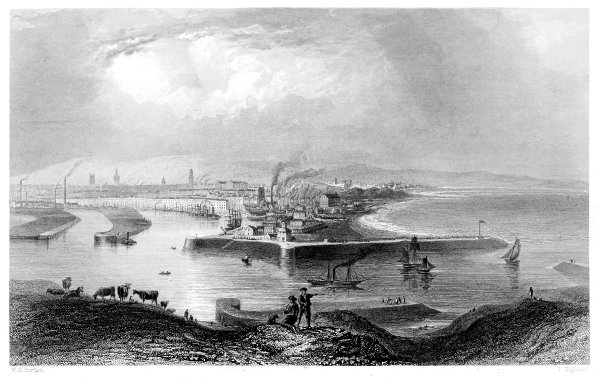
On the south-west of a bare rocky promontory, called Garron-point, at
the entrance of Stonehaven Bay, are seen the ruins of Cowie Chapel,
which is said to have been dedicated to the Blessed Virgin. From this
point on the north, called Garron, to that of Downie on the south, is
what is termed the Bay of Stonehaven. The town stretches from the bridge
over the Cowie river, on the north, to the above-mentioned headland,
Downie Point, on the south; but it is divided, as already stated, into
two parts by the "Carron;" the north part being the new, and the south
the old, or sea-town; close to which last, and to Downie Point, which
is a protection to it from south-east gales, stands the Harbour,
erected, like most others on the east coast, sea-ward. It is a
capacious basin, and would contain a great number of vessels, but until
lately, when two cross-jetties were built, it was very insecure, or
afforded little protection to vessels during north-east and east gales,
to which it is much exposed, the entrance being to the east. It is now,
however, comparatively secure; and gas-lights being erected, the one
bearing on the other, vessels bound southward in winter find it a very
agreeable retreat, and about thirty so situated have been seen in it at
one time.
The exports consist of grain, timber, herrings, and other fish; the
imports are principally coals and lime, of which a great quantity is
required for agricultural purposes.
The Harbour, in spring-tides, will admit vessels drawing fourteen feet
water, sometimes upwards; but in ordinary tides the depth can hardly be
reckoned at more than from ten to eleven feet.
The trade of curing fish by smoke-drying, in imitation of the Finnan
haddies, is carried on with much spirit: several large houses have been
fitted up for this purpose and for red-herrings; and a stranger would
scarcely believe the extent done in this business, the haddocks thus
cured being sent to London, Edinburgh, and other markets in the south,
by all conveyances.
The other trade of the place is principally in manufacturing woollen,
linen, and cotton cloths, a branch of native industry in which great
numbers of people are employed. The Glenury distillery is a large
concern, and close to the town, from which a great quantity of whiskey
is constantly shipped off.
Among the disasters which, in its day, Stonehaven has had to deplore, we
may cite the following, as characteristic of those unhappy times when
the country was torn by the violence of faction, and fire and sword laid
waste this ill-fated district. On the 20th of March, 1645, the Marquis
of Montrose, then quartered at Stonehaven, addressed a letter to Earl
Marischal, at his castle of Dunnottar, about two miles from this,
exhorting him to espouse the royal cause; but receiving no answer, he
proceeded to wreak his vengeance on the earl's lands and dependants.
"Thereafter," says the historian Spalding, "he fires the Tolbooth, a
prison of Stonehaven, wherein there was store of grain, and the whole
town, with all the barnyards, houses, and other buildings, except those
of James Clark, wherein Montrose himself was quartered. They plundered a
ship lying in the harbour, then set fire to her, as well as to all the
fishing-boats then in the harbour. They burnt up the whole town of
Cowie, houses, buildings, corn, and corn-yards; and in like manner
plundered the whole goods, gear, horses, oxen, sheep, which they could
get; plundered the parson of Dunnottar's house and set it on fire. The
people of Stonehaven and Cowie, it is said, came out, men, women, and
children at their feet and children in their arms, crying, howling, and
weeping, praying the earl, for God's sake, to save them from this fire
as soon as it was kindled; but these poor people got no answer, nor knew
they where to go with their children. How lamentable to behold!"
 ABERDEEN.


