The district of Conway is mostly agricultural, and possesses no distinct manufactures
by which the prosperity of the town and its population can be greatly
promoted. A few small trading-vessels belong to the port; and here also ships of
burden are occasionally repaired. The great improvement to the harbour is the
erection of the quay; and the channel of the river having been deepened, and every
impediment to the navigation removed, it may be anticipated that a speedy
increase of trading intercourse will succeed its former languor and inactivity. The
exports consist chiefly of timber, slate, and lead; and the imports, of coal from
Flint and Liverpool, and of tea, sugar, cotton, with various other articles of
domestic consumption.
The chain-bridge, which constitutes so beautiful a feature in the picture of
Conway, was erected by Mr. Telford, of whose genius Wales possesses several of
the noblest monuments. That immediately under notice—constructed on the same
principles as the bridge over the Menai, but much smaller in its proportions—is
three hundred and twenty feet between the supporting towers, and eighteen feet
above high-water mark. Nothing can be more elegant and beautiful, as it appears
lightly spanning the river, and suffering the eye to penetrate its net-like fabric, so
as scarcely to offer an obstruction to the landscape which shines through it. The
scenery at this point is exceedingly interesting, and presents the works of nature,
and art, and human genius, in striking combination.
The town of Conway, before the formation of the railroad, was one of the most
old-world places imaginable, unique for its faded and forlorn appearance, small as is
the area enclosed, a considerable portion being occupied by open spaces and gardens.
Everywhere entered by gothic portals, and as its interior was traced, with the
defensive wall everywhere in sight, it transported the beholder back to the middle
ages, more than any other walled city in England. There is a singular and picturesque
variety of ancient houses; some at the head of the street leading to the castle,
curiously carved, appear almost as old as the castle itself; others with their gable
roofs, and black rafters, are of later date, and the Plas Mawr, or great mansion, in
the principal street, prominently challenges the traveller's attention with its air of
faded magnificence and singular construction. It is of Elizabethan architecture,
and the arms of England, with initial letters E. R. and R. D., supposed to be
Robert Dudley, Earl of Leicester, as well as those of R. W., Robert Wynne of
Gwydir, sheriff of Carnarvon in 1591, and founder of the house, occur frequently,
and the place is lavishly adorned with various decorative devices of the age—swans,
owls, ostriches, mermaids, ragged staves, &c. The church contains little to interest
beyond its front, and an inscription to a certain Nicholas Hooker, of Conway, gentleman,
of a very anti-Malthusian import, the said Nicholas, though the father of
twenty-seven children, being but a degenerate copy of his father, who could boast—O
si sic omnia!—of no less than forty-one.
Numerous and delightful are the rambles about this most picturesque place,
which is backed by bold heathy hills and green sequestered valleys. One of the
prettiest is to Gyffin, about a mile distant, which may be reached by following up
the shores of the creek, south of the castle, and the small stream coming down into
it. The little church is very ancient, and contains some curious paintings worthy
of inspection; it is half buried, and so unpretending is the building in aspect, that
it may be passed almost without noticing its sacred character. There is an excellent
view of the town and castle from the upper road on the return; the long line of walls
may be traced from the highest point, as they sweep round and join the castle, the
whole space thus enclosed resembling in its outline the Welsh harp, as often suggested.
The river and hills appear finely beyond. The artist especially should not
omit to view Conway from this, perhaps its finest point of view.
So unique is, or rather was, Conway Castle in picturesque effect, that it is difficult
to mention any particular point from which it appears to greater advantage than
another. From the quay, or the river, from every eminence around, seen in front or
flank, near or distant, either by itself, or where the walls of the town prominently
enter into the composition, it is, or rather was, alike unequalled. The tourist who
is not pressed for time, and delights to hover around so magnificent a memorial of
past ages, will study it at every point. On taking a solitary walk round the walls,
he may fancy himself tracing the abandoned battlements of some old gothic town
of the Orient, Rhodes, or Antioch, or the Saracenic defences of Jerusalem; a dream
which may hardly be long indulged at present; for now, as Hood says,
"That iron age, which some have thought
Of mettle rather overwrought,
Is now all overcast,"
and its crumbling memorials are sharing the same fate. Furness Abbey is turned
into a railway station, and the passing train thunders through the very centre of old,
castellated Conway, reminding us, while it indeed scares away all romantic daydreams,
of the happy change from feudal oppression and border warfare, to the fusion
of jarring interests, and the progress of enlightened civilization.
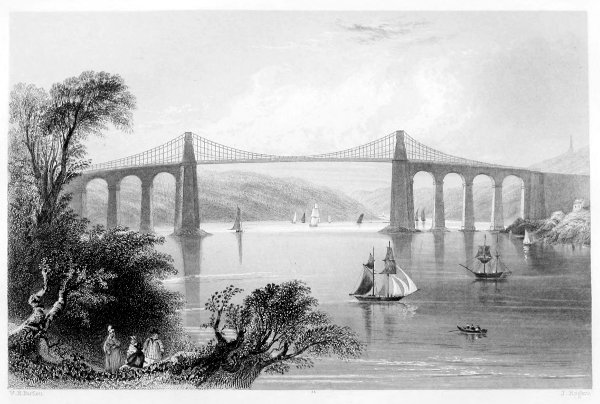 THE MENAI BRIDGE, BANGOR.
(North Wales.)


