When the 10.30 a.m. Riviera express pulled out of
Paddington next morning, Inspector Tanner was occupying a corner
seat in one of its first-class compartments. In his pocket
was a warrant for the arrest of William Douglas, in case his
investigations should indicate that such a step was
desirable. He had determined that if his victim could not account
satisfactorily for his actions on the night of the murder, or if
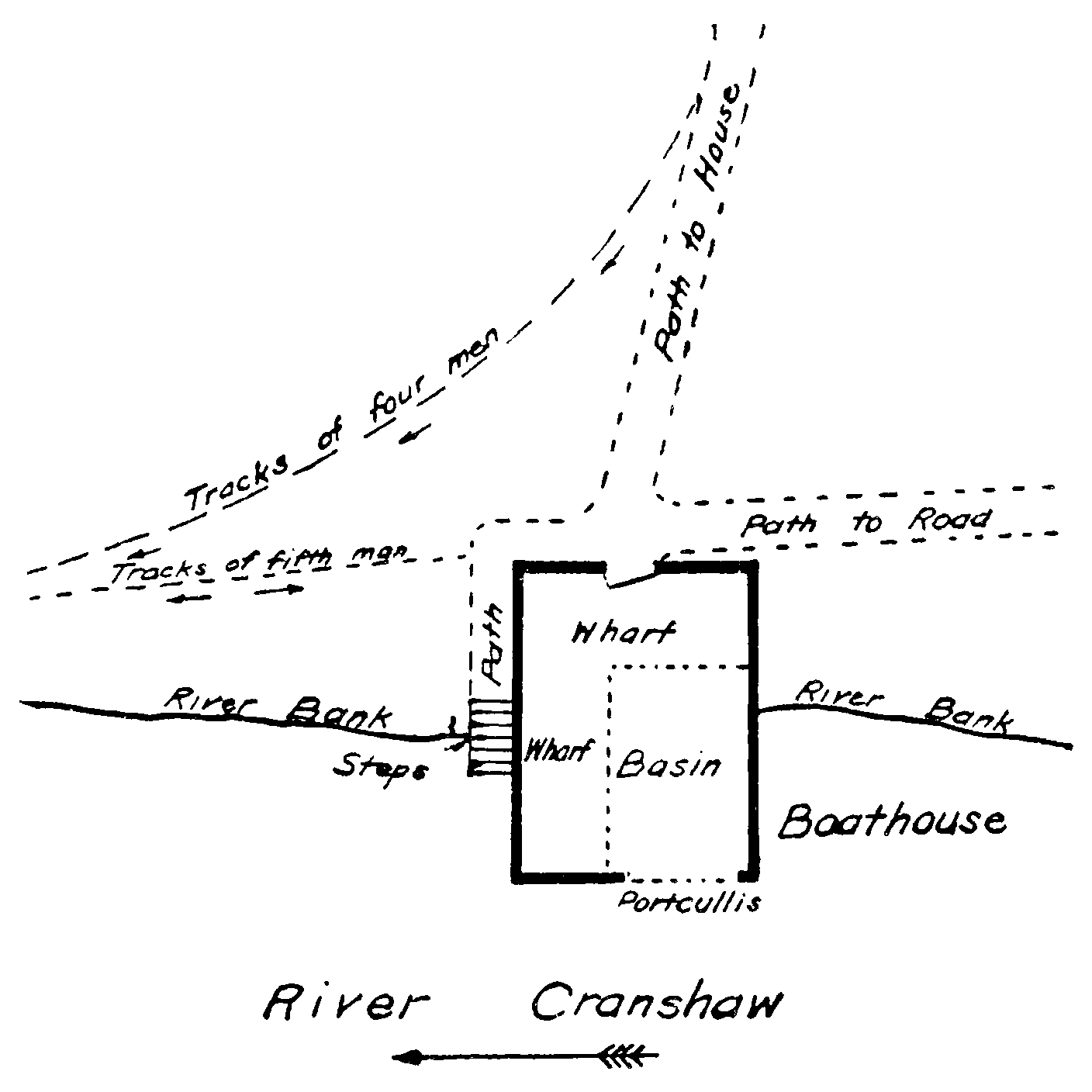
his boots fitted the marks on the Cranshaw River bank, no
other course would be possible.
Once again the Inspector was favoured with magnificent
weather for his country ramble. Indeed, like the previous
days, it was too hot, and as the train slipped swiftly through
the sun-baked country, he moved into the corridor so as
to make the most of the draught from the open windows.
Each time that he had made this journey in the past he had
enjoyed it, especially the portion between Exeter and Newton
Abbott—down the estuary of the Exe, past Dawlish and
Teignmouth with their queer spiky, red rocks, and
precipitous little cliffs running out into the blue sea, then farther
on inland again through the hilly, wooded country of South
Devon, where one caught unexpected glimpses of tiny,
nestling villages, and of narrow lanes, winding mysteriously,
between mossy, flower-spangled banks under the cool shade
of overhanging trees.
He reached Plymouth—the first stop since leaving
Paddington—shortly before three. Changing at North Road,
he boarded a branch line train after a short wait. A run of a
few minutes brought him to Yelverton. Here he alighted, and
when the Launceston and Princetown trains had rumbled
off, he accosted the stationmaster.
‘I am looking for a Mr William Douglas of Myrtle Cottage,’
he said. ‘Can you tell me where that is?’
The stationmaster could. Myrtle Cottage, it appeared, was
half a mile away on the road to Dousland, and Tanner, having
received directions as to his route, set off to walk.
The house was small and surrounded by trees, through which
the gables showed picturesquely. It was set back some little
distance from the road, a path leading through a not very well
kept flower garden to the door. Mr Douglas was evidently an
apiarist, for a row of wooden hives lined each side of the path,
and the hum of the insects was audible even from the road.
Along the side of the garden, and passing close to the gable of
the house ran a lane, from which a large gate led to a yard in
the rear. This gate, Tanner noticed, was standing open.
He walked up the path and knocked at the green-painted
door. For some time there was no response, but after a
second and more peremptory summons he heard footsteps
approaching. The door was opened by a small man with grey
hair and a beard trimmed short.
‘Got him first shot,’ thought Tanner, as he politely asked
for Mr William Douglas.
The man threw the door open.
‘Walk in, sir,’ he said. ‘My brother is upstairs. I’ll call him.’
‘Your brother?’ asked Tanner sharply, as he followed his
guide to a rather poorly furnished sitting room.
‘Yes. I’m John. I’ve lived here for some years, but William
is just back from America.’
Tanner nodded. He recollected the hotel porter had stated
that William Douglas had spoken with an American accent,
whereas this man clearly hailed from the north of England.
Besides, the beard was different. The porter had mentioned
a goatee, but the speaker’s was cut to a tiny point.
‘Sit down, sir,’ said the man civilly. ‘I’ll send my brother down.’
He indicated a chair opposite the door, and Tanner took it.
From where he sat he could see the foot of the staircase, and
he watched John walk to it and leisurely ascend. Presently
he heard him call ‘William!’
A nasal voice answered, but the Inspector could not hear
the words. John’s voice, now more distant, mumbled
something in reply, and there was a word, apparently of assent,
from the other.
Tanner glanced round the room. Beside the easy chair in
which he sat—leather lined, and very old and worn—there
was not much that made for comfort. A deck chair stood with
its back to one of the rather small windows. In front of the
other window was a table on which lay a number of books,
mostly dealing with bee keeping. The floor was covered by a
carpet, the worn, threadbare condition of which was brought
out pitilessly by the rays of the sun which struck obliquely
across it. Tanner got up and began to poke about, but without
taking his eye off the bottom of the stairs. William, it was
evident, was in no hurry to come down.
Suddenly there came faintly the purr of a motor engine, and
in a few seconds the sounds indicated that a car had started
at no great distance away. It grew louder, and Tanner moved
to the window. The sitting-room was in the gable beside the
lane, and as the Inspector looked out he saw a small
two-seater with one occupant pass out towards the road. But this
occupant was a small man, and though his collar was turned
up and his cap pulled down over his eyes, Tanner could see
he had a grey beard.
He stood for a moment wondering how John had got downstairs
without having been seen. Then, as the house seemed
strangely quiet, an idea flashed into his mind, and he ran to
the stairs and called, ‘Anyone there?’ There was no answer,
and with a sudden feeling of foreboding, he raced up. Three
rooms opened off a short landing, and the doors being open,
he glanced into each in turn. They were all empty!
A casement window on the landing was open, and as
Tanner looked out, he saw what had been done. About three
feet below the sill was the roof of a low shed. Nothing could be
easier than to step out of the window on to the roof, and drop
to the ground. The open door of the outhouse to which led
many wheel tracks showed where the motor had been kept.
Tanner swore savagely. Never before had he been so
completely and so easily duped. It was now evident to him
that William Douglas had recognised him approaching the
house, and had invented a brother to enable him to hold the
Inspector’s attention while he bolted. And he had played his
cards skilfully! Ruefully the Inspector had to admire the trick,
though he surmised it had been worked out beforehand in
view of just such an emergency.
‘He’ll not get far,’ the angry man growled, as he prepared
to follow. But, thinking a moment or two would now make
little difference, he turned his steps instead to the kitchen.
There on a shelf, as he had expected, were three or four pairs
of boots. Drawing from his pocket a tracing of the marks on
the Cranshaw River bank, he eagerly compared it with the
soles. Those of the first pair he took up corresponded! Here
was proof, if proof were required. William Douglas had been
at the Luce Manor boathouse on the night of the murder!
Seizing a small handbag he had noticed in the sitting room,
the Inspector packed the boots, then, after closing the windows,
and locking the yard gates and the house doors, he hurried
back along the road towards Yelverton. Inquiring for the local
telephone call office, he rang up the Plymouth police authorities,
describing, so far as he was able, the man and the car, and asking
them to have a ring formed round the locality. Hastening on to the
Yelverton police station, he told the sergeant what had occurred,
and handing him the keys of the cottage, instructed him to take
charge, and to make a thorough search of the premises.
He learned that a train left for Plymouth in a few minutes,
and travelling by it, he soon reached the police headquarters
of that city. Here he was met by a superintendent, and the
two men discussed the affair in detail.
‘I have done, I think, everything possible,’ the Superintendent
concluded. ‘All the stations at a radius of about
twenty miles or more have been advised, and the roads will
be watched from Looe and Liskeard round by Launceston,
Okehampton, and Moreton Hamstead, to Newton Abbott. All
trains and steamers, as far as possible, will be examined before
departure, and the railway people at the smaller stations will
be advised. I don’t think he’ll make for Cornwall, you know.
It’s too much of a dead end. He will either go east in his car,
or come to Plymouth and try the trains, or even more likely,
the steamers.’
‘That is my own view,’ Tanner returned. ‘I suppose there’s
nothing to be done now but wait for information?’
‘I think we’ll hear something before long. If you haven’t
had a meal, I should get it while you have the chance. The
Dartmoor Arms, a few doors away, is quite good, and I’ll
send for you if there is news.’
As this seemed sound advice, Tanner followed it. But he
had not finished his hastily served dinner when he was sent
for. News had come in.
‘I have a wire from the Tavistock men,’ the Superintendent
explained. ‘A car answering your description has just been
found abandoned in a lane about quarter of a mile on the
Yelverton side of Tavistock. Evidently your man wouldn’t
risk taking it through the town.’
‘Then he must be there himself.’
‘Unless he got away by rail. What time did you say he left
Yelverton?’
‘About quarter-past four, or slightly later.’
‘From Yelverton to Tavistock is not more than about five
miles. He would do it easily in fifteen minutes. Say he would
reach Tavistock between half past four and quarter to five.’
The Superintendent picked up a Bradshaw. ‘Here we are. By
the Great Western there’s a 5.27 for Plymouth and a 6.02 for
Launceston. Now for the South-Western. There’s a 5.22, and
a 7.50 for Exeter. He’s gone either by that 5.27 to Plymouth
or the 5.22 to Exeter, and I should say the latter.’
‘It seems likely. Would your men have reached the stations
before those trains left?’
The Superintendent shook his head.
‘It’s just possible,’ he answered, ‘but I hardly think so. Your
phone was received at’—he referred to a paper—‘4.42. Orders
were issued immediately, but considering telegraphic delays,
they were probably not received at Tavistock till five or slightly
after. The men would then have to be collected and instructed.
They might have seen those trains out, but it’s unlikely.’
‘Well, I’ll go on to Tavistock now anyway,’ Tanner decided.
‘I presume you will have those trains searched?’
‘Of course. I issued a new set of orders immediately. Both
trains will be carefully examined, and the country all about
Tavistock will be scoured. We are well accustomed to that,’
the Superintendent added with a grim smile.
‘The Princetown convicts? I suppose you are,’ answered
Tanner, as with a brief word of farewell he withdrew.
There being no train by either line for some little time,
Tanner took a car. As they climbed the long, slow incline to
Yelverton, out of the relaxing, enervating Plymouth air, he felt
himself growing fresher and more energetic. He was grimly
determined not to rest till he had laid his hands on the man
who had duped him. From merely professional, the matter
had become personal. Tanner’s pride was involved. No one,
he swore, should play him such a trick and get off with it.
They slipped quietly through the fifteen or sixteen miles
of charmingly wooded country, dropping into Tavistock as
the shadows began to lengthen across the road. The sergeant
had been advised of Tanner’s arrival, and was expecting
him. Together they ran back and examined the abandoned
car. Though they found nothing directly helpful, Tanner
felt sure it was the one he had seen from the sitting room at
Myrtle Cottage.
He turned to his companion.
‘Did you hear about this in time to examine the Plymouth
and Exeter trains at 5.27 and 5.22?’ he asked.
The other shook his head.
‘No, sir, I’m sorry to say we did not. But I have since made
inquiries. No one with a grey beard was seen at either station.
At the Great Western Station four persons booked, all third
single to Plymouth, but the clerk remembers one of these was
a young sailor and the others women. At the South-Western
Station two tickets were issued to Exeter, one a first to Major
Reading, who lives here, the other a third single to a little,
elderly, clean-shaven man. Our men were there within ten
minutes of the train’s departure, so that’s how the clerks
remembered—between that and there being so few bookings.’
‘A small, elderly, clean-shaven man, sergeant? Let us go
round the Tavistock barbers.’
The sergeant looked up sharply.
‘By Jove! sir, a likely enough ruse,’ he cried. ‘It won’t take
long to find out—there are only three.’
They ran back to the little town, and at the first barber’s
learned that a small, elderly man with a short grey beard and
moustache had called at a few minutes before five, and had
had his beard and moustache shaved off.
‘Now to the telegraph office. We’ll have him before long.’
The Inspector sent messages to Plymouth, to Exeter, and
to some of the principal stations beyond, explaining that the
bearded man of the previous wires had had himself shaved.
Then he looked at his watch.
‘Quarter to eight. Can I catch the 7.50? Phone to hold it
while I run across.’
He jumped into the car and drove to the South-Western
Station. There he caught the train for Exeter with a minute
to spare.
He leaned back in the corner of a first-class compartment,
and slowly drew out and lit a cigar, while he turned over in
his mind the next step to be taken. He thought that at all
events he should go on to Exeter. The 5.22 from Tavistock,
by which Douglas had travelled, reached that city before his
wire about the shaving had been sent out. Therefore it was
hardly likely that the man would have been detained en route.
Tanner, of course, recognised that a freshly shaven chin was
unmistakable, but he did not think a village constable would
have the sharpness to deduce what Douglas might have done,
and act accordingly. But from Exeter in what direction would
the quarry head?
There seemed two possibilities. Probably he would try either
to reach London, or to get abroad. London, as Tanner knew,
was perhaps the safest place in the world for a criminal to lie
hidden. But many ill-doers had an overwhelming desire to
put as great a distance as possible between themselves and
the scene of their misdeeds. If Douglas were of this class he
would try to get out of the country, and if, as the hotel porter
had stated, he spoke like an American, would he not be likely
to try to reach the country in which he might most easily pass
for a native? There was, of course, no means of knowing, but
at least it was clear that the approaches to London as well as
the ports should be closely watched.
In any case, whatever the fugitive’s goal, he would be almost
certain to pass through Exeter. It was true he could double
back to Plymouth, but the probabilities were he would keep
away from the district in which he was known. As Tanner’s
train ran into St David’s Station, Exeter, he felt sure his victim
was not far before him.
A tall efficient looking sergeant of police was waiting on
the platform. This man, sharply scrutinising the alighting
travellers, promptly fixed on Tanner.
‘Inspector Tanner, sir?’ he questioned, and as the other
nodded, continued, ‘they phoned us from Plymouth you were
coming through on this train. We have inquiries in hand both
here and at Queen Street, the other station. So far we have
heard nothing of your man.’
‘What exactly are you doing?’
‘We have a man at each station working the staffs—booking-clerks,
ticket collectors, porters, refreshment rooms—the
usual thing. Another man is going round the hotels, another
the restaurants open at that hour, and another the garages,
in case he might have gone on by car. Is there any other line
you would wish taken up?’
‘Why no, sergeant. I think you have covered all the ground.
Have you advised your men that the fellow got shaved?’
‘Some of them, sir; some of them we couldn’t get hold of.
We advise them as we can get in touch with them.’
Tanner nodded again.
‘Well, we had better go to headquarters and wait for news.’
For a considerable time Tanner remained, chafing and
impatient, until, just as eleven was booming from the town
clocks, a constable appeared accompanied by a tall,
fair-haired young man in a leather coat and breeches, and a
peaked cap. The latter explained that he was a taxi owner,
driving his own vehicle, and he believed he knew something
that might be of value.
It appeared that he had been at St David’s Station when
Douglas’s train had come in. He was engaged by a small,
elderly, clean-shaven man with grey hair, dressed in a tweed
overcoat and a cloth cap. The man seemed nervous and
excited, and told him to drive to any ready-made clothes store
which would be open at that hour. He took him to a shop
in the poorer part of the town. The man went in, returning
in a few minutes dressed in a soft, grey felt hat and a khaki
coloured waterproof, and carrying a bundle. He re-entered
the taxi and told the driver ‘Queen Street Station as quick as
you can.’ He drove there, and the man paid him and hurried
into the station, and that was all he knew.
‘What time did you reach Queen Street?’ asked Tanner.
‘Going on to half-past seven.’
‘We’d better go to Queen Street and find out what trains
leave about that hour.’
Their visitor’s car was waiting outside, and engaging it,
they drove rapidly off.
For those who do not know Exeter, it may be explained that
the Great Western and London and South-Western Railways,
both running from London to Plymouth, form a gigantic
figure 8, the centre where the lines cross being St David’s
Station, Exeter. In the same town, but a mile nearer London
on the South-Western, is Queen Street Station. While
therefore St David’s is joint between the two Companies, Queen
Street is South-Western only, and these facts seemed to
indicate to Tanner the probability that Douglas was going for a
South-Western train bound Londonwards.
A glance at the time table at Queen Street supported this
view. A train left for London at 7.32.
‘Your constable saw the booking-clerk, I suppose?’ Tanner
asked.
‘Yes, sir. But of course he gave the wrong description. He
did not know the man had changed his cap and coat.’
‘That’s true,’ Tanner assented. ‘We had better see him again.’
The booking office was closed and the clerk had gone
home. With considerable difficulty they obtained his address
from a watchman. Then stepping into their waiting taxi, they
were driven to it.
The house was in darkness, but their third thunderous
knock produced a sleepy and indignant householder. Tanner,
who was a past-master in the art, soothed his ruffled feelings,
and he brought them in and civilly asked their business.
‘You have been troubled about this before, I’m afraid,’ the
Inspector began. ‘I shall explain the affair in a word and
you’ll see its importance. A murder has been committed, and
we have traced the suspected man to Queen Street Station.
He drove up in a great hurry just before half-past seven this
evening, and we imagine he must have travelled by the 7.32.
Now you will see why we want your help. If you can recall
the man and recollect where he booked to, it would be of
material assistance to us.’
‘A clean-shaven man in a brownish cap and coat?’ the
clerk replied. ‘But I have already answered that. I saw no
one so dressed.’
‘We have just discovered that he had bought a waterproof
and a grey felt hat. Can you recall him now?’
The clerk made a sudden gesture.
‘Why yes, I can,’ he cried excitedly, ‘I remarked him because
he was in such a fuss, and I told him he was time enough. I
should have thought of it when the constable asked me, but
the description put me off.’
‘Quite naturally,’ Tanner assured him smoothly, ‘but now
if you can tell us where he booked to, you’ll do us a very
great service.’
‘I can do so. His excitement drew my attention to him. He
took a third single to Southampton.’
‘Southampton! Just as I expected,’ exclaimed Tanner.
‘Making for the ships!’
The other nodded and Tanner went on:
‘Where would he get to from there? Would he catch the
night boat for Havre?’
‘No,’ answered the clerk as he fetched a time table and
rapidly turned over the leaves. ‘The 7.32 gets to Salisbury at
10.52, and there’s a train on to Southampton Town at 11.00. It
doesn’t go to the Harbour. But the connection at Eastleigh is
bad, and you don’t get to Southampton till 12.30. The Havre
boat leaves at 11.30.’
‘And what time do you get to Eastleigh?’
‘11.37.’
‘And from there to Southampton is how far?’
‘About seven miles to the docks.’
‘So that if he had taken a motor at Eastleigh he could have
been there by midnight?’
‘Yes, I should say about that.’
Tanner looked at his watch. It was five minutes to twelve. In
from five to thirty-five minutes Douglas would probably reach
Southampton. Would there be time to intercept him there?
Hastily thanking the clerk, the two men jumped once more
into their taxi and drove to the police station. There the
Inspector hurried to the telephone to call up the Southampton
police. But there was a delay in getting through. For thirty
minutes he fumed and fretted. Then at half-past twelve he
got his connection.
‘I’m afraid the train will be in,’ replied the distant voice,
‘but if it’s late we’ll get your man if he’s on it. If we miss
him there, we’ll go on to the Docks. There’s a Union Castle
liner due out at five o’clock. He may be going for that. What
about the warrant?’
‘Hold on a minute,’ said Tanner, then turning to the sergeant,
he spoke rapidly:
‘A liner leaves Southampton at five for South Africa. Can
I get there with a good car? There are no trains, of course?’
‘None, sir. It’s about a hundred miles and you should do
thirty miles an hour—say three and a half hours. If you left
here at 1.00, you should be there by 4.30.’
‘I’ll do that.’ Then turning back to the telephone: ‘I’m
leaving here now by road for Southampton. You may expect
me at the Union Castle berth about 4.30. I’ll have the warrant.’
The taxi-driver they had been employing being unfamiliar
with the surrounding country, they drove to the nearest garage
and after some difficulty succeeded in knocking up a sleepy
manager and hiring a powerful car and a man who knew
the road, at least as far as Salisbury. But there were delays
in getting away, and though the manager did his best, it was
nearly half-past one when the big vehicle swung out of Exeter,
eastward bound.
The night was fine but dark. As they purred swiftly along
the smooth road, Tanner lay back on the comfortable cushions
and let the cool air blow in on his heated forehead, while
he took stock of the position.
He was perfectly aware that he might be on a wild-goose
chase. The taking of the ticket to Southampton might have
been a blind, and Douglas might not have done the obvious
thing in making a bolt to the most convenient port. After the
ruse the man had employed at Myrtle Cottage, Tanner felt he
would not do the obvious thing unless he was impelled to it by
some strong consideration. But such a consideration existed.
There was the element of time. The man would realise that
on such a journey he must inevitably be traced, but he would
hardly imagine he could be traced in time. Before his pursuers
could reach Southampton he would count on having been able
to adopt a new personality, and put hundreds of miles of sea
between himself and them. The more Tanner thought over this
possibility, the more likely it seemed. If he were in Douglas’s
position it was the view he himself would have taken.
They were running well. Tanner watched the whirling
hedges, lit up by the strong headlights, and blurred by the
speed into quivering smudges, and judged they must be doing
well on to forty miles an hour. It was, of course, breaking the
law; moreover, it was by no means safe, but Tanner did not let
such considerations weigh against the chance of checkmating
the man who had duped him. He had informed the chauffeur
he would be responsible if there was trouble.
He fell to reckoning distances. He was not very well up
in the geography of the district, but he knew there were two
roads, north through Yeovil and Salisbury, and south through
Dorchester and Poole. He imagined neither of these was
quite direct, but he did not know if there was a good road
lying between them.
In about half an hour they slackened for a town, after which
the road rose for some miles. Then in half an hour more it
fell again and they ran through another town, whose name
appeared on several buildings—Chard. ‘The Salisbury Road,’
thought Tanner. Forty minutes later they left Yeovil behind
and at 4.10, nearly three hours after leaving Exeter, they turned
out of Salisbury on the Southampton road.
‘Not bad going,’ thought Tanner. ‘If we can keep it up we
should be at the boat at twenty to five.’
But alas! the driver’s knowledge of the road which had
served them so well up to Salisbury, now failed them. They
had to reduce speed at cross roads and run more cautiously.
Fortunately, it was now fairly light, or their progress would
have been still slower.
Tanner, was getting nervous. It was going to be a near thing.
He held his watch in his hand and counted the mile-posts as
one after another they dropped behind. Now it was half-past
four, and still they had nine miles to go.
At last they came to the town. But here matters instead of
mending, grew much worse. Neither Tanner nor the driver
knew the streets, and precious minutes were wasted trying
to puzzle out the way from the rather inferior map the latter
had brought.
Quarter to five. Tanner was in desperation. And then to
his relief his eye fell on a policeman. It was the work of a
moment to call him over, explain the situation, and get him
up beside the driver. Then their troubles were over. The
streets were empty and they made fine speed.
It wanted ten minutes to five as the car pulled up at the
docks, and Tanner leaped out and raced to the berth of the
great liner. A man whom he instantly recognised as a policeman
in plain clothes stood near the bottom of each gangway, while
a third was sauntering along the edge of the wharf beside the
boat. Tanner spoke hurriedly to the latter.
‘He’s not on board, sir,’ the man answered. ‘We were here
before he could have got down from the Town Station, and
besides we made inquiries.’
‘The other side of the ship?’ queried the Inspector.
‘We have a man rowing up and down.’
Tanner grunted.
‘Who’s in charge?’ he asked.
‘Sergeant Holmes. He went to phone the station. He’ll be
back directly.’
Tanner was woefully disappointed. He felt that if Douglas was
not already aboard he would never risk it now. Had the man,
he wondered, been sharper than he had counted on, and once
again given him the slip? Fortunately, he had taken the obvious
precaution of wiring all the stations at which the 7.32 stopped,
so that, even if Douglas had alighted elsewhere, he would almost
certainly be spotted. But had Douglas travelled by the 7.32 at
all? Was his haste with the taxi and his purchase of the ticket
another trick, and was he lying low in Exeter, intending still
further to alter his appearance and make a bolt elsewhere? Or
was he walking all night with the object of joining a train at some
quite different station in the morning? Tanner could not guess.
Three minutes only remained and Tanner grew more and
more anxious. It was now or never. Then, as the gangways
were being hoisted, a sergeant of police appeared and went
up to one of the plain clothes men. Tanner hurried forward.
‘Mr Tanner, sir?’ said the sergeant. ‘I’m very sorry, sir, but
you’re late.’
‘Late?’ Tanner cried sharply. ‘What do you mean, sergeant?
There’s plenty of time to go on board still.’
The sergeant shook his head.
‘He’s not there, sir. He’s gone. I’ve just learnt that he left
by the Vaal River. She sailed at four o’clock.’
‘Damnation!’ cried Tanner angrily. ‘What were you thinking
about, sergeant? How in hell did you let him slip through
your fingers?’
‘The man I sent down, sir, missed him. I can’t imagine how
he did it, but you’ll hear what he has to say yourself. After I
had all—’
‘I’ll see him,’ said Tanner grimly. ‘How did you find it out?’
‘I posted the men, sir, first, then I went round them myself.
I got to the Vaal River’s berth as she was sheering out. I made
inquiries at the office. There is no doubt the man booked.’
‘Where to?’
‘Tangier, sir.’
‘H’m—Morocco, and there’s no extradition from there.
Where else does the boat call?’
‘Lisbon, Marseilles, Naples, Suez, Delagoa Bay and
Durban.’
‘I’ll get him at Lisbon. Show me the office.’
They hurried down to the East Africa Line Quay office.
There Tanner interviewed the booking clerk and satisfied
himself that Douglas really had sailed. He had booked under
the name of Walter Donnell.
‘Lisbon is the first call?’ asked the Inspector.
‘Yes. She’s due there about six on Thursday morning.’
‘And this is Tuesday. That’s about a fifty hour run?’
‘About that.’
‘I must get there before her. How am I to do it?’
The clerk stared.
‘I’m afraid you can’t,’ he answered slowly. ‘She’s not a
specially fast boat, but there’s no other leaving soon enough
to pass her.’
‘Overland?’
‘No. There’s not time. If you had caught the Havre boat
last night you could have done it. You can’t now.’
‘Let me see the time table.’
The clerk produced a Continental Bradshaw.
‘Here you are,’ he said, turning to the ‘Through Routes’
on page 6. ‘You see there are two trains a day from Paris to
Lisbon. One, the ordinary, leaves Paris at 10.22 at night. It
gets to Lisbon at 12.33 two nights later—that is, about a fifty
hours’ run. That’s out of the question, and you’ll see the
other is too. It’s a special fast train, the Sud Express, and it
leaves Paris at 12.17 midday, and reaches Lisbon at 10.50 the
following evening—that is thirty-four hours and a half. Now
if you could catch that train today you’d be all right. But you
couldn’t. Even if you could catch the 8.00 a.m. from Victoria,
which you couldn’t. That would only bring you into Paris
at 5.29—five hours late.’
‘How long does your boat lie at Lisbon?’
‘About four hours. She’s due away about ten on Thursday
morning.’
Tanner felt he was up against it. So far as he could see it
was impossible for him to reach Lisbon before 10.50 on the
Thursday night, and by that time the man he wanted would
already have left some twelve hours. And if he missed him
at Lisbon, he would miss him for good. He could never get
him once he was ashore at Tangier. Nor was it any more
possible for another officer from the Yard to go in his place.
Of course, there were the Portuguese police. Tanner had
never been in Portugal, and knew nothing whatever about
its police, but he had the not uncommon insular distrust of
foreign efficiency. As he put it to himself, he would rather rely
on himself any day than trust to any of these foreign chaps.
But there seemed no other way.
Absently thanking the clerk, he walked with the sergeant
back to his car and drove to the police station. As he
dismounted an idea shot suddenly into his mind.
‘Get the car ready for another run,’ he shouted and hurrying
to the telephone, put through a call to Scotland Yard.
‘Yes, I’m Tanner,’ he said, when the connection was made.
‘The Ponson Case. That man Douglas I’m after got away on
the Vaal River. Sailed from Southampton at four this morning.
First call Lisbon. I must be there to meet him. It can only
be done if I leave Paris at 12.17 today. None of the ordinary
services would get me over in time. Can you arrange with the
Air people to give me a plane?’
He was told to wait, and at six o’clock the reply came.
‘The Deputy Chief has arranged for a fast plane to leave
the drome near Petersfield as soon as possible. Get there at
once and report to Major Forbes. Call at Hendon and we
shall have French and Portuguese money for you, as well as
the extradition warrant.’
Tanner was not long in reaching Petersfield, but there was
a delay at the aerodrome, and he chafed impatiently as the
precious minutes slipped away. It was not indeed till a little
after seven that the actual start was made. The morning was
clear at first, and they made good speed to Hendon, alighting
and picking up the money and papers. But as they reached
the coast they ran into a haze, which soon developed into a
thick fog. The pilot did his best, going straight on by dead
reckoning, but when in another hour they got through it,
they found they had gone a good deal out of their course in
a northerly direction. Tanner swore bitterly, for he found his
margin of time was growing less and less. Finally they picked
up the main line of the Northern Railway, and following it
fairly closely, at last saw creeping up over the horizon the
buildings of the capital.
‘Down in ten minutes,’ the pilot roared, and Tanner nodded
as he looked his watch.
It was eleven minutes to twelve, and the Inspector
recognised he would have to run for it. Soon they were above
Argenteuil and crossing the great loops of the Seine, with
St Cloud on the right and the vast city stretching away to
the left. Now they were planing rapidly down, till with a
gentle shock they alighted at the edge of the flying ground
at Issy. Tanner leaped out and ran to the entrance as fast
as the stiffness of his legs would allow. As he did so twelve
sounded from the clock towers. He had seventeen minutes,
the Gare Quai d’Orsay was two miles away, and there were
no taxis within sight.
There was but one thing to do and Tanner did it. Some
private cars were drawn up on the road just outside the flying
ground. Tanner ran his eye hastily over them and selected
one, a racing car from which a sporting looking man was just
descending. The detective hailed him.
‘Sir,’ he panted, ‘I have crossed by aeroplane from England
to catch the 12.17 at the Gare Quai d’Orsay, and now I can’t
get a taxi. If you would run me till we meet a taxi, I just
couldn’t say how grateful I’d be.’
The man looked puzzled.
‘I not speak Engleesh,’ he said slowly, then adding
interrogatively, ‘You weesh—aller, aller—go—á la Gare Quai d’Orsay?’
Tanner nodded emphatically, and taking out his watch, ran
his finger from the minute hand, which was now standing at
five minutes past the hour, to seventeen minutes past. The
man threw up his left hand to signify comprehension.
‘Ah, oui,’ he answered. ‘Bon. Montez vite, monsieur.
Chomp een.’
Tanner had obeyed the gesture before the man finished
speaking, and the powerful car, swinging round, shot rapidly
eastwards along the quais.
‘Where you—allez—go?’ jerked out the man as they tore
along. Tanner understood.
‘Lisbon,’ he called.
‘Ah, Lisbonne. Oui,’ the man nodded.
Suddenly they came to a great building—Tanner did not
know his Paris—and the car stopped abruptly. The man
jumped out followed by his passenger. As they ran into the
concourse of the huge Quai d’Orsay Station, the hands of
the clock pointed to fifteen minutes past twelve. Two minutes
to get the ticket! Without his new friend Tanner would have
been utterly lost. The taking of a ticket seemed a complicated
and interminable affair. But at last it was accomplished, and
Tanner raced for the bridge across the low level tracks. But
just before he reached the inclined plane descending to the
platform, the ticket examiner slammed the gate. There was
a voluble outcry from the sporting man, but for answer the
official shrugged his shoulders and pointed to the roofs of
the carriages. The train was already moving.
Once again Tanner swore bitterly, as he gazed at the
disappearing vehicles. But his friend gave him no time for
self-commiseration.
‘Vite! Vite!’ he cried, signing to the other to follow him,
and rushing once more out of the station.
They threw themselves into the car, which started off at a
furious pace eastwards. Then Tanner recollected that the
terminus of the Paris-Orleans line had formerly been the Gare
d’Austerlitz farther up the river, the Gare Quai d’Orsay being a
new station at the end of a recently made extension. All trains, he
farther remembered having read, stopped at the Gare d’Austerlitz
to enable the electric engine which worked through the extension
tunnel to be replaced by a steam locomotive. Evidently his friend
thought he could overtake the train at the Austerlitz Station.
And he did—just. After wringing the hand of the man who
had taken so much trouble to help him, he dashed to the
platform and climbed into a carriage as the train began to move.
‘Lord!’ he said to himself as he wiped his forehead, ‘only
for that old sport I’d have missed it.’
Then began a long tedious journey. Though the train was
rapid and luxurious, Tanner was pretty sick of it before he
reached his destination. There was a restaurant car forward,
and as they raced across the sunny country south of Paris,
the Inspector did full justice to an excellent lunch.
After a time he grew wearied by the monotony of the flat
lands, but the scenery became more interesting as they crossed
the hills between Poitiers and Angoulême. Bordeaux was
passed about seven o’clock, and as darkness fell they were
traversing the dreary, desolate, sandy wastes and pine forests
of Les Landes.
They reached Irun just before midnight, changing there into
the broad-gauge carriages of Spain, and waiting for customs
examination.
The moon rose as they passed through the rocky country
north of Burgos, and it was daylight when they reached the
latter town. Then on again through Valladolid to Medina,
where the Madrid portion of the train branched off; through
Salamanca of legendary fame, but now, for Spain, a considerable
railway centre, then into Portugal, where the train hurtled
along at considerably over thirty miles an hour. Finally, with
brakes grinding, they descended the steep incline tunnelled
beneath one of the seven hills on which Lisbon is built, and
pulled up, twenty minutes late, in the Rocio Station.
When Tanner emerged into the brilliantly lighted streets and
gazed down the splendid vista of the Avenida da Liberdade,
he literally held his breath with amazement. The Portuguese
he had always looked on as a lazy, good-for-nothing set, but
this great new boulevard made him reconsider his opinion.
He booked a room in the Avenida Palace Hotel, and then,
crossing the Dom Pedro Square, walked down to the
steamboat offices in the Rua da Alfandega.
The office was open—every one seemed to be on the move
all night—and one of the clerks spoke English. The steamer, it
appeared, was due about half-past six. Tanner took the clerk
into his confidence, and the latter made arrangements for the
Inspector to get aboard with the first boat from the shore.
At six o’clock Tanner was down on the Praça do
Commercio, admiring in the brilliant sunlight the splendid
river which flowed before him, and the charming setting of
the town on its range of hills. In the river lay several steamers,
some quite large, and all tugging at their anchors with their
bows upstream. Down seawards, but inside the comparatively
narrow mouth of the Tagus, a grey, two-funnelled boat was
coming slowly up—the Vaal River—with, as Tanner hoped,
William Douglas on board.
His friend the clerk arriving a moment later, the two men
embarked on a motor launch. As the Vaal River’s anchor fell
with a mighty splash, they sheered alongside and made fast.
When the port authorities had gone aboard, Tanner was
allowed to follow. He went straight to the captain, who was still
on the bridge, and showing him his card, explained his business.
‘And so Mr Walter Donnell’s wanted for murder,’ the
captain commented. ‘Guess he’s aboard all right. I thought
he had something on his mind. See the chief steward and
you’ll find him. What are you going to do with him?’
‘Take him back to London.’
‘Of course. But how?’
‘I don’t know. What would you advise?’
The captain pointed to a single-funnelled steamer of about
4000 tons lying not two hundred yards on their port quarter.
‘That’s the Chrysostom, a Booth liner, due out in about an
hour. If you take my advice you’ll get aboard and don’t favour
the shore with your presence. I’ll run you over in the launch.’
Tanner thanked the man warmly.
‘Guess that’s all right,’ he answered dryly. ‘I’m as interested
in getting him out of my ship as you are in taking him.’
Finding the chief steward, Tanner explained the matter in
hand, adding that he wished to make the arrest as quietly as
possible. The man seemed mildly interested and promised
his help.
Douglas, alias Donnell, was, it appeared, still in his cabin,
and the two went thither. He was in bed, and rose to open
the door. When he saw Tanner his eyes started from his head
with amazement, then his jaw dropped and his face went grey.
Stepping quickly back, he collapsed on to the cabin sofa and
sat staring helplessly.
‘William Douglas or Walter Donnell,’ Tanner said solemnly,
‘I arrest you on a charge of being concerned in the death of
the late Sir William Ponson, of Luce Manor, Halford. I have
to warn you that anything you say will be used against you.’
The man made a desperate effort to pull himself together.
‘My God!’ he gasped. ‘How did you trace me?’ Then,
Tanner not replying, he went on with pitiable earnestness:
‘But you’ve made a mistake. I am innocent. I know the circumstances
look bad, but I’m innocent, I swear it in God’s name.’
‘That will do,’ said Tanner not unkindly. ‘You’ll have every
chance to put yourself right if you can do it. But you’ll have
to come back to London with me. And for your own sake,
the less you say the better.’
For a moment the idea of making a desperate resistance
seemed to cross the prisoner’s mind. Then, apparently realising
his hopeless position, he said quietly, ‘I’ll go with you.
Let me pack my things.’
Tanner nodded, keeping a keen eye on the other’s movements
for fear he would attempt suicide. But such an idea did
not seem to occur to him. He dressed and packed
expeditiously enough, and then said he was ready to go.
The launch was waiting, and in a few minutes they stood
on the deck of the Chrysostom, homeward bound. Presently
the anchor was hoisted and the vessel, swinging round,
commenced her 1200 mile trip to Liverpool.
Having explained his business to the captain and seen
Douglas securely locked in a cabin, Tanner stood leaning on
the rail of the upper deck, watching the pleasantly situated
town slip slowly astern. He could see the Cathedral of Belem
standing, damaged, just as it was left by the earthquake of
1755. Then out of the mouth of the river and past the
picturesque pleasure resort of Mont Estoril, with, just beyond it,
the sleepy, old-world village of Cascaes till, rolling easily in
the Atlantic swell, they turned northwards. The Burlings
Islands, which they passed later in the day, were the last
land they saw until, on the third morning, they awoke to find
themselves lying in the Mersey. By midday Tanner and his
prisoner were in London.