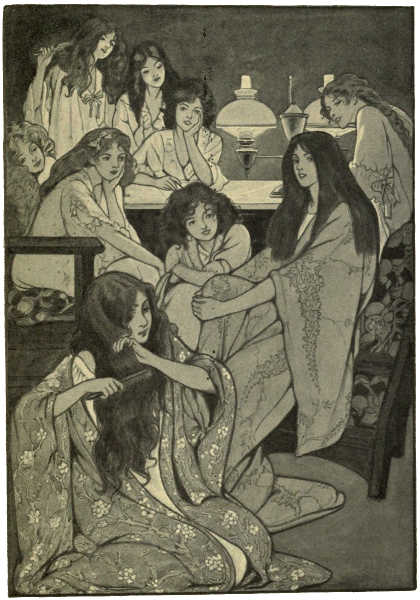
“Put it down in the log book, Kate, under
the head of current events,” Polly said that night,
as she sat beside Crullers’ couch, and they all
discussed the rescue. “And don’t say heroism
again. It wasn’t anything of the kind. It was
just plain common sense.”
“That’s so,” agreed the Captain, smiling
shrewdly. “It’s an awful embarrassing thing,
this being a hero, Miss Polly. I’ve had to go
through it several times, more or less, whenever
I happened to haul some landlubber out of deep
water, and I can sympathize with you.”
“Just the same, Captain, you’ll never know
how glad I was to see that life-boat round the
Point. The tide was setting me at my wits’
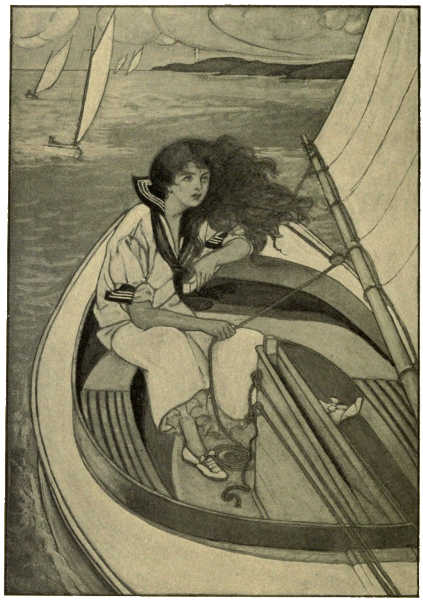
end, and I never would have got the Tidy Jane
back by myself.”
“She’s powerful skittish once she gets the
smell of the open sea,” the Captain remarked.
“Yes, and they helped me get the salt water
out of Crullers too,” added Polly. “I’ll bet a
cooky she won’t like salt for a year, after that
one good taste of it.”
Crullers laughed feebly. But the other girls
could not make light of the affair. It had
seemed altogether too serious and tragic, when
they had watched those two frail, white-winged
little boats drifting straight in the face of danger,
and then Crullers’ frantic leap into the
sea, and the coming of the life-boat around the
Point. It all savored too much of real tragedy,
Kate and Ruth said, and it ought to teach them
a good lesson.
The life savers had picked up Crullers’ boat
midway down the channel, and had towed the
Tidy Jane in under bare poles. Polly and
Crullers had been taken up to the Station, Crullers,
dripping and half unconscious, carried in
the arms of the Captain, while Polly walked
along the narrow boardwalk behind them, and
the rest of crew followed, five men altogether.
At the Station, Crullers had a personal experience
with “first aid” methods, for she had not
kept her mouth closed when she had gone under,
and as the Captain said she had “shipped a sea.”
The other girls returned to Lost Island in
their boats, as soon as possible, and prepared
Aunty Welcome; then walked back on the shore
road to meet the Captain when he came along
carrying Crullers wrapped up like a papoose
in a real, United States Life Saving Corps
blanket.
That night Mrs. Carey had come over to the
island cottage to make sure that Crullers was
doing well. Aunty Welcome had dosed her with
hot ginger tea, which as Polly said was punishment
enough in itself with a July thermometer
climbing toward the nineties. She had also had
a warm mustard bath, and lay wrapped in a
blanket on a couch in the living-room. The
Captain sat on a camp stool, and whittled away
at a new pintle bolt for Crullers’ rudder. He
said nothing all the time the girls told of the
day’s adventures to Mrs. Carey, not even when
Polly said she was glad the life boat had come
after them, but he nodded his head slowly.
“Aren’t you going to scold us any?” asked
Polly, finally. “We should have started for
home sooner, and maybe we didn’t manage the
yachts just right. It was a queer wind that
came with the tide. It blew from the southwest—”
“West by sou’west,” corrected the Captain
gravely.
“Yes, sir,” Polly agreed. “So we had to beat
our way back criss cross over the bay to catch
any good from it.”
“You needn’t explain,” the Captain shook his
head, his eyes twinkling under their shaggy
brows. “I’m ashamed of you all, getting the
crew out on a day when there was hardly a ripple
on the bay.”
“We didn’t call for help,” Polly pleaded.
“They must have heard the Portland’s whistle.
I am sorry about it. The captain of the Portland
must think we’re a nice lot of yacht lubbers.
More likely he’s calling us yacht lubbers.”
“I met him at the hotel to-night when I went
down to telephone,” said the Captain, slowly.
“Oh, what did he say about us?” the girls
broke in. “Please tell us, Captain Carey.”
“He said that the girl in the Tidy Jane deserved
a medal for the way she handled her boat,
and saved the little fat one.” The Captain’s
face was quite serious.
“I didn’t do anything to Crullers except pull
her over into the Jane,” said Polly, blushing.
“She’d have kept afloat anyway till the life boat
reached her. She was floating lovely with all
those little buoys on her.”
“I was not,” protested Crullers, indignantly.
“I was just full of salt water. I swallowed
gallons of it when I went under that first time.”
Polly was watching the Captain’s countenance
as the barometer of his opinion on the matter,
but it betrayed little. He listened to all they had
to say; then finally leaned back and closed his
big jack knife. Mrs. Carey had gone out into
the kitchen to confer with Aunty Welcome about
the need of a doctor.
“I was expecting it,” said the Captain at last.
“I’ve been telling all along, to Tom, and Nancy,
and mother, that there’d be some doings pretty
soon, and they came a little sooner than I expected.
You’d better not go sailing about too
much after this unless you’re sure of yourselves.
For if you can get all tangled up like that on
a fair day, where would you be in a sudden
squall? I’ll expect now every time we get a
good breath of wind to look over the bay and see
one of the yachts floating around bottom up, and
a couple of you youngsters hanging on to it by
your eyelids. Now mind what I say, keep down
at this end of the bay, out of the channel and
away from the other craft, till you know enough
to get out of the way. What were you doing
out there anyhow, trying to round the Point?”
The girls had nearly forgotten their adventure
at Smugglers’ Cove in the newer excitement
of the accident, but now they told of the day
there, and of the mystery, until the Captain
leaned back his head and laughed over it.
“Now, who do you suppose it can be, Captain?”
asked Isabel and Ted in one breath.
“Is there a passage from that cave up to the
old ruins?” Kate added.
“They were footprints with shoes on,” Sue
exclaimed.
“Were they indeed?” The Captain laughed
till he coughed, and wiped the tears out of his
eyes. “Well, now, you take my advice and keep
off the island, for I’m thinking it’s inhabited.”
“Do you know who lives there?” Polly leaned
forward to meet his glance, and the Captain
slowly winked, oh, but so wisely and cautiously.
“I am saying nothing,” he told them. “Can
you hear me?”
Mrs. Carey appeared in the doorway just
then.
“Come along home, father,” she said. “We’ve
decided not to get any doctor. I guess Welcome’s
about right. She says they frets around,
and muddles things up, and gets in the way, and
she can mix up just as queer a mess as they can
any time. I don’t think the child is hurt much,
anyhow. She’s pretty well scared, and salted,
and that’s about all. Polly, I’ll send over some
fresh string beans and a mess of peas in the
morning by Nancy, and Tom’s going to the village
if you need anything.”
“Aren’t they good to us?” Polly said, as she
came back after saying goodbye and watching
the gleam of the lantern swing along the hummocks
over to the shore road. “I thought he’d
scold us hard.”
“We deserved it,” Kate answered, calmly, as
she stuffed a couple of sofa cushions back of her
head, and clasped her hands on them. “Here
we’ve stopped a steamer, excited all her passengers
and crew, made the life-savers hustle out
in fair weather, and generally let everybody
around Eagle Bay know what a lot of lubbers
we are at handling yachts, all because Crullers’
pintle bolt got twisted and she took a jump overboard.
It’s lucky, Polly, the Admiral isn’t here.
He’d send us all back to Queen’s Landing in a
jiffy.”
“We didn’t mean to make so much trouble,”
Polly answered cheerily, as she shook up Crullers’
pillow, and got her a glass of fresh water
for the night. “I’m only thankful it was no
worse. Let’s make the best of it. Let’s make
an interesting invalid out of Crullers. Aunty
Welcome says she must stay in bed to-morrow
till all danger is over of chills or fever or stomach
upsetness. I’m going to loan her my pink
kimono to wear over her nightgown, and we’ll
bring in some wild roses from the shore road,
and entertain her with a—oh, girls, I know
what.” Polly stopped short, her eyes sparkling
as they always did when she had a sudden idea.
“Let’s give her a ‘Sea Social.’ We were going
to have one some evening, but now we’ll do it
to-morrow afternoon. We can get the Vaughan
girls over. Have Tom leave word at the hotel
for them, and Nancy will come, and we’ll all
sing sea songs and recite sea poetry, and we’ll
have a lunch right out of the sea, fried flounder.”
“I wish we could have crab a la Newburg,”
Isabel remarked musingly. Polly went to the
open window, and stretched out her arms seaward,
as she sang:
“Flounder, flounder in the sea,
Come, I pray, and talk to me.
For my wife, Dame Isabel,
Wishes what I fear to tell.”
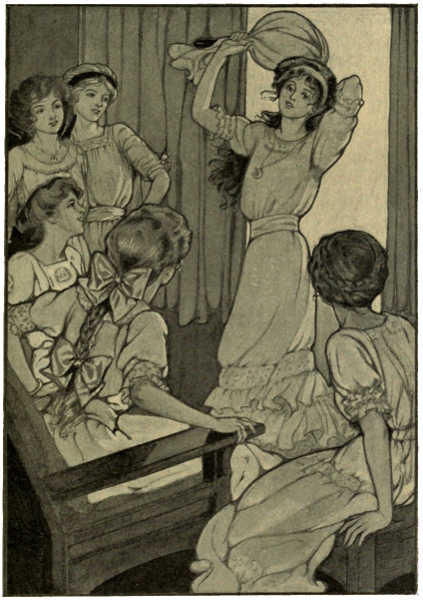
She turned just in time to catch the pillow
that Isabel sent flying across the room, and they
all sat down to make up a program for Crullers’
“Sea Social.”
It was a great success. Even Mrs. Carey
came over, with a fresh gingerbread and a pail
of rich cream.
“They go mighty nice together,” she said,
smilingly, and the girls agreed with her before
the feast was over.
Dorothy and Bess made the trip across the
bay in the Nixie, to call on the invalid, and lend
their share to the social side of the afternoon.
Crullers had never been the guest of honor anywhere
before, but she was that day, as she sat
up on the couch in the living-room, with Polly’s
long pink kimono around her, and pink wild
roses fastened on each side her braids, above her
ears, in Japanese fashion.
The glee club played all the sea songs they
could remember, and all hands piped up merrily
from “Nancy Lee” to “Anchored.” Then Polly
announced that the best part of the program was
yet to come. Each of the girls would render
her favorite poem about the sea, and Crullers
had to start the ball rolling.
“I only know the one about the ‘Schooner
Hesperus,’ Polly,” she said, shyly, “and I like
it best of all.”
“Say it, then,” Polly told her. “We like it,
too.”
Then Kate recited “The Three Fishers,” her
slow, contralto tones and rather dreamy air well
fitting themselves to the sad old verses. Isabel
gave “Annabel Lee” most touchingly, and Polly
ordered a quick song in happier vein to offset
the sadness of the two. So after a rousing
“Billy was a Bo’sun,” Ted got up, and declaimed
the only poem on the sea she knew, one she had
had to memorize at Calvert Hall as a punishment
for putting the house cat into Fraulein’s
shirtwaist box, and scaring her nearly into a
fainting fit (Fraulein, not the cat).
“The mountains look on Marathon,
And Marathon looks on the sea,
And sitting there a while alone,
I dreamed that Greece might yet be free.”
Polly always liked to watch Ted’s face when
she came to that verse. She would lift her chin,
and her gray eyes would flash, and her fists
clench. At Calvert Hall Ted had always been
the most successful “declaimer,” as Miss Calvert
termed it, and she “fixed Greece good
and plenty” this time; so Sue said when it
was over.
Dorothy declared she didn’t know any poem
about the ocean, but she would sing “Sweet and
Low” if they liked.
“Not too low, please,” Crullers said, eagerly,
“or I won’t hear all the words away over here.”
“I declare, Crullers,” laughed Kate. “We
should have nicknamed you Stubs, for if there’s
a possible thing for you to stumble over, you do
it.”
Polly recited her favorite, “The Chambered
Nautilus,” and as she came to the last verse
Mrs. Carey closed her eyes and smiled, her
hand up to her face, as the grand old words
rang out.
“Build thee more stately mansions, oh, my soul
As the swift seasons roll.
Leave thy low vaulted past,
Let each new temple, nobler than the last,
Shut thee from heaven with a dome more vast,
Till thou at length art free,
Leaving thine outgrown shell,
By life’s unresting sea.”
“Oh, I love that,” Nancy cried, her blue eyes
sparkling as Polly finished. “Father would,
too.”
“Now, there’s just Bess, and Mrs. Carey, and
you left, Nancy,” Kate said. “Come, Bess, do
something.”
“Oh, I don’t know anything,” Bess said,
shyly.
“Yes, she does, too,” Dorothy laughed.
“Make her say the poem from ‘Alice in Wonderland’
about the whiting and the snail.”
All the girls added their persuasion and Bess
agreed. She was only thirteen, and small for
her age, with a mass of yellow, square-cut curls
around her mischievous face, and she had plenty
of freckles. The piquant, teasing look on her
face was delicious as she asked, plaintively, coaxingly,
“Will you, won’t you, will you, won’t you, won’t you join the dance,
Oh, will you, won’t you, will you, won’t you, won’t you, won’t you join the dance?”
“Now, Mrs. Carey and Nancy are next,” Kate
said, as soon as the applause had stopped, and
Crullers leaned back on her pillow flushed and
radiant over the merriment.
“Well, now, we didn’t expect to speak any
pieces,” Mrs. Carey answered, her pleasant
motherly face beaming around at them with love
and kindliness. She used to say that she’d got
so in the habit of mothering the two children
and the Captain that it was just second nature
to her to mother anything in sight. “I don’t
know any poetry, and neither does Nancy, but
if you like I’ll read you something that we
think’s the finest poetry ever was written about
the sea, and then Nancy can sing her favorite
hymn, ‘Pull for the Shore.’”
She stepped back into the kitchen and spoke
to Aunty Welcome, and presently returned with
the latter’s Bible in her hand. Sitting there
in the cool, cosy room, whose windows all opened
to the sea, she read that beautiful Psalm that
both she and the Captain loved to read aloud,
the One Hundred and Fourth, with its grand
old song about He “who layeth the beams of
his chambers in the waters: who maketh the
clouds His chariot: who walketh upon the wings
of the wind: who maketh His angels spirits, and
His ministers a flame of fire.”
Then Nancy’s clear, sweet voice fairly made
the little room ring with the hymn she loved:
“Light in the darkness, sailor,
Day is at hand,
See o’er the foaming billow,
Fair haven land.”
After it was over, and they had all gone excepting
the yacht club girls themselves, Crullers
said she thought it was the happiest time she had
ever had, and the next day she was able to “rise
and shine,” as Aunty Welcome told her, and take
up life again.
Things were very quiet at the island for a
week after the mishap in the bay. The girls restricted
their sailing to the west end of the bay,
down towards Fair Havens, and Polly was busy
finding out how to manage yachts, keep them in
repair, and so on, and she called Tom to account
roundly.
“Just look at these seams in the Tidy Jane,
Tom,” she said one day, when they were down
at the landing overhauling the boats. “Don’t
they need re-caulking?”
“I guess not,” Tom responded, easily. “Father
and I went all over them last spring, when
we did the rest. They’ll swell after they’ve been
in the water a few weeks anyhow. Sometimes
when you caulk a boat up too tight, she’ll spring
on you.”
“All right, then, but just look at the paint,
will you? It’s fairly peeling off in some places,
Tom. You won’t find any of the Orienta boats
looking like that.”
Tom looked at her, his eyes beginning to
twinkle as his father’s did.
“I know what you’re up to,” he laughed.
“You’re going to race in the regatta!”
Polly said nothing, but she kept on her course
of fitting out for the race. The Orienta was to
open its club house the first of August for the
regatta season. It had been open as a club house
since the first of June, but officially it welcomed
the sailing world from the first of August until
the fifteenth, the day of the first run. Even
from the porch of the little cottage on the Knob,
the girls could look across the bay to where the
handsome red and white club house stood midway
between the hotel and the row of summer
cottages that straggled along the north shore all
the way to the Inlet. As long as the girls lived
on Eagle Bay, they never knew the name of the
little river that rambled down between the bluffs
and mingled with the channel waters. Everyone
called it the Inlet, so they did too.
At one side of the club house was built a tall
yacht shed, for the housing of such boats as were
left there in the winter time. The best ones
came up from the south, Dorothy said. Not
way down south, but around Boston harbor, and
Long Island, and New York. Her father’s big
sloop would be the flag ship at the regatta, she
told them, for he was the commodore of the
challenging club.
“They don’t have a flag ship at a regatta,”
Tom had interposed. “I never raced in one, but
I’ve watched them ever since I was knee high to
a toadstool. There’s just the racing yachts, and
the judge’s boat, and they divide them into different
classes.”
“I thought that was what they called it,” Dorothy
said, in her pretty, half serious way, and
Tom walked away, grinning blandly over the
ways of girl people in general.
The Admiral had written that he was surely
coming north regatta week, and Polly felt a
growing emulation in her breast, a feeling of
pride in the Polly Page Yacht Club, against this
mighty rival.
“Let’s go over there and watch them overhaul
their yachts,” she said finally, the day before the
opening; so they tramped around the shore road
to Orienta Point. Almost the first persons they
saw were the Vaughan girls, sitting up on the
broad veranda with a lot of ladies and young
girls.
“This looks like a celebration of some kind,
girls,” Kate said, merrily. “We had better be
careful.”
The others hesitated for a moment. They
were dressed as usual in their dark blue yachting
suits, with white sailor collars, and white duck
knockabout hats to match. Even from where
they stood, there was surely a festive appearance
to the club group. But the girls had already
seen them, and came hurrying down the steps to
meet them, with outstretched hands and glad
smiles of welcome.
“Oh, I’m so glad you came over at last,” cried
Bess. “Mamma wants you all to come up and
join us. To-morrow’s the official guest day, but
mamma’s giving a tea this afternoon to the lady
visitors, and we Juniors are helping pass cake
and things. Come up, now, for we’ve just been
telling about how Polly saved Crullers’ life the
other night.”
“Oh, but I didn’t,” exclaimed Polly, reddening
under her coat of tan. “Truly, Bess, I
didn’t. Crullers, I mean Jane Daphne Adams
here, jumped overboard, and she was floating
comfortably with three buoys attached to her
when I helped her into the boat.”
“Well, the captain of the Portland didn’t tell
it that way,” Dorothy said. “He came up to
the hotel that evening and told us all about it.
He said that you were the pluckiest girl he had
ever seen handle a yacht alone. Won’t you
please come up, and let mamma talk to you about
it? She’s ever so anxious to meet all of you girls
from the island camp anyway, for Bess and I
have talked of you so frequently.”
“But we really hadn’t better to-day, had we,
Polly?” Ruth’s eyes questioned Polly. What
would Miss Calvert say if she knew six of her
best girls had attended a yacht club afternoon
tea in blue duck.
“It’s the correct thing to do,” Bess persisted,
laughing at their perplexity. “The law of yacht
clubs gives a tacit membership, papa says, to all
members of other clubs who may be in the neighborhood.
And they can’t always be in party attire,
you know.”
“Oh, let’s, Polly,” pleaded Isabel. So Ruth
and Polly led the way up the broad steps to the
veranda, with its handsome awnings, potted
palms, and dark green wicker chairs and tables
scattered invitingly about.
Mrs. Vaughan welcomed them cordially and
introduced them to the other ladies and a lot of
the “Juniors,” girls of their own age, and friends
of Dorothy’s and Bess’s.
“And you are all Southern girls, Dolly tells
me,” she said, looking from one face to the other.
“Virginia girls. How did you ever happen to
drift away up on our rocky coast?”
Polly explained how it had all happened, and
then she discovered that Mrs. Vaughan was an
old friend of her Aunt Milly, Mrs. Holmes, and
knew the four boy cousins.
“So you must not remain isolated over at the
Knob after this, girls,” she told them at parting,
when they had partaken of ice cream, delicate
shrimp and lobster salad sandwiches, and tea.
“The Orienta is very gay during August, and
we have a good many Junior functions for our
younger element. I will speak to the Commodore
about your club and see that it is listed for
the regatta, and whenever you are able to come
over I will chaperon all of you and see that you
get back safely. We have our touring car up
here, and you can all go home in that, you know,
any time.”
“Well, forevermore,” gasped Polly, as they
trudged back homeward with the sunset spreading
its glory over the world of land and sea and
sky. “Girls, we have stumbled all unawares into
society. Let’s conduct ourselves as angels.
Whatever will grandfather say!”
“Did you notice their dresses?” asked Isabel,
her eyes dreamy with rapt remembrance. “That
one which Mrs. Vaughan wore was sheer, hand-embroidered
batiste, and the long coat was of
real Irish crochet.”
“I don’t believe she sleeps one bit better than
I do,” said Sue, recklessly.
“But, Sue, did you notice Dorothy’s dress?”
persisted Isabel. “It was white organdie over
pale yellow silk that just matched the tea roses
in the pattern. I love clothes that show good
taste.”
“Now, Lady Vanitas,” said Polly, reprovingly.
“Don’t let your heart dwell so on raiment.
Lilies of the field, you know. It was
pretty, and there you are. We’ve all brought
our Commencement Day dresses along for Sundays,
so we’ll freshen them up, and I guess we
can go to the ball without the help of any god-mothers
or pumpkins. I don’t feel one bit bothered
over the social side of it, but how can we
hold our own in a regatta, girls? It’s so kind
of Mrs. Vaughan to invite us to join them, isn’t
it? How funny our little fifteen-footers will
look alongside the big forty- and sixty-footers.”
“But she said they were going to have special
entries for the Junior events, don’t you remember?”
Sue interrupted eagerly. “I don’t see why
we couldn’t enter for them. Dorothy and Bess
are going to sail their yacht, and they say there
are five or six others who are going in.”
“Then we will sail ours,” Polly retorted. “I
have intended to all along, but I wanted some
encouragement. I wouldn’t race with a great
yacht towering over me like a genii just out of
a bottle, but I’ll pit the Tidy Jane against any
yacht of her build along the whole coast of North
America.”
“Hurrah!” Sue threw her cap up into the air.
“Wait till you see the Patsy D. come up gallantly
in the wind, and grab the Orienta Junior
cup away from all of you.”
It gave them plenty to talk about and plan
for, at all events. As Ruth said the following
morning, the summer was not half long enough
for all the things they planned to do. They
rose early, any time between five and six. Nobody
except a clam could have slept with the sun
coming up like a great, golden blossom behind
Bald Bluff, and the sea running along the beach
with little waves like dancing feet, calling to one
to come and play too.
They tried over and over again to divide each
day systematically, but, as Polly said, “current
events tripped them up.” Aunty Welcome protested
that she would do the washing, ironing,
cooking, and kitchen work, but not a tap more;
so each took care of her own room, and Polly
looked out for the living-room besides. Sue had
chosen the veranda for her special charge, and
she kept it spotless. They had brought along
two hammocks, and had found another one
rolled up with the porch mats under a window
seat. The three hung out on the veranda temptingly,
and through the long warm afternoons,
when they were not sailing, the girls would sit
out there and make all sorts of decorative things
out of the shells in their collection, while Ruth
read aloud. The very week of their arrival, she
had gone across the bay with Nancy in the
Pirate and had discovered the village circulating
library.
“I do believe, Grandma,” Polly had said, merrily,
when she saw her returning with a brand
new book, “that if you landed on the coast of
South Africa, you’d ask the first gorilla you met,
very politely, if he would please direct you to the
nearest circulating library.”
But Ruth refused to be teased about her
hobby, so the girls desisted. She loved books,
however, and would have walked all the way to
Eastport in order to get a fresh one. So with
her rimless eyeglasses planted firmly on the
bridge of her nose, the nose that turned up ever
so little at the world in anxious inquiry, she
smiled placidly at Polly, and hugged a new volume
to her heart every time she went over the
bay.
“You’re all ready enough to listen while I
read aloud, just the same,” she told them, when
they all settled themselves out on the porch, and
called for the after-dinner reading. No one
contradicted her. Polly was over in her favorite
hammock at the southwesterly corner, her lap
full of shells, and some sandpaper, with which
she was trying to polish their outer side. Sue,
Isabel, and Crullers leaned against the railing,
so that their hair would hang over and dry in
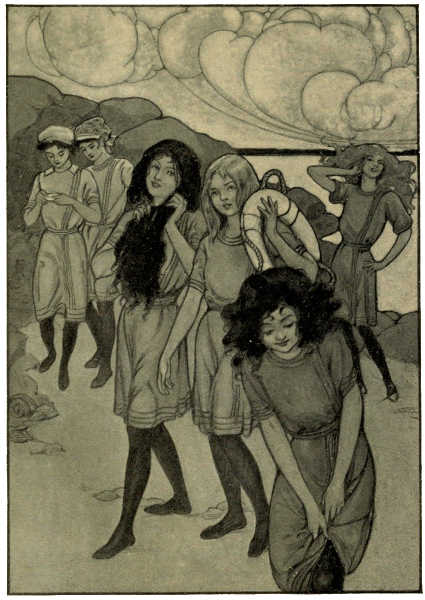
the sunlight. Only two of the girls wore caps
when in bathing, and Aunty Welcome declared
that their hair would be fairly pickled before they
reached home.
“It’s ‘Treasure Island’ this time, girls,” Ruth
announced.
“Smugglers’ Cove,” murmured Sue, mischievously.
“See what an effect it had on her, oh,
dear; oh, dear.”
Ruth uttered a sudden exclamation, and
slipped into the house.
“There was another parcel in our mail box
to-day,” she said, as she came back. “I forgot
to give it to you.”
“This makes the fourth,” Polly declared, taking
it from her, and handling it gingerly. “And
they all come from Smugglers’ Cove. The first
one had new magazines in it, and some patent
fish hooks that Sue ran off with, and we haven’t
seen since.”
“The second was chocolate mints.”
“Oh, my, weren’t they good?” Crullers added.
“Third, a full and complete Manual on
Conchology and Sea-life, suitable for young persons
marooned on an isle,” concluded Polly, returning
with a pair of scissors to cut the twine.
“I wonder what this is?”
It was addressed, as the other parcels had been,
simply to “The Yacht Club, Lost Island, Eagle
Bay, Maine.” Polly opened it while the rest
stood around. One wrapping after another was
removed, and finally a box appeared. When
this was opened, there lay a microscope, a fine
one, with several different removable lenses for
observing specimens.
“Well, what a darling, tasty old pirate he is,”
exclaimed Polly, joyously. “He seems to know
all our needs. We’ll have to send something to
him in return, girls.”
“I’ll make him a shell portìere to hang in front
of his cave,” said Kate, soberly. Scarcely had
she spoken when a strange and unusual sound
broke the stillness of the bay.
“That sounds like a motor boat,” Polly said,
instantly. “Maybe it’s the one from the Hippocampus.”
It was surely a motor boat, but not the bright-railed,
mahogany-trimmed one from the Hippocampus.
This was white, with a high, pointed
prow, a cabin, and a cockpit similar to Nancy’s
knockabout. But there the resemblance ended.
The mast had been removed, and a small gasoline
engine provided the power.
“I can see the name on the prow,” called Ted
presently. “It’s the Natica.”
“Natica means a sea snail,” Ruth explained,
with absent-minded reversion to lessons, but
Polly dropped her shells helter-skelter into the
hammock, and rose.
“I know who it is, girls,” she cried. “That’s
our smuggler!”